JP2023531222A - ANTI-IL-36 ANTIBODY AND METHODS OF USE THEREOF - Google Patents
ANTI-IL-36 ANTIBODY AND METHODS OF USE THEREOF Download PDFInfo
- Publication number
- JP2023531222A JP2023531222A JP2022579064A JP2022579064A JP2023531222A JP 2023531222 A JP2023531222 A JP 2023531222A JP 2022579064 A JP2022579064 A JP 2022579064A JP 2022579064 A JP2022579064 A JP 2022579064A JP 2023531222 A JP2023531222 A JP 2023531222A
- Authority
- JP
- Japan
- Prior art keywords
- antibody
- heavy chain
- lala
- seq
- inverse
- Prior art date
- Legal status (The legal status is an assumption and is not a legal conclusion. Google has not performed a legal analysis and makes no representation as to the accuracy of the status listed.)
- Pending
Links
Classifications
-
- C—CHEMISTRY; METALLURGY
- C07—ORGANIC CHEMISTRY
- C07K—PEPTIDES
- C07K16/00—Immunoglobulins [IGs], e.g. monoclonal or polyclonal antibodies
- C07K16/18—Immunoglobulins [IGs], e.g. monoclonal or polyclonal antibodies against material from animals or humans
- C07K16/24—Immunoglobulins [IGs], e.g. monoclonal or polyclonal antibodies against material from animals or humans against cytokines, lymphokines or interferons
- C07K16/244—Interleukins [IL]
-
- C—CHEMISTRY; METALLURGY
- C07—ORGANIC CHEMISTRY
- C07K—PEPTIDES
- C07K2317/00—Immunoglobulins specific features
- C07K2317/20—Immunoglobulins specific features characterized by taxonomic origin
- C07K2317/21—Immunoglobulins specific features characterized by taxonomic origin from primates, e.g. man
-
- C—CHEMISTRY; METALLURGY
- C07—ORGANIC CHEMISTRY
- C07K—PEPTIDES
- C07K2317/00—Immunoglobulins specific features
- C07K2317/30—Immunoglobulins specific features characterized by aspects of specificity or valency
- C07K2317/31—Immunoglobulins specific features characterized by aspects of specificity or valency multispecific
-
- C—CHEMISTRY; METALLURGY
- C07—ORGANIC CHEMISTRY
- C07K—PEPTIDES
- C07K2317/00—Immunoglobulins specific features
- C07K2317/30—Immunoglobulins specific features characterized by aspects of specificity or valency
- C07K2317/33—Crossreactivity, e.g. for species or epitope, or lack of said crossreactivity
-
- C—CHEMISTRY; METALLURGY
- C07—ORGANIC CHEMISTRY
- C07K—PEPTIDES
- C07K2317/00—Immunoglobulins specific features
- C07K2317/50—Immunoglobulins specific features characterized by immunoglobulin fragments
- C07K2317/52—Constant or Fc region; Isotype
-
- C—CHEMISTRY; METALLURGY
- C07—ORGANIC CHEMISTRY
- C07K—PEPTIDES
- C07K2317/00—Immunoglobulins specific features
- C07K2317/50—Immunoglobulins specific features characterized by immunoglobulin fragments
- C07K2317/55—Fab or Fab'
-
- C—CHEMISTRY; METALLURGY
- C07—ORGANIC CHEMISTRY
- C07K—PEPTIDES
- C07K2317/00—Immunoglobulins specific features
- C07K2317/70—Immunoglobulins specific features characterized by effect upon binding to a cell or to an antigen
-
- C—CHEMISTRY; METALLURGY
- C07—ORGANIC CHEMISTRY
- C07K—PEPTIDES
- C07K2317/00—Immunoglobulins specific features
- C07K2317/70—Immunoglobulins specific features characterized by effect upon binding to a cell or to an antigen
- C07K2317/76—Antagonist effect on antigen, e.g. neutralization or inhibition of binding
-
- C—CHEMISTRY; METALLURGY
- C07—ORGANIC CHEMISTRY
- C07K—PEPTIDES
- C07K2317/00—Immunoglobulins specific features
- C07K2317/90—Immunoglobulins specific features characterized by (pharmaco)kinetic aspects or by stability of the immunoglobulin
- C07K2317/92—Affinity (KD), association rate (Ka), dissociation rate (Kd) or EC50 value
-
- C—CHEMISTRY; METALLURGY
- C07—ORGANIC CHEMISTRY
- C07K—PEPTIDES
- C07K2317/00—Immunoglobulins specific features
- C07K2317/90—Immunoglobulins specific features characterized by (pharmaco)kinetic aspects or by stability of the immunoglobulin
- C07K2317/94—Stability, e.g. half-life, pH, temperature or enzyme-resistance
-
- C—CHEMISTRY; METALLURGY
- C07—ORGANIC CHEMISTRY
- C07K—PEPTIDES
- C07K2319/00—Fusion polypeptide
Landscapes
- Chemical & Material Sciences (AREA)
- Organic Chemistry (AREA)
- Health & Medical Sciences (AREA)
- Medicinal Chemistry (AREA)
- Biochemistry (AREA)
- Biophysics (AREA)
- General Health & Medical Sciences (AREA)
- Genetics & Genomics (AREA)
- Life Sciences & Earth Sciences (AREA)
- Molecular Biology (AREA)
- Proteomics, Peptides & Aminoacids (AREA)
- Immunology (AREA)
- Peptides Or Proteins (AREA)
- Micro-Organisms Or Cultivation Processes Thereof (AREA)
- Preparation Of Compounds By Using Micro-Organisms (AREA)
- Medicines Containing Antibodies Or Antigens For Use As Internal Diagnostic Agents (AREA)
Abstract
本発明は、ヒトIL-36サイトカイン、IL-36α、IL-36β、および/またはIL-36γに特異的に結合し、IL-36によって刺激されるシグナル伝達経路を遮断する抗体および抗原結合性断片などの結合タンパク質を提供する。そのような結合タンパク質を含む組成物およびそのような結合タンパク質を作成し、使用する方法も提供する。The present invention provides antibodies and antigen-binding fragments that specifically bind to human IL-36 cytokines, IL-36α, IL-36β, and/or IL-36γ, and block signaling pathways stimulated by IL-36. provides binding proteins such as Compositions comprising such binding proteins and methods of making and using such binding proteins are also provided.
Description
本開示は、概して、IL-36α、IL-36βおよび/またはIL-36γに結合する結合タンパク質、例えば、抗体および抗原結合性断片、ならびにそのような結合タンパク質を使用する方法に関する。 The present disclosure relates generally to binding proteins, such as antibodies and antigen-binding fragments, that bind IL-36α, IL-36β and/or IL-36γ, and methods of using such binding proteins.
配列表の参照
配列表の公式の複写は、ASCII形式のテキストファイルとして本明細書と同時に提出する。配列表は、本明細書の一部であり、その全体が参照により本明細書に組み込まれる。
REFERENCE TO SEQUENCE LISTING An official copy of the Sequence Listing is filed herewith as a text file in ASCII format. The Sequence Listing is part of this specification and is hereby incorporated by reference in its entirety.
インターロイキン-1(IL-1)ファミリーのサイトカインリガンドおよび受容体は、炎症、自己免疫、免疫調節、細胞増殖および宿主防御と関連付けられ、炎症性疾患および障害、自己免疫疾患および障害、免疫調節疾患および障害、変性疾患および障害、ならびに細胞増殖(例えば、がん)疾患および障害の病理に寄与し、そのサイトカインおよび受容体は、そのような疾患および障害の病原性メディエーターとして働く。例えば、Cecilia Garlanda et al., Immunity 39:1003-1018 (2013)を参照されたい。IL-1ファミリーのサイトカインには、炎症促進性サイトカイン、インターロイキン-36アルファ(IL-36アルファまたはIL-36α)、インターロイキン-36ベータ(IL-36βまたはIL-36b)およびインターロイキン-36ガンマ(IL-36ガンマまたはIL-36γ)が含まれる。これらのIL-36サイトカインの各々は、皮膚、食道、扁桃腺、肺、腸、脳の細胞、およびT細胞を含む免疫細胞を含む、ある特定の細胞の表面上に発現する同族受容体IL-36R(「IL1RL2」とも呼ばれる)に結合することができるリガンドとして働く。IL-36サイトカインの、IL-36Rへの結合に際して、補助タンパク質共受容体IL1RAPが動員されて、IL-36サイトカインと、IL-36Rと、IL1RAPとを含む三元複合体が形成される。この三元複合体は、細胞内シグナル伝達、ならびにNF-κBおよびAP-1を含む一連の転写因子ならびにマイトジェン活性化タンパク質キナーゼの活性化を促進し、これは、IFN-γ、TNFα、IL-1α、IL-1β、IL-6、IL-8、IL-12、IL-23、CXCL1、CXCL8およびCCL20を含む下流の多くのサイトカイン、ケモカイン、酵素および接着分子の産生を含む炎症応答および免疫応答のカスケードを誘発する。 Cytokine ligands and receptors of the interleukin-1 (IL-1) family are associated with inflammation, autoimmunity, immunomodulation, cell proliferation and host defense, and contribute to the pathogenesis of inflammatory, autoimmune, immunomodulatory, degenerative, and cell proliferative (e.g., cancer) diseases and disorders, and the cytokines and receptors serve as pathogenic mediators of such diseases and disorders. See, eg, Cecilia Garlanda et al., Immunity 39:1003-1018 (2013). The IL-1 family of cytokines includes the pro-inflammatory cytokines interleukin-36 alpha (IL-36 alpha or IL-36α), interleukin-36 beta (IL-36β or IL-36b) and interleukin-36 gamma (IL-36 gamma or IL-36γ). Each of these IL-36 cytokines serves as a ligand capable of binding to its cognate receptor IL-36R (also called "IL1RL2") expressed on the surface of certain cells, including skin, esophageal, tonsil, lung, gut, brain cells, and immune cells, including T cells. Upon binding of the IL-36 cytokine to IL-36R, the accessory protein co-receptor IL1RAP is recruited to form a ternary complex containing the IL-36 cytokine, IL-36R and IL1RAP. This ternary complex promotes intracellular signaling and activation of a series of transcription factors and mitogen-activated protein kinases, including NF-κB and AP-1, which in turn produce many downstream cytokines, chemokines, enzymes and adhesion molecules, including IFN-γ, TNFα, IL-1α, IL-1β, IL-6, IL-8, IL-12, IL-23, CXCL1, CXCL8 and CCL20. trigger a cascade of responses and immune responses.
IL-36サイトカイン、IL-36α、IL-36βおよびIL-36γは、病原体に曝露された皮膚および内上皮組織を含む、いくつかの組織において高く発現することが公知である。例えば、IL-36α、IL-36βおよびIL-36γの発現は、TNF-αにより刺激されたヒトケラチノサイトにおいて顕著にアップレギュレートされ[Carrier, et al. (2011) Journal of Investigative Dermatology]、IL-36γ mRNAは、乾癬皮膚病変において過剰発現される[D'Erme, et al. (2015) Journal of Investigative Dermatology]。また、IL-36α mRNAおよびタンパク質発現の上昇が、慢性腎疾患において観察されている[Ichii et al, Lab Invest., 90(3): 459-475 (2010)]。加えて、マウス骨髄由来樹状細胞(BMDC)およびCD4+T細胞は、炎症促進性サイトカイン(例えば、IL-12、IL-1β、IL-6、TNF-αおよびIL-23)を産生することによってIL-36α、IL-36βおよびIL-36γに応答し、それによって、他のIL-1サイトカインよりも強力に炎症促進効果を誘導する[Vigne et al, Blood, 118(22): 5813-5823 (2011)]。 The IL-36 cytokines, IL-36α, IL-36β and IL-36γ, are known to be highly expressed in several tissues, including pathogen-exposed skin and endothelial tissue. For example, IL-36α, IL-36β and IL-36γ expression are significantly upregulated in TNF-α-stimulated human keratinocytes [Carrier, et al. (2011) Journal of Investigative Dermatology], IL-36γ mRNA is overexpressed in psoriatic skin lesions [D'Erme, et al. (2015) Journal of Investigative Dermatology]. Elevated IL-36α mRNA and protein expression has also been observed in chronic kidney disease [Ichii et al, Lab Invest., 90(3): 459-475 (2010)]. In addition, murine bone marrow-derived dendritic cells (BMDC) and CD4+ T cells respond to IL-36α, IL-36β and IL-36γ by producing pro-inflammatory cytokines such as IL-12, IL-1β, IL-6, TNF-α and IL-23, thereby inducing proinflammatory effects more potently than other IL-1 cytokines [Vigne et al, Blood, 118(22): 5813. -5823 (2011)].
ケラチノサイトにおいてIL-36αを過剰発現するトランスジェニックマウスは、出生時に一過性の炎症性皮膚障害を示し、そのため、マウスは、ヒト乾癬に似ている12-0-テトラデカノイルホルボール13-アセテート誘導性皮膚病理に非常にかかりやすい[Blumberg et al, J. Exp. Med., 204(1 1): 2603-2614 (2007);およびBlumberg et al, J. Immunol, 755(7):4354- 4362 (2010)]。さらに、IL-36R欠損マウスは、イミキモド誘導性乾癬様皮膚炎から保護される[Tortola et al, J. Clin. Invest., 122(11): 3965-3976 (2012)]。これらの結果は、皮膚のある特定の炎症性障害におけるIL-36の役割を強く示唆する。 Transgenic mice overexpressing IL-36α in keratinocytes exhibit transient inflammatory skin lesions at birth, making mice highly susceptible to 12-0-tetradecanoylphorbol 13-acetate-induced skin pathology resembling human psoriasis [Blumberg et al, J. Exp. Med., 204(1 1): 2603-2614 (2007); and Blumberg et al. al, J. Immunol, 755(7):4354-4362 (2010)]. Furthermore, IL-36R-deficient mice are protected from imiquimod-induced psoriasiform dermatitis [Tortola et al, J. Clin. Invest., 122(11): 3965-3976 (2012)]. These results strongly suggest a role for IL-36 in certain inflammatory disorders of the skin.
IL-36サイトカインは、膿疱性乾癬、汎発性膿疱性乾癬(GPP)および掌蹠膿疱症(PPP;palmo-plantar pustulosis)を含む、ある特定の重度の型の乾癬において関係付けられている[例えば、Town, IE. and Sims, IE., Curr. Opin. Pharmacol, 12(4): 486-90 (2012);およびNaik, H.B. and Cowen, E.W., Dermatol Clin., 31(3): 405-425 (2013)を参照されたい]。膿疱性乾癬は、赤色の皮膚によって囲まれた白色の膿疱によって特徴付けられる稀な型の乾癬である。汎発性膿疱性乾癬は、高リスクの致死率を有する重度の全身型の膿疱性乾癬であり、一方で、掌蹠膿疱症は、掌および足の裏に影響を及ぼす慢性型の膿疱性乾癬である。膿疱性乾癬、GPPおよびPPPのための現在の処置は、経口レチノイドおよびステロイド外用薬を含むが、これらの処置は、乏しい有効性および重度の副作用を示す。 IL-36 cytokines have been implicated in certain severe forms of psoriasis, including pustular psoriasis, generalized pustular psoriasis (GPP) and palmo-plantar pustulosis (PPP) [e.g., Town, IE. and Sims, IE., Curr. Opin. Pharmacol, 12(4): 486-90 (2012); and Naik, H.B. and Cowen, E.W., Dermatol Clin., 31(3): 405-425 (2013)]. Pustular psoriasis is a rare form of psoriasis characterized by white pustules surrounded by red skin. Generalized pustular psoriasis is a severe generalized form of pustular psoriasis with a high risk of fatality, while palmoplantar psoriasis is a chronic form of pustular psoriasis that affects the palms and soles. Current treatments for pustular psoriasis, GPP and PPP include oral retinoids and topical steroids, but these treatments exhibit poor efficacy and severe side effects.
本発明は、IL-36サイトカインに高親和性により特異的に結合する抗体を提供する。抗体は、IL-36α、IL-36βまたはIL-36γの、それらの同族受容体IL-36Rへの結合によって刺激されたシグナル伝達を減少、阻害および/または完全に遮断することができる。また、本開示は、IL-36媒介疾患、例えば、非限定的に、急性汎発性発疹性膿疱症(AGEP)、慢性閉塞性肺疾患(COPD)、小児膿疱性皮膚症、湿疹、汎発性膿疱性乾癬(GPP)、炎症性腸疾患(IBD)、掌蹠膿疱性乾癬(palmoplantar pustular psoriasis)(PPP)、乾癬、クローン病患者におけるTNF誘導性乾癬型皮膚病変、シェーグレン症候群およびブドウ膜炎を含む、炎症性疾患、自己免疫疾患およびがんを処置する方法における抗IL-36抗体の使用を提供する。特に好ましい場合、抗体は、IL-36β用の1つの抗原結合部位と、IL-36αおよび/またはIL-36γ用、好ましくはIL-36αおよびIL-36γ両方用の第2の抗原結合部位とを含む多重特異性抗体、特に二重特異性抗体である。 The present invention provides antibodies that specifically bind to IL-36 cytokines with high affinity. Antibodies can reduce, inhibit and/or completely block signaling stimulated by the binding of IL-36α, IL-36β or IL-36γ to their cognate receptor IL-36R. The present disclosure also relates to IL-36 mediated diseases such as, but not limited to, acute generalized exanthematous pustulosis (AGEP), chronic obstructive pulmonary disease (COPD), infantile pustular dermatosis, eczema, generalized pustular psoriasis (GPP), inflammatory bowel disease (IBD), palmoplantar pustular psoriasis (PPP), psoriasis, Crohn's disease patients. Provided is the use of anti-IL-36 antibodies in methods of treating inflammatory diseases, autoimmune diseases and cancer, including TNF-induced psoriatic-type skin lesions, Sjögren's syndrome and uveitis in cancer. If particularly preferred, the antibody is a multispecific antibody, especially a bispecific antibody, comprising one antigen binding site for IL-36β and a second antigen binding site for IL-36α and/or IL-36γ, preferably both IL-36α and IL-36γ.
一実施形態では、本発明は、
(i)配列番号106の配列を含む重鎖超可変領域(HVR-H1)、配列番号107の配列を含む第2の重鎖超可変領域(HVR-H2)、および配列番号108の配列を含む第3の重鎖超可変領域(HVR-H3)のうちの少なくとも1つを含む重鎖可変領域を含む重鎖であって、番号付けのEUシステムによる位置234および235にアラニン残基をさらに含む重鎖と、
(ii)配列番号158の配列を含む重鎖超可変領域(HVR-H1)、配列番号159の配列を含む第2の重鎖超可変領域(HVR-H2)、および配列番号160の配列を含む第3の重鎖超可変領域(HVR-H3)のうちの少なくとも1つを含む重鎖可変領域を含む重鎖であって、番号付けのEUシステムによる位置234および235にアラニン残基をさらに含む重鎖と
を含む抗IL-36抗体を提供する。
In one embodiment, the invention comprises:
(I) Heavy chain ultra -variable region (HVR -H1), which contains an array of an array number 106, the second heavy chain ultra -variable area (HVR -H2), which includes the array of an array number 107, and the third heavy chain super variable area (HVR -H3), including the array of an array number 108, It is a heavy chain containing a variable area, a heavy chain containing an Alanine residue in the position 234 and 235 by the numbered EU system,
(ii) a heavy chain variable region comprising at least one of a heavy chain hypervariable region (HVR-H1) comprising the sequence of SEQ ID NO: 158, a second heavy chain hypervariable region (HVR-H2) comprising the sequence of SEQ ID NO: 159, and a third heavy chain hypervariable region (HVR-H3) comprising the sequence of SEQ ID NO: 160, further comprising alanine residues at positions 234 and 235 according to the EU numbering system; provides an anti-IL-36 antibody comprising
好ましい一実施形態では、存在する少なくとも1つのHVR配列が、上で特定したHVR3配列であり、例えば、配列番号108のHVR3配列が(i)の重鎖中に存在し、かつ/または配列番号160のHVR3配列が(ii)の重鎖に存在してもよい。好ましい一実施形態では、少なくともこれらの配列の両方が抗体に存在してもよい。 In one preferred embodiment, the at least one HVR sequence present is an HVR3 sequence identified above, for example the HVR3 sequence of SEQ ID NO: 108 may be present in the heavy chain of (i) and/or the HVR3 sequence of SEQ ID NO: 160 may be present in the heavy chain of (ii). In one preferred embodiment, at least both of these sequences may be present in the antibody.
好ましい一実施形態では、抗IL-36抗体は、
(i)配列番号106の配列を含む重鎖超可変領域(HVR-H1)、配列番号107の配列を含む第2の重鎖超可変領域(HVR-H2)、および配列番号108の配列を含む第3の重鎖超可変領域(HVR-H3)を含む重鎖可変領域を含む重鎖であって、番号付けのEUシステムによる位置234および235にアラニン残基をさらに含む重鎖と、
(ii)配列番号158の配列を含む重鎖超可変領域(HVR-H1)、配列番号159の配列を含む第2の重鎖超可変領域(HVR-H2)、および配列番号160の配列を含む第3の重鎖超可変領域(HVR-H3)を含む重鎖可変領域を含む重鎖であって、番号付けのEUシステムによる位置234および235にアラニン残基をさらに含む重鎖と
を含む。
In one preferred embodiment, the anti-IL-36 antibody is
(i) a heavy chain comprising a heavy chain hypervariable region (HVR-H1) comprising the sequence of SEQ ID NO: 106, a second heavy chain hypervariable region (HVR-H2) comprising the sequence of SEQ ID NO: 107, and a third heavy chain hypervariable region (HVR-H3) comprising the sequence of SEQ ID NO: 108, further comprising alanine residues at positions 234 and 235 according to the EU numbering system;
(ii) a heavy chain hypervariable region (HVR-H1) comprising the sequence of SEQ ID NO: 158, a second heavy chain hypervariable region (HVR-H2) comprising the sequence of SEQ ID NO: 159, and a third heavy chain hypervariable region (HVR-H3) comprising the sequence of SEQ ID NO: 160, further comprising alanine residues at positions 234 and 235 according to the EU numbering system.
別の好ましい実施形態では、抗IL-36抗体が、
(a)各重鎖が、Q1E、M428L/N434S、YTE、およびC末端リジンから選択される少なくとも1つの改変を含み、2つの重鎖が同一の改変を有し、かつ/または
(b)重鎖の1つが「ノブ」改変T366Wを有し、さらにS354C改変を伴っていてもよく、他方の重鎖が、「ホール」改変T366S/L368A/Y407Vを有し、Y349C改変を伴っていてもよい
ものであってもよい。
In another preferred embodiment, the anti-IL-36 antibody is
(a) each heavy chain comprises at least one modification selected from Q1E, M428L/N434S, YTE, and a C-terminal lysine, and the two heavy chains have the same modification; and/or (b) one of the heavy chains has the "knob" modification T366W, optionally with an S354C modification, and the other heavy chain has the "hole" modification T366S/L368A/Y407V and Y3. It may be one that may be accompanied by a 49C modification.
さらに別の好ましい実施形態では、抗IL-36が、
(i)の重鎖および(ii)の重鎖が両方とも以下(a)~(x):
(a)Q-LALA-LS-S354/Y349-KiH、(b)Q-LALA-LS-S354/Y349-HiK(インバース)、(c)Q-LALA-LS-KiH、(d)Q-LALA-LS-HiK(インバース)、(e)Q-LALA-YTE-S354/Y349-KiH、(f)Q-LALA-YTE-S354/Y349-HiK(インバース)、(g)Q-LALA-YTE-KiH、(h)Q-LALA-YTE-HiK(インバース)、(i)E-LALA-LS-S354/Y349-KiH、(j)E-LALA-LS-S354/Y349-HiK(インバース)、(k)E-LALA-LS-KiH、(l)E-LALA-LS-HiK(インバース)、(m)E-LALA-YTE-S354/Y349-KiH、(n)E-LALA-YTE-S354/Y349-HiK(インバース)、(o)E-LALA-YTE-KiH、(p)E-LALA-YTE-HiK(インバース)、(q)Q-LALA-S354/Y349-KiH、(r)Q-LALA-S354/Y349-HiK(インバース)、(s)Q-LALA KiH、(t)Q-LALA HiK(インバース)、(u)E-LALA-S354/Y349-KiH、(v)E-LALA-S354/Y349-HiK(インバース)、(w)E-LALA KiH、および(x)E-LALA HiK(インバース)のうちの同一の1つを含み、
-「Q」は、N末端アミノ酸残基のQであり、
-「E」は、N末端アミノ酸残基としてのEによるQ1E改変であり、
-「LALA」は、L234A L235A改変であり、
-「LS」は、M428L/N434S改変であり、
-「YTE」は、M252Y S254T T256E改変であり、
-「KiH」は、(i)の重鎖が「ノブ」改変T366Wを有し、(ii)の重鎖が、「ホール」改変T366S/L368A/Y407Vを有することを示し、
-「HiK(インバース)」は、(i)の重鎖が、「ホール」改変T366S/L368A/Y407Vを有し、(ii)の重鎖が「ノブ」改変T366Wを有することを示し、
重鎖がそれぞれC末端リジン残基を含んでもよい
ものであってもよい。
In yet another preferred embodiment, the anti-IL-36 is
The heavy chain of (i) and the heavy chain of (ii) are both the following (a)-(x):
(a) Q-LALA-LS-S354/Y349-KiH, (b) Q-LALA-LS-S354/Y349-HiK (inverse), (c) Q-LALA-LS-KiH, (d) Q-LALA-LS-HiK (inverse), (e) Q-LALA-YTE-S354/Y349-K iH, (f) Q-LALA-YTE-S354/Y349-HiK (inverse), (g) Q-LALA-YTE-KiH, (h) Q-LALA-YTE-HiK (inverse), (i) E-LALA-LS-S354/Y349-KiH, (j) E-LALA-LS-S354/Y349 -HiK (inverse), (k) E-LALA-LS-KiH, (l) E-LALA-LS-HiK (inverse), (m) E-LALA-YTE-S354/Y349-KiH, (n) E-LALA-YTE-S354/Y349-HiK (inverse), (o) E-LALA-YTE-Ki H, (p) E-LALA-YTE-HiK (inverse), (q) Q-LALA-S354/Y349-KiH, (r) Q-LALA-S354/Y349-HiK (inverse), (s) Q-LALA KiH, (t) Q-LALA HiK (inverse), (u) E-LALA-S35 4/Y349-KiH, (v) E-LALA-S354/Y349-HiK (inverse), (w) E-LALA KiH, and (x) E-LALA HiK (inverse);
- "Q" is the Q of the N-terminal amino acid residue;
- "E" is the Q1E modification with E as the N-terminal amino acid residue;
- "LALA" is the L234A L235A modification,
- "LS" is the M428L/N434S modification,
- "YTE" is the M252Y S254T T256E modification;
- "KiH" indicates that (i) the heavy chain has the "knob" modification T366W and (ii) the heavy chain has the "hole" modification T366S/L368A/Y407V;
- "HiK (inverse)" indicates that the heavy chain of (i) has the "hole" modification T366S/L368A/Y407V and the heavy chain of (ii) has the "knob" modification T366W;
The heavy chains may each optionally contain a C-terminal lysine residue.
好ましい一実施形態では、抗IL-36抗体が、(i)および(ii)の重鎖が配列番号の以下の対:752/791、753/790、754/793、755/792、756/795、757/794、758/797、759/796、768/807、769/806、770/809、771/808、772/811、773/810、774/813、775/812、782/821、783/820、784/823、785/822、786/825、787/824、788/827、および789/826のうちの1つであるものである。別の好ましい実施形態では、重鎖が1対の重鎖を含んでもよく、各重鎖が、それらの重鎖対の1つに、例えば、可変領域全体にわたって、より好ましくは、重鎖の完全長全体にわたって、少なくとも90%の配列同一性を有する。 In one preferred embodiment, the anti-IL-36 antibody comprises the following pairs of SEQ ID NOs: 771/808, 772/811, 773/810, 774/813, 775/812, 782/821, 783/820, 784/823, 785/822, 786/825, 787/824, 788/827, and 789/826. In another preferred embodiment, the heavy chains may comprise a pair of heavy chains, each heavy chain having at least 90% sequence identity with one of the heavy chain pairs, e.g., over the variable region, more preferably over the full length of the heavy chain.
本開示は、
(i) 配列番号106の配列を含む重鎖超可変領域(HVR-H1)、配列番号107の配列を含む第2の重鎖超可変領域(HVR-H2)、および配列番号108の配列を含む第3の重鎖超可変領域(HVR-H3)のうちの少なくとも1つを含む重鎖可変領域を含む重鎖と、
(ii) 配列番号158の配列を含む重鎖超可変領域(HVR-H1)、配列番号159の配列を含む第2の重鎖超可変領域(HVR-H2)、および配列番号160の配列を含む第3の重鎖超可変領域(HVR-H3)のうちの少なくとも1つを含む重鎖可変領域を含む重鎖と
を含み、(i)の重鎖および(ii)の重鎖が両方とも以下(a)~(ll):(a)Q-LALA-LS-S354/Y349-KiH、(b)Q-LALA-LS-S354/Y349-HiK(インバース)、(c)Q-LALA-LS-KiH、(d)Q-LALA-LS-HiK(インバース)、(e)Q-LALA-YTE-S354/Y349-KiH、(f)Q-LALA-YTE-S354/Y349-HiK(インバース)、(g)Q-LALA-YTE-KiH、(h)Q-LALA-YTE-HiK(インバース)、(i)Q-N297G-LS-S354/Y349-KiH、(j)Q-N297G-LS-S354/Y349-HiK(インバース)、(k)Q-N297G-LS-KiH、(l)Q-N297G-LS-HiK(インバース)、(m)Q-N297G-YTE-S354/Y349-KiH、(n)Q-N297G-YTE-S354/Y349-HiK(インバース)、(o)Q-N297G-YTE-KiH、(p)Q-N297G-YTE-HiK(インバース)、(q)E-LALA-LS-S354/Y349-KiH、(r)E-LALA-LS-S354/Y349-HiK(インバース)、(s)E-LALA-LS-KiH、(t)E-LALA-LS-HiK(インバース)、(u)E-LALA-YTE-S354/Y349-KiH、(v)E-LALA-YTE-S354/Y349-HiK(インバース)、(w)E-LALA-YTE-KiH、(x)E-LALA-YTE-HiK(インバース)、(y)E-N297G-LS-S354/Y349-KiH、(z)E-N297G-LS-S354/Y349-HiK(インバース)、(aa)E-N297G-LS-KiH、(bb)E-N297G-LS-HiK(インバース)、(cc)E-N297G-YTE-S354/Y349-KiH、(dd)E-N297G-YTE-S354/Y349-HiK(インバース)、(ee)Q-LALA-S354/Y349-KiH、(ff)Q-LALA-S354/Y349-HiK(インバース)、(gg)Q-LALA KiH、(hh)Q-LALA HiK(インバース)、(ii)E-LALA-S354/Y349-KiH、(jj)E-LALA-S354/Y349-HiK(インバース)、(kk)E-LALA KiH、および(ll)E-LALA HiK(インバース)のうちの同一の1つを含み、
「Q」は、N末端アミノ酸残基のQであり、「E」は、N末端アミノ酸残基としてのEによるQ1E改変であり、「LALA」は、L234A L235A改変であり、「N297G」はN297G改変であり、「LS」は、M428L/N434S改変であり、「YTE」は、M252Y S254T T256E改変であり、「KiH」は、(i)の重鎖が「ノブ」改変T366Wを有し、(ii)の重鎖が、「ホール」改変T366S/L368A/Y407Vを有することを示し、「HiK(インバース)」は、(i)の重鎖が、「ホール」改変T366S/L368A/Y407Vを有し、(ii)の重鎖が「ノブ」改変T366Wを有することを示し、
C末端リジンが(i)および/または(ii)の重鎖に存在してもよい、抗IL-36抗体をさらに提供する。
This disclosure is
(i) a heavy chain comprising a heavy chain variable region comprising at least one of a heavy chain hypervariable region (HVR-H1) comprising the sequence of SEQ ID NO: 106, a second heavy chain hypervariable region (HVR-H2) comprising the sequence of SEQ ID NO: 107, and a third heavy chain hypervariable region (HVR-H3) comprising the sequence of SEQ ID NO: 108;
(ii) a heavy chain hypervariable region comprising at least one of a heavy chain hypervariable region (HVR-H1) comprising the sequence of SEQ ID NO: 158, a second heavy chain hypervariable region (HVR-H2) comprising the sequence of SEQ ID NO: 159, and a third heavy chain hypervariable region (HVR-H3) comprising the sequence of SEQ ID NO: 160, wherein the heavy chain of (i) and the heavy chain of (ii) are both the following (a)-( ll): (a) Q-LALA-LS-S354/Y349-KiH, (b) Q-LALA-LS-S354/Y349-HiK (inverse), (c) Q-LALA-LS-KiH, (d) Q-LALA-LS-HiK (inverse), (e) Q-LALA-YTE-S354/Y34 9-KiH, (f) Q-LALA-YTE-S354/Y349-HiK (inverse), (g) Q-LALA-YTE-KiH, (h) Q-LALA-YTE-HiK (inverse), (i) Q-N297G-LS-S354/Y349-KiH, (j) Q-N297G-LS-S354 / Y349-HiK (inverse), (k) Q-N297G-LS-KiH, (l) Q-N297G-LS-HiK (inverse), (m) Q-N297G-YTE-S354/Y349-KiH, (n) Q-N297G-YTE-S354/Y349-HiK (inverse), (o) QN 297G-YTE-KiH, (p) Q-N297G-YTE-HiK (inverse), (q) E-LALA-LS-S354/Y349-KiH, (r) E-LALA-LS-S354/Y349-HiK (inverse), (s) E-LALA-LS-KiH, (t) E-LALA-LS -HiK (inverse), (u) E-LALA-YTE-S354/Y349-KiH, (v) E-LALA-YTE-S354/Y349-HiK (inverse), (w) E-LALA-YTE-KiH, (x) E-LALA-YTE-HiK (inverse), (y) E-N297G-LS-S 354/Y349-KiH, (z) E-N297G-LS-S354/Y349-HiK (inverse), (aa) E-N297G-LS-KiH, (bb) E-N297G-LS-HiK (inverse), (cc) E-N297G-YTE-S354/Y349-KiH, (dd) E -N297G-YTE-S354/Y349-HiK (inverse), (ee) Q-LALA-S354/Y349-KiH, (ff) Q-LALA-S354/Y349-HiK (inverse), (gg) Q-LALA KiH, (hh) Q-LALA HiK (inverse), (ii) E-LALA-S354/Y349-KiH, (jj) E-LALA-S354/Y349-HiK (inverse), (kk) E-LALA KiH, and (ll) E-LALA HiK (inverse);
"Q" is the N-terminal amino acid residue Q, "E" is the Q1E modification with E as the N-terminal amino acid residue, "LALA" is the L234A L235A modification, "N297G" is the N297G modification, "LS" is the M428L/N434S modification, "YTE" is the M252Y S254T T256E modification, "KiH" indicates that (i) the heavy chain has the "knob" modification T366W and (ii) the heavy chain has the "hole" modification T366S/L368A/Y407V, "HiK (inverse)" indicates that the heavy chain of (i) has the "hole" modification T366S/L368A/Y407V and (ii) the heavy chain has the "knob" modification T366W indicates that it has
Further provided is an anti-IL-36 antibody wherein a C-terminal lysine may be present in the heavy chain of (i) and/or (ii).
好ましい一実施形態では、抗IL-36抗体が、
(i)配列番号106の配列を含む重鎖超可変領域(HVR-H1)、配列番号107の配列を含む第2の重鎖超可変領域(HVR-H2)、および配列番号108の配列を含む第3の重鎖超可変領域(HVR-H3)を含む重鎖可変領域を含む重鎖と、
(ii)配列番号158の配列を含む重鎖超可変領域(HVR-H1)、配列番号159の配列を含む第2の重鎖超可変領域(HVR-H2)、および配列番号160の配列を含む第3の重鎖超可変領域(HVR-H3)を含む重鎖可変領域を含む重鎖と
を含む。
In one preferred embodiment, the anti-IL-36 antibody is
(i) a heavy chain comprising a heavy chain hypervariable region (HVR-H1) comprising the sequence of SEQ ID NO: 106, a second heavy chain hypervariable region (HVR-H2) comprising the sequence of SEQ ID NO: 107, and a third heavy chain hypervariable region (HVR-H3) comprising the sequence of SEQ ID NO: 108;
(ii) a heavy chain hypervariable region (HVR-H1) comprising the sequence of SEQ ID NO:158, a second heavy chain hypervariable region (HVR-H2) comprising the sequence of SEQ ID NO:159, and a third heavy chain hypervariable region (HVR-H3) comprising the sequence of SEQ ID NO:160.
さらなる好ましい実施形態では、(i)および(ii)の重鎖が配列番号の以下の対:752/791、753/790、754/793、755/792、756/795、757/794、758/797、759/796、760/799、761/798、762/801、763/800、764/803、765/802、766/805、767/804、768/807、769/806、770/809、771/808、772/811、773/810、774/813、775/812、776/815、777/814、778/817、779/816、780/819、781/818、782/821、783/820、784/823、785/822、786/825、787/824、788/827、および789/826の1つである。別の好ましい実施形態では、重鎖が、各重鎖が、例えば、可変領域全体にわたって、より好ましくは重鎖の完全長全体にわたって、重鎖のそれらの対の1つに少なくとも90%の配列同一性を有する1対の重鎖を含んでもよい。 In further preferred embodiments, the heavy chains of (i) and (ii) have the following pairs of SEQ ID NOs: 752/791, 753/790, 754/793, 755/792, 756/795, 757/794, 758/797, 759/796, 760/799, 761/798, 762/801, 763/800, 764/803, 765/802, 766/805, 767/804, 768/807, 769/806, 770/809, 771/808, 772/811, 773/810, 774/813, 775/812, 776/815, 777/814, 778/817, 779 /816, 780/819, 781/818, 782/821, 783/820, 784/823, 785/822, 786/825, 787/824, 788/827, and 789/826. In another preferred embodiment, the heavy chains may comprise a pair of heavy chains, each heavy chain having at least 90% sequence identity with one of those pairs of heavy chains, e.g., over the variable region, more preferably over the full length of the heavy chain.
さらなる好ましい実施形態では、本発明の抗IL-36抗体が、
(a)(i)の重鎖および(ii)の重鎖が両方と対になる軽鎖を含むか、
(b)(i)の重鎖と対になって、hu-IL-36-βの抗原結合部位を形成し、(ii)の重鎖とも対になって、hu-IL-36αおよび/もしくはhu-IL-36-γの抗原結合部位を形成する軽鎖を含むか、
(c)配列番号18の配列を有する第1の軽鎖超可変領域(HVR-L1)、配列番号19の配列を有する第2の軽鎖超可変領域(HVR-L2)、および配列番号20の配列を有する第3の軽鎖超可変領域(HVR-L3)を含む軽鎖を含むか、
(d)配列番号77もしくは17の軽鎖可変領域を含む軽鎖を含むか、
(e)配列番号169、242、もしくは246の軽鎖アミノ酸配列を含む軽鎖を含むか、または
(f)二重特異性抗体である。
In a further preferred embodiment, the anti-IL-36 antibody of the invention is
(a) the heavy chain of (i) and the heavy chain of (ii) comprise both paired light chains;
(b) a light chain that pairs with the heavy chain of (i) to form an antigen binding site of hu-IL-36-β and also pairs with the heavy chain of (ii) to form an antigen binding site of hu-IL-36α and/or hu-IL-36-γ;
(c) a light chain comprising a first light chain hypervariable region (HVR-L1) having the sequence of SEQ ID NO: 18, a second light chain hypervariable region (HVR-L2) having the sequence of SEQ ID NO: 19, and a third light chain hypervariable region (HVR-L3) having the sequence of SEQ ID NO: 20;
(d) comprises a light chain comprising the light chain variable region of SEQ ID NO: 77 or 17;
(e) comprises a light chain comprising the light chain amino acid sequence of SEQ ID NO: 169, 242, or 246; or (f) is a bispecific antibody.
さらなる好ましい実施形態では、本発明の抗IL-36抗体が、
(a)2つの重鎖配列および1つの軽鎖配列の以下の組合せ:配列番号752/791/246、753/790/246、756/795/246、757/794/246、768/807/169、769/806/169、772/811/169、773/810/169、774/813/169、および775/812/169のうちの1つを含む二重特異性抗体であるか、
(b)以下の配列番号の対:配列番号752/791、753/790、756/795、757/794、758/797、および759/796のうちの1つから選択される1対の重鎖配列を含み、配列番号246の軽鎖をさらに含む二重特異性抗体であるか、
(c)以下の配列番号の対:配列番号752/791、753/790、756/795、および757/794のうちの1つから選択される1対の重鎖配列を含み、配列番号246の軽鎖をさらに含む二重特異性抗体であるか、または
(d)以下の対:配列番号752/791、756/795、757/794、および758/797のうちの1つから選択される1対の重鎖配列を含み、配列番号246の軽鎖をさらに含む二重特異性抗体である。
In a further preferred embodiment, the anti-IL-36 antibody of the invention is
(a) the following combinations of two heavy chain sequences and one light chain sequence: SEQ ID NOs: 752/791/246, 753/790/246, 756/795/246, 757/794/246, 768/807/169, 769/806/169, 772/811/169, 773/810/169, 774/8 13/169, and a bispecific antibody comprising one of 775/812/169; or
(b) a bispecific antibody comprising a pair of heavy chain sequences selected from one of the following pairs of SEQ ID NOs: SEQ ID NOs: 752/791, 753/790, 756/795, 757/794, 758/797, and 759/796 and further comprising the light chain of SEQ ID NO: 246;
(c) a bispecific antibody comprising a pair of heavy chain sequences selected from one of SEQ ID NOs: 752/791, 753/790, 756/795, and 757/794 and further comprising a light chain of SEQ ID NO: 246; A bispecific antibody comprising a pair of heavy chain sequences selected from one and further comprising a light chain of SEQ ID NO:246.
一部の実施形態では、本発明は、(i)第1の軽鎖超可変領域(HVR-L1)、第2の軽鎖超可変領域(HVR-L2)および第3の軽鎖超可変領域(HVR-L3)ならびに/または(ii)第1の重鎖超可変領域(HVR-H1)、第2の重鎖超可変領域(HVR-H2)および第3の重鎖超可変領域(HVR-H3)を含む抗IL-36抗体であって、
(a)HVR-L1が、TGSSSNIGAHYDVH(配列番号18)、TGSSSNIGAGYDVH(配列番号22)、RASQSVSSNYLA(配列番号38)、またはRASQTIYKYLN(配列番号42);から選択されるアミノ酸配列を含み、
(b)HVR-L2が、SNNNRPS(配列番号15)、GNDNRPS(配列番号19)、GNTNRPS(配列番号23)、GNRNRPS(配列番号27)、SASSLQS(配列番号39)、またはAASSLQS(配列番号43);から選択されるアミノ酸配列を含み、
(c)HVR-L3が、QSYDYSLRGYV(配列番号16)、QSYDYSLSGYV(配列番号20)、QSYDYSLRVYV(配列番号28)、QSYDYSLKAYV(配列番号32)、QSYDISLSGWV(配列番号36)、QQTYSYPPT(配列番号40)、またはQQSSIPYT(配列番号44);から選択されるアミノ酸配列を含み、
(d)HVR-H1が、SAYAMHW(配列番号46)、STSSYYW(配列番号50)、SSTSYYW(配列番号54)、GSRSYYW(配列番号58)、STYAMSW(配列番号62)、TSSNYYW(配列番号66)、SSYGMH(配列番号70)、SNYAIS(配列番号74)、TSTNYYW(配列番号82)、TSSNAYW(配列番号86)、TASNYYW(配列番号90)、TASNTYW(配列番号106)、SDSSYYW(配列番号122)、SESSYYW(配列番号126)、STSSDYW(配列番号130)、SNSSYYW(配列番号134)、STSSYHW(配列番号142)、SRSSYYW(配列番号146)、XXXNXYX(配列番号251)(ここで、1位のXは、T、D、EまたはNであり;2位のXは、S、A、E、G、K、Q、RまたはTであり;3位のXは、S、A、D、E、G、N、P、QまたはTであり;5位のXは、Y、A、E、G、H、M、N、Q、S、TまたはVであり;7位のXは、W、F、I、VまたはYである)またはXXXXXXW(配列番号336)(ここで、1位のXは、SまたはDであり;2位のXは、T、A、D、E、G、H、K、N、P、Q、RまたはSであり;3位のXは、S、D、E、G、K、N、PまたはRである;4位のXは、S、G、K、NまたはPであり;5位のXは、Y、A、D、E、G、H、M、N、Q、S、T、VまたはWであり;6位のXは、Y、A、F、G、H、M、NまたはQである)から選択されるアミノ酸配列を含み、
(e)HVR-H2が、VISYDGTNEYYAD(配列番号47)、SIYYTGNTYYNP(配列番号51)、SIHYSGNTYYNP(配列番号55)、SIHYSGTTYYNP(配列番号59)、GISGGSGYTYYAD(配列番号63)、SIDYTGSTYYNP(配列番号67)、VISYGGSERYYAD(配列番号71)、GILPILGTVDYAQ(配列番号75)、NIDYTGSTYYNA(配列番号83)、SIDYTGSTAYNP(配列番号87)、SIDYTGSTYYNT(配列番号91)、SIDYTGSTYYEP(配列番号99)、SIDYTGSTYYEP(配列番号103)、SIDYTGSTYYQP(配列番号119)、SIYYTGNTYYNS(配列番号123)、SIYYTGNTYYLP(配列番号131)、SIYYTGNTYYMP(配列番号143)、SIYYTGNTYYWP(配列番号147)、SIYYTGETYYAP(配列番号151)、XXDXXXXXXYXX(配列番号284)(ここで、1位のXは、S、NまたはTであり;2位のXは、I、MまたはVであり;4位のXは、YまたはHであり;5位のXは、T、H、LまたはNであり;6位のXは、G、A、D、E、H、K、N、Q、R、SまたはTであり;7位のXは、S、A、D、QまたはTである;8位のXは、T、A、DまたはEであり;9位のXは、Y、A、F、Q、SまたはWであり;11位のXは、N、D、E、H、PまたはQであり;12位のXは、P、AまたはEである)またはXXXXXXXXXYXP(配列番号379)(ここで、1位のXは、S、F、I、MまたはQであり;2位のXは、I、A、G、L、R、S、TまたはVであり;3位のXは、Y、A、D、E、F、G、H、K、L、M、N、P、Q、R、S、TまたはWであり;4位のXは、Y、A、D、E、F、G、H、K、N、P、Q、R、S、TまたはWであり;5位のXは、T、D、E、K、N、PまたはQであり;6位のXは、GまたはQであり;7位のXは、N、D、E、G、H、I、K、M、P、RまたはSであり;8位のXは、T、A、E、F、G、H、K、P、Q、R、S、V、WまたはYである;9位のXは、YまたはWであり;11位のXは、N、A、D、E、K、L、M、P、Q、SまたはTである)から選択されるアミノ酸配列を含み、
(f)HVR-H3が、ARGIRIFTSYFDS(配列番号48)、ARVRYGVGVPRYFDP(配列番号52)、ARVHYGGYIPRRFDH(配列番号56)、ARVAPSYPRVFDY(配列番号60)、ARVVTYRDPPASFDY(配列番号64)、ARGKYYETYLGFDV(配列番号68)、AREPWYSSRGWTGYGFDV(配列番号72)、AREPWYRLGAFDV(配列番号76)、ATGKYYETYLGFDV(配列番号84)、AHGKYYETYLGFDV(配列番号88)、ATGSYYETYLGFDV(配列番号100)、ATGNYYETYLGFDV(配列番号104)、ASGKYYETYLGFDV(配列番号112)、ARGNYYETYLGFDV(配列番号120)、AGVRYGVGVPRYFDP(配列番号128)、SRVRYGVGVPRYFDP(配列番号132)、VRVRYGVGVPRYFDP(配列番号144)、TRVRYGVGVPRYFDP(配列番号148)、ARLRYGVGVPRYFDP(配列番号152)、ARVKYGVGVPRYFDP(配列番号156)、ARVRYGVGVPRHFDP(配列番号160)、AXGXYYXTYLGFDV(配列番号322)(ここで、2位のXは、R、A、E、G、H、M、N、Q、S、TまたはYであり;4位のXは、K、AまたはSであり;7位のXは、EまたはTである)またはXXXXXGXXVPRXFDP(配列番号462)(ここで、1位のXは、AまたはVであり;2位のXは、R、A、G、N、QまたはTであり;3位のXは、V、A、F、I、K、L、M、QまたはSであり;4位のXは、R、A、I、K、L、M、P、Q、S、TまたはVであり;5位のXは、Y、H、I、LまたはVであり;7位のXは、V、A、F、G、K、M、N、Q、R、S、T、WまたはYであり;8位のXは、G、N、R、SまたはTであり;12位のXは、Y、F、H、I、L、M、QまたはRである)から選択されるアミノ酸配列を含む、
抗IL-36抗体を提供する。
In some embodiments, the invention comprises (i) a first light chain hypervariable region (HVR-L1), a second light chain hypervariable region (HVR-L2) and a third light chain hypervariable region (HVR-L3) and/or (ii) a first heavy chain hypervariable region (HVR-H1), a second heavy chain hypervariable region (HVR-H2) and a third heavy chain hypervariable region (HVR-H3). an anti-IL-36 antibody,
(a) HVR-L1 comprises an amino acid sequence selected from TGSSSNIGAHYDVH (SEQ ID NO: 18), TGSSSNIGAGYDVH (SEQ ID NO: 22), RASQSVSSNYLA (SEQ ID NO: 38), or RASQTIYKYLN (SEQ ID NO: 42);
(b) HVR-L2 comprises an amino acid sequence selected from SNNNRPS (SEQ ID NO: 15), GNDNRPS (SEQ ID NO: 19), GNTNRPS (SEQ ID NO: 23), GNRNRPS (SEQ ID NO: 27), SASLQS (SEQ ID NO: 39), or AASSLQS (SEQ ID NO: 43);
(c) HVR-L3 comprises an amino acid sequence selected from QSYDYSLRGYV (SEQ ID NO: 16), QSYDYSLSGYV (SEQ ID NO: 20), QSYDYSLRVYV (SEQ ID NO: 28), QSYDYSLKAYV (SEQ ID NO: 32), QSYDISLSGWV (SEQ ID NO: 36), QQTYSYPPT (SEQ ID NO: 40), or QQSSIPYT (SEQ ID NO: 44);
(d) HVR-H1 is SAYAMHW (SEQ ID NO: 46), STSSYYW (SEQ ID NO: 50), STSSYYW (SEQ ID NO: 54), GSRSYYW (SEQ ID NO: 58), STYAMSW (SEQ ID NO: 62), TSSNYYW (SEQ ID NO: 66), SSYGMH (SEQ ID NO: 70), SNYAIS (SEQ ID NO: 74), TSTNYYW (SEQ ID NO: 82), TSSNAYW (SEQ ID NO: 82) 86), TASNYYW (SEQ ID NO: 90), TASNTYW (SEQ ID NO: 106), SDSSYYW (SEQ ID NO: 122), SESSYYW (SEQ ID NO: 126), STSSDYW (SEQ ID NO: 130), SNSSYYW (SEQ ID NO: 134), STSSYHW (SEQ ID NO: 142), SRSSYYW (SEQ ID NO: 146), XXXNXYX (SEQ ID NO: 251) (where the X at position 1 is T, D, E or N; X at position 2 is S, A, E, G, K, Q, R or T; X at position 3 is S, A, D, E, G, N, P, Q or T; X at position 5 is Y, A, E, G, H, M, N, Q, S, T or V; X at position 1 is S or D; X at position 2 is T, A, D, E, G, H, K, N, P, Q, R or S; X at position 3 is S, D, E, G, K, N, P or R; X at position 4 is S, G, K, N or P; X at position is Y, A, F, G, H, M, N or Q);
(e) HVR-H2 is VISYDGTNEYYAD (SEQ ID NO: 47), SIYYTGNTYYNP (SEQ ID NO: 51), SIHYSGNTYYNP (SEQ ID NO: 55), SIHYSGTTYYNP (SEQ ID NO: 59), GISGGSGYTYYAD (SEQ ID NO: 63), SIDYTGSTYYNP (SEQ ID NO: 67), VISYGGSERYYAD (SEQ ID NO: 71), GILPILGTVDYAQ (SEQ ID NO: 7) 5), NIDYTGSTYYNA (SEQ ID NO: 83), SIDYTGSTAYNP (SEQ ID NO: 87), SIDYTGSTYYNT (SEQ ID NO: 91), SIDYTGSTYYEP (SEQ ID NO: 99), SIDYTGSTYYEP (SEQ ID NO: 103), SIDYTGSTYYQP (SEQ ID NO: 119), SIYYTGNTYYNS (SEQ ID NO: 123), SIYYTGNTYYLP (SEQ ID NO: 131), SIY YTGNTYYMP (SEQ ID NO: 143), SIYYTGNTYYWP (SEQ ID NO: 147), SIYYTGETYYAP (SEQ ID NO: 151), XXDXXXXXXYXX (SEQ ID NO: 284) where X at position 1 is S, N or T; X at position 2 is I, M or V; X at position 4 is Y or H; X at position 5 is T, H, L or N; is G, A, D, E, H, K, N, Q, R, S or T; X at position 7 is S, A, D, Q or T; X at position 8 is T, A, D or E; X at position 9 is Y, A, F, Q, S or W; X at position 11 is N, D, E, H, P or Q; SEQ ID NO: 379) (where X at position 1 is S, F, I, M or Q; X at position 2 is I, A, G, L, R, S, T or V; X at position 3 is Y, A, D, E, F, G, H, K, L, M, N, P, Q, R, S, T or W; X at position 4 is Y, A, D, E, F, G, H, K, N, P, Q, R , S, T or W; X at position 5 is T, D, E, K, N, P or Q; X at position 6 is G or Q; X at position 7 is N, D, E, G, H, I, K, M, P, R or S; X at position is N, A, D, E, K, L, M, P, Q, S or T);
(f) HVR-H3 is ARGIRIFTSYFDS (SEQ ID NO: 48), ARVRYGVGVPRYFDP (SEQ ID NO: 52), ARVHYGGYIPRRFDH (SEQ ID NO: 56), ARVAPSYPRVFDY (SEQ ID NO: 60), ARVVTYRDPPASFDY (SEQ ID NO: 64), ARGKYYETYLGFDV (SEQ ID NO: 68), AREPWYSSRGWTGYGFDV (SEQ ID NO: 72) , AREPWYRLGAFDV (SEQ ID NO: 76), ATGKYYETYLGFDV (SEQ ID NO: 84), AHGKYYETYLGFDV (SEQ ID NO: 88), ATGSYYETYLGFDV (SEQ ID NO: 100), ATGNYYETYLGFDV (SEQ ID NO: 104), ASGKYYETYLGFDV (SEQ ID NO: 112), ARGNYYETYLGFDV (SEQ ID NO: 120), AGVRYGVGVP RYFDP (SEQ ID NO: 128), SRVRYGVGVPRYFDP (SEQ ID NO: 132), VRVRYGVGVPRYFDP (SEQ ID NO: 144), TRVRYGVGVPRYFDP (SEQ ID NO: 148), ARLRYGVGVPRYFDP (SEQ ID NO: 152), ARVKYGVGVPRYFDP (SEQ ID NO: 156), ARVRYGVGVPRHFDP (SEQ ID NO: 160), AXGXYY XTYLGFDV (SEQ ID NO: 322) (where X at position 2 is R, A, E, G, H, M, N, Q, S, T or Y; X at position 4 is K, A or S; X at position 7 is E or T) or XXXXXGXXVPRXFDP (SEQ ID NO: 462) (wherein X at position 1 is A or V; X at position 2 is R, A, G, N, Q or T X at position 3 is V, A, F, I, K, L, M, Q or S; X at position 4 is R, A, I, K, L, M, P, Q, S, T or V; X at position 5 is Y, H, I, L or V; X at position 7 is V, A, F, G, K, M, N, Q, R, S, T, W or Y; X at position 12 is Y, F, H, I, L, M, Q or R).
An anti-IL-36 antibody is provided.
一実施形態では、本発明のそのような抗体は、本明細書に記載の特定の改変、特に本明細書に記載の重鎖改変、特に本明細書に論じるLALA改変のいずれかをさらに含んでもよい。 In one embodiment, such antibodies of the invention may further comprise any of the specific modifications described herein, particularly the heavy chain modifications described herein, particularly the LALA modifications discussed herein.
一部の実施形態では、抗IL-36抗体は、
(a)配列番号18のアミノ酸配列を含むHVR-L1、
(b)配列番号19のアミノ酸配列を含むHVR-L2、および
(c)配列番号20のアミノ酸配列を含むHVR-L3
を含む。
In some embodiments, the anti-IL-36 antibody is
(a) HVR-L1 comprising the amino acid sequence of SEQ ID NO: 18;
(b) HVR-L2 comprising the amino acid sequence of SEQ ID NO: 19, and (c) HVR-L3 comprising the amino acid sequence of SEQ ID NO: 20
including.
一部の実施形態では、抗IL-36抗体は、
(d)HVR-H1が、配列番号66、82、86、90または252~283から選択されるアミノ酸配列を含むこと、
(e)HVR-H2が、配列番号67、83、87、91、99、103、119または285~321から選択されるアミノ酸配列を含むこと、および
(f)HVR-H3が、配列番号68、84、88、100、104、112、120または323~335から選択されるアミノ酸配列を含むこと
を含む。
In some embodiments, the anti-IL-36 antibody is
(d) HVR-H1 comprises an amino acid sequence selected from SEQ ID NOs: 66, 82, 86, 90 or 252-283;
(e) HVR-H2 comprises an amino acid sequence selected from SEQ ID NOs: 67, 83, 87, 91, 99, 103, 119 or 285-321;
一部の実施形態では、抗IL-36抗体は、
(d)HVR-H1が、配列番号50、122、126、130、134、138、142、146または337~378から選択されるアミノ酸配列を含むこと、
(e)HVR-H2が、配列番号51、123、131、143、147、151または380~461から選択されるアミノ酸配列を含むこと、および
(f)HVR-H3が、配列番号52、128、132、144、148、152、156、160または463~513から選択されるアミノ酸配列を含むこと
を含む。
In some embodiments, the anti-IL-36 antibody is
(d) HVR-H1 comprises an amino acid sequence selected from SEQ ID NOS: 50, 122, 126, 130, 134, 138, 142, 146 or 337-378;
(e) HVR-H2 comprises an amino acid sequence selected from SEQ ID NOS: 51, 123, 131, 143, 147, 151 or 380-461;
一部の実施形態では、抗IL-36抗体は、
(a)HVR-L1が、配列番号18のアミノ酸配列を含むこと、
(b)HVR-L2が、配列番号19のアミノ酸配列を含むこと、
(c)HVR-L3が、配列番号20のアミノ酸配列を含むこと、
(d)HVR-H1が、配列番号66、82、86、90または252~283から選択されるアミノ酸配列を含むこと、
(e)HVR-H2が、配列番号67、83、87、91、99、103、119または285~321から選択されるアミノ酸配列を含むこと、および
(f)HVR-H3が、配列番号68、84、88、100、104、112、120または323~335から選択されるアミノ酸配列を含むこと
を含む。
In some embodiments, the anti-IL-36 antibody is
(a) HVR-L1 comprises the amino acid sequence of SEQ ID NO: 18;
(b) HVR-L2 comprises the amino acid sequence of SEQ ID NO: 19;
(c) HVR-L3 comprises the amino acid sequence of SEQ ID NO:20;
(d) HVR-H1 comprises an amino acid sequence selected from SEQ ID NOs: 66, 82, 86, 90 or 252-283;
(e) HVR-H2 comprises an amino acid sequence selected from SEQ ID NOs: 67, 83, 87, 91, 99, 103, 119 or 285-321;
一部の実施形態では、抗IL-36抗体は、
(a)HVR-L1が、配列番号18のアミノ酸配列を含むこと、
(b)HVR-L2が、配列番号19のアミノ酸配列を含むこと、
(c)HVR-L3が、配列番号20のアミノ酸配列を含むこと、
(d)HVR-H1が、配列番号50、122、126、130、134、138、142、146または337~378から選択されるアミノ酸配列を含むこと、
(e)HVR-H2が、配列番号51、123、131、143、147、151または380~461から選択されるアミノ酸配列を含むこと、および
(f)HVR-H3が、配列番号52、128、132、144、148、152、156、160または463~513から選択されるアミノ酸配列を含むこと
を含む。
In some embodiments, the anti-IL-36 antibody is
(a) HVR-L1 comprises the amino acid sequence of SEQ ID NO: 18;
(b) HVR-L2 comprises the amino acid sequence of SEQ ID NO: 19;
(c) HVR-L3 comprises the amino acid sequence of SEQ ID NO:20;
(d) HVR-H1 comprises an amino acid sequence selected from SEQ ID NOS: 50, 122, 126, 130, 134, 138, 142, 146 or 337-378;
(e) HVR-H2 comprises an amino acid sequence selected from SEQ ID NOS: 51, 123, 131, 143, 147, 151 or 380-461;
一部の実施形態では、抗IL-36抗体は、配列番号13、17、21、25、29、33、37、41、77もしくは78から選択される配列と少なくとも90%の同一性を有する軽鎖可変ドメイン(VL)アミノ酸配列;および/または配列番号45、49、53、57、61、65、69、73、79、80、81、85、89、93、97、101、105、109、113、117、121、125、129、133、137、141、145、149、153、157、161もしくは165から選択される配列と少なくとも90%の同一性を有する重鎖可変ドメイン(VH)アミノ酸配列を含む。一部の実施形態では、抗IL-36抗体は、配列番号13、17、21、25、29、33、37、41、77もしくは78から選択される軽鎖可変ドメイン(VL)アミノ酸配列;および/または配列番号45、49、53、57、61、65、69、73、79、80、81、85、89、93、97、101、105、109、113、117、121、125、129、133、137、141、145、149、153、157、161もしくは165から選択される重鎖可変ドメイン(VH)アミノ酸配列を含む。 In some embodiments, the anti-IL-36 antibody has a light chain variable domain (VL) amino acid sequence having at least 90% identity to a sequence selected from SEQ ID NOs: 13, 17, 21, 25, 29, 33, 37, 41, 77 or 78; A heavy chain variable domain (VH) amino acid sequence having at least 90% identity to a sequence selected from 1, 105, 109, 113, 117, 121, 125, 129, 133, 137, 141, 145, 149, 153, 157, 161 or 165. In some embodiments, the anti-IL-36 antibody has a light chain variable domain (VL) amino acid sequence selected from SEQ ID NOs: 13, 17, 21, 25, 29, 33, 37, 41, 77 or 78; A heavy chain variable domain (VH) amino acid sequence selected from 13, 117, 121, 125, 129, 133, 137, 141, 145, 149, 153, 157, 161 or 165.
一部の実施形態では、抗IL-36抗体は、配列番号17もしくは77と少なくとも90%の同一性を有する軽鎖可変ドメイン(VL)アミノ酸配列;および/または配列番号49、65、79、80、81、85、89、93、97、101、105、109、113、117、121、125、129、133、137、141、145、149、153、157、161もしくは165から選択される配列と少なくとも90%の同一性を有する重鎖可変ドメイン(VH)アミノ酸配列を含む。一部の実施形態では、抗IL-36抗体は、配列番号17または77の軽鎖可変ドメイン(VL)アミノ酸配列;および/または配列番号49、65、79、80、81、85、89、93、97、101、105、109、113、117、121、125、129、133、137、141、145、149、153、157、161もしくは165から選択される重鎖可変ドメイン(VH)アミノ酸配列を含む。 In some embodiments, the anti-IL-36 antibody has a light chain variable domain (VL) amino acid sequence having at least 90% identity to SEQ ID NO: 17 or 77; A heavy chain variable domain (VH) amino acid sequence having at least 90% identity to a sequence selected from 149, 153, 157, 161 or 165. In some embodiments, the anti-IL-36 antibody comprises the light chain variable domain (VL) amino acid sequence of SEQ ID NO: 17 or 77; It comprises a heavy chain variable domain (VH) amino acid sequence selected from 57, 161 or 165.
一部の実施形態では、抗IL-36抗体は、配列番号17または77と少なくとも90%の同一性を有する軽鎖可変ドメイン(VL)アミノ酸配列;および/または配列番号65、80、81、85、89、93、97、101、105、109、113もしくは117から選択される配列と少なくとも90%の同一性を有する重鎖可変ドメイン(VH)アミノ酸配列を含む。一部の実施形態では、抗IL-36抗体は、配列番号17もしくは77の軽鎖可変ドメイン(VL)アミノ酸配列;および/または配列番号65、80、81、85、89、93、97、101、105、109、113もしくは117から選択される重鎖可変ドメイン(VH)アミノ酸配列を含む。 In some embodiments, the anti-IL-36 antibody comprises a light chain variable domain (VL) amino acid sequence having at least 90% identity to SEQ ID NO: 17 or 77; and/or a heavy chain variable domain (VH) amino acid sequence having at least 90% identity to a sequence selected from SEQ ID NO: 65, 80, 81, 85, 89, 93, 97, 101, 105, 109, 113 or 117. In some embodiments, the anti-IL-36 antibody comprises a light chain variable domain (VL) amino acid sequence of SEQ ID NO: 17 or 77;
一部の実施形態では、抗IL-36抗体は、配列番号17または77と少なくとも90%の同一性を有する軽鎖可変ドメイン(VL)アミノ酸配列;および/または配列番号49、79、121、125、129、133、137、141、145、149、153、157、161もしくは165から選択される配列と少なくとも90%の同一性を有する重鎖可変ドメイン(VH)アミノ酸配列を含む。一部の実施形態では、抗IL-36抗体は、配列番号17または77の軽鎖可変ドメイン(VL)アミノ酸配列;および/または配列番号49、79、121、125、129、133、137、141、145、149、153、157、161もしくは165から選択される重鎖可変ドメイン(VH)アミノ酸配列を含む。 In some embodiments, the anti-IL-36 antibody has a light chain variable domain (VL) amino acid sequence with at least 90% identity to SEQ ID NO: 17 or 77; Contains amino acid sequences. In some embodiments, the anti-IL-36 antibody comprises a light chain variable domain (VL) amino acid sequence of SEQ ID NO: 17 or 77;
一部の実施形態では、抗IL-36抗体は、配列番号169または242と少なくとも90%の同一性を有する軽鎖(LC)アミノ酸配列;および/または配列番号170~202、248、249もしくは250から選択される配列と少なくとも90%の同一性を有する重鎖(HC)アミノ酸配列を含む。一部の実施形態では、抗IL-36抗体は、配列番号169または242の軽鎖(LC)アミノ酸配列;および/または配列番号170~202、248、249もしくは250から選択される重鎖(HC)アミノ酸配列を含む。 In some embodiments, the anti-IL-36 antibody comprises a light chain (LC) amino acid sequence having at least 90% identity to SEQ ID NOs: 169 or 242; and/or a heavy chain (HC) amino acid sequence having at least 90% identity to a sequence selected from SEQ ID NOs: 170-202, 248, 249 or 250. In some embodiments, the anti-IL-36 antibody comprises a light chain (LC) amino acid sequence of SEQ ID NO: 169 or 242;
一部の実施形態では、抗IL-36抗体は、配列番号169または242と少なくとも90%の同一性を有する軽鎖(LC)アミノ酸配列;ならびに/または配列番号518~616および743~751から選択される配列と少なくとも90%の同一性を有する重鎖(HC)アミノ酸配列を含む。一部の実施形態では、抗IL-36抗体は、配列番号169または242の軽鎖(LC)アミノ酸配列;ならびに/または配列番号518~616および743~751の重鎖(HC)アミノ酸配列を含む。 In some embodiments, the anti-IL-36 antibody comprises a light chain (LC) amino acid sequence having at least 90% identity to SEQ ID NOs: 169 or 242; and/or a heavy chain (HC) amino acid sequence having at least 90% identity to a sequence selected from SEQ ID NOs:518-616 and 743-751. In some embodiments, the anti-IL-36 antibody comprises the light chain (LC) amino acid sequence of SEQ ID NOs:169 or 242; and/or the heavy chain (HC) amino acid sequence of SEQ ID NOs:518-616 and 743-751.
一部の実施形態では、抗IL-36抗体は、配列番号169または242と少なくとも90%の同一性を有する軽鎖(LC)アミノ酸配列;および/または配列番号203~241から選択される配列と少なくとも90%の同一性を有する重鎖(HC)アミノ酸配列を含む。一部の実施形態では、抗IL-36抗体は、配列番号169または242の軽鎖(LC)アミノ酸配列;および/または配列番号203~241から選択される重鎖(HC)アミノ酸配列を含む。 In some embodiments, the anti-IL-36 antibody comprises a light chain (LC) amino acid sequence having at least 90% identity to SEQ ID NOs: 169 or 242; and/or a heavy chain (HC) amino acid sequence having at least 90% identity to a sequence selected from SEQ ID NOs:203-241. In some embodiments, the anti-IL-36 antibody comprises a light chain (LC) amino acid sequence of SEQ ID NO: 169 or 242; and/or a heavy chain (HC) amino acid sequence selected from SEQ ID NOS: 203-241.
一部の実施形態では、抗IL-36抗体は、配列番号169または242と少なくとも90%の同一性を有する軽鎖(LC)アミノ酸配列;および/または配列番号617~733から選択される配列と少なくとも90%の同一性を有する重鎖(HC)アミノ酸配列を含む。一部の実施形態では、抗IL-36抗体は、配列番号169または242の軽鎖(LC)アミノ酸配列;および/または配列番号617~733から選択される重鎖(HC)アミノ酸配列を含む。 In some embodiments, the anti-IL-36 antibody comprises a light chain (LC) amino acid sequence having at least 90% identity to SEQ ID NOs: 169 or 242; and/or a heavy chain (HC) amino acid sequence having at least 90% identity to a sequence selected from SEQ ID NOs:617-733. In some embodiments, the anti-IL-36 antibody comprises a light chain (LC) amino acid sequence of SEQ ID NO: 169 or 242; and/or a heavy chain (HC) amino acid sequence selected from SEQ ID NOS: 617-733.
一部の実施形態では、本開示は、
(a)各々、配列番号18のHVR-L1配列、配列番号19のHVR-L2配列および配列番号20のHVR-L3配列を含む一対の軽鎖と、
(b)配列番号66、82、86、90または106から選択されるHVR-H1配列;配列番号67、83、87、91、99、103または119から選択されるHVR-H2配列;および配列番号68、84、88、100、104、112または120から選択されるHVR-H3配列を含む重鎖と、
(c)配列番号50、122、126、130、134、142または146から選択されるHVR-H1配列;配列番号51、123、127、131、135、139、143、147または151から選択されるHVR-H2配列;および配列番号52、128、132、144、148、152、156または160から選択されるアミノ酸配列を含むHVR-H3を含む重鎖と
を含む多重特異性抗体である、抗IL-36抗体を提供する。
In some embodiments, the present disclosure provides
(a) a pair of light chains each comprising the HVR-L1 sequence of SEQ ID NO: 18, the HVR-L2 sequence of SEQ ID NO: 19 and the HVR-L3 sequence of SEQ ID NO: 20;
(b) a heavy chain comprising an HVR-H1 sequence selected from SEQ ID NO: 66, 82, 86, 90 or 106; an HVR-H2 sequence selected from SEQ ID NO: 67, 83, 87, 91, 99, 103 or 119;
(c) HVR-H1 sequences selected from SEQ ID NOs: 50, 122, 126, 130, 134, 142 or 146; HVR-H2 sequences selected from SEQ ID NOs: 51, 123, 127, 131, 135, 139, 143, 147 or 151; and a heavy chain comprising HVR-H3 comprising an amino acid sequence selected from an anti-IL-36 antibody that is a multispecific antibody.
一部の実施形態では、多重特異性抗体は、
アミノ酸置換T366Wを含む重鎖のうちの1つと、アミノ酸置換T366S、L368AおよびY407Vを含む他方の重鎖と
を含む。
In some embodiments, the multispecific antibody is
One of the heavy chains contains the amino acid substitution T366W and the other heavy chain contains the amino acid substitutions T366S, L368A and Y407V.
一部の実施形態では、多重特異性抗体は、
(a)各々、配列番号17または77の軽鎖可変ドメイン(VL)アミノ酸配列を含む一対の軽鎖と、
(b)配列番号65、80、81、85、89、93、97、101、105、109、113または117から選択される重鎖可変ドメイン(VH)アミノ酸配列を含む重鎖と、
(c)配列番号49、79、121、125、129、133、137、141、145、149、153、157、161または165から選択される重鎖可変ドメイン(VH)アミノ酸配列を含む重鎖と
を含む。
In some embodiments, the multispecific antibody is
(a) a pair of light chains each comprising the light chain variable domain (VL) amino acid sequence of SEQ ID NO: 17 or 77;
(b) a heavy chain comprising a heavy chain variable domain (VH) amino acid sequence selected from SEQ ID NO: 65, 80, 81, 85, 89, 93, 97, 101, 105, 109, 113 or 117;
(c) a heavy chain comprising a heavy chain variable domain (VH) amino acid sequence selected from SEQ ID NOs: 49, 79, 121, 125, 129, 133, 137, 141, 145, 149, 153, 157, 161 or 165;
一部の実施形態では、多重特異性抗体は、
(a)配列番号169および242の一対の軽鎖(LC)アミノ酸配列と、
(b)配列番号171、174、177、180、183、186、189、192、195、198、201、249、521、522、523、530、531、532、539、540、541、548、549、550、557、558、559、566、567、568、575、576、577、584、585、586、593、594、595、602、603、604、611、612および613から選択される重鎖(HC)アミノ酸配列と、
(c)配列番号208、211、214、217、220、223、226、229、232、235、238、241、632、633、634、641、642、643、650、651、652、659、660、661、668、669、670、677、678、679、686、687、688、695、696、697、704、705、706、713、714、715、722、723、724、731、732および733から選択される重鎖(HC)アミノ酸配列と
を含む。
In some embodiments, the multispecific antibody is
(a) a pair of light chain (LC) amino acid sequences of SEQ ID NOS: 169 and 242;
(b) SEQ. a heavy chain (HC) amino acid sequence selected from 68,575,576,577,584,585,586,593,594,595,602,603,604,611,612 and 613;
(c) SEQ. and a heavy chain (HC) amino acid sequence selected from 79, 686, 687, 688, 695, 696, 697, 704, 705, 706, 713, 714, 715, 722, 723, 724, 731, 732 and 733.
一部の実施形態では、多重特異性抗体は、
(a)配列番号169および242の一対の軽鎖(LC)アミノ酸配列と、
(b)配列番号172、175、178、181、184、187、190、193、196、199、202、250、524、525、526、533、534、535、542、543、544、551、552、553、560、561、562、569、570、571、578、579、580、587、588、589、596、597、598、605、606、607、614、615、616、749、750および751から選択される重鎖(HC)アミノ酸配列と、
(c)配列番号207、210、213、216、219、222、225、228、231、234、237、240、629、630、631、638、639、640、647、648、649、656、657、658、665、666、667、674、675、676、683、684、685、692、693、694、701、702、703、710、711、712、719、720、721、728、729および730から選択される重鎖(HC)アミノ酸配列と
を含む。
In some embodiments, the multispecific antibody is
(a) a pair of light chain (LC) amino acid sequences of SEQ ID NOS: 169 and 242;
(b) SEQ. a heavy chain (HC) amino acid sequence selected from:
(c) SEQ. and a heavy chain (HC) amino acid sequence selected from 76, 683, 684, 685, 692, 693, 694, 701, 702, 703, 710, 711, 712, 719, 720, 721, 728, 729 and 730.
一部の実施形態では、本発明は、配列番号169の一対の軽鎖(LC)アミノ酸配列と、配列番号192、584、585および586から選択される重鎖(HC)アミノ酸配列と、配列番号235、713、714および715から選択される重鎖(HC)アミノ酸配列とを含む、多重特異性抗IL-36抗体を提供する。 In some embodiments, the invention provides a multispecific anti-IL-36 antibody comprising a pair of light chain (LC) amino acid sequences of SEQ ID NO: 169, a heavy chain (HC) amino acid sequence selected from SEQ ID NOS: 192, 584, 585 and 586, and a heavy chain (HC) amino acid sequence selected from SEQ ID NOS: 235, 713, 714 and 715.
本発明によって提供される抗IL-36抗体の様々な実施形態では、抗体は、以下の特性:
(a)hu-IL-36α、hu-IL-36βおよび/もしくはhu-IL-36γに、1x10-8M以下、1x10-9M以下、1x10-10M以下、または1x10-11M以下の結合親和性により結合し;抗体は、多重特異性であってもよい、
(b)hu-IL-36αおよびhu-IL-36γに、1x10⁻⁸M以下、1x10⁻⁹M以下、1x10⁻¹⁰M以下、または1x10-11M以下の結合親和性により結合する、
(c)hu-IL-36βに、1x10⁻⁸M以下、1x10⁻⁹M以下、1x10⁻¹⁰M以下、または1x10-11M以下の結合親和性により結合する、
(d)多重特異性であり、1つのアームにおいてIL-36αおよび/もしくはIL-36γについての特異性と、他方のアームにおいてIL-36βについての特異性とを含み;1つのアームは、hu-IL-36αおよびhu-IL-36γに、1x10-8M以下、1x10-9M以下、1x10-10M以下、または1x10-11M以下の結合親和性により結合してもよく、他方のアームは、hu-IL-36βに、1x10-8M以下、1x10-9M以下、1x10-10M以下、または1x10-11M以下の結合親和性により結合してもよい、
(e)IL-36α、IL-36βおよび/もしくはIL-36γによって刺激された細胞内シグナルを、少なくとも90%、少なくとも95%、少なくとも99%もしくは100%減少し;およそEC50のIL-36α、IL-36βおよび/もしくはIL-36γ濃度において、抗体は、10nM以下、5nM以下、または1nM以下のIC50を有してもよく;抗体は、多重特異性であってもよい、
(f)IL-36α、IL-36βおよび/もしくはIL-36γによって刺激されたヒト初代ケラチノサイト(PHK)からのIL-8の放出を阻害し、およそEC50のIL-36α、IL-36βおよび/もしくはIL-36γ濃度において、抗体は、10nM以下、5nM以下、または1nM以下のIC50を有してもよく;抗体は、多重特異性であってもよい、ならびに/または
(g)配列番号5、6もしくは7のカニクイザルのIL-36α、IL-36βもしくはIL-36γと交差反応し;抗体は、多重特異性であってもよい
のうちの1つまたは複数によって特徴付けられる。
In various embodiments of anti-IL-36 antibodies provided by the invention, the antibody has the following properties:
(a) binds hu-IL-36α, hu-IL-36β and/or hu-IL-36γ with a binding affinity of 1×10 M or less, 1×10 M or less, 1×10 M or less, or 1×10 M or less; the antibody may be multispecific;
(b) binds hu-IL-36α and hu-IL-36γ with a binding affinity of 1×10 M or less, 1×10 M or less, 1×10 M or less, or 1×10 M or less;
(c) binds hu-IL-36β with a binding affinity of 1×10 M or less, 1×10 M or less, 1×10 M or less, or 1×10 M or less;
(d) multispecific, comprising in one arm specificity for IL-36α and/or IL-36γ and in the other arm for IL-36β; the arm may bind hu-IL-36β with a binding affinity of 1×10 M or less, 1×10 M or less, 1×10 M or less, or 1×10 M or less;
(e) reduces an intracellular signal stimulated by IL-36α, IL-36β and/or IL-36γ by at least 90%, at least 95%, at least 99% or 100%; at IL-36α, IL-36β and/or IL-36γ concentrations of approximately EC50, the antibody may have an IC50 of 10 nM or less, 5 nM or less, or 1 nM or less;
(f) inhibits the release of IL-8 from human primary keratinocytes (PHKs) stimulated by IL-36α, IL-36β and/or IL-36γ, and at IL-36α, IL-36β and/or IL-36γ concentrations of approximately EC50, the antibody may have an IC50 of 10 nM or less, 5 nM or less, or 1 nM or less; cross-react with 5, 6 or 7 cynomolgus monkey IL-36α, IL-36β or IL-36γ; the antibodies are characterized by one or more of which may be multispecific.
また、本発明は、抗IL-36抗体の実施形態であって、(i)抗体は、モノクローナル抗体であり;(ii)抗体は、ヒト、ヒト化またはキメラ抗体であり;(iii)抗体は、IgGクラスの全長抗体であり、IgGクラス抗体は、IgG1、IgG2、IgG3およびIgG4から選択されるアイソタイプを有してもよく;(iv)抗体は、Fc領域変異型、適宜、エフェクター機能を変更するFc領域変異型(例えば、エフェクター機能のない抗体をもたらす変異型)、または抗体半減期を変更するFc領域変異型であり;(v)抗体は、適宜、F(ab’)2、Fab’、Fab、Fv、単一ドメイン抗体(VHH)およびscFvからなる群から選択される、抗体断片であり;(vi)抗体は、イムノコンジュゲートであり、イムノコンジュゲートは、IL-36媒介疾患の処置のための治療剤を含んでもよく;(vii)抗体は、多重的な特異性抗体、適宜、多重特異性抗体であり;(viii)抗体は、合成抗体であり、HVRは、免疫グロブリンスキャフォールドまたはフレームワーク以外のスキャフォールドまたはフレームワーク、適宜、代替タンパク質スキャフォールドおよび人工ポリマースキャフォールドから選択されるスキャフォールド上にグラフト化される、実施形態を提供する。特に好ましい一実施形態では、抗体が完全長二重特異性抗体である。 (ii) the antibody is a human, humanized or chimeric antibody; (iii) the antibody is a full-length antibody of the IgG class, the IgG class antibody may have an isotype selected from IgG1, IgG2, IgG3 and IgG4; (iv) the antibody is an Fc region variant, optionally with altered effector function. (e.g., a variant that results in an antibody lacking effector functions), or an Fc region variant that alters antibody half-life; (v) the antibody is optionally an antibody fragment selected from the group consisting of F(ab')2, Fab', Fab, Fv, single domain antibodies (VHH) and scFv; (vii) the antibody is a multispecific antibody, optionally a multispecific antibody; (viii) the antibody is a synthetic antibody, and the HVR is grafted onto a scaffold selected from immunoglobulin scaffolds or scaffolds or frameworks other than frameworks, optionally alternative protein scaffolds and artificial polymer scaffolds. In one particularly preferred embodiment, the antibody is a full-length bispecific antibody.
他の実施形態では、本発明は、本明細書に提示する抗IL-36抗体をコードする単離された核酸を提供する。一部の実施形態では、また、本発明は本発明の抗IL-36抗体をコードする核酸を含む宿主細胞を提供する。また、本発明は、抗IL-36抗体を産生する方法であって、抗IL-36抗体をコードする核酸(またはベクター)を含む宿主細胞を、抗体が産生されるように培養することを含む方法を提供する。 In another embodiment, the invention provides an isolated nucleic acid encoding an anti-IL-36 antibody provided herein. In some embodiments, the invention also provides host cells comprising nucleic acids encoding the anti-IL-36 antibodies of the invention. The invention also provides a method of producing an anti-IL-36 antibody comprising culturing a host cell containing a nucleic acid (or vector) encoding an anti-IL-36 antibody such that the antibody is produced.
一部の実施形態では、本発明は、本明細書で開示される抗IL-36抗体と薬学的に許容される担体とを含む医薬組成物を提供する。一部の実施形態では、医薬組成物は、抗IL-36抗体を唯一の活性剤として含み;抗IL-36抗体は、1つのアームにおいてIL-36αおよび/またはIL-36γについての特異性と、他方のアームにおいてIL-36βについての特異性とを含む多重特異性抗体であってもよい。一部の実施形態では、医薬組成物は、IL-36媒介疾患または状態の処置のための治療剤をさらに含む。 In some embodiments, the invention provides pharmaceutical compositions comprising an anti-IL-36 antibody disclosed herein and a pharmaceutically acceptable carrier. In some embodiments, the pharmaceutical composition comprises an anti-IL-36 antibody as the sole active agent; the anti-IL-36 antibody may be a multispecific antibody comprising specificity for IL-36α and/or IL-36γ in one arm and for IL-36β in the other arm. In some embodiments, the pharmaceutical composition further comprises a therapeutic agent for treatment of an IL-36 mediated disease or condition.
一部の実施形態では、本発明は、対象においてIL-36媒介疾患または状態を処置する方法であって、対象に、治療有効量の本明細書で開示される抗IL-36抗体、または治療有効量の本明細書で開示される抗IL-36抗体の医薬組成物を投与することを含む方法を提供する。一部の実施形態では、処置の使用および方法は、抗IL-36抗体を唯一の活性剤として含む医薬組成物を投与することを含み;抗IL-36抗体は、1つのアームにおいてIL-36αおよび/またはIL-36γについての特異性と、他方のアームにおいてIL-36βについての特異性とを含む多重特異性抗体であってもよい。 In some embodiments, the invention provides a method of treating an IL-36-mediated disease or condition in a subject, comprising administering to the subject a therapeutically effective amount of an anti-IL-36 antibody disclosed herein, or a therapeutically effective amount of a pharmaceutical composition of an anti-IL-36 antibody disclosed herein. In some embodiments, the uses and methods of treatment comprise administering a pharmaceutical composition comprising an anti-IL-36 antibody as the sole active agent; the anti-IL-36 antibody may be a multispecific antibody comprising specificity for IL-36α and/or IL-36γ in one arm and IL-36β in the other arm.
本明細書で開示される処置の使用および方法の一部の実施形態では、IL-36媒介疾患は、炎症性疾患、自己免疫疾患およびがんから選択される。一部の実施形態では、IL-36媒介疾患は、上皮増殖因子受容体阻害剤に起因するざ瘡、ざ瘡および化膿性汗腺炎(PASH)、急性汎発性発疹性膿疱症(AGEP)、皺の無微生物膿疱症、頭皮/脚の無微生物膿疱症、無微生物角層下膿疱症、無菌膿瘍症候群、ベーチェット病、腸バイパス症候群、慢性閉塞性肺疾患(COPD)、小児膿疱性皮膚症、クローン病、インターロイキン-1受容体アンタゴニストの欠乏(DIRA)、インターロイキン-36受容体アンタゴニストの欠乏(DITRA)、湿疹、汎発性膿疱性乾癬(GPP)、持久性隆起性紅斑、化膿性汗腺炎(hidradenitis suppurativa)、IgA天疱瘡、炎症性腸疾患(IBD)、好中球性脂肪織炎、掌蹠膿疱性乾癬(PPP)、乾癬、乾癬性関節炎、膿疱性乾癬(DIRA、DITRA)、壊疽性膿皮症、化膿性関節炎壊疽性膿皮症およびざ瘡(PAPA)、化膿性関節炎壊疽性膿皮症ざ瘡および化膿性汗腺炎(PAPASH)、リウマチ様好中球性皮膚症、滑膜炎ざ瘡膿疱症骨増殖症および骨炎(SAPHO)、クローン病患者におけるTNF誘導性乾癬型皮膚病変、シェーグレン症候群、スイート症候群、全身性エリテマトーデス(SLE)、潰瘍性大腸炎ならびにブドウ膜炎から選択される。一部の実施形態では、IL-36媒介疾患は、汎発性膿疱性乾癬(GPP)、掌蹠膿疱性乾癬(PPP)および乾癬から選択される。一部の実施形態では、IL-36媒介疾患は、がん;適宜、乳がん、結腸直腸がん、非小細胞肺がんおよび膵がんから選択されるがんである。 In some embodiments of the uses and methods of treatment disclosed herein, the IL-36-mediated disease is selected from inflammatory disease, autoimmune disease and cancer. In some embodiments, the IL-36-mediated disease is acne caused by epidermal growth factor receptor inhibitors, acne and hidradenitis suppurativa (PASH), acute generalized exanthematous pustulosis (AGEP), amicrobial pustulosis of the wrinkles, amicrobial pustulosis of the scalp/legs, amicrobial subcorneal pustulosis, sterile abscess syndrome, Behcet's disease, intestinal bypass syndrome, chronic obstructive pulmonary disease (COPD), childhood pustular dermatosis, Crohn's disease, interloy Kin-1 Receptor Antagonist Deficiency (DIRA), Interleukin-36 Receptor Antagonist Deficiency (DITRA), Eczema, Generalized Pustular Psoriasis (GPP), Erythema Prominent Persistent, Hidradenitis suppurativa, IgA Pemphigus, Inflammatory Bowel Disease (IBD), Neutrophilic Panniculitis, Palmoplantar Pustulitis psoriasis psoriasis (PPP), psoriasis, psoriatic arthritis, pustular psoriasis (DIRA, DITRA), pyoderma gangrenosum, pyoderma gangrenosum pyoderma gangrenosum and acne (PAPA), purulent arthritis pyoderma gangrenosum acne and hidradenitis suppurativa (PAPASH), rheumatoid neutrophilic dermatosis, synovitis acne pustulosis osteophytosis and osteitis (SAPHO), TNF-induced psoriatic skin lesions in Crohn's disease patients, Sjögren's syndrome, Sweet's syndrome, systemic lupus erythematosus (SLE), ulcerative colitis and uveitis. In some embodiments, the IL-36-mediated disease is selected from generalized pustular psoriasis (GPP), palmoplantar pustular psoriasis (PPP) and psoriasis. In some embodiments, the IL-36-mediated disease is cancer; optionally a cancer selected from breast cancer, colorectal cancer, non-small cell lung cancer and pancreatic cancer.
本開示は、ヒトhu-IL-36サイトカイン、IL-36α、IL-36βおよびIL-36γに高親和性により特異的に結合する多重特異性抗体を含む、抗体を提供する。本発明の特に好ましい一実施形態では、提供される抗体が二重特異性抗体である。したがって、本明細書で開示される実施形態のいずれにおいても、別に記載が無い限り、抗体が二重特異性抗体、特にIL-36βに対し、かつIL-36αおよび/またはIL-36γにも対するものであってもよい。本発明の特定の好ましい一実施形態では、抗体がIL-36β、IL-36α、およびIL-36γの3つ全てに結合することができ、1つのアームがIL-36βに特異的に結合し、他方のアームがIL-36αおよびIL-36γに特異的に結合する。抗IL-36抗体は、典型的には、IL-36α、IL-36β、またはIL-36γの、その同族受容体IL-36Rへの結合によって刺激されたシグナル伝達を含めた、IL-36によって媒介される経路による細胞内シグナル伝達を減少、阻害、および/または完全に遮断することができる。また、本開示は、IL-36媒介疾患、例えば、非限定的に、急性汎発性発疹性膿疱症(AGEP)、慢性閉塞性肺疾患(COPD)、小児膿疱性皮膚症、湿疹、汎発性膿疱性乾癬(GPP)、炎症性腸疾患(IBD)、掌蹠膿疱性乾癬(PPP)、乾癬、クローン病患者におけるTNF誘導性乾癬型皮膚病変、シェーグレン症候群、ブドウ膜炎を特に含む、炎症性疾患、自己免疫疾患およびがんを処置する方法における、抗IL-36抗体の使用を提供する。抗体は、IL-36のレベルが指標となる状態を診断するためのものを含めた、IL-36のインビボ検出およびインビトロ検出の両方を実施するのに使用することができる。 The disclosure provides antibodies, including multispecific antibodies, that specifically bind with high affinity to the human hu-IL-36 cytokine, IL-36α, IL-36β and IL-36γ. In one particularly preferred embodiment of the invention, the antibodies provided are bispecific antibodies. Thus, in any of the embodiments disclosed herein, unless otherwise stated, the antibody may be a bispecific antibody, particularly against IL-36β and also against IL-36α and/or IL-36γ. In one particularly preferred embodiment of the invention, the antibody is capable of binding all three of IL-36β, IL-36α and IL-36γ, with one arm specifically binding IL-36β and the other arm specifically binding IL-36α and IL-36γ. Anti-IL-36 antibodies are typically capable of reducing, inhibiting, and/or completely blocking intracellular signaling through pathways mediated by IL-36, including signaling stimulated by binding of IL-36α, IL-36β, or IL-36γ to its cognate receptor IL-36R. The disclosure also specifically includes IL-36 mediated diseases such as, but not limited to, acute generalized exanthematous pustulosis (AGEP), chronic obstructive pulmonary disease (COPD), infantile pustular dermatosis, eczema, generalized pustular psoriasis (GPP), inflammatory bowel disease (IBD), palmoplantar pustular psoriasis (PPP), psoriasis, TNF-induced psoriatic skin lesions in Crohn's disease patients, Sjögren's syndrome, uveitis, Uses of anti-IL-36 antibodies in methods of treating inflammatory diseases, autoimmune diseases and cancer are provided. Antibodies can be used to perform both in vivo and in vitro detection of IL-36, including for diagnosing conditions for which levels of IL-36 are indicative.
用語および技法の概略
本明細書の説明および添付の特許請求の範囲について、単数形「1つの(a)」および「1つの(an)」は、文脈が明らかに別のように示さない限り、複数の指示物を含む。したがって、例えば、「タンパク質(a protein)」についての言及は、2つ以上のタンパク質を含み、「化合物(a compound)」についての言及は、2つ以上の化合物を指す。特許請求の範囲は、任意の適宜の要素を除外するように起草され得ることがさらに留意される。そのため、この記載は、特許請求の範囲の要素の列挙と関連して「単独で(solely)」、「~のみ(only)」などのそのような排他的な用語の使用、または「消極的」限定の使用について先行する基礎として働くことが意図される。「~を含む(comprise)」、「~を含む(comprises)」、「~を含むこと(comprising)」、「~を含む(include)」、「~を含む(includes)」および「~を含むこと(including)」の使用は、互換的であり、限定的であるとは意図されない。様々な実施形態の説明が「~を含むこと(comprising)」という用語を使用する場合、当業者は、一部の特定の場合、実施形態が、あるいは、「本質的に~からなる(consisting essentially of)」または「~からなる(consisting of)」という言語を使用して代替的に説明され得ることを理解し得ることがさらに理解されるべきである。
Summary of Terms and Techniques In the description and the appended claims, the singular forms "a" and "an" include plural referents unless the context clearly dictates otherwise. Thus, for example, reference to "a protein" includes two or more proteins, and reference to "a compound" refers to two or more compounds. It is further noted that the claims may be drafted to exclude any optional element. As such, this description is intended to serve as an antecedent basis for the use of such exclusive terms, such as "solely,""only," or the like, in connection with the recitation of claim elements, or the use of "negative" limitations. The use of “comprise,” “comprises,” “comprising,” “include,” “includes,” and “including” are interchangeable and are not intended to be limiting. It should be further appreciated that where the description of various embodiments uses the term "comprising," those skilled in the art may appreciate that in some particular cases, an embodiment may alternatively be described using the language "consisting essentially of" or "consisting of."
ある範囲の値が提供される場合、文脈が明らかに別のように示さない限り、その範囲の上限および下限の間の、値の各間の整数、および値の各間の整数の10分の1の各々、ならびに示される範囲内の他の任意の、示されるか、または間にある値は、本発明に包含されることが、文脈が明らかに別のように示さない限り、理解される。これらのより小さい範囲の上限および下限は、独立して、より小さい範囲に含まれることがあり、また、本発明に包含され、示される範囲内の任意の特に除外される限界に供される。示される範囲が、これらの限界のうちの1つまたは両方を含む場合、また、それらの含まれる限界の(i)いずれかまたは(ii)両方を除外する範囲は、本発明に含まれる。例えば、「1~50」は、「2~25」、「5~20」、「25~50」、「1~10」などを含む。 When a range of values is provided, it is understood that, unless the context clearly indicates otherwise, each integer between each of the values and each tenth of the integer between each of the values between the upper and lower limits of the range, as well as any other indicated or intervening value within the indicated range, is encompassed in the present invention, unless the context clearly indicates otherwise. The upper and lower limits of these smaller ranges may independently be included in the smaller ranges and are also encompassed within the invention, subject to any specifically excluded limit in the stated range. Where the stated range includes one or both of these limits, and ranges excluding (i) either or (ii) both of those included limits are included in the invention. For example, "1-50" includes "2-25," "5-20," "25-50," "1-10," and the like.
一般的に、本明細書で使用される命名法、ならびに本明細書で説明される技法および手順は、当業者によって十分に理解され、一般に用いられるもの、例えば、Sambrook et al., Molecular Cloning-A Laboratory Manual (2nd Ed.), Vols. 1-3, Cold Spring Harbor Laboratory, Cold Spring Harbor, N.Y., 1989(以下「Sambrook」);Current Protocols in Molecular Biology, F. M. Ausubel et al., eds., Current Protocols, a joint venture between Greene Publishing Associates, Inc. and John Wiley & Sons, Inc.(2011年まで補足)(以下、「Ausubel」);Antibody Engineering, Vols. 1 and 2, R. Kontermann and S. Dubel, eds., Springer-Verlag, Berlin and Heidelberg (2010);Monoclonal Antibodies: Methods and Protocols, V. Ossipow and N. Fischer, eds., 2nd Ed., Humana Press (2014);Therapeutic Antibodies: From Bench to Clinic, Z. An, ed., J. Wiley & Sons, Hoboken, N.J. (2009);およびPhage Display, Tim Clackson and Henry B. Lowman, eds., Oxford University Press, United Kingdom (2004)において説明されている一般技法および方法論を含む。 Generally, the nomenclature used herein, as well as the techniques and procedures described herein, are those well understood and commonly used by those of skill in the art, eg, Sambrook et al., Molecular Cloning-A Laboratory Manual (2nd Ed.), Vols. 1-3, Cold Spring Harbor Laboratory, Cold Spring Harbor, N.Y., 1989 (hereinafter "Sambrook"); Current Protocols in Molecular Biology, F. M. Ausubel et al., eds. 1 and 2, R. Kontermann and S. Dubel, eds., Springer-Verlag, Berlin and Heidelberg (2010); Monoclonal Antibodies: Methods and Protocols, V. Ossipow and N. Fischer, eds., 2nd Ed., Humana Press (2014); Therapeutic Antibodies: From Bench to Clinic, Z. An, ed., J. Wiley & Sons, Hoboken, N.J. (2009); and Phage Display, Tim Clackson and Henry B. Lowman, eds., Oxford University Press, United Kingdom (2004).
本開示において参照される全ての出版物、特許、特許出願および他の文書は、各個々の出版物、特許、特許出願または他の文書が、全ての目的について参照により本明細書に組み込まれることが個々に示されているのと同程度に、全ての目的についてそれらを全体として参照によりこれにより本明細書に組み込まれる。 All publications, patents, patent applications and other documents referenced in this disclosure are hereby incorporated by reference in their entirety for all purposes to the same extent that each individual publication, patent, patent application or other document was individually indicated to be incorporated herein by reference for all purposes.
別に定義しない限り、本明細書で使用される全ての技術および科学用語は、本発明が属する分野の当業者によって一般に理解されるのと同じ意味を有する。本明細書で使用される用語は、特定の実施形態を説明するためのみであり、限定であるとは意図されないことが理解されるべきである。本開示を解釈する目的のために、以下の用語の説明が適用され、該当する場合、また、単数形で使用される用語は、複数形を含み、その逆も同様である。 Unless defined otherwise, all technical and scientific terms used herein have the same meaning as commonly understood by one of ordinary skill in the art to which this invention belongs. It is to be understood that the terminology used herein is for the purpose of describing particular embodiments only and is not intended to be limiting. For the purposes of interpreting this disclosure, the following explanations of terms apply and where applicable, terms used in the singular include the plural and vice versa.
「IL-36」は、本明細書で使用される場合、インターロイキン-36サイトカインIL-36α、IL-36βおよびIL-36γを集合的に指す。特に好ましい実施形態では、IL-36がヒトIL-36である。 "IL-36" as used herein refers collectively to the interleukin-36 cytokines IL-36α, IL-36β and IL-36γ. In particularly preferred embodiments, the IL-36 is human IL-36.
「IL-36α」または「IL-36a」は、本明細書で使用される場合、インターロイキン-36αサイトカインが発生する任意の種からのインターロイキン-36αサイトカインを指す。「hu-IL-36α」および「cy-IL-36α」は、それぞれ、ヒトおよびカニクイザルからのIL-36αサイトカインを指す。 "IL-36α" or "IL-36a" as used herein refer to interleukin-36α cytokines from any species in which interleukin-36α cytokines occur. "hu-IL-36α" and "cy-IL-36α" refer to IL-36α cytokines from humans and cynomolgus monkeys, respectively.
「IL-36β」または「IL-36b」は、本明細書で使用される場合、インターロイキン-36βサイトカインが発生する任意の種からのインターロイキン-36βサイトカインを指す。「hu-IL-36β」および「cy-IL-36β」は、それぞれ、ヒトおよびカニクイザルからのIL-36βサイトカインを指す。 "IL-36β" or "IL-36b" as used herein refer to interleukin-36β cytokines from any species in which interleukin-36β cytokines occur. "hu-IL-36β" and "cy-IL-36β" refer to IL-36β cytokines from humans and cynomolgus monkeys, respectively.
「IL-36γ」または「IL-36g」は、本明細書で使用される場合、インターロイキン-36γサイトカインが発生する任意の種からのインターロイキン-36γサイトカインを指す。「hu-IL-36γ」および「cy-IL-36γ」は、それぞれ、ヒトおよびカニクイザルからのIL-36γサイトカインを指す。 "IL-36γ" or "IL-36g" as used herein refer to an interleukin-36γ cytokine from any species in which the interleukin-36γ cytokine occurs. "hu-IL-36γ" and "cy-IL-36γ" refer to IL-36γ cytokines from humans and cynomolgus monkeys, respectively.
「IL-36媒介状態」または「IL-36媒介疾患」は、本明細書で使用される場合、非限定的に、IFN-γ、TNFα、IL-1α、IL-1β、IL-6、IL-8、IL-12、IL-23、CXCL1、CXCL8およびCCL20を含む、サイトカイン、ケモカイン、酵素および接着分子の産生をもたらす、IL-36サイトカインによって刺激されることが公知の下流経路を非限定的に含む、IL-36サイトカイン、IL-36α、IL-36βおよびIL-36γのうちのいずれかの、それらの同族受容体IL-36Rへの結合によって媒介されるシグナル伝達経路の異常な機能と関連付けられる任意の医学的状態を包含する。例えば、IL-36媒介疾患は、非限定的に、炎症性疾患、自己免疫疾患およびがんを含む、IL-36シグナル伝達経路のアンタゴニストまたは阻害剤によって媒介される疾患、および/またはそれに応答性の疾患を含み得る。より特に、IL-36媒介疾患は、非限定的に、上皮増殖因子受容体阻害剤に起因するざ瘡、ざ瘡および化膿性汗腺炎(PASH)、急性汎発性発疹性膿疱症(AGEP)、皺の無微生物膿疱症、頭皮/脚の無微生物膿疱症、無微生物角層下膿疱症、無菌膿瘍症候群、ベーチェット病、腸バイパス症候群、慢性閉塞性肺疾患(COPD)、小児膿疱性皮膚症、クローン病、インターロイキン-1受容体アンタゴニストの欠乏(DIRA)、インターロイキン-36受容体アンタゴニストの欠乏(DITRA)、湿疹、汎発性膿疱性乾癬(GPP)、持久性隆起性紅斑、化膿性汗腺炎、IgA天疱瘡、炎症性腸疾患(IBD)、好中球性脂肪織炎、掌蹠膿疱性乾癬(PPP)、乾癬、乾癬性関節炎、膿疱性乾癬(DIRA、DITRA)、壊疽性膿皮症、化膿性関節炎壊疽性膿皮症およびざ瘡(PAPA)、化膿性関節炎壊疽性膿皮症ざ瘡および化膿性汗腺炎(PAPASH)、リウマチ様好中球性皮膚症、滑膜炎ざ瘡膿疱症骨増殖症および骨炎(SAPHO)、クローン病患者におけるTNF誘導性乾癬型皮膚病変、シェーグレン症候群、スイート症候群、全身性エリテマトーデス(SLE)、潰瘍性大腸炎ならびにブドウ膜炎を含み得る。 "IL-36-mediated condition" or "IL-36-mediated disease" as used herein includes, but is not limited to, downstream pathways known to be stimulated by IL-36 cytokines that result in the production of cytokines, chemokines, enzymes and adhesion molecules, including but not limited to IFN-γ, TNFα, IL-1α, IL-1β, IL-6, IL-8, IL-12, IL-23, CXCL1, CXCL8 and CCL20. , IL-36 cytokines, IL-36α, IL-36β and IL-36γ, any medical condition associated with abnormal function of signaling pathways mediated by binding to their cognate receptor IL-36R. For example, IL-36-mediated diseases can include diseases mediated by and/or responsive to antagonists or inhibitors of the IL-36 signaling pathway, including, but not limited to, inflammatory diseases, autoimmune diseases and cancer. More particularly, IL-36-mediated diseases include, but are not limited to, acne caused by epidermal growth factor receptor inhibitors, acne and hidradenitis suppurativa (PASH), acute generalized exanthematous pustulosis (AGEP), amicrobic pustulosis of the wrinkles, amicrobic pustulosis of the scalp/legs, subcorneal pustulosis, sterile abscess syndrome, Behcet's disease, intestinal bypass syndrome, chronic obstructive pulmonary disease (COPD), childhood pustular dermatosis, Crohn's disease, Deficiency of interleukin-1 receptor antagonists (DIRA), deficiency of interleukin-36 receptor antagonists (DITRA), eczema, generalized pustular psoriasis (GPP), erythema protuberans persistent, hidradenitis suppurativa, IgA pemphigus, inflammatory bowel disease (IBD), neutrophilic panniculitis, palmoplantar psoriasis (PPP), psoriasis, psoriatic arthritis, pyogenic arthritis Herbal psoriasis (DIRA, DITRA), pyoderma gangrenosum, pyogenic arthritis pyoderma gangrenosum and acne (PAPA), purulent arthritis pyoderma gangrenosum acne and hidradenitis suppurativa (PAPASH), rheumatoid neutrophilic dermatosis, synovitis acne pustulosis osteophytosis and osteitis (SAPHO), TNF-induced psoriatic skin lesions in patients with Crohn's disease, Sjögren's syndrome , Sweet's syndrome, systemic lupus erythematosus (SLE), ulcerative colitis and uveitis.
「IL-36により刺激されたシグナル」とは、本明細書で使用される場合、IL-36サイトカインであるIL-36α、IL-36βまたはIL-36γのうちのいずれかの、その同族受容体、IL-36Rへの結合によって開始される細胞内シグナルを指す。例示的なIL-36により刺激されたシグナルには、HaCat細胞および/またはヒト初代成人もしくは新生児ケラチノサイト(HEKnまたはHEKa)細胞からのIL-8の放出、ならびに代用細胞ベースの遮断アッセイ、例えば、本明細書の実施例において開示されるHEK-BLUE(商標)IL-36応答性細胞ベースのアッセイを使用して測定されるシグナルが含まれる。 An "IL-36-stimulated signal" as used herein refers to an intracellular signal initiated by the binding of any of the IL-36 cytokines IL-36α, IL-36β or IL-36γ to its cognate receptor, IL-36R. Exemplary IL-36-stimulated signals include release of IL-8 from HaCat cells and/or human primary adult or neonatal keratinocyte (HEKn or HEKa) cells, and signals measured using surrogate cell-based blocking assays, such as the HEK-BLUE™ IL-36 responsive cell-based assay disclosed in the Examples herein.
「細胞ベースの遮断アッセイ」とは、抗体の、それが結合する抗原の生物学的活性を阻害または低減する能力を測定することができるアッセイを指す。例えば、細胞ベースの遮断アッセイは、特定の生物機能または生化学機能、例えば、IL-36サイトカイン媒介細胞内シグナル伝達を阻害するために必要とされる抗体濃度を測定するために使用することができる。一部の実施形態では、抗体(例えば、本開示の抗IL-36抗体)の最大半量の阻害濃度(IC50)および/または90%阻害濃度(IC90)を、細胞ベースの遮断アッセイを使用して測定する。一部の実施形態では、細胞ベースの遮断アッセイは、抗体がアゴニスト(例えば、IL-36α、IL-36β、IL-36γ)とその同族受容体との間の相互作用を遮断するかどうかを決定するために使用される。本開示の抗体について有用な細胞ベースの遮断アッセイには、細胞系ベースのアッセイ(例えば、HaCat細胞)または初代細胞アッセイ(例えば、ヒト初代ケラチノサイト)、およびレポーターまたはセンサー細胞アッセイ[例えば、HEK-BLUE(商標)レポーター細胞アッセイ]が含まれ得る。IL-36シグナル伝達経路についての例示的な細胞ベースの遮断アッセイは、本明細書で提供される実施例において説明される。 A "cell-based blocking assay" refers to an assay that can measure the ability of an antibody to inhibit or reduce the biological activity of the antigen to which it binds. For example, cell-based blocking assays can be used to measure antibody concentrations required to inhibit a particular biological or biochemical function, eg, IL-36 cytokine-mediated intracellular signaling. In some embodiments, the half-maximal inhibitory concentration (IC50) and/or 90% inhibitory concentration (IC90) of an antibody (eg, an anti-IL-36 antibody of the disclosure) is determined using a cell-based blocking assay. In some embodiments, cell-based blocking assays are used to determine whether an antibody blocks the interaction between an agonist (eg, IL-36α, IL-36β, IL-36γ) and its cognate receptor. Cell-based blocking assays useful for the antibodies of the present disclosure can include cell line-based assays (e.g., HaCat cells) or primary cell assays (e.g., human primary keratinocytes), and reporter or sensor cell assays [e.g., HEK-BLUE™ Reporter Cell Assay]. An exemplary cell-based blocking assay for the IL-36 signaling pathway is described in the Examples provided herein.
「抗体」とは、本明細書で使用される場合、特定の抗原に特異的に結合するか、または特定の抗原と免疫学的に反応性である1つまたは複数のポリペプチド鎖を含む分子を指す。本開示の例示的な抗体には、モノクローナル抗体、ポリクローナル抗体、キメラ抗体、ヒト化抗体、ヒト抗体、多重特異性抗体(またはヘテロコンジュゲート)抗体(例えば、三重特異性抗体、二重特異性抗体など)、一価抗体(例えば、単一アーム抗体)、多価抗体、抗原結合性断片[例えば、Fab’、F(ab’)2、Fab、Fv、rIgGおよびscFv断片]、抗体融合物および合成抗体(または抗体ミメティック)が含まれる。特に好ましい実施形態では、抗体が完全長二重特異性抗体である。 An "antibody," as used herein, refers to a molecule comprising one or more polypeptide chains that specifically binds to or is immunologically reactive with a particular antigen. Exemplary antibodies of the present disclosure include monoclonal antibodies, polyclonal antibodies, chimeric antibodies, humanized antibodies, human antibodies, multispecific (or heteroconjugate) antibodies (e.g., trispecific antibodies, bispecific antibodies, etc.), monovalent antibodies (e.g., single arm antibodies), multivalent antibodies, antigen binding fragments [e.g., Fab', F(ab')2, Fab, Fv, rIgG and scFv fragments], antibody fusions and synthetic antibodies (or antibody mimetics). is included. In particularly preferred embodiments, the antibody is a full-length bispecific antibody.
「抗IL-36抗体」または「IL-36に結合する抗体」とは、IL-36α、IL-36βおよびIL-36γのうちの1つまたは複数を含むIL-36に、抗体がIL-36、すなわち、IL-36α、IL-36βおよびIL-36γのうちの1つまたは複数をターゲティングすることにおいて診断剤および/または治療剤として有用であるのに十分な親和性により結合する抗体を指す。一部の実施形態では、抗IL-36抗体の、非関連非IL-36抗原への結合の程度は、例えば、ラジオイムノアッセイ(RIA)によって、表面プラズモン共鳴(SPR)その他によって測定される場合、抗体の、IL-36への結合の約10%未満である。一部の実施形態では、IL-36に結合する抗体は、1μM未満、100nM未満、10nM未満、1nM未満、0.1nM未満、0.01nM未満または1pM未満(例えば、10-8M以下、例えば、10-8M~10-13M、例えば、10-9M~10-13M)の解離定数(KD)を有する。一部の実施形態では、抗体が、IL-36α、IL-36β、およびIL-36γのうちの少なくとも1つについて、そのような解離定数を有する。一実施形態では、抗体が、抗原結合部位の1つがIL-36βについて、他方がIL-36αおよび/またはIL-36γ、好ましくはIL-36αおよびIL-36γの両方についてそのような解離定数を有する多重特異性抗体、好ましくは二重特異性抗体である。 An "anti-IL-36 antibody" or "antibody that binds IL-36" refers to an antibody that binds IL-36, including one or more of IL-36α, IL-36β and IL-36γ, with sufficient affinity that the antibody is useful as a diagnostic and/or therapeutic agent in targeting IL-36, i.e., one or more of IL-36α, IL-36β and IL-36γ. In some embodiments, the extent of binding of the anti-IL-36 antibody to an unrelated non-IL-36 antigen is less than about 10% of the binding of the antibody to IL-36, e.g., as measured by radioimmunoassay (RIA), by surface plasmon resonance (SPR), or the like. In some embodiments, the antibody that binds IL-36 has a dissociation constant (KD) of less than 1 μM, less than 100 nM, less than 10 nM, less than 1 nM, less than 0.1 nM, less than 0.01 nM, or less than 1 pM (e.g., 10-8 M or less, such as 10-8 M to 10-13 M, such as 10-9 M to 10-13 M). In some embodiments, the antibody has such dissociation constants for at least one of IL-36α, IL-36β, and IL-36γ. In one embodiment, the antibody is a multispecific antibody, preferably a bispecific antibody, having such dissociation constants at one of its antigen binding sites for IL-36β and the other for IL-36α and/or IL-36γ, preferably both IL-36α and IL-36γ.
「全長抗体」、「インタクトな抗体」または「抗体全体」は、本明細書で互換的に使用されて、ネイティブ抗体構造に実質的に類似する構造を有する抗体、または本明細書で定義されるFc領域を含有する重鎖を有する抗体を指す。 "Full length antibody", "intact antibody" or "whole antibody" are used interchangeably herein to refer to an antibody having a structure substantially similar to that of a native antibody or having a heavy chain containing an Fc region as defined herein.
「抗体断片」とは、全長抗体と同じ抗原に結合することができる全長抗体の一部を指す。抗体断片の例には、Fv、Fab、Fab’、Fab’-SH、F(ab’)2;ダイアボディ;直鎖状抗体;一価または単一アーム抗体;単鎖抗体分子(例えば、scFv);および抗体断片から形成された多重特異性抗体が含まれるが、これらに限定されない。 "Antibody fragment" refers to a portion of a full-length antibody that is capable of binding to the same antigen as the full-length antibody. linear antibodies; monovalent or single-arm antibodies; single-chain antibody molecules (e.g., scFv); and multispecific antibodies formed from antibody fragments.
抗体の「クラス」とは、抗体の重鎖によって所有される定常ドメインまたは定常領域の種類を指す。5つの主要なクラスの抗体:IgA、IgD、IgE、IgGおよびIgMがあり、これらのうちのいくつかは、サブクラス(アイソタイプ)、例えば、IgG1、IgG2、IgG3、IgG4、IgA1およびIgA2にさらに分割される。免疫グロブリンの異なるクラスに対応する重鎖定常ドメインは、それぞれ、α、δ、ε、γおよびμと呼ばれる。特に好ましいクラスの抗体はIgGである。 The "class" of antibody refers to the type of constant domain or constant region possessed by the heavy chains of the antibody. There are five major classes of antibodies: IgA, IgD, IgE, IgG and IgM, some of which are further divided into subclasses (isotypes) such as IgG1, IgG2, IgG3, IgG4, IgA1 and IgA2. The heavy-chain constant domains that correspond to the different classes of immunoglobulins are called α, δ, ε, γ and μ, respectively. A particularly preferred class of antibodies is IgG.
「可変領域」または「可変ドメイン」とは、抗体の、抗原への結合に関与する抗体重鎖または軽鎖のドメインを指す。ネイティブ抗体の重鎖および軽鎖の可変ドメイン(それぞれ、VHおよびVL)は、一般的に、類似する構造を有し、各ドメインは、4つの保存されたフレームワーク領域(FR)および3つの超可変領域(HVR)を含む(例えば、Kindt et al., Kuby Immunology, 6thed., W.H. Freeman and Co., page 91を参照されたい)。単一のVHまたはVLドメインは、抗原結合特異性を与えるのに十分であり得る。さらに、特定の抗原に結合する抗体は、抗原に結合する抗体からのVHまたはVLドメインを使用して単離して、それぞれ、相補的VLまたはVHドメインのライブラリーをスクリーニングすることができる[例えば、Portolano et al., J. Immunol. 150:880-887 (1993);Clarkson et al., Nature 352:624-628 (1991)を参照されたい]。 "Variable region" or "variable domain" refers to the domains of an antibody heavy or light chain that are responsible for binding an antibody to its antigen. The heavy and light chain variable domains (VH and VL, respectively) of native antibodies generally have similar structures, with each domain containing four conserved framework regions (FR) and three hypervariable regions (HVR) (see, e.g., Kindt et al., Kuby Immunology, 6thed., W.H. Freeman and Co., page 91). A single VH or VL domain may be sufficient to confer antigen-binding specificity. Additionally, antibodies that bind a particular antigen can be isolated using the VH or VL domain from the antigen-binding antibody to screen a library of complementary VL or VH domains, respectively [see e.g., Portolano et al., J. Immunol. 150:880-887 (1993); Clarkson et al., Nature 352:624-628 (1991)].
「超可変領域」または「HVR」とは、本明細書で使用される場合、配列が超可変性である抗体可変ドメインの領域の各々、および/または構造的に定義されるループ(「超可変ループ」)を形成する抗体可変ドメインの領域の各々を指す。一般的に、ネイティブ抗体は、6つのHVR;重鎖可変ドメインVH内の3つ(HVR-H1、HVR-H2、HVR-H3)、および軽鎖可変ドメインVL内の3つ(HVR-L1、HVR-L2、HVR-L3)を伴う4つの鎖を含む。HVRは、一般的に、超可変ループからのアミノ酸残基、および/または「相補性決定領域(CDR)」からのアミノ酸残基を含む。いくつかの超可変領域の描写が使用されており、本明細書に包含される。カバット(Kabat)相補性決定領域(CDR)は、配列変動性に基づき、最も一般に使用されている[Kabat et al., Sequences of Proteins of Immunological Interest, 5th Ed. Public Health Service, National Institutes of Health, Bethesda, Md. (1991)]。チョティア(Chothia)は、代わりに、構造ループの場所について言及している[Chothia and Lesk J. Mol. Biol. 196:901-917 (1987)]。AbM超可変領域は、カバットCDRとチョティア構造ループとの間の折衷案を表し、Oxford MolecularのAbM抗体モデリングソフトウェアによって使用されている。「接触」超可変領域は、使用可能な複雑な結晶構造の解析に基づく。これらの超可変領域の各々からの残基を、以下の表に示す。 "Hypervariable region" or "HVR" as used herein refers to each region of an antibody variable domain that is hypervariable in sequence and/or forms a structurally defined loop (a "hypervariable loop"). Generally, native antibodies comprise four chains with six HVRs; three within the heavy chain variable domain VH (HVR-H1, HVR-H2, HVR-H3), and three within the light chain variable domain VL (HVR-L1, HVR-L2, HVR-L3). HVRs generally comprise amino acid residues from hypervariable loops and/or amino acid residues from "complementarity determining regions (CDRs)". Several hypervariable region delineations have been used and are included herein. Kabat complementarity determining regions (CDRs) are the most commonly used, based on sequence variability [Kabat et al., Sequences of Proteins of Immunological Interest, 5th Ed. Public Health Service, National Institutes of Health, Bethesda, Md. (1991)]. Chothia refers instead to the location of structural loops [Chothia and Lesk J. Mol. Biol. 196:901-917 (1987)]. The AbM hypervariable regions represent a compromise between the Kabat CDRs and the Chotia structural loops and are used by Oxford Molecular's AbM antibody modeling software. "Contact" hypervariable regions are based on analysis of the complex crystal structures available. The residues from each of these hypervariable regions are shown in the table below.
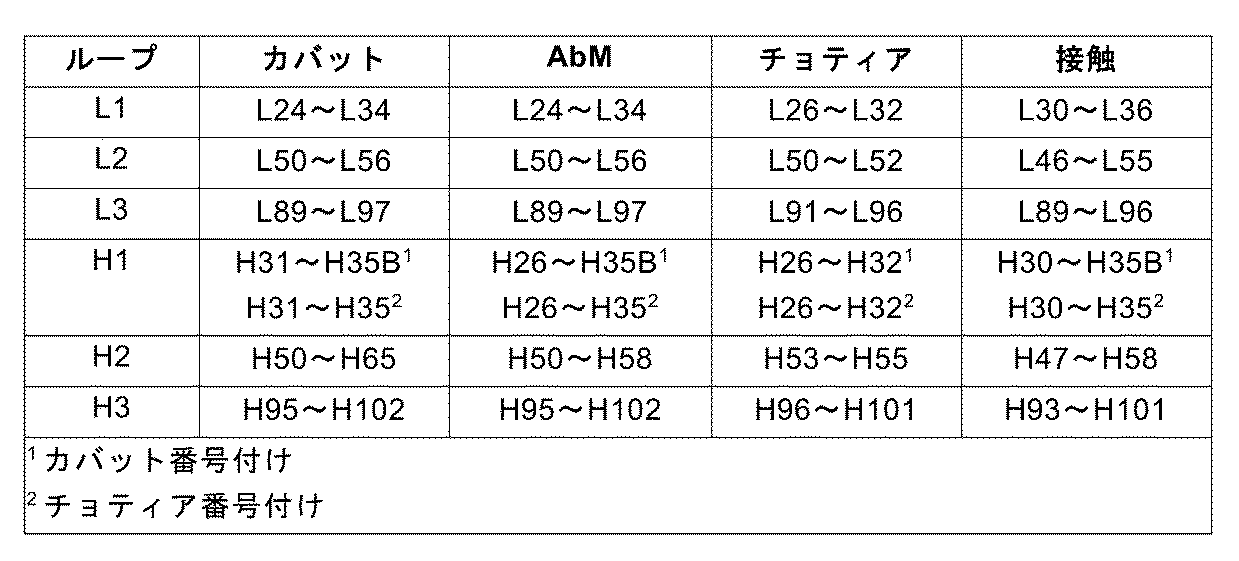
別に示さない限り、可変ドメイン内のHVR残基および他の残基(例えば、FR残基)は、Kabatら(上記)に従って本明細書で番号付けされる。 Unless otherwise indicated, HVR residues and other residues (eg, FR residues) within the variable domain are numbered herein according to Kabat et al. (supra).
超可変領域は、本明細書で使用される場合、以下の通り、延長された超可変領域または代替の超可変領域を含み得る:VLドメイン内の24~36または24~34(L1)、46~56または50~56(L2)および89~97または89~96(L3)、ならびにVHドメイン内の26~35、30~35、30~35A、30~35Bまたは31~35B(H1)、50~61、50~65または49~65(H2)および93~102、94~102または95~102(H3)。可変ドメイン残基は、これらの定義の各々について、Kabatら(上記)に従って番号付けされる。 Hypervariable regions, as used herein, may include extended hypervariable regions or alternative hypervariable regions as follows: 24-36 or 24-34 (L1), 46-56 or 50-56 (L2) and 89-97 or 89-96 (L3) in the VL domain and 26-35, 30-35, 30-35A, 30-35B or 31-35 in the VH domain. B (H1), 50-61, 50-65 or 49-65 (H2) and 93-102, 94-102 or 95-102 (H3). Variable domain residues are numbered according to Kabat et al. (supra) for each of these definitions.
「相補性決定領域」または「CDR」は、本明細書で使用される場合、最も高い配列変動性を有する可変ドメインのHVR内の領域、および/または抗原認識に関与する可変ドメインのHVR内の領域を指す。一般的に、ネイティブ抗体は、6つのCDR;重鎖可変ドメインVH内の3つ(H1、H2、H3)、および軽鎖可変ドメインVL内の3つ(L1、L2、L3)を伴う4つの鎖を含む。本開示の例示的な抗IL-36抗体のCDR(CDR-L1、CDR-L2、CDR-L3、CDR-H1、CDR-H2およびCDR-H3)は、L1のアミノ酸残基24~34、L2の50~56、L3の89~97、H1の30~35A、H2の50~61およびH3の93~102において起こる[Kabatら(上記)による番号付け]。好ましい一実施形態では、本明細書で言及したHVR配列がCDRに対応するものであってもよい。 "Complementarity determining region" or "CDR" as used herein refers to the regions within the HVRs of the variable domain that have the highest sequence variability and/or that are involved in antigen recognition. Generally, native antibodies comprise four chains with six CDRs; three within the heavy chain variable domain VH (H1, H2, H3) and three within the light chain variable domain VL (L1, L2, L3). The CDRs (CDR-L1, CDR-L2, CDR-L3, CDR-H1, CDR-H2 and CDR-H3) of exemplary anti-IL-36 antibodies of the present disclosure occur at amino acid residues 24-34 of L1, 50-56 of L2, 89-97 of L3, 30-35A of H1, 50-61 of H2 and 93-102 of H3 [according to Kabat et al., supra. numbering]. In one preferred embodiment, the HVR sequences referred to herein may correspond to the CDRs.
「フレームワーク」または「FR」とは、超可変領域(HVR)残基以外の可変ドメイン残基を指す。可変ドメインのFRは、一般的に、4つのFRドメイン:FR1、FR2、FR3およびFR4からなる。したがって、HVRおよびFR配列は、一般的に、VH(またはVL)において以下の配列:FR1-H1(L1)-FR2-H2(L2)-FR3-H3(L3)-FR4で現れる。 "Framework" or "FR" refers to variable domain residues other than hypervariable region (HVR) residues. The FRs of variable domains generally consist of four FR domains: FR1, FR2, FR3 and FR4. Thus, HVR and FR sequences generally appear in VH (or VL) with the following sequence: FR1-H1(L1)-FR2-H2(L2)-FR3-H3(L3)-FR4.
「ネイティブ抗体」とは、天然に存在する免疫グロブリン分子を指す。例えば、ネイティブIgG抗体は、ジスルフィド結合した2つの同一の軽鎖と2つの同一の重鎖とから構成される、約150,000ダルトンのヘテロ四量体糖タンパク質である。N末端からC末端へ、各重鎖は、可変重ドメインまたは重鎖可変ドメインとも呼ばれる可変領域(VH)、続いて3つの定常ドメイン(CH1、CH2およびCH3)を有する。同様に、N末端からC末端へ、各軽鎖は、可変軽ドメインまたは軽鎖可変ドメインとも呼ばれる可変領域(VL)、続いて定常軽(CL)ドメインを有する。抗体の軽鎖は、その定常ドメインのアミノ酸配列に基づいて、カッパ(κ)およびラムダ(λ)と呼ばれる2つの種類のうちの1つに割り当てることができる。 A "native antibody" refers to an immunoglobulin molecule that occurs in nature. For example, native IgG antibodies are heterotetrameric glycoproteins of approximately 150,000 daltons, composed of two identical disulfide-bonded light chains and two identical heavy chains. From N-terminus to C-terminus, each heavy chain has a variable region (VH), also called a variable heavy domain or heavy chain variable domain, followed by three constant domains (CH1, CH2 and CH3). Similarly, from N-terminus to C-terminus, each light chain has a variable region (VL), also called a variable light domain or light chain variable domain, followed by a constant light (CL) domain. The light chains of antibodies can be assigned to one of two classes, called kappa (κ) and lambda (λ), based on the amino acid sequences of their constant domains.
「モノクローナル抗体」とは、本明細書で使用される場合、実質的に均一な抗体集団から得られる抗体を指す、すなわち、集団を構成する個々の抗体は、可能な変異型抗体(例えば、変異型抗体は、天然に起こるか、またはモノクローナル抗体の産生中に生ずる突然変異を含有し、一般的に、少量で存在する)を除いては、同一であり、かつ/または同じエピトープに結合する。異なる決定基(エピトープ)を対象とする異なる抗体を典型的に含むポリクローナル抗体調製物とは対照的に、モノクローナル抗体調製物の各モノクローナル抗体は、抗原上の単一の決定基を対象とする。したがって、「モノクローナル」という用語は、実質的に均一な抗体集団から得られる抗体の特徴を示し、任意の特定の方法による抗体の産生を必要とするとは解釈されるべきではない。例えば、使用されるモノクローナル抗体は、非限定的に、ハイブリドーマ法、組換えDNA法、ファージディスプレイ法、およびヒト免疫グロブリン遺伝子座の全てまたは部分を含有するトランスジェニック動物を利用する方法を含む、様々な技法によって作製されることがあり、そのような方法およびモノクローナル抗体を作製するための他の例示的な方法は、本明細書で説明されている。 A "monoclonal antibody," as used herein, refers to an antibody obtained from a substantially homogeneous antibody population, i.e., the individual antibodies that make up the population are identical and/or bind the same epitope, except for possible variant antibodies (e.g., variant antibodies contain mutations that occur naturally or arise during production of the monoclonal antibody, and are generally present in minor amounts). In contrast to polyclonal antibody preparations, which typically include different antibodies directed against different determinants (epitopes), each monoclonal antibody of a monoclonal antibody preparation is directed against a single determinant on the antigen. Thus, the term "monoclonal" characterizes antibodies obtained from a substantially homogeneous antibody population and should not be construed as requiring production of the antibody by any particular method. For example, the monoclonal antibodies used may be made by a variety of techniques including, but not limited to, hybridoma methods, recombinant DNA methods, phage display methods, and methods utilizing transgenic animals containing all or part of the human immunoglobulin loci; such methods and other exemplary methods for making monoclonal antibodies are described herein.
「キメラ抗体」とは、重鎖および/または軽鎖の一部が、特定の供給源または種に由来し、一方で、重鎖および/または軽鎖の残りが、異なる供給源または種に由来する抗体を指す。 A "chimeric antibody" refers to an antibody in which a portion of the heavy and/or light chains are derived from a particular source or species, while the remainder of the heavy and/or light chains are derived from a different source or species.
「ヒト化抗体」とは、非ヒトHVRからのアミノ酸配列とヒトFRからのアミノ酸配列とを含むキメラ抗体を指す。ある特定の実施形態では、ヒト化抗体は、少なくとも1つ、および典型的に2つの可変ドメインの実質的に全てを含み、ここで、全てまたは実質的に全てのHVR(例えば、CDR)は、非ヒト抗体のHVRに対応し、全てまたは実質的に全てのFRは、ヒト抗体のFRに対応する。ヒト化抗体は、適宜、ヒト抗体に由来する抗体定常領域の少なくとも一部を含み得る。抗体、例えば、非ヒト抗体の「ヒト化型」は、ヒト化を受けた抗体を指す。 A "humanized antibody" refers to a chimeric antibody comprising amino acid sequences from non-human HVRs and amino acid sequences from human FRs. In certain embodiments, a humanized antibody comprises substantially all of at least one, and typically two, variable domains, wherein all or substantially all HVRs (e.g., CDRs) correspond to the HVRs of a non-human antibody and all or substantially all FRs correspond to the FRs of a human antibody. A humanized antibody may optionally comprise at least a portion of an antibody constant region derived from a human antibody. A “humanized form” of an antibody, eg, a non-human antibody, refers to an antibody that has undergone humanization.
「ヒト抗体」とは、ヒトもしくはヒト細胞によって産生された抗体のアミノ酸配列に対応するアミノ酸配列を所有する抗体、またはヒト抗体レパートリーもしくは他のヒト抗体コード配列を利用する非ヒト供給源に由来する抗体を指す。このヒト抗体の定義は、非ヒト抗原結合残基を含むヒト化抗体を特に除外する。 A "human antibody" refers to an antibody that possesses amino acid sequences that correspond to those of antibodies produced by humans or human cells, or that are derived from human antibody repertoires or other non-human sources utilizing human antibody coding sequences. This definition of human antibody specifically excludes humanized antibodies that contain non-human antigen-binding residues.
「ヒトコンセンサスフレームワーク」は、ヒト免疫グロブリンVLまたはVHフレームワーク配列の選択において最も一般に存在するアミノ酸残基を表すフレームワークである。一般的に、ヒト免疫グロブリンVLまたはVH配列の選択は、可変ドメイン配列のサブグループからである。一般的に、配列のサブグループは、Kabat et al., Sequences of Proteins of Immunological Interest, Fifth Edition, NIH Publication 91- 3242, Bethesda MD (1991), vols. 1-3にあるようなサブグループである。一実施形態では、VLについて、サブグループは、Kabat et al.(上記)にあるようなサブグループカッパIである。一実施形態では、VHについて、サブグループは、Kabat et al.(上記)にあるようなサブグループIIIである。 A "human consensus framework" is a framework that represents the most commonly occurring amino acid residues in a selection of human immunoglobulin VL or VH framework sequences. Generally, the selection of human immunoglobulin VL or VH sequences is from a subgroup of variable domain sequences. Generally, the subgroup of sequences is the subgroup as in Kabat et al., Sequences of Proteins of Immunological Interest, Fifth Edition, NIH Publication 91-3242, Bethesda MD (1991), vols. 1-3. In one embodiment, for VL, the subgroup is subgroup kappa I as in Kabat et al. (supra). In one embodiment, for VHs, the subgroup is subgroup III as in Kabat et al. (supra).
「アクセプターヒトフレームワーク」は、本明細書で使用される場合、ヒト免疫グロブリンフレームワークまたはヒトコンセンサスフレームワークに由来する軽鎖可変ドメイン(VL)フレームワークまたは重鎖可変ドメイン(VH)フレームワークのアミノ酸配列を含むフレームワークである。ヒト免疫グロブリンフレームワークまたはヒトコンセンサスフレームワーク「に由来する」アクセプターヒトフレームワークは、その同じアミノ酸配列を含んでもよく、またはそれは、アミノ酸配列変化を含有してもよい。一部の実施形態では、アミノ酸変化の数は、10以下、9以下、8以下、7以下、6以下、5以下、4以下、3以下、または2以下である。一部の実施形態では、VLアクセプターヒトフレームワークは、VLヒト免疫グロブリンフレームワーク配列またはヒトコンセンサスフレームワーク配列と配列が同一である。 An "acceptor human framework," as used herein, is a framework that comprises a light chain variable domain (VL) framework or heavy chain variable domain (VH) framework amino acid sequence derived from a human immunoglobulin framework or a human consensus framework. An acceptor human framework “derived from” a human immunoglobulin framework or a human consensus framework may comprise that same amino acid sequence or it may contain amino acid sequence variations. In some embodiments, the number of amino acid changes is 10 or less, 9 or less, 8 or less, 7 or less, 6 or less, 5 or less, 4 or less, 3 or less, or 2 or less. In some embodiments, the VL acceptor human framework is identical in sequence to a VL human immunoglobulin framework sequence or a human consensus framework sequence.
「Fc領域」とは、免疫グロブリン重鎖のC末端ポリペプチド配列を含む二量体複合体を指し、C末端ポリペプチド配列は、インタクトな抗体のパパイン消化によって得ることが可能な配列である。Fc領域は、ネイティブまたは変異型Fc配列を含み得る。免疫グロブリン重鎖のFc配列の境界は変動し得るが、ヒトIgG重鎖Fc配列は、通常、およそCys226の位置におけるアミノ酸残基から、またはおよそPro230の位置から、Fc配列のカルボキシル末端までに及ぶと定義される。しかしながら、Fc配列のC末端リジン(Lys447)は、存在しても、存在しなくてもよい。免疫グロブリンのFc配列は、一般的に、2つの定常ドメイン、CH2ドメインおよびCH3ドメインを含み、CH4ドメインを含んでもよい。 "Fc region" refers to a dimeric complex comprising the C-terminal polypeptide sequence of an immunoglobulin heavy chain, the C-terminal polypeptide sequence being a sequence obtainable by papain digestion of an intact antibody. The Fc region may comprise native or variant Fc sequences. Although the boundaries of an immunoglobulin heavy chain Fc sequence can vary, a human IgG heavy chain Fc sequence is usually defined to extend from an amino acid residue at about position Cys226, or from about position Pro230, to the carboxyl terminus of the Fc sequence. However, the C-terminal lysine (Lys447) of the Fc sequence may or may not be present. An immunoglobulin Fc sequence generally comprises two constant domains, a CH2 domain and a CH3 domain, and optionally a CH4 domain.
「Fc受容体」または「FcR」とは、抗体のFc領域に結合する受容体を指す。一部の実施形態では、FcRは、ネイティブヒトFcRである。一部の実施形態では、FcRは、IgG抗体(ガンマ受容体)を結合するFcRであり、FcγRI、FcγRIIおよびFcγRIIIサブクラスの受容体(それらの受容体の対立遺伝子変異型およびあるいは、切断型を含む)を含む。FcγRII受容体は、FcγRIIA(「活性化受容体」)およびFcγRIIB(「阻害性受容体」)を含み、これらは、主にそれらの細胞質ドメインにおいて異なる、類似するアミノ酸配列を有する。活性化受容体FcγRIIAは、その細胞質ドメインにおいて免疫受容体チロシンベースの活性化モチーフ(ITAM)を含有する。阻害性受容体FcγRIIBは、その細胞質ドメインにおいて免疫受容体チロシンベースの阻害モチーフ(ITIM)を含有する[例えば、Daeron, Annu. Rev. Immunol. 15:203-234 (1997)を参照されたい]。また、FcRは、本明細書で使用される場合、母体IgGの胎児への移行[Guyer et al, J. Immunol. 1 17:587 (1976)およびKim et al, J. Immunol. 24:249 (1994)]および免疫グロブリンのホメオスタシスの調節の原因である新生児受容体FcRnを含む。FcRは、例えば、Ravetch and Kinet, Annu. Rev. Immunol 9:457-92 (1991);Capel et al, Immunomethods 4:25-34 (1994);およびde Haas et al, J. Lab. Clin. Med. 126:330-41 (1995)において概説されている。 "Fc receptor" or "FcR" refers to a receptor that binds to the Fc region of an antibody. In some embodiments the FcR is a native human FcR. In some embodiments, the FcR is an FcR that binds an IgG antibody (gamma receptor), including receptors of the FcγRI, FcγRII and FcγRIII subclasses, including allelic variants and, alternatively, truncated forms of these receptors. FcγRII receptors include FcγRIIA (an “activating receptor”) and FcγRIIB (an “inhibiting receptor”), which have similar amino acid sequences that differ primarily in their cytoplasmic domains. Activating receptor FcγRIIA contains an immunoreceptor tyrosine-based activation motif (ITAM) in its cytoplasmic domain. Inhibitory receptor FcγRIIB contains an immunoreceptor tyrosine-based inhibition motif (ITIM) in its cytoplasmic domain [see, eg, Daeron, Annu. Rev. Immunol. 15:203-234 (1997)]. FcR, as used herein, also includes the neonatal receptor FcRn, which is responsible for the transfer of maternal IgG to the fetus [Guyer et al, J. Immunol. 117:587 (1976) and Kim et al, J. Immunol. 24:249 (1994)] and regulation of immunoglobulin homeostasis. FcRs are reviewed, for example, in Ravetch and Kinet, Annu. Rev. Immunol 9:457-92 (1991); Capel et al, Immunomethods 4:25-34 (1994); and de Haas et al, J. Lab. Clin. Med. 126:330-41 (1995).
「多価抗体」は、本明細書で使用される場合、3つ以上の抗原結合部位を含む抗体である。多価抗体は、好ましくは、3つ以上の抗原結合部位を有するように操作され、一般的に、ネイティブ配列IgMまたはIgA抗体ではない。 A "multivalent antibody" as used herein is an antibody that contains three or more antigen binding sites. Multivalent antibodies are preferably engineered to have three or more antigen binding sites and are generally not native sequence IgM or IgA antibodies.
「多重特異性抗体」は、少なくとも2つの異なる結合部位を有する抗体であり、各部位は、異なる結合特異性を有する。多重特異性抗体は、全長抗体であっても、抗体断片であってもよく、異なる結合部位は、各々、異なる抗原に結合してもよく、または異なる結合部位は、同じ抗原の2つの異なるエピトープに結合してもよい。二重特異性抗体は、それぞれが異なった結合特異性を有する2つの結合部位を有し、本発明の特に好ましい抗体である。 A "multispecific antibody" is an antibody that has at least two different binding sites, each site having a different binding specificity. A multispecific antibody may be a full-length antibody or an antibody fragment, and different binding sites may each bind to a different antigen, or different binding sites may bind to two different epitopes of the same antigen. Bispecific antibodies, which have two binding sites each with a different binding specificity, are particularly preferred antibodies of the invention.
「Fv断片」とは、完全な抗原認識および結合部位を含有する抗体断片を指す。この領域は、天然では共有であり得る堅い会合における、例えば、scFvにおける、1つの重鎖および1つの軽鎖可変ドメインの二量体からなる。各可変ドメインの3つのHVRが相互作用して、VH-VL二量体の表面上の抗原結合部位を規定するのは、この構成である。集合的に、6つのHVRまたはそのサブセットは、抗体に抗原結合特異性を与える。しかしながら、単一の可変ドメイン(または抗原に特異的な3つのHVRのみを含むFvの半分)でさえも、通常は結合部位全体よりも低い親和性ではあるが、抗原を認識および結合する能力を有する。 "Fv fragment" refers to an antibody fragment that contains a complete antigen-recognition and -binding site. This region consists of a dimer of one heavy- and one light-chain variable domain in tight association, eg, in scFvs, which can be covalent in nature. It is in this configuration that the three HVRs of each variable domain interact to define an antigen-binding site on the surface of the VH-VL dimer. Collectively, the six HVRs or subsets thereof confer antigen-binding specificity to the antibody. However, even a single variable domain (or half of an Fv containing only three antigen-specific HVRs) is capable of recognizing and binding antigen, although usually with lower affinity than the entire binding site.
「Fab断片」とは、軽鎖の可変および定常ドメインと、重鎖の可変ドメインおよび第1の定常ドメイン(CH1)とを含有する抗体断片を指す。「F(ab’)2断片」は、一般的に、Fab断片間のヒンジシステインによってそれらのカルボキシ末端の近くで共有結合している一対のFab断片を含む。また、抗体断片の他の化学カップリングは、当該技術分野において公知である。 A "Fab fragment" refers to an antibody fragment that contains the variable and constant domains of the light chain and the variable domain and first constant domain (CH1) of the heavy chain. "F(ab')2 fragments"generally comprise a pair of Fab fragments covalently linked near their carboxy termini by hinge cysteines between the Fab fragments. Other chemical couplings of antibody fragments are also known in the art.
「抗原結合性アーム」とは、本明細書で使用される場合、目的の標的分子に特異的に結合する能力を有する抗体の成分を指す。典型的に、抗原結合性アームは、免疫グロブリンポリペプチド配列の複合体、例えば、HVRならびに/または免疫グロブリン軽鎖および重鎖の可変ドメイン配列である。 "Antigen-binding arm" as used herein refers to the component of an antibody that has the ability to specifically bind to a target molecule of interest. Typically, the antigen-binding arm is a composite of immunoglobulin polypeptide sequences, eg, HVR and/or variable domain sequences of immunoglobulin light and heavy chains.
「単鎖Fv」または「scFv」とは、抗体のVHおよびVLドメインを含む抗体断片を指し、これらのドメインは、単一のポリペプチド鎖で存在する。一般的に、Fvポリペプチドは、scFvが所望の抗原結合構造を形成することを可能にする、VHドメインとVLドメインとの間のポリペプチドリンカーをさらに含む。 "Single-chain Fv" or "scFv" refer to antibody fragments comprising the VH and VL domains of an antibody, wherein these domains are present in a single polypeptide chain. Generally, the Fv polypeptide further comprises a polypeptide linker between the VH and VL domains that allows the scFv to form the desired antigen binding structure.
「ダイアボディ」とは、2つの抗原結合部位を有する小抗体断片を指し、その断片は、同じポリペプチド鎖(VHおよびVL)内の軽鎖可変ドメイン(VL)に接続された重鎖可変ドメイン(VH)を含む。同じ鎖上の2つのドメイン間の対形成を可能にするには短すぎるリンカーを使用することによって、ドメインは、別の鎖の相補的ドメインと対形成することを強いられ、2つの抗原結合部位を作出する。 A "diabody" refers to a small antibody fragment with two antigen-binding sites, the fragment comprising a heavy chain variable domain (VH) connected to a light chain variable domain (VL) within the same polypeptide chain (VH and VL). By using linkers that are too short to allow pairing between two domains on the same chain, the domains are forced to pair with complementary domains on another chain, creating two antigen binding sites.
「直鎖状抗体」とは、Zapata et al., Protein Eng., 8(10): 1057-1062 (1995)で説明されている抗体を指す。簡潔に説明すると、これらの抗体は、相補的軽鎖ポリペプチドと一緒に一対の抗原結合領域を形成する、一対のタンデムFd領域(VH-CH1-VH-CH1)を含む。直鎖状抗体は、多重特異性、例えば、三重特異性または二重特異性であってもよく、単一特異性であってもよい。 "Linear antibody" refers to the antibody described in Zapata et al., Protein Eng., 8(10): 1057-1062 (1995). Briefly, these antibodies comprise a pair of tandem Fd regions (VH-CH1-VH-CH1) that together with complementary light chain polypeptides form a pair of antigen binding regions. Linear antibodies may be multispecific, eg, trispecific or bispecific, or monospecific.
「ネイキッド抗体」とは、異種の部分(例えば、細胞傷害性部分)または放射標識にコンジュゲートされていない抗体を指す。 A "naked antibody" refers to an antibody that is not conjugated to a heterologous moiety (eg, a cytotoxic moiety) or radiolabel.
「親和性」とは、分子(例えば、抗体)の単一の結合部位と、その結合パートナー(例えば、抗原)との間の非共有相互作用全体の強度を指す。「結合親和性」とは、結合対(例えば、抗体および抗原)のメンバー間の1:1の相互作用を反映する固有の結合親和性を指す。分子Xの、そのパートナーYについての親和性は、一般的に、平衡解離定数(KD)によって表すことができる。親和性は、本明細書で説明される方法を含む、当該技術分野において公知の一般法によって測定することができる。結合親和性を測定するための特定の説明的および例示的な実施形態を、以下に説明する。 "Affinity" refers to the strength of the overall non-covalent interaction between a single binding site on a molecule (eg, antibody) and its binding partner (eg, antigen). "Binding affinity" refers to the intrinsic binding affinity that reflects the 1:1 interaction between members of a binding pair (eg, antibody and antigen). The affinity of molecule X for its partner Y can generally be expressed by the equilibrium dissociation constant (KD). Affinity can be measured by common methods known in the art, including those described herein. Certain illustrative and exemplary embodiments for measuring binding affinity are described below.
「特異的に結合する」または「特異的結合」とは、抗体の、抗原への、約1x10⁻⁷M以下の親和性の値による結合を指す。一実施形態では、特異的に結合するが、抗原結合部位が、IL-36βに結合するが、IL-36αおよびIL-36γには有意に結合しないことを意味し得る。別の実施形態では、特異的に結合するが、抗原結合部位が、IL-36αおよび/またはIL-36γに結合するが、IL-36βには有意に結合しないことを意味し得る。 "Specifically binds" or "specific binding" refers to binding of an antibody to an antigen with an affinity value of about 1 x 10⁻⁷ M or less. In one embodiment, specific binding may mean that the antigen binding site binds IL-36β but does not significantly bind IL-36α and IL-36γ. In another embodiment, specific binding may mean that the antigen binding site binds IL-36α and/or IL-36γ but does not significantly bind IL-36β.
「親和性成熟した」抗体とは、変更を所有していない親抗体と比較して、1つまたは複数のHVRにおける1つまたは複数の変更を有する抗体を指し、そのような変更は、抗体の、抗原についての親和性における改善をもたらす。 An "affinity matured" antibody refers to an antibody that possesses one or more alterations in one or more HVRs as compared to a parent antibody that does not possess the alterations, such alterations resulting in an improvement in the antibody's affinity for antigen.
抗体の「機能的抗原結合部位」は、標的抗原に結合することができる部位である。抗原結合部位の抗原結合親和性は、必ずしも抗原結合部位が由来する親抗体と同じくらい強いわけではないが、抗原に結合する能力は、抗原への抗体結合を評価することについて公知の様々な方法のうちのいずれか1つを使用して測定可能でなければならない。 A "functional antigen-binding site" of an antibody is a site capable of binding a target antigen. Although the antigen binding affinity of an antigen binding site is not necessarily as strong as the parent antibody from which it is derived, the ability to bind antigen must be measurable using any one of a variety of known methods for assessing antibody binding to antigen.
「単離された抗体」とは、抗体の天然環境の成分から分離されている抗体を指す。一部の実施形態では、抗体は、例えば、電気泳動[例えば、SDS-PAGE、等電点電気泳動(IEF)、キャピラリー電気泳動]またはクロマトグラフィー法(例えば、イオン交換または逆相HPLC)によって決定されるように95%または99%を超える純度まで精製される。抗体純度の評定のための方法の概説については、例えば、Flatman et al., J. Chromatogr. B 848:79-87を参照されたい。 "Isolated antibody" refers to an antibody that has been separated from a component of the antibody's natural environment. In some embodiments, the antibody is purified to greater than 95% or 99% purity, for example, as determined by electrophoresis [e.g., SDS-PAGE, isoelectric focusing (IEF), capillary electrophoresis] or chromatographic methods (e.g., ion-exchange or reverse-phase HPLC). For a review of methods for assessment of antibody purity see, eg, Flatman et al., J. Chromatogr. B 848:79-87.
「実質的に同様の」または「実質的に同じ」とは、本明細書で使用される場合、当業者が、2つの値間の差が、前記値(例えば、KD値)によって測定される生物学的特徴の関係内で生物学的有意性および/または統計的有意性がほとんどまたは全くないものと考え得るような、2つの数値(例えば、試験抗体と関連付けられる値、および参照抗体と関連付けられる他方の値)間の十分に高い程度の類似性を指す。 "Substantially similar" or "substantially the same," as used herein, refers to a sufficiently high degree of similarity between two values (e.g., the value associated with a test antibody and the other value associated with a reference antibody) such that a person skilled in the art can consider a difference between the two values to have little or no biological and/or statistical significance within the context of the biological characteristic measured by said value (e.g., KD value).
「実質的に異なる」とは、本明細書で使用される場合、当業者が、2つの値間の差が、前記値(例えば、KD値)によって測定される生物学的特徴の関係内で統計的有意性があるものと考え得るような、2つの数値(一般的に、分子と関連付けられる値、および参照分子と関連付けられる他方の値)間の十分に高い程度の差を指す。 "Substantially different," as used herein, refers to a sufficiently high degree of difference between two values (generally one value associated with a molecule and the other value associated with a reference molecule) such that one skilled in the art can consider the difference between the two values to be of statistical significance within the context of the biological characteristic measured by said value (e.g., KD value).
ポリペプチドに適用される場合、典型的には、「実質的な類似性」または「実質的に類似する」という用語は、2つのペプチド配列が、例えばデフォルトのギャップ重みを用いたGAPまたはBESTFITプログラムによって、最適に整列させた場合、少なくとも90%の配列同一性、さらに好ましくは少なくとも98%または99%の配列同一性を共有することを意味する。同一でない残基位置は、保存的アミノ酸置換により相違していることが好ましい。2つ以上アミノ酸配列が保存的置換によって互いに異なっている場合、置換の保存的性質について修正するように、パーセント配列同一性または類似性の程度を上向きに調整してもよい。この調節を行う手段は当業者には公知である。例えば、Pearson (1994) Methods Mol. Biol. 24: 307-331を参照。ポリペプチドの配列類似性は、配列同一性とも称され、典型的には配列分析ソフトウェアを使用して測定される。タンパク質分析ソフトウェアは、保存的アミノ酸置換を含めた、様々な置換、欠失、および他の改変に割り当てられた類似性の尺度を使用して類似配列を一致させる。例えば、GCGソフトウェアは、GapおよびBestfitなどのプログラムを含み、それらは、デフォルトパラメータで使用して、異なる生物種に由来する相同ポリペプチドなど、密接に関連するポリペプチド間、または野生型タンパク質とその突然変異タンパク質の間の配列相同性または配列同一性を決定することができる。例えば、GCGバージョン6.1参照。ポリペプチド配列は、GCGバージョン6.1中のプログラムであるFASTAを使用し、デフォルトまたは推奨パラメータを使用しても比較することができる。FASTA(例えばFASTA2およびFASTA3)は、クエリー配列と検索配列の間における最良オーバラップ領域のアラインメントおよびパーセント配列同一性を提供する[Pearson (2000)、同上]。開示の配列を、様々な生物に由来する多数の配列を含有するデータベースと比較する別の好ましいアルゴリズムは、デフォルトパラメータを使用したBLAST、特にBLASTPまたはTBLASTNというコンピュータプログラムである。例えば、Altschul et al. (1990) J. Mol. Biol. 215:403-410およびAltschul et al. (1997) Nucleic Acids Res. 25:3389-402を参照。 Typically, the term "substantial similarity" or "substantially similar" as applied to polypeptides means that two peptide sequences share at least 90% sequence identity, more preferably at least 98% or 99% sequence identity when optimally aligned, e.g., by the GAP or BESTFIT programs using default gap weights. Preferably, residue positions that are not identical differ by conservative amino acid substitutions. Where two or more amino acid sequences differ from each other by conservative substitutions, the degree of percent sequence identity or similarity may be adjusted upwards to correct for the conservative nature of the substitutions. Means for making this adjustment are known to those of skill in the art. See, eg, Pearson (1994) Methods Mol. Biol. 24: 307-331. Sequence similarity for polypeptides, also referred to as sequence identity, is typically measured using sequence analysis software. Protein analysis software matches similar sequences using measures of similarity assigned to various substitutions, deletions, and other modifications, including conservative amino acid substitutions. For example, GCG software includes programs such as Gap and Bestfit, which can be used with default parameters to determine sequence homology or identity between closely related polypeptides, such as homologous polypeptides from different species, or between a wild-type protein and its muteins. See, for example, GCG version 6.1. Polypeptide sequences can also be compared using FASTA, a program in GCG version 6.1, using default or recommended parameters. FASTA (eg, FASTA2 and FASTA3) provides alignments and percent sequence identities of the best overlapping regions between the query and search sequences [Pearson (2000) ibid.]. Another preferred algorithm for comparing the disclosed sequences to a database containing numerous sequences from different organisms is the computer program BLAST, particularly BLASTP or TBLASTN, using default parameters. See, eg, Altschul et al. (1990) J. Mol. Biol. 215:403-410 and Altschul et al. (1997) Nucleic Acids Res. 25:3389-402.
「保存的アミノ酸置換」は、その際に、アミノ酸残基が、化学的特性(例えば、荷電または疎水性度)が類似している側鎖(R基)を有する別のアミノ酸残基によって置換されるものである。典型的に、保存的アミノ酸置換は、実質的にタンパク質の機能特性を変えない。化学的特性が類似している側鎖を有するアミノ酸の群の例には、(1)脂肪族側鎖:グリシン、アラニン、バリン、ロイシン、およびイソロイシン、(2)脂肪族のヒドロキシル側鎖:セリンおよびトレオニン、(3)アミドを含有する側鎖:アスパラギンおよびグルタミン、(4)芳香族側鎖:フェニルアラニン、チロシン、およびトリプトファン、(5)塩基性側鎖:リジン、アルギニン、およびヒスチジン、(6)酸性側鎖:アスパラギン酸およびグルタミン酸、ならびに(7)硫黄を含有する側鎖:システインおよびメチオニンが含まれる。好ましい保存アミノ酸置換群は、バリン-ロイシン-イソロイシン、フェニルアラニン-チロシン、リジン-アルギニン、アラニン-バリン、グルタミン酸-アスパラギン酸、およびアスパラギン-グルタミンである。あるいは、保存的置換は、Gonnetら、(1992) Science 256:1443-1445に開示されているPAM250対数尤度マトリックスで正の値を有する任意の変化である。「中程度に保存的な」置換は、PAM250対数尤度マトリックスで負でない値を有する任意の変化である。 A "conservative amino acid substitution" is one in which an amino acid residue is replaced by another amino acid residue having a side chain (R group) with similar chemical properties (e.g., charge or hydrophobicity). Typically, conservative amino acid substitutions do not substantially alter the functional properties of the protein. Examples of groups of amino acids with side chains with similar chemical properties include (1) aliphatic side chains: glycine, alanine, valine, leucine, and isoleucine, (2) aliphatic hydroxyl side chains: serine and threonine, (3) amide-containing side chains: asparagine and glutamine, (4) aromatic side chains: phenylalanine, tyrosine, and tryptophan, (5) basic side chains: lysine, arginine, and histidine. (6) acidic side chains: aspartic acid and glutamic acid; and (7) sulfur containing side chains: cysteine and methionine. Preferred conservative amino acid substitution groups are valine-leucine-isoleucine, phenylalanine-tyrosine, lysine-arginine, alanine-valine, glutamic-aspartic, and asparagine-glutamine. Alternatively, a conservative substitution is any change that has a positive value in the PAM250 log-likelihood matrix disclosed in Gonnet et al. (1992) Science 256:1443-1445. A "moderately conservative" replacement is any change that has a non-negative value in the PAM250 log-likelihood matrix.
提供される抗体の「等電点」は、任意の適した技法を使用して測定することができる。**ExPASY http://www.expasy.ch/tools/pi_tool.htmlおよびhttp://www.iut-arles.up.univ-mrs.fr/w3bb/d_abim/compo-p.htmlなどのプログラムを、例えば、抗体またはフラグメントの等電点を予測するために使用することができる。 The "isoelectric point" of a provided antibody can be measured using any suitable technique. **Programs such as **ExPASY http://www.expasy.ch/tools/pi_tool.html and http://www.iut-arles.up.univ-mrs.fr/w3bb/d_abim/compo-p.html can be used, for example, to predict the isoelectric point of an antibody or fragment.
「エフェクター機能」とは、抗体アイソタイプによって変動する、抗体のFc領域に起因し得る生物学的活性を指す。抗体エフェクター機能の例には、Clq結合および補体依存性細胞傷害性(CDC);Fc受容体結合;抗体依存性細胞媒介性細胞傷害性(ADCC);ファゴサイトーシス;細胞表面受容体(例えば、B細胞受容体)のダウンレギュレーション;およびB細胞活性化が含まれる。 "Effector functions" refer to those biological activities attributable to the Fc region of an antibody, which vary with antibody isotype. Examples of antibody effector functions include Clq binding and complement dependent cytotoxicity (CDC); Fc receptor binding; antibody dependent cell-mediated cytotoxicity (ADCC); phagocytosis;
「イムノコンジュゲート」とは、非限定的に、細胞傷害剤を含む、1つまたは複数の異種の分子にコンジュゲートされた抗体を指す。 "Immunoconjugate" refers to an antibody conjugated to one or more heterologous molecules, including but not limited to cytotoxic agents.
「処置」、「処置する」または「処置すること」とは、処置される個体における障害の自然な過程を変更する試みの臨床的介入を指し、予防のために、または臨床病理の過程中に行われ得る。所望の処置結果は、障害の発症または再発の予防、症状の軽減、障害の任意の直接的または間接的な病理学的結果の縮減、転移の予防、進行速度の減少、疾患状態の改善または寛解、および緩和または予後の改善を含み得るが、これらに限定されない。例えば、処置は、IL-36によって媒介される疾患もしくは状態、またはIL-36もしくはIL-36サイトカインによって刺激される下流経路が病因および/もしくは進行において役割を果たし得る疾患もしくは状態の発症を遅延させるか、または進行を遅らせるための、治療有効量の、抗IL-36抗体を含む医薬製剤の、対象への投与を含み得る。 "Treatment", "treating" or "treating" refers to clinical intervention in an attempt to alter the natural course of a disorder in the individual being treated, and can be performed for prophylaxis or during the course of clinical pathology. A desired outcome of treatment may include, but is not limited to, prevention of onset or recurrence of the disorder, alleviation of symptoms, reduction of any direct or indirect pathological consequences of the disorder, prevention of metastasis, reduction in rate of progression, amelioration or amelioration of disease state, and palliation or improvement in prognosis. For example, treatment can include administration to a subject of a therapeutically effective amount of a pharmaceutical formulation comprising an anti-IL-36 antibody to delay onset or slow progression of an IL-36-mediated disease or condition, or a disease or condition in which downstream pathways stimulated by IL-36 or IL-36 cytokines may play a role in the pathogenesis and/or progression.
「医薬製剤」とは、活性成分の生物学的活性が有効であることを可能にし、かつ製剤が投与される対象に毒性である追加の成分を含有しない形態の調製物を指す。医薬製剤は、1つまたは複数の活性剤を含み得る。例えば、医薬製剤は、抗IL-36抗体を、製剤の唯一の活性剤として含んでもよく、抗IL-36抗体と1つまたは複数の追加の活性剤とを含んでもよい。 A "pharmaceutical formulation" refers to a preparation in a form that permits the biological activity of the active ingredients to be effective and that does not contain additional ingredients that are toxic to the subject to whom the formulation is administered. Pharmaceutical formulations may include one or more active agents. For example, a pharmaceutical formulation may include an anti-IL-36 antibody as the sole active agent of the formulation, or may include an anti-IL-36 antibody and one or more additional active agents.
「唯一の活性剤」により、本明細書で使用される場合、本明細書で提供される「処置」の説明と一致して、言及される薬剤が、状態について対象を処置するための関連する薬理学的効果を提供するか、または提供することが予測され得る、製剤中に存在するか、または治療において使用されるただ1つの薬剤であることを意味する。唯一の活性剤を含む医薬製剤は、製剤中の1つまたは複数の非活性剤、例えば、薬学的に許容される担体の存在を除外しない。「非活性剤」は、状態について対象を処置することを意図する関連する薬理学効果を提供するとは予測されないか、または別の方法でそのような薬理学効果に顕著に寄与するとは予測されない薬剤である。 By "sole active agent," as used herein, is meant that the referred agent is the only agent present in the formulation or used in therapy that provides, or can be expected to provide, the relevant pharmacological effect to treat a subject for a condition, consistent with the description of "treatment" provided herein. A pharmaceutical formulation containing only one active agent does not exclude the presence of one or more non-active agents, such as pharmaceutically acceptable carriers, in the formulation. A "non-active agent" is an agent that is not expected to provide a relevant pharmacological effect intended to treat a subject for a condition, or otherwise not expected to contribute significantly to such a pharmacological effect.
「薬学的に許容される担体」とは、医薬製剤が投与される対象にとって非毒性である、活性成分以外の、医薬製剤中の成分を指す。薬学的に許容される担体には、緩衝液、賦形剤、安定剤または保存剤が含まれるが、これらに限定されない。 "Pharmaceutically acceptable carrier" refers to an ingredient in a pharmaceutical formulation, other than the active ingredient, that is non-toxic to the subject to whom the pharmaceutical formulation is administered. Pharmaceutically acceptable carriers include, but are not limited to, buffers, excipients, stabilizers or preservatives.
「治療有効量」とは、対象において所望の治療結果または予防結果を達成するための、例えば、疾患、障害または状態を処置または予防するための活性成分または薬剤(例えば、医薬製剤)の量を指す。IL-36媒介疾患または状態の場合、治療剤の治療有効量は、疾患、障害または状態と関連付けられる症状のうちの1つまたは複数をある程度まで低減、予防、阻害および/または軽減する量である。炎症性状態、例えば、皮膚炎症性状態(例えば、湿疹、乾癬、酒さ、脂漏性皮膚炎)の処置について、インビボ(in vivo)有効性は、例えば、症状の持続期間、重症度および/もしくは再発、応答速度(RR)、応答持続期間ならびに/またはクオリティ・オブ・ライフを評定することによって測定することができる。 A "therapeutically effective amount" refers to that amount of an active ingredient or agent (e.g., pharmaceutical formulation) to achieve a desired therapeutic or prophylactic result, e.g., to treat or prevent a disease, disorder, or condition in a subject. For IL-36-mediated diseases or conditions, a therapeutically effective amount of a therapeutic agent is an amount that reduces, prevents, inhibits and/or alleviates to some extent one or more of the symptoms associated with the disease, disorder or condition. For the treatment of inflammatory conditions, such as skin inflammatory conditions (e.g., eczema, psoriasis, rosacea, seborrheic dermatitis), in vivo efficacy can be measured, for example, by assessing symptom duration, severity and/or recurrence, response rate (RR), response duration and/or quality of life.
「同時に」とは、本明細書で使用される場合、投与の少なくとも部分が時間において重複する、2以上の治療剤の投与を指す。したがって、同時投与は、1つまたは複数の剤の投与が、1つまたは複数の他の薬剤の投与を中断した後に継続する、投薬レジメンを含む。 "Concurrently" as used herein refers to administration of two or more therapeutic agents, at least a portion of which overlaps in time. Co-administration thus includes a dosing regimen in which administration of one or more agents continues after administration of one or more other agents has been discontinued.
「個体」または「対象」とは、非限定的に、家畜動物(例えば、ウシ、ヒツジ、ネコ、イヌおよびウマ)、霊長類(例えば、ヒトおよび非ヒト霊長類、例えば、サル)、ウサギおよびげっ歯類(例えば、マウスおよびラット)を含む哺乳動物を指す。 "Individual" or "subject" refers to mammals, including, but not limited to, domesticated animals (e.g., cows, sheep, cats, dogs and horses), primates (e.g., humans and non-human primates, e.g., monkeys), rabbits and rodents (e.g., mice and rats).
様々な実施形態の詳細な説明
I.IL-36サイトカイン
アゴニストサイトカインIL-36α、IL-36βおよびIL-36γの各々は、同族受容体、IL-36R(またはIL1RL2)に結合することによって細胞内シグナル伝達を誘導する。これらのIL-36サイトカインのうちのいずれかによるIL-36R受容体への結合は、共受容体IL1RAPの動員および係合を引き起こし、IL-36R、IL1RAP、およびシグナル伝達事象を開始した各々のIL-36サイトカインを含む三元シグナル伝達複合体の形成をもたらす。IL-36α、IL-36βまたはIL-36γによって刺激されたシグナル伝達は、標的細胞におけるNK-κB転写因子およびAP-1経路の活性化を引き起こし、様々な炎症性、増殖性および病原性免疫応答を誘導する。例えば、Jennifer Towne et al., J. Biol. Chem. 279(14):13677-13688 (2004);Sebastian Gunther et al., J. Immunol. 193(2):921-930 (2014)を参照されたい。好ましい実施形態では、本発明の抗体が、IL-36R、IL1RAP、およびシグナル伝達事象を開始した各々のIL-36サイトカインを含む三元シグナル伝達複合体の形成を誘発することができる。別の好ましい実施形態では、本発明の抗体がシグナル伝達を誘発することができる。
Detailed Description of Various EmbodimentsI. IL-36 Cytokines The agonist cytokines IL-36α, IL-36β and IL-36γ each induce intracellular signaling by binding to their cognate receptor, IL-36R (or IL1RL2). Binding to the IL-36R receptor by any of these IL-36 cytokines causes recruitment and engagement of the co-receptor IL1RAP, resulting in the formation of a ternary signaling complex containing IL-36R, IL1RAP, and each IL-36 cytokine that initiated the signaling event. Signaling stimulated by IL-36α, IL-36β or IL-36γ causes activation of NK-κB transcription factors and AP-1 pathways in target cells, inducing various inflammatory, proliferative and pathogenic immune responses. See, eg, Jennifer Towne et al., J. Biol. Chem. 279(14):13677-13688 (2004); Sebastian Gunther et al., J. Immunol. 193(2):921-930 (2014). In preferred embodiments, antibodies of the invention are capable of inducing formation of a ternary signaling complex comprising IL-36R, IL1RAP, and each IL-36 cytokine that initiated a signaling event. In another preferred embodiment, the antibodies of the invention are capable of eliciting signaling.
IL-36サイトカイン、IL-36α、IL-36βおよびIL-36γは、受容体IL-36Rに結合し、受容体IL-36Rのアゴニストとして作用する比較的短いタンパク質である。インビボで、IL-36サイトカインは、N末端切断をもたらすタンパク質分解プロセッシングを受ける。この切断は、IL-36α、IL-36βおよびIL-36γがIL-36Rに対するそれらの完全アゴニスト活性を達成するために必要である。同様に、IL-36Rアンタゴニスト、IL-36Raは、それが完全アンタゴニスト活性を達成するためにN末端切断を必要とする。ヒト型のIL-36α、IL-36β、IL-36γ(本明細書で「hu-IL-36α」、「hu-IL-36β」および「hu-IL-36γ」とも呼ばれる)およびIL-36Raのアミノ酸およびヌクレオチド配列ならびに注釈は、公に入手可能である。例えば、それぞれ、ユニプロット(UniProt)エントリー番号Q9UHA7、Q9NZH7-2、Q9NZH8およびQ9UBH0の全長アミノ酸配列を参照されたい。同様に、本明細書で「cy-IL-36α」、「cy-IL-36β」および「cy-IL-36γ」と呼ばれる、カニクイザルからの3種のIL-36サイトカインの型のバリエーションのアミノ酸およびヌクレオチド配列もまた、ユニプロットエントリー番号A0A2K5UTG0、A0A2K5UV63-1およびA0A2K5VYV6において公に入手可能である。 The IL-36 cytokines, IL-36α, IL-36β and IL-36γ, are relatively short proteins that bind to and act as agonists of the receptor IL-36R. In vivo, the IL-36 cytokine undergoes proteolytic processing leading to N-terminal truncation. This cleavage is necessary for IL-36α, IL-36β and IL-36γ to achieve their full agonist activity towards IL-36R. Similarly, the IL-36R antagonist, IL-36Ra, requires N-terminal truncation for it to achieve full antagonist activity. The amino acid and nucleotide sequences and annotations of human IL-36α, IL-36β, IL-36γ (also referred to herein as “hu-IL-36α,” “hu-IL-36β,” and “hu-IL-36γ”) and IL-36Ra are publicly available. See, eg, the full-length amino acid sequences of UniProt entry numbers Q9UHA7, Q9NZH7-2, Q9NZH8 and Q9UBH0, respectively. Similarly, the amino acid and nucleotide sequences of variations of three IL-36 cytokine types from cynomolgus monkeys, referred to herein as "cy-IL-36α," "cy-IL-36β," and "cy-IL-36γ," are also publicly available at Uniprot entry numbers A0A2K5UTG0, A0A2K5UV63-1 and A0A2K5VYV6.
hu-IL-36およびcy-IL-36サイトカインタンパク質の部分に対応するポリペプチドコンストラクトを、抗原として使用して、ヒトおよび/またはカニクイザル型の特異的IL-36サイトカイン、IL-36α、IL-36βおよびIL-36γについて結合親和性を有する抗IL-36抗体を誘発することができる。本明細書中の別の箇所で開示される通り、これらの抗IL-36抗体は、特異的サイトカイン、IL-36α、IL-36βおよびIL-36γのうちの1つまたは複数の、その同族受容体への結合を部分的または完全に遮断し、それによって、この結合によって開始される細胞内シグナルを減少することができる。IL-36抗原による免疫化によって産生される抗体を、例えば、本明細書で説明されるように、改変して、抗体のある特定の特性をモジュレート(増強または低減)してもよく、これは、例えば、IL-36抗原についての親和性を増強させること、別のIL-36抗原についての親和性を増強させること、交差反応性を増強させること、交差反応性を低減することなどを含むが、これらに限定されない。 Polypeptide constructs corresponding to portions of the hu-IL-36 and cy-IL-36 cytokine proteins can be used as antigens to elicit anti-IL-36 antibodies that have binding affinity for the human and/or cynomolgus type specific IL-36 cytokines, IL-36α, IL-36β and IL-36γ. As disclosed elsewhere herein, these anti-IL-36 antibodies can partially or completely block the binding of one or more of the specific cytokines IL-36α, IL-36β and IL-36γ to their cognate receptors, thereby reducing intracellular signals initiated by this binding. Antibodies produced by immunization with an IL-36 antigen may be modified, e.g., as described herein, to modulate (enhance or reduce) certain properties of the antibody, including but not limited to, e.g., increasing affinity for the IL-36 antigen, increasing affinity for another IL-36 antigen, increasing cross-reactivity, decreasing cross-reactivity, and the like.
以下の表1は、本開示の抗IL-36抗体を生成するために使用されたヒトおよびカニクイザルIL-36ポリペプチドコンストラクトの配列の説明の要約、ならびにそれらの配列識別子を示す。また、タンパク質のユニプロットデータベースエントリー識別子、および全長タンパク質と比較したコンストラクト配列のドメイン境界が含まれる。IL-36α、IL-36β、IL-36γまたはIL-36Raポリペプチドコンストラクトの各々の配列は、最も高いアゴニスト活性、またはIL-36Raの場合、アンタゴニスト活性を有するN末端切断型に対応する。例えば、表1に示されるN末端切断型IL-36α、IL-36βおよびIL-36γアミノ酸配列は、それぞれ、N末端のK6、R5およびS18位で始まる。加えて、本明細書中の別の箇所で説明される通り、精製タグ配列は、容易に精製可能な型のIL-36タンパク質を作製するために使用される。また、配列は、付属の配列表に含まれる。 Table 1 below provides a summary of the sequence descriptions of the human and cynomolgus monkey IL-36 polypeptide constructs used to generate the anti-IL-36 antibodies of the present disclosure, as well as their sequence identifiers. Also included are the Unipllot database entry identifier for the protein and the domain boundaries of the construct sequence relative to the full-length protein. The sequence of each IL-36α, IL-36β, IL-36γ or IL-36Ra polypeptide construct corresponds to the N-terminal truncated form with the highest agonist activity, or in the case of IL-36Ra, antagonist activity. For example, the N-terminally truncated IL-36α, IL-36β and IL-36γ amino acid sequences shown in Table 1 begin at the N-terminal positions K6, R5 and S18, respectively. In addition, as described elsewhere herein, the purification tag sequences are used to generate readily purifiable forms of the IL-36 protein. The sequences are also included in the attached Sequence Listing.

II.抗IL-36抗体
一部の実施形態では、本開示は、様々な周知の免疫グロブリン特色(例えば、CDR、HVR、FR、VHおよびVLドメイン)のアミノ酸およびコードヌクレオチド配列についての抗IL-36抗体の構造を提供する。以下の表2Aは、本開示の例示的な抗IL-36抗体配列の説明の要約、およびそれらの配列識別子を示す。これらの配列およびその他は、付属の配列表に含まれる。表2Bおよび2Cは、IL-36βに結合する抗原結合部位を形成する重鎖の好ましい重鎖配列(表2B)ならびにIL-36αおよび/またはIL-36γに結合する抗原結合部位を形成する重鎖の好ましい配列(表2C)の例を各々示す。表2Dは、本発明の特に好ましい抗体に存在する2つの重鎖および軽鎖を示す。表2Bから2Dに記載の配列は、添付の配列表に含まれており、表には、関連する配列番号が示されている。
II. Anti-IL-36 Antibodies In some embodiments, this disclosure provides anti-IL-36 antibody structures for the amino acid and coding nucleotide sequences of various well-known immunoglobulin features (eg, CDR, HVR, FR, VH and VL domains). Table 2A below provides a summary description of exemplary anti-IL-36 antibody sequences of this disclosure and their sequence identifiers. These sequences and others are included in the attached Sequence Listing. Tables 2B and 2C show examples of preferred heavy chain sequences for heavy chains that form antigen binding sites that bind IL-36β (Table 2B) and preferred sequences for heavy chains that form antigen binding sites that bind IL-36α and/or IL-36γ (Table 2C), respectively. Table 2D shows the two heavy and light chains present in particularly preferred antibodies of the invention. The sequences listed in Tables 2B to 2D are included in the attached Sequence Listing, where the relevant SEQ ID NOs are indicated.

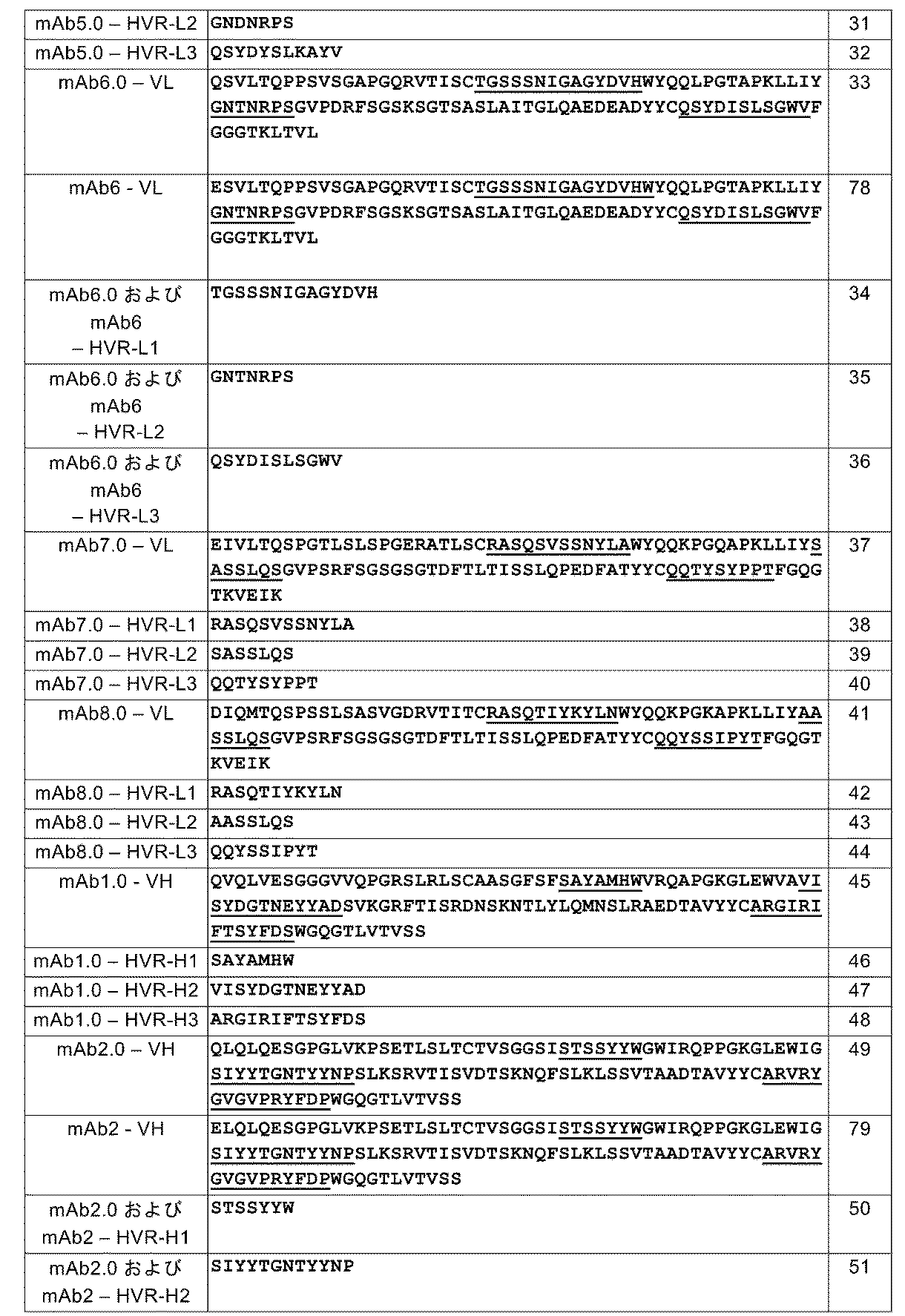


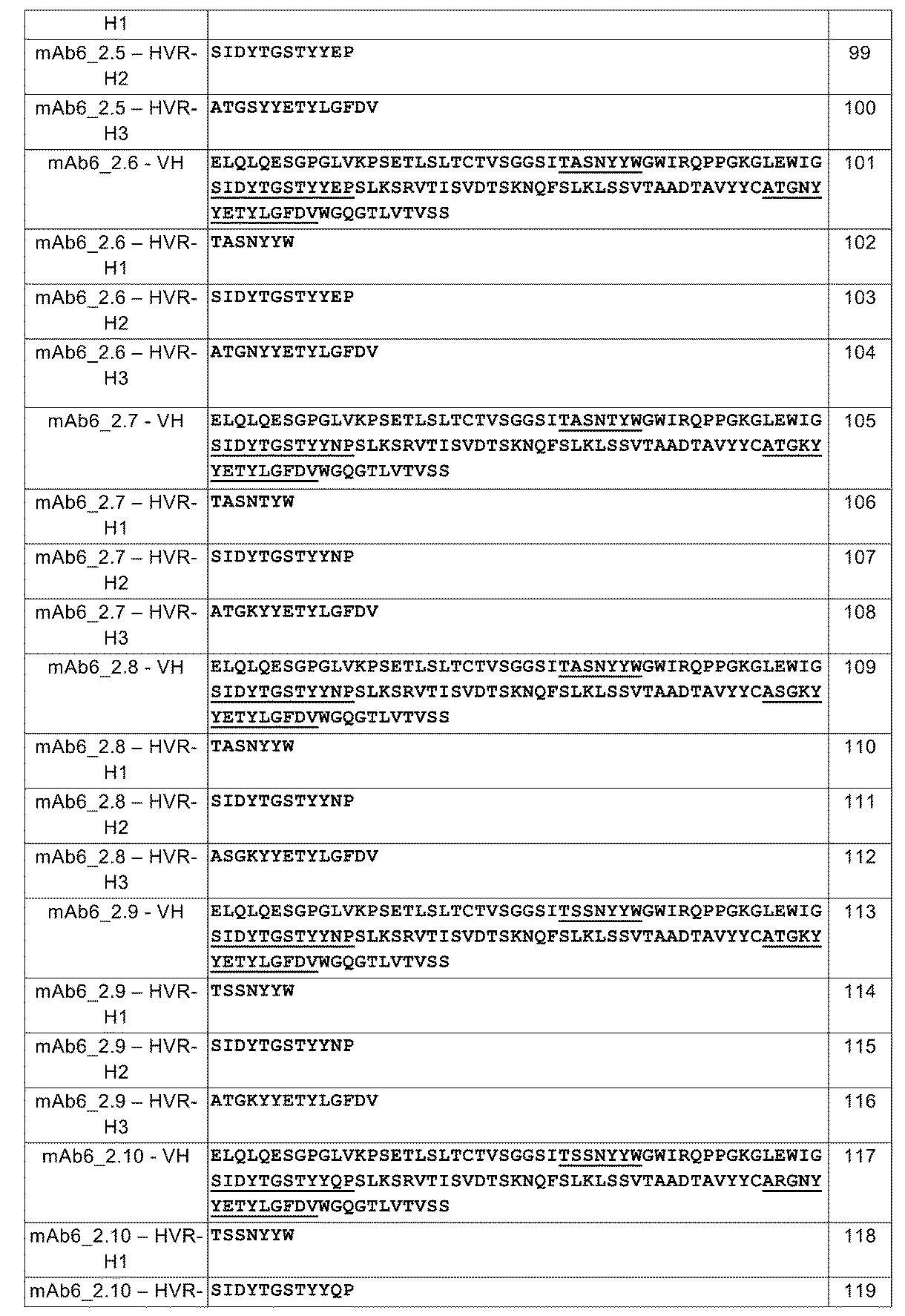


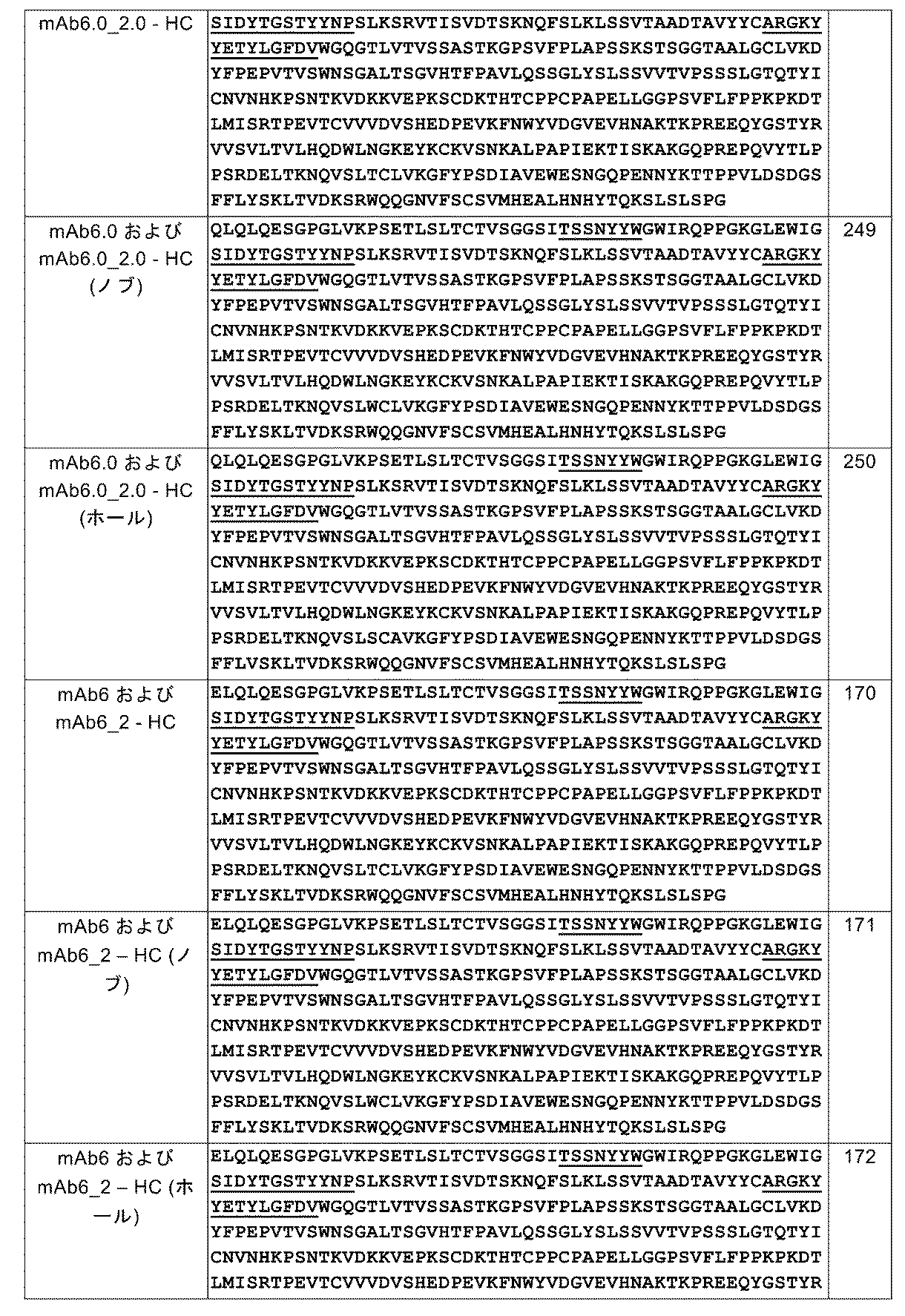
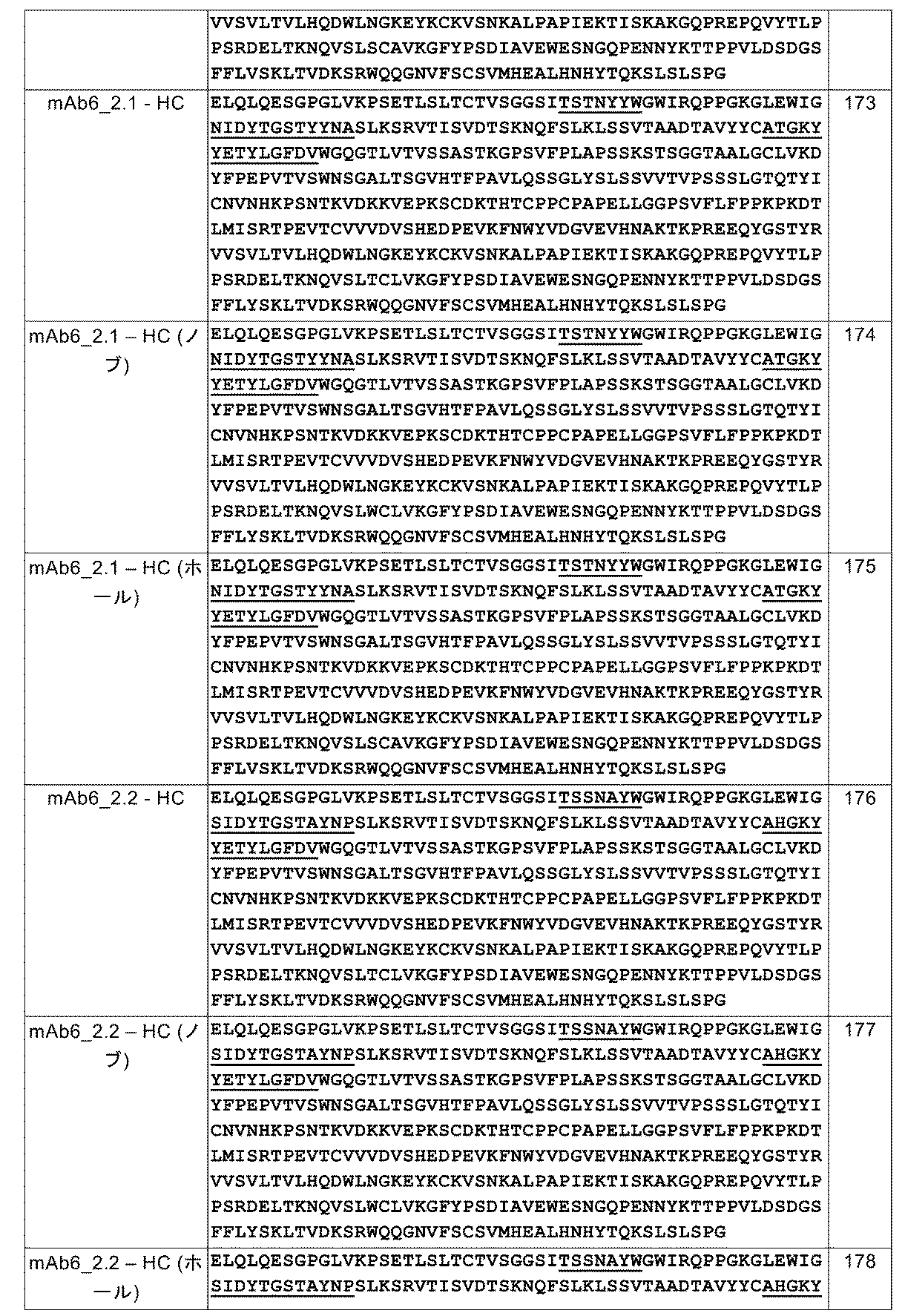


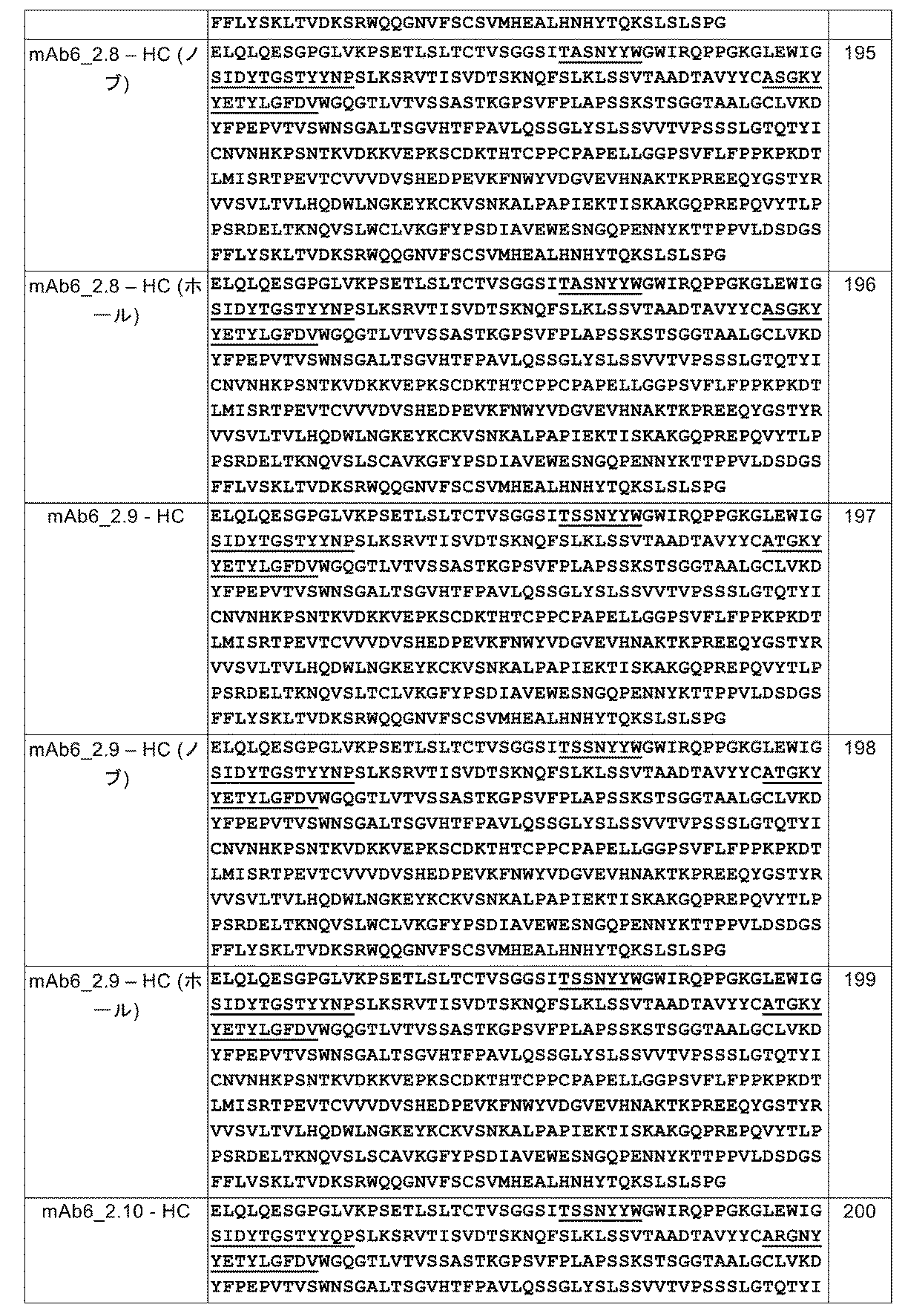
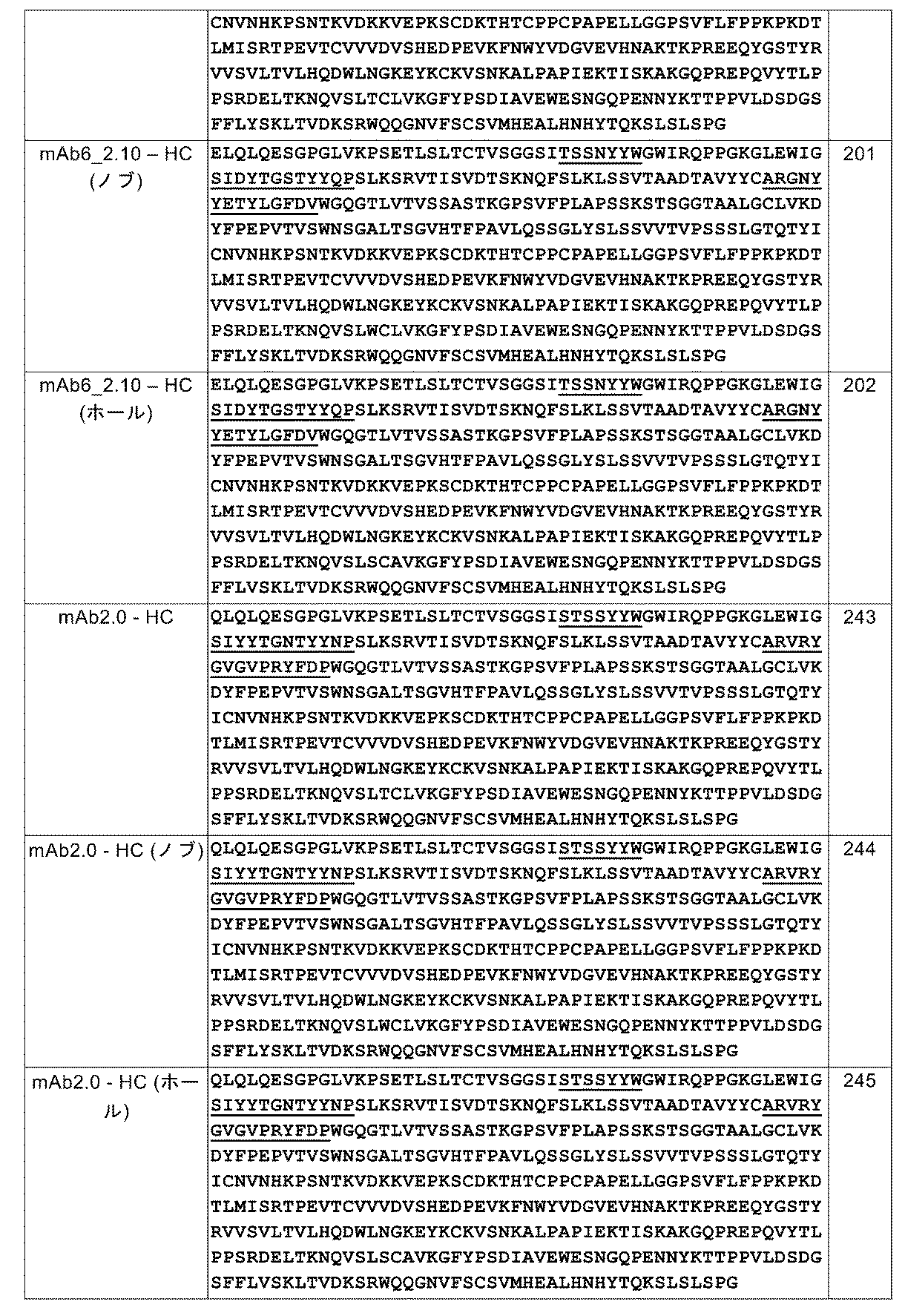
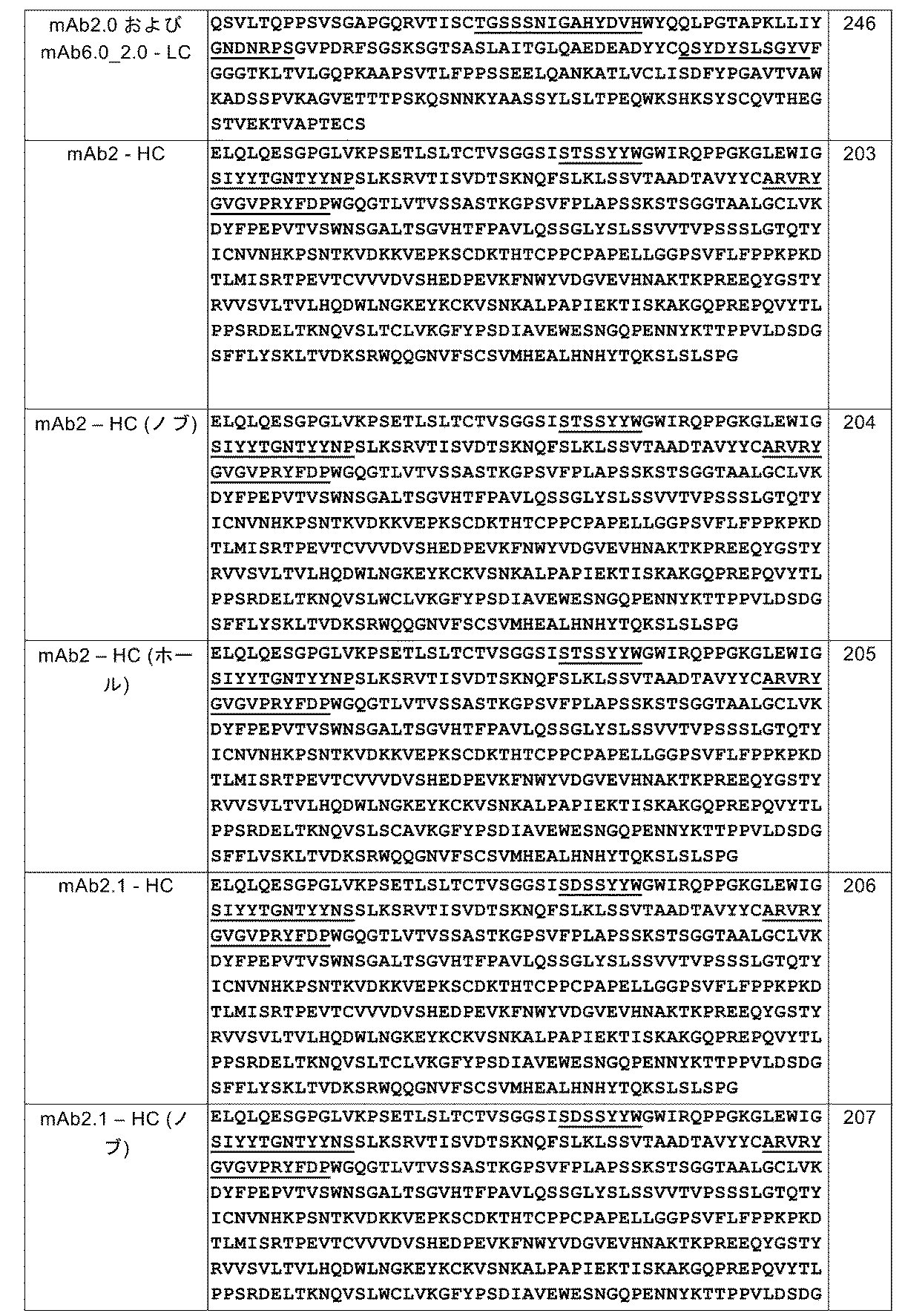


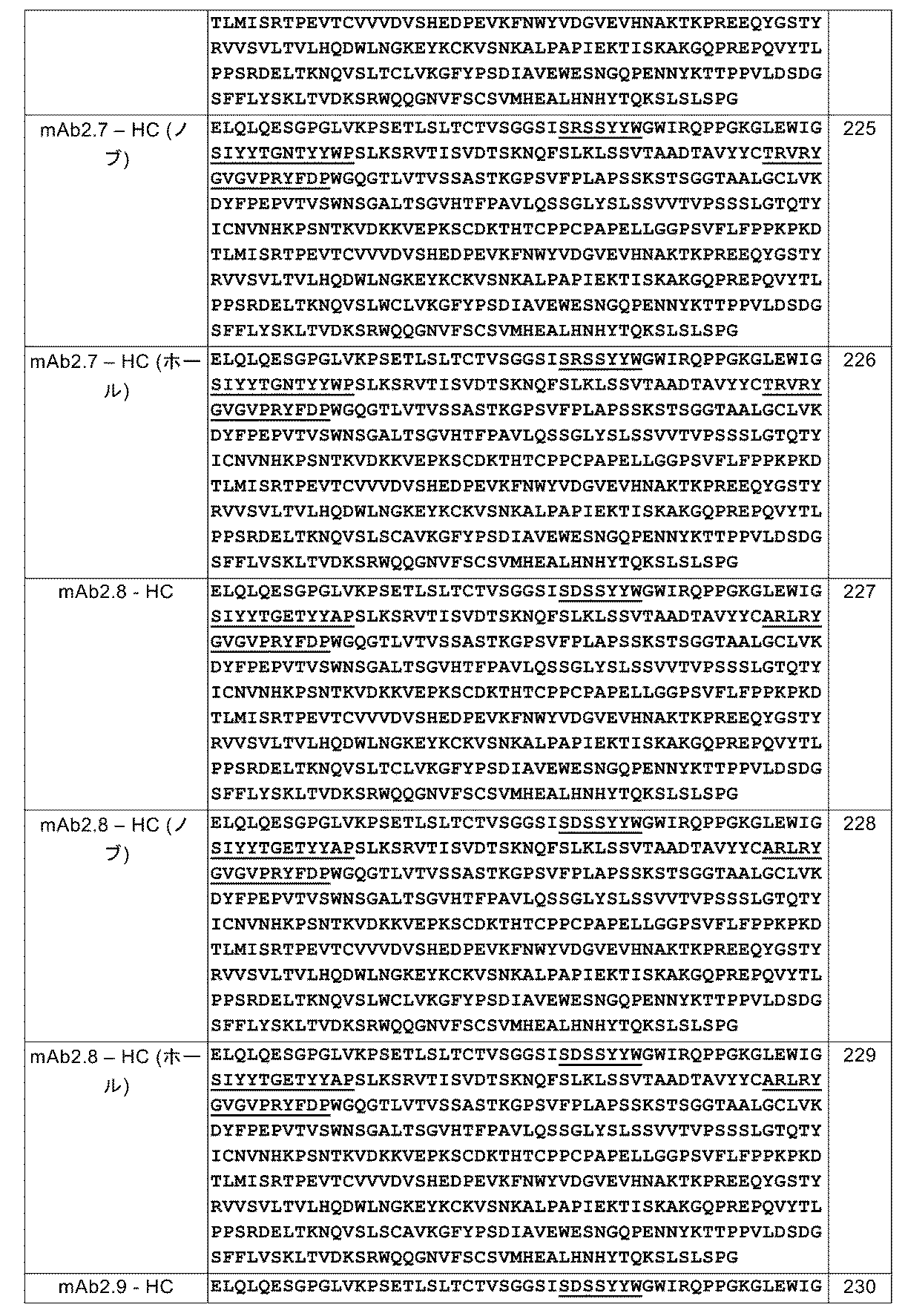
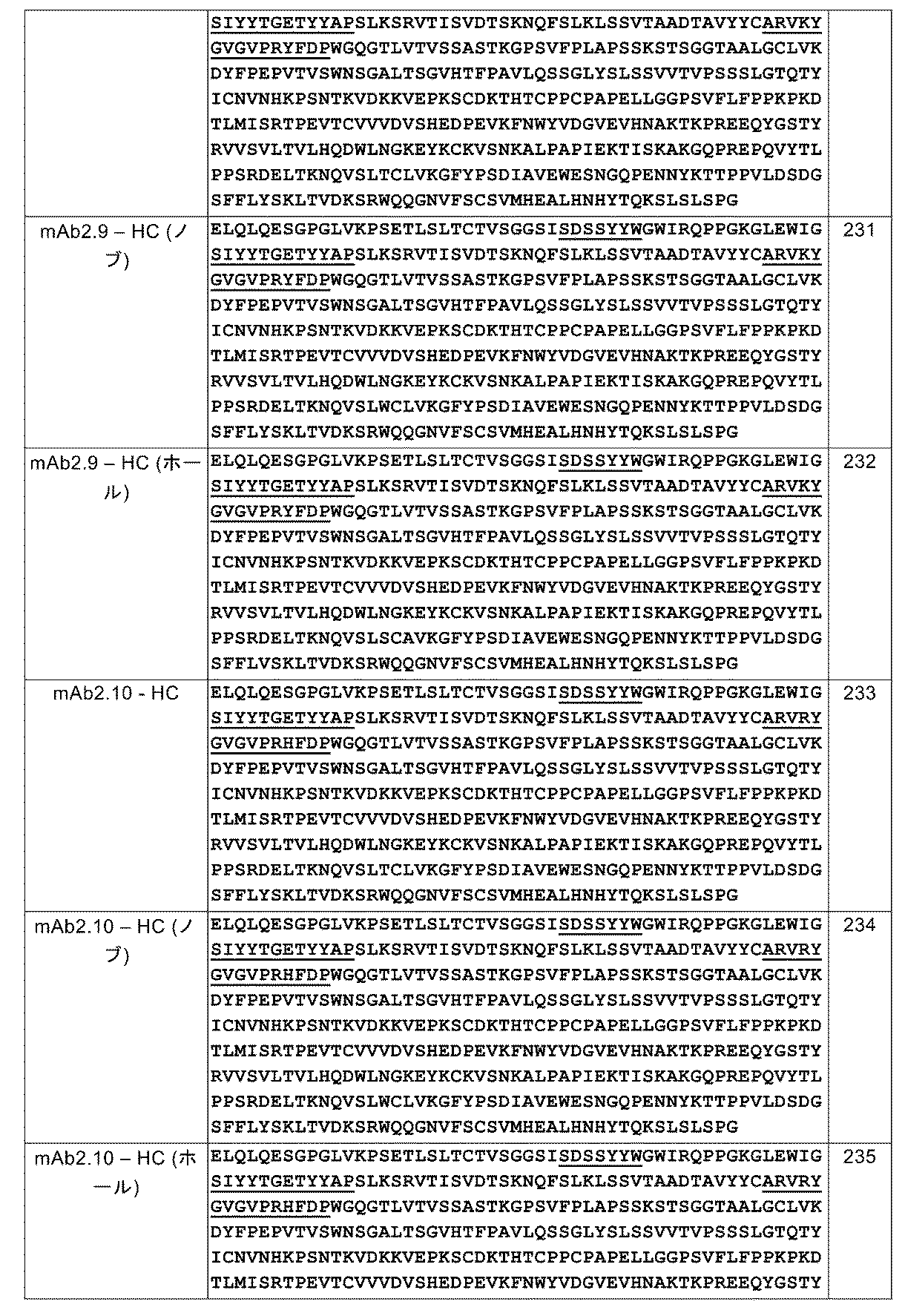
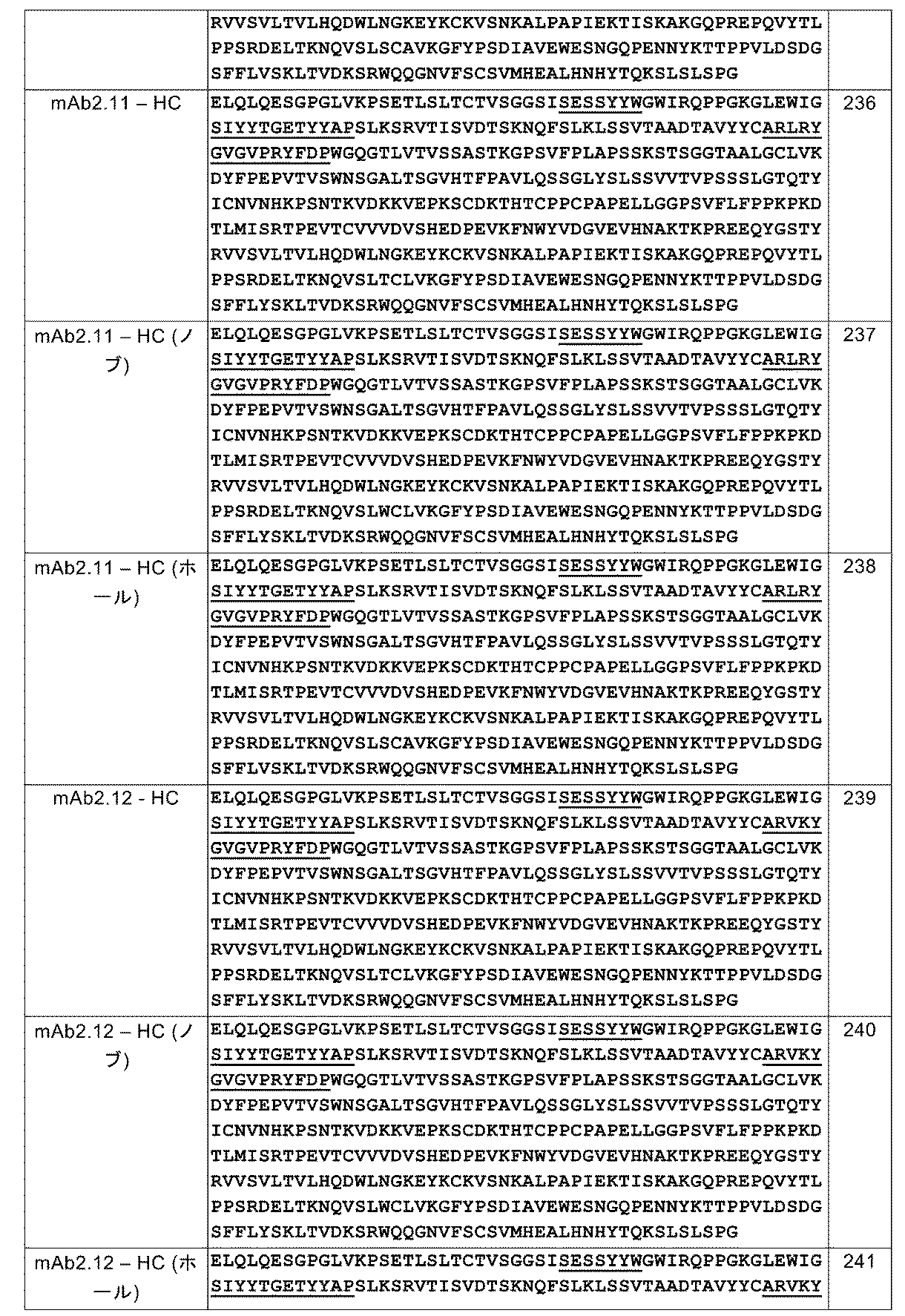

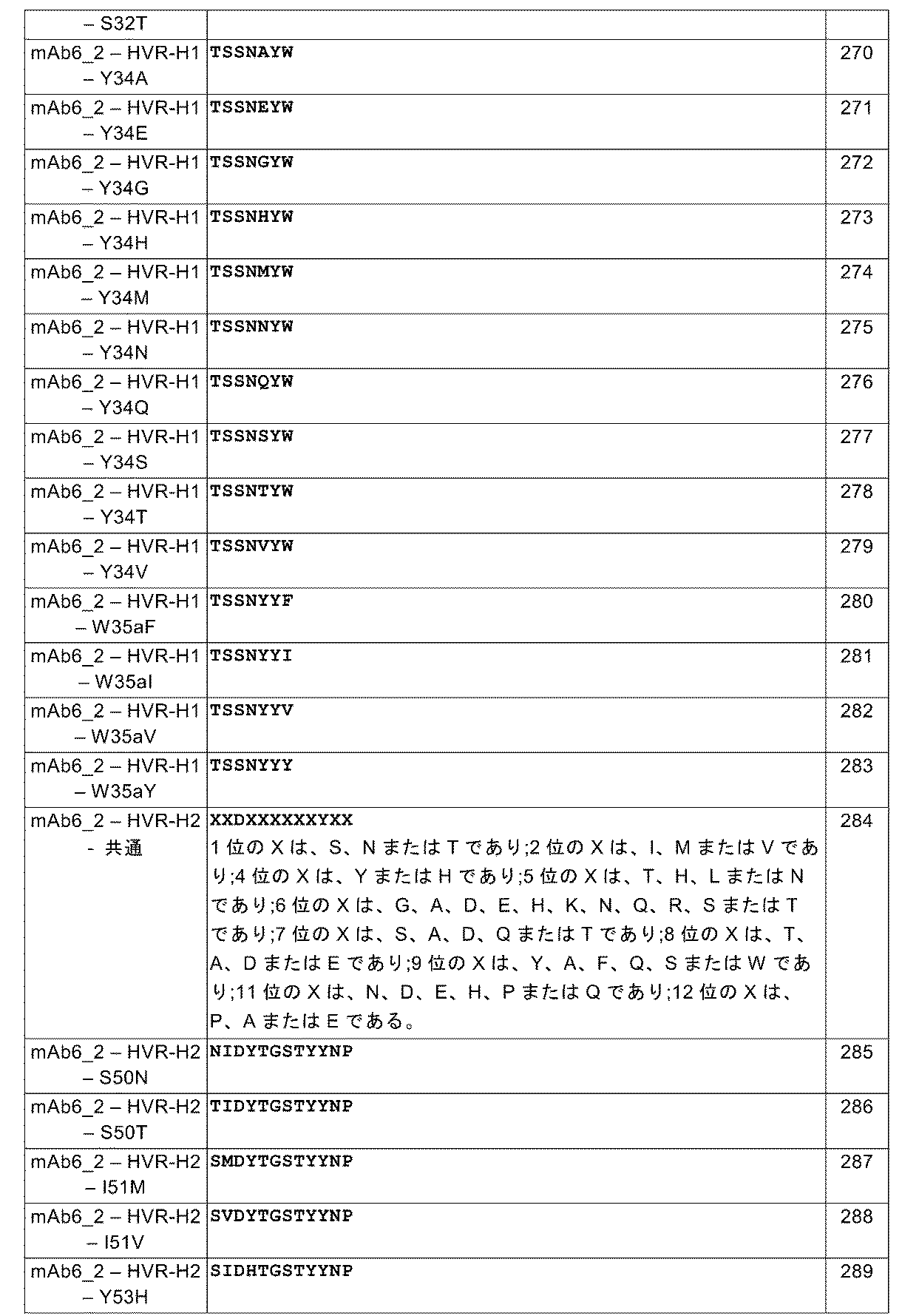
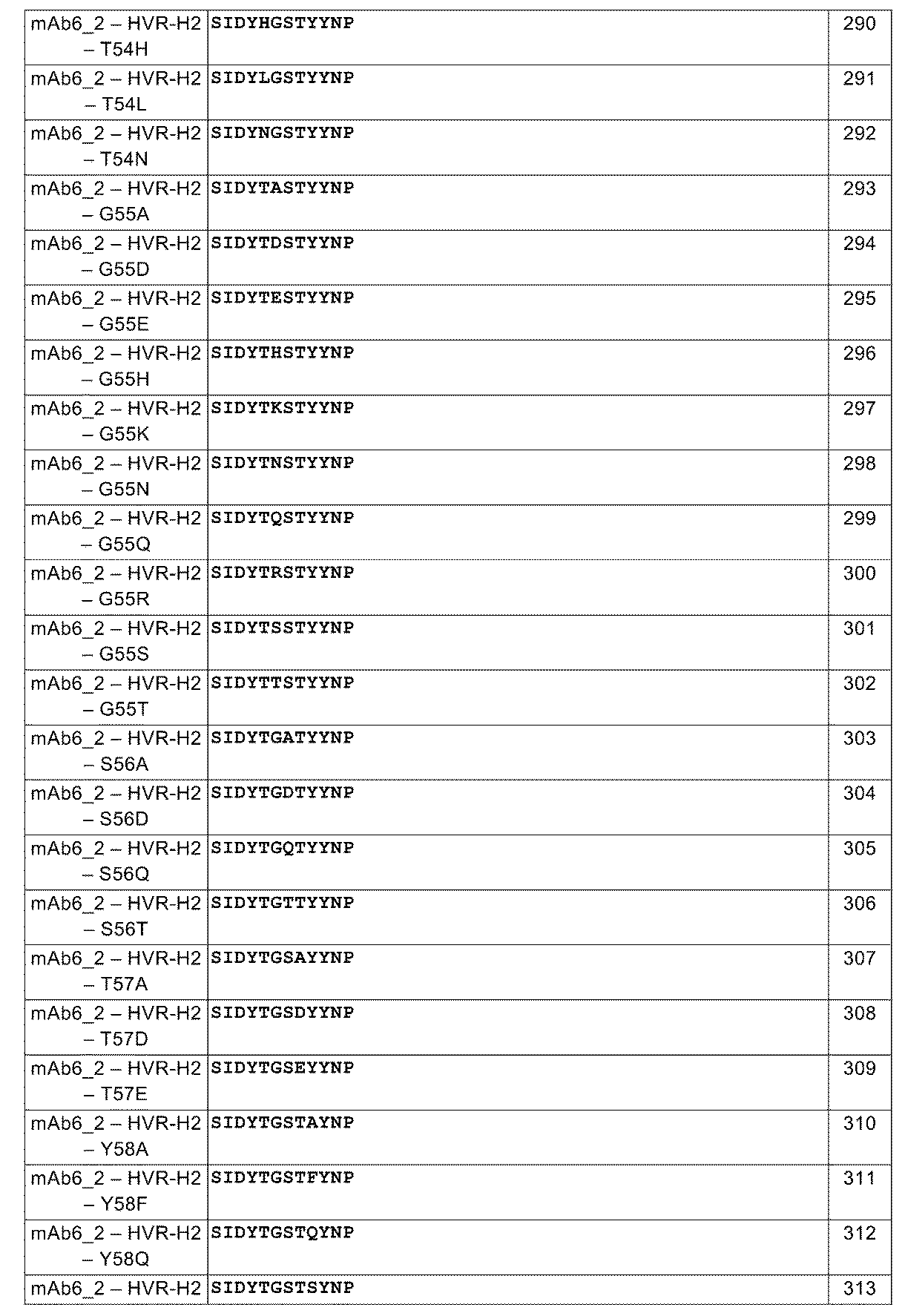


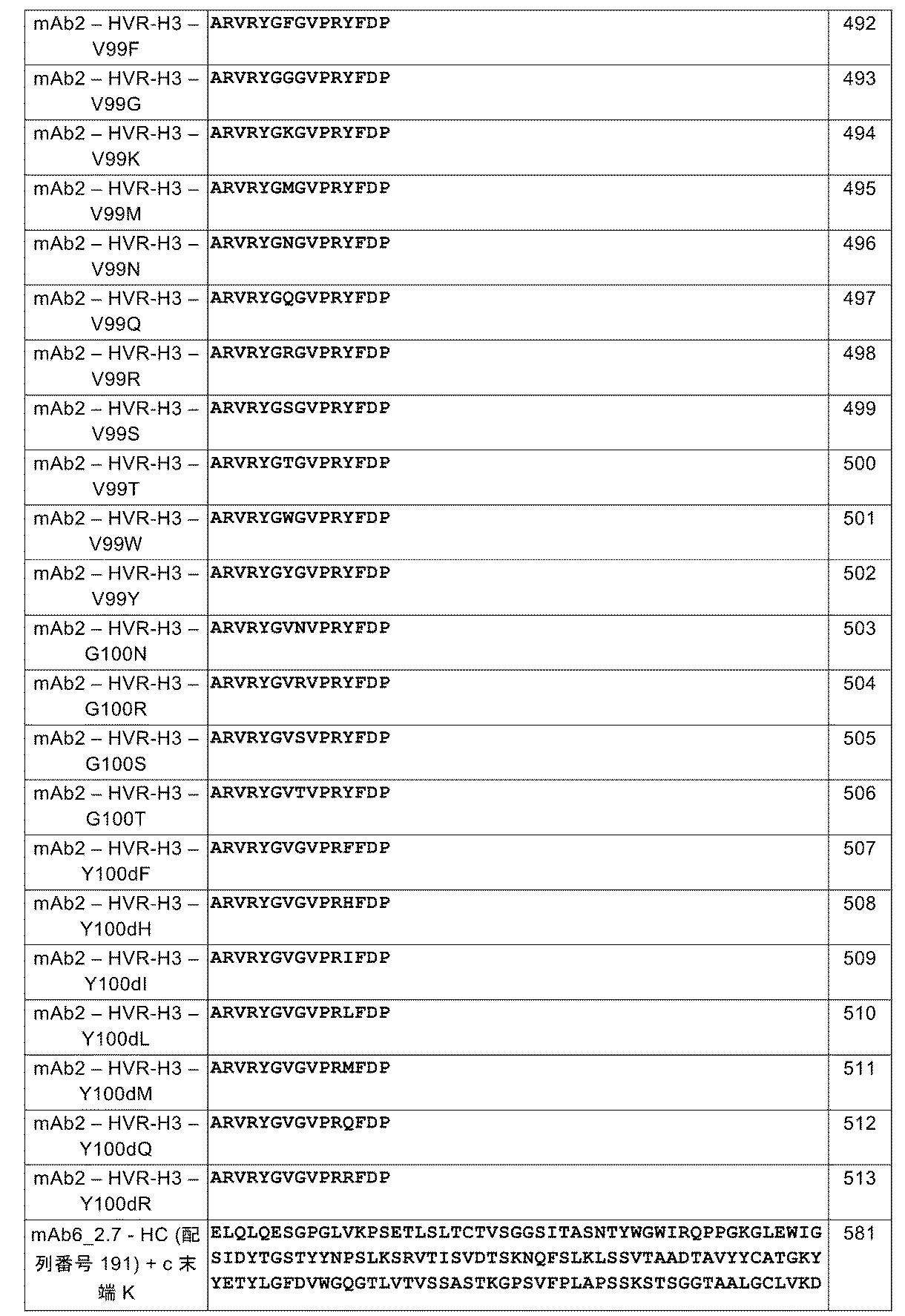


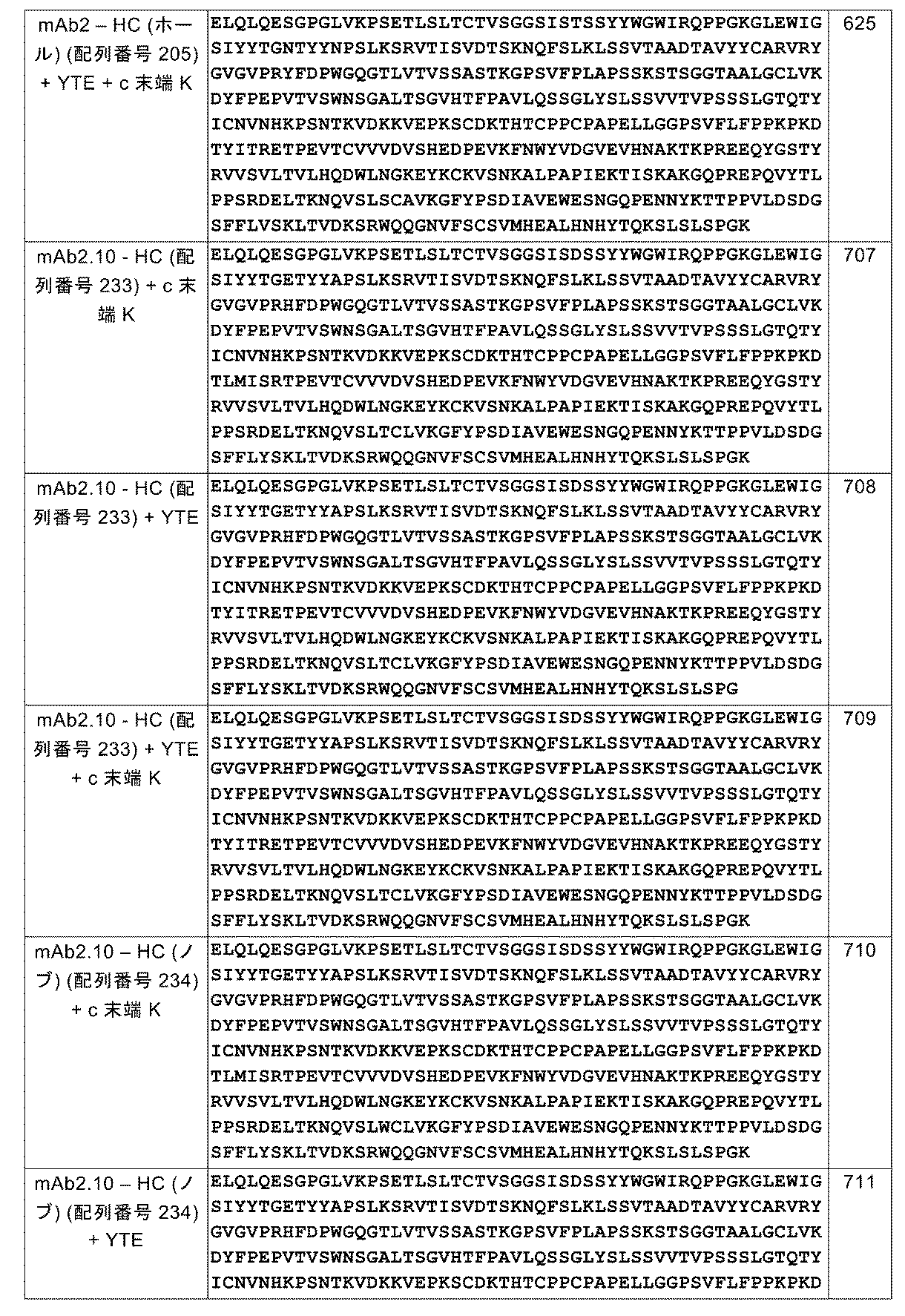


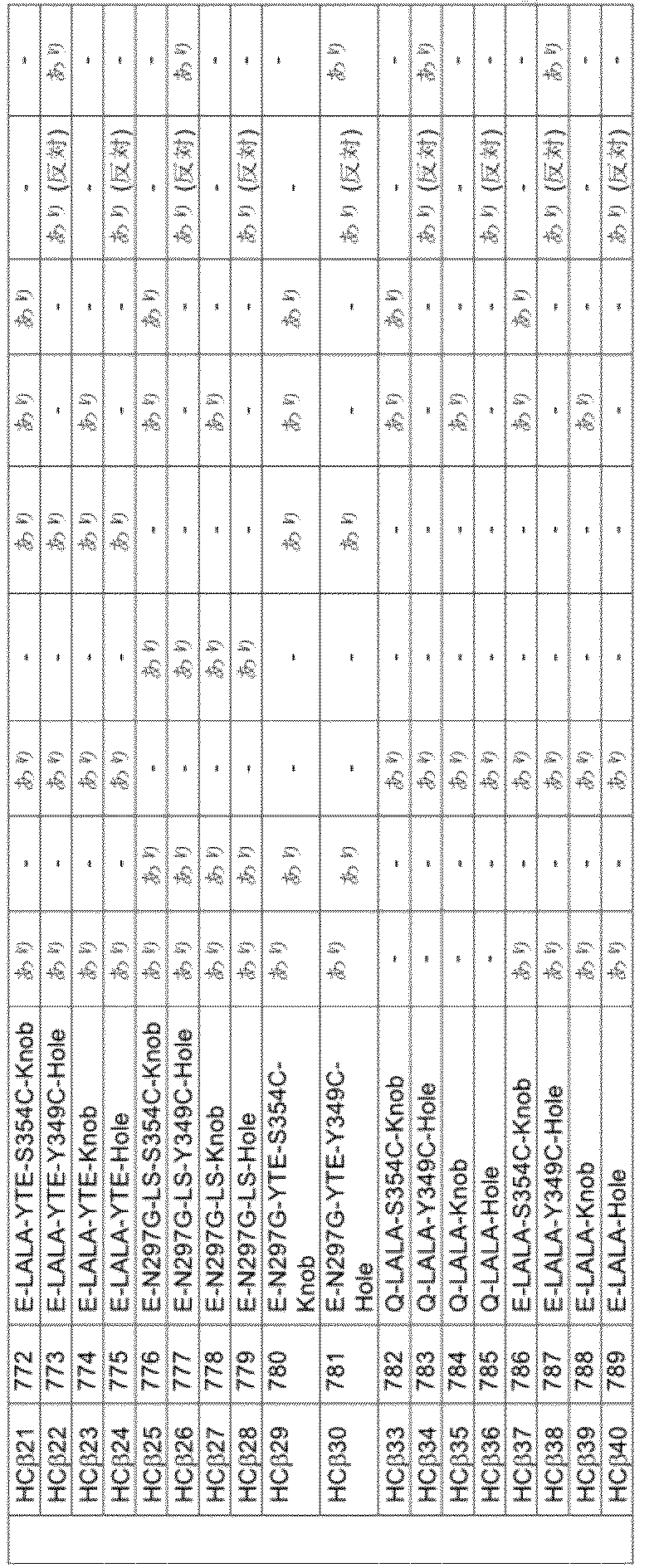
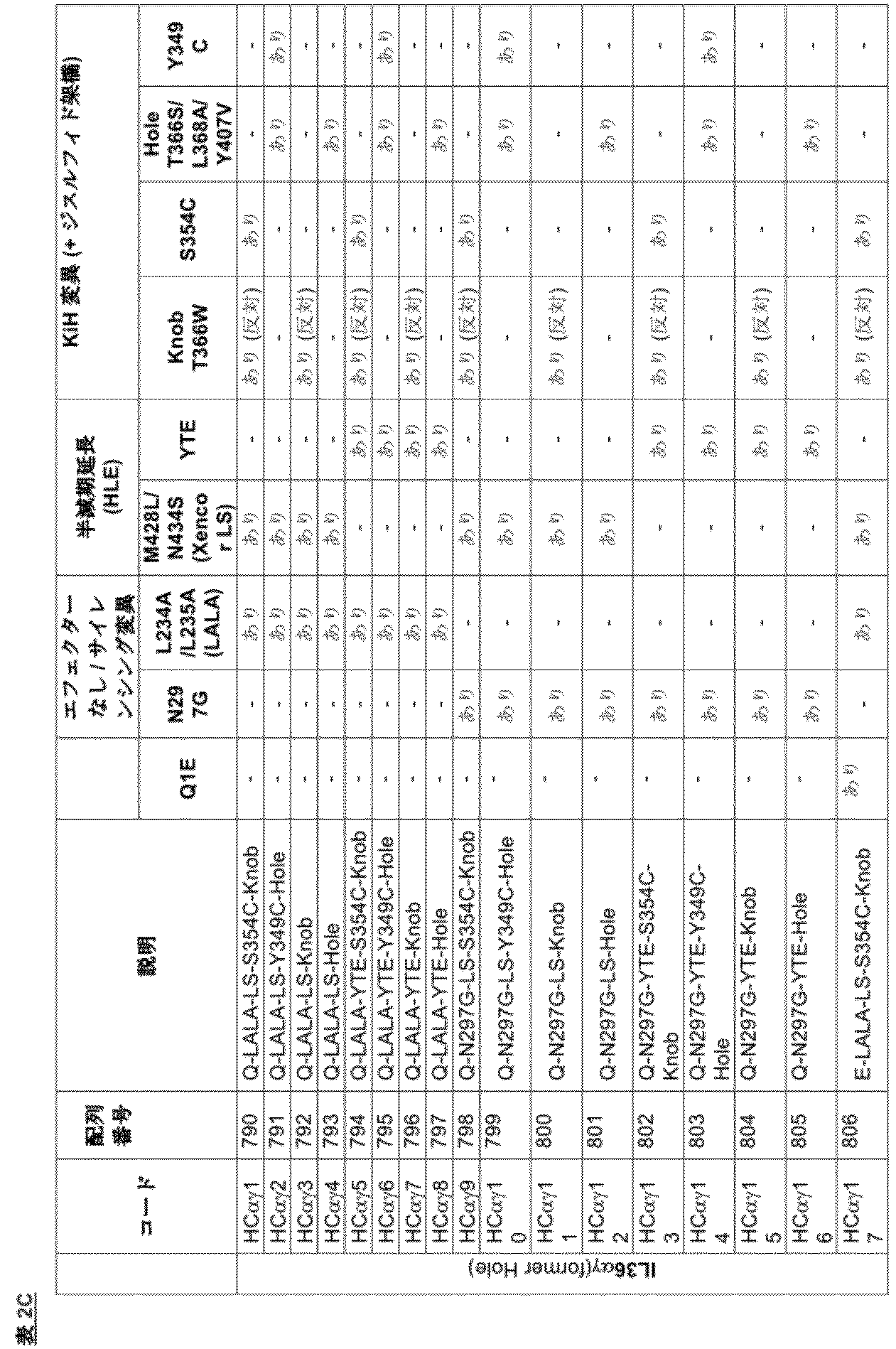


1.抗IL-36抗体の結合親和性および細胞シグナル伝達阻害
一部の実施形態では、本明細書で提供される抗IL-36抗体は、ヒトサイトカイン、hu-IL-36α、hu-IL-36βおよび/またはhu-IL-36γの結合についての、100nM未満、10nM未満、1nM未満、0.1nM未満、0.01nM未満または0.001nM未満(例えば、10-8M以下、10-8M~10-13M、例えば、10-9M~10-13M)の平衡解離定数(KD)を有する。より特に、一部の実施形態では、本開示の抗IL-36抗体は、hu-IL-36α、hu-IL-36βおよび/またはhu-IL-36γに、1x10-8M以下、1x10-9Mもしくはそれ未満、1x10-10Mもしくはそれ未満、または1x10-11Mもしくはそれ未満の結合親和性により結合する。一部の実施形態では、結合親和性は、それぞれ、配列番号1、2および3のhu-IL-36α、hu-IL-36βまたはhu-IL-36γポリペプチドコンストラクトへの結合についての平衡解離定数(KD)として測定される。一実施形態では、本発明の抗体は、約25nM未満、約20nM未満、約15nM未満、約10nM未満、約5nM未満、約1nM未満、約500pM未満、約400pM未満、約300pM未満、約200pM未満、約100pM未満、約90pM未満、約80pM未満、約70pM未満、約60pM未満、約50pM未満、約40pM未満、約30pM未満、約20pM未満、約10pM未満、約5pM未満、約4pM未満、約2pM未満、約1pM未満、約0.5pM未満、約0.2pM未満、約0.1pM未満、または約0.05pM未満のKDを示してもよい。それは、例えば、hu-IL-36α、hu-IL-36β、および/またはhu-IL-36γについてそのような値を有してもよい。それは、例えば、hu-IL-36βについてそのような値を有する。それは、例えば、hu-IL-36αおよび/またはhu-IL-36γについてそのような値を有してもよい。抗体が二重特異性抗体である一実施形態では、それがそのようなKD値を示してもよい。別の実施形態では、二重特異性抗体の特異性の1つと同等な単一特異性抗体がそのようなKD値を示してもよいものでもよい。別の実施形態では、二重特異性抗体の特異性の両方と同等な単一特異性抗体がそのようなKD値を示すものでもよい。好ましい一実施形態では、KD値は、表面プラズモン共鳴アッセイで、例えば、25℃および/または37℃で決定されるものである。一般的に、リガンドの、その受容体への結合親和性は、様々なアッセイのうちのいずれかを使用して決定し、様々な定量的値に関して表すことができる。抗体の親和性を決定することにおいて有用な特定のIL-36結合アッセイは、本明細書中の実施例において開示される。加えて、非限定的に、ウェスタンブロット、ラジオイムノアッセイ、酵素結合免疫吸着アッセイ(ELISA)、「サンドウィッチ」イムノアッセイ、表面プラズモン共鳴ベースのアッセイ(例えば、WO2005/012359で説明されるBIAcoreアッセイ)、免疫沈降アッセイ、蛍光イムノアッセイおよびタンパク質Aイムノアッセイなどの技法を使用する任意の直接的または競合的結合アッセイを含む、抗原結合アッセイは、当該技術分野において公知であり、本明細書で使用され得る。好ましい一実施形態では、抗原結合性は、例えばBIAcore(商標)システム(米国ニュージャージー州Piscataway、Biacore Life Sciences division of GE Healthcare)を使用する表面プラズモン共鳴法を使用して測定される。
1. Binding Affinity and Cell Signaling Inhibition of Anti-IL-36 Antibodies In some embodiments, anti-IL-36 antibodies provided herein have a binding affinity of less than 100 nM, less than 10 nM, less than 1 nM, less than 0.1 nM, less than 0.01 nM, or less than 0.001 nM (e.g., 10-8 M or less) for binding of human cytokines hu-IL-36α, hu-IL-36β and/or hu-IL-36γ. , 10 −8 M to 10 −13 M, eg, 10 −9 M to 10 −13 M). More particularly, in some embodiments, an anti-IL-36 antibody of the disclosure binds hu-IL-36α, hu-IL-36β and/or hu-IL-36γ with a binding affinity of 1×10 −8 M or less, 1×10 −9 M or less, 1×10 −10 M or less, or 1×10 −11 M or less. In some embodiments, binding affinity is measured as the equilibrium dissociation constant (KD) for binding to hu-IL-36α, hu-IL-36β or hu-IL-36γ polypeptide constructs of SEQ ID NOs: 1, 2 and 3, respectively. In one embodiment, the antibodies of the invention are less than about 25 nM, less than about 20 nM, less than about 15 nM, less than about 10 nM, less than about 5 nM, less than about 1 nM, less than about 500 pM, less than about 400 pM, less than about 300 pM, less than about 200 pM, less than about 100 pM, less than about 90 pM, less than about 80 pM, less than about 70 pM, less than about 60 pM, less than about 50 It may exhibit a KD of less than about 40 pM, less than about 30 pM, less than about 20 pM, less than about 10 pM, less than about 5 pM, less than about 4 pM, less than about 2 pM, less than about 1 pM, less than about 0.5 pM, less than about 0.2 pM, less than about 0.1 pM, or less than about 0.05 pM. It may have such values for hu-IL-36α, hu-IL-36β, and/or hu-IL-36γ, for example. It has such values for hu-IL-36β, for example. It may have such values for hu-IL-36α and/or hu-IL-36γ, for example. In one embodiment in which the antibody is a bispecific antibody, it may exhibit such KD values. In another embodiment, a monospecific antibody equivalent to one of the specificities of the bispecific antibody may exhibit such a KD value. In another embodiment, a monospecific antibody that is equivalent to both specificities of a bispecific antibody may exhibit such a KD value. In one preferred embodiment, the KD value is determined in a surface plasmon resonance assay, eg at 25°C and/or 37°C. Generally, the binding affinity of a ligand for its receptor can be determined using any of a variety of assays and expressed in terms of a variety of quantitative values. A particular IL-36 binding assay useful in determining antibody affinity is disclosed in the Examples herein. In addition, antigen binding assays are known in the art and include, but are not limited to, any direct or competitive binding assay using techniques such as western blots, radioimmunoassays, enzyme-linked immunosorbent assays (ELISA), "sandwich" immunoassays, surface plasmon resonance-based assays (e.g., the BIAcore assays described in WO2005/012359), immunoprecipitation assays, fluorescence immunoassays and protein A immunoassays, and are known in the art and described herein. can be used. In one preferred embodiment, antigen binding is measured using surface plasmon resonance methods, eg, using the BIAcore™ system (Biacore Life Sciences division of GE Healthcare, Piscataway, NJ, USA).
一部の実施形態では、結合親和性は、KD値として表され、固有の結合親和性(例えば、最小化した結合活性効果を伴う)を反映する。本開示の抗IL-36抗体は、配列番号1、2および3の、それぞれ、hu-IL-36α、hu-IL-36βおよび/またはhu-IL-36γポリペプチドコンストラクトについて強い結合親和性を示し、例えば、10nM~1pMのKD値を示す。 In some embodiments, binding affinities are expressed as KD values and reflect intrinsic binding affinities (eg, with minimized avidity effects). The anti-IL-36 antibodies of the present disclosure exhibit strong binding affinities for the hu-IL-36α, hu-IL-36β and/or hu-IL-36γ polypeptide constructs of SEQ ID NOS: 1, 2 and 3, respectively, exhibiting KD values of 10 nM to 1 pM.
一部の実施形態では、本明細書で提供される抗IL-36抗体は、IL-36媒介経路による細胞内シグナル伝達、特に、IL-36α、IL-36βおよび/またはIL-36γのIL-36Rへの結合によって刺激されるシグナル伝達経路を減少、阻害および/または完全に遮断する。抗体の、これらのIL-36媒介シグナル伝達経路を阻害する能力は、本開示の実施例で説明されるHEK-BLUE(商標)レポーター細胞アッセイおよび初代細胞ベースの遮断アッセイを含む、公知の細胞ベースの遮断アッセイを使用してインビトロ(in vitro)でアッセイすることができる。一部の場合、IL-8発現は、IL-36媒介経路を通したシグナル伝達の指標として用いることができ、これは、例えば、IL-8レベルの低減が、1つまたは複数のIL-36媒介経路の遮断を示す場合を含む。 In some embodiments, the anti-IL-36 antibodies provided herein reduce, inhibit and/or completely block intracellular signaling through IL-36-mediated pathways, particularly signaling pathways stimulated by the binding of IL-36α, IL-36β and/or IL-36γ to IL-36R. The ability of antibodies to inhibit these IL-36-mediated signaling pathways can be assayed in vitro using known cell-based blocking assays, including the HEK-BLUE™ reporter cell assay and primary cell-based blocking assays described in the Examples of this disclosure. In some cases, IL-8 expression can be used as an indicator of signaling through IL-36-mediated pathways, including, for example, where reduction in IL-8 levels indicates blockade of one or more IL-36-mediated pathways.
一部の実施形態では、抗体の、IL-36により刺激されたシグナル伝達を減少、阻害および/または完全に遮断する能力は、およそEC50の濃度におけるアゴニストサイトカインIL-36α、IL-36βおよび/またはIL-36γによるレポーター細胞ベースの遮断アッセイを使用して、抗体のIC50として決定される。アゴニストEC50は、多くの場合、アッセイ前は見積もるだけでもよく、データの非線形回帰解析を使用して、アッセイが完了した後に決定される。そのようなアッセイにおいては、およそEC50の値は、典型的に、EC40~45~EC55~60の範囲内である。 In some embodiments, the ability of an antibody to reduce, inhibit and/or completely block IL-36 stimulated signaling is determined as the antibody's IC50 using a reporter cell-based blocking assay with the agonist cytokines IL-36α, IL-36β and/or IL-36γ at a concentration of approximately EC50. Agonist EC50s often can only be estimated pre-assay and determined after the assay is completed using non-linear regression analysis of the data. In such assays, approximately EC50 values are typically in the range of EC40-45 to EC55-60.
したがって、一部の実施形態では、本開示のIL-36抗体は、IL-36媒介経路による細胞内シグナル伝達を減少、阻害および/または完全に遮断する能力に基づく、以下の機能特性のうちの1つまたは複数によって特徴付けられる。 Accordingly, in some embodiments, IL-36 antibodies of the present disclosure are characterized by one or more of the following functional properties based on their ability to reduce, inhibit and/or completely block intracellular signaling through IL-36-mediated pathways.
抗IL-36抗体の一部の実施形態では、抗体は、IL-36α、IL-36βまたはIL-36γのうちのいずれかによって刺激される(またはそれによって開始される)シグナルを、少なくとも90%、少なくとも95%、少なくとも99%または100%減少する。一部の実施形態では、シグナルの減少は、細胞ベースのアッセイを使用して測定することができる。当業者は、IL-36により刺激された経路の細胞シグナル伝達の阻害を決定することにおける使用について知られる、公知の細胞ベースのアッセイのいずれかを選択することができる。一般的に、本開示の抗IL-36抗体は、およそEC50(例えば、EC40~EC60)の濃度におけるアゴニストサイトカインIL-36α、IL-36βまたはIL-36γの結合によって開始されるIL-36媒介細胞内シグナルを、10nMもしくはそれ未満、5nMもしくはそれ未満、または1nMの抗体についてのIC50値により減少する。 In some embodiments of the anti-IL-36 antibody, the antibody reduces the signal stimulated (or initiated by) any of IL-36α, IL-36β or IL-36γ by at least 90%, at least 95%, at least 99% or 100%. In some embodiments, signal reduction can be measured using cell-based assays. One of skill in the art can select any of the known cell-based assays known for use in determining inhibition of IL-36 stimulated pathway cell signaling. Generally, anti-IL-36 antibodies of the present disclosure reduce IL-36-mediated intracellular signals initiated by binding of agonist cytokines IL-36α, IL-36β or IL-36γ at concentrations of approximately EC50 (e.g., EC40-EC60) by IC50 values for antibodies of 10 nM or less, 5 nM or less, or 1 nM.
一部の実施形態では、抗IL-36抗体は、IL-36により刺激されたシグナルを、少なくとも95%または少なくとも99%減少し;IL-36により刺激されたシグナルは、IL-36α、IL-36βおよびIL-36γから選択されるアゴニストサイトカインによって刺激されてもよく;およそEC50のアゴニストサイトカイン濃度において、抗体は、10nMもしくはそれ未満、5nMもしくはそれ未満、または1nMもしくはそれ未満のIC50を有してもよい。 In some embodiments, the anti-IL-36 antibody reduces the IL-36-stimulated signal by at least 95% or at least 99%; the IL-36-stimulated signal may be stimulated by an agonist cytokine selected from IL-36α, IL-36β and IL-36γ; may have.
一部の実施形態では、抗IL-36抗体は、IL-36α、IL-36βおよびIL-36γアゴニストのうちの1つまたは複数の、その同族受容体への結合によって開始される細胞内シグナルを、少なくとも90%、少なくとも95%、少なくとも99%または100%減少する。 In some embodiments, the anti-IL-36 antibody reduces an intracellular signal initiated by binding of one or more of IL-36α, IL-36β and IL-36γ agonists to their cognate receptor by at least 90%, at least 95%, at least 99% or 100%.
一部の実施形態では、抗IL-36抗体は、ヒト初代ケラチノサイト細胞および/またはHaCAT細胞からの、IL-36α、IL-36βおよび/またはIL-36γにより刺激されたIL-8の放出を阻害し;およそEC50のIL-36α、IL-36βおよび/またはIL-36γ濃度において、抗体は、10nMもしくはそれ未満、5nMもしくはそれ未満、または1nMもしくはそれ未満のIC50を有してもよい。 In some embodiments, the anti-IL-36 antibody inhibits IL-36α-, IL-36β- and/or IL-36γ-stimulated IL-8 release from human primary keratinocyte cells and/or HaCAT cells; may have.
2.抗体断片
一部の実施形態では、本開示の抗IL-36抗体は、抗体断片であってもよい。本開示の結合決定基を伴って有用な抗体断片は、Fab、Fab’、Fab’-SH、F(ab’)2、Fv、一価の一アーム(または単一アーム)抗体、scFv断片、および本明細書で説明され、当該技術分野で公知の他の断片を含むが、これらに限定されない。様々な抗体断片の概説については、例えば、Hudson et al. Nat. Med. 9: 129-134 (2003)を参照されたい。scFv断片の概説については、例えば、Pluckthun, in The Pharmacology of Monoclonal Antibodies, vol. 113, Rosenburg and Moore eds., (Springer-Verlag, New York), pp. 269-315 (1994)を参照されたく;また、WO93/16185、ならびに米国特許第5,571,894号および同第5,587,458号を参照されたい。サルベージ受容体結合エピトープ残基を含み、インビボ半減期の増大を有する、FabおよびF(ab’)2断片の説明については、米国特許第5,869,046号を参照されたい。他の一価の抗体形態は、例えば、WO2007/048037、WO2008/145137、WO2008/145138およびWO2007/059782で説明されている。一価の単一アーム抗体は、例えば、WO2005/063816で説明されている。ダイアボディは、二価または二重特異性であり得る、2つの抗原結合部位を有する抗体断片である[例えば、EP0404097;WO93/01161;Hudson et al., Nat. Med. 9: 129-134 (2003);およびHollinger et al., Proc. Natl. Acad. Sci. USA 90: 6444-6448 (1993)を参照されたい]。
2. Antibody Fragments In some embodiments, the anti-IL-36 antibodies of this disclosure may be antibody fragments. Antibody fragments useful with the binding determinants of the present disclosure include, but are not limited to, Fab, Fab', Fab'-SH, F(ab')2, Fv, monovalent one-arm (or single-arm) antibodies, scFv fragments, and other fragments described herein and known in the art. See, eg, Hudson et al. Nat. Med. 9: 129-134 (2003) for a review of various antibody fragments. For a review of scFv fragments, see, for example, Pluckthun, in The Pharmacology of Monoclonal Antibodies, vol. 113, Rosenburg and Moore eds., (Springer-Verlag, New York), pp. 269-315 (1994); See 458. See US Pat. No. 5,869,046 for a description of Fab and F(ab')2 fragments containing salvage receptor binding epitope residues and having increased in vivo half-lives. Other monovalent antibody forms are described, for example, in WO2007/048037, WO2008/145137, WO2008/145138 and WO2007/059782. Monovalent single-arm antibodies are described, for example, in WO2005/063816. Diabodies are antibody fragments with two antigen-binding sites that can be bivalent or bispecific [see, for example, EP 0404097; WO 93/01161; Hudson et al., Nat. Med. 9: 129-134 (2003); and Hollinger et al., Proc. see].
一部の実施形態では、抗体断片は、抗体の重鎖可変ドメインの全てもしくは一部、または軽鎖可変ドメインの全てもしくは一部を含む単一ドメイン抗体である。一部の実施形態では、単一ドメイン抗体は、ヒト単一ドメイン抗体である(Domantis, Inc., Waltham, MA;例えば、米国特許第6,248,516号を参照されたい)。 In some embodiments, the antibody fragment is a single domain antibody comprising all or part of the heavy chain variable domain or all or part of the light chain variable domain of the antibody. In some embodiments, the single domain antibody is a human single domain antibody (Domantis, Inc., Waltham, Mass.; see, eg, US Pat. No. 6,248,516).
抗体断片は、本明細書で説明される通り、非限定的に、インタクトな抗体のタンパク質分解消化、および組換え宿主細胞[例えば、イー・コリ(E. coli)またはファージ]による産生を含む、様々な技法によって作製することができる。 Antibody fragments can be produced by a variety of techniques, including, but not limited to, proteolytic digestion of intact antibodies, and production by recombinant host cells (e.g., E. coli or phage), as described herein.
本発明の抗IL-36抗体のうちのいずれかは、当該技術分野において公知の方法および技法ならびに/または本明細書で説明される方法および技法を使用して、抗体断片として調製することができることが企図される。例えば、本開示の様々な抗IL-36抗体のFab型の調製および解析を、以下の実施例で説明する。しかし、本発明の特に好ましい実施形態では、提供される抗体は、完全長抗体であり、断片ではない。 It is contemplated that any of the anti-IL-36 antibodies of the invention can be prepared as antibody fragments using methods and techniques known in the art and/or methods and techniques described herein. For example, the preparation and analysis of Fab versions of various anti-IL-36 antibodies of this disclosure are described in the Examples below. However, in particularly preferred embodiments of the invention, the antibodies provided are full-length antibodies and not fragments.
3.キメラおよびヒト化抗体
一部の実施形態では、本開示の抗IL-36抗体は、キメラ抗体であり得る。[例えば、米国特許第4,816,567号;およびMorrison et al., Proc. Natl. Acad. Sci. USA, 81 :6851-6855 (1984)において説明されるキメラ抗体を参照されたい]。一実施形態では、キメラ抗体は、非ヒト可変領域(例えば、マウス、ラット、ハムスター、ウサギまたは非ヒト霊長類、例えばサル由来の可変領域)と、ヒト定常領域とを含む。一部の実施形態では、キメラ抗体は、クラスまたはサブクラスが親抗体のクラスまたはサブクラスとは変えられた「クラススイッチ」抗体である。キメラ抗体は、その抗原結合性断片を含み得ることが企図される。
3. Chimeric and Humanized Antibodies In some embodiments, the anti-IL-36 antibodies of this disclosure can be chimeric antibodies. [See, eg, US Pat. No. 4,816,567; and the chimeric antibodies described in Morrison et al., Proc. Natl. Acad. Sci. USA, 81:6851-6855 (1984)]. In one embodiment, a chimeric antibody comprises a non-human variable region (eg, from a mouse, rat, hamster, rabbit or non-human primate, eg monkey) and a human constant region. In some embodiments, chimeric antibodies are "class-switched" antibodies in which the class or subclass has been changed from that of the parent antibody. It is contemplated that chimeric antibodies may comprise antigen-binding fragments thereof.
一部の実施形態では、本開示の抗IL-36抗体は、ヒト化抗体である。典型的に、非ヒト抗体は、ヒトへの免疫原性を低減するためにヒト化され、一方で、親非ヒト抗体の特異性および親和性を保持する。一般的に、ヒト化抗体は、HVR、例えば、CDR(またはその部分)が非ヒト抗体に由来し、FR(またはその部分)がヒト抗体配列に由来する1つまたは複数の可変ドメインを含む。また、ヒト化抗体は、ヒト定常領域の少なくとも一部を含んでもよい。一部の実施形態では、ヒト化抗体における一部のFR残基は、抗体特異性または親和性を回復または改善するために、非ヒト抗体(例えば、CDR残基が由来する抗体)からの対応する残基により置換される。 In some embodiments, the anti-IL-36 antibodies of this disclosure are humanized antibodies. Typically, non-human antibodies are humanized to reduce immunogenicity in humans, while retaining the specificity and affinity of the parent non-human antibody. Generally, humanized antibodies comprise one or more variable domains in which HVRs, eg, CDRs (or portions thereof) are derived from non-human antibodies and FRs (or portions thereof) are derived from human antibody sequences. A humanized antibody may also comprise at least a portion of a human constant region. In some embodiments, some FR residues in the humanized antibody are replaced with corresponding residues from a non-human antibody (e.g., the antibody from which the CDR residues are derived) to restore or improve antibody specificity or affinity.
ヒト化抗体およびそれらを作製する方法は、例えば、Almagro and Fransson, Front. Biosci. 13: 1619-1633 (2008)において概説されており、例えば、Riechmann et al., Nature 332:323-329 (1988);Queen et al., Proc. Natl. Acad. Sci. USA 86: 10029-10033 (1989);米国特許第5,821,337号、同第7,527,791号、同第6,982,321号および同第7,087,409号;Kashmiri et al, Methods 36:25-34 (2005)[SDR(a-HVR)グラフト化を説明している];Padlan, Mol. Immunol. 28:489-498 (1991)[「リサーフェイシング(resurfacing)」を説明している];Dall'Acqua et al., Methods 36:43-60 (2005)(「FRシャッフリング」を説明している);ならびにOsbourn et al., Methods 36:61 -68 (2005)およびKlimka et al., Br. J. Cancer, 83 :252-260 (2000)[FRシャッフリングのための「ガイド選択(guided selection)」手法を説明している]においてさらに説明されている。 Humanized antibodies and methods of making them are reviewed, for example, in Almagro and Fransson, Front. Biosci. 13: 1619-1633 (2008), see, for example, Riechmann et al., Nature 332:323-329 (1988); Queen et al., Proc. Natl. Acad. 1989); U.S. Patent Nos. 5,821,337, 7,527,791, 6,982,321 and 7,087,409; Kashmiri et al, Methods 36:25-34 (2005) [describing SDR (a-HVR) grafting]; Padlan, Mol. Immunol. (1991) [describing "resurfacing"]; Dall'Acqua et al., Methods 36:43-60 (2005) (describing "FR shuffling"); and Osbourn et al., Methods 36:61-68 (2005) and Klimka et al., Br. 000) [Describes a "guided selection" approach for FR shuffling].
ヒト化に有用なヒトフレームワーク領域には、「ベストフィット(best-fit)」法を使用して選択されたフレームワーク領域[例えば、Sims et al. J. Immunol. 151 :2296 (1993)を参照されたい];特定のサブグループの軽鎖または重鎖可変領域のヒト抗体のコンセンサス配列に由来するフレームワーク領域[例えば、Carter et al. Proc. Natl. Acad. Sci. USA, 89:4285 (1992);およびPresta et al. J. Immunol, 151 :2623 (1993)を参照されたい];ヒト成熟(体細胞的に成熟した)フレームワーク領域またはヒト生殖細胞系フレームワーク領域[例えば、Almagro and Fransson, Front. Biosci. 13: 1619- 1633 (2008)を参照されたい];およびスクリーニングFRライブラリー由来のフレームワーク領域[例えば、Baca et al., J. Biol. Chem. 272: 10678- 10684 (1997)およびRosok et al., J. Biol. Chem. 271 :2261 1 -22618 (1996)を参照されたい]が含まれるが、これらに限定されない。 Human framework regions useful for humanization include framework regions selected using the "best-fit" method [see, e.g., Sims et al. J. Immunol. 151:2296 (1993)]; framework regions derived from the consensus sequences of human antibodies for a particular subgroup of light or heavy chain variable regions [e.g., Carter et al. 4285 (1992); and Presta et al. J. Immunol, 151:2623 (1993)]; human mature (somatically mature) framework regions or human germline framework regions [see, e.g., Almagro and Fransson, Front. Biosci. 13: 1619-1633 (2008)]; Baca et al., J. Biol. Chem. 272: 10678-10684 (1997) and Rosok et al., J. Biol. Chem. 271:22611-22618 (1996)].
本発明の抗IL-36抗体のうちのいずれかは、当該技術分野において公知の方法および技法ならびに/または本明細書で説明される方法および技法を使用して、ヒト化抗体として調製することができることが企図される。 It is contemplated that any of the anti-IL-36 antibodies of the invention can be prepared as humanized antibodies using methods and techniques known in the art and/or methods and techniques described herein.
4.ヒト抗体
一部の実施形態では、本開示の抗IL-36抗体は、ヒト抗体であり得る。ヒト抗体は、当該技術分野において公知の様々な技法を使用して産生することができる。ヒト抗体は、一般的に、van Dijk and van de Winkel, Curr. Opin. Pharmacol. 5: 368-74 (2001)およびLonberg, Curr. Opin. Immunol. 20:450-459 (2008)において説明されている。ヒト抗体は、免疫原を、抗原性負荷に応答して、インタクトなヒト抗体、またはヒト可変領域を有するインタクトな抗体を産生するように改変されたトランスジェニック動物に投与することによって調製され得る。そのような動物は、典型的に、ヒト免疫グロブリン遺伝子座の全てまたは一部を含有し、それは、内因性免疫グロブリン遺伝子座を置き換えるか、またはそれは、染色体外に存在するか、もしくは動物の染色体にランダムに統合される。そのようなトランスジェニックマウスでは、内因性免疫グロブリン遺伝子座は、一般的に、不活性化されている。トランスジェニック動物からヒト抗体を得るための方法の概説については、Lonberg, Nat. Biotech. 23:1117- 1125 (2005)を参照されたい。また、例えば、米国特許第6,075,181号および同第6,150,584号のXENOMOUSE(商標)技術;米国特許第5,770,429号のHUMAB(登録商標)技術;米国特許第7,041,870号のK-M MOUSE(登録商標)技術;ならびに米国特許出願公開番号2007/0061900のVELOCIMOUSE(登録商標)技術を参照されたい。そのような動物によって生成されたインタクトな抗体からのヒト可変領域は、例えば、異なるヒト定常領域と組み合わせることによって、さらに改変され得る。
4. Human Antibodies In some embodiments, the anti-IL-36 antibodies of this disclosure can be human antibodies. Human antibodies can be produced using various techniques known in the art. Human antibodies are generally described in van Dijk and van de Winkel, Curr. Opin. Pharmacol. 5: 368-74 (2001) and Lonberg, Curr. Opin. Immunol. 20:450-459 (2008). Human antibodies can be prepared by administering an immunogen to a transgenic animal that has been engineered to produce intact human antibodies, or intact antibodies with human variable regions, in response to antigenic challenge. Such animals typically contain all or part of the human immunoglobulin loci, which replace the endogenous immunoglobulin loci, or which are extrachromosomal or randomly integrated into the animal's chromosomes. In such transgenic mice, the endogenous immunoglobulin loci are generally inactivated. For a review of methods for obtaining human antibodies from transgenic animals, see Lonberg, Nat. Biotech. 23:1117-1125 (2005). Also, for example, the XENOMOUSE™ technology of US Pat. Nos. 6,075,181 and 6,150,584; the HUMAB® technology of US Pat. Trademark) technology. Human variable regions from intact antibodies produced by such animals can be further modified, for example, by combining with a different human constant region.
また、ヒト抗体は、ハイブリドーマベースの方法によって作製することができる。ヒトモノクローナル抗体の産生のためのヒト骨髄腫およびマウス-ヒトヘテロ骨髄腫細胞系が説明されている。例えば、Kozbor J. Immunol, 133: 3001 (1984);Brodeur et al., Monoclonal Antibody Production Techniques and Applications, pp. 51 -63 (Marcel Dekker, Inc., New York, 1987);およびBoerner et al., J. Immunol., 147: 86 (1991)を参照されたい。また、ヒトB細胞ハイブリドーマ技術により生成されたヒト抗体は、Li et al., Proc. Natl. Acad. Sci. USA, 103 :3557- 3562 (2006)において説明されている。ハイブリドーマ細胞系からのモノクローナルヒトIgM抗体の産生を説明する追加の方法は、例えば、米国特許第7,189,826号において説明されている方法を含む。ヒトハイブリドーマ技術(すなわち、トリオーマ技法)は、例えば、Vollmers et al., Histology and Histopathology, 20(3):927-937 (2005)およびVollmers et al., and Methods and Findings in Experimental and Clinical Pharmacology, 27(3): 185-91 (2005)で説明されている。 Human antibodies can also be made by hybridoma-based methods. Human myeloma and mouse-human heteromyeloma cell lines for the production of human monoclonal antibodies have been described. See, eg, Kozbor J. Immunol, 133: 3001 (1984); Brodeur et al., Monoclonal Antibody Production Techniques and Applications, pp. 51-63 (Marcel Dekker, Inc., New York, 1987); and Boerner et al., J. Immunol., 147: 86 (1991). Human antibodies generated by human B-cell hybridoma technology are also described in Li et al., Proc. Natl. Acad. Sci. USA, 103:3557-3562 (2006). Additional methods describing the production of monoclonal human IgM antibodies from hybridoma cell lines include, for example, those described in US Pat. No. 7,189,826. Human hybridoma technology (i.e., trioma technology) is described, for example, in Vollmers et al., Histology and Histopathology, 20(3):927-937 (2005) and Vollmers et al., and Methods and Findings in Experimental and Clinical Pharmacology, 27(3): 185-91 (2005).
また、ヒト抗体は、ヒト由来ファージディスプレイライブラリーから選択されたFvクローン可変ドメイン配列を単離することによって生成され得る。そのような可変ドメイン配列は、その後、所望のヒト定常ドメインと組み合わせてもよい。抗体ライブラリーからヒト抗体を選択するための技法は、以下に説明される。 Human antibodies can also be generated by isolating selected Fv clone variable domain sequences from human-derived phage display libraries. Such variable domain sequences may then be combined with the desired human constant domain. Techniques for selecting human antibodies from antibody libraries are described below.
本開示の抗IL-36抗体のうちのいずれかは、当該技術分野において公知の方法および技法、ならびに/または実施例を含む本明細書で説明される方法および技法を使用して、ヒト抗体として調製することができることが企図される。 It is contemplated that any of the anti-IL-36 antibodies of this disclosure can be prepared as human antibodies using methods and techniques known in the art and/or methods and techniques described herein, including the Examples.
5.ライブラリー由来抗体
一部の実施形態では、本発明の抗IL-36抗体は、所望の活性(単数または複数)を有する抗体についてのコンビナトリアルライブラリーをスクリーニングすることによって単離され得る。例えば、方法を使用して、ファージディスプレイライブラリーを生成してもよく、ライブラリーを、所望の結合特徴を所有する抗体についてスクリーニングしてもよい。本発明の抗IL-36抗体のヒト化型の親和性成熟変異型の調製のためのファージディスプレイの使用は、本明細書で開示される実施例において説明される。そのようなライブラリー由来抗体を産生するための他の方法は、例えば、Hoogenboom et al., Methods in Molecular Biology 178: 1-37 (O'Brien et al., ed., Human Press, Totowa, NJ, 2001);McCafferty et al., Nature 348:552-554;Clackson et al., Nature 352: 624-628 (1991);Marks et al., J. Mol. Biol. 222: 581-597 (1992);Marks and Bradbury, m Methods in Molecular Biology 248: 161-175 (Lo, ed., Human Press, Totowa, NJ, 2003);Sidhu et al., J. Mol. Biol. 338(2): 299-310 (2004);Lee et al., J. Mol. Biol. 340(5): 1073-1093 (2004);Fellouse, Proc. Natl. Acad. Sci. USA 101(34): 12467-12472 (2004);およびLee et al., J. Immunol. Methods 284(1-2): 1 19-132(2004)において見出すことができる。
5. Library-Derived Antibodies In some embodiments, anti-IL-36 antibodies of the invention can be isolated by screening combinatorial libraries for antibodies with the desired activity(s). For example, the method may be used to generate a phage display library and screen the library for antibodies possessing desired binding characteristics. The use of phage display for the preparation of humanized, affinity-matured variants of the anti-IL-36 antibodies of the invention is illustrated in the Examples disclosed herein. Other methods for producing such library-derived antibodies are described, for example, in Hoogenboom et al., Methods in Molecular Biology 178: 1-37 (O'Brien et al., ed., Human Press, Totowa, NJ, 2001); McCafferty et al., Nature 348:552-554; Clackson et al., Nature 352: 624-628 (1991). Marks et al., J. Mol. Biol. 222: 581-597 (1992); Marks and Bradbury, m Methods in Molecular Biology 248: 161-175 (Lo, ed., Human Press, Totowa, NJ, 2003); Sidhu et al., J. Mol. Lee et al., J. Mol. Biol. 340(5): 1073-1093 (2004); Fellouse, Proc. Natl. Acad. Sci. ).
コンビナトリアルライブラリースクリーニングは、当該技術分野において公知の方法および技法を、本明細書で説明される方法および技法と共に使用および/または適合して、本開示の抗IL-36抗体の変異型を生成するために使用することができることが企図される。例えば、本開示の抗IL-36抗体の広範な親和性成熟変異型を調製するためのファージディスプレイライブラリー生成およびスクリーニングの使用は、実施例で説明される。 It is contemplated that combinatorial library screening methods and techniques known in the art can be used and/or adapted in conjunction with the methods and techniques described herein to generate variants of the anti-IL-36 antibodies of the present disclosure. For example, the use of phage display library generation and screening to prepare a wide range of affinity matured variants of the anti-IL-36 antibodies of this disclosure is illustrated in the Examples.
提供される抗体が二重特異性抗体である場合、スクリーニングは、両方の重鎖に共通の軽鎖として作用することができる軽鎖を同定するために実施してもよい。例えば、スクリーニングは、一特異性の軽鎖で、それが他方の重鎖と抗原結合部位を形成し、その重鎖の抗原特異性を保持することができるかどうか見るために、実施してもよい。第2の重鎖の変異型を、それらが、結合特異性および/または活性の減失なく軽鎖とより良好に対合することができるかどうかを同定するために、スクリーニングしてもよい。望ましい特性を有する変異対配列を生成するために、親和性成熟などの技法を利用してもよい。 If the antibody provided is a bispecific antibody, screening may be performed to identify a light chain that can act as a common light chain for both heavy chains. For example, a screen may be performed on a monospecific light chain to see if it can form an antigen binding site with the other heavy chain and retain the antigen specificity of that heavy chain. Variants of the second heavy chain may be screened to identify whether they are able to pair better with the light chain without loss of binding specificity and/or activity. Techniques such as affinity maturation may be utilized to generate mutant paired sequences with desired properties.
6.多重特異性抗体
一部の実施形態では、本開示の抗IL-36抗体は、多重特異性抗体、例えば、三重特異性または二重特異性抗体である。本発明の特に好ましい一実施形態では、抗体が二重特異性抗体である。本明細書に開示の実施形態のいずれでも、別のように示さない限り、提供される抗体が二重特異性抗体であってもよい。
6. Multispecific Antibodies In some embodiments, the anti-IL-36 antibodies of this disclosure are multispecific antibodies, eg, trispecific or bispecific antibodies. In one particularly preferred embodiment of the invention, the antibody is a bispecific antibody. In any of the embodiments disclosed herein, unless otherwise indicated, the antibodies provided may be bispecific antibodies.
一部の実施形態では、多重特異性抗体は、少なくとも2つの異なる結合部位を有するモノクローナル抗体であり、各結合部位は、異なる抗原についての結合特異性を有し、そのうちの少なくとも1つは、IL-36に特異的に結合する。一般的に、本明細書で開示される抗IL-36抗体のうちのいずれかの結合特異性は、IL-36媒介疾患を処置するために有用な多重特異性抗体に組み込むことができることが企図される。例えば、一部の実施形態では、多重特異性抗体の結合部位のうちの少なくとも1つは、IL-36(例えば、IL-36α、IL-36βおよび/またはIL-36γ)に特異的に結合し、多重特異性抗体の別の結合部位は、IL-36媒介疾患の処置に関連する異なる抗原に結合する。 In some embodiments, a multispecific antibody is a monoclonal antibody with at least two different binding sites, each binding site having a binding specificity for a different antigen, at least one of which specifically binds IL-36. In general, it is contemplated that the binding specificities of any of the anti-IL-36 antibodies disclosed herein can be incorporated into multispecific antibodies useful for treating IL-36 mediated diseases. For example, in some embodiments, at least one of the binding sites of the multispecific antibody specifically binds IL-36 (e.g., IL-36α, IL-36β and/or IL-36γ), and another binding site of the multispecific antibody binds a different antigen relevant for treatment of IL-36-mediated disease.
一部の実施形態では、本明細書中の別の箇所で説明される通り、ヒトIL-36α、IL-36βおよびIL-36γの各々に高い結合親和性(例えば、3nM以下)により結合する多重特異性抗体が企図される。そのような結合親和性は、配列番号1のhu-IL-36α、配列番号2のhu-IL-36βおよび配列番号3のhu-IL-36γについての平衡解離定数(KD)として測定することができる。一部の実施形態では、多重特異性抗体は、1つのアームにおいてIL-36αおよび/またはIL-36γについての特異性、ならびに他方のアームにおいてIL-36βについての特異性を含み得ることがさらに企図される。 In some embodiments, multispecific antibodies are contemplated that bind each of human IL-36α, IL-36β and IL-36γ with high binding affinity (eg, 3 nM or less), as described elsewhere herein. Such binding affinities can be measured as equilibrium dissociation constants (KD) for hu-IL-36α of SEQ ID NO:1, hu-IL-36β of SEQ ID NO:2 and hu-IL-36γ of SEQ ID NO:3. It is further contemplated that in some embodiments, a multispecific antibody may comprise specificity for IL-36α and/or IL-36γ in one arm and specificity for IL-36β in the other arm.
多重特異性抗体を作製するための技法は、異なる特異性を有する2つの免疫グロブリン重鎖-軽鎖対の組換え共発現[例えば、Milstein and Cuello, Nature 305: 537 (1983)、WO 93/08829およびTraunecker et al., EMBOJ. 10: 3655 (1991)を参照されたい]を含むが、これらに限定されない。また、「ノブ・イン・ホール(knob-in-hole)」操作を使用することができる(例えば、米国特許第5,731,168号を参照されたい)。 Techniques for making multispecific antibodies include, but are not limited to, recombinant co-expression of two immunoglobulin heavy chain-light chain pairs with different specificities [see, e.g., Milstein and Cuello, Nature 305: 537 (1983), WO 93/08829 and Traunecker et al., EMBOJ. 10: 3655 (1991)]. Also, a "knob-in-hole" operation can be used (see, eg, US Pat. No. 5,731,168).
また、多重特異性抗体は、ホモ二量体ではなくFcヘテロ二量体抗体分子の形成を好む「静電ステアリング(electrostatic steering)」効果を操作すること(WO 2009/089004A1);2以上の抗体または断片を架橋結合すること[例えば、米国特許第4,676,980号およびBrennan et al., Science, 229: 81 (1985)を参照されたい];ロイシンジッパーを使用して二重特異性抗体を産生すること[例えば、Kostelny et al., J. Immunol, 148(5): 1547-1553 (1992)を参照されたい];二重特異性抗体断片を作製するための「ダイアボディ」技術を使用すること[例えば、Hollinger et al., Proc. Natl. Acad. Sci. USA, 90:6444-6448 (1993)を参照されたい];単鎖Fv(scFv)二量体を使用すること[例えば、Gruber et al., J. Immunol, 152:5368 (1994)を参照されたい];または三重特異性抗体[例えば、Tutt et al., J. Immunol. 147: 60 (1991)を参照されたい]によって作製することができる。 Multispecific antibodies also manipulate "electrostatic steering" effects that favor the formation of Fc heterodimeric rather than homodimeric antibody molecules (WO 2009/089004A1); cross-linking two or more antibodies or fragments [see, e.g., U.S. Patent No. 4,676,980 and Brennan et al., Science, 229: 81 (1985). using leucine zippers to produce bispecific antibodies [see, e.g., Kostelny et al., J. Immunol, 148(5): 1547-1553 (1992)]; using the "diabody" technology to generate bispecific antibody fragments [e.g., Hollinger et al., Proc. Natl. Acad. 993)]; using single-chain Fv (scFv) dimers [see, e.g., Gruber et al., J. Immunol, 152:5368 (1994)]; or by trispecific antibodies [see, e.g., Tutt et al., J. Immunol.
本発明の抗IL-36抗体のうちのいずれかは、当該技術分野において公知の方法および技法、ならびに/または本明細書で説明される方法および技法を使用して、多重特異性抗体として調製することができることが企図される。 It is contemplated that any of the anti-IL-36 antibodies of the invention can be prepared as multispecific antibodies using methods and techniques known in the art and/or methods and techniques described herein.
本発明の一部の実施形態では、別個のIL-36サイトカイン、IL-36α、IL-36βおよびIL-36γのうちの1つまたは複数についての別々の結合特異性を含む多重特異性IL-36抗体が、企図される。例えば、多重特異性抗体は、IL-36α、IL-36βおよびIL-36γに、3nM以下の親和性により結合し;かつ/またはIL-36α、IL-36βおよびIL-36γによって刺激された細胞内シグナルを、少なくとも90%減少し;かつ/またはおよそEC50のIL-36α、IL-36βおよび/もしくはIL-36γ濃度において10nM以下のIC50を有し得る。本明細書中の別の箇所で説明される通り、IL-36αおよびIL-36γについて高親和性を有するが、IL-36βについてより低い親和性を有するヒトIL-36抗体が単離され、IL-36βについて高親和性を有するが、IL-36αおよびIL-36γについてより低い親和性を有する他のヒトIL-36抗体が単離された。これらの異なるヒトIL-36サイトカインについてのこれらの特異性を、親和性成熟させ、単一の多重特異性IL-36抗体に組み合わせた。したがって、一部の実施形態では、本開示は、1つのアームにおいてIL-36α/IL-36γについての標的特異性および高親和性(例えば、1nM以下)、ならびに他方のアームにおいてIL-36βについての標的特異性および高親和性(例えば、1nM以下)を有する多重特異性抗IL-36抗体を提供する。そのような多重特異性抗IL-36抗体の調製および使用は、実施例において詳述される。本発明の一実施形態では、提供される抗体は、抗体の1つの抗原結合部位が、IL-36α/IL-36γへの特異性に比べて、IL-36βへの特異性が高く、他方の抗原結合部位が、IL-36βへの特異性と比べて、IL-36α/IL-36γへの特異性が高い二重特異性抗体である。 In some embodiments of the present invention, multispecific IL-36 antibodies comprising separate binding specificities for one or more of the distinct IL-36 cytokines IL-36α, IL-36β and IL-36γ are contemplated. For example, the multispecific antibody may bind IL-36α, IL-36β and IL-36γ with an affinity of 3 nM or less; and/or reduce an intracellular signal stimulated by IL-36α, IL-36β and IL-36γ by at least 90%; and/or have an IC50 of 10 nM or less at IL-36α, IL-36β and/or IL-36γ concentrations of approximately EC50. As described elsewhere herein, a human IL-36 antibody was isolated with high affinity for IL-36α and IL-36γ but lower affinity for IL-36β, and another human IL-36 antibody was isolated with high affinity for IL-36β but lower affinity for IL-36α and IL-36γ. These specificities for these different human IL-36 cytokines were affinity matured and combined into a single multispecific IL-36 antibody. Thus, in some embodiments, the present disclosure provides multispecific anti-IL-36 antibodies that have target specificity and high affinity (e.g., 1 nM or less) for IL-36α/IL-36γ in one arm and target specificity and high affinity (e.g., 1 nM or less) for IL-36β in the other arm. Preparation and use of such multispecific anti-IL-36 antibodies are detailed in the Examples. In one embodiment of the invention, the antibodies provided are bispecific antibodies, wherein one antigen-binding site of the antibody is more specific for IL-36β than IL-36α/IL-36γ, and the other antigen-binding site is more specific for IL-36α/IL-36γ than for IL-36β.
抗体が多重特異性抗体であり、特に二重特異性抗体である場合、一部の実施形態では、それは、2つの異なる重鎖の各々と対合して、特異性の1つの抗原結合部位を形成することができる単一の「共通」の軽鎖を含むのみであってもよい。 Where the antibody is a multispecific antibody, particularly a bispecific antibody, in some embodiments it may only comprise a single "common" light chain that can pair with each of two different heavy chains to form one antigen-binding site of specificity.
7.抗体変異型
一部の実施形態では、また、本開示の抗IL-36抗体の変異型が企図される。例えば、抗体の結合親和性および/または他の生物学的特性の改善を有する抗体は、適切な改変を、抗体をコードするヌクレオチド配列に導入することによって、またはペプチド合成によって調製することができる。そのような改変には、例えば、抗体のアミノ酸配列からの欠失および/またはアミノ酸配列への挿入および/またはアミノ酸配列内の残基の置換が含まれる。欠失、挿入および置換の任意の組合せは、最終コンストラクトが、IL-36抗原結合の所望の特徴を所有する限り、最終コンストラクトに到達するために行われ得る。非限定的に、(i)アミノ酸置換、挿入および/または欠失変異型;(ii)糖鎖付加変異型;(iii)Fc領域変異型;(iv)システイン操作変異型;および(v)誘導体化変異型を含む、本開示の抗IL-36抗体の広範な変異型は、当該技術分野において公知の方法および技法、ならびに/または本明細書で説明される方法および技法を使用して、調製することができることが企図される。
7. Antibody Variants In some embodiments, variants of the anti-IL-36 antibodies of the present disclosure are also contemplated. For example, antibodies having improved binding affinity and/or other biological properties of antibodies can be prepared by introducing appropriate modifications into the nucleotide sequence encoding the antibody, or by peptide synthesis. Such alterations include, for example, deletions from and/or insertions into and/or substitutions of residues within the amino acid sequence of the antibody. Any combination of deletion, insertion and substitution may be made to arrive at the final construct, so long as the final construct possesses the desired characteristics of IL-36 antigen binding. (ii) glycosylation variants; (iii) Fc region variants; (iv) cysteine engineered variants; and (v) derivatization variants.
実施例、表2から2D、および本開示の配列表は、2つの特異的な抗IL-36抗体、「mAb2」および「mAb6_2」の多数の例示的変異型を示す。本発明の好ましい一実施形態では、提供される二重特異性抗体が、「mAb2.10」および「mAb6.27」抗体に由来する重鎖を含む。例示された変異型の一部は、以下のもの:IL-36α/γもしくはIL-36βについての特異的親和性および/またはIL-36媒介シグナル伝達に関連する細胞ベースの遮断活性を増大するHVR-H1、HVR-H2、およびHVR-H3におけるある範囲の単一、二重、および三重アミノ酸置換、エフェクター機能のない機能を与えるFc領域変異型(例えばN297G)、ならびに多重特異性抗体形成を可能にする「ノブ」および「ホール」構造をもたらす重鎖置換のうちの1つまたは複数を含む。例えば、表2で開示される重鎖抗体配列は、カルボキシ末端リジン(すなわち、「C末端Lys」または「C末端K」);252位、254位および256位のYTE突然変異(すなわち、M252Y/S254T/T256E);またはC末端KおよびYTE突然変異の両方をさらに含んでもよい。配列番号170~241、243~245、248~250の重鎖配列のそのような変異型は、表2A(および付属の配列表)で配列番号518~751として示される。さらなる改変重鎖を表2Bおよび2Cに示し、表2Dは、本発明の多重特異性、特に二重特異性抗体で利用するための2つの重鎖および1つの軽鎖の好ましい組合せの例を提供した。 The Examples, Tables 2 through 2D, and the Sequence Listing of this disclosure show a number of exemplary variants of two specific anti-IL-36 antibodies, "mAb2" and "mAb6_2." In one preferred embodiment of the invention, the bispecific antibody provided comprises heavy chains derived from the "mAb2.10" and "mAb6.27" antibodies. Some of the variants exemplified are: a range of single, double, and triple amino acid substitutions in HVR-H1, HVR-H2, and HVR-H3 that increase specific affinity for IL-36α/γ or IL-36β and/or cell-based blocking activity associated with IL-36-mediated signaling; Fc region variants (e.g., N297G) that confer function without effector function; ” and one or more of heavy chain substitutions that result in a “hole” structure. For example, the heavy chain antibody sequences disclosed in Table 2 may further comprise a carboxy-terminal lysine (i.e., "C-terminal Lys" or "C-terminal K"); YTE mutations at positions 252, 254 and 256 (i.e., M252Y/S254T/T256E); or both C-terminal K and YTE mutations. Such variants of the heavy chain sequences of SEQ ID NOs: 170-241, 243-245, 248-250 are shown in Table 2A (and the accompanying sequence listing) as SEQ ID NOs: 518-751. Additional modified heavy chains are shown in Tables 2B and 2C, with Table 2D providing examples of preferred combinations of two heavy chains and one light chain for utilization in multispecific, particularly bispecific, antibodies of the invention.
A.置換、挿入および欠失変異型
一部の実施形態では、本明細書で説明されるアミノ酸置換に加えて1つまたは複数のアミノ酸置換を有する抗IL-36抗体変異型が提供される。突然変異誘発のための部位は、HVRおよびFRを含み得る。典型的な「保存的」アミノ酸置換および/または一般の側鎖クラスもしくは特性に基づく置換は、当該技術分野において周知であり、本開示の実施形態において使用することができる。また、本開示は、アミノ酸側鎖クラスのうちの1つのメンバーが別のクラスからのアミノ酸に交換される非保存的アミノ酸置換に基づく変異型を企図する。
A. Substitution, Insertion and Deletion Variants In some embodiments, anti-IL-36 antibody variants having one or more amino acid substitutions in addition to those described herein are provided. Sites for mutagenesis can include HVR and FR. Typical "conservative" amino acid substitutions and/or substitutions based on common side chain classes or properties are well known in the art and can be used in embodiments of the present disclosure. This disclosure also contemplates variants based on non-conservative amino acid substitutions in which a member of one amino acid side chain class is replaced with an amino acid from another class.
アミノ酸側鎖は、典型的に、以下のクラスまたは一般特性:(1)疎水性:Met、Ala、Val、Leu、Ile、ノルロイシン;(2)中性親水性:Cys、Ser、Thr、Asn、Gln;(3)酸性:Asp、Glu;(4)塩基性:His、Lys、Arg;(5)鎖の向きに影響を及ぼす:Gly、Pro;および(6)芳香族:Trp、Tyr、Pheに従ってグループ化される。 Amino acid side chains typically have the following classes or general properties: (1) Hydrophobic: Met, Ala, Val, Leu, Ile, Norleucine; (2) Neutral hydrophilic: Cys, Ser, Thr, Asn, Gln; (3) Acidic: Asp, Glu; (4) Basic: His, Lys, Arg; Grouped according to Trp, Tyr, Phe.
抗体へのアミノ酸置換、および後続の、所望の機能、例えば、抗原結合の保持/改善、免疫原性の減少、またはADCCもしくはCDCの改善についてのスクリーニングのための技法は、当該技術分野において周知である。本発明の抗体は、ある場合、ADCCおよび/またはCDCを示し得る。好ましい実施形態では、示さない。本明細書で論じているように、抗体は、そのようなFc領域機能を低減または除去するように改変されたものでもよい。 Techniques for amino acid substitutions into antibodies and subsequent screening for desired functions, such as retention/improvement of antigen binding, reduction in immunogenicity, or improvement in ADCC or CDC, are well known in the art. Antibodies of the invention may exhibit ADCC and/or CDC in some cases. Not shown in the preferred embodiment. As discussed herein, antibodies may be modified to reduce or eliminate such Fc region functions.
アミノ酸置換変異型は、親抗体(例えば、ヒト化またはヒト抗体)の1つまたは複数の超可変領域残基を置換することを含み得る。一般的に、さらなる研究のために選択される、得られた変異型は、親抗体と比較してある特定の生物学的特性における改変(例えば、親和性の増大、免疫原性の低減)を有し、かつ/または実質的に保持された親抗体のある特定の生物学的特性を有する。例示的な置換変異型は、例えば、ファージディスプレイベースの親和性成熟技法、例えば、本明細書の実施例で説明される技法を使用して、便利に生成され得る親和性成熟抗体である。簡潔に説明すると、1つまたは複数のHVR残基が突然変異され、変異型抗体がファージ上にディスプレイされ、特定の生物学的活性(例えば、結合親和性)についてスクリーニングされる。 Amino acid substitution variants may involve substituting one or more hypervariable region residues of a parent antibody (eg, a humanized or human antibody). Generally, the resulting variants selected for further study have alterations in certain biological properties compared to the parent antibody (e.g., increased affinity, reduced immunogenicity) and/or have substantially retained certain biological properties of the parent antibody. Exemplary substitutional variants are affinity matured antibodies that can be conveniently generated using, for example, phage display-based affinity maturation techniques, such as those described in the Examples herein. Briefly, one or more HVR residues are mutated and the variant antibodies are displayed on phage and screened for a particular biological activity (eg binding affinity).
突然変異誘発にターゲティングされ得る、抗体の残基または領域を特定するための有用な方法は、「アラニンスキャニング突然変異誘発」である[例えば、Cunningham and Wells (1989) Science, 244: 1081-1085を参照されたい]。この方法では、残基または標的残基の群(例えば、荷電残基、例えば、Arg、Asp、His、LysおよびGlu)を特定し、中性または負に荷電したアミノ酸(例えば、Alaまたはポリアラニン)によって置き換えて、抗体の抗原との相互作用が影響を受けるかどうかを決定する。最初の置換への機能的感受性を実証するアミノ酸の場所において、さらなる置換を導入してもよい。あるいは、または加えて、抗体と抗原との間の接触点を特定するための抗原-抗体複合体の結晶構造が決定され得る。そのような接触残基および近隣の残基は、置換の候補としてターゲティングまたは除去され得る。変異型は、それらが所望の特性を含有するかどうかを決定するためにスクリーニングされ得る。 A useful method for identifying residues or regions of an antibody that can be targeted for mutagenesis is "alanine scanning mutagenesis" [see, e.g., Cunningham and Wells (1989) Science, 244: 1081-1085]. In this method, a residue or group of target residues (e.g., charged residues such as Arg, Asp, His, Lys and Glu) are identified and replaced by neutral or negatively charged amino acids (e.g., Ala or polyalanine) to determine whether the antibody's interaction with the antigen is affected. Further substitutions may be introduced at amino acid locations that demonstrate functional sensitivity to the initial substitution. Alternatively, or additionally, a crystal structure of the antigen-antibody complex can be determined to identify contact points between the antibody and antigen. Such contact residues and neighboring residues can be targeted or removed as candidates for substitution. Mutants can be screened to determine if they contain the desired property.
アミノ酸配列挿入は、長さが1残基~100以上の残基を含有するポリペプチドに及ぶアミノ末端および/またはカルボキシル末端融合、ならびに単一または多数のアミノ酸残基の配列内挿入を含む。末端挿入の例は、N末端メチオニル残基を有する抗体を含む。抗体分子の他の挿入変異型は、抗体の血清半減期を増大する酵素またはポリペプチドへの、抗体のNまたはC末端への融合を含む。 Amino acid sequence insertions include amino- and/or carboxyl-terminal fusions ranging in length from one residue to polypeptides containing a hundred or more residues, as well as intrasequence insertions of single or multiple amino acid residues. Examples of terminal insertions include antibodies with N-terminal methionyl residues. Other insertional variants of antibody molecules include fusions at the N- or C-terminus of the antibody to enzymes or polypeptides that increase the serum half-life of the antibody.
置換は、抗体親和性を改善するためにHVRにおいて行われ得る。そのような変更は、「ホットスポット(hotspot)」、すなわち、体細胞成熟プロセス中に高頻度で突然変異を受けるコドンによってコードされる残基において行われることがあり[例えば、Chowdhury, Methods Mol. Biol. 207: 179-196 (2008)を参照されたい]、得られた変異型VHおよびVLは、結合親和性について試験される。一実施形態では、親和性成熟は、二次ライブラリーから構築および再選択することによって行われ得る[例えば、Hoogenboom et al., Methods in Molecular Biology 178: 1-37 (O'Brien et al., ed., Human Press, Totowa, NJ, (2001)を参照されたい]。多様性を導入する別の方法は、HVRを対象とする手法を含み、ここでは、いくつかのHVR残基(例えば、一度に4~6残基)がランダム化される。抗原結合に関与するHVR残基は、例えば、アラニンスキャニング突然変異誘発またはモデリングを使用して、特異的に特定され得る。特にCDR-H3およびCDR-L3は、多くの場合、ターゲティングされる。 Substitutions may be made in HVRs to improve antibody affinity. Such alterations may be made in "hotspots", i.e., residues encoded by codons that are frequently mutated during the somatic maturation process [see, e.g., Chowdhury, Methods Mol. Biol. 207: 179-196 (2008)], and the resulting mutant VH and VL are tested for binding affinity. [See, e.g., Hoogenboom et al., Methods in Molecular Biology 178: 1-37 (O'Brien et al., ed., Human Press, Totowa, NJ, (2001).] Another method of introducing diversity involves targeting HVRs, where several HVR residues (e.g., 4-6 residues at a time) are used. Residues) are randomized HVR residues involved in antigen binding can be specifically identified using, for example, alanine scanning mutagenesis or modeling, CDR-H3 and CDR-L3 in particular are often targeted.
一部の実施形態では、置換、挿入または欠失は、そのような変更が抗体の、抗原を結合する能力を実質的に低減しない限り、1つまたは複数のHVR内で起こり得る。例えば、結合親和性を実質的に低減しない保存的変更(例えば、本明細書で提供される保存的置換)は、HVRにおいて行われ得る。そのような変更は、HVR「ホットスポット」外であってもよい。上記に提供される変異型VHおよびVL配列の一部の実施形態では、各HVRは変更されないか、または1、2もしくは3つ以下のアミノ酸置換を含有する。さらに別の実施形態では、本発明の抗体は、ここの記載の特定の配列との比較における配列変化、例えば、1~10、1~5、1~3、2、または1アミノ酸の配列変化を含む。一実施形態では、改変が保存的なアミノ酸配列変化であってもよい。好ましくは、そのような配列変化が存在してもよく、抗体の結合特性を有意に改変しない。 In some embodiments, substitutions, insertions or deletions may occur within one or more HVRs, so long as such alterations do not substantially reduce the ability of the antibody to bind antigen. For example, conservative alterations (eg, conservative substitutions provided herein) that do not substantially reduce binding affinity can be made in HVRs. Such changes may be outside HVR "hotspots". In some embodiments of the variant VH and VL sequences provided above, each HVR is unaltered or contains no more than 1, 2 or 3 amino acid substitutions. In yet another embodiment, the antibodies of the invention contain sequence alterations, eg, 1-10, 1-5, 1-3, 2, or 1 amino acid alterations in comparison to the specific sequences described herein. In one embodiment, modifications may be conservative amino acid sequence changes. Preferably, such sequence variations may be present and do not significantly alter the binding properties of the antibody.
一実施形態では、提供される抗体が、ここに記載の抗体の1つと比較して、特定のレベルの配列同一性を有してもよい。例えば、抗体が、重鎖可変領域の長さにわたって、開示の抗体にそのようなレベルの配列同一性を示してもよい。好ましい実施形態では、アミノ酸配列同一性のレベルが少なくとも90%である。別の実施形態では、それが少なくとも95%である。さらなる実施形態では、それが少なくとも96%、97%、98%、または99%であってもよい。重鎖可変領域は、5アミノ酸以下、4アミノ酸以下、3アミノ酸以下、2アミノ酸、または1アミノ酸の配列変化で相違しているものでもよい。好ましい実施形態では、そのような配列変化が重鎖可変領域のフレームワーク領域のみに存在している。さらなる好ましい実施形態では、そのような配列変化が保存的アミノ酸配列変化である。別の好ましい実施形態では、配列変化または相違が抗体とその標的との親和性に有意な影響を与えない。例えば、結合の強度が、依然として、無改変でみられるものの少なくとも10%、好ましくは少なくとも25%、より好ましくは少なくとも50%、より好ましくは少なくとも75%である。代替または追加として、抗体は、本明細書に開示される抗体の1つの軽鎖可変領域の長さにわたって、あるレベルの配列同一性を示しても、そのような配列が軽鎖可変領域で変化していてもよい。別の好ましい実施形態では、抗体の重鎖および/または軽鎖の定常領域に、本明細書に開示されている抗体の1つのものとの比較における、そのようなレベルの配列同一性または配列変化が存在してもよい。他の実施形態では、重鎖および/または軽鎖配列全体にわたって、そのようなレベルの配列同一性および/または配列変化が存在してもよい。特定の改変が本明細書に記載されている特に好ましい一実施形態では、配列同一性および/または配列変化のレベルは、それらの特定の改変を有する配列と比較してもよく、それらの改変が保持される。したがって、好ましい実施形態では、変異型配列が本明細書に記載の特定の改変を保持する。 In one embodiment, a provided antibody may have a certain level of sequence identity compared to one of the antibodies described herein. For example, the antibody may exhibit such a level of sequence identity to the disclosed antibodies over the length of the heavy chain variable region. In preferred embodiments, the level of amino acid sequence identity is at least 90%. In another embodiment it is at least 95%. In further embodiments, it may be at least 96%, 97%, 98%, or 99%. The heavy chain variable regions may differ by no more than 5 amino acids, no more than 4 amino acids, no more than 3 amino acids, 2 amino acids, or 1 amino acid sequence change. In preferred embodiments, such sequence alterations are present only in the framework region of the heavy chain variable region. In further preferred embodiments, such sequence changes are conservative amino acid sequence changes. In another preferred embodiment, the sequence variations or differences do not significantly affect the affinity of the antibody for its target. For example, the strength of the bond is still at least 10%, preferably at least 25%, more preferably at least 50%, more preferably at least 75% of that found unaltered. Alternatively or additionally, the antibodies may exhibit some level of sequence identity over the length of the light chain variable regions of one of the antibodies disclosed herein, or such sequence may vary in the light chain variable regions. In another preferred embodiment, the heavy and/or light chain constant regions of the antibody may have such levels of sequence identity or sequence variation as compared to one of the antibodies disclosed herein. In other embodiments, there may be such levels of sequence identity and/or sequence variation throughout the heavy and/or light chain sequences. In one particularly preferred embodiment, where specific modifications are described herein, the level of sequence identity and/or sequence variation may be compared to sequences with those specific modifications, and those modifications are retained. Thus, in preferred embodiments, the variant sequences retain the particular modifications described herein.
B.グリコシル化変異型
一部の実施形態では、本開示の抗IL-36抗体は、抗体が糖鎖付加される程度を増大または減少するように変更される。抗体の糖鎖付加部位の付加または欠失は、1つまたは複数の糖鎖付加部位が作出または除去されるように、アミノ酸配列を変更することによって行われ得る。
B. Glycosylation Variants In some embodiments, the anti-IL-36 antibodies of this disclosure are altered to increase or decrease the degree to which the antibody is glycosylated. Addition or deletion of glycosylation sites in the antibody may be accomplished by altering the amino acid sequence such that one or more glycosylation sites are created or removed.
抗体がFc領域を含む実施形態では、Fc領域に取り付けられる炭水化物を変更してもよい。典型的に、哺乳動物細胞によって産生されるネイティブ抗体は、Fc領域のCH2ドメインのAsn297へのN連結によって取り付けられた分岐、二分岐オリゴ糖を含む[例えば、Wright et al. TIBTECH 15:26-32 (1997)を参照されたい]。オリゴ糖は、様々な炭水化物、例えば、マンノース、N-アセチルグルコサミン(GlcNAc)、ガラクトースおよびシアル酸、ならびに二分岐オリゴ糖構造の「ステム(stem)」のGlcNAcに取り付けられたフコースを含み得る。一部の実施形態では、抗体のFc領域のオリゴ糖の改変は、ある特定の特性の改善を有する変異型を作出することができる。 In embodiments where the antibody comprises an Fc region, the carbohydrate attached to the Fc region may be altered. Native antibodies produced by mammalian cells typically contain branched, biantennary oligosaccharides attached by N-linkage to Asn297 of the CH2 domain of the Fc region [see, e.g., Wright et al. TIBTECH 15:26-32 (1997)]. Oligosaccharides can include various carbohydrates such as mannose, N-acetylglucosamine (GlcNAc), galactose and sialic acid, and fucose attached to GlcNAc of the "stem" of the biantennary oligosaccharide structure. In some embodiments, alteration of oligosaccharides in the Fc region of an antibody can create variants with improved certain properties.
一部の実施形態では、本開示の抗IL-36抗体は、親抗体の変異型であってもよく、変異型は、Fc領域に取り付けられた(直接的または間接的に)フコースを欠く炭水化物構造を含む。例えば、そのような抗体におけるフコースの量は、約1%~約80%、約1%~約65%、約5%~約65%、または約20%~約40%であってもよい。フコースの量は、MALDI-TOF質量分析法によって測定される、Asn297に取り付けられた全ての糖構造(例えば、複合体、ハイブリッドおよび高マンノース構造)の合計に対する、Asn297における糖鎖内のフコースの平均量を計算することによって決定することができる(例えば、WO 2008/077546を参照されたい)。Asn297は、Fc領域のおよそ297位(Fc領域残基のEu番号付け)に位置するアスパラギン残基を指すが、しかしながら、また、Asn297は、抗体における小さい配列変動のために、297位の約±3アミノ酸上流または下流、すなわち、294~300位の間に位置することがある。 In some embodiments, an anti-IL-36 antibody of the disclosure may be a variant of a parent antibody, wherein the variant comprises a carbohydrate structure that lacks fucose attached (directly or indirectly) to the Fc region. For example, the amount of fucose in such antibodies may be from about 1% to about 80%, from about 1% to about 65%, from about 5% to about 65%, or from about 20% to about 40%. The amount of fucose can be determined by calculating the average amount of fucose within the sugar chain at Asn297 over the sum of all sugar structures attached to Asn297 (e.g. complex, hybrid and high-mannose structures) as measured by MALDI-TOF mass spectrometry (see e.g. WO 2008/077546). Asn297 refers to an asparagine residue located at approximately position 297 (Eu numbering of Fc region residues) in the Fc region, however Asn297 may also be located approximately ±3 amino acids upstream or downstream of position 297, i.e. between positions 294-300, due to minor sequence variability in antibodies.
一部の実施形態では、フコシル化変異型は、ADCC機能の改善を有することがある。例えば、米国特許公開番号US2003/0157108号または同US2004/0093621を参照されたい。「脱フコシル化」または「フコース欠損」抗体の例、およびそれらを調製するための関連する方法は、例えば、US2003/0157108;US2003/0115614;US2002/0164328;US2004/0093621;US2004/0132140;US2004/0110704;US2004/0110282;US2004/0109865;WO2000/61739;WO2001/29246;WO2003/085119;WO2003/084570;WO2005/035586;WO2005/035778;WO2005/053742;WO2002/031140;Okazaki et al. J. Mol. Biol. 336: 1239-1249 (2004);Yamane-Ohnuki et al. Biotech. Bioeng. 87: 614 (2004)で開示されている。 In some embodiments, a fucosylation variant may have improved ADCC function. See, for example, US Patent Publication No. US2003/0157108 or US2004/0093621. Examples of "defucosylated" or "fucose-deficient" antibodies, and related methods for preparing them, are described, for example, in US2003/0157108; US2003/0115614; WO2000/61739; WO2001/29246; WO2003/085119; WO2003/084570; WO2005/035586; WO2005/035778; /031140; Okazaki et al. J. Mol. Biol. 336: 1239-1249 (2004); Yamane-Ohnuki et al. Biotech. Bioeng. 87: 614 (2004).
脱フコシル化抗体を産生するために有用な細胞系は、タンパク質フコシル化が欠損しているLed 3 CHO細胞[例えば、Ripka et al. Arch. Biochem. Biophys. 249:533-545 (1986);US2003/0157108およびWO2004/056312を参照されたい]、およびノックアウト細胞系、例えば、アルファ-1,6-フコシルトランスフェラーゼ遺伝子、FUT8、ノックアウトCHO細胞[例えば、Yamane-Ohnuki et al. Biotech. Bioeng. 87: 614 (2004);Kanda, Y. et al., Biotechnol. Bioeng., 94(4):680-688 (2006);およびWO2003/085107を参照されたい]を含む。特に好ましい実施形態では、本発明の抗体を、CHO細胞を用いて産生する。 Cell lines useful for producing defucosylated antibodies include Led 3 CHO cells, which are deficient in protein fucosylation [see, e.g., Ripka et al. Arch. Biochem. Biophys. 249:533-545 (1986); Biotech. Bioeng. 87: 614 (2004); Kanda, Y. et al., Biotechnol. Bioeng., 94(4):680-688 (2006); and WO2003/085107]. In a particularly preferred embodiment, antibodies of the invention are produced using CHO cells.
C.Fc領域変異型
一部の実施形態では、本開示の抗IL-36抗体は、Fc領域において1つまたは複数のアミノ酸改変を含み得る(すなわち、Fc領域変異型)。Fc領域変異型は、1つまたは複数のアミノ酸残基位置においてアミノ酸置換を含むヒトFc領域配列(例えば、ヒトIgG1、IgG2、IgG3またはIgG4 Fc領域)を含んでもよい。本開示の抗IL-36抗体と共に有用な当該技術分野において公知の広範なFc領域変異型を、以下に説明する。
C. Fc Region Variants In some embodiments, the anti-IL-36 antibodies of the present disclosure may contain one or more amino acid alterations in the Fc region (ie, Fc region variants). An Fc region variant may comprise a human Fc region sequence (eg, a human IgG1, IgG2, IgG3 or IgG4 Fc region) containing amino acid substitutions at one or more amino acid residue positions. A wide variety of Fc region variants known in the art that are useful with the anti-IL-36 antibodies of this disclosure are described below.
一部の実施形態では、抗IL-36抗体は、エフェクター機能の変更を有するFc領域変異型である。一部の実施形態では、エフェクター機能の変更を有する抗体は、親抗体のエフェクター機能の一部(しかし、全てではない)を所有するか、減少したエフェクター機能を所有するか、またはエフェクター機能を所有しない(例えば、エフェクター機能がない)。エフェクター機能のないFc領域変異型は、エフェクター機能(例えば、ADCC)が不必要もしくは有害である、ある特定の適用、および/または抗体のインビボ半減期が重要である、ある特定の適用のためにより望ましい。 In some embodiments, the anti-IL-36 antibody is an Fc region variant with altered effector function. In some embodiments, an antibody with altered effector functions possesses some (but not all) of the effector functions of the parent antibody, possesses reduced effector functions, or possesses no effector functions (e.g., no effector functions). Effector function-less Fc region variants are more desirable for certain applications where effector functions (eg, ADCC) are unnecessary or detrimental, and/or where the in vivo half-life of the antibody is important.
エフェクター機能の低減を有するFc領域変異型抗体、またはエフェクター機能のないFc領域変異型抗体は、以下のFc領域:238、265、269、270、297、327および329位のうちの1つまたは複数においてアミノ酸置換を含み得る(例えば、米国特許第6,737,056号を参照されたい)。そのようなFc領域変異型は、265、269、270、297および327位のうちの2つ以上においてアミノ酸置換を含み得る。また、そのようなFc領域変異型は、残基265および297の両方のアラニンへの置換を含み得る(例えば、米国特許第7,332,581号を参照されたい)。本明細書中の実施例および別の箇所で開示される通り、一部の実施形態では、本開示の抗IL-36抗体は、エフェクター機能のないFc領域変異型である。一部の実施形態では、抗IL-36抗体のエフェクター機能のないFc領域変異型は、アミノ酸置換N297Gを含む。 An Fc region variant antibody with reduced effector function, or an Fc region variant antibody without effector function, may comprise amino acid substitutions in one or more of the following Fc regions: positions 238, 265, 269, 270, 297, 327 and 329 (see, e.g., U.S. Patent No. 6,737,056). Such Fc region variants may contain amino acid substitutions at two or more of positions 265, 269, 270, 297 and 327. Such Fc region variants may also include substitutions of both residues 265 and 297 to alanines (see, eg, US Pat. No. 7,332,581). As disclosed in the Examples and elsewhere herein, in some embodiments, the anti-IL-36 antibodies of the disclosure are Fc region variants that lack effector functions. In some embodiments, the effector-less Fc region variant of the anti-IL-36 antibody comprises the amino acid substitution N297G.
FcRへの結合の改善または縮減を有するFc領域変異型は、例えば、米国特許第6,737,056号;WO2004/056312;およびShields et al., J. Biol. Chem. 9(2): 6591- 6604 (2001)で開示されている。ADCCの改善を有するFc領域変異型は、例えば、Fc領域の298、333および/または334位(EU番号付けに基づく)において1つまたは複数のアミノ酸置換を含み得る。Clq結合および/または補体依存性細胞傷害性(CDC)の変更(すなわち、改善または縮減のいずれか)を有するFc領域変異型は、例えば、米国特許第6,194,551号、WO99/51642およびIdusogie et al., J. Immunol. 164: 4178- 4184 (2000)において説明される通りである。半減期の増大、および新生児Fc受容体(FcRn)への結合の改善を有するFc領域変異型は、例えば、US2005/0014934A1(Hintonら)において開示されている。そのようなFc領域変異型は、238、256、265、272、286、303、305、307、311、312、317、340、356、360、362、376、378、380、382、413、424および434位のうちの1つまたは複数においてアミノ酸置換を含む。半減期の増大を有する他のFc領域変異型は、例えば、US7658921B2(Dall’Acquaら)において説明される252、254および256位におけるYTE突然変異の組(すなわち、M252Y/S254T/T256E)を含む。Fc領域変異型の他の例は、例えば、米国特許第5,648,260号および同第5,624,821号、ならびにWO94/29351において見出すことができる。 Fc region variants with improved or reduced binding to FcRs are disclosed, for example, in US Pat. No. 6,737,056; WO2004/056312; and Shields et al., J. Biol. Chem. 9(2): 6591-6604 (2001). An Fc region variant with improved ADCC may comprise, for example, one or more amino acid substitutions at positions 298, 333 and/or 334 (based on EU numbering) of the Fc region. Fc region variants with altered (i.e., either improved or reduced) Clq binding and/or complement dependent cytotoxicity (CDC) are, for example, as described in U.S. Pat. No. 6,194,551, WO99/51642 and Idusogie et al., J. Immunol. Fc region variants with increased half-life and improved binding to neonatal Fc receptors (FcRn) are disclosed, for example, in US2005/0014934A1 (Hinton et al.). Such Fc region variants comprise amino acid substitutions at one or more of positions 238, 256, 265, 272, 286, 303, 305, 307, 311, 312, 317, 340, 356, 360, 362, 376, 378, 380, 382, 413, 424 and 434. Other Fc region variants with increased half-life include, for example, the set of YTE mutations at positions 252, 254 and 256 (i.e., M252Y/S254T/T256E) described in US7658921B2 (Dall'Acqua et al.). Other examples of Fc region variants can be found, for example, in US Pat. Nos. 5,648,260 and 5,624,821, and WO94/29351.
一般的に、インビトロおよび/またはインビボ細胞傷害性アッセイは、Fc領域変異型におけるCDCおよび/またはADCC活性の低減/枯渇を確認するために行われ得る。例えば、Fc受容体(FcR)結合アッセイは、抗体がFcγR結合を欠く(それゆえ、ADCC活性を欠きやすい)が、FcRn結合能を保持することを確実にするために行われ得る。ADCCを媒介するための初代細胞、NK細胞は、FcγRIIIのみを発現するが、一方で、単球は、FcγRI、FcγRIIおよびFcγRIIIを発現する。目的の分子のADCC活性を評定するためのインビトロアッセイの非限定的な例は、米国特許第5,500,362号[例えば、Hellstrom, et al., Proc. Nat 'l Acad. Sci. USA 83:7059-7063 (1986)を参照されたい]およびHellstrom, et al., Proc. Nat'l Acad. Sci. USA 82: 1499-1502 (1985);米国特許第5,821,337号[Bruggemann, M. et al., J. Exp. Med. 166: 1351-1361 (1987)を参照されたい]で説明されている。あるいは、非放射活性アッセイ法を用いてもよい[例えば、フローサイトメトリーのためのACTI(商標)非放射活性細胞傷害性アッセイ(CellTechnology,Inc. Mountain View、CA);およびCytoTox96(登録商標)非放射活性細胞傷害性アッセイ(Promega、Madison、WI)を参照されたい]。そのようなアッセイのための有用なエフェクター細胞には、末梢血単核球(PBMC)およびナチュラルキラー(NK)細胞が含まれる。あるいは、または加えて、目的の分子のADCC活性は、インビボで、例えば、動物モデル、例えば、Clynes et al. Proc. Nat'l Acad. Sci. USA 95:652- 656 (1998)において開示される動物モデルにおいて評定され得る。また、Clq結合アッセイは、抗体がClqに結合できず、それゆえCDC活性を欠くことを確認するために行われ得る。例えば、WO2006/029879およびWO2005/100402におけるClqおよびC3c結合ELISAを参照されたい。補体活性化を評定するために、CDCアッセイを行ってもよい[例えば、Gazzano-Santoro et al., J. Immunol. Methods 202: 163 (1996);Cragg, M.S. et al., Blood 101 : 1045-1052 (2003);およびCragg, M.S. and M.J. Glennie, SW 103:2738-2743 (2004)を参照されたい]。当該技術分野において公知の方法を使用して、FcRn結合およびインビボクリアランス/半減期決定を行うことができる[例えば、Petkova, et al., Intl. Immunol. 18(12): 1759-1769 (2006)を参照されたい]。 Generally, in vitro and/or in vivo cytotoxicity assays can be performed to confirm the reduction/depletion of CDC and/or ADCC activity in Fc region variants. For example, Fc receptor (FcR) binding assays can be performed to ensure that the antibody lacks FcγR binding (and is therefore likely to lack ADCC activity) but retains FcRn binding ability. The primary cells for mediating ADCC, NK cells, express only FcγRIII, while monocytes express FcγRI, FcγRII and FcγRIII. Non-limiting examples of in vitro assays for assessing ADCC activity of a molecule of interest are described in U.S. Pat. No. 5,500,362 [see, e.g., Hellstrom, et al., Proc. Nat'l Acad. Sci. USA 83:7059-7063 (1986)] and Hellstrom, et al., Proc. Nat'l Acad. -1502 (1985); US Pat. No. 5,821,337 [see Bruggemann, M. et al., J. Exp. Med. 166: 1351-1361 (1987)]. Alternatively, non-radioactive assays may be used [see, e.g., ACTI™ Non-Radioactive Cytotoxicity Assay for Flow Cytometry (CellTechnology, Inc. Mountain View, Calif.); and CytoTox96® Non-Radioactive Cytotoxicity Assay (Promega, Madison, Wis.)]. Useful effector cells for such assays include peripheral blood mononuclear cells (PBMC) and Natural Killer (NK) cells. Alternatively, or additionally, the ADCC activity of the molecule of interest can be assessed in vivo, eg, in an animal model, eg, the animal model disclosed in Clynes et al. Proc. Nat'l Acad. Sci. USA 95:652-656 (1998). Also, a Clq binding assay can be performed to confirm that the antibody cannot bind to Clq and therefore lacks CDC activity. See for example Clq and C3c binding ELISA in WO2006/029879 and WO2005/100402. CDC assays may be performed to assess complement activation [e.g., Gazzano-Santoro et al., J. Immunol. Methods 202: 163 (1996); Cragg, M.S. et al., Blood 101: 1045-1052 (2003); 43 (2004)]. FcRn binding and in vivo clearance/half-life determination can be performed using methods known in the art [see, eg, Petkova, et al., Intl. Immunol. 18(12): 1759-1769 (2006)].
本開示の抗IL-36抗体の広範囲のFc領域変異型は、当該技術分野において公知の方法および技法、ならびに/または本明細書で説明される方法および技法を使用して調製することができることが企図される。例えば、N297Gアミノ酸置換を伴って調製されたFc領域変異型は、実施例2、3および8で説明される通り、抗IL-36抗体にエフェクター機能のない機能を与え、細胞ベースの遮断活性を保持する。 It is contemplated that a wide range of Fc region variants of the anti-IL-36 antibodies of this disclosure can be prepared using methods and techniques known in the art and/or methods and techniques described herein. For example, Fc region variants prepared with the N297G amino acid substitution confer effector-less function to anti-IL-36 antibodies and retain cell-based blocking activity, as described in Examples 2, 3 and 8.
D.システイン操作変異型
一部の実施形態では、本明細書で説明される抗IL-36抗体は、反応性チオール基を作出するために、特定の非CDR位置においてシステミン残基により置換され得ることが企図される。そのような操作された「thioMAbs」は、本明細書中の別の箇所で説明される通り、抗体を、例えば、薬物部分またはリンカー-薬物部分にコンジュゲートするために使用され、それによって、イムノコンジュゲートを作出することができる。システイン操作抗体は、例えば、米国特許第7,521,541号で説明されるように生成することができる。一部の実施形態では、以下の抗体残基のうちの任意の1つまたは複数:軽鎖のV205(カバット番号付け);重鎖のA118(EU番号付け);および重鎖Fc領域のS400(EU番号付け)は、システインで置換することができる。
D. Cysteine Engineered Variants In some embodiments, it is contemplated that the anti-IL-36 antibodies described herein may be substituted with cysteine residues at certain non-CDR positions to create reactive thiol groups. Such engineered "thioMAbs" can be used to conjugate antibodies, for example, to drug moieties or linker-drug moieties, thereby creating immunoconjugates, as described elsewhere herein. Cysteine engineered antibodies can be generated, for example, as described in US Pat. No. 7,521,541. In some embodiments, any one or more of the following antibody residues: V205 of the light chain (Kabat numbering); A118 of the heavy chain (EU numbering); and S400 of the heavy chain Fc region (EU numbering) can be replaced with a cysteine.
E.誘導体化変異型
一部の実施形態では、本開示の抗IL-36抗体は、非タンパク質性部分によりさらに改変(すなわち、誘導体化)してもよい。抗体の誘導体化に好適な非タンパク質性部分には、水溶性ポリマー、例えば、ポリエチレングリコール(PEG)、エチレングリコールとプロピレングリコールとのコポリマー、カルボキシメチルセルロース、デキストラン、ポリビニルアルコール、ポリビニルピロリドン、ポリ-1,3-ジオキソラン、ポリ-1,3,6-トリオキサン、エチレン/マレイン酸無水物コポリマー、ポリアミノ酸ホモポリマーまたはランダムコポリマー、およびデキストランまたはポリ(n-ビニルピロリドン)ポリエチレングリコール、プロピレングリコールホモポリマー、ポリプロピレンオキシド/エチレンオキシドコポリマー、ポリオキシエチル化ポリオール(例えば、グリセロール)、ポリビニルアルコールならびにそれらの混合物が含まれるが、これらに限定されない。一部の実施形態では、抗体の改変は、メトキシポリエチレングリコールプロピオンアルデヒドを使用して行うことができる。ポリマーは、任意の分子量のものであってもよく、分岐であっても、非分岐であってもよい。抗体に結合されるポリマーの数は、変動してもよく、2つ以上のポリマーが結合される場合、それらは同じ分子であっても、異なる分子であってもよい。一般的に、誘導体化に使用されるポリマーの数および/または種類は、非限定的に、抗体の特定の特性または機能を含む考慮、例えば、抗体誘導体が規定条件下の治療において使用されるかどうかに基づいて決定することができる。
E. Derivatized Variants In some embodiments, the anti-IL-36 antibodies of this disclosure may be further modified (ie, derivatized) with non-proteinaceous moieties. Non-proteinaceous moieties suitable for antibody derivatization include water-soluble polymers such as polyethylene glycol (PEG), copolymers of ethylene glycol and propylene glycol, carboxymethylcellulose, dextran, polyvinyl alcohol, polyvinylpyrrolidone, poly-1,3-dioxolane, poly-1,3,6-trioxane, ethylene/maleic anhydride copolymers, polyamino acid homopolymers or random copolymers, and dextran or poly(n-vinylpyrrolidone) polyethylene glycol, propylene glycol homopolymers, polypropylene oxide/ethylene oxide copolymers, polyoxy Including, but not limited to, ethylated polyols (eg, glycerol), polyvinyl alcohol, and mixtures thereof. In some embodiments, antibody modification can be performed using methoxypolyethylene glycol propionaldehyde. The polymer may be of any molecular weight and may be branched or unbranched. The number of polymers attached to the antibody may vary, and when two or more polymers are attached they may be the same or different molecules. Generally, the number and/or type of polymers used for derivatization can be determined based on considerations including, but not limited to, the specific properties or functions of the antibody, such as whether the antibody derivative will be used in therapy under defined conditions.
F.改変の例ならびに好ましい重鎖および軽鎖改変
上記に論じたように、本発明の抗体は、様々な理由で抗体の重鎖および軽鎖への改変を含み得る。一実施形態では、改変は、抗体の安定性を増加させ得、例えば、改変は、抗体の血清中半減期を増加させ得る。別では、改変が抗体のFc機能を低減または除去し、Fc機能サイレンシングを引き起こし得る。さらなる好ましい実施形態では、改変が抗体の等電点を改変し得る。別の好ましい実施形態では、改変が、ホモ二量体よりテロ二量体の形成を好むことによって、多重特異性抗体、特に二重特異性抗体の生成を促進し得る。本発明の特に好ましい実施形態では、抗体が、改変の組合せを有する重鎖または軽鎖を含んでもよい。本明細書で提供する抗体はいずれも、この節で論じられた改変を既に有するか、または含むように改変されていてもよい。
F. Examples of Modifications and Preferred Heavy and Light Chain Modifications As discussed above, the antibodies of the invention may contain modifications to the heavy and light chains of the antibody for a variety of reasons. In one embodiment, the modification may increase the stability of the antibody, eg, the modification may increase the serum half-life of the antibody. Alternatively, the modification may reduce or eliminate the antibody's Fc function, causing Fc function silencing. In further preferred embodiments, the modification may alter the isoelectric point of the antibody. In another preferred embodiment, the modification may facilitate the production of multispecific antibodies, particularly bispecific antibodies, by favoring the formation of telodimers over homodimers. In particularly preferred embodiments of the invention, antibodies may comprise heavy or light chains with combinations of modifications. Any of the antibodies provided herein may already have, or have been modified to contain, the modifications discussed in this section.
一実施形態では、本発明の抗体中の重鎖が、次のアミノ酸または改変の1つまたは複数を含んでもよく、位置は、EU番号付けによって与えられる重鎖配列中の位置である。
-「Q」は、N末端アミノ酸残基としてのQであり、
-「E」は、N末端アミノ酸残基としてのEによるQ1E改変であり、
-「LALA」は、L234A L235A改変であり、
-「N297G」はN297G改変であり、
-「LS」は、M428L/N434S改変であり、
-「YTE」は、M252Y S254T T256E改変であり、
-抗体が、「ノブ」改変T366Wを有し、S354C改変を伴っていてもよい第1の重鎖と、「ホール」改変T366S/L368A/Y407Vを有し、Y349C改変を伴っていてもよい第2の重鎖とを含むことを示す「KiH」、
-抗体が、「ホール」改変T366S/L368A/Y407Vを有し、Y349C改変を伴っていてもよい第1の重鎖と、「ノブ」改変T366Wを有し、S354C改変を伴っていてもよい第2の重鎖とを含むことを示す「HiK(インバース)」、および
-C末端リジン残基(C-Lys)。
In one embodiment, a heavy chain in an antibody of the invention may comprise one or more of the following amino acids or modifications, where position is the position in the heavy chain sequence given by EU numbering.
- "Q" is Q as the N-terminal amino acid residue;
- "E" is a Q1E modification with E as the N-terminal amino acid residue;
- "LALA" is the L234A L235A modification,
- "N297G" is the N297G modification;
- "LS" is the M428L/N434S modification;
- "YTE" is the M252Y S254T T256E modification;
- "KiH" to indicate that the antibody comprises a first heavy chain with the "knob" modification T366W, optionally with the S354C modification, and a second heavy chain with the "hole" modification T366S/L368A/Y407V, optionally with the Y349C modification;
- "HiK (inverse)" to indicate that the antibody comprises a first heavy chain with the "hole" modification T366S/L368A/Y407V, optionally with the Y349C modification, and a second heavy chain with the "knob" modification T366W, optionally with the S354C modification, and - the C-terminal lysine residue (C-Lys).
特に好ましい実施形態では、抗体の重鎖が、L234A L235A配列改変に対応する「LALA」改変を有する。したがって、重鎖は、位置234および235の両方にアラニン残基を有し得る。好ましい一実施形態では、特に抗体が多重特異性抗体、好ましくは二重特異性抗体である場合、抗体の両方の重鎖がLALA改変を含む。LALA改変の存在は、改変が無い場合と比較して、抗体のFc機能サイレンシングを増大させ得る。LALAの存在は、特に他の改変と共同で、抗体の安定性を増加させ得る。本発明の好ましい実施形態では、本明細書に開示される抗体のいずれも、LALA改変で改変されても、LALA改変を既に組み込んでいてもよい。別の好ましい実施形態では、本発明の抗体は、一方または両方の重鎖、好ましくは両方の重鎖に、LALA改変またはN297G改変のいずれかを有する。別の好ましい実施形態では、本発明の抗体が、LALA改変の代わりにN297G改変を有する一方または両方の重鎖、好ましくは両方の重鎖を有してもよい。 In a particularly preferred embodiment, the heavy chain of the antibody has "LALA" modifications corresponding to the L234A L235A sequence modifications. Thus, the heavy chain can have alanine residues at both positions 234 and 235. In one preferred embodiment, both heavy chains of the antibody comprise LALA modifications, particularly when the antibody is a multispecific antibody, preferably a bispecific antibody. The presence of the LALA modification can increase Fc function silencing of the antibody compared to the absence of the modification. The presence of LALA can increase antibody stability, especially in conjunction with other modifications. In preferred embodiments of the invention, any of the antibodies disclosed herein may be modified with or already incorporate LALA modifications. In another preferred embodiment, the antibodies of the invention have either LALA or N297G modifications in one or both heavy chains, preferably both heavy chains. In another preferred embodiment, an antibody of the invention may have one or both heavy chains, preferably both heavy chains, with an N297G modification in place of the LALA modification.
本発明のさらなる別の好ましい実施形態では、本明細書に開示の抗体のいずれもが、カバット番号付けによる一方または両方の重鎖のN末端残基として、グルタミン酸またはグルタメートアミノ酸残基(GluまたはE)を導入しているか、または既に有していてもよい。したがって、好ましい実施形態では、一方または両方の重鎖、好ましくは両方の重鎖がQ1E改変を含む。そのような改変は、抗体の等電点(isolectric point)を増加させ得る。代替の一実施形態では、重鎖が、カバット番号付けによる重鎖のN末端残基としてグルタミン(Glutamin)(GlnまたはQ)を有してもよい。特に好ましい実施形態では、本発明の重鎖がC末端リジン残基(LまたはLys、C-Lysとも称する)を含んでもよい。 In yet another preferred embodiment of the invention, any of the antibodies disclosed herein may have introduced or already have a glutamic acid or glutamate amino acid residue (Glu or E) as the N-terminal residue of one or both heavy chains according to Kabat numbering. Thus, in preferred embodiments, one or both heavy chains, preferably both heavy chains, comprise the Q1E modification. Such modifications can increase the isoelectric point of the antibody. In an alternative embodiment, the heavy chain may have Glutamine (Gln or Q) as the N-terminal residue of the heavy chain according to Kabat numbering. In a particularly preferred embodiment, the heavy chain of the invention may comprise a C-terminal lysine residue (L or Lys, also called C-Lys).
本発明の別の好ましい一実施形態では、本発明の抗体の重鎖が、抗体の半減期を変更する、好ましくは抗体の半減期を増加させる改変またはそれを意図した改変を含んでもよい。そのような改変の例は、M428L/N434S改変である「LS」改変を含む重鎖を含む。本発明の特に好ましい実施形態は、YTE改変が、重鎖、特に両方の重鎖に存在するものである。「YTE」改変は、M252Y S254T T256E改変である。本発明の好ましい一実施形態では、提供される抗体が、「LS」改変または「YTE」改変のいずれかを含む一方または両方の重鎖を有する。 In another preferred embodiment of the invention, the heavy chain of the antibody of the invention may comprise modifications or modifications intended to alter the half-life of the antibody, preferably to increase the half-life of the antibody. Examples of such modifications include heavy chains containing "LS" modifications which are M428L/N434S modifications. A particularly preferred embodiment of the invention is one in which the YTE modification is present in the heavy chain, especially in both heavy chains. The "YTE" modification is the M252Y S254T T256E modification. In one preferred embodiment of the invention, the antibodies provided have one or both heavy chains that contain either "LS" or "YTE" modifications.
本発明の特に好ましい実施形態の1つでは、提供される抗体が、本明細書に論じる1つまたは複数の改変を含む二重特異性抗体である。二重特異性抗体の産生に関する1つの問題は、抗体の重鎖配列および軽鎖配列の発現が二重特異性抗体の産生だけでなく、単一特異性抗体を含めた望ましくない分子種ももたらし得ることである。したがって、好ましい実施形態では、抗体の重鎖が、望ましくない分子種より二重特異性抗体の産生を促進する配列を含む。好ましい一実施形態では、二重特異性抗体の2つの異なる特異性の重鎖が、ホモ二量体抗体(両方の重鎖が同一の特異性に供する抗体)より、ヘテロ二量体抗体(2つの異なる重鎖を有する抗体)の形成を促進するアミノ酸を含む。 In one particularly preferred embodiment of the invention, the antibodies provided are bispecific antibodies comprising one or more of the modifications discussed herein. One problem with the production of bispecific antibodies is that the expression of antibody heavy and light chain sequences can lead not only to the production of bispecific antibodies, but also to undesirable species, including monospecific antibodies. Thus, in preferred embodiments, the heavy chain of the antibody comprises sequences that facilitate the production of bispecific antibodies over unwanted species. In one preferred embodiment, the two different specificity heavy chains of the bispecific antibody comprise amino acids that facilitate the formation of a heterodimeric antibody (an antibody with two different heavy chains) rather than a homodimeric antibody (an antibody in which both heavy chains serve the same specificity).
特に好ましい実施形態では、本発明の多重特異性、好ましくは二重特異性抗体の2つの異なる重鎖がヘテロ二量体形成を促進する「ノブ・イン・ホール」改変を含む。好ましい一実施形態では、本発明の抗体が、「ノブ」改変T366Wを有する重鎖および「ホール」改変T366S/L368A/Y407Vを有する第2の重鎖を有する。特に好ましい実施形態では、本発明の抗体が、抗体が「ノブ」改変T366Wを有し、S354C改変を伴っていてもよい第1の重鎖および「ホール」改変T366S/L368A/Y407Vを有し、Y349C改変を伴っていてもよい第2の重鎖を含むことを示す「KiH」改変を有する重鎖を有する。本発明の別の好ましい一実施形態では、本発明の抗体は、どの重鎖がノブを含み、ホールを含むかについて反対になっているホール・イン・ノブ改変を有する。 In a particularly preferred embodiment, the two different heavy chains of the multispecific, preferably bispecific antibodies of the invention contain "knob-in-hole" modifications that promote heterodimer formation. In one preferred embodiment, an antibody of the invention has a heavy chain with a "knob" modification T366W and a second heavy chain with a "hole" modification T366S/L368A/Y407V. In a particularly preferred embodiment, antibodies of the invention have heavy chains with "KiH" modifications that indicate that the antibody comprises a first heavy chain with the "knob" modification T366W, optionally with the S354C modification, and a second heavy chain with the "hole" modification T366S/L368A/Y407V, optionally with the Y349C modification. In another preferred embodiment of the invention, the antibodies of the invention have hole-in-knob modifications that are reversed as to which heavy chains contain knobs and which contain holes.
さらなる好ましい実施形態では、本発明の抗体が、抗体の安定性を補助する1つまたは複数のジスルフィド架橋を導入する改変を含んでもよい。好ましい一実施形態では、提供される抗体のいずれもが、ジスルフィド架橋の形成を促進する重鎖改変S354CおよびY349Cを有しても、導入していてもよく、好ましくはそのような改変が、上記に論じたノブ・イン・ホールまたはホール・イン・ノブ改変との組合せで存在してもよい。別の実施形態では、それらが存在しているが、ノブ・イン・ホール改変が存在していない。 In further preferred embodiments, antibodies of the invention may contain modifications that introduce one or more disulfide bridges that aid in antibody stability. In one preferred embodiment, any of the antibodies provided may have or incorporate heavy chain modifications S354C and Y349C that promote formation of disulfide bridges, preferably such modifications may be present in combination with the knob-in-hole or hole-in-knob modifications discussed above. In another embodiment, they are present but no knob-in-hole alterations are present.
好ましい一実施形態では、提供される抗体が、多重特異性抗体、特に二重特異性抗体であり、抗体が2つの重鎖を含み、両方が(a)から(x):
(a)Q-LALA-LS-S354/Y349-KiH、(b)Q-LALA-LS-S354/Y349-HiK(インバース)、(c)Q-LALA-LS-KiH、(d)Q-LALA-LS-HiK(インバース)、(e)Q-LALA-YTE-S354/Y349-KiH、(f)Q-LALA-YTE-S354/Y349-HiK(インバース)、(g)Q-LALA-YTE-KiH、(h)Q-LALA-YTE-HiK(インバース)、(i)E-LALA-LS-S354/Y349-KiH、(j)E-LALA-LS-S354/Y349-HiK(インバース)、(k)E-LALA-LS-KiH、(l)E-LALA-LS-HiK(インバース)、(m)E-LALA-YTE-S354/Y349-KiH、(n)E-LALA-YTE-S354/Y349-HiK(インバース)、(o)E-LALA-YTE-KiH、(p)E-LALA-YTE-HiK(インバース)、(q)Q-LALA-S354/Y349-KiH、(r)Q-LALA-S354/Y349-HiK(インバース)、(s)Q-LALA KiH、(t)Q-LALA HiK(インバース)、(u)E-LALA-S354/Y349-KiH、(v)E-LALA-S354/Y349-HiK(インバース)、(w)E-LALA KiH、および(x)E-LALA HiK(インバース)の1つを有し、
「Q」は、N末端アミノ酸残基としてのQであり、「E」は、N末端アミノ酸としてのEによるQ1E改変であり、「LALA」は、L234A L235A改変であり、「LS」は、M428L/N434S改変であり、「YTE」は、M252Y S254T T256E改変であり、「KiH」は、第1の重鎖が「ノブ」改変T366Wを有し、第2の重鎖が、「ホール」改変T366S/L368A/Y407Vを有することを示し、「HiK(インバース)」は、第1の重鎖が、「ホール」改変T366S/L368A/Y407Vを有し、第2の重鎖が「ノブ」改変T366Wを有することを示す。そのような改変は、本明細書で提供する抗体のいずれに存在しても、導入してもよい。
In one preferred embodiment, the antibody provided is a multispecific antibody, particularly a bispecific antibody, wherein the antibody comprises two heavy chains, both of (a) to (x):
(a) Q-LALA-LS-S354/Y349-KiH, (b) Q-LALA-LS-S354/Y349-HiK (inverse), (c) Q-LALA-LS-KiH, (d) Q-LALA-LS-HiK (inverse), (e) Q-LALA-YTE-S354/Y349-K iH, (f) Q-LALA-YTE-S354/Y349-HiK (inverse), (g) Q-LALA-YTE-KiH, (h) Q-LALA-YTE-HiK (inverse), (i) E-LALA-LS-S354/Y349-KiH, (j) E-LALA-LS-S354/Y349 -HiK (inverse), (k) E-LALA-LS-KiH, (l) E-LALA-LS-HiK (inverse), (m) E-LALA-YTE-S354/Y349-KiH, (n) E-LALA-YTE-S354/Y349-HiK (inverse), (o) E-LALA-YTE-Ki H, (p) E-LALA-YTE-HiK (inverse), (q) Q-LALA-S354/Y349-KiH, (r) Q-LALA-S354/Y349-HiK (inverse), (s) Q-LALA KiH, (t) Q-LALA HiK (inverse), (u) E-LALA-S35 4/Y349-KiH, (v) E-LALA-S354/Y349-HiK (inverse), (w) E-LALA KiH, and (x) E-LALA HiK (inverse);
"Q" is Q as the N-terminal amino acid residue, "E" is the Q1E modification with E as the N-terminal amino acid, "LALA" is the L234A L235A modification, "LS" is the M428L/N434S modification, "YTE" is the M252Y S254T T256E modification, and "KiH" is the first heavy chain "knob" modification. T366W, indicating that the second heavy chain has the "hole" modification T366S/L368A/Y407V, "HiK (inverse)" indicates that the first heavy chain has the "hole" modification T366S/L368A/Y407V, and the second heavy chain has the "knob" modification T366W. Such modifications may be present in or introduced into any of the antibodies provided herein.
さらなる好ましい実施形態では、提供される抗体が、多重特異性抗体、特に二重特異性抗体であり、抗体が2つの重鎖を含み、両方が(a)から(ll):
(a)Q-LALA-LS-S354/Y349-KiH、(b)Q-LALA-LS-S354/Y349-HiK(インバース)、(c)Q-LALA-LS-KiH、(d)Q-LALA-LS-HiK(インバース)、(e)Q-LALA-YTE-S354/Y349-KiH、(f)Q-LALA-YTE-S354/Y349-HiK(インバース)、(g)Q-LALA-YTE-KiH、(h)Q-LALA-YTE-HiK(インバース)、(i)Q-N297G-LS-S354/Y349-KiH、(j)Q-N297G-LS-S354/Y349-HiK(インバース)、(k)Q-N297G-LS-KiH、(l)Q-N297G-LS-HiK(インバース)、(m)Q-N297G-YTE-S354/Y349-KiH、(n)Q-N297G-YTE-S354/Y349-HiK(インバース)、(o)Q-N297G-YTE-KiH、(p)Q-N297G-YTE-HiK(インバース)、(q)E-LALA-LS-S354/Y349-KiH、(r)E-LALA-LS-S354/Y349-HiK(インバース)、(s)E-LALA-LS-KiH、(t)E-LALA-LS-HiK(インバース)、(u)E-LALA-YTE-S354/Y349-KiH、(v)E-LALA-YTE-S354/Y349-HiK(インバース)、(w)E-LALA-YTE-KiH、(x)E-LALA-YTE-HiK(インバース)、(y)E-N297G-LS-S354/Y349-KiH、(z)E-N297G-LS-S354/Y349-HiK(インバース)、(aa)E-N297G-LS-KiH、(bb)E-N297G-LS-HiK(インバース)、(cc)E-N297G-YTE-S354/Y349-KiH、(dd)E-N297G-YTE-S354/Y349-HiK(インバース)、(ee)Q-LALA-S354/Y349-KiH、(ff)Q-LALA-S354/Y349-HiK(インバース)、(gg)Q-LALA KiH、(hh)Q-LALA HiK(インバース)、(ii)E-LALA-S354/Y349-KiH、(jj)E-LALA-S354/Y349-HiK(インバース)、(kk)E-LALA KiH、および(ll)E-LALA HiK(インバース)の1つを有し、
-「Q」は、N末端アミノ酸残基としてのQであり、
-「E」は、N末端アミノ酸としてのEによるQ1E改変であり、
-「LALA」は、L234A L235A改変であり、
-「N297G」はN297G改変であり、
-「LS」は、M428L/N434S改変であり、
-「YTE」は、M252Y S254T T256E改変であり、
-「KiH」は、(i)の重鎖が「ノブ」改変T366Wを有し、(ii)の重鎖が、「ホール」改変T366S/L368A/Y407Vを有することを示し、
-「HiK(インバース)」は、(i)の重鎖が、「ホール」改変T366S/L368A/Y407Vを有し、(ii)の重鎖が「ノブ」改変T366Wを有することを示し、
重鎖がC末端リジン残基(C-LysまたはC-K)を含んでもよい。
別の実施形態では、両方に対する重鎖のオプションとして、上記(a)から(ll)が(mm)E-N297G-YTE-KiHおよび(nn)E-N297G-YTE-HiKをさらに含んでもよい。
In a further preferred embodiment, the antibody provided is a multispecific antibody, particularly a bispecific antibody, wherein the antibody comprises two heavy chains, both of (a) to (ll):
(a) Q-LALA-LS-S354/Y349-KiH, (b) Q-LALA-LS-S354/Y349-HiK (inverse), (c) Q-LALA-LS-KiH, (d) Q-LALA-LS-HiK (inverse), (e) Q-LALA-YTE-S354/Y349-K iH, (f) Q-LALA-YTE-S354/Y349-HiK (inverse), (g) Q-LALA-YTE-KiH, (h) Q-LALA-YTE-HiK (inverse), (i) Q-N297G-LS-S354/Y349-KiH, (j) Q-N297G-LS-S354/Y3 49-HiK (inverse), (k) Q-N297G-LS-KiH, (l) Q-N297G-LS-HiK (inverse), (m) Q-N297G-YTE-S354/Y349-KiH, (n) Q-N297G-YTE-S354/Y349-HiK (inverse), (o) Q-N297 G-YTE-KiH, (p) Q-N297G-YTE-HiK (inverse), (q) E-LALA-LS-S354/Y349-KiH, (r) E-LALA-LS-S354/Y349-HiK (inverse), (s) E-LALA-LS-KiH, (t) E-LALA-LS-Hi K (inverse), (u) E-LALA-YTE-S354/Y349-KiH, (v) E-LALA-YTE-S354/Y349-HiK (inverse), (w) E-LALA-YTE-KiH, (x) E-LALA-YTE-HiK (inverse), (y) E-N297G-LS-S354 /Y349-KiH, (z) E-N297G-LS-S354/Y349-HiK (inverse), (aa) E-N297G-LS-KiH, (bb) E-N297G-LS-HiK (inverse), (cc) E-N297G-YTE-S354/Y349-KiH, (dd) E-N2 97G-YTE-S354/Y349-HiK (inverse), (ee) Q-LALA-S354/Y349-KiH, (ff) Q-LALA-S354/Y349-HiK (inverse), (gg) Q-LALA KiH, (hh) Q-LALA HiK (inverse), (ii) E-L ALA-S354/Y349-KiH, (jj) E-LALA-S354/Y349-HiK (inverse), (kk) E-LALA KiH, and (ll) E-LALA HiK (inverse);
- "Q" is Q as the N-terminal amino acid residue;
- "E" is the Q1E modification with E as the N-terminal amino acid;
- "LALA" is the L234A L235A modification,
- "N297G" is the N297G modification;
- "LS" is the M428L/N434S modification,
- "YTE" is the M252Y S254T T256E modification;
- "KiH" indicates that (i) the heavy chain has the "knob" modification T366W and (ii) the heavy chain has the "hole" modification T366S/L368A/Y407V;
- "HiK (inverse)" indicates that the heavy chain of (i) has the "hole" modification T366S/L368A/Y407V and the heavy chain of (ii) has the "knob" modification T366W;
The heavy chain may contain a C-terminal lysine residue (C-Lys or CK).
In another embodiment, the heavy chain options for both (a) to (ll) above may further comprise (mm) E-N297G-YTE-KiH and (nn) E-N297G-YTE-HiK.
表2A、2B、2C、および2Dは、本発明で利用するのに特に好ましい軽鎖および重鎖の例を提供する。好ましい一実施形態では、1つまたは複数の重鎖が表2Bおよび/または2Cに記載のものである。表2Dは、本発明の二重特異性抗体のための重鎖の特に好ましい組合せの例を提供する。図5および6も、特に好ましい軽鎖および重鎖の例を提供する。例えば、一実施形態では本発明の抗体が、示されている重鎖配列の少なくとも1つを含んでもよい。好ましい一実施形態では、抗体は、同定された重鎖のうちの2つを含む。好ましい一実施形態では、抗体が、表2Dに示す重鎖の対の1つを含む多重特異性抗体、特に二重特異性抗体である。好ましい一実施形態では、抗体が、LC1-HCβ31-HCαγ32およびLC1-HCβ32-HCαγ31以外の表2Dに示す重鎖の対の1つを含む多重特異性抗体、特に二重特異性抗体である。別の実施形態では、が好ましい組合せに含まれる。別の特に好ましい実施形態では、抗体は、表2Dに示されている軽鎖も含む。したがって、表2Dは、抗体に存在する重鎖および軽鎖に関して、本発明の特に好ましい抗体の例を提供し、好ましい実施形態では、2つの重鎖および軽鎖が、LC1-HCβ31-HCαγ32およびLC1-HCβ32-HCαγ31以外の表2Dに示されている組合せの1つである。別では、LC1-HCβ31-HCαγ32およびLC1-HCβ32-HCαγ31が好ましい組合せとして含まれる。別の好ましい実施形態では、本発明の抗体が、表2Bに示されている重鎖を含み、IL-36βに特異的に結合する。別の好ましい実施形態では、本発明の抗体が、表2Cに示されている重鎖を含み、IL-36αおよび/またはIL-36γ、好ましくはIL-36αおよびIL-36γの両方に特異的に結合する。 Tables 2A, 2B, 2C, and 2D provide examples of light and heavy chains that are particularly preferred for use in the present invention. In one preferred embodiment, one or more heavy chains are those listed in Tables 2B and/or 2C. Table 2D provides examples of particularly preferred combinations of heavy chains for bispecific antibodies of the invention. Figures 5 and 6 also provide examples of particularly preferred light and heavy chains. For example, in one embodiment an antibody of the invention may comprise at least one of the shown heavy chain sequences. In one preferred embodiment, the antibody comprises two of the identified heavy chains. In one preferred embodiment, the antibody is a multispecific antibody, particularly a bispecific antibody, comprising one of the pairs of heavy chains shown in Table 2D. In one preferred embodiment, the antibody is a multispecific antibody, particularly a bispecific antibody, comprising one of the heavy chain pairs shown in Table 2D other than LC1-HCβ31-HCαγ32 and LC1-HCβ32-HCαγ31. In another embodiment, is included in preferred combinations. In another particularly preferred embodiment, the antibody also comprises a light chain shown in Table 2D. Accordingly, Table 2D provides examples of particularly preferred antibodies of the invention with respect to the heavy and light chains present in the antibody, and in preferred embodiments the two heavy and light chains are one of the combinations shown in Table 2D other than LC1-HCβ31-HCαγ32 and LC1-HCβ32-HCαγ31. Alternatively, LC1-HCβ31-HCαγ32 and LC1-HCβ32-HCαγ31 are included as preferred combinations. In another preferred embodiment, the antibodies of the invention comprise a heavy chain shown in Table 2B and specifically bind to IL-36β. In another preferred embodiment, the antibody of the invention comprises a heavy chain shown in Table 2C and specifically binds IL-36α and/or IL-36γ, preferably both IL-36α and IL-36γ.
好ましい一実施形態では、本発明の抗体が、多重特異性抗体、好ましくは二重特異性抗体であり、2つの重鎖が各々以下:(a)から(l):(a)Q-LALA-LS-S354/Y349-KiH、(b)Q-LALA-LS-S354/Y349-HiK(インバース)、(c)Q-LALA-YTE-S354/Y349-KiH、(d)Q-LALA-YTE-S354/Y349-HiK(インバース)、(e)Q-LALA-YTE-KiH、(f)Q-LALA-YTE-HiK(インバース)、(g)E-LALA-LS-S354/Y349-KiH、(h)E-LALA-LS-S354/Y349-HiK(インバース)、(i)E-LALA-YTE-S354/Y349-KiH、(j)E-LALA-YTE-S354/Y349-HiK(インバース)、および(k)E-LALA-YTE-KiH、および(l)E-LALA-YTE-HiK(インバース)のうちの同じ1つを含む。特に好ましい一実施形態では、重鎖が両方ともC末端リジン(C-LysまたはC-K)を含む。 In one preferred embodiment, the antibody of the invention is a multispecific antibody, preferably a bispecific antibody, in which the two heavy chains each comprise: (a) to (l): (a) Q-LALA-LS-S354/Y349-KiH, (b) Q-LALA-LS-S354/Y349-HiK (inverse), (c) Q-LALA-YTE-S354/Y3 49-KiH, (d) Q-LALA-YTE-S354/Y349-HiK (inverse), (e) Q-LALA-YTE-KiH, (f) Q-LALA-YTE-HiK (inverse), (g) E-LALA-LS-S354/Y349-KiH, (h) E-LALA-LS-S354/ Y349-HiK (inverse), (i) E-LALA-YTE-S354/Y349-KiH, (j) E-LALA-YTE-S354/Y349-HiK (inverse), and (k) E-LALA-YTE-KiH, and (l) E-LALA-YTE-HiK (inverse). In one particularly preferred embodiment, both heavy chains contain C-terminal lysines (C-Lys or CK).
特に好ましい実施形態では、本発明の抗体が、多重特異性抗体、好ましくは二重特異性抗体であり、2つの重鎖が各々以下(a)から(f):(a)Q-LALA-LS-S354/Y349-KiH、(b)Q-LALA-LS-S354/Y349-HiK(インバース)、(c)Q-LALA-YTE-S354/Y349-KiH、(d)Q-LALA-YTE-S354/Y349-HiK(インバース)、(e)Q-LALA-YTE-KiH、および(f)Q-LALA-YTE-HiK(インバース)のうちの同じ1つを含む。特に好ましい一実施形態では、重鎖が両方ともC末端リジン(C-LysまたはC-K)を含む。 In a particularly preferred embodiment, the antibody of the invention is a multispecific antibody, preferably a bispecific antibody, wherein each of the two heavy chains (a) to (f): (a) Q-LALA-LS-S354/Y349-KiH, (b) Q-LALA-LS-S354/Y349-HiK (inverse), (c) Q-LALA-YTE-S354/Y349 -KiH, (d) Q-LALA-YTE-S354/Y349-HiK (inverse), (e) Q-LALA-YTE-KiH, and (f) Q-LALA-YTE-HiK (inverse). In one particularly preferred embodiment, both heavy chains contain C-terminal lysines (C-Lys or CK).
特に好ましい実施形態では、本発明の抗体が、多重特異性抗体、好ましくは二重特異性抗体であり、2つの重鎖が各々以下:(a)Q-LALA-LS-S354/Y349-KiH、(b)Q-LALA-LS-S354/Y349-HiK(インバース)、(c)Q-LALA-YTE-S354/Y349-KiH、および(d)Q-LALA-YTE-S354/Y349-HiK(インバース)のうちの同じ1つを含む。特に好ましい一実施形態では重鎖が両方ともC末端リジン(C-LysまたはC-K)を含む。 In a particularly preferred embodiment, the antibody of the invention is a multispecific antibody, preferably a bispecific antibody, wherein each of the two heavy chains is: (a) Q-LALA-LS-S354/Y349-KiH, (b) Q-LALA-LS-S354/Y349-HiK (inverse), (c) Q-LALA-YTE-S354/Y349-KiH, and ( d) Contains the same one of Q-LALA-YTE-S354/Y349-HiK (inverse). In one particularly preferred embodiment both heavy chains contain C-terminal lysines (C-Lys or CK).
さらなる特に好ましい実施形態では、本発明の抗体が、多重特異性抗体、好ましくは二重特異性抗体であり、2つの重鎖が各々以下(a)から(e):(a)Q-LALA-LS-S354/Y349-KiH、(b)Q-LALA-YTE-S354/Y349-KiH、(c)Q-LALA-YTE-S354/Y349-HiK(インバース)、および(d)Q-LALA-YTE-KiHのうちの同じ1つを含む。特に好ましい一実施形態では、重鎖が両方ともC末端リジン(C-LysまたはC-K)を含む。 In a further particularly preferred embodiment, the antibody of the invention is a multispecific antibody, preferably a bispecific antibody, wherein each of the two heavy chains (a) to (e): (a) Q-LALA-LS-S354/Y349-KiH, (b) Q-LALA-YTE-S354/Y349-KiH, (c) Q-LALA-YTE-S354/Y349-Hi K (inverse), and (d) the same one of Q-LALA-YTE-KiH. In one particularly preferred embodiment, both heavy chains contain C-terminal lysines (C-Lys or CK).
好ましい一実施形態では、本発明の多重特異性抗体、好ましくは本発明の二重特異性抗体が、以下の配列番号の対:752/791、753/790、756/795、757/794、768/807、769/806、772/811、773/810、774/813、および775/812のうちの1つから選択される1対の重鎖配列を含む。好ましい一実施形態では、抗体が、配列番号246および169から選択される軽鎖をさらに含む。さらに好ましい実施形態では、抗体が、2つの重鎖配列および1つの軽鎖配列の以下の組合せ:配列番号752/791/246、753/790/246、756/795/246、757/794/246、768/807/169、769/806/169、772/811/169、773/810/169、774/813/169、および775/812/169のうちの1つを含む。 In one preferred embodiment, the multispecific antibody of the invention, preferably the bispecific antibody of the invention, is a pair selected from one of the following SEQ ID NO pairs: heavy chain sequence. In one preferred embodiment, the antibody further comprises a light chain selected from SEQ ID NOs:246 and 169. In further preferred embodiments, the antibody comprises the following combinations of two heavy chain sequences and one light chain sequence: , 774/813/169, and 775/812/169.
好ましい一実施形態では、本発明の多重特異性抗体、好ましくは本発明の二重特異性抗体が、以下の配列番号の対:752/791、753/790、756/795、757/794、758/797、および759/796のうちの1つから選択される1対の重鎖配列を含む。好ましい実施形態では、抗体が配列番号246の軽鎖をさらに含む。 In one preferred embodiment, a multispecific antibody of the invention, preferably a bispecific antibody of the invention, comprises a pair of heavy chain sequences selected from one of the following SEQ ID NO pairs: 752/791, 753/790, 756/795, 757/794, 758/797, and 759/796. In preferred embodiments, the antibody further comprises a light chain of SEQ ID NO:246.
好ましい一実施形態では、本発明の多重特異性抗体、好ましくは本発明の二重特異性抗体が、以下の配列番号の対:752/791、753/790、756/795、および757/794のうちの1つから選択される1対の重鎖配列を含む。好ましい実施形態では、抗体が配列番号246の軽鎖をさらに含む。 In one preferred embodiment, a multispecific antibody of the invention, preferably a bispecific antibody of the invention, comprises a pair of heavy chain sequences selected from one of the following SEQ ID NO pairs: 752/791, 753/790, 756/795 and 757/794. In preferred embodiments, the antibody further comprises a light chain of SEQ ID NO:246.
好ましい一実施形態では、本発明の多重特異性抗体、好ましくは本発明の二重特異性抗体が、以下の配列番号の対:752/791、756/795、757/794、および758/797のうちの1つから選択される1対の重鎖配列を含む。好ましい一実施形態では、抗体が配列番号246の軽鎖をさらに含む。 In one preferred embodiment, a multispecific antibody of the invention, preferably a bispecific antibody of the invention, comprises a pair of heavy chain sequences selected from one of the following SEQ ID NO pairs: 752/791, 756/795, 757/794, and 758/797. In one preferred embodiment, the antibody further comprises a light chain of SEQ ID NO:246.
本明細書で論じるように、本発明の抗体は、本明細書に記載の特定のものなど、改変を含んでもよい。改変は、本明細書に記載の無改変の配列に対するものでよい。 As discussed herein, antibodies of the invention may include modifications, such as the specific ones described herein. Modifications may be to the unmodified sequences described herein.
好ましい一実施形態では、本発明で利用される抗体は、国際特許出願第PCT/US2019/067435号に開示されている抗体の1つではない。 In one preferred embodiment, the antibody utilized in the present invention is not one of the antibodies disclosed in International Patent Application No. PCT/US2019/067435.
8.イムノコンジュゲート
一部の実施形態では、また、本開示の抗IL-36抗体は、イムノコンジュゲートであってもよく、イムノコンジュゲートは、1つまたは複数の細胞傷害剤にコンジュゲートされた抗IL-36抗体を含む。本開示によって企図される好適な細胞傷害剤には、化学療法剤、薬物、増殖阻害剤、毒素(例えば、細菌、真菌、植物もしくは動物起源のタンパク質毒素、酵素的に活性な毒素、またはそれらの断片)または放射活性同位体が含まれる。
8. Immunoconjugates In some embodiments, an anti-IL-36 antibody of the present disclosure can also be an immunoconjugate, which comprises an anti-IL-36 antibody conjugated to one or more cytotoxic agents. Suitable cytotoxic agents contemplated by this disclosure include chemotherapeutic agents, drugs, growth inhibitors, toxins (e.g., protein toxins of bacterial, fungal, plant or animal origin, enzymatically active toxins, or fragments thereof) or radioactive isotopes.
一部の実施形態では、イムノコンジュゲートは、本明細書で説明される抗IL-36抗体が1つまたは複数の薬物にコンジュゲートされている、抗体-薬物コンジュゲート(ADC)である。 In some embodiments, the immunoconjugate is an antibody-drug conjugate (ADC), in which an anti-IL-36 antibody described herein is conjugated to one or more drugs.
一部の実施形態では、本開示のイムノコンジュゲートは、IL-36媒介疾患または状態の処置のための薬物または治療剤にコンジュゲートされた、本明細書で説明される抗IL-36抗体を含む。 In some embodiments, an immunoconjugate of this disclosure comprises an anti-IL-36 antibody described herein conjugated to a drug or therapeutic agent for treatment of an IL-36-mediated disease or condition.
一部の実施形態では、本明細書で説明される抗IL-36抗体は、非限定的に、ジフテリアA鎖、ジフテリア毒素の非結合性活性断片、外毒素A鎖[緑膿菌(Pseudomonas aeruginosa)の]、リシン(ricin)A鎖、アブリン(abrin)A鎖、モデッシン(modeccin)A鎖、アルファ-サルシン(sarcin)、シナアブラギリ(Aleurites fordii)タンパク質、ジアンチン(dianthin)タンパク質、ヨウシュヤマゴボウ(Phytolacca americana)タンパク質、ニガウリ(Momordica charantia)阻害剤、クルシン(curcin)、クロチン(crotin)、サボンソウ(Saponaria officinalis)阻害剤、ゲロニン(gelonin)、ミトゲリン(mitogellin)、レストリクトシン(restrictocin)、フェノマイシン(phenomycin)、エノマイシン(enomycin)およびトリコテセン(tricothecene)を含む、酵素的に活性な毒素またはその断片にコンジュゲートすることができる。 In some embodiments, the anti-IL-36 antibodies described herein include, but are not limited to, diphtheria A chain, a non-binding active fragment of diphtheria toxin, exotoxin A chain [of Pseudomonas aeruginosa], ricin A chain, abrin A chain, modeccin A chain, alpha-sarcin, cinabra Aleurites fordii protein, dianthin protein, Phytolacca americana protein, Momordica charantia inhibitor, curcin, crotin, Saponaria officinalis inhibitor, gerbil It can be conjugated to enzymatically active toxins or fragments thereof, including gelonin, mitogellin, restrictocin, phenomycin, enomycin and tricothecene.
一部の実施形態では、本開示のイムノコンジュゲートは、放射活性同位体にコンジュゲートされた、本明細書で説明される抗IL-36抗体(すなわち、放射性コンジュゲート)を含む。様々な放射活性同位体は、そのような放射性コンジュゲートの産生のために使用可能である。例には、211At、131I、125I、90Y、186Re、188Re、153Sm、212Bi、32P、212Pb、およびLuの放射活性同位体が含まれる。一部の実施形態では、イムノコンジュゲートは、シンチグラフィー検出のための放射性同位体、またはNMR検出もしくはMRIのためのスピン標識を含み得る。好適な放射性同位体またはスピン標識には、123I、131I、111In、13C、19F、15N、17O;Gd、MnおよびFeの様々な同位体が含まれ得る。 In some embodiments, an immunoconjugate of this disclosure comprises an anti-IL-36 antibody described herein conjugated to a radioactive isotope (ie, a radioactive conjugate). A variety of radioactive isotopes are available for the production of such radioconjugates. Examples include radioactive isotopes of 211At, 131I, 125I, 90Y, 186Re, 188Re, 153Sm, 212Bi, 32P, 212Pb, and Lu. In some embodiments, an immunoconjugate can include a radioisotope for scintigraphic detection or a spin label for NMR detection or MRI. Suitable radioisotopes or spin labels may include various isotopes of 123I, 131I, 111In, 13C, 19F, 15N, 17O; Gd, Mn and Fe.
抗IL-36抗体と細胞傷害剤とのイムノコンジュゲートは、タンパク質にコンジュゲートするために好適な様々な周知の二機能性試薬および化学を使用して作製することができる。そのような試薬には、N-スクシンイミジル-3-(2-ピリジルジチオ)プロピオネート(SPDP)、スクシンイミジル-4-(N-マレイミドメチル)シクロヘキサン-1-カルボキシレート(SMCC)、イミノチオラン(IT)、イミドエステルの二機能性誘導体[例えば、ジメチルアジプイミデート(dimethyl adipimidate)HQ]、活性エステル(例えば、ジスクシンイミジルスベレート)、アルデヒド(例えば、グルタルアルデヒド)、ビス-アジド化合物[例えば、ビス-(p-アジドベンゾイル)-ヘキサンジアミン]、ビス-ジアゾニウム誘導体[例えば、ビス-(p-ジアゾニウムベンゾイル)-エチレンジアミン]、ジイソシアネート(例えば、トルエン-2,6-ジイソシアネート)およびビス-活性フッ素化合物(例えば、1,5-ジフルオロ-2,4-ジニトロベンゼン)が含まれるが、これらに限定されない。 Immunoconjugates of anti-IL-36 antibodies and cytotoxic agents can be made using a variety of well-known bifunctional reagents and chemistries suitable for conjugating to proteins. Such reagents include N-succinimidyl-3-(2-pyridyldithio)propionate (SPDP), succinimidyl-4-(N-maleimidomethyl)cyclohexane-1-carboxylate (SMCC), iminothiolane (IT), bifunctional derivatives of imidoesters [e.g. dimethyl adipimidate HQ], active esters (e.g. disuccinimidyl suberate), aldehydes (e.g. glutaraldehyde), bis-azido compounds [e.g. bis-(p-azidobenzoyl)-hexanediamine], bis-diazonium derivatives [e.g. bis-(p-diazoniumbenzoyl)-ethylenediamine], diisocyanates (e.g. toluene-2,6-diisocyanate) and bis-active fluorine compounds (e.g. 1,5-difluoro-2,4-dinitrobenzene).
また、本開示のイムノコンジュゲートを調製するための試薬には、市販されている「架橋結合」試薬、例えば、BMPS、EMCS、GMBS、HBVS、LC-SMCC、MBS、MPBH、SBAP、SIA、SIAB、SMCC、SMPB、SMPH、スルホ-EMCS、スルホ-GMBS、スルホ-KMUS、スルホ-MBS、スルホ-SIAB、スルホ-SMCCおよびスルホ-SMPBならびにSVSB[スクシンイミジル-(4-ビニルスルホン)ベンゾエート](例えば、Pierce Biotechnology,Inc.、Rockford、IL.、米国を参照されたい)が含まれ得る。 Reagents for preparing immunoconjugates of the present disclosure also include commercially available "cross-linking" reagents such as BMPS, EMCS, GMBS, HBVS, LC-SMCC, MBS, MPBH, SBAP, SIA, SIAB, SMCC, SMBP, SMPH, sulfo-EMCS, sulfo-GMBS, sulfo-KMUS, sulfo-MBS, sulfo-SIAB, sulfo-SMCC and sulfo-SMPB and S VSB [succinimidyl-(4-vinylsulfone)benzoate] (see, eg, Pierce Biotechnology, Inc., Rockford, Ill., USA) can be included.
9.合成抗体
一部の実施形態では、本開示の抗IL-36抗体は、免疫グロブリンスキャフォールドまたはフレームワーク以外のスキャフォールドまたはフレームワーク、例えば、代替タンパク質スキャフォールドまたは人工ポリマースキャフォールド上にグラフト化された、抗IL-36免疫グロブリンからの1組のCDR(例えば、CDR-L1など)を含む合成抗体であってもよい。
9. Synthetic Antibodies In some embodiments, an anti-IL-36 antibody of the disclosure may be a synthetic antibody comprising a set of CDRs (e.g., CDR-L1, etc.) from an anti-IL-36 immunoglobulin grafted onto a scaffold or framework other than an immunoglobulin scaffold or framework, such as a surrogate protein scaffold or an artificial polymer scaffold.
本開示の合成抗体の調製のために企図される例示的な代替タンパク質スキャフォールドには、フィブロネクチン、ネオカルジノスタチン(neocarzinostatin)CBM4-2、リポカリン(lipocalin)、T細胞受容体、タンパク質-Aドメイン(タンパク質Z)、Im9、TPRタンパク質、ジンクフィンガードメイン、pVIII、鳥類膵臓ポリペプチド、GCN4、WWドメインSrcホモロジードメイン3、PDZドメイン、TEM-1ベータ-ラクタマーゼ、チオレドキシン(thioredoxin)、ブドウ球菌ヌクレアーゼ、PHD-フィンガードメイン、CL-2、BPTI、APPI、HPSTI、エコチン(ecotin)、LACI-D1、LDTI、MTI-II、サソリ毒、昆虫デフェンシン-Aペプチド、EETI-II、Min-23、CBD、PBP、チトクロムb-562、Ldl受容体ドメイン、ガンマ-クリスタリン(crystallin)、ユビキチン、トランスフェリンおよび/またはC型レクチン様ドメインが含まれ得るが、これらに限定されない。 Exemplary alternative protein scaffolds contemplated for the preparation of synthetic antibodies of the present disclosure include fibronectin, neocarzinostatin CBM4-2, lipocalin, T cell receptor, protein-A domain (protein Z), Im9, TPR protein, zinc finger domain, pVIII, avian pancreatic polypeptide, GCN4, WW domain Src homology domain 3, PDZ domain, TEM-1 beta-lactamase, thioredoxin, staphylococcal nuclease, PHD-finger domain, CL-2, BPTI, APPI, HPSTI, ecotin, LACI-D1, LDTI, MTI-II, scorpion venom, insect defensin-A peptide, EETI-II, Min-23, CBD, PBP, cytochrome b-5 62, Ldl receptor domain, gamma-crystallin, ubiquitin, transferrin and/or C-type lectin-like domains.
合成抗体に有用な例示的な人工ポリマー(非タンパク質)スキャフォールドは、例えば、Fiedler et al., (2014) "Non-Antibody Scaffolds as Alternative Therapeutic Agents," in Handbook of Therapeutic Antibodies (eds. S. Duebel and J. M. Reichert), Wiley-VCH Verlag GmbH & Co.;Gebauer et al., Curr. Opin. Chem. Biol., 13:245-255 (2009);Binz et al, Nat. Biotech., 23(10): 1257-1268 (2005)において説明されている。 Exemplary engineered polymeric (non-protein) scaffolds useful for synthetic antibodies are described, for example, in Fiedler et al., (2014) "Non-Antibody Scaffolds as Alternative Therapeutic Agents," in Handbook of Therapeutic Antibodies (eds. S. Duebel and J. M. Reichert), Wiley-VCH Verlag GmbH &Co.; Gebauer et al., Curr. Opin. :245-255 (2009); Binz et al, Nat. Biotech., 23(10): 1257-1268 (2005).
IV.組換え法および組成物
本開示の抗IL-36抗体は、抗体産生の分野において周知の組換え法および材料を使用して産生することができる。一部の実施形態では、本開示は、抗IL-36抗体をコードする単離された核酸を提供する。核酸は、抗体のVLを含むアミノ酸配列および/またはVHを含むアミノ酸配列(例えば、抗体の軽鎖および/または重鎖)をコードし得る。一部の実施形態では、本開示の抗IL-36抗体をコードする核酸配列を含む1つまたは複数のベクター(例えば、発現ベクター)が提供される。一部の実施形態では、本開示の抗IL-36抗体をコードする核酸配列を含む宿主細胞が提供される。一実施形態では、宿主細胞は、抗体のVLを含むアミノ酸配列と、抗体のVHを含むアミノ酸配列とをコードする核酸を含むベクターにより形質転換されている。別の実施形態では、宿主細胞は、抗体のVLを含むアミノ酸配列をコードする核酸を含む第1のベクターと、抗体のVHを含むアミノ酸配列をコードする核酸を含む第2のベクターとにより形質転換されている。別の実施形態では、宿主細胞が、抗体のVLおよび抗体の2つのVH鎖の各々のベクターで形質転換されている。一実施形態では、同一のベクターが3つ全てをコードしている。別では、抗体のVLが第1のベクターによってコードされ、第2のベクターが抗体の2つのVH鎖をコードする。
IV. Recombinant Methods and Compositions The anti-IL-36 antibodies of this disclosure can be produced using recombinant methods and materials well known in the art of antibody production. In some embodiments, the disclosure provides an isolated nucleic acid encoding an anti-IL-36 antibody. A nucleic acid can encode an amino acid sequence comprising the VL and/or the amino acid sequence comprising the VH of an antibody (eg, the light and/or heavy chains of an antibody). In some embodiments, one or more vectors (eg, expression vectors) are provided that contain nucleic acid sequences encoding anti-IL-36 antibodies of this disclosure. In some embodiments, host cells containing nucleic acid sequences encoding anti-IL-36 antibodies of the disclosure are provided. In one embodiment, the host cell is transformed with a vector comprising nucleic acids encoding an amino acid sequence comprising the VL of the antibody and an amino acid sequence comprising the VH of the antibody. In another embodiment, the host cell has been transformed with a first vector comprising nucleic acid encoding an amino acid sequence comprising the VL of the antibody and a second vector comprising nucleic acid encoding an amino acid sequence comprising the VH of the antibody. In another embodiment, the host cell is transformed with a vector for each of the VL of the antibody and the two VH chains of the antibody. In one embodiment, the same vector encodes all three. Alternatively, the VL of the antibody is encoded by a first vector and the second vector encodes the two VH chains of the antibody.
組換え法の一部の実施形態では、使用される宿主細胞は、真核細胞、例えば、チャイニーズハムスター卵巣(CHO)細胞またはリンパ系細胞(例えば、Y0、NS0、Sp20)である。一実施形態では、抗IL-36抗体を作製する方法であって、上記に提供される抗体をコードする核酸を含む宿主細胞を、抗体の発現に好適な条件下において培養すること、および適宜、宿主細胞(または宿主細胞培養培地)から抗体を回収することを含む方法が提供される。 In some embodiments of recombinant methods, the host cells used are eukaryotic cells such as Chinese Hamster Ovary (CHO) cells or lymphoid cells (eg Y0, NS0, Sp20). In one embodiment, a method of making an anti-IL-36 antibody is provided comprising culturing a host cell containing nucleic acid encoding the antibody provided above under conditions suitable for expression of the antibody, and optionally recovering the antibody from the host cell (or host cell culture medium).
簡潔に説明すると、抗IL-36抗体の組換え産生は、抗体(例えば、本明細書で説明される抗体)をコードする核酸を単離し、さらなるクローニングおよび/または宿主細胞における発現のためにこの核酸を1つまたは複数のベクターに挿入することによって行われる。そのような核酸は、当該技術分野において周知の従来の手順を使用して(例えば、所望の抗体の重鎖および軽鎖をコードする遺伝子に特異的に結合することができるオリゴヌクレオチドプローブを使用することによって)、容易に単離およびシークエンシングされる。抗体をコードするベクターをクローニングまたは発現するのに好適な宿主細胞および培養方法は、当該技術分野において周知であり、原核細胞または真核細胞を含む。典型的に、発現後、抗体を、可溶性画分中の細胞ペーストから単離し、さらに精製してもよい。原核生物に加えて、真核微生物、例えば、糖鎖付加経路が「ヒト化」されており、部分的または完全なヒト糖鎖付加パターンを有する抗体の産生をもたらす真菌株および酵母株を含む、糸状菌または酵母は、抗体をコードするベクターに好適なクローニングまたは発現宿主である[例えば、Gerngross, Nat. Biotech. 22: 1409-1414 (2004)およびLi et al., Nat. Biotech. 24:210-215 (2006)を参照されたい]。 Briefly, recombinant production of anti-IL-36 antibodies is accomplished by isolating nucleic acid encoding the antibody (e.g., an antibody described herein) and inserting this nucleic acid into one or more vectors for further cloning and/or expression in a host cell. Such nucleic acids are readily isolated and sequenced using conventional procedures well known in the art (e.g., by using oligonucleotide probes capable of specifically binding to the genes encoding the heavy and light chains of the desired antibody). Suitable host cells and culture methods for cloning or expressing antibody-encoding vectors are well known in the art and include prokaryotic or eukaryotic cells. Typically, after expression, antibodies are isolated from the cell paste in the soluble fraction and may be further purified. In addition to prokaryotes, eukaryotic microbes, such as filamentous fungi or yeast, including fungal and yeast strains in which the glycosylation pathway has been "humanized" and which lead to the production of antibodies with a partially or fully human glycosylation pattern, are suitable cloning or expression hosts for antibody-encoding vectors [e.g., Gerngross, Nat. Biotech. 22: 1409-1414 (2004) and Li et al., Nat. Biotech. 4:210-215 (2006)].
また、本開示の糖鎖付加抗IL-36抗体の発現に好適な宿主細胞は、多細胞生物(無脊椎動物および脊椎動物)に由来してもよい。無脊椎細胞の例には、植物および昆虫細胞が含まれる。昆虫細胞と関連して、特にヨトウガ(Spodoptera frugiperda)細胞のトランスフェクションのために、使用され得る多くのバキュロウイルス株が、特定されている。また、植物細胞培養物は、宿主として利用することができる(例えば、米国特許第5,959,177号、同第6,040,498号、同第6,420,548号および同第7,125,978号を参照されたい)。 Suitable host cells for the expression of glycosylated anti-IL-36 antibodies of the disclosure may also be derived from multicellular organisms (invertebrates and vertebrates). Examples of invertebrate cells include plant and insect cells. A number of baculovirus strains have been identified that can be used in conjunction with insect cells, particularly for transfection of Spodoptera frugiperda cells. Plant cell cultures can also be used as hosts (see, eg, US Pat. Nos. 5,959,177, 6,040,498, 6,420,548 and 7,125,978).
本開示の抗IL-36抗体の産生に有用な哺乳動物宿主細胞系の例は、DHFR-CHO細胞を含むチャイニーズハムスター卵巣(CHO)細胞[例えば、Urlaub et al., Proc. Natl. Acad. Sci. USA 77:4216 (1980)を参照されたい];骨髄腫細胞系、例えば、Y0、NS0およびSp2/0;SV40によって形質転換されたサル腎臓CVl系(COS-7);ヒト胚腎臓系[例えば、Graham et al., J. Gen Virol. 36:59 (1977)において説明される293または293細胞];ベビーハムスター腎臓細胞(BHK);マウスセルトリ(Sertoli)細胞[例えば、Mather, Biol. Reprod. 23:243-251 (1980)で説明されるTM4細胞];サル腎臓細胞(CVl);アフリカミドリザル腎臓細胞(VERO-76);ヒト子宮頸癌細胞(HELA);イヌ腎臓細胞(MDCK);バッファローラット肝臓細胞[BRL 3A];ヒト肺細胞(W138);ヒト肝細胞(Hep G2);マウス乳房腫瘍[MMT 060562];TR1細胞[例えば、Mather et al., Annals N Y. Acad. Sci. 383:44-68 (1982)およびUS6,235,498を参照されたい];メディカルリサーチカウンシル5(MRC 5)細胞(例えば、ATCCから入手可能、かつCCL-171とも呼ばれる細胞);ならびに包皮4(FS 4)細胞[例えば、Vilcek et al. Ann. N. Y. Acad. Sci. 284:703-710 (1977)、Gardner & Vilcek. J. Gen. Virol. 44:161-168 (1979)、およびPang et al. Proc. Natl. Acad. Sci. U.S.A. 77:5341-5345 (1980)を参照されたい]を含む。抗体産生に好適な有用な哺乳動物宿主細胞系の一般的概説については、例えば、Yazaki and Wu, Methods in Molecular Biology, Vol. 248 (B.K.C. Lo, ed., Humana Press, Totowa, NJ), pp. 255-268 (2003)を参照されたい。 Examples of mammalian host cell lines useful for the production of anti-IL-36 antibodies of the present disclosure include Chinese Hamster Ovary (CHO) cells, including DHFR-CHO cells [see, e.g., Urlaub et al., Proc. Natl. Acad. Sci. USA 77:4216 (1980)]; myeloma cell lines, e.g. 293 or 293 cells as described in Graham et al., J. Gen Virol. 36:59 (1977)]; baby hamster kidney cells (BHK); mouse Sertoli cells [TM4 cells as described in Mather, Biol. Reprod. 23:243-251 (1980)]; monkey kidney cells (CVl); human cervical carcinoma cells (HELA); canine kidney cells (MDCK); buffalo rat liver cells [BRL 3A]; human lung cells (W138); ) and US Pat. No. 6,235,498]; Medical Research Council 5 (MRC 5) cells (eg, cells available from ATCC and also referred to as CCL-171); and Foreskin 4 (FS 4) cells [eg, Vilcek et al. Ann. N. Y. Acad. 44:161-168 (1979), and Pang et al. Proc. Natl. Acad. Sci. U.S.A. 77:5341-5345 (1980)]. For a general review of useful mammalian host cell lines suitable for antibody production, see, eg, Yazaki and Wu, Methods in Molecular Biology, Vol. 248 (B.K.C. Lo, ed., Humana Press, Totowa, NJ), pp. 255-268 (2003).
V.抗IL-36抗体の医薬組成物および製剤
また、本開示は、抗IL-36抗体を含む医薬組成物および医薬製剤を提供する。一部の実施形態では、本開示は、本明細書で説明される抗IL-36抗体と薬学的に許容される担体とを含む医薬製剤を提供する。一部の実施形態では、抗IL-36抗体は、医薬組成物の唯一の活性剤である。そのような医薬製剤は、所望の程度の純度を有する抗IL-36抗体を、1つまたは複数の薬学的に許容される担体と混合することによって調製することができる。典型的に、そのような抗体製剤は、水溶液として(例えば、米国特許第6,171,586号およびWO2006/044908を参照されたい)または凍結乾燥製剤として(例えば、米国特許第6,267,958号を参照されたい)調製することができる。
V. Pharmaceutical Compositions and Formulations of Anti-IL-36 Antibodies This disclosure also provides pharmaceutical compositions and formulations comprising anti-IL-36 antibodies. In some embodiments, the disclosure provides pharmaceutical formulations comprising an anti-IL-36 antibody described herein and a pharmaceutically acceptable carrier. In some embodiments, the anti-IL-36 antibody is the only active agent of the pharmaceutical composition. Such pharmaceutical formulations can be prepared by mixing anti-IL-36 antibodies having the desired degree of purity with one or more pharmaceutically acceptable carriers. Typically, such antibody formulations can be prepared as aqueous solutions (see, eg, US Pat. No. 6,171,586 and WO2006/044908) or as lyophilized formulations (see, eg, US Pat. No. 6,267,958).
一実施形態では、抗IL-36抗体を1つまたは複数のさらなる治療剤と同時に、別々に、または逐次的に与えてもよい。例えば、抗IL-36抗体を抗炎症薬と共に与えてもよく、その例には、コルチコステロイドおよび/またはNSAIDs(非ステロイド系抗炎症薬)などのステロイド剤が含まれる。好ましい一実施形態では、それらは、局所ステロイドと同様に与えてもよい。別の好ましい実施形態では、異なる治療に耐性を生じた対象に抗IL-36抗体を与えてもよい。例えば、それらは、他の治療の代替として、またはそれを増強するために与えてもよい。 In one embodiment, the anti-IL-36 antibody may be given simultaneously, separately, or sequentially with one or more additional therapeutic agents. For example, an anti-IL-36 antibody may be given with an anti-inflammatory agent, examples of which include steroidal agents such as corticosteroids and/or NSAIDs (non-steroidal anti-inflammatory drugs). In one preferred embodiment, they may be given similarly to topical steroids. In another preferred embodiment, anti-IL-36 antibodies may be given to subjects who have developed resistance to different treatments. For example, they may be given as an alternative to or to augment other treatments.
また、本明細書で開示される抗IL-36抗体を含む組成物および製剤は、抗IL-36に加えて、製剤が投与される対象において処置される特定の適応症に有用な他の活性成分(すなわち、治療剤)をさらに含有してもよいことが企図される。好ましくは、任意の追加の治療剤は、抗IL-36抗体活性の活性に相補的な活性を有し、それらの活性は、互いに有害に影響を及ぼさない。したがって、一部の実施形態では、本開示は、本明細書で開示される抗IL-36抗体と薬学的に許容される担体とを含む医薬組成物を提供し、IL-36媒介疾患または状態の処置に有用な治療剤をさらに含む。一部の実施形態では、例えば、疾患適応症ががんである場合、治療剤は、特定のがんに適切な化学療法剤である。一部の実施形態では、組成物中のさらなる治療剤は、IL-1、IL-33、IL-36シグナル伝達経路のアンタゴニストである。他の実施形態では、他方の治療剤は、抗IL-36抗体と同時に、または逐次的に、ただし異なる組成物中で与える。対象は、他の薬剤によって処置されているか、処置されたものであり得る。 It is also contemplated that compositions and formulations comprising anti-IL-36 antibodies disclosed herein may further contain, in addition to anti-IL-36, other active ingredients (i.e., therapeutic agents) useful for the particular indication being treated in the subject to which the formulation is administered. Preferably, any additional therapeutic agents have activities complementary to that of the anti-IL-36 antibody activity, and their activities do not adversely affect each other. Accordingly, in some embodiments, the present disclosure provides pharmaceutical compositions comprising an anti-IL-36 antibody disclosed herein and a pharmaceutically acceptable carrier, further comprising therapeutic agents useful for treating IL-36-mediated diseases or conditions. In some embodiments, for example, where the disease indication is cancer, the therapeutic agent is a chemotherapeutic agent suitable for the particular cancer. In some embodiments, the additional therapeutic agent in the composition is an antagonist of IL-1, IL-33, IL-36 signaling pathways. In other embodiments, the other therapeutic agent is given simultaneously with the anti-IL-36 antibody, or sequentially, but in different compositions. The subject may be or has been treated with other agents.
一部の実施形態では、本開示の組成物または製剤は、抗IL-36抗体を唯一の活性剤として含み、抗IL-36抗体は、ヒトIL-36α、IL-36βおよびIL-36γの各々に、3nM以下の結合親和性により結合する多重特異性抗体であり、結合親和性は、配列番号1のhu-IL-36α、配列番号2のhu-IL-36βおよび配列番号3のhu-IL-36γについての平衡解離定数(KD)によって測定してもよい。一部の実施形態では、多重特異性抗体は、1つのアームにおいてIL-36αおよび/またはIL-36γについての特異性、ならびに他方のアームにおいてIL-36βについての特異性を含み;1つのアームは、hu-IL-36αおよびhu-IL-36γに、1x10-9M以下、1x10-10M以下、または1x10-11M以下の結合親和性により結合してもよく、他方のアームは、hu-IL-36βに、1x10-9M以下、1x10-10M以下、または1x10-11M以下の結合親和性により結合してもよい。 In some embodiments, the compositions or formulations of this disclosure comprise an anti-IL-36 antibody as the sole active agent, wherein the anti-IL-36 antibody is a multispecific antibody that binds to each of human IL-36α, IL-36β and IL-36γ with a binding affinity of 3 nM or less, wherein the binding affinity is for hu-IL-36α of SEQ ID NO:1, hu-IL-36β of SEQ ID NO:2 and hu-IL-36γ of SEQ ID NO:3. It may be measured by the equilibrium dissociation constant (KD). In some embodiments, the multispecific antibody comprises specificity for IL-36α and/or IL-36γ in one arm and for IL-36β in the other arm; -36β may be bound with a binding affinity of 1×10 −9 M or less, 1×10 −10 M or less, or 1×10 −11 M or less.
一部の実施形態では、本開示の組成物または製剤は、ヒトIL-36α、IL-36βおよびIL-36γの各々に、3nM以下の結合親和性により結合する単一の多重特異性抗体を含み、他の任意の抗IL-36抗体、またはIL-36に結合することができる他の任意の抗体を含まない。 In some embodiments, the compositions or formulations of the present disclosure comprise a single multispecific antibody that binds each of human IL-36α, IL-36β and IL-36γ with a binding affinity of 3 nM or less and does not comprise any other anti-IL-36 antibody or any other antibody capable of binding IL-36.
薬学的に許容される担体は、一般的に、用いられる投与量および濃度においてレシピエントにとって非毒性である。広範なそのような薬学的に許容される担体は、当該技術分野において周知である[例えば、Remington's Pharmaceutical Sciences 16th edition, Osol, A. Ed. (1980)を参照されたい]。本開示の製剤において有用な、例示的な薬学的に許容される担体には、緩衝液、例えば、ホスフェート、シトレートおよび他の有機酸;アスコルビン酸およびメチオニンを含む抗酸化物質;保存剤(例えば、オクタデシルジメチルベンジルアンモニウムクロリド;ヘキサメトニウムクロリド;ベンザルコニウムクロリド;ベンゼトニウムクロリド;フェノール、ブチルまたはベンジルアルコール;アルキルパラベン、例えば、メチルまたはプロピルパラベン;カテコール;レゾルシノール;シクロヘキサノール;3-ペンタノール;およびm-クレゾール);低分子量(約10残基未満)ポリペプチド;タンパク質、例えば、血清アルブミン、ゼラチンもしくは免疫グロブリン;親水性ポリマー、例えば、ポリビニルピロリドン;アミノ酸、例えば、グリシン、グルタミン、アスパラギン、ヒスチジン、アルギニンもしくはリジン;グルコース、マンノースもしくはデキストリンを含む単糖、二糖および他の炭水化物;キレート剤、例えば、EDTA;糖、例えば、スクロース、マンニトール、トレハロースもしくはソルビトール;塩形成対イオン、例えば、ナトリウム;金属複合体(例えば、Zn-タンパク質複合体);および/または非イオン性界面活性物質、例えば、ポリエチレングリコール(PEG)が含まれ得るが、これらに限定されない。 Pharmaceutically acceptable carriers are generally nontoxic to recipients at the dosages and concentrations employed. A wide variety of such pharmaceutically acceptable carriers are well known in the art [see, eg, Remington's Pharmaceutical Sciences 16th edition, Osol, A. Ed. (1980)]. Exemplary pharmaceutically acceptable carriers useful in the formulations of the present disclosure include buffers such as phosphates, citrates and other organic acids; antioxidants including ascorbic acid and methionine; preservatives such as octadecyldimethylbenzylammonium chloride; hexamethonium chloride; benzalkonium chloride; benzethonium chloride; proteins such as serum albumin, gelatin or immunoglobulins; hydrophilic polymers such as polyvinylpyrrolidone; amino acids such as glycine, glutamine, asparagine, histidine, arginine or lysine; monosaccharides, disaccharides and other carbohydrates including glucose, mannose or dextrin; salt-forming counterions such as sodium; metal complexes such as Zn-protein complexes; and/or nonionic surfactants such as polyethylene glycol (PEG).
また、本開示の製剤において有用な薬学的に許容される担体は、介在性薬物分散剤、例えば、可溶性中性活性ヒアルロニダーゼ糖タンパク質(sHASEGP)(例えば、米国特許公開第2005/0260186号および同第2006/0104968号を参照されたい)、例えば、ヒト可溶性PH-20ヒアルロニダーゼ糖タンパク質[例えば、rHuPH20またはHYLENEX(登録商標)、Baxter International,Inc.]を含み得る。 Pharmaceutically acceptable carriers useful in the formulations of the present disclosure also include intervening drug-dispersing agents such as soluble neutral-active hyaluronidase glycoprotein (sHASEGP) (see, e.g., US Patent Publication Nos. 2005/0260186 and 2006/0104968), e.g., human soluble PH-20 hyaluronidase glycoprotein [e.g., rHuPH20 or HYLENEX®, B Axter International, Inc. ].
追加の治療剤および活性成分は、コロイド薬物デリバリー系(例えば、リポソーム、アルブミンミクロスフェア、マイクロエマルション、ナノ粒子およびナノカプセル)において、またはマクロエマルションにおいて、例えば、コアセルベーション(coacervation)技法によって、または界面重合によって調製されるマイクロカプセル内に封入され得る[それぞれ、例えば、ヒドロキシメチルセルロースまたはゼラチン-マイクロカプセル剤およびポリ(メチルメタクリレート)マイクロカプセル剤]。そのような技法は、Remington's Pharmaceutical Sciences 16th edition, Osol, A. Ed. (1980)において開示されている。 Additional therapeutic agents and active ingredients can be encapsulated in colloidal drug delivery systems such as liposomes, albumin microspheres, microemulsions, nanoparticles and nanocapsules, or in macroemulsions, e.g., within microcapsules prepared by coacervation techniques or by interfacial polymerization [e.g., hydroxymethylcellulose or gelatin-microcapsules and poly(methyl methacrylate) microcapsules, respectively]. Such techniques are disclosed in Remington's Pharmaceutical Sciences 16th edition, Osol, A. Ed. (1980).
一部の実施形態では、製剤は、抗体および/または他の活性成分の持続放出調製物であってもよい。持続放出調製物の好適な例には、抗体を含有する固形疎水性ポリマーの半透性マトリックスが含まれ、このマトリックスは、成形品、例えば、フィルムまたはマイクロカプセルの形態である。 In some embodiments, formulations may be sustained release preparations of antibodies and/or other active ingredients. Suitable examples of sustained-release preparations include semipermeable matrices of solid hydrophobic polymers containing the antibody, which matrices are in the form of shaped articles, eg films or microcapsules.
典型的に、対象に投与される本開示の製剤は、無菌である。滅菌製剤は、周知の技法を使用して、例えば、滅菌濾過膜を通した濾過によって、容易に調製することができる。 Typically, formulations of this disclosure that are administered to a subject are sterile. Sterile formulations can be readily prepared using well known techniques, for example, by filtration through sterile filtration membranes.
IV.使用および処置方法
本開示の抗IL-36抗体を含む組成物または製剤のうちのいずれかは、IL-36に特異的に結合し、かつ/またはIL-36の活性を遮断する、特に、IL-36の、サイトカインIL-36α、IL-36βおよび/またはIL-36γによる細胞内シグナル伝達を媒介する能力を遮断する、抗IL-36抗体の能力を利用する任意の方法または使用のために、例えば、治療方法において使用することができることが企図される。IL-36によって媒介される細胞内シグナル伝達経路は、少なくとも、サイトカインアゴニストIL-36α、IL-36βおよび/またはIL-36γによって刺激されるシグナル伝達経路を含む。IL-36媒介シグナル伝達経路の阻害は、本開示の実施例で説明されるHEK-BLUE(商標)レポーター細胞アッセイおよび初代細胞ベースの遮断アッセイを含む、公知の細胞ベースの遮断アッセイを使用してインビトロでアッセイすることができる。
IV. Use and treatment method In any of the compositions or preparations containing the anti -IL -36 antibody of the main disclosure, one of the compositions or preparations that include the IL -36 specifically to the IL -36 and blocks the activity of / or IL -36, especially the IL -36 cytokine IL -36α, IL -36β and IL -36γ or IL -36γ. It is planned that it can be used in a treatment method, for example, for any method or use of anti -IL -36 antibody, which blocks the ability to transmit intracellular signal transmission by. Intracellular signaling pathways mediated by IL-36 include at least signaling pathways stimulated by the cytokine agonists IL-36α, IL-36β and/or IL-36γ. Inhibition of IL-36-mediated signaling pathways can be assayed in vitro using known cell-based blocking assays, including the HEK-BLUE™ reporter cell assay and primary cell-based blocking assays described in the Examples of this disclosure.
IL-36媒介疾患は、IL-36α、IL-36βおよび/またはIL-36γを含む、IL-36Rが受容体として作用するIL-1ファミリーのサイトカインの異常な機能と関連付けられる任意の疾患または状態を含み得る。一部の場合、そのような異常な機能は、体液または組織における高レベルのIL-36α、IL-36βおよび/またはIL-36γと関連付けられ、例えば、特定の細胞もしくは組織において通常見出されるレベルを超えるレベルを含んでもよく、またはこれらのサイトカインを通常発現しない細胞もしくは組織における任意の検出可能なレベルであってもよい。典型的に、IL-36媒介状態または疾患は、以下の特徴:(1)状態または疾患と関連付けられる病理が、IL-36α、IL-36βおよび/もしくはIL-36γの投与によって、ならびに/またはIL-36α、IL-36βおよび/もしくはIL-36γの発現のアップレギュレーションによって、動物において実験的に誘導することができること;ならびに(2)実験動物モデルにおいて生成された状態または疾患と関連付けられる病理が、IL-36α、IL-36βおよび/またはIL-36γの作用を阻害することが公知である薬剤によって阻害することができることを示す。 An IL-36-mediated disease can include any disease or condition associated with abnormal function of the IL-1 family of cytokines for which IL-36R acts as a receptor, including IL-36α, IL-36β and/or IL-36γ. In some cases, such abnormal function is associated with elevated levels of IL-36α, IL-36β and/or IL-36γ in body fluids or tissues, and may include, for example, levels above those normally found in a particular cell or tissue, or any detectable level in cells or tissues that do not normally express these cytokines. Typically, an IL-36-mediated condition or disease is characterized by the following: (1) the pathology associated with the condition or disease can be experimentally induced in an animal by administration of IL-36α, IL-36β and/or IL-36γ and/or by upregulation of expression of IL-36α, IL-36β and/or IL-36γ; It shows that it can be inhibited by agents known to inhibit the action of IL-36β and/or IL-36γ.
IL-36α、IL-36βおよび/またはIL-36γは、炎症促進性サイトカインであることが公知であるが、しかしながら、IL-36Rによって媒介されるこれらのサイトカインによって刺激されるIL-36シグナル伝達経路の異常な機能は、非限定的に、炎症性疾患、自己免疫疾患、呼吸器疾患、代謝障害、感染症およびがんを一般的に含む、広範な疾患および状態と関連付けられることが公知である。例えば、IL-36シグナル伝達の異常な機能と関連付けられる状態および疾患の範囲は、急性汎発性発疹性膿疱症(AGEP)、慢性閉塞性肺疾患(COPD)、小児膿疱性皮膚症、クローン病、湿疹、汎発性膿疱性乾癬(GPP)、炎症性腸疾患(IBD)、掌蹠膿疱性乾癬(PPP)、乾癬、乾癬性関節炎、クローン病患者におけるTNF誘導性乾癬型皮膚病変、シェーグレン症候群、全身性エリテマトーデス(SLE)、潰瘍性大腸炎およびブドウ膜炎を含むが、これらに限定されない。 IL-36α, IL-36β and/or IL-36γ are known to be pro-inflammatory cytokines, however, abnormal function of the IL-36 signaling pathway stimulated by these cytokines mediated by IL-36R is known to be associated with a wide range of diseases and conditions, including, but not limited to, inflammatory diseases, autoimmune diseases, respiratory diseases, metabolic disorders, infectious diseases and cancer in general. For example, a range of conditions and diseases associated with abnormal functioning of IL-36 signaling include acute generalized exanthematous pustulosis (AGEP), chronic obstructive pulmonary disease (COPD), childhood pustular dermatosis, Crohn's disease, eczema, generalized pustular psoriasis (GPP), inflammatory bowel disease (IBD), palmoplantar pustular psoriasis (PPP), psoriasis, psoriatic arthritis, TNF-induced psoriatic skin lesions in patients with Crohn's disease, Including, but not limited to, Sjögren's syndrome, systemic lupus erythematosus (SLE), ulcerative colitis and uveitis.
IL-36Rを遮断することによってIL-36シグナル伝達経路をターゲティングする薬剤は、非限定的に、以下のもの:GPP、PPPおよび潰瘍性大腸炎を含む、ある範囲の疾患および状態の処置のために臨床開発中である。 Agents that target the IL-36 signaling pathway by blocking the IL-36R are in clinical development for the treatment of a range of diseases and conditions, including but not limited to: GPP, PPP and ulcerative colitis.
本開示の抗IL-36抗体を含む組成物または製剤のうちのいずれかは、IL-36シグナル伝達経路の異常な機能と関連付けられる上記に列挙する疾患または状態のうちのいずれかの処置のための方法または使用において使用することができることが企図される。一般的に、これらの状態および疾患には、炎症性疾患、自己免疫疾患、呼吸器疾患、代謝障害、感染症およびがんが含まれるが、これらに限定されない。 It is contemplated that any of the compositions or formulations comprising the anti-IL-36 antibodies of this disclosure can be used in methods or uses for the treatment of any of the above-listed diseases or conditions associated with abnormal functioning of the IL-36 signaling pathway. Generally, these conditions and diseases include, but are not limited to, inflammatory diseases, autoimmune diseases, respiratory diseases, metabolic disorders, infectious diseases and cancer.
したがって、一部の実施形態では、本開示の抗IL-36抗体を含む組成物または製剤は、上皮増殖因子受容体阻害剤に起因するざ瘡、ざ瘡および化膿性汗腺炎(PASH)、急性汎発性発疹性膿疱症(AGEP)、皺の無微生物膿疱症、頭皮/脚の無微生物膿疱症、無微生物角層下膿疱症、無菌膿瘍症候群、ベーチェット病、腸バイパス症候群、慢性閉塞性肺疾患(COPD)、小児膿疱性皮膚症、クローン病、インターロイキン-1受容体アンタゴニストの欠乏(DIRA)、インターロイキン-36受容体アンタゴニストの欠乏(DITRA)、湿疹、汎発性膿疱性乾癬(GPP)、持久性隆起性紅斑、化膿性汗腺炎、IgA天疱瘡、炎症性腸疾患(IBD)、好中球性脂肪織炎、掌蹠膿疱性乾癬(PPP)、乾癬、乾癬性関節炎、膿疱性乾癬(DIRA、DITRA)、壊疽性膿皮症、化膿性関節炎壊疽性膿皮症およびざ瘡(PAPA)、化膿性関節炎壊疽性膿皮症ざ瘡および化膿性汗腺炎(PAPASH)、リウマチ様好中球性皮膚症、滑膜炎ざ瘡膿疱症骨増殖症および骨炎(SAPHO)、クローン病患者におけるTNF誘導性乾癬型皮膚病変、シェーグレン症候群、スイート症候群、全身性エリテマトーデス(SLE)、潰瘍性大腸炎ならびにブドウ膜炎から選択される状態または疾患の処置における使用のための方法、治療、医薬、診断または使用において使用することができる。 Thus, in some embodiments, a composition or formulation comprising an anti-IL-36 antibody of the present disclosure is used to treat epidermal growth factor receptor inhibitor-induced acne, acne and hidradenitis suppurativa (PASH), acute generalized exanthematous pustulosis (AGEP), amicrobiotic pustulosis of the wrinkles, amicrobial pustulosis of the scalp/legs, amicrobial subcorneal pustulosis, aseptic abscess syndrome, Behcet's disease, intestinal bypass syndrome, chronic obstructive pulmonary disease (COPD), pediatric Pustular dermatosis, Crohn's disease, interleukin-1 receptor antagonist deficiency (DIRA), interleukin-36 receptor antagonist deficiency (DITRA), eczema, generalized pustular psoriasis (GPP), erythema protuberans persistent, hidradenitis suppurativa, IgA pemphigus, inflammatory bowel disease (IBD), neutrophilic panniculitis, palmoplantar psoriasis (PPP), psoriasis Scabies, psoriatic arthritis, pustular psoriasis (DIRA, DITRA), pyoderma gangrenosum, pyoderma gangrenosum pyoderma gangrenosum and acne (PAPA), purulent arthritis pyoderma gangrenosum acne and hidradenitis suppurativa (PAPASH), rheumatoid neutrophilic dermatosis, synovitis acne pustulosis osteophysiosis and osteitis (SAPHO), TNF-induced dryness in patients with Crohn's disease It can be used in a method, therapy, medicament, diagnosis or use for use in the treatment of a condition or disease selected from scabies skin lesions, Sjögren's syndrome, Sweet's syndrome, systemic lupus erythematosus (SLE), ulcerative colitis and uveitis.
以下の実施例を含む本明細書で開示される通り、本開示の抗IL-36抗体は、IL-36によって媒介される細胞内シグナル伝達を減少、阻害および/または遮断する能力を有する。したがって、一部の実施形態では、本開示は、対象においてIL-36媒介疾患または状態を処置する方法であって、対象に、治療有効量の本開示の抗IL-36抗体を投与すること、またはそれを必要とする対象に、本開示の抗IL-36抗体と薬学的に許容される担体とを含む治療有効量の医薬組成物を投与することを含む方法を提供する。 As disclosed herein, including the examples below, the anti-IL-36 antibodies of the disclosure have the ability to reduce, inhibit and/or block intracellular signaling mediated by IL-36. Accordingly, in some embodiments, this disclosure provides a method of treating an IL-36-mediated disease or condition in a subject comprising administering to the subject a therapeutically effective amount of an anti-IL-36 antibody of this disclosure, or administering to a subject in need thereof a therapeutically effective amount of a pharmaceutical composition comprising an anti-IL-36 antibody of this disclosure and a pharmaceutically acceptable carrier.
本明細書中の別の箇所で開示される通り、本開示の抗IL-36抗体は、IL-36シグナル伝達経路を減少、阻害および/または遮断する能力を有する。したがって、また、本開示は、IL-36シグナル伝達経路の減少、阻害および/または遮断に応答性の疾患および状態を処置する方法を提供する。 As disclosed elsewhere herein, the anti-IL-36 antibodies of the disclosure have the ability to reduce, inhibit and/or block the IL-36 signaling pathway. Accordingly, this disclosure also provides methods of treating diseases and conditions responsive to reduction, inhibition and/or blockade of the IL-36 signaling pathway.
加えて、本開示の抗IL-36抗体は、アゴニストIL-36α、IL-36βおよび/またはIL-36γによって刺激された細胞内シグナル伝達を減少、阻害および/または遮断する能力を有する。したがって、また、本開示は、アゴニストIL-36α、IL-36βおよび/またはIL-36γによって刺激された細胞内シグナル伝達の減少、阻害および/または遮断に応答性の疾患および状態を処置する方法を提供する。 Additionally, the anti-IL-36 antibodies of the present disclosure have the ability to reduce, inhibit and/or block intracellular signaling stimulated by the agonists IL-36α, IL-36β and/or IL-36γ. Accordingly, the present disclosure also provides methods of treating diseases and conditions responsive to reduction, inhibition and/or blockade of intracellular signaling stimulated by agonists IL-36α, IL-36β and/or IL-36γ.
IL-36サイトカイン、IL-36α、IL-36βおよび/またはIL-36γを含むIL-1ファミリーサイトカインは、腫瘍形成および多くの型のがんの発症に影響を及ぼす炎症性免疫応答に関与する。したがって、一部の実施形態では、本開示は、対象においてがんを処置する方法であって、それを必要とする対象に、治療有効量の本開示の抗IL-36抗体を投与すること、または対象に、本開示の抗IL-36抗体と薬学的に許容される担体とを含む治療有効量の医薬組成物を投与することを含む方法を提供する。 IL-1 family cytokines, including IL-36 cytokines, IL-36α, IL-36β and/or IL-36γ, are involved in inflammatory immune responses that influence tumorigenesis and the development of many types of cancer. Accordingly, in some embodiments, this disclosure provides a method of treating cancer in a subject comprising administering to the subject in need thereof a therapeutically effective amount of an anti-IL-36 antibody of this disclosure, or administering to the subject a therapeutically effective amount of a pharmaceutical composition comprising an anti-IL-36 antibody of this disclosure and a pharmaceutically acceptable carrier.
IL-36シグナル伝達経路は、乾癬と関連付けられている。したがって、一部の実施形態では、本開示は、対象において乾癬を処置する方法であって、それを必要とする対象に、治療有効量の本開示の抗IL-36抗体を投与すること、または対象に、本開示の抗IL-36抗体と薬学的に許容される担体とを含む治療有効量の医薬組成物を投与することを含む方法を提供する。 The IL-36 signaling pathway has been associated with psoriasis. Accordingly, in some embodiments, the present disclosure provides a method of treating psoriasis in a subject comprising administering to the subject in need thereof a therapeutically effective amount of an anti-IL-36 antibody of the present disclosure, or administering to the subject a therapeutically effective amount of a pharmaceutical composition comprising an anti-IL-36 antibody of the present disclosure and a pharmaceutically acceptable carrier.
一部の実施形態では、本開示は、IL-36媒介疾患、IL-36シグナル伝達経路媒介疾患、ならびに/またはアゴニストIL-36α、IL-36βおよび/もしくはIL-36γによって刺激された細胞内シグナル伝達によって媒介される疾患を処置および/または予防する方法を提供する。そのような処置方法の実施形態では、方法は、それを必要とする対象に、治療有効量の本明細書で説明される抗IL-36抗体、または抗IL-36抗体を含む組成物もしくは医薬製剤を投与することを含む。処置方法による抗体、組成物または医薬製剤の投与は、対象において対象をIL-36媒介疾患の進行から保護し、かつ/またはIL-36媒介疾患の進行を処置する抗体誘導性治療効果を提供する。 In some embodiments, the present disclosure provides methods of treating and/or preventing IL-36-mediated diseases, IL-36 signaling pathway-mediated diseases, and/or diseases mediated by intracellular signaling stimulated by agonists IL-36α, IL-36β and/or IL-36γ. In such treatment method embodiments, the method comprises administering to a subject in need thereof a therapeutically effective amount of an anti-IL-36 antibody described herein, or a composition or pharmaceutical formulation comprising an anti-IL-36 antibody. Administration of an antibody, composition or pharmaceutical formulation by a method of treatment provides an antibody-induced therapeutic effect in a subject that protects the subject from IL-36-mediated disease progression and/or treats IL-36-mediated disease progression.
一部の実施形態では、抗IL-36抗体は、対象に投与される唯一の活性剤である。抗IL-36抗体が唯一の活性剤である一部の実施形態では、抗IL-36抗体は、ヒトIL-36α、IL-36βおよびIL-36γの各々に、3nM以下の結合親和性により結合する多重特異性抗体である。単一の抗IL-36抗体を唯一の活性剤として使用するそのような方法は、多数の抗IL-36抗体(例えば、IL-36α、IL-36βおよび/またはIL-36γに結合する2つ以上の異なる抗体の混合物を含む組成物)および/または他の抗原に結合する他の抗体の使用を必要とする方法に優る利点を提供する。単一の抗体により全ての3種のIL-36抗原に結合する能力は、単一用量または複数用量の単一の組成物または製剤を含む、単一の組成物または製剤の、対象への投与を可能にする。加えて、多重特異性抗体を使用して投与される用量の数は、多数の異なる抗IL-36抗体、または抗IL-36および/もしくは他の抗体の混合物を投与する場合よりも少ないことが企図される。 In some embodiments, the anti-IL-36 antibody is the only active agent administered to the subject. In some embodiments in which an anti-IL-36 antibody is the only active agent, the anti-IL-36 antibody is a multispecific antibody that binds each of human IL-36α, IL-36β and IL-36γ with a binding affinity of 3 nM or less. Such methods using a single anti-IL-36 antibody as the sole active agent provide advantages over methods requiring the use of multiple anti-IL-36 antibodies (e.g., compositions comprising mixtures of two or more different antibodies that bind IL-36α, IL-36β and/or IL-36γ) and/or other antibodies that bind other antigens. The ability to bind all three IL-36 antigens by a single antibody allows administration of a single composition or formulation, including single doses or multiple doses of a single composition or formulation, to a subject. In addition, it is contemplated that the number of doses administered using multispecific antibodies will be less than when administering multiple different anti-IL-36 antibodies, or mixtures of anti-IL-36 and/or other antibodies.
一部の実施形態では、処置方法は、IL-36媒介疾患または状態を予防および/または処置するための当業者に公知の1つまたは複数の追加の治療剤または処置の投与をさらに含み得る。1つまたは複数の追加の薬剤の投与を含むそのような方法は、組み合わせた投与(2つ以上の治療剤が、同じ、または別々の製剤に含まれる)および別々の投与を包含することがあり、別々の投与の場合、抗体組成物または製剤の投与は、追加の治療剤の投与の前、同時、および/または後に起こり得る。 In some embodiments, the treatment method can further comprise administration of one or more additional therapeutic agents or treatments known to those of skill in the art for preventing and/or treating IL-36-mediated diseases or conditions. Such methods involving administration of one or more additional agents may include combined administration (where two or more therapeutic agents are in the same or separate formulations) and separate administration, where administration of the antibody composition or formulation can occur before, concurrently, and/or after administration of the additional therapeutic agents.
本開示の処置方法の一部の実施形態では、抗IL-36抗体または抗IL-36抗体を含む医薬製剤は、薬剤を全身的に、または所望の標的組織にデリバリーする任意の投与様式によって対象に投与される。全身性投与は、一般的に、抗体またはその製剤が、対象の循環系に入り、したがって、代謝および他の同様のプロセスに供されるような、所望の標的部位、組織または器官への直接の投与以外の部位における抗体の対象への任意の投与様式を指す。 In some embodiments of the treatment methods of the present disclosure, the anti-IL-36 antibody or pharmaceutical formulation comprising the anti-IL-36 antibody is administered to the subject systemically or by any mode of administration that delivers the agent to the desired target tissue. Systemic administration generally refers to any mode of administration of an antibody to a subject at a site other than direct administration to the desired target site, tissue or organ such that the antibody or formulation thereof enters the subject's circulatory system and is thus subjected to metabolism and other similar processes.
したがって、本開示の処置方法において有用な投与様式には、注射、点滴、滴下注入および吸入が含まれ得るが、これらに限定されない。注射による投与には、静脈内、筋内、動脈内、くも膜下腔内、脳室内、嚢内、眼窩内、心臓内、皮内、腹腔内、経気管、皮下、表皮下、関節内、嚢下、くも膜下、脊髄内、脳脊髄内ならびに胸骨内注射および点滴が含まれ得る。投与は、例えば、静脈注入、静脈内ボーラス、皮下、または皮下ボーラスによるものであってもよい。一実施形態では、投与が全身投与である。別の実施形態では、投与が局所的投与である。一実施形態では、投与を容易にする形態で抗IL-36抗体を提供する。例えば、単位用量形態で抗体を提供してもよい。好ましい一実施形態では、プレフィルドシリンジ、例えば、本発明の抗体を含む医薬組成物を含むプレフィルドシリンジで抗体を提供してもよい。好ましい一実施形態では、本発明は、本発明の抗体、特に本発明の医薬組成物を含むオートインジェクターを提供する。本発明の抗体、特に本発明の医薬組成物を含むペン送達デバイスも提供する。そのようなデバイスは使い捨てであってもよい。他の実施形態では、それらは再利用できてもよい。本発明は、本発明の医薬組成物を含むカートリッジまたはリザーバー、例えば、本明細書に開示されている送達デバイスのいずれの1つも提供する。一実施形態では、本発明の抗体が、制御放出によって、例えば、好ましい一実施形態では、ポンプデバイスで提供される。別の実施形態では、本発明の抗体を含む液体医薬組成物を含有する静注バッグを提供する。別の好ましい実施形態では、輸送を容易にする形態、例えば、容器中、例えば、凍結乾燥形態の抗体を含むバイアル中に、抗体を提供してもよい。別の実施形態では、容器、例えばバイアル中に、対象への直接投与に適した液体形態で抗体を提供する。 Accordingly, modes of administration useful in the treatment methods of the present disclosure may include, but are not limited to, injection, infusion, instillation and inhalation. Administration by injection can include intravenous, intramuscular, intraarterial, intrathecal, intracerebroventricular, intracapsular, intraorbital, intracardiac, intradermal, intraperitoneal, transtracheal, subcutaneous, subepidermal, intraarticular, subcapsular, subarachnoid, intraspinal, intracerebrospinal and intrasternal injections and infusions. Administration may be, for example, by intravenous infusion, intravenous bolus, subcutaneous, or subcutaneous bolus. In one embodiment, administration is systemic. In another embodiment, administration is topical administration. In one embodiment, the anti-IL-36 antibody is provided in a form that facilitates administration. For example, antibodies may be provided in unit dosage form. In one preferred embodiment, the antibody may be provided in a pre-filled syringe, eg, a pre-filled syringe containing a pharmaceutical composition comprising an antibody of the invention. In one preferred embodiment, the invention provides an autoinjector comprising an antibody of the invention, particularly a pharmaceutical composition of the invention. Also provided is a pen delivery device comprising an antibody of the invention, particularly a pharmaceutical composition of the invention. Such devices may be disposable. In other embodiments they may be reusable. The invention provides a cartridge or reservoir containing a pharmaceutical composition of the invention, eg, any one of the delivery devices disclosed herein. In one embodiment, the antibodies of the invention are provided by controlled release, eg, in one preferred embodiment, in a pump device. In another embodiment, an IV bag is provided containing a liquid pharmaceutical composition comprising an antibody of the invention. In another preferred embodiment, the antibody may be provided in a form that facilitates shipping, eg, in a container, eg, a vial containing the antibody in lyophilized form. In another embodiment, the antibody is provided in a container, eg, a vial, in liquid form suitable for direct administration to a subject.
本発明の医薬組成物を装填して提供することができるペンデバイスの例には、いくつかを挙げるだけでも、AUTOPEN(商標)(Owen Mumford, Inc.、Woodstock、英国)、DISETRONIC(商標)ペン(Disetronic Medical Systems、Bergdorf、スイス)、HUMALOG MIX75/25(商標)ペン、HUMALOG(商標)ペン、HUMALIN70/30(商標)ペン(Eli Lilly and Co.、Indianapolis、IN、米国)、NOVOPEN(商標)I、II、およびIII(Novo Nordisk、Copenhagen、デンマーク)、NOVOPEN JUNIOR(商標)(Novo Nordisk、Copenhagen、デンマーク)BD(商標)ペン(Becton Dickinson、Franklin Lakes、NJ、米国)、OPTIPEN(商標)、OPTIPEN PRO(商標)、OPTIPEN STARLET(商標)、およびOPTICLIK(商標)(sanofi-aventis、Frankfurt、独国)が含まれるが、これらに限定されない。本開示の医薬組成物の皮下送達に適応を有する使い捨てペン送達デバイスの例には、SOLOSTAR(商標)ペン(sanofi-aventis)、FLEXPEN(商標)(Novo Nordisk)、およびKWIKPEN(商標)(Eli Lilly)、SURECLICK(商標)オートインジェクター(Amgen、Thousand Oaks、CA、米国)、PENLET(商標)(Haselmeier、Stuttgart、独国)、EPIPEN(Dey,L.P.)、およびHUMIRA(商標)ペン(Abbott Labs、Abbott Park、IL、米国)が含まれるが、これらに限定されない。例えば、特定の状況では、制御放出システムで医薬組成物を送達することができる。一実施形態では、ポンプを使用してもよい(Langer, supra: Sefton, 1987, CRC Crit. Ref. Biomed. Eng. 14:201参照)。別の実施形態では、ポリマー材料を使用することができる。Medical Applications of Controlled Release, Langer and Wise (eds.), 1974, CRC Pres., Boca Raton, Florida参照。さらに別の実施形態では、組成物の標的の近傍に制御放出システムを配置し、それによって、全身性用量の一部のみを必要とすることができる(例えば、Goodson, 1984, in Medical Applications of Controlled Release, supra, vol. 2, pp. 115-138参照)。他の制御放出システムは、Langer, 1990, Science 249:1527-1533による総説で論じられている。 Examples of pen devices that can be loaded and provided with the pharmaceutical compositions of the present invention include the AUTOPEN™ (Owen Mumford, Inc., Woodstock, UK), the DISETRONIC™ pen (Disetronic Medical Systems, Bergdorf, Switzerland), the HUMALOG MIX 75/25™ pen, to name just a few. HUMALOG™ pen, HUMALIN 70/30™ pen (Eli Lilly and Co., Indianapolis, IN, USA), NOVOPEN™ I, II, and III (Novo Nordisk, Copenhagen, Denmark), NOVOPEN JUNIOR™ (Novo Nordisk, Copenhagen) , Denmark) BD™ pens (Becton Dickinson, Franklin Lakes, NJ, USA), OPTIPEN™, OPTIPEN PRO™, OPTIPEN STARLET™, and OPTICLIK™ (sanofi-aventis, Frankfurt, Germany). Examples of disposable pen delivery devices adapted for subcutaneous delivery of pharmaceutical compositions of the present disclosure include SOLOSTAR™ pen (sanofi-aventis), FLEXPEN™ (Novo Nordisk), and KWIKPEN™ (Eli Lilly), SURECLICK™ autoinjector (Amgen, Thousand Oaks, Calif., USA), PEN Including, but not limited to, LET™ (Haselmeier, Stuttgart, Germany), EPIPEN (Dey, LP), and HUMIRA™ pens (Abbott Labs, Abbott Park, Ill., USA). For example, in certain circumstances a pharmaceutical composition can be delivered in a controlled release system. In one embodiment, a pump may be used (see Langer, supra: Sefton, 1987, CRC Crit. Ref. Biomed. Eng. 14:201). In another embodiment, polymeric materials can be used. See Medical Applications of Controlled Release, Langer and Wise (eds.), 1974, CRC Pres., Boca Raton, Florida. In yet another embodiment, a controlled release system may be placed near the target of the composition so that only a fraction of the systemic dose is required (see, e.g., Goodson, 1984, in Medical Applications of Controlled Release, supra, vol. 2, pp. 115-138). Other controlled release systems are discussed in the review by Langer, 1990, Science 249:1527-1533.
一部の実施形態では、抗IL-36抗体の医薬製剤は、抗体が、腸における不活性化から保護されるように製剤化される。したがって、処置方法は、製剤の経口投与を含み得る。 In some embodiments, pharmaceutical formulations of anti-IL-36 antibodies are formulated to protect the antibody from inactivation in the intestine. Thus, methods of treatment may involve oral administration of the formulation.
一部の実施形態では、また、本開示の抗IL-36抗体を含む組成物または製剤の医薬としての使用が提供される。加えて、一部の実施形態では、また、本開示は、医薬、特に、IL-36媒介疾患を処置、予防または阻害するための医薬の製造または調製における、抗IL-36抗体を含む組成物または製剤の使用を提供する。さらなる実施形態では、医薬は、IL-36媒介疾患を有する個体に、有効量の医薬を投与することを含む、IL-36媒介疾患を処置、予防または阻害するための方法における使用のためのものである。 Also provided in some embodiments is the use of a composition or formulation comprising an anti-IL-36 antibody of the disclosure as a pharmaceutical. Additionally, in some embodiments, the present disclosure also provides use of compositions or formulations comprising anti-IL-36 antibodies in the manufacture or preparation of a medicament, particularly a medicament for treating, preventing or inhibiting an IL-36-mediated disease. In a further embodiment, the medicament is for use in a method for treating, preventing or inhibiting an IL-36 mediated disease comprising administering to an individual with an IL-36 mediated disease an effective amount of the medicament.
一部の実施形態では、医薬として、または医薬の調製において有用な組成物および製剤は、抗IL-36抗体を唯一の活性剤として含む。一部の実施形態では、医薬として、または医薬の調製において有用な抗IL-36抗体は、ヒトIL-36α、IL-36βおよびIL-36γの各々に、3nM以下の結合親和性により結合する多重特異性抗体である。そのような実施形態では、医薬における、または医薬の調製における単一の多重特異性抗IL-36抗体の唯一の活性剤としての使用は、多数の抗IL-36または他の抗体を必要とする使用に優る、明確な利点を提供する。IL-36α、IL-36βおよびIL-36γについての結合特異性を含む単一の多重特異性抗IL-36抗体の使用は、単一の活性剤のみが、使用される組成物または製剤に含まれるので、単純化された使用を可能にする。 In some embodiments, compositions and formulations useful as medicaments or in the preparation of medicaments comprise an anti-IL-36 antibody as the only active agent. In some embodiments, an anti-IL-36 antibody useful as a medicament or in the preparation of a medicament is a multispecific antibody that binds each of human IL-36α, IL-36β and IL-36γ with a binding affinity of 3 nM or less. In such embodiments, the use of a single multispecific anti-IL-36 antibody as the sole active agent in a medicament or preparation of a medicament offers distinct advantages over uses requiring multiple anti-IL-36 or other antibodies. The use of a single multispecific anti-IL-36 antibody comprising binding specificities for IL-36α, IL-36β and IL-36γ allows for simplified use as only a single active agent is included in the composition or formulation used.
ある特定の実施形態では、医薬は、有効量の少なくとも1つの追加の治療剤または処置をさらに含む。 In certain embodiments, the medicament further comprises an effective amount of at least one additional therapeutic agent or treatment.
さらなる実施形態では、医薬は、対象に、IL-36媒介疾患を処置、阻害または予防するための有効量の医薬を投与することを含む、対象においてIL-36媒介疾患を処置、阻害または予防することにおける使用のためのものである。 In a further embodiment, the medicament is for use in treating, inhibiting or preventing an IL-36 mediated disease in a subject, comprising administering to the subject an effective amount of the medicament to treat, inhibit or prevent the IL-36 mediated disease.
IL-36媒介疾患または状態の予防または処置のために、本開示の組成物および製剤中に含有される抗IL-36抗体の適切な投与量(単独で、または1つもしくは複数の他の追加の治療剤と併用して使用される場合)は、処置される特定の疾患または状態、疾患の重症度および過程、抗体が予防目的のために投与されるか、治療目的のために投与されるか、患者に投与された以前の治療、患者の病歴および抗体への応答、ならびに主治医の裁量に依存する。本明細書で説明される組成物および製剤中に含まれる抗IL-36抗体は、患者に一度に、または一連の処置にわたり好適に投与してもよい。非限定的に、単回投与または様々な時点にわたる多数回投与、ボーラス投与、およびパルス点滴を含む、様々な投薬スケジュールが、本明細書で企図される。 The appropriate dosage of an anti-IL-36 antibody contained in the compositions and formulations of the present disclosure (when used alone or in combination with one or more other additional therapeutic agents) for the prevention or treatment of an IL-36-mediated disease or condition will depend on the particular disease or condition being treated, the severity and course of the disease, previous therapies to which the antibody was administered for prophylactic or therapeutic purposes, or administered to the patient, the patient's medical history and response to the antibody, and the discretion of the attending physician. The anti-IL-36 antibodies contained in the compositions and formulations described herein may be suitably administered to the patient at once or over a series of treatments. Various dosing schedules are contemplated herein, including, but not limited to, single or multiple doses over various time points, bolus doses, and pulse infusion.
疾患の種類および重症度に依存して、本開示の製剤中の約1μg/kg~15mg/kgの抗IL-36抗体が、例えば、1つまたは複数の別々の投与によるか、連続点滴によるかにかかわらず、ヒト対象への投与のための最初の候補投与量である。一般的に、投与される抗体の投与量は、約0.05mg/kg~約10mg/kgの範囲内であり得る。一部の実施形態では、約0.5mg/kg、2.0mg/kg、4.0mg/kgまたは10mg/kg(またはそれらの任意の組合せ)の1つまたは複数の用量が、患者に投与され得る。 Depending on the type and severity of the disease, about 1 μg/kg to 15 mg/kg of anti-IL-36 antibody in formulations of the present disclosure is an initial candidate dose for administration to a human subject, whether, for example, by one or more separate administrations or by continuous infusion. Generally, the dosage of antibody administered can be within the range of about 0.05 mg/kg to about 10 mg/kg. In some embodiments, one or more doses of about 0.5 mg/kg, 2.0 mg/kg, 4.0 mg/kg or 10 mg/kg (or any combination thereof) may be administered to the patient.
投与量の投与は、対象の状態に依存して、数日またはそれよりも長くにわたり維持してもよく、例えば、投与は、IL-36媒介疾患が、当該技術分野において公知の方法によって決定されて、十分に処置されるまで、継続してもよい。一部の実施形態では、最初のより高いロード用量が投与され、続いて1つまたは複数のより低い用量が投与されてもよい。しかしながら、他の投与量レジメンは有用であり得る。投与量投与の治療効果の進行は、従来型技法およびアッセイによってモニターすることができる。 Administration of the dosage may be maintained for several days or longer depending on the condition of the subject, for example, administration may continue until IL-36-mediated disease is determined and adequately treated by methods known in the art. In some embodiments, an initial higher loading dose may be administered followed by one or more lower doses. However, other dosage regimens may be useful. The progress of therapeutic effect of dosage administration can be monitored by conventional techniques and assays.
したがって、本開示の方法の一部の実施形態では、抗IL-36抗体の投与は、約1mg/kg~約100mg/kgの毎日の投与量を含む。一部の実施形態では、抗IL-36抗体の投与量は、少なくとも約1mg/kg、少なくとも約5mg/kg、少なくとも約10mg/kg、少なくとも約20mg/kg、または少なくとも約30mg/kgの毎日の投与量を含む。 Thus, in some embodiments of the methods of the present disclosure, administration of anti-IL-36 antibody comprises a daily dosage of about 1 mg/kg to about 100 mg/kg. In some embodiments, dosages of anti-IL-36 antibodies comprise daily dosages of at least about 1 mg/kg, at least about 5 mg/kg, at least about 10 mg/kg, at least about 20 mg/kg, or at least about 30 mg/kg.
本発明は、いかなる適した対象に利用してもよい。好ましい一実施形態では、対象がヒトである。一実施形態では、対象が男性である。一実施形態では対象が女性である。本発明は、いかなる年齢の対象で利用してもよい。一実施形態では、対象が、乳児、幼児、青少年、ティーンエイジャー、または成人である。例えば、対象が、少なくとも齢6カ月、好ましくは少なくとも1歳、より好ましくは少なくとも5歳、さらに好ましくは少なくとも10歳であってもよい。対象は、少なくとも18歳であってもよい。一実施形態では、対象が0~100歳である。別の実施形態では、対象が10~85歳である。別の実施形態では、対象が齢6カ月から18歳である。 The present invention may be utilized with any suitable subject. In one preferred embodiment, the subject is human. In one embodiment, the subject is male. In one embodiment the subject is female. The present invention may be utilized with subjects of any age. In one embodiment, the subject is an infant, toddler, adolescent, teenager, or adult. For example, the subject may be at least 6 months old, preferably at least 1 year old, more preferably at least 5 years old, even more preferably at least 10 years old. A subject may be at least 18 years old. In one embodiment, the subject is 0-100 years old. In another embodiment, the subject is 10-85 years old. In another embodiment, the subject is 6 months to 18 years of age.
加えて、本開示の抗IL-36抗体は、IL-36の検出のためのアッセイ方法において使用され得る。ヒトIL-36に高親和性により結合する本明細書で開示される抗IL-36抗体の能力のために、抗IL-36抗体は、広範なアッセイ方法および形式に適切である。抗IL-36抗体は、IL-36の検出および定量のための、公知の任意のアッセイ方法、例えば、競合的結合アッセイ、直接および間接的サンドウィッチアッセイ、免疫沈降アッセイならびに酵素結合免疫吸着アッセイ(ELISA)において用いることができることが企図される(Sola, 1987, Monoclonal Antibodies: A Manual of Techniques, pp. 147-158, CRC Press, Inc.を参照されたい)。したがって、一部の実施形態では、本開示は、生物試料中のIL-36のレベルを検出するための方法であって、試料を本明細書で開示される抗IL-36抗体と接触させる工程を含む方法を提供する。さらに、一部の実施形態では、生物試料中のIL-36のレベルを検出する方法は、生物試料、例えば、ヒト対象からの生物試料においてIL-36媒介状態または疾患を検出および/または診断するために使用することができることが企図される。 Additionally, the anti-IL-36 antibodies of the present disclosure can be used in assay methods for the detection of IL-36. Due to the ability of the anti-IL-36 antibodies disclosed herein to bind human IL-36 with high affinity, anti-IL-36 antibodies are suitable for a wide variety of assay methods and formats. It is contemplated that anti-IL-36 antibodies can be used in any known assay method for the detection and quantification of IL-36, such as competitive binding assays, direct and indirect sandwich assays, immunoprecipitation assays and enzyme-linked immunosorbent assays (ELISA) (see Sola, 1987, Monoclonal Antibodies: A Manual of Techniques, pp. 147-158, CRC Press, Inc.). Accordingly, in some embodiments, the present disclosure provides methods for detecting levels of IL-36 in a biological sample comprising contacting the sample with an anti-IL-36 antibody disclosed herein. Further, it is contemplated that in some embodiments, methods of detecting levels of IL-36 in a biological sample can be used to detect and/or diagnose IL-36-mediated conditions or diseases in biological samples, e.g., biological samples from human subjects.
本発明は、本発明の抗体を含むキットも提供する。例えば、本発明は、本発明の医薬組成物を含む容器など、本発明の抗体を含む本明細書で論じている産物のいずれかを含むキットを含む。好ましい一実施形態では、キットが、本発明の抗体を含むシリンジ、オートインジェクター、ペン、静注バッグ、またはバイアルを含む。本発明のキットは、抗体を投与するための説明書も含んでもよい。本発明は、例えば診断で使用する際に、IL-36を検出するのに使用するための、本発明の抗体を含むキットも提供する。一実施形態では、そのようなキットが、陽性および/または陰性対照も含んでもよく、説明書も含んでもよい。 The invention also provides kits comprising the antibodies of the invention. For example, the invention includes kits comprising any of the products discussed herein, including an antibody of the invention, such as a container comprising a pharmaceutical composition of the invention. In one preferred embodiment, the kit comprises a syringe, autoinjector, pen, IV bag, or vial containing an antibody of the invention. Kits of the invention may also include instructions for administering the antibody. The invention also provides kits comprising the antibodies of the invention for use in detecting IL-36, eg, for use in diagnostics. In one embodiment, such kits may also include positive and/or negative controls and may include instructions.
本開示の様々な特色および実施形態は、以下の代表的な実施例において例示され、代表的な実施例は、例示であることが意図され、限定であるとは意図されない。当業者は、特定の実施例は、後続の特許請求の範囲においてより完全に説明される通り、単に本発明の例示であることを容易に理解する。本出願において説明されるどの実施形態および特色も、含有されるどの実施形態とも互換的かつ組合せ可能であることが理解されるべきである。 Various features and embodiments of the present disclosure are illustrated in the following representative examples, which are intended to be illustrative and not limiting. Those skilled in the art will readily appreciate that the specific embodiments are merely illustrative of the invention, as more fully described in the claims that follow. It should be understood that any of the embodiments and features described in this application are interchangeable and combinable with any of the contained embodiments.
[実施例1]
IL-36ポリペプチドの生成
本実施例は、本開示の抗IL-36抗体を誘発およびスクリーニングすることにおいて抗原として使用される様々なIL-36ポリペプチドコンストラクトの調製を例示する。
[Example 1]
Generation of IL-36 Polypeptides This example illustrates the preparation of various IL-36 polypeptide constructs for use as antigens in eliciting and screening anti-IL-36 antibodies of the present disclosure.
ヒトIL-36α、IL-36β、IL-36γ、IL-36Ra(hu-IL-36α、hu-IL-36β、hu-IL-36γ、hu-IL-36Ra)およびカニクイザルIL-36α、IL-36β、IL-36γ(cy-IL-36α、cy-IL-36β、cy-IL-36γ)の活性化N末端切断型を、Towne et al., (2011)における情報に基づいて組換え産生した。発現コンストラクトのアミノ酸配列境界を、上記の表1および付属の配列表に示す。組換えIL-36αおよびIL-36βポリペプチドコンストラクトの全ては、精製目的のためのN末端「12xHis-SUMO」タグ(配列番号8)を有した。IL-36γのコンストラクトは、精製目的のための以下の「12xHis-TEV」N末端タグ:HHHHHHHHHHHHENLYFQS(配列番号9)を有した。IL-36Raのコンストラクトは、精製目的のための以下のC末端「GS-TEV-GS-huIgG1Fc-FLAG」タグ(配列番号12)、および哺乳動物細胞発現のためのN末端分泌シグナル配列:MGWSCIILFLVATATGVHS(配列番号11)を有した。本明細書中の別の箇所で示される通り、一部の適用について、IL-36コンストラクトは、検出または捕捉目的のための以下のC末端「GS-AviTag」(IL-36-Avi):GGGGSGLNDIFEAQKIEWHE(配列番号10)を含んだ。 Activated N-terminal truncations of human IL-36α, IL-36β, IL-36γ, IL-36Ra (hu-IL-36α, hu-IL-36β, hu-IL-36γ, hu-IL-36Ra) and cynomolgus IL-36α, IL-36β, IL-36γ (cy-IL-36α, cy-IL-36β, cy-IL-36γ) , Towne et al., (2011). Amino acid sequence boundaries for the expression constructs are shown in Table 1 above and in the attached sequence listing. All of the recombinant IL-36α and IL-36β polypeptide constructs had an N-terminal '12xHis-SUMO' tag (SEQ ID NO:8) for purification purposes. The IL-36γ construct had the following "12xHis-TEV" N-terminal tag for purification purposes: HHHHHHHHHHHHENLYFQS (SEQ ID NO:9). The IL-36Ra construct had the following C-terminal "GS-TEV-GS-huIgG1Fc-FLAG" tag (SEQ ID NO: 12) for purification purposes, and an N-terminal secretory signal sequence for mammalian cell expression: MGWSCIILFLVATATGVHS (SEQ ID NO: 11). As indicated elsewhere herein, for some applications the IL-36 construct included the following C-terminal "GS-AviTag" (IL-36-Avi) for detection or capture purposes: GGGGSGLNDIFEAQKIEWHE (SEQ ID NO: 10).
IL-36コンストラクトタンパク質を、One Shot BL21(DE3)化学的コンピテントイー・コリ(Thermo Fisher、Waltham、MA、米国)において、製造業者のプロトコールに従って発現させた。標準のIPTG(1mM)誘導プロトコールを、カナマイシン(25μg/mL)選択を伴うLBブロス中で行った。誘導後、細胞を25℃で20~24時間増殖させ、ペレットとして採取した。リゾチーム(100μg/mL)およびプロテアーゼ阻害剤中での標準の超音波手順を行って、イー・コリペレットから可溶性タンパク質を抽出した。清澄な上清を、20mMイミダゾール(pH7.5)で補完し、20mM Tris-HCl、150mM NaCl(TBS)、20mMイミダゾール(pH7.5)中で平衡化したHisTrap FFクルード(crude)カラム(GE Healthcare、Chicago、IL、米国)に適用した。タンパク質を、100%TBS、500mMイミダゾール(pH7.5)への10CV勾配により溶出した。His-SUMOプロテアーゼ(Thermo Fisher、Waltham、MA、米国)またはHis-TEVプロテアーゼ(ATUM、Newark、CA、米国)のいずれかによって製造業者のプロトコールに従って以下の改変:SUMOプロテアーゼを、10mM DTTにより5分間事前処理し、その後、10mM DTTを伴うTBS(pH7.5)を含有する、25℃で18~24時間の反応物において使用した(1μgの基質につき約0.02ユニット);TEVプロテアーゼを、25℃で2時間の反応において使用した(50μg/mL)を伴って、N末端融合タグを切断した後、IL-36タンパク質コンストラクトの成熟型が生成された。プロテアーゼ処理後、HisTrap FFカラムを使用して親和性精製を行って、切断されたタグを除去し、素通り画分を保持し、その後、Superdex 75インクリーズ(increase)カラム(GE Healthcare、Chicago、IL、米国)上にロードした。単量体タンパク質を含有するピーク画分をプールし、25mM HEPES、150mM NaCl(HBS)、pH7.5、0.02%NaN3中に保存した。 IL-36 construct proteins were expressed in One Shot BL21 (DE3) chemically competent E. coli (Thermo Fisher, Waltham, Mass., USA) according to the manufacturer's protocol. A standard IPTG (1 mM) induction protocol was performed in LB broth with kanamycin (25 μg/mL) selection. After induction, cells were grown at 25° C. for 20-24 hours and harvested as a pellet. Soluble proteins were extracted from E. coli pellets using standard sonication procedures in lysozyme (100 μg/mL) and protease inhibitors. The clarified supernatant was applied to a HisTrap FF crude column (GE Healthcare, Chicago, Ill., USA) supplemented with 20 mM imidazole (pH 7.5) and equilibrated in 20 mM Tris-HCl, 150 mM NaCl (TBS), 20 mM imidazole (pH 7.5). Proteins were eluted with a 10 CV gradient to 100% TBS, 500 mM imidazole (pH 7.5). Either His-SUMO protease (Thermo Fisher, Waltham, Mass., USA) or His-TEV protease (ATUM, Newark, Calif., USA) according to the manufacturer's protocol with the following modifications: SUMO protease was pretreated with 10 mM DTT for 5 minutes, followed by a 18-24 hour reaction at 25° C. containing TBS (pH 7.5) with 10 mM DTT. The mature form of the IL-36 protein construct was generated after cleaving the N-terminal fusion tag with TEV protease (50 μg/mL) used in a 2 hour reaction at 25° C. (approximately 0.02 units per μg substrate). After protease treatment, affinity purification was performed using HisTrap FF columns to remove cleaved tags and retain the flow-through, which was then loaded onto a Superdex 75 increase column (GE Healthcare, Chicago, Ill., USA). Peak fractions containing monomeric protein were pooled and stored in 25 mM HEPES, 150 mM NaCl (HBS), pH 7.5, 0.02% NaN3.
C末端Fc融合IL-36Raタンパク質を、Expi293F細胞(Thermo Fisher Scientific、Waltham、MA、米国)において製造業者のプロトコールに従って発現させた。細胞を6日後に採取し、清澄な上清を、TBS中で平衡化したMabSelect SuReカラム(GE Healthcare、Chicago、IL、米国)に適用した。タンパク質を、20mMシトレート(pH2.95)、150mM NaCl(CBS)中に溶出し、1/25容量の1.5M Tris-HCl(pH8.8)により即座に中和した。C末端Fcタグを、His-TEVプロテアーゼを以前に説明したように使用して除去し、続いて、HisTrap FFとMabSelect SuReカラムとの組合せを使用して親和性精製して、精製タグおよびHis-TEVプロテアーゼを除去した。次なる、素通り画分の精製を、以前にIL-36タンパク質について説明したように進めた。 C-terminal Fc-fused IL-36Ra protein was expressed in Expi293F cells (Thermo Fisher Scientific, Waltham, Mass., USA) according to the manufacturer's protocol. Cells were harvested after 6 days and the clarified supernatant was applied to a MabSelect SuRe column (GE Healthcare, Chicago, Ill., USA) equilibrated in TBS. Proteins were eluted in 20 mM citrate (pH 2.95), 150 mM NaCl (CBS) and immediately neutralized with 1/25 volume of 1.5 M Tris-HCl (pH 8.8). The C-terminal Fc tag was removed using His-TEV protease as previously described, followed by affinity purification using a combination of HisTrap FF and a MabSelect SuRe column to remove the purification tag and His-TEV protease. Subsequent flow-through purification proceeded as previously described for IL-36 protein.
一部の適用について、IL-36タンパク質を、ランダムに、または部位特異的にビオチニル化した。IL-36タンパク質のランダムビオチニル化のために、NHS-PEG4-ビオチン(Thermo Fisher、Waltham、MA、米国)を製造業者の説明書に従って使用した。IL-36-Aviタンパク質の部位特異的ビオチニル化のために、イー・コリを、IL-36-AviとBirAビオチンリガーゼとを発現するプラスミド(Avidity、Aurora、CO製、米国のpBirAcmプラスミド)により共形質転換した。開始培養工程中にクロラムフェニコール(10ug/mL)の添加を伴って、IPTG誘導を以前に説明されるように行い、インビボビオチニル化のための誘導工程中のBirA遺伝子および50uM d-ビオチンによる二重選択を行った。 For some applications, the IL-36 protein was biotinylated either randomly or site-specifically. For random biotinylation of IL-36 protein, NHS-PEG4-biotin (Thermo Fisher, Waltham, Mass., USA) was used according to the manufacturer's instructions. For site-specific biotinylation of the IL-36-Avi protein, E. coli was co-transformed with a plasmid expressing IL-36-Avi and BirA biotin ligase (pBirAcm plasmid from Avidity, Aurora, Colo., USA). IPTG induction was performed as previously described with the addition of chloramphenicol (10 ug/mL) during the initial culture step and double selection with the BirA gene and 50 uM d-biotin during the induction step for in vivo biotinylation.
[実施例2]
酵母ディスプレイ法を使用する抗ヒトIL-36抗体の生成、スクリーニングおよびさらなる特徴付けのための選択
酵母ディスプレイによる抗hu-IL-36抗体の選択
ヒトIL-36α(BioLegend)、ヒトIL-36β(Novus)およびヒトIL-36γ(Novus)の市販品を、N末端切断(活性)型として得た。酵母選択およびスクリーニング目的のために、これらのIL-36タンパク質を、NHS-PEG4-ビオチン(Pierce)を使用してビオチニル化するか、またはNHS-4xPEG-Dylight-650(Thermo Scientific)を使用してDyLight-650により、製造業者のプロトコールに従って1~3:1の標識:タンパク質の比を目標にして標識化した。
[Example 2]
Selection for generation, screening and further characterization of anti-human IL-36 antibodies using yeast display method Selection of anti-hu-IL-36 antibodies by yeast display Commercially available human IL-36α (BioLegend), human IL-36β (Novus) and human IL-36γ (Novus) were obtained as N-terminally truncated (active) forms. For yeast selection and screening purposes, these IL-36 proteins were either biotinylated using NHS-PEG4-biotin (Pierce) or labeled with DyLight-650 using NHS-4xPEG-Dylight-650 (Thermo Scientific) targeting a label:protein ratio of 1-3:1 according to the manufacturer's protocol.
酵母の表面上にディスプレイしたヒト抗体ライブラリー(米国特許第10,011,829号)を使用して、hu-IL-36を認識する抗体を生成した。米国特許第10,011,829号(これによりその全体が参照により本明細書に組み込まれる)で説明される方法に従って、酵母ディスプレイライブラリーを生成して、5つのVH、4つのVκおよび1つのVλ遺伝子セグメントに基づくFab断片をディスプレイした。CDRにおけるアミノ酸多様性を改善し、一方で、抗体フレームワーク領域における生殖系配列を保持するために、25個のサブライブラリーを合理的に設計した。操作したCDRにおけるアミノ酸利用は、350,000個を超える天然に存在するヒト抗体クローンによるディープシークエンシングデータセットから生成したヒト抗体データベースにおけるそれらの可変領域サブファミリーについて観察されるアミノ酸利用に適合した。ライブラリーを、hu-IL-36を結合することができる抗体を特定するために使用するための方法は、富化またはソーティングプロセスから採取したライブラリーまたは酵母細胞を増幅すること、および抗原によるFACSソーティングのための酵母の表面上の抗体発現の誘導のための方法を含み、米国特許第10,011,829号で説明されるように行った。 A human antibody library (US Pat. No. 10,011,829) displayed on the surface of yeast was used to generate antibodies that recognize hu-IL-36. A yeast display library was generated to display Fab fragments based on 5 VH, 4 Vκ and 1 Vλ gene segments according to the methods described in U.S. Pat. No. 10,011,829, which is hereby incorporated by reference in its entirety. Twenty-five sub-libraries were rationally designed to improve amino acid diversity in the CDRs while retaining germline sequences in the antibody framework regions. Amino acid utilization in the engineered CDRs matched the amino acid utilization observed for those variable region subfamilies in the human antibody database generated from a deep sequencing dataset with over 350,000 naturally occurring human antibody clones. Methods for using the library to identify antibodies capable of binding hu-IL-36 include amplifying the library or yeast cells harvested from the enrichment or sorting process and methods for induction of antibody expression on the surface of yeast for FACS sorting by antigen, performed as described in US Pat. No. 10,011,829.
異なるVH-VκまたはVH-Vλの組合せに基づく個々のライブラリーからなるマスターヒト抗体ライブラリーを、2つのプール(ライブラリー1~13およびライブラリー14~25)に分けて、磁気活性化細胞ソーティング(MACS)によるhu-IL-36を認識するクローンについての効率的な初期富化を可能にした。ライブラリーを、元のライブラリータイターの3倍まで増殖させ、酵母を、2%ガラクトースを含有する誘導培地により20℃で増殖させることによって抗体発現について誘導した。3回のMACSを行い、各回から採取した細胞を、採取した酵母細胞の数の10倍が次の回のMACSに使用されるように、増幅した。 A master human antibody library consisting of individual libraries based on different VH-Vκ or VH-Vλ combinations was divided into two pools (libraries 1-13 and libraries 14-25) to allow efficient initial enrichment for clones recognizing hu-IL-36 by magnetic activated cell sorting (MACS). The library was grown to 3 times the original library titer and the yeast was induced for antibody expression by growth at 20°C in induction medium containing 2% galactose. Three rounds of MACS were performed and the cells harvested from each round were amplified such that 10 times the number of harvested yeast cells was used for the next round of MACS.
MACS選択のために、ビオチニル化hu-IL-36α、hu-IL-36βおよびhu-IL-36γタンパク質を、共にプールした。逐次的な3回のMACS富化において、各ライブラリー酵母細胞プールを、それぞれ300nMのビオチニル化hu-IL-36α、hu-IL-36βおよびhu-IL-36γと共にインキュベートした。4℃において回転しながら2時間インキュベートした後、細胞を洗浄し、3mLのストレプトアビジンコーティングした磁気ビーズ(Miltenyi Biotec、Auburn、CA)を、各プールに添加した。4℃において回転しながら1時間インキュベートした後、抗原結合細胞を、LSカラム(Miltenyi Biotec、Auburn、CA)を使用して磁気活性化ビーズソーティングによってソーティングした。2つのライブラリープールから採取した細胞を、収集し、プールし、10倍に一晩増幅し、その後、第2のMACS選択に供し、これは、バキュロウイルスおよびストレプトアビジンコーティングしたビーズによる事前除去のための枯渇、ならびにその後、残りの酵母細胞を、300nMの3種のビオチニル化hu-IL-36サイトカインの各々とインキュベートすることを含んだ。第3回のMACSから採取した入力プールのパーセントは、9.7%であった。 For MACS selection, biotinylated hu-IL-36α, hu-IL-36β and hu-IL-36γ proteins were pooled together. Each library yeast cell pool was incubated with 300 nM biotinylated hu-IL-36α, hu-IL-36β and hu-IL-36γ in 3 sequential rounds of MACS enrichment. After 2 hours of incubation at 4° C. with rotation, cells were washed and 3 mL of streptavidin-coated magnetic beads (Miltenyi Biotec, Auburn, Calif.) were added to each pool. After 1 hour of incubation at 4° C. with rotation, antigen-bound cells were sorted by magnetic-activated bead sorting using LS columns (Miltenyi Biotec, Auburn, Calif.). Cells from the two library pools were harvested, pooled, and amplified 10-fold overnight before being subjected to a second MACS selection, which involved depletion for pre-purging with baculovirus and streptavidin-coated beads, and then incubating the remaining yeast cells with 300 nM of each of the three biotinylated hu-IL-36 cytokines. The percentage of input pool taken from the third round of MACS was 9.7%.
hu-IL-36タンパク質についての高親和性酵母クローンを特定するためのFACSソーティング実験を行う前に、非特異的結合を最小限にするために、異なる結合緩衝液を試験した。hu-IL-36αおよびhu-IL-36βのための最も優れた結合緩衝液は、0.5%ウシ血清アルブミン(VWR Life Science、Radnor、PA、米国)を含有するPBSであり、一方で、hu-IL-36γによる実験は、バックグラウンド結合を最小限にするために濾過済み可溶化5%粉乳(LabScientific、Highlands、NJ、米国)を含有するPBSを必要とした。 Before performing FACS sorting experiments to identify high affinity yeast clones for the hu-IL-36 protein, different binding buffers were tested to minimize non-specific binding. The best binding buffer for hu-IL-36α and hu-IL-36β was PBS containing 0.5% bovine serum albumin (VWR Life Science, Radnor, PA, USA), while experiments with hu-IL-36γ used filtered solubilized 5% milk powder (LabScientific, Highlands , NJ, USA) was required.
選択された結合緩衝液を含有する別々のアリコート中の150nMの各PEG4-ビオチン-IL-36サイトカインを使用して、かつストレプトアビジン-PEを二次検出試薬として使用して、FACS1を行った。抗原陽性細胞を収集し、10倍増幅し、PEG-Dylight-650により標識したhu-IL-36タンパク質およびFACS1と同じ緩衝液条件を使用する追加の2回のFACS(FACS2およびFACS3)に使用した。FACS3において採取した抗原陽性細胞のパーセントは、hu-IL-36αについて2.3%、hu-IL-36βについて1.0%、およびhu-IL-36γについて11.4%であった。最も高い蛍光強度平均値を有する抗原陽性細胞の0.2%を播き、個々のクローンを選択して、深型ウェルプレートに入れ、誘導培地により48時間培養して、Fab断片の培養上清への分泌を誘導した。酵母培養物を採取し、細胞を遠心分離によって除去し、その後、Fab含有上清を、ELISAによりそれらの各々の抗原への結合活性について試験した。 FACS1 was performed using 150 nM of each PEG4-Biotin-IL-36 cytokine in separate aliquots containing the binding buffer of choice and using streptavidin-PE as the secondary detection reagent. Antigen-positive cells were collected, amplified 10-fold and used for two additional rounds of FACS (FACS2 and FACS3) using hu-IL-36 protein labeled with PEG-Dylight-650 and the same buffer conditions as FACS1. The percentage of antigen-positive cells harvested in FACS3 was 2.3% for hu-IL-36α, 1.0% for hu-IL-36β, and 11.4% for hu-IL-36γ. 0.2% of the antigen-positive cells with the highest average fluorescence intensity were seeded and individual clones were selected and placed in deep-well plates and cultured with induction medium for 48 hours to induce secretion of Fab fragments into the culture supernatant. Yeast cultures were harvested, cells were removed by centrifugation, and Fab-containing supernatants were then tested for binding activity to their respective antigens by ELISA.
酵母培養上清によるELISAのために、96ウェルELISAプレートを、250ng/ウェルのニュートラアビジン(neutravidin)によりコーティングし、0.5%BSAを含有するPBS(「ブロッキング緩衝液」)によりブロックし、その後、1ウェルにつき250ngのビオチニル化hu-IL-36α、hu-IL-36βまたはhu-IL-36γを添加した。洗浄後、20μLの培養培地および30μLのブロッキング緩衝液を添加し、プレートを室温で1時間揺らしながらインキュベートし、洗浄し、結合したFabを抗ヒト-Fab HRPにより検出した。これらの単一のサイトカインソーティングからのクローンの大多数は、この一次ELISAにおいてそれらが選択されたhu-IL-36サイトカインへの結合活性を示した。全ての3種のhu-IL-36サイトカインについての結合親和性を試験する二次ELISAにおいて、hu-IL-36αおよびhu-IL-36γの両方に結合する(が、hu-IL-36βには結合しない)クローンが観察された。それゆえ、2回のFACSソーティング策を遂行して、hu-IL-36α/γ-交差反応性クローンを特定した。 For ELISA with yeast culture supernatant, 96-well ELISA plates were coated with 250 ng/well of neutravidin and blocked with PBS containing 0.5% BSA (“blocking buffer”), followed by addition of 250 ng per well of biotinylated hu-IL-36α, hu-IL-36β or hu-IL-36γ. After washing, 20 μL of culture medium and 30 μL of blocking buffer were added, plates were incubated for 1 hour at room temperature with rocking, washed, and bound Fabs were detected by anti-human-Fab HRP. The majority of clones from these single cytokine sorts showed binding activity to the hu-IL-36 cytokines for which they were selected in this primary ELISA. Clones were observed that bound both hu-IL-36α and hu-IL-36γ (but not hu-IL-36β) in a secondary ELISA testing binding affinities for all three hu-IL-36 cytokines. Therefore, two FACS sorting strategies were performed to identify hu-IL-36α/γ-cross-reactive clones.
hu-IL-36α/hu-IL-36γ-交差反応性抗体の特定および選択
hu-IL-36αおよびhu-IL-36γの両方を認識することができるクローンを選択するために使用された第1のソーティング策において、150nM PEG-Dylight-650-huIL-36αによるFACS3において得られた細胞(2.3%抗原陽性)を、10倍増幅し、100nM PEG4-ビオチン-IL-36αによりソーティングし、15.5%の抗原陽性細胞を得た(FACS4)。これらの細胞を増幅し、100nM PEG-Dylight-650-huIL-36γにより染色し、29.1%の抗原陽性細胞を得た(FACS5AG)。FACS5AGにおいて回収した細胞を、10倍増幅し、10nM PEG-Dylight-650-huIL-36γおよび10nM PEG4-ビオチン-IL-36α(ストレプトアビジン-PEにより検出される)により染色し、7.3%のIL-36α/γ二重陽性細胞を得た(FACS6AG)。FACS6AGにおいて回収した細胞を、10倍増幅し、10nM PEG-Dylight-650-huIL-36αおよび10nM PEG4-ビオチン-IL-36γ(ストレプトアビジン-PEにより検出される)により染色し、1.0%のIL-36α/γ二重陽性細胞を得た(FACS7AG)。
Identification and Selection of hu-IL-36α/hu-IL-36γ-Cross-Reactive Antibodies In the first sorting strategy used to select clones capable of recognizing both hu-IL-36α and hu-IL-36γ, cells obtained in FACS3 with 150 nM PEG-Dylight-650-huIL-36α (2.3% antigen positive) were amplified 10-fold and 100 n Sorting by MPEG4-biotin-IL-36α yielded 15.5% antigen-positive cells (FACS4). These cells were amplified and stained with 100 nM PEG-Dylight-650-huIL-36γ to obtain 29.1% antigen positive cells (FACS5AG). Cells collected in FACS5AG were amplified 10-fold and stained with 10 nM PEG-Dylight-650-huIL-36γ and 10 nM PEG4-biotin-IL-36α (detected by streptavidin-PE) to yield 7.3% IL-36α/γ double positive cells (FACS6AG). Cells harvested in FACS6AG were amplified 10-fold and stained with 10 nM PEG-Dylight-650-huIL-36α and 10 nM PEG4-biotin-IL-36γ (detected by streptavidin-PE) to yield 1.0% IL-36α/γ double positive cells (FACS7AG).
hu-IL-36αおよびhu-IL-36γの両方を認識することができるクローンを選択するために使用された第2のソーティング策において、150nM PEG-Dylight-650-huIL-36γによるFACS3において得られた細胞(11.4%抗原陽性)を、10倍増幅し、100nM PEG4-ビオチン-IL-36αによりソーティングし、抗原陽性細胞を選択した(FACS4GA)。これらの細胞を増幅し、100nM PEG-Dylight-650-huIL-36αおよび100nM PEG4-ビオチン-IL-36γ(ストレプトアビジン-PEにより検出される)により染色し、1.0%のIL-36α/γ二重陽性細胞を得た(FACS5GA)。FACS5GAにおいて回収した細胞を、10倍増幅し、100nM PEG4-ビオチン-huIL-36α(ストレプトアビジン-PEにより検出される)および100nM PEG-Dylight-650-huIL-36γにより染色し、8.0%のIL-36α/γ二重陽性細胞を得た(RFACS6GA)。RFACS6GAにおいて回収した細胞を、10倍増幅し、100nM PEG-Dylight-650-huIL-36αおよび100nM PEG4-ビオチン-IL-36γ(ストレプトアビジン-PEにより検出される)で染色し、1.3%のIL-36α/γ二重陽性細胞を得た(RFACS7GA)。 In a second sorting strategy used to select clones capable of recognizing both hu-IL-36α and hu-IL-36γ, cells obtained in FACS3 with 150 nM PEG-Dylight-650-huIL-36γ (11.4% antigen positive) were amplified 10-fold and sorted with 100 nM PEG4-biotin-IL-36α to select antigen positive cells ( FACS4GA). These cells were amplified and stained with 100 nM PEG-Dylight-650-huIL-36α and 100 nM PEG4-Biotin-IL-36γ (detected by streptavidin-PE) to yield 1.0% IL-36α/γ double positive cells (FACS5GA). Cells collected in FACS5GA were amplified 10-fold and stained with 100 nM PEG4-biotin-huIL-36α (detected by streptavidin-PE) and 100 nM PEG-Dylight-650-huIL-36γ to yield 8.0% IL-36α/γ double positive cells (RFACS6GA). Cells harvested in RFACS6GA were amplified 10-fold and stained with 100 nM PEG-Dylight-650-huIL-36α and 100 nM PEG4-biotin-IL-36γ (detected by streptavidin-PE) to yield 1.3% IL-36α/γ double positive cells (RFACS7GA).
最も高い蛍光強度平均値を有するFACS7AGおよびRFACS7GAからのIL-36α/γ二重陽性細胞の0.2%を播き、個々のクローンを選択し、培養し、その後、Fab含有上清を、上記に説明される通り、ELISAによって、hu-IL-36αおよびhu-IL-36γへの結合活性について試験した。hu-IL-36αおよびhu-IL-36γの両方に結合する87個のクローンを、シークエンシングに選択した。 0.2% of IL-36α/γ double-positive cells from FACS7AG and RFACS7GA with the highest mean fluorescence intensity were plated, individual clones were selected and cultured, then Fab-containing supernatants were tested for binding activity to hu-IL-36α and hu-IL-36γ by ELISA as described above. Eighty-seven clones that bound to both hu-IL-36α and hu-IL-36γ were selected for sequencing.
選択した酵母クローンについての抗体配列を得るために、酵母クローンからプラスミドDNAを抽出し、酵母プロモーター領域に結合するフォワードプライマーと、重鎖についてヒトIgG1-CH1領域の定常領域および軽鎖についてカッパまたはラムダ鎖の定常領域に結合するリバースプライマーとを使用するPCRに使用した。その後、PCR産物を、PCR反応に使用したのと同じプライマーを使用して、サンガー(Sanger)シークエンシングによってシークエンシングした。 To obtain antibody sequences for selected yeast clones, plasmid DNA was extracted from the yeast clones and used for PCR using a forward primer that binds to the yeast promoter region and a reverse primer that binds to the constant region of the human IgG1-CH1 region for the heavy chain and the constant region of the kappa or lambda chain for the light chain. PCR products were then sequenced by Sanger sequencing using the same primers used in the PCR reaction.
87個のhu-IL-36α/γ交差反応性クローンは、配列によって30個の独特なクローンを示した。 87 hu-IL-36α/γ cross-reactive clones represented 30 unique clones by sequence.
hu-IL-36β反応性抗体の特定および選択
hu-IL-36βを認識することができるクローンを選択するために使用されたソーティング策において、150nM PEG-Dylight-650-huIL-36βによるFACS3において得られた細胞(1.0%抗原陽性)を、10倍増幅し、100nM PEG4-ビオチン-IL-36βによりソーティングし、ストレプトアビジン-PEにより検出し、13.1%の抗原陽性細胞を得た(FACS4B)。これらの細胞を増幅し、20nM PEG-Dylight-650-huIL-36βにより染色し、5.8%のIL-36β陽性細胞を得た(FACS5B)。
Identification and Selection of hu-IL-36β Reactive Antibodies In the sorting strategy used to select clones capable of recognizing hu-IL-36β, cells obtained in FACS3 with 150 nM PEG-Dylight-650-huIL-36β (1.0% antigen positive) were amplified 10-fold, sorted with 100 nM PEG4-biotin-IL-36β, and streptavidin- Detection by PE yielded 13.1% antigen-positive cells (FACS4B). These cells were amplified and stained with 20 nM PEG-Dylight-650-huIL-36β to obtain 5.8% IL-36β positive cells (FACS5B).
最も高い蛍光強度平均値を有するFACS5BからのIL-36β陽性細胞の0.2%を播き、個々のクローンを選択し、培養し、その後、Fab含有上清を、上記に説明される通り、ELISAによって、それらの各々の抗原への結合活性について試験した。このソーティングからのクローンの大多数は、IL-36βへの結合活性を示した。 0.2% of IL-36β-positive cells from FACS5B with the highest mean fluorescence intensity were plated, individual clones were selected and cultured, then Fab-containing supernatants were tested for binding activity to their respective antigens by ELISA as described above. The majority of clones from this sorting showed binding activity to IL-36β.
全部で83個のIL36BS7クローンを、上記に説明されるようにシークエンシングし、8個の独特なクローンを得た。 A total of 83 IL36BS7 clones were sequenced as described above resulting in 8 unique clones.
B.抗hu-IL-36抗体を含有する酵母細胞上清のインビトロスクリーニング
目的の酵母クローンからの細胞上清を、上記に説明される通り、ELISAによってヒトIL-36への結合について試験した。これらの上清のヒトおよびカニクイザルIL-36への結合を比較するために、IL-36タンパク質により、96ウェルNunc MaxiSorpプレート(Thermo Fisher)を2.5μg/mLでコーティングし、プレートをPBS中の5%ヤギ血清によりブロックした。酵母上清を、1%w/v BSAを含有するPBSTにより1:1希釈し、ELISAプレートに攪拌しながら1~1.5時間添加した。プレートをF(ab’)2-HRP(Jackson ImmunoResearch)を伴ってインキュベートすることによって、結合したFabを検出した。ELISAを、50μL/ウェルのテトラメチルベンジジン(TMB)マイクロウェルペルオキシダーゼ基質(Scytek Laboratories,Inc.、Logan、UT、米国)の添加によって3~10分間現像し、酵素による発色現像を、50μL/ウェルの2N H2SO4(Sigma-Aldrich Corporation、St.Louis、MO、米国)による酸化によって停止した。450nmの波長(OD450)における試料の光学密度を、SpectraMax i3Xプレートリーダー(Molecular Devices LLC、San Jose、CA、米国)により解析した。このアッセイにおける各クローンの、カニクイザルIL-36およびヒトIL-36についての相対的親和性を見積もるために、OD450の比(OD450cyIL-36/OD450huIL-36)を各クローンおよびIL-36サイトカインについて計算した。8つの抗IL-36Fabクローン(mAb1.0~mAb8.0)をさらなる特徴付けのために選択し、結果を表3に示す。
B. In Vitro Screening of Yeast Cell Supernatants Containing Anti-hu-IL-36 Antibodies Cell supernatants from yeast clones of interest were tested for binding to human IL-36 by ELISA, as described above. To compare the binding of these supernatants to human and cynomolgus IL-36, IL-36 protein was coated on 96-well Nunc MaxiSorp plates (Thermo Fisher) at 2.5 μg/mL and the plates were blocked with 5% goat serum in PBS. Yeast supernatants were diluted 1:1 with PBST containing 1% w/v BSA and added to the ELISA plates for 1-1.5 hours with agitation. Bound Fab was detected by incubating the plates with F(ab')2-HRP (Jackson ImmunoResearch). ELISA was developed by addition of 50 μL/well tetramethylbenzidine (TMB) microwell peroxidase substrate (Scytek Laboratories, Inc., Logan, UT, USA) for 3-10 minutes and enzymatic color development was with 50 μL/well 2N H2SO4 (Sigma-Aldrich Corporation, St. Louis, MO, USA). Stopped by oxidation. The optical density of the samples at a wavelength of 450 nm (OD450) was analyzed by a SpectraMax i3X plate reader (Molecular Devices LLC, San Jose, Calif., USA). To estimate the relative affinity of each clone for cynomolgus IL-36 and human IL-36 in this assay, the OD450 ratio (OD450cyIL-36/OD450huIL-36) was calculated for each clone and the IL-36 cytokine. Eight anti-IL-36 Fab clones (mAb1.0-mAb8.0) were selected for further characterization and the results are shown in Table 3.

C.Fab上清の遮断効力を決定するための細胞ベースのアッセイ
本実施例および以下の実施例において説明されるHEK-Blue細胞系は、HEK-293細胞系(ヒト胚腎臓上皮細胞)を元の親系統として使用する。HEK-Blue IL-1/IL-33センサー細胞を、InvivoGen(InvivoGen、San Diego、CA、米国;カタログ番号hkb-il33)から得た。これらのIL-1/IL-33センサー細胞は、HEK-Blue IL-1βセンサー細胞(InvivoGen;カタログ番号hkb-il1b)の、IL-33受容体ST2を発現するヒトST2遺伝子による安定なトランスフェクションによって生成された。HEK-Blue IL-1β細胞は、NF-κB/AP-1 SEAP(分泌性胚性アルカリホスファターゼ)レポーター遺伝子を発現し、不活性化TNF-α応答を含有して、SEAP産生がIL-1またはIL-33経路活性化の表示であることを確実にする。HEK-Blue IL-1/IL-33応答細胞は、製造業者のガイドラインに従って維持した。簡潔に説明すると、細胞を、10%ウシ胎児血清(FBS)(Atlanta Biologicals,Inc.、Flowery Branch、GA、米国)、100IU/mLペニシリンおよび100μg/mLストレプトマイシンで補完したDMEM(Corning,Inc.、Corning、NY、米国)からなる標準の増殖培地中で維持した。増殖培地を、SEAPをコードするプラスミドを維持するための100μg/mLゼオシン(zeocin)、IL-1特異性を維持するための200μg/mLハイグロマイシンB、およびST2をコードするプラスミドを維持するための100μg/mLブラストサイジンでさらに補完した。IL-36受容体をコードする、ヒトIL1RL2遺伝子を含有するプラスミドは、AvantGenによって生成された(特別注文)。HEK-Blue IL-1/IL-33センサー細胞を、LyoVec(InvivoGen)を使用して製造業者のガイドラインに従って一過性にトランスフェクトした。簡潔に説明すると、LyoVec-DNA複合体を、標準の増殖培地中に懸濁した細胞に、トランスフェクション24時間後に最低で80%のコンフルエンシーを産生し得る濃度において直接添加し、96ウェル平底プレートに即座に播いた。トランスフェクション24時間後、細胞を、標準のHEK-Blue SEAPアッセイ内で使用した。
C. Cell-Based Assays to Determine Blocking Potency of Fab Supernatants The HEK-Blue cell line described in this and the following examples uses the HEK-293 cell line (human embryonic kidney epithelial cells) as the original parental line. HEK-Blue IL-1/IL-33 sensor cells were obtained from InvivoGen (InvivoGen, San Diego, Calif., USA; catalog number hkb-il33). These IL-1/IL-33 sensor cells were generated by stable transfection of HEK-Blue IL-1β sensor cells (InvivoGen; catalog number hkb-il1b) with the human ST2 gene expressing the IL-33 receptor ST2. HEK-Blue IL-1β cells express the NF-κB/AP-1 SEAP (secreted embryonic alkaline phosphatase) reporter gene and contain an inactivating TNF-α response, ensuring that SEAP production is indicative of IL-1 or IL-33 pathway activation. HEK-Blue IL-1/IL-33 responsive cells were maintained according to manufacturer's guidelines. Briefly, cells were maintained in standard growth medium consisting of 10% fetal bovine serum (FBS) (Atlanta Biologicals, Inc., Flowery Branch, GA, USA), DMEM (Corning, Inc., Corning, NY, USA) supplemented with 100 IU/mL penicillin and 100 μg/mL streptomycin. The growth medium was further supplemented with 100 μg/mL zeocin to maintain the plasmid encoding SEAP, 200 μg/mL hygromycin B to maintain IL-1 specificity, and 100 μg/mL blasticidin to maintain the plasmid encoding ST2. A plasmid containing the human IL1RL2 gene encoding the IL-36 receptor was generated by AvantGen (custom order). HEK-Blue IL-1/IL-33 sensor cells were transiently transfected using LyoVec (InvivoGen) according to the manufacturer's guidelines. Briefly, LyoVec-DNA complexes were added directly to cells suspended in standard growth medium at a concentration capable of producing a minimum of 80% confluency 24 hours after transfection and immediately plated into 96-well flat bottom plates. 24 hours after transfection, cells were used in a standard HEK-Blue SEAP assay.
連続希釈系列からなるアゴニスト用量応答曲線を生成して、アッセイにおいて使用されるアゴニストの最大半量の有効濃度(EC50)の見積もりを得た。以下の市販のヒトサイトカイン:IL-36α(BioLegend)、IL-36β(Novus Biologicals)およびIL-36γ(Novus Biologicals)を、一部のHEK-Blueアッセイにおいてアゴニストとして使用した。実験使用の24時間前に、一過性にトランスフェクトした細胞を、96ウェル平底プレートに、使用時に最低で80%のコンフルエンシーをもたらす濃度において播いた。所望のアゴニストを、細胞に、最終容量が200μLになるように添加し、細胞を37℃において5%CO2にて24時間インキュベートした。SEAP産生を、SEAP検出アッセイを使用して定量した。SEAP検出媒体QUANTI-Blue(InvivoGen)を使用して、示される様々な条件内で、かつ製造業者の一般ガイドラインに従ってSEAPのレベルを決定した。特に、20μLの細胞培養上清(アゴニスト添加24時間後に収集した)を、130μLのQUANTI-Blue検出媒体に添加した。反応を、37℃において1時間進行させ、この点で、SpectraMax(Molecular Devices)分光光度計を、SoftMax Proソフトウェア(Molecular Devices)と共に使用して、650nmの波長の吸光度を測定した。生アッセイデータを、GraphPad Prism 7ソフトウェアを使用して解析して、アッセイにおけるアゴニストEC50値の非線形回帰決定を行った。 Agonist dose-response curves consisting of serial dilution series were generated to obtain an estimate of the half-maximal effective concentration (EC50) of the agonist used in the assay. The following commercially available human cytokines: IL-36α (BioLegend), IL-36β (Novus Biologicals) and IL-36γ (Novus Biologicals) were used as agonists in some HEK-Blue assays. Twenty-four hours prior to experimental use, transiently transfected cells were seeded into 96-well flat-bottomed plates at a concentration that resulted in a minimum of 80% confluency at the time of use. The desired agonist was added to the cells to a final volume of 200 μL and the cells were incubated at 37° C. with 5% CO 2 for 24 hours. SEAP production was quantified using the SEAP detection assay. The SEAP detection medium QUANTI-Blue (InvivoGen) was used to determine levels of SEAP within the various conditions indicated and according to the manufacturer's general guidelines. Specifically, 20 μL of cell culture supernatant (collected 24 hours after agonist addition) was added to 130 μL of QUANTI-Blue detection medium. Reactions were allowed to proceed for 1 hour at 37° C., at which point a SpectraMax (Molecular Devices) spectrophotometer was used with SoftMax Pro software (Molecular Devices) to measure absorbance at a wavelength of 650 nm. Raw assay data were analyzed using GraphPad Prism 7 software to perform non-linear regression determination of agonist EC50 values in the assay.
酵母細胞培養上清(SN)中の非精製抗hu-IL-36Fab断片のHEK-Blue SEAPアッセイを、上記に説明される通りであるが、以下の改変を伴って行った。抗hu-IL-36Fab断片を含有する非精製酵母細胞培養物SNを、20倍濃縮し、HEK-Blue SEAPアッセイにおけるバックグラウンドノイズを低減するためにPBSに緩衝液交換した(1:20)。40μLのPBS、および抗hu-IL-36Fab断片を含有する10μLの濃縮および緩衝液交換した酵母細胞培養物SNを、IL-36RをトランスフェクトしたHEK-Blue IL-1/IL-33細胞に添加した。細胞および抗体含有ハイブリドーマ細胞培養物SNを、37℃において5%CO2にて1時間インキュベートした。1時間の抗体インキュベーション後、アゴニストを、所望の濃度の4倍で、かつ200μLの全容量内で最終的な所望の濃度の1倍をもたらすように、細胞および抗体を含有するウェルに添加した。試料(この場合、抗hu-IL-36抗体含有酵母細胞培養物SN)から得た吸光度値の、陽性対照(無関係のFabを含有する酵母細胞培養物SNの存在下においてのみアゴニストに曝露した細胞)に関する比を決定し、この比を100倍することによって、阻害パーセントを計算した。 HEK-Blue SEAP assays of non-purified anti-hu-IL-36 Fab fragments in yeast cell culture supernatant (SN) were performed as described above with the following modifications. Unpurified yeast cell culture SN containing the anti-hu-IL-36 Fab fragment was concentrated 20-fold and buffer exchanged (1:20) into PBS to reduce background noise in the HEK-Blue SEAP assay. 40 μL of PBS and 10 μL of concentrated and buffer-exchanged yeast cell culture SN containing anti-hu-IL-36 Fab fragment were added to HEK-Blue IL-1/IL-33 cells transfected with IL-36R. Cells and antibody-containing hybridoma cell culture SN were incubated at 37° C. with 5% CO 2 for 1 hour. After 1 hour of antibody incubation, agonists were added to wells containing cells and antibody at 4x the desired concentration and to yield 1x the final desired concentration in a total volume of 200 μL. Percent inhibition was calculated by determining the ratio of absorbance values obtained from a sample (in this case, yeast cell culture SN containing anti-hu-IL-36 antibody) relative to the positive control (cells exposed to agonist only in the presence of yeast cell culture SN containing an irrelevant Fab) and multiplying this ratio by 100.
さらなる特徴付けのために選択した8つの抗IL-36Fabクローン(mAb1.0~mAb8.0)についての結果を、以下の表4に示す。また、選択したクローンの配列を、表2および付属の配列表において開示する。 Results for eight anti-IL-36 Fab clones (mAb1.0-mAb8.0) selected for further characterization are shown in Table 4 below. The sequences of selected clones are also disclosed in Table 2 and the attached sequence listing.

表3および4において要約される、抗体の観察された結合および遮断活性に基づいて、IL-36α/IL-36γ交差反応性抗体のうちの5つ(mAb1.0~mAb5.0)、およびIL-36β反応性抗体のうちの3つ(mAb6.0~mAb8.0)を、さらなる特徴付けのために、組換えヒトIgG1および切断型Fab断片として産生した。製造業者の説明書に従って、IgGを、Expi293またはExpiCHO細胞(Thermo Fisher Scientific)における、それらの重鎖および軽鎖をコードする哺乳動物発現プラスミドの一過性コトランスフェクションによって産生した。細胞を5~7日後に採取し、清澄な上清を、TBS中で平衡化したMabSelect SuReカラム(GE Healthcare、Chicago、IL、米国)に適用した。タンパク質を20mMシトレート(pH2.95)、150mM NaCl(CBS)中で溶出し、1/25容量の1.5M Tris-HCl(pH 8.8)により即座に中和した。Fab断片を、lysyl-C(Wako Chemicals)切断によって産生した。簡潔に説明すると、Lysyl-C切断を、100mM Tris(pH 8.0)を含有するPBS中で37℃において穏やかに攪拌しながら1時間行い、反応を50mM酢酸ナトリウム(pH5.2)中へ10倍希釈することによって停止させた。試料を、10mM酢酸ナトリウム(pH5.2)中で平衡化したSP-HPカチオン交換カラム(GE Healthcare、Chicago、IL、米国)に適用し、100%10mM酢酸ナトリウム(pH5.2)、1M NaClへの30カラム容量勾配により溶出することによって、Fab断片を精製した。Fabを含有する画分をプールし、濃縮し、PBSに緩衝液交換した。 Based on the observed binding and blocking activities of the antibodies, summarized in Tables 3 and 4, five of the IL-36α/IL-36γ cross-reactive antibodies (mAb1.0-mAb5.0) and three of the IL-36β-reactive antibodies (mAb6.0-mAb8.0) were produced as recombinant human IgG1 and truncated Fab fragments for further characterization. IgGs were produced by transient co-transfection of mammalian expression plasmids encoding their heavy and light chains in Expi293 or ExpiCHO cells (Thermo Fisher Scientific) according to the manufacturer's instructions. Cells were harvested 5-7 days later and the clarified supernatant was applied to a MabSelect SuRe column (GE Healthcare, Chicago, Ill., USA) equilibrated in TBS. Proteins were eluted in 20 mM citrate (pH 2.95), 150 mM NaCl (CBS) and immediately neutralized with 1/25 volume of 1.5 M Tris-HCl (pH 8.8). Fab fragments were generated by lysyl-C (Wako Chemicals) cleavage. Briefly, Lysyl-C cleavage was performed in PBS containing 100 mM Tris (pH 8.0) for 1 hour at 37° C. with gentle agitation, and the reaction was stopped by 10-fold dilution into 50 mM sodium acetate (pH 5.2). The Fab fragments were purified by applying the sample to a SP-HP cation exchange column (GE Healthcare, Chicago, Ill., USA) equilibrated in 10 mM sodium acetate (pH 5.2) and eluting with a 30 column volume gradient to 100% 10 mM sodium acetate (pH 5.2), 1 M NaCl. Fractions containing Fabs were pooled, concentrated and buffer exchanged into PBS.
D.選択した抗IL-36抗体の結合速度論解析
BIACORE(商標)8K機器(GE Healthcare、Chicago、IL、米国)を使用して、表面プラズモン共鳴(SPR)解析を使用して、精製したmAb2.0 Fabのhu-IL-36αおよびhu-IL-36γについての結合親和性;ならびに精製したmAb6.0 Fabのhu-IL-36βについての結合親和性を決定した。簡潔に説明すると、Biotin CAPture試薬(GE Healthcare、Chicago、IL、米国)の、HBS-EP緩衝液(GE Healthcare、Chicago、IL、米国;0.01M HEPES pH7.4、0.15M NaCl、3mM EDTA、0.005%界面活性剤P20)への1:4希釈液を、CAPセンサーチップに2μL/分の流速において適用した。速度論測定のために、12.5nMのビオチニル化hu-IL-36αおよびhu-IL-36γ;6nMのビオチニル化hu-IL-36βを、10μL/分で捕捉して、第2のフローセル(FC2)における25~40応答単位を達成した。FC1を標準として維持した。次に、低(0.78nMのmAb2.0 Fab、1.56nMのmAb6.0 Fab)~高(100nMのmAb2.0 Fab、200nMのmAb6.0 Fab)の、HBS-P緩衝液(GE Healthcare、Chicago、IL、米国;0.01M HEPES pH7.4、0.15M NaCl、0.005%界面活性剤P20)中のFabタンパク質の2倍連続希釈液を、25℃または37℃のいずれかにおいて注入した(流速:30μL/分)。センサー図を記録し、標準および緩衝液減算に供し、その後、BIACORE(登録商標)8K評価ソフトウェア(GE Healthcare、Chicago、IL、米国;第1.1.1.7442版)によりデータ解析した。会合速度(kon)および解離速度(koff)を、単純な1対1ラングミュア(Langmuir)結合モデルを使用して計算した。平衡解離定数(KD)を、koff/konの比として計算した。
D. Binding Kinetic Analysis of Selected Anti-IL-36 Antibodies Binding affinities of purified mAb2.0 Fabs for hu-IL-36α and hu-IL-36γ; Binding affinities for 36β were determined. Briefly, a 1:4 dilution of Biotin CAPture reagent (GE Healthcare, Chicago, IL, USA) into HBS-EP buffer (GE Healthcare, Chicago, IL, USA; 0.01 M HEPES pH 7.4, 0.15 M NaCl, 3 mM EDTA, 0.005% surfactant P20). The fluid was applied to the CAP sensor chip at a flow rate of 2 μL/min. For kinetic measurements, 12.5 nM biotinylated hu-IL-36α and hu-IL-36γ; 6 nM biotinylated hu-IL-36β were captured at 10 μL/min to achieve 25-40 response units in the second flow cell (FC2). FC1 was kept as standard. Then HBS-P buffer (GE Healthcare, Chicago, IL, USA; 0.01 M HEPES pH 7.4 , 0.15M NaCl, 0.005% Surfactant P20) were injected at either 25°C or 37°C (flow rate: 30 μL/min). Sensor maps were recorded and subjected to standard and buffer subtraction, followed by data analysis by BIACORE® 8K evaluation software (GE Healthcare, Chicago, Ill., USA; version 1.1.1.7442). Association rates (kon) and dissociation rates (koff) were calculated using a simple one-to-one Langmuir binding model. Equilibrium dissociation constants (KD) were calculated as the ratio of koff/kon.
mAb2.0 FabおよびmAb6.0 FabについてのBiacore親和性結果を、以下の表5に要約する。 Biacore affinity results for mAb2.0 Fab and mAb6.0 Fab are summarized in Table 5 below.

E.細胞ベースのアッセイにおける組換え抗IL-36抗体の機能活性
HEK Blueレポーターアッセイにおける抗体のhu-IL-36遮断活性
8つの親酵母クローンに由来する組換え抗hu-IL-36抗体、mAb1.0~mAb8.0を、IL-36受容体、IL1RL2を一過性にトランスフェクトしたHEK-Blue IL-1/IL-33センサー細胞を使用して、IL1RL2/IL1RAP経路のhu-IL-36α、hu-IL-36βおよびhu-IL-36γ媒介活性化を遮断する抗体の能力を決定するために試験した。
E. Functional Activity of Recombinant Anti-IL-36 Antibodies in Cell-Based Assays hu-IL-36 Blocking Activity of Antibodies in HEK Blue Reporter Assays Recombinant anti-hu-IL-36 antibodies, mAb1.0-mAb8.0, derived from eight parental yeast clones, were used to quantify IL1R using HEK-Blue IL-1/IL-33 sensor cells transiently transfected with the IL-36 receptor, IL1RL2. Antibodies were tested to determine their ability to block hu-IL-36α, hu-IL-36β and hu-IL-36γ mediated activation of the L2/IL1RAP pathway.
組換え抗hu-IL-36抗体を使用するHEK-Blue SEAPアッセイを、酵母細胞培養物SNについて上記に説明されるアッセイと同様に行った。簡潔に説明すると、抗体を、標準の増殖培地内でアゴニストの非存在下において、細胞と37℃で5%CO2にて1時間インキュベートした。1時間のインキュベーション後、見積もったEC50濃度の所望のアゴニストを、最終容量が200μLになるように添加し、実験をさらに24時間進めた。陰性対照(NC)は、増殖培地のみに曝露された細胞を表し、一方で、陽性対照(PC)は、アゴニストのみ(アンタゴニスト抗体または対照抗体の非存在下において)に曝露された細胞を表す。 A HEK-Blue SEAP assay using recombinant anti-hu-IL-36 antibody was performed similarly to the assay described above for yeast cell culture SN. Briefly, antibodies were incubated with cells for 1 hour at 37° C., 5% CO 2 in the absence of agonist in standard growth medium. After 1 hour of incubation, an estimated EC50 concentration of the desired agonist was added to a final volume of 200 μL and the experiment proceeded for an additional 24 hours. Negative controls (NC) represent cells exposed to growth medium only, while positive controls (PC) represent cells exposed to agonist only (in the absence of antagonist or control antibody).
抗体(以下の実施例で説明されるFabを含む)の最大半量の阻害濃度(IC50)を決定するために、7点連続希釈系列(示される濃度で開始して)を使用した。本明細書で説明されるアゴニスト用量応答曲線と同様に、GraphPad Prism 7ソフトウェアを使用して非線形回帰解析を行って、アッセイ結果からIC50値を決定した。 A 7-point serial dilution series (starting at the concentration indicated) was used to determine the half-maximal inhibitory concentration (IC50) of the antibodies (including the Fabs described in the Examples below). Similar to the agonist dose-response curves described herein, non-linear regression analysis was performed using GraphPad Prism 7 software to determine IC50 values from the assay results.
hu-IL-36α(配列番号1)、hu-IL-36β(配列番号2)およびhu-IL-36γ(配列番号3)を、以下のHEK-Blueアッセイにおいてアゴニストとして使用した。用量応答を、mAbの全てについて行った。これらのHEK Blueアッセイの結果を、以下の表6に示す。 hu-IL-36α (SEQ ID NO: 1), hu-IL-36β (SEQ ID NO: 2) and hu-IL-36γ (SEQ ID NO: 3) were used as agonists in the HEK-Blue assay below. A dose response was performed for all of the mAbs. The results of these HEK Blue assays are shown in Table 6 below.

表6のHEK Blueアッセイ結果によって示される通り、試験した全ての抗体のうち、mAb2.0は、hu-IL-36αおよびhu-IL-36γの両方について最も強力な遮断活性を実証し、一方で、mAb6.0は、hu-IL-36βについて強力な遮断活性を実証した。 Of all the antibodies tested, mAb 2.0 demonstrated the most potent blocking activity for both hu-IL-36α and hu-IL-36γ, while mAb 6.0 demonstrated potent blocking activity for hu-IL-36β, as shown by the HEK Blue assay results in Table 6.
HEK Blueレポーターアッセイにおける抗体のcy-IL-36遮断活性
組換え抗hu-IL-36抗体mAb2.0およびmAb6.0を、ヒトIL-36受容体IL1RL2を一過性にトランスフェクトしたHEK-Blue IL-1/IL-33センサー細胞を使用して、IL1RL2/IL1RAP経路のカニクイザルIL-36(cy-IL-36α、cy-IL-36βおよびcy-IL-36γ)媒介活性化を遮断する抗体の能力を決定するために試験した。カニクイザルIL-36を使用して行ったHEK-Blue SEAPアッセイは、ヒトIL-36サイトカインについて上記に説明されるアッセイと同様に行った。cy-IL-36α、cy-IL-36βおよびcy-IL-36γを、このHEK-Blueアッセイにおいてアゴニストとして使用した。12点連続希釈系列からなるアゴニスト用量応答曲線を生成して、ヒトIL1RL2/IL1RAP経路を通したcy-IL-36サイトカインの強力なシグナル伝達を実証し、アッセイにおいて使用されるアゴニストの最大半量の有効濃度(EC50)の見積もりを得た。抗体の最大半量の阻害濃度(IC50)を決定するために、11点連続希釈系列を使用した。以前に挙げるアゴニスト用量応答曲線と同様に、GraphPad Prism 7ソフトウェアを使用して非線形回帰解析を行って、アッセイ結果からIC50値を決定した。用量応答を、全てのmAbについて行った。mAb2.0は、cy-IL-36αおよびcy-IL-36γについて強力な遮断活性を実証し(それぞれ、IC50 0.56nMおよび1.71nM)、一方で、mAb6.0は、cy-IL-36βについて強力な遮断活性を実証した(IC50 1.96nM)。
Cynomolgus monkey IL-36 (cy-IL-3) blocking activity of antibodies in the HEK Blue reporter assay Recombinant anti-hu-IL-36 antibodies mAb2.0 and mAb6.0 were tested using HEK-Blue IL-1/IL-33 sensor cells transiently transfected with the human IL-36 receptor IL1RL2. 6α, cy-IL-36β and cy-IL-36γ)-mediated activation were tested to determine the ability of the antibodies to block. The HEK-Blue SEAP assay performed using cynomolgus IL-36 was performed similarly to the assay described above for the human IL-36 cytokine. cy-IL-36α, cy-IL-36β and cy-IL-36γ were used as agonists in this HEK-Blue assay. An agonist dose-response curve consisting of a 12-point serial dilution series was generated to demonstrate potent signaling of the cy-IL-36 cytokine through the human IL1RL2/IL1RAP pathway and to obtain an estimate of the half-maximal effective concentration (EC50) of agonist used in the assay. An 11-point serial dilution series was used to determine the half-maximal inhibitory concentration (IC50) of the antibody. Non-linear regression analysis was performed using GraphPad Prism 7 software to determine IC50 values from the assay results, similar to the agonist dose-response curves previously listed. A dose response was performed for all mAbs. mAb 2.0 demonstrated potent blocking activity for cy-IL-36α and cy-IL-36γ (IC50 0.56 nM and 1.71 nM, respectively), while mAb 6.0 demonstrated potent blocking activity for cy-IL-36β (IC50 1.96 nM).
HaCat細胞によるIL-36により刺激されたIL-8分泌における、抗hu-IL-36抗体の遮断活性
ヒトケラチノサイト細胞系HaCatは、組織学的に正常な皮膚からの、インビトロで自発的に形質転換されたケラチノサイトに由来する。HaCat細胞系は市販されており、AddexBio(カタログ番号T002000)から得た。製造業者によって推奨される一般ガイドラインを使用して、低温保存された細胞を解凍し、維持した。HaCat細胞を、使用前に熱不活性化した(56℃にて30分間)10%ウシ胎児血清(Atlanta Biologicals)、100IU/mLペニシリンおよび100μg/mLストレプトマイシン、1mMピルビン酸ナトリウム(Corning)で補完した、L-グルタミン、4.5g/Lグルコースおよびピルビン酸ナトリウムを含むDMEM(Corning)からなる増殖培地において維持した。実験使用の前日に、HaCat細胞を、平底96ウェルプレートに、使用日に約80~85%コンフルエンシーになるように細胞10,000個/ウェルにて播種した。
Blocking activity of anti-hu-IL-36 antibody on IL-36-stimulated IL-8 secretion by HaCat cells The human keratinocyte cell line HaCat is derived from spontaneously transformed keratinocytes in vitro from histologically normal skin. The HaCat cell line is commercially available and obtained from AddexBio (catalog number T002000). Cryopreserved cells were thawed and maintained using the general guidelines recommended by the manufacturer. HaCat cells were grown in growth medium consisting of DMEM (Corning) with L-glutamine, 4.5 g/L glucose and sodium pyruvate (Corning) supplemented with 10% fetal bovine serum (Atlanta Biologicals), heat-inactivated (56° C. for 30 min) prior to use, 100 IU/mL penicillin and 100 μg/mL streptomycin, 1 mM sodium pyruvate (Corning). maintained in The day before experimental use, HaCat cells were seeded in flat bottom 96-well plates at 10,000 cells/well to approximately 80-85% confluency on the day of use.
抗体遮断アッセイにおける使用前に、HEK Blue細胞について実施例2において説明されるのと同様の様式であるが、以下の改変を伴って、アゴニスト用量応答曲線を行うことによって、アゴニスEC50を決定した。HaCat細胞増殖培地のみを含有するウェル内のHaCat細胞へのアゴニストの添加(最終容量200μL)後、細胞を、組織培養インキュベーター(37℃、5%CO2にて)に24時間戻した。その後、組織培養上清を回収し、-20℃において保存した。 Prior to use in antibody blocking assays, agonist EC50s were determined by performing agonist dose-response curves in a similar manner as described in Example 2 for HEK Blue cells, but with the following modifications. After addition of agonist to HaCat cells in wells containing only HaCat cell growth medium (200 μL final volume), cells were returned to the tissue culture incubator (37° C., 5% CO 2 ) for 24 hours. Tissue culture supernatants were then collected and stored at -20°C.
抗体遮断アッセイを、HEK Blue細胞についての上記の通りであるが、IC50値を得るための様式で、特にHaCat細胞利用を考慮する改変を伴って行った。簡潔に説明すると、抗hu-IL-36 IgG抗体、天然IL-36アンタゴニストIL-36Raまたは適切な抗体対照(例えば、Hu IgG1 対照)を、HaCat細胞と37℃において1時間インキュベートし、続いてアゴニスト(IL-36α、IL-36βまたはIL-36γ)を添加した。実験をさらに24時間(37℃、5%CO2にて)進め、細胞培養上清を回収し、IL-8の定量を以下に説明されるように行った。 Antibody blocking assays were performed as described above for HEK Blue cells, but with modifications to specifically account for HaCat cell utilization, in a manner to obtain IC50 values. Briefly, anti-hu-IL-36 IgG antibody, the native IL-36 antagonist IL-36Ra or an appropriate antibody control (eg Hu IgG1 control) were incubated with HaCat cells for 1 hour at 37° C. followed by addition of agonist (IL-36α, IL-36β or IL-36γ). Experiments were allowed to proceed for an additional 24 hours (37° C., 5% CO 2 ), cell culture supernatants were harvested, and IL-8 quantification was performed as described below.
ヒトIL-8 ELISAキット(Thermo Fisher Scientific)を使用して、製造業者のガイドラインに従って、上清内のIL-8のレベルを定量した。得た生データを、GraphPad Prismソフトウェアを使用して解析し、線形回帰解析を使用して補間を行った。その後、補間したデータを、非線形回帰3パラメータ解析を使用して解析して、アゴニストEC50および抗体IC50値を導いた。 Human IL-8 ELISA kit (Thermo Fisher Scientific) was used to quantify levels of IL-8 in the supernatant according to the manufacturer's guidelines. The raw data obtained were analyzed using GraphPad Prism software and interpolation was performed using linear regression analysis. The interpolated data were then analyzed using non-linear regression three-parameter analysis to derive agonist EC50 and antibody IC50 values.
図1Aおよび図1Cの結果によって示される通り、HaCatヒトケラチノサイト細胞系において、mAb2.0は、hu-IL-36αおよびhu-IL-36γについて強力な遮断活性を実証し(それぞれ、IC50 0.28nMおよび1.23nM)、一方で、図1Bで示される通り、mAb6.0は、hu-IL-36βについて強力な遮断活性を実証した(IC50 0.082nM)。hu-IL-36αおよびhu-IL-36γについてのmAb2.0の遮断効力は、天然アンタゴニストIL-36Raの遮断効力よりも優れており(それぞれ、100倍および12倍)、hu-IL-36βについてのmAb6.0の遮断効力は、IL-36Raの遮断効力よりも優れていた(1000倍)。 As shown by the results in FIGS. 1A and 1C, mAb 2.0 demonstrated potent blocking activity for hu-IL-36α and hu-IL-36γ (IC50 0.28 nM and 1.23 nM, respectively) in the HaCat human keratinocyte cell line, while mAb 6.0 demonstrated potent blocking activity for hu-IL-36β (IC50 0.28 nM and 1.23 nM, respectively), as shown in FIG. 1B. 0.082 nM). The blocking potency of mAb 2.0 for hu-IL-36α and hu-IL-36γ was superior to that of the natural antagonist IL-36Ra (100-fold and 12-fold, respectively), and that of mAb 6.0 for hu-IL-36β was superior to that of IL-36Ra (1000-fold).
ヒト初代ケラチノサイトによるIL-36により刺激されたIL-8分泌を遮断することにおける、抗IL-36抗体の活性
プールしたヒト初代新生児ケラチノサイト(HEKn)は、市販されており、ThermoFisher(カタログ番号A13401)から得た。製造業者によって、細胞は、提供された正常な(疾患を有しない)ヒト組織から単離され、低温保存されていた。製造業者によって推奨される一般ガイドラインを使用して、細胞を解凍し、維持した。HEKn細胞を、ヒトケラチノサイト増殖補助物質(ThermoFisher)、100IU/mLペニシリンおよび100μg/mLストレプトマイシンを伴うEpiLife培地(ThermoFisher)からなる増殖培地において維持した。実験使用の前日に、HEKn細胞を、平底96ウェルプレートに、使用日に約80~85%コンフルエンシーになるように細胞10,000個/ウェルにて播種した。
Activity of Anti-IL-36 Antibodies in Blocking IL-36-Stimulated IL-8 Secretion by Human Primary Keratinocytes Pooled human primary neonatal keratinocytes (HEKn) are commercially available and obtained from ThermoFisher (catalog number A13401). Cells were isolated from donated normal (disease-free) human tissue and cryopreserved by the manufacturer. Cells were thawed and maintained using the general guidelines recommended by the manufacturer. HEKn cells were maintained in growth medium consisting of EpiLife medium (ThermoFisher) with human keratinocyte growth supplement (ThermoFisher), 100 IU/mL penicillin and 100 μg/mL streptomycin. The day before experimental use, HEKn cells were seeded in flat bottom 96-well plates at 10,000 cells/well to approximately 80-85% confluency on the day of use.
抗体遮断アッセイにおける使用前に、HaCat細胞について実施例2において説明されるのと同様の様式であるが、以下の改変を伴って、アゴニスト用量応答曲線を行うことによって、アゴニスEC50を決定した。細胞増殖培地のみを含有するウェル内のHEKn細胞へのアゴニストの添加(最終容量200μL)後、細胞を、組織培養インキュベーター(37℃、5%CO2にて)に24時間戻した。その後、組織培養上清を回収し、-20℃において保存した。 Prior to use in antibody-blocking assays, agonist EC50s were determined by performing agonist dose-response curves in a manner similar to that described in Example 2 for HaCat cells, but with the following modifications. After addition of agonist to HEKn cells in wells containing cell growth medium only (200 μL final volume), cells were returned to the tissue culture incubator (37° C., 5% CO 2 ) for 24 hours. Tissue culture supernatants were then collected and stored at -20°C.
抗体遮断アッセイを、HaCat細胞についての上記のように行った。簡潔に説明すると、xIL-36 IgGまたは適切な抗体対照(例えば、Hu IgG1対照)を、HEKn細胞と、示される通り、37℃において1時間インキュベートし、続いてアゴニスト(IL-36α、IL-36βまたはIL-36γ)を添加した。実験をさらに24時間(37℃、5%CO2にて)進め、細胞培養上清を回収し、IL-8の定量を以下に説明されるように行った。 Antibody blocking assays were performed as described above for HaCat cells. Briefly, xIL-36 IgG or an appropriate antibody control (eg, Hu IgG1 control) was incubated with HEKn cells for 1 hour at 37° C., as indicated, followed by addition of agonist (IL-36α, IL-36β or IL-36γ). Experiments were allowed to proceed for an additional 24 hours (37° C., 5% CO 2 ), cell culture supernatants were harvested, and IL-8 quantification was performed as described below.
ヒトIL-8 ELISAキット(Thermo Fisher Scientific)を使用して、製造業者のガイドラインに従って、上清内のIL-8のレベルを定量した。得た生データを、GraphPad Prismソフトウェアを使用して解析し、線形回帰解析を使用して補間を行った。その後、補間したデータを、標準の非線形回帰3パラメータ解析を使用して解析して、アゴニストEC50および抗体IC50値を導いた。 Human IL-8 ELISA kit (Thermo Fisher Scientific) was used to quantify levels of IL-8 in the supernatants according to the manufacturer's guidelines. The raw data obtained were analyzed using GraphPad Prism software and interpolation was performed using linear regression analysis. Interpolated data were then analyzed using standard non-linear regression three-parameter analysis to derive agonist EC50 and antibody IC50 values.
図2Aおよび図2CのHEKnアッセイ結果によって示される通り、ヒト初代新生児ケラチノサイトにおいて、mAb2.0は、hu-IL-36αおよびhu-IL-36γについて強力な遮断活性を実証し(それぞれ、IC50 0.33nMおよび2.27nM)、一方で、図2Bで示される通り、mAb6.0は、hu-IL-36βについて強力な遮断活性を実証した(IC50 1.75nM)。 In human primary neonatal keratinocytes, mAb 2.0 demonstrated potent blocking activity for hu-IL-36α and hu-IL-36γ (IC50 0.33 nM and 2.27 nM, respectively), while mAb 6.0 demonstrated potent blocking activity for hu-IL-36β (IC50 2.27 nM, respectively), as shown by the HEKn assay results in FIGS. 2A and 2C. 1.75 nM).
[実施例3]
hu-IL-36βを結合および遮断することにおけるmAb6.0 HC/mAb2.0 LCキメラmAb6.0_2.0の活性
mAb6.0_2.0を、mAb6.0の重鎖とmAb2.0の軽鎖とをコトランスフェクトすることによって生成したことを除いては、上記の実施例2において説明される他のIgGと同様に生成した。
[Example 3]
Activity of mAb6.0 HC/mAb2.0 LC chimeric mAb6.0_2.0 in binding and blocking hu-IL-36β mAb6.0_2.0 was generated similarly to the other IgGs described in Example 2 above, except that it was generated by co-transfecting the heavy chain of mAb6.0 and the light chain of mAb2.0.
BIACORE(商標)8K機器(GE Healthcare、Chicago、IL、米国)を使用して、表面プラズモン共鳴(SPR)解析を使用して、mAb6.0_2.0 IgGのhu-IL-36βについての結合親和性を決定した。簡潔に説明すると、HBS-P緩衝液(GE Healthcare、Chicago、IL、米国;0.01M HEPES pH7.4、0.15M NaCl、0.005%界面活性剤P20)中の6nM mAb6.0_2.0 IgGまたはmAb6.0 IgGを、タンパク質Aセンサーチップ(GE Healthcare、Chicago、IL、米国)上に10μL/分で捕捉して、第2のフローセル(FC2)における50~60応答単位を達成した。FC1を標準として維持した。次に、低(0.046nMのhu-IL-36β)~高(100nMのhu-IL-36β)の、HBS-P緩衝液中のhu-IL-36βの3倍連続希釈液を、37℃のいずれかにおいて注入した(流速:30μL/分)。センサー図を記録し、標準および緩衝液減算に供し、その後、BIACORE(登録商標)8K評価ソフトウェア(GE Healthcare、Chicago、IL、米国;第1.1.1.7442版)によりデータ解析した。会合速度(kon)および解離速度(koff)を、単純な1対1ラングミュア結合モデルを使用して計算した。平衡解離定数(KD)を、koff/konの比として計算した。 Surface plasmon resonance (SPR) analysis was used to determine the binding affinity of mAb 6.0 — 2.0 IgG for hu-IL-36β using a BIACORE™ 8K instrument (GE Healthcare, Chicago, Ill., USA). Briefly, 6 nM mAb6.0_2.0 IgG or mAb6.0 IgG in HBS-P buffer (GE Healthcare, Chicago, IL, USA; 0.01 M HEPES pH 7.4, 0.15 M NaCl, 0.005% surfactant P20) was detected on a protein A sensor chip (GE Healthcare, C hicago, Ill., USA) at 10 μL/min to achieve 50-60 response units in the second flow cell (FC2). FC1 was kept as standard. Three-fold serial dilutions of hu-IL-36β in HBS-P buffer from either low (0.046 nM hu-IL-36β) to high (100 nM hu-IL-36β) were then injected at 37° C. (flow rate: 30 μL/min). Sensor maps were recorded and subjected to standard and buffer subtraction, followed by data analysis by BIACORE® 8K evaluation software (GE Healthcare, Chicago, Ill., USA; version 1.1.1.7442). Association rates (kon) and dissociation rates (koff) were calculated using a simple one-to-one Langmuir binding model. Equilibrium dissociation constants (KD) were calculated as the ratio of koff/kon.
mAb6.0_2.0 IgGは、hu-IL-36βに6.7nMのKDにより結合し(kon=3.20x10⁵ 1/Ms、koff=2.14x10-3 1/s)、一方で、mAb6.0 IgGは、hu-IL-36βに0.42nMのKDにより結合した(kon=3.62x10⁵ 1/Ms、koff=1.15x10-4 1/s)。したがって、mAb6.0_2.0は、hu-IL-36βに、mAb6.0の16分の1の親和性により結合した。 mAb6.0_2.0 IgG bound hu-IL-36β with a KD of 6.7 nM (kon=3.20×10 1/Ms, koff=2.14×10 1/s), while mAb6.0 IgG bound hu-IL-36β with a KD of 0.42 nM (kon=3.62×10⁵ 1/s). 1/Ms, koff=1.15×10⁻⁴ 1/s). Thus, mAb6.0_2.0 bound hu-IL-36β with 16-fold lower affinity than mAb6.0.
インビトロでのmAb6.0_2.0 IgGの遮断効力および有効性を決定するために、本発明者らは、HaCat細胞によるhu-IL-36βにより刺激されたIL-8分泌を阻害するIgGの能力を評価した。HaCat細胞アッセイを、実施例2で説明されるように行った。簡潔に説明すると、mAb6.0_2.0 IgG、mAb6.0 IgGまたは適切な抗体対照(例えば、Hu IgG1対照)を、HaCat細胞と37℃において1時間インキュベートし、続いて、hu-IL-36βアゴニストを添加した。実験をさらに24時間(37℃、5%CO2にて)進め、細胞培養上清を回収し、IL-8の定量を実施例2で説明されるように行った。その後、補間したデータを、GraphPad Prismソフトウェアにおいて、標準の非線形回帰解析を使用して解析して、抗体IC50値を導いた。 To determine the blocking potency and efficacy of mAb 6.0 — 2.0 IgG in vitro, we assessed the ability of IgG to inhibit hu-IL-36β-stimulated IL-8 secretion by HaCat cells. HaCat cell assays were performed as described in Example 2. Briefly, mAb6.0 — 2.0 IgG, mAb6.0 IgG or an appropriate antibody control (eg, Hu IgG1 control) were incubated with HaCat cells for 1 hour at 37° C. followed by addition of hu-IL-36β agonist. Experiments were allowed to proceed for an additional 24 hours (37° C., 5% CO 2 ), cell culture supernatants were harvested and IL-8 quantification was performed as described in Example 2. Interpolated data were then analyzed using standard non-linear regression analysis in GraphPad Prism software to derive antibody IC50 values.
mAb6.0_2.0 IgGは、HaCatケラチノサイト細胞系によるhu-IL-36βにより刺激されたIL-8分泌を、mAb6.0 IgGの16分の1の効力により阻害することが分かった(mAb6.0_2.0 IC50=12.7nM;mAb6.0 IC50=0.8nM)。 mAb6.0_2.0 IgG was found to inhibit hu-IL-36β-stimulated IL-8 secretion by the HaCat keratinocyte cell line with 16-fold less potency than mAb6.0 IgG (mAb6.0_2.0 IC50=12.7 nM; mAb6.0 IC50=0.8 nM).
[実施例4]
ファージライブラリーパニングを使用した抗IL-36抗体の親和性成熟
この実施例は、IL-36βおよびIL-36α/γについての親和性が改善された、mAb6.0_2.0およびmAb2.0抗体の親和性成熟型の調製を例示する。
[Example 4]
Affinity Maturation of Anti-IL-36 Antibodies Using Phage Library Panning This example illustrates the preparation of affinity matured versions of mAb6.0_2.0 and mAb2.0 antibodies with improved affinities for IL-36β and IL-36α/γ.
ピログルタメート変換を防ぐための突然変異
ピログルタメート変異型の形成を防ぐために、グルタミン(QまたはGln)を、グルタメート(EまたはGlu)に突然変異させてもよい[Amphlett, G. et al., Pharm. Biotechnol., 9:1-140 (1996)]。mAb2.0およびmAb6.0の重鎖可変ドメインおよび軽鎖可変ドメインの1位(カバットの番号付けによる)を、遺伝子合成によってグルタミン(Q)からグルタメート(E)に突然変異させ、抗体mAb2、mAb6およびmAb6_2を得た。可変ドメインを、8xHisタグを含有する哺乳動物Fab発現コンストラクトにクローニングして、Fabタンパク質を生成した。また、1位における同様の突然変異は、mAb1.0、mAb3.0、mAb4.0、mAb5.0、mAb7.0およびmAb8.0において作製され得る。
Mutations to Prevent Pyroglutamate Conversion Glutamine (Q or Gln) may be mutated to glutamate (E or Glu) to prevent the formation of pyroglutamate variants [Amphlett, G. et al., Pharm. Biotechnol., 9:1-140 (1996)]. Position 1 (according to Kabat numbering) of the heavy and light chain variable domains of mAb2.0 and mAb6.0 was mutated from glutamine (Q) to glutamate (E) by gene synthesis to give antibodies mAb2, mAb6 and mAb6_2. Variable domains were cloned into mammalian Fab expression constructs containing an 8xHis tag to generate Fab proteins. Similar mutations at position 1 can also be made in mAb1.0, mAb3.0, mAb4.0, mAb5.0, mAb7.0 and mAb8.0.
B. mAb6_2親和性成熟NNKライブラリー構築およびパニング
mAb2軽鎖と対形成したmAb6重鎖(mAb6_2、1つのアームは、一般の軽鎖二重特異性分子用)の、ヒトIL-36βに対する親和性を改善するために、32個のコドンにより全ての20個のアミノ酸をコードするNNK縮重コドンを使用してランダム化した重鎖HVR残基(すなわち、HVR-H1、HVR-H2およびHVR-H3)により、一価のFabファージディスプレイのためのFab-アンバー形式のmAb6_2から、ファージライブラリーを構築した(Brennerら、1992)(mAb2軽鎖残基は、変更されないままである)。3つの重鎖HVRのうちの各々において1つのNNK突然変異を可能にするようにライブラリーを設計した。その後、クンケル(Kunkel)突然変異誘発(Kunkelら、1987)を使用して、合成した突然変異誘発オリゴヌクレオチドを使用して、重鎖ライブラリーを構築した。得られたライブラリーDNAを、電気穿孔によりイー・コリXL1細胞に入れ、約4X10⁹個の形質転換体を得た。ファージライブラリーを、SUPERBLOCK(商標)PBS緩衝液(Pierce)および0.05%TWEEN(登録商標)20中で30分間インキュベートし、その後、第1回のパニングのためにヒトIL-36βでコーティングしたプレートに適用した。後続の2~3回において、ファージライブラリーを、溶液中において減少濃度のビオチニル化ヒトIL-36βと、1000x非ビオチニル化ヒトIL-36βを競合物質として伴ってインキュベートして、選択厳密性を増大させた。
B. mAb6_2 Affinity Maturation NNK Library Construction and Panning To improve the affinity of the mAb6 heavy chain (mAb6_2, one arm for the general light chain bispecific molecule) paired with the mAb2 light chain for human IL-36β, heavy chain HVR residues (i.e., HVR-H1, H VR-H2 and HVR-H3) constructed a phage library from mAb6_2 in Fab-amber format for monovalent Fab phage display (Brenner et al., 1992) (mAb2 light chain residues remain unchanged). Libraries were designed to allow for one NNK mutation in each of the three heavy chain HVRs. Heavy chain libraries were then constructed using synthetic mutagenesis oligonucleotides using Kunkel mutagenesis (Kunkel et al., 1987). The resulting library DNA was electroporated into E. coli XL1 cells, yielding approximately 4×10 9 transformants. The phage library was incubated in SUPERBLOCK™ PBS buffer (Pierce) and 0.05% TWEEN® 20 for 30 minutes and then applied to human IL-36β-coated plates for the first round of panning. In 2-3 subsequent rounds, the phage library was incubated in solution with decreasing concentrations of biotinylated human IL-36β and 1000× non-biotinylated human IL-36β as competitors to increase selection stringency.
C.親和性成熟NNKライブラリーからのmAb6_2ファージ変異型の特徴付け
最上位の結合シグナルを有する選択されたファージを精製して、ファージ競合ELISAを行った。最適ファージ濃度を、NUNC FプレートにおいてELISA緩衝液[PBS中の0.5%BSAおよび0.05%TWEEN(登録商標)20]中で、連続希釈したヒトIL-36βと2時間インキュベートした。80μLの混合物を、ヒトIL-36βでコーティングしたウェルに15分間移して、非結合ファージを捕捉した。プレートを洗浄緩衝液[PBS中の0.05%TWEEN(登録商標)20]により洗浄し、HRPコンジュゲートした抗M13抗体(Sino biological、カタログ番号11973-MM05-H-50)を、ELISA緩衝液中に30分間添加した。プレートを、室温において攪拌しながら1時間インキュベートし、洗浄緩衝液により6回洗浄し、100μL/ウェルの1 Step Turbo TMB基質(ThermoFisher、カタログ番号34022)の添加によって15分間現像した。酵素反応を、50μL/ウェルの2N H2SO4を使用して停止した。プレートを、Perkin Elmerプレートリーダー(Envision 2103多標識リーダー)を使用して450nmにおいて解析した。450nmにおける吸光度を、溶液中の抗原濃度の関数としてプロットして、ファージIC50を決定した。これを、ファージの表面上にディスプレイされたFabクローンについての親和性見積もりとして使用した。また、ファージ変異型についての精製したFab分子の実際の親和性を、Biacore(以下の節Eにおいて詳細に説明されている方法)を使用して測定した。変異型HVR配列、ファージIC50要約およびKD値を、以下の表7に示す。
C. Characterization of mAb6_2 phage variants from the affinity maturation NNK library Selected phage with top binding signals were purified and subjected to phage competition ELISA. Optimal phage concentrations were incubated with serially diluted human IL-36β in ELISA buffer [0.5% BSA and 0.05% TWEEN®20 in PBS] on NUNC F plates for 2 hours. 80 μL of the mixture was transferred to human IL-36β-coated wells for 15 minutes to capture unbound phage. Plates were washed with wash buffer [0.05% TWEEN® 20 in PBS], and HRP-conjugated anti-M13 antibody (Sino biological, catalog number 11973-MM05-H-50) was added in ELISA buffer for 30 minutes. Plates were incubated for 1 hour at room temperature with agitation, washed 6 times with wash buffer, and developed by the addition of 100 μL/well of 1 Step Turbo TMB substrate (ThermoFisher, cat#34022) for 15 minutes. The enzymatic reaction was stopped using 50 μL/well of 2N H2SO4. Plates were analyzed at 450 nm using a Perkin Elmer plate reader (Envision 2103 multilabel reader). Absorbance at 450 nm was plotted as a function of antigen concentration in solution to determine the phage IC50. This was used as an affinity estimate for Fab clones displayed on the surface of phage. The actual affinities of the purified Fab molecules for the phage variants were also determined using Biacore (method described in detail in Section E below). Mutant HVR sequences, phage IC50 summaries and KD values are shown in Table 7 below.
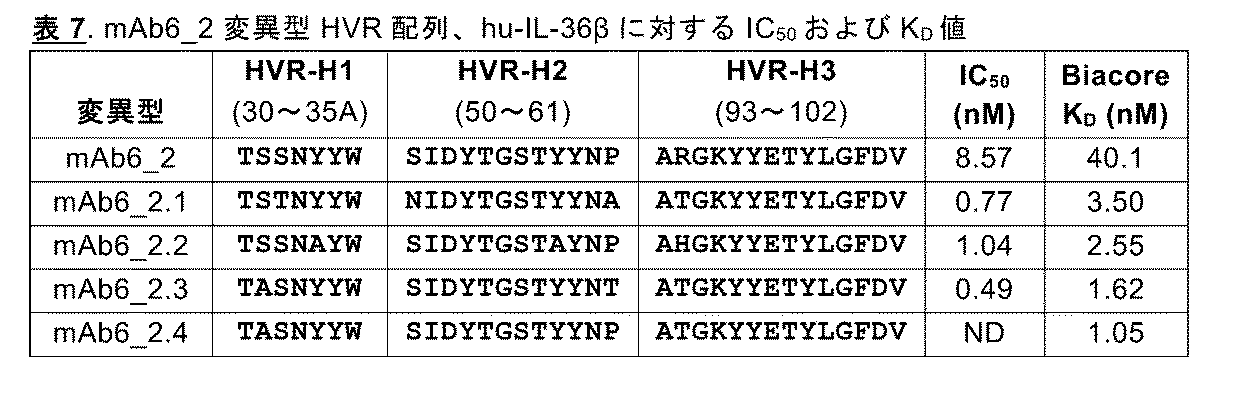
D.mAb6_2親和性成熟ライブラリーの次世代シークエンシング
mAb6_2の親和性をさらに改善するために、mAb6_2親和性成熟ライブラリーの次世代シークエンシング(NGS)を行った。最初のファージライブラリー(ソーティングしていないライブラリー)からの、ならびに第2および第3回の溶液選択(ソーティングしたライブラリー)からのファージミドを有するイー・コリXL-1細胞から、ファージミド二本鎖DNAを単離した。Illumina 16sライブラリー調製プロトコールを使用して、精製したDNAを鋳型として使用して、VH領域のアンプリコンを生成した。Illumina Nextera XT Indexキットを使用して、シークエンシングアダプターおよび二重インデックスバーコードを添加した。Illumina MiSeq機器(Illumina、San Diego、米国)におけるシークエンシングのための調製において、アダプターとライゲーションしたアンプリコンを、MiSeq試薬キットv3(600周期)を使用する標準のIlluminaライブラリー変性および試料ローディングプロトコールに供した。200bp~300bpのインサートサイズを有するアンプリコンの全長を包含するように、ペアードエンド(paired-end)シークエンシングを行った。
D. Next Generation Sequencing of mAb6_2 Affinity Maturation Libraries To further refine the affinity of mAb6_2, next generation sequencing (NGS) of mAb6_2 affinity maturation libraries was performed. Phagemid double-stranded DNA was isolated from E. coli XL-1 cells harboring phagemids from the initial phage library (unsorted library) and from the second and third rounds of solution selection (sorted library). Purified DNA was used as template to generate VH region amplicons using the Illumina 16s library preparation protocol. Sequencing adapters and dual index barcodes were added using the Illumina Nextera XT Index kit. In preparation for sequencing on an Illumina MiSeq instrument (Illumina, San Diego, USA), adapter-ligated amplicons were subjected to standard Illumina library denaturation and sample loading protocols using the MiSeq Reagent Kit v3 (600 cycles). Paired-end sequencing was performed to encompass the full length of the amplicon with an insert size of 200bp-300bp.
ペアードエンドシークエンシングデータを、最初にペアードエンドアセンブラー(paired-end assembler)PANDAseq(Masellaら、2012)を使用してアセンブルして、完全なアンプリコンを得た。その後、特定したアンプリコンについて品質管理(QC)を行い、各アンプリコンを配列挿入または欠失および停止コドンの非存在についてチェックし、各CDR配列は、最高で1つのNNK突然変異のみを有すること、および非NNK突然変異を有しないことを許容された。ランダム化した位置毎の全ての突然変異の頻度を計算することによって、位置の重みマトリックスを生成した。以前に説明される通り(Koenigら、2015)、ソーティングした試料中の所与の位置における所与の突然変異の頻度を、ソーティングしていない試料中の全く同じ突然変異の頻度で割ることによって、各突然変異についての富化比を計算した。mAb6_2の、hu-IL-36βへの結合の改善を支持したHVRにおける予測された突然変異を、以下の表8に要約する。 Paired-end sequencing data were first assembled using the paired-end assembler PANDAseq (Masella et al., 2012) to obtain complete amplicons. Quality control (QC) was then performed on the identified amplicons, checking each amplicon for sequence insertions or deletions and the absence of stop codons, and each CDR sequence was allowed to have only a maximum of one NNK mutation and no non-NNK mutations. A position weight matrix was generated by calculating the frequency of all mutations for each randomized position. As previously described (Koenig et al., 2015), the enrichment ratio for each mutation was calculated by dividing the frequency of a given mutation at a given position in sorted samples by the frequency of the exact same mutation in unsorted samples. Predicted mutations in HVRs that favored improved binding of mAb6_2 to hu-IL-36β are summarized in Table 8 below.
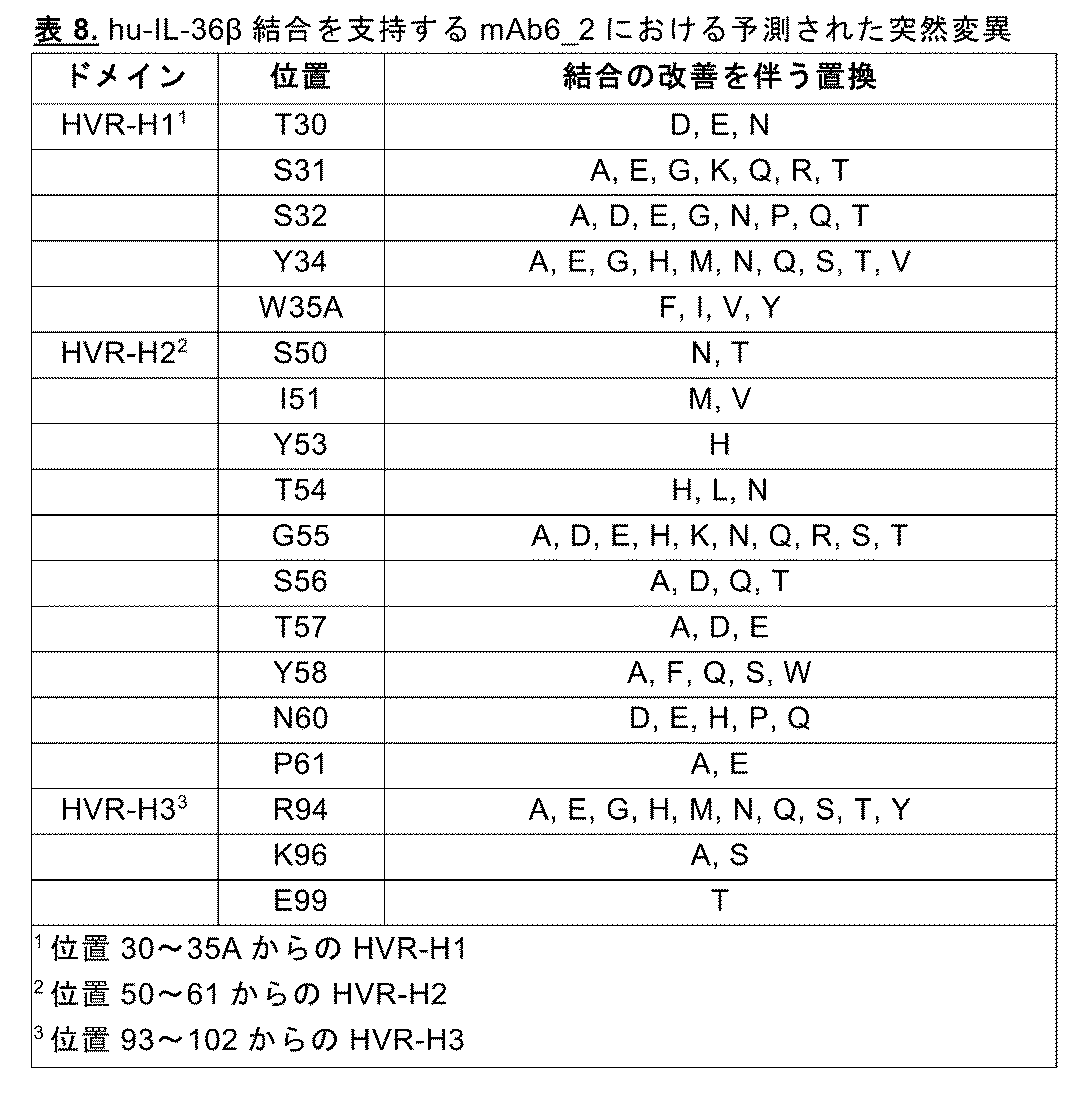
E.mAb6_2親和性改善NGS変異型の特徴付け
mAb6_2親和性改善NGS Fab変異型の生成
NGS解析からの、予測された突然変異(上記の表8に示される)に従って、変異型HVR配列(以下の表9に示される)を伴う選択されたmAb6_2NGS Fabを合成し、8xHisタグを含有する哺乳動物Fab発現コンストラクトにクローニングして、Fabタンパク質を生成した。重鎖または軽鎖をコードするプラスミドを、Expi293F細胞(Thermo Fisher)に製造業者のプロトコールに従って、1:1のHC:LCの比を使用して一過性にトランスフェクトした。上清を1xリン酸緩衝食塩水(pH7.2)(PBS)により1.5倍希釈し、10mMイミダゾールを添加し、バッチ様式で樹脂に2時間結合することによって、FabをHisPur Ni-NTAカラムにより精製した。樹脂を、カラムに満たし、20CV PBS+20mMイミダゾールにより洗浄し、5CV PBS+250mMイミダゾールにより溶出した。PD10カラム(GE)を使用して、試料をPBSに緩衝液交換した。
E. Characterization of mAb6_2 affinity-improved NGS variants Generation of mAb6_2 affinity-improved NGS Fab variants According to the predicted mutations from the NGS analysis (shown in Table 8 above), selected mAb6_2 NGS Fabs with variant HVR sequences (shown in Table 9 below) were synthesized and cloned into a mammalian Fab expression construct containing an 8xHis tag to generate Fab produced protein. Plasmids encoding heavy or light chains were transiently transfected into Expi293F cells (Thermo Fisher) according to the manufacturer's protocol using a 1:1 HC:LC ratio. Fabs were purified on a HisPur Ni-NTA column by diluting the supernatant 1.5-fold with 1× phosphate-buffered saline (pH 7.2) (PBS), adding 10 mM imidazole, and binding to the resin for 2 hours in a batch mode. The resin was loaded into the column, washed with 20 CV PBS + 20 mM imidazole and eluted with 5 CV PBS + 250 mM imidazole. Samples were buffer exchanged into PBS using PD10 columns (GE).
SPRを使用したmAb6_2親和性改善NGS Fab変異型の親和性決定
組換えmAb6_2 NGS Fab変異型のヒトIL-36βへの37℃における結合親和性を決定するために、BIACORE(商標)8K機器によるSPR測定を行った。簡潔に説明すると、Biotin CAPture試薬(GE)の、HBS-EP緩衝液(0.01M HEPES pH7.4、0.15M NaCl、3mM EDTA、0.005%界面活性剤P20)への1:4希釈液を、CAPセンサーチップに2μL/分の流速において適用した。速度論測定のために、6nMのビオチニル化ヒトIL-36βを、10μL/分で捕捉して、第2のフローセル(FC2)における約50応答単位を達成した。FC1を標準として維持した。次に、低(3.125nM)~高(200nM)の、HBS-P緩衝液(0.01M HEPES pH7.4、0.15M NaCl、0.005%界面活性剤P20)中のFabの3倍連続希釈液を、37℃において注入した(流速:10μL/分)。センサー図を記録し、標準および緩衝液減算に供し、その後、BIACORE(登録商標)8K評価ソフトウェア(第1.1.1.7442版)によって評価した。会合速度(kon)および解離速度(koff)を、単純な1対1ラングミュア結合モデルを使用して計算した。平衡解離定数(KD)を、表9に要約する、koff/konの比として計算した。
Affinity Determination of mAb6_2 Affinity-Improved NGS Fab Variants Using SPR To determine the binding affinity of recombinant mAb6_2 NGS Fab variants to human IL-36β at 37° C., SPR measurements were performed with a BIACORE™ 8K instrument. Briefly, a 1:4 dilution of Biotin CAPture reagent (GE) in HBS-EP buffer (0.01 M HEPES pH 7.4, 0.15 M NaCl, 3 mM EDTA, 0.005% surfactant P20) was applied to the CAP sensor chip at a flow rate of 2 μL/min. For kinetic measurements, 6 nM biotinylated human IL-36β was captured at 10 μL/min to achieve approximately 50 response units in the second flow cell (FC2). FC1 was kept as standard. Three-fold serial dilutions of Fabs in HBS-P buffer (0.01 M HEPES pH 7.4, 0.15 M NaCl, 0.005% surfactant P20) from low (3.125 nM) to high (200 nM) were then injected at 37° C. (flow rate: 10 μL/min). Sensor diagrams were recorded, subjected to standard and buffer subtraction, and then evaluated by BIACORE® 8K evaluation software (version 1.1.1.7442). Association rates (kon) and dissociation rates (koff) were calculated using a simple one-to-one Langmuir binding model. Equilibrium dissociation constants (KD) were calculated as the ratio of koff/kon, summarized in Table 9.
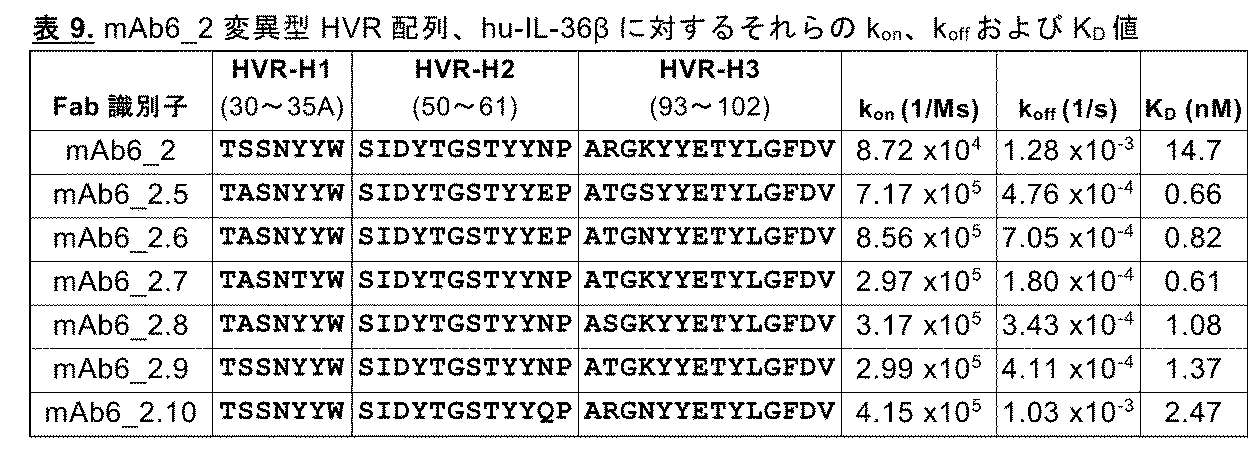
F.mAb2親和性成熟NNKライブラリー構築およびパニング
抗IL-36mAb2のヒトIL-36αおよびヒトIL-36γ親和性をさらに改善するために、32個のコドンにより全ての20個のアミノ酸をコードするNNK縮重コドンを使用してランダム化した重鎖HVR残基(すなわち、HVR-H1、HVR-H2およびHVR-H3)により、一価のFabファージディスプレイのためのFab-アンバー形式のmAb2から、ファージライブラリーを構築した(Brennerら、1992)(mAb2軽鎖残基は、変更されないままである)。3つの重鎖HVRのうちの各々において1つのNNK突然変異を可能にするようにライブラリーを設計した。その後、クンケル突然変異誘発(Kunkelら、1987)を使用して、合成した突然変異誘発オリゴヌクレオチドを使用して、重鎖ライブラリーを構築した。得られたライブラリーDNAを、電気穿孔によりイー・コリXL1細胞に入れ、約4X10⁹個の形質転換体を得た。ファージライブラリーを、SUPERBLOCK(商標)PBS緩衝液(Pierce)および0.05%TWEEN(登録商標)20中で30分間インキュベートし、その後、第1回のパニングのためにヒトIL-36αまたはヒトIL-36γでコーティングしたプレートに適用した。後続の2~3回において、ファージライブラリーを、溶液中において減少濃度のビオチニル化ヒトIL-36αまたはヒトIL-36γと、1000x非ビオチニル化ヒトIL-36αまたはヒトIL-36γを競合物質として伴ってインキュベートして、選択厳密性を増大させた。
F. mAb2 Affinity Maturation NNK Library Construction and Panning To further improve the human IL-36α and human IL-36γ affinity of anti-IL-36 mAb2, heavy chain HVR residues (i.e., HVR-H1, HVR-H2 and HVR-H3) randomized using NNK degenerate codons encoding all 20 amino acids by 32 codons were used for monovalent Fab phage display. A phage library was constructed from mAb2 in Fab-amber format (Brenner et al., 1992) (mAb2 light chain residues left unchanged). Libraries were designed to allow for one NNK mutation in each of the three heavy chain HVRs. A heavy chain library was then constructed using synthetic mutagenesis oligonucleotides using Kunkel mutagenesis (Kunkel et al., 1987). The resulting library DNA was electroporated into E. coli XL1 cells, yielding approximately 4×10 9 transformants. The phage library was incubated in SUPERBLOCK™ PBS buffer (Pierce) and 0.05% TWEEN® 20 for 30 minutes and then applied to human IL-36α or human IL-36γ coated plates for the first round of panning. In 2-3 subsequent rounds, the phage library was incubated in solution with decreasing concentrations of biotinylated human IL-36α or human IL-36γ with 1000× non-biotinylated human IL-36α or human IL-36γ as competitors to increase selection stringency.
G.親和性成熟NNKライブラリーからのmAb2ファージ変異型の特徴付け
最上位の結合シグナルを有する選択されたファージを精製して、ファージ競合ELISAを行った。最適ファージ濃度を、NUNC FプレートにおいてELISA緩衝液中で連続希釈したヒトIL-36αまたはヒトIL-36γと2時間インキュベートした。80μlの混合物を、ヒトIL-36αまたはヒトIL-36γでコーティングしたウェルに15分間移して、非結合ファージを捕捉した。プレートを洗浄緩衝液[PBS中の0.05%TWEEN(登録商標)20]により洗浄し、HRPコンジュゲートした抗M13抗体(Sino biological、カタログ番号11973-MM05-H-50)を、ELISA緩衝液中に30分間添加した。プレートを、上記に説明されるように洗浄および現像した。450nmにおける吸光度を、溶液中の抗原濃度の関数としてプロットして、ファージIC50を決定した。これを、ファージの表面上にディスプレイされたFabクローンについての親和性見積もりとして使用した。変異型HVR配列およびファージIC50の要約について、以下の表10を参照されたい。
G. Characterization of mAb2 phage variants from the affinity maturation NNK library Selected phage with top binding signals were purified and subjected to phage competition ELISA. Optimal phage concentrations were incubated with serially diluted human IL-36α or human IL-36γ in ELISA buffer on NUNC F plates for 2 hours. 80 μl of the mixture was transferred to human IL-36α or human IL-36γ coated wells for 15 minutes to capture unbound phage. Plates were washed with wash buffer [0.05% TWEEN® 20 in PBS], and HRP-conjugated anti-M13 antibody (Sino biological, catalog number 11973-MM05-H-50) was added in ELISA buffer for 30 minutes. Plates were washed and developed as described above. Absorbance at 450 nm was plotted as a function of antigen concentration in solution to determine the phage IC50. This was used as an affinity estimate for Fab clones displayed on the surface of phage. See Table 10 below for a summary of mutant HVR sequences and phage IC50s.
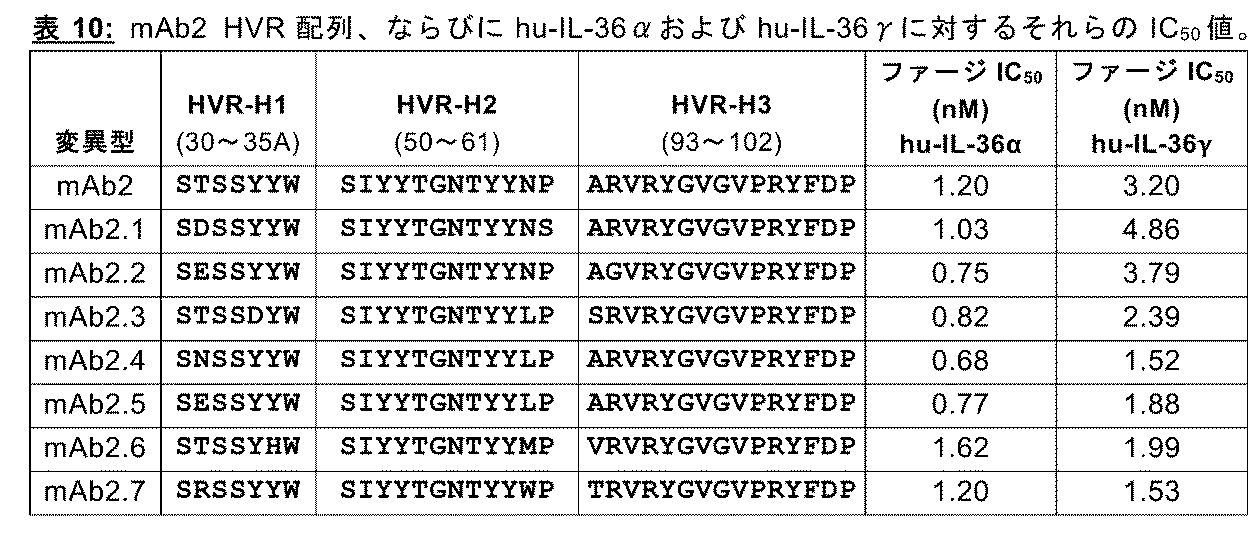
H.mAb2親和性成熟ライブラリーの次世代シークエンシング
mAb2の親和性をさらに改善するために、mAb2親和性成熟ライブラリーの次世代シークエンシング(NGS)を行った。最初のファージライブラリー(ソーティングしていないライブラリー)からの、ならびに第2および第3回の溶液選択(ソーティングしたライブラリー)からのファージミドを有するイー・コリXL-1細胞から、ファージミド二本鎖DNAを単離した。Illumina 16sライブラリー調製プロトコールを使用して、精製したDNAを鋳型として使用して、VH領域のアンプリコンを生成した。Illumina Nextera XT Indexキットを使用して、シークエンシングアダプターおよび二重インデックスバーコードを添加した。Illumina MiSeqにおけるシークエンシングのための調製において、アダプターとライゲーションしたアンプリコンを、MiSeq試薬キットv3(600周期)を使用する標準のIlluminaライブラリー変性および試料ローディングプロトコールに供した。200bp~300bpのインサートサイズを有するアンプリコンの全長を包含するように、ペアードエンドシークエンシングを行った。
H. Next Generation Sequencing of mAb2 Affinity Maturation Libraries To further improve the affinity of mAb2, next generation sequencing (NGS) of mAb2 affinity maturation libraries was performed. Phagemid double-stranded DNA was isolated from E. coli XL-1 cells harboring phagemids from the initial phage library (unsorted library) and from the second and third rounds of solution selection (sorted library). Purified DNA was used as template to generate VH region amplicons using the Illumina 16s library preparation protocol. Sequencing adapters and dual index barcodes were added using the Illumina Nextera XT Index kit. In preparation for sequencing on the Illumina MiSeq, adapter-ligated amplicons were subjected to standard Illumina library denaturation and sample loading protocols using the MiSeq Reagent Kit v3 (600 cycles). Paired-end sequencing was performed to encompass the full length of the amplicon with an insert size of 200bp-300bp.
ペアードエンドシークエンシングデータを、最初にペアードエンドアセンブラーPANDAseq(Masellaら、2012)を使用してアセンブルして、完全なアンプリコンを得た。その後、特定のアンプリコンについて品質管理(QC)を行い、各アンプリコンを配列挿入または欠失がないことおよび停止コドンがないことについてチェックし、各CDR配列は、最高で1つのNNK突然変異のみを有すること、および非NNK突然変異を有しないことを許容された。ランダム化した位置毎の全ての突然変異の頻度を計算することによって、位置の重みマトリックスを生成した。以前に説明される通り(Koenigら、2015)、ソーティングした試料中の所与の位置における所与の突然変異の頻度を、ソーティングしていない試料中の全く同じ突然変異の頻度で割ることによって、各突然変異についての富化比を計算した。mAb2の、hu-IL-36αまたはhu-IL-36γへの結合の改善を支持したHVRにおける予測された突然変異を、表11に要約する。 Paired-end sequencing data were first assembled using the paired-end assembler PANDAseq (Masella et al., 2012) to obtain complete amplicons. Specific amplicons were then subjected to quality control (QC) to check each amplicon for no sequence insertions or deletions and no stop codons, each CDR sequence was allowed to have only a maximum of one NNK mutation and no non-NNK mutations. A position weight matrix was generated by calculating the frequency of all mutations for each randomized position. As previously described (Koenig et al., 2015), the enrichment ratio for each mutation was calculated by dividing the frequency of a given mutation at a given position in sorted samples by the frequency of the exact same mutation in unsorted samples. Table 11 summarizes predicted mutations in HVRs that favored improved binding of mAb2 to hu-IL-36α or hu-IL-36γ.

I.mAb2親和性改善NGS変異型の特徴付け
mAb2親和性改善NGS Fab変異型の生成
NGS解析からの予測された突然変異(上記の表11)に従って、選択されたmAb2 NGS Fab HVR変異型配列(以下の表12に示される)を合成し、8xHisタグを含有する哺乳動物Fab発現コンストラクトにクローニングして、Fabタンパク質を生成した。重鎖または軽鎖をコードするプラスミドを、Expi293F細胞(Thermo Fisher)に、1:1のHC:LCの比を使用してトランスフェクトした。上清を1xリン酸緩衝食塩水(pH7.2)(「PBS」)により1.5倍希釈し、10mMイミダゾールを添加し、バッチ様式で樹脂に2時間結合することによって、FabをHisPur Ni-NTAカラムにより精製した。樹脂を、カラムに満たし、20CV PBS+20mMイミダゾールにより洗浄し、5CV PBS+250mMイミダゾールにより溶出した。PD10カラム(GE)を使用して、試料をPBSに緩衝液交換した。
I. Characterization of mAb2 Affinity-Improved NGS Variants Generation of mAb2 Affinity-Improved NGS Fab Variants Selected mAb2 NGS Fab HVR variant sequences (shown in Table 12 below) were synthesized according to the predicted mutations from the NGS analysis (Table 11 above) and cloned into a mammalian Fab expression construct containing an 8xHis tag to generate Fab proteins. Plasmids encoding heavy or light chains were transfected into Expi293F cells (Thermo Fisher) using a HC:LC ratio of 1:1. Fabs were purified on a HisPur Ni-NTA column by diluting the supernatant 1.5-fold with 1× phosphate-buffered saline (pH 7.2) (“PBS”), adding 10 mM imidazole, and binding to the resin in a batch mode for 2 hours. The resin was loaded into the column, washed with 20 CV PBS + 20 mM imidazole and eluted with 5 CV PBS + 250 mM imidazole. Samples were buffer exchanged into PBS using PD10 columns (GE).

SPRを使用したmAb2親和性改善NGS Fab変異型の親和性決定
組換えmAb2 NGS Fab変異型のヒトIL-36αおよびヒトIL-36γへの37℃における結合親和性を決定するために、BIACORE(商標)8K機器によるSPR測定を行った。簡潔に説明すると、Biotin CAPture試薬(GE)の、HBS-EP緩衝液(0.01M HEPES pH7.4、0.15M NaCl、3mM EDTA、0.005%界面活性剤P20)への1:4希釈液を、CAPセンサーチップに2uL/分の流速において適用した。速度論測定のために、3nMのビオチニル化ヒトIL-36αおよびヒトIL-36γを、10uL/分で捕捉して、第2のフローセル(FC2)における約50応答単位を達成した。FC1を標準として維持した。次に、低(3.125nM)~高(200nM)の、HBS-P緩衝液(0.01M HEPES pH7.4、0.15M NaCl、0.005%界面活性剤P20)中のFabの3倍連続希釈液を、37℃において注入した(流速:10uL/分)。センサー図を記録し、標準および緩衝液減算に供し、その後、BIACORE(登録商標)8K評価ソフトウェア(第1.1.1.7442版)によって評価した。会合速度(kon)および解離速度(koff)を、単純な1対1ラングミュア結合モデルを使用して計算した。平衡解離定数(KD)を、以下の表13に要約する、koff/konの比として計算した。
Affinity Determination of mAb2 Affinity-Improved NGS Fab Variants Using SPR To determine the binding affinities of recombinant mAb2 NGS Fab variants to human IL-36α and human IL-36γ at 37° C., SPR measurements were performed with a BIACORE™ 8K instrument. Briefly, a 1:4 dilution of Biotin CAPture reagent (GE) in HBS-EP buffer (0.01 M HEPES pH 7.4, 0.15 M NaCl, 3 mM EDTA, 0.005% surfactant P20) was applied to the CAP sensor chip at a flow rate of 2 uL/min. For kinetic measurements, 3 nM biotinylated human IL-36α and human IL-36γ were captured at 10 uL/min to achieve approximately 50 response units in the second flow cell (FC2). FC1 was kept as standard. Three-fold serial dilutions of Fabs in HBS-P buffer (0.01 M HEPES pH 7.4, 0.15 M NaCl, 0.005% Surfactant P20) from low (3.125 nM) to high (200 nM) were then injected at 37° C. (flow rate: 10 uL/min). Sensor diagrams were recorded, subjected to standard and buffer subtraction, and then evaluated by BIACORE® 8K evaluation software (version 1.1.1.7442). Association rates (kon) and dissociation rates (koff) were calculated using a simple one-to-one Langmuir binding model. Equilibrium dissociation constants (KD) were calculated as the ratio of koff/kon, summarized in Table 13 below.

[実施例5]
HaCat細胞によるhu-IL-36により刺激されたIL-8分泌における、抗IL-36抗体変異型の遮断活性のインビトロ評定
インビトロでの親和性成熟mAb2およびmAb6_2変異型の遮断効力および有効性を決定するために、本発明者らは、HaCat細胞によるhu-IL-36により刺激されたIL-8分泌を阻害する変異型の組換え産生Fab断片の、それらの能力を評価した。HaCat細胞アッセイを、組換え発現した抗IL-36または対照抗体Fab断片がIgGの代わりにアンタゴニストとして使用されたことを除いては、実施例2で説明されるように行った。簡潔に説明すると、抗IL-36 Fabまたは適切な抗体Fab対照(例えば、Hu IgG1対照)を、HaCat細胞と37℃において1時間インキュベートし、続いて、アゴニスト(hu-IL-36α、hu-IL-36βまたはhu-IL-36γ)を添加した。実験をさらに24時間(37℃、5%CO2にて)進め、細胞培養上清を回収し、IL-8の定量を実施例2で説明されるように行った。その後、補間したデータを、GraphPad Prismソフトウェアにおいて、標準の非線形回帰解析を使用して解析して、抗体IC50値を導いた。
[Example 5]
In Vitro Assessment of Blocking Activity of Anti-IL-36 Antibody Variants on hu-IL-36-Stimulated IL-8 Secretion by HaCat Cells To determine the blocking potency and efficacy of affinity-matured mAb2 and mAb6_2 variants in vitro, we evaluated the ability of mutant recombinantly produced Fab fragments to inhibit hu-IL-36-stimulated IL-8 secretion by HaCat cells. HaCat cell assays were performed as described in Example 2, except that recombinantly expressed anti-IL-36 or control antibody Fab fragments were used as antagonists instead of IgG. Briefly, anti-IL-36 Fab or appropriate antibody Fab control (eg, Hu IgG1 control) was incubated with HaCat cells for 1 hour at 37° C. followed by addition of agonist (hu-IL-36α, hu-IL-36β or hu-IL-36γ). Experiments were allowed to proceed for an additional 24 hours (37° C., 5% CO 2 ), cell culture supernatants were harvested and IL-8 quantification was performed as described in Example 2. Interpolated data were then analyzed using standard non-linear regression analysis in GraphPad Prism software to derive antibody IC50 values.

表14において示される通り、mAb2.10 Fabは、HaCat細胞におけるhu-IL-36αおよびhu-IL-36γ媒介IL-8産生の最も強力な遮断活性を実証し、それぞれ、約0.38nMおよび1.09nMのIC50であった。表14においてさらに示される通り、mAb6_2.7 Fabは、HaCat細胞におけるIL-36β媒介IL-8産生の遮断活性の改善を実証し、約0.2nMのIC50であった。 As shown in Table 14, mAb2.10 Fab demonstrated the most potent blocking activity of hu-IL-36α- and hu-IL-36γ-mediated IL-8 production in HaCat cells with IC50s of approximately 0.38 nM and 1.09 nM, respectively. As further shown in Table 14, mAb6_2.7 Fab demonstrated improved blocking activity of IL-36β-mediated IL-8 production in HaCat cells, with an IC50 of approximately 0.2 nM.
[実施例6]
抗IL-36多重特異性抗体mAb2.10/mAb6_2.7の生成
mAb2.10およびmAb6_2.7重鎖を、2工程クローニングプロセスにおいてpRK発現ベクターへ「ノブ・イントゥ・ホール(knobs-into-hole)」形式(Ridgway、1996)にてクローニングした。工程1において、mAb2.10を合成し、ホール突然変異(T366S、L368AおよびY407V)および8X Hisタグを既に含有するpRKベクターへクローニングした(AgeIおよびBstEIIを使用して)。mAb6_2.7を合成し、ノブ突然変異(T366W)およびFlagタグを既に含有するpRKベクターへクローニングした(AgeIおよびBstEIIを使用して)。また、mAb2軽鎖を、余分の突然変異を伴わないpRK発現ベクターへクローニングした。タグ付けしたコンストラクトによる多重特異性抗体の最初の発現および精製試験の成功後、クローニングプロセスの工程2において、タグをmAb2.10およびmAb6_2.7重鎖から除去した。mAb2.10からの8XHisタグを、1組のプライマー[フォワードプライマー:5'Phos-TAAGCTTGGCCGCCATGGCC-3'(配列番号514)およびリバースプライマー:5'Phos-ACCCGGAGACAGGGAGAGGC-3'(配列番号515)]を使用して完全に除去し、一方で、停止コドンTAAを、1組のプライマー[フォワードプライマー:5'-CTGTCTCCGGGTTAAGATTACAAGG-3'(配列番号516)およびリバースプライマー:5'-CCTTGTAATCTTAACCCGGAGACAG-3'(配列番号517)]を使用してmAb6_2.7重鎖とFlagタグとの間に挿入した。
[Example 6]
Generation of Anti-IL-36 Multispecific Antibody mAb2.10/mAb6_2.7 The mAb2.10 and mAb6_2.7 heavy chains were cloned into the pRK expression vector in a 'knobs-into-hole' format (Ridgway, 1996) in a two-step cloning process. In step 1, mAb 2.10 was synthesized and cloned (using AgeI and BstEII) into the pRK vector already containing hole mutations (T366S, L368A and Y407V) and an 8X His tag. mAb6_2.7 was synthesized and cloned (using AgeI and BstEII) into the pRK vector already containing the knob mutation (T366W) and Flag tag. The mAb2 light chain was also cloned into the pRK expression vector without extra mutations. After successful initial expression and purification trials of multispecific antibodies with tagged constructs, the tags were removed from the mAb2.10 and mAb6_2.7 heavy chains in step 2 of the cloning process. The 8XHis tag from mAb 2.10 was completely removed using a pair of primers [forward primer: 5'Phos-TAAGCTTGGCCGCCATGGCC-3' (SEQ ID NO:514) and reverse primer: 5'Phos-ACCCGGAGACAGGGAGAGGC-3' (SEQ ID NO:515)], while the stop codon TAA was removed using a pair of primers [forward primer: 5'-CTGTCTCCGGGTTAAGATTACAAGG-3. ' (SEQ ID NO: 516) and reverse primer: 5'-CCTTGTAATCTTAACCCGGAGACAG-3' (SEQ ID NO: 517)] were used to insert between the mAb 6_2.7 heavy chain and the Flag tag.
多重特異性共通軽鎖抗体mAb2.10/mAb6_2.7を、Expi293F細胞(Thermo Fisher Scientific、Waltham、MA、米国)において製造業者のプロトコールに従って、ホール突然変異およびN297Gを含有するmAb2.10の重鎖(配列番号235)、ノブ突然変異およびN297Gを含有するmAb6_2.7の重鎖(配列番号192)、ならびにmAb2の軽鎖(配列番号169)をコードするプラスミドを1:1:2の質量比においてコトランスフェクトすることによって、発現させた。細胞を4日後に採取し、清澄な上清を、PBS(pH7.5)中で平衡化したMAbSelect Sureカラム(GE Healthcare、Chicago、IL、米国)に適用した。タンパク質を、100mMクエン酸ナトリウム(pH3)により溶出し、1.5M Tris-HCl(pH8.8)を添加することによってpHを中和した。タンパク質含有画分をプールし、50mM Tris(pH8)、10mM NaClに緩衝液交換した。その後、タンパク質を、50mM Tris(pH8)、10mMNaCl中で平衡化したCapto S Impactカラム(GE Healthcare、Chicago、IL、米国)上にロードし、50mM ビス-Tris(pH6.5)、10mM NaClの30CV勾配により溶出した。 The multispecific consensus light chain antibody mAb2.10/mAb6_2.7 was isolated according to the manufacturer's protocol in Expi293F cells (Thermo Fisher Scientific, Waltham, Mass., USA), the heavy chain of mAb2.10 containing the hole mutation and N297G (SEQ ID NO: 235), mAb6_2.7 containing the knob mutation and N297G. (SEQ ID NO: 192), as well as plasmids encoding the light chain of mAb2 (SEQ ID NO: 169) at a mass ratio of 1:1:2. Cells were harvested 4 days later and the clarified supernatant was applied to a MAbSelect Sure column (GE Healthcare, Chicago, Ill., USA) equilibrated in PBS (pH 7.5). Proteins were eluted with 100 mM sodium citrate (pH 3) and pH neutralized by adding 1.5 M Tris-HCl (pH 8.8). Protein-containing fractions were pooled and buffer exchanged into 50 mM Tris (pH 8), 10 mM NaCl. Proteins were then loaded onto a Capto S Impact column (GE Healthcare, Chicago, Ill., USA) equilibrated in 50 mM Tris (pH 8), 10 mM NaCl and eluted with a 30 CV gradient of 50 mM Bis-Tris (pH 6.5), 10 mM NaCl.
精製した多重特異性抗体分子のインタクトな質量を、Ultimate-3000(Thermo Scientific)液体クロマトグラフィー系と組み合わせたQ Exactive(Thermo Scientific)質量分析計を使用して確認した。精製した抗体を、液体クロマトグラフィー系に接続したPLRP-Sカラム(Agilent)上に注入した。インタクト質量分析の解析は、観察された質量が予測されたヘテロ二量体の質量に適合することを確証した。また、ホモ二量体種の非存在は、F(ab’)2およびFc/2断片の均一なプールを生成したFabricator酵素(Genovis)を使用することによって、確認された。各断片は、予測された質量に適合した。 The intact mass of the purified multispecific antibody molecules was confirmed using a Q Exactive (Thermo Scientific) mass spectrometer coupled with an Ultimate-3000 (Thermo Scientific) liquid chromatography system. Purified antibody was injected onto a PLRP-S column (Agilent) connected to a liquid chromatography system. Analysis of intact mass spectrometry confirmed that the observed masses matched the expected heterodimer masses. The absence of homodimeric species was also confirmed by using Fabricator Enzyme (Genovis), which generated homogeneous pools of F(ab')2 and Fc/2 fragments. Each fragment matched the expected mass.
インタクトな質量分析によって特定される、mAb2.10/mAb6_2.7を含有するCapto S溶出画分をプールし、Superdex 200pgカラム(GE Healthcare、Chicago、IL、米国)上にロードした。単分散タンパク質を含有するピーク画分をプールし、1X PBS(pH7.5)中に保存した。 Capto S elution fractions containing mAb2.10/mAb6_2.7, identified by intact mass spectrometry, were pooled and loaded onto a Superdex 200 pg column (GE Healthcare, Chicago, Ill., USA). Peak fractions containing monodisperse protein were pooled and stored in 1X PBS (pH 7.5).
[実施例7]
抗IL-36多重特異性抗体mAb2.10/mAb6_2.7の非特異的結合評定
多重特異性分子mAb2.10/mAb6_2.7 IgGの非特異的結合を、バキュロウイルスELISA(Hotzelら、2012)を使用して評定した。簡潔に説明すると、バキュロウイルス粒子により、3%懸濁液において96ウェルMaxisorpプレートを4℃にて一晩コーティングした。その後、プレートを、1%BSAおよび0.05%Tween-20を含むPBS中で室温において1時間ブロッキングした。0.5%BSAおよび0.05%Tween20を含有する1xPBS(ELISA緩衝液)中の300nM、100nMおよび33nMのmAb2.10/mAb6_2.7 IgGを、プレートに1時間添加し、プレートを、0.05%Tween20を含む1xPBS(洗浄緩衝液)により洗浄した。結合した抗体を、ELISA緩衝液中のセイヨウワサビペルオキシダーゼにコンジュゲートしたヤギ抗ヒトIgG(Jackson ImmunoResearch)により検出した。プレートを、室温において攪拌しながら1時間インキュベートし、洗浄緩衝液により6回洗浄し、100μL/ウェルの1 Step Turbo TMB基質(ThermoFisher、カタログ番号34022)の添加によって15分間現像した。酵素反応を、50μL/ウェルの2N H2SO4を使用して停止させた。プレートを、Perkin Elmerプレートリーダー(Envision 2103多標識リーダー)を使用して450nmにおいて解析し、標準抗体と比較した。陽性対照と比較して、多重特異性分子mAb2.10/mAb6_2.7 IgGは、検出可能なバキュロウイルスELISAシグナルを示さず、バキュロウイルス粒子への非特異的結合の非存在を示した(表15)。
[Example 7]
Non-Specific Binding Assessment of Anti-IL-36 Multispecific Antibody mAb2.10/mAb6_2.7 Non-specific binding of multispecific mAb2.10/mAb6_2.7 IgG was assessed using a baculovirus ELISA (Hotzel et al., 2012). Briefly, baculovirus particles were coated in a 3% suspension onto 96-well Maxisorp plates overnight at 4°C. Plates were then blocked for 1 hour at room temperature in PBS containing 1% BSA and 0.05% Tween-20. 300 nM, 100 nM and 33 nM of mAb2.10/mAb6_2.7 IgG in 1x PBS containing 0.5% BSA and 0.05% Tween 20 (ELISA buffer) was added to the plate for 1 hour and the plate was washed with 1x PBS containing 0.05% Tween 20 (wash buffer). Bound antibody was detected by goat anti-human IgG (Jackson ImmunoResearch) conjugated to horseradish peroxidase in ELISA buffer. Plates were incubated for 1 hour at room temperature with agitation, washed 6 times with wash buffer, and developed by the addition of 100 μL/well of 1 Step Turbo TMB substrate (ThermoFisher, cat#34022) for 15 minutes. The enzymatic reaction was stopped using 50 μL/well of 2N H2SO4. Plates were analyzed at 450 nm using a Perkin Elmer plate reader (Envision 2103 multilabel reader) and compared to standard antibodies. Compared to the positive control, the multispecific mAb2.10/mAb6_2.7 IgG showed no detectable baculovirus ELISA signal, indicating the absence of non-specific binding to baculovirus particles (Table 15).

[実施例8]
抗hu-IL-36多重特異性抗体mAb2.10/mAb6_2.7 IgGの活性のインビトロ評定
抗IL-36多重特異性抗体mAb2.10/mAb6_2.7の結合速度論
実施例2において説明されるようにBIACORE(商標)8K機器を使用して、表面プラズモン共鳴(SPR)解析を使用して、ヒトおよびカニクイザルIL-36(それぞれ、「hu-IL-36」および「cy-IL-36」)についての結合親和性を決定した。インビボビオチニル化hu-IL-36α-Avi、hu-IL-36β-Avi、hu-IL-36γ-Avi、cy-IL-36α-Avi、cy-IL-36β-Aviまたはcy-IL-36γ-Aviを、mAb2.10/mAb6_2.7への結合について別々に解析した。簡潔に説明すると、Biotin CAPture試薬(GE Healthcare)の、HBS-EP緩衝液(0.01M HEPES pH7.4、0.15M NaCl、3mM EDTA、0.005%界面活性剤P20)への1:4希釈液を、CAPセンサーチップに2μL/分の流速において適用した。速度論測定のために、1nMのビオチニル化ヒトおよびカニクイザルIL-36α-Avi、IL-36γ-Avi;0.8nMのビオチニル化ヒトおよびカニクイザルIL-36β-Aviを、10μL/分で捕捉して、第2のフローセル(FC2)における15~25応答単位を達成した。FC1を標準として維持した。次に、低(1.56nM)~高(200nM)の、HBS-P緩衝液(0.01M HEPES pH7.4、0.15M NaCl、0.005%界面活性剤P20)中のmAb2.10/mAb6_2.7タンパク質の2倍連続希釈液を、25℃または37℃のいずれかにおいて注入した(流速:30μL/分)。センサー図を記録し、標準および緩衝液減算に供し、その後、BIACORE(登録商標)8K評価ソフトウェア(第1.1.1.7442版)によりデータ解析した。各多重特異性IgG抗体は、アッセイされる1つのIL-36タンパク質に結合することができる1つのFabアームのみを含有するので、結合相互作用は一価である。会合速度(kon)および解離速度(koff)を、単純な1対1ラングミュア結合モデルを使用して計算した。平衡解離定数(KD)を、koff/konの比として計算した。
[Example 8]
In vitro assessment of activity of anti-hu-IL-36 multispecific antibody mAb2.10/mAb6_2.7 IgG Binding kinetics of anti-IL-36 multispecific antibody mAb2.10/mAb6_2.7 Human and cynomolgus monkey IL-36 (respectively, " The binding affinities for hu-IL-36' and 'cy-IL-36') were determined. In vivo biotinylated hu-IL-36α-Avi, hu-IL-36β-Avi, hu-IL-36γ-Avi, cy-IL-36α-Avi, cy-IL-36β-Avi or cy-IL-36γ-Avi were analyzed separately for binding to mAb2.10/mAb6_2.7. Briefly, a 1:4 dilution of Biotin CAPture reagent (GE Healthcare) in HBS-EP buffer (0.01 M HEPES pH 7.4, 0.15 M NaCl, 3 mM EDTA, 0.005% surfactant P20) was applied to the CAP sensor chip at a flow rate of 2 μL/min. For kinetic measurements, 1 nM biotinylated human and cynomolgus IL-36α-Avi, IL-36γ-Avi; 0.8 nM biotinylated human and cynomolgus IL-36β-Avi were captured at 10 μL/min to achieve 15-25 response units in the second flow cell (FC2). FC1 was kept as standard. Two-fold serial dilutions of mAb2.10/mAb6_2.7 protein in HBS-P buffer (0.01 M HEPES pH 7.4, 0.15 M NaCl, 0.005% surfactant P20) from low (1.56 nM) to high (200 nM) were then injected at either 25°C or 37°C (flow rate: 30 μL/min). Sensor diagrams were recorded and subjected to standard and buffer subtraction, followed by data analysis by BIACORE® 8K evaluation software (version 1.1.1.7442). The binding interaction is monovalent as each multispecific IgG antibody contains only one Fab arm capable of binding one IL-36 protein assayed. Association rates (kon) and dissociation rates (koff) were calculated using a simple one-to-one Langmuir binding model. Equilibrium dissociation constants (KD) were calculated as the ratio of koff/kon.
mAb2.10/mAb6_2.7についてのBiacore親和性結果を、以下の表16に要約する。mAb2.10/mAb6_2.7は、全てのヒトおよびカニクイザルIL-36サイトカインに、高く、かつ同等の親和性により結合する。 The Biacore affinity results for mAb2.10/mAb6_2.7 are summarized in Table 16 below. mAb2.10/mAb6_2.7 bind to all human and cynomolgus monkey IL-36 cytokines with high and comparable affinity.

HaCat細胞によるIL-36により刺激されたIL-8分泌における、多重特異性抗体mAb2.10/mAb6_2.7の遮断活性
多重特異性抗体mAb2.10/mAb6_2.7の遮断効力および有効性を決定するために、本発明者らは、HaCat細胞によるhu-IL-36により刺激されたIL-8分泌を阻害する抗体の能力を評価した。また、ヒトIgGアイソタイプ対照(「Hu IgG1対照」)を陰性対照として使用するためにアッセイした。HaCat細胞アッセイを、組換え発現したmAb2.10/mAb6_2.7またはHu IgG1対照がアンタゴニストとして使用されたことを除いては、実施例2で説明されるように行った。簡潔に説明すると、mAb2.10/mAb6_2.7または適切な抗体対照(例えば、Hu IgG1対照)を、HaCat細胞と37℃において1時間インキュベートし、続いて、アゴニスト(hu-IL-36α、hu-IL-36βまたはhu-IL-36γ)を添加した。実験をさらに24時間(37℃、5%CO2にて)進め、細胞培養上清を回収した。
Blocking Activity of Multispecific Antibody mAb2.10/mAb6_2.7 on IL-36 Stimulated IL-8 Secretion by HaCat Cells To determine the blocking potency and efficacy of the multispecific antibody mAb2.10/mAb6_2.7, we assessed the ability of the antibody to inhibit hu-IL-36 stimulated IL-8 secretion by HaCat cells. A human IgG isotype control (“Hu IgG1 control”) was also assayed for use as a negative control. HaCat cell assays were performed as described in Example 2, except that recombinantly expressed mAb2.10/mAb6_2.7 or Hu IgG1 control were used as antagonists. Briefly, mAb2.10/mAb6_2.7 or an appropriate antibody control (eg, Hu IgG1 control) were incubated with HaCat cells for 1 hour at 37° C. followed by addition of agonist (hu-IL-36α, hu-IL-36β or hu-IL-36γ). Experiments were allowed to proceed for an additional 24 hours (37° C., 5% CO 2 ) and cell culture supernatants were harvested.
上清中のIL-8の定量を、Cisbio BioassayのHTRF技術ベースのヒトIL-8アッセイを使用して行った。アッセイを製造業者のガイドラインに従って行った。HTRF互換性Spectramax(Molecular Devices)を使用して、生データを得、SoftMax Proソフトウェア(Molecular Devices)を併用して、665nmおよび620nmにおける、それぞれ、アクセプターの、ドナーに対する放出シグナルの比を計算した。得られたデータを、GraphPad Prismソフトウェアを使用して解析し、線形回帰解析および「1/Y2の重み」によって定義される重み付けを使用して、補間を行った。その後、補間したデータを、標準の非線形回帰3パラメータ解析を使用して解析して、アゴニストEC50および抗体IC50値を導いた。 Quantification of IL-8 in supernatants was performed using Cisbio Bioassay's HTRF technology-based human IL-8 assay. Assays were performed according to the manufacturer's guidelines. Raw data were obtained using an HTRF-compatible Spectramax (Molecular Devices) and SoftMax Pro software (Molecular Devices) was used to calculate the ratio of acceptor to donor emission signals at 665 nm and 620 nm, respectively. The resulting data were analyzed using GraphPad Prism software and interpolation was performed using linear regression analysis and weighting defined by "1/Y2 weight". Interpolated data were then analyzed using standard non-linear regression three-parameter analysis to derive agonist EC50 and antibody IC50 values.
図3A、図3Bおよび図3Cにおいて示される通り、mAb2.10/mAb6_2.7は、HaCat細胞におけるIL-36α、IL-36βおよびIL-36γ媒介IL-8産生の強力な遮断活性を実証し、それぞれ、約0.38nM、0.13nMおよび1.1nMのIC50値であった。8nMのmAb2.10/mAb6_2.7では、HaCat細胞におけるIL-36α、IL-36βおよびIL-36γ媒介IL-8産生の100%が阻害された。 As shown in Figures 3A, 3B and 3C, mAb2.10/mAb6_2.7 demonstrated potent blocking activity of IL-36α, IL-36β and IL-36γ mediated IL-8 production in HaCat cells with IC50 values of approximately 0.38 nM, 0.13 nM and 1.1 nM, respectively. 8 nM mAb2.10/mAb6_2.7 inhibited 100% of IL-36α, IL-36β and IL-36γ mediated IL-8 production in HaCat cells.
ヒト初代ケラチノサイトによるIL-36により刺激されたIL-8分泌における、多重特異性抗体mAb2.10/mAb6_2.7の遮断活性
多重特異性抗体mAb2.10/mAb6_2.7のヒト初代細胞に対する遮断効力および有効性を決定するために、本発明者らは、ヒト初代成人ケラチノサイトによるhu-IL-36により刺激されたIL-8分泌を阻害する抗体の能力を評価した。また、ヒトIgGアイソタイプ対照(「Hu IgG1対照」)を陰性対照として使用するためにアッセイした。ヒト成人正常上皮ケラチノサイトをLonzaから得た。製造業者によって、細胞は、提供された正常な(疾患を有しない)ヒト組織から単離され、低温保存された。製造業者によって推奨される一般ガイドラインを使用して、細胞を解凍し、維持した。HEKa細胞を、Gold Bulletキット(Lonza)からの補完したヒトケラチノサイト増殖培地からなる増殖培地において維持した。実験使用の前日に、HEKaを、平底96ウェルプレートに、使用日に約80~85%コンフルエンシーになるように細胞10,000個/ウェルにて播種した。初代ケラチノサイト細胞アッセイを、組換え発現したmAb2.10/mAb6_2.7またはHu IgG1対照がアンタゴニストとして使用されたことを除いては、実施例2で説明されるように、ヒト成人ケラチノサイト(HEKa)により行った。簡潔に説明すると、mAb2.10/mAb6_2.7または適切な抗体対照(例えば、Hu IgG1対照)を、HEKa細胞と37℃において1時間インキュベートし、続いて、アゴニスト(hu-IL-36α、hu-IL-36βまたはhu-IL-36γ)を添加した。実験をさらに24時間(37℃、5%CO2にて)進め、細胞培養上清を回収し、IL-8の定量を、上記に説明されるようにCisbio BioassayのHTRF技術に基づくヒトIL-8アッセイを使用して行った。その後、補間したデータを、GraphPad Prismソフトウェアにおいて、標準の非線形回帰解析を使用して解析して、抗体IC50値を導いた。
Blocking activity of the multispecific antibody mAb2.10/mAb6_2.7 on IL-36-stimulated IL-8 secretion by human primary keratinocytes To determine the blocking potency and effectiveness of the multispecific antibody mAb2.10/mAb6_2.7 on human primary cells, we evaluated the ability of the antibody to inhibit hu-IL-36-stimulated IL-8 secretion by human primary adult keratinocytes. A human IgG isotype control (“Hu IgG1 control”) was also assayed for use as a negative control. Human adult normal epithelial keratinocytes were obtained from Lonza. Cells were isolated from donated normal (disease-free) human tissue and cryopreserved by the manufacturer. Cells were thawed and maintained using the general guidelines recommended by the manufacturer. HEKa cells were maintained in growth medium consisting of supplemented human keratinocyte growth medium from the Gold Bullet kit (Lonza). The day before experimental use, HEKa was seeded in flat bottom 96-well plates at 10,000 cells/well to approximately 80-85% confluency on the day of use. Primary keratinocyte cell assays were performed with human adult keratinocytes (HEKa) as described in Example 2, except that recombinantly expressed mAb2.10/mAb6_2.7 or Hu IgG1 control were used as antagonists. Briefly, mAb2.10/mAb6_2.7 or an appropriate antibody control (eg, Hu IgG1 control) were incubated with HEKa cells for 1 hour at 37° C. followed by addition of agonist (hu-IL-36α, hu-IL-36β or hu-IL-36γ). Experiments were allowed to proceed for an additional 24 hours (at 37° C., 5% CO2), cell culture supernatants were harvested, and IL-8 quantification was performed using Cisbio Bioassay's HTRF technology-based human IL-8 assay as described above. Interpolated data were then analyzed using standard non-linear regression analysis in GraphPad Prism software to derive antibody IC50 values.
図4A、図4Bおよび図4Cにおいて示される通り、mAb2.10/mAb6_2.7は、ヒト初代成人ケラチノサイトにおけるIL-36α、IL-36βおよびIL-36γ媒介IL-8産生の強力な遮断活性を実証し、それぞれ、約0.56nM、0.11nMおよび2.7nMのIC50値であった。8nMのmAb2.10/mAb6_2.7では、ヒト初代成人ケラチノサイトにおけるIL-36α、IL-36βおよびIL-36γ媒介IL-8産生の100%が阻害された。この実施例は、mAb2.10/mAb6_2.7のヒト初代細胞に対する効力は、ヒトケラチノサイト細胞系HaCatについて観察された効力と同様であることを実証する。 As shown in Figures 4A, 4B and 4C, mAb2.10/mAb6_2.7 demonstrated potent blocking activity of IL-36α, IL-36β and IL-36γ mediated IL-8 production in human primary adult keratinocytes with IC50 values of approximately 0.56 nM, 0.11 nM and 2.7 nM, respectively. 8 nM of mAb2.10/mAb6_2.7 inhibited 100% of IL-36α, IL-36β and IL-36γ mediated IL-8 production in human primary adult keratinocytes. This example demonstrates that the potency of mAb2.10/mAb6_2.7 against human primary cells is similar to that observed for the human keratinocyte cell line HaCat.
多重特異性抗体mAb2.10/mAb6_2.7のFabアームの独立した遮断活性を実証するために、本発明者らは、上記に説明される方法と類似するが、以下の改変を伴う方法を使用して、hu-IL-36αとhu-IL-36βとの混合物によって刺激されたヒト初代成人ケラチノサイトによるIL-8分泌を阻害するFabアームの能力を評価した。mAb2.10/mAb6_2.7または適切な抗体対照(例えば、Hu IgG1対照)を、HEKa細胞と37℃において1時間インキュベートし、続いて、アゴニスト(個々にhu-IL-36α、個々にhu-IL-36β、または各サイトカインのおよそのEC50におけるhu-IL-36αとhu-IL-36βとの混合物)を添加した。mAb2.10/mAb6_2.7は、IL-36αとIL-36βとの混合物の強力な遮断活性を実証し、約0.44nMのIC50値であった。mAb2.10/mAb6_2.7の、個々のIL-36αおよびIL-36βに対するIC50値は、上記の本実施例においてヒト初代成人ケラチノサイトについて報告された遮断IC50値と一致し、mAb2.10/mAb6_2.7のIL-36α/IL-36γおよびIL-36βターゲティングFabアームは、強力に、かつ独立して、IL-36α、IL-36βおよびIL-36γを中和することを実証した。 To demonstrate the independent blocking activity of the Fab arms of the multispecific antibody mAb2.10/mAb6_2.7, we evaluated the ability of the Fab arms to inhibit IL-8 secretion by human primary adult keratinocytes stimulated by a mixture of hu-IL-36α and hu-IL-36β using a method similar to that described above, but with the following modifications. mAb2.10/mAb6_2.7 or an appropriate antibody control (e.g., Hu IgG1 control) were incubated with HEKa cells for 1 hour at 37° C., followed by the addition of agonists (hu-IL-36α individually, hu-IL-36β individually, or a mixture of hu-IL-36α and hu-IL-36β at the approximate EC50 of each cytokine). mAb2.10/mAb6_2.7 demonstrated potent blocking activity of a mixture of IL-36α and IL-36β with an IC50 value of approximately 0.44 nM. The IC50 values of mAb2.10/mAb6_2.7 against individual IL-36α and IL-36β were consistent with the blocking IC50 values reported for human primary adult keratinocytes in this example above, and the IL-36α/IL-36γ and IL-36β targeting Fab arms of mAb2.10/mAb6_2.7 potently and independently directed IL-36α, It has been demonstrated to neutralize IL-36β and IL-36γ.
多重特異性抗体mAb2.10/mAb6_2.7の、IL-36アゴニストサイトカインの混合物に対する効力および有効性を決定するために、本発明者らは、抗体の、初代細胞におけるIL-36α、IL-36βおよびIL-36γの混合物によるシグナル伝達を遮断する能力を評価した。mAb2.10/mAb6_2.7の、hu-IL-36α、hu-IL-36βおよびhu-IL-36γの混合物によって刺激されたヒト初代成人ケラチノサイトによるIL-8分泌を阻害する能力を、上記に説明される方法と同様であるが、以下の改変を伴う方法を使用して評定した。mAb2.10/mAb6_2.7または適切な抗体対照(例えば、Hu IgG1対照)を、HEKa細胞と37℃において1時間インキュベートし、続いて、アゴニストの混合物(各サイトカインのおよそのEC50~EC65おけるhu-IL-36α、hu-IL-36βおよびhu-IL-36γ)を添加した。mAb2.10/mAb6_2.7を所望のサイトカイン混合物の存在下において滴定することによって、mAb2.10/mAb6_2.7のIC50値は、1.16nMであると決定され、IL-36α、IL-36βおよびIL-6γを含有する混合物における強力な遮断活性を実証した。 To determine the potency and efficacy of the multispecific antibody mAb2.10/mAb6_2.7 against a mixture of IL-36 agonist cytokines, we evaluated the ability of the antibody to block signaling by a mixture of IL-36α, IL-36β and IL-36γ in primary cells. The ability of mAb2.10/mAb6_2.7 to inhibit IL-8 secretion by human primary adult keratinocytes stimulated by a mixture of hu-IL-36α, hu-IL-36β and hu-IL-36γ was assessed using a method similar to that described above, but with the following modifications. mAb2.10/mAb6_2.7 or an appropriate antibody control (e.g., Hu IgG1 control) was incubated with HEKa cells for 1 hour at 37° C., followed by addition of a mixture of agonists (hu-IL-36α, hu-IL-36β and hu-IL-36γ at approximately EC50-EC65 for each cytokine). By titrating mAb2.10/mAb6_2.7 in the presence of the desired cytokine mixture, the IC50 value of mAb2.10/mAb6_2.7 was determined to be 1.16 nM, demonstrating potent blocking activity in mixtures containing IL-36α, IL-36β and IL-6γ.
[実施例9]
DSC安定性評価
抗体安定性に対する重鎖改変の影響を研究するために、抗体の重鎖に存在する改変のみで相違している抗体でDSC(示差走査熱量測定)を行った。目的は、N297突然変異の相対的安定性をYTEの有無で比較することであり、LALA-YTE改変の影響でもあった。比較された抗体は、以下に示すように存在する改変で相違していた。
i. PUR3685:LALA-YTE、
ii. LAS39328(PUR3677)N297G、
iii. LAS39329(PUR3678)N297G+YTE、
iv. E-N297G-LS-KiH(表2Dに記載の例示的Ab#27)、
v. E-LALA-YTE-KiH(表2Dに記載の例示的Ab#23)、
vi E-LALA-YTE-S-S-KiH(表2Dからの例示的Ab#21)、および
vii. E-LALA-YTE-S-SインバースKiH(表2Dに記載の例示的Ab#22)。
[Example 9]
DSC Stability Assessment To study the impact of heavy chain modifications on antibody stability, DSC (differential scanning calorimetry) was performed on antibodies that differ only in modifications present in the heavy chain of the antibodies. The aim was to compare the relative stability of the N297 mutation with and without YTE, as well as the effect of the LALA-YTE modification. The antibodies compared differed in the modifications present as indicated below.
i. PUR3685: LALA-YTE,
ii. LAS39328 (PUR3677) N297G,
iii. LAS39329 (PUR3678) N297G+YTE,
iv. E-N297G-LS-KiH (exemplary Ab #27 described in Table 2D),
v. E-LALA-YTE-KiH (exemplary Ab #23 described in Table 2D),
vi E-LALA-YTE-SS-KiH (exemplary Ab#21 from Table 2D), and vii. E-LALA-YTE-SS inverse KiH (exemplary Ab #22 listed in Table 2D).

表17における方法1に記載のパラメータ/条件を用いて、以下:(PUR3685)LALA-YTE、LAS39328(PUR3677)N297G、およびLAS39329(PUR3678)N297G+YTEの改変を有する抗体を分析した。得られた結果を図7Aおよび表18に示す。それらから分かるように、N297G+YTE改変の存在は、LALA改変と比較して、かなり低いTm開始をもたらした。 Antibodies with the following modifications: (PUR3685) LALA-YTE, LAS39328 (PUR3677) N297G, and LAS39329 (PUR3678) N297G+YTE were analyzed using the parameters/conditions described in Method 1 in Table 17. The results obtained are shown in FIG. 7A and Table 18. As can be seen, the presence of the N297G+YTE modification resulted in significantly lower Tm initiation compared to the LALA modification.
表17における方法2に記載のパラメータ/条件を用いて、以下:E-N297G-LS-KiH、E-LALA-YTE-KiH、E-LALA-YTE-S-S-KiH、およびE-LALA-YTE-S-SインバースKiHの改変を有する抗体を分析した。得られた結果を図7Bおよび表18に示す。特に、ジスルフィド結合S-Sの存在は、S-SなしのLALA改変と比較して、安定性をさらに増加させることが示された。 Antibodies with the following modifications were analyzed using the parameters/conditions described in Method 2 in Table 17: E-N297G-LS-KiH, E-LALA-YTE-KiH, E-LALA-YTE-S-S-KiH, and E-LALA-YTE-S-S inverse KiH. The results obtained are shown in FIG. 7B and Table 18. In particular, the presence of disulfide bonds SS was shown to further increase stability compared to LALA modifications without SS.

DSCによって示された熱的安定性の改善は、臨床開発および製造への、特許請求の抗体の適性をさらに補助する。 The improved thermal stability demonstrated by DSC further supports the suitability of the claimed antibodies for clinical development and manufacturing.
[実施例10]
4つの先進リードの特性分析
本発明の抗体をさらに評価するために、非最適製剤中における低濃度抗体および高濃度抗体のストレス安定性研究を行った。以下の表で示す抗体(すなわち、E-N297G-LS-KiH、E-LALA-YTE-KiH、E-LALA-YTE-S-S-KiH、およびE-LALA-YTE-S-SインバースKiH)について、ストレス安定性研究を行った。これらの抗体は、表2Dにおける例示的抗体27、23、21、および22に対応している。非最適製剤は、20mMヒスチジン緩衝剤および5%ショ糖を含有し、pH6.0であった。
[Example 10]
Characterization of Four Advanced Leads To further evaluate the antibodies of the invention, stress stability studies of low and high antibody concentrations in non-optimal formulations were performed. Stress stability studies were performed on the antibodies shown in the table below (ie, E-N297G-LS-KiH, E-LALA-YTE-KiH, E-LALA-YTE-SS-KiH, and E-LALA-YTE-SS-KiH). These antibodies correspond to exemplary antibodies 27, 23, 21, and 22 in Table 2D. A non-optimal formulation contained 20 mM histidine buffer and 5% sucrose at pH 6.0.
低濃度安定性研究では、「参照」試料は、2~8℃で保存し、「ストレス」試料は、25℃および40℃で保存した。試料は、実験開始時(t=0)、ならびに2週間(t=2w)および4週間(t=4w)の貯蔵後に分析した。 For low concentration stability studies, 'reference' samples were stored at 2-8°C and 'stress' samples were stored at 25°C and 40°C. Samples were analyzed at the beginning of the experiment (t=0) and after 2 weeks (t=2w) and 4 weeks (t=4w) of storage.
高濃度安定性研究には、「参照」試料は、2~8℃で保存し、「ストレス」試料は、40℃で保存した。試料は、濃度を増加させる前および後、ならびに2週間の貯蔵(t=2w)後に分析した。 For high concentration stability studies, 'reference' samples were stored at 2-8°C and 'stress' samples were stored at 40°C. Samples were analyzed before and after increasing concentrations and after 2 weeks of storage (t=2w).
抗体の凝集は、サイズ排除クロマトグラフィー(SEC)および目視検査(V)によって研究した。結果を表19に示す。 Antibody aggregation was studied by size exclusion chromatography (SEC) and visual inspection (V). The results are shown in Table 19.


貯蔵条件にかかわらず、いずれの時点でも、いかなる視覚的凝集も観察されなかった。全ての低濃度試料について、ストレス条件下でさえ、SECによって経時的に観察された相対凝集は低度であった。 No visual aggregation was observed at any time point, regardless of storage conditions. Low relative aggregation was observed over time by SEC for all low concentration samples, even under stress conditions.
高濃度研究は、沈殿も凝集もなしに濃度を増加させることが可能であることを示している。ストレス条件での2週間の貯蔵の後に、濃縮試料における低度から中程度の凝集のみが観察された。 High concentration studies show that it is possible to increase the concentration without precipitation or aggregation. Only low to moderate aggregation in the concentrated samples was observed after 2 weeks of storage under stress conditions.
加速条件における安定性でも示されたように、非最適化製剤中の凝集傾向が低いことは、特許請求されている抗体が臨床開発および製造に適していることを支持している。 The low propensity to aggregate in non-optimized formulations, as demonstrated by stability under accelerated conditions, supports suitability of the claimed antibody for clinical development and manufacturing.
[実施例11]
ヒト新生児Fc受容体への抗IL-36Abの結合
IgGについての新生児Fc受容体(FcRn)の結合親和性は、生理的pHでは低く、エンドソームの酸性pHでは高い。したがって、FcRnはエンドソーム中でIgGに結合し、それによって、それらの血流への再循環が促進され、リソソーム中で分解が回避される。FcRnについてのpH6におけるIgG親和性を増加させ、それにより、抗体の血清中半減期を長くするために、抗IL-36抗体のFc領域にYTE(M252Y/S254T/T256E)突然変異を導入した。
[Example 11]
Anti-IL-36 Ab Binding to Human Neonatal Fc Receptors The binding affinity of neonatal Fc receptors (FcRn) for IgG is low at physiological pH and high at endosomal acidic pH. Therefore, FcRn binds IgG in endosomes, thereby promoting their recycling to the bloodstream and avoiding degradation in lysosomes. YTE (M252Y/S254T/T256E) mutations were introduced into the Fc region of the anti-IL-36 antibody to increase the IgG affinity at pH 6 for FcRn, thereby increasing the serum half-life of the antibody.
抗IL-36およびトランスズマブ(YTE突然変異が無い陰性対照IgG1)抗体を、様々なpHにおけるFcRnへの結合についてSPRを用いて評価した。結果を表20に示し、ここで、相対的結合は、表21における親和性に対応している。 Anti-IL-36 and transuzumab (negative control IgG1 without YTE mutation) antibodies were evaluated for binding to FcRn at various pHs using SPR. Results are shown in Table 20, where relative binding corresponds to affinity in Table 21.
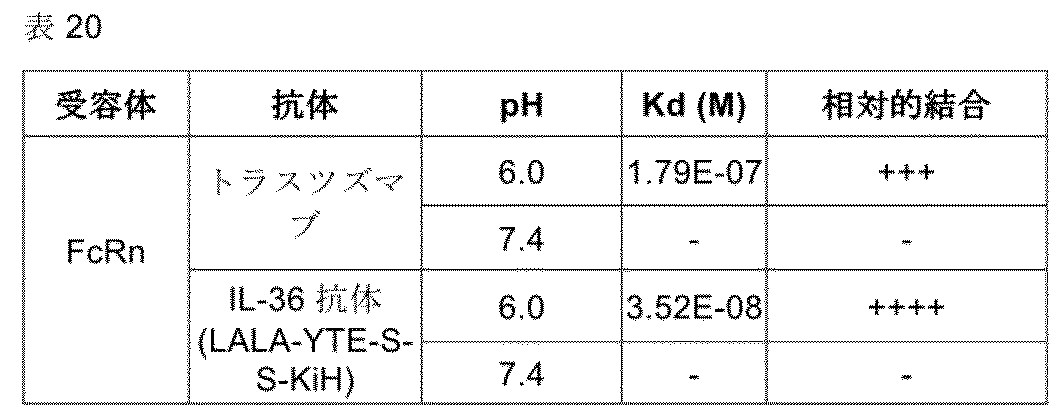

予測通り、抗IL-36とトランスズマブ抗体の両方がpH依存性結合を示し、有意に弱い相対的結合がpH7.4で観察された。しかし、トランスズマブと比較して、YTE突然変異を含有する抗IL36抗体は、pH6.0におけるFcRnについての結合親和性(Kd)で5倍の増大を示した。 As expected, both anti-IL-36 and transuzumab antibodies showed pH-dependent binding, with significantly weaker relative binding observed at pH 7.4. However, compared to transuzumab, the anti-IL36 antibody containing the YTE mutation showed a 5-fold increase in binding affinity (Kd) for FcRn at pH 6.0.
[実施例12]
ヒトFcγ受容体への抗IL-36Abの結合
Fcγ受容体(FcγR)に対するIgGの親和性を低減し、それによって、Fcに媒介されるエフェクター機能のリスクを最小限にするために、位置234および235におけるロイシン(L)からアラニン(A)への二重置換からなるサイレンシング突然変異(LALA)をIL-36抗体のFc領域内に導入した。
[Example 12]
Anti-IL-36 Ab Binding to Human Fcγ Receptors To reduce the affinity of IgG for Fcγ receptors (FcγR) and thereby minimize the risk of Fc-mediated effector function, a silencing mutation (LALA) consisting of a double substitution of leucine (L) to alanine (A) at positions 234 and 235 was introduced into the Fc region of the IL-36 antibody.
本発明者らは、高親和性(I型)および低親和性(II型およびIII型)FcγRへの結合親和性をSPRを用いて測定することによって、FcγRへの抗体結合に及ぼすLALA突然変異の影響を評価した。結合プロファイルは、FcγRへの高親和性を有するFc操作IgG1であるトランスズマブと比較した。結果を表22に示し、ここで、相対的結合は、表23に示す親和性に対応している。 We evaluated the effect of LALA mutations on antibody binding to FcγRs by measuring binding affinities to high-affinity (type I) and low-affinity (types II and III) FcγRs using SPR. The binding profile was compared to transuzumab, an Fc-engineered IgG1 with high affinity for FcγRs. Results are shown in Table 22, where relative binding corresponds to the affinities shown in Table 23.

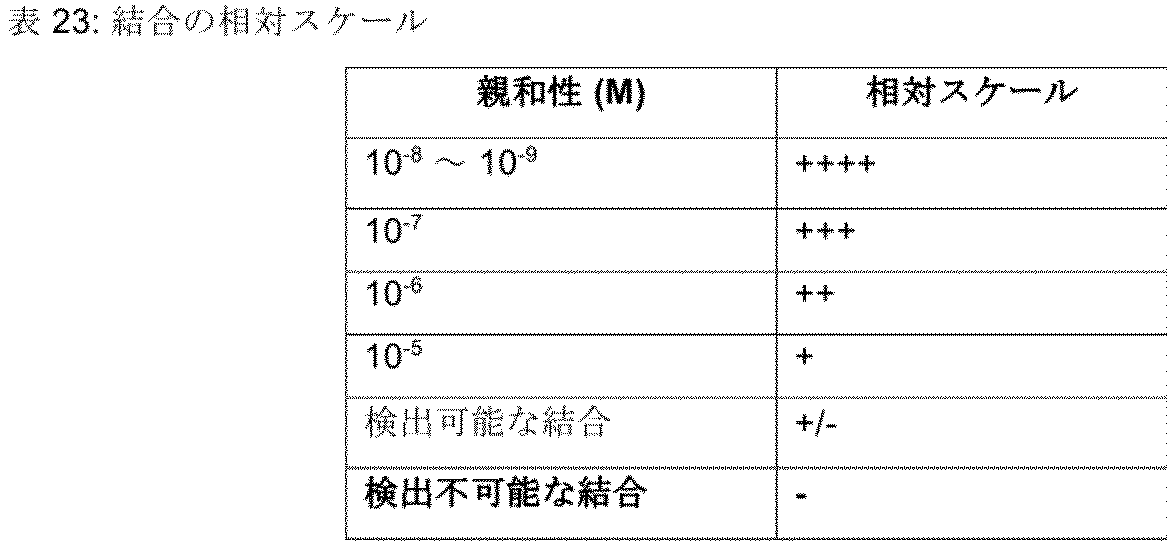
トランスズマブ(陽性IgG1対照)は、高親和性および低親和性受容体に有意な結合を示した。比較として、LALA突然変異を含有する抗IL36抗体は、高親和性および低親和性FcγRに明らかな結合を示さなかったか、結合の有意な低下を示した。IgGと、低親和性FcγRIIおよびFcγRIIIとの相互作用は比較的に不安定であり、凝集IgGおよび免疫複合体でみられた多価相互作用のみが持続し、活性化をもたらす。 Transuzumab (positive IgG1 control) showed significant binding to high and low affinity receptors. In comparison, anti-IL36 antibodies containing the LALA mutation showed either no apparent binding or significantly reduced binding to high-affinity and low-affinity FcγRs. Interactions between IgG and low-affinity FcγRII and FcγRIII are relatively labile, with only multivalent interactions seen with aggregated IgG and immune complexes persisting and leading to activation.
添付の特許請求の範囲にかかわらず、本明細書で示される本開示は、以下の条項によっても定義され、それは、単独で、または1つもしくは複数の他の条項もしくは実施形態との組合せで、有益であり得る。上記の説明を限定することなく、以下のように番号付けされる本開示のある特定の非限定的な条項が示され、個々に番号付けされた条項の各々は、先行するか、または後続の条項のいずれかと共に使用するか、または組み合わせてもよい。したがって、このことは、全てのそのような組合せについての支持を提供することを意図し、以下に明確に示される特定の組合せに必ずしも限定されない。
1. (i)第1の軽鎖超可変領域(HVR-L1)、第2の軽鎖超可変領域(HVR-L2)および第3の軽鎖超可変領域(HVR-L3)ならびに/または(ii)第1の重鎖超可変領域(HVR-H1)、第2の重鎖超可変領域(HVR-H2)および第3の重鎖超可変領域(HVR-H3)を含む抗IL-36抗体であって、
(a)HVR-L1が、TGSSSNIGAHYDVH(配列番号18)、TGSSSNIGAGYDVH(配列番号22)、RASQSVSSNYLA(配列番号38)、またはRASQTIYKYLN(配列番号42);から選択されるアミノ酸配列を含み、
(b)HVR-L2が、SNNNRPS(配列番号15)、GNDNRPS(配列番号19)、GNTNRPS(配列番号23)、GNRNRPS(配列番号27)、SASSLQS(配列番号39)、またはAASSLQS(配列番号43);から選択されるアミノ酸配列を含み、
(c)HVR-L3が、QSYDYSLRGYV(配列番号16)、QSYDYSLSGYV(配列番号20)、QSYDYSLRVYV(配列番号28)、QSYDYSLKAYV(配列番号32)、QSYDISLSGWV(配列番号36)、QQTYSYPPT(配列番号40)、またはQQSSIPYT(配列番号44);から選択されるアミノ酸配列を含み、
(d)HVR-H1が、SAYAMHW(配列番号46)、STSSYYW(配列番号50)、SSTSYYW(配列番号54)、GSRSYYW(配列番号58)、STYAMSW(配列番号62)、TSSNYYW(配列番号66)、SSYGMH(配列番号70)、SNYAIS(配列番号74)、TSTNYYW(配列番号82)、TSSNAYW(配列番号86)、TASNYYW(配列番号90)、TASNTYW(配列番号106)、SDSSYYW(配列番号122)、SESSYYW(配列番号126)、STSSDYW(配列番号130)、SNSSYYW(配列番号134)、STSSYHW(配列番号142)、SRSSYYW(配列番号146)、XXXNXYX(配列番号251)(ここで、1位のXは、T、D、EまたはNであり;2位のXは、S、A、E、G、K、Q、RまたはTであり;3位のXは、S、A、D、E、G、N、P、QまたはTであり;5位のXは、Y、A、E、G、H、M、N、Q、S、TまたはVであり;7位のXは、W、F、I、VまたはYである)またはXXXXXXW(配列番号336)(ここで、1位のXは、SまたはDであり;2位のXは、T、A、D、E、G、H、K、N、P、Q、RまたはSであり;3位のXは、S、D、E、G、K、N、PまたはRであり;4位のXは、S、G、K、NまたはPであり;5位のXは、Y、A、D、E、G、H、M、N、Q、S、T、VまたはWであり;6位のXは、Y、A、F、G、H、M、NまたはQである)から選択されるアミノ酸配列を含み、
(e)HVR-H2が、VISYDGTNEYYAD(配列番号47)、SIYYTGNTYYNP(配列番号51)、SIHYSGNTYYNP(配列番号55)、SIHYSGTTYYNP(配列番号59)、GISGGSGYTYYAD(配列番号63)、SIDYTGSTYYNP(配列番号67)、VISYGGSERYYAD(配列番号71)、GILPILGTVDYAQ(配列番号75)、NIDYTGSTYYNA(配列番号83)、SIDYTGSTAYNP(配列番号87)、SIDYTGSTYYNT(配列番号91)、SIDYTGSTYYEP(配列番号99)、SIDYTGSTYYEP(配列番号103)、SIDYTGSTYYQP(配列番号119)、SIYYTGNTYYNS(配列番号123)、SIYYTGNTYYLP(配列番号131)、SIYYTGNTYYMP(配列番号143)、SIYYTGNTYYWP(配列番号147)、SIYYTGETYYAP(配列番号151)、XXDXXXXXXYXX(配列番号284)(ここで、1位のXは、S、NまたはTであり;2位のXは、I、MまたはVであり;4位のXは、YまたはHであり;5位のXは、T、H、LまたはNであり;6位のXは、G、A、D、E、H、K、N、Q、R、SまたはTであり;7位のXは、S、A、D、QまたはTであり;8位のXは、T、A、DまたはEであり;9位のXは、Y、A、F、Q、SまたはWであり;11位のXは、N、D、E、H、PまたはQであり;12位のXは、P、AまたはEである)またはXXXXXXXXXYXP(配列番号379)(ここで、1位のXは、S、F、I、MまたはQであり;2位のXは、I、A、G、L、R、S、TまたはVであり;3位のXは、Y、A、D、E、F、G、H、K、L、M、N、P、Q、R、S、TまたはWであり;4位のXは、Y、A、D、E、F、G、H、K、N、P、Q、R、S、TまたはWであり;5位のXは、T、D、E、K、N、PまたはQであり;6位のXは、GまたはQであり;7位のXは、N、D、E、G、H、I、K、M、P、RまたはSであり;8位のXは、T、A、E、F、G、H、K、P、Q、R、S、V、WまたはYであり;9位のXは、YまたはWであり;11位のXは、N、A、D、E、K、L、M、P、Q、SまたはTである)から選択されるアミノ酸配列を含み、
(f)HVR-H3が、ARGIRIFTSYFDS(配列番号48)、ARVRYGVGVPRYFDP(配列番号52)、ARVHYGGYIPRRFDH(配列番号56)、ARVAPSYPRVFDY(配列番号60)、ARVVTYRDPPASFDY(配列番号64)、ARGKYYETYLGFDV(配列番号68)、AREPWYSSRGWTGYGFDV(配列番号72)、AREPWYRLGAFDV(配列番号76)、ATGKYYETYLGFDV(配列番号84)、AHGKYYETYLGFDV(配列番号88)、ATGSYYETYLGFDV(配列番号100)、ATGNYYETYLGFDV(配列番号104)、ASGKYYETYLGFDV(配列番号112)、ARGNYYETYLGFDV(配列番号120)、AGVRYGVGVPRYFDP(配列番号128)、SRVRYGVGVPRYFDP(配列番号132)、VRVRYGVGVPRYFDP(配列番号144)、TRVRYGVGVPRYFDP(配列番号148)、ARLRYGVGVPRYFDP(配列番号152)、ARVKYGVGVPRYFDP(配列番号156)、ARVRYGVGVPRHFDP(配列番号160)、AXGXYYXTYLGFDV(配列番号322)(ここで、2位のXは、R、A、E、G、H、M、N、Q、S、TまたはYであり;4位のXは、K、AまたはSであり;7位のXは、EまたはTである)またはXXXXXGXXVPRXFDP(配列番号462)(ここで、1位のXは、AまたはVであり;2位のXは、R、A、G、N、QまたはTであり;3位のXは、V、A、F、I、K、L、M、QまたはSであり;4位のXは、R、A、I、K、L、M、P、Q、S、TまたはVであり;5位のXは、Y、H、I、LまたはVであり;7位のXは、V、A、F、G、K、M、N、Q、R、S、T、WまたはYであり;8位のXは、G、N、R、SまたはTであり;12位のXは、Y、F、H、I、L、M、QまたはRである)から選択されるアミノ酸配列を含む、
抗IL-36抗体。
2. (a)HVR-L1が、配列番号18のアミノ酸配列を含み、
(b)HVR-L2が、配列番号19のアミノ酸配列を含み、
(c)HVR-L3が、配列番号20のアミノ酸配列を含む、
条項1に記載の抗体。
3. (a)HVR-H1が、配列番号66、82、86、90または252~283から選択されるアミノ酸配列を含み、
(b)HVR-H2が、配列番号67、83、87、91、99、103、119または285~321から選択されるアミノ酸配列を含み、
(c)HVR-H3が、配列番号68、84、88、100、104、112、120または323~335から選択されるアミノ酸配列を含む、
条項1または2に記載の抗体。
4. (a)HVR-H1が、配列番号50、122、126、130、134、138、142、146または337~378から選択されるアミノ酸配列を含み、
(b)HVR-H2が、配列番号51、123、131、143、147、151または380~461から選択されるアミノ酸配列を含み、
(c)HVR-H3が、配列番号52、128、132、144、148、152、156、160または463~513から選択されるアミノ酸配列を含む、
条項1または2に記載の抗体。
5. (a)HVR-L1が、配列番号18のアミノ酸配列を含み、
(b)HVR-L2が、配列番号19のアミノ酸配列を含み、
(c)HVR-L3が、配列番号20のアミノ酸配列を含み、
(d)HVR-H1が、配列番号66、82、86、90または252~283から選択されるアミノ酸配列を含み、
(e)HVR-H2が、配列番号67、83、87、91、99、103、119または285~321から選択されるアミノ酸配列を含み、
(f)HVR-H3が、配列番号68、84、88、100、104、112、120または323~335から選択されるアミノ酸配列を含む、
条項1に記載の抗体。
6. (a)HVR-L1が、配列番号18のアミノ酸配列を含み、
(b)HVR-L2が、配列番号19のアミノ酸配列を含み、
(c)HVR-L3が、配列番号20のアミノ酸配列を含み、
(d)HVR-H1が、配列番号50、122、126、130、134、138、142、146または337~378から選択されるアミノ酸配列を含み、
(e)HVR-H2が、配列番号51、123、131、143、147、151または380~461から選択されるアミノ酸配列を含み、
(f)HVR-H3が、配列番号52、128、132、144、148、152、156、160または463~513から選択されるアミノ酸配列を含む、
条項1に記載の抗体。
7. 配列番号13、17、21、25、29、33、37、41、77もしくは78から選択される配列と少なくとも90%の同一性を有する軽鎖可変ドメイン(VL)アミノ酸配列;および/または配列番号45、49、53、57、61、65、69、73、79、80、81、85、89、93、97、101、105、109、113、117、121、125、129、133、137、141、145、149、153、157、161もしくは165から選択される配列と少なくとも90%の同一性を有する重鎖可変ドメイン(VH)アミノ酸配列を含む、条項1~6のいずれか一項に記載の抗体。
8. 配列番号17もしくは77と少なくとも90%の同一性を有する軽鎖可変ドメイン(VL)アミノ酸配列;および/または配列番号49、65、79、80、81、85、89、93、97、101、105、109、113、117、121、125、129、133、137、141、145、149、153、157、161もしくは165から選択される配列と少なくとも90%の同一性を有する重鎖可変ドメイン(VH)アミノ酸配列を含む、条項1~6のいずれか一項に記載の抗体。
9. 配列番号17もしくは77と少なくとも90%の同一性を有する軽鎖可変ドメイン(VL)アミノ酸配列;および/または配列番号65、80、81、85、89、93、97、101、105、109、113もしくは117から選択される配列と少なくとも90%の同一性を有する重鎖可変ドメイン(VH)アミノ酸配列を含む、条項1~6のいずれか一項に記載の抗体。
10. 配列番号17もしくは77と少なくとも90%の同一性を有する軽鎖可変ドメイン(VL)アミノ酸配列;および/または配列番号49、79、121、125、129、133、137、141、145、149、153、157、161もしくは165から選択される配列と少なくとも90%の同一性を有する重鎖可変ドメイン(VH)アミノ酸配列を含む、条項1~6のいずれか一項に記載の抗体。
11. 配列番号169もしくは242と少なくとも90%の同一性を有する軽鎖(LC)アミノ酸配列;ならびに/または配列番号170~202、248~250、518~616および743~751から選択される配列と少なくとも90%の同一性を有する重鎖(HC)アミノ酸配列を含む、条項1~10のいずれか一項に記載の抗体。
12. 配列番号169もしくは242と少なくとも90%の同一性を有する軽鎖(LC)アミノ酸配列;ならびに/または配列番号203~241および617~733から選択される配列と少なくとも90%の同一性を有する重鎖(HC)アミノ酸配列を含む、条項1~10のいずれか一項に記載の抗体。
13. 配列番号13、17、21、25、29、33、37、41、77もまたは78から選択される配列と少なくとも90%の同一性を有する軽鎖可変ドメイン(VL)アミノ酸配列;および/または配列番号45、49、53、57、61、65、69、73、79、80、81、85、89、93、97、101、105、109、113、117、121、125、129、133、137、141、145、149、153、157、161もしくは165から選択される配列と少なくとも90%の同一性を有する重鎖可変ドメイン(VH)アミノ酸配列を含む、抗IL-36抗体。
14. 配列番号13、17、21、25、29、33、37、41、77もしくは78から選択される軽鎖可変ドメイン(VL)アミノ酸配列;および/または配列番号45、49、53、57、61、65、69、73、79、80、81、85、89、93、97、101、105、109、113、117、121、125、129、133、137、141、145、149、153、157、161もしくは165から選択される重鎖可変ドメイン(VH)アミノ酸配列を含む、抗IL-36抗体。
15. 配列番号17もしくは77と少なくとも90%の同一性を有する軽鎖可変ドメイン(VL)アミノ酸配列;および/または配列番号49、65、79、80、81、85、89、93、97、101、105、109、113、117、121、125、129、133、137、141、145、149、153、157、161もしくは165から選択される配列と少なくとも90%の同一性を有する重鎖可変ドメイン(VH)アミノ酸配列を含む、抗IL-36抗体。
16. 配列番号17もしくは77の軽鎖可変ドメイン(VL)アミノ酸配列;および/または配列番号49、65、79、80、81、85、89、93、97、101、105、109、113、117、121、125、129、133、137、141、145、149、153、157、161もしくは165から選択される重鎖可変ドメイン(VH)アミノ酸配列を含む、抗IL-36抗体。
17. 配列番号17もしくは77と少なくとも90%の同一性を有する軽鎖可変ドメイン(VL)アミノ酸配列;および/または配列番号65、80、81、85、89、93、97、101、105、109、113もしくは117から選択される配列と少なくとも90%の同一性を有する重鎖可変ドメイン(VH)アミノ酸配列を含む、抗IL-36抗体。
18. 配列番号17または77の軽鎖可変ドメイン(VL)アミノ酸配列;および/または配列番号65、80、81、85、89、93、97、101、105、109、113もしくは117から選択される重鎖可変ドメイン(VH)アミノ酸配列を含む、抗IL-36抗体。
19. 配列番号17もしくは77と少なくとも90%の同一性を有する軽鎖可変ドメイン(VL)アミノ酸配列;および/または配列番号49、79、121、125、129、133、137、141、145、149、153、157、161もしくは165から選択される配列と少なくとも90%の同一性を有する重鎖可変ドメイン(VH)アミノ酸配列を含む、抗IL-36抗体。
20. 配列番号17もしくは77の軽鎖可変ドメイン(VL)アミノ酸配列;および/または配列番号49、79、121、125、129、133、137、141、145、149、153、157、161もしくは165から選択される重鎖可変ドメイン(VH)アミノ酸配列を含む、抗IL-36抗体。
21. 配列番号169もしくは242と少なくとも90%の同一性を有する軽鎖(LC)アミノ酸配列;ならびに/または配列番号170~202、248、249~250、518~616および743~751から選択される配列と少なくとも90%の同一性を有する重鎖(HC)アミノ酸配列を含む、抗IL-36抗体。
22. 配列番号169もしくは242の軽鎖(LC)アミノ酸配列;ならびに/または配列番号170~202、248~250、518~616および743~751から選択される重鎖(HC)アミノ酸配列を含む、抗IL-36抗体。
23. 配列番号169もしくは242と少なくとも90%の同一性を有する軽鎖(LC)アミノ酸配列;ならびに/または配列番号203~241および617~733から選択される配列と少なくとも90%の同一性を有する重鎖(HC)アミノ酸配列を含む、抗IL-36抗体。
24. 配列番号169もしくは242の軽鎖(LC)アミノ酸配列;および/または配列番号206~241から選択される重鎖(HC)アミノ酸配列を含む、抗IL-36抗体。
25. (a)各々、配列番号18のHVR-L1配列、配列番号19のHVR-L2配列および配列番号20のHVR-L3配列を含む一対の軽鎖と、
(b)配列番号66、82、86、90または106から選択されるHVR-H1配列;配列番号67、83、87、91、99、103または119から選択されるHVR-H2配列;および配列番号68、84、88、100、104、112または120から選択されるHVR-H3配列を含む重鎖と、
(c)配列番号50、122、126、130、134、142または146から選択されるHVR-H1配列;配列番号51、123、127、131、135、139、143、147または151から選択されるHVR-H2配列;および配列番号52、128、132、144、148、152、156または160から選択されるアミノ酸配列を含むHVR-H3を含む重鎖と
を含む多重特異性抗体である、抗IL-36抗体。
26. 重鎖のうちの1つが、アミノ酸置換T366Wを含み、他方の重鎖が、アミノ酸置換T366S、L368AおよびY407Vを含む、条項25に記載の抗体。
27. (a)各々、配列番号17または77の軽鎖可変ドメイン(VL)アミノ酸配列を含む一対の軽鎖と、
(b)配列番号65、80、81、85、89、93、97、101、105、109、113または117から選択される重鎖可変ドメイン(VH)アミノ酸配列を含む重鎖と、
(c)配列番号49、79、121、125、129、133、137、141、145、149、153、157、161または165から選択される重鎖可変ドメイン(VH)アミノ酸配列を含む重鎖と
を含む多重特異性抗体である、抗IL-36抗体。
28. (a)配列番号169および242の一対の軽鎖(LC)アミノ酸配列と、
(b)配列番号171、174、177、180、183、186、189、192、195、198、201および249から選択される重鎖(HC)アミノ酸配列と、
(c)配列番号208、211、214、217、220、223、226、229、232、235、238および241から選択される重鎖(HC)アミノ酸配列と
を含む多重特異性抗体である、抗IL-36抗体。
29. (a)配列番号169および242の一対の軽鎖(LC)アミノ酸配列と、
(b)配列番号172、175、178、181、184、187、190、193、196、199、202、250から選択される重鎖(HC)アミノ酸配列と、
(c)配列番号207、210、213、216、219、222、225、228、231、234、237および240から選択される重鎖(HC)アミノ酸配列と
を含む多重特異性抗体である、抗IL-36抗体。
30. 配列番号169の一対の軽鎖(LC)アミノ酸配列と、配列番号192の重鎖(HC)アミノ酸配列と、配列番号235の重鎖(HC)アミノ酸配列とを含む、多重特異性抗IL-36抗体。
31. 1つのアームにおいてIL-36αおよびIL-36γについての特異性、ならびに他方のアームにおいてIL-36βについての特異性を含む多重特異性抗体である、条項1~30のいずれか一項に記載の抗体。
32. hu-IL-36α、hu-IL-36βおよび/またはhu-IL-36γに、1x10-8M以下、1x10-9M以下、1x10-10M以下、または1x10-11M以下の結合親和性により結合する、条項1~31のいずれか一項に記載の抗体。
33. hu-IL-36αおよびhu-IL-36γに、1x10⁻⁸M以下、1x10⁻⁹M以下、1x10⁻¹⁰M以下、または1x10-11M以下の結合親和性により結合する、条項1~32のいずれか一項に記載の抗体。
34. hu-IL-36βに、1x10⁻⁸M以下、1x10⁻⁹M以下、1x10⁻¹⁰M以下、または1x10-11M以下の結合親和性により結合する、条項1~33のいずれか一項に記載の抗体。
35. IL-36α、IL-36βおよび/またはIL-36γによって刺激された細胞内シグナルを、少なくとも90%、少なくとも95%、少なくとも99%または100%減少し;およそEC50のIL-36α、IL-36βおよび/またはIL-36γ濃度において、10nM以下、5nM以下、または1nM以下のIC50を有してもよい、条項1~34のいずれか一項に記載の抗体。
36. IL-36α、IL-36βおよび/またはIL-36γによって刺激されたヒト初代ケラチノサイト(PHK)からのIL-8の放出を阻害し;およそEC50のIL-36α、IL-36βおよび/またはIL-36γ濃度において、10nM以下、5nM以下、または1nM以下のIC50を有してもよい、条項1~35のいずれか一項に記載の抗体。
37. 配列番号5、6または7のカニクイザルのIL-36α、IL-36βまたはIL-36γと交差反応する、条項1~36のいずれか一項に記載の抗体。
38. モノクローナル抗体である、条項1~37のいずれか一項に記載の抗体。
39. 組換え抗体である、条項1~38のいずれか一項に記載の抗体。
40. キメラ抗体である、条項1~39のいずれか一項に記載の抗体。
41. ヒト化またはヒト抗体である、条項1~39のいずれか一項に記載の抗体。
42. F(ab’)2、Fab’、Fab、Fv、単一ドメイン抗体(VHH)、単一アーム抗体およびscFvからなる群から選択されてもよい抗体断片である、条項1~41のいずれか一項に記載の抗体。
43. クラスIgGの全長抗体であり、クラスIgGの抗体が、IgG1、IgG2、IgG3およびIgG4から選択されるアイソタイプを有してもよい、条項1~42のいずれか一項に記載の抗体。
44. Fc領域変異型であり、Fc領域変異型が、エフェクター機能を変更するか、または半減期を変更してもよい、条項43に記載の抗体。
45. Fc領域変異型が、エフェクター機能を減少し、かつ/またはエフェクター機能のない抗体をもたらし、Fc領域変異型が、エフェクター機能のない機能をもたらす297位におけるアミノ酸置換を含んでもよい、条項44に記載の抗体。
46. 免疫コンジュゲートであり、免疫コンジュゲートが、IL-36媒介状態または疾患の処置のための治療剤を含んでもよく、治療剤が、がんの処置のための化学療法剤または細胞傷害剤であってもよい、条項1~45のいずれか一項に記載の抗体。
47. 免疫グロブリンスキャフォールドまたは免疫グロブリンフレームワーク以外のスキャフォールド、適宜、代替タンパク質スキャフォールドおよび人工ポリマースキャフォールドから選択されるスキャフォールド上にグラフト化されたCDRを含む合成抗体である、条項1~47のいずれか一項に記載の抗体。
48. 条項1~48のいずれか一項に記載の抗体と同じエピトープに特異的に結合する抗IL-36抗体。
49. ヒトIL-36α、IL-36βおよびIL-36γの各々に結合する多重特異性抗体であって、抗体が、ヒトIL-36α、IL-36βおよびIL-36γの各々に、3nM以下の結合親和性により結合してもよく、結合親和性が、配列番号1のhu-IL-36α、配列番号2のhu-IL-36βおよび配列番号3のhu-IL-36γについての平衡解離定数(KD)によって測定されてもよく、
(a)抗体が、1つのアームにおいてIL-36αおよび/またはIL-36γについての特異性、ならびに他方のアームにおいてIL-36βについての特異性を含んでもよく;1つのアームが、hu-IL-36αおよびhu-IL-36γに、1x10-9M以下、1x10-10M以下、または1x10-11M以下の結合親和性により結合してもよく、他方のアームが、hu-IL-36βに、1x10-9M以下、1x10-10M以下、または1x10-11M以下の結合親和性により結合してもよく、
(b)抗体が、IL-36α、IL-36βおよび/またはIL-36γによって刺激された細胞内シグナルを、少なくとも90%、少なくとも95%、少なくとも99%または100%減少してもよく;およそEC50のIL-36α、IL-36βおよび/もしくはIL-36γ濃度において、抗体が、10nM以下、5nM以下、または1nM以下のIC50を有してもよく、
(c)前記抗体が、IL-36α、IL-36βおよび/もしくはIL-36γによって刺激されたヒト初代ケラチノサイト(PHK)からのIL-8の放出を阻害してもよく;およそEC50のIL-36α、IL-36βおよび/もしくはIL-36γ濃度において、抗体が、10nM以下、5nM以下、または1nM以下のIC50を有してもよく、
(d)抗体が、カニクイザルのIL-36α、IL-36βおよびIL-36γと交差反応してもよく、かつ/または
(e)抗体が、カニクイザルIL-36α、IL-36βおよびIL-36γの各々に、3nM以下の結合親和性により結合してもよく;結合親和性が、配列番号5のcy-IL-36α、配列番号6のcy-IL-36βおよび配列番号7のcy-IL-36γについての平衡解離定数(KD)によって測定されてもよい、
多重特異性抗体。
50. 条項1~49のいずれか一項に記載の抗体をコードする、単離されたポリヌクレオチド。
51. シグナルペプチド(SP)をコードするヌクレオチド配列をさらに含む、条項50に記載のポリヌクレオチド。
52. 軽鎖および重鎖をコードする、条項50に記載のポリヌクレオチド。
53. 哺乳動物細胞における抗体の最適発現のために選択される1つまたは複数のコドンを含むポリヌクレオチド配列を含む、条項50に記載のポリヌクレオチド。
54. ポリヌクレオチド配列が、チャイニーズハムスター卵巣(CHO)細胞における抗体の最適発現のために選択される1つまたは複数のコドンを含む、条項50に記載のポリヌクレオチド。
55. 条項50~54のいずれか一項に記載のポリヌクレオチドを含むベクター。
56. 条項55のベクターを含む単離された宿主細胞。
57. 条項50~54のいずれか一項に記載のポリヌクレオチドを含む宿主細胞。
58. 条項1~49のいずれか一項に記載の抗体を発現する単離された宿主細胞。
59. チャイニーズハムスター卵巣(CHO)細胞、骨髄腫細胞(例えば、Y0、NS0、Sp2/0)、サル腎臓細胞(COS-7)、ヒト胚腎臓系(293)、ベビーハムスター腎臓細胞(BHK)、マウスセルトリ細胞(例えば、TM4)、アフリカミドリザル腎臓細胞(VERO-76)、ヒト子宮頸癌細胞(HELA)、イヌ腎臓細胞、ヒト肺細胞(W138)、ヒト肝細胞(Hep G2)、マウス乳房腫瘍細胞、TR1細胞、メディカルリサーチカウンシル5(MRC5)細胞および包皮4(FS4)細胞から選択される、条項56に記載の宿主細胞。
60. 抗体が産生されるように、条項56~59のいずれか一項に記載の宿主細胞を培養することを含む、抗体を産生する方法。
61. 条項1~49のいずれか一項に記載の抗体を産生するハイブリドーマ。
62. 条項1~49のいずれか一項に記載の抗体と薬学的に許容される担体とを含む医薬組成物。
63. IL-36媒介疾患または状態の処置のための治療剤をさらに含み、治療剤が、化学療法剤であってもよい、条項62に記載の医薬組成物。
64. 対象においてIL-36媒介疾患を処置する方法であって、対象に、治療有効量の条項1~49のいずれか一項に記載の抗体、または治療有効量の条項62に記載の医薬組成物を投与することを含む方法。
65. 対象において、IL-36α、IL-36βおよび/またはIL-36γにより刺激されたシグナル伝達によって媒介される疾患を処置する方法であって、対象に、治療有効量の条項1~49のいずれか一項に記載の抗体、または治療有効量の条項62に記載の医薬組成物を投与することを含む方法。
66. 疾患が、上皮増殖因子受容体阻害剤に起因するざ瘡、ざ瘡および化膿性汗腺炎(PASH)、急性汎発性発疹性膿疱症(AGEP)、皺の無微生物膿疱症、頭皮/脚の無微生物膿疱症、無微生物角層下膿疱症、無菌膿瘍症候群、ベーチェット病、腸バイパス症候群、慢性閉塞性肺疾患(COPD)、小児膿疱性皮膚症、クローン病、インターロイキン-1受容体アンタゴニストの欠乏(DIRA)、インターロイキン-36受容体アンタゴニストの欠乏(DITRA)、湿疹、汎発性膿疱性乾癬(GPP)、持久性隆起性紅斑、化膿性汗腺炎、IgA天疱瘡、炎症性腸疾患(IBD)、好中球性脂肪織炎、掌蹠膿疱性乾癬(PPP)、乾癬、乾癬性関節炎、膿疱性乾癬(DIRA、DITRA)、壊疽性膿皮症、化膿性関節炎壊疽性膿皮症およびざ瘡(PAPA)、化膿性関節炎壊疽性膿皮症ざ瘡および化膿性汗腺炎(PAPASH)、リウマチ様好中球性皮膚症、滑膜炎ざ瘡膿疱症骨増殖症および骨炎(SAPHO)、クローン病患者におけるTNF誘導性乾癬型皮膚病変、シェーグレン症候群、スイート症候群、全身性エリテマトーデス(SLE)、潰瘍性大腸炎ならびにブドウ膜炎から選択される、条項64または65に記載の方法。
67. 疾患が、汎発性膿疱性乾癬(GPP)、掌蹠膿疱性乾癬(PPP)および乾癬から選択される、条項66に記載の方法。
68. 対象において乾癬を処置する方法であって、対象に、治療有効量の条項1~49のいずれか一項に記載の抗体、または治療有効量の条項62に記載の医薬組成物を投与することを含む方法。
69. 対象においてがんを処置する方法であって、対象に、治療有効量の条項1~49のいずれか一項に記載の抗体、または治療有効量の条項62に記載の医薬組成物を投与することを含み、がんが、乳がん、結腸直腸がん、非小細胞肺がん、膵がんから選択されてもよい、方法。
以下は、本発明のさらなる番号付きの実施形態を表す。
[1]
(i)第1の軽鎖超可変領域(HVR-L1)、第2の軽鎖超可変領域(HVR-L2)および第3の軽鎖超可変領域(HVR-L3)ならびに/または(ii)第1の重鎖超可変領域(HVR-H1)、第2の重鎖超可変領域(HVR-H2)および第3の重鎖超可変領域(HVR-H3)を含む抗IL-36抗体であって、
(a)HVR-L1が、TGSSSNIGAHYDVH(配列番号18)、TGSSSNIGAGYDVH(配列番号22)、RASQSVSSNYLA(配列番号38)、またはRASQTIYKYLN(配列番号42);から選択されるアミノ酸配列を含み、
(b)HVR-L2が、SNNNRPS(配列番号15)、GNDNRPS(配列番号19)、GNTNRPS(配列番号23)、GNRNRPS(配列番号27)、SASSLQS(配列番号39)、またはAASSLQS(配列番号43);から選択されるアミノ酸配列を含み、
(c)HVR-L3が、QSYDYSLRGYV(配列番号16)、QSYDYSLSGYV(配列番号20)、QSYDYSLRVYV(配列番号28)、QSYDYSLKAYV(配列番号32)、QSYDISLSGWV(配列番号36)、QQTYSYPPT(配列番号40)、またはQQSSIPYT(配列番号44);から選択されるアミノ酸配列を含み、
(d)HVR-H1が、SAYAMHW(配列番号46)、STSSYYW(配列番号50)、SSTSYYW(配列番号54)、GSRSYYW(配列番号58)、STYAMSW(配列番号62)、TSSNYYW(配列番号66)、SSYGMH(配列番号70)、SNYAIS(配列番号74)、TSTNYYW(配列番号82)、TSSNAYW(配列番号86)、TASNYYW(配列番号90)、TASNTYW(配列番号106)、SDSSYYW(配列番号122)、SESSYYW(配列番号126)、STSSDYW(配列番号130)、SNSSYYW(配列番号134)、STSSYHW(配列番号142)、SRSSYYW(配列番号146)、XXXNXYX(配列番号251)(ここで、1位のXは、T、D、EまたはNであり;2位のXは、S、A、E、G、K、Q、RまたはTであり;3位のXは、S、A、D、E、G、N、P、QまたはTであり;5位のXは、Y、A、E、G、H、M、N、Q、S、TまたはVであり;7位のXは、W、F、I、VまたはYである)またはXXXXXXW(配列番号336)(ここで、1位のXは、SまたはDであり;2位のXは、T、A、D、E、G、H、K、N、P、Q、RまたはSであり;3位のXは、S、D、E、G、K、N、PまたはRであり;4位のXは、S、G、K、NまたはPであり;5位のXは、Y、A、D、E、G、H、M、N、Q、S、T、VまたはWであり;6位のXは、Y、A、F、G、H、M、NまたはQである)から選択されるアミノ酸配列を含み、
(e)HVR-H2が、VISYDGTNEYYAD(配列番号47)、SIYYTGNTYYNP(配列番号51)、SIHYSGNTYYNP(配列番号55)、SIHYSGTTYYNP(配列番号59)、GISGGSGYTYYAD(配列番号63)、SIDYTGSTYYNP(配列番号67)、VISYGGSERYYAD(配列番号71)、GILPILGTVDYAQ(配列番号75)、NIDYTGSTYYNA(配列番号83)、SIDYTGSTAYNP(配列番号87)、SIDYTGSTYYNT(配列番号91)、SIDYTGSTYYEP(配列番号99)、SIDYTGSTYYEP(配列番号103)、SIDYTGSTYYQP(配列番号119)、SIYYTGNTYYNS(配列番号123)、SIYYTGNTYYLP(配列番号131)、SIYYTGNTYYMP(配列番号143)、SIYYTGNTYYWP(配列番号147)、SIYYTGETYYAP(配列番号151)、XXDXXXXXXYXX(配列番号284)(ここで、1位のXは、S、NまたはTであり;2位のXは、I、MまたはVであり;4位のXは、YまたはHであり;5位のXは、T、H、LまたはNであり;6位のXは、G、A、D、E、H、K、N、Q、R、SまたはTであり;7位のXは、S、A、D、QまたはTであり;8位のXは、T、A、DまたはEであり;9位のXは、Y、A、F、Q、SまたはWであり;11位のXは、N、D、E、H、PまたはQであり;12位のXは、P、AまたはEである)またはXXXXXXXXXYXP(配列番号379)(ここで、1位のXは、S、F、I、MまたはQであり;2位のXは、I、A、G、L、R、S、TまたはVであり;3位のXは、Y、A、D、E、F、G、H、K、L、M、N、P、Q、R、S、TまたはWであり;4位のXは、Y、A、D、E、F、G、H、K、N、P、Q、R、S、TまたはWであり;5位のXは、T、D、E、K、N、PまたはQであり;6位のXは、GまたはQであり;7位のXは、N、D、E、G、H、I、K、M、P、RまたはSであり;8位のXは、T、A、E、F、G、H、K、P、Q、R、S、V、WまたはYであり;9位のXは、YまたはWであり;11位のXは、N、A、D、E、K、L、M、P、Q、SまたはTである)から選択されるアミノ酸配列を含み、
(f)HVR-H3が、ARGIRIFTSYFDS(配列番号48)、ARVRYGVGVPRYFDP(配列番号52)、ARVHYGGYIPRRFDH(配列番号56)、ARVAPSYPRVFDY(配列番号60)、ARVVTYRDPPASFDY(配列番号64)、ARGKYYETYLGFDV(配列番号68)、AREPWYSSRGWTGYGFDV(配列番号72)、AREPWYRLGAFDV(配列番号76)、ATGKYYETYLGFDV(配列番号84)、AHGKYYETYLGFDV(配列番号88)、ATGSYYETYLGFDV(配列番号100)、ATGNYYETYLGFDV(配列番号104)、ASGKYYETYLGFDV(配列番号112)、ARGNYYETYLGFDV(配列番号120)、AGVRYGVGVPRYFDP(配列番号128)、SRVRYGVGVPRYFDP(配列番号132)、VRVRYGVGVPRYFDP(配列番号144)、TRVRYGVGVPRYFDP(配列番号148)、ARLRYGVGVPRYFDP(配列番号152)、ARVKYGVGVPRYFDP(配列番号156)、ARVRYGVGVPRHFDP(配列番号160)、AXGXYYXTYLGFDV(配列番号322)(ここで、2位のXは、R、A、E、G、H、M、N、Q、S、TまたはYであり;4位のXは、K、AまたはSであり;7位のXは、EまたはTである)またはXXXXXGXXVPRXFDP(配列番号462)(ここで、1位のXは、AまたはVであり;2位のXは、R、A、G、N、QまたはTであり;3位のXは、V、A、F、I、K、L、M、QまたはSであり;4位のXは、R、A、I、K、L、M、P、Q、S、TまたはVであり;5位のXは、Y、H、I、LまたはVであり;7位のXは、V、A、F、G、K、M、N、Q、R、S、T、WまたはYであり;8位のXは、G、N、R、SまたはTであり;12位のXは、Y、F、H、I、L、M、QまたはRである)から選択されるアミノ酸配列を含む、
抗IL-36抗体。
[2]
(a)HVR-L1が、配列番号18のアミノ酸配列を含み、
(b)HVR-L2が、配列番号19のアミノ酸配列を含み、
(c)HVR-L3が、配列番号20のアミノ酸配列を含む、
[1]に記載の抗体。
[3]
(a)HVR-H1が、配列番号66、82、86、90または252~283から選択されるアミノ酸配列を含み、
(b)HVR-H2が、配列番号67、83、87、91、99、103、119または285~321から選択されるアミノ酸配列を含み、
(c)HVR-H3が、配列番号68、84、88、100、104、112、120または323~335から選択されるアミノ酸配列を含む、
[1]または[2]に記載の抗体。
[4]
(a)HVR-H1が、配列番号50、122、126、130、134、138、142、146または337~378から選択されるアミノ酸配列を含み、
(b)HVR-H2が、配列番号51、123、131、143、147、151または380~461から選択されるアミノ酸配列を含み、
(c)HVR-H3が、配列番号52、128、132、144、148、152、156、160または463~513から選択されるアミノ酸配列を含む、
[1]または[2]に記載の抗体。
[5]
配列番号13、17、21、25、29、33、37、41、77もしくは78から選択される配列と少なくとも90%の同一性を有する軽鎖可変ドメイン(VL)アミノ酸配列;および/または配列番号45、49、53、57、61、65、69、73、79、80、81、85、89、93、97、101、105、109、113、117、121、125、129、133、137、141、145、149、153、157、161もしくは165から選択される配列と少なくとも90%の同一性を有する重鎖可変ドメイン(VH)アミノ酸配列を含む、[1]から[4]のいずれか一項に記載の抗体。
[6]
配列番号17もしくは77と少なくとも90%の同一性を有する軽鎖可変ドメイン(VL)アミノ酸配列;および/または
配列番号49、65、79、80、81、85、89、93、97、101、105、109、113、117、121、125、129、133、137、141、145、149、153、157、161もしくは165から選択される配列と少なくとも90%の同一性を有する重鎖可変ドメイン(VH)アミノ酸配列、
配列番号65、80、81、85、89、93、97、101、105、109、113もしくは117から選択される配列と少なくとも90%の同一性を有する重鎖可変ドメイン(VH)アミノ酸配列、または
配列番号49、79、121、125、129、133、137、141、145、149、153、157、161もしくは165から選択される配列と少なくとも90%の同一性を有する重鎖可変ドメイン(VH)アミノ酸配列
を含む、[1]から[5]のいずれか一項に記載の抗体。
[7]
配列番号169もしくは242と少なくとも90%の同一性を有する軽鎖(LC)アミノ酸配列;ならびに/または配列番号170~202、248~250、518~616および743~751から選択される配列と少なくとも90%の同一性を有する重鎖(HC)アミノ酸配列、または
配列番号169もしくは242と少なくとも90%の同一性を有する軽鎖(LC)アミノ酸配列;ならびに/または配列番号203~241および617~733から選択される配列と少なくとも90%の同一性を有する重鎖(HC)アミノ酸配列
を含む、[1]から[6]のいずれか一項に記載の抗体。
[8]
(a)各々、配列番号18のHVR-L1配列、配列番号19のHVR-L2配列および配列番号20のHVR-L3配列を含む一対の軽鎖と、
(b)配列番号66、82、86、90または106から選択されるHVR-H1配列;配列番号67、83、87、91、99、103または119から選択されるHVR-H2配列;および配列番号68、84、88、100、104、112または120から選択されるHVR-H3配列を含む重鎖と、
(c)配列番号50、122、126、130、134、142または146から選択されるHVR-H1配列;配列番号51、123、127、131、135、139、143、147または151から選択されるHVR-H2配列;および配列番号52、128、132、144、148、152、156または160から選択されるアミノ酸配列を含むHVR-H3を含む重鎖と
を含む多重特異性抗体であり、適宜、
重鎖のうちの1つが、アミノ酸置換T366Wを含み、他方の重鎖が、アミノ酸置換T366S、L368AおよびY407Vを含み、かつ/または
抗体が、
(a)各々、配列番号17もしくは77の軽鎖可変ドメイン(VL)アミノ酸配列を含む一対の軽鎖と、
(b)配列番号65、80、81、85、89、93、97、101、105、109、113もしくは117から選択される重鎖可変ドメイン(VH)アミノ酸配列を含む重鎖と、
(c)配列番号49、79、121、125、129、133、137、141、145、149、153、157、161もしくは165から選択される重鎖可変ドメイン(VH)アミノ酸配列を含む重鎖と
を含む、[1]に記載の抗体。
[9]
hu-IL-36α、hu-IL-36βおよび/もしくはhu-IL-36γに、1x10-8M以下、1x10-9M以下、1x10-10M以下、または1x10-11M以下の結合親和性により結合し、
hu-IL-36αおよびhu-IL-36γに、1x10⁻⁸M以下、1x10⁻⁹M以下、1x10⁻¹⁰M以下、または1x10-11M以下の結合親和性により結合し、
hu-IL-36βに、1x10⁻⁸M以下、1x10⁻⁹M以下、1x10⁻¹⁰M以下、または1x10-11M以下の結合親和性により結合し、
IL-36α、IL-36βおよび/またはIL-36γによって刺激された細胞内シグナルを、少なくとも90%、少なくとも95%、少なくとも99%もしくは100%減少し;およそEC50のIL-36α、IL-36βおよび/またはIL-36γ濃度において、10nM以下、5nM以下、または1nM以下のIC50を有してもよく、
IL-36α、IL-36βおよび/またはIL-36γによって刺激されたヒト初代ケラチノサイト(PHK)からのIL-8の放出を阻害し;およそEC50のIL-36α、IL-36βおよび/もしくはIL-36γ濃度において、10nM以下、5nM以下、または1nM以下のIC50を有してもよく、かつ/または
配列番号5、6もしくは7のカニクイザルのIL-36α、IL-36βもしくはIL-36γと交差反応する、
[1]から[8]のいずれか一項に記載の抗体。
[10]
ヒトIL-36α、IL-36βおよびIL-36γの各々に結合する多重特異性抗体であって、抗体が、ヒトIL-36α、IL-36βおよびIL-36γの各々に、3nM以下の結合親和性により結合してもよく、結合親和性が、配列番号1のhu-IL-36α、配列番号2のhu-IL-36βおよび配列番号3のhu-IL-36γについての平衡解離定数(KD)によって測定されてもよく、
(a)抗体が、1つのアームにおいてIL-36αおよび/もしくはIL-36γについての特異性、ならびに他方のアームにおいてIL-36βについての特異性を含んでもよく;1つのアームが、hu-IL-36αおよびhu-IL-36γに、1x10-9M以下、1x10-10M以下、または1x10-11M以下の結合親和性により結合してもよく、他方のアームが、hu-IL-36βに、1x10-9M以下、1x10-10M以下、または1x10-11M以下の結合親和性により結合してもよく、
(b)抗体が、IL-36α、IL-36βおよび/もしくはIL-36γによって刺激された細胞内シグナルを、少なくとも90%、少なくとも95%、少なくとも99%もしくは100%減少してもよく;およそEC50のIL-36α、IL-36βおよび/もしくはIL-36γ濃度において、抗体が、10nM以下、5nM以下、または1nM以下のIC50を有してもよく、
(c)抗体が、IL-36α、IL-36βおよび/もしくはIL-36γによって刺激されたヒト初代ケラチノサイト(PHK)からのIL-8の放出を阻害してもよく、およそEC50のIL-36α、IL-36βおよび/もしくはIL-36γ濃度において、抗体が、10nM以下、5nM以下、または1nM以下のIC50を有してもよく、
(d)抗体が、カニクイザルのIL-36α、IL-36βおよびIL-36γと交差反応してもよく、かつ/または
(e)抗体が、カニクイザルIL-36α、IL-36βおよびIL-36γの各々に、3nM以下の結合親和性により結合してもよく、結合親和性が、配列番号5のcy-IL-36α、配列番号6のcy-IL-36βおよび配列番号7のcy-IL-36γについての平衡解離定数(KD)によって測定されてもよい、
多重特異性抗体。
[11]
[1]から[10]のいずれか一項に記載の抗体をコードする単離されたポリヌクレオチドもしくはベクター、またはポリヌクレオチドもしくはベクターを含む単離された宿主細胞であって、宿主細胞が、チャイニーズハムスター卵巣(CHO)細胞、骨髄腫細胞(例えば、Y0、NS0、Sp2/0)、サル腎臓細胞(COS-7)、ヒト胚腎臓系(293)、ベビーハムスター腎臓細胞(BHK)、マウスセルトリ細胞(例えば、TM4)、アフリカミドリザル腎臓細胞(VERO-76)、ヒト子宮頸癌細胞(HELA)、イヌ腎臓細胞、ヒト肺細胞(W138)、ヒト肝細胞(Hep G2)、マウス乳房腫瘍細胞、TR1細胞、メディカルリサーチカウンシル5(MRC5)細胞および包皮4(FS4)細胞から選択されてもよい、ポリヌクレオチドもしくはベクター、または宿主細胞。
[12]
抗体が産生されるように、[11]に記載の宿主細胞を培養することを含む、抗体を産生する方法。
[13]
[1]から[10]のいずれか一項に記載の抗体と薬学的に許容される担体とを含む医薬組成物。
[14]
対象を処置する方法であって、対象に、治療有効量の[1]から[10]のいずれか一項に記載の抗体、または治療有効量の[13]に記載の医薬組成物を投与することを含み、疾患が、上皮増殖因子受容体阻害剤に起因するざ瘡、ざ瘡および化膿性汗腺炎(PASH)、急性汎発性発疹性膿疱症(AGEP)、皺の無微生物膿疱症、頭皮/脚の無微生物膿疱症、無微生物角層下膿疱症、無菌膿瘍症候群、ベーチェット病、腸バイパス症候群、慢性閉塞性肺疾患(COPD)、小児膿疱性皮膚症、クローン病、インターロイキン-1受容体アンタゴニストの欠乏(DIRA)、インターロイキン-36受容体アンタゴニストの欠乏(DITRA)、湿疹、汎発性膿疱性乾癬(GPP)、持久性隆起性紅斑、化膿性汗腺炎、IgA天疱瘡、炎症性腸疾患(IBD)、好中球性脂肪織炎、掌蹠膿疱性乾癬(PPP)、乾癬、乾癬性関節炎、膿疱性乾癬(DIRA、DITRA)、壊疽性膿皮症、化膿性関節炎壊疽性膿皮症およびざ瘡(PAPA)、化膿性関節炎壊疽性膿皮症ざ瘡および化膿性汗腺炎(PAPASH)、リウマチ様好中球性皮膚症、滑膜炎ざ瘡膿疱症骨増殖症および骨炎(SAPHO)、クローン病患者におけるTNF誘導性乾癬型皮膚病変、シェーグレン症候群、スイート症候群、全身性エリテマトーデス(SLE)、潰瘍性大腸炎、ブドウ膜炎ならびにがんから選択されてもよく、がんが、乳がん、結腸直腸がん、非小細胞肺がん、膵がんから選択されてもよい、方法。
[15]
医薬としての使用のため、適宜、炎症性状態の処置における使用のための、[1]から[10]のいずれか一項に記載の抗体。
さらなる実施形態では、上記[1]から[10]に開示されている抗体のいずれも、本明細書に記載の改変のうちの任意のもの、特に本明細書に記載の重鎖改変のうちの任意のもの、好ましくは重鎖定常領域に関して本明細書に記載のもののうちの任意のものを組み込むようにさらに改変されていてもよい。抗体は、各重鎖末端にC末端リジンを有するように改変されていてもよい。特に好ましい一実施形態では、それは、「LALA」改変を含むように改変されていてもよい。別の特に好ましい実施形態では、それらは、本明細書に記載のノブ・イン・ホール改変および/またはジスルフィド架橋の形成のための改変を含むように改変されていてもよい。
Notwithstanding the scope of the appended claims, the disclosure set forth herein is also defined by the following clauses, which may be beneficial alone or in combination with one or more other clauses or embodiments. Without limiting the above description, certain non-limiting sections of this disclosure are set forth below numbered, each of which individually numbered sections may be used or combined with either preceding or following sections. Accordingly, this is intended to provide support for all such combinations and is not necessarily limited to the specific combinations explicitly indicated below.
1. (i) a first light chain hypervariable region (HVR-L1), a second light chain hypervariable region (HVR-L2) and a third light chain hypervariable region (HVR-L3) and/or (ii) a first heavy chain hypervariable region (HVR-H1), a second heavy chain hypervariable region (HVR-H2) and a third heavy chain hypervariable region (HVR-H3), wherein
(a) HVR-L1 comprises an amino acid sequence selected from TGSSSNIGAHYDVH (SEQ ID NO: 18), TGSSSNIGAGYDVH (SEQ ID NO: 22), RASQSVSSNYLA (SEQ ID NO: 38), or RASQTIYKYLN (SEQ ID NO: 42);
(b) HVR-L2 comprises an amino acid sequence selected from SNNNRPS (SEQ ID NO: 15), GNDNRPS (SEQ ID NO: 19), GNTNRPS (SEQ ID NO: 23), GNRNRPS (SEQ ID NO: 27), SASLQS (SEQ ID NO: 39), or AASSLQS (SEQ ID NO: 43);
(c) HVR-L3 comprises an amino acid sequence selected from QSYDYSLRGYV (SEQ ID NO: 16), QSYDYSLSGYV (SEQ ID NO: 20), QSYDYSLRVYV (SEQ ID NO: 28), QSYDYSLKAYV (SEQ ID NO: 32), QSYDISLSGWV (SEQ ID NO: 36), QQTYSYPPT (SEQ ID NO: 40), or QQSSIPYT (SEQ ID NO: 44);
(d) HVR-H1 is SAYAMHW (SEQ ID NO: 46), STSSYYW (SEQ ID NO: 50), STSSYYW (SEQ ID NO: 54), GSRSYYW (SEQ ID NO: 58), STYAMSW (SEQ ID NO: 62), TSSNYYW (SEQ ID NO: 66), SSYGMH (SEQ ID NO: 70), SNYAIS (SEQ ID NO: 74), TSTNYYW (SEQ ID NO: 82), TSSNAYW (SEQ ID NO: 82) 86), TASNYYW (SEQ ID NO: 90), TASNTYW (SEQ ID NO: 106), SDSSYYW (SEQ ID NO: 122), SESSYYW (SEQ ID NO: 126), STSSDYW (SEQ ID NO: 130), SNSSYYW (SEQ ID NO: 134), STSSYHW (SEQ ID NO: 142), SRSSYYW (SEQ ID NO: 146), XXXNXYX (SEQ ID NO: 251) (where the X at position 1 is T, D, E or N; X at position 2 is S, A, E, G, K, Q, R or T; X at position 3 is S, A, D, E, G, N, P, Q or T; X at position 5 is Y, A, E, G, H, M, N, Q, S, T or V; X at position 1 is S or D; X at position 2 is T, A, D, E, G, H, K, N, P, Q, R or S; X at position 3 is S, D, E, G, K, N, P or R; X at position 4 is S, G, K, N or P; X at position is Y, A, F, G, H, M, N or Q);
(e) HVR-H2 is VISYDGTNEYYAD (SEQ ID NO: 47), SIYYTGNTYYNP (SEQ ID NO: 51), SIHYSGNTYYNP (SEQ ID NO: 55), SIHYSGTTYYNP (SEQ ID NO: 59), GISGGSGYTYYAD (SEQ ID NO: 63), SIDYTGSTYYNP (SEQ ID NO: 67), VISYGGSERYYAD (SEQ ID NO: 71), GILPILGTVDYAQ (SEQ ID NO: 7) 5), NIDYTGSTYYNA (SEQ ID NO: 83), SIDYTGSTAYNP (SEQ ID NO: 87), SIDYTGSTYYNT (SEQ ID NO: 91), SIDYTGSTYYEP (SEQ ID NO: 99), SIDYTGSTYYEP (SEQ ID NO: 103), SIDYTGSTYYQP (SEQ ID NO: 119), SIYYTGNTYYNS (SEQ ID NO: 123), SIYYTGNTYYLP (SEQ ID NO: 131), SIY YTGNTYYMP (SEQ ID NO: 143), SIYYTGNTYYWP (SEQ ID NO: 147), SIYYTGETYYAP (SEQ ID NO: 151), XXDXXXXXXYXX (SEQ ID NO: 284) (where X at position 1 is S, N or T; X at position 2 is I, M or V; X at position 4 is Y or H; X at position 5 is T, H, L or N; X at position 7 is S, A, D, Q or T; X at position 8 is T, A, D or E; X at position 9 is Y, A, F, Q, S or W; X at position 11 is N, D, E, H, P or Q; (SEQ ID NO: 379) (where X at position 1 is S, F, I, M or Q; X at position 2 is I, A, G, L, R, S, T or V; X at position 3 is Y, A, D, E, F, G, H, K, L, M, N, P, Q, R, S, T or W; X at position 4 is Y, A, D, E, F, G, H, K, N, P, Q; X at position 5 is T, D, E, K, N, P or Q; X at position 6 is G or Q; X at position 7 is N, D, E, G, H, I, K, M, P, R or S; X at position 8 is T, A, E, F, G, H, K, P, Q, R, S, V, W or Y; X at position 1 is N, A, D, E, K, L, M, P, Q, S or T);
(f) HVR-H3 is ARGIRIFTSYFDS (SEQ ID NO: 48), ARVRYGVGVPRYFDP (SEQ ID NO: 52), ARVHYGGYIPRRFDH (SEQ ID NO: 56), ARVAPSYPRVFDY (SEQ ID NO: 60), ARVVTYRDPPASFDY (SEQ ID NO: 64), ARGKYYETYLGFDV (SEQ ID NO: 68), AREPWYSSRGWTGYGFDV (SEQ ID NO: 72) , AREPWYRLGAFDV (SEQ ID NO: 76), ATGKYYETYLGFDV (SEQ ID NO: 84), AHGKYYETYLGFDV (SEQ ID NO: 88), ATGSYYETYLGFDV (SEQ ID NO: 100), ATGNYYETYLGFDV (SEQ ID NO: 104), ASGKYYETYLGFDV (SEQ ID NO: 112), ARGNYYETYLGFDV (SEQ ID NO: 120), AGVRYGVGVP RYFDP (SEQ ID NO: 128), SRVRYGVGVPRYFDP (SEQ ID NO: 132), VRVRYGVGVPRYFDP (SEQ ID NO: 144), TRVRYGVGVPRYFDP (SEQ ID NO: 148), ARLRYGVGVPRYFDP (SEQ ID NO: 152), ARVKYGVGVPRYFDP (SEQ ID NO: 156), ARVRYGVGVPRHFDP (SEQ ID NO: 160), AXGXYY XTYLGFDV (SEQ ID NO: 322) (where X at position 2 is R, A, E, G, H, M, N, Q, S, T or Y; X at position 4 is K, A or S; X at position 7 is E or T) or XXXXXGXXVPRXFDP (SEQ ID NO: 462) (wherein X at position 1 is A or V; X at position 2 is R, A, G, N, Q or T X at position 3 is V, A, F, I, K, L, M, Q or S; X at position 4 is R, A, I, K, L, M, P, Q, S, T or V; X at position 5 is Y, H, I, L or V; X at position 7 is V, A, F, G, K, M, N, Q, R, S, T, W or Y; X at position 12 is Y, F, H, I, L, M, Q or R).
Anti-IL-36 antibody.
2. (a) HVR-L1 comprises the amino acid sequence of SEQ ID NO: 18;
(b) HVR-L2 comprises the amino acid sequence of SEQ ID NO: 19;
(c) HVR-L3 comprises the amino acid sequence of SEQ ID NO:20;
Antibody according to Clause 1.
3. (a) HVR-H1 comprises an amino acid sequence selected from SEQ ID NOs: 66, 82, 86, 90 or 252-283;
(b) HVR-H2 comprises an amino acid sequence selected from SEQ ID NOs: 67, 83, 87, 91, 99, 103, 119 or 285-321;
(c) HVR-H3 comprises an amino acid sequence selected from SEQ ID NOs: 68, 84, 88, 100, 104, 112, 120 or 323-335;
3. Antibody according to Clause 1 or 2.
4. (a) HVR-H1 comprises an amino acid sequence selected from SEQ ID NOS: 50, 122, 126, 130, 134, 138, 142, 146 or 337-378;
(b) HVR-H2 comprises an amino acid sequence selected from SEQ ID NOS: 51, 123, 131, 143, 147, 151 or 380-461;
(c) HVR-H3 comprises an amino acid sequence selected from SEQ ID NOS: 52, 128, 132, 144, 148, 152, 156, 160 or 463-513;
3. Antibody according to Clause 1 or 2.
5. (a) HVR-L1 comprises the amino acid sequence of SEQ ID NO: 18;
(b) HVR-L2 comprises the amino acid sequence of SEQ ID NO: 19;
(c) HVR-L3 comprises the amino acid sequence of SEQ ID NO:20;
(d) HVR-H1 comprises an amino acid sequence selected from SEQ ID NOs: 66, 82, 86, 90 or 252-283;
(e) HVR-H2 comprises an amino acid sequence selected from SEQ ID NOs: 67, 83, 87, 91, 99, 103, 119 or 285-321;
(f) HVR-H3 comprises an amino acid sequence selected from SEQ ID NOs: 68, 84, 88, 100, 104, 112, 120 or 323-335;
Antibody according to Clause 1.
6. (a) HVR-L1 comprises the amino acid sequence of SEQ ID NO: 18;
(b) HVR-L2 comprises the amino acid sequence of SEQ ID NO: 19;
(c) HVR-L3 comprises the amino acid sequence of SEQ ID NO:20;
(d) HVR-H1 comprises an amino acid sequence selected from SEQ ID NOS: 50, 122, 126, 130, 134, 138, 142, 146 or 337-378;
(e) HVR-H2 comprises an amino acid sequence selected from SEQ ID NOS: 51, 123, 131, 143, 147, 151 or 380-461;
(f) HVR-H3 comprises an amino acid sequence selected from SEQ ID NOS: 52, 128, 132, 144, 148, 152, 156, 160 or 463-513;
Antibody according to Clause 1.
7. a light chain variable domain (VL) amino acid sequence having at least 90% identity to a sequence selected from SEQ ID NO: 13, 17, 21, 25, 29, 33, 37, 41, 77 or 78; , 117, 121, 125, 129, 133, 137, 141, 145, 149, 153, 157, 161 or 165, comprising a heavy chain variable domain (VH) amino acid sequence having at least 90% identity to a sequence selected from
8. a light chain variable domain (VL) amino acid sequence having at least 90% identity to SEQ ID NO: 17 or 77; 7. The antibody of any one of clauses 1-6, comprising a heavy chain variable domain (VH) amino acid sequence having at least 90% identity to a sequence selected from 61 or 165.
9. 7. The antibody of any one of clauses 1-6, comprising a light chain variable domain (VL) amino acid sequence having at least 90% identity to SEQ ID NO: 17 or 77;
10. a light chain variable domain (VL) amino acid sequence having at least 90% identity with SEQ ID NO: 17 or 77; The antibody according to the paragraph.
11. 11. The antibody of any one of clauses 1-10, comprising a light chain (LC) amino acid sequence having at least 90% identity with SEQ ID NOs: 169 or 242; and/or a heavy chain (HC) amino acid sequence having at least 90% identity with a sequence selected from SEQ ID NOs: 170-202, 248-250, 518-616 and 743-751.
12. 11. The antibody of any one of clauses 1-10, comprising a light chain (LC) amino acid sequence having at least 90% identity to SEQ ID NOs: 169 or 242; and/or a heavy chain (HC) amino acid sequence having at least 90% identity to a sequence selected from SEQ ID NOs: 203-241 and 617-733.
13. a light chain variable domain (VL) amino acid sequence having at least 90% identity to a sequence selected from SEQ ID NOs: 13, 17, 21, 25, 29, 33, 37, 41, 77 or 78; An anti-IL-36 antibody comprising a heavy chain variable domain (VH) amino acid sequence having at least 90% identity to a sequence selected from 3, 117, 121, 125, 129, 133, 137, 141, 145, 149, 153, 157, 161 or 165.
14. a light chain variable domain (VL) amino acid sequence selected from SEQ ID NO: 13, 17, 21, 25, 29, 33, 37, 41, 77 or 78; An anti-IL-36 antibody comprising a heavy chain variable domain (VH) amino acid sequence selected from 5, 129, 133, 137, 141, 145, 149, 153, 157, 161 or 165.
15. a light chain variable domain (VL) amino acid sequence having at least 90% identity to SEQ ID NO: 17 or 77; An anti-IL-36 antibody comprising a heavy chain variable domain (VH) amino acid sequence having at least 90% identity to a sequence selected from 61 or 165.
16. light chain variable domain (VL) amino acid sequence of SEQ ID NO: 17 or 77; An anti-IL-36 antibody comprising a heavy chain variable domain (VH) amino acid sequence.
17. An anti-IL-36 antibody comprising a light chain variable domain (VL) amino acid sequence having at least 90% identity to SEQ ID NO: 17 or 77;
18. An anti-IL-36 antibody comprising a light chain variable domain (VL) amino acid sequence of SEQ ID NO: 17 or 77;
19. An anti-IL-36 antibody comprising a light chain variable domain (VL) amino acid sequence having at least 90% identity to SEQ ID NO: 17 or 77; and/or a heavy chain variable domain (VH) amino acid sequence having at least 90% identity to a sequence selected from SEQ ID NOs: 49, 79, 121, 125, 129, 133, 137, 141, 145, 149, 153, 157, 161 or 165.
20. an anti-IL-36 antibody comprising a light chain variable domain (VL) amino acid sequence of SEQ ID NO: 17 or 77;
21. An anti-IL-36 antibody comprising a light chain (LC) amino acid sequence having at least 90% identity to SEQ ID NOs: 169 or 242; and/or a heavy chain (HC) amino acid sequence having at least 90% identity to a sequence selected from SEQ ID NOs: 170-202, 248, 249-250, 518-616 and 743-751.
22. An anti-IL-36 antibody comprising a light chain (LC) amino acid sequence of SEQ ID NOs: 169 or 242; and/or a heavy chain (HC) amino acid sequence selected from SEQ ID NOs: 170-202, 248-250, 518-616 and 743-751.
23. An anti-IL-36 antibody comprising a light chain (LC) amino acid sequence having at least 90% identity to SEQ ID NOs: 169 or 242; and/or a heavy chain (HC) amino acid sequence having at least 90% identity to a sequence selected from SEQ ID NOs: 203-241 and 617-733.
24. An anti-IL-36 antibody comprising a light chain (LC) amino acid sequence of SEQ ID NOs: 169 or 242; and/or a heavy chain (HC) amino acid sequence selected from SEQ ID NOs: 206-241.
25. (a) a pair of light chains each comprising the HVR-L1 sequence of SEQ ID NO: 18, the HVR-L2 sequence of SEQ ID NO: 19 and the HVR-L3 sequence of SEQ ID NO: 20;
(b) a heavy chain comprising an HVR-H1 sequence selected from SEQ ID NO: 66, 82, 86, 90 or 106; an HVR-H2 sequence selected from SEQ ID NO: 67, 83, 87, 91, 99, 103 or 119;
(c) HVR-H1 sequences selected from SEQ ID NOs: 50, 122, 126, 130, 134, 142 or 146; HVR-H2 sequences selected from SEQ ID NOs: 51, 123, 127, 131, 135, 139, 143, 147 or 151; and a heavy chain comprising HVR-H3 comprising an amino acid sequence selected from an anti-IL-36 antibody, which is a multispecific antibody.
26. 26. The antibody of clause 25, wherein one of the heavy chains contains the amino acid substitution T366W and the other heavy chain contains the amino acid substitutions T366S, L368A and Y407V.
27. (a) a pair of light chains each comprising the light chain variable domain (VL) amino acid sequence of SEQ ID NO: 17 or 77;
(b) a heavy chain comprising a heavy chain variable domain (VH) amino acid sequence selected from SEQ ID NO: 65, 80, 81, 85, 89, 93, 97, 101, 105, 109, 113 or 117;
(c) an anti-IL-36 antibody, which is a multispecific antibody comprising a heavy chain comprising a heavy chain variable domain (VH) amino acid sequence selected from SEQ ID NOs: 49, 79, 121, 125, 129, 133, 137, 141, 145, 149, 153, 157, 161 or 165;
28. (a) a pair of light chain (LC) amino acid sequences of SEQ ID NOS: 169 and 242;
(b) a heavy chain (HC) amino acid sequence selected from SEQ ID NOS: 171, 174, 177, 180, 183, 186, 189, 192, 195, 198, 201 and 249;
(c) an anti-IL-36 antibody, which is a multispecific antibody comprising a heavy chain (HC) amino acid sequence selected from SEQ ID NOS: 208, 211, 214, 217, 220, 223, 226, 229, 232, 235, 238 and 241;
29. (a) a pair of light chain (LC) amino acid sequences of SEQ ID NOS: 169 and 242;
(b) a heavy chain (HC) amino acid sequence selected from SEQ ID NOs: 172, 175, 178, 181, 184, 187, 190, 193, 196, 199, 202, 250;
(c) an anti-IL-36 antibody, which is a multispecific antibody comprising a heavy chain (HC) amino acid sequence selected from SEQ ID NOS: 207, 210, 213, 216, 219, 222, 225, 228, 231, 234, 237 and 240;
30. A multispecific anti-IL-36 antibody comprising a pair of light chain (LC) amino acid sequences of SEQ ID NO:169, a heavy chain (HC) amino acid sequence of SEQ ID NO:192, and a heavy chain (HC) amino acid sequence of SEQ ID NO:235.
31. 31. The antibody of any one of clauses 1-30, which is a multispecific antibody comprising specificity for IL-36α and IL-36γ in one arm and for IL-36β in the other arm.
32. 32. The antibody of any one of clauses 1-31, which binds to hu-IL-36α, hu-IL-36β and/or hu-IL-36γ with a binding affinity of 1×10 −8 M or less, 1×10 −9 M or less, 1×10 −10 M or less, or 1×10 −11 M or less.
33. 33. The antibody of any one of clauses 1-32, which binds hu-IL-36α and hu-IL-36γ with a binding affinity of 1×10 −8 M or less, 1×10 −9 M or less, 1×10 −10 M or less, or 1×10 −11 M or less.
34. Clause 34. The antibody of any one of clauses 1-33, which binds hu-IL-36β with a binding affinity of 1×10 −8 M or less, 1×10 −9 M or less, 1×10 −10 M or less, or 1×10 −11 M or less.
35. 35. The antibody of any one of clauses 1-34, which reduces an intracellular signal stimulated by IL-36α, IL-36β and/or IL-36γ by at least 90%, at least 95%, at least 99% or 100%; and may have an IC50 of 10 nM or less, 5 nM or less, or 1 nM or less at IL-36α, IL-36β and/or IL-36γ concentrations of approximately EC50.
36. 36. The antibody of any one of clauses 1-35, which inhibits the release of IL-8 from human primary keratinocytes (PHKs) stimulated by IL-36α, IL-36β and/or IL-36γ; and may have an IC50 of 10 nM or less, 5 nM or less, or 1 nM or less at IL-36α, IL-36β and/or IL-36γ concentrations of approximately EC50.
37. 37. The antibody of any one of clauses 1-36, which cross-reacts with cynomolgus monkey IL-36α, IL-36β or IL-36γ of SEQ ID NO: 5, 6 or 7.
38. 38. The antibody of any one of clauses 1-37, which is a monoclonal antibody.
39. 39. The antibody of any one of clauses 1-38, which is a recombinant antibody.
40. 40. The antibody of any one of clauses 1-39, which is a chimeric antibody.
41. 40. The antibody of any one of clauses 1-39, which is a humanized or human antibody.
42. 42. The antibody of any one of clauses 1-41, which is an antibody fragment optionally selected from the group consisting of F(ab')2, Fab', Fab, Fv, single domain antibodies (VHH), single arm antibodies and scFv.
43. 43. The antibody of any one of clauses 1-42, which is a full-length antibody of class IgG, wherein the antibody of class IgG may have an isotype selected from IgG1, IgG2, IgG3 and IgG4.
44. 44. The antibody of clause 43, which is an Fc region variant, wherein the Fc region variant may alter effector function or alter half-life.
45. 45. The antibody of clause 44, wherein the Fc region variant may comprise an amino acid substitution at position 297 that results in an antibody with reduced effector function and/or no effector function, wherein the Fc region variant comprises an amino acid substitution at position 297 that results in no effector function.
46. 46. The antibody of any one of clauses 1-45, which is an immunoconjugate, wherein the immunoconjugate may comprise a therapeutic agent for the treatment of an IL-36-mediated condition or disease, and the therapeutic agent may be a chemotherapeutic or cytotoxic agent for the treatment of cancer.
47. 48. The antibody of any one of clauses 1-47, which is a synthetic antibody comprising CDRs grafted onto a scaffold selected from an immunoglobulin scaffold or a scaffold other than an immunoglobulin framework, optionally an alternative protein scaffold and an artificial polymer scaffold.
48. An anti-IL-36 antibody that specifically binds to the same epitope as the antibody of any one of clauses 1-48.
49. A multispecific antibody that binds each of human IL-36α, IL-36β and IL-36γ, wherein the antibody may bind each of human IL-36α, IL-36β and IL-36γ with a binding affinity of 3 nM or less, wherein the binding affinity is the equilibrium dissociation constant (KD) for hu-IL-36α of SEQ ID NO: 1, hu-IL-36β of SEQ ID NO: 2 and hu-IL-36γ of SEQ ID NO: 3 may be measured by
(a) the antibody may comprise specificity for IL-36α and/or IL-36γ in one arm and specificity for IL-36β in the other arm; may bind with a binding affinity of 1×10 −9 M or less, 1×10 −10 M or less, or 1×10 −11 M or less,
(b) the antibody may reduce an intracellular signal stimulated by IL-36α, IL-36β and/or IL-36γ by at least 90%, at least 95%, at least 99% or 100%; at IL-36α, IL-36β and/or IL-36γ concentrations of approximately EC50 the antibody may have an IC50 of 10 nM or less, 5 nM or less, or 1 nM or less;
(c) the antibody may inhibit IL-8 release from human primary keratinocytes (PHKs) stimulated by IL-36α, IL-36β and/or IL-36γ; at IL-36α, IL-36β and/or IL-36γ concentrations of approximately EC50, the antibody may have an IC50 of 10 nM or less, 5 nM or less, or 1 nM or less;
(d) the antibody may cross-react with cynomolgus IL-36α, IL-36β and IL-36γ, and/or (e) the antibody may bind to each of cynomolgus IL-36α, IL-36β and IL-36γ with a binding affinity of 3 nM or less; may be measured by the equilibrium dissociation constant (KD) for 6γ,
multispecific antibodies.
50. An isolated polynucleotide encoding the antibody of any one of clauses 1-49.
51. 51. The polynucleotide of clause 50, further comprising a nucleotide sequence encoding a signal peptide (SP).
52. 51. A polynucleotide according to clause 50, encoding a light chain and a heavy chain.
53. 51. The polynucleotide of clause 50, comprising a polynucleotide sequence comprising one or more codons selected for optimal expression of the antibody in mammalian cells.
54. 51. The polynucleotide of clause 50, wherein the polynucleotide sequence comprises one or more codons selected for optimal expression of the antibody in Chinese Hamster Ovary (CHO) cells.
55. A vector comprising a polynucleotide according to any one of clauses 50-54.
56. An isolated host cell containing the vector of clause 55.
57. A host cell comprising a polynucleotide according to any one of clauses 50-54.
58. An isolated host cell expressing an antibody according to any one of clauses 1-49.
59. Chinese hamster ovary (CHO) cells, myeloma cells (e.g. Y0, NS0, Sp2/0), monkey kidney cells (COS-7), human embryonic kidney line (293), baby hamster kidney cells (BHK), mouse Sertoli cells (e.g. TM4), African green monkey kidney cells (VERO-76), human cervical cancer cells (HELA), canine kidney cells, human lung cells (W138), human hepatocytes (Hep) G2), a host cell according to clause 56, selected from mouse mammary tumor cells, TR1 cells, Medical Research Council 5 (MRC5) cells and Foreskin 4 (FS4) cells.
60. A method of producing an antibody comprising culturing a host cell according to any one of clauses 56-59 such that the antibody is produced.
61. A hybridoma that produces an antibody according to any one of clauses 1-49.
62. A pharmaceutical composition comprising the antibody of any one of clauses 1-49 and a pharmaceutically acceptable carrier.
63. 63. The pharmaceutical composition of clause 62, further comprising a therapeutic agent for treatment of an IL-36 mediated disease or condition, wherein the therapeutic agent may be a chemotherapeutic agent.
64. A method of treating an IL-36-mediated disease in a subject, comprising administering to the subject a therapeutically effective amount of the antibody of any one of clauses 1-49, or a therapeutically effective amount of the pharmaceutical composition of clause 62.
65. A method of treating a disease in a subject mediated by signaling stimulated by IL-36α, IL-36β and/or IL-36γ, comprising administering to the subject a therapeutically effective amount of the antibody of any one of clauses 1-49, or a therapeutically effective amount of the pharmaceutical composition of clause 62.
66. Acne, acne and hidradenitis suppurativa (PASH), acute generalized exanthematous pustulosis (AGEP), amicrobial pustulosis of wrinkles, amicrobial pustulosis of the scalp/legs, amicrobial subcorneal pustulosis, aseptic abscess syndrome, Behcet's disease, intestinal bypass syndrome, chronic obstructive pulmonary disease (COPD), childhood pustular dermatosis, Crohn's disease, interleukin-1 receptor antagonists, if the disease is caused by epidermal growth factor receptor inhibitors deficiency (DIRA), deficiency of interleukin-36 receptor antagonists (DITRA), eczema, psoriasis generalized pustular (GPP), erythema perennialis, hidradenitis suppurativa, IgA pemphigus, inflammatory bowel disease (IBD), neutrophilic panniculitis, palmoplantar pustular psoriasis (PPP), psoriasis, psoriatic arthritis, pustular psoriasis (DIRA, DITRA) , pyoderma gangrenosum, pyoderma gangrenosum and acne purulent arthritis (PAPA), pyoderma gangrenosum pyoderma and hidradenitis suppurativa (PAPASH), rheumatoid neutrophilic dermatosis, synovial acne pustulosis osteophytosis and osteitis (SAPHO), TNF-induced psoriatic skin lesions in patients with Crohn's disease, Sjögren's syndrome, Sweet syndrome, systemic lupus erythematosus ( SLE), ulcerative colitis and uveitis.
67. 67. The method of clause 66, wherein the disease is selected from generalized pustular psoriasis (GPP), palmoplantar pustular psoriasis (PPP) and psoriasis.
68. A method of treating psoriasis in a subject, comprising administering to the subject a therapeutically effective amount of the antibody of any one of clauses 1-49, or a therapeutically effective amount of the pharmaceutical composition of clause 62.
69. A method of treating cancer in a subject, comprising administering to the subject a therapeutically effective amount of the antibody of any one of clauses 1-49, or a therapeutically effective amount of the pharmaceutical composition of clause 62, wherein the cancer may be selected from breast cancer, colorectal cancer, non-small cell lung cancer, pancreatic cancer.
The following represent additional numbered embodiments of the present invention.
[1]
(i) a first light chain hypervariable region (HVR-L1), a second light chain hypervariable region (HVR-L2) and a third light chain hypervariable region (HVR-L3) and/or (ii) a first heavy chain hypervariable region (HVR-H1), a second heavy chain hypervariable region (HVR-H2) and a third heavy chain hypervariable region (HVR-H3), wherein
(a) HVR-L1 comprises an amino acid sequence selected from TGSSSNIGAHYDVH (SEQ ID NO: 18), TGSSSNIGAGYDVH (SEQ ID NO: 22), RASQSVSSNYLA (SEQ ID NO: 38), or RASQTIYKYLN (SEQ ID NO: 42);
(b) HVR-L2 comprises an amino acid sequence selected from SNNNRPS (SEQ ID NO: 15), GNDNRPS (SEQ ID NO: 19), GNTNRPS (SEQ ID NO: 23), GNRNRPS (SEQ ID NO: 27), SASLQS (SEQ ID NO: 39), or AASSLQS (SEQ ID NO: 43);
(c) HVR-L3 comprises an amino acid sequence selected from QSYDYSLRGYV (SEQ ID NO: 16), QSYDYSLSGYV (SEQ ID NO: 20), QSYDYSLRVYV (SEQ ID NO: 28), QSYDYSLKAYV (SEQ ID NO: 32), QSYDISLSGWV (SEQ ID NO: 36), QQTYSYPPT (SEQ ID NO: 40), or QQSSIPYT (SEQ ID NO: 44);
(d) HVR-H1 is SAYAMHW (SEQ ID NO: 46), STSSYYW (SEQ ID NO: 50), STSSYYW (SEQ ID NO: 54), GSRSYYW (SEQ ID NO: 58), STYAMSW (SEQ ID NO: 62), TSSNYYW (SEQ ID NO: 66), SSYGMH (SEQ ID NO: 70), SNYAIS (SEQ ID NO: 74), TSTNYYW (SEQ ID NO: 82), TSSNAYW (SEQ ID NO: 82) 86), TASNYYW (SEQ ID NO: 90), TASNTYW (SEQ ID NO: 106), SDSSYYW (SEQ ID NO: 122), SESSYYW (SEQ ID NO: 126), STSSDYW (SEQ ID NO: 130), SNSSYYW (SEQ ID NO: 134), STSSYHW (SEQ ID NO: 142), SRSSYYW (SEQ ID NO: 146), XXXNXYX (SEQ ID NO: 251) (where the X at position 1 is T, D, E or N; X at position 2 is S, A, E, G, K, Q, R or T; X at position 3 is S, A, D, E, G, N, P, Q or T; X at position 5 is Y, A, E, G, H, M, N, Q, S, T or V; 6) where X at position 1 is S or D; X at position 2 is T, A, D, E, G, H, K, N, P, Q, R or S; X at position 3 is S, D, E, G, K, N, P or R; X at position 4 is S, G, K, N or P; and X at position 6 is Y, A, F, G, H, M, N or Q);
(e) HVR-H2 is VISYDGTNEYYAD (SEQ ID NO: 47), SIYYTGNTYYNP (SEQ ID NO: 51), SIHYSGNTYYNP (SEQ ID NO: 55), SIHYSGTTYYNP (SEQ ID NO: 59), GISGGSGYTYYAD (SEQ ID NO: 63), SIDYTGSTYYNP (SEQ ID NO: 67), VISYGGSERYYAD (SEQ ID NO: 71), GILPILGTVDYAQ (SEQ ID NO: 7) 5), NIDYTGSTYYNA (SEQ ID NO: 83), SIDYTGSTAYNP (SEQ ID NO: 87), SIDYTGSTYYNT (SEQ ID NO: 91), SIDYTGSTYYEP (SEQ ID NO: 99), SIDYTGSTYYEP (SEQ ID NO: 103), SIDYTGSTYYQP (SEQ ID NO: 119), SIYYTGNTYYNS (SEQ ID NO: 123), SIYYTGNTYYLP (SEQ ID NO: 131), SIY YTGNTYYMP (SEQ ID NO: 143), SIYYTGNTYYWP (SEQ ID NO: 147), SIYYTGETYYAP (SEQ ID NO: 151), XXDXXXXXXYXX (SEQ ID NO: 284) where X at position 1 is S, N or T; X at position 2 is I, M or V; X at position 4 is Y or H; X at position 5 is T, H, L or N; is G, A, D, E, H, K, N, Q, R, S or T; X at position 7 is S, A, D, Q or T; X at position 8 is T, A, D or E; X at position 9 is Y, A, F, Q, S or W; X at position 11 is N, D, E, H, P or Q; SEQ ID NO: 379) (where X at position 1 is S, F, I, M or Q; X at position 2 is I, A, G, L, R, S, T or V; X at position 3 is Y, A, D, E, F, G, H, K, L, M, N, P, Q, R, S, T or W; X at position 4 is Y, A, D, E, F, G, H, K, N, P, Q, R X at position 5 is T, D, E, K, N, P or Q; X at position 6 is G or Q; X at position 7 is N, D, E, G, H, I, K, M, P, R or S; X at position 8 is T, A, E, F, G, H, K, P, Q, R, S, V, W or Y; X at position is N, A, D, E, K, L, M, P, Q, S or T);
(f) HVR-H3 is ARGIRIFTSYFDS (SEQ ID NO: 48), ARVRYGVGVPRYFDP (SEQ ID NO: 52), ARVHYGGYIPRRFDH (SEQ ID NO: 56), ARVAPSYPRVFDY (SEQ ID NO: 60), ARVVTYRDPPASFDY (SEQ ID NO: 64), ARGKYYETYLGFDV (SEQ ID NO: 68), AREPWYSSRGWTGYGFDV (SEQ ID NO: 72) , AREPWYRLGAFDV (SEQ ID NO: 76), ATGKYYETYLGFDV (SEQ ID NO: 84), AHGKYYETYLGFDV (SEQ ID NO: 88), ATGSYYETYLGFDV (SEQ ID NO: 100), ATGNYYETYLGFDV (SEQ ID NO: 104), ASGKYYETYLGFDV (SEQ ID NO: 112), ARGNYYETYLGFDV (SEQ ID NO: 120), AGVRYGVGVP RYFDP (SEQ ID NO: 128), SRVRYGVGVPRYFDP (SEQ ID NO: 132), VRVRYGVGVPRYFDP (SEQ ID NO: 144), TRVRYGVGVPRYFDP (SEQ ID NO: 148), ARLRYGVGVPRYFDP (SEQ ID NO: 152), ARVKYGVGVPRYFDP (SEQ ID NO: 156), ARVRYGVGVPRHFDP (SEQ ID NO: 160), AXGXYY XTYLGFDV (SEQ ID NO: 322) (where X at position 2 is R, A, E, G, H, M, N, Q, S, T or Y; X at position 4 is K, A or S; X at position 7 is E or T) or XXXXXGXXVPRXFDP (SEQ ID NO: 462) (wherein X at position 1 is A or V; X at position 2 is R, A, G, N, Q or T X at position 3 is V, A, F, I, K, L, M, Q or S; X at position 4 is R, A, I, K, L, M, P, Q, S, T or V; X at position 5 is Y, H, I, L or V; X at position 7 is V, A, F, G, K, M, N, Q, R, S, T, W or Y; X at position 12 is Y, F, H, I, L, M, Q or R).
Anti-IL-36 antibody.
[2]
(a) HVR-L1 comprises the amino acid sequence of SEQ ID NO: 18;
(b) HVR-L2 comprises the amino acid sequence of SEQ ID NO: 19;
(c) HVR-L3 comprises the amino acid sequence of SEQ ID NO:20;
The antibody of [1].
[3]
(a) HVR-H1 comprises an amino acid sequence selected from SEQ ID NOs: 66, 82, 86, 90 or 252-283;
(b) HVR-H2 comprises an amino acid sequence selected from SEQ ID NOs: 67, 83, 87, 91, 99, 103, 119 or 285-321;
(c) HVR-H3 comprises an amino acid sequence selected from SEQ ID NOs: 68, 84, 88, 100, 104, 112, 120 or 323-335;
The antibody of [1] or [2].
[4]
(a) HVR-H1 comprises an amino acid sequence selected from SEQ ID NOS: 50, 122, 126, 130, 134, 138, 142, 146 or 337-378;
(b) HVR-H2 comprises an amino acid sequence selected from SEQ ID NOS: 51, 123, 131, 143, 147, 151 or 380-461;
(c) HVR-H3 comprises an amino acid sequence selected from SEQ ID NOS: 52, 128, 132, 144, 148, 152, 156, 160 or 463-513;
The antibody of [1] or [2].
[5]
a light chain variable domain (VL) amino acid sequence having at least 90% identity to a sequence selected from SEQ ID NO: 13, 17, 21, 25, 29, 33, 37, 41, 77 or 78; , 117, 121, 125, 129, 133, 137, 141, 145, 149, 153, 157, 161 or 165, comprising a heavy chain variable domain (VH) amino acid sequence having at least 90% identity to a sequence selected from
[6]
a light chain variable domain (VL) amino acid sequence having at least 90% identity to SEQ ID NO: 17 or 77; a heavy chain variable domain (VH) amino acid sequence having at least 90% identity with a sequence selected from 161 or 165;
a heavy chain variable domain (VH) amino acid sequence having at least 90% identity to a sequence selected from SEQ ID NO: 65, 80, 81, 85, 89, 93, 97, 101, 105, 109, 113 or 117; The antibody of any one of [1] to [5], comprising a heavy chain variable domain (VH) amino acid sequence having at least 90% identity to a sequence selected from 165.
[7]
a light chain (LC) amino acid sequence having at least 90% identity to SEQ ID NO: 169 or 242; and/or a heavy chain (HC) amino acid sequence having at least 90% identity to a sequence selected from SEQ ID NOS: 170-202, 248-250, 518-616 and 743-751, or a light chain (LC) amino acid sequence having at least 90% identity to SEQ ID NO: 169 or 242; The antibody of any one of [1] to [6], comprising a heavy chain (HC) amino acid sequence having at least 90% identity to a sequence selected from 03-241 and 617-733.
[8]
(a) a pair of light chains each comprising the HVR-L1 sequence of SEQ ID NO: 18, the HVR-L2 sequence of SEQ ID NO: 19 and the HVR-L3 sequence of SEQ ID NO: 20;
(b) a heavy chain comprising an HVR-H1 sequence selected from SEQ ID NO: 66, 82, 86, 90 or 106; an HVR-H2 sequence selected from SEQ ID NO: 67, 83, 87, 91, 99, 103 or 119;
(c) HVR-H1 sequences selected from SEQ ID NOs: 50, 122, 126, 130, 134, 142 or 146; HVR-H2 sequences selected from SEQ ID NOs: 51, 123, 127, 131, 135, 139, 143, 147 or 151; and a heavy chain comprising HVR-H3 comprising an amino acid sequence selected from
one of the heavy chains contains the amino acid substitution T366W and the other heavy chain contains the amino acid substitutions T366S, L368A and Y407V, and/or the antibody is
(a) a pair of light chains each comprising the light chain variable domain (VL) amino acid sequence of SEQ ID NO: 17 or 77;
(b) a heavy chain comprising a heavy chain variable domain (VH) amino acid sequence selected from SEQ ID NO: 65, 80, 81, 85, 89, 93, 97, 101, 105, 109, 113 or 117;
(c) a heavy chain comprising a heavy chain variable domain (VH) amino acid sequence selected from SEQ ID NO: 49, 79, 121, 125, 129, 133, 137, 141, 145, 149, 153, 157, 161 or 165;
[9]
binds hu-IL-36α, hu-IL-36β and/or hu-IL-36γ with a binding affinity of 1×10 M or less, 1×10 M or less, 1×10 M or less, or 1×10 M or less;
binds hu-IL-36α and hu-IL-36γ with a binding affinity of 1×10 M or less, 1×10 M or less, 1×10 M or less, or 1×10 M or less;
binds hu-IL-36β with a binding affinity of 1×10 M or less, 1×10 M or less, 1×10 M or less, or 1×10 M or less;
reduce an intracellular signal stimulated by IL-36α, IL-36β and/or IL-36γ by at least 90%, at least 95%, at least 99% or 100%; may have an IC50 of 10 nM or less, 5 nM or less, or 1 nM or less at IL-36α, IL-36β and/or IL-36γ concentrations of approximately EC50;
inhibits the release of IL-8 from human primary keratinocytes (PHKs) stimulated by IL-36α, IL-36β and/or IL-36γ; may have an IC50 of 10 nM or less, 5 nM or less, or 1 nM or less at IL-36α, IL-36β and/or IL-36γ concentrations of approximately EC50; cross-reacts with IL-36β or IL-36γ,
The antibody according to any one of [1] to [8].
[10]
A multispecific antibody that binds each of human IL-36α, IL-36β and IL-36γ, wherein the antibody may bind each of human IL-36α, IL-36β and IL-36γ with a binding affinity of 3 nM or less, wherein the binding affinity is the equilibrium dissociation constant (KD) for hu-IL-36α of SEQ ID NO: 1, hu-IL-36β of SEQ ID NO: 2 and hu-IL-36γ of SEQ ID NO: 3 may be measured by
(a) the antibody may comprise specificity for IL-36α and/or IL-36γ in one arm and specificity for IL-36β in the other arm; may bind with a binding affinity of 1×10 −9 M or less, 1×10 −10 M or less, or 1×10 −11 M or less,
(b) the antibody may reduce an intracellular signal stimulated by IL-36α, IL-36β and/or IL-36γ by at least 90%, at least 95%, at least 99% or 100%; at IL-36α, IL-36β and/or IL-36γ concentrations of approximately EC50 the antibody may have an IC50 of 10 nM or less, 5 nM or less, or 1 nM or less;
(c) the antibody may inhibit IL-8 release from human primary keratinocytes (PHKs) stimulated by IL-36α, IL-36β and/or IL-36γ, and at IL-36α, IL-36β and/or IL-36γ concentrations of approximately EC50, the antibody may have an IC50 of 10 nM or less, 5 nM or less, or 1 nM or less;
(d) the antibody may cross-react with cynomolgus IL-36α, IL-36β and IL-36γ, and/or (e) the antibody may bind to each of cynomolgus IL-36α, IL-36β and IL-36γ with a binding affinity of 3 nM or less, wherein the binding affinity is cy-IL-36α of SEQ ID NO:5, cy-IL-36β of SEQ ID NO:6 and cy-IL-3 of SEQ ID NO:7 may be measured by the equilibrium dissociation constant (KD) for 6γ,
multispecific antibodies.
[11]
An isolated polynucleotide or vector encoding the antibody of any one of [1] to [10], or an isolated host cell comprising the polynucleotide or vector, wherein the host cell is Chinese hamster ovary (CHO) cells, myeloma cells (e.g., Y0, NS0, Sp2/0), monkey kidney cells (COS-7), human embryonic kidney line (293), baby hamster kidney cells (BHK), mouse Sertoli cells (e.g., TM4), Afrikamid A polynucleotide or vector, or host cell, which may be selected from Rizal kidney cells (VERO-76), human cervical cancer cells (HELA), canine kidney cells, human lung cells (W138), human hepatocytes (Hep G2), mouse breast tumor cells, TR1 cells, Medical Research Council 5 (MRC5) cells and Foreskin 4 (FS4) cells.
[12]
A method of producing an antibody, comprising culturing the host cell of [11] such that the antibody is produced.
[13]
A pharmaceutical composition comprising the antibody of any one of [1] to [10] and a pharmaceutically acceptable carrier.
[14]
A method of treating a subject, comprising administering to the subject a therapeutically effective amount of the antibody of any one of [1] to [10], or a therapeutically effective amount of the pharmaceutical composition of [13], wherein the disease is epidermal growth factor receptor inhibitor-induced acne, acne and hidradenitis suppurativa (PASH), acute generalized exanthematous pustulosis (AGEP), amicrobial pustulosis of the wrinkles, amicrobial pustulosis of the scalp/legs, no Microbial subcorneal pustulosis, sterile abscess syndrome, Behcet's disease, intestinal bypass syndrome, chronic obstructive pulmonary disease (COPD), infantile pustular dermatosis, Crohn's disease, interleukin-1 receptor antagonist deficiency (DIRA), interleukin-36 receptor antagonist deficiency (DITRA), eczema, generalized pustular psoriasis (GPP), erythema perennialis, hidradenitis suppurativa, IgA pemphigus , inflammatory bowel disease (IBD), neutrophilic panniculitis, palmoplantar pustular psoriasis (PPP), psoriasis, psoriatic arthritis, psoriasis pustular (DIRA, DITRA), pyoderma gangrenosum, pyoderma gangrenosum and acne purulent arthritis (PAPA), purulent arthritis pyoderma gangrenosum and hidradenitis suppurativa (PAPASH), rheumatoid neutrophilic may be selected from dermatosis, synovitis acne pustulosis osteoplasty and osteitis (SAPHO), TNF-induced psoriatic skin lesions in patients with Crohn's disease, Sjögren's syndrome, Sweet's syndrome, systemic lupus erythematosus (SLE), ulcerative colitis, uveitis and cancer, wherein the cancer may be selected from breast cancer, colorectal cancer, non-small cell lung cancer, pancreatic cancer.
[15]
The antibody of any one of [1] to [10] for use as a medicament, optionally in the treatment of inflammatory conditions.
In further embodiments, any of the antibodies disclosed in [1] to [10] above may be further modified to incorporate any of the modifications described herein, particularly any of the heavy chain modifications described herein, preferably for the heavy chain constant region. The antibody may be modified to have a C-terminal lysine at each heavy chain end. In one particularly preferred embodiment, it may be modified to include the "LALA" modification. In another particularly preferred embodiment, they may be modified to include knob-in-hole modifications and/or modifications for the formation of disulfide bridges as described herein.
さらに別の実施形態では、上に論じた実施形態のうちの任意のもので、抗体が、本明細書に開示の特定の改変の1つを有するように改変されても、それを既に有していてもよい。好ましい一実施形態では、抗体は、ここに開示の改変の組合せのうち任意のものを有するように改変されても、それを既に有していてもよい。 In yet another embodiment, in any of the embodiments discussed above, the antibody may be modified to have or already have one of the specific modifications disclosed herein. In a preferred embodiment, the antibody may be modified to have or already have any of the combinations of modifications disclosed herein.
本発明の上記開示は、明確にする目的および理解の目的のために、例および例示としていくらか詳細に説明されているが、本明細書で説明される実施例、説明および実施形態を含む本開示は、例示の目的のためであり、例示的であると意図され、本開示を限定するとは解釈されるべきではない。本明細書で説明される実施例、説明および実施形態への様々な改変または変化は、行うことができ、本開示および添付の特許請求の範囲の趣旨および範囲内に含まれるべきであることが当業者に明らかである。さらに、当業者は、本明細書で説明される方法および手技と均等ないくつかの方法および手技を認識する。全てのそのような均等物は、本開示の範囲内にあることが理解されるべきであり、添付の特許請求の範囲によって包含される。 Although the above disclosure of the present invention has been described in some detail by way of example and illustration for purposes of clarity and understanding, this disclosure, including the examples, descriptions and embodiments set forth herein, is for purposes of illustration and is intended to be illustrative and should not be construed as limiting the present disclosure. It will be apparent to those skilled in the art that various modifications or variations to the examples, descriptions and embodiments described herein can be made and should fall within the spirit and scope of the disclosure and the appended claims. Moreover, those skilled in the art will recognize a number of methods and procedures that are equivalent to those described herein. All such equivalents are to be understood to be within the scope of this disclosure and are covered by the following claims.
本発明の追加の実施形態は、添付の特許請求の範囲に記載されている。 Additional embodiments of the invention are set forth in the appended claims.
本明細書で挙げられる全ての出版物、特許出願、特許または他の文書の開示は、そのような各個々の出版物、特許、特許出願または他の文書が、全ての目的についてその全体が参照により本明細書に組み込まれていることを個々に特に示されており、本明細書においてその全体が示されているのと同様に、全ての目的についてそれらの全体が参照により本明細書に明確に組み込まれる。矛盾する場合には、特定の用語を含む本明細書が優先する。 The disclosures of all publications, patent applications, patents or other documents mentioned herein are individually specifically indicated that each such individual publication, patent, patent application or other document is hereby incorporated by reference in its entirety for all purposes, and are expressly incorporated herein by reference in their entirety for all purposes, just as if they were fully set forth herein. In case of conflict, the specification, including a particular term, will control.
参考文献一覧
Towne et al., (2011) “Interleukin-36 (IL-36) ligands require processing for full agonist (IL-36α, IL-36β, and IL-36γ) or antagonist (IL-36Ra) activity.” J. Biol. Chem. 284: 42594-42602
Foote et al., (1992) “Antibody framework residues affecting the conformation of the hypervariable loops” J. Mol. Biol. 224: 487-499
Hotzel et al., (2012) “A strategy for risk mitigation of antibodies with fast clearance” mAbs 4(6): 753-760
Brenner et al., (1992) “Encoded combinatorial chemistry” Proc. Natl. Acad. Sci. USA 89(12): 5381-5383
Kunkel et al., (1987) “Rapid and efficient site-specific mutagenesis without phenotypic selection” Methods Enzymol. 154: 367-382
Masella et al., (2012) “PANDAseq: paired-end assembler for illumina sequences” BMC Bioinformatics 13:31
Koenig et al., (2015) “Mutational landscape of antibody variable domains reveals a switch modulating the interdomain conformational dynamics and antigen binding” J. Biol. Chem. 290(36): 21773-21786
John B.B.Ridgway et al., (1996) “'Knobs-into-holes' engineering of antibody CH3 domains for heavy chain heterodimerization” Protein Engineering vol.9 no.7 pp.617-621
Reference list
Towne et al., (2011) “Interleukin-36 (IL-36) ligands require processing for full agonist (IL-36α, IL-36β, and IL-36γ) or antagonist (IL-36Ra) activity.” J. Biol. Chem. 284: 42594-42602
Foote et al., (1992) "Antibody framework residues affecting the conformation of the hypervariable loops" J. Mol. Biol. 224: 487-499
Hotzel et al., (2012) “A strategy for risk mitigation of antibodies with fast clearance,” mAbs 4(6): 753–760.
Brenner et al., (1992) "Encoded combinatorial chemistry" Proc. Natl. Acad. Sci. USA 89(12): 5381-5383
Kunkel et al., (1987) "Rapid and efficient site-specific mutagenesis without phenotypic selection" Methods Enzymol. 154: 367-382
Masella et al., (2012) “PANDAseq: paired-end assembler for illuminating sequences” BMC Bioinformatics 13:31
Koenig et al., (2015) “Mutational landscape of antibody variable domains reveals a switch modulating the interdomain conformational dynamics and antigen binding” J. Biol. Chem. 290(36): 21773-21786
John BBRidgway et al., (1996) “'Knobs-into-holes' engineering of antibody CH3 domains for heavy chain heterodimerization” Protein Engineering vol.9 no.7 pp.617-621
Claims (17)
(ii)配列番号158の配列を含む重鎖超可変領域(HVR-H1)、配列番号159の配列を含む第2の重鎖超可変領域(HVR-H2)、および配列番号160の配列を含む第3の重鎖超可変領域(HVR-H3)のうちの少なくとも1つを含む重鎖可変領域を含む重鎖であって、番号付けのEUシステムによる位置234および235にアラニン残基をさらに含む重鎖と
を含む抗IL-36抗体。 (I) Heavy chain ultra -variable region (HVR -H1), which contains an array of an array number 106, the second heavy chain ultra -variable area (HVR -H2), which includes the array of an array number 107, and the third heavy chain super variable area (HVR -H3), including the array of an array number 108, It is a heavy chain containing a variable area, a heavy chain containing an Alanine residue in the position 234 and 235 by the numbered EU system,
(ii) a heavy chain variable region comprising at least one of a heavy chain hypervariable region (HVR-H1) comprising the sequence of SEQ ID NO: 158, a second heavy chain hypervariable region (HVR-H2) comprising the sequence of SEQ ID NO: 159, and a third heavy chain hypervariable region (HVR-H3) comprising the sequence of SEQ ID NO: 160, further comprising alanine residues at positions 234 and 235 according to the EU numbering system; An anti-IL-36 antibody comprising.
(ii)配列番号158の配列を含む重鎖超可変領域(HVR-H1)、配列番号159の配列を含む第2の重鎖超可変領域(HVR-H2)、および配列番号160の配列を含む第3の重鎖超可変領域(HVR-H3)を含む重鎖可変領域を含む重鎖であって、番号付けのEUシステムによる位置234および235にアラニン残基をさらに含む重鎖と
を含む、請求項1に記載の抗IL-36抗体。 (i) a heavy chain comprising a heavy chain hypervariable region (HVR-H1) comprising the sequence of SEQ ID NO: 106, a second heavy chain hypervariable region (HVR-H2) comprising the sequence of SEQ ID NO: 107, and a third heavy chain hypervariable region (HVR-H3) comprising the sequence of SEQ ID NO: 108, further comprising alanine residues at positions 234 and 235 according to the EU numbering system;
(ii) a heavy chain hypervariable region (HVR-H1) comprising the sequence of SEQ ID NO: 158, a second heavy chain hypervariable region (HVR-H2) comprising the sequence of SEQ ID NO: 159, and a third heavy chain hypervariable region (HVR-H3) comprising the sequence of SEQ ID NO: 160, further comprising alanine residues at positions 234 and 235 according to the EU numbering system. 1. The anti-IL-36 antibody according to 1.
(b)重鎖の一方が「ノブ」改変T366Wを有し、もう一方の重鎖が「ホール」改変T366S/L368A/Y407Vを有する、
請求項1または2に記載の抗IL-36抗体。 (a) each heavy chain comprises at least one modification selected from Q1E, M428L/N434S, YTE, and a C-terminal lysine, and the two heavy chains have the same modification; and/or (b) one of the heavy chains has the "knob" modification T366W and the other heavy chain has the "hole" modification T366S/L368A/Y407V.
The anti-IL-36 antibody of claim 1 or 2.
(a)Q-LALA-LS-S354/Y349-KiH、(b)Q-LALA-LS-S354/Y349-HiK(インバース)、(c)Q-LALA-LS-KiH、(d)Q-LALA-LS-HiK(インバース)、(e)Q-LALA-YTE-S354/Y349-KiH、(f)Q-LALA-YTE-S354/Y349-HiK(インバース)、(g)Q-LALA-YTE-KiH、(h)Q-LALA-YTE-HiK(インバース)、(i)E-LALA-LS-S354/Y349-KiH、(j)E-LALA-LS-S354/Y349-HiK(インバース)、(k)E-LALA-LS-KiH、(l)E-LALA-LS-HiK(インバース)、(m)E-LALA-YTE-S354/Y349-KiH、(n)E-LALA-YTE-S354/Y349-HiK(インバース)、(o)E-LALA-YTE-KiH、(p)E-LALA-YTE-HiK(インバース)、(q)Q-LALA-S354/Y349-KiH、(r)Q-LALA-S354/Y349-HiK(インバース)、(s)Q-LALA KiH、(t)Q-LALA HiK(インバース)、(u)E-LALA-S354/Y349KiH、(v)E-LALA-S354/Y349-HiK(インバース)、(w)E-LALA KiH、および(x)E-LALA HiK(インバース)
のうちの同一の1つを含み、
-「Q」は、N末端アミノ酸としてのQであり、
-「E」は、N末端アミノ酸としてのEによるQ1E改変であり、
-「LALA」は、L234A L235A改変であり、
-「LS」は、M428L/N434S改変であり、
-「YTE」は、M252Y S254T T256E改変であり、
-「KiH」は、(i)の重鎖が「ノブ」改変を有し、(ii)の重鎖が、「ホール」改変T366S/L368A/Y407Vを有することを示し、
-「HiK(インバース)」は、(i)の重鎖が、「ホール」改変T366S/L368A/Y407Vを有し、(ii)の重鎖が「ノブ」改変T366Wを有することを示し、
重鎖がそれぞれC末端リジン残基を含んでもよい、
前記請求項のいずれか一項に記載の抗IL-36抗体。 The heavy chain of (i) and the heavy chain of (ii) are both the following (a)-(x):
(a) Q-LALA-LS-S354/Y349-KiH, (b) Q-LALA-LS-S354/Y349-HiK (inverse), (c) Q-LALA-LS-KiH, (d) Q-LALA-LS-HiK (inverse), (e) Q-LALA-YTE-S354/Y349-K iH, (f) Q-LALA-YTE-S354/Y349-HiK (inverse), (g) Q-LALA-YTE-KiH, (h) Q-LALA-YTE-HiK (inverse), (i) E-LALA-LS-S354/Y349-KiH, (j) E-LALA-LS-S354/Y349 -HiK (inverse), (k) E-LALA-LS-KiH, (l) E-LALA-LS-HiK (inverse), (m) E-LALA-YTE-S354/Y349-KiH, (n) E-LALA-YTE-S354/Y349-HiK (inverse), (o) E-LALA-YTE-Ki H, (p) E-LALA-YTE-HiK (inverse), (q) Q-LALA-S354/Y349-KiH, (r) Q-LALA-S354/Y349-HiK (inverse), (s) Q-LALA KiH, (t) Q-LALA HiK (inverse), (u) E-LALA-S35 4/Y349KiH, (v) E-LALA-S354/Y349-HiK (inverse), (w) E-LALA KiH, and (x) E-LALA HiK (inverse)
containing the same one of
- "Q" is Q as the N-terminal amino acid;
- "E" is the Q1E modification with E as the N-terminal amino acid;
- "LALA" is the L234A L235A modification,
- "LS" is the M428L/N434S modification,
- "YTE" is the M252Y S254T T256E modification;
- "KiH" indicates that (i) the heavy chain has the "knob" modification and (ii) the heavy chain has the "hole" modification T366S/L368A/Y407V;
- "HiK (inverse)" indicates that the heavy chain of (i) has the "hole" modification T366S/L368A/Y407V and the heavy chain of (ii) has the "knob" modification T366W;
the heavy chains may each include a C-terminal lysine residue;
An anti-IL-36 antibody according to any one of the preceding claims.
(ii)配列番号158の配列を含む重鎖超可変領域(HVR-H1)、配列番号159の配列を含む第2の重鎖超可変領域(HVR-H2)、および配列番号160の配列を含む第3の重鎖超可変領域(HVR-H3)のうちの少なくとも1つを含む重鎖可変領域を含む重鎖と
を含み、
(i)の重鎖および(ii)の重鎖が両方とも以下(a)~(ll):
(a)Q-LALA-LS-S354/Y349-KiH、(b)Q-LALA-LS-S354/Y349-HiK(インバース)、(c)Q-LALA-LS-KiH、(d)Q-LALA-LS-HiK(インバース)、(e)Q-LALA-YTE-S354/Y349-KiH、(f)Q-LALA-YTE-S354/Y349-HiK(インバース)、(g)Q-LALA-YTE-KiH、(h)Q-LALA-YTE-HiK(インバース)、(i)Q-N297G-LS-S354/Y349-KiH、(j)Q-N297G-LS-S354/Y349-HiK(インバース)、(k)Q-N297G-LS-KiH、(l)Q-N297G-LS-HiK(インバース)、(m)Q-N297G-YTE-S354/Y349-KiH、(n)Q-N297G-YTE-S354/Y349-HiK(インバース)、(o)Q-N297G-YTE-KiH、(p)Q-N297G-YTE-HiK(インバース)、(q)E-LALA-LS-S354/Y349-KiH、(r)E-LALA-LS-S354/Y349-HiK(インバース)、(s)E-LALA-LS-KiH、(t)E-LALA-LS-HiK(インバース)、(u)E-LALA-YTE-S354/Y349-KiH、(v)E-LALA-YTE-S354/Y349-HiK(インバース)、(w)E-LALA-YTE-KiH、(x)E-LALA-YTE-HiK(インバース)、(y)E-N297G-LS-S354/Y349-KiH、(z)E-N297G-LS-S354/Y349-HiK(インバース)、(aa)E-N297G-LS-KiH、(bb)E-N297G-LS-HiK(インバース)、(cc)E-N297G-YTE-S354/Y349-KiH、(dd)E-N297G-YTE-S354/Y349-HiK(インバース)、(ee)Q-LALA-S354/Y349-KiH、(ff)Q-LALA-S354/Y349-HiK(インバース)、(gg)Q-LALA-KiH、(hh)Q-LALA HiK(インバース)、(ii)E-LALA-S354/Y349-KiH、(jj)E-LALA-S354/Y349-HiK(インバース)、(kk)E-LALA KiH、および(ll)E-LALA HiK(インバース)
のうちの同一の1つを含み、
-「Q」は、N末端アミノ酸残基としてのQであり、
-「E」は、N末端アミノ酸としてのEによるQ1E改変であり、
-「LALA」は、L234A L235A改変であり、
-「N297G」はN297G改変であり、
-「LS」は、M428L/N434S改変であり、
-「YTE」は、M252Y S254T T256E改変であり、
-「KiH」は、(i)の重鎖が「ノブ」改変T366Wを有し、(ii)の重鎖が、「ホール」改変T366S/L368A/Y407Vを有することを示し、
-「HiK(インバース)」は、(i)の重鎖が、「ホール」改変T366S/L368A/Y407Vを有し、(ii)の重鎖が「ノブ」改変T366Wを有することを示し、
各重鎖がC末端リジン残基をさらに含んでもよい、
抗IL-36抗体。 (i) a heavy chain variable region comprising at least one of a heavy chain hypervariable region (HVR-H1) comprising the sequence of SEQ ID NO: 106, a second heavy chain hypervariable region (HVR-H2) comprising the sequence of SEQ ID NO: 107, and a third heavy chain hypervariable region (HVR-H3) comprising the sequence of SEQ ID NO: 108;
(ii) a heavy chain variable region comprising at least one of a heavy chain hypervariable region (HVR-H1) comprising the sequence of SEQ ID NO: 158, a second heavy chain hypervariable region (HVR-H2) comprising the sequence of SEQ ID NO: 159, and a third heavy chain hypervariable region (HVR-H3) comprising the sequence of SEQ ID NO: 160;
The heavy chain of (i) and the heavy chain of (ii) are both the following (a)-(ll):
(a) Q-LALA-LS-S354/Y349-KiH, (b) Q-LALA-LS-S354/Y349-HiK (inverse), (c) Q-LALA-LS-KiH, (d) Q-LALA-LS-HiK (inverse), (e) Q-LALA-YTE-S354/Y349-K iH, (f) Q-LALA-YTE-S354/Y349-HiK (inverse), (g) Q-LALA-YTE-KiH, (h) Q-LALA-YTE-HiK (inverse), (i) Q-N297G-LS-S354/Y349-KiH, (j) Q-N297G-LS-S354/Y3 49-HiK (inverse), (k) Q-N297G-LS-KiH, (l) Q-N297G-LS-HiK (inverse), (m) Q-N297G-YTE-S354/Y349-KiH, (n) Q-N297G-YTE-S354/Y349-HiK (inverse), (o) Q-N297 G-YTE-KiH, (p) Q-N297G-YTE-HiK (inverse), (q) E-LALA-LS-S354/Y349-KiH, (r) E-LALA-LS-S354/Y349-HiK (inverse), (s) E-LALA-LS-KiH, (t) E-LALA-LS-Hi K (inverse), (u) E-LALA-YTE-S354/Y349-KiH, (v) E-LALA-YTE-S354/Y349-HiK (inverse), (w) E-LALA-YTE-KiH, (x) E-LALA-YTE-HiK (inverse), (y) E-N297G-LS-S354 /Y349-KiH, (z) E-N297G-LS-S354/Y349-HiK (inverse), (aa) E-N297G-LS-KiH, (bb) E-N297G-LS-HiK (inverse), (cc) E-N297G-YTE-S354/Y349-KiH, (dd) E-N2 97G-YTE-S354/Y349-HiK (inverse), (ee) Q-LALA-S354/Y349-KiH, (ff) Q-LALA-S354/Y349-HiK (inverse), (gg) Q-LALA-KiH, (hh) Q-LALA HiK (inverse), (ii) E-L ALA-S354/Y349-KiH, (jj) E-LALA-S354/Y349-HiK (inverse), (kk) E-LALA KiH, and (ll) E-LALA HiK (inverse)
containing the same one of
- "Q" is Q as the N-terminal amino acid residue;
- "E" is the Q1E modification with E as the N-terminal amino acid;
- "LALA" is the L234A L235A modification,
- "N297G" is the N297G modification;
- "LS" is the M428L/N434S modification,
- "YTE" is the M252Y S254T T256E modification;
- "KiH" indicates that (i) the heavy chain has the "knob" modification T366W and (ii) the heavy chain has the "hole" modification T366S/L368A/Y407V;
- "HiK (inverse)" indicates that the heavy chain of (i) has the "hole" modification T366S/L368A/Y407V and the heavy chain of (ii) has the "knob" modification T366W;
each heavy chain may further comprise a C-terminal lysine residue;
Anti-IL-36 antibody.
(ii)配列番号158の配列を含む重鎖超可変領域(HVR-H1)、配列番号159の配列を含む第2の重鎖超可変領域(HVR-H2)、および配列番号160の配列を含む第3の重鎖超可変領域(HVR-H3)を含む重鎖可変領域を含む重鎖と
を含む、請求項6に記載の抗IL-36抗体。 (i) a heavy chain comprising a heavy chain hypervariable region (HVR-H1) comprising the sequence of SEQ ID NO: 106, a second heavy chain hypervariable region (HVR-H2) comprising the sequence of SEQ ID NO: 107, and a third heavy chain hypervariable region (HVR-H3) comprising the sequence of SEQ ID NO: 108;
(ii) a heavy chain hypervariable region (HVR-H1) comprising the sequence of SEQ ID NO:158, a second heavy chain hypervariable region (HVR-H2) comprising the sequence of SEQ ID NO:159, and a third heavy chain hypervariable region (HVR-H3) comprising the sequence of SEQ ID NO:160.
(b)(i)の重鎖と対になって、hu-IL-36-βの抗原結合部位を形成し、(ii)の重鎖とも対になって、hu-IL-36αおよび/もしくはhu-IL-36-γの抗原結合部位を形成する軽鎖を含むか、
(c)配列番号18の配列を有する第1の軽鎖超可変領域(HVR-L1)、配列番号19の配列を有する第2の軽鎖超可変領域(HVR-L2)、および配列番号20の配列を有する第3の軽鎖超可変領域(HVR-L3)を含む軽鎖を含むか、
(d)配列番号77もしくは17の軽鎖可変領域を含む軽鎖を含むか、
(e)配列番号169、242、もしくは246の配列を含む軽鎖を含む軽鎖を含むか、または
(f)二重特異性抗体である、
前記請求項のいずれか一項に記載の抗IL-36抗体。 (a) the heavy chain of (i) and the heavy chain of (ii) comprise both paired light chains;
(b) a light chain that pairs with the heavy chain of (i) to form an antigen binding site of hu-IL-36-β and also pairs with the heavy chain of (ii) to form an antigen binding site of hu-IL-36α and/or hu-IL-36-γ;
(c) a light chain comprising a first light chain hypervariable region (HVR-L1) having the sequence of SEQ ID NO: 18, a second light chain hypervariable region (HVR-L2) having the sequence of SEQ ID NO: 19, and a third light chain hypervariable region (HVR-L3) having the sequence of SEQ ID NO: 20;
(d) comprises a light chain comprising the light chain variable region of SEQ ID NO: 77 or 17;
(e) comprises a light chain comprising a light chain comprising the sequence of SEQ ID NO: 169, 242, or 246; or (f) is a bispecific antibody,
An anti-IL-36 antibody according to any one of the preceding claims.
(b)以下の配列番号の対:752/791、753/790、756/795、757/794、758/797、および759/796の1つから選択される1対の重鎖配列を含み、配列番号246の軽鎖をさらに含む二重特異性抗体か、
(c)以下の配列番号の対:752/791、753/790、756/795、および757/794の1つから選択される1対の重鎖配列を含み、配列番号246の軽鎖をさらに含む二重特異性抗体か、または
(d)以下の配列番号の対:752/791、756/795、757/794、および758/797の1つから選択される1対の重鎖配列を含み、配列番号246の軽鎖をさらに含む二重特異性抗体
である、請求項6に記載の抗IL-36抗体。 (a) the following combinations of two heavy chain sequences and one light chain sequence: SEQ ID NOs: 752/791/246, 753/790/246, 756/795/246, 757/794/246, 768/807/169, 769/806/169, 772/811/169, 773/810/169, 774/8 a bispecific antibody comprising one of 13/169, and 775/812/169; or
(b) a bispecific antibody comprising a pair of heavy chain sequences selected from one of the following pairs of SEQ ID NOs: 752/791, 753/790, 756/795, 757/794, 758/797, and 759/796 and further comprising the light chain of SEQ ID NO:246;
(c) a bispecific antibody comprising a pair of heavy chain sequences selected from one of the following SEQ ID NO pairs: 752/791, 753/790, 756/795, and 757/794 and further comprising the light chain of SEQ ID NO:246; 7. The anti-IL-36 antibody of claim 6, which is a bispecific antibody comprising a pair of heavy chain sequences as defined above and further comprising the light chain of SEQ ID NO:246.
Applications Claiming Priority (3)
| Application Number | Priority Date | Filing Date | Title |
|---|---|---|---|
| EP20382537 | 2020-06-22 | ||
| EP20382537.7 | 2020-06-22 | ||
| PCT/EP2021/066885 WO2021259880A1 (en) | 2020-06-22 | 2021-06-21 | Anti-il-36 antibodies and methods of use thereof |
Publications (1)
| Publication Number | Publication Date |
|---|---|
| JP2023531222A true JP2023531222A (en) | 2023-07-21 |
Family
ID=71130937
Family Applications (1)
| Application Number | Title | Priority Date | Filing Date |
|---|---|---|---|
| JP2022579064A Pending JP2023531222A (en) | 2020-06-22 | 2021-06-21 | ANTI-IL-36 ANTIBODY AND METHODS OF USE THEREOF |
Country Status (6)
| Country | Link |
|---|---|
| US (1) | US20230235040A1 (en) |
| EP (1) | EP4168443A1 (en) |
| JP (1) | JP2023531222A (en) |
| CN (1) | CN116234824A (en) |
| CA (1) | CA3183475A1 (en) |
| WO (1) | WO2021259880A1 (en) |
Families Citing this family (1)
| Publication number | Priority date | Publication date | Assignee | Title |
|---|---|---|---|---|
| WO2022150644A1 (en) * | 2021-01-08 | 2022-07-14 | Anaptysbio, Inc. | Anti-interleukin 36 receptor (il-36r) therapy for acne |
Family Cites Families (71)
| Publication number | Priority date | Publication date | Assignee | Title |
|---|---|---|---|---|
| US4816567A (en) | 1983-04-08 | 1989-03-28 | Genentech, Inc. | Recombinant immunoglobin preparations |
| US4676980A (en) | 1985-09-23 | 1987-06-30 | The United States Of America As Represented By The Secretary Of The Department Of Health And Human Services | Target specific cross-linked heteroantibodies |
| US6548640B1 (en) | 1986-03-27 | 2003-04-15 | Btg International Limited | Altered antibodies |
| IL85035A0 (en) | 1987-01-08 | 1988-06-30 | Int Genetic Eng | Polynucleotide molecule,a chimeric antibody with specificity for human b cell surface antigen,a process for the preparation and methods utilizing the same |
| WO1988007089A1 (en) | 1987-03-18 | 1988-09-22 | Medical Research Council | Altered antibodies |
| IL87737A (en) | 1987-09-11 | 1993-08-18 | Genentech Inc | Method for culturing polypeptide factor dependent vertebrate recombinant cells |
| WO1990005144A1 (en) | 1988-11-11 | 1990-05-17 | Medical Research Council | Single domain ligands, receptors comprising said ligands, methods for their production, and use of said ligands and receptors |
| DE3920358A1 (en) | 1989-06-22 | 1991-01-17 | Behringwerke Ag | BISPECIFIC AND OLIGO-SPECIFIC, MONO- AND OLIGOVALENT ANTI-BODY CONSTRUCTS, THEIR PRODUCTION AND USE |
| US5959177A (en) | 1989-10-27 | 1999-09-28 | The Scripps Research Institute | Transgenic plants expressing assembled secretory antibodies |
| US6150584A (en) | 1990-01-12 | 2000-11-21 | Abgenix, Inc. | Human antibodies derived from immunized xenomice |
| US6075181A (en) | 1990-01-12 | 2000-06-13 | Abgenix, Inc. | Human antibodies derived from immunized xenomice |
| US5770429A (en) | 1990-08-29 | 1998-06-23 | Genpharm International, Inc. | Transgenic non-human animals capable of producing heterologous antibodies |
| US5571894A (en) | 1991-02-05 | 1996-11-05 | Ciba-Geigy Corporation | Recombinant antibodies specific for a growth factor receptor |
| JP4124480B2 (en) | 1991-06-14 | 2008-07-23 | ジェネンテック・インコーポレーテッド | Immunoglobulin variants |
| GB9114948D0 (en) | 1991-07-11 | 1991-08-28 | Pfizer Ltd | Process for preparing sertraline intermediates |
| FI941572L (en) | 1991-10-07 | 1994-05-27 | Oncologix Inc | Combination and method of use of anti-erbB-2 monoclonal antibodies |
| WO1993008829A1 (en) | 1991-11-04 | 1993-05-13 | The Regents Of The University Of California | Compositions that mediate killing of hiv-infected cells |
| ATE503496T1 (en) | 1992-02-06 | 2011-04-15 | Novartis Vaccines & Diagnostic | BIOSYNTHETIC BINDING PROTEIN FOR TUMOR MARKERS |
| CA2163345A1 (en) | 1993-06-16 | 1994-12-22 | Susan Adrienne Morgan | Antibodies |
| US5731168A (en) | 1995-03-01 | 1998-03-24 | Genentech, Inc. | Method for making heteromultimeric polypeptides |
| US5869046A (en) | 1995-04-14 | 1999-02-09 | Genentech, Inc. | Altered polypeptides with increased half-life |
| US6267958B1 (en) | 1995-07-27 | 2001-07-31 | Genentech, Inc. | Protein formulation |
| US6171586B1 (en) | 1997-06-13 | 2001-01-09 | Genentech, Inc. | Antibody formulation |
| US6040498A (en) | 1998-08-11 | 2000-03-21 | North Caroline State University | Genetically engineered duckweed |
| US6610833B1 (en) | 1997-11-24 | 2003-08-26 | The Institute For Human Genetics And Biochemistry | Monoclonal human natural antibodies |
| WO1999029888A1 (en) | 1997-12-05 | 1999-06-17 | The Scripps Research Institute | Humanization of murine antibody |
| US6194551B1 (en) | 1998-04-02 | 2001-02-27 | Genentech, Inc. | Polypeptide variants |
| ATE375365T1 (en) | 1998-04-02 | 2007-10-15 | Genentech Inc | ANTIBODIES VARIANTS AND FRAGMENTS THEREOF |
| US6737056B1 (en) | 1999-01-15 | 2004-05-18 | Genentech, Inc. | Polypeptide variants with altered effector function |
| ES2601882T5 (en) | 1999-04-09 | 2021-06-07 | Kyowa Kirin Co Ltd | Procedure to monitor the activity of an immunofunctional molecule |
| KR100797667B1 (en) | 1999-10-04 | 2008-01-23 | 메디카고 인코포레이티드 | How to regulate transcription of foreign genes |
| US7125978B1 (en) | 1999-10-04 | 2006-10-24 | Medicago Inc. | Promoter for regulating expression of foreign genes |
| CA2388245C (en) | 1999-10-19 | 2012-01-10 | Tatsuya Ogawa | The use of serum-free adapted rat cells for producing heterologous polypeptides |
| US7064191B2 (en) | 2000-10-06 | 2006-06-20 | Kyowa Hakko Kogyo Co., Ltd. | Process for purifying antibody |
| US6946292B2 (en) | 2000-10-06 | 2005-09-20 | Kyowa Hakko Kogyo Co., Ltd. | Cells producing antibody compositions with increased antibody dependent cytotoxic activity |
| HU231090B1 (en) | 2000-10-06 | 2020-07-28 | Kyowa Kirin Co., Ltd. | Cells producing antibody compositions |
| US6596541B2 (en) | 2000-10-31 | 2003-07-22 | Regeneron Pharmaceuticals, Inc. | Methods of modifying eukaryotic cells |
| EP1916303B1 (en) | 2000-11-30 | 2013-02-27 | Medarex, Inc. | Nucleic acids encoding rearranged human immunoglobulin sequences from transgenic transchromosomal mice |
| US7658921B2 (en) | 2000-12-12 | 2010-02-09 | Medimmune, Llc | Molecules with extended half-lives, compositions and uses thereof |
| HUP0600342A3 (en) | 2001-10-25 | 2011-03-28 | Genentech Inc | Glycoprotein compositions |
| US20040093621A1 (en) | 2001-12-25 | 2004-05-13 | Kyowa Hakko Kogyo Co., Ltd | Antibody composition which specifically binds to CD20 |
| WO2003084569A1 (en) | 2002-04-09 | 2003-10-16 | Kyowa Hakko Kogyo Co., Ltd. | Drug containing antibody composition |
| CN102911987B (en) | 2002-04-09 | 2015-09-30 | 协和发酵麒麟株式会社 | The adorned cell of genome |
| US20050031613A1 (en) | 2002-04-09 | 2005-02-10 | Kazuyasu Nakamura | Therapeutic agent for patients having human FcgammaRIIIa |
| WO2003085119A1 (en) | 2002-04-09 | 2003-10-16 | Kyowa Hakko Kogyo Co., Ltd. | METHOD OF ENHANCING ACTIVITY OF ANTIBODY COMPOSITION OF BINDING TO FcϜ RECEPTOR IIIa |
| CA2481837A1 (en) | 2002-04-09 | 2003-10-16 | Kyowa Hakko Kogyo Co., Ltd. | Production process for antibody composition |
| CA2481656A1 (en) | 2002-04-09 | 2003-10-16 | Kyowa Hakko Kogyo Co., Ltd. | Cells in which activity of the protein involved in transportation of gdp-fucose is reduced or lost |
| US7361740B2 (en) | 2002-10-15 | 2008-04-22 | Pdl Biopharma, Inc. | Alteration of FcRn binding affinities or serum half-lives of antibodies by mutagenesis |
| DK2289936T3 (en) | 2002-12-16 | 2017-07-31 | Genentech Inc | IMMUNGLOBULIN VARIATIONS AND APPLICATIONS THEREOF |
| US7871607B2 (en) | 2003-03-05 | 2011-01-18 | Halozyme, Inc. | Soluble glycosaminoglycanases and methods of preparing and using soluble glycosaminoglycanases |
| US20060104968A1 (en) | 2003-03-05 | 2006-05-18 | Halozyme, Inc. | Soluble glycosaminoglycanases and methods of preparing and using soluble glycosaminogly ycanases |
| US20050106667A1 (en) | 2003-08-01 | 2005-05-19 | Genentech, Inc | Binding polypeptides with restricted diversity sequences |
| WO2005035586A1 (en) | 2003-10-08 | 2005-04-21 | Kyowa Hakko Kogyo Co., Ltd. | Fused protein composition |
| WO2005035778A1 (en) | 2003-10-09 | 2005-04-21 | Kyowa Hakko Kogyo Co., Ltd. | PROCESS FOR PRODUCING ANTIBODY COMPOSITION BY USING RNA INHIBITING THE FUNCTION OF α1,6-FUCOSYLTRANSFERASE |
| WO2005053742A1 (en) | 2003-12-04 | 2005-06-16 | Kyowa Hakko Kogyo Co., Ltd. | Medicine containing antibody composition |
| EP1718677B1 (en) | 2003-12-19 | 2012-04-18 | Genentech, Inc. | Monovalent antibody fragments useful as therapeutics |
| MXPA06011199A (en) | 2004-03-31 | 2007-04-16 | Genentech Inc | Humanized anti-tgf-beta antibodies. |
| PL1737891T3 (en) | 2004-04-13 | 2013-08-30 | Hoffmann La Roche | Anti-p-selectin antibodies |
| TWI380996B (en) | 2004-09-17 | 2013-01-01 | Hoffmann La Roche | Anti-ox40l antibodies |
| NZ553500A (en) | 2004-09-23 | 2009-11-27 | Genentech Inc Genentech Inc | Cysteine engineered antibodies and conjugates withCysteine engineered antibodies and conjugates with a free cysteine amino acid in the heavy chain a free cysteine amino acid in the heavy chain |
| JO3000B1 (en) | 2004-10-20 | 2016-09-05 | Genentech Inc | Antibody Formulations. |
| TW200732350A (en) | 2005-10-21 | 2007-09-01 | Amgen Inc | Methods for generating monovalent IgG |
| WO2007059782A1 (en) | 2005-11-28 | 2007-05-31 | Genmab A/S | Recombinant monovalent antibodies and methods for production thereof |
| US20080226635A1 (en) | 2006-12-22 | 2008-09-18 | Hans Koll | Antibodies against insulin-like growth factor I receptor and uses thereof |
| JP5511654B2 (en) | 2007-05-31 | 2014-06-04 | ゲンマブ エー/エス | Recombinant non-glycosylated monovalent half antibody obtained by molecular manipulation |
| WO2008145138A1 (en) | 2007-05-31 | 2008-12-04 | Genmab A/S | Recombinant fucose modified monovalent half-antibodies obtained by molecular engineering |
| SI2235064T1 (en) | 2008-01-07 | 2016-04-29 | Amgen Inc. | Method for making antibody fc-heterodimeric molecules using electrostatic steering effects |
| US20130331297A1 (en) | 2010-07-16 | 2013-12-12 | Avantgen, Inc. | Novel peptides and uses thereof |
| EP3601350A1 (en) * | 2017-03-27 | 2020-02-05 | Boehringer Ingelheim International GmbH | Anti il-36r antibodies combination therapy |
| CA3114295A1 (en) * | 2018-09-28 | 2020-04-02 | Kyowa Kirin Co., Ltd. | Il-36 antibodies and uses thereof |
| EP3898673A1 (en) * | 2018-12-21 | 2021-10-27 | 23Andme, Inc. | Anti-il-36 antibodies and methods of use thereof |
-
2021
- 2021-06-21 JP JP2022579064A patent/JP2023531222A/en active Pending
- 2021-06-21 US US18/002,882 patent/US20230235040A1/en not_active Abandoned
- 2021-06-21 WO PCT/EP2021/066885 patent/WO2021259880A1/en not_active Ceased
- 2021-06-21 EP EP21734338.3A patent/EP4168443A1/en not_active Withdrawn
- 2021-06-21 CA CA3183475A patent/CA3183475A1/en active Pending
- 2021-06-21 CN CN202180051692.0A patent/CN116234824A/en active Pending
Also Published As
| Publication number | Publication date |
|---|---|
| CA3183475A1 (en) | 2021-12-30 |
| WO2021259880A1 (en) | 2021-12-30 |
| US20230235040A1 (en) | 2023-07-27 |
| WO2021259880A9 (en) | 2022-03-10 |
| CN116234824A (en) | 2023-06-06 |
| EP4168443A1 (en) | 2023-04-26 |
Similar Documents
| Publication | Publication Date | Title |
|---|---|---|
| US12304959B2 (en) | Method of treating asthma with anti-IL1RAP antibodies | |
| US12492260B2 (en) | Antibodies that bind to IL1RAP and uses thereof | |
| EP3371217B1 (en) | Methods of screening for multispecific antibodies | |
| US20240132582A1 (en) | Anti-il-36 antibodies and methods of use thereof | |
| JP2023534458A (en) | Anti-Notch2 antibody and method of use | |
| JP2023531222A (en) | ANTI-IL-36 ANTIBODY AND METHODS OF USE THEREOF | |
| WO2024145108A1 (en) | Anti-cd8 antibodies and methods of use thereof | |
| WO2024186634A2 (en) | Anti-pd-1 antibodies and methods of use thereof |