JP2023525583A - DEHP-free blood storage and method of use - Google Patents
DEHP-free blood storage and method of use Download PDFInfo
- Publication number
- JP2023525583A JP2023525583A JP2022569113A JP2022569113A JP2023525583A JP 2023525583 A JP2023525583 A JP 2023525583A JP 2022569113 A JP2022569113 A JP 2022569113A JP 2022569113 A JP2022569113 A JP 2022569113A JP 2023525583 A JP2023525583 A JP 2023525583A
- Authority
- JP
- Japan
- Prior art keywords
- blood
- carbon dioxide
- storage
- oxygen
- blood product
- Prior art date
- Legal status (The legal status is an assumption and is not a legal conclusion. Google has not performed a legal analysis and makes no representation as to the accuracy of the status listed.)
- Pending
Links
Images


Classifications
-
- A—HUMAN NECESSITIES
- A01—AGRICULTURE; FORESTRY; ANIMAL HUSBANDRY; HUNTING; TRAPPING; FISHING
- A01N—PRESERVATION OF BODIES OF HUMANS OR ANIMALS OR PLANTS OR PARTS THEREOF; BIOCIDES, e.g. AS DISINFECTANTS, AS PESTICIDES OR AS HERBICIDES; PEST REPELLANTS OR ATTRACTANTS; PLANT GROWTH REGULATORS
- A01N1/00—Preservation of bodies of humans or animals, or parts thereof
- A01N1/10—Preservation of living parts
- A01N1/14—Mechanical aspects of preservation; Apparatus or containers therefor
- A01N1/146—Non-refrigerated containers specially adapted for transporting or storing living parts whilst preserving
-
- A—HUMAN NECESSITIES
- A01—AGRICULTURE; FORESTRY; ANIMAL HUSBANDRY; HUNTING; TRAPPING; FISHING
- A01N—PRESERVATION OF BODIES OF HUMANS OR ANIMALS OR PLANTS OR PARTS THEREOF; BIOCIDES, e.g. AS DISINFECTANTS, AS PESTICIDES OR AS HERBICIDES; PEST REPELLANTS OR ATTRACTANTS; PLANT GROWTH REGULATORS
- A01N1/00—Preservation of bodies of humans or animals, or parts thereof
- A01N1/10—Preservation of living parts
- A01N1/12—Chemical aspects of preservation
- A01N1/122—Preservation or perfusion media
- A01N1/126—Physiologically active agents, e.g. antioxidants or nutrients
-
- A—HUMAN NECESSITIES
- A61—MEDICAL OR VETERINARY SCIENCE; HYGIENE
- A61J—CONTAINERS SPECIALLY ADAPTED FOR MEDICAL OR PHARMACEUTICAL PURPOSES; DEVICES OR METHODS SPECIALLY ADAPTED FOR BRINGING PHARMACEUTICAL PRODUCTS INTO PARTICULAR PHYSICAL OR ADMINISTERING FORMS; DEVICES FOR ADMINISTERING FOOD OR MEDICINES ORALLY; BABY COMFORTERS; DEVICES FOR RECEIVING SPITTLE
- A61J1/00—Containers specially adapted for medical or pharmaceutical purposes
- A61J1/05—Containers specially adapted for medical or pharmaceutical purposes for collecting, storing or administering blood, plasma or medical fluids ; Infusion or perfusion containers
- A61J1/10—Bag-type containers
-
- A—HUMAN NECESSITIES
- A61—MEDICAL OR VETERINARY SCIENCE; HYGIENE
- A61J—CONTAINERS SPECIALLY ADAPTED FOR MEDICAL OR PHARMACEUTICAL PURPOSES; DEVICES OR METHODS SPECIALLY ADAPTED FOR BRINGING PHARMACEUTICAL PRODUCTS INTO PARTICULAR PHYSICAL OR ADMINISTERING FORMS; DEVICES FOR ADMINISTERING FOOD OR MEDICINES ORALLY; BABY COMFORTERS; DEVICES FOR RECEIVING SPITTLE
- A61J1/00—Containers specially adapted for medical or pharmaceutical purposes
- A61J1/14—Details; Accessories therefor
- A61J1/16—Holders for containers
-
- A—HUMAN NECESSITIES
- A61—MEDICAL OR VETERINARY SCIENCE; HYGIENE
- A61M—DEVICES FOR INTRODUCING MEDIA INTO, OR ONTO, THE BODY; DEVICES FOR TRANSDUCING BODY MEDIA OR FOR TAKING MEDIA FROM THE BODY; DEVICES FOR PRODUCING OR ENDING SLEEP OR STUPOR
- A61M1/00—Suction or pumping devices for medical purposes; Devices for carrying-off, for treatment of, or for carrying-over, body-liquids; Drainage systems
- A61M1/02—Blood transfusion apparatus
- A61M1/0272—Apparatus for treatment of blood or blood constituents prior to or for conservation, e.g. freezing, drying or centrifuging
-
- A—HUMAN NECESSITIES
- A61—MEDICAL OR VETERINARY SCIENCE; HYGIENE
- A61J—CONTAINERS SPECIALLY ADAPTED FOR MEDICAL OR PHARMACEUTICAL PURPOSES; DEVICES OR METHODS SPECIALLY ADAPTED FOR BRINGING PHARMACEUTICAL PRODUCTS INTO PARTICULAR PHYSICAL OR ADMINISTERING FORMS; DEVICES FOR ADMINISTERING FOOD OR MEDICINES ORALLY; BABY COMFORTERS; DEVICES FOR RECEIVING SPITTLE
- A61J1/00—Containers specially adapted for medical or pharmaceutical purposes
- A61J1/14—Details; Accessories therefor
- A61J1/1468—Containers characterised by specific material properties
Landscapes
- Health & Medical Sciences (AREA)
- Life Sciences & Earth Sciences (AREA)
- General Health & Medical Sciences (AREA)
- Public Health (AREA)
- Veterinary Medicine (AREA)
- Animal Behavior & Ethology (AREA)
- Engineering & Computer Science (AREA)
- Hematology (AREA)
- Heart & Thoracic Surgery (AREA)
- Pharmacology & Pharmacy (AREA)
- Zoology (AREA)
- Dentistry (AREA)
- Wood Science & Technology (AREA)
- Environmental Sciences (AREA)
- Biomedical Technology (AREA)
- Anesthesiology (AREA)
- Vascular Medicine (AREA)
- Medicines Containing Material From Animals Or Micro-Organisms (AREA)
- Agricultural Chemicals And Associated Chemicals (AREA)
- Biophysics (AREA)
- Physiology (AREA)
- Medical Preparation Storing Or Oral Administration Devices (AREA)
- Medicinal Preparation (AREA)
Abstract
本開示は、血液を保存するための二酸化炭素透過性容器、並びに全血及び血液成分の改善された保存のための方法に関する。血液及び血液成分の採取のための改善されたデバイス及び方法は、二酸化炭素のレベルを低減させた全血及び血液成分、並びに可塑剤DEHPの除去を提供する。デバイス及び方法は、輸血された血液の全体的な質を改善し、患者の健康転帰を改善し、DEHPに関連するリスクを低減する、保存のための二酸化炭素枯渇血液及び血液成分の調製を提供する。デバイス及び方法はまた、保存中の血液及び血液成分中の低い酸素含有量の維持も提供する。【選択図】図1The present disclosure relates to carbon dioxide permeable containers for storing blood and methods for improved storage of whole blood and blood components. Improved devices and methods for blood and blood component collection provide whole blood and blood components with reduced levels of carbon dioxide and removal of the plasticizer DEHP. Devices and methods provide preparation of carbon dioxide-depleted blood and blood components for storage that improve overall quality of transfused blood, improve patient health outcomes, and reduce risks associated with DEHP. do. The device and method also provide maintenance of low oxygen content in blood and blood components during storage. [Selection drawing] Fig. 1
Description
関連出願の相互参照
本出願は、2020年5月13日に出願された、米国仮出願第63/024,190号の利益を主張し、参照により本明細書に組み込まれる。
CROSS-REFERENCE TO RELATED APPLICATIONS This application claims the benefit of US Provisional Application No. 63/024,190, filed May 13, 2020, which is incorporated herein by reference.
本開示は、血液及び血液製剤の保存及び二酸化炭素低減のための容器に関する。本開示はまた、血液及び血液成分の改善された保存のための、保存中の二酸化炭素を管理する方法に関する。本開示は更に、ジ-2-エチルヘキシルフタレート(DEHP)フリー(DEHPフリー)の保存された血液の調製のための方法及びデバイスに関する。 The present disclosure relates to containers for the storage and carbon dioxide reduction of blood and blood products. The present disclosure also relates to methods of managing carbon dioxide during storage for improved preservation of blood and blood components. The present disclosure further relates to methods and devices for the preparation of di-2-ethylhexyl phthalate (DEHP)-free (DEHP-free) stored blood.
血液及び血液成分の供給は、血液を保存する従来の慣行において使用される利用可能な保存システムによって現在制限されている。従来の保存慣行としては、抗凝固剤溶液への血液の採取、血漿の除去による赤血球濃縮物の調製、白血球除去、及び添加剤溶液中の赤血球濃縮物の保存が挙げられる。従来の保存システムを使用して包装された赤血球調製物は、約4℃で約42日間の冷蔵保存期間後に有効期限が切れる。 The supply of blood and blood components is currently limited by the available storage systems used in the traditional practice of preserving blood. Traditional storage practices include drawing blood into an anticoagulant solution, preparing a red blood cell concentrate by removing plasma, leukapheresis, and storing the red blood cell concentrate in an additive solution. Red blood cell preparations packaged using conventional storage systems expire after a refrigerated storage period of about 42 days at about 4°C.
現在、赤血球は、世界で最も広く輸血されている血液成分である。これにより、保存に基づく病変を最小限に抑えながら、血液の保存時間を増加させるための保存手順の開発が必須となる。 Red blood cells are currently the most widely transfused blood component in the world. This makes it imperative to develop storage procedures to increase blood storage time while minimizing storage-based lesions.
保存中、生化学的及び生物物理学的変化(総称して、保存病変(「病変」)と呼ばれる)の蓄積は、保存中の赤血球(RBC)の質を徐々に低減させる。Yoshida T.,et al.“Red blood cell storage lesion:causes and potential clinical consequences,” Blood Transfus.27(17):27-52(2019)、Zimring JC.,“Established and theoretical factors to consider in assessing the red cell storage lesion,” Blood 125(4):2185-2189(2015)、Donadee C,et al.,“Nitric oxide scavenging by red blood cell microparticles and cell-free hemoglobin as a mechanism for the red cell storage lesion,” Circulation.124(4):465-476(2011)を参照されたい。代謝産物レベルの低減(例えば、アデノシン三リン酸(ATP)及び2,3ジホスホグリセレート(2,3-DPG))、遊離ヘモグロビン、溶血、非トランスフェリン結合鉄、微粒子、及びホスファチジルセリンへの曝露のレベルの増加などのインビトロで測定されたパラメータにおける変化は、生化学的保存病変の一部である。生理学的には、赤血球は、保存中に変形性の低減を経験する。 During storage, the accumulation of biochemical and biophysical changes (collectively referred to as storage lesions (“lesions”)) progressively reduces the quality of red blood cells (RBCs) during storage. Yoshida T. , et al. "Red blood cell storage lesions: causes and potential clinical consequences," Blood Transfus. 27(17):27-52(2019), Zimring JC. , "Established and theoretical factors to consider in assessing the red cell storage lesion," Blood 125(4):2185-2189 (2015), Donadee C, et al. , "Nitric oxide scavenging by red blood cell microparticles and cell-free hemoglobin as a mechanism for the red cell storage lesion," Circulation. 124(4):465-476 (2011). Reduced metabolite levels (e.g., adenosine triphosphate (ATP) and 2,3 diphosphoglycerate (2,3-DPG)), free hemoglobin, hemolysis, non-transferrin-bound iron, particulates, and exposure to phosphatidylserine Changes in in vitro measured parameters, such as increased levels of , are part of biochemically preserved lesions. Physiologically, red blood cells experience reduced deformability during storage.
保存病変は、インビボ回復及び血液の質における低減と関連付けられる。臨床研究は、保存誘発性変化が、これらの細胞が輸血されるときに、異なる患者集団における臨床転帰に悪影響を及ぼし得ることを示唆している。Triulzi DJ,et al.“Clinical studies of the effects of blood storage on patient outcomes.”Transfus Apher Sci.43(1):95-106(2010)、Voorhuis FT,et al.“Storage time of red blood cell concentrates and adverse outcomes after cardiac surgery:a cohort study.”Ann Hematol.92(12):1701-1706(2013)、及びSpinella PC,et al.“Duration of red blood cell storage is associated with increased incidence of deep vein thrombosis and in hospital mortality in patients with traumatic injuries”.Crit Care.13(5):R151(2009)を参照されたい。 Preserved lesions are associated with in vivo recovery and reduction in blood quality. Clinical studies suggest that conservation-induced changes can adversely affect clinical outcomes in different patient populations when these cells are transfused. Triulzi DJ, et al. "Clinical studies of the effects of blood storage on patient outcomes." Transfus Apher Sci. 43(1):95-106 (2010), Voorhuis FT, et al. "Storage time of red blood cell concentrates and adverse outcomes after cardiovascular surgery: a cohort study."Ann Hematol. 92(12):1701-1706 (2013), and Spinella PC, et al. “Duration OF RED BLOOD Cell Cell Storage IS ASSOCIATED WITH INCREASED WITH INCIDENCED OF DEEP VEIN ThoromBosis AND HOSPITAL MORTALILILILILILILILI Ty IN Patiens WITH TRAUMATIC INJURIES ". Crit Care. 13(5):R151 (2009).
長年にわたり、RBCの冷蔵中の保存病変を低減させるためにいくつかの戦略が検討されてきた。Lagerberg JW,et al.“Prevention of red cell storage lesion:a comparison of five different additive solutions.”Blood Transfus.15(5):456-462(2017)、D’Alessandro A,et al.“Metabolic effect of alkaline additives and guanosine/gluconate in storage solutions for red blood cells.”Transfusion.58(8):1992-2002(2018)、及びStowell SR,et al.,“Addition of ascorbic acid solution to stored murine red blood cells increases posttransfusion recovery and decreases microparticles and alloimmunization,” Transfusion.53(10):2248-57(2013)を参照されたい。 Over the years, several strategies have been investigated to reduce preservative lesions during cold storage of RBCs. Lagerberg JW, et al. "Prevention of red cell storage lesion: a comparison of five different additive solutions." Blood Transfus. 15(5):456-462 (2017), D'Alessandro A, et al. "Metabolic effect of alkaline additives and guanosine/gluconate in storage solutions for red blood cells."Transfusion. 58(8):1992-2002 (2018), and Stowell SR, et al. , "Addition of ascorbic acid solution to stored murine red blood cells increases posttransfusion recovery and decreases microparticles and alloying," Transfuse ion. 53(10):2248-57 (2013).
輸血用赤血球内の保存病変に対する一因は、保存中に血液中に存在する酸素から形成されるヒドロキシ、ペルオキシル、及びアルコキシラジカルを含む、反応性酸素種(ROS)による脂質及びタンパク質の酸化損傷である。Yoshida T,et al.“Extended storage of red blood cells under anaerobic conditions.”Vox Sang.92:22-31(2007)、及びYoshida T,et al.“Anaerobic storage of red blood cells.”Blood Transfus.8(4):220-36(2010)を参照されたい。したがって、保存されたRBCの質及びインビボ回復を改善するために示される1つのアプローチは、保存前にRBCからのO2の除去、及び保存期間を通じて嫌気的状態を維持することである。嫌気性保存の2つの形態は、保存中に血球の質を維持するために評価されている。1つのアプローチでは、酸素は、保存の開始前に低減される(例えば、枯渇及び保存)。Yoshida et al.“Extended storage of red blood cells under anaerobic conditions.”Vox Sang.92:22-31(2007)、及びYoshida et al.,“Anaerobic storage of red blood cells,”Blood Transfus.8(4):220-36(2010)、Yoshida et al.,“The effects of additive solution pH and metabolic rejuvenation on anaerobic storage of red cells,”Transfusion.48(10):2096-2105(2008)、Dumont et al.,“Anaerobic storage of red blood cells in a novel additive solution improves in vivo recovery,”Transfusion.49(3):458-464(2009)、D’Alessandro et al.,“Hypoxic storage of red blood cells improves metabolism and post-transfusion recovery,”Transfusion.[published online ahead of print(Feb.2020)]、Yoshida,T.らの国際公開第2016/172645号及びWolf,M.らのWO2016/145210を参照されたい。酸素枯渇条件下での血液の保存が、ATP及び2,3-DPGのレベルを、同様の時間で従来の方式で保存された血液と比較して増加させ、42日後に0.8%を下回る溶血レベルを維持する。保存前脱酸素を伴わない無酸素条件下で包装された赤血球の保存を伴う代替的アプローチが、研究されている(例えば、保存及び枯渇)。Hogman et al.,“Effects of oxygen on red cells during liquid storage at +4 degrees C,”Vox Sang.51(1):27-34(1986)を参照されたい。保存及び枯渇方法は、より便利であるが、本明細書まで枯渇及び保存アプローチの質を一致させることができなかった。 One contributing factor to storage lesions in red blood cells for transfusion is oxidative damage to lipids and proteins by reactive oxygen species (ROS), including hydroxy, peroxyl, and alkoxy radicals formed from oxygen present in the blood during storage. be. Yoshida T, et al. "Extended storage of red blood cells under anaerobic conditions." Vox Sang. 92:22-31 (2007), and Yoshida T, et al. "Anaerobic storage of red blood cells." Blood Transfus. 8(4):220-36 (2010). Therefore, one approach that has been shown to improve the quality and in vivo recovery of stored RBCs is to remove O2 from RBCs prior to storage and maintain anaerobic conditions throughout the storage period. Two forms of anaerobic storage have been evaluated to maintain blood cell quality during storage. In one approach, oxygen is reduced (eg, depleted and stored) prior to initiation of storage. Yoshida et al. "Extended storage of red blood cells under anaerobic conditions." Vox Sang. 92:22-31 (2007), and Yoshida et al. , "Anaerobic storage of red blood cells," Blood Transfus. 8(4):220-36 (2010), Yoshida et al. , "The effects of additive solution pH and metabolic regeneration on anaerobic storage of red cells," Transfusion. 48(10):2096-2105 (2008), Dumont et al. , "Anaerobic storage of red blood cells in a novel additive solution improves in vivo recovery," Transfusion. 49(3):458-464 (2009), D'Alessandro et al. , "Hypoxic storage of red blood cells improves metabolism and post-transfusion recovery," Transfusion. [published online ahead of print (Feb.2020)], Yoshida, T.; WO 2016/172645, et al. and Wolf, M. et al. See WO2016/145210, et al. Storage of blood under oxygen-depleted conditions increases levels of ATP and 2,3-DPG compared to conventionally stored blood for similar times, falling below 0.8% after 42 days. Maintain hemolysis levels. Alternative approaches involving storage of packaged red blood cells under anoxic conditions without pre-storage deoxygenation are being investigated (eg, storage and depletion). Hogman et al. , "Effects of oxygen on red cells during liquid storage at +4 degrees C," Vox Sang. 51(1):27-34 (1986). The preservation and depletion method is more convenient, but to date we have not been able to reconcile the qualities of the depletion and preservation approaches.
更なる研究は、二酸化炭素レベルが、枯渇及び保存方法における脱酸素と組み合わせたときに、RBCにおける2,3-ジホスホグリセリン酸(DPG)レベルを強化することに直接寄与することを実証する。国際公開第2012/027582号(「’582公開物」)を参照されたい。‘582公開物は、2,3DPG強化が、pH、つまり、制御していると考えられていた状態とは無関係であることを更に示す。Dumont et al.,“CO2 dependent metabolic modulation in red blood cells stored under anaerobic condition,”Transfusion 56(2):392-403(2016)を参照されたい。 Further studies demonstrate that carbon dioxide levels directly contribute to enhancing 2,3-diphosphoglycerate (DPG) levels in RBCs when combined with deoxygenation in depletion and preservation methods. See WO2012/027582 ("'582 publication"). The '582 publication further indicates that 2,3DPG enrichment is independent of pH, a condition thought to be controlling. Dumont et al. , "CO2 dependent metabolic modulation in red blood cells stored under anaerobic condition," Transfusion 56(2):392-403 (2016).
様々な保存溶液が、保存病変の有害な影響を低減し、RBCの質及び臨床転帰を改善するために開発されている。保存溶液中の変化は、ATP、2,3-DPGの生成を増加させ、溶血を低減させることが知られている。RBCに対する酸化的損傷を低減するための努力は、抗酸化物質を保存配合物中に組み込むことを含む。Hogman et al.,“Storage of red blood cells with improved maintenance of 2,3-bisphosphoglycerate,”Transfusion.46(9):1543-52(2006)、Radwanski et al.,“Red cell storage in E-Sol 5 and Adsol additive solutions:paired comparison using mixed and non-mixed study designs,”Vox Sang 106(4):322-329(2014)、Cancelas et al.,“Additive solution-7 reduces the red blood cell cold storage lesion,”Transfusion 55(3):491-498(2015)、Lagerberg et al.,“Prevention of red cell storage lesion:a comparison of five different additive solutions,”Blood Transfus.15(5):456-462(2017)、及びPallotta et al.,“Storing red blood cells with vitamin C and N-acetylcysteine prevents oxidative stress-related lesions:a metabolomics overview,”Blood Transfus.12(3):376-387(2014)を参照されたい。 Various preservation solutions have been developed to reduce the detrimental effects of preserved lesions and improve RBC quality and clinical outcome. Changes in storage solution are known to increase production of ATP, 2,3-DPG and reduce hemolysis. Efforts to reduce oxidative damage to RBCs have included incorporating antioxidants into preservation formulations. Hogman et al. , "Storage of red blood cells with improved maintenance of 2,3-bisphosphoglycerate," Transfusion. 46(9):1543-52 (2006), Radwanski et al. , "Red cell storage in E-Sol 5 and Adsol additive solutions: paired comparison using mixed and non-mixed study designs," Vox Sang 106(4): 322-329 (2014) , Cancelas et al. , "Additive solution-7 reduces the red blood cell cold storage lesion," Transfusion 55(3):491-498 (2015), Lagerberg et al. , "Prevention of red cell storage lesion: a comparison of five different additive solutions," Blood Transfus. 15(5):456-462 (2017), and Pallotta et al. , "Storing red blood cells with vitamin C and N-acetylcysteine prevents oxidative stress-related lesions: a metabolomics overview," Blood Transfus. 12(3):376-387 (2014).
プラスチック保存容器、特にPVCの開発の予想外の利点は、ほとんどのPVC系血液保存バッグにおいて使用される可塑剤DEHPの保護効果である。Estepに発行された米国特許第4,386,069号を参照されたい。しかしながら、最近では、DEHPが内分泌撹乱物質として機能することがあるという懸念から、当局は血液バッグからDEHPを除去することを検討している。しかしながら、DEHPの除去は、DEHPの存在が病変を覆うか、又は低減させるため問題であることが証明されている。D’Alessandro,A.,et al.“Rapid detection of DEHP in packed red blood cells stored under European and US standard conditions.”Blood Transfus.14(2):140-144(2016)を参照されたい。保存システムから可塑剤を除去することは、以下の赤血球の質において著しい変化をもたらす。1)赤血球溶血の増加、2)添加剤溶液中の赤血球の保存期間が現在の42日未満に減少、3)赤血球内のインビボ回復の減少、4)赤血球浸透圧脆性の増加、5)微小胞形成の増加、6)赤血球変形性の減少、及び7)赤血球形態スコアの減少。したがって、DEHPのこれらの利点の各々が冷蔵温度での長期保存中に赤血球の安定性及び質を維持するため、血液保存バッグにおけるDEHPの交換は、著しい技術的課題を提示する。本開示は、技術的課題の全てを克服し、優れた質を有する赤血球及び保存の終了時に0.8%未満の規制要件を満たす赤血球溶血を生成する。 An unexpected advantage of the development of plastic storage containers, especially PVC, is the protective effect of the plasticizer DEHP used in most PVC-based blood storage bags. See US Pat. No. 4,386,069 issued to Estep. Recently, however, authorities have considered removing DEHP from blood bags due to concerns that DEHP may act as an endocrine disruptor. However, removal of DEHP has proven problematic because the presence of DEHP masks or reduces lesions. D'Alessandro, A.; , et al. "Rapid detection of DEHP in packed red blood cells stored under European and US standard conditions." Blood Transfus. 14(2):140-144 (2016). Removing the plasticizer from the storage system results in significant changes in the following red blood cell quality. 1) increased erythrocyte hemolysis, 2) reduced shelf life of erythrocytes in additive solution to less than 42 days today, 3) reduced in vivo recovery within erythrocytes, 4) increased erythrocyte osmotic fragility, 5) microvesicles. 6) decreased erythrocyte deformability, and 7) decreased erythrocyte morphology score. Therefore, replacement of DEHP in blood storage bags presents a significant technical challenge because each of these advantages of DEHP maintains the stability and quality of red blood cells during long-term storage at refrigerated temperatures. The present disclosure overcomes all of the technical challenges and produces red blood cells of superior quality and red blood cell hemolysis that meets regulatory requirements of less than 0.8% at the end of storage.
保存病変の予防及び低減は、依然として課題である。供給からDEHPを除去することへの関心の高まりは、これまでのDEHPによって提供された利点を置き換える新しい保存容器及び方法の開発を必要とする。更に、DEHPが除去されるときに良好かつ安全に機能し、保存条件に適合する添加剤溶液の開発が必要である。 Prevention and reduction of preserved lesions remains a challenge. Growing interest in removing DEHP from supplies requires the development of new storage containers and methods to replace the advantages previously provided by DEHP. Additionally, there is a need to develop additive solutions that perform well and safely when DEHP is removed and are compatible with storage conditions.
現在の技術に照らして、輸血に関連する罹患率を最小限に抑えるのに役立つように、輸血の前に、保存される赤血球などの血液及び血液成分の質を改善し、かつかかる血液及び血液成分の保存寿命を延ばす必要がある。規制要件に準拠し、信頼性を確保するために、赤血球の調製及び処理は、限られた期間内に完了しなければならない。更に、低減された二酸化炭素血液及び血液成分を調製するプロセスは、限定されるものではないが、血液の溶血、を含む病変を導入してはならない。最後に、改善された質の血液及び血液成分を得るために、既存の抗凝固剤及び添加剤溶液と互換性のある方法及びデバイスが必要である。 Improving the quality of stored blood and blood components, such as red blood cells, prior to transfusion to help minimize transfusion-related morbidity in light of current technology; There is a need to extend the shelf life of ingredients. To comply with regulatory requirements and ensure reliability, red blood cell preparation and processing must be completed within a limited period of time. Further, the process of preparing reduced carbon dioxide blood and blood components should not introduce pathology, including but not limited to hemolysis of blood. Finally, methods and devices compatible with existing anticoagulant and additive solutions are needed to obtain improved quality blood and blood components.
かかる必要性及び他の必要性に対処するために、本開示は、二酸化炭素、又は二酸化炭素及び酸素低減血液及び血液成分の調製が提供者採取段階で開始される、血液及び血液成分の保存のためのデバイス、組成物、及び方法論を含み、かつ提供する。 To address these and other needs, the present disclosure provides a method for preserving blood and blood components in which the preparation of carbon dioxide, or carbon dioxide and oxygen-reduced blood and blood components is initiated at the donor collection stage. It includes and provides devices, compositions and methodologies for.
本明細書では、DEHPフリーのガス透過性生体適合性ポリマーを含む血液のための保存バッグは、従来の方式で保存された細胞と比較して低減されたレベルのCO2及びO2を有する血液製剤を保存する方法において構築され、かつ使用される。本明細書の方法及び容器は、保存前の酸素の初期枯渇が20%未満の状態で、嫌気性保存アプローチを改善する。本明細書は、CO2レベルを低減し、保存中の酸素化を防止することが、従来の保存並びに枯渇及び保存嫌気性方法の両方よりも優れたRBCの衛生を維持することを初めて示す。 Provided herein is a storage bag for blood comprising a DEHP-free gas permeable biocompatible polymer for blood having reduced levels of CO2 and O2 compared to conventionally stored cells. Constructed and used in a method of preserving a formulation. The methods and containers herein improve anaerobic storage approaches with less than 20% initial depletion of oxygen prior to storage. The present specification shows for the first time that reducing CO2 levels and preventing oxygenation during storage maintains RBC hygiene better than both conventional storage and depletion and storage anaerobic methods.
本開示は、血液製剤の保存に関する方法であって、30%を超えるSO2%を有する血液製剤を取得することと、保存可能な血液製剤を調製するために、添加剤溶液を血液製剤に添加することと、保存可能な血液製剤を、25℃、約1atmにおいて、1平方センチメートル当たり少なくとも0.62立方センチメートル(cm3/cm2)の二酸化炭素に関するガス透過性を有する、ジ-2-エチルヘキシルフタレートフリー(DEHPフリー)血液適合性(BC)二酸化炭素透過性バッグ内に保存することと、を含む、方法を提供し、かつ含む。 SUMMARY OF THE DISCLOSURE The present disclosure relates to a method for preserving a blood product comprising obtaining a blood product having a SO2% greater than 30% and adding an additive solution to the blood product to prepare a storable blood product. and the storable blood product is di-2-ethylhexyl phthalate free, having a gas permeability for carbon dioxide of at least 0.62 cubic centimeters per square centimeter (cm 3 /cm 2 ) at 25° C. and about 1 atm. storing in a (DEHP-free) hemocompatible (BC) carbon dioxide permeable bag.
本開示は、DEHPフリー二酸化炭素透過性及び酸素不透過性材料を含む血液を保存するための容器を提供し、かつ含み、材料は、25℃で1atmにおいて、0.05cm3/cm2未満の酸素に関するガス透過性、及び25℃で1atmにおいて1平方センチメートル当たり少なくとも0.62立方センチメートル(cm3/cm2)の二酸化炭素に関するガス透過性を有する。 The present disclosure provides and includes a container for storing blood comprising a DEHP-free carbon dioxide permeable and oxygen impermeable material, the material having a density of less than 0.05 cm3 / cm2 at 25°C and 1 atm. It has a gas permeability to oxygen and a gas permeability to carbon dioxide of at least 0.62 cubic centimeters per square centimeter (cm 3 /cm 2 ) at 25° C. and 1 atm.
本開示はまた、血液製剤を取り扱うための方法であって、血液製剤に添加剤溶液を添加することと、血液製剤を、25℃、約1atmにおいて少なくとも0.62cm3/cm2の二酸化炭素に関するガス透過性を有する、DEHPフリー血液適合性(BC)二酸化炭素透過性バッグ内に保存することであって、保存は、少なくとも7日間であり、血液製剤は、7日間の保存における酸素レベルを含み、これは保存1日目の血液製剤内の酸素レベルより減少したか、又はほぼ同じである、保存することと、を含む、方法を提供し、かつ含む。 The present disclosure also relates to a method for handling a blood product, comprising adding an additive solution to the blood product and exposing the blood product to at least 0.62 cm 3 /cm 2 of carbon dioxide at 25° C. and about 1 atm. Storage in a DEHP-free blood compatible (BC) carbon dioxide permeable bag that is gas permeable, the storage is at least 7 days, and the blood product contains oxygen levels during the 7 days of storage. , which is less than or about the same as the oxygen level in the blood product on day 1 of storage.
更に、本開示は、保存可能な血液を保存するための方法であって、25℃、約1atmにおいて少なくとも0.62cm3/cm2の二酸化炭素に対する透過性、及び約1atmにおいて0.3cm3/cm2以下の酸素に対する透過性を有する、DEHPフリーの血液適合性(BC)材料と、二酸化炭素吸着剤と、を含む保存容器内に血液製剤を設置することと、保存可能な血液を含む容器をある期間保存して、保存された血液を調製することと、を含む、方法を提供し、かつ含む。 Further, the present disclosure provides a method for preserving storable blood, comprising a permeability to carbon dioxide of at least 0.62 cm 3 /cm 2 at 25° C. and about 1 atm, and a permeability to carbon dioxide of 0.3 cm 3 / cm 2 at about 1 atm. placing the blood product in a storage container comprising a DEHP-free hemocompatible (BC) material having a permeability to oxygen of ≤ cm 2 and a carbon dioxide adsorbent; and a container containing the storable blood. for a period of time to prepare the preserved blood.
また、本開示は、赤血球を保存するための方法であって、25℃、約1atmにおいて少なくとも0.62cm3/cm2の二酸化炭素に対する透過性、及び約1atmにおいて0.3cm3/cm2以下の酸素に対する透過性を有する材料からなる、DEHPフリー血液適合性(BC)の透過可能で内側に折り畳み可能な容器を封入し、二酸化炭素吸着剤、酸素吸着剤、又は酸素及び二酸化炭素吸着剤を、内側バッグと外側バッグとの間に封入する、外側酸素及び二酸化炭素不透過性容器を備える保存容器内に赤血球を設置することと、赤血球を含む容器を少なくとも7日間保存して、保存された血液製剤を調製することと、を含む、方法を提供し、かつ含む。 The present disclosure also provides a method for preserving red blood cells, comprising a permeability to carbon dioxide of at least 0.62 cm 3 /cm 2 at 25° C. and about 1 atm and no more than 0.3 cm 3 /cm 2 at about 1 atm. enclosing a DEHP-free hemocompatible (BC) permeable and internally collapsible container made of a material having a permeability to oxygen of placing the red blood cells in a storage container comprising an outer oxygen and carbon dioxide impermeable container enclosed between the inner bag and the outer bag; storing the container containing the red blood cells for at least 7 days; and preparing a blood product.
本開示は、血液製剤中の2,3-DPGのレベルを維持するための方法であって、25℃、約1atmにおいて少なくとも0.62cm3/cm2の二酸化炭素に対する透過性、及び約1atmにおいて0.3cm3/cm2以下の酸素に対する透過性を有する血液適合性(BC)材料を封入し、内側バッグと外側のバッグとの間に二酸化炭素吸着剤を封入する、外側酸素及び二酸化炭素不透過性容器を備える保存容器中に、少なくとも10%の酸素飽和度を含む血液製剤を設置することと、血液製剤を含む容器を保存することであって、2,3-DPGのレベルが、従来の方式で保存された血液製剤の2,3-DPGのレベルと比較して、最大14日間の保存の間に増加する、保存することと、を含む、方法を更に提供し、かつ含む。 The present disclosure is a method for maintaining levels of 2,3-DPG in a blood product comprising a permeability to carbon dioxide of at least 0.62 cm 3 /cm 2 at 25° C. and about 1 atm and An outer oxygen and carbon dioxide barrier enclosing a blood compatible (BC) material having a permeability to oxygen of 0.3 cm 3 /cm 2 or less and a carbon dioxide sorbent between the inner bag and the outer bag. placing a blood product having an oxygen saturation of at least 10% in a storage container comprising a permeable container; storing the container containing the blood product, wherein the level of 2,3-DPG is conventionally increasing during up to 14 days of storage as compared to the level of 2,3-DPG in a blood product stored in the manner of and storing.
本開示は、血液製剤中のATPのレベルを維持するための方法であって、25℃、約1atmにおいて少なくとも0.62cm3/cm2の二酸化炭素に対する透過性、及び約1atmにおいて0.3cm3/cm2以下の酸素に対する透過性を有する血液適合性(BC)材料を封入し、内側バッグと外側バッグとの間に二酸化炭素吸着剤を封入する、外側酸素及び二酸化炭素不透過性容器を備える保存容器中に、少なくとも10%の酸素飽和度を含む血液製剤を設置することと、血液製剤を含む容器を保存することであって、ATPのレベルが、従来の方式で保存された血液製剤のATPのレベルと比較して、42日間の保存後に増加する、保存することと、を含む、方法を提供し、かつ含む。 The present disclosure is a method for maintaining levels of ATP in a blood product comprising a permeability to carbon dioxide of at least 0.62 cm 3 /cm 2 at 25° C. and about 1 atm and 0.3 cm 3 at about 1 atm. An outer oxygen and carbon dioxide impermeable container enclosing a blood compatible (BC) material having a permeability to oxygen of ≤/cm 2 and enclosing a carbon dioxide adsorbent between the inner and outer bags. placing in a storage container a blood product having an oxygen saturation of at least 10%; increasing after 42 days of storage as compared to the level of ATP, and comprising storing.
本開示は、全血、血小板、及び白血球からなる群から選択される血液製剤と、重炭酸ナトリウム(NaHCO3)、リン二塩基酸ナトリウム(Na2HPO4)、アデニン、グアノシン、グルコース、マンニトール、N-アセチル-システイン、6-ヒドロキシ-2,5,7,8-テトラメチルクロマン-2-カルボン酸(Trolox)、及びl-アスコルビン酸(ビタミンC)を含む添加剤溶液と、を含む組成物を更に提供し、かつ含む。 The present disclosure provides a blood product selected from the group consisting of whole blood, platelets, and white blood cells, sodium bicarbonate ( NaHCO3 ), sodium phosphate dibasic ( Na2HPO4 ), adenine, guanosine, glucose, mannitol, and an additive solution comprising N-acetyl-cysteine, 6-hydroxy-2,5,7,8-tetramethylchroman-2-carboxylic acid (Trolox), and l-ascorbic acid (vitamin C). further provides and includes
本開示は、ある濃度の、N-アセチル-システイン、6-ヒドロキシ-2,5,7,8-テトラメチルクロマン-2-カルボン酸(Trolox)、及びl-アスコルビン酸を含む添加剤組成物を更に提供し、かつ含み、添加剤組成物は、pH8~9を含む。 The present disclosure provides additive compositions comprising concentrations of N-acetyl-cysteine, 6-hydroxy-2,5,7,8-tetramethylchroman-2-carboxylic acid (Trolox), and l-ascorbic acid. Further provided and comprising, the additive composition comprises a pH of 8-9.
本開示は、全血、血小板、及び白血球からなる群から選択される血液製剤と、ある濃度のリン酸二ナトリウム(Na2HPO4)、クエン酸ナトリウム、アデニン、グアノシン、グルコース、及びマンニトールの濃度を含む添加剤溶液と、を含む組成物を更に提供し、かつ含む。 The present disclosure provides a blood product selected from the group consisting of whole blood, platelets, and white blood cells and a concentration of disodium phosphate ( Na2HPO4 ), sodium citrate, adenine, guanosine, glucose, and mannitol. and a composition comprising:
本開示のいくつかの態様は、単なる例として、添付の図面を参照して本明細書において説明される。ここで、図面を詳細に具体的に参照すると、示される詳細は、例としてであり、本開示の実施形態の例示的な考察の目的のためであることが強調される。この点に関して、図面とともに解釈される説明は、本開示の態様がどのように実施され得るかを当業者に明らかにする。 Certain aspects of the disclosure are described herein, by way of example only, with reference to the accompanying drawings. Referring now specifically to the drawings in detail, it is emphasized that the details shown are by way of example and for purposes of exemplary discussion of the disclosed embodiments. In this regard, the description taken in conjunction with the drawings will make it clear to those skilled in the art how aspects of the disclosure may be implemented.
対応する参照符号は、いくつかの図全体にわたって対応する部分を示す。本明細書において記載される実施例は、本発明のいくつかの実施形態を例示するが、いかなる方法においても本発明の範囲を限定するものとして解釈されるべきではない。 Corresponding reference characters indicate corresponding parts throughout the several figures. The examples described herein illustrate some embodiments of the invention, but should not be construed as limiting the scope of the invention in any way.
定義
別途定義されない限り、本明細書において使用される技術用語及び科学用語は、当業者によって一般的に理解されるものと同じ意味を有する。当業者は、本開示の実施において使用可能な多くの方法を認識するであろう。実際、本開示は、説明される方法及び材料に決して限定されない。本明細書で引用される任意の参照文献は、参照によってその全体が組み込まれる。本開示の目的のために、以下の用語は、以下で定義される。
DEFINITIONS Unless defined otherwise, technical and scientific terms used herein have the same meaning as commonly understood by one of ordinary skill in the art. Those skilled in the art will recognize many methods that can be used in implementing the present disclosure. Indeed, the present disclosure is in no way limited to the methods and materials described. Any references cited herein are incorporated by reference in their entirety. For purposes of this disclosure, the following terms are defined below.
本明細書で使用される場合、「約」という用語は、±10%を指す。 As used herein, the term "about" refers to ±10%.
「含む(comprises)」、「含む(comprising)」、「含む(includes)」、「含む(including)」、「有する(having)」、及びそれらの同根語は、「含むが、これらに限定されない」を意味する。 "comprises", "comprising", "includes", "including", "having" and their cognates means "including but not limited to ” means.
「からなる(consisting of)」という用語は、「を含み、これに限定する」ことを意味する。 The term "consisting of" means "including and limited to."
「から本質的になる(consisting essentially of)」という用語は、組成物、方法、又は構造が、追加の成分、工程、及び/又は部品が、特許請求される組成物、方法、又は構造の基本的かつ新規な特徴を実質的に変化させない場合にのみ、追加の成分、工程、及び/又は部品を含み得ることを意味する。 The term "consisting essentially of" means that a composition, method, or structure does not contain additional components, steps, and/or parts that are fundamental to the claimed composition, method, or structure. additional components, steps, and/or parts may be included only if they do not materially change the general and novel features.
本明細書で使用される場合、単数形「a」、「an」、及び「the」は、文脈が明示的に別途示さない限り、複数の参照を含む。例えば、「1つの化合物」又は「少なくとも1つの化合物」という用語は、それらの混合物を含む、複数の化合物を含み得る。 As used herein, the singular forms "a," "an," and "the" include plural references unless the context clearly dictates otherwise. For example, the term "a compound" or "at least one compound" can include multiple compounds, including mixtures thereof.
本出願を通じて、本開示の様々な実施形態は、範囲フォーマットで提示され得る。したがって、範囲の記載は、全ての可能な部分範囲並びにその範囲内の個々の値を具体的に開示しているとみなされるべきである。例えば、「1~6」などの範囲の説明は、「1~3」、「1~4」、「1~5」、「2~4」、「2~6」、「3~6」などのサブ範囲、並びにその範囲内の個々の数、例えば、1、2、3、4、5、及び6を具体的に開示しているとみなされるべきである。更に、「1~3」は、1及び3の両方を含む。これは、範囲の幅に関係なく適用される。本明細書で使用される場合、「間」は、範囲が、全ての可能なサブ範囲、並びにその範囲内の個々の数値を含むが、外部値を含まないことを意味する。例えば、「1~7」は、値1又は7を含まず、「0~7」は、値0又は7を含まない。
Throughout this application, various embodiments of this disclosure may be presented in a range format. Accordingly, the description of a range should be considered to have specifically disclosed all the possible subranges as well as individual values within that range. For example, a range description such as "1-6" would be "1-3", "1-4", "1-5", "2-4", "2-6", "3-6", etc. as well as individual numbers within that range, eg, 1, 2, 3, 4, 5, and 6. Further, "1-3" includes both 1 and 3. This applies regardless of the width of the range. As used herein, "between" means that the range includes all possible subranges as well as individual numerical values within the range, but excluding outside values. For example, "1-7" does not include the values 1 or 7, and "0-7" does not include the
本明細書で使用される場合、「方法」という用語は、化学、薬理学、生物学、生化学、及び医学分野の実践者によって既知の様式、手段、技術、及び手順から既知であるか、又はそれらから容易に開発される様式、手段、技術、及び手順を含むが、これらに限定されない、所与のタスクを達成するための様式、手段、技術、及び手順を指す。 As used herein, the term "method" is known from manners, means, techniques and procedures known by practitioners in the chemical, pharmacological, biological, biochemical and medical fields; refers to modalities, means, techniques and procedures for accomplishing a given task, including but not limited to modalities, means, techniques and procedures readily developed therefrom.
本明細書で使用される場合、「バッグ」という用語は、可撓性材料から調製される折り畳み可能な容器を指し、ポーチ、チューブ、及びマチ袋を含む。特定の態様では、バッグは、非折り畳み可能な容器を指す。本明細書で使用され、本開示において含まれる場合、バッグという用語は、1つ、2つ、3つ、又はそれ以上のひだを有し、1つ、2つ、3つ、又はそれ以上の側面上で封止されるか又は結合される、折り畳まれたバッグを含む。バッグは、1つ以上の材料のシートの結合を含む、当該技術分野において既知の様々な技術を使用して調製され得る。バッグを形成するための材料を結合する方法は、当該技術分野において既知である。国際公開第2016/145210号を参照されたい。本開示には、射出及びブロー成形によって調製される容器も含まれ、かつ提供される。ブロー成形容器及び射出成形容器を調製する方法は、当該技術分野において既知である。米国特許第4,280,859号、及び同第9,096,010号を参照されたい。好ましいタイプのブロー成形又は射出成形容器は、酸素の低減に関して血液又は血液成分を収容するために拡張することが可能でありながら、効率的な包装及び出荷のためにサイズを低減させることができる可撓性容器である。それらはまた、完全に拡張するまで、血液の体積に適合するように設計され得る。本開示を通して使用される場合、バッグは、折り畳み可能な容器の形態であり、2つの用語は、本開示を通して互換的に使用される。 As used herein, the term "bag" refers to collapsible containers prepared from flexible materials and includes pouches, tubes, and gussets. In certain aspects, a bag refers to a non-collapsible container. As used herein and included in this disclosure, the term bag has 1, 2, 3 or more pleats and has 1, 2, 3 or more pleats. It includes a folded bag that is sealed or bound on the sides. Bags can be prepared using a variety of techniques known in the art, including joining sheets of one or more materials. Methods of joining materials to form bags are known in the art. See WO2016/145210. The present disclosure also includes and provides containers prepared by injection and blow molding. Methods of preparing blow molded and injection molded containers are known in the art. See U.S. Pat. Nos. 4,280,859 and 9,096,010. A preferred type of blow-molded or injection-molded container can be expanded to contain blood or blood components with respect to oxygen reduction, yet can be reduced in size for efficient packaging and shipping. It is a flexible container. They can also be designed to fit the volume of blood until fully expanded. As used throughout this disclosure, a bag is a form of collapsible container and the two terms are used interchangeably throughout this disclosure.
本明細書で使用される場合、「血液」及び「血液製剤」という用語は、全血、白血球低減RBC、血小板低減RBC、白血球及び血小板低減RBC、血小板、並びに白血球を指す。血液という用語は、濃厚赤血球、血小板低減濃厚赤血球、白血球低減濃厚赤血球(LRpRBC)、並びに白血球及び血小板低減濃厚赤血球を更に含む。血液の温度は、採取プロセスの段階とともに変化し、採取時及び採取地点において通常の体温37℃で開始するが、患者の身体から一旦除去されると、急速に約30℃まで低下する。採取した血液は、未処理の場合、約6時間で室温まで冷却される。実際には、血液は、24時間以内に処理され、約2℃~6℃、通常は4℃で冷蔵される。 As used herein, the terms "blood" and "blood products" refer to whole blood, leukocyte-reduced RBC, platelet-reduced RBC, leukocytes and platelet-reduced RBC, platelets, and leukocytes. The term blood further includes red blood cell packs, platelet-reduced red blood cell packs, leukocyte-reduced red blood cell packs (LRpRBC), and leukocyte and platelet-reduced red blood cell packs. The temperature of the blood varies with the stages of the collection process, starting at normal body temperature of 37°C at and at the time of collection, but dropping rapidly to about 30°C once removed from the patient's body. The collected blood, if untreated, cools to room temperature in about 6 hours. In practice, blood is processed within 24 hours and refrigerated at about 2-6°C, usually 4°C.
本明細書で使用される場合、「全血」という用語は、赤血球(RBC)、白血球(WBC)、血漿中に懸濁された血小板を含有し、電解質、ホルモン、ビタミン、抗体などを含む血球の懸濁液を指す。特定の態様では、全血は、白血球化全血である。いくつかの態様では、全血は、病原体が低減した、又は病原体が不活性化した全血である。別の態様では、全血は、照射された全血である。全血において、白血球は通常4.5~11.0×10⁹細胞/Lの範囲で存在し、海面での通常のRBC範囲は、男性では4.6~6.2×1012/L、女性では4.2~5.4×1012/Lである。通常のヘマトクリット、又は充填細胞体積パーセントは、男性では約40~54%、女性では約38~47%である。血小板数は、通常、男性、女性ともに150~450x109/Lである。全血は、血液提供者から採取され、通常、抗凝固剤と組み合わせられる。全血は、採取されるとき、最初は約37℃であり、採取中及び採取直後に約30℃まで急速に冷却されるが、約6時間にわたって周囲温度までゆっくりと冷却される。全血は、採取時、30~37℃で開始するか、又は室温(典型的には約25℃)で本開示の方法に従って処理され得る。本明細書で使用される場合、血液の「単位」は、抗凝固剤を含む約450~500mlである。 As used herein, the term "whole blood" refers to blood cells containing red blood cells (RBC), white blood cells (WBC), platelets suspended in plasma, and containing electrolytes, hormones, vitamins, antibodies, etc. refers to the suspension of In certain aspects, the whole blood is leukocyted whole blood. In some aspects, the whole blood is pathogen-reduced or pathogen-inactivated whole blood. In another aspect, the whole blood is irradiated whole blood. In whole blood, leukocytes are normally present in the range of 4.5-11.0×10 9 cells/L, normal RBC range at sea level is 4.6-6.2×10 12 /L in men, In women it is 4.2-5.4×10 12 /L. Normal hematocrit, or percent filled cell volume, is about 40-54% in men and about 38-47% in women. Platelet counts are usually 150-450×10 9 /L in both men and women. Whole blood is taken from a blood donor and is usually combined with an anticoagulant. Whole blood is initially at about 37° C. when collected, rapidly cooled to about 30° C. during and immediately after collection, but slowly cooled to ambient temperature over about 6 hours. Whole blood can be started at 30-37° C. when collected or processed according to the methods of the present disclosure at room temperature (typically about 25° C.). As used herein, a "unit" of blood is approximately 450-500 ml including anticoagulant.
本明細書で使用される場合、「血液提供者」は、通常、静脈切開又は静脈穿刺によって全血が採取される健常な個体を指し、提供された血液は処理され、後で使用するために血液バンクに保持され、最終的に提供者とは異なる受容者によって使用される。血液提供者は、提供者の血液中に提示されるバイオマーカに基づいて、選択され得る。血液提供者は、手術又は他の治療のためにスケジュールされた対象であり得、自己献血として知られるプロセスにおいて自身のために血液を提供することができる。代替的に、最も一般的に、血液は、異種輸血として知られるプロセスにおいて、別の人による使用のために提供される。提供者から引き出される全血試料の採取、又は患者からの自己輸血の場合は、献血又はアフェレーシスなどの当該技術分野において既知の技術によって達成され得る。静脈穿刺を使用して提供者から取得された新鮮な全血は、抗凝固剤の添加後、約30%~約88%の飽和酸素(SO2)の範囲の酸素飽和度を有する。 As used herein, "blood donor" refers to a healthy individual from whom whole blood is drawn, usually by phlebotomy or venipuncture, and the donated blood is processed and treated for later use. It is kept in a blood bank and ultimately used by a recipient different from the donor. Blood donors may be selected based on biomarkers present in the donor's blood. A blood donor may be a subject scheduled for surgery or other treatment and may donate blood for himself in a process known as self-donation. Alternatively, blood is most commonly donated for use by another person in a process known as heterologous transfusion. Collection of a whole blood sample drawn from a donor, or in the case of autotransfusion from a patient, may be accomplished by techniques known in the art such as blood donation or apheresis. Fresh whole blood obtained from a donor using venipuncture has an oxygen saturation ranging from about 30% to about 88% saturated oxygen (SO 2 ) after addition of an anticoagulant.
本明細書で使用される場合、「赤血球」(RBC)は、全血中に存在するRBC、白血球低減RBC、血小板低減RBC、並びに白血球及び血小板低減RBCを含む。インビボのヒト赤血球は、動的状態にある。赤血球は、全身に酸素を運び、赤血球にその色を与える鉄分含有タンパク質である、ヘモグロビンを含有する。赤血球で構成される血液量のパーセンテージは、ヘマトクリットと呼ばれる。本明細書で使用される場合、別途限定されない限り、RBCは、濃厚赤血球(pRBC)も含む。濃厚赤血球は、当該技術分野において一般的に既知の技術を使用して全血から調製される。 As used herein, "red blood cells" (RBC) include RBC present in whole blood, leukocyte-reduced RBC, platelet-reduced RBC, and leukocyte- and platelet-reduced RBC. Human red blood cells in vivo are in a dynamic state. Red blood cells contain hemoglobin, an iron-containing protein that carries oxygen throughout the body and gives it its color. The percentage of blood volume that is made up of red blood cells is called the hematocrit. As used herein, unless otherwise limited, RBCs also include packed red blood cells (pRBCs). Packed red blood cells are prepared from whole blood using techniques generally known in the art.
血小板は、血管の内膜に付着することによって凝固プロセスを促進し、活性化されると成長因子を放出することによって治癒を促進する血液の小細胞成分である。血小板は、赤血球と同様に、骨髄によって作られ、脾臓によって除去されるまでの9~10日間、循環系内に残る。血小板は、多くの場合、血漿層と赤血球のペレットとの間に挟持された軟膜から血小板を分離するために遠心分離機を使用して調製される。 Platelets are small cellular constituents of the blood that promote the clotting process by adhering to the intima of blood vessels and, when activated, promote healing by releasing growth factors. Platelets, like red blood cells, are made by the bone marrow and remain in the circulation for 9-10 days before being cleared by the spleen. Platelets are often prepared using a centrifuge to separate the platelets from the buffy coat sandwiched between the plasma layer and the pellet of red blood cells.
血小板の保存は、温度、pH、O2及びCO2濃度を含む最も好ましい条件を識別するために広く研究されている。この研究の結果は、輸血後の受容者内で保存された血小板が持続するためには、血小板が、酸素にアクセスし、室温で保存する必要があるという結論であった。Murphy及びGardnerは、1975年に、望ましくない形態変化が酸素消費量の低減と関連していることに言及した。Murphy et al.,“Platelet storage at 22 degrees C:role of gas transport across plastic containers in maintenance of viability,”Blood 46(2):209-218(1975)を参照されたい。著者らは、酸素へのアクセスが増加すると、好気性代謝(酸化的リン酸化)が可能になり、乳酸生成速度が低減することを観察した。低いPO2レベルでは、乳酸生成は、パスツール効果と一致して増加する。Moroffらは、保存された血小板のpHをpH7に維持するためには、連続的な酸素消費が必要であることに言及した。Moroff et al.,“Factors Influencing Changes in pH during Storage of Platelet Concentrates at 20-24℃,”Vox Sanguinis 42(1):33-45(1982)を参照されたい。特別に調整された容器システムは、二酸化炭素並びに酸素に対する透過性を可能にして、pHの致死的な低下を防止する。Kakaiya et al.,“Platelet preservation in large containers,”Vox Sanguinis 46(2):111-118(1984)によって示されるように、血小板の質を維持することは、ガス交換のために利用可能な表面積を増加させて取得された、ガス交換条件の改善の結果であった。血小板保存中の酸素レベル維持の重要性は、ガス透過性容器の開発及び酸素濃縮雰囲気中の血小板の保存につながった。1984年6月19日にGrodeに発行された米国特許第4,455,299号を参照されたい。保存された血小板の生存率に対する酸素の重要性は、劣悪な酸素環境下では、乳酸レベルが5~8倍増加するという観察によって強化された。Kilkson et al.,“Platelet metabolism during storage of platelet concentrates at 22 degrees C.,”Blood 64(2):406-14(1984)を参照されたい。Wallvik et al.,“Platelet Concentrates Stored at 22℃ Need Oxygen The Significance of Plastics in Platelet Preservation,”Vox Sanguinis 45(4):303-311(1983)は、保存の最初の5日間に酸素を維持することが、血小板の保存にとって重要であることを報告した。また、Wallvik及び同僚は、保存バッグの酸素拡散容量の決定に基づいて、5日間保存可能な最大血小板数が予測可能であることを示した。Wallvik et al,“The platelet storage capability of different plastic containers,”Vox Sanguinis 58(1):40-4(1990)を参照されたい。適切なガス交換特性を有する血液バッグを提供することにより、pHは維持され、ATPの喪失及びアルファ顆粒血小板第4因子(PF4)の放出を防止した。前述の参照文献の各々、それらの全体が本明細書に組み込まれる。 Platelet storage has been extensively studied to identify the most favorable conditions, including temperature, pH, O2 and CO2 concentrations. The result of this study was the conclusion that platelets must have access to oxygen and be stored at room temperature for their persistence in the recipient after transfusion. Murphy and Gardner (1975) noted that undesirable morphological changes were associated with reduced oxygen consumption. Murphy et al. , "Platelet storage at 22 degrees C: role of gas transport across plastic containers in maintenance of visibility," Blood 46(2):209-218 (1975). The authors observed that increased access to oxygen enabled aerobic metabolism (oxidative phosphorylation) and reduced the rate of lactate production. At low PO2 levels, lactate production increases consistent with the Pasteur effect. Moroff et al noted that maintaining the pH of stored platelets at pH 7 requires continuous oxygen consumption. Moroff et al. , "Factors Influencing Changes in pH during Storage of Platelet Concentrates at 20-24° C.," Vox Sanguinis 42(1):33-45 (1982). A specially tailored container system allows permeability to carbon dioxide as well as oxygen to prevent fatal drops in pH. Kakaiya et al. , "Platelet preservation in large containers," Vox Sanguinis 46(2):111-118 (1984), maintaining platelet quality increases the surface area available for gas exchange. Obtained was the result of improved gas exchange conditions. The importance of maintaining oxygen levels during platelet storage has led to the development of gas permeable containers and storage of platelets in oxygen enriched atmospheres. See U.S. Pat. No. 4,455,299, issued Jun. 19, 1984 to Grode. The importance of oxygen for the viability of stored platelets was reinforced by the observation that lactate levels increased 5- to 8-fold under poor oxygen conditions. Kilkson et al. , "Platelet metabolism during storage of platelet concentrates at 22 degrees C.," Blood 64(2):406-14 (1984). Wallvik et al. , "Platelet Concentrates Stored at 22° C. Need Oxygen The Significance of Plastics in Platelet Preservation," Vox Sanguinis 45(4):303-311 (1983) maintains oxygen during the first five days of storage. platelet Reported to be important for conservation. Wallvik and colleagues also showed that the maximum number of platelets that could be stored for 5 days could be predicted based on determination of the oxygen diffusion capacity of storage bags. See Wallvik et al, "The platelet storage capability of different plastic containers," Vox Sanguinis 58(1):40-4 (1990). By providing a blood bag with adequate gas exchange properties, pH was maintained, preventing loss of ATP and release of alpha granule platelet factor 4 (PF4). Each of the foregoing references is incorporated herein in its entirety.
これらの知見は、とりわけ、輸血後の生存率を最大化するために、室温保存中の血小板の酸素化を確保するための標準化を実践することにつながった。しかしながら、より最近の研究では、全血への酸素枯渇の影響が示されている。例えば、Yoshidaらは、低温保存が血小板の嫌気保存を可能にし、全血中の濃厚赤血球において観察される嫌気保存RBCの既知の利点を提供することを発見した。パラグラフ[0009]の国際公開第2016/187353号を参照されたい。「より具体的には、悪影響をもたらすことなく、予想外に凝血性を維持しながら、脱酸素化された全血は、改善された2,3,-DPGレベルを提供する。」idを参照されたい。 These findings, among other things, have led to standardized practices to ensure platelet oxygenation during room temperature storage to maximize post-transfusion survival. However, more recent studies have shown the effects of oxygen depletion on whole blood. For example, Yoshida et al. discovered that cryopreservation allows anaerobic storage of platelets, providing the known benefits of anaerobic storage of RBCs observed in packed red blood cells in whole blood. See WO2016/187353 at paragraph [0009]. "More specifically, deoxygenated whole blood provides improved 2,3,-DPG levels while unexpectedly maintaining coagulability without adverse effects." See id. want to be
血漿は、タンパク質塩溶液であり、赤血球、白血球、血小板が懸濁された血液の液体部分である。血漿は、90%水であり、血液量の約55パーセントを占める。血漿の1つの機能は、血液凝固及び免疫を補助することである。血漿は、血液の液体部分を細胞から分離することによって取得される。多くの場合、血漿は、遠心分離によって細胞から採取される。 Plasma is a protein salt solution and is the liquid portion of blood in which red blood cells, white blood cells, and platelets are suspended. Plasma is 90% water and makes up about 55% of blood volume. One function of plasma is to support blood clotting and immunity. Plasma is obtained by separating the liquid portion of blood from the cells. Plasma is often harvested from the cells by centrifugation.
活性酸素種(ROS)は、正常な細胞代謝の結果として生体によって産生される。高濃度で、適切な酸化剤/抗酸化剤バランスなしで、ROSは、細胞成分に有害な変位を産生させる。理論に限定されるものではないが、追加の酸素が蓄積することを防止する限り、保存溶液中の抗酸化剤と組み合わせたRBC中に天然に発生する抗酸化剤は、例えば、RBC膜に対する酸化損傷の影響を低減するのに十分であると考えられる。初期の抗酸化能力を考慮すると、観察された酸化損傷の多くは、初期レベルのO2の結果ではなく、むしろ蓄積及び継続的な曝露の結果であると考えられる。本明細書に提示される結果は、酸素低減の利点が、保存中の細胞への酸素侵入を防止することによって達成され得ることを示す。これは、天然に発生する抗酸化物質の飽和に必要な量をはるかに下回る酸素レベルを維持することをもたらす。更に、アルカリ添加剤溶液を有する高い二酸化炭素透過性の条件下では、高レベルの2,3-DPGを、高酸素飽和レベルでも維持することができる。対照的に、従来の方法下での保存中の酸素及び二酸化炭素レベルは、保存期間を通じて増加し、ATP及び2,3-DPGレベルの低下が観察される。酸素の侵入を防止するか、又は酸素の侵入を防止し、処理要件中に血液中の初期の低レベルの酸素を維持することによって、保存中に存在する酸素が、細胞の抗酸化能力を圧倒しないように低減させることができる。以下に提示される結果は、保存中のCO2のレベルを低減させることは、保存期間中に酸素を管理するために外部バリア及び吸着剤と組み合わせると、2,3-DPGの濃度の増加、並びに2,3-DPG及びATPのレベルを増加させることをもたらすことを実証する。 Reactive oxygen species (ROS) are produced by living organisms as a result of normal cellular metabolism. At high concentrations and without a proper oxidant/antioxidant balance, ROS produce deleterious displacements in cellular components. Without being limited to theory, the antioxidants naturally occurring in RBCs in combination with the antioxidants in the storage solution, as long as they prevent additional oxygen from accumulating, e.g. It is believed to be sufficient to reduce the effects of damage. Given the initial antioxidant capacity, much of the observed oxidative damage is likely not the result of initial levels of O2 , but rather of accumulation and continued exposure. The results presented herein demonstrate that the benefits of oxygen reduction can be achieved by preventing oxygen entry into cells during storage. This results in maintaining oxygen levels well below that required for saturation of naturally occurring antioxidants. Furthermore, under conditions of high carbon dioxide permeability with alkaline additive solutions, high levels of 2,3-DPG can be maintained even at high oxygen saturation levels. In contrast, oxygen and carbon dioxide levels during storage under conventional methods increase throughout the storage period and a decrease in ATP and 2,3-DPG levels is observed. By preventing oxygen entry or by maintaining an initial low level of oxygen in the blood during processing requirements, the oxygen present during storage overwhelms the antioxidant capacity of the cells. can be reduced to prevent The results presented below demonstrate that reducing the level of CO2 during storage increases the concentration of 2,3-DPG when combined with an external barrier and sorbent to manage oxygen during storage; and results in increasing levels of 2,3-DPG and ATP.
この結果を達成するために、本開示は、血液製剤の保存に関する方法であって、30%を超えるSO2%を有する酸素化血液製剤を取得することと、添加剤溶液を該血液製剤に添加することと、血液製剤を、25℃、約1atmにおいて、1平方センチメートル当たり少なくとも0.62立方センチメートル(cm3/cm2)の二酸化炭素に関するガス透過性を有する、ジ-2-エチルヘキシルフタレートフリー(DEHPフリー)血液適合性(BC)二酸化炭素透過性バッグ内に保存することと、を含む、方法を提供し、かつ含む。ある態様では、DEHPフリー血液適合性(BC)二酸化炭素透過性バッグは、ブチリルトリヘキシルシトレート(butyryltrihexylcitrate)(BTHC)を更に含む。別の態様では、DEHPフリー血液適合性(BC)二酸化炭素透過性バッグは、1,2-シクロヘキサンジカルボン酸ジイソノニルエステル(DINCH)を更に含む。 To achieve this result, the present disclosure provides a method for preserving a blood product comprising obtaining an oxygenated blood product having a SO2% greater than 30% and adding an additive solution to the blood product. and the blood product is di-2-ethylhexylphthalate-free (DEHP-free) having a gas permeability for carbon dioxide of at least 0.62 cubic centimeters per square centimeter (cm 3 /cm 2 ) at 25° C. and about 1 atm. storing in a blood compatible (BC) carbon dioxide permeable bag. In one aspect, the DEHP-free hemocompatible (BC) carbon dioxide permeable bag further comprises butyryltrihexylcitrate (BTHC). In another aspect, the DEHP-free hemocompatible (BC) carbon dioxide permeable bag further comprises 1,2-cyclohexanedicarboxylic acid diisononyl ester (DINCH).
方法
酸素制御のないCO2透過性バッグ内の保存
本開示のある態様では、方法は、該(DEHPフリー)血液適合性(BC)二酸化炭素透過性バッグ内に少なくとも7日間保存される血液製剤を提供する。態様では、2,3-DPGレベルは、従来の方式で保存された血液中のレベルを上回って増加する。別の態様では、方法は、少なくとも14日間保存される血液製剤を提供する。更に別の態様では、方法は、少なくとも21日間保存される血液製剤を提供する。別の態様では、方法は、少なくとも28日間保存される血液製剤を提供する。更に別の態様では、方法は、少なくとも35日間保存される血液製剤を提供する。更なる態様では、血液製剤は、少なくとも40日間保存される。本方法は、56日間保存される血液製剤を更に提供する。注目すべきことに、これは、56日目で輸血可能な質の血液を提供する保存条件の最初の報告である。別の態様では、血液製剤は、最大7日間、14日間、21日間、35日間、42日間、又は56日間保存される。更に別の態様では、血液製剤は、1~7日間、1~14日間、1~21日間、1~35日間、1~42日間、1~56日間、7~14日間、7~21日間、7~35日間、7~42日間、7~56日間、14~21日間、14~28日間、14~35日間、14~42日間、14~56日間、21~35日間、21~42日間、35~42日間、又は35~56日間保存される。
Methods Storage in CO2 Permeable Bag Without Oxygen Control In certain aspects of the present disclosure, methods provide blood products stored in said (DEHP-free) blood compatible (BC) carbon dioxide permeable bag for at least 7 days. do. In aspects, 2,3-DPG levels are increased above levels in conventionally stored blood. In another aspect, the method provides a blood product that is stored for at least 14 days. In yet another aspect, the method provides a blood product that is stored for at least 21 days. In another aspect, the method provides a blood product that is stored for at least 28 days. In yet another aspect, the method provides a blood product that is stored for at least 35 days. In a further aspect, the blood product is stored for at least 40 days. The method further provides a blood product that is stored for 56 days. Remarkably, this is the first report of storage conditions that provide transfusion quality blood at 56 days. In another aspect, the blood product is stored for up to 7 days, 14 days, 21 days, 35 days, 42 days, or 56 days. In yet another aspect, the blood product is administered for 1-7 days, 1-14 days, 1-21 days, 1-35 days, 1-42 days, 1-56 days, 7-14 days, 7-21 days, 7-35 days, 7-42 days, 7-56 days, 14-21 days, 14-28 days, 14-35 days, 14-42 days, 14-56 days, 21-35 days, 21-42 days, Stored for 35-42 days, or 35-56 days.
本開示の方法は、酸素を低減させるために処理されず、DEHPフリー)血液適合性(BC)二酸化炭素透過性バッグに保存する前に30~100%の範囲の初期SO2%を有する、静脈採取血液製剤の保存を提供する。本開示のある態様では、方法は、保存期間の開始時(例えば、ゼロ日)において40%を超えるSO2%を有する静脈採取された血液製剤の保存を提供する。別の態様では、方法は、50%を超えるSO2%を有する酸素化血液製剤の保存を提供する。別の態様では、方法は、60%を超えるSO2%を有する酸素化血液製剤の保存を提供する。別の態様では、酸素化血液製剤は、70%を超えるSO2%を有する。別の態様では、酸素化血液製剤は、80%を超えるSO2%を有する。別の態様では、酸素化血液製剤は、90%を超えるSO2%を有する。別の態様では、酸素化血液製剤は、30~80%のSO2%を有する。別の態様では、酸素化血液製剤は、50~90%のSO2%を有する。別の態様では、酸素化血液製剤は、40~100%のSO2%を有する。別の態様では、酸素化血液製剤は、少なくとも30%のSO2%を有する。別の態様では、酸素化血液製剤は、少なくとも50%のSO2%を有する。 The method of the present disclosure uses a venous harvest that has not been treated to reduce oxygen and has an initial SO2% ranging from 30-100% prior to storage in a DEHP-free) blood compatible (BC) carbon dioxide permeable bag. Provides storage of blood products. In certain aspects of the present disclosure, methods provide for preservation of intravenously collected blood products having a SO2% greater than 40 % at the beginning of the storage period (eg, day zero). In another aspect, the method provides for preserving oxygenated blood products having a SO2 % greater than 50%. In another aspect, the method provides for preserving an oxygenated blood product having a SO2 % greater than 60%. In another aspect, the oxygenated blood product has a SO2 % greater than 70%. In another aspect, the oxygenated blood product has a SO2 % greater than 80%. In another aspect, the oxygenated blood product has a SO2 % greater than 90%. In another aspect, the oxygenated blood product has a SO 2 % of 30-80%. In another aspect, the oxygenated blood product has a SO 2 % of 50-90%. In another aspect, the oxygenated blood product has a SO 2 % of 40-100%. In another aspect, the oxygenated blood product has a SO2 % of at least 30%. In another aspect, the oxygenated blood product has a SO2 % of at least 50%.
本開示は、血液製剤の保存に関する方法であって、30%を超えるSO2%を有する静脈採取された血液製剤を取得することと、添加剤溶液を該血液製剤に添加することと、血液製剤を、25℃、約1atmにおいて、1平方センチメートル当たり少なくとも0.62立方センチメートル(cm3/cm2)の二酸化炭素に関するガス透過性を有する、DEHPフリー血液適合性(BC)二酸化炭素透過性バッグ内に保存することと、を含む、方法を提供し、かつ含む。ある態様では、DEHPフリー血液適合性(BC)二酸化炭素透過性バッグは、BTHCを更に含む、PVCバッグである。ある態様では、DEHPフリーBC二酸化炭素透過性バッグは、DINCHを更に含むPVCバッグである。更に別の態様では、DEHPフリー血液適合性(BC)二酸化炭素透過性バッグは、EXP500を更に含む。 The present disclosure relates to a method of preserving a blood product, comprising: obtaining an intravenously collected blood product having a SO2% greater than 30%; adding an additive solution to the blood product; stored in a DEHP-free hemocompatible (BC) carbon dioxide permeable bag with a gas permeability for carbon dioxide of at least 0.62 cubic centimeters per square centimeter (cm 3 /cm 2 ) at 25° C. and about 1 atm. A method is provided and includes: In one aspect, the DEHP-free hemocompatible (BC) carbon dioxide permeable bag is a PVC bag further comprising BTHC. In one aspect, the DEHP-free BC carbon dioxide permeable bag is a PVC bag that further comprises DINCH. In yet another aspect, the DEHP-free hemocompatible (BC) carbon dioxide permeable bag further comprises EXP500.
本開示のある態様では、保存された血液製剤は、初期採血中に125mmHg未満のpCO2を有する。別の態様では、血液製剤は、100mmHg未満のpCO2を有する。別の態様では、血液製剤は、75mmHg未満のpCO2を有する。別の態様では、血液製剤は、50mmHg未満のpCO2を有する。別の態様では、血液製剤は、25mmHg未満のpCO2を有する。別の態様では、血液製剤は、125~100mmHgのpCO2を有する。別の態様では、血液製剤は、100~75mmHgのpCO2を有する。別の態様では、血液製剤は、75~25mmHgのpCO2を有する。方法の態様では、保存された血液製剤中の2,3-DPGレベルは、従来の方式で保存された血液製剤の2,3-DPGレベルと比較して、少なくとも10%増加する。他の態様では、保存された血液製剤中のATPレベルは、該保存中に、従来の方式で保存された血液製剤のATPレベルと比較して、該保存可能な血液製剤中で少なくとも10%増加する。更に他の態様では、従来の方式で保存された血液製剤の2,3-DPG及びATPレベルと比較して、保存された血液製剤中の2,3-DPGレベルは、少なくとも10%増加し、ATPレベルは、少なくとも10%増加する。方法の態様では、保存された血液製剤中の2,3-DPGレベルは、従来の方式で保存された血液製剤の2,3-DPGレベルと比較して、少なくとも15%増加する。更に他の態様では、従来の方式で保存された血液製剤の2,3-DPG及びATPレベルと比較して、2,3-DPGレベルは、少なくとも10%増加し、ATPレベルは、少なくとも15%増加する。 In certain aspects of the disclosure, the stored blood product has a pCO2 of less than 125 mmHg during initial blood draw. In another aspect, the blood product has a pCO2 of less than 100 mmHg. In another aspect, the blood product has a pCO2 of less than 75 mmHg. In another aspect, the blood product has a pCO2 of less than 50 mmHg. In another aspect, the blood product has a pCO2 of less than 25 mmHg. In another aspect, the blood product has a pCO 2 of 125-100 mmHg. In another aspect, the blood product has a pCO 2 of 100-75 mmHg. In another aspect, the blood product has a pCO 2 of 75-25 mmHg. In aspects of the method, 2,3-DPG levels in the preserved blood product are increased by at least 10% compared to 2,3-DPG levels in conventionally preserved blood products. In another aspect, the ATP level in the stored blood product is increased by at least 10% in said storable blood product during said storage as compared to the ATP level in a conventionally stored blood product. do. In yet another aspect, the 2,3-DPG levels in the preserved blood product are increased by at least 10% compared to the 2,3-DPG and ATP levels in the conventionally preserved blood product; ATP levels are increased by at least 10%. In aspects of the method, 2,3-DPG levels in the preserved blood product are increased by at least 15% compared to 2,3-DPG levels in conventionally preserved blood products. In yet another aspect, 2,3-DPG levels are increased by at least 10% and ATP levels are increased by at least 15% compared to 2,3-DPG and ATP levels in conventionally preserved blood products. To increase.
本開示の態様では、該方法は、最大56日間の保存期間後に、保存期間中のCO2を125mmHg~25mmHgのレベルまで枯渇させて、CO2低減保存血液製剤を生成することを更に含む。ある態様では、保存された血液製剤は、少なくとも7日間の保存後、125mmHg未満のpCO2及び20%を超えるSO2%を有する。別の態様では、血液製剤は、100mmHg未満のpCO2及び20%を超えるSO2%を有する。別の態様では、血液製剤は、75mmHg未満のpCO2及び20%を超えるSO2%を有する。別の態様では、血液製剤は、50mmHg未満のpCO2及び20%を超えるSO2%を有する。別の態様では、保存56日目に、血液製剤は、25mmHg未満のpCO2及び20%を超えるSO2%を有する。別の態様では、保存56日目に、血液製剤は、125mmHg~25mmHg、及び20%を超えるSO2%を有する。別の態様では、保存56日目に、血液製剤は、125mmHg~25mmHg、及び5%を超えるSO2%を有する。別の態様では、保存56日目に、血液製剤は、125mmHg~25mmHg、及び3~20%のSO2%を有する。更に別の態様では、血液製剤は、125mmHg未満のpCO2及び15%を超えるSO2%を有する。別の態様では、血液製剤は、100mmHg未満のpCO2及び15%を超えるSO2%を有する。別の態様では、血液製剤は、75mmHg未満のpCO2及び15%を超えるSO2%を有する。別の態様では、血液製剤は、50mmHg未満のpCO2及び15%を超えるSO2%を有する。別の態様では、血液製剤は、25mmHg未満のpCO2及び15%を超えるSO2%を有する。更なる態様では、血液製剤は、125mmHg未満のpCO2及び10%を超えるSO2%を有する。別の態様では、血液製剤は、100mmHg未満のpCO2及び10%を超えるSO2%を有する。別の態様では、血液製剤は、75mmHg未満のpCO2及び10%を超えるSO2%を有する。別の態様では、血液製剤は、50mmHg未満のpCO2及び10%を超えるSO2%を有する。別の態様では、血液製剤は、25mmHgを超えるpCO2及び10%を超えるSO2%を有する。別の態様では、血液製剤は、125mmHg未満のpCO2及び5~30%のSO2%を有する。別の態様では、血液製剤は、100mmHg未満のpCO2及び5~30%のSO2%を有する。別の態様では、血液製剤は、75mmHg未満のpCO2及び5~30%のSO2%を有する。別の態様では、血液製剤は、50mmHg未満のpCO2及び5~30%のSO2%を有する。別の態様では、血液製剤は、25mmHg未満のpCO2及び5~30%のSO2%を有する。 In aspects of the present disclosure, the method further comprises, after a storage period of up to 56 days, depleting the CO2 during the storage period to a level of 125 mmHg to 25 mmHg to produce a CO2-reduced stored blood product. In some embodiments, the stored blood product has a pCO 2 of less than 125 mmHg and a % SO 2 of greater than 20% after storage for at least 7 days. In another aspect, the blood product has a pCO2 less than 100 mmHg and a SO2 % greater than 20%. In another aspect, the blood product has a pCO2 less than 75 mmHg and a SO2 % greater than 20%. In another aspect, the blood product has a pCO2 less than 50 mmHg and a SO2 % greater than 20%. In another aspect, at 56 days of storage, the blood product has a pCO2 of less than 25 mmHg and a % SO2 of greater than 20%. In another aspect, at 56 days of storage, the blood product has between 125 mmHg and 25 mmHg and a SO 2 % greater than 20%. In another aspect, at 56 days of storage, the blood product has between 125 mmHg and 25 mmHg and a SO 2 % greater than 5%. In another aspect, on day 56 of storage, the blood product has between 125 mmHg and 25 mmHg and a SO 2 % between 3 and 20%. In yet another aspect, the blood product has a pCO2 less than 125 mmHg and a SO2 % greater than 15%. In another aspect, the blood product has a pCO2 less than 100 mmHg and a SO2 % greater than 15%. In another aspect, the blood product has a pCO2 less than 75 mmHg and a SO2 % greater than 15%. In another aspect, the blood product has a pCO2 less than 50 mmHg and a SO2 % greater than 15%. In another aspect, the blood product has a pCO2 less than 25 mmHg and a SO2 % greater than 15%. In a further aspect, the blood product has a pCO2 less than 125 mmHg and a SO2 % greater than 10%. In another aspect, the blood product has a pCO2 less than 100 mmHg and a SO2 % greater than 10%. In another aspect, the blood product has a pCO2 less than 75 mmHg and a SO2 % greater than 10%. In another aspect, the blood product has a pCO2 less than 50 mmHg and a SO2 % greater than 10%. In another aspect, the blood product has a pCO 2 greater than 25 mmHg and a SO 2 % greater than 10%. In another aspect, the blood product has a pCO 2 of less than 125 mmHg and a SO 2 % of 5-30%. In another aspect, the blood product has a pCO 2 of less than 100 mmHg and a SO 2 % of 5-30%. In another aspect, the blood product has a pCO 2 of less than 75 mmHg and a SO 2 % of 5-30%. In another aspect, the blood product has a pCO 2 of less than 50 mmHg and a SO 2 % of 5-30%. In another aspect, the blood product has a pCO 2 of less than 25 mmHg and a SO 2 % of 5-30%.
別の態様では、方法は、21日間の保存期間の後、保存期間中にCO2を125mmHg~25mmHgのレベルまで枯渇させて、20%を超えるSO2%を有し、かつ従来の方式で保存された血液製剤と比較して増加した2,3-DPGレベルを有するCO2低減保存血液製剤を生成することを提供する。ある態様では、方法は、21日間の保存期間の後、保存期間中にCO2を125mmHg~25mmHgのレベルまで枯渇させて、20%を超えるSO2%を有し、かつ従来の方式で保存された血液製剤と比較して増加した2,3-DPGレベル及びATPレベルを有するCO2低減保存血液製剤を生成することを提供する。ある態様では、保存された血液製剤は、125mmHg未満のpCO2及び20%を超えるSO2%を有する。別の態様では、血液製剤は、100mmHg未満のpCO2及び20%を超えるSO2%を有する。別の態様では、保存21日目に、血液製剤は、75mmHg未満のpCO2及び20%を超えるSO2%を有する。別の態様では、血液製剤は、50mmHg未満のpCO2及び20%を超えるSO2%を有する。別の態様では、血液製剤は、25mmHg未満のpCO2及び20%を超えるSO2%を有する。更に別の態様では、血液製剤は、125mmHg未満のpCO2及び15%を超えるSO2%を有する。別の態様では、血液製剤は、100mmHg未満のpCO2及び15%を超えるSO2%を有する。別の態様では、血液製剤は、75mmHg未満のpCO2及び15%を超えるSO2%を有する。別の態様では、血液製剤は、50mmHg未満のpCO2及び15%を超えるSO2%を有する。別の態様では、血液製剤は、25mmHg未満のpCO2及び15%を超えるSO2%を有する。更なる態様では、血液製剤は、125mmHg未満のpCO2及び10%を超えるSO2%を有する。別の態様では、血液製剤は、100mmHg未満のpCO2及び10%を超えるSO2%を有する。別の態様では、血液製剤は、75mmHg未満のpCO2及び10%を超えるSO2%を有する。別の態様では、血液製剤は、50mmHg未満のpCO2及び10%を超えるSO2%を有する。別の態様では、血液製剤は、25mmHg未満のpCO2及び10%を超えるSO2%を有する。方法の態様では、2,3-DPGレベルは、従来の方式で保存された血液製剤の2,3-DPGレベルと比較して、少なくとも10%増加する。他の態様では、ATPレベルは、該保存中に、従来の方式で保存された血液製剤のATPレベルと比較して、該保存可能な血液製剤中で少なくとも10%増加する。更に他の態様では、従来の方式で保存された血液製剤の2,3-DPG及びATPレベルと比較して、2,3-DPGレベルは、少なくとも10%増加し、ATPレベルは、少なくとも10%増加する。方法の態様では、2,3-DPGレベルは、従来の方式で保存された血液製剤の2,3-DPGレベルと比較して、少なくとも15%増加する。更に他の態様では、従来の方式で保存された血液製剤の2,3-DPG及びATPレベルと比較して、2,3-DPGレベルは、少なくとも10%増加し、ATPレベルは、少なくとも15%増加する。
In another aspect, the method has a SO 2 % greater than 20% and is conventionally stored after a storage period of 21 days, with CO2 depleted to a level of 125 mmHg to 25 mmHg during the storage period. to produce a CO2-reduced stored blood product having increased 2,3-DPG levels as compared to the blood product manufactured by the method. In some embodiments, the method has a SO 2 % greater than 20% with CO2 depleted to a level of 125 mmHg to 25 mmHg during the storage period after a storage period of 21 days and stored in a conventional manner. Producing a CO2-reduced stored blood product having increased 2,3-DPG and ATP levels compared to the blood product is provided. In some embodiments, the stored blood product has a pCO2 less than 125 mmHg and a SO2 % greater than 20%. In another aspect, the blood product has a pCO2 less than 100 mmHg and a SO2 % greater than 20%. In another aspect, on
酸素制御のあるCO2透過性バッグ内の保存
本開示は、血液製剤の保存方法であって、30%を超えるSO2%を有する酸素化血液製剤を取得することと、添加剤溶液を該血液製剤に添加することと、血液製剤を、25℃、約1atmにおいて、1平方センチメートル当たり少なくとも0.62立方センチメートル(cm3/cm2)の二酸化炭素に関するガス透過性を含み、かつ酸素の遺伝子移入及び血液の飽和を防止するための酸素不透過性バリアバッグ及び吸着剤を更に含む、ジ-2-エチルヘキシルフタレートフリー(DEHPフリー)血液適合性(BC)二酸化炭素透過性バッグ内に保存することと、を含む、方法を提供し、かつ含む。ある態様では、DEHPフリー血液適合性(BC)二酸化炭素透過性バッグは、BTHCを更に含む。別の態様では、DEHPフリー血液適合性(BC)二酸化炭素透過性バッグは、DINCHを更に含む。
Storage in a CO2 Permeable Bag with Oxygen Control The present disclosure is a method of storing a blood product comprising obtaining an oxygenated blood product having a SO2% greater than 30% and adding an additive solution to the blood product. adding a blood product comprising a gas permeability for carbon dioxide of at least 0.62 cubic centimeters per square centimeter (cm 3 /cm 2 ) at 25° C. and about 1 atm, and oxygen introgression and blood saturation; storing in a di-2-ethylhexylphthalate-free (DEHP-free) hemocompatible (BC) carbon dioxide permeable bag, further comprising an oxygen-impermeable barrier bag and a sorbent to prevent Provide and include a method. In one aspect, the DEHP-free hemocompatible (BC) carbon dioxide permeable bag further comprises BTHC. In another aspect, the DEHP-free hemocompatible (BC) carbon dioxide permeable bag further comprises DINCH.
ある態様では、方法は、酸素の遺伝子移入及び血液の飽和を防止するための酸素不透過性バリアバッグを更に備える。ある態様では、DEHPフリー血液適合性(BC)二酸化炭素透過性バッグは、BTHCを更に含む。別の態様では、DEHPフリー血液適合性(BC)二酸化炭素透過性バッグは、DINCHを更に含む。更に別の態様では、本開示の方法は、血液製剤に添加剤溶液を添加することと、25℃、約1atmにおいて、少なくとも0.62cm3/cm2の二酸化炭素に関するガス透過性を有する、血液適合性(BC)二酸化炭素透過性バッグ内に血液製剤を保存することと、を含む、血液製剤を取り扱うことを提供し、該保存バッグは、酸素及び二酸化炭素に対して不透過性の外側バッグを更に含み、外側バッグは、該BC二酸化炭素透過性バッグと該外側バッグとの間に設置された二酸化炭素及び酸素吸着剤を封入する。方法の態様では、保存は、少なくとも7日であり、血液製剤は、7日間の保存で5~30%の酸素レベルを含み、これは、保存1日目の血液製剤中の酸素レベルより減少するか、又はほぼ同じである。別の態様では、血液製剤は、14日間の保存で5~30%の酸素レベルを含み、これは、保存1日目の血液製剤中の酸素レベルより減少するか、又はほぼ同じである。別の態様では、血液製剤は、保存21日目に5~30%の酸素レベルを含み、これは、保存1日目の血液製剤中の酸素レベルより減少するか、又はほぼ同じである。別の態様では、血液製剤は、保存28日目に5~30%の酸素レベルを含み、これは、保存1日目の血液製剤中の酸素レベルより減少するか、又はほぼ同じである。別の態様では、血液製剤は、保存32日目に5~30%の酸素レベルを含み、これは、保存1日目の血液製剤中の酸素レベルより減少するか、又はほぼ同じである。別の態様では、血液製剤は、保存38日目に5~30%の酸素レベルを含み、これは、保存1日目の血液製剤中の酸素レベルより減少するか、又はほぼ同じである。別の態様では、血液製剤は、保存42日目に5~30%の酸素レベルを含み、これは、保存1日目の血液製剤中の酸素レベルより減少するか、又はほぼ同じである。
In some aspects, the method further comprises an oxygen-impermeable barrier bag to prevent oxygen transfection and blood saturation. In one aspect, the DEHP-free hemocompatible (BC) carbon dioxide permeable bag further comprises BTHC. In another aspect, the DEHP-free hemocompatible (BC) carbon dioxide permeable bag further comprises DINCH. In yet another aspect, the method of the present disclosure comprises adding an additive solution to a blood product and adding a blood product having a gas permeability to carbon dioxide of at least 0.62 cm 3 /cm 2 at 25° C. and about 1 atm. storing the blood product in a compatible (BC) carbon dioxide permeable bag, the storage bag being an oxygen and carbon dioxide impermeable outer bag. and wherein the outer bag encloses a carbon dioxide and oxygen sorbent positioned between the BC carbon dioxide permeable bag and the outer bag. In aspects of the method, storage is at least 7 days, and the blood product contains an oxygen level of 5-30% for 7 days of storage, which is less than the oxygen level in the blood product on day 1 of storage. or approximately the same. In another aspect, the blood product contains an oxygen level of 5-30% for 14 days of storage, which is less than or about the same as the oxygen level in the blood product on day 1 of storage. In another aspect, the blood product contains an oxygen level of 5-30% on
更に別の態様では、本開示の方法は、血液製剤に添加剤溶液を添加することと、25℃、約1atmにおいて、少なくとも0.62cm3/cm2の二酸化炭素に関するガス透過性を有する、血液適合性(BC)二酸化炭素透過性バッグ内に血液製剤を保存することと、を含む、血液製剤を取り扱うことを提供し、該保存バッグは、酸素及び二酸化炭素に対して不透過性の外側バッグを更に含み、外側バッグは、該BC二酸化炭素透過性バッグと該外側バッグとの間に設置された二酸化炭素及び酸素吸着剤を封入する。方法の態様では、保存は、少なくとも7日であり、血液製剤は、7日間の保存で30%を超える酸素レベルを含み、これは、保存1日目の血液製剤中の酸素レベルより減少するか、又はほぼ同じである。別の態様では、血液製剤は、14日間の保存で30%を超える酸素レベルを含み、これは、保存1日目の血液製剤中の酸素レベルより減少するか、又はほぼ同じである。別の態様では、血液製剤は、21日間の保存で30%を超える酸素レベルを含み、これは、保存1日目の血液製剤中の酸素レベルより減少するか、又はほぼ同じである。別の態様では、血液製剤は、28日間の保存で30%を超える酸素レベルを含み、これは、保存1日目の血液製剤中の酸素レベルより減少するか、又はほぼ同じである。別の態様では、血液製剤は、32日間の保存で30%を超える酸素レベルを含み、これは、保存1日目の血液製剤中の酸素レベルより減少するか、又はほぼ同じである。別の態様では、血液製剤は、38日間の保存で30%を超える酸素レベルを含み、これは、保存1日目の血液製剤中の酸素レベルより減少するか、又はほぼ同じである。別の態様では、血液製剤は、42日間の保存で30%を超える酸素レベルを含み、これは、保存1日目の血液製剤中の酸素レベルより減少するか、又はほぼ同じである。方法の態様では、2,3-DPGレベルは、従来の方式で保存された血液製剤の2,3-DPGレベルと比較して、少なくとも10%増加する。他の態様では、ATPレベルは、該保存中に、従来の方式で保存された血液製剤のATPレベルと比較して、該保存可能な血液製剤中で少なくとも10%増加する。更に他の態様では、従来の方式で保存された血液製剤の2,3-DPG及びATPレベルと比較して、2,3-DPGレベルは、少なくとも10%増加し、ATPレベルは、少なくとも10%増加する。方法の態様では、2,3-DPGレベルは、従来の方式で保存された血液製剤の2,3-DPGレベルと比較して、少なくとも15%増加する。更に他の態様では、従来の方式で保存された血液製剤の2,3-DPG及びATPレベルと比較して、2,3-DPGレベルは、少なくとも10%増加し、ATPレベルは、少なくとも15%増加する。 In yet another aspect, the method of the present disclosure comprises adding an additive solution to a blood product and adding a blood product having a gas permeability to carbon dioxide of at least 0.62 cm 3 /cm 2 at 25° C. and about 1 atm. storing the blood product in a compatible (BC) carbon dioxide permeable bag, the storage bag being an oxygen and carbon dioxide impermeable outer bag. and wherein the outer bag encloses a carbon dioxide and oxygen sorbent positioned between the BC carbon dioxide permeable bag and the outer bag. In aspects of the method, storage is at least 7 days, and the blood product contains an oxygen level greater than 30% for 7 days of storage, which is less than the oxygen level in the blood product on day 1 of storage. , or approximately the same. In another aspect, the blood product contains an oxygen level greater than 30% at 14 days of storage, which is less than or about the same as the oxygen level in the blood product at 1 day of storage. In another aspect, the blood product contains an oxygen level greater than 30% at 21 days of storage, which is less than or about the same as the oxygen level in the blood product at 1 day of storage. In another aspect, the blood product contains an oxygen level greater than 30% at 28 days of storage, which is less than or about the same as the oxygen level in the blood product at 1 day of storage. In another aspect, the blood product contains an oxygen level greater than 30% for 32 days of storage, which is less than or about the same as the oxygen level in the blood product on day 1 of storage. In another aspect, the blood product contains an oxygen level greater than 30% at 38 days of storage, which is less than or about the same as the oxygen level in the blood product at 1 day of storage. In another aspect, the blood product contains an oxygen level greater than 30% at 42 days of storage, which is less than or about the same as the oxygen level in the blood product at 1 day of storage. In aspects of the method, the 2,3-DPG levels are increased by at least 10% compared to 2,3-DPG levels in conventionally preserved blood products. In another aspect, ATP levels are increased by at least 10% in said storable blood product during said storage as compared to ATP levels in conventionally stored blood products. In yet another aspect, 2,3-DPG levels are increased by at least 10% and ATP levels are increased by at least 10% compared to 2,3-DPG and ATP levels in conventionally preserved blood products. To increase. In aspects of the method, the 2,3-DPG levels are increased by at least 15% compared to 2,3-DPG levels in conventionally preserved blood products. In yet another aspect, 2,3-DPG levels are increased by at least 10% and ATP levels are increased by at least 15% compared to 2,3-DPG and ATP levels in conventionally preserved blood products. To increase.
本開示は、血液製剤中の2,3-DPGのレベルを維持するための方法であって、25℃、約1atmにおいて少なくとも0.62cm3/cm2の二酸化炭素に対する透過性を有し、かつ約1atmにおいて0.3cm3/cm2以下の酸素に対する透過性を有する血液適合性(BC)材料を含む保存容器中に非脱酸素化血液製剤を設置することであって、保存バッグが、二酸化炭素吸着剤を更に封入する酸素及び二酸化炭素に対する不透過性の外側バッグ内に封入され、血液製剤が、少なくとも10%の初期酸素飽和度を含む、設置することと、血液製剤を含む容器を保存することであって、2,3-DPGのレベルが、従来の方式で保存された血液製剤の2,3-DPGのレベルと比較して、14日間の保存で増加する、保存することと、を含む、方法を提供し、かつ含む。別の態様では、2,3-DPGレベルは、従来の方式で保存された血液製剤の2,3-DPGのレベルと比較して、21日間の保存で増加する。別の態様では、2,3-DPGレベルは、従来の方式で保存された血液製剤の2,3-DPGのレベルと比較して、28日間の保存で増加する。別の態様では、2,3-DPGレベルは、従来の方式で保存された血液製剤の2,3-DPGのレベルと比較して、35日間の保存で増加する。別の態様では、2,3-DPGレベルは、従来の方式で保存された血液製剤の2,3-DPGのレベルと比較して、42日間の保存で増加する。ある態様では、DEHPフリー血液適合性(BC)二酸化炭素透過性バッグは、BTHCを更に含むPVCバッグである。ある態様では、DEHPフリーBC二酸化炭素透過性バッグは、DINCHを更に含むPVCバッグである。更に別の態様では、DEHPフリー血液適合性(BC)二酸化炭素透過性バッグは、EXP500を更に含む。 The present disclosure provides a method for maintaining levels of 2,3-DPG in a blood product, which has a permeability to carbon dioxide of at least 0.62 cm 3 /cm 2 at 25° C. and about 1 atm, and placing the non-deoxygenated blood product in a storage container comprising a blood compatible (BC) material having a permeability to oxygen of less than or equal to 0.3 cm 3 /cm 2 at about 1 atm, the storage bag containing dioxide placing and storing the container containing the blood product enclosed within an oxygen and carbon dioxide impermeable outer bag further enclosing a carbon adsorbent, the blood product comprising an initial oxygen saturation of at least 10%; preserving, wherein the level of 2,3-DPG increases with 14 days of storage compared to the level of 2,3-DPG in a conventionally preserved blood product; A method is provided and includes. In another aspect, 2,3-DPG levels increase with 21 days of storage compared to levels of 2,3-DPG in conventionally stored blood products. In another aspect, 2,3-DPG levels increase with 28 days of storage compared to levels of 2,3-DPG in conventionally stored blood products. In another aspect, 2,3-DPG levels increase with 35 days of storage compared to levels of 2,3-DPG in conventionally stored blood products. In another aspect, 2,3-DPG levels increase with 42 days of storage compared to levels of 2,3-DPG in conventionally stored blood products. In one aspect, the DEHP-free hemocompatible (BC) carbon dioxide permeable bag is a PVC bag further comprising BTHC. In one aspect, the DEHP-free BC carbon dioxide permeable bag is a PVC bag that further comprises DINCH. In yet another aspect, the DEHP-free hemocompatible (BC) carbon dioxide permeable bag further comprises EXP500.
別の態様では、血液製剤中の2,3-DPGのレベルを維持するための方法は、従来の方式で保存された血液と比較して、10%~70%の2,3-DPGレベルの増加を提供する。ある態様では、方法は、従来の方式で保存された血液製剤の2,3-DPGのレベルと比較して、少なくとも10%、15%、20%、25%、30%、35%、40%、45%、50%、60%、70%、又はそれ以上増加する、2,3-DPGレベルを提供する。特定の態様では、2,3-DPGレベルは、従来の方式で保存された血液製剤の2,3-DPGのレベルと比較して、7日間の保存で少なくとも10%増加する。別の態様では、2,3-DPGレベルは、従来の方式で保存された血液製剤の2,3-DPGのレベルと比較して、14日間の保存で少なくとも10%増加する。別の態様では、2,3-DPGレベルは、従来の方式で保存された血液製剤の2,3-DPGレベルと比較して、21日間の保存で少なくとも10%増加する。特定の態様では、2,3-DPGレベルは、従来の方式で保存された血液製剤の2,3-DPGレベルと比較して、28日間の保存で少なくとも10%増加する。更に別の態様では、2,3-DPGレベルは、従来の方式で保存された血液製剤の2,3-DPGのレベルと比較して、42日間の保存で少なくとも10%増加する。特定の態様では、2,3-DPGレベルは、従来の方式で保存された血液製剤の2,3-DPGのレベルと比較して、7日間の保存で少なくとも20%増加する。別の態様では、2,3-DPGレベルは、従来の方式で保存された血液製剤の2,3-DPGのレベルと比較して、14日間の保存で少なくとも20%増加する。別の態様では、2,3-DPGレベルは、従来の方式で保存された血液製剤の2,3-DPGのレベルと比較して、21日間の保存で少なくとも20%増加する。特定の態様では、2,3-DPGレベルは、従来の方式で保存された血液製剤の2,3-DPGのレベルと比較して、28日間の保存で少なくとも20%増加する。更に別の態様では、2,3-DPGレベルは、従来の方式で保存された血液製剤の2,3-DPGのレベルと比較して、42日間の保存で少なくとも20%増加する。特定の態様では、2,3-DPGレベルは、従来の方式で保存された血液製剤の2,3-DPGのレベルと比較して、7日間の保存で少なくとも30%増加する。別の態様では、2,3-DPGレベルは、従来の方式で保存された血液製剤の2,3-DPGのレベルと比較して、14日間の保存で少なくとも30%増加する。別の態様では、2,3-DPGレベルは、従来の方式で保存された血液製剤の2,3-DPGのレベルと比較して、21日間の保存で少なくとも30%増加する。特定の態様では、2,3-DPGレベルは、従来の方式で保存された血液製剤の2,3-DPGのレベルと比較して、28日間の保存で少なくとも30%増加する。更に別の態様では、2,3-DPGレベルは、従来の方式で保存された血液製剤の2,3-DPGのレベルと比較して、42日間の保存で少なくとも30%増加する。更なる態様では、2,3-DPGレベルは、従来の方式で保存された血液製剤の2,3-DPGのレベルと比較して、28日間の保存で少なくとも40%増加する。更に別の態様では、2,3-DPGレベルは、従来の方式で保存された血液製剤の2,3-DPGのレベルと比較して、42日間の保存で少なくとも40%増加する。別の態様では、2,3-DPGレベルは、従来の方式で保存された血液製剤の2,3-DPGのレベルと比較して、28日間の保存で少なくとも50%増加する。更に別の態様では、2,3-DPGレベルは、従来の方式で保存された血液製剤の2,3-DPGのレベルと比較して、42日間の保存で少なくとも50%増加する。別の態様では、2,3-DPGレベルは、従来の方式で保存された血液製剤の2,3-DPGのレベルと比較して、42日間の保存で少なくとも60%増加する。別の態様では、2,3-DPGレベルは、従来の方式で保存された血液製剤の2,3-DPGのレベルと比較して、42日間の保存で少なくとも70%増加する。更に別の態様では、2,3-DPGレベルは、従来の方式で保存された血液製剤の2,3-DPGのレベルと比較して、42日間の保存で少なくとも80%増加する。更なる態様では、2,3-DPGレベルは、従来の方式で保存された血液製剤の2,3-DPGのレベルと比較して、42日間の保存で少なくとも90%増加する。更に別の態様では、2,3-DPGレベルは、従来の方式で保存された血液製剤の2,3-DPGのレベルと比較して、42日間の保存で50~90%増加する。 In another aspect, a method for maintaining levels of 2,3-DPG in a blood product comprises a 2,3-DPG level of 10% to 70% compared to conventionally stored blood. provide an increase. In some embodiments, the method reduces the level of 2,3-DPG by at least 10%, 15%, 20%, 25%, 30%, 35%, 40% compared to the level of 2,3-DPG in a conventionally preserved blood product. , 45%, 50%, 60%, 70%, or more. In certain embodiments, 2,3-DPG levels are increased by at least 10% over 7 days of storage compared to levels of 2,3-DPG in conventionally stored blood products. In another aspect, 2,3-DPG levels are increased by at least 10% over 14 days of storage compared to levels of 2,3-DPG in conventionally stored blood products. In another aspect, 2,3-DPG levels increase by at least 10% over 21 days of storage compared to 2,3-DPG levels in conventionally stored blood products. In certain embodiments, 2,3-DPG levels are increased by at least 10% over 28 days of storage compared to 2,3-DPG levels in conventionally stored blood products. In yet another aspect, 2,3-DPG levels are increased by at least 10% over 42 days of storage compared to levels of 2,3-DPG in conventionally stored blood products. In certain embodiments, 2,3-DPG levels are increased by at least 20% over 7 days of storage compared to levels of 2,3-DPG in conventionally stored blood products. In another aspect, 2,3-DPG levels are increased by at least 20% over 14 days of storage compared to levels of 2,3-DPG in conventionally stored blood products. In another aspect, 2,3-DPG levels are increased by at least 20% over 21 days of storage compared to levels of 2,3-DPG in conventionally stored blood products. In certain aspects, 2,3-DPG levels are increased by at least 20% over 28 days of storage compared to levels of 2,3-DPG in conventionally stored blood products. In yet another aspect, 2,3-DPG levels are increased by at least 20% over 42 days of storage compared to levels of 2,3-DPG in conventionally stored blood products. In certain embodiments, 2,3-DPG levels are increased by at least 30% over 7 days of storage compared to levels of 2,3-DPG in conventionally stored blood products. In another aspect, 2,3-DPG levels are increased by at least 30% over 14 days of storage compared to levels of 2,3-DPG in conventionally stored blood products. In another aspect, 2,3-DPG levels are increased by at least 30% over 21 days of storage compared to levels of 2,3-DPG in conventionally stored blood products. In certain embodiments, 2,3-DPG levels are increased by at least 30% over 28 days of storage compared to levels of 2,3-DPG in conventionally stored blood products. In yet another aspect, 2,3-DPG levels are increased by at least 30% over 42 days of storage compared to levels of 2,3-DPG in conventionally stored blood products. In a further aspect, 2,3-DPG levels are increased by at least 40% over 28 days of storage compared to levels of 2,3-DPG in conventionally stored blood products. In yet another aspect, 2,3-DPG levels are increased by at least 40% over 42 days of storage compared to levels of 2,3-DPG in conventionally stored blood products. In another aspect, 2,3-DPG levels are increased by at least 50% over 28 days of storage compared to levels of 2,3-DPG in conventionally stored blood products. In yet another aspect, 2,3-DPG levels are increased by at least 50% over 42 days of storage compared to levels of 2,3-DPG in conventionally stored blood products. In another aspect, 2,3-DPG levels are increased by at least 60% over 42 days of storage compared to levels of 2,3-DPG in conventionally stored blood products. In another aspect, 2,3-DPG levels are increased by at least 70% over 42 days of storage compared to levels of 2,3-DPG in conventionally stored blood products. In yet another aspect, 2,3-DPG levels are increased by at least 80% over 42 days of storage compared to levels of 2,3-DPG in conventionally stored blood products. In a further aspect, 2,3-DPG levels are increased by at least 90% over 42 days of storage compared to levels of 2,3-DPG in conventionally stored blood products. In yet another aspect, 2,3-DPG levels are increased by 50-90% over 42 days of storage compared to levels of 2,3-DPG in conventionally stored blood products.
本開示は、血液製剤中のATPのレベルを維持するための方法であって、25℃、約1atmにおいて少なくとも0.62cm3/cm2の二酸化炭素に対する透過性を有し、かつ約1atmにおいて0.3cm3/cm2以下の酸素に対する透過性を有する血液適合性(BC)材料を含む保存容器中に酸素化血液製剤を設置することであって、保存バッグが、二酸化炭素及び酸素吸着剤を更に封入する、酸素及び二酸化炭素に対する不透過性の外側バッグ内に封入され、該血液製剤が、少なくとも10%の初期酸素飽和度を含む、設置することと、該血液製剤を含む容器を保存することであって、ATPのレベルが、従来の方式で保存された血液製剤のATPのレベルと比較して、7日間の保存後に増加する、保存することと、を含む、方法を提供し、かつ含む。別の態様では、ATPレベルは、従来の方式で保存された血液製剤のATPのレベルと比較して、14日間の保存で増加する。別の態様では、ATPレベルは、従来の方式で保存された血液製剤のATPのレベルと比較して、21日間の保存で増加する。別の態様では、ATPレベルは、従来の方式で保存された血液製剤のATPのレベルと比較して、最大28日間の保存で増加する。別の態様では、ATPレベルは、従来の方式で保存された血液製剤のATPのレベルと比較して、最大35日間の保存で増加する。別の態様では、ATPレベルは、従来の方式で保存された血液製剤のATPのレベルと比較して、最大42日間の保存で増加する。別の態様では、ATPレベルは、従来の方式で保存された血液製剤のATPのレベルと比較して、少なくとも10%、15%、20%、25%、30%、35%、40%、45%、50%、60%、70%、又はそれ以上増加する。特定の態様では、ATPレベルは、従来の方式で保存された血液製剤のATPのレベルと比較して、7日間の保存で、少なくとも10%増加する。別の態様では、ATPレベルは、従来の方式で保存された血液製剤のATPのレベルと比較して、14日間の保存で少なくとも10%増加する。別の態様では、ATPレベルは、従来の方式で保存された血液製剤のATPのレベルと比較して、21日間の保存で少なくとも10%増加する。特定の態様では、ATPレベルは、従来の方式で保存された血液製剤のATPのレベルと比較して、28日間の保存で、少なくとも10%増加する。更に別の態様では、ATPレベルは、従来の方式で保存された血液製剤のATPのレベルと比較して、42日間の保存で少なくとも10%増加する。特定の態様では、ATPレベルは、従来の方式で保存された血液製剤のATPのレベルと比較して、7日間の保存で、少なくとも20%増加する。別の態様では、ATPレベルは、従来の方式で保存された血液製剤のATPのレベルと比較して、14日間の保存で少なくとも20%増加する。別の態様では、ATPレベルは、従来の方式で保存された血液製剤のATPのレベルと比較して、21日間の保存で少なくとも20%増加する。特定の態様では、ATPレベルは、従来の方式で保存された血液製剤のATPのレベルと比較して、28日間の保存で、少なくとも20%増加する。更に別の態様では、ATPレベルは、従来の方式で保存された血液製剤のATPのレベルと比較して、42日間の保存で少なくとも20%増加する。特定の態様では、ATPレベルは、従来の方式で保存された血液製剤のATPのレベルと比較して、7日間の保存で、少なくとも30%増加する。別の態様では、ATPレベルは、従来の方式で保存された血液製剤のATPのレベルと比較して、14日間の保存で少なくとも30%増加する。別の態様では、ATPレベルは、従来の方式で保存された血液製剤のATPのレベルと比較して、21日間の保存で少なくとも30%増加する。特定の態様では、ATPレベルは、従来の方式で保存された血液製剤のATPのレベルと比較して、28日間の保存で、少なくとも30%増加する。更に別の態様では、ATPレベルは、従来の方式で保存された血液製剤のATPのレベルと比較して、42日間の保存で少なくとも30%増加する。更なる態様では、ATPレベルは、従来の方式で保存された血液製剤のATPのレベルと比較して、28日間の保存で少なくとも40%増加する。更に別の態様では、ATPレベルは、従来の方式で保存された血液製剤のATPのレベルと比較して、42日間の保存で少なくとも40%増加する。別の態様では、ATPレベルは、従来の方式で保存された血液製剤のATPのレベルと比較して、28日間の保存で少なくとも50%増加する。更に別の態様では、ATPレベルは、従来の方式で保存された血液製剤のATPのレベルと比較して、42日間の保存で少なくとも50%増加する。ある態様では、DEHPフリー血液適合性(BC)二酸化炭素透過性バッグは、BTHCを更に含むPVCバッグである。ある態様では、DEHPフリーBC二酸化炭素透過性バッグは、DINCHを更に含むPVCバッグである。更に別の態様では、DEHPフリー血液適合性(BC)二酸化炭素透過性バッグは、EXP500を更に含む。 The present disclosure is a method for maintaining levels of ATP in a blood product, which has a permeability to carbon dioxide of at least 0.62 cm 3 /cm 2 at 25° C. and about 1 atm, and a permeability of 0 at about 1 atm. placing the oxygenated blood product in a storage container comprising a blood compatible (BC) material having a permeability to oxygen of 3 cm 3 /cm 2 or less, the storage bag containing carbon dioxide and an oxygen sorbent; placing and storing the container containing the blood product, enclosed within an outer bag impermeable to oxygen and carbon dioxide, wherein the blood product comprises an initial oxygen saturation of at least 10%, further enclosing wherein the level of ATP is increased after 7 days of storage compared to the level of ATP in a conventionally stored blood product, comprising storing; and include. In another aspect, ATP levels increase with 14 days of storage as compared to levels of ATP in conventionally stored blood products. In another aspect, ATP levels increase with 21 days of storage compared to levels of ATP in conventionally stored blood products. In another aspect, ATP levels are increased for up to 28 days of storage as compared to the levels of ATP in conventionally stored blood products. In another aspect, ATP levels are increased for up to 35 days of storage compared to levels of ATP in conventionally stored blood products. In another aspect, ATP levels are increased for up to 42 days of storage compared to the levels of ATP in conventionally stored blood products. In another aspect, the ATP level is at least 10%, 15%, 20%, 25%, 30%, 35%, 40%, 45% compared to the level of ATP in the conventionally preserved blood product. %, 50%, 60%, 70%, or more. In certain aspects, ATP levels are increased by at least 10% after 7 days of storage as compared to the levels of ATP in conventionally stored blood products. In another aspect, ATP levels increase by at least 10% over 14 days of storage compared to levels of ATP in conventionally stored blood products. In another aspect, ATP levels increase by at least 10% over 21 days of storage compared to levels of ATP in conventionally stored blood products. In certain aspects, ATP levels increase by at least 10% over 28 days of storage compared to levels of ATP in conventionally stored blood products. In yet another aspect, ATP levels increase by at least 10% over 42 days of storage compared to levels of ATP in conventionally stored blood products. In certain aspects, ATP levels are increased by at least 20% after 7 days of storage as compared to the levels of ATP in conventionally stored blood products. In another aspect, ATP levels are increased by at least 20% over 14 days of storage compared to levels of ATP in conventionally stored blood products. In another aspect, ATP levels are increased by at least 20% over 21 days of storage as compared to the levels of ATP in conventionally stored blood products. In certain aspects, ATP levels are increased by at least 20% over 28 days of storage compared to levels of ATP in conventionally stored blood products. In yet another aspect, ATP levels increase by at least 20% over 42 days of storage compared to levels of ATP in conventionally stored blood products. In certain aspects, ATP levels are increased by at least 30% after 7 days of storage as compared to the levels of ATP in conventionally stored blood products. In another aspect, ATP levels are increased by at least 30% over 14 days of storage compared to levels of ATP in conventionally stored blood products. In another aspect, ATP levels are increased by at least 30% over 21 days of storage compared to levels of ATP in conventionally stored blood products. In certain aspects, ATP levels are increased by at least 30% over 28 days of storage compared to levels of ATP in conventionally stored blood products. In yet another aspect, ATP levels increase by at least 30% over 42 days of storage compared to levels of ATP in conventionally stored blood products. In a further aspect, the ATP level is increased by at least 40% over 28 days of storage as compared to the level of ATP in conventionally stored blood products. In yet another aspect, ATP levels increase by at least 40% over 42 days of storage compared to levels of ATP in conventionally stored blood products. In another aspect, ATP levels are increased by at least 50% over 28 days of storage compared to levels of ATP in conventionally stored blood products. In yet another aspect, ATP levels are increased by at least 50% over 42 days of storage compared to levels of ATP in conventionally stored blood products. In one aspect, the DEHP-free hemocompatible (BC) carbon dioxide permeable bag is a PVC bag further comprising BTHC. In one aspect, the DEHP-free BC carbon dioxide permeable bag is a PVC bag that further comprises DINCH. In yet another aspect, the DEHP-free hemocompatible (BC) carbon dioxide permeable bag further comprises EXP500.
本開示は、DEHPの非存在下で7日間の保存後に、血液製剤中の溶血のレベルを0.8%未満に維持するための方法を提供し、かつ含む。別の態様では、血液製剤中の溶血のレベルは、14日間の保存後に、0.8%未満に維持される。別の態様では、血液製剤中の溶血のレベルは、21日間の保存後に、0.8%未満に維持される。別の態様では、血液製剤中の溶血のレベルは、28日間の保存後に、0.8%未満に維持される。別の態様では、血液製剤中の溶血のレベルは、35日間の保存後に、0.8%未満に維持される。別の態様では、血液製剤中の溶血のレベルは、42日間の保存後、0.8%未満に維持される。 The present disclosure provides and includes methods for maintaining levels of hemolysis in blood products below 0.8% after 7 days of storage in the absence of DEHP. In another aspect, the level of hemolysis in the blood product remains below 0.8% after 14 days of storage. In another aspect, the level of hemolysis in the blood product remains below 0.8% after 21 days of storage. In another aspect, the level of hemolysis in the blood product remains below 0.8% after 28 days of storage. In another aspect, the level of hemolysis in the blood product remains below 0.8% after 35 days of storage. In another aspect, the level of hemolysis in the blood product remains below 0.8% after 42 days of storage.
DEHP及び他の可塑剤
折り畳み可能な血液容器の製造におけるPVCの使用は、当該技術分野において周知である。様々ンPVC配合物における様々な可塑剤の使用もまた、当該技術分野において周知であり、具体的には、フタル酸ジエチルヘキシル(DEHP)は、赤血球の長期保存に広く採用されている。PVCの可撓性を増加させることに加えて、DEHPはまた、PVCの酸素に対する透過性を増加させる。これらの理由から、DEHPは、赤血球を保存するための可塑剤として使用されている。例示的なPVC-DEHPフィルムは、Renolit ES-3000フィルム(American Renolit Corp.、City of Commerce,CA)である。
DEHP and Other Plasticizers The use of PVC in the manufacture of collapsible blood containers is well known in the art. The use of various plasticizers in various PVC formulations is also well known in the art, in particular diethylhexyl phthalate (DEHP) has been widely adopted for long-term storage of red blood cells. In addition to increasing the flexibility of PVC, DEHP also increases the permeability of PVC to oxygen. For these reasons, DEHP has been used as a plasticizer to preserve red blood cells. An exemplary PVC-DEHP film is Renolit ES-3000 film (American Renolit Corp., City of Commerce, Calif.).
DEHPは、赤血球の保存性を改善するが、最近、DEHPの安全性についての懸念が提起されている。PVC-DEHPバッグ内に保存されるRBC組成物は、バッグからDEHPを抽出する。研究は、保存28日目までに、PVC-DEHP内に保存されたRBCは、約80μg/mLのDEHPを有することを示した。Rock et al.,“Distribution of di(2-ethylhexyl) phthalate and products in blood and blood components,” Environ Health Perspect.65:309-316(1986)。依然として論争があり、議論されているが、いくつかの報告は、DEHPが、正常なホルモン機能を妨げる可能性があり、喘息、乳がん、肥満及び2型糖尿病、脳発達問題、注意欠陥多動性障害(ADHD)、自閉症スペクトラム障害、及び男性の生殖能力の低下に干渉する可能性があることを示唆している。他の研究では、DEHPは、赤血球の懸濁液中で、口腔細胞の形成を誘導し、ホスファチジルセリンの曝露を増加させることが示されている。Melzak et al.,“The Blood Bag Plasticizer Di-2-Ethylhexylphthalate Causes Red Blood Cells to Form Stomatocytes,Possibly by Inducing Lipid Flip-Flop” Transfus Med Hemother.45(6):413-422(2018)を参照されたい。このため、欧州は、DEHP曝露から人々を保護するための措置の採用を検討している。
DEHP improves the preservation of red blood cells, but recently concerns have been raised about the safety of DEHP. A RBC composition stored in a PVC-DEHP bag will extract the DEHP from the bag. Studies have shown that by day 28 of storage, RBCs stored in PVC-DEHP have approximately 80 μg/mL DEHP. Rock et al. , "Distribution of di(2-ethylhexyl) phthalate and products in blood and blood components," Environ Health Perspect. 65:309-316 (1986). Although still controversial and debated, several reports suggest that DEHP may interfere with normal hormonal function, asthma, breast cancer, obesity and
血液保存に好適なDEHPフリー材料を調べる研究の過程では、結果は、保存中に高レベルの主要な代謝産物(例えば、2,3-DPG及びATP)を維持する際のCO2枯渇単独の役割を初めて明らかにする。以下に提供される結果に先立ち、保存中のCO2の制御は、pHへの変化及びCO2感受性試薬との反応を防止することに大きく限定された。例えば、1978年4月4日にTalcottに発行された米国特許第4,228,032号は、アルカリ性保存環境を維持するために、BAGPAMなどの重炭酸塩含有緩衝液の保存中のCO2吸収を教示した。Talcottは、Ca(OH)2と化合したシリコーンゴムによる保存中のCO2吸収は、アルカリ性pHを維持することを示す。しかしながら、Talcottは、血液の保存におけるCO2のいずれの特定の効果を教示するか、若しくは示唆せず、又は血液代謝産物のレベルが、保存中CO2により影響を受けることを示唆しない。代わりに、Talcottは、2,3-DPGのレベルを維持するためにアルカリ性保存環境を維持することを教示する。より最近では、酸素枯渇pRBCの保存中の二酸化炭素の役割は、2,3-DPGレベルにおけるCO2の役割を示唆した。2012年3月1日に公開された、国際特許公開第2012/027582号(「582PCT」)を参照されたい。‘582PCTは、保存前に酸素の枯渇を約10mmHgに、及び二酸化炭素枯渇を5mmHgに除去することで、従来の方式で保存された血液に対して、2,3-DPG及びATPレベルを改善することができることを示した。‘582PCTはまた、2,3-DPGへの影響が、二酸化炭素枯渇の影響によるところが大きいことを示した。本開示は、保存中のCO2の枯渇及び酸素レベルの維持が、保存中の2,3-DPG及びATPレベルを維持することができることを最初に示す。本開示に先立ち、研究は、保存前のpH及び酸素枯渇の重要性を示しており、2,3-DPG及びATPを含む、主要な代謝産物の維持のための保存中のCO2単独の枯渇(一方で酸素を維持すること)の重要性ではない。保存中のガス交換の管理が、枯渇及び保存方法と同様の結果を達成することができるという予期しない発見は、保存及び輸血のための血液の準備を大幅に簡素化する。更に、本結果は、CO2効果が、‘582PCTにおいて試験されたものよりも10倍以上高いCO2レベルで達成され得ることを実証する。 In the course of research investigating DEHP-free materials suitable for blood storage, results suggest the role of CO2 depletion alone in maintaining high levels of key metabolites (e.g., 2,3-DPG and ATP) during storage. reveal for the first time. Prior to the results provided below, control of CO2 during storage was largely limited to preventing changes to pH and reaction with CO2-sensitive reagents. For example, U.S. Pat. No. 4,228,032, issued Apr. 4, 1978 to Talcott, describes the CO2 absorption during storage of bicarbonate-containing buffers such as BAGPAM to maintain an alkaline storage environment. taught. Talcott shows that CO2 absorption during storage by silicone rubber compounded with Ca(OH) 2 maintains an alkaline pH. However, Talcott does not teach or suggest any particular effect of CO2 on blood storage, or suggest that levels of blood metabolites are affected by CO2 during storage. Instead, Talcott teaches maintaining an alkaline storage environment to maintain levels of 2,3-DPG. More recently, the role of carbon dioxide during storage of oxygen-depleted pRBCs suggested a role of CO2 in 2,3-DPG levels. See International Patent Publication No. 2012/027582 (“582PCT”), published March 1, 2012. '582 PCT improves 2,3-DPG and ATP levels relative to conventionally stored blood by removing oxygen depletion to approximately 10 mmHg and carbon dioxide depletion to 5 mmHg prior to storage. showed that it is possible. The '582 PCT also showed that the effect on 2,3-DPG was largely due to the effect of carbon dioxide depletion. This disclosure is the first to show that depleting CO 2 and maintaining oxygen levels during storage can maintain 2,3-DPG and ATP levels during storage. Prior to the present disclosure, studies have demonstrated the importance of pH and oxygen depletion prior to storage, and depletion of CO2 alone during storage for maintenance of major metabolites, including 2,3-DPG and ATP. (on the one hand maintaining oxygen) is not important. The unexpected discovery that management of gas exchange during storage can achieve results similar to depletion and storage methods greatly simplifies the preparation of blood for storage and transfusion. Furthermore, the present results demonstrate that CO 2 effects can be achieved at CO 2 levels more than ten times higher than those tested in the '582 PCT.
本開示は、DEHPの代わりに使用され得る様々な材料及び可塑剤を提供する。本開示は、二酸化炭素透過性が増加した好適な材料を提供する。 The present disclosure provides various materials and plasticizers that can be used in place of DEHP. The present disclosure provides suitable materials with increased carbon dioxide permeability.
本開示は、二酸化炭素に実質的に透過性である折り畳み可能な血液容器における使用のための好適なPVC材料を提供する。約5μm~約250μm、及びより好ましくは、約10μm~約100μmの厚さを有する、Renolit ES-4000(American Renolit Corp.、City of Commerce,CA)などのPVC-シトレートフィルムの使用は、高い二酸化炭素透過性、高周波(RF)溶接及び接合、並びに高引張強度の所望の特性を有する折り畳み可能な血液容器を提供するのに好適である。RF溶接はまた、高周波溶接又は誘電溶接として当該技術分野において既知である。RF溶接は、高周波電磁エネルギーを使用して材料又はフィルムの薄いシートをともに接合して、材料を融合させる方法である。本開示の態様では、RF溶接は、折り畳み可能な血液容器を形成しながら、ガス漏出又は侵入を回避するために、フィルムをともに融合させるために使用される。 The present disclosure provides suitable PVC materials for use in collapsible blood containers that are substantially permeable to carbon dioxide. The use of PVC-citrate films such as Renolit ES-4000 (American Renolit Corp., City of Commerce, Calif.), which has a thickness of about 5 μm to about 250 μm, and more preferably about 10 μm to about 100 μm, is expensive. It is suitable for providing a collapsible blood container with the desired properties of carbon dioxide permeability, radio frequency (RF) welding and bonding, and high tensile strength. RF welding is also known in the art as radio frequency welding or dielectric welding. RF welding is a method of joining thin sheets of materials or films together using high frequency electromagnetic energy to fuse the materials together. In aspects of the present disclosure, RF welding is used to fuse the films together to avoid gas leakage or intrusion while forming a collapsible blood container.
特定の態様では、折り畳み可能な血液容器の調製における使用に好適な二酸化炭素透過性膜は、可塑剤ジ-2-エチルヘキシルフタレート(DEHP)を有しないPVCを含む。別の態様では、折り畳み可能な血液容器の調製における使用に好適な二酸化炭素透過性膜は、ジ-2-エチルヘキシルテレフタレート(DEHT)を有しないPVCを含む。別の態様では、折り畳み可能な血液容器の調製における使用に好適な二酸化炭素透過性膜は、1,2-シクロヘキサンジカルボン酸ジイソノニルエステル(DINCH)を有するPVCを含む。別の態様では、折り畳み可能な血液容器の調製における使用に好適な二酸化炭素透過性膜は、ブチリルトリヘキシルシトレート(BTHC)を有するPVCを含む。特定の態様では、可塑剤の濃度は、PVC中20~70%重量/重量である。特定の態様では、可塑剤の濃度は、PVC中20~40%重量/重量である。特定の態様では、可塑剤の濃度は、PVC中40~70%重量/重量である。別の態様では、可塑剤の濃度は、PVC中20%重量/重量を超える。別の態様では、可塑剤の濃度は、PVC中30%重量/重量を超える。別の態様では、可塑剤の濃度は、PVC中40%重量/重量を超える。別の態様では、可塑剤の濃度は、PVC中50%重量/重量を超える。別の態様では、可塑剤の濃度は、PVC中60%重量/重量を超える。特定の態様では、可塑剤DINCHは、より好ましくは、PVC中20~45%重量/重量である。特定の態様では、可塑剤DINCHは、PVC中20%重量/重量を超える。特定の態様では、可塑剤DINCHは、PVC中30%重量/重量を超える。特定の態様では、可塑剤DINCHは、PVC中40%重量/重量を超える。 In certain aspects, carbon dioxide permeable membranes suitable for use in preparing collapsible blood containers comprise PVC without the plasticizer di-2-ethylhexyl phthalate (DEHP). In another aspect, a carbon dioxide permeable membrane suitable for use in preparing a collapsible blood container comprises PVC without di-2-ethylhexyl terephthalate (DEHT). In another aspect, a carbon dioxide permeable membrane suitable for use in preparing a collapsible blood container comprises PVC with 1,2-cyclohexanedicarboxylic acid diisononyl ester (DINCH). In another aspect, a carbon dioxide permeable membrane suitable for use in preparing a collapsible blood container comprises PVC with butyryltrihexyl citrate (BTHC). In a particular embodiment, the concentration of plasticizer is 20-70% weight/weight in PVC. In a particular embodiment, the concentration of plasticizer is 20-40% weight/weight in PVC. In a particular embodiment, the concentration of plasticizer is 40-70% weight/weight in PVC. In another aspect, the concentration of plasticizer is greater than 20% weight/weight in PVC. In another aspect, the concentration of plasticizer is greater than 30% weight/weight in PVC. In another aspect, the concentration of plasticizer is greater than 40% weight/weight in PVC. In another aspect, the concentration of plasticizer is greater than 50% weight/weight in PVC. In another aspect, the concentration of plasticizer is greater than 60% weight/weight in PVC. In certain embodiments, the plasticizer DINCH is more preferably 20-45% w/w in PVC. In certain aspects, the plasticizer DINCH is greater than 20% weight/weight in PVC. In certain aspects, the plasticizer DINCH is greater than 30% weight/weight in PVC. In certain aspects, the plasticizer DINCH is greater than 40% weight/weight in PVC.
別の態様では、折り畳み可能な血液容器の調製における使用に好適な二酸化炭素透過性膜は、ポリオレフィンを含む。更なる態様では、折り畳み可能な血液容器の調製における使用に好適な二酸化炭素透過性膜は、シリコーンを含む。別の態様では、折り畳み可能な血液容器の調製における使用に好適な二酸化炭素透過性膜は、ポリフッ化ビニリデン(PVDF)を含むが、これらの膜は、保存するのに十分な強度ではなく、溶血の増加を更にもたらす。別の態様では、折り畳み可能な血液容器の調製における使用に好適な二酸化炭素透過性膜は、ポリスルホン(PS)を含むが、PVDFと同様に、溶血及び脆性の増加を呈する。別の態様では、折り畳み可能な血液容器の調製における使用に好適な二酸化炭素透過性膜は、ポリプロピレン(PP)を含む。別の態様では、折り畳み可能な血液容器の調製における使用に好適な二酸化炭素透過性膜は、ポリウレタンを含む。 In another aspect, carbon dioxide permeable membranes suitable for use in preparing collapsible blood containers comprise polyolefins. In a further aspect, carbon dioxide permeable membranes suitable for use in preparing collapsible blood containers comprise silicone. In another aspect, carbon dioxide permeable membranes suitable for use in preparing collapsible blood containers include polyvinylidene fluoride (PVDF), but these membranes are not strong enough to be preserved and are prone to hemolysis. resulting in a further increase in In another aspect, carbon dioxide permeable membranes suitable for use in preparing collapsible blood containers comprise polysulfone (PS), but exhibit hemolysis and increased brittleness similar to PVDF. In another aspect, a carbon dioxide permeable membrane suitable for use in preparing a collapsible blood container comprises polypropylene (PP). In another aspect, a carbon dioxide permeable membrane suitable for use in preparing a collapsible blood container comprises polyurethane.
内側バッグの材料及び透過性
本開示は、二酸化炭素に対して透過性であり、かつ酸素に対して不透過性である二酸化炭素透過性バッグを含む、保存中に血液から二酸化炭素を枯渇させるために提供する、血液保存容器を提供し、かつ含む。好ましくは、血液保存容器は、DEHPフリー二酸化炭素透過性材料から調製される。
Inner Bag Materials and Permeability The present disclosure includes a carbon dioxide permeable bag that is permeable to carbon dioxide and impermeable to oxygen for depleting carbon dioxide from blood during storage. provides and includes a blood storage container provided to Preferably, the blood storage container is prepared from a DEHP-free carbon dioxide permeable material.
本開示は、主に二酸化炭素に対する透過性を特徴とする膜から調製されたDEHPフリーの二酸化炭素透過性バッグを提供し、かつ含む。 The present disclosure provides and includes DEHP-free carbon dioxide permeable bags prepared from membranes characterized primarily by their permeability to carbon dioxide.
本開示はまた、二酸化炭素に対して透過性である膜を提供し、かつ含む。二酸化炭素に対して透過性である膜は、二酸化炭素透過性バッグ、好ましくは、DEHPフリー二酸化炭素透過性膜の調製のために本開示において使用される。特定の態様では、二酸化炭素に対して透過性である膜はまた、生体適合性膜であり、患者に輸血される血液との長期接触のために承認され、かつ好適である。実質的に不透過性の膜と同様に、実質的に透過性の膜は、単層を含み得、又は2つ以上の層を有する積層構造を含んでもよい。 The present disclosure also provides and includes membranes that are permeable to carbon dioxide. Membranes that are permeable to carbon dioxide are used in the present disclosure for the preparation of carbon dioxide permeable bags, preferably DEHP-free carbon dioxide permeable membranes. In certain aspects, membranes that are permeable to carbon dioxide are also biocompatible membranes, approved and suitable for long-term contact with blood transfused to a patient. As with substantially impermeable membranes, substantially permeable membranes may comprise a single layer or may comprise a laminated structure having two or more layers.
ある態様では、二酸化炭素透過性膜は、0.6~2.5cm3/cm2の二酸化炭素に対する透過性を有する。ある態様では、DEHPフリーBC二酸化炭素透過性バッグの構築のための材料は、25℃、約1atmにおいて、1平方センチメートル当たり約0.6立方センチメートル(cm3/cm2)を超える二酸化炭素透過性を有する。かかるバッグは、0.43cm3/cm2の二酸化炭素透過性を有する従来のDEHP含有PVCから調製されたバッグよりも改善されている。別の態様では、約0.7cm3/cm2を超える二酸化炭素に対する透過性を有するDEHPフリーBC二酸化炭素透過性材料が、二酸化炭素透過性バッグの調製のために使用される。別の態様では、約0.8cm3/cm2を超える二酸化炭素に対する透過性を有するDEHPフリーBC二酸化炭素透過性材料が、二酸化炭素透過性バッグの調製のために使用される。更に別の態様では、約1.5cm3/cm2を超える二酸化炭素に対する透過性を有する二酸化炭素透過性材料が、二酸化炭素透過性バッグの調製のために使用される。特定の態様では、約2cm3/cm2を超える二酸化炭素に対する透過性を有する二酸化炭素透過性材料が、二酸化炭素透過性バッグの調製のために使用される。他の態様では、約2.2cm3/cm2を超える二酸化炭素に対する透過性を有するDEHPフリーBC二酸化炭素透過性材料が、二酸化炭素透過性バッグの調製のために使用される。他の態様では、0.6~0.8、0.7~0.9、2~2.5、及び0.6~2.5cm3/cm2の二酸化炭素に対する透過性を有する二酸化炭素透過性材料が、二酸化炭素透過性バッグの調製のために使用される。更に別の態様では、二酸化炭素透過性材料は、表1によって提供される材料から選択される。ある特定の態様では、二酸化炭素透過性材料は、0.6~0.8、0.7~0.9、2~2.5、及び0.6~2.5cm3/cm2の二酸化炭素に対する透過性を有するPVC膜であり、二酸化炭素透過性バッグの調製のために使用される。別の態様では、二酸化炭素透過性材料は、0.6~0.8、0.7~0.9、2~2.5、及び0.6~2.5cm3/cm2の二酸化炭素に対する透過性を有するポリオレフィン膜であり、二酸化炭素透過性バッグの調製のために使用される。好ましくは、二酸化炭素透過性材料は、DEHPフリーBC二酸化炭素透過性膜である。
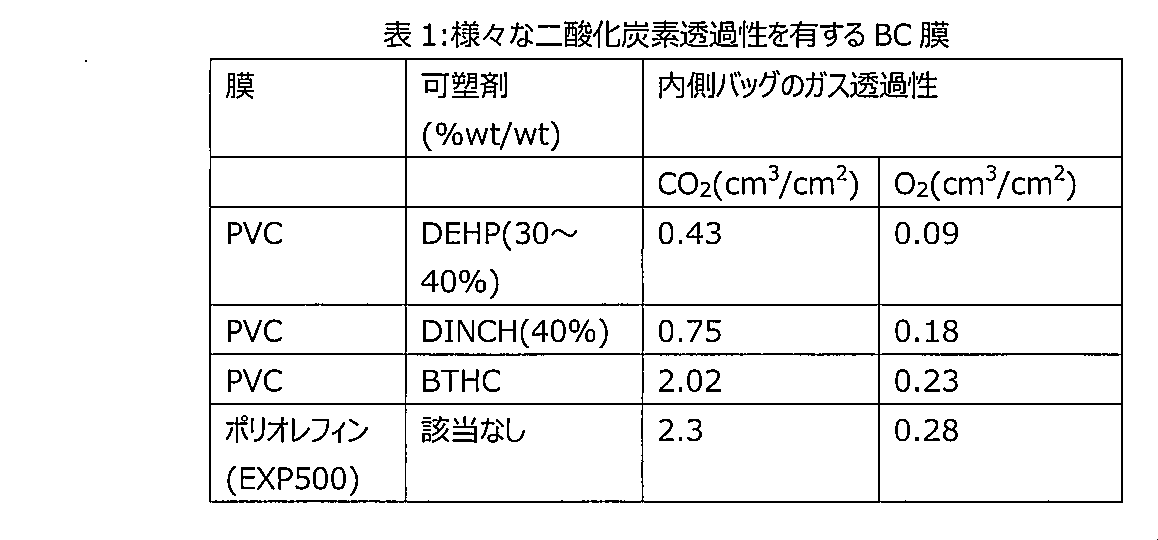
ある態様では、二酸化炭素透過性膜はまた、酸素に対して透過性である。しかしながら、好ましい態様では、二酸化炭素透過性バッグの調製における使用のための二酸化炭素透過性膜は、酸素に対して不透過性であり、外側バリアフリー血液保存容器の調製に特に好適である。別の態様では、25℃、約1atmにおいて、約0.6cm3/cm2を超える二酸化炭素に対する透過性、及び0.15cm3/cm2を超える酸素に対する透過性を有する二酸化炭素透過性膜は、血液適合性(BC)二酸化炭素透過性バッグの調製のために使用される。別の態様では、25℃、約1atmにおいて、約0.6cm3/cm2を超える二酸化炭素に対する透過性、及び0.2cm3/cm2を超える酸素に対する透過性を有する二酸化炭素透過性膜は、BC二酸化炭素透過性バッグの調製に対して使用される。別の態様では、25℃、約1atmにおいて、約0.6cm3/cm2を超える二酸化炭素に対する透過性、及び3.0cm3/cm2未満の酸素に対する透過性を有する二酸化炭素透過性膜は、BC二酸化炭素透過性バッグの調製に対して使用される。別の態様では、25℃、約1atmにおいて、約0.6cm3/cm2を超える二酸化炭素に対する透過性、及び2.5cm3/cm2未満の酸素に対する透過性を有する二酸化炭素透過性膜は、BC二酸化炭素透過性バッグの調製に対して使用される。別の態様では、25℃、約1atmにおいて、約0.6cm3/cm2を超える二酸化炭素に対する透過性、及び3cm3/cm2未満の酸素に対する透過性を有する二酸化炭素透過性膜は、BC二酸化炭素透過性バッグの調製に対して使用される。更に別の態様では、25℃、約1atmにおいて、約0.6cm3/cm2を超える二酸化炭素に対する透過性、及び0~3cm3/cm2の酸素に対する透過性を有する二酸化炭素透過性膜が、BC二酸化炭素透過性バッグの調製ために使用される。 In some embodiments, the carbon dioxide permeable membrane is also permeable to oxygen. However, in preferred embodiments, the carbon dioxide permeable membranes for use in preparing carbon dioxide permeable bags are impermeable to oxygen and are particularly suitable for preparing outer barrier-free blood storage containers. In another aspect, a carbon dioxide permeable membrane having a permeability to carbon dioxide greater than about 0.6 cm 3 /cm 2 and a permeability to oxygen greater than 0.15 cm 3 /cm 2 at 25° C. and about 1 atm is , for the preparation of hemocompatible (BC) carbon dioxide permeable bags. In another aspect, a carbon dioxide permeable membrane having a permeability to carbon dioxide greater than about 0.6 cm 3 /cm 2 and a permeability to oxygen greater than 0.2 cm 3 /cm 2 at 25° C. and about 1 atm is , BC for the preparation of carbon dioxide permeable bags. In another aspect, a carbon dioxide permeable membrane having a permeability to carbon dioxide of greater than about 0.6 cm 3 /cm 2 and a permeability to oxygen of less than 3.0 cm 3 /cm 2 at 25° C. and about 1 atm is , BC for the preparation of carbon dioxide permeable bags. In another aspect, a carbon dioxide permeable membrane having a permeability to carbon dioxide of greater than about 0.6 cm 3 /cm 2 and a permeability to oxygen of less than 2.5 cm 3 /cm 2 at 25° C. and about 1 atm is , BC for the preparation of carbon dioxide permeable bags. In another aspect, the carbon dioxide permeable membrane having a permeability to carbon dioxide of greater than about 0.6 cm 3 /cm 2 and a permeability to oxygen of less than 3 cm 3 /cm 2 at 25° C. and about 1 atm is BC Used for the preparation of carbon dioxide permeable bags. In yet another aspect, a carbon dioxide permeable membrane having a permeability to carbon dioxide greater than about 0.6 cm 3 /cm 2 and a permeability to oxygen of 0 to 3 cm 3 /cm 2 at 25° C. and about 1 atm. , BC used for the preparation of carbon dioxide permeable bags.
本明細書で使用される場合、DEHPフリー二酸化炭素透過性バッグは、二酸化炭素に対して透過性である。特定の態様では、DEHPフリー二酸化炭素透過性バッグは、酸素及び二酸化炭素に対して透過性である。他の態様では、DEHPフリー二酸化炭素透過性バッグは、酸素に対して不透過性であり、かつ二酸化炭素に対して透過性である。 As used herein, DEHP-free carbon dioxide permeable bags are permeable to carbon dioxide. In certain aspects, the DEHP-free carbon dioxide permeable bag is permeable to oxygen and carbon dioxide. In another aspect, the DEHP-free carbon dioxide permeable bag is impermeable to oxygen and permeable to carbon dioxide.
本開示の態様では、本開示による方法及びデバイスのための他の好適なDEHPフリーBC二酸化炭素透過性膜には、高密度膜、多孔質膜、非対称膜、及び複合膜が挙げられる。特定の態様では、好適な膜は、多層膜であってもよい。他の態様では、好適な膜は、無機材料から調製される。高密度膜は、細孔又は空隙を有しない固体材料から調製された膜である。材料は、溶液及び拡散のプロセスによって高密度の膜に浸透する。高密度の膜の例としては、シリコーン膜(ポリジメチルシロキサン(PDMS))が挙げられる。また、本開示に含まれ、かつ提供されるのは、サイズ排除に基づいて分離する特定のサイズ範囲の細孔を有する多孔質膜である。本開示による使用に好適な多孔質膜の例としては、PVDF及びポリスルホン膜が挙げられる。 In aspects of the present disclosure, other suitable DEHP-free BC carbon dioxide permeable membranes for methods and devices according to the present disclosure include dense membranes, porous membranes, asymmetric membranes, and composite membranes. In certain aspects, suitable membranes may be multi-layer membranes. In other aspects, suitable membranes are prepared from inorganic materials. Dense membranes are membranes prepared from solid materials that do not have pores or voids. Materials penetrate dense membranes by processes of solution and diffusion. Examples of dense membranes include silicone membranes (polydimethylsiloxane (PDMS)). Also included and provided in the present disclosure are porous membranes having pores of specific size ranges that separate based on size exclusion. Examples of porous membranes suitable for use with the present disclosure include PVDF and polysulfone membranes.
外側バリアバッグ
本開示はまた、二酸化炭素に対して実質的に不透過性であるガス不透過性バリアバッグ、二酸化炭素に対して透過性であるDEHPフリー二酸化炭素透過性バッグ、及びガス不透過性バリアバッグ内に位置する二酸化炭素吸着剤を含む、保存中に血液から二酸化炭素を枯渇させるためのガス不透過性バリアバッグ内に封入された血液を保存するための二酸化炭素透過性容器を提供し、かつ含む。特に、外側バリアバッグ及び吸着剤の追加は、2,3-DPGレベル及びATPレベルの両方を増加させることができるが、高い二酸化炭素透過性を有する特定のバッグは、42日間の保存に対して、著しく高いレベルの2,3-DPGを維持することができる。図3A、3Bを参照されたい。したがって、高い二酸化炭素透過性及び低い酸素透過性を有する材料から調製された保存バッグは、バリアの必要性を排除することができる。酸素透過性バッグは、外側バリアバッグ及び吸着剤の組み合わせの追加により最も恩恵を受けるが、酸素が能動的に除去されて、強化されたATPレベルにつながるため、低酸素透過性膜であっても恩恵を受けることが予想される。図2~6を参照されたい。
Outer Barrier Bag The present disclosure also provides a gas impermeable barrier bag that is substantially impermeable to carbon dioxide, a DEHP-free carbon dioxide permeable bag that is permeable to carbon dioxide, and a gas impermeable Provided is a carbon dioxide permeable container for storing blood enclosed within a gas impermeable barrier bag for depleting carbon dioxide from the blood during storage, comprising a carbon dioxide sorbent located within the barrier bag. , and includes In particular, the addition of outer barrier bags and sorbents can increase both 2,3-DPG and ATP levels, but certain bags with high carbon dioxide permeability are , can maintain significantly higher levels of 2,3-DPG. See Figures 3A and 3B. Thus, storage bags prepared from materials with high carbon dioxide permeability and low oxygen permeability can eliminate the need for barriers. Oxygen permeable bags benefit most from the addition of a combination of outer barrier bag and sorbent, but even low oxygen permeable membranes can benefit from active scavenging of oxygen leading to enhanced ATP levels. expected to benefit. See Figures 2-6.
本開示は、フィルムからのガス不透過性バリアバッグ及び膜からのDEHPフリー二酸化炭素透過性バッグの調製を提供し、かつ含む。本明細書で使用される場合、膜は、概して、DEHPフリー二酸化炭素透過性バッグを調製するために使用される材料を指し、フィルムは、ガス不透過性バリアバッグを調製するために使用される材料を指すために使用される。特定の材料が製造業者によって「膜」と称されてもよく、又は概して、「膜」として既知であってもよいことは理解されるが、明確にするために、別途指示がない限り、フィルムは、実質的に不透過性であるとみなされる。膜は、1つ以上の物質がシートの一方の側面からシートの他方の側面に通過することを可能にするシートの形態の1つ以上の材料層を含む。本明細書で使用される場合、外側受容体は、二酸化炭素に対して実質的に不透過性であり、かつ任意選択的に、酸素に対して不透過性である材料から調製される。特定の態様では、ガス不透過性バリアバッグは、可撓性フィルム材料から調製される。他の態様では、ガス不浸透性バリアバッグは、剛性、又は非可撓性フィルム材料から調製される。 The present disclosure provides and includes the preparation of gas impermeable barrier bags from films and DEHP-free carbon dioxide permeable bags from membranes. As used herein, membrane generally refers to materials used to prepare DEHP-free carbon dioxide permeable bags and films are used to prepare gas impermeable barrier bags. Used to refer to materials. It is understood that a particular material may be referred to as a "membrane" by a manufacturer, or may be known generally as a "membrane", but for the sake of clarity, unless otherwise indicated, the film is considered to be substantially impermeable. A membrane comprises one or more layers of material in the form of a sheet that allows one or more substances to pass from one side of the sheet to the other side of the sheet. As used herein, the outer receptor is prepared from a material that is substantially impermeable to carbon dioxide and optionally impermeable to oxygen. In certain aspects, the gas impermeable barrier bag is prepared from a flexible film material. In another aspect, the gas impermeable barrier bag is prepared from a rigid or non-flexible film material.
本開示は、二酸化炭素に対して実質的に不透過性のガス不透過性バリアバッグを提供し、かつ含む。本明細書で使用される場合、二酸化炭素に対して実質的に不透過性であるガス不透過性バリアバッグは、3ヶ月の期間にわたって受容体の内側に10cc以下の二酸化炭素、より好ましくは、6ヶ月にわたって5cc以下の二酸化炭素を可能にするように、二酸化炭素に対して十分に不透過性である。本明細書で使用される場合、二酸化炭素に対して実質的に不透過性(SICO)という用語は、42日間以上にわたって、二酸化炭素の分圧における著しい増加を防止するのに十分な、バリアの一方から他方への二酸化炭素の通過に対するバリアを提供する、材料及び組成物を指す。 The present disclosure provides and includes gas impermeable barrier bags that are substantially impermeable to carbon dioxide. As used herein, a gas-impermeable barrier bag that is substantially impermeable to carbon dioxide contains no more than 10 cc of carbon dioxide inside the receptacle over a period of three months, more preferably: Sufficiently impermeable to carbon dioxide to allow no more than 5 cc of carbon dioxide for 6 months. As used herein, the term substantially impermeable to carbon dioxide (SICO) refers to a barrier that is sufficient to prevent a significant increase in the partial pressure of carbon dioxide over a period of 42 days or longer. Refers to materials and compositions that provide a barrier to the passage of carbon dioxide from one side to the other.
別途指示がない限り、「実質的に不透過性の膜」とは、二酸化炭素に対して実質的に不透過性である膜を指す。本明細書で使用される場合、実質的に二酸化炭素に対して不透過性であるとは、1日当たり、1平方メートル当たり約1.0cc未満の二酸化炭素の二酸化炭素に対する透過性を意味する。しかしながら、特定のデバイス及び方法では、膜は、酸素に対する透過性又は不透過性によって更に特徴付けられ得る。特定の用途のために、膜材料は、二酸化炭素に対して実質的に不透過性であり、血液、血液成分、又は複数の成分からなる採血キットへの二酸化炭素の導入に対するバリアを提供する。かかる実質的に不透過性の膜は、概して、本開示の外側受容体を調製するために使用される。好適な実質的に不透過性の膜はまた、デバイス及びキットの接続構成要素のためのチューブを調製するために使用されてもよい。実質的に不透過性の膜は、単層を含んでもよく、又は2つ以上の層を有する積層シート若しくはチューブであってもよい。 Unless otherwise indicated, "substantially impermeable membrane" refers to a membrane that is substantially impermeable to carbon dioxide. As used herein, substantially impermeable to carbon dioxide means a permeability to carbon dioxide of less than about 1.0 cc of carbon dioxide per square meter per day. However, in certain devices and methods, the membrane may be further characterized by being permeable or impermeable to oxygen. For certain applications, the membrane material is substantially impermeable to carbon dioxide and provides a barrier to the introduction of carbon dioxide into the blood, blood components, or multicomponent blood collection kit. Such substantially impermeable membranes are generally used to prepare outer receptors of the present disclosure. Suitable substantially impermeable membranes may also be used to prepare tubing for connecting components of devices and kits. A substantially impermeable membrane may comprise a single layer or may be a laminated sheet or tube having two or more layers.
本開示はまた、酸素に対して実質的に不透過性である、ガス不透過性バリアバッグを提供し、かつ含む。本明細書で使用される場合、実質的に酸素に対して不透過性であるとは、1日当たり、1平方メートル当たり約1.0cc未満の酸素の酸素に対する透過性を意味する。特定の態様では、ガス不透過性バリアバッグ及び本開示の他の要素の調製における使用に好適なフィルムは、約0.140バレル未満のバレル値によって特徴付けられる材料である。 The present disclosure also provides and includes gas impermeable barrier bags that are substantially impermeable to oxygen. As used herein, substantially impermeable to oxygen means a permeability to oxygen of less than about 1.0 cc of oxygen per square meter per day. In certain aspects, films suitable for use in preparing gas impermeable barrier bags and other elements of the present disclosure are materials characterized by barrel values of less than about 0.140 barrels.
ガス不透過性バリアバッグを調製するための材料及び方法は、当該技術分野において既知である。例えば、Gawrylらに発行された米国特許第7,041,800号、及びGustafssonらに発行された米国特許第6,007,529号、及びMcDormanによる米国特許出願公開第3013/0327677号を参照された。その各々は、参照により、それらの全体が本明細書に組み込まれる。不透過性材料は、当該技術分野において規定通りに使用され、任意の好適な材料が、使用され得る。成形ポリマーの場合、酸素及び二酸化炭素バリア特性を強化するために、添加剤が規定通りに添加される。例えば、Satoらに発行された米国特許第4,837,047号を参照されたい。例えば、Smithらに発行された米国特許第7,431,995号は、酸素及び二酸化炭素侵入に対して不透過性である、エチレンビニルアルコールコポリマー及び変性エチレンビニルアセテートコポリマーの層からなる酸素及び二酸化炭素不透過性受容体を記載する。別の態様では、ガス不透過性バリアバッグは、酸素及び二酸化炭素に対して不透過性である。 Materials and methods for preparing gas impermeable barrier bags are known in the art. See, for example, U.S. Patent No. 7,041,800 issued to Gawryl et al. and U.S. Patent No. 6,007,529 issued to Gustafsson et al. rice field. each of which is incorporated herein by reference in its entirety. Impermeable materials are used routinely in the art and any suitable material may be used. For molded polymers, additives are routinely added to enhance oxygen and carbon dioxide barrier properties. See, for example, US Pat. No. 4,837,047 issued to Sato et al. For example, U.S. Pat. No. 7,431,995 issued to Smith et al. describes an oxygen and dioxide oxygen and dioxide polymer consisting of layers of ethylene vinyl alcohol copolymer and modified ethylene vinyl acetate copolymer that is impermeable to oxygen and carbon dioxide ingress. A carbon impermeable receptor is described. In another aspect, the gas impermeable barrier bag is impermeable to oxygen and carbon dioxide.
特定の態様では、二酸化炭素、酸素、又は二酸化炭素及び酸素の両方に対して実質的に不透過性であるフィルムは、積層フィルムであってもよい。ある態様では、二酸化炭素、酸素、又は二酸化炭素及び酸素の両方に対して実質的に不透過性である積層フィルムは、積層箔フィルムである。フィルム材料は、箔及びポリマーの組み合わせである、ポリマー又は多層構造であり得る。ある態様では、積層フィルムは、アルミニウムで積層されたポリエステル膜であってもよい。酸素に対して実質的に不透過性である、積層箔としても既知である、好適なアルミニウム積層フィルムの例は、当該技術分野において既知である。例えば、Sugisawaの米国特許第4,798,728号は、ナイロン、ポリエチレン、ポリエステル、ポリプロピレン、及び塩化ビニリデンのアルミニウム積層箔を開示する。他の積層フィルムは、当該技術分野において既知である。例えば、Chowらの米国特許第7,713,614号は、酸素に対して実質的に不透過性であるエチレン-ビニルアルコールコポリマー(EVOH)樹脂を含む、多層容器を開示する。ある態様では、ガス不透過性バリアバッグは、ヒートシールによって3つ又は4つの側面をシールすることによって構築されたバリアバッグであってもよい。バッグは、二酸化炭素及び酸素バリア特性の強化を提供する材料を含む、多層構造で構築される。バッグは、二酸化炭素及び酸素バリア特性の強化を提供する材料を含む、多層構造で構成される。かかる材料としては、0.01cc/100in2/24時間の酸素透過率を有する、Rollprint Clearfoil(登録商標)V2フィルム、0.004cc/100in2/24時間の酸素透過率を有する、Rollprint Clearfoil(登録商標)Xフィルム、及び0.0008cc/100in2/24時間の酸素透過率を有するClearfoil(登録商標)Zフィルム(Rollprint Packaging Products、Addison,IL)が挙げられる。他の製造業者は、Renolit Solmed Wrapflex(登録商標)フィルム(American Renolit Corp.、City of Commerce,CA)など、同様の酸素透過率を有する同様の製品を作製する。酸素に対して実質的に不透過性である、積層箔としても既知である、好適なアルミニウム積層フィルムの例は、Protective Packaging Corp.(Carrollton,TX)から取得可能である。 In certain aspects, the film that is substantially impermeable to carbon dioxide, oxygen, or both carbon dioxide and oxygen may be a laminated film. In one aspect, the laminated film that is substantially impermeable to carbon dioxide, oxygen, or both carbon dioxide and oxygen is a laminated foil film. Film materials can be polymeric or multilayer structures, which are combinations of foils and polymers. In one aspect, the laminate film may be a polyester film laminated with aluminum. Examples of suitable aluminum laminate films, also known as laminate foils, that are substantially impermeable to oxygen are known in the art. For example, Sugisawa, US Pat. No. 4,798,728, discloses aluminum laminated foils of nylon, polyethylene, polyester, polypropylene, and vinylidene chloride. Other laminated films are known in the art. For example, US Pat. No. 7,713,614 to Chow et al. discloses a multilayer container comprising an ethylene-vinyl alcohol copolymer (EVOH) resin that is substantially impermeable to oxygen. In one aspect, the gas impermeable barrier bag may be a barrier bag constructed by sealing three or four sides with heat sealing. The bag is constructed with a multi-layer construction that includes materials that provide enhanced carbon dioxide and oxygen barrier properties. The bag is constructed of a multi-layer construction that includes materials that provide enhanced carbon dioxide and oxygen barrier properties. Such materials include Rollprint Clearfoil® V2 film, which has an oxygen permeability of 0.01 cc/100 in 2 / 24 hours; Trademark) X films, and Clearfoil® Z films (Rollprint Packaging Products, Addison, Ill.) having an oxygen permeability of 0.0008 cc/100 in 2 /24 hours. Other manufacturers make similar products with similar oxygen transmission rates, such as Renolit Solmed Wrapflex® film (American Renolit Corp., City of Commerce, Calif.). Examples of suitable aluminum laminate films, also known as laminate foils, that are substantially impermeable to oxygen are available from Protective Packaging Corp. (Carrollton, Tex.).
SICO材料の調製に適用可能な別のアプローチとしては、ヒドロヨウ素酸及びアスコルビン酸によるグラフェンオキシド積層体の穏やかな化学還元によって作製される多層グラファイトフィルムが挙げられる。その全体が参照により本明細書に組み込まれる、Su et al.“Impermeable barrier films and protective coatings based on reduced graphene oxide,” Nature Communications 5:4843(2014)を参照されたい。酸素バリア特性を強化するためのナノ粒子はまた、当該技術分野で既知であり、例えば、Tera-Barrier(Tera-Barrier Films Pte,Ltd、The Aries,Singapore)によって提供される多層バリア積層フィルムであり、3014年8月12日のPackaging Digest Magazine内でRick Lingleによって記載されている。 Another approach applicable to the preparation of SICO materials includes multilayer graphite films made by mild chemical reduction of graphene oxide laminates with hydroiodate and ascorbic acid. Su et al., which is incorporated herein by reference in its entirety. See "Impermeable barrier films and protective coatings based on reduced graphene oxide," Nature Communications 5:4843 (2014). Nanoparticles for enhancing oxygen barrier properties are also known in the art, such as the multilayer barrier laminate films provided by Tera-Barrier (Tera-Barrier Films Pte, Ltd, The Aries, Singapore). , by Rick Lingle in Packaging Digest Magazine, August 12, 3014.
本開示による態様では、ガス不透過性バリアバッグは、ガス不透過性プラスチックから調製され得る。一実施形態では、ガス不透過性プラスチックは、積層体であり得る。特定の実施形態では、積層体は、透明バリアフィルム、例えば、ナイロンポリマーであり得る。実施形態では、積層体は、ポリエステルフィルムであり得る。一実施形態では、積層体は、Mylar(登録商標)であり得る。特定の実施形態では、積層体は、金属化フィルムであり得る。一実施形態では、金属化フィルムは、アルミニウムでコーティングされ得る。別の実施形態では、コーティングは、酸化アルミニウムであり得る。別の実施形態では、コーティングは、低密度ポリエチレン(LDPE)の層の間で積層されたエチレンビニルアルコールコポリマー(EVOH)であり得る。 In aspects according to the present disclosure, the gas impermeable barrier bag may be prepared from a gas impermeable plastic. In one embodiment, the gas impermeable plastic can be a laminate. In certain embodiments, the laminate can be a transparent barrier film, such as a nylon polymer. In embodiments, the laminate may be a polyester film. In one embodiment, the laminate can be Mylar®. In certain embodiments, the laminate can be a metallized film. In one embodiment, the metallized film may be coated with aluminum. In another embodiment, the coating can be aluminum oxide. In another embodiment, the coating can be ethylene vinyl alcohol copolymer (EVOH) laminated between layers of low density polyethylene (LDPE).
本開示のガス不透過性バリアバッグは、プラスチック又は他の耐久性のある軽量材料を含む、ガス不透過性材料から調製される1つ以上の部品から形成され得る。いくつかの実施形態では、筐体は、2つ以上の材料から形成され得る。一実施形態では、ガス不透過性バリアバッグは、ガス不透過性筐体を調製するための材料から形成され得、かつガス不透過性材料でコーティングされ得る。一実施形態では、剛性又は可撓性のガス不透過性バリアバッグは、射出成形され得るプラスチックから調製され得る。本開示による実施形態では、プラスチックは、ポリスチレン、ポリ塩化ビニル、又はナイロンから選択され得る。一実施形態では、ガス不透過性バリアバッグ材料は、ポリエステル(PES)、ポリエチレンテレフタレート(PET)、ポリエチレン(PE)、高密度ポリエチレン(HDPE)、ポリ塩化ビニル(PVC)、ポリ塩化ビニリデン(PVDC)、低密度ポリエチレン(LDPE)、ポリプロピレン(PP)、ポリスチレン(PS)、高衝撃性ポリスチレン(HIPS)、ポリアミド(PA)(例えば、ナイロン)、アクリロニトリルブタジエンスチレン(ABS)、ポリカーボネート(PC)、ポリカーボネート/アクリロニトリルブタジエンスチレン(PC/ABS)、ポリウレタン(PU)、メラミンホルムデヒド(MF)、プラスチック材料、フェノリックス(PF)、ポリエーテルエーテルケトン(PEEK)、ポリエーテルイミド(PEI)(Ultem)、ポリ乳酸(PLA)、ポリメチルメタクリレート(PMMA)、ポリテトラフルオロエチレン(PTFE)、尿素ホルムアルデヒド、及びエチレンビニルアルコールコポリマー(EVOH)からなる群から選択され得る。特定の実施形態では、ガス不透過性バリアバッグは、ポリエチレンであり得る。いくつかの実施形態では、ポリエチレンガス不透過性バリアバッグは、ともに溶接される1つ以上のポリエチレン成分を含み得る。特定の態様では、外側受容体は、ポリエチレン外側層、ポリエステル内側層、及び内側層と外側層との間に分散された酸化アルミニウムバリア層を有する多層フィルム、例えば、0.0008cc/100 in2/24時間の酸素透過率を有するClearfoil(登録商標)Zフィルム(Rollprint Packaging Products、Addison,IL)からなる。 Gas impermeable barrier bags of the present disclosure may be formed from one or more components prepared from gas impermeable materials, including plastics or other durable lightweight materials. In some embodiments, the housing can be formed from more than one material. In one embodiment, the gas impermeable barrier bag may be formed from materials for preparing gas impermeable enclosures and coated with gas impermeable materials. In one embodiment, a rigid or flexible gas impermeable barrier bag may be prepared from a plastic that can be injection molded. In embodiments according to the present disclosure, the plastic may be selected from polystyrene, polyvinyl chloride, or nylon. In one embodiment, the gas impermeable barrier bag material is polyester (PES), polyethylene terephthalate (PET), polyethylene (PE), high density polyethylene (HDPE), polyvinyl chloride (PVC), polyvinylidene chloride (PVDC). , low density polyethylene (LDPE), polypropylene (PP), polystyrene (PS), high impact polystyrene (HIPS), polyamide (PA) (e.g. nylon), acrylonitrile butadiene styrene (ABS), polycarbonate (PC), polycarbonate/ Acrylonitrile butadiene styrene (PC/ABS), polyurethane (PU), melamine formaldehyde (MF), plastic materials, phenolics (PF), polyetheretherketone (PEEK), polyetherimide (PEI) (Ultem), polylactic acid (PLA), polymethyl methacrylate (PMMA), polytetrafluoroethylene (PTFE), urea formaldehyde, and ethylene vinyl alcohol copolymer (EVOH). In certain embodiments, the gas impermeable barrier bag can be polyethylene. In some embodiments, a polyethylene gas impermeable barrier bag may include one or more polyethylene components welded together. In certain embodiments, the outer receiver is a multilayer film having a polyethylene outer layer, a polyester inner layer, and an aluminum oxide barrier layer dispersed between the inner and outer layers, e.g., 0.0008 cc/100 in 2 / Consists of Clearfoil® Z film (Rollprint Packaging Products, Addison, Ill.) with 24 hour oxygen permeability.
本開示は、ヒートシール、ブロー成形、及び射出成形技術を使用するガス不透過性バリアバッグの調製を提供し、かつ含む。ヒートシール、ブロー成形、及び射出成形を使用してガス不透過性バリアバッグを調製するための好適な材料としては、PET、標準及び多層、ポリプロピレン、ポリエチレン、ポリカーボネート、ABS、及び当業者に既知の他のポリマーが挙げられる。ブロー成形及び射出成形ガス不透過性バリアバッグを調製するための方法は、当該技術分野において既知であり、例えば、多層構造は、ポリプロピレン(PP)の2つの層の間に位置し、Kortec(Kortec,Inc.、Rowley,MA)によって提供され、Slatに発行された米国特許第5,906,285号にも記載された、エチルビニルアルコール(EVOH)又はエチルビニルアセテート(EVA)のバリア層からなる。成形前、又はそれらの配合中、又は設定中に、ポリマーの酸素及びCO2バリア特性を強化する添加剤は、当該技術分野において既知である。一例は、多層ポリマー共噴射であり、多層PETをもたらす。かかるバリア樹脂は、典型的には、両側上にPETを有する内側層としてプリフォーム段階において組み込まれ、PETを液体接触層、並びに外側層を作製する。以下に提供されるように、好適なブロー成形又は射出成形ガス不透過性バリアバッグは、酸素に対して不透過性である。特定の態様では、好適なヒートシール、ブロー成形、又は射出成形ガス不透過性バリアバッグは、酸素及び二酸化炭素の両方に対して実質的に不透過性である。 The present disclosure provides and includes preparation of gas impermeable barrier bags using heat sealing, blow molding, and injection molding techniques. Suitable materials for preparing gas impermeable barrier bags using heat sealing, blow molding, and injection molding include PET, standard and multilayer, polypropylene, polyethylene, polycarbonate, ABS, and other materials known to those skilled in the art. Other polymers are included. Methods for preparing blow-molded and injection-molded gas-impermeable barrier bags are known in the art, e.g. A barrier layer of ethyl vinyl alcohol (EVOH) or ethyl vinyl acetate (EVA) provided by Slat, Inc., Rowley, Mass. and also described in U.S. Pat. . Additives that enhance the oxygen and CO2 barrier properties of polymers before molding or during their formulation or setting are known in the art. One example is multilayer polymer co-jetting, resulting in multilayer PET. Such barrier resins are typically incorporated at the preform stage as inner layers with PET on both sides, making PET the liquid contact layer as well as the outer layer. As provided below, suitable blow molded or injection molded gas impermeable barrier bags are impermeable to oxygen. In certain aspects, suitable heat-sealed, blow-molded, or injection-molded gas impermeable barrier bags are substantially impermeable to both oxygen and carbon dioxide.
吸着剤
本開示は、酸素、二酸化炭素、又は酸素及び二酸化炭素に結合し、並びに環境から酸素、二酸化炭素、又は酸素及び二酸化炭素を除去することができる吸着剤を提供し、かつ含む。別途規定のない限り、「吸着剤」という用語は、酸素、二酸化炭素、又は酸素及び二酸化炭素吸着剤及び捕捉剤を指す。本開示のある態様では、二酸化炭素吸着剤は、酸化カルシウムを含む。他の好適な二酸化炭素吸着剤としては、水酸化ナトリウムナノ粒子、水酸化カルシウム及びシリカ混合物、塩化カルシウム、水酸化カリウム、パーライト、活性炭、ゼオライト、活性アルミナ、シリカゲル、及び固体アミンが挙げられる。別の態様では、二酸化炭素吸着剤は、酸素吸着剤を更に含む。
Adsorbents The present disclosure provides and includes adsorbents capable of binding oxygen, carbon dioxide, or oxygen and carbon dioxide and removing oxygen, carbon dioxide, or oxygen and carbon dioxide from the environment. Unless otherwise specified, the term "adsorbent" refers to oxygen, carbon dioxide, or oxygen and carbon dioxide adsorbents and scavengers. In one aspect of the present disclosure, the carbon dioxide sorbent comprises calcium oxide. Other suitable carbon dioxide adsorbents include sodium hydroxide nanoparticles, calcium hydroxide and silica mixtures, calcium chloride, potassium hydroxide, perlite, activated carbon, zeolites, activated alumina, silica gel, and solid amines. In another aspect, the carbon dioxide sorbent further comprises an oxygen sorbent.
本明細書で使用される場合、「酸素捕捉剤」又は「酸素吸着剤」は、使用条件下でO2に不可逆的に結合するか、又はO2と組み合わせる材料である。本明細書で使用される場合、「二酸化炭素捕捉剤」又は「二酸化炭素吸着剤」は、使用条件下でCO2に不可逆的に結合するか、又はCO2と組み合わせる材料である。「酸素吸着剤」又は「二酸化炭素吸着剤」という用語は、本明細書では、それぞれ「酸素捕捉剤」又は「二酸化炭素」と互換的に使用され得る。本開示による特定の態様では、材料は、酸素又は二酸化炭素に不可逆的に結合するか、又はそれらと組み合わせることができる。他の態様では、酸素又は二酸化炭素は、吸着剤材料に結合し、非常に遅い放出速度、koffを有し得る。ある態様では、酸素又は二酸化炭素は、材料のいくつかの成分と化学的に反応し、別の化合物に変換され得る。結合した酸素のオフレートが血液の滞留時間よりもはるかに少ない任意の材料は、酸素捕捉剤としての役割を果たすことができる。更に、結合した二酸化炭素のオフレートが血液の滞留時間よりもはるかに少ない任意の材料は、二酸化炭素捕捉剤としての役割を果たすことができる。 As used herein, an "oxygen scavenger" or "oxygen adsorbent" is a material that irreversibly binds or combines with O2 under conditions of use. As used herein, a "carbon dioxide scavenger" or "carbon dioxide sorbent" is a material that irreversibly binds or combines with CO2 under conditions of use. The terms "oxygen sorbent" or "carbon dioxide sorbent" may be used interchangeably herein with "oxygen scavenger" or "carbon dioxide" respectively. In certain aspects according to the present disclosure, the material can irreversibly bind to or combine with oxygen or carbon dioxide. In other embodiments, oxygen or carbon dioxide may bind to the sorbent material and have a very slow release rate, koff . In some aspects, the oxygen or carbon dioxide can chemically react with some component of the material and convert to another compound. Any material whose bound oxygen off-rate is much less than the residence time of blood can serve as an oxygen scavenger. Additionally, any material whose bound carbon dioxide off-rate is much less than the residence time of blood can serve as a carbon dioxide scavenger.
本明細書で使用される場合、吸着剤の量は、標準温度及び圧力(例えば、0℃(273.15Kelvin)及び1.01×10⁵pa(100kPa、1bar、0.986atm、760mmHg)の圧力)で、体積(例えば、立方センチメートル(cc)又はミリリットル(ml))によって測定される一定の酸素結合能力を有するものとして提供される。他の態様では、酸素吸着剤及び捕捉剤は、二酸化炭素に結合し、環境から二酸化炭素を除去することが更に可能である。特定の態様では、吸着剤は、無毒の無機及び/又は有機塩と、酸素、二酸化炭素、若しくは酸素及び二酸化炭素に対して高い反応性を有する二価鉄又は他の材料との混合物であり得る。特定の態様では、酸素吸着剤又は捕捉剤は、二酸化炭素吸着剤と組み合わせられる。他の態様では、酸素吸着剤の二酸化炭素結合能力の有無は、必要ではない。 As used herein, the amount of adsorbent is measured at standard temperature and pressure (e.g., 0° C. (273.15 Kelvin) and 1.01×10 5 pa (100 kPa, 1 bar, 0.986 atm, 760 mm Hg) pressure ) and have a certain oxygen binding capacity measured by volume (eg, cubic centimeters (cc) or milliliters (ml)). In other aspects, the oxygen sorbents and scavengers are further capable of binding carbon dioxide and removing it from the environment. In certain aspects, the sorbent can be a mixture of non-toxic inorganic and/or organic salts with ferrous or other materials that are highly reactive to oxygen, carbon dioxide, or oxygen and carbon dioxide. . In certain aspects, an oxygen sorbent or scavenger is combined with a carbon dioxide sorbent. In other embodiments, the presence or absence of carbon dioxide binding capacity of the oxygen sorbent is not required.
好適な酸素吸着剤又は捕捉剤は、当該技術分野において既知である。本開示による好適な酸素吸着剤は、0.44ml/分の最小酸素吸着率を有する。好適な吸着プロファイルを有する吸着剤は、60分以内に少なくとも45mlのO2、120分以内に70mlのO2、及び180分以内に80mlのO2に結合する。好適な吸着剤は、より高い容量及び結合率の両方を有し得る。 Suitable oxygen adsorbents or scavengers are known in the art. A suitable oxygen adsorbent according to the present disclosure has a minimum oxygen adsorption rate of 0.44 ml/min. Adsorbents with suitable adsorption profiles bind at least 45 ml of O 2 within 60 minutes, 70 ml of O 2 within 120 minutes, and 80 ml of O 2 within 180 minutes. Suitable adsorbents may have both higher capacities and binding rates.
酸素捕捉剤又は吸着剤の非限定的な例としては、鉄粉末及び有機化合物が挙げられる。O2吸着剤の例としては、コバルト、鉄、及びシッフ塩基のキレートが挙げられる。O2吸着剤に関する追加の非限定的な例は、Bulowらに発行された米国特許第7,347,887号、Ramprasadらに発行された米国特許第5,208,335号、及びSieversらに発行された米国特許第4,654,053号において見出され得、これらの各々は、参照によりそれらの全体が本明細書に組み込まれる。酸素吸着剤材料は、繊維、マイクロファイバ、微小球、微粒子、及び発泡体に形成されるか、又は組み込まれてもよい。 Non-limiting examples of oxygen scavengers or adsorbents include iron powder and organic compounds. Examples of O2 adsorbents include chelates of cobalt, iron, and Schiff bases. Additional non-limiting examples of O2 adsorbents are US Pat. No. 7,347,887 issued to Bulow et al., US Pat. No. 4,654,053 issued, each of which is incorporated herein by reference in its entirety. Oxygen sorbent materials may be formed into or incorporated into fibers, microfibers, microspheres, microparticles, and foams.
特定の態様では、好適な吸着剤としては、Multisorb Technologies(Buffalo,NY)、Sorbent Systems/Impak Corporation(Los Angeles,CA)、又はMitsubishi Gas Chemical America(MGC)(New York,NY)から取得可能なものが挙げられる。例示的な酸素吸着剤としては、Multisorb Technologies StabilOx(登録商標)パケット、Sorbent Systems P/N SF100PK100 100 cc酸素吸収剤、及びMitsubishi Gas Chemical America Ageless(登録商標)SS-200酸素吸収剤が挙げられる。MGCはまた、本開示の方法及びデバイスに好適な吸着剤を提供する。かかる好適な酸素吸着剤としては、MGC Ageless(登録商標)及びSS-200酸素吸収剤が挙げられる。 In certain embodiments, suitable adsorbents include those from Multisorb Technologies (Buffalo, NY), Sorbent Systems/Impak Corporation (Los Angeles, CA), or Mitsubishi Gas Chemical America (MGC) (New York, NY). obtainable from things are mentioned. Exemplary oxygen absorbents include Multisorb Technologies StabilOx® packets, Sorbent Systems P/N SF100PK100 100 cc oxygen absorbent, and Mitsubishi Gas Chemical America Ageless® SS-200 oxygen absorbent. mentioned. MGC also provides suitable adsorbents for the methods and devices of the present disclosure. Such suitable oxygen absorbents include MGC Ageless® and SS-200 oxygen absorbents.
本開示による態様では、吸着剤は、ポリマー骨格及び複数のペンダント基を有する酸化可能な有機ポリマーであり得る。ポリマー骨格を有する吸着剤の例としては、飽和炭化水素(<0.01%の炭素-炭素二重結合)が挙げられる。いくつかの態様では、骨格は、エチレン又はスチレンのモノマーを含有することができる。ある態様では、ポリマー骨格は、エチレン系であり得る。別の態様では、酸化可能な有機化合物は、エチレン/ビニルシクロヘキセンコポリマー(EVCH)であり得る。置換部分及び触媒の追加の例は、Yangらによる米国特許公開第2003/0183801号内に提供され、その全体が参照により本明細書に組み込まれる。追加の態様では、酸化可能な有機ポリマーはまた、置換炭化水素部分も含むことができる。酸素捕捉性ポリマーの例としては、Chingらの国際特許公開第99/48963号によって記載されたものが挙げられ、その全体が参照により本明細書に組み込まれる。酸素捕捉性材料は、Ebnerらに発行された米国特許第7,754,798号、Ebnerらに発行された米国特許第7,452,601号、又はEbnerらに発行された米国特許第6,387,461号内に提供されたものが挙げられ得、これらの各々は、参照により、それらの全体が本明細書に組み込まれる。 In aspects according to the present disclosure, the adsorbent can be an oxidizable organic polymer having a polymer backbone and multiple pendent groups. Examples of sorbents with polymeric backbones include saturated hydrocarbons (<0.01% carbon-carbon double bonds). In some aspects, the backbone can contain ethylene or styrene monomers. In some aspects, the polymer backbone can be ethylenic. In another aspect, the oxidizable organic compound can be ethylene/vinylcyclohexene copolymer (EVCH). Additional examples of replacement moieties and catalysts are provided in US Patent Publication No. 2003/0183801 by Yang et al., which is incorporated herein by reference in its entirety. In additional aspects, the oxidizable organic polymer can also include substituted hydrocarbon moieties. Examples of oxygen-scavenging polymers include those described by Ching et al., International Patent Publication No. 99/48963, which is incorporated herein by reference in its entirety. Oxygen scavenging materials are disclosed in US Pat. No. 7,754,798 issued to Ebner et al., US Pat. No. 7,452,601 issued to Ebner et al., or US Pat. 387,461, each of which is incorporated herein by reference in its entirety.
本明細書で使用される場合、本開示の吸着剤は、遊離であるか、又は透過性の筐体、容器、包みなど内に含有されてもよい。特定の態様では、吸着剤は、高い多孔性を有し、気体の輸送に本質的に耐性を有しない材料から作製された1つ以上の袋中に提供される。かかる材料の例としては、紡績ポリエステルフィルム、穿孔金属箔、及びこれらの組み合わせが挙げられる。 As used herein, the sorbents of the present disclosure may be free or contained within a permeable housing, container, packet, or the like. In certain aspects, the sorbent is provided in one or more bags made from materials that are highly porous and inherently impervious to gas transport. Examples of such materials include spun polyester films, perforated metal foils, and combinations thereof.
本開示は、酸素に実質的に不透過性の外側物品の1つ以上の積層層として組み込まれた吸着剤を更に含み、かつ提供する。上で説明されたものなどのポリマー吸着剤は、ソフトコンタクト積層、熱積層、又は溶媒積層を含む、当該技術分野において既知の方法を使用して、外側受容体を調製するために使用されるシートに積層され得る。 The present disclosure further includes and provides a sorbent incorporated as one or more laminated layers of an outer article that is substantially impermeable to oxygen. Polymer adsorbents such as those described above are sheets used to prepare the outer receptor using methods known in the art, including soft contact lamination, thermal lamination, or solvent lamination. can be laminated to
本開示は、多孔質マイクロガラス繊維の細孔の内側に形成されるか、又は他の不活性材料中に封入される吸着剤を更に含み、かつ提供する。多孔質材料の細孔内の遷移金属錯体の封入は、より小さい前駆体を反応させることによって最終分子が細孔内側で調製される、シップインボトル合成を使用することによって達成され得る。かかる封入された吸着剤の例は、例えば、Kuraokaらの“Ship-in-a-bottle synthesis of a cobalt phthalocyanine/porous glass composite membrane for oxygen separation,” Journal of Membrane Science,286(1-2):12-14(2006)によって説明されるように、当該技術分野において既知であり、その全体が参照により本明細書に組み込まれる。いくつかの態様では、多孔質ガラス繊維は、Beaverに発行された米国特許第4,748,121号に提供されるように製造され得、その全体が参照により本明細書に組み込まれる。別の態様では、吸着剤は、製紙/不織布湿式敷設装置を使用して、多孔質シート製品として形成することができる。O2捕捉性配合物を有するシートは、Inoueに発行された米国特許第4,769,175号に説明される通りであり得、参照によりその全体が本明細書に組み込まれ、これが形成され、次いでシリコーンフィルムで封入され得る。 The present disclosure further includes and provides an adsorbent formed inside the pores of the porous microglass fibers or encapsulated in other inert materials. Encapsulation of transition metal complexes within the pores of porous materials can be achieved by using ship-in-bottle synthesis, in which the final molecule is prepared inside the pores by reacting smaller precursors. Examples of such encapsulated adsorbents are described, for example, in Kuraoka et al., "Ship-in-a-bottle synthesis of a cobalt phthalocyanine/porous glass composite membrane for oxygen separation," Journal of Men brane Science, 286(1-2): 12-14 (2006), which is incorporated herein by reference in its entirety. In some aspects, porous glass fibers may be manufactured as provided in US Pat. No. 4,748,121 issued to Beaver, which is incorporated herein by reference in its entirety. In another aspect, the adsorbent can be formed as a porous sheet product using papermaking/nonwoven wet-laid equipment. The sheet with the O2 scavenging formulation can be as described in U.S. Pat. No. 4,769,175 issued to Inoue, which is hereby incorporated by reference in its entirety and is formed by It can then be encapsulated with a silicone film.
本明細書で使用される場合、「二酸化炭素捕捉剤」又は「二酸化炭素吸着剤」は、使用条件下で二酸化炭素に結合するか、又は二酸化炭素と組み合わせる材料である。「二酸化炭素吸着剤」という用語は、本明細書で「二酸化炭素捕捉剤」と互換的に使用され得る。特定の態様では、二酸化炭素吸着剤は、非反応性であるか、又は酸素との最小限の反応性であり得る。他の実施形態では、酸素吸着剤は、二酸化炭素捕捉性の二次的な機能を呈し得る。二酸化炭素捕捉剤には、金属酸化物及び金属水酸化物が挙げられる。金属酸化物は、水と反応して、金属水酸化物を生成する。金属水酸化物は、二酸化炭素と反応して、水及び金属炭酸塩を形成する。本開示による特定の態様では、材料は、CO2に不可逆的に結合するか、又はCO2と結合し得る。本開示による態様では、材料は、ヘモグロビンよりも高い親和性でCO2に結合し得る。他の態様では、吸着剤材料は、血液又はRBC細胞質内に存在する炭酸が吸着剤によって放出され、及び吸収されるように、高い親和性でCO2に結合してもよい。他の態様では、CO2は、吸着剤材料に結合し、非常に遅い放出速度、koffを有する。ある態様では、二酸化炭素は、材料のいくつかの成分と化学的に反応し、別の化合物に変換され得る。 As used herein, a "carbon dioxide scavenger" or "carbon dioxide sorbent" is a material that binds or combines with carbon dioxide under conditions of use. The term "carbon dioxide sorbent" may be used interchangeably with "carbon dioxide scavenger" herein. In certain aspects, the carbon dioxide sorbent can be non-reactive or minimally reactive with oxygen. In other embodiments, the oxygen sorbent may exhibit a secondary function of carbon dioxide scavenging. Carbon dioxide scavengers include metal oxides and metal hydroxides. Metal oxides react with water to produce metal hydroxides. Metal hydroxides react with carbon dioxide to form water and metal carbonates. In certain aspects according to the present disclosure, the material can irreversibly bind or bind CO2 . In aspects according to the present disclosure, the material may bind CO2 with a higher affinity than hemoglobin. In other aspects, the sorbent material may bind CO2 with high affinity such that the carbonic acid present in the blood or RBC cytoplasm is released and absorbed by the sorbent. In other embodiments, the CO2 is bound to the sorbent material and has a very slow release rate, koff . In some embodiments, carbon dioxide can chemically react with some component of the material and convert to another compound.
二酸化炭素捕捉剤は、当該技術分野において既知である。本開示による特定の態様では、二酸化炭素捕捉剤は、酸化カルシウムであり得る。酸化カルシウムの水との反応は、二酸化炭素と反応して、炭酸カルシウム及び水を形成し得る、水酸化カルシウムを生成する。本開示による特定の態様では、水酸化カルシウムの生成のための水は、血液由来の水蒸気の内部の酸素透過性容器を通る拡散を介して取得される。別の態様では、水は、酸素に対して実質的に不透過性である外側受容体を通して環境によって提供され得る。更に別の態様では、水は、ガス不透過性バリアバッグ内に封入された血液を保存するための二酸化炭素透過性容器の外側受容体に含まれ得る。 Carbon dioxide scavengers are known in the art. In certain aspects according to the present disclosure, the carbon dioxide scavenger can be calcium oxide. The reaction of calcium oxide with water produces calcium hydroxide, which can react with carbon dioxide to form calcium carbonate and water. In certain aspects according to the present disclosure, water for the production of calcium hydroxide is obtained via diffusion of blood-derived water vapor through an internal oxygen-permeable container. In another aspect, water can be provided by the environment through outer receptors that are substantially impermeable to oxygen. In yet another aspect, water can be contained in the outer receptacle of a carbon dioxide permeable container for storing blood enclosed within a gas impermeable barrier bag.
CO2捕捉剤の非限定的な例としては、Multisorb Technologies(Buffalo,NY)によって提供される酸素捕捉剤及び二酸化炭素捕捉剤が挙げられる。酸素捕捉剤は、二酸化炭素捕捉性の二次的な機能を呈し得る。 Non-limiting examples of CO2 scavengers include oxygen and carbon dioxide scavengers provided by Multisorb Technologies (Buffalo, NY). Oxygen scavengers may serve a secondary function of carbon dioxide scavenging.
本開示による態様では、O2枯渇媒体及びCO2枯渇媒体は、所望の比率に配合されて、所望の結果を達成し得る。 In aspects according to the present disclosure, the O2 depleted medium and the CO2 depleted medium may be blended in desired ratios to achieve desired results.
本開示は、袋内に含有された捕捉剤又は吸着剤を含み、かつ提供する。本明細書で使用される場合、「袋」は、酸素吸着剤、二酸化炭素吸着剤、又は酸素及び二酸化炭素吸着剤の組み合わせを封入、かつ含有する任意の筐体である。本開示による袋は、酸素及び二酸化炭素の両方が透過性である、オーバーラップ材料内に含有される。特定の実施形態では、オーバーラップ材料は、2つ以上の材料の組み合わせであってもよく、材料のうちの少なくとも1つは、酸素及び二酸化炭素透過性である。好適なオーバーラップ材料は、既知の生体適合性プロファイルを有するか、又は国際標準化機構(ISO)10993を満たしている。 The present disclosure includes and provides a scavenger or adsorbent contained within a pouch. As used herein, a "bag" is any enclosure that encloses and contains oxygen sorbents, carbon dioxide sorbents, or a combination of oxygen and carbon dioxide sorbents. A bag according to the present disclosure is contained within an overwrap material that is permeable to both oxygen and carbon dioxide. In certain embodiments, the overwrap material may be a combination of two or more materials, at least one of which is permeable to oxygen and carbon dioxide. Suitable overwrap materials have a known biocompatibility profile or meet International Organization for Standardization (ISO) 10993.
吸着剤の内容物がオーバーラップ材料内に完全に含有され、吸着剤がオーバーラップ包装から漏れるか、又は別様に出たりしないように、袋は封止される。袋は、任意の形状を取り得るが、典型的には、長方形又は正方形の形状を取り得る。ある態様では、袋は、約50×60mmである。ある態様では、酸素吸着剤は、標準温度及び圧力(STP)において、1袋当たり30ccの酸素に結合する。ある態様では、酸素吸着剤は、STPにおいて、1袋当たり60ccの酸素に結合する。ある態様では、酸素吸着剤は、STPにおいて、1袋当たり120ccの酸素に結合する。ある態様では、酸素吸着剤は、STPにおいて、1袋当たり30~120ccの酸素に結合する。ある態様では、酸素吸着剤は、STPにおいて、1袋当たり30~120ccの酸素に結合する。ある態様では、酸素吸着剤は、STPにおいて、1袋当たり50~200ccの酸素に結合する。本開示による特定の態様では、袋は、STPにおいて、100ccO2の総酸素吸着能力を有する。本開示の特定の他の態様では、袋は、STPにおいて、少なくとも200ccO2の総酸素吸収能力を有する。 The bag is sealed so that the contents of the sorbent are completely contained within the overwrap material and that the sorbent does not leak or otherwise exit the overwrap packaging. The bag can have any shape, but typically has a rectangular or square shape. In one aspect, the bag is about 50 x 60 mm. In one aspect, the oxygen sorbent binds 30 cc of oxygen per bag at standard temperature and pressure (STP). In one aspect, the oxygen sorbent binds 60 cc of oxygen per bag at STP. In one aspect, the oxygen sorbent binds 120 cc of oxygen per bag at STP. In one aspect, the oxygen sorbent binds 30-120 cc of oxygen per bag at STP. In one aspect, the oxygen sorbent binds 30-120 cc of oxygen per bag at STP. In one aspect, the oxygen sorbent binds 50-200 cc of oxygen per bag at STP. In certain aspects according to the present disclosure, the bag has a total oxygen adsorption capacity of 100 ccO2 at STP. In certain other aspects of the present disclosure, the bag has a total oxygen absorption capacity of at least 200 ccO2 at STP.
本開示による態様では、酸素吸着剤は、1つ以上の袋内に提供され得る。別の態様では、酸素吸着剤は、単一のより大きい袋内に提供される。他の態様では、酸素吸着剤は、DEHPフリーの二酸化炭素透過性バッグとガス不透過性バリアバッグとの間のヘッドスペース内に分散された2つの袋内に提供される。更に他の態様では、酸素吸着剤は、DEHPフリーの二酸化炭素透過性バッグとガス不透過性バリアバッグとの間のヘッドスペース内に分散された4つの袋内に提供される。本開示による態様では、ガス不透過性バリアバッグ内に封入された血液を保存するための二酸化炭素透過性容器は、2~20の吸着剤包装を備え得る。 In aspects according to the present disclosure, oxygen sorbents may be provided within one or more bladders. In another aspect, the oxygen sorbent is provided within a single, larger bag. In another aspect, the oxygen sorbent is provided in two bags distributed in the headspace between the DEHP-free carbon dioxide permeable bag and the gas impermeable barrier bag. In yet another aspect, the oxygen sorbent is provided in four bags distributed in the headspace between the DEHP-free carbon dioxide permeable bag and the gas impermeable barrier bag. In aspects according to the present disclosure, a carbon dioxide permeable container for storing blood enclosed within a gas impermeable barrier bag may comprise from 2 to 20 sorbent packages.
本開示によるいくつかの態様では、血液を保存するための二酸化炭素透過性容器は、ガス不透過性バリアバッグ内に封入され、1つ以上の袋内に含有された1~50グラムの吸着剤を含む。ある態様では、ガス不透過性バリアバッグ内に封入された血液を保存するための二酸化炭素透過性容器は、1つ以上の袋内に含有された1~100gの吸着剤を含む。ある態様では、ガス不透過性バリアバッグ内に封入された血液を保存するための二酸化炭素透過性容器は、1つ以上の袋内に含有された25~75グラムの吸着剤を含む。更なる態様では、ガス不透過性バリアバッグ内に封入された血液を保存するための二酸化炭素透過性容器は、約25グラムの吸着剤を含む。更に別の態様では、ガス不透過性バリアバッグ内に封入された血液を保存するための二酸化炭素透過性容器は、約50gの吸着剤を含む。ある態様では、ガス不透過性バリアバッグ内に封入された血液を保存するための二酸化炭素透過性容器は、1つ以上の袋内に含有された約35又は45グラムの吸着剤を含む。ある態様では、ガス不透過性バリアバッグ内に封入された血液を保存するための二酸化炭素透過性容器は、1つ以上の袋内に含有された約10又は15グラムの吸着剤を含む。袋は、正方形、長方形、円形、又は楕円形であり得、40~150mmの外周を有する。 In some aspects according to the present disclosure, a carbon dioxide permeable container for storing blood is enclosed within a gas impermeable barrier bag, with 1 to 50 grams of sorbent contained within the one or more bags. including. In one aspect, a carbon dioxide permeable container for storing blood enclosed within a gas impermeable barrier bag comprises 1-100 g of sorbent contained within one or more bags. In one aspect, a carbon dioxide permeable container for storing blood enclosed within a gas impermeable barrier bag comprises 25-75 grams of sorbent contained within one or more bags. In a further aspect, a carbon dioxide permeable container for storing blood enclosed within a gas impermeable barrier bag comprises about 25 grams of sorbent. In yet another aspect, a carbon dioxide permeable container for storing blood enclosed within a gas impermeable barrier bag comprises about 50 grams of sorbent. In one aspect, a carbon dioxide permeable container for storing blood enclosed within a gas impermeable barrier bag comprises about 35 or 45 grams of sorbent contained within one or more bags. In one aspect, a carbon dioxide permeable container for storing blood enclosed within a gas impermeable barrier bag comprises about 10 or 15 grams of sorbent contained within one or more bags. The pouch can be square, rectangular, circular or oval and has a perimeter of 40-150 mm.
本開示による袋は、二酸化炭素吸着剤を更に含み得る。ある態様では、酸素吸着剤はまた、二酸化炭素吸着も提供する。ある態様では、酸素吸着剤は、STPにおいて、30ccの二酸化炭素に結合する。ある態様では、酸素吸着剤は、少なくとも170ccの酸素及び少なくとも30ccの二酸化炭素に結合し、両方の気体は、STPにおいて測定される。 A bag according to the present disclosure may further include a carbon dioxide sorbent. In some embodiments, the oxygen sorbent also provides carbon dioxide sorption. In one aspect, the oxygen sorbent binds 30 cc of carbon dioxide at STP. In one aspect, the oxygen sorbent binds at least 170 cc of oxygen and at least 30 cc of carbon dioxide, both gases measured at STP.
添加剤溶液/組成物
本開示は、添加剤溶液を含む組成物、及び添加剤溶液を血液製剤に添加するための方法を提供し、かつ含む。別の態様では、組成物及び方法は、赤血球に添加剤溶液を添加することを含む。別の態様では、組成物及び方法は、血小板に添加剤溶液を添加することを含む。別の態様では、組成物及び方法は、全血に添加剤溶液を添加することを含む。別の態様では、組成物及び方法は、添加剤溶液を充填RBCに添加して、懸濁液を形成することを含む。
Additive Solutions/Compositions The present disclosure provides and includes compositions comprising additive solutions and methods for adding additive solutions to blood products. In another aspect, the compositions and methods include adding an additive solution to red blood cells. In another aspect, the compositions and methods comprise adding an additive solution to the platelets. In another aspect, the compositions and methods comprise adding an additive solution to whole blood. In another aspect, the compositions and methods include adding an additive solution to the loaded RBCs to form a suspension.
特定の態様では、添加剤溶液は、単独で又は組み合わせて、添加剤溶液(AS)-1、AS-3(Nutricel(登録商標))、AS-5、AS7(SOLX)、SAGM、PAGG-SM、PAGG-GM、MAP、ESOL、EAS61、OFAS1、及びOFAS3からなる群から選択され得る。表2を参照されたい。


更なる態様では、添加剤溶液は、5.0~7.0のpHを有し得る。別の態様では、添加剤溶液は、7.0~9.0のpHを有する。別の態様では、添加剤は、抗酸化物質を含み得る。本開示によるいくつかの態様では、抗酸化剤は、クエルセチン、アルファ-トコフェロール、アスコルビン酸、又はオキシダーゼのための酵素阻害剤であり得る。別の態様では、添加剤溶液は、クエルセチンを更に含む。別の態様では、添加剤溶液は、アルファ-トコフェロールを更に含む。別の態様では、添加剤溶液は、アスコルビン酸を更に含む。更に別の態様では、添加剤溶液は、オキシダーゼのための酵素阻害剤を更に含む。別の態様では、添加剤溶液は、N-アセチルシステイン、6-ヒドロキシ-2,5,7,8-テトラメチルクロマン-2-カルボン酸(Trolox)、及びl-アスコルビン酸(ビタミンC)を含む。 In a further aspect, the additive solution can have a pH of 5.0-7.0. In another aspect, the additive solution has a pH between 7.0 and 9.0. In another aspect, additives may include antioxidants. In some aspects according to the present disclosure, the antioxidant can be quercetin, alpha-tocopherol, ascorbic acid, or an enzyme inhibitor for oxidases. In another aspect, the additive solution further comprises quercetin. In another aspect, the additive solution further comprises alpha-tocopherol. In another aspect, the additive solution further comprises ascorbic acid. In yet another aspect, the additive solution further comprises an enzyme inhibitor for the oxidase. In another aspect, the additive solution comprises N-acetylcysteine, 6-hydroxy-2,5,7,8-tetramethylchroman-2-carboxylic acid (Trolox), and l-ascorbic acid (vitamin C) .
本開示の態様では、添加剤溶液は、表3に提供されるように、AS7、AS7G-NAC、又はグルコネートを有するAS7-NAC(AS7GG-NAC)からなる群から選択される。本開示の態様では、添加剤溶液は、重炭酸ナトリウム(NaHCO3)、リン酸二ナトリウム(Na2HPO4)、アデニン、グアノシン、グルコース、マンニトール、N-アセチル-システイン、6-ヒドロキシ-2,5,7,8-テトラメチルクロマン-2-カルボン酸(Trolox)、及びl-アスコルビン酸(ビタミンC)を含む。別の態様では、添加剤溶液は、10~60mMの重炭酸ナトリウム(NaHCO3)、10~20mMのリン酸二ナトリウム(Na2HPO4)、0~5mMのアデニン、0~5mMのグアノシン、50~100mMのグルコース、40~80mMのマンニトール、0~1mMのN-アセチル-システイン、0~1mMの6-ヒドロキシ-2,5,7,8-テトラメチルクロマン-2-カルボン酸、及び0~1mMのl-アスコルビン酸を含む。特定の態様では、添加剤溶液は、40mMの重炭酸ナトリウム(NaHCO3)、12mMのリン酸二ナトリウム(Na2HPO4)、2mMのアデニン、1.4mMのグアノシン、80mMのグルコース、55mMのマンニトール、0.5mMのN-アセチル-システイン、0.5mMの6-ヒドロキシ-2,5,7,8-テトラメチルクロマン-2-カルボン酸、及び0.25mMのl-アスコルビン酸を含む。特定の態様では、添加剤溶液は、40mMの重炭酸ナトリウム(NaHCO3)、12mMのリン酸二ナトリウム(Na2HPO4)、2mMのアデニン、1.4mMのグアノシン、80mMのグルコース、55mMのマンニトール、0.5mMのN-アセチル-システイン、0.5mMの6-ヒドロキシ-2,5,7,8-テトラメチルクロマン-2-カルボン酸、0.25mMのl-アスコルビン酸、及び4mMのグルコネートを含む。
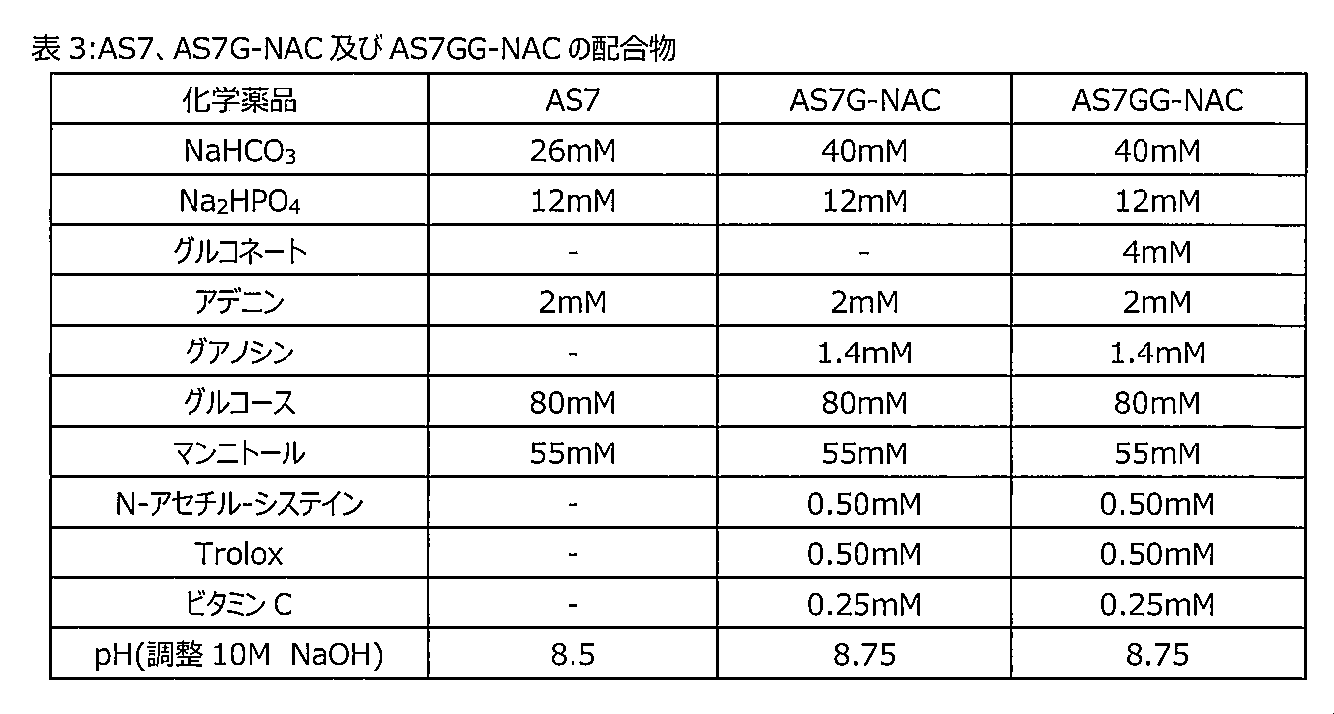
本開示の別の態様では、添加剤溶液は、表4に提供されるように、Erythrosol-5、5mMのグルコネートを有するErythrosol-5G(Erythrosol-5GG)、又はグルコネートを有しないErythrosol-5Gからなる群から選択される。別の態様では、添加剤溶液は、N-アセチル-システイン、6-ヒドロキシ-2,5,7,8-テトラメチルクロマン-2-カルボン酸(Trolox)、及びl-アスコルビン酸(ビタミンC)を更に含む。本開示の態様では、添加剤溶液は、10~40mMのNa2HPO4、10~40mMのクエン酸ナトリウム、0.5~3mMのアデニン、30~60mMのグルコース、及び80~130mMのマンニトールを含む。別の態様では、添加剤溶液は、10~40mMのNa2HPO4、10~40mMのクエン酸ナトリウム、0.5~3mMのアデニン、30~60mMのグルコース、80~130mMのマンニトール、及び0.5~3mMのグアノシンを含む。別の態様では、添加剤溶液はまた、2~8mMのグルコネートも含む。更に別の態様では、添加剤溶液は、7.5~9のpHを有する。別の態様では、添加剤溶液は、少なくとも7.0、7.2、7.4、7.5、7.6、7.8、8.0、8.2、8.4、8.5、8.6、及び8.8のpHを有する。別の態様では、添加剤溶液は、7.0~7.5、7.5~8、8~8.2、8~8.4、8~8.6、8~8.8、8.4~9のpHを有する。 In another aspect of the present disclosure, the additive solution consists of Erythrosol-5, Erythrosol-5G with 5 mM gluconate (Erythrosol-5GG), or Erythrosol-5G without gluconate, as provided in Table 4. Selected from the group. In another aspect, the additive solution contains N-acetyl-cysteine, 6-hydroxy-2,5,7,8-tetramethylchroman-2-carboxylic acid (Trolox), and l-ascorbic acid (vitamin C). Including further. In aspects of the present disclosure, the additive solution comprises 10-40 mM Na 2 HPO 4 , 10-40 mM sodium citrate, 0.5-3 mM adenine, 30-60 mM glucose, and 80-130 mM mannitol. . In another aspect, the additive solution comprises 10-40 mM Na 2 HPO4, 10-40 mM sodium citrate, 0.5-3 mM adenine, 30-60 mM glucose, 80-130 mM mannitol, and 0.5 Contains ~3 mM guanosine. In another aspect, the additive solution also contains 2-8 mM gluconate. In yet another aspect, the additive solution has a pH of 7.5-9. In another aspect, the additive solution has a , 8.6 and 8.8. In another aspect, the additive solution is 7.0-7.5, 7.5-8, 8-8.2, 8-8.4, 8-8.6, 8-8.8, 8. It has a pH of 4-9.
本開示の特定の態様では、添加剤溶液は、20mMのNa2HPO4、25mMのクエン酸ナトリウム、1.5mMのアデニン、45.5mMのグルコース、110mMのマンニトール、及び8.8のpHを含む。別の態様では、添加剤溶液は、20mMのNa2HPO4、25mMのクエン酸ナトリウム、1.5mMのアデニン、45.5mMのグルコース、110mMのマンニトール、5mMのグルコネート、及び8.8のpHを含む。
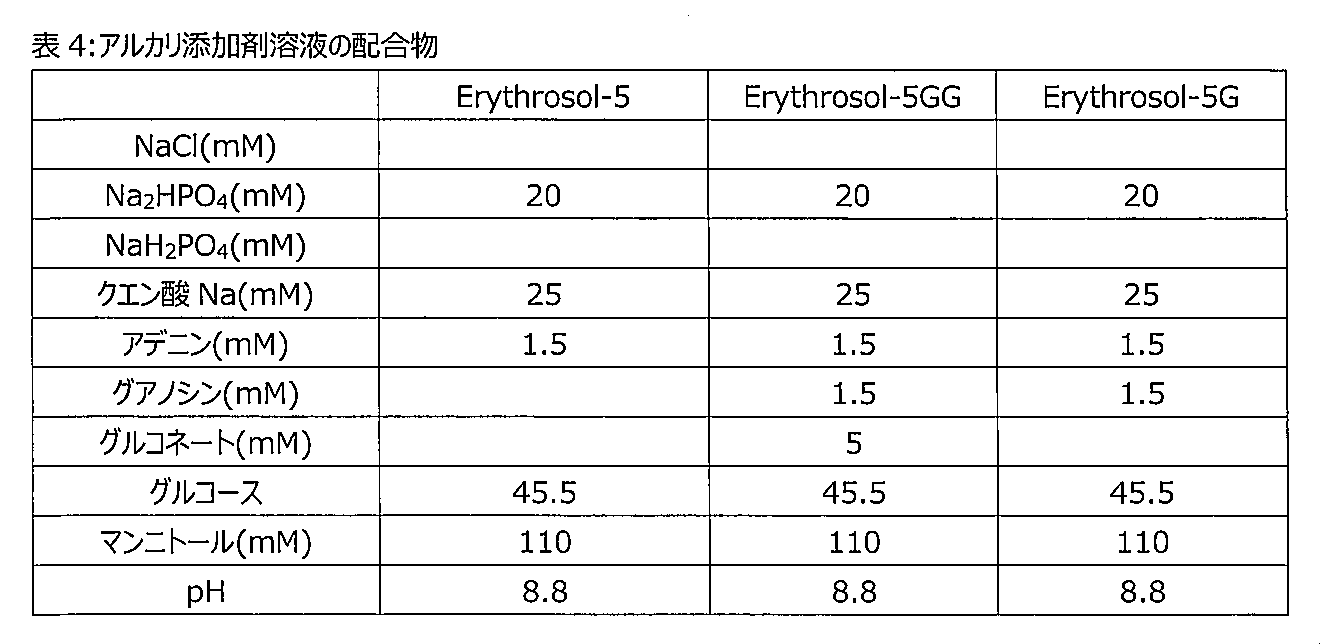
本開示は、全血、血小板、及び白血球からなる群から選択される血液製剤と、重炭酸ナトリウム(NaHCO3)、リン二塩基酸ナトリウム(Na2HPO4)、アデニン、グアノシン、グルコース、マンニトール、N-アセチル-システイン、6-ヒドロキシ-2,5,7,8-テトラメチルクロマン-2-カルボン酸(Trolox)、及びl-アスコルビン酸(ビタミンC)を含む添加剤溶液と、を含む、組成物を提供し、かつ含む。 The present disclosure provides a blood product selected from the group consisting of whole blood, platelets, and white blood cells, sodium bicarbonate ( NaHCO3 ), sodium phosphate dibasic ( Na2HPO4 ), adenine, guanosine, glucose, mannitol, and an additive solution comprising N-acetyl-cysteine, 6-hydroxy-2,5,7,8-tetramethylchroman-2-carboxylic acid (Trolox), and l-ascorbic acid (vitamin C). Provide and contain things.
本開示は、全血、血小板、及び125mmHg未満のpCO2を有する白血球からなる群から選択される血液製剤と、ある濃度のリン酸二ナトリウム(Na2HPO4)、クエン酸ナトリウム、アデニン、グルコース、及びマンニトールを含む添加剤溶液と、を含む組成物を更に提供し、かつ含む。 The present disclosure provides a blood product selected from the group consisting of whole blood, platelets, and leukocytes having a pCO2 of less than 125 mmHg and a concentration of disodium phosphate ( Na2HPO4 ), sodium citrate, adenine, glucose. and an additive solution comprising mannitol.
本開示は、125mmHg未満のpCO2、20%を超えるSO2%、並びに40mMの重炭酸ナトリウム(NaHCO3)、12mMのリン酸二ナトリウム(Na2HPO4)、2mMのアデニン、1.4mMのグアノシン、80mMのグルコース、55mMのマンニトール、0.5mMのN-アセチル-システイン、0.5mMの6-ヒドロキシ-2,5,7,8-テトラメチルクロマン-2-カルボン酸(Trolox)、及び0.25mMのl-アスコルビン酸(ビタミンC)を含む添加剤溶液を含む、保存された血液製剤を提供し、かつ含む。ある態様では、保存された血液組成物は、42日間の保存後に少なくとも4μmol/g HbのATP濃度、60mmHg未満のCO2濃度を更に含む。ある態様では、保存された血液組成物は、21日間の保存後に、少なくとも6μmol/g Hbの2,3-DPG濃度を更に含む。ある態様では、保存された血液組成物は、42日間の保存後、少なくとも4μmol/gHbの2,3-DPG濃度を更に含む。 The present disclosure provides pCO2 less than 125 mmHg, SO2 % greater than 20%, as well as 40 mM sodium bicarbonate ( NaHCO3 ), 12 mM disodium phosphate ( Na2HPO4 ), 2 mM adenine, 1.4 mM guanosine, 80 mM glucose, 55 mM mannitol, 0.5 mM N-acetyl-cysteine, 0.5 mM 6-hydroxy-2,5,7,8-tetramethylchroman-2-carboxylic acid (Trolox), and 0 .Provide and include a preserved blood product comprising an additive solution containing 25 mM l-ascorbic acid (vitamin C). In some embodiments, the stored blood composition further comprises an ATP concentration of at least 4 μmol/g Hb, a CO2 concentration of less than 60 mmHg after 42 days of storage. In some embodiments, the stored blood composition further comprises a 2,3-DPG concentration of at least 6 μmol/g Hb after 21 days of storage. In some embodiments, the stored blood composition further comprises a 2,3-DPG concentration of at least 4 μmol/gHb after 42 days of storage.
別の態様では、血液製剤は、100mmHg未満のpCO2、20%を超えるSO2%、40mMの重炭酸ナトリウム(NaHCO3)、12mMのリン酸二ナトリウム(Na2HPO4)、2mMのアデニン、1.4mMのグアノシン、80mMのグルコース、55mMのマンニトール、0.5mMのN-アセチル-システイン、0.5mMの6-ヒドロキシ-2,5,7,8-テトラメチルクロマン-2-カルボン酸(Trolox)、及び0.25mMのl-アスコルビン酸(ビタミンC)を含む添加剤溶液を有する。ある態様では、保存された血液組成物は、保存42日目の従来の方式で保存された赤血球中の3μmol/gHb、92mmHgのpCO2、及び89%のSO2%と比較して、保存42日後の少なくとも4μmol/gHbのATP濃度、50mmHg未満のpCO2、及び50%未満のSO2%を更に含む。ある態様では、保存された血液組成物は、21日間の保存後、少なくとも6μmol/gHbの2,3-DPG濃度を更に含む。ある態様では、保存された血液組成物は、保存42日目において0.5μmol/gHbの2,3DPG濃度、及び92mmHgのpCO2を有する従来の方式で保存された赤血球と比較して、50mmHg未満のpCO2において、42日間の保存後、少なくとも4μmol/gHbの2,3-DPG濃度を更に含む。 In another aspect, the blood product has pCO2 less than 100 mm Hg, % SO2 greater than 20%, 40 mM sodium bicarbonate ( NaHCO3 ), 12 mM disodium phosphate ( Na2HPO4 ), 2 mM adenine, 1.4 mM guanosine, 80 mM glucose, 55 mM mannitol, 0.5 mM N-acetyl-cysteine, 0.5 mM 6-hydroxy-2,5,7,8-tetramethylchroman-2-carboxylic acid (Trolox ), and an additive solution containing 0.25 mM l-ascorbic acid (vitamin C). In certain embodiments, the preserved blood composition has a 3 μmol/gHb, a pCO 2 of 92 mmHg, and a SO 2 % of 89% in conventionally preserved red blood cells at 42 days of storage compared to 42 days of storage. ATP concentration of at least 4 μmol/gHb after day, pCO 2 less than 50 mmHg, and SO 2 % less than 50%. In some embodiments, the stored blood composition further comprises a 2,3-DPG concentration of at least 6 μmol/gHb after 21 days of storage. In some embodiments, the preserved blood composition has a 2,3DPG concentration of 0.5 μmol/gHb and a pCO 2 of 92 mmHg at 42 days of storage compared to conventionally preserved red blood cells of less than 50 mmHg. pCO 2 and after 42 days of storage further comprising a 2,3-DPG concentration of at least 4 μmol/gHb.
別の態様では、血液製剤は、75mmHg未満のpCO2、20%を超えるSO2%、40mMの重炭酸ナトリウム(NaHCO3)、12mMのリン酸二ナトリウム(Na2HPO4)、2mMのアデニン、1.4mMのグアノシン、80mMのグルコース、55mMのマンニトール、0.5mMのN-アセチル-システイン、0.5mMの6-ヒドロキシ-2,5,7,8-テトラメチルクロマン-2-カルボン酸(Trolox)、及び0.25mMのl-アスコルビン酸(ビタミンC)を含む添加剤溶液を有する。 In another aspect, the blood product has pCO2 less than 75 mm Hg, % SO2 greater than 20%, 40 mM sodium bicarbonate ( NaHCO3 ), 12 mM disodium phosphate ( Na2HPO4 ), 2 mM adenine, 1.4 mM guanosine, 80 mM glucose, 55 mM mannitol, 0.5 mM N-acetyl-cysteine, 0.5 mM 6-hydroxy-2,5,7,8-tetramethylchroman-2-carboxylic acid (Trolox ), and an additive solution containing 0.25 mM l-ascorbic acid (vitamin C).
別の態様では、血液製剤は、25mmHg未満のpCO2、20%を超えるSO2%、並びに40mMの重炭酸ナトリウム(NaHCO3)、12mMのリン酸二ナトリウム(Na2HPO4)、2mMのアデニン、1.4mMのグアノシン、80mMのグルコース、55mMのマンニトール、0.5mMのN-アセチル-システイン、0.5mMの6-ヒドロキシ-2,5,7,8-テトラメチルクロマン-2-カルボン酸(Trolox)、及び0.25mMのl-アスコルビン酸(ビタミンC)を含む添加剤溶液を有する。 In another aspect, the blood product has a pCO2 less than 25 mmHg, a SO2 % greater than 20%, and 40 mM sodium bicarbonate ( NaHCO3 ), 12 mM disodium phosphate ( Na2HPO4 ), 2 mM adenine , 1.4 mM guanosine, 80 mM glucose, 55 mM mannitol, 0.5 mM N-acetyl-cysteine, 0.5 mM 6-hydroxy-2,5,7,8-tetramethylchroman-2-carboxylic acid ( Trolox), and an additive solution containing 0.25 mM l-ascorbic acid (vitamin C).
別の態様では、血液製剤は、125mmHg未満のpCO2、5~30%のSO2%、40mMの重炭酸ナトリウム(NaHCO3)、12mMのリン酸二ナトリウム(Na2HPO4)、2mMのアデニン、1.4mMのグアノシン、80mMのグルコース、55mMのマンニトール、0.5mMのN-アセチル-システイン、0.5mMの6-ヒドロキシ-2,5,7,8-テトラメチルクロマン-2-カルボン酸(Trolox)、及び0.25mMのl-アスコルビン酸(ビタミンC)を含む添加剤溶液を有する。 In another aspect, the blood product has a pCO 2 of less than 125 mm Hg, 5-30% SO 2 %, 40 mM sodium bicarbonate (NaHCO 3 ), 12 mM disodium phosphate (Na 2 HPO 4 ), 2 mM adenine , 1.4 mM guanosine, 80 mM glucose, 55 mM mannitol, 0.5 mM N-acetyl-cysteine, 0.5 mM 6-hydroxy-2,5,7,8-tetramethylchroman-2-carboxylic acid ( Trolox), and an additive solution containing 0.25 mM l-ascorbic acid (vitamin C).
別の態様では、血液製剤は、100mmHg未満のpCO2、5~30%のSO2%、並びに40mMの重炭酸ナトリウム(NaHCO3)、12mMのリン酸二ナトリウム(Na2HPO4)、2mMのアデニン、1.4mMのグアノシン、80mMのグルコース、55mMのマンニトール、0.5mMのN-アセチル-システイン、0.5mMの6-ヒドロキシ-2,5,7,8-テトラメチルクロマン-2-カルボン酸(Trolox)、及び0.25mMのl-アスコルビン酸(ビタミンC)を含む添加剤溶液を有する。 In another aspect, the blood product has a pCO 2 of less than 100 mmHg, a SO 2 % of 5-30%, and 40 mM sodium bicarbonate (NaHCO 3 ), 12 mM disodium phosphate (Na 2 HPO 4 ), 2 mM adenine, 1.4 mM guanosine, 80 mM glucose, 55 mM mannitol, 0.5 mM N-acetyl-cysteine, 0.5 mM 6-hydroxy-2,5,7,8-tetramethylchroman-2-carboxylic acid (Trolox), and an additive solution containing 0.25 mM l-ascorbic acid (vitamin C).
別の態様では、血液製剤は、75mmHg未満のpCO2、5~30%のSO2%、40mMの重炭酸ナトリウム(NaHCO3)、12mMのリン酸二ナトリウム(Na2HPO4)、2mMのアデニン、1.4mMのグアノシン、80mMのグルコース、55mMのマンニトール、0.5mMのN-アセチル-システイン、0.5mMの6-ヒドロキシ-2,5,7,8-テトラメチルクロマン-2-カルボン酸(Trolox)、及び0.25mMのl-アスコルビン酸(ビタミンC)を含む添加剤溶液を有する。 In another aspect, the blood product has a pCO 2 of less than 75 mmHg, SO 2 % of 5-30%, 40 mM sodium bicarbonate (NaHCO 3 ), 12 mM disodium phosphate (Na 2 HPO 4 ), 2 mM adenine , 1.4 mM guanosine, 80 mM glucose, 55 mM mannitol, 0.5 mM N-acetyl-cysteine, 0.5 mM 6-hydroxy-2,5,7,8-tetramethylchroman-2-carboxylic acid ( Trolox), and an additive solution containing 0.25 mM l-ascorbic acid (vitamin C).
別の態様では、血液製剤は、50mmHg未満のpCO2、5~30%のSO2%、40mMの重炭酸ナトリウム(NaHCO3)、12mMのリン酸二ナトリウム(Na2HPO4)、2mMのアデニン、1.4mMのグアノシン、80mMのグルコース、55mMのマンニトール、0.5mMのN-アセチル-システイン、0.5mMの6-ヒドロキシ-2,5,7,8-テトラメチルクロマン-2-カルボン酸(Trolox)、及び0.25mMのl-アスコルビン酸(ビタミンC)を含む添加剤溶液を有する。 In another aspect, the blood product has a pCO 2 of less than 50 mm Hg, SO 2 % of 5-30%, 40 mM sodium bicarbonate (NaHCO 3 ), 12 mM disodium phosphate (Na 2 HPO 4 ), 2 mM adenine , 1.4 mM guanosine, 80 mM glucose, 55 mM mannitol, 0.5 mM N-acetyl-cysteine, 0.5 mM 6-hydroxy-2,5,7,8-tetramethylchroman-2-carboxylic acid ( Trolox), and an additive solution containing 0.25 mM l-ascorbic acid (vitamin C).
別の態様では、血液製剤は、25mmHg未満のpCO2、5~30%のSO2%、及び40mMの重炭酸ナトリウム(NaHCO3)、12mMのリン酸二ナトリウム(Na2HPO4)、2mMのアデニン、1.4mMのグアノシン、80mMのグルコース、55mMのマンニトール、0.5mMのN-アセチル-システイン、0.5mMの6-ヒドロキシ-2,5,7,8-テトラメチルクロマン-2-カルボン酸(Trolox)、及び0.25mMのl-アスコルビン酸(ビタミンC)を含む添加剤溶液を有する。 In another aspect, the blood product has a pCO 2 of less than 25 mmHg, a SO 2 % of 5-30%, and 40 mM sodium bicarbonate (NaHCO 3 ), 12 mM disodium phosphate (Na 2 HPO 4 ), 2 mM adenine, 1.4 mM guanosine, 80 mM glucose, 55 mM mannitol, 0.5 mM N-acetyl-cysteine, 0.5 mM 6-hydroxy-2,5,7,8-tetramethylchroman-2-carboxylic acid (Trolox), and an additive solution containing 0.25 mM l-ascorbic acid (vitamin C).
更に別の態様では、血液製剤は、50mmHg未満のpCO2、5~30%のSO2%、表3又は表4に提供される添加剤溶液を有する。 In yet another aspect, the blood product has a pCO 2 of less than 50 mmHg, a SO 2 % of 5-30%, an additive solution provided in Table 3 or Table 4.
本開示は、以下の実施形態を提供し、かつ含む。 The present disclosure provides and includes the following embodiments.
実施形態1。血液製剤の保存方法であって、30%を超えるSO2%を有する血液製剤を取得することと、血液製剤に添加剤溶液を添加して、保存可能な血液製剤を調製することと、保存可能な血液製剤を、25℃、約1atmにおいて、1平方センチメートル当たり少なくとも0.62立方センチメートル(cm3/cm2)の二酸化炭素に関するガス透過性を有する、ジ-2-エチルヘキシルフタレートフリー(DEHPフリー)血液適合性(BC)二酸化炭素透過性バッグ内に保存することと、を含む、方法。 Embodiment 1. A method of preserving a blood product comprising: obtaining a blood product having a SO2% greater than 30%; adding an additive solution to the blood product to prepare a storable blood product; a di-2-ethylhexylphthalate-free (DEHP-free) hemocompatible blood product having a gas permeability for carbon dioxide of at least 0.62 cubic centimeters per square centimeter (cm 3 /cm 2 ) at 25° C. and about 1 atm. storing in a carbon dioxide (BC) carbon dioxide permeable bag.
実施形態2。該保存可能な血液製剤が、該保存の前に脱酸素化されない、実施形態1に記載の方法。
実施形態3。該保存可能な血液製剤が、該保存中に脱酸素されない、実施形態1又は2のいずれか一項に記載の方法。
Embodiment 3. 3. The method of any one of
実施形態4。保存中に、該保存可能な血液製剤から酸素を枯渇させることを含む、実施形態2に記載の方法。
Fourth embodiment. 3. The method of
実施形態5。該BC二酸化炭素透過性バッグが、0.3cm cm3/cm2未満の酸素透過性を有する、実施形態1~4のいずれかに記載の方法。 Embodiment 5. 5. The method of any of embodiments 1-4, wherein the BC carbon dioxide permeable bag has an oxygen permeability of less than 0.3 cm cm 3 /cm 2 .
実施形態6。該BC二酸化炭素透過性バッグが、ジ(2-エチルヘキシル)テレフタレート(DEHT)を含まない、実施形態1~5のいずれか一項に記載の方法。 Embodiment 6. The method of any one of embodiments 1-5, wherein the BC carbon dioxide permeable bag is free of di(2-ethylhexyl) terephthalate (DEHT).
実施形態7。該BC二酸化炭素透過性バッグが、可塑剤として、1,2-シクロヘキサンジカルボン酸ジイソノニルエステル(DINCH)又はブチリルトリヘキシルシトレート(BTHC)を含む、実施形態1~6のいずれか一項に記載の方法。 Embodiment 7. 7. The BC carbon dioxide permeable bag comprises 1,2-cyclohexanedicarboxylic acid diisononyl ester (DINCH) or butyryltrihexyl citrate (BTHC) as a plasticizer. Method.
実施形態8。該BC二酸化炭素透過性バッグが、酸素及び二酸化炭素に対して不透過性の外側バッグ内に封入されている、実施形態1~7のいずれか一項に記載の方法。 Embodiment 8. 8. The method of any one of embodiments 1-7, wherein the BC carbon dioxide permeable bag is enclosed within an outer bag that is impermeable to oxygen and carbon dioxide.
実施形態9。該外側バッグが、該BC二酸化炭素透過性バッグと該外側バッグとの間に設置された二酸化炭素吸着剤を更に封入する、実施形態1~8のいずれか一項に記載の方法。 Embodiment 9. 9. The method of any one of embodiments 1-8, wherein the outer bag further encapsulates a carbon dioxide sorbent positioned between the BC carbon dioxide permeable bag and the outer bag.
実施形態10。2,3-DPGレベルが、従来の方式で保存された血液製剤の2,3-DPGレベルと比較して、該保存中に、該保存可能な血液製剤中で少なくとも10%増加する、実施形態1~9のいずれか一項に記載の方法。 Embodiment 10. 2,3-DPG levels are increased by at least 10% in said storable blood product during said storage compared to 2,3-DPG levels in conventionally stored blood products. 10. The method of any one of embodiments 1-9, wherein
実施形態11。2,3-DPGレベルが、従来の方式で保存された血液製剤の2,3-DPGレベルと比較して、該保存中に、該保存可能な血液製剤中で少なくとも15%増加する、実施形態1~10のいずれか一項に記載の方法。 Embodiment 11. 2,3-DPG levels are increased by at least 15% in said storable blood product during said storage as compared to 2,3-DPG levels in conventionally stored blood products. 11. The method of any one of embodiments 1-10, wherein
実施形態12。ATPレベルが、従来の方式で保存された血液製剤のATPレベルと比較して、該保存中に、該保存可能な血液製剤中で増加する、実施形態1~11のいずれか一項に記載の方法。
実施形態13。ATPレベルが、従来の方式で保存された血液製剤のATPレベルと比較して、該保存中に、該保存可能な血液製剤中で少なくとも10%増加する、実施形態12に記載の方法。
Embodiment 13. 13. The method of
実施形態14。該添加剤溶液が、7.0~8.5のpHを有する、実施形態1~13のいずれか一項に記載の方法。 Embodiment fourteen. 14. The method of any one of embodiments 1-13, wherein the additive solution has a pH of 7.0-8.5.
実施形態15。該添加剤溶液が、少なくとも8.5のpHを有する、実施形態1~14のいずれか一項に記載の方法。
実施形態16。該二酸化炭素吸着剤が、酸素吸着剤を更に含む、実施形態9に記載の方法。
実施形態17。該BC二酸化炭素透過性バッグが、25℃で、24時間(hrs.)、少なくとも0.05センチメートル3(cm3)/cm2/atm24時間(hrs.)の酸素に関するガス透過性を有する、実施形態1~16のいずれか一項に記載の方法。 Embodiment seventeen. the BC carbon dioxide permeable bag has a gas permeability for oxygen of at least 0.05 centimeters (cm 3 )/cm 2 /atm 24 hours (hrs.) at 25° C. for 24 hours (hrs.); 17. The method of any one of embodiments 1-16.
実施形態18。該BC二酸化炭素透過性バッグが、25℃で、24時間、少なくとも0.15cm3/cm2/atmの酸素に関するガス透過性を有する、実施形態17に記載の方法。 Embodiment 18. 18. The method of embodiment 17, wherein the BC carbon dioxide permeable bag has a gas permeability for oxygen of at least 0.15 cm 3 /cm 2 /atm at 25° C. for 24 hours.
実施形態19。該BC二酸化炭素透過性バッグが、25℃で、24時間、約0.22cm3/cm2/気圧の酸素に関するガス透過性を有する、実施形態18に記載の方法。 Embodiment nineteen. 19. The method of embodiment 18, wherein the BC carbon dioxide permeable bag has a gas permeability for oxygen of about 0.22 cm 3 /cm 2 /atmosphere at 25° C. for 24 hours.
実施形態20。該血液製剤が、最大42日間の該保存中に、15%を超える飽和酸素(SO2)を含む、実施形態1~19のいずれか一項に記載の方法。
実施形態21。該血液製剤が、最大42日間の該保存中に、20%を超えるSO2を含む、実施形態20に記載の方法。
実施形態22。該血液製剤が、最大42日間の該保存中に、125mmHg未満のpCO2を含む、実施形態1~21のいずれか一項に記載の方法。 Embodiment 22. 22. The method of any one of embodiments 1-21, wherein said blood product comprises a pCO2 of less than 125 mmHg during said storage for up to 42 days.
実施形態23。該血液製剤が、最大42日間の該保存中に、100mmHg未満のpCO2を含む、実施形態22に記載の方法。 Embodiment 23. 23. The method of embodiment 22, wherein said blood product comprises a pCO2 of less than 100 mmHg during said storage for up to 42 days.
実施形態24。該血液製剤が、最大42日間の該保存中に、75mmHg未満のpCO2を含む、実施形態23に記載の方法。 Embodiment 24. 24. The method of embodiment 23, wherein said blood product comprises a pCO2 of less than 75 mmHg during said storage for up to 42 days.
実施形態25。該血液製剤が、最大42日間の該保存中に、50mmHg未満のpCO2を含む、実施形態24に記載の方法。 Embodiment 25. 25. The method of embodiment 24, wherein said blood product comprises a pCO2 of less than 50 mmHg during said storage for up to 42 days.
実施形態26。該保存が、42日間未満である、実施形態1~25のいずれか一項に記載の方法。 Embodiment 26. 26. The method of any one of embodiments 1-25, wherein said storage is less than 42 days.
実施形態27。該保存が、28日間未満である、実施形態10、11、12、又は13のいずれか一項に記載の方法。
Embodiment 27. 14. The method of any one of
実施形態28。該保存が、21日間未満である、実施形態10、11、12、又は13のいずれか一項に記載の方法。
Embodiment 28. 14. The method of any one of
実施形態29。該保存が、14日間未満である、実施形態10、11、12、又は13のいずれか一項に記載の方法。
Embodiment 29. 14. The method of any one of
実施形態30。該保存が、7日間未満である、実施形態10、11、12、又は13のいずれか一項に記載の方法。
Embodiment 30. 14. The method of any one of
実施形態31。該添加剤溶液が、AS7、AS7G-NAC、4mMのグルコネートを有するAS7G-NAC(AS7GG-NAC)、グルコネートを有するAS3、erythrosol-5、erythrosol-5G、5mMのグルコネートを有するerythrosol-5G(erythrosol-5GG)からなる群から選択される、実施形態1~30のいずれか一項に記載の方法。 Embodiment 31. The additive solution includes AS7, AS7G-NAC, AS7G-NAC with 4 mM gluconate (AS7GG-NAC), AS3 with gluconate, erythrosol-5, erythrosol-5G, erythrosol-5G with 5 mM gluconate (erythrosol- 5GG).
実施形態32。該血液製剤が、42日間の該保存後に、0.8%以下の溶血を含む、実施形態1~31のいずれか一項に記載の方法。 Embodiment 32. 32. The method of any one of embodiments 1-31, wherein said blood product comprises 0.8% or less hemolysis after said storage for 42 days.
実施形態33。該血液製剤が、全血、血小板、白血球、又は赤血球を含む、実施形態1~32のいずれか一項に記載の方法。 Embodiment 33. 33. The method of any one of embodiments 1-32, wherein the blood product comprises whole blood, platelets, white blood cells, or red blood cells.
実施形態34。該BC二酸化炭素透過性バッグが、ポリ塩化ビニル(PVC)又はポリオレフィン、シリコーン、ポリフッ化ビニリデン(PVDF)、ポリスルホン(PS)、ポリプロピレン(PP)又はポリウレタン(PU)を含む、実施形態1~33のいずれか一項に記載の方法。 Embodiment 34. of embodiments 1-33, wherein the BC carbon dioxide permeable bag comprises polyvinyl chloride (PVC) or polyolefin, silicone, polyvinylidene fluoride (PVDF), polysulfone (PS), polypropylene (PP), or polyurethane (PU). A method according to any one of paragraphs.
実施形態35。DEHPフリー二酸化炭素透過性及び酸素不透過性材料を含む血液を保存するための容器であって、該材料が、25℃で1atmにおいて0.05cm3/cm2未満の酸素に関するガス透過性、及び25℃で1atmにおいて1平方センチメートル当たり少なくとも0.62立方センチメートル(cm3/cm2)の二酸化炭素に関するガス透過性を有する、容器。 Embodiment 35. A container for storing blood comprising a DEHP-free carbon dioxide permeable and oxygen impermeable material, said material having a gas permeability for oxygen of less than 0.05 cm3 / cm2 at 1 atm at 25°C, and A container having a gas permeability for carbon dioxide of at least 0.62 cubic centimeters per square centimeter (cm 3 /cm 2 ) at 25° C. and 1 atm.
実施形態36。該材料が、ポリ塩化ビニル(PVC)、ポリオレフィン、シリコーン、ポリフッ化ビニリデン(PVDF)、ポリスルホン(PS)、ポリプロピレン(PP)、又はポリウレタンからなる群から選択される、実施形態35に記載の容器。 Embodiment 36. 36. The container of embodiment 35, wherein the material is selected from the group consisting of polyvinyl chloride (PVC), polyolefins, silicones, polyvinylidene fluoride (PVDF), polysulfone (PS), polypropylene (PP), or polyurethane.
実施形態37。該材料が、可塑剤として、1,2-シクロヘキサンジカルボン酸ジイソノニルエステル(DINCH)又はブチリルトリヘキシルシトレート(BTHC)を含む、実施形態35~36のいずれか一項に記載の方法。 Embodiment 37. 37. The method of any one of embodiments 35-36, wherein the material comprises 1,2-cyclohexanedicarboxylic acid diisononyl ester (DINCH) or butyryltrihexyl citrate (BTHC) as a plasticizer.
実施形態38。血液製剤を取り扱うための方法であって、
該血液製剤に添加剤溶液を添加することと、該血液製剤を、25℃、約1atmにおいて少なくとも0.62cm3/cm2の二酸化炭素に関するガス透過性を有する、DEHPフリー血液適合性(BC)二酸化炭素透過性バッグ内に保存することであって、該保存が、少なくとも7日間であり、該血液製剤が、該7日間の保存における酸素レベルを含み、これが保存1日目の該血液製剤内の酸素レベルより減少するか、又はほぼ同じである、保存することと、を含む、方法。
Embodiment 38. A method for handling blood products, comprising:
DEHP-free hemocompatibility (BC) by adding an additive solution to the blood product and making the blood product have a gas permeability for carbon dioxide of at least 0.62 cm 3 /cm 2 at 25° C. and about 1 atm. Storage in a carbon dioxide permeable bag, wherein said storage is for at least 7 days, said blood product comprises an oxygen level during said 7 days of storage, which is within said blood product on day 1 of storage and storing the oxygen level is less than or about the same as
実施形態39。該血液製剤が、全血、血小板、白血球、又は赤血球を含む、実施形態38に記載の方法。 Embodiment 39. 39. The method of embodiment 38, wherein said blood product comprises whole blood, platelets, white blood cells, or red blood cells.
実施形態40。該BC二酸化炭素透過性バッグが、PVC又はポリオレフィンを含む、実施形態38~39のいずれか一項に記載の方法。 Embodiment 40. 40. The method of any one of embodiments 38-39, wherein the BC carbon dioxide permeable bag comprises PVC or polyolefin.
実施形態41。該BC二酸化炭素透過性バッグが、可塑剤として、PVC中20~70%重量/重量の1,2-シクロヘキサンジカルボン酸ジイソノニルエステル(DINCH)又はブチリルトリヘキシルシトレート(BTHC)を含む、実施形態40に記載の方法。 Embodiment 41. Embodiment 40, wherein the BC carbon dioxide permeable bag comprises 1,2-cyclohexanedicarboxylic acid diisononyl ester (DINCH) or butyryltrihexyl citrate (BTHC) at 20-70% weight/weight in PVC as a plasticizer. The method described in .
実施形態42。該可塑剤が、PVC中20~45重量%のBTHC/重量である、実施形態41に記載の方法。
実施形態43。該BC二酸化炭素透過性バッグが、25℃、約1atmにおいて、少なくとも2.0cm3/cm2の二酸化炭素に関するガス透過性を有する、実施形態38~42のいずれか一項に記載の方法。 Embodiment 43. 43. The method of any one of embodiments 38-42, wherein the BC carbon dioxide permeable bag has a gas permeability for carbon dioxide of at least 2.0 cm 3 /cm 2 at 25° C. and about 1 atm.
実施形態44。該BC二酸化炭素透過性バッグが、酸素及び二酸化炭素に対して不透過性の外側バッグを更に備える、実施形態38~43のいずれか一項に記載の方法。 Embodiment 44. 44. The method of any one of embodiments 38-43, wherein the BC carbon dioxide permeable bag further comprises an outer bag impermeable to oxygen and carbon dioxide.
実施形態45。該BC二酸化炭素透過性バッグと該外側バッグとの間の二酸化炭素吸着剤を更に含む、実施形態38~44のいずれか一項に記載の方法。 Embodiment 45. 45. The method of any one of embodiments 38-44, further comprising a carbon dioxide sorbent between the BC carbon dioxide permeable bag and the outer bag.
実施形態46。該二酸化炭素吸着剤が、酸素吸着剤を更に含む、実施形態45に記載の方法。 Embodiment 46. 46. The method of embodiment 45, wherein the carbon dioxide sorbent further comprises an oxygen sorbent.
実施形態47。該BC二酸化炭素透過性バッグが、25℃で、24時間、少なくとも0.05cm3/cm2/atm4の酸素に関するガス透過性を有する、実施形態38~46のいずれか一項に記載の方法。 Embodiment 47. 47. The method of any one of embodiments 38-46, wherein the BC carbon dioxide permeable bag has a gas permeability for oxygen of at least 0.05 cm 3 /cm 2 /atm 4 at 25° C. for 24 hours.
実施形態48。該BC二酸化炭素透過性バッグが、25℃で、24時間、少なくとも0.15cm3/cm2/atm4の酸素に関するガス透過性を有する、実施形態47に記載の方法。 Embodiment 48. 48. The method of embodiment 47, wherein the BC carbon dioxide permeable bag has a gas permeability for oxygen of at least 0.15 cm3 / cm2 /atm4 at 25°C for 24 hours.
実施形態49。該BC二酸化炭素透過性バッグが、25℃で、24時間、約0.2cm3/cm2/気圧4の酸素に関するガス透過性を有する、実施形態48に記載の方法。 Embodiment 49. 49. The method of embodiment 48, wherein the BC carbon dioxide permeable bag has a gas permeability for oxygen of about 0.2 cm 3 /cm 2 /atm 4 at 25° C. for 24 hours.
実施形態50。該血液製剤が、少なくとも7日間の保存後に、15%を超えるSO2を含む、実施形態38~49のいずれか一項に記載の方法。 Embodiment fifty. 50. The method of any one of embodiments 38-49, wherein the blood product contains greater than 15% SO2 after storage for at least 7 days.
実施形態51。該血液製剤が、少なくとも7日間の保存後に、20%を超えるSO2を含む、実施形態50に記載の方法。 Embodiment 51. 51. The method of embodiment 50, wherein said blood product contains greater than 20% SO2 after storage for at least 7 days.
実施形態52。該血液製剤が、125mmHg未満のpCO2を含む、実施形態38~51のいずれか一項に記載の方法。 Embodiment 52. 52. The method of any one of embodiments 38-51, wherein said blood product comprises a pCO2 of less than 125 mmHg.
実施形態53。該血液製剤が、100mmHg未満のpCO2を含む、実施形態52に記載の方法。 Embodiment 53. 53. The method of embodiment 52, wherein said blood product comprises a pCO2 of less than 100 mmHg.
実施形態54。該血液製剤が、75mmHg未満のpCO2を含む、実施形態53に記載の方法。 Embodiment 54. 54. The method of embodiment 53, wherein said blood product comprises a pCO2 of less than 75 mmHg.
実施形態55。該血液製剤が、50mmHg未満のpCO2を含む、実施形態54に記載の方法。 Embodiment 55. 55. The method of embodiment 54, wherein said blood product comprises a pCO2 of less than 50 mmHg.
実施形態56。該保存が、少なくとも14日間である、実施形態38~55のいずれか一項に記載の方法。 Embodiment 56. 56. The method of any one of embodiments 38-55, wherein said storage is for at least 14 days.
実施形態57。該保存が、少なくとも21日間である、実施形態56に記載の方法。 Embodiment 57. 57. The method of embodiment 56, wherein said storage is for at least 21 days.
実施形態58。該保存が、少なくとも28日間である、実施形態57に記載の方法。 Embodiment 58. 58. The method of embodiment 57, wherein said storage is for at least 28 days.
実施形態59。該保存が、少なくとも42日間である、実施形態58に記載の方法。 Embodiment 59. 59. The method of embodiment 58, wherein said storage is for at least 42 days.
実施形態60。該保存が、少なくとも56日間である、実施形態59に記載の方法。 Embodiment 60. 60. The method of embodiment 59, wherein said storage is for at least 56 days.
実施形態61。該添加剤溶液が、添加剤溶液7(AS7)、AS7G-NAC、4mMのグルコネートを有するAS7G-NAC(AS7GG-NAC)、Erythrosol-5、Erythrosol-5G、5mMのグルコネートを有するErythrosol-5Gからなる群から選択される、実施形態38~60のいずれか一項に記載の方法。 Embodiment 61. The additive solution consists of additive solution 7 (AS7), AS7G-NAC, AS7G-NAC with 4 mM gluconate (AS7GG-NAC), Erythrosol-5, Erythrosol-5G, Erythrosol-5G with 5 mM gluconate. 61. The method of any one of embodiments 38-60, selected from the group.
実施形態62。該血液製剤が、0.8%以下の溶血を含む、実施形態38~61のいずれか一項に記載の方法。 Embodiment 62. The method of any one of embodiments 38-61, wherein said blood product comprises 0.8% or less hemolysis.
実施形態63。該血液製剤が、全血、血小板、白血球、又は赤血球を含む、実施形態38~62のいずれか一項に記載の方法。 Embodiment 63. The method of any one of embodiments 38-62, wherein said blood product comprises whole blood, platelets, white blood cells, or red blood cells.
実施形態64。保存可能な血液を保存するための方法であって、
25℃、約1atmにおいて少なくとも0.62cm3/cm2の二酸化炭素に対する透過性、及び約1atmにおいて0.3cm3/cm2以下の酸素に対する透過性を有する、DEHPフリーの血液適合性(BC)材料と、二酸化炭素吸着剤と、を含む保存容器内に血液製剤を設置することと、該保存可能な血液を含む該容器をある期間保存して、保存された血液を調製することと、を含む、方法。
Embodiment 64. A method for preserving storable blood, comprising:
DEHP-free hemocompatibility (BC) having a permeability to carbon dioxide of at least 0.62 cm 3 /cm 2 at 25° C. and about 1 atm and a permeability to oxygen of no more than 0.3 cm 3 /cm 2 at about 1 atm placing a blood product in a storage container containing a material and a carbon dioxide adsorbent; and storing the container containing the storable blood for a period of time to prepare stored blood. including, method.
実施形態65。該保存可能な血液が、全血、血小板、白血球、又は赤血球を含む、実施形態64に記載の方法。 Embodiment 65. 65. The method of embodiment 64, wherein the storable blood comprises whole blood, platelets, white blood cells, or red blood cells.
実施形態66。該保存可能な血液が、42日間の保存後に0.8%以下の溶血を含む、実施形態64~65のいずれか一項に記載の方法。 Embodiment 66. 66. The method of any one of embodiments 64-65, wherein the storable blood comprises 0.8% or less hemolysis after 42 days of storage.
実施形態67。該血液が、42日間の保存後、0.5%以下の溶血を含む、実施形態64~66のいずれか一項に記載の方法。 Embodiment 67. 67. The method of any one of embodiments 64-66, wherein the blood comprises 0.5% or less hemolysis after 42 days of storage.
実施形態68。該血液が、56日間の保存後、0.5%以下の溶血を含む、実施形態66に記載の方法。 Embodiment 68. 67. The method of embodiment 66, wherein the blood comprises 0.5% or less hemolysis after 56 days of storage.
実施形態69。該血液が、56日間の保存後、0.4%以下の溶血を含む、実施形態66に記載の方法。 Embodiment 69. 67. The method of embodiment 66, wherein said blood comprises 0.4% or less hemolysis after 56 days of storage.
実施形態70。該2,3-DPGレベルが、従来の方式で保存された血液製剤の2,3-DPGレベルと比較して、該血液製剤中で該保存の7日目、21日目、28日目、35日目、42日目、又は56日目において増加する、実施形態64~69のいずれか一項に記載の方法。
Embodiment 70. the 2,3-DPG levels are compared to 2,3-DPG levels in a conventionally stored blood product in the blood product at
実施形態71。該2,3-DPGレベルが、10、20、30、40、50、60、70、又は80%増加する、実施形態70に記載の方法。 Embodiment 71. 71. The method of embodiment 70, wherein said 2,3-DPG levels are increased by 10, 20, 30, 40, 50, 60, 70, or 80%.
実施形態72。該2,3-DPGレベルが、従来の方式で保存された血液製剤の2,3-DPGレベルと比較して、該血液製剤中で最大21日間の該保存で増加する、実施形態64~71のいずれか一項に記載の方法。 Embodiment 72. Embodiments 64-71, wherein said 2,3-DPG levels are increased in said blood product for up to 21 days of said storage as compared to 2,3-DPG levels in conventionally stored blood products. The method according to any one of .
実施形態73。該2,3-DPGレベルが、従来の方式で保存された血液製剤の2,3-DPGレベルと比較して、該血液製剤中で最大28日間の該保存で増加する、実施形態64~72のいずれか一項に記載の方法。 Embodiment 73. Embodiments 64-72, wherein said 2,3-DPG levels are increased in said blood product for up to 28 days of said storage compared to 2,3-DPG levels in blood products stored in a conventional manner, embodiments 64-72 The method according to any one of .
実施形態74。該2,3-DPGレベルが、従来の方式で保存された血液製剤の2,3-DPGレベルと比較して、該血液製剤中で最大35日間の該保存で増加する、実施形態64~73のいずれか一項に記載の方法。 Embodiment 74. Embodiments 64-73, wherein said 2,3-DPG levels are increased in said blood product for up to 35 days of said storage compared to 2,3-DPG levels in blood products stored in a conventional manner, embodiments 64-73 The method according to any one of .
実施形態75。該2,3-DPGレベルが、従来の方式で保存された血液製剤の2,3-DPGレベルと比較して、該血液製剤中で該保存の最大42日間増加する、実施形態64~74のいずれか一項に記載の方法。 Embodiment 75. 75 of embodiments 64-74, wherein the 2,3-DPG level is increased in the blood product compared to 2,3-DPG levels in a conventionally stored blood product for up to 42 days of storage A method according to any one of paragraphs.
実施形態76。該2,3-DPGレベルが、従来の方式で保存された血液製剤の2,3-DPGレベルと比較して、該血液製剤中で最大56日間の該保存で増加する、実施形態64~75のいずれか一項に記載の方法。 Embodiment 76. Embodiments 64-75, wherein said 2,3-DPG levels are increased in said blood product for up to 56 days of said storage compared to 2,3-DPG levels in blood products stored in a conventional manner, embodiments 64-75 The method according to any one of .
実施形態77。該ATPレベルが、従来の方式で保存された血液製剤のATPレベルと比較して増加する、実施形態64~76のいずれか一項に記載の方法。 Embodiment 77. 77. The method of any one of embodiments 64-76, wherein the ATP level is increased compared to the ATP level of a conventionally stored blood product.
実施形態78。該ATPレベルが、21日間の保存後に、従来の方式で保存された血液製剤のATPレベルと比較して増加する、実施形態64~77のいずれか一項に記載の方法。 Embodiment 78. 78. The method of any one of embodiments 64-77, wherein the ATP levels increase after 21 days of storage compared to ATP levels of blood products stored in a conventional manner.
実施形態79。該ATPレベルが、28日間の保存後に、従来の方式で保存された血液製剤のATPレベルと比較して増加する、実施形態64~78のいずれか一項に記載の方法。 Embodiment 79. 79. The method of any one of embodiments 64-78, wherein the ATP levels increase after 28 days of storage compared to ATP levels of blood products stored in a conventional manner.
実施形態80。該ATPレベルが、35日間の保存後に、従来の方式で保存された血液製剤のATPレベルと比較して増加する、実施形態64~79のいずれか一項に記載の方法。 Embodiment 80. 80. The method of any one of embodiments 64-79, wherein the ATP level is increased after 35 days of storage compared to the ATP level of a conventionally stored blood product.
実施形態81。該ATPレベルが、42日間の保存後に、従来の方式で保存された血液製剤のATPレベルと比較して増加する、実施形態64~80のいずれか一項に記載の方法。 Embodiment 81. 81. The method of any one of embodiments 64-80, wherein the ATP levels increase after 42 days of storage compared to ATP levels of blood products stored in a conventional manner.
実施形態82。該ATPレベルが、56日間の保存後に、従来の方式で保存された血液製剤のATPレベルと比較して増加する、実施形態64~81のいずれか一項に記載の方法。 Embodiment 82. 82. The method of any one of embodiments 64-81, wherein the ATP level is increased after 56 days of storage compared to the ATP level of a conventionally stored blood product.
実施形態83。該BC材料が、可塑剤として、1,2-シクロヘキサンジカルボン酸ジイソノニルエステル(DINCH)又はブチリルトリヘキシルシトレートBTHCを含む、実施形態64~82のいずれか一項に記載の方法。 Embodiment 83. 83. The method of any one of embodiments 64-82, wherein the BC material comprises 1,2-cyclohexanedicarboxylic acid diisononyl ester (DINCH) or butyryltrihexyl citrate BTHC as a plasticizer.
実施形態84。該可塑剤が、PVC中、20~40%、25~45%、20~70%、及び40~70%重量/重量である、実施形態83に記載の方法。 Embodiment 84. 84. The method of embodiment 83, wherein the plasticizer is 20-40%, 25-45%, 20-70%, and 40-70% weight/weight in PVC.
実施形態85。該保存容器が、該BC材料と外側バッグとの間に酸素吸着剤を更に含む、実施形態64~84のいずれか一項に記載の方法。 Embodiment 85. 85. The method of any one of embodiments 64-84, wherein the storage container further comprises an oxygen sorbent between the BC material and the outer bag.
実施形態86。該血液製剤に添加剤溶液を添加することを更に含み、AS7、AS7G-NAC、4mMのグルコネートを有するAS7G-NAC(AS7GG-NAC)、Erythrosol-5、Erythrosol-5G、5mMのグルコネートを含むErythrosol-5Gからなる群から選択される、実施形態64~85のいずれか一項に記載の方法。 Embodiment 86. AS7, AS7G-NAC, AS7G-NAC with 4 mM gluconate (AS7GG-NAC), Erythrosol-5, Erythrosol-5G, Erythrosol- with 5 mM gluconate, further comprising adding an additive solution to the blood product 86. The method of any one of embodiments 64-85, selected from the group consisting of 5G.
実施形態87。該BC材料が、ポリ塩化ビニル(PVC)又はポリオレフィンを含む、実施形態64~86のいずれか一項に記載の方法。 Embodiment 87. 87. The method of any one of embodiments 64-86, wherein the BC material comprises polyvinyl chloride (PVC) or polyolefin.
実施形態88。該血液製剤が、保存の1日目、7日目、14日目、21日目、42日目、又は56日目に10%を超えるSO2を含む、実施形態64~87のいずれか一項に記載の方法。 Embodiment 88. 88. Any one of embodiments 64-87, wherein the blood product comprises greater than 10% SO at 1, 7, 14, 21, 42, or 56 days of storage. The method described in .
実施形態89。該血液製剤が、20%を超えるSO2を含む、実施形態61に記載の方法。 Embodiment 89. 62. The method of embodiment 61, wherein said blood product comprises more than 20% SO2.
実施形態90。該BC材料が、25℃、約1atmにおいて、少なくとも2cm3/cm2の二酸化炭素に対する透過性を有する、実施形態64~89のいずれか一項に記載の方法。 Embodiment 90. 89. The method of any one of embodiments 64-89, wherein the BC material has a permeability to carbon dioxide of at least 2 cm 3 /cm 2 at 25° C. and about 1 atm.
実施形態91。該保存容器が、該BC材料と外側バッグとの間に酸素吸着剤を更に含む、実施形態64~90のいずれか一項に記載の方法。 Embodiment 91. 91. The method of any one of embodiments 64-90, wherein the storage container further comprises an oxygen sorbent between the BC material and the outer bag.
実施形態92。赤血球を保存するための方法であって、25℃、約1atmにおいて少なくとも0.62cm3/cm2の二酸化炭素に対する透過性、及び約1atmにおいて0.3cm3/cm2以下の酸素に対する透過性を有する材料からなる、DEHPフリー血液適合性(BC)の透過可能で内側に折り畳み可能な容器を封入し、二酸化炭素吸着剤、酸素吸着剤、又は酸素及び二酸化炭素吸着剤を、内側バッグと外側バッグとの間に封入する、外側酸素及び二酸化炭素不透過性容器を備える保存容器内に該赤血球を設置することと、該赤血球を含む該容器を少なくとも7日間保存して、保存された血液製剤を調製することと、を含む、方法。 Embodiment 92. A method for preserving red blood cells, comprising a permeability to carbon dioxide of at least 0.62 cm 3 /cm 2 at 25° C. and about 1 atm and a permeability to oxygen of no more than 0.3 cm 3 /cm 2 at about 1 atm. enclosing a DEHP-free blood compatible (BC) permeable, internally collapsible container made of a material having a carbon dioxide adsorbent, an oxygen adsorbent, or an oxygen and carbon dioxide adsorbent in an inner bag and an outer bag; placing the red blood cells in a storage container comprising an outer oxygen and carbon dioxide impermeable container enclosed between and storing the container containing the red blood cells for at least seven days to produce a preserved blood product; A method, comprising: preparing.
実施形態93。該保存が、4℃である、実施形態92に記載の方法。 Embodiment 93. 93. The method of embodiment 92, wherein said storage is at 4°C.
実施形態94。血液製剤中の2,3-DPGのレベルを維持するための方法であって、25℃、約1atmにおいて少なくとも0.62cm3/cm2の二酸化炭素に対する透過性、及び約1atmにおいて0.3cm3/cm2以下の酸素に対する透過性を有する血液適合性(BC)材料を封入し、該内側バッグと外側バッグとの間に二酸化炭素吸着剤を封入する、外側酸素及び二酸化炭素不透過性容器を備える保存容器中に、少なくとも10%の酸素飽和度を含む血液製剤を設置することと、該血液製剤を含む該容器を保存することであって、該2,3-DPGのレベルが、従来の方式で保存された血液製剤の2,3-DPGのレベルと比較して、最大14日間の保存の間に増加する、保存することと、を含む、方法。 Embodiment 94. A method for maintaining levels of 2,3-DPG in blood products comprising a permeability to carbon dioxide of at least 0.62 cm 3 /cm 2 at 25° C. and about 1 atm and 0.3 cm 3 at about 1 atm. an outer oxygen and carbon dioxide impermeable container enclosing a hemocompatible (BC) material having a permeability to oxygen of ≤/cm 2 and enclosing a carbon dioxide adsorbent between the inner and outer bags; placing a blood product comprising an oxygen saturation of at least 10% in a storage container comprising; and storing said container containing said blood product, said level of 2,3-DPG increasing during up to 14 days of storage as compared to the level of 2,3-DPG in a blood product stored in the manner.
実施形態95。該2,3-DPGが、従来の方式で保存された血液製剤の2,3-DPGのレベルと比較して、最大21日間の保存の間増加する、実施形態94に記載の方法。 Embodiment 95. 95. The method of embodiment 94, wherein the 2,3-DPG is increased for up to 21 days of storage compared to the level of 2,3-DPG in conventionally stored blood products.
実施形態96。該BC材料が、PVC又はポリオレフィンを含む、実施形態94に記載の方法。 Embodiment 96. 95. The method of embodiment 94, wherein the BC material comprises PVC or polyolefin.
実施形態97。該BC材料が、DINCH又はBTHC可塑剤を含む、実施形態94に記載の方法。 Embodiment 97. 95. The method of embodiment 94, wherein the BC material comprises a DINCH or BTHC plasticizer.
実施形態98。血液製剤中のATPのレベルを維持するための方法であって、25℃、約1atmにおいて少なくとも0.62cm3/cm2の二酸化炭素に対する透過性、及び約1atmにおいて0.3cm3/cm2以下の酸素に対する透過性を有する血液適合性(BC)材料を封入し、該内側バッグと外側バッグとの間に二酸化炭素吸着剤を封入する、外側酸素及び二酸化炭素不透過性容器を備える保存容器中に、少なくとも10%の酸素飽和度を含む血液製剤を設置することと、該血液製剤を含む該容器を保存することであって、該ATPのレベルが、従来の方式で保存された血液製剤のATPのレベルと比較して、42日間の保存後に増加する、保存することと、を含む、方法。 Embodiment 98. A method for maintaining levels of ATP in blood products comprising a permeability to carbon dioxide of at least 0.62 cm 3 /cm 2 at 25° C. and about 1 atm and no more than 0.3 cm 3 /cm 2 at about 1 atm. in a storage container comprising an outer oxygen and carbon dioxide impermeable container enclosing a hemocompatible (BC) material permeable to oxygen of 1000 MPa and enclosing a carbon dioxide adsorbent between the inner bag and the outer bag. placing a blood product containing an oxygen saturation of at least 10% in a container; increasing after 42 days of storage as compared to levels of ATP.
実施形態99。該ATPが、従来の方式で保存された血液製剤のATPのレベルと比較して、少なくとも10%増加する、実施形態98に記載の方法。 Embodiment 99. 99. The method of embodiment 98, wherein the ATP is increased by at least 10% compared to the level of ATP in conventionally stored blood products.
実施形態100。該ATPが、従来の方式で保存された血液製剤のATPのレベルと比較して、少なくとも20%増加する、実施形態98に記載の方法。 Embodiment 100. 99. The method of embodiment 98, wherein said ATP is increased by at least 20% compared to the level of ATP in conventionally stored blood products.
実施形態101。該2,3-DPGが、従来の方式で保存された血液製剤の2,3-DPGのレベルと比較して、最大21日間の保存の間増加する、実施形態98に記載の方法。 Embodiment 101. 99. The method of embodiment 98, wherein the 2,3-DPG is increased for up to 21 days of storage compared to the level of 2,3-DPG in conventionally stored blood products.
実施形態102。該2,3-DPGが、意味的に保存された該血液製剤と比較して、少なくとも10%増加する、実施形態101に記載の方法。 Embodiment 102. 102. The method of embodiment 101, wherein the 2,3-DPG is increased by at least 10% compared to the semantically preserved blood product.
実施形態103。該BC材料が、PVC又はポリオレフィンを含む、実施形態98に記載の方法。 Embodiment 103. 99. The method of embodiment 98, wherein the BC material comprises PVC or polyolefin.
実施形態104。該BC材料が、DINCH又はBTHC可塑剤を含む、実施形態98に記載の方法。 Embodiment 104. 99. The method of embodiment 98, wherein the BC material comprises a DINCH or BTHC plasticizer.
実施形態105。全血、血小板、及び白血球からなる群から選択される血液製剤と、重炭酸ナトリウム(NaHCO3)、リン二塩基酸ナトリウム(Na2HPO4)、アデニン、グアノシン、グルコース、マンニトール、N-アセチル-システイン、6-ヒドロキシ-2,5,7,8-テトラメチルクロマン-2-カルボン酸(Trolox)、及びl-アスコルビン酸(ビタミンC)を含む添加剤溶液と、を含む、組成物。 Embodiment 105. A blood product selected from the group consisting of whole blood, platelets, and leukocytes, and sodium bicarbonate (NaHCO 3 ), sodium phosphate dibasic (Na 2 HPO 4 ), adenine, guanosine, glucose, mannitol, N-acetyl- and an additive solution comprising cysteine, 6-hydroxy-2,5,7,8-tetramethylchroman-2-carboxylic acid (Trolox), and l-ascorbic acid (vitamin C).
実施形態106。グルコネートを更に含む、実施形態105に記載の組成物。 Embodiment 106. 106. The composition of embodiment 105, further comprising gluconate.
実施形態107。該重炭酸ナトリウムの濃度が、10~60ミリモル(mM)である、実施形態105に記載の組成物。 Embodiment 107. 106. The composition of embodiment 105, wherein the concentration of sodium bicarbonate is 10-60 millimolar (mM).
実施形態108。該リン酸二ナトリウム(Na2HPO4)の濃度が、10~20mMである、実施形態105に記載の組成物。 Embodiment 108. 106. The composition of embodiment 105, wherein the disodium phosphate (Na 2 HPO 4 ) concentration is 10-20 mM.
実施形態109。該グルコネートの濃度が、0~10mMである、実施形態105に記載の組成物。 Embodiment 109. 106. The composition of embodiment 105, wherein the concentration of said gluconate is 0-10 mM.
実施形態110。該アデニンの濃度が、0~5mMである、実施形態105に記載の組成物。 Embodiment 110. 106. The composition of embodiment 105, wherein the adenine concentration is 0-5 mM.
実施形態111。該グアノシンの濃度が、0~5mMである、実施形態105に記載の組成物。 Embodiment 111. 106. The composition of embodiment 105, wherein the concentration of guanosine is 0-5 mM.
実施形態112。該グルコースの濃度が、50~100mMである、実施形態105に記載の組成物。 Embodiment 112. 106. The composition of embodiment 105, wherein the concentration of glucose is 50-100 mM.
実施形態113。該マンニトールの濃度が、40~80mMである、実施形態105に記載の組成物。 Embodiment 113. 106. The composition of embodiment 105, wherein the concentration of mannitol is 40-80 mM.
実施形態114。該N-アセチル-システインの濃度が、0~1mMである、実施形態105に記載の組成物。 Embodiment 114. 106. The composition of embodiment 105, wherein the N-acetyl-cysteine concentration is 0-1 mM.
実施形態115。該Troloxの濃度が、0~1mMである、実施形態105に記載の組成物。 Embodiment 115. 106. The composition of embodiment 105, wherein the Trolox concentration is 0-1 mM.
実施形態116。該ビタミンCの濃度が、0~1mMである、実施形態105に記載の組成物。 Embodiment 116. 106. The composition of embodiment 105, wherein the concentration of vitamin C is 0-1 mM.
実施形態117。該組成物が、6~7のpHを含む、実施形態105に記載の組成物。 Embodiment 117. 106. The composition of embodiment 105, wherein said composition comprises a pH of 6-7.
実施形態118。添加剤組成物であって、ある濃度の、
N-アセチル-システイン、6-ヒドロキシ-2,5,7,8-テトラメチルクロマン-2-カルボン酸(Trolox)、及びl-アスコルビン酸を含み、該添加剤組成物が、8~9のpHを含む、組成物。
Embodiment 118. An additive composition comprising a concentration of
The additive composition comprises N-acetyl-cysteine, 6-hydroxy-2,5,7,8-tetramethylchroman-2-carboxylic acid (Trolox), and l-ascorbic acid and has a pH of 8-9. A composition comprising:
実施形態119。ある濃度の、重炭酸ナトリウム(NaHCO3)、リン酸二ナトリウム(Na2HPO4)、アデニン、グアノシン、グルコース、及びマンニトールを更に含む、実施形態118に記載の組成物。 Embodiment 119. 119. The composition of embodiment 118, further comprising concentrations of sodium bicarbonate ( NaHCO3 ), disodium phosphate ( Na2HPO4 ), adenine, guanosine, glucose, and mannitol.
実施形態120。グルコネートを更に含む、実施形態118に記載の組成物。 Embodiment 120. 119. The composition according to embodiment 118, further comprising gluconate.
実施形態121。該重炭酸ナトリウムの濃度が、10~60ミリモル(mM)である、実施形態119に記載の組成物。 Embodiment 121. 120. The composition of embodiment 119, wherein the concentration of sodium bicarbonate is 10-60 millimolar (mM).
実施形態122。該重炭酸ナトリウム(NaHCO3)の該濃度が、20~50mMである、実施形態121に記載の組成物。 Embodiment 122. 122. The composition of embodiment 121, wherein said concentration of said sodium bicarbonate (NaHCO 3 ) is 20-50 mM.
実施形態123。該重炭酸ナトリウム(NaHCO3)の該濃度が、25~45mMである、実施形態122に記載の組成物。 Embodiment 123. 123. The composition of embodiment 122, wherein said concentration of said sodium bicarbonate (NaHCO 3 ) is 25-45 mM.
実施形態124。該重炭酸ナトリウム(NaHCO3)の該濃度が、26mMである、実施形態123に記載の組成物。 Embodiment 124. 124. The composition of embodiment 123, wherein said concentration of said sodium bicarbonate ( NaHCO3 ) is 26 mM.
実施形態125。該重炭酸ナトリウム(NaHCO3)の該濃度が、40mMである、実施形態122に記載の組成物。 Embodiment 125. 123. The composition of embodiment 122, wherein said concentration of said sodium bicarbonate ( NaHCO3 ) is 40 mM.
実施形態126。該重炭酸ナトリウム(NaHCO3)の該濃度が、少なくとも25mMである、実施形態106に記載の組成物。 Embodiment 126. 107. The composition of embodiment 106, wherein said concentration of said sodium bicarbonate ( NaHCO3 ) is at least 25 mM.
実施形態127。該リン酸二ナトリウム(Na2HPO4)の濃度が、10~20mMである、実施形態119に記載の組成物。 Embodiment 127. 120. The composition of embodiment 119, wherein the disodium phosphate (Na 2 HPO 4 ) concentration is 10-20 mM.
実施形態128。該リン酸二ナトリウムの濃度(Na2HPO4)が、少なくとも10mMである、実施形態119に記載の組成物。 Embodiment 128. 120. The composition of embodiment 119, wherein the concentration of disodium phosphate ( Na2HPO4 ) is at least 10 mM .
実施形態129。該リン酸二ナトリウム二塩基酸(Na2HPO4)の該濃度が、12mMである、実施形態119に記載の組成物。 Embodiment 129. 120. The composition of embodiment 119, wherein said concentration of said disodium phosphate diacid ( Na2HPO4 ) is 12 mM .
実施形態130。該グルコネートの濃度が、0~10mMである、実施形態120に記載の組成物。 Embodiment 130. 121. The composition of embodiment 120, wherein the concentration of said gluconate is 0-10 mM.
実施形態131。該グルコネートの該濃度が、約4mMである、実施形態130に記載の組成物。 Embodiment 131. 131. The composition of embodiment 130, wherein said concentration of said gluconate is about 4 mM.
実施形態132。該アデニンの濃度が、0~5mMである、実施形態119に記載の組成物。 Embodiment 132. 120. The composition of embodiment 119, wherein the adenine concentration is 0-5 mM.
実施形態133。該アデニンの該濃度が、2mMである、実施形態132に記載の組成物。 Embodiment 133. 133. The composition of embodiment 132, wherein said concentration of said adenine is 2 mM.
実施形態134。該グアノシンの濃度が、0~5mMである、実施形態119に記載の組成物。 Embodiment 134. 120. The composition of embodiment 119, wherein the concentration of guanosine is 0-5 mM.
実施形態135。該グアノシンの該濃度が、1~2mMである、実施形態119に記載の組成物。 Embodiment 135. 120. The composition of embodiment 119, wherein said concentration of said guanosine is 1-2 mM.
実施形態136。該グアノシンの該濃度が、約1.4mMである、実施形態135に記載の組成物。 Embodiment 136. 136. The composition of embodiment 135, wherein said concentration of said guanosine is about 1.4 mM.
実施形態137。該グルコースの濃度が、50~100mMである、実施形態119に記載の組成物。 Embodiment 137. 120. The composition of embodiment 119, wherein the concentration of glucose is 50-100 mM.
実施形態138。該グルコースの該濃度が、約80mMである、実施形態137に記載の組成物。 Embodiment 138. 138. The composition of embodiment 137, wherein said concentration of said glucose is about 80 mM.
実施形態139。該マンニトールの濃度が、40~80mMである、実施形態119に記載の組成物。 Embodiment 139. 120. The composition of embodiment 119, wherein the concentration of mannitol is 40-80 mM.
実施形態140。該マンニトールの該濃度が、約55mMである、実施形態139に記載の組成物。 Embodiment 140. 139. The composition of embodiment 139, wherein said concentration of said mannitol is about 55 mM.
実施形態141。該N-アセチル-システインの濃度が、0~1mMである、実施形態118に記載の組成物。 Embodiment 141. 119. The composition of embodiment 118, wherein the N-acetyl-cysteine concentration is 0-1 mM.
実施形態142。該N-アセチル-システインの該濃度が、約0.5mMである、実施形態141に記載の組成物。 Embodiment 142. 142. The composition of embodiment 141, wherein said concentration of said N-acetyl-cysteine is about 0.5 mM.
実施形態143。該Troloxの濃度が、0~1mMである、実施形態118に記載の組成物。 Embodiment 143. 119. The composition of embodiment 118, wherein the Trolox concentration is 0-1 mM.
実施形態144。該6-ヒドロキシ-2,5,7,8-テトラメチルクロマン-2-カルボン酸(Trolox)の該濃度が、約0.5mMである、実施形態143に記載の組成物。 Embodiment 144. 144. The composition of embodiment 143, wherein said concentration of said 6-hydroxy-2,5,7,8-tetramethylchroman-2-carboxylic acid (Trolox) is about 0.5 mM.
実施形態145。該ビタミンCの濃度が、0~1mMである、実施形態118に記載の組成物。 Embodiment 145. 119. The composition of embodiment 118, wherein the vitamin C concentration is 0-1 mM.
実施形態146。該ビタミンCの該濃度が、約0.25mMである、実施形態145に記載の組成物。 Embodiment 146. 146. The composition of embodiment 145, wherein said concentration of said Vitamin C is about 0.25 mM.
実施形態147。該組成物が、pH8.75を含む、実施形態118に記載の組成物。 Embodiment 147. The composition according to embodiment 118, wherein said composition comprises pH 8.75.
実施形態148。全血、血小板、及び白血球からなる群から選択される血液製剤と、ある濃度のリン酸二ナトリウム(Na2HPO4)、クエン酸ナトリウム、アデニン、グアノシン、グルコース、及びマンニトールを含む添加剤溶液と、を含む組成物。 Embodiment 148. a blood product selected from the group consisting of whole blood, platelets, and white blood cells; and an additive solution containing concentrations of disodium phosphate ( Na2HPO4 ), sodium citrate , adenine, guanosine, glucose, and mannitol. A composition comprising
実施形態149。該グアノシンが、1~2mMの濃度である、実施形態148に記載の組成物。 Embodiment 149. 149. The composition of embodiment 148, wherein said guanosine is at a concentration of 1-2 mM.
実施形態150。該グアノシンが、1.5mMである、実施形態149に記載の組成物。 Embodiment 150. 149. The composition of embodiment 149, wherein said guanosine is 1.5 mM.
実施形態151。2~8mMの濃度のグルコネートを更に含む、実施形態148に記載の組成物。 Embodiment 151. The composition of embodiment 148, further comprising gluconate at a concentration of 2-8 mM.
実施形態152。該グルコネートが、5mMである、実施形態148に記載の組成物。 Embodiment 152. 149. The composition of embodiment 148, wherein said gluconate is 5 mM.
実施形態153。該リン酸二ナトリウム二塩基酸(Na2HPO4)の濃度が、10~30mMである、実施形態148に記載の組成物。 Embodiment 153. 149. The composition of embodiment 148, wherein the concentration of disodium phosphate diacid (Na 2 HPO 4 ) is 10-30 mM.
実施形態154。該リン酸二ナトリウム二塩基酸(Na2HPO4)の該濃度が、少なくとも15mMである、実施形態148に記載の組成物。 Embodiment 154. 149. The composition of embodiment 148, wherein said concentration of said disodium phosphate diacid ( Na2HPO4 ) is at least 15 mM .
実施形態155。該リン酸二ナトリウム二塩基酸(Na2HPO4)の該濃度が、20mMである、実施形態148に記載の組成物。 Embodiment 155. 149. The composition of embodiment 148, wherein said concentration of said disodium phosphate diacid ( Na2HPO4 ) is 20 mM .
実施形態156。該クエン酸ナトリウムの濃度が、10~30mMである、実施形態148に記載の組成物。 Embodiment 156. 149. The composition of embodiment 148, wherein the concentration of sodium citrate is 10-30 mM.
実施形態157。該クエン酸ナトリウムの該濃度が、約25mMである、実施形態148に記載の組成物。 Embodiment 157. 149. The composition of embodiment 148, wherein said concentration of said sodium citrate is about 25 mM.
実施形態158。該アデニンの濃度が、0~5mMである、実施形態148に記載の組成物。 Embodiment 158. 149. The composition of embodiment 148, wherein the adenine concentration is 0-5 mM.
実施形態159。該アデニンの該濃度が、約1.5mMである、実施形態148に記載の組成物。 Embodiment 159. 149. The composition of embodiment 148, wherein said concentration of said adenine is about 1.5 mM.
実施形態160。該グルコースの濃度が、30~60mMである、実施形態148に記載の組成物。 Embodiment 160. 149. The composition of embodiment 148, wherein the concentration of glucose is 30-60 mM.
実施形態161。該グルコースの該濃度が、約45.5mMである、実施形態160に記載の組成物。 Embodiment 161. 161. The composition of embodiment 160, wherein said concentration of said glucose is about 45.5 mM.
実施形態162。該マンニトールの濃度が、80~140mMである、実施形態148に記載の組成物。 Embodiment 162. 149. The composition of embodiment 148, wherein the concentration of mannitol is 80-140 mM.
実施形態163。該マンニトールの該濃度が、約110mMである、実施形態162に記載の組成物。 Embodiment 163. 163. The composition of embodiment 162, wherein said concentration of said mannitol is about 110 mM.
実施形態164。該組成物が、8.8のpHを含む、実施形態148に記載の組成物。 Embodiment 164. 149. The composition according to embodiment 148, wherein said composition comprises a pH of 8.8.
実施例1:サンプリングのためのRBCの調製及び保存
約450~500mLの全血を、健康な血液提供者から採取し、クエン酸リン酸二重デキストロース(CP2D)抗凝固剤(Haemonetics,Braintree,MA,Catalog number HAE PN 129-92 CP2D/AS3 set)にいれる。白血球低減型充填RBC(LR-pRBC)は、Rhode Island Blood Center(RIBC)における標準的なプロトコルに従って、白血球低減及び室温での遠心分離後に全血から調製される。AS7G-NAC(実施例1、3及び5)又はAS3(実施例4)の添加剤溶液は、LR-pRBCに添加されて、LR-RBCを調製する。図1を参照されたい。各試験について、5つのユニットの添加剤溶液中のABO一致LR-RBC(各300~350mL)を、3リットルの非DEHPプーリングバッグにともにプールした。等量のアリコート(各300mL)を、表5に提供されるように、単一のバッグを有する血液バッグか、又は酸素及び二酸化炭素吸着剤[Mitsubishi Gas Chemical Company、Tokyo,Japan、Mitsubishi SS-200 catalog number COM-600-0011、Desicare Inc.,Mississippi,USA; Catalog number M1200BO3が内側バッグと上包との間に配設される状態で、ガス不透過性バリア(例えば、酸素及び二酸化炭素不透過性バッグ又は上包)内に封入された血液バッグのいずれかに移送させた。
Example 1 Preparation and Storage of RBCs for Sampling Approximately 450-500 mL of whole blood was drawn from a healthy blood donor and treated with citrate phosphate double dextrose (CP2D) anticoagulant (Haemonetics, Braintree, MA). , Catalog number HAE PN 129-92 CP2D/AS3 set). Leukocyte-reduced loaded RBCs (LR-pRBCs) are prepared from whole blood following leukocyte reduction and centrifugation at room temperature according to standard protocols at the Rhode Island Blood Center (RIBC). Additive solutions of AS7G-NAC (Examples 1, 3 and 5) or AS3 (Example 4) are added to LR-pRBCs to prepare LR-RBCs. See FIG. For each test, 5 units of ABO-matched LR-RBC in additive solution (300-350 mL each) were pooled together in a 3-liter non-DEHP pooling bag. Equal volume aliquots (300 mL each) were placed either in blood bags with a single bag, as provided in Table 5, or with an oxygen and carbon dioxide adsorbent [Mitsubishi Gas Chemical Company, Tokyo, Japan, Mitsubishi SS-200 Catalog number COM-600-0011, Desicare Inc. Enclosed within a gas impermeable barrier (e.g., an oxygen and carbon dioxide impermeable bag or overwrap), with Catalog number M1200BO3 disposed between the inner bag and the overwrap. Transferred to one of the blood bags.
血液保存バッグは、周囲温度(対照、バッグA)又は1~4℃(バッグB~F)の下、周囲空気中に最大56日間保存される。

実施例2:AS3保存溶液を有するASB保存バッグ中のRBCの保存は、従来の保存と比較して、より高い主要な代謝産物のレベルを維持する
この実施例では、AS3中のLR-RBC(300mL)のユニットを、Rhode Island Blood Center(Rhode Island,US)から入手し、150mLの等量のアリコートに分割し、各々150mLの体積用に構成された単一の標準PVC DEHPバッグA、又は酸素及び二酸化炭素吸着剤が内側バッグと上包との間に配設される状態で、ガス不透過性バリア(例えば、酸素及び二酸化炭素不透過性バッグ又は上包)内に封入された同様の血液バッグBのいずれかに分割する。
Example 2: Storage of RBCs in ASB Storage Bags with AS3 Storage Solution Maintains Higher Levels of Major Metabolites Compared to Conventional Storage In this example, LR-RBCs in AS3 ( 300 mL) units were obtained from the Rhode Island Blood Center (Rhode Island, US), divided into equal aliquots of 150 mL, and single standard PVC DEHP bags A configured for a volume of 150 mL each, or oxygen and similar blood enclosed within a gas impermeable barrier (e.g., an oxygen and carbon dioxide impermeable bag or overwrap) with a carbon dioxide sorbent disposed between the inner bag and the overwrap. Divide into one of bags B.
アリコートは、0日目、7日目、14日目、21日目、28日目、35日目、及び42日目に、バッグA及びバッグBから採取される。アリコートは、血液ガス、p50、pH、乳酸、グルコース(コオキシメータ、Radiometer、Denmarkを備えたABL90ガス分析器を使用する)、ATP、2,3-DPG、及び溶血について分析された。p50に関するデータは、pH7.4、40mmHgのpCO2、及び37℃の温度において、Hemox分析器(TCS scientific、New Hope,PA,USA)で測定したp50値からの線形回帰方程式を使用して、ガス分析器(コオキシメータを有するABL90、Radiometer)からのデータから計算し、較正曲線と比較して、ABL90からのp50データをHemox分析器の値に変換される。
Aliquots are taken from Bag A and Bag B on
複製試料から採取されたデータは、0.05未満の確率レベルが顕著であると考えられる、Neuman-Keuls多重比較試験を使用する分散分析(ANOVA)によって分析される。結果は、平均(SEM)又は標準偏差(SD)の平均±標準誤差として提示される。 Data collected from replicate samples are analyzed by analysis of variance (ANOVA) using the Neuman-Keuls multiple comparison test, with probability levels below 0.05 considered significant. Results are presented as mean ± standard error of the mean (SEM) or standard deviation (SD).
飽和酸素の割合(SO2%)は、従来のバッグA内に保存されているRBCの保存期間の関数として増加した(表6)。対照的に、レベルは、O2/CO2不透過性バリアを有するASBバッグB内に保存されているRBCのわずかな減少を有し、一定のままである(表7)。pCO2は、最初に保存バッグA及びB内に保存される両方のRBCについて、最大28日間増加し、続いて28~42日間の保存中に徐々に減少する。従来の方式で保存されたRBCにおけるpCO2レベルは、保存期間中の全ての測定日において、ASB保存バッグにおけるRBCよりも著しく高い(p<0.0001)。従来の保存バッグ及びASB保存バッグ内のRBCにおける溶血の結果もまた、表6及び表7に要約される。保存期間中、従来の保存条件とHemanextの保存条件の間に著しい溶血の差はない(p>0.05)。 The percentage of saturated oxygen (SO2%) increased as a function of storage time for RBCs stored in conventional bag A (Table 6). In contrast, levels remain constant with a slight decrease in RBCs stored in ASB Bag B, which has an O2/CO2 impermeable barrier (Table 7). pCO 2 initially increases for both RBCs stored in storage bags A and B for up to 28 days, followed by a gradual decrease during 28-42 days of storage. pCO2 levels in conventionally stored RBCs are significantly higher than RBCs in ASB storage bags on all measurement days during storage (p<0.0001). The results of hemolysis on RBCs in conventional storage bags and ASB storage bags are also summarized in Tables 6 and 7. There is no significant difference in hemolysis between conventional and Hemanext storage conditions during storage (p>0.05).
バッグB内のRBCの保存(表7)は、保存の28日目、35日目及び42日目の従来の保存と比較するとき、著しく高いATP濃度をもたらす(p<0.005、表6)。ASBバッグBの保存条件は、従来の方式で保存された血液と比較して、保存7日目及び14日目において著しく高い2,3-DPG濃度をもたらす(p<0.05)。2,3-DPG濃度は、21日目までに、レベルが、0.25μmol/gHbでのアッセイの検出の限界に達するように、保存中に急速に低下する。バッグB内に保存されたRBCはまた、従来の方式で保存されたRBCと比較して、保存期間中に、乳酸及びp50レベルの著しい増加を示す(全てのデータポイントについて乳酸p<0.0001、7~42の時点でp50 p<0.001)。更に、pHレベルは、バッグA内に従来の方式で保存されたRBCと比較して、ASB保存バッグ(B)内に保存されたRBCにおいて著しく高いままである。重要なことに、2,3-DPGレベルは、pHと相関しなかった。例えば、pHは、従来の保存では、6.631±0.075~6.279±0.052に変化し、Hemanext保存では、6.638±0.076~6.329±0.054に変化する。
Storage of RBCs in Bag B (Table 7) results in significantly higher ATP concentrations when compared to conventional storage on
データp50は、pH7.4、40mmHgのpCO2、及び37℃の温度で、Hemox分析器(TCS scientific、New Hope,PA,USA)で測定したp50値からの線形回帰方程式を用いて、ガス分析器(コオキシメータを有するABL90、Radiometer)からのデータを使用して計算される。

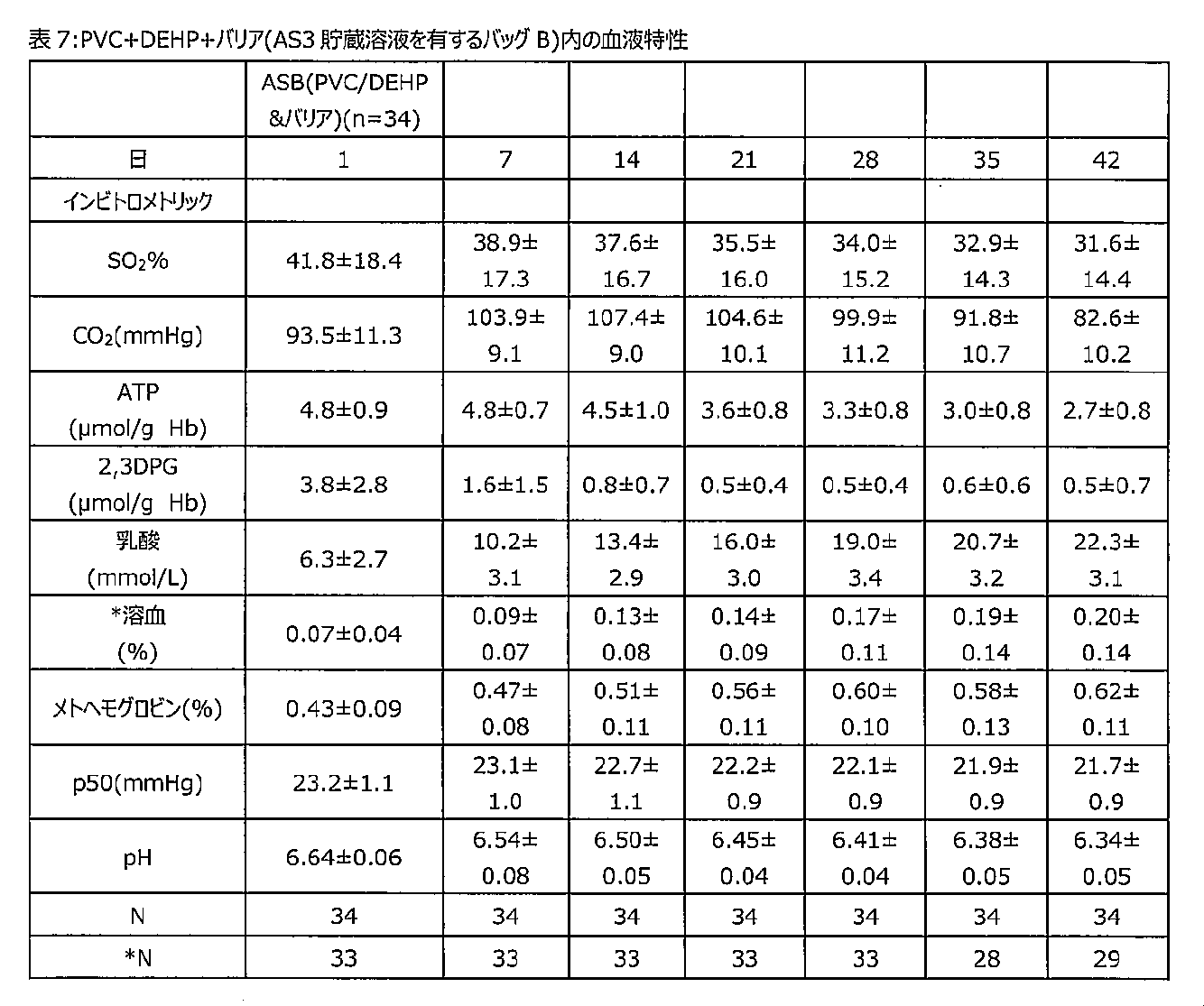
実施例3:CO2に対する透過性が増加したバッグ内のRBCの保存は、従来の保存と比較してより高い主要な代謝産物のレベルを維持する
DEHP及び透過性の役割は、DEHPを有するバッグ(バッグA)の結果をDEHPなしのバッグ(バッグC、D、E、F)と比較することによって試験される。表8を参照されたい

RBC中のSO2%は、従来の保存バッグA並びにバッグC及びバッグE中で42日間の保存にわたって増加する。バッグD及びバッグFに酸素及び二酸化炭素不透過性オーバーラップを添加すると、1日目と比較してSO2%の維持又は減少をもたらす。同様に、pCO2は、0日目の値と比較して従来のバッグA内の保存42日目で増加する(p<0.05)。従来の方式で保存されたRBCとは対照的に、RBCがオーバーラップの有無にかかわらず、42日間において、高いCO2透過性保存バッグ内に保存されたとき、pCO2は著しく減少する。
SO2% in RBC increases over 42 days of storage in conventional storage bag A and bags C and E. Addition of oxygen and carbon dioxide impermeable overwraps to Bag D and Bag F results in maintenance or reduction of SO 2 % compared to Day 1. Similarly, pCO 2 increases on
理論に制限されることなく、データは、CO2のレベルを枯渇させながら、O2のレベルを一定又は減少させることを維持することによって、ATPが、DEHPを含有する従来のバッグと比較して変化しないままであることを示す。バリアバッグをBTHCを有するPVC(バッグC)及びDINCHを有するPVC(バッグE)に添加して、O2のレベルを30%未満に低下させ、ATPのレベルを、それぞれ12%及び14%著しく増加させる。例えば、ATPの濃度は、バリアを有しない対照DEHP又はBTHC及びDINCHバッグのいずれかと比較するとき、ガス不透過性バリアを有するDINCHバッグ(バッグD)及びBTHCバッグ(バッグE)において著しく高い。図2B及び表9を参照されたい。

驚くべきことに、高いCO2透過性バッグ(バッグC及びバッグD)内に血液を設置することによって、CO2を枯渇させながらO2のレベルを維持することは、従来の保存と比較して2,3-DPGのレベルにおける著しい増加をもたらす。DEHPバッグ(バッグA)内に保存される、RBC中の2,3-DPGの濃度は、開始レベルと比較するとき、保存21日目に約79%で急速に低下する(図3)。BTHC及びDINCHの両方における2,3-DPGのレベルは、21日後に従来の方式で保存されたRBCよりも高い。2,3-DPGのレベルは、バリアなしのBTHC及びDINCHバッグと比較して、21日後にBTHC及びDINCHの両方においてガス不透過性バリアを用いて約20%増加する。重要なことに、2,3-DPGレベルに対するCO2の効果は、pHの効果ではないようであり、むしろCO2レベルと密接に相関している。これは、多くの文献が原因因子としてのpHに焦点を当てているため、驚くべきことである。
Surprisingly, maintaining the level of O2 while depleting CO2 by placing blood in high CO2 permeable bags (Bag C and Bag D) compared to conventional storage Resulting in a significant increase in the levels of 2,3-DPG. The concentration of 2,3-DPG in RBCs stored in DEHP bags (Bag A) drops rapidly by about 79% on
重要なことに、溶血は、DEHPの有無にかかわらず、それぞれ、米国及び欧州規制当局によって確立された1%及び0.8%の最大安全レベルを下回ったままであった(表10、表11、及び表12)。 Importantly, hemolysis with and without DEHP remained below the maximum safe levels of 1% and 0.8% established by US and European regulatory agencies, respectively (Table 10, Table 11, and Table 12).
要約すると、本データは、(枯渇又は維持のいずれかを通じる)保存中のCO2の枯渇及びO2増加の予防は、様々な保存病変の有害な効果を低減するための改善された方法として実証される。それゆえ、少なくとも2つの特徴を組み込む保存システムは、冷蔵保存中にRBCの品質を維持するための能力を増加させる。まず、1~6℃における長期保存中に、開始O2含有量を維持するか又は減少させることによって、RBC中のO2レベルの増加を防止する保存バッグは、ATPレベルを維持するのに役立つ。このO2レベルにおける維持又は減少は、ポリマーの選択的透過性、及び任意選択的に、O2/CO2吸着剤並びにCO2及びO2の両方に対して不透過性である外側ラップ又はポリマーの存在を提供するポリマーの選択を通して好都合に達成することができる。第2に、保存バッグはまた、保存中に低レベルのCO2を維持し、2,3-DPGのレベルの増加をもたらし、驚くべきことに、2,3-DPGを保存前レベル又はそれに近いレベルに維持する。


実施例4:増加したガス透過性を有するバッグ内に保存されたAS3添加剤溶液中のRBC
実施例3の研究は、AS3を有して繰り返されて、AS3を添加剤溶液として使用するときに、上記で提供されたように様々な非DEHPバッグ内で観察された代謝産物(例えば、ATP及び2,3-DPG)における改善が安定したままであるかどうかを判定する。
Example 4: RBCs in AS3 additive solution stored in bags with increased gas permeability
The study of Example 3 was repeated with AS3 and the metabolites (e.g., ATP and 2,3-DPG) remains stable.
AS7G-NAC(図2A、2B、3A、及び3B)で見られるように、SO2%レベルは、バリアバッグを有しないDEHP、DINCH、及びBTHCバッグと比較して、ガス不透過性バリアバッグを有するDINCH及びBTHCバッグにおいて42日後に著しく減少する。酸素レベルとは異なり、pCO2レベルは、ガス不透過性外側バリアバッグの有無にかかわらず、各非DEHPバッグ選択(BTHC又はDINCH)において同様のままである。DINCH及びBTHCの両方は、21日間の保存後のDEHPと比較して、減少したpCO2レベルを示す(図4及び5)。 As seen in AS7G-NAC (Figures 2A, 2B, 3A, and 3B), SO2% levels with gas-impermeable barrier bags compared to DEHP, DINCH, and BTHC bags without barrier bags Significantly decreased after 42 days in DINCH and BTHC bags. Unlike oxygen levels, pCO2 levels remain similar in each non-DEHP bag choice (BTHC or DINCH) with or without the gas impermeable outer barrier bag. Both DINCH and BTHC show decreased pCO2 levels compared to DEHP after 21 days of storage (Figures 4 and 5).
AS7G-NAG添加剤溶液の結果と同様に、ATP及び2,3-DPGレベルは、外側バッグがなく、従来の方式で保存されたDINCH及びBTHCバッグのRBCと比較して、ガス不透過性バリアバッグを有するDINCH及びBTHC内側バッグ内に保存されるRBCにおいて増加する(図4及び5)。全てのRBC試料はまた、必要とされる溶血カットオフを下回ったままであった。重要なことに、溶血は、DEHPの有無にかかわらず、それぞれ、米国及び欧州規制当局によって確立された1%及び0.8%の最大安全レベルを下回ったままであった(表13、表14、及び表15)。
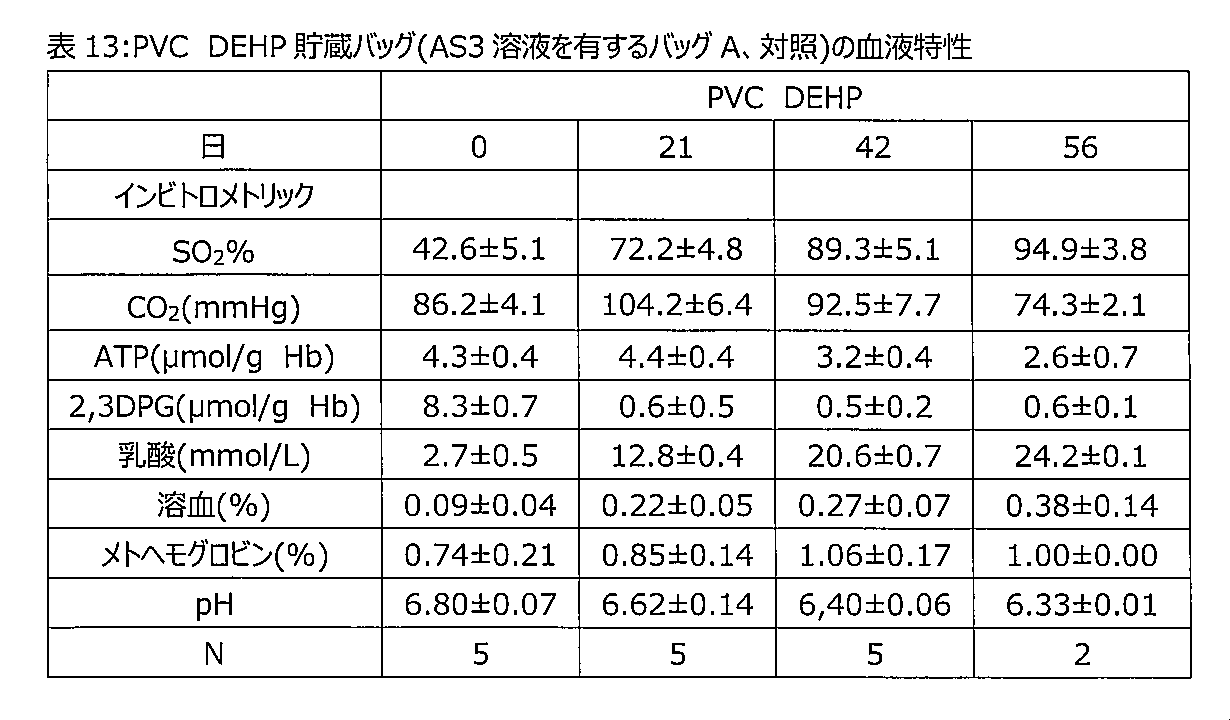


実施例5:増加したガス透過性を有するバッグ内に保存されたAS7G-NAC添加剤溶液中のRBC
実施例1及び2に提供されるように、赤血球は、AS7G-NAC添加剤溶液で調製される。次いで、RBCは、以下のバッグのうちの1つに設置される。
A.従来型-DEHPを有するPVC
C.BTHCを有するPVC
D.CO2/O2不透過性の外側バリアを備えたBTHC内側バッグを有するPVC
F.ポリオレフィン
G.CO2/O2不透過性外側バリアを有するポリオレフィン内側バッグ
Example 5: RBCs in AS7G-NAC additive solution stored in bags with increased gas permeability
As provided in Examples 1 and 2, red blood cells are prepared with AS7G-NAC additive solution. RBCs are then placed in one of the following bags.
A. Conventional - PVC with DEHP
C. PVC with BTHC
D. PVC with BTHC inner bag with CO2 / O2 impermeable outer barrier
F. Polyolefin G. Polyolefin inner bag with CO2 / O2 impermeable outer barrier
DEHPバッグに保存される、RBC中の2,3-DPGの濃度は、開始レベルと比較するとき、保存21日目までに減少する(図6)。BTHC(バッグC)及びポリオレフィン(EXP500、バッグF)の両方における2,3-DPGのレベルは、21日後に従来の方式で保存されたRBCよりも高い。これらのレベルは、内側バッグがガス不透過性外側バリアバッグによって封入されているとき、BTHC及びポリオレフィンバッグ内で更に増加する。
The concentration of 2,3-DPG in RBCs stored in DEHP bags decreases by
ATPの濃度はまた、バリアを有しない対照DEHP又はBTHC及びポリオレフィンバッグのいずれかと比較するとき、ガス不透過性バリアを有するBTHC及びポリオレフィンバッグにおいて著しく高い(図7)。 The concentration of ATP is also significantly higher in BTHC and polyolefin bags with gas impermeable barriers when compared to either control DEHP or BTHC and polyolefin bags without barrier (Figure 7).
溶血は、米国及び欧州規制当局によって、それぞれ、確立された1%及び0.8%の必要とされるカットオフレベルを下回ったままであった(図6及び7)。

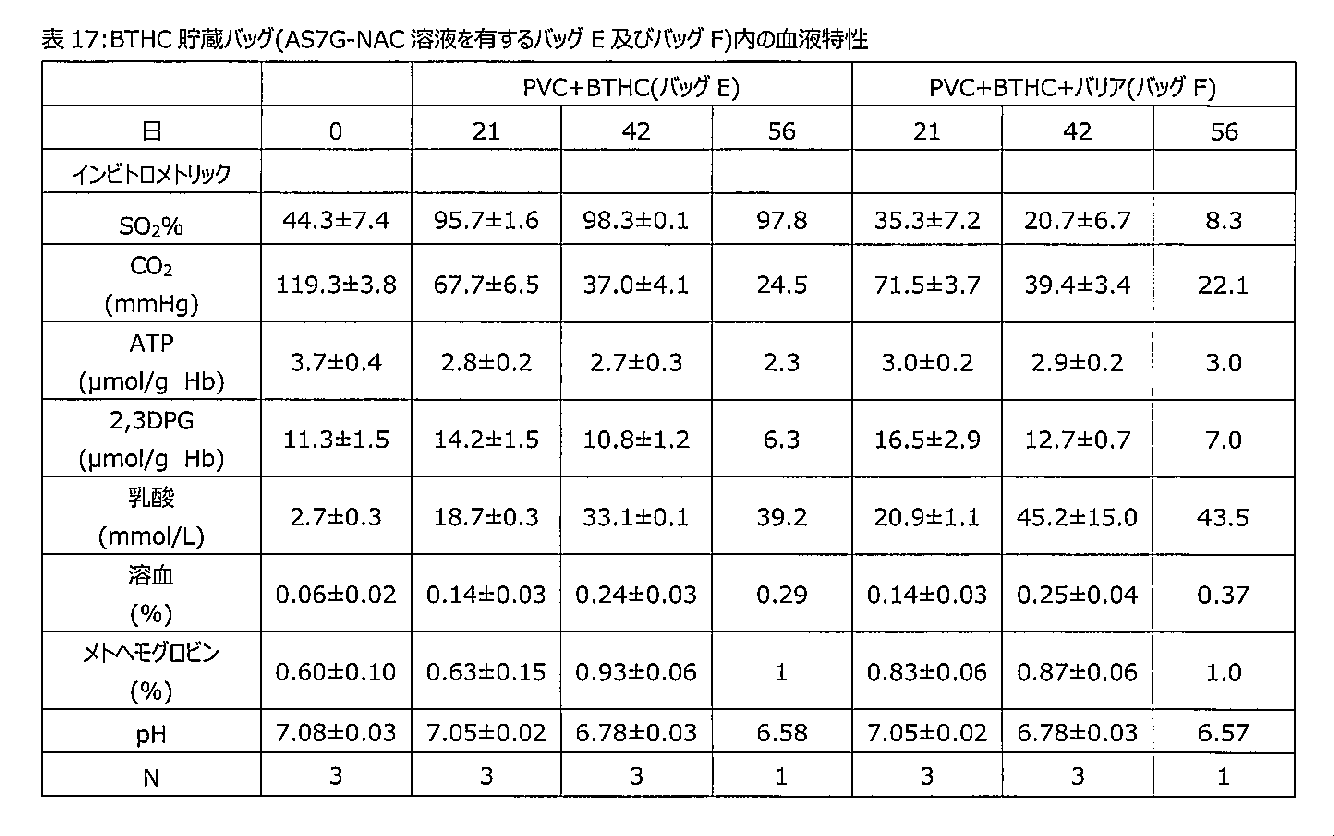

本発明は、特定の実施形態に関して説明されてきたが、本発明の範囲から逸脱することなく、様々な変更が行われ得、及び同等物がその要素に対して置き換えられ得ることを当業者は理解するであろう。加えて、本発明の範囲から逸脱することなく、特定の状況又は材料を本発明の教示に適合させるために多くの修正が行われ得る。 Although the present invention has been described with respect to particular embodiments, those skilled in the art will appreciate that various modifications can be made and equivalents can be substituted for elements thereof without departing from the scope of the invention. will understand. In addition, many modifications may be made to adapt a particular situation or material to the teachings of the invention without departing from its scope.
したがって、本発明は、本発明を実施するために企図される最良の形態として開示される特定の実施形態に限定されず、本発明は、添付の請求項の範囲及び趣旨内に該当する全ての実施形態を含むことが意図される。 Accordingly, it is intended that the present invention not be limited to the particular embodiment disclosed as the best mode contemplated for carrying out the invention, but rather that the present invention encompass all such modifications falling within the scope and spirit of the appended claims. It is intended to include embodiments.
Claims (22)
30%を超えるSO2%を有する血液製剤を入手することと、
前記血液製剤に添加剤溶液を添加して、保存可能な血液製剤を調製することと、
前記保存可能な血液製剤を、25℃、約1atmにおいて、1平方センチメートル当たり少なくとも0.62立方センチメートル(cm3/cm2)の二酸化炭素に関するガス透過性を有する、ジ-2-エチルヘキシルフタレートフリー(DEHPフリー)血液適合性(BC)二酸化炭素透過性バッグ内に保存することと、を含む、前記方法。 A method for preserving a blood product, comprising:
obtaining a blood product with a SO2 % greater than 30%;
adding an additive solution to the blood product to prepare a storable blood product;
The storable blood product is di-2-ethylhexylphthalate-free (DEHP-free) having a gas permeability for carbon dioxide of at least 0.62 cubic centimeters per square centimeter (cm 3 /cm 2 ) at 25° C. and about 1 atm. ) storing in a blood compatible (BC) carbon dioxide permeable bag.
前記血液製剤に添加剤溶液を添加することと、前記血液製剤を、25℃、約1atmにおいて、少なくとも0.62cm3/cm2の二酸化炭素に関するガス透過性を有する、DEHPフリー血液適合性(BC)二酸化炭素透過性バッグ内に保存することを含み、前記保存が、少なくとも7日間であり、前記血液製剤が、前記7日間の保存における酸素レベルを含み、これが保存1日目の前記血液製剤内の酸素レベルより減少するか、又はほぼ同じである、前記方法。 A method for handling a blood product, comprising:
adding an additive solution to said blood product; and exposing said blood product to DEHP-free hemocompatibility (BC) having a gas permeability for carbon dioxide of at least 0.62 cm 3 /cm 2 at 25° C. and about 1 atm. ) storing in a carbon dioxide permeable bag, wherein said storage is for at least 7 days, said blood product comprises an oxygen level during said 7 days of storage, which is within said blood product on day 1 of storage is less than or about the same as the oxygen level of
血液製剤を、
25℃、約1atmにおいて少なくとも0.62cm3/cm2の二酸化炭素に対する透過性、及び約1atmにおいて0.3cm3/cm2以下の酸素に対する透過性を有するDEHPフリー血液適合性(BC)材料、及び
二酸化炭素吸着剤を含む、保存容器内に設置することと、
前記保存可能な血液を含む前記容器を一定期間保存して、保存された血液を調製することと、を含む前記方法。 A method for preserving storable blood comprising:
blood products,
a DEHP-free hemocompatible (BC) material having a permeability to carbon dioxide of at least 0.62 cm 3 /cm 2 at 25° C. and about 1 atm and a permeability to oxygen of no more than 0.3 cm 3 /cm 2 at about 1 atm; and placed in a storage container containing a carbon dioxide adsorbent;
and storing the container containing the storable blood for a period of time to prepare stored blood.
前記赤血球を、
25℃、約1atmにおいて少なくとも0.62cm3/cm2の二酸化炭素に対する透過性、及び約1atmにおいて0.3cm3/cm2以下の酸素に対する透過性を有する材料からなる、DEHPフリー血液適合性(BC)の透過可能で内側に折り畳み可能な容器を封入し、二酸化炭素吸着剤、酸素吸着剤、又は酸素及び二酸化炭素吸着剤を、前記内側バッグと外側バッグとの間に封入する、外側酸素及び二酸化炭素不透過性容器を備える、保存容器内に設置することと、
前記赤血球を含む前記容器を少なくとも7日間保存して、保存された血液製剤を調製することと、を含む、前記方法。 A method for preserving red blood cells, comprising:
the red blood cells,
A DEHP -free blood compatible ( BC) enclosing the permeable, inwardly collapsible container, enclosing a carbon dioxide sorbent, an oxygen sorbent, or an oxygen and carbon dioxide sorbent between said inner bag and outer bag; placing in a storage container comprising a carbon dioxide impermeable container;
and storing the container containing the red blood cells for at least 7 days to prepare a preserved blood product.
少なくとも10%の酸素飽和度を含む血液製剤を、
25℃、約1atmにおいて少なくとも0.62cm3/cm2の二酸化炭素に対する透過性、及び約1atmにおいて0.3cm3/cm2以下の酸素に対する透過性を有する、血液適合性(BC)材料を封入し、二酸化炭素吸着剤を、前記内側バッグと外側バッグとの間に封入する、外側酸素及び二酸化炭素不透過性容器を備える、保存容器内に設置することと、
前記血液製剤を含む前記容器を保存することを含み、前記2,3-DPGのレベルが、従来の方式で保存された血液製剤の2,3-DPGのレベルと比較して、最大14日間の保存の間増加する、前記方法。 A method for maintaining levels of 2,3-DPG in a blood product, comprising:
a blood product containing at least 10% oxygen saturation,
Encapsulating a hemocompatible (BC) material having a permeability to carbon dioxide of at least 0.62 cm 3 /cm 2 at 25° C. and about 1 atm and a permeability to oxygen of no more than 0.3 cm 3 /cm 2 at about 1 atm and placing the carbon dioxide sorbent in a storage container comprising an outer oxygen and carbon dioxide impermeable container enclosing the carbon dioxide sorbent between the inner and outer bags;
storing the container containing the blood product, wherein the level of 2,3-DPG is compared to the level of 2,3-DPG in a conventionally stored blood product for up to 14 days. The above method, which increases during storage.
少なくとも10%の酸素飽和度を含む血液製剤を、
25℃、約1atmにおいて少なくとも0.62cm3/cm2の二酸化炭素に対する透過性、及び約1atmにおいて0.3cm3/cm2以下の酸素に対する透過性を有する、血液適合性(BC)材料を封入し、二酸化炭素吸着剤を、前記内側バッグと外側バッグとの間に封入する、外側酸素及び二酸化炭素不透過性容器を備える、保存容器内に設置することと、
前記血液製剤を含む前記容器を保存することであって、前記ATPのレベルが、従来の方式で保存された血液製剤のATPのレベルと比較して、42日間の保存後に増加する、保存することと、を含む、前記方法。 A method for maintaining levels of ATP in blood products comprising:
a blood product containing at least 10% oxygen saturation,
Encapsulating a hemocompatible (BC) material having a permeability to carbon dioxide of at least 0.62 cm 3 /cm 2 at 25° C. and about 1 atm and a permeability to oxygen of no more than 0.3 cm 3 /cm 2 at about 1 atm and placing the carbon dioxide sorbent in a storage container comprising an outer oxygen and carbon dioxide impermeable container enclosing the carbon dioxide sorbent between the inner and outer bags;
Storing the container containing the blood product, wherein the level of ATP is increased after 42 days of storage compared to the level of ATP of the blood product stored in a conventional manner. and.
重炭酸ナトリウム(NaHCO3)、リン酸二ナトリウム(Na2HPO4)、アデニン、グアノシン、グルコース、マンニトール、N-アセチル-システイン、6-ヒドロキシ-2,5,7,8-テトラメチルクロマン-2-カルボン酸(Trolox)、及びl-アスコルビン酸(ビタミンC)を含む添加剤溶液と、を含む、組成物。 a blood product selected from the group consisting of whole blood, platelets, and white blood cells;
Sodium bicarbonate (NaHCO 3 ), disodium phosphate (Na 2 HPO 4 ), adenine, guanosine, glucose, mannitol, N-acetyl-cysteine, 6-hydroxy-2,5,7,8-tetramethylchroman-2 - an additive solution comprising carboxylic acid (Trolox) and l-ascorbic acid (Vitamin C).
N-アセチル-システイン、
6-ヒドロキシ-2,5,7,8-テトラメチルクロマン-2-カルボン酸(Trolox)、及び
l-アスコルビン酸を含み、前記添加剤組成物が、8~9のpHを含む、前記添加剤組成物。 An additive composition comprising a concentration of
N-acetyl-cysteine,
6-hydroxy-2,5,7,8-tetramethylchroman-2-carboxylic acid (Trolox), and l-ascorbic acid, wherein the additive composition comprises a pH of 8-9 Composition.
ある濃度のリン酸二ナトリウム(Na2HPO4)、1~2mMのグルコース、及びマンニトールの濃度を含む、クエン酸ナトリウム、アデニン、グアノシンを含む添加剤溶液と、を含む、組成物。 a blood product selected from the group consisting of whole blood, platelets, and white blood cells;
an additive solution comprising sodium citrate, adenine, guanosine, with a concentration of disodium phosphate (Na 2 HPO 4 ), 1-2 mM glucose, and a concentration of mannitol.
Applications Claiming Priority (3)
| Application Number | Priority Date | Filing Date | Title |
|---|---|---|---|
| US202063024190P | 2020-05-13 | 2020-05-13 | |
| US63/024,190 | 2020-05-13 | ||
| PCT/US2021/032091 WO2021231650A2 (en) | 2020-05-13 | 2021-05-12 | Dehp-free blood storage and methods of use thereof |
Publications (2)
| Publication Number | Publication Date |
|---|---|
| JP2023525583A true JP2023525583A (en) | 2023-06-16 |
| JPWO2021231650A5 JPWO2021231650A5 (en) | 2024-05-22 |
Family
ID=76305999
Family Applications (1)
| Application Number | Title | Priority Date | Filing Date |
|---|---|---|---|
| JP2022569113A Pending JP2023525583A (en) | 2020-05-13 | 2021-05-12 | DEHP-free blood storage and method of use |
Country Status (13)
| Country | Link |
|---|---|
| US (1) | US20230180741A1 (en) |
| EP (1) | EP4149257A2 (en) |
| JP (1) | JP2023525583A (en) |
| KR (1) | KR20230010040A (en) |
| CN (1) | CN115915933A (en) |
| AR (1) | AR122094A1 (en) |
| AU (1) | AU2021270575A1 (en) |
| BR (1) | BR112022022364A2 (en) |
| CA (1) | CA3183013A1 (en) |
| CO (1) | CO2022017656A2 (en) |
| IL (1) | IL297893A (en) |
| MX (1) | MX2022014246A (en) |
| WO (1) | WO2021231650A2 (en) |
Families Citing this family (4)
| Publication number | Priority date | Publication date | Assignee | Title |
|---|---|---|---|---|
| FR3133135B1 (en) | 2022-03-04 | 2026-01-30 | Maco Pharma Sa | Pocket system for the electromagnetic irradiation treatment of a biological fluid |
| FR3133134A1 (en) | 2022-03-04 | 2023-09-08 | Maco Pharma | Bag system for electromagnetic irradiation treatment of a biological fluid |
| US20240002106A1 (en) * | 2022-06-30 | 2024-01-04 | Anthony Berg | Wet Paint Roller Pad Preserver |
| CN115777695B (en) * | 2023-02-07 | 2023-05-12 | 成都海默云因医学检验实验室有限公司 | Composite preservation solution suitable for cerebrospinal fluid cell morphology examination and preparation method thereof |
Citations (5)
| Publication number | Priority date | Publication date | Assignee | Title |
|---|---|---|---|---|
| JPS6125557A (en) * | 1984-07-16 | 1986-02-04 | 住友ベークライト株式会社 | Blood storage container |
| JPS6125558A (en) * | 1984-07-16 | 1986-02-04 | 住友ベークライト株式会社 | Container and method for preserving blood and blood preservation |
| JPH05503304A (en) * | 1990-11-07 | 1993-06-03 | バクスター、インターナショナル、インコーポレイテッド | red blood cell storage solution |
| US20170172847A1 (en) * | 2014-02-20 | 2017-06-22 | Fresenius Hemocare Netherlands B.V. | Medical containers and system components with non-dehp plasticizers for storing red blood cell products, plasma and platelets |
| JP2018507743A (en) * | 2015-03-10 | 2018-03-22 | ニュー・ヘルス・サイエンシーズ・インコーポレイテッドNew Health Sciences, Inc. | Disposable oxygen reduction kits, instruments and methods for their use |
Family Cites Families (32)
| Publication number | Priority date | Publication date | Assignee | Title |
|---|---|---|---|---|
| US4280859A (en) | 1978-02-14 | 1981-07-28 | Thompson Mortimer S | Method of manufacturing a blow-molded container with an integral handle |
| US4228032A (en) | 1978-11-06 | 1980-10-14 | Dow Corning Corporation | Method of storing blood and a blood storage bag therefore |
| US4280497A (en) * | 1979-10-09 | 1981-07-28 | Cutter Laboratories, Inc. | Container for platelet storage |
| US4455299A (en) | 1981-11-20 | 1984-06-19 | Baxter Travenol Laboratories, Inc. | Storage of blood platelets |
| US4386069A (en) | 1981-12-02 | 1983-05-31 | Baxter Travenol Laboratories, Inc. | Additive solution and method for preserving normal red cell morphology in whole blood during storage |
| DE3582523D1 (en) | 1984-07-16 | 1991-05-23 | Sumitomo Bakelite Co | CONTAINER AND METHOD FOR STORING BLOOD. |
| US4654053A (en) | 1984-07-27 | 1987-03-31 | University Patents, Inc. | Oxygen sorbent |
| US4748121A (en) | 1984-11-30 | 1988-05-31 | Ppg Industries, Inc. | Porous glass fibers with immobilized biochemically active material |
| KR890002855B1 (en) | 1985-06-26 | 1989-08-05 | 미쯔비시 가스 가가구 가부시기가이샤 | Sheet-type deoxide material |
| JPS62157385U (en) | 1986-03-26 | 1987-10-06 | ||
| JP2711736B2 (en) * | 1989-09-27 | 1998-02-10 | テルモ 株式会社 | Multiple blood bags |
| US5208335A (en) | 1991-03-19 | 1993-05-04 | Air Products And Chemicals, Inc. | Reversible oxygen sorbent compositions |
| US5639382A (en) * | 1991-12-23 | 1997-06-17 | Baxter International Inc. | Systems and methods for deriving recommended storage parameters for collected blood components |
| US6288027B1 (en) | 1995-03-23 | 2001-09-11 | Biopure Corporation | Preserving a hemoglobin blood substitute with a transparent overwrap |
| JP4270285B2 (en) * | 1995-12-04 | 2009-05-27 | 株式会社ジェイ・エム・エス | Blood component storage container and blood component storage tool connecting the blood component storage container |
| SE9601348D0 (en) | 1996-04-10 | 1996-04-10 | Pharmacia Ab | Improved containers for parenteral fluids |
| US5906285A (en) | 1996-05-10 | 1999-05-25 | Plastipak Packaging, Inc. | Plastic blow molded container |
| CN100535040C (en) | 1998-03-25 | 2009-09-02 | 切夫里昂菲利普化学有限责任公司 | Oxygen scavenger for reducing oxidation products of plastic film and beverage and food container |
| US6387461B1 (en) | 1999-05-06 | 2002-05-14 | Cryovac, Inc. | Oxygen scavenger compositions |
| ES2266455T3 (en) * | 2001-02-01 | 2007-03-01 | American Renolit Corporation La | MONOCAPA FLEXIBLE ELASTOMER FILMS CONTAINING SEBS AND BAGS FOR MEDICAL USE. |
| US6974447B2 (en) | 2001-04-17 | 2005-12-13 | Baxter International Inc. | High gas barrier receptacle and closure assembly |
| US20030183801A1 (en) | 2002-03-28 | 2003-10-02 | Hu Yang | Porous oxygen scavenging material |
| US7078100B2 (en) | 2003-08-28 | 2006-07-18 | Cryovac, Inc. | Oxygen scavenger compositions derived from isophthalic acid and/or terephthalic acid monomer or derivatives thereof |
| US7754798B2 (en) | 2003-08-28 | 2010-07-13 | Cryovac, Inc. | Oxygen scavenger block copolymers and compositions |
| US7347887B2 (en) | 2003-12-22 | 2008-03-25 | The Boc Group, Inc. | Oxygen sorbent compositions and methods of using same |
| US7713614B2 (en) | 2006-09-19 | 2010-05-11 | Kuraray Co., Ltd. | Resin composition and multilayer structure |
| US7906048B2 (en) | 2008-04-23 | 2011-03-15 | Koalesce, Inc. | Injection molding method and apparatus |
| US11284616B2 (en) * | 2010-05-05 | 2022-03-29 | Hemanext Inc. | Irradiation of red blood cells and anaerobic storage |
| PT2608816T (en) | 2010-08-25 | 2023-10-12 | Dartmouth College | Method for enhancing red blood cell quality and survival during storage |
| JPWO2016021309A1 (en) * | 2014-08-05 | 2017-06-01 | 富士フイルム株式会社 | Method for sorting nucleated red blood cells |
| BR112017022417B1 (en) | 2015-04-23 | 2022-07-19 | Hemanext Inc | BLOOD STORAGE DEVICE FOR STORING OXYGEN DEPLETED BLOOD AND METHOD FOR REDUCING BLOOD OXYGEN SATURATION DURING STORAGE |
| CN114748503B (en) | 2015-05-18 | 2025-09-30 | 希玛奈克斯特股份有限公司 | Method for storing whole blood and composition thereof |
-
2021
- 2021-05-12 JP JP2022569113A patent/JP2023525583A/en active Pending
- 2021-05-12 AU AU2021270575A patent/AU2021270575A1/en active Pending
- 2021-05-12 EP EP21730718.0A patent/EP4149257A2/en active Pending
- 2021-05-12 CN CN202180042586.6A patent/CN115915933A/en active Pending
- 2021-05-12 WO PCT/US2021/032091 patent/WO2021231650A2/en not_active Ceased
- 2021-05-12 KR KR1020227042470A patent/KR20230010040A/en active Pending
- 2021-05-12 MX MX2022014246A patent/MX2022014246A/en unknown
- 2021-05-12 CA CA3183013A patent/CA3183013A1/en active Pending
- 2021-05-12 IL IL297893A patent/IL297893A/en unknown
- 2021-05-12 US US17/924,348 patent/US20230180741A1/en active Pending
- 2021-05-12 BR BR112022022364A patent/BR112022022364A2/en unknown
- 2021-05-13 AR ARP210101329A patent/AR122094A1/en unknown
-
2022
- 2022-12-06 CO CONC2022/0017656A patent/CO2022017656A2/en unknown
Patent Citations (5)
| Publication number | Priority date | Publication date | Assignee | Title |
|---|---|---|---|---|
| JPS6125557A (en) * | 1984-07-16 | 1986-02-04 | 住友ベークライト株式会社 | Blood storage container |
| JPS6125558A (en) * | 1984-07-16 | 1986-02-04 | 住友ベークライト株式会社 | Container and method for preserving blood and blood preservation |
| JPH05503304A (en) * | 1990-11-07 | 1993-06-03 | バクスター、インターナショナル、インコーポレイテッド | red blood cell storage solution |
| US20170172847A1 (en) * | 2014-02-20 | 2017-06-22 | Fresenius Hemocare Netherlands B.V. | Medical containers and system components with non-dehp plasticizers for storing red blood cell products, plasma and platelets |
| JP2018507743A (en) * | 2015-03-10 | 2018-03-22 | ニュー・ヘルス・サイエンシーズ・インコーポレイテッドNew Health Sciences, Inc. | Disposable oxygen reduction kits, instruments and methods for their use |
Non-Patent Citations (4)
| Title |
|---|
| C. V. PROWSE ET AL: "Commercially available blood storage containers", VOX SANGUINIS, vol. 106, no. 1, JPN6025022609, 2013, pages 1 - 13, ISSN: 0005609030 * |
| T L SIMON ET AL.: "Effects of AS-3 nutrient-additive solution on 42 and 49 days of storage of red cells", TRANSFUSION, vol. 27, no. 2, JPN6025022610, 1987, pages 178 - 182, ISSN: 0005609029 * |
| 川野 武彦: "白血球の血液保存に及ぼす影響", JOURNAL OF THE JAPAN SOCIETY OF BLOOD TRANSFUSION, vol. 5, no. 4, JPN6026000573, 1958, pages 147 - 153, ISSN: 0005772319 * |
| 本田 憲治: "血小板保存における保存容器材質の効果", 高分子論文集, vol. 36, no. 4, JPN6026000571, 1979, pages 203 - 207, ISSN: 0005772320 * |
Also Published As
| Publication number | Publication date |
|---|---|
| EP4149257A2 (en) | 2023-03-22 |
| CO2022017656A2 (en) | 2022-12-20 |
| IL297893A (en) | 2023-01-01 |
| CN115915933A (en) | 2023-04-04 |
| BR112022022364A2 (en) | 2022-12-20 |
| US20230180741A1 (en) | 2023-06-15 |
| CA3183013A1 (en) | 2021-11-18 |
| WO2021231650A2 (en) | 2021-11-18 |
| AU2021270575A1 (en) | 2022-12-15 |
| KR20230010040A (en) | 2023-01-17 |
| MX2022014246A (en) | 2023-02-16 |
| AR122094A1 (en) | 2022-08-10 |
| WO2021231650A3 (en) | 2022-01-20 |
Similar Documents
| Publication | Publication Date | Title |
|---|---|---|
| US11638421B2 (en) | Oxygen reduction disposable kits, devices and methods of use thereof | |
| JP6857291B2 (en) | Long-term storage system for red blood cells and how to use them | |
| JP2023525583A (en) | DEHP-free blood storage and method of use | |
| EP3539381B1 (en) | Irradiation of red blood cells and anaerobic storage | |
| EP3297641B1 (en) | Methods for the storage of whole blood, and compositions thereof | |
| JP2022183174A (en) | Anaerobic blood storage and pathogen inactivation method |
Legal Events
| Date | Code | Title | Description |
|---|---|---|---|
| A521 | Request for written amendment filed |
Free format text: JAPANESE INTERMEDIATE CODE: A523 Effective date: 20240513 |
|
| A621 | Written request for application examination |
Free format text: JAPANESE INTERMEDIATE CODE: A621 Effective date: 20240513 |
|
| A977 | Report on retrieval |
Free format text: JAPANESE INTERMEDIATE CODE: A971007 Effective date: 20250430 |
|
| A131 | Notification of reasons for refusal |
Free format text: JAPANESE INTERMEDIATE CODE: A131 Effective date: 20250603 |
|
| A601 | Written request for extension of time |
Free format text: JAPANESE INTERMEDIATE CODE: A601 Effective date: 20250825 |
|
| A521 | Request for written amendment filed |
Free format text: JAPANESE INTERMEDIATE CODE: A523 Effective date: 20251203 |
|
| A02 | Decision of refusal |
Free format text: JAPANESE INTERMEDIATE CODE: A02 Effective date: 20260115 |