JP2023516226A - RNA-guided nucleases, active fragments and variants thereof, and methods of use - Google Patents
RNA-guided nucleases, active fragments and variants thereof, and methods of use Download PDFInfo
- Publication number
- JP2023516226A JP2023516226A JP2022564464A JP2022564464A JP2023516226A JP 2023516226 A JP2023516226 A JP 2023516226A JP 2022564464 A JP2022564464 A JP 2022564464A JP 2022564464 A JP2022564464 A JP 2022564464A JP 2023516226 A JP2023516226 A JP 2023516226A
- Authority
- JP
- Japan
- Prior art keywords
- sequence
- seq
- rgn
- guide rna
- amino acid
- Prior art date
- Legal status (The legal status is an assumption and is not a legal conclusion. Google has not performed a legal analysis and makes no representation as to the accuracy of the status listed.)
- Pending
Links
Classifications
-
- C—CHEMISTRY; METALLURGY
- C12—BIOCHEMISTRY; BEER; SPIRITS; WINE; VINEGAR; MICROBIOLOGY; ENZYMOLOGY; MUTATION OR GENETIC ENGINEERING
- C12N—MICROORGANISMS OR ENZYMES; COMPOSITIONS THEREOF; PROPAGATING, PRESERVING, OR MAINTAINING MICROORGANISMS; MUTATION OR GENETIC ENGINEERING; CULTURE MEDIA
- C12N15/00—Mutation or genetic engineering; DNA or RNA concerning genetic engineering, vectors, e.g. plasmids, or their isolation, preparation or purification; Use of hosts therefor
- C12N15/09—Recombinant DNA-technology
- C12N15/87—Introduction of foreign genetic material using processes not otherwise provided for, e.g. co-transformation
- C12N15/90—Stable introduction of foreign DNA into chromosome
- C12N15/902—Stable introduction of foreign DNA into chromosome using homologous recombination
-
- C—CHEMISTRY; METALLURGY
- C12—BIOCHEMISTRY; BEER; SPIRITS; WINE; VINEGAR; MICROBIOLOGY; ENZYMOLOGY; MUTATION OR GENETIC ENGINEERING
- C12N—MICROORGANISMS OR ENZYMES; COMPOSITIONS THEREOF; PROPAGATING, PRESERVING, OR MAINTAINING MICROORGANISMS; MUTATION OR GENETIC ENGINEERING; CULTURE MEDIA
- C12N15/00—Mutation or genetic engineering; DNA or RNA concerning genetic engineering, vectors, e.g. plasmids, or their isolation, preparation or purification; Use of hosts therefor
- C12N15/09—Recombinant DNA-technology
- C12N15/10—Processes for the isolation, preparation or purification of DNA or RNA
- C12N15/102—Mutagenizing nucleic acids
-
- C—CHEMISTRY; METALLURGY
- C12—BIOCHEMISTRY; BEER; SPIRITS; WINE; VINEGAR; MICROBIOLOGY; ENZYMOLOGY; MUTATION OR GENETIC ENGINEERING
- C12N—MICROORGANISMS OR ENZYMES; COMPOSITIONS THEREOF; PROPAGATING, PRESERVING, OR MAINTAINING MICROORGANISMS; MUTATION OR GENETIC ENGINEERING; CULTURE MEDIA
- C12N15/00—Mutation or genetic engineering; DNA or RNA concerning genetic engineering, vectors, e.g. plasmids, or their isolation, preparation or purification; Use of hosts therefor
- C12N15/09—Recombinant DNA-technology
- C12N15/11—DNA or RNA fragments; Modified forms thereof; Non-coding nucleic acids having a biological activity
- C12N15/113—Non-coding nucleic acids modulating the expression of genes, e.g. antisense oligonucleotides; Antisense DNA or RNA; Triplex- forming oligonucleotides; Catalytic nucleic acids, e.g. ribozymes; Nucleic acids used in co-suppression or gene silencing
-
- C—CHEMISTRY; METALLURGY
- C12—BIOCHEMISTRY; BEER; SPIRITS; WINE; VINEGAR; MICROBIOLOGY; ENZYMOLOGY; MUTATION OR GENETIC ENGINEERING
- C12N—MICROORGANISMS OR ENZYMES; COMPOSITIONS THEREOF; PROPAGATING, PRESERVING, OR MAINTAINING MICROORGANISMS; MUTATION OR GENETIC ENGINEERING; CULTURE MEDIA
- C12N15/00—Mutation or genetic engineering; DNA or RNA concerning genetic engineering, vectors, e.g. plasmids, or their isolation, preparation or purification; Use of hosts therefor
- C12N15/09—Recombinant DNA-technology
- C12N15/63—Introduction of foreign genetic material using vectors; Vectors; Use of hosts therefor; Regulation of expression
- C12N15/64—General methods for preparing the vector, for introducing it into the cell or for selecting the vector-containing host
-
- C—CHEMISTRY; METALLURGY
- C12—BIOCHEMISTRY; BEER; SPIRITS; WINE; VINEGAR; MICROBIOLOGY; ENZYMOLOGY; MUTATION OR GENETIC ENGINEERING
- C12N—MICROORGANISMS OR ENZYMES; COMPOSITIONS THEREOF; PROPAGATING, PRESERVING, OR MAINTAINING MICROORGANISMS; MUTATION OR GENETIC ENGINEERING; CULTURE MEDIA
- C12N15/00—Mutation or genetic engineering; DNA or RNA concerning genetic engineering, vectors, e.g. plasmids, or their isolation, preparation or purification; Use of hosts therefor
- C12N15/09—Recombinant DNA-technology
- C12N15/63—Introduction of foreign genetic material using vectors; Vectors; Use of hosts therefor; Regulation of expression
- C12N15/66—General methods for inserting a gene into a vector to form a recombinant vector using cleavage and ligation; Use of non-functional linkers or adaptors, e.g. linkers containing the sequence for a restriction endonuclease
-
- C—CHEMISTRY; METALLURGY
- C12—BIOCHEMISTRY; BEER; SPIRITS; WINE; VINEGAR; MICROBIOLOGY; ENZYMOLOGY; MUTATION OR GENETIC ENGINEERING
- C12N—MICROORGANISMS OR ENZYMES; COMPOSITIONS THEREOF; PROPAGATING, PRESERVING, OR MAINTAINING MICROORGANISMS; MUTATION OR GENETIC ENGINEERING; CULTURE MEDIA
- C12N9/00—Enzymes; Proenzymes; Compositions thereof; Processes for preparing, activating, inhibiting, separating or purifying enzymes
- C12N9/14—Hydrolases (3)
- C12N9/16—Hydrolases (3) acting on ester bonds (3.1)
- C12N9/22—Ribonucleases [RNase]; Deoxyribonucleases [DNase]
-
- C—CHEMISTRY; METALLURGY
- C12—BIOCHEMISTRY; BEER; SPIRITS; WINE; VINEGAR; MICROBIOLOGY; ENZYMOLOGY; MUTATION OR GENETIC ENGINEERING
- C12N—MICROORGANISMS OR ENZYMES; COMPOSITIONS THEREOF; PROPAGATING, PRESERVING, OR MAINTAINING MICROORGANISMS; MUTATION OR GENETIC ENGINEERING; CULTURE MEDIA
- C12N9/00—Enzymes; Proenzymes; Compositions thereof; Processes for preparing, activating, inhibiting, separating or purifying enzymes
- C12N9/14—Hydrolases (3)
- C12N9/78—Hydrolases (3) acting on carbon to nitrogen bonds other than peptide bonds (3.5)
-
- C—CHEMISTRY; METALLURGY
- C12—BIOCHEMISTRY; BEER; SPIRITS; WINE; VINEGAR; MICROBIOLOGY; ENZYMOLOGY; MUTATION OR GENETIC ENGINEERING
- C12N—MICROORGANISMS OR ENZYMES; COMPOSITIONS THEREOF; PROPAGATING, PRESERVING, OR MAINTAINING MICROORGANISMS; MUTATION OR GENETIC ENGINEERING; CULTURE MEDIA
- C12N2310/00—Structure or type of the nucleic acid
- C12N2310/10—Type of nucleic acid
- C12N2310/20—Type of nucleic acid involving clustered regularly interspaced short palindromic repeats [CRISPR]
-
- C—CHEMISTRY; METALLURGY
- C12—BIOCHEMISTRY; BEER; SPIRITS; WINE; VINEGAR; MICROBIOLOGY; ENZYMOLOGY; MUTATION OR GENETIC ENGINEERING
- C12Q—MEASURING OR TESTING PROCESSES INVOLVING ENZYMES, NUCLEIC ACIDS OR MICROORGANISMS; COMPOSITIONS OR TEST PAPERS THEREFOR; PROCESSES OF PREPARING SUCH COMPOSITIONS; CONDITION-RESPONSIVE CONTROL IN MICROBIOLOGICAL OR ENZYMOLOGICAL PROCESSES
- C12Q2521/00—Reaction characterised by the enzymatic activity
- C12Q2521/30—Phosphoric diester hydrolysing, i.e. nuclease
- C12Q2521/301—Endonuclease
Landscapes
- Health & Medical Sciences (AREA)
- Life Sciences & Earth Sciences (AREA)
- Genetics & Genomics (AREA)
- Engineering & Computer Science (AREA)
- Chemical & Material Sciences (AREA)
- Bioinformatics & Cheminformatics (AREA)
- Organic Chemistry (AREA)
- Zoology (AREA)
- Wood Science & Technology (AREA)
- Biomedical Technology (AREA)
- Molecular Biology (AREA)
- Biotechnology (AREA)
- General Engineering & Computer Science (AREA)
- Microbiology (AREA)
- Biochemistry (AREA)
- General Health & Medical Sciences (AREA)
- Plant Pathology (AREA)
- Biophysics (AREA)
- Physics & Mathematics (AREA)
- Medicinal Chemistry (AREA)
- Mycology (AREA)
- Cell Biology (AREA)
- Crystallography & Structural Chemistry (AREA)
- Enzymes And Modification Thereof (AREA)
- Micro-Organisms Or Cultivation Processes Thereof (AREA)
- Peptides Or Proteins (AREA)
- Medicines That Contain Protein Lipid Enzymes And Other Medicines (AREA)
- Pharmaceuticals Containing Other Organic And Inorganic Compounds (AREA)
- Measuring Or Testing Involving Enzymes Or Micro-Organisms (AREA)
- Preparation Of Compounds By Using Micro-Organisms (AREA)
- Medicines Containing Material From Animals Or Micro-Organisms (AREA)
Abstract
興味ある標的配列に結合させるための組成物と方法が提供される。組成物は、興味ある標的配列の切断または改変、興味ある標的配列の可視化、および興味ある配列の発現の改変に利用される。組成物は、RNA誘導型ヌクレアーゼ(RGN)ポリペプチド、CRISPR RNA、トランス活性化CRISPR RNA、ガイドRNA(RNA)、およびこれらをコードする核酸分子を含む。前記核酸分子を含むベクターと宿主細胞も提供される。興味ある標的配列に結合させるためのRGN系がさらに提供され、このRGN系は、RNA誘導型ヌクレアーゼポリペプチドと1つ以上のガイドRNAを含む。【選択図】なしCompositions and methods are provided for binding to target sequences of interest. The compositions are utilized for cleaving or modifying target sequences of interest, visualizing target sequences of interest, and modifying expression of sequences of interest. Compositions include RNA-guided nuclease (RGN) polypeptides, CRISPR RNAs, transactivating CRISPR RNAs, guide RNAs (RNAs), and nucleic acid molecules encoding these. Vectors and host cells containing the nucleic acid molecules are also provided. Further provided is an RGN system for binding to a target sequence of interest, the RGN system comprising an RNA-guided nuclease polypeptide and one or more guide RNAs. [Selection figure] None
Description
関連する出願の相互参照
本出願は、2020年4月24日に出願されたアメリカ合衆国仮出願第63/014,970号と、2020年9月11日に出願されたアメリカ合衆国仮出願第63/077,211号の優先権を主張するものであり、出願のそれぞれはその全体が参照によって本明細書に組み込まれている。
Cross-reference to Related Applications 211, each of which is incorporated herein by reference in its entirety.
配列リストに関する宣言
本出願に付随する配列リストは紙のコピーの代わりにASCII形式で提供され、参照によって本明細書に組み込まれている。L103438_1200WO_0084_1_SLと名づけたこのASCIIコピーはサイズが878,362バイトであり、2021年4月21に作成され、EFS-Webを通じて電子的に提出されている。
STATEMENT REGARDING SEQUENCE LISTING The Sequence Listing accompanying this application is provided in ASCII format in lieu of a paper copy and is incorporated herein by reference. This ASCII copy, named L103438_1200WO_0084_1_SL, is 878,362 bytes in size, was created on April 21, 2021, and is being submitted electronically via EFS-Web.
本出願は分子生物学と遺伝子編集の分野に関する。 This application relates to the fields of molecular biology and gene editing.
標的ゲノム編集または標的ゲノム改変が、急速に基礎研究と応用研究のための重要なツールになりつつある。初期の方法は、ヌクレアーゼ(メガヌクレアーゼ、ジンクフィンガー融合タンパク質、またはTALENなど)を操作することを含んでいたため、それぞれの特定の標的配列に対して特異的な操作されたプログラム可能な配列特異的DNA結合ドメインを持つキメラヌクレアーゼを作製する必要があった。RNA誘導型ヌクレアーゼ(クラスター化されて規則的な間隔で配置された短い回文反復(CRISPR)-Cas細菌系のCRISPR-関連(Cas)タンパク質など)は、特定の標的配列に特異的にハイブリダイズするガイドRNAとの複合体にすることにより、特定の配列を標的とすることが可能になる。標的特異的ガイドRNAの作製は、各標的配列のためのキメラヌクレアーゼの作製よりもコストがかからず、より効率的である。このようなRNA誘導型ヌクレアーゼを用いて配列特異的二本鎖切断を導入することによりゲノムを編集することが可能であり、この二本鎖切断は、エラーを起こしやすい非相同末端結合(NHEJ)を通じて修復されるため、変異が特定のゲノム位置に導入される。あるいは相同組み換え修復を通じて異種DNAをそのゲノム部位に導入することができる。RNA誘導型ヌクレアーゼ(RGN)は、デアミナーゼと融合させるとき塩基編集のために用いることもできる。 Targeted genome editing or targeted genome modification is rapidly becoming an important tool for basic and applied research. Early methods involved engineering nucleases (such as meganucleases, zinc finger fusion proteins, or TALENs) to provide engineered programmable sequence-specific sequences specific for each particular target sequence. There was a need to create a chimeric nuclease with a DNA binding domain. RNA-directed nucleases, such as Clustered Regularly Interspaced Short Palindromic Repeats (CRISPR)-CRISPR-associated (Cas) proteins of the Cas bacterial system, specifically hybridize to specific target sequences. It is possible to target a specific sequence by complexing it with a guide RNA that does the same. Generation of target-specific guide RNAs is less costly and more efficient than generation of chimeric nucleases for each target sequence. Such RNA-guided nucleases can be used to edit genomes by introducing sequence-specific double-strand breaks, which are called error-prone non-homologous end joining (NHEJ). Mutations are introduced at specific genomic locations because they are repaired through Alternatively, heterologous DNA can be introduced into that genomic site through homologous recombination repair. RNA-guided nucleases (RGNs) can also be used for base editing when fused with deaminases.
興味ある標的配列に結合させるための組成物と方法が提供される。組成物は、興味ある標的配列の切断または改変、興味ある標的配列の検出、および興味ある配列の発現の改変に利用される。組成物は、RNA誘導型ヌクレアーゼ(RGN)ポリペプチド、CRISPR RNA(crRNA)、トランス活性化CRISPR RNA(tracrRNA)、ガイドRNA(gRNA)、これらをコードする核酸分子、およびこれら核酸分子を含むベクターと宿主細胞を含む。興味ある標的配列に結合させるためのRGN系も提供され、このRGN系は、RNA誘導型ヌクレアーゼポリペプチドと1つ以上のガイドRNAを含んでいる。したがって本明細書に開示されている方法は興味ある標的配列の結合に関するものであり、いくつかの実施形態では、興味ある標的配列の切断または改変に関する。興味ある標的配列を改変することが、例えば導入されるドナー配列を用いた非相同末端結合または相同組み換え修復の結果として、または塩基編集の結果として可能になる。 Compositions and methods are provided for binding to target sequences of interest. The compositions are utilized for cleaving or modifying target sequences of interest, detecting target sequences of interest, and modifying expression of sequences of interest. Compositions include RNA-guided nuclease (RGN) polypeptides, CRISPR RNA (crRNA), transactivating CRISPR RNA (tracrRNA), guide RNA (gRNA), nucleic acid molecules encoding these, and vectors containing these nucleic acid molecules. Contains host cells. An RGN system for binding to a target sequence of interest is also provided, the RGN system comprising an RNA-guided nuclease polypeptide and one or more guide RNAs. Thus, the methods disclosed herein relate to binding, and in some embodiments, cleaving or modifying, target sequences of interest. Modification of the target sequence of interest becomes possible, for example, as a result of non-homologous end joining or homologous recombination repair with introduced donor sequences, or as a result of base editing.
本発明が関係する分野の当業者は、本明細書に記載されている本発明の改変およびそれ以外の実施形態として、上記の説明とそれに関連する図面に示されている教示の利点を持つものを多数思いつくであろう。したがって本発明が開示されている具体的な実施形態に限定されることはなく、改変やそれ以外の実施形態が添付の実施形態の範囲に含まれることを理解すべきである。特殊な用語を本明細書で使用するが、それらは一般的かつ説明的な意味で用いられているのであり、制限する目的ではない。 Those skilled in the art to which the invention pertains will have the benefit of the teachings presented in the foregoing description and the associated drawings as modifications and other embodiments of the invention described herein. You will come up with a lot of It is therefore to be understood that the invention is not limited to the particular embodiments disclosed, but that modifications and other embodiments are encompassed within the scope of the appended embodiments. Although specific terms are employed herein, they are used in a generic and descriptive sense and not for purposes of limitation.
I.概要 I. overview
RNA誘導型ヌクレアーゼ(RGN)はゲノム内の特定の部位を標的として操作することを可能にするため、治療と研究の用途のための遺伝子ターゲティングの文脈で有用である。哺乳類を含む多彩な生物において、RNA誘導型ヌクレアーゼは、例えば非相同末端結合と相同組み換えを刺激することによるゲノム操作のために使用されてきた。本明細書に記載されている組成物と方法は、ポリヌクレオチドに一本鎖切断または二本鎖切断を生じさせること、ポリヌクレオチドを改変すること、ポリヌクレオチド内の特定の部位を検出すること、または特定の遺伝子の発現を変化させることに役立つ。 RNA-guided nucleases (RGNs) are useful in the context of gene targeting for therapeutic and research applications because they allow targeted manipulation of specific sites within the genome. In a variety of organisms, including mammals, RNA-directed nucleases have been used for genome engineering, eg, by stimulating non-homologous end joining and homologous recombination. The compositions and methods described herein involve generating single- or double-strand breaks in polynucleotides, modifying polynucleotides, detecting specific sites within polynucleotides, Or it helps to change the expression of specific genes.
本明細書に開示されているRNA誘導型ヌクレアーゼは、標的配列を改変することによって遺伝子の発現を変化させることができる。特別な実施形態では、RNA誘導型ヌクレアーゼは、クラスター化されて規則的な間隔で配置された短い回文反復(CRISPR)RNA誘導型ヌクレアーゼ系の一部としてのガイドRNA(gRNA)によって標的配列に向けられる。RGNは「RNA誘導型」と見なされる。なぜならガイドRNAはRNA誘導型ヌクレアーゼと複合体を形成してこのRNA誘導型ヌクレアーゼを標的配列と結合させ、いくつかの実施形態では、標的配列の位置に一本鎖切断または二本鎖切断を導入するからである。標的配列が切断された後、この切断を修復することができるため、修復プロセスの間に標的配列のDNA配列が改変される。したがって本明細書では、RNA誘導型ヌクレアーゼを用いて宿主細胞のDNAの中の標的配列を改変する方法が提供される。例えばRNA誘導型ヌクレアーゼを用いて真核細胞または原核細胞の1つのゲノム遺伝子座の位置にある標的配列を改変することができる。 The RNA-guided nucleases disclosed herein can alter gene expression by altering the target sequence. In a particular embodiment, the RNA-guided nuclease is targeted to a target sequence by a guide RNA (gRNA) as part of a clustered regularly spaced short palindromic repeat (CRISPR) RNA-guided nuclease system. be directed. RGN is considered "RNA-guided". Because the guide RNA complexes with the RNA-guided nuclease to bind the RNA-guided nuclease to the target sequence, in some embodiments it introduces a single-strand or double-strand break at the target sequence. Because it does. After the target sequence has been cleaved, the cleavage can be repaired, thus altering the DNA sequence of the target sequence during the repair process. Thus, provided herein are methods of using RNA-guided nucleases to modify target sequences in a host cell's DNA. For example, RNA-directed nucleases can be used to modify target sequences at one genomic locus in eukaryotic or prokaryotic cells.
II.RNA誘導型ヌクレアーゼ II. RNA-guided nuclease
本明細書にはRNA誘導型ヌクレアーゼが提示されている。RNA誘導型ヌクレアーゼ(RGN)という用語は、配列特異的なやり方で特定の標的ヌクレオチド配列に結合するポリペプチドを意味し、このポリペプチドとの複合体を形成したガイドRNA分子によって標的ヌクレオチド配列に向けられて、この標的配列とハイブリダイズする。RNA誘導型ヌクレアーゼは、標的配列に結合したときにこの標的配列を切断できるが、RNA誘導型ヌクレアーゼという用語には、標的配列に結合できるが標的配列の切断はできないヌクレアーゼ-デッドRNA誘導型ヌクレアーゼも包含される。RNA誘導型ヌクレアーゼによって標的配列を切断する結果として、一本鎖を切断すること、または二本鎖を切断することができる。二本鎖核酸分子の単一の鎖を切断することだけができるRNA誘導型ヌクレアーゼを本明細書ではニッカーゼと呼ぶ。 Presented herein are RNA-guided nucleases. The term RNA-guided nuclease (RGN) refers to a polypeptide that binds to a specific target nucleotide sequence in a sequence-specific manner and is directed to the target nucleotide sequence by a guide RNA molecule complexed with this polypeptide. and hybridize with this target sequence. An RNA-guided nuclease can cleave a target sequence when bound to it, but the term RNA-guided nuclease also includes nuclease-dead RNA-guided nucleases that can bind to a target sequence but cannot cleave it. subsumed. Cleavage of the target sequence by an RNA-guided nuclease can result in a single-strand break or a double-strand break. RNA-directed nucleases that can only cleave a single strand of a double-stranded nucleic acid molecule are referred to herein as nickases.
本明細書に開示されているRNA誘導型ヌクレアーゼには、APG06622、APG02787、APG06248、APG06007、APG02874、APG03850、APG07553、APG03031、APG09208、APG05586、APG08770、APG08167、APG01604、APG03021、APG06015、APG09344、APG07991、APG01868、APG02998、APG09298、APG06251、APG03066、APG01560、APG02777、APG05761、APG02479、APG08385、APG09217、およびAPG06657というRNA誘導型ヌクレアーゼ(そのアミノ酸配列は、それぞれ配列番号1、8、15、22、29、36、43、50、56、63、70、76、83、89、96、103、110、117、123、および570~579で表わされる)と、その活性な断片またはバリアントでRNA誘導型配列に特異的なやり方で標的ヌクレオチド配列に結合する能力を保持しているものが含まれる。これら実施形態のいくつかでは、APG06622、APG02787、APG06248、APG06007、APG02874、APG03850、APG07553、APG03031、APG09208、APG05586、APG08770、APG08167、APG01604、APG03021、APG06015、APG09344、APG07991、APG01868、APG02998、APG09298、APG06251、APG03066、APG01560、APG02777、APG05761、APG02479、APG08385、APG09217、またはAPG06657 RGNの活性な断片またはバリアントは、一本鎖標的配列または二本鎖標的配列を切断することができる。いくつかの実施形態では、APG06622、APG02787、APG06248、APG06007、APG02874、APG03850、APG07553、APG03031、APG09208、APG05586、APG08770、APG08167、APG01604、APG03021、APG06015、APG09344、APG07991、APG01868、APG02998、APG09298、APG06251、APG03066、APG01560、APG02777、APG05761、APG02479、APG08385、APG09217、またはAPG06657 RGNの活性なバリアントは、配列番号1、8、15、22、29、36、43、50、56、63、70、76、83、89、96、103、110、117、123、または570~579として示されるアミノ酸配列と配列が少なくとも40%、45%、50%、55%、60%、65%、70%、75%、80%、85%、90%、91%、92%、93%、94%、95%、96%、97%、98%、99%、またはそれよりも多く一致する配列を持つアミノ酸配列を含む。ある実施形態では、これらAPG06622、APG02787、APG06248、APG06007、APG02874、APG03850、APG07553、APG03031、APG09208、APG05586、APG08770、APG08167、APG01604、APG03021、APG06015、APG09344、APG07991、APG01868、APG02998、APG09298、APG06251、APG03066、APG01560、APG02777、APG05761、APG02479、APG08385、APG09217、またはAPG06657 RGNの活性な断片は、配列番号1、8、15、22、29、36、43、50、56、63、70、76、83、89、96、103、110、117、123、または570~579として示されるアミノ酸配列の少なくとも50個、100個、150個、200個、250個、300個、350個、400個、450個、500個、550個、600個、650個、700個、750個、800個、850個、900個、950個、1000個、1050個、またはそれよりも多い個数の連続したアミノ酸残基を含む。本明細書に提示されているRNA誘導型ヌクレアーゼは、少なくとも1つのヌクレアーゼドメイン(例えばDNアーゼドメイン、RNアーゼドメイン)と、ガイドRNAと相互作用する少なくとも1つのRNA認識ドメインおよび/またはRNA結合ドメインを含むことができる。本明細書に提示されているRNA誘導型ヌクレアーゼの中に見いだすことができるさらに別のドメインの非限定的な例に含まれるのは、DNA結合ドメイン、ヘリカーゼドメイン、タンパク質-タンパク質相互作用ドメイン、および二量体化ドメインである。特別な実施形態では、本明細書に提示されているRNA誘導型ヌクレアーゼは、DNA結合ドメイン、ヘリカーゼドメイン、タンパク質-タンパク質相互作用ドメイン、および二量体化ドメインのうちの1つ以上と少なくとも70%、75%、80%、85%、90%、91%、92%、93%、94%、95%、96%、97%、98%、99%、またはそれよりも多く一致する配列を含むことができる。 本明細書に開示されているRNA誘導型ヌクレアーゼには、APG06622、APG02787、APG06248、APG06007、APG02874、APG03850、APG07553、APG03031、APG09208、APG05586、APG08770、APG08167、APG01604、APG03021、APG06015、APG09344、APG07991、APG01868 , APG02998, APG09298, APG06251, APG03066, APG01560, APG02777, APG05761, APG02479, APG08385, APG09217, and APG06657, the amino acid sequences of which are SEQ ID NOS: 1, 8, 15, 22, 29, 36, 43, respectively. , 50, 56, 63, 70, 76, 83, 89, 96, 103, 110, 117, 123, and 570-579) and active fragments or variants thereof specific for RNA-guided sequences. Included are those that retain the ability to bind to a target nucleotide sequence in a manner.これら実施形態のいくつかでは、APG06622、APG02787、APG06248、APG06007、APG02874、APG03850、APG07553、APG03031、APG09208、APG05586、APG08770、APG08167、APG01604、APG03021、APG06015、APG09344、APG07991、APG01868、APG02998、APG09298、APG06251、 Active fragments or variants of APG03066, APG01560, APG02777, APG05761, APG02479, APG08385, APG09217, or APG06657 RGN are capable of cleaving single-stranded or double-stranded target sequences.いくつかの実施形態では、APG06622、APG02787、APG06248、APG06007、APG02874、APG03850、APG07553、APG03031、APG09208、APG05586、APG08770、APG08167、APG01604、APG03021、APG06015、APG09344、APG07991、APG01868、APG02998、APG09298、APG06251、APG03066 , APG01560, APG02777, APG05761, APG02479, APG08385, APG09217, or APG06657 RGN active variants of at least 40%, 45%, 50%, 55%, 60%, 65%, 70%, 75%, 80% of the amino acid sequences and sequences designated as 89, 96, 103, 110, 117, 123, or 570-579 %, 85%, 90%, 91%, 92%, 93%, 94%, 95%, 96%, 97%, 98%, 99% or more identical sequences.ある実施形態では、これらAPG06622、APG02787、APG06248、APG06007、APG02874、APG03850、APG07553、APG03031、APG09208、APG05586、APG08770、APG08167、APG01604、APG03021、APG06015、APG09344、APG07991、APG01868、APG02998、APG09298、APG06251、APG03066、 An active fragment of APG01560, APG02777, APG05761, APG02479, APG08385, APG09217, or APG06657 RGN has the sequence , 96, 103, 110, 117, 123, or at least 50, 100, 150, 200, 250, 300, 350, 400, 450, 500 of the amino acid sequence shown as 570-579 , 550, 600, 650, 700, 750, 800, 850, 900, 950, 1000, 1050 or more contiguous amino acid residues. RNA-guided nucleases provided herein comprise at least one nuclease domain (e.g., DNase domain, RNase domain) and at least one RNA recognition domain and/or RNA binding domain that interacts with guide RNA. can contain. Additional non-limiting examples of domains that can be found in the RNA-guided nucleases presented herein include DNA binding domains, helicase domains, protein-protein interaction domains, and is the dimerization domain. In particular embodiments, the RNA-guided nucleases presented herein comprise one or more of a DNA binding domain, a helicase domain, a protein-protein interaction domain, and a dimerization domain and at least 70% , 75%, 80%, 85%, 90%, 91%, 92%, 93%, 94%, 95%, 96%, 97%, 98%, 99% or more matching sequences be able to.
標的ヌクレオチド配列には、本明細書に提示されているRNA誘導型ヌクレアーゼが結合し、このRNA誘導型ヌクレアーゼが会合したガイドRNAがハイブリダイズする。その後、RNA誘導型ヌクレアーゼがヌクレアーゼ活性を有する場合には、標的配列をこのRNA誘導型ヌクレアーゼによって切断することができる。「切断する」または「切断」という用語は、標的配列の骨格内の少なくとも1つのホスホジエステル結合が加水分解され、その結果として標的核酸内で一本鎖または二本鎖を切断できることを意味する。本開示のRGNは、エンドヌクレアーゼとして機能してポリヌクレオチド内のヌクレオチドを切断すること、またはエキソヌクレアーゼとなってポリヌクレオチドの末端(5’末端および/または3’末端)から次々とヌクレオチドを除去することができる。別の実施形態では、開示されているRGNはポリヌクレオチドの任意の位置にある標的配列のヌクレオチドを切断できるため、エンドヌクレアーゼとエキソヌクレアーゼの両方として機能することができる。本開示のRGNによって標的ポリヌクレオチドが切断される結果として粘着末端または平滑末端になる可能性がある。 The target nucleotide sequence is bound by an RNA-guided nuclease presented herein and hybridized with the guide RNA associated with the RNA-guided nuclease. The target sequence can then be cleaved by an RNA-guided nuclease, if the RNA-guided nuclease has nuclease activity. The term "cleavage" or "cleavage" means that at least one phosphodiester bond within the backbone of the target sequence is hydrolyzed, resulting in single- or double-strand breaks within the target nucleic acid. RGNs of the present disclosure function as endonucleases to cleave nucleotides within a polynucleotide or to be exonucleases to remove nucleotides from the ends (5' and/or 3' ends) of polynucleotides in turn. be able to. In another embodiment, the disclosed RGNs are capable of cleaving nucleotides of a target sequence at any position in the polynucleotide, and thus can function as both endonucleases and exonucleases. Cleavage of target polynucleotides by RGNs of the present disclosure can result in sticky or blunt ends.
本明細書に開示されているRNA誘導型ヌクレアーゼとして、細菌または古細菌の種に由来する野生型配列が可能である。あるいはRNA誘導型ヌクレアーゼとして、野生型ポリペプチドのバリアントまたは断片が可能である。野生型RGNを改変して例えばヌクレアーゼ活性またはPAM特異性を変化させることができる。いくつかの実施形態では、RNA誘導型ヌクレアーゼは天然ではない。 The RNA-guided nucleases disclosed herein can be wild-type sequences from bacterial or archaeal species. Alternatively, the RNA-guided nuclease can be a variant or fragment of the wild-type polypeptide. Wild-type RGN can be modified to alter, for example, nuclease activity or PAM specificity. In some embodiments, the RNA-guided nuclease is non-natural.
ある実施形態では、RNA誘導型ヌクレアーゼはニッカーゼとして機能し、標的ヌクレオチド配列の単一の鎖だけを切断する。このようなRNA誘導型ヌクレアーゼは単一機能のヌクレアーゼドメインを持つ。特別な実施形態では、ニッカーゼはポジティブ鎖またはネガティブ鎖を切断することができる。これら実施形態のいくつかでは、追加のヌクレアーゼドメインが変異していたため、ヌクレアーゼ活性が低下するか消失している。 In some embodiments, the RNA-guided nuclease functions as a nickase and cleaves only a single strand of the target nucleotide sequence. Such RNA-guided nucleases have a single functional nuclease domain. In particular embodiments, the nickase can cleave the positive strand or the negative strand. In some of these embodiments, additional nuclease domains have been mutated so that nuclease activity is reduced or eliminated.
別の実施形態では、RNA誘導型ヌクレアーゼはヌクレアーゼ活性が完全に消失しているため、本明細書ではヌクレアーゼ-デッドまたはヌクレアーゼ不活性と呼ぶ。アミノ酸配列に変異を導入するための本分野で知られている任意の方法(例えばPCRを媒介とした突然変異誘発と、部位指定突然変異誘発)を利用してニッカーゼまたはヌクレアーゼ-デッドRGNを生成させることができる。例えばアメリカ合衆国特許出願公開第2014/0068797号とアメリカ合衆国特許第9,790,490号を参照されたい(そのそれぞれの全体が、参照によって本明細書に組み込まれている) In another embodiment, the RNA-guided nuclease is completely devoid of nuclease activity and is referred to herein as nuclease-dead or nuclease-inactive. Any method known in the art for introducing mutations in amino acid sequences (eg, PCR-mediated mutagenesis and site-directed mutagenesis) is used to generate nickase or nuclease-dead RGNs. be able to. See, e.g., U.S. Patent Application Publication No. 2014/0068797 and U.S. Patent No. 9,790,490, each of which is incorporated herein by reference in its entirety.
ヌクレアーゼ活性を欠くRNA誘導型ヌクレアーゼを用い、融合したポリペプチド、ポリヌクレオチド、または小分子ペイロードを特定のゲノム位置に送達することができる。これら実施形態のいくつかでは、RGNポリペプチドまたはガイドRNAを検出可能な標識に融合させ、特定の配列を検出できるようにする。非限定的な一例として、ヌクレアーゼ-デッドRGNを検出可能な標識(例えば蛍光タンパク質)に融合させ、疾患に関係する特定の配列を標的とすることで、この疾患関連配列の検出が可能になる。 An RNA-guided nuclease that lacks nuclease activity can be used to deliver a fused polypeptide, polynucleotide, or small molecule payload to a specific genomic location. In some of these embodiments, the RGN polypeptide or guide RNA is fused to a detectable label to allow detection of specific sequences. As a non-limiting example, nuclease-dead RGN can be fused to a detectable label (eg, a fluorescent protein) to target specific sequences associated with disease, allowing detection of the disease-associated sequences.
あるいはヌクレアーゼ-デッドRGNを特定のゲノム位置に向かわせて望む配列の発現を変化させることができる。いくつかの実施形態では、ヌクレアーゼ-デッドRGN誘導型ヌクレアーゼが標的配列に結合すると、標的とされるゲノム領域内でのRNAポリメラーゼまたは転写因子の結合に干渉することにより、標的配列の発現、または標的配列による転写制御下にある遺伝子の発現が抑制される。別の実施形態では、RGN(例えばヌクレアーゼ-デッドRGN)、またはRGNとの複合体になったガイドRNAは、発現モジュレータをさらに含んでいて、この発現モジュレータは、標的配列に結合すると、標的配列の発現、または標的配列による転写制御下にある遺伝子の発現を抑制するか活性化する。これら実施形態のいくつかでは、発現モジュレータは、標的配列の発現、またはエピジェネティックな機構を通じて調節された遺伝子の発現を変化させる。 Alternatively, nuclease-dead RGNs can be directed to specific genomic locations to alter expression of desired sequences. In some embodiments, binding of the nuclease-dead RGN-derived nuclease to a target sequence results in expression of the target sequence, or targeting, by interfering with the binding of RNA polymerase or transcription factors within the targeted genomic region. Expression of genes under transcriptional control by the sequence is suppressed. In another embodiment, the RGN (eg, nuclease-dead RGN), or the guide RNA complexed with the RGN, further comprises an expression modulator, which upon binding to the target sequence results in Represses or activates the expression of genes under the expression or transcriptional control of the target sequence. In some of these embodiments, expression modulators alter the expression of target sequences or the expression of genes that are regulated through epigenetic mechanisms.
別の実施形態では、ヌクレアーゼ-デッドRGN、またはニッカーゼ活性だけを有するRGNを特定のゲノム位置に向かわせ、塩基編集ポリペプチド(例えばデアミナーゼポリペプチド、またはその活性なバリアントまたは断片でヌクレオチド塩基を直接化学的に修飾する(例えば脱アミノ化する)もの)に融合させることを通じて標的ポリヌクレオチドの配列を改変することができるため、その結果として1個のヌクレオチド塩基が別のヌクレオチド塩基に変換される。塩基編集ポリペプチドは、RGNにそのN末端またはC末端の位置で融合させることができる。それに加え、塩基編集ポリペプチドは、ペプチドリンカーを介してRGNに融合させることができる。このような組成物と方法で有用なデアミナーゼポリペプチドの非限定的な一例に含まれるのは、シチジンデアミナーゼまたはアデノシンデアミナーゼ(Gaudelli et al. (2017) Nature 551:464-471、アメリカ合衆国特許出願公開第2017/0121693号と第2018/0073012号、および国際出願公開第WO/2018/027078号に記載されているアデノシンデアミナーゼ塩基エディタ、または国際出願公開第WO 2020/139873号と、2020年9月11日に出願されたアメリカ合衆国仮出願第63/077,089号、2021年2月8日に出願された第63/146,840号、および2021年3月22日に出願された第63/164,273号に開示されているデアミナーゼのいずれかなど)である(これら文献それぞれの全体が、参照によって本明細書に組み込まれている)。さらに本分野では、RGNと塩基編集酵素の間のある種の融合タンパク質は、デアミナーゼによる核酸分子の中のシチジン、デオキシシチジン、またはシトシンからチミジン、デオキシチミジン、またはチミンへの変異率を増大させる少なくとも1つのウラシル安定化ポリペプチドも含むことができることが知られている。ウラシル安定化ポリペプチドの非限定的な例に含まれるのは、2020年7月15日に出願されたアメリカ合衆国仮出願第63/052,175号に開示されているもの(USP2(配列番号1089)が含まれる)と、塩基編集効率を増大させる可能性のあるウラシルグリコシラーゼ阻害(UGI)ドメイン(配列番号212)である。したがって融合タンパク質は、本明細書に記載されているRGNまたはそのバリアント、デアミナーゼと、場合により、少なくとも1つのウラシル安定化ポリペプチド(UGIまたはUSP2など)を含むことができる。ある実施形態では、塩基編集ポリペプチドに融合されるRGNは、塩基編集ポリペプチド(例えばデアミナーゼ)の作用を受けないDNA鎖を切断するニッカーゼである。 In another embodiment, nuclease-dead RGNs, or RGNs that have only nickase activity, are directed to specific genomic locations and the nucleotide bases are directly chemically treated with base-editing polypeptides (eg, deaminase polypeptides, or active variants or fragments thereof). The sequence of the target polynucleotide can be altered through fusing to a compound that dynamically modifies (eg, deaminates), resulting in the conversion of one nucleotide base to another. A base-editing polypeptide can be fused to RGN at its N-terminal or C-terminal position. Additionally, the base-editing polypeptide can be fused to RGN via a peptide linker. Non-limiting examples of deaminase polypeptides useful in such compositions and methods include cytidine deaminase or adenosine deaminase (Gaudelli et al. (2017) Nature 551:464-471, United States Patent Application Publication No. Adenosine Deaminase Base Editor as described in 2017/0121693 and 2018/0073012 and International Application Publication No. WO/2018/027078 or International Application Publication No. WO 2020/139873, September 11, 2020 U.S. Provisional Application Nos. 63/077,089 filed on February 8, 2021, and 63/146,840 filed on March 22, 2021; (each of which is incorporated herein by reference in its entirety). Further in the art, certain fusion proteins between RGN and base-editing enzymes increase the rate of mutation of cytidine, deoxycytidine, or cytosine to thymidine, deoxythymidine, or thymine in nucleic acid molecules by deaminase, at least It is known that one uracil stabilizing polypeptide can also be included. Non-limiting examples of uracil-stabilizing polypeptides include those disclosed in United States Provisional Application No. 63/052,175, filed July 15, 2020 (USP2 (SEQ ID NO: 1089) ) and a uracil glycosylase inhibition (UGI) domain (SEQ ID NO:212) that may increase base-editing efficiency. Thus, a fusion protein can include RGN or a variant thereof, a deaminase, as described herein, and optionally at least one uracil-stabilizing polypeptide (such as UGI or USP2). In certain embodiments, the RGN fused to the base-editing polypeptide is a nickase that cuts DNA strands not affected by the base-editing polypeptide (eg, deaminase).
ポリペプチドまたはドメインに融合されるRNA誘導型ヌクレアーゼは、リンカーによって隔てること、または接合することができる。本明細書で用いられている「リンカー」という用語は、2つの分子または部分(例えばヌクレアーゼの結合ドメインと切断ドメイン)を連結する化学基または分子を意味する。いくつかの実施形態では、リンカーは、RNA誘導型ヌクレアーゼのgRNA結合ドメインと塩基編集ポリペプチド(デアミナーゼなど)を接合する。いくつかの実施形態では、リンカーは、ヌクレアーゼ-デッドRGNとデアミナーゼを連結する。典型的には、リンカーは、2つの基、分子、またはそれ以外の部分の間に、またはこれらに隣接して位置しており、共有結合を通じてそれぞれに接続されているため、その2つを接続している。いくつかの実施形態では、リンカーは、1個のアミノ酸、または複数個のアミノ酸(例えばペプチドまたはタンパク質)である。いくつかの実施形態では、リンカーは、有機分子、基、ポリマー、または化学的部分である。いくつかの実施形態では、リンカーは、長さが5~100個のアミノ酸、例えば長さが5個、6個、7個、8個、9個、10個、11個、12個、13個、14個、15個、16個、17個、18個、19個、20個、21個、22個、23個、24個、25個、26個、27個、28個、29個、30個、30~35個、35~40個、40~45個、45~50個、50~60個、60~70個、70~80個、80~90個、90~100個、100~150個、または150~200個のアミノ酸である。より長い、またはより短いリンカーも考えられる。 RNA-guided nucleases fused to polypeptides or domains can be separated or joined by linkers. As used herein, the term "linker" means a chemical group or molecule that connects two molecules or moieties (eg, the binding domain and the cleavage domain of a nuclease). In some embodiments, a linker joins a gRNA binding domain of an RNA-guided nuclease and a base-editing polypeptide (such as a deaminase). In some embodiments, a linker joins a nuclease-dead RGN and a deaminase. Typically, a linker is positioned between or adjacent to two groups, molecules, or other moieties and is attached to each through a covalent bond, thus connecting the two. are doing. In some embodiments, the linker is a single amino acid or multiple amino acids (eg, peptide or protein). In some embodiments, a linker is an organic molecule, group, polymer, or chemical moiety. In some embodiments, the linker is 5-100 amino acids in length, such as 5, 6, 7, 8, 9, 10, 11, 12, 13 in length. , 14, 15, 16, 17, 18, 19, 20, 21, 22, 23, 24, 25, 26, 27, 28, 29, 30 30-35, 35-40, 40-45, 45-50, 50-60, 60-70, 70-80, 80-90, 90-100, 100-150 or 150-200 amino acids. Longer or shorter linkers are also contemplated.
本開示のRNA誘導型ヌクレアーゼは、細胞の核へのRGNの輸送を増強するため少なくとも1つの核局在化シグナル(NLS)を含むことができる。核局在化シグナルは本分野で知られており、一般に一連の塩基性アミノ酸を含む(例えばLange et al., J. Biol. Chem. (2007) 282:5101-5105を参照されたい)。特別な実施形態では、RGNは、2個、3個、4個、5個、6個、またはそれよりも多い個数の核局在化シグナルを含む。核局在化シグナルとして異種NLSが可能である。本開示のRGNにとって有用な核局在化シグナルの非限定的な例は、SV40大T抗原、ヌクレオパスミン、およびc-Mycの核局在化シグナルである(例えばRay et al. (2015) Bioconjug Chem 26(6):1004-7を参照されたい)。特別な実施形態では、RGNは、配列番号251または253として示されているNLS配列を含む。RGNは、そのN末端、C末端、またはN末端とC末端の両方に1つ以上のNLS配列を含むことができる。例えばRGNは、N末端領域に位置する2つのNLS配列と、C末端領域に位置する4つのNLS配列を含むことができる。 The RNA-guided nucleases of the present disclosure can contain at least one nuclear localization signal (NLS) to enhance transport of RGN to the cell's nucleus. Nuclear localization signals are known in the art and generally comprise a series of basic amino acids (see, eg, Lange et al., J. Biol. Chem. (2007) 282:5101-5105). In particular embodiments, the RGN comprises 2, 3, 4, 5, 6, or more nuclear localization signals. A heterologous NLS is possible as a nuclear localization signal. Non-limiting examples of nuclear localization signals useful for the RGNs of the present disclosure are the nuclear localization signals of SV40 large T antigen, nucleopsmin, and c-Myc (eg Ray et al. (2015) Bioconjug Chem 26(6):1004-7). In particular embodiments, the RGN comprises the NLS sequence shown as SEQ ID NO:251 or 253. An RGN can include one or more NLS sequences at its N-terminus, C-terminus, or both N-terminus and C-terminus. For example, an RGN can include two NLS sequences located in the N-terminal region and four NLS sequences located in the C-terminal region.
RGNを標的とするのに、ポリペプチドを細胞内の特定の位置に局在させる本分野で知られた他の局在化シグナルを用いることもでき、その非限定的な例に含まれるのは、プラスチド(色素体)局在化配列、ミトコンドリア局在化配列、およびプラスチドとミトコンドリアの両方を標的とする二重標的シグナル配列である(例えばNassoury and Morse (2005) Biochim Biophys Acta 1743:5-19;Kunze and Berger (2015) Front Physiol dx.doi.org/10.3389/fphys.2015.00259;Herrmann and Neupert (2003) IUBMB Life 55:219-225;Soll (2002) Curr Opin Plant Biol 5:529-535;Carrie and Small (2013) Biochim Biophys Acta 1833:253-259;Carrie et al. (2009) FEBS J 276:1187-1195;Silva-Filho (2003) Curr Opin Plant Biol 6:589-595;Peeters and Small (2001) Biochim Biophys Acta 1541:54-63;Murcha et al. (2014) J Exp Bot 65:6301-6335;Mackenzie (2005) Trends Cell Biol 15:548-554;Glaser et al. (1998) Plant Mol Biol 38:311-338を参照されたい)。 Other localization signals known in the art that localize polypeptides to specific locations within cells can also be used to target RGNs, non-limiting examples of which include: , a plastid (plastid) localization sequence, a mitochondrial localization sequence, and a dual-targeting signal sequence that targets both plastids and mitochondria (eg Nassoury and Morse (2005) Biochim Biophys Acta 1743:5-19). Kunze and Berger (2015) Front Physiol dx.doi.org/10.3389/fphys.2015.00259; Herrmann and Neupert (2003) IUBMB Life 55:219-225; Carrie and Small (2013) Biochim Biophys Acta 1833:253-259; Carrie et al. (2009) FEBS J 276:1187-1195; and Small (2001) Biochim Biophys Acta 1541:54-63; Murcha et al. (2014) J Exp Bot 65:6301-6335; See Plant Mol Biol 38:311-338).
ある実施形態では、本開示のRNA誘導型ヌクレアーゼは、細胞へのRGNの取り込みを容易にする少なくとも1つの細胞侵入ドメインを含む。細胞侵入ドメインは本分野で知られており、一般に、一連の正に帯電したアミノ酸残基(すなわちポリカチオン性細胞侵入ドメイン)、交互に存在する極性アミノ酸残基と非極性アミノ酸残基(すなわち両親媒性細胞侵入ドメイン)、または疎水性アミノ酸残基(すなわち疎水性細胞侵入ドメイン)を含む(例えばMilletti F. (2012) Drug Discov Today 17:850-860を参照されたい)。細胞侵入ドメインの非限定的な一例は、ヒト免疫不全ウイルス1からのトランス活性化転写アクチベータ(TAT)である。 In certain embodiments, the RNA-guided nucleases of the present disclosure comprise at least one cell entry domain that facilitates uptake of RGN into cells. Cell-penetration domains are known in the art and generally consist of a series of positively charged amino acid residues (i.e. polycationic cell-penetration domains), alternating polar and non-polar amino acid residues (i.e. mediated cell entry domain), or contain hydrophobic amino acid residues (ie, a hydrophobic cell entry domain) (see, eg, Milletti F. (2012) Drug Discov Today 17:850-860). A non-limiting example of a cell entry domain is the transactivating transcriptional activator (TAT) from human immunodeficiency virus-1.
核局在化シグナル、プラスチド局在化シグナル、ミトコンドリア局在化シグナル、二重標的シグナルシグナル、および/または細胞侵入ドメインは、RNA誘導型ヌクレアーゼのアミノ末端(N末端)、カルボキシル末端(C末端)、または内部位置に位置させることができる。 A nuclear localization signal, a plastid localization signal, a mitochondrial localization signal, a dual targeting signal, and/or a cell entry domain are located in the amino-terminal (N-terminus), carboxyl-terminal (C-terminus) of the RNA-guided nuclease. , or can be located at an internal location.
本開示のRGNは、エフェクタドメイン(切断ドメイン、デアミナーゼドメイン、または発現モジュレータドメインなど)に直接融合させるか、リンカーペプチドを介して間接的に融合させることができる。このようなドメインは、RNA誘導型ヌクレアーゼのN末端、C末端、または内部位置に位置させることができる。これら実施形態のいくつかでは、融合タンパク質のRGN要素は、ヌクレアーゼ-デッドRGNである。 RGNs of this disclosure can be directly fused to an effector domain (such as a cleavage domain, deaminase domain, or expression modulator domain) or indirectly via a linker peptide. Such domains can be located at the N-terminus, C-terminus, or an internal position of the RNA-guided nuclease. In some of these embodiments, the RGN element of the fusion protein is nuclease-dead RGN.
いくつかの実施形態では、RGN融合タンパク質は切断ドメインを含む。切断ドメインはポリヌクレオチド(すなわちRNA、DNA、またはRNA/DNAハイブリッド)を切断することのできる任意のドメインであり、その非限定的な例に含まれるのは、制限エンドヌクレアーゼとホーミングエンドヌクレアーゼ(IIS型エンドヌクレアーゼなど(例えばFokI))である(例えばBelfort et al. (1997) Nucleic Acids Res. 25:3379-3388;Linn et al. (eds.) Nucleases, Cold Spring Harbor Laboratory Press, 1993を参照されたい)。 In some embodiments, the RGN fusion protein comprises a cleavage domain. A cleavage domain is any domain capable of cleaving a polynucleotide (i.e., RNA, DNA, or RNA/DNA hybrid), non-limiting examples of which include restriction endonucleases and homing endonucleases (IIS (eg, FokI)) (see, eg, Belfort et al. (1997) Nucleic Acids Res. 25:3379-3388; Linn et al. (eds.) Nucleases, Cold Spring Harbor Laboratory Press, 1993). sea bream).
別の実施形態では、RGN融合タンパク質は、ヌクレオチド塩基を脱アミノ化して1個のヌクレオチド塩基を別のヌクレオチド塩基に変換するデアミナーゼドメインを含み、その非限定的な例に含まれるのは、シチジンデアミナーゼ塩基エディタまたはアデノシンデアミナーゼ塩基エディタである(例えばGaudelli et al. (2017) Nature 551:464-471、アメリカ合衆国特許出願公開第2017/0121693号と第2018/0073012号、アメリカ合衆国特許第9,840,699号、および国際出願公開第WO/2018/027078号を参照されたい)。 In another embodiment, the RGN fusion protein comprises a deaminase domain that deaminates nucleotide bases to convert one nucleotide base to another, non-limiting examples of which include cytidine deaminase. is a base editor or adenosine deaminase base editor (e.g. Gaudelli et al. (2017) Nature 551:464-471, US Patent Application Publication Nos. 2017/0121693 and 2018/0073012, US Patent No. 9,840,699) , and International Application Publication No. WO/2018/027078).
いくつかの実施形態では、RGN融合タンパク質のエフェクタドメインとして、転写を上方調節または下方調節する作用があるドメインである発現モジュレータドメインが可能である。発現モジュレータドメインとして、エピジェネティック改変ドメイン、転写抑制ドメイン、または転写活性化ドメインが可能である。 In some embodiments, the effector domain of the RGN fusion protein can be an expression modulator domain, which is a domain that acts to upregulate or downregulate transcription. An expression modulator domain can be an epigenetic modification domain, a transcription repression domain, or a transcription activation domain.
これら実施形態のいくつかでは、RGN融合タンパク質の発現モジュレータは、DNAまたはヒストンタンパク質の共有結合を修飾してDNA配列を変化させることなくヒストン構造および/または染色体構造を変化させ、遺伝子発現の変化(すなわち上方調節または下方調節)へと至らせるエピジェネティックな改変ドメインを含む。エピジェネティックな改変の非限定的な例に含まれるのは、DNAの中のリシン残基のアセチル化またはメチル化、アルギニンのメチル化、セリンとトレオニンのリン酸化、およびリシンのユビキチン化、およびヒストンタンパク質のsumo化、およびシトシン残基のメチル化とヒドロキシメチル化である。エピジェネティックな改変ドメインの非限定的な例に含まれるのは、ヒストンアセチルトランスフェラーゼドメイン、ヒストンデアセチラーゼドメイン、ヒストンメチルトランスフェラーゼドメイン、ヒストンデメチラーゼドメイン、DNAメチルトランスフェラーゼドメイン、およびDNAデメチラーゼドメインである。 In some of these embodiments, the RGN fusion protein expression modulator modifies the covalent linkage of DNA or histone proteins to alter histone and/or chromosomal structure without altering the DNA sequence, resulting in altered gene expression ( ie, epigenetically modified domains leading to upregulation or downregulation). Non-limiting examples of epigenetic modifications include acetylation or methylation of lysine residues in DNA, methylation of arginines, phosphorylation of serines and threonines, and ubiquitination of lysines, and histone protein sumoylation, and methylation and hydroxymethylation of cytosine residues. Non-limiting examples of epigenetically modified domains include histone acetyltransferase domains, histone deacetylase domains, histone methyltransferase domains, histone demethylase domains, DNA methyltransferase domains, and DNA demethylase domains. .
別の実施形態では、融合タンパク質の発現モジュレータは転写抑制ドメインを含む。転写抑制ドメインは転写制御エレメントおよび/または転写調節タンパク質(RNAポリメラーゼや転写因子など)と相互作用して少なくとも1つの遺伝子の転写を減少または停止させる。転写抑制ドメインは本分野で知られており、その非限定的な例に含まれるのは、Sp1様リプレッサドメイン、IκBドメイン、およびクリュッペル関連ボックス(KRAB)ドメインである。 In another embodiment, the fusion protein expression modulator comprises a transcriptional repression domain. A transcriptional repression domain interacts with transcriptional control elements and/or transcriptional regulatory proteins (such as RNA polymerases and transcription factors) to reduce or terminate transcription of at least one gene. Transcriptional repression domains are known in the art, non-limiting examples of which include Sp1-like repressor domains, IκB domains, and Krüppel-associated box (KRAB) domains.
さらに別の実施形態では、融合タンパク質の発現モジュレータは転写活性化ドメインを含む。転写活性化ドメインは転写制御エレメントおよび/または転写調節タンパク質(RNAポリメラーゼや転写因子など)と相互作用して少なくとも1つの遺伝子の転写を増加または活性化させる。転写活性化ドメインは本分野で知られており、その非限定的な例に含まれるのは、単純ヘルペスウイルスVP16活性化ドメインとNFAT活性化ドメインである。 In yet another embodiment, the fusion protein expression modulator comprises a transcriptional activation domain. A transcriptional activation domain interacts with transcriptional control elements and/or transcriptional regulatory proteins (such as RNA polymerases and transcription factors) to increase or activate transcription of at least one gene. Transcriptional activation domains are known in the art, non-limiting examples of which include the herpes simplex virus VP16 activation domain and the NFAT activation domain.
本開示のRGNポリペプチドは、検出可能な標識または精製タグを含むことができる。検出可能な標識または精製タグは、RNA誘導型ヌクレアーゼのN末端、C末端、または内部位置に直接位置させること、またはリンカーペプチドを介して間接的に位置させることができる。これら実施形態のいくつかでは、融合タンパク質のRGN要素はヌクレアーゼ-デッドRGNである。別の実施形態では、融合タンパク質のRGN要素はニッカーゼ活性を有するRGNである。 An RGN polypeptide of the disclosure can include a detectable label or purification tag. A detectable label or purification tag can be placed directly at the N-terminus, C-terminus, or at an internal position of the RNA-guided nuclease, or indirectly via a linker peptide. In some of these embodiments, the RGN component of the fusion protein is nuclease-dead RGN. In another embodiment, the RGN element of the fusion protein is RGN with nickase activity.
検出可能な標識は、可視化すること、または別のやり方で観測することが可能な分子である。検出可能な標識は、融合タンパク質(例えば蛍光タンパク質)としてRGNに融合させることができる。あるいは検出可能な標識としてRGNポリペプチドとの複合体になった小分子が可能であり、視覚的に、または他の手段によって検出することができる。融合タンパク質として本開示のRGNに融合させることのできる検出可能な標識には、任意の検出可能なタンパク質ドメインが含まれ、その非限定的な例に含まれるのは、蛍光タンパク質、または特異的抗体を用いて検出できるタンパク質ドメインである。蛍光タンパク質の非限定的な例に含まれるのは、緑色蛍光タンパク質(例えばGFP、EGFP、ZsGreen1)と黄色蛍光タンパク質(例えばYFP、EYFP、ZsYellow1)である。検出可能な小分子標識の非限定的な例に含まれるのは、放射性標識である3Hと35Sなどである。 A detectable label is a molecule that can be visualized or otherwise observed. Detectable labels can be fused to RGN as fusion proteins (eg, fluorescent proteins). Alternatively, the detectable label can be a small molecule complexed with an RGN polypeptide, which can be detected visually or by other means. Detectable labels that can be fused to RGNs of the present disclosure as fusion proteins include any detectable protein domain, non-limiting examples of which include fluorescent proteins, or specific antibodies is a protein domain that can be detected using Non-limiting examples of fluorescent proteins include green fluorescent protein (eg GFP, EGFP, ZsGreen1) and yellow fluorescent protein (eg YFP, EYFP, ZsYellow1). Non-limiting examples of detectable small molecule labels include radioactive labels such as 3 H and 35 S.
RGNポリペプチドは精製タグも含むことができる。精製タグは、混合物(例えば生物サンプル、培地)からタンパク質または融合タンパク質を単離するのに使用できる任意の分子である。精製タグの非限定的な例に含まれるのは、myc、マルトース結合タンパク質(MBP)、グルタチオン-S-トランスフェラーゼ(GST)、および3×FLAGタグである。 An RGN polypeptide can also include a purification tag. A purification tag is any molecule that can be used to isolate a protein or fusion protein from a mixture (eg, biological sample, culture medium). Non-limiting examples of purification tags include myc, maltose binding protein (MBP), glutathione-S-transferase (GST), and 3xFLAG tags.
II.ガイドRNA II. Guide RNA
本開示により、ガイドRNAと、それをコードするポリヌクレオチドが提供される。「ガイドRNA」という用語は、標的ヌクレオチド配列と十分な相補性を有するためにこの標的配列とハイブリダイズして関連するRNA誘導型ヌクレアーゼを標的ヌクレオチド配列に配列特異的に結合させるヌクレオチド配列を意味する。したがってRGNの各ガイドRNAは、RGNに結合してこのRGNをガイドし、特定の標的ヌクレオチド配列に結合させることができるとともに、RGNがニッカーゼ活性またはヌクレアーゼ活性を持つ実施形態では標的ヌクレオチド配列を切断することもできる1個以上のRNA分子(一般に1個または2個)である。一般に、ガイドRNAは、CRISPR RNA(crRNA)とトランス活性化CRISPR RNA(tracrRNA)を含む。crRNAとtracrRNAの両方を含む天然のガイドRNAは、一般に、crRNAの反復配列とtracrRNAのアンチ反復配列を通じて互いにハイブリダイズする2つの別々のRNA分子を含む。 The present disclosure provides guide RNAs and polynucleotides encoding them. The term "guide RNA" refers to a nucleotide sequence that has sufficient complementarity with a target nucleotide sequence to hybridize with the target nucleotide sequence to permit sequence-specific binding of the associated RNA-guided nuclease to the target nucleotide sequence. . Thus, each guide RNA of an RGN can bind and guide the RGN to bind to a specific target nucleotide sequence and cleave the target nucleotide sequence in embodiments where the RGN has nickase or nuclease activity. one or more RNA molecules (generally one or two) that can also be Generally, guide RNAs include CRISPR RNAs (crRNAs) and transactivating CRISPR RNAs (tracrRNAs). Natural guide RNAs, which include both crRNA and tracrRNA, generally comprise two separate RNA molecules that hybridize to each other through repeats of crRNA and anti-repeats of tracrRNA.
CRISPRアレイに含まれる天然の直列反復配列は、一般に長さが28~37塩基対の範囲だが、この長さは約23bp~約55bpの間で変化する可能性がある。CRISPRアレイに含まれるスペーサ配列は、一般に長さが約32~約38bpの範囲だが、この長さは約21bp~約72bpの間で変化する可能性がある。各CRISPRアレイは一般に50単位未満のCRISPR反復スペーサ配列を含む。CRISPRは、一次CRISPR転写産物と呼ばれる長い転写産物の一部として転写される。一次CRISPR転写産物はCRISPRアレイの多くを含む。一次CRISPR転写産物はCasタンパク質によって切断されてcrRNAを生成させるが、いくつかの場合にはプレcrRNAを生成させる。プレcrRNAは追加のCasタンパク質によってさらに処理されて成熟crRNAになる。成熟crRNAは、スペーサ配列とCRISPR反復配列を含む。プレcrRNAが処理されて成熟(または処理された)crRNAになるいくつかの実施形態では、成熟に、約1個~約6個以上の5’ヌクレオチド、3’ヌクレオチド、または5’ヌクレオチドと3’ヌクレオチドを除去することが含まれる。興味ある特定の標的ヌクレオチド配列のゲノム編集またはゲノムターゲティングの目的では、プレcrRNA分子が成熟する間に除去されるヌクレオチドは、ガイドRNAの生成または設計に必要とされない。 Natural direct repeats contained in CRISPR arrays generally range in length from 28 to 37 base pairs, although this length can vary between about 23 bp and about 55 bp. Spacer sequences included in CRISPR arrays generally range in length from about 32 to about 38 bp, although this length can vary from about 21 bp to about 72 bp. Each CRISPR array generally contains less than 50 units of CRISPR repeat spacer sequences. CRISPR is transcribed as part of a longer transcript called the primary CRISPR transcript. The primary CRISPR transcript contains most of the CRISPR array. The primary CRISPR transcript is cleaved by the Cas protein to generate crRNA and, in some cases, pre-crRNA. Pre-crRNA is further processed by additional Cas proteins into mature crRNA. Mature crRNA contains a spacer sequence and CRISPR repeats. In some embodiments in which pre-crRNA is processed into mature (or processed) crRNA, maturation includes from about 1 to about 6 or more 5′ nucleotides, 3′ nucleotides, or 5′ and 3′ nucleotides. Removal of nucleotides is included. For the purpose of genome editing or genome targeting of a particular target nucleotide sequence of interest, the nucleotides removed during maturation of the pre-crRNA molecule are not required for guide RNA generation or design.
CRISPR RNA(crRNA)はスペーサ配列とCRISPR反復配列を含む。「スペーサ配列」は、興味ある標的ヌクレオチド配列に直接ハイブリダイズするヌクレオチド配列である。スペーサ配列を操作して、興味ある標的ヌクレオチド配列と完全に、または部分的に相補的であるようにする。さまざまな実施形態では、スペーサ配列は、約8個~約30個、またはそれよりも多い個数のヌクレオチドを含むことができる。例えばスペーサ配列として、長さが約8個、約9個、約10個、約11個、約12個、約13個、約14個、約15個、約16個、約17個、約18個、約19個、約20個、約21個、約22個、約23個、約24個、約25個、約26個、約27個、約28個、約29個、約30個、またはそれよりも多い個数のヌクレオチドが可能である。いくつかの実施形態では、スペーサ配列は、長さが8個、9個、10個、11個、12個、13個、14個、15個、16個、17個、18個、19個、20個、21個、22個、23個、24個、25個、26個、27個、28個、29個、30個、またはそれよりも多い個数のヌクレオチドである。いくつかの実施形態では、スペーサ配列は、長さが約10個~約26個のヌクレオチド、または長さが約12個~約30個のヌクレオチドである。特別な実施形態では、スペーサ配列は長さが約30個のヌクレオチドである。いくつかの実施形態では、スペーサ配列は長さが30個のヌクレオチドである。いくつかの実施形態では、スペーサ配列とそれに対応する標的配列の間の相補性の程度は、適切なアラインメントアルゴリズムを用いて最適なアラインメントにしたとき、50%と99%以上の間であり、非限定的な例に含まれるのは、約50%以上、約60%以上、約70%以上、約75%以上、約80%以上、約81%以上、約82%以上、約83%以上、約84%以上、約85%以上、約86%以上、約87%以上、約88%以上、約89%以上、約90%以上、約91%以上、約92%以上、約93%以上、約94%以上、約95%以上、約96%以上、約97%以上、約98%以上、約99%以上である。特別な実施形態では、スペーサ配列とそれに対応する標的配列の間の相補性の程度は、適切なアラインメントアルゴリズムを用いて最適なアラインメントにしたとき、50%、60%、70%、75%、80%、81%、82%、83%、84%、85%、86%、87%、88%、89%、90%、91%、92%、93%、94%、95%、96%、97%、98%、99%、または99%超である。特別な実施形態では、スペーサ配列は二次構造が自由であり、それは、本分野で知られている適切な任意のポリヌクレオチド折り畳みアルゴリズムを用いて予測することができる。アルゴリズムの非限定的な例に含まれるのは、mFold(例えばZuker and Stiegler (1981) Nucleic Acids Res. 9:133-148を参照されたい)と、RNAfold(例えばGruber et al. (2008) Cell 106(1):23-24を参照されたい)である。 CRISPR RNA (crRNA) contains a spacer sequence and a CRISPR repeat sequence. A "spacer sequence" is a nucleotide sequence that hybridizes directly to a target nucleotide sequence of interest. The spacer sequence is engineered to be fully or partially complementary to the target nucleotide sequence of interest. In various embodiments, the spacer sequence can contain from about 8 to about 30 or more nucleotides. For example, spacer sequences having a length of about 8, about 9, about 10, about 11, about 12, about 13, about 14, about 15, about 16, about 17, about 18 about 19, about 20, about 21, about 22, about 23, about 24, about 25, about 26, about 27, about 28, about 29, about 30, or higher numbers of nucleotides are possible. In some embodiments, the spacer sequence is 8, 9, 10, 11, 12, 13, 14, 15, 16, 17, 18, 19 in length, 20, 21, 22, 23, 24, 25, 26, 27, 28, 29, 30 or more nucleotides. In some embodiments, the spacer sequence is about 10 to about 26 nucleotides in length, or about 12 to about 30 nucleotides in length. In a particular embodiment, the spacer sequence is about 30 nucleotides in length. In some embodiments, the spacer sequence is 30 nucleotides in length. In some embodiments, the degree of complementarity between the spacer sequence and its corresponding target sequence is between 50% and 99% or more when optimally aligned using a suitable alignment algorithm, Limited examples include about 50% or more, about 60% or more, about 70% or more, about 75% or more, about 80% or more, about 81% or more, about 82% or more, about 83% or more, about 84% or more, about 85% or more, about 86% or more, about 87% or more, about 88% or more, about 89% or more, about 90% or more, about 91% or more, about 92% or more, about 93% or more, About 94% or more, about 95% or more, about 96% or more, about 97% or more, about 98% or more, about 99% or more. In particular embodiments, the degree of complementarity between the spacer sequence and its corresponding target sequence is 50%, 60%, 70%, 75%, 80% when optimally aligned using a suitable alignment algorithm. %, 81%, 82%, 83%, 84%, 85%, 86%, 87%, 88%, 89%, 90%, 91%, 92%, 93%, 94%, 95%, 96%, 97%, 98%, 99%, or greater than 99%. In particular embodiments, the spacer sequence is free of secondary structure, which can be predicted using any suitable polynucleotide folding algorithm known in the art. Non-limiting examples of algorithms include mFold (see, eg, Zuker and Stiegler (1981) Nucleic Acids Res. 9:133-148) and RNAfold (see, eg, Gruber et al. (2008) Cell 106 (1):23-24).
CRISPR RNA反復配列は、それ自身で、またはハイブリダイズしたtracrRNAと協働してある構造を形成するヌクレオチド配列を含んでいて、それがRGN分子によって認識される。さまざまな実施形態では、CRISPR RNA反復配列は、約8~約30個、またはそれよりも多い個数のヌクレオチドを含むことができる。例えばCRISPR反復配列として、長さが約8個、約9個、約10個、約11個、約12個、約13個、約14個、約15個、約16個、約17個、約18個、約19個、約20個、約21個、約22個、約23個、約24個、約25個、約26個、約27個、約28個、約29個、約30個、またはそれよりも多い個数のヌクレオチドが可能である。特別な実施形態では、CRISPR反復配列は、長さが8個、9個、10個、11個、12個、13個、14個、15個、16個、17個、18個、19個、20個、21個、22個、23個、24個、25個、26個、27個、28個、29個、30個、またはそれよりも多い個数のヌクレオチドである。いくつかの実施形態では、CRISPR反復配列とそれに対応するtracrRNA配列の間の相補性の程度は、適切なアラインメントアルゴリズムを用いて最適なアラインメントにしたとき、約50%以上、約60%以上、約70%以上、約75%以上、約80%以上、約81%以上、約82%以上、約83%以上、約84%以上、約85%以上、約86%以上、約87%以上、約88%以上、約89%以上、約90%以上、約91%以上、約92%以上、約93%以上、約94%以上、約95%以上、約96%以上、約97%以上、約98%以上、約99%以上である。特別な実施形態では、CRISPR反復配列とそれに対応するtracrRNA配列の間の相補性の程度は、適切なアラインメントアルゴリズムを用いて最適なアラインメントにしたとき、50%、60%、70%、75%、80%、81%、82%、83%、84%、85%、86%、87%、88%、89%、90%、91%、92%、93%、94%、95%、96%、97%、98%、99%、または99%超である。 CRISPR RNA repeats contain nucleotide sequences that, by themselves or in cooperation with hybridized tracrRNA, form a structure that is recognized by RGN molecules. In various embodiments, the CRISPR RNA repeat sequence can contain from about 8 to about 30 or more nucleotides. For example, CRISPR repeat sequences of about 8, about 9, about 10, about 11, about 12, about 13, about 14, about 15, about 16, about 17, about 18, about 19, about 20, about 21, about 22, about 23, about 24, about 25, about 26, about 27, about 28, about 29, about 30 , or more nucleotides are possible. In particular embodiments, the CRISPR repeats are 8, 9, 10, 11, 12, 13, 14, 15, 16, 17, 18, 19 in length, 20, 21, 22, 23, 24, 25, 26, 27, 28, 29, 30 or more nucleotides. In some embodiments, the degree of complementarity between the CRISPR repeat sequence and its corresponding tracrRNA sequence is about 50% or more, about 60% or more, about 70% or more, about 75% or more, about 80% or more, about 81% or more, about 82% or more, about 83% or more, about 84% or more, about 85% or more, about 86% or more, about 87% or more, about 88% or more, about 89% or more, about 90% or more, about 91% or more, about 92% or more, about 93% or more, about 94% or more, about 95% or more, about 96% or more, about 97% or more, about 98% or more, about 99% or more. In particular embodiments, the degree of complementarity between the CRISPR repeat sequence and its corresponding tracrRNA sequence is 50%, 60%, 70%, 75%, when optimally aligned using a suitable alignment algorithm. 80%, 81%, 82%, 83%, 84%, 85%, 86%, 87%, 88%, 89%, 90%, 91%, 92%, 93%, 94%, 95%, 96% , 97%, 98%, 99%, or greater than 99%.
特別な実施形態では、CRISPR反復配列は、配列番号2、9、16、23、30、37、44、51、57、64、71、77、84、90、97、104、111、118、または124のヌクレオチド配列、またはその活性なバリアントまたは断片を含んでいて、それがガイドRNAの中に含まれているときには、本明細書に提示されている関連するRNA誘導型ヌクレアーゼを興味ある標的配列に配列特異的に結合させることができる。ある実施形態では、野生型配列の活性なCRISPR反復配列バリアントは、配列番号2、9、16、23、30、37、44、51、57、64、71、77、84、90、97、104、111、118、または124として示されているヌクレオチド配列と少なくとも40%、45%、50%、55%、60%、65%、70%、75%、80%、85%、90%、91%、92%、93%、94%、95%、96%、97%、98%、99%、またはそれよりも多く一致する配列を持つヌクレオチド配列を含む。ある実施形態では、野生型配列の活性なCRISPR反復配列断片は、配列番号2、9、16、23、30、37、44、51、57、64、71、77、84、90、97、104、111、118、または124として示されているヌクレオチド配列の少なくとも5個、6個、7個、8個、9個、10個、11個、12個、13個、14個、15個、16個、17個、18個、19個、20個、21個、または22個の連続したヌクレオチドを含む。 In particular embodiments, the CRISPR repeat sequence is SEQ ID NO: 2, 9, 16, 23, 30, 37, 44, 51, 57, 64, 71, 77, 84, 90, 97, 104, 111, 118, or 124 nucleotide sequence, or an active variant or fragment thereof, which, when included in a guide RNA, directs the relevant RNA-guided nucleases presented herein to a target sequence of interest. It can bind in a sequence-specific manner. In certain embodiments, the active CRISPR repeat sequence variants of the wild-type sequence are , 111, 118, or 124 and at least 40%, 45%, 50%, 55%, 60%, 65%, 70%, 75%, 80%, 85%, 90%, 91 %, 92%, 93%, 94%, 95%, 96%, 97%, 98%, 99%, or more nucleotide sequences with matching sequences. In certain embodiments, the active CRISPR repeat fragment of the wild-type sequence is , 111, 118, or 124, at least 5, 6, 7, 8, 9, 10, 11, 12, 13, 14, 15, 16 17, 18, 19, 20, 21, or 22 contiguous nucleotides.
ある実施形態では、crRNAは自然界には存在しない。これら実施形態のいくつかでは、特異的CRISPR反復配列は、操作されたスペーサ配列に自然に連結されることはなく、このCRISPR反復配列はスペーサ配列にとって異種であると見なされる。ある実施形態では、スペーサ配列は、自然界に存在しない操作された配列である。 In some embodiments, the crRNA does not occur in nature. In some of these embodiments, the specific CRISPR repeat sequence is not naturally linked to the engineered spacer sequence, and this CRISPR repeat sequence is considered heterologous to the spacer sequence. In some embodiments, the spacer sequence is a non-naturally occurring engineered sequence.
トランス活性化CRISPR RNA分子、すなわちtracrRNA分子は、crRNAのCRISPR反復配列にハイブリダイズするのに十分な相補性を持つ領域(それを本明細書ではアンチ反復領域と呼ぶ)を含むヌクレオチド配列を含む。いくつかの実施形態では、tracrRNA分子はさらに、二次構造(例えばステム-ループ)を持つ領域を含むか、対応するcrRNAにハイブリダイズしたときに二次構造を形成する。特別な実施形態では、tracrRNAのうちでCRISPR反復配列と完全に、または部分的に相補的な領域はこの分子の5’末端にあり、tractRNAの3’末端は二次構造を含む。二次構造のこの領域は一般にいくつかのヘアピン構造を含む(その中には、アンチ反復配列の隣に見いだされる連結ヘアピンが含まれる)。この連結ヘアピンはガイドRNAとRGNの間の相互作用のコアを形成していて、ガイドRNA、RGN、および標的DNAの交点に位置する。連結ヘアピンは、ヘアピンステムの塩基の中に保存されたヌクレオチド配列を有することがしばしばあり、tracrRNA内の連結ヘアピンの中にはモチーフUNANNC(配列番号132)が見いだされる。興味深いことに、本発明のRGNのいくつかは、その連結ヘアピンのヘアピンステムの基部の中に非カノニカルな配列(UNANNA、UNANNU、UNANNG、およびCNANNC(それぞれ配列番号129、130、131、および133)が含まれる)を含むtracrRNAを利用している。tracrRNAの3’末端には末端ヘアピンが存在することがしばしばあり、その構造と数はさまざまである可能性があるが、CGリッチでRhoとは独立な転写終止ヘアピンと、その後に続く3’末端に位置するUのストリングを含むことがしばしばある。例えばBriner et al. (2014) Molecular Cell 56:333-339、Briner and Barrangou (2016) Cold Spring Harb Protoc; doi: 10.1101/pdb.top090902、およびアメリカ合衆国特許出願公開第2017/0275648号を参照されたい(そのそれぞれの全体が参照によって本明細書に組み込まれている)。 A transactivating CRISPR RNA molecule, ie, a tracrRNA molecule, comprises a nucleotide sequence that contains a region of sufficient complementarity to hybridize to the CRISPR repeat sequence of crRNA (referred to herein as the anti-repeat region). In some embodiments, the tracrRNA molecule further comprises a region with secondary structure (eg, stem-loop) or forms a secondary structure when hybridized to the corresponding crRNA. In particular embodiments, the region of the tracrRNA that is fully or partially complementary to the CRISPR repeats is at the 5' end of the molecule and the 3' end of the tractRNA contains secondary structure. This region of secondary structure generally contains several hairpin structures, including the linking hairpins found next to the anti-repeat sequences. This linking hairpin forms the core of the interaction between guide RNA and RGN and is located at the intersection of guide RNA, RGN, and target DNA. Linked hairpins often have a conserved nucleotide sequence within the base of the hairpin stem, and the motif UNANNC (SEQ ID NO: 132) is found in linked hairpins within tracrRNA. Interestingly, some of the RGNs of the present invention contain non-canonical sequences (UNANNA, UNANNU, UNANNG, and CNANNC (SEQ ID NOs: 129, 130, 131, and 133, respectively) in the base of the hairpin stem of their tethered hairpins. ) is used. Terminal hairpins are often present at the 3′ ends of tracrRNAs and can vary in structure and number, but a CG-rich, Rho-independent transcription termination hairpin followed by a 3′ end It often contains a string of U located at . For example, Briner et al. (2014) Molecular Cell 56:333-339, Briner and Barrangou (2016) Cold Spring Harb Protoc; doi: 10.1101/pdb. See top090902, and US Patent Application Publication No. 2017/0275648, each of which is incorporated herein by reference in its entirety.
さまざまな実施形態では、tracrRNAのうちでCRISPR反復配列と完全に、または部分的に相補的なアンチ反復領域は、約8個~約30個、またはそれよりも多い個数のヌクレオチドを含む。例えばtracrRNAアンチ反復領域とCRISPR反復配列の間で塩基対を形成する領域として、長さが約8個、約9個、約10個、約11個、約12個、約13個、約14個、約15個、約16個、約17個、約18個、約19個、約20個、約21個、約22個、約23個、約24個、約25個、約26個、約27個、約28個、約29個、約30個、またはそれよりも多い個数のヌクレオチドが可能である。特別な実施形態では、tracrRNAアンチ反復領域とCRISPR反復配列の間で塩基対を形成する領域は、長さが6個、7個、8個、9個、10個、11個、12個、13個、14個、15個、16個、17個、18個、19個、20個、21個、22個、23個、24個、25個、26個、27個、28個、29個、30個、またはそれよりも多い個数のヌクレオチドである。いくつかの実施形態では、CRISPR反復配列とそれに対応するtracrRNAアンチ反復配列の間の相補性の程度は、適切なアラインメントアルゴリズムを用いて最適なアラインメントにしたとき、約50%以上、約60%以上、約70%以上、約75%以上、約80%以上、約81%以上、約82%以上、約83%以上、約84%以上、約85%以上、約86%以上、約87%以上、約88%以上、約89%以上、約90%以上、約91%以上、約92%以上、約93%以上、約94%以上、約95%以上、約96%以上、約97%以上、約98%以上、約99%以上である。特別な実施形態では、CRISPR反復配列とそれに対応するtracrRNAアンチ反復配列の間の相補性の程度は、適切なアラインメントアルゴリズムを用いて最適なアラインメントにしたとき、50%、60%、70%、75%、80%、81%、82%、83%、84%、85%、86%、87%、88%、89%、90%、91%、92%、93%、94%、95%、96%、97%、98%、または99%超である。 In various embodiments, the anti-repeat region of the tracrRNA that is fully or partially complementary to the CRISPR repeat comprises from about 8 to about 30 or more nucleotides. For example, the region forming base pairs between the tracrRNA anti-repeat region and the CRISPR repeat sequence has a length of about 8, about 9, about 10, about 11, about 12, about 13, about 14 , about 15, about 16, about 17, about 18, about 19, about 20, about 21, about 22, about 23, about 24, about 25, about 26, about 27, about 28, about 29, about 30, or more nucleotides are possible. In particular embodiments, the region that base pairs between the tracrRNA anti-repeat region and the CRISPR repeat is 6, 7, 8, 9, 10, 11, 12, 13 in length. 14, 15, 16, 17, 18, 19, 20, 21, 22, 23, 24, 25, 26, 27, 28, 29, 30 or more nucleotides. In some embodiments, the degree of complementarity between the CRISPR repeat sequence and its corresponding tracrRNA anti-repeat sequence is about 50% or more, about 60% or more when optimally aligned using a suitable alignment algorithm. , about 70% or more, about 75% or more, about 80% or more, about 81% or more, about 82% or more, about 83% or more, about 84% or more, about 85% or more, about 86% or more, about 87% or more , about 88% or more, about 89% or more, about 90% or more, about 91% or more, about 92% or more, about 93% or more, about 94% or more, about 95% or more, about 96% or more, about 97% or more , about 98% or more, about 99% or more. In particular embodiments, the degree of complementarity between the CRISPR repeat sequence and its corresponding tracrRNA anti-repeat sequence is 50%, 60%, 70%, 75% when optimally aligned using a suitable alignment algorithm. %, 80%, 81%, 82%, 83%, 84%, 85%, 86%, 87%, 88%, 89%, 90%, 91%, 92%, 93%, 94%, 95%, Greater than 96%, 97%, 98%, or 99%.
さまざまな実施形態では、tracrRNA全体は、約60個~約210個超のヌクレオチドを含むことができる。例えばtracrRNAとして、長さが約60個、約65個、約70個、約75個、約80個、約85個、約90個、約95個、約100個、約105個、約110個、約115個、約120個、約125個、約130個、約135個、約140個、約150個、約160個、約170個、約180個、約190個、約200個、約210個、またはそれよりも多い個数のヌクレオチドが可能である。特別な実施形態では、tracrRNAは、長さが60個、65個、70個、75個、80個、85個、90個、95個、100個、105個、110個、115個、120個、125個、130個、135個、140個、150個、160個、170個、180個、190個、200個、210個、またはそれよりも多い個数のヌクレオチドである。特別な実施形態では、tracrRNAは長さが約80個~約90個のヌクレオチドであり、その中には長さが約80個、約81個、約82個、約83個、約84個、約85個、約86個、約87個、約88個、約89個、および約90個のヌクレオチドが含まれる。特別な実施形態では、tracrRNAは長さが80個~90個のヌクレオチドであり、その中には長さが80個、81個、82個、83個、84個、85個、86個、87個、88個、89個、および90個のヌクレオチドが含まれる。 In various embodiments, the entire tracrRNA can comprise from about 60 to more than about 210 nucleotides. For example, tracrRNA having a length of about 60, about 65, about 70, about 75, about 80, about 85, about 90, about 95, about 100, about 105, about 110 , about 115, about 120, about 125, about 130, about 135, about 140, about 150, about 160, about 170, about 180, about 190, about 200, about 210 or more nucleotides are possible. In particular embodiments, the tracrRNA is 60, 65, 70, 75, 80, 85, 90, 95, 100, 105, 110, 115, 120 in length. , 125, 130, 135, 140, 150, 160, 170, 180, 190, 200, 210 or more nucleotides. In particular embodiments, the tracrRNA is about 80 to about 90 nucleotides in length, including about 80, about 81, about 82, about 83, about 84, About 85, about 86, about 87, about 88, about 89, and about 90 nucleotides are included. In particular embodiments, the tracrRNA is 80-90 nucleotides in length, including 80, 81, 82, 83, 84, 85, 86, 87 nucleotides in length. , 88, 89, and 90 nucleotides.
特別な実施形態では、tracrRNAは、配列番号3、10、17、24、31、38、45、52、58、65、72、78、85、91、98、105、112、119、または125のヌクレオチド配列、またはその活性なバリアントまたは断片を含んでいて、それがガイドRNAの中に含まれているときには、本明細書に提示されている関連するRNA誘導型ヌクレアーゼを興味ある標的配列に配列特異的に結合させることができる。ある実施形態では、野生型配列の活性なtracrRNA配列バリアントは、配列番号3、10、17、24、31、38、45、52、58、65、72、78、85、91、98、105、112、119、または125として示されるヌクレオチド配列と少なくとも40%、45%、50%、55%、60%、65%、70%、75%、80%、85%、90%、91%、92%、93%、94%、95%、96%、97%、98%、99%、またはそれよりも多く一致する配列を持つヌクレオチド配列を含む。ある実施形態では、野生型配列の活性なtracrRNA配列断片は、配列番号3、10、17、24、31、38、45、52、58、65、72、78、85、91、98、105、112、119、または125として示されるヌクレオチド配列の少なくとも5個、10個、15個、20個、25個、30個、35個、40個、45個、50個、55個、60個、65個、70個、75個、80個、またはそれよりも多い個数の連続したヌクレオチドを含む。 In particular embodiments, the tracrRNA has the containing a nucleotide sequence, or an active variant or fragment thereof, which, when contained within a guide RNA, can be used to sequence-specifically direct the associated RNA-guided nucleases presented herein to a target sequence of interest; can be linked together. In certain embodiments, active tracrRNA sequence variants of the wild-type sequence are 112, 119, or 125 and at least 40%, 45%, 50%, 55%, 60%, 65%, 70%, 75%, 80%, 85%, 90%, 91%, 92 %, 93%, 94%, 95%, 96%, 97%, 98%, 99%, or more nucleotide sequences with matching sequences. In certain embodiments, the active tracrRNA sequence fragment of the wild-type sequence is SEQ ID NOs: 3, 10, 17, 24, 31, 38, 45, 52, 58, 65, 72, 78, 85, 91, 98, 105, at least 5, 10, 15, 20, 25, 30, 35, 40, 45, 50, 55, 60, 65 of the nucleotide sequences designated as 112, 119, or 125 1, 70, 75, 80 or more consecutive nucleotides.
2つのポリヌクレオチド配列は、これら2つの配列が厳しい条件下で互いにハイブリダイズするとき、実質的に相補的であると見なすことができる。同様に、RGNは、このRGNに結合したガイドRNAが厳しい条件下で特定の標的配列に結合する場合に、配列特異的なやり方でその標的配列に結合すると見なされる。「厳しい条件」または「厳しいハイブリダイゼーション条件」とは、2つのポリヌクレオチド配列が、他の配列よりも大きな程度(例えばバックグラウンドの少なくとも2倍)の検出可能性で互いにハイブリダイズする条件を意味する。厳しい条件は配列に依存しており、環境が異なれば異なるであろう。典型的には、厳しい条件は、塩の濃度が、pH7.0~8.3で約1.5M未満のNaイオン、典型的には約0.01~1.0MのNaイオン(または他の塩)、かつ温度が短い配列(例えば10~50個のヌクレオチド)では少なくとも約30℃、長い配列(例えば50個超のヌクレオチド)では少なくとも約60℃である条件である。厳しい条件は、脱安定剤(ホルムアミドなど)の添加によって実現することもできる。厳しさの低い代表的な条件には、30~35%のホルムアミド、1MのNaCl、1%SDS(ドデシル硫酸ナトリウム)の緩衝溶液を用いた37℃でのハイブリダイゼーションと、50~55℃の1×~2×SSC(20×SSC=3.0MのNaCl/0.3Mのクエン酸三ナトリウム)の中での洗浄が含まれる。中程度の厳しさの代表的な条件には、40~45%のホルムアミド、1.0MのNaCl、1%SDSの中での37℃でのハイブリダイゼーションと、55~60℃の0.5×~1×SSCの中での洗浄が含まれる。厳しさの程度が高い代表的な条件には、50%のホルムアミド、1MのNaCl、1%SDSの中での37℃でのハイブリダイゼーションと、60~65℃の0.1×SSCの中での洗浄が含まれる。場合により、洗浄用バッファは、約0.1%~約1%のSDSを含むことができる。ハイブリダイゼーションの時間は一般に約24時間未満であり、通常は約4~約12時間である。洗浄時間は、少なくとも平衡に到達するのに十分な長さの時間になろう。 Two polynucleotide sequences can be considered substantially complementary when the two sequences hybridize to each other under stringent conditions. Similarly, an RGN is considered to bind to a particular target sequence in a sequence-specific manner if the RGN-bound guide RNA binds to that target sequence under stringent conditions. "Stringent conditions" or "stringent hybridization conditions" refer to conditions under which two polynucleotide sequences will hybridize to each other with detectability to a greater degree than other sequences (e.g., at least twice background). . Stringent conditions are sequence dependent and will be different in different circumstances. Typically, stringent conditions are such that the salt concentration is less than about 1.5 M Na ion at pH 7.0-8.3, typically about 0.01-1.0 M Na ion (or other salt), and the temperature is at least about 30° C. for short sequences (eg, 10-50 nucleotides) and at least about 60° C. for long sequences (eg, greater than 50 nucleotides). Stringent conditions may also be achieved with the addition of destabilizing agents such as formamide. Typical conditions of low stringency include hybridization at 37°C with a buffer solution of 30-35% formamide, 1M NaCl, 1% SDS (sodium dodecyl sulfate) and 1% at 50-55°C. Washes in x to 2x SSC (20x SSC = 3.0 M NaCl/0.3 M trisodium citrate) are included. Typical conditions of moderate stringency include hybridization in 40-45% formamide, 1.0 M NaCl, 1% SDS at 37°C and 0.5X at 55-60°C. A wash in ˜1×SSC is included. Typical conditions of high stringency include hybridization in 50% formamide, 1M NaCl, 1% SDS at 37°C and hybridization in 0.1 x SSC at 60-65°C. cleaning is included. Optionally, the wash buffer can contain about 0.1% to about 1% SDS. Hybridization times are generally less than about 24 hours, usually from about 4 to about 12 hours. The wash time should be at least long enough to reach equilibrium.
Tmは、相補的な標的配列の50%が、完全に一致した配列に(規定されたイオン強度とpHのもとで)ハイブリダイズする温度である。DNA-DNAハイブリッドに関しては、Tmは、Meinkoth and Wahl (1984) Anal. Biochem. 138:267-284の式から大まかに知ることができ、Tm=81.5℃+16.6 (logM)+0.41(%GC)-0.61(%form)-500/Lとなる(ただしMは1価カチオンのモル数であり、%GCは、DNAの中のグアノシンヌクレオチドとシトシンヌクレオチドの割合であり、%formは、ハイブリダイゼーション溶液に含まれるホルムアミドの割合であり、Lは、塩基対の中のハイブリッドの長さである)。一般に、厳しい条件は、規定されたイオン強度とpHにおける具体的な配列とその相補的配列の融点(Tm)よりも約5℃低くなるように選択される。しかし極めて厳しい条件は、融点(Tm)よりも1、2、3、または4℃低い温度でのハイブリダイゼーションおよび/または洗浄を利用することができ;中程度に厳しい条件は、融点(Tm)よりも6、7、8、9、または10℃低い温度でのハイブリダイゼーションおよび/または洗浄を利用することができ;厳しさが低い条件は、融点(Tm)よりも11、12、13、14、15、または20℃低い温度でのハイブリダイゼーションおよび/または洗浄を利用することができる。当業者は、ハイブリダイゼーションおよび/または洗浄溶液の厳しさの変動が、上記の式、ハイブリダイゼーション用と洗浄用の組成物、および望むTmを利用して本質的に記述されることを理解しているであろう。核酸のハイブリダイゼーションに関する包括的なガイドは、Tijssen (1993) Laboratory Techniques in Biochemistry and Molecular Biology-Hybridization with Nucleic Acid Probes, Part I, Chapter 2(Elsevier、ニューヨーク);およびAusubel et al., eds. (1995) Current Protocols in Molecular Biology, Chapter 2(Greene Publishing and Wiley-Interscience、ニューヨーク)。Sambrook et al. (1989) Molecular Cloning: A Laboratory Manual(2d ed., Cold Spring Harbor Laboratory Press、プレインヴュー、ニューヨーク州)に見いだされる。 The Tm is the temperature (under defined ionic strength and pH) at which 50% of a complementary target sequence hybridizes to a perfectly matched sequence. For DNA-DNA hybrids, Tm is described in Meinkoth and Wahl (1984) Anal. Biochem. 138:267-284. M is the number of moles of monovalent cations, %GC is the proportion of guanosine and cytosine nucleotides in the DNA, %form is the proportion of formamide in the hybridization solution, and L is the number of base pairs. is the length of the hybrid in ). Generally, stringent conditions are selected to be about 5° C. lower than the thermal melting point (Tm) for the specific sequence and its complementary sequence at a defined ionic strength and pH. However, extremely stringent conditions may employ hybridization and/or washing at temperatures 1, 2, 3, or 4° C. below the melting point (Tm); Hybridization and/or washing at temperatures 6, 7, 8, 9, or 10° C. lower than the melting point (Tm) can be used; Hybridization and/or washing at temperatures as low as 15, or 20° C. can be used. Those skilled in the art understand that variations in the stringency of hybridization and/or wash solutions are essentially described using the above formulas, the hybridization and wash compositions, and the desired Tm. There will be A comprehensive guide to nucleic acid hybridization can be found in Tijssen (1993) Laboratory Techniques in Biochemistry and Molecular Biology--Hybridization with Nucleic Acid Probes, Part I, Chapter 2 (Elsevier et al., New York). , eds. (1995) Current Protocols in Molecular Biology, Chapter 2 (Greene Publishing and Wiley-Interscience, New York). Sambrook et al. (1989) Molecular Cloning: A Laboratory Manual (2d ed., Cold Spring Harbor Laboratory Press, Plainview, NY).
「配列特異的」という用語は、ランダム化されたバックグラウンド配列への結合よりも大きな頻度で標的配列に結合することも意味することができる。 The term "sequence-specific" can also mean binding to a target sequence with greater frequency than binding to randomized background sequences.
ガイドRNAとして、単一ガイドRNA、または二重ガイドRNA系が可能である。単一ガイドRNAは、単一のRNA分子上にcrRNAとtracrRNAを含むのに対し、二重ガイドRNA系は、2つの異なるRNA分子上に、crRNAとtracrRNAを、crRNAのCRISPR反復配列の少なくとも一部とtracrRNAの少なくとも一部(crRNAのCRISPR反復配列と完全に、または部分的に相補的なものが可能である)を通じて互いにハイブリダイズした状態で含む。ガイドRNAが単一ガイドRNAである実施形態のいくつかでは、crRNAとtracrRNAはリンカーヌクレオチド配列によって隔てられている。一般に、リンカーヌクレオチド配列は、リンカーヌクレオチド配列のヌクレオチドの中に二次構造が形成されることを避けるため、またはリンカーヌクレオチド配列のヌクレオチドを含む二次構造が形成されることを避けるため、相補的な塩基を含まない配列である。いくつかの実施形態では、crRNAとtracrRNAの間のリンカーヌクレオチド配列は、長さが少なくとも3個、少なくとも4個、少なくとも5個、少なくとも6個、少なくとも7個、少なくとも8個、少なくとも9個、少なくとも10個、少なくとも11個、少なくとも12個、またはそれよりも多い個数のヌクレオチドである。特別な実施形態では、単一ガイドRNAのリンカーヌクレオチド配列は、長さが少なくとも4個のヌクレオチドである。ある実施形態では、リンカーヌクレオチド配列は、配列番号249として示されるヌクレオチド配列である。 As guide RNA, a single guide RNA or a double guide RNA system is possible. A single guide RNA includes crRNA and tracrRNA on a single RNA molecule, whereas a dual guide RNA system includes crRNA and tracrRNA on two different RNA molecules, at least one of the CRISPR repeats of crRNA. and at least a portion of the tracrRNA (which can be completely or partially complementary to the CRISPR repeat sequence of the crRNA) hybridized to each other. In some embodiments where the guide RNA is a single guide RNA, the crRNA and tracrRNA are separated by a linker nucleotide sequence. Generally, the linker nucleotide sequence is complementary to avoid formation of secondary structures within or involving nucleotides of the linker nucleotide sequence. A sequence containing no bases. In some embodiments, the linker nucleotide sequence between crRNA and tracrRNA is at least 3, at least 4, at least 5, at least 6, at least 7, at least 8, at least 9, at least 10, at least 11, at least 12, or more nucleotides. In a particular embodiment, the linker nucleotide sequence of the single guide RNA is at least 4 nucleotides in length. In some embodiments, the linker nucleotide sequence is the nucleotide sequence set forth as SEQ ID NO:249.
単一ガイドRNAまたは二重ガイドRNAは、化学的に合成すること、またはインビトロでの転写を通じて合成することができる。RGNとガイドRNAの間の配列特異的結合を明らかにするためのアッセイは本分野で知られており、その非限定的な例に含まれるのは、発現しているRGNとガイドRNAの間のインビトロ結合アッセイである。ガイドRNAは、検出可能な標識(例えばビオチン)をタグとして付けてプル-ダウン検出アッセイで使用することができ、このアッセイでは、ガイドRNA:RGN複合体が、(例えばストレプトアビジンビーズを用いて)検出可能な標識を通じて捕獲される。ガイドRNAとは無関係な配列または構造を持つ対照ガイドRNAを、RNAへのRGNの非特異的結合の陰性対照として用いることができる。ある実施形態では、ガイドRNAは配列番号4、11、18、25、32、39、46、53、59、66、73、79、86、92、99、106、113、120、または126であり、その中のスペーサ配列は任意の配列が可能であり、ポリN配列として示される。 Single or dual guide RNAs can be chemically synthesized or synthesized through in vitro transcription. Assays for demonstrating sequence-specific binding between RGN and guide RNA are known in the art, non-limiting examples of which include: In vitro binding assay. The guide RNA can be tagged with a detectable label (e.g. biotin) and used in a pull-down detection assay, in which the guide RNA:RGN complex (e.g. using streptavidin beads) Captured through a detectable label. A control guide RNA with a sequence or structure unrelated to the guide RNA can be used as a negative control for non-specific binding of RGN to RNA. In some embodiments, the guide RNA is SEQ ID NO: 4, 11, 18, 25, 32, 39, 46, 53, 59, 66, 73, 79, 86, 92, 99, 106, 113, 120, or 126 , the spacer sequence therein can be of any sequence and is designated as a poly-N sequence.
ある実施形態では、ガイドRNAは、標的細胞、オルガネラ(細胞小器官)、または胚の中にRNA分子として導入することができる。ガイドRNAは、インビトロで転写すること、または化学的に合成することができる。別の実施形態では、ガイドRNAをコードするヌクレオチド配列が、標的細胞、オルガネラ、または胚の中に導入される。これら実施形態のいくつかでは、ガイドRNAをコードするヌクレオチド配列は、プロモータ(例えばRNAポリメラーゼIIIプロモータ)に機能可能に連結されている。プロモータとして、天然のプロモータ、またはガイドRNAをコードするヌクレオチド配列にとって異種であるものが可能である。 In certain embodiments, the guide RNA can be introduced into the target cell, organelle, or embryo as an RNA molecule. Guide RNA can be transcribed in vitro or chemically synthesized. In another embodiment, a nucleotide sequence encoding a guide RNA is introduced into the target cell, organelle, or embryo. In some of these embodiments, the nucleotide sequence encoding the guide RNA is operably linked to a promoter (eg, RNA polymerase III promoter). The promoter can be the native promoter or heterologous to the nucleotide sequence encoding the guide RNA.
さまざまな実施形態では、ガイドRNAは、本明細書に記載されているように、標的細胞、オルガネラ、または胚の中にリボ核タンパク質複合体として導入することができ、ガイドRNAは、RNA誘導型ヌクレアーゼポリペプチドに結合する。 In various embodiments, the guide RNA can be introduced into the target cell, organelle, or embryo as a ribonucleoprotein complex, as described herein, wherein the guide RNA is an RNA-guided Binds to a nuclease polypeptide.
ガイドRNAは、興味ある特定の標的ヌクレオチド配列にハイブリダイズすることを通じ、関連するRNA誘導型ヌクレアーゼをその標的ヌクレオチド配列に向かわせる。標的ヌクレオチド配列は、DNA、RNA、またはその両方の組み合わせを含むことができ、一本鎖または二本鎖が可能である。標的ヌクレオチド配列として、ゲノムDNA(すなわち染色体DNA)、プラスミドDNA、またはRNA分子(例えばメッセンジャーRNA、リボソームRNA、トランスファーRNA、マイクロRNA、小さな干渉性RNA)が可能である。標的ヌクレオチド配列は、インビトロで、または細胞内でRNA誘導型ヌクレアーゼに結合すること(そしていくつかの場合にはRNA誘導型ヌクレアーゼによって切断すること)ができる。RGNが標的とする染色体配列として、核、プラスチド、またはミトコンドリア染色体の配列が可能である。いくつかの実施形態では、標的ヌクレオチド配列は、標的ゲノムの中に1つだけである。 The guide RNA directs associated RNA-guided nucleases to the target nucleotide sequence of interest by hybridizing to that target nucleotide sequence. A target nucleotide sequence can comprise DNA, RNA, or a combination of both, and can be single-stranded or double-stranded. Target nucleotide sequences can be genomic DNA (ie, chromosomal DNA), plasmid DNA, or RNA molecules (eg, messenger RNA, ribosomal RNA, transfer RNA, microRNA, small interfering RNA). A target nucleotide sequence is capable of binding (and in some cases being cleaved by an RNA-guided nuclease) in vitro or within a cell. Chromosomal sequences targeted by RGNs can be those of the nuclear, plastid, or mitochondrial chromosomes. In some embodiments, the target nucleotide sequence is unique in the target genome.
標的ヌクレオチド配列は、プロトスペーサモチーフ(PAM)に隣接している。プロトスペーサモチーフは一般に標的ヌクレオチド配列からヌクレオチド約1個~約10個以内の位置にあり、その中には、標的ヌクレオチド配列からヌクレオチド約1個、約2個、約3個、約4個、約5個、約6個、約7個、約8個、約9個、または約10個が含まれる。特別な実施形態では、PAMは、標的ヌクレオチド配列からヌクレオチド1個~10個以内の位置にあり、その中には、標的ヌクレオチド配列からヌクレオチド1個、2個、3個、4個、5個、6個、7個、8個、9個、または10個が含まれる。PAMとして標的配列の5’または3’が可能である。いくつかの実施形態では、PAMは、本開示のRGNのための標的配列の3’である。一般に、PAMは約3~4個のヌクレオチドからなるコンセンサス配列だが、特別な実施形態では、長さが2個、3個、4個、5個、6個、7個、8個、9個、またはそれよりも多い個数のヌクレオチドであることが可能である。さまざまな実施形態では、本開示のRGNによって認識されるPAM配列は、配列番号7、14、21、28、35、42、49、62、69、79、82、95、102、109、または116として示されるコンセンサス配列を含む。 The target nucleotide sequence is flanked by protospacer motifs (PAM). A protospacer motif is generally located within about 1 to about 10 nucleotides from the target nucleotide sequence, including about 1, about 2, about 3, about 4, about 5, about 6, about 7, about 8, about 9, or about 10 are included. In particular embodiments, the PAM is located within 1-10 nucleotides of the target nucleotide sequence, including 1, 2, 3, 4, 5, 6, 7, 8, 9, or 10 are included. The PAM can be 5' or 3' of the target sequence. In some embodiments, the PAM is 3' of the target sequence for the RGN of the present disclosure. Generally, PAMs are consensus sequences of about 3-4 nucleotides, but in particular embodiments are 2, 3, 4, 5, 6, 7, 8, 9, Or it can be a higher number of nucleotides. In various embodiments, the PAM sequence recognized by the RGNs of this disclosure is containing consensus sequences denoted as .
特別な実施形態では、配列番号1、8、15、22、29、36、43、50、56、63、70、76、83、89、96、103、110、117、123、または570~579を持つRNA誘導型ヌクレアーゼ、またはその活性なバリアントまたは断片は、それぞれ、配列番号7、14、21、28、35、42、49、62、69、79、82、95、102、109、または116として示されるPAM配列に隣接した標的ヌクレオチド配列に結合する。これら実施形態のいくつかでは、RGNは、それぞれ配列番号2、9、16、23、30、37、44、51、57、64、71、77、84、90、97、104、111、118、または124として示されるCRISPR反復配列、またはその活性なバリアントまたは断片と、それぞれ配列番号3、10、17、24、31、38、45、52、58、65、72、78、85、91、98、105、112、119、または125として示されるtracrRNA配列、またはその活性なバリアントまたは断片を含むガイド配列に結合する。RGN系は、本明細書の実施例1~3と表1および2にさらに詳しく記載されている。 In particular embodiments, SEQ ID NOs: 1, 8, 15, 22, 29, 36, 43, 50, 56, 63, 70, 76, 83, 89, 96, 103, 110, 117, 123, or 570-579 or active variants or fragments thereof are SEQ ID NOs: 7, 14, 21, 28, 35, 42, 49, 62, 69, 79, 82, 95, 102, 109, or 116, respectively Binds to target nucleotide sequences flanked by PAM sequences denoted as . In some of these embodiments, RGN is SEQ ID NOs: 2, 9, 16, 23, 30, 37, 44, 51, 57, 64, 71, 77, 84, 90, 97, 104, 111, 118, respectively. or CRISPR repeats designated as 124, or active variants or fragments thereof, with SEQ ID NOs: 3, 10, 17, 24, 31, 38, 45, 52, 58, 65, 72, 78, 85, 91, 98, respectively. , 105, 112, 119, or 125, or an active variant or fragment thereof. The RGN system is described in further detail in Examples 1-3 and Tables 1 and 2 herein.
RGNのバリアントAPG05586(配列番号63)を作製した。これらは配列番号570~579のアミノ酸配列を持つ。配列番号63と570~579のいずれか1つを持つRGNは、配列番号79として示されるPAM配列に隣接した標的ヌクレオチド配列に結合することができる。いくつかの実施形態では、RGN APG05586のバリアントは配列番号64に示されているCRISPR反復配列を含むガイド配列に結合し、配列番号65に示されているtracrRNA配列も含むことができる。これらRGN系は、本明細書の実施例5にさらに記載されている。 A variant of RGN, APG05586 (SEQ ID NO: 63) was generated. They have amino acid sequences of SEQ ID NOs:570-579. An RGN having any one of SEQ ID NOs:63 and 570-579 can bind to a target nucleotide sequence adjacent to the PAM sequence shown as SEQ ID NO:79. In some embodiments, a variant of RGN APG05586 binds to a guide sequence comprising the CRISPR repeat sequence shown in SEQ ID NO:64 and can also include the tracrRNA sequence shown in SEQ ID NO:65. These RGN systems are further described in Example 5 herein.
所与のヌクレアーゼ酵素に関するPAM配列特異性が酵素の濃度の影響を受けることは周知であり(例えばKarvelis et al. (2015) Genome Biol 16:253を参照されたい)、それは、RGNの発現に用いるプロモータを変えること、または細胞、オルガネラ、または胚に送達されるリボ核タンパク質複合体の量を変えることによって変更することができる。 It is well known that PAM sequence specificity for a given nuclease enzyme is affected by the concentration of the enzyme (see e.g. Karvelis et al. (2015) Genome Biol 16:253), which is used to express RGNs. Modification can be achieved by altering the promoter or altering the amount of ribonucleoprotein complex delivered to the cell, organelle, or embryo.
RGNは、対応するPAM配列を認識すると、特定の切断部位の位置にある標的ヌクレオチド配列を切断することができる。本明細書では、切断部位は、標的ヌクレオチド配列内の2個の特定のヌクレオチドで構成されており、その間でヌクレオチド配列がRGNによって切断される。切断部位は、PAMから5’方向または3’方向に向かって1番目と2番目、2番目と3番目、3番目と4番目、4番目と5番目、5番目と6番目、7番目と8番目、または8番目と9番目のヌクレオチドを含むことができる。いくつかの実施形態では、切断部位は、PAMから5’方向または3’方向に向かって10個、11個、12個、13個、14個、15個、16個、17個、18個、19個、または20個のヌクレオチドを超えた位置に存在することが可能である。RGNは標的ヌクレオチド配列を切断して粘着末端にすることができるため、いくつかの実施形態では、切断部位は、ポリヌクレオチドのプラス(+)鎖上のPAMからヌクレオチド2個の距離と、ポリヌクレオチドのマイナス(-)鎖上のPAMからヌクレオチド2個の距離に基づいて規定される。 RGNs can cleave target nucleotide sequences at specific cleavage sites upon recognition of corresponding PAM sequences. As used herein, a cleavage site consists of two specific nucleotides within the target nucleotide sequence between which the nucleotide sequence is cleaved by RGN. The cleavage sites are 1st and 2nd, 2nd and 3rd, 3rd and 4th, 4th and 5th, 5th and 6th, 7th and 8th from PAM in the 5′ or 3′ direction. th, or 8th and 9th nucleotides. In some embodiments, the cleavage sites are 10, 11, 12, 13, 14, 15, 16, 17, 18, 5' or 3' from the PAM. More than 19 or 20 nucleotide positions are possible. Because RGNs can cleave target nucleotide sequences into sticky ends, in some embodiments, the cleavage site is two nucleotides away from the PAM on the plus (+) strand of the polynucleotide and is defined based on the distance of 2 nucleotides from the PAM on the minus (-) strand of .
III.RNA誘導型ヌクレアーゼ、CRISPR RNA、および/またはtracrRNAをコードするヌクレオチド III. Nucleotides Encoding RNA-Guided Nuclease, CRISPR RNA, and/or tracrRNA
本開示により、本開示のCRISPR RNA、tracrRNA、および/またはsgRNAを含むポリヌクレオチドと、本開示のRNA誘導型ヌクレアーゼ、CRISPR RNA、tracrRNA、および/またはsgRNAをコードするヌクレオチド配列を含むポリヌクレオチドが提供される。本開示のポリヌクレオチドは、配列番号2、9、16、23、30、37、44、51、57、64、71、77、84、90、97、104、111、118、または124のヌクレオチド配列を含むCRISPR反復配列を含むかコードするポリヌクレオチド、またはその活性なバリアントまたは断片を含んでいて、それは、ガイドRNAの中に含まれているとき、関連するRNA誘導型ヌクレアーゼを興味ある標的配列に配列特異的に結合させることができる。配列番号3、10、17、24、31、38、45、52、58、65、72、78、85、91、98、105、112、119、または125のヌクレオチド配列を含むtracrRNAを含むかコードするポリヌクレオチド、またはその活性なバリアントまたは断片も開示されており、それは、ガイドRNAの中に含まれているとき、関連するRNA誘導型ヌクレアーゼを興味ある標的配列に配列特異的に結合させることができる。配列番号1、8、15、22、29、36、43、50、56、63、70、76、83、89、96、103、110、117、123、または570~579として示されるアミノ酸配列を含むRNA誘導型ヌクレアーゼと、その活性な断片またはバリアントで標的ヌクレアーゼ配列にRNA誘導型配列特異的なやり方で結合する能力を保持しているものをコードするポリヌクレオチドも提供される。 The present disclosure provides polynucleotides comprising CRISPR RNAs, tracrRNAs, and/or sgRNAs of the disclosure, and polynucleotides comprising nucleotide sequences encoding RNA-guided nucleases, CRISPR RNAs, tracrRNAs, and/or sgRNAs of the disclosure. be done. A polynucleotide of the present disclosure has the nucleotide sequence of SEQ ID NO: 2, 9, 16, 23, 30, 37, 44, 51, 57, 64, 71, 77, 84, 90, 97, 104, 111, 118, or 124 or an active variant or fragment thereof that, when included in a guide RNA, directs an associated RNA-guided nuclease to a target sequence of interest It can bind in a sequence-specific manner. comprising or encoding a tracrRNA comprising the nucleotide sequence of SEQ ID NOs: 3, 10, 17, 24, 31, 38, 45, 52, 58, 65, 72, 78, 85, 91, 98, 105, 112, 119, or 125 Also disclosed are polynucleotides, or active variants or fragments thereof, which, when contained within guide RNA, are capable of causing sequence-specific binding of associated RNA-guided nucleases to target sequences of interest. can. an amino acid sequence set forth as Also provided are polynucleotides encoding RNA-guided nucleases comprising, and active fragments or variants thereof that retain the ability to bind to target nuclease sequences in an RNA-guided sequence-specific manner.
「ポリヌクレオチド」または「核酸分子」という用語の使用は、本開示ではDNAを含むポリヌクレオチドに限定されない。当業者は、ポリヌクレオチドに、リボヌクレオチド(RNA)と、リボヌクレオチドとデオキシリボヌクレオチドの組み合わせを含めることが可能であることを認識しているであろう。このようなデオキシリボヌクレオチドとリボヌクレオチドに、天然の分子と合成類似体の両方が含まれる。これらの中には、ペプチド核酸(PNA)、PNA-DNAキメラ、架橋型核酸(LNA)、およびホスホチオレート架橋配列が含まれる。本明細書に開示されているポリヌクレオチドにはあらゆる形態の配列も包含され、その非限定的な例に含まれるのは、一本鎖の形態、二本鎖の形態、DNA-RNAハイブリッド、三本鎖構造、ステム-ループ構造などである。 Use of the terms "polynucleotide" or "nucleic acid molecule" in this disclosure is not limited to polynucleotides comprising DNA. Those skilled in the art will recognize that a polynucleotide can include ribonucleotides (RNA) and combinations of ribonucleotides and deoxyribonucleotides. Such deoxyribonucleotides and ribonucleotides include both naturally occurring molecules and synthetic analogues. Among these are peptide nucleic acids (PNA), PNA-DNA chimeras, bridged nucleic acids (LNA), and phosphothiolate bridge sequences. The polynucleotides disclosed herein also encompass sequences in any form, non-limiting examples of which include single-stranded forms, double-stranded forms, DNA-RNA hybrids, triple-stranded forms. Main strand structures, stem-loop structures, and the like.
RGNをコードする核酸分子は、興味ある生物の中で発現させるためにコドン最適化されているようにすることができる。「コドン最適化された」コード配列は、特定の宿主細胞の好ましいコドンの使用頻度または転写条件を模倣するように設計されたコドン使用頻度を持つ配列をコードするポリヌクレオチドである。核酸レベルで1個以上のコドンが変化しているが翻訳されるアミノ酸配列は変化していない結果として、その特定の宿主細胞または生物における発現が増加する。核酸分子の全体または一部についてコドン最適化することができる。広い範囲の生物について好ましい情報を提供するコドン表とそれ以外の参考文献を本分野で入手することができる(植物が好むコドンの利用に関しては、例えばCampbell and Gowri (1990) Plant Physiol. 92:1-11を参照されたい)。本分野では、植物が好む遺伝子を合成するための方法を利用することができる。例えばアメリカ合衆国特許第5,380,831号および第5,436,391号と、Murray et al. (1989) Nucleic Acids Res. 17:477-498を参照されたい(参照によって本明細書に組み込まれている)。 Nucleic acid molecules encoding RGN can be codon-optimized for expression in the organism of interest. A "codon-optimized" coding sequence is a polynucleotide that encodes a sequence with codon usage designed to mimic the preferred codon usage or transcriptional requirements of a particular host cell. Alteration of one or more codons at the nucleic acid level but not the translated amino acid sequence results in increased expression in that particular host cell or organism. All or part of the nucleic acid molecule can be codon optimized. Codon tables and other references providing preferred information for a wide range of organisms are available in the art (on plant-preferred codon usage, see, eg, Campbell and Gowri (1990) Plant Physiol. 92:1). -11). Methods are available in the art for synthesizing plant-preferred genes. For example, US Pat. Nos. 5,380,831 and 5,436,391 and Murray et al. (1989) Nucleic Acids Res. 17:477-498 (incorporated herein by reference).
本明細書に提示されているRGN、crRNA、tracrRNA、および/またはsgRNAをコードするポリヌクレオチドを発現カセットに入れて提供し、インビトロで発現させること、または興味ある細胞、オルガネラ、胚、または生物の中で発現させることができる。カセットは、本明細書に提示されているRGN、crRNA、tracrRNA、および/またはsgRNAをコードするポリヌクレオチドに機能可能に連結された5’調節配列と3’調節配列を含むことで、このポリヌクレオチドの発現が可能になろう。カセットは、その生物に入れて同時形質転換するための少なくとも1つの追加の遺伝子または遺伝子エレメントを追加して含むことができる。追加の遺伝子またはエレメントが含まれている場合には、これらの要素は機能可能に連結されている。「機能可能に連結された」という表現は、2つ以上のエレメントの間の機能的な連結を意味する。例えばプロモータと興味あるコード領域(例えばRGN、crRNA、tracrRNA、および/またはsgRNAをコードする領域)の間の機能可能な連結は、興味あるこのコード領域の発現を可能にする機能的な連結である。機能可能に連結されたエレメントは、連続していても不連続でもよい。2つのタンパク質コード領域の接合に言及するのに機能可能に連結されたが用いられているときには、それらコード領域が同じリーディングフレームの中にあることを意味する。あるいは追加の遺伝子またはエレメントは、複数の発現カセット上に提供することができる。例えば本開示のRGNをコードするヌクレオチド配列は1つの発現カセット上にあるのに対し、crRNA、trancrRNA、または完全なガイドRNAをコードするヌクレオチド配列は別の発現カセット上にあることが可能である。このような発現カセットは、調節領域の転写調節下にあるポリヌクレオチドを挿入するための複数の制限部位および/または組み換え部位とともに提供される。発現カセットは、選択マーカー遺伝子を追加して含むことができる。 A polynucleotide encoding the RGN, crRNA, tracrRNA, and/or sgRNA provided herein may be provided in an expression cassette and expressed in vitro or in a cell, organelle, embryo, or organism of interest. can be expressed in The cassette comprises 5' and 3' regulatory sequences operably linked to a polynucleotide encoding the RGN, crRNA, tracrRNA, and/or sgRNA presented herein, thereby expression will be possible. The cassette may additionally contain at least one additional gene or genetic element for co-transformation into the organism. When additional genes or elements are included, these elements are operably linked. The phrase "operably linked" means a functional linkage between two or more elements. For example, an operable linkage between a promoter and a coding region of interest (e.g., regions encoding RGN, crRNA, tracrRNA, and/or sgRNA) is a functional linkage that allows expression of this coding region of interest. . Operably linked elements may be contiguous or discontinuous. When operably linked is used to refer to the joining of two protein coding regions, it is meant that the coding regions are in the same reading frame. Alternatively, additional genes or elements can be provided on multiple expression cassettes. For example, the nucleotide sequence encoding the RGN of the present disclosure can be on one expression cassette, while the nucleotide sequence encoding crRNA, trancrRNA, or complete guide RNA can be on another expression cassette. Such expression cassettes are provided with multiple restriction and/or recombination sites for insertion of polynucleotides under transcriptional control of regulatory regions. The expression cassette can additionally contain a selectable marker gene.
発現カセットは、転写の5’→3’方向に向かって、興味ある生物の中で機能する転写(と、いくつかの場合には翻訳)の開始領域(すなわちプロモータ)、本発明のRGN、crRNA、tracrRNA、および/またはsgRNAをコードするポリヌクレオチド、および転写(と、いくつかの実施形態では翻訳)の終止領域(すなわち終止領域)を含むことになろう。本発明のプロモータは、宿主細胞の中でコード配列の発現を指示または命令することができる。これらの調節領域(例えばプロモータ、転写調節領域、および翻訳終止領域)は、宿主細胞にとって、または互いに、内在性または異種であることが可能である。配列に関して本明細書で用いられている「異種の」は、外来種に由来する配列であるか、同じ種に由来する場合には、人為的な介入によって組成および/またはゲノム遺伝子座の中の天然の形態から実質的に改変されている配列である。本明細書では、キメラ遺伝子は、コード配列として、このコード配列にとって異種の転写開始領域に機能可能に連結されたコード配列を含む。 The expression cassette comprises, in the 5' to 3' direction of transcription, the transcriptional (and in some cases, translational) initiation regions (i.e., promoters) that function in the organism of interest, the RGN of the present invention, the crRNA , tracrRNA, and/or sgRNA, and transcription (and in some embodiments, translation) termination regions (ie, termination regions). The promoter of the invention is capable of directing or directing the expression of the coding sequence in the host cell. These regulatory regions (eg, promoters, transcriptional regulatory regions, and translational termination regions) can be endogenous or heterologous to the host cell or to each other. "Heterologous," as used herein with respect to a sequence, is a sequence that is derived from a foreign species or, if derived from the same species, has been altered in composition and/or within a genomic locus by human intervention. A sequence that is substantially modified from its native form. As used herein, a chimeric gene comprises a coding sequence operably linked to a transcription initiation region heterologous to this coding sequence.
便利な終止領域(例えばオクトピンシンターゼ終止領域とノパリンシンターゼ終止領域)をA.ツメファシエンスのTiプラスミドから入手することができる。Guerineau et al. (1991) Mol. Gen. Genet. 262:141-144;Proudfoot (1991) Cell 64:671-674;Sanfacon et al. (1991) Genes Dev. 5:141-149;Mogen et al. (1990) Plant Cell 2:1261-1272;Munroe et al. (1990) Gene 91:151-158;Ballas et al. (1989) Nucleic Acids Res. 17:7891-7903;およびJoshi et al. (1987) Nucleic Acids Res. 15:9627-9639も参照されたい。 Convenient termination regions (eg, the octopine synthase termination region and the nopaline synthase termination region) are identified by A. tumefaciens Ti plasmid. Guerineau et al. (1991) Mol. Gen. Genet. 262:141-144; Proudfoot (1991) Cell 64:671-674; Sanfacon et al. (1991) Genes Dev. 5:141-149; Mogen et al. (1990) Plant Cell 2:1261-1272; Munroe et al. (1990) Gene 91:151-158; Ballas et al. (1989) Nucleic Acids Res. 17:7891-7903; and Joshi et al. (1987) Nucleic Acids Res. 15:9627-9639.
追加の調節シグナルの非限定的な例に含まれるのは、転写開始部位、オペレータ、アクチベータ、エンハンサ、他の調節エレメント、リボソーム結合部位、開始コドン、終止シグナルなどである。例えばアメリカ合衆国特許第5,039,523号と第4,853,331号;EPO 0480762A2;Sambrook et al. (1992) Molecular Cloning: A Laboratory Manual, ed. Maniatis et al.(Cold Spring Harbor Laboratory Press、コールド・スプリング・ハーバー、ニューヨーク州)(今後は「Sambrook 11」と呼ぶ);Davis et al., eds. (1980) Advanced Bacterial Genetics (Cold Spring Harbor Laboratory Press)、コールド・スプリング・ハーバー、ニューヨーク州と、これらの中で引用されている参考文献を参照されたい。 Non-limiting examples of additional regulatory signals include transcription initiation sites, operators, activators, enhancers, other regulatory elements, ribosome binding sites, initiation codons, termination signals, and the like. For example, US Pat. Nos. 5,039,523 and 4,853,331; EPO 0480762A2; Sambrook et al. (1992) Molecular Cloning: A Laboratory Manual, ed. Maniatis et al. (Cold Spring Harbor Laboratory Press, Cold Spring Harbor, NY) (hereafter referred to as "Sambrook 11"); Davis et al. , eds. (1980) Advanced Bacterial Genetics (Cold Spring Harbor Laboratory Press), Cold Spring Harbor, NY and references cited therein.
発現カセットを用意する際には、さまざまなDNA断片を操作し、適切な向きと、必要に応じて適切なリーディングフレームにされたDNA配列が提供されるようにする。この目的に向け、アダプタまたはリンカーを用いてDNA断片を接合すること、または便利な制限部位の提供、余分なDNAの除去、制限部位の除去などのための他の操作を含めることができる。この目的で、インビトロの突然変異誘発、プライマーの修復、制限、アニーリング、再置換(例えば転位(トランジション)と転換(トランスバージョン))を含めることができる。 In preparing the expression cassette, the various DNA fragments are manipulated to provide the DNA sequence in proper orientation and, if necessary, proper reading frame. To this end, joining DNA fragments using adapters or linkers, or other manipulations to provide convenient restriction sites, remove excess DNA, remove restriction sites, etc., can be included. To this end, in vitro mutagenesis, primer repair, restriction, annealing, rearrangement (eg, transitions and transversions) can be included.
本発明を実施するのに多数のプロモータを使用することができる。プロモータは、望む結果に基づいて選択することができる。核酸を、構成的プロモータ、誘導性プロモータ、増殖段階特異的プロモータ、細胞タイプ特異的プロモータ、組織選択的プロモータ、組織特異的プロモータ、または他のプロモータと組み合わせ、興味ある生物の中で発現させることができる。例えばWO 99/43838と、アメリカ合衆国特許第8,575,425号;第7,790,846号;第8,147,856号;第8,586832号;第7,772,369号;第7,534,939号;第6,072,050号;第5,659,026号;第5,608,149号;第5,608,144号;第5,604,121号;第5,569,597号;第5,466,785号;第5,399,680号;第5,268,463号;第5,608,142号;および第6,177,611号(これらは参照によって本明細書に組み込まれている)に記載されているプロモータを参照されたい。 Numerous promoters can be used to practice the invention. Promoters can be selected based on the desired result. Nucleic acids can be combined with constitutive promoters, inducible promoters, growth stage specific promoters, cell type specific promoters, tissue selective promoters, tissue specific promoters or other promoters and expressed in the organism of interest. can. WO 99/43838 and U.S. Pat. Nos. 8,575,425; 7,790,846; 8,147,856; 8,586832; 534,939; 6,072,050; 5,659,026; 5,608,149; 5,608,144; 5,604,121; 5,466,785; 5,399,680; 5,268,463; 5,608,142; and 6,177,611, which are incorporated herein by reference. (incorporated in the book).
植物の中で発現させるため、構成的プロモータには、CaMV 35Sプロモータ(Odell et al. (1985) Nature 313:810-812);イネのアクチン(McElroy et al. (1990) Plant Cell 2:163-171);ユビキチン(Christensen et al. (1989) Plant Mol. Biol. 12:619-632と、Christensen et al. (1992) Plant Mol. Biol. 18:675-689);pEMU(Last et al. (1991) Theor. Appl. Genet. 81:581-588);およびMAS (Velten et al. (1984) EMBO J. 3:2723-2730)も含まれる。 For expression in plants, constitutive promoters include the CaMV 35S promoter (Odell et al. (1985) Nature 313:810-812); rice actin (McElroy et al. (1990) Plant Cell 2:163- 171); ubiquitin (Christensen et al. (1989) Plant Mol. Biol. 12:619-632 and Christensen et al. (1992) Plant Mol. Biol. 18:675-689); pEMU (Last et al. ( 1991) Theor. Appl. Genet. 81:581-588); and MAS (Velten et al. (1984) EMBO J. 3:2723-2730).
誘導性プロモータの例は、低酸素ストレスまたは低温ストレスによって誘導可能なAdh1プロモータ、熱ストレスによって誘導可能なHsp70プロモータ、光によって誘導可能なPPDKプロモータとペプカルボキシラーゼプロモータである。化学的に誘導可能なプロモータも有用であり、それは例えば、薬害軽減剤によって誘導されるIn2-2プロモータ(アメリカ合衆国特許第5,364,780号)、オーキシンによって誘導され、タペート組織特異的だがカルスの中でも活性なAxig1プロモータ(PCT US01/22169)、ステロイド反応性プロモータ(例えばエストロゲンによって誘導されるEREプロモータと、Schena et al. (1991) Proc. Natl. Acad. Sci. USA 88:10421-10425とMcNellis et al. (1998) Plant J. 14(2):247-257の中のグルココルチコイド誘導性プロモータを参照されたい)、およびテトラサイクリン誘導性プロモータとテトラサイクリン抑制性プロモータ(例えばGatz et al. (1991) Mol. Gen. Genet. 227:229-237、およびアメリカ合衆国特許第5,814,618号と第5,789,156号を参照されたい)である(これらの文献は参照によって本明細書に組み込まれている)。 Examples of inducible promoters are Adh1 promoter inducible by hypoxia or cold stress, Hsp70 promoter inducible by heat stress, PPDK promoter and pepcarboxylase promoter inducible by light. Chemically inducible promoters are also useful, such as the safener-inducible In2-2 promoter (US Pat. No. 5,364,780), the auxin-inducible tapetum tissue-specific but callus promoter. Among others, the active Axig1 promoter (PCT US01/22169), steroid-responsive promoters (such as the estrogen-induced ERE promoter, and Schena et al. (1991) Proc. Natl. Acad. Sci. USA 88:10421-10425 and McNellis (1998) Plant J. 14(2):247-257), and tetracycline-inducible and tetracycline-repressible promoters (eg, Gatz et al. (1991)). Mol. Gen. Genet. ing).
組織特異的または組織選択的なプロモータは、特定の組織内で発現コンストラクトを発現させることを目的として用いることができる。ある実施形態では、組織特異的または組織選択的なプロモータは、植物組織の中で活性である。植物の中で発生制御下にあるプロモータの例に含まれるのは、所定の組織(例えば葉、根、果実、種子、または花)の中で選択的に転写を開始するプロモータである。「組織特異的」プロモータは、所定の組織の中でだけ転写を開始するプロモータである。組織特異的発現は、遺伝子の構成的発現とは異なり、遺伝子調節の相互作用のレベルがいくつかあることの結果である。そのため、相同な植物種、または近縁の植物種からのプロモータを選択的に用いて特定の組織内で導入遺伝子の効果的かつ信頼性の高い発現を実現することができる。いくつかの実施形態では、発現は、組織選択的プロモータを含む。「組織選択的」プロモータは、選択的に転写を開始するが、必ずしも全面的に所定の組織の中で、または所定の組織の中だけで転写を開始するのではないプロモータである。 Tissue-specific or tissue-selective promoters can be used to direct expression of the expression construct within a particular tissue. In certain embodiments, the tissue-specific or tissue-selective promoter is active in plant tissue. Examples of promoters that are under developmental control in plants include promoters that selectively initiate transcription in predetermined tissues (eg, leaves, roots, fruits, seeds, or flowers). A "tissue-specific" promoter is a promoter that initiates transcription only in a given tissue. Tissue-specific expression is the result of several levels of gene regulatory interaction, as opposed to constitutive expression of a gene. Therefore, promoters from homologous or closely related plant species can be selectively used to achieve efficient and reliable expression of transgenes in specific tissues. In some embodiments, expression comprises a tissue-selective promoter. A "tissue-selective" promoter is a promoter that initiates transcription selectively, but not necessarily entirely in a given tissue or only in a given tissue.
いくつかの実施形態では、RGN、crRNA、および/またはtracrRNAをコードする核酸分子は、細胞タイプ特異的プロモータを含む。「細胞タイプ特異的」プロモータは、1つ以上の器官内のいくつかのタイプの細胞の中での発現を主に駆動するプロモータである。植物の中で機能する細胞タイプ特異的プロモータが主に活性であることのできる植物細胞のいくつかの例に含まれるのは、例えばBETL細胞、根、葉の中の維管束細胞、茎細胞、および幹細胞である。核酸分子は、細胞タイプ選択的プロモータも含むことができる。「細胞タイプ選択的」プロモータは、たいていは1つ以上の器官内のいくつかのタイプの細胞の中で発現を主に駆動するが、必ずしも全面的に所定の組織の中で、または所定の組織の中だけで発現を駆動するのではないプロモータである。植物の中で機能する細胞タイプ選択的プロモータが選択的に活性であることのできる植物細胞のいくつかの例に含まれるのは、例えばBELT細胞、根、葉の中の維管束細胞、茎細胞、および幹細胞である。 In some embodiments, nucleic acid molecules encoding RGN, crRNA, and/or tracrRNA comprise cell-type specific promoters. A "cell type-specific" promoter is a promoter that primarily drives expression in some type of cell within one or more organs. Some examples of plant cells in which cell-type-specific promoters functioning in plants can be predominantly active include, for example, BETL cells, roots, vascular cells in leaves, stem cells, and stem cells. A nucleic acid molecule can also include a cell-type selective promoter. A "cell-type selective" promoter usually drives expression primarily in some type of cell within one or more organs, but not necessarily entirely in or within a given tissue. It is a promoter that does not drive expression only within the . Some examples of plant cells in which a cell-type selective promoter functioning in plants can be selectively active include, for example, BELT cells, roots, vascular cells in leaves, stem cells. , and stem cells.
RGN、crRNA、tracrRNA、および/またはsgRNAをコードする核酸分子は、例えばインビトロでのmRNA合成のため、ファージRNAポリメラーゼによって認識されるプロモータ配列に機能可能に連結させることができる。このような実施形態では、インビトロで転写されたRNAを精製し、本明細書に記載されている方法で使用することができる。例えばプロモータ配列として、T7プロモータ配列、T3プロモータ配列、またはSP6プロモータ配列、またはT7プロモータ配列、T3プロモータ配列、またはSP6プロモータ配列のバリエーションが可能である。このような実施形態では、発現したタンパク質および/またはRNAを精製し、本明細書に記載されているゲノム改変の方法で使用することができる。 Nucleic acid molecules encoding RGN, crRNA, tracrRNA, and/or sgRNA can be operably linked to promoter sequences recognized by phage RNA polymerase, eg, for in vitro mRNA synthesis. In such embodiments, the in vitro transcribed RNA can be purified and used in the methods described herein. For example, the promoter sequence can be a T7 promoter sequence, a T3 promoter sequence, or an SP6 promoter sequence, or variations of a T7 promoter sequence, a T3 promoter sequence, or an SP6 promoter sequence. In such embodiments, the expressed protein and/or RNA can be purified and used in the methods of genome modification described herein.
ある実施形態では、RGN、crRNA、tracrRNA、および/またはsgRNAをコードするポリヌクレオチドは、ポリアデニル化シグナル(例えばSV40ポリAシグナルと、植物の中で機能する他のシグナル)および/または少なくとも1つの転写終止配列に連結させることもできる。それに加え、本明細書の別の箇所に記載されているように、RGNをコードする配列は、少なくとも1つの核局在化シグナル、少なくとも1つの細胞侵入ドメイン、および/またはタンパク質を特定の細胞内位置に移動させることのできる少なくとも1つのシグナルペプチドをコードする配列に連結させることもできる。 In certain embodiments, the polynucleotides encoding the RGN, crRNA, tracrRNA, and/or sgRNA contain a polyadenylation signal (eg, the SV40 polyA signal and other signals that function in plants) and/or at least one transcriptional It can also be linked to a termination sequence. In addition, as described elsewhere herein, the RGN-encoding sequence may include at least one nuclear localization signal, at least one cell entry domain, and/or protein specific intracellular It can also be linked to a sequence encoding at least one signal peptide that can be moved into position.
RGN、crRNA、tracrRNA、および/またはsgRNAをコードするポリヌクレオチドは、1つのベクター、または複数のベクターの中に存在することができる。「ベクター」は、核酸を宿主細胞の中に移す、送達する、または導入するためのポリヌクレオチド組成物を意味する。適切なベクターに含まれるのは、プラスミドベクター、ファージミド、コスミド、人工/ミニ染色体、トランスポゾン、およびウイルスベクター(例えばレンチウイルスベクター、アデノ随伴ウイルスベクター、バキュロウイルスベクター)である。ベクターは、追加発現制御配列(例えばエンハンサ配列、コザック配列、ポリアデニル化配列、転写終止配列)、選択マーカー配列(例えば抗生剤耐性遺伝子)、複製起点などを含むことができる。追加情報は、“Current Protocols in Molecular Biology” Ausubel et al., John Wiley & Sons, ニューヨーク, 2003、または“Molecular Cloning: A Laboratory Manual” Sambrook & Russell、Cold Spring Harbor Press、コールド・スプリング・ハーバー、ニューヨーク州、3rd edition, 2001に見いだすことができる。 Polynucleotides encoding RGN, crRNA, tracrRNA, and/or sgRNA can be in one vector, or in multiple vectors. "Vector" means a polynucleotide composition for transferring, delivering or introducing nucleic acid into a host cell. Suitable vectors include plasmid vectors, phagemids, cosmids, artificial/minichromosomes, transposons and viral vectors (eg, lentiviral vectors, adeno-associated viral vectors, baculoviral vectors). Vectors can include additional expression control sequences (eg, enhancer sequences, Kozak sequences, polyadenylation sequences, transcription termination sequences), selectable marker sequences (eg, antibiotic resistance genes), origins of replication, and the like. Additional information can be found in "Current Protocols in Molecular Biology" Ausubel et al. , John Wiley & Sons, New York, 2003, or "Molecular Cloning: A Laboratory Manual" Sambrook & Russell, Cold Spring Harbor Press, Cold Spring Harbor, NY, 3rd edition, 2001.
ベクターは、形質転換された細胞を選択するための選択マーカー遺伝子も含むことができる。選択マーカー遺伝子は、形質転換された細胞または組織を選択するために使用される。マーカー遺伝子に含まれるのは、抗生剤耐性をコードする遺伝子(ネオマイシンホスホトランスフェラーゼII(NEO)とハイグロマイシンホスホトランスフェラーゼ(HPT)をコードする遺伝子など)のほか、除草化合物(例えばグルホシネートアンモニウム、ブロモキシニル、イミダゾリノン、および2,4-ジクロロフェノキシ酢酸塩(2,4-D))に対する耐性を与える遺伝子である。 The vector can also contain a selectable marker gene for selection of transformed cells. Selectable marker genes are used to select for transformed cells or tissues. Marker genes include genes encoding antibiotic resistance, such as genes encoding neomycin phosphotransferase II (NEO) and hygromycin phosphotransferase (HPT), as well as herbicidal compounds such as glufosinate ammonium, bromoxynil, imidazo It is a gene that confers resistance to linone and 2,4-dichlorophenoxyacetate (2,4-D)).
いくつかの実施形態では、RGNポリペプチドをコードする配列を含む発現カセットまたは発現ベクターは、ガイドRNAを生成させるため、crRNAおよび/またはtracrRNA、またはこのcrRNAとtracrRNAの組み合わせをコードする配列をさらに含むことができる。crRNAおよび/またはtracrRNAをコードする配列は、興味ある生物または宿主細胞の中でcrRNAおよび/またはtracrRNAを発現させるため、少なくとも1つの転写制御配列に機能可能に連結させることができる。例えばcrRNAおよび/またはtracrRNAをコードするポリヌクレオチドは、RNAポリメラーゼIII(Pol III)によって認識されるプロモータ配列に機能可能に連結させることができる。適切なPol IIIプロモータの非限定的な例に含まれるのは、哺乳類のU6プロモータ、U3プロモータ、H1プロモータ、および7SL RNAプロモータと、イネのU6プロモータおよびU3プロモータである。 In some embodiments, an expression cassette or expression vector comprising a sequence encoding an RGN polypeptide further comprises sequences encoding crRNA and/or tracrRNA, or a combination of the crRNA and tracrRNA, to generate a guide RNA. be able to. A sequence encoding crRNA and/or tracrRNA can be operably linked to at least one transcriptional control sequence for expression of crRNA and/or tracrRNA in an organism or host cell of interest. For example, a polynucleotide encoding crRNA and/or tracrRNA can be operably linked to a promoter sequence recognized by RNA polymerase III (Pol III). Non-limiting examples of suitable Pol III promoters include mammalian U6, U3, H1 and 7SL RNA promoters, and rice U6 and U3 promoters.
示されているように、RGN、crRNA、tracrRNA、および/またはsgRNAをコードする発現コンストラクトを用いて興味ある生物を形質転換することができる。形質転換の方法は、ヌクレオチドコンストラクトを興味ある生物の中に導入することを含む。「導入する」とは、ヌクレオチドコンストラクトを宿主細胞の中に導入し、このコンストラクトが宿主細胞の内部にアクセスできるようにすることを意味する。本発明の方法は、ヌクレオチドコンストラクトを宿主生物の中に導入する特別な方法を必要とせず、ヌクレオチドコンストラクトが宿主生物の少なくとも1個の細胞の内部にアクセスできるだけでよい。宿主細胞として真核細胞または原核細胞が可能である。特別な実施形態では、真核細胞は、植物細胞、哺乳類細胞、または昆虫細胞である。いくつかの実施形態では、本開示のRGNを含むか発現する真核細胞、または本開示のRGNによって改変された真核細胞は、ヒト細胞である。いくつかの実施形態では、本開示のRGNを含むか発現する真核細胞、または本開示のRGNによって改変された真核細胞は、造血起源の細胞、例えば免疫細胞(すなわち自然免疫系または適応免疫系の細胞)であり、その非限定的な例に含まれるのは、B細胞、T細胞、ナチュラルキラー(NK)細胞、多能性幹細胞、人工多能性幹細胞、キメラ抗原受容体T(CAR-T)細胞、単球、マクロファージ、および樹状細胞である。 As indicated, expression constructs encoding RGN, crRNA, tracrRNA, and/or sgRNA can be used to transform the organism of interest. Methods of transformation involve introducing a nucleotide construct into the organism of interest. By "introducing" is meant introducing a nucleotide construct into a host cell so that the construct has access to the interior of the host cell. The method of the present invention does not require a special method of introducing the nucleotide construct into the host organism, only that the nucleotide construct can access the interior of at least one cell of the host organism. Host cells can be eukaryotic or prokaryotic. In particular embodiments, eukaryotic cells are plant, mammalian, or insect cells. In some embodiments, eukaryotic cells containing or expressing RGNs of the present disclosure, or eukaryotic cells modified by RGNs of the present disclosure, are human cells. In some embodiments, eukaryotic cells comprising or expressing RGNs of the disclosure, or eukaryotic cells modified by RGNs of the disclosure, are cells of hematopoietic origin, e.g., immune cells (i.e., innate or adaptive immune system). cells of the lineage), non-limiting examples of which include B cells, T cells, natural killer (NK) cells, pluripotent stem cells, induced pluripotent stem cells, chimeric antigen receptor T (CAR -T) cells, monocytes, macrophages and dendritic cells.
ヌクレオチドコンストラクトを植物と他の宿主細胞に導入する方法は本分野で知られており、その非限定的な例に含まれるのは、安定に形質転換する方法、一過性に形質転換する方法、およびウイルスを媒介とする方法である。 Methods for introducing nucleotide constructs into plants and other host cells are known in the art and non-limiting examples include methods of stably transforming, transiently transforming, and virus-mediated methods.
これらの方法により、形質転換された生物(例えば植物であり、その中には植物体全体のほか、植物の器官(例えば葉、幹、根など)、種子、植物細胞、むかご、およびこれらの胚と子孫が含まれる)が得られる。植物細胞は、分化していること、または未分化であることが可能である(例えばカルス、懸濁培養細胞、プロトプラスト、葉細胞、根細胞、師管細胞、花粉)。 Organisms (e.g., plants) transformed by these methods include whole plants, as well as plant organs (e.g., leaves, stems, roots, etc.), seeds, plant cells, germs, and embryos thereof. and descendants) are obtained. Plant cells can be differentiated or undifferentiated (eg, callus, suspension culture cells, protoplasts, leaf cells, root cells, sieve tube cells, pollen).
「トランスジェニック生物」または「形質転換された生物」または「安定に形質転換された」生物または細胞または組織は、本発明のRGN、crRNA、および/またはtracrRNAをコードするポリヌクレオチドが組み込まれているか一体化している生物を意味する。他の外来性または内在性の核酸配列またはDNA断片も宿主細胞の中に組み込めることが知られている。アグロバクテリウムを媒介とした形質転換とバイオリスティックを媒介とした形質転換は、植物細胞を形質転換するのに相変わらず利用されている2つの主要なアプローチである。しかし宿主細胞の形質転換は、感染、トランスフェクション、微量注入、電気穿孔、マイクロプロジェクション、バイオリスティックまたは粒子衝突、電気穿孔、シリカ/炭素繊維、超音波を媒介とすること、PEGを媒介とすること、リン酸カルシウム共沈降、ポリカチオンDMSO技術、DEAEデキストラン手続き、およびウイルスを媒介とすること、リポソームを媒介とすることなどによって実現できる。RGN、crRNA、および/またはtracrRNAをコードするポリヌクレオチドのウイルスを媒介とした導入に含まれるのは、レトロウイルス、レンチウイルス、アデノウイルス、およびアデノ随伴ウイルスを媒介とした導入および発現のほか、カリモウイルス、ジェミニウイルス、およびRNA植物ウイルスの利用である。 A "transgenic organism" or "transformed organism" or "stably transformed" organism or cell or tissue that has incorporated a polynucleotide encoding the RGN, crRNA and/or tracrRNA of the present invention means a united organism. Other exogenous or endogenous nucleic acid sequences or DNA fragments are known to be able to integrate into host cells. Agrobacterium-mediated transformation and biolistic-mediated transformation are two major approaches that continue to be utilized to transform plant cells. However, host cell transformation can be mediated by infection, transfection, microinjection, electroporation, microprojection, biolistic or particle bombardment, electroporation, silica/carbon fiber, ultrasound mediated, PEG mediated. , calcium phosphate co-precipitation, polycationic DMSO technology, DEAE dextran procedures, and virus-mediated, liposome-mediated, and the like. Viral-mediated transfer of polynucleotides encoding RGN, crRNA, and/or tracrRNA includes retrovirus-, lentivirus-, adenovirus-, and adeno-associated virus-mediated transfer and expression, as well as calimovirus. Viruses, geminiviruses, and RNA plant viruses.
形質転換のプロトコルのほか、ポリペプチド配列またはポリヌクレオチド配列を植物の中に導入するプロトコルは、形質転換の標的にされる宿主細胞のタイプ(例えば単子葉植物の細胞または双子葉植物の細胞)によって異なる可能性がある。形質転換の方法は本分野で知られており、その中に含まれるのは、アメリカ合衆国特許第8,575,425号;第7,692,068号;第8,802,934号;第7,541,517号(これらのそれぞれが参照によって本明細書に組み込まれている)に記載されている方法である。Rakoczy-Trojanowska, M. (2002) Cell Mol Biol Lett. 7:849-858;Jones et al. (2005) Plant Methods 1:5;Rivera et al. (2012) Physics of Life Reviews 9:308-345;Bartlett et al. (2008) Plant Methods 4:1-12;Bates, G.W. (1999) Methods in Molecular Biology 111:359-366;Binns and Thomashow (1988) Annual Reviews in Microbiology 42:575-606;Christou, P. (1992) The Plant Journal 2:275-281;Christou, P. (1995) Euphytica 85:13-27;Tzfira et al. (2004) TRENDS in Genetics 20:375-383;Yao et al. (2006) Journal of Experimental Botany 57:3737-3746;Zupan and Zambryski (1995) Plant Physiology 107: 1041-1047;Jones et al. (2005) Plant Methods 1:5も参照されたい; Transformation protocols, as well as protocols for introducing polypeptide or polynucleotide sequences into plants, will depend on the type of host cell (e.g., monocotyledonous or dicotyledonous cell) targeted for transformation. may differ. Methods of transformation are known in the art and include US Pat. Nos. 8,575,425; 7,692,068; 8,802,934; 541,517, each of which is incorporated herein by reference. Rakoczy-Trojanowska, M.; (2002) Cell Mol Biol Lett. 7:849-858; Jones et al. (2005) Plant Methods 1:5; Rivera et al. (2012) Physics of Life Reviews 9:308-345; Bartlett et al. (2008) Plant Methods 4:1-12; Bates, G.; W. (1999) Methods in Molecular Biology 111:359-366; Binns and Thomasow (1988) Annual Reviews in Microbiology 42:575-606; (1992) The Plant Journal 2:275-281; (1995) Euphytica 85:13-27; Tzfira et al. (2004) TRENDS in Genetics 20:375-383; Yao et al. (2006) Journal of Experimental Botany 57:3737-3746; Zupan and Zambryski (1995) Plant Physiology 107: 1041-1047; Jones et al. (2005) Plant Methods 1:5;
形質転換により、細胞の中に核酸を安定に、または一過性に組み込むことができる。「安定な形質転換」は、宿主細胞の中に導入されたヌクレオチドコンストラクトがその宿主細胞のゲノムに組み込まれ、その子孫によって遺伝させることができることを意味する。「一過性の形質転換」は、ポリヌクレオチドが宿主細胞の中に導入されるがこの宿主細胞のゲノムには組み込まれないことを意味する。 Transformation can stably or transiently integrate the nucleic acid into the cell. "Stable transformation" means that a nucleotide construct introduced into a host cell is integrated into the host cell's genome and can be inherited by its progeny. "Transient transformation" means that the polynucleotide is introduced into the host cell but does not integrate into the host cell's genome.
葉緑体を形質転換する方法は本分野で知られている。例えばSvab et al. (1990) Proc. Nail. Acad. Sci. USA 87:8526-8530;Svab and Maliga (1993) Proc. Natl. Acad. Sci. USA 90:913-917;Svab and Maliga (1993) EMBO J. 12:601-606を参照されたい。この方法は、選択マーカーを含有するDNAを粒子銃で送達することに頼っており、相同組み換えを通じてそのDNAをプラスチドのゲノムに向かわせる。それに加え、プラスチドの形質転換は、プラスチドが運ぶサイレントな導入遺伝子を、核がコードするプラスチド誘導型RNAポリメラーゼの組織選択的発現によって交差活性化することによって実現できる。このような系は、McBride et al. (1994) Proc. Natl. Acad. Sci. USA 91:7301-7305に報告されている。 Methods for transforming chloroplasts are known in the art. For example, Svab et al. (1990) Proc. Nail. Acad. Sci. USA 87:8526-8530; Svab and Maliga (1993) Proc. Natl. Acad. Sci. USA 90:913-917; Svab and Maliga (1993) EMBO J.; 12:601-606. This method relies on particle bombardment delivery of DNA containing a selectable marker, which is directed into the genome of the plastid through homologous recombination. In addition, plastid transformation can be achieved by cross-activating plastid-carried silent transgenes by tissue-selective expression of a nuclear-encoded, plastid-inducible RNA polymerase. Such systems are described in McBride et al. (1994) Proc. Natl. Acad. Sci. USA 91:7301-7305.
形質転換された細胞を従来のやり方に従ってトランスジェニック生物(植物など)の中に入れて増殖させることができる。例えばMcCormick et al. (1986) Plant Cell Reports 5:81-84を参照されたい。次いでこれらの植物を増殖させ、同じ形質転換された株、または異なる株を用いて受粉させ、得られたハイブリッドの中から望む表現型の特徴が構成的に発現しているものを特定する。2世代以上増殖させて望む表現型の特徴の発現が安定に維持されて遺伝することを確認した後、種子を回収して望む表現型の特徴が実現したことを確認する。このようにして、本発明により、本発明のヌクレオチドコンストラクト(例えば本発明の発現カセット)がゲノムの中に安定に組み込まれた形質転換種子(「トランスジェニック種子」とも呼ばれる)が提供される。 The transformed cells can be grown into transgenic organisms (such as plants) according to conventional practice. For example McCormick et al. (1986) Plant Cell Reports 5:81-84. These plants are then propagated and pollinated with the same transformed strain or with a different strain, and the resulting hybrids are identified that constitutively express the desired phenotypic characteristics. After confirming that the expression of the desired phenotypic trait is stably maintained and inherited by propagating for two or more generations, the seeds are harvested to confirm that the desired phenotypic trait has been achieved. Thus, the present invention provides transformed seeds (also called "transgenic seeds") that have stably integrated into the genome a nucleotide construct of the invention (e.g., an expression cassette of the invention).
あるいは形質転換された細胞を生物の中に導入することができる。これらの細胞はその生物に由来してもよく、その場合には、細胞は生体外アプローチで形質転換される。 Alternatively, transformed cells can be introduced into the organism. These cells may be derived from that organism, in which case the cells are transformed by an ex vivo approach.
本明細書に提示されている配列は、任意の植物種(その非限定的な例に、単子葉植物と双子葉植物が含まれる)の形質転換に用いることができる。興味ある植物の非限定的な例に含まれるのは、コーン(トウモロコシ)、モロコシ、コムギ、ヒマワリ、トマト、アブラナ科植物、コショウ、ジャガイモ、木綿、イネ、ダイズ、テンサイ、サトウキビ、タバコ、オオムギ、およびナタネ、アブラナ属の種、アルファルファ、ライムギ、雑穀、ベニバナ、ピーナツ、サツマイモ、キャッサバ、コーヒー、ココナツ、パイナップル、柑橘類、ココア、茶、バナナ、アボカド、イチジク、グアバ、マンゴ、オリーブ、パパイヤ、カシューナッツ、マカダミアナッツ、アーモンド、エンバク、野菜、装飾植物、および針葉樹である。 The sequences presented herein can be used to transform any plant species, non-limiting examples of which include monocotyledonous and dicotyledonous plants. Non-limiting examples of plants of interest include corn (corn), sorghum, wheat, sunflowers, tomatoes, cruciferous plants, peppers, potatoes, cotton, rice, soybeans, sugar beets, sugar cane, tobacco, barley, and oilseed rape, brassica, alfalfa, rye, millet, safflower, peanut, sweet potato, cassava, coffee, coconut, pineapple, citrus, cocoa, tea, banana, avocado, fig, guava, mango, olive, papaya, cashew, Macadamia nuts, almonds, oats, vegetables, ornamental plants, and conifers.
野菜の非限定的な例に含まれるのは、トマト、レタス、グリーンピース、ライマメ、エンドウマメ、およびキュウリ属のメンバー(キュウリ、カンタループ、およびマスクメロンなど)である。装飾植物の非限定的な例に含まれるのは、アザレア、アジサイ、ハイビスカス、バラ、チューリップ、ラッパズイセン、ペチュニア、カーネーション、ポインセチア、および菊である。本発明の植物は、栽培作物(例えばトウモロコシ、モロコシ、コムギ、ヒマワリ、トマト、アブラナ科植物、コショウ、ジャガイモ、木綿、イネ、ダイズ、テンサイ、サトウキビ、タバコ、オオムギ、ナタネなど)であることが好ましい。 Non-limiting examples of vegetables include tomatoes, lettuce, green peas, lima beans, peas, and members of the cucumber genus such as cucumber, cantaloupe, and muskmelon. Non-limiting examples of ornamental plants include azaleas, hydrangeas, hibiscus, roses, tulips, daffodils, petunias, carnations, poinsettias, and chrysanthemums. Plants of the present invention are preferably cultivated crops (e.g. maize, sorghum, wheat, sunflower, tomato, cruciferous plants, pepper, potato, cotton, rice, soybean, sugar beet, sugarcane, tobacco, barley, rapeseed, etc.). .
本明細書では、植物という用語に含まれるのは、植物細胞、植物プロトプラスト、植物を再生させることのできる植物細胞組織培養物、植物カルス、植物の集団、および植物内で完全であるか植物の一部(胚、花粉、胚珠、種子、葉、花、枝、果実、仁、穂、穂軸、殻、茎、根、根冠、葯など)である植物細胞である。穀粒は、農作物栽培者が増殖または生殖以外の目的で生産した成熟した種子を意味する。再生した植物の子孫、バリアント、および変異体も本発明の範囲に含まれるが、これらの部分が、導入されたポリヌクレオチドを含んでいることが条件である。さらに、本明細書に開示されている配列を保持している加工された植物製品または副生成物(例えば大豆粕)も提供される。 As used herein, the term plant includes plant cells, plant protoplasts, plant cell tissue cultures capable of regenerating plants, plant callus, plant populations, and plants that are whole within or plant. A plant cell that is part (embryo, pollen, ovule, seed, leaf, flower, branch, fruit, kernel, ear, cob, shell, stem, root, root cap, anther, etc.). Grain means the mature seed produced by the crop grower for purposes other than propagation or reproduction. Progeny, variants, and mutants of regenerated plants are also included within the scope of the invention, provided that these parts contain the introduced polynucleotide. Also provided are processed plant products or by-products (eg, soybean meal) that retain the sequences disclosed herein.
RGN、crRNA、および/またはtracrRNAをコードするポリヌクレオチドは、任意の原核生物種を形質転換するのにも使用できる。原核生物種の非限定的な例に含まれるのは、古細菌と細菌(例えばバシラス属の種、クレブシエラ属の種、ストレプトマイセス属の種、リゾビウム属の種、大腸菌属の種、シュードモナス属の種、サルモネラ属の種、赤痢菌属の種、ビブリオ属の種、エルシニア属の種、マイコプラズマ属の種、アグロバクテリウム、ラクトバシラス属の種)である。 Polynucleotides encoding RGN, crRNA, and/or tracrRNA can also be used to transform any prokaryotic species. Non-limiting examples of prokaryotic species include archaea and bacteria (e.g., Bacillus spp., Klebsiella spp., Streptomyces spp., Rhizobium spp., E. coli spp., Pseudomonas spp.). spp., Salmonella spp., Shigella spp., Vibrio spp., Yersinia spp., Mycoplasma spp., Agrobacterium, Lactobacillus spp.).
RGN、crRNA、および/またはtracrRNAをコードするポリヌクレオチドは、任意の真核生物種を形質転換するのにも使用できる。真核生物種の非限定的な例に含まれるのは、動物(例えば哺乳類、昆虫、魚類、鳥類、および爬虫類)、菌類、アメーバ、藻類、および酵母である。 Polynucleotides encoding RGN, crRNA, and/or tracrRNA can also be used to transform any eukaryotic species. Non-limiting examples of eukaryotic species include animals (eg, mammals, insects, fish, birds, and reptiles), fungi, amoebas, algae, and yeast.
ウイルスと非ウイルスに基づく従来からの遺伝子導入法を利用して核酸を哺乳類、昆虫、または鳥類の細胞または標的組織に導入することができる。このような方法を利用してCRISPR系の構成要素をコードする核酸を培養中の細胞または宿主生物に投与することができる。非ウイルスベクター送達系に含まれるのは、DNAプラスミド、RNA(例えば本明細書に記載されているベクターの転写産物)、裸の核酸、および送達ビヒクル(リポソームなど)との複合体にされた核酸である。ウイルスベクター送達系に含まれるのはDNAウイルスとRNAウイルスであり、これらのウイルスは細胞に送達された後にエピソーマルゲノムまたは組み込まれたゲノムを持つ。遺伝子療法の手続きの総説に関しては、Anderson, Science 256: 808- 813 (1992);Nabel & Feigner, TIBTECH 11:211-217 (1993);Mitani & Caskey, TIBTECH 11:162-166 (1993);Dillon, TIBTECH 11:167-175 (1993);Miller, Nature 357:455-460 (1992);Van Brunt, Biotechnology 6(10): 1149-1154 (1988);Vigne, Restorative Neurology and Neuroscience 8:35-36 (1995);Kremer & Perricaudet, British Medical Bulletin 51(1):31-44 (1995);Current Topics in Microbiology and Immunology, Doerfler and Bohm (eds) (1995)の中のHaddada et al.;およびYu et al., Gene Therapy 1:13-26 (1994)を参照されたい。 Conventional viral and non-viral based gene transfer methods can be used to introduce nucleic acids into mammalian, insect or avian cells or target tissues. Such methods can be used to administer nucleic acids encoding components of the CRISPR system to cells in culture or to host organisms. Non-viral vector delivery systems include DNA plasmids, RNA (eg, transcripts of vectors described herein), naked nucleic acids, and nucleic acids complexed with delivery vehicles such as liposomes. is. Viral vector delivery systems include DNA viruses and RNA viruses, which have episomal or integrated genomes after being delivered to cells. For a review of gene therapy procedures, Anderson, Science 256:808-813 (1992); Nabel & Feigner, TIBTECH 11:211-217 (1993); Mitani & Caskey, TIBTECH 11:162-166 (1993); , TIBTECH 11:167-175 (1993); Miller, Nature 357:455-460 (1992); Van Brunt, Biotechnology 6(10): 1149-1154 (1988); (1995); Kremer & Perricaudet, British Medical Bulletin 51(1):31-44 (1995); and Yu et al. , Gene Therapy 1:13-26 (1994).
核酸の非ウイルス送達法に含まれるのは、リポフェクション、ヌクレオフェクション、微量注入、バイオリスティック、ウイロソーム、リポソーム、イムノリポソーム、ポリカチオンまたは脂質:核酸複合体、裸のDNA、人工ビリオン、およびDNAの薬剤増強式取り込みである。リポフェクションは、例えばアメリカ合衆国特許第5,049,386号、第4,946,787号、および第4,897,355号に記載されており、リポフェクション試薬が市販されている(例えばTransfectam(商標)とLipofectin(商標))。ポリヌクレオチドの効率的な受容体認識リポフェクションに適したカチオン性脂質と中性脂質に含まれるのは、FelgnerによるWO 91/17424;WO 91/16024の脂質である。送達は、細胞(例えばインビトロ投与または生体外投与)または標的組織(例えば生体内投与)に対してなすことができる。脂質:核酸複合体の調製は、標的とされるリポソーム(イムノ脂質複合体など)の調製を含め、当業者に周知である(例えばCrystal, Science 270:404-410 (1995);Blaese et al., Cancer Gene Ther. 2:291- 297 (1995);Behr et al., Bioconjugate Chem. 5:382-389 (1994);Remy et al., Bioconjugate Chem. 5:647-654 (1994);Gao et al., Gene Therapy 2:710-722 (1995);Ahmad et al., Cancer Res. 52:4817-4820 (1992);アメリカ合衆国特許第4,186,183号、第4,217,344号、第4,235,871号、第4,261,975号、第4,485,054号、第4,501,728号、第4,774,085号、第4,837,028号、および第4,946,787号を参照されたい)。 Non-viral delivery methods for nucleic acids include lipofection, nucleofection, microinjection, biolistics, virosomes, liposomes, immunoliposomes, polycations or lipid:nucleic acid complexes, naked DNA, artificial virions, and DNA delivery methods. Drug-enhanced uptake. Lipofection is described, for example, in U.S. Pat. Nos. 5,049,386, 4,946,787, and 4,897,355, and lipofection reagents are commercially available (for example, Transfectam™). Lipofectin™). Cationic and neutral lipids suitable for efficient receptor-recognizing lipofection of polynucleotides include those of Felgner, WO 91/17424; WO 91/16024. Delivery can be to cells (eg, in vitro or ex vivo administration) or target tissues (eg, in vivo administration). The preparation of lipid:nucleic acid complexes, including the preparation of targeted liposomes (such as immunolipid complexes), is well known to those of skill in the art (see, eg, Crystal, Science 270:404-410 (1995); Blaese et al. , Cancer Gene Ther., 2:291-297 (1995);Behr et al., Bioconjugate Chem., 5:382-389 (1994);Remy et al., Bioconjugate Chem. al., Gene Therapy 2:710-722 (1995); Ahmad et al., Cancer Res. 52:4817-4820 (1992); 4,235,871, 4,261,975, 4,485,054, 4,501,728, 4,774,085, 4,837,028, and 4 , 946,787).
核酸の送達にRNAウイルスまたはDNAウイルスに基づく系を用いるというのは、ウイルスを体内の特定の細胞に向かわせてウイルスのペイロードを核に輸送するための高度に進化した方法を利用することである。ウイルスベクターは患者に直接投与することができる(生体内)。あるいはウイルスベクターをインビトロで細胞を処置するのに用い、この改変された細胞を場合によっては患者に投与することができる(生体外)。ウイルスに基づく従来の系には、遺伝子を輸送するためのレトロウイルスベクター、レンチウイルスベクター、アデノウイルスベクター、アデノ随伴ウイルスベクター、および単純ヘルペスウイルスベクターを含めることができると考えられる。宿主のゲノムへの組み込みは、レトロウイルス、レンチウイルス、およびアデノ随伴ウイルスによる遺伝子輸送法を用いることによって可能になり、その結果として挿入された導入遺伝子が長期にわたって発現することがしばしばある。それに加え、大きな遺伝子導入効率が、異なる多くのタイプの細胞と標的組織で観察されてきた。 The use of RNA virus- or DNA virus-based systems for nucleic acid delivery utilizes highly evolved methods for targeting viruses to specific cells in the body and transporting the viral payload to the nucleus. . Viral vectors can be administered directly to patients (in vivo). Alternatively, viral vectors can be used to treat cells in vitro and the modified cells optionally administered to the patient (ex vivo). Conventional virus-based systems could include retroviral, lentiviral, adenoviral, adeno-associated viral, and herpes simplex viral vectors for gene delivery. Integration into the host genome is often enabled by the use of retroviral, lentiviral, and adeno-associated viral gene transfer methods, resulting in long-term expression of the inserted transgene. In addition, large gene transfer efficiencies have been observed in many different cell types and target tissues.
レトロウイルスの指向性は、外来のエンベロープタンパク質を組み込み、標的細胞の潜在的な標的集団を増殖させることによって変えることができる。レンチウイルスベクターは、非分裂細胞に遺伝子導入または感染することのできるレトロウイルスベクターであり、典型的には高いウイルス力価を生み出す。したがってレトロウイルス遺伝子輸送系の選択は、標的組織に依存すると考えられる。レトロウイルスベクターは、シス作用性の長い末端反復からなり、6~10kbまでの外来配列をパッケージする能力を持つ。ベクターの複製とパッケージングには最小のシス作用性LTRで十分であり、このベクターを用いて治療遺伝子を標的細胞の中に組み込み、導入遺伝子を恒久的に発現させる。広く使用されているレトロウイルスベクターに含まれるのは、マウス白血病ウイルス(MuLV)、ギボン白血病ウイルス(GaLV)、サル免疫不全ウイルス(SIV)、ヒト免疫不全ウイルス(HIV)に基づくベクターと、これらの組み合わせである(例えばBuchscher et al., J. Viral. 66:2731-2739 (1992);Johann et al., J. Viral. 66:1635-1640 (1992);Sommnerfelt et al., Viral. 176:58-59 (1990);Wilson et al., J. Viral. 63:2374-2378 (1989);Miller et al., 1. Viral. 65: 2220-2224 (1991);PCT/US94/05700を参照されたい)。 The tropism of retroviruses can be altered by incorporating foreign envelope proteins and expanding potential target populations of target cells. Lentiviral vectors are retroviral vectors capable of transducing or infecting non-dividing cells, typically producing high viral titers. The choice of retroviral gene delivery system will therefore depend on the target tissue. Retroviral vectors consist of long cis-acting terminal repeats and have the capacity to package up to 6-10 kb of foreign sequences. A minimal cis-acting LTR is sufficient for replication and packaging of the vector, which is used to integrate the therapeutic gene into target cells and permanently express the transgene. Widely used retroviral vectors include murine leukemia virus (MuLV), gibbon leukemia virus (GaLV), simian immunodeficiency virus (SIV), human immunodeficiency virus (HIV)-based vectors, and their are combinations (eg Buchscher et al., J. Viral. 66:2731-2739 (1992); Johann et al., J. Viral. 66:1635-1640 (1992); Sommnerfelt et al., Viral. 176: 58-59 (1990);Wilson et al., J. Viral.63:2374-2378 (1989);Miller et al., 1. Viral.65:2220-2224 (1991); want to be).
一過性発現が好ましい用途では、アデノウイルスに基づく系を用いることができる。アデノウイルスに基づくベクターは、多くのタイプの細胞で非常に高い遺伝子導入効率が可能であり、細胞分裂を必要としない。このようなベクターを用いて高力価と高い発現レベルが得られている。このベクターは、比較的簡単な系の中で大量に作製することができる。例えば核酸とペプチドをインビトロで作製するため、そして生体内と生体外の遺伝子療法のため、アデノ随伴ウイルス(「AAV」)ベクターを用いて細胞に標的核酸を導入することもできる(例えばWest et al., Virology 160:38-47 (1987);アメリカ合衆国特許第4,797,368号;WO 93/24641;Katin, Human Gene Therapy 5:793-801 (1994);Muzyczka, 1. Clin. Invest. 94:1351 (1994)を参照されたい)。組み換えAAVベクターの構築は多数の刊行物に記載されており、そうした刊行物に含まれるのは、アメリカ合衆国特許第5,173,414号;Tratschin et al., Mol. Cell. Biol. 5:3251-3260 (1985);Tratschin, et al., Mol. Cell. Biol. 4: 2072-2081 (1984);Hermonat & Muzyczka, PNAS 81:6466-6470 (1984);およびSamulski et al., 1. Viral. 63: 03822-3828 (1989)である。典型的にはパッケージング細胞を用い、宿主細胞に感染することのできるウイルス粒子を形成する。このような細胞に含まれるのは、293細胞(アデノウイルスをパッケージする)と、ψJ2細胞またはPA317細胞(レトロウイルスをパッケージする)である。 For applications where transient expression is preferred, adenovirus-based systems can be used. Adenovirus-based vectors are capable of very high gene transfer efficiencies in many cell types and do not require cell division. High titers and high expression levels have been obtained with such vectors. This vector can be produced in large quantities in a relatively simple system. Adeno-associated viral (“AAV”) vectors can also be used to introduce target nucleic acids into cells, e.g., for the production of nucleic acids and peptides in vitro, and for in vivo and ex vivo gene therapy (see, e.g., West et al.). WO 93/24641; Katin, Human Gene Therapy 5:793-801 (1994); Muzyczka, 1. Clin. : 1351 (1994)). The construction of recombinant AAV vectors has been described in numerous publications, including US Pat. No. 5,173,414; Tratschin et al. , Mol. Cell. Biol. 5:3251-3260 (1985); Tratschin, et al. , Mol. Cell. Biol. 4: 2072-2081 (1984); Hermonat & Muzyczka, PNAS 81:6466-6470 (1984); and Samulski et al. , 1. Viral. 63: 03822-3828 (1989). Packaging cells are typically used to form viral particles capable of infecting host cells. Included among such cells are 293 cells (which package adenovirus) and ψJ2 cells or PA317 cells (which package retrovirus).
遺伝子療法で用いられるウイルスベクターは、通常は、核酸ベクターをウイルス粒子の中にパッケージする細胞系を生成させることによって作製する。ベクターは、典型には、パッケージングとその後の宿主への組み込みに必要な最小ウイルス配列を含有していて、他のウイルス配列は、発現することになるポリヌクレオチドのための発現カセットによって置き換えられる。失われるウイルス機能は、典型的には、パッケージング細胞系によってトランスで供給される。例えば遺伝子療法で用いられるAAVベクターは、典型的には、パッケージングと宿主ゲノムへの組み込みに必要なAAVゲノムからのITR配列だけを有する。ウイルスDNAは、他のAAV遺伝子(すなわちrepとcap)をコードするがITR配列を欠くヘルパープラスミドを含有している細胞系の中にパッケージされる。 Viral vectors used in gene therapy are typically produced by generating cell lines that package the nucleic acid vector into viral particles. Vectors typically contain the minimal viral sequences necessary for packaging and subsequent integration into a host, with other viral sequences replaced by an expression cassette for the polynucleotide to be expressed. The missing viral functions are typically supplied in trans by the packaging cell line. For example, AAV vectors used in gene therapy typically only have ITR sequences from the AAV genome that are required for packaging and integration into the host genome. Viral DNA is packaged into a cell line containing a helper plasmid encoding the other AAV genes (ie, rep and cap) but lacking the ITR sequences.
細胞系には、ヘルパーとしてアデノウイルスを感染させることもできる。ヘルパーウイルスは、AAVベクターの複製と、ヘルパープラスミドからのAAV遺伝子の発現を促進する。ヘルパープラスミドは、ITR配列が欠けていることが原因で大量にはパッケージされない。アデノウイルスを用いた汚染は、例えばAAVよりもアデノウイルスのほうがより感受性である熱処理によって減らすことができる。核酸を細胞に送達する追加の方法が当業者に知られている。例えばアメリカ合衆国特許出願公開第2003/0087817号を参照されたい(参照によって本明細書に組み込まれている)。 Cell lines can also be infected with adenovirus as a helper. The helper virus facilitates replication of the AAV vector and expression of the AAV genes from the helper plasmid. Helper plasmids are not heavily packaged due to the lack of ITR sequences. Contamination with adenovirus can be reduced, for example, by heat treatment to which adenovirus is more susceptible than AAV. Additional methods of delivering nucleic acids to cells are known to those of skill in the art. See, eg, US Patent Application Publication No. 2003/0087817 (incorporated herein by reference).
いくつかの実施形態では、本明細書に記載されている1つ以上のベクターを宿主細胞に一過性または非一過性にトランスフェクトする。いくつかの実施形態では、対象で自然に起こるのと同様にして細胞にトランスフェクトする。いくつかの実施形態では、トランスフェクトされた細胞を対象から採取する。いくつかの実施形態では、細胞は、対象(細胞系など)から採取された細胞に由来する。いくつかの実施形態では、細胞系として、哺乳類細胞、昆虫細胞、または鳥類細胞が可能である。組織培養のための多彩な細胞系が本分野で知られている。細胞系の非限定的な例に含まれるのは、C8161、CCRF-CEM、MOLT、mIMCD-3、NHDF、HeLaS3、Huhl、Huh4、Huh7、HUVEC、HASMC、HEKn、HEKa、MiaPaCell、Panel、PC-3、TFl、CTLL-2、CIR、Rat6、CVI、RPTE、AlO、T24、182、A375、ARH-77、Calul、SW480、SW620、SKOV3、SK-UT、CaCo2、P388Dl、SEM-K2、WEHI-231、HB56、TIB55、lurkat、145.01、LRMB、Bcl-1、BC-3、IC21、DLD2、Raw264.7、NRK、NRK-52E、MRC5、MEF、Hep G2、HeLa B、HeLa T4、COS、COS-1、COS-6、COS-M6A、BS-C-1サル腎臓上皮、BALB/3T3マウス胚線維芽細胞、3T3 Swiss、3T3-Ll、132-d5ヒト胎児線維芽細胞;10.1マウス線維芽細胞、293-T、3T3、721、9L、A2780、A2780ADR、A2780cis、A172、A20、A253、A431、A-549、ALC、B16、B35、BCP-I細胞、BEAS-2B、bEnd.3、BHK-21、BR 293、BxPC3、C3H-10Tl/2、C6/36、Cal-27、CHO、CHO-7、CHO-IR、CHO-Kl、CHO-K2、CHO-T、CHO Dhfr-/-、COR-L23、COR-L23/CPR、COR-L235010、CORL23/ R23、COS-7、COV-434、CML Tl、CMT、CT26、D17、DH82、DU145、DuCaP、EL4、EM2、EM3、EMT6/AR1、EMT6/AR10.0、FM3、H1299、H69、HB54、HB55、HCA2、HEK-293、HeLa、Hepalclc7、HL-60、HMEC、HT-29、lurkat、lY細胞、K562細胞、Ku812、KCL22、KGl、KYOl、LNCap、Ma-Mel 1-48、MC-38、MCF-7、MCF-l0A、MDA-MB-231、MDA-MB-468、MDA-MB-435、MDCKII、MDCKII、MOR/0.2R、MONO-MAC 6、MTD-lA、MyEnd、NCI-H69/CPR、NCI-H69/LX10、NCI-H69/LX20、NCI-H69/LX4、NIH-3T3、NALM-1、NW-145、OPCN/OPCT細胞系、Peer、PNT-lA/ PNT 2、RenCa、RIN-5F、RMA/RMAS、Saos-2細胞、Sf-9、SkBr3、T2、T-47D、T84、THPl細胞系、U373、U87、U937、VCaP、Vero細胞、WM39、WT-49、X63、YAC-1、YARと、これらのトランスジェニックな変種である。当業者に知られている多彩な供給源からの細胞系を利用することができる(例えばAmerican Type Culture Collection(ATCC)(マナサス、ヴァージニア州)を参照されたい)。 In some embodiments, host cells are transiently or non-transiently transfected with one or more of the vectors described herein. In some embodiments, the cells are transfected in a manner similar to that occurring naturally in the subject. In some embodiments, transfected cells are harvested from a subject. In some embodiments, the cells are derived from cells taken from a subject (such as a cell line). In some embodiments, cell lines can be mammalian, insect, or avian cells. A wide variety of cell lines for tissue culture are known in the art. Non-limiting examples of cell lines include C8161, CCRF-CEM, MOLT, mIMCD-3, NHDF, HeLaS3, Huhl, Huh4, Huh7, HUVEC, HASMC, HEKn, HEKa, MiaPaCell, Panel, PC- 3, TFl, CTLL-2, CIR, Rat6, CVI, RPTE, AlO, T24, 182, A375, ARH-77, Calul, SW480, SW620, SKOV3, SK-UT, CaCo2, P388Dl, SEM-K2, WEHI- 231, HB56, TIB55, lurkat, 145.01, LRMB, Bcl-1, BC-3, IC21, DLD2, Raw264.7, NRK, NRK-52E, MRC5, MEF, Hep G2, HeLa B, HeLa T4, COS , COS-1, COS-6, COS-M6A, BS-C-1 monkey kidney epithelium, BALB/3T3 mouse embryonic fibroblasts, 3T3 Swiss, 3T3-Ll, 132-d5 human embryonic fibroblasts; 10.1 mouse fibroblasts, 293-T, 3T3, 721, 9L, A2780, A2780ADR, A2780cis, A172, A20, A253, A431, A-549, ALC, B16, B35, BCP-I cells, BEAS-2B, bEnd. 3, BHK-21, BR 293, BxPC3, C3H-10Tl/2, C6/36, Cal-27, CHO, CHO-7, CHO-IR, CHO-Kl, CHO-K2, CHO-T, CHO Dhfr- /-, COR-L23, COR-L23/CPR, COR-L235010, CORL23/R23, COS-7, COV-434, CML Tl, CMT, CT26, D17, DH82, DU145, DuCaP, EL4, EM2, EM3, EMT6/AR1, EMT6/AR10.0, FM3, H1299, H69, HB54, HB55, HCA2, HEK-293, HeLa, Hepalclc7, HL-60, HMEC, HT-29, lurkat, lY cells, K562 cells, Ku812, KCL22, KGl, KYOl, LNCap, Ma-Mel 1-48, MC-38, MCF-7, MCF-10A, MDA-MB-231, MDA-MB-468, MDA-MB-435, MDCKII, MDCKII, MOR /0.2R, MONO-MAC 6, MTD-lA, MyEnd, NCI-H69/CPR, NCI-H69/LX10, NCI-H69/LX20, NCI-H69/LX4, NIH-3T3, NALM-1, NW- 145, OPCN/OPCT cell line, Peer, PNT-lA/PNT 2, RenCa, RIN-5F, RMA/RMAS, Saos-2 cells, Sf-9, SkBr3, T2, T-47D, T84, THPl cell line, U373, U87, U937, VCaP, Vero cells, WM39, WT-49, X63, YAC-1, YAR and transgenic variants thereof. Cell lines are available from a variety of sources known to those of skill in the art (see, eg, American Type Culture Collection (ATCC), Manassas, Va.).
いくつかの実施形態では、本明細書に記載されている1つ以上のベクターをトランスフェクトされた細胞を用い、1つ以上のベクター由来配列を含む新たな細胞系を確立する。いくつかの実施形態では、本明細書に記載されているRGN系の構成要素を(例えば1つ以上のベクターの一過性トランスフェクション、またはRNAのトランスフェクションによって)一過性にトランスフェクトされてRGN系の活性を通じて改変された細胞を用い、改変を含有するが他の外来性配列は完全に欠けた新たな細胞系を確立する。いくつかの実施形態では、本明細書に記載されている1つ以上のベクターを一過性または非一過性にトランスフェクトされた細胞、またはそのような細胞に由来する細胞系を用いて1つ以上の試験化合物を評価する。 In some embodiments, cells transfected with one or more of the vectors described herein are used to establish new cell lines that contain one or more vector-derived sequences. In some embodiments, the components of the RGN system described herein are transiently transfected (e.g., by transient transfection of one or more vectors, or by transfection of RNA). Cells modified through the activity of the RGN system are used to establish new cell lines containing modifications but completely devoid of other exogenous sequences. In some embodiments, using cells transiently or non-transiently transfected with one or more vectors described herein, or cell lines derived from such cells, One or more test compounds are evaluated.
いくつかの実施形態では、本明細書に記載されている1つ以上のベクターを用いて非ヒトトランスジェニック動物またはトランスジェニック植物を作製する。いくつかの実施形態では、トランスジェニック動物は哺乳類(例えばマウス、ラット、ハムスター、ウサギ、ウシ、またはブタ)である。いくつかの実施形態では、トランスジェニック動物は鳥類(ニワトリまたはアヒルなど)である。いくつかの実施形態では、トランスジェニック動物は昆虫(蚊またはダニ)である。 In some embodiments, one or more of the vectors described herein are used to generate non-human transgenic animals or transgenic plants. In some embodiments, the transgenic animal is a mammal (eg, mouse, rat, hamster, rabbit, cow, or pig). In some embodiments, the transgenic animal is an avian such as a chicken or duck. In some embodiments, the transgenic animal is an insect (mosquito or tick).
IV.ポリペプチドとポリヌクレオチドのバリアントと断片 IV. Polypeptide and Polynucleotide Variants and Fragments
本開示により、天然(すなわち野生型)のRNA誘導型ヌクレアーゼ(そのアミノ酸配列は、配列番号1、8、15、22、29、36、43、50、56、63、70、76、83、89、96、103、110、117、123、または570~579として示される)の活性なバリアントと断片のほか、天然のCRISPR反復(例えば配列番号2、9、16、23、30、37、44、51、57、64、71、77、84、90、97、104、111、118、または124として示される配列)の活性なバリアントと断片、および天然のtracrRNA(例えば配列番号3、10、17、24、31、38、45、52、58、65、72、78、85、91、98、105、112、119、または125として示される配列)の活性なバリアントと断片、およびこれらをコードするポリヌクレオチドが提供される。 According to the present disclosure, native (i.e. wild-type) RNA-guided nucleases (whose amino acid sequences are , 96, 103, 110, 117, 123, or 570-579), as well as naturally occurring CRISPR repeats (eg, SEQ ID NOs: 2, 9, 16, 23, 30, 37, 44, 51, 57, 64, 71, 77, 84, 90, 97, 104, 111, 118, or 124), and naturally occurring tracrRNA (e.g., SEQ ID NOs: 3, 10, 17, 24, 31, 38, 45, 52, 58, 65, 72, 78, 85, 91, 98, 105, 112, 119, or 125), and the poly(s) encoding them. Nucleotides are provided.
バリアントまたは断片の活性は、興味あるポリヌクレオチドまたはポリペプチドと比べて変化していてもよいが、そのバリアントと断片は、興味あるそのポリヌクレオチドまたはポリペプチドの機能性を保持していなければならない。例えばバリアントまたは断片は、興味あるポリヌクレオチドまたはポリペプチドと比べたとき、活性が増大している可能性、活性が低下している可能性、活性のスペクトルが異なっている可能性、または活性が他の何らかの変化をしている可能性がある。 Variants or fragments may have altered activity compared to the polynucleotide or polypeptide of interest, but the variants and fragments must retain the functionality of the polynucleotide or polypeptide of interest. For example, variants or fragments may have increased activity, decreased activity, a different spectrum of activity, or other activity when compared to the polynucleotide or polypeptide of interest. may have undergone some change in
天然のRGNポリペプチドの断片とバリアント(本明細書に開示されているものなど)は、配列特異的なRNA誘導型DNA結合活性を保持することになろう。特別な実施形態では、天然のRGNポリペプチドの断片とバリアント(本明細書に開示されているものなど)は、ヌクレアーゼ活性を保持することになろう(一本鎖または二本鎖)。 Fragments and variants of naturally occurring RGN polypeptides (such as those disclosed herein) will retain sequence-specific, RNA-guided DNA-binding activity. In particular embodiments, fragments and variants of naturally occurring RGN polypeptides (such as those disclosed herein) will retain nuclease activity (single- or double-stranded).
天然のCRISPR反復の断片とバリアント(本明細書に開示されているものなど)は、(tracrRNAを含む)ガイドRNAの一部であるとき、RNA誘導型ヌクレアーゼに結合して(ガイドRNAとの複合体になり)配列特異的なやり方で標的ヌクレオチド配列を標的とするよう導く能力を保持することになろう。 Fragments and variants of naturally occurring CRISPR repeats (such as those disclosed herein), when part of a guide RNA (including tracrRNA), bind to an RNA-guided nuclease (complex with the guide RNA). body) will retain the ability to direct targeting to the target nucleotide sequence in a sequence-specific manner.
天然のtracrRNAの断片とバリアント(本明細書に開示されているものなど)は、(CRISPR RNAを含む)ガイドRNAの一部であるとき、RNA誘導型ヌクレアーゼに結合して(ガイドRNAとの複合体になり)配列特異的なやり方で標的ヌクレオチド配列を標的とするよう導く能力を保持することになろう。 Fragments and variants of naturally-occurring tracrRNA (such as those disclosed herein), when part of a guide RNA (including CRISPR RNA), bind to an RNA-guided nuclease (complex with the guide RNA). It will retain the ability to direct targeting to the target nucleotide sequence in a sequence-specific manner.
「断片」という用語は、本発明のポリヌクレオチド配列またはポリペプチド配列の一部を意味する。「断片」または「生物活性な部分」には、生物活性を保持する(すなわち、ガイドRNAの中に含まれているとき、RGNに結合してこのRGNを配列特異的に標的ヌクレオチド配列へと向かわせる)のに十分な数の連続したヌクレオチドを含むポリヌクレオチドが含まれる。「断片」または「生物活性な部分」には、生物活性を保持する(すなわち、ガイドRNAとの複合体になったとき、標的ヌクレオチド配列に配列特異的に結合する)のに十分な数の連続したアミノ酸残基を含むポリペプチドが含まれる。RGNタンパク質の断片には、代わりの下流開始部位を使用することが理由で完全長配列よりも短いものが含まれる。RGNタンパク質の生物活性な部分として、配列番号1、8、15、22、29、36、43、50、56、63、70、76、83、89、96、103、110、117、123、または570~579の例えば10個、25個、50個、100個、150個、200個、250個、300個、350個、400個、450個、500個、550個、600個、650個、700個、750個、800個、850個、900個、950個、1000個、1050個、1100個、1150個、1200個、1250個、1300個、1350個、1400個、1450個、1500個、1550個、1600個、1650個、1700個、またはそれよりも多い個数の連続したアミノ酸残基を含むポリペプチドが可能である。このような生物活性な部分は、組み換え技術によって調製した後、配列特異的なRNA誘導型DNA結合活性について評価することができる。CRISPR反復配列の生物活性な断片は、配列番号2、9、16、23、30、37、44、51、57、64、71、77、84、90、97、104、111、118、または124の少なくとも8個の連続した核酸を含むことができる。CRISPR反復配列の生物活性な部分として、配列番号2、9、16、23、30、37、44、51、57、64、71、77、84、90、97、104、111、118、または124の例えば8個、9個、10個、11個、12個、13個、14個、15個、16個、17個、18個、19個、20個、21個、または22個の連続したヌクレオチドを含むポリヌクレオチドが可能である。tracrRNAの生物活性な部分として、配列番号3、10、17、24、31、38、45、52、58、65、72、78、85、91、98、105、112、119、または125の例えば8個、9個、10個、11個、12個、13個、14個、15個、16個、17個、18個、19個、20個、21個、22個、23個、24個、25個、26個、27個、28個、29個、30個、35個、40個、45個、50個、55個、60個、65個、70個、75個、80個、85個、90個、95個、100個、105個、110個、またはそれよりも多い個数の連続したヌクレオチドを含むポリヌクレオチドが可能である。 The term "fragment" refers to a portion of the polynucleotide or polypeptide sequences of the invention. A "fragment" or "biologically active portion" includes a fragment that retains biological activity (ie, binds to RGN and directs this RGN to a target nucleotide sequence in a sequence-specific manner when contained in a guide RNA). Polynucleotides containing a sufficient number of contiguous nucleotides to evade) are included. A "fragment" or "bioactive portion" includes a sufficient number of contiguous sequences to retain biological activity (i.e., bind sequence-specifically to a target nucleotide sequence when complexed with a guide RNA). Also included are polypeptides comprising the amino acid residues identified. Fragments of RGN proteins include those that are shorter than the full-length sequence due to the use of alternate downstream initiation sites. SEQ ID NOs: 1, 8, 15, 22, 29, 36, 43, 50, 56, 63, 70, 76, 83, 89, 96, 103, 110, 117, 123, or 570 to 579, for example 10, 25, 50, 100, 150, 200, 250, 300, 350, 400, 450, 500, 550, 600, 650, 700, 750, 800, 850, 900, 950, 1000, 1050, 1100, 1150, 1200, 1250, 1300, 1350, 1400, 1450, 1500 , 1550, 1600, 1650, 1700, or more contiguous amino acid residues are possible. Such biologically active portions can be prepared by recombinant techniques and then evaluated for sequence-specific, RNA-directed DNA binding activity. A biologically active fragment of a CRISPR repeat is SEQ ID NO: 2, 9, 16, 23, 30, 37, 44, 51, 57, 64, 71, 77, 84, 90, 97, 104, 111, 118, or 124 at least 8 contiguous nucleic acids of SEQ ID NO: 2, 9, 16, 23, 30, 37, 44, 51, 57, 64, 71, 77, 84, 90, 97, 104, 111, 118, or 124 as the biologically active portion of the CRISPR repeat for example, 8, 9, 10, 11, 12, 13, 14, 15, 16, 17, 18, 19, 20, 21, or 22 consecutive Polynucleotides containing nucleotides are possible. SEQ ID NOs: 3, 10, 17, 24, 31, 38, 45, 52, 58, 65, 72, 78, 85, 91, 98, 105, 112, 119, or 125, such as 8, 9, 10, 11, 12, 13, 14, 15, 16, 17, 18, 19, 20, 21, 22, 23, 24 , 25, 26, 27, 28, 29, 30, 35, 40, 45, 50, 55, 60, 65, 70, 75, 80, 85 Polynucleotides containing 1, 90, 95, 100, 105, 110, or more contiguous nucleotides are possible.
一般に「バリアント」は、実質的に似ている配列を意味する。ポリヌクレオチドに関しては、バリアントは、天然のポリヌクレオチド内の1つ以上の内部部位に1個以上のヌクレオチドの欠失および/または付加を含む、および/または天然のポリヌクレオチド内の1つ以上の内部部位に1個以上のヌクレオチドの置換を含む。本明細書では、「天然」または「野生型」のポリヌクレオチドまたはポリペプチドは、天然のヌクレオチド配列またはアミノ酸配列をそれぞれ含む。ポリヌクレオチドに関しては、保存されたバリアントに、遺伝暗号の縮重が理由で興味ある遺伝子の天然のアミノ酸配列をコードしている配列が含まれる。このような天然のアレルバリアントは、分子生物学の周知の技術(例えば下に概略を記載するポリメラーゼ連鎖反応(PCR)とハイブリダイゼーション技術)を利用して同定することができる。バリアントポリヌクレオチドには、合成に由来するが、興味あるポリペプチドまたはポリヌクレオチドをやはりコードしているポリヌクレオチド(例えば部位指定突然変異誘発によって生成したポリヌクレオチド)も含まれる。一般に、本明細書に開示されている特別なポリヌクレオチドのバリアントは、本明細書の別の箇所に記載されている配列アラインメントのプログラムとパラメータによって調べると、その特別なポリヌクレオチドと少なくとも約40%、45%、50%、55%、60%、65%、70%、75%、80%、85%、90%、91%、92%、93%、94%、95%、96%、97%、98%、99%、またはそれよりも多く一致する配列を持つであろう。 "Variant" generally refers to sequences that are substantially similar. With respect to polynucleotides, variants comprise deletions and/or additions of one or more nucleotides at one or more internal sites within the naturally occurring polynucleotide and/or at one or more internal sites within the naturally occurring polynucleotide. Contains one or more nucleotide substitutions at the site. As used herein, a "native" or "wild-type" polynucleotide or polypeptide comprises a naturally occurring nucleotide or amino acid sequence, respectively. With respect to polynucleotides, conserved variants include sequences that encode the naturally occurring amino acid sequence of the gene of interest because of the degeneracy of the genetic code. Such naturally occurring allelic variants can be identified using well known techniques of molecular biology, such as the polymerase chain reaction (PCR) and hybridization techniques outlined below. Variant polynucleotides also include polynucleotides that are of synthetic origin but still encode a polypeptide or polynucleotide of interest (eg, polynucleotides generated by site-directed mutagenesis). Generally, a variant of a particular polynucleotide disclosed herein will be at least about 40% less than the particular polynucleotide when examined by sequence alignment programs and parameters described elsewhere herein. , 45%, 50%, 55%, 60%, 65%, 70%, 75%, 80%, 85%, 90%, 91%, 92%, 93%, 94%, 95%, 96%, 97% %, 98%, 99% or more will have a sequence match.
本明細書に開示されている1つの特別なポリヌクレオチド(すなわち参照ポリヌクレオチド)のバリアントは、バリアントポリヌクレオチドによってコードされるポリペプチドと、参照ポリヌクレオチドによってコードされるポリペプチドの間の配列一致の割合の比較によって評価することもできる。任意の2つのポリペプチドの間の配列一致の割合は、本明細書の別の箇所に記載されている配列アラインメントのプログラムとパラメータを用いて計算することができる。本明細書に開示されているポリヌクレオチドの所与の任意のペアを、これらポリヌクレオチドがコードする2つのポリペプチドが共有する配列の一致率の比較によって評価する場合、コードされるこれら2つのポリペプチド間の配列一致の割合は、少なくとも約40%、45%、50%、55%、60%、65%、70%、75%、80%、85%、90%、91%、92%、93%、94%、95%、96%、97%、98%、99%、またはそれよりも大きい。 One particular polynucleotide (i.e., reference polynucleotide) variant disclosed herein is a sequence identity between the polypeptide encoded by the variant polynucleotide and the polypeptide encoded by the reference polynucleotide. It can also be evaluated by comparing proportions. The percent sequence identity between any two polypeptides can be calculated using sequence alignment programs and parameters described elsewhere herein. When any given pair of polynucleotides disclosed herein is evaluated by comparing percent sequence identity shared by the two polypeptides encoded by those polynucleotides, the two polypeptides encoded by The percent sequence identity between the peptides is at least about 40%, 45%, 50%, 55%, 60%, 65%, 70%, 75%, 80%, 85%, 90%, 91%, 92%, 93%, 94%, 95%, 96%, 97%, 98%, 99% or greater.
特別な実施形態では、本開示のポリヌクレオチドは、配列番号1、8、15、22、29、36、43、50、56、63、70、76、83、89、96、103、110、117、123、または570~579のアミノ酸配列と少なくとも40%、45%、50%、55%、60%、65%、70%、75%、80%、81%、82%、83%、84%、85%、86%、87%、88%、89%、90%、91%、92%、93%、94%、95%、96%、97%、98%、99%、またはそれよりも多く一致するアミノ酸配列を含むRNA誘導型ヌクレアーゼポリペプチドをコードしている。いくつかの実施形態では、配列番号63のバリアントは、配列番号63の305に対応するアミノ酸位置にイソロイシンを、328に対応するアミノ酸位置にバリンを、366に対応するアミノ酸位置にロイシンを、368に対応するアミノ酸位置にトレオニンを、405に対応するアミノ酸位置にバリンを維持している。第2のアミノ酸配列の特定の位置「に対応する」第1のアミノ酸配列のアミノ酸位置は、第1のアミノ酸配列と第2のアミノ酸配列を最適なアラインメントにしたとき、第1のアミノ酸配列の中で、第2の配列の中のその特定のアミノ酸残基の位置と一致する位置を意味する。特別な実施形態では、配列番号63のバリアントは、配列番号63からの維持されているアミノ酸残基(すなわちI305、V328、L366、T368、およびV405)以外が、配列番号63と少なくとも40%、45%、50%、55%、60%、65%、70%、75%、80%、81%、82%、83%、84%、85%、86%、87%、88%、89%、90%、91%、92%、93%、94%、95%、96%、97%、98%、99%、またはそれよりも多く一致する。 In particular embodiments, the polynucleotides of this disclosure have SEQ ID NOs: , 123, or 570-579 and at least 40%, 45%, 50%, 55%, 60%, 65%, 70%, 75%, 80%, 81%, 82%, 83%, 84% , 85%, 86%, 87%, 88%, 89%, 90%, 91%, 92%, 93%, 94%, 95%, 96%, 97%, 98%, 99% or more It encodes an RNA-guided nuclease polypeptide that contains highly identical amino acid sequences. In some embodiments, the variant of SEQ ID NO:63 has an isoleucine at amino acid position corresponding to 305, a valine at amino acid position corresponding to 328, a leucine at amino acid position corresponding to 366, and a leucine at 368 of SEQ ID NO:63. A threonine is maintained at the corresponding amino acid position and a valine at the amino acid position corresponding to 405. An amino acid position in a first amino acid sequence that "corresponds to" a particular position in a second amino acid sequence is within the first amino acid sequence when the first amino acid sequence and the second amino acid sequence are optimally aligned. , means the position in the second sequence that corresponds to that particular amino acid residue position. In a particular embodiment, a variant of SEQ ID NO:63 has at least 40%, 45 %, 50%, 55%, 60%, 65%, 70%, 75%, 80%, 81%, 82%, 83%, 84%, 85%, 86%, 87%, 88%, 89%, Match 90%, 91%, 92%, 93%, 94%, 95%, 96%, 97%, 98%, 99% or more.
本発明のRGNポリペプチドの生物活性なバリアントは、約1~15個という少数のアミノ酸残基、約1~10個という少数、例えば約6~10個、5個という少数、4個という少数、3個という少数、2個という少数、または1個という少数のアミノ酸残基が異なっている可能性がある。特別な実施形態では、これらポリペプチドはN末端またはC末端のトランケーションを含むことができ、そこにはポリペプチドのN末端またはC末端からの10個、15個、20個、25個、30個、35個、40個、45個、50個、55個、60個、65個、70個、75個、80個、85個、90個、95個、100個、150個、200個、250個、300個、350個、400個、450個、500個、550個、600個、650個、700個、750個、800個、850個、900個、950個、1000個、1050個、1100個、1150個、1200個、1250個、1300個、1350個、1400個、1450個、1500個、1550個、1600個、1650個、1700個、またはそれよりも多い個数のアミノ酸の欠失が少なくとも含まれる可能性がある。 Biologically active variants of the RGN polypeptides of the invention have as few as about 1-15 amino acid residues, as few as about 1-10, such as as few as about 6-10, as few as 5, as few as 4, As few as three, as few as two, or as few as one amino acid residues may differ. In particular embodiments, these polypeptides can include N-terminal or C-terminal truncations, where 10, 15, 20, 25, 30 from the N-terminus or C-terminus of the polypeptide. , 35, 40, 45, 50, 55, 60, 65, 70, 75, 80, 85, 90, 95, 100, 150, 200, 250 300, 350, 400, 450, 500, 550, 600, 650, 700, 750, 800, 850, 900, 950, 1000, 1050, Deletion of 1100, 1150, 1200, 1250, 1300, 1350, 1400, 1450, 1500, 1550, 1600, 1650, 1700 or more amino acids may include at least
ある実施形態では、本開示のポリヌクレオチドは、配列番号2、9、16、23、30、37、44、51、57、64、71、77、84、90、97、104、111、118、または124として示されるヌクレオチド配列と少なくとも40%、45%、50%、55%、60%、65%、70%、75%、80%、81%、82%、83%、84%、85%、86%、87%、88%、89%、90%、91%、92%、93%、94%、95%、96%、97%、98%、99%、またはそれよりも多く一致するヌクレオチド配列を含むCRISPR反復を含むかコードしている。 In some embodiments, the polynucleotides of this disclosure are SEQ ID NOs: 2, 9, 16, 23, 30, 37, 44, 51, 57, 64, 71, 77, 84, 90, 97, 104, 111, 118, or the nucleotide sequence designated as 124 and at least 40%, 45%, 50%, 55%, 60%, 65%, 70%, 75%, 80%, 81%, 82%, 83%, 84%, 85% , 86%, 87%, 88%, 89%, 90%, 91%, 92%, 93%, 94%, 95%, 96%, 97%, 98%, 99% or more matches It contains or encodes a CRISPR repeat comprising a nucleotide sequence.
本開示のポリヌクレオチドは、配列番号3、10、17、24、31、38、45、52、58、65、72、78、85、91、98、105、112、119、または125として示されるヌクレオチド配列と少なくとも40%、45%、50%、55%、60%、65%、70%、75%、80%、81%、82%、83%、84%、85%、86%、87%、88%、89%、90%、91%、92%、93%、94%、95%、96%、97%、98%、99%、またはそれよりも多く一致するヌクレオチド配列を含むtracrRNAを含むかコードすることができる。 Polynucleotides of the present disclosure are shown as SEQ ID NOs: 3, 10, 17, 24, 31, 38, 45, 52, 58, 65, 72, 78, 85, 91, 98, 105, 112, 119, or 125 a nucleotide sequence and at least 40%, 45%, 50%, 55%, 60%, 65%, 70%, 75%, 80%, 81%, 82%, 83%, 84%, 85%, 86%, 87 %, 88%, 89%, 90%, 91%, 92%, 93%, 94%, 95%, 96%, 97%, 98%, 99% or more of a tracrRNA comprising a nucleotide sequence that matches can contain or code
本発明のCRISPR反復またはtracrRNAの生物活性なバリアントは、約1~15個という少数のヌクレオチド、約1~10個という少数、約6~10個という少数、5個という少数、4個という少数、3個という少数、2個という少数、または1個という少数のヌクレオチドが異なっている可能性がある。特別な実施形態では、これらポリヌクレオチドは5’または3’のトランケーションを含むことができ、そこにはポリヌクレオチドの5’末端または3’末端のいずれかからの10個、15個、20個、25個、30個、35個、40個、45個、50個、55個、60個、65個、70個、75個、80個、90個、95個、100個、105個、110個、またはそれよりも多い個数のヌクレオチドの欠失が少なくとも含まれる可能性がある。 The CRISPR repeats or tracrRNA biologically active variants of the invention have as few as about 1-15 nucleotides, as few as about 1-10, as few as about 6-10, as few as 5, as few as 4, As few as 3, as few as 2, or as few as 1 nucleotides may differ. In particular embodiments, these polynucleotides can include 5' or 3' truncations, where 10, 15, 20, from either the 5' or 3' end of the polynucleotide; 25, 30, 35, 40, 45, 50, 55, 60, 65, 70, 75, 80, 90, 95, 100, 105, 110 , or more nucleotide deletions.
本明細書に提示されているRGNポリペプチド、CRISPR反復、およびtracrRNAを改変し、バリアントタンパク質とバリアントポリヌクレオチドを作製できることが認識されている。ヒトが設計した変化を、部位指定突然変異誘発技術を適用して導入することができる。あるいは本明細書に開示されている配列と構造および/または機能が関連した天然の、だがまだ知られていないかまだ同定されていないポリヌクレオチドおよび/またはポリペプチドで、本発明の範囲に入るものを同定することもできる。RGNタンパク質の機能を変化させない保存されたアミノ酸置換を、保存されていない領域で実現することができる。あるいはRGNの活性を向上させるか変化させる改変をなすことができる。 It is recognized that the RGN polypeptides, CRISPR repeats and tracrRNA presented herein can be modified to produce variant proteins and variant polynucleotides. Human designed changes can be introduced by applying site-directed mutagenesis techniques. Alternatively, naturally occurring but not yet known or as yet identified polynucleotides and/or polypeptides related in structure and/or function to the sequences disclosed herein, which fall within the scope of the present invention. can also be identified. Conserved amino acid substitutions that do not alter the function of the RGN protein can be made in non-conserved regions. Alternatively, modifications can be made that enhance or alter the activity of RGN.
バリアントポリヌクレオチドとバリアントタンパク質には、突然変異と組み換えを起こさせる手続き(DNAシャッフリングなど)から得られる配列とタンパク質も包含される。このような手続きを利用して本明細書に開示されている1つ以上の異なるRGNタンパク質(例えば配列番号1、8、15、22、29、36、43、50、56、63、70、76、83、89、96、103、110、117、123、または570~579)を操作し、望む特性を有する新たなRGNタンパク質を作り出す。このようにして、関連した配列を持つポリヌクレオチドの集団、すなわち実質的に一致した配列を持ち、インビトロまたは生体内で相同組み換えが可能な配列領域を含むポリヌクレオチドの集団から、組み換えポリヌクレオチドのライブラリを生成させる。例えばこのアプローチを用いると、興味あるドメインをコードする配列モチーフを、本明細書に提示されているRGN配列と既知の他のRGN遺伝子の間でシャッフルし、興味ある特性が改善された(例えば酵素の場合にはKmが増大した)タンパク質をコードする新たな遺伝子を得ることができる。このようなDNAシャッフリングのための戦略は本分野で知られている。例えばStemmer (1994) Proc. Natl. Acad. Sci. USA 91:10747-10751;Stemmer (1994) Nature 370:389-391;Crameri et al. (1997) Nature Biotech. 15:436-438;Moore et al. (1997) J. Mol. Biol. 272:336-347;Zhang et al. (1997) Proc. Natl. Acad. Sci. USA 94:4504-4509;Crameri et al. (1998) Nature 391:288-291;およびアメリカ合衆国特許第5,605,793号と第5,837,458号を参照されたい。「シャッフルされた」核酸は、シャッフル手続き(例えば本明細書に記載されている任意のシャッフル手続き)によって生成した核酸である。シャッフルされた核酸は、2つ以上の核酸(または文字列)を例えば人工的な、そして場合によっては回帰的なやり方で(物理的または仮想的に)組み換えることによって生成する。一般に、シャッフリングプロセスでは1つ以上のスクリーニング工程を利用して興味ある核酸を同定する。このスクリーニング工程は、任意の組み換え工程の前または後に実施することができる。シャッフリングのいくつかの(だがすべてではない)実施形態では、選択の前に組み換えを多数回実施し、スクリーニングするプールの多様性を大きくすることが望ましい。組み換えと選択のプロセス全体を場合によっては回帰的に繰り返す。文脈に応じ、シャッフリングは、組み換えと選択のプロセス全体を意味するか、プロセス全体の組み換え部分だけを意味することができる。 Variant polynucleotides and proteins also include sequences and proteins that result from procedures that induce mutation and recombination (such as DNA shuffling). One or more of the different RGN proteins disclosed herein (e.g., SEQ ID NOS: 1, 8, 15, 22, 29, 36, 43, 50, 56, 63, 70, 76) can be synthesized using such procedures. , 83, 89, 96, 103, 110, 117, 123, or 570-579) to create new RGN proteins with desired properties. In this way, a library of recombinant polynucleotides is generated from a population of polynucleotides with related sequences, i.e., polynucleotides with substantially identical sequences and containing sequence regions capable of homologous recombination in vitro or in vivo. to generate For example, using this approach, sequence motifs encoding domains of interest were shuffled between the RGN sequences presented herein and other known RGN genes to improve properties of interest (e.g., enzymatic New genes encoding proteins with increased K m can be obtained. Strategies for such DNA shuffling are known in the art. For example Stemmer (1994) Proc. Natl. Acad. Sci. USA 91:10747-10751; Stemmer (1994) Nature 370:389-391; Crameri et al. (1997) Nature Biotech. 15:436-438; Moore et al. (1997) J.S. Mol. Biol. 272:336-347; Zhang et al. (1997) Proc. Natl. Acad. Sci. USA 94:4504-4509; Crameri et al. (1998) Nature 391:288-291; and US Pat. Nos. 5,605,793 and 5,837,458. A "shuffled" nucleic acid is a nucleic acid produced by a shuffle procedure (eg, any shuffle procedure described herein). Shuffled nucleic acids are produced by recombination (physically or virtually) of two or more nucleic acids (or strings of characters), eg, in an artificial and possibly recursive manner. Generally, the shuffling process utilizes one or more screening steps to identify nucleic acids of interest. This screening step can be performed before or after any recombination step. In some (but not all) embodiments of shuffling, it is desirable to perform multiple rounds of recombination prior to selection to increase the diversity of the screened pool. The entire process of recombination and selection is repeated, possibly recursively. Depending on the context, shuffling can refer to the entire process of recombination and selection or only the recombination part of the overall process.
本明細書では、2つのポリヌクレオチド配列またはポリペプチド配列の文脈における「配列一致」または「一致」は、指定された比較ウインドウ上で対応が最大になるようにアラインメントしたとき、それら2つの配列の中で同じである残基を意味する。配列一致の割合がタンパク質に関して用いられているときには、同じではない残基位置は、保存されたアミノ酸置換の違いであることがしばしばあり、その位置ではアミノ酸残基が似た化学的特性(例えば電荷または疎水性)の別のアミノ酸残基で置換されているため、分子の機能的特性は変化しないと認識されている。配列が保存的置換に関して異なっているときには、その置換の保存的性質に関して修正するために配列一致の割合を上方に調節することができる。そのような保存的置換が異なる配列は、「配列類似性」または「類似性」を持つと言われる。この調節を行なう手段は当業者に周知である。典型的には、この手段は、保存的置換を完全なミスマッチではなく部分的なミスマッチとして点数化することで、配列一致の割合を大きくすることを含む。したがって例えば一致するアミノ酸には1点を与え、保存されていない置換には0点を与えた場合、保存された置換には0と1の間の点数が与えられる。保存された置換の点数は、例えばプログラムPC/GENE(Intelligenetics、マウンテン・ヴュー、カリフォルニア州)の中に実現されているようにして計算される。 As used herein, a "sequence match" or "match" in the context of two polynucleotide or polypeptide sequences refers to the identity of the two sequences when aligned for maximum correspondence over a specified comparison window. means residues that are the same in When percent sequence identity is used for proteins, residue positions that are not identical are often differences in conserved amino acid substitutions, at which amino acid residues have similar chemical properties (e.g. charge It is recognized that the functional properties of the molecule are not changed because it is replaced with another amino acid residue (hydrophobic or hydrophobic). When the sequences differ by conservative substitutions, the percent sequence identity can be adjusted upward to correct for the conservative nature of the substitutions. Sequences that differ by such conservative substitutions are said to have "sequence similarity" or "similarity." Means for making this adjustment are well known to those of skill in the art. Typically, this means involves scoring conservative substitutions as partial rather than full mismatches, thereby increasing the percentage of sequence identity. Thus, for example, where matching amino acids are given a score of 1 and non-conserved substitutions are given a score of 0, conservative substitutions are given a score between 0 and 1. The score of the saved substitutions is calculated, for example, as embodied in the program PC/GENE (Intelligenetics, Mountain View, Calif.).
本明細書では、「配列一致の割合」は、比較ウインドウ上で最適なアラインメントにされた2つの配列を比較することによって求まる値を意味する。その場合、ポリヌクレオチド配列のうちで比較ウインドウの中にある部分は、2つの配列の最適なアラインメントのための(付加または欠失を含まない)参照配列と比較して付加または欠失(すなわちギャップ)を含んでいる可能性がある。この割合は、両方の配列で核酸塩基またはアミノ酸残基が同じである位置の数を明らかにすることによって一致した位置の数を取得し、この一致した位置の数を、比較ウインドウ内の位置の総数で割り、100を掛けることによって計算され、配列一致の割合が得られる。 As used herein, "percent sequence identity" refers to a value determined by comparing two optimally aligned sequences over a comparison window. In that case, the portion of the polynucleotide sequence that falls within the comparison window will have additions or deletions (i.e., gaps) compared to a reference sequence (not including additions or deletions) for optimal alignment of the two sequences. ) may contain This percentage obtains the number of matched positions by accounting for the number of positions where the nucleobase or amino acid residue is the same in both sequences, and converts this number of matched positions to the number of positions within the comparison window. Calculated by dividing by the total number and multiplying by 100 to give the percent sequence identity.
特に断わらない限り、本明細書に提示されている配列一致/類似性の値は、GAP Version 10を用いて得られる値(以下のパラメータを用いる:ヌクレオチド配列に関しては、GAP Weightを50、Length Weightを3にし、nwsgapdna.cmpスコアリングマトリックスを用いて得られる%一致と%類似性;アミノ酸配列に関しては、GAP Weightを8、Length Weightを2にし、BLOSUM62スコアリングマトリックスを用いて得られる%一致と%類似性)、またはこれと同等な任意のプログラムを用いて得られる値を意味する。「同等なプログラム」とは、問題の任意の2つの配列について、GAP Version 10によって生成させた対応するアラインメントと比較したとき、ヌクレオチドまたはアミノ酸残基の一致が同じで、配列一致の割合が同じアラインメントを生じさせる任意の配列比較プログラムを意味する。 Unless otherwise stated, the sequence identity/similarity values presented herein are those obtained using GAP Version 10 (using the following parameters: for nucleotide sequences, GAP Weight of 50, Length Weight for Amino Acid Sequences, GAP Weight = 8, Length Weight = 2, % Match and % Similarity obtained using the BLOSUM62 scoring matrix; % similarity), or the value obtained using any program equivalent. An "equivalent program" is an alignment that has the same nucleotide or amino acid residue identity and the same percent sequence identity when compared to the corresponding alignment generated by GAP Version 10 for any two sequences in question. means any sequence comparison program that produces a
2つの配列が「最適なアラインメントである」のは、類似性スコアを求めるためにそれら2つの配列を、所定のアミノ酸置換マトリックス(例えばBLOSUM62)、ギャップ存在ペナルティ、およびギャップ延長ペナルティを用いてアラインメントさせ、そのペアの配列に関して可能な最高スコアに到達したときである。アミノ酸置換マトリックスと、それを利用して2つの配列の間の類似性を定量化することは、本分野で周知であり、例えば“Atlas of Protein Sequence and Structure,“ Vol. 5, Suppl. 3(ed. M. O. Dayhoff)の中のDayhoff et al. (1978) 、「タンパク質における進化的変化のモデル」、pp. 345-352と、Henikoff et al. (1992) Proc. Natl. Acad. Sci. USA 89:10915-10919に記載されている。BLOSUM62マトリックスは、配列アラインメントプロトコルにおいてデフォルトのスコアリング置換マトリックスとしてしばしば用いられる。ギャップ存在ペナルティは、アラインメントされた配列の1つに単一のアミノ酸ギャップを導入するために課され、ギャップ延長ペナルティは、すでに設けられているギャップの中にそれぞれ追加の空のアミノ酸位置を導入するために課される。アラインメントは、各配列の中で、このアラインメントが始まるアミノ酸位置と終わるアミノ酸位置によって規定され、場合によっては一方または両方の配列に1つまたは複数のギャップを挿入して、可能な最高スコアが得られるようにする。最適なアラインメントと点数化は手作業で実現することができるが、このプロセスは、コンピュータで実現されるアラインメントアルゴリズム(例えばAltschul et al. (1997) Nucleic Acids Res. 25:3389-3402に記載されているギャップ付きBLAST 2.0があり、National Center for Biotechnology Information Website(www.ncbi.nlm.nih.gov)で公開されているため入手できる)を用いると容易になる。最適なアラインメントは、多数のアラインメントを含め、例えばPSI-BLAST(Altschul et al. (1997) Nucleic Acids Res. 25:3389-3402に記載されており、www.ncbi.nlm.nih.govから入手することができる)を用いて用意することができる。 Two sequences are "optimally aligned" if the two sequences are aligned using a predetermined amino acid substitution matrix (e.g., BLOSUM62), gap existence penalties, and gap extension penalties to obtain a similarity score. , when the highest possible score for that pair of sequences is reached. Amino acid substitution matrices and their use to quantify similarity between two sequences are well known in the art, see, for example, "Atlas of Protein Sequence and Structure," Vol. 5, Suppl. 3 (ed. M.O. Dayhoff). (1978), "Models of Evolutionary Change in Proteins," pp. 345-352 and Henikoff et al. (1992) Proc. Natl. Acad. Sci. USA 89:10915-10919. The BLOSUM62 matrix is often used as the default scoring permutation matrix in sequence alignment protocols. Gap existence penalties are imposed for introducing a single amino acid gap into one of the aligned sequences, and gap extension penalties introduce each additional empty amino acid position within an existing gap. imposed for Alignments are defined within each sequence by the amino acid position at which the alignment begins and ends, optionally with one or more gaps inserted in one or both sequences to obtain the highest possible score. make it Although optimal alignment and scoring can be achieved manually, this process can be performed using computer-implemented alignment algorithms (eg, Altschul et al. (1997) Nucleic Acids Res. 25:3389-3402). Gapped BLAST 2.0 is available from the National Center for Biotechnology Information Website (www.ncbi.nlm.nih.gov) and is available as published at www.ncbi.nlm.nih.gov). Optimal alignments, including multiple alignments, are described, for example, in PSI-BLAST (Altschul et al. (1997) Nucleic Acids Res. 25:3389-3402, available from www.ncbi.nlm.nih.gov can be prepared using
参照配列と最適なアラインメントにされたアミノ酸配列に関しては、1個のアミノ酸残基が、アラインメントの中でこの残基とペアになる参照配列中の位置に「対応する」。「位置」は、参照配列の中でN末端に対する相対的な位置に基づいて逐次的に同定される各アミノ酸の番号によって表わされる。最適なアラインメントを求めるときに考慮すべき欠失、挿入、トランケーション、融合などがあるため、一般に、N末端から単純に数えることによって求めたときの試験配列中のアミノ酸残基の番号は、参照配列の中の対応する位置の番号と必ずしも同じにならない。例えばアラインメントされた試験配列の中に欠失が1つ存在している場合には、参照配列の中でその欠失部位の位置に対応するアミノ酸は存在しない。アラインメントされた試験配列の中に挿入が1つ存在している場合には、その挿入は、参照配列の中のどのアミノ酸位置にも対応しない。トランケーションまたは融合がある場合には、参照配列またはアラインメントされた配列の中に、対応する配列中のどのアミノ酸にも対応しない一連のアミノ酸が存在する可能性がある。 For an amino acid sequence that is optimally aligned with a reference sequence, one amino acid residue "corresponds" to the position in the reference sequence that it is paired with in the alignment. A "position" is represented by the number of each amino acid identified sequentially based on its position relative to the N-terminus in the reference sequence. Because there are deletions, insertions, truncations, fusions, etc. that should be taken into account when seeking optimal alignment, generally the number of amino acid residues in a test sequence, as determined by simple counting from the N-terminus, is the same as that of the reference sequence. not necessarily the same as the corresponding position number in . For example, if a deletion is present in the aligned test sequences, there is no corresponding amino acid in the reference sequence at the site of the deletion. If one insertion is present in the aligned test sequence, the insertion does not correspond to any amino acid position in the reference sequence. In the case of truncations or fusions, there may be stretches of amino acids in the reference or aligned sequences that do not correspond to any amino acids in the corresponding sequences.
V.抗体 V. antibody
本発明のRGNポリペプチド、またはこのRGNポリペプチドを含むリボ核タンパク質(これらの中には、配列番号1、8、15、22、29、36、43、50、56、63、70、76、83、89、96、103、110、117、123、または570~579として表わされているアミノ酸配列を持つものが含まれる)、またはその活性なバリアントまたは断片に対する抗体も包含される。抗体を作製する方法は本分野で周知である(例えばHarlow and Lane (1988) Antibodies: A Laboratory Manual, Cold Spring Harbor Laboratory、コールド・スプリング・ハーバー、ニューヨーク州と;アメリカ合衆国特許第4,196,265号を参照されたい)。これらの抗体は、RGNポリペプチドまたはリボ核タンパク質を検出して単離するためのキットで用いることができる。したがって本開示により、本明細書に記載されているポリペプチドまたはリボ核タンパク質(その中には、例えば配列番号1、8、15、22、29、36、43、50、56、63、70、76、83、89、96、103、110、117、123、または570~579の配列を持つポリペプチドが含まれる)に特異的に結合する抗体を含むキットが提供される。 RGN polypeptides of the invention, or ribonucleoproteins comprising the RGN polypeptides, including SEQ ID NOs: 1, 8, 15, 22, 29, 36, 43, 50, 56, 63, 70, 76, 83, 89, 96, 103, 110, 117, 123, or 570-579), or active variants or fragments thereof. Methods of making antibodies are well known in the art (see, e.g., Harlow and Lane (1988) Antibodies: A Laboratory Manual, Cold Spring Harbor Laboratory, Cold Spring Harbor, NY; U.S. Patent No. 4,196,265). (see ). These antibodies can be used in kits for detecting and isolating RGN polypeptides or ribonucleoproteins. Accordingly, the present disclosure provides for the polypeptides or ribonucleoproteins described herein (including, for example, 76, 83, 89, 96, 103, 110, 117, 123, or 570-579) are provided.
VI.興味ある標的配列に結合させるための系とリボ核タンパク質複合体、およびそれを作製する方法 VI. Systems and ribonucleoprotein complexes for binding target sequences of interest and methods of making the same
本開示により、興味ある標的配列に結合させるための系が提供される。この系は、少なくとも1つのガイドRNA、またはそれをコードするヌクレオチド配列と、少なくとも1つのRNA誘導型ヌクレアーゼ、またはそれをコードするヌクレオチド配列を含む。ガイドRNAは興味ある標的配列にハイブリダイズし、RGNポリペプチドと複合体も形成することにより、このRGNポリペプチドを標的配列に結合させる。これら実施形態のいくつかでは、RGNは、配列番号1、8、15、22、29、36、43、50、56、63、70、76、83、89、96、103、110、117、123、または570~579のアミノ酸配列、またはその活性なバリアントまたは断片を含む。さまざまな実施形態では、ガイドRNAは、配列番号2、9、16、23、30、37、44、51、57、64、71、77、84、90、97、104、111、118、または124のヌクレオチド配列を含むCRISPR反復配列、またはその活性なバリアントまたは断片を含む。特別な実施形態では、ガイドRNAは、配列番号3、10、17、24、31、38、45、52、58、65、72、78、85、91、98、105、112、119、または125のヌクレオチド配列を含むtracrRNA、またはその活性なバリアントまたは断片を含む。この系のガイドRNAとして、単一ガイドRNAまたは二重ガイドRNAが可能である。特別な実施形態では、この系は、ガイドRNAにとって異種のRNA誘導型ヌクレアーゼを含み、RGNとガイドRNAが自然に複合体を形成すること(すなわち互いに結合すること)はない。 The present disclosure provides systems for binding target sequences of interest. The system comprises at least one guide RNA, or nucleotide sequence encoding same, and at least one RNA-guided nuclease, or nucleotide sequence encoding same. The guide RNA hybridizes to the target sequence of interest and also forms a complex with the RGN polypeptide, thereby binding the RGN polypeptide to the target sequence. In some of these embodiments, the RGN is , or amino acid sequence 570-579, or active variants or fragments thereof. In various embodiments the guide RNA comprises or active variants or fragments thereof. In particular embodiments, the guide RNA is SEQ ID NO: 3, 10, 17, 24, 31, 38, 45, 52, 58, 65, 72, 78, 85, 91, 98, 105, 112, 119, or 125 or active variants or fragments thereof. The guide RNA in this system can be single guide RNA or double guide RNA. In a particular embodiment, the system includes an RNA-directed nuclease heterologous to the guide RNA, and the RGN and guide RNA do not naturally form a complex (ie, bind to each other).
興味ある標的配列に結合させるための本明細書に提示されている系としてリボ核タンパク質複合体が可能であり、このリボ核タンパク質複合体は、少なくとも1つのタンパク質に結合した少なくとも1個のRNA分子である。本明細書に提示されているリボ核タンパク質複合体は、RNA構成要素としての少なくとも1つのガイドRNAと、タンパク質構成要素としての1つのRNA誘導型ヌクレアーゼを含む。このような核タンパク質複合体は、RGNポリペプチドを自然に発現するとともに興味ある標的配列に対して特異的な特定のガイドRNAを発現するように操作されている細胞または生物から精製することができる。あるいはリボ核タンパク質複合体は、RGNポリペプチドとガイドRNAをコードするポリヌクレオチドで形質転換された後、そのRGNポリペプチドとガイドRNAの発現を可能にする条件下で培養した細胞または生物から精製することができる。したがって、RGNポリペプチドまたはRGNリボ核タンパク質複合体を作製する方法が提供される。このような方法は、RGNポリペプチドをコードするヌクレオチド配列と、いくつかの実施形態ではガイドRNAをコードするヌクレオチド配列を含む細胞を、そのRGNポリペプチド(と、いくつかの実施形態ではそのガイドRNA)が発現する条件下で培養することを含む。その後、RGNポリペプチド、またはRGNリボ核タンパク質複合体を、培養された細胞のライセートから精製することができる。 A ribonucleoprotein complex is possible as a system presented herein for binding to a target sequence of interest, wherein the ribonucleoprotein complex comprises at least one RNA molecule bound to at least one protein. is. The ribonucleoprotein complexes presented herein comprise at least one guide RNA as the RNA component and one RNA-guided nuclease as the protein component. Such nucleoprotein complexes can be purified from cells or organisms that naturally express RGN polypeptides and that have been engineered to express specific guide RNAs specific for target sequences of interest. . Alternatively, the ribonucleoprotein complex is purified from cells or organisms that have been transformed with polynucleotides encoding the RGN polypeptide and guide RNA and then cultured under conditions that allow expression of the RGN polypeptide and guide RNA. be able to. Accordingly, methods of making RGN polypeptides or RGN ribonucleoprotein complexes are provided. Such methods include treating a cell comprising a nucleotide sequence encoding an RGN polypeptide and, in some embodiments, a nucleotide sequence encoding a guide RNA, with the RGN polypeptide (and, in some embodiments, the guide RNA). ) is expressed. RGN polypeptides, or RGN ribonucleoprotein complexes, can then be purified from cultured cell lysates.
RGNポリペプチドまたはRGNリボ核タンパク質複合体を生物サンプルのライセートから精製する方法は本分野で知られている(例えばサイズ排除クロマトグラフィおよび/またはアフィニティクロマトグラフィ、2D-PAGE、HPLC、逆相クロマトグラフィ、免疫沈降)。特別な方法では、RGNポリペプチドは組み換え産生されたものであり、その精製を助けるための精製タグを含んでいる。精製タグの非限定的な例に含まれるのは、グルタチオン-S-トランスフェラーゼ(GST)、キチン結合タンパク質(CBP)、マルトース結合タンパク質、チオレドキシン(TRX)、ポリ(NANP)、タンデムアフィニティ精製(TAP)タグ、myc、AcV5、AU1、AU5、E、ECS、E2、FLAG、HA、nus、Softag 1、Softag 3、Strep、SBP、Glu-Glu、HSV、KT3、S、S1、T7、V5、VSV-G、6×His、10×His、ビオチンカルボキシル担体タンパク質(BCCP)、およびカルモジュリンである。一般に、本発明のタグ付きポリペプチドまたはリボ核タンパク質複合体は、固定化された金属アフィニティクロマトグラフィを利用して精製される。本分野で知られている他の同様の方法(他の形態のクロマトグラフィ、または例えば免疫沈降が含まれる)を、単独で、または組み合わせて使用できることがわかるであろう。 Methods for purifying RGN polypeptides or RGN ribonucleoprotein complexes from lysates of biological samples are known in the art (eg, size exclusion and/or affinity chromatography, 2D-PAGE, HPLC, reversed-phase chromatography, immunoprecipitation, ). In particular methods, the RGN polypeptide is recombinantly produced and contains a purification tag to aid in its purification. Non-limiting examples of purification tags include glutathione-S-transferase (GST), chitin binding protein (CBP), maltose binding protein, thioredoxin (TRX), poly (NANP), tandem affinity purification (TAP). Tag, myc, AcV5, AU1, AU5, E, ECS, E2, FLAG, HA, nus, Softag 1, Softag 3, Strep, SBP, Glu-Glu, HSV, KT3, S, S1, T7, V5, VSV- G, 6xHis, 10xHis, biotin carboxyl carrier protein (BCCP), and calmodulin. Generally, tagged polypeptides or ribonucleoprotein complexes of the invention are purified using immobilized metal affinity chromatography. It will be appreciated that other similar methods known in the art, including other forms of chromatography, or immunoprecipitation, for example, can be used alone or in combination.
「単離された」または「精製された」ポリペプチド、またはその生物活性な部分は、天然の環境で見いだされたポリペプチドに通常は付随する構成成分、またはこのポリペプチドと相互作用する構成成分を実質的または本質的に含んでいない。したがって単離または精製されたポリペプチドは、組み換え技術によって作製されるときには他の細胞材料または細胞培地を実質的に含んでおらず、化学合成されるときには化学的前駆体または他の化合物を実質的に含んでいない。細胞材料を実質的に含んでいないタンパク質には、汚染タンパク質が(乾燥重量で)約30%、20%、10%、5%、または1%よりも少ないタンパク質調製物が含まれる。本発明のタンパク質、またはその生物活性のある部分が組み換えによって作製されるとき、最適には、培地は、化学的前駆体を、または興味あるタンパク質なしの化学物質を、(乾燥重量で)約30%、20%、10%、5%、または1%よりも少なく含む。 An "isolated" or "purified" polypeptide, or biologically active portion thereof, refers to components normally associated with or interacting with the polypeptide as found in its natural environment. does not substantially or essentially contain Thus, an isolated or purified polypeptide is substantially free of other cellular material or culture medium when produced by recombinant techniques, and substantially free of chemical precursors or other compounds when chemically synthesized. not included in Proteins substantially free of cellular material include protein preparations having less than about 30%, 20%, 10%, 5%, or 1% contaminating protein (by dry weight). When a protein of the invention, or a biologically active portion thereof, is produced recombinantly, optimally the medium contains about 30 (by dry weight) of chemical precursors or chemicals of interest without the protein of interest. %, 20%, 10%, 5%, or less than 1%.
興味ある標的配列に結合させるための、および/または興味ある標的配列を切断するための本明細書に提示されている特別な方法は、インビトロで組み立てられたRGNリボ核タンパク質複合体の使用を含む。RGNリボ核タンパク質複合体のインビトロでの組み立ては、本分野で知られている任意の方法を用いて実施することができ、その方法では、RGNポリペプチドがガイドRNAに結合できる条件下でRGNポリペプチドをガイドRNAに接触させる。本明細書では、「接触」、「接触している」、「接触した」は、望む反応の構成要素をまとめ、望むその反応の実施に適した条件下に置くことを意味する。RGNポリペプチドは、生物サンプル、細胞ライセート、または培地から精製すること、インビトロで転写すること、または化学的に合成することができる。ガイドRNAは、インビトロでの転写、または化学合成を通じて生成したものを、生物サンプル、細胞ライセート、または培地から精製することができる。RGNポリペプチドとガイドRNAを溶液(例えば緩衝化生理食塩溶液)中で接触させてRGNリボ核タンパク質複合体をインビトロで組み立てることができる。 Particular methods presented herein for binding to and/or cleaving target sequences of interest involve the use of in vitro assembled RGN ribonucleoprotein complexes. . In vitro assembly of RGN ribonucleoprotein complexes can be performed using any method known in the art, wherein the RGN polypeptide is allowed to bind to the guide RNA under conditions that allow the RGN polypeptide to bind to the guide RNA. A peptide is contacted with a guide RNA. As used herein, "contact," "contacted," and "contacted" mean bringing together the components of a desired reaction and subjecting them to conditions suitable for carrying out the desired reaction. RGN polypeptides can be purified from biological samples, cell lysates, or culture media, transcribed in vitro, or chemically synthesized. Guide RNA can be purified from biological samples, cell lysates, or culture media, either by in vitro transcription or produced through chemical synthesis. RGN ribonucleoprotein complexes can be assembled in vitro by contacting the RGN polypeptide and the guide RNA in a solution (eg, buffered saline solution).
VII.標的配列に結合させる方法、標的配列を切断する方法、または標的配列を改変する方法 VII. A method for binding to a target sequence, a method for cleaving a target sequence, or a method for modifying a target sequence
本開示により、興味ある標的ヌクレオチドに結合させる方法、興味ある標的ヌクレオチドを切断する方法、および/または興味ある標的ヌクレオチド改変する方法が提供される。これらの方法は、少なくとも1つのガイドRNAまたはそれをコードするポリヌクレオチドと、少なくとも1つのRGNポリペプチドまたはそれをコードするポリヌクレオチドを含む系を、標的配列に、またはこの標的配列を含む細胞、オルガネラ、または胚に送達することを含む。これらの実施形態のいくつかでは、RGNは、配列番号1、8、15、22、29、36、43、50、56、63、70、76、83、89、96、103、110、117、123、または570~579のアミノ酸配列、またはその活性なバリアントまたは断片を含む。さまざまな実施形態では、ガイドRNAは、配列番号2、9、16、23、30、37、44、51、57、64、71、77、84、90、97、104、111、118、または124のヌクレオチド配列を含むCRISPR反復配列、またはその活性なバリアントまたは断片を含む。特別な実施形態では、ガイドRNAは、配列番号3、10、17、24、31、38、45、52、58、65、72、78、85、91、98、105、112、119、または125のヌクレオチド配列を含むtracrRNA、またはその活性なバリアントまたは断片を含む。系のガイドRNAとして、単一ガイドRNAまたは二重ガイドRNAが可能である。系のRGNは、ヌクレアーゼ-デッドRGNであること、ニッカーゼ活性を持つこと、または融合ポリペプチドであることが可能である。いくつかの実施形態では、融合ポリペプチドは、塩基編集ポリペプチド(例えばシチジンデアミナーゼまたはアデノシンデアミナーゼ)を含む。別の実施形態では、RGN融合タンパク質は逆転写酵素を含む。別の実施形態では、RGN融合タンパク質は、アメリカ合衆国仮出願第62/966,203号(2020年1月27日に出願されており、参照によってその全体が組み込まれている)に記載されているように、機能的核酸修復複合体のメンバー(ヌクレオチド切除修復(NER)経路または転写共役型ヌクレオチド切除修復(TC-NER)経路のメンバーなど(Wei et al., 2015, PNAS USA 112(27):E3495-504 ; Troelstra et al., 1992, Cell 71:939-953;Marnef et al., 2017, J Mol Biol 429(9):1277-1288))をリクルートするポリペプチドを含む。いくつかの実施形態では、RGN融合タンパク質は、TC-NER(ヌクレオチド切除修復)経路のメンバーであって他のメンバーのリクルートにおいて機能するCSB(van den Boom et al., 2004, J Cell Biol 166(1):27-36;van Gool et al., 1997, EMBO J 16(19):5955-65;その一例が配列番号608として示されている)を含む。さらなる実施形態では、RGN融合タンパク質はCSBの活性ドメイン(配列番号608のアミノ酸残基356~394を含むCSBの酸性ドメインなど(Teng et al., 2018, Nat Commun 9(1):4115))を含む。 The present disclosure provides methods for binding a target nucleotide of interest, cleaving a target nucleotide of interest, and/or modifying a target nucleotide of interest. These methods involve applying a system comprising at least one guide RNA or polynucleotide encoding same and at least one RGN polypeptide or polynucleotide encoding same to a target sequence or to a cell, organelle comprising the target sequence. , or delivering to the embryo. In some of these embodiments, the RGN is 123, or 570-579 amino acid sequences, or active variants or fragments thereof. In various embodiments the guide RNA comprises or active variants or fragments thereof. In particular embodiments, the guide RNA is SEQ ID NO: 3, 10, 17, 24, 31, 38, 45, 52, 58, 65, 72, 78, 85, 91, 98, 105, 112, 119, or 125 or active variants or fragments thereof. The guide RNA of the system can be a single guide RNA or a double guide RNA. The RGNs of the system can be nuclease-dead RGNs, have nickase activity, or be fusion polypeptides. In some embodiments, the fusion polypeptide comprises a base-editing polypeptide (eg, cytidine deaminase or adenosine deaminase). In another embodiment, the RGN fusion protein comprises reverse transcriptase. In another embodiment, the RGN fusion protein is as described in US Provisional Application No. 62/966,203 (filed Jan. 27, 2020, which is incorporated by reference in its entirety). to members of functional nucleic acid repair complexes, such as members of the nucleotide excision repair (NER) pathway or the transcription-coupled nucleotide excision repair (TC-NER) pathway (Wei et al., 2015, PNAS USA 112(27):E3495 -504; Troelstra et al., 1992, Cell 71:939-953; Marnef et al., 2017, J Mol Biol 429(9):1277-1288)). In some embodiments, the RGN fusion protein is a member of the TC-NER (nucleotide excision repair) pathway and functions in the recruitment of other members of CSB (van den Boom et al., 2004, J Cell Biol 166 ( 1):27-36; van Gool et al., 1997, EMBO J 16(19):5955-65; an example of which is shown as SEQ ID NO:608). In further embodiments, the RGN fusion protein includes an active domain of CSB, such as the acidic domain of CSB comprising amino acid residues 356-394 of SEQ ID NO: 608 (Teng et al., 2018, Nat Commun 9(1):4115). include.
特別な実施形態では、RGNおよび/またはガイドRNAは、このRGNおよび/またはガイドRNA(またはこのRGNとガイドRNAの少なくとも一方をコードするポリヌクレオチド)が導入される細胞、オルガネラ、または胚にとって異種である。 In particular embodiments, the RGN and/or guide RNA is heterologous to the cell, organelle, or embryo into which the RGN and/or guide RNA (or polynucleotide encoding at least one of the RGN and guide RNA) is introduced. be.
前記方法がガイドRNAおよび/またはRGNポリペプチドをコードするポリヌクレオチドを送達することを含む実施形態では、細胞または胚をその後、ガイドRNAおよび/またはRGNポリペプチドが発現する条件下で培養することができる。さまざまな実施形態では、前記方法は標的配列をRGNリボ核タンパク質複合体と接触させることを含む。RGNリボ核タンパク質複合体は、ヌクレアーゼデッドであるかニッカーゼ活性を持つRGNを含むことができる。いくつかの実施形態では、リボ核タンパク質複合体のRGNは、塩基編集ポリペプチドを含む融合ポリペプチドである。ある実施形態では、前記方法は、標的配列を含む細胞、オルガネラ、または胚の中にRGNリボ核タンパク質複合体を導入することを含む。RGNリボ核タンパク質複合体として、生物サンプルから精製されたもの、組み換え産生されてその後精製されたもの、および本明細書に記載されているようにしてインビトロで組み立てられたものが可能である。標的配列、または細胞オルガネラ、または胚と接触させるRGNリボ核タンパク質複合体がインビトロで組み立てられた実施形態では、前記方法は、標的配列、細胞、オルガネラ、または胚と接触させる前に複合体をインビトロで組み立てることをさらに含むことができる。 In embodiments where the method comprises delivering a polynucleotide encoding a guide RNA and/or RGN polypeptide, the cells or embryos can then be cultured under conditions in which the guide RNA and/or RGN polypeptide is expressed. can. In various embodiments, the method comprises contacting the target sequence with an RGN ribonucleoprotein complex. The RGN ribonucleoprotein complex can comprise RGN that is nuclease dead or has nickase activity. In some embodiments, the RGN of the ribonucleoprotein complex is a fusion polypeptide comprising a base-editing polypeptide. In certain embodiments, the method comprises introducing the RGN ribonucleoprotein complex into a cell, organelle, or embryo containing the target sequence. RGN ribonucleoprotein complexes can be purified from biological samples, recombinantly produced and subsequently purified, and assembled in vitro as described herein. In embodiments in which the RGN ribonucleoprotein complex to be contacted with the target sequence, cell organelle, or embryo is assembled in vitro, the method comprises in vitro assembling the complex prior to contact with the target sequence, cell, organelle, or embryo. It can further include assembling with.
精製されるかインビトロで組み立てられたRGNリボ核タンパク質複合体は、本分野で知られている任意の方法(その非限定的な例に電気穿孔が含まれる)を用いて細胞、オルガネラ、または胚に導入することができる。あるいはガイドRNAをコードするか含むRGNポリペプチドおよび/またはポリヌクレオチドは、本分野で知られている任意の方法(例えば電気穿孔)を用いて細胞、オルガネラ、または胚に導入することができる。 Purified or in vitro assembled RGN ribonucleoprotein complexes can be isolated from cells, organelles, or embryos using any method known in the art, non-limiting examples of which include electroporation. can be introduced into Alternatively, RGN polypeptides and/or polynucleotides encoding or containing guide RNA can be introduced into cells, organelles, or embryos using any method known in the art (eg, electroporation).
ガイドRNAは、標的配列に、またはこの標的配列を含む細胞、オルガネラ、または胚に送達されるか接触すると、RGNポリペプチドまたは融合タンパク質を配列特異的なやり方で標的配列に結合させる。RGNがヌクレアーゼ活性を持つ実施形態では、RGNポリペプチドは、興味ある標的配列に結合するとこの標的配列を切断する。標的配列はその後、提供されるドナーポリヌクレオチドを用い、内在性修復機構(例えば非相同末端結合修復、または相同組み換え修復)を通じて改変される。 The guide RNA, when delivered to or in contact with the target sequence or a cell, organelle, or embryo containing the target sequence, causes the RGN polypeptide or fusion protein to bind to the target sequence in a sequence-specific manner. In embodiments where the RGN has nuclease activity, the RGN polypeptide cleaves the target sequence of interest upon binding to the target sequence. The target sequence is then modified through endogenous repair mechanisms (eg, non-homologous end-joining repair, or homologous recombination repair) using the provided donor polynucleotide.
標的配列に対するRNA誘導型DNA結合ポリペプチドの結合を測定する方法は本分野で知られており、その方法には、クロマチン免疫沈降アッセイ、ゲル移動度シフトアッセイ、DNAプル-ダウンアッセイ、レポータアッセイ、およびマイクロプレート捕獲・検出アッセイが含まれる。同様に、標的配列の切断または改変を測定する方法は本分野で知られており、その方法には、インビトロまたは生体内での切断アッセイが含まれる。この切断アッセイでは、分解産物の検出を容易にするため標的配列に適切な標識(例えば放射性同位体、蛍光物質)を付着させて、または付着させずに、PCRシークエンシングまたはゲル電気泳動を利用して切断を確認する。あるいは切れ目トリガー式指数関数的増幅反応(NTEXPAR)アッセイを利用することができる(例えばZhang et al. (2016) Chem. Sci. 7:4951-4957)。生体内切断は、Surveyorアッセイ(Guschin et al. (2010) Methods Mol Biol 649:247-256)を利用して評価することができる。 Methods for measuring binding of an RNA-guided DNA-binding polypeptide to a target sequence are known in the art and include chromatin immunoprecipitation assays, gel mobility shift assays, DNA pull-down assays, reporter assays, and microplate capture and detection assays. Similarly, methods for measuring cleavage or modification of target sequences are known in the art and include in vitro or in vivo cleavage assays. This cleavage assay utilizes PCR sequencing or gel electrophoresis, with or without appropriate labels (e.g., radioisotopes, fluorophores) attached to the target sequence to facilitate detection of degradation products. to confirm disconnection. Alternatively, a nick-triggered exponential amplification reaction (NTEXPAR) assay can be utilized (eg, Zhang et al. (2016) Chem. Sci. 7:4951-4957). In vivo cleavage can be assessed using the Surveyor assay (Guschin et al. (2010) Methods Mol Biol 649:247-256).
いくつかの実施形態では、前記方法は、2つ以上のガイドRNAとの複合体にされた単一のタイプのRGNの使用を含む。これら2つ以上のガイドRNAは、単一の遺伝子の異なる領域、または多数の遺伝子を標的とすることができる。 In some embodiments, the method comprises using a single type of RGN complexed with two or more guide RNAs. These two or more guide RNAs can target different regions of a single gene or multiple genes.
ドナーポリヌクレオチドが提供されない実施形態では、RGNポリペプチドによって導入される二本鎖切断を非相同末端結合(NHEJ)修復プロセスによって修復することができる。NHEJはエラーしやすい性質があるため、二本鎖切断の修復によって標的配列が改変される可能性がある。本明細書で核酸分子に関して用いられている「改変」は、核酸分子のヌクレオチド配列の変化を意味し、1個以上のヌクレオチドの欠失、挿入、または置換、またはこれらの組み合わせが可能である。標的配列の改変により、変化したタンパク質産物が発現する可能性、またはコード配列が不活性化する可能性がある。 In embodiments in which a donor polynucleotide is not provided, the double-strand break introduced by the RGN polypeptide can be repaired by the non-homologous end joining (NHEJ) repair process. Due to the error-prone nature of NHEJ, repair of double-strand breaks may alter the target sequence. A "modification", as used herein with respect to a nucleic acid molecule, refers to a change in the nucleotide sequence of a nucleic acid molecule, which may involve deletion, insertion or substitution of one or more nucleotides, or combinations thereof. Modification of the target sequence may result in altered protein product expression or inactivation of the coding sequence.
ドナーポリヌクレオチドが存在する実施形態では、導入された二本鎖切断の修復中に、ドナーポリペプチドの中のドナー配列を標的ヌクレオチド配列に組み込むこと、または標的ヌクレオチド配列と交換することができるため、その結果として外来ドナー配列が導入される。そのためドナーポリヌクレオチドは、興味ある標的配列に導入されることが望ましいドナー配列を含んでいる。いくつかの実施形態では、ドナー配列は元の標的ヌクレオチド配列を変化させるため、この新たに組み込まれたドナー配列はRGNによって認識されず、RGNによって切断されることはない。ドナー配列の組み込みは、ドナーポリヌクレオチドの中に、標的ヌクレオチド配列に隣接した配列と実質的に配列が一致するフランキング配列(本明細書では「相同アーム」と呼ぶ)を含めることによって増強することができ、相同組み換え修復プロセスが可能になる。いくつかの実施形態では、相同アームは、少なくとも50塩基対、少なくとも100塩基対、かつ2000塩基対まで、またはそれよりも長い長さを持ち、標的ヌクレオチド配列内の対応する配列と少なくとも90%、少なくとも95%の、またはそれよりも大きい配列相同性を持つ。 In embodiments where a donor polynucleotide is present, the donor sequence in the donor polypeptide can be incorporated into or exchanged with the target nucleotide sequence during repair of the introduced double-strand break; As a result, foreign donor sequences are introduced. The donor polynucleotide thus contains a donor sequence that is desired to be introduced into the target sequence of interest. In some embodiments, the donor sequence alters the original target nucleotide sequence so that this newly incorporated donor sequence is not recognized by and cleaved by RGN. Incorporation of the donor sequence is enhanced by including in the donor polynucleotide flanking sequences (referred to herein as "homology arms") that are substantially identical in sequence to sequences that flank the target nucleotide sequence. and enable the homologous recombination repair process. In some embodiments, the homology arms have a length of at least 50 base pairs, at least 100 base pairs, and up to 2000 base pairs, or longer, and are at least 90% homologous to corresponding sequences within the target nucleotide sequence. Have at least 95% sequence homology or greater.
RGNポリペプチドが二本鎖粘着末端を導入する実施形態では、ドナーポリヌクレオチドは、適合したオーバーハングが隣接したドナー配列を含むことができ、二本鎖切断が修復されている間に非相同組み換え修復プロセスにより、オーバーハングを含む切断された標的ヌクレオチド配列にドナー配列を直接連結することが可能になる。 In embodiments in which the RGN polypeptide introduces double-stranded sticky ends, the donor polynucleotide can comprise a donor sequence flanked by compatible overhangs to allow non-homologous recombination while the double-strand break is repaired. The repair process allows direct ligation of the donor sequence to the cleaved target nucleotide sequence containing overhangs.
前記方法が、ニッカーゼである(すなわち二本鎖ポリヌクレオチドの単一の鎖を切断することだけができる)本発明のRGNの使用を含む実施形態では、この方法は、複数の同じ標的配列または重複している標的配列を標的としていてポリヌクレオチドの異なる鎖を切断する2つのRGNニッカーゼを導入することを含むことができる。例えば二本鎖ポリヌクレオチドのプラス(+)鎖だけを切断するRGNニッカーゼとともに、二本鎖ポリヌクレオチドのマイナス(-)鎖だけを切断する第2のRGNニッカーゼを導入することができる。 In embodiments where the method comprises the use of an RGN of the invention that is a nickase (i.e., can only cleave a single strand of a double-stranded polynucleotide), the method comprises the use of multiple identical target sequences or overlapping introducing two RGN nickases that target the target sequence and cleave different strands of the polynucleotide. For example, along with an RGN nickase that cleaves only the plus (+) strand of double-stranded polynucleotides, a second RGN nickase that cleaves only the minus (-) strand of double-stranded polynucleotides can be introduced.
さまざまな実施形態では、標的ヌクレオチド配列に結合させてその標的配列を検出する方法が提供され、この方法は、細胞、オルガネラ、または胚の中に、少なくとも1つのガイドRNAまたはそれをコードするポリヌクレオチドと、少なくとも1つのRGNポリペプチドまたはそれをコードするポリヌクレオチドを導入し、このガイドRNAおよび/またはRGNポリペプチド(コード配列を導入する場合;このRGNポリペプチドはヌクレアーゼ-デッドRGNであり、検出可能な標識をさらに含む)を発現させることを含み、この方法はさらに、検出可能な標識を検出することを含む。検出可能な標識は、融合タンパク質(例えば蛍光タンパク質)としてRGNに融合させることができる。あるいは検出可能な標識として、RGNポリペプチドとの複合体にされるか、RGNポリペプチドの中に組み込まれていて、視覚的に、または他の手段によって検出できる小分子が可能である。 In various embodiments, methods are provided for binding to and detecting a target nucleotide sequence, comprising at least one guide RNA or polynucleotide encoding the same in a cell, organelle, or embryo. and introducing at least one RGN polypeptide or a polynucleotide encoding it, the guide RNA and/or the RGN polypeptide (if a coding sequence is introduced; the RGN polypeptide is nuclease-dead RGN and detectable further comprising a label), the method further comprising detecting the detectable label. Detectable labels can be fused to RGN as fusion proteins (eg, fluorescent proteins). Alternatively, the detectable label can be a small molecule that is complexed with or incorporated into the RGN polypeptide and can be detected visually or by other means.
本明細書では、標的配列の発現、または標的配列の調節下にある興味ある遺伝子の発現を変化させる方法も提供される。これらの方法は、細胞、オルガネラ、または胚の中に、少なくとも1つのガイドRNAまたはそれをコードするポリヌクレオチドと、少なくとも1つのRGNポリペプチドまたはそれをコードするポリヌクレオチドを導入し、このガイドRNAおよび/またはRGNポリペプチド(コード配列を導入する場合;このRGNポリペプチドはヌクレアーゼ-デッドRGNである)を発現させることを含む。これら実施形態のいくつかでは、ヌクレアーゼ-デッドRGNは、本明細書に記載されているような発現モジュレータドメイン(すなわちエピジェネティックな改変ドメイン、転写活性化ドメイン、または転写抑制ドメイン)を含む融合タンパク質である。 Also provided herein are methods of altering the expression of a target sequence, or the expression of a gene of interest under the control of a target sequence. These methods include introducing into a cell, organelle, or embryo at least one guide RNA or polynucleotide encoding the same and at least one RGN polypeptide or polynucleotide encoding the same, the guide RNA and /or expressing an RGN polypeptide (where the coding sequence is introduced; the RGN polypeptide is nuclease-dead RGN). In some of these embodiments, the nuclease-dead RGN is a fusion protein comprising an expression modulator domain (ie, an epigenetic modification domain, a transcriptional activation domain, or a transcriptional repression domain) as described herein. be.
本開示により、興味ある標的ヌクレオチド配列に結合させる方法、および/または興味ある標的ヌクレオチド配列を改変する方法も提供される。これらの方法は、少なくとも1つのガイドRNAまたはそれをコードするポリヌクレオチドを含む系を送達することを含み、少なくとも1つの融合ポリペプチドは、標的配列への、またはこの標的配列を含む細胞、オルガネラ、または胚への、本発明のRGNと塩基編集ポリペプチド(例えばシチジンデアミナーゼまたはアデノシンデアミナーゼ)またはこの融合ポリペプチドをコードするポリヌクレオチドを含む。 The present disclosure also provides methods of binding to and/or modifying target nucleotide sequences of interest. These methods involve delivering a system comprising at least one guide RNA or a polynucleotide encoding it, wherein at least one fusion polypeptide is directed to a target sequence, or to a cell, organelle, or cell containing this target sequence. or to an embryo, including an RGN of the invention and a base-editing polypeptide (eg, cytidine deaminase or adenosine deaminase) or a polynucleotide encoding this fusion polypeptide.
当業者は、本開示の方法のいずれか1つを利用して単一の標的配列または複数の標的配列を標的にできることがわかるであろう。例えば方法は、単一のRGNポリペプチドを多数の異なるガイドRNAと組み合わせて使用することを含み、これらのガイドRNAは、単一の遺伝子および/または複数の遺伝子の中の多数の異なる配列を標的にすることができる。本明細書には、多数の異なるガイドRNAを多数の異なるRGNポリペプチドと組み合わせて導入する方法も包含される。これらのガイドRNAとガイドRNA/RGNポリペプチド系は、単一の遺伝子および/または複数の遺伝子の中の多数の異なる配列を標的にすることができる。 One skilled in the art will appreciate that any one of the disclosed methods can be utilized to target a single target sequence or multiple target sequences. For example, methods include using a single RGN polypeptide in combination with multiple different guide RNAs that target multiple different sequences within a single gene and/or multiple genes. can be Also encompassed herein are methods of introducing multiple different guide RNAs in combination with multiple different RGN polypeptides. These guide RNAs and guide RNA/RGN polypeptide systems can target many different sequences within a single gene and/or multiple genes.
1つの側面では、本発明により、上記の方法と組成物に開示されているエレメントの任意の1つ以上を含むキットが提供される。いくつかの実施形態では、キットは、ベクター系と、キットを使用するための指示を含む。いくつかの実施形態では、ベクター系は、(a)crRNA配列をコードするDNA配列と、そのコードされたcrRNA配列の上流にガイド配列を挿入するための1つ以上の挿入部位に機能可能に連結された第1の調節エレメント(ただしガイド配列は、発現すると、RGN複合体(RGN酵素をガイドRNAポリヌクレオチドとの複合体として含む)を真核細胞の中の標的配列に配列特異的に結合させる);および/または(b)核局在化配列を含む前記RGN酵素をコードする酵素コード配列に機能可能に連結された第2の調節エレメントを含む。エレメントは個別に、または組み合わせて提供することができ、適切な任意の容器(バイアル、瓶、またはチューブなど)に入れて提供することができる。 In one aspect, the invention provides kits that include any one or more of the elements disclosed in the methods and compositions above. In some embodiments, the kit includes a vector system and instructions for using the kit. In some embodiments, the vector system is operably linked to (a) a DNA sequence encoding a crRNA sequence and one or more insertion sites for insertion of guide sequences upstream of the encoded crRNA sequence; The first regulatory element (where the guide sequence, when expressed, causes the RGN complex (comprising the RGN enzyme in complex with the guide RNA polynucleotide) to bind sequence-specifically to a target sequence in eukaryotic cells. ); and/or (b) a second regulatory element operably linked to an enzyme coding sequence encoding said RGN enzyme comprising a nuclear localization sequence. The elements can be provided individually or in combination and can be provided in any suitable container (such as a vial, bottle or tube).
いくつかの実施形態では、キットは1つ以上の言語による指示を含む。いくつかの実施形態では、キットは、本明細書に記載されている1つ以上のエレメントを利用する方法で使用するための1つ以上の試薬を含む。試薬は適切な任意の容器に入れて提供することができる。例えばキットは、1つ以上の反応用バッファまたは保管用バッファを提供することができる。試薬は、特定のアッセイで使用できる形態で提供すること、または使用前に1つ以上の他の構成要素を添加する必要がある形態(例えば濃縮液または凍結乾燥形態)で提供することができる。バッファとして任意のバッファが可能であり、その非限定的な例に含まれるのは、炭酸ナトリウムバッファ、炭酸水素ナトリウムバッファ、ホウ酸塩バッファ、トリスバッファ、MOPSバッファ、HEPESバッファ、およびこれらの組み合わせである。いくつかの実施形態では、バッファはアルカリ性である。いくつかの実施形態では、バッファは約7~約10のpHを持つ。 In some embodiments, the kit includes instructions in one or more languages. In some embodiments, kits include one or more reagents for use in methods that utilize one or more elements described herein. Reagents can be provided in any suitable container. For example, a kit can provide one or more reaction buffers or storage buffers. Reagents can be provided in a form that can be used in a particular assay, or in a form that requires the addition of one or more other components (e.g., concentrates or lyophilized forms) prior to use. The buffer can be any buffer, non-limiting examples of which include sodium carbonate buffer, sodium bicarbonate buffer, borate buffer, Tris buffer, MOPS buffer, HEPES buffer, and combinations thereof. be. In some embodiments, the buffer is alkaline. In some embodiments, the buffer has a pH of about 7 to about 10.
いくつかの実施形態では、キットは、ベクターの中に挿入するためのガイド配列に対応する1つ以上のオリゴヌクレオチドを含んでいるが、それは、そのガイド配列と調節エレメントを機能可能に連結するためである。いくつかの実施形態では、キットは、相同組み換え鋳型ポリヌクレオチドを含む。1つの側面では、本発明により、RGN系の1つ以上のエレメントを用いるための方法が提供される。本発明のRGN系は、標的ポリヌクレオチドを改変するための有効な手段を提供する。本発明のRGN系は多彩な有用性を持ち、その中には、多くのタイプの細胞の中の標的ポリヌクレオチドの改変(例えば欠失、挿入、転位、不活化、活性化、塩基編集)が含まれる。そのため本発明のRGN系は、広範な用途を、例えば遺伝子療法、薬のスクリーニング、疾患の診断、および予後予測において持つ。代表的な1つのRGN系またはRGN複合体は、標的ポリヌクレオチド内の標的配列にハイブリダイズしたガイド配列との複合体になったRGN酵素を含む。 In some embodiments, the kit includes one or more oligonucleotides corresponding to a guide sequence for insertion into a vector, to operably link the guide sequence and regulatory elements. is. In some embodiments, the kit includes a homologous recombination template polynucleotide. In one aspect, the invention provides methods for using one or more elements of the RGN system. The RGN system of the invention provides an effective means for modifying target polynucleotides. The RGN system of the present invention has a variety of utilities, among which is the modification (e.g., deletion, insertion, transposition, inactivation, activation, base editing) of target polynucleotides in many types of cells. included. As such, the RGN system of the present invention has broad applications, for example, in gene therapy, drug screening, disease diagnosis, and prognosis. One representative RGN system, or RGN complex, comprises an RGN enzyme complexed with a guide sequence hybridized to a target sequence within a target polynucleotide.
VIII.標的ポリヌクレオチド VIII. target polynucleotide
1つの側面では、本発明により、生体内、生体外、またはインビトロに存在する真核細胞の中の標的ポリヌクレオチドを改変する方法が提供される。いくつかの実施形態では、この方法は、ヒト、または非ヒト動物、または植物(微細藻類を含む)からの1個の細胞、または細胞の集団をサンプリングし、その1個または複数個の細胞を改変することを含む。培養は、任意の段階で生体外にて実施することができる。その1個または複数個の細胞は、非ヒト動物または植物(微細藻類を含む)に再導入することさえできる。 In one aspect, the invention provides a method of modifying a target polynucleotide in a eukaryotic cell present in vivo, ex vivo, or in vitro. In some embodiments, the method samples a cell or population of cells from a human, or non-human animal, or plant (including microalgae) and extracts the one or more cells Including modifying. Culturing can be performed in vitro at any stage. The one or more cells can even be reintroduced into non-human animals or plants (including microalgae).
植物栽培者は、望ましい品質(例えば収量、品質、一様性、丈夫さ、および病原体に対する抵抗性)を探すため、天然の変動性を利用して非常に有用な遺伝子を組み合わせる。これらの望ましい品質には、成長、日照時間の好み、温度条件、開花または生殖発生の開始日、脂肪酸含量、昆虫抵抗性、疾患抵抗性、線虫抵抗性、真菌抵抗性、除草剤抵抗性、さまざまな環境因子(旱魃、熱、湿度、寒さ、風、および不利な土壌状態(高塩分を含む))に対する寛容性も含まれる。有用なこれら遺伝子の供給源には、在来種または外来種、家宝種、野生植物の親戚、および誘導変異(例えば突然変異誘発剤で植物材料を処理する)が含まれる。植物栽培者は、本発明を利用することで、変異を誘導するための新たなツールを提供される。したがって当業者は、ゲノムを分析して有用な遺伝子を探し、望む特徴または形質を持つ品種の中で本発明を利用して有用な遺伝子の増加を以前の突然変異誘発剤よりも正確に誘導し、したがって植物栽培プログラムの加速と改良を実現することができる。 Plant growers take advantage of natural variability to combine highly useful genes in search of desirable qualities such as yield, quality, uniformity, hardiness, and resistance to pathogens. These desirable qualities include growth, sunshine preference, temperature conditions, start date of flowering or reproductive development, fatty acid content, insect resistance, disease resistance, nematode resistance, fungal resistance, herbicide resistance, Tolerance to various environmental factors (drought, heat, humidity, cold, wind, and adverse soil conditions (including high salinity)) is also included. Sources of these genes that are useful include native or exotic species, heirloom species, relatives of wild plants, and induced mutations (eg, treating the plant material with mutagens). The present invention provides plant growers with new tools for inducing mutations. Accordingly, one skilled in the art can analyze the genome for useful genes and use the present invention to induce the increase of useful genes in breeds with desired characteristics or traits with greater accuracy than previous mutagens. , and thus acceleration and improvement of plant cultivation programs can be realized.
RGN系の標的ポリヌクレオチドとして、真核細胞にとって内在性または外来性の任意のポリヌクレオチドが可能である。例えば標的ポリヌクレオチドとして、真核細胞の核の中に存在するポリヌクレオチドが可能である。標的ポリヌクレオチドとして、遺伝子産物(例えばタンパク質)をコードする配列、または非コード配列(例えば調節ポリヌクレオチドまたはジャンクDNA)が可能である。理論に囚われることは望まないが、標的配列は、PAM(プロトスペーサ隣接モチーフ)、すなわちRGN系によって認識される短い配列と関係づけられているべきであると考えられる。PAMの正確な配列と長さの条件は用いるRGNによって異なるが、PAMは、典型的には、プロトスペーサ(すなわち標的配列)に隣接する2~5つの塩基対配列である。 A target polynucleotide for the RGN system can be any polynucleotide that is endogenous or exogenous to the eukaryotic cell. For example, a target polynucleotide can be a polynucleotide present in the nucleus of a eukaryotic cell. Target polynucleotides can be sequences that encode gene products (eg, proteins) or non-coding sequences (eg, regulatory polynucleotides or junk DNA). Without wishing to be bound by theory, it is believed that the target sequence should be associated with a PAM (Protospacer Adjacent Motif), a short sequence recognized by the RGN system. The exact sequence and length requirements of the PAM vary with the RGN used, but the PAM is typically a 2-5 base pair sequence that flanks the protospacer (ie target sequence).
RGN系の標的ポリヌクレオチドは、疾患に関連する遺伝子とポリヌクレオチドのほか、生化学的シグナル伝達経路に関連する遺伝子とポリヌクレオチドを数多く含むことができる。標的ポリヌクレオチドの例に含まれるのは、生化学的シグナル伝達経路に関連する配列、例えば生化学的シグナル伝達経路に関連する遺伝子またはポリヌクレオチドである。標的ポリヌクレオチドの例に含まれるのは、疾患に関連する遺伝子またはポリヌクレオチドである。「疾患に関連する」遺伝子またはポリヌクレオチドは、疾患でない対照の組織または細胞と比べたとき、疾患に冒された組織に由来する細胞の中では異常なレベル、または異常な形態になった転写産物または翻訳産物を生じさせる任意の遺伝子またはポリヌクレオチドを意味する。それは、異常な高レベルで発現するようになる遺伝子である可能性、異常な低レベルで発現するようになる遺伝子である可能性があり、変化した発現は、疾患の発生および/または進行と相関している。疾患に関連した遺伝子は、疾患の起源(例えば原因変異)に直接の責任がある変異または遺伝的バリエーションを有する遺伝子、または疾患の起源に責任がある遺伝子と連鎖平衡にある変異または遺伝的バリエーションを有する遺伝子も意味する。転写または翻訳された産物は、既知であるか未知である可能性があり、さらに、正常なレベルまたは異常なレベルである可能性がある。いくつかの実施形態では、疾患として動物の疾患が可能である。いくつかの実施形態では、疾患として鳥類の疾患が可能である。別の実施形態では、疾患として哺乳類の疾患が可能である。さらなる実施形態では、疾患としてヒトの疾患が可能である。ヒトにおける疾患に関連する遺伝子とポリヌクレオチドの例は、McKusick-Nathans Institute of Genetic Medicine、Johns Hopkins University(バルチモア、メリーランド州)と、National Center for Biotechnology Information、National Library of Medicine(ベセスダ、メリーランド州)から、World Wide Web上で入手することができる。 Target polynucleotides of the RGN system can include a number of disease-associated genes and polynucleotides, as well as genes and polynucleotides associated with biochemical signaling pathways. Examples of target polynucleotides include sequences associated with biochemical signaling pathways, such as genes or polynucleotides associated with biochemical signaling pathways. Examples of target polynucleotides include genes or polynucleotides associated with disease. A "disease-associated" gene or polynucleotide is a transcript that is at an abnormal level or in an abnormal morphology in cells derived from disease-affected tissue when compared to non-disease control tissue or cells. or any gene or polynucleotide that produces a translation product. It may be a gene that becomes expressed at an abnormally high level, a gene that becomes expressed at an abnormally low level, and altered expression correlates with disease development and/or progression. are doing. A disease-associated gene is a gene that has a mutation or genetic variation that is directly responsible for the origin of the disease (e.g., a causative mutation), or a mutation or genetic variation that is in linkage equilibrium with the gene responsible for the origin of the disease. It also means a gene with. The transcribed or translated product may be known or unknown, and may be at normal or abnormal levels. In some embodiments, the disease can be an animal disease. In some embodiments, the disease can be an avian disease. In another embodiment, the disease can be a mammalian disease. In further embodiments, the disease can be a human disease. Examples of genes and polynucleotides associated with disease in humans can be found at the McKusick-Nathans Institute of Genetic Medicine, Johns Hopkins University, Baltimore, Md., and the National Center for Biotechnology Information, National Library of Medicine, Md. ) on the World Wide Web.
RGN系は、興味あるゲノム配列を標的とすることが比較的容易であるため特に有用だが、RGNが原因変異に対処するために何ができるかに関する問題が相変わらず残されている。1つのアプローチは、RGN(好ましくはRGNの不活性なバリアントまたはニッカーゼバリアント)と、塩基編集酵素(例えばシチジンデアミナーゼ塩基エディタまたはアデノシンデアミナーゼ塩基エディタ)または塩基編集酵素の活性ドメインとの間の融合タンパク質を作製するというものである(アメリカ合衆国特許第9,840,699号;参照によって本明細書に組み込まれている)。いくつかの実施形態では、前記方法は、DNA分子を(a)本発明のRGNと塩基編集ポリペプチド(デアミナーゼなど)を含む融合タンパク質と;(b)(a)の融合タンパク質をDNA鎖の標的ヌクレオチド配列に向かわせるgRNAに接触させることを含み;そのときDNA分子は、ヌクレオチド塩基の脱アミノ化に有効な量かつ適した条件下で融合タンパク質とgRNAに接触する。いくつかの実施形態では、標的DNA配列は疾患または障害に関係する配列を含んでいて、その中の問題のヌクレオチド塩基が脱アミノ化する結果として、疾患または障害に関係しない配列になる。いくつかの実施形態では、標的DNA配列は、作物植物の1つのアレルの中に存在し、興味ある形質に関するこのアレルが特別である結果として農業的な価値がより低い植物になる。問題のヌクレオチド塩基が脱アミノ化する結果として、その形質を改善するアレルになり、その植物の農業的価値が上昇する。 Although the RGN system is particularly useful because it is relatively easy to target genomic sequences of interest, questions remain about what RGNs can do to address causative mutations. One approach is a fusion protein between an RGN (preferably an inactive or nickase variant of RGN) and a base editing enzyme (e.g. a cytidine deaminase base editor or adenosine deaminase base editor) or the active domain of a base editing enzyme. (U.S. Pat. No. 9,840,699; incorporated herein by reference). In some embodiments, the method comprises combining a DNA molecule with (a) a fusion protein comprising an RGN of the invention and a base-editing polypeptide (such as a deaminase); contacting the gRNA directed against the nucleotide sequence; wherein the DNA molecule contacts the fusion protein and the gRNA under conditions and in an amount effective to deamination of the nucleotide bases. In some embodiments, the target DNA sequence comprises a sequence associated with a disease or disorder in which deamination of the nucleotide base of interest results in a sequence not associated with the disease or disorder. In some embodiments, the target DNA sequence is present in one allele of the crop plant, and the specialness of this allele for the trait of interest results in plants of lower agricultural value. Deamination of the nucleotide base in question results in an allele that improves the trait and increases the agricultural value of the plant.
いくつかの実施形態では、DNA配列は、疾患または障害に関係するT→C点変異またはA→G点変異を含んでいて、変異したC塩基またはG塩基の脱アミノ化により、疾患または障害に関係しない配列になる。いくつかの実施形態では、脱アミノ化により、配列内にあって疾患または障害に関係する点変異が修正される。 In some embodiments, the DNA sequence comprises a T→C or A→G point mutation associated with a disease or disorder, wherein deamination of the mutated C or G base results in the disease or disorder. result in unrelated arrays. In some embodiments, deamination corrects point mutations within the sequence that are associated with a disease or disorder.
いくつかの実施形態では、疾患または障害に関係する配列はタンパク質をコードしており、このタンパク質では脱アミノ化によって疾患または障害に関係する配列に終止コドンが導入され、その結果として、コードされるタンパク質のトランケーションが起こる。いくつかの実施形態では、接触操作は、疾患または障害を持つ可能性が大きい対象、疾患または障害を持つ対象、または疾患または障害を持つと診断された対象の生体内で実施される。いくつかの実施形態では、疾患または障害は、ゲノムの中の点変異または単一塩基変異と関係した疾患である。いくつかの実施形態では、疾患は、遺伝子疾患、がん、代謝疾患、またはリソソーム蓄積症である。 In some embodiments, the disease or disorder associated sequence encodes a protein in which deamination introduces a stop codon into the disease or disorder associated sequence, resulting in the encoded Protein truncation occurs. In some embodiments, the contacting operation is performed in vivo on a subject likely to have the disease or disorder, has the disease or disorder, or has been diagnosed with the disease or disorder. In some embodiments, the disease or disorder is a disease associated with point mutations or single nucleotide mutations in the genome. In some embodiments, the disease is a genetic disease, cancer, metabolic disease, or lysosomal storage disease.
IX.医薬組成物と治療の方法 IX. Pharmaceutical compositions and methods of treatment
本開示のRGNポリペプチドとその活性なバリアントおよび断片のほか、これらをコードするポリヌクレオチド;本開示のgRNAまたはそれをコードするポリヌクレオチド;本開示の系;またはRGNポリペプチドまたはRGNをコードするポリヌクレオチド、gRNAまたはgRNAをコードするポリヌクレオチド、またはRGN系のいずれかを含む細胞と;医薬として許容可能な基剤とを含む医薬組成物が提供される。 RGN polypeptides of the disclosure and active variants and fragments thereof, as well as polynucleotides encoding them; gRNAs of the disclosure or polynucleotides encoding them; systems of the disclosure; A pharmaceutical composition is provided comprising a cell comprising either a nucleotide, a gRNA or a polynucleotide encoding a gRNA, or an RGN system; and a pharmaceutically acceptable carrier.
医薬組成物は、標的状態または標的疾患の予防、程度軽減、治癒、またはそれ以外の治療に用いられる組成物であり、活性成分(すなわちRGNポリペプチド、RGNをコードするポリヌクレオチド、gRNA、gRNAをコードするポリヌクレオチド、RGN系、またはこれらのいずれか1つを含む細胞)と、医薬として許容可能な基剤とを含む。 A pharmaceutical composition is a composition that is used for the prevention, amelioration, cure, or otherwise treatment of a target condition or disease and that contains an active ingredient (i.e., RGN polypeptides, polynucleotides encoding RGN, gRNA, gRNA, a polynucleotide encoding, an RGN system, or a cell comprising any one of these), and a pharmaceutically acceptable carrier.
本明細書では、「医薬として許容可能な基剤」は、生物を顕著に刺激せず、活性成分(すなわちRGNポリペプチド、RGNをコードするポリヌクレオチド、gRNA、gRNAをコードするポリヌクレオチド、RGN系、またはこれらのいずれか1つを含む細胞)の活性と特性を損なわない材料を意味する。基剤は、治療中の対象への投与に適しているようにするため、十分に高純度で十分に毒性が低くなければならない。基剤は不活性であること、または医薬としての利益を持つことが可能である。いくつかの実施形態では、医薬として許容可能な基剤は、ヒトまたは他の脊椎動物への投与に適した1つ以上の適合した固体または液体充填剤、希釈剤、またはカプセル化物質を含む。いくつかの実施形態では、医薬として許容可能な基剤は天然のものではない。いくつかの実施形態では、医薬として許容可能な基剤と活性成分が自然界で合わさって見いだされることはない。 As used herein, a "pharmaceutically acceptable carrier" is one that does not significantly irritate an organism and contains active ingredients (i.e., RGN polypeptides, RGN-encoding polynucleotides, gRNAs, gRNA-encoding polynucleotides, RGN systems). , or cells containing any one of these). The base must be of sufficiently high purity and sufficiently low toxicity to render it suitable for administration to the subject being treated. The base can be inert or have pharmaceutical benefits. In some embodiments, a pharmaceutically acceptable carrier comprises one or more compatible solid or liquid fillers, diluents, or encapsulating substances suitable for administration to humans or other vertebrate animals. In some embodiments, the pharmaceutically acceptable carrier is non-natural. In some embodiments, the pharmaceutically acceptable carrier and active ingredient are not found together in nature.
本開示の方法で使用される医薬組成物は、適切な基剤、賦形剤、および他の薬剤で適切な移動、送達、寛容性などを提供するものとともに製剤化することができる。多くの適切な製剤が当業者に知られている。例えばRemington,The Science and Practice of Pharmacy(21sted. 2005)を参照されたい。適切な製剤に含まれるのは、例えば、粉末、ペースト、軟膏、ゼリー、蝋、油、脂質、ベシクル(LIPOFECTINベシクルなど)を含有する脂質(カチオン性またはアニオン性)、脂質ナノ粒子、DNA複合体、無水吸収ペースト、水中油型と油中水型の乳剤、乳剤カーボワックス(さまざまな分子量のポリエチレングリコール)、半固体ゲル、およびカーボワックス含有半固体混合物である。経口または非経口で使用するための医薬組成物は、1用量の活性成分に適した単位用量の剤型に調製することができる。単位用量にされたこのような剤型に含まれるのは、例えば錠剤、ピル、カプセル、注射液(アンプル)、座薬などである。 Pharmaceutical compositions for use in the methods of the present disclosure can be formulated with suitable carriers, excipients, and other agents to provide suitable migration, delivery, tolerability, and the like. Many suitable formulations are known to those of skill in the art. See, eg, Remington, The Science and Practice of Pharmacy (21st. 2005). Suitable formulations include, for example, powders, pastes, ointments, jellies, waxes, oils, lipids, lipids (cationic or anionic) containing vesicles (such as LIPOFECTIN vesicles), lipid nanoparticles, DNA complexes , anhydrous absorbent pastes, oil-in-water and water-in-oil emulsions, emulsion carbowaxes (polyethylene glycols of various molecular weights), semi-solid gels, and carbowax-containing semi-solid mixtures. Pharmaceutical compositions for oral or parenteral use may be prepared in unit dosage forms suitable for one dose of active ingredient. Such unit dose forms include, for example, tablets, pills, capsules, injection solutions (ampoules), suppositories, and the like.
本開示のRGN、gRNA、RGN系、またはこれらをコードするポリヌクレオチドを含む細胞、またはこれらで改変された細胞が対象に投与されるいくつかの実施形態では、細胞は、医薬として許容可能な基剤との懸濁液として投与される。当業者は、細胞組成物の中で使用される医薬として許容可能な基剤が、バッファ、化合物、凍結保存剤、保存剤、または他の薬剤を、対象に送達される細胞の生存に実質的に干渉する量で含むことはないことを認識しているであろう。細胞を含む製剤は、例えば細胞膜の完全性の維持を可能にする浸透バッファを含み、場合により、投与後に細胞の生存を維持するか定着を増強するための栄養素を含むことができる。このような製剤と懸濁液は、当業者に知られている、および/または定型的な実験を利用して本明細書に記載の細胞とともに使用するのに適応させることができる。 In some embodiments in which cells comprising or modified with RGNs, gRNAs, RGN systems, or polynucleotides encoding these of the present disclosure are administered to a subject, the cells are treated with a pharmaceutically acceptable group. administered as a suspension with the agent. One skilled in the art will appreciate that a pharmaceutically acceptable carrier used in a cell composition may be a buffer, compound, cryopreservative, preservative, or other agent that substantially contributes to the viability of the cells delivered to the subject. You will be aware that you will not include it in any amount that interferes with the Formulations containing cells can include, for example, osmotic buffers to allow maintenance of cell membrane integrity, and optionally nutrients to maintain cell viability or enhance colonization after administration. Such formulations and suspensions are known to those skilled in the art and/or can be adapted for use with the cells described herein using routine experimentation.
細胞組成物は、乳化すること、またはリポソーム組成物として提供することもできるが、乳化手続きが細胞の生存に悪影響を与えないことが条件である。細胞と他の任意の活性成分は、医薬として許容可能で活性成分との適合性がある賦形剤と、本明細書に記載の治療法で用いるのに適した量で混合することができる。 The cell composition can also be emulsified or provided as a liposomal composition, provided that the emulsification procedure does not adversely affect cell viability. The cells and any other active ingredients can be mixed with excipients that are pharmaceutically acceptable and compatible with the active ingredients in amounts suitable for use in the therapeutic methods described herein.
細胞組成物に含まれる他の薬剤は、その中の成分の医薬として許容可能な塩を含むことができる。医薬として許容可能な塩には(ポリペプチドのアミノ基とで形成される)酸添加塩が含まれ、無機酸(例えば塩酸またはリン酸など)または有機酸(酢酸、酒石酸、マンデル酸など)とで形成される。遊離カルボキシル基とで形成される塩は、無機塩基(例えば水酸化ナトリウム、水酸化カリウム、水酸化アンモニウム、水酸化カルシウム、または水酸化第二鉄など)と有機塩基(イソプロピルアミン、トリメチルアミン、2-エチルアミノエタノール、ヒスチジン、プロカインなど)に由来することも可能である。 Other agents included in the cell composition can include pharmaceutically acceptable salts of components therein. Pharmaceutically acceptable salts include acid addition salts (formed with amino groups of polypeptides), with inorganic acids (such as hydrochloric or phosphoric acid) or organic acids (such as acetic, tartaric, mandelic, etc.). formed by Salts formed with free carboxyl groups include inorganic bases (such as sodium hydroxide, potassium hydroxide, ammonium hydroxide, calcium hydroxide, or ferric hydroxide) and organic bases (isopropylamine, trimethylamine, 2- ethylaminoethanol, histidine, procaine, etc.).
生理学的に容認可能で医薬として許容可能な基剤は本分野で周知である。代表的な液体基剤は、活性成分と水以外の材料を含有しない減菌水溶液であるか、バッファ(生理学的pH値のリン酸ナトリウム、生理食塩水、またはその両方であり、例えばリン酸塩緩衝化生理食塩水など)を含有する。さらに、水性基剤は、2つ以上のバッファ塩のほか、塩(塩化ナトリウムと塩化カリウムなど)、デキストロース、ポリエチレングリコール、および他の溶質を含有することができる。液体組成物は、水に加えて液相を含有することと、水を除く液相を含有することもできる。このような追加の液相の例は、グリセリン、植物油(綿実油など)、および水-油乳剤である。細胞組成物で使用されて特定の障害または状態の治療に有効な活性成分の量は障害または状態の性質に依存する可能性があり、標準的な臨床技術によって決定することができる。 Physiologically acceptable and pharmaceutically acceptable carriers are well known in the art. A typical liquid carrier is a sterile aqueous solution containing no materials other than the active ingredient and water, or a buffer (sodium phosphate at physiological pH, saline, or both, e.g., phosphate buffered saline, etc.). Additionally, the aqueous base can contain more than one buffer salt, as well as salts (such as sodium chloride and potassium chloride), dextrose, polyethylene glycol, and other solutes. Liquid compositions can contain liquid phases in addition to and to the exclusion of water. Examples of such additional liquid phases are glycerin, vegetable oils (such as cottonseed oil), and water-oil emulsions. The amount of active ingredient used in a cell composition to be effective in treating a particular disorder or condition will depend on the nature of the disorder or condition, and can be determined by standard clinical techniques.
本開示のRGNポリペプチド、ガイドRNA、RGN系、またはこれらをコードするポリヌクレオチドは、具体的な投与様式と剤型に応じ、医薬として許容可能な賦形剤(基剤、溶媒、安定剤、アジュバント、希釈剤など)とともに製剤化することができる。いくつかの実施形態では、これら医薬組成物は、製剤と投与経路に応じた製剤化により生理学的に適合したpHを実現し、約3~約11、約3~約7の範囲のpHにする。いくつかの実施形態では、pHを調節して約5.0~約8の範囲のpHにすることができる。いくつかの実施形態では、組成物は、本明細書に記載されている少なくとも1つの化合物を治療に有効な量で、医薬として許容可能な1つ以上の賦形剤とともに含むことができる。いくつかの実施形態では、組成物は本明細書に記載されている化合物の組み合わせを含むか、細菌増殖の治療または予防に役立つ第2の活性成分(例えば非限定的な例として抗菌剤または抗微生物剤)を含むか、本開示の試薬の組み合わせを含む。 RGN polypeptides, guide RNAs, RGN systems, or polynucleotides encoding these of the present disclosure may be mixed with pharmaceutically acceptable excipients (bases, solvents, stabilizers, adjuvants, diluents, etc.). In some embodiments, these pharmaceutical compositions are formulated according to formulation and route of administration to achieve a physiologically compatible pH, resulting in a pH in the range of about 3 to about 11, about 3 to about 7. . In some embodiments, the pH can be adjusted to a pH in the range of about 5.0 to about 8. In some embodiments, compositions can comprise a therapeutically effective amount of at least one compound described herein, together with one or more pharmaceutically acceptable excipients. In some embodiments, the composition comprises a combination of compounds described herein or a second active ingredient (e.g., as non-limiting examples, an antimicrobial agent or an antibacterial agent) that helps treat or prevent bacterial growth. microbial agents) or a combination of reagents of the present disclosure.
適切な賦形剤に含まれるのは、例えば大きくてゆっくりと代謝される巨大分子(タンパク質、多糖、ポリ乳酸、ポリグリコール酸、ポリマーアミノ酸、アミノ酸コポリマー、および不活性なウイルス粒子など)を含む基剤分子である。他の代表的な賦形剤に含めることができるのは、酸化防止剤(例えば非限定的な例としてアスコルビン酸)、キレート剤(例えば非限定的な例としてEDTA)、炭水化物(例えば非限定的な例として、デキストリン、ヒドロキシアルキルセルロース、およびヒドロキシアルキルメチルセルロース)、ステアリン酸、液体(例えば非限定的な例として、油、水、生理食塩水、グリセロール、およびエタノール)、湿潤剤または乳化剤、pH緩衝物質などである。 Suitable excipients include, for example, groups containing large, slowly metabolized macromolecules such as proteins, polysaccharides, polylactic acids, polyglycolic acids, polymeric amino acids, amino acid copolymers, and inactive viral particles. is a drug molecule. Other representative excipients can include antioxidants (such as ascorbic acid as a non-limiting example), chelating agents (such as EDTA as a non-limiting example), carbohydrates (such as dextrin, hydroxyalkylcellulose, and hydroxyalkylmethylcellulose), stearic acid, liquids (such as oil, water, saline, glycerol, and ethanol as non-limiting examples), wetting or emulsifying agents, pH buffers substances, etc.
いくつかの実施形態では、製剤は、1回投与または多数回投与の容器(例えば密封されたアンプルとバイアル)に入れて提供され、凍結-乾燥(凍結乾燥)状態で保管することができる(使用する直前に、減菌された液体基剤、例えば生理食塩水、注射用の水、半液体状泡、またはゲルを添加する必要がある)。即席の注射溶液と懸濁液は、以前に記載されている種類の減菌された粉末、顆粒、および錠剤から調製することができる。いくつかの実施形態では、活性成分は緩衝化溶液の中に溶かされて1回投与または多数回投与の容器の中で凍結させてあり、後に注射のため解凍されるか、使用まで冷蔵下で保持/安定化される。 In some embodiments, formulations are provided in single-dose or multi-dose containers (e.g., sealed ampoules and vials) and can be stored in a freeze-dried (lyophilized) state (use immediately prior to administration, a sterile liquid carrier such as saline, water for injection, semi-liquid foam, or gel should be added). Extemporaneous injection solutions and suspensions can be prepared from sterile powders, granules, and tablets of the kind previously described. In some embodiments, the active ingredient is dissolved in a buffered solution and frozen in single-dose or multi-dose containers for later thawing for injection or under refrigeration until use. Retained/stabilized.
治療剤は制御放出系に含めることができる。薬の効果を持続させるため、皮下、髄腔内、または筋肉内への注射からの薬の吸収を遅延させることが望ましいことがしばしばある。これは、水溶性が低い結晶性材料またはアモルファス材料の懸濁液を用いることによって実現できる。すると薬の吸収速度はその溶解速度に依存し、溶解速度のほうは結晶のサイズと結晶形態に依存する可能性がある。あるいは非経口投与される形態の薬の遅延吸収は、薬を油担体に溶かすか懸濁させることによって実現される。いくつかの実施形態では、長期持続放出インプラントの使用が慢性状態の治療に特に適している可能性がある。長期持続放出インプラントは当業者に周知である。 A therapeutic agent can be included in a controlled release system. It is often desirable to slow the absorption of drugs from subcutaneous, intrathecal, or intramuscular injections in order to prolong the drug's effect. This can be accomplished by using a suspension of crystalline or amorphous material with poor water solubility. The absorption rate of a drug then depends on its dissolution rate, which in turn may depend on crystal size and crystalline morphology. Alternatively, delayed absorption of a parenterally administered form of a drug is accomplished by dissolving or suspending the drug in an oil carrier. In some embodiments, the use of long-term sustained release implants may be particularly suitable for treating chronic conditions. Long-term sustained release implants are well known to those of ordinary skill in the art.
疾患の治療を必要とする対象の疾患を治療する方法が本明細書で提供される。これらの方法は、それを必要とする対象に、本開示のRGNポリペプチドまたはその活性なバリアントまたは断片、またはこれらをコードするポリヌクレオチド、本開示のgRNAまたはそれをコードするポリヌクレオチド、本開示のRGN系、これら組成物の任意の1つによって改変された細胞、またはこれら組成物の任意の1つを含む細胞を有効量で投与することを含む。 Provided herein are methods of treating a disease in a subject in need thereof. These methods involve administering to a subject in need thereof RGN polypeptides of the disclosure or active variants or fragments thereof, or polynucleotides encoding the same, gRNAs of the disclosure or polynucleotides encoding the same, gRNAs of the disclosure or polynucleotides encoding the same, This includes administering an effective amount of an RGN system, cells modified by any one of these compositions, or cells comprising any one of these compositions.
いくつかの実施形態では、治療は、本開示のRGNポリペプチド、gRNA、またはRGN系、またはこれらをコードするポリヌクレオチドを投与することによる生体内遺伝子編集を含む。いくつかの実施形態では、治療は、細胞が、生体外で、本開示のRGNポリペプチド、gRNA、またはRGN系、またはこれらをコードするポリヌクレオチドを用いて遺伝子改変された後、この改変された細胞が対象に投与される生体外遺伝子編集を含む。いくつかの実施形態では、遺伝子改変された細胞は対象に由来し、その後その対象に改変された細胞が投与される。移植されたこの細胞を本明細書では自家と呼ぶ。いくつかの実施形態では、遺伝子改変された細胞は、この改変された細胞を投与される対象(すなわちレシピエント)と同じ種の中の異なる対象(すなわちドナー)に由来し、移植された細胞を本明細書では同種異系と呼ぶ。本明細書に記載されているいくつかの例では、細胞を培地の中で増殖させた後、それを必要とする対象に投与することができる。 In some embodiments, the treatment comprises in vivo gene editing by administering RGN polypeptides, gRNAs, or RGN systems of the present disclosure, or polynucleotides encoding these. In some embodiments, treatment is performed after cells have been genetically modified ex vivo with an RGN polypeptide, gRNA, or RGN system of the present disclosure, or polynucleotides encoding these, followed by Including ex vivo gene editing in which cells are administered to a subject. In some embodiments, genetically modified cells are derived from a subject, after which the modified cells are administered to the subject. This transplanted cell is referred to herein as autologous. In some embodiments, the genetically modified cells are derived from a different subject (i.e., donor) within the same species as the subject to whom the modified cells are administered (i.e., recipient), and the transplanted cells are Referred to herein as allogeneic. In some examples described herein, cells can be grown in culture and then administered to a subject in need thereof.
いくつかの実施形態では、本開示の組成物を用いて治療する疾患は、免疫療法(キメラ抗原受容体(CAR)T細胞など)を用いて治療することのできる疾患である。このような疾患の非限定的な例はがんである。いくつかの実施形態では、本開示の組成物を用いて治療する疾患は原因変異に関係する。本明細書では、「原因変異」は、ゲノムの中にあって対象における疾患または障害の重症度または存在に寄与する特定の1つのヌクレオチド、複数のヌクレオチド、またはヌクレオチド配列を意味する。原因変異の修正は疾患または障害に起因する少なくとも1つの症状の改善につながる。いくつかの実施形態では、原因変異は、本明細書に開示されているRGNによって認識されるPAM部位に隣接している。原因変異は、本開示のRGN、または本開示のRGNを含む融合ポリペプチドと、塩基編集ポリペプチド(すなわち塩基エディタ)を用いて修正することができる。原因変異に関係する疾患の非限定的な例に含まれるのは、嚢胞性線維症、ハーラー症候群、フリードライヒ運動失調症、ハンチントン病、および鎌形赤血球症である。いくつかの実施形態では、本開示のRGNを用いて治療する疾患は、表11に掲載されている疾患である。疾患に関連する遺伝子と変異の追加の非限定的な例は、McKusick-Nathans Institute of Genetic Medicine, Johns Hopkins University(バルチモア、メリーランド州)と、National Center for Biotechnology Information, National Library of Medicine(ベセスダ、メリーランド州)から、World Wide Web上で入手することができる。 In some embodiments, the diseases treated using the compositions of the present disclosure are diseases treatable with immunotherapy (such as chimeric antigen receptor (CAR) T cells). A non-limiting example of such diseases is cancer. In some embodiments, diseases treated using the compositions of the present disclosure are associated with causative mutations. As used herein, "causative mutation" means a particular nucleotide, multiple nucleotides, or nucleotide sequence in the genome that contributes to the severity or presence of a disease or disorder in a subject. Correction of the causative mutation leads to amelioration of at least one symptom resulting from the disease or disorder. In some embodiments, the causative mutation flanks the PAM sites recognized by the RGNs disclosed herein. A causative mutation can be corrected using an RGN of this disclosure, or a fusion polypeptide comprising an RGN of this disclosure, and a base-editing polypeptide (ie, a base editor). Non-limiting examples of diseases associated with causative mutations include cystic fibrosis, Hurler's syndrome, Friedreich's ataxia, Huntington's disease, and sickle cell disease. In some embodiments, the diseases treated with the RGNs of the present disclosure are diseases listed in Table 11. Additional non-limiting examples of disease-associated genes and mutations can be found at the McKusick-Nathans Institute of Genetic Medicine, Johns Hopkins University (Baltimore, Md.) and the National Center for Biotechnology Information, National Library of Medicine, Berets, MD. available on the World Wide Web from (Maryland).
本明細書では、「治療」または「治療する」、または「緩和」または「改善」は、交換可能に用いられる。これらの用語は、有益な結果または望む結果(その非限定的な例に治療の利益および/または予防の利益が含まれる)を得るためのアプローチを意味する。治療の利益は、治療中の1つ以上の疾患、状態、または症状の治療上重要なあらゆる改善、または治療中の1つ以上の疾患、状態、または症状に対する治療上重要なあらゆる効果を意味する。予防の利益を得るため、組成物を、特定の疾患、状態、または症状が進展するリスクのある対象に投与すること、または疾患の生理学的症状の1つ以上を、その疾患、状態、または症状がまだ出現していなくとも報告している対象に投与することができる。 As used herein, "treatment" or "treat" or "alleviation" or "amelioration" are used interchangeably. The terms refer to an approach for obtaining beneficial or desired results, non-limiting examples of which include therapeutic benefit and/or prophylactic benefit. A benefit of treatment means any therapeutically significant amelioration of one or more diseases, conditions, or symptoms being treated, or any therapeutically significant effect on one or more diseases, conditions, or symptoms being treated. . Administration of the composition to a subject at risk of developing a particular disease, condition, or symptom, or treatment of one or more of the physiological symptoms of the disease, to obtain a prophylactic benefit of the disease, condition, or symptom. can be administered to a reporting subject even if the disease has not yet appeared.
「有効な量」または「治療に有効な量」という表現は、有益な結果または望む結果を得るのに十分な薬剤の量を意味する。治療に有効な量は、対象と治療する疾患状態、対象の体重と年齢、疾患状態の重症度、投与の様式などのうちの1つ以上に依存して変化する可能性があり、当業者が容易に決定することができる。具体的な用量は、選択した具体的な薬剤、従う投与計画、他の化合物と組み合わせて投与されるかどうか、投与のタイミング、および薬剤を担持する送達系のうちの1つ以上に依存して変化する可能性がある。 The terms "effective amount" or "therapeutically effective amount" mean a sufficient amount of an agent to obtain beneficial or desired results. A therapeutically effective amount may vary depending on one or more of the subject and disease state being treated, the subject's weight and age, the severity of the disease state, the mode of administration, and the like, and may vary by those skilled in the art. can be easily determined. The specific dosage will depend on one or more of the particular drug chosen, the dosage regimen followed, whether it is administered in combination with other compounds, the timing of administration, and the drug-carrying delivery system. Subject to change.
「投与」という用語は、ある方法または経路によって対象の中に活性成分を配置することを意味し、その結果として望む部位(損傷または修復の部位など)に導入された活性成分の少なくとも部分的な局在化が起こり、望む効果が生じる。細胞が投与される実施形態では、細胞を適切な任意の経路で投与して対象内の望む位置に送達し、その場所で移植された細胞の少なくとも一部またはこの細胞の成分が生存した状態に留まるようにすることができる。対象に投与された後の細胞の生存期間は、数時間(例えば24時間)という短期間から、数日まで、数年という長期間まで、それどころか患者の一生、すなわち長期定着までが可能である。例えば本明細書に記載されているいくつかの側面では、光受容体細胞または網膜前駆細胞の有効量が全身投与経路(腹腔内または静脈内の経路など)を通じて投与される。 The term "administration" means placing an active ingredient into a subject by some method or route, such that at least a portion of the active ingredient is introduced to the desired site (such as the site of injury or repair). Localization occurs and produces the desired effect. In embodiments in which cells are administered, the cells are administered by any suitable route and delivered to the desired location within the subject where at least a portion of the implanted cells or components of the cells remain viable. can be made to stay. The survival time of cells after administration to a subject can be as short as a few hours (eg, 24 hours), as long as a few days, as long as a few years, or even as long as the patient's lifetime, i.e., long-term colonization. For example, in some aspects described herein, an effective amount of photoreceptor cells or retinal progenitor cells is administered via a systemic route of administration (such as intraperitoneal or intravenous routes).
いくつかの実施形態では、投与は、ウイルス送達による投与を含む。いくつかの実施形態では、投与は、電気穿孔による投与を含む。いくつかの実施形態では、投与は、ナノ粒子送達による投与を含む。いくつかの実施形態では、投与は、リポソーム送達による投与を含む。有効な任意の投与経路を利用して本明細書に記載されている医薬組成物の有効量を投与することができる。いくつかの実施形態では、投与は、静脈内投与、皮下投与、筋肉内投与、経口投与、直腸投与、エアロゾルによる投与、非経口投与、眼投与、肺投与、経皮投与、膣投与、耳投与、鼻投与、および局所投与によって、またはこれらの任意の組み合わせからなるグループから選択される方法によって投与することを含む。いくつかの実施形態では、細胞を送達するため、注射または輸液による投与を利用する。 In some embodiments, administration comprises administration by viral delivery. In some embodiments, administration comprises administration by electroporation. In some embodiments, administration comprises administration by nanoparticle delivery. In some embodiments, administration comprises administration by liposome delivery. Any effective route of administration can be utilized to administer an effective amount of the pharmaceutical compositions described herein. In some embodiments, administration is intravenous administration, subcutaneous administration, intramuscular administration, oral administration, rectal administration, administration by aerosol, parenteral administration, ocular administration, pulmonary administration, transdermal administration, vaginal administration, aural administration. , nasal administration, and topical administration, or by a method selected from the group consisting of any combination thereof. In some embodiments, administration by injection or infusion is used to deliver the cells.
本明細書では、「対象」という用語は、診断、治療、または療法が望まれる任意の個体を意味する。いくつかの実施形態では、対象は動物である。いくつかの実施形態では、対象は哺乳類である。いくつかの実施形態では、対象はヒトである。 As used herein, the term "subject" means any individual for whom diagnosis, treatment, or therapy is desired. In some embodiments, the subject is an animal. In some embodiments, the subject is a mammal. In some embodiments, the subject is human.
治療の有効性は熟練した臨床医師が判断することができる。しかし治療が「有効な治療」と見なされるのは、疾患または障害の徴候または症状の任意の1つまたはすべてが有益なやり方で変化する(例えば少なくとも10%の減少)か、疾患に関して臨床的に受け入れられている他の症状またはマーカーが改善または向上する場合である。有効性は、入院または医学的介入の必要性によって評価される悪化を示さない(例えば疾患の進行が停止するか、少なくとも遅延する)ことによっても測定できる。これらの指標を測定する方法は当業者に知られている。治療に含まれるのは、(1)疾患の抑制(例えば症状の進行の停止または遅延);または(2)疾患の緩和(例えば症状の後退の誘導)と;(3)症状が進行する可能性の阻止または低減である。 Efficacy of treatment can be judged by a skilled clinician. However, a treatment is considered an "effective treatment" if any one or all of the signs or symptoms of the disease or disorder change in a beneficial manner (e.g., decrease by at least 10%) or are clinically When other accepted symptoms or markers improve or improve. Efficacy can also be measured by showing no deterioration (eg, halting or at least slowing disease progression) as measured by the need for hospitalization or medical intervention. Methods for measuring these indicators are known to those skilled in the art. Treatment includes (1) suppression of disease (e.g., halting or slowing progression of symptoms); or (2) alleviation of disease (e.g., induction of regression of symptoms); and (3) potential progression of symptoms. prevention or reduction of
A.塩基編集を利用して原因変異を改変する A. Modify causal mutations using base editing
本発明のRGN-塩基エディタ融合タンパク質に頼るアプローチを用いて修正できると考えられる遺伝子疾患の一例は、ハーラー症候群である。ハーラー症候群(MPS-1としても知られる)は、α-L-イズロニダーゼ(IDUA)が欠損していることの結果であり、リソソームの中に硫酸デルマタンと硫酸へパランが蓄積することを分子レベルでの特徴とするリソソーム蓄積症になる。この疾患は一般に、α-L-イズロニダーゼをコードするIDUA遺伝子の中の変異によって起こる遺伝性の遺伝子障害である。一般的なIDUA変異はW402XとQ70Xであり、両方ともナンセンス変異であるため翻訳が途中で停止する。このような変異は、精密ゲノム編集(PGE)アプローチによってうまく対処される。なぜなら例えば塩基編集アプローチによって1個のヌクレオチドを元に戻すと野生型コード配列が復元され、遺伝子座の内在性調節機構によってタンパク質の発現が制御されるからである。それに加え、ヘテロ接合体は無症状であることが知られているため、これら変異の1つを標的とするPGE療法は、この疾患を持つ患者の多くにとって、修正する必要があるのは変異したアレルのうちの1つだけであるという理由で有用であると考えられる(Bunge et al. (1994) Hum. Mol. Genet. 3(6): 861-866;参照によって本明細書に組み込まれている)。 One example of a genetic disorder that could be modified using the RGN-base editor fusion protein approach of the present invention is Hurler's syndrome. Hurler's syndrome (also known as MPS-1) is the result of a deficiency in α-L-iduronidase (IDUA), which causes the accumulation of dermatan sulfate and heparan sulfate in lysosomes at the molecular level. resulting in a lysosomal storage disease characterized by The disease is generally an inherited genetic disorder caused by mutations in the IDUA gene, which encodes α-L-iduronidase. Common IDUA mutations are W402X and Q70X, both nonsense mutations that prematurely terminate translation. Such mutations are successfully addressed by precision genome editing (PGE) approaches. Because the restoration of a single nucleotide, eg by a base-editing approach, restores the wild-type coding sequence and regulates protein expression by the locus's endogenous regulatory machinery. In addition, heterozygotes are known to be asymptomatic, so PGE therapy targeting one of these mutations is the mutation that needs to be corrected for many patients with this disease. considered useful because only one of the alleles is present (Bunge et al. (1994) Hum. Mol. Genet. 3(6): 861-866; incorporated herein by reference). there).
ハーラー症候群に関する現在の治療法には酵素置換療法と骨髄移植が含まれる(Vellodi et al. (1997) Arch. Dis. Child. 76(2): 92-99;Peters et al. (1998) Blood 91(7): 2601-2608;参照によって本明細書に組み込まれている)。酵素置換療法は、ハーラー症候群の患者の生存と生活の質に対して劇的な効果があったが、このアプローチは、費用と時間がかかる毎週の輸液を必要とする。追加のアプローチに含まれるのは、発現ベクターに載せたIDUA遺伝子の送達、または高発現している遺伝子座(血清アルブミンの遺伝子座など)へのこの遺伝子の挿入である(アメリカ合衆国特許第9.956,247号;参照によって本明細書に組み込まれている)。しかしこれらのアプローチでは、元のIDUA遺伝子座が復元されて正しいコード配列になることはない。ゲノム編集戦略には多数の利点があると考えられ、その中で非常に注目すべきなのは、遺伝子の発現調節が健康な個人に存在する自然の機構によって制御されると考えられることである。それに加え、塩基編集を利用すると、大規模な染色体再配列、細胞死、または腫瘍抑制機構の破壊によるがん発生につながる可能性がある二本鎖DNAの切断を引き起こす必要がない。一般的な1つの戦略として、ヒトゲノムの中にあって疾患を引き起こす所定の変異に向かわせてそれらの変異を修正するのに本発明のRGN-塩基エディタ融合タンパク質を用いることが可能である。他の種(特に一般的なペットまたは家畜)で疾患を引き起こす変異を標的とする同様のアプローチも本発明のRGNを用いて展開できることがさらにわかるであろう。一般的なペットと家畜に含まれるのは、イヌ、ネコ、ウマ、ブタ、ウシ、ヒツジ、ニワトリ、ロバ、ヘビ、フェレット、および魚類(サケとエビを含む)である。 Current treatments for Hurler's syndrome include enzyme replacement therapy and bone marrow transplantation (Vellodi et al. (1997) Arch. Dis. Child. 76(2): 92-99; Peters et al. (1998) Blood 91 (7): 2601-2608; incorporated herein by reference). Enzyme replacement therapy has had dramatic effects on the survival and quality of life of patients with Hurler's syndrome, but this approach requires weekly infusions that are costly and time consuming. Additional approaches include delivery of the IDUA gene on an expression vector or insertion of this gene into highly expressed loci, such as the serum albumin locus (U.S. Pat. No. 9,956). , 247; incorporated herein by reference). However, these approaches do not restore the original IDUA locus to the correct coding sequence. Genome editing strategies are believed to have a number of advantages, the most notable of which is that the regulation of gene expression is thought to be controlled by natural mechanisms present in healthy individuals. In addition, using base editing, there is no need to cause double-stranded DNA breaks that can lead to cancer development through large-scale chromosomal rearrangements, cell death, or disruption of tumor suppressor mechanisms. As one general strategy, the RGN-base editor fusion proteins of the present invention can be used to direct and correct disease-causing mutations in the human genome. It will further be appreciated that similar approaches targeting disease-causing mutations in other species (particularly common pets or livestock) can also be deployed using the RGNs of the present invention. Common pets and farm animals include dogs, cats, horses, pigs, cows, sheep, chickens, donkeys, snakes, ferrets, and fish (including salmon and shrimp).
B.標的化欠失によって原因変異を改変する B. Alter the causative mutation by targeted deletion
本発明のRGNは、原因変異がより複雑なヒトの治療法においても有用である可能性があろう。例えばフリードライヒ運動失調症やハンチントン病などのいくつかの疾患は、遺伝子の特定の領域にある3ヌクレオチドモチーフの反復回数が顕著に増加している結果であり、そのことが、発現するタンパク質が機能する能力、または発現する能力に影響を与える。フリードライヒ運動失調症(FRDA)は常染色体劣性疾患であり、脊椎内の神経組織が徐々に変性していく。ミトコンドリア内のフラタキシン(FXN)タンパク質のレベルの低下が、細胞レベルでの酸化的損傷と鉄欠損を引き起こす。低下したFXN発現は、体細胞と生殖系のFXN遺伝子のイントロン1の中にあるGAAトリプレット伸長と結び付けられてきた。FRDA患者では、GAA反復は、70を超えるトリプレットからなることがしばしばあり、ときに1000を超えるトリプレットからなることさえある(最も一般的なのは600~900)のに対し、この病気でない個人は約40反復以下である(Pandolfo et al. (2012) Handbook of Clinical Neurology 103: 275-294;Campuzano et al. (1996) Science 271: 1423- 1427;Pandolfo (2002) Adv. Exp. Med. Biol. 516: 99-118;これらはすべて、参照によって本明細書に組み込まれている)。 The RGNs of the invention may also be useful in human therapeutics where the causative mutations are more complex. Several diseases, for example Friedreich's ataxia and Huntington's disease, are the result of a marked increase in the number of repeats of trinucleotide motifs in specific regions of genes, which indicates that the proteins they express are functional. Affects the ability to do or express. Friedreich's ataxia (FRDA) is an autosomal recessive disorder that causes gradual degeneration of nerve tissue within the spine. Decreased levels of frataxin (FXN) protein in mitochondria cause oxidative damage and iron deficiency at the cellular level. Reduced FXN expression has been linked to GAA triplet expansions within intron 1 of the somatic and germline FXN genes. In patients with FRDA, GAA repeats often consist of more than 70 triplets, and sometimes even more than 1000 triplets (600-900 being the most common), compared to about 40 in individuals without the disease. (2012) Handbook of Clinical Neurology 103: 275-294; Campuzano et al. (1996) Science 271: 1423-1427; Pandolfo (2002) Adv. 99-118; all of which are incorporated herein by reference).
フリードライヒ運動失調症(FRDA)を引き起こす3ヌクレオチド反復配列の伸長は、FRDA不安定性領域と呼ばれるFXN遺伝子内の特定の遺伝子座の中で起こる。RNA誘導型ヌクレアーゼ(RGN)を用いてFRDA患者の細胞内の不安定性領域を切除することができる。このアプローチは、1)ヒトゲノムの中のアレルを標的とするようにプログラムすることのできるRGNとガイドRNAの配列と;2)このRGNとガイドの配列を送達する方法を必要とする。ゲノム編集に用いられる多くのヌクレアーゼ(化膿レンサ球菌からの一般に用いられているCas9ヌクレアーゼ(SpCas9)など)は、アデノ随伴ウイルス(AAV)ベクターの中にパッケージするには大きすぎる。特にSpCas9遺伝子とガイドRNAの長さに加え、機能的な発現カセットに必要とされる他の遺伝エレメントの長さを考慮すると、そのことがわかる。そのためSpCas9を利用するアプローチはより困難になる。 The stretches of trinucleotide repeats that cause Friedreich's ataxia (FRDA) occur within specific loci within the FXN gene called FRDA instability regions. RNA-guided nucleases (RGN) can be used to ablate regions of instability in cells of FRDA patients. This approach requires 1) RGN and guide RNA sequences that can be programmed to target alleles in the human genome; 2) a method of delivering the RGN and guide sequences. Many nucleases used in genome editing, such as the commonly used Cas9 nuclease from S. pyogenes (SpCas9), are too large to be packaged in adeno-associated virus (AAV) vectors. This is especially true when considering the length of the SpCas9 gene and guide RNA, as well as other genetic elements required for a functional expression cassette. This makes the approach using SpCas9 more difficult.
本発明のあるRNA誘導型ヌクレアーゼは、AAVベクターにガイドRNAとともにパッケージするのによく適している。2つのガイドRNAをパッケージするには第2のベクターが必要となる可能性が大きいが、それでもこのアプローチは、より大きなヌクレアーゼ(例えばSpCas9であり、このタンパク質の配列を2つのベクターに分割せねばならない可能性がある)で必要とされると考えられるベクターよりも有利である。本発明には、本発明のRGNを用いてゲノム不安定性の領域を除去する戦略が包含される。このような戦略は、同様の遺伝的基礎を持つ他の疾患と障害(ハンチントン病など)に適用することができる。本発明のRGNを用いる同様の戦略は、農業的または経済的に重要な非ヒト動物の疾患と障害にも適用することができる。そのような非ヒト動物に含まれるのは、イヌ、ネコ、ウマ、ブタ、ウシ、ヒツジ、ニワトリ、ロバ、ヘビ、フェレット、および魚類(サケとエビを含む)である。 Certain RNA-guided nucleases of the invention are well suited for packaging with guide RNA into AAV vectors. Although packaging the two guide RNAs will likely require a second vector, this approach nevertheless requires a larger nuclease, such as SpCas9, to split the protein sequence into two vectors. This is an advantage over vectors that would be required in the future). The invention encompasses strategies for removing regions of genomic instability using the RGNs of the invention. Such strategies can be applied to other diseases and disorders with similar genetic basis (such as Huntington's disease). Similar strategies using the RGNs of the invention can be applied to diseases and disorders in non-human animals of agricultural or economic importance. Included among such non-human animals are dogs, cats, horses, pigs, cows, sheep, chickens, donkeys, snakes, ferrets, and fish (including salmon and shrimp).
C.標的化突然変異誘発によって原因変異を改変する C. Alter causative mutations by targeted mutagenesis
本発明のRGNは、有利な効果をもたらす可能性がある破壊的変異を導入することもできると考えられる。ヘモグロビン、特にベータグロビン鎖(HBB遺伝子)をコードする遺伝子の中の遺伝子欠陥が、ヘモグロビン異常症として知られる多数の疾患(鎌形赤血球貧血とサラセミアが含まれる)の原因である可能性がある。 It is believed that the RGNs of the present invention can also introduce disruptive mutations that may have beneficial effects. Genetic defects in the genes encoding hemoglobin, particularly the beta-globin chain (HBB gene), may be the cause of a number of diseases known as hemoglobinopathies, including sickle cell anemia and thalassemia.
成人では、ヘモグロビンは、2つのアルファ(α)様グロビン鎖と、2つのベータ(β)様グロビン鎖と、4つのヘム基を含むヘテロ四量体である。成人では、このα2β2四量体は、ヘモグロビンA(HbA)、または成人ヘモグロビンと呼ばれている。典型的には、アルファグロビン鎖とベータグロビン鎖は約1:1の比で合成され、この比が、ヘモグロビンと赤血球細胞(RBC)の安定性にとって極めて重要であるように見える。発達中の胎児では、ヘモグロビンAよりも酸素への結合親和性が大きい異なる形態のヘモグロビン(胎児ヘモグロビン(HbF))が産生されるため、酸素を母体の血流を通じて胎児の系に送達することができる。胎児のヘモグロビンは2つのαグロビン鎖も含有しているが、成人のβグロビン鎖の代わりに2つの胎児ガンマ(γ)グロビン鎖を有する(すなわち胎児ヘモグロビンはα2γ2である)。ガンマ-グロビンの産生からベータ-グロビンの産生への切り換えの調節は極めて複雑であり、主に、ガンマグロビン転写の下方調節と、それと同時に起こるベータグロビン転写の上方調節を含んでいる。妊娠約30週の時点では、胎児の体内におけるガンマグロビンの合成は低下し始めるのに対し、ベータグロビンの産生は増加する。新生児のヘモグロビンは、年齢が約10ヶ月になるまではほぼすべてがα2β2だが、いくらかのHbFが成人期まで残る(全ヘモグロビンの約1~3%)。上に説明したように、ヘモグロビン異常症を持つ患者の大半は、ガンマグロビンをコードする遺伝子が存在したままだが、上に説明したような分娩の頃に起こる正常遺伝子の抑制が原因で発現は比較的少ない。 In adults, hemoglobin is a heterotetramer containing two alpha (α)-like globin chains, two beta (β)-like globin chains, and four heme groups. In adults, this α2β2 tetramer is called hemoglobin A (HbA), or adult hemoglobin. Typically, alpha-globin and beta-globin chains are synthesized in a ratio of about 1:1, and this ratio appears to be critical for hemoglobin and red blood cell (RBC) stability. The developing fetus produces a different form of hemoglobin (fetal hemoglobin (HbF)) that has a greater binding affinity for oxygen than hemoglobin A, thus delivering oxygen to the fetal system through the maternal bloodstream. can. Fetal hemoglobin also contains two α-globin chains, but has two fetal gamma (γ) globin chains instead of adult β-globin chains (ie, fetal hemoglobin is α2γ2). The regulation of the switch from gamma-globin production to beta-globin production is extremely complex, primarily involving the downregulation of gammaglobin transcription and the concomitant upregulation of betaglobin transcription. At about 30 weeks of gestation, gammaglobin synthesis in the fetal body begins to decline, while betaglobin production increases. Neonatal hemoglobin is almost entirely α2β2 until about 10 months of age, but some HbF remains into adulthood (about 1-3% of total hemoglobin). As explained above, most patients with hemoglobinopathies still have the gammaglobin-encoding gene present, but the expression is comparatively low due to the suppression of the normal gene around the time of parturition as explained above. less meaningful.
鎌状赤血球症は、βグロビン遺伝子(HBB)内のV6E変異によって起こり(DNAレベルでGAGからGTGへ)、得られるヘモグロビンは「ヘモグロビンS」または「HbS」と呼ばれる。酸素がより少ない条件では、HbS分子が凝集して繊維状の沈殿物を形成する。これら凝集体がRBCの異常すなわち「鎌状化」を引き起こし、その結果として細胞の可撓性が失われる。この鎌状RBCはもはや毛細血管床に入り込むことができないため、鎌形赤血球患者では血管閉塞危機になる可能性がある。それに加え、鎌状RBCは正常なRBCよりも脆弱で溶血しやすく、最終的に患者は貧血になる。 Sickle cell disease is caused by the V6E mutation in the β-globin gene (HBB) (GAG to GTG at the DNA level) and the resulting hemoglobin is called "hemoglobin S" or "HbS". In less oxygen conditions, HbS molecules aggregate to form fibrous precipitates. These aggregates cause RBC abnormalities or "sickling", resulting in a loss of cellular flexibility. Since these sickle RBCs can no longer enter the capillary bed, a vascular occlusive crisis can occur in sickle cell patients. In addition, sickle RBCs are more fragile and prone to hemolysis than normal RBCs, ultimately leading to anemia in the patient.
鎌状赤血球症患者の治療と管理は、抗生剤治療、疼痛管理、および急性期の輸血を含む一生にわたる課題である。1つのアプローチは、ヒドロキシウレアを使用するというものである。ヒドロキシウレアは、ガンマグロビンの産生を増加させることによって効果の一部を及ぼす。慢性ヒドロキシウレア療法の長期にわたる副作用はまだ知られていないが、治療によって望まない副作用が生じることで、患者ごとに効果が異なる可能性がある。鎌状赤血球治療の有効性は増大しているにもかかわらず、患者の平均寿命はまだ50代の半ばから後半にすぎず、この疾患に関係する病的状態が患者の生活の質に深刻な影響を及ぼす。 Treatment and management of patients with sickle cell disease is a lifelong challenge that includes antibiotic therapy, pain management, and acute blood transfusions. One approach is to use hydroxyurea. Hydroxyurea exerts some of its effects by increasing the production of gamma globin. The long-term side effects of chronic hydroxyurea therapy are not yet known, but the treatment may produce unwanted side effects that may affect different patients differently. Despite the increasing effectiveness of sickle cell treatment, the average life expectancy of patients is still only in the mid to late fifties, and the morbidity associated with this disease seriously affects the quality of life of patients. affect.
サラセミア(アルファサラセミアとベータサラセミア)もヘモグロビンに関係する疾患であり、典型的にはグロビン鎖の発現低下が関係する。これは、遺伝子の調節領域における変異を通じて発生するか、グロビンコード配列の中の変異によって機能するグロビンタンパク質の発現またはレベルが低下することから発生する。サラセミアの治療には、通常、輸血と鉄キレート化療法が含まれる。適切なドナーを特定できた場合には、重症患者の治療に骨髄移植も利用されているが、この方法はリスクが大きい可能性がある。 Thalassemias (alpha-thalassemia and beta-thalassemia) are also hemoglobin-related diseases, typically involving globin chain underexpression. This can occur through mutations in the regulatory regions of the gene or from reduced expression or levels of functional globin proteins due to mutations in the globin coding sequence. Treatment for thalassemia usually includes blood transfusions and iron chelation therapy. Bone marrow transplantation has also been used to treat critically ill patients when a suitable donor can be identified, but this procedure can be risky.
SCDとベータサラセミアの両方を治療するために提案されてきた1つのアプローチは、ガンマグロビンの発現を増加させ、異常な成人ヘモグロビンAをHbFで機能的に置き換えるというものである。上述のように、ヒドロキシウレアを用いたSCD患者の治療は成功すると考えられるが、その理由の一部は、ヒドロキシウレアがガンマグロビンの発現増加に効果があることにある(DeSimone (1982) Proc Nat’l Acad Sci USA 79(14):4428-31;Ley, et al., (1982) N. Engl. J. Medicine, 307: 1469-1475;Ley, et al., (1983) Blood 62: 370-380;Constantoulakis et al., (1988) Blood 72(6):1961-1967;これらのすべてが参照によって本明細書に組み込まれている)。HbFの発現増加は、ガンマグロビンの発現調節において役割を果たす産物を産生する遺伝子の同定と関係する。そのような1つの遺伝子はBCL11Aである。BCL11Aは、成人の赤血球前駆細胞で発現しているジンクフィンガータンパク質をコードしており、その発現が下方調節されるとガンマグロビンの発現が増加する(Sankaran et at (2008) Science 322: 1839;参照によって本明細書に組み込まれている)。BCL11A遺伝子を標的とする抑制性RNAの使用が提案されている(例えばアメリカ合衆国特許出願公開第2011/0182867号;参照によって本明細書に組み込まれている)が、この技術には潜在的な欠点がいくつかある。そのような欠点に含まれるのは、完全なノックダウンを実現できない可能性があること、このようなRNAの送達に問題がある可能性のあること、およびこのRNAが継続的に存在せねばならないため、生涯にわたって多数回の治療が必要とされることである。 One approach that has been proposed to treat both SCD and beta-thalassemia is to increase gammaglobin expression and functionally replace abnormal adult hemoglobin A with HbF. As noted above, treatment of SCD patients with hydroxyurea appears to be successful, in part because hydroxyurea is effective in increasing the expression of gammaglobin (DeSimone (1982) Proc Nat. 'l Acad Sci USA 79(14):4428-31; Ley, et al., (1982) N. Engl. J. Medicine, 307: 1469-1475; -380; Constantoulakis et al., (1988) Blood 72(6):1961-1967; all of which are incorporated herein by reference). Increased expression of HbF is associated with the identification of genes that produce products that play a role in the regulation of gammaglobin expression. One such gene is BCL11A. BCL11A encodes a zinc finger protein that is expressed in adult erythroid progenitor cells, and its downregulation increases gammaglobin expression (Sankaran et at (2008) Science 322: 1839; see incorporated herein by). The use of inhibitory RNA targeting the BCL11A gene has been proposed (e.g., US Patent Application Publication No. 2011/0182867; incorporated herein by reference), but this technique has potential drawbacks. There are several. Such drawbacks include that complete knockdown may not be achieved, delivery of such RNA may be problematic, and this RNA must be present continuously. Therefore, multiple treatments are required over the course of a lifetime.
本発明のRGNを用いてBCL11Aエンハンサ領域を標的としてBCL11Aの発現を妨害することにより、ガンマグロビンの発現を増加させることができる。この狙いを定めた妨害は、非相同末端結合(NHEJ)によって実現することができる。NHEJによって本発明のRGNはBCL11Aエンハンサ領域内の特定の配列を標的として二本鎖を切断し、細胞の機構がその切断を修復し、典型的にはそれと同時に有害な変異を導入する。別の疾患標的について記載したことと同様、本発明のRGNは、相対的にサイズが小さいために生体内送達を目的としてRGNとそれに対応するガイドRNAのための発現カセットを単一のAAVベクターの中にパッケージできることが理由で、他の既知のRGNと比べて利点を有する。本発明のRGNを用いる同様の戦略も、ヒトと、農業的または経済的に重要な非ヒト動物の両方における同様の疾患と障害に適用することができる。 By interfering with expression of BCL11A by targeting the BCL11A enhancer region using the RGNs of the invention, gammaglobin expression can be increased. This targeted interference can be achieved by non-homologous end joining (NHEJ). By NHEJ, the RGNs of the invention target specific sequences within the BCL11A enhancer region to make a double-strand break, and the cellular machinery repairs the break, typically simultaneously introducing a deleterious mutation. Similar to what has been described for other disease targets, the relatively small size of the RGNs of the present invention allows the expression cassettes for the RGNs and corresponding guide RNAs to be combined into a single AAV vector for in vivo delivery. It has advantages over other known RGNs because it can be packaged inside. Similar strategies using the RGNs of the invention can also be applied to similar diseases and disorders in both humans and non-human animals of agricultural or economic importance.
X.ポリヌクレオチド遺伝子改変を含む細胞 X. Cells Containing Polynucleotide Genetic Modifications
本明細書では、本明細書に記載されているRGN、crRNA、および/またはtracrRNAを媒介とする方法を用いて改変された興味ある標的配列を含む細胞と生物が提供される。これら実施態様のいくつかでは、RGNは、配列番号1、8、15、22、29、36、43、50、56、63、70、76、83、89、96、103、110、117、123、または570~579のアミノ酸配列、またはその活性なバリアントまたは断片を含む。さまざまな実施態様では、ガイドRNAは、配列番号2、9、16、23、30、37、44、51、57、64、71、77、84、90、97、104、111、118、または124のヌクレオチド配列を含むCRISPR反復配列、またはその活性なバリアントまたは断片を含む。特別な実施態様では、ガイドRNAは、配列番号3、10、17、24、31、38、45、52、58、65、72、78、85、91、98、105、112、119、または125のヌクレオチド配列を含むtracrRNA、またはその活性なバリアントまたは断片を含む。系のガイドRNAとして、単一ガイドRNAまたは二重ガイドRNAが可能である。 Provided herein are cells and organisms containing target sequences of interest that have been modified using the RGN-, crRNA-, and/or tracrRNA-mediated methods described herein. In some of these embodiments, the RGN is , or amino acid sequence 570-579, or active variants or fragments thereof. In various embodiments, the guide RNA is SEQ ID NO: 2, 9, 16, 23, 30, 37, 44, 51, 57, 64, 71, 77, 84, 90, 97, 104, 111, 118, or 124 or active variants or fragments thereof. In particular embodiments, the guide RNA is SEQ ID NO: 3, 10, 17, 24, 31, 38, 45, 52, 58, 65, 72, 78, 85, 91, 98, 105, 112, 119, or 125 or active variants or fragments thereof. The guide RNA of the system can be a single guide RNA or a double guide RNA.
改変された細胞として、真核細胞(例えば哺乳類細胞、植物細胞、昆虫細胞)または原核細胞が可能である。本明細書に記載されているRGN、crRNA、および/またはtracrRNAを用いる方法によって改変された少なくとも1つのヌクレオチド配列を含むオルガネラと胚も提供される。遺伝子が改変された細胞、生物、オルガネラ、および胚は、改変されたヌクレオチド配列にとってヘテロ接合性またはホモ接合性であることが可能である。 Modified cells can be eukaryotic cells (eg mammalian cells, plant cells, insect cells) or prokaryotic cells. Also provided are organelles and embryos comprising at least one nucleotide sequence modified by the methods using RGN, crRNA, and/or tracrRNA described herein. Genetically modified cells, organisms, organelles and embryos can be heterozygous or homozygous for the modified nucleotide sequences.
細胞、生物、オルガネラ、または胚の染色体が改変される結果として、変化したタンパク質産物または組み込まれた配列の発現の変化(上方調節または下方調節)、不活化、または発現が起こる可能性がある。染色体の改変によって遺伝子の不活化または非機能性タンパク質産物の発現が起こる場合には、遺伝子が改変された細胞、生物、オルガネラ、または胚は「ノックアウト」と呼ばれる。ノックアウト表現型は、欠失変異(すなわち少なくとも1個のヌクレオチドの欠失)、挿入変異(すなわち少なくとも1個のヌクレオチドの挿入)、またはナンセンス変異(すなわち少なくとも1個のヌクレオチドが置換されて終止コドンが導入される)の結果である可能性がある。 Modifications of the cell, organism, organelle, or embryo chromosome can result in altered expression (up- or down-regulation), inactivation, or expression of the altered protein product or integrated sequence. A genetically modified cell, organism, organelle, or embryo is referred to as a "knockout" if the chromosomal modification results in inactivation of the gene or expression of a non-functional protein product. The knockout phenotype can be a deletion mutation (i.e., deletion of at least one nucleotide), an insertion mutation (i.e., insertion of at least one nucleotide), or a nonsense mutation (i.e., at least one nucleotide is substituted and the stop codon is replaced). introduced).
あるいは細胞、生物、オルガネラ、または胚の染色体が改変される結果として、「ノックイン」が生成する可能性がある。これは、あるタンパク質をコードするヌクレオチド配列が染色体に組み込まれることの結果である。これら実施態様のいくつかでは、コード配列が染色体に組み込まれることで野生型タンパク質をコードする染色体配列が不活化するが、外部から導入されたタンパク質は発現する。 Alternatively, a "knock-in" may be generated as a result of alterations in the chromosome of the cell, organism, organelle, or embryo. It is the result of the integration of a nucleotide sequence encoding a protein into the chromosome. In some of these embodiments, chromosomal integration of the coding sequence results in inactivation of the chromosomal sequence encoding the wild-type protein, but expression of the exogenously introduced protein.
別の実施形態では、染色体が改変される結果として、バリアントタンパク質産物が生成する。発現するバリアントタンパク質産物は、少なくとも1個のアミノ酸の置換、および/または少なくとも1個のアミノ酸の付加または欠失を有する可能性がある。変化した染色体配列によってコードされるバリアントタンパク質産物は、野生型タンパク質と比べて改変された特徴または活性(その非限定的な例に、変化した酵素活性または基質特異性が含まれる)を示す可能性がある。 In another embodiment, a variant protein product is produced as a result of the chromosomal alteration. The expressed variant protein product may have at least one amino acid substitution and/or at least one amino acid addition or deletion. A variant protein product encoded by an altered chromosomal sequence may exhibit altered characteristics or activities compared to the wild-type protein (non-limiting examples of which include altered enzymatic activity or substrate specificity). There is
さらに別の実施形態では、染色体が改変される結果として、タンパク質の発現パターンが変化する可能性がある。非限定的な一例として、タンパク質産物の発現を制御する調節領域内の染色体が変化する結果として、このタンパク質産物の過剰発現または下方調節、または変化した組織発現パターン、または変化した時間的発現パターンが生じる可能性がある。 In yet another embodiment, chromosomal alterations may result in altered protein expression patterns. As a non-limiting example, a chromosomal change within the regulatory region that controls the expression of a protein product may result in overexpression or downregulation of this protein product, or altered tissue expression pattern, or altered temporal expression pattern. may occur.
改変された細胞を従来法に従って増殖させて1つの生物(植物など)にすることができる。例えばMcCormick et al. (1986) Plant Cell Reports 5:81-84を参照されたい。次いでこれら植物を増殖させ、同じ改変された株または異なる株と受粉させると、遺伝子改変を有するハイブリッドが得られる。本発明により、遺伝子改変された種子が提供される。再生された植物の子孫、バリアント、および変異体も本発明の範囲に含まれるが、これらの部分が遺伝子改変を含むことが条件である。さらに、遺伝子改変を保持している処理された植物製品または副製品(例えば大豆粕)が提供される。 The modified cells can be grown into an organism (such as a plant) according to conventional methods. For example McCormick et al. (1986) Plant Cell Reports 5:81-84. These plants are then propagated and pollinated with the same modified strain or different strains to obtain hybrids with the genetic modification. The present invention provides genetically modified seeds. Progeny, variants, and mutants of regenerated plants are also included within the scope of the invention, provided that these parts contain the genetic modification. Further provided are processed plant products or by-products (eg, soybean meal) that retain the genetic modification.
本明細書に提示されている方法は、任意の植物種(その非限定的な例に、単子葉植物と双子葉植物が含まれる)の改変に用いることができる。興味ある植物の非限定的な例に含まれるのは、コーン(トウモロコシ)、モロコシ、コムギ、ヒマワリ、トマト、アブラナ科植物、コショウ、ジャガイモ、木綿、イネ、ダイズ、テンサイ、サトウキビ、タバコ、オオムギ、およびナタネ、アブラナ属の種、アルファルファ、ライムギ、雑穀、ベニバナ、ピーナツ、サツマイモ、キャッサバ、コーヒー、ココナツ、パイナップル、柑橘類、ココア、茶、バナナ、アボカド、イチジク、グアバ、マンゴ、オリーブ、パパイヤ、カシューナッツ、マカダミアナッツ、アーモンド、エンバク、野菜、装飾植物、および針葉樹である。 The methods presented herein can be used to modify any plant species, non-limiting examples of which include monocotyledonous and dicotyledonous plants. Non-limiting examples of plants of interest include corn (corn), sorghum, wheat, sunflowers, tomatoes, cruciferous plants, peppers, potatoes, cotton, rice, soybeans, sugar beets, sugar cane, tobacco, barley, and oilseed rape, brassica, alfalfa, rye, millet, safflower, peanut, sweet potato, cassava, coffee, coconut, pineapple, citrus, cocoa, tea, banana, avocado, fig, guava, mango, olive, papaya, cashew, Macadamia nuts, almonds, oats, vegetables, ornamental plants, and conifers.
野菜の非限定的な例に含まれるのは、トマト、レタス、グリーンピース、ライマメ、エンドウマメ、およびキュウリ属のメンバー(キュウリ、カンタループ、およびマスクメロンなど)である。装飾植物の非限定的な例に含まれるのは、アザレア、アジサイ、ハイビスカス、バラ、チューリップ、ラッパズイセン、ペチュニア、カーネーション、ポインセチア、および菊である。本発明の植物は、栽培作物(例えばトウモロコシ、モロコシ、コムギ、ヒマワリ、トマト、アブラナ科植物、コショウ、ジャガイモ、木綿、イネ、ダイズ、テンサイ、サトウキビ、タバコ、オオムギ、ナタネなど)であることが好ましい。 Non-limiting examples of vegetables include tomatoes, lettuce, green peas, lima beans, peas, and members of the cucumber genus such as cucumber, cantaloupe, and muskmelon. Non-limiting examples of ornamental plants include azaleas, hydrangeas, hibiscus, roses, tulips, daffodils, petunias, carnations, poinsettias, and chrysanthemums. Plants of the present invention are preferably cultivated crops (e.g. maize, sorghum, wheat, sunflower, tomato, cruciferous plants, pepper, potato, cotton, rice, soybean, sugar beet, sugarcane, tobacco, barley, rapeseed, etc.). .
本明細書に提示されている方法は、任意の原核生物種を形質転換するのにも使用できる。原核生物種の非限定的な例に含まれるのは、古細菌と細菌(例えばバシラス属の種、クレブシエラ属の種、ストレプトマイセス属の種、リゾビウム属の種、大腸菌属の種、シュードモナス属の種、サルモネラ属の種、赤痢菌属の種、ビブリオ属の種、エルシニア属の種、マイコプラズマ属の種、アグロバクテリウム、ラクトバシラス属の種)である。 The methods presented herein can also be used to transform any prokaryotic species. Non-limiting examples of prokaryotic species include archaea and bacteria (e.g., Bacillus spp., Klebsiella spp., Streptomyces spp., Rhizobium spp., E. coli spp., Pseudomonas spp.). spp., Salmonella spp., Shigella spp., Vibrio spp., Yersinia spp., Mycoplasma spp., Agrobacterium, Lactobacillus spp.).
本明細書に提示されている方法を用いて任意の真核生物種またはそれに由来する細胞を遺伝子改変することができる。真核生物種の非限定的な例に含まれるのは、動物(例えば哺乳類、昆虫、魚類、鳥類、および爬虫類)、菌類、アメーバ、藻類、および酵母である。いくつかの実施形態では、本開示の方法によって改変される細胞に含まれるのは、造血起源の細胞、例えば免疫細胞(すなわち自然免疫系または適応免疫系の細胞)であり、その非限定的な例に含まれるのは、B細胞、T細胞、ナチュラルキラー(NK)細胞、多能性幹細胞、人工多能性幹細胞、キメラ抗原受容体T(CAR-T)細胞、単球、マクロファージ、および樹状細胞である。 Any eukaryotic species or cell derived therefrom can be genetically modified using the methods provided herein. Non-limiting examples of eukaryotic species include animals (eg, mammals, insects, fish, birds, and reptiles), fungi, amoebas, algae, and yeast. In some embodiments, cells modified by the methods of the present disclosure include cells of hematopoietic origin, such as immune cells (i.e., cells of the innate or adaptive immune system), including but not limited to Examples include B cells, T cells, natural killer (NK) cells, pluripotent stem cells, induced pluripotent stem cells, chimeric antigen receptor T (CAR-T) cells, monocytes, macrophages, and dendritic cells. are shaped cells.
改変された細胞は生物の中に導入することができる。これら細胞は生体外アプローチで改変されており、自家細胞移植の場合には同じ生物(例えばヒト)に由来することが可能であったと考えられる。あるいは細胞は、同種異系細胞移植の場合には、同じ種の別の生物(例えば別のヒト)に由来した。 Modified cells can be introduced into organisms. These cells have been modified by ex vivo approaches and could have originated from the same organism (eg human) in the case of autologous cell transplantation. Alternatively, the cells were derived from another organism of the same species (eg, another human) in the case of allogeneic cell transplantation.
冠詞「1つの」と「1つの」は、本明細書では、文法的対象となる1つまたは2つ以上(すなわち少なくとも1つ)の物体を意味するのに用いられる。例として「1つのポリペプチド」は、1つ以上のポリペプチドを意味する。 The articles "a" and "a" are used herein to mean one or more than one (ie, at least one) object of grammatical interest. By way of example "a polypeptide" means one or more polypeptides.
本明細書で言及されているあらゆる刊行物と特許出願は、本開示が関係する分野の当業者のレベルを示している。すべての刊行物と特許出願が、個々の刊行物または特許出願が具体的かつ個別に参照によって組み込まれていることが示されているかのようにして、参照によって本明細書に組み込まれている。 All publications and patent applications mentioned in this specification are indicative of the level of skill of those skilled in the art to which this disclosure pertains. All publications and patent applications are herein incorporated by reference as if each individual publication or patent application was specifically and individually indicated to be incorporated by reference.
明確な理解を目的として説明と例によって上記の本発明をいくらか詳細に記載してきたが、添付の実施態様の範囲内でいくつかの変更と改変を実施できることは明らかであろう。 Although the foregoing invention has been described in some detail by way of illustration and example for purposes of clarity of understanding, it will be apparent that certain changes and modifications may be practiced within the scope of the accompanying embodiments.
非限定的な実施態様には以下のものが含まれる。 Non-limiting embodiments include the following.
1.RNA誘導型ヌクレアーゼ(RGN)ポリペプチドをコードするポリヌクレオチドを含む核酸分子であって、前記ポリヌクレオチドは、配列番号1、8、15、22、29、36、43、50、56、63、70、76、83、89、96、103、110、117、123、および570~579のいずれか1つと少なくとも90%一致する配列を持つアミノ酸配列を含むRGNポリペプチドをコードするヌクレオチド配列を含み;
前記RGNポリペプチドは、標的DNA配列にハイブリダイズすることのできるガイドRNA(gRNA)に結合するとき、RNA誘導型配列に特異的なやり方で前記標的DNA配列に結合することができ、
RGNポリペプチドをコードする前記ポリヌクレオチドは、このポリヌクレオチドにとって異種のプロモータに機能可能に連結されている、核酸分子。
1. A nucleic acid molecule comprising a polynucleotide encoding an RNA-guided nuclease (RGN) polypeptide, wherein said polynucleotide is SEQ ID NO: 1, 8, 15, 22, 29, 36, 43, 50, 56, 63, 70 , 76, 83, 89, 96, 103, 110, 117, 123, and 570-579;
said RGN polypeptide is capable of binding said target DNA sequence in an RNA-guided sequence-specific manner when bound to a guide RNA (gRNA) capable of hybridizing to said target DNA sequence;
A nucleic acid molecule, wherein said polynucleotide encoding an RGN polypeptide is operably linked to a promoter heterologous to said polynucleotide.
2.前記RGNポリペプチドが、配列番号1、8、15、22、29、36、43、50、56、63、70、76、83、89、96、103、110、117、123、および570~579のいずれか1つと少なくとも95%一致する配列を持つアミノ酸配列を含む、実施形態1の核酸分子。 2. SEQ ID NOs: 1, 8, 15, 22, 29, 36, 43, 50, 56, 63, 70, 76, 83, 89, 96, 103, 110, 117, 123, and 570-579 2. The nucleic acid molecule of embodiment 1, comprising an amino acid sequence having a sequence that is at least 95% identical to any one of.
3.前記RGNポリペプチドが、配列番号1、8、15、22、29、36、43、50、56、63、70、76、83、89、96、103、110、117、123、および570~579のいずれか1つと100%一致する配列を持つアミノ酸配列を含む、実施形態1の核酸分子。 3. SEQ ID NOs: 1, 8, 15, 22, 29, 36, 43, 50, 56, 63, 70, 76, 83, 89, 96, 103, 110, 117, 123, and 570-579 2. The nucleic acid molecule of embodiment 1, comprising an amino acid sequence having a sequence that is 100% identical to any one of.
4.前記RGNポリペプチドが配列番号63と少なくとも90%一致する配列を持つとともに、配列番号63の305に対応するアミノ酸位置にイソロイシンを、328に対応するアミノ酸位置にバリンを、366に対応するアミノ酸位置にロイシンを、368に対応するアミノ酸位置にトレオニンを、そして405に対応するアミノ酸位置にバリンを持つ、実施形態1の核酸分子。 4. said RGN polypeptide has a sequence that is at least 90% identical to SEQ ID NO:63, and an isoleucine at amino acid position corresponding to 305, a valine at amino acid position corresponding to 328, and a valine at amino acid position corresponding to 366 of SEQ ID NO:63; 2. The nucleic acid molecule of embodiment 1, having a leucine, a threonine at amino acid position corresponding to 368, and a valine at amino acid position corresponding to 405.
5.前記RGNポリペプチドが結合時に前記標的DNA配列を切断することができる、実施形態1~4のいずれか1つの核酸分子。 5. The nucleic acid molecule of any one of embodiments 1-4, wherein said RGN polypeptide is capable of cleaving said target DNA sequence upon binding.
6.前記RGNポリペプチドが二本鎖切断を生じさせることができる、実施形態5の核酸分子。 6. The nucleic acid molecule of embodiment 5, wherein said RGN polypeptide is capable of producing double-strand breaks.
7.前記RGNポリペプチドが一本鎖切断を生じさせることができる、実施形態5の核酸分子。 7. 6. The nucleic acid molecule of embodiment 5, wherein said RGN polypeptide is capable of producing single-strand breaks.
8.前記RGNポリペプチドがヌクレアーゼ不活性であるかニッカーゼである、実施形態1~4のいずれか1つの核酸分子。 8. The nucleic acid molecule of any one of embodiments 1-4, wherein said RGN polypeptide is nuclease inactive or nickase.
9.前記RGNポリペプチドが塩基編集ポリペプチドに機能可能に融合されている、実施形態1~8のいずれか1つの核酸分子。 9. The nucleic acid molecule of any one of embodiments 1-8, wherein said RGN polypeptide is operably fused to a base-editing polypeptide.
10.前記塩基編集ポリペプチドがデアミナーゼである、実施形態9の核酸分子。 10. 10. The nucleic acid molecule of embodiment 9, wherein said base-editing polypeptide is a deaminase.
11.前記デアミナーゼがシチジンデアミナーゼまたはアデニンデアミナーゼである、実施形態10の核酸分子。 11. 11. The nucleic acid molecule of embodiment 10, wherein said deaminase is cytidine deaminase or adenine deaminase.
12.前記RGNポリペプチドが1つ以上の核局在化シグナルを含む、実施形態1~11のいずれか1つの核酸分子。 12. The nucleic acid molecule of any one of embodiments 1-11, wherein said RGN polypeptide comprises one or more nuclear localization signals.
13.前記RGNポリペプチドが、真核細胞の中で発現させるためにコドン最適化されている、実施形態1~12のいずれか1つの核酸分子。 13. 13. The nucleic acid molecule of any one of embodiments 1-12, wherein said RGN polypeptide is codon-optimized for expression in eukaryotic cells.
14.前記標的DNA配列がプロトスペーサ隣接モチーフ(PAM)に隣接して位置する、実施形態1~13のいずれか1つの核酸分子。 14. 14. The nucleic acid molecule of any one of embodiments 1-13, wherein said target DNA sequence is located adjacent to a protospacer adjacent motif (PAM).
15.実施形態1~14のいずれか1つの核酸分子を含むベクター。 15. A vector comprising the nucleic acid molecule of any one of embodiments 1-14.
16.前記標的DNA配列にハイブリダイズさせることのできる前記gRNAをコードする少なくとも1つのヌクレオチド配列をさらに含む、実施形態15のベクター。 16. 16. The vector of embodiment 15, further comprising at least one nucleotide sequence encoding said gRNA capable of hybridizing to said target DNA sequence.
17.前記ガイドRNAの選択が、
a)i)配列番号2と少なくとも90%一致する配列を持つCRISPR反復配列を含むCRISPR RNAと;
ii)配列番号3と少なくとも90%一致する配列を持つtracrRN
を含むガイドRNA(ここでは前記RGNポリペプチドは配列番号1と少なくとも90%一致する配列を持つアミノ酸配列を含む);
b)i)配列番号9と少なくとも90%一致する配列を持つCRISPR反復配列を含むCRISPR RNAと;
ii)配列番号10と少なくとも90%一致する配列を持つtracrRN
を含むガイドRNA(ここでは前記RGNポリペプチドは配列番号8と少なくとも90%一致する配列を持つアミノ酸配列を含む);
c)i)配列番号16と少なくとも90%一致する配列を持つCRISPR反復配列を含むCRISPR RNAと;
ii)配列番号17と少なくとも90%一致する配列を持つtracrRN
を含むガイドRNA(ここでは前記RGNポリペプチドは配列番号15と少なくとも90%一致する配列を持つアミノ酸配列を含む);
d)i)配列番号23と少なくとも90%一致する配列を持つCRISPR反復配列を含むCRISPR RNAと;
ii)配列番号24と少なくとも90%一致する配列を持つtracrRN
を含むガイドRNA(ここでは前記RGNポリペプチドは配列番号22と少なくとも90%一致する配列を持つアミノ酸配列を含む);
e)i)配列番号30と少なくとも90%一致する配列を持つCRISPR反復配列を含むCRISPR RNAと;
ii)配列番号31と少なくとも90%一致する配列を持つtracrRN
を含むガイドRNA(ここでは前記RGNポリペプチドは配列番号29と少なくとも90%一致する配列を持つアミノ酸配列を含む);
f)i)配列番号37と少なくとも90%一致する配列を持つCRISPR反復配列を含むCRISPR RNAと;
ii)配列番号38と少なくとも90%一致する配列を持つtracrRN
を含むガイドRNA(ここでは前記RGNポリペプチドは配列番号36と少なくとも90%一致する配列を持つアミノ酸配列を含む);
g)i)配列番号44と少なくとも90%一致する配列を持つCRISPR反復配列を含むCRISPR RNAと;
ii)配列番号45と少なくとも90%一致する配列を持つtracrRN
を含むガイドRNA(ここでは前記RGNポリペプチドは配列番号43と少なくとも90%一致する配列を持つアミノ酸配列を含む);
h)i)配列番号51と少なくとも90%一致する配列を持つCRISPR反復配列を含むCRISPR RNAと;
ii)配列番号52と少なくとも90%一致する配列を持つtracrRN
を含むガイドRNA(ここでは前記RGNポリペプチドは配列番号50と少なくとも90%一致する配列を持つアミノ酸配列を含む);
i)i)配列番号57と少なくとも90%一致する配列を持つCRISPR反復配列を含むCRISPR RNAと;
ii)配列番号58と少なくとも90%一致する配列を持つtracrRN
を含むガイドRNA(ここでは前記RGNポリペプチドは配列番号56と少なくとも90%一致する配列を持つアミノ酸配列を含む);
j)i)配列番号64と少なくとも90%一致する配列を持つCRISPR反復配列を含むCRISPR RNAと;
ii)配列番号65と少なくとも90%一致する配列を持つtracrRN
を含むガイドRNA(ここでは前記RGNポリペプチドは配列番号63と570~579のいずれか1つと少なくとも90%一致する配列を持つアミノ酸配列を含む);
k)i)配列番号71と少なくとも90%一致する配列を持つCRISPR反復配列を含むCRISPR RNAと;
ii)配列番号72と少なくとも90%一致する配列を持つtracrRN
を含むガイドRNA(ここでは前記RGNポリペプチドは配列番号70と少なくとも90%一致する配列を持つアミノ酸配列を含む);
l)i)配列番号77と少なくとも90%一致する配列を持つCRISPR反復配列を含むCRISPR RNAと;
ii)配列番号78と少なくとも90%一致する配列を持つtracrRN
を含むガイドRNA(ここでは前記RGNポリペプチドは配列番号76と少なくとも90%一致する配列を持つアミノ酸配列を含む);
m)i)配列番号84と少なくとも90%一致する配列を持つCRISPR反復配列を含むCRISPR RNAと;
ii)配列番号85と少なくとも90%一致する配列を持つtracrRN
を含むガイドRNA(ここでは前記RGNポリペプチドは配列番号83と少なくとも90%一致する配列を持つアミノ酸配列を含む);
n)i)配列番号90と少なくとも90%一致する配列を持つCRISPR反復配列を含むCRISPR RNAと;
ii)配列番号91と少なくとも90%一致する配列を持つtracrRN
を含むガイドRNA(ここでは前記RGNポリペプチドは配列番号89と少なくとも90%一致する配列を持つアミノ酸配列を含む);
o)i)配列番号97と少なくとも90%一致する配列を持つCRISPR反復配列を含むCRISPR RNAと;
ii)配列番号98と少なくとも90%一致する配列を持つtracrRN
を含むガイドRNA(ここでは前記RGNポリペプチドは配列番号96と少なくとも90%一致する配列を持つアミノ酸配列を含む);
p)i)配列番号104と少なくとも90%一致する配列を持つCRISPR反復配列を含むCRISPR RNAと;
ii)配列番号105と少なくとも90%一致する配列を持つtracrRN
を含むガイドRNA(ここでは前記RGNポリペプチドは配列番号103と少なくとも90%一致する配列を持つアミノ酸配列を含む);
q)i)配列番号111と少なくとも90%一致する配列を持つCRISPR反復配列を含むCRISPR RNAと;
ii)配列番号112と少なくとも90%一致する配列を持つtracrRN
を含むガイドRNA(ここでは前記RGNポリペプチドは配列番号110と少なくとも90%一致する配列を持つアミノ酸配列を含む);
r)i)配列番号118と少なくとも90%一致する配列を持つCRISPR反復配列を含むCRISPR RNAと;
ii)配列番号119と少なくとも90%一致する配列を持つtracrRN
を含むガイドRNA(ここでは前記RGNポリペプチドは配列番号117と少なくとも90%一致する配列を持つアミノ酸配列を含む);
s)i)配列番号124と少なくとも90%一致する配列を持つCRISPR反復配列を含むCRISPR RNAと;
ii)配列番号125と少なくとも90%一致する配列を持つtracrRN
を含むガイドRNA(ここでは前記RGNポリペプチドは配列番号123と少なくとも90%一致する配列を持つアミノ酸配列を含む);
t)i)配列番号84と少なくとも90%一致する配列を持つCRISPR反復配列を含むCRISPR RNAと;
ii)配列番号78と少なくとも90%一致する配列を持つtracrRN
を含むガイドRNA(ここでは前記RGNポリペプチドは配列番号83と少なくとも90%一致する配列を持つアミノ酸配列を含む)
からなるグループからなされる、実施形態16のベクター。
17. selecting the guide RNA,
a) i) a CRISPR RNA comprising a CRISPR repeat having a sequence that is at least 90% identical to SEQ ID NO:2;
ii) tracrRN with a sequence that is at least 90% identical to SEQ ID NO:3
a guide RNA comprising a guide RNA, wherein said RGN polypeptide comprises an amino acid sequence having a sequence that is at least 90% identical to SEQ ID NO: 1;
b) i) a CRISPR RNA comprising a CRISPR repeat having a sequence that is at least 90% identical to SEQ ID NO: 9;
ii) tracrRN with a sequence that is at least 90% identical to SEQ ID NO: 10
a guide RNA comprising a guide RNA, wherein said RGN polypeptide comprises an amino acid sequence having a sequence that is at least 90% identical to SEQ ID NO:8;
c) i) a CRISPR RNA comprising a CRISPR repeat having a sequence that is at least 90% identical to SEQ ID NO: 16;
ii) tracrRN with a sequence that is at least 90% identical to SEQ ID NO: 17
a guide RNA comprising a guide RNA, wherein said RGN polypeptide comprises an amino acid sequence having a sequence that is at least 90% identical to SEQ ID NO: 15;
d) i) a CRISPR RNA comprising a CRISPR repeat having a sequence that is at least 90% identical to SEQ ID NO:23;
ii) tracrRN with a sequence that is at least 90% identical to SEQ ID NO:24
a guide RNA comprising a guide RNA, wherein said RGN polypeptide comprises an amino acid sequence having a sequence that is at least 90% identical to SEQ ID NO:22;
e) i) a CRISPR RNA comprising a CRISPR repeat having a sequence that is at least 90% identical to SEQ ID NO: 30;
ii) tracrRN with a sequence that is at least 90% identical to SEQ ID NO:31
a guide RNA comprising a guide RNA, wherein said RGN polypeptide comprises an amino acid sequence having a sequence that is at least 90% identical to SEQ ID NO:29;
f) i) a CRISPR RNA comprising a CRISPR repeat having a sequence that is at least 90% identical to SEQ ID NO:37;
ii) tracrRN with a sequence that is at least 90% identical to SEQ ID NO:38
a guide RNA comprising a guide RNA, wherein said RGN polypeptide comprises an amino acid sequence having a sequence that is at least 90% identical to SEQ ID NO:36;
g) i) a CRISPR RNA comprising a CRISPR repeat having a sequence that is at least 90% identical to SEQ ID NO:44;
ii) tracrRN with a sequence that is at least 90% identical to SEQ ID NO:45
a guide RNA comprising a guide RNA, wherein said RGN polypeptide comprises an amino acid sequence having a sequence that is at least 90% identical to SEQ ID NO:43;
h) i) a CRISPR RNA comprising a CRISPR repeat having a sequence that is at least 90% identical to SEQ ID NO: 51;
ii) tracrRN with a sequence that is at least 90% identical to SEQ ID NO:52
a guide RNA comprising a guide RNA, wherein said RGN polypeptide comprises an amino acid sequence having a sequence that is at least 90% identical to SEQ ID NO:50;
i) i) a CRISPR RNA comprising a CRISPR repeat having a sequence that is at least 90% identical to SEQ ID NO: 57;
ii) tracrRN with a sequence that is at least 90% identical to SEQ ID NO:58
a guide RNA comprising a guide RNA, wherein said RGN polypeptide comprises an amino acid sequence having a sequence that is at least 90% identical to SEQ ID NO:56;
j) i) a CRISPR RNA comprising a CRISPR repeat having a sequence that is at least 90% identical to SEQ ID NO: 64;
ii) tracrRN with a sequence that is at least 90% identical to SEQ ID NO:65
a guide RNA comprising, wherein said RGN polypeptide comprises an amino acid sequence having a sequence that is at least 90% identical to any one of SEQ ID NOS: 63 and 570-579;
k) i) a CRISPR RNA comprising a CRISPR repeat having a sequence that is at least 90% identical to SEQ ID NO:71;
ii) tracrRN with a sequence that is at least 90% identical to SEQ ID NO:72
a guide RNA comprising a guide RNA, wherein said RGN polypeptide comprises an amino acid sequence having a sequence that is at least 90% identical to SEQ ID NO:70;
l) i) a CRISPR RNA comprising a CRISPR repeat having a sequence that is at least 90% identical to SEQ ID NO:77;
ii) tracrRN with a sequence that is at least 90% identical to SEQ ID NO:78
a guide RNA comprising a guide RNA, wherein said RGN polypeptide comprises an amino acid sequence having a sequence that is at least 90% identical to SEQ ID NO:76;
m) i) a CRISPR RNA comprising a CRISPR repeat having a sequence that is at least 90% identical to SEQ ID NO:84;
ii) tracrRN with a sequence that is at least 90% identical to SEQ ID NO:85
a guide RNA comprising a guide RNA, wherein said RGN polypeptide comprises an amino acid sequence having a sequence that is at least 90% identical to SEQ ID NO:83;
n) i) a CRISPR RNA comprising a CRISPR repeat having a sequence that is at least 90% identical to SEQ ID NO: 90;
ii) a tracrRN with a sequence that is at least 90% identical to SEQ ID NO:91
a guide RNA comprising a guide RNA, wherein said RGN polypeptide comprises an amino acid sequence having a sequence that is at least 90% identical to SEQ ID NO:89;
o) i) a CRISPR RNA comprising a CRISPR repeat having a sequence that is at least 90% identical to SEQ ID NO:97;
ii) tracrRN with a sequence that is at least 90% identical to SEQ ID NO:98
a guide RNA comprising a guide RNA, wherein said RGN polypeptide comprises an amino acid sequence having a sequence that is at least 90% identical to SEQ ID NO:96;
p) i) a CRISPR RNA comprising a CRISPR repeat having a sequence that is at least 90% identical to SEQ ID NO: 104;
ii) tracrRN with a sequence that is at least 90% identical to SEQ ID NO: 105
a guide RNA comprising a guide RNA, wherein said RGN polypeptide comprises an amino acid sequence having a sequence that is at least 90% identical to SEQ ID NO: 103;
q) i) a CRISPR RNA comprising a CRISPR repeat having a sequence that is at least 90% identical to SEQ ID NO: 111;
ii) tracrRN with a sequence that is at least 90% identical to SEQ ID NO: 112
a guide RNA comprising a guide RNA, wherein said RGN polypeptide comprises an amino acid sequence having a sequence that is at least 90% identical to SEQ ID NO: 110;
r) i) a CRISPR RNA comprising a CRISPR repeat having a sequence that is at least 90% identical to SEQ ID NO: 118;
ii) tracrRN with a sequence that is at least 90% identical to SEQ ID NO: 119
a guide RNA comprising a guide RNA, wherein said RGN polypeptide comprises an amino acid sequence having a sequence that is at least 90% identical to SEQ ID NO: 117;
s) i) a CRISPR RNA comprising a CRISPR repeat having a sequence that is at least 90% identical to SEQ ID NO: 124;
ii) tracrRN with a sequence that is at least 90% identical to SEQ ID NO: 125
a guide RNA comprising a guide RNA, wherein said RGN polypeptide comprises an amino acid sequence having a sequence that is at least 90% identical to SEQ ID NO: 123;
t) i) a CRISPR RNA comprising a CRISPR repeat having a sequence that is at least 90% identical to SEQ ID NO:84;
ii) tracrRN with a sequence that is at least 90% identical to SEQ ID NO:78
(wherein said RGN polypeptide comprises an amino acid sequence having a sequence that is at least 90% identical to SEQ ID NO:83)
17. The vector of embodiment 16, made from the group consisting of:
18.前記ガイドRNAの選択が、
a)i)配列番号2と少なくとも95%一致する配列を持つCRISPR反復配列を含むCRISPR RNAと;
ii)配列番号3と少なくとも95%一致する配列を持つtracrRN
を含むガイドRNA(ここでは前記RGNポリペプチドは配列番号1と少なくとも95%一致する配列を持つアミノ酸配列を含む);
b)i)配列番号9と少なくとも95%一致する配列を持つCRISPR反復配列を含むCRISPR RNAと;
ii)配列番号10と少なくとも95%一致する配列を持つtracrRN
を含むガイドRNA(ここでは前記RGNポリペプチドは配列番号8と少なくとも95%一致する配列を持つアミノ酸配列を含む);
c)i)配列番号16と少なくとも95%一致する配列を持つCRISPR反復配列を含むCRISPR RNAと;
ii)配列番号17と少なくとも95%一致する配列を持つtracrRN
を含むガイドRNA(ここでは前記RGNポリペプチドは配列番号15と少なくとも95%一致する配列を持つアミノ酸配列を含む);
d)i)配列番号23と少なくとも95%一致する配列を持つCRISPR反復配列を含むCRISPR RNAと;
ii)配列番号24と少なくとも95%一致する配列を持つtracrRN
を含むガイドRNA(ここでは前記RGNポリペプチドは配列番号22と少なくとも95%一致する配列を持つアミノ酸配列を含む);
e)i)配列番号30と少なくとも95%一致する配列を持つCRISPR反復配列を含むCRISPR RNAと;
ii)配列番号31と少なくとも95%一致する配列を持つtracrRN
を含むガイドRNA(ここでは前記RGNポリペプチドは配列番号29と少なくとも95%一致する配列を持つアミノ酸配列を含む);
f)i)配列番号37と少なくとも95%一致する配列を持つCRISPR反復配列を含むCRISPR RNAと;
ii)配列番号38と少なくとも95%一致する配列を持つtracrRN
を含むガイドRNA(ここでは前記RGNポリペプチドは配列番号36と少なくとも95%一致する配列を持つアミノ酸配列を含む);
g)i)配列番号44と少なくとも95%一致する配列を持つCRISPR反復配列を含むCRISPR RNAと;
ii)配列番号45と少なくとも95%一致する配列を持つtracrRN
を含むガイドRNA(ここでは前記RGNポリペプチドは配列番号43と少なくとも95%一致する配列を持つアミノ酸配列を含む);
h)i)配列番号51と少なくとも95%一致する配列を持つCRISPR反復配列を含むCRISPR RNAと;
ii)配列番号52と少なくとも95%一致する配列を持つtracrRN
を含むガイドRNA(ここでは前記RGNポリペプチドは配列番号50と少なくとも95%一致する配列を持つアミノ酸配列を含む);
i)i)配列番号57と少なくとも95%一致する配列を持つCRISPR反復配列を含むCRISPR RNAと;
ii)配列番号58と少なくとも95%一致する配列を持つtracrRN
を含むガイドRNA(ここでは前記RGNポリペプチドは配列番号56と少なくとも95%一致する配列を持つアミノ酸配列を含む);
j)i)配列番号64と少なくとも95%一致する配列を持つCRISPR反復配列を含むCRISPR RNAと;
ii)配列番号65と少なくとも95%一致する配列を持つtracrRN
を含むガイドRNA(ここでは前記RGNポリペプチドは配列番号63と570~579のいずれか1つと少なくとも95%一致する配列を持つアミノ酸配列を含む);
k)i)配列番号71と少なくとも95%一致する配列を持つCRISPR反復配列を含むCRISPR RNAと;
ii)配列番号72と少なくとも95%一致する配列を持つtracrRN
を含むガイドRNA(ここでは前記RGNポリペプチドは配列番号70と少なくとも95%一致する配列を持つアミノ酸配列を含む);
l)i)配列番号77と少なくとも95%一致する配列を持つCRISPR反復配列を含むCRISPR RNAと;
ii)配列番号78と少なくとも95%一致する配列を持つtracrRN
を含むガイドRNA(ここでは前記RGNポリペプチドは配列番号76と少なくとも95%一致する配列を持つアミノ酸配列を含む);
m)i)配列番号84と少なくとも95%一致する配列を持つCRISPR反復配列を含むCRISPR RNAと;
ii)配列番号85と少なくとも95%一致する配列を持つtracrRN
を含むガイドRNA(ここでは前記RGNポリペプチドは配列番号83と少なくとも95%一致する配列を持つアミノ酸配列を含む);
n)i)配列番号95と少なくとも95%一致する配列を持つCRISPR反復配列を含むCRISPR RNAと;
ii)配列番号91と少なくとも95%一致する配列を持つtracrRN
を含むガイドRNA(ここでは前記RGNポリペプチドは配列番号89と少なくとも95%一致する配列を持つアミノ酸配列を含む);
o)i)配列番号97と少なくとも95%一致する配列を持つCRISPR反復配列を含むCRISPR RNAと;
ii)配列番号98と少なくとも95%一致する配列を持つtracrRN
を含むガイドRNA(ここでは前記RGNポリペプチドは配列番号96と少なくとも95%一致する配列を持つアミノ酸配列を含む);
p)i)配列番号104と少なくとも95%一致する配列を持つCRISPR反復配列を含むCRISPR RNAと;
ii)配列番号105と少なくとも95%一致する配列を持つtracrRN
を含むガイドRNA(ここでは前記RGNポリペプチドは配列番号103と少なくとも95%一致する配列を持つアミノ酸配列を含む);
q)i)配列番号111と少なくとも95%一致する配列を持つCRISPR反復配列を含むCRISPR RNAと;
ii)配列番号112と少なくとも95%一致する配列を持つtracrRN
を含むガイドRNA(ここでは前記RGNポリペプチドは配列番号110と少なくとも95%一致する配列を持つアミノ酸配列を含む);
r)i)配列番号118と少なくとも95%一致する配列を持つCRISPR反復配列を含むCRISPR RNAと;
ii)配列番号119と少なくとも95%一致する配列を持つtracrRN
を含むガイドRNA(ここでは前記RGNポリペプチドは配列番号117と少なくとも95%一致する配列を持つアミノ酸配列を含む);
s)i)配列番号124と少なくとも95%一致する配列を持つCRISPR反復配列を含むCRISPR RNAと;
ii)配列番号125と少なくとも95%一致する配列を持つtracrRN
を含むガイドRNA(ここでは前記RGNポリペプチドは配列番号123と少なくとも95%一致する配列を持つアミノ酸配列を含む);
t)i)配列番号84と少なくとも95%一致する配列を持つCRISPR反復配列を含むCRISPR RNAと;
ii)配列番号78と少なくとも95%一致する配列を持つtracrRN
を含むガイドRNA(ここでは前記RGNポリペプチドは配列番号83と少なくとも95%一致する配列を持つアミノ酸配列を含む)
からなるグループからなされる、実施形態16のベクター。
18. selecting the guide RNA,
a) i) a CRISPR RNA comprising a CRISPR repeat having a sequence that is at least 95% identical to SEQ ID NO:2;
ii) tracrRN with a sequence that is at least 95% identical to SEQ ID NO:3
a guide RNA comprising a guide RNA, wherein said RGN polypeptide comprises an amino acid sequence having a sequence that is at least 95% identical to SEQ ID NO: 1;
b) i) a CRISPR RNA comprising a CRISPR repeat having a sequence that is at least 95% identical to SEQ ID NO:9;
ii) tracrRN with a sequence that is at least 95% identical to SEQ ID NO: 10
a guide RNA comprising a guide RNA, wherein said RGN polypeptide comprises an amino acid sequence having a sequence that is at least 95% identical to SEQ ID NO:8;
c) i) a CRISPR RNA comprising a CRISPR repeat having a sequence that is at least 95% identical to SEQ ID NO: 16;
ii) tracrRN with a sequence that is at least 95% identical to SEQ ID NO: 17
a guide RNA comprising a guide RNA, wherein said RGN polypeptide comprises an amino acid sequence having a sequence that is at least 95% identical to SEQ ID NO: 15;
d) i) a CRISPR RNA comprising a CRISPR repeat having a sequence that is at least 95% identical to SEQ ID NO:23;
ii) tracrRN with a sequence that is at least 95% identical to SEQ ID NO:24
a guide RNA comprising a guide RNA, wherein said RGN polypeptide comprises an amino acid sequence having a sequence that is at least 95% identical to SEQ ID NO:22;
e) i) a CRISPR RNA comprising a CRISPR repeat having a sequence that is at least 95% identical to SEQ ID NO: 30;
ii) tracrRN with a sequence that is at least 95% identical to SEQ ID NO:31
a guide RNA comprising a guide RNA, wherein said RGN polypeptide comprises an amino acid sequence having a sequence that is at least 95% identical to SEQ ID NO:29;
f) i) a CRISPR RNA comprising a CRISPR repeat having a sequence that is at least 95% identical to SEQ ID NO:37;
ii) tracrRN with a sequence that is at least 95% identical to SEQ ID NO:38
a guide RNA comprising a guide RNA, wherein said RGN polypeptide comprises an amino acid sequence having a sequence that is at least 95% identical to SEQ ID NO:36;
g) i) a CRISPR RNA comprising a CRISPR repeat having a sequence that is at least 95% identical to SEQ ID NO:44;
ii) tracrRN with a sequence that is at least 95% identical to SEQ ID NO:45
a guide RNA comprising a guide RNA, wherein said RGN polypeptide comprises an amino acid sequence having a sequence that is at least 95% identical to SEQ ID NO:43;
h) i) a CRISPR RNA comprising a CRISPR repeat having a sequence that is at least 95% identical to SEQ ID NO: 51;
ii) tracrRN with a sequence that is at least 95% identical to SEQ ID NO:52
a guide RNA comprising a guide RNA, wherein said RGN polypeptide comprises an amino acid sequence having a sequence that is at least 95% identical to SEQ ID NO:50;
i) i) a CRISPR RNA comprising a CRISPR repeat having a sequence that is at least 95% identical to SEQ ID NO: 57;
ii) tracrRN with a sequence that is at least 95% identical to SEQ ID NO:58
a guide RNA comprising a guide RNA, wherein said RGN polypeptide comprises an amino acid sequence having a sequence that is at least 95% identical to SEQ ID NO:56;
j) i) a CRISPR RNA comprising a CRISPR repeat having a sequence that is at least 95% identical to SEQ ID NO: 64;
ii) tracrRN with a sequence that is at least 95% identical to SEQ ID NO:65
(wherein said RGN polypeptide comprises an amino acid sequence having a sequence that is at least 95% identical to any one of SEQ ID NOs: 63 and 570-579);
k) i) a CRISPR RNA comprising a CRISPR repeat having a sequence that is at least 95% identical to SEQ ID NO:71;
ii) tracrRN with a sequence that is at least 95% identical to SEQ ID NO:72
a guide RNA comprising a guide RNA, wherein said RGN polypeptide comprises an amino acid sequence having a sequence that is at least 95% identical to SEQ ID NO:70;
l) i) a CRISPR RNA comprising a CRISPR repeat having a sequence that is at least 95% identical to SEQ ID NO:77;
ii) tracrRN with a sequence that is at least 95% identical to SEQ ID NO:78
a guide RNA comprising a guide RNA, wherein said RGN polypeptide comprises an amino acid sequence having a sequence that is at least 95% identical to SEQ ID NO:76;
m) i) a CRISPR RNA comprising a CRISPR repeat having a sequence that is at least 95% identical to SEQ ID NO:84;
ii) tracrRN with a sequence that is at least 95% identical to SEQ ID NO:85
a guide RNA comprising a guide RNA, wherein said RGN polypeptide comprises an amino acid sequence having a sequence that is at least 95% identical to SEQ ID NO:83;
n) i) a CRISPR RNA comprising a CRISPR repeat having a sequence that is at least 95% identical to SEQ ID NO:95;
ii) a tracrRN with a sequence that is at least 95% identical to SEQ ID NO:91
a guide RNA comprising a guide RNA, wherein said RGN polypeptide comprises an amino acid sequence having a sequence that is at least 95% identical to SEQ ID NO:89;
o) i) a CRISPR RNA comprising a CRISPR repeat having a sequence that is at least 95% identical to SEQ ID NO:97;
ii) tracrRN with a sequence that is at least 95% identical to SEQ ID NO:98
a guide RNA comprising a guide RNA, wherein said RGN polypeptide comprises an amino acid sequence having a sequence that is at least 95% identical to SEQ ID NO:96;
p) i) a CRISPR RNA comprising a CRISPR repeat having a sequence that is at least 95% identical to SEQ ID NO: 104;
ii) tracrRN with a sequence that is at least 95% identical to SEQ ID NO: 105
a guide RNA comprising a guide RNA, wherein said RGN polypeptide comprises an amino acid sequence having a sequence that is at least 95% identical to SEQ ID NO: 103;
q) i) a CRISPR RNA comprising a CRISPR repeat having a sequence that is at least 95% identical to SEQ ID NO: 111;
ii) tracrRN with a sequence that is at least 95% identical to SEQ ID NO: 112
a guide RNA comprising a guide RNA, wherein said RGN polypeptide comprises an amino acid sequence having a sequence that is at least 95% identical to SEQ ID NO: 110;
r) i) a CRISPR RNA comprising a CRISPR repeat having a sequence that is at least 95% identical to SEQ ID NO: 118;
ii) tracrRN with a sequence that is at least 95% identical to SEQ ID NO: 119
a guide RNA comprising a guide RNA, wherein said RGN polypeptide comprises an amino acid sequence having a sequence that is at least 95% identical to SEQ ID NO: 117;
s) i) a CRISPR RNA comprising a CRISPR repeat having a sequence that is at least 95% identical to SEQ ID NO: 124;
ii) tracrRN with a sequence that is at least 95% identical to SEQ ID NO: 125
a guide RNA comprising a guide RNA, wherein said RGN polypeptide comprises an amino acid sequence having a sequence that is at least 95% identical to SEQ ID NO: 123;
t) i) a CRISPR RNA comprising a CRISPR repeat having a sequence that is at least 95% identical to SEQ ID NO:84;
ii) tracrRN with a sequence that is at least 95% identical to SEQ ID NO:78
(wherein said RGN polypeptide comprises an amino acid sequence having a sequence that is at least 95% identical to SEQ ID NO:83)
17. The vector of embodiment 16, made from the group consisting of:
19.前記ガイドRNAの選択が、
a)i)配列番号2と100%一致する配列を持つCRISPR反復配列を含むCRISPR RNAと;
ii)配列番号3と100%一致する配列を持つtracrRN
を含むガイドRNA(ここでは前記RGNポリペプチドは配列番号1と100%一致する配列を持つアミノ酸配列を含む);
b)i)配列番号9と100%一致する配列を持つCRISPR反復配列を含むCRISPR RNAと;
ii)配列番号10と100%一致する配列を持つtracrRN
を含むガイドRNA(ここでは前記RGNポリペプチドは配列番号8と100%一致する配列を持つアミノ酸配列を含む);
c)i)配列番号16と100%一致する配列を持つCRISPR反復配列を含むCRISPR RNAと;
ii)配列番号17と100%一致する配列を持つtracrRN
を含むガイドRNA(ここでは前記RGNポリペプチドは配列番号15と100%一致する配列を持つアミノ酸配列を含む);
d)i)配列番号23と100%一致する配列を持つCRISPR反復配列を含むCRISPR RNAと;
ii)配列番号24と100%一致する配列を持つtracrRN
を含むガイドRNA(ここでは前記RGNポリペプチドは配列番号22と100%一致する配列を持つアミノ酸配列を含む);
e)i)配列番号30と100%一致する配列を持つCRISPR反復配列を含むCRISPR RNAと;
ii)配列番号31と100%一致する配列を持つtracrRN
を含むガイドRNA(ここでは前記RGNポリペプチドは配列番号29と100%一致する配列を持つアミノ酸配列を含む);
f)i)配列番号37と100%一致する配列を持つCRISPR反復配列を含むCRISPR RNAと;
ii)配列番号38と100%一致する配列を持つtracrRN
を含むガイドRNA(ここでは前記RGNポリペプチドは配列番号36と100%一致する配列を持つアミノ酸配列を含む);
g)i)配列番号44と100%一致する配列を持つCRISPR反復配列を含むCRISPR RNAと;
ii)配列番号45と100%一致する配列を持つtracrRN
を含むガイドRNA(ここでは前記RGNポリペプチドは配列番号43と100%一致する配列を持つアミノ酸配列を含む);
h)i)配列番号51と100%一致する配列を持つCRISPR反復配列を含むCRISPR RNAと;
ii)配列番号52と100%一致する配列を持つtracrRN
を含むガイドRNA(ここでは前記RGNポリペプチドは配列番号50と100%一致する配列を持つアミノ酸配列を含む);
i)i)配列番号57と100%一致する配列を持つCRISPR反復配列を含むCRISPR RNAと;
ii)配列番号58と100%一致する配列を持つtracrRN
を含むガイドRNA(ここでは前記RGNポリペプチドは配列番号56と100%一致する配列を持つアミノ酸配列を含む);
j)i)配列番号64と100%一致する配列を持つCRISPR反復配列を含むCRISPR RNAと;
ii)配列番号65と100%一致する配列を持つtracrRN
を含むガイドRNA(ここでは前記RGNポリペプチドは配列番号63と570~579のいずれか1つと100%一致する配列を持つアミノ酸配列を含む);
k)i)配列番号71と100%一致する配列を持つCRISPR反復配列を含むCRISPR RNAと;
ii)配列番号72と100%一致する配列を持つtracrRN
を含むガイドRNA(ここでは前記RGNポリペプチドは配列番号70と100%一致する配列を持つアミノ酸配列を含む);
l)i)配列番号77と100%一致する配列を持つCRISPR反復配列を含むCRISPR RNAと;
ii)配列番号78と100%一致する配列を持つtracrRN
を含むガイドRNA(ここでは前記RGNポリペプチドは配列番号76と100%一致する配列を持つアミノ酸配列を含む);
m)i)配列番号84と100%一致する配列を持つCRISPR反復配列を含むCRISPR RNAと;
ii)配列番号85と100%一致する配列を持つtracrRN
を含むガイドRNA(ここでは前記RGNポリペプチドは配列番号83と100%一致する配列を持つアミノ酸配列を含む);
n)i)配列番号95と100%一致する配列を持つCRISPR反復配列を含むCRISPR RNAと;
ii)配列番号91と100%一致する配列を持つtracrRN
を含むガイドRNA(ここでは前記RGNポリペプチドは配列番号89と100%一致する配列を持つアミノ酸配列を含む);
o)i)配列番号97と100%一致する配列を持つCRISPR反復配列を含むCRISPR RNAと;
ii)配列番号98と100%一致する配列を持つtracrRN
を含むガイドRNA(ここでは前記RGNポリペプチドは配列番号96と100%一致する配列を持つアミノ酸配列を含む);
p)i)配列番号104と100%一致する配列を持つCRISPR反復配列を含むCRISPR RNAと;
ii)配列番号105と100%一致する配列を持つtracrRN
を含むガイドRNA(ここでは前記RGNポリペプチドは配列番号103と100%一致する配列を持つアミノ酸配列を含む);
q)i)配列番号111と100%一致する配列を持つCRISPR反復配列を含むCRISPR RNAと;
ii)配列番号112と100%一致する配列を持つtracrRN
を含むガイドRNA(ここでは前記RGNポリペプチドは配列番号110と100%一致する配列を持つアミノ酸配列を含む);
r)i)配列番号118と100%一致する配列を持つCRISPR反復配列を含むCRISPR RNAと;
ii)配列番号119と100%一致する配列を持つtracrRN
を含むガイドRNA(ここでは前記RGNポリペプチドは配列番号117と100%一致する配列を持つアミノ酸配列を含む);
s)i)配列番号124と100%一致する配列を持つCRISPR反復配列を含むCRISPR RNAと;
ii)配列番号125と100%一致する配列を持つtracrRN
を含むガイドRNA(ここでは前記RGNポリペプチドは配列番号123と100%一致する配列を持つアミノ酸配列を含む);
t)i)配列番号84と100%一致する配列を持つCRISPR反復配列を含むCRISPR RNAと;
ii)配列番号78と100%一致する配列を持つtracrRN
を含むガイドRNA(ここでは前記RGNポリペプチドは配列番号83と100%一致する配列を持つアミノ酸配列を含む)
からなるグループからなされる、実施形態16のベクター。
19. selecting the guide RNA,
a) i) a CRISPR RNA comprising a CRISPR repeat with a sequence that is 100% identical to SEQ ID NO:2;
ii) tracrRN with a sequence that is 100% identical to SEQ ID NO:3
a guide RNA comprising a guide RNA, wherein said RGN polypeptide comprises an amino acid sequence having a sequence 100% identical to SEQ ID NO: 1;
b) i) a CRISPR RNA comprising a CRISPR repeat with a sequence that is 100% identical to SEQ ID NO: 9;
ii) tracrRN with a sequence that is 100% identical to SEQ ID NO: 10
a guide RNA comprising a guide RNA, wherein said RGN polypeptide comprises an amino acid sequence having a sequence 100% identical to SEQ ID NO:8;
c) i) a CRISPR RNA comprising a CRISPR repeat with a sequence that is 100% identical to SEQ ID NO: 16;
ii) tracrRN with a sequence that is 100% identical to SEQ ID NO: 17
a guide RNA comprising a guide RNA, wherein said RGN polypeptide comprises an amino acid sequence having a sequence 100% identical to SEQ ID NO: 15;
d) i) a CRISPR RNA comprising a CRISPR repeat with a sequence that is 100% identical to SEQ ID NO: 23;
ii) tracrRN with a sequence that is 100% identical to SEQ ID NO:24
a guide RNA comprising a guide RNA, wherein said RGN polypeptide comprises an amino acid sequence having a sequence 100% identical to SEQ ID NO:22;
e) i) a CRISPR RNA comprising a CRISPR repeat with a sequence that is 100% identical to SEQ ID NO: 30;
ii) tracrRN with a sequence that is 100% identical to SEQ ID NO:31
a guide RNA comprising a guide RNA, wherein said RGN polypeptide comprises an amino acid sequence having a sequence 100% identical to SEQ ID NO:29;
f) i) a CRISPR RNA comprising a CRISPR repeat with a sequence that is 100% identical to SEQ ID NO: 37;
ii) tracrRN with a sequence that is 100% identical to SEQ ID NO:38
a guide RNA comprising a guide RNA, wherein said RGN polypeptide comprises an amino acid sequence having a sequence 100% identical to SEQ ID NO:36;
g) i) a CRISPR RNA comprising a CRISPR repeat with a sequence that is 100% identical to SEQ ID NO:44;
ii) tracrRN with a sequence that is 100% identical to SEQ ID NO:45
a guide RNA comprising a guide RNA, wherein said RGN polypeptide comprises an amino acid sequence having a sequence that is 100% identical to SEQ ID NO: 43;
h) i) a CRISPR RNA comprising a CRISPR repeat with a sequence that is 100% identical to SEQ ID NO: 51;
ii) tracrRN with a sequence that is 100% identical to SEQ ID NO:52
a guide RNA comprising a guide RNA, wherein said RGN polypeptide comprises an amino acid sequence having a sequence 100% identical to SEQ ID NO:50;
i) i) a CRISPR RNA comprising a CRISPR repeat having a sequence that is 100% identical to SEQ ID NO: 57;
ii) tracrRN with a sequence that is 100% identical to SEQ ID NO:58
a guide RNA comprising a guide RNA, wherein said RGN polypeptide comprises an amino acid sequence having a sequence 100% identical to SEQ ID NO: 56;
j) i) a CRISPR RNA comprising a CRISPR repeat with a sequence that is 100% identical to SEQ ID NO: 64;
ii) tracrRN with a sequence that is 100% identical to SEQ ID NO:65
a guide RNA comprising, wherein said RGN polypeptide comprises an amino acid sequence having a sequence 100% identical to any one of SEQ ID NOs: 63 and 570-579;
k) i) a CRISPR RNA comprising a CRISPR repeat with a sequence that is 100% identical to SEQ ID NO: 71;
ii) tracrRN with a sequence that is 100% identical to SEQ ID NO:72
a guide RNA comprising a guide RNA, wherein said RGN polypeptide comprises an amino acid sequence having a sequence 100% identical to SEQ ID NO:70;
l) i) a CRISPR RNA comprising a CRISPR repeat with a sequence that is 100% identical to SEQ ID NO: 77;
ii) tracrRN with a sequence that is 100% identical to SEQ ID NO:78
a guide RNA comprising a guide RNA, wherein said RGN polypeptide comprises an amino acid sequence having a sequence 100% identical to SEQ ID NO:76;
m) i) a CRISPR RNA comprising a CRISPR repeat with a sequence that is 100% identical to SEQ ID NO:84;
ii) tracrRN with a sequence that is 100% identical to SEQ ID NO:85
a guide RNA comprising a guide RNA, wherein said RGN polypeptide comprises an amino acid sequence having a sequence 100% identical to SEQ ID NO:83;
n) i) a CRISPR RNA comprising a CRISPR repeat with a sequence that is 100% identical to SEQ ID NO: 95;
ii) tracrRN with a sequence that is 100% identical to SEQ ID NO:91
a guide RNA comprising a guide RNA, wherein said RGN polypeptide comprises an amino acid sequence having a sequence 100% identical to SEQ ID NO:89;
o) i) a CRISPR RNA comprising a CRISPR repeat with a sequence that is 100% identical to SEQ ID NO: 97;
ii) tracrRN with a sequence that is 100% identical to SEQ ID NO:98
a guide RNA comprising a guide RNA, wherein said RGN polypeptide comprises an amino acid sequence having a sequence 100% identical to SEQ ID NO:96;
p) i) a CRISPR RNA comprising a CRISPR repeat with a sequence that is 100% identical to SEQ ID NO: 104;
ii) tracrRN with a sequence that is 100% identical to SEQ ID NO: 105
a guide RNA comprising a guide RNA, wherein said RGN polypeptide comprises an amino acid sequence having a sequence that is 100% identical to SEQ ID NO: 103;
q) i) a CRISPR RNA comprising a CRISPR repeat with a sequence that is 100% identical to SEQ ID NO: 111;
ii) tracrRN with a sequence that is 100% identical to SEQ ID NO: 112
a guide RNA comprising a guide RNA, wherein said RGN polypeptide comprises an amino acid sequence having a sequence that is 100% identical to SEQ ID NO: 110;
r) i) a CRISPR RNA comprising a CRISPR repeat with a sequence that is 100% identical to SEQ ID NO: 118;
ii) tracrRN with a sequence that is 100% identical to SEQ ID NO: 119
a guide RNA comprising a guide RNA, wherein said RGN polypeptide comprises an amino acid sequence having a sequence 100% identical to SEQ ID NO: 117;
s) i) a CRISPR RNA comprising a CRISPR repeat with a sequence that is 100% identical to SEQ ID NO: 124;
ii) tracrRN with a sequence that is 100% identical to SEQ ID NO: 125
a guide RNA comprising a guide RNA, wherein said RGN polypeptide comprises an amino acid sequence having a sequence that is 100% identical to SEQ ID NO: 123;
t) i) a CRISPR RNA comprising a CRISPR repeat with a sequence that is 100% identical to SEQ ID NO:84;
ii) tracrRN with a sequence that is 100% identical to SEQ ID NO:78
(wherein said RGN polypeptide comprises an amino acid sequence having a sequence that is 100% identical to SEQ ID NO:83)
17. The vector of embodiment 16, made from the group consisting of:
20.前記gRNAが単一ガイドRNAである、実施形態16~19のいずれか1つのベクター。 20. 20. The vector of any one of embodiments 16-19, wherein said gRNA is a single guide RNA.
21.前記gRNAが二重ガイドRNAである、実施形態16~19のいずれか1つのベクター。 21. 20. The vector of any one of embodiments 16-19, wherein said gRNA is a dual guide RNA.
22.実施形態1~14のいずれか1つの核酸分子を含むか、実施形態15~21のいずれか1つのベクターを含む細胞。 22. A cell comprising a nucleic acid molecule of any one of embodiments 1-14 or comprising a vector of any one of embodiments 15-21.
23.RGNポリペプチドを作製する方法であって、前記RGNポリペプチドが発現する条件下で実施形態22の細胞を培養することを含む方法。 23. A method of making an RGN polypeptide comprising culturing the cell of embodiment 22 under conditions in which said RGN polypeptide is expressed.
24.RGNポリペプチドを作製する方法であって、配列番号1、8、15、22、29、36、43、50、56、63、70、76、83、89、96、103、110、117、123、および570~579のいずれか1つと少なくとも90%一致する配列を持つアミノ酸配列を含むRNA誘導型ヌクレアーゼ(RGN)ポリペプチドをコードするヌクレオチド配列を含む異種核酸分子を細胞の中に導入し(ただし前記RGNポリペプチドは、標的DNA配列にハイブリダイズすることのできるガイドRNA(gRNA)に結合するとき、RNA誘導型配列に特異的なやり方で前記標的DNA配列に結合することができる);
前記RGNポリペプチドが発現する条件下で前記細胞を培養することを含む方法。
24. 1, 8, 15, 22, 29, 36, 43, 50, 56, 63, 70, 76, 83, 89, 96, 103, 110, 117, 123 , and a nucleotide sequence encoding an RNA-guided nuclease (RGN) polypeptide comprising an amino acid sequence having a sequence that is at least 90% identical to any one of 570-579, provided that said RGN polypeptide is capable of binding said target DNA sequence in an RNA-guided sequence-specific manner when bound to a guide RNA (gRNA) capable of hybridizing to said target DNA sequence;
culturing said cell under conditions in which said RGN polypeptide is expressed.
25.前記RGNポリペプチドが、配列番号1、8、15、22、29、36、43、50、56、63、70、76、83、89、96、103、110、117、123、および570~579のいずれか1つと少なくとも95%一致する配列を持つアミノ酸配列を含む、実施形態24の方法。 25. SEQ ID NOs: 1, 8, 15, 22, 29, 36, 43, 50, 56, 63, 70, 76, 83, 89, 96, 103, 110, 117, 123, and 570-579 25. The method of embodiment 24, comprising an amino acid sequence having a sequence that is at least 95% identical to any one of
26.前記RGNポリペプチドが、配列番号1、8、15、22、29、36、43、50、56、63、70、76、83、89、96、103、110、117、123、および570~579のいずれか1つと100%一致する配列を持つアミノ酸配列を含む、実施形態24の方法。 26. SEQ ID NOs: 1, 8, 15, 22, 29, 36, 43, 50, 56, 63, 70, 76, 83, 89, 96, 103, 110, 117, 123, and 570-579 25. The method of embodiment 24, comprising an amino acid sequence having a sequence that is 100% identical to any one of
27.前記RGNポリペプチドが配列番号63と少なくとも90%一致する配列を持つとともに、配列番号63の305に対応するアミノ酸位置にイソロイシンを、328に対応するアミノ酸位置にバリンを、366に対応するアミノ酸位置にロイシンを、368に対応するアミノ酸位置にトレオニンを、そして405に対応するアミノ酸位置にバリンを持つ、実施形態24の方法。 27. said RGN polypeptide has a sequence that is at least 90% identical to SEQ ID NO:63, and an isoleucine at amino acid position corresponding to 305, a valine at amino acid position corresponding to 328, and a valine at amino acid position corresponding to 366 of SEQ ID NO:63; 25. The method of embodiment 24, having a leucine, a threonine at the amino acid position corresponding to 368, and a valine at the amino acid position corresponding to 405.
28.前記RGNポリペプチドを精製することをさらに含む、実施形態23~27のいずれか1つの方法。 28. The method of any one of embodiments 23-27, further comprising purifying said RGN polypeptide.
29.前記細胞が前記RGNポリペプチドに結合することのできる1つ以上のガイドRNAをさらに発現してRGNリボ核タンパク質複合体を形成する、実施形態23~27のいずれか1つの方法。 29. 28. The method of any one of embodiments 23-27, wherein said cell further expresses one or more guide RNAs capable of binding to said RGN polypeptide to form an RGN ribonucleoprotein complex.
30.前記RGNリボ核タンパク質複合体を精製することをさらに含む、実施形態29の方法。 30. 30. The method of embodiment 29, further comprising purifying said RGN ribonucleoprotein complex.
31.配列番号1、8、15、22、29、36、43、50、56、63、70、76、83、89、96、103、110、117、123、および570~579のいずれか1つと少なくとも90%一致する配列を持つアミノ酸配列を含んでいて;
標的DNA配列にハイブリダイズすることのできるガイドRNA(gRNA)に結合するとき、RNA誘導型配列に特異的なやり方で前記標的DNA配列に結合することができる、単離されたRNA誘導型ヌクレアーゼ(RGN)ポリペプチド。
31. and at least any one of comprising an amino acid sequence with 90% sequence identity;
An isolated RNA-guided nuclease capable of binding to a target DNA sequence in a manner specific for the RNA-guided sequence when bound to a guide RNA (gRNA) capable of hybridizing to said target DNA sequence ( RGN) polypeptide.
32.配列番号1、8、15、22、29、36、43、50、56、63、70、76、83、89、96、103、110、117、123、および570~579のいずれか1つと少なくとも95%一致する配列を持つアミノ酸配列を含む、実施形態31の単離されたRGNポリペプチド。 32. and at least any one of 32. The isolated RGN polypeptide of embodiment 31, comprising an amino acid sequence with 95% sequence identity.
33.配列番号1、8、15、22、29、36、43、50、56、63、70、76、83、89、96、103、110、117、123、および570~579のいずれか1つと100%一致する配列を持つアミノ酸配列を含む、実施形態31の単離されたRGNポリペプチド。 33. any one of SEQ. 32. The isolated RGN polypeptide of embodiment 31, comprising an amino acid sequence with % sequence identity.
34.配列番号63と少なくとも90%一致する配列を持つとともに、配列番号63の305に対応するアミノ酸位置にイソロイシンを、328に対応するアミノ酸位置にバリンを、366に対応するアミノ酸位置にロイシンを、368に対応するアミノ酸位置にトレオニンを、そして405に対応するアミノ酸位置にバリンを持つ、実施形態31の単離されたRGNポリペプチド。 34. having a sequence that is at least 90% identical to SEQ ID NO: 63, with isoleucine at amino acid position corresponding to 305, valine at amino acid position corresponding to 328, leucine at amino acid position corresponding to 366, and 368 of SEQ ID NO: 63 32. The isolated RGN polypeptide of embodiment 31, having a threonine at the corresponding amino acid position and a valine at the amino acid position corresponding to 405.
35.結合時に前記標的DNA配列を切断することができる、実施形態31~34のいずれか1つの単離されたRGNポリペプチド。 35. 35. The isolated RGN polypeptide of any one of embodiments 31-34, which is capable of cleaving said target DNA sequence upon binding.
36.前記RGNポリペプチドによる切断が二本鎖切断を生じさせる、実施形態35の単離されたRGNポリペプチド。 36. 36. The isolated RGN polypeptide of embodiment 35, wherein cleavage by said RGN polypeptide results in a double-strand break.
37.前記RGNポリペプチドによる切断が一本鎖切断を生じさせる、実施形態35の単離されたRGNポリペプチド。 37. 36. The isolated RGN polypeptide of embodiment 35, wherein cleavage by said RGN polypeptide results in a single-strand break.
38.ヌクレアーゼ不活性であるかニッカーゼである、実施形態31~34のいずれか1つの単離されたRGNポリペプチド。 38. The isolated RGN polypeptide of any one of embodiments 31-34, which is nuclease inactive or nickase.
39.塩基編集ポリペプチドに機能可能に融合されている、実施形態31~38のいずれか1つの単離されたRGNポリペプチド。 39. The isolated RGN polypeptide of any one of embodiments 31-38, which is operably fused to a base-editing polypeptide.
40.前記塩基編集ポリペプチドがデアミナーゼである、実施形態39の単離されたRGNポリペプチド。 40. 40. The isolated RGN polypeptide of embodiment 39, wherein said base-editing polypeptide is a deaminase.
41.前記標的DNA配列がプロトスペーサ隣接モチーフ(PAM)に隣接して位置する、実施形態31~40のいずれか1つの単離されたRGNポリペプチド。 41. 41. The isolated RGN polypeptide of any one of embodiments 31-40, wherein said target DNA sequence flanks a protospacer adjacent motif (PAM).
42.1つ以上の核局在化シグナルを含む、実施形態31~41のいずれか1つの単離されたRGNポリペプチド。 42. The isolated RGN polypeptide of any one of embodiments 31-41, comprising one or more nuclear localization signals.
43.CRISPR RNA(crRNA)をコードするポリヌクレオチドを含む核酸分子であって、前記crRNAはスペーサ配列とCRISPR反復配列を含み、前記CRISPR反復配列は、配列番号2、9、16、23、30、37、44、51、57、64、71、77、84、90、97、104、111、118、および124のいずれか1つと少なくとも90%一致する配列を持つヌクレオチド配列を含み、
a)前記crRNAと;
b)前記crRNAの前記CRISPR反復配列にハイブリダイズしたトランス活性化CRISPR RNA(tracrRNA)
を含むガイドRNAが、RNA誘導型ヌクレアーゼ(RGN)ポリペプチドに結合するとき、前記crRNAのスペーサ配列を通じて配列特異的なやり方で標的DNA配列にハイブリダイズすることができ、
crRNAをコードする前記ポリヌクレオチドは、前記ポリヌクレオチドにとって異種のプロモータに機能可能に連結されている、核酸分子。
43. A nucleic acid molecule comprising a polynucleotide encoding a CRISPR RNA (crRNA), said crRNA comprising a spacer sequence and a CRISPR repeat sequence, wherein said CRISPR repeat sequence comprises SEQ ID NOs: 2, 9, 16, 23, 30, 37, comprising a nucleotide sequence having a sequence at least 90% identical to any one of 44, 51, 57, 64, 71, 77, 84, 90, 97, 104, 111, 118, and 124;
a) said crRNA;
b) a transactivating CRISPR RNA (tracrRNA) hybridized to said CRISPR repeats of said crRNA
can hybridize to a target DNA sequence in a sequence-specific manner through the spacer sequence of said crRNA when bound to an RNA-guided nuclease (RGN) polypeptide, and
A nucleic acid molecule, wherein said polynucleotide encoding crRNA is operably linked to a promoter heterologous to said polynucleotide.
44.前記CRISPR反復配列が、配列番号2、9、16、23、30、37、44、51、57、64、71、77、84、90、97、104、111、118、および124のいずれか1つと少なくとも95%一致する配列を持つヌクレオチド配列を含む、実施形態43の核酸分子。 44. said CRISPR repeats are any one of SEQ ID NOs: 2, 9, 16, 23, 30, 37, 44, 51, 57, 64, 71, 77, 84, 90, 97, 104, 111, 118, and 124 44. The nucleic acid molecule of embodiment 43, comprising a nucleotide sequence having a sequence that is at least 95% identical to one.
45.前記CRISPR反復配列が、配列番号2、9、16、23、30、37、44、51、57、64、71、77、84、90、97、104、111、118、および124のいずれか1つと100%一致する配列を持つヌクレオチド配列を含む、実施形態43の核酸分子。 45. said CRISPR repeats are any one of SEQ ID NOs: 2, 9, 16, 23, 30, 37, 44, 51, 57, 64, 71, 77, 84, 90, 97, 104, 111, 118, and 124 44. The nucleic acid molecule of embodiment 43, comprising a nucleotide sequence having a sequence that is 100% identical to one.
46.実施形態43~45のいずれか1つの核酸分子を含むベクター。 46. A vector comprising the nucleic acid molecule of any one of embodiments 43-45.
47.前記tracrRNAをコードするポリヌクレオチドをさらに含む、実施形態46のベクター。 47. 47. The vector of embodiment 46, further comprising a polynucleotide encoding said tracrRNA.
48.前記tracrRNAの選択が、
a)配列番号3と少なくとも90%一致する配列を持つtracrRNA(ここでは前記CRISPR反復配列は配列番号2と少なくとも90%一致する配列を持つ);
b)配列番号10と少なくとも90%一致する配列を持つtracrRNA(ここでは前記CRISPR反復配列は配列番号9と少なくとも90%一致する配列を持つ);
c)配列番号17と少なくとも90%一致する配列を持つtracrRNA(ここでは前記CRISPR反復配列は配列番号16と少なくとも90%一致する配列を持つ);
d)配列番号24と少なくとも90%一致する配列を持つtracrRNA(ここでは前記CRISPR反復配列は配列番号23と少なくとも90%一致する配列を持つ);
e)配列番号31と少なくとも90%一致する配列を持つtracrRNA(ここでは前記CRISPR反復配列は配列番号30と少なくとも90%一致する配列を持つ);
f)配列番号38と少なくとも90%一致する配列を持つtracrRNA(ここでは前記CRISPR反復配列は配列番号37と少なくとも90%一致する配列を持つ);
g)配列番号45と少なくとも90%一致する配列を持つtracrRNA(ここでは前記CRISPR反復配列は配列番号44と少なくとも90%一致する配列を持つ);
h)配列番号52と少なくとも90%一致する配列を持つtracrRNA(ここでは前記CRISPR反復配列は配列番号51と少なくとも90%一致する配列を持つ);
i)配列番号58と少なくとも90%一致する配列を持つtracrRNA(ここでは前記CRISPR反復配列は配列番号57と少なくとも90%一致する配列を持つ);
j)配列番号65と少なくとも90%一致する配列を持つtracrRNA(ここでは前記CRISPR反復配列は配列番号64と少なくとも90%一致する配列を持つ);
k)配列番号72と少なくとも90%一致する配列を持つtracrRNA(ここでは前記CRISPR反復配列は配列番号71と少なくとも90%一致する配列を持つ);
l)配列番号78と少なくとも90%一致する配列を持つtracrRNA(ここでは前記CRISPR反復配列は配列番号77と少なくとも90%一致する配列を持つ);
m)配列番号85と少なくとも90%一致する配列を持つtracrRNA(ここでは前記CRISPR反復配列は配列番号84と少なくとも90%一致する配列を持つ);
n)配列番号91と少なくとも90%一致する配列を持つtracrRNA(ここでは前記CRISPR反復配列は配列番号90と少なくとも90%一致する配列を持つ);
o)配列番号98と少なくとも90%一致する配列を持つtracrRNA(ここでは前記CRISPR反復配列は配列番号97と少なくとも90%一致する配列を持つ);
p)配列番号105と少なくとも90%一致する配列を持つtracrRNA(ここでは前記CRISPR反復配列は配列番号104と少なくとも90%一致する配列を持つ);
q)配列番号112と少なくとも90%一致する配列を持つtracrRNA(ここでは前記CRISPR反復配列は配列番号111と少なくとも90%一致する配列を持つ);
r)配列番号119と少なくとも90%一致する配列を持つtracrRNA(ここでは前記CRISPR反復配列は配列番号118と少なくとも90%一致する配列を持つ);および
s)配列番号125と少なくとも90%一致する配列を持つtracrRNA(ここでは前記CRISPR反復配列は配列番号124と少なくとも90%一致する配列を持つ)
からなるグループからなされる、実施形態47のベクター。
48. selecting the tracrRNA,
a) a tracrRNA with a sequence that is at least 90% identical to SEQ ID NO:3 (wherein said CRISPR repeat sequence has a sequence that is at least 90% identical to SEQ ID NO:2);
b) a tracrRNA having a sequence at least 90% identical to SEQ ID NO: 10 (wherein said CRISPR repeat sequence has a sequence at least 90% identical to SEQ ID NO: 9);
c) a tracrRNA having a sequence that is at least 90% identical to SEQ ID NO: 17 (wherein said CRISPR repeat sequence has a sequence that is at least 90% identical to SEQ ID NO: 16);
d) a tracrRNA having a sequence that is at least 90% identical to SEQ ID NO:24, wherein said CRISPR repeat sequence has a sequence that is at least 90% identical to SEQ ID NO:23;
e) a tracrRNA having a sequence that is at least 90% identical to SEQ ID NO: 31 (wherein said CRISPR repeat sequence has a sequence that is at least 90% identical to SEQ ID NO: 30);
f) a tracrRNA having a sequence at least 90% identical to SEQ ID NO:38 (wherein said CRISPR repeat sequence has a sequence at least 90% identical to SEQ ID NO:37);
g) a tracrRNA having a sequence that is at least 90% identical to SEQ ID NO:45, wherein said CRISPR repeat sequence has a sequence that is at least 90% identical to SEQ ID NO:44;
h) tracrRNA having a sequence at least 90% identical to SEQ ID NO: 52, wherein said CRISPR repeat sequence has a sequence at least 90% identical to SEQ ID NO: 51;
i) a tracrRNA having a sequence that is at least 90% identical to SEQ ID NO: 58 (wherein said CRISPR repeat sequence has a sequence that is at least 90% identical to SEQ ID NO: 57);
j) a tracrRNA having a sequence that is at least 90% identical to SEQ ID NO: 65 (wherein said CRISPR repeat sequence has a sequence that is at least 90% identical to SEQ ID NO: 64);
k) a tracrRNA having a sequence that is at least 90% identical to SEQ ID NO:72 (wherein said CRISPR repeat sequence has a sequence that is at least 90% identical to SEQ ID NO:71);
l) a tracrRNA having a sequence that is at least 90% identical to SEQ ID NO: 78 (wherein said CRISPR repeat sequence has a sequence that is at least 90% identical to SEQ ID NO: 77);
m) a tracrRNA having a sequence that is at least 90% identical to SEQ ID NO:85, wherein said CRISPR repeat sequence has a sequence that is at least 90% identical to SEQ ID NO:84;
n) a tracrRNA having a sequence that is at least 90% identical to SEQ ID NO:91, wherein said CRISPR repeat sequence has a sequence that is at least 90% identical to SEQ ID NO:90;
o) a tracrRNA having a sequence that is at least 90% identical to SEQ ID NO:98 (wherein said CRISPR repeat sequence has a sequence that is at least 90% identical to SEQ ID NO:97);
p) a tracrRNA having a sequence at least 90% identical to SEQ ID NO: 105 (wherein said CRISPR repeat sequence has a sequence at least 90% identical to SEQ ID NO: 104);
q) a tracrRNA having a sequence at least 90% identical to SEQ ID NO: 112, wherein said CRISPR repeat sequence has a sequence at least 90% identical to SEQ ID NO: 111;
r) a tracrRNA having a sequence that is at least 90% identical to SEQ ID NO: 119 (wherein said CRISPR repeat sequence has a sequence that is at least 90% identical to SEQ ID NO: 118); and s) a sequence that is at least 90% identical to SEQ ID NO: 125. (wherein said CRISPR repeat has a sequence that is at least 90% identical to SEQ ID NO: 124)
48. The vector of embodiment 47, made from the group consisting of:
49.前記tracrRNAの選択が、
a)配列番号3と少なくとも95%一致する配列を持つtracrRNA(ここでは前記CRISPR反復配列は配列番号2と少なくとも95%一致する配列を持つ);
b)配列番号10と少なくとも95%一致する配列を持つtracrRNA(ここでは前記CRISPR反復配列は配列番号9と少なくとも95%一致する配列を持つ);
c)配列番号17と少なくとも95%一致する配列を持つtracrRNA(ここでは前記CRISPR反復配列は配列番号16と少なくとも95%一致する配列を持つ);
d)配列番号24と少なくとも95%一致する配列を持つtracrRNA(ここでは前記CRISPR反復配列は配列番号23と少なくとも95%一致する配列を持つ);
e)配列番号31と少なくとも95%一致する配列を持つtracrRNA(ここでは前記CRISPR反復配列は配列番号30と少なくとも95%一致する配列を持つ);
f)配列番号38と少なくとも95%一致する配列を持つtracrRNA(ここでは前記CRISPR反復配列は配列番号37と少なくとも95%一致する配列を持つ);
g)配列番号45と少なくとも95%一致する配列を持つtracrRNA(ここでは前記CRISPR反復配列は配列番号44と少なくとも95%一致する配列を持つ);
h)配列番号52と少なくとも95%一致する配列を持つtracrRNA(ここでは前記CRISPR反復配列は配列番号51と少なくとも95%一致する配列を持つ);
i)配列番号58と少なくとも95%一致する配列を持つtracrRNA(ここでは前記CRISPR反復配列は配列番号57と少なくとも95%一致する配列を持つ);
j)配列番号65と少なくとも95%一致する配列を持つtracrRNA(ここでは前記CRISPR反復配列は配列番号64と少なくとも95%一致する配列を持つ);
k)配列番号72と少なくとも95%一致する配列を持つtracrRNA(ここでは前記CRISPR反復配列は配列番号71と少なくとも95%一致する配列を持つ);
l)配列番号78と少なくとも95%一致する配列を持つtracrRNA(ここでは前記CRISPR反復配列は配列番号77と少なくとも95%一致する配列を持つ);
m)配列番号85と少なくとも95%一致する配列を持つtracrRNA(ここでは前記CRISPR反復配列は配列番号84と少なくとも95%一致する配列を持つ);
n)配列番号91と少なくとも95%一致する配列を持つtracrRNA(ここでは前記CRISPR反復配列は配列番号90と少なくとも95%一致する配列を持つ);
o)配列番号98と少なくとも95%一致する配列を持つtracrRNA(ここでは前記CRISPR反復配列は配列番号97と少なくとも95%一致する配列を持つ);
p)配列番号105と少なくとも95%一致する配列を持つtracrRNA(ここでは前記CRISPR反復配列は配列番号104と少なくとも95%一致する配列を持つ);
q)配列番号112と少なくとも95%一致する配列を持つtracrRNA(ここでは前記CRISPR反復配列は配列番号111と少なくとも95%一致する配列を持つ);
r)配列番号119と少なくとも95%一致する配列を持つtracrRNA(ここでは前記CRISPR反復配列は配列番号118と少なくとも95%一致する配列を持つ);および
s)配列番号125と少なくとも95%一致する配列を持つtracrRNA(ここでは前記CRISPR反復配列は配列番号124と少なくとも95%一致する配列を持つ)
からなるグループからなされる、実施形態47のベクター。
49. selecting the tracrRNA,
a) a tracrRNA having a sequence that is at least 95% identical to SEQ ID NO:3 (wherein said CRISPR repeat sequence has a sequence that is at least 95% identical to SEQ ID NO:2);
b) a tracrRNA having a sequence at least 95% identical to SEQ ID NO: 10 (wherein said CRISPR repeat sequence has a sequence at least 95% identical to SEQ ID NO: 9);
c) tracrRNA having a sequence at least 95% identical to SEQ ID NO: 17 (wherein said CRISPR repeat sequence has a sequence at least 95% identical to SEQ ID NO: 16);
d) a tracrRNA having a sequence that is at least 95% identical to SEQ ID NO:24, wherein said CRISPR repeat sequence has a sequence that is at least 95% identical to SEQ ID NO:23;
e) a tracrRNA having a sequence that is at least 95% identical to SEQ ID NO: 31 (wherein said CRISPR repeat sequence has a sequence that is at least 95% identical to SEQ ID NO: 30);
f) a tracrRNA having a sequence that is at least 95% identical to SEQ ID NO:38, wherein said CRISPR repeat sequence has a sequence that is at least 95% identical to SEQ ID NO:37;
g) a tracrRNA having a sequence that is at least 95% identical to SEQ ID NO:45, wherein said CRISPR repeat sequence has a sequence that is at least 95% identical to SEQ ID NO:44;
h) tracrRNA having a sequence at least 95% identical to SEQ ID NO: 52, wherein said CRISPR repeat sequence has a sequence at least 95% identical to SEQ ID NO: 51;
i) a tracrRNA having a sequence that is at least 95% identical to SEQ ID NO: 58 (wherein said CRISPR repeat sequence has a sequence that is at least 95% identical to SEQ ID NO: 57);
j) a tracrRNA having a sequence that is at least 95% identical to SEQ ID NO: 65 (wherein said CRISPR repeat sequence has a sequence that is at least 95% identical to SEQ ID NO: 64);
k) a tracrRNA having a sequence that is at least 95% identical to SEQ ID NO:72, wherein said CRISPR repeat sequence has a sequence that is at least 95% identical to SEQ ID NO:71;
l) a tracrRNA having a sequence that is at least 95% identical to SEQ ID NO:78 (wherein said CRISPR repeat sequence has a sequence that is at least 95% identical to SEQ ID NO:77);
m) a tracrRNA having a sequence that is at least 95% identical to SEQ ID NO:85, wherein said CRISPR repeat sequence has a sequence that is at least 95% identical to SEQ ID NO:84;
n) tracrRNA having a sequence at least 95% identical to SEQ ID NO:91, wherein said CRISPR repeat sequence has a sequence at least 95% identical to SEQ ID NO:90;
o) a tracrRNA having a sequence that is at least 95% identical to SEQ ID NO: 98 (wherein said CRISPR repeat sequence has a sequence that is at least 95% identical to SEQ ID NO: 97);
p) a tracrRNA having a sequence that is at least 95% identical to SEQ ID NO: 105 (wherein said CRISPR repeat sequence has a sequence that is at least 95% identical to SEQ ID NO: 104);
q) a tracrRNA having a sequence at least 95% identical to SEQ ID NO: 112 (wherein said CRISPR repeat sequence has a sequence at least 95% identical to SEQ ID NO: 111);
r) a tracrRNA having a sequence that is at least 95% identical to SEQ ID NO: 119 (wherein said CRISPR repeat sequence has a sequence that is at least 95% identical to SEQ ID NO: 118); and s) a sequence that is at least 95% identical to SEQ ID NO: 125. (wherein said CRISPR repeat has a sequence that is at least 95% identical to SEQ ID NO: 124)
48. The vector of embodiment 47, made from the group consisting of:
50.前記tracrRNAの選択が、
a)配列番号3と100%一致する配列を持つtracrRNA(ここでは前記CRISPR反復配列は配列番号2と100%一致する配列を持つ);
b)配列番号10と100%一致する配列を持つtracrRNA(ここでは前記CRISPR反復配列は配列番号9と100%一致する配列を持つ);
c)配列番号17と100%一致する配列を持つtracrRNA(ここでは前記CRISPR反復配列は配列番号16と100%一致する配列を持つ);
d)配列番号24と100%一致する配列を持つtracrRNA(ここでは前記CRISPR反復配列は配列番号23と100%一致する配列を持つ);
e)配列番号31と100%一致する配列を持つtracrRNA(ここでは前記CRISPR反復配列は配列番号30と100%一致する配列を持つ);
f)配列番号38と100%一致する配列を持つtracrRNA(ここでは前記CRISPR反復配列は配列番号37と100%一致する配列を持つ);
g)配列番号45と100%一致する配列を持つtracrRNA(ここでは前記CRISPR反復配列は配列番号44と100%一致する配列を持つ);
h)配列番号52と100%一致する配列を持つtracrRNA(ここでは前記CRISPR反復配列は配列番号51と100%一致する配列を持つ);
i)配列番号58と100%一致する配列を持つtracrRNA(ここでは前記CRISPR反復配列は配列番号57と100%一致する配列を持つ);
j)配列番号65と100%一致する配列を持つtracrRNA(ここでは前記CRISPR反復配列は配列番号64と100%一致する配列を持つ);
k)配列番号72と100%一致する配列を持つtracrRNA(ここでは前記CRISPR反復配列は配列番号71と100%一致する配列を持つ);
l)配列番号78と100%一致する配列を持つtracrRNA(ここでは前記CRISPR反復配列は配列番号77と100%一致する配列を持つ);
m)配列番号85と100%一致する配列を持つtracrRNA(ここでは前記CRISPR反復配列は配列番号84と100%一致する配列を持つ);
n)配列番号91と100%一致する配列を持つtracrRNA(ここでは前記CRISPR反復配列は配列番号90と100%一致する配列を持つ);
o)配列番号98と100%一致する配列を持つtracrRNA(ここでは前記CRISPR反復配列は配列番号97と100%一致する配列を持つ);
p)配列番号105と100%一致する配列を持つtracrRNA(ここでは前記CRISPR反復配列は配列番号104と100%一致する配列を持つ);
q)配列番号112と100%一致する配列を持つtracrRNA(ここでは前記CRISPR反復配列は配列番号111と100%一致する配列を持つ);
r)配列番号119と100%一致する配列を持つtracrRNA(ここでは前記CRISPR反復配列は配列番号118と100%一致する配列を持つ);および
s)配列番号125と100%一致する配列を持つtracrRNA(ここでは前記CRISPR反復配列は配列番号124と100%一致する配列を持つ)
からなるグループからなされる、実施形態47のベクター。
50. selecting the tracrRNA,
a) a tracrRNA with a sequence that is 100% identical to SEQ ID NO:3 (wherein said CRISPR repeat has a sequence that is 100% identical to SEQ ID NO:2);
b) a tracrRNA with a sequence that is 100% identical to SEQ ID NO: 10 (wherein said CRISPR repeat has a sequence that is 100% identical to SEQ ID NO: 9);
c) a tracrRNA with a sequence that is 100% identical to SEQ ID NO: 17 (wherein said CRISPR repeat sequence has a sequence that is 100% identical to SEQ ID NO: 16);
d) tracrRNA with a sequence that is 100% identical to SEQ ID NO:24 (wherein said CRISPR repeat has a sequence that is 100% identical to SEQ ID NO:23);
e) tracrRNA with a sequence that is 100% identical to SEQ ID NO:31 (wherein said CRISPR repeat sequence has a sequence that is 100% identical to SEQ ID NO:30);
f) tracrRNA with a sequence that is 100% identical to SEQ ID NO:38 (wherein said CRISPR repeat has a sequence that is 100% identical to SEQ ID NO:37);
g) a tracrRNA with a sequence that is 100% identical to SEQ ID NO:45 (wherein said CRISPR repeat sequence has a sequence that is 100% identical to SEQ ID NO:44);
h) tracrRNA with a sequence that is 100% identical to SEQ ID NO:52 (wherein said CRISPR repeat has a sequence that is 100% identical to SEQ ID NO:51);
i) a tracrRNA with a sequence that is 100% identical to SEQ ID NO:58 (wherein said CRISPR repeat has a sequence that is 100% identical to SEQ ID NO:57);
j) tracrRNA with a sequence that is 100% identical to SEQ ID NO: 65 (wherein said CRISPR repeat sequence has a sequence that is 100% identical to SEQ ID NO: 64);
k) a tracrRNA with a sequence that is 100% identical to SEQ ID NO:72 (wherein said CRISPR repeat sequence has a sequence that is 100% identical to SEQ ID NO:71);
l) a tracrRNA with a sequence that is 100% identical to SEQ ID NO:78 (wherein said CRISPR repeat has a sequence that is 100% identical to SEQ ID NO:77);
m) a tracrRNA with a sequence that is 100% identical to SEQ ID NO:85 (wherein said CRISPR repeat has a sequence that is 100% identical to SEQ ID NO:84);
n) tracrRNA having a sequence 100% identical to SEQ ID NO: 91 (wherein said CRISPR repeat sequence has a sequence 100% identical to SEQ ID NO: 90);
o) a tracrRNA with a sequence that is 100% identical to SEQ ID NO:98 (wherein said CRISPR repeat has a sequence that is 100% identical to SEQ ID NO:97);
p) tracrRNA with a sequence that is 100% identical to SEQ ID NO: 105 (wherein said CRISPR repeat has a sequence that is 100% identical to SEQ ID NO: 104);
q) tracrRNA with a sequence that is 100% identical to SEQ ID NO: 112 (wherein said CRISPR repeat sequence has a sequence that is 100% identical to SEQ ID NO: 111);
r) a tracrRNA with a sequence that is 100% identical to SEQ ID NO: 119 (wherein said CRISPR repeat has a sequence that is 100% identical to SEQ ID NO: 118); and s) a tracrRNA with a sequence that is 100% identical to SEQ ID NO: 125. (wherein said CRISPR repeat has a sequence that is 100% identical to SEQ ID NO: 124)
48. The vector of embodiment 47, made from the group consisting of:
51.前記crRNAをコードする前記ポリヌクレオチドと前記tracrRNAをコードする前記ポリヌクレオチドが同じプロモータに機能可能に連結され、単一ガイドRNAとしてコードされている、実施形態47~50のいずれか1つのベクター。 51. 51. The vector of any one of embodiments 47-50, wherein said polynucleotide encoding said crRNA and said polynucleotide encoding said tracrRNA are operably linked to the same promoter and encoded as a single guide RNA.
52.前記crRNAをコードする前記ポリヌクレオチドと前記tracrRNAをコードする前記ポリヌクレオチドが別々のプロモータに機能可能に連結されている、実施形態47~50のいずれか1つのベクター。 52. 51. The vector of any one of embodiments 47-50, wherein said polynucleotide encoding said crRNA and said polynucleotide encoding said tracrRNA are operably linked to separate promoters.
53.前記RGNポリペプチドをコードするポリヌクレオチドをさらに含む、実施形態46~52のいずれか1つのベクター。 53. 53. The vector of any one of embodiments 46-52, further comprising a polynucleotide encoding said RGN polypeptide.
54.前記RGNポリペプチドの選択が、
a)配列番号1と少なくとも90%一致する配列を持つRGNポリペプチド(ここでは前記CRISPR反復配列は配列番号2と少なくとも90%一致する配列を持ち、前記tracrRNAは配列番号3と少なくとも90%一致する配列を持つ);
b)配列番号8と少なくとも90%一致する配列を持つRGNポリペプチド(ここでは前記CRISPR反復配列は配列番号9と少なくとも90%一致する配列を持ち、前記tracrRNAは配列番号10と少なくとも90%一致する配列を持つ);
c)配列番号15と少なくとも90%一致する配列を持つRGNポリペプチド(ここでは前記CRISPR反復配列は配列番号16と少なくとも90%一致する配列を持ち、前記tracrRNAは配列番号17と少なくとも90%一致する配列を持つ);
d)配列番号22と少なくとも90%一致する配列を持つRGNポリペプチド(ここでは前記CRISPR反復配列は配列番号23と少なくとも90%一致する配列を持ち、前記tracrRNAは配列番号24と少なくとも90%一致する配列を持つ);
e)配列番号29と少なくとも90%一致する配列を持つRGNポリペプチド(ここでは前記CRISPR反復配列は配列番号30と少なくとも90%一致する配列を持ち、前記tracrRNAは配列番号31と少なくとも90%一致する配列を持つ);
f)配列番号36と少なくとも90%一致する配列を持つRGNポリペプチド(ここでは前記CRISPR反復配列は配列番号37と少なくとも90%一致する配列を持ち、前記tracrRNAは配列番号38と少なくとも90%一致する配列を持つ);
g)配列番号43と少なくとも90%一致する配列を持つRGNポリペプチド(ここでは前記CRISPR反復配列は配列番号44と少なくとも90%一致する配列を持ち、前記tracrRNAは配列番号45と少なくとも90%一致する配列を持つ);
h)配列番号50と少なくとも90%一致する配列を持つRGNポリペプチド(ここでは前記CRISPR反復配列は配列番号51と少なくとも90%一致する配列を持ち、前記tracrRNAは配列番号52と少なくとも90%一致する配列を持つ);
i)配列番号56と少なくとも90%一致する配列を持つRGNポリペプチド(ここでは前記CRISPR反復配列は配列番号57と少なくとも90%一致する配列を持ち、前記tracrRNAは配列番号58と少なくとも90%一致する配列を持つ);
j)配列番号63と570~579のいずれか1つと少なくとも90%一致する配列を持つRGNポリペプチド(ここでは前記CRISPR反復配列は配列番号64と少なくとも90%一致する配列を持ち、前記tracrRNAは配列番号65と少なくとも90%一致する配列を持つ);
k)配列番号70と少なくとも90%一致する配列を持つRGNポリペプチド(ここでは前記CRISPR反復配列は配列番号71と少なくとも90%一致する配列を持ち、前記tracrRNAは配列番号72と少なくとも90%一致する配列を持つ);
l)配列番号76と少なくとも90%一致する配列を持つRGNポリペプチド(ここでは前記CRISPR反復配列は配列番号77と少なくとも90%一致する配列を持ち、前記tracrRNAは配列番号78と少なくとも90%一致する配列を持つ);
m)配列番号83と少なくとも90%一致する配列を持つRGNポリペプチド(ここでは前記CRISPR反復配列は配列番号84と少なくとも90%一致する配列を持ち、前記tracrRNAは配列番号85と少なくとも90%一致する配列を持つ);
n)配列番号89と少なくとも90%一致する配列を持つRGNポリペプチド(ここでは前記CRISPR反復配列は配列番号90と少なくとも90%一致する配列を持ち、前記tracrRNAは配列番号91と少なくとも90%一致する配列を持つ);
o)配列番号96と少なくとも90%一致する配列を持つRGNポリペプチド(ここでは前記CRISPR反復配列は配列番号97と少なくとも90%一致する配列を持ち、前記tracrRNAは配列番号98と少なくとも90%一致する配列を持つ);
p)配列番号103と少なくとも90%一致する配列を持つRGNポリペプチド(ここでは前記CRISPR反復配列は配列番号104と少なくとも90%一致する配列を持ち、前記tracrRNAは配列番号105と少なくとも90%一致する配列を持つ);
q)配列番号110と少なくとも90%一致する配列を持つRGNポリペプチド(ここでは前記CRISPR反復配列は配列番号111と少なくとも90%一致する配列を持ち、前記tracrRNAは配列番号112と少なくとも90%一致する配列を持つ);
r)配列番号117と少なくとも90%一致する配列を持つRGNポリペプチド(ここでは前記CRISPR反復配列は配列番号118と少なくとも90%一致する配列を持ち、前記tracrRNAは配列番号119と少なくとも90%一致する配列を持つ);
s)配列番号123と少なくとも90%一致する配列を持つRGNポリペプチド(ここでは前記CRISPR反復配列は配列番号124と少なくとも90%一致する配列を持ち、前記tracrRNAは配列番号125と少なくとも90%一致する配列を持つ);および
t)配列番号83と少なくとも90%一致する配列を持つRGNポリペプチド(ここでは前記CRISPR反復配列は配列番号84と少なくとも90%一致する配列を持ち、前記tracrRNAは配列番号78と少なくとも90%一致する配列を持つ)
からなるグループからなされる、実施形態53のベクター。
54. the selection of said RGN polypeptide comprising:
a) an RGN polypeptide having a sequence that is at least 90% identical to SEQ ID NO: 1, wherein said CRISPR repeat has a sequence that is at least 90% identical to SEQ ID NO: 2 and said tracrRNA is at least 90% identical to SEQ ID NO: 3 array);
b) an RGN polypeptide having a sequence at least 90% identical to SEQ ID NO:8, wherein said CRISPR repeat sequence has at least 90% identity to SEQ ID NO:9 and said tracrRNA has at least 90% identity to SEQ ID NO:10 array);
c) an RGN polypeptide having a sequence that is at least 90% identical to SEQ ID NO: 15, wherein said CRISPR repeat sequence has a sequence that is at least 90% identical to SEQ ID NO: 16 and said tracrRNA is at least 90% identical to SEQ ID NO: 17 array);
d) an RGN polypeptide having a sequence at least 90% identical to SEQ ID NO: 22, wherein said CRISPR repeat sequence has at least 90% identity to SEQ ID NO: 23 and said tracrRNA has at least 90% identity to SEQ ID NO: 24 array);
e) an RGN polypeptide having a sequence at least 90% identical to SEQ ID NO:29, wherein said CRISPR repeat sequence has at least 90% sequence identity to SEQ ID NO:30 and said tracrRNA has at least 90% identity to SEQ ID NO:31 array);
f) an RGN polypeptide having a sequence at least 90% identical to SEQ ID NO:36, wherein said CRISPR repeat sequence has at least 90% identity to SEQ ID NO:37 and said tracrRNA has at least 90% identity to SEQ ID NO:38 array);
g) an RGN polypeptide having a sequence at least 90% identical to SEQ ID NO:43, wherein said CRISPR repeat sequence has at least 90% sequence identity to SEQ ID NO:44 and said tracrRNA has at least 90% identity to SEQ ID NO:45 array);
h) an RGN polypeptide having a sequence that is at least 90% identical to SEQ ID NO:50, wherein said CRISPR repeat sequence has a sequence that is at least 90% identical to SEQ ID NO:51 and said tracrRNA is at least 90% identical to SEQ ID NO:52 array);
i) an RGN polypeptide having a sequence at least 90% identical to SEQ ID NO: 56, wherein said CRISPR repeat sequence has at least 90% identity to SEQ ID NO: 57 and said tracrRNA has at least 90% identity to SEQ ID NO: 58 array);
j) an RGN polypeptide having a sequence at least 90% identical to any one of SEQ ID NO: 63 and 570-579, wherein said CRISPR repeat sequence has a sequence at least 90% identical to SEQ ID NO: 64 and said tracrRNA has a sequence have a sequence that is at least 90% identical to number 65);
k) an RGN polypeptide having a sequence that is at least 90% identical to SEQ ID NO:70, wherein said CRISPR repeat sequence has a sequence that is at least 90% identical to SEQ ID NO:71 and said tracrRNA is at least 90% identical to SEQ ID NO:72 array);
l) an RGN polypeptide having a sequence that is at least 90% identical to SEQ ID NO:76, wherein said CRISPR repeat sequence has a sequence that is at least 90% identical to SEQ ID NO:77 and said tracrRNA is at least 90% identical to SEQ ID NO:78 array);
m) an RGN polypeptide having a sequence that is at least 90% identical to SEQ ID NO:83, wherein said CRISPR repeat sequence has a sequence that is at least 90% identical to SEQ ID NO:84 and said tracrRNA is at least 90% identical to SEQ ID NO:85 array);
n) an RGN polypeptide having a sequence that is at least 90% identical to SEQ ID NO:89, wherein said CRISPR repeat sequence has a sequence that is at least 90% identical to SEQ ID NO:90 and said tracrRNA is at least 90% identical to SEQ ID NO:91 array);
o) an RGN polypeptide having a sequence at least 90% identical to SEQ ID NO: 96, wherein said CRISPR repeat sequence has at least 90% identity to SEQ ID NO: 97 and said tracrRNA has at least 90% identity to SEQ ID NO: 98 array);
p) an RGN polypeptide having a sequence that is at least 90% identical to SEQ ID NO: 103, wherein said CRISPR repeat sequence has a sequence that is at least 90% identical to SEQ ID NO: 104 and said tracrRNA is at least 90% identical to SEQ ID NO: 105 array);
q) an RGN polypeptide having a sequence that is at least 90% identical to SEQ ID NO: 110, wherein said CRISPR repeat sequence has a sequence that is at least 90% identical to SEQ ID NO: 111 and said tracrRNA is at least 90% identical to SEQ ID NO: 112 array);
r) an RGN polypeptide having a sequence that is at least 90% identical to SEQ ID NO: 117, wherein said CRISPR repeat sequence has a sequence that is at least 90% identical to SEQ ID NO: 118 and said tracrRNA is at least 90% identical to SEQ ID NO: 119 array);
s) an RGN polypeptide having a sequence that is at least 90% identical to SEQ ID NO: 123, wherein said CRISPR repeat sequence has a sequence that is at least 90% identical to SEQ ID NO: 124 and said tracrRNA is at least 90% identical to SEQ ID NO: 125 and t) an RGN polypeptide having a sequence at least 90% identical to SEQ ID NO:83, wherein said CRISPR repeat has a sequence at least 90% identical to SEQ ID NO:84 and said tracrRNA is SEQ ID NO:78. have a sequence that is at least 90% identical to
54. The vector of embodiment 53, made from the group consisting of:
55.前記RGNポリペプチドの選択が、
a)配列番号1と少なくとも95%一致する配列を持つRGNポリペプチド(ここでは前記CRISPR反復配列は配列番号2と少なくとも95%一致する配列を持ち、前記tracrRNAは配列番号3と少なくとも95%一致する配列を持つ);
b)配列番号8と少なくとも95%一致する配列を持つRGNポリペプチド(ここでは前記CRISPR反復配列は配列番号9と少なくとも95%一致する配列を持ち、前記tracrRNAは配列番号10と少なくとも95%一致する配列を持つ);
c)配列番号15と少なくとも95%一致する配列を持つRGNポリペプチド(ここでは前記CRISPR反復配列は配列番号16と少なくとも95%一致する配列を持ち、前記tracrRNAは配列番号17と少なくとも95%一致する配列を持つ);
d)配列番号22と少なくとも95%一致する配列を持つRGNポリペプチド(ここでは前記CRISPR反復配列は配列番号23と少なくとも95%一致する配列を持ち、前記tracrRNAは配列番号24と少なくとも95%一致する配列を持つ);
e)配列番号29と少なくとも95%一致する配列を持つRGNポリペプチド(ここでは前記CRISPR反復配列は配列番号30と少なくとも95%一致する配列を持ち、前記tracrRNAは配列番号31と少なくとも95%一致する配列を持つ);
f)配列番号36と少なくとも95%一致する配列を持つRGNポリペプチド(ここでは前記CRISPR反復配列は配列番号37と少なくとも95%一致する配列を持ち、前記tracrRNAは配列番号38と少なくとも95%一致する配列を持つ);
g)配列番号43と少なくとも95%一致する配列を持つRGNポリペプチド(ここでは前記CRISPR反復配列は配列番号44と少なくとも95%一致する配列を持ち、前記tracrRNAは配列番号45と少なくとも95%一致する配列を持つ);
h)配列番号50と少なくとも95%一致する配列を持つRGNポリペプチド(ここでは前記CRISPR反復配列は配列番号51と少なくとも95%一致する配列を持ち、前記tracrRNAは配列番号52と少なくとも95%一致する配列を持つ);
i)配列番号56と少なくとも95%一致する配列を持つRGNポリペプチド(ここでは前記CRISPR反復配列は配列番号57と少なくとも95%一致する配列を持ち、前記tracrRNAは配列番号58と少なくとも95%一致する配列を持つ);
j)配列番号63と570~579のいずれか1つと少なくとも95%一致する配列を持つRGNポリペプチド(ここでは前記CRISPR反復配列は配列番号64と少なくとも95%一致する配列を持ち、前記tracrRNAは配列番号65と少なくとも95%一致する配列を持つ);
k)配列番号70と少なくとも95%一致する配列を持つRGNポリペプチド(ここでは前記CRISPR反復配列は配列番号71と少なくとも95%一致する配列を持ち、前記tracrRNAは配列番号72と少なくとも95%一致する配列を持つ);
l)配列番号76と少なくとも95%一致する配列を持つRGNポリペプチド(ここでは前記CRISPR反復配列は配列番号77と少なくとも95%一致する配列を持ち、前記tracrRNAは配列番号78と少なくとも95%一致する配列を持つ);
m)配列番号83と少なくとも95%一致する配列を持つRGNポリペプチド(ここでは前記CRISPR反復配列は配列番号84と少なくとも95%一致する配列を持ち、前記tracrRNAは配列番号85と少なくとも95%一致する配列を持つ);
n)配列番号89と少なくとも95%一致する配列を持つRGNポリペプチド(ここでは前記CRISPR反復配列は配列番号90と少なくとも95%一致する配列を持ち、前記tracrRNAは配列番号91と少なくとも95%一致する配列を持つ);
o)配列番号96と少なくとも95%一致する配列を持つRGNポリペプチド(ここでは前記CRISPR反復配列は配列番号97と少なくとも95%一致する配列を持ち、前記tracrRNAは配列番号98と少なくとも95%一致する配列を持つ);
p)配列番号103と少なくとも95%一致する配列を持つRGNポリペプチド(ここでは前記CRISPR反復配列は配列番号104と少なくとも95%一致する配列を持ち、前記tracrRNAは配列番号105と少なくとも95%一致する配列を持つ);
q)配列番号110と少なくとも95%一致する配列を持つRGNポリペプチド(ここでは前記CRISPR反復配列は配列番号111と少なくとも95%一致する配列を持ち、前記tracrRNAは配列番号112と少なくとも95%一致する配列を持つ);
r)配列番号117と少なくとも95%一致する配列を持つRGNポリペプチド(ここでは前記CRISPR反復配列は配列番号118と少なくとも95%一致する配列を持ち、前記tracrRNAは配列番号119と少なくとも95%一致する配列を持つ);
s)配列番号123と少なくとも95%一致する配列を持つRGNポリペプチド(ここでは前記CRISPR反復配列は配列番号124と少なくとも95%一致する配列を持ち、前記tracrRNAは配列番号125と少なくとも95%一致する配列を持つ);および
t)配列番号83と少なくとも95%一致する配列を持つRGNポリペプチド(ここでは前記CRISPR反復配列は配列番号84と少なくとも95%一致する配列を持ち、前記tracrRNAは配列番号78と少なくとも95%一致する配列を持つ)
からなるグループからなされる、実施形態53のベクター。
55. the selection of said RGN polypeptide comprising:
a) an RGN polypeptide having a sequence that is at least 95% identical to SEQ ID NO: 1, wherein said CRISPR repeat sequence has a sequence that is at least 95% identical to SEQ ID NO: 2 and said tracrRNA is at least 95% identical to SEQ ID NO: 3 array);
b) an RGN polypeptide having a sequence at least 95% identical to SEQ ID NO:8, wherein said CRISPR repeat sequence has at least 95% identity to SEQ ID NO:9 and said tracrRNA has at least 95% identity to SEQ ID NO:10 array);
c) an RGN polypeptide having a sequence that is at least 95% identical to SEQ ID NO: 15, wherein said CRISPR repeat sequence has a sequence that is at least 95% identical to SEQ ID NO: 16 and said tracrRNA is at least 95% identical to SEQ ID NO: 17 array);
d) an RGN polypeptide having a sequence that is at least 95% identical to SEQ ID NO:22, wherein said CRISPR repeat sequence has a sequence that is at least 95% identical to SEQ ID NO:23 and said tracrRNA is at least 95% identical to SEQ ID NO:24 array);
e) an RGN polypeptide having a sequence that is at least 95% identical to SEQ ID NO: 29, wherein said CRISPR repeat sequence has a sequence that is at least 95% identical to SEQ ID NO: 30 and said tracrRNA is at least 95% identical to SEQ ID NO: 31 array);
f) an RGN polypeptide having a sequence that is at least 95% identical to SEQ ID NO:36, wherein said CRISPR repeat sequence has a sequence that is at least 95% identical to SEQ ID NO:37 and said tracrRNA is at least 95% identical to SEQ ID NO:38 array);
g) an RGN polypeptide having a sequence that is at least 95% identical to SEQ ID NO:43, wherein said CRISPR repeat sequence has a sequence that is at least 95% identical to SEQ ID NO:44 and said tracrRNA is at least 95% identical to SEQ ID NO:45 array);
h) an RGN polypeptide having a sequence that is at least 95% identical to SEQ ID NO:50, wherein said CRISPR repeat sequence has a sequence that is at least 95% identical to SEQ ID NO:51 and said tracrRNA is at least 95% identical to SEQ ID NO:52 array);
i) an RGN polypeptide having a sequence that is at least 95% identical to SEQ ID NO:56, wherein said CRISPR repeat sequence has a sequence that is at least 95% identical to SEQ ID NO:57 and said tracrRNA is at least 95% identical to SEQ ID NO:58 array);
j) an RGN polypeptide having a sequence that is at least 95% identical to any one of SEQ ID NOs: 63 and 570-579, wherein said CRISPR repeat sequence has a sequence that is at least 95% identical to SEQ ID NO: 64 and said tracrRNA has a sequence have a sequence that is at least 95% identical to number 65);
k) an RGN polypeptide having a sequence that is at least 95% identical to SEQ ID NO:70, wherein said CRISPR repeat sequence has a sequence that is at least 95% identical to SEQ ID NO:71 and said tracrRNA is at least 95% identical to SEQ ID NO:72 array);
l) an RGN polypeptide having a sequence that is at least 95% identical to SEQ ID NO:76, wherein said CRISPR repeat sequence has a sequence that is at least 95% identical to SEQ ID NO:77 and said tracrRNA is at least 95% identical to SEQ ID NO:78 array);
m) an RGN polypeptide having a sequence that is at least 95% identical to SEQ ID NO:83, wherein said CRISPR repeat sequence has a sequence that is at least 95% identical to SEQ ID NO:84 and said tracrRNA is at least 95% identical to SEQ ID NO:85 array);
n) an RGN polypeptide having a sequence that is at least 95% identical to SEQ ID NO:89, wherein said CRISPR repeat sequence has a sequence that is at least 95% identical to SEQ ID NO:90 and said tracrRNA is at least 95% identical to SEQ ID NO:91 array);
o) an RGN polypeptide having a sequence that is at least 95% identical to SEQ ID NO:96, wherein said CRISPR repeat sequence has a sequence that is at least 95% identical to SEQ ID NO:97 and said tracrRNA is at least 95% identical to SEQ ID NO:98 array);
p) an RGN polypeptide having a sequence that is at least 95% identical to SEQ ID NO: 103, wherein said CRISPR repeat sequence has a sequence that is at least 95% identical to SEQ ID NO: 104 and said tracrRNA is at least 95% identical to SEQ ID NO: 105 array);
q) an RGN polypeptide having a sequence that is at least 95% identical to SEQ ID NO: 110, wherein said CRISPR repeat sequence has a sequence that is at least 95% identical to SEQ ID NO: 111 and said tracrRNA is at least 95% identical to SEQ ID NO: 112 array);
r) an RGN polypeptide having a sequence that is at least 95% identical to SEQ ID NO: 117, wherein said CRISPR repeat sequence has a sequence that is at least 95% identical to SEQ ID NO: 118 and said tracrRNA is at least 95% identical to SEQ ID NO: 119 array);
s) an RGN polypeptide having a sequence that is at least 95% identical to SEQ ID NO: 123, wherein said CRISPR repeat sequence has a sequence that is at least 95% identical to SEQ ID NO: 124 and said tracrRNA is at least 95% identical to SEQ ID NO: 125 and t) an RGN polypeptide having a sequence at least 95% identical to SEQ ID NO:83, wherein said CRISPR repeat has a sequence at least 95% identical to SEQ ID NO:84 and said tracrRNA is SEQ ID NO:78. have a sequence that is at least 95% identical to
54. The vector of embodiment 53, made from the group consisting of:
56.前記RGNポリペプチドの選択が、
a)配列番号1と100%一致する配列を持つRGNポリペプチド(ここでは前記CRISPR反復配列は配列番号2と100%一致する配列を持ち、前記tracrRNAは配列番号3と100%一致する配列を持つ);
b)配列番号8と100%一致する配列を持つRGNポリペプチド(ここでは前記CRISPR反復配列は配列番号9と100%一致する配列を持ち、前記tracrRNAは配列番号10と100%一致する配列を持つ);
c)配列番号15と100%一致する配列を持つRGNポリペプチド(ここでは前記CRISPR反復配列は配列番号16と100%一致する配列を持ち、前記tracrRNAは配列番号17と100%一致する配列を持つ);
d)配列番号22と100%一致する配列を持つRGNポリペプチド(ここでは前記CRISPR反復配列は配列番号23と100%一致する配列を持ち、前記tracrRNAは配列番号24と100%一致する配列を持つ);
e)配列番号29と100%一致する配列を持つRGNポリペプチド(ここでは前記CRISPR反復配列は配列番号30と100%一致する配列を持ち、前記tracrRNAは配列番号31と100%一致する配列を持つ);
f)配列番号36と100%一致する配列を持つRGNポリペプチド(ここでは前記CRISPR反復配列は配列番号37と100%一致する配列を持ち、前記tracrRNAは配列番号38と100%一致する配列を持つ);
g)配列番号43と100%一致する配列を持つRGNポリペプチド(ここでは前記CRISPR反復配列は配列番号44と100%一致する配列を持ち、前記tracrRNAは配列番号45と100%一致する配列を持つ);
h)配列番号50と100%一致する配列を持つRGNポリペプチド(ここでは前記CRISPR反復配列は配列番号51と100%一致する配列を持ち、前記tracrRNAは配列番号52と100%一致する配列を持つ);
i)配列番号56と100%一致する配列を持つRGNポリペプチド(ここでは前記CRISPR反復配列は配列番号57と100%一致する配列を持ち、前記tracrRNAは配列番号58と100%一致する配列を持つ);
j)配列番号63と570~579のいずれか1つと100%一致する配列を持つRGNポリペプチド(ここでは前記CRISPR反復配列は配列番号64と100%一致する配列を持ち、前記tracrRNAは配列番号65と100%一致する配列を持つ);
k)配列番号70と100%一致する配列を持つRGNポリペプチド(ここでは前記CRISPR反復配列は配列番号71と100%一致する配列を持ち、前記tracrRNAは配列番号72と100%一致する配列を持つ);
l)配列番号76と100%一致する配列を持つRGNポリペプチド(ここでは前記CRISPR反復配列は配列番号77と100%一致する配列を持ち、前記tracrRNAは配列番号78と100%一致する配列を持つ);
m)配列番号83と100%一致する配列を持つRGNポリペプチド(ここでは前記CRISPR反復配列は配列番号84と100%一致する配列を持ち、前記tracrRNAは配列番号85と100%一致する配列を持つ);
n)配列番号89と100%一致する配列を持つRGNポリペプチド(ここでは前記CRISPR反復配列は配列番号90と100%一致する配列を持ち、前記tracrRNAは配列番号91と100%一致する配列を持つ);
o)配列番号96と100%一致する配列を持つRGNポリペプチド(ここでは前記CRISPR反復配列は配列番号97と100%一致する配列を持ち、前記tracrRNAは配列番号98と100%一致する配列を持つ);
p)配列番号103と100%一致する配列を持つRGNポリペプチド(ここでは前記CRISPR反復配列は配列番号104と100%一致する配列を持ち、前記tracrRNAは配列番号105と100%一致する配列を持つ);
q)配列番号110と100%一致する配列を持つRGNポリペプチド(ここでは前記CRISPR反復配列は配列番号111と100%一致する配列を持ち、前記tracrRNAは配列番号112と100%一致する配列を持つ);
r)配列番号117と100%一致する配列を持つRGNポリペプチド(ここでは前記CRISPR反復配列は配列番号118と100%一致する配列を持ち、前記tracrRNAは配列番号119と100%一致する配列を持つ);
s)配列番号123と100%一致する配列を持つRGNポリペプチド(ここでは前記CRISPR反復配列は配列番号124と100%一致する配列を持ち、前記tracrRNAは配列番号125と100%一致する配列を持つ);および
t)配列番号83と100%一致する配列を持つRGNポリペプチド(ここでは前記CRISPR反復配列は配列番号84と100%一致する配列を持ち、前記tracrRNAは配列番号78と100%一致する配列を持つ)
からなるグループからなされる、実施形態53のベクター。
56. the selection of said RGN polypeptide comprising:
a) an RGN polypeptide having a sequence that is 100% identical to SEQ ID NO: 1, wherein said CRISPR repeat has a sequence that is 100% identical to SEQ ID NO: 2 and said tracrRNA has a sequence that is 100% identical to SEQ ID NO: 3 );
b) an RGN polypeptide having a sequence that is 100% identical to SEQ ID NO:8, wherein said CRISPR repeat has a sequence that is 100% identical to SEQ ID NO:9 and said tracrRNA has a sequence that is 100% identical to SEQ ID NO:10 );
c) an RGN polypeptide having a sequence that is 100% identical to SEQ ID NO: 15, wherein said CRISPR repeat has a sequence that is 100% identical to SEQ ID NO: 16 and said tracrRNA has a sequence that is 100% identical to SEQ ID NO: 17 );
d) an RGN polypeptide having a sequence that is 100% identical to SEQ ID NO:22, wherein said CRISPR repeat has a sequence that is 100% identical to SEQ ID NO:23 and said tracrRNA has a sequence that is 100% identical to SEQ ID NO:24 );
e) an RGN polypeptide having a sequence that is 100% identical to SEQ ID NO:29, wherein said CRISPR repeat has a sequence that is 100% identical to SEQ ID NO:30 and said tracrRNA has a sequence that is 100% identical to SEQ ID NO:31 );
f) an RGN polypeptide having a sequence that is 100% identical to SEQ ID NO:36, wherein said CRISPR repeat has a sequence that is 100% identical to SEQ ID NO:37 and said tracrRNA has a sequence that is 100% identical to SEQ ID NO:38 );
g) an RGN polypeptide having a sequence that is 100% identical to SEQ ID NO:43, wherein said CRISPR repeat has a sequence that is 100% identical to SEQ ID NO:44 and said tracrRNA has a sequence that is 100% identical to SEQ ID NO:45 );
h) an RGN polypeptide having a sequence that is 100% identical to SEQ ID NO:50, wherein said CRISPR repeat has a sequence that is 100% identical to SEQ ID NO:51 and said tracrRNA has a sequence that is 100% identical to SEQ ID NO:52 );
i) an RGN polypeptide having a sequence that is 100% identical to SEQ ID NO:56, wherein said CRISPR repeat has a sequence that is 100% identical to SEQ ID NO:57 and said tracrRNA has a sequence that is 100% identical to SEQ ID NO:58 );
j) an RGN polypeptide having a sequence that is 100% identical to any one of SEQ ID NOs: 63 and 570-579, wherein said CRISPR repeat sequence has a sequence that is 100% identical to SEQ ID NO: 64 and said tracrRNA is SEQ ID NO: 65 has a sequence that is 100% identical to
k) an RGN polypeptide having a sequence that is 100% identical to SEQ ID NO:70, wherein said CRISPR repeat has a sequence that is 100% identical to SEQ ID NO:71 and said tracrRNA has a sequence that is 100% identical to SEQ ID NO:72 );
l) an RGN polypeptide having a sequence that is 100% identical to SEQ ID NO:76, wherein said CRISPR repeat has a sequence that is 100% identical to SEQ ID NO:77 and said tracrRNA has a sequence that is 100% identical to SEQ ID NO:78 );
m) an RGN polypeptide having a sequence that is 100% identical to SEQ ID NO:83, wherein said CRISPR repeat has a sequence that is 100% identical to SEQ ID NO:84 and said tracrRNA has a sequence that is 100% identical to SEQ ID NO:85 );
n) an RGN polypeptide having a sequence that is 100% identical to SEQ ID NO:89, wherein said CRISPR repeat has a sequence that is 100% identical to SEQ ID NO:90 and said tracrRNA has a sequence that is 100% identical to SEQ ID NO:91 );
o) an RGN polypeptide having a sequence that is 100% identical to SEQ ID NO:96, wherein said CRISPR repeat has a sequence that is 100% identical to SEQ ID NO:97 and said tracrRNA has a sequence that is 100% identical to SEQ ID NO:98 );
p) an RGN polypeptide having a sequence that is 100% identical to SEQ ID NO: 103, wherein said CRISPR repeat has a sequence that is 100% identical to SEQ ID NO: 104 and said tracrRNA has a sequence that is 100% identical to SEQ ID NO: 105 );
q) an RGN polypeptide having a sequence that is 100% identical to SEQ ID NO: 110, wherein said CRISPR repeat has a sequence that is 100% identical to SEQ ID NO: 111 and said tracrRNA has a sequence that is 100% identical to SEQ ID NO: 112 );
r) an RGN polypeptide having a sequence that is 100% identical to SEQ ID NO: 117, wherein said CRISPR repeat has a sequence that is 100% identical to SEQ ID NO: 118 and said tracrRNA has a sequence that is 100% identical to SEQ ID NO: 119 );
s) an RGN polypeptide having a sequence that is 100% identical to SEQ ID NO: 123, wherein said CRISPR repeat has a sequence that is 100% identical to SEQ ID NO: 124 and said tracrRNA has a sequence that is 100% identical to SEQ ID NO: 125 and t) an RGN polypeptide having a sequence that is 100% identical to SEQ ID NO:83, wherein said CRISPR repeat has a sequence that is 100% identical to SEQ ID NO:84 and said tracrRNA is 100% identical to SEQ ID NO:78. array)
54. The vector of embodiment 53, made from the group consisting of:
57.配列番号3、10、17、24、31、38、45、52、58、65、72、78、85、91、98、105、112、119、または125と少なくとも90%一致する配列を持つヌクレオチド配列を含むトランス活性化CRISPR RNA(tracrRNA)をコードするポリヌクレオチドを含む核酸分子であって、
a)前記tracrRNAと;
b)スペーサ配列とCRISPR反復配列を含むcrRNA
(ただし前記tracrRNAは前記crRNAの前記CRISPR反復配列にハイブリダイズする)を含むガイドRNAが、RNA誘導型ヌクレアーゼ(RGN)ポリペプチドに結合するとき、前記crRNAのスペーサ配列を通じて配列特異的なやり方で標的DNA配列にハイブリダイズすることができ、
tracrRNAをコードする前記ポリヌクレオチドは、前記ポリヌクレオチドにとって異種のプロモータに機能可能に連結されている、核酸分子。
57. a nucleotide having a sequence that is at least 90% identical to SEQ ID NO: 3, 10, 17, 24, 31, 38, 45, 52, 58, 65, 72, 78, 85, 91, 98, 105, 112, 119, or 125 A nucleic acid molecule comprising a polynucleotide encoding a transactivating CRISPR RNA (tracrRNA) comprising a sequence comprising:
a) said tracrRNA;
b) crRNA containing spacer sequences and CRISPR repeats
When a guide RNA comprising (wherein said tracrRNA hybridizes to said CRISPR repeat of said crRNA) binds to an RNA-guided nuclease (RGN) polypeptide, it is targeted in a sequence-specific manner through the spacer sequence of said crRNA. capable of hybridizing to a DNA sequence,
A nucleic acid molecule, wherein said polynucleotide encoding tracrRNA is operably linked to a promoter heterologous to said polynucleotide.
58.前記tracrRNAが、配列番号3、10、17、24、31、38、45、52、58、65、72、78、85、91、98、105、112、119、または125と少なくとも95%一致する配列を持つヌクレオチド配列を含む、実施形態57の核酸分子。 58. said tracrRNA is at least 95% identical to SEQ ID NO: 3, 10, 17, 24, 31, 38, 45, 52, 58, 65, 72, 78, 85, 91, 98, 105, 112, 119, or 125 58. The nucleic acid molecule of embodiment 57, comprising a nucleotide sequence having the sequence.
59.前記tracrRNAが、配列番号3、10、17、24、31、38、45、52、58、65、72、78、85、91、98、105、112、119、または125と100%一致する配列を持つヌクレオチド配列を含む、実施形態57の核酸分子。 59. a sequence wherein said tracrRNA is 100% identical to SEQ ID NO: 3, 10, 17, 24, 31, 38, 45, 52, 58, 65, 72, 78, 85, 91, 98, 105, 112, 119, or 125 58. The nucleic acid molecule of embodiment 57, comprising a nucleotide sequence having
60.実施形態57~59のいずれか1つの核酸分子を含むベクター。 60. A vector comprising the nucleic acid molecule of any one of embodiments 57-59.
61.前記crRNAをコードするポリヌクレオチドをさらに含む、実施形態60のベクター。 61. 61. The vector of embodiment 60, further comprising a polynucleotide encoding said crRNA.
62.前記crRNAが、
a)配列番号2と少なくとも90%一致する配列を持つCRISPR反復配列(ここでは前記tracrRNAは配列番号3と少なくとも90%一致する配列を持つ);
b)配列番号9と少なくとも90%一致する配列を持つCRISPR反復配列(ここでは前記tracrRNAは配列番号10と少なくとも90%一致する配列を持つ);
c)配列番号16と少なくとも90%一致する配列を持つCRISPR反復配列(ここでは前記tracrRNAは配列番号17と少なくとも90%一致する配列を持つ);
d)配列番号23と少なくとも90%一致する配列を持つCRISPR反復配列(ここでは前記tracrRNAは配列番号24と少なくとも90%一致する配列を持つ);
e)配列番号30と少なくとも90%一致する配列を持つCRISPR反復配列(ここでは前記tracrRNAは配列番号31と少なくとも90%一致する配列を持つ);
f)配列番号37と少なくとも90%一致する配列を持つCRISPR反復配列(ここでは前記tracrRNAは配列番号38と少なくとも90%一致する配列を持つ);
g)配列番号44と少なくとも90%一致する配列を持つCRISPR反復配列(ここでは前記tracrRNAは配列番号45と少なくとも90%一致する配列を持つ);
h)配列番号51と少なくとも90%一致する配列を持つCRISPR反復配列(ここでは前記tracrRNAは配列番号52と少なくとも90%一致する配列を持つ);
i)配列番号57と少なくとも90%一致する配列を持つCRISPR反復配列(ここでは前記tracrRNAは配列番号58と少なくとも90%一致する配列を持つ);
j)配列番号64と少なくとも90%一致する配列を持つCRISPR反復配列(ここでは前記tracrRNAは配列番号65と少なくとも90%一致する配列を持つ);
k)配列番号71と少なくとも90%一致する配列を持つCRISPR反復配列(ここでは前記tracrRNAは配列番号72と少なくとも90%一致する配列を持つ);
l)配列番号77と少なくとも90%一致する配列を持つCRISPR反復配列(ここでは前記tracrRNAは配列番号78と少なくとも90%一致する配列を持つ);
m)配列番号84と少なくとも90%一致する配列を持つCRISPR反復配列(ここでは前記tracrRNAは配列番号85と少なくとも90%一致する配列を持つ);
n)配列番号90と少なくとも90%一致する配列を持つCRISPR反復配列(ここでは前記tracrRNAは配列番号91と少なくとも90%一致する配列を持つ);
o)配列番号97と少なくとも90%一致する配列を持つCRISPR反復配列(ここでは前記tracrRNAは配列番号98と少なくとも90%一致する配列を持つ);
p)配列番号104と少なくとも90%一致する配列を持つCRISPR反復配列(ここでは前記tracrRNAは配列番号105と少なくとも90%一致する配列を持つ);
q)配列番号111と少なくとも90%一致する配列を持つCRISPR反復配列(ここでは前記tracrRNAは配列番号112と少なくとも90%一致する配列を持つ);
r)配列番号118と少なくとも90%一致する配列を持つCRISPR反復配列(ここでは前記tracrRNAは配列番号119と少なくとも90%一致する配列を持つ);および
s)配列番号124と少なくとも90%一致する配列を持つCRISPR反復配列(ここでは前記tracrRNAは配列番号125と少なくとも90%一致する配列を持つ)
からなるグループから選択されるCRISPR反復配列を含む、実施形態61のベクター。
62. The crRNA is
a) a CRISPR repeat with a sequence at least 90% identical to SEQ ID NO: 2 (wherein said tracrRNA has a sequence at least 90% identical to SEQ ID NO: 3);
b) a CRISPR repeat with a sequence at least 90% identical to SEQ ID NO: 9 (wherein said tracrRNA has a sequence at least 90% identical to SEQ ID NO: 10);
c) a CRISPR repeat with a sequence at least 90% identical to SEQ ID NO: 16 (wherein said tracrRNA has a sequence at least 90% identical to SEQ ID NO: 17);
d) a CRISPR repeat with a sequence at least 90% identical to SEQ ID NO:23 (wherein said tracrRNA has a sequence at least 90% identical to SEQ ID NO:24);
e) a CRISPR repeat sequence with a sequence at least 90% identical to SEQ ID NO: 30 (wherein said tracrRNA has a sequence at least 90% identical to SEQ ID NO: 31);
f) a CRISPR repeat with a sequence at least 90% identical to SEQ ID NO:37 (wherein said tracrRNA has a sequence at least 90% identical to SEQ ID NO:38);
g) a CRISPR repeat with a sequence at least 90% identical to SEQ ID NO:44 (wherein said tracrRNA has a sequence at least 90% identical to SEQ ID NO:45);
h) a CRISPR repeat with a sequence at least 90% identical to SEQ ID NO: 51 (wherein said tracrRNA has a sequence at least 90% identical to SEQ ID NO: 52);
i) a CRISPR repeat with a sequence at least 90% identical to SEQ ID NO: 57 (wherein said tracrRNA has a sequence at least 90% identical to SEQ ID NO: 58);
j) a CRISPR repeat with a sequence at least 90% identical to SEQ ID NO: 64 (wherein said tracrRNA has a sequence at least 90% identical to SEQ ID NO: 65);
k) a CRISPR repeat with a sequence at least 90% identical to SEQ ID NO: 71 (wherein said tracrRNA has a sequence at least 90% identical to SEQ ID NO: 72);
l) a CRISPR repeat with a sequence at least 90% identical to SEQ ID NO: 77 (wherein said tracrRNA has a sequence at least 90% identical to SEQ ID NO: 78);
m) a CRISPR repeat with a sequence at least 90% identical to SEQ ID NO:84 (wherein said tracrRNA has a sequence at least 90% identical to SEQ ID NO:85);
n) a CRISPR repeat sequence with a sequence at least 90% identical to SEQ ID NO: 90 (wherein said tracrRNA has a sequence at least 90% identical to SEQ ID NO: 91);
o) a CRISPR repeat sequence with a sequence at least 90% identical to SEQ ID NO: 97 (wherein said tracrRNA has a sequence at least 90% identical to SEQ ID NO: 98);
p) a CRISPR repeat with a sequence at least 90% identical to SEQ ID NO: 104 (wherein said tracrRNA has a sequence at least 90% identical to SEQ ID NO: 105);
q) a CRISPR repeat with a sequence at least 90% identical to SEQ ID NO: 111 (wherein said tracrRNA has a sequence at least 90% identical to SEQ ID NO: 112);
r) a CRISPR repeat sequence with a sequence that is at least 90% identical to SEQ ID NO: 118, wherein said tracrRNA has a sequence that is at least 90% identical to SEQ ID NO: 119; and s) a sequence that is at least 90% identical to SEQ ID NO: 124. (wherein said tracrRNA has a sequence that is at least 90% identical to SEQ ID NO: 125)
62. The vector of embodiment 61, comprising CRISPR repeats selected from the group consisting of:
63.前記crRNAが、
a)配列番号2と少なくとも95%一致する配列を持つCRISPR反復配列(ここでは前記tracrRNAは配列番号3と少なくとも95%一致する配列を持つ);
b)配列番号9と少なくとも95%一致する配列を持つCRISPR反復配列(ここでは前記tracrRNAは配列番号10と少なくとも95%一致する配列を持つ);
c)配列番号16と少なくとも95%一致する配列を持つCRISPR反復配列(ここでは前記tracrRNAは配列番号17と少なくとも95%一致する配列を持つ);
d)配列番号23と少なくとも95%一致する配列を持つCRISPR反復配列(ここでは前記tracrRNAは配列番号24と少なくとも95%一致する配列を持つ);
e)配列番号30と少なくとも95%一致する配列を持つCRISPR反復配列(ここでは前記tracrRNAは配列番号31と少なくとも95%一致する配列を持つ);
f)配列番号37と少なくとも95%一致する配列を持つCRISPR反復配列(ここでは前記tracrRNAは配列番号38と少なくとも95%一致する配列を持つ);
g)配列番号44と少なくとも95%一致する配列を持つCRISPR反復配列(ここでは前記tracrRNAは配列番号45と少なくとも95%一致する配列を持つ);
h)配列番号51と少なくとも95%一致する配列を持つCRISPR反復配列(ここでは前記tracrRNAは配列番号52と少なくとも95%一致する配列を持つ);
i)配列番号57と少なくとも95%一致する配列を持つCRISPR反復配列(ここでは前記tracrRNAは配列番号58と少なくとも95%一致する配列を持つ);
j)配列番号64と少なくとも95%一致する配列を持つCRISPR反復配列(ここでは前記tracrRNAは配列番号65と少なくとも95%一致する配列を持つ);
k)配列番号71と少なくとも95%一致する配列を持つCRISPR反復配列(ここでは前記tracrRNAは配列番号72と少なくとも95%一致する配列を持つ);
l)配列番号77と少なくとも95%一致する配列を持つCRISPR反復配列(ここでは前記tracrRNAは配列番号78と少なくとも95%一致する配列を持つ);
m)配列番号84と少なくとも95%一致する配列を持つCRISPR反復配列(ここでは前記tracrRNAは配列番号85と少なくとも95%一致する配列を持つ);
n)配列番号90と少なくとも95%一致する配列を持つCRISPR反復配列(ここでは前記tracrRNAは配列番号91と少なくとも95%一致する配列を持つ);
o)配列番号97と少なくとも95%一致する配列を持つCRISPR反復配列(ここでは前記tracrRNAは配列番号98と少なくとも95%一致する配列を持つ);
p)配列番号104と少なくとも95%一致する配列を持つCRISPR反復配列(ここでは前記tracrRNAは配列番号105と少なくとも95%一致する配列を持つ);
q)配列番号111と少なくとも95%一致する配列を持つCRISPR反復配列(ここでは前記tracrRNAは配列番号112と少なくとも95%一致する配列を持つ);
r)配列番号118と少なくとも95%一致する配列を持つCRISPR反復配列(ここでは前記tracrRNAは配列番号119と少なくとも95%一致する配列を持つ);および
s)配列番号124と少なくとも95%一致する配列を持つCRISPR反復配列(ここでは前記tracrRNAは配列番号125と少なくとも95%一致する配列を持つ)
からなるグループから選択されるCRISPR反復配列を含む、実施形態61のベクター。
63. The crRNA is
a) a CRISPR repeat with a sequence at least 95% identical to SEQ ID NO: 2 (wherein said tracrRNA has a sequence at least 95% identical to SEQ ID NO: 3);
b) a CRISPR repeat with a sequence at least 95% identical to SEQ ID NO: 9 (wherein said tracrRNA has a sequence at least 95% identical to SEQ ID NO: 10);
c) a CRISPR repeat with a sequence at least 95% identical to SEQ ID NO: 16 (wherein said tracrRNA has a sequence at least 95% identical to SEQ ID NO: 17);
d) a CRISPR repeat with a sequence at least 95% identical to SEQ ID NO:23 (wherein said tracrRNA has a sequence at least 95% identical to SEQ ID NO:24);
e) a CRISPR repeat with a sequence at least 95% identical to SEQ ID NO: 30 (wherein said tracrRNA has a sequence at least 95% identical to SEQ ID NO: 31);
f) a CRISPR repeat with a sequence at least 95% identical to SEQ ID NO: 37 (wherein said tracrRNA has a sequence at least 95% identical to SEQ ID NO: 38);
g) a CRISPR repeat with a sequence at least 95% identical to SEQ ID NO:44 (wherein said tracrRNA has a sequence at least 95% identical to SEQ ID NO:45);
h) a CRISPR repeat with a sequence at least 95% identical to SEQ ID NO: 51 (wherein said tracrRNA has a sequence at least 95% identical to SEQ ID NO: 52);
i) a CRISPR repeat with a sequence at least 95% identical to SEQ ID NO: 57 (wherein said tracrRNA has a sequence at least 95% identical to SEQ ID NO: 58);
j) a CRISPR repeat with a sequence at least 95% identical to SEQ ID NO: 64 (wherein said tracrRNA has a sequence at least 95% identical to SEQ ID NO: 65);
k) a CRISPR repeat with a sequence at least 95% identical to SEQ ID NO: 71 (wherein said tracrRNA has a sequence at least 95% identical to SEQ ID NO: 72);
l) a CRISPR repeat with a sequence at least 95% identical to SEQ ID NO: 77 (wherein said tracrRNA has a sequence at least 95% identical to SEQ ID NO: 78);
m) a CRISPR repeat having a sequence at least 95% identical to SEQ ID NO:84 (wherein said tracrRNA has a sequence at least 95% identical to SEQ ID NO:85);
n) a CRISPR repeat with a sequence at least 95% identical to SEQ ID NO: 90 (wherein said tracrRNA has a sequence at least 95% identical to SEQ ID NO: 91);
o) a CRISPR repeat with a sequence at least 95% identical to SEQ ID NO:97 (wherein said tracrRNA has a sequence at least 95% identical to SEQ ID NO:98);
p) a CRISPR repeat sequence with a sequence at least 95% identical to SEQ ID NO: 104 (wherein said tracrRNA has a sequence at least 95% identical to SEQ ID NO: 105);
q) a CRISPR repeat sequence with a sequence at least 95% identical to SEQ ID NO: 111 (wherein said tracrRNA has a sequence at least 95% identical to SEQ ID NO: 112);
r) a CRISPR repeat sequence with a sequence that is at least 95% identical to SEQ ID NO: 118 (wherein said tracrRNA has a sequence that is at least 95% identical to SEQ ID NO: 119); and s) a sequence that is at least 95% identical to SEQ ID NO: 124. (wherein said tracrRNA has a sequence that is at least 95% identical to SEQ ID NO: 125)
62. The vector of embodiment 61, comprising CRISPR repeats selected from the group consisting of:
64.前記crRNAが、
a)配列番号2と100%一致する配列を持つCRISPR反復配列(ここでは前記tracrRNAは配列番号3と100%一致する配列を持つ);
b)配列番号9と100%一致する配列を持つCRISPR反復配列(ここでは前記tracrRNAは配列番号10と100%一致する配列を持つ);
c)配列番号16と100%一致する配列を持つCRISPR反復配列(ここでは前記tracrRNAは配列番号17と100%一致する配列を持つ);
d)配列番号23と100%一致する配列を持つCRISPR反復配列(ここでは前記tracrRNAは配列番号24と100%一致する配列を持つ);
e)配列番号30と100%一致する配列を持つCRISPR反復配列(ここでは前記tracrRNAは配列番号31と100%一致する配列を持つ);
f)配列番号37と100%一致する配列を持つCRISPR反復配列(ここでは前記tracrRNAは配列番号38と100%一致する配列を持つ);
g)配列番号44と100%一致する配列を持つCRISPR反復配列(ここでは前記tracrRNAは配列番号45と100%一致する配列を持つ);
h)配列番号51と100%一致する配列を持つCRISPR反復配列(ここでは前記tracrRNAは配列番号52と100%一致する配列を持つ);
i)配列番号57と100%一致する配列を持つCRISPR反復配列(ここでは前記tracrRNAは配列番号58と100%一致する配列を持つ);
j)配列番号64と100%一致する配列を持つCRISPR反復配列(ここでは前記tracrRNAは配列番号65と100%一致する配列を持つ);
k)配列番号71と100%一致する配列を持つCRISPR反復配列(ここでは前記tracrRNAは配列番号72と100%一致する配列を持つ);
l)配列番号77と100%一致する配列を持つCRISPR反復配列(ここでは前記tracrRNAは配列番号78と100%一致する配列を持つ);
m)配列番号84と100%一致する配列を持つCRISPR反復配列(ここでは前記tracrRNAは配列番号85と100%一致する配列を持つ);
n)配列番号90と100%一致する配列を持つCRISPR反復配列(ここでは前記tracrRNAは配列番号91と100%一致する配列を持つ);
o)配列番号97と100%一致する配列を持つCRISPR反復配列(ここでは前記tracrRNAは配列番号98と100%一致する配列を持つ);
p)配列番号104と100%一致する配列を持つCRISPR反復配列(ここでは前記tracrRNAは配列番号105と100%一致する配列を持つ);
q)配列番号111と100%一致する配列を持つCRISPR反復配列(ここでは前記tracrRNAは配列番号112と100%一致する配列を持つ);
r)配列番号118と100%一致する配列を持つCRISPR反復配列(ここでは前記tracrRNAは配列番号119と100%一致する配列を持つ);および
s)配列番号124と100%一致する配列を持つCRISPR反復配列(ここでは前記tracrRNAは配列番号125と100%一致する配列を持つ)
からなるグループから選択されるCRISPR反復配列を含む、実施形態61のベクター。
64. The crRNA is
a) a CRISPR repeat with a sequence that is 100% identical to SEQ ID NO:2 (wherein said tracrRNA has a sequence that is 100% identical to SEQ ID NO:3);
b) a CRISPR repeat sequence with 100% sequence identity to SEQ ID NO: 9 (wherein said tracrRNA has 100% sequence identity to SEQ ID NO: 10);
c) a CRISPR repeat with sequence 100% identity to SEQ ID NO: 16 (wherein said tracrRNA has a sequence 100% identity to SEQ ID NO: 17);
d) a CRISPR repeat with a sequence that is 100% identical to SEQ ID NO:23 (wherein said tracrRNA has a sequence that is 100% identical to SEQ ID NO:24);
e) a CRISPR repeat with sequence 100% identity to SEQ ID NO: 30 (wherein said tracrRNA has a sequence 100% identity to SEQ ID NO: 31);
f) a CRISPR repeat with a sequence that is 100% identical to SEQ ID NO:37 (wherein said tracrRNA has a sequence that is 100% identical to SEQ ID NO:38);
g) a CRISPR repeat sequence with 100% sequence identity to SEQ ID NO: 44 (wherein said tracrRNA has 100% sequence identity to SEQ ID NO: 45);
h) a CRISPR repeat with a sequence 100% identical to SEQ ID NO: 51 (wherein said tracrRNA has a sequence 100% identical to SEQ ID NO: 52);
i) a CRISPR repeat with sequence 100% identity to SEQ ID NO: 57 (wherein said tracrRNA has a sequence 100% identity to SEQ ID NO: 58);
j) a CRISPR repeat sequence with 100% sequence identity to SEQ ID NO: 64 (wherein said tracrRNA has 100% sequence identity to SEQ ID NO: 65);
k) a CRISPR repeat with a sequence that is 100% identical to SEQ ID NO:71 (wherein said tracrRNA has a sequence that is 100% identical to SEQ ID NO:72);
l) a CRISPR repeat with sequence 100% identity to SEQ ID NO:77 (wherein said tracrRNA has a sequence 100% identity to SEQ ID NO:78);
m) a CRISPR repeat with a sequence 100% identical to SEQ ID NO:84 (wherein said tracrRNA has a sequence 100% identical to SEQ ID NO:85);
n) a CRISPR repeat with a sequence that is 100% identical to SEQ ID NO:90 (wherein said tracrRNA has a sequence that is 100% identical to SEQ ID NO:91);
o) a CRISPR repeat with sequence 100% identity to SEQ ID NO:97 (wherein said tracrRNA has a sequence 100% identity to SEQ ID NO:98);
p) a CRISPR repeat sequence with 100% sequence identity to SEQ ID NO: 104 (wherein said tracrRNA has 100% sequence identity to SEQ ID NO: 105);
q) a CRISPR repeat with a sequence that is 100% identical to SEQ ID NO: 111 (wherein said tracrRNA has a sequence that is 100% identical to SEQ ID NO: 112);
r) a CRISPR repeat with a sequence that is 100% identical to SEQ ID NO: 118 (wherein said tracrRNA has a sequence that is 100% identical to SEQ ID NO: 119); and s) a CRISPR that has a sequence that is 100% identical to SEQ ID NO: 124. a repetitive sequence (wherein the tracrRNA has a sequence that is 100% identical to SEQ ID NO: 125)
62. The vector of embodiment 61, comprising CRISPR repeats selected from the group consisting of:
65.前記crRNAをコードする前記ポリヌクレオチドと前記tracrRNAをコードする前記ポリヌクレオチドが同じプロモータに機能可能に連結され、単一ガイドRNAとしてコードされている、実施形態61~64のいずれか1つのベクター。 65. 65. The vector of any one of embodiments 61-64, wherein said polynucleotide encoding said crRNA and said polynucleotide encoding said tracrRNA are operably linked to the same promoter and encoded as a single guide RNA.
66.前記crRNAをコードする前記ポリヌクレオチドと前記tracrRNAをコードする前記ポリヌクレオチドが別々のプロモータに機能可能に連結されている、実施形態61~64のいずれか1つのベクター。 66. 65. The vector of any one of embodiments 61-64, wherein said polynucleotide encoding said crRNA and said polynucleotide encoding said tracrRNA are operably linked to separate promoters.
67.前記RGNポリペプチドをコードするポリヌクレオチドをさらに含む、実施形態60~66のいずれか1つのベクター。 67. 67. The vector of any one of embodiments 60-66, further comprising a polynucleotide encoding said RGN polypeptide.
68.前記RGNポリペプチドの選択が、
a)配列番号1と少なくとも90%一致する配列を持つRGNポリペプチド(ここでは前記crRNAは配列番号2と少なくとも90%一致するCRISPR反復配列を含み、前記tracrRNAは配列番号3と少なくとも90%一致する配列を持つ);
b)配列番号8と少なくとも90%一致する配列を持つRGNポリペプチド(ここでは前記crRNAは配列番号9と少なくとも90%一致するCRISPR反復配列を含み、前記tracrRNAは配列番号10と少なくとも90%一致する配列を持つ);
c)配列番号15と少なくとも90%一致する配列を持つRGNポリペプチド(ここでは前記crRNAは配列番号16と少なくとも90%一致するCRISPR反復配列を含み、前記tracrRNAは配列番号17と少なくとも90%一致する配列を持つ);
d)配列番号22と少なくとも90%一致する配列を持つRGNポリペプチド(ここでは前記crRNAは配列番号23と少なくとも90%一致するCRISPR反復配列を含み、前記tracrRNAは配列番号24と少なくとも90%一致する配列を持つ);
e)配列番号29と少なくとも90%一致する配列を持つRGNポリペプチド(ここでは前記crRNAは配列番号30と少なくとも90%一致するCRISPR反復配列を含み、前記tracrRNAは配列番号31と少なくとも90%一致する配列を持つ);
f)配列番号36と少なくとも90%一致する配列を持つRGNポリペプチド(ここでは前記crRNAは配列番号37と少なくとも90%一致するCRISPR反復配列を含み、前記tracrRNAは配列番号38と少なくとも90%一致する配列を持つ);
g)配列番号43と少なくとも90%一致する配列を持つRGNポリペプチド(ここでは前記crRNAは配列番号44と少なくとも90%一致するCRISPR反復配列を含み、前記tracrRNAは配列番号45と少なくとも90%一致する配列を持つ);
h)配列番号50と少なくとも90%一致する配列を持つRGNポリペプチド(ここでは前記crRNAは配列番号51と少なくとも90%一致するCRISPR反復配列を含み、前記tracrRNAは配列番号52と少なくとも90%一致する配列を持つ);
i)配列番号56と少なくとも90%一致する配列を持つRGNポリペプチド(ここでは前記crRNAは配列番号57と少なくとも90%一致するCRISPR反復配列を含み、前記tracrRNAは配列番号58と少なくとも90%一致する配列を持つ);
j)配列番号63と570~579のいずれか1つと少なくとも90%一致する配列を持つRGNポリペプチド(ここでは前記crRNAは配列番号64と少なくとも90%一致するCRISPR反復配列を含み、前記tracrRNAは配列番号65と少なくとも90%一致する配列を持つ);
k)配列番号70と少なくとも90%一致する配列を持つRGNポリペプチド(ここでは前記crRNAは配列番号71と少なくとも90%一致するCRISPR反復配列を含み、前記tracrRNAは配列番号72と少なくとも90%一致する配列を持つ);
l)配列番号76と少なくとも90%一致する配列を持つRGNポリペプチド(ここでは前記crRNAは配列番号77と少なくとも90%一致するCRISPR反復配列を含み、前記tracrRNAは配列番号78と少なくとも90%一致する配列を持つ);
m)配列番号83と少なくとも90%一致する配列を持つRGNポリペプチド(ここでは前記crRNAは配列番号84と少なくとも90%一致するCRISPR反復配列を含み、前記tracrRNAは配列番号85と少なくとも90%一致する配列を持つ);
n)配列番号89と少なくとも90%一致する配列を持つRGNポリペプチド(ここでは前記crRNAは配列番号90と少なくとも90%一致するCRISPR反復配列を含み、前記tracrRNAは配列番号91と少なくとも90%一致する配列を持つ);
o)配列番号96と少なくとも90%一致する配列を持つRGNポリペプチド(ここでは前記crRNAは配列番号97と少なくとも90%一致するCRISPR反復配列を含み、前記tracrRNAは配列番号98と少なくとも90%一致する配列を持つ);
p)配列番号103と少なくとも90%一致する配列を持つRGNポリペプチド(ここでは前記crRNAは配列番号104と少なくとも90%一致するCRISPR反復配列を含み、前記tracrRNAは配列番号105と少なくとも90%一致する配列を持つ);
q)配列番号110と少なくとも90%一致する配列を持つRGNポリペプチド(ここでは前記crRNAは配列番号111と少なくとも90%一致するCRISPR反復配列を含み、前記tracrRNAは配列番号112と少なくとも90%一致する配列を持つ);
r)配列番号117と少なくとも90%一致する配列を持つRGNポリペプチド(ここでは前記crRNAは配列番号118と少なくとも90%一致するCRISPR反復配列を含み、前記tracrRNAは配列番号119と少なくとも90%一致する配列を持つ);
s)配列番号123と少なくとも90%一致する配列を持つRGNポリペプチド(ここでは前記crRNAは配列番号124と少なくとも90%一致するCRISPR反復配列を含み、前記tracrRNAは配列番号125と少なくとも90%一致する配列を持つ);
t)配列番号83と少なくとも90%一致する配列を持つRGNポリペプチド(ここでは前記crRNAは配列番号84と少なくとも90%一致するCRISPR反復配列を含み、前記tracrRNAは配列番号78と少なくとも90%一致する配列を持つ)
からなるグループからなされる、実施形態67のベクター。
68. the selection of said RGN polypeptide comprising:
a) an RGN polypeptide having a sequence that is at least 90% identical to SEQ ID NO: 1, wherein said crRNA comprises CRISPR repeats that are at least 90% identical to SEQ ID NO: 2 and said tracrRNA is at least 90% identical to SEQ ID NO: 3 array);
b) an RGN polypeptide having a sequence that is at least 90% identical to SEQ ID NO:8, wherein said crRNA comprises CRISPR repeats that are at least 90% identical to SEQ ID NO:9 and said tracrRNA is at least 90% identical to SEQ ID NO:10 array);
c) an RGN polypeptide having a sequence that is at least 90% identical to SEQ ID NO: 15, wherein said crRNA comprises CRISPR repeats that are at least 90% identical to SEQ ID NO: 16 and said tracrRNA is at least 90% identical to SEQ ID NO: 17 array);
d) an RGN polypeptide having a sequence that is at least 90% identical to SEQ ID NO:22, wherein said crRNA comprises CRISPR repeats that are at least 90% identical to SEQ ID NO:23 and said tracrRNA is at least 90% identical to SEQ ID NO:24 array);
e) an RGN polypeptide having a sequence that is at least 90% identical to SEQ ID NO:29, wherein said crRNA comprises CRISPR repeats that are at least 90% identical to SEQ ID NO:30 and said tracrRNA is at least 90% identical to SEQ ID NO:31 array);
f) an RGN polypeptide having a sequence that is at least 90% identical to SEQ ID NO:36, wherein said crRNA comprises CRISPR repeats that are at least 90% identical to SEQ ID NO:37 and said tracrRNA is at least 90% identical to SEQ ID NO:38 array);
g) an RGN polypeptide having a sequence that is at least 90% identical to SEQ ID NO:43, wherein said crRNA comprises CRISPR repeats that are at least 90% identical to SEQ ID NO:44 and said tracrRNA is at least 90% identical to SEQ ID NO:45 array);
h) an RGN polypeptide having a sequence at least 90% identical to SEQ ID NO:50, wherein said crRNA comprises a CRISPR repeat sequence at least 90% identical to SEQ ID NO:51 and said tracrRNA is at least 90% identical to SEQ ID NO:52 array);
i) an RGN polypeptide having a sequence that is at least 90% identical to SEQ ID NO:56, wherein said crRNA comprises CRISPR repeats that are at least 90% identical to SEQ ID NO:57 and said tracrRNA is at least 90% identical to SEQ ID NO:58 array);
j) an RGN polypeptide having a sequence that is at least 90% identical to any one of SEQ ID NO: 63 and 570-579, wherein said crRNA comprises a CRISPR repeat sequence that is at least 90% identical to SEQ ID NO: 64, and said tracrRNA is sequence have a sequence that is at least 90% identical to number 65);
k) an RGN polypeptide having a sequence at least 90% identical to SEQ ID NO:70, wherein said crRNA comprises a CRISPR repeat sequence at least 90% identical to SEQ ID NO:71 and said tracrRNA is at least 90% identical to SEQ ID NO:72 array);
l) an RGN polypeptide having a sequence that is at least 90% identical to SEQ ID NO:76, wherein said crRNA comprises CRISPR repeats that are at least 90% identical to SEQ ID NO:77 and said tracrRNA is at least 90% identical to SEQ ID NO:78 array);
m) an RGN polypeptide having a sequence that is at least 90% identical to SEQ ID NO:83, wherein said crRNA comprises CRISPR repeats that are at least 90% identical to SEQ ID NO:84 and said tracrRNA is at least 90% identical to SEQ ID NO:85 array);
n) an RGN polypeptide having a sequence at least 90% identical to SEQ ID NO:89, wherein said crRNA comprises a CRISPR repeat sequence at least 90% identical to SEQ ID NO:90 and said tracrRNA is at least 90% identical to SEQ ID NO:91 array);
o) an RGN polypeptide having a sequence that is at least 90% identical to SEQ ID NO:96, wherein said crRNA comprises CRISPR repeats that are at least 90% identical to SEQ ID NO:97 and said tracrRNA is at least 90% identical to SEQ ID NO:98 array);
p) an RGN polypeptide having a sequence at least 90% identical to SEQ ID NO: 103, wherein said crRNA comprises a CRISPR repeat sequence at least 90% identical to SEQ ID NO: 104 and said tracrRNA is at least 90% identical to SEQ ID NO: 105 array);
q) an RGN polypeptide having a sequence at least 90% identical to SEQ ID NO: 110, wherein said crRNA comprises a CRISPR repeat sequence at least 90% identical to SEQ ID NO: 111 and said tracrRNA is at least 90% identical to SEQ ID NO: 112 array);
r) an RGN polypeptide having a sequence at least 90% identical to SEQ ID NO: 117, wherein said crRNA comprises a CRISPR repeat sequence at least 90% identical to SEQ ID NO: 118 and said tracrRNA is at least 90% identical to SEQ ID NO: 119 array);
s) an RGN polypeptide having a sequence that is at least 90% identical to SEQ ID NO: 123, wherein said crRNA comprises CRISPR repeats that are at least 90% identical to SEQ ID NO: 124 and said tracrRNA is at least 90% identical to SEQ ID NO: 125 array);
t) an RGN polypeptide having a sequence that is at least 90% identical to SEQ ID NO:83, wherein said crRNA comprises CRISPR repeats that are at least 90% identical to SEQ ID NO:84 and said tracrRNA is at least 90% identical to SEQ ID NO:78 array)
68. The vector of embodiment 67, made from the group consisting of:
69.前記RGNポリペプチドの選択が、
a)配列番号1と少なくとも95%一致する配列を持つRGNポリペプチド(ここでは前記crRNAは配列番号2と少なくとも95%一致するCRISPR反復配列を含み、前記tracrRNAは配列番号3と少なくとも95%一致する配列を持つ);
b)配列番号8と少なくとも95%一致する配列を持つRGNポリペプチド(ここでは前記crRNAは配列番号9と少なくとも95%一致するCRISPR反復配列を含み、前記tracrRNAは配列番号10と少なくとも95%一致する配列を持つ);
c)配列番号15と少なくとも95%一致する配列を持つRGNポリペプチド(ここでは前記crRNAは配列番号16と少なくとも95%一致するCRISPR反復配列を含み、前記tracrRNAは配列番号17と少なくとも95%一致する配列を持つ);
d)配列番号22と少なくとも95%一致する配列を持つRGNポリペプチド(ここでは前記crRNAは配列番号23と少なくとも95%一致するCRISPR反復配列を含み、前記tracrRNAは配列番号24と少なくとも95%一致する配列を持つ);
e)配列番号29と少なくとも95%一致する配列を持つRGNポリペプチド(ここでは前記crRNAは配列番号30と少なくとも95%一致するCRISPR反復配列を含み、前記tracrRNAは配列番号31と少なくとも95%一致する配列を持つ);
f)配列番号36と少なくとも95%一致する配列を持つRGNポリペプチド(ここでは前記crRNAは配列番号37と少なくとも95%一致するCRISPR反復配列を含み、前記tracrRNAは配列番号38と少なくとも95%一致する配列を持つ);
g)配列番号43と少なくとも95%一致する配列を持つRGNポリペプチド(ここでは前記crRNAは配列番号44と少なくとも95%一致するCRISPR反復配列を含み、前記tracrRNAは配列番号45と少なくとも95%一致する配列を持つ);
h)配列番号50と少なくとも95%一致する配列を持つRGNポリペプチド(ここでは前記crRNAは配列番号51と少なくとも95%一致するCRISPR反復配列を含み、前記tracrRNAは配列番号52と少なくとも95%一致する配列を持つ);
i)配列番号56と少なくとも95%一致する配列を持つRGNポリペプチド(ここでは前記crRNAは配列番号57と少なくとも95%一致するCRISPR反復配列を含み、前記tracrRNAは配列番号58と少なくとも95%一致する配列を持つ);
j)配列番号63と570~579のいずれか1つと少なくとも95%一致する配列を持つRGNポリペプチド(ここでは前記crRNAは配列番号64と少なくとも95%一致するCRISPR反復配列を含み、前記tracrRNAは配列番号65と少なくとも95%一致する配列を持つ);
k)配列番号70と少なくとも95%一致する配列を持つRGNポリペプチド(ここでは前記crRNAは配列番号71と少なくとも95%一致するCRISPR反復配列を含み、前記tracrRNAは配列番号72と少なくとも95%一致する配列を持つ);
l)配列番号76と少なくとも95%一致する配列を持つRGNポリペプチド(ここでは前記crRNAは配列番号77と少なくとも95%一致するCRISPR反復配列を含み、前記tracrRNAは配列番号78と少なくとも95%一致する配列を持つ);
m)配列番号83と少なくとも95%一致する配列を持つRGNポリペプチド(ここでは前記crRNAは配列番号84と少なくとも95%一致するCRISPR反復配列を含み、前記tracrRNAは配列番号85と少なくとも95%一致する配列を持つ);
n)配列番号89と少なくとも95%一致する配列を持つRGNポリペプチド(ここでは前記crRNAは配列番号90と少なくとも95%一致するCRISPR反復配列を含み、前記tracrRNAは配列番号91と少なくとも95%一致する配列を持つ);
o)配列番号96と少なくとも95%一致する配列を持つRGNポリペプチド(ここでは前記crRNAは配列番号97と少なくとも95%一致するCRISPR反復配列を含み、前記tracrRNAは配列番号98と少なくとも95%一致する配列を持つ);
p)配列番号103と少なくとも95%一致する配列を持つRGNポリペプチド(ここでは前記crRNAは配列番号104と少なくとも95%一致するCRISPR反復配列を含み、前記tracrRNAは配列番号105と少なくとも95%一致する配列を持つ);
q)配列番号110と少なくとも95%一致する配列を持つRGNポリペプチド(ここでは前記crRNAは配列番号111と少なくとも95%一致するCRISPR反復配列を含み、前記tracrRNAは配列番号112と少なくとも95%一致する配列を持つ);
r)配列番号117と少なくとも95%一致する配列を持つRGNポリペプチド(ここでは前記crRNAは配列番号118と少なくとも95%一致するCRISPR反復配列を含み、前記tracrRNAは配列番号119と少なくとも95%一致する配列を持つ);
s)配列番号123と少なくとも95%一致する配列を持つRGNポリペプチド(ここでは前記crRNAは配列番号124と少なくとも95%一致するCRISPR反復配列を含み、前記tracrRNAは配列番号125と少なくとも95%一致する配列を持つ);
t)配列番号83と少なくとも95%一致する配列を持つRGNポリペプチド(ここでは前記crRNAは配列番号84と少なくとも95%一致するCRISPR反復配列を含み、前記tracrRNAは配列番号78と少なくとも95%一致する配列を持つ)
からなるグループからなされる、実施形態67のベクター。
69. the selection of said RGN polypeptide comprising:
a) an RGN polypeptide having a sequence that is at least 95% identical to SEQ ID NO: 1, wherein said crRNA comprises CRISPR repeats that are at least 95% identical to SEQ ID NO: 2 and said tracrRNA is at least 95% identical to SEQ ID NO: 3 array);
b) an RGN polypeptide having a sequence that is at least 95% identical to SEQ ID NO:8, wherein said crRNA comprises CRISPR repeats that are at least 95% identical to SEQ ID NO:9 and said tracrRNA is at least 95% identical to SEQ ID NO:10 array);
c) an RGN polypeptide having a sequence at least 95% identical to SEQ ID NO: 15, wherein said crRNA comprises a CRISPR repeat sequence at least 95% identical to SEQ ID NO: 16 and said tracrRNA is at least 95% identical to SEQ ID NO: 17 array);
d) an RGN polypeptide having a sequence that is at least 95% identical to SEQ ID NO:22, wherein said crRNA comprises CRISPR repeats that are at least 95% identical to SEQ ID NO:23 and said tracrRNA is at least 95% identical to SEQ ID NO:24 array);
e) an RGN polypeptide having a sequence that is at least 95% identical to SEQ ID NO:29, wherein said crRNA comprises CRISPR repeats that are at least 95% identical to SEQ ID NO:30 and said tracrRNA is at least 95% identical to SEQ ID NO:31 array);
f) an RGN polypeptide having a sequence that is at least 95% identical to SEQ ID NO:36, wherein said crRNA comprises CRISPR repeats that are at least 95% identical to SEQ ID NO:37 and said tracrRNA is at least 95% identical to SEQ ID NO:38 array);
g) an RGN polypeptide having a sequence that is at least 95% identical to SEQ ID NO:43, wherein said crRNA comprises CRISPR repeats that are at least 95% identical to SEQ ID NO:44 and said tracrRNA is at least 95% identical to SEQ ID NO:45 array);
h) an RGN polypeptide having a sequence at least 95% identical to SEQ ID NO:50, wherein said crRNA comprises a CRISPR repeat sequence at least 95% identical to SEQ ID NO:51 and said tracrRNA is at least 95% identical to SEQ ID NO:52 array);
i) an RGN polypeptide having a sequence that is at least 95% identical to SEQ ID NO:56, wherein said crRNA comprises CRISPR repeats that are at least 95% identical to SEQ ID NO:57 and said tracrRNA is at least 95% identical to SEQ ID NO:58 array);
j) an RGN polypeptide having a sequence that is at least 95% identical to any one of SEQ ID NO: 63 and 570-579, wherein said crRNA comprises a CRISPR repeat sequence that is at least 95% identical to SEQ ID NO: 64, and said tracrRNA is a sequence have a sequence that is at least 95% identical to number 65);
k) an RGN polypeptide having a sequence at least 95% identical to SEQ ID NO:70, wherein said crRNA comprises a CRISPR repeat sequence at least 95% identical to SEQ ID NO:71 and said tracrRNA is at least 95% identical to SEQ ID NO:72 array);
l) an RGN polypeptide having a sequence that is at least 95% identical to SEQ ID NO:76, wherein said crRNA comprises CRISPR repeats that are at least 95% identical to SEQ ID NO:77 and said tracrRNA is at least 95% identical to SEQ ID NO:78 array);
m) an RGN polypeptide having a sequence at least 95% identical to SEQ ID NO:83, wherein said crRNA comprises a CRISPR repeat sequence at least 95% identical to SEQ ID NO:84 and said tracrRNA is at least 95% identical to SEQ ID NO:85 array);
n) an RGN polypeptide having a sequence at least 95% identical to SEQ ID NO:89, wherein said crRNA comprises a CRISPR repeat sequence at least 95% identical to SEQ ID NO:90 and said tracrRNA is at least 95% identical to SEQ ID NO:91 array);
o) an RGN polypeptide having a sequence at least 95% identical to SEQ ID NO:96, wherein said crRNA comprises a CRISPR repeat sequence at least 95% identical to SEQ ID NO:97 and said tracrRNA is at least 95% identical to SEQ ID NO:98 array);
p) an RGN polypeptide having a sequence that is at least 95% identical to SEQ ID NO: 103, wherein said crRNA comprises CRISPR repeats that are at least 95% identical to SEQ ID NO: 104 and said tracrRNA is at least 95% identical to SEQ ID NO: 105 array);
q) an RGN polypeptide having a sequence at least 95% identical to SEQ ID NO: 110, wherein said crRNA comprises a CRISPR repeat sequence at least 95% identical to SEQ ID NO: 111 and said tracrRNA is at least 95% identical to SEQ ID NO: 112 array);
r) an RGN polypeptide having a sequence at least 95% identical to SEQ ID NO: 117, wherein said crRNA comprises a CRISPR repeat sequence at least 95% identical to SEQ ID NO: 118 and said tracrRNA is at least 95% identical to SEQ ID NO: 119 array);
s) an RGN polypeptide having a sequence that is at least 95% identical to SEQ ID NO: 123, wherein said crRNA comprises CRISPR repeats that are at least 95% identical to SEQ ID NO: 124 and said tracrRNA is at least 95% identical to SEQ ID NO: 125 array);
t) an RGN polypeptide having a sequence that is at least 95% identical to SEQ ID NO:83, wherein said crRNA comprises CRISPR repeats that are at least 95% identical to SEQ ID NO:84 and said tracrRNA is at least 95% identical to SEQ ID NO:78 array)
68. The vector of embodiment 67, made from the group consisting of:
70.前記RGNポリペプチドの選択が、
a)配列番号1と100%一致する配列を持つRGNポリペプチド(ここでは前記crRNAは配列番号2と100%一致するCRISPR反復配列を含み、前記tracrRNAは配列番号3と100%一致する配列を持つ);
b)配列番号8と100%一致する配列を持つRGNポリペプチド(ここでは前記crRNAは配列番号9と100%一致するCRISPR反復配列を含み、前記tracrRNAは配列番号10と100%一致する配列を持つ);
c)配列番号15と100%一致する配列を持つRGNポリペプチド(ここでは前記crRNAは配列番号16と100%一致するCRISPR反復配列を含み、前記tracrRNAは配列番号17と100%一致する配列を持つ);
d)配列番号22と100%一致する配列を持つRGNポリペプチド(ここでは前記crRNAは配列番号23と100%一致するCRISPR反復配列を含み、前記tracrRNAは配列番号24と100%一致する配列を持つ);
e)配列番号29と100%一致する配列を持つRGNポリペプチド(ここでは前記crRNAは配列番号30と100%一致するCRISPR反復配列を含み、前記tracrRNAは配列番号31と100%一致する配列を持つ);
f)配列番号36と100%一致する配列を持つRGNポリペプチド(ここでは前記crRNAは配列番号37と100%一致するCRISPR反復配列を含み、前記tracrRNAは配列番号38と100%一致する配列を持つ);
g)配列番号43と100%一致する配列を持つRGNポリペプチド(ここでは前記crRNAは配列番号44と100%一致するCRISPR反復配列を含み、前記tracrRNAは配列番号45と100%一致する配列を持つ);
h)配列番号50と100%一致する配列を持つRGNポリペプチド(ここでは前記crRNAは配列番号51と100%一致するCRISPR反復配列を含み、前記tracrRNAは配列番号52と100%一致する配列を持つ);
i)配列番号56と100%一致する配列を持つRGNポリペプチド(ここでは前記crRNAは配列番号57と100%一致するCRISPR反復配列を含み、前記tracrRNAは配列番号58と100%一致する配列を持つ);
j)配列番号63と570~579のいずれか1つと100%一致する配列を持つRGNポリペプチド(ここでは前記crRNAは配列番号64と100%一致するCRISPR反復配列を含み、前記tracrRNAは配列番号65と100%一致する配列を持つ);
k)配列番号70と100%一致する配列を持つRGNポリペプチド(ここでは前記crRNAは配列番号71と100%一致するCRISPR反復配列を含み、前記tracrRNAは配列番号72と100%一致する配列を持つ);
l)配列番号76と100%一致する配列を持つRGNポリペプチド(ここでは前記crRNAは配列番号77と100%一致するCRISPR反復配列を含み、前記tracrRNAは配列番号78と100%一致する配列を持つ);
m)配列番号83と100%一致する配列を持つRGNポリペプチド(ここでは前記crRNAは配列番号84と100%一致するCRISPR反復配列を含み、前記tracrRNAは配列番号85と100%一致する配列を持つ);
n)配列番号89と100%一致する配列を持つRGNポリペプチド(ここでは前記crRNAは配列番号90と100%一致するCRISPR反復配列を含み、前記tracrRNAは配列番号91と100%一致する配列を持つ);
o)配列番号96と100%一致する配列を持つRGNポリペプチド(ここでは前記crRNAは配列番号97と100%一致するCRISPR反復配列を含み、前記tracrRNAは配列番号98と100%一致する配列を持つ);
p)配列番号103と100%一致する配列を持つRGNポリペプチド(ここでは前記crRNAは配列番号104と100%一致するCRISPR反復配列を含み、前記tracrRNAは配列番号105と100%一致する配列を持つ);
q)配列番号110と100%一致する配列を持つRGNポリペプチド(ここでは前記crRNAは配列番号111と100%一致するCRISPR反復配列を含み、前記tracrRNAは配列番号112と100%一致する配列を持つ);
r)配列番号117と100%一致する配列を持つRGNポリペプチド(ここでは前記crRNAは配列番号118と100%一致するCRISPR反復配列を含み、前記tracrRNAは配列番号119と100%一致する配列を持つ);
s)配列番号123と100%一致する配列を持つRGNポリペプチド(ここでは前記crRNAは配列番号124と100%一致するCRISPR反復配列を含み、前記tracrRNAは配列番号125と100%一致する配列を持つ);
t)配列番号83と100%一致する配列を持つRGNポリペプチド(ここでは前記crRNAは配列番号84と100%一致するCRISPR反復配列を含み、前記tracrRNAは配列番号78と100%一致する配列を持つ)
からなるグループからなされる、実施形態67のベクター。
70. the selection of said RGN polypeptide comprising:
a) an RGN polypeptide having a sequence 100% identical to SEQ ID NO: 1, wherein said crRNA comprises CRISPR repeats 100% identical to SEQ ID NO: 2 and said tracrRNA has a sequence 100% identical to SEQ ID NO: 3 );
b) an RGN polypeptide having a sequence that is 100% identical to SEQ ID NO:8, wherein said crRNA comprises CRISPR repeats that are 100% identical to SEQ ID NO:9 and said tracrRNA has a sequence that is 100% identical to SEQ ID NO:10 );
c) an RGN polypeptide having a sequence 100% identical to SEQ ID NO: 15, wherein said crRNA comprises CRISPR repeats 100% identical to SEQ ID NO: 16 and said tracrRNA has a sequence 100% identical to SEQ ID NO: 17 );
d) an RGN polypeptide having a sequence 100% identical to SEQ ID NO:22, wherein said crRNA comprises CRISPR repeats 100% identical to SEQ ID NO:23 and said tracrRNA has a sequence 100% identical to SEQ ID NO:24 );
e) an RGN polypeptide having a sequence 100% identical to SEQ ID NO:29, wherein said crRNA comprises CRISPR repeats 100% identical to SEQ ID NO:30 and said tracrRNA has a sequence 100% identical to SEQ ID NO:31 );
f) an RGN polypeptide having a sequence 100% identical to SEQ ID NO:36, wherein said crRNA comprises CRISPR repeats 100% identical to SEQ ID NO:37 and said tracrRNA has a sequence 100% identical to SEQ ID NO:38 );
g) an RGN polypeptide having a sequence 100% identical to SEQ ID NO:43, wherein said crRNA comprises CRISPR repeats 100% identical to SEQ ID NO:44 and said tracrRNA has a sequence 100% identical to SEQ ID NO:45 );
h) an RGN polypeptide having a sequence 100% identical to SEQ ID NO:50, wherein said crRNA comprises CRISPR repeats 100% identical to SEQ ID NO:51 and said tracrRNA has a sequence 100% identical to SEQ ID NO:52 );
i) an RGN polypeptide having a sequence 100% identical to SEQ ID NO:56, wherein said crRNA comprises CRISPR repeats 100% identical to SEQ ID NO:57 and said tracrRNA has a sequence 100% identical to SEQ ID NO:58 );
j) an RGN polypeptide having a sequence 100% identical to any one of SEQ ID NOs: 63 and 570-579, wherein said crRNA comprises CRISPR repeats 100% identical to SEQ ID NO: 64 and said tracrRNA is SEQ ID NO: 65 has a sequence that is 100% identical to
k) an RGN polypeptide having a sequence 100% identical to SEQ ID NO:70, wherein said crRNA comprises CRISPR repeats 100% identical to SEQ ID NO:71 and said tracrRNA has a sequence 100% identical to SEQ ID NO:72 );
l) an RGN polypeptide having a sequence 100% identical to SEQ ID NO: 76, wherein said crRNA comprises CRISPR repeats 100% identical to SEQ ID NO: 77 and said tracrRNA has a sequence 100% identical to SEQ ID NO: 78 );
m) an RGN polypeptide having a sequence that is 100% identical to SEQ ID NO:83, wherein said crRNA comprises CRISPR repeats that are 100% identical to SEQ ID NO:84 and said tracrRNA has a sequence that is 100% identical to SEQ ID NO:85 );
n) an RGN polypeptide having a sequence 100% identical to SEQ ID NO:89, wherein said crRNA comprises CRISPR repeats 100% identical to SEQ ID NO:90 and said tracrRNA has a sequence 100% identical to SEQ ID NO:91 );
o) an RGN polypeptide having a sequence 100% identical to SEQ ID NO:96, wherein said crRNA comprises CRISPR repeats 100% identical to SEQ ID NO:97 and said tracrRNA has a sequence 100% identical to SEQ ID NO:98 );
p) an RGN polypeptide having a sequence 100% identical to SEQ ID NO: 103, wherein said crRNA comprises CRISPR repeats 100% identical to SEQ ID NO: 104 and said tracrRNA has a sequence 100% identical to SEQ ID NO: 105 );
q) an RGN polypeptide having a sequence 100% identical to SEQ ID NO: 110, wherein said crRNA comprises CRISPR repeats 100% identical to SEQ ID NO: 111 and said tracrRNA has a sequence 100% identical to SEQ ID NO: 112 );
r) an RGN polypeptide having a sequence 100% identical to SEQ ID NO: 117, wherein said crRNA comprises CRISPR repeats 100% identical to SEQ ID NO: 118 and said tracrRNA has a sequence 100% identical to SEQ ID NO: 119 );
s) an RGN polypeptide having a sequence 100% identical to SEQ ID NO: 123, wherein said crRNA comprises CRISPR repeats 100% identical to SEQ ID NO: 124 and said tracrRNA has a sequence 100% identical to SEQ ID NO: 125 );
t) an RGN polypeptide having a sequence 100% identical to SEQ ID NO:83, wherein said crRNA comprises CRISPR repeats 100% identical to SEQ ID NO:84 and said tracrRNA has a sequence 100% identical to SEQ ID NO:78 )
68. The vector of embodiment 67, made from the group consisting of:
71.DNA分子の標的DNA配列に結合させるための系であって、
a)前記標的DNA配列にハイブリダイズすることのできる1つ以上のガイドRNA、または前記1つ以上のガイドRNA(gRNA)をコードする1つ以上のヌクレオチド配列を含む1つ以上のポリヌクレオチドと;
b)配列番号1、8、15、22、29、36、43、50、56、63、70、76、83、89、96、103、110、117、123、および570~579のいずれか1つと少なくとも90%一致する配列を持つアミノ酸配列を含むRNA誘導型ヌクレアーゼ(RGN)ポリペプチドを含み;
前記1つ以上のガイドRNAをコードする前記ヌクレオチド配列と前記RGNポリペプチドをコードする前記ヌクレオチド配列の少なくとも1つが、このヌクレオチド配列にとって異種のプロモータに機能可能に連結され;
前記1つ以上のガイドRNAは前記標的DNA配列にハイブリダイズすることができ、
前記1つ以上のガイドRNAは前記RGNポリペプチドと複合体を形成してこのRGNポリペプチドを前記DNA分子の前記標的DNA配列に結合させることができる、系。
71. A system for binding to a target DNA sequence of a DNA molecule comprising:
a) one or more guide RNAs capable of hybridizing to said target DNA sequence, or one or more polynucleotides comprising one or more nucleotide sequences encoding said one or more guide RNAs (gRNAs);
b) any one of SEQ. an RNA-guided nuclease (RGN) polypeptide comprising an amino acid sequence having a sequence that is at least 90% identical to one;
at least one of said nucleotide sequence encoding said one or more guide RNAs and said nucleotide sequence encoding said RGN polypeptide is operably linked to a promoter heterologous to said nucleotide sequence;
said one or more guide RNAs are capable of hybridizing to said target DNA sequence;
The system, wherein said one or more guide RNAs are capable of complexing with said RGN polypeptide to bind said RGN polypeptide to said target DNA sequence of said DNA molecule.
72.DNA分子の標的DNA配列に結合させるための系であって、
a)前記標的DNA配列にハイブリダイズすることのできる1つ以上のガイドRNA、または前記1つ以上のガイドRNA(gRNA)をコードする1つ以上のヌクレオチド配列を含む1つ以上のポリヌクレオチドと;
b)配列番号1、8、15、22、29、36、43、50、56、63、70、76、83、89、96、103、110、117、123、および570~579のいずれか1つと少なくとも90%一致する配列を持つアミノ酸配列を含むRNA誘導型ヌクレアーゼ(RGN)ポリペプチドを含み;
前記1つ以上のガイドRNAは前記標的DNA配列にハイブリダイズすることができ、
前記1つ以上のガイドRNAは前記RGNポリペプチドと複合体を形成してこのRGNポリペプチドを前記DNA分子の前記標的DNA配列に結合させることができる、系。
72. A system for binding to a target DNA sequence of a DNA molecule comprising:
a) one or more guide RNAs capable of hybridizing to said target DNA sequence, or one or more polynucleotides comprising one or more nucleotide sequences encoding said one or more guide RNAs (gRNAs);
b) any one of SEQ. an RNA-guided nuclease (RGN) polypeptide comprising an amino acid sequence having a sequence that is at least 90% identical to one;
said one or more guide RNAs are capable of hybridizing to said target DNA sequence;
The system, wherein said one or more guide RNAs are capable of complexing with said RGN polypeptide to bind said RGN polypeptide to said target DNA sequence of said DNA molecule.
73.前記1つ以上のガイドRNAをコードする前記ヌクレオチド配列の少なくとも1つが前記ヌクレオチド配列にとって異種のプロモータに機能可能に連結されている、実施形態71または72の系。 73. 73. The system of embodiment 71 or 72, wherein at least one of said nucleotide sequences encoding said one or more guide RNAs is operably linked to a promoter heterologous to said nucleotide sequence.
74.前記RGNポリペプチドが、配列番号1、8、15、22、29、36、43、50、56、63、70、76、83、89、96、103、110、117、123、および570~579のいずれか1つと少なくとも95%一致する配列を持つアミノ酸配列を含む、実施形態71~73のいずれか1つの系。 74. SEQ ID NOs: 1, 8, 15, 22, 29, 36, 43, 50, 56, 63, 70, 76, 83, 89, 96, 103, 110, 117, 123, and 570-579 74. The system of any one of embodiments 71-73, comprising an amino acid sequence having a sequence that is at least 95% identical to any one of.
75.前記RGNポリペプチドが、配列番号1、8、15、22、29、36、43、50、56、63、70、76、83、89、96、103、110、117、123、および570~579のいずれか1つと100%一致する配列を持つアミノ酸配列を含む、実施形態71~73のいずれか1つの系。 75. SEQ ID NOs: 1, 8, 15, 22, 29, 36, 43, 50, 56, 63, 70, 76, 83, 89, 96, 103, 110, 117, 123, and 570-579 74. The system of any one of embodiments 71-73, comprising an amino acid sequence having a sequence that is 100% identical to any one of.
76.前記RGNポリペプチドが配列番号63と少なくとも90%一致する配列を持つとともに、配列番号63の305に対応するアミノ酸位置にイソロイシンを、328に対応するアミノ酸位置にバリンを、366に対応するアミノ酸位置にロイシンを、368に対応するアミノ酸位置にトレオニンを、そして405に対応するアミノ酸位置にバリンを持つ、実施形態71~73のいずれか1つの系。 76. said RGN polypeptide has a sequence that is at least 90% identical to SEQ ID NO:63, and an isoleucine at amino acid position corresponding to 305, a valine at amino acid position corresponding to 328, and a valine at amino acid position corresponding to 366 of SEQ ID NO:63; 74. The system of any one of embodiments 71-73, having a leucine, a threonine at amino acid position corresponding to 368, and a valine at amino acid position corresponding to 405.
77.前記RGNポリペプチドと前記1つ以上のガイドRNAが自然界では互いに複合体化されて見いだされることがない、実施形態71~76のいずれか1つの系。 77. 77. The system of any one of embodiments 71-76, wherein said RGN polypeptide and said one or more guide RNAs are not found complexed together in nature.
78.前記標的DNA配列が真核生物標的DNA配列である、実施形態71~77のいずれか1つの系。 78. 78. The system of any one of embodiments 71-77, wherein said target DNA sequence is a eukaryotic target DNA sequence.
79.前記gRNAが単一ガイドRNA(sgRNA)である、実施形態71~78のいずれか1つの系。 79. 79. The system of any one of embodiments 71-78, wherein said gRNA is a single guide RNA (sgRNA).
80.前記gRNAが二重ガイドRNAである、実施形態71~78のいずれか1つの系。 80. 79. The system of any one of embodiments 71-78, wherein said gRNA is a dual guide RNA.
81.前記gRNAの選択が、
a)配列番号2と少なくとも90%一致する配列を持つCRISPR反復配列と、配列番号3と少なくとも90%一致する配列を持つtracrRNAを含むgRNA(ここでは前記RGNポリペプチドは配列番号1と少なくとも90%一致する配列を持つアミノ酸配列を含む);
b)配列番号9と少なくとも90%一致する配列を持つCRISPR反復配列と、配列番号10と少なくとも90%一致する配列を持つtracrRNAを含むgRNA(ここでは前記RGNポリペプチドは配列番号8と少なくとも90%一致する配列を持つアミノ酸配列を含む);
c)配列番号16と少なくとも90%一致する配列を持つCRISPR反復配列と、配列番号17と少なくとも90%一致する配列を持つtracrRNAを含むgRNA(ここでは前記RGNポリペプチドは配列番号15と少なくとも90%一致する配列を持つアミノ酸配列を含む);
d)配列番号23と少なくとも90%一致する配列を持つCRISPR反復配列と、配列番号24と少なくとも90%一致する配列を持つtracrRNAを含むgRNA(ここでは前記RGNポリペプチドは配列番号22と少なくとも90%一致する配列を持つアミノ酸配列を含む);
e)配列番号30と少なくとも90%一致する配列を持つCRISPR反復配列と、配列番号31と少なくとも90%一致する配列を持つtracrRNAを含むgRNA(ここでは前記RGNポリペプチドは配列番号29と少なくとも90%一致する配列を持つアミノ酸配列を含む);
f)配列番号37と少なくとも90%一致する配列を持つCRISPR反復配列と、配列番号38と少なくとも90%一致する配列を持つtracrRNAを含むgRNA(ここでは前記RGNポリペプチドは配列番号36と少なくとも90%一致する配列を持つアミノ酸配列を含む);
g)配列番号44と少なくとも90%一致する配列を持つCRISPR反復配列と、配列番号45と少なくとも90%一致する配列を持つtracrRNAを含むgRNA(ここでは前記RGNポリペプチドは配列番号43と少なくとも90%一致する配列を持つアミノ酸配列を含む);
h)配列番号51と少なくとも90%一致する配列を持つCRISPR反復配列と、配列番号52と少なくとも90%一致する配列を持つtracrRNAを含むgRNA(ここでは前記RGNポリペプチドは配列番号50と少なくとも90%一致する配列を持つアミノ酸配列を含む);
i)配列番号57と少なくとも90%一致する配列を持つCRISPR反復配列と、配列番号58と少なくとも90%一致する配列を持つtracrRNAを含むgRNA(ここでは前記RGNポリペプチドは配列番号56と少なくとも90%一致する配列を持つアミノ酸配列を含む);
j)配列番号64と少なくとも90%一致する配列を持つCRISPR反復配列と、配列番号65と少なくとも90%一致する配列を持つtracrRNAを含むgRNA(ここでは前記RGNポリペプチドは配列番号63と570~579のいずれか1つと少なくとも90%一致する配列を持つアミノ酸配列を含む);
k)配列番号71と少なくとも90%一致する配列を持つCRISPR反復配列と、配列番号72と少なくとも90%一致する配列を持つtracrRNAを含むgRNA(ここでは前記RGNポリペプチドは配列番号70と少なくとも90%一致する配列を持つアミノ酸配列を含む);
l)配列番号77と少なくとも90%一致する配列を持つCRISPR反復配列と、配列番号78と少なくとも90%一致する配列を持つtracrRNAを含むgRNA(ここでは前記RGNポリペプチドは配列番号76と少なくとも90%一致する配列を持つアミノ酸配列を含む);
m)配列番号84と少なくとも90%一致する配列を持つCRISPR反復配列と、配列番号85と少なくとも90%一致する配列を持つtracrRNAを含むgRNA(ここでは前記RGNポリペプチドは配列番号83と少なくとも90%一致する配列を持つアミノ酸配列を含む);
n)配列番号90と少なくとも90%一致する配列を持つCRISPR反復配列と、配列番号91と少なくとも90%一致する配列を持つtracrRNAを含むgRNA(ここでは前記RGNポリペプチドは配列番号89と少なくとも90%一致する配列を持つアミノ酸配列を含む);
o)配列番号97と少なくとも90%一致する配列を持つCRISPR反復配列と、配列番号98と少なくとも90%一致する配列を持つtracrRNAを含むgRNA(ここでは前記RGNポリペプチドは配列番号96と少なくとも90%一致する配列を持つアミノ酸配列を含む);
p)配列番号104と少なくとも90%一致する配列を持つCRISPR反復配列と、配列番号105と少なくとも90%一致する配列を持つtracrRNAを含むgRNA(ここでは前記RGNポリペプチドは配列番号103と少なくとも90%一致する配列を持つアミノ酸配列を含む);
q)配列番号111と少なくとも90%一致する配列を持つCRISPR反復配列と、配列番号112と少なくとも90%一致する配列を持つtracrRNAを含むgRNA(ここでは前記RGNポリペプチドは配列番号110と少なくとも90%一致する配列を持つアミノ酸配列を含む);
r)配列番号118と少なくとも90%一致する配列を持つCRISPR反復配列と、配列番号119と少なくとも90%一致する配列を持つtracrRNAを含むgRNA(ここでは前記RGNポリペプチドは配列番号117と少なくとも90%一致する配列を持つアミノ酸配列を含む);
s)配列番号124と少なくとも90%一致する配列を持つCRISPR反復配列と、配列番号125と少なくとも90%一致する配列を持つtracrRNAを含むgRNA(ここでは前記RGNポリペプチドは配列番号123と少なくとも90%一致する配列を持つアミノ酸配列を含む);および
t)配列番号84と少なくとも90%一致する配列を持つCRISPR反復配列と、配列番号78と少なくとも90%一致する配列を持つtracrRNAを含むgRNA(ここでは前記RGNポリペプチドは配列番号83と少なくとも90%一致する配列を持つアミノ酸配列を含む)
からなるグループからなされる、実施形態71~80のいずれか1つの系。
81. selecting the gRNA,
a) a gRNA comprising a CRISPR repeat having a sequence at least 90% identical to SEQ ID NO:2 and a tracrRNA having a sequence at least 90% identical to SEQ ID NO:3, wherein said RGN polypeptide is at least 90% identical to SEQ ID NO:1 amino acid sequences with matching sequences);
b) a gRNA comprising a CRISPR repeat having a sequence at least 90% identical to SEQ ID NO: 9 and a tracrRNA having a sequence at least 90% identical to SEQ ID NO: 10, wherein said RGN polypeptide is at least 90% identical to SEQ ID NO: 8 amino acid sequences with matching sequences);
c) a gRNA comprising a CRISPR repeat having a sequence at least 90% identical to SEQ ID NO: 16 and a tracrRNA having a sequence at least 90% identical to SEQ ID NO: 17, wherein said RGN polypeptide is at least 90% identical to SEQ ID NO: 15 amino acid sequences with matching sequences);
d) a gRNA comprising a CRISPR repeat having a sequence at least 90% identical to SEQ ID NO:23 and a tracrRNA having a sequence at least 90% identical to SEQ ID NO:24, wherein said RGN polypeptide is at least 90% identical to SEQ ID NO:22; amino acid sequences with matching sequences);
e) a gRNA comprising a CRISPR repeat having a sequence at least 90% identical to SEQ ID NO:30 and a tracrRNA having a sequence at least 90% identical to SEQ ID NO:31, wherein said RGN polypeptide is at least 90% identical to SEQ ID NO:29 amino acid sequences with matching sequences);
f) a gRNA comprising a CRISPR repeat having a sequence at least 90% identical to SEQ ID NO:37 and a tracrRNA having a sequence at least 90% identical to SEQ ID NO:38, wherein said RGN polypeptide is at least 90% identical to SEQ ID NO:36; amino acid sequences with matching sequences);
g) a gRNA comprising a CRISPR repeat having a sequence at least 90% identical to SEQ ID NO:44 and a tracrRNA having a sequence at least 90% identical to SEQ ID NO:45, wherein said RGN polypeptide is at least 90% identical to SEQ ID NO:43 amino acid sequences with matching sequences);
h) a gRNA comprising a CRISPR repeat having a sequence at least 90% identical to SEQ ID NO:51 and a tracrRNA having a sequence at least 90% identical to SEQ ID NO:52, wherein said RGN polypeptide is at least 90% identical to SEQ ID NO:50 amino acid sequences with matching sequences);
i) a gRNA comprising a CRISPR repeat having a sequence at least 90% identical to SEQ ID NO:57 and a tracrRNA having a sequence at least 90% identical to SEQ ID NO:58, wherein said RGN polypeptide is at least 90% identical to SEQ ID NO:56; amino acid sequences with matching sequences);
j) a gRNA comprising a CRISPR repeat having a sequence at least 90% identical to SEQ ID NO: 64 and a tracrRNA having a sequence at least 90% identical to SEQ ID NO: 65, wherein said RGN polypeptides are SEQ ID NOs: 63 and 570-579 (including amino acid sequences having a sequence that is at least 90% identical to any one of);
k) a gRNA comprising a CRISPR repeat having a sequence at least 90% identical to SEQ ID NO:71 and a tracrRNA having a sequence at least 90% identical to SEQ ID NO:72, wherein said RGN polypeptide is at least 90% identical to SEQ ID NO:70 amino acid sequences with matching sequences);
l) a gRNA comprising a CRISPR repeat having a sequence at least 90% identical to SEQ ID NO: 77 and a tracrRNA having a sequence at least 90% identical to SEQ ID NO: 78, wherein said RGN polypeptide is at least 90% identical to SEQ ID NO: 76 amino acid sequences with matching sequences);
m) a gRNA comprising a CRISPR repeat having a sequence at least 90% identical to SEQ ID NO:84 and a tracrRNA having a sequence at least 90% identical to SEQ ID NO:85, wherein said RGN polypeptide is at least 90% identical to SEQ ID NO:83 amino acid sequences with matching sequences);
n) a gRNA comprising a CRISPR repeat having a sequence at least 90% identical to SEQ ID NO: 90 and a tracrRNA having a sequence at least 90% identical to SEQ ID NO: 91, wherein said RGN polypeptide is at least 90% identical to SEQ ID NO: 89 amino acid sequences with matching sequences);
o) a gRNA comprising a CRISPR repeat having a sequence at least 90% identical to SEQ ID NO:97 and a tracrRNA having a sequence at least 90% identical to SEQ ID NO:98, wherein said RGN polypeptide is at least 90% identical to SEQ ID NO:96 amino acid sequences with matching sequences);
p) a gRNA comprising a CRISPR repeat having a sequence at least 90% identical to SEQ ID NO: 104 and a tracrRNA having a sequence at least 90% identical to SEQ ID NO: 105, wherein said RGN polypeptide is at least 90% identical to SEQ ID NO: 103 amino acid sequences with matching sequences);
q) a gRNA comprising a CRISPR repeat having a sequence at least 90% identical to SEQ ID NO: 111 and a tracrRNA having a sequence at least 90% identical to SEQ ID NO: 112, wherein said RGN polypeptide is at least 90% identical to SEQ ID NO: 110 amino acid sequences with matching sequences);
r) a gRNA comprising a CRISPR repeat having a sequence at least 90% identical to SEQ ID NO: 118 and a tracrRNA having a sequence at least 90% identical to SEQ ID NO: 119, wherein said RGN polypeptide is at least 90% identical to SEQ ID NO: 117 amino acid sequences with matching sequences);
s) a gRNA comprising a CRISPR repeat having a sequence at least 90% identical to SEQ ID NO: 124 and a tracrRNA having a sequence at least 90% identical to SEQ ID NO: 125, wherein said RGN polypeptide is at least 90% identical to SEQ ID NO: 123 and t) a gRNA comprising a CRISPR repeat sequence with a sequence at least 90% identical to SEQ ID NO: 84 and a tracrRNA with a sequence at least 90% identical to SEQ ID NO: 78 (here said RGN polypeptide comprises an amino acid sequence having a sequence that is at least 90% identical to SEQ ID NO:83)
81. The system of any one of embodiments 71-80, made from the group consisting of:
82.前記gRNAの選択が、
a)配列番号2と少なくとも95%一致する配列を持つCRISPR反復配列と、配列番号3と少なくとも95%一致する配列を持つtracrRNAを含むgRNA(ここでは前記RGNポリペプチドは配列番号1と少なくとも95%一致する配列を持つアミノ酸配列を含む);
b)配列番号9と少なくとも95%一致する配列を持つCRISPR反復配列と、配列番号10と少なくとも95%一致する配列を持つtracrRNAを含むgRNA(ここでは前記RGNポリペプチドは配列番号8と少なくとも95%一致する配列を持つアミノ酸配列を含む);
c)配列番号16と少なくとも95%一致する配列を持つCRISPR反復配列と、配列番号17と少なくとも95%一致する配列を持つtracrRNAを含むgRNA(ここでは前記RGNポリペプチドは配列番号15と少なくとも95%一致する配列を持つアミノ酸配列を含む);
d)配列番号23と少なくとも95%一致する配列を持つCRISPR反復配列と、配列番号24と少なくとも95%一致する配列を持つtracrRNAを含むgRNA(ここでは前記RGNポリペプチドは配列番号22と少なくとも95%一致する配列を持つアミノ酸配列を含む);
e)配列番号30と少なくとも95%一致する配列を持つCRISPR反復配列と、配列番号31と少なくとも95%一致する配列を持つtracrRNAを含むgRNA(ここでは前記RGNポリペプチドは配列番号29と少なくとも95%一致する配列を持つアミノ酸配列を含む);
f)配列番号37と少なくとも95%一致する配列を持つCRISPR反復配列と、配列番号38と少なくとも95%一致する配列を持つtracrRNAを含むgRNA(ここでは前記RGNポリペプチドは配列番号36と少なくとも95%一致する配列を持つアミノ酸配列を含む);
g)配列番号44と少なくとも95%一致する配列を持つCRISPR反復配列と、配列番号45と少なくとも95%一致する配列を持つtracrRNAを含むgRNA(ここでは前記RGNポリペプチドは配列番号43と少なくとも95%一致する配列を持つアミノ酸配列を含む);
h)配列番号51と少なくとも95%一致する配列を持つCRISPR反復配列と、配列番号52と少なくとも95%一致する配列を持つtracrRNAを含むgRNA(ここでは前記RGNポリペプチドは配列番号50と少なくとも95%一致する配列を持つアミノ酸配列を含む);
i)配列番号57と少なくとも95%一致する配列を持つCRISPR反復配列と、配列番号58と少なくとも95%一致する配列を持つtracrRNAを含むgRNA(ここでは前記RGNポリペプチドは配列番号56と少なくとも95%一致する配列を持つアミノ酸配列を含む);
j)配列番号64と少なくとも95%一致する配列を持つCRISPR反復配列と、配列番号65と少なくとも95%一致する配列を持つtracrRNAを含むgRNA(ここでは前記RGNポリペプチドは配列番号63と570~579のいずれか1つと少なくとも95%一致する配列を持つアミノ酸配列を含む);
k)配列番号71と少なくとも95%一致する配列を持つCRISPR反復配列と、配列番号72と少なくとも95%一致する配列を持つtracrRNAを含むgRNA(ここでは前記RGNポリペプチドは配列番号70と少なくとも95%一致する配列を持つアミノ酸配列を含む);
l)配列番号77と少なくとも95%一致する配列を持つCRISPR反復配列と、配列番号78と少なくとも95%一致する配列を持つtracrRNAを含むgRNA(ここでは前記RGNポリペプチドは配列番号76と少なくとも95%一致する配列を持つアミノ酸配列を含む);
m)配列番号84と少なくとも95%一致する配列を持つCRISPR反復配列と、配列番号85と少なくとも95%一致する配列を持つtracrRNAを含むgRNA(ここでは前記RGNポリペプチドは配列番号83と少なくとも95%一致する配列を持つアミノ酸配列を含む);
n)配列番号90と少なくとも95%一致する配列を持つCRISPR反復配列と、配列番号91と少なくとも95%一致する配列を持つtracrRNAを含むgRNA(ここでは前記RGNポリペプチドは配列番号89と少なくとも95%一致する配列を持つアミノ酸配列を含む);
o)配列番号97と少なくとも95%一致する配列を持つCRISPR反復配列と、配列番号98と少なくとも95%一致する配列を持つtracrRNAを含むgRNA(ここでは前記RGNポリペプチドは配列番号96と少なくとも95%一致する配列を持つアミノ酸配列を含む);
p)配列番号104と少なくとも95%一致する配列を持つCRISPR反復配列と、配列番号105と少なくとも95%一致する配列を持つtracrRNAを含むgRNA(ここでは前記RGNポリペプチドは配列番号103と少なくとも95%一致する配列を持つアミノ酸配列を含む);
q)配列番号111と少なくとも95%一致する配列を持つCRISPR反復配列と、配列番号112と少なくとも95%一致する配列を持つtracrRNAを含むgRNA(ここでは前記RGNポリペプチドは配列番号110と少なくとも95%一致する配列を持つアミノ酸配列を含む);
r)配列番号118と少なくとも95%一致する配列を持つCRISPR反復配列と、配列番号119と少なくとも95%一致する配列を持つtracrRNAを含むgRNA(ここでは前記RGNポリペプチドは配列番号117と少なくとも95%一致する配列を持つアミノ酸配列を含む);
s)配列番号124と少なくとも95%一致する配列を持つCRISPR反復配列と、配列番号125と少なくとも95%一致する配列を持つtracrRNAを含むgRNA(ここでは前記RGNポリペプチドは配列番号123と少なくとも95%一致する配列を持つアミノ酸配列を含む);および
t)配列番号84と少なくとも95%一致する配列を持つCRISPR反復配列と、配列番号78と少なくとも95%一致する配列を持つtracrRNAを含むgRNA(ここでは前記RGNポリペプチドは配列番号83と少なくとも95%一致する配列を持つアミノ酸配列を含む)
からなるグループからなされる、実施形態71~80のいずれか1つの系。
82. selecting the gRNA,
a) a gRNA comprising a CRISPR repeat having a sequence at least 95% identical to SEQ ID NO:2 and a tracrRNA having a sequence at least 95% identical to SEQ ID NO:3, wherein said RGN polypeptide is at least 95% identical to SEQ ID NO:1 amino acid sequences with matching sequences);
b) a gRNA comprising a CRISPR repeat having a sequence at least 95% identical to SEQ ID NO: 9 and a tracrRNA having a sequence at least 95% identical to SEQ ID NO: 10, wherein said RGN polypeptide is at least 95% identical to SEQ ID NO: 8 amino acid sequences with matching sequences);
c) a gRNA comprising a CRISPR repeat having a sequence at least 95% identical to SEQ ID NO: 16 and a tracrRNA having a sequence at least 95% identical to SEQ ID NO: 17, wherein said RGN polypeptide is at least 95% identical to SEQ ID NO: 15 amino acid sequences with matching sequences);
d) a gRNA comprising a CRISPR repeat having a sequence at least 95% identical to SEQ ID NO:23 and a tracrRNA having a sequence at least 95% identical to SEQ ID NO:24, wherein said RGN polypeptide is at least 95% identical to SEQ ID NO:22; amino acid sequences with matching sequences);
e) a gRNA comprising a CRISPR repeat having a sequence at least 95% identical to SEQ ID NO:30 and a tracrRNA having a sequence at least 95% identical to SEQ ID NO:31, wherein said RGN polypeptide is at least 95% identical to SEQ ID NO:29 amino acid sequences with matching sequences);
f) a gRNA comprising a CRISPR repeat having a sequence at least 95% identical to SEQ ID NO:37 and a tracrRNA having a sequence at least 95% identical to SEQ ID NO:38, wherein said RGN polypeptide is at least 95% identical to SEQ ID NO:36; amino acid sequences with matching sequences);
g) a gRNA comprising a CRISPR repeat having a sequence at least 95% identical to SEQ ID NO:44 and a tracrRNA having a sequence at least 95% identical to SEQ ID NO:45, wherein said RGN polypeptide is at least 95% identical to SEQ ID NO:43 amino acid sequences with matching sequences);
h) a gRNA comprising a CRISPR repeat having a sequence at least 95% identical to SEQ ID NO:51 and a tracrRNA having a sequence at least 95% identical to SEQ ID NO:52, wherein said RGN polypeptide is at least 95% identical to SEQ ID NO:50 amino acid sequences with matching sequences);
i) a gRNA comprising a CRISPR repeat having a sequence at least 95% identical to SEQ ID NO:57 and a tracrRNA having a sequence at least 95% identical to SEQ ID NO:58, wherein said RGN polypeptide is at least 95% identical to SEQ ID NO:56; amino acid sequences with matching sequences);
j) a gRNA comprising a CRISPR repeat having a sequence at least 95% identical to SEQ ID NO: 64 and a tracrRNA having a sequence at least 95% identical to SEQ ID NO: 65, wherein said RGN polypeptides are SEQ ID NOs: 63 and 570-579 (including amino acid sequences having a sequence that is at least 95% identical to any one of);
k) a gRNA comprising a CRISPR repeat having a sequence at least 95% identical to SEQ ID NO:71 and a tracrRNA having a sequence at least 95% identical to SEQ ID NO:72, wherein said RGN polypeptide is at least 95% identical to SEQ ID NO:70 amino acid sequences with matching sequences);
l) a gRNA comprising a CRISPR repeat having a sequence at least 95% identical to SEQ ID NO: 77 and a tracrRNA having a sequence at least 95% identical to SEQ ID NO: 78, wherein said RGN polypeptide is at least 95% identical to SEQ ID NO: 76 amino acid sequences with matching sequences);
m) a gRNA comprising a CRISPR repeat having a sequence at least 95% identical to SEQ ID NO:84 and a tracrRNA having a sequence at least 95% identical to SEQ ID NO:85, wherein said RGN polypeptide is at least 95% identical to SEQ ID NO:83 amino acid sequences with matching sequences);
n) a gRNA comprising a CRISPR repeat having a sequence at least 95% identical to SEQ ID NO: 90 and a tracrRNA having a sequence at least 95% identical to SEQ ID NO: 91, wherein said RGN polypeptide is at least 95% identical to SEQ ID NO: 89 amino acid sequences with matching sequences);
o) a gRNA comprising a CRISPR repeat having a sequence at least 95% identical to SEQ ID NO:97 and a tracrRNA having a sequence at least 95% identical to SEQ ID NO:98, wherein said RGN polypeptide is at least 95% identical to SEQ ID NO:96 amino acid sequences with matching sequences);
p) a gRNA comprising a CRISPR repeat having a sequence at least 95% identical to SEQ ID NO: 104 and a tracrRNA having a sequence at least 95% identical to SEQ ID NO: 105, wherein said RGN polypeptide is at least 95% identical to SEQ ID NO: 103 amino acid sequences with matching sequences);
q) a gRNA comprising a CRISPR repeat having a sequence at least 95% identical to SEQ ID NO: 111 and a tracrRNA having a sequence at least 95% identical to SEQ ID NO: 112, wherein said RGN polypeptide is at least 95% identical to SEQ ID NO: 110 amino acid sequences with matching sequences);
r) a gRNA comprising a CRISPR repeat having a sequence at least 95% identical to SEQ ID NO: 118 and a tracrRNA having a sequence at least 95% identical to SEQ ID NO: 119, wherein said RGN polypeptide is at least 95% identical to SEQ ID NO: 117 amino acid sequences with matching sequences);
s) a gRNA comprising a CRISPR repeat having a sequence at least 95% identical to SEQ ID NO: 124 and a tracrRNA having a sequence at least 95% identical to SEQ ID NO: 125, wherein said RGN polypeptide is at least 95% identical to SEQ ID NO: 123 and t) a gRNA comprising a CRISPR repeat sequence with a sequence at least 95% identical to SEQ ID NO: 84 and a tracrRNA with a sequence at least 95% identical to SEQ ID NO: 78 (here said RGN polypeptide comprises an amino acid sequence having a sequence that is at least 95% identical to SEQ ID NO:83)
81. The system of any one of embodiments 71-80, made from the group consisting of:
83.前記gRNAの選択が、
a)配列番号2と100%一致する配列を持つCRISPR反復配列と、配列番号3と100%一致する配列を持つtracrRNAを含むgRNA(ここでは前記RGNポリペプチドは配列番号1と100%一致する配列を持つアミノ酸配列を含む);
b)配列番号9と100%一致する配列を持つCRISPR反復配列と、配列番号10と100%一致する配列を持つtracrRNAを含むgRNA(ここでは前記RGNポリペプチドは配列番号8と100%一致する配列を持つアミノ酸配列を含む);
c)配列番号16と100%一致する配列を持つCRISPR反復配列と、配列番号17と100%一致する配列を持つtracrRNAを含むgRNA(ここでは前記RGNポリペプチドは配列番号15と100%一致する配列を持つアミノ酸配列を含む);
d)配列番号23と100%一致する配列を持つCRISPR反復配列と、配列番号24と100%一致する配列を持つtracrRNAを含むgRNA(ここでは前記RGNポリペプチドは配列番号22と100%一致する配列を持つアミノ酸配列を含む);
e)配列番号30と100%一致する配列を持つCRISPR反復配列と、配列番号31と100%一致する配列を持つtracrRNAを含むgRNA(ここでは前記RGNポリペプチドは配列番号29と100%一致する配列を持つアミノ酸配列を含む);
f)配列番号37と100%一致する配列を持つCRISPR反復配列と、配列番号38と100%一致する配列を持つtracrRNAを含むgRNA(ここでは前記RGNポリペプチドは配列番号36と100%一致する配列を持つアミノ酸配列を含む);
g)配列番号44と100%一致する配列を持つCRISPR反復配列と、配列番号45と100%一致する配列を持つtracrRNAを含むgRNA(ここでは前記RGNポリペプチドは配列番号43と100%一致する配列を持つアミノ酸配列を含む);
h)配列番号51と100%一致する配列を持つCRISPR反復配列と、配列番号52と100%一致する配列を持つtracrRNAを含むgRNA(ここでは前記RGNポリペプチドは配列番号50と100%一致する配列を持つアミノ酸配列を含む);
i)配列番号57と100%一致する配列を持つCRISPR反復配列と、配列番号58と100%一致する配列を持つtracrRNAを含むgRNA(ここでは前記RGNポリペプチドは配列番号56と100%一致する配列を持つアミノ酸配列を含む);
j)配列番号64と100%一致する配列を持つCRISPR反復配列と、配列番号65と100%一致する配列を持つtracrRNAを含むgRNA(ここでは前記RGNポリペプチドは配列番号63と570~579のいずれか1つと100%一致する配列を持つアミノ酸配列を含む);
k)配列番号71と100%一致する配列を持つCRISPR反復配列と、配列番号72と100%一致する配列を持つtracrRNAを含むgRNA(ここでは前記RGNポリペプチドは配列番号70と100%一致する配列を持つアミノ酸配列を含む);
l)配列番号77と100%一致する配列を持つCRISPR反復配列と、配列番号78と100%一致する配列を持つtracrRNAを含むgRNA(ここでは前記RGNポリペプチドは配列番号76と100%一致する配列を持つアミノ酸配列を含む);
m)配列番号84と100%一致する配列を持つCRISPR反復配列と、配列番号85と100%一致する配列を持つtracrRNAを含むgRNA(ここでは前記RGNポリペプチドは配列番号83と100%一致する配列を持つアミノ酸配列を含む);
n)配列番号90と100%一致する配列を持つCRISPR反復配列と、配列番号91と100%一致する配列を持つtracrRNAを含むgRNA(ここでは前記RGNポリペプチドは配列番号89と100%一致する配列を持つアミノ酸配列を含む);
o)配列番号97と100%一致する配列を持つCRISPR反復配列と、配列番号98と100%一致する配列を持つtracrRNAを含むgRNA(ここでは前記RGNポリペプチドは配列番号96と100%一致する配列を持つアミノ酸配列を含む);
p)配列番号104と100%一致する配列を持つCRISPR反復配列と、配列番号105と100%一致する配列を持つtracrRNAを含むgRNA(ここでは前記RGNポリペプチドは配列番号103と100%一致する配列を持つアミノ酸配列を含む);
q)配列番号111と100%一致する配列を持つCRISPR反復配列と、配列番号112と100%一致する配列を持つtracrRNAを含むgRNA(ここでは前記RGNポリペプチドは配列番号110と100%一致する配列を持つアミノ酸配列を含む);
r)配列番号118と100%一致する配列を持つCRISPR反復配列と、配列番号119と100%一致する配列を持つtracrRNAを含むgRNA(ここでは前記RGNポリペプチドは配列番号117と100%一致する配列を持つアミノ酸配列を含む);
s)配列番号124と100%一致する配列を持つCRISPR反復配列と、配列番号125と100%一致する配列を持つtracrRNAを含むgRNA(ここでは前記RGNポリペプチドは配列番号123と100%一致する配列を持つアミノ酸配列を含む);および
t)配列番号84と100%一致する配列を持つCRISPR反復配列と、配列番号78と100%一致する配列を持つtracrRNAを含むgRNA(ここでは前記RGNポリペプチドは配列番号83と100%一致する配列を持つアミノ酸配列を含む)
からなるグループからなされる、実施形態71~80のいずれか1つの系。
83. selecting the gRNA,
a) a gRNA comprising a CRISPR repeat having a sequence 100% identical to SEQ ID NO:2 and a tracrRNA having a sequence 100% identical to SEQ ID NO:3, wherein said RGN polypeptide has a sequence 100% identical to SEQ ID NO:1 (including amino acid sequences with
b) a gRNA comprising a CRISPR repeat having a sequence 100% identical to SEQ ID NO: 9 and a tracrRNA having a sequence 100% identical to SEQ ID NO: 10, wherein said RGN polypeptide has a sequence 100% identical to SEQ ID NO: 8 (including amino acid sequences with
c) a gRNA comprising a CRISPR repeat having a sequence 100% identical to SEQ ID NO: 16 and a tracrRNA having a sequence 100% identical to SEQ ID NO: 17, wherein said RGN polypeptide has a sequence 100% identical to SEQ ID NO: 15 (including amino acid sequences with
d) a gRNA comprising a CRISPR repeat having a sequence 100% identical to SEQ ID NO:23 and a tracrRNA having a sequence 100% identical to SEQ ID NO:24, wherein said RGN polypeptide has a sequence 100% identical to SEQ ID NO:22 (including amino acid sequences with
e) a gRNA comprising a CRISPR repeat having a sequence 100% identical to SEQ ID NO:30 and a tracrRNA having a sequence 100% identical to SEQ ID NO:31, wherein said RGN polypeptide has a sequence 100% identical to SEQ ID NO:29 (including amino acid sequences with
f) a gRNA comprising a CRISPR repeat having a sequence 100% identical to SEQ ID NO:37 and a tracrRNA having a sequence 100% identical to SEQ ID NO:38, wherein said RGN polypeptide has a sequence 100% identical to SEQ ID NO:36 (including amino acid sequences with
g) a gRNA comprising a CRISPR repeat having a sequence 100% identical to SEQ ID NO:44 and a tracrRNA having a sequence 100% identical to SEQ ID NO:45, wherein said RGN polypeptide has a sequence 100% identical to SEQ ID NO:43 (including amino acid sequences with
h) a gRNA comprising a CRISPR repeat having a sequence 100% identical to SEQ ID NO: 51 and a tracrRNA having a sequence 100% identical to SEQ ID NO: 52, wherein said RGN polypeptide has a sequence 100% identical to SEQ ID NO: 50 (including amino acid sequences with
i) a gRNA comprising a CRISPR repeat having a sequence 100% identical to SEQ ID NO: 57 and a tracrRNA having a sequence 100% identical to SEQ ID NO: 58, wherein said RGN polypeptide has a sequence 100% identical to SEQ ID NO: 56 (including amino acid sequences with
j) a gRNA comprising a CRISPR repeat having a sequence that is 100% identical to SEQ ID NO:64 and a tracrRNA having a sequence that is 100% identical to SEQ ID NO:65, wherein said RGN polypeptide is any of SEQ ID NOs:63 and 570-579; or an amino acid sequence with a sequence that is 100% identical to one);
k) a gRNA comprising a CRISPR repeat having a sequence that is 100% identical to SEQ ID NO:71 and a tracrRNA having a sequence that is 100% identical to SEQ ID NO:72, wherein said RGN polypeptide has a sequence that is 100% identical to SEQ ID NO:70 (including amino acid sequences with
l) a gRNA comprising a CRISPR repeat having a sequence 100% identical to SEQ ID NO: 77 and a tracrRNA having a sequence 100% identical to SEQ ID NO: 78, wherein said RGN polypeptide has a sequence 100% identical to SEQ ID NO: 76 (including amino acid sequences with
m) a gRNA comprising a CRISPR repeat having a sequence that is 100% identical to SEQ ID NO:84 and a tracrRNA having a sequence that is 100% identical to SEQ ID NO:85, wherein said RGN polypeptide has a sequence that is 100% identical to SEQ ID NO:83 (including amino acid sequences with
n) a gRNA comprising a CRISPR repeat having a sequence 100% identical to SEQ ID NO: 90 and a tracrRNA having a sequence 100% identical to SEQ ID NO: 91, wherein said RGN polypeptide has a sequence 100% identical to SEQ ID NO: 89 (including amino acid sequences with
o) a gRNA comprising a CRISPR repeat having a sequence 100% identical to SEQ ID NO:97 and a tracrRNA having a sequence 100% identical to SEQ ID NO:98, wherein said RGN polypeptide has a sequence 100% identical to SEQ ID NO:96 (including amino acid sequences with
p) a gRNA comprising a CRISPR repeat having a sequence 100% identical to SEQ ID NO: 104 and a tracrRNA having a sequence 100% identical to SEQ ID NO: 105, wherein said RGN polypeptide has a sequence 100% identical to SEQ ID NO: 103 (including amino acid sequences with
q) a gRNA comprising a CRISPR repeat having a sequence 100% identical to SEQ ID NO: 111 and a tracrRNA having a sequence 100% identical to SEQ ID NO: 112, wherein said RGN polypeptide has a sequence 100% identical to SEQ ID NO: 110 (including amino acid sequences with
r) a gRNA comprising a CRISPR repeat having a sequence 100% identical to SEQ ID NO: 118 and a tracrRNA having a sequence 100% identical to SEQ ID NO: 119, wherein said RGN polypeptide has a sequence 100% identical to SEQ ID NO: 117 (including amino acid sequences with
s) a gRNA comprising a CRISPR repeat having a sequence 100% identical to SEQ ID NO: 124 and a tracrRNA having a sequence 100% identical to SEQ ID NO: 125, wherein said RGN polypeptide has a sequence 100% identical to SEQ ID NO: 123 and t) a gRNA comprising a CRISPR repeat having a sequence 100% identical to SEQ ID NO:84 and a tracrRNA having a sequence 100% identical to SEQ ID NO:78, wherein said RGN polypeptide is including amino acid sequences with sequences that are 100% identical to SEQ ID NO: 83)
81. The system of any one of embodiments 71-80, made from the group consisting of:
84.前記標的DNA配列がプロトスペーサ隣接モチーフ(PAM)に隣接して位置する、実施形態71~83のいずれか1つの系。 84. 84. The system of any one of embodiments 71-83, wherein said target DNA sequence is located adjacent to a protospacer adjacent motif (PAM).
85.前記標的DNA配列が細胞内にある、実施形態71~84のいずれか1つの系。 85. 85. The system of any one of embodiments 71-84, wherein said target DNA sequence is intracellular.
86.前記細胞が真核細胞である、実施形態85の系。 86. 86. The system of embodiment 85, wherein said cells are eukaryotic cells.
87.前記真核細胞が植物細胞である、実施形態86の系。 87. 87. The system of embodiment 86, wherein said eukaryotic cells are plant cells.
88.前記真核細胞が哺乳類細胞である、実施形態86の系。 88. 87. The system of embodiment 86, wherein said eukaryotic cells are mammalian cells.
89.前記哺乳類細胞がヒト細胞である、実施形態88の系。 89. 89. The system of embodiment 88, wherein said mammalian cells are human cells.
90.前記ヒト細胞が免疫細胞である、実施形態89の系。 90. 90. The system of embodiment 89, wherein said human cells are immune cells.
91.前記免疫細胞が幹細胞である、実施形態90の系。 91. 91. The system of embodiment 90, wherein said immune cells are stem cells.
92.前記幹細胞が人工多能性幹細胞である、実施形態91の系。 92. 92. The system of embodiment 91, wherein said stem cells are induced pluripotent stem cells.
93.前記真核細胞が昆虫細胞である、実施形態86の系。 93. 87. The system of embodiment 86, wherein said eukaryotic cells are insect cells.
94.前記細胞が原核細胞である、実施形態85の系。 94. 86. The system of embodiment 85, wherein said cell is a prokaryotic cell.
95.転写されたとき、前記1つ以上のガイドRNAが前記標的DNA配列にハイブリダイズすることができ、前記ガイドRNAが前記RGNポリペプチドと複合体を形成して前記標的DNA配列を切断することができる、実施形態71~94のいずれか1つの系。 95. When transcribed, the one or more guide RNAs can hybridize to the target DNA sequence, and the guide RNA can complex with the RGN polypeptide to cleave the target DNA sequence. , any one of embodiments 71-94.
96.前記切断が二本鎖切断を生じさせる、実施形態95の系。 96. 96. The system of embodiment 95, wherein said cleavage results in a double-strand break.
97.前記切断が一本鎖切断を生じさせる、実施形態95の系。 97. 96. The system of embodiment 95, wherein said cleavage results in a single strand break.
98.前記RGNポリペプチドがヌクレアーゼ不活性であるかニッカーゼである、実施形態71~94のいずれか1つの系。 98. 95. The system of any one of embodiments 71-94, wherein said RGN polypeptide is nuclease inactive or nickase.
99.前記RGNポリペプチドが塩基編集ポリペプチドに機能可能に連結されている、実施形態71~98のいずれか1つの系。 99. 99. The system of any one of embodiments 71-98, wherein said RGN polypeptide is operably linked to a base editing polypeptide.
100.前記塩基編集ポリペプチドがデアミナーゼである、実施形態99の系。 100. 99. The system of embodiment 99, wherein said base-editing polypeptide is a deaminase.
101.前記デアミナーゼがシチジンデアミナーゼまたはアデニンデアミナーゼである、実施形態100の系。 101. 101. The system of embodiment 100, wherein said deaminase is cytidine deaminase or adenine deaminase.
102.前記RGNポリペプチドが1つ以上の核局在化シグナルを含む、実施形態71~101のいずれか1つの系。 102. 102. The system of any one of embodiments 71-101, wherein said RGN polypeptide comprises one or more nuclear localization signals.
103.前記RGNポリペプチドが、真核細胞の中で発現させるためにコドン最適化されている、実施形態71~102のいずれか1つの系。 103. 103. The system of any one of embodiments 71-102, wherein said RGN polypeptide is codon-optimized for expression in eukaryotic cells.
104.前記1つ以上のガイドRNAをコードするヌクレオチド配列と、RGNポリペプチドをコードする前記ヌクレオチド配列が、1つのベクター上に位置する、実施形態71~103のいずれか1つの系。 104. 104. The system of any one of embodiments 71-103, wherein the nucleotide sequence encoding said one or more guide RNAs and said nucleotide sequence encoding an RGN polypeptide are located on one vector.
105.1つ以上のドナーポリヌクレオチド、または前記1つ以上のドナーポリヌクレオチドをコードする1つ以上のヌクレオチド配列をさらに含む、実施形態71~104のいずれか1つの系。 105. The system of any one of embodiments 71-104, further comprising one or more donor polynucleotides, or one or more nucleotide sequences encoding said one or more donor polynucleotides.
106.実施形態1~14、43~45、および57~59のいずれか1つの核酸分子、実施形態15~21、46~56、および60~70のいずれか1つのベクター、実施形態22の細胞、実施形態31~42のいずれか1つの単離されたRGNポリペプチド、または実施形態71~105のいずれか1つの系と、医薬として許容可能な基剤とを含む医薬組成物。 106. the nucleic acid molecule of any one of embodiments 1-14, 43-45, and 57-59; the vector of any one of embodiments 15-21, 46-56, and 60-70; the cell of embodiment 22; A pharmaceutical composition comprising an isolated RGN polypeptide of any one of Forms 31-42, or a system of any one of Embodiments 71-105, and a pharmaceutically acceptable carrier.
107.DNA分子の標的DNA配列に結合させる方法であって、実施形態71~105のいずれか1つによる系を前記標的DNA配列に、またはこの標的DNA配列を含む細胞に送達することを含む方法。 107. A method of binding a DNA molecule to a target DNA sequence, comprising delivering a system according to any one of embodiments 71-105 to said target DNA sequence or to a cell containing said target DNA sequence.
108.前記RGNポリペプチドまたは前記ガイドRNAが、検出可能な標識をさらに含み、そのことによって前記標的DNA配列の検出が可能になる、実施形態107の方法。 108. 108. The method of embodiment 107, wherein said RGN polypeptide or said guide RNA further comprises a detectable label, thereby allowing detection of said target DNA sequence.
109.前記ガイドRNAまたは前記RGNポリペプチドが発現モジュレータをさらに含み、そのことによって前記標的DNA配列の発現、またはこの標的DNA配列による転写制御下にある遺伝子の発現を変化させる、実施形態107の方法。 109. 108. The method of embodiment 107, wherein said guide RNA or said RGN polypeptide further comprises an expression modulator, thereby altering expression of said target DNA sequence or expression of a gene under transcriptional control by said target DNA sequence.
110.DNA分子の標的DNA配列を切断または改変する方法であって、実施形態71~105のいずれか1つによる系を前記標的DNA配列に、またはこのDNA配列を含む細胞に送達することを含み、前記標的DNA配列の切断または改変が起こる方法。 110. A method of cleaving or modifying a target DNA sequence of a DNA molecule comprising delivering a system according to any one of embodiments 71-105 to said target DNA sequence or to a cell containing said DNA sequence, said A method in which cleavage or alteration of a target DNA sequence occurs.
111.前記改変された標的DNA配列が、前記標的DNA配列への異種DNAの挿入を含む、実施形態110の方法。 111. 111. The method of embodiment 110, wherein said modified target DNA sequence comprises an insertion of heterologous DNA into said target DNA sequence.
112.前記改変された標的DNA配列が、前記標的DNA配列からの少なくとも1個のヌクレオチドの欠失を含む、実施形態110の方法。 112. 111. The method of embodiment 110, wherein said modified target DNA sequence comprises a deletion of at least one nucleotide from said target DNA sequence.
113.前記改変された標的DNA配列が、前記標的DNA配列の中の少なくとも1個のヌクレオチドの変異を含む、実施形態110の方法。 113. 111. The method of embodiment 110, wherein said modified target DNA sequence comprises at least one nucleotide mutation in said target DNA sequence.
114.DNA分子の標的DNA配列に結合させるため、
a)i)前記標的DNA配列にハイブリダイズすることのできる1つ以上のガイドRNAと;
ii)配列番号1、8、15、22、29、36、43、50、56、63、70、76、83、89、96、103、110、117、123、および570~579のいずれか1つと少なくとも90%一致する配列を持つアミノ酸配列を含むRGNポリペプチド
を組み合わせることにより、RNA誘導型ヌクレアーゼ(RGN)リボヌクレオチド複合体を、インビトロにてこのRGNリボヌクレオチド複合体の形成に適した条件下で組み立てることと;
b)前記標的DNA配列、または前記標的DNA配列を含む細胞を、前記インビトロで組み立てられたRGNリボヌクレオチド複合体と接触させることを含む方法であって、
前記1つ以上のガイドRNAが前記標的DNA配列にハイブリダイズし、そのことによって前記RGNポリペプチドを前記標的DNA配列に結合させる方法。
114. to bind to the target DNA sequence of the DNA molecule;
a) i) one or more guide RNAs capable of hybridizing to said target DNA sequence;
ii) any one of SEQ. RNA-guided nuclease (RGN) ribonucleotide complexes are formed in vitro under conditions suitable for the formation of the RGN ribonucleotide complexes by combining RGN polypeptides comprising amino acid sequences with sequences that are at least 90% identical to one another. assembling with;
b) contacting said target DNA sequence, or a cell containing said target DNA sequence, with said in vitro assembled RGN ribonucleotide complex,
A method wherein said one or more guide RNAs hybridize to said target DNA sequence, thereby binding said RGN polypeptide to said target DNA sequence.
115.前記RGNポリペプチドまたは前記ガイドRNAが、検出可能な標識をさらに含み、そのことによって前記標的DNA配列の検出が可能になる、実施形態114の方法。 115. 115. The method of embodiment 114, wherein said RGN polypeptide or said guide RNA further comprises a detectable label, thereby allowing detection of said target DNA sequence.
116.前記ガイドRNAまたは前記RGNポリペプチドが発現モジュレータをさらに含み、そのことによって前記標的DNA配列の発現を変化させることが可能になる、実施形態114の方法。 116. 115. The method of embodiment 114, wherein said guide RNA or said RGN polypeptide further comprises an expression modulator, thereby permitting altered expression of said target DNA sequence.
117.DNA分子の標的DNA配列を切断および/または改変するため、前記DNA分子を、
a)配列番号1、8、15、22、29、36、43、50、56、63、70、76、83、89、96、103、110、117、123、および570~579のいずれか1つと少なくとも90%一致する配列を持つアミノ酸配列を含むRNA誘導型ヌクレアーゼ(RGN)ポリペプチド;および
b)(a)のRGNを前記標的DNA配列に向かわせることのできる1つ以上のガイドRNAと接触させることを含む方法であって、
前記1つ以上のガイドRNAが前記標的DNA配列にハイブリダイズし、そのことによって前記RGNポリペプチドを前記標的DNA配列に結合させ、前記標的DNA配列の切断および/または改変が起こる方法。
117. to cleave and/or modify a target DNA sequence of a DNA molecule,
a) any one of SEQ. and b) contact with one or more guide RNAs capable of directing the RGN of (a) to said target DNA sequence. a method comprising causing
A method wherein said one or more guide RNAs hybridize to said target DNA sequence thereby allowing said RGN polypeptide to bind to said target DNA sequence and cleavage and/or modification of said target DNA sequence occurs.
118.前記RGNポリペプチドによる切断が二本鎖切断を生じさせる、実施形態117の方法。 118. 118. The method of embodiment 117, wherein cleavage by said RGN polypeptide results in a double-strand break.
119.前記RGNポリペプチドによる切断が一本鎖切断を生じさせる、実施形態117の方法。 119. 118. The method of embodiment 117, wherein cleavage by said RGN polypeptide results in a single-strand break.
120.前記RGNポリペプチドがヌクレアーゼ不活性であるかニッカーゼであり、塩基編集ポリペプチドに機能可能に連結されている、実施形態117の方法。 120. 118. The method of embodiment 117, wherein said RGN polypeptide is nuclease inactive or nickase and is operably linked to a base editing polypeptide.
121.前記塩基編集ポリペプチドがデアミナーゼである、実施形態120の方法。 121. 121. The method of embodiment 120, wherein said base-editing polypeptide is a deaminase.
122.前記デアミナーゼがシチジンデアミナーゼまたはアデニンデアミナーゼである、実施形態121の方法。 122. 122. The method of embodiment 121, wherein said deaminase is cytidine deaminase or adenine deaminase.
123.前記改変された標的DNA配列が、前記標的DNA配列への異種DNAの挿入を含む、実施形態117の方法。 123. 118. The method of embodiment 117, wherein said modified target DNA sequence comprises an insertion of heterologous DNA into said target DNA sequence.
124.前記改変された標的DNA配列が、前記標的DNA配列からの少なくとも1個のヌクレオチドの欠失を含む、実施形態117の方法。 124. 118. The method of embodiment 117, wherein said modified target DNA sequence comprises a deletion of at least one nucleotide from said target DNA sequence.
125.前記改変された標的DNA配列が、前記標的DNA配列の中の少なくとも1個のヌクレオチドの変異を含む、実施形態117の方法。 125. 118. The method of embodiment 117, wherein said modified target DNA sequence comprises at least one nucleotide mutation in said target DNA sequence.
126.前記標的DNA配列がプロトスペーサ隣接モチーフ(PAM)に隣接して位置する、実施形態114~125のいずれか1つの方法。 126. 126. The method of any one of embodiments 114-125, wherein said target DNA sequence is located adjacent to a protospacer adjacent motif (PAM).
127.前記標的DNA配列が真核生物標的DNA配列である、実施形態114~126のいずれか1つの方法。 127. 127. The method of any one of embodiments 114-126, wherein said target DNA sequence is a eukaryotic target DNA sequence.
128.前記gRNAが単一ガイドRNA(sgRNA)である、実施形態114~127のいずれか1つの方法。 128. 128. The method of any one of embodiments 114-127, wherein said gRNA is a single guide RNA (sgRNA).
129.前記sgRNAが二重ガイドRNAである、実施形態114~127のいずれか1つの方法。 129. 128. The method of any one of embodiments 114-127, wherein said sgRNA is a dual guide RNA.
130.前記RGNが、配列番号1、8、15、22、29、36、43、50、56、63、70、76、83、89、96、103、110、117、123、および570~579のいずれか1つと少なくとも95%一致する配列を持つアミノ酸配列を含む、実施形態114~129のいずれか1つの方法。 130. wherein said RGN is any of SEQ ID NOs: 1, 8, 15, 22, 29, 36, 43, 50, 56, 63, 70, 76, 83, 89, 96, 103, 110, 117, 123, and 570-579 130. The method of any one of embodiments 114-129, comprising an amino acid sequence having a sequence that is at least 95% identical to or one.
131.前記RGNが、配列番号1、8、15、22、29、36、43、50、56、63、70、76、83、89、96、103、110、117、123、および570~579のいずれか1つと100%一致する配列を持つアミノ酸配列を含む、実施形態114~129のいずれか1つの方法。 131. wherein said RGN is any of SEQ ID NOs: 1, 8, 15, 22, 29, 36, 43, 50, 56, 63, 70, 76, 83, 89, 96, 103, 110, 117, 123, and 570-579 130. The method of any one of embodiments 114-129, comprising an amino acid sequence having a sequence that is 100% identical to either one.
132.前記RGNポリペプチドが配列番号63と少なくとも90%一致する配列を持つとともに、配列番号63の305に対応するアミノ酸位置にイソロイシンを、328に対応するアミノ酸位置にバリンを、366に対応するアミノ酸位置にロイシンを、368に対応するアミノ酸位置にトレオニンを、そして405に対応するアミノ酸位置にバリンを持つ、実施形態114~129のいずれか1つの方法。 132. said RGN polypeptide has a sequence that is at least 90% identical to SEQ ID NO:63, and an isoleucine at amino acid position corresponding to 305, a valine at amino acid position corresponding to 328, and a valine at amino acid position corresponding to 366 of SEQ ID NO:63; 129. The method of any one of embodiments 114-129, having a leucine, a threonine at the amino acid position corresponding to 368, and a valine at the amino acid position corresponding to 405.
133.a)前記RGNが配列番号1と少なくとも90%一致する配列を持ち、前記ガイドRNAが、配列番号2と少なくとも90%一致する配列を持つcrRNA反復配列と、配列番号3と少なくとも90%一致する配列を持つtracrRNAを含む;
b)前記RGNが配列番号8と少なくとも90%一致する配列を持ち、前記ガイドRNAが、配列番号9と少なくとも90%一致する配列を持つcrRNA反復配列と、配列番号10と少なくとも90%一致する配列を持つtracrRNAを含む;
c)前記RGNが配列番号15と少なくとも90%一致する配列を持ち、前記ガイドRNAが、配列番号16と少なくとも90%一致する配列を持つcrRNA反復配列と、配列番号17と少なくとも90%一致する配列を持つtracrRNAを含む;
d)前記RGNが配列番号22と少なくとも90%一致する配列を持ち、前記ガイドRNAが、配列番号23と少なくとも90%一致する配列を持つcrRNA反復配列と、配列番号24と少なくとも90%一致する配列を持つtracrRNAを含む;
e)前記RGNが配列番号29と少なくとも90%一致する配列を持ち、前記ガイドRNAが、配列番号30と少なくとも90%一致する配列を持つcrRNA反復配列と、配列番号31と少なくとも90%一致する配列を持つtracrRNAを含む;
f)前記RGNが配列番号36と少なくとも90%一致する配列を持ち、前記ガイドRNAが、配列番号37と少なくとも90%一致する配列を持つcrRNA反復配列と、配列番号38と少なくとも90%一致する配列を持つtracrRNAを含む;
g)前記RGNが配列番号43と少なくとも90%一致する配列を持ち、前記ガイドRNAが、配列番号44と少なくとも90%一致する配列を持つcrRNA反復配列と、配列番号45と少なくとも90%一致する配列を持つtracrRNAを含む;
h)前記RGNが配列番号50と少なくとも90%一致する配列を持ち、前記ガイドRNAが、配列番号51と少なくとも90%一致する配列を持つcrRNA反復配列と、配列番号52と少なくとも90%一致する配列を持つtracrRNAを含む;
i)前記RGNが配列番号56と少なくとも90%一致する配列を持ち、前記ガイドRNAが、配列番号57と少なくとも90%一致する配列を持つcrRNA反復配列と、配列番号58と少なくとも90%一致する配列を持つtracrRNAを含む;
j)前記RGNが配列番号63と570~579のいずれか1つと少なくとも90%一致する配列を持ち、前記ガイドRNAが、配列番号64と少なくとも90%一致する配列を持つcrRNA反復配列と、配列番号65と少なくとも90%一致する配列を持つtracrRNAを含む;
k)前記RGNが配列番号70と少なくとも90%一致する配列を持ち、前記ガイドRNAが、配列番号71と少なくとも90%一致する配列を持つcrRNA反復配列と、配列番号72と少なくとも90%一致する配列を持つtracrRNAを含む;
l)前記RGNが配列番号76と少なくとも90%一致する配列を持ち、前記ガイドRNAが、配列番号77と少なくとも90%一致する配列を持つcrRNA反復配列と、配列番号78と少なくとも90%一致する配列を持つtracrRNAを含む;
m)前記RGNが配列番号83と少なくとも90%一致する配列を持ち、前記ガイドRNAが、配列番号84と少なくとも90%一致する配列を持つcrRNA反復配列と、配列番号85と少なくとも90%一致する配列を持つtracrRNAを含む;
n)前記RGNが配列番号89と少なくとも90%一致する配列を持ち、前記ガイドRNAが、配列番号90と少なくとも90%一致する配列を持つcrRNA反復配列と、配列番号91と少なくとも90%一致する配列を持つtracrRNAを含む;
o)前記RGNが配列番号96と少なくとも90%一致する配列を持ち、前記ガイドRNAが、配列番号97と少なくとも90%一致する配列を持つcrRNA反復配列と、配列番号98と少なくとも90%一致する配列を持つtracrRNAを含む;
p)前記RGNが配列番号103と少なくとも90%一致する配列を持ち、前記ガイドRNAが、配列番号104と少なくとも90%一致する配列を持つcrRNA反復配列と、配列番号105と少なくとも90%一致する配列を持つtracrRNAを含む;
q)前記RGNが配列番号110と少なくとも90%一致する配列を持ち、前記ガイドRNAが、配列番号111と少なくとも90%一致する配列を持つcrRNA反復配列と、配列番号112と少なくとも90%一致する配列を持つtracrRNAを含む;
r)前記RGNが配列番号117と少なくとも90%一致する配列を持ち、前記ガイドRNAが、配列番号118と少なくとも90%一致する配列を持つcrRNA反復配列と、配列番号119と少なくとも90%一致する配列を持つtracrRNAを含む;
s)前記RGNが配列番号123と少なくとも90%一致する配列を持ち、前記ガイドRNAが、配列番号124と少なくとも90%一致する配列を持つcrRNA反復配列と、配列番号125と少なくとも90%一致する配列を持つtracrRNAを含む;または
t)前記RGNが配列番号83と少なくとも90%一致する配列を持ち、前記ガイドRNAが、配列番号84と少なくとも90%一致する配列を持つcrRNA反復配列と、配列番号78と少なくとも90%一致する配列を持つtracrRNAを含む、実施形態114~129のいずれか1つの方法。
133. a) said RGN has a sequence that is at least 90% identical to SEQ ID NO: 1 and said guide RNA has a crRNA repeat sequence that has a sequence that is at least 90% identical to SEQ ID NO: 2 and a sequence that is at least 90% identical to SEQ ID NO: 3 comprising a tracrRNA with
b) said RGN has a sequence that is at least 90% identical to SEQ ID NO:8 and said guide RNA has a crRNA repeat sequence that has a sequence that is at least 90% identical to SEQ ID NO:9 and a sequence that is at least 90% identical to SEQ ID NO:10 comprising a tracrRNA with
c) said RGN has a sequence that is at least 90% identical to SEQ ID NO: 15 and said guide RNA has a sequence that is at least 90% identical to SEQ ID NO: 16 and a crRNA repeat sequence that has at least 90% identity to SEQ ID NO: 17 comprising a tracrRNA with
d) said RGN has a sequence that is at least 90% identical to SEQ ID NO: 22, and said guide RNA has a crRNA repeat sequence that has a sequence that is at least 90% identical to SEQ ID NO: 23, and a sequence that is at least 90% identical to SEQ ID NO: 24; comprising a tracrRNA with
e) said RGN has a sequence that is at least 90% identical to SEQ ID NO:29, and said guide RNA has a crRNA repeat sequence that has a sequence that is at least 90% identical to SEQ ID NO:30 and a sequence that is at least 90% identical to SEQ ID NO:31 comprising a tracrRNA with
f) said RGN has a sequence that is at least 90% identical to SEQ ID NO:36, and said guide RNA has a crRNA repeat sequence that has a sequence that is at least 90% identical to SEQ ID NO:37 and a sequence that is at least 90% identical to SEQ ID NO:38; comprising a tracrRNA with
g) said RGN has a sequence at least 90% identical to SEQ ID NO:43 and said guide RNA has a sequence at least 90% identical to SEQ ID NO:44 and a crRNA repeat having a sequence at least 90% identical to SEQ ID NO:45 comprising a tracrRNA with
h) said RGN has a sequence that is at least 90% identical to SEQ ID NO: 50 and said guide RNA has a crRNA repeat sequence that has a sequence that is at least 90% identical to SEQ ID NO: 51 and a sequence that is at least 90% identical to SEQ ID NO: 52 comprising a tracrRNA with
i) said RGN has a sequence that is at least 90% identical to SEQ ID NO: 56, and said guide RNA has a crRNA repeat sequence that has a sequence that is at least 90% identical to SEQ ID NO: 57, and a sequence that is at least 90% identical to SEQ ID NO: 58. comprising a tracrRNA with
j) a crRNA repeat sequence wherein said RGN has a sequence at least 90% identical to any one of SEQ ID NOs: 63 and 570-579 and said guide RNA has a sequence at least 90% identical to SEQ ID NO: 64; contains a tracrRNA with a sequence that is at least 90% identical to 65;
k) said RGN has a sequence that is at least 90% identical to SEQ ID NO: 70 and said guide RNA has a crRNA repeat sequence that has a sequence that is at least 90% identical to SEQ ID NO: 71 and a sequence that is at least 90% identical to SEQ ID NO: 72 comprising a tracrRNA with
l) said RGN has a sequence that is at least 90% identical to SEQ ID NO: 76, and said guide RNA has a sequence that is at least 90% identical to SEQ ID NO: 77 and a crRNA repeat sequence that has at least 90% identity to SEQ ID NO: 78; comprising a tracrRNA with
m) said RGN has a sequence that is at least 90% identical to SEQ ID NO:83 and said guide RNA has a sequence that is at least 90% identical to SEQ ID NO:84 and a crRNA repeat sequence that has at least 90% identity to SEQ ID NO:85 comprising a tracrRNA with
n) said RGN has a sequence that is at least 90% identical to SEQ ID NO:89, said guide RNA has a sequence that is at least 90% identical to SEQ ID NO:90, and a crRNA repeat sequence that is at least 90% identical to SEQ ID NO:91; comprising a tracrRNA with
o) said RGN has a sequence that is at least 90% identical to SEQ ID NO:96, and said guide RNA has a crRNA repeat sequence that has a sequence that is at least 90% identical to SEQ ID NO:97 and a sequence that is at least 90% identical to SEQ ID NO:98 comprising a tracrRNA with
p) said RGN has a sequence that is at least 90% identical to SEQ ID NO: 103 and said guide RNA has a sequence that is at least 90% identical to SEQ ID NO: 104 and a crRNA repeat sequence that has at least 90% identity to SEQ ID NO: 105 comprising a tracrRNA with
q) said RGN has a sequence that is at least 90% identical to SEQ ID NO: 110 and said guide RNA has a sequence that is at least 90% identical to SEQ ID NO: 111 and a crRNA repeat sequence that has at least 90% identity to SEQ ID NO: 112 comprising a tracrRNA with
r) said RGN has a sequence that is at least 90% identical to SEQ ID NO: 117 and said guide RNA has a sequence that is at least 90% identical to SEQ ID NO: 118 and a crRNA repeat sequence that has at least 90% identity to SEQ ID NO: 119 comprising a tracrRNA with
s) said RGN has a sequence at least 90% identical to SEQ ID NO: 123 and said guide RNA has a crRNA repeat sequence having a sequence at least 90% identical to SEQ ID NO: 124 and a sequence at least 90% identical to SEQ ID NO: 125 or t) said RGN has a sequence that is at least 90% identical to SEQ ID NO:83 and said guide RNA has a crRNA repeat sequence that has a sequence that is at least 90% identical to SEQ ID NO:84; 130. The method of any one of embodiments 114-129, comprising a tracrRNA having a sequence that is at least 90% identical to
134.a)前記RGNが配列番号1と少なくとも95%一致する配列を持ち、前記ガイドRNAが、配列番号2と少なくとも95%一致する配列を持つcrRNA反復配列と、配列番号3と少なくとも95%一致する配列を持つtracrRNAを含む;
b)前記RGNが配列番号8と少なくとも95%一致する配列を持ち、前記ガイドRNAが、配列番号9と少なくとも95%一致する配列を持つcrRNA反復配列と、配列番号10と少なくとも95%一致する配列を持つtracrRNAを含む;
c)前記RGNが配列番号15と少なくとも95%一致する配列を持ち、前記ガイドRNAが、配列番号16と少なくとも95%一致する配列を持つcrRNA反復配列と、配列番号17と少なくとも95%一致する配列を持つtracrRNAを含む;
d)前記RGNが配列番号22と少なくとも95%一致する配列を持ち、前記ガイドRNAが、配列番号23と少なくとも95%一致する配列を持つcrRNA反復配列と、配列番号24と少なくとも95%一致する配列を持つtracrRNAを含む;
e)前記RGNが配列番号29と少なくとも95%一致する配列を持ち、前記ガイドRNAが、配列番号30と少なくとも95%一致する配列を持つcrRNA反復配列と、配列番号31と少なくとも95%一致する配列を持つtracrRNAを含む;
f)前記RGNが配列番号36と少なくとも95%一致する配列を持ち、前記ガイドRNAが、配列番号37と少なくとも95%一致する配列を持つcrRNA反復配列と、配列番号38と少なくとも95%一致する配列を持つtracrRNAを含む;
g)前記RGNが配列番号43と少なくとも95%一致する配列を持ち、前記ガイドRNAが、配列番号44と少なくとも95%一致する配列を持つcrRNA反復配列と、配列番号45と少なくとも95%一致する配列を持つtracrRNAを含む;
h)前記RGNが配列番号50と少なくとも95%一致する配列を持ち、前記ガイドRNAが、配列番号51と少なくとも95%一致する配列を持つcrRNA反復配列と、配列番号52と少なくとも95%一致する配列を持つtracrRNAを含む;
i)前記RGNが配列番号56と少なくとも95%一致する配列を持ち、前記ガイドRNAが、配列番号57と少なくとも95%一致する配列を持つcrRNA反復配列と、配列番号58と少なくとも95%一致する配列を持つtracrRNAを含む;
j)前記RGNが配列番号63と570~579のいずれか1つと少なくとも95%一致する配列を持ち、前記ガイドRNAが、配列番号64と少なくとも95%一致する配列を持つcrRNA反復配列と、配列番号65と少なくとも95%一致する配列を持つtracrRNAを含む;
k)前記RGNが配列番号70と少なくとも95%一致する配列を持ち、前記ガイドRNAが、配列番号71と少なくとも95%一致する配列を持つcrRNA反復配列と、配列番号72と少なくとも95%一致する配列を持つtracrRNAを含む;
l)前記RGNが配列番号76と少なくとも95%一致する配列を持ち、前記ガイドRNAが、配列番号77と少なくとも95%一致する配列を持つcrRNA反復配列と、配列番号78と少なくとも95%一致する配列を持つtracrRNAを含む;
m)前記RGNが配列番号83と少なくとも95%一致する配列を持ち、前記ガイドRNAが、配列番号84と少なくとも95%一致する配列を持つcrRNA反復配列と、配列番号85と少なくとも95%一致する配列を持つtracrRNAを含む;
n)前記RGNが配列番号89と少なくとも95%一致する配列を持ち、前記ガイドRNAが、配列番号90と少なくとも95%一致する配列を持つcrRNA反復配列と、配列番号91と少なくとも95%一致する配列を持つtracrRNAを含む;
o)前記RGNが配列番号96と少なくとも95%一致する配列を持ち、前記ガイドRNAが、配列番号97と少なくとも95%一致する配列を持つcrRNA反復配列と、配列番号98と少なくとも95%一致する配列を持つtracrRNAを含む;
p)前記RGNが配列番号103と少なくとも95%一致する配列を持ち、前記ガイドRNAが、配列番号104と少なくとも95%一致する配列を持つcrRNA反復配列と、配列番号105と少なくとも95%一致する配列を持つtracrRNAを含む;
q)前記RGNが配列番号110と少なくとも95%一致する配列を持ち、前記ガイドRNAが、配列番号111と少なくとも95%一致する配列を持つcrRNA反復配列と、配列番号112と少なくとも95%一致する配列を持つtracrRNAを含む;
r)前記RGNが配列番号117と少なくとも95%一致する配列を持ち、前記ガイドRNAが、配列番号118と少なくとも95%一致する配列を持つcrRNA反復配列と、配列番号119と少なくとも95%一致する配列を持つtracrRNAを含む;
s)前記RGNが配列番号123と少なくとも95%一致する配列を持ち、前記ガイドRNAが、配列番号124と少なくとも95%一致する配列を持つcrRNA反復配列と、配列番号125と少なくとも95%一致する配列を持つtracrRNAを含む;または
t)前記RGNが配列番号83と少なくとも95%一致する配列を持ち、前記ガイドRNAが、配列番号84と少なくとも95%一致する配列を持つcrRNA反復配列と、配列番号78と少なくとも95%一致する配列を持つtracrRNAを含む、実施形態114~129のいずれか1つの方法。
134. a) said RGN has a sequence that is at least 95% identical to SEQ ID NO: 1 and said guide RNA has a crRNA repeat sequence that has a sequence that is at least 95% identical to SEQ ID NO: 2 and a sequence that is at least 95% identical to SEQ ID NO: 3 comprising a tracrRNA with
b) said RGN has a sequence that is at least 95% identical to SEQ ID NO:8 and said guide RNA has a crRNA repeat sequence that has a sequence that is at least 95% identical to SEQ ID NO:9 and a sequence that is at least 95% identical to SEQ ID NO:10 comprising a tracrRNA with
c) said RGN has a sequence at least 95% identical to SEQ ID NO: 15 and said guide RNA has a sequence at least 95% identical to SEQ ID NO: 16 and a crRNA repeat sequence having at least 95% identity to SEQ ID NO: 17; comprising a tracrRNA with
d) said RGN has a sequence that is at least 95% identical to SEQ ID NO:22, and said guide RNA has a crRNA repeat sequence that has a sequence that is at least 95% identical to SEQ ID NO:23 and a sequence that is at least 95% identical to SEQ ID NO:24; comprising a tracrRNA with
e) said RGN has a sequence that is at least 95% identical to SEQ ID NO:29, and said guide RNA has a crRNA repeat sequence that has a sequence that is at least 95% identical to SEQ ID NO:30 and a sequence that is at least 95% identical to SEQ ID NO:31 comprising a tracrRNA with
f) said RGN has a sequence that is at least 95% identical to SEQ ID NO:36, and said guide RNA has a crRNA repeat sequence that has a sequence that is at least 95% identical to SEQ ID NO:37, and a sequence that is at least 95% identical to SEQ ID NO:38; comprising a tracrRNA with
g) said RGN has a sequence that is at least 95% identical to SEQ ID NO:43 and said guide RNA has a crRNA repeat sequence that has a sequence that is at least 95% identical to SEQ ID NO:44 and a sequence that is at least 95% identical to SEQ ID NO:45 comprising a tracrRNA with
h) said RGN has a sequence that is at least 95% identical to SEQ ID NO: 50 and said guide RNA has a crRNA repeat sequence that has a sequence that is at least 95% identical to SEQ ID NO: 51 and a sequence that is at least 95% identical to SEQ ID NO: 52 comprising a tracrRNA with
i) said RGN has a sequence that is at least 95% identical to SEQ ID NO:56, and said guide RNA has a sequence that is at least 95% identical to SEQ ID NO:57 and a crRNA repeat having a sequence that is at least 95% identical to SEQ ID NO:58; comprising a tracrRNA with
j) a crRNA repeat sequence wherein said RGN has a sequence at least 95% identical to any one of SEQ ID NOs: 63 and 570-579 and said guide RNA has a sequence at least 95% identical to SEQ ID NO: 64; contains a tracrRNA with a sequence that is at least 95% identical to 65;
k) said RGN has a sequence that is at least 95% identical to SEQ ID NO:70, and said guide RNA has a crRNA repeat sequence that has a sequence that is at least 95% identical to SEQ ID NO:71 and a sequence that is at least 95% identical to SEQ ID NO:72 comprising a tracrRNA with
l) said RGN has a sequence at least 95% identical to SEQ ID NO: 76 and said guide RNA has a sequence at least 95% identical to SEQ ID NO: 77 and a crRNA repeat sequence having at least 95% identity to SEQ ID NO: 78; comprising a tracrRNA with
m) said RGN has a sequence that is at least 95% identical to SEQ ID NO:83 and said guide RNA has a sequence that is at least 95% identical to SEQ ID NO:84 and a crRNA repeat sequence that has at least 95% identity to SEQ ID NO:85 comprising a tracrRNA with
n) said RGN has a sequence that is at least 95% identical to SEQ ID NO:89, and said guide RNA has a crRNA repeat sequence that has a sequence that is at least 95% identical to SEQ ID NO:90 and a sequence that is at least 95% identical to SEQ ID NO:91 comprising a tracrRNA with
o) said RGN has a sequence that is at least 95% identical to SEQ ID NO:96, and said guide RNA has a sequence that is at least 95% identical to SEQ ID NO:97 and a crRNA repeat sequence that is at least 95% identical to SEQ ID NO:98; comprising a tracrRNA with
p) said RGN has a sequence at least 95% identical to SEQ ID NO: 103 and said guide RNA has a crRNA repeat sequence having a sequence at least 95% identical to SEQ ID NO: 104 and a sequence at least 95% identical to SEQ ID NO: 105 comprising a tracrRNA with
q) said RGN has a sequence at least 95% identical to SEQ ID NO: 110 and said guide RNA has a crRNA repeat sequence having a sequence at least 95% identical to SEQ ID NO: 111 and a sequence at least 95% identical to SEQ ID NO: 112 comprising a tracrRNA with
r) said RGN has a sequence at least 95% identical to SEQ ID NO: 117 and said guide RNA has a crRNA repeat sequence having a sequence at least 95% identical to SEQ ID NO: 118 and a sequence at least 95% identical to SEQ ID NO: 119 comprising a tracrRNA with
s) said RGN has a sequence at least 95% identical to SEQ ID NO: 123 and said guide RNA has a crRNA repeat sequence having a sequence at least 95% identical to SEQ ID NO: 124 and a sequence at least 95% identical to SEQ ID NO: 125 or t) said RGN has a sequence that is at least 95% identical to SEQ ID NO:83 and said guide RNA has a crRNA repeat sequence that has a sequence that is at least 95% identical to SEQ ID NO:84; 130. The method of any one of embodiments 114-129, comprising a tracrRNA having a sequence that is at least 95% identical to
135.a)前記RGNが配列番号1と100%一致する配列を持ち、前記ガイドRNAが、配列番号2と100%一致する配列を持つcrRNA反復配列と、配列番号3と100%一致する配列を持つtracrRNAを含む;
b)前記RGNが配列番号8と100%一致する配列を持ち、前記ガイドRNAが、配列番号9と100%一致する配列を持つcrRNA反復配列と、配列番号10と100%一致する配列を持つtracrRNAを含む;
c)前記RGNが配列番号15と100%一致する配列を持ち、前記ガイドRNAが、配列番号16と100%一致する配列を持つcrRNA反復配列と、配列番号17と100%一致する配列を持つtracrRNAを含む;
d)前記RGNが配列番号22と100%一致する配列を持ち、前記ガイドRNAが、配列番号23と100%一致する配列を持つcrRNA反復配列と、配列番号24と100%一致する配列を持つtracrRNAを含む;
e)前記RGNが配列番号29と100%一致する配列を持ち、前記ガイドRNAが、配列番号30と100%一致する配列を持つcrRNA反復配列と、配列番号31と100%一致する配列を持つtracrRNAを含む;
f)前記RGNが配列番号36と100%一致する配列を持ち、前記ガイドRNAが、配列番号37と100%一致する配列を持つcrRNA反復配列と、配列番号38と100%一致する配列を持つtracrRNAを含む;
g)前記RGNが配列番号43と100%一致する配列を持ち、前記ガイドRNAが、配列番号44と100%一致する配列を持つcrRNA反復配列と、配列番号45と100%一致する配列を持つtracrRNAを含む;
h)前記RGNが配列番号50と100%一致する配列を持ち、前記ガイドRNAが、配列番号51と100%一致する配列を持つcrRNA反復配列と、配列番号52と100%一致する配列を持つtracrRNAを含む;
i)前記RGNが配列番号56と100%一致する配列を持ち、前記ガイドRNAが、配列番号57と100%一致する配列を持つcrRNA反復配列と、配列番号58と100%一致する配列を持つtracrRNAを含む;
j)前記RGNが配列番号63と570~579のいずれか1つと100%一致する配列を持ち、前記ガイドRNAが、配列番号64と100%一致する配列を持つcrRNA反復配列と、配列番号65と100%一致する配列を持つtracrRNAを含む;
k)前記RGNが配列番号70と100%一致する配列を持ち、前記ガイドRNAが、配列番号71と100%一致する配列を持つcrRNA反復配列と、配列番号72と100%一致する配列を持つtracrRNAを含む;
l)前記RGNが配列番号76と100%一致する配列を持ち、前記ガイドRNAが、配列番号77と100%一致する配列を持つcrRNA反復配列と、配列番号78と100%一致する配列を持つtracrRNAを含む;
m)前記RGNが配列番号83と100%一致する配列を持ち、前記ガイドRNAが、配列番号84と100%一致する配列を持つcrRNA反復配列と、配列番号85と100%一致する配列を持つtracrRNAを含む;
n)前記RGNが配列番号89と100%一致する配列を持ち、前記ガイドRNAが、配列番号90と100%一致する配列を持つcrRNA反復配列と、配列番号91と100%一致する配列を持つtracrRNAを含む;
o)前記RGNが配列番号96と100%一致する配列を持ち、前記ガイドRNAが、配列番号97と100%一致する配列を持つcrRNA反復配列と、配列番号98と100%一致する配列を持つtracrRNAを含む;
p)前記RGNが配列番号103と100%一致する配列を持ち、前記ガイドRNAが、配列番号104と100%一致する配列を持つcrRNA反復配列と、配列番号105と100%一致する配列を持つtracrRNAを含む;
q)前記RGNが配列番号110と100%一致する配列を持ち、前記ガイドRNAが、配列番号111と100%一致する配列を持つcrRNA反復配列と、配列番号112と100%一致する配列を持つtracrRNAを含む;
r)前記RGNが配列番号117と100%一致する配列を持ち、前記ガイドRNAが、配列番号118と100%一致する配列を持つcrRNA反復配列と、配列番号119と100%一致する配列を持つtracrRNAを含む;
s)前記RGNが配列番号123と100%一致する配列を持ち、前記ガイドRNAが、配列番号124と100%一致する配列を持つcrRNA反復配列と、配列番号125と100%一致する配列を持つtracrRNAを含む;または
t)前記RGNが配列番号83と100%一致する配列を持ち、前記ガイドRNAが、配列番号84と100%一致する配列を持つcrRNA反復配列と、配列番号78と100%一致する配列を持つtracrRNAを含む、実施形態114~129のいずれか1つの方法。
135. a) the RGN has a sequence that is 100% identical to SEQ ID NO: 1 and the guide RNA is a crRNA repeat sequence that has a sequence that is 100% identical to SEQ ID NO:2 and a tracrRNA that has a sequence that is 100% identical to SEQ ID NO:3 including;
b) said RGN has a sequence that is 100% identical to SEQ ID NO:8 and said guide RNA is a crRNA repeat having a sequence that is 100% identical to SEQ ID NO:9 and a tracrRNA having a sequence that is 100% identical to SEQ ID NO:10 including;
c) said RGN has a sequence that is 100% identical to SEQ ID NO: 15, and said guide RNA has a crRNA repeat sequence that has a sequence that is 100% identical to SEQ ID NO: 16 and a tracrRNA that has a sequence that is 100% identical to SEQ ID NO: 17 including;
d) said RGN has a sequence that is 100% identical to SEQ ID NO: 22 and said guide RNA is a crRNA repeat sequence that has a sequence that is 100% identical to SEQ ID NO: 23 and a tracrRNA that has a sequence that is 100% identical to SEQ ID NO: 24 including;
e) the RGN has a sequence that is 100% identical to SEQ ID NO:29, and the guide RNA has a crRNA repeat sequence that has a sequence that is 100% identical to SEQ ID NO:30 and a tracrRNA that has a sequence that is 100% identical to SEQ ID NO:31 including;
f) said RGN has a sequence that is 100% identical to SEQ ID NO:36, and said guide RNA is a crRNA repeat sequence that has a sequence that is 100% identical to SEQ ID NO:37 and a tracrRNA that has a sequence that is 100% identical to SEQ ID NO:38. including;
g) the RGN has a sequence that is 100% identical to SEQ ID NO:43, and the guide RNA has a crRNA repeat sequence that has a sequence that is 100% identical to SEQ ID NO:44 and a tracrRNA that has a sequence that is 100% identical to SEQ ID NO:45; including;
h) said RGN has a sequence that is 100% identical to SEQ ID NO: 50 and said guide RNA is a crRNA repeat having a sequence that is 100% identical to SEQ ID NO: 51 and a tracrRNA having a sequence that is 100% identical to SEQ ID NO: 52 including;
i) said RGN has a sequence that is 100% identical to SEQ ID NO: 56 and said guide RNA is a crRNA repeat having a sequence that is 100% identical to SEQ ID NO: 57 and a tracrRNA having a sequence that is 100% identical to SEQ ID NO: 58 including;
j) a crRNA repeat sequence in which said RGN has a sequence that is 100% identical to any one of SEQ ID NO: 63 and 570-579 and said guide RNA has a sequence that is 100% identical to SEQ ID NO: 64; containing tracrRNA with 100% identical sequence;
k) said RGN has a sequence that is 100% identical to SEQ ID NO: 70 and said guide RNA is a crRNA repeat having a sequence that is 100% identical to SEQ ID NO: 71 and a tracrRNA having a sequence that is 100% identical to SEQ ID NO: 72 including;
l) the RGN has a sequence that is 100% identical to SEQ ID NO:76, and the guide RNA is a crRNA repeat sequence that has a sequence that is 100% identical to SEQ ID NO:77 and a tracrRNA that has a sequence that is 100% identical to SEQ ID NO:78. including;
m) the RGN has a sequence that is 100% identical to SEQ ID NO:83, and the guide RNA has a crRNA repeat sequence that has a sequence that is 100% identical to SEQ ID NO:84 and a tracrRNA that has a sequence that is 100% identical to SEQ ID NO:85 including;
n) said RGN has a sequence that is 100% identical to SEQ ID NO:89, and said guide RNA is a crRNA repeat having a sequence that is 100% identical to SEQ ID NO:90 and a tracrRNA having a sequence that is 100% identical to SEQ ID NO:91 including;
o) said RGN has a sequence that is 100% identical to SEQ ID NO:96, and said guide RNA is a crRNA repeat having a sequence that is 100% identical to SEQ ID NO:97 and a tracrRNA having a sequence that is 100% identical to SEQ ID NO:98 including;
p) said RGN has a sequence that is 100% identical to SEQ ID NO: 103, and said guide RNA is a crRNA repeat sequence that has a sequence that is 100% identical to SEQ ID NO: 104, and a tracrRNA that has a sequence that is 100% identical to SEQ ID NO: 105 including;
q) the RGN has a sequence that is 100% identical to SEQ ID NO: 110, and the guide RNA is a crRNA repeat sequence that has a sequence that is 100% identical to SEQ ID NO: 111 and a tracrRNA that has a sequence that is 100% identical to SEQ ID NO: 112 including;
r) said RGN has a sequence that is 100% identical to SEQ ID NO: 117 and said guide RNA is a crRNA repeat sequence that has a sequence that is 100% identical to SEQ ID NO: 118 and a tracrRNA that has a sequence that is 100% identical to SEQ ID NO: 119 including;
s) said RGN has a sequence that is 100% identical to SEQ ID NO: 123 and said guide RNA is a crRNA repeat sequence that has a sequence that is 100% identical to SEQ ID NO: 124 and a tracrRNA that has a sequence that is 100% identical to SEQ ID NO: 125 or t) said RGN has a sequence that is 100% identical to SEQ ID NO:83 and said guide RNA is 100% identical to SEQ ID NO:78 with a crRNA repeat having a sequence that is 100% identical to SEQ ID NO:84. 130. The method of any one of embodiments 114-129, comprising the tracrRNA having the sequence.
136.前記標的DNA配列が細胞内にある、実施形態107~135のいずれか1つの方法。 136. 136. The method of any one of embodiments 107-135, wherein said target DNA sequence is intracellular.
137.前記細胞が真核細胞である、実施形態136の方法。 137. 137. The method of embodiment 136, wherein said cells are eukaryotic cells.
138.前記真核細胞が植物細胞である、実施形態137の方法。 138. 138. The method of embodiment 137, wherein said eukaryotic cells are plant cells.
139.前記真核細胞が哺乳類細胞である、実施形態137の方法。 139. 138. The method of embodiment 137, wherein said eukaryotic cells are mammalian cells.
140.前記哺乳類細胞がヒト細胞である、実施形態139の方法。 140. 140. The method of embodiment 139, wherein said mammalian cells are human cells.
141.前記ヒト細胞が免疫細胞である、実施形態140の方法。 141. 141. The method of embodiment 140, wherein said human cells are immune cells.
142.前記免疫細胞が幹細胞である、実施形態141の方法。 142. 142. The method of embodiment 141, wherein said immune cells are stem cells.
143.前記幹細胞が人工多能性幹細胞である、実施形態142の方法。 143. 143. The method of embodiment 142, wherein said stem cells are induced pluripotent stem cells.
144.前記真核細胞が昆虫細胞である、実施形態137の方法。 144. 138. The method of embodiment 137, wherein said eukaryotic cells are insect cells.
145.前記細胞が原核細胞である、実施形態136の方法。 145. 137. The method of embodiment 136, wherein said cell is a prokaryotic cell.
146.前記RGNポリペプチドが発現して前記標的DNA配列を切断する条件下で前記細胞を培養して改変されたDNA配列を含むDNA分子を生成させ;前記改変された標的DNA配列を含む細胞を選択することをさらに含む、実施形態136~145のいずれか1つの方法。 146. culturing said cells under conditions in which said RGN polypeptide is expressed to cleave said target DNA sequence to produce a DNA molecule containing said modified DNA sequence; selecting cells containing said modified target DNA sequence 146. The method of any one of embodiments 136-145, further comprising:
147.実施形態146の方法による改変された標的DNA配列を含む細胞。 147. A cell comprising a modified target DNA sequence according to the method of embodiment 146.
148.前記細胞が真核細胞である、実施形態147の細胞。 148. 148. The cell of embodiment 147, wherein said cell is a eukaryotic cell.
149.前記真核細胞が植物細胞である、実施形態148の細胞。 149. 149. The cell of embodiment 148, wherein said eukaryotic cell is a plant cell.
150.実施形態149の細胞を含む植物。 150. A plant comprising the cells of embodiment 149.
151.実施形態149の細胞を含む種子。 151. A seed comprising the cells of embodiment 149.
152.前記真核細胞が哺乳類細胞である、実施形態148の細胞。 152. 149. The cell of embodiment 148, wherein said eukaryotic cell is a mammalian cell.
153.前記哺乳類細胞がヒト細胞である、実施形態152の細胞。 153. 153. The cell of embodiment 152, wherein said mammalian cell is a human cell.
154.前記ヒト細胞が免疫細胞である、実施形態153の細胞。 154. 154. The cell of embodiment 153, wherein said human cell is an immune cell.
155.前記免疫細胞が幹細胞である、実施形態154の細胞。 155. 155. The cell of embodiment 154, wherein said immune cell is a stem cell.
156.前記幹細胞が人工多能性幹細胞である、実施形態155の細胞。 156. 156. The cell of embodiment 155, wherein said stem cell is an induced pluripotent stem cell.
157.前記真核細胞が昆虫細胞である、実施形態148の細胞。 157. 149. The cell of embodiment 148, wherein said eukaryotic cell is an insect cell.
158.前記細胞が原核細胞である、実施形態147の細胞。 158. 148. The cell of embodiment 147, wherein said cell is a prokaryotic cell.
159.実施形態148と152~156のいずれか1つの細胞と、医薬として許容可能な基剤とを含む医薬組成物。 159. A pharmaceutical composition comprising the cells of any one of embodiments 148 and 152-156 and a pharmaceutically acceptable carrier.
160.遺伝性疾患に関する原因変異に修正を有する遺伝子改変された細胞を作製する方法であって、前記細胞の中に、
a)配列番号1、8、15、22、29、36、43、50、56、63、70、76、83、89、96、103、110、117、123、または570~579と少なくとも90%一致する配列を持つアミノ酸配列を含むRNA誘導型ヌクレアーゼ(RGN)ポリペプチド、またはこのRGNポリペプチドをコードするポリヌクレオチド(ただし前記RGNポリペプチドをコードするこのポリヌクレオチドはプロモータに機能可能に連結されていて前記RGNポリペプチドの発現が可能にされている)と;
b)ガイドRNA(gRNA)、またはこのgRNAをコードするポリヌクレオチド(ただし前記gRNAをコードするこのポリヌクレオチドはプロモータに機能可能に連結されていて前記細胞内での前記gRNAの発現が可能にされている)
を導入することを含み、
そのことによって前記RGNと前記gRNAを前記原因変異のゲノム位置に向かわせ、前記ゲノム配列を改変して前記原因変異を除去する方法。
160. 1. A method of producing a genetically modified cell having a correction in a causative mutation for an inherited disease, comprising:
a) SEQ ID NOs: 1, 8, 15, 22, 29, 36, 43, 50, 56, 63, 70, 76, 83, 89, 96, 103, 110, 117, 123, or 570-579 and at least 90% An RNA-guided nuclease (RGN) polypeptide comprising an amino acid sequence with a matching sequence, or a polynucleotide encoding said RGN polypeptide, provided said polynucleotide encoding said RGN polypeptide is operably linked to a promoter. is enabled to express said RGN polypeptide);
b) a guide RNA (gRNA), or a polynucleotide encoding said gRNA, provided that said polynucleotide encoding said gRNA is operably linked to a promoter to enable expression of said gRNA within said cell; are)
including introducing
A method whereby said RGN and said gRNA are directed to the genomic location of said causative mutation and said genomic sequence is altered to remove said causative mutation.
161.前記RGNポリペプチドがヌクレアーゼ不活性であるかニッカーゼであり、塩基編集ポリペプチドに機能可能に連結されている、実施形態160の方法。 161. 161. The method of embodiment 160, wherein said RGN polypeptide is nuclease inactive or nickase and is operably linked to a base editing polypeptide.
162.前記塩基編集ポリペプチドがデアミナーゼである、実施形態161の方法。 162. 162. The method of embodiment 161, wherein said base-editing polypeptide is a deaminase.
163.前記デアミナーゼがシチジンデアミナーゼまたはアデニンデアミナーゼである、実施形態162の方法。 163. 163. The method of embodiment 162, wherein said deaminase is cytidine deaminase or adenine deaminase.
164.前記遺伝性疾患が単一ヌクレオチド多型によって起こる、実施形態160~163のいずれか1つの方法。 164. 164. The method of any one of embodiments 160-163, wherein said inherited disease is caused by a single nucleotide polymorphism.
165.前記遺伝性疾患がハーラー症候群である、実施形態160~163のいずれか1つの方法。 165. 164. The method of any one of embodiments 160-163, wherein said genetic disorder is Hurler's Syndrome.
166.前記gRNAが、前記原因単一ヌクレオチド多型の近位領域を標的とするスペーサ配列をさらに含む、実施形態160~163のいずれか1つの方法。 166. 164. The method of any one of embodiments 160-163, wherein said gRNA further comprises a spacer sequence targeting the proximal region of said causative single nucleotide polymorphism.
167.疾患を引き起こすゲノム不安定性領域の中に欠失を持つ遺伝子改変された細胞を作製する方法であって、前記細胞の中に、
a)配列番号1、8、15、22、29、36、43、50、56、63、70、76、83、89、96、103、110、117、123、または570~579と少なくとも90%一致する配列を持つアミノ酸配列を含むRNA誘導型ヌクレアーゼ(RGN)ポリペプチド、またはこのRGNポリペプチドをコードするポリヌクレオチド(ただし前記RGNポリペプチドをコードするこのポリヌクレオチドはプロモータに機能可能に連結されていて前記細胞内での前記RGNポリペプチドの発現が可能にされている)と;
b)第1のガイドRNA(gRNA)、またはこのgRNAをコードするポリヌクレオチド(ただし前記gRNAをコードするこのポリヌクレオチドはプロモータに機能可能に連結されていて前記細胞内での前記gRNAの発現が可能にされており、さらに、前記gRNAは、前記ゲノム不安定性領域の5’フランクを標的とするスペーサ配列を含む)と;
c)第2のガイドRNA(gRNA)、またはこのgRNAをコードするポリヌクレオチド(ただし前記gRNAをコードするこのポリヌクレオチドはプロモータに機能可能に連結されていて前記細胞内での前記gRNAの発現が可能にされており、さらに、前記第2のgRNAは、前記ゲノム不安定性領域の3’フランクを標的とするスペーサ配列を含む)
を導入することを含み、
そのことによって前記RGNと前記2つのgRNAを前記ゲノム不安定性領域に向かわせ、このゲノム不安定性領域の少なくとも一部を除去する方法。
167. 1. A method of producing a genetically modified cell having a deletion in a region of genomic instability that causes disease, comprising:
a) SEQ ID NOs: 1, 8, 15, 22, 29, 36, 43, 50, 56, 63, 70, 76, 83, 89, 96, 103, 110, 117, 123, or 570-579 and at least 90% An RNA-guided nuclease (RGN) polypeptide comprising an amino acid sequence with a matching sequence, or a polynucleotide encoding said RGN polypeptide, provided said polynucleotide encoding said RGN polypeptide is operably linked to a promoter. allowing expression of said RGN polypeptide in said cell);
b) a first guide RNA (gRNA), or a polynucleotide encoding said gRNA, provided that said polynucleotide encoding said gRNA is operably linked to a promoter to enable expression of said gRNA within said cell further comprising a spacer sequence targeting the 5' flank of the genomic instability region);
c) a second guide RNA (gRNA), or a polynucleotide encoding said gRNA, provided that said polynucleotide encoding said gRNA is operably linked to a promoter to enable expression of said gRNA within said cell and said second gRNA further comprises a spacer sequence targeting the 3' flank of said genomic instability region)
including introducing
A method whereby said RGN and said two gRNAs are directed to said region of genomic instability and at least a portion of said region of genomic instability is removed.
168.前記遺伝性疾患がフリードライヒ運動失調症またはハンチントン病である、実施形態167の方法。 168. 168. The method of embodiment 167, wherein said genetic disease is Friedreich's ataxia or Huntington's disease.
169.前記第1のgRNAが、ゲノム不安定性領域の中または近位の領域を標的とするスペーサ配列をさらに含む、実施形態167の方法。 169. 168. The method of embodiment 167, wherein said first gRNA further comprises a spacer sequence targeting a region within or proximal to the genomic instability region.
170.前記第2のgRNAが、ゲノム不安定性領域の中または近位の領域を標的とするスペーサ配列をさらに含む、実施形態169の方法。 170. 169. The method of embodiment 169, wherein said second gRNA further comprises a spacer sequence targeting a region within or proximal to the genomic instability region.
171.前記RGNポリペプチドが、配列番号1、8、15、22、29、36、43、50、56、63、70、76、83、89、96、103、110、117、123、または570~579のいずれか1つと少なくとも95%一致する配列を持つ、実施形態160~170のいずれか1つの方法。 171. wherein said RGN polypeptide is SEQ ID NOs: 1, 8, 15, 22, 29, 36, 43, 50, 56, 63, 70, 76, 83, 89, 96, 103, 110, 117, 123, or 570-579 171. The method of any one of embodiments 160-170, having a sequence that is at least 95% identical to any one of
172.前記RGNポリペプチドが、配列番号1、8、15、22、29、36、43、50、56、63、70、76、83、89、96、103、110、117、123、または570~579のいずれか1つと100%一致する配列を持つ、実施形態160~170のいずれか1つの方法。 172. wherein said RGN polypeptide is SEQ ID NOs: 1, 8, 15, 22, 29, 36, 43, 50, 56, 63, 70, 76, 83, 89, 96, 103, 110, 117, 123, or 570-579 171. The method of any one of embodiments 160-170, having a sequence that is 100% identical to any one of
173.前記RGNポリペプチドが配列番号63と少なくとも90%一致する配列を持つとともに、配列番号63の305に対応するアミノ酸位置にイソロイシンを、328に対応するアミノ酸位置にバリンを、366に対応するアミノ酸位置にロイシンを、368に対応するアミノ酸位置にトレオニンを、そして405に対応するアミノ酸位置にバリンを持つ、実施形態160~170のいずれか1つの方法。 173. said RGN polypeptide has a sequence that is at least 90% identical to SEQ ID NO:63, and an isoleucine at amino acid position corresponding to 305, a valine at amino acid position corresponding to 328, and a valine at amino acid position corresponding to 366 of SEQ ID NO:63; 171. The method of any one of embodiments 160-170, having a leucine, a threonine at the amino acid position corresponding to 368, and a valine at the amino acid position corresponding to 405.
174.前記gRNA、前記第1のgRNA、前記第2のgRNA、または前記第1のgRNAと前記第2のgRNAが、
a)配列番号2と少なくとも90%一致する配列を持つCRISPR反復配列と、配列番号3と少なくとも90%一致する配列を持つtracrRNAを含むgRNA(ここでは前記RGNポリペプチドは配列番号1と少なくとも90%一致する配列を持つアミノ酸配列を含む);
b)配列番号9と少なくとも90%一致する配列を持つCRISPR反復配列と、配列番号10と少なくとも90%一致する配列を持つtracrRNAを含むgRNA(ここでは前記RGNポリペプチドは配列番号8と少なくとも90%一致する配列を持つアミノ酸配列を含む);
c)配列番号16と少なくとも90%一致する配列を持つCRISPR反復配列と、配列番号17と少なくとも90%一致する配列を持つtracrRNAを含むgRNA(ここでは前記RGNポリペプチドは配列番号15と少なくとも90%一致する配列を持つアミノ酸配列を含む);
d)配列番号23と少なくとも90%一致する配列を持つCRISPR反復配列と、配列番号24と少なくとも90%一致する配列を持つtracrRNAを含むgRNA(ここでは前記RGNポリペプチドは配列番号22と少なくとも90%一致する配列を持つアミノ酸配列を含む);
e)配列番号30と少なくとも90%一致する配列を持つCRISPR反復配列と、配列番号31と少なくとも90%一致する配列を持つtracrRNAを含むgRNA(ここでは前記RGNポリペプチドは配列番号29と少なくとも90%一致する配列を持つアミノ酸配列を含む);
f)配列番号37と少なくとも90%一致する配列を持つCRISPR反復配列と、配列番号38と少なくとも90%一致する配列を持つtracrRNAを含むgRNA(ここでは前記RGNポリペプチドは配列番号36と少なくとも90%一致する配列を持つアミノ酸配列を含む);
g)配列番号44と少なくとも90%一致する配列を持つCRISPR反復配列と、配列番号45と少なくとも90%一致する配列を持つtracrRNAを含むgRNA(ここでは前記RGNポリペプチドは配列番号43と少なくとも90%一致する配列を持つアミノ酸配列を含む);
h)配列番号51と少なくとも90%一致する配列を持つCRISPR反復配列と、配列番号52と少なくとも90%一致する配列を持つtracrRNAを含むgRNA(ここでは前記RGNポリペプチドは配列番号50と少なくとも90%一致する配列を持つアミノ酸配列を含む);
i)配列番号57と少なくとも90%一致する配列を持つCRISPR反復配列と、配列番号58と少なくとも90%一致する配列を持つtracrRNAを含むgRNA(ここでは前記RGNポリペプチドは配列番号56と少なくとも90%一致する配列を持つアミノ酸配列を含む);
j)配列番号64と少なくとも90%一致する配列を持つCRISPR反復配列と、配列番号65と少なくとも90%一致する配列を持つtracrRNAを含むgRNA(ここでは前記RGNポリペプチドは配列番号63と570~579のいずれか1つと少なくとも90%一致する配列を持つアミノ酸配列を含む);
k)配列番号71と少なくとも90%一致する配列を持つCRISPR反復配列と、配列番号72と少なくとも90%一致する配列を持つtracrRNAを含むgRNA(ここでは前記RGNポリペプチドは配列番号70と少なくとも90%一致する配列を持つアミノ酸配列を含む);
l)配列番号77と少なくとも90%一致する配列を持つCRISPR反復配列と、配列番号78と少なくとも90%一致する配列を持つtracrRNAを含むgRNA(ここでは前記RGNポリペプチドは配列番号76と少なくとも90%一致する配列を持つアミノ酸配列を含む);
m)配列番号84と少なくとも90%一致する配列を持つCRISPR反復配列と、配列番号85と少なくとも90%一致する配列を持つtracrRNAを含むgRNA(ここでは前記RGNポリペプチドは配列番号83と少なくとも90%一致する配列を持つアミノ酸配列を含む);
n)配列番号90と少なくとも90%一致する配列を持つCRISPR反復配列と、配列番号91と少なくとも90%一致する配列を持つtracrRNAを含むgRNA(ここでは前記RGNポリペプチドは配列番号89と少なくとも90%一致する配列を持つアミノ酸配列を含む);
o)配列番号97と少なくとも90%一致する配列を持つCRISPR反復配列と、配列番号98と少なくとも90%一致する配列を持つtracrRNAを含むgRNA(ここでは前記RGNポリペプチドは配列番号96と少なくとも90%一致する配列を持つアミノ酸配列を含む);
p)配列番号104と少なくとも90%一致する配列を持つCRISPR反復配列と、配列番号105と少なくとも90%一致する配列を持つtracrRNAを含むgRNA(ここでは前記RGNポリペプチドは配列番号103と少なくとも90%一致する配列を持つアミノ酸配列を含む);
q)配列番号111と少なくとも90%一致する配列を持つCRISPR反復配列と、配列番号112と少なくとも90%一致する配列を持つtracrRNAを含むgRNA(ここでは前記RGNポリペプチドは配列番号110と少なくとも90%一致する配列を持つアミノ酸配列を含む);
r)配列番号118と少なくとも90%一致する配列を持つCRISPR反復配列と、配列番号119と少なくとも90%一致する配列を持つtracrRNAを含むgRNA(ここでは前記RGNポリペプチドは配列番号117と少なくとも90%一致する配列を持つアミノ酸配列を含む);
s)配列番号124と少なくとも90%一致する配列を持つCRISPR反復配列と、配列番号125と少なくとも90%一致する配列を持つtracrRNAを含むgRNA(ここでは前記RGNポリペプチドは配列番号123と少なくとも90%一致する配列を持つアミノ酸配列を含む);および
t)配列番号84と少なくとも90%一致する配列を持つCRISPR反復配列と、配列番号78と少なくとも90%一致する配列を持つtracrRNAを含むgRNA(ここでは前記RGNポリペプチドは配列番号83と少なくとも90%一致する配列を持つアミノ酸配列を含む)
からなるグループから選択されるgRNAから選択される、実施形態160~170のいずれか1つの方法。
174. the gRNA, the first gRNA, the second gRNA, or the first gRNA and the second gRNA,
a) a gRNA comprising a CRISPR repeat having a sequence at least 90% identical to SEQ ID NO:2 and a tracrRNA having a sequence at least 90% identical to SEQ ID NO:3, wherein said RGN polypeptide is at least 90% identical to SEQ ID NO:1 amino acid sequences with matching sequences);
b) a gRNA comprising a CRISPR repeat having a sequence at least 90% identical to SEQ ID NO: 9 and a tracrRNA having a sequence at least 90% identical to SEQ ID NO: 10, wherein said RGN polypeptide is at least 90% identical to SEQ ID NO: 8 amino acid sequences with matching sequences);
c) a gRNA comprising a CRISPR repeat having a sequence at least 90% identical to SEQ ID NO: 16 and a tracrRNA having a sequence at least 90% identical to SEQ ID NO: 17, wherein said RGN polypeptide is at least 90% identical to SEQ ID NO: 15 amino acid sequences with matching sequences);
d) a gRNA comprising a CRISPR repeat having a sequence at least 90% identical to SEQ ID NO:23 and a tracrRNA having a sequence at least 90% identical to SEQ ID NO:24, wherein said RGN polypeptide is at least 90% identical to SEQ ID NO:22; amino acid sequences with matching sequences);
e) a gRNA comprising a CRISPR repeat having a sequence at least 90% identical to SEQ ID NO:30 and a tracrRNA having a sequence at least 90% identical to SEQ ID NO:31, wherein said RGN polypeptide is at least 90% identical to SEQ ID NO:29 amino acid sequences with matching sequences);
f) a gRNA comprising a CRISPR repeat having a sequence at least 90% identical to SEQ ID NO:37 and a tracrRNA having a sequence at least 90% identical to SEQ ID NO:38, wherein said RGN polypeptide is at least 90% identical to SEQ ID NO:36; amino acid sequences with matching sequences);
g) a gRNA comprising a CRISPR repeat having a sequence at least 90% identical to SEQ ID NO:44 and a tracrRNA having a sequence at least 90% identical to SEQ ID NO:45, wherein said RGN polypeptide is at least 90% identical to SEQ ID NO:43 amino acid sequences with matching sequences);
h) a gRNA comprising a CRISPR repeat having a sequence at least 90% identical to SEQ ID NO:51 and a tracrRNA having a sequence at least 90% identical to SEQ ID NO:52, wherein said RGN polypeptide is at least 90% identical to SEQ ID NO:50 amino acid sequences with matching sequences);
i) a gRNA comprising a CRISPR repeat having a sequence at least 90% identical to SEQ ID NO:57 and a tracrRNA having a sequence at least 90% identical to SEQ ID NO:58, wherein said RGN polypeptide is at least 90% identical to SEQ ID NO:56; amino acid sequences with matching sequences);
j) a gRNA comprising a CRISPR repeat having a sequence at least 90% identical to SEQ ID NO: 64 and a tracrRNA having a sequence at least 90% identical to SEQ ID NO: 65, wherein said RGN polypeptides are SEQ ID NOs: 63 and 570-579 (including amino acid sequences having a sequence that is at least 90% identical to any one of);
k) a gRNA comprising a CRISPR repeat having a sequence at least 90% identical to SEQ ID NO:71 and a tracrRNA having a sequence at least 90% identical to SEQ ID NO:72, wherein said RGN polypeptide is at least 90% identical to SEQ ID NO:70 amino acid sequences with matching sequences);
l) a gRNA comprising a CRISPR repeat having a sequence at least 90% identical to SEQ ID NO: 77 and a tracrRNA having a sequence at least 90% identical to SEQ ID NO: 78, wherein said RGN polypeptide is at least 90% identical to SEQ ID NO: 76 amino acid sequences with matching sequences);
m) a gRNA comprising a CRISPR repeat having a sequence at least 90% identical to SEQ ID NO:84 and a tracrRNA having a sequence at least 90% identical to SEQ ID NO:85, wherein said RGN polypeptide is at least 90% identical to SEQ ID NO:83 amino acid sequences with matching sequences);
n) a gRNA comprising a CRISPR repeat having a sequence at least 90% identical to SEQ ID NO: 90 and a tracrRNA having a sequence at least 90% identical to SEQ ID NO: 91, wherein said RGN polypeptide is at least 90% identical to SEQ ID NO: 89 amino acid sequences with matching sequences);
o) a gRNA comprising a CRISPR repeat having a sequence at least 90% identical to SEQ ID NO:97 and a tracrRNA having a sequence at least 90% identical to SEQ ID NO:98, wherein said RGN polypeptide is at least 90% identical to SEQ ID NO:96 amino acid sequences with matching sequences);
p) a gRNA comprising a CRISPR repeat having a sequence at least 90% identical to SEQ ID NO: 104 and a tracrRNA having a sequence at least 90% identical to SEQ ID NO: 105, wherein said RGN polypeptide is at least 90% identical to SEQ ID NO: 103 including amino acid sequences with matching sequences);
q) a gRNA comprising a CRISPR repeat having a sequence at least 90% identical to SEQ ID NO: 111 and a tracrRNA having a sequence at least 90% identical to SEQ ID NO: 112, wherein said RGN polypeptide is at least 90% identical to SEQ ID NO: 110 including amino acid sequences with matching sequences);
r) a gRNA comprising a CRISPR repeat having a sequence at least 90% identical to SEQ ID NO: 118 and a tracrRNA having a sequence at least 90% identical to SEQ ID NO: 119, wherein said RGN polypeptide is at least 90% identical to SEQ ID NO: 117 including amino acid sequences with matching sequences);
s) a gRNA comprising a CRISPR repeat having a sequence at least 90% identical to SEQ ID NO: 124 and a tracrRNA having a sequence at least 90% identical to SEQ ID NO: 125, wherein said RGN polypeptide is at least 90% identical to SEQ ID NO: 123 and t) a gRNA comprising a CRISPR repeat sequence with a sequence at least 90% identical to SEQ ID NO: 84 and a tracrRNA with a sequence at least 90% identical to SEQ ID NO: 78 (here said RGN polypeptide comprises an amino acid sequence having a sequence that is at least 90% identical to SEQ ID NO:83)
171. The method of any one of embodiments 160-170, selected from a gRNA selected from the group consisting of:
175.前記gRNA、前記第1のgRNA、前記第2のgRNA、または前記第1のgRNAと前記第2のgRNAが、
a)配列番号2と少なくとも95%一致する配列を持つCRISPR反復配列と、配列番号3と少なくとも95%一致する配列を持つtracrRNAを含むgRNA(ここでは前記RGNポリペプチドは配列番号1と少なくとも95%一致する配列を持つアミノ酸配列を含む);
b)配列番号9と少なくとも95%一致する配列を持つCRISPR反復配列と、配列番号10と少なくとも95%一致する配列を持つtracrRNAを含むgRNA(ここでは前記RGNポリペプチドは配列番号8と少なくとも95%一致する配列を持つアミノ酸配列を含む);
c)配列番号16と少なくとも95%一致する配列を持つCRISPR反復配列と、配列番号17と少なくとも95%一致する配列を持つtracrRNAを含むgRNA(ここでは前記RGNポリペプチドは配列番号15と少なくとも95%一致する配列を持つアミノ酸配列を含む);
d)配列番号23と少なくとも95%一致する配列を持つCRISPR反復配列と、配列番号24と少なくとも95%一致する配列を持つtracrRNAを含むgRNA(ここでは前記RGNポリペプチドは配列番号22と少なくとも95%一致する配列を持つアミノ酸配列を含む);
e)配列番号30と少なくとも95%一致する配列を持つCRISPR反復配列と、配列番号31と少なくとも95%一致する配列を持つtracrRNAを含むgRNA(ここでは前記RGNポリペプチドは配列番号29と少なくとも95%一致する配列を持つアミノ酸配列を含む);
f)配列番号37と少なくとも95%一致する配列を持つCRISPR反復配列と、配列番号38と少なくとも95%一致する配列を持つtracrRNAを含むgRNA(ここでは前記RGNポリペプチドは配列番号36と少なくとも95%一致する配列を持つアミノ酸配列を含む);
g)配列番号44と少なくとも95%一致する配列を持つCRISPR反復配列と、配列番号45と少なくとも95%一致する配列を持つtracrRNAを含むgRNA(ここでは前記RGNポリペプチドは配列番号43と少なくとも95%一致する配列を持つアミノ酸配列を含む);
h)配列番号51と少なくとも95%一致する配列を持つCRISPR反復配列と、配列番号52と少なくとも95%一致する配列を持つtracrRNAを含むgRNA(ここでは前記RGNポリペプチドは配列番号50と少なくとも95%一致する配列を持つアミノ酸配列を含む);
i)配列番号57と少なくとも95%一致する配列を持つCRISPR反復配列と、配列番号58と少なくとも95%一致する配列を持つtracrRNAを含むgRNA(ここでは前記RGNポリペプチドは配列番号56と少なくとも95%一致する配列を持つアミノ酸配列を含む);
j)配列番号64と少なくとも95%一致する配列を持つCRISPR反復配列と、配列番号65と少なくとも95%一致する配列を持つtracrRNAを含むgRNA(ここでは前記RGNポリペプチドは配列番号63と570~579のいずれか1つと少なくとも95%一致する配列を持つアミノ酸配列を含む);
k)配列番号71と少なくとも95%一致する配列を持つCRISPR反復配列と、配列番号72と少なくとも95%一致する配列を持つtracrRNAを含むgRNA(ここでは前記RGNポリペプチドは配列番号70と少なくとも95%一致する配列を持つアミノ酸配列を含む);
l)配列番号77と少なくとも95%一致する配列を持つCRISPR反復配列と、配列番号78と少なくとも95%一致する配列を持つtracrRNAを含むgRNA(ここでは前記RGNポリペプチドは配列番号76と少なくとも95%一致する配列を持つアミノ酸配列を含む);
m)配列番号84と少なくとも95%一致する配列を持つCRISPR反復配列と、配列番号85と少なくとも95%一致する配列を持つtracrRNAを含むgRNA(ここでは前記RGNポリペプチドは配列番号83と少なくとも95%一致する配列を持つアミノ酸配列を含む);
n)配列番号90と少なくとも95%一致する配列を持つCRISPR反復配列と、配列番号91と少なくとも95%一致する配列を持つtracrRNAを含むgRNA(ここでは前記RGNポリペプチドは配列番号89と少なくとも95%一致する配列を持つアミノ酸配列を含む);
o)配列番号97と少なくとも95%一致する配列を持つCRISPR反復配列と、配列番号98と少なくとも95%一致する配列を持つtracrRNAを含むgRNA(ここでは前記RGNポリペプチドは配列番号96と少なくとも95%一致する配列を持つアミノ酸配列を含む);
p)配列番号104と少なくとも95%一致する配列を持つCRISPR反復配列と、配列番号105と少なくとも95%一致する配列を持つtracrRNAを含むgRNA(ここでは前記RGNポリペプチドは配列番号103と少なくとも95%一致する配列を持つアミノ酸配列を含む);
q)配列番号111と少なくとも95%一致する配列を持つCRISPR反復配列と、配列番号112と少なくとも95%一致する配列を持つtracrRNAを含むgRNA(ここでは前記RGNポリペプチドは配列番号110と少なくとも95%一致する配列を持つアミノ酸配列を含む);
r)配列番号118と少なくとも95%一致する配列を持つCRISPR反復配列と、配列番号119と少なくとも95%一致する配列を持つtracrRNAを含むgRNA(ここでは前記RGNポリペプチドは配列番号117と少なくとも95%一致する配列を持つアミノ酸配列を含む);
s)配列番号124と少なくとも95%一致する配列を持つCRISPR反復配列と、配列番号125と少なくとも95%一致する配列を持つtracrRNAを含むgRNA(ここでは前記RGNポリペプチドは配列番号123と少なくとも95%一致する配列を持つアミノ酸配列を含む);および
t)配列番号84と少なくとも95%一致する配列を持つCRISPR反復配列と、配列番号78と少なくとも95%一致する配列を持つtracrRNAを含むgRNA(ここでは前記RGNポリペプチドは配列番号83と少なくとも95%一致する配列を持つアミノ酸配列を含む)
からなるグループから選択されるgRNAから選択される、実施形態160~170のいずれか1つの方法。
175. the gRNA, the first gRNA, the second gRNA, or the first gRNA and the second gRNA,
a) a gRNA comprising a CRISPR repeat having a sequence at least 95% identical to SEQ ID NO:2 and a tracrRNA having a sequence at least 95% identical to SEQ ID NO:3, wherein said RGN polypeptide is at least 95% identical to SEQ ID NO:1 amino acid sequences with matching sequences);
b) a gRNA comprising a CRISPR repeat having a sequence at least 95% identical to SEQ ID NO: 9 and a tracrRNA having a sequence at least 95% identical to SEQ ID NO: 10, wherein said RGN polypeptide is at least 95% identical to SEQ ID NO: 8 amino acid sequences with matching sequences);
c) a gRNA comprising a CRISPR repeat having a sequence at least 95% identical to SEQ ID NO: 16 and a tracrRNA having a sequence at least 95% identical to SEQ ID NO: 17, wherein said RGN polypeptide is at least 95% identical to SEQ ID NO: 15 amino acid sequences with matching sequences);
d) a gRNA comprising a CRISPR repeat having a sequence at least 95% identical to SEQ ID NO:23 and a tracrRNA having a sequence at least 95% identical to SEQ ID NO:24, wherein said RGN polypeptide is at least 95% identical to SEQ ID NO:22; amino acid sequences with matching sequences);
e) a gRNA comprising a CRISPR repeat having a sequence at least 95% identical to SEQ ID NO:30 and a tracrRNA having a sequence at least 95% identical to SEQ ID NO:31, wherein said RGN polypeptide is at least 95% identical to SEQ ID NO:29 amino acid sequences with matching sequences);
f) a gRNA comprising a CRISPR repeat having a sequence at least 95% identical to SEQ ID NO:37 and a tracrRNA having a sequence at least 95% identical to SEQ ID NO:38, wherein said RGN polypeptide is at least 95% identical to SEQ ID NO:36; amino acid sequences with matching sequences);
g) a gRNA comprising a CRISPR repeat having a sequence at least 95% identical to SEQ ID NO:44 and a tracrRNA having a sequence at least 95% identical to SEQ ID NO:45, wherein said RGN polypeptide is at least 95% identical to SEQ ID NO:43 amino acid sequences with matching sequences);
h) a gRNA comprising a CRISPR repeat having a sequence at least 95% identical to SEQ ID NO:51 and a tracrRNA having a sequence at least 95% identical to SEQ ID NO:52, wherein said RGN polypeptide is at least 95% identical to SEQ ID NO:50 amino acid sequences with matching sequences);
i) a gRNA comprising a CRISPR repeat having a sequence at least 95% identical to SEQ ID NO:57 and a tracrRNA having a sequence at least 95% identical to SEQ ID NO:58, wherein said RGN polypeptide is at least 95% identical to SEQ ID NO:56; amino acid sequences with matching sequences);
j) a gRNA comprising a CRISPR repeat having a sequence at least 95% identical to SEQ ID NO: 64 and a tracrRNA having a sequence at least 95% identical to SEQ ID NO: 65, wherein said RGN polypeptides are SEQ ID NOs: 63 and 570-579 (including amino acid sequences having a sequence that is at least 95% identical to any one of);
k) a gRNA comprising a CRISPR repeat having a sequence at least 95% identical to SEQ ID NO:71 and a tracrRNA having a sequence at least 95% identical to SEQ ID NO:72, wherein said RGN polypeptide is at least 95% identical to SEQ ID NO:70 amino acid sequences with matching sequences);
l) a gRNA comprising a CRISPR repeat having a sequence at least 95% identical to SEQ ID NO: 77 and a tracrRNA having a sequence at least 95% identical to SEQ ID NO: 78, wherein said RGN polypeptide is at least 95% identical to SEQ ID NO: 76 amino acid sequences with matching sequences);
m) a gRNA comprising a CRISPR repeat having a sequence at least 95% identical to SEQ ID NO:84 and a tracrRNA having a sequence at least 95% identical to SEQ ID NO:85, wherein said RGN polypeptide is at least 95% identical to SEQ ID NO:83 amino acid sequences with matching sequences);
n) a gRNA comprising a CRISPR repeat having a sequence at least 95% identical to SEQ ID NO: 90 and a tracrRNA having a sequence at least 95% identical to SEQ ID NO: 91, wherein said RGN polypeptide is at least 95% identical to SEQ ID NO: 89 amino acid sequences with matching sequences);
o) a gRNA comprising a CRISPR repeat having a sequence at least 95% identical to SEQ ID NO:97 and a tracrRNA having a sequence at least 95% identical to SEQ ID NO:98, wherein said RGN polypeptide is at least 95% identical to SEQ ID NO:96 amino acid sequences with matching sequences);
p) a gRNA comprising a CRISPR repeat having a sequence at least 95% identical to SEQ ID NO: 104 and a tracrRNA having a sequence at least 95% identical to SEQ ID NO: 105, wherein said RGN polypeptide is at least 95% identical to SEQ ID NO: 103 including amino acid sequences with matching sequences);
q) a gRNA comprising a CRISPR repeat having a sequence at least 95% identical to SEQ ID NO: 111 and a tracrRNA having a sequence at least 95% identical to SEQ ID NO: 112, wherein said RGN polypeptide is at least 95% identical to SEQ ID NO: 110 including amino acid sequences with matching sequences);
r) a gRNA comprising a CRISPR repeat having a sequence at least 95% identical to SEQ ID NO: 118 and a tracrRNA having a sequence at least 95% identical to SEQ ID NO: 119, wherein said RGN polypeptide is at least 95% identical to SEQ ID NO: 117 including amino acid sequences with matching sequences);
s) a gRNA comprising a CRISPR repeat having a sequence at least 95% identical to SEQ ID NO: 124 and a tracrRNA having a sequence at least 95% identical to SEQ ID NO: 125, wherein said RGN polypeptide is at least 95% identical to SEQ ID NO: 123 and t) a gRNA comprising a CRISPR repeat sequence with a sequence at least 95% identical to SEQ ID NO: 84 and a tracrRNA with a sequence at least 95% identical to SEQ ID NO: 78 (here said RGN polypeptide comprises an amino acid sequence having a sequence that is at least 95% identical to SEQ ID NO:83)
171. The method of any one of embodiments 160-170, selected from a gRNA selected from the group consisting of:
176.前記gRNA、前記第1のgRNA、前記第2のgRNA、または前記第1のgRNAと前記第2のgRNAが、
a)配列番号2と100%一致する配列を持つCRISPR反復配列と、配列番号3と100%一致する配列を持つtracrRNAを含むgRNA(ここでは前記RGNポリペプチドは配列番号1と100%一致する配列を持つアミノ酸配列を含む);
b)配列番号9と100%一致する配列を持つCRISPR反復配列と、配列番号10と100%一致する配列を持つtracrRNAを含むgRNA(ここでは前記RGNポリペプチドは配列番号8と100%一致する配列を持つアミノ酸配列を含む);
c)配列番号16と100%一致する配列を持つCRISPR反復配列と、配列番号17と100%一致する配列を持つtracrRNAを含むgRNA(ここでは前記RGNポリペプチドは配列番号15と100%一致する配列を持つアミノ酸配列を含む);
d)配列番号23と100%一致する配列を持つCRISPR反復配列と、配列番号24と100%一致する配列を持つtracrRNAを含むgRNA(ここでは前記RGNポリペプチドは配列番号22と100%一致する配列を持つアミノ酸配列を含む);
e)配列番号30と100%一致する配列を持つCRISPR反復配列と、配列番号31と100%一致する配列を持つtracrRNAを含むgRNA(ここでは前記RGNポリペプチドは配列番号29と100%一致する配列を持つアミノ酸配列を含む);
f)配列番号37と100%一致する配列を持つCRISPR反復配列と、配列番号38と100%一致する配列を持つtracrRNAを含むgRNA(ここでは前記RGNポリペプチドは配列番号36と100%一致する配列を持つアミノ酸配列を含む);
g)配列番号44と100%一致する配列を持つCRISPR反復配列と、配列番号45と100%一致する配列を持つtracrRNAを含むgRNA(ここでは前記RGNポリペプチドは配列番号43と100%一致する配列を持つアミノ酸配列を含む);
h)配列番号51と100%一致する配列を持つCRISPR反復配列と、配列番号52と100%一致する配列を持つtracrRNAを含むgRNA(ここでは前記RGNポリペプチドは配列番号50と100%一致する配列を持つアミノ酸配列を含む);
i)配列番号57と100%一致する配列を持つCRISPR反復配列と、配列番号58と100%一致する配列を持つtracrRNAを含むgRNA(ここでは前記RGNポリペプチドは配列番号56と100%一致する配列を持つアミノ酸配列を含む);
j)配列番号64と100%一致する配列を持つCRISPR反復配列と、配列番号65と100%一致する配列を持つtracrRNAを含むgRNA(ここでは前記RGNポリペプチドは配列番号63と570~579のいずれか1つと100%一致する配列を持つアミノ酸配列を含む);
k)配列番号71と100%一致する配列を持つCRISPR反復配列と、配列番号72と100%一致する配列を持つtracrRNAを含むgRNA(ここでは前記RGNポリペプチドは配列番号70と100%一致する配列を持つアミノ酸配列を含む);
l)配列番号77と100%一致する配列を持つCRISPR反復配列と、配列番号78と100%一致する配列を持つtracrRNAを含むgRNA(ここでは前記RGNポリペプチドは配列番号76と100%一致する配列を持つアミノ酸配列を含む);
m)配列番号84と100%一致する配列を持つCRISPR反復配列と、配列番号85と100%一致する配列を持つtracrRNAを含むgRNA(ここでは前記RGNポリペプチドは配列番号83と100%一致する配列を持つアミノ酸配列を含む);
n)配列番号90と100%一致する配列を持つCRISPR反復配列と、配列番号91と100%一致する配列を持つtracrRNAを含むgRNA(ここでは前記RGNポリペプチドは配列番号89と100%一致する配列を持つアミノ酸配列を含む);
o)配列番号97と100%一致する配列を持つCRISPR反復配列と、配列番号98と100%一致する配列を持つtracrRNAを含むgRNA(ここでは前記RGNポリペプチドは配列番号96と100%一致する配列を持つアミノ酸配列を含む);
p)配列番号104と100%一致する配列を持つCRISPR反復配列と、配列番号105と100%一致する配列を持つtracrRNAを含むgRNA(ここでは前記RGNポリペプチドは配列番号103と100%一致する配列を持つアミノ酸配列を含む);
q)配列番号111と100%一致する配列を持つCRISPR反復配列と、配列番号112と100%一致する配列を持つtracrRNAを含むgRNA(ここでは前記RGNポリペプチドは配列番号110と100%一致する配列を持つアミノ酸配列を含む);
r)配列番号118と100%一致する配列を持つCRISPR反復配列と、配列番号119と100%一致する配列を持つtracrRNAを含むgRNA(ここでは前記RGNポリペプチドは配列番号117と100%一致する配列を持つアミノ酸配列を含む);
s)配列番号124と100%一致する配列を持つCRISPR反復配列と、配列番号125と100%一致する配列を持つtracrRNAを含むgRNA(ここでは前記RGNポリペプチドは配列番号123と100%一致する配列を持つアミノ酸配列を含む);および
t)配列番号84と100%一致する配列を持つCRISPR反復配列と、配列番号78と100%一致する配列を持つtracrRNAを含むgRNA(ここでは前記RGNポリペプチドは配列番号83と100%一致する配列を持つアミノ酸配列を含む)
からなるグループから選択されるgRNAから選択される、実施形態160~170のいずれか1つの方法。
176. the gRNA, the first gRNA, the second gRNA, or the first gRNA and the second gRNA,
a) a gRNA comprising a CRISPR repeat having a sequence 100% identical to SEQ ID NO:2 and a tracrRNA having a sequence 100% identical to SEQ ID NO:3, wherein said RGN polypeptide has a sequence 100% identical to SEQ ID NO:1 (including amino acid sequences with
b) a gRNA comprising a CRISPR repeat having a sequence 100% identical to SEQ ID NO: 9 and a tracrRNA having a sequence 100% identical to SEQ ID NO: 10, wherein said RGN polypeptide has a sequence 100% identical to SEQ ID NO: 8 (including amino acid sequences with
c) a gRNA comprising a CRISPR repeat having a sequence 100% identical to SEQ ID NO: 16 and a tracrRNA having a sequence 100% identical to SEQ ID NO: 17, wherein said RGN polypeptide has a sequence 100% identical to SEQ ID NO: 15 (including amino acid sequences with
d) a gRNA comprising a CRISPR repeat having a sequence 100% identical to SEQ ID NO:23 and a tracrRNA having a sequence 100% identical to SEQ ID NO:24, wherein said RGN polypeptide has a sequence 100% identical to SEQ ID NO:22 (including amino acid sequences with
e) a gRNA comprising a CRISPR repeat having a sequence 100% identical to SEQ ID NO:30 and a tracrRNA having a sequence 100% identical to SEQ ID NO:31, wherein said RGN polypeptide has a sequence 100% identical to SEQ ID NO:29 (including amino acid sequences with
f) a gRNA comprising a CRISPR repeat having a sequence 100% identical to SEQ ID NO:37 and a tracrRNA having a sequence 100% identical to SEQ ID NO:38, wherein said RGN polypeptide has a sequence 100% identical to SEQ ID NO:36 (including amino acid sequences with
g) a gRNA comprising a CRISPR repeat having a sequence 100% identical to SEQ ID NO:44 and a tracrRNA having a sequence 100% identical to SEQ ID NO:45, wherein said RGN polypeptide has a sequence 100% identical to SEQ ID NO:43 (including amino acid sequences with
h) a gRNA comprising a CRISPR repeat having a sequence 100% identical to SEQ ID NO: 51 and a tracrRNA having a sequence 100% identical to SEQ ID NO: 52, wherein said RGN polypeptide has a sequence 100% identical to SEQ ID NO: 50 (including amino acid sequences with
i) a gRNA comprising a CRISPR repeat having a sequence 100% identical to SEQ ID NO: 57 and a tracrRNA having a sequence 100% identical to SEQ ID NO: 58, wherein said RGN polypeptide has a sequence 100% identical to SEQ ID NO: 56 (including amino acid sequences with
j) a gRNA comprising a CRISPR repeat having a sequence that is 100% identical to SEQ ID NO:64 and a tracrRNA having a sequence that is 100% identical to SEQ ID NO:65, wherein said RGN polypeptide is any of SEQ ID NOs:63 and 570-579; or an amino acid sequence with a sequence that is 100% identical to one);
k) a gRNA comprising a CRISPR repeat having a sequence that is 100% identical to SEQ ID NO:71 and a tracrRNA having a sequence that is 100% identical to SEQ ID NO:72, wherein said RGN polypeptide has a sequence that is 100% identical to SEQ ID NO:70 (including amino acid sequences with
l) a gRNA comprising a CRISPR repeat having a sequence 100% identical to SEQ ID NO: 77 and a tracrRNA having a sequence 100% identical to SEQ ID NO: 78, wherein said RGN polypeptide has a sequence 100% identical to SEQ ID NO: 76 (including amino acid sequences with
m) a gRNA comprising a CRISPR repeat having a sequence that is 100% identical to SEQ ID NO:84 and a tracrRNA having a sequence that is 100% identical to SEQ ID NO:85, wherein said RGN polypeptide has a sequence that is 100% identical to SEQ ID NO:83 (including amino acid sequences with
n) a gRNA comprising a CRISPR repeat having a sequence 100% identical to SEQ ID NO: 90 and a tracrRNA having a sequence 100% identical to SEQ ID NO: 91, wherein said RGN polypeptide has a sequence 100% identical to SEQ ID NO: 89 (including amino acid sequences with
o) a gRNA comprising a CRISPR repeat having a sequence 100% identical to SEQ ID NO:97 and a tracrRNA having a sequence 100% identical to SEQ ID NO:98, wherein said RGN polypeptide has a sequence 100% identical to SEQ ID NO:96 (including amino acid sequences with
p) a gRNA comprising a CRISPR repeat having a sequence 100% identical to SEQ ID NO: 104 and a tracrRNA having a sequence 100% identical to SEQ ID NO: 105, wherein said RGN polypeptide has a sequence 100% identical to SEQ ID NO: 103 (including amino acid sequences with
q) a gRNA comprising a CRISPR repeat having a sequence 100% identical to SEQ ID NO: 111 and a tracrRNA having a sequence 100% identical to SEQ ID NO: 112, wherein said RGN polypeptide has a sequence 100% identical to SEQ ID NO: 110 (including amino acid sequences with
r) a gRNA comprising a CRISPR repeat having a sequence 100% identical to SEQ ID NO: 118 and a tracrRNA having a sequence 100% identical to SEQ ID NO: 119, wherein said RGN polypeptide has a sequence 100% identical to SEQ ID NO: 117 (including amino acid sequences with
s) a gRNA comprising a CRISPR repeat having a sequence that is 100% identical to SEQ ID NO: 124 and a tracrRNA having a sequence that is 100% identical to SEQ ID NO: 125, wherein said RGN polypeptide has a sequence that is 100% identical to SEQ ID NO: 123 and t) a gRNA comprising a CRISPR repeat having a sequence 100% identical to SEQ ID NO:84 and a tracrRNA having a sequence 100% identical to SEQ ID NO:78, wherein said RGN polypeptide is including amino acid sequences with sequences that are 100% identical to SEQ ID NO: 83)
171. The method of any one of embodiments 160-170, selected from a gRNA selected from the group consisting of:
177.前記細胞が動物細胞である、実施形態160~170のいずれか1つの方法。 177. 171. The method of any one of embodiments 160-170, wherein said cells are animal cells.
178.前記細胞が哺乳類細胞である、実施形態177の方法。 178. 178. The method of embodiment 177, wherein said cells are mammalian cells.
179.前記細胞が、イヌ、ネコ、マウス、ラット、ウサギ、ウマ、ウシ、ブタ、またはヒトに由来する、実施形態177の方法。 179. 178. The method of embodiment 177, wherein said cells are derived from canine, feline, murine, rat, rabbit, equine, bovine, porcine, or human.
180.BCL11AのmRNAとタンパク質の発現が減少した遺伝子改変哺乳類造血前駆細胞を作製する方法であって、単離されたヒト造血前駆細胞の中に、
a)配列番号1、8、15、22、29、36、43、50、56、63、70、76、83、89、96、103、110、117、123、または570~579と少なくとも90%一致する配列を持つアミノ酸配列を含むRNA誘導型ヌクレアーゼ(RGN)ポリペプチド、またはこのRGNポリペプチドをコードするポリヌクレオチド(ただし前記RGNポリペプチドをコードするこのポリヌクレオチドはプロモータに機能可能に連結されていて前記RGNポリペプチドの発現が可能にされている)と;
b)ガイドRNA(gRNA)、またはこのgRNAをコードするポリヌクレオチド(ただし前記gRNAをコードするこのポリヌクレオチドはプロモータに機能可能に連結されていて前記細胞内での前記gRNAの発現が可能にされている)
を導入することを含み、
そのことによって前記RGNと前記gRNAを前記細胞内で発現させてBCL11Aエンハンサ位置で切断し、その結果として前記ヒト造血前駆細胞の遺伝子改変が起こり、BCL11AのmRNAおよび/またはタンパク質発現が減少する方法。
180. A method for producing genetically modified mammalian hematopoietic progenitor cells with reduced expression of BCL11A mRNA and protein, comprising in isolated human hematopoietic progenitor cells:
a) SEQ ID NOs: 1, 8, 15, 22, 29, 36, 43, 50, 56, 63, 70, 76, 83, 89, 96, 103, 110, 117, 123, or 570-579 and at least 90% An RNA-guided nuclease (RGN) polypeptide comprising an amino acid sequence with a matching sequence, or a polynucleotide encoding said RGN polypeptide, provided said polynucleotide encoding said RGN polypeptide is operably linked to a promoter. is enabled to express said RGN polypeptide);
b) a guide RNA (gRNA), or a polynucleotide encoding said gRNA, provided that said polynucleotide encoding said gRNA is operably linked to a promoter to enable expression of said gRNA within said cell; are)
including introducing
A method whereby said RGN and said gRNA are expressed in said cell and cleaved at BCL11A enhancer sites, resulting in genetic modification of said human hematopoietic progenitor cells and reduced BCL11A mRNA and/or protein expression.
181.前記RGNポリペプチドが、配列番号1、8、15、22、29、36、43、50、56、63、70、76、83、89、96、103、110、117、123、または570~579のいずれか1つと少なくとも95%一致する配列を持つ、実施形態180の方法。 181. wherein said RGN polypeptide is SEQ ID NOs: 1, 8, 15, 22, 29, 36, 43, 50, 56, 63, 70, 76, 83, 89, 96, 103, 110, 117, 123, or 570-579 181. The method of embodiment 180, having a sequence that is at least 95% identical to any one of
182.前記RGNポリペプチドが、配列番号1、8、15、22、29、36、43、50、56、63、70、76、83、89、96、103、110、117、123、または570~579のいずれか1つと100%一致する配列を持つ、実施形態180の方法。 182. wherein said RGN polypeptide is SEQ ID NOs: 1, 8, 15, 22, 29, 36, 43, 50, 56, 63, 70, 76, 83, 89, 96, 103, 110, 117, 123, or 570-579 181. The method of embodiment 180, having a sequence that is 100% identical to any one of
183.前記RGNポリペプチドが配列番号63と少なくとも90%一致する配列を持つとともに、配列番号63の305に対応するアミノ酸位置にイソロイシンを、328に対応するアミノ酸位置にバリンを、366に対応するアミノ酸位置にロイシンを、368に対応するアミノ酸位置にトレオニンを、そして405に対応するアミノ酸位置にバリンを持つ、実施形態180の方法。 183. said RGN polypeptide has a sequence that is at least 90% identical to SEQ ID NO:63, and an isoleucine at amino acid position corresponding to 305, a valine at amino acid position corresponding to 328, and a valine at amino acid position corresponding to 366 of SEQ ID NO:63; 181. The method of embodiment 180, having a leucine, a threonine at the amino acid position corresponding to 368, and a valine at the amino acid position corresponding to 405.
184.前記gRNAの選択が、
a)配列番号2と少なくとも90%一致する配列を持つCRISPR反復配列と、配列番号3と少なくとも90%一致する配列を持つtracrRNAを含むgRNA(ここでは前記RGNポリペプチドは配列番号1と少なくとも90%一致する配列を持つアミノ酸配列を含む);
b)配列番号9と少なくとも90%一致する配列を持つCRISPR反復配列と、配列番号10と少なくとも90%一致する配列を持つtracrRNAを含むgRNA(ここでは前記RGNポリペプチドは配列番号8と少なくとも90%一致する配列を持つアミノ酸配列を含む);
c)配列番号16と少なくとも90%一致する配列を持つCRISPR反復配列と、配列番号17と少なくとも90%一致する配列を持つtracrRNAを含むgRNA(ここでは前記RGNポリペプチドは配列番号15と少なくとも90%一致する配列を持つアミノ酸配列を含む);
d)配列番号23と少なくとも90%一致する配列を持つCRISPR反復配列と、配列番号24と少なくとも90%一致する配列を持つtracrRNAを含むgRNA(ここでは前記RGNポリペプチドは配列番号22と少なくとも90%一致する配列を持つアミノ酸配列を含む);
e)配列番号30と少なくとも90%一致する配列を持つCRISPR反復配列と、配列番号31と少なくとも90%一致する配列を持つtracrRNAを含むgRNA(ここでは前記RGNポリペプチドは配列番号29と少なくとも90%一致する配列を持つアミノ酸配列を含む);
f)配列番号37と少なくとも90%一致する配列を持つCRISPR反復配列と、配列番号38と少なくとも90%一致する配列を持つtracrRNAを含むgRNA(ここでは前記RGNポリペプチドは配列番号36と少なくとも90%一致する配列を持つアミノ酸配列を含む);
g)配列番号44と少なくとも90%一致する配列を持つCRISPR反復配列と、配列番号45と少なくとも90%一致する配列を持つtracrRNAを含むgRNA(ここでは前記RGNポリペプチドは配列番号43と少なくとも90%一致する配列を持つアミノ酸配列を含む);
h)配列番号51と少なくとも90%一致する配列を持つCRISPR反復配列と、配列番号52と少なくとも90%一致する配列を持つtracrRNAを含むgRNA(ここでは前記RGNポリペプチドは配列番号50と少なくとも90%一致する配列を持つアミノ酸配列を含む);
i)配列番号57と少なくとも90%一致する配列を持つCRISPR反復配列と、配列番号58と少なくとも90%一致する配列を持つtracrRNAを含むgRNA(ここでは前記RGNポリペプチドは配列番号56と少なくとも90%一致する配列を持つアミノ酸配列を含む);
j)配列番号64と少なくとも90%一致する配列を持つCRISPR反復配列と、配列番号65と少なくとも90%一致する配列を持つtracrRNAを含むgRNA(ここでは前記RGNポリペプチドは配列番号63と570~579のいずれか1つと少なくとも90%一致する配列を持つアミノ酸配列を含む);
k)配列番号71と少なくとも90%一致する配列を持つCRISPR反復配列と、配列番号72と少なくとも90%一致する配列を持つtracrRNAを含むgRNA(ここでは前記RGNポリペプチドは配列番号70と少なくとも90%一致する配列を持つアミノ酸配列を含む);
l)配列番号77と少なくとも90%一致する配列を持つCRISPR反復配列と、配列番号78と少なくとも90%一致する配列を持つtracrRNAを含むgRNA(ここでは前記RGNポリペプチドは配列番号76と少なくとも90%一致する配列を持つアミノ酸配列を含む);
m)配列番号84と少なくとも90%一致する配列を持つCRISPR反復配列と、配列番号85と少なくとも90%一致する配列を持つtracrRNAを含むgRNA(ここでは前記RGNポリペプチドは配列番号83と少なくとも90%一致する配列を持つアミノ酸配列を含む);
n)配列番号90と少なくとも90%一致する配列を持つCRISPR反復配列と、配列番号91と少なくとも90%一致する配列を持つtracrRNAを含むgRNA(ここでは前記RGNポリペプチドは配列番号89と少なくとも90%一致する配列を持つアミノ酸配列を含む);
o)配列番号97と少なくとも90%一致する配列を持つCRISPR反復配列と、配列番号98と少なくとも90%一致する配列を持つtracrRNAを含むgRNA(ここでは前記RGNポリペプチドは配列番号96と少なくとも90%一致する配列を持つアミノ酸配列を含む);
p)配列番号104と少なくとも90%一致する配列を持つCRISPR反復配列と、配列番号105と少なくとも90%一致する配列を持つtracrRNAを含むgRNA(ここでは前記RGNポリペプチドは配列番号103と少なくとも90%一致する配列を持つアミノ酸配列を含む);
q)配列番号111と少なくとも90%一致する配列を持つCRISPR反復配列と、配列番号112と少なくとも90%一致する配列を持つtracrRNAを含むgRNA(ここでは前記RGNポリペプチドは配列番号110と少なくとも90%一致する配列を持つアミノ酸配列を含む);
r)配列番号118と少なくとも90%一致する配列を持つCRISPR反復配列と、配列番号119と少なくとも90%一致する配列を持つtracrRNAを含むgRNA(ここでは前記RGNポリペプチドは配列番号117と少なくとも90%一致する配列を持つアミノ酸配列を含む);
s)配列番号124と少なくとも90%一致する配列を持つCRISPR反復配列と、配列番号125と少なくとも90%一致する配列を持つtracrRNAを含むgRNA(ここでは前記RGNポリペプチドは配列番号123と少なくとも90%一致する配列を持つアミノ酸配列を含む);および
t)配列番号84と少なくとも90%一致する配列を持つCRISPR反復配列と、配列番号78と少なくとも90%一致する配列を持つtracrRNAを含むgRNA(ここでは前記RGNポリペプチドは配列番号83と少なくとも90%一致する配列を持つアミノ酸配列を含む)
からなるグループからなされる、実施形態180の方法。
184. selecting the gRNA,
a) a gRNA comprising a CRISPR repeat having a sequence at least 90% identical to SEQ ID NO:2 and a tracrRNA having a sequence at least 90% identical to SEQ ID NO:3, wherein said RGN polypeptide is at least 90% identical to SEQ ID NO:1 amino acid sequences with matching sequences);
b) a gRNA comprising a CRISPR repeat having a sequence at least 90% identical to SEQ ID NO: 9 and a tracrRNA having a sequence at least 90% identical to SEQ ID NO: 10, wherein said RGN polypeptide is at least 90% identical to SEQ ID NO: 8 amino acid sequences with matching sequences);
c) a gRNA comprising a CRISPR repeat having a sequence at least 90% identical to SEQ ID NO: 16 and a tracrRNA having a sequence at least 90% identical to SEQ ID NO: 17, wherein said RGN polypeptide is at least 90% identical to SEQ ID NO: 15 amino acid sequences with matching sequences);
d) a gRNA comprising a CRISPR repeat having a sequence at least 90% identical to SEQ ID NO:23 and a tracrRNA having a sequence at least 90% identical to SEQ ID NO:24, wherein said RGN polypeptide is at least 90% identical to SEQ ID NO:22; amino acid sequences with matching sequences);
e) a gRNA comprising a CRISPR repeat having a sequence at least 90% identical to SEQ ID NO:30 and a tracrRNA having a sequence at least 90% identical to SEQ ID NO:31, wherein said RGN polypeptide is at least 90% identical to SEQ ID NO:29 amino acid sequences with matching sequences);
f) a gRNA comprising a CRISPR repeat having a sequence at least 90% identical to SEQ ID NO:37 and a tracrRNA having a sequence at least 90% identical to SEQ ID NO:38, wherein said RGN polypeptide is at least 90% identical to SEQ ID NO:36; amino acid sequences with matching sequences);
g) a gRNA comprising a CRISPR repeat having a sequence at least 90% identical to SEQ ID NO:44 and a tracrRNA having a sequence at least 90% identical to SEQ ID NO:45, wherein said RGN polypeptide is at least 90% identical to SEQ ID NO:43 amino acid sequences with matching sequences);
h) a gRNA comprising a CRISPR repeat having a sequence at least 90% identical to SEQ ID NO:51 and a tracrRNA having a sequence at least 90% identical to SEQ ID NO:52, wherein said RGN polypeptide is at least 90% identical to SEQ ID NO:50 amino acid sequences with matching sequences);
i) a gRNA comprising a CRISPR repeat having a sequence at least 90% identical to SEQ ID NO:57 and a tracrRNA having a sequence at least 90% identical to SEQ ID NO:58, wherein said RGN polypeptide is at least 90% identical to SEQ ID NO:56; amino acid sequences with matching sequences);
j) a gRNA comprising a CRISPR repeat having a sequence at least 90% identical to SEQ ID NO: 64 and a tracrRNA having a sequence at least 90% identical to SEQ ID NO: 65, wherein said RGN polypeptides are SEQ ID NOs: 63 and 570-579 (including amino acid sequences having a sequence that is at least 90% identical to any one of);
k) a gRNA comprising a CRISPR repeat having a sequence at least 90% identical to SEQ ID NO:71 and a tracrRNA having a sequence at least 90% identical to SEQ ID NO:72, wherein said RGN polypeptide is at least 90% identical to SEQ ID NO:70 amino acid sequences with matching sequences);
l) a gRNA comprising a CRISPR repeat having a sequence at least 90% identical to SEQ ID NO: 77 and a tracrRNA having a sequence at least 90% identical to SEQ ID NO: 78, wherein said RGN polypeptide is at least 90% identical to SEQ ID NO: 76 amino acid sequences with matching sequences);
m) a gRNA comprising a CRISPR repeat having a sequence at least 90% identical to SEQ ID NO:84 and a tracrRNA having a sequence at least 90% identical to SEQ ID NO:85, wherein said RGN polypeptide is at least 90% identical to SEQ ID NO:83 amino acid sequences with matching sequences);
n) a gRNA comprising a CRISPR repeat having a sequence at least 90% identical to SEQ ID NO: 90 and a tracrRNA having a sequence at least 90% identical to SEQ ID NO: 91, wherein said RGN polypeptide is at least 90% identical to SEQ ID NO: 89 amino acid sequences with matching sequences);
o) a gRNA comprising a CRISPR repeat having a sequence at least 90% identical to SEQ ID NO:97 and a tracrRNA having a sequence at least 90% identical to SEQ ID NO:98, wherein said RGN polypeptide is at least 90% identical to SEQ ID NO:96 amino acid sequences with matching sequences);
p) a gRNA comprising a CRISPR repeat having a sequence at least 90% identical to SEQ ID NO: 104 and a tracrRNA having a sequence at least 90% identical to SEQ ID NO: 105, wherein said RGN polypeptide is at least 90% identical to SEQ ID NO: 103 including amino acid sequences with matching sequences);
q) a gRNA comprising a CRISPR repeat having a sequence at least 90% identical to SEQ ID NO: 111 and a tracrRNA having a sequence at least 90% identical to SEQ ID NO: 112, wherein said RGN polypeptide is at least 90% identical to SEQ ID NO: 110 including amino acid sequences with matching sequences);
r) a gRNA comprising a CRISPR repeat having a sequence at least 90% identical to SEQ ID NO: 118 and a tracrRNA having a sequence at least 90% identical to SEQ ID NO: 119, wherein said RGN polypeptide is at least 90% identical to SEQ ID NO: 117 including amino acid sequences with matching sequences);
s) a gRNA comprising a CRISPR repeat having a sequence at least 90% identical to SEQ ID NO: 124 and a tracrRNA having a sequence at least 90% identical to SEQ ID NO: 125, wherein said RGN polypeptide is at least 90% identical to SEQ ID NO: 123 and t) a gRNA comprising a CRISPR repeat sequence with a sequence at least 90% identical to SEQ ID NO: 84 and a tracrRNA with a sequence at least 90% identical to SEQ ID NO: 78 (here said RGN polypeptide comprises an amino acid sequence having a sequence that is at least 90% identical to SEQ ID NO:83)
181. The method of embodiment 180, made from the group consisting of:
185.前記gRNAの選択が、
a)配列番号2と少なくとも95%一致する配列を持つCRISPR反復配列と、配列番号3と少なくとも95%一致する配列を持つtracrRNAを含むgRNA(ここでは前記RGNポリペプチドは配列番号1と少なくとも95%一致する配列を持つアミノ酸配列を含む);
b)配列番号9と少なくとも95%一致する配列を持つCRISPR反復配列と、配列番号10と少なくとも95%一致する配列を持つtracrRNAを含むgRNA(ここでは前記RGNポリペプチドは配列番号8と少なくとも95%一致する配列を持つアミノ酸配列を含む);
c)配列番号16と少なくとも95%一致する配列を持つCRISPR反復配列と、配列番号17と少なくとも95%一致する配列を持つtracrRNAを含むgRNA(ここでは前記RGNポリペプチドは配列番号15と少なくとも95%一致する配列を持つアミノ酸配列を含む);
d)配列番号23と少なくとも95%一致する配列を持つCRISPR反復配列と、配列番号24と少なくとも95%一致する配列を持つtracrRNAを含むgRNA(ここでは前記RGNポリペプチドは配列番号22と少なくとも95%一致する配列を持つアミノ酸配列を含む);
e)配列番号30と少なくとも95%一致する配列を持つCRISPR反復配列と、配列番号31と少なくとも95%一致する配列を持つtracrRNAを含むgRNA(ここでは前記RGNポリペプチドは配列番号29と少なくとも95%一致する配列を持つアミノ酸配列を含む);
f)配列番号37と少なくとも95%一致する配列を持つCRISPR反復配列と、配列番号38と少なくとも95%一致する配列を持つtracrRNAを含むgRNA(ここでは前記RGNポリペプチドは配列番号36と少なくとも95%一致する配列を持つアミノ酸配列を含む);
g)配列番号44と少なくとも95%一致する配列を持つCRISPR反復配列と、配列番号45と少なくとも95%一致する配列を持つtracrRNAを含むgRNA(ここでは前記RGNポリペプチドは配列番号43と少なくとも95%一致する配列を持つアミノ酸配列を含む);
h)配列番号51と少なくとも95%一致する配列を持つCRISPR反復配列と、配列番号52と少なくとも95%一致する配列を持つtracrRNAを含むgRNA(ここでは前記RGNポリペプチドは配列番号50と少なくとも95%一致する配列を持つアミノ酸配列を含む);
i)配列番号57と少なくとも95%一致する配列を持つCRISPR反復配列と、配列番号58と少なくとも95%一致する配列を持つtracrRNAを含むgRNA(ここでは前記RGNポリペプチドは配列番号56と少なくとも95%一致する配列を持つアミノ酸配列を含む);
j)配列番号64と少なくとも95%一致する配列を持つCRISPR反復配列と、配列番号65と少なくとも95%一致する配列を持つtracrRNAを含むgRNA(ここでは前記RGNポリペプチドは配列番号63と570~579のいずれか1つと少なくとも95%一致する配列を持つアミノ酸配列を含む);
k)配列番号71と少なくとも95%一致する配列を持つCRISPR反復配列と、配列番号72と少なくとも95%一致する配列を持つtracrRNAを含むgRNA(ここでは前記RGNポリペプチドは配列番号70と少なくとも95%一致する配列を持つアミノ酸配列を含む);
l)配列番号77と少なくとも95%一致する配列を持つCRISPR反復配列と、配列番号78と少なくとも95%一致する配列を持つtracrRNAを含むgRNA(ここでは前記RGNポリペプチドは配列番号76と少なくとも95%一致する配列を持つアミノ酸配列を含む);
m)配列番号84と少なくとも95%一致する配列を持つCRISPR反復配列と、配列番号85と少なくとも95%一致する配列を持つtracrRNAを含むgRNA(ここでは前記RGNポリペプチドは配列番号83と少なくとも95%一致する配列を持つアミノ酸配列を含む);
n)配列番号90と少なくとも95%一致する配列を持つCRISPR反復配列と、配列番号91と少なくとも95%一致する配列を持つtracrRNAを含むgRNA(ここでは前記RGNポリペプチドは配列番号89と少なくとも95%一致する配列を持つアミノ酸配列を含む);
o)配列番号97と少なくとも95%一致する配列を持つCRISPR反復配列と、配列番号98と少なくとも95%一致する配列を持つtracrRNAを含むgRNA(ここでは前記RGNポリペプチドは配列番号96と少なくとも95%一致する配列を持つアミノ酸配列を含む);
p)配列番号104と少なくとも95%一致する配列を持つCRISPR反復配列と、配列番号105と少なくとも95%一致する配列を持つtracrRNAを含むgRNA(ここでは前記RGNポリペプチドは配列番号103と少なくとも95%一致する配列を持つアミノ酸配列を含む);
q)配列番号111と少なくとも95%一致する配列を持つCRISPR反復配列と、配列番号112と少なくとも95%一致する配列を持つtracrRNAを含むgRNA(ここでは前記RGNポリペプチドは配列番号110と少なくとも95%一致する配列を持つアミノ酸配列を含む);
r)配列番号118と少なくとも95%一致する配列を持つCRISPR反復配列と、配列番号119と少なくとも95%一致する配列を持つtracrRNAを含むgRNA(ここでは前記RGNポリペプチドは配列番号117と少なくとも95%一致する配列を持つアミノ酸配列を含む);
s)配列番号124と少なくとも95%一致する配列を持つCRISPR反復配列と、配列番号125と少なくとも95%一致する配列を持つtracrRNAを含むgRNA(ここでは前記RGNポリペプチドは配列番号123と少なくとも95%一致する配列を持つアミノ酸配列を含む);および
t)配列番号84と少なくとも95%一致する配列を持つCRISPR反復配列と、配列番号78と少なくとも95%一致する配列を持つtracrRNAを含むgRNA(ここでは前記RGNポリペプチドは配列番号83と少なくとも95%一致する配列を持つアミノ酸配列を含む)
からなるグループからなされる、実施形態180の方法。
185. selecting the gRNA,
a) a gRNA comprising a CRISPR repeat having a sequence at least 95% identical to SEQ ID NO:2 and a tracrRNA having a sequence at least 95% identical to SEQ ID NO:3, wherein said RGN polypeptide is at least 95% identical to SEQ ID NO:1 amino acid sequences with matching sequences);
b) a gRNA comprising a CRISPR repeat having a sequence at least 95% identical to SEQ ID NO: 9 and a tracrRNA having a sequence at least 95% identical to SEQ ID NO: 10, wherein said RGN polypeptide is at least 95% identical to SEQ ID NO: 8 amino acid sequences with matching sequences);
c) a gRNA comprising a CRISPR repeat having a sequence at least 95% identical to SEQ ID NO: 16 and a tracrRNA having a sequence at least 95% identical to SEQ ID NO: 17, wherein said RGN polypeptide is at least 95% identical to SEQ ID NO: 15 amino acid sequences with matching sequences);
d) a gRNA comprising a CRISPR repeat having a sequence at least 95% identical to SEQ ID NO:23 and a tracrRNA having a sequence at least 95% identical to SEQ ID NO:24, wherein said RGN polypeptide is at least 95% identical to SEQ ID NO:22; amino acid sequences with matching sequences);
e) a gRNA comprising a CRISPR repeat having a sequence at least 95% identical to SEQ ID NO:30 and a tracrRNA having a sequence at least 95% identical to SEQ ID NO:31, wherein said RGN polypeptide is at least 95% identical to SEQ ID NO:29 amino acid sequences with matching sequences);
f) a gRNA comprising a CRISPR repeat having a sequence at least 95% identical to SEQ ID NO:37 and a tracrRNA having a sequence at least 95% identical to SEQ ID NO:38, wherein said RGN polypeptide is at least 95% identical to SEQ ID NO:36; amino acid sequences with matching sequences);
g) a gRNA comprising a CRISPR repeat having a sequence at least 95% identical to SEQ ID NO:44 and a tracrRNA having a sequence at least 95% identical to SEQ ID NO:45, wherein said RGN polypeptide is at least 95% identical to SEQ ID NO:43 amino acid sequences with matching sequences);
h) a gRNA comprising a CRISPR repeat having a sequence at least 95% identical to SEQ ID NO:51 and a tracrRNA having a sequence at least 95% identical to SEQ ID NO:52, wherein said RGN polypeptide is at least 95% identical to SEQ ID NO:50 amino acid sequences with matching sequences);
i) a gRNA comprising a CRISPR repeat having a sequence at least 95% identical to SEQ ID NO:57 and a tracrRNA having a sequence at least 95% identical to SEQ ID NO:58, wherein said RGN polypeptide is at least 95% identical to SEQ ID NO:56; amino acid sequences with matching sequences);
j) a gRNA comprising a CRISPR repeat having a sequence at least 95% identical to SEQ ID NO: 64 and a tracrRNA having a sequence at least 95% identical to SEQ ID NO: 65, wherein said RGN polypeptides are SEQ ID NOs: 63 and 570-579 (including amino acid sequences having a sequence that is at least 95% identical to any one of);
k) a gRNA comprising a CRISPR repeat having a sequence at least 95% identical to SEQ ID NO:71 and a tracrRNA having a sequence at least 95% identical to SEQ ID NO:72, wherein said RGN polypeptide is at least 95% identical to SEQ ID NO:70 amino acid sequences with matching sequences);
l) a gRNA comprising a CRISPR repeat having a sequence at least 95% identical to SEQ ID NO: 77 and a tracrRNA having a sequence at least 95% identical to SEQ ID NO: 78, wherein said RGN polypeptide is at least 95% identical to SEQ ID NO: 76 amino acid sequences with matching sequences);
m) a gRNA comprising a CRISPR repeat having a sequence at least 95% identical to SEQ ID NO:84 and a tracrRNA having a sequence at least 95% identical to SEQ ID NO:85, wherein said RGN polypeptide is at least 95% identical to SEQ ID NO:83 amino acid sequences with matching sequences);
n) a gRNA comprising a CRISPR repeat having a sequence at least 95% identical to SEQ ID NO: 90 and a tracrRNA having a sequence at least 95% identical to SEQ ID NO: 91, wherein said RGN polypeptide is at least 95% identical to SEQ ID NO: 89 amino acid sequences with matching sequences);
o) a gRNA comprising a CRISPR repeat having a sequence at least 95% identical to SEQ ID NO:97 and a tracrRNA having a sequence at least 95% identical to SEQ ID NO:98, wherein said RGN polypeptide is at least 95% identical to SEQ ID NO:96 amino acid sequences with matching sequences);
p) a gRNA comprising a CRISPR repeat having a sequence at least 95% identical to SEQ ID NO: 104 and a tracrRNA having a sequence at least 95% identical to SEQ ID NO: 105, wherein said RGN polypeptide is at least 95% identical to SEQ ID NO: 103 amino acid sequences with matching sequences);
q) a gRNA comprising a CRISPR repeat having a sequence at least 95% identical to SEQ ID NO: 111 and a tracrRNA having a sequence at least 95% identical to SEQ ID NO: 112, wherein said RGN polypeptide is at least 95% identical to SEQ ID NO: 110 including amino acid sequences with matching sequences);
r) a gRNA comprising a CRISPR repeat having a sequence at least 95% identical to SEQ ID NO: 118 and a tracrRNA having a sequence at least 95% identical to SEQ ID NO: 119, wherein said RGN polypeptide is at least 95% identical to SEQ ID NO: 117 including amino acid sequences with matching sequences);
s) a gRNA comprising a CRISPR repeat having a sequence at least 95% identical to SEQ ID NO: 124 and a tracrRNA having a sequence at least 95% identical to SEQ ID NO: 125, wherein said RGN polypeptide is at least 95% identical to SEQ ID NO: 123 and t) a gRNA comprising a CRISPR repeat sequence with a sequence at least 95% identical to SEQ ID NO: 84 and a tracrRNA with a sequence at least 95% identical to SEQ ID NO: 78 (here said RGN polypeptide comprises an amino acid sequence having a sequence that is at least 95% identical to SEQ ID NO:83)
181. The method of embodiment 180, made from the group consisting of:
186.前記gRNAの選択が、
a)配列番号2と100%一致する配列を持つCRISPR反復配列と、配列番号3と100%一致する配列を持つtracrRNAを含むgRNA(ここでは前記RGNポリペプチドは配列番号1と100%一致する配列を持つアミノ酸配列を含む);
b)配列番号9と100%一致する配列を持つCRISPR反復配列と、配列番号10と100%一致する配列を持つtracrRNAを含むgRNA(ここでは前記RGNポリペプチドは配列番号8と100%一致する配列を持つアミノ酸配列を含む);
c)配列番号16と100%一致する配列を持つCRISPR反復配列と、配列番号17と100%一致する配列を持つtracrRNAを含むgRNA(ここでは前記RGNポリペプチドは配列番号15と100%一致する配列を持つアミノ酸配列を含む);
d)配列番号23と100%一致する配列を持つCRISPR反復配列と、配列番号24と100%一致する配列を持つtracrRNAを含むgRNA(ここでは前記RGNポリペプチドは配列番号22と100%一致する配列を持つアミノ酸配列を含む);
e)配列番号30と100%一致する配列を持つCRISPR反復配列と、配列番号31と100%一致する配列を持つtracrRNAを含むgRNA(ここでは前記RGNポリペプチドは配列番号29と100%一致する配列を持つアミノ酸配列を含む);
f)配列番号37と100%一致する配列を持つCRISPR反復配列と、配列番号38と100%一致する配列を持つtracrRNAを含むgRNA(ここでは前記RGNポリペプチドは配列番号36と100%一致する配列を持つアミノ酸配列を含む);
g)配列番号44と100%一致する配列を持つCRISPR反復配列と、配列番号45と100%一致する配列を持つtracrRNAを含むgRNA(ここでは前記RGNポリペプチドは配列番号43と100%一致する配列を持つアミノ酸配列を含む);
h)配列番号51と100%一致する配列を持つCRISPR反復配列と、配列番号52と100%一致する配列を持つtracrRNAを含むgRNA(ここでは前記RGNポリペプチドは配列番号50と100%一致する配列を持つアミノ酸配列を含む);
i)配列番号57と100%一致する配列を持つCRISPR反復配列と、配列番号58と100%一致する配列を持つtracrRNAを含むgRNA(ここでは前記RGNポリペプチドは配列番号56と100%一致する配列を持つアミノ酸配列を含む);
j)配列番号64と100%一致する配列を持つCRISPR反復配列と、配列番号65と100%一致する配列を持つtracrRNAを含むgRNA(ここでは前記RGNポリペプチドは配列番号63と570~579のいずれか1つと100%一致する配列を持つアミノ酸配列を含む);
k)配列番号71と100%一致する配列を持つCRISPR反復配列と、配列番号72と100%一致する配列を持つtracrRNAを含むgRNA(ここでは前記RGNポリペプチドは配列番号70と100%一致する配列を持つアミノ酸配列を含む);
l)配列番号77と100%一致する配列を持つCRISPR反復配列と、配列番号78と100%一致する配列を持つtracrRNAを含むgRNA(ここでは前記RGNポリペプチドは配列番号76と100%一致する配列を持つアミノ酸配列を含む);
m)配列番号84と100%一致する配列を持つCRISPR反復配列と、配列番号85と100%一致する配列を持つtracrRNAを含むgRNA(ここでは前記RGNポリペプチドは配列番号83と100%一致する配列を持つアミノ酸配列を含む);
n)配列番号90と100%一致する配列を持つCRISPR反復配列と、配列番号91と100%一致する配列を持つtracrRNAを含むgRNA(ここでは前記RGNポリペプチドは配列番号89と100%一致する配列を持つアミノ酸配列を含む);
o)配列番号97と100%一致する配列を持つCRISPR反復配列と、配列番号98と100%一致する配列を持つtracrRNAを含むgRNA(ここでは前記RGNポリペプチドは配列番号96と100%一致する配列を持つアミノ酸配列を含む);
p)配列番号104と100%一致する配列を持つCRISPR反復配列と、配列番号105と100%一致する配列を持つtracrRNAを含むgRNA(ここでは前記RGNポリペプチドは配列番号103と100%一致する配列を持つアミノ酸配列を含む);
q)配列番号111と100%一致する配列を持つCRISPR反復配列と、配列番号112と100%一致する配列を持つtracrRNAを含むgRNA(ここでは前記RGNポリペプチドは配列番号110と100%一致する配列を持つアミノ酸配列を含む);
r)配列番号118と100%一致する配列を持つCRISPR反復配列と、配列番号119と100%一致する配列を持つtracrRNAを含むgRNA(ここでは前記RGNポリペプチドは配列番号117と100%一致する配列を持つアミノ酸配列を含む);
s)配列番号124と100%一致する配列を持つCRISPR反復配列と、配列番号125と100%一致する配列を持つtracrRNAを含むgRNA(ここでは前記RGNポリペプチドは配列番号123と100%一致する配列を持つアミノ酸配列を含む);および
t)配列番号84と100%一致する配列を持つCRISPR反復配列と、配列番号78と100%一致する配列を持つtracrRNAを含むgRNA(ここでは前記RGNポリペプチドは配列番号83と100%一致する配列を持つアミノ酸配列を含む)
からなるグループからなされる、実施形態180の方法。
186. selecting the gRNA,
a) a gRNA comprising a CRISPR repeat having a sequence 100% identical to SEQ ID NO:2 and a tracrRNA having a sequence 100% identical to SEQ ID NO:3, wherein said RGN polypeptide has a sequence 100% identical to SEQ ID NO:1 (including amino acid sequences with
b) a gRNA comprising a CRISPR repeat having a sequence 100% identical to SEQ ID NO: 9 and a tracrRNA having a sequence 100% identical to SEQ ID NO: 10, wherein said RGN polypeptide has a sequence 100% identical to SEQ ID NO: 8 (including amino acid sequences with
c) a gRNA comprising a CRISPR repeat having a sequence 100% identical to SEQ ID NO: 16 and a tracrRNA having a sequence 100% identical to SEQ ID NO: 17, wherein said RGN polypeptide has a sequence 100% identical to SEQ ID NO: 15 (including amino acid sequences with
d) a gRNA comprising a CRISPR repeat having a sequence 100% identical to SEQ ID NO:23 and a tracrRNA having a sequence 100% identical to SEQ ID NO:24, wherein said RGN polypeptide has a sequence 100% identical to SEQ ID NO:22 (including amino acid sequences with
e) a gRNA comprising a CRISPR repeat having a sequence 100% identical to SEQ ID NO:30 and a tracrRNA having a sequence 100% identical to SEQ ID NO:31, wherein said RGN polypeptide has a sequence 100% identical to SEQ ID NO:29 (including amino acid sequences with
f) a gRNA comprising a CRISPR repeat having a sequence 100% identical to SEQ ID NO:37 and a tracrRNA having a sequence 100% identical to SEQ ID NO:38, wherein said RGN polypeptide has a sequence 100% identical to SEQ ID NO:36 (including amino acid sequences with
g) a gRNA comprising a CRISPR repeat having a sequence 100% identical to SEQ ID NO:44 and a tracrRNA having a sequence 100% identical to SEQ ID NO:45, wherein said RGN polypeptide has a sequence 100% identical to SEQ ID NO:43 (including amino acid sequences with
h) a gRNA comprising a CRISPR repeat having a sequence 100% identical to SEQ ID NO: 51 and a tracrRNA having a sequence 100% identical to SEQ ID NO: 52, wherein said RGN polypeptide has a sequence 100% identical to SEQ ID NO: 50 (including amino acid sequences with
i) a gRNA comprising a CRISPR repeat having a sequence 100% identical to SEQ ID NO: 57 and a tracrRNA having a sequence 100% identical to SEQ ID NO: 58, wherein said RGN polypeptide has a sequence 100% identical to SEQ ID NO: 56 (including amino acid sequences with
j) a gRNA comprising a CRISPR repeat having a sequence that is 100% identical to SEQ ID NO:64 and a tracrRNA having a sequence that is 100% identical to SEQ ID NO:65, wherein said RGN polypeptide is any of SEQ ID NOs:63 and 570-579; or an amino acid sequence with a sequence that is 100% identical to one);
k) a gRNA comprising a CRISPR repeat having a sequence that is 100% identical to SEQ ID NO:71 and a tracrRNA having a sequence that is 100% identical to SEQ ID NO:72, wherein said RGN polypeptide has a sequence that is 100% identical to SEQ ID NO:70 (including amino acid sequences with
l) a gRNA comprising a CRISPR repeat having a sequence 100% identical to SEQ ID NO: 77 and a tracrRNA having a sequence 100% identical to SEQ ID NO: 78, wherein said RGN polypeptide has a sequence 100% identical to SEQ ID NO: 76 (including amino acid sequences with
m) a gRNA comprising a CRISPR repeat having a sequence that is 100% identical to SEQ ID NO:84 and a tracrRNA having a sequence that is 100% identical to SEQ ID NO:85, wherein said RGN polypeptide has a sequence that is 100% identical to SEQ ID NO:83 (including amino acid sequences with
n) a gRNA comprising a CRISPR repeat having a sequence 100% identical to SEQ ID NO: 90 and a tracrRNA having a sequence 100% identical to SEQ ID NO: 91, wherein said RGN polypeptide has a sequence 100% identical to SEQ ID NO: 89 (including amino acid sequences with
o) a gRNA comprising a CRISPR repeat having a sequence 100% identical to SEQ ID NO:97 and a tracrRNA having a sequence 100% identical to SEQ ID NO:98, wherein said RGN polypeptide has a sequence 100% identical to SEQ ID NO:96 (including amino acid sequences with
p) a gRNA comprising a CRISPR repeat having a sequence 100% identical to SEQ ID NO: 104 and a tracrRNA having a sequence 100% identical to SEQ ID NO: 105, wherein said RGN polypeptide has a sequence 100% identical to SEQ ID NO: 103 (including amino acid sequences with
q) a gRNA comprising a CRISPR repeat having a sequence 100% identical to SEQ ID NO: 111 and a tracrRNA having a sequence 100% identical to SEQ ID NO: 112, wherein said RGN polypeptide has a sequence 100% identical to SEQ ID NO: 110 (including amino acid sequences with
r) a gRNA comprising a CRISPR repeat having a sequence 100% identical to SEQ ID NO: 118 and a tracrRNA having a sequence 100% identical to SEQ ID NO: 119, wherein said RGN polypeptide has a sequence 100% identical to SEQ ID NO: 117 (including amino acid sequences with
s) a gRNA comprising a CRISPR repeat having a sequence 100% identical to SEQ ID NO: 124 and a tracrRNA having a sequence 100% identical to SEQ ID NO: 125, wherein said RGN polypeptide has a sequence 100% identical to SEQ ID NO: 123 and t) a gRNA comprising a CRISPR repeat having a sequence 100% identical to SEQ ID NO:84 and a tracrRNA having a sequence 100% identical to SEQ ID NO:78, wherein said RGN polypeptide is including amino acid sequences with sequences that are 100% identical to SEQ ID NO: 83)
181. The method of embodiment 180, made from the group consisting of:
187.前記gRNAが、BCL11Aエンハンサ領域の中または近位の領域を標的とするスペーサ配列をさらに含む、実施形態180~186のいずれか1つの方法。 187. 187. The method of any one of embodiments 180-186, wherein said gRNA further comprises a spacer sequence targeting a region within or proximal to the BCL11A enhancer region.
188.疾患を治療する方法であって、それを必要とする対象に実施形態106または159の医薬組成物の有効量を投与することを含む方法。 188. A method of treating a disease comprising administering to a subject in need thereof an effective amount of the pharmaceutical composition of embodiment 106 or 159.
189.前記疾患が原因変異と関係しており、前記医薬組成物の前記有効量が前記原因変異を修正する、実施形態188の方法。 189. 189. The method of embodiment 188, wherein said disease is associated with a causative mutation and said effective amount of said pharmaceutical composition corrects said causative mutation.
190.対象における疾患を治療するための、実施形態1~14、43~45、および57~59のいずれか1つの核酸分子、実施形態15~21、46~56、および60~70のいずれか1つのベクター、実施形態22、147、148、および152~156のいずれか1つの細胞、実施形態31~42のいずれか1つの単離されたRGNポリペプチド、または実施形態71~105のいずれか1つの系の利用。 190. The nucleic acid molecule of any one of embodiments 1-14, 43-45, and 57-59, any one of embodiments 15-21, 46-56, and 60-70, for treating a disease in a subject. a vector, a cell of any one of embodiments 22, 147, 148, and 152-156, an isolated RGN polypeptide of any one of embodiments 31-42, or a cell of any one of embodiments 71-105 use of the system.
191.前記疾患が原因変異と関係しており、前記治療が前記原因変異を修正することを含む、実施形態190の利用。 191. 191. The use of embodiment 190, wherein said disease is associated with a causative mutation and said treatment comprises correcting said causative mutation.
192.疾患の治療に有用な薬を製造するための、実施形態1~14、43~45、および57~59のいずれか1つの核酸分子、実施形態15~21、46~56、および60~70のいずれか1つのベクター、実施形態22、147、148、および152~156のいずれか1つの細胞、実施形態31~42のいずれか1つの単離されたRGNポリペプチド、または実施形態71~105のいずれか1つの系の利用。 192. The nucleic acid molecule of any one of embodiments 1-14, 43-45, and 57-59, of embodiments 15-21, 46-56, and 60-70, for the manufacture of a drug useful in treating disease. the vector of any one, the cell of any one of embodiments 22, 147, 148, and 152-156, the isolated RGN polypeptide of any one of embodiments 31-42, or the Use of any one system.
193.前記疾患が原因変異と関係しており、前記薬の有効量が前記原因変異を修正する、実施形態192の利用。 193. 193. The use of embodiment 192, wherein said disease is associated with a causative mutation and said effective amount of said drug corrects said causative mutation.
以下の実施例は説明のために提供されているのであり、制限するためではない。 The following examples are offered for illustration and not for limitation.
実施例1.RNA誘導型ヌクレアーゼの同定Example 1. Identification of RNA-guided nucleases
19個の異なるCRISPR関連RNA誘導型ヌクレアーゼ(RGN)が同定されたため、それらを下記の表1に記載してある。表1には、各RGNの名称、そのアミノ酸配列、RGNの供給源、および処理されたcrRNA配列とtracrRNA配列が示されている(同定の方法については実施例2を参照されたい)。表1には一般的な単一ガイドRNA(sgRNA)配列がさらに示されており、その中のポリNはsgRNAの核酸標的配列を明確にするスペーサ配列の位置を示す。RGN系であるAPG06622、APG02787、およびAPG06248については、tracrRNAのヘアピンステムの塩基中の保存された配列はUNANNA(配列番号129)である。APG06007、APG09344、およびAPG07991については、同じ位置の配列はUNANNU(配列番号130)である。APG02874、APG03850、およびAPG07553については、同じ位置の配列はUNANNG(配列番号131)である。RGN系であるAPG03031、APG09208、APG05586、APG08770、APG03021、APG06015、APG01868、およびAPG02998については、tracrRNAのヘアピンステムの塩基中の保存された配列はUNANNC(配列番号132)である。APG08167とAPG01604については、同じ位置の配列はCNANNC(配列番号133)である。 Nineteen different CRISPR-related RNA-guided nucleases (RGNs) were identified and are listed in Table 1 below. Table 1 shows the name of each RGN, its amino acid sequence, the source of the RGN, and processed crRNA and tracrRNA sequences (see Example 2 for methods of identification). Further shown in Table 1 are general single guide RNA (sgRNA) sequences in which the poly-N indicates the position of the spacer sequence that defines the nucleic acid target sequence of the sgRNA. For the RGN series APG06622, APG02787, and APG06248, the conserved sequence in the bases of the hairpin stem of tracrRNA is UNANNA (SEQ ID NO: 129). For APG06007, APG09344, and APG07991, the sequence at the same position is UNANNU (SEQ ID NO: 130). For APG02874, APG03850, and APG07553, the sequence at the same position is UNANNG (SEQ ID NO: 131). For the RGN series APG03031, APG09208, APG05586, APG08770, APG03021, APG06015, APG01868, and APG02998, the conserved sequence in the bases of the hairpin stem of tracrRNA is UNANNC (SEQ ID NO: 132). For APG08167 and APG01604, the sequence at the same position is CNANNC (SEQ ID NO: 133).

実施例2.ガイドRNAの同定とsgRNAの構築Example 2. Identification of guide RNA and construction of sgRNA
調べているRNA誘導型ヌクレアーゼ系を元々発現する細菌の培養物を対数中期(OD600が約0.600)まで増殖させ、ペレット化した後、瞬間凍結させた。mirVANA miRNA単離キット(Life Technologies、カールスバッド、カリフォルニア州)を用いてRNAをペレットから単離し、単離されたRNAからNEBNext小RNAライブラリ調製キット(NEB、ビヴァリー、マサチューセッツ州)を用いてシークエンシングライブラリを調製した。このライブラリ調製物を6%ポリアクリルアミドゲル上で分画して200nt未満のRNA種を捕獲し、crRNAとtracrRNAをそれぞれ検出した。深いシークエンシング(75bpのペアードエンド)をサービス提供者(MoGene、セントルイス、ミズーリ州)がNext Seq 500(High Outputキット)上で実施した。Cutadaptを用いてリードを品質でトリミングし、Bowtie2を用いて参照ゲノムにマッピングした。カスタムRNAseqパイプラインをpythonで書いてcrRNA転写産物とtracrRNA転写産物を検出した。天然反復スペーサアレイの配列カバレッジにより、処理されたcrRNAの境界を明確にした。許容可能なBLASTnパラメータを用いてtracrRNAのアンチ反復部を同定した。RNAシークエンシングの深度から、処理されたtracrRNAの境界を、アンチ反復部を含有する転写産物を同定することによって確認した。NUPACK(RNA折り畳みソフトウエア)による二次構造予測を利用してRNAのマニュアルキュレーションを実施した。sgRNAカセットをDNA合成によって調製し、一般に以下のように設計した(5’→3’):20~30bpのスペーサ配列、その3’末端がcrRNAの処理された反復部に機能可能に連結され、4bpの非相補的リンカー(AAAG;配列番号249)に機能可能に連結され、その3’末端が、処理されたtracrRNAに機能可能に連結されている。他の4bpの非相補的リンカーも使用することができる。 Bacterial cultures originally expressing the RNA-guided nuclease system under investigation were grown to mid-log phase (OD600 approximately 0.600), pelleted, and flash frozen. RNA was isolated from the pellet using the mirVANA miRNA isolation kit (Life Technologies, Carlsbad, CA) and sequenced from the isolated RNA using the NEBNext Small RNA Library Prep Kit (NEB, Beverly, MA). A library was prepared. This library preparation was fractionated on a 6% polyacrylamide gel to capture RNA species less than 200 nt and detect crRNA and tracrRNA, respectively. Deep sequencing (75 bp paired-end) was performed by a service provider (MoGene, St. Louis, Mo.) on the Next Seq 500 (High Output kit). Reads were quality trimmed using Cutadapt and mapped to the reference genome using Bowtie2. A custom RNAseq pipeline was written in python to detect crRNA and tracrRNA transcripts. Sequence coverage of the native repeat spacer array defined the boundaries of the processed crRNA. Anti-repeats of tracrRNA were identified using acceptable BLASTn parameters. From the depth of RNA sequencing, the processed tracrRNA boundaries were confirmed by identifying transcripts containing anti-repeats. Manual curation of RNA was performed using secondary structure prediction by NUPACK (RNA folding software). sgRNA cassettes were prepared by DNA synthesis and were generally designed (5′→3′) as follows: a 20-30 bp spacer sequence, the 3′ end of which is operably linked to a crRNA processed repeat; It is operably linked to a 4 bp non-complementary linker (AAAG; SEQ ID NO:249) and its 3' end is operably linked to the processed tracrRNA. Other 4 bp non-complementary linkers can also be used.
インビトロアッセイのため、GeneArt(商標)精密gRNA合成キット(ThermoFisher)を用いてインビトロでsgRNAカセットを転写することによってsgRNAを合成した。それぞれのRGNポリペプチドに関する処理されたcrRNA配列とtracrRNA配列を同定し、表1に示してある。PAMライブラリ1と2のために構成したsgRNAに関しては下記の記述を参照されたい。 For in vitro assays, sgRNAs were synthesized by in vitro transcription of sgRNA cassettes using the GeneArt™ Precision gRNA Synthesis Kit (ThermoFisher). The processed crRNA and tracrRNA sequences for each RGN polypeptide were identified and are shown in Table 1. See below for the sgRNAs constructed for PAM Libraries 1 and 2.
実施例3.各RGNのためのPAM条件の決定Example 3. Determination of PAM conditions for each RGN
本質的にKleinstiver et al. (2015) Nature 523:481-485とZetsche et al. (2015) Cell 163: 759-771から改変したPAM減少アッセイを利用して各RGNのためのPAM条件を決定した。簡単に述べると、2つのプラスミドライブラリ(L1とL2)をpUC18骨格(ampR)の中で生成させた。それぞれのライブラリは、8個のランダムなヌクレオチド(すなわちPAM領域)が隣接した明確な30bpのプロトスペーサ(標的)配列を含有する。各RGNに関するライブラリ1とライブラリ2の標的配列と隣接PAM領域は表2に示されている。 Essentially Kleinstiver et al. (2015) Nature 523:481-485 and Zetsche et al. (2015) Cell 163: 759-771, a modified PAM reduction assay was utilized to determine the PAM conditions for each RGN. Briefly, two plasmid libraries (L1 and L2) were generated in the pUC18 backbone (ampR). Each library contains a distinct 30 bp protospacer (target) sequence flanked by 8 random nucleotides (ie, the PAM region). The target sequences and flanking PAM regions of libraries 1 and 2 for each RGN are shown in Table 2.
これらライブラリを別々に、電気穿孔で大腸菌BL21(DE3)細胞の中に入れた。この大腸菌細胞の中には、本発明のRGN(大腸菌のためにコドン最適化されている)が含まれるとともに、L1またはL2の中のプロトスペーサに対応するスペーサ配列を含むコグネイトsgRNAを含有するpRSF-1b発現ベクターが存在している。十分なライブラリプラスミドを形質転換反応物の中で用いて106超のCFUを得た。pRSF-1b骨格の中のRGNとsgRNAの両方とも、T7プロモータの制御下にあった。この形質転換反応物を1時間かけて回収した後、カルベニシリンとカナマイシンを含有するLB培地の中に入れて希釈し、一晩増殖させた。翌日、この混合物を自己誘導性Overnight Express(商標)Instant TB培地(Millipore Sigma)の中に入れて希釈し、RGNとsgRNAを発現させ、さらに4時間または20時間にわたって増殖させた後、細胞を沈降させ、Mini-prepキット(Qiagen、ジャーマンタウン、メリーランド州)を用いてプラスミドDNAを単離した。適切なsgRNAの存在下ではRGNが認識可能なPAMを含有するプラスミドが切断されて、集団からそれらプラスミドが除去される。RGNが認識不能なPAMを含有するプラスミド、または適切なsgRNAを含有していない細菌の中に形質転換のため入れられるPAMを含有するプラスミドは、生き延びて複製される。切断されないプラスミドのPAM領域とプロトスペーサ領域をPCRで増幅し、公開されているプロトコル(16sメタゲノムライブラリ調製ガイド15044223B、Illumina、サン・ディエゴ、カリフォルニア州)に従ってシークエンシングの準備をした。サービス提供者(MoGene、セントルイス、ミズーリ州)が深いシークエンシング(75bp単一エンドリード)をMiSeq(Illumina)上で実施した。典型的には、アンプリコン1つ当たり1~4M個のリードを取得した。各サンプルでPAM領域を取り出し、カウントした後、全リードに規格化した。プラスミドの切断につながるPAMは、対照と比べたとき(すなわちRGNを含有するが適切なsgRNAを欠く大腸菌をライブラリで形質転換したとき)、より少ないことによって同定された。新規なRGNのためのPAM条件を表わすため、問題の領域内の全配列についての減少比(サンプル中の頻度/対照中の頻度)を、-log2変換を用いて富化値に変換した。十分なPAMは、富化値が2.3超(減少比が約0.2未満に対応)であるPAMと定義した。両方のライブラリでこの閾値よりも大きいPAMを回収し、ウェブ・ロゴを生成させるのに使用した。これは、例えばインターネット上でウェブに基づくサービスである「weblogo」として知られるサービスを利用して生成させることができる。PAM配列を同定し、富化された上位のPAMの中に一定のパターンがあるときに報告した。それぞれのRGNについて(富化値(EF)が2.3よりも大きい)PAMが表2に示されている。PAMの方向も表2に示されている。 These libraries were separately electroporated into E. coli BL21(DE3) cells. Within this E. coli cell is a pRSF containing an RGN of the invention (codon-optimized for E. coli) and a cognate sgRNA comprising a spacer sequence corresponding to the protospacer in L1 or L2. -1b expression vector is present. Sufficient library plasmids were used in the transformation reaction to obtain >10 6 CFU. Both RGN and sgRNA in the pRSF-1b backbone were under the control of the T7 promoter. The transformation reaction was harvested for 1 hour, then diluted into LB medium containing carbenicillin and kanamycin and grown overnight. The next day, this mixture was diluted into autoinducing Overnight Express™ Instant TB medium (Millipore Sigma) to allow for RGN and sgRNA expression and allowed to grow for an additional 4 or 20 hours before pelleting the cells. Plasmid DNA was isolated using a Mini-prep kit (Qiagen, Germantown, Md.). Plasmids containing RGN-recognizable PAMs are cleaved in the presence of the appropriate sgRNA to remove them from the population. Plasmids containing PAMs that RGN cannot recognize or plasmids containing PAMs that are transformed into bacteria that do not contain the appropriate sgRNA survive and replicate. The PAM and protospacer regions of the uncleaved plasmid were amplified by PCR and prepared for sequencing according to published protocols (16s metagenomic library preparation guide 15044223B, Illumina, San Diego, Calif.). Deep sequencing (75 bp single-ended reads) was performed on MiSeq (Illumina) by a service provider (MoGene, St. Louis, Mo.). Typically, 1-4M reads were obtained per amplicon. PAM regions were removed and counted in each sample and then normalized to all reads. PAMs leading to plasmid cleavage were identified by fewer when compared to controls (ie, when E. coli containing RGN but lacking the appropriate sgRNA were transformed with the library). To represent the PAM conditions for novel RGNs, reduction ratios (frequency in sample/frequency in control) for all sequences within the region of interest were converted to enrichment values using the −log 2 transformation. Adequate PAM was defined as PAM with an enrichment value greater than 2.3 (corresponding to a reduction ratio of less than about 0.2). PAMs above this threshold in both libraries were collected and used to generate web logos. This can be generated, for example, using a service known as "weblogo", which is a web-based service on the Internet. PAM sequences were identified and reported when certain patterns were found among the top enriched PAMs. The PAM (enrichment value (EF) greater than 2.3) for each RGN is shown in Table 2. The orientation of the PAM is also shown in Table 2.

実施例4.哺乳類細胞における遺伝子編集活性の実証Example 4. Demonstration of gene-editing activity in mammalian cells
RGN発現カセットを作製し、哺乳類で発現させるためのベクターの中に導入した。各RGNをヒトでの発現のためにコドン最適化し(配列番号134~152)、5’末端をSV40核局在化配列(NLS;配列番号251)と3×FLAGタグ(配列番号252)に機能可能に融合させ、3’末端を核プラスミンNLS配列(配列番号253)に機能可能に融合させた。NLS配列の2つのコピーを使用してタンデムで機能可能に融合した。各発現カセットはサイトメガロウイルス(CMV)プロモータ(配列番号258)の制御下にあった。本分野では、CMB転写エンハンサ(配列番号259)もCMVプロモータを含むコンストラクトに含めてよいことが知られている。単一gRNAをコードしていてそれぞれがヒトRNAポリメラーゼIII U6プロモータ(配列番号260)の制御下にあるガイドRNA発現コンストラクトを作製してpTwist High Copy Ampベクターの中に導入した。各ガイドのための標的配列の配列が表3にある。 An RGN expression cassette was constructed and introduced into a vector for mammalian expression. Each RGN was codon-optimized for human expression (SEQ ID NOS: 134-152), with the 5′ end functionalized by the SV40 nuclear localization sequence (NLS; SEQ ID NO: 251) and a 3×FLAG tag (SEQ ID NO: 252). The 3′ end was operably fused to the nuclear plasmin NLS sequence (SEQ ID NO:253). Two copies of the NLS sequence were used and operably fused in tandem. Each expression cassette was under the control of the cytomegalovirus (CMV) promoter (SEQ ID NO:258). It is known in the art that the CMB transcription enhancer (SEQ ID NO:259) may also be included in constructs containing the CMV promoter. Guide RNA expression constructs encoding single gRNAs, each under the control of the human RNA polymerase III U6 promoter (SEQ ID NO:260), were generated and introduced into the pTwist High Copy Amp vector. The sequences of target sequences for each guide are in Table 3.
上記コンストラクトのいくつかを哺乳類細胞の中に導入した。トランスフェクションの1日前、1×10⁵個のHEK293T細胞(Sigma)を24ウエルの皿の中のダルベッコの改変イーグル培地(DMEM)+10%(vol/vol)ウシ胎仔血清(Gibco)+1%ペニシリン-ストレプトマイシン(Gibco)に播種した。翌日、細胞が50~60%の集密度になったとき、ウエル1つにつき1.5μLのリポフェクタミン3000(Thermo Scientific)を製造者の指示に従って用いて500ngのRGN発現プラスミド+500ngの単一gRNA発現プラスミドを同時にトランスフェクトした。48時間増殖させた後、ゲノムDNA単離キット(Machery-Nagel)を製造者の指示に従って用いて全ゲノムDNAを回収した。 Some of the above constructs were introduced into mammalian cells. One day before transfection, 1×10 5 HEK293T cells (Sigma) were cultured in Dulbecco's Modified Eagle's Medium (DMEM)+10% (vol/vol) Fetal Bovine Serum (Gibco)+1% Penicillin--in 24-well dishes. Inoculated in streptomycin (Gibco). The next day, when the cells were 50-60% confluent, add 500 ng RGN expression plasmid + 500 ng single gRNA expression plasmid using 1.5 μL Lipofectamine 3000 (Thermo Scientific) per well according to the manufacturer's instructions. were transfected at the same time. After 48 hours of growth, total genomic DNA was recovered using a genomic DNA isolation kit (Machery-Nagel) according to the manufacturer's instructions.
次いで全ゲノムDNAを分析し、各ゲノム標的のための各RGNの編集率を求めた。最初に、PCR増幅と、増幅されたゲノム標的部位のその後の分析に使用するためオリゴヌクレオチドを作製した。使用したオリゴヌクレオチド配列が表4に掲載されている。 Total genomic DNA was then analyzed to determine the editing rate of each RGN for each genomic target. First, oligonucleotides were generated for use in PCR amplification and subsequent analysis of amplified genomic target sites. The oligonucleotide sequences used are listed in Table 4.
すべてのPCR反応を、各プライマーを0.5μM含む20μLの反応物の中で、10μLの2×Master Mix Phusion High-Fidelity DNAポリメラーゼ(Thermo Scientific)を用いて実施した。最初に、PCR#1プライマーを用いて各標的遺伝子を包含する大きなゲノム領域を増幅した。そのとき利用したプログラムは、98℃、1分間;[98℃、10秒間;62℃、15秒間;72℃、5分間]を30サイクル;72℃、5分間;12℃、永遠にである。次いで各ガイドに特異的なプライマー(PCR#2プライマー)を用いて1マイクロリットルのこのPCR反応物をさらに増幅した。そのとき利用したプログラムは、98℃、1分間;[98℃、10秒間;67℃、15秒間;72℃、30秒間]を35サイクル;72℃、5分間;12℃、永遠にである。PCR#2のためのプライマーは、IlluminaシークエンシングのためのNextera Read 1とRead 2 Transposase Adapterオーバーハング配列を含む。 All PCR reactions were performed with 10 μL of 2×Master Mix Phusion High-Fidelity DNA polymerase (Thermo Scientific) in a 20 μL reaction containing 0.5 μM of each primer. First, PCR#1 primers were used to amplify a large genomic region encompassing each target gene. The program then utilized was: 98°C, 1 minute; 30 cycles of [98°C, 10 seconds; 62°C, 15 seconds; 72°C, 5 minutes]; 72°C, 5 minutes; One microliter of this PCR reaction was then further amplified using primers specific to each guide (PCR#2 primers). The program then utilized was 98°C, 1 minute; 35 cycles of [98°C, 10 seconds; 67°C, 15 seconds; 72°C, 30 seconds]; 72°C, 5 minutes; Primers for PCR#2 contain Nextera Read 1 and Read 2 Transposase Adapter overhang sequences for Illumina sequencing.
RGNであるAPG02874、APG03850、およびAPG09208について、方法を上記のようにして実施した。ヒトゲノムの中の多数の異なる遺伝子をRNA誘導型切断の標的とした。これら遺伝子座は下記の表3に含まれており、sgRNAの配列番号にも言及されている。RGN活性の1つの指標であるindel率も示されている。 Methods were performed as described above for RGNs APG02874, APG03850, and APG09208. A number of different genes in the human genome were targeted for RNA-directed cleavage. These loci are included in Table 3 below, with reference to the sgRNA SEQ ID NOs. Also shown is the indel rate, one indicator of RGN activity.


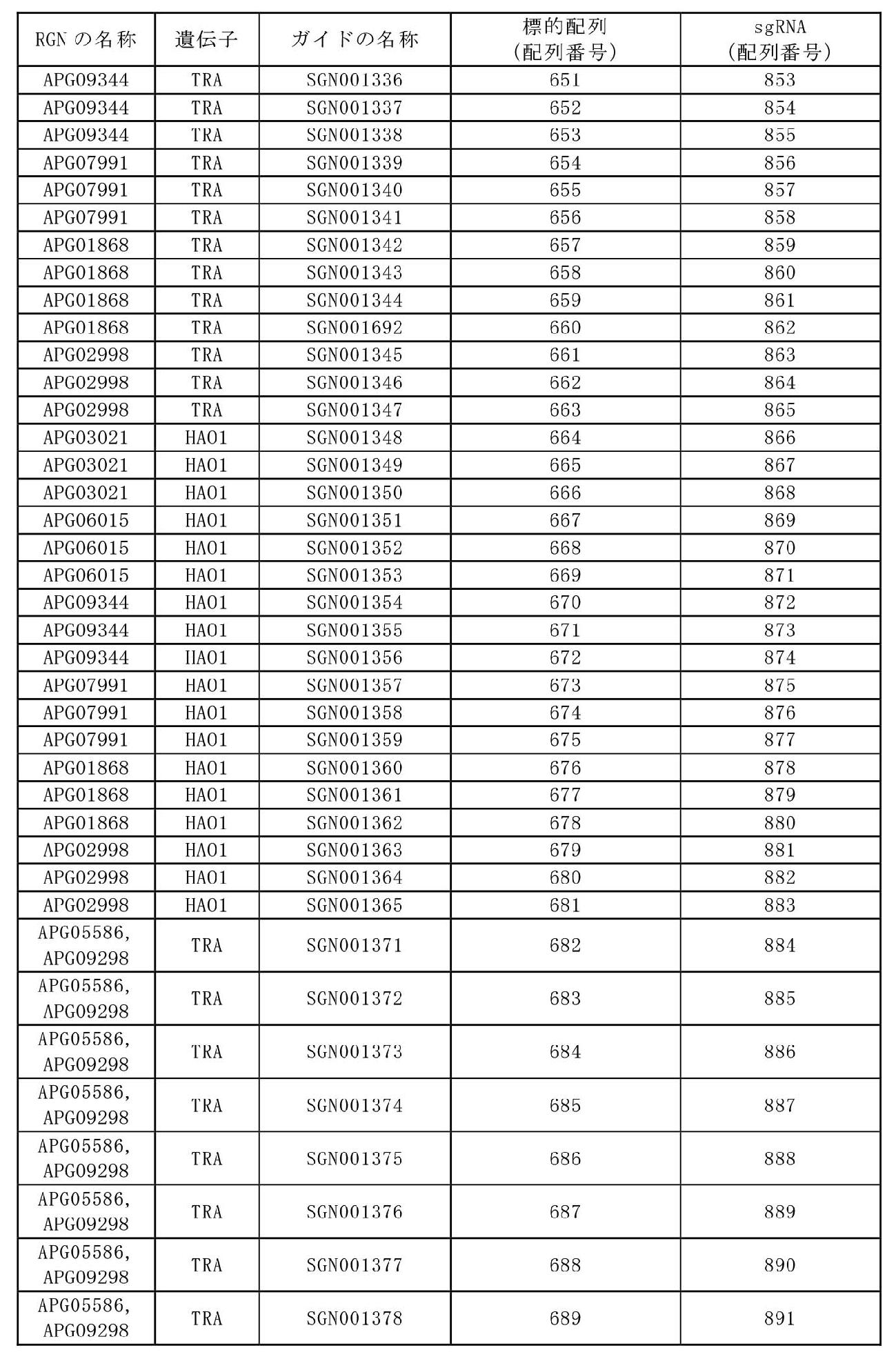
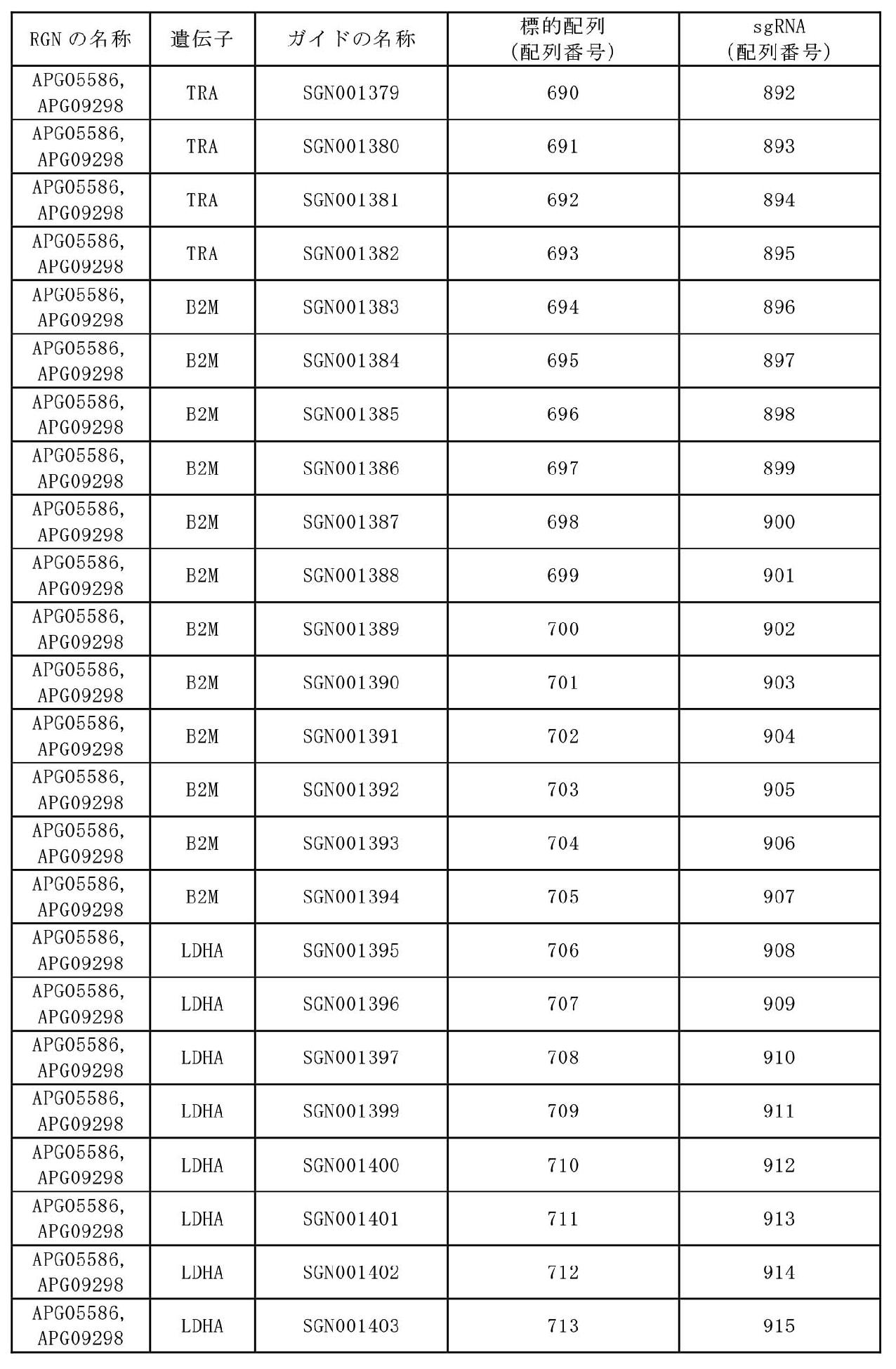
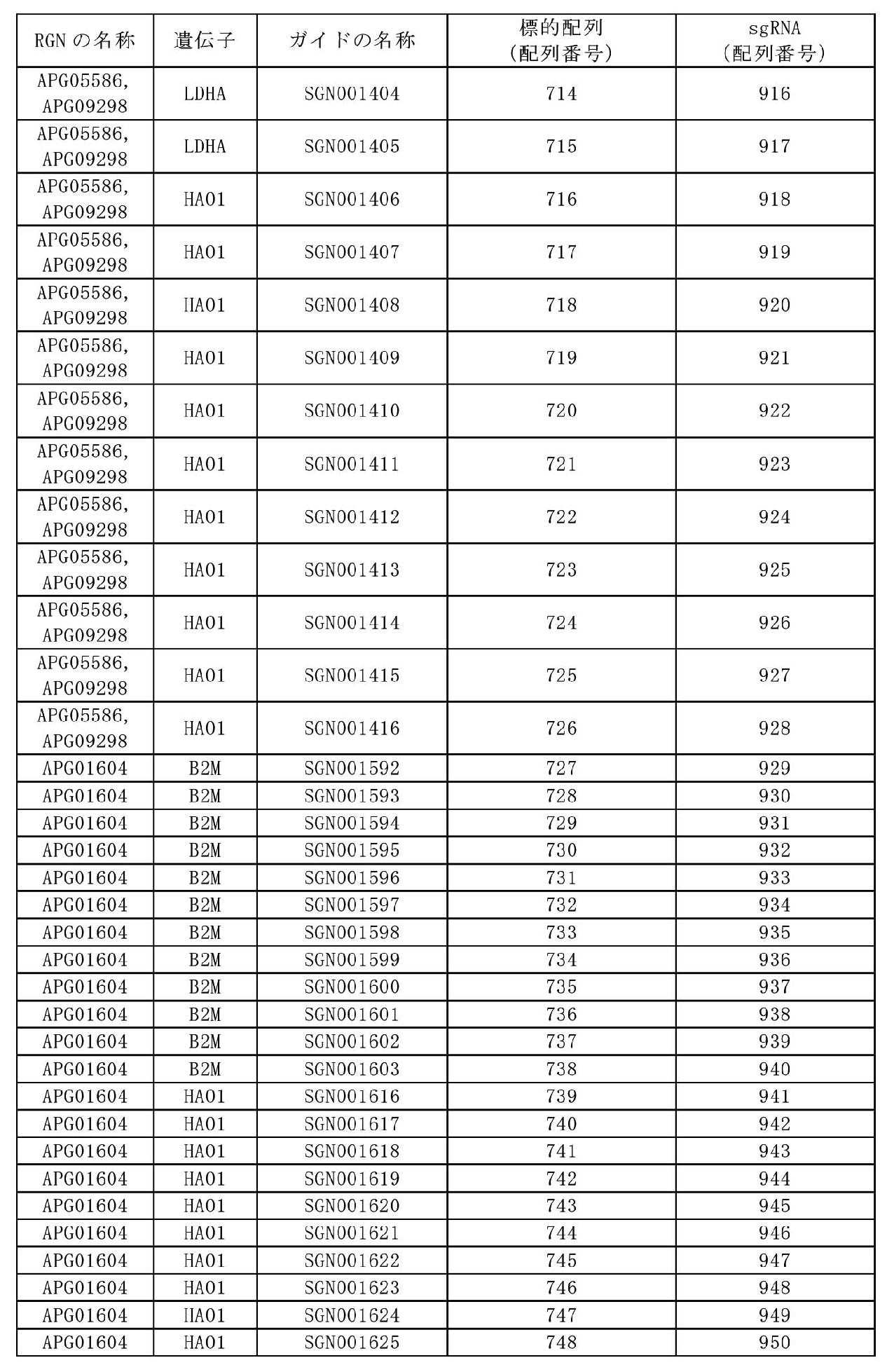


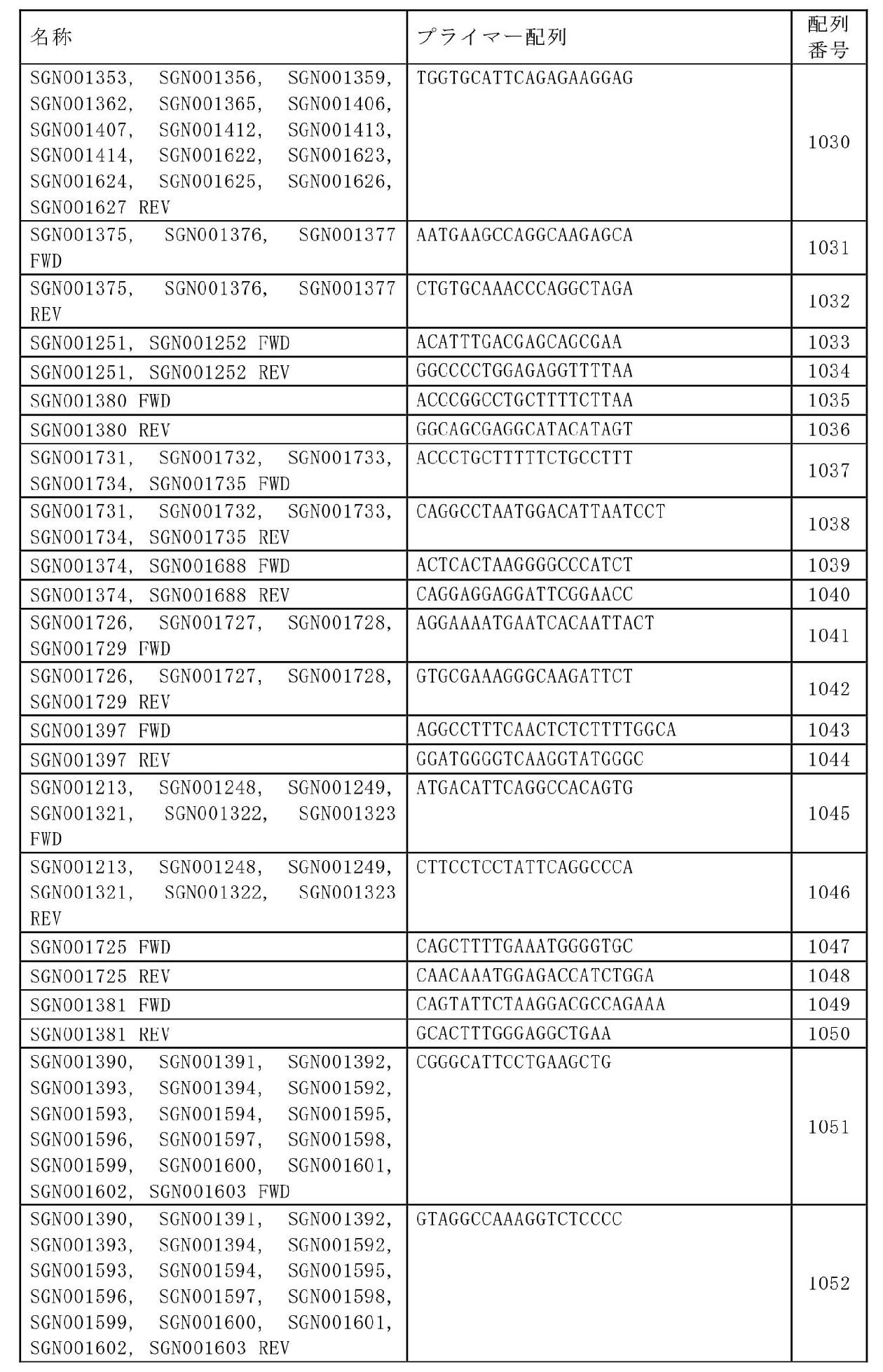


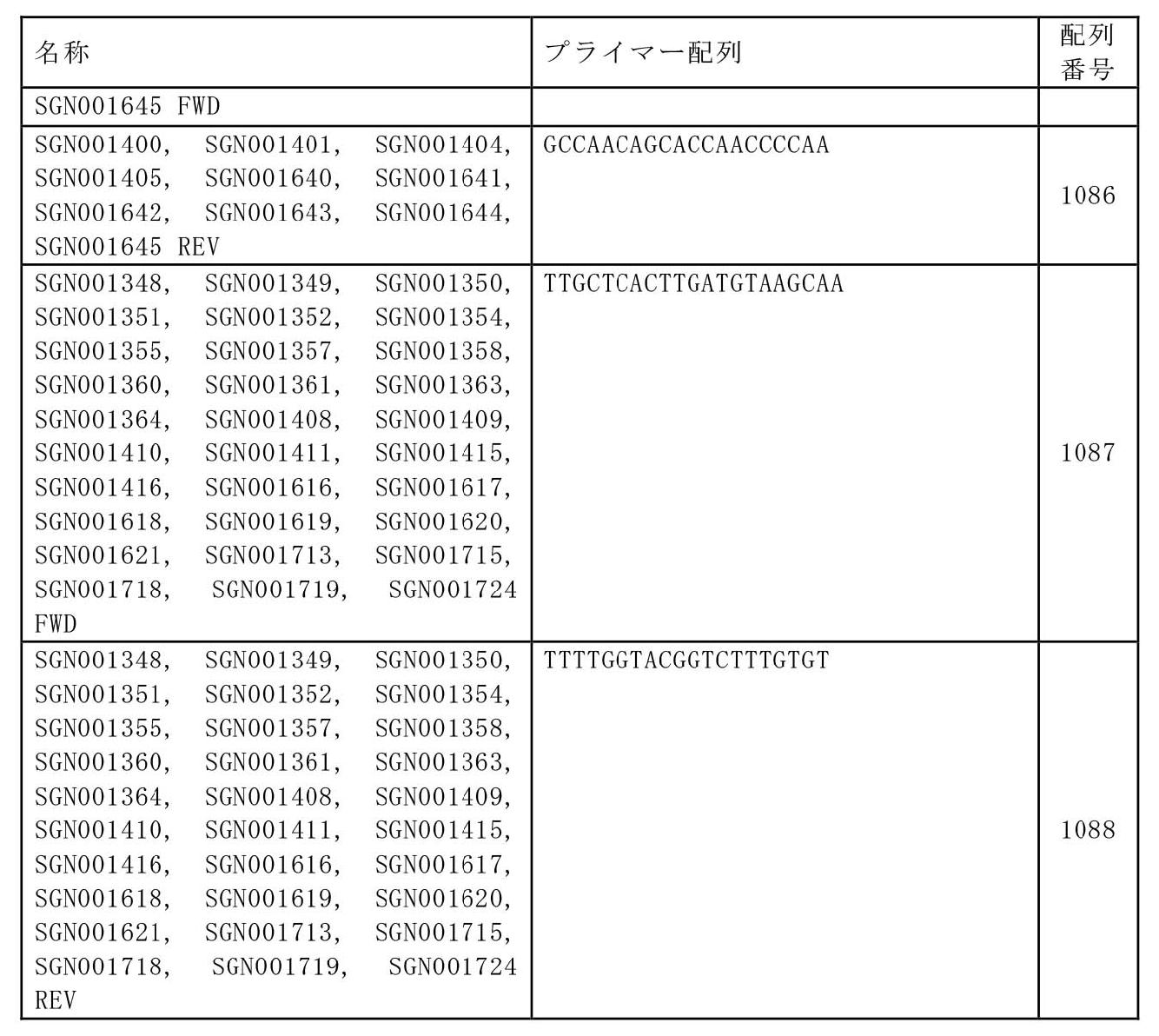
精製したゲノムDNAに対して上記のようにPCR#1とPCR#2を実施した。PCRクリナップキット(Zymo)を製造者の指示に従って用いてDNAをクリーンにした後、水の中で溶離させた。200~500mgの精製されたPCR2#産物を20μlの反応物の中で2μlの10×NEBバッファ2および水と組み合わせ、アニールしてヘテロ二重鎖DNAを形成した。そのとき利用したプログラムは、95℃、5分間;95℃から85℃へ2℃/秒の速度で冷却;85℃から25℃へ0.1℃/秒の速度で冷却;12℃、永遠にであった。アニーリングの後、5μlのDNAを無酵素対照として取り出し、1μlのT7エンドヌクレアーゼI(NEB)を添加し、この反応物を37℃で1時間インキュベートした。インキュベーションの後、5×FlashGelローディング染料(Lonza)を添加し、5μlの各反応物と対照を、ゲル電気泳動を利用して2.2%アガロースFlashGel(Lonza)によって分析した。ゲルを可視化した後、非相同末端結合(NHEJ)の割合を、式:%NHEJイベント=100×[1-(1-切断された割合)1/2]を用いて求めた(ただし(切断された割合)は、(消化された産物の密度)/(消化された産物+消化されなかった親バンドの密度)と定義される)。 PCR#1 and PCR#2 were performed on the purified genomic DNA as described above. DNA was cleaned using a PCR cleanup kit (Zymo) according to the manufacturer's instructions and then eluted in water. 200-500 mg of purified PCR2# product was combined with 2 μl of 10×NEB buffer 2 and water in a 20 μl reaction and annealed to form heteroduplex DNA. The program then utilized was: 95°C for 5 minutes; cooling from 95°C to 85°C at a rate of 2°C/s; cooling from 85°C to 25°C at a rate of 0.1°C/s; Met. After annealing, 5 μl of DNA was removed as a no enzyme control, 1 μl of T7 Endonuclease I (NEB) was added and the reaction was incubated at 37° C. for 1 hour. After incubation, 5x FlashGel loading dye (Lonza) was added and 5 μl of each reaction and controls were analyzed by 2.2% agarose FlashGel (Lonza) using gel electrophoresis. After visualizing the gel, the percentage of non-homologous end joining (NHEJ) was determined using the formula: %NHEJ events=100×[1−(1−fraction cleaved) 1/2 ], where (cleaved is defined as (digested product density)/(digested product + undigested parent band density)).
いくつかのサンプルについて、SURVEYOR(登録商標)を用いて哺乳類細胞における発現後の結果を分析した。トランスフェクション後の72時間にわたって細胞を37℃でインキュベートした後、ゲノムDNAを抽出した。ゲノムDNAは、QuickExtract DNA抽出溶液(Epicentre)を製造者のプロトコルに従って用いて抽出した。RGN標的部位に隣接するゲノム領域をPCRで増幅し、産物を、QiaQuickスピンカラム(Qiagen)を製造者のプロトコルに従って用いて精製した。合計200~500ngの精製されたPCR産物を1μlの10×Taq DNAポリメラーゼPCRバッファ(Enzymatics)および超純水と混合して最終体積を10μlにし、再アニーリングプロセスを適用することでヘテロ二重鎖の形成が可能になるようにした:95℃で10分間、-2℃/秒の勾配で95℃から85℃へ;-0.25℃/秒で85℃から25℃へ;そして25℃に1分間保持。 Some samples were analyzed for post-expression results in mammalian cells using SURVEYOR®. Genomic DNA was extracted after incubating the cells at 37° C. for 72 hours after transfection. Genomic DNA was extracted using QuickExtract DNA extraction solution (Epicentre) according to the manufacturer's protocol. A genomic region flanking the RGN target site was amplified by PCR and the product was purified using QiaQuick spin columns (Qiagen) according to the manufacturer's protocol. A total of 200-500 ng of purified PCR product was mixed with 1 μl of 10×Taq DNA polymerase PCR buffer (Enzymatics) and ultrapure water to a final volume of 10 μl, and a re-annealing process was applied to form heteroduplexes. Formation was allowed to proceed: 95°C for 10 min, ramp of -2°C/s from 95°C to 85°C; -0.25°C/s from 85°C to 25°C; Hold for minutes.
再アニーリングの後、産物を、SURVEYOR(登録商標)ヌクレアーゼとSURVEYOR(登録商標)エンハンサS(Integrated DNA Technologies)を製造者が推奨するプロトコルに従って用いて処理し、4~20%Novex TBEポリアクリルアミドゲル(Life Technologies)上で分析した。ゲルをSYBR Gold DNA染色(Life Technologies)で10分間染色し、Gel Docゲルイメージングシステム(Bio-rad)を用いて画像を取得した。定量は、相対バンド強度に基づいた。indel率は、式:100×(1-(1-(b+c)/(a+b+c))1/2)によって求めた(ただしaは消化されなかったPCR産物の積分強度であり、bとcは各切断産物の積分強度である)。 After re-annealing, products were treated with SURVEYOR® Nuclease and SURVEYOR® Enhancer S (Integrated DNA Technologies) according to the manufacturer's recommended protocol and run on a 4-20% Novex TBE polyacrylamide gel ( Life Technologies). Gels were stained with SYBR Gold DNA stain (Life Technologies) for 10 minutes and images were acquired using the Gel Doc gel imaging system (Bio-rad). Quantification was based on relative band intensities. The indel rate was determined by the formula: 100×(1−(1−(b+c)/(a+b+c)) 1/2 ) (where a is the integrated intensity of the undigested PCR product, and b and c are each is the integrated intensity of the cleavage product).
それに加え、Illuminaオーバーハング配列を含有するPCR#2からの産物を用い、Illumina 16S Metagenomic Sequencing Libraryプロトコルに従ってライブラリを調製した。深いシークエンシングをサービス提供者(MOGene)がIllumina Mi-Seqプラットフォーム上で実施した。典型的にはアンプリコン1つにつき250bpのペアードエンドリードを200,000個(2×100,000個のリード)生成させる。CRISPResso(Pinello, et al. 2016 Nature Biotech, 34: 695-697)を利用してこれらのリードを分析し、編集率を計算した。出力のアラインメントをマニュアルキュレーションで実施し、挿入部位と欠失部位を確認するとともに、組み換え部位のマイクロ相同性部位を同定した。編集率を表5に示す。すべての実験をヒト細胞で実施した。「標的配列」は、遺伝子標的内で標的とされる配列である。各標的配列について、ガイドRNAは、相補的なRNA標的配列と、使用するRGNに依存する適切なsgRNAを含んでいた。実験の選択された内訳をガイドRNAごとに表6.1~6.3に示す。 In addition, the product from PCR#2 containing the Illumina overhang sequences was used to prepare the library according to the Illumina 16S Metagenomic Sequencing Library protocol. Deep sequencing was performed by a service provider (MOGene) on the Illumina Mi-Seq platform. Typically 200,000 250 bp paired-end reads (2×100,000 reads) are generated per amplicon. These reads were analyzed using CRISPResso (Pinello, et al. 2016 Nature Biotech, 34: 695-697) to calculate the edit rate. Alignment of outputs was performed by manual curation to confirm insertion and deletion sites, as well as identify micro-homologous sites of recombination sites. Table 5 shows the edit rate. All experiments were performed in human cells. A "target sequence" is a sequence that is targeted within a gene target. For each target sequence the guide RNA contained the complementary RNA target sequence and the appropriate sgRNA depending on the RGN used. Selected breakdowns of the experiments are shown in Tables 6.1-6.3 for each guide RNA.


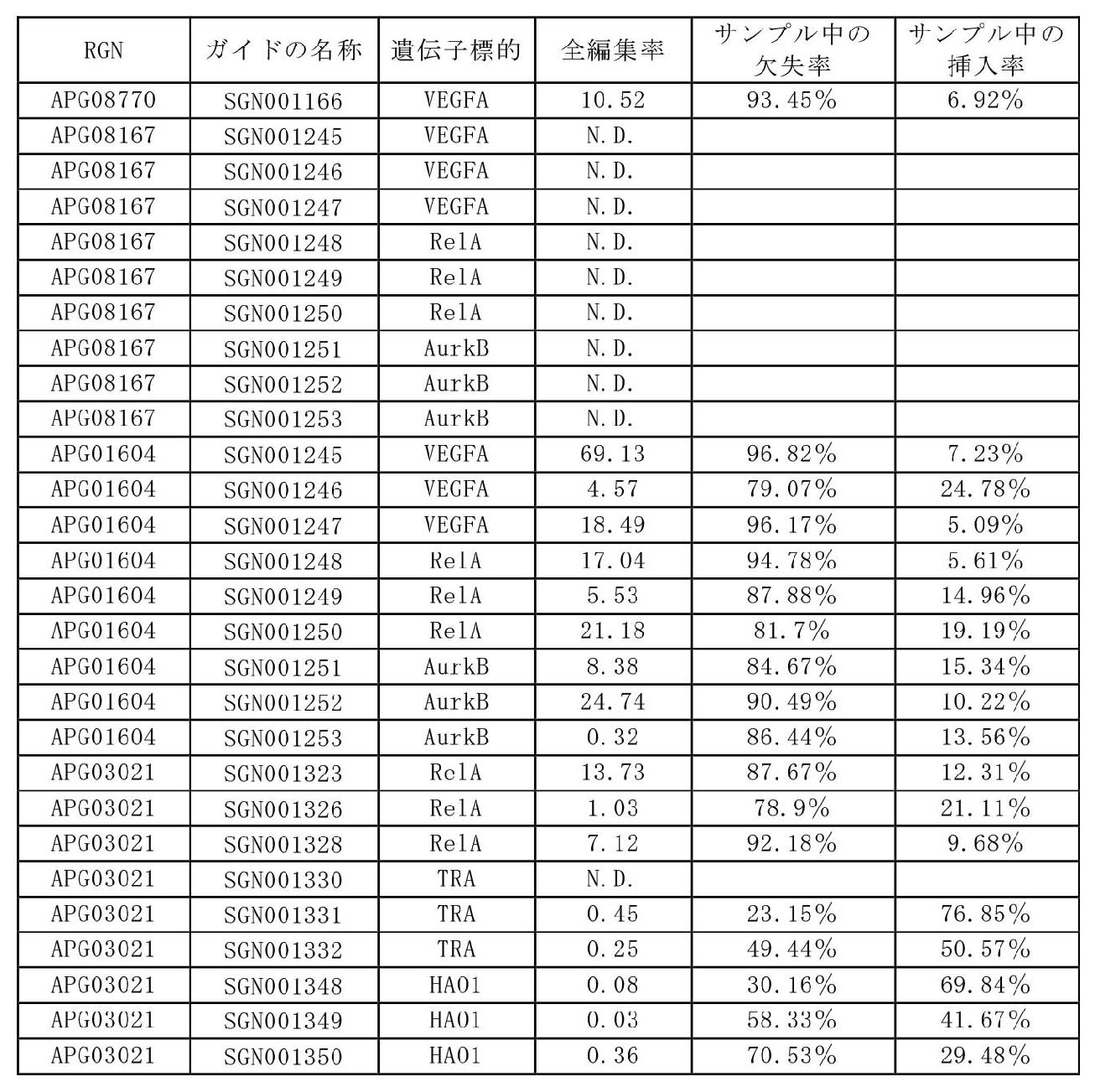
各ガイドについて、具体的な挿入と欠失を表6.1~6.3に示す。これらの表では、標的配列は太字の大文字によって特定される。8量体PAM領域には二重下線が引かれており、認識される主要なヌクレオチドは太字にされている。挿入は小文字によって特定される。欠失は点線(---)で示されている。INDEL位置は標的配列のPAM近位端から計算され、縁部が位置0である。位置は、縁部の標的側にある場合にはプラス(+)であり、縁部のPAM側にある場合にはマイナス(-)である。 Specific insertions and deletions for each guide are shown in Tables 6.1-6.3. In these tables, target sequences are identified by bold uppercase letters. The octamer PAM region is double underlined and the major recognized nucleotides are in bold. Insertions are identified by lowercase letters. Deletions are indicated by dashed lines (---). The INDEL position is calculated from the PAM proximal end of the target sequence, with position 0 being the edge. The position is plus (+) if it is on the target side of the edge and minus (-) if it is on the PAM side of the edge.


いくつかのヌクレアーゼのロバストさを、いくつかの遺伝子の多くの異なる標的部位における編集能力のアッセイによって調べた。40個超の標的を、拡張されたガイドパネルにおいて調べた。調べたすべてのタンパク質が多彩な部位でロバストな編集を示した。結果を表7に示す。 The robustness of several nucleases was examined by assaying their editing capacity at many different target sites in several genes. Over 40 targets were examined in an extended guide panel. All proteins examined showed robust editing at a variety of sites. Table 7 shows the results.


実施例5:APG05586のタンパク質操作Example 5: Protein Engineering of APG05586
APG05586の保存された残基と変動する残基の同定を、APG05586を、密接に関係するホモログ(その中に含まれるのは、APG08770(配列番号70)、APG09882(配列番号568として示されており、国際出願第PCT/US2020/045759号に記載されている(参照によってその全体が組み込まれている))、およびAPG01658(配列番号569として示されており、国際出願第PCT/US2020/045759号に記載されている)である)と比較することによって実施した。保存されていない位置に変異を含有するいくつかのバリアントを作製し、APG05586タンパク質において決定的に重要な残基を同定した。合計で132個の残基が、10個の操作されたAPG05586バリアントRGN(配列番号570~579)の中で変化していた。次いでこれら10個のAPG05586バリアントと野生型APG05586を用いて哺乳類細胞における活性を調べた。APG05586(配列番号66)のためのガイドRNA骨格を使用し、実施例4に記載されている方法に従って、標的とする6つのゲノム位置(表8)における活性をこれらRGNで調べた。各バリアントについて、哺乳類にコドン最適化されたコード配列が配列番号580~589として提供される。遺伝子編集活性の検出に有用な5’プライマーと3’プライマーのヌクレオチド配列も表8に提示されている。編集率は表9に示されている。 The identification of conserved and variable residues in APG05586 was performed to identify APG05586 as closely related homologues, among which are shown as APG08770 (SEQ ID NO: 70), APG09882 (SEQ ID NO: 568). , International Application No. PCT/US2020/045759 (incorporated by reference in its entirety)), and APG01658 (shown as SEQ ID NO: 569 and described in International Application No. PCT/US2020/045759). It was performed by comparing with the stated) is). Several variants containing mutations at non-conserved positions were generated to identify critical residues in the APG05586 protein. A total of 132 residues were changed among the ten engineered APG05586 variant RGNs (SEQ ID NOS:570-579). These 10 APG05586 variants and wild-type APG05586 were then used to examine activity in mammalian cells. Using the guide RNA backbone for APG05586 (SEQ ID NO: 66), these RGNs were tested for activity at the six targeted genomic locations (Table 8) according to the method described in Example 4. For each variant, mammalian codon-optimized coding sequences are provided as SEQ ID NOs:580-589. Nucleotide sequences of 5' and 3' primers useful for detecting gene editing activity are also presented in Table 8. The edit rate is shown in Table 9.


バリアントの相対活性は、タンパク質内のどの位置が変異を許容するかを示唆する。下に示した表10は、バリアントRGNの活性と、APG005586と比べたときの導入された変異数のまとめである。「-」は活性なしであり;「+」は、6個の標的のうちの少なくとも4個で1~15%の編集率であり;「++」は、6個の標的のうちの少なくとも4個で10~25%の編集率であり;「+++」は、6個の標的のうちの少なくとも4個で20~50%の編集率である。 The relative activities of variants suggest which positions within the protein are permissive for mutation. Table 10, shown below, summarizes the activity of variant RGNs and the number of mutations introduced when compared to APG005586. "-" is no activity; "+" is 1-15% editing rate on at least 4 of 6 targets; "++" is at least 4 of 6 targets "+++" is 20-50% editing in at least 4 of the 6 targets.

バリアントAPG03066とAPG02777は機能にとって重要な具体的な残基を同定するには変異を多く含有しすぎているが、これらバリアントの活性が低いというのは、架橋螺旋・認識ドメインへの広範な変化がこのタンパク質で許容されないことを示す。他のすべてのバリアントは14個以下の変異を含有しており、そのことにより活性にとって重要な具体的な残基を同定することが可能になった。これらの結果に基づき、いくつかの残基が、タンパク質の機能にとって重要であると同定された。I305L、V328A、L366I、T368S、およびV405Aという変異の結果として、調べたバリアントで活性が低下した。これらの変異のすべてが、タンパク質の認識ドメインにあることが予測される。APG01560での活性の低下は、タンパク質内の特定の領域に局在していない多数の変化の結果である。 Variants APG03066 and APG02777 contain too many mutations to identify specific residues important for function, but the low activity of these variants is due to extensive changes to the bridging helix and recognition domains. Indicates not allowed for this protein. All other variants contained no more than 14 mutations, which allowed us to identify specific residues important for activity. Based on these results, several residues were identified as important for protein function. Mutations I305L, V328A, L366I, T368S, and V405A resulted in decreased activity in the tested variants. All of these mutations are predicted to be in the recognition domain of the protein. The decreased activity at APG01560 is the result of a number of alterations that are not localized to specific regions within the protein.
実施例6:疾患標的の同定Example 6: Identification of disease targets
臨床バリアントのデータベースをNCBI ClinVarデータベースから取得した。これは、world wide webのNCBI ClinVarのウェブサイトを通じて入手することができる。病原性一塩基多型(SNP)をこのリストから同定した。ゲノム遺伝子座情報を利用して、各SNPと重複していて各SNPを取り囲む領域にあるCRIgvSPR標的を同定した。塩基編集に原因変異(「Casl Mut.」)を標的とする本発明のRGNを組み合わせて利用して修正することのできる一群のSNPが、表11に掲載されている。表11には、各疾患の1つの通称だけを掲載してある。「RS#」は、NCBIウェブサイトのSNPデータベース全体でのRSアクセッション番号に対応する。アレルIDは原因アレルのアクセッション番号に対応し、染色体アクセッション番号は、NCBIウェブサイトを通じて見られるアクセッション参照情報も提供する。表11には、各疾患について、掲載されているRGNに適したゲノム標的配列の情報も提示されている。標的配列の情報は、本発明の対応するRGNにとって必要なsgRNAを作製するためのプロトスペーサ配列も提供する。 A database of clinical variants was obtained from the NCBI ClinVar database. It is available through the NCBI ClinVar website on the world wide web. Pathogenic single nucleotide polymorphisms (SNPs) were identified from this list. Genomic locus information was utilized to identify CRIgvSPR targets that overlapped with and were in the region surrounding each SNP. Listed in Table 11 is a panel of SNPs that can be corrected using a combination of RGNs of the invention that target the causative mutation (“Casl Mut.”) for base editing. Table 11 lists only one common name for each disease. "RS#" corresponds to the RS accession number throughout the SNP database on the NCBI website. The allele ID corresponds to the accession number of the causative allele, and the chromosome accession number also provides accession reference information found through the NCBI website. Table 11 also provides genomic target sequence information suitable for the listed RGNs for each disease. Target sequence information also provides the protospacer sequences for making the requisite sgRNAs for the corresponding RGNs of the invention.

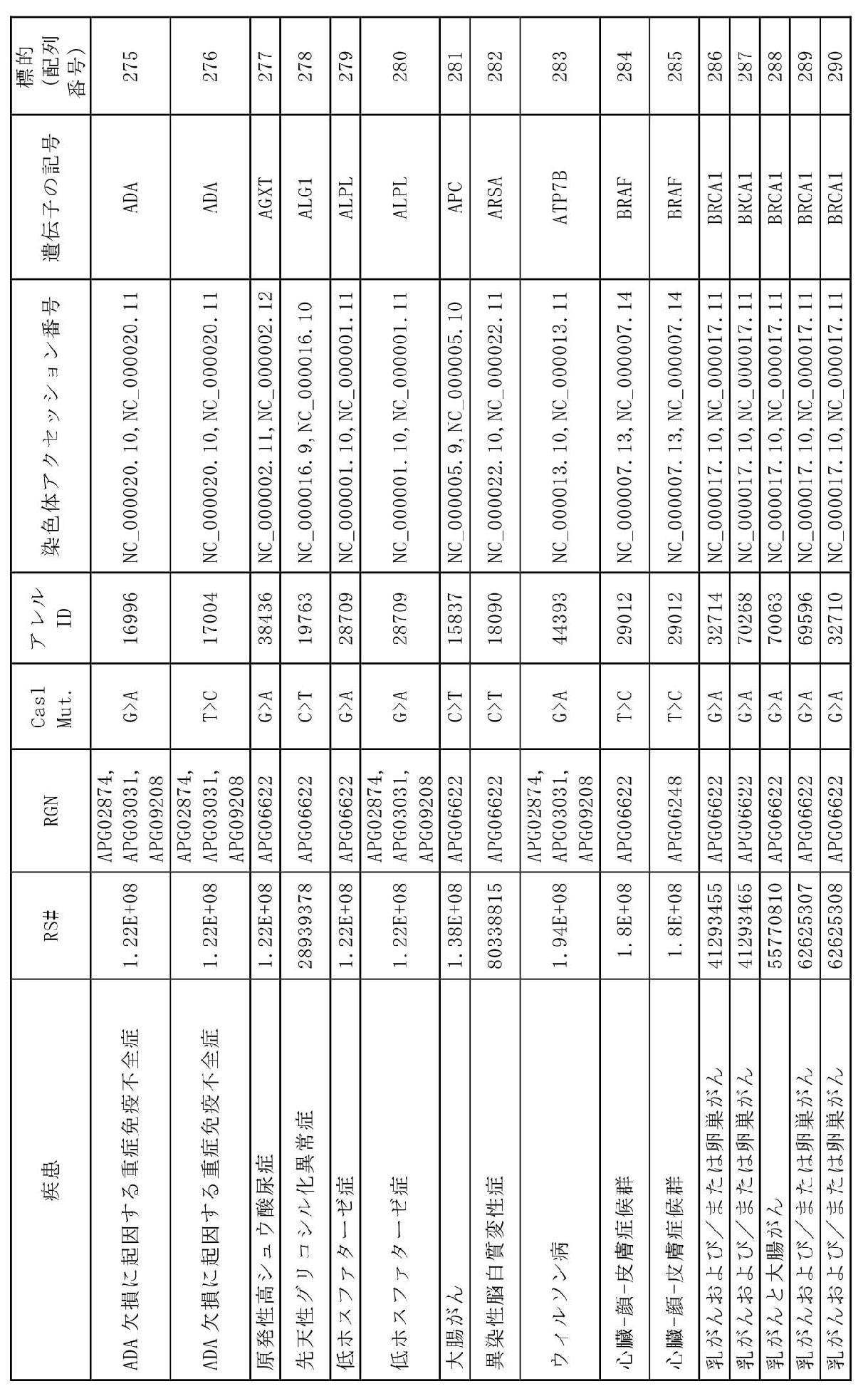


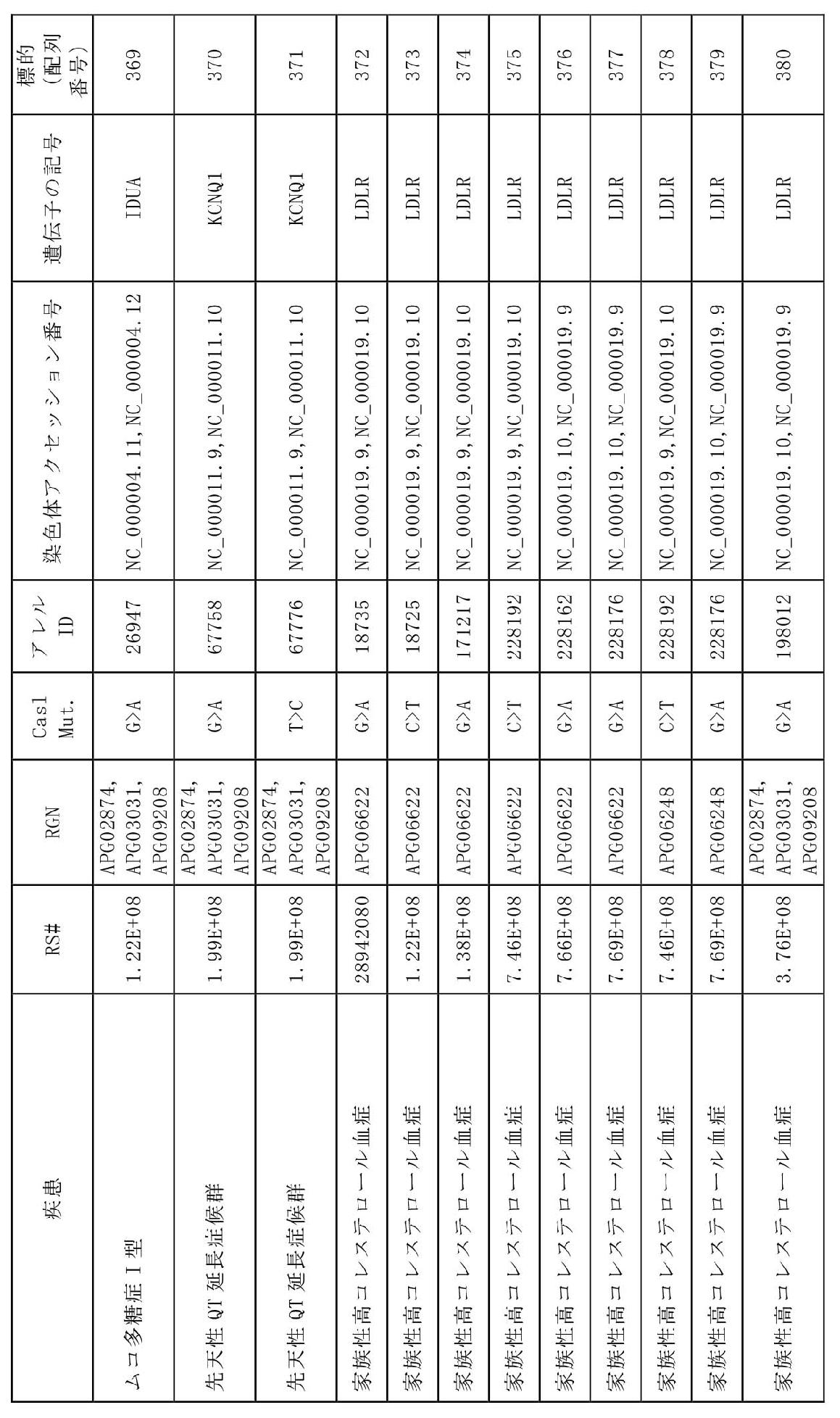
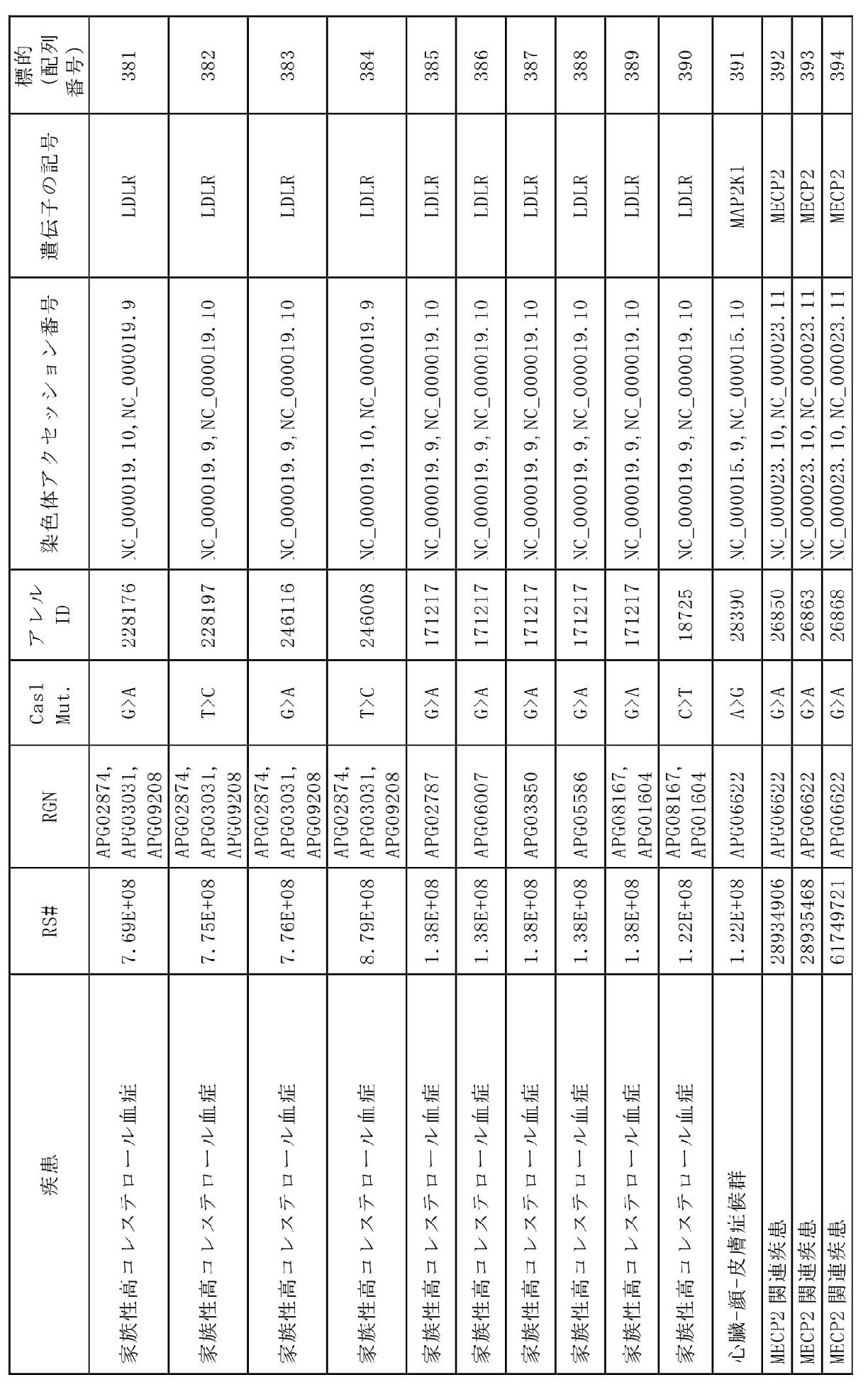


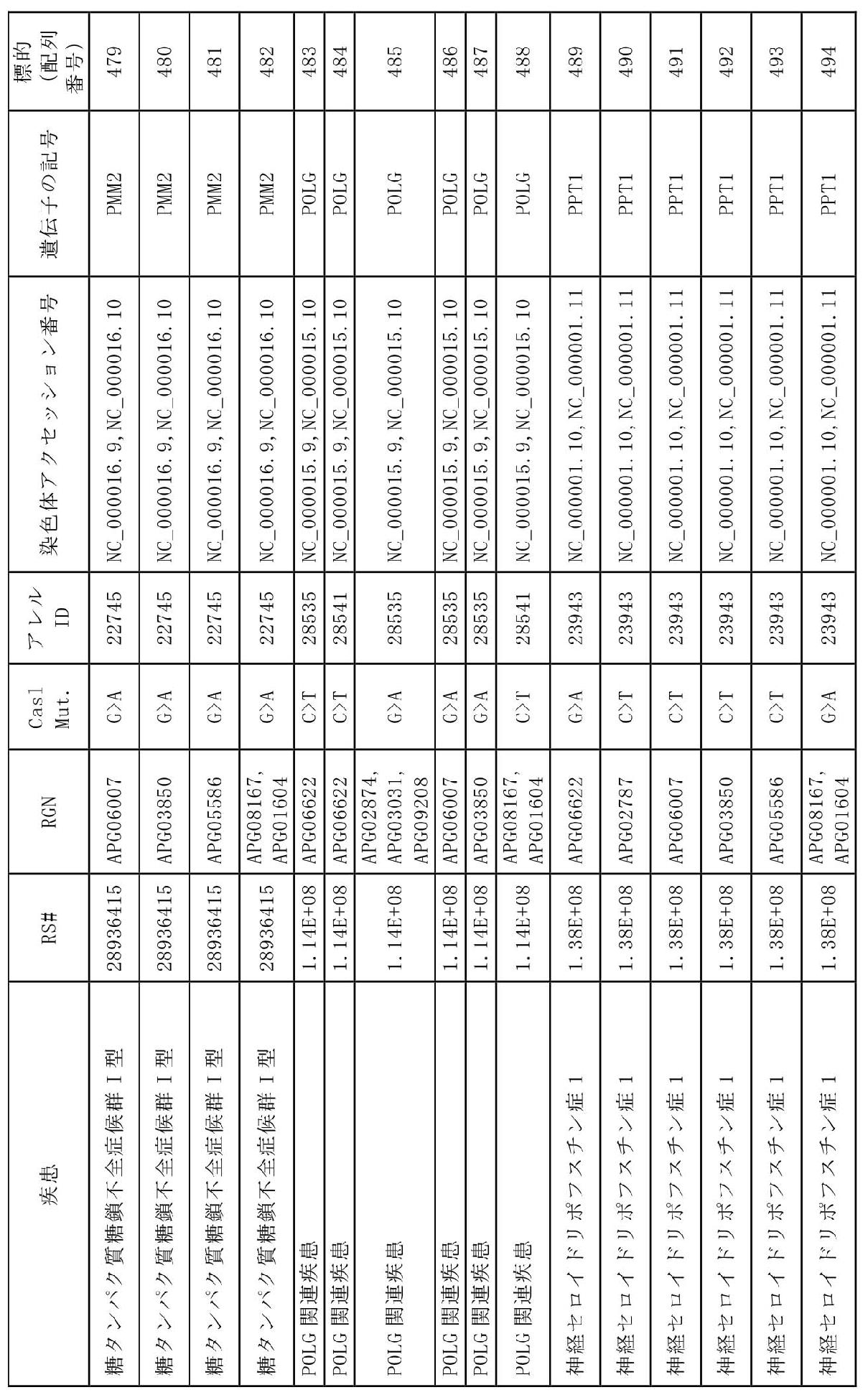


実施例7:ハーラー症候群の原因となる変異を標的とするExample 7: Targeting the Mutations Causing Hurler Syndrome
以下に、ハーラー症候群(MPS-1とも呼ばれる)のための可能性のある治療法として、この疾患を持つ患者の大きな集団内でハーラー症候群の原因となる変異を修正するRNA誘導型塩基編集系を用いた治療法を記述する。このアプローチは、単一のAAVベクターにパッケージして広い範囲の組織のタイプに送達することのできるRNA誘導型の塩基編集融合タンパク質を利用する。使用する正確な調節エレメントと塩基編集ドメインに応じ、塩基編集融合タンパク質と単一ガイドRNAの両方をコードする単一のベクターを作製して疾患のある遺伝子座を標的とすることも可能であろう。 Below, as a potential therapy for Hurler's syndrome (also called MPS-1), an RNA-guided base-editing system that corrects the Hurler's syndrome-causing mutations in a large population of patients with this disease is described. Describe the treatment used. This approach utilizes RNA-guided base-editing fusion proteins that can be packaged into a single AAV vector and delivered to a wide range of tissue types. Depending on the exact regulatory elements and base-editing domains used, it may be possible to generate a single vector encoding both a base-editing fusion protein and a single guide RNA to target disease loci. .
実施例7.1:理想的なPAMを有するRGNを同定する Example 7.1: Identifying RGNs with Ideal PAM
遺伝子疾患MPS-1はリソソーム蓄積症であり、リソソームの中に硫酸ダルマタンと硫酸へパランが蓄積することを分子レベルでの特徴とする。この疾患は、一般に、α-L-イズロニダーゼをコードするIDUA遺伝子(NCBI参照配列NG_008103.1)の中の変異によって起こる遺伝性の遺伝子疾患である。この疾患は、α-L-イズロニダーゼが欠損していることの結果である。北欧系の個人の研究で見いだされた最も一般的なIDUA変異はW402XとQ70Xであり、両方ともナンセンス変異である結果として翻訳が途中で終了する(Bunge et al. (1994), Hum. Mol. Genet, 3(6): 861-866;参照によって本明細書に組み込まれている)。単一のヌクレオチドを元に戻すと野生型コード配列が回復し、その結果として遺伝子座の内在性調節機構によりタンパク質発現が制御されると考えられる。 The genetic disease MPS-1 is a lysosomal storage disease, characterized at the molecular level by the accumulation of dalmatane sulfate and heparan sulfate in lysosomes. This disease is generally an inherited genetic disorder caused by mutations in the IDUA gene (NCBI reference sequence NG_008103.1), which encodes α-L-iduronidase. The disease is the result of a deficiency in α-L-iduronidase. The most common IDUA mutations found in studies of Nordic individuals are W402X and Q70X, both nonsense mutations resulting in premature translation termination (Bunge et al. (1994), Hum. Mol. Genet, 3(6): 861-866; incorporated herein by reference). It is believed that the restoration of a single nucleotide restores the wild-type coding sequence, resulting in control of protein expression by the locus' endogenous regulatory machinery.
ヒトIdua遺伝子のW402X変異がMPS-1Hのケースの大きな割合を占めている。塩基エディタは、ガイドRNAのプロトスペーサ成分の結合部位よりも狭い配列ウインドウを標的とすることができるため、標的遺伝子座から特定の距離にPAM配列が存在することが、この戦略の成功にとって不可欠である。標的変異は、塩基編集タンパク質との相互作用中は露出した非標的鎖(NTS)上に存在していなければならないという制約と、RGNドメインのフットプリントは、PAMに近い領域へのアクセスを阻止することになるという制約があるため、アクセス可能な遺伝子座はPAMから10~30bpであると考えられる。このウインドウ内にある他の近傍のアデノシン塩基の編集と突然変異誘発を回避するため、さまざまなリンカーをスクリーニングする。理想的なウインドウは、PAMから12~16bpである。 The W402X mutation of the human Idua gene accounts for a large proportion of MPS-1H cases. Since the base editor can target a narrower sequence window than the binding site of the protospacer component of the guide RNA, the presence of the PAM sequence at a specific distance from the target locus is essential for the success of this strategy. be. The constraint that the target mutation must reside on the exposed non-target strand (NTS) during interaction with the base-editing protein and the footprint of the RGN domain prevent access to regions close to the PAM. The accessible locus is considered to be 10-30 bp from the PAM due to the constraint of being different. Various linkers are screened to avoid editing and mutagenesis of other nearby adenosine bases within this window. The ideal window is 12-16 bp from PAM.
前記遺伝子座の位置でAPG02874、APG09208、およびAPG05586に適合したPAM配列は容易にわかる。これらヌクレアーゼは5’-nnnnCC-3’(配列番号35)、5’-nnnnC-3’(配列番号62)、および5’-nnRYA-3’(配列番号69)のPAM配列をそれぞれ持ち、サイズがコンパクトであるため、単一のAAVベクターを通じて送達できる可能性がある。この送達アプローチは他のアプローチと比べて多くの利点を与える(広い範囲の組織(肝臓、筋肉、CNS)へのアクセスや、よく確立された安全性プロファイルと製造技術など)。 The PAM sequences that matched APG02874, APG09208, and APG05586 at the position of the locus are readily apparent. These nucleases have PAM sequences of 5'-nnnnCC-3' (SEQ ID NO: 35), 5'-nnnnC-3' (SEQ ID NO: 62), and 5'-nnRYA-3' (SEQ ID NO: 69), respectively. Due to its compactness, it has the potential to be delivered through a single AAV vector. This delivery approach offers many advantages over other approaches, including access to a wide range of tissues (liver, muscle, CNS), well-established safety profile and manufacturing techniques.
化膿レンサ球菌からのCas9(SpyCas9)は、W402X遺伝子座の近くに存在するNGG(配列番号256)というPAM配列を必要とするが、SpyCas9のサイズが理由で単一のAAVベクターにパッケージすることはできないため、このアプローチの上記の利点が失われる。二重送達戦略を利用できる(例えばRyu et al, (2018), Nat. Biotechnol., 36(6): 536-539;参照によって本明細書に組み込まれている)が、作製が極めて複雑で大きなコストがかかることになろう。それに加え、二重ウイルスベクター送達は、遺伝子修正の効率を顕著に低下させる。なぜなら所与の細胞内で成功する編集は、両方のベクターを感染させることと、この細胞の中で融合タンパク質を組み立てることを必要とするからである。 Cas9 from S. pyogenes (SpyCas9) requires the PAM sequence NGG (SEQ ID NO: 256), which is located near the W402X locus, but cannot be packaged into a single AAV vector because of the size of SpyCas9. You can't, so you lose the above advantages of this approach. Dual-delivery strategies are available (eg, Ryu et al, (2018), Nat. Biotechnol., 36(6): 536-539; incorporated herein by reference), but are extremely complex to fabricate and large. would be costly. In addition, dual viral vector delivery significantly reduces the efficiency of gene correction. This is because successful editing within a given cell requires infecting both vectors and assembling the fusion protein within the cell.
黄色ブドウ球菌からの一般に用いられているCas9オルソログ(SauCas9)はSpyCas9と比べてサイズがかなり小さいが、より複雑なPAMを必要とする(NGRRT(配列番号257))。この配列は、原因遺伝子座の塩基編集に役立つと予想される範囲内にはない。 A commonly used Cas9 orthologue from S. aureus (SauCas9) is considerably smaller in size than SpyCas9, but requires a more complex PAM (NGRRT (SEQ ID NO:257)). This sequence is not within the range expected to aid in base editing of the causative locus.
実施例7.2:RGN融合コンストラクトとsgRNA配列 Example 7.2: RGN Fusion Constructs and sgRNA Sequences
以下のドメインを有する融合タンパク質をコードするDNA配列、すなわち1)DNA切断活性を不活化する変異を持つRGNドメイン(「デッド」または「ニッカーゼ」)と;2)塩基編集に役立つアデノシンデアミナーゼを有する融合タンパク質をコードするDNA配列を、分子生物学の標準的な技術を利用して作製する。下記の表に記載されているすべてのコンストラクトが、塩基編集活性ドメイン(この実施例では、デッドRGNであるAPG02874(配列番号214)、APG09208(配列番号216)、およびAPG005586(配列番号567)のN末端に機能可能に融合したADAT(配列番号211))を有する融合タンパク質を含む。塩基編集DNAにとって有用な他のアデノシンデアミナーゼも使用できる(例えばPCT出願PCT/US2019/068079参照)。本分野では、RGNのC末端に塩基編集酵素を有する融合タンパク質も作製できることが知られている。それに加え、融合タンパク質のRGNと塩基エディタは、典型的にはリンカーアミノ配列によって隔てられている。本分野では、標準的なリンカーの長さは15~30個の範囲のアミノ酸であることが知られている。さらに本分野では、RGNと塩基編集酵素の間のある融合タンパク質は、塩基編集効率を向上させる可能性がある少なくとも1つのウラシルグリコシラーゼ阻害(UGI)ドメイン(配列番号212)も含むことができることが知られている(アメリカ合衆国特許第10,167,457号;参照によって本明細書に組み込まれている)。したがって融合タンパク質は、RGNであるAPG02874、APG09208、またはそのバリアントと、アデノシンデアミナーゼと、場合により少なくとも1つのUGIを含むことができる。 A DNA sequence encoding a fusion protein having the following domains: 1) a RGN domain with a mutation that inactivates DNA cleavage activity (“dead” or “nickase”); and 2) a fusion with an adenosine deaminase that aids in base editing. A DNA sequence encoding the protein is constructed using standard techniques of molecular biology. All constructs listed in the table below contain the N of the base-editing active domain (in this example, dead RGNs APG02874 (SEQ ID NO:214), APG09208 (SEQ ID NO:216), and APG005586 (SEQ ID NO:567)). Includes fusion proteins with ADAT (SEQ ID NO: 211) operably fused to the terminus. Other adenosine deaminases useful for base-editing DNA can also be used (see, eg, PCT application PCT/US2019/068079). It is known in the art that fusion proteins with base editing enzymes at the C-terminus of RGN can also be made. In addition, the RGN and base editor of the fusion protein are typically separated by a linker amino sequence. Standard linker lengths are known in the art to range from 15 to 30 amino acids. Furthermore, it is known in the art that certain fusion proteins between RGN and base editing enzymes can also contain at least one uracil glycosylase inhibition (UGI) domain (SEQ ID NO: 212) that may improve base editing efficiency. (U.S. Pat. No. 10,167,457; incorporated herein by reference). Thus, the fusion protein can comprise RGN APG02874, APG09208, or variants thereof, an adenosine deaminase, and optionally at least one UGI.

RGNがアクセスできる編集部位はPAM配列によって決まる。RGNを塩基編集ドメインと組み合わせるとき、編集の標的にされる残基は非標的鎖(NTS)の上に存在していなければならない。なぜならRGNが遺伝子座に会合している間は、NTSは一本鎖だからである。多数のヌクレアーゼとそれに対応するガイドRNAを評価することで、この特定の遺伝子座のための最適な遺伝子編集ツールを選択することが可能になる。ヒトIdua遺伝子の中で上記のコンストラクトが標的にできる可能性のあるいくつかのPAM配列は、W402X変異の原因となる変異ヌクレオチドの近傍にある。1)疾患遺伝子座の位置で非コードDNA鎖と相補的な「スペーサ」と、2)ガイドRNAをRGNと会合させるのに必要なRNA配列とを含有するガイドRNA転写産物をコードする配列も作製する。このようなsgRNAは例えばAPG02874 RGN系については配列番号217によって、APG09208 RGN系については配列番号218によって、APG005586 RGN系については配列番号566によってコードすることができる。当業者が考案することのできるこれらsgRNA分子および同様のsgRNAについて、上記の塩基エディタを興味ある遺伝子座に向かわせる効率を評価することができる。 The editing sites accessible by RGN are determined by the PAM sequence. When combining an RGN with a base-editing domain, the residues targeted for editing must be on the non-target strand (NTS). This is because the NTS is single-stranded while the RGN is associated with the locus. Evaluating a large number of nucleases and their corresponding guide RNAs will allow us to select the optimal gene editing tool for this particular locus. Several PAM sequences in the human Idua gene that could be targeted by the above constructs are located near the mutated nucleotide responsible for the W402X mutation. A sequence encoding a guide RNA transcript containing 1) a “spacer” complementary to the non-coding DNA strand at the location of the disease locus and 2) the RNA sequence required to associate the guide RNA with the RGN is also generated. do. Such sgRNAs can be encoded, for example, by SEQ ID NO:217 for the APG02874 RGN system, by SEQ ID NO:218 for the APG09208 RGN system, and by SEQ ID NO:566 for the APG005586 RGN system. For these sgRNA molecules and similar sgRNAs that can be devised by one skilled in the art, the efficiency of directing the above base editors to loci of interest can be evaluated.
実施例7.3:ハーラー症候群の患者からの細胞における活性を調べるアッセイ Example 7.3: Assay to examine activity in cells from patients with Hurler's syndrome
遺伝子型戦略を検証し、上記のコンストラクトを評価するため、ハーラー疾患の患者からの線維芽細胞を使用する。実施例4に記載されているベクターと同様にして、融合タンパク質コード配列とsgRNAコード配列の上流の適切なプロモータを含有するベクターを、ヒト細胞でこれらを発現させるために設計する。ヒト細胞の中で高レベルに発現することが知られているか、線維芽細胞の中で特異的によく発現することのできるプロモータとそれ以外のDNAエレメント(例えばエンハンサまたはターミネータ)も使用できることが認識されている。標準的な技術(例えば実施例4に記載されているのと同様のトランスフェクション)を利用してベクターを線維芽細胞にトランスフェクトする。あるいは電気穿孔を利用することができる。細胞を1~3日間培養する。標準的な技術を利用してゲノムDNA(gDNA)を単離する。編集効率は、精製されたgDNAに関するqPCR遺伝子型決定アッセイおよび/または次世代シークエンシングを実施して求める。これについては下にさらに詳しく記載する。 To validate the genotyping strategy and evaluate the constructs described above, fibroblasts from patients with Hurler's disease are used. Similar to the vectors described in Example 4, vectors containing suitable promoters upstream of the fusion protein coding sequence and the sgRNA coding sequence are designed for their expression in human cells. It is recognized that promoters and other DNA elements (e.g., enhancers or terminators) that are known to be expressed at high levels in human cells or that are specifically well expressed in fibroblasts can also be used. It is The vectors are transfected into fibroblasts using standard techniques (eg, transfection as described in Example 4). Alternatively, electroporation can be used. Cells are cultured for 1-3 days. Genomic DNA (gDNA) is isolated using standard techniques. Editing efficiency is determined by performing qPCR genotyping assays and/or next-generation sequencing on purified gDNA. This is described in more detail below.
Taqman(商標)qPCR分析では、野生型アレルと変異アレルに対して特異的なプローブを用いる。これらプローブは蛍光体を担持しており、これら蛍光体は、そのスペクトルの励起特性および/または発光特性により、qPCR装置を用いて分離される。PCR用のプライマーとプローブを含有する遺伝子型決定キットは、市販のものを入手する(すなわちSNP ID rs121965019のためのThermo Fisher Taqman(商標)SNP遺伝子型決定アッセイID C__27862753_10)か、設計することができる。設計したプライマーとプローブのセットの一例を表13に示す。 Taqman™ qPCR analysis uses probes specific for wild-type and mutant alleles. These probes carry fluorophores, which are separated by their spectral excitation and/or emission properties using a qPCR instrument. Genotyping kits containing primers and probes for PCR can be obtained commercially (i.e. Thermo Fisher Taqman™ SNP Genotyping Assay ID C__27862753_10 for SNP ID rs121965019) or designed. . Table 13 shows an example of a set of designed primers and probes.

編集実験の後、標準的な方法と上記のプライマーおよびプローブを用いてgDNAをqPCRで分析する。予想される結果を表14に示す。このインビトロ系を利用してコンストラクトを適切に評価し、さらに研究するための編集効率が大きいコンストラクトを選択することができる。この系は、W402X変異を持つ細胞および持たない細胞と比較して評価されることになり、好ましくはこの変異に関してヘテロ接合であるいくつかの細胞と比較して評価されることになる。Ct値は、染料(Sybrグリーンなど)を用い、参照遺伝子、またはその遺伝子座の全増幅と比較されることになる。 After editing experiments, the gDNA is analyzed by qPCR using standard methods and the primers and probes described above. Expected results are shown in Table 14. This in vitro system can be used to properly evaluate constructs and select constructs with greater editing efficiency for further study. This line will be evaluated against cells with and without the W402X mutation, preferably against some cells heterozygous for this mutation. Ct values will be compared to the reference gene, or total amplification of that locus, using a dye (such as Sybr Green).

組織は次世代シークエンシングによって分析することもできる。下に示したようなプライマー結合部位(表15)、または当業者が同定可能な他の適切なプライマー結合部位を用いることができる。PCR増幅の後、Illumina 16S Metagenomic Sequencing Libraryのプロトコルに従い、Illumina Nextera XTオーバーハング配列を含有する産物からライブラリを調製する。深いシークエンシングをIllumina Mi-Seqプラットフォーム上で実施する。典型的には、アンプリコン1つ当たり250bpのペアードエンドリードを200,000個(2×100,000個のリード)生成させる。CRISPResso(Pinello et al., 2016)を利用してこれらのリードを分析し、編集率を計算する。出力アラインメントのマニュアルキュレーションを実施して挿入部位と欠失部位を確認するとともに、組み換え部位の位置のマイクロ相同性部位を同定する。 Tissues can also be analyzed by next generation sequencing. Primer binding sites such as those shown below (Table 15), or other suitable primer binding sites identifiable to one of ordinary skill in the art, can be used. After PCR amplification, a library is prepared from the products containing the Illumina Nextera XT overhang sequences according to the Illumina 16S Metagenomic Sequencing Library protocol. Deep sequencing is performed on the Illumina Mi-Seq platform. Typically, 200,000 paired-end reads of 250 bp are generated per amplicon (2 x 100,000 reads). These reads are analyzed using CRISPResso (Pinello et al., 2016) to calculate the edit rate. Manual curation of the output alignment is performed to confirm insertion and deletion sites, as well as identify micro-homologous sites at the positions of recombination sites.

トランスフェクトされた細胞と対照細胞の細胞ライセートのウエスタンブロッティングを抗IDUA抗体を用いて実施することによって完全長タンパク質の発現を確認し、基質である4-メチルウンベリフェリルa-L-イズロニドを用いた細胞ライセートの酵素活性アッセイによってこの酵素が触媒活性であることを確認する(Hopwood et al., Clin.Chim. ACta (1979), 92(2): 257-265;参照によって本明細書に組み込まれている)。これらの実験を実施し、元のIduaW402X/W402X細胞系(トランスフェクションなし)と、塩基編集コンストラクトとランダムなガイド配列をトランスフェクトされたIduaW402X/W402X細胞系と、野生型IDUAを発現する細胞系を比較する。 Expression of the full-length protein was confirmed by Western blotting of cell lysates of transfected and control cells using an anti-IDUA antibody and the substrate 4-methylumbelliferyl a-L-iduronide. This enzyme is catalytically active by enzymatic activity assays of cell lysates obtained from lysates (Hopwood et al., Clin. Chim. ACta (1979), 92(2): 257-265; incorporated herein by reference). are listed). These experiments were performed using the original Idua W402X/W402X cell line (no transfection), the Idua W402X/W402X cell line transfected with base-editing constructs and randomized guide sequences, and cells expressing wild-type IDUA. Compare systems.
実施例7.4:マウスモデルにおける疾患治療の検証 Example 7.4: Validation of Disease Treatment in Mouse Models
この治療的アプローチの有効性を確認するため、類似アミノ酸にナンセンス変異を有するマウスモデルを使用する。このマウス系統は、Idua遺伝子(遺伝子ID:15932)の中に、ハーラー症候群の患者における変異と相同な変異に対応するW392X変異を有する(Bunge et al., (1994), Hum. Mol. Genet. 3(6): 861-866;参照によって本明細書に組み込まれている)。この遺伝子座は、ヒトにおける遺伝子座とは明確に異なるヌクレオチド配列を含んでいて、前の実施例に記載した塩基エディタを用いた修正に必要なPAM配列を欠いているため、異なる融合タンパク質を設計してヌクレオチドを修正する必要がある。この動物での疾患改善により、遺伝子送達ベクターによってアクセスできる組織内の変異を修正するこの治療的アプローチの有効性を確認できる。 To validate this therapeutic approach, we use a mouse model with nonsense mutations in similar amino acids. This mouse strain has a W392X mutation in the Idua gene (Gene ID: 15932) that corresponds to a mutation homologous to that in patients with Hurler syndrome (Bunge et al., (1994), Hum. Mol. Genet. 3(6): 861-866; incorporated herein by reference). A different fusion protein was designed because this locus contains a distinct nucleotide sequence from the locus in humans and lacks the PAM sequence required for modification using the base editor described in the previous example. to correct the nucleotide. Disease amelioration in this animal confirms the efficacy of this therapeutic approach to correct mutations in tissues accessible by gene delivery vectors.
この変異に関してホモ接合性であるマウスは、ハーラー症候群の患者と似た表現型の特徴を多数示す。上記の塩基編集RGN融合タンパク質(表12)とRNAガイド配列を、マウスでタンパク質の発現とRNAの転写を可能にする発現ベクターに組み込む。研究の設計を下記の表16に示す。この研究に含まれるのは、塩基編集融合タンパク質とRNAガイド配列を含む高用量の発現ベクターで治療した群、低用量の同じ発現ベクターで治療した群、塩基編集融合タンパク質またはガイドRNAを含まない発現ベクターで治療したモデルマウスである対照、および空にした同じベクターで治療した野生型マウスである第2の対照である。 Mice homozygous for this mutation display many phenotypic features similar to patients with Hurler's syndrome. The base-edited RGN fusion proteins described above (Table 12) and RNA guide sequences are incorporated into an expression vector that allows protein expression and RNA transcription in mice. The study design is shown in Table 16 below. Included in this study were groups treated with a high dose of an expression vector containing a base-editing fusion protein and an RNA guide sequence, a group treated with a low dose of the same expression vector, and expression without the base-editing fusion protein or guide RNA. Controls are model mice treated with vector, and a second control is a wild-type mouse treated with the same vector that has been emptied.

評価するエンドポイントに含まれるのは、体重、尿GAG排泄、血清IDUA酵素活性、興味ある組織内のIDUA活性、組織の病態、SNPの修正を確認するための興味ある組織の遺伝子型、および挙動評価と神経学的評価である。いくつかのエンドポイントは消失であるため、研究が終了する前に追加の群を追加して例えば組織の病態と組織IDUA活性を評価することができる。エンドポイントの追加例は、ハーラー症候群動物モデルを確立した公開されている論文に見いだすことができる(Shull et al. (1994), Proc. Natl. Acad. Sci. U.S.A., 91(26): 12937-12941;Wang et al. (2010), Mol. Genet. Metab., 99(1): 62-71;Hartung et al. (2004), Mol. Ther., 9(6): 866-875;Liu et al. (2005), Mol. Ther., 11(1): 35-47;Clarke et al. (1997), Hum. Mol. Genet. 6(4): 503-511;これらのすべてが参照によって本明細書に組み込まれている)。 Endpoints assessed included body weight, urinary GAG excretion, serum IDUA enzymatic activity, IDUA activity in tissues of interest, tissue pathology, tissue genotype of interest to confirm SNP correction, and behavior. evaluation and neurological evaluation. Since some endpoints are elimination, additional groups can be added to assess, for example, tissue pathology and tissue IDUA activity before the study is terminated. Additional examples of endpoints can be found in published papers that have established Hurler's syndrome animal models (Shull et al. (1994), Proc. Natl. Acad. Sci. USA, 91). 26): 12937-12941; Wang et al.(2010), Mol.Genet.Metab., 99(1): 62-71; Hartung et al. (2005), Mol.Ther., 11(1): 35-47; Clarke et al.(1997), Hum.Mol.Genet.6(4):503-511; all incorporated herein by reference).
可能な1つの送達ベクターは、アデノ随伴ウイルス(AAV)を利用している。ベクターを作製するときに含めるのは、CMVエンハンサ(配列番号259)とCMVプロモータ(配列番号258)、または他の適切なエンハンサとプロモータの組み合わせ)、場合によりコザック配列が前に置かれていて3’末端の位置でターミネータ配列とポリアデニル化配列(例えばLevitt, N.; Briggs, D.; Gil, A.; Proudfoot, N. J.「効率的な合成ポリ(A)部位の定義」Genes Dev. 1989, 3 (7), 1019-1025に記載されている最小配列)に機能可能に融合された塩基エディタ-dRGN融合タンパク質コード配列(例えば上記のようなNuc-ADAT-リンカー-dAPG19748-リンカー-SV40)である。このベクターはさらに、単一ガイドRNAをコードしていてその5’末端の位置にはヒトU6プロモータ(配列番号260)、または小さな非コードRNAの作製に適した別のプロモータが機能可能に連結された発現カセットを含むとともに、AAVカプシドにパッケージするために必要な本分野で周知の逆転末端反復(ITR)配列をさらに含む。作製とウイルスのパッケージングは、標準的な方法(例えばアメリカ合衆国特許第9,587,250号に記載されている方法;参照によって本明細書に組み込まれている)によって実施する。 One possible delivery vector utilizes adeno-associated virus (AAV). When constructing a vector, include a CMV enhancer (SEQ ID NO: 259) and a CMV promoter (SEQ ID NO: 258), or other suitable enhancer-promoter combination), optionally preceded by a Kozak sequence. Terminator sequences and polyadenylation sequences (eg, Levitt, N.; Briggs, D.; Gil, A.; Proudfoot, NJ. "Definition of an efficient synthetic poly(A) site", Genes Dev.). 1989, 3(7), 1019-1025) operably fused to the base editor-dRGN fusion protein coding sequence (e.g. Nuc-ADAT-linker-dAPG19748-linker-SV40 as described above). ). This vector further encodes a single guide RNA operably linked at its 5' end to the human U6 promoter (SEQ ID NO:260), or another promoter suitable for generating small non-coding RNAs. It contains an expression cassette and further contains the art-known inverted terminal repeat (ITR) sequences necessary for packaging into the AAV capsid. Production and viral packaging are performed by standard methods (eg, those described in US Pat. No. 9,587,250; incorporated herein by reference).
他の可能なウイルスベクターに含まれるのはアデノウイルスベクターとレンチウイルスベクターであり、これらは一般に用いられていて、パッケージングの能力と条件が異なる同様のエレメントを含有すると考えられる。非ウイルス送達法も利用できる。それは例えば脂質ナノ粒子によって封止されたmRNAとsgRNA(Cullis, P. R. and Allen, T. M. (2013), Adv. Drug Deliv. Rev. 65(1): 36-48;Finn et al. (2018), Cell Rep. 22(9): 2227-2235、両方とも参照によって本明細書に組み込まれている)プラスミドDNAのハイドロダイナミック注入(Suda T and Liu D, )2007) Mol. Ther. 15(12): 2063-2069、参照によって本明細書に組み込まれている)、またはsgRNAのリボ核タンパク質複合体で金ナノ粒子と会合しているもの(Lee, K.; Conboy, M.; Park, H. M.; Jiang, F.; Kim, H. J.; Dewitt, M. A.; Mackley, V. A.; Chang, K.; Rao, A.; Skinner, C.; et al.「Cas9リボ核タンパク質とドナー DNAの生体内ナノ粒子送達は相同組み換えDNA修復を誘導する」Nat. Biomed. Eng. 2017, 1 (11), 889-90)である。 Other possible viral vectors include adenoviral vectors and lentiviral vectors, which are commonly used and are believed to contain similar elements that differ in their packaging capacities and conditions. Non-viral delivery methods are also available. For example, mRNA and sgRNA encapsulated by lipid nanoparticles (Cullis, P. R. and Allen, T. M. (2013), Adv. Drug Deliv. Rev. 65(1): 36-48; Finn et al. (2018), Cell Rep. 22(9): 2227-2235, both incorporated herein by reference) Hydrodynamic injection of plasmid DNA (Suda T and Liu D, 2007) Mol. Ther. 15(12): 2063-2069, incorporated herein by reference), or ribonucleoprotein complexes of sgRNAs associated with gold nanoparticles (Lee, K.; Conboy, M.; Park, H. M.; Jiang, F.; Kim, H. J.; Dewitt, M. A.; "In vivo nanoparticle delivery of Cas9 ribonucleoprotein and donor DNA induces homologous recombination DNA repair," Nat. Biomed. Eng. 2017, 1 (11), 889-90).
実施例7.5:ヒト化遺伝子座を持つマウスモデルにおける疾患修正 Example 7.5: Disease correction in mouse models with humanized loci
ヒトの治療に使用できると考えられるのと同じ塩基エディタコンストラクトの有効性を評価するには、W392の近傍のヌクレオチドを変化させてヒトのW402の周辺の配列に一致させたマウスモデルが必要とされる。これは多彩な技術によって実現することができ、その中には、RGNとHDR鋳型を使用してマウスの胚の中にある遺伝子座を切断して置き換えることが含まれる。 To assess the efficacy of the same base editor constructs that could be used for human therapy, a mouse model was required in which the nucleotides near W392 were changed to match the sequences surrounding W402 in humans. be. This can be accomplished by a variety of techniques, including the use of RGN and HDR templates to cut and replace loci in mouse embryos.
アミノ酸保存の程度が大きいため、表17に示されているように、マウス遺伝子座の中の大半のヌクレオチドを、サイレント変異を有するヒト配列のヌクレオチドに変えることができる。得られた操作されたマウスゲノムでコード配列が変化する塩基変化だけが、導入された終止コドンの後に生じる。 Due to the high degree of amino acid conservation, as shown in Table 17, most nucleotides in the mouse loci can be changed to human sequence nucleotides with silent mutations. The only base changes that alter the coding sequence in the resulting engineered mouse genome occur after the introduced stop codon.

このマウス系統の操作が終わると、同様の実験を実施例7.4に記載されているようにして実施する。 Once this mouse strain has been manipulated, similar experiments are performed as described in Example 7.4.
実施例8:フリードライヒ運動失調症の原因となる変異を標的とするExample 8: Targeting the Mutation Causing Friedreich's Ataxia
フリードライヒ運動失調症(FRDA)を引き起こす3ヌクレオチド反復配列の伸長は、FXN遺伝子内の所定の遺伝子座(FRDA不安定性領域と呼ばれる)に起こる。RNA誘導型ヌクレアーゼ(RGN)を用いてFRDA患者の細胞内の不安定性領域を切除することができる可能性がある。このアプローチは、1)ヒトゲノム内のアレルを標的とするようにプログラムすることのできるRGNとガイドRNAの配列と;2)このRGNとガイドRNAの配列を送達する方法を必要とする。ゲノム編集に使用される多くのヌクレアーゼ(一般に用いられている化膿レンサ球菌からのCas9ヌクレアーゼ(SpCas9)など)は、アデノ随伴ウイルス(AAV)ベクターの中にパッケージするには大きすぎる。特に、SpCas9遺伝子とガイドRNAの長さに加え、機能的な発現カセットに必要とされる他の遺伝エレメントの長さを考慮すると、そのことがわかる。そのためSpCas9を用いるアプローチの実現可能性は小さい。 The stretches of trinucleotide repeats that cause Friedreich's ataxia (FRDA) occur at defined loci within the FXN gene (called FRDA instability regions). RNA-guided nucleases (RGNs) may be used to ablate regions of instability in cells of FRDA patients. This approach requires 1) RGN and guide RNA sequences that can be programmed to target alleles within the human genome; and 2) a method of delivering the RGN and guide RNA sequences. Many nucleases used in genome editing, such as the commonly used Cas9 nuclease from Streptococcus pyogenes (SpCas9), are too large to be packaged into adeno-associated virus (AAV) vectors. This is especially true when considering the length of the SpCas9 gene and guide RNA, as well as other genetic elements required for a functional expression cassette. Therefore, the feasibility of the approach using SpCas9 is small.
本発明のコンパクトなRNA誘導型ヌクレアーゼ(例えばAPG03850)は、FRDA不安定性領域の切除に極めてよく適している。APG03850はFRDA不安定性領域の近傍におけるPAM条件を有する。それに加え、APG03850はAAVベクターの中にガイドRNAとともにパッケージすることができる。2つのガイドRNAをパッケージするには第2のベクターが必要となる可能性が大きいが、それでもこのアプローチは、より大きなヌクレアーゼ(例えばSpCas9であり、このタンパク質配列を2つのベクターに分割せねばならない可能性がある)で必要とされると考えられるベクターよりも有利である。 Compact RNA-guided nucleases of the invention (eg APG03850) are extremely well suited for excision of FRDA instability regions. APG03850 has PAM conditions near the FRDA instability region. Additionally, APG03850 can be packaged in an AAV vector with guide RNA. Although it is likely that a second vector is required to package the two guide RNAs, this approach nevertheless avoids the use of larger nucleases (e.g. SpCas9), which may have to split this protein sequence into two vectors. This is an advantage over vectors that would be required in
表18は、APG03850をFRDA不安定性領域の5’フランクと3’フランクに向かわせるのに適したゲノム標的配列の位置のほか、ゲノム標的のためのsgRNAの配列を示している。RGNは、この遺伝子座の位置に来ると、FA不安定性領域を切除すると考えられる。この領域の切除は、この遺伝子座のIlluminaシークエンシングによって確認することができる。 Table 18 shows the location of genomic target sequences suitable for directing APG03850 to the 5' and 3' flanks of the FRDA instability region, as well as the sequences of the sgRNAs for the genomic targets. RGN is thought to excise the FA instability region when located at this locus. Excision of this region can be confirmed by Illumina sequencing of this locus.

実施例9:鎌形赤血球疾患の原因となる変異を標的とするExample 9: Targeting Mutations Causing Sickle Cell Disease
BCL11Aエンハンサ領域(配列番号236)内の配列を標的とすることで、胎児ヘモグロビン(HbF)を増加させて鎌形赤血球疾患の症状を治癒または緩和する機構が提供される可能性がある。例えばゲノムワイドの関連研究により、BCL11AにおいてHbFのレベル上昇と関係する一群の遺伝子バリエーションが同定されている。これらのバリエーションは、BCL11A内にあって段階特異的な系列限定エンハンサ領域として機能する非コード領域に見いだされるSNPの集合である。さらなる探索から、赤血球細胞でBCL11Aを発現させるのにこのBCL11Aエンハンサが必要とされることが明らかになった(Bauer et al, (2013) Science 343:253-257;参照によって本明細書に組み込まれている)。このエンハンサ領域はBCL11A遺伝子のイントロン2の中に見いだされ、イントロン2の中では、(調節能力と関係するクロマチンの状態を示していることがしばしばある)3つのDNアーゼI高感受性領域が同定された。これら3つの領域は、BCL11Aの転写開始位置からの距離(単位はキロ塩基)に従って「+62」、「+58」、「+55」として同定された。これらエンハンサ領域は、長さが大まかに350個(+55);550個(+58);350個(+62)のヌクレオチドである(Bauer et al., 2013)。 Targeting sequences within the BCL11A enhancer region (SEQ ID NO:236) may provide a mechanism for increasing fetal hemoglobin (HbF) to cure or alleviate symptoms of sickle cell disease. For example, genome-wide association studies have identified a group of genetic variations associated with elevated levels of HbF in BCL11A. These variations are a collection of SNPs found in non-coding regions within BCL11A that function as stage-specific, lineage-restricted enhancer regions. Further exploration revealed that this BCL11A enhancer was required for BCL11A expression in erythroid cells (Bauer et al, (2013) Science 343:253-257; incorporated herein by reference). ing). This enhancer region is found within intron 2 of the BCL11A gene, within which three DNase I hypersensitive regions (often indicative of chromatin status associated with regulatory capacity) have been identified. rice field. These three regions were identified as '+62', '+58' and '+55' according to the distance (in kilobases) from the transcription start site of BCL11A. These enhancer regions are roughly 350 (+55); 550 (+58); 350 (+62) nucleotides in length (Bauer et al., 2013).
実施例9.1:好ましいRGN系を同定する Example 9.1: Identifying Preferred RGN Systems
ここでは、BCL11AがHBB遺伝子座(成人のヘモグロビンの中でベータ-グロビンを作るのに責任がある遺伝子)内の対応する結合部位に結合するのを妨害するRGN系を用いたベータ-ヘモグロビン症の治療の可能性を記述する。このアプローチは、哺乳類細胞の中でより効率的なNHEJを利用する。それに加え、このアプローチは、生体内送達のため単一のAAVベクターの中にパッケージできる十分に小さなサイズのヌクレアーゼを利用する。 Here, we demonstrate beta-hemoglobinopathy using the RGN system that prevents BCL11A from binding to the corresponding binding site within the HBB locus (the gene responsible for making beta-globin in adult hemoglobin). Describe the therapeutic possibilities. This approach takes advantage of the more efficient NHEJ in mammalian cells. In addition, this approach utilizes a nuclease of sufficiently small size that it can be packaged into a single AAV vector for in vivo delivery.
ヒトBCL11Aエンハンサ領域(配列番号236)内のGATA1エンハンサモチーフは、成人のヒト赤血球の中でBCL11Aの発現を低下させると同時にHbFを再発現させるためにRNA誘導型ヌクレアーゼ(RGN)を用いて妨害するのに理想的な標的である(Wu et al. (2019) Nat Med 387:2554)。このGATA1部位を取り囲む遺伝子座においてAPG03850またはAPG09208と適合性のあるいくつかのPAM配列は容易にわかる。これらヌクレアーゼはそれぞれ5’-nnnnG-3’(配列番号42)と5’-nnnnC-3’(配列番号62)というPAM配列を持ち、サイズがコンパクトであるため、適切なガイドRNAとともに単一のAAVベクターまたはアデノウイルスベクターの中に入れて送達できる可能性がある。この送達アプローチは、他のアプローチと比べて多数の利点(例えば造血幹細胞へのアクセス、およびよく確立された安全性プロファイルと製造技術)を与える。 The GATA1 enhancer motif within the human BCL11A enhancer region (SEQ ID NO: 236) inhibits expression of BCL11A and simultaneous re-expression of HbF in adult human erythrocytes using an RNA-guided nuclease (RGN). (Wu et al. (2019) Nat Med 387:2554). Several PAM sequences compatible with APG03850 or APG09208 at the locus surrounding this GATA1 site are readily apparent. These nucleases have PAM sequences of 5'-nnnnG-3' (SEQ ID NO: 42) and 5'-nnnnC-3' (SEQ ID NO: 62), respectively, and their compact size allows them to be single It could potentially be delivered in an AAV vector or an adenoviral vector. This delivery approach offers a number of advantages over other approaches, such as access to hematopoietic stem cells and a well-established safety profile and manufacturing technology.
化膿レンサ球菌からの一般に用いられているCas9ヌクレアーゼ(SpyCas9)は5’-NGG-3’(配列番号256)というPAM配列を必要とし、そのいくつかはGATA1モチーフの近くに存在する。しかしSpyCas9のサイズが原因で単一のAAVベクターまたはアデノウイルスベクターにパッケージすることはできないため、このアプローチの上記の利点が消える。二重送達戦略を採用できるが、作製が極めて複雑で大きなコストがかかると考えられる。それに加え、二重ウイルスベクター送達は、遺伝子修正の効率を顕著に低下させる。なぜなら所与の細胞内で編集が成功するには両方のベクターを感染させる必要があるからである。 A commonly used Cas9 nuclease from S. pyogenes (SpyCas9) requires the PAM sequence 5'-NGG-3' (SEQ ID NO: 256), some of which are near the GATA1 motif. However, due to the size of SpyCas9, it cannot be packaged into a single AAV or adenoviral vector, thus eliminating the above advantages of this approach. A dual delivery strategy can be employed, but would be extremely complex and costly to fabricate. In addition, dual viral vector delivery significantly reduces the efficiency of gene correction. This is because both vectors must be infected for successful editing in a given cell.
実施例4に記載されている発現カセットと同様にして、ヒトコドンが最適化されたAPG03850またはAPG09208をコードする発現カセットを作製する。RGNであるAPG03850またはAPG09208のためのガイドRNAを発現する発現カセットも作製する。これらのガイドRNAは、1)BCL11Aエンハンサ遺伝子座(標的配列)内の非コードDNA鎖またはコードDNA鎖と相補的なプロトスペーサ配列と、2)ガイドRNAをRGNと会合させるのに必要なRNA配列を含む。APG03850またはAPG09208が標的とする可能性があるいくつかのPAM配列がBCL11A GATA1エンハンサモチーフを取り囲んでいるため、可能性のあるいくつかのガイドRNAコンストラクトを作製し、BCL11A GATA1エンハンサ配列のロバストな切断とNHEJを媒介とした妨害を生じさせる最良のプロトスペーサ配列を決定する。表19の標的ゲノム配列を評価し、表19に提示されているsgRNAを用いてRGNをこの遺伝子座に向かわせる。 Similar to the expression cassettes described in Example 4, expression cassettes encoding human codon optimized APG03850 or APG09208 are generated. Expression cassettes expressing guide RNAs for RGNs APG03850 or APG09208 are also generated. These guide RNAs contain 1) a protospacer sequence complementary to the non-coding or coding DNA strand within the BCL11A enhancer locus (target sequence), and 2) the RNA sequence required to associate the guide RNA with the RGN. including. Since several PAM sequences that APG03850 or APG09208 might potentially target surround the BCL11A GATA1 enhancer motif, several potential guide RNA constructs were generated for robust cleavage of the BCL11A GATA1 enhancer sequence and Determine the best protospacer sequence that produces NHEJ-mediated interference. The target genomic sequences in Table 19 are evaluated and the sgRNAs presented in Table 19 are used to target the RGN to this locus.

APG03850またはAPG09208がBCL11Aエンハンサ領域を中断する挿入または欠失を生じさせる効率を評価するため、ヒト細胞系(ヒト胚性腎細胞(HEK細胞)など)を使用する。RGN発現カセット(例えば実施例4に記載されているもの)を含むDNAベクターを作製する。表16のガイドRNA配列をコードする配列を含む発現カセットを含む別のベクターも作製する。このような発現カセットはさらに、実施例4に記載されているようなヒトRNAポリメラーゼIII U6プロモータ(配列番号260)を含むことができる。あるいはRGNとガイドRNAの両方の発現カセットを含む単一のベクターを使用することができる。標準的な技術(例えば実施例4に記載されている技術)を利用してこのベクターをHEK細胞の中に導入し、細胞を1~3日間にわたって培養する。この培養期間の後、ゲノムDNAを単離し、実施例4に記載されているように、T7エンドヌクレアーゼIによる消化および/または直接的なシークエンシングを利用して挿入または欠失の頻度を求める。 To assess the efficiency of APG03850 or APG09208 to generate insertions or deletions that disrupt the BCL11A enhancer region, human cell lines such as human embryonic kidney cells (HEK cells) are used. A DNA vector containing the RGN expression cassette (eg, as described in Example 4) is generated. Additional vectors containing expression cassettes containing sequences encoding the guide RNA sequences of Table 16 are also generated. Such expression cassettes can further include the human RNA polymerase III U6 promoter (SEQ ID NO:260) as described in Example 4. Alternatively, a single vector can be used that contains both the RGN and guide RNA expression cassettes. This vector is introduced into HEK cells using standard techniques (eg, the technique described in Example 4) and the cells are cultured for 1-3 days. After this incubation period, genomic DNA is isolated and the frequency of insertions or deletions determined using digestion with T7 endonuclease I and/or direct sequencing as described in Example 4.
DNA内で標的BCL11A領域を包含する領域を、Illumina Nextera XTオーバーハング配列を含有するプライマーを用いてPCRによって増幅する。これらのPCRアンプリコンを用い、T7エンドヌクレアーゼIによる消化を利用してNHEJの形成を調べるか、Illumina 16Sメタゲノムシークエンシングライブラリのプロトコルに従うライブラリの調製、または同様の次世代シークエンシング(NGS)ライブラリの調製を実施する。深いシークエンシングの後、生成したリードをCRISPRessoによって分析し、編集率を計算する。出力アラインメントのマニュアルキュレーションを実施して挿入部位と欠失部位を確認する。この分析により、好ましいRGNとそれに対応する好ましいガイドRNA(sgRNA)が同定される。この分析により、APG03850とAPG09208の両方が同様に好ましい結果になる可能性がある。それに加え、この分析により、2つ以上の好ましいガイドRNAが存在すると判断される可能性、または表16のすべての標的ゲノム配列が同様に好ましいと判断される可能性がある。 A region within the DNA encompassing the target BCL11A region is amplified by PCR using primers containing Illumina Nextera XT overhang sequences. These PCR amplicons can be used to examine NHEJ formation using digestion with T7 endonuclease I, library preparation following the Illumina 16S metagenomic sequencing library protocol, or similar next-generation sequencing (NGS) library. Carry out the preparation. After deep sequencing, the generated reads are analyzed by CRISPResso and the edit rate is calculated. Perform manual curation of output alignments to verify insertion and deletion sites. This analysis identifies preferred RGNs and their corresponding preferred guide RNAs (sgRNAs). This analysis suggests that both APG03850 and APG09208 may yield equally favorable results. Additionally, this analysis may determine that there is more than one preferred guide RNA, or that all target genomic sequences in Table 16 are similarly preferred.
実施例9.2:胎児ヘモグロビンの発現を調べるアッセイ Example 9.2: Assays to Determine Expression of Fetal Hemoglobin
この実施例では、APG03850またはAPG09208が生成させてBCL11Aエンハンサ領域を中断する挿入または欠失を調べ、胎児ヘモグロビンの発現を探す。健康なヒトのドナーCD34+造血幹細胞(HSC)を用いる。実施例8.1に記載されているのと同様の方法を利用してこれらHSCを培養し、好ましいRGNと好ましいsgRNAをコードする領域を含む発現カセットを含むベクターを導入する。電気穿孔の後、確立されたプロトコル(例えばGiarratana et al. (2004) Nat Biotechnology 23:69-74;参照によって本明細書に組み込まれている)を利用してこれらの細胞をインビトロで赤血球に分化させる。次いでHbFの発現を、抗ヒトHbF抗体を用いたウエスタンブロッティングを利用して測定するか、高性能液体クロマトグラフィ(HPLC)を通じて定量する。BCL11Aエンハンサ遺伝子座の中断が成功すると、ガイドなしでRGNだけが電気穿孔されたHSCと比べてHbFの産生が増加することが予想される。 In this example, insertions or deletions produced by APG03850 or APG09208 that disrupt the BCL11A enhancer region are examined, looking for expression of fetal hemoglobin. Healthy human donor CD34 + hematopoietic stem cells (HSC) are used. These HSCs are cultured using methods similar to those described in Example 8.1, and vectors containing expression cassettes containing regions encoding the preferred RGNs and preferred sgRNAs are introduced. After electroporation, these cells are differentiated into erythrocytes in vitro using established protocols (eg Giarratana et al. (2004) Nat Biotechnology 23:69-74; incorporated herein by reference). Let HbF expression is then measured using Western blotting with an anti-human HbF antibody or quantified through high performance liquid chromatography (HPLC). Successful disruption of the BCL11A enhancer locus is expected to increase HbF production compared to HSCs electroporated with RGN alone without guidance.
実施例9.3:鎌形赤血球形成の減少を調べるアッセイ Example 9.3: Assay to Determine Reduction of Sickle Cell Formation
この実施例では、APG03850またはAPG09208が生成させてBCL11Aエンハンサ領域を中断する挿入または欠失を調べ、鎌形赤血球形成の減少を探す。鎌形赤血球症を患っている患者からのドナーCD34+造血幹細胞(HSC)を用いる。実施例8.1に記載されているのと同様の方法を利用してこれらHSCを培養し、好ましいRGNと好ましいsgRNAをコードする領域を含む発現カセットを含むベクターを導入する。電気穿孔の後、確立されたプロトコル(Giarratana et al. (2004) Nat Biotechnology 23:69-74)を利用してこれらの細胞をインビトロで赤血球に分化させる。次いでHbFの発現を、抗ヒトHbF抗体を用いたウエスタンブロッティングを利用して測定するか、高性能液体クロマトグラフィ(HPLC)を通じて定量する。BCL11Aエンハンサ遺伝子座の中断が成功すると、ガイドなしでRGNだけが電気穿孔されたHSCと比べてHbFの産生が増加することが予想される。 This example examines insertions or deletions that APG03850 or APG09208 generate to disrupt the BCL11A enhancer region and look for reduced sickle cell formation. Donor CD34 + hematopoietic stem cells (HSC) from patients suffering from sickle cell disease are used. These HSCs are cultured using methods similar to those described in Example 8.1, and vectors containing expression cassettes containing regions encoding the preferred RGNs and preferred sgRNAs are introduced. After electroporation, these cells are differentiated into erythrocytes in vitro using established protocols (Giarratana et al. (2004) Nat Biotechnology 23:69-74). HbF expression is then measured using Western blotting with an anti-human HbF antibody or quantified through high performance liquid chromatography (HPLC). Successful disruption of the BCL11A enhancer locus is expected to increase HbF production compared to HSCs electroporated with RGN alone without guidance.
分化したこれら赤血球にメタ重亜硫酸塩を添加することによって鎌形赤血球の形成が誘導される。顕微鏡を用いて鎌形赤血球と正常な赤血球の数をカウントする。鎌形赤血球の数は、APG03850またはAPG09208に加えてsgRNAで処理した細胞では、処理しない細胞、またはRGNだけで処理した細胞と比べて少ないことが予想される。 Addition of metabisulfite to these differentiated erythrocytes induces the formation of sickle erythrocytes. Sickle and normal red blood cells are counted using a microscope. Sickle cell numbers are expected to be lower in cells treated with APG03850 or APG09208 plus sgRNA compared to untreated cells or cells treated with RGN alone.
実施例9.4:マウスモデルにおける疾患治療の検証 Example 9.4: Validation of Disease Treatment in Mouse Models
APG03850またはAPG09208を用いたBCL11A遺伝子座の中断の有効性を評価するため、鎌形赤血球貧血の適切なヒト化マウスモデルを用いる。好ましいRGNと好ましいsgRNAをコードする発現カセットをAAVベクターまたはアデノウイルスベクターの中にパッケージする。特にアデノウイルスAd5/35型が、HSCを標的とするのに有効である。鎌形赤血球アレルを持つヒト化HBB遺伝子座を含有する適切なマウスモデルを選択する(例えばB6;FVB-Tg(LCR-HBA2,LCR-HBB*E26K)53Hhb/JまたはB6.Cg-Hbatm1Paz Hbbtm1Tow Tg(HBA-HBBs)41Paz/HhbJ)。これらのマウスを顆粒球コロニー刺激因子だけで治療するか、プレリキサホルとの組み合わせで治療し、HBCを循環の中に移動させる。次に、RGNとガイドを有するプラスミドを担持するAAVまたはアデノウイルスを静脈内注射し、マウスを一週間回復させる。これらのマウスから得られた血液を、メタ重亜硫酸塩を用いてインビトロ鎌形赤血球アッセイで調べ、マウスを長期にわたって追跡して死亡率と造血機能をモニタする。RGNとガイドRNAを担持するAAVまたはアデノウイルスを用いた治療は、両方の発現カセットが欠けたウイルス、またはRGN発現カセットだけを担持するウイルスで治療したマウスと比べて鎌形赤血球を減少させ、死亡率を低下させ、造血機能を改善することが予想される。 To assess the efficacy of disruption of the BCL11A locus with APG03850 or APG09208, a suitable humanized mouse model of sickle cell anemia is used. Expression cassettes encoding the preferred RGN and preferred sgRNA are packaged into an AAV or adenoviral vector. Adenovirus Ad5/35 is particularly effective in targeting HSCs. Select an appropriate mouse model containing the humanized HBB locus with the sickle cell allele (eg B6; FVB-Tg (LCR-HBA2, LCR-HBB*E26K) 53Hhb/J or B6.Cg-Hbatm1Paz Hbbtm1Tow Tg ( HBA-HBBs) 41 Paz/HhbJ). These mice are treated with granulocyte colony stimulating factor alone or in combination with plelixafor to mobilize HBC into the circulation. AAV or adenovirus carrying plasmids with RGN and guides are then injected intravenously and the mice are allowed to recover for one week. Blood obtained from these mice is tested in an in vitro sickle cell assay using metabisulfite, and mice are followed longitudinally to monitor mortality and hematopoietic function. Treatment with AAV or adenovirus carrying RGN and guide RNA reduced sickle cell and mortality compared to mice treated with virus lacking both expression cassettes or carrying only the RGN expression cassette. is expected to decrease and improve hematopoietic function.
実施例10:異なる送達形式を試験するExample 10: Testing Different Delivery Formats
RGNを異なる形式で送達できるかどうかを判断するため、初代T細胞を用いてmRNAとRNPのヌクレオフェクション送達を調べた。精製したCD3+ T細胞または末梢血単核細胞(PBMC)を解凍し、CD3/CD28ビーズ(ThermoFisher)を用いて3日間活性化させた後、Lonzaの4D-Nucleofector XユニットとNucleocuvetteストリップを用いてヌクレオフェクションを実施した。P3初代細胞キットをmRNA送達とRNP送達の両方で使用した。mRNA送達とRNP送達のためのEO-115プログラムとEH-115プログラムをそれぞれ利用して細胞にトランスフェクトした。ヌクレオフェクションの後、IL-2、IL-7、およびIL-15(Miltenyi Biotec)を含有するCTS OpTimizer T細胞増殖培地(ThermoFisher)の中で細胞を4日間培養してからNucleospin TissueゲノムDNA単離キット(Machery Nagel)を用いて回収した。 To determine whether RGN could be delivered in different formats, we examined nucleofection delivery of mRNA and RNP using primary T cells. Purified CD3+ T cells or peripheral blood mononuclear cells (PBMC) were thawed and activated with CD3/CD28 beads (ThermoFisher) for 3 days prior to nucleolysis using Lonza's 4D-Nucleofector X unit and Nucleocuvette strips. fection was performed. A P3 primary cell kit was used for both mRNA and RNP delivery. Cells were transfected using EO-115 and EH-115 programs for mRNA and RNP delivery, respectively. After nucleofection, cells were cultured for 4 days in CTS OpTimizer T cell growth medium (ThermoFisher) containing IL-2, IL-7, and IL-15 (Miltenyi Biotec) before Nucleospin Tissue genomic DNA alone. Harvested using a dissociation kit (Machery Nagel).
編集部位を取り囲むアンプリコンを、表4に記載されているプライマーを用いてPCRによって生成させ、Illumina Nexteraプラットフォームを用い、実施例4の方法に従って2×250 bpペアードエンドシークエンシングを利用してNGSシークエンシングを実施した。 Amplicons surrounding the editing sites were generated by PCR using the primers listed in Table 4 and NGSed using 2×250 bp paired-end sequencing using the Illumina Nextera platform according to the method of Example 4. Sequencing was performed.

mRNA送達とRNP送達の両方が、APG01868を用いた編集の成功を示した。APG01868は、いくつかのゲノム標的においてRNPを用いた編集の成功を示した。RNP送達はAPG01604では限定されていたが、mRNA送達では同じ編集率を示した。 Both mRNA and RNP delivery showed successful editing with APG01868. APG01868 showed successful editing with RNPs in several genomic targets. RNP delivery was limited with APG01604, whereas mRNA delivery showed the same editing rate.
実施例11:塩基編集を試験するExample 11: Testing Base Editing
APG09298とAPG01604が哺乳類細胞においてシトシン塩基の編集を実施できるかどうかを判断するため、シトシンデアミナーゼを各RGNのニッカーゼバージョンに機能可能に融合させて融合タンパク質を作製した。RGNであるAPG09298とAPG01604のRuvCドメインを脱活性化することが予測される残基を同定し、これらRGNを改変してニッカーゼバリアントにした。RGNのニッカーゼバリアントを本明細書では「nRGN」と呼ぶ。RGNの任意のニッカーゼバリアントを用いて本発明の融合タンパク質を作製できることを理解されたい。 To determine whether APG09298 and APG01604 could perform cytosine base editing in mammalian cells, cytosine deaminase was operably fused to the nickase version of each RGN to create fusion proteins. Residues predicted to deactivate the RuvC domain of RGNs APG09298 and APG01604 were identified and these RGNs were engineered into nickase variants. Nickase variants of RGN are referred to herein as "nRGN." It should be understood that any nickase variant of RGN can be used to make the fusion proteins of the present invention.
哺乳類での発現にコドン最適化されたデアミナーゼとnRGNのヌクレオチド配列を、N末端核局在化タグを有する融合タンパク質として合成し、pTwist CMV(Twist Biosciences)発現プラスミドにクローニングした。それぞれの融合タンパク質に含まれるのは、アミノ末端から出発して、SV40 NLS(配列番号251)、そのC末端に機能可能に連結された3X FLAGタグ(配列番号252)、そのC末端に機能可能に連結されたデアミナーゼ(APG05840)、そのC末端に機能可能に連結されたペプチドリンカー、そのC末端に機能可能に連結されたnRGN(nAPG09298またはnAPG01604)、そのC末端に機能可能に連結されたペプチドリンカー、そのC末端に機能可能に連結されたウラシル安定化タンパク質(配列番号1089として示されているUSP2)、最後に、そのC末端に機能可能に連結された核プラスミンNLS(配列番号253)である。APG05840-nAPG09298-USP2融合タンパク質とAPG05840-nAPG01604-USP2融合タンパク質のアミノ酸配列は、それぞれ配列番号1090および1091として示されている。 Deaminase and nRGN nucleotide sequences codon-optimized for mammalian expression were synthesized as fusion proteins with N-terminal nuclear localization tags and cloned into the pTwist CMV (Twist Biosciences) expression plasmid. Each fusion protein contained, starting from the amino terminus, the SV40 NLS (SEQ ID NO:251), a 3X FLAG tag (SEQ ID NO:252) operably linked to its C-terminus, and an operable a peptide linker operably linked to its C-terminus, an nRGN (nAPG09298 or nAPG01604) operably linked to its C-terminus, a peptide operably linked to its C-terminus a linker, a uracil stabilizing protein (USP2 shown as SEQ ID NO: 1089) operably linked to its C-terminus, and finally a nuclear plasmin NLS (SEQ ID NO: 253) operably linked to its C-terminus. be. The amino acid sequences of the APG05840-nAPG09298-USP2 and APG05840-nAPG01604-USP2 fusion proteins are shown as SEQ ID NOs: 1090 and 1091, respectively.
sgRNAをコードする発現カセットを含む発現プラスミドも作製した。融合タンパク質をゲノム標的へとガイドするためのヒトゲノム標的配列とsgRNA配列は表3に示されており、ゲノム領域を増幅するためのプライマーは表4に示されている。哺乳類細胞へのプラスミド送達とアンプリコンのシークエンシングのための実施例4と同じ方法を利用して、シトシンデアミナーゼに接続されたときのこれらRGNの塩基編集能力を調べた。 An expression plasmid containing an expression cassette encoding the sgRNA was also generated. Human genomic target sequences and sgRNA sequences to guide the fusion protein to the genomic target are shown in Table 3, and primers to amplify the genomic regions are shown in Table 4. Utilizing the same method as in Example 4 for plasmid delivery to mammalian cells and sequencing of amplicons, the base editing ability of these RGNs when coupled to cytosine deaminase was examined.

実施例12:オフターゲット分析Example 12: Off-target analysis
ヌクレアーゼの特異性を評価するため、バイオインフォマティクスを通じて同定された潜在的部位におけるオフターゲット編集を明らかにした。APG01604の潜在的なオフターゲット部位は、標的配列内の5個未満のミスマッチとPAM配列内の少なくとも1個の残基一致がある標的によって同定した。 To assess nuclease specificity, we revealed off-target editing at potential sites identified through bioinformatics. Potential off-target sites for APG01604 were identified by targets with less than 5 mismatches in the target sequence and at least 1 residue match in the PAM sequence.
哺乳類細胞へのプラスミド送達とアンプリコンのシークエンシングのための実施例4に記載されているのと同じ方法を利用して、APG01604の特異性とオフターゲット編集を調べた。表22のSGNでオンターゲット編集を調べたのと同じ実験から、表23の潜在的なオフターゲット位置で潜在的な編集を探した。表24のプライマーを用いてオンターゲット部位と似た配列を持つ潜在的なオフターゲット部位を増幅し、オフターゲット編集を探した。 Using the same methods described in Example 4 for plasmid delivery to mammalian cells and sequencing of amplicons, the specificity and off-target editing of APG01604 were investigated. From the same experiments that examined on-target edits at SGNs in Table 22, we looked for potential edits at potential off-target locations in Table 23. Potential off-target sites with sequence similarity to the on-target sites were amplified using the primers in Table 24 to look for off-target edits.


プラスミド送達を利用すると、調べた3つのガイドのうちの2つに検出可能なオフターゲット編集が存在していなかった。SGN001675の1つのオフターゲット部位である1675-8は、オフターゲット遺伝子座において2%の編集率を示した。NGSリードの中の切断部位の位置にゲノム領域の132bpの重複が存在していた。2つのオフターゲット部位1675-7と1675-13は、プライマーの増幅が少ないためシークエンシングできなかった。 Using plasmid delivery, there was no detectable off-target editing in two of the three guides examined. One off-target site of SGN001675, 1675-8, showed an editing rate of 2% at the off-target locus. There was a 132 bp duplication of the genomic region at the position of the cleavage site among the NGS reads. Two off-target sites 1675-7 and 1675-13 could not be sequenced due to poor primer amplification.


実施例13:ガイドRNA骨格バリアントを試験するExample 13: Testing Guide RNA Backbone Variants
APG08167とAPG01604は約62.72%一致しているが同じPAMを認識し、同じcrRNAを共有しており、密接に関係するtracrRNA配列を持つ。ガイドRNA配列が類似しているため、APG01604に関して以前に生成したすべてのデータはAPG08167 tracrRNA骨格を使用していた。これらの研究を実施し、APG08167ゲノムの中にコードされたtracrRNA(天然のAPG08167 tracrRNA)を持つAPG01604タンパク質がより活性であることを確認した。APG01604タンパク質が20塩基対のスペーサ配列と25塩基対のスペーサ配列のどちらを好むかを明らかにするため、crRNAにおけるスペーサの長さの違いも調べた。 APG08167 and APG01604 are approximately 62.72% identical, but recognize the same PAM, share the same crRNA, and have closely related tracrRNA sequences. Due to the similarity of the guide RNA sequences, all data previously generated for APG01604 used the APG08167 tracrRNA backbone. These studies were performed and confirmed that the APG01604 protein with tracrRNA encoded in the APG08167 genome (native APG08167 tracrRNA) is more active. To determine whether the APG01604 protein prefers a 20 bp spacer sequence or a 25 bp spacer sequence, differences in spacer length in crRNAs were also examined.
そうするため、20塩基対または25塩基対の標的を含有する6つの異なる標的配列を持つ合成crRNAを作製した。これらの異なるcrRNAをAPG08167ゲノムまたはAPG01604ゲノムからの合成tracrRNAと組み合わせた。RNPを形成し、RNP複合体をヌクレオフェクションによってHEK293T細胞の中に入れた。実施例4の標準的な方法を用いて細胞における編集率を求めた。 To do so, synthetic crRNAs were generated with 6 different target sequences containing targets of 20 or 25 base pairs. These different crRNAs were combined with synthetic tracrRNAs from the APG08167 genome or the APG01604 genome. RNPs were formed and RNP complexes were loaded into HEK293T cells by nucleofection. Editing rates in cells were determined using the standard method of Example 4.


哺乳類細胞における編集率から、天然のAPG01604 tracrRNA配列を用いるときにはロバストな編集が存在しないことが実証された。APG01604 RNPは、APG08167 tracrRNA配列を用いるときにはるかに高い編集率を示した。それに加え、同じ標的を比較するとき、25塩基対というスペーサの長さは、標的A、C、D、E、およびFにおいて、スペーサの長さが20bpであったcrRNAよりも高い編集率を示した。総合したこれらの結果は、APG08167 tracrRNAがAPG01604 tracrRNよりも高い編集率を示すことを実証している。それに加え、APG01604 RNPは20bpのスペーサ配列よりも25bpのスペーサ配列でよりよく機能する。 Editing rates in mammalian cells demonstrated that there was no robust editing when using the native APG01604 tracrRNA sequence. The APG01604 RNP showed much higher editing rates when using the APG08167 tracrRNA sequence. In addition, when comparing the same targets, a spacer length of 25 bp showed higher editing rates in targets A, C, D, E, and F than crRNAs with a spacer length of 20 bp. rice field. Taken together, these results demonstrate that APG08167 tracrRNA exhibits higher editing efficiency than APG01604 tracrRNA. In addition, the APG01604 RNP performs better with a 25 bp spacer sequence than with a 20 bp spacer sequence.
Claims (122)
前記RGNポリペプチドは、標的DNA配列にハイブリダイズすることのできるガイドRNA(gRNA)に結合するとき、RNA誘導型配列に特異的なやり方で前記標的DNA配列に結合することができ、
RGNポリペプチドをコードする前記ポリヌクレオチドは、このポリヌクレオチドにとって異種のプロモータに機能可能に連結されている、核酸分子。 A nucleic acid molecule comprising a polynucleotide encoding an RNA-guided nuclease (RGN) polypeptide, wherein said polynucleotide is SEQ ID NO: 1, 8, 15, 22, 29, 36, 43, 50, 56, 63, 70 , 76, 83, 89, 96, 103, 110, 117, 123, and 570-579;
said RGN polypeptide is capable of binding said target DNA sequence in an RNA-guided sequence-specific manner when bound to a guide RNA (gRNA) capable of hybridizing to said target DNA sequence;
A nucleic acid molecule, wherein said polynucleotide encoding an RGN polypeptide is operably linked to a promoter heterologous to said polynucleotide.
a)i)配列番号2と少なくとも90%一致する配列を持つCRISPR反復配列を含むCRISPR RNAと;
ii)配列番号3と少なくとも90%一致する配列を持つtracrRN
を含むガイドRNA(ここでは前記RGNポリペプチドは配列番号1と少なくとも90%一致する配列を持つアミノ酸配列を含む);
b)i)配列番号9と少なくとも90%一致する配列を持つCRISPR反復配列を含むCRISPR RNAと;
ii)配列番号10と少なくとも90%一致する配列を持つtracrRN
を含むガイドRNA(ここでは前記RGNポリペプチドは配列番号8と少なくとも90%一致する配列を持つアミノ酸配列を含む);
c)i)配列番号16と少なくとも90%一致する配列を持つCRISPR反復配列を含むCRISPR RNAと;
ii)配列番号17と少なくとも90%一致する配列を持つtracrRN
を含むガイドRNA(ここでは前記RGNポリペプチドは配列番号15と少なくとも90%一致する配列を持つアミノ酸配列を含む);
d)i)配列番号23と少なくとも90%一致する配列を持つCRISPR反復配列を含むCRISPR RNAと;
ii)配列番号24と少なくとも90%一致する配列を持つtracrRN
を含むガイドRNA(ここでは前記RGNポリペプチドは配列番号22と少なくとも90%一致する配列を持つアミノ酸配列を含む);
e)i)配列番号30と少なくとも90%一致する配列を持つCRISPR反復配列を含むCRISPR RNAと;
ii)配列番号31と少なくとも90%一致する配列を持つtracrRN
を含むガイドRNA(ここでは前記RGNポリペプチドは配列番号29と少なくとも90%一致する配列を持つアミノ酸配列を含む);
f)i)配列番号37と少なくとも90%一致する配列を持つCRISPR反復配列を含むCRISPR RNAと;
ii)配列番号38と少なくとも90%一致する配列を持つtracrRN
を含むガイドRNA(ここでは前記RGNポリペプチドは配列番号36と少なくとも90%一致する配列を持つアミノ酸配列を含む);
g)i)配列番号44と少なくとも90%一致する配列を持つCRISPR反復配列を含むCRISPR RNAと;
ii)配列番号45と少なくとも90%一致する配列を持つtracrRN
を含むガイドRNA(ここでは前記RGNポリペプチドは配列番号43と少なくとも90%一致する配列を持つアミノ酸配列を含む);
h)i)配列番号51と少なくとも90%一致する配列を持つCRISPR反復配列を含むCRISPR RNAと;
ii)配列番号52と少なくとも90%一致する配列を持つtracrRN
を含むガイドRNA(ここでは前記RGNポリペプチドは配列番号50と少なくとも90%一致する配列を持つアミノ酸配列を含む);
i)i)配列番号57と少なくとも90%一致する配列を持つCRISPR反復配列を含むCRISPR RNAと;
ii)配列番号58と少なくとも90%一致する配列を持つtracrRN
を含むガイドRNA(ここでは前記RGNポリペプチドは配列番号56と少なくとも90%一致する配列を持つアミノ酸配列を含む);
j)i)配列番号64と少なくとも90%一致する配列を持つCRISPR反復配列を含むCRISPR RNAと;
ii)配列番号65と少なくとも90%一致する配列を持つtracrRN
を含むガイドRNA(ここでは前記RGNポリペプチドは配列番号63と570~579のいずれか1つと少なくとも90%一致する配列を持つアミノ酸配列を含む);
k)i)配列番号71と少なくとも90%一致する配列を持つCRISPR反復配列を含むCRISPR RNAと;
ii)配列番号72と少なくとも90%一致する配列を持つtracrRN
を含むガイドRNA(ここでは前記RGNポリペプチドは配列番号70と少なくとも90%一致する配列を持つアミノ酸配列を含む);
l)i)配列番号77と少なくとも90%一致する配列を持つCRISPR反復配列を含むCRISPR RNAと;
ii)配列番号78と少なくとも90%一致する配列を持つtracrRN
を含むガイドRNA(ここでは前記RGNポリペプチドは配列番号76と少なくとも90%一致する配列を持つアミノ酸配列を含む);
m)i)配列番号84と少なくとも90%一致する配列を持つCRISPR反復配列を含むCRISPR RNAと;
ii)配列番号85と少なくとも90%一致する配列を持つtracrRN
を含むガイドRNA(ここでは前記RGNポリペプチドは配列番号83と少なくとも90%一致する配列を持つアミノ酸配列を含む);
n)i)配列番号90と少なくとも90%一致する配列を持つCRISPR反復配列を含むCRISPR RNAと;
ii)配列番号91と少なくとも90%一致する配列を持つtracrRN
を含むガイドRNA(ここでは前記RGNポリペプチドは配列番号89と少なくとも90%一致する配列を持つアミノ酸配列を含む);
o)i)配列番号97と少なくとも90%一致する配列を持つCRISPR反復配列を含むCRISPR RNAと;
ii)配列番号98と少なくとも90%一致する配列を持つtracrRN
を含むガイドRNA(ここでは前記RGNポリペプチドは配列番号96と少なくとも90%一致する配列を持つアミノ酸配列を含む);
p)i)配列番号104と少なくとも90%一致する配列を持つCRISPR反復配列を含むCRISPR RNAと;
ii)配列番号105と少なくとも90%一致する配列を持つtracrRN
を含むガイドRNA(ここでは前記RGNポリペプチドは配列番号103と少なくとも90%一致する配列を持つアミノ酸配列を含む);
q)i)配列番号111と少なくとも90%一致する配列を持つCRISPR反復配列を含むCRISPR RNAと;
ii)配列番号112と少なくとも90%一致する配列を持つtracrRN
を含むガイドRNA(ここでは前記RGNポリペプチドは配列番号110と少なくとも90%一致する配列を持つアミノ酸配列を含む);
r)i)配列番号118と少なくとも90%一致する配列を持つCRISPR反復配列を含むCRISPR RNAと;
ii)配列番号119と少なくとも90%一致する配列を持つtracrRN
を含むガイドRNA(ここでは前記RGNポリペプチドは配列番号117と少なくとも90%一致する配列を持つアミノ酸配列を含む);
s)i)配列番号124と少なくとも90%一致する配列を持つCRISPR反復配列を含むCRISPR RNAと;
ii)配列番号125と少なくとも90%一致する配列を持つtracrRN
を含むガイドRNA(ここでは前記RGNポリペプチドは配列番号123と少なくとも90%一致する配列を持つアミノ酸配列を含む);
t)i)配列番号84と少なくとも90%一致する配列を持つCRISPR反復配列を含むCRISPR RNAと;
ii)配列番号78と少なくとも90%一致する配列を持つtracrRN
を含むガイドRNA(ここでは前記RGNポリペプチドは配列番号83と少なくとも90%一致する配列を持つアミノ酸配列を含む)
からなるグループからなされる、請求項15のベクター。 selecting the guide RNA,
a) i) a CRISPR RNA comprising a CRISPR repeat having a sequence that is at least 90% identical to SEQ ID NO:2;
ii) tracrRN with a sequence that is at least 90% identical to SEQ ID NO:3
a guide RNA comprising a guide RNA, wherein said RGN polypeptide comprises an amino acid sequence having a sequence that is at least 90% identical to SEQ ID NO: 1;
b) i) a CRISPR RNA comprising a CRISPR repeat having a sequence that is at least 90% identical to SEQ ID NO: 9;
ii) tracrRN with a sequence that is at least 90% identical to SEQ ID NO: 10
a guide RNA comprising a guide RNA, wherein said RGN polypeptide comprises an amino acid sequence having a sequence that is at least 90% identical to SEQ ID NO:8;
c) i) a CRISPR RNA comprising a CRISPR repeat having a sequence that is at least 90% identical to SEQ ID NO: 16;
ii) tracrRN with a sequence that is at least 90% identical to SEQ ID NO: 17
a guide RNA comprising a guide RNA, wherein said RGN polypeptide comprises an amino acid sequence having a sequence that is at least 90% identical to SEQ ID NO: 15;
d) i) a CRISPR RNA comprising a CRISPR repeat having a sequence that is at least 90% identical to SEQ ID NO:23;
ii) tracrRN with a sequence that is at least 90% identical to SEQ ID NO:24
a guide RNA comprising a guide RNA, wherein said RGN polypeptide comprises an amino acid sequence having a sequence that is at least 90% identical to SEQ ID NO:22;
e) i) a CRISPR RNA comprising a CRISPR repeat having a sequence that is at least 90% identical to SEQ ID NO: 30;
ii) tracrRN with a sequence that is at least 90% identical to SEQ ID NO:31
a guide RNA comprising a guide RNA, wherein said RGN polypeptide comprises an amino acid sequence having a sequence that is at least 90% identical to SEQ ID NO:29;
f) i) a CRISPR RNA comprising a CRISPR repeat having a sequence that is at least 90% identical to SEQ ID NO:37;
ii) tracrRN with a sequence that is at least 90% identical to SEQ ID NO:38
a guide RNA comprising a guide RNA, wherein said RGN polypeptide comprises an amino acid sequence having a sequence that is at least 90% identical to SEQ ID NO:36;
g) i) a CRISPR RNA comprising a CRISPR repeat having a sequence that is at least 90% identical to SEQ ID NO:44;
ii) tracrRN with a sequence that is at least 90% identical to SEQ ID NO:45
a guide RNA comprising a guide RNA, wherein said RGN polypeptide comprises an amino acid sequence having a sequence that is at least 90% identical to SEQ ID NO:43;
h) i) a CRISPR RNA comprising a CRISPR repeat having a sequence that is at least 90% identical to SEQ ID NO: 51;
ii) tracrRN with a sequence that is at least 90% identical to SEQ ID NO:52
a guide RNA comprising a guide RNA, wherein said RGN polypeptide comprises an amino acid sequence having a sequence that is at least 90% identical to SEQ ID NO:50;
i) i) a CRISPR RNA comprising a CRISPR repeat having a sequence that is at least 90% identical to SEQ ID NO: 57;
ii) tracrRN with a sequence that is at least 90% identical to SEQ ID NO:58
a guide RNA comprising a guide RNA, wherein said RGN polypeptide comprises an amino acid sequence having a sequence that is at least 90% identical to SEQ ID NO:56;
j) i) a CRISPR RNA comprising a CRISPR repeat having a sequence that is at least 90% identical to SEQ ID NO: 64;
ii) tracrRN with a sequence that is at least 90% identical to SEQ ID NO:65
a guide RNA comprising, wherein said RGN polypeptide comprises an amino acid sequence having a sequence that is at least 90% identical to any one of SEQ ID NOS: 63 and 570-579;
k) i) a CRISPR RNA comprising a CRISPR repeat having a sequence that is at least 90% identical to SEQ ID NO:71;
ii) tracrRN with a sequence that is at least 90% identical to SEQ ID NO:72
a guide RNA comprising a guide RNA, wherein said RGN polypeptide comprises an amino acid sequence having a sequence that is at least 90% identical to SEQ ID NO:70;
l) i) a CRISPR RNA comprising a CRISPR repeat having a sequence that is at least 90% identical to SEQ ID NO:77;
ii) tracrRN with a sequence that is at least 90% identical to SEQ ID NO:78
a guide RNA comprising a guide RNA, wherein said RGN polypeptide comprises an amino acid sequence having a sequence that is at least 90% identical to SEQ ID NO:76;
m) i) a CRISPR RNA comprising a CRISPR repeat having a sequence that is at least 90% identical to SEQ ID NO:84;
ii) tracrRN with a sequence that is at least 90% identical to SEQ ID NO:85
a guide RNA comprising a guide RNA, wherein said RGN polypeptide comprises an amino acid sequence having a sequence that is at least 90% identical to SEQ ID NO:83;
n) i) a CRISPR RNA comprising a CRISPR repeat having a sequence that is at least 90% identical to SEQ ID NO: 90;
ii) a tracrRN with a sequence that is at least 90% identical to SEQ ID NO:91
a guide RNA comprising a guide RNA, wherein said RGN polypeptide comprises an amino acid sequence having a sequence that is at least 90% identical to SEQ ID NO:89;
o) i) a CRISPR RNA comprising a CRISPR repeat having a sequence that is at least 90% identical to SEQ ID NO:97;
ii) tracrRN with a sequence that is at least 90% identical to SEQ ID NO:98
a guide RNA comprising a guide RNA, wherein said RGN polypeptide comprises an amino acid sequence having a sequence that is at least 90% identical to SEQ ID NO:96;
p) i) a CRISPR RNA comprising a CRISPR repeat having a sequence that is at least 90% identical to SEQ ID NO: 104;
ii) tracrRN with a sequence that is at least 90% identical to SEQ ID NO: 105
a guide RNA comprising a guide RNA, wherein said RGN polypeptide comprises an amino acid sequence having a sequence that is at least 90% identical to SEQ ID NO: 103;
q) i) a CRISPR RNA comprising a CRISPR repeat having a sequence that is at least 90% identical to SEQ ID NO: 111;
ii) tracrRN with a sequence that is at least 90% identical to SEQ ID NO: 112
a guide RNA comprising a guide RNA, wherein said RGN polypeptide comprises an amino acid sequence having a sequence that is at least 90% identical to SEQ ID NO: 110;
r) i) a CRISPR RNA comprising a CRISPR repeat having a sequence that is at least 90% identical to SEQ ID NO: 118;
ii) tracrRN with a sequence that is at least 90% identical to SEQ ID NO: 119
a guide RNA comprising a guide RNA, wherein said RGN polypeptide comprises an amino acid sequence having a sequence that is at least 90% identical to SEQ ID NO: 117;
s) i) a CRISPR RNA comprising a CRISPR repeat having a sequence that is at least 90% identical to SEQ ID NO: 124;
ii) tracrRN with a sequence that is at least 90% identical to SEQ ID NO: 125
a guide RNA comprising a guide RNA, wherein said RGN polypeptide comprises an amino acid sequence having a sequence that is at least 90% identical to SEQ ID NO: 123;
t) i) a CRISPR RNA comprising a CRISPR repeat having a sequence that is at least 90% identical to SEQ ID NO:84;
ii) tracrRN with a sequence that is at least 90% identical to SEQ ID NO:78
(wherein said RGN polypeptide comprises an amino acid sequence having a sequence that is at least 90% identical to SEQ ID NO:83)
16. The vector of claim 15, consisting of the group consisting of:
a)i)配列番号2と少なくとも95%一致する配列を持つCRISPR反復配列を含むCRISPR RNAと;
ii)配列番号3と少なくとも95%一致する配列を持つtracrRN
を含むガイドRNA(ここでは前記RGNポリペプチドは配列番号1と少なくとも95%一致する配列を持つアミノ酸配列を含む);
b)i)配列番号9と少なくとも95%一致する配列を持つCRISPR反復配列を含むCRISPR RNAと;
ii)配列番号10と少なくとも95%一致する配列を持つtracrRN
を含むガイドRNA(ここでは前記RGNポリペプチドは配列番号8と少なくとも95%一致する配列を持つアミノ酸配列を含む);
c)i)配列番号16と少なくとも95%一致する配列を持つCRISPR反復配列を含むCRISPR RNAと;
ii)配列番号17と少なくとも95%一致する配列を持つtracrRN
を含むガイドRNA(ここでは前記RGNポリペプチドは配列番号15と少なくとも95%一致する配列を持つアミノ酸配列を含む);
d)i)配列番号23と少なくとも95%一致する配列を持つCRISPR反復配列を含むCRISPR RNAと;
ii)配列番号24と少なくとも95%一致する配列を持つtracrRN
を含むガイドRNA(ここでは前記RGNポリペプチドは配列番号22と少なくとも95%一致する配列を持つアミノ酸配列を含む);
e)i)配列番号30と少なくとも95%一致する配列を持つCRISPR反復配列を含むCRISPR RNAと;
ii)配列番号31と少なくとも95%一致する配列を持つtracrRN
を含むガイドRNA(ここでは前記RGNポリペプチドは配列番号29と少なくとも95%一致する配列を持つアミノ酸配列を含む);
f)i)配列番号37と少なくとも95%一致する配列を持つCRISPR反復配列を含むCRISPR RNAと;
ii)配列番号38と少なくとも95%一致する配列を持つtracrRN
を含むガイドRNA(ここでは前記RGNポリペプチドは配列番号36と少なくとも95%一致する配列を持つアミノ酸配列を含む);
g)i)配列番号44と少なくとも95%一致する配列を持つCRISPR反復配列を含むCRISPR RNAと;
ii)配列番号45と少なくとも95%一致する配列を持つtracrRN
を含むガイドRNA(ここでは前記RGNポリペプチドは配列番号43と少なくとも95%一致する配列を持つアミノ酸配列を含む);
h)i)配列番号51と少なくとも95%一致する配列を持つCRISPR反復配列を含むCRISPR RNAと;
ii)配列番号52と少なくとも95%一致する配列を持つtracrRN
を含むガイドRNA(ここでは前記RGNポリペプチドは配列番号50と少なくとも95%一致する配列を持つアミノ酸配列を含む);
i)i)配列番号57と少なくとも95%一致する配列を持つCRISPR反復配列を含むCRISPR RNAと;
ii)配列番号58と少なくとも95%一致する配列を持つtracrRN
を含むガイドRNA(ここでは前記RGNポリペプチドは配列番号56と少なくとも95%一致する配列を持つアミノ酸配列を含む);
j)i)配列番号64と少なくとも95%一致する配列を持つCRISPR反復配列を含むCRISPR RNAと;
ii)配列番号65と少なくとも95%一致する配列を持つtracrRN
を含むガイドRNA(ここでは前記RGNポリペプチドは配列番号63と570~579のいずれか1つと少なくとも95%一致する配列を持つアミノ酸配列を含む);
k)i)配列番号71と少なくとも95%一致する配列を持つCRISPR反復配列を含むCRISPR RNAと;
ii)配列番号72と少なくとも95%一致する配列を持つtracrRN
を含むガイドRNA(ここでは前記RGNポリペプチドは配列番号70と少なくとも95%一致する配列を持つアミノ酸配列を含む);
l)i)配列番号77と少なくとも95%一致する配列を持つCRISPR反復配列を含むCRISPR RNAと;
ii)配列番号78と少なくとも95%一致する配列を持つtracrRN
を含むガイドRNA(ここでは前記RGNポリペプチドは配列番号76と少なくとも95%一致する配列を持つアミノ酸配列を含む);
m)i)配列番号84と少なくとも95%一致する配列を持つCRISPR反復配列を含むCRISPR RNAと;
ii)配列番号85と少なくとも95%一致する配列を持つtracrRN
を含むガイドRNA(ここでは前記RGNポリペプチドは配列番号83と少なくとも95%一致する配列を持つアミノ酸配列を含む);
n)i)配列番号90と少なくとも95%一致する配列を持つCRISPR反復配列を含むCRISPR RNAと;
ii)配列番号91と少なくとも95%一致する配列を持つtracrRN
を含むガイドRNA(ここでは前記RGNポリペプチドは配列番号89と少なくとも95%一致する配列を持つアミノ酸配列を含む);
o)i)配列番号97と少なくとも95%一致する配列を持つCRISPR反復配列を含むCRISPR RNAと;
ii)配列番号98と少なくとも95%一致する配列を持つtracrRN
を含むガイドRNA(ここでは前記RGNポリペプチドは配列番号96と少なくとも95%一致する配列を持つアミノ酸配列を含む);
p)i)配列番号104と少なくとも95%一致する配列を持つCRISPR反復配列を含むCRISPR RNAと;
ii)配列番号105と少なくとも95%一致する配列を持つtracrRN
を含むガイドRNA(ここでは前記RGNポリペプチドは配列番号103と少なくとも95%一致する配列を持つアミノ酸配列を含む);
q)i)配列番号111と少なくとも95%一致する配列を持つCRISPR反復配列を含むCRISPR RNAと;
ii)配列番号112と少なくとも95%一致する配列を持つtracrRN
を含むガイドRNA(ここでは前記RGNポリペプチドは配列番号110と少なくとも95%一致する配列を持つアミノ酸配列を含む);
r)i)配列番号118と少なくとも95%一致する配列を持つCRISPR反復配列を含むCRISPR RNAと;
ii)配列番号119と少なくとも95%一致する配列を持つtracrRN
を含むガイドRNA(ここでは前記RGNポリペプチドは配列番号117と少なくとも95%一致する配列を持つアミノ酸配列を含む);
s)i)配列番号124と少なくとも95%一致する配列を持つCRISPR反復配列を含むCRISPR RNAと;
ii)配列番号125と少なくとも95%一致する配列を持つtracrRN
を含むガイドRNA(ここでは前記RGNポリペプチドは配列番号123と少なくとも95%一致する配列を持つアミノ酸配列を含む);
t)i)配列番号84と少なくとも95%一致する配列を持つCRISPR反復配列を含むCRISPR RNAと;
ii)配列番号78と少なくとも95%一致する配列を持つtracrRN
を含むガイドRNA(ここでは前記RGNポリペプチドは配列番号83と少なくとも95%一致する配列を持つアミノ酸配列を含む)
からなるグループからなされる、請求項15のベクター。 selecting the guide RNA,
a) i) a CRISPR RNA comprising a CRISPR repeat having a sequence that is at least 95% identical to SEQ ID NO:2;
ii) tracrRN with a sequence that is at least 95% identical to SEQ ID NO:3
a guide RNA comprising a guide RNA, wherein said RGN polypeptide comprises an amino acid sequence having a sequence that is at least 95% identical to SEQ ID NO: 1;
b) i) a CRISPR RNA comprising a CRISPR repeat having a sequence that is at least 95% identical to SEQ ID NO:9;
ii) tracrRN with a sequence that is at least 95% identical to SEQ ID NO: 10
a guide RNA comprising a guide RNA, wherein said RGN polypeptide comprises an amino acid sequence having a sequence that is at least 95% identical to SEQ ID NO:8;
c) i) a CRISPR RNA comprising a CRISPR repeat having a sequence that is at least 95% identical to SEQ ID NO: 16;
ii) tracrRN with a sequence that is at least 95% identical to SEQ ID NO: 17
a guide RNA comprising a guide RNA, wherein said RGN polypeptide comprises an amino acid sequence having a sequence that is at least 95% identical to SEQ ID NO: 15;
d) i) a CRISPR RNA comprising a CRISPR repeat having a sequence that is at least 95% identical to SEQ ID NO:23;
ii) tracrRN with a sequence that is at least 95% identical to SEQ ID NO:24
a guide RNA comprising a guide RNA, wherein said RGN polypeptide comprises an amino acid sequence having a sequence that is at least 95% identical to SEQ ID NO:22;
e) i) a CRISPR RNA comprising a CRISPR repeat having a sequence that is at least 95% identical to SEQ ID NO: 30;
ii) tracrRN with a sequence that is at least 95% identical to SEQ ID NO:31
a guide RNA comprising a guide RNA, wherein said RGN polypeptide comprises an amino acid sequence having a sequence that is at least 95% identical to SEQ ID NO:29;
f) i) a CRISPR RNA comprising a CRISPR repeat having a sequence that is at least 95% identical to SEQ ID NO:37;
ii) tracrRN with a sequence that is at least 95% identical to SEQ ID NO:38
a guide RNA comprising a guide RNA, wherein said RGN polypeptide comprises an amino acid sequence having a sequence that is at least 95% identical to SEQ ID NO:36;
g) i) a CRISPR RNA comprising a CRISPR repeat having a sequence that is at least 95% identical to SEQ ID NO:44;
ii) tracrRN with a sequence that is at least 95% identical to SEQ ID NO:45
a guide RNA comprising a guide RNA, wherein said RGN polypeptide comprises an amino acid sequence having a sequence that is at least 95% identical to SEQ ID NO:43;
h) i) a CRISPR RNA comprising a CRISPR repeat having a sequence that is at least 95% identical to SEQ ID NO: 51;
ii) tracrRN with a sequence that is at least 95% identical to SEQ ID NO:52
a guide RNA comprising a guide RNA, wherein said RGN polypeptide comprises an amino acid sequence having a sequence that is at least 95% identical to SEQ ID NO:50;
i) i) a CRISPR RNA comprising a CRISPR repeat having a sequence that is at least 95% identical to SEQ ID NO: 57;
ii) tracrRN with a sequence that is at least 95% identical to SEQ ID NO:58
a guide RNA comprising a guide RNA, wherein said RGN polypeptide comprises an amino acid sequence having a sequence that is at least 95% identical to SEQ ID NO:56;
j) i) a CRISPR RNA comprising a CRISPR repeat having a sequence that is at least 95% identical to SEQ ID NO: 64;
ii) tracrRN with a sequence that is at least 95% identical to SEQ ID NO:65
(wherein said RGN polypeptide comprises an amino acid sequence having a sequence that is at least 95% identical to any one of SEQ ID NOs: 63 and 570-579);
k) i) a CRISPR RNA comprising a CRISPR repeat having a sequence that is at least 95% identical to SEQ ID NO:71;
ii) tracrRN with a sequence that is at least 95% identical to SEQ ID NO:72
a guide RNA comprising a guide RNA, wherein said RGN polypeptide comprises an amino acid sequence having a sequence that is at least 95% identical to SEQ ID NO:70;
l) i) a CRISPR RNA comprising a CRISPR repeat having a sequence that is at least 95% identical to SEQ ID NO:77;
ii) tracrRN with a sequence that is at least 95% identical to SEQ ID NO:78
a guide RNA comprising a guide RNA, wherein said RGN polypeptide comprises an amino acid sequence having a sequence that is at least 95% identical to SEQ ID NO:76;
m) i) a CRISPR RNA comprising a CRISPR repeat having a sequence that is at least 95% identical to SEQ ID NO:84;
ii) tracrRN with a sequence that is at least 95% identical to SEQ ID NO:85
a guide RNA comprising a guide RNA, wherein said RGN polypeptide comprises an amino acid sequence having a sequence that is at least 95% identical to SEQ ID NO:83;
n) i) a CRISPR RNA comprising a CRISPR repeat having a sequence that is at least 95% identical to SEQ ID NO: 90;
ii) a tracrRN with a sequence that is at least 95% identical to SEQ ID NO:91
a guide RNA comprising a guide RNA, wherein said RGN polypeptide comprises an amino acid sequence having a sequence that is at least 95% identical to SEQ ID NO:89;
o) i) a CRISPR RNA comprising a CRISPR repeat having a sequence that is at least 95% identical to SEQ ID NO:97;
ii) tracrRN with a sequence that is at least 95% identical to SEQ ID NO:98
a guide RNA comprising a guide RNA, wherein said RGN polypeptide comprises an amino acid sequence having a sequence that is at least 95% identical to SEQ ID NO:96;
p) i) a CRISPR RNA comprising a CRISPR repeat having a sequence that is at least 95% identical to SEQ ID NO: 104;
ii) tracrRN with a sequence that is at least 95% identical to SEQ ID NO: 105
a guide RNA comprising a guide RNA, wherein said RGN polypeptide comprises an amino acid sequence having a sequence that is at least 95% identical to SEQ ID NO: 103;
q) i) a CRISPR RNA comprising a CRISPR repeat having a sequence that is at least 95% identical to SEQ ID NO: 111;
ii) tracrRN with a sequence that is at least 95% identical to SEQ ID NO: 112
a guide RNA comprising a guide RNA, wherein said RGN polypeptide comprises an amino acid sequence having a sequence that is at least 95% identical to SEQ ID NO: 110;
r) i) a CRISPR RNA comprising a CRISPR repeat having a sequence that is at least 95% identical to SEQ ID NO: 118;
ii) tracrRN with a sequence that is at least 95% identical to SEQ ID NO: 119
a guide RNA comprising a guide RNA, wherein said RGN polypeptide comprises an amino acid sequence having a sequence that is at least 95% identical to SEQ ID NO: 117;
s) i) a CRISPR RNA comprising a CRISPR repeat having a sequence that is at least 95% identical to SEQ ID NO: 124;
ii) tracrRN with a sequence that is at least 95% identical to SEQ ID NO: 125
a guide RNA comprising a guide RNA, wherein said RGN polypeptide comprises an amino acid sequence having a sequence that is at least 95% identical to SEQ ID NO: 123;
t) i) a CRISPR RNA comprising a CRISPR repeat having a sequence that is at least 95% identical to SEQ ID NO:84;
ii) tracrRN with a sequence that is at least 95% identical to SEQ ID NO:78
(wherein said RGN polypeptide comprises an amino acid sequence having a sequence that is at least 95% identical to SEQ ID NO:83)
16. The vector of claim 15, consisting of the group consisting of:
a)i)配列番号2と100%一致する配列を持つCRISPR反復配列を含むCRISPR RNAと;
ii)配列番号3と100%一致する配列を持つtracrRN
を含むガイドRNA(ここでは前記RGNポリペプチドは配列番号1と100%一致する配列を持つアミノ酸配列を含む);
b)i)配列番号9と100%一致する配列を持つCRISPR反復配列を含むCRISPR RNAと;
ii)配列番号10と100%一致する配列を持つtracrRN
を含むガイドRNA(ここでは前記RGNポリペプチドは配列番号8と100%一致する配列を持つアミノ酸配列を含む);
c)i)配列番号16と100%一致する配列を持つCRISPR反復配列を含むCRISPR RNAと;
ii)配列番号17と100%一致する配列を持つtracrRN
を含むガイドRNA(ここでは前記RGNポリペプチドは配列番号15と100%一致する配列を持つアミノ酸配列を含む);
d)i)配列番号23と100%一致する配列を持つCRISPR反復配列を含むCRISPR RNAと;
ii)配列番号24と100%一致する配列を持つtracrRN
を含むガイドRNA(ここでは前記RGNポリペプチドは配列番号22と100%一致する配列を持つアミノ酸配列を含む);
e)i)配列番号30と100%一致する配列を持つCRISPR反復配列を含むCRISPR RNAと;
ii)配列番号31と100%一致する配列を持つtracrRN
を含むガイドRNA(ここでは前記RGNポリペプチドは配列番号29と100%一致する配列を持つアミノ酸配列を含む);
f)i)配列番号37と100%一致する配列を持つCRISPR反復配列を含むCRISPR RNAと;
ii)配列番号38と100%一致する配列を持つtracrRN
を含むガイドRNA(ここでは前記RGNポリペプチドは配列番号36と100%一致する配列を持つアミノ酸配列を含む);
g)i)配列番号44と100%一致する配列を持つCRISPR反復配列を含むCRISPR RNAと;
ii)配列番号45と100%一致する配列を持つtracrRN
を含むガイドRNA(ここでは前記RGNポリペプチドは配列番号43と100%一致する配列を持つアミノ酸配列を含む);
h)i)配列番号51と100%一致する配列を持つCRISPR反復配列を含むCRISPR RNAと;
ii)配列番号52と100%一致する配列を持つtracrRN
を含むガイドRNA(ここでは前記RGNポリペプチドは配列番号50と100%一致する配列を持つアミノ酸配列を含む);
i)i)配列番号57と100%一致する配列を持つCRISPR反復配列を含むCRISPR RNAと;
ii)配列番号58と100%一致する配列を持つtracrRN
を含むガイドRNA(ここでは前記RGNポリペプチドは配列番号56と100%一致する配列を持つアミノ酸配列を含む);
j)i)配列番号64と100%一致する配列を持つCRISPR反復配列を含むCRISPR RNAと;
ii)配列番号65と100%一致する配列を持つtracrRN
を含むガイドRNA(ここでは前記RGNポリペプチドは配列番号63と570~579のいずれか1つと100%一致する配列を持つアミノ酸配列を含む);
k)i)配列番号71と100%一致する配列を持つCRISPR反復配列を含むCRISPR RNAと;
ii)配列番号72と100%一致する配列を持つtracrRN
を含むガイドRNA(ここでは前記RGNポリペプチドは配列番号70と100%一致する配列を持つアミノ酸配列を含む);
l)i)配列番号77と100%一致する配列を持つCRISPR反復配列を含むCRISPR RNAと;
ii)配列番号78と100%一致する配列を持つtracrRN
を含むガイドRNA(ここでは前記RGNポリペプチドは配列番号76と100%一致する配列を持つアミノ酸配列を含む);
m)i)配列番号84と100%一致する配列を持つCRISPR反復配列を含むCRISPR RNAと;
ii)配列番号85と100%一致する配列を持つtracrRN
を含むガイドRNA(ここでは前記RGNポリペプチドは配列番号83と100%一致する配列を持つアミノ酸配列を含む);
n)i)配列番号90と100%一致する配列を持つCRISPR反復配列を含むCRISPR RNAと;
ii)配列番号91と100%一致する配列を持つtracrRN
を含むガイドRNA(ここでは前記RGNポリペプチドは配列番号89と100%一致する配列を持つアミノ酸配列を含む);
o)i)配列番号97と100%一致する配列を持つCRISPR反復配列を含むCRISPR RNAと;
ii)配列番号98と100%一致する配列を持つtracrRN
を含むガイドRNA(ここでは前記RGNポリペプチドは配列番号96と100%一致する配列を持つアミノ酸配列を含む);
p)i)配列番号104と100%一致する配列を持つCRISPR反復配列を含むCRISPR RNAと;
ii)配列番号105と100%一致する配列を持つtracrRN
を含むガイドRNA(ここでは前記RGNポリペプチドは配列番号103と100%一致する配列を持つアミノ酸配列を含む);
q)i)配列番号111と100%一致する配列を持つCRISPR反復配列を含むCRISPR RNAと;
ii)配列番号112と100%一致する配列を持つtracrRN
を含むガイドRNA(ここでは前記RGNポリペプチドは配列番号110と100%一致する配列を持つアミノ酸配列を含む);
r)i)配列番号118と100%一致する配列を持つCRISPR反復配列を含むCRISPR RNAと;
ii)配列番号119と100%一致する配列を持つtracrRN
を含むガイドRNA(ここでは前記RGNポリペプチドは配列番号117と100%一致する配列を持つアミノ酸配列を含む);
s)i)配列番号124と100%一致する配列を持つCRISPR反復配列を含むCRISPR RNAと;
ii)配列番号125と100%一致する配列を持つtracrRN
を含むガイドRNA(ここでは前記RGNポリペプチドは配列番号123と100%一致する配列を持つアミノ酸配列を含む);
t)i)配列番号84と100%一致する配列を持つCRISPR反復配列を含むCRISPR RNAと;
ii)配列番号78と100%一致する配列を持つtracrRN
を含むガイドRNA(ここでは前記RGNポリペプチドは配列番号83と100%一致する配列を持つアミノ酸配列を含む)
からなるグループからなされる、請求項15のベクター。 selecting the guide RNA,
a) i) a CRISPR RNA comprising a CRISPR repeat with a sequence that is 100% identical to SEQ ID NO:2;
ii) tracrRN with a sequence that is 100% identical to SEQ ID NO:3
a guide RNA comprising a guide RNA, wherein said RGN polypeptide comprises an amino acid sequence having a sequence 100% identical to SEQ ID NO: 1;
b) i) a CRISPR RNA comprising a CRISPR repeat with a sequence that is 100% identical to SEQ ID NO: 9;
ii) tracrRN with a sequence that is 100% identical to SEQ ID NO: 10
a guide RNA comprising a guide RNA, wherein said RGN polypeptide comprises an amino acid sequence having a sequence 100% identical to SEQ ID NO:8;
c) i) a CRISPR RNA comprising a CRISPR repeat with a sequence that is 100% identical to SEQ ID NO: 16;
ii) tracrRN with a sequence that is 100% identical to SEQ ID NO: 17
a guide RNA comprising a guide RNA, wherein said RGN polypeptide comprises an amino acid sequence having a sequence 100% identical to SEQ ID NO: 15;
d) i) a CRISPR RNA comprising a CRISPR repeat with a sequence that is 100% identical to SEQ ID NO: 23;
ii) tracrRN with a sequence that is 100% identical to SEQ ID NO:24
a guide RNA comprising a guide RNA, wherein said RGN polypeptide comprises an amino acid sequence having a sequence 100% identical to SEQ ID NO:22;
e) i) a CRISPR RNA comprising a CRISPR repeat with a sequence that is 100% identical to SEQ ID NO: 30;
ii) tracrRN with a sequence that is 100% identical to SEQ ID NO:31
a guide RNA comprising a guide RNA, wherein said RGN polypeptide comprises an amino acid sequence having a sequence 100% identical to SEQ ID NO:29;
f) i) a CRISPR RNA comprising a CRISPR repeat with a sequence that is 100% identical to SEQ ID NO: 37;
ii) tracrRN with a sequence that is 100% identical to SEQ ID NO:38
a guide RNA comprising a guide RNA, wherein said RGN polypeptide comprises an amino acid sequence having a sequence 100% identical to SEQ ID NO:36;
g) i) a CRISPR RNA comprising a CRISPR repeat with a sequence that is 100% identical to SEQ ID NO:44;
ii) tracrRN with a sequence that is 100% identical to SEQ ID NO:45
a guide RNA comprising a guide RNA, wherein said RGN polypeptide comprises an amino acid sequence having a sequence that is 100% identical to SEQ ID NO: 43;
h) i) a CRISPR RNA comprising a CRISPR repeat with a sequence that is 100% identical to SEQ ID NO: 51;
ii) tracrRN with a sequence that is 100% identical to SEQ ID NO:52
a guide RNA comprising a guide RNA, wherein said RGN polypeptide comprises an amino acid sequence having a sequence 100% identical to SEQ ID NO:50;
i) i) a CRISPR RNA comprising a CRISPR repeat having a sequence that is 100% identical to SEQ ID NO: 57;
ii) tracrRN with a sequence that is 100% identical to SEQ ID NO:58
a guide RNA comprising a guide RNA, wherein said RGN polypeptide comprises an amino acid sequence having a sequence 100% identical to SEQ ID NO: 56;
j) i) a CRISPR RNA comprising a CRISPR repeat with a sequence that is 100% identical to SEQ ID NO: 64;
ii) tracrRN with a sequence that is 100% identical to SEQ ID NO:65
a guide RNA comprising, wherein said RGN polypeptide comprises an amino acid sequence having a sequence 100% identical to any one of SEQ ID NOs: 63 and 570-579;
k) i) a CRISPR RNA comprising a CRISPR repeat with a sequence that is 100% identical to SEQ ID NO: 71;
ii) tracrRN with a sequence that is 100% identical to SEQ ID NO:72
a guide RNA comprising a guide RNA, wherein said RGN polypeptide comprises an amino acid sequence having a sequence 100% identical to SEQ ID NO:70;
l) i) a CRISPR RNA comprising a CRISPR repeat with a sequence that is 100% identical to SEQ ID NO: 77;
ii) tracrRN with a sequence that is 100% identical to SEQ ID NO:78
a guide RNA comprising a guide RNA, wherein said RGN polypeptide comprises an amino acid sequence having a sequence 100% identical to SEQ ID NO:76;
m) i) a CRISPR RNA comprising a CRISPR repeat with a sequence that is 100% identical to SEQ ID NO:84;
ii) tracrRN with a sequence that is 100% identical to SEQ ID NO:85
a guide RNA comprising a guide RNA, wherein said RGN polypeptide comprises an amino acid sequence having a sequence 100% identical to SEQ ID NO:83;
n) i) a CRISPR RNA comprising a CRISPR repeat with a sequence that is 100% identical to SEQ ID NO: 90;
ii) tracrRN with a sequence that is 100% identical to SEQ ID NO:91
a guide RNA comprising a guide RNA, wherein said RGN polypeptide comprises an amino acid sequence having a sequence 100% identical to SEQ ID NO:89;
o) i) a CRISPR RNA comprising a CRISPR repeat with a sequence that is 100% identical to SEQ ID NO: 97;
ii) tracrRN with a sequence that is 100% identical to SEQ ID NO:98
a guide RNA comprising a guide RNA, wherein said RGN polypeptide comprises an amino acid sequence having a sequence 100% identical to SEQ ID NO:96;
p) i) a CRISPR RNA comprising a CRISPR repeat with a sequence that is 100% identical to SEQ ID NO: 104;
ii) tracrRN with a sequence that is 100% identical to SEQ ID NO: 105
a guide RNA comprising a guide RNA, wherein said RGN polypeptide comprises an amino acid sequence having a sequence that is 100% identical to SEQ ID NO: 103;
q) i) a CRISPR RNA comprising a CRISPR repeat with a sequence that is 100% identical to SEQ ID NO: 111;
ii) tracrRN with a sequence that is 100% identical to SEQ ID NO: 112
a guide RNA comprising a guide RNA, wherein said RGN polypeptide comprises an amino acid sequence having a sequence that is 100% identical to SEQ ID NO: 110;
r) i) a CRISPR RNA comprising a CRISPR repeat with a sequence that is 100% identical to SEQ ID NO: 118;
ii) tracrRN with a sequence that is 100% identical to SEQ ID NO: 119
a guide RNA comprising a guide RNA, wherein said RGN polypeptide comprises an amino acid sequence having a sequence 100% identical to SEQ ID NO: 117;
s) i) a CRISPR RNA comprising a CRISPR repeat with a sequence that is 100% identical to SEQ ID NO: 124;
ii) tracrRN with a sequence that is 100% identical to SEQ ID NO: 125
a guide RNA comprising a guide RNA, wherein said RGN polypeptide comprises an amino acid sequence having a sequence that is 100% identical to SEQ ID NO: 123;
t) i) a CRISPR RNA comprising a CRISPR repeat with a sequence that is 100% identical to SEQ ID NO:84;
ii) tracrRN with a sequence that is 100% identical to SEQ ID NO:78
(wherein said RGN polypeptide comprises an amino acid sequence having a sequence that is 100% identical to SEQ ID NO:83)
16. The vector of claim 15, consisting of the group consisting of:
前記RGNポリペプチドが発現する条件下で前記細胞を培養することを含む方法。 1, 8, 15, 22, 29, 36, 43, 50, 56, 63, 70, 76, 83, 89, 96, 103, 110, 117, 123 , and a nucleotide sequence encoding an RNA-guided nuclease (RGN) polypeptide comprising an amino acid sequence having a sequence that is at least 90% identical to any one of 570-579, provided that said RGN polypeptide is capable of binding said target DNA sequence in an RNA-guided sequence-specific manner when bound to a guide RNA (gRNA) capable of hybridizing to said target DNA sequence);
culturing said cell under conditions in which said RGN polypeptide is expressed.
標的DNA配列にハイブリダイズすることのできるガイドRNA(gRNA)に結合するとき、RNA誘導型配列に特異的なやり方で前記標的DNA配列に結合することができる、単離されたRNA誘導型ヌクレアーゼ(RGN)ポリペプチド。 and at least comprising an amino acid sequence with 90% sequence identity;
An isolated RNA-guided nuclease capable of binding to a target DNA sequence in a manner specific for the RNA-guided sequence when bound to a guide RNA (gRNA) capable of hybridizing to said target DNA sequence ( RGN) polypeptide.
a)前記標的DNA配列にハイブリダイズすることのできる1つ以上のガイドRNA、または前記1つ以上のガイドRNA(gRNA)をコードする1つ以上のヌクレオチド配列を含む1つ以上のポリヌクレオチドと;
b)配列番号1、8、15、22、29、36、43、50、56、63、70、76、83、89、96、103、110、117、123、および570~579のいずれか1つと少なくとも90%一致する配列を持つアミノ酸配列を含むRNA誘導型ヌクレアーゼ(RGN)ポリペプチド、または前記RGNポリペプチドをコードするヌクレオチド配列を含むポリヌクレオチドを含み;
前記1つ以上のガイドRNAをコードする前記ヌクレオチド配列と前記RGNポリペプチドをコードする前記ヌクレオチド配列の少なくとも1つが、このヌクレオチド配列にとって異種のプロモータに機能可能に連結され;
前記1つ以上のガイドRNAは前記標的DNA配列にハイブリダイズすることができ、
前記1つ以上のガイドRNAは前記RGNポリペプチドと複合体を形成してこのRGNポリペプチドを前記DNA分子の前記標的DNA配列に結合させることができる、系。 A system for binding to a target DNA sequence of a DNA molecule comprising:
a) one or more guide RNAs capable of hybridizing to said target DNA sequence, or one or more polynucleotides comprising one or more nucleotide sequences encoding said one or more guide RNAs (gRNAs);
b) any one of SEQ. an RNA-guided nuclease (RGN) polypeptide comprising an amino acid sequence having at least 90% identity to one, or a polynucleotide comprising a nucleotide sequence encoding said RGN polypeptide;
at least one of said nucleotide sequence encoding said one or more guide RNAs and said nucleotide sequence encoding said RGN polypeptide is operably linked to a promoter heterologous to said nucleotide sequence;
said one or more guide RNAs are capable of hybridizing to said target DNA sequence;
The system, wherein said one or more guide RNAs are capable of complexing with said RGN polypeptide to bind said RGN polypeptide to said target DNA sequence of said DNA molecule.
a)前記標的DNA配列にハイブリダイズすることのできる1つ以上のガイドRNA、または前記1つ以上のガイドRNA(gRNA)をコードする1つ以上のヌクレオチド配列を含む1つ以上のポリヌクレオチドと;
b)配列番号1、8、15、22、29、36、43、50、56、63、70、76、83、89、96、103、110、117、123、および570~579のいずれか1つと少なくとも90%一致する配列を持つアミノ酸配列を含むRNA誘導型ヌクレアーゼ(RGN)ポリペプチドを含み;
前記1つ以上のガイドRNAは前記標的DNA配列にハイブリダイズすることができ、
前記1つ以上のガイドRNAは前記RGNポリペプチドと複合体を形成してこのRGNポリペプチドを前記DNA分子の前記標的DNA配列に結合させることができる、系。 A system for binding to a target DNA sequence of a DNA molecule comprising:
a) one or more guide RNAs capable of hybridizing to said target DNA sequence, or one or more polynucleotides comprising one or more nucleotide sequences encoding said one or more guide RNAs (gRNAs);
b) any one of SEQ. an RNA-guided nuclease (RGN) polypeptide comprising an amino acid sequence having a sequence that is at least 90% identical to one;
said one or more guide RNAs are capable of hybridizing to said target DNA sequence;
The system, wherein said one or more guide RNAs are capable of complexing with said RGN polypeptide to bind said RGN polypeptide to said target DNA sequence of said DNA molecule.
a)配列番号2と少なくとも90%一致する配列を持つCRISPR反復配列と、配列番号3と少なくとも90%一致する配列を持つtracrRNAを含むgRNA(ここでは前記RGNポリペプチドは配列番号1と少なくとも90%一致する配列を持つアミノ酸配列を含む);
b)配列番号9と少なくとも90%一致する配列を持つCRISPR反復配列と、配列番号10と少なくとも90%一致する配列を持つtracrRNAを含むgRNA(ここでは前記RGNポリペプチドは配列番号8と少なくとも90%一致する配列を持つアミノ酸配列を含む);
c)配列番号16と少なくとも90%一致する配列を持つCRISPR反復配列と、配列番号17と少なくとも90%一致する配列を持つtracrRNAを含むgRNA(ここでは前記RGNポリペプチドは配列番号15と少なくとも90%一致する配列を持つアミノ酸配列を含む);
d)配列番号23と少なくとも90%一致する配列を持つCRISPR反復配列と、配列番号24と少なくとも90%一致する配列を持つtracrRNAを含むgRNA(ここでは前記RGNポリペプチドは配列番号22と少なくとも90%一致する配列を持つアミノ酸配列を含む);
e)配列番号30と少なくとも90%一致する配列を持つCRISPR反復配列と、配列番号31と少なくとも90%一致する配列を持つtracrRNAを含むgRNA(ここでは前記RGNポリペプチドは配列番号29と少なくとも90%一致する配列を持つアミノ酸配列を含む);
f)配列番号37と少なくとも90%一致する配列を持つCRISPR反復配列と、配列番号38と少なくとも90%一致する配列を持つtracrRNAを含むgRNA(ここでは前記RGNポリペプチドは配列番号36と少なくとも90%一致する配列を持つアミノ酸配列を含む);
g)配列番号44と少なくとも90%一致する配列を持つCRISPR反復配列と、配列番号45と少なくとも90%一致する配列を持つtracrRNAを含むgRNA(ここでは前記RGNポリペプチドは配列番号43と少なくとも90%一致する配列を持つアミノ酸配列を含む);
h)配列番号51と少なくとも90%一致する配列を持つCRISPR反復配列と、配列番号52と少なくとも90%一致する配列を持つtracrRNAを含むgRNA(ここでは前記RGNポリペプチドは配列番号50と少なくとも90%一致する配列を持つアミノ酸配列を含む);
i)配列番号57と少なくとも90%一致する配列を持つCRISPR反復配列と、配列番号58と少なくとも90%一致する配列を持つtracrRNAを含むgRNA(ここでは前記RGNポリペプチドは配列番号56と少なくとも90%一致する配列を持つアミノ酸配列を含む);
j)配列番号64と少なくとも90%一致する配列を持つCRISPR反復配列と、配列番号65と少なくとも90%一致する配列を持つtracrRNAを含むgRNA(ここでは前記RGNポリペプチドは配列番号63と570~579のいずれか1つと少なくとも90%一致する配列を持つアミノ酸配列を含む);
k)配列番号71と少なくとも90%一致する配列を持つCRISPR反復配列と、配列番号72と少なくとも90%一致する配列を持つtracrRNAを含むgRNA(ここでは前記RGNポリペプチドは配列番号70と少なくとも90%一致する配列を持つアミノ酸配列を含む);
l)配列番号77と少なくとも90%一致する配列を持つCRISPR反復配列と、配列番号78と少なくとも90%一致する配列を持つtracrRNAを含むgRNA(ここでは前記RGNポリペプチドは配列番号76と少なくとも90%一致する配列を持つアミノ酸配列を含む);
m)配列番号84と少なくとも90%一致する配列を持つCRISPR反復配列と、配列番号85と少なくとも90%一致する配列を持つtracrRNAを含むgRNA(ここでは前記RGNポリペプチドは配列番号83と少なくとも90%一致する配列を持つアミノ酸配列を含む);
n)配列番号90と少なくとも90%一致する配列を持つCRISPR反復配列と、配列番号91と少なくとも90%一致する配列を持つtracrRNAを含むgRNA(ここでは前記RGNポリペプチドは配列番号89と少なくとも90%一致する配列を持つアミノ酸配列を含む);
o)配列番号97と少なくとも90%一致する配列を持つCRISPR反復配列と、配列番号98と少なくとも90%一致する配列を持つtracrRNAを含むgRNA(ここでは前記RGNポリペプチドは配列番号96と少なくとも90%一致する配列を持つアミノ酸配列を含む);
p)配列番号104と少なくとも90%一致する配列を持つCRISPR反復配列と、配列番号105と少なくとも90%一致する配列を持つtracrRNAを含むgRNA(ここでは前記RGNポリペプチドは配列番号103と少なくとも90%一致する配列を持つアミノ酸配列を含む);
q)配列番号111と少なくとも90%一致する配列を持つCRISPR反復配列と、配列番号112と少なくとも90%一致する配列を持つtracrRNAを含むgRNA(ここでは前記RGNポリペプチドは配列番号110と少なくとも90%一致する配列を持つアミノ酸配列を含む);
r)配列番号118と少なくとも90%一致する配列を持つCRISPR反復配列と、配列番号119と少なくとも90%一致する配列を持つtracrRNAを含むgRNA(ここでは前記RGNポリペプチドは配列番号117と少なくとも90%一致する配列を持つアミノ酸配列を含む);
s)配列番号124と少なくとも90%一致する配列を持つCRISPR反復配列と、配列番号125と少なくとも90%一致する配列を持つtracrRNAを含むgRNA(ここでは前記RGNポリペプチドは配列番号123と少なくとも90%一致する配列を持つアミノ酸配列を含む);および
t)配列番号84と少なくとも90%一致する配列を持つCRISPR反復配列と、配列番号78と少なくとも90%一致する配列を持つtracrRNAを含むgRNA(ここでは前記RGNポリペプチドは配列番号83と少なくとも90%一致する配列を持つアミノ酸配列を含む)
からなるグループからなされる、請求項42~51のいずれか1項の系。 selecting the gRNA,
a) a gRNA comprising a CRISPR repeat having a sequence at least 90% identical to SEQ ID NO:2 and a tracrRNA having a sequence at least 90% identical to SEQ ID NO:3, wherein said RGN polypeptide is at least 90% identical to SEQ ID NO:1 amino acid sequences with matching sequences);
b) a gRNA comprising a CRISPR repeat having a sequence at least 90% identical to SEQ ID NO: 9 and a tracrRNA having a sequence at least 90% identical to SEQ ID NO: 10, wherein said RGN polypeptide is at least 90% identical to SEQ ID NO: 8 amino acid sequences with matching sequences);
c) a gRNA comprising a CRISPR repeat having a sequence at least 90% identical to SEQ ID NO: 16 and a tracrRNA having a sequence at least 90% identical to SEQ ID NO: 17, wherein said RGN polypeptide is at least 90% identical to SEQ ID NO: 15 amino acid sequences with matching sequences);
d) a gRNA comprising a CRISPR repeat having a sequence at least 90% identical to SEQ ID NO:23 and a tracrRNA having a sequence at least 90% identical to SEQ ID NO:24, wherein said RGN polypeptide is at least 90% identical to SEQ ID NO:22; amino acid sequences with matching sequences);
e) a gRNA comprising a CRISPR repeat having a sequence at least 90% identical to SEQ ID NO:30 and a tracrRNA having a sequence at least 90% identical to SEQ ID NO:31, wherein said RGN polypeptide is at least 90% identical to SEQ ID NO:29 amino acid sequences with matching sequences);
f) a gRNA comprising a CRISPR repeat having a sequence at least 90% identical to SEQ ID NO:37 and a tracrRNA having a sequence at least 90% identical to SEQ ID NO:38, wherein said RGN polypeptide is at least 90% identical to SEQ ID NO:36; amino acid sequences with matching sequences);
g) a gRNA comprising a CRISPR repeat having a sequence at least 90% identical to SEQ ID NO:44 and a tracrRNA having a sequence at least 90% identical to SEQ ID NO:45, wherein said RGN polypeptide is at least 90% identical to SEQ ID NO:43 amino acid sequences with matching sequences);
h) a gRNA comprising a CRISPR repeat having a sequence at least 90% identical to SEQ ID NO:51 and a tracrRNA having a sequence at least 90% identical to SEQ ID NO:52, wherein said RGN polypeptide is at least 90% identical to SEQ ID NO:50 amino acid sequences with matching sequences);
i) a gRNA comprising a CRISPR repeat having a sequence at least 90% identical to SEQ ID NO:57 and a tracrRNA having a sequence at least 90% identical to SEQ ID NO:58, wherein said RGN polypeptide is at least 90% identical to SEQ ID NO:56; amino acid sequences with matching sequences);
j) a gRNA comprising a CRISPR repeat having a sequence at least 90% identical to SEQ ID NO: 64 and a tracrRNA having a sequence at least 90% identical to SEQ ID NO: 65, wherein said RGN polypeptides are SEQ ID NOs: 63 and 570-579 (including amino acid sequences having a sequence that is at least 90% identical to any one of);
k) a gRNA comprising a CRISPR repeat having a sequence at least 90% identical to SEQ ID NO:71 and a tracrRNA having a sequence at least 90% identical to SEQ ID NO:72, wherein said RGN polypeptide is at least 90% identical to SEQ ID NO:70 amino acid sequences with matching sequences);
l) a gRNA comprising a CRISPR repeat having a sequence at least 90% identical to SEQ ID NO: 77 and a tracrRNA having a sequence at least 90% identical to SEQ ID NO: 78, wherein said RGN polypeptide is at least 90% identical to SEQ ID NO: 76 amino acid sequences with matching sequences);
m) a gRNA comprising a CRISPR repeat having a sequence at least 90% identical to SEQ ID NO:84 and a tracrRNA having a sequence at least 90% identical to SEQ ID NO:85, wherein said RGN polypeptide is at least 90% identical to SEQ ID NO:83 amino acid sequences with matching sequences);
n) a gRNA comprising a CRISPR repeat having a sequence at least 90% identical to SEQ ID NO: 90 and a tracrRNA having a sequence at least 90% identical to SEQ ID NO: 91, wherein said RGN polypeptide is at least 90% identical to SEQ ID NO: 89 amino acid sequences with matching sequences);
o) a gRNA comprising a CRISPR repeat having a sequence at least 90% identical to SEQ ID NO:97 and a tracrRNA having a sequence at least 90% identical to SEQ ID NO:98, wherein said RGN polypeptide is at least 90% identical to SEQ ID NO:96 amino acid sequences with matching sequences);
p) a gRNA comprising a CRISPR repeat having a sequence at least 90% identical to SEQ ID NO: 104 and a tracrRNA having a sequence at least 90% identical to SEQ ID NO: 105, wherein said RGN polypeptide is at least 90% identical to SEQ ID NO: 103 amino acid sequences with matching sequences);
q) a gRNA comprising a CRISPR repeat having a sequence at least 90% identical to SEQ ID NO: 111 and a tracrRNA having a sequence at least 90% identical to SEQ ID NO: 112, wherein said RGN polypeptide is at least 90% identical to SEQ ID NO: 110 amino acid sequences with matching sequences);
r) a gRNA comprising a CRISPR repeat having a sequence at least 90% identical to SEQ ID NO: 118 and a tracrRNA having a sequence at least 90% identical to SEQ ID NO: 119, wherein said RGN polypeptide is at least 90% identical to SEQ ID NO: 117 amino acid sequences with matching sequences);
s) a gRNA comprising a CRISPR repeat having a sequence at least 90% identical to SEQ ID NO: 124 and a tracrRNA having a sequence at least 90% identical to SEQ ID NO: 125, wherein said RGN polypeptide is at least 90% identical to SEQ ID NO: 123 and t) a gRNA comprising a CRISPR repeat sequence with a sequence at least 90% identical to SEQ ID NO: 84 and a tracrRNA with a sequence at least 90% identical to SEQ ID NO: 78 (here said RGN polypeptide comprises an amino acid sequence having a sequence that is at least 90% identical to SEQ ID NO:83)
52. The system of any one of claims 42-51, made from the group consisting of
a)配列番号2と少なくとも95%一致する配列を持つCRISPR反復配列と、配列番号3と少なくとも95%一致する配列を持つtracrRNAを含むgRNA(ここでは前記RGNポリペプチドは配列番号1と少なくとも95%一致する配列を持つアミノ酸配列を含む);
b)配列番号9と少なくとも95%一致する配列を持つCRISPR反復配列と、配列番号10と少なくとも95%一致する配列を持つtracrRNAを含むgRNA(ここでは前記RGNポリペプチドは配列番号8と少なくとも95%一致する配列を持つアミノ酸配列を含む);
c)配列番号16と少なくとも95%一致する配列を持つCRISPR反復配列と、配列番号17と少なくとも95%一致する配列を持つtracrRNAを含むgRNA(ここでは前記RGNポリペプチドは配列番号15と少なくとも95%一致する配列を持つアミノ酸配列を含む);
d)配列番号23と少なくとも95%一致する配列を持つCRISPR反復配列と、配列番号24と少なくとも95%一致する配列を持つtracrRNAを含むgRNA(ここでは前記RGNポリペプチドは配列番号22と少なくとも95%一致する配列を持つアミノ酸配列を含む);
e)配列番号30と少なくとも95%一致する配列を持つCRISPR反復配列と、配列番号31と少なくとも95%一致する配列を持つtracrRNAを含むgRNA(ここでは前記RGNポリペプチドは配列番号29と少なくとも95%一致する配列を持つアミノ酸配列を含む);
f)配列番号37と少なくとも95%一致する配列を持つCRISPR反復配列と、配列番号38と少なくとも95%一致する配列を持つtracrRNAを含むgRNA(ここでは前記RGNポリペプチドは配列番号36と少なくとも95%一致する配列を持つアミノ酸配列を含む);
g)配列番号44と少なくとも95%一致する配列を持つCRISPR反復配列と、配列番号45と少なくとも95%一致する配列を持つtracrRNAを含むgRNA(ここでは前記RGNポリペプチドは配列番号43と少なくとも95%一致する配列を持つアミノ酸配列を含む);
h)配列番号51と少なくとも95%一致する配列を持つCRISPR反復配列と、配列番号52と少なくとも95%一致する配列を持つtracrRNAを含むgRNA(ここでは前記RGNポリペプチドは配列番号50と少なくとも95%一致する配列を持つアミノ酸配列を含む);
i)配列番号57と少なくとも95%一致する配列を持つCRISPR反復配列と、配列番号58と少なくとも95%一致する配列を持つtracrRNAを含むgRNA(ここでは前記RGNポリペプチドは配列番号56と少なくとも95%一致する配列を持つアミノ酸配列を含む);
j)配列番号64と少なくとも95%一致する配列を持つCRISPR反復配列と、配列番号65と少なくとも95%一致する配列を持つtracrRNAを含むgRNA(ここでは前記RGNポリペプチドは配列番号63と570~579のいずれか1つと少なくとも95%一致する配列を持つアミノ酸配列を含む);
k)配列番号71と少なくとも95%一致する配列を持つCRISPR反復配列と、配列番号72と少なくとも95%一致する配列を持つtracrRNAを含むgRNA(ここでは前記RGNポリペプチドは配列番号70と少なくとも95%一致する配列を持つアミノ酸配列を含む);
l)配列番号77と少なくとも95%一致する配列を持つCRISPR反復配列と、配列番号78と少なくとも95%一致する配列を持つtracrRNAを含むgRNA(ここでは前記RGNポリペプチドは配列番号76と少なくとも95%一致する配列を持つアミノ酸配列を含む);
m)配列番号84と少なくとも95%一致する配列を持つCRISPR反復配列と、配列番号85と少なくとも95%一致する配列を持つtracrRNAを含むgRNA(ここでは前記RGNポリペプチドは配列番号83と少なくとも95%一致する配列を持つアミノ酸配列を含む);
n)配列番号90と少なくとも95%一致する配列を持つCRISPR反復配列と、配列番号91と少なくとも95%一致する配列を持つtracrRNAを含むgRNA(ここでは前記RGNポリペプチドは配列番号89と少なくとも95%一致する配列を持つアミノ酸配列を含む);
o)配列番号97と少なくとも95%一致する配列を持つCRISPR反復配列と、配列番号98と少なくとも95%一致する配列を持つtracrRNAを含むgRNA(ここでは前記RGNポリペプチドは配列番号96と少なくとも95%一致する配列を持つアミノ酸配列を含む);
p)配列番号104と少なくとも95%一致する配列を持つCRISPR反復配列と、配列番号105と少なくとも95%一致する配列を持つtracrRNAを含むgRNA(ここでは前記RGNポリペプチドは配列番号103と少なくとも95%一致する配列を持つアミノ酸配列を含む);
q)配列番号111と少なくとも95%一致する配列を持つCRISPR反復配列と、配列番号112と少なくとも95%一致する配列を持つtracrRNAを含むgRNA(ここでは前記RGNポリペプチドは配列番号110と少なくとも95%一致する配列を持つアミノ酸配列を含む);
r)配列番号118と少なくとも95%一致する配列を持つCRISPR反復配列と、配列番号119と少なくとも95%一致する配列を持つtracrRNAを含むgRNA(ここでは前記RGNポリペプチドは配列番号117と少なくとも95%一致する配列を持つアミノ酸配列を含む);
s)配列番号124と少なくとも95%一致する配列を持つCRISPR反復配列と、配列番号125と少なくとも95%一致する配列を持つtracrRNAを含むgRNA(ここでは前記RGNポリペプチドは配列番号123と少なくとも95%一致する配列を持つアミノ酸配列を含む);および
t)配列番号84と少なくとも95%一致する配列を持つCRISPR反復配列と、配列番号78と少なくとも95%一致する配列を持つtracrRNAを含むgRNA(ここでは前記RGNポリペプチドは配列番号83と少なくとも95%一致する配列を持つアミノ酸配列を含む)
からなるグループからなされる、請求項42~51のいずれか1項の系。 selecting the gRNA,
a) a gRNA comprising a CRISPR repeat having a sequence at least 95% identical to SEQ ID NO:2 and a tracrRNA having a sequence at least 95% identical to SEQ ID NO:3, wherein said RGN polypeptide is at least 95% identical to SEQ ID NO:1 amino acid sequences with matching sequences);
b) a gRNA comprising a CRISPR repeat having a sequence at least 95% identical to SEQ ID NO: 9 and a tracrRNA having a sequence at least 95% identical to SEQ ID NO: 10, wherein said RGN polypeptide is at least 95% identical to SEQ ID NO: 8 amino acid sequences with matching sequences);
c) a gRNA comprising a CRISPR repeat having a sequence at least 95% identical to SEQ ID NO: 16 and a tracrRNA having a sequence at least 95% identical to SEQ ID NO: 17, wherein said RGN polypeptide is at least 95% identical to SEQ ID NO: 15 amino acid sequences with matching sequences);
d) a gRNA comprising a CRISPR repeat having a sequence at least 95% identical to SEQ ID NO:23 and a tracrRNA having a sequence at least 95% identical to SEQ ID NO:24, wherein said RGN polypeptide is at least 95% identical to SEQ ID NO:22; amino acid sequences with matching sequences);
e) a gRNA comprising a CRISPR repeat having a sequence at least 95% identical to SEQ ID NO:30 and a tracrRNA having a sequence at least 95% identical to SEQ ID NO:31, wherein said RGN polypeptide is at least 95% identical to SEQ ID NO:29 amino acid sequences with matching sequences);
f) a gRNA comprising a CRISPR repeat having a sequence at least 95% identical to SEQ ID NO:37 and a tracrRNA having a sequence at least 95% identical to SEQ ID NO:38, wherein said RGN polypeptide is at least 95% identical to SEQ ID NO:36; including amino acid sequences with matching sequences);
g) a gRNA comprising a CRISPR repeat having a sequence at least 95% identical to SEQ ID NO:44 and a tracrRNA having a sequence at least 95% identical to SEQ ID NO:45, wherein said RGN polypeptide is at least 95% identical to SEQ ID NO:43 amino acid sequences with matching sequences);
h) a gRNA comprising a CRISPR repeat having a sequence at least 95% identical to SEQ ID NO:51 and a tracrRNA having a sequence at least 95% identical to SEQ ID NO:52, wherein said RGN polypeptide is at least 95% identical to SEQ ID NO:50 amino acid sequences with matching sequences);
i) a gRNA comprising a CRISPR repeat having a sequence at least 95% identical to SEQ ID NO:57 and a tracrRNA having a sequence at least 95% identical to SEQ ID NO:58, wherein said RGN polypeptide is at least 95% identical to SEQ ID NO:56; amino acid sequences with matching sequences);
j) a gRNA comprising a CRISPR repeat having a sequence at least 95% identical to SEQ ID NO: 64 and a tracrRNA having a sequence at least 95% identical to SEQ ID NO: 65, wherein said RGN polypeptides are SEQ ID NOs: 63 and 570-579 (including amino acid sequences having a sequence that is at least 95% identical to any one of);
k) a gRNA comprising a CRISPR repeat having a sequence at least 95% identical to SEQ ID NO:71 and a tracrRNA having a sequence at least 95% identical to SEQ ID NO:72, wherein said RGN polypeptide is at least 95% identical to SEQ ID NO:70 amino acid sequences with matching sequences);
l) a gRNA comprising a CRISPR repeat having a sequence at least 95% identical to SEQ ID NO: 77 and a tracrRNA having a sequence at least 95% identical to SEQ ID NO: 78, wherein said RGN polypeptide is at least 95% identical to SEQ ID NO: 76 amino acid sequences with matching sequences);
m) a gRNA comprising a CRISPR repeat having a sequence at least 95% identical to SEQ ID NO:84 and a tracrRNA having a sequence at least 95% identical to SEQ ID NO:85, wherein said RGN polypeptide is at least 95% identical to SEQ ID NO:83 amino acid sequences with matching sequences);
n) a gRNA comprising a CRISPR repeat having a sequence at least 95% identical to SEQ ID NO: 90 and a tracrRNA having a sequence at least 95% identical to SEQ ID NO: 91, wherein said RGN polypeptide is at least 95% identical to SEQ ID NO: 89 amino acid sequences with matching sequences);
o) a gRNA comprising a CRISPR repeat having a sequence at least 95% identical to SEQ ID NO:97 and a tracrRNA having a sequence at least 95% identical to SEQ ID NO:98, wherein said RGN polypeptide is at least 95% identical to SEQ ID NO:96 amino acid sequences with matching sequences);
p) a gRNA comprising a CRISPR repeat having a sequence at least 95% identical to SEQ ID NO: 104 and a tracrRNA having a sequence at least 95% identical to SEQ ID NO: 105, wherein said RGN polypeptide is at least 95% identical to SEQ ID NO: 103 amino acid sequences with matching sequences);
q) a gRNA comprising a CRISPR repeat having a sequence at least 95% identical to SEQ ID NO: 111 and a tracrRNA having a sequence at least 95% identical to SEQ ID NO: 112, wherein said RGN polypeptide is at least 95% identical to SEQ ID NO: 110 amino acid sequences with matching sequences);
r) a gRNA comprising a CRISPR repeat having a sequence at least 95% identical to SEQ ID NO: 118 and a tracrRNA having a sequence at least 95% identical to SEQ ID NO: 119, wherein said RGN polypeptide is at least 95% identical to SEQ ID NO: 117 amino acid sequences with matching sequences);
s) a gRNA comprising a CRISPR repeat having a sequence at least 95% identical to SEQ ID NO: 124 and a tracrRNA having a sequence at least 95% identical to SEQ ID NO: 125, wherein said RGN polypeptide is at least 95% identical to SEQ ID NO: 123 and t) a gRNA comprising a CRISPR repeat sequence with a sequence at least 95% identical to SEQ ID NO: 84 and a tracrRNA with a sequence at least 95% identical to SEQ ID NO: 78 (here said RGN polypeptide comprises an amino acid sequence having a sequence that is at least 95% identical to SEQ ID NO:83)
52. The system of any one of claims 42-51, made from the group consisting of
a)配列番号2と100%一致する配列を持つCRISPR反復配列と、配列番号3と100%一致する配列を持つtracrRNAを含むgRNA(ここでは前記RGNポリペプチドは配列番号1と100%一致する配列を持つアミノ酸配列を含む);
b)配列番号9と100%一致する配列を持つCRISPR反復配列と、配列番号10と100%一致する配列を持つtracrRNAを含むgRNA(ここでは前記RGNポリペプチドは配列番号8と100%一致する配列を持つアミノ酸配列を含む);
c)配列番号16と100%一致する配列を持つCRISPR反復配列と、配列番号17と100%一致する配列を持つtracrRNAを含むgRNA(ここでは前記RGNポリペプチドは配列番号15と100%一致する配列を持つアミノ酸配列を含む);
d)配列番号23と100%一致する配列を持つCRISPR反復配列と、配列番号24と100%一致する配列を持つtracrRNAを含むgRNA(ここでは前記RGNポリペプチドは配列番号22と100%一致する配列を持つアミノ酸配列を含む);
e)配列番号30と100%一致する配列を持つCRISPR反復配列と、配列番号31と100%一致する配列を持つtracrRNAを含むgRNA(ここでは前記RGNポリペプチドは配列番号29と100%一致する配列を持つアミノ酸配列を含む);
f)配列番号37と100%一致する配列を持つCRISPR反復配列と、配列番号38と100%一致する配列を持つtracrRNAを含むgRNA(ここでは前記RGNポリペプチドは配列番号36と100%一致する配列を持つアミノ酸配列を含む);
g)配列番号44と100%一致する配列を持つCRISPR反復配列と、配列番号45と100%一致する配列を持つtracrRNAを含むgRNA(ここでは前記RGNポリペプチドは配列番号43と100%一致する配列を持つアミノ酸配列を含む);
h)配列番号51と100%一致する配列を持つCRISPR反復配列と、配列番号52と100%一致する配列を持つtracrRNAを含むgRNA(ここでは前記RGNポリペプチドは配列番号50と100%一致する配列を持つアミノ酸配列を含む);
i)配列番号57と100%一致する配列を持つCRISPR反復配列と、配列番号58と100%一致する配列を持つtracrRNAを含むgRNA(ここでは前記RGNポリペプチドは配列番号56と100%一致する配列を持つアミノ酸配列を含む);
j)配列番号64と100%一致する配列を持つCRISPR反復配列と、配列番号65と100%一致する配列を持つtracrRNAを含むgRNA(ここでは前記RGNポリペプチドは配列番号63と570~579のいずれか1つと100%一致する配列を持つアミノ酸配列を含む);
k)配列番号71と100%一致する配列を持つCRISPR反復配列と、配列番号72と100%一致する配列を持つtracrRNAを含むgRNA(ここでは前記RGNポリペプチドは配列番号70と100%一致する配列を持つアミノ酸配列を含む);
l)配列番号77と100%一致する配列を持つCRISPR反復配列と、配列番号78と100%一致する配列を持つtracrRNAを含むgRNA(ここでは前記RGNポリペプチドは配列番号76と100%一致する配列を持つアミノ酸配列を含む);
m)配列番号84と100%一致する配列を持つCRISPR反復配列と、配列番号85と100%一致する配列を持つtracrRNAを含むgRNA(ここでは前記RGNポリペプチドは配列番号83と100%一致する配列を持つアミノ酸配列を含む);
n)配列番号90と100%一致する配列を持つCRISPR反復配列と、配列番号91と100%一致する配列を持つtracrRNAを含むgRNA(ここでは前記RGNポリペプチドは配列番号89と100%一致する配列を持つアミノ酸配列を含む);
o)配列番号97と100%一致する配列を持つCRISPR反復配列と、配列番号98と100%一致する配列を持つtracrRNAを含むgRNA(ここでは前記RGNポリペプチドは配列番号96と100%一致する配列を持つアミノ酸配列を含む);
p)配列番号104と100%一致する配列を持つCRISPR反復配列と、配列番号105と100%一致する配列を持つtracrRNAを含むgRNA(ここでは前記RGNポリペプチドは配列番号103と100%一致する配列を持つアミノ酸配列を含む);
q)配列番号111と100%一致する配列を持つCRISPR反復配列と、配列番号112と100%一致する配列を持つtracrRNAを含むgRNA(ここでは前記RGNポリペプチドは配列番号110と100%一致する配列を持つアミノ酸配列を含む);
r)配列番号118と100%一致する配列を持つCRISPR反復配列と、配列番号119と100%一致する配列を持つtracrRNAを含むgRNA(ここでは前記RGNポリペプチドは配列番号117と100%一致する配列を持つアミノ酸配列を含む);
s)配列番号124と100%一致する配列を持つCRISPR反復配列と、配列番号125と100%一致する配列を持つtracrRNAを含むgRNA(ここでは前記RGNポリペプチドは配列番号123と100%一致する配列を持つアミノ酸配列を含む);および
t)配列番号84と100%一致する配列を持つCRISPR反復配列と、配列番号78と100%一致する配列を持つtracrRNAを含むgRNA(ここでは前記RGNポリペプチドは配列番号83と100%一致する配列を持つアミノ酸配列を含む)
からなるグループからなされる、請求項42~51のいずれか1項の系。 selecting the gRNA,
a) a gRNA comprising a CRISPR repeat having a sequence 100% identical to SEQ ID NO:2 and a tracrRNA having a sequence 100% identical to SEQ ID NO:3, wherein said RGN polypeptide has a sequence 100% identical to SEQ ID NO:1 (including amino acid sequences with
b) a gRNA comprising a CRISPR repeat having a sequence 100% identical to SEQ ID NO: 9 and a tracrRNA having a sequence 100% identical to SEQ ID NO: 10, wherein said RGN polypeptide has a sequence 100% identical to SEQ ID NO: 8 (including amino acid sequences with
c) a gRNA comprising a CRISPR repeat having a sequence 100% identical to SEQ ID NO: 16 and a tracrRNA having a sequence 100% identical to SEQ ID NO: 17, wherein said RGN polypeptide has a sequence 100% identical to SEQ ID NO: 15 (including amino acid sequences with
d) a gRNA comprising a CRISPR repeat having a sequence 100% identical to SEQ ID NO:23 and a tracrRNA having a sequence 100% identical to SEQ ID NO:24, wherein said RGN polypeptide has a sequence 100% identical to SEQ ID NO:22 (including amino acid sequences with
e) a gRNA comprising a CRISPR repeat having a sequence 100% identical to SEQ ID NO:30 and a tracrRNA having a sequence 100% identical to SEQ ID NO:31, wherein said RGN polypeptide has a sequence 100% identical to SEQ ID NO:29 (including amino acid sequences with
f) a gRNA comprising a CRISPR repeat having a sequence 100% identical to SEQ ID NO:37 and a tracrRNA having a sequence 100% identical to SEQ ID NO:38, wherein said RGN polypeptide has a sequence 100% identical to SEQ ID NO:36 (including amino acid sequences with
g) a gRNA comprising a CRISPR repeat having a sequence 100% identical to SEQ ID NO:44 and a tracrRNA having a sequence 100% identical to SEQ ID NO:45, wherein said RGN polypeptide has a sequence 100% identical to SEQ ID NO:43 (including amino acid sequences with
h) a gRNA comprising a CRISPR repeat having a sequence 100% identical to SEQ ID NO: 51 and a tracrRNA having a sequence 100% identical to SEQ ID NO: 52, wherein said RGN polypeptide has a sequence 100% identical to SEQ ID NO: 50 (including amino acid sequences with
i) a gRNA comprising a CRISPR repeat having a sequence 100% identical to SEQ ID NO: 57 and a tracrRNA having a sequence 100% identical to SEQ ID NO: 58, wherein said RGN polypeptide has a sequence 100% identical to SEQ ID NO: 56 (including amino acid sequences with
j) a gRNA comprising a CRISPR repeat having a sequence that is 100% identical to SEQ ID NO:64 and a tracrRNA having a sequence that is 100% identical to SEQ ID NO:65, wherein said RGN polypeptide is any of SEQ ID NOs:63 and 570-579; or an amino acid sequence with a sequence that is 100% identical to one);
k) a gRNA comprising a CRISPR repeat having a sequence that is 100% identical to SEQ ID NO:71 and a tracrRNA having a sequence that is 100% identical to SEQ ID NO:72, wherein said RGN polypeptide has a sequence that is 100% identical to SEQ ID NO:70 (including amino acid sequences with
l) a gRNA comprising a CRISPR repeat having a sequence 100% identical to SEQ ID NO: 77 and a tracrRNA having a sequence 100% identical to SEQ ID NO: 78, wherein said RGN polypeptide has a sequence 100% identical to SEQ ID NO: 76 (including amino acid sequences with
m) a gRNA comprising a CRISPR repeat having a sequence that is 100% identical to SEQ ID NO:84 and a tracrRNA having a sequence that is 100% identical to SEQ ID NO:85, wherein said RGN polypeptide has a sequence that is 100% identical to SEQ ID NO:83 (including amino acid sequences with
n) a gRNA comprising a CRISPR repeat having a sequence 100% identical to SEQ ID NO: 90 and a tracrRNA having a sequence 100% identical to SEQ ID NO: 91, wherein said RGN polypeptide has a sequence 100% identical to SEQ ID NO: 89 (including amino acid sequences with
o) a gRNA comprising a CRISPR repeat having a sequence 100% identical to SEQ ID NO:97 and a tracrRNA having a sequence 100% identical to SEQ ID NO:98, wherein said RGN polypeptide has a sequence 100% identical to SEQ ID NO:96 (including amino acid sequences with
p) a gRNA comprising a CRISPR repeat having a sequence 100% identical to SEQ ID NO: 104 and a tracrRNA having a sequence 100% identical to SEQ ID NO: 105, wherein said RGN polypeptide has a sequence 100% identical to SEQ ID NO: 103 (including amino acid sequences with
q) a gRNA comprising a CRISPR repeat having a sequence 100% identical to SEQ ID NO: 111 and a tracrRNA having a sequence 100% identical to SEQ ID NO: 112, wherein said RGN polypeptide has a sequence 100% identical to SEQ ID NO: 110 (including amino acid sequences with
r) a gRNA comprising a CRISPR repeat having a sequence 100% identical to SEQ ID NO: 118 and a tracrRNA having a sequence 100% identical to SEQ ID NO: 119, wherein said RGN polypeptide has a sequence 100% identical to SEQ ID NO: 117 (including amino acid sequences with
s) a gRNA comprising a CRISPR repeat having a sequence that is 100% identical to SEQ ID NO: 124 and a tracrRNA having a sequence that is 100% identical to SEQ ID NO: 125, wherein said RGN polypeptide has a sequence that is 100% identical to SEQ ID NO: 123 and t) a gRNA comprising a CRISPR repeat having a sequence 100% identical to SEQ ID NO:84 and a tracrRNA having a sequence 100% identical to SEQ ID NO:78, wherein said RGN polypeptide is including amino acid sequences with sequences that are 100% identical to SEQ ID NO: 83)
52. The system of any one of claims 42-51, made from the group consisting of
a)i)前記標的DNA配列にハイブリダイズすることのできる1つ以上のガイドRNAと;
ii)配列番号1、8、15、22、29、36、43、50、56、63、70、76、83、89、96、103、110、117、123、および570~579のいずれか1つと少なくとも90%一致する配列を持つアミノ酸配列を含むRGNポリペプチド
を組み合わせることにより、RNA誘導型ヌクレアーゼ(RGN)リボヌクレオチド複合体を、インビトロにてこのRGNリボヌクレオチド複合体の形成に適した条件下で組み立てることと;
b)前記標的DNA配列、または前記標的DNA配列を含む細胞を、前記インビトロで組み立てられたRGNリボヌクレオチド複合体と接触させることを含む方法であって、
前記1つ以上のガイドRNAが前記標的DNA配列にハイブリダイズし、そのことによって前記RGNポリペプチドを前記標的DNA配列に結合させる方法。 to bind to the target DNA sequence of the DNA molecule;
a) i) one or more guide RNAs capable of hybridizing to said target DNA sequence;
ii) any one of SEQ. RNA-guided nuclease (RGN) ribonucleotide complexes are formed in vitro under conditions suitable for the formation of the RGN ribonucleotide complexes by combining RGN polypeptides comprising amino acid sequences with sequences that are at least 90% identical to one another. assembling with;
b) contacting said target DNA sequence, or a cell containing said target DNA sequence, with said in vitro assembled RGN ribonucleotide complex,
A method wherein said one or more guide RNAs hybridize to said target DNA sequence, thereby binding said RGN polypeptide to said target DNA sequence.
a)配列番号1、8、15、22、29、36、43、50、56、63、70、76、83、89、96、103、110、117、123、および570~579のいずれか1つと少なくとも90%一致する配列を持つアミノ酸配列を含むRNA誘導型ヌクレアーゼ(RGN)ポリペプチド;および
b)(a)のRGNを前記標的DNA配列に向かわせることのできる1つ以上のガイドRNAと接触させることを含む方法であって、
前記1つ以上のガイドRNAが前記標的DNA配列にハイブリダイズし、そのことによって前記RGNポリペプチドを前記標的DNA配列に結合させ、前記標的DNA配列の切断および/または改変が起こる方法。 to cleave and/or modify a target DNA sequence of a DNA molecule,
a) any one of SEQ. and b) contact with one or more guide RNAs capable of directing the RGN of (a) to said target DNA sequence. a method comprising causing
A method wherein said one or more guide RNAs hybridize to said target DNA sequence thereby allowing said RGN polypeptide to bind to said target DNA sequence and cleavage and/or modification of said target DNA sequence occurs.
b)前記RGNが配列番号8と少なくとも90%一致する配列を持ち、前記ガイドRNAが、配列番号9と少なくとも90%一致する配列を持つcrRNA反復配列と、配列番号10と少なくとも90%一致する配列を持つtracrRNAを含む;
c)前記RGNが配列番号15と少なくとも90%一致する配列を持ち、前記ガイドRNAが、配列番号16と少なくとも90%一致する配列を持つcrRNA反復配列と、配列番号17と少なくとも90%一致する配列を持つtracrRNAを含む;
d)前記RGNが配列番号22と少なくとも90%一致する配列を持ち、前記ガイドRNAが、配列番号23と少なくとも90%一致する配列を持つcrRNA反復配列と、配列番号24と少なくとも90%一致する配列を持つtracrRNAを含む;
e)前記RGNが配列番号29と少なくとも90%一致する配列を持ち、前記ガイドRNAが、配列番号30と少なくとも90%一致する配列を持つcrRNA反復配列と、配列番号31と少なくとも90%一致する配列を持つtracrRNAを含む;
f)前記RGNが配列番号36と少なくとも90%一致する配列を持ち、前記ガイドRNAが、配列番号37と少なくとも90%一致する配列を持つcrRNA反復配列と、配列番号38と少なくとも90%一致する配列を持つtracrRNAを含む;
g)前記RGNが配列番号43と少なくとも90%一致する配列を持ち、前記ガイドRNAが、配列番号44と少なくとも90%一致する配列を持つcrRNA反復配列と、配列番号45と少なくとも90%一致する配列を持つtracrRNAを含む;
h)前記RGNが配列番号50と少なくとも90%一致する配列を持ち、前記ガイドRNAが、配列番号51と少なくとも90%一致する配列を持つcrRNA反復配列と、配列番号52と少なくとも90%一致する配列を持つtracrRNAを含む;
i)前記RGNが配列番号56と少なくとも90%一致する配列を持ち、前記ガイドRNAが、配列番号57と少なくとも90%一致する配列を持つcrRNA反復配列と、配列番号58と少なくとも90%一致する配列を持つtracrRNAを含む;
j)前記RGNが配列番号63と570~579のいずれか1つと少なくとも90%一致する配列を持ち、前記ガイドRNAが、配列番号64と少なくとも90%一致する配列を持つcrRNA反復配列と、配列番号65と少なくとも90%一致する配列を持つtracrRNAを含む;
k)前記RGNが配列番号70と少なくとも90%一致する配列を持ち、前記ガイドRNAが、配列番号71と少なくとも90%一致する配列を持つcrRNA反復配列と、配列番号72と少なくとも90%一致する配列を持つtracrRNAを含む;
l)前記RGNが配列番号76と少なくとも90%一致する配列を持ち、前記ガイドRNAが、配列番号77と少なくとも90%一致する配列を持つcrRNA反復配列と、配列番号78と少なくとも90%一致する配列を持つtracrRNAを含む;
m)前記RGNが配列番号83と少なくとも90%一致する配列を持ち、前記ガイドRNAが、配列番号84と少なくとも90%一致する配列を持つcrRNA反復配列と、配列番号85と少なくとも90%一致する配列を持つtracrRNAを含む;
n)前記RGNが配列番号89と少なくとも90%一致する配列を持ち、前記ガイドRNAが、配列番号90と少なくとも90%一致する配列を持つcrRNA反復配列と、配列番号91と少なくとも90%一致する配列を持つtracrRNAを含む;
o)前記RGNが配列番号96と少なくとも90%一致する配列を持ち、前記ガイドRNAが、配列番号97と少なくとも90%一致する配列を持つcrRNA反復配列と、配列番号98と少なくとも90%一致する配列を持つtracrRNAを含む;
p)前記RGNが配列番号103と少なくとも90%一致する配列を持ち、前記ガイドRNAが、配列番号104と少なくとも90%一致する配列を持つcrRNA反復配列と、配列番号105と少なくとも90%一致する配列を持つtracrRNAを含む;
q)前記RGNが配列番号110と少なくとも90%一致する配列を持ち、前記ガイドRNAが、配列番号111と少なくとも90%一致する配列を持つcrRNA反復配列と、配列番号112と少なくとも90%一致する配列を持つtracrRNAを含む;
r)前記RGNが配列番号117と少なくとも90%一致する配列を持ち、前記ガイドRNAが、配列番号118と少なくとも90%一致する配列を持つcrRNA反復配列と、配列番号119と少なくとも90%一致する配列を持つtracrRNAを含む;
s)前記RGNが配列番号123と少なくとも90%一致する配列を持ち、前記ガイドRNAが、配列番号124と少なくとも90%一致する配列を持つcrRNA反復配列と、配列番号125と少なくとも90%一致する配列を持つtracrRNAを含む;または
t)前記RGNが配列番号83と少なくとも90%一致する配列を持ち、前記ガイドRNAが、配列番号84と少なくとも90%一致する配列を持つcrRNA反復配列と、配列番号78と少なくとも90%一致する配列を持つtracrRNAを含む、請求項80~94のいずれか1項の方法。 a) said RGN has a sequence that is at least 90% identical to SEQ ID NO: 1 and said guide RNA has a crRNA repeat sequence that has a sequence that is at least 90% identical to SEQ ID NO: 2 and a sequence that is at least 90% identical to SEQ ID NO: 3 comprising a tracrRNA with
b) said RGN has a sequence that is at least 90% identical to SEQ ID NO:8 and said guide RNA has a crRNA repeat sequence that has a sequence that is at least 90% identical to SEQ ID NO:9 and a sequence that is at least 90% identical to SEQ ID NO:10 comprising a tracrRNA with
c) said RGN has a sequence that is at least 90% identical to SEQ ID NO: 15 and said guide RNA has a sequence that is at least 90% identical to SEQ ID NO: 16 and a crRNA repeat sequence that has at least 90% identity to SEQ ID NO: 17 comprising a tracrRNA with
d) said RGN has a sequence that is at least 90% identical to SEQ ID NO: 22, and said guide RNA has a crRNA repeat sequence that has a sequence that is at least 90% identical to SEQ ID NO: 23, and a sequence that is at least 90% identical to SEQ ID NO: 24; comprising a tracrRNA with
e) said RGN has a sequence that is at least 90% identical to SEQ ID NO:29, and said guide RNA has a crRNA repeat sequence that has a sequence that is at least 90% identical to SEQ ID NO:30 and a sequence that is at least 90% identical to SEQ ID NO:31 comprising a tracrRNA with
f) said RGN has a sequence that is at least 90% identical to SEQ ID NO:36, and said guide RNA has a crRNA repeat sequence that has a sequence that is at least 90% identical to SEQ ID NO:37 and a sequence that is at least 90% identical to SEQ ID NO:38; comprising a tracrRNA with
g) said RGN has a sequence at least 90% identical to SEQ ID NO:43 and said guide RNA has a sequence at least 90% identical to SEQ ID NO:44 and a crRNA repeat having a sequence at least 90% identical to SEQ ID NO:45 comprising a tracrRNA with
h) said RGN has a sequence that is at least 90% identical to SEQ ID NO: 50 and said guide RNA has a crRNA repeat sequence that has a sequence that is at least 90% identical to SEQ ID NO: 51 and a sequence that is at least 90% identical to SEQ ID NO: 52 comprising a tracrRNA with
i) said RGN has a sequence that is at least 90% identical to SEQ ID NO: 56, and said guide RNA has a crRNA repeat sequence that has a sequence that is at least 90% identical to SEQ ID NO: 57, and a sequence that is at least 90% identical to SEQ ID NO: 58. comprising a tracrRNA with
j) a crRNA repeat sequence wherein said RGN has a sequence at least 90% identical to any one of SEQ ID NOs: 63 and 570-579 and said guide RNA has a sequence at least 90% identical to SEQ ID NO: 64; contains a tracrRNA with a sequence that is at least 90% identical to 65;
k) said RGN has a sequence that is at least 90% identical to SEQ ID NO: 70 and said guide RNA has a crRNA repeat sequence that has a sequence that is at least 90% identical to SEQ ID NO: 71 and a sequence that is at least 90% identical to SEQ ID NO: 72 comprising a tracrRNA with
l) said RGN has a sequence that is at least 90% identical to SEQ ID NO: 76, and said guide RNA has a sequence that is at least 90% identical to SEQ ID NO: 77 and a crRNA repeat sequence that has at least 90% identity to SEQ ID NO: 78; comprising a tracrRNA with
m) said RGN has a sequence that is at least 90% identical to SEQ ID NO:83 and said guide RNA has a sequence that is at least 90% identical to SEQ ID NO:84 and a crRNA repeat sequence that has at least 90% identity to SEQ ID NO:85 comprising a tracrRNA with
n) said RGN has a sequence that is at least 90% identical to SEQ ID NO:89, and said guide RNA has a crRNA repeat sequence that has a sequence that is at least 90% identical to SEQ ID NO:90 and a sequence that is at least 90% identical to SEQ ID NO:91 comprising a tracrRNA with
o) said RGN has a sequence that is at least 90% identical to SEQ ID NO:96, and said guide RNA has a crRNA repeat sequence that has a sequence that is at least 90% identical to SEQ ID NO:97 and a sequence that is at least 90% identical to SEQ ID NO:98 comprising a tracrRNA with
p) said RGN has a sequence that is at least 90% identical to SEQ ID NO: 103 and said guide RNA has a sequence that is at least 90% identical to SEQ ID NO: 104 and a crRNA repeat sequence that has at least 90% identity to SEQ ID NO: 105 comprising a tracrRNA with
q) said RGN has a sequence that is at least 90% identical to SEQ ID NO: 110 and said guide RNA has a sequence that is at least 90% identical to SEQ ID NO: 111 and a crRNA repeat sequence that has at least 90% identity to SEQ ID NO: 112 comprising a tracrRNA with
r) said RGN has a sequence that is at least 90% identical to SEQ ID NO: 117 and said guide RNA has a sequence that is at least 90% identical to SEQ ID NO: 118 and a crRNA repeat sequence that has at least 90% identity to SEQ ID NO: 119 comprising a tracrRNA with
s) said RGN has a sequence at least 90% identical to SEQ ID NO: 123 and said guide RNA has a crRNA repeat sequence having a sequence at least 90% identical to SEQ ID NO: 124 and a sequence at least 90% identical to SEQ ID NO: 125 or t) said RGN has a sequence that is at least 90% identical to SEQ ID NO:83 and said guide RNA has a crRNA repeat sequence that has a sequence that is at least 90% identical to SEQ ID NO:84; 95. The method of any one of claims 80-94, comprising a tracrRNA having a sequence that is at least 90% identical to
b)前記RGNが配列番号8と少なくとも95%一致する配列を持ち、前記ガイドRNAが、配列番号9と少なくとも95%一致する配列を持つcrRNA反復配列と、配列番号10と少なくとも95%一致する配列を持つtracrRNAを含む;
c)前記RGNが配列番号15と少なくとも95%一致する配列を持ち、前記ガイドRNAが、配列番号16と少なくとも95%一致する配列を持つcrRNA反復配列と、配列番号17と少なくとも95%一致する配列を持つtracrRNAを含む;
d)前記RGNが配列番号22と少なくとも95%一致する配列を持ち、前記ガイドRNAが、配列番号23と少なくとも95%一致する配列を持つcrRNA反復配列と、配列番号24と少なくとも95%一致する配列を持つtracrRNAを含む;
e)前記RGNが配列番号29と少なくとも95%一致する配列を持ち、前記ガイドRNAが、配列番号30と少なくとも95%一致する配列を持つcrRNA反復配列と、配列番号31と少なくとも95%一致する配列を持つtracrRNAを含む;
f)前記RGNが配列番号36と少なくとも95%一致する配列を持ち、前記ガイドRNAが、配列番号37と少なくとも95%一致する配列を持つcrRNA反復配列と、配列番号38と少なくとも95%一致する配列を持つtracrRNAを含む;
g)前記RGNが配列番号43と少なくとも95%一致する配列を持ち、前記ガイドRNAが、配列番号44と少なくとも95%一致する配列を持つcrRNA反復配列と、配列番号45と少なくとも95%一致する配列を持つtracrRNAを含む;
h)前記RGNが配列番号50と少なくとも95%一致する配列を持ち、前記ガイドRNAが、配列番号51と少なくとも95%一致する配列を持つcrRNA反復配列と、配列番号52と少なくとも95%一致する配列を持つtracrRNAを含む;
i)前記RGNが配列番号56と少なくとも95%一致する配列を持ち、前記ガイドRNAが、配列番号57と少なくとも95%一致する配列を持つcrRNA反復配列と、配列番号58と少なくとも95%一致する配列を持つtracrRNAを含む;
j)前記RGNが配列番号63と570~579のいずれか1つと少なくとも95%一致する配列を持ち、前記ガイドRNAが、配列番号64と少なくとも95%一致する配列を持つcrRNA反復配列と、配列番号65と少なくとも95%一致する配列を持つtracrRNAを含む;
k)前記RGNが配列番号70と少なくとも95%一致する配列を持ち、前記ガイドRNAが、配列番号71と少なくとも95%一致する配列を持つcrRNA反復配列と、配列番号72と少なくとも95%一致する配列を持つtracrRNAを含む;
l)前記RGNが配列番号76と少なくとも95%一致する配列を持ち、前記ガイドRNAが、配列番号77と少なくとも95%一致する配列を持つcrRNA反復配列と、配列番号78と少なくとも95%一致する配列を持つtracrRNAを含む;
m)前記RGNが配列番号83と少なくとも95%一致する配列を持ち、前記ガイドRNAが、配列番号84と少なくとも95%一致する配列を持つcrRNA反復配列と、配列番号85と少なくとも95%一致する配列を持つtracrRNAを含む;
n)前記RGNが配列番号89と少なくとも95%一致する配列を持ち、前記ガイドRNAが、配列番号90と少なくとも95%一致する配列を持つcrRNA反復配列と、配列番号91と少なくとも95%一致する配列を持つtracrRNAを含む;
o)前記RGNが配列番号96と少なくとも95%一致する配列を持ち、前記ガイドRNAが、配列番号97と少なくとも95%一致する配列を持つcrRNA反復配列と、配列番号98と少なくとも95%一致する配列を持つtracrRNAを含む;
p)前記RGNが配列番号103と少なくとも95%一致する配列を持ち、前記ガイドRNAが、配列番号104と少なくとも95%一致する配列を持つcrRNA反復配列と、配列番号105と少なくとも95%一致する配列を持つtracrRNAを含む;
q)前記RGNが配列番号110と少なくとも95%一致する配列を持ち、前記ガイドRNAが、配列番号111と少なくとも95%一致する配列を持つcrRNA反復配列と、配列番号112と少なくとも95%一致する配列を持つtracrRNAを含む;
r)前記RGNが配列番号117と少なくとも95%一致する配列を持ち、前記ガイドRNAが、配列番号118と少なくとも95%一致する配列を持つcrRNA反復配列と、配列番号119と少なくとも95%一致する配列を持つtracrRNAを含む;
s)前記RGNが配列番号123と少なくとも95%一致する配列を持ち、前記ガイドRNAが、配列番号124と少なくとも95%一致する配列を持つcrRNA反復配列と、配列番号125と少なくとも95%一致する配列を持つtracrRNAを含む;または
t)前記RGNが配列番号83と少なくとも95%一致する配列を持ち、前記ガイドRNAが、配列番号84と少なくとも95%一致する配列を持つcrRNA反復配列と、配列番号78と少なくとも95%一致する配列を持つtracrRNAを含む、請求項80~94のいずれか1項の方法。 a) said RGN has a sequence that is at least 95% identical to SEQ ID NO: 1 and said guide RNA has a crRNA repeat sequence that has a sequence that is at least 95% identical to SEQ ID NO: 2 and a sequence that is at least 95% identical to SEQ ID NO: 3 comprising a tracrRNA with
b) said RGN has a sequence that is at least 95% identical to SEQ ID NO:8 and said guide RNA has a crRNA repeat sequence that has a sequence that is at least 95% identical to SEQ ID NO:9 and a sequence that is at least 95% identical to SEQ ID NO:10 comprising a tracrRNA with
c) said RGN has a sequence at least 95% identical to SEQ ID NO: 15 and said guide RNA has a sequence at least 95% identical to SEQ ID NO: 16 and a crRNA repeat sequence having at least 95% identity to SEQ ID NO: 17; comprising a tracrRNA with
d) said RGN has a sequence that is at least 95% identical to SEQ ID NO:22, and said guide RNA has a crRNA repeat sequence that has a sequence that is at least 95% identical to SEQ ID NO:23 and a sequence that is at least 95% identical to SEQ ID NO:24; comprising a tracrRNA with
e) said RGN has a sequence that is at least 95% identical to SEQ ID NO:29, and said guide RNA has a crRNA repeat sequence that has a sequence that is at least 95% identical to SEQ ID NO:30 and a sequence that is at least 95% identical to SEQ ID NO:31 comprising a tracrRNA with
f) said RGN has a sequence that is at least 95% identical to SEQ ID NO:36, and said guide RNA has a crRNA repeat sequence that has a sequence that is at least 95% identical to SEQ ID NO:37, and a sequence that is at least 95% identical to SEQ ID NO:38; comprising a tracrRNA with
g) said RGN has a sequence that is at least 95% identical to SEQ ID NO:43 and said guide RNA has a crRNA repeat sequence that has a sequence that is at least 95% identical to SEQ ID NO:44 and a sequence that is at least 95% identical to SEQ ID NO:45 comprising a tracrRNA with
h) said RGN has a sequence that is at least 95% identical to SEQ ID NO: 50 and said guide RNA has a crRNA repeat sequence that has a sequence that is at least 95% identical to SEQ ID NO: 51 and a sequence that is at least 95% identical to SEQ ID NO: 52 comprising a tracrRNA with
i) said RGN has a sequence that is at least 95% identical to SEQ ID NO:56, and said guide RNA has a sequence that is at least 95% identical to SEQ ID NO:57 and a crRNA repeat having a sequence that is at least 95% identical to SEQ ID NO:58; comprising a tracrRNA with
j) a crRNA repeat sequence wherein said RGN has a sequence at least 95% identical to any one of SEQ ID NOs: 63 and 570-579 and said guide RNA has a sequence at least 95% identical to SEQ ID NO: 64; contains a tracrRNA with a sequence that is at least 95% identical to 65;
k) said RGN has a sequence that is at least 95% identical to SEQ ID NO:70, and said guide RNA has a crRNA repeat sequence that has a sequence that is at least 95% identical to SEQ ID NO:71 and a sequence that is at least 95% identical to SEQ ID NO:72 comprising a tracrRNA with
l) said RGN has a sequence at least 95% identical to SEQ ID NO: 76 and said guide RNA has a sequence at least 95% identical to SEQ ID NO: 77 and a crRNA repeat sequence having at least 95% identity to SEQ ID NO: 78; comprising a tracrRNA with
m) said RGN has a sequence that is at least 95% identical to SEQ ID NO:83 and said guide RNA has a sequence that is at least 95% identical to SEQ ID NO:84 and a crRNA repeat sequence that has at least 95% identity to SEQ ID NO:85 comprising a tracrRNA with
n) said RGN has a sequence that is at least 95% identical to SEQ ID NO:89, and said guide RNA has a crRNA repeat sequence that has a sequence that is at least 95% identical to SEQ ID NO:90 and a sequence that is at least 95% identical to SEQ ID NO:91 comprising a tracrRNA with
o) said RGN has a sequence that is at least 95% identical to SEQ ID NO:96, and said guide RNA has a crRNA repeat sequence that has a sequence that is at least 95% identical to SEQ ID NO:97 and a sequence that is at least 95% identical to SEQ ID NO:98 comprising a tracrRNA with
p) said RGN has a sequence at least 95% identical to SEQ ID NO: 103 and said guide RNA has a sequence at least 95% identical to SEQ ID NO: 104 and a crRNA repeat sequence having at least 95% identity to SEQ ID NO: 105 comprising a tracrRNA with
q) said RGN has a sequence at least 95% identical to SEQ ID NO: 110 and said guide RNA has a crRNA repeat sequence having a sequence at least 95% identical to SEQ ID NO: 111 and a sequence at least 95% identical to SEQ ID NO: 112 comprising a tracrRNA with
r) said RGN has a sequence at least 95% identical to SEQ ID NO: 117 and said guide RNA has a crRNA repeat sequence having a sequence at least 95% identical to SEQ ID NO: 118 and a sequence at least 95% identical to SEQ ID NO: 119 comprising a tracrRNA with
s) said RGN has a sequence at least 95% identical to SEQ ID NO: 123 and said guide RNA has a crRNA repeat sequence having a sequence at least 95% identical to SEQ ID NO: 124 and a sequence at least 95% identical to SEQ ID NO: 125 or t) said RGN has a sequence that is at least 95% identical to SEQ ID NO:83 and said guide RNA has a crRNA repeat sequence that has a sequence that is at least 95% identical to SEQ ID NO:84; 95. The method of any one of claims 80-94, comprising a tracrRNA having a sequence that is at least 95% identical to
b)前記RGNが配列番号8と100%一致する配列を持ち、前記ガイドRNAが、配列番号9と100%一致する配列を持つcrRNA反復配列と、配列番号10と100%一致する配列を持つtracrRNAを含む;
c)前記RGNが配列番号15と100%一致する配列を持ち、前記ガイドRNAが、配列番号16と100%一致する配列を持つcrRNA反復配列と、配列番号17と100%一致する配列を持つtracrRNAを含む;
d)前記RGNが配列番号22と100%一致する配列を持ち、前記ガイドRNAが、配列番号23と100%一致する配列を持つcrRNA反復配列と、配列番号24と100%一致する配列を持つtracrRNAを含む;
e)前記RGNが配列番号29と100%一致する配列を持ち、前記ガイドRNAが、配列番号30と100%一致する配列を持つcrRNA反復配列と、配列番号31と100%一致する配列を持つtracrRNAを含む;
f)前記RGNが配列番号36と100%一致する配列を持ち、前記ガイドRNAが、配列番号37と100%一致する配列を持つcrRNA反復配列と、配列番号38と100%一致する配列を持つtracrRNAを含む;
g)前記RGNが配列番号43と100%一致する配列を持ち、前記ガイドRNAが、配列番号44と100%一致する配列を持つcrRNA反復配列と、配列番号45と100%一致する配列を持つtracrRNAを含む;
h)前記RGNが配列番号50と100%一致する配列を持ち、前記ガイドRNAが、配列番号51と100%一致する配列を持つcrRNA反復配列と、配列番号52と100%一致する配列を持つtracrRNAを含む;
i)前記RGNが配列番号56と100%一致する配列を持ち、前記ガイドRNAが、配列番号57と100%一致する配列を持つcrRNA反復配列と、配列番号58と100%一致する配列を持つtracrRNAを含む;
j)前記RGNが配列番号63と570~579のいずれか1つと100%一致する配列を持ち、前記ガイドRNAが、配列番号64と100%一致する配列を持つcrRNA反復配列と、配列番号65と100%一致する配列を持つtracrRNAを含む;
k)前記RGNが配列番号70と100%一致する配列を持ち、前記ガイドRNAが、配列番号71と100%一致する配列を持つcrRNA反復配列と、配列番号72と100%一致する配列を持つtracrRNAを含む;
l)前記RGNが配列番号76と100%一致する配列を持ち、前記ガイドRNAが、配列番号77と100%一致する配列を持つcrRNA反復配列と、配列番号78と100%一致する配列を持つtracrRNAを含む;
m)前記RGNが配列番号83と100%一致する配列を持ち、前記ガイドRNAが、配列番号84と100%一致する配列を持つcrRNA反復配列と、配列番号85と100%一致する配列を持つtracrRNAを含む;
n)前記RGNが配列番号89と100%一致する配列を持ち、前記ガイドRNAが、配列番号90と100%一致する配列を持つcrRNA反復配列と、配列番号91と100%一致する配列を持つtracrRNAを含む;
o)前記RGNが配列番号96と100%一致する配列を持ち、前記ガイドRNAが、配列番号97と100%一致する配列を持つcrRNA反復配列と、配列番号98と100%一致する配列を持つtracrRNAを含む;
p)前記RGNが配列番号103と100%一致する配列を持ち、前記ガイドRNAが、配列番号104と100%一致する配列を持つcrRNA反復配列と、配列番号105と100%一致する配列を持つtracrRNAを含む;
q)前記RGNが配列番号110と100%一致する配列を持ち、前記ガイドRNAが、配列番号111と100%一致する配列を持つcrRNA反復配列と、配列番号112と100%一致する配列を持つtracrRNAを含む;
r)前記RGNが配列番号117と100%一致する配列を持ち、前記ガイドRNAが、配列番号118と100%一致する配列を持つcrRNA反復配列と、配列番号119と100%一致する配列を持つtracrRNAを含む;
s)前記RGNが配列番号123と100%一致する配列を持ち、前記ガイドRNAが、配列番号124と100%一致する配列を持つcrRNA反復配列と、配列番号125と100%一致する配列を持つtracrRNAを含む;または
t)前記RGNが配列番号83と100%一致する配列を持ち、前記ガイドRNAが、配列番号84と100%一致する配列を持つcrRNA反復配列と、配列番号78と100%一致する配列を持つtracrRNAを含む、請求項80~94のいずれか1項の方法。 a) said RGN has a sequence that is at least 95% identical to SEQ ID NO:1 and said guide RNA has a crRNA repeat sequence that has a sequence that is 100% identical to SEQ ID NO:2 and a sequence that is 100% identical to SEQ ID NO:3 comprising tracrRNA;
b) said RGN has a sequence that is 100% identical to SEQ ID NO:8 and said guide RNA is a crRNA repeat having a sequence that is 100% identical to SEQ ID NO:9 and a tracrRNA having a sequence that is 100% identical to SEQ ID NO:10 including;
c) said RGN has a sequence that is 100% identical to SEQ ID NO: 15, and said guide RNA has a crRNA repeat sequence that has a sequence that is 100% identical to SEQ ID NO: 16 and a tracrRNA that has a sequence that is 100% identical to SEQ ID NO: 17 including;
d) said RGN has a sequence that is 100% identical to SEQ ID NO: 22 and said guide RNA is a crRNA repeat sequence that has a sequence that is 100% identical to SEQ ID NO: 23 and a tracrRNA that has a sequence that is 100% identical to SEQ ID NO: 24 including;
e) the RGN has a sequence that is 100% identical to SEQ ID NO:29, and the guide RNA has a crRNA repeat sequence that has a sequence that is 100% identical to SEQ ID NO:30 and a tracrRNA that has a sequence that is 100% identical to SEQ ID NO:31 including;
f) said RGN has a sequence that is 100% identical to SEQ ID NO:36, and said guide RNA is a crRNA repeat sequence that has a sequence that is 100% identical to SEQ ID NO:37 and a tracrRNA that has a sequence that is 100% identical to SEQ ID NO:38. including;
g) the RGN has a sequence that is 100% identical to SEQ ID NO:43, and the guide RNA has a crRNA repeat sequence that has a sequence that is 100% identical to SEQ ID NO:44 and a tracrRNA that has a sequence that is 100% identical to SEQ ID NO:45; including;
h) said RGN has a sequence that is 100% identical to SEQ ID NO: 50 and said guide RNA is a crRNA repeat having a sequence that is 100% identical to SEQ ID NO: 51 and a tracrRNA having a sequence that is 100% identical to SEQ ID NO: 52 including;
i) said RGN has a sequence that is 100% identical to SEQ ID NO: 56 and said guide RNA is a crRNA repeat having a sequence that is 100% identical to SEQ ID NO: 57 and a tracrRNA having a sequence that is 100% identical to SEQ ID NO: 58 including;
j) a crRNA repeat sequence in which said RGN has a sequence that is 100% identical to any one of SEQ ID NO: 63 and 570-579 and said guide RNA has a sequence that is 100% identical to SEQ ID NO: 64; containing tracrRNA with 100% identical sequence;
k) said RGN has a sequence that is 100% identical to SEQ ID NO: 70 and said guide RNA is a crRNA repeat having a sequence that is 100% identical to SEQ ID NO: 71 and a tracrRNA having a sequence that is 100% identical to SEQ ID NO: 72 including;
l) the RGN has a sequence that is 100% identical to SEQ ID NO:76, and the guide RNA is a crRNA repeat sequence that has a sequence that is 100% identical to SEQ ID NO:77 and a tracrRNA that has a sequence that is 100% identical to SEQ ID NO:78. including;
m) the RGN has a sequence that is 100% identical to SEQ ID NO:83, and the guide RNA has a crRNA repeat sequence that has a sequence that is 100% identical to SEQ ID NO:84 and a tracrRNA that has a sequence that is 100% identical to SEQ ID NO:85 including;
n) said RGN has a sequence that is 100% identical to SEQ ID NO:89, and said guide RNA is a crRNA repeat having a sequence that is 100% identical to SEQ ID NO:90 and a tracrRNA having a sequence that is 100% identical to SEQ ID NO:91 including;
o) said RGN has a sequence that is 100% identical to SEQ ID NO: 96 and said guide RNA is a crRNA repeat having a sequence that is 100% identical to SEQ ID NO: 97 and a tracrRNA having a sequence that is 100% identical to SEQ ID NO: 98 including;
p) said RGN has a sequence that is 100% identical to SEQ ID NO: 103 and said guide RNA is a crRNA repeat sequence that has a sequence that is 100% identical to SEQ ID NO: 104 and a tracrRNA that has a sequence that is 100% identical to SEQ ID NO: 105 including;
q) the RGN has a sequence that is 100% identical to SEQ ID NO: 110, and the guide RNA is a crRNA repeat sequence that has a sequence that is 100% identical to SEQ ID NO: 111 and a tracrRNA that has a sequence that is 100% identical to SEQ ID NO: 112 including;
r) said RGN has a sequence that is 100% identical to SEQ ID NO: 117 and said guide RNA is a crRNA repeat sequence that has a sequence that is 100% identical to SEQ ID NO: 118 and a tracrRNA that has a sequence that is 100% identical to SEQ ID NO: 119 including;
s) said RGN has a sequence that is 100% identical to SEQ ID NO: 123 and said guide RNA is a crRNA repeat sequence that has a sequence that is 100% identical to SEQ ID NO: 124 and a tracrRNA that has a sequence that is 100% identical to SEQ ID NO: 125 or t) said RGN has a sequence that is 100% identical to SEQ ID NO:83 and said guide RNA is 100% identical to SEQ ID NO:78 with a crRNA repeat having a sequence that is 100% identical to SEQ ID NO:84. 95. The method of any one of claims 80-94, comprising tracrRNA having the sequence.
Applications Claiming Priority (5)
| Application Number | Priority Date | Filing Date | Title |
|---|---|---|---|
| US202063014970P | 2020-04-24 | 2020-04-24 | |
| US63/014,970 | 2020-04-24 | ||
| US202063077211P | 2020-09-11 | 2020-09-11 | |
| US63/077,211 | 2020-09-11 | ||
| PCT/US2021/028843 WO2021217002A1 (en) | 2020-04-24 | 2021-04-23 | Rna-guided nucleases and active fragments and variants thereof and methods of use |
Publications (2)
| Publication Number | Publication Date |
|---|---|
| JP2023516226A true JP2023516226A (en) | 2023-04-18 |
| JPWO2021217002A5 JPWO2021217002A5 (en) | 2024-05-02 |
Family
ID=75919401
Family Applications (1)
| Application Number | Title | Priority Date | Filing Date |
|---|---|---|---|
| JP2022564464A Pending JP2023516226A (en) | 2020-04-24 | 2021-04-23 | RNA-guided nucleases, active fragments and variants thereof, and methods of use |
Country Status (17)
| Country | Link |
|---|---|
| US (6) | US20230175018A1 (en) |
| EP (2) | EP4242306A3 (en) |
| JP (1) | JP2023516226A (en) |
| KR (1) | KR20230014700A (en) |
| CN (1) | CN116096879A (en) |
| AU (1) | AU2021258273A1 (en) |
| BR (1) | BR112022021459A2 (en) |
| CA (1) | CA3174124A1 (en) |
| DK (1) | DK4118198T3 (en) |
| ES (1) | ES3029182T3 (en) |
| FI (1) | FI4118198T3 (en) |
| IL (1) | IL297500A (en) |
| MX (1) | MX2022013187A (en) |
| PL (1) | PL4118198T3 (en) |
| PT (1) | PT4118198T (en) |
| TW (1) | TW202208626A (en) |
| WO (1) | WO2021217002A1 (en) |
Families Citing this family (15)
| Publication number | Priority date | Publication date | Assignee | Title |
|---|---|---|---|---|
| EP3204496A1 (en) | 2014-10-10 | 2017-08-16 | Editas Medicine, Inc. | Compositions and methods for promoting homology directed repair |
| TW202208626A (en) * | 2020-04-24 | 2022-03-01 | 美商生命編輯公司 | Rna-guided nucleases and active fragments and variants thereof and methods of use |
| AU2022216614A1 (en) | 2021-02-05 | 2023-02-23 | Christiana Care Gene Editing Institute, Inc. | Methods of and compositions for reducing gene expression and/or activity |
| WO2022204093A1 (en) | 2021-03-22 | 2022-09-29 | LifeEDIT Therapeutics, Inc. | Dna modifyng enzymes and active fragments and variants thereof and methods of use |
| CA3173953A1 (en) | 2021-06-11 | 2023-12-10 | Tyson D. BOWEN | Rna polymerase iii promoters and methods of use |
| CN120112633A (en) | 2022-08-12 | 2025-06-06 | 生命编辑治疗股份有限公司 | RNA-guided nucleases and active fragments and variants thereof and methods of use |
| AU2023331255A1 (en) | 2022-08-25 | 2025-03-27 | Life Edit Therapeutics, Inc. | Chemical modification of guide rnas with locked nucleic acid for rna guided nuclease-mediated gene editing |
| KR20250126155A (en) | 2022-11-04 | 2025-08-22 | 라이프 에디트 테라퓨틱스, 인크. | Evolved adenine deaminase and RNA-guided nuclease fusion proteins having internal insertion sites and methods of use |
| EP4634384A1 (en) | 2022-12-16 | 2025-10-22 | Life Edit Therapeutics, Inc. | Guide rnas that target trac gene and methods of use |
| EP4634383A1 (en) | 2022-12-16 | 2025-10-22 | Life Edit Therapeutics, Inc. | Guide rnas that target foxp3 gene and methods of use |
| WO2024178397A2 (en) | 2023-02-24 | 2024-08-29 | Elevatebio Technologies, Inc. | Modified immune effector cells and methods of use |
| CN121241141A (en) * | 2023-04-12 | 2025-12-30 | 生命编辑治疗股份有限公司 | Compositions and methods for treating huntington's disease by editing mutant huntington's genes |
| WO2025083619A1 (en) | 2023-10-18 | 2025-04-24 | Life Edit Therapeutics, Inc. | Rna-guided nucleases and acive fragments and variants thereof and methods of use |
| WO2025174908A1 (en) | 2024-02-12 | 2025-08-21 | Life Edit Therapeutics, Inc. | Novel rna-guided nucleases and proteins for polymerase editing |
| WO2026003754A1 (en) | 2024-06-25 | 2026-01-02 | Life Edit Therapeutics, Inc. | Novel reverse transcriptases and uses thereof |
Citations (4)
| Publication number | Priority date | Publication date | Assignee | Title |
|---|---|---|---|---|
| WO2019131829A1 (en) * | 2017-12-28 | 2019-07-04 | 国立大学法人京都大学 | Composition for modifying target gene |
| US20190264232A1 (en) * | 2018-02-23 | 2019-08-29 | Pioneer Hi-Bred International, Inc. | Novel cas9 orthologs |
| WO2019236566A1 (en) * | 2018-06-05 | 2019-12-12 | Lifeedit, Inc. | Rna-guided nucleases and active fragments and variants thereof and methods of use |
| WO2020012335A1 (en) * | 2018-07-10 | 2020-01-16 | Alia Therapeutics S.R.L. | Vesicles for traceless delivery of guide rna molecules and/or guide rna molecule/rna-guided nuclease complex(es) and a production method thereof |
Family Cites Families (74)
| Publication number | Priority date | Publication date | Assignee | Title |
|---|---|---|---|---|
| US10167A (en) | 1853-10-25 | Soda-jountaiet | ||
| US457A (en) | 1837-11-11 | Caleb slade | ||
| US4217344A (en) | 1976-06-23 | 1980-08-12 | L'oreal | Compositions containing aqueous dispersions of lipid spheres |
| US4196265A (en) | 1977-06-15 | 1980-04-01 | The Wistar Institute | Method of producing antibodies |
| US4235871A (en) | 1978-02-24 | 1980-11-25 | Papahadjopoulos Demetrios P | Method of encapsulating biologically active materials in lipid vesicles |
| US4186183A (en) | 1978-03-29 | 1980-01-29 | The United States Of America As Represented By The Secretary Of The Army | Liposome carriers in chemotherapy of leishmaniasis |
| US4261975A (en) | 1979-09-19 | 1981-04-14 | Merck & Co., Inc. | Viral liposome particle |
| US4485054A (en) | 1982-10-04 | 1984-11-27 | Lipoderm Pharmaceuticals Limited | Method of encapsulating biologically active materials in multilamellar lipid vesicles (MLV) |
| US4501728A (en) | 1983-01-06 | 1985-02-26 | Technology Unlimited, Inc. | Masking of liposomes from RES recognition |
| US5380831A (en) | 1986-04-04 | 1995-01-10 | Mycogen Plant Science, Inc. | Synthetic insecticidal crystal protein gene |
| US4946787A (en) | 1985-01-07 | 1990-08-07 | Syntex (U.S.A.) Inc. | N-(ω,(ω-1)-dialkyloxy)- and N-(ω,(ω-1)-dialkenyloxy)-alk-1-yl-N,N,N-tetrasubstituted ammonium lipids and uses therefor |
| US4897355A (en) | 1985-01-07 | 1990-01-30 | Syntex (U.S.A.) Inc. | N[ω,(ω-1)-dialkyloxy]- and N-[ω,(ω-1)-dialkenyloxy]-alk-1-yl-N,N,N-tetrasubstituted ammonium lipids and uses therefor |
| US5049386A (en) | 1985-01-07 | 1991-09-17 | Syntex (U.S.A.) Inc. | N-ω,(ω-1)-dialkyloxy)- and N-(ω,(ω-1)-dialkenyloxy)Alk-1-YL-N,N,N-tetrasubstituted ammonium lipids and uses therefor |
| US4797368A (en) | 1985-03-15 | 1989-01-10 | The United States Of America As Represented By The Department Of Health And Human Services | Adeno-associated virus as eukaryotic expression vector |
| US5569597A (en) | 1985-05-13 | 1996-10-29 | Ciba Geigy Corp. | Methods of inserting viral DNA into plant material |
| US4774085A (en) | 1985-07-09 | 1988-09-27 | 501 Board of Regents, Univ. of Texas | Pharmaceutical administration systems containing a mixture of immunomodulators |
| US4853331A (en) | 1985-08-16 | 1989-08-01 | Mycogen Corporation | Cloning and expression of Bacillus thuringiensis toxin gene toxic to beetles of the order Coleoptera |
| US5268463A (en) | 1986-11-11 | 1993-12-07 | Jefferson Richard A | Plant promoter α-glucuronidase gene construct |
| US5608142A (en) | 1986-12-03 | 1997-03-04 | Agracetus, Inc. | Insecticidal cotton plants |
| US4837028A (en) | 1986-12-24 | 1989-06-06 | Liposome Technology, Inc. | Liposomes with enhanced circulation time |
| US5039523A (en) | 1988-10-27 | 1991-08-13 | Mycogen Corporation | Novel Bacillus thuringiensis isolate denoted B.t. PS81F, active against lepidopteran pests, and a gene encoding a lepidopteran-active toxin |
| KR920701453A (en) | 1989-03-17 | 1992-08-11 | 미리엄 디. 멕코나헤이 | External regulation of gene expression |
| ES2187497T3 (en) | 1990-04-12 | 2003-06-16 | Syngenta Participations Ag | PROMOTERS PREFERREDLY IN FABRICS. |
| US5264618A (en) | 1990-04-19 | 1993-11-23 | Vical, Inc. | Cationic lipids for intracellular delivery of biologically active molecules |
| WO1991017424A1 (en) | 1990-05-03 | 1991-11-14 | Vical, Inc. | Intracellular delivery of biologically active substances by means of self-assembling lipid complexes |
| US5498830A (en) | 1990-06-18 | 1996-03-12 | Monsanto Company | Decreased oil content in plant seeds |
| CA2051562C (en) | 1990-10-12 | 2003-12-02 | Jewel M. Payne | Bacillus thuringiensis isolates active against dipteran pests |
| US5173414A (en) | 1990-10-30 | 1992-12-22 | Applied Immune Sciences, Inc. | Production of recombinant adeno-associated virus vectors |
| US5399680A (en) | 1991-05-22 | 1995-03-21 | The Salk Institute For Biological Studies | Rice chitinase promoter |
| US5604121A (en) | 1991-08-27 | 1997-02-18 | Agricultural Genetics Company Limited | Proteins with insecticidal properties against homopteran insects and their use in plant protection |
| TW261517B (en) | 1991-11-29 | 1995-11-01 | Mitsubishi Shozi Kk | |
| US5587308A (en) | 1992-06-02 | 1996-12-24 | The United States Of America As Represented By The Department Of Health & Human Services | Modified adeno-associated virus vector capable of expression from a novel promoter |
| US5814618A (en) | 1993-06-14 | 1998-09-29 | Basf Aktiengesellschaft | Methods for regulating gene expression |
| US5789156A (en) | 1993-06-14 | 1998-08-04 | Basf Ag | Tetracycline-regulated transcriptional inhibitors |
| US5605793A (en) | 1994-02-17 | 1997-02-25 | Affymax Technologies N.V. | Methods for in vitro recombination |
| US5837458A (en) | 1994-02-17 | 1998-11-17 | Maxygen, Inc. | Methods and compositions for cellular and metabolic engineering |
| US5608144A (en) | 1994-08-12 | 1997-03-04 | Dna Plant Technology Corp. | Plant group 2 promoters and uses thereof |
| US5659026A (en) | 1995-03-24 | 1997-08-19 | Pioneer Hi-Bred International | ALS3 promoter |
| US6072050A (en) | 1996-06-11 | 2000-06-06 | Pioneer Hi-Bred International, Inc. | Synthetic promoters |
| ATE342985T1 (en) | 1998-02-26 | 2006-11-15 | Pioneer Hi Bred Int | CORN ALPHA-TUBULIN 3-18 PROMOTER |
| US6534261B1 (en) | 1999-01-12 | 2003-03-18 | Sangamo Biosciences, Inc. | Regulation of endogenous gene expression in cells using zinc finger proteins |
| EP1173578A2 (en) | 1999-05-04 | 2002-01-23 | Monsanto Company | Coleopteran-toxic polypeptide compositions and insect-resistant transgenic plants |
| EP1218513A2 (en) | 1999-09-15 | 2002-07-03 | Monsanto Technology LLC | Lepidopteran-active bacillus thuringiensis delta-endotoxin compositions and methods of use |
| US6521901B1 (en) | 1999-09-20 | 2003-02-18 | Applied Materials, Inc. | System to reduce heat-induced distortion of photomasks during lithography |
| WO2003052051A2 (en) | 2001-12-17 | 2003-06-26 | The Trustees Of The University Of Pennsylvania | Adeno-associated virus (aav) serotype 8 sequences |
| US20050183161A1 (en) | 2003-10-14 | 2005-08-18 | Athenix Corporation | AXMI-010, a delta-endotoxin gene and methods for its use |
| US7629504B2 (en) | 2003-12-22 | 2009-12-08 | Pioneer Hi-Bred International, Inc. | Bacillus thuringiensis cry9 nucleic acids |
| AU2007260716B2 (en) | 2006-06-14 | 2013-05-02 | BASF Agricultural Solutions Seed US LLC | Axmi-031, axmi-039, axmi-040 and axmi-049, a family of delta-endotoxin genes and methods for their use |
| EP3208339B1 (en) | 2008-09-15 | 2019-05-01 | The Children's Medical Center Corporation | Modulation of bcl11a for treatment of hemoglobinopathies |
| WO2011002992A1 (en) | 2009-07-02 | 2011-01-06 | Athenix Corp. | Axmi-205 pesticidal gene and methods for its use |
| WO2011084324A2 (en) | 2009-12-21 | 2011-07-14 | Pioneer Hi-Bred International, Inc. | Novel bacillus thuringiensis gene with lepidopteran activity |
| CA2807375A1 (en) | 2010-08-19 | 2012-02-23 | Pioneer Hi-Bred International, Inc. | Novel bacillus thuringiensis gene with lepidopteran activity |
| US9405700B2 (en) | 2010-11-04 | 2016-08-02 | Sonics, Inc. | Methods and apparatus for virtualization in an integrated circuit |
| PT3241902T (en) * | 2012-05-25 | 2018-05-28 | Univ California | METHODS AND COMPOSITIONS FOR MODIFICATION OF TARGETED TARGET DNA BY RNA AND FOR MODULATION DIRECTED BY TRANSCRIPTION RNA |
| DK2872625T3 (en) | 2012-07-11 | 2017-02-06 | Sangamo Biosciences Inc | METHODS AND COMPOSITIONS FOR TREATING LYSOSOMAL STORAGE DISEASES |
| MX2016002118A (en) * | 2013-08-22 | 2016-06-28 | Du Pont | MODIFICATION OF THE GENOME OF PLANTS THROUGH THE USE OF SYSTEMS OF RIBONUCLEIC ACID (RNA) GUIDE / ENDONUCLEASE CAS AND METHODS OF USE. |
| US20150165054A1 (en) | 2013-12-12 | 2015-06-18 | President And Fellows Of Harvard College | Methods for correcting caspase-9 point mutations |
| EP3186375A4 (en) | 2014-08-28 | 2019-03-13 | North Carolina State University | NEW CAS9 PROTEINS AND GUIDING ELEMENTS FOR DNA TARGETING AND THE GENOME EDITION |
| WO2016186953A1 (en) * | 2015-05-15 | 2016-11-24 | Pioneer Hi Bred International Inc | Guide rna/cas endonuclease systems |
| US9790490B2 (en) | 2015-06-18 | 2017-10-17 | The Broad Institute Inc. | CRISPR enzymes and systems |
| WO2017040511A1 (en) * | 2015-08-31 | 2017-03-09 | Agilent Technologies, Inc. | Compounds and methods for crispr/cas-based genome editing by homologous recombination |
| US10167457B2 (en) | 2015-10-23 | 2019-01-01 | President And Fellows Of Harvard College | Nucleobase editors and uses thereof |
| EP3426778A1 (en) * | 2016-03-11 | 2019-01-16 | Pioneer Hi-Bred International, Inc. | Novel cas9 systems and methods of use |
| EP3481857B1 (en) * | 2016-07-06 | 2026-02-11 | Vertex Pharmaceuticals Incorporated | Materials and methods for treatment of pain related disorders |
| KR20250103795A (en) | 2016-08-03 | 2025-07-07 | 프레지던트 앤드 펠로우즈 오브 하바드 칼리지 | Adenosine nucleobase editors and uses thereof |
| EP3601576A1 (en) * | 2017-03-24 | 2020-02-05 | CureVac AG | Nucleic acids encoding crispr-associated proteins and uses thereof |
| CA3084825A1 (en) * | 2017-12-14 | 2019-06-20 | Crispr Therapeutics Ag | Novel rna-programmable endonuclease systems and their use in genome editing and other applications |
| WO2019195379A1 (en) * | 2018-04-04 | 2019-10-10 | Lifeedit, Inc. | Methods and compositions to identify novel crispr systems |
| US20210395730A1 (en) * | 2018-10-10 | 2021-12-23 | The General Hospital Corporation | Selective Curbing of Unwanted RNA Editing (SECURE) DNA Base Editor Variants |
| US20220096543A1 (en) | 2018-12-24 | 2022-03-31 | Virgina Tech Intellectual Properties, Inc. | Tollip deficient neutrophils and uses thereof |
| BR112021012665A2 (en) * | 2018-12-27 | 2021-11-03 | Lifeedit Therapeutics Inc | Useful polypeptides for gene editing and methods of use |
| CN110551762B (en) * | 2019-08-08 | 2023-03-10 | 复旦大学 | CRISPR/ShaCas9 gene editing system and application thereof |
| CA3147783A1 (en) * | 2019-08-12 | 2021-02-18 | Tyson D. BOWEN | Rna-guided nucleases and active fragments and variants thereof and methods of use |
| TW202208626A (en) * | 2020-04-24 | 2022-03-01 | 美商生命編輯公司 | Rna-guided nucleases and active fragments and variants thereof and methods of use |
-
2021
- 2021-04-19 TW TW110113939A patent/TW202208626A/en unknown
- 2021-04-23 DK DK21725880.5T patent/DK4118198T3/en active
- 2021-04-23 EP EP23152451.3A patent/EP4242306A3/en active Pending
- 2021-04-23 IL IL297500A patent/IL297500A/en unknown
- 2021-04-23 EP EP21725880.5A patent/EP4118198B1/en active Active
- 2021-04-23 CN CN202180044771.9A patent/CN116096879A/en active Pending
- 2021-04-23 JP JP2022564464A patent/JP2023516226A/en active Pending
- 2021-04-23 FI FIEP21725880.5T patent/FI4118198T3/en active
- 2021-04-23 KR KR1020227040633A patent/KR20230014700A/en active Pending
- 2021-04-23 PT PT217258805T patent/PT4118198T/en unknown
- 2021-04-23 WO PCT/US2021/028843 patent/WO2021217002A1/en not_active Ceased
- 2021-04-23 AU AU2021258273A patent/AU2021258273A1/en active Pending
- 2021-04-23 BR BR112022021459A patent/BR112022021459A2/en unknown
- 2021-04-23 CA CA3174124A patent/CA3174124A1/en active Pending
- 2021-04-23 MX MX2022013187A patent/MX2022013187A/en unknown
- 2021-04-23 PL PL21725880.5T patent/PL4118198T3/en unknown
- 2021-04-23 ES ES21725880T patent/ES3029182T3/en active Active
-
2022
- 2022-06-28 US US17/851,887 patent/US20230175018A1/en active Pending
- 2022-08-31 US US17/823,897 patent/US11859181B2/en active Active
- 2022-09-01 US US17/929,165 patent/US11981916B2/en active Active
-
2023
- 2023-08-10 US US18/447,947 patent/US20240026384A1/en active Pending
-
2024
- 2024-04-29 US US18/649,317 patent/US12252706B2/en active Active
-
2025
- 2025-02-13 US US19/052,482 patent/US20250179529A1/en active Pending
Patent Citations (4)
| Publication number | Priority date | Publication date | Assignee | Title |
|---|---|---|---|---|
| WO2019131829A1 (en) * | 2017-12-28 | 2019-07-04 | 国立大学法人京都大学 | Composition for modifying target gene |
| US20190264232A1 (en) * | 2018-02-23 | 2019-08-29 | Pioneer Hi-Bred International, Inc. | Novel cas9 orthologs |
| WO2019236566A1 (en) * | 2018-06-05 | 2019-12-12 | Lifeedit, Inc. | Rna-guided nucleases and active fragments and variants thereof and methods of use |
| WO2020012335A1 (en) * | 2018-07-10 | 2020-01-16 | Alia Therapeutics S.R.L. | Vesicles for traceless delivery of guide rna molecules and/or guide rna molecule/rna-guided nuclease complex(es) and a production method thereof |
Also Published As
| Publication number | Publication date |
|---|---|
| TW202208626A (en) | 2022-03-01 |
| US12252706B2 (en) | 2025-03-18 |
| US20230235360A1 (en) | 2023-07-27 |
| CA3174124A1 (en) | 2021-10-28 |
| PT4118198T (en) | 2025-05-19 |
| EP4242306A3 (en) | 2023-10-18 |
| FI4118198T3 (en) | 2025-05-06 |
| KR20230014700A (en) | 2023-01-30 |
| US11981916B2 (en) | 2024-05-14 |
| WO2021217002A1 (en) | 2021-10-28 |
| IL297500A (en) | 2022-12-01 |
| US20230257742A1 (en) | 2023-08-17 |
| US20250179529A1 (en) | 2025-06-05 |
| CN116096879A (en) | 2023-05-09 |
| US20240294947A1 (en) | 2024-09-05 |
| BR112022021459A2 (en) | 2023-01-17 |
| EP4118198A1 (en) | 2023-01-18 |
| ES3029182T3 (en) | 2025-06-23 |
| US20240026384A1 (en) | 2024-01-25 |
| US20230175018A1 (en) | 2023-06-08 |
| DK4118198T3 (en) | 2025-05-19 |
| AU2021258273A1 (en) | 2022-12-01 |
| MX2022013187A (en) | 2022-11-14 |
| EP4242306A2 (en) | 2023-09-13 |
| US11859181B2 (en) | 2024-01-02 |
| PL4118198T3 (en) | 2025-06-16 |
| EP4118198B1 (en) | 2025-02-19 |
Similar Documents
| Publication | Publication Date | Title |
|---|---|---|
| JP7708660B2 (en) | RNA-guided nucleases, active fragments and variants thereof, and methods of use | |
| JP7572360B2 (en) | Polypeptides useful for gene editing and methods of use | |
| US12252706B2 (en) | RNA-guided nucleases and active fragments and variants thereof and methods of use | |
| US12435325B2 (en) | RNA-guided nucleases and active fragments and variants thereof and methods of use | |
| WO2021231437A1 (en) | Rna-guided nucleic acid binding proteins and active fragments and variants thereof and methods of use | |
| HK40099508A (en) | Rna-guided nucleases and active fragments and variants thereof and methods of use | |
| HK40119698A (en) | Rna-guided nucleases and active fragments and variants thereof and methods of use | |
| HK40087003A (en) | Rna-guided nucleases and active fragments and variants thereof and methods of use | |
| HK40087003B (en) | Rna-guided nucleases and active fragments and variants thereof and methods of use |
Legal Events
| Date | Code | Title | Description |
|---|---|---|---|
| A521 | Request for written amendment filed |
Free format text: JAPANESE INTERMEDIATE CODE: A523 Effective date: 20240422 |
|
| A621 | Written request for application examination |
Free format text: JAPANESE INTERMEDIATE CODE: A621 Effective date: 20240422 |
|
| A131 | Notification of reasons for refusal |
Free format text: JAPANESE INTERMEDIATE CODE: A131 Effective date: 20250617 |
|
| A521 | Request for written amendment filed |
Free format text: JAPANESE INTERMEDIATE CODE: A523 Effective date: 20250917 |
|
| A131 | Notification of reasons for refusal |
Free format text: JAPANESE INTERMEDIATE CODE: A131 Effective date: 20260106 |