JP2023515336A - Method for detecting primary immunodeficiency - Google Patents
Method for detecting primary immunodeficiency Download PDFInfo
- Publication number
- JP2023515336A JP2023515336A JP2022547751A JP2022547751A JP2023515336A JP 2023515336 A JP2023515336 A JP 2023515336A JP 2022547751 A JP2022547751 A JP 2022547751A JP 2022547751 A JP2022547751 A JP 2022547751A JP 2023515336 A JP2023515336 A JP 2023515336A
- Authority
- JP
- Japan
- Prior art keywords
- pid
- profile
- transcriptome
- subject
- prediction equation
- Prior art date
- Legal status (The legal status is an assumption and is not a legal conclusion. Google has not performed a legal analysis and makes no representation as to the accuracy of the status listed.)
- Pending
Links
Images


Classifications
-
- C—CHEMISTRY; METALLURGY
- C12—BIOCHEMISTRY; BEER; SPIRITS; WINE; VINEGAR; MICROBIOLOGY; ENZYMOLOGY; MUTATION OR GENETIC ENGINEERING
- C12Q—MEASURING OR TESTING PROCESSES INVOLVING ENZYMES, NUCLEIC ACIDS OR MICROORGANISMS; COMPOSITIONS OR TEST PAPERS THEREFOR; PROCESSES OF PREPARING SUCH COMPOSITIONS; CONDITION-RESPONSIVE CONTROL IN MICROBIOLOGICAL OR ENZYMOLOGICAL PROCESSES
- C12Q1/00—Measuring or testing processes involving enzymes, nucleic acids or microorganisms; Compositions therefor; Processes of preparing such compositions
- C12Q1/68—Measuring or testing processes involving enzymes, nucleic acids or microorganisms; Compositions therefor; Processes of preparing such compositions involving nucleic acids
- C12Q1/6876—Nucleic acid products used in the analysis of nucleic acids, e.g. primers or probes
- C12Q1/6883—Nucleic acid products used in the analysis of nucleic acids, e.g. primers or probes for diseases caused by alterations of genetic material
-
- G—PHYSICS
- G16—INFORMATION AND COMMUNICATION TECHNOLOGY [ICT] SPECIALLY ADAPTED FOR SPECIFIC APPLICATION FIELDS
- G16B—BIOINFORMATICS, i.e. INFORMATION AND COMMUNICATION TECHNOLOGY [ICT] SPECIALLY ADAPTED FOR GENETIC OR PROTEIN-RELATED DATA PROCESSING IN COMPUTATIONAL MOLECULAR BIOLOGY
- G16B25/00—ICT specially adapted for hybridisation; ICT specially adapted for gene or protein expression
- G16B25/10—Gene or protein expression profiling; Expression-ratio estimation or normalisation
-
- C—CHEMISTRY; METALLURGY
- C12—BIOCHEMISTRY; BEER; SPIRITS; WINE; VINEGAR; MICROBIOLOGY; ENZYMOLOGY; MUTATION OR GENETIC ENGINEERING
- C12Q—MEASURING OR TESTING PROCESSES INVOLVING ENZYMES, NUCLEIC ACIDS OR MICROORGANISMS; COMPOSITIONS OR TEST PAPERS THEREFOR; PROCESSES OF PREPARING SUCH COMPOSITIONS; CONDITION-RESPONSIVE CONTROL IN MICROBIOLOGICAL OR ENZYMOLOGICAL PROCESSES
- C12Q1/00—Measuring or testing processes involving enzymes, nucleic acids or microorganisms; Compositions therefor; Processes of preparing such compositions
- C12Q1/68—Measuring or testing processes involving enzymes, nucleic acids or microorganisms; Compositions therefor; Processes of preparing such compositions involving nucleic acids
- C12Q1/6809—Methods for determination or identification of nucleic acids involving differential detection
-
- G—PHYSICS
- G16—INFORMATION AND COMMUNICATION TECHNOLOGY [ICT] SPECIALLY ADAPTED FOR SPECIFIC APPLICATION FIELDS
- G16B—BIOINFORMATICS, i.e. INFORMATION AND COMMUNICATION TECHNOLOGY [ICT] SPECIALLY ADAPTED FOR GENETIC OR PROTEIN-RELATED DATA PROCESSING IN COMPUTATIONAL MOLECULAR BIOLOGY
- G16B40/00—ICT specially adapted for biostatistics; ICT specially adapted for bioinformatics-related machine learning or data mining, e.g. knowledge discovery or pattern finding
- G16B40/20—Supervised data analysis
-
- G—PHYSICS
- G16—INFORMATION AND COMMUNICATION TECHNOLOGY [ICT] SPECIALLY ADAPTED FOR SPECIFIC APPLICATION FIELDS
- G16H—HEALTHCARE INFORMATICS, i.e. INFORMATION AND COMMUNICATION TECHNOLOGY [ICT] SPECIALLY ADAPTED FOR THE HANDLING OR PROCESSING OF MEDICAL OR HEALTHCARE DATA
- G16H50/00—ICT specially adapted for medical diagnosis, medical simulation or medical data mining; ICT specially adapted for detecting, monitoring or modelling epidemics or pandemics
- G16H50/30—ICT specially adapted for medical diagnosis, medical simulation or medical data mining; ICT specially adapted for detecting, monitoring or modelling epidemics or pandemics for calculating health indices; for individual health risk assessment
-
- C—CHEMISTRY; METALLURGY
- C12—BIOCHEMISTRY; BEER; SPIRITS; WINE; VINEGAR; MICROBIOLOGY; ENZYMOLOGY; MUTATION OR GENETIC ENGINEERING
- C12Q—MEASURING OR TESTING PROCESSES INVOLVING ENZYMES, NUCLEIC ACIDS OR MICROORGANISMS; COMPOSITIONS OR TEST PAPERS THEREFOR; PROCESSES OF PREPARING SUCH COMPOSITIONS; CONDITION-RESPONSIVE CONTROL IN MICROBIOLOGICAL OR ENZYMOLOGICAL PROCESSES
- C12Q2600/00—Oligonucleotides characterized by their use
- C12Q2600/112—Disease subtyping, staging or classification
-
- C—CHEMISTRY; METALLURGY
- C12—BIOCHEMISTRY; BEER; SPIRITS; WINE; VINEGAR; MICROBIOLOGY; ENZYMOLOGY; MUTATION OR GENETIC ENGINEERING
- C12Q—MEASURING OR TESTING PROCESSES INVOLVING ENZYMES, NUCLEIC ACIDS OR MICROORGANISMS; COMPOSITIONS OR TEST PAPERS THEREFOR; PROCESSES OF PREPARING SUCH COMPOSITIONS; CONDITION-RESPONSIVE CONTROL IN MICROBIOLOGICAL OR ENZYMOLOGICAL PROCESSES
- C12Q2600/00—Oligonucleotides characterized by their use
- C12Q2600/118—Prognosis of disease development
-
- C—CHEMISTRY; METALLURGY
- C12—BIOCHEMISTRY; BEER; SPIRITS; WINE; VINEGAR; MICROBIOLOGY; ENZYMOLOGY; MUTATION OR GENETIC ENGINEERING
- C12Q—MEASURING OR TESTING PROCESSES INVOLVING ENZYMES, NUCLEIC ACIDS OR MICROORGANISMS; COMPOSITIONS OR TEST PAPERS THEREFOR; PROCESSES OF PREPARING SUCH COMPOSITIONS; CONDITION-RESPONSIVE CONTROL IN MICROBIOLOGICAL OR ENZYMOLOGICAL PROCESSES
- C12Q2600/00—Oligonucleotides characterized by their use
- C12Q2600/156—Polymorphic or mutational markers
-
- C—CHEMISTRY; METALLURGY
- C12—BIOCHEMISTRY; BEER; SPIRITS; WINE; VINEGAR; MICROBIOLOGY; ENZYMOLOGY; MUTATION OR GENETIC ENGINEERING
- C12Q—MEASURING OR TESTING PROCESSES INVOLVING ENZYMES, NUCLEIC ACIDS OR MICROORGANISMS; COMPOSITIONS OR TEST PAPERS THEREFOR; PROCESSES OF PREPARING SUCH COMPOSITIONS; CONDITION-RESPONSIVE CONTROL IN MICROBIOLOGICAL OR ENZYMOLOGICAL PROCESSES
- C12Q2600/00—Oligonucleotides characterized by their use
- C12Q2600/158—Expression markers
-
- G—PHYSICS
- G01—MEASURING; TESTING
- G01N—INVESTIGATING OR ANALYSING MATERIALS BY DETERMINING THEIR CHEMICAL OR PHYSICAL PROPERTIES
- G01N2800/00—Detection or diagnosis of diseases
- G01N2800/24—Immunology or allergic disorders
-
- G—PHYSICS
- G01—MEASURING; TESTING
- G01N—INVESTIGATING OR ANALYSING MATERIALS BY DETERMINING THEIR CHEMICAL OR PHYSICAL PROPERTIES
- G01N2800/00—Detection or diagnosis of diseases
- G01N2800/50—Determining the risk of developing a disease
-
- Y—GENERAL TAGGING OF NEW TECHNOLOGICAL DEVELOPMENTS; GENERAL TAGGING OF CROSS-SECTIONAL TECHNOLOGIES SPANNING OVER SEVERAL SECTIONS OF THE IPC; TECHNICAL SUBJECTS COVERED BY FORMER USPC CROSS-REFERENCE ART COLLECTIONS [XRACs] AND DIGESTS
- Y02—TECHNOLOGIES OR APPLICATIONS FOR MITIGATION OR ADAPTATION AGAINST CLIMATE CHANGE
- Y02A—TECHNOLOGIES FOR ADAPTATION TO CLIMATE CHANGE
- Y02A90/00—Technologies having an indirect contribution to adaptation to climate change
- Y02A90/10—Information and communication technologies [ICT] supporting adaptation to climate change, e.g. for weather forecasting or climate simulation
Landscapes
- Health & Medical Sciences (AREA)
- Engineering & Computer Science (AREA)
- Life Sciences & Earth Sciences (AREA)
- Chemical & Material Sciences (AREA)
- Medical Informatics (AREA)
- Organic Chemistry (AREA)
- Physics & Mathematics (AREA)
- General Health & Medical Sciences (AREA)
- Genetics & Genomics (AREA)
- Public Health (AREA)
- Proteomics, Peptides & Aminoacids (AREA)
- Biotechnology (AREA)
- Analytical Chemistry (AREA)
- Wood Science & Technology (AREA)
- Zoology (AREA)
- Bioinformatics & Cheminformatics (AREA)
- Biophysics (AREA)
- Molecular Biology (AREA)
- Data Mining & Analysis (AREA)
- Epidemiology (AREA)
- Pathology (AREA)
- Databases & Information Systems (AREA)
- Biomedical Technology (AREA)
- Primary Health Care (AREA)
- Spectroscopy & Molecular Physics (AREA)
- Theoretical Computer Science (AREA)
- Microbiology (AREA)
- Bioinformatics & Computational Biology (AREA)
- General Engineering & Computer Science (AREA)
- Biochemistry (AREA)
- Immunology (AREA)
- Evolutionary Biology (AREA)
- Artificial Intelligence (AREA)
- Bioethics (AREA)
- Computer Vision & Pattern Recognition (AREA)
- Evolutionary Computation (AREA)
- Software Systems (AREA)
- Measuring Or Testing Involving Enzymes Or Micro-Organisms (AREA)
- Investigating Or Analyzing Materials By The Use Of Fluid Adsorption Or Reactions (AREA)
- Valve Device For Special Equipments (AREA)
Abstract
本発明は、対象が原発性免疫不全症(PID)を有するかどうか、又はPIDを発症し易いかどうかを決定する方法であって、PIDを有する及び有しない参照対象の参照トランスクリプトームプロファイルセットから生成されるトランスクリプトーム関係行列を線形混合モデルに当てはめることによって作成したPID予測方程式に、線形混合モデルを用いて対象のトランスクリプトームプロファイルを当てはめることを含む方法に関し、ここで予測方程式の結果により、対象がPIDを有するかどうか、又はPIDに罹り易いかどうかが指示される。本発明は、対象がPIDを有するかどうか、又はPIDを発症し易いかどうかを決定するための原発性免疫不全症(PID)予測方程式を作成する方法であって、PIDを有する及び有しない参照対象の参照トランスクリプトームプロファイルセットから生成されるトランスクリプトーム関係行列を線形混合モデルに当てはめてPID予測方程式を作成することを含む方法に関する。The present invention provides a method of determining whether a subject has primary immunodeficiency (PID) or is predisposed to develop PID, comprising a reference transcriptome profile set of reference subjects with and without PID using a linear mixed model to fit a transcriptome profile of interest to a PID prediction equation created by fitting a transcriptome relationship matrix generated from indicates whether a subject has or is susceptible to PID. The present invention is a method of developing a primary immunodeficiency (PID) prediction equation for determining whether a subject has PID or is predisposed to developing PID, wherein the reference with and without PID A method comprising fitting a transcriptome relationship matrix generated from a subject's reference transcriptome profile set to a linear mixture model to create a PID prediction equation.
Description
発明の分野
本発明は、対象が原発性免疫不全症(PID)を有するかどうか、又はPIDを発症し易いかどうかを決定する方法に関する。
FIELD OF THE INVENTION The present invention relates to methods for determining whether a subject has primary immunodeficiency (PID) or is susceptible to developing PID.
先行出願の相互参照
本願は、豪国特許出願公開第2020900337号からの優先権を主張するものであり、この内容は全て、全体として参照により援用される。
CROSS REFERENCE TO PRIOR APPLICATIONS This application claims priority from Australian Patent Application Publication No. 2020900337, the entire contents of which are incorporated by reference in their entirety.
発明の背景
原発性免疫不全症(PID)は、先天的な免疫系の欠陥によって引き起こされる一群の疾患であり、200もの異なる原因突然変異が知られている。PIDは、生命を脅かし得る重症感染症の反復を特徴とする。PIDに対しては、造血幹細胞移植、遺伝子療法、酵素補充療法及び静注免疫グロブリンを含めた有効な治療が利用可能である。疾患関連の罹患率、治療費の低減、及び患者アウトカムの向上には、早期診断が決定的に重要である。PIDにおけるますます多くの免疫学的欠陥について詳細にわたる臨床表現型及び分子基盤が明らかになってきたものの、実際の臨床では、時宜を得た正確な診断がなおも必要とされている。
BACKGROUND OF THE INVENTION Primary immunodeficiencies (PIDs) are a group of diseases caused by congenital immune system defects, with as many as 200 different causative mutations known. PID is characterized by recurrent severe infections that can be life-threatening. Effective treatments are available for PID, including hematopoietic stem cell transplantation, gene therapy, enzyme replacement therapy and intravenous immunoglobulin. Early diagnosis is critical to reducing disease-related morbidity, treatment costs, and improving patient outcomes. Although detailed clinical phenotypes and molecular bases have emerged for an increasing number of immunological defects in PID, clinical practice still requires timely and accurate diagnosis.
PIDの臨床症状は多岐にわたり、及び現在の診断手順は複雑であるため、発症から診断までに平均5年を要する。現在の診断手順には、リンパ球増殖及び細胞傷害性アッセイ、フローサイトメトリー、血清免疫グロブリン値の測定、全血球計算、好中球機能検査、及び補体アッセイを含め、無数の特殊化した、費用のかかる面倒な機能検査が関わる。 Due to the wide range of clinical manifestations of PID and the complexity of current diagnostic procedures, it takes an average of 5 years from onset to diagnosis. Current diagnostic procedures include lymphoproliferative and cytotoxicity assays, flow cytometry, measurement of serum immunoglobulin levels, complete blood counts, neutrophil function tests, and complement assays, and a myriad of specialized Costly and cumbersome functional tests are involved.
PIDの診断を助けるため、幾つものDNAシーケンシング手法が探索されている。ターゲットサンガー又は他の遺伝子エクソンシーケンシング又は遺伝子タイピングは、PID分類の確立及び最適な治療戦略の考案に用いられている。検査する候補遺伝子の選択に際しては、多くの場合に各患者の個別の臨床的及び免疫学的特徴が指針となる。しかしながら、概して単一遺伝子疾患ではあるものの、200を超える異なる原因突然変異が報告されており、更に数百あるものと見られ、どの遺伝子(又は具体的な突然変異)を評価すべきかの決定は必ずしも明確でない。更に、異なる遺伝子の突然変異が似かよった表現型として現れることもあり(遺伝子座異質性)、一方で、同じ遺伝子の異なる部分の突然変異が別個の表現型として現れることもある(アレル異質性)。 A number of DNA sequencing approaches have been explored to aid in the diagnosis of PID. Targeted Sanger or other gene exon sequencing or genotyping has been used to establish PID classification and to devise optimal therapeutic strategies. The individual clinical and immunological characteristics of each patient often guide the selection of candidate genes to test. However, although it is generally a monogenic disease, with over 200 different causative mutations reported and likely hundreds more, the decision of which gene (or specific mutation) to evaluate is difficult. not always clear. Furthermore, mutations in different genes may manifest as similar phenotypes (locus heterogeneity), while mutations in different parts of the same gene may manifest as distinct phenotypes (allelic heterogeneity). .
次世代シーケンシング(NGS)は、全ゲノムシーケンシング(WGS)又は全エクソームシーケンシング(WES)を含め、単一の対象からの何百万ものDNA断片の増幅及び塩基配列決定を同時に数日のうちに行うことを可能にしている。しかしながら、原因突然変異の同定は、測定すべきヌクレオチド変異体が数多くあること、及びNGSによって検出される新規変異体は、それが多くの場合に十分な特徴付けがなされていない遺伝子に関係するか、又はタンパク質機能に与える生物学的影響が予測不可能であるため解釈が困難であることに起因して、難しい問題であり得る。 Next-generation sequencing (NGS), including whole-genome sequencing (WGS) or whole-exome sequencing (WES), can simultaneously amplify and sequence millions of DNA fragments from a single subject in days. It is possible to do it within However, the identification of causative mutations is limited by the large number of nucleotide variants to be measured and the novel variants detected by NGS, which often involve genes that have not been well characterized. , or because the biological effects on protein function are unpredictable and therefore difficult to interpret.
DNAシーケンシングの限界として認識されているのは、PID診断にも必要な鍵となる情報である免疫系の性能に関する機能情報が提供されないことである。 A recognized limitation of DNA sequencing is that it does not provide functional information regarding the performance of the immune system, key information also required for PID diagnosis.
遺伝子発現解析は、PID突然変異の機能的影響に関する洞察を提供し得る[1]。Salem et al 2014は、PID突然変異IRF8K108Eを有する患者から得た血液細胞のRNAシーケンシングにより、IRF8の調節を受ける標的遺伝子の発現減少並びに血球減少を指示するものである細胞型特異的転写物の少なさが明らかになったと報告した[1]。遺伝子発現解析は、研究ツールとして有用であるものの、それ単独でPIDの直接的な診断手法として用いられること、又はそうと考えられることはなく、現在の診断手法は、免疫系の組成及び性能に関する細胞ベースの機能情報に頼るものであり、決定が可能であるならば、原因突然変異の知識とそれを組み合わせる。遺伝子発現解析から得られる機能的洞察は、その発現がPIDを指示するものである、及びその発現によって免疫系の他の障害を有する個体を含めた免疫適格性の個体とPIDを区別し得る遺伝子のセットの同定を可能にする。 Gene expression analysis can provide insight into the functional impact of PID mutations [1]. Salem et al 2014 showed that RNA sequencing of blood cells from a patient with the PID mutation IRF8 K108E indicated decreased expression of IRF8-regulated target genes as well as cytopenias cell type-specific transcripts. [1]. Gene expression analysis, although useful as a research tool, has never been or is considered to be a direct diagnostic tool for PID on its own, and current diagnostic tools focus on the composition and performance of the immune system. It relies on cell-based functional information and combines it with knowledge of the causative mutation if the determination is possible. Functional insights gained from gene expression analysis are genes whose expression is indicative of PID and whose expression may distinguish PID from immunocompetent individuals, including those with other disorders of the immune system. allows identification of the set of
重要なことに、複合表現型分析としての患者の遺伝子発現レベルの包括的分析がPIDの直接的な診断手法として用いられたこと、又はそうと考えられたことはない。RNAシーケンシングには、免疫細胞組成及び活性の尺度を提供することが可能であるという利点があり、潜在的に診断能力がある。 Importantly, global analysis of patient gene expression levels as a composite phenotypic analysis has never been used or considered as a direct diagnostic approach for PID. RNA sequencing has the advantage of being able to provide a measure of immune cell composition and activity and has potential diagnostic capabilities.
上述のとおり、PIDを定義付ける特徴は、免疫系が微生物の定着及び侵入を管理できないことによる反復性感染症である。具体的な病原体の同定は有用であり、場合によっては治療についての情報を与え得るが、片利共生微生物群集の組成をモニタすることもまた、PIDの管理に有用な情報を提供し得る。微生物群集は、免疫系との機能的相互作用があると示されることが増えつつあり[2]、それにはPID患者の皮膚におけるものも含まれ[3]、これらの患者は何らかの根本的な違いを呈するように見える。 As noted above, the defining feature of PID is recurrent infections due to the inability of the immune system to manage microbial colonization and invasion. While identification of specific pathogens can be useful and potentially informative for treatment, monitoring the composition of commensal microbial communities can also provide useful information for the management of PID. Microbial communities are increasingly being shown to have functional interactions with the immune system [2], including in the skin of PID patients [3], and these patients have some fundamental differences. appear to exhibit
低いコストで展開することのできる効率的で正確なPID診断方法が必要とされている。これは、治療法の決定に影響を与えて患者の生存及びクオリティ・オブ・ライフを向上させるとともに、診断の速度及び適時性が増し、ひいては患者の医療費が大幅に低下すること、及び高価な病理検査サービスの需要低下により、公衆衛生上、大きな影響を与えるであろう。 There is a need for efficient and accurate PID diagnostic methods that can be deployed at low cost. This will improve patient survival and quality of life by influencing treatment decisions, as well as increase the speed and timeliness of diagnosis, which in turn will significantly reduce the cost of medical care for patients and costly medical treatments. Declining demand for pathology services will have a major impact on public health.
本明細書における任意の先行技術への言及は、その先行技術がいずれかの法域で技術常識の一部を成すこと、又はその先行技術が当業者によって理解され、関連性があると見なされ、及び/又は他の先行技術部分と組み合わされると合理的に予想され得ることを承諾又は示唆するものではない。 Any reference herein to prior art is such that that prior art forms part of the common general knowledge in any jurisdiction or that prior art is understood and considered relevant by those skilled in the art; and/or that it could reasonably be expected to be combined with other prior art material.
発明の概要
本発明者らは、対象がPIDを有するかどうか、又はPIDを発症し易いかどうかを決定する方法を提供する。本方法は、遺伝子発現、即ちトランスクリプトーム、及び任意選択で遺伝子配列突然変異のRNA解析(RNAseq)を含み、更に、RNA発現レベル(配列又はSNPでなく)を入力とする線形混合モデルを用いて、トランスクリプトームに反映される免疫系の機能欠如を検出すること、及び任意選択で、具体的なPID配列突然変異の検出を含む。加えて、本発明者らは、片利共生微生物群集構造の尺度としてのメタゲノムプロファイリングをRNAシーケンシング混合モデル分析と組み合わせて用いることにより、対象がPIDを有するかどうか、又はPIDを発症し易いかどうかを決定する方法を提供する。
SUMMARY OF THE INVENTION We provide methods for determining whether a subject has or is susceptible to developing PID. The method includes gene expression, i.e. the transcriptome, and optionally RNA analysis of gene sequence mutations (RNAseq), further using a linear mixed model with RNA expression levels (rather than sequences or SNPs) as inputs. detection of immune system dysfunction reflected in the transcriptome, and optionally detection of specific PID sequence mutations. In addition, we used metagenomic profiling as a measure of commensal microbial community structure in combination with RNA-sequencing mixed model analysis to determine whether a subject has or is susceptible to developing PID. Provide a way to determine whether
従って、一態様において本発明は、対象が原発性免疫不全症(PID)を有するかどうか、又はPIDを発症し易いかどうかを決定する方法であって、
-PIDを有する及び有しない参照対象の参照トランスクリプトームプロファイルセットから生成されるトランスクリプトーム関係行列を線形混合モデルに当てはめることによって作成したPID予測方程式に、線形混合モデルを用いて対象のトランスクリプトームプロファイルを当てはめること
を含む方法を提供し、
ここで予測方程式の結果により、対象がPIDを有するかどうか、又はPIDに罹り易いかどうかが指示される。
Accordingly, in one aspect the invention provides a method of determining whether a subject has primary immunodeficiency (PID) or is susceptible to developing PID, comprising:
- subject transcripts using a linear mixture model to a PID prediction equation created by fitting the transcriptome relationship matrix generated from the reference transcriptome profile set of the reference subject with and without PID to a linear mixture model; providing a method comprising fitting a tome profile;
Here the outcome of the prediction equation indicates whether the subject has or is susceptible to PID.
別の態様において本発明は、対象が原発性免疫不全症(PID)を有するかどうか、又はPIDを発症し易いかどうかを決定する方法であって、
-試料からトランスクリプトームプロファイルを生成すること;及び
-PIDを有する及び有しない参照対象の参照トランスクリプトームプロファイルセットから生成されるトランスクリプトーム関係行列を線形混合モデルに当てはめることによって作成したPID予測方程式に、線形混合モデルを用いて対象のトランスクリプトームプロファイルを当てはめること
を含む方法を提供し、
ここで予測方程式の結果により、対象がPIDを有するかどうか、又はPIDに罹り易いかどうかが指示される。
In another aspect, the invention provides a method of determining whether a subject has primary immunodeficiency (PID) or is susceptible to developing PID, comprising:
- generating a transcriptome profile from the sample; and - PID predictions made by fitting the transcriptome relationship matrix generated from the reference transcriptome profile set of the reference subject with and without PID to a linear mixed model. providing a method comprising fitting a transcriptome profile of interest to an equation using a linear mixture model;
Here the outcome of the prediction equation indicates whether the subject has or is susceptible to PID.
更なる態様において本発明は、対象が原発性免疫不全症(PID)を有するかどうか、又はPIDを発症し易いかどうかを決定する方法であって、
-対象から試料を入手すること;
-試料からトランスクリプトームプロファイルを生成すること;及び
-PIDを有する及び有しない参照対象の参照トランスクリプトームプロファイルセットから生成されるトランスクリプトーム関係行列を線形混合モデルに当てはめることによって作成したPID予測方程式に、線形混合モデルを用いて対象のトランスクリプトームプロファイルを当てはめること
を含む方法を提供し、
ここで予測方程式の結果により、対象がPIDを有するかどうか、又はPIDに罹り易いかどうかが指示される。
In a further aspect, the invention provides a method of determining whether a subject has primary immunodeficiency (PID) or is susceptible to developing PID, comprising:
- obtaining a sample from a subject;
- generating a transcriptome profile from the sample; and - PID predictions made by fitting the transcriptome relationship matrix generated from the reference transcriptome profile set of the reference subject with and without PID to a linear mixed model. providing a method comprising fitting a transcriptome profile of interest to an equation using a linear mixture model;
Here the outcome of the prediction equation indicates whether the subject has or is susceptible to PID.
一態様において、本発明は、対象がPIDを有するかどうか、又はPIDを発症し易いかどうかを決定するための原発性免疫不全症(PID)予測方程式を作成する方法であって、
-PIDを有する及び有しない参照対象の参照トランスクリプトームプロファイルセットから生成されるトランスクリプトーム関係行列を線形混合モデルに当てはめてPID予測方程式を作成すること
を含む方法を提供する。
In one aspect, the invention provides a method of developing a primary immunodeficiency (PID) prediction equation for determining whether a subject has PID or is predisposed to developing PID, comprising:
- providing a method comprising fitting a transcriptome relationship matrix generated from reference transcriptome profile sets of reference subjects with and without PIDs to a linear mixture model to generate a PID prediction equation.
別の態様において、本発明は、対象がPIDを有するかどうか、又はPIDを発症し易いかどうかを決定するための原発性免疫不全症(PID)予測方程式を作成する方法であって、
-参照対象から参照トランスクリプトームプロファイルを生成すること;
-参照トランスクリプトームプロファイルセットを生成すること;及び
-PIDを有する及び有しない参照対象の参照トランスクリプトームプロファイルセットから生成されるトランスクリプトーム関係行列を線形混合モデルに当てはめてPID予測方程式を作成すること
を含む方法を提供する。
In another aspect, the invention provides a method of developing a primary immunodeficiency (PID) prediction equation for determining whether a subject has PID or is predisposed to developing PID, comprising:
- generating a reference transcriptome profile from a reference subject;
- generating a reference transcriptome profile set; and - fitting the transcriptome relationship matrix generated from the reference transcriptome profile set of reference subjects with and without PIDs to a linear mixed model to create a PID prediction equation. providing a method comprising:
別の態様において、本発明は、対象がPIDを有するかどうか、又はPIDを発症し易いかどうかを決定するための原発性免疫不全症(PID)予測方程式を作成する方法であって、
-PIDを有する及び有しない1例以上の対象から1つ又は複数の試料を入手すること;
-各対象から参照トランスクリプトームプロファイルを生成すること;
-参照トランスクリプトームプロファイルセットを生成すること;及び
-PIDを有する及び有しない参照対象の参照トランスクリプトームプロファイルセットから生成されるトランスクリプトーム関係行列を線形混合モデルに当てはめてPID予測方程式を作成すること
を含む方法を提供する。
In another aspect, the invention provides a method of developing a primary immunodeficiency (PID) prediction equation for determining whether a subject has PID or is predisposed to developing PID, comprising:
- obtaining one or more samples from one or more subjects with and without PID;
- generating a reference transcriptome profile from each subject;
- generating a reference transcriptome profile set; and - fitting the transcriptome relationship matrix generated from the reference transcriptome profile set of reference subjects with and without PIDs to a linear mixed model to create a PID prediction equation. providing a method comprising:
上記の方法の任意の実施形態において、本方法は、PID又はPIDへの罹り易さの決定が行われることになる対象のトランスクリプトームプロファイルを測定すること、又はそれを決定することを更に含む。 In any of the above method embodiments, the method further comprises measuring or determining a transcriptome profile of the subject for which PID or a determination of susceptibility to PID is to be made. .
任意の実施形態において、参照トランスクリプトームプロファイルセット及び/又はPID若しくはPIDへの罹り易さの決定が行われることになる対象のトランスクリプトームプロファイルは、表1、表2、又は表1及び表2に掲載される遺伝子の少なくとも50個、少なくとも100個、少なくとも150個、少なくとも200個、少なくとも250個、少なくとも300個、少なくとも350個、少なくとも400個、少なくとも450個、又は500個全てを含む。 In any of the embodiments, the reference transcriptome profile set and/or the transcriptome profile of the subject for which the PID or susceptibility to PID determination is to be made is in Table 1, Table 2, or Table 1 and Table 2, at least 50, at least 100, at least 150, at least 200, at least 250, at least 300, at least 350, at least 400, at least 450, or all 500.
本発明の好ましい実施形態において、線形混合モデルは、最良線形不偏予測(BLUP)、BayesR、又は機械学習手法である。本発明の更なる実施形態において、機械学習手法は、エラスティックネット、リッジ回帰、ラッソ回帰、ランダムフォレスト、勾配ブースティングマシン、サポートベクターマシン、多層パーセプトロン(MLP)又は畳み込みニューラルネットワーク(CNN)のうちの1つ。 In a preferred embodiment of the invention, the linear mixed model is Best Linear Unbiased Prediction (BLUP), BayesR, or machine learning techniques. In a further embodiment of the invention, the machine learning technique is one of Elastic Net, Ridge Regression, Lasso Regression, Random Forest, Gradient Boosting Machine, Support Vector Machine, Multilayer Perceptron (MLP) or Convolutional Neural Network (CNN). one of.
本発明のある実施形態において、PID予測方程式は絶対予測スコアを提供する。一実施形態において、0.2より大きい、0.4より大きい、0.6より大きい、又は約0.2、約0.4若しくは約0.6の絶対予測スコア。 In some embodiments of the invention, the PID prediction equation provides an absolute prediction score. In one embodiment, an absolute prediction score greater than 0.2, greater than 0.4, greater than 0.6, or about 0.2, about 0.4, or about 0.6.
本発明のある実施形態において、PID予測方程式は相対予測スコアを提供し、ここで相対スコアは、患者スコア(診断しようとする対象の試料から決定される)から健常対照スコア(既知の健常対照対象の集団から決定される)を引き算することによって計算される。一実施形態において、相対予測スコアは0より大きく、0.1より大きく、及び0.2より大きく、又は約0、約0.1若しくは約0.2である。 In certain embodiments of the invention, the PID prediction equation provides a relative prediction score, where the relative score is the patient score (determined from the sample of the subject to be diagnosed) to the healthy control score (known healthy control subject (determined from the population of In one embodiment, the relative prediction score is greater than 0, greater than 0.1, and greater than 0.2, or about 0, about 0.1, or about 0.2.
本発明のある実施形態において、既知のPID遺伝子突然変異を検出する場合、1.0に近い、好ましくは1.0の絶対予測スコアを指定することができる。 In certain embodiments of the invention, when detecting known PID gene mutations, an absolute prediction score close to 1.0, preferably 1.0 can be assigned.
本発明の任意の実施形態において、PID予測方程式は、PID遺伝子突然変異のリードアウトを更に提供する。 In any embodiment of the invention, the PID prediction equation further provides a readout of PID gene mutations.
上記の方法の任意の実施形態において、参照セットは、RNA配列突然変異プロファイルを更に含む。 In any embodiment of the above methods, the reference set further comprises an RNA sequence mutation profile.
上記の方法の任意の実施形態において、本方法は、PID又はPIDへの罹り易さの決定が行われることになる対象のRNA配列突然変異プロファイルを測定すること、又はそれを決定することを更に含む。 In any of the above method embodiments, the method further comprises measuring or determining the RNA sequence mutation profile of the subject for which PID or a determination of susceptibility to PID is to be made. include.
上記の方法の任意の実施形態において、トランスクリプトームプロファイルは、PIDを有する対象の中での欠陥のある経路に関する更なる情報を提供するために用いられる。例えば、患者のFc受容体シグナル伝達経路、補体経路又はインターフェロンシグナル伝達経路に不全があると述べるレポートが生成されてもよい。これは臨床医に、治療選択肢の処方を支援し得る情報を提供する。 In any embodiment of the above methods, the transcriptome profile is used to provide further information regarding defective pathways among subjects with PID. For example, a report may be generated stating that the patient has a defect in the Fc receptor signaling pathway, the complement pathway or the interferon signaling pathway. This provides the clinician with information that can assist in prescribing treatment options.
本発明の好ましい実施形態において、突然変異プロファイルは、
a)PIDと関連付けられる、それに関与する、又はその原因となる既知の突然変異を含むPID遺伝子のRNA配列;
b)PIDと関連付けられる、それに関与する、又はその原因となる既知の遺伝子突然変異によってコードされるタンパク質の構造又は機能に影響を及ぼす新規突然変異、任意選択で、フレームシフト突然変異若しくはアミノ酸を変化させるミスセンス突然変異、又はナンセンス終止コドン;
c)PIDと関連付けられる、それに関与する、又はその原因となる、一方のアレルにおける優性突然変異;
d)PIDと関連付けられる、それに関与する、又はその原因となる、同じ遺伝子にあるが、2つの異なるアレル上にある2つの異なる突然変異;
e)PIDと関連付けられる、それに関与する、又はその原因となる突然変異についての共起マーカーとの連関によって推測又はインピュートされるRNA中の既知の突然変異;
f)調節欠陥又は不安定化突然変異を指示するものである、非PID対象で通常発現する遺伝子の発現の欠如;
g)スプライシング欠陥を指示するものである、欠陥のあるエクソン構造;
h)PIDと関連付けられる、それに関与する、又はその原因となる1個以上、任意選択で1~3個の追加的な突然変異;又は
i)PID重症度と関連付けられる、それに関与する、又はその原因となる2つ以上の他の遺伝子の配列、又は2つ以上の他の遺伝子のインピュートされる配列
を含む。
In a preferred embodiment of the invention, the mutation profile is
a) the RNA sequence of the PID gene containing known mutations associated with, involved in, or causing PID;
b) novel mutations, optionally frameshift mutations or amino acid changes, that affect the structure or function of proteins encoded by known genetic mutations associated with, involved in, or responsible for PID a missense mutation that causes a nonsense stop codon;
c) a dominant mutation in one allele that is associated with, involved in, or responsible for PID;
d) two different mutations in the same gene but on two different alleles associated with, involved in, or causing PID;
e) known mutations in RNA inferred or imputed by association with co-occurring markers for mutations associated with, involved in, or causative of PID;
f) lack of expression of genes normally expressed in non-PID subjects, indicative of dysregulation or destabilizing mutations;
g) a defective exon structure, indicative of a splicing defect;
h) one or more, optionally 1-3, additional mutations associated with, involved in or causing PID; or i) associated with, involved in or causing PID severity It includes the sequences of two or more other genes responsible or the imputed sequences of two or more other genes.
上記の方法の任意の実施形態において、参照セットは、DNA配列突然変異プロファイルを更に含む。 In any embodiment of the above methods, the reference set further comprises a DNA sequence mutation profile.
上記の方法の任意の実施形態において、本方法は、PID又はPIDへの罹り易さの決定が行われることになる対象のDNA配列突然変異プロファイルを測定すること、又はそれを決定することを更に含む。好ましくは、線形混合モデルを用いて対象のトランスクリプトームプロファイル及びDNA配列突然変異プロファイルをPID予測方程式に当てはめる。 In any of the above method embodiments, the method further comprises measuring or determining the DNA sequence mutation profile of the subject for which PID or a determination of susceptibility to PID is to be made. include. Preferably, a linear mixed model is used to fit the subject's transcriptome profile and DNA sequence mutation profile to the PID prediction equation.
上記の方法の任意の実施形態において、参照セットはメタゲノムプロファイルを更に含み、線形混合モデルを用いて対象のトランスクリプトームプロファイル及びメタゲノムプロファイルをPID予測方程式に当てはめる。 In any embodiment of the above methods, the reference set further comprises a metagenomic profile, and a linear mixture model is used to fit the subject's transcriptome profile and metagenomic profile to a PID prediction equation.
上記の方法の好ましい実施形態において、メタゲノムプロファイルは、口腔スワブ、鼻スワブ、咽頭スワブ、唾液、糞便、又は皮膚から入手される。 In preferred embodiments of the above methods, the metagenomic profile is obtained from oral swabs, nasal swabs, pharyngeal swabs, saliva, feces, or skin.
更に好ましい実施形態において、対象はヒトである。 In a further preferred embodiment, the subject is human.
本発明の更なる態様において、対象が原発性免疫不全症(PID)を有するかどうか、又はPIDを発症し易いかどうかを決定する方法であって、PIDを有する及び有しない参照対象のメタゲノムプロファイルの参照セットから生成されるメタゲノム関係行列を線形混合モデルに当てはめることによって作成したPID予測方程式に、線形混合モデルを用いて対象のメタゲノミクスプロファイルを当てはめることを含む方法、ここで予測方程式の結果により、対象がPIDを有するかどうか、又はPIDに罹り易いかどうかが指示される。 In a further aspect of the invention, a method for determining whether a subject has a primary immunodeficiency disorder (PID) or is predisposed to develop PID, comprising metagenomic profiles of reference subjects with and without PID fitting a metagenomics profile of interest using a linear mixed model to a PID prediction equation created by fitting a metagenomic relationship matrix generated from a reference set of , whether the subject has PID or is predisposed to PID.
トランスクリプトームプロファイル又は配列突然変異プロファイルは、喀痰、血液、羊水、血漿、精液、骨髄、組織、尿、腹水、又は胸水から入手され、任意選択で細針生検によって入手されることが理解されるであろう。 It is understood that the transcriptome profile or sequence mutation profile is obtained from sputum, blood, amniotic fluid, plasma, semen, bone marrow, tissue, urine, ascites or pleural fluid, optionally by fine needle biopsy. Will.
更に、トランスクリプトームプロファイル又は配列(DNA及び/又はRNA)突然変異プロファイルはインビトロ又はエキソビボで生成されることが理解されるであろう。 Further, it will be appreciated that transcriptome profiles or sequence (DNA and/or RNA) mutation profiles are generated in vitro or ex vivo.
更に、トランスクリプトームプロファイル又は配列(DNA及び/又はRNA)突然変異プロファイルはインビトロ、エキソビボ、又はインシリコで生成されることが理解されるであろう。 Furthermore, it will be appreciated that transcriptome profiles or sequence (DNA and/or RNA) mutation profiles are generated in vitro, ex vivo, or in silico.
上記の方法の一部の実施形態において、本方法は、ヒト又は動物の身体には施行されない。 In some embodiments of the above methods, the method is not performed on the human or animal body.
上記の方法の一部の実施形態において、本方法は、ヒト又は動物の身体に施行される直接的データ収集のいかなるセットも除外する。 In some embodiments of the above methods, the method excludes any set of direct data collection performed on the human or animal body.
上記の方法の好ましい実施形態において、血液は末梢血単核球を含む。 In preferred embodiments of the above methods, the blood comprises peripheral blood mononuclear cells.
任意の態様又は実施形態において、トランスクリプトーム、配列(DNA及び/又はRNA)突然変異プロファイル及びメタゲノムプロファイルは、対象から予め入手された試料から決定される。 In any aspect or embodiment, the transcriptome, sequence (DNA and/or RNA) mutation profile and metagenomic profile are determined from samples previously obtained from the subject.
別の態様において、本発明は、対象が原発性免疫不全症(PID)を有するかどうか、又はPIDを発症し易いかどうかを決定する方法であって、PIDを有する及び有しない参照対象の参照トランスクリプトームプロファイルセットから生成されるトランスクリプトーム関係行列を線形混合モデルに当てはめることによって作成したPID予測方程式に、線形混合モデルを用いて対象のトランスクリプトームプロファイルを当てはめることを含む方法を提供し、ここで予測方程式の結果により、対象がPIDを有するかどうか、又はPIDに罹り易いかどうかが指示される。 In another aspect, the invention provides a method of determining whether a subject has primary immunodeficiency (PID) or is susceptible to developing PID, comprising: A method comprising fitting a transcriptome profile of interest using a linear mixture model to a PID prediction equation created by fitting a transcriptome relationship matrix generated from a transcriptome profile set to a linear mixture model. , where the result of the prediction equation indicates whether the subject has or is susceptible to PID.
別の態様において、本発明は、原発性免疫不全症(PID)を有する又はPIDを発症し易い対象の原発性免疫不全症(PID)を治療する方法であって、
-本明細書に記載されるとおりの方法を実施することによるか、又は実施したことにより、対象がPIDを有するかどうか、又はPIDに罹り易いかどうかを決定すること;及び
-ここで対象がPIDを有する場合、又はPIDに罹り易い場合、そのとき対象にPIDに特異的な療法を投与すること
を含む方法を提供する。
In another aspect, the invention provides a method of treating primary immunodeficiency (PID) in a subject having or susceptible to developing primary immunodeficiency (PID), comprising:
- determining whether a subject has or is susceptible to PID by performing or having performed a method as described herein; If the subject has PID or is susceptible to PID, then a method is provided comprising administering to the subject a therapy specific for PID.
別の態様において、本発明は、原発性免疫不全症(PID)を有する又はPIDを発症し易い対象の原発性免疫不全症(PID)を治療する方法であって、
-PIDを有する及び有しない参照対象の参照トランスクリプトームプロファイルセットから生成されるトランスクリプトーム関係行列を線形混合モデルに当てはめることによって作成したPID予測方程式に、線形混合モデルを用いて対象のトランスクリプトームプロファイルを当てはめることにより、対象がPIDを有するかどうかを決定することであって、予測方程式の結果により、対象がPIDを有するかどうか、又はPIDに罹り易いかどうかが指示されること、
ここで対象が原発性免疫不全症(PID)を有する場合、又はPIDを発症し易い場合、そのとき対象にPIDに特異的な療法を投与すること
を含む方法を提供する。
In another aspect, the invention provides a method of treating primary immunodeficiency (PID) in a subject having or susceptible to developing primary immunodeficiency (PID), comprising:
- subject transcripts using a linear mixture model to a PID prediction equation created by fitting the transcriptome relationship matrix generated from the reference transcriptome profile set of the reference subject with and without PID to a linear mixture model; determining whether a subject has PID by fitting a tome profile, wherein the result of the prediction equation indicates whether the subject has PID or is susceptible to PID;
Provided herein are methods comprising administering to a subject a therapy specific for PID, if the subject has primary immunodeficiency (PID) or is susceptible to developing PID, then.
別の態様において、本発明は、原発性免疫不全症(PID)を有する又はPIDを発症し易い対象の原発性免疫不全症(PID)の治療用医薬の製造における原発性免疫不全症(PID)に特異的な療法の使用を提供し、ここで対象は、本明細書に記載されるとおりの方法によって診断される。 In another aspect, the present invention provides a primary immunodeficiency (PID) in the manufacture of a medicament for the treatment of primary immunodeficiency (PID) in a subject having or susceptible to developing PID. and wherein the subject is diagnosed by a method as described herein.
別の態様において、本発明は、対象におけるPID療法の有効性を決定する方法であって、
-PID療法を受ける前に対象から入手した第1の試料を提供すること;
-PID療法を受けている最中、又は受けた後に対象から入手した第2の試料を提供すること;
-PIDを有する及び有しない参照対象の参照トランスクリプトームプロファイルセットから生成されるトランスクリプトーム関係行列を線形混合モデルに当てはめることによって作成したPID予測方程式に、線形混合モデルを用いて対象の第1及び第2の試料のトランスクリプトームプロファイルを当てはめることであって、ここで予測方程式の結果により、対象がPIDを有するかどうか、又はPIDに罹り易いかどうかが指示されること
を含む方法を提供し、
ここで第1及び第2の試料からのトランスクリプトームプロファイルの変化により、対象におけるPID療法の有効性が指示される。
In another aspect, the invention provides a method of determining efficacy of PID therapy in a subject, comprising:
- providing a first sample obtained from the subject prior to receiving PID therapy;
- providing a second sample obtained from the subject during or after receiving PID therapy;
- using the linear mixed model to the PID prediction equation created by fitting the transcriptome relationship matrix generated from the reference transcriptome profile set of the reference subject with and without PID to the linear mixed model; and fitting the transcriptome profile of the second sample, wherein the results of the prediction equation indicate whether the subject has or is susceptible to PID. death,
Here changes in transcriptome profiles from the first and second samples are indicative of the efficacy of PID therapy in the subject.
上記の方法の一実施形態において、PID療法は、静注免疫グロブリン(IVIG)投与である。更なる実施形態において、静注免疫グロブリン(IVIG)は、200~800mg/kgの用量で投与される。更なる実施形態において、静注免疫グロブリン(IVIG)の用量は、3~4週間毎に投与される。 In one embodiment of the above methods, the PID therapy is intravenous immunoglobulin (IVIG) administration. In a further embodiment, intravenous immunoglobulin (IVIG) is administered at a dose of 200-800 mg/kg. In a further embodiment, doses of intravenous immunoglobulin (IVIG) are administered every 3-4 weeks.
上記の方法の別の実施形態において、PID療法は、皮下免疫グロブリン(SCIG)投与である。更なる実施形態において、皮下(SCIG)は、毎日、毎週又は隔週(2週間毎)のいずれかで、各患者について製造者の指示に従いその免疫グロブリントラフ濃度及び前回のIVIG用量を考慮に入れて計算される用量で投与される。 In another embodiment of the above methods, the PID therapy is subcutaneous immunoglobulin (SCIG) administration. In a further embodiment, subcutaneous (SCIG) is administered either daily, weekly or biweekly (every 2 weeks) for each patient according to the manufacturer's instructions, taking into account their immunoglobulin trough concentration and previous IVIG dose. Administered in calculated doses.
上記の方法の任意の実施形態において、原発性免疫不全症は、以下のタイプ:抗体産生不全症、複合免疫不全症、食細胞機能不全症、免疫調節異常、又は補体欠損症のいずれか1つから選択され得る。好ましくは、原発性免疫不全症は抗体産生不全症である。 In any of the above methods, the primary immunodeficiency is of any one of the following types: antibody production deficiency, combined immunodeficiency, phagocytic dysfunction, immune dysregulation, or complement deficiency. can be selected from Preferably, the primary immunodeficiency is an antibody production deficiency.
上記の方法の任意の実施形態において、原発性免疫不全症は、X連鎖無ガンマグロブリン血症、分類不能型免疫不全症、選択的免疫グロブリン欠損症、ウィスコット・オールドリッチ症候群、重症複合型免疫不全症(SCID)、ディジョージ症候群、毛細血管拡張性運動失調症(ataxia-telangectasia)、慢性肉芽腫症、乳児期一過性低ガンマグロブリン血症、無ガンマグロブリン血症、補体欠損症、選択的IgA欠損症、IL-12受容体欠損症、IL-12p40欠損症、IFN-γ受容体欠損症、STAT1欠損症、γc欠損症、Jak3欠損症、RAG 1/2欠損症、ADA欠損症、X連鎖高IgM症候群、MHCクラスII欠損症、チェディアック・東症候群、古典経路の初期成分(C1、C2、C4)の欠陥、代替経路の初期成分(D因子、P因子)の欠陥、膜侵襲成分(C5~C9)の欠陥、アデノシンデアミナーゼ欠損症、自己免疫性多腺性内分泌障害症候群1型(APECED)、ブルーム症候群、軟骨毛髪形成不全、慢性肉芽腫症、家族性非定型抗酸菌症、高免疫グロブリンD症候群、リンパ増殖性疾患、X連鎖性ナイミーヘン染色体不安定症候群(Nijmogen breakage syndrome)、プロペルジン欠損症、プリンヌクレオシドホスホリラーゼ欠損症、X連鎖重症複合免疫不全症、又は本明細書に記載される任意の他の原発性免疫不全症からなる群から選択され得る。
In any of the above methods, the primary immunodeficiency is X-linked agammaglobulinemia, unclassifiable immunodeficiency, selective immunoglobulin deficiency, Wiskott-Aldrich syndrome, severe combined immunity Insufficiency (SCID), DiGeorge syndrome, ataxia-telangectasia, chronic granulomatosis, transient hypogammaglobulinemia in infancy, agammaglobulinemia, complement deficiency, Selective IgA deficiency, IL-12 receptor deficiency, IL-12p40 deficiency, IFN-γ receptor deficiency, STAT1 deficiency, γc deficiency, Jak3 deficiency,
一態様において本発明は、ゲノム情報を処理するためのコンピュータ実装された方法であって、ゲノム情報が対象トランスクリプトームプロファイルを含み、
-各参照対象が原発性免疫不全症(PID)を有するか、又は有しないかのいずれかである参照対象の参照トランスクリプトームプロファイルセットにアクセスすること;
-参照トランスクリプトームプロファイルセットからトランスクリプトーム関係行列を生成すること;
-トランスクリプトーム関係行列を線形混合モデルに当てはめてPID予測方程式を生成すること;及び
-対象トランスクリプトームプロファイルをPID予測方程式に当てはめること
を含む方法を提供する。
In one aspect, the invention is a computer-implemented method for processing genomic information, wherein the genomic information comprises a transcriptome profile of interest,
- accessing a reference transcriptome profile set for each reference subject with or without primary immunodeficiency (PID);
- generating a transcriptome relationship matrix from a reference transcriptome profile set;
- fitting a transcriptome relationship matrix to a linear mixture model to generate a PID prediction equation; and - fitting a subject transcriptome profile to the PID prediction equation.
別の態様において本発明は、原発性免疫不全症(PID)予測方程式を生成するためのコンピュータ実装された方法であって、
-各参照対象が原発性免疫不全症(PID)を有するか、又は有しないかのいずれかである参照対象の参照トランスクリプトームプロファイルセットにアクセスすること;
-参照トランスクリプトームプロファイルセットからトランスクリプトーム関係行列を生成すること;及び
-トランスクリプトーム関係行列を線形混合モデルに当てはめてPID予測方程式を生成すること
を含む方法を提供する。
In another aspect, the invention is a computer-implemented method for generating a primary immunodeficiency (PID) prediction equation, comprising:
- accessing a reference transcriptome profile set for each reference subject with or without primary immunodeficiency (PID);
- generating a transcriptome relationship matrix from a reference transcriptome profile set; and - fitting the transcriptome relationship matrix to a linear mixture model to generate a PID prediction equation.
上記の方法の任意の実施形態において、PID又はPIDへの罹り易さの決定が行われることになる対象のトランスクリプトームプロファイルを測定すること、又はそれを決定することを更に含む。 In any of the embodiments of the above methods, further comprising measuring or determining the transcriptome profile of the subject for which the determination of PID or susceptibility to PID is to be made.
本発明の好ましい実施形態において、線形混合モデルは、最良線形不偏予測(BLUP)、BayesR、ランダムフォレスト又は本明細書に定義するとおりのものを含めた機械学習手法である。 In a preferred embodiment of the invention, the linear mixed model is a machine learning technique including Best Linear Unbiased Prediction (BLUP), BayesR, Random Forest or as defined herein.
上記の方法の任意の実施形態において、参照セットは、RNA配列突然変異プロファイルを更に含む。 In any embodiment of the above methods, the reference set further comprises an RNA sequence mutation profile.
上記の方法の任意の実施形態において、本方法は、PID又はPIDへの罹り易さの決定が行われることになる対象のRNA配列突然変異プロファイルを測定すること、又はそれを決定することを更に含む。 In any of the above method embodiments, the method further comprises measuring or determining the RNA sequence mutation profile of the subject for which PID or a determination of susceptibility to PID is to be made. include.
上記の方法の任意の実施形態において、参照セットは、DNA配列突然変異プロファイルを更に含む。 In any embodiment of the above methods, the reference set further comprises a DNA sequence mutation profile.
上記の方法の任意の実施形態において、本方法は、PID又はPIDへの罹り易さの決定が行われることになる対象のDNA配列突然変異プロファイルを測定すること、又はそれを決定することを更に含む。好ましくは、線形混合モデルを用いて対象のトランスクリプトームプロファイル及びDNA配列突然変異プロファイルをPID予測方程式に当てはめる。 In any of the above method embodiments, the method further comprises measuring or determining the DNA sequence mutation profile of the subject for which PID or a determination of susceptibility to PID is to be made. include. Preferably, a linear mixed model is used to fit the subject's transcriptome profile and DNA sequence mutation profile to the PID prediction equation.
上記の方法の任意の実施形態において、参照セットはメタゲノムプロファイルを更に含み、線形混合モデルを用いて対象のトランスクリプトームプロファイル及びメタゲノムプロファイルをPID予測方程式に当てはめる。 In any embodiment of the above methods, the reference set further comprises a metagenomic profile, and a linear mixture model is used to fit the subject's transcriptome profile and metagenomic profile to a PID prediction equation.
本発明の更なる態様において、対象が原発性免疫不全症(PID)を有するかどうか、又はPIDを発症し易いかどうかを決定する方法であって、PIDを有する及び有しない参照対象の参照メタゲノムプロファイルセットから生成されるメタゲノム関係行列を線形混合モデルに当てはめることによって作成したPID予測方程式に、線形混合モデルを用いて対象のメタゲノミクスプロファイルを当てはめることを含む方法、ここで予測方程式の結果により、対象がPIDを有するかどうか、又はPIDに罹り易いかどうかが指示される。 In a further aspect of the invention, a method of determining whether a subject has primary immunodeficiency (PID) or is predisposed to develop PID, comprising reference metagenomes of reference subjects with and without PID A method comprising fitting a metagenomics profile of interest using a linear mixed model to a PID prediction equation created by fitting a metagenomic relationship matrix generated from a profile set to a linear mixed model, wherein the results of the prediction equation result in: It is indicated whether the subject has PID or is predisposed to PID.
別の態様において本発明は、命令を記憶する非一時的コンピュータ可読媒体であって、命令が、プロセッサによって実行されると、
-各参照対象が原発性免疫不全症(PID)を有するか、又は有しないかのいずれかである参照対象の参照トランスクリプトームプロファイルセットにアクセスすること;
-参照トランスクリプトームプロファイルセットからトランスクリプトーム関係行列を生成すること;
-トランスクリプトーム関係行列を線形混合モデルに当てはめてPID予測方程式を生成すること;
-対象トランスクリプトームプロファイルを受け取ること;及び
-対象トランスクリプトームプロファイルをPID予測方程式に当てはめること
をプロセッサに行わせる、命令を記憶する非一時的コンピュータ可読媒体を提供する。
In another aspect, the invention is a non-transitory computer-readable medium storing instructions that, when executed by a processor, comprise:
- accessing a reference transcriptome profile set for each reference subject with or without primary immunodeficiency (PID);
- generating a transcriptome relationship matrix from a reference transcriptome profile set;
- fitting the transcriptome relationship matrix to a linear mixed model to generate the PID prediction equation;
- receiving the subject transcriptome profile; and - fitting the subject transcriptome profile to a PID prediction equation.
別の態様において本発明は、命令を記憶する非一時的コンピュータ可読媒体であって、命令が、プロセッサによって実行されると、
-各参照対象が原発性免疫不全症(PID)を有するか、又は有しないかのいずれかである参照対象の参照トランスクリプトームプロファイルセットにアクセスすること;
-参照トランスクリプトームプロファイルセットからトランスクリプトーム関係行列を生成すること;及び
-トランスクリプトーム関係行列を線形混合モデルに当てはめてPID予測方程式を生成すること
をプロセッサに行わせる、命令を記憶する非一時的コンピュータ可読媒体を提供する。
In another aspect, the invention is a non-transitory computer-readable medium storing instructions that, when executed by a processor, comprise:
- accessing a reference transcriptome profile set for each reference subject with or without primary immunodeficiency (PID);
- generating a transcriptome relationship matrix from a reference transcriptome profile set; and - fitting the transcriptome relationship matrix to a linear mixture model to generate a PID prediction equation. A temporary computer-readable medium is provided.
本発明の好ましい実施形態において、線形混合モデルは、最良線形不偏予測(BLUP)、BayesR、又は本明細書に定義するとおりのものを含めた機械学習手法である。本発明の更なる実施形態において、機械学習手法は、エラスティックネット、リッジ回帰、ラッソ回帰、ランダムフォレスト、勾配ブースティングマシン、サポートベクターマシン、多層パーセプトロン(MLP)又は畳み込みニューラルネットワーク(CNN)のうちの1つである。 In a preferred embodiment of the present invention, the linear mixed model is a machine learning technique including Best Linear Unbiased Prediction (BLUP), BayesR, or as defined herein. In a further embodiment of the invention, the machine learning technique is one of Elastic Net, Ridge Regression, Lasso Regression, Random Forest, Gradient Boosting Machine, Support Vector Machine, Multilayer Perceptron (MLP) or Convolutional Neural Network (CNN). is one of
上記の命令を記憶する非一時的コンピュータ可読媒体の任意の実施形態において、参照セットは、RNA配列突然変異プロファイルを更に含む。 In any of the embodiments of the non-transitory computer-readable medium storing instructions above, the reference set further comprises an RNA sequence mutation profile.
上記の命令を記憶する非一時的コンピュータ可読媒体の任意の実施形態において、参照セットは、DNA配列突然変異プロファイルを更に含む。 In any of the embodiments of the non-transitory computer-readable medium storing instructions above, the reference set further comprises a DNA sequence mutation profile.
上記の命令を記憶する非一時的コンピュータ可読媒体の任意の実施形態において、参照セットはメタゲノムプロファイルを更に含み、線形混合モデルを用いて対象のトランスクリプトームプロファイル及びメタゲノムプロファイルをPID予測方程式に当てはめる。 In any of the embodiments of the non-transitory computer-readable medium storing the above instructions, the reference set further includes a metagenomic profile, and a linear mixture model is used to fit the subject's transcriptomic and metagenomic profiles to a PID prediction equation.
本明細書で使用されるとき、文脈上特に要求される場合を除き、用語「~を含む(comprise)」及びこの用語の変化形、例えば、「~を含んでいる(comprising)」、「~を含む(comprises)」及び「~を含んだ(comprised)」などは、更なる追加要素、構成要素、完全体又はステップを除外することを意図しない。 As used herein, unless otherwise required by context, the term "comprises" and variations of this term, such as "comprising," " "comprises" and "comprised" etc. are not intended to exclude further additional elements, components, integers or steps.
本発明の更なる態様及び前出の段落に説明される態様の更なる実施形態が、例として添付の図面を参照して提供される以下の説明から明らかになるであろう。 Further aspects of the invention and further embodiments of the aspects described in the preceding paragraphs will become apparent from the following description provided by way of example with reference to the accompanying drawings.
図面の簡単な説明
詳細な説明
対象のPIDを時宜を得て正確に決定し、検出し、又は診断することが必要とされている。本発明は、RNAseq、及び任意選択でメタゲノム、及び線形混合モデルを利用して対象のPIDを予測し、決定し、検出し、又は診断するかかる方法を提供する。
DETAILED DESCRIPTION There is a need to timely and accurately determine, detect, or diagnose a subject's PID. The present invention provides such methods of predicting, determining, detecting or diagnosing PID in a subject utilizing RNAseq, and optionally metagenomics, and linear mixed models.
本明細書で使用されるとおりの「原発性免疫不全症」には、限定はされないが、複合免疫不全障害など、複合免疫不全症;先天性血小板減少症など、随伴所見又は症候性所見を伴う複合免疫不全症;分類不能型免疫不全障害など、抗体産生不全優位型;C1q欠損症など、補体欠損症;重症先天性好中球減少症など、食細胞の数、機能、又は両方の先天性不全症;免疫不全症を伴う無汗性外胚葉形成異常症、家族性地中海熱などの自己炎症性障害など、自然免疫の欠陥;及び家族性血球貪食性リンパ組織球症症候群など、免疫調節異常症が含まれる。 "Primary immunodeficiency" as used herein includes, but is not limited to, combined immunodeficiencies such as combined immunodeficiency disorders; Combined Immunodeficiency; Predominant Antibody Deficiency Disorder, such as Unclassifiable Immunodeficiency Disorder; Complement Deficiency, such as C1q Deficiency; Congenital phagocyte number, function, or both, such as severe congenital neutropenia Immunomodulatory disorders, such as sexual deficiencies; autoinflammatory disorders such as anhidrotic ectodermal dysplasia with immunodeficiency, familial Mediterranean fever, etc.; Includes abnormalities.
RNAseqは、DNA分析と比べて少なくとも以下の3つの利点を提供する。 RNAseq offers at least three advantages over DNA analysis.
a)突然変異検出。ゲノムDNAと比べたRNAにおける突然変異検出の利点は、RNA配列には発現した遺伝子のみが出現することである。この配列は、ゲノム配列のうち発現しない大部分(98%)を含まないため、突然変異を同定するために必要な配列生成総量が減少する。これは、特に多量に発現するグロビン転写物を枯渇させる方法がシーケンシング前に適用される場合に、核酸の複雑さの大幅な減少(並びにスループット及び効率を増加させる情報密度の増加)をもたらす。血中の発現遺伝子配列はまた、そのコード配列を含めて発現した免疫遺伝子に関して集積されている。結果として、突然変異状態を決定するために入手すべき配列情報の総量が少なくて済む。発現し、及びスプライシングを受けた遺伝子のRNAはゲノムからこのように集積されているため、入手する必要のある配列が減り、ひいてはシーケンシングコストが下がる。RNAから入手される配列情報は関連性が高く、集中的になり(それに伴い無関係な配列情報のレベルが低下する)、バイオインフォマティクス処理の信頼性及び効率も向上する。最近報告されたPIDについてのゲノムシーケンス手法[4]を用いると、RNA配列情報を確認し、又は補完することができる。 a) Mutation detection. An advantage of mutation detection in RNA over genomic DNA is that only the expressed gene appears in the RNA sequence. This sequence does not contain the non-expressed majority (98%) of the genomic sequence, thus reducing the amount of sequence generation required to identify mutations. This results in a significant reduction in nucleic acid complexity (and an increase in information density that increases throughput and efficiency), especially when methods that deplete highly expressed globin transcripts are applied prior to sequencing. Expressed gene sequences in blood are also enriched for expressed immune genes, including their coding sequences. As a result, less total sequence information is required to determine mutation status. Since the RNA of the expressed and spliced genes is thus enriched from the genome, fewer sequences need to be obtained, thus lowering the cost of sequencing. The sequence information obtained from RNA will be more relevant and focused (with a concomitant reduction in the level of irrelevant sequence information), increasing the reliability and efficiency of bioinformatics processes. A recently reported genome sequencing approach for PID [4] can be used to confirm or complement RNA sequence information.
b)PID遺伝子転写物の完全性を測定することに関するRNAシーケンシングの利点。RNAシーケンシングは、それを用いてRNA構造変異体、例えばスプライシング変異体及び誤った位置でのイントロン発現を同定することができる点で、DNAシーケンシングよりも有利である。RNAシーケンシングはまた、転写物の欠陥、不安定化突然変異、又は遺伝子発現を妨げる調節領域突然変異の同定が困難である結果として例えば血中で発現が異常に低いPID遺伝子も同定することができる。RNAに現れる配列には、コードRNAと非コードRNAとが含まれ得る。ショートリードNGS技術はこれに良く適しているが、しかしながら転写物の存在及び完全性の測定には、Pacific-Biosciences(PacBio)SMRT及びOxford Nanoporeなどのロングリードシーケンシング技術が好適であり、有利である。 b) Advantages of RNA sequencing for measuring the integrity of PID gene transcripts. RNA sequencing has the advantage over DNA sequencing in that it can be used to identify RNA structural variants such as splicing variants and misplaced intronic expression. RNA sequencing can also identify PID genes with abnormally low expression, for example in blood, as a result of the difficulty in identifying transcript defects, destabilizing mutations, or regulatory region mutations that interfere with gene expression. can. Sequences appearing in RNA can include coding RNA and non-coding RNA. Short-read NGS techniques are well suited for this, however, long-read sequencing techniques such as Pacific-Biosciences (PacBio) SMRT and Oxford Nanopore are suitable and advantageous for determining the presence and integrity of transcripts. be.
c)免疫細胞の組成及び活性を測定することに関するRNAシーケンシングの利点。RNAシーケンシングは、PID決定、検出又は診断の一構成要素としての突然変異検出に関してDNAシーケンシングよりも有利であることに加えて、遺伝子活性、この場合には血中の免疫細胞における遺伝子の活性の総合的尺度を含むため、機能情報(DNA配列には含まれない)を提供する。血中又は血液由来細胞で測定される多くの遺伝子の発現から、免疫細胞集団及び免疫細胞機能の変化に付随して起こる遺伝子発現の欠損又は異常を同定できるため、遺伝子発現レベルの全体論的分析は、免疫不全の同定に役立ち得る。PID患者が感染症を克服できないというのは、血中のかかる免疫細胞集団及び免疫細胞機能が変化した直接的な結果であり、これらの変化はRNA転写物プロファイルに明瞭に見られるものと思われる。 c) Advantages of RNA sequencing for measuring immune cell composition and activity. In addition to the advantages of RNA sequencing over DNA sequencing for mutation detection as a component of PID determination, detection or diagnosis, gene activity, in this case gene activity in immune cells in the blood. provides functional information (not included in the DNA sequence) because it contains a comprehensive measure of Holistic analysis of gene expression levels, as expression of many genes measured in blood or blood-derived cells can identify defects or abnormalities in gene expression that accompany changes in immune cell populations and immune cell function can help identify immunodeficiencies. The inability of PID patients to overcome infections appears to be a direct result of alterations in these immune cell populations and immune cell function in the blood, and these alterations are clearly seen in RNA transcript profiles. .
不全症には種々の細胞型が関わり、続いて又は二次的に多数の免疫遺伝子が影響を及ぼすため、SNP情報(直接的な修正)よりむしろ、リード数又は変換リード数を用いるように修正した、最良線形不偏予測(BLUP)又はBayesR[5]などの包括的な混合モデル分析による全トランスクリプトーム手法が必要である。BLUP又はBayesRでは、PID患者の区別となる特徴を全域にわたって評価する必要がある。RNAシーケンシングによって一段階で提供される免疫機能情報は(その情報が適切な分析で捕捉される場合には)、リンパ球増殖及び細胞傷害性アッセイ、フローサイトメトリー、血清免疫グロブリンレベルの測定、全血球計算、好中球機能検査、及び補体アッセイなど、PIDの決定、検出又は診断に通常必要とされる免疫学的状態アッセイの組み合わせと比べて、コスト、時間、及び分解能の点で利点をもたらす。 Modifications to use read counts or transformed read counts rather than SNP information (direct corrections) as failure involves a variety of cell types and is subsequently or secondarily affected by a large number of immune genes. Whole-transcriptome approaches with comprehensive mixed-model analysis such as Best Linear Unbiased Prediction (BLUP) or BayesR [5] are needed. BLUP or BayesR requires a global assessment of the distinguishing features of PID patients. Immune function information provided by RNA sequencing in one step (if that information is captured in appropriate assays) includes lymphocyte proliferation and cytotoxicity assays, flow cytometry, measurement of serum immunoglobulin levels, Advantages in cost, time and resolution over combinations of immunological status assays typically required for determination, detection or diagnosis of PID such as complete blood count, neutrophil function test and complement assay bring.
RNAseqは調査目的に有用であるため、疾患研究において用いられるが、幾つもの難題が原因で、RNAseqが臨床セッティングにおいて決定、検出若しくは診断目的で、又はルーチンの疾患評価に用いられることはない[1]。全トランスクリプトームRNA発現情報を使用可能とするのが難題であるというのは、PIDなどの疾患の決定、検出又は診断のために発現レベルをモニタするには情報が複雑であり(何千個もの遺伝子に相当するデータ)、情報のうち関連性のある成分(特異的遺伝子及び経路など)についての知識が不足していることが原因である。その上、推定されるmRNAバイオマーカーを同定し、それを利用するのに好適な統計的分析手法が存在しない。RNAseqデータのmRNAバイオマーカーを同定することができたとしても、標準化されたRNA配列処理及び規定の統計分析がないため、臨床適用の可能性は限られている。 Although RNAseq is useful for research purposes and is used in disease research, several challenges prevent RNAseq from being used for determination, detection or diagnostic purposes in clinical settings, or for routine disease assessment [1]. ]. The challenge of having whole transcriptome RNA expression information available is that the information is complex (thousands of samples) to monitor expression levels for the determination, detection or diagnosis of diseases such as PID. This is due to a lack of knowledge about the relevant components of the information (such as specific genes and pathways). Moreover, there are no suitable statistical analysis methods to identify and utilize putative mRNA biomarkers. Even if it were possible to identify mRNA biomarkers in RNAseq data, the lack of standardized RNA-seq processing and defined statistical analysis limits the potential for clinical application.
DNAシーケンシングには、より開発の進んだ手法が存在し、免疫系の臨床情報を補完する突然変異検出のための一層確立された方針及び規格を提供している。発現した遺伝子配列における突然変異検出のためのRNAシーケンシングは有用であるが、しかしながらトランスクリプトームサンプリングによって提供され得る機能情報もまた使用することができる。BLUP又はBayesR線形混合モデル手法は、それを診断法として直接用いることを可能にするRNASeqデータ中の転写物存在量情報の分析を提供する。RNA発現BLUP又はBayesR分析なしに、RNAシーケンシングを単独で用いることの限界は、発現した遺伝子配列の突然変異を検出することはできても、免疫系に関するRNA配列プロファイル/トランスクリプトームデータによって提供され得る機能情報の捕捉及び使用が完全でないことである。 More developed approaches exist in DNA sequencing, providing more established strategies and standards for mutation detection that complement the clinical information of the immune system. RNA sequencing for mutation detection in expressed gene sequences is useful, however functional information that can be provided by transcriptome sampling can also be used. The BLUP or BayesR linear mixed model approach provides an analysis of transcript abundance information in RNASeq data that allows it to be used directly as a diagnostic method. A limitation of using RNA sequencing alone, without RNA expression BLUP or BayesR analysis, is that although it can detect mutations in expressed gene sequences, it is provided by RNA sequence profile/transcriptome data for the immune system. Capturing and using functional information that can be done is not perfect.
BLUP又はBayesRモデルは、細胞及び経路における(免疫系の不全から生じる)小さい効果を含めた極めて多くの効果を診断のための分析及び評価に取り込むことを可能にする手法を提供する。この手法では、RNAレベルで広範囲の機能的影響を捕捉することができるため、免疫学的臨床検査の必要性がなくなり得る。診断発見のためにとられる手法(BayesR又はBLUPを用いない)は、典型的には、免疫学的臨床検査の代わりに用いられる可能性のある機能マーカーとしての鍵遺伝子を(PID遺伝子に加えて)同定しようと試みるものとなるであろう。例えば、CD4、CD14、CD3、CD56、及びCD19などの特異的マーカーの転写物を測定することにより、PIDにおける細胞組成変化が評価される可能性がある。同様に、PIDにおいて影響を受けることが分かっている他の特異的経路又は遺伝子ネットワークもまた、個別の検査か、検査の組み合わせとしてか、又はRNAseqデータから個別の一組の遺伝子情報を導き出すことによるかのいずれかで用いられる可能性がある。BLUP及びBayesRは、全RNAseq情報を直接利用して適用することができ、従って影響を受ける多数の遺伝子を分析に取り込むことができるため、及びPID突然変異の結果として起こると予想される多数の小さい効果を測定することができるため、解決法を提供する。 The BLUP or BayesR model provides a technique that allows a large number of effects, including small effects in cells and pathways (resulting from immune system failure), to be incorporated into diagnostic analysis and evaluation. This approach can capture a wide range of functional effects at the RNA level, thus potentially obviating the need for immunological laboratory testing. Approaches taken for diagnostic discovery (not using BayesR or BLUP) typically target key genes (in addition to the PID gene) as functional markers that may be used instead of immunological laboratory tests. ) will attempt to identify For example, cell composition changes in PID may be assessed by measuring transcripts of specific markers such as CD4, CD14, CD3, CD56, and CD19. Similarly, other specific pathways or gene networks known to be affected in PID may also be tested individually, as a combination of tests, or by deriving individual sets of genetic information from RNAseq data. may be used in either Because BLUP and BayesR can be applied directly utilizing the total RNAseq information, thus allowing the large number of affected genes to be incorporated into the analysis, and the large number of small genes expected to occur as a result of PID mutations. It provides a solution because the effect can be measured.
本発明者らが提案するBLUP及びBayesR手法は、それが遺伝子発現プロファイルからの最大限の情報を診断シグネチャとして直接用いるため(血中に発現する全ての遺伝子を分析に使用する)、他のより標的を絞り込んだ診断マーカー手法と比べて有利であり、これは、情報を与えるマーカー及び/又は既知のマーカーを(それらが発見されていて、PID診断適用への使用が可能であったとしても)一つだけ又はより限られた数だけ別個の遺伝子発現アッセイとして使用したり、又はRNAseqデータから特定の情報を導き出したりするのとは対照的である。加えて、BLUP又はBayesR手法は直接的且つ効率的であり、人間の介入なしに単一の計算ステップで済み、又は分析方法を組み合わせる必要がない。トランスクリプトームBLUP又はBayesR手法はまた、種々の患者における多岐にわたる原因突然変異からの疾患を反映した、ある範囲にわたる重複した免疫不全遺伝子発現パターンを同定することを可能とするのに最も適している。より限られた一組の診断用遺伝子マーカーでは(それらが利用可能であったとしても)、ある範囲にわたるPID疾患の多様性を同定できない可能性がある。加えて、BLUP/BayesR手法は、適切な罹患及び非罹患患者参照プロファイルで訓練したとき、診断のために測定される機能変化の全ての側面について具体的に分かっていなくても有効に実行され、従ってまだ解明されていない突然変異についての情報量のある結果を捕捉して診断に役立てることが可能である。 Our proposed BLUP and BayesR approaches are more efficient than others because they directly use the maximum information from gene expression profiles as diagnostic signatures (all genes expressed in the blood are used for analysis). This is advantageous compared to targeted diagnostic marker approaches, which can be used to identify informative and/or known markers (even if they have been discovered and could be used for PID diagnostic applications). This is in contrast to using only one or a more limited number of separate gene expression assays or deriving specific information from RNAseq data. In addition, the BLUP or BayesR approach is straightforward and efficient, requiring a single computational step without human intervention or the need to combine analytical methods. Transcriptome BLUP or BayesR techniques are also best suited to allow identification of a range of overlapping immunodeficiency gene expression patterns that reflect disease from diverse causative mutations in different patients. . A more limited set of diagnostic genetic markers (even if they were available) may fail to identify the diversity of PID diseases over a range. In addition, the BLUP/BayesR approach, when trained on appropriate diseased and non-diseased reference profiles, performed effectively without specific knowledge of all aspects of functional change measured for diagnosis, It is therefore possible to capture informative results for as yet unresolved mutations for diagnostic purposes.
本発明者らは、PIDの決定、検出、又は診断にシーケンシング及び全トランスクリプトームBLUP/BayesR方法論を提供することにより、難題を克服した。これは、ゲノム情報及び免疫細胞機能を分子的手段によって一段階で同時にアッセイする方法を提供することにより、PID診断に要求される機能検査の必要性をなくすものである。機能検査の改善に向けた道は、ほとんどが、抗体マーカー及びFACSを用いて調べられる細胞型を拡大すること、並びに活性化条件下で検査される機能不全に関する細胞の調査を含む。 The inventors have overcome the challenge by providing sequencing and whole transcriptome BLUP/BayesR methodologies for the determination, detection or diagnosis of PID. This obviates the need for functional tests required for PID diagnosis by providing a method to simultaneously assay genomic information and immune cell function by molecular means in one step. The avenues towards improving functional testing mostly involve expanding the cell types examined using antibody markers and FACS, and examining cells for dysfunction examined under activating conditions.
RNAseqは、診断法として企図されるのでなく、免疫機能に関連する遺伝子及び経路を同定するための研究ツールとして用いられる。この場合、研究者であれば、免疫機能のモニタリング及び診断用の候補として様々な分析から特定の遺伝子を選択することから始めるであろう。例えば、他の疾患で採用されているRNAseq適用から同様に考えると、PID対象試料と正常対象試料とが様々な手段によって比較されることになる可能性があり、発現に差のある転写物が、PID対象と正常対象との試料間で差があると同定されることになる。DAVIDウェブサイト(https://david.ncifcrf.gov/)などのツールを用いて、遺伝子オントロジーエンリッチメント解析が実施されることになるであろう。遺伝子発現差プロファイルはまた、遺伝子セットエンリッチメント解析(GSEA)をMSigDB公開免疫遺伝子シグネチャと共に用いる遺伝子セットエンリッチメント解析に供される可能性もある。研究者らは、研究目的でRNAseqを実施し、典型的にはRNAseqを血液細胞のサブセットに対して実行して、既知の遺伝子及び経路、又は既知の細胞マーカーについてRNAseqデータを検索するものと思われる。全血からのRNAseqに対するBLUP手法は、既知の、及び十分に理解されていない未知の遺伝子ネットワークから情報を取り込むことが可能であり、ここでは直接的及び間接的な効果を捕捉することができるが、直接的な診断法として想定されたことはなく、及びある範囲にわたる細胞ベースのアッセイの代理として想定されたことはない。全血トランスクリプトームBLUPを診断法として直接用いて、PIDに対するものを含めた細胞及び免疫機能アッセイを置き換えることは、どこにも示唆されていない。 RNAseq is not intended as a diagnostic method, but is used as a research tool to identify genes and pathways associated with immune function. In this case, the researcher would begin by selecting specific genes from various analyzes as candidates for monitoring and diagnosing immune function. For example, analogously from RNAseq applications employed in other diseases, PID and normal subject samples could be compared by a variety of means to identify differentially expressed transcripts. , will be identified as being different between samples from PID and normal subjects. Gene ontology enrichment analyzes will be performed using tools such as the DAVID website (https://david.ncifcrf.gov/). Gene expression differential profiles may also be subjected to gene set enrichment analysis using Gene Set Enrichment Analysis (GSEA) with MSigDB public immune gene signatures. Researchers may perform RNAseq for research purposes, typically performing RNAseq on subsets of blood cells to search RNAseq data for known genes and pathways, or known cellular markers. be The BLUP approach to RNAseq from whole blood can capture information from known and poorly understood unknown gene networks, where both direct and indirect effects can be captured. , has never been envisioned as a direct diagnostic and as a surrogate for a range of cell-based assays. Nowhere has it been suggested to use whole blood transcriptome BLUP directly as a diagnostic method to replace cellular and immune function assays, including those for PID.
BLUPは、試料をサブセットに分類するのに用いられており、調査研究の助けとなっているとともに、多遺伝子疾患の遺伝子診断(SNP変異)を強化している。場合によっては、BLUPを用いて多様な種類の臨床情報を組み合わせることにより、一層正確な予後判定を提供することができる。疾患分類へのBLUPの適用は、神経芽細胞腫で適用されている[6]。 BLUP has been used to classify samples into subsets, aiding research studies and enhancing genetic diagnosis of polygenic diseases (SNP mutations). In some cases, BLUP can be used to combine multiple types of clinical information to provide a more accurate prognosis. Application of BLUP to disease classification has been applied in neuroblastoma [6].
診断に役立てるため、上記に記載したRNAベースの方法からの情報と組み合わせて、微生物定着情報を含めた他の臨床情報を用いることができる。感染症の記録及び管理は、場合によっては病原性の生物に対する微生物診断手法を含め、PID診断の重要な構成要素である。 Other clinical information, including microbial colonization information, can be used in combination with information from the RNA-based methods described above to aid diagnosis. Infectious disease documentation and management is an important component of PID diagnostics, possibly including microbial diagnostic procedures for pathogenic organisms.
メタゲノムシーケンシングは、微生物群集活性の総合的尺度を含む情報により、微生物組成の分析を病原体を越えて拡張する。粘膜又は毛包における多くの生物の存在から、免疫細胞集団及び免疫細胞機能の変化に付随して起こる特定の生物の群集構造の欠損、又は異常、又は組み合わせを同定し得るため、微生物界面維持の全体論的分析は、免疫不全の同定に役立てることが可能であろう。 Metagenome sequencing extends the analysis of microbial composition beyond pathogens with information that includes a comprehensive measure of microbial community activity. The presence of many organisms in the mucosa or hair follicles can identify deficiencies or abnormalities or combinations of specific organisms' community structure that accompany alterations in immune cell populations and immune cell function, thus improving the maintenance of the microbial interface. A holistic analysis could help identify immunodeficiencies.
本明細書で使用されるとき、「RNAseq」又は「トランスクリプトーム」は、発現し、次にシーケンシングされる遺伝子であって、そのシーケンスリードがそのゲノムのエクソン配列又は参照トランスクリプトームデータベースとアラインメントされるものを指す。「トランスクリプトームプロファイル」は、シーケンスリードのカウントのベクトルであり、従って、試料中に発現した遺伝子の特徴付けとなる組成全体である。 As used herein, an "RNAseq" or "transcriptome" is a gene that is expressed and then sequenced and whose sequence reads match the exon sequences of the genome or reference transcriptome database. Points to what is aligned. A "transcriptome profile" is a vector of sequence read counts and thus a characterizing overall composition of genes expressed in a sample.
トランスクリプトーム関係行列は、実施例に説明するとおりトランスクリプトームプロファイルから生成されてもよく、本発明の方法の一部として生成されてもよく、又は既に存在していてもよい。 The transcriptome relationship matrix may be generated from transcriptome profiles as described in the Examples, may be generated as part of the method of the invention, or may already exist.
本発明の一実施形態において、線形混合モデルはBLUP又はBayesRである。本明細書で使用されるとき、「線形混合モデル」は、「多層モデル」又は「階層モデル」とも呼ばれ、目的の独立変数によって説明されるばらつきと、目的の独立変数によって説明されないばらつき、即ち変量効果との両方を考慮する回帰モデルの一クラスを指す。線形混合モデルの例としては、限定はされないが、BayesR及び最良線形不偏予測(BLUP)が挙げられる。当業者は、他の適切な線形混合モデルを認識しているであろう。 In one embodiment of the invention, the linear mixed model is BLUP or BayesR. As used herein, a "linear mixed model", also referred to as a "multilayer model" or "hierarchical model", is the variability explained by the independent variable of interest and the variability not explained by the independent variable of interest, i.e. A class of regression models that considers both random and random effects. Examples of linear mixed models include, but are not limited to, BayesR and Best Linear Unbiased Prediction (BLUP). Those skilled in the art will recognize other suitable linear mixture models.
一実施形態において、PID予測方程式は、実施例を含め、本明細書に記載されるいずれか1つである。 In one embodiment, the PID prediction equation is any one described herein, including examples.
生成される予測スコア(相対又は絶対のいずれも)は、PIDを有するリスクが高いか(例えば、値が高いほど高リスクである場合のスコア)又は低いか(例えば、値が低いほど低リスクである場合のスコア)について対象を分類するのに用いられ得る。例えば、絶対予測スコアを用いるとき、0.2より大きいスコアは、93%の感度及び47%の特異度でPIDを検出する診断アッセイを提供する。0.4より大きいスコアは、73%の感度及び73%の特異度でPIDを検出する診断アッセイを提供する。0.6より大きいスコアは、53%の感度及び100%の特異度でPIDを検出する診断アッセイを提供する。対照的に、例えば、相対予測スコアを用いるとき(ここでは患者スコアから健常対照スコアを引き算することにより、対照群と対応させたときの各患者の相対予測スコアが決定される)、0より大きいスコア、0.1より大きいスコア及び0.2より大きいスコアは、それぞれ93%、80%及び73%の感度でPIDを検出する診断アッセイを提供する。 The prediction score (either relative or absolute) that is generated indicates whether the risk of having PID is high (e.g., score for higher risk) or low (e.g., lower value for lower risk). score in some cases) can be used to classify subjects. For example, when using absolute predictive scores, scores greater than 0.2 provide diagnostic assays that detect PID with 93% sensitivity and 47% specificity. A score greater than 0.4 provides a diagnostic assay that detects PID with a sensitivity of 73% and a specificity of 73%. A score greater than 0.6 provides a diagnostic assay that detects PID with 53% sensitivity and 100% specificity. In contrast, for example, when using a relative predictive score (where the patient score is subtracted from the healthy control score to determine the relative predictive score for each patient when matched with the control group), it is greater than 0. Scores greater than 0.1 and scores greater than 0.2 provide diagnostic assays that detect PID with sensitivities of 93%, 80% and 73%, respectively.
本発明の一実施形態において、参照セットはRNA配列突然変異プロファイルを更に含む。本発明の更なる実施形態において、参照セットはRNA配列突然変異プロファイルを更に含み、線形混合モデルを用いて対象のトランスクリプトームプロファイル及びRNA配列突然変異プロファイルをPID予測方程式に当てはめる。 In one embodiment of the invention the reference set further comprises an RNA sequence mutation profile. In a further embodiment of the invention, the reference set further comprises an RNA sequence mutation profile, and a linear mixed model is used to fit the subject's transcriptome profile and RNA sequence mutation profile to a PID prediction equation.
本発明の一実施形態において、参照セットはDNA配列突然変異プロファイルを更に含む。本発明の更なる実施形態において、参照セットはDNA配列突然変異プロファイルを更に含み、線形混合モデルを用いて対象のトランスクリプトームプロファイル及びDNA配列突然変異プロファイルをPID予測方程式に当てはめる。 In one embodiment of the invention the reference set further comprises a DNA sequence mutation profile. In a further embodiment of the invention, the reference set further comprises a DNA sequence mutation profile, and a linear mixture model is used to fit the subject's transcriptome profile and DNA sequence mutation profile to a PID prediction equation.
本発明の一実施形態において、参照セットはメタゲノムプロファイルを更に含む。本発明の更なる実施形態において、参照セットはメタゲノムプロファイルを更に含み、線形混合モデルを用いて対象のトランスクリプトームプロファイル及びメタゲノムプロファイルをPID予測方程式に当てはめる。 In one embodiment of the invention, the reference set further comprises a metagenomic profile. In a further embodiment of the invention, the reference set further comprises a metagenomic profile, and a linear mixture model is used to fit the subject's transcriptome profile and metagenomic profile to a PID prediction equation.
用語「メタゲノム」は、本明細書で使用されるとき、試料の常在微生物又は「マイクロバイオーム」からのDNAを含め、試料から回収される全DNAを指す。「メタゲノムプロファイル」は、本明細書で使用されるとき、試料中の微生物DNAの特徴付けとなる組成全体を指す。「マイクロバイオーム」は、本明細書で使用されるとき、試料中の全ての微生物を指す。 The term "metagenomic," as used herein, refers to total DNA recovered from a sample, including DNA from the sample's resident microorganisms or "microbiome." A "metagenomic profile," as used herein, refers to the overall characterizing composition of microbial DNA in a sample. "Microbiome" as used herein refers to all microorganisms in a sample.
本発明の方法の一実施形態において、メタゲノムプロファイルは、口腔スワブ、鼻スワブ、咽頭スワブ、唾液、糞便、皮膚、又は毛包から入手される。即ち、メタゲノムプロファイルは、口腔スワブ、鼻スワブ、咽頭スワブ、唾液、糞便試料、皮膚試料又は毛包試料からのマイクロバイオームを含む試料から入手される。 In one embodiment of the methods of the invention, metagenomic profiles are obtained from oral swabs, nasal swabs, pharyngeal swabs, saliva, feces, skin, or hair follicles. That is, metagenomic profiles are obtained from samples containing microbiomes from oral swabs, nasal swabs, pharyngeal swabs, saliva, fecal samples, skin samples or hair follicle samples.
用語「遺伝子配列突然変異」は、本明細書で使用されるとき、RNA配列突然変異及びDNA配列突然変異の両方を包含し、1つ以上の核酸分子の野生型配列又は参照配列からの変化を指す。「突然変異」には、限定なしに、既知の配列の核酸分子との少なくとも1ヌクレオチドの塩基対置換、付加及び欠失が含まれる。突然変異した核酸は、遺伝子の一方のアレル(ヘテロ接合性)又は両方のアレル(ホモ接合性)から発現するか、又はそこに見出すことができ、体細胞系列又は生殖細胞系列であり得る。従って、「遺伝子配列突然変異プロファイル」は、試料中の遺伝子配列突然変異の特徴付けとなる組成全体である。 The term "gene sequence mutation", as used herein, encompasses both RNA sequence mutations and DNA sequence mutations, alterations of one or more nucleic acid molecules from a wild-type or reference sequence. Point. A "mutation" includes, without limitation, base pair substitutions, additions and deletions of at least one nucleotide from a nucleic acid molecule of known sequence. The mutated nucleic acid can be expressed from or found in one allele (heterozygous) or both alleles (homozygous) of the gene, and can be somatic or germline. Thus, a "gene sequence mutation profile" is the overall composition that characterizes the gene sequence mutations in a sample.
遺伝子配列突然変異はまた、
a)PID遺伝子のRNA配列が、PIDを引き起こすかかる既知の突然変異を有すると示される場合;
b)RNA配列からの既知のPID遺伝子に、タンパク質の予測される構造又は機能に影響を及ぼす新規突然変異(例えば、アミノ酸変化を引き起こすミスセンス突然変異又はフレームシフトを引き起こすナンセンス突然変異)が検出される場合;
c)RNA配列からの一方のアレルに優性突然変異が検出される場合;
d)2つの異なる突然変異が同じ遺伝子に、但し2つの異なるアレル上に起こる場合;
e)同じ遺伝子、又は染色体上の隣接する遺伝子から発現するRNAに共起するハプロタイプマーカーとの連関からRNAの既知の突然変異が推測又はインピュートされる場合;
f)通常血中に発現するPID遺伝子配列の発現が血液RNAに検出されない場合(重大な調節欠陥又は不安定化突然変異を指示している);
g)RNAseqによって決定される突然変異PID遺伝子のエクソン構造に欠陥がある場合(スプライシングの欠陥を指示している);
h)RNA/cDNA配列から同じ患者に1個以上(1~3個)の追加的なPID遺伝子突然変異が検出される場合;及び
i)RNAプロファイルに検出される幾つかの他の遺伝子の配列、又は他の遺伝子のインピュートされる配列がPID重症度に寄与する場合
も包含する。
Gene sequence mutations also
a) if the RNA sequence of the PID gene is shown to have such a known mutation that causes PID;
b) A novel mutation (e.g., a missense mutation that causes an amino acid change or a nonsense mutation that causes a frameshift) is detected in a known PID gene from the RNA sequence that affects the predicted structure or function of the protein case;
c) if a dominant mutation is detected in one allele from the RNA sequence;
d) if the two different mutations occur in the same gene but on two different alleles;
e) where known mutations in RNA are inferred or imputed from association with haplotype markers co-occurring in RNA expressed from the same gene or adjacent genes on the chromosome;
f) no expression of the PID gene sequence normally expressed in the blood is detected in the blood RNA (indicating a severe dysregulation or destabilizing mutation);
g) if the exon structure of the mutant PID gene is defective (indicating a splicing defect) as determined by RNAseq;
h) if one or more (1-3) additional PID gene mutations are detected in the same patient from the RNA/cDNA sequences; and i) sequences of several other genes detected in the RNA profile. , or other gene sequences that contribute to PID severity.
別の言い方をすれば、本発明の方法の一実施形態において、突然変異プロファイルは、
a)PIDを引き起こす既知の突然変異を含むPID遺伝子のRNA配列;
b)その突然変異がPIDを引き起こす既知の遺伝子によってコードされるタンパク質の構造又は機能に影響を及ぼす新規突然変異、任意選択でフレームシフト突然変異;
c)PIDを引き起こす、一方のアレルにおける優性突然変異;
d)PIDを引き起こす、同じ遺伝子にあるが、2つの異なるアレル上にある2つの異なる突然変異;
e)PIDを引き起こす突然変異についての共起マーカーとの連関によって推測又はインピュートされるRNA中の既知の突然変異;
f)調節欠陥又は不安定化突然変異を指示するものである、非PID対象で通常発現する遺伝子の発現の欠如;
g)スプライシング欠陥を指示するものである、欠陥のあるエクソン構造;
h)PIDを引き起こす1個以上、任意選択で1~3個の追加的な突然変異;又は
i)PID重症度に寄与する2つ以上の他の遺伝子の配列、又は2つ以上の他の遺伝子のインピュートされる配列
を含む。
Stated another way, in one embodiment of the method of the present invention, the mutation profile is
a) the RNA sequence of the PID gene containing known mutations that cause PID;
b) a novel mutation, optionally a frameshift mutation, that affects the structure or function of a protein encoded by a known gene whose mutation causes PID;
c) a dominant mutation in one allele that causes PID;
d) two different mutations in the same gene but on two different alleles that cause PID;
e) known mutations in RNA that are inferred or imputed by association with co-occurring markers for mutations that cause PID;
f) lack of expression of genes normally expressed in non-PID subjects, indicative of dysregulation or destabilizing mutations;
g) a defective exon structure, indicative of a splicing defect;
h) one or more, optionally 1-3, additional mutations that cause PID; or i) sequences of two or more other genes or two or more other genes that contribute to PID severity. contains the arrays to be imputed for .
本明細書で使用されるとき、「参照セット」又は「訓練セット」は、トランスクリプトーム関係行列の生成に使用され、続いてPIDの予測に使用される、PIDを有する及び有しない対象、即ち「参照対象」から入手される一群のトランスクリプトームプロファイル、遺伝子配列突然変異プロファイル、又はメタゲノムプロファイルを指す。 As used herein, "reference set" or "training set" refers to subjects with and without PID that are used to generate a transcriptome relationship matrix and subsequently used to predict PID, i.e. Refers to a collection of transcriptome, gene sequence mutation, or metagenomic profiles obtained from a "reference subject."
用語「マーカー」又は「バイオマーカー」は、本明細書で使用されるとき、二次的特徴、例えば、遺伝子型、表現型、病的状態、疾患又は病態の代理となる、従ってそれを指示/予測するものである生化学的、遺伝子的(DNA又はRNAのいずれも)、又は分子的特徴を指す。 The term "marker" or "biomarker" as used herein is a surrogate for a secondary characteristic, e.g. genotype, phenotype, disease state, disease or condition, thus indicating/ Refers to a biochemical, genetic (either DNA or RNA), or molecular characteristic that is predictive.
本発明の一実施形態において、トランスクリプトームプロファイル又は配列突然変異プロファイルは、喀痰、血液、羊水、血漿、精液、骨髄、組織、尿、腹水、又は胸水から入手され、任意選択で細針生検によって入手される。更なる実施形態において、血液は末梢血単核球を含む。 In one embodiment of the invention, the transcriptome profile or sequence mutation profile is obtained from sputum, blood, amniotic fluid, plasma, semen, bone marrow, tissue, urine, ascites, or pleural fluid, optionally by fine needle biopsy. be obtained. In further embodiments, the blood comprises peripheral blood mononuclear cells.
「対象」は、本明細書で使用されるとき、ヒト又は非ヒト動物、例えば、家畜、動物園動物、又は伴侶動物であり得る。一実施形態において、対象は哺乳類である。哺乳類は有蹄類であってもよく、及び/又は、例えば、ウマ科動物、ウシ科動物、ヒツジ科動物、イヌ科動物、又はネコ科動物であってもよい。一実施形態において、対象は霊長類である。一実施形態において、対象はヒトである。従って、本発明はヒト医学適用を有し、また、ウマ、ウシ及びヒツジなどの家畜、並びにイヌ及びネコなどの伴侶動物の治療を含めた、獣医学及び畜産適用も有する。 A "subject," as used herein, can be a human or non-human animal, such as a farm animal, a zoo animal, or a companion animal. In one embodiment, the subject is a mammal. The mammal may be an ungulate and/or may be, for example, an equine, bovine, ovine, canine, or feline. In one embodiment, the subject is a primate. In one embodiment, the subject is human. Thus, the present invention has human medical applications, and also veterinary and animal husbandry applications, including the treatment of domestic animals such as horses, cattle and sheep, and companion animals such as dogs and cats.
本明細書の説明及び特許請求の範囲全体を通じて、語句「~を含む(comprise)」並びにこの語句の変化形、例えば「~を含んでいる(comprising)」及び「~を含む(comprises)」などは、「~を含むがそれに限定されない」を意味し、他の追加要素、構成要素、完全体又はステップを除外することを意図しない。 Throughout the description and claims of this specification, the phrase “comprises” and variations of this phrase, such as “comprising” and “comprises,” etc. means "including but not limited to" and is not intended to exclude other additional elements, components, wholes or steps.
本明細書で使用されるとき、「対象がPIDを有するかどうか、又はPIDを発症し易いかどうかを決定すること」とは、対象のPIDを検出すること若しくは診断すること、又は対象がPIDを発症する可能性が高いと予測すること若しくは予後判定することを指す。本発明はまた、対象のPIDを検出すること又は対象のPIDへの罹り易さを検出することも包含する。換言すれば、本発明は、対象のPIDを決定、検出又は診断すること及び/又は対象のPIDへの罹り易さを決定、検出又は診断することを包含する。 As used herein, "determining whether a subject has PID or is susceptible to developing PID" means detecting or diagnosing PID in a subject, or detecting or diagnosing PID in a subject It refers to predicting that there is a high possibility of developing or prognosticating. The invention also encompasses detecting PID in a subject or detecting susceptibility to PID in a subject. In other words, the invention encompasses determining, detecting or diagnosing PID in a subject and/or determining, detecting or diagnosing a susceptibility to PID in a subject.
用語「生体試料」は、本明細書で使用されるとき、特定の「遺伝子発現プロファイル」、「遺伝子配列突然変異プロファイル」、「トランスクリプトームプロファイル」又は「配列突然変異プロファイル」(ここで配列突然変異プロファイルはRNA及び/又はDNAの突然変異であり得る)に関して検査され得る試料を指す。試料は、生物(例えばヒト患者)から、又は生物の構成要素(例えば細胞)から入手され得る。試料は、RNA及び/又はDNAを含む任意の関連性のある生体組織又は体液のものであり得る。試料は、患者に由来する試料である「臨床試料」であり得る。かかる試料には、限定はされないが、喀痰、血液、血液細胞(例えば白血球)、羊水、血漿、精液、骨髄、及び組織又は細針生検試料、尿、腹水、及び胸水、又はこれらからの細胞が含まれる。生体試料にはまた、組織学的目的で採取される凍結切片などの組織切片も含まれ得る。生体試料はまた、「患者試料」とも称され得る。一実施形態において、本発明の方法は、ヒト又は動物の身体に対しては実施されず、例えば、検査プロファイルは、予め入手された生体試料を分析することによって決定され得る。 The term "biological sample" as used herein refers to a particular "gene expression profile", "gene sequence mutation profile", "transcriptome profile" or "sequence mutation profile" (where sequence mutation profile A mutation profile refers to a sample that can be examined for mutations in RNA and/or DNA). A sample can be obtained from an organism (eg, a human patient) or from a component (eg, a cell) of an organism. The sample can be of any relevant biological tissue or fluid containing RNA and/or DNA. A sample can be a "clinical sample," which is a sample derived from a patient. Such samples include, but are not limited to, sputum, blood, blood cells (e.g., white blood cells), amniotic fluid, plasma, semen, bone marrow, and tissue or fine needle biopsy samples, urine, ascites, and pleural fluid, or cells therefrom. included. Biological samples can also include tissue sections, such as frozen sections, taken for histological purposes. A biological sample may also be referred to as a "patient sample." In one embodiment, the methods of the invention are not performed on the human or animal body, eg, the test profile can be determined by analyzing previously obtained biological samples.
用語「遺伝子」は、本明細書で使用されるとき、ポリペプチド又は前駆体の産生に必要なコード配列を含む核酸配列を指す。コード配列の発現を指図及び/又は制御する制御配列もまた、一部の例では、用語「遺伝子」に包含され得る。ポリペプチド又は前駆体は、完全長コード配列によるか、又はコード配列の一部分によってコードされ得る。遺伝子は、コード領域又は非翻訳領域のいずれかに、ポリペプチド若しくは前駆体の生物学的活性若しくは化学構造、発現率、又は発現制御様式に影響を及ぼす可能性のある1つ以上の修飾を含み得る。かかる修飾としては、限定はされないが、集団中に天然で起こる一塩基変異多型を含め、1ヌクレオチド以上の突然変異、挿入、欠失、及び置換が挙げられる。遺伝子は、途切れのないコード配列を構成してもよく、又はそれは1つ以上の部分配列を含んでもよい。 The term "gene," as used herein, refers to a nucleic acid sequence containing coding sequences necessary for the production of a polypeptide or precursor. Regulatory sequences that direct and/or control the expression of coding sequences can also be encompassed by the term "gene" in some instances. A polypeptide or precursor can be encoded by a full-length coding sequence or by a portion of a coding sequence. A gene contains one or more modifications, either in the coding region or in the untranslated region, that can affect the biological activity or chemical structure, rate of expression, or manner of expression control of the polypeptide or precursor. obtain. Such modifications include, but are not limited to, mutations, insertions, deletions, and substitutions of one or more nucleotides, including single nucleotide polymorphisms that occur naturally in populations. A gene may constitute an uninterrupted coding sequence, or it may contain one or more subsequences.
用語「遺伝子発現レベル」又は「発現レベル」は、本明細書で使用されるとき、試料中の「遺伝子発現産物」又は「遺伝子産物」の量を指す。「遺伝子発現プロファイル」又は「遺伝子発現シグネチャ」は、本明細書で使用されるとき、特定の細胞型又は組織型によって産生される一群の「遺伝子発現産物」又は「遺伝子産物」であって、それらの遺伝子の発現がまとめて、又はかかる遺伝子の発現の差異が、免疫障害など、病的状態、疾患又は病態の指示となる及び/又は予測となるものを指す。「遺伝子発現プロファイル」は、定性的(例えば存在の有無)又は定量的(例えばレベル又はmRNAコピー数)のいずれであってもよい。従って、「遺伝子発現プロファイル」はまた、細胞型特異的「遺伝子発現産物」又は「遺伝子産物」の量に基づいた、血液試料中のT細胞数など、不均一な細胞試料中にある特定の細胞型の数の決定にも用いることができる。 The terms "gene expression level" or "expression level" as used herein refer to the amount of "gene expression product" or "gene product" in a sample. A "gene expression profile" or "gene expression signature" as used herein is a group of "gene expression products" or "gene products" produced by a particular cell or tissue type, which gene expression, or differential expression of such genes, is indicative and/or predictive of a pathological condition, disease or condition, such as an immune disorder. A "gene expression profile" may be either qualitative (eg, presence or absence) or quantitative (eg, levels or mRNA copy number). Thus, a "gene expression profile" can also be a cell-type specific "gene expression product" or a specific cell in a heterogeneous cell sample, such as the number of T cells in a blood sample, based on the amount of the "gene product". It can also be used to determine the number of molds.
用語「遺伝子発現産物」又は「遺伝子産物」は、本明細書で使用されるとき、mRNAを含めた、遺伝子のRNA転写産物(RNA転写物)、及びかかるRNA転写物のポリペプチド翻訳産物を指す。「遺伝子発現産物」又は「遺伝子産物」は、例えば、ポリヌクレオチド遺伝子発現産物(例えば、スプライシングを受けていないRNA、mRNA、スプライス変異体mRNA、マイクロRNA、断片化したRNA)又はタンパク質発現産物(例えば、成熟ポリペプチド、スプライス変異体ポリペプチド)であり得る。 The term "gene expression product" or "gene product" as used herein refers to RNA transcripts (RNA transcripts) of genes, including mRNA, and polypeptide translation products of such RNA transcripts. . A "gene expression product" or "gene product" is, for example, a polynucleotide gene expression product (e.g., unspliced RNA, mRNA, splice variant mRNA, microRNA, fragmented RNA) or protein expression product (e.g. , mature polypeptides, splice variant polypeptides).
用語「免疫細胞」は、本明細書で使用されるとき、ナチュラルキラー細胞、T細胞、B細胞、マクロファージ及び単球を含めたリンパ球、樹状細胞又は直接的若しくは間接的な抗原刺激に応答して「免疫エフェクター分子」を産生する能力を有する他の任意の細胞などの細胞を指す。用語「免疫エフェクター分子」は、限定はされないが、インターフェロン(IFN)、インターロイキン類(IL)、例えば、IL-2、IL-4、IL-10又はIL-12など、腫瘍壊死因子アルファ(TNF-α)、コロニー刺激因子(CSF)、例えば、顆粒球(G)-CSF又は顆粒球マクロファージ(GM)-CSFなどのサイトカイン、補体及び補体経路内の成分を含めた、細胞活性化又は抗原による刺激に応答して産生される分子である。 The term "immune cells" as used herein includes natural killer cells, T cells, B cells, lymphocytes including macrophages and monocytes, dendritic cells or cells that respond to direct or indirect antigenic stimulation. refers to a cell, such as any other cell, that has the ability to produce an "immune effector molecule". The term "immune effector molecule" includes, but is not limited to, interferon (IFN), interleukins (IL) such as IL-2, IL-4, IL-10 or IL-12, tumor necrosis factor alpha (TNF - α), cell activation, including cytokines such as colony stimulating factors (CSF), e.g. granulocyte (G)-CSF or granulocyte macrophage (GM)-CSF, complement and components within the complement pathway, or A molecule produced in response to stimulation by an antigen.
用語「免疫障害」は、本明細書で使用されるとき、免疫系の機能異常を特徴とする病的状態、疾患又は病態を指す。「免疫障害」としては、限定はされないが、強皮症などの自己免疫障害、アレルギー性鼻炎などのアレルギー、及び原発性免疫不全症などの免疫不全症が挙げられる。 The term "immune disorder" as used herein refers to a pathological condition, disease or condition characterized by a malfunction of the immune system. "Immune disorders" include, but are not limited to, autoimmune disorders such as scleroderma, allergies such as allergic rhinitis, and immunodeficiencies such as primary immunodeficiency.
用語「正常な免疫系」は、本明細書で使用されるとき、正常な免疫細胞組成を有する、及び前記免疫細胞が機能異常でない免疫系を指す。「正常な」又は「健常な」対象とは、本明細書で使用されるとき、「正常な免疫系」を有する対象を指す。 The term "normal immune system" as used herein refers to an immune system that has normal immune cell composition and in which the immune cells are not dysfunctional. A "normal" or "healthy" subject, as used herein, refers to a subject with a "normal immune system."
用語「核酸」は、本明細書で使用されるとき、DNA分子(例えばcDNA又はゲノムDNA)、RNA分子(例えばmRNA)、DNA-RNAハイブリッド、及びヌクレオチド類似体を用いて生成されたDNA又はRNAの類似体を指す。核酸分子は、ヌクレオチド、オリゴヌクレオチド、二本鎖DNA、一本鎖DNA、多重鎖DNA、相補的DNA、ゲノムDNA、非コードDNA、メッセンジャーRNA(mRNA)、マイクロRNA(miRNA)、核小体低分子RNA(snoRNA)、リボソームRNA(rRNA)、転移RNA(tRNA)、低分子干渉RNA(siRNA)、ヘテロ核RNA(hnRNA)、又は低分子ヘアピンRNA(shRNA)であり得る。 The term "nucleic acid" as used herein includes DNA molecules (eg, cDNA or genomic DNA), RNA molecules (eg, mRNA), DNA-RNA hybrids, and DNA or RNA produced using nucleotide analogs. refers to analogues of Nucleic acid molecules include nucleotides, oligonucleotides, double-stranded DNA, single-stranded DNA, multi-stranded DNA, complementary DNA, genomic DNA, noncoding DNA, messenger RNA (mRNA), microRNA (miRNA), nucleolus It can be molecular RNA (snoRNA), ribosomal RNA (rRNA), transfer RNA (tRNA), small interfering RNA (siRNA), heterogeneous nuclear RNA (hnRNA), or short hairpin RNA (shRNA).
本発明の方法は、PIDを有する又はPIDに罹り易いと決定された対象のPIDを治療する更なるステップを含み得る。 The methods of the invention may comprise the additional step of treating PID in a subject determined to have or be susceptible to PID.
従って、本発明の方法によってPIDを有する又はPIDに罹り易いと決定された対象におけるPIDの治療もまた開示される。 Accordingly, treatment of PID in a subject determined to have or be susceptible to PID by the methods of the present invention is also disclosed.
従って、本明細書には、対象のPIDを治療する方法であって、
対象に抗生物質、免疫グロブリン、インターフェロン、成長因子、遺伝子療法、又は酵素補充療法を投与すること;又は
対象に造血幹細胞を移植すること
を含む方法が開示され、
ここで対象は、本発明の方法により、PIDを有する又はPIDを発症し易いと決定される。
Accordingly, provided herein is a method of treating PID in a subject comprising:
administering antibiotics, immunoglobulins, interferons, growth factors, gene therapy, or enzyme replacement therapy to the subject; or transplanting hematopoietic stem cells to the subject,
The subject is now determined to have or be susceptible to developing PID by the methods of the present invention.
また、対象のPIDの治療用医薬の製造における、抗生物質、免疫グロブリン、インターフェロン、成長因子、酵素、遺伝子、又は造血幹細胞の使用も開示され、ここで対象は、本発明の方法により、PIDを有する又はPIDを発症し易いと決定される。 Also disclosed is the use of antibiotics, immunoglobulins, interferons, growth factors, enzymes, genes, or hematopoietic stem cells in the manufacture of a medicament for treating PID in a subject, wherein the subject has PID by the methods of the invention. determined to have or be susceptible to developing PID.
また、対象のPIDを治療する方法における使用のための抗生物質、免疫グロブリン、インターフェロン、成長因子、酵素、遺伝子、又は造血幹細胞も開示され、ここで対象は、本発明の方法により、PIDを有する又はPIDを発症し易いと決定される。 Also disclosed are antibiotics, immunoglobulins, interferons, growth factors, enzymes, genes, or hematopoietic stem cells for use in methods of treating PID in a subject, wherein the subject has PID according to the methods of the invention. Alternatively, it is determined that PID is likely to develop.
PIDの決定、検出又は診断に際し、RNAseqは、突然変異検出及び免疫機能評価に関してDNAシーケンシングに優る3つの主な利点を提供する:(a)発現した遺伝子においてのみ突然変異が検出される;(b)PID遺伝子転写物の完全性;(c)免疫細胞組成及び活性。 In determining, detecting or diagnosing PID, RNAseq offers three major advantages over DNA sequencing for mutation detection and assessment of immune function: (a) mutations are detected only in expressed genes; b) PID gene transcript integrity; (c) immune cell composition and activity.
一実施形態において、治療されることになるPIDは、複合免疫不全障害など、複合免疫不全症;先天性血小板減少症など、随伴所見又は症候性所見を伴う複合免疫不全症;分類不能型免疫不全障害など、抗体産生不全優位型;C1q欠損症など、補体欠損症;重症先天性好中球減少症など、食細胞の数、機能、又は両方の先天性不全症;免疫不全症を伴う無汗性外胚葉形成異常症、家族性地中海熱などの自己炎症性障害など、自然免疫の欠陥;及び家族性血球貪食性リンパ組織球症症候群など、免疫調節異常症から選択される。 In one embodiment, the PID to be treated is a combined immunodeficiency disorder such as combined immunodeficiency disorder; combined immunodeficiency with concomitant or symptomatic findings such as congenital thrombocytopenia; unclassifiable immunodeficiency Complement deficiency, such as C1q deficiency; congenital deficiency of phagocytic cell number, function, or both, such as severe congenital neutropenia; Defects of innate immunity, such as sweaty ectodermal dysplasia, autoinflammatory disorders such as familial Mediterranean fever; and immunoregulatory disorders, such as familial hemophagocytic lymphohistiocytosis syndrome.
PIDの有効な治療には、感染症の管理、免疫系のブースト、造血幹細胞移植、遺伝子療法、及び酵素補充療法が含まれる。 Effective treatments for PID include infection control, immune system boosting, hematopoietic stem cell transplantation, gene therapy, and enzyme replacement therapy.
感染症の管理には、
・感染症を抗生物質で、通常は迅速且つ積極的に治療すること-不応性の感染症は、入院及び静脈内(IV)抗生物質が必要となり得る。
・感染症を例えば長期抗生物質治療で予防して、呼吸器感染症並びに関連する肺及び耳の永久的な損傷を予防すること、並びに経口ポリオ及び麻疹-ムンプス-風疹など、生ウイルスを含有するワクチンを使用したPIDを有する小児のワクチン接種の回避。
・疼痛及び発熱に対するイブプロフェンなどの医薬物質、副鼻腔うっ血に対する鬱血除去薬、気道の薄い粘液に対する去痰薬、又は肺を清浄にするため胸部に重力及び軽打が適用される体位ドレナージの使用などを用いて症状を治療すること
が含まれる。
For the management of infectious diseases,
• Treat infections with antibiotics, usually promptly and aggressively - refractory infections may require hospitalization and intravenous (IV) antibiotics.
Prophylaxis of infections, e.g. with long-term antibiotic therapy to prevent respiratory infections and associated permanent damage to the lungs and ears, and oral polio and measles-mumps-rubella, etc. containing live viruses Avoidance of vaccination of children with PID using vaccines.
Use of medicinal substances such as ibuprofen for pain and fever, decongestants for sinus congestion, expectorants for thin mucus in the airways, or postural drainage where gravity and pats are applied to the chest to clear the lungs. to treat symptoms.
免疫系のブーストには、
・免疫グロブリン療法、通常は静脈内に数週間毎、又は皮下に週1回若しくは週2回。
・ウイルスと闘い、免疫細胞を刺激するγインターフェロン療法、通常は筋肉内に週3回、ほとんどの場合に慢性肉芽腫症の治療向け。
・白血球値を増加させるための成長因子療法
が含まれる。
To boost the immune system,
• Immunoglobulin therapy, usually intravenously every few weeks or subcutaneously once or twice a week.
• Gamma interferon therapy to fight viruses and stimulate immune cells, usually intramuscularly three times a week, mostly for the treatment of chronic granulomatous disease.
• Include growth factor therapy to increase white blood cell counts.
幹細胞移植は、幾つかの形態の生命を脅かすPIDに対して永久的な治癒を提供する。 Stem cell transplantation offers a permanent cure for some forms of life-threatening PID.
当業者は、治療有効量の抗生物質、免疫グロブリン、インターフェロン、成長因子、造血幹細胞、遺伝子療法用の遺伝子、又は酵素補充療法用の酵素を対象に投与する正確な方法が、治療又は予防しようとするPIDを基準とした医師の裁量によることになると理解するであろう。投与様式は、投薬量、他の薬剤との組み合わせ、投与のタイミング及び頻度などを含め、治療に対する対象の見込まれる反応性、並びに対象の状態及び病歴の影響を受け得る。 Those skilled in the art will appreciate the precise method of administering therapeutically effective amounts of antibiotics, immunoglobulins, interferons, growth factors, hematopoietic stem cells, genes for gene therapy, or enzymes for enzyme replacement therapy to a subject to be treated or prevented. It will be understood that it will be at the discretion of the physician based on the PID to be administered. The mode of administration can be influenced by the subject's likely responsiveness to treatment and the subject's condition and medical history, including dosage, combination with other agents, timing and frequency of administration, and the like.
抗生物質、免疫グロブリン、インターフェロン、成長因子、造血幹細胞、遺伝子療法用の遺伝子、又は酵素補充療法用の酵素は、優良医療規範に準拠する方式で製剤化され、用量設定され、及び投与されることになる。これに関連して考慮すべき要因としては、治療又は予防されるPIDの詳細、治療される対象の詳細、対象の臨床状態、投与部位、投与方法、投与スケジュール、起こり得る副作用及び医師に公知の他の要因が挙げられる。投与される抗生物質、免疫グロブリン、インターフェロン、成長因子、造血幹細胞、遺伝子療法用の遺伝子、又は酵素補充療法用の酵素の治療有効量は、かかる考慮事項によって左右されることになる。 Antibiotics, immunoglobulins, interferons, growth factors, hematopoietic stem cells, genes for gene therapy, or enzymes for enzyme replacement therapy should be formulated, dosed, and administered in a manner consistent with good medical practice. become. Factors to be considered in this regard include details of the PID to be treated or prevented, details of the subject being treated, clinical condition of the subject, site of administration, method of administration, schedule of administration, possible side effects and known to physicians. There are other factors. The therapeutically effective amount of administered antibiotic, immunoglobulin, interferon, growth factor, hematopoietic stem cell, gene for gene therapy, or enzyme for enzyme replacement therapy will be governed by such considerations.
抗生物質、免疫グロブリン、インターフェロン、成長因子、造血幹細胞、遺伝子療法用の遺伝子、又は酵素補充療法用の酵素は、全身又は末梢に、例えば、静脈内(IV)、動脈内、筋肉内(IM)、腹腔内、脳脊髄内(intracerobrospinal)、皮下(SC)、関節内、滑液嚢内、髄腔内、冠内、経心内膜、外科的移植、局所及び吸入(例えば肺内)を含めた経路によって投与されてもよい。 Antibiotics, immunoglobulins, interferons, growth factors, hematopoietic stem cells, genes for gene therapy, or enzymes for enzyme replacement therapy may be administered systemically or peripherally, e.g., intravenously (IV), intraarterially, intramuscularly (IM). , intraperitoneal, intracebrospinal, subcutaneous (SC), intraarticular, intrasynovial, intrathecal, intracoronary, transendocardial, surgical implantation, topical and inhalation (e.g., intrapulmonary). It may be administered by route.
用語「治療有効量」は、抗生物質、免疫グロブリン、インターフェロン、成長因子、造血幹細胞、遺伝子療法用の遺伝子、又は酵素補充療法用の酵素が対象のPIDを治療するのに有効な量を指す。 The term "therapeutically effective amount" refers to an amount of an antibiotic, immunoglobulin, interferon, growth factor, hematopoietic stem cell, gene for gene therapy, or enzyme for enzyme replacement therapy effective to treat PID in a subject.
用語「治療する」、「治療すること」又は「治療」は、治療的処置及び予防的又は防御的方策の両方を指し、ここでその目標は、対象のPIDを防止若しくは改善すること、又は対象のPIDの進行を減速させる(小幅にする)ことである。治療を必要としている対象には、PIDを既に有する対象並びにPIDを予防すべき対象が含まれる。 The terms "treat," "treating," or "treatment" refer to both therapeutic treatment and prophylactic or protective measures, where the goal is to prevent or ameliorate PID in a subject or is to decelerate (slow down) the progress of the PID of . Subjects in need of treatment include those who already have PID as well as those in whom PID is to be prevented.
用語「予防すること」、「予防」、「予防的(prevention)」又は「予防的(prophylactic)」は、異常又は症状を含め、PIDが発生しないように抑えること、又はその発生を妨げ、それから防御し、若しくはそれから保護することを指す。予防を必要としている対象は、PIDを発症し易い傾向があり得る。 The terms "preventing," "prophylaxis," "prevention," or "prophylactic," including abnormalities or symptoms, prevent or prevent the occurrence of PID and Defend against or protect against. A subject in need of prophylaxis may be predisposed to developing PID.
用語「改善する」又は「改善」は、異常又は症状を含めたPIDの低下、減少又は消失を指す。改善を必要としている対象は、PIDを既に有していてもよく、又はPIDを発症し易い傾向があってもよく、又はPIDを予防すべき者であってもよい。 The terms "ameliorate" or "improvement" refer to the reduction, reduction or elimination of PID, including abnormalities or symptoms. A subject in need of amelioration may already have PID, or may be predisposed to developing PID, or may be one whose PID should be prevented.
図10は、本明細書に記載される実施形態及び/又は特徴を実装するように構成可能なコンピュータ処理システム500のブロック図を提供する。システム500は、汎用コンピュータ処理システムである。図10がコンピュータ処理システムの全ての機能的又は物理的構成要素を図示しているわけではないことは理解されるであろう。例えば、電源又は電源インターフェースは描かれていないが、しかしながらシステム500は、電源を備えているか、又は電源に接続するように構成されているかのいずれか(又は両方)であることになる。また、コンピュータ処理システムの詳細な種類によって適切なハードウェア及びアーキテクチャが決まることになり、本開示の特徴を実装するのに好適な代替的なコンピュータ処理システムが、描かれているものと比べて追加的な、代替的な、又はより少数の構成要素を有し得ることも理解されるであろう。
FIG. 10 provides a block diagram of a
コンピュータ処理システム500は、少なくとも1つの処理装置502-例えば、汎用又は中央処理装置、グラフィックス処理装置、又は代替的な計算デバイス)を含む。コンピュータ処理システム500は、複数のコンピュータ処理装置を含み得る。一部の例では、コンピュータ処理システム500が演算又は機能を実行するものとして記載される場合に、その演算又は機能の実行に必要な全ての処理が、処理装置502によって実行されることになる。他の場合には、その演算又は機能の実行に必要な処理はまた、システム500がアクセス可能な、且つそれによる使用(共有方式又は専属方式のいずれか)が可能な遠隔処理デバイスによって実行されてもよい。
処理装置502は、通信バス504を通じて1つ以上のコンピュータ可読記憶デバイスとデータ通信しており、この記憶デバイスが、処理システム500の演算を制御するための命令及び/又はデータを記憶する。この例では、システム500は、システムメモリ506(例えばBIOS)、揮発性メモリ508(例えば、1つ以上のDRAMモジュールなどのランダムアクセスメモリ)、及び不揮発性(又は非一時的)メモリ510(例えば、1つ以上のハードディスク又は固体デバイス)を含む。かかるメモリデバイスはまた、コンピュータ可読記憶媒体とも称され得る。
システム500はまた、512によって略指示される1つ以上のインターフェースも含み、システム500はこれを介して様々なデバイス及び/又はネットワークとインターフェースする。一般的に言えば、他のデバイスはシステム500に統合されてもよく、又は別個であってもよい。あるデバイスがシステム500と別個である場合、そのデバイスとシステム500との間の接続は有線又は無線ハードウェア・通信プロトコルを介してもよく、直接的又は間接的な(例えばネットワーク化された)接続であってもよい。
他のデバイス/ネットワークとの有線接続は、任意の適切な標準規格の又は所有権のあるハードウェア・接続プロトコル、例えば、ユニバーサル・シリアル・バス(USB)、eSATA、Thunderbolt、Ethernet、HDMI、及び/又は任意の他の有線接続ハードウェア/接続プロトコルによってもよい。 Wired connections to other devices/networks may be via any suitable standard or proprietary hardware connection protocol, e.g., Universal Serial Bus (USB), eSATA, Thunderbolt, Ethernet, HDMI, and/or or by any other wired connection hardware/connection protocol.
他のデバイス/ネットワークとの無線接続も同様に、任意の適切な標準規格の又は所有権のあるハードウェア・通信プロトコル、例えば、赤外線、BlueTooth、WiFi;近距離無線通信(NFC);汎欧州デジタル移動電話方式(GSM)、拡張データGSM環境(EDGE)、ロング・ターム・エボリューション(LTE)、符号分割多重アクセス(CDMA-及び/又はその変種)、及び/又は任意の他の無線ハードウェア/接続プロトコルによってもよい。 Wireless connectivity with other devices/networks is likewise any suitable standard or proprietary hardware/communications protocol, e.g. infrared, BlueTooth, WiFi; near field communication (NFC); pan-European digital System for Mobile Communications (GSM), Enhanced Data GSM Environment (EDGE), Long Term Evolution (LTE), Code Division Multiple Access (CDMA - and/or variants thereof), and/or any other wireless hardware/connection It may depend on the protocol.
一般的に言えば、問題のシステムの詳細に応じて、システム500が接続するデバイスは-有線手段であれ無線手段であれ-、1つ以上の入力/出力デバイス(概して入力/出力デバイスインターフェース514によって指示される)を含む。入力デバイスは、処理装置502によって処理するためデータをシステム100に入力するのに使用される。出力デバイスは、システム500によるデータの出力を可能にする。例示的な入力/出力デバイスを以下に記載するが、しかしながら、全てのコンピュータ処理システムが言及されるデバイスを全て含むことになるわけではなく、言及されるものに追加される及びそれに代わるデバイスも同様に用いられ得ることが理解されるであろう。
Generally speaking, depending on the particulars of the system in question, the devices to which
例えば、システム500は、情報/データをシステム500に入力するための(システム500が受け取るための)1つ以上の入力デバイスを含んでもよく、又はそれに接続してもよい。かかる入力デバイスには、キーボード、マウス、トラックパッド(及び/又はタッチスクリーンディスプレイを含めた他のタッチセンサー式/接触センサー式デバイス)、マイクロホン、加速度計、近接センサー、GPSデバイス、タッチセンサー、及び/又は他の入力デバイスが含まれ得る。システム500はまた、情報を出力するためのシステム500によって制御される1つ以上の出力デバイスを含んでもよく、又はそれに接続してもよい。かかる出力デバイスには、ディスプレイ(例えば、ブラウン管ディスプレイ、液晶ディスプレイ、発光ダイオードディスプレイ、プラズマディスプレイ、タッチスクリーンディスプレイ)、スピーカー、振動モジュール、発光ダイオード/他のライト、及び他の出力デバイスなどのデバイスが含まれ得る。システム500はまた、入力及び出力の両方のデバイスとして働き得るデバイス、例えば、システム500がそこからデータを読み出し及び/又はそこにデータを書き込むことのできるメモリデバイス/コンピュータ可読媒体(例えば、ハードドライブ、固体ドライブ、ディスクドライブ、コンパクト・フラッシュ・カード、SDカード、及び他のメモリ/コンピュータ可読媒体デバイス)、並びにデータの表示(出力)及びタッチ信号の受信(入力)の両方を行うことのできるタッチスクリーンディスプレイを含んでもよく、又はそれに接続してもよい。
For example,
システム500はまた、環境内のインターネット100など、ネットワークと通信するための1つ以上の通信インターフェース516も含む。システム500は、通信インターフェース516を介することで、それ自体が他のコンピュータ処理システムであり得るネットワーク化されたデバイスにデータを通信し、そこからデータを受け取ることができる。
システム500は、コンピュータアプリケーション(ソフトウェア又はプログラムとも称される)-即ち、処理装置502によって実行されると、データを受け取り、処理し、及び出力するようにシステム500を構成するコンピュータ可読命令及びデータを記憶し、又はそれにアクセスする。命令及びデータは、システム500がアクセス可能な非一時的コンピュータ可読媒体に記憶されることができる。例えば、命令及びデータは、非一時的メモリ510に記憶されてもよい。命令及びデータは、512などのインターフェース上の(例えば)有線又は無線ネットワーク接続によって可能となる伝送路のデータ信号によってシステム500に伝送され/それが受信し得る。
システム500がアクセス可能なアプリケーションには、典型的には、Microsoft Windows(登録商標)、Apple OSX、Apple IOS、Android、Unix、又はLinuxなどのオペレーティングシステムアプリケーションが含まれることになる。
Applications accessible by
場合によっては、所与のコンピュータ実装された方法の一部又は全部がシステム500それ自体によって実行されることになり、一方、他の場合には、システム500とデータ通信している他のデバイスによって処理が実行されてもよい。
In some cases, part or all of a given computer-implemented method will be performed by
トランスクリプトームの差異が、疾患についての遺伝子シグネチャを成し、これは学習ソフトウェアアルゴリズム及び所有権のある参照データベースを用いて同定することができる。 Transcriptome differences constitute the genetic signature for disease, which can be identified using learning software algorithms and proprietary reference databases.
ゲノムアルゴリズムは、疾患を有する患者の同定に用いることのできる予測スコアを生成する。ソフトウェアの構成要素は、PIDの原因となることが既に確立されている特定の遺伝子突然変異を検索するバイオインフォマティクスパイプラインを含む。 Genomic algorithms generate predictive scores that can be used to identify patients with the disease. The software component includes a bioinformatics pipeline that searches for specific genetic mutations already established to cause PID.
本発明は、本明細書に記載される方法及びPIDの原因となる突然変異の検出に一組の既存のバイオインフォマティクスツール(トランスクリプトーム関係行列及びBLUP予測用のR、及びGATKを含む)を利用することができるプログラムを含む。 The present invention utilizes a set of existing bioinformatics tools (including R for transcriptome relationship matrices and BLUP prediction, and GATK) to detect mutations that cause PID and the methods described herein. Includes available programs.
ここで、以下の非限定的な例を参照して本発明を説明することとする。 The invention will now be described with reference to the following non-limiting examples.
実施例
原発性免疫不全症確定例の対象及び正常対象からの試料を用いた非盲検エキソビボ研究
研究の概要
20例の原発性免疫不全症(PID)確定例の対象及び20例の正常対象から採取した生体試料を用いた非盲検多施設エキソビボ研究。
Example An open-label ex vivo study using samples from subjects with confirmed primary immunodeficiency and normal subjects Summary of the study From 20 subjects with confirmed primary immunodeficiency (PID) and 20 normal subjects An open-label, multicenter ex vivo study with collected biological samples.
本研究では、以下を用いてPIDを診断し得ることを実証した:
(i)RNAシーケンシングによって入手される遺伝子発現データ、即ち、RNAseq又はトランスクリプトーム;
(ii)遺伝子配列データと組み合わせた遺伝子発現データ、即ち、RNAseq又はトランスクリプトーム;
(iii)PIDの診断に単独で用いることができる線形混合モデル予測手法を用いて及びターゲット又は非ターゲット超並列シーケンシングによって入手される、微生物メタゲノムデータと組み合わせた遺伝子発現データ、即ち、RNAseq又はトランスクリプトーム;又は
(iv)微生物メタゲノムデータ、
ターゲット又は非ターゲット超並列シーケンシングによって及び線形混合モデル予測を用いて入手される。
This study demonstrated that PID can be diagnosed using:
(i) gene expression data obtained by RNA sequencing, i.e. RNAseq or transcriptome;
(ii) gene expression data in combination with gene sequence data, i.e. RNAseq or transcriptome;
(iii) gene expression data in combination with microbial metagenomic data, i.e., RNAseq or transgenic data, obtained using linear mixed model prediction approaches and by targeted or untargeted massively parallel sequencing that can be used alone for the diagnosis of PID; cryptoome; or (iv) microbial metagenomic data,
Obtained by targeted or untargeted massively parallel sequencing and using linear mixed model prediction.
除外基準
過去に造血幹細胞移植を受けた対象は、本研究から除外した。
Exclusion Criteria Subjects who had prior hematopoietic stem cell transplantation were excluded from the study.
試料採取
末梢静脈全血から、RNA抽出用に血液細胞を採取した。口腔スワブ、鼻スワブ、咽頭スワブ、唾液、糞便試料、皮膚試料又は毛包試料から、DNA抽出用に微生物試料を採取した。
Sampling Blood cells were collected for RNA extraction from peripheral venous whole blood. Microbial samples were collected for DNA extraction from buccal swabs, nasal swabs, pharyngeal swabs, saliva, fecal samples, skin samples or hair follicle samples.
トランスクリプトームプロファイルの決定
RNAシーケンシングを実施して、PIDを指示するものである遺伝子配列突然変異を同定し、正常対象との比較のためPID対象の遺伝子発現プロファイルを決定した。
Determination of Transcriptome Profiles RNA sequencing was performed to identify gene sequence mutations that are indicative of PID and to determine the gene expression profile of PID subjects for comparison with normal subjects.
i)試料採取及びRNA抽出
PAXgene(商標)blood RNAチューブ(PAXgene Blood RNA Kit (50)-カタログ番号/ID:762164)を製造者の指示に従い使用して、末梢静脈全血から血液細胞を調製した。PAXgene Blood RNAチューブの試薬組成は、RNA分子を分解から保護し、ヒト全血の細胞性RNAを18~25℃で最長3日まで、又は2~8℃で最長5日まで、又は-20℃/-70℃で8年の時点まで安定化させることができる。
i) sampling and RNA extraction
Blood cells were prepared from peripheral venous whole blood using PAXgene™ blood RNA tubes (PAXgene Blood RNA Kit (50) - Catalog No/ID: 762164) according to the manufacturer's instructions. The reagent composition of PAXgene Blood RNA tubes protects RNA molecules from degradation and protects cellular RNA from human whole blood at 18-25°C for up to 3 days, or 2-8°C for up to 5 days, or -20°C. / can be stabilized at -70°C for up to 8 years.
2.5mlの抜き取った血液をPAXgene blood RNAチューブに採取し、室温で少なくとも2時間インキュベートすることにより、血液細胞の完全な溶解を確実にした。採血後にPAXgene Blood RNAチューブを2~8℃、-20℃又は-70℃で保存する場合、試料を初めに室温に平衡化させて、次に室温で2時間保存してから手順を開始した。緩衝液の調製後、以下のステップを行った:
(i)PAXgene Blood RNAチューブを3000~5000×gで10分間、スイングアウトローターを使用して遠心し、上清を除去する。
(ii)チューブに4mlのRNアーゼフリー水を加え、キットに同梱されている新鮮なBD Hemogard Closureを使用してそれを閉じる。
(iii)ペレットの溶解を目視できるようになるまでボルテックスする。3000~5000×gで10分間、スイングアウトローターを使用して遠心し、上清を完全に除去する。
(iv)350μlBuffer BR1を加え、ペレットの溶解を目視できるようになるまでボルテックスする。
(v)試料を1.5mlエッペンドルフ試験管に取り出す。300μlbuffer BR2及び40μlプロテイナーゼKを連続して加える。数秒間ボルテックスすることにより混合する。
(vi)シェーカーインキュベーターを使用して400~1400rpmで55℃にて10分間インキュベートする。
(vii)2ml採取チューブに入れたPAXgene Shredderスピンカラム(lilac)にライセートを直接ピペッティングし、最高速度で(但し、カラムが破損し得るため、20,000×gは超えないこと)3分間遠心する。
(viii)フロースルー画分の上清全体を、処理用チューブ内のペレットを乱さないようにして新鮮な1.5mlチューブに慎重に移す。
(ix)350μlエタノール(96~100%、純度グレードp.a.)を加える。ボルテックスすることにより混合し、軽く遠心して、チューブの蓋の内側の液滴を取り除く。
(x)2ml処理用チューブに入れたPAXgene RNAスピンカラム(赤色)に700μlをピペッティングし、16000×g(8000~20,000×g)で1分間遠心する。フロースルーを廃棄する。
(xi)残りの試料をPAXgene RNAスピンカラムにピペッティングし、16000×g(8000~20,000×g)で1分間遠心する。フロースルーを廃棄する。
(xii)カラムを350μlのBuffer BR3で洗浄する。16,000×g(8000~20,000×g)で1分間遠心する。
(xiii)80μl DNアーゼIミックス(80μl)をPAXgene RNAスピンカラム膜の中央に直接加え、室温(20~30℃)で15分間インキュベートする。
(xiv)350μlのBuffer BR3をPAXgene RNAスピンカラムにピペッティングし、16,000×g(8000~20,000×g)で1分間遠心する。フロースルーを廃棄する。
(xv)カラムを500μlのBR4で洗浄し、16,000×g(8000~20,000×g)で1分間遠心する。フロースルーを廃棄し、16,000×g(8000~20,000×g)で更に1分間遠心する。
(xvi)カラムに更なる500μlのBuffer BR4を加え、16,000×g(8000~20,000×g)で3分間遠心する。フロースルーが入った処理用チューブを廃棄し、PAXgene RNAスピンカラムを新しい2ml処理用チューブに置く。16,000×g(8000~20,000×g)で2分間遠心する。カラムを1.5mlチューブに移す。
(xvii)40μlのBuffer BR5をカラム膜に直接加える。16,000×g(8000~20,000×g)で2分間遠心することにより、RNAを溶出させること(注記:最大限の溶出効率を達成するため、膜全体がBuffer BR5で濡れるようにPAXgene RNAスピンカラムを中心に置くことが重要である)
(xviii)例えば、NanaDrop 1000/2000又はQubit機器を使用して、及びQuant-iT(商標)RNAなどのRNA特異的結合蛍光色素を使用して、RNA/純度を定量化する。
(xix)例えば、BioAnalyser 2100又はTapeStation 2200機器(Agilent Technologies)を使用して、RNAの完全性を決定する。
(xx)RNA試料をすぐに使用しない場合、-20℃又は-70℃で保存する。
2.5 ml of drawn blood was collected in PAXgene blood RNA tubes and incubated at room temperature for at least 2 hours to ensure complete lysis of blood cells. If the PAXgene Blood RNA tubes were stored at 2-8°C, -20°C or -70°C after blood collection, the samples were first equilibrated to room temperature and then stored at room temperature for 2 hours before starting the procedure. After buffer preparation, the following steps were performed:
(i) Centrifuge the PAXgene Blood RNA tube at 3000-5000×g for 10 minutes using a swing-out rotor and remove the supernatant.
(ii) Add 4 ml of RNase-free water to the tube and close it using the fresh BD Hemogard Closure provided with the kit.
(iii) Vortex until the dissolution of the pellet becomes visible. Centrifuge at 3000-5000×g for 10 minutes using a swing-out rotor and remove the supernatant completely.
(iv) Add 350 μl Buffer BR1 and vortex until pellet dissolution is visible.
(v) Remove the sample to a 1.5 ml Eppendorf tube. 300 μl buffer BR2 and 40 μl proteinase K are added sequentially. Mix by vortexing for a few seconds.
(vi) Incubate at 55° C. for 10 minutes at 400-1400 rpm using a shaker incubator.
(vii) Pipette the lysate directly onto a PAXgene Shredder spin column (lilac) in a 2 ml collection tube and centrifuge at maximum speed (but do not exceed 20,000 xg as this may damage the column) for 3 minutes. do.
(viii) Carefully transfer the entire supernatant of the flow-through fraction to a fresh 1.5 ml tube without disturbing the pellet in the processing tube.
(ix) Add 350 μl ethanol (96-100%, purity grade p.a.). Mix by vortexing and briefly spin to remove droplets inside the tube lid.
(x) Pipette 700 μl onto a PAXgene RNA spin column (red) in a 2 ml processing tube and centrifuge at 16000×g (8000-20,000×g) for 1 minute. Discard the flow-through.
(xi) Pipette the remaining sample onto a PAXgene RNA spin column and centrifuge at 16000×g (8000-20,000×g) for 1 minute. Discard the flow-through.
(xii) Wash the column with 350 μl of Buffer BR3. Centrifuge for 1 minute at 16,000 xg (8000-20,000 xg).
(xiii) Add 80 μl DNase I mix (80 μl) directly to the center of the PAXgene RNA spin column membrane and incubate at room temperature (20-30° C.) for 15 minutes.
(xiv) Pipette 350 μl of Buffer BR3 onto a PAXgene RNA spin column and centrifuge at 16,000×g (8000-20,000×g) for 1 minute. Discard the flow-through.
(xv) Wash the column with 500 μl of BR4 and centrifuge at 16,000×g (8000-20,000×g) for 1 minute. Discard the flow-through and centrifuge for an additional minute at 16,000 xg (8000-20,000 xg).
(xvi) Add an additional 500 μl of Buffer BR4 to the column and centrifuge at 16,000×g (8000-20,000×g) for 3 minutes. Discard the processing tube containing the flowthrough and place the PAXgene RNA spin column into a new 2 ml processing tube. Centrifuge for 2 minutes at 16,000×g (8000-20,000×g). Transfer the column to a 1.5 ml tube.
(xvii) Add 40 μl of Buffer BR5 directly to the column membrane. Elute the RNA by centrifugation at 16,000 xg (8000-20,000 xg) for 2 minutes (Note: To achieve maximum elution efficiency, use PAXgene to wet the entire membrane with Buffer BR5. It is important to center the RNA spin column)
(xviii) RNA/purity is quantified using, for example, a
(xix) RNA integrity is determined using, for example, a BioAnalyser 2100 or TapeStation 2200 instrument (Agilent Technologies).
(xx) If RNA samples are not used immediately, store at -20°C or -70°C.
ii)RNAシーケンシング
図2に概要を説明する製造者のプロトコルに従いTruSeq RNA試料調製キット(Illumina)を使用してRNAseqライブラリを調製した。
ii) RNA Sequencing RNAseq libraries were prepared using the TruSeq RNA sample preparation kit (Illumina) according to the manufacturer's protocol outlined in FIG.
全トランスクリプトームシーケンシングライブラリの調製は、Illuminaの「TruSeq Stranded Total RNA Library Prep Kit with Ribo-Zero Globin Set」を製造者の指示に従い使用して行った。 Whole-transcriptome sequencing library preparation was performed using Illumina's “TruSeq Stranded Total RNA Library Prep Kit with Ribo-Zero Globin Set” according to the manufacturer's instructions.
12個のインデックス化したアダプターのうちの1つを各々有するライブラリのマルチプレックスをプールした。HiSeq2000シーケンサー(Illumina)の1つのフローセルレーン上にて101サイクルのペアエンドランで各プールをシーケンシングした。 Multiplexes of the library with each one of the 12 indexed adapters were pooled. Each pool was sequenced in a paired-end run of 101 cycles on one flow cell lane of a HiSeq2000 sequencer (Illumina).
iii)遺伝子発現プロファイル生成及び配列解析
HiSeq2000シーケンサー(Illumina)によって生成された100塩基長ペアエンドリードをCASAVA v1.8でコールし、fastq形式で出力した。trimmomatic (v0.39)を用いて配列のクオリティを評価し、スクリプトを使用してクオリティの低い塩基及びシーケンスリードをトリミングしてフィルタにかけた。リードの3’末端から、クオリティスコアが20未満の塩基をトリミングした。平均クオリティスコアが20未満、又はNが3より大きい、又は最終的な長さが35塩基未満のリードは破棄した。アラインメント用にペアリードのみを残した。
iii) gene expression profile generation and sequence analysis
100-mer paired-end reads generated by a HiSeq2000 sequencer (Illumina) were called with CASAVA v1.8 and output in fastq format. Sequence quality was assessed using trimmomatic (v0.39) and a script was used to trim and filter low quality bases and sequence reads. Bases with a quality score of less than 20 were trimmed from the 3' end of the read. Reads with an average quality score less than 20, or an N greater than 3, or a final length less than 35 bases were discarded. Only paired reads were retained for alignment.
RNAシーケンシングの後、Trimmomaticソフトウェア[7]を使用して、未処理のリード配列を3’末端が最小限のクオリティ(少なくとも30のphredスコア)となるようにトリミングし、アダプタートレースを除去し、最終的に32bpの最小長さとなるようにフィルタにかけた。hisat2 (v2.1)を用いてEnsembl GRCh38.84とのアラインメントを実施するか、又はそれに代えて、TopHat2を用いてUCSC hg19参照ゲノム(Illumina iGenomes)配列を実施した[8]。gatk (v4.1.2.0.でレーンのマージ及びデュプリケートのマークを実施し、GTEx collapse遺伝子モデルに従い修正したRNAseQC (v2.3.4) GENCODE v24アノテーションでQC及び数量化を実施した。一意にマッピングされたリードの数を数えることによる遺伝子発現の数量化後、edgeR (v3.26.4.)で遺伝子発現差を実行した[9]。 After RNA sequencing, the trimmomatic software [7] was used to trim the 3' ends of the raw read sequences to minimal quality (phred score of at least 30), remove adapter traces, Finally filtered to a minimum length of 32 bp. Alignment with Ensembl GRCh38.84 was performed using hisat2 (v2.1) or, alternatively, TopHat2 was used to perform UCSC hg19 reference genome (Illumina iGenomes) sequences [8]. Lane merging and duplicate marking were performed with gatk (v4.1.2.0. QC and quantification were performed with RNAseQC (v2.3.4) GENCODE v24 annotations modified according to the GTEx collapse gene model. Uniquely mapped After quantification of gene expression by counting the number of reads, differential gene expression was performed with edgeR (v3.26.4.) [9].
数量化手法は、GTEx又はHTSeqカウントなどのプログラムを使用して、マッピングされたリードの未処理の数を集計して、遺伝子レベルの定量化、及びエクソンレベルの数量化を達成することであった。この、及び同様の代替的な塩基配列決定法については、Conesa et al[7]によって概要が説明されている。20例の試料のうちの少なくとも1つにおいて百万リード当たりのカウント(CPM)が少なくとも2の発現レベルを有するエクソンリードカウントを残した。Bioconductorリソース[8]及びEdgeR Bioconductorパッケージ[9]を使用して、シーケンシングの深さ及び他の変数を調整するRNAプロファイルの正規化を実施した。図3は、PID患者及び対応する正常対照の血中に発現する19,521個の遺伝子を比較する遺伝子発現差解析を示す。 The quantification approach was to aggregate the raw number of mapped reads using programs such as GTEx or HTSeq count to achieve gene-level quantification, as well as exon-level quantification. . This and similar alternative sequencing methods have been reviewed by Conesa et al [7]. Counts per million reads (CPM) left exon read counts with expression levels of at least 2 in at least 1 of the 20 samples. Normalization of RNA profiles adjusting for sequencing depth and other variables was performed using Bioconductor resources [8] and EdgeR Bioconductor package [9]. FIG. 3 shows differential gene expression analysis comparing 19,521 genes expressed in the blood of PID patients and matched normal controls.
PIDは、概して単一遺伝子疾患であり、PIDの診断及び治療の推奨には、(臨床症状に加えて)既知の有害なホモ接合突然変異の同定が十分である。既知の有害突然変異を同定するため上記に記載されるRNAシーケンスリードを参照ヒトゲノム又は転写物参照と比較することにより、PID遺伝子における突然変異検出のための配列解析を実施した。TOPHAT2[8]を用いてペアRNAリードをゲノムエクソンとアラインメントしたとともに、UCSC hg19によって指図されるとおりの遺伝子エクソン境界の範囲内に入るリードのみを使用する。各個体からの各一組のアラインメントをソートし、SAMtoolsを使用してインデックスを付けた[10、11]。PID発見プロジェクト[12]からの、UCSC hg19ゲノムアセンブリによって指図されるとおりの遺伝子エクソン境界の範囲内に入る既知の又は疑わしいPID遺伝子及び既知の有害突然変異のリストを使用して、SAMtools mpileup機能(バージョン0.1.14)を使用して、個体における情報量のあるアレル変異体を抽出した。RNA配列における変異体検出のための更なる手法が利用可能になりつつある[13]。 PID is largely a monogenic disease, and identification of a known deleterious homozygous mutation (in addition to clinical manifestations) is sufficient to diagnose PID and recommend treatment. Sequence analysis for mutation detection in the PID gene was performed by comparing the RNA sequence reads described above to reference human genome or transcript references to identify known deleterious mutations. Paired RNA reads were aligned to genomic exons using TOPHAT2 [8] and only reads falling within gene exon boundaries as dictated by UCSC hg19 are used. Each set of alignments from each individual was sorted and indexed using SAMtools [10,11]. Using the list of known or suspected PID genes and known deleterious mutations that fall within the gene exon boundaries as dictated by the UCSC hg19 genome assembly, from the PID discovery project [12], the SAMtools mpileup function ( Version 0.1.14) was used to extract informative allelic variants in individuals. Additional techniques for variant detection in RNA sequences are becoming available [13].
RNA分析パイプラインは、一組のPID遺伝子及びその既知の突然変異及び加えて他の疑わしい遺伝子における突然変異を使用して、ホモ接合突然変異を検出することができる[12]。パイプラインはまた、優性突然変異であるものを含めた、疾患表現型に寄与するヘテロ接合突然変異、又は同じ遺伝子の2つのアレルにおける異なる有害突然変異の組み合わせも検出することができる[14]。加えて、RNA分析パイプラインは、診断に寄与し得る原因突然変異と密接なつながりのある(及び基礎にある突然変異ハプロタイプを指し示す)変異体SNPを検出することができる[15]。場合によっては、ゲノムの他の部分におけるSNP変異が、PID突然変異によって引き起こされる種々の個体における疾患発現の見込まれる重症度に関する情報を提供し得る。 An RNA analysis pipeline can detect homozygous mutations using a set of PID genes and their known mutations as well as mutations in other suspect genes [12]. The pipeline can also detect heterozygous mutations that contribute to disease phenotypes, including those that are dominant mutations, or combinations of different deleterious mutations in two alleles of the same gene [14]. In addition, RNA analysis pipelines can detect variant SNPs that are closely related to the causative mutation (and point to the underlying mutational haplotype) that may contribute to diagnosis [15]. In some cases, SNP mutations in other parts of the genome can provide information regarding the likely severity of disease manifestations in various individuals caused by PID mutations.
トランスクリプトーム最良線形不偏予測を用いた対象のPID診断
正常及びPID患者からの参照トランスクリプトームプロファイルセットから、これを使用してトランスクリプトーム関係行列を作成し、そこから予測方程式を導き出して、トランスクリプトームBLUPを用いたPID診断用の予測方程式を開発した。参照トランスクリプトームプロファイルセットは、以前に微生物分子シグネチャについて記載されているとおり[16]、トランスクリプトーム関係行列の作成に使用した。トランスクリプトームプロファイルは、UCSC hg19ゲノム又は参照ヒトトランスクリプトームデータベースにあるヒト遺伝子(又はエクソン)配列のコレクションとアラインメントするシーケンシングされたリードのカウントのベクトルである。これらのリードは、RNAに由来するcDNAの非ターゲットシーケンシングによって生成される。これらのトランスクリプトームプロファイルは、種々のmRNA種の相対的存在量と関係する。使用されるモデルは正規分布を仮定し、そのためトランスクリプトームプロファイルは対数変換され、標準化されることになる。試料iの遺伝子(又はエクソン)jについての対数変換し及び標準化したカウント、成分xijを含む、n個の試料及びm個の遺伝子のn×m行列Xから、幾つかのトランスクリプトームプロファイルを組み合わせた。それらとアラインメントするリードが合計10未満の遺伝子は、標準化前に行列から除去した。これらのプロファイルを比較して、トランスクリプトーム関係行列を作成した(G=XX’/mとして計算した)。BLUPを用いて疾患状態が予測される。このデータに混合モデルを当てはめた:y=1nμ+Zg+e。式中、yは、1試料につき1レコードの、疾患表現型のベクトルであり、1nは1のベクトルであり、μは全体平均であり、Zは、試料にレコードを割り当てるデザイン行列であり、及びgは、変量効果推定量~N(0,Gσ2
g)である。表現型yは、分析前に、年齢及び性別などの他の固定効果に関して補正した。ASRemlを用いて、データからσ2
gを推定し、試料の疾患状態(

これは長さnのベクトルである)を以下のとおり予測する:

which is a vector of length n) as follows:
この方程式を解くと、各トランスクリプトームプロファイルについて平均値の推定量及び残差の推定量が得られ、ここで

は次元n×1を有することになる。各トランスクリプトームプロファイルについて、予測される疾患表現型は、

であった。
Solving this equation yields an estimator of the mean and an estimator of the residual for each transcriptome profile, where
will have dimension n×1. For each transcriptome profile, the predicted disease phenotype is
Met.
PIDのトランスクリプトームプロファイル予測はフリー統計ソフトウェアR(バージョン3.1.2;The R Foundation for Statistical Computing;http://www.r-project.org/)で実施し、パッケージrrBLUP[17]を使用した。トランスクリプトーム関係行列をBLUPに当てはめ、PID及び非PIDを訓練セット又は検証セットのいずれかとする2分割交差検証、及びデータセットから順次1つの個体を取り除き、残りのデータを用いて疾患予測値を推定するリーブワンアウト法と呼ばれる代替的な手順を用いて検証した。予測されている個体は、訓練セットから常に省かれる。図4は、リーブワンアウト予測手法を用いて予測モデルを適用した結果を示す。図5は、このモデルの有用性を実証するROC曲線である。表1は、予測モデルに使用した500個の予測変異体遺伝子の一覧を示す。図6は、PIDで上方又は下方調節される個別の遺伝子の4つの例を示す。 PID transcriptome profile prediction was performed with the free statistical software R (version 3.1.2; The R Foundation for Statistical Computing; http://www.r-project.org/), using the package rrBLUP [17]. used. Fit the transcriptome relationship matrix to BLUP, 2-fold cross-validation with PIDs and non-PIDs as either the training or validation set, and sequentially remove one individual from the dataset, and use the remaining data to generate disease predictive value. An alternative procedure called the leave-one-out method of estimation was used to validate. Predicted individuals are always omitted from the training set. FIG. 4 shows the results of applying the prediction model using the leave-one-out prediction approach. Figure 5 is a ROC curve demonstrating the utility of this model. Table 1 shows a list of 500 predicted mutant genes used in the prediction model. Figure 6 shows four examples of individual genes up- or down-regulated in PID.
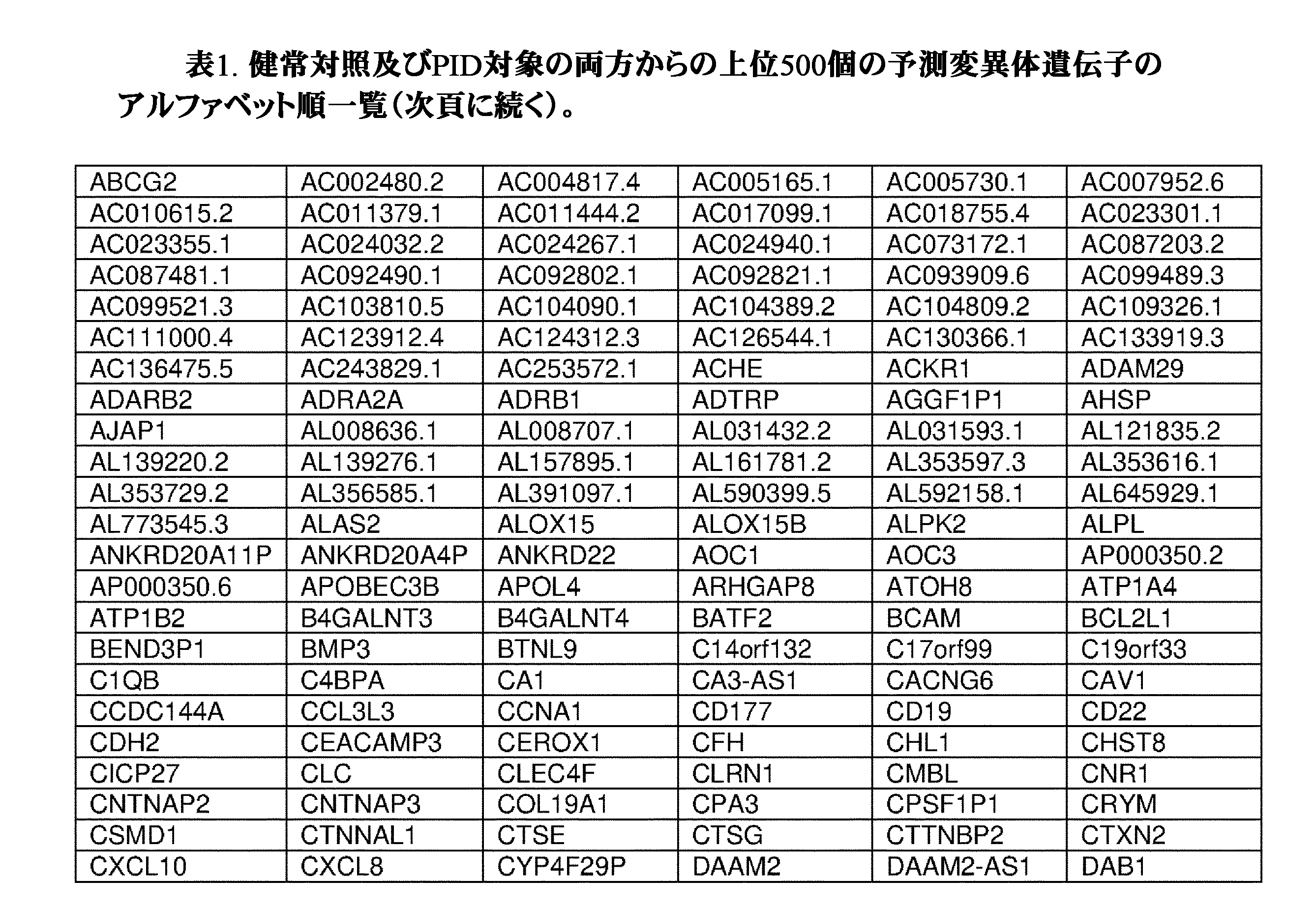


罹患者及び非罹患者からのトランスクリプトーム試料参照数を増やすと、トランスクリプトームBLUPについて更なる訓練が容易になり、繰り返す毎に予測及び診断の正確さが増す。 Increasing the number of transcriptome sample references from affected and unaffected subjects facilitates further training of the transcriptome BLUP, increasing prediction and diagnostic accuracy with each iteration.
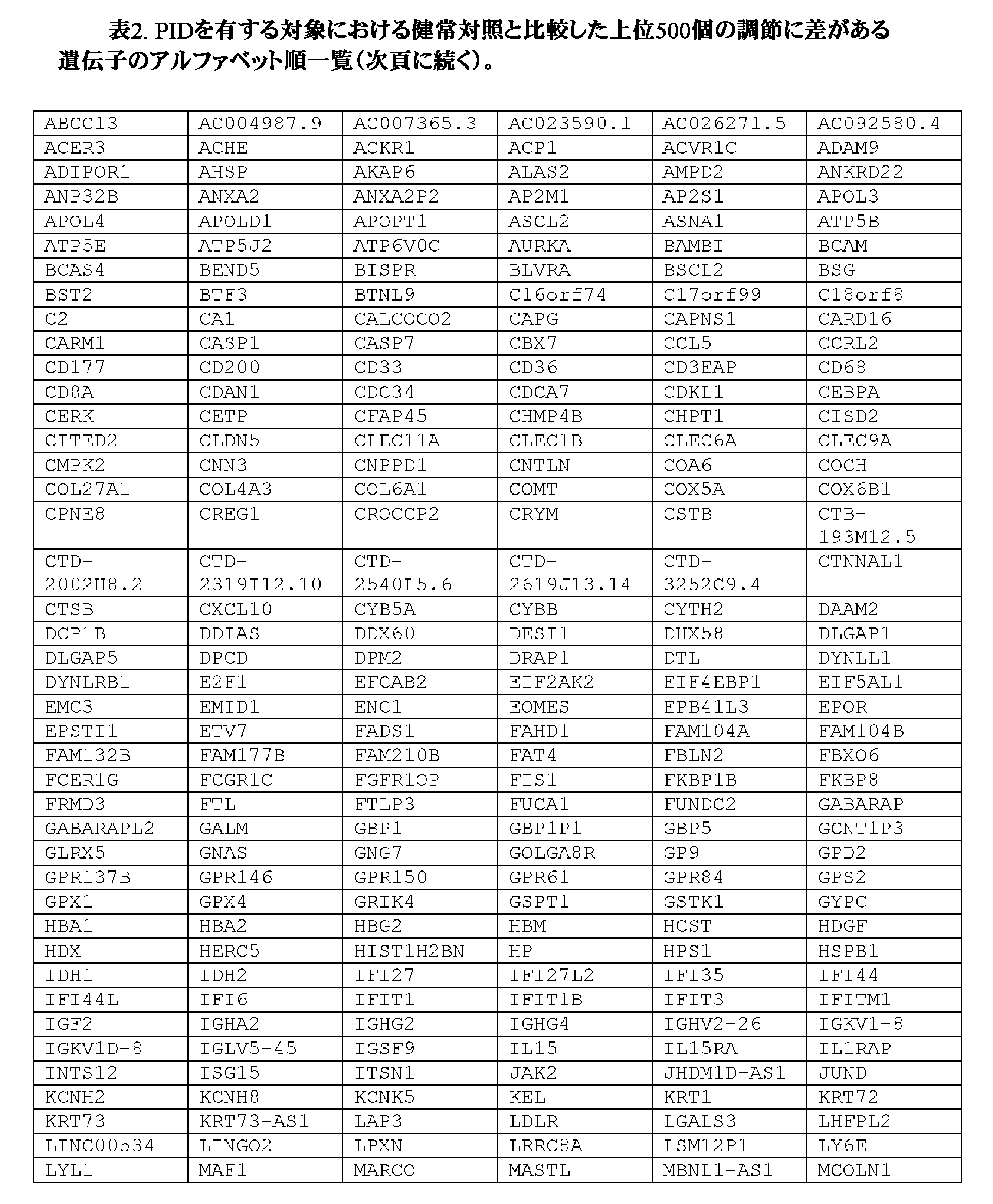

メタゲノムプロファイルの決定
リボソーム又は微生物DNAの非ターゲット超並列シーケンシングを実施して、参照PIDメタゲノムプロファイルを生成した。
Determination of Metagenomic Profiles Untargeted massively parallel sequencing of ribosomal or microbial DNA was performed to generate reference PID metagenomic profiles.
i)試料採取及びDNA抽出
マイクロバイオームプロファイル取得のため、以下に記載するとおりDNA抽出キットを使用して口腔スワブ及び毛包からDNAを抽出した。
i) Sampling and DNA extraction For microbiome profile acquisition, DNA was extracted from buccal swabs and hair follicles using a DNA extraction kit as described below.
口腔スワブ(buccal swap)試料採取:
1.試料採取前4時間以内のどこかの時点で歯を磨き、試料採取前の(歯磨き後の)食事は控える。
2.綿スワブ又はナイロンブラシを使用して頬粘膜を押し付けて拭った。
3.滅菌ピンセットでスワブから綿を剥ぎ取り、溶解緩衝液が入ったチューブに入れるか、又は溶解緩衝液が入ったチューブにナイロンブラシの頭部を直接入れた。
Buccal swap sampling:
1. Brush teeth at any point within 4 hours prior to sampling and refrain from eating prior to sampling (after brushing teeth).
2. A cotton swab or nylon brush was used to wipe the buccal mucosa.
3. The cotton was stripped from the swab with sterile forceps and placed in a tube containing lysis buffer, or the head of a nylon brush was placed directly into the tube containing lysis buffer.
口腔スワブからDNAを抽出する
材料:
1.QIAamp DNA Miniキット(Qiagen、カタログ番号/ID:51304、カタログ番号/ID:51306)
2.RNアーゼA溶液(R6148-25ml、Sigma)
3.溶解緩衝液の調製:25mMトリス.HCl、pH8.0の溶液中の20mgリゾチーム;2.5mM EDTA、pH8.0及び1%Triton X-100
Materials for extracting DNA from buccal swabs:
1. QIAamp DNA Mini Kit (Qiagen, Cat#/ID: 51304, Cat#/ID: 51306)
2. RNase A solution (R6148-25ml, Sigma)
3. Lysis buffer preparation: 25 mM Tris. 20 mg lysozyme in a solution of HCl, pH 8.0; 2.5 mM EDTA, pH 8.0 and 1% Triton X-100
プロトコル:
・口腔スワブ(綿)を1.5mL又は2mLチューブに入れる。
・400μl溶解緩衝液(25mMトリス.HCl、pH8.0の溶液中20mg/mlリゾチーム;2.5mM EDTA、pH8.0及び1%Triton X-100)を加える。綿を数回押し、ピペッティングすることによって混合した。
・37℃で60分間インキュベートする。
・40μlプロテイナーゼK(20mg/ml)及び400μlのBuffer ALを加える。10秒間ボルテックスすることにより徹底的に混合する(注記:プロテイナーゼKをBuffer ALに直接混合しないこと)。チューブを軽く遠心して、蓋の内側の液滴を取り除く。
・55℃で60分間インキュベートする。インキュベーション中、時折ボルテックスして試料を分散させる。
・80℃で更に15分間インキュベートしてプロテイナーゼKを不活性化させる。
・溶液を新しいチューブに取り出す。ピペットの先端を用いて綿をきつく押し付け、可能な限り溶液を取り除く。
・RNアーゼA溶液(R6148-25ml、Sigma)8μlを37℃で60分間加える。
・試料に450μlエタノール(96~100%)を加え、15秒間パルスボルテックスすることにより混合する。チューブを軽く遠心して、蓋の内側の液滴を取り除く。
・混合物(全ての沈殿物を含むもの、混合物を2分量に分ける必要がある)をMiniスピンカラムに適用する。キャップを閉め、最高速度で1分間遠心する。
・カラムに500μlのBuffer AW1を加える。キャップを閉め、最高速度で1分間遠心し、ろ液を廃棄する。
・カラムに500μlのBuffer AW2を加える。キャップを閉め、最高速度で1分間遠心し、ろ液を廃棄する。
・カラムを新しい2ml採取チューブに移し、最高速度で2分間遠心する。
・カラムを1.5mlチューブに入れ、所要のgDNA濃度に応じて50~100μlのBuffer EB(Qiagen)又は10mMトリス-HCl、pH8.5を加える。室温で1~3分間インキュベートし、次に最高速度で2分間遠心する。
protocol:
• Place a buccal swab (cotton) in a 1.5 mL or 2 mL tube.
• Add 400 μl lysis buffer (20 mg/ml lysozyme in a solution of 25 mM Tris.HCl, pH 8.0; 2.5 mM EDTA, pH 8.0 and 1% Triton X-100). The cotton was pressed several times and mixed by pipetting.
• Incubate at 37°C for 60 minutes.
• Add 40 μl Proteinase K (20 mg/ml) and 400 μl Buffer AL. Mix thoroughly by vortexing for 10 seconds (Note: do not mix proteinase K directly into Buffer AL). Briefly centrifuge the tube to remove the droplet inside the lid.
• Incubate at 55°C for 60 minutes. During incubation, vortex occasionally to disperse the sample.
• Incubate at 80°C for an additional 15 minutes to inactivate proteinase K.
• Remove the solution into a new tube. Use the tip of a pipette to squeeze cotton tightly to remove as much solution as possible.
• Add 8 μl of RNase A solution (R6148-25 ml, Sigma) for 60 minutes at 37°C.
• Add 450 μl ethanol (96-100%) to the sample and mix by pulse vortexing for 15 seconds. Briefly centrifuge the tube to remove the droplet inside the lid.
- Apply the mixture (including all the precipitate, the mixture must be divided into 2 portions) to the Mini spin column. Close the cap and centrifuge at maximum speed for 1 minute.
• Add 500 μl of Buffer AW1 to the column. Close the cap, centrifuge at maximum speed for 1 minute, and discard the filtrate.
• Add 500 μl of Buffer AW2 to the column. Close the cap, centrifuge at maximum speed for 1 minute, and discard the filtrate.
• Transfer the column to a new 2ml collection tube and centrifuge at maximum speed for 2 minutes.
• Place the column in a 1.5 ml tube and add 50-100 μl of Buffer EB (Qiagen) or 10 mM Tris-HCl, pH 8.5, depending on the gDNA concentration required. Incubate for 1-3 minutes at room temperature, then centrifuge for 2 minutes at maximum speed.
皮膚の試料採取について、皮膚調製指示には、全ての試料採取前12時間は入浴を控えること、及び皮膚軟化薬又は抗菌性石鹸若しくはシャンプーを控えることが含まれる。試料採取部位には、耳介後方襞、肘窩又は掌側前腕が含まれる。4cm2の範囲から細菌スワブ(Epicentreスワブによる)及び擦過検体(滅菌使い捨て手術用メスによる)を入手し、上記に口腔スワブ試料について記載したとおり酵素溶解緩衝液及びリゾチーム中でインキュベートする。 For skin sampling, skin preparation instructions included refraining from bathing and refraining from emollients or antimicrobial soaps or shampoos for 12 hours prior to any sampling. Sampling sites include the retroauricular fold, the antecubital fossa, or the volar forearm. Bacterial swabs (by Epicentre swabs) and scrapings (by sterile disposable scalpels) are obtained from an area of 4 cm 2 and incubated in enzymatic lysis buffer and lysozyme as described above for buccal swab samples.
口腔スワブからの微生物DNAの増幅
PCR 16S PCR
使用したプライマー:16S V4領域をカバーする341F/806Rプライマー。プライマー部位は、「フォワード」プライマー341F及び「リバース」プライマー806Rによって標的化される。加えて、Illumina MySeqシーケンシング用のバーコーディングプライマーを含める(以下の網掛け部分)。
Amplification PCR 16S PCR of microbial DNA from buccal swabs
Primers used: 341F/806R primers covering the 16S V4 region. The primer sites are targeted by 'forward' primer 341F and 'reverse' primer 806R. Additionally, include barcoding primers for Illumina MySeq sequencing (shaded below).
Illumina Multiplexing Read1シーケンシングプライマーを加えた(806R Ad)

Illumina Multiplexing Read2シーケンシングプライマーを加えた(341F Ad)

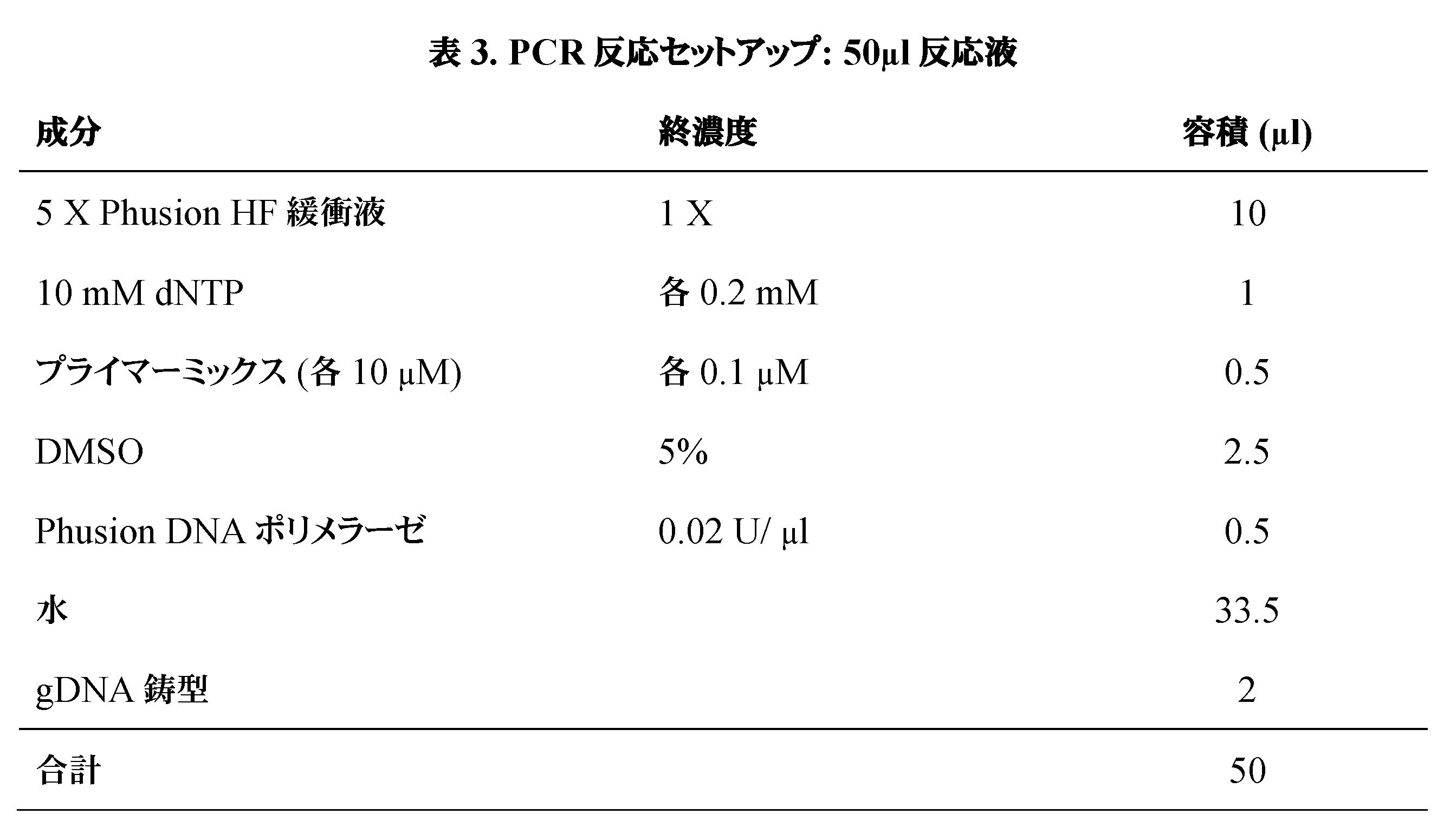
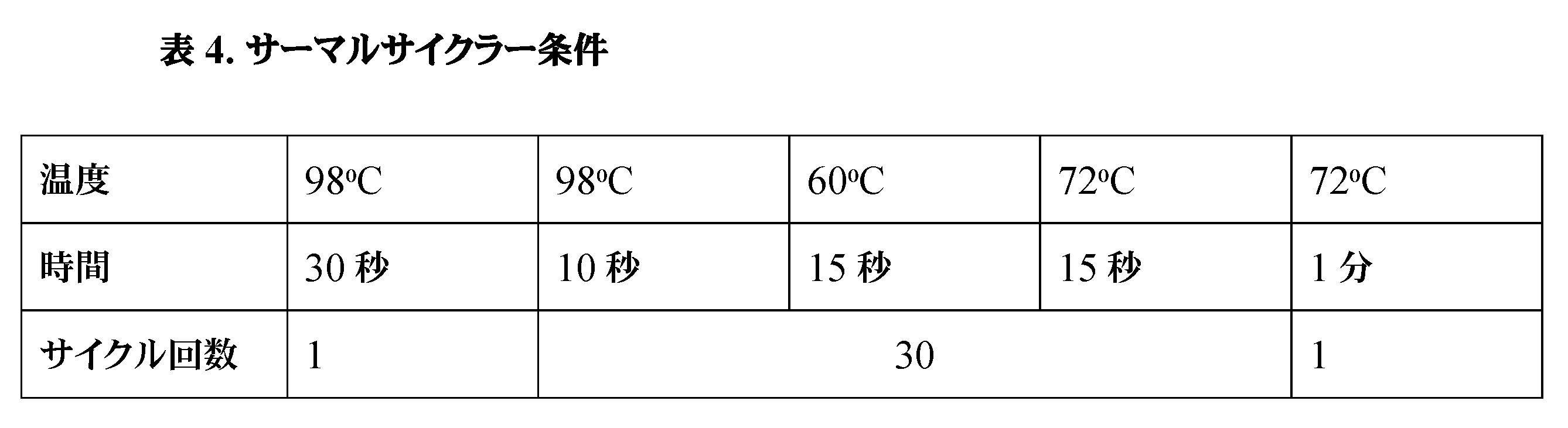
口腔スワブからの微生物DNAのシーケンシング
シーケンシングMiSeqに標準Illuminaプロトコルを使用した。
Sequencing of Microbial DNA from Buccal Swabs Standard Illumina protocols were used for sequencing MiSeq.
ii)ターゲット及び非ターゲット超並列シーケンシング
Illuminaバーコーディングプライマーを使用したインデックス化プロトコルを製造者が記載するとおり用いてシーケンシング用のライブラリ調製を実施した。インデックスは、シーケンシングランの短い第3のリードである。簡潔に言えば、DNAが300bpに剪断され、ライゲーションによってアダプターが付加され、次にPCRを用いてインデックスが付加される。次にライブラリが数量化され、プールされる。HiSeq2000(商標)シーケンサーでゲノムDNAのペアエンドシーケンシングを実施した。各リードの平均Phredクオリティスコアが20を上回ることになるようにシーケンスリードをトリミングした。トリミング後にリード長さが50を下回る場合、そのリードは廃棄した。
ii) Targeted and non-targeted Massively Parallel Sequencing
Library preparation for sequencing was performed using an indexing protocol using Illumina barcoding primers as described by the manufacturer. The index is the short third read of the sequencing run. Briefly, DNA is sheared to 300 bp, adapters added by ligation, and then indexed using PCR. Libraries are then quantified and pooled. Paired-end sequencing of genomic DNA was performed on a HiSeq2000™ sequencer. Sequencing reads were trimmed such that the average Phred quality score for each read was >20. If the lead length was less than 50 after trimming, the lead was discarded.
iii)メタゲノムプロファイル分析
メタゲノム最良線形不偏予測を用いた対象のPID診断
基本的に以前記載されているとおり[16]、生成された参照メタゲノムプロファイルセットを使用してメタゲノム関係行列を作成した。メタゲノムプロファイルは、16S rRNA配列又はデータベースにある他の利用可能な若しくは生成された参照配列セット(ここではコンティグと称される)のコレクションとアラインメントするシーケンシングしたリードのカウントのベクトルである。これらのリードは、微生物DNAの非ターゲットシーケンシングによるか、又は微生物DNAからPCRによって増幅した16Sリボソーム配列のシーケンシングによって生成された。これらのメタゲノムプロファイルは、種々の微生物種の相対的存在量と関係する。使用されるモデルは正規分布を仮定し、そのためメタゲノムプロファイルは対数変換され、標準化されることになる。
iii) Metagenomic Profile Analysis Subject PID Diagnosis Using Metagenomic Best Linear Unbiased Prediction The generated reference metagenomic profile set was used to generate a metagenomic relationship matrix essentially as previously described [16]. A metagenomic profile is a vector of sequenced read counts that aligns with a collection of 16S rRNA sequences or other available or generated reference sequence sets (herein called contigs) in a database. These reads were generated either by untargeted sequencing of microbial DNA or by sequencing 16S ribosomal sequences amplified by PCR from microbial DNA. These metagenomic profiles relate to the relative abundance of different microbial species. The model used assumes a normal distribution, so metagenomic profiles will be log-transformed and normalized.
試料iのコンティグjについての対数変換し及び標準化したカウント、成分xijを含む、n個の試料及びm個のコンティグのn×m行列Xから、幾つかのメタゲノムプロファイルを組み合わせた。それらとアラインメントするリードが合計10未満のコンティグは、標準化前に行列から除去することになる。これらのプロファイルを比較して、マイクロバイオーム関係行列を作る(G=XX’/mとして計算される)。最良線形不偏予測を用いて表現型を予測した。データに混合モデルを当てはめた:y=1nμ+Zg+e。式中、yは、1試料につき1レコードの、臨床表現型のベクトルであり、1nは1のベクトルであり、μは全体平均であり、Zは、試料にレコードを割り当てるデザイン行列であり、及びgは、変動効果推定量~N(0,Gσ2
g)である。ASRemlを用いて、データからσ2
gを推定し、試料の表現型(

これは長さnのベクトルである)を以下のとおり予測した:

which is a vector of length n) was predicted as follows:
この方程式を解くと、各メタゲノムプロファイルについて平均値の推定量及び残差の推定量が得られ、ここで

は次元n×1を有することになる。各メタゲノムプロファイルについて、予測される表現型は、

である。
Solving this equation yields an estimator of the mean and an estimator of the residual for each metagenomic profile, where
will have dimension n×1. For each metagenomic profile, the predicted phenotype is
is.
PIDのマイクロバイオームプロファイル予測はフリー統計ソフトウェアR(バージョン3.1.2;The R Foundation for Statistical Computing;http://www.r-project.org/)で実施し、パッケージrrBLUP[17]を使用した。メタゲノミクス関係行列を最良線形回帰モデル(BLUP)に当てはめ、PID及び非PIDを訓練セット又は検証セットのいずれかとする2分割交差検証、及びデータセットから順次1つの個体を取り除き、残りのデータを用いて疾患予測値を推定するリーブワンアウト法と呼ばれる代替的な手順を用いて検証する。予測されている個体は、訓練セットから常に省かれた。 PID microbiome profile prediction was performed with the free statistical software R (version 3.1.2; The R Foundation for Statistical Computing; http://www.r-project.org/) using the package rrBLUP [17]. bottom. Fit the metagenomics relationship matrix to a best linear regression model (BLUP), 2-fold cross-validation with PIDs and non-PIDs as either the training or validation set, and sequentially remove one individual from the dataset and use the remaining data. An alternative procedure, called the leave-one-out method, is used to estimate disease predictive value. Predicted individuals were always omitted from the training set.
上記に記載したとおりメタゲノミクスBLUP(又はBayesR)を訓練するための罹患者及び非罹患者からのマイクロバイオーム試料参照数を更新すると、繰り返す毎に予測精度が増加する。図7は、PID患者と年齢及び性別対応対照との間の特定の微生物における有意差の例を実証する分析を示す。 Updating the number of microbiome sample references from diseased and non-diseased individuals for training the metagenomics BLUP (or BayesR) as described above increases the prediction accuracy with each iteration. FIG. 7 shows analyzes demonstrating examples of significant differences in specific microbes between PID patients and age- and gender-matched controls.
RNA及びメタゲノム最良線形不偏予測の組み合わせによる対象のPID診断
統合的(トランスクリプトミクス及びメタゲノミクス)予測をR統計ソフトウェアで実施した。PIDについての20例の陽性診断及び20例の陰性診断並びに血中トランスクリプトームプロファイル及びメタゲノムプロファイルを線形回帰モデルに当てはめた。
PID Diagnosis of Subjects by Combining RNA and Metagenome Best Linear Unbiased Prediction Integrated (transcriptomics and metagenomics) prediction was performed with R statistical software. Twenty positive and twenty negative diagnoses for PID and blood transcriptome and metagenomic profiles were fitted to a linear regression model.
上記にRNA転写物存在量について記載したZ行列を以下のとおりメタゲノムZ1関係行列と組み合わせる拡張関係行列を開発した:
y=1nμ+Zg+Z1g1+e
An extended relationship matrix was developed that combines the Z matrix described above for RNA transcript abundance with the metagenome Z1 relationship matrix as follows:
y = 1nμ +Zg+ Z1g1 +e
この結果の係数に、それぞれ血中トランスクリプトームプロファイル及びメタゲノムプロファイルを乗じることにより、統合的予測PID疾患表現型を計算した。予測精度は、ピアソン相関「r」、即ち、測定値と予測値との間の相関によって評価した。 An integrated predictive PID disease phenotype was calculated by multiplying this result coefficient by the blood transcriptome profile and metagenomic profile, respectively. Prediction accuracy was assessed by the Pearson correlation 'r', the correlation between measured and predicted values.
これらの結果から、以下のことが実証された:第一に、トランスクリプトームプロファイルはこれらの状況でPIDを予測することができた;第二に、トランスクリプトームをメタゲノミクス情報と統合すると、予測精度を高めることができる。罹患者及び非罹患者を含む訓練用のトランスクリプトーム及びマイクロバイオーム試料参照を更新すると、予測精度が高まることになる。 These results demonstrated that: first, the transcriptome profile was able to predict PID in these situations; Prediction accuracy can be improved. Updating the training transcriptome and microbiome sample references to include affected and unaffected individuals will increase prediction accuracy.
遺伝子配列に基づく予測による対象のPID診断
PIDは、概して単一遺伝子疾患であり、PIDの診断及び治療の推奨には、(臨床症状に加えて)既知のホモ接合突然変異の同定が十分であり、この情報は、上記に記載したとおりRNA配列から導き出すことができる。加えて、通常血中に発現するPID遺伝子の発現が血中に検出されない場合、それもまた、重大な調節欠陥又は不安定化突然変異を指示しており、RNAseqは、こうした重大な発現の欠陥を直接明らかにすることができ、原因突然変異の確認がなくても診断が可能となる。
PID Diagnosis of Subjects by Gene Sequence-Based Prediction PID is generally a monogenic disease, and identification of a known homozygous mutation (in addition to clinical manifestations) is sufficient for PID diagnosis and treatment recommendations. , this information can be derived from RNA sequences as described above. In addition, if no expression of the PID gene, which is normally expressed in the blood, is detected in the blood, it also indicates a severe dysregulation or destabilizing mutation, and RNAseq can detect such severe expression defects. can be directly clarified, making diagnosis possible without confirmation of the causative mutation.
集団中の欠陥免疫遺伝子との連関を持つ、SNP変異体など、mRNAの他のゲノム変異体が、予測に有用であり得る。mRNAの既知の突然変異は、同じ遺伝子、又は染色体上で近傍にある遺伝子から発現するmRNAに共起するハプロタイプマーカーとの連関から推測又はインピュートされてもよい。このゲノム情報は、ゲノム配列又はRNA配列から入手することができ、これを単独で、又はトランスクリプトームBLUP若しくはトランスクリプトームBayesRと組み合わせて使用することにより、診断情報が与えられる。 Other genomic variants of mRNA, such as SNP variants, associated with defective immune genes in the population may be useful for prediction. Known mutations in mRNAs may be inferred or imputed from their association with haplotype markers that co-occur in mRNAs expressed from the same gene or from nearby genes on the chromosome. This genomic information can be obtained from genomic or RNA sequences and used alone or in combination with transcriptome BLUP or transcriptome BayesR to provide diagnostic information.
同じPID疾患突然変異の現れ方は個体間で異なり[18]、様々なゲノム変異体が疾患の重症度に影響を与えることもあり、この寄与する又は予測性のある(protective)変異を測定することは、疾患の発現が弱まる低重症度又は遅発性のPID症例の予測を助ける上で有用であり得る。十分な患者試料が入手されれば、RNA配列(及び/又は全ゲノム又はエクソーム配列)を通じて検出されるゲノムのこの種の変異は、疾患重症度の予測を助けるのに一層有用となるであろう。これらはまた、PIDの自己免疫性所見[19]又は自己免疫症状を含むPID症例の診断を改善する助けにもなり得る。 The manifestation of the same PID disease mutation varies among individuals [18], and different genomic variants may influence disease severity, measuring this contributory or protective mutation. This may be useful in helping predict low-severity or late-onset PID cases with diminished disease manifestations. Once sufficient patient samples are available, this type of genomic variation detected through RNA-sequencing (and/or whole-genome or exome-sequencing) will become even more useful to help predict disease severity. . They may also help improve the diagnosis of PID cases involving autoimmune manifestations of PID [19] or autoimmune symptoms.
本研究に組み入れた患者は、DNAシーケンシングによって同定された、その疾患の原因となる既知の遺伝子突然変異を有していた。遺伝子突然変異をRNAseqデータ中にmRNAレベルでも同定可能であるような十分なレベルでPID遺伝子が血中において転写されるかどうかを判定するため、幾例もの個体でPID遺伝子転写物の発現レベルを決定した。PID遺伝子をカバーするシーケンスリード数を調べることにより、RNAに突然変異を検出する可能性を決定することが可能である。図7は、PID患者における幾つかのPID遺伝子の十分な遺伝子発現の検出を実証している。CXCR4遺伝子を突然変異検出の成功例として用いると、RNAseqを用いて、疾患の原因となる優性ミスセンス遺伝子突然変異が同定された(図9)。PID患者41から入手された全血RNAseqデータでは、合計183個のmRNAシーケンスリードが、CXCR4 mRNA配列中で突然変異型のアレル(矢印で示す位置にある)が観察される領域をカバーし(83コピー)、及び正常なアレル変異体配列(100コピー)が観察され、決定された。2番染色体のこの位置におけるA塩基変異体は、PIDを引き起こすことが公知の、CXCR4のコード配列中に終止コドンを作り出す(argからSTOPへの)ミスセンス突然変異である(図9)。
Patients included in the study had a known genetic mutation responsible for their disease, identified by DNA sequencing. To determine whether the PID gene is transcribed in the blood at sufficient levels so that genetic mutations can also be identified at the mRNA level in RNAseq data, the level of expression of the PID gene transcript is determined in a number of individuals. Decided. By examining the number of sequence reads covering the PID gene, it is possible to determine the likelihood of detecting mutations in RNA. Figure 7 demonstrates detection of sufficient gene expression of several PID genes in PID patients. Using the CXCR4 gene as a successful example of mutation detection, RNAseq was used to identify the disease-causing dominant missense gene mutation (FIG. 9). In the whole blood RNAseq data obtained from
種々の線形混合モデル手法による対象のPID診断
Kemper et al[20]により記載されるとおりの、全ゲノム間配列変異に基づくゲノム予測に適用されるBayesRなど、BLUPに代わる別の線形混合モデル手法もまた、X行列が正規化後のコンティグ当たりのリードカウントによって個体を記述するBLUPを用いて上記に説明した方法と同じように、トランスクリプトーム及び/又はメタゲノミクスデータに適用することができる。BayesR方法は、遺伝子発現の真の効果が、最初はゼロ分散から、中程度乃至大きい分散のものに至るまでの、一連の正規分布から導き出されると仮定する。BayesRがBLUPに優る利点は、個別の遺伝子の効果が、BLUPほど平均値に向かってきつく圧縮されないことである。BayesR手法はまた、MacLeod et al[21]により記載されるとおり、免疫系調節機能などの既知の生物学的情報を含むように拡張することもできる(BayesRC)。
Targeted PID Diagnosis by Various Linear Mixed Model Approaches
Alternative linear mixed model approaches to BLUP, such as BayesR applied to genome prediction based on whole-genome sequence variation, as described by Kemper et al [20], also use the X matrix per contig after normalization. The same methods described above with BLUP describing individuals by read counts can be applied to transcriptomic and/or metagenomics data. The BayesR method assumes that the true effect of gene expression is derived from a range of normal distributions ranging from initially zero variance to those of moderate to large variance. The advantage of BayesR over BLUP is that the effects of individual genes are not as tightly compressed towards the mean as BLUP. The BayesR approach can also be extended to include known biological information such as immune system regulatory functions (BayesRC), as described by MacLeod et al [21].
機械学習手法による対象のPID診断
線形混合モデルに代わる別の手法もまた、BLUPを用いて上記に説明したものと似た予測的な方法でトランスクリプトーム及び/又はメタゲノムデータに適用することができ、PIDの分類及び予測を可能にし得る。機械学習、サポートベクターマシン、及びニューラルネットワークは、患者及び正常対照からのトランスクリプトーム及び/又はメタゲノムデータを患者分類、続く予測モデル訓練の入力として使用する線形混合モデルに代わる別の手法を提供することができる。同様の手法が、癌患者を高リスク群又は低リスク群に分類するために、及び予後判定を支援する予測モデルの開発に用いられており[22]、この目的で腫瘍RNAseqデータを入力として使用することについて、調査中である[23]。
Targeted PID Diagnosis by Machine Learning Approaches Alternative approaches to linear mixed models can also be applied to transcriptomic and/or metagenomic data in predictive ways similar to those described above using BLUP. , PID classification and prediction. Machine learning, support vector machines, and neural networks offer alternatives to linear mixed models that use transcriptomic and/or metagenomic data from patients and normal controls as input for patient classification and subsequent predictive model training. be able to. Similar approaches have been used to classify cancer patients into high- or low-risk groups and to develop predictive models to assist in prognostication [22], using tumor RNAseq data as input for this purpose. is under investigation [23].
線形混合モデルは、対象からの記述的レポートと組み合わせてもよく、こうしたレポートは、情報を得た臨床医が免疫系調節異常、影響を受ける細胞及び経路、疾患状態及び恐らくは好ましい治療を評価する助けとなるため有用となり得る。 Linear mixed models may be combined with descriptive reports from subjects, which help informed clinicians assess immune system dysregulation, affected cells and pathways, disease state and possibly preferred treatment. It can be useful because
これを行うため、所与のPID患者で発現に有意な差がある遺伝子(例えば、20又は50又は更には100個のDE遺伝子)を同定し、このDE遺伝子セットを、DAVID又はReactomeプログラムなど、又はそれと同様のパスウェイ過剰出現解析(即ち、遺伝子セットエンリッチメント解析)に供してもよく、そこから、対象において影響を受ける経路及び細胞機能に関するレポートが生成される。 To do this, genes with significantly different expression in a given PID patient (e.g., 20 or 50 or even 100 DE genes) are identified and this DE gene set is analyzed using, for example, the DAVID or Reactome programs. Or it may be subjected to a similar pathway overrepresentation analysis (ie, gene set enrichment analysis), from which a report is generated regarding the pathways and cellular functions affected in the subject.
診断を補足する更なる定性的レポートは、どのように対象のトランスクリプトームをデータベース中の他の患者と比較するかについてのクラスタリングレポートを提供することとなる可能性がある。これは、当該の患者からのトランスクリプトーム関係行列又は遺伝子発現差の他の分析に基づき得る。同じ遺伝子に突然変異を有する患者は、そのトランスクリプトームに基づき互いに近いクラスターを形成することが理解されるであろう。より大規模な患者データベースが利用可能になれば、このクラスタリングは、新しく診断された患者をトランスクリプトームに基づきPID疾患サブタイプに分類する助けとなり得る(見付け出される突然変異検出類似性及び補完する)。 A further qualitative report that supplements the diagnosis could provide a clustering report on how the subject's transcriptome compares to other patients in the database. This may be based on a transcriptome relationship matrix or other analysis of gene expression differences from the patient in question. It will be appreciated that patients with mutations in the same gene cluster closely together based on their transcriptomes. As larger patient databases become available, this clustering may help classify newly diagnosed patients into PID disease subtypes based on their transcriptome (mutation detection similarities found and complementary ).
参考文献
1. Salem S, Langlais D, Lefebvre F, Bourque G, Bigley V, Haniffa M, Casanova JL, Burk D, Berghuis A, Butler KM et al: Functional characterization of the human dendritic cell immunodeficiency associated with the IRF8(K108E) mutation. Blood 2014, 124(12):1894-1904.
2. Naik S, Bouladoux N, Wilhelm C, Molloy MJ, Salcedo R, Kastenmuller W, Deming C, Quinones M, Koo L, Conlan S et al: Compartmentalized control of skin immunity by resident commensals. Science 2012, 337(6098):1115-1119.
3. Oh J, Freeman AF, Park M, Sokolic R, Candotti F, Holland SM, Segre JA, Kong HH: The altered landscape of the human skin microbiome in patients with primary immunodeficiencies. Genome research 2013, 23(12):2103-2114.
4. Gallo V, Dotta L, Giardino G, Cirillo E, Lougaris V, D’Assante R, Prandini A, Consolini R, Farrow EG, Thiffault I et al: Diagnostics of Primary Immunodeficiencies through Next-Generation Sequencing. Frontiers in immunology 2016, 7:466.
5. Erbe M, Hayes BJ, Matukumalli LK, Goswami S, Bowman PJ, Reich CM, Mason BA, Goddard ME: Improving accuracy of genomic predictions within and between dairy cattle breeds with imputed high-density single nucleotide polymorphism panels. Journal of dairy science 2012, 95(7):4114-4129.
6. Zhang W, Yu Y, Hertwig F, Thierry-Mieg J, Thierry-Mieg D, Wang J, Furlanello C, Devanarayan V, Cheng J, Deng Y et al: Comparison of RNA-seq and microarray-based models for clinical endpoint prediction. Genome biology 2015, 16:133.
7. Conesa A, Madrigal P, Tarazona S, Gomez-Cabrero D, Cervera A, McPherson A, Szczesniak MW, Gaffney DJ, Elo LL, Zhang X et al: A survey of best practices for RNA-seq data analysis. Genome biology 2016, 17:13.
8. Huber W, Carey VJ, Gentleman R, Anders S, Carlson M, Carvalho BS, Bravo HC, Davis S, Gatto L, Girke T et al: Orchestrating high-throughput genomic analysis with Bioconductor. Nature methods 2015, 12(2):115-121.
9. Robinson MD, McCarthy DJ, Smyth GK: edgeR: a Bioconductor package for differential expression analysis of digital gene expression data. Bioinformatics 2010, 26(1):139-140.
10.Etherington GJ, Ramirez-Gonzalez RH, MacLean D: bio-samtools 2: a package for analysis and visualization of sequence and alignment data with SAMtools in Ruby. Bioinformatics 2015, 31(15):2565-2567.
11. Li H, Handsaker B, Wysoker A, Fennell T, Ruan J, Homer N, Marth G, Abecasis G, Durbin R: The Sequence Alignment/Map format and SAMtools. Bioinformatics 2009, 25(16):2078-2079.
12. Itan Y, Casanova JL: Novel primary immunodeficiency candidate genes predicted by the human gene connectome. Frontiers in immunology 2015, 6:142.
13. Sheng Q, Zhao S, Li CI, Shyr Y, Guo Y: Practicability of detecting somatic point mutation from RNA high throughput sequencing data. Genomics 2016, 107(5):163-169.
14. Lionakis MS: Genetic Susceptibility to Fungal Infections in Humans. Current fungal infection reports 2012, 6(1):11-22.
15. Hsu AP, Sampaio EP, Khan J, Calvo KR, Lemieux JE, Patel SY, Frucht DM, Vinh DC, Auth RD, Freeman AF et al: Mutations in GATA2 are associated with the autosomal dominant and sporadic monocytopenia and mycobacterial infection (MonoMAC) syndrome. Blood 2011, 118(10):2653-2655.
16. Ross EM, Moate PJ, Marett LC, Cocks BG, Hayes BJ: Metagenomic predictions: from microbiome to complex health and environmental phenotypes in humans and cattle. PloS one 2013, 8(9):e73056.
17. Endelman JB: Ridge Regression and Other Kernels for Genomic Selection with R Package rrBLUP. The Plant Genome 2011, 4(3):250-255.
18. Alcais A, Quintana-Murci L, Thaler DS, Schurr E, Abel L, Casanova JL: Life-threatening infectious diseases of childhood: single-gene inborn errors of immunity? Annals of the New York Academy of Sciences 2010, 1214:18-33.
19. Carneiro-Sampaio M, Coutinho A: Early-onset autoimmune disease as a manifestation of primary immunodeficiency. Frontiers in immunology 2015, 6:185.
20. Kemper KE, Reich CM, Bowman PJ, Vander Jagt CJ, Chamberlain AJ, Mason BA, Hayes BJ, Goddard ME: Improved precision of QTL mapping using a nonlinear Bayesian method in a multi-breed population leads to greater accuracy of across-breed genomic predictions. Genetics, selection, evolution : GSE 2015, 47:29.
21. MacLeod IM, Bowman PJ, Vander Jagt CJ, Haile-Mariam M, Kemper KE, Chamberlain AJ, Schrooten C, Hayes BJ, Goddard ME: Exploiting biological priors and sequence variants enhances QTL discovery and genomic prediction of complex traits. BMC genomics 2016, 17:144.
22. Kourou K, Exarchos TP, Exarchos KP, Karamouzis MV, Fotiadis DI Machine learning applications in cancer prognosis and prediction. Comput Struct Biotechnol J. 2014 Nov 15;13:8-17.
23. Han H, Liu Y. Transcriptome marker diagnostics using big data. IET Syst Biol. 2016 Feb;10(1):41-8.
References
1. Salem S, Langlais D, Lefebvre F, Bourque G, Bigley V, Haniffa M, Casanova JL, Burk D, Berghuis A, Butler KM et al: Functional characterization of the human dendritic cell immunodeficiency associated with the IRF8(K108E) mutation Blood 2014, 124(12):1894-1904.
2. Naik S, Bouladoux N, Wilhelm C, Molloy MJ, Salcedo R, Kastenmuller W, Deming C, Quinones M, Koo L, Conlan S et al: Compartmentalized control of skin immunity by resident commensals. Science 2012, 337(6098) : 1115-1119.
3. Oh J, Freeman AF, Park M, Sokolic R, Candotti F, Holland SM, Segre JA, Kong HH: The altered landscape of the human skin microbiome in patients with primary immunodeficiencies. Genome research 2013, 23(12):2103 -2114.
4. Gallo V, Dotta L, Giardino G, Cirillo E, Lougaris V, D'Assante R, Prandini A, Consolini R, Farrow EG, Thiffault I et al: Diagnostics of Primary Immunodeficiencies through Next-Generation Sequencing. Frontiers in immunology 2016 , 7:466.
5. Erbe M, Hayes BJ, Matukumalli LK, Goswami S, Bowman PJ, Reich CM, Mason BA, Goddard ME: Improving accuracy of genomic predictions within and between dairy cattle breeds with imputed high-density single nucleotide polymorphism panels. Journal of dairy science 2012, 95(7):4114-4129.
6. Zhang W, Yu Y, Hertwig F, Thierry-Mieg J, Thierry-Mieg D, Wang J, Furlanello C, Devanarayan V, Cheng J, Deng Y et al: Comparison of RNA-seq and microarray-based models for clinical endpoint prediction. Genome biology 2015, 16:133.
7. Conesa A, Madrigal P, Tarazona S, Gomez-Cabrero D, Cervera A, McPherson A, Szczesniak MW, Gaffney DJ, Elo LL, Zhang X et al: A survey of best practices for RNA-seq data analysis. Genome biology 2016, 17:13.
8. Huber W, Carey VJ, Gentleman R, Anders S, Carlson M, Carvalho BS, Bravo HC, Davis S, Gatto L, Girke T et al: Orchestrating high-throughput genomic analysis with Bioconductor. Nature methods 2015, 12(2) ): 115-121.
9. Robinson MD, McCarthy DJ, Smyth GK: edgeR: a Bioconductor package for differential expression analysis of digital gene expression data. Bioinformatics 2010, 26(1):139-140.
10. Etherington GJ, Ramirez-Gonzalez RH, MacLean D: bio-samtools 2: a package for analysis and visualization of sequence and alignment data with SAMtools in Ruby. Bioinformatics 2015, 31(15):2565-2567.
11. Li H, Handsaker B, Wysoker A, Fennell T, Ruan J, Homer N, Marth G, Abecasis G, Durbin R: The Sequence Alignment/Map format and SAMtools. Bioinformatics 2009, 25(16):2078-2079.
12. Itan Y, Casanova JL: Novel primary immunodeficiency candidate genes predicted by the human gene connectome. Frontiers in immunology 2015, 6:142.
13. Sheng Q, Zhao S, Li CI, Shyr Y, Guo Y: Practicability of detecting somatic point mutation from RNA high throughput sequencing data. Genomics 2016, 107(5):163-169.
14. Lionakis MS: Genetic Susceptibility to Fungal Infections in Humans. Current fungal infection reports 2012, 6(1):11-22.
15. Hsu AP, Sampaio EP, Khan J, Calvo KR, Lemieux JE, Patel SY, Frucht DM, Vinh DC, Auth RD, Freeman AF et al: Mutations in GATA2 are associated with the autosomal dominant and sporadic monocytopenia and mycobacterial infection ( MonoMAC) syndrome. Blood 2011, 118(10):2653-2655.
16. Ross EM, Moate PJ, Marett LC, Cocks BG, Hayes BJ: Metagenomic predictions: from microbiome to complex health and environmental phenotypes in humans and cattle. PloS one 2013, 8(9):e73056.
17. Endelman JB: Ridge Regression and Other Kernels for Genomic Selection with R Package rrBLUP. The Plant Genome 2011, 4(3):250-255.
18. Alcais A, Quintana-Murci L, Thaler DS, Schurr E, Abel L, Casanova JL: Life-threatening infectious diseases of childhood: single-gene inborn errors of immunity? Annals of the New York Academy of Sciences 2010, 1214: 18-33.
19. Carneiro-Sampaio M, Coutinho A: Early-onset autoimmune disease as a manifestation of primary immunodeficiency. Frontiers in immunology 2015, 6:185.
20. Kemper KE, Reich CM, Bowman PJ, Vander Jagt CJ, Chamberlain AJ, Mason BA, Hayes BJ, Goddard ME: Improved precision of QTL mapping using a nonlinear Bayesian method in a multi-breed population leads to greater accuracy of across- Breed genomic predictions. Genetics, selection, evolution : GSE 2015, 47:29.
21. MacLeod IM, Bowman PJ, Vander Jagt CJ, Haile-Mariam M, Kemper KE, Chamberlain AJ, Schrooten C, Hayes BJ, Goddard ME: Exploiting biological priors and sequence variants enhances QTL discovery and genomic prediction of complex traits. BMC genomics 2016, 17:144.
22. Kourou K, Exarchos TP, Exarchos KP, Karamouzis MV, Fotiadis DI Machine learning applications in cancer prognosis and prediction. Comput Struct Biotechnol J. 2014 Nov 15;13:8-17.
23. Han H, Liu Y. Transcriptome marker diagnostics using big data. IET Syst Biol. 2016 Feb;10(1):41-8.
Claims (40)
a)PIDを引き起こす既知の突然変異を含むPID遺伝子のRNA配列;
b)その突然変異がPIDを引き起こす既知の遺伝子によってコードされるタンパク質の構造又は機能に影響を及ぼす新規突然変異、任意選択でフレームシフト突然変異、終止コドン又はアミノ酸変化;
c)PIDを引き起こす、一方のアレルにおける優性突然変異;
d)PIDを引き起こす、同じ遺伝子にあるが、2つの異なるアレル上にある2つの異なる突然変異;
e)PIDを引き起こす突然変異についての共起マーカーとの連関によって推測又はインピュートされるRNA中の既知の突然変異;
f)調節欠陥又は不安定化突然変異を指示するものである、非PID対象で通常発現する遺伝子の発現の欠如;
g)スプライシング欠陥を指示するものである、欠陥のあるエクソン構造;
h)PIDを引き起こす1個以上、任意選択で1~3個の追加的な突然変異;又は
i)PID重症度に寄与する2つ以上の他の遺伝子の配列、又は2つ以上の他の遺伝子のインピュートされる配列
を含む、請求項6~11のいずれか一項に記載の方法。 said mutation profile comprising:
a) the RNA sequence of the PID gene containing known mutations that cause PID;
b) novel mutations, optionally frameshift mutations, stop codons or amino acid changes that affect the structure or function of proteins encoded by known genes whose mutations cause PID;
c) a dominant mutation in one allele that causes PID;
d) two different mutations in the same gene but on two different alleles that cause PID;
e) known mutations in RNA that are inferred or imputed by association with co-occurring markers for mutations that cause PID;
f) lack of expression of genes normally expressed in non-PID subjects, indicative of dysregulation or destabilizing mutations;
g) a defective exon structure, indicative of a splicing defect;
h) one or more, optionally 1-3, additional mutations that cause PID; or i) sequences of two or more other genes or two or more other genes that contribute to PID severity. A method according to any one of claims 6 to 11, comprising an imputed sequence of
各参照対象が原発性免疫不全症(PID)を有するか、又は有しないかのいずれかである参照対象の参照トランスクリプトームプロファイルセットにアクセスすること;
前記参照トランスクリプトームプロファイルセットからトランスクリプトーム関係行列を生成すること;
前記トランスクリプトーム関係行列を線形混合モデルに当てはめてPID予測方程式を生成すること;及び
前記対象トランスクリプトームプロファイルを前記PID予測方程式に当てはめること
を含む方法。 1. A computer-implemented method for processing genomic information, said genomic information comprising a transcriptome profile of interest,
accessing a reference transcriptome profile set for each reference subject with or without primary immunodeficiency (PID);
generating a transcriptome relationship matrix from the reference transcriptome profile set;
fitting the transcriptome relationship matrix to a linear mixture model to generate a PID prediction equation; and fitting the subject transcriptome profile to the PID prediction equation.
各参照対象が原発性免疫不全症(PID)を有するか、又は有しないかのいずれかである参照対象の参照トランスクリプトームプロファイルセットにアクセスすること;
前記参照トランスクリプトームプロファイルセットからトランスクリプトーム関係行列を生成すること;及び
前記トランスクリプトーム関係行列を線形混合モデルに当てはめて前記PID予測方程式を生成すること
を含む方法。 A computer-implemented method for generating a primary immunodeficiency (PID) prediction equation, comprising:
accessing a reference transcriptome profile set for each reference subject with or without primary immunodeficiency (PID);
generating a transcriptome relationship matrix from said reference transcriptome profile set; and fitting said transcriptome relationship matrix to a linear mixture model to generate said PID prediction equation.
各参照対象が原発性免疫不全症(PID)を有するか、又は有しないかのいずれかである参照対象の参照トランスクリプトームプロファイルセットにアクセスすること;
前記参照トランスクリプトームプロファイルセットからトランスクリプトーム関係行列を生成すること;
前記トランスクリプトーム関係行列を線形混合モデルに当てはめてPID予測方程式を生成すること;
対象トランスクリプトームプロファイルを受け取ること;及び
前記対象トランスクリプトームプロファイルを前記PID予測方程式に当てはめること
を前記プロセッサに行わせる、命令を記憶する非一時的コンピュータ可読媒体。 A non-transitory computer-readable medium storing instructions, the instructions being executed by a processor to:
accessing a reference transcriptome profile set for each reference subject with or without primary immunodeficiency (PID);
generating a transcriptome relationship matrix from the reference transcriptome profile set;
fitting the transcriptome relationship matrix to a linear mixture model to generate a PID prediction equation;
a non-transitory computer-readable medium storing instructions that cause the processor to receive a transcriptome profile of interest; and fit the transcriptome profile of interest to the PID prediction equation.
各参照対象が原発性免疫不全症(PID)を有するか、又は有しないかのいずれかである参照対象の参照トランスクリプトームプロファイルセットにアクセスすること;
前記参照トランスクリプトームプロファイルセットからトランスクリプトーム関係行列を生成すること;及び
前記トランスクリプトーム関係行列を線形混合モデルに当てはめてPID予測方程式を生成すること
を前記プロセッサに行わせる、命令を記憶する非一時的コンピュータ可読媒体。 A non-transitory computer-readable medium storing instructions, the instructions being executed by a processor to:
accessing a reference transcriptome profile set for each reference subject with or without primary immunodeficiency (PID);
storing instructions to cause the processor to generate a transcriptome relationship matrix from the reference transcriptome profile set; and fit the transcriptome relationship matrix to a linear mixture model to generate a PID prediction equation. Non-Transitory Computer-Readable Medium.
40. The instructions of any one of claims 32-39, wherein the reference set further comprises a metagenomic profile, and wherein the linear mixture model is used to fit the transcriptomic and metagenomic profiles of the subject to the PID prediction equation. A non-transitory computer-readable medium for storing
Applications Claiming Priority (3)
| Application Number | Priority Date | Filing Date | Title |
|---|---|---|---|
| AU2020900337 | 2020-02-07 | ||
| AU2020900337A AU2020900337A0 (en) | 2020-02-07 | Method | |
| PCT/AU2021/050095 WO2021155442A1 (en) | 2020-02-07 | 2021-02-05 | Methods for detecting primary immunodeficiency |
Publications (1)
| Publication Number | Publication Date |
|---|---|
| JP2023515336A true JP2023515336A (en) | 2023-04-13 |
Family
ID=77199147
Family Applications (1)
| Application Number | Title | Priority Date | Filing Date |
|---|---|---|---|
| JP2022547751A Pending JP2023515336A (en) | 2020-02-07 | 2021-02-05 | Method for detecting primary immunodeficiency |
Country Status (6)
| Country | Link |
|---|---|
| US (1) | US20230340569A1 (en) |
| EP (1) | EP4100544A4 (en) |
| JP (1) | JP2023515336A (en) |
| AU (1) | AU2021216612A1 (en) |
| CA (1) | CA3166487A1 (en) |
| WO (1) | WO2021155442A1 (en) |
Citations (4)
| Publication number | Priority date | Publication date | Assignee | Title |
|---|---|---|---|---|
| CN104131095A (en) * | 2014-07-25 | 2014-11-05 | 封志纯 | Primer composition for primary immunodeficiency disease gene screening and kit using the same |
| WO2018223066A1 (en) * | 2017-06-02 | 2018-12-06 | Veracyte, Inc. | Methods and systems for identifying or monitoring lung disease |
| US20190019817A1 (en) * | 2017-07-12 | 2019-01-17 | Shenzhen China Star Optoelectronics Semiconductor Display Technology Co., Ltd. | Array substrate, manufacturing method for the same and display panel |
| WO2019036176A1 (en) * | 2017-08-14 | 2019-02-21 | uBiome, Inc. | Disease-associated microbiome characterization process |
-
2021
- 2021-02-05 CA CA3166487A patent/CA3166487A1/en active Pending
- 2021-02-05 AU AU2021216612A patent/AU2021216612A1/en active Pending
- 2021-02-05 EP EP21751145.0A patent/EP4100544A4/en active Pending
- 2021-02-05 WO PCT/AU2021/050095 patent/WO2021155442A1/en not_active Ceased
- 2021-02-05 US US17/797,503 patent/US20230340569A1/en active Pending
- 2021-02-05 JP JP2022547751A patent/JP2023515336A/en active Pending
Patent Citations (4)
| Publication number | Priority date | Publication date | Assignee | Title |
|---|---|---|---|---|
| CN104131095A (en) * | 2014-07-25 | 2014-11-05 | 封志纯 | Primer composition for primary immunodeficiency disease gene screening and kit using the same |
| WO2018223066A1 (en) * | 2017-06-02 | 2018-12-06 | Veracyte, Inc. | Methods and systems for identifying or monitoring lung disease |
| US20190019817A1 (en) * | 2017-07-12 | 2019-01-17 | Shenzhen China Star Optoelectronics Semiconductor Display Technology Co., Ltd. | Array substrate, manufacturing method for the same and display panel |
| WO2019036176A1 (en) * | 2017-08-14 | 2019-02-21 | uBiome, Inc. | Disease-associated microbiome characterization process |
Non-Patent Citations (3)
| Title |
|---|
| HERNANDEZ, PAOLO A. ET AL.: ""Mutations in the chemokine receptor gene CXCR4 are associated with WHIM syndrome, a combined immuno", NATURE GENETICS, vol. 34, JPN6025009650, 2003, pages 70 - 74, ISSN: 0005544792 * |
| OH, JULIA ET AL.: ""The altered landscape of the human skin microbiome in patients with primary immunodeficiencies"", GENOME RESEARCH, vol. 23, JPN6025009649, 2013, pages 2103 - 2114, ISSN: 0005544791 * |
| PARK, JOON ET AL.: ""Interferon Signature in the Blood in Inflammatory Common Variable Immune Deficiency"", PLOS, vol. Vol. 8 Issue 9, JPN6025009648, 2013, pages 74893, ISSN: 0005544790 * |
Also Published As
| Publication number | Publication date |
|---|---|
| US20230340569A1 (en) | 2023-10-26 |
| AU2021216612A1 (en) | 2022-09-01 |
| EP4100544A1 (en) | 2022-12-14 |
| EP4100544A4 (en) | 2024-03-13 |
| WO2021155442A1 (en) | 2021-08-12 |
| CA3166487A1 (en) | 2021-08-12 |
Similar Documents
| Publication | Publication Date | Title |
|---|---|---|
| Ruzzo et al. | Inherited and de novo genetic risk for autism impacts shared networks | |
| Stikker et al. | Decoding the genetic and epigenetic basis of asthma | |
| Park et al. | Genome sequencing of the extinct Eurasian wild aurochs, Bos primigenius, illuminates the phylogeography and evolution of cattle | |
| Bandres‐Ciga et al. | The genetic architecture of Parkinson disease in Spain: characterizing population‐specific risk, differential haplotype structures, and providing etiologic insight | |
| Bunyavanich et al. | Systems biology of asthma and allergic diseases: a multiscale approach | |
| Liu et al. | Generation of genome-scale gene-associated SNPs in catfish for the construction of a high-density SNP array | |
| CA2905505C (en) | Methods of characterizing the immune repertoire by tagging and sequencing immunoglobulin or t-cell receptor nucleic acids | |
| US20210054461A1 (en) | Measurement and comparison of immune diversity by high-throughput sequencing | |
| US20190024171A1 (en) | Measurement and comparison of immune diversity by high-throughput sequencing | |
| Dand et al. | Exome-wide association study reveals novel psoriasis susceptibility locus at TNFSF15 and rare protective alleles in genes contributing to type I IFN signalling | |
| Kukekova et al. | Sequence comparison of prefrontal cortical brain transcriptome from a tame and an aggressive silver fox (Vulpes vulpes) | |
| US11739369B2 (en) | Immune profiling using small volume blood samples | |
| De Franco et al. | Pristane-induced arthritis loci interact with the Slc11a1 gene to determine susceptibility in mice selected for high inflammation | |
| US20200102610A1 (en) | Method for cerebral palsy prediction | |
| Wang et al. | Systems biology approach for new target and biomarker identification | |
| Martorella et al. | Evaluation of noninvasive biospecimens for transcriptome studies | |
| Gocuk et al. | Measuring X-Chromosome inactivation skew for X-linked diseases with adaptive nanopore sequencing | |
| Wang et al. | DNA methylation haplotype block signatures responding to Staphylococcus aureus subclinical mastitis and association with production and health traits | |
| Galbraith et al. | Peripheral blood gene expression in postinfective fatigue syndrome following from three different triggering infections | |
| JP2023515336A (en) | Method for detecting primary immunodeficiency | |
| US20250140417A1 (en) | Methods for determining secondary immunodeficiency | |
| JP2025521131A (en) | How to use biological age to improve health outcomes in dogs | |
| Ceccherini et al. | Genetic aspects of investigating and understanding autoinflammation | |
| Bian et al. | Extensive antagonistic variants across human genome | |
| CN104372010A (en) | New mutant pathogenic gene of febrile convulsion as well as coding protein and application thereof |
Legal Events
| Date | Code | Title | Description |
|---|---|---|---|
| A621 | Written request for application examination |
Free format text: JAPANESE INTERMEDIATE CODE: A621 Effective date: 20240202 |
|
| A977 | Report on retrieval |
Free format text: JAPANESE INTERMEDIATE CODE: A971007 Effective date: 20250228 |
|
| A131 | Notification of reasons for refusal |
Free format text: JAPANESE INTERMEDIATE CODE: A131 Effective date: 20250307 |
|
| A601 | Written request for extension of time |
Free format text: JAPANESE INTERMEDIATE CODE: A601 Effective date: 20250606 |
|
| A521 | Request for written amendment filed |
Free format text: JAPANESE INTERMEDIATE CODE: A523 Effective date: 20250905 |
|
| A02 | Decision of refusal |
Free format text: JAPANESE INTERMEDIATE CODE: A02 Effective date: 20251028 |