JP2023510353A - Compositions and methods for autoimmune control - Google Patents
Compositions and methods for autoimmune control Download PDFInfo
- Publication number
- JP2023510353A JP2023510353A JP2022542341A JP2022542341A JP2023510353A JP 2023510353 A JP2023510353 A JP 2023510353A JP 2022542341 A JP2022542341 A JP 2022542341A JP 2022542341 A JP2022542341 A JP 2022542341A JP 2023510353 A JP2023510353 A JP 2023510353A
- Authority
- JP
- Japan
- Prior art keywords
- cell
- nucleic acid
- cells
- tcr
- regulatory
- Prior art date
- Legal status (The legal status is an assumption and is not a legal conclusion. Google has not performed a legal analysis and makes no representation as to the accuracy of the status listed.)
- Pending
Links
Images


Classifications
-
- A—HUMAN NECESSITIES
- A61—MEDICAL OR VETERINARY SCIENCE; HYGIENE
- A61K—PREPARATIONS FOR MEDICAL, DENTAL OR TOILETRY PURPOSES
- A61K48/00—Medicinal preparations containing genetic material which is inserted into cells of the living body to treat genetic diseases; Gene therapy
- A61K48/005—Medicinal preparations containing genetic material which is inserted into cells of the living body to treat genetic diseases; Gene therapy characterised by an aspect of the 'active' part of the composition delivered, i.e. the nucleic acid delivered
-
- C—CHEMISTRY; METALLURGY
- C07—ORGANIC CHEMISTRY
- C07K—PEPTIDES
- C07K14/00—Peptides having more than 20 amino acids; Gastrins; Somatostatins; Melanotropins; Derivatives thereof
- C07K14/435—Peptides having more than 20 amino acids; Gastrins; Somatostatins; Melanotropins; Derivatives thereof from animals; from humans
- C07K14/705—Receptors; Cell surface antigens; Cell surface determinants
- C07K14/70503—Immunoglobulin superfamily
- C07K14/7051—T-cell receptor (TcR)-CD3 complex
-
- A—HUMAN NECESSITIES
- A61—MEDICAL OR VETERINARY SCIENCE; HYGIENE
- A61K—PREPARATIONS FOR MEDICAL, DENTAL OR TOILETRY PURPOSES
- A61K39/00—Medicinal preparations containing antigens or antibodies
- A61K39/0005—Vertebrate antigens
- A61K39/0008—Antigens related to auto-immune diseases; Preparations to induce self-tolerance
-
- A—HUMAN NECESSITIES
- A61—MEDICAL OR VETERINARY SCIENCE; HYGIENE
- A61K—PREPARATIONS FOR MEDICAL, DENTAL OR TOILETRY PURPOSES
- A61K39/00—Medicinal preparations containing antigens or antibodies
- A61K39/0005—Vertebrate antigens
- A61K39/001—Preparations to induce tolerance to non-self, e.g. prior to transplantation
-
- A—HUMAN NECESSITIES
- A61—MEDICAL OR VETERINARY SCIENCE; HYGIENE
- A61K—PREPARATIONS FOR MEDICAL, DENTAL OR TOILETRY PURPOSES
- A61K40/00—Cellular immunotherapy
- A61K40/10—Cellular immunotherapy characterised by the cell type used
- A61K40/11—T-cells, e.g. tumour infiltrating lymphocytes [TIL] or regulatory T [Treg] cells; Lymphokine-activated killer [LAK] cells
-
- A—HUMAN NECESSITIES
- A61—MEDICAL OR VETERINARY SCIENCE; HYGIENE
- A61K—PREPARATIONS FOR MEDICAL, DENTAL OR TOILETRY PURPOSES
- A61K40/00—Cellular immunotherapy
- A61K40/20—Cellular immunotherapy characterised by the effect or the function of the cells
- A61K40/22—Immunosuppressive or immunotolerising
-
- A—HUMAN NECESSITIES
- A61—MEDICAL OR VETERINARY SCIENCE; HYGIENE
- A61K—PREPARATIONS FOR MEDICAL, DENTAL OR TOILETRY PURPOSES
- A61K40/00—Cellular immunotherapy
- A61K40/40—Cellular immunotherapy characterised by antigens that are targeted or presented by cells of the immune system
- A61K40/41—Vertebrate antigens
- A61K40/416—Antigens related to auto-immune diseases; Preparations to induce self-tolerance
-
- A—HUMAN NECESSITIES
- A61—MEDICAL OR VETERINARY SCIENCE; HYGIENE
- A61P—SPECIFIC THERAPEUTIC ACTIVITY OF CHEMICAL COMPOUNDS OR MEDICINAL PREPARATIONS
- A61P37/00—Drugs for immunological or allergic disorders
- A61P37/02—Immunomodulators
-
- C—CHEMISTRY; METALLURGY
- C07—ORGANIC CHEMISTRY
- C07K—PEPTIDES
- C07K14/00—Peptides having more than 20 amino acids; Gastrins; Somatostatins; Melanotropins; Derivatives thereof
- C07K14/435—Peptides having more than 20 amino acids; Gastrins; Somatostatins; Melanotropins; Derivatives thereof from animals; from humans
- C07K14/705—Receptors; Cell surface antigens; Cell surface determinants
- C07K14/715—Receptors; Cell surface antigens; Cell surface determinants for cytokines; for lymphokines; for interferons
-
- C—CHEMISTRY; METALLURGY
- C12—BIOCHEMISTRY; BEER; SPIRITS; WINE; VINEGAR; MICROBIOLOGY; ENZYMOLOGY; MUTATION OR GENETIC ENGINEERING
- C12N—MICROORGANISMS OR ENZYMES; COMPOSITIONS THEREOF; PROPAGATING, PRESERVING, OR MAINTAINING MICROORGANISMS; MUTATION OR GENETIC ENGINEERING; CULTURE MEDIA
- C12N15/00—Mutation or genetic engineering; DNA or RNA concerning genetic engineering, vectors, e.g. plasmids, or their isolation, preparation or purification; Use of hosts therefor
- C12N15/09—Recombinant DNA-technology
- C12N15/63—Introduction of foreign genetic material using vectors; Vectors; Use of hosts therefor; Regulation of expression
- C12N15/79—Vectors or expression systems specially adapted for eukaryotic hosts
- C12N15/85—Vectors or expression systems specially adapted for eukaryotic hosts for animal cells
- C12N15/86—Viral vectors
-
- C—CHEMISTRY; METALLURGY
- C12—BIOCHEMISTRY; BEER; SPIRITS; WINE; VINEGAR; MICROBIOLOGY; ENZYMOLOGY; MUTATION OR GENETIC ENGINEERING
- C12N—MICROORGANISMS OR ENZYMES; COMPOSITIONS THEREOF; PROPAGATING, PRESERVING, OR MAINTAINING MICROORGANISMS; MUTATION OR GENETIC ENGINEERING; CULTURE MEDIA
- C12N5/00—Undifferentiated human, animal or plant cells, e.g. cell lines; Tissues; Cultivation or maintenance thereof; Culture media therefor
- C12N5/06—Animal cells or tissues; Human cells or tissues
- C12N5/0602—Vertebrate cells
- C12N5/0634—Cells from the blood or the immune system
- C12N5/0636—T lymphocytes
- C12N5/0637—Immunosuppressive T lymphocytes, e.g. regulatory T cells or Treg
-
- C—CHEMISTRY; METALLURGY
- C07—ORGANIC CHEMISTRY
- C07K—PEPTIDES
- C07K2319/00—Fusion polypeptide
- C07K2319/01—Fusion polypeptide containing a localisation/targetting motif
- C07K2319/03—Fusion polypeptide containing a localisation/targetting motif containing a transmembrane segment
-
- C—CHEMISTRY; METALLURGY
- C12—BIOCHEMISTRY; BEER; SPIRITS; WINE; VINEGAR; MICROBIOLOGY; ENZYMOLOGY; MUTATION OR GENETIC ENGINEERING
- C12N—MICROORGANISMS OR ENZYMES; COMPOSITIONS THEREOF; PROPAGATING, PRESERVING, OR MAINTAINING MICROORGANISMS; MUTATION OR GENETIC ENGINEERING; CULTURE MEDIA
- C12N2510/00—Genetically modified cells
Landscapes
- Health & Medical Sciences (AREA)
- Life Sciences & Earth Sciences (AREA)
- Chemical & Material Sciences (AREA)
- Immunology (AREA)
- General Health & Medical Sciences (AREA)
- Organic Chemistry (AREA)
- Engineering & Computer Science (AREA)
- Genetics & Genomics (AREA)
- Veterinary Medicine (AREA)
- Animal Behavior & Ethology (AREA)
- Public Health (AREA)
- Zoology (AREA)
- Epidemiology (AREA)
- Biomedical Technology (AREA)
- Medicinal Chemistry (AREA)
- Bioinformatics & Cheminformatics (AREA)
- Biotechnology (AREA)
- Biochemistry (AREA)
- Wood Science & Technology (AREA)
- Cell Biology (AREA)
- Molecular Biology (AREA)
- Microbiology (AREA)
- Biophysics (AREA)
- General Engineering & Computer Science (AREA)
- Pharmacology & Pharmacy (AREA)
- Gastroenterology & Hepatology (AREA)
- Proteomics, Peptides & Aminoacids (AREA)
- Toxicology (AREA)
- Hematology (AREA)
- Mycology (AREA)
- Virology (AREA)
- Nuclear Medicine, Radiotherapy & Molecular Imaging (AREA)
- Chemical Kinetics & Catalysis (AREA)
- General Chemical & Material Sciences (AREA)
- Physics & Mathematics (AREA)
- Plant Pathology (AREA)
- Transplantation (AREA)
- Rheumatology (AREA)
- Micro-Organisms Or Cultivation Processes Thereof (AREA)
- Medicines That Contain Protein Lipid Enzymes And Other Medicines (AREA)
Abstract

本明細書で提供されるのは、T細胞受容体(TCR)融合タンパク質(TFP)をコードする組換え核酸、コードされる分子を発現する改変ヒト免疫細胞、及び自己免疫疾患を含む疾患の治療のためのそれらの使用方法である。
【選択図】図1
Provided herein are recombinant nucleic acids encoding T-cell receptor (TCR) fusion proteins (TFPs), engineered human immune cells expressing the encoded molecules, and treatments for diseases, including autoimmune diseases. how to use them for
[Selection drawing] Fig. 1
Description
関連出願の相互参照
[0001] 本出願は、2020年1月10日出願の米国仮出願第62/959,794号、及び2020年10月21日出願の米国仮出願第63/094,590号の利益を主張するものであり、それぞれが全体として参照により本明細書に組み込まれる。
Cross-reference to related applications
[0001] This application claims the benefit of U.S. Provisional Application No. 62/959,794, filed January 10, 2020, and U.S. Provisional Application No. 63/094,590, filed October 21, 2020. , each of which is incorporated herein by reference in its entirety.
[0002] 制御性T細胞(Treg)は、免疫系の恒常性の中枢であり、自己抗原に対する寛容性の維持及び外来抗原に対する免疫応答の調節に関して重要な役割を果たすことができる。1型糖尿病(T1D)、全身性エリテマトーデス(SLE)、及び移植片対宿主病(GVHD)を含む、多数の自己免疫疾患及び炎症性疾患は、Treg細胞数またはTreg機能の欠損を有することが示されている。
[0002] Regulatory T cells (Treg) are central to the homeostasis of the immune system and can play an important role in maintaining tolerance to self antigens and modulating immune responses to foreign antigens. Numerous autoimmune and inflammatory diseases, including
[0003] Tregは、その免疫抑制特性により、細胞療法、特に造血幹細胞移植(HSCT)、固形臓器移植、及び自己免疫などの状況下での用途に有望な候補となり得る。 [0003] Tregs, due to their immunosuppressive properties, may be promising candidates for use in cell therapy, particularly in settings such as hematopoietic stem cell transplantation (HSCT), solid organ transplantation, and autoimmunity.
[0004] 本明細書で認識されるのは、制御性T細胞(Treg)の数及び機能を増強することができる自己免疫疾患療法の必要性である。
[0005] 一態様では、本開示は、(I)ヒト対象からの制御性T細胞(Treg)であって、(a)(i)(1)細胞外ドメイン、(2)TCR膜貫通ドメイン、及び(3)細胞内シグナル伝達ドメインからの刺激ドメインを含むTCR細胞内ドメインを含むTCR統合サブユニットと、(ii)抗原結合ドメインとを含む、T細胞受容体(TCR)融合タンパク質(TFP)をコードする組換え核酸分子を含む、当該制御性T細胞と、(II)薬学的に許容される担体とを含み、TCR統合サブユニット及び結合ドメインは機能的に連結されており、かつT細胞で発現するとTFPが内因性TCRと機能的に相互作用する、医薬組成物を提供する。
[0004] Recognized herein is a need for autoimmune disease therapies that can enhance the number and function of regulatory T cells (Treg).
[0005] In one aspect, the present disclosure provides (I) a regulatory T cell (Treg) from a human subject, comprising: (a) (i) (1) an extracellular domain; (2) a TCR transmembrane domain; and (3) a TCR integrating subunit comprising a TCR intracellular domain comprising a stimulatory domain from an intracellular signaling domain, and (ii) an antigen binding domain, a T cell receptor (TCR) fusion protein (TFP) and (II) a pharmaceutically acceptable carrier, wherein the TCR integration subunit and binding domain are operably linked, and in the T cell A pharmaceutical composition is provided wherein, when expressed, TFP functionally interacts with an endogenous TCR.
[0006] いくつかの実施形態では、結合ドメインは、抗原結合ドメイン、T細胞受容体リガンド、例えば、ペプチド-MHC複合体、またはT細胞受容体模倣物、例えば、ペプチド-MHC複合体に結合するものから選択される。 [0006] In some embodiments, the binding domain binds an antigen binding domain, a T cell receptor ligand, e.g., a peptide-MHC complex, or a T cell receptor mimetic, e.g., a peptide-MHC complex selected from.
[0007] いくつかの実施形態では、Tregは、Tregの生成を刺激する及び/または安定化する遺伝子をさらに含む。いくつかの実施形態では、Tregの生成を刺激する及び/または安定化する遺伝子は、TFPをコードする組換え核酸分子と同じ組換え核酸分子によってコードされる。いくつかの実施形態では、Tregの生成を刺激する及び/または安定化する遺伝子は、TFPをコードする組換え核酸分子とは異なる組換え核酸分子によってコードされる。いくつかの実施形態では、Tregの生成を刺激する及び/または安定化する遺伝子は、FOXP3、HELIOS、BACH2、またはpSTAT5である。いくつかの実施形態では、Tregは、スイッチ受容体をさらに含む。 [0007] In some embodiments, Tregs further comprise genes that stimulate and/or stabilize the generation of Tregs. In some embodiments, the gene that stimulates and/or stabilizes Treg production is encoded by the same recombinant nucleic acid molecule that encodes TFP. In some embodiments, the gene that stimulates and/or stabilizes Treg production is encoded by a recombinant nucleic acid molecule that is different from the recombinant nucleic acid molecule encoding TFP. In some embodiments, the gene that stimulates and/or stabilizes Treg generation is FOXP3, HELIOS, BACH2, or pSTAT5. In some embodiments, Tregs further comprise switch receptors.
[0008] いくつかの実施形態では、スイッチ受容体は、TFPをコードする組換え核酸分子と同じ組換え核酸分子によってコードされる。いくつかの実施形態では、スイッチ受容体は、TFPをコードする組換え核酸分子とは異なる組換え核酸分子によってコードされる。いくつかの実施形態では、スイッチ受容体は、IL7-IL2スイッチ受容体、IL7-IL10スイッチ受容体、またはTNF-α-IL2スイッチ受容体である。いくつかの実施形態では、Tregは、Tregの生成を刺激する及び/または安定化する複数の遺伝子、及び/または複数のスイッチ受容体を含む。いくつかの実施形態では、Treg細胞におけるPKCシータ、STUB1、及びCCAR2のうちの1つ以上の発現が低減または解消される。 [0008] In some embodiments, the switch receptor is encoded by the same recombinant nucleic acid molecule that encodes the TFP. In some embodiments, the switch receptor is encoded by a recombinant nucleic acid molecule that is different from the recombinant nucleic acid molecule encoding TFP. In some embodiments, the switch receptor is IL7-IL2 switch receptor, IL7-IL10 switch receptor, or TNF-α-IL2 switch receptor. In some embodiments, the Tregs comprise multiple genes and/or multiple switch receptors that stimulate and/or stabilize the generation of Tregs. In some embodiments, expression of one or more of PKCtheta, STUB1, and CCAR2 in Treg cells is reduced or eliminated.
[0009] いくつかの実施形態では、CDK8及びCDK19のうちの1つ以上の発現が低減、欠失、または薬理学的に阻害され、Tregの生成が安定化された。
[0010] いくつかの実施形態では、ペプチド-MHC複合体のペプチドは、自己抗原またはその断片である。いくつかの実施形態では、ペプチド-MHC複合体のペプチドは、外因性抗原またはその断片である。いくつかの実施形態では、結合ドメインは抗原結合ドメインを含む。いくつかの実施形態では、抗原結合ドメインは、自己抗原結合ドメインまたは外因性抗原結合ドメインを含む。いくつかの実施形態では、自己抗原結合ドメインは、自己抗原に特異的に結合する。いくつかの実施形態では、外因性抗原結合ドメインは、外因性抗原に特異的に結合する。いくつかの実施形態では、自己抗原は、膵島グルコース-6-ホスファターゼ触媒サブユニット関連タンパク質(IGRP)、インスリン、HLA-A2、ミエリン、もしくはα-グリアジン、またはそれらの断片のうちの1つ以上である。いくつかの実施形態では、外因性抗原は、FVIIIもしくは治療用高分子、例えば治療用ポリペプチド、またはそれらの断片である。いくつかの実施形態では、抗原結合ドメインは、細胞膜会合抗原に結合する。いくつかの実施形態では、抗原結合ドメインは、血中抗原に結合する。いくつかの実施形態では、抗原結合ドメインは、膵島細胞の抗原に特異的である。いくつかの実施形態では、抗原結合ドメインは抗体である。いくつかの実施形態では、抗体は、scFvまたは単一ドメイン抗体である。いくつかの実施形態では、抗体は、ヒトのものであるか、またはヒト化されている。いくつかの実施形態では、結合ドメインは、TCR模倣物であり、例えば、ペプチド-MHC複合体に特異的に結合する。
[0009] In some embodiments, the expression of one or more of CDK8 and CDK19 is reduced, deleted, or pharmacologically inhibited to stabilize Treg generation.
[0010] In some embodiments, the peptide of the peptide-MHC complex is an autoantigen or fragment thereof. In some embodiments, the peptide of the peptide-MHC complex is an exogenous antigen or fragment thereof. In some embodiments the binding domain comprises an antigen binding domain. In some embodiments, the antigen binding domain comprises an autoantigen binding domain or an exogenous antigen binding domain. In some embodiments, an autoantigen binding domain specifically binds to an autoantigen. In some embodiments, an exogenous antigen binding domain specifically binds to an exogenous antigen. In some embodiments, the autoantigen is one or more of islet glucose-6-phosphatase catalytic subunit-related protein (IGRP), insulin, HLA-A2, myelin, or α-gliadin, or fragments thereof. be. In some embodiments, the exogenous antigen is FVIII or a therapeutic macromolecule, such as a therapeutic polypeptide, or fragment thereof. In some embodiments, the antigen binding domain binds to a cell membrane-associated antigen. In some embodiments, the antigen binding domain binds to blood antigens. In some embodiments, the antigen binding domain is specific for an islet cell antigen. In some embodiments the antigen binding domain is an antibody. In some embodiments, the antibody is a scFv or single domain antibody. In some embodiments, the antibodies are human or humanized. In some embodiments, the binding domain is a TCR mimetic, eg, specifically binds peptide-MHC complexes.
[0011] いくつかの実施形態では、医薬組成物は、抗原、MHC-ペプチド複合体、またはMHC-ペプチド複合体に特異的に結合するT細胞受容体を有するエフェクターT細胞のサイトカイン産生を、TFPを含有しないTregを有する医薬組成物と比較して減少させる。 [0011] In some embodiments, the pharmaceutical composition enhances cytokine production of effector T cells having a T-cell receptor that specifically binds to an antigen, an MHC-peptide complex, or an MHC-peptide complex. compared to pharmaceutical compositions with Tregs that do not contain
[0012] いくつかの実施形態では、Tregは、CD4+CD25+FoxP3+TregまたはCD8+制御性T細胞である。
[0013] いくつかの実施形態では、細胞内シグナル伝達ドメインは、CD3γ、CD3δ、CD3ε、及びCD3ζから選択される。いくつかの実施形態では、TCR統合サブユニットは、(i)TCR細胞外ドメイン、(ii)TCR膜貫通ドメイン、及び(iii)TCR細胞内ドメインを含み、(i)、(ii)、及び(iii)のうち少なくとも2つは同じTCRサブユニット由来である。いくつかの実施形態では、コードされる結合ドメインは、リンカー配列によってTCR細胞外ドメインに連結されている。いくつかの実施形態では、コードされるリンカー配列は、(G4S)n(式中、n=1~4)を含む。
[0012] In some embodiments, the Tregs are CD4 + CD25 + FoxP3 + Tregs or CD8 + regulatory T cells.
[0013] In some embodiments, the intracellular signaling domain is selected from CD3γ, CD3δ, CD3ε, and CD3ζ. In some embodiments, the TCR integrated subunit comprises (i) a TCR extracellular domain, (ii) a TCR transmembrane domain, and (iii) a TCR intracellular domain, wherein (i), (ii), and ( At least two of iii) are from the same TCR subunit. In some embodiments, the encoded binding domain is joined to the TCR extracellular domain by a linker sequence. In some embodiments, the encoded linker sequence comprises (G 4 S) n , where n=1-4.
[0014] いくつかの実施形態では、TFPは、TCRα鎖、TCRβ鎖、CD3ε TCRサブユニット、CD3γ TCRサブユニット、CD3δ TCRサブユニット、それらの機能的断片、及び少なくとも1つだが20以下の修飾を有するそのアミノ酸配列からなる群から選択される、タンパク質の細胞外ドメインまたはその一部を含むTCRサブユニットの細胞外ドメインを含む。 [0014] In some embodiments, the TFP comprises a TCRα chain, a TCRβ chain, a CD3ε TCR subunit, a CD3γ TCR subunit, a CD3δ TCR subunit, functional fragments thereof, and at least one but no more than 20 modifications. the extracellular domain of a TCR subunit comprising the extracellular domain of a protein or a portion thereof selected from the group consisting of amino acid sequences thereof having
[0015] いくつかの実施形態では、コードされるTFPは、TCRα鎖、TCRβ鎖、CD3ε TCRサブユニット、CD3γ TCRサブユニット、CD3δ TCRサブユニット、CD3ζ TCRサブユニット、それらの機能的断片、及び少なくとも1つだが20以下の修飾を有するそのアミノ酸配列からなる群から選択される、タンパク質の膜貫通ドメインを含む膜貫通ドメインを含む。 [0015] In some embodiments, the encoded TFP is a TCRα chain, a TCRβ chain, a CD3ε TCR subunit, a CD3γ TCR subunit, a CD3δ TCR subunit, a CD3ζ TCR subunit, functional fragments thereof, and at least It includes transmembrane domains, including transmembrane domains of proteins selected from the group consisting of amino acid sequences thereof having one but no more than 20 modifications.
[0016] いくつかの実施形態では、TFPは、CD3ζ TCRサブユニット、CD3ε TCRサブユニット、CD3γ TCRサブユニット、CD3δ TCRサブユニット、Fcε受容体1鎖、Fcε受容体2鎖、Fcγ受容体1鎖、Fcγ受容体2a鎖、Fcγ受容体2b1鎖、Fcγ受容体2b2鎖、Fcγ受容体3a鎖、Fcγ受容体3b鎖、Fcβ受容体1鎖、TYROBP(DAP12)、CD5、CD16a、CD16b、CD22、CD23、CD32、CD64、CD79a、CD79b、CD89、CD278、CD66d、それらの機能的断片、及び少なくとも1つだが20以下の修飾を有するそのアミノ酸配列からなる群から選択される、タンパク質の免疫受容体チロシン活性化モチーフ(ITAM)またはその一部を含む、TCRサブユニットのITAMを含む。いくつかの実施形態では、ITAMは、CD3γ、CD3δ、またはCD3εのITAMを置換する。
[0016] In some embodiments, the TFP is CD3ζ TCR subunit, CD3ε TCR subunit, CD3γ TCR subunit, CD3δ TCR subunit,
[0017] 別の態様では、本開示は、本明細書に記載のTFPをコードする組換え核酸分子を提供する。いくつかの実施形態では、核酸は、DNA及びRNAからなる群から選択される。いくつかの実施形態では、核酸はmRNAである。いくつかの実施形態では、核酸は環状RNA(circRNA)である。 [0017] In another aspect, the disclosure provides recombinant nucleic acid molecules encoding the TFPs described herein. In some embodiments the nucleic acid is selected from the group consisting of DNA and RNA. In some embodiments, the nucleic acid is mRNA. In some embodiments, the nucleic acid is circular RNA (circRNA).
[0018] いくつかの実施形態では、組換え核酸分子は核酸類似体を含み、この核酸類似体は組換え核酸のコード配列にはない。いくつかの実施形態では、組換え核酸分子はリーダー配列をさらに含む。いくつかの実施形態では、組換え核酸分子はプロモーター配列をさらに含む。いくつかの実施形態では、組換え核酸分子はポリ(A)尾部をコードする配列をさらに含む。いくつかの実施形態では、組換え核酸分子は3’UTR配列をさらに含む。いくつかの実施形態では、核酸は、単離された核酸または天然に存在しない核酸である。いくつかの実施形態では、核酸はin vitro転写した核酸である。 [0018] In some embodiments, a recombinant nucleic acid molecule comprises a nucleic acid analogue, which is not in the coding sequence of the recombinant nucleic acid. In some embodiments, the recombinant nucleic acid molecule further comprises a leader sequence. In some embodiments, the recombinant nucleic acid molecule further comprises a promoter sequence. In some embodiments, the recombinant nucleic acid molecule further comprises a sequence encoding a poly(A) tail. In some embodiments, the recombinant nucleic acid molecule further comprises a 3'UTR sequence. In some embodiments, the nucleic acid is an isolated or non-naturally occurring nucleic acid. In some embodiments, the nucleic acid is an in vitro transcribed nucleic acid.
[0019] 別の態様では、本開示は、本明細書に記載の組換え核酸分子を含むベクターを提供する。いくつかの実施形態では、ベクターは、DNA、RNA、プラスミド、レンチウイルスベクター、アデノウイルスベクター、アデノ随伴ウイルスベクター(AAV)、ラウス肉腫ウイルス(RSV)ベクター、またはレトロウイルスベクターからなる群から選択される。いくつかの実施形態では、ベクターはin vitro転写したベクターである。 [0019] In another aspect, the disclosure provides vectors comprising the recombinant nucleic acid molecules described herein. In some embodiments, the vector is selected from the group consisting of DNA, RNA, plasmids, lentiviral vectors, adenoviral vectors, adeno-associated viral vectors (AAV), Rous sarcoma virus (RSV) vectors, or retroviral vectors. be. In some embodiments, the vector is an in vitro transcribed vector.
[0020] 別の態様では、本開示は、本明細書に記載の組換え核酸分子を含む環状RNAを提供する。
[0021] 別の態様では、本開示は、治療有効量の本明細書に記載の医薬組成物を、疾患または障害の治療を必要とする対象に投与することを含む、疾患または障害を治療または予防する方法を提供する。いくつかの実施形態では、疾患または障害は自己免疫疾患である。いくつかの実施形態では、自己免疫疾患は、自己抗体介在性自己免疫疾患である。いくつかの実施形態では、自己免疫疾患は、多発性硬化症、自己免疫性溶血性貧血、セリアック病、及び慢性炎症性脱髄性多発根ニューロパチーを含む群から選択される。いくつかの実施形態では、疾患または障害は、炎症、例えば、炎症性疾患もしくは障害、アレルギー反応、または移植拒絶反応である。
[0020] In another aspect, the disclosure provides a circular RNA comprising a recombinant nucleic acid molecule described herein.
[0021] In another aspect, the present disclosure provides for treating or treating a disease or disorder comprising administering a therapeutically effective amount of a pharmaceutical composition described herein to a subject in need thereof. Provide a preventive method. In some embodiments the disease or disorder is an autoimmune disease. In some embodiments, the autoimmune disease is an autoantibody-mediated autoimmune disease. In some embodiments, the autoimmune disease is selected from the group comprising multiple sclerosis, autoimmune hemolytic anemia, celiac disease, and chronic inflammatory demyelinating polyneuropathy. In some embodiments, the disease or disorder is inflammation, eg, an inflammatory disease or disorder, an allergic reaction, or transplant rejection.
[0022] 別の態様では、本開示は、有効量の本明細書に記載の医薬組成物を対象に投与することを含む、疾患または障害の治療を必要とする対象の疾患または障害の治療または予防に使用するための組成物を提供する。いくつかの実施形態では、疾患または障害は自己免疫疾患である。いくつかの実施形態では、疾患または障害は、炎症、例えば、炎症性疾患もしくは障害、アレルギー反応、または移植拒絶反応である。いくつかの実施形態では、対象は、自己免疫疾患、炎症、例えば、炎症性疾患もしくは障害、アレルギー反応、または移植拒絶反応を有しているか、または発症するリスクがある。 [0022] In another aspect, the present disclosure provides for the treatment or treatment of a disease or disorder in a subject in need thereof comprising administering to the subject an effective amount of a pharmaceutical composition described herein. A composition is provided for prophylactic use. In some embodiments the disease or disorder is an autoimmune disease. In some embodiments, the disease or disorder is inflammation, eg, an inflammatory disease or disorder, an allergic reaction, or transplant rejection. In some embodiments, the subject has or is at risk of developing an autoimmune disease, inflammation, eg, an inflammatory disease or disorder, allergic reaction, or transplant rejection.
[0023] 別の態様では、本開示は、ヒト対象からの制御性T細胞(Treg)を提供し、当該制御性T細胞は、
[0024] (i)(1)TCR細胞外ドメインの少なくとも一部、及び(2)TCR膜貫通ドメインを含むTCR統合サブユニットと、(ii)結合ドメインとを含む、T細胞受容体(TCR)融合タンパク質(TFP)をコードする配列を含み、TCR統合サブユニット及び結合ドメインは機能的に連結されており、かつT細胞で発現するとTFPが内因性TCRと機能的に相互作用する、組換え核酸を含む。
[0023] In another aspect, the present disclosure provides regulatory T cells (Treg) from a human subject, the regulatory T cells comprising:
[0024] A T cell receptor (TCR) comprising (i) (1) at least a portion of a TCR extracellular domain, and (2) a TCR integration subunit comprising a TCR transmembrane domain, and (ii) a binding domain. A recombinant nucleic acid comprising a sequence encoding a fusion protein (TFP), wherein the TCR integration subunit and binding domain are operably linked, and when expressed in a T cell, the TFP functionally interacts with an endogenous TCR including.
[0025] いくつかの実施形態では、TFPは、TCR細胞内シグナル伝達ドメインをさらに含む。いくつかの実施形態では、結合ドメインは、抗原結合ドメイン、T細胞受容体リガンド、例えば、ペプチド-MHC複合体、またはT細胞受容体模倣物、例えば、ペプチド-MHC複合体に結合するものから選択される。いくつかの実施形態では、Tregは、Tregの生成を刺激する及び/または安定化する遺伝子をさらに含む。いくつかの実施形態では、Tregの生成を刺激する及び/または安定化する遺伝子は、TFPをコードする組換え核酸分子と同じ組換え核酸分子によってコードされる。いくつかの実施形態では、Tregの生成を刺激する及び/または安定化する遺伝子は、TFPをコードする組換え核酸分子とは異なる組換え核酸分子によってコードされる。いくつかの実施形態では、Tregの生成を刺激する及び/または安定化する遺伝子は、FOXP3、HELIOS、BACH2、またはpSTAT5である。いくつかの実施形態では、Tregは、スイッチ受容体をさらに含む。いくつかの実施形態では、スイッチ受容体は、TFPをコードする組換え核酸分子と同じ組換え核酸分子によってコードされる。いくつかの実施形態では、スイッチ受容体は、TFPをコードする組換え核酸分子とは異なる組換え核酸分子によってコードされる。いくつかの実施形態では、スイッチ受容体は、IL7-IL2スイッチ受容体、IL7-IL10スイッチ受容体、またはTNF-α-IL2スイッチ受容体である。 [0025] In some embodiments, the TFP further comprises a TCR intracellular signaling domain. In some embodiments, the binding domain is selected from an antigen binding domain, a T cell receptor ligand, e.g., a peptide-MHC complex, or a T cell receptor mimetic, e.g., a peptide-MHC complex. be done. In some embodiments, Tregs further comprise genes that stimulate and/or stabilize the generation of Tregs. In some embodiments, the gene that stimulates and/or stabilizes Treg production is encoded by the same recombinant nucleic acid molecule that encodes TFP. In some embodiments, the gene that stimulates and/or stabilizes Treg production is encoded by a recombinant nucleic acid molecule that is different from the recombinant nucleic acid molecule encoding TFP. In some embodiments, the gene that stimulates and/or stabilizes Treg generation is FOXP3, HELIOS, BACH2, or pSTAT5. In some embodiments, Tregs further comprise switch receptors. In some embodiments, the switch receptor is encoded by the same recombinant nucleic acid molecule that encodes TFP. In some embodiments, the switch receptor is encoded by a recombinant nucleic acid molecule that is different from the recombinant nucleic acid molecule encoding TFP. In some embodiments, the switch receptor is IL7-IL2 switch receptor, IL7-IL10 switch receptor, or TNF-α-IL2 switch receptor.
[0026] いくつかの実施形態では、Tregは、Tregの生成を刺激する及び/または安定化する複数の遺伝子、及び/または複数のスイッチ受容体を含む。いくつかの実施形態では、Treg細胞におけるPKCシータ、STUB1、及びCCAR2のうちの1つ以上の発現が低減または解消される。いくつかの実施形態では、CDK8及びCDK19のうちの1つ以上の発現が低減、欠失、または薬理学的に阻害され、Tregの生成が安定化された。 [0026] In some embodiments, the Tregs comprise multiple genes and/or multiple switch receptors that stimulate and/or stabilize the generation of Tregs. In some embodiments, expression of one or more of PKCtheta, STUB1, and CCAR2 in Treg cells is reduced or eliminated. In some embodiments, the expression of one or more of CDK8 and CDK19 is reduced, deleted, or pharmacologically inhibited to stabilize Treg generation.
[0027] いくつかの実施形態では、ペプチド-MHC複合体のペプチドは、自己抗原またはその断片である。いくつかの実施形態では、ペプチド-MHC複合体のペプチドは、外因性抗原またはその断片である。いくつかの実施形態では、結合ドメインは抗原結合ドメインを含む。いくつかの実施形態では、抗原結合ドメインは、自己抗原結合ドメインまたは外因性抗原結合ドメインを含む。いくつかの実施形態では、自己抗原結合ドメインは、自己抗原に特異的に結合する。 [0027] In some embodiments, the peptide of the peptide-MHC complex is an autoantigen or fragment thereof. In some embodiments, the peptide of the peptide-MHC complex is an exogenous antigen or fragment thereof. In some embodiments the binding domain comprises an antigen binding domain. In some embodiments, the antigen binding domain comprises an autoantigen binding domain or an exogenous antigen binding domain. In some embodiments, an autoantigen binding domain specifically binds to an autoantigen.
[0028] いくつかの実施形態では、外因性抗原結合ドメインは、外因性抗原に特異的に結合する。いくつかの実施形態では、自己抗原は、膵島グルコース-6-ホスファターゼ触媒サブユニット関連タンパク質(IGRP)、インスリン、HLA-A2、ミエリン、もしくはα-グリアジン、またはそれらの断片のうちの1つ以上である。いくつかの実施形態では、外因性抗原は、FVIIIもしくは治療用高分子、例えば治療用ポリペプチド、またはそれらの断片である。 [0028] In some embodiments, the exogenous antigen binding domain specifically binds to an exogenous antigen. In some embodiments, the autoantigen is one or more of islet glucose-6-phosphatase catalytic subunit-related protein (IGRP), insulin, HLA-A2, myelin, or α-gliadin, or fragments thereof. be. In some embodiments, the exogenous antigen is FVIII or a therapeutic macromolecule, such as a therapeutic polypeptide, or fragment thereof.
[0029] いくつかの実施形態では、抗原結合ドメインは、細胞膜会合抗原に結合する。いくつかの実施形態では、抗原結合ドメインは、血中抗原に結合する。いくつかの実施形態では、抗原結合ドメインは、膵島細胞の抗原に特異的である。いくつかの実施形態では、抗原結合ドメインは、抗体またはその機能的断片である。いくつかの実施形態では、抗体またはその機能的断片は、scFvまたは単一ドメイン抗体である。いくつかの実施形態では、抗体またはその機能的断片は、ヒトのものであるか、またはヒト化されたものである。いくつかの実施形態では、結合ドメインは、TCR模倣物であり、例えば、ペプチド-MHC複合体に特異的に結合する。 [0029] In some embodiments, the antigen-binding domain binds to a cell membrane-associated antigen. In some embodiments, the antigen binding domain binds to blood antigens. In some embodiments, the antigen binding domain is specific for an islet cell antigen. In some embodiments, the antigen binding domain is an antibody or functional fragment thereof. In some embodiments, the antibody or functional fragment thereof is a scFv or single domain antibody. In some embodiments, the antibody or functional fragment thereof is human or humanized. In some embodiments, the binding domain is a TCR mimetic, eg, specifically binds to peptide-MHC complexes.
[0030] いくつかの実施形態では、制御性T細胞は、抗原、MHC-ペプチド複合体、またはMHC-ペプチド複合体に特異的に結合するT細胞受容体を有するエフェクターT細胞のサイトカイン産生を、TFPを含有しないTregを有する制御性T細胞と比較して減少させる。いくつかの実施形態では、Tregは、CD4+CD25+FoxP3+TregまたはCD8+制御性T細胞である。 [0030] In some embodiments, the regulatory T cells increase cytokine production of effector T cells that have T cell receptors that specifically bind to antigens, MHC-peptide complexes, or MHC-peptide complexes. decreased compared to regulatory T cells with Tregs that do not contain TFP. In some embodiments, the Tregs are CD4 + CD25 + FoxP3 + Tregs or CD8 + regulatory T cells.
[0031] いくつかの実施形態では、細胞内シグナル伝達ドメインは、CD3γ、CD3δ、CD3ε、及びCD3ζからなる群から選択される。いくつかの実施形態では、TCR統合サブユニットは、(i)TCR細胞外ドメイン、(ii)TCR膜貫通ドメイン、及び(iii)TCR細胞内ドメインを含み、(i)、(ii)、及び(iii)のうち少なくとも2つまたは3つは同じTCRサブユニット由来である。 [0031] In some embodiments, the intracellular signaling domain is selected from the group consisting of CD3γ, CD3δ, CD3ε, and CD3ζ. In some embodiments, the TCR integrated subunit comprises (i) a TCR extracellular domain, (ii) a TCR transmembrane domain, and (iii) a TCR intracellular domain, wherein (i), (ii), and ( At least two or three of iii) are from the same TCR subunit.
[0032] いくつかの実施形態では、結合ドメインは、リンカー配列によってTCR細胞外ドメインに機能的に連結されている。いくつかの実施形態では、リンカー配列は(G4S)n(式中、n=1~4)を含む。 [0032] In some embodiments, the binding domain is operably linked to the TCR extracellular domain by a linker sequence. In some embodiments, the linker sequence comprises (G 4 S) n , where n=1-4.
[0033] いくつかの実施形態では、TFPは、TCRα鎖、TCRβ鎖、CD3ε TCRサブユニット、CD3γ TCRサブユニット、CD3δ TCRサブユニット、及びそれらの機能的断片からなる群から選択される、タンパク質の細胞外ドメインまたはその一部を含むTCRサブユニットの細胞外ドメインを含む。 [0033] In some embodiments, the TFP is a protein selected from the group consisting of a TCRα chain, a TCRβ chain, a CD3ε TCR subunit, a CD3γ TCR subunit, a CD3δ TCR subunit, and functional fragments thereof. Includes extracellular domains of TCR subunits that include extracellular domains or portions thereof.
[0034] いくつかの実施形態では、TFPは、TCRα鎖、TCRβ鎖、CD3ε TCRサブユニット、CD3γ TCRサブユニット、CD3δ TCRサブユニット、及びそれらの機能的断片からなる群から選択される、タンパク質の膜貫通ドメインを含む膜貫通ドメインを含む。 [0034] In some embodiments, the TFP is a protein selected from the group consisting of a TCRα chain, a TCRβ chain, a CD3ε TCR subunit, a CD3γ TCR subunit, a CD3δ TCR subunit, and functional fragments thereof. It contains a transmembrane domain containing a transmembrane domain.
[0035] いくつかの実施形態では、TFPは、TCRα、TCRβ、TCRγ、TCRδ、CD3ε TCRサブユニット、CD3γ TCRサブユニット、及びCD3δ TCRサブユニットからなる群から選択される、タンパク質のTCR細胞内ドメインを含む。 [0035] In some embodiments, the TFP is a TCR intracellular domain of a protein selected from the group consisting of TCRα, TCRβ, TCRγ, TCRδ, CD3ε TCR subunit, CD3γ TCR subunit, and CD3δ TCR subunit. including.
[0036] いくつかの実施形態では、TFPは、CD3ζ TCRサブユニット、CD3ε TCRサブユニット、CD3γ TCRサブユニット、CD3δ TCRサブユニット、Fcε受容体1鎖、Fcε受容体2鎖、Fcγ受容体1鎖、Fcγ受容体2a鎖、Fcγ受容体2b1鎖、Fcγ受容体2b2鎖、Fcγ受容体3a鎖、Fcγ受容体3b鎖、Fcβ受容体1鎖、TYROBP(DAP12)、CD5、CD16a、CD16b、CD22、CD23、CD32、CD64、CD79a、CD79b、CD89、CD278、CD66d、及びそれらの機能的断片からなる群から選択される、タンパク質の免疫受容体チロシン活性化モチーフ(ITAM)またはその一部を含む、TCRサブユニットのITAMを含む。いくつかの実施形態では、ITAMは、CD3γ、CD3δ、またはCD3εのITAMを置換する。いくつかの実施形態では、Tregは自己由来である。いくつかの実施形態では、Tregは同種異系である。
[0036] In some embodiments, the TFP is CD3ζ TCR subunit, CD3ε TCR subunit, CD3γ TCR subunit, CD3δ TCR subunit,
[0037] 別の態様では、本開示は、本明細書に記載の制御性T細胞と薬学的に許容される担体とを含む医薬組成物を提供する。
[0038] 別の態様では、本開示は、本明細書に記載の制御性T細胞のTFPをコードする配列を含む組換え核酸を提供する。いくつかの実施形態では、核酸は、DNA及びRNAからなる群から選択される。いくつかの実施形態では、核酸はmRNAである。いくつかの実施形態では、核酸はcircRNAである。いくつかの実施形態では、組換え核酸は核酸類似体を含み、この核酸類似体は組換え核酸のコード配列にはない。いくつかの実施形態では、組換え核酸はリーダー配列をさらに含む。いくつかの実施形態では、組換え核酸はプロモーター配列をさらに含む。いくつかの実施形態では、組換え核酸はポリ(A)尾部をコードする配列をさらに含む。いくつかの実施形態では、組換え核酸は3’UTR配列をさらに含む。いくつかの実施形態では、核酸は、単離された核酸または天然に存在しない核酸である。いくつかの実施形態では、核酸はin vitro転写した核酸である。
[0037] In another aspect, the disclosure provides a pharmaceutical composition comprising a regulatory T cell described herein and a pharmaceutically acceptable carrier.
[0038] In another aspect, the disclosure provides a recombinant nucleic acid comprising a sequence encoding a regulatory T cell TFP described herein. In some embodiments the nucleic acid is selected from the group consisting of DNA and RNA. In some embodiments, the nucleic acid is mRNA. In some embodiments, the nucleic acid is circRNA. In some embodiments, a recombinant nucleic acid comprises a nucleic acid analogue that is absent from the coding sequence of the recombinant nucleic acid. In some embodiments, the recombinant nucleic acid further comprises a leader sequence. In some embodiments, the recombinant nucleic acid further comprises a promoter sequence. In some embodiments, the recombinant nucleic acid further comprises a sequence encoding a poly(A) tail. In some embodiments, the recombinant nucleic acid further comprises a 3'UTR sequence. In some embodiments, the nucleic acid is an isolated or non-naturally occurring nucleic acid. In some embodiments, the nucleic acid is an in vitro transcribed nucleic acid.
[0039] 別の態様では、本開示は、本明細書に記載の組換え核酸を含むベクターを提供する。いくつかの実施形態では、ベクターは、DNA、RNA、プラスミド、レンチウイルスベクター、アデノウイルスベクター、アデノ随伴ウイルスベクター(AAV)、ラウス肉腫ウイルス(RSV)ベクター、またはレトロウイルスベクターからなる群から選択される。いくつかの実施形態では、ベクターはin vitro転写したベクターである。 [0039] In another aspect, the disclosure provides vectors comprising the recombinant nucleic acids described herein. In some embodiments, the vector is selected from the group consisting of DNA, RNA, plasmids, lentiviral vectors, adenoviral vectors, adeno-associated viral vectors (AAV), Rous sarcoma virus (RSV) vectors, or retroviral vectors. be. In some embodiments, the vector is an in vitro transcribed vector.
[0040] 別の態様では、本開示は、本明細書に記載の組換え核酸を含む環状RNAを提供する。
[0041] 別の態様では、本開示は、治療有効量の本明細書に記載の制御性T細胞を、疾患または障害の治療または予防を必要とする対象に投与することを含む、疾患または障害を治療または予防する方法を提供する。いくつかの実施形態では、疾患または障害は自己免疫疾患である。いくつかの実施形態では、自己免疫疾患は、自己抗体介在性自己免疫疾患である。いくつかの実施形態では、自己免疫疾患は、多発性硬化症、自己免疫性溶血性貧血、セリアック病、及び慢性炎症性脱髄性多発根ニューロパチーを含む群から選択される。いくつかの実施形態では、疾患または障害は、炎症、例えば、炎症性疾患もしくは障害、アレルギー反応、または移植拒絶反応である。
[0040] In another aspect, the disclosure provides a circular RNA comprising a recombinant nucleic acid described herein.
[0041] In another aspect, the present disclosure provides treatment for a disease or disorder, comprising administering a therapeutically effective amount of the regulatory T cells described herein to a subject in need of treatment or prevention of the disease or disorder. provide a method of treating or preventing In some embodiments the disease or disorder is an autoimmune disease. In some embodiments, the autoimmune disease is an autoantibody-mediated autoimmune disease. In some embodiments, the autoimmune disease is selected from the group comprising multiple sclerosis, autoimmune hemolytic anemia, celiac disease, and chronic inflammatory demyelinating polyneuropathy. In some embodiments, the disease or disorder is inflammation, eg, an inflammatory disease or disorder, an allergic reaction, or transplant rejection.
[0042] 別の態様では、本開示は、疾患または障害の治療または予防を必要とする対象の疾患または障害の治療または予防に使用するための、本明細書に記載の組換え核酸または本明細書に記載の制御性T細胞を含む組成物を提供する。いくつかの実施形態では、疾患または障害は自己免疫疾患である。いくつかの実施形態では、疾患または障害は、炎症、例えば、炎症性疾患もしくは障害、アレルギー反応、または移植拒絶反応である。いくつかの実施形態では、対象は、自己免疫疾患、炎症、例えば、炎症性疾患もしくは障害、アレルギー反応、または移植拒絶反応を有しているか、または発症するリスクがある。 [0042] In another aspect, the present disclosure provides a recombinant nucleic acid described herein or a recombinant nucleic acid described herein or herein for use in treating or preventing a disease or disorder in a subject in need thereof. A composition comprising the regulatory T cells described in the present invention is provided. In some embodiments the disease or disorder is an autoimmune disease. In some embodiments, the disease or disorder is inflammation, eg, an inflammatory disease or disorder, an allergic reaction, or transplant rejection. In some embodiments, the subject has or is at risk of developing an autoimmune disease, inflammation, eg, an inflammatory disease or disorder, allergic reaction, or transplant rejection.
参照による組み込み
[0043] 本明細書で言及される刊行物、特許、及び特許出願はすべて、個別の刊行物、特許、または特許出願がそれぞれ具体的かつ個別に参照により本明細書に組み込まれた場合と同様に、参照により本明細書に組み込まれる。
Inclusion by reference
[0043] All publications, patents, and patent applications referred to in this specification are as if each individual publication, patent, or patent application was specifically and individually incorporated herein by reference. , incorporated herein by reference.
[0044] 本発明の新規の特徴は、添付の特許請求の範囲に具体的に記載されている。本発明の原理を利用する例示的な実施形態を記載する以下の詳細な説明、及び添付の図面(本明細書で「図(Figure)」及び「図(FIG.)」)を参照することにより、本発明の特徴及び利点の適切な理解が得られるであろう。 [0044] The novel features of the invention are set forth with particularity in the appended claims. By referring to the following detailed description and accompanying drawings (herein "Figure" and "FIG.") that set forth exemplary embodiments that utilize the principles of the present invention: , a proper understanding of the features and advantages of the present invention will be obtained.
[0064] 本明細書で使用される場合、「含む(comprise)」という用語、または「含む(comprises)」もしくは「含む(comprising)」などのその変形は、任意の列挙された整数(例えば、機能、要素、特徴、特性、方法/工程のステップ、または制限)または整数群(例えば、機能、要素、特徴、特性、方法/工程のステップ、または制限)を包含するが、任意の他の整数または整数群を除外しないことを示すものと解釈されるべきである。したがって、本明細書で使用される場合、「含む(comprising)」という用語は、包括的であり、追加の、列挙されない整数または方法/工程のステップを除外するものではない。 [0064] As used herein, the term "comprises" or variations thereof such as "comprises" or "comprising" refers to any enumerated integer (e.g., function, element, feature, property, method/process step, or limit) or group of integers (e.g., function, element, feature, property, method/process step, or limit), but any other integer or should be construed to indicate that the group of integers is not excluded. Thus, as used herein, the term "comprising" is inclusive and does not exclude additional, unlisted integers or method/process steps.
[0065] 「含む(comprising)」という用語は、「本質的に~からなる」または「に~からなる」と置き換えることができる。「本質的に~からなる」という句は、本明細書で、指定した整数(複数可)またはステップが必須であると同時に、それらが、特許請求する発明の特徴または機能に実質的に影響を及ぼさない際に使用される。本明細書で使用される場合、「~からなる」という用語は、任意の列挙された整数(例えば、機能、要素、特徴、特性、方法/工程のステップ、または制限)または整数群(例えば、機能、要素、特徴、特性、方法/工程のステップ、または制限)のみが存在することを示す際に使用される。 [0065] The term "comprising" can be replaced with "consisting essentially of" or "consisting of." The phrase "consisting essentially of" is used herein to indicate that the specified integer(s) or steps are essential while they do not materially affect the features or functions of the claimed invention. Used when not affected. As used herein, the term “consisting of” refers to any recited integer (e.g., function, element, feature, property, method/process step, or limitation) or group of integers (e.g., used to indicate that only a function, element, feature, property, method/process step, or limitation) is present.
[0066] 「a」及び「an」という用語は、その冠詞の文法上の目的語の1つまたは複数(すなわち、少なくとも1つ)を指す。例として、「要素(an element)」は1つの要素または複数の要素を意味する。 [0066] The terms "a" and "an" refer to one or more (ie, at least one) of the grammatical objects of the article. By way of example, "an element" means one element or more than one element.
[0067] 本明細書で使用される場合、「約」は、状況、及び当業者に既知であるかまたは知り得ることに応じて、1パーセント未満、または1、2、3、4、5、6、7、8、9、10、11、12、13、14、15、16、17、18、19、20、25、30、または30パーセント超の増減を意味することができる。 [0067] As used herein, "about" is less than 1 percent, or 1, 2, 3, 4, 5, or less, depending on the circumstances and what is known or knowable to those skilled in the art. An increase or decrease of more than 6, 7, 8, 9, 10, 11, 12, 13, 14, 15, 16, 17, 18, 19, 20, 25, 30, or 30 percent can be meant.
[0068] 本明細書で使用される場合、「対象」(単数または複数)または「個体」は、哺乳動物、例えばヒトまたは非ヒト哺乳動物、例えば家畜、農業用動物または野生動物、ならびに鳥類及び水生動物などを含み得るが、これらに限定されない。「患者」は、疾患、障害、または病態に罹患しているか、その発症リスクがある対象、あるいは別様に本明細書で提供する組成物及び方法を必要とする対象である。いくつかの実施形態では、対象は、本明細書に記載の自己免疫疾患を有する。 [0068] As used herein, a "subject"(s) or "individual" refers to a mammal, such as a human or non-human mammal, such as domestic, agricultural or wild animals, as well as birds and It can include, but is not limited to, aquatic animals and the like. A "patient" is a subject having or at risk of developing a disease, disorder, or condition or otherwise in need of the compositions and methods provided herein. In some embodiments, the subject has an autoimmune disease as described herein.
[0069] 本明細書で使用される場合、「治療すること」または「治療」とは、疾患または病態の治療または改善に関する何らかの奏功の兆候を指す。治療することは、例えば、疾患または病態の1つ以上の症状の重症度を低下、遅延、または軽減することを含む場合もあれば、あるいは疾患、不全、障害、または有害な病態などの症状が患者に現れる頻度を低減することを含む場合もある。本明細書で使用される場合、「治療または予防する」は、疾患または病態のある程度の治療または改善をもたらす方法を指すものとして本明細書で使用される場合もあり、病態の完全な予防を含むがそれに限定されない、その目的に対する範囲の結果を企図している。 [0069] As used herein, "treating" or "treatment" refers to any indication of success in treating or ameliorating a disease or condition. Treating may include, for example, reducing, delaying, or alleviating the severity of one or more symptoms of a disease or condition, or the symptoms of a disease, disorder, disorder, or adverse condition may include It may also include reducing the frequency of patient presentation. As used herein, "treating or preventing" may also be used herein to refer to methods that result in some degree of treatment or amelioration of a disease or condition, and complete prevention of the condition. It contemplates a range of results for that purpose, including but not limited to.
[0070] 本明細書で使用される場合、「予防すること」とは、患者における疾患または病態、例えば腫瘍形成の予防を指す。例えば、自己免疫疾患の発症リスクのある個体が本開示の方法で治療され、それ以降、自己免疫疾患を発症しない場合、その個体において当該疾患は少なくとも一定期間にわたって予防されている。 [0070] As used herein, "preventing" refers to the prevention of a disease or condition, such as tumor formation, in a patient. For example, if an individual at risk of developing an autoimmune disease is treated with a method of the present disclosure and does not subsequently develop the autoimmune disease, the disease has been prevented in that individual for at least a period of time.
[0071] 本明細書で使用される場合、「治療有効量」は、組成物を投与する個体に対して有益な効果を与えるか、別様に有害な有益でない事象を低減するのに十分な組成物またはその活性成分の量である。本明細書で「治療有効用量」とは、1つ以上の所望のまたは望ましい(例えば有益な)効果を生み出すために投与される用量のことを意味し、そのような投与は所与の期間にわたり1回以上行われる。正確な用量は治療の目的に依存し、当業者は公知の技術を使用して確認することができる(例えば、Lieberman,Pharmaceutical Dosage Forms(vols.1-3,1992);Lloyd,The Art,Science and Technology of Pharmaceutical Compounding(1999)、及びPickar,Dosage Calculations(1999)を参照)。 [0071] As used herein, a "therapeutically effective amount" is an amount sufficient to confer a beneficial effect or reduce otherwise adverse non-beneficial events in an individual to whom the composition is administered. It is the amount of the composition or its active ingredient. By "therapeutically effective dose" herein is meant a dose administered to produce one or more desired or desirable (e.g., beneficial) effects, such administration over a given period of time. One or more times. The exact dose will depend on the therapeutic goals and can be ascertained by those skilled in the art using known techniques (eg, Lieberman, Pharmaceutical Dosage Forms (vols. 1-3, 1992); Lloyd, The Art, Science and Technology of Pharmaceutical Compounding (1999), and Pickar, Dosage Calculations (1999)).
[0072] 本明細書で使用される場合、「T細胞受容体(TCR)融合タンパク質」または「TFP」は、TCRを含む様々なポリペプチド由来の組換えポリペプチドを含み、当該TCRは概して、i)標的細胞の表面抗原に結合すること、及びii)通常はT細胞内またはその表面に共存する場合、インタクトなTCR複合体の他のポリペプチド成分と相互作用することができる。 [0072] As used herein, "T cell receptor (TCR) fusion protein" or "TFP" includes recombinant polypeptides derived from a variety of polypeptides comprising a TCR, which TCR generally comprises It is capable of i) binding to surface antigens on target cells and ii) interacting with other polypeptide components of intact TCR complexes when normally co-localized within or on the surface of T cells.
[0073] 本明細書で使用される場合、「T細胞受容体」及び「T細胞受容体複合体」という用語は、一般に抗原の認識に関与する、T細胞の表面に見られる分子を指して同義に使用される。T細胞の95%で、TCRはα鎖及びβ鎖からなるヘテロ二量体を含むが、T細胞の5%はγ鎖及びδ鎖からなるTCRを有する。TCRは、CD3複合体の構成要素の組み合わせをさらに含む。いくつかの実施形態では、TCRは、CD3εを含む。いくつかの実施形態では、TCRは、CD3γを含む。いくつかの実施形態では、TCRは、CD3ζを含む。いくつかの実施形態では、TCRは、CD3δを含む。TCRと抗原、例えば抗原及びMHCとの会合により、関連する酵素、補助受容体、及び特殊な補助分子が介在する一連の生物学的事象を通じたT細胞の活性化が生じる。 [0073] As used herein, the terms "T cell receptor" and "T cell receptor complex" generally refer to molecules found on the surface of T cells that are involved in antigen recognition. used synonymously. In 95% of T cells, the TCR contains a heterodimer consisting of α and β chains, whereas 5% of T cells have a TCR consisting of γ and δ chains. TCRs further include combinations of components of the CD3 complex. In some embodiments, the TCR comprises CD3ε. In some embodiments, the TCR comprises CD3γ. In some embodiments, the TCR comprises CD3ζ. In some embodiments, the TCR comprises CD3delta. The association of the TCR with antigens, eg antigen and MHC, results in activation of T cells through a series of biological events mediated by relevant enzymes, co-receptors and specialized accessory molecules.
[0074] 「刺激」という用語は、刺激ドメインまたは刺激分子(例えば、TCR/CD3複合体)が、その同種リガンドと結合し、それによりシグナル伝達事象を媒介することで誘導される一次応答を指し、このシグナル伝達事象として、TCR/CD3複合体を介したシグナル伝達などがあるが、これらに限定されない。刺激は、ある特定の分子の発現の変化、及び/または細胞骨格構造の再構成などを媒介することができる。 [0074] The term "stimulation" refers to the primary response induced by the binding of a stimulatory domain or stimulatory molecule (e.g., TCR/CD3 complex) to its cognate ligand, thereby mediating a signaling event. , this signaling event includes, but is not limited to, signaling through the TCR/CD3 complex. Stimulation can mediate changes in the expression of certain molecules, and/or reorganization of cytoskeletal structures, and the like.
[0075] 「刺激分子」または「刺激ドメイン」という用語は、T細胞のシグナル伝達経路の少なくともいくつかの側面に対して、TCR複合体の一次活性化を刺激的に調節する一次細胞質シグナル伝達配列(複数可)を提供する、T細胞によって発現される分子またはその一部を指す。一態様では、一次シグナルは、例えばペプチドが負荷されたMHC分子とTCR/CD3複合体との結合によって開始され、増殖、活性化、分化などを含むがこれらに限定されないT細胞応答の媒介をもたらす。刺激的に作用する一次細胞質シグナル伝達配列(「一次シグナル伝達ドメイン」とも称する)は、免疫受容体チロシン活性化モチーフ、すなわち「ITAM」として知られるシグナル伝達モチーフを含み得る。本発明で特に有用な、ITAMを含んだ一次細胞質シグナル伝達配列の例としては、TCRζ、FcRγ、FcRβ、CD3γ、CD3δ、CD3ε、CD5、CD22、CD79a、CD79b、CD278(「ICOS」とも称する)、及びCD66dに由来するものが挙げられるが、これらに限定されない。 [0075] The term "stimulatory molecule" or "stimulatory domain" refers to a primary cytoplasmic signaling sequence that stimulates and modulates primary activation of the TCR complex for at least some aspects of the T cell signaling pathway. Refers to a molecule or part thereof expressed by a T cell that provides the (s). In one aspect, the primary signal is initiated, for example, by the binding of peptide-loaded MHC molecules to the TCR/CD3 complex, resulting in mediation of T cell responses including, but not limited to, proliferation, activation, differentiation, and the like. . A stimulatory primary cytoplasmic signaling sequence (also referred to as a "primary signaling domain") may contain a signaling motif known as an immunoreceptor tyrosine activation motif, or "ITAM." Examples of ITAM-containing primary cytoplasmic signaling sequences that are particularly useful in the present invention include: TCRζ, FcRγ, FcRβ, CD3γ, CD3δ, CD3ε, CD5, CD22, CD79a, CD79b, CD278 (also referred to as “ICOS”); and those derived from CD66d.
[0076] 「抗原提示細胞」すなわち「APC」という用語は、その表面で主要組織適合複合体(MHC)と複合化された外来抗原を提示する補助細胞(例えば、B細胞、樹状細胞など)のような免疫系細胞を指す。T細胞は、T細胞受容体(TCR)を使用してこれらの複合体を認識し得る。APCは抗原を処理し、それをT細胞に提示する。 [0076] The term "antigen-presenting cell" or "APC" refers to accessory cells (e.g., B cells, dendritic cells, etc.) that present foreign antigens in complex with the major histocompatibility complex (MHC) on their surface. Refers to immune system cells such as T cells can recognize these complexes using the T cell receptor (TCR). APCs process the antigen and present it to T cells.
[0077] 「主要組織適合複合体(MHC)分子は典型的には、ペプチド:MHC複合体の一部としてTCRによって結合される。MHC分子は、MHCクラスIまたはII分子であり得る。複合体は、樹状細胞もしくはB細胞などの抗原提示細胞、または任意の他の細胞の表面に存在する場合もあれば、例えばビーズまたはプレート上に被覆することによって固定化されている場合もある。ヒト白血球抗原系(HLA)は、ヒトの主要組織適合複合体(MHC)をコードし、HLAクラスI抗原(A、B、及びC)及びHLAクラスII抗原(DP、DQ、及びDR)を含む遺伝子複合体の名称である。HLA対立遺伝子A、B、及びCは、主に細胞内タンパク質、例えば細胞内に発現するタンパク質に由来するペプチドを提示する。in vivoでのT細胞発現時に、T細胞は、自己MHCを確実に認識する正の選択ステップを受け、続いて自己抗原を提示するMHCとの結合が強すぎるT細胞を除去する負のステップを受ける。結果として、ある特定のT細胞とそれが発現するTCRは、ある特定の種類のMHC分子、すなわち特定のHLA対立遺伝子によってコードされるものによって提示されるペプチドのみを認識する。これはHLA制約として知られている。あるHLA対立遺伝子は、白人集団の大多数(50%超)において発現するHLA-A*0201(HLA-A2)であり得る。したがって、HLA-A*0201によってコードされる(すなわち、HLA-A*0201に制約される)MHCによって提示されるWT1ペプチドに結合するTCRは、そのようなTCRを利用する免疫療法が白人集団の大部分の治療に適しているため有利である。対象となる他のHLA-A対立遺伝子は、HLA-A*0101、HLA-A*2402、及びHLA-A*0301を含み得る。対象となる広範囲に発現するHLA-B対立遺伝子は、HLA-B*3501、HLA-B*0702、及びHLA-B*3502を含み得る。 [0077] "Major histocompatibility complex (MHC) molecules are typically bound by the TCR as part of a peptide:MHC complex. MHC molecules can be MHC class I or II molecules. The complex may be present on the surface of antigen-presenting cells such as dendritic cells or B cells, or any other cell, or may be immobilized, for example, by coating on beads or plates. The leukocyte antigen system (HLA) is a gene that encodes the human major histocompatibility complex (MHC) and includes HLA class I antigens (A, B, and C) and HLA class II antigens (DP, DQ, and DR). It is the name of the complex.HLA alleles A, B, and C present peptides derived primarily from intracellular proteins, such as proteins expressed within the cell.During T cell expression in vivo, T cell undergoes a positive selection step that ensures recognition of self MHC, followed by a negative step that eliminates T cells that bind too tightly to MHC presenting self antigens. The TCRs it expresses recognize only peptides presented by a particular type of MHC molecule, ie, those encoded by a particular HLA allele, known as HLA restriction. may be HLA-A * 0201 (HLA-A2) expressed in the majority (>50%) of the Caucasian population, thus encoded by HLA-A * 0201 (i.e. constrained to HLA-A * 0201). TCRs that bind WT1 peptides presented by MHC are advantageous because immunotherapy utilizing such TCRs is suitable for treatment of a large portion of the Caucasian population. Alleles can include HLA-A * 0101, HLA-A * 2402, and HLA-A * 0301 Broadly expressed HLA-B alleles of interest include HLA-B * 3501, HLA-B * 0702, and HLA-B * 3502.
[0078] 本明細書で使用される場合、「MHC-ペプチド複合体」は、MHC分子またはその画分、例えば、MHCクラスIまたはII分子、及びペプチド、例えばエピトープを含む。いくつかの実施形態では、ペプチドは、抗原、例えば自己抗原もしくは外因性抗原、または抗原提示細胞(APC)による処理後に生じるそれらの断片である。 [0078] As used herein, an "MHC-peptide complex" includes an MHC molecule or fraction thereof, such as an MHC class I or II molecule, and a peptide, such as an epitope. In some embodiments, the peptide is an antigen, such as an autoantigen or an exogenous antigen, or a fragment thereof generated after processing by an antigen presenting cell (APC).
[0079] 本明細書で使用される「細胞内シグナル伝達ドメイン」という用語は、分子の細胞内部分を指す。細胞内シグナル伝達ドメインは、TFP含有細胞、例えば改変T-T細胞の免疫エフェクター機能を促進するシグナルを生成する。例えば改変T-T細胞における免疫エフェクター機能の例として、細胞溶解活性、及びサイトカインの分泌を含めたTヘルパー細胞活性が挙げられる。ある実施形態では、細胞内シグナル伝達ドメインは一次細胞内シグナル伝達ドメインを含み得る。例示的な一次細胞内シグナル伝達ドメインとして、一次刺激または抗原依存性刺激に関与する分子に由来するものが挙げられる。ある実施形態では、細胞内シグナル伝達ドメインは共刺激細胞内ドメインを含み得る。例示的な共刺激細胞内シグナル伝達ドメインとして、共刺激シグナルまたは抗原非依存性刺激に関与する分子に由来するものが挙げられる。一次細胞内シグナル伝達ドメインは、ITAM(「免疫受容体チロシン活性化モチーフ」)を含み得る。ITAMを含んだ一次細胞質シグナル伝達配列の例として、CD3ζ、FcRγ、FcRβ、CD3γ、CD3δ、CD3ε、CD5、CD22、CD79a、CD79b、ならびにCD66d DAP10及びDAP12に由来するものが挙げられるが、これらに限定されない。 [0079] As used herein, the term "intracellular signaling domain" refers to the intracellular portion of a molecule. Intracellular signaling domains generate signals that promote immune effector functions of TFP-containing cells, eg, engineered TT cells. For example, immune effector functions in modified TT cells include cytolytic activity and T helper cell activity, including secretion of cytokines. In certain embodiments, an intracellular signaling domain may comprise a primary intracellular signaling domain. Exemplary primary intracellular signaling domains include those derived from molecules involved in primary or antigen-dependent stimulation. In certain embodiments, the intracellular signaling domain may comprise a co-stimulatory intracellular domain. Exemplary costimulatory intracellular signaling domains include those derived from molecules involved in costimulatory signals or antigen-independent stimulation. A primary intracellular signaling domain may comprise an ITAM (“immunoreceptor tyrosine activation motif”). Examples of primary cytoplasmic signaling sequences comprising ITAMs include, but are not limited to, those derived from CD3ζ, FcRγ, FcRβ, CD3γ, CD3δ, CD3ε, CD5, CD22, CD79a, CD79b, and CD66d DAP10 and DAP12. not.
[0080] 「共刺激分子」という用語は、共刺激リガンドと特異的に結合し、それにより、例えばT細胞による増殖などであるがこれに限定されない共刺激反応を媒介する、T細胞での同種結合パートナーを指す。共刺激分子とは、効率的な免疫応答に必要とされ得る、抗原受容体またはそのリガンド以外の細胞表面分子である。共刺激分子として、MHCクラス1分子、BTLA、及びTollリガンド受容体、ならびにOX40、CD2、CD27、CD28、CDS、ICAM-1、LFA-1(CD11a/CD18)、及び4-1BB(CD137)が挙げられるが、これらに限定されない。共刺激細胞内シグナル伝達ドメインは、共刺激分子の細胞内部分であり得る。共刺激分子は、以下のタンパク質ファミリー、すなわちTNF受容体タンパク質、免疫グロブリン様タンパク質、サイトカイン受容体、インテグリン、シグナル伝達リンパ球活性化分子(SLAMタンパク質)、及び活性化NK細胞受容体に現れる可能性がある。そのような分子の例として、CD27、CD28、4-1BB(CD137)、OX40、GITR、CD30、CD40、ICOS、BAFFR、HVEM、リンパ球機能関連抗原-1(LFA-1)、CD2、CD7、LIGHT、NKG2C、SLAMF7、NKp80、CD160、B7-H3、及びCD83などと特異的に結合するリガンドが挙げられる。細胞内シグナル伝達ドメインは、それが由来する分子の細胞内部分全体または天然細胞内全体のシグナル伝達ドメイン、またはそれらの機能的断片を含み得る。「4-1BB」という用語は、GenBankアクセッション番号AAA62478.2が付与されたアミノ酸配列、または非ヒト種、例えばマウス、齧歯類、サル、類人猿などに由来する同等の残基のTNFRスーパーファミリーのメンバーを指し、また「4-1BB共刺激ドメイン」は、GenBankアクセッション番号AAA62478.2のアミノ酸残基214~255、または非ヒト種、例えばマウス、齧歯類、サル、類人猿などに由来する同等の残基として定義される。
[0080] The term "co-stimulatory molecule" refers to allogeneic ligands in T cells that specifically bind to co-stimulatory ligands, thereby mediating co-stimulatory responses such as, but not limited to, proliferation by T cells. Refers to a binding partner. Costimulatory molecules are cell surface molecules other than antigen receptors or their ligands that may be required for an efficient immune response. Costimulatory molecules include
[0081] 本発明で使用される場合、「抗体」という用語は、抗原と特異的に結合する免疫グロブリン分子に由来するタンパク質またはポリペプチド配列を指す。抗体は、オリゴクローナルもしくはモノクローナル起源のインタクトな免疫グロブリン、またはそれらの断片であってよく、天然源または組換え源に由来するものであってよい。 [0081] As used in the present invention, the term "antibody" refers to a protein or polypeptide sequence derived from an immunoglobulin molecule that specifically binds an antigen. Antibodies may be intact immunoglobulins of oligoclonal or monoclonal origin, or fragments thereof, and may be derived from natural or recombinant sources.
[0082] 「抗体断片」という用語は、抗体の少なくとも一部、またはその組換え変異体を指し、これはインタクトな抗体の抗原決定可変領域を含み、標的、例えば抗原及びその定められたエピトープに対する抗体断片の認識及び特異的結合を付与するのに十分なものである。抗体断片の例として、Fab、Fab’、F(ab’)2、及びFv断片、一本鎖(sc)Fv(「scFv」)抗体断片、線状抗体、sdAbなどの単一ドメイン抗体(VLまたはVHのいずれか)、ラクダ科VHHドメイン、ならびに抗体断片から形成される多重特異性抗体などが挙げられるが、これらに限定されない。 [0082] The term "antibody fragment" refers to at least a portion of an antibody, or recombinant variant thereof, which comprises the antigen-determining variable regions of an intact antibody and which is directed against a target, e.g., an antigen and its defined epitopes. sufficient to confer recognition and specific binding of the antibody fragment. Examples of antibody fragments include Fab, Fab′, F(ab′) 2 and Fv fragments, single chain (sc) Fv (“scFv”) antibody fragments, linear antibodies, single domain antibodies (V L or VH ), camelid VHH domains, and multispecific antibodies formed from antibody fragments, and the like.
[0083] 「scFv」という用語は、軽鎖の可変領域を含む少なくとも1つの抗体断片と、重鎖の可変領域を含む少なくとも1つの抗体断片とを含む融合タンパク質を指し、この軽鎖及び重鎖の可変領域は、短い可撓性ポリペプチドリンカーを介して隣接して連結されており、単一のポリペプチド鎖として発現でき、scFvは、それが由来するインタクトな抗体の特異性を保持する。 [0083] The term "scFv" refers to a fusion protein comprising at least one antibody fragment comprising the variable region of the light chain and at least one antibody fragment comprising the variable region of the heavy chain, wherein the light and heavy chains The variable regions of are contiguously linked via short flexible polypeptide linkers and can be expressed as a single polypeptide chain, with the scFv retaining the specificity of the intact antibody from which it was derived.
[0084] 抗体に関する「重鎖可変領域」または「VH」とは、フレームワーク領域として知られる隣接ストレッチの間に置かれる3つのCDRを含む重鎖の断片を指し、このフレームワーク領域は一般に、CDRよりも高度に保存されており、CDRを支持する骨格を形成する。ラクダ科「VHH」ドメインは、単一の可変抗体ドメインを含む重鎖である。 [0084] A "heavy chain variable region" or " VH " with respect to an antibody refers to a fragment of the heavy chain that contains the three CDRs interposed between contiguous stretches known as the framework regions, which are generally , are more highly conserved than the CDRs and form the scaffold that supports the CDRs. Camelidae " VHH " domains are heavy chains comprising a single variable antibody domain.
[0085] 特に指定のない限り、本明細書で使用される場合、scFvは、例えばポリペプチドのN末端及びC末端を基準にしていずれの順序でVL及びVHの可変領域を有してもよく、scFvは、VL-リンカー-VHを含んでもよく、またはVH-リンカー-VLを含んでもよい。 [0085] Unless otherwise specified, scFv as used herein has the V L and V H variable regions in any order, e.g., with respect to the N-terminus and C-terminus of the polypeptide. Alternatively, the scFv may comprise V L -linker-V H or may comprise V H -linker-V L .
[0086] 抗体またはその抗体断片を含む本開示のTFP組成物の一部は、様々な形態で存在してよく、抗原結合ドメインは、例えば単一ドメイン抗体断片(sdAb)、マウス、ヒト化、またはヒト抗体に由来する一本鎖抗体(scFv)を含む、連続ポリペプチド鎖の一部として発現する(Harlow et al.,1999,In:Using Antibodies:A Laboratory Manual,Cold Spring Harbor Laboratory Press,N.Y.、Harlow et al.,1989,In:Antibodies:A Laboratory Manual,Cold Spring Harbor,N.Y.、Houston et al.,1988,Proc.Natl.Acad.Sci.USA 85:5879-5883、Bird et al.,1988,Science 242:423-426)。ある態様では、本開示のTFP組成物の抗原結合ドメインは抗体断片を含む。さらなる態様では、TFPは、scFvまたはsdAbを含む抗体断片を含む。 [0086] Some of the TFP compositions of this disclosure, including antibodies or antibody fragments thereof, may exist in a variety of forms, wherein the antigen-binding domains include, for example, single domain antibody fragments (sdAbs), murine, humanized, or expressed as part of a continuous polypeptide chain, including single-chain antibodies (scFv) derived from human antibodies (Harlow et al., 1999, In: Using Antibodies: A Laboratory Manual, Cold Spring Harbor Laboratory Press, N. Y., Harlow et al., 1989, In: Antibodies: A Laboratory Manual, Cold Spring Harbor, NY, Houston et al., 1988, Proc. Bird et al., 1988, Science 242:423-426). In one aspect, the antigen-binding domain of the TFP compositions of this disclosure comprises an antibody fragment. In a further aspect, TFPs include antibody fragments comprising scFvs or sdAbs.
[0087] 「組換え抗体」という用語は、組換えDNA技術を用いて作製される抗体、例えばバクテリオファージまたは酵母の発現系によって発現される抗体などを指す。この用語はまた、抗体をコードするDNA分子の合成によって作製される抗体であって、そのDNA分子が抗体タンパク質またはその抗体を特定するアミノ酸配列を発現し、そのDNAまたはアミノ酸配列が、当技術分野において利用可能であり、かつ周知である組換えDNAまたはアミノ酸配列技術を用いて得られる抗体を意味すると解釈されるべきである。 [0087] The term "recombinant antibody" refers to an antibody produced using recombinant DNA technology, such as an antibody expressed by a bacteriophage or yeast expression system. The term also refers to an antibody produced by the synthesis of a DNA molecule encoding the antibody, which DNA molecule expresses the antibody protein or amino acid sequence specifying the antibody, which DNA or amino acid sequence is known in the art should be construed to mean an antibody obtained using recombinant DNA or amino acid sequence techniques available and well known in the United States.
[0088] 「抗原」または「Ag」という用語は、抗体によって特異的に結合できるか、それ以外の方法で免疫応答を誘発する分子を指す。この免疫応答は、抗体産生、もしくは免疫学的にコンピテントな特異的細胞の活性化のいずれか、または両方に関与し得る。 [0088] The term "antigen" or "Ag" refers to a molecule capable of being specifically bound by an antibody or otherwise eliciting an immune response. This immune response may involve either antibody production or activation of specific immunologically competent cells, or both.
[0089] 当業者であれば、実質的にすべてのタンパク質またはペプチドを含めたあらゆる巨大分子が抗原の役割を果たし得ることを理解されよう。さらに抗原は、組換えDNAまたはゲノムDNAから誘導することができる。したがって、当業者であれば、免疫応答を誘発するタンパク質をコードするヌクレオチド配列または部分的なヌクレオチド配列を含むあらゆるDNAが、本明細書で使用される用語での「抗原」をコードすることを理解されよう。さらに、当業者であれば、遺伝子の全長ヌクレオチド配列のみによって抗原がコードされている必要がないことを理解されよう。本開示は、複数の遺伝子の部分的なヌクレオチド配列の使用を含むが、これに限定されず、これらのヌクレオチド配列が、所望の免疫応答を誘発するポリペプチドをコードする様々な組み合わせで配置されていることは自明である。さらに、当業者であれば、抗原は「遺伝子」によってコードされる必要は全くないことを理解されよう。抗原は、合成されて作製されてもよく、または生体試料由来であってもよく、またはポリペプチド以外の巨大分子であってもよいことは自明である。そのような生体試料は、組織試料、腫瘍試料、細胞、またはその他の生物学的成分を含む液体を含み得るが、これらに限定されない。 [0089] Those skilled in the art will appreciate that any macromolecule, including virtually any protein or peptide, can serve as an antigen. Additionally, antigens can be derived from recombinant or genomic DNA. Accordingly, those skilled in the art will understand that any DNA containing a nucleotide sequence or partial nucleotide sequence that encodes a protein that elicits an immune response encodes an "antigen" as the term is used herein. let's be Furthermore, those skilled in the art will appreciate that the antigen need not be encoded by the full-length nucleotide sequence of the gene alone. The disclosure includes, but is not limited to, the use of partial nucleotide sequences of multiple genes, arranged in various combinations to encode polypeptides that elicit the desired immune response. It is self-evident that there are Moreover, those skilled in the art will appreciate that an antigen need not be encoded by a "gene" at all. It will be appreciated that the antigen may be synthetically produced, or derived from a biological sample, or may be a macromolecule other than a polypeptide. Such biological samples may include, but are not limited to, tissue samples, tumor samples, cells, or liquids containing other biological components.
[0090] 「コードする」という用語は、遺伝子、cDNA、またはmRNAなどの、ポリヌクレオチド中の特定のヌクレオチド配列固有の特性が、生物学的過程での他のポリマー及び巨大分子の合成において、定義したヌクレオチド配列(例えば、rRNA、tRNA、及びmRNA)または定義したアミノ酸配列のいずれか、及びそれに起因する生物学的特性を有する鋳型として機能することを指す。したがって、遺伝子、cDNA、またはRNAは、その遺伝子に対応するmRNAの転写及び翻訳によって、細胞または他の生体系にタンパク質が産生される場合、タンパク質をコードしている。ヌクレオチド配列がmRNA配列と同一であり、通常は配列表に示されているコード鎖と、遺伝子またはcDNAの転写用鋳型として用いられる非コード鎖の双方を、タンパク質またはその遺伝子もしくはcDNAの他の産物をコードすると称することができる。 [0090] The term "encodes" is defined as the intrinsic properties of a particular nucleotide sequence in a polynucleotide, such as a gene, cDNA, or mRNA, in the synthesis of other polymers and macromolecules in biological processes. It refers to serving as a template that has either a defined nucleotide sequence (eg, rRNA, tRNA, and mRNA) or a defined amino acid sequence and the biological properties that result from it. Thus, a gene, cDNA, or RNA encodes a protein if transcription and translation of the mRNA corresponding to that gene produces the protein in a cell or other biological system. Both the coding strand, whose nucleotide sequence is identical to the mRNA sequence and usually shown in the sequence listing, and the non-coding strand, used as a template for transcription of the gene or cDNA, are defined as proteins or other products of that gene or cDNA. can be referred to as encoding
[0091] 特に指定のない限り、「アミノ酸配列をコードするヌクレオチド配列」には、互いの縮重型であり、同じアミノ酸配列をコードする、すべてのヌクレオチド配列が含まれる。また、タンパク質またはRNAをコードするヌクレオチド配列という表現は、このタンパク質をコードするヌクレオチド配列が一部の型において1つ以上のイントロンを含み得る限りにおいてイントロンを含み得る。 [0091] Unless otherwise specified, a "nucleotide sequence encoding an amino acid sequence" includes all nucleotide sequences that are degenerate versions of each other and that encode the same amino acid sequence. Reference to a nucleotide sequence encoding a protein or RNA may also include introns to the extent that the nucleotide sequence encoding the protein may in some forms contain one or more introns.
[0092] 「有効量」または「治療有効量」という用語は、本明細書では同義に使用されており、特定の生物学的または治療上の効果を達成するのに有効である、本明細書に記載の化合物、製剤、材料、または組成物の量を指す。 [0092] The terms "effective amount" or "therapeutically effective amount" are used interchangeably herein and refer to an amount of an amount herein effective to achieve a particular biological or therapeutic effect. refers to the amount of a compound, formulation, material, or composition described in .
[0093] 「内因性」という用語は、生物、細胞、組織、もしくは系に由来するか、またはその内部で産生される任意の物質を指す。
[0094] 「外因性」という用語は、生物、細胞、組織、もしくは系の外部から導入されるか、または産生される任意の物質を指す。
[0093] The term "endogenous" refers to any substance derived from or produced within an organism, cell, tissue, or system.
[0094] The term "exogenous" refers to any substance introduced or produced from outside an organism, cell, tissue, or system.
[0095] 「発現」という用語は、プロモーターによって誘導される特定のヌクレオチド配列の転写及び/または翻訳を指す。
[0096] 「機能的破壊」という用語は、細胞内での正常な発現及び/または挙動を妨げる、特定の(例えば、標的)核酸に対する(例えば、遺伝子、RNA転写物に対しての、それによってコードされるタンパク質の)物理的または生化学的変化を指す。一実施形態では、機能的破壊とは、遺伝子編集法による遺伝子の修飾を指す。一実施形態では、機能的破壊は、標的遺伝子(例えば内因性遺伝子)の発現を妨げる。
[0095] The term "expression" refers to the transcription and/or translation of a specific nucleotide sequence directed by a promoter.
[0096] The term "functional disruption" refers to a specific (e.g., target) nucleic acid (e.g., gene, RNA transcript) that interferes with normal expression and/or behavior within a cell, thereby Refers to a physical or biochemical change (of an encoded protein). In one embodiment, functional disruption refers to modification of a gene by gene editing methods. In one embodiment, functional disruption prevents expression of a target gene (eg, an endogenous gene).
[0097] 「転写ベクター」という用語は、単離された核酸を含み、かつその単離された核酸を細胞の内部に送達するために使用できる組成物である。線状ポリヌクレオチド、イオン性または両親媒性化合物と会合したポリヌクレオチド、プラスミド、及びウイルスを含むが、これに限定されない数多くのベクターが、当技術分野において公知である。したがって、「転写ベクター」という用語は、自己複製プラスミドまたはウイルスを含む。この用語はまた、例えばポリリジン化合物、リポソームなどのような、細胞内への核酸の移入を容易にする非プラスミド性及び非ウイルス性の化合物をさらに含むと解釈されるべきである。ウイルス性転写ベクターの例として、アデノウイルスベクター、アデノ随伴ウイルスベクター、レトロウイルスベクター、レンチウイルスベクターなどが挙げられるが、これらに限定されない。 [0097] The term "transcription vector" is a composition that contains an isolated nucleic acid and that can be used to deliver the isolated nucleic acid to the interior of a cell. Numerous vectors are known in the art including, but not limited to, linear polynucleotides, polynucleotides associated with ionic or amphiphilic compounds, plasmids, and viruses. Thus, the term "transcription vector" includes self-replicating plasmids or viruses. The term should also be taken to further include non-plasmid and non-viral compounds that facilitate transfer of nucleic acids into cells, such as polylysine compounds, liposomes, and the like. Examples of viral transcription vectors include, but are not limited to, adenoviral vectors, adeno-associated viral vectors, retroviral vectors, lentiviral vectors, and the like.
[0098] 「発現ベクター」という用語は、発現させようとするヌクレオチド配列と機能的に連結された発現制御配列を含む組換えポリヌクレオチドを含むベクターを指す。発現ベクターは、発現に十分なシス作用エレメントを含み、発現のための他のエレメントは、宿主細胞によって、またはin vitro発現系で供給され得る。発現ベクターには、組換えポリヌクレオチドを組み込んだ、コスミド、プラスミド(例えば、裸のプラスミド、またはリポソーム中に含まれるもの)、及びウイルス(例えば、レンチウイルス、レトロウイルス、アデノウイルス、及びアデノ随伴ウイルス)を含め、当技術分野で公知のものすべてが含まれる。 [0098] The term "expression vector" refers to a vector containing a recombinant polynucleotide comprising expression control sequences operably linked to a nucleotide sequence to be expressed. An expression vector contains sufficient cis-acting elements for expression; other elements for expression may be supplied by the host cell or in an in vitro expression system. Expression vectors include cosmids, plasmids (e.g., naked plasmids, or those contained in liposomes), and viruses (e.g., lentiviruses, retroviruses, adenoviruses, and adeno-associated viruses) that incorporate recombinant polynucleotides. ), and all known in the art.
[0099] 「レンチウイルス」という用語は、レトロウイルス科の属を指す。レンチウイルスは、非分裂細胞に感染可能であるという点で、レトロウイルスの中でも独特であり、相当な量の遺伝情報を宿主細胞のDNA中に送達することができるため、遺伝子送達ベクターの最も効率的な方法の1つである。HIV、SIV、及びFIVはすべて、レンチウイルスの例である。 [0099] The term "lentivirus" refers to a genus of the Retroviridae family. Lentiviruses are unique among retroviruses in that they are capable of infecting non-dividing cells, and are the most efficient of the gene delivery vectors, as they can deliver substantial amounts of genetic information into the host cell's DNA. It is one of the effective methods. HIV, SIV, and FIV are all examples of lentiviruses.
[0100] 「レンチウイルスベクター」という用語は、レンチウイルスゲノムの少なくとも一部に由来するベクターを指し、これには特に、Milone et al.,Mol.Ther.17(8):1453-1464(2009)に示される自己不活性化レンチウイルスベクターが含まれる。臨床に使用できるレンチウイルスベクターの他の例として、例えば、Oxford BioMedica製のLENTIVECTOR(商標)遺伝子送達技術、Lentigen製のLENTIMAX(商標)ベクターシステムなどが挙げられるが、これらに限定されない。非臨床型のレンチウイルスベクターもまた利用可能であり、当業者に公知である。 [0100] The term "lentiviral vector" refers to a vector derived from at least a portion of the lentiviral genome, including, inter alia, Milone et al. , Mol. Ther. 17(8):1453-1464 (2009). Other examples of clinically available lentiviral vectors include, but are not limited to, the LENTIVECTOR™ gene delivery technology from Oxford BioMedica, the LENTIMAX™ vector system from Lentigen, and the like. Non-clinical versions of lentiviral vectors are also available and known to those skilled in the art.
[0101] 非ヒト(例えば、マウス)抗体の「ヒト化」形態は、最小限の非ヒト免疫グロブリン由来の配列を有するキメラ免疫グロブリン、免疫グロブリン鎖、またはそれらの断片(例えば、Fv、Fab、Fab’、F(ab’)2、または抗体のその他の抗原結合部分配列)である。主としてヒト化抗体及びその抗体断片は、レシピエントの相補性決定領域(CDR)由来の残基が、望ましい特異性、親和性、及び能力を有する非ヒト種(ドナー抗体)、例えばマウス、ラット、またはウサギのCDR由来の残基で置換されているヒト免疫グロブリン(レシピエント抗体または抗体断片)である。場合によっては、ヒト免疫グロブリンのFvフレームワーク領域(FR)残基が、対応する非ヒト残基で置換される。さらに、ヒト化抗体/抗体断片は、レシピエント抗体にも、取り込まれたCDRまたはフレームワーク配列にも見られない残基を含み得る。このような改変は、抗体または抗体断片の性能をさらに改良し、最適化することができる。一般に、ヒト化抗体またはその抗体断片は、少なくとも1つ、及び通常は2つの可変ドメインを実質的にすべて含み、その可変ドメインにおいて、すべてまたは実質的にすべてのCDR領域は非ヒト免疫グロブリンのものに対応し、FR領域のすべての部分または相当な部分が、ヒト免疫グロブリン配列のものである。ヒト化抗体または抗体断片はまた、免疫グロブリン定常領域(Fc)、通常はヒト免疫グロブリンの定常領域の少なくとも一部を含み得る。さらなる詳細については、Jones et al.,Nature,321:522-525,1986;Reichmann et al.,Nature,332:323-329,1988;Presta,Curr.Op.Struct.Biol.,2:593-596,1992を参照のこと。 [0101] "Humanized" forms of non-human (e.g., murine) antibodies include chimeric immunoglobulins, immunoglobulin chains, or fragments thereof (e.g., Fv, Fab, Fab′, F(ab′) 2 , or other antigen-binding subsequence of an antibody). Predominantly humanized antibodies and antibody fragments thereof are derived from a non-human species (donor antibody), e.g. mouse, rat, or a human immunoglobulin (recipient antibody or antibody fragment) substituted with residues from rabbit CDRs. In some instances, Fv framework region (FR) residues of the human immunoglobulin are replaced by corresponding non-human residues. Furthermore, humanized antibodies/antibody fragments may comprise residues which are found neither in the recipient antibody nor in the imported CDR or framework sequences. Such modifications can further refine and optimize antibody or antibody fragment performance. Generally, a humanized antibody or antibody fragment thereof comprises substantially all of at least one, and usually two, variable domains in which all or substantially all of the CDR regions are those of a non-human immunoglobulin. and all or a substantial portion of the FR regions are of human immunoglobulin sequences. The humanized antibody or antibody fragment also will comprise at least a portion of an immunoglobulin constant region (Fc), typically that of a human immunoglobulin. For further details see Jones et al. , Nature, 321:522-525, 1986; Reichmann et al. , Nature, 332:323-329, 1988; Presta, Curr. Op. Struct. Biol. , 2:593-596, 1992.
[0102] 「相同」または「同一性」という用語は、2つのポリマー分子間、例えば2つのDNA分子もしくは2つのRNA分子などの2つの核酸分子間、または2つのポリペプチド分子間でのサブユニット配列の同一性を指す。2つの配列双方のサブユニット位置を同じ単量体サブユニットが占めている場合、例えば、2つのDNA分子のそれぞれの位置をアデニンが占めている場合には、それらの分子はその位置で相同または同一である。2配列間の相同性は、一致位置または相同位置の数の直接の関数であり、例えば、2配列の位置の半数(例えば、10サブユニット長のポリマーの5箇所)が相同である場合、この2配列は、50%相同であり、位置の90%(例えば、10のうち9)が一致するまたは相同である場合、この2配列は90%相同である。 [0102] The term "homology" or "identity" refers to the subunit identity between two polymer molecules, e.g., between two nucleic acid molecules, such as two DNA molecules or two RNA molecules, or between two polypeptide molecules. Refers to sequence identity. If a subunit position in both of the two sequences is occupied by the same monomeric subunit, e.g., if each position in two DNA molecules is occupied by adenine, then the molecules are homologous or are identical. The homology between two sequences is a direct function of the number of matching or homologous positions; Two sequences are 50% homologous and two sequences are 90% homologous if 90% (eg, 9 out of 10) of the positions are matched or homologous.
[0103] 「ヒト」または「完全ヒト」とは、分子全体がヒト起源のものであるか、またはヒト型の抗体もしくは免疫グロブリンと同一であるアミノ酸配列からなる、抗体または抗体断片などの免疫グロブリンを指す。 [0103] "Human" or "fully human" refers to an immunoglobulin, such as an antibody or antibody fragment, which is of human origin in its entirety or consists of an amino acid sequence identical to a human antibody or immunoglobulin. point to
[0104] 「単離された」という用語は、天然の状態から変更または除去されたことを意味する。例えば、生きた動物に天然に存在する核酸またはペプチドは「単離された」ものではないが、その天然状態で共存する物質から部分的または完全に分離された同じ核酸またはペプチドは「単離された」ものである。単離された核酸またはタンパク質は、実質的に精製された形態のまま存在することも、または例えば宿主細胞などの非天然環境で存在することもできる。 [0104] The term "isolated" means altered or removed from the natural state. For example, a nucleic acid or peptide that occurs naturally in a living animal is not "isolated," whereas the same nucleic acid or peptide that is partially or completely separated from the materials with which it is naturally associated is "isolated." It is a "thing". An isolated nucleic acid or protein can exist in substantially purified form, or can exist in a non-native environment such as, for example, a host cell.
[0105] 本開示の文脈において、一般的に存在する核酸塩基に関しては以下の略語を使用する。「A」はアデノシンを指し、「C」はシトシンを指し、「G」はグアノシンを指し、「T」はチミジンを指し、「U」はウリジンを指す。 [0105] In the context of this disclosure, the following abbreviations are used for commonly occurring nucleobases. "A" refers to adenosine, "C" refers to cytosine, "G" refers to guanosine, "T" refers to thymidine, and "U" refers to uridine.
[0106] 「保存的配列修飾」という用語は、アミノ酸配列を含む抗体または抗体断片の結合特性に著しく影響しないかまたは結合特性を著しく変化させないアミノ酸修飾を指す。そのような保存的修飾には、アミノ酸の置換、付加、及び欠失が含まれる。修飾は、当技術分野において公知の標準技術、例えば部位特異的突然変異誘発及びPCR媒介突然変異誘発によって、本開示の抗体または抗体断片に導入することができる。保存的アミノ酸置換とは、アミノ酸残基が、類似する側鎖を有するアミノ酸残基で置換されるものである。類似する側鎖を有するアミノ酸残基のファミリーが当技術分野で定義されている。これらのファミリーとして、塩基性側鎖(例えば、リジン、アルギニン、ヒスチジン)、酸性側鎖(例えば、アスパラギン酸、グルタミン酸)、非荷電の極性側鎖(例えば、グリシン、アスパラギン、グルタミン、セリン、トレオニン、チロシン、システイン、トリプトファン)、非極性側鎖(例えば、アラニン、バリン、ロイシン、イソロイシン、プロリン、フェニルアラニン、メチオニン)、β分岐側鎖(例えば、トレオニン、バリン、イソロイシン)、及び芳香族側鎖(例えば、チロシン、フェニルアラニン、トリプトファン、ヒスチジン)をもつアミノ酸が挙げられる。したがって、本開示のTFP内の1つ以上のアミノ酸残基は、同じ側鎖ファミリーからの他のアミノ酸残基で置換することができ、変更されたTFPは、本明細書に記載の機能アッセイを用いて試験することができる。 [0106] The term "conservative sequence modifications" refers to amino acid modifications that do not significantly affect or alter the binding properties of an antibody or antibody fragment comprising the amino acid sequence. Such conservative modifications include amino acid substitutions, additions and deletions. Modifications can be introduced into an antibody or antibody fragment of this disclosure by standard techniques known in the art, such as site-directed mutagenesis and PCR-mediated mutagenesis. Conservative amino acid substitutions are those in which the amino acid residue is replaced with an amino acid residue having a similar side chain. Families of amino acid residues with similar side chains have been defined in the art. These families include basic side chains (e.g. lysine, arginine, histidine), acidic side chains (e.g. aspartic acid, glutamic acid), uncharged polar side chains (e.g. glycine, asparagine, glutamine, serine, threonine, tyrosine, cysteine, tryptophan), non-polar side chains (e.g. alanine, valine, leucine, isoleucine, proline, phenylalanine, methionine), beta-branched side chains (e.g. threonine, valine, isoleucine), and aromatic side chains (e.g. , tyrosine, phenylalanine, tryptophan, histidine). Thus, one or more amino acid residues within the TFPs of the present disclosure can be replaced with other amino acid residues from the same side chain family, and the altered TFPs undergo functional assays as described herein. can be tested using
[0107] 「機能的に連結された」または「転写制御」という用語は、調節配列と異種核酸配列との間にあって、異種核酸配列の発現をもたらす機能的連結を指す。例えば、第1の核酸配列が第2の核酸配列と機能的関係にある場合、第1の核酸配列は第2の核酸配列と機能的に連結されている。例えば、プロモーターがコード配列の転写または発現に影響を及ぼす場合、プロモーターはコード配列と機能的に連結されている。機能的に連結されたDNA配列は互いに隣接してもよく、例えば2つのタンパク質コード領域の結合に必要とされる場合には、同一のリーディングフレーム内にある。 [0107] The terms "operably linked" or "transcriptional control" refer to functional linkages between a regulatory sequence and a heterologous nucleic acid sequence that effect expression of the heterologous nucleic acid sequence. For example, a first nucleic acid sequence is operably linked to a second nucleic acid sequence when the first nucleic acid sequence is in a functional relationship with the second nucleic acid sequence. For example, a promoter is operably linked to a coding sequence if the promoter affects the transcription or expression of the coding sequence. DNA sequences that are operably linked may be adjacent to each other and in the same reading frame when, for example, the joining of two protein coding regions is required.
[0108] 免疫原性組成物の「非経口」投与という用語は、例えば、皮下(s.c.)、静脈内(i.v.)、筋肉内(i.m.)、もしくは胸骨内の注射、腫瘍内、または輸注法を含む。 [0108] The term "parenteral" administration of an immunogenic composition includes, for example, subcutaneous (s.c.), intravenous (i.v.), intramuscular (i.m.), or intrasternal Including injection, intratumoral, or infusion methods.
[0109] 「核酸」または「ポリヌクレオチド」という用語は、一本鎖または二本鎖いずれかの形態のデオキシリボ核酸(DNA)またはリボ核酸(RNA)及びそれらのポリマーを指す。特に制限のない限り、この用語は、参照核酸と類似する結合特性を有し、天然に存在するヌクレオチドと類似する方法で代謝される、天然ヌクレオチドの公知の類似体を含む核酸を包含する。特に指定のない限り、特定の核酸配列には、明示された配列と同様に、その保存的に修飾された変異体(例えば、縮重コドン置換体)、対立遺伝子、オルソログ、SNP、及び相補的配列も暗黙裡に包含する。具体的には、縮重コドン置換体は、1つ以上の選択された(またはすべての)コドンの3番目の位置が混合塩基及び/またはデオキシイノシン残基で置換された配列を生成することによって得ることができる(Batzer et al.,Nucleic Acid Res.19:5081(1991)、Ohtsuka et al.,J.Biol.Chem.260:2605-2608(1985)、及びRossolini et al.,Mol.Cell.Probes 8:91-98(1994))。 [0109] The term "nucleic acid" or "polynucleotide" refers to deoxyribonucleic acid (DNA) or ribonucleic acid (RNA) and polymers thereof in either single- or double-stranded form. Unless specifically limited, the term encompasses nucleic acids containing known analogues of natural nucleotides that have similar binding properties to the reference nucleic acid and are metabolized in a manner similar to naturally occurring nucleotides. Unless otherwise specified, a particular nucleic acid sequence includes conservatively modified variants (e.g., degenerate codon substitutions), alleles, orthologs, SNPs, and complementary sequences thereof as well as the designated sequence. Arrays are also implicitly included. Specifically, degenerate codon substitutions are made by generating sequences in which the third position of one or more selected (or all) codons is substituted with mixed bases and/or deoxyinosine residues. (Batzer et al., Nucleic Acid Res. 19:5081 (1991), Ohtsuka et al., J. Biol. Chem. 260:2605-2608 (1985), and Rossolini et al., Mol. Cell Probes 8:91-98 (1994)).
[0110] 「ペプチド」、「ポリペプチド」、及び「タンパク質」という用語は同義に使用され、ペプチド結合によって共有結合されたアミノ酸残基で構成される化合物を指す。タンパク質またはペプチドは、少なくとも2つのアミノ酸を含まなくてはならず、タンパク質またはペプチドの配列を構成し得るアミノ酸の最大数に制限はない。ポリペプチドには、ペプチド結合によって互いに結合した2つ以上のアミノ酸を含む任意のペプチドまたはタンパク質を含まれる。本明細書で使用される場合、この用語は、例えば、当技術分野で一般にペプチド、オリゴペプチド、及びオリゴマーとも称される短鎖と、当技術分野で一般にタンパク質と称され、多くの種類がある長鎖の双方を指す。「ポリペプチド」には、例えば、生物学的活性断片、実質的に相同なポリペプチド、オリゴペプチド、ホモ二量体、ヘテロ二量体、ポリペプチドのバリアント、修飾ポリペプチド、誘導体、類似体、融合タンパク質が特に含まれる。ポリペプチドは、天然ペプチド、組換えペプチド、またはそれらの組み合わせを含む。 [0110] The terms "peptide", "polypeptide" and "protein" are used interchangeably and refer to a compound made up of amino acid residues covalently linked by peptide bonds. A protein or peptide must contain at least two amino acids, and there is no limit to the maximum number of amino acids that can make up the sequence of a protein or peptide. A polypeptide includes any peptide or protein containing two or more amino acids joined together by peptide bonds. As used herein, the term includes, for example, short chains, also commonly referred to in the art as peptides, oligopeptides, and oligomers, and proteins, commonly referred to in the art, which come in many varieties. Refers to both long chains. "Polypeptide" includes, for example, biologically active fragments, substantially homologous polypeptides, oligopeptides, homodimers, heterodimers, variants of polypeptides, modified polypeptides, derivatives, analogs, Fusion proteins are specifically included. Polypeptides include naturally occurring peptides, recombinant peptides, or combinations thereof.
[0111] 「プロモーター」という用語は、ポリヌクレオチド配列の特異的転写を開始させるために必要とされる、細胞の転写機構または導入された合成機構によって認識されるDNA配列を指す。 [0111] The term "promoter" refers to a DNA sequence recognized by the cellular transcriptional machinery or introduced synthetic machinery required to initiate the specific transcription of a polynucleotide sequence.
[0112] 「プロモーター/調節配列」という用語は、そのプロモーター/調節配列に機能的に連結された遺伝子産物の発現に必要とされる核酸配列を指す。場合によっては、この配列はコアプロモーター配列であってよく、また別の場合には、この配列が、遺伝子産物の発現に必要とされるエンハンサー配列及び他の調節エレメントを含んでもよい。プロモーター/調節配列は、例えば、組織特異的に遺伝子産物を発現させるものであってもよい。 [0112] The term "promoter/regulatory sequence" refers to a nucleic acid sequence required for expression of a gene product to which it is operably linked. In some cases, this sequence may be the core promoter sequence, and in other cases, this sequence may include enhancer sequences and other regulatory elements required for expression of the gene product. A promoter/regulatory sequence may, for example, direct expression of a gene product in a tissue-specific manner.
[0113] 「構成的」プロモーターという用語は、遺伝子産物をコードするかまたは特定するポリヌクレオチドと機能的に連結された場合に、細胞のほとんどまたはすべての生理的条件下で、その遺伝子産物を細胞内で産生させるヌクレオチド配列を指す。 [0113] The term "constitutive" promoter means that a gene product, when operably linked to a polynucleotide encoding or specifying that gene product, can be transferred to cells under most or all physiological conditions in the cell. Refers to a nucleotide sequence produced within.
[0114] 「誘導性」プロモーターという用語は、遺伝子産物をコードするかまたは特定するポリヌクレオチドと機能的に連結された場合に、そのプロモーターに対応する誘導物質が細胞内に存在する場合のみ、実質的にその遺伝子産物を細胞内で産生させるヌクレオチド配列を指す。 [0114] The term "inducible" promoter means that when operably linked to a polynucleotide encoding or specifying a gene product, the promoter is substantially Generally refers to a nucleotide sequence that causes a cell to produce its gene product.
[0115] 「組織特異的」プロモーターという用語は、遺伝子産物をコードするかまたは特定するポリヌクレオチドと機能的に連結された場合に、細胞がそのプロモーターに対応する組織型の細胞である場合のみ、実質的にその遺伝子産物を細胞内で産生させるヌクレオチド配列を指す。 [0115] The term "tissue-specific" promoter only means that the cell, when operably linked to a polynucleotide encoding or specifying a gene product, is of the tissue type corresponding to that promoter. Refers to a nucleotide sequence that, in effect, directs the production of its gene product within a cell.
[0116] scFvの文脈において使用される「リンカー」及び「可撓性ポリペプチドリンカー」という用語は、可変重鎖領域及び可変軽鎖領域を共に連結するために単独でまたは組み合わせて使用されるグリシン残基及び/またはセリン残基などのアミノ酸からなるペプチドリンカーを指す。一実施形態では、可撓性ポリペプチドリンカーは、Gly/Serリンカーであり、アミノ酸配列(Gly-Gly-Gly-Ser)nを含み、式中、nは1以上の正の整数である。例えば、n=1、n=2、n=3、n=4、n=5、n=6、n=7、n=8、n=9、及びn=10である。一実施形態では、可撓性ポリペプチドリンカーは、(Gly4Ser)4または(Gly4Ser)3を含むが、これらに限定されない。別の実施形態では、リンカーは、(Gly2Ser)、(GlySer)、または(Gly3Ser)の多重反復を含む。また、本開示の範囲には、WO2012/138475(参照により本明細書に組み込まれる)に記載のリンカーが含まれる。場合によっては、リンカー配列は、長鎖リンカー(LL)を含む。場合によっては、長鎖リンカーは、(G4S)n(式中、n=2~4)を含む。場合によっては、リンカー配列は、短鎖リンカー(SL)を含む。場合によっては、短鎖リンカー配列は(G4S)n(式中、n=1~3)を含む。 [0116] The terms "linker" and "flexible polypeptide linker" used in the context of scFv refer to glycine residues used alone or in combination to link the variable heavy and light chain regions together. It refers to a peptide linker consisting of amino acids such as amino acids and/or serine residues. In one embodiment, the flexible polypeptide linker is a Gly/Ser linker and comprises the amino acid sequence (Gly-Gly-Gly-Ser) n , where n is a positive integer of 1 or greater. For example, n=1, n=2, n=3, n=4, n=5, n=6, n=7, n=8, n=9, and n=10. In one embodiment, flexible polypeptide linkers include, but are not limited to (Gly 4 Ser) 4 or (Gly 4 Ser) 3 . In another embodiment, the linker comprises multiple repeats of (Gly 2 Ser), (GlySer), or (Gly 3 Ser). Also included within the scope of the present disclosure are linkers described in WO2012/138475 (incorporated herein by reference). Optionally, the linker sequence comprises a long linker (LL). Optionally, the long linker comprises (G 4 S) n , where n=2-4. Optionally, the linker sequence comprises a short linker (SL). Optionally, the short linker sequence comprises (G 4 S) n (where n=1-3).
[0117] 本明細書で使用される場合、5’キャップ(RNAキャップ、RNA7-メチルグアノシンキャップ、またはRNA m7Gキャップとも称する)とは、転写開始直後に真核生物のメッセンジャーRNAの「先頭」または5’末端に付加される修飾グアニンヌクレオチドである。5’キャップは、最初に転写されるヌクレオチドに連結された末端基からなる。リボソームによる認識、及びRNaseからの保護にとって、その存在が不可欠である。キャップの付加は転写と連動しており、それぞれが互いに影響し合うように同時転写的に発生する。転写開始後まもなく、合成されるmRNAの5’末端に、RNAポリメラーゼと会合したキャップ合成複合体が結合する。この酵素複合体は、mRNAをキャップする化学反応を触媒する。合成は多段階の生化学反応として進行する。キャップ部分を修飾して、翻訳の安定性または効率などのmRNAの機能を調節することができる。 [0117] As used herein, the 5' cap (also referred to as RNA cap, RNA7-methylguanosine cap, or RNA m7G cap) refers to the "head" or cap of eukaryotic messenger RNA immediately after transcription initiation. A modified guanine nucleotide added to the 5' end. The 5' cap consists of a terminal group linked to the first transcribed nucleotide. Its presence is essential for ribosomal recognition and protection from RNases. Cap addition is linked to transcription and occurs co-transcriptionally so that each influences the other. Shortly after transcription initiation, the 5' end of synthesized mRNA is bound by a cap synthesis complex associated with RNA polymerase. This enzyme complex catalyzes the chemical reaction that caps the mRNA. Synthesis proceeds as a multistep biochemical reaction. The cap portion can be modified to modulate mRNA function, such as translational stability or efficiency.
[0118] 本明細書で使用される場合、「in vitro転写したRNA」とは、in vitroで合成されたRNA、好ましくはmRNAを指す。概して、in vitro転写したRNAは、in vitro転写ベクターから生成される。in vitro転写ベクターは、in vitro転写したRNAを生成するために使用される鋳型を含む。 [0118] As used herein, "in vitro transcribed RNA" refers to RNA synthesized in vitro, preferably mRNA. Generally, in vitro transcribed RNA is produced from an in vitro transcription vector. An in vitro transcription vector contains a template that is used to produce in vitro transcribed RNA.
[0119] 本明細書で使用される場合、「ポリ(A)」は、ポリアデニル化によってmRNAに結合した一連のアデノシンである。一過性発現のための構築物の好ましい実施形態では、ポリAは50~5000、好ましくは64超、より好ましくは100超、最も好ましくは300超または400超である。ポリ(A)配列を化学的または酵素的に修飾して、翻訳の局在化、安定性、または効率などのmRNA機能を調節することができる。 [0119] As used herein, "poly(A)" is a series of adenosines attached to mRNA by polyadenylation. In preferred embodiments of constructs for transient expression, the polyA is 50-5000, preferably greater than 64, more preferably greater than 100, most preferably greater than 300 or 400. Poly(A) sequences can be chemically or enzymatically modified to modulate mRNA function, such as translation localization, stability, or efficiency.
[0120] 本明細書で使用される場合、「ポリアデニル化」とは、メッセンジャーRNA分子へのポリアデニリル部分またはその修飾変異体の共有結合を指す。真核生物では、ほとんどのメッセンジャーRNA(mRNA)分子が3’末端でポリアデニル化されている。3’ポリ(A)尾部は、酵素であるポリアデニル酸ポリメラーゼの作用によってmRNA前駆体に付加されるアデニンヌクレオチド(多くの場合、数百)の長い配列である。高等真核生物では、特定の配列、すなわちポリアデニル化シグナルを含んだ転写物にポリ(A)尾部が付加される。ポリ(A)尾部とそれに結合したタンパク質は、エキソヌクレアーゼによる分解からmRNAを保護するのに役立つ。ポリアデニル化はまた、転写終結、mRNAの核外輸送、及び翻訳にとって重要である。ポリアデニル化は、RNAへのDNAの転写の直後に核内で起こるが、後に細胞質内でもさらに起こり得る。転写が終結した後、RNAポリメラーゼと会合したエンドヌクレアーゼ複合体の作用によってmRNA鎖が切断される。通常、切断部位は、切断部位近傍に塩基配列AAUAAAが存在することを特徴とする。mRNAが切断された後、アデノシン残基が切断部位の解放3’末端に付加される。 [0120] As used herein, "polyadenylation" refers to the covalent attachment of a polyadenylyl moiety or modified variant thereof to a messenger RNA molecule. In eukaryotes, most messenger RNA (mRNA) molecules are polyadenylated at their 3' ends. The 3' poly(A) tail is a long sequence of adenine nucleotides (often hundreds) that is added to the pre-mRNA by the action of the enzyme polyadenylate polymerase. In higher eukaryotes, a poly(A) tail is added to transcripts containing a specific sequence, the polyadenylation signal. The poly(A) tail and proteins attached to it serve to protect the mRNA from degradation by exonucleases. Polyadenylation is also important for transcription termination, nuclear export of mRNA, and translation. Polyadenylation occurs in the nucleus immediately after transcription of DNA into RNA, but can also occur later in the cytoplasm. After transcription is terminated, the mRNA strand is cleaved by the action of an endonuclease complex associated with RNA polymerase. The cleavage site is usually characterized by the presence of the base sequence AAUAAA in the vicinity of the cleavage site. After the mRNA is cleaved, an adenosine residue is added to the open 3' end of the cleavage site.
[0121] 本明細書で使用される場合、「一過性」とは、非組み込み型導入遺伝子の発現が数時間、数日間、または数週間であることを指し、その発現の期間は、遺伝子がゲノムに組み込まれる場合、または宿主細胞の安定なプラスミドレプリコン内に収容される場合の遺伝子の発現期間よりも短い。 [0121] As used herein, "transient" refers to expression of a non-integrated transgene of hours, days, or weeks, the duration of which is is shorter than the duration of expression of the gene when integrated into the genome or housed within a stable plasmid replicon of the host cell.
[0122] 「シグナル伝達経路」という用語は、細胞のある部分から細胞の別の部分へのシグナルの伝達において役割を担う種々のシグナル伝達分子間の生化学的関係を指す。「細胞表面受容体」という表現は、シグナルを受け取り、細胞膜を越えてシグナルを伝達することができる分子及び分子の複合体を含む。 [0122] The term "signal transduction pathway" refers to the biochemical relationships between various signaling molecules that play a role in the transmission of a signal from one part of a cell to another part of the cell. The expression "cell surface receptor" includes molecules and complexes of molecules that can receive a signal and transmit the signal across the cell membrane.
[0123] 「対象」という用語は、免疫応答を誘発することができる生物(例えば、哺乳動物、ヒト)を包含することを意図する。
[0124] 「実質的に精製された」細胞という用語は、他の細胞型を本質的に含まない細胞を指す。また、実質的に精製された細胞とは、天然に存在する状態で通常付随する他の細胞型から分離された細胞も指す。場合によっては、実質的に精製された細胞の集団とは、均一な細胞集団を指す。別の場合には、この用語は、単に、天然の状態において本来付随する細胞から分離された細胞を指す。いくつかの態様では、細胞はin vitroで培養される。他の態様では、細胞はin vitroでは培養されない。
[0123] The term "subject" is intended to include organisms (eg, mammals, humans) capable of eliciting an immune response.
[0124] The term "substantially purified" cell refers to a cell that is essentially free of other cell types. A substantially purified cell also refers to a cell that has been separated from other cell types with which it is ordinarily associated in its natural state. In some cases, a substantially purified population of cells refers to a homogeneous cell population. In other cases, the term simply refers to cells that have been separated from the cells with which they are naturally associated in their natural state. In some aspects, the cells are cultured in vitro. In other aspects, the cells are not cultured in vitro.
[0125] 本明細書で使用される場合、「治療的」という用語は治療を意味する。治療効果は、病状の軽減、抑制、寛解、または根絶によって得られる。
[0126] 本明細書で使用される場合、「予防」という用語は、疾患または病状の予防または保護的処置を意味する。
[0125] As used herein, the term "therapeutic" means treatment. A therapeutic effect is achieved by reduction, suppression, amelioration, or eradication of the condition.
[0126] As used herein, the term "prevention" means prophylactic or protective treatment of a disease or condition.
[0127] 「トランスフェクトされた」または「形質転換された」または「形質導入された」という用語は、外因性核酸が宿主細胞内に移入または導入される過程を指す。「トランスフェクトされた」または「形質転換された」または「形質導入された」細胞とは、外因性核酸をトランスフェクト、形質転換、または形質導入された細胞である。この細胞は初代対象細胞とその継代を含む。 [0127] The terms "transfected" or "transformed" or "transduced" refer to a process by which exogenous nucleic acid is transferred or introduced into a host cell. A "transfected" or "transformed" or "transduced" cell is a cell that has been transfected, transformed or transduced with an exogenous nucleic acid. The cells include primary subject cells and their passages.
[0128] 「特異的に結合する」という用語は、試料中に存在する同種の結合パートナーを認識して、それと結合するが、試料中の他の分子は必ずしも実質的に認識せず、結合しない抗体、抗体断片、または特異的リガンドを指す。 [0128] The term "specifically binds" refers to recognizing and binding to a cognate binding partner present in a sample, but not necessarily substantially recognizing or binding to other molecules in the sample. Refers to an antibody, antibody fragment, or specific ligand.
[0129] 範囲:本開示を通して、本開示の様々な態様を範囲形式で示す場合がある。範囲形式による記載は、単に便宜上かつ簡潔さのためであって、本開示の範囲に対する不変の限定と解釈されるべきではないものと理解されるべきである。したがって、ある範囲の記載は、その範囲内におけるすべての可能な部分範囲のほか、個々の数値も明確に開示されているとみなされるべきである。例えば、1~6などの範囲の記載は、1~3、1~4、1~5、2~4、2~6、3~6などの部分範囲のほか、その範囲内の個々の数、例えば、1、2、2.7、3、4、5、5.3、及び6も明確に開示されているとみなされるべきである。別の例として、95~99%の同一性などの範囲は、95%、96%、97%、98%、または99%の同一性であるものを含み、かつ96~99%、96~98%、96~97%、97~99%、97~98%、及び98~99%の同一性などの部分範囲を含む。これは範囲の幅とは関係なく適用される。 [0129] Ranges: Throughout this disclosure, various aspects of the disclosure may be presented in a range format. It should be understood that the description in range format is merely for convenience and brevity and should not be construed as an inflexible limitation on the scope of the disclosure. Accordingly, the description of a range should be considered to have specifically disclosed all the possible subranges as well as individual numerical values within that range. For example, a description of a range such as 1 to 6 includes subranges such as 1 to 3, 1 to 4, 1 to 5, 2 to 4, 2 to 6, 3 to 6, as well as individual numbers within that range, For example, 1, 2, 2.7, 3, 4, 5, 5.3, and 6 should also be considered specifically disclosed. As another example, a range such as 95-99% identity includes 95%, 96%, 97%, 98% or 99% identity, and 96-99%, 96-98% %, 96-97%, 97-99%, 97-98%, and 98-99% identity. This applies regardless of the width of the range.
概要
[0130] 本開示は、T細胞受容体(TCR)融合タンパク質(TFP)を発現する制御性T細胞(Treg)を提供する。このような細胞は、抗原、例えば、自己抗原、アレルゲン、または移植された組織抗原を認識するT細胞受容体融合構築物を発現することができる。いくつかの実施形態では、T細胞受容体融合構築物は、外因性抗原、例えば治療薬を認識する。場合によっては、T細胞受容体融合構築物は、T細胞受容体を認識する。いくつかの実施形態では、T細胞受容体融合構築物は、ペプチド-MHC複合体を認識する。活性化すると、TFP発現Tregは、自己免疫反応、アレルギー反応、移植拒絶反応、または治療薬に対する免疫応答を低減するように機能することができる。それらは、自己免疫反応、アレルギー反応、移植拒絶反応、及び治療薬に対する免疫応答に限定されない多数の炎症病態の治療に適用することができる。図1は、細胞膜会合抗原または血中自己抗原(複数可)を認識した後の、操作した制御性T細胞(Treg)を介在したT細胞応答の模式図を示す。
overview
[0130] The present disclosure provides regulatory T cells (Treg) that express a T cell receptor (TCR) fusion protein (TFP). Such cells can express T-cell receptor fusion constructs that recognize antigens, such as self-antigens, allergens, or transplanted tissue antigens. In some embodiments, the T cell receptor fusion construct recognizes an exogenous antigen, such as a therapeutic agent. In some cases, the T cell receptor fusion construct recognizes a T cell receptor. In some embodiments, the T cell receptor fusion construct recognizes peptide-MHC complexes. Upon activation, TFP-expressing Tregs can function to reduce autoimmune reactions, allergic reactions, transplant rejection, or immune responses to therapeutic agents. They can be applied in the treatment of numerous inflammatory conditions, including but not limited to autoimmune reactions, allergic reactions, transplant rejection, and immune responses to therapeutic agents. FIG. 1 shows a schematic representation of T cell responses mediated by engineered regulatory T cells (Tregs) following recognition of cell membrane-associated antigen or circulating autoantigen(s).
[0131] Tregは、自己寛容を維持し、感染時の免疫応答を抑制するために不可欠であり得る。Tregの一部のサブセットは、表現型及び抑制機能のマスターレギュレーターであるCD25及びFOXP3の高発現を特徴とし得る。FOXP3がTregの発生及び機能の制御に果たす役割は、免疫調節異常・多発性内分泌障害・腸症・X連鎖(IPEX)症候群の患者由来のTregの試験によって説明することができる。特異的変異に応じて、IPEX患者は血中FOXP3+ T細胞を有する場合と有しない場合があるが、FOXP3+ T細胞が存在する場合でも、FOXP3転写機能の不全により機能的欠損がある場合がある。 [0131] Tregs may be essential for maintaining self-tolerance and suppressing immune responses during infection. Some subsets of Tregs can be characterized by high expression of CD25 and FOXP3, master regulators of phenotype and suppressive function. The role of FOXP3 in regulating Tregs development and function can be illustrated by examining Tregs from patients with immunoregulatory, polyendocrine disorder, enteropathy, X-linked (IPEX) syndrome. Depending on the specific mutation, IPEX patients may or may not have circulating FOXP3 + T cells, but even when FOXP3 + T cells are present, they may have functional deficits due to defective FOXP3 transcriptional function. be.
[0132] 機構上、Tregは、Treg:エフェクター細胞比が極めて低い場合でも、多くの免疫細胞の増殖及び機能を抑制することができる。抑制経路に関しては、免疫抑制サイトカイン、接触依存性細胞毒性、代謝分裂、及び共抑制分子の発現を介した抗原提示細胞の抑制など、多様な可能性が起こり得る。ヒトTregに着目すると、CTLA-4及びTGF-βが優勢な役割を果たしている可能性がある。CTLA-4またはその経路中のタンパク質に影響を及ぼす単一遺伝子変異は、Treg機能に影響を及ぼす可能性があり、ヒトTregによるTGF-βの活性化を遮断する抗体は、異種移植片対宿主病(GVHD)を制御する能力を妨げる可能性がある。Tregの機構に関する追加の態様は、他のTヘルパー(TH)細胞の特徴を呈することで、模倣するTH細胞サブセットの部分分化及び抑制強化を可能にし得る。このような部分分化型Tregは、固有の抑制機構を有する場合もあれば、関連する炎症部位にさらに効率的に移動できる場合もある。 [0132] Mechanistically, Tregs can suppress the proliferation and function of many immune cells even at very low Treg:effector cell ratios. With respect to the inhibitory pathway, diverse possibilities can occur, including immunosuppressive cytokines, contact-dependent cytotoxicity, metabolic disruption, and suppression of antigen-presenting cells via expression of co-inhibitory molecules. Focusing on human Tregs, CTLA-4 and TGF-β may play a dominant role. Single gene mutations that affect CTLA-4 or proteins in its pathway can affect Treg function, and antibodies that block TGF-β activation by human Tregs are a xenograft-versus-host May interfere with ability to control disease (GVHD). Additional aspects of Treg organization may exhibit characteristics of other T helper (T H ) cells, allowing partial differentiation and enhanced suppression of T H cell subsets that mimic. Such partially differentiated Tregs may have intrinsic suppression mechanisms or may be able to more efficiently migrate to relevant inflammatory sites.
[0133] Tregは、その免疫抑制特性により、細胞療法、特に造血幹細胞移植(HSCT)、固形臓器移植、及び自己免疫などの状況下での用途に有望な候補となり得る。ただし、この目的でTregを利用することは、細胞の単離及び増殖に関連する制限に起因し、簡単ではない場合がある。in vivoでTregを「ブースト」する試みは、低用量のIL2を単独で、または他の薬剤と組み合わせて使用して行うことができる。ただし、これらの手法は、IL2の多面的役割を一因として、功罪相半ばする結果になる可能性がある。in vivoブーストの代替策は、ex vivoで濃縮し、多くは増殖させたTregを用いた養子療法であり得る。この方法は、多数のTregを移入して、Treg:Tconv細胞のバランスをリセットすることにより、欠損または少数のTregを改善することができる。操作したTreg細胞を臨床に使用するには、依然として多数の障壁が存在する。それには、現行技術を使用し、増殖後のTreg機能を維持し、最終的に適切な標的化手段を用いてTregを増強して、十分なTreg細胞を生成する能力が含まれ得る。本明細書に記載の操作したTregは、このような障壁の多くを改善することができる。 [0133] Due to their immunosuppressive properties, Tregs may be promising candidates for use in cell therapy, particularly in settings such as hematopoietic stem cell transplantation (HSCT), solid organ transplantation, and autoimmunity. However, utilizing Tregs for this purpose may not be straightforward due to limitations associated with cell isolation and expansion. Attempts to "boost" Tregs in vivo can be done using low doses of IL2 alone or in combination with other agents. However, these approaches may have mixed results, in part due to the multifaceted role of IL2. An alternative to in vivo boosting may be adoptive therapy using ex vivo enriched and often expanded Tregs. This method can ameliorate deficient or underpopulated Tregs by transferring large numbers of Tregs and resetting the balance of Treg:Tconv cells. Numerous barriers still exist to the clinical use of engineered Treg cells. It may include the ability to maintain Treg function after expansion and ultimately enhance Treg using appropriate targeting means to generate sufficient Treg cells using current technology. The engineered Tregs described herein can ameliorate many of these barriers.
[0134] 本明細書に記載の操作したTregは、十分な数のTregを得る上での難題を改善することができる。内因性Treg(血中T細胞の2%未満を占める場合がある)を単離した後、それを増殖させる必要があるため、十分なTregを生成する能力が妨げられる場合がある。本明細書に記載の方法は、すべてのT細胞が、ex vivo工程時にTregになるように操作することができる。加えて、または代わりに、本明細書に記載の方法は、Tregの制御状態を維持するようにTregを操作する。これらの操作した細胞をin vitroで増殖させ、患者に再導入することができる。これにより、内因性Tregの単離を不要にすることができる。 [0134] The engineered Tregs described herein can ameliorate the challenge of obtaining sufficient numbers of Tregs. After isolation of endogenous Tregs (which can make up less than 2% of circulating T cells), the need to expand them can hinder the ability to generate sufficient Tregs. The methods described herein allow all T cells to be engineered to become Tregs during the ex vivo process. Additionally or alternatively, the methods described herein manipulate Tregs to maintain their regulated state. These engineered cells can be expanded in vitro and reintroduced into the patient. This makes isolation of endogenous Tregs unnecessary.
[0135] 本明細書に記載の操作したTregは、Treg機能を維持することができる。操作したT細胞は、T細胞受容体統合(TCR)融合タンパク質(TFP)をコードする組換え核酸分子を包含及び発現することができる。本明細書に記載の操作したT細胞は、TFP-Tregと称される可能性がある。CAR-Treg療法とは異なり、本明細書に記載のTFP-Tregは、TCRを介したシグナル伝達ができ、長期のTreg機能に適し得る。TFP-Tregのこの特徴は、移入後、長期にわたり機能を補うと予測することができる。本明細書に記載の操作したTregは、フォークヘッドFOXP3、HELIOS、BACH2、またはpSTAT5を発現することもでき、これらは移入後のTreg機能の維持に役立ち得る。操作したTFP-Tregは、IL7-IL2スイッチ受容体、IL7-IL10スイッチ受容体、またはTNF-α-IL2スイッチ受容体を発現することができ、これらは移入後のTreg機能の維持に役立ち得る。このスイッチ受容体は、in vitroでのTregの増殖に役立ち得る。 [0135] The engineered Tregs described herein can maintain Treg function. Engineered T cells can contain and express a recombinant nucleic acid molecule encoding a T cell receptor integration (TCR) fusion protein (TFP). The engineered T cells described herein may be referred to as TFP-Treg. Unlike CAR-Treg therapy, the TFP-Treg described herein are capable of signaling through the TCR and may be suitable for long-term Treg function. This feature of TFP-Treg can be expected to complement function long after transfer. The engineered Tregs described herein can also express forkhead FOXP3, HELIOS, BACH2, or pSTAT5, which can help maintain Treg function after transfer. Engineered TFP-Tregs can express IL7-IL2 switch receptors, IL7-IL10 switch receptors, or TNF-α-IL2 switch receptors, which can help maintain Treg function after transfer. This switch receptor may aid in Treg expansion in vitro.
[0136] 本明細書に記載の操作したTregは、Tregの標的化を最適化させることができる。発現した細胞(例えば、多発性硬化症におけるニューロンのミエリン、関節リウマチにおける関節のコラーゲン)及び血中自己抗原(例えば、セリアック病におけるグリアジン)の両方をTFP-Tregの標的にすることができる。 [0136] The engineered Tregs described herein allow for optimized targeting of the Tregs. Both expressed cells (eg, neuronal myelin in multiple sclerosis, joint collagen in rheumatoid arthritis) and circulating autoantigens (eg, gliadin in celiac disease) can be targeted by TFP-Treg.
[0137] 本明細書に記載の操作したTregは、(a)(i)(1)細胞外ドメイン、(2)TCR膜貫通ドメイン、及び(3)TCR細胞内ドメインを含むTCR統合サブユニットと、(ii)結合ドメインとを含む、T細胞受容体(TCR)融合タンパク質(TFP)をコードする組換え核酸分子を含み得る。細胞内ドメインは、細胞内シグナル伝達ドメインからの刺激ドメインを含み得る。TCR統合サブユニットと結合ドメインとは、機能的に連結され得る。TFPは、T細胞で発現すると内因性TCRと機能的に相互作用し得る。 [0137] The engineered Tregs described herein are TCR integrated subunits comprising (a)(i) (1) an extracellular domain, (2) a TCR transmembrane domain, and (3) a TCR intracellular domain. , and (ii) a binding domain. The intracellular domain can include a stimulatory domain from the intracellular signaling domain. The TCR integration subunit and binding domain can be operably linked. TFP can functionally interact with endogenous TCRs when expressed in T cells.
[0138] 操作したTregから、薬学的に許容される担体を含む医薬組成物を作製でき、自己免疫疾患などの疾患を治療するために使用することができる。
T細胞受容体(TCR)融合タンパク質
[0139] 本開示は、T細胞受容体(TCR)融合タンパク質(TFP)及びその変異体をコードする組換え核酸構築物を提供する。本開示は、結合ドメイン、例えば、自己免疫疾患関連抗原(自己抗原)、治療薬、自己抗原もしくは治療薬に特異的に結合するTCRに特異的に結合する抗体もしくは抗体断片、リガンド、例えばペプチド-MHC複合体、またはリガンド結合タンパク質、例えばT細胞受容体模倣物を含み得、当該結合ドメインの配列は、TCR統合サブユニットまたはその一部をコードする核酸配列と隣接し、かつ同一のリーディングフレーム内にある。本明細書で提供するTFPは、1つ以上の内因性(または代わりに、1つ以上の外因性、または内因性と外因性の組み合わせ)のTCRサブユニットと会合して、機能的TCR複合体を形成することができる。本開示はまた、TFP分子、またはTFP分子がそこに組み込まれたTCR複合体を提供する。本開示はまた、TFPまたはTFPをコードする組換え核酸分子を含む細胞(例えば、T細胞またはTreg)を提供する。有利には、そのようなTFPは、T細胞で発現されると、自己抗原または治療薬に特異的なT細胞受容体を有するT細胞を標的にすることができる。対象に投与すると、そのようなTFP発現細胞は、自己免疫疾患、炎症性疾患もしくは障害、アレルギー反応、移植拒絶反応、または治療薬に対する免疫応答を治療することができる。
[0138] Pharmaceutical compositions comprising a pharmaceutically acceptable carrier can be made from the engineered Tregs and used to treat diseases such as autoimmune diseases.
T cell receptor (TCR) fusion proteins
[0139] The present disclosure provides recombinant nucleic acid constructs encoding T-cell receptor (TCR) fusion proteins (TFPs) and variants thereof. The present disclosure provides binding domains, e.g., autoimmune disease-associated antigens (autoantigens), therapeutic agents, antibodies or antibody fragments that specifically bind to TCRs that specifically bind to autoantigens or therapeutic agents, ligands, e.g., peptide- It may comprise an MHC complex, or a ligand binding protein, such as a T cell receptor mimetic, wherein the binding domain sequence is contiguous and in the same reading frame with the nucleic acid sequence encoding the TCR integrated subunit or part thereof. It is in. TFPs provided herein associate with one or more endogenous (or alternatively, one or more exogenous, or a combination of endogenous and exogenous) TCR subunits to form a functional TCR complex. can be formed. The disclosure also provides TFP molecules or TCR complexes with TFP molecules incorporated therein. The disclosure also provides cells (eg, T cells or Tregs) containing TFP or a recombinant nucleic acid molecule encoding TFP. Advantageously, such TFPs, when expressed in T cells, can target T cells that have T cell receptors specific for autoantigens or therapeutic agents. When administered to a subject, such TFP-expressing cells can treat autoimmune diseases, inflammatory diseases or disorders, allergic reactions, transplant rejection, or immune responses to therapeutic agents.
[0140] TFPは、(1)細胞外ドメイン、(2)TCR膜貫通ドメイン、及び(3)TCR細胞内ドメインを含むTCR統合サブユニットを含み得る。細胞内シグナル伝達ドメインは、CD3γ、CD3δ、CD3ε、CD3ζ、TCRα、TCRβ、TCRγ、及びTCRδから選択することができる。TCR統合サブユニットは、(i)TCR細胞外ドメイン、(ii)TCR膜貫通ドメイン、及び(iii)TCR細胞内ドメインを含み得る。TCR細胞外ドメイン、TCR膜貫通ドメイン、及びTCR細胞内ドメインのうちの少なくとも2つは、同じTCRサブユニット(例えば、CD3γ、CD3δ、CD3ε、CD3ζ、TCRα、TCRβ、TCRγ、またはTCRδ)に由来し得る。TCR細胞外ドメイン、TCR膜貫通ドメイン、及びTCR細胞内ドメインが、同じTCRサブユニットに由来し得る。TCR統合サブユニットは、全長CD3γ、CD3δ、CD3ε、CD3ζ、TCRα、TCRβ、TCRγ、またはTCRδを含み得る。TCR統合サブユニットは、CD3γ、CD3δ、CD3ε、CD3ζ、TCRα、TCRβ、TCRγ、またはTCRδに由来する全長膜貫通ドメインを含み得る。TCR統合サブユニットは、CD3γ、CD3δ、CD3ε、CD3ζ、TCRα、TCRβ、TCRγ、またはTCRδに由来する全長細胞外ドメインを含み得る。TCR統合サブユニットは、CD3γ、CD3δ、CD3ε、CD3ζ、TCRα、TCRβ、TCRγ、またはTCRδに由来する全長細胞内ドメインを含み得る。コードされる結合ドメインを、リンカー配列によってTCR細胞外ドメインに連結することができる。いくつかの実施形態では、コードされるリンカー配列は、(G4S)n(式中、n=1~4)を含む。 [0140] A TFP may comprise a TCR integrated subunit comprising (1) an extracellular domain, (2) a TCR transmembrane domain, and (3) a TCR intracellular domain. The intracellular signaling domain can be selected from CD3γ, CD3δ, CD3ε, CD3ζ, TCRα, TCRβ, TCRγ, and TCRδ. A TCR integrated subunit may comprise (i) a TCR extracellular domain, (ii) a TCR transmembrane domain, and (iii) a TCR intracellular domain. At least two of the TCR extracellular domain, TCR transmembrane domain, and TCR intracellular domain are derived from the same TCR subunit (e.g., CD3γ, CD3δ, CD3ε, CD3ζ, TCRα, TCRβ, TCRγ, or TCRδ). obtain. The TCR extracellular domain, TCR transmembrane domain, and TCR intracellular domain can be derived from the same TCR subunit. A TCR integrated subunit can comprise full-length CD3γ, CD3δ, CD3ε, CD3ζ, TCRα, TCRβ, TCRγ, or TCRδ. TCR integrated subunits can include full-length transmembrane domains from CD3γ, CD3δ, CD3ε, CD3ζ, TCRα, TCRβ, TCRγ, or TCRδ. TCR integrated subunits can include full-length extracellular domains from CD3γ, CD3δ, CD3ε, CD3ζ, TCRα, TCRβ, TCRγ, or TCRδ. TCR integrated subunits can include full-length intracellular domains from CD3γ, CD3δ, CD3ε, CD3ζ, TCRα, TCRβ, TCRγ, or TCRδ. The encoded binding domain can be joined to the TCR extracellular domain by a linker sequence. In some embodiments, the encoded linker sequence comprises (G 4 S) n , where n=1-4.
[0141] TFPは、TCRα鎖、TCRβ鎖、CD3ε TCRサブユニット、CD3γ TCRサブユニット、CD3δ TCRサブユニット、それらの機能的断片、及び少なくとも1つだが20以下の修飾を有するそのアミノ酸配列からなる群から選択される、タンパク質の細胞外ドメインまたはその一部を含むTCRサブユニットの細胞外ドメインを含み得る。 [0141] TFP is the group consisting of the TCRα chain, the TCRβ chain, the CD3ε TCR subunit, the CD3γ TCR subunit, the CD3δ TCR subunit, functional fragments thereof, and amino acid sequences thereof having at least one but no more than 20 modifications. may include extracellular domains of TCR subunits including extracellular domains of proteins or portions thereof selected from
[0142] コードされるTFPは、TCRα鎖、TCRβ鎖、CD3ε TCRサブユニット、CD3γ TCRサブユニット、CD3δ TCRサブユニット、CD3ζ TCRサブユニット、それらの機能的断片、及び少なくとも1つだが20以下の修飾を有するそのアミノ酸配列からなる群から選択される、タンパク質の膜貫通ドメインを含む膜貫通ドメインを含み得る。 [0142] The encoded TFP may be a TCRα chain, a TCRβ chain, a CD3ε TCR subunit, a CD3γ TCR subunit, a CD3δ TCR subunit, a CD3ζ TCR subunit, functional fragments thereof, and at least one but no more than 20 modifications. A transmembrane domain comprising a transmembrane domain of a protein selected from the group consisting of amino acid sequences thereof having
[0143] TFPは、CD3ζ TCRサブユニット、CD3ε TCRサブユニット、CD3γ TCRサブユニット、CD3δ TCRサブユニット、Fcε受容体1鎖、Fcε受容体2鎖、Fcγ受容体1鎖、Fcγ受容体2a鎖、Fcγ受容体2b1鎖、Fcγ受容体2b2鎖、Fcγ受容体3a鎖、Fcγ受容体3b鎖、Fcβ受容体1鎖、TYROBP(DAP12)、CD5、CD16a、CD16b、CD22、CD23、CD32、CD64、CD79a、CD79b、CD89、CD278、CD66d、それらの機能的断片、及び少なくとも1つだが20以下の修飾を有するそのアミノ酸配列からなる群から選択される、タンパク質の免疫受容体チロシン活性化モチーフ(ITAM)またはその一部を含む、TCRサブユニットのITAMを含み得る。いくつかの実施形態では、ITAMは、CD3γ、CD3δ、またはCD3εのITAMを置換する。
[0143] TFP is CD3ζ TCR subunit, CD3ε TCR subunit, CD3γ TCR subunit, CD3δ TCR subunit,
[0144] 一態様では、本開示のTFPは、別の状況では結合ドメインと称される標的特異的結合要素を含む。部分の選択は、標的細胞の表面を決定する標的抗原の型及び数に応じて異なる可能性がある。例えば、結合ドメインは、特定の病状と関連する標的細胞の細胞表面マーカーとして作用する標的抗原を認識するように選択することができる。したがって、本開示のTFPの結合ドメインに対する標的抗原として作用し得る細胞表面マーカーの例としては、ウイルス、細菌、及び寄生虫の感染症、自己免疫疾患、及びがん疾患(例えば悪性腫瘍疾患)に関連するものが挙げられる。 [0144] In one aspect, the TFPs of the present disclosure comprise target-specific binding members, otherwise referred to as binding domains. The selection of moieties may vary depending on the type and number of target antigens that determine the surface of the target cell. For example, a binding domain can be selected to recognize a target antigen that acts as a cell surface marker for target cells associated with a particular disease state. Thus, examples of cell surface markers that can serve as target antigens for the binding domains of TFPs of the present disclosure include: A related one is mentioned.
結合ドメイン
[0145] 本明細書で提供されるのは、結合ドメインを含むTFPを含む組成物であって、結合ドメインは、自己抗原または治療薬に結合するTCRを有するT細胞にTFPを標的化する。結合ドメインは、抗原結合ドメイン、例えば、自己抗原または外因性抗原結合ドメイン、T細胞受容体リガンド、例えば、ペプチド-MHC複合体、またはT細胞受容体模倣物、例えば、ペプチド-MHC複合体に結合する抗体であり得る。いくつかの実施形態では、自己抗原は、自己免疫疾患または炎症に関連している。いくつかの実施形態では、自己抗原は、移植拒絶反応に関連している。
binding domain
[0145] Provided herein are compositions comprising a TFP comprising a binding domain, wherein the binding domain targets the TFP to a T cell with a TCR that binds to an autoantigen or therapeutic agent. A binding domain binds an antigen binding domain, such as an autoantigen or an exogenous antigen binding domain, a T cell receptor ligand, such as a peptide-MHC complex, or a T cell receptor mimetic, such as a peptide-MHC complex. It can be an antibody that In some embodiments, the autoantigen is associated with autoimmune disease or inflammation. In some embodiments, the autoantigen is associated with transplant rejection.
[0146] 一態様では、抗原結合ドメインを操作して、目的とする抗原に特異的に結合するTFPにすることによって、対象となる抗原にTFP介在性T細胞応答を誘導することができる。いくつかの実施形態では、対象となる抗原は、ペプチド-MHC複合体であり、抗原結合ドメインは、T細胞受容体模倣物である。 [0146] In one aspect, the antigen-binding domain can be engineered into a TFP that specifically binds to the antigen of interest, thereby inducing a TFP-mediated T cell response to the antigen of interest. In some embodiments, the antigen of interest is a peptide-MHC complex and the antigen binding domain is a T cell receptor mimetic.
[0147] 抗原結合ドメインは、限定されないものの、モノクローナル抗体、ポリクローナル抗体、組換え抗体、ヒト抗体、ヒト化抗体、マウス抗体、ならびに重鎖可変ドメイン(VH)、軽鎖可変ドメイン(VL)、及びラクダ科由来ナノボディの重鎖可変ドメイン(VHH)などの単一ドメイン抗体を含むがこれに限定されないそれらの機能的断片を含む抗原と結合するあらゆるドメイン、ならびに当技術分野において抗原結合ドメインとして機能することが公知である代替骨格、例えば組換えフィブロネクチンドメイン、アンチカリン、DARPINなどと結合するあらゆるドメインであり得る。同様に、標的抗原を特異的に認識し、それと結合する天然または合成のリガンドを、TFPに対する抗原結合ドメインとして使用することができる。場合によっては、最終的にTFPが使用されるものと同じ種に由来する抗原結合ドメインが有益である。例えば、ヒトに使用する場合、TFPの抗原結合ドメインが、抗体または抗体断片の抗原結合ドメインに対するヒト残基またはヒト化残基を含むことが有益であり得る。 [0147] Antigen-binding domains include, but are not limited to, monoclonal antibodies, polyclonal antibodies, recombinant antibodies, human antibodies, humanized antibodies, murine antibodies, as well as heavy chain variable domains ( VH ), light chain variable domains ( VL ). , and functional fragments thereof, including but not limited to single domain antibodies such as the heavy chain variable domain (V HH ) of camelid-derived nanobodies, as well as antigen-binding domains known in the art It can be any domain that binds to alternative scaffolds known to function as, eg, recombinant fibronectin domains, anticalins, DARPINs, and the like. Similarly, natural or synthetic ligands that specifically recognize and bind target antigens can be used as antigen-binding domains for TFP. In some cases, antigen binding domains derived from the same species for which the TFP is ultimately used are beneficial. For example, for human use, it may be beneficial for the antigen-binding domain of TFP to comprise human or humanized residues relative to the antigen-binding domain of an antibody or antibody fragment.
[0148] ヒト化抗体または抗体断片は、元の抗体と類似する抗原特異性、例えば、本開示では、ヒト自己抗原に結合する能力を保持することができる。いくつかの実施形態では、ヒト化抗体または抗体断片は、標的抗原に対する結合の親和性及び/または特異性を改善させることができる。 [0148] Humanized antibodies or antibody fragments can retain similar antigen specificity as the original antibody, eg, in the present disclosure, the ability to bind human autoantigens. In some embodiments, humanized antibodies or antibody fragments can have improved affinity and/or specificity of binding to a target antigen.
[0149] いくつかの態様では、非ヒト抗体がヒト化されており、その場合、抗体の特定の配列または領域が、ヒトにおいて天然に産生される抗体またはその断片との類似性を高めるように修飾されている。一態様では、抗原結合ドメインはヒト化されている。 [0149] In some embodiments, non-human antibodies are humanized, in which certain sequences or regions of the antibody are made to increase similarity to naturally occurring antibodies or fragments thereof in humans. Qualified. In one aspect, the antigen binding domain is humanized.
[0150] ヒト化抗体は、当技術分野において公知である種々の技術を使用して作製することができ、このような技術として、CDR移植(例えば、それぞれの全体が参照により本明細書に組み込まれる、欧州特許第EP239,400号、国際公開第WO91/09967号、及び米国特許第5,225,539号、同第5,530,101号、及び同第5,585,089号を参照)、ベニアリングまたはリサーフェイス(例えば、それぞれの全体が参照により本明細書に組み込まれる、欧州特許第EP592,106号及び同第EP519,596号、Padlan,1991,Molecular Immunology,28(4/5):489-498、Studnicka et al.,1994,Protein Engineering,7(6):805-814、ならびにRoguska et al.,1994,PNAS,91:969-973を参照)、鎖シャッフル(例えば、全体が参照により本明細書に組み込まれる、米国特許第5,565,332号を参照)、例えば、それぞれの全体が参照により本明細書に組み込まれる、米国特許出願公開第US2005/0042664号、米国特許出願公開第US2005/0048617号、米国特許第6,407,213号、米国特許第5,766,886号、国際公開第WO9317105号、Tan et al.,J.Immunol.,169:1119-25(2002)、Caldas et al.,Protein Eng.,13(5):353-60(2000)、Morea et al.,Methods,20(3):267-79(2000)、Baca et al.,J.Biol.Chem.,272(16):10678-84(1997)、Roguska et al.,Protein Eng.,9(10):895-904(1996)、Couto et al.,Cancer Res.,55(23 Supp):5973s-5977s(1995)、Couto et al.,Cancer Res.,55(8):1717-22(1995)、Sandhu J S,Gene,150(2):409-10(1994)、及びPedersen et al.,J.Mol.Biol.,235(3):959-73(1994)に開示された技術が挙げられるが、これらに限定されない。多くの場合、フレームワーク領域内のフレームワーク残基を、CDRドナー抗体由来の対応する残基で置換して、抗原結合を変更、例えば改善する。このようなフレームワーク置換は、当技術分野において周知の方法によって同定され、例えば、CDRとフレームワーク残基との相互作用をモデル化して、抗原結合及び配列比較にとって重要なフレームワーク残基を同定し、特定の位置での特異なフレームワーク残基を同定することによる(例えば、全体が参照により本明細書に組み込まれる、Queen et al.,米国特許第5,585,089号、及びRiechmann et al.,1988,Nature,332:323を参照)。 [0150] Humanized antibodies can be made using a variety of techniques known in the art, such techniques including CDR grafting (e.g., each of which is incorporated herein by reference in its entirety). (see European Patent EP 239,400, International Publication No. WO 91/09967, and U.S. Patent Nos. 5,225,539, 5,530,101, and 5,585,089) , veneering or resurfacing (e.g., EP 592,106 and EP 519,596, Padlan, 1991, Molecular Immunology, 28(4/5), each of which is incorporated herein by reference in its entirety). :489-498, Studnicka et al., 1994, Protein Engineering, 7(6):805-814, and Roguska et al., 1994, PNAS, 91:969-973), strand shuffling (e.g., whole See U.S. Pat. No. 5,565,332, which is hereby incorporated by reference in its entirety), for example, U.S. Patent Application Publication No. US2005/0042664, U.S. Patent Applications, each of which is incorporated herein by reference in its entirety. Publication No. US2005/0048617, US Patent No. 6,407,213, US Patent No. 5,766,886, International Publication No. WO9317105, Tan et al. , J. Immunol. , 169:1119-25 (2002), Caldas et al. , Protein Eng. , 13(5):353-60 (2000), Morea et al. , Methods, 20(3):267-79 (2000); Baca et al. , J. Biol. Chem. , 272(16):10678-84 (1997), Roguska et al. , Protein Eng. , 9(10):895-904 (1996), Couto et al. , Cancer Res. , 55(23 Supp):5973s-5977s (1995), Couto et al. , Cancer Res. , 55(8):1717-22 (1995), Sandhu JS, Gene, 150(2):409-10 (1994), and Pedersen et al. , J. Mol. Biol. , 235(3):959-73 (1994). Often, framework residues in framework regions will be substituted with the corresponding residue from the CDR donor antibody to alter, eg, improve, antigen binding. Such framework substitutions are identified by methods well known in the art, e.g., modeling the interaction of CDRs with framework residues to identify framework residues important for antigen binding and sequence comparison. and by identifying unique framework residues at particular positions (e.g., Queen et al., U.S. Pat. No. 5,585,089, and Riechmann et al., which are incorporated herein by reference in their entirety). al., 1988, Nature, 332:323).
[0151] ヒト化抗体または抗体断片は、非ヒトである供給源からの残存する1つ以上のアミノ酸残基を有する。これらの非ヒトアミノ酸残基は、「移入」残基と呼ばれることが多く、通常は「移入」可変ドメインから取得される。本明細書で提供されるように、ヒト化抗体または抗体断片は、非ヒト免疫グロブリン分子からの1つ以上のCDRとフレームワーク領域とを含み、フレームワークを含むアミノ酸残基は完全にまたはほとんどヒト生殖細胞系列に由来する。抗体または抗体断片のヒト化に関する多くの技術が当技術分野において周知されており、Winter及び共同研究者(Jones et al.,Nature 321:522-525(1986)、Riechmann et al.,Nature 332:323-327(1988)、Verhoeyen et al.,Science 239:1534-1536(1988))の方法に従って、齧歯類のCDRまたはCDR配列を、ヒト抗体の対応する配列の代わりに用いること、すなわちCDR移植(内容全体が参照により本明細書に組み込まれる、EP239,400、PCT公開第WO91/09967号、及び米国特許第4,816,567号、同第6,331,415号、同第5,225,539号、同第5,530,101号、同第5,585,089号、同第6,548,640号)により基本的に行うことができる。そのようなヒト化抗体及び抗体断片において、非ヒト種由来の対応配列による置換は、インタクトなヒト可変ドメインより大幅に少ない。ヒト化抗体は多くの場合、いくつかのCDR残基及び場合によってはいくつかのフレームワーク(FR)残基が、齧歯類抗体の類似部位由来の残基によって置換されているヒト抗体である。抗体及び抗体断片のヒト化は、ベニアリングまたはリサーフェイス(EP592,106、EP519,596、Padlan,1991,Molecular Immunology,28(4/5):489-498;Studnicka et al.,Protein Engineering,7(6):805-814(1994));及びRoguska et al.,PNAS.91:969-973(1994))、及び鎖シャッフル(米国特許第5,565,332号)でも達成することができ、その内容全体は参照により本明細書に組み込まれる。 [0151] A humanized antibody or antibody fragment has one or more amino acid residues remaining from a source that is non-human. These non-human amino acid residues are often referred to as "import" residues and are typically obtained from an "import" variable domain. As provided herein, a humanized antibody or antibody fragment comprises one or more CDRs and framework regions from a non-human immunoglobulin molecule, wherein the amino acid residues comprising the framework are either completely or mostly Derived from the human germline. Many techniques for humanizing antibodies or antibody fragments are well known in the art and are described by Winter and coworkers (Jones et al., Nature 321:522-525 (1986); Riechmann et al., Nature 332: 323-327 (1988), Verhoeyen et al., Science 239:1534-1536 (1988)). Transplantation (EP 239,400, PCT Publication No. WO 91/09967, and U.S. Pat. 225,539, 5,530,101, 5,585,089, 6,548,640). In such humanized antibodies and antibody fragments, intact human variable domains are significantly less substituted by corresponding sequences from non-human species. Humanized antibodies are often human antibodies in which some CDR residues and sometimes some framework (FR) residues are substituted by residues from analogous sites in rodent antibodies. . Humanization of antibodies and antibody fragments can be achieved by veneering or resurfacing (EP592,106, EP519,596, Padlan, 1991, Molecular Immunology, 28(4/5):489-498; Studnicka et al., Protein Engineering, 7 (6):805-814 (1994)); and Roguska et al. , PNAS. 91:969-973 (1994)), and chain shuffle (US Pat. No. 5,565,332), the entire contents of which are incorporated herein by reference.
[0152] ヒト化抗体の作製に使用するヒト可変ドメイン(軽鎖及び重鎖の両方)の選択は、抗原性を低下させるためである。いわゆる「最良適合」法に従って、公知のヒト可変ドメイン配列の全ライブラリーに対して、齧歯類抗体の可変ドメインの配列をスクリーニングする。その後、齧歯類のものに最も近似するヒト配列が、ヒト化抗体用のヒトフレームワーク(FR)として認められる(内容全体が参照により本明細書に組み込まれる、Sims et al.,J.Immunol.,151:2296(1993)、Chothia et al.,J.Mol.Biol.,196:901(1987))。別の方法は、軽鎖または重鎖の特定のサブグループのすべてのヒト抗体のコンセンサス配列に由来する特定のフレームワークを使用する。同じフレームワークを、いくつかの異なるヒト化抗体に使用してもよい(例えば、内容全体が参照により本明細書に組み込まれる、Nicholson et al.Mol.Immun.34(16-17):1157-1165(1997)、Carter et al.,Proc.Natl.Acad.Sci.USA,89:4285(1992)、Presta et al.,J.Immunol.,151:2623(1993)を参照)。いくつかの実施形態では、フレームワーク領域、例えば重鎖可変領域の4つすべてのフレームワーク領域が、VH4-4-59生殖細胞系列配列に由来する。一実施形態では、フレームワーク領域は、例えば対応するマウス配列でのアミノ酸からの1つ、2つ、3つ、4つ、または5つの修飾、例えば置換を含み得る。一実施形態では、フレームワーク領域、例えば軽鎖可変領域の4つすべてのフレームワーク領域が、VK3-1.25生殖細胞系列配列に由来する。一実施形態では、フレームワーク領域は、例えば対応するマウス配列でのアミノ酸からの1つ、2つ、3つ、4つ、または5つの修飾、例えば置換を含み得る。 [0152] The choice of human variable domains (both light and heavy chains) for use in making humanized antibodies is to reduce antigenicity. The sequence of the variable domain of the rodent antibody is screened against the entire library of known human variable domain sequences according to the so-called "best fit" method. The human sequence that most closely resembles the rodent one is then accepted as the human framework (FR) for the humanized antibody (Sims et al., J. Immunol Biol., 196:901 (1987)). Another method uses a particular framework derived from the consensus sequence of all human antibodies of a particular subgroup of light or heavy chains. The same framework may be used for several different humanized antibodies (eg, Nicholson et al. Mol. Immun. 34(16-17):1157- 1165 (1997), Carter et al., Proc. Natl. Acad. Sci. In some embodiments, the framework regions, eg, all four framework regions of the heavy chain variable region are derived from the V H 4-4-59 germline sequence. In one embodiment, the framework regions may include, eg, 1, 2, 3, 4, or 5 modifications, eg, substitutions, from amino acids in the corresponding mouse sequence. In one embodiment, the framework regions, eg, all four framework regions of the light chain variable region are derived from the VK3-1.25 germline sequence. In one embodiment, the framework regions may include, eg, 1, 2, 3, 4, or 5 modifications, eg, substitutions, from amino acids in the corresponding mouse sequence.
[0153] いくつかの態様では、抗体断片を含む本開示のTFP組成物の一部が、標的抗原に対する高親和性及び他の有利な生物学的特性を保持したままヒト化される。本発明の一態様によれば、ヒト化抗体及び抗体断片は、親配列及びヒト化配列の3次元モデルを使用した、親配列及び種々の概念的ヒト化産物の分析過程により作製される。3次元免疫グロブリンモデルは一般に入手可能であり、当業者に周知のものである。選択した候補の免疫グロブリン配列の有望な3次元立体構造を例示及び表示するコンピュータープログラムが利用可能である。これらの表示を精査すると、候補の免疫グロブリン配列の機能性に見込まれる残基の役割の分析、例えば、候補の免疫グロブリンが標的抗原と結合する能力に影響を及ぼす残基の分析が可能である。このように、所望の抗体または抗体断片の特性、例えば標的抗原に対する親和性の増加が達成されるように、レシピエント及び移入配列からのFR残基を選択して組み合わせることができる。一般に、CDR残基が、抗原結合への影響に対して、直接的及び最も大きく関与している。 [0153] In some embodiments, some of the TFP compositions of this disclosure, including antibody fragments, are humanized with retention of high affinity for the target antigen and other favorable biological properties. According to one aspect of the invention, humanized antibodies and antibody fragments are produced by a process of analysis of the parental sequences and various conceptual humanized products using three-dimensional models of the parental and humanized sequences. Three-dimensional immunoglobulin models are commonly available and are familiar to those skilled in the art. Computer programs are available which illustrate and display probable three-dimensional conformational structures of selected candidate immunoglobulin sequences. Inspection of these representations allows analysis of the likely role of the residues in the functionality of the candidate immunoglobulin sequence, e.g., analysis of residues that influence the ability of the candidate immunoglobulin to bind its target antigen. . Thus, FR residues from the recipient and import sequences can be selected and combined to achieve a desired antibody or antibody fragment property, eg, increased affinity for the target antigen. In general, the CDR residues are directly and most responsible for influencing antigen binding.
[0154] 一態様では、本開示は、機能的に等価な分子を生成する出発抗体または断片(例えばscFv)のアミノ酸配列の修飾を企図する。例えば、TFPに含まれる結合ドメイン、例えばscFvのVHまたはVLは、抗原結合ドメイン、例えばscFvの出発VHまたはVLフレームワーク領域の少なくとも約70%、71%、72%、73%、74%、75%、76%、77%、78%、79%、80%、81%、82%、83%、84%、85%、86%、87%、88%、89%、90%、91%、92%、93%、94%、95%、96%、97%、98%、99%の同一性を保持するように修飾することができる。本開示は、TFP構築物全体の修飾、例えば機能的に等価な分子を生成するための、TFP構築物の種々のドメインのうち1つ以上のアミノ酸配列の修飾を企図する。TFP構築物は、出発TFP構築物の少なくとも約70%、71%、72%、73%、74%、75%、76%、77%、78%、79%、80%、81%、82%、83%、84%、85%、86%、87%、88%、89%、90%、91%、92%、93%、94%、95%、96%、97%、98%、99%の同一性を保持するように修飾することができる。 [0154] In one aspect, the present disclosure contemplates amino acid sequence modifications of the starting antibody or fragment (eg, scFv) to produce functionally equivalent molecules. For example, the binding domain, e.g., the VH or VL of the TFP, comprises at least about 70%, 71%, 72%, 73% of the starting VH or VL framework region of the antigen binding domain, e.g., the scFv, 74%, 75%, 76%, 77%, 78%, 79%, 80%, 81%, 82%, 83%, 84%, 85%, 86%, 87%, 88%, 89%, 90% , can be modified to retain 91%, 92%, 93%, 94%, 95%, 96%, 97%, 98%, 99% identity. The present disclosure contemplates modification of the entire TFP construct, eg modification of the amino acid sequence of one or more of the various domains of the TFP construct to generate functionally equivalent molecules. The TFP construct is at least about 70%, 71%, 72%, 73%, 74%, 75%, 76%, 77%, 78%, 79%, 80%, 81%, 82%, 83% of the starting TFP construct. %, 84%, 85%, 86%, 87%, 88%, 89%, 90%, 91%, 92%, 93%, 94%, 95%, 96%, 97%, 98%, 99% Modifications can be made to preserve identity.
[0155] 例示的な自己抗原として、グリアジン、膵島グルコース-6-ホスファターゼ触媒サブユニット関連タンパク質(IGRP)、ChgA、IAPP、ペリフェリン、テトラスパニン-7 P4Hb、GRP78、ウロコルチン-3、インスリン遺伝子エンハンサータンパク質isl-1、インスリン、デスモグレイン1、デスモグレイン3、GAD65、IA-2、ZnT8、コラーゲンII型、ヒト軟骨細胞糖タンパク質39、プロテオグリカン、シトルリン化フィラグリン、トリプターゼ、異種核リボヌクレオタンパク質A2/B1、アルドラーゼ、α-エノラーゼ、カルレティキュリン、60kDa熱ショックタンパク質(HSP60)、ストレス誘発性リンタンパク質1、ホスホグリセリン酸キナーゼ1(PGK1)、極上流エレメント結合タンパク質(FUSE-BP)1及び2、アクアポリン-4水チャネル(AQP4)、Hu、Ma2、コラプシン反応媒介タンパク質5(CRMP5)、及びアンフィフィシン、電位依存性カリウムチャネル(VGKC)、N-メチル-d-アスパラギン酸受容体(NMDAR)、α-アミノ-3-ヒドロキシ-5-メチル-4-イソキサゾールプロピオン酸(AMPAR)、甲状腺ペルオキシダーゼ、チログロブリン、抗N-メチル-D-アスパラギン酸受容体(NR1サブユニット)、Rh血液群抗原、I抗原、Dsgl/3、BP180、BP230、アセチルコリンニコチンシナプス後受容体、チロトロピン受容体、血小板インテグリン、GpIIbTIIa、コラーゲンα-3(IV)鎖、リウマチ因子、カルパスタチン、シトルリン化タンパク質、ミエリン塩基性タンパク質(MBP)、ミエリンオリゴデンドロサイト糖タンパク質(MOG)ペプチド、α-β-クリスタリン、DNA、ヒストン、リボソーム、RP、組織トランスグルタミナーゼ(TG2)、内因子、65kDa抗原、ホスファチジルセリン、リボソームリンタンパク質、抗好中球細胞質抗体、Scl-70、Ul-RP、ANA、SSA、抗SSB、抗核抗体(ANA)、抗好中球細胞質抗体(ANCA)、Jo-1、抗ミトコンドリア抗体、gp210、p62、sp100、抗リン脂質抗体、Ul-70kd snRNP、GQlbガングリオシド、GM1、アシアロGM1、GDIb、抗平滑筋抗体(ASMA)、抗肝腎ミクロソーム-1抗体(ALKM-1)、抗肝サイトゾル抗体-1(ALC-1)、IgA抗筋内膜抗体、好中球顆粒タンパク質、連鎖球菌細胞壁抗原、胃壁細胞の内因子、インスリン(IAA)、グルタミン酸デカルボキシラーゼ(GAAまたはGAD)、プロテインチロシンホスファターゼ(IA2またはICA512)、PLA2R1、THSD7A1、HLA-A2、CEA、FVIII、GAD65、及びシトルリン化ビメンチンが挙げられるが、これらに限定されない。自己抗原に結合する例示的な抗原結合ドメインとして、例えば、抗HLA-A2抗体が挙げられる。例示的なHLA-A2抗体として、例えば、3PF12、MacDonald et al.,(J Clin Invest.2016 Apr 1;126(4):1413-1424)に記載のBB7.2 scFv、A.Martin et al.,Cytotherapy,December 9,2020に記載のもの、ならびに米国特許出願第20200283530号及び同第20200283529号に記載のものが挙げられ、そのそれぞれが参照により本明細書に組み込まれる。
[0155] Exemplary autoantigens include gliadin, islet glucose-6-phosphatase catalytic subunit-related protein (IGRP), ChgA, IAPP, peripherin, tetraspanin-7 P4Hb, GRP78, urocortin-3, insulin gene enhancer protein isl- 1, insulin, desmoglein 1, desmoglein 3, GAD65, IA-2, ZnT8, collagen type II, human chondrocyte glycoprotein 39, proteoglycan, citrullinated filaggrin, tryptase, heterologous nuclear ribonucleoprotein A2/B1, aldolase, α-enolase, calreticulin, 60 kDa heat shock protein (HSP60), stress-induced phosphoprotein 1, phosphoglycerate kinase 1 (PGK1), extreme upstream element binding protein (FUSE-BP) 1 and 2, aquaporin-4 water channel (AQP4), Hu, Ma2, collapsin response mediator protein 5 (CRMP5), and amphiphysin, voltage-gated potassium channel (VGKC), N-methyl-d-aspartate receptor (NMDAR), α-amino- 3-hydroxy-5-methyl-4-isoxazole propionic acid (AMPAR), thyroid peroxidase, thyroglobulin, anti-N-methyl-D-aspartate receptor (NR1 subunit), Rh blood group antigen, I antigen, Dsgl/3, BP180, BP230, acetylcholine nicotine postsynaptic receptor, thyrotropin receptor, platelet integrin, GpIIbTIIa, collagen α-3(IV) chain, rheumatoid factor, calpastatin, citrullinated protein, myelin basic protein (MBP) , myelin oligodendrocyte glycoprotein (MOG) peptide, α-β-crystallin, DNA, histone, ribosome, RP, tissue transglutaminase (TG2), intrinsic factor, 65 kDa antigen, phosphatidylserine, ribosomal phosphoprotein, antineutrophil Cytoplasmic antibody, Scl-70, Ul-RP, ANA, SSA, anti-SSB, antinuclear antibody (ANA), antineutrophil cytoplasmic antibody (ANCA), Jo-1, antimitochondrial antibody, gp210, p62, sp100, anti Phospholipid antibody, Ul-70 kd snRNP, GQlb ganglioside, GM1, Asialo GM1, GDIb, anti-smooth muscle antibody (ASMA), anti-liver kidney microsome-1 antibody (ALKM-1) , anti-hepatic cytosolic antibody-1 (ALC-1), IgA anti-endomysial antibody, neutrophil granule protein, streptococcal cell wall antigen, gastric parietal cell intrinsic factor, insulin (IAA), glutamate decarboxylase (GAA or GAD ), protein tyrosine phosphatase (IA2 or ICA512), PLA2R1, THSD7A1, HLA-A2, CEA, FVIII, GAD65, and citrullinated vimentin. Exemplary antigen binding domains that bind autoantigens include, eg, anti-HLA-A2 antibodies. Exemplary HLA-A2 antibodies include, eg, 3PF12, MacDonald et al. , (J Clin Invest. 2016
[0156] いくつかの実施形態では、抗原は、外因性抗原、例えば、治療薬、例えば、対象において免疫応答を誘発する治療薬である。免疫応答を誘発することができる例示的な治療薬として、注入可能な治療用タンパク質、酵素、酵素補因子、ホルモン、血液凝固因子、サイトカイン及びインターフェロン、成長因子、モノクローナル抗体及びポリクローナル抗体(例えば、補充療法として対象に投与されるもの)、ならびにポンペ病に関連するタンパク質(例えば、アルグルコシダーゼα、rhGAA(例えば、ミオザイム及びルミザイム(ゲンザイム))が挙げられるが、これらに限定されない。治療用タンパク質には、血液凝固カスケードに関与するタンパク質も含まれる。治療用タンパク質として、第VIII因子、第VII因子、第IX因子、第V因子、フォンウィルブランド因子、フォンヘルデブラント因子、組織プラスミノーゲン活性化因子、インスリン、成長ホルモン、エリスロポエチンα、VEGF、トロンボポエチン、リゾチーム、抗トロンビンなどが挙げられるが、これらに限定されない。治療用タンパク質には、レプチン及びアディポネクチンなどのアディポカインも含まれる。治療用タンパク質の他の例は、以下及び本明細書の他の箇所に記載されている通りである。抗原として提供される治療用タンパク質のいずれかの断片または誘導体も含まれる。 [0156] In some embodiments, the antigen is an exogenous antigen, eg, a therapeutic agent, eg, a therapeutic agent that elicits an immune response in a subject. Exemplary therapeutic agents capable of inducing an immune response include injectable therapeutic proteins, enzymes, enzyme cofactors, hormones, blood clotting factors, cytokines and interferons, growth factors, monoclonal and polyclonal antibodies (e.g., supplemental administered to a subject as therapy), and proteins associated with Pompe disease such as alglucosidase alpha, rhGAA (e.g., myozyme and lumizyme (genzyme)). , also proteins involved in the blood clotting cascade.Therapeutic proteins include Factor VIII, Factor VII, Factor IX, Factor V, von Willebrand factor, von Heldebrand factor, tissue plasminogen activation factor, insulin, growth hormone, erythropoietin alpha, VEGF, thrombopoietin, lysozyme, antithrombin, etc. Therapeutic proteins also include adipokines such as leptin and adiponectin. Examples of are described below and elsewhere herein, including any fragment or derivative of a therapeutic protein that serves as an antigen.
[0157] リソソーム蓄積症を有する対象の酵素補充療法に使用される治療用タンパク質の例として、ゴーシェ病の治療用のイミグルセラーゼ(例えば、CEREZYME(商標))、ファブリー病の治療用のa-ガラクトシダーゼA(a-gal A)(例えば、アガルシダーゼβ、FABRYZYME(商標))、ポンペ病の治療用の酸性a-グルコシダーゼ(GAA)(例えば、アルグルコシダーゼα、LUMIZYME(商標)、MYOZYME(商標))、ムコ多糖症の治療用のアリールスルファターゼB(例えば、ラロニダーゼ、ALDURAZYME(商標)、イデュルスルファーゼ、ELAPRASE(商標)、アリールスルファターゼB、NAGLAZYME(商標))が挙げられるが、これらに限定されない。 [0157] Examples of therapeutic proteins used in enzyme replacement therapy for subjects with lysosomal storage diseases include imiglucerase (eg, CEREZYME™) for treatment of Gaucher disease, a-galactosidase A for treatment of Fabry disease. (a-gal A) (e.g. agalsidase beta, FABRYZYME™), acid a-glucosidase (GAA) for treatment of Pompe disease (e.g. alglucosidase alpha, LUMIZYME™, MYOZYME™), muco Arylsulfatase B (eg, Laronidase, ALDURAZYME™, Idursulfase, ELAPRASE™, Arylsulfatase B, NAGLAZYME™) for the treatment of polysaccharidoses include, but are not limited to.
[0158] 酵素の例として、オキシドリダクターゼ、トランスフェラーゼ、ヒドロラーゼ、リアーゼ、イソメラーゼ、及びリガーゼが挙げられる。
[0159] ホルモンの例として、メラトニン(N-アセチル-5-メトキシトリプタミン)、セロトニン、チロキシン(またはテトラヨードチロニン)(甲状腺ホルモン)、トリヨードチロニン(甲状腺ホルモン)、エピネフリン(またはアドレナリン)、ノルエピネフリン(またはノルアドレナリン)、ドーパミン(またはプロラクチン阻害ホルモン)、抗ミューラー管ホルモン(またはミューラー管阻害因子またはホルモン)、アディポネクチン、副腎皮質刺激ホルモン(またはコルチコトロピン)、アンジオテンシノーゲン及びアンジオテンシン、抗利尿ホルモン(またはバソプレッシン、アルギニンバソプレッシン)、心房性ナトリウム利尿ペプチド(またはアトリオペプチン)、カルシトニン、コレシストキニン、コルチコトロピン放出ホルモン、エリスロポエチン、卵胞刺激ホルモン、ガストリン、グレリン、グルカゴン、グルカゴン様ペプチド(GLP-1)、GIP、ゴナドトロピン放出ホルモン、成長ホルモン放出ホルモン、ヒト絨毛性ゴナドトロピン、ヒト胎盤ラクトゲン、成長ホルモン、インヒビン、インスリン、インスリン様成長因子(またはソマトメジン)、レプチン、黄体形成ホルモン、メラノサイト刺激ホルモン、オレキシン、オキシトシン、副甲状腺ホルモン、プロラクチン、リラキシン、セクレチン、ソマトスタチン、トロンボポエチン、甲状腺刺激ホルモン(またはチロトロピン)、チロトロピン放出ホルモン、コルチゾール、アルドステロン、テストステロン、デヒドロエピアンドロステロン、アンドロステンジオン、ジヒドロテストステロン、エストラジオール、エストロン、エストリオール、プロゲステロン、カルシトリオール(1,25-ジヒドロキシビタミンD3)、カルシジオール(25-ヒドロキシビタミンD3)、プロスタグランジン、ロイコトリエン、プロスタサイクリン、トロンボキサン、プロラクチン放出ホルモン、リポトロピン、脳ナトリウム利尿ペプチド、ニューロペプチドY、ヒスタミン、エンドセリン、膵臓ポリペプチド、レニン、及びエンケファリンが挙げられる。
[0158] Examples of enzymes include oxidoreductases, transferases, hydrolases, lyases, isomerases, and ligases.
[0159] Examples of hormones include melatonin (N-acetyl-5-methoxytryptamine), serotonin, thyroxine (or tetraiodothyronine) (thyroid hormone), triiodothyronine (thyroid hormone), epinephrine (or adrenaline), norepinephrine (or noradrenaline), dopamine (or prolactin inhibitory hormone), anti-Müllerian duct hormone (or mullerian inhibitory factor or hormone), adiponectin, adrenocorticotropic hormone (or corticotropin), angiotensinogen and angiotensin, antidiuretic hormone (or vasopressin, arginine vasopressin), atrial natriuretic peptide (or atriopeptin), calcitonin, cholecystokinin, corticotropin-releasing hormone, erythropoietin, follicle-stimulating hormone, gastrin, ghrelin, glucagon, glucagon-like peptide (GLP-1), GIP , gonadotropin-releasing hormone, growth hormone-releasing hormone, human chorionic gonadotropin, human placental lactogen, growth hormone, inhibin, insulin, insulin-like growth factor (or somatomedin), leptin, luteinizing hormone, melanocyte-stimulating hormone, orexin, oxytocin, adjuvant Thyroid hormones, prolactin, relaxin, secretin, somatostatin, thrombopoietin, thyroid-stimulating hormone (or thyrotropin), thyrotropin-releasing hormone, cortisol, aldosterone, testosterone, dehydroepiandrosterone, androstenedione, dihydrotestosterone, estradiol, estrone, estriol, Progesterone, calcitriol (1,25-dihydroxyvitamin D3), calcidiol (25-hydroxyvitamin D3), prostaglandins, leukotrienes, prostacyclin, thromboxane, prolactin-releasing hormone, lipotropin, brain natriuretic peptide, neuropeptide Y , histamine, endothelin, pancreatic polypeptide, renin, and enkephalin.
[0160] 血液因子及び血液凝固因子の例として、第I因子(フィブリノーゲン)、第II因子(プロトロンビン)、組織因子、第V因子(プロアクセレリン、不安定因子)、第VII因子(安定因子、プロコンバーチン)、第VIII因子(抗血友病グロブリン)、第IX因子(クリスマス因子または血漿トロンボプラスチン成分)、第X因子(スチュアート・プラウアー因子)、第Xa因子、第XI因子、第XII因子(ハーゲマン因子)、第XIII因子(フィブリン安定化因子)、フォンウィルブランド因子、プレカリクレイン(フレッチャー因子)、高分子量キニノーゲン(HMWK)(フィッツジェラルド因子)、フィブロネクチン、フィブリン、トロンビン、抗トロンビンIII、ヘパリン補因子II、プロテインC、プロテインS、プロテインZ、プロテインZ関連プロテアーゼ阻害剤(ZPI)、プラスミノーゲン、α2-抗プラスミン、組織プラスミノーゲン活性化因子(tPA)、ウロキナーゼ、プラスミノーゲン活性化因子阻害剤-1(PAI1)、プラスミノーゲン活性化因子阻害剤-2(PAI2)、がん凝固促進剤、及びエポエチンα(エポゲン、プロクリット)が挙げられる。 [0160] Examples of blood factors and blood clotting factors include factor I (fibrinogen), factor II (prothrombin), tissue factor, factor V (proaccellerin, unstable factor), factor VII (stable factor, proconvertin), factor VIII (antihemophilic globulin), factor IX (Christmas factor or plasma thromboplastin component), factor X (Stuart-Prower factor), factor Xa, factor XI, factor XII ( Hagemann factor), factor XIII (fibrin stabilizing factor), von Willebrand factor, prekallikrein (Fletcher factor), high molecular weight kininogen (HMWK) (Fitzgerald factor), fibronectin, fibrin, thrombin, antithrombin III, heparin complement Factor II, protein C, protein S, protein Z, protein Z-related protease inhibitor (ZPI), plasminogen, α2-antiplasmin, tissue plasminogen activator (tPA), urokinase, plasminogen activator Inhibitor-1 (PAI1), plasminogen activator inhibitor-2 (PAI2), cancer procoagulants, and epoetin alpha (Epogen, Procrit).
[0161] サイトカインの例として、リンホカイン、インターロイキン、及びケモカイン、1型サイトカイン、例えば、IFN-γ、TGF-βなど、ならびに2型サイトカイン、例えば、IL-4、IL-10、及びIL-13などが挙げられる。
[0161] Examples of cytokines include lymphokines, interleukins, and chemokines,
[0162] 成長因子の例として、アドレノメデュリン(AM)、アンジオポエチン(Ang)、オートクリン運動刺激因子、骨形態形成タンパク質(BMP)、脳由来神経栄養因子(BDNF)、上皮成長因子(EGF)、エリスロポエチン(EPO)、線維芽細胞成長因子(FGF)、グリア細胞株由来神経栄養因子(GDNF)、顆粒球コロニー刺激因子(G-CSF)、顆粒球マクロファージコロニー刺激因子(GM-CSF)、増殖分化因子-9(GDF9)、肝細胞成長因子(HGF)、肝細胞がん由来成長因子(HDGF)、インスリン様成長因子(IGF)、遊走刺激因子、ミオスタチン(GDF-8)、神経成長因子(NGF)及びその他のニューロトロフィン、血小板由来成長因子(PDGF)、トロンボポエチン(TPO)、形質転換成長因子α(TGF-α)、形質転換成長因子β(TGF-β)、腫瘍壊死因子-α(TNF-α)、血管内皮成長因子(VEGF)、Wntシグナル伝達経路、胎盤成長因子(PlGF)、[(胎仔ウシソマトトロフィン)](FBS)、IL-1、IL-2、IL-3、IL-4、IL-5、IL-6、及びIL-7が挙げられる。 [0162] Examples of growth factors include adrenomedullin (AM), angiopoietin (Ang), autocrine motility stimulating factor, bone morphogenic protein (BMP), brain-derived neurotrophic factor (BDNF), epidermal growth factor (EGF), erythropoietin (EPO), fibroblast growth factor (FGF), glial cell line-derived neurotrophic factor (GDNF), granulocyte colony-stimulating factor (G-CSF), granulocyte-macrophage colony-stimulating factor (GM-CSF), growth differentiation factor -9 (GDF9), hepatocyte growth factor (HGF), hepatocellular carcinoma-derived growth factor (HDGF), insulin-like growth factor (IGF), migration stimulating factor, myostatin (GDF-8), nerve growth factor (NGF) and other neurotrophins, platelet-derived growth factor (PDGF), thrombopoietin (TPO), transforming growth factor-α (TGF-α), transforming growth factor-β (TGF-β), tumor necrosis factor-α (TNF- α), vascular endothelial growth factor (VEGF), Wnt signaling pathway, placental growth factor (PlGF), [(fetal bovine somatotrophin)] (FBS), IL-1, IL-2, IL-3, IL- 4, IL-5, IL-6, and IL-7.
[0163] モノクローナル抗体の例として、アバゴボマブ、アブシキシマブ、アダリムマブ、アデカツムマブ、アフェリモマブ、アフツズマブ、アラシズマブペゴル、ALD、アレムツズマブ、アルツモマブペンテテート、アナツモマブマフェナトックス、アンルキンズマブ、抗胸腺細胞グロビン、アポリズマブ、アルシツモマブ、アセリズマブ、アトリズマブ(トシリズマブ)、アトロリムマブ、バピネウズマブ、バシリキシマブ、バビツキシマブ、ベクツモマブ、ベリムマブ、ベンラリズマブ、ベルチリムマブ、ベシレソマブ、ベバシズマブ、ビシロマブ、ビバツズマブメルタンシン、ブリナツモマブ、ブレンツキシマブベドチン、ブリアキヌマブ、カナキヌマブ、カンツズマブメルタンシン、カプロマブペンデチド、カツマキソマブ、セデリズマブ、セルトリズマブペゴル、セツキシマブ、シタツズマブボガトックス、シクスツムマブ、クレノリキシマブ、クリバツズマブテトラキセタン、コナツムマブ、ダセツズマブ、ダクリズマブ、ダラツムマブ、デノスマブ、デツモマブ、ドリモマブアリトックス、ドリキシズマブ、エクロメキシマブ、エクリズマブ、エドバコマブ、エドレコロマブ、エファリズマブ、エファングマブ、エロツズマブ、エルシリモマブ、エンリモマブペゴル、エピツモマブシツキセタン、エプラツズマブ、エリズマブ、エルツマキソマブ、エタラシズマブ、エクスビビルマブ、ファノレソマブ、ファラリモマブ、ファルレツズマブ、フェルビズマブ、フェザキヌマブ、フィギツムマブ、フォントリズマブ、フォラビルマブ、フレソリムマブ、ガリキシマブ、ガンテネルマブ、ガビリモマブ、ゲムツズマブオゾガマイシン、GC1008、ギレンツキシマブ、グレンバツムマブべドチン、ゴリムマブ、ゴミリキシマブ、イバリズマブ、イブリツモマブチウキセタン、イゴボマブ、イミシロマブ、インフリキシマブ、インテツムマブ、イノリモマブ、イノツズマブオゾガマイシン、イピリムマブ、イラツムマブ、ケリキシマブ、ラベツズマブ、レブリキズマブ、レマレソマブ、レルデリムマブ、レキサツムマブ、リビビルマブ、リンツズマブ、ロルボツズマブメルタンシン、ルカツムマブ、ルミリキシマブ、マパツムマブ、マスリモマブ、マツズマブ、メポリズマブ、メテリムマブ、ミラツズマブ、ミンレツモマブ、ミツモマブ、モロリムマブ、モタビズマブ、ムロモナブ-CD3、ナコロマブタフェナトックス、ナプツモマブエスタフェナトックス、ナタリズマブ、ネバクマブ、ネシツムマブ、ネレリモマブ、ニモツズマブ、ノフェツモマブメルペンタン、オクレリズマブ、オデュリモマブ、オファトムマブ、オララツマブ、オマリズマブ、オポルツズマブモナトックス、オレゴボマブ、オテリキシズマブ、パギバキシマブ、パリビズマブ、パニツムマブ、パノバクマブ、パスコリズマブ、ペムツモマブ、ペルツズマブ、ペキセリズマブ、ピンツモマブ、プリリキシマブ、プリツムマブ、ラフィビルマブ、ラムシルマブ、ラニビズマブ、ラキシバクマブ、レガビルマブ、レスリズマブ、リロツムマブ、リツキシマブ、ロバツムマブ、ロンタリズマブ、ロベリズマブ、ルプリズマブ、サツモマブペンデチド、セビルマブ、シブロツズマブ、シファリムマブ、シルツキシマブ、シプリズマブ、ソラネズマブ、ソネプシズマブ、ソンツズマブ、スタムルマブ、スレソマブ、タカツズマブテトラキセタン、タドシズマブ、タリズマブ、タネズマブ、タプリツモマブパプトックス、テフィバズマブ、テリモマブアリトックス、テナツモマブ、テネリキシマブ、テプリズマブ、チシリムマブ(トレメリムマブ)、チガツズマブ、トシリズマブ(アトリズマブ)、トラリズマブ、トシツモマブ、トラスツズマブ、トレメリムマブ、ツコツズマブセルモロイキン、ツビルマブ、ウルトキサズマブ、ウステキヌマブ、バパリキシマブ、ベドリズマブ、ベルツズマブ、ベパリモマブ、ビシリズマブ、ボロシキシマブ、ボツムマブ、ザルツムマブ、ザノリムマブ、ジラリムマブ、及びゾリモマブアリトックスが挙げられる。 [0163] Examples of monoclonal antibodies include avagovomab, abciximab, adalimumab, adecatumumab, afelimomab, aftuzumab, alacizumab pegol, ALD, alemtuzumab, altumomab pentetate, anatumomab mafenatox, anrukinzumab, antithymocyte globin , apolizumab, alcitumomab, acerizumab, atolizumab (tocilizumab), atrolimumab, bapineuzumab, basiliximab, bavituximab, bectumomab, belimumab, benralizumab, veltilimumab, besilesomab, bevacizumab, bisilomab, vivatuzumab mertansine, blinatumab, bevacizumab, brentuximab , canakinumab, cantuzumab mertansine, capromab pendetide, catumaxomab, cedelizumab, certolizumab pegol, cetuximab, sitatuzumab bogatox, cixtumumab, clenoliximab, clivatuzumab tetraxetane, conatumumab, dacetuzumab , daclizumab, daratumumab, denosumab, detumomab, dorimomab aritox, dolixizumab, eclomeximab, eculizumab, edvacomab, edrecolomab, efalizumab, efangumab, elotuzumab, ercilimomab, enrimomab pegol, epitumomab cituxetan, epratuzumab, erizumab, ertumaxomab Etalacizumab, exvivirumab, fanolesomab, fararimomab, farletuzumab, felbizumab, fezakinumab, figitumumab, vontolizumab, folavirumab, flesolimumab, galiximab, gantenerumab, gavilimomab, gemtuzumab ozogamicin, GC1008, gilentuximab, glenbatumumab vedotin, golimumab, gomiliximab, ibalizumab, ibritumomab tiuxetan, igovomab, imicilomab, infliximab, intetumumab, inolimomab, inotuzumab ozogamicin, ipilimumab, iratumumab, keliximab, labetuzumab, lebrikizumab, lemaresomab, lerdelimumab, lexatumumab, lintuzumumab, levizumumab lorvotuzumab mertansine, rucatumumab, lumiliximab, mapatumumab, maslimomab, matuzumab, mepolizumab, metelimumab, miratuzumab, minretumomab, mitumomab, morolimumab, motavizumab, muromonab-CD3, nacol Mabutafenatox, naptumomab estafenatox, natalizumab, nevacumab, necitumumab, nerelimomab, nimotuzumab, nofetumomab merpentane, ocrelizumab, odurimomab, ofatumumab, olalatumab, omalizumab, oportuzumab monatox, oregobomab, otelixizumab, pagivaximab 、パリビズマブ、パニツムマブ、パノバクマブ、パスコリズマブ、ペムツモマブ、ペルツズマブ、ペキセリズマブ、ピンツモマブ、プリリキシマブ、プリツムマブ、ラフィビルマブ、ラムシルマブ、ラニビズマブ、ラキシバクマブ、レガビルマブ、レスリズマブ、リロツムマブ、リツキシマブ、ロバツムマブ、ロンタリズマブ、ロベリズマブ、ルプリズマブ、サツモマブペンデチド, cevilumab, sibrotuzumab, cifalimumab, siltuximab, siplizumab, solanezumab, sonepucizumab, sontuzumab, stamulumab, sulesomab, tacatuzumab tetraxetan, taducizumab, talizumab, tanezumab, taplitumomab paptox, tefibazumab, terimomab aritox, tenetuximab, , teplizumab, ticilimumab (tremelimumab), tigatuzumab, tocilizumab (atolizumab), tralizumab, tositumomab, trastuzumab, tremelimumab, tukuzumab sermoleukin, tuvirumab, urtoxazumab, ustekinumab, vapariximab, vedolizumab, veltuzumab, bepaltuzumab, voloxizumab, voloxizumab, , zanolimumab, ziralimumab, and zolimomab aritox.
[0164] 注入療法または注射可能な治療用タンパク質の例として、例えば、トシリズマブ(ROCHE/ACTEMRA(登録商標))、α-1アンチトリプシン(Kamada/AAT)、HEMATIDE(登録商標)(Affymax及びTakeda、合成ペプチド)、アルブインターフェロンα-2b(NOVARTIS/ZALBIN(商標))、RHUCIN(登録商標)(Pharming Group、C1阻害剤補充療法)、テサモレリン(Theratechnologies/Egrifta、合成成長ホルモン放出因子)、オクレリズマブ(Genentech、Roche、及びBiogen)、ベリムマブ(GLAXOSMITHKLINE/BENLYSTA(登録商標))、ペグロチカーゼ(SAVIENT PHARMACEUTICALS/KRYSTEXX(商標))、タリグルセラーゼα(Protalix/Uplyso)、アガルシダーゼα(SHIRE/REPLAGAL(登録商標))、ベラグルセラーゼα(Shire)が挙げられる。 [0164] Examples of infusion therapy or injectable therapeutic proteins include, for example, tocilizumab (ROCHE/ACTEMRA®), alpha-1 antitrypsin (Kamada/AAT), HEMATIDE® (Affymax and Takeda, synthetic peptides), albuinterferon alpha-2b (NOVARTIS/ZALBIN™), RHUCIN® (Pharming Group, C1 inhibitor replacement therapy), tesamorelin (Theratetechnologies/Egrifta, synthetic growth hormone releasing factor), ocrelizumab (Genentech , Roche, and Biogen), belimumab (GLAXOSMITHKLINE/BENLYSTA®), pegroticase (SAVIENT PHARMACEUTICALS/KRYSTEXX™), taliglucerase alpha (Protalix/Uplyso), agalsidase alpha (SHIRE/REPLAGAL®), α (Shire).
[0165] いくつかの実施形態では、結合ドメインは、TCR模倣物であり、例えば、MHC-ペプチド複合体に結合する抗体またはその断片を含む。
[0166] いくつかの実施形態では、結合ドメインは、MHC-ペプチド複合体を含む。
[0165] In some embodiments, the binding domain is a TCR mimetic, eg, comprises an antibody or fragment thereof that binds to MHC-peptide complexes.
[0166] In some embodiments, the binding domain comprises an MHC-peptide complex.
[0167] いくつかの実施形態では、MHC-ペプチド複合体のペプチドは、本明細書に記載の自己抗原または外因性抗原のいずれか、またはそれらの断片、例えば、APCによって生成されるであろう断片を含む。 [0167] In some embodiments, the peptides of the MHC-peptide complex will be produced by any of the autoantigens or exogenous antigens described herein, or fragments thereof, e.g., APC Contains fragments.
細胞外ドメイン
[0168] TFPの細胞外ドメインは、天然源または組換え源のいずれに由来してもよい。供給源が天然である場合、このドメインは、どのタンパク質に由来してもよいが、特に膜結合タンパク質または膜貫通タンパク質以外のドメインである。一態様では、細胞外ドメインは膜貫通ドメインと会合することができる。本開示で特に使用される細胞外ドメインは、例えば、T細胞受容体のα鎖、β鎖、γ鎖、δ鎖、もしくはζ鎖、またはCD3ε、CD3γ、もしくはCD3δ、あるいは別の実施形態では、CD28、CD45、CD4、CD5、CD8、CD9、CD16、CD22、CD33、CD37、CD64、CD80、CD86、CD134、CD137、またはCD154の細胞外領域(複数可)を少なくとも含み得る。
extracellular domain
[0168] The extracellular domain of TFP may be derived from either natural or recombinant sources. When the source is natural, this domain can be from any protein, but in particular a domain other than a membrane-bound or transmembrane protein. In one aspect, the extracellular domain can be associated with the transmembrane domain. Extracellular domains of particular use in this disclosure are, for example, the α, β, γ, δ, or ζ chains of the T cell receptor, or CD3ε, CD3γ, or CD3δ, or in another embodiment, It may comprise at least the extracellular region(s) of CD28, CD45, CD4, CD5, CD8, CD9, CD16, CD22, CD33, CD37, CD64, CD80, CD86, CD134, CD137, or CD154.
[0169] いくつかの実施形態では、細胞外ドメインは、TCR細胞外ドメインである。場合によっては、TCR細胞外ドメインは、TCRα鎖、TCRβ鎖、TCRγ鎖、TCRδ鎖、CD3ε TCRサブユニット、CD3γ TCRサブユニット、CD3δ TCRサブユニット、それらの機能的断片、及び少なくとも1つだが20以下の修飾を有するそのアミノ酸配列からなる群から選択される、タンパク質の細胞外ドメインまたはその一部を含む。 [0169] In some embodiments, the extracellular domain is a TCR extracellular domain. Optionally, the TCR extracellular domain comprises a TCRα chain, a TCRβ chain, a TCRγ chain, a TCRδ chain, a CD3ε TCR subunit, a CD3γ TCR subunit, a CD3δ TCR subunit, functional fragments thereof, and at least one but no more than 20 the extracellular domain of a protein or a portion thereof selected from the group consisting of amino acid sequences thereof having modifications of
[0170] いくつかの実施形態では、細胞外ドメインは、TCRα鎖、TCRβ鎖、TCRδ鎖、またはTCRγ鎖の細胞外ドメインの、5、6、7、8、9、10、11、12、13、14、15、16、17、18、19、20、21、22、23、24、25、26、27、28、29、30、31、32、33、34、35、36、37、38、39、40、41、42、43、44、45、46、47、48、49、50、51、52、53、54、55、56、57、58、59、60、61、62、63、64、65、66、67、68、69、70、71、72、73、74、75、76、77、78、79、80、81、82、83、84、85、86、87、88、89、90、91、92、93、94、95、96、97、98、99、100、またはそれ以上の連続するアミノ酸残基を含むか、または少なくとも含む。いくつかの実施形態では、細胞外ドメインは、TCRα鎖、TCRβ鎖、TCRδ鎖、またはTCRγ鎖の細胞外ドメインをコードする配列に対して、少なくとも約50%、55%、60%、65%、70%、75%、80%、85%、90%、95%、98%、99%、またはそれ以上の配列同一性を有する配列を含む。いくつかの実施形態では、細胞外ドメインは、N末端もしくはC末端、またはN末端とC末端の両方に、少なくとも1、2、3、4、5、6、7、8、9、10、11、12、13、14、15、16、17、18、19、20、21、22、23、24、25、またはそれ以上のアミノ酸の短縮を有する、TCRα鎖、TCRβ鎖、TCRδ鎖、またはTCRγ鎖の細胞外ドメインをコードする配列を含む。 [0170] In some embodiments, the extracellular domain is 5, 6, 7, 8, 9, 10, 11, 12, 13 of the extracellular domain of a TCRα chain, TCRβ chain, TCRδ chain, or TCRγ chain. , 14, 15, 16, 17, 18, 19, 20, 21, 22, 23, 24, 25, 26, 27, 28, 29, 30, 31, 32, 33, 34, 35, 36, 37, 38 , 39, 40, 41, 42, 43, 44, 45, 46, 47, 48, 49, 50, 51, 52, 53, 54, 55, 56, 57, 58, 59, 60, 61, 62, 63 , 64, 65, 66, 67, 68, 69, 70, 71, 72, 73, 74, 75, 76, 77, 78, 79, 80, 81, 82, 83, 84, 85, 86, 87, 88 , 89, 90, 91, 92, 93, 94, 95, 96, 97, 98, 99, 100, or more contiguous amino acid residues, or at least comprise. In some embodiments, the extracellular domain is at least about 50%, 55%, 60%, 65%, Sequences with 70%, 75%, 80%, 85%, 90%, 95%, 98%, 99% or more sequence identity are included. In some embodiments, the extracellular domain has at least 1, 2, 3, 4, 5, 6, 7, 8, 9, 10, 11 , 12, 13, 14, 15, 16, 17, 18, 19, 20, 21, 13, 14, 12, 13, 14, 12, 13, 14, 12, 13, 23, 24, 25, or more amino acid truncations It contains the sequence encoding the extracellular domain of the chain.
[0171] いくつかの実施形態では、細胞外ドメインは、TCRα、TCRβ、TCRδ、またはTCRγのIgCドメインの、5、6、7、8、9、10、11、12、13、14、15、16、17、18、19、20、21、22、23、24、25、26、27、28、29、30、31、32、33、34、35、36、37、38、39、40、41、42、43、44、45、46、47、48、49、50、51、52、53、54、55、56、57、58、59、60、61、62、63、64、65、66、67、68、69、70、71、72、73、74、75、76、77、78、79、80、81、82、83、84、85、86、87、88、89、90、91、92、93、94、95、96、97、98、99、100、またはそれ以上の連続するアミノ酸残基を含むか、または少なくとも含む。いくつかの実施形態では、細胞外ドメインは、TCRα、TCRβ、TCRδ、またはTCRγのIgCドメインをコードする配列に対して、少なくとも約50%、55%、60%、65%、70%、75%、80%、85%、90%、95%、98%、99%、またはそれ以上の配列同一性を有する配列を含む。いくつかの実施形態では、細胞外ドメインは、N末端もしくはC末端、またはN末端とC末端の両方に、少なくとも1、2、3、4、5、6、7、8、9、10、11、12、13、14、15、16、17、18、19、20、21、22、23、24、25、またはそれ以上のアミノ酸の短縮を有する、TCRα、TCRβ、TCRδ、またはTCRγのIgCドメインをコードする配列を含む。 [0171] In some embodiments, the extracellular domain is 5, 6, 7, 8, 9, 10, 11, 12, 13, 14, 15 of the IgC domain of TCRα, TCRβ, TCRδ, or TCRγ. 16, 17, 18, 19, 20, 21, 22, 23, 24, 25, 26, 27, 28, 29, 30, 31, 32, 33, 34, 35, 36, 37, 38, 39, 40, 41, 42, 43, 44, 45, 46, 47, 48, 49, 50, 51, 52, 53, 54, 55, 56, 57, 58, 59, 60, 61, 62, 63, 64, 65, 66, 67, 68, 69, 70, 71, 72, 73, 74, 75, 76, 77, 78, 79, 80, 81, 82, 83, 84, 85, 86, 87, 88, 89, 90, Contains or at least contains 91, 92, 93, 94, 95, 96, 97, 98, 99, 100 or more contiguous amino acid residues. In some embodiments, the extracellular domain is at least about 50%, 55%, 60%, 65%, 70%, 75% relative to the sequence encoding the IgC domain of TCRα, TCRβ, TCRδ, or TCRγ , 80%, 85%, 90%, 95%, 98%, 99% or more sequence identity. In some embodiments, the extracellular domain has at least 1, 2, 3, 4, 5, 6, 7, 8, 9, 10, 11 , 12, 13, 14, 15, 16, 17, 18, 19, 20, 21, 13, 14, 12, 13, 14, 12, 13, 23, 24, 25, or more amino acid truncations of TCRα, TCRβ, TCRδ, or TCRγ. contains an array that encodes the
[0172] いくつかの実施形態では、細胞外ドメインは、CD3ε TCRサブユニット、CD3γ TCRサブユニット、またはCD3δ TCRサブユニットの細胞外ドメインの、5、6、7、8、9、10、11、12、13、14、15、16、17、18、19、20、21、22、23、24、25、26、27、28、29、30、31、32、33、34、35、36、37、38、39、40、41、42、43、44、45、46、47、48、49、50、51、52、53、54、55、56、57、58、59、60、61、62、63、64、65、66、67、68、69、70、71、72、73、74、75、76、77、78、79、80、81、82、83、84、85、86、87、88、89、90、91、92、93、94、95、96、97、98、99、100、またはそれ以上の連続するアミノ酸残基を含むか、または少なくとも含む。いくつかの実施形態では、細胞外ドメインは、CD3ε TCRサブユニット、CD3γ TCRサブユニット、またはCD3δ TCRサブユニットの細胞外ドメインをコードする配列に対して、少なくとも約50%、55%、60%、65%、70%、75%、80%、85%、90%、95%、98%、99%、またはそれ以上の配列同一性を有する配列を含む。いくつかの実施形態では、細胞外ドメインは、N末端もしくはC末端、またはN末端とC末端の両方に、少なくとも1、2、3、4、5、6、7、8、9、10、11、12、13、14、15、16、17、18、19、20、21、22、23、24、25、またはそれ以上のアミノ酸の短縮を有する、CD3ε TCRサブユニット、CD3γ TCRサブユニット、またはCD3δ TCRサブユニットの細胞外ドメインをコードする配列を含む。 [0172] In some embodiments, the extracellular domain is 5, 6, 7, 8, 9, 10, 11, 12, 13, 14, 15, 16, 17, 18, 19, 20, 21, 22, 23, 24, 25, 26, 27, 28, 29, 30, 31, 32, 33, 34, 35, 36, 37, 38, 39, 40, 41, 42, 43, 44, 45, 46, 47, 48, 49, 50, 51, 52, 53, 54, 55, 56, 57, 58, 59, 60, 61, 62, 63, 64, 65, 66, 67, 68, 69, 70, 71, 72, 73, 74, 75, 76, 77, 78, 79, 80, 81, 82, 83, 84, 85, 86, 87, 88, 89, 90, 91, 92, 93, 94, 95, 96, 97, 98, 99, 100 or more contiguous amino acid residues or at least. In some embodiments, the extracellular domain is at least about 50%, 55%, 60%, Sequences with 65%, 70%, 75%, 80%, 85%, 90%, 95%, 98%, 99% or more sequence identity are included. In some embodiments, the extracellular domain has at least 1, 2, 3, 4, 5, 6, 7, 8, 9, 10, 11 , 12, 13, 14, 15, 16, 17, 18, 19, 20, 21, 22, 23, 24, 25, or more amino acid truncations of a CD3ε TCR subunit, a CD3γ TCR subunit, or It contains sequences encoding the extracellular domain of the CD3delta TCR subunit.
[0173] 細胞外ドメインは、TCR細胞外ドメインであり得る。TCR細胞外ドメインは、TCRα鎖、TCRβ鎖、TCRγ鎖、TCRδ鎖、CD3ε TCRサブユニット、CD3γ TCRサブユニット、またはCD3δ TCRサブユニットに由来し得る。細胞外ドメインは、全長TCR細胞外ドメインまたはその断片(例えば、機能的断片)であり得る。細胞外ドメインは、TCRα鎖、TCRβ鎖、TCRγ鎖、またはTCRδ鎖の可変ドメインを含み得る。細胞外ドメインは、TCRα鎖、TCRβ鎖、TCRγ鎖、またはTCRδ鎖の可変ドメイン及び定常ドメインを含み得る。場合によっては、細胞外ドメインは可変ドメインを含まなくてもよい。 [0173] The extracellular domain can be a TCR extracellular domain. The TCR extracellular domain can be derived from the TCRα chain, TCRβ chain, TCRγ chain, TCRδ chain, CD3ε TCR subunit, CD3γ TCR subunit, or CD3δ TCR subunit. The extracellular domain can be a full-length TCR extracellular domain or a fragment (eg, functional fragment) thereof. The extracellular domain can comprise the variable domain of the TCRα, TCRβ, TCRγ, or TCRδ chains. The extracellular domain may comprise the variable and constant domains of the TCRα, TCRβ, TCRγ, or TCRδ chains. In some cases, the extracellular domain may be free of variable domains.
[0174] 細胞外ドメインは、TCRα鎖、TCRβ鎖、TCRγ鎖、またはTCRδ鎖の定常ドメインを含み得る。細胞外ドメインは、TCRα鎖、TCRβ鎖、TCRγ鎖、またはTCRδ鎖の全長定常ドメインを含み得る。細胞外ドメインは、TCRα鎖、TCRβ鎖、TCRγ鎖、またはTCRδ鎖の全長定常ドメインの断片(例えば、機能的断片)を含み得る。例えば、細胞外ドメインは、TCRα鎖、TCRβ鎖、TCRγ鎖、またはTCRδ鎖の定常ドメインの、少なくとも約5、10、15、20、25、30、35、40、45、50、55、60、65、70、75、80、85、90、95、100、150、またはそれ以上のアミノ酸残基を含み得る。 [0174] The extracellular domain may comprise the constant domain of a TCRα, TCRβ, TCRγ, or TCRδ chain. The extracellular domain may comprise the full-length constant domain of a TCRα, TCRβ, TCRγ, or TCRδ chain. The extracellular domain may comprise a fragment (eg, functional fragment) of the full-length constant domain of the TCRα, TCRβ, TCRγ, or TCRδ chains. For example, the extracellular domain is at least about 5, 10, 15, 20, 25, 30, 35, 40, 45, 50, 55, 60, It may contain 65, 70, 75, 80, 85, 90, 95, 100, 150, or more amino acid residues.
[0175] 本明細書に記載のTCRα鎖、TCRβ鎖、TCRγ鎖、またはTCRδ鎖は、様々な種に由来し得る。TCR鎖は、マウスまたはヒトのTCR鎖であり得る。例えば、細胞外ドメインは、マウスTCRα鎖、マウスTCRβ鎖、ヒトTCRγ鎖、またはヒトTCRδ鎖の定常ドメインを含み得る。 [0175] The TCRα, TCRβ, TCRγ, or TCRδ chains described herein can be derived from a variety of species. The TCR chain can be a murine or human TCR chain. For example, the extracellular domain can comprise the constant domain of mouse TCRα chain, mouse TCRβ chain, human TCRγ chain, or human TCRδ chain.
膜貫通ドメイン
[0176] 一般的に、TFP配列には、単一のゲノム配列がコードする細胞外ドメインと膜貫通ドメインとが含まれ得る。代替的実施形態では、TFPは、TFPの細胞外ドメインとは異種の膜貫通ドメインを含むように設計することができる。膜貫通ドメインは、膜貫通領域に隣接する1つ以上の付加アミノ酸、例えば、膜貫通が由来したタンパク質の細胞外領域に会合した1つ以上のアミノ酸(例えば、細胞外領域の少なくとも1、2、3、4、5、6、7、8、9、10、11、12、13、14、15、16、17、18、19、20、21、22、23、24、25、26、27、28、29、30、またはそれ以上のアミノ酸)、及び/または膜貫通が由来したタンパク質の細胞内領域に会合した1つ以上の付加アミノ酸(例えば、細胞内領域の1、2、3、4、5、6、7、8、9、10、11、12、13、14、15、16、17、18、19、20、21、22、23、24、25、26、27、28、29、30、またはそれ以上のアミノ酸)を含み得る。場合によっては、膜貫通ドメインは、細胞外領域の少なくとも30、35、40、45、50、55、60、またはそれ以上のアミノ酸を含み得る。場合によっては、膜貫通ドメインは、細胞内領域の少なくとも30、35、40、45、50、55、60、またはそれ以上のアミノ酸を含み得る。一態様では、膜貫通ドメインは、使用されるTFPの他のドメインの1つと会合するものである。場合によっては、膜貫通ドメインを選択する、またはアミノ酸置換により修飾することにより、同じまたは異なる表面膜タンパク質の膜貫通ドメインに対するそのようなドメインの結合を回避することで、例えば、受容体複合体の他のメンバーとの相互作用を最小限に抑えことができる。一態様では、膜貫通ドメインは、TFP-T細胞表面の別のTFPとのホモ二量化が可能である。異なる態様では、同じTFPに存在する天然の結合パートナーの結合ドメインとの相互作用を最小限にするように膜貫通ドメインのアミノ酸配列を修飾または置換することができる。
transmembrane domain
[0176] In general, a TFP sequence can include an extracellular domain and a transmembrane domain encoded by a single genomic sequence. In alternative embodiments, TFPs can be designed to contain a transmembrane domain that is heterologous to the extracellular domain of TFP. A transmembrane domain includes one or more additional amino acids that flank the transmembrane region, e.g., one or more amino acids associated with the extracellular region of the protein from which the transmembrane is derived (e.g., at least 1, 2, 3, 4, 5, 6, 7, 8, 9, 10, 11, 12, 13, 14, 15, 16, 17, 18, 19, 20, 21, 22, 23, 24, 25, 26, 27, 28, 29, 30, or more amino acids), and/or one or more additional amino acids associated with the intracellular region of the protein from which the transmembrane was derived (e.g., 1, 2, 3, 4, 5, 6, 7, 8, 9, 10, 11, 12, 13, 14, 15, 16, 17, 18, 19, 20, 21, 22, 23, 24, 25, 26, 27, 28, 29, 30 or more amino acids). Optionally, the transmembrane domain can include at least 30, 35, 40, 45, 50, 55, 60, or more amino acids of the extracellular region. Optionally, the transmembrane domain can include at least 30, 35, 40, 45, 50, 55, 60, or more amino acids of the intracellular region. In one aspect, the transmembrane domain is associated with one of the other domains of the TFP used. In some cases, transmembrane domains are selected or modified by amino acid substitutions to avoid binding of such domains to transmembrane domains of the same or different surface membrane proteins, e.g. Minimize interaction with other members. In one aspect, the transmembrane domain is capable of homodimerization with another TFP on the TFP-T cell surface. In different aspects, the amino acid sequence of the transmembrane domain can be modified or substituted to minimize interaction with the binding domains of natural binding partners present in the same TFP.
[0177] 膜貫通ドメインは、天然源または組換え源のいずれに由来してもよい。供給源が天然である場合、ドメインは何らかの膜結合タンパク質または膜貫通タンパク質に由来し得る。一態様では、TFPが標的に結合している場合はいつでも、膜貫通ドメインは細胞内ドメイン(複数可)へシグナル伝達ができる。本開示で特に使用される膜貫通ドメインは、例えば、T細胞受容体のα鎖、β鎖、γ鎖、δ鎖、もしくはζ鎖、CD28、CD3ε、CD45、CD4、CD5、CD8、CD9、CD16、CD22、CD33、CD37、CD64、CD80、CD86、CD134、CD137、CD154、それらの機能的断片、及び少なくとも1つだが20以下の修飾を有するそのアミノ酸配列の膜貫通領域(複数可)を少なくとも含み得る。 [0177] The transmembrane domain may be derived from either natural or recombinant sources. If the source is natural, the domain may be derived from any membrane-bound or transmembrane protein. In one aspect, the transmembrane domain can signal to the intracellular domain(s) whenever TFP is bound to a target. Transmembrane domains of particular use in this disclosure include, for example, the α, β, γ, δ, or ζ chains of the T cell receptor, CD28, CD3ε, CD45, CD4, CD5, CD8, CD9, CD16. , CD22, CD33, CD37, CD64, CD80, CD86, CD134, CD137, CD154, functional fragments thereof, and transmembrane region(s) of its amino acid sequence having at least one but no more than 20 modifications. obtain.
[0178] いくつかの実施形態では、膜貫通ドメインは、TCRα鎖、TCRβ鎖、TCRγ鎖、TCRδ鎖、CD3ε TCRサブユニット、CD3γ TCRサブユニット、またはCD3δ TCRサブユニットの膜貫通ドメインの、少なくとも約5、6、7、8、9、10、11、12、13、14、15、16、17、18、19、20、21、22、23、24、25、26、27、28、29、または30、またはそれ以上の連続するアミノ酸残基を含むか、または少なくとも含む。いくつかの実施形態では、膜貫通ドメインは、TCRα鎖、TCRβ鎖、TCRγ鎖、TCRδ鎖、CD3ε TCRサブユニット、CD3γ TCRサブユニット、またはCD3δ TCRサブユニットの膜貫通ドメインをコードする配列に対して、少なくとも約50%、55%、60%、65%、70%、75%、80%、85%、90%、95%、98%、99%、またはそれ以上の配列同一性を有する配列を含む。いくつかの実施形態では、膜貫通ドメインは、N末端もしくはC末端、またはN末端とC末端の両方に、少なくとも1、2、3、4、5、6、7、8、9、もしくは10、またはそれ以上のアミノ酸の短縮を有する、TCRα鎖、TCRβ鎖、TCRγ鎖、TCRδ鎖、CD3ε TCRサブユニット、CD3γ TCRサブユニット、またはCD3δ TCRサブユニットの膜貫通ドメインをコードする配列を含む。 [0178] In some embodiments, the transmembrane domain is at least about 5, 6, 7, 8, 9, 10, 11, 12, 13, 14, 15, 16, 17, 18, 19, 20, 21, 22, 23, 24, 25, 26, 27, 28, 29, or comprises, or at least comprises, 30 or more contiguous amino acid residues. In some embodiments, the transmembrane domain is relative to a sequence encoding a transmembrane domain of a TCRα chain, a TCRβ chain, a TCRγ chain, a TCRδ chain, a CD3ε TCR subunit, a CD3γ TCR subunit, or a CD3δ TCR subunit. , a sequence having at least about 50%, 55%, 60%, 65%, 70%, 75%, 80%, 85%, 90%, 95%, 98%, 99% or more sequence identity include. In some embodiments, the transmembrane domain has at least 1, 2, 3, 4, 5, 6, 7, 8, 9, or 10 Includes sequences encoding the transmembrane domain of a TCRα chain, TCRβ chain, TCRγ chain, TCRδ chain, CD3ε TCR subunit, CD3γ TCR subunit, or CD3δ TCR subunit with truncation of one or more amino acids.
[0179] 場合によっては、TFPの細胞外領域は、TFPの結合ドメインに、ヒンジ、例えばヒトタンパク質由来のヒンジを介して結合させることができる。例えば、一実施形態では、ヒンジは、ヒト免疫グロブリン(Ig)ヒンジ、例えばIgG4ヒンジ、またはCD8aヒンジであり得る。 [0179] Optionally, the extracellular region of TFP can be attached to the binding domain of TFP via a hinge, eg, a hinge derived from a human protein. For example, in one embodiment the hinge can be a human immunoglobulin (Ig) hinge, such as an IgG4 hinge, or a CD8a hinge.
[0180] 場合により、長さが2~10アミノ酸である短いオリゴペプチドリンカーまたはポリペプチドリンカーによって、結合要素とTFPのTCR細胞外ドメインとの間に結合が形成されていてもよい。場合によっては、リンカーは少なくとも約5、6、7、8、9、10、11、12、13、14、15、16、17、18、19、20、またはそれ以上の長さであり得る。グリシン-セリンのダブレットは特に適したリンカーとなる。例えば、一態様では、リンカーは、アミノ酸配列GGGGSGGGGS、または配列(GGGGS)xもしくは(G4S)n(式中、Xまたはnは、1、2、3、4、5、6、7、8、9、もしくは10、またはそれ以上である)を含む。いくつかの実施形態では、Xまたはnは、1~10の整数である。いくつかの実施形態では、Xまたはnは、1~4の整数である。いくつかの実施形態では、Xまたはnは2である。いくつかの実施形態では、Xまたはnは4である。いくつかの実施形態では、リンカーは、GGTGGCGGAGGTTCTGGAGGTGGAGGTTCCのヌクレオチド配列によってコードされる。 [0180] Optionally, the linkage is formed between the binding member and the TCR extracellular domain of TFP by a short oligopeptide or polypeptide linker of 2-10 amino acids in length. In some cases, the linker can be at least about 5, 6, 7, 8, 9, 10, 11, 12, 13, 14, 15, 16, 17, 18, 19, 20, or longer in length. Glycine-serine doublets make particularly suitable linkers. For example, in one aspect, the linker has the amino acid sequence GGGGSGGGGS, or the sequence (GGGGS)x or ( G4S ) n , where X or n are 1, 2, 3, 4, 5, 6, 7, 8 , 9, or 10 or more). In some embodiments, X or n is an integer from 1-10. In some embodiments, X or n is an integer from 1-4. In some embodiments, X or n is two. In some embodiments, X or n is four. In some embodiments, the linker is encoded by the nucleotide sequence GGTGGCGGAGGTTCTGGAGGTGGAGGTTCC.
細胞質ドメイン
[0181] TFPの細胞質ドメインは、細胞内ドメインを含み得る。いくつかの実施形態では、細胞内ドメインは、CD3γ、CD3δ、CD3ε、TCRα、TCRβ、TCRγ、またはTCRδに由来する。いくつかの実施形態では、TFPにCD3γ、δ、またはεのポリペプチドが含まれている場合、細胞内ドメインはシグナル伝達ドメインを含む。TCRα、TCRβ、TCRγ、及びTCRδのサブユニットは概して、短鎖(例えば、アミノ酸長1~19)の細胞内ドメインを有し、概してシグナル伝達ドメインに存在しない。細胞内シグナル伝達ドメインは、TFPが導入されている免疫細胞の少なくとも1つの正常なエフェクター機能の活性化に関与し得る。TCRα、TCRβ、TCRγ、及びTCRδの細胞内ドメインはシグナル伝達ドメインを有しないが、細胞内シグナル伝達ドメインとして機能する本明細書に記載の一次細胞内シグナル伝達ドメイン、例えばCD3ζを有するタンパク質を動員することができる。「エフェクター機能」という用語は、細胞の特別な機能を指す。T細胞のエフェクター機能は、例えば、細胞溶解活性、またはサイトカインの分泌を含むヘルパー活性であり得る。したがって、「細胞内シグナル伝達ドメイン」という用語は、エフェクター機能シグナルを伝達して、特別な機能を実行するように細胞を誘導するタンパク質の部分を指す。通常、細胞内シグナル伝達ドメイン全体を利用できるが、多くの場合、その鎖全体を使用する必要はない。細胞内シグナル伝達ドメインの短縮部分を使用する場合には、そのような短縮部分がエフェクター機能シグナルを伝達する限り、それをインタクトな鎖の代わりに使用してもよい。したがって、細胞内シグナル伝達ドメインという用語は、エフェクター機能シグナルを伝達するのに十分な、細胞内シグナル伝達ドメインの任意の短縮部分を含むものとする。
cytoplasmic domain
[0181] The cytoplasmic domain of TFP may include an intracellular domain. In some embodiments, the intracellular domain is derived from CD3γ, CD3δ, CD3ε, TCRα, TCRβ, TCRγ, or TCRδ. In some embodiments, the intracellular domain comprises a signaling domain when the TFP comprises a CD3 gamma, delta, or epsilon polypeptide. The TCRα, TCRβ, TCRγ, and TCRδ subunits generally have short (eg, 1-19 amino acids long) intracellular domains and are generally absent from the signaling domain. The intracellular signaling domain may be involved in the activation of at least one normal effector function of TFP-introduced immune cells. The intracellular domains of TCRα, TCRβ, TCRγ, and TCRδ do not have signaling domains, but recruit proteins with primary intracellular signaling domains described herein that function as intracellular signaling domains, such as CD3ζ. be able to. The term "effector function" refers to a specific function of a cell. Effector functions of T cells can be, for example, cytolytic activity, or helper activity, including secretion of cytokines. Thus, the term "intracellular signaling domain" refers to the portion of a protein that transduces effector function signals to induce the cell to perform a particular function. Although the entire intracellular signaling domain is usually available, in many cases it is not necessary to use the entire chain. If truncated portions of the intracellular signaling domain are used, they may be used in place of the intact chain as long as such truncated portions transmit effector function signals. Accordingly, the term intracellular signaling domain is intended to include any truncated portion of an intracellular signaling domain sufficient to transmit an effector function signal.
[0182] 本開示のTFPに使用される細胞内シグナル伝達ドメインの例として、抗原受容体結合後にシグナル伝達を開始するために協調して作用するT細胞受容体(TCR)と共受容体の細胞質配列、ならびにその配列の任意の誘導体または変異体、及び同じ機能的能力を有する任意の組換え配列が挙げられる。 [0182] Examples of intracellular signaling domains for use in the TFPs of the present disclosure include cytoplasmic T-cell receptors (TCRs) and co-receptors that act in concert to initiate signaling after antigen receptor binding. sequence, and any derivative or variant of that sequence, and any recombinant sequence having the same functional ability.
[0183] 本開示のTFPに使用される細胞内ドメインの例としては、抗原受容体結合後にシグナル伝達を開始するために協調して作用できるT細胞受容体(TCR)と共受容体の細胞質配列、ならびにその配列の任意の誘導体またはバリアント、及び同じ機能的能力を有する任意の組換え配列が挙げられる。いくつかの実施形態では、細胞内ドメインは、TCRα鎖、TCRβ鎖、TCRγ鎖、TCRδ鎖、CD3ε TCRサブユニット、CD3γ TCRサブユニット、またはCD3δ TCRサブユニットの細胞内ドメインを含む。いくつかの実施形態では、細胞内ドメインは、TCRα鎖、TCRβ鎖、TCRγ鎖、またはTCRδ鎖の細胞内ドメインの、1、2、3、4、5、6、7、8、9、10、11、12、13、14、15、16、17、18、もしくは19、またはそれ以上の連続するアミノ酸残基を含むか、または少なくとも含む。いくつかの実施形態では、細胞内ドメインは、TCRα鎖、TCRβ鎖、TCRγ鎖、またはTCRδ鎖の細胞内ドメインをコードする配列に対して、少なくとも約50%、55%、60%、65%、70%、75%、80%、85%、90%、95%、98%、99%、またはそれ以上の配列同一性を有する配列を含む。いくつかの実施形態では、膜貫通ドメインは、N末端もしくはC末端、またはN末端とC末端の両方に、少なくとも1、2、3、4、5、6、7、8、9、もしくは10、またはそれ以上のアミノ酸の短縮を有する、TCRα鎖、TCRβ鎖、TCRγ鎖、またはTCRδ鎖の細胞内ドメインをコードする配列を含む。 [0183] Examples of intracellular domains for use in TFPs of the present disclosure include cytoplasmic sequences of T-cell receptors (TCRs) and co-receptors that can act in concert to initiate signaling after antigen receptor binding. , and any derivative or variant of that sequence, and any recombinant sequence having the same functional ability. In some embodiments, the intracellular domain comprises the intracellular domain of a TCRα chain, a TCRβ chain, a TCRγ chain, a TCRδ chain, a CD3ε TCR subunit, a CD3γ TCR subunit, or a CD3δ TCR subunit. In some embodiments, the intracellular domain is 1, 2, 3, 4, 5, 6, 7, 8, 9, 10, of the intracellular domain of the TCRα chain, TCRβ chain, TCRγ chain, or TCRδ chain Contains or at least contains 11, 12, 13, 14, 15, 16, 17, 18, or 19 or more contiguous amino acid residues. In some embodiments, the intracellular domain is at least about 50%, 55%, 60%, 65%, Sequences with 70%, 75%, 80%, 85%, 90%, 95%, 98%, 99% or more sequence identity are included. In some embodiments, the transmembrane domain has at least 1, 2, 3, 4, 5, 6, 7, 8, 9, or 10 Includes sequences encoding intracellular domains of TCRα, TCRβ, TCRγ, or TCRδ chains with truncations of one or more amino acids.
[0184] いくつかの実施形態では、細胞内ドメインは、CD3ε TCRサブユニット、CD3γ TCRサブユニット、またはCD3δ TCRサブユニットの細胞内ドメインの、5、6、7、8、9、10、11、12、13、14、15、16、17、18、19、20、21、22、23、24、25、26、27、28、29、30、31、32、33、34、35、36、37、38、39、40、41、42、43、44、45、46、47、48、49、50、51、52、53、54、55、56、57、58、59、60、61、もしくは62、またはそれ以上の連続するアミノ酸残基を含むか、または少なくとも含む。いくつかの実施形態では、細胞内ドメインは、CD3ε TCRサブユニット、CD3γ TCRサブユニット、またはCD3δ TCRサブユニットの細胞内ドメインをコードする配列に対して、少なくとも約50%、55%、60%、65%、70%、75%、80%、85%、90%、95%、98%、99%、またはそれ以上の配列同一性を有する配列を含む。いくつかの実施形態では、細胞内ドメインは、N末端もしくはC末端、またはN末端とC末端の両方に、少なくとも1、2、3、4、5、6、7、8、9、10、11、12、13、14、15、16、17、18、19、20、21、22、23、24、25、またはそれ以上のアミノ酸の短縮を有する、CD3ε TCRサブユニット、CD3γ TCRサブユニット、またはCD3δ TCRサブユニットの細胞内ドメインをコードする配列を含む。 [0184] In some embodiments, the intracellular domain is 5, 6, 7, 8, 9, 10, 11, 12, 13, 14, 15, 16, 17, 18, 19, 20, 21, 22, 23, 24, 25, 26, 27, 28, 29, 30, 31, 32, 33, 34, 35, 36, 37, 38, 39, 40, 41, 42, 43, 44, 45, 46, 47, 48, 49, 50, 51, 52, 53, 54, 55, 56, 57, 58, 59, 60, 61, or comprises, or at least comprises, 62 or more contiguous amino acid residues. In some embodiments, the intracellular domain is at least about 50%, 55%, 60%, Sequences with 65%, 70%, 75%, 80%, 85%, 90%, 95%, 98%, 99% or more sequence identity are included. In some embodiments, the intracellular domain has at least 1, 2, 3, 4, 5, 6, 7, 8, 9, 10, 11 , 12, 13, 14, 15, 16, 17, 18, 19, 20, 21, 22, 23, 24, 25, or more amino acid truncations of a CD3ε TCR subunit, a CD3γ TCR subunit, or It contains sequences encoding the intracellular domain of the CD3delta TCR subunit.
[0185] ナイーブT細胞の完全な活性化のために、TCRを介してシグナルを生成するには、二次的及び/または共刺激的なシグナルを必要とする場合がある。したがって、ナイーブT細胞活性化は、2つのクラスの異なる細胞質シグナル伝達配列、すなわちTCRを介して抗原依存性の一次活性化を開始するもの(一次細胞内シグナル伝達配列)と、抗原に依存せずに作用して、二次的または共刺激的なシグナルをもたらすもの(二次細胞質ドメイン、例えば共刺激ドメイン)によって媒介され得る。 [0185] For full activation of naive T cells, secondary and/or co-stimulatory signals may be required to generate a signal through the TCR. Thus, naive T cell activation consists of two distinct classes of cytoplasmic signaling sequences: those that initiate antigen-dependent primary activation via the TCR (primary intracellular signaling sequences) and antigen-independent can be mediated by those that act on the cytoplasm to produce secondary or co-stimulatory signals (secondary cytoplasmic domains, eg co-stimulatory domains).
[0186] 一次シグナル伝達ドメインは、刺激的方法または阻害的方法のいずれかで、TCR複合体の一次活性化を調節する。刺激的方法で作用する一次細胞内シグナル伝達ドメインは、免疫受容体チロシン活性化モチーフ(ITAM)として知られるシグナル伝達モチーフを含み得る。 [0186] Primary signaling domains regulate the primary activation of the TCR complex in either a stimulatory or inhibitory manner. Primary intracellular signaling domains that act in a stimulatory manner may contain signaling motifs known as immunoreceptor tyrosine activation motifs (ITAMs).
[0187] 本開示で特に有用な、一次細胞内シグナル伝達ドメインを含むITAMの例としては、CD3ζ、FcRγ、FcRβ、CD3γ、CD3δ、CD3ε、CD5、CD22、CD79a、CD79b、及びCD66dのものが挙げられる。一実施形態では、本開示のTFPは、細胞内シグナル伝達ドメイン、例えばCD3εの一次シグナル伝達ドメインを含む。一実施形態では、一次シグナル伝達ドメインは、改変ITAMドメイン、例えば天然のITAMドメインと比較して、活性が変化(例えば、増加または減少)している変異型ITAMドメインを含む。一実施形態では、一次シグナル伝達ドメインは、改変ITAMを含む一次細胞内シグナル伝達ドメイン、例えば、最適化及び/または短縮されたITAMを含む一次細胞内シグナル伝達ドメインを含む。一実施形態では、一次シグナル伝達ドメインは、1つ、2つ、3つ、4つ、またはそれより多いITAMモチーフを含む。 [0187] Examples of ITAMs containing primary intracellular signaling domains that are particularly useful in this disclosure include those of CD3ζ, FcRγ, FcRβ, CD3γ, CD3δ, CD3ε, CD5, CD22, CD79a, CD79b, and CD66d. be done. In one embodiment, a TFP of the present disclosure comprises an intracellular signaling domain, eg, the primary signaling domain of CD3ε. In one embodiment, the primary signaling domain comprises a modified ITAM domain, eg, a mutant ITAM domain that has altered (eg, increased or decreased) activity compared to the native ITAM domain. In one embodiment, the primary signaling domain comprises a primary intracellular signaling domain comprising a modified ITAM, eg, a primary intracellular signaling domain comprising an optimized and/or truncated ITAM. In one embodiment, the primary signaling domain comprises 1, 2, 3, 4 or more ITAM motifs.
[0188] TFPの細胞内シグナル伝達ドメインは、CD3ζシグナル伝達ドメインを単独で含んでも、または本開示のTFPの文脈において有用である任意の他の望ましい細胞内シグナル伝達ドメイン(複数可)と組み合わせてもよい。例えば、TFPの細胞内シグナル伝達ドメインは、CD3ε鎖部分及び共刺激シグナル伝達ドメインを含み得る。共刺激シグナル伝達ドメインとは、共刺激分子の細胞内ドメインを含むTFPの一部分を指す。共刺激分子は、抗原に対するリンパ球の効率的な応答に必要とされる、抗原受容体またはそのリガンド以外の細胞表面分子である。そのような分子の例として、CD27、CD28、4-1BB(CD137)、OX40、CD30、CD40、PD1、ICOS、リンパ球機能関連抗原-1(LFA-1)、CD2、CD7、LIGHT、NKG2C、B7-H3、及びCD83に特異的に結合するリガンドなどが挙げられる。 [0188] The intracellular signaling domain of TFPs may comprise the CD3ζ signaling domain alone or in combination with any other desired intracellular signaling domain(s) useful in the context of the TFPs of the present disclosure. good too. For example, the intracellular signaling domain of TFP can include a CD3 epsilon chain portion and a co-stimulatory signaling domain. A co-stimulatory signaling domain refers to the portion of TFP that contains the intracellular domain of the co-stimulatory molecule. Co-stimulatory molecules are cell surface molecules other than antigen receptors or their ligands that are required for the efficient response of lymphocytes to antigens. Examples of such molecules include CD27, CD28, 4-1BB (CD137), OX40, CD30, CD40, PD1, ICOS, lymphocyte function associated antigen-1 (LFA-1), CD2, CD7, LIGHT, NKG2C, Examples include ligands that specifically bind to B7-H3 and CD83.
[0189] 本開示のTFPの細胞質部分内の細胞内シグナル伝達配列は、ランダムな順序または指定された順序で互いに連結することができる。場合により、例えば、長さが2~10アミノ酸(例えば、2、3、4、5、6、7、8、9、または10アミノ酸)である短いオリゴリンカーまたはポリペプチドリンカーによって、細胞内シグナル伝達配列間の結合が形成されてもよい。 [0189] The intracellular signaling sequences within the cytoplasmic portion of the TFPs of the present disclosure can be linked together in random or directed order. The intracellular signaling sequence is optionally linked by a short oligo- or polypeptide linker, eg, 2-10 amino acids in length (eg, 2, 3, 4, 5, 6, 7, 8, 9, or 10 amino acids). A bond between may be formed.
[0190] 一実施形態では、適切なリンカーとしてグリシン-セリンダブレットを使用することができる。一実施形態では、適切なリンカーとして単一のアミノ酸、例えばアラニン、グリシンを使用することができる。 [0190] In one embodiment, a glycine-serine doublet can be used as a suitable linker. In one embodiment, a single amino acid such as alanine, glycine can be used as a suitable linker.
[0191] 一態様では、本明細書に記載のTFP発現細胞は、例えば同じ標的または異なる標的に対する第2のTFP、例えば異なる抗原結合ドメインを含む第2のTFPをさらに含み得る。一実施形態では、TFP発現細胞が2つ以上の異なるTFPを含む場合、異なるTFPの抗原結合ドメインは、各抗原結合ドメインが互いに相互作用しないようなものであり得る。例えば、第1及び第2のTFPを発現する細胞は、第1のTFPの抗原結合ドメインを、例えば、第2のTFPの抗原結合ドメインと会合を形成しない断片、例えばscFvとして有することができ、例えば第2のTFPの抗原結合ドメインはVHHである。 [0191] In one aspect, the TFP-expressing cells described herein may further comprise a second TFP, eg, a second TFP that comprises a different antigen-binding domain, eg, against the same target or a different target. In one embodiment, if the TFP-expressing cell comprises two or more different TFPs, the antigen binding domains of the different TFPs may be such that each antigen binding domain does not interact with each other. For example, cells expressing the first and second TFPs can have the antigen binding domain of the first TFP, e.g., as a fragment that does not form an association with the antigen binding domain of the second TFP, e.g., scFv, For example, the antigen binding domain of the second TFP is VHH .
[0192] 別の態様では、本明細書に記載のTFP発現細胞は、別の作用物質、例えば改変T細胞の活性を増強する作用物質をさらに発現することができる。例えば、一実施形態では、作用物質は抑制分子を阻害する作用物質であり得る。抑制分子、例えばPD1は、いくつかの実施形態では、改変T細胞が免疫エフェクター応答を高める能力を低下させることができる。抑制分子の例として、PD1、PD-L1、CTLA4、TIM3、LAG3、VISTA、BTLA、TIGIT、LAIR1、CD160、2B4、及びTGFRβが挙げられる。一実施形態では、抑制分子を阻害する作用物質は、陽性シグナルを細胞、例えば本明細書に記載の細胞内シグナル伝達ドメインに供給する第2のポリペプチドに会合した第1のポリペプチド、例えば抑制分子を含む。一実施形態では、作用物質は、第1のポリペプチド、例えば、PD1、LAG3、CTLA4、CD160、BTLA、LAIR1、TIM3、2B4、及びTIGITなどの抑制分子、またはそれらのいずれかの断片(例えば、これらのいずれかの細胞外ドメインの少なくとも一部)のものと、本明細書に記載の細胞内シグナル伝達ドメイン(例えば、共刺激ドメイン(例えば、本明細書に記載の4-1BB、CD27、またはCD28)及び/または、一次シグナル伝達ドメイン(例えば、本明細書に記載のCD3ζシグナル伝達ドメイン)を含む)である第2のポリペプチドとを含む。一実施形態では、作用物質は、PD1の第1のポリペプチドまたはその断片(例えば、PD1の細胞外ドメインの少なくとも一部)と、本明細書に記載の細胞内シグナル伝達ドメイン(例えば、本明細書に記載のCD28シグナル伝達ドメイン、及び/または本明細書に記載のCD3ζシグナル伝達ドメイン)である第2のポリペプチドとを含む。PD1は、CD28、CTLA-4、ICOS、及びBTLAも含む受容体のCD28ファミリーの抑制性メンバーである。PD-1は、活性化B細胞、T細胞、及び骨髄細胞に発現する(Agata et al.1996 Int.Immunol 8:765-75)。PD1に対する2つのリガンドであるPD-L1及びPD-L2は、PD1への結合時、T細胞の活性化を下方制御することが示されている(Freeman et al.2000 J Exp Med 192:1027-34、Latchman et al.2001 Nat Immunol 2:261-8、Carter et al.2002 Eur J Immunol 32:634-43)。PD-L1は、ヒトがんにおいて豊富である(Dong et al.2003 J Mol Med 81:281-7、Blank et al.2005 Cancer Immunol.Immunother 54:307-314、Konishi et al.2004 Clin Cancer Res 10:5094)。PD1とPD-L1との局所的相互作用を阻害することによって免疫抑制を逆転することができる。 [0192] In another aspect, the TFP-expressing cells described herein can further express another agent, eg, an agent that enhances the activity of engineered T cells. For example, in one embodiment, the agent can be an agent that inhibits inhibitory molecules. Suppressive molecules, such as PD1, can, in some embodiments, reduce the ability of engineered T cells to mount an immune effector response. Examples of inhibitory molecules include PD1, PD-L1, CTLA4, TIM3, LAG3, VISTA, BTLA, TIGIT, LAIR1, CD160, 2B4, and TGFRβ. In one embodiment, an agent that inhibits an inhibitory molecule is a first polypeptide, e.g., an inhibitory molecule, associated with a second polypeptide that supplies a positive signal to a cell, e.g. Contains molecules. In one embodiment, the agent is a first polypeptide, inhibitory molecules such as PD1, LAG3, CTLA4, CD160, BTLA, LAIR1, TIM3, 2B4, and TIGIT, or fragments of any thereof (e.g., at least a portion of the extracellular domain of any of these) and an intracellular signaling domain described herein (e.g., a costimulatory domain (e.g., 4-1BB, CD27, or CD28) and/or a second polypeptide that is a primary signaling domain (eg, a CD3zeta signaling domain as described herein). In one embodiment, the agent is a first polypeptide of PD1 or a fragment thereof (e.g., at least a portion of the extracellular domain of PD1) and an intracellular signaling domain described herein (e.g., and a second polypeptide that is a CD28 signaling domain as described herein, and/or a CD3zeta signaling domain as described herein). PD1 is an inhibitory member of the CD28 family of receptors, which also includes CD28, CTLA-4, ICOS, and BTLA. PD-1 is expressed on activated B cells, T cells, and myeloid cells (Agata et al. 1996 Int. Immunol 8:765-75). PD-L1 and PD-L2, two ligands for PD1, have been shown to downregulate T cell activation upon binding to PD1 (Freeman et al. 2000 J Exp Med 192:1027- 34, Latchman et al. 2001 Nat Immunol 2:261-8, Carter et al. 2002 Eur J Immunol 32:634-43). PD-L1 is abundant in human cancers (Dong et al. 2003 J Mol Med 81:281-7, Blank et al. 2005 Cancer Immunol. Immunother 54:307-314, Konishi et al. 2004 Clin Cancer Res. 10:5094). Immunosuppression can be reversed by inhibiting the local interaction between PD1 and PD-L1.
[0193] 一実施形態では、作用物質は抑制分子の細胞外ドメイン(ECD)を含み、例えばプログラム死1(PD1)を、膜貫通ドメイン及び場合により41BB及びCD3ζなどの細胞内シグナル伝達ドメインと融合することができる(本明細書ではPD1 TFPとも称する)。一実施形態では、PD1 TFPは、本明細書に記載の抗自己抗原TFPと組み合わせて使用すると、T細胞の持続性が改善する。一実施形態では、TFPは、PD1の細胞外ドメインを含むPD1 TFPである。あるいは、プログラム死リガンド1(PD-L1)またはプログラム死リガンド2(PD-L2)に特異的に結合するscFvなどの抗体または抗体断片を含むTFPを提供する。 [0193] In one embodiment, the agent comprises an extracellular domain (ECD) of an inhibitory molecule, e.g., programmed death 1 (PD1) fused with a transmembrane domain and optionally an intracellular signaling domain such as 41BB and CD3zeta. (also referred to herein as PD1 TFP). In one embodiment, PD1 TFP improves T cell persistence when used in combination with an anti-self antigen TFP described herein. In one embodiment, the TFP is a PD1 TFP comprising the extracellular domain of PD1. Alternatively, a TFP is provided comprising an antibody or antibody fragment such as an scFv that specifically binds programmed death ligand 1 (PD-L1) or programmed death ligand 2 (PD-L2).
[0194] 別の態様では、本開示は、TFP発現T細胞、例えばTFP-T細胞の集団を提供する。いくつかの実施形態では、TFP発現T細胞の集団は、異なるTFPを発現する細胞の混合物を含む。例えば、一実施形態では、TFP-T細胞の集団は、本明細書に記載の結合ドメインを有するTFPを発現する第1の細胞と、異なる抗自己抗原結合ドメイン、例えば第1の細胞によって発現されるTFP内の結合ドメインとは異なる本明細書に記載の結合ドメインを有するTFPを発現する第2の細胞とを含み得る。別の例として、TFP発現細胞の集団は、例えば本明細書に記載されるような第1の結合ドメインを含むTFPを発現する第1の細胞と、第1の細胞の結合ドメイン以外の標的(例えば、別の自己抗原)に対する抗原結合ドメインを含むTFPを発現する第2の細胞とを含み得る。 [0194] In another aspect, the disclosure provides a population of TFP-expressing T cells, eg, TFP-T cells. In some embodiments, the population of TFP-expressing T cells comprises a mixture of cells expressing different TFPs. For example, in one embodiment, the population of TFP-T cells is expressed by a first cell expressing a TFP having a binding domain as described herein and a different anti-self antigen binding domain, such as a first cell. and a second cell that expresses a TFP that has a binding domain described herein that is different from the binding domain in the TFP from which it was derived. As another example, the population of TFP-expressing cells includes a first cell expressing TFP comprising a first binding domain, e.g., as described herein, and a target other than the binding domain of the first cell ( and a second cell that expresses a TFP that contains an antigen-binding domain (eg, another autoantigen).
[0195] 別の態様では、本開示は、集団内の少なくとも1つの細胞が本明細書に記載のドメインを有するTFPを発現する細胞の集団と、別の作用物質、例えば改変T細胞の活性を増強する作用物質を発現する第2の細胞とを提供する。例えば、一実施形態では、作用物質は抑制分子を阻害する作用物質であり得る。抑制分子、例えば、いくつかの実施形態では、改変T細胞が免疫エフェクター応答を高める能力を低下させることができる。抑制分子の例として、PD1、PD-L1、PD-L2、CTLA4、TIM3、LAG3、VISTA、BTLA、TIGIT、LAIR1、CD160、2B4、及びTGFRβが挙げられる。一実施形態では、抑制分子を阻害する作用物質は、第1のポリペプチド、例えば抑制分子を、陽性シグナルを細胞、例えば本明細書に記載の細胞内シグナル伝達ドメインに供給する第2のポリペプチドに会合して含む。 [0195] In another aspect, the present disclosure provides a method for combining a population of cells, wherein at least one cell in the population expresses a TFP having a domain described herein, with another agent, e.g., modified T cell activity. and a second cell expressing a potentiating agent. For example, in one embodiment, the agent can be an agent that inhibits inhibitory molecules. Suppressive molecules, such as, in some embodiments, can reduce the ability of engineered T cells to mount an immune effector response. Examples of inhibitory molecules include PD1, PD-L1, PD-L2, CTLA4, TIM3, LAG3, VISTA, BTLA, TIGIT, LAIR1, CD160, 2B4, and TGFRβ. In one embodiment, an agent that inhibits an inhibitory molecule is a first polypeptide, e.g., an inhibitory molecule, a second polypeptide that provides a positive signal to a cell, e.g., an intracellular signaling domain described herein. including in association with
[0196] 本明細書では、TFPをコードする、in vitro転写したRNAの作製方法を開示する。また、本開示は、細胞に直接トランスフェクトすることができる、TFPをコードするRNA構築物も含む。トランスフェクションに用いるmRNAの作製方法には、特別に設計したプライマーによる鋳型のin vitro転写(IVT)と、それに続くポリAの付加を伴い、3’及び5’非翻訳配列(「UTR」)、5’キャップ、及び/または配列内リボソーム進入部位(IRES)、発現される核酸、ならびに典型的には50~2000塩基長のポリA尾部を含む構築物を産生することができる。そのようにして産生されたRNAは、異なる種類の細胞を効率的にトランスフェクトすることができる。一態様では、鋳型はTFPに対する配列を含む。 [0196] Disclosed herein are methods for making in vitro transcribed RNA encoding TFP. The disclosure also includes RNA constructs encoding TFP that can be directly transfected into cells. The method of producing mRNA used for transfection involves in vitro transcription (IVT) of a template with specially designed primers, followed by the addition of poly A, 3′ and 5′ untranslated sequences (“UTR”), Constructs can be produced that include a 5' cap, and/or an internal ribosome entry site (IRES), the nucleic acid to be expressed, and a poly A tail, typically 50-2000 bases in length. RNA so produced can efficiently transfect different types of cells. In one aspect, the template comprises a sequence for TFP.
[0197] 一態様では、抗自己抗原TFPは、メッセンジャーRNA(mRNA)によってコードされる。一態様では、抗自己抗原TFPをコードするmRNAは、T細胞に導入されて、TFP-T細胞を産生する。一実施形態では、in vitro転写したRNA TFPは、一過性トランスフェクションの形態で細胞に導入することができる。RNAは、ポリメラーゼ連鎖反応(PCR)生成鋳型を用いたin vitro転写によって産生される。任意の供給源からの対象となるDNAをPCRによって鋳型に直接変換し、適切なプライマー及びRNAポリメラーゼを使用したin vitro mRNA合成を行うことができる。DNA源は、例えば、ゲノムDNA、プラスミドDNA、ファージDNA、cDNA、合成DNA配列、または任意の他の適切なDNA源であり得る。in vitro転写用の望ましい鋳型は、本開示のTFPである。一実施形態では、PCRに使用されるDNAはオープンリーディングフレームを含む。このDNAは、生物のゲノム由来の天然に存在するDNA配列由来であってもよい。一実施形態では、核酸は、5’及び/または3’非翻訳領域(UTR)の一部またはすべてを含み得る。核酸は、エクソン及びイントロンを含み得る。一実施形態では、PCRに使用されるDNAはヒト核酸配列である。別の実施形態では、PCRに使用されるDNAは、5’及び3’UTRを含むヒト核酸配列である。あるいは、DNAは、天然に存在する生物では通常発現しない人工DNA配列であってもよい。例示的な人工DNA配列は、ひとつにライゲーションされて、融合タンパク質をコードするオープンリーディングフレームを形成する遺伝子部分を含むものである。ひとつにライゲーションされるDNAの部分は、単一の生物または複数の生物由来であり得る。 [0197] In one aspect, the anti-self antigen TFP is encoded by messenger RNA (mRNA). In one aspect, mRNA encoding the anti-self antigen TFP is introduced into T cells to produce TFP-T cells. In one embodiment, the in vitro transcribed RNA TFP can be introduced into cells in the form of transient transfection. RNA is produced by in vitro transcription using a polymerase chain reaction (PCR)-generated template. DNA of interest from any source can be converted directly into a template by PCR for in vitro mRNA synthesis using appropriate primers and RNA polymerase. The DNA source can be, for example, genomic DNA, plasmid DNA, phage DNA, cDNA, synthetic DNA sequences, or any other suitable DNA source. A preferred template for in vitro transcription is the TFP of the present disclosure. In one embodiment, the DNA used for PCR contains an open reading frame. The DNA may be derived from naturally occurring DNA sequences from the genome of the organism. In one embodiment, a nucleic acid may include part or all of the 5' and/or 3' untranslated region (UTR). Nucleic acids can contain exons and introns. In one embodiment, the DNA used for PCR is a human nucleic acid sequence. In another embodiment, the DNA used for PCR is a human nucleic acid sequence containing 5' and 3' UTRs. Alternatively, the DNA may be an artificial DNA sequence not normally expressed in naturally occurring organisms. An exemplary artificial DNA sequence is one comprising portions of a gene ligated together to form an open reading frame encoding a fusion protein. The pieces of DNA that are ligated together can be from a single organism or multiple organisms.
[0198] TFP T細胞の作製及び使用に関する追加情報については、それぞれが参照により本明細書に組み込まれる米国特許第10,442,849号、同第10,358,473号、同第10,358,474号、及び同第10,208,285号を参照のこと。 [0198] For additional information regarding the generation and use of TFP T cells, see US Patent Nos. 10,442,849; 10,358,473; , 474 and 10,208,285.
TFPをコードする核酸構築物
[0199] 本開示は、本明細書に記載の1つ以上のTFP構築物をコードする核酸分子を提供する。一態様では、核酸分子はメッセンジャーRNA転写物として提供される。一態様では、核酸分子はDNA構築物として提供される。
Nucleic acid constructs encoding TFP
[0199] The disclosure provides nucleic acid molecules that encode one or more TFP constructs described herein. In one aspect, the nucleic acid molecule is provided as a messenger RNA transcript. In one aspect, the nucleic acid molecule is provided as a DNA construct.
[0200] 場合によっては、核酸は、DNA及びRNAからなる群から選択される。場合によっては、核酸はmRNAである。場合によっては、組換え核酸は核酸類似体を含み、この核酸類似体は組換え核酸のコード配列にはない。場合によっては、核酸類似体は、2’-O-メチル、2’-O-メトキシエチル(2’-O-MOE)、2’-O-アミノプロピル、2’-デオキシ、T-デオキシ-2’-フルオロ、2’-O-アミノプロピル(2’-O-AP)、2’-O-ジメチルアミノエチル(2’-O-DMAOE)、2’-O-ジメチルアミノプロピル(2’-O-DMAP)、T-O-ジメチルアミノエチルオキシエチル(2’-O-DMAEOE)、2’-O-N-メチルアセトアミド(2’-O-NMA)修飾、ロックド核酸(LNA)、エチレン核酸(ENA)、ペプチド核酸(PNA)、1’,5’-アンヒドロヘキシトール核酸(HNA)、モルホリノ、メチルホスホン酸ヌクレオチド、チオールホスホン酸ヌクレオチド、及び2’-フルオロN3-P5’-ホスホロアミダイトからなる群から選択される。 [0200] Optionally, the nucleic acid is selected from the group consisting of DNA and RNA. In some cases, the nucleic acid is mRNA. Optionally, a recombinant nucleic acid comprises a nucleic acid analogue, which is not in the coding sequence of the recombinant nucleic acid. In some cases, the nucleic acid analog is 2′-O-methyl, 2′-O-methoxyethyl (2′-O-MOE), 2′-O-aminopropyl, 2′-deoxy, T-deoxy-2 '-fluoro, 2'-O-aminopropyl (2'-O-AP), 2'-O-dimethylaminoethyl (2'-O-DMAOE), 2'-O-dimethylaminopropyl (2'-O -DMAP), TO-dimethylaminoethyloxyethyl (2′-O-DMAEOE), 2′-ON-methylacetamide (2′-O-NMA) modification, locked nucleic acid (LNA), ethylene nucleic acid ( ENA), peptide nucleic acids (PNA), 1′,5′-anhydrohexitol nucleic acids (HNA), morpholinos, methylphosphonate nucleotides, thiolphosphonate nucleotides, and 2′-fluoro N3-P5′-phosphoramidites. selected from the group consisting of
[0201] 場合によっては、組換え核酸はリーダー配列をさらに含む。場合によっては、組換え核酸はプロモーター配列をさらに含む。場合によっては、組換え核酸はポリ(A)尾部をコードする配列をさらに含む。場合によっては、組換え核酸は3’UTR配列をさらに含む。場合によっては、核酸は、単離された核酸または天然に存在しない核酸である。場合によっては、核酸はin vitro転写した核酸である。 [0201] Optionally, the recombinant nucleic acid further comprises a leader sequence. Optionally, the recombinant nucleic acid further comprises a promoter sequence. Optionally, the recombinant nucleic acid further comprises a sequence encoding a poly(A) tail. Optionally, the recombinant nucleic acid further comprises a 3'UTR sequence. Optionally, the nucleic acid is an isolated nucleic acid or a non-naturally occurring nucleic acid. Optionally, the nucleic acid is an in vitro transcribed nucleic acid.
[0202] 場合によっては、組換え核酸は、TCRα膜貫通ドメインをコードする配列をさらに含む。場合によっては、組換え核酸は、TCRβ膜貫通ドメインをコードする配列をさらに含む。場合によっては、組換え核酸は、TCRα膜貫通ドメインをコードする配列及びTCRβ膜貫通ドメインをコードする配列をさらに含む。 [0202] Optionally, the recombinant nucleic acid further comprises a sequence encoding a TCRα transmembrane domain. Optionally, the recombinant nucleic acid further comprises a sequence encoding a TCRβ transmembrane domain. Optionally, the recombinant nucleic acid further comprises a sequence encoding a TCRα transmembrane domain and a sequence encoding a TCRβ transmembrane domain.
[0203] いくつかの実施形態では、組換え核酸分子は、TCR定常ドメインをコードする配列をさらに含むことができ、当該TCR定常ドメインは、TCRα定常ドメイン、TCRβ定常ドメイン、TCRα定常ドメインとTCRβ定常ドメイン、TCRγ定常ドメイン、TCRδ定常ドメイン、またはTCRγ定常ドメインとTCRδ定常ドメインである。TCRサブユニットと抗体は機能的に連結され得る。TFPは、T細胞で発現するとTCR複合体(例えば、内因性TCR複合体)に機能的に組み込まれ得る。 [0203] In some embodiments, the recombinant nucleic acid molecule can further comprise a sequence encoding a TCR constant domain, wherein the TCR constant domain is a TCRα constant domain, a TCRβ constant domain, a TCRα constant domain and a TCRβ constant domain. domain, TCRγ constant domain, TCRδ constant domain, or TCRγ and TCRδ constant domains. A TCR subunit and an antibody can be operably linked. TFP can be functionally incorporated into the TCR complex (eg, the endogenous TCR complex) when expressed in T cells.
[0204] 本明細書に記載のTCRα鎖、TCRβ鎖、TCRγ鎖、またはTCRδ鎖は、様々な種に由来し得る。TCR鎖は、マウスまたはヒトのTCR鎖であり得る。例えば、定常ドメインは、マウスまたはヒトのTCRα鎖、TCRβ鎖、TCRγ鎖、またはTCRδ鎖の定常ドメインを含み得る。 [0204] The TCRα, TCRβ, TCRγ, or TCRδ chains described herein can be derived from a variety of species. The TCR chain can be a murine or human TCR chain. For example, the constant domain can comprise that of a murine or human TCRα, TCRβ, TCRγ, or TCRδ chain.
[0205] 場合によっては、組換え核酸は、(i)結合ドメイン、ならびに(ii)TCR細胞外ドメイン、TCR膜貫通ドメイン、及びCD3ε、CD3γ、またはCD3δのTCR細胞内ドメインの少なくとも一部を含むTFPをコードし、さらに組換え核酸は、TCRα鎖、TCRβ鎖、TCRγ鎖、またはTCRδ鎖の定常ドメインをコードする。いくつかの実施形態では、組換え核酸は、TCRα鎖及びTCRβ鎖の定常ドメインをさらにコードする。いくつかの実施形態では、組換え核酸は、TCRγ鎖及びTCRδ鎖の定常ドメインをさらにコードする。 [0205] Optionally, the recombinant nucleic acid comprises (i) a binding domain and (ii) at least a portion of a TCR extracellular domain, a TCR transmembrane domain, and a TCR intracellular domain of CD3ε, CD3γ, or CD3δ In addition to encoding TFP, the recombinant nucleic acid encodes the constant domain of the TCRα, TCRβ, TCRγ, or TCRδ chains. In some embodiments, the recombinant nucleic acid further encodes the constant domains of the TCRα and TCRβ chains. In some embodiments, the recombinant nucleic acid further encodes the TCRγ and TCRδ chain constant domains.
[0206] 場合によっては、組換え核酸は、(i)結合ドメイン及び(ii)TCRα鎖の定常ドメイン(すなわち、TCR細胞外ドメイン、TCR膜貫通ドメイン、及びTCR細胞内ドメインの少なくとも一部を含む)を含むTFPをコードし、さらに組換え核酸は、TCRβ鎖の定常ドメインをコードする。TCRβ定常ドメインをコードする配列は、TCRβ定常ドメインをコードする配列に機能的に連結されている第2の結合ドメインをさらにコードし得る。第2の結合ドメインは、TFPの結合ドメインと同一のものでも、異なるものでもあり得る。 [0206] Optionally, the recombinant nucleic acid comprises at least a portion of (i) the binding domain and (ii) the constant domain of the TCRα chain (i.e., the TCR extracellular domain, the TCR transmembrane domain, and the TCR intracellular domain ), and the recombinant nucleic acid encodes the constant domain of the TCR beta chain. The sequence encoding the TCRβ constant domain may further encode a second binding domain operably linked to the sequence encoding the TCRβ constant domain. The second binding domain can be the same as or different from the binding domain of TFP.
[0207] 場合によっては、組換え核酸は、(i)結合ドメイン及び(ii)TCRβ鎖の定常ドメイン(すなわち、TCR細胞外ドメイン、TCR膜貫通ドメイン、及びTCR細胞内ドメインの少なくとも一部を含む)を含むTFPをコードし、さらに組換え核酸は、TCRα鎖の定常ドメインをコードする。TCRα定常ドメインをコードする配列は、TCRα定常ドメインをコードする配列に機能的に連結されている第2の結合ドメインをさらにコードし得る。第2の結合ドメインは、TFPの結合ドメインと同一のものでも、異なるものでもあり得る。 [0207] Optionally, the recombinant nucleic acid comprises at least a portion of (i) the binding domain and (ii) the constant domain of the TCR beta chain (i.e., the TCR extracellular domain, the TCR transmembrane domain, and the TCR intracellular domain ), and the recombinant nucleic acid encodes the constant domain of the TCRα chain. The sequence encoding the TCRα constant domain may further encode a second binding domain operably linked to the sequence encoding the TCRα constant domain. The second binding domain can be the same as or different from the binding domain of TFP.
[0208] 場合によっては、組換え核酸は、(i)結合ドメイン及び(ii)TCRγ鎖の定常ドメイン(すなわち、TCR細胞外ドメイン、TCR膜貫通ドメイン、及びTCR細胞内ドメインの少なくとも一部を含む)を含むTFPをコードし、さらに組換え核酸は、TCRδ鎖の定常ドメインをコードする。TCRδ定常ドメインをコードする配列は、TCRδ定常ドメインをコードする配列に機能的に連結されている第2の結合ドメインをさらにコードし得る。第2の結合ドメインは、TFPの結合ドメインと同一のものでも、異なるものでもあり得る。 [0208] Optionally, the recombinant nucleic acid comprises (i) the binding domain and (ii) the constant domain of the TCR γ chain (i.e., at least a portion of the TCR extracellular domain, the TCR transmembrane domain, and the TCR intracellular domain). ), and the recombinant nucleic acid encodes the constant domain of the TCR delta chain. The TCRdelta constant domain-encoding sequence may further encode a second binding domain that is operably linked to the TCRdelta constant domain-encoding sequence. The second binding domain can be the same as or different from the binding domain of TFP.
[0209] 場合によっては、組換え核酸は、(i)結合ドメイン及び(ii)TCRδ鎖の定常ドメイン(すなわち、TCR細胞外ドメイン、TCR膜貫通ドメイン、及びTCR細胞内ドメインの少なくとも一部を含む)を含むTFPをコードし、さらに組換え核酸は、TCRγ鎖の定常ドメインをコードする。TCRγ定常ドメインをコードする配列は、TCRγ定常ドメインをコードする配列に機能的に連結されている第2の結合ドメインをさらにコードし得る。第2の結合ドメインは、TFPの結合ドメインと同一のものでも、異なるものでもあり得る。 [0209] Optionally, the recombinant nucleic acid comprises (i) the binding domain and (ii) the constant domain of the TCR delta chain (i.e., at least a portion of the TCR extracellular domain, the TCR transmembrane domain, and the TCR intracellular domain). ), and the recombinant nucleic acid encodes the constant domain of the TCRγ chain. The sequence encoding the TCRγ constant domain may further encode a second binding domain operably linked to the sequence encoding the TCRγ constant domain. The second binding domain can be the same as or different from the binding domain of TFP.
[0210] 所望の分子をコードする核酸配列は、当技術分野において公知の組換え法を用いて、例えば、標準的な技術を使用して、遺伝子を発現する細胞のライブラリーをスクリーニングすることによって、遺伝子を含むことが既知であるベクターから遺伝子を誘導することによって、または遺伝子を含む細胞及び組織から直接単離することによって得ることができる。あるいは、対象となる遺伝子を、クローニングではなく合成的に作製することができる。 [0210] A nucleic acid sequence encoding a desired molecule can be obtained using recombinant methods known in the art, e.g., by screening libraries of cells expressing the gene using standard techniques. , can be obtained by deriving the gene from a vector known to contain the gene, or by isolating directly from cells and tissues containing the gene. Alternatively, the gene of interest can be made synthetically rather than cloned.
[0211] 本開示は、本開示のDNAが挿入されたベクターも提供する。レンチウイルスなどのレトロウイルス由来のベクターは、導入遺伝子の長期間の安定した組み込み及び娘細胞へのその伝搬を可能にするため、長期間の遺伝子移入を実現するのに適したツールである。レンチウイルスベクターは、肝細胞などの非増殖細胞を形質導入することができるという点で、マウス白血病ウイルスなどのオンコレトロウイルス由来のベクターを上回る別の利点を有する。これらはまた、免疫原性が低いという別の利点を有する。 [0211] The disclosure also provides vectors into which the DNA of the disclosure is inserted. Retroviral-derived vectors, such as lentiviruses, are suitable tools for achieving long-term gene transfer, as they allow long-term stable integration of the transgene and its propagation to daughter cells. Lentiviral vectors have another advantage over vectors derived from oncoretroviruses such as murine leukemia virus in that they can transduce non-proliferating cells such as hepatocytes. They also have the additional advantage of being less immunogenic.
[0212] 別の実施形態では、本開示の所望のTFPをコードする核酸を含むベクターは、アデノウイルスベクター(A5/35)である。別の実施形態では、TFPをコードする核酸の発現は、スリーピングビューティ、クリスパー、CAS9、及びジンクフィンガーヌクレアーゼなどのトランスポゾンを使用して達成することができる(参照により本明細書に組み込まれる、June et al.2009 Nature Reviews Immunol.9.10:704-716を参照)。 [0212] In another embodiment, the vector comprising a nucleic acid encoding a desired TFP of this disclosure is an adenoviral vector (A5/35). In another embodiment, expression of a nucleic acid encoding TFP can be achieved using transposons such as Sleeping Beauty, Crisper, CAS9, and Zinc Finger Nuclease (June et al., incorporated herein by reference). al. 2009 Nature Reviews Immunol.9.10:704-716).
[0213] 本開示の発現構築物はまた、標準的な遺伝子送達プロトコルを用いた、核酸免疫法及び遺伝子療法に使用することができる。遺伝子送達の方法は、当技術分野において公知である(例えば、全体が参照により本明細書に組み込まれる米国特許第5,399,346号、同第5,580,859号、同第5,589,466号を参照)。別の実施形態では、本開示は遺伝子療法ベクターを提供する。 [0213] The expression constructs of this disclosure can also be used for nucleic acid immunization and gene therapy using standard gene delivery protocols. Methods of gene delivery are known in the art (e.g., US Pat. Nos. 5,399,346, 5,580,859, 5,589, which are incorporated herein by reference in their entirety). , 466). In another embodiment, the disclosure provides gene therapy vectors.
[0214] 核酸は、いくつかの種類のベクターにクローニングすることができる。例えば、核酸は、プラスミド、ファージミド、ファージ誘導体、動物ウイルス、及びコスミドを含むが、これらに限定されないベクターにクローニングすることができる。特に対象となるベクターとして、発現ベクター、複製ベクター、プローブ生成ベクター、及び配列決定ベクターが挙げられる。 [0214] Nucleic acids can be cloned into several types of vectors. For example, nucleic acids can be cloned into vectors including, but not limited to, plasmids, phagemids, phage derivatives, animal viruses, and cosmids. Vectors of particular interest include expression vectors, replication vectors, probe generation vectors, and sequencing vectors.
[0215] さらに、発現ベクターは、ウイルスベクターの形態で細胞に提供されてもよい。ウイルスベクター技術は、当技術分野において周知であり、例えばSambrook et al.,2012,Molecular Cloning:A Laboratory Manual,volumes 1-4,Cold Spring Harbor Press,NY)、ならびに他のウイルス学及び分子生物学のマニュアルに記載されている。ベクターとして有用なウイルスとして、レトロウイルス、アデノウイルス、アデノ随伴ウイルス、ヘルペスウイルス、及びレンチウイルスが挙げられるが、これらに限定されない。一般に、好適なベクターには、少なくとも1種の生物において機能する複製起点、プロモーター配列、利便な制限エンドヌクレアーゼ部位、及び1つ以上の選択マーカーが含まれている(例えば、WO01/96584、WO01/29058、及び米国特許第6,326,193号)。 [0215] Furthermore, the expression vector may be provided to the cell in the form of a viral vector. Viral vector technology is well known in the art and can be found, for example, in Sambrook et al. , 2012, Molecular Cloning: A Laboratory Manual, volumes 1-4, Cold Spring Harbor Press, NY), as well as other virology and molecular biology manuals. Viruses useful as vectors include, but are not limited to, retroviruses, adenoviruses, adeno-associated viruses, herpesviruses, and lentiviruses. Suitable vectors generally contain an origin of replication that is functional in at least one organism, a promoter sequence, convenient restriction endonuclease sites, and one or more selectable markers (e.g., WO01/96584, WO01/ 29058, and U.S. Pat. No. 6,326,193).
[0216] 哺乳動物細胞への遺伝子移入のための、ウイルスを用いた系がいくつか開発されている。例えば、レトロウイルスは、遺伝子送達系に利便なプラットフォームを提供する。当技術分野で公知の技術を用いて、選抜された遺伝子をベクターに挿入し、レトロウイルス粒子にパッケージングすることができる。次いで、組換えウイルスを単離し、in vivoまたはex vivoのいずれかで対象の細胞に送達することができる。いくつかのレトロウイルス系が、当技術分野において公知である。いくつかの実施形態では、アデノウイルスベクターを使用する。いくつかのアデノウイルスベクターが、当技術分野において公知である。一実施形態では、レンチウイルスベクターを使用する。 [0216] Several viral-based systems have been developed for gene transfer into mammalian cells. For example, retroviruses provide a convenient platform for gene delivery systems. A selected gene can be inserted into a vector and packaged into retroviral particles using techniques known in the art. The recombinant virus can then be isolated and delivered to cells of interest either in vivo or ex vivo. Several retroviral systems are known in the art. In some embodiments, adenoviral vectors are used. Several adenoviral vectors are known in the art. In one embodiment, lentiviral vectors are used.
[0217] 追加のプロモーターエレメント、例えばエンハンサーは転写開始の頻度を調節する。通常これは、開始部位の上流30~110bpの領域に位置するが、いくつかのプロモーターは開始部位の下流にも機能的エレメントを含むことが示されている。エレメントが互いに反転または移動するときにプロモーター機能が維持されるように、プロモーターエレメント間の間隔は柔軟であることが多い。チミジンキナーゼ(tk)プロモーターでは、プロモーターエレメント間の間隔は、50bpの距離まで大きくすることができ、それ以降は活性が低下し始める。プロモーターによっては、転写を活性化するために、個々のエレメントを協働的に機能させることも、または独立して機能させることもできると思われる。 [0217] Additional promoter elements, such as enhancers, regulate the frequency of transcription initiation. Usually it is located in a region 30-110 bp upstream of the start site, although some promoters have been shown to contain functional elements downstream of the start site as well. The spacing between promoter elements is often flexible so that promoter function is maintained when the elements are flipped or moved relative to each other. In the thymidine kinase (tk) promoter, the spacing between promoter elements can be increased to a distance of 50 bp, after which activity begins to decline. Depending on the promoter, individual elements may function cooperatively or independently to activate transcription.
[0218] 哺乳動物のT細胞においてTFP導入遺伝子を発現することができるプロモーターの例は、EF1aプロモーターである。天然EF1aプロモーターは、アミノアシルtRNAのリボソームへの酵素的送達に関与する伸長因子1複合体のαサブユニットの発現を駆動する。EF1aプロモーターは、哺乳動物の発現プラスミドに広く使用されており、レンチウイルスベクターにクローニングされた導入遺伝子からのTFP発現を駆動させるのに有効であることが示されている(例えば、Milone et al.,Mol.Ther.17(8):1453-1464(2009)を参照)。プロモーターの別の例は、前初期サイトメガロウイルス(CMV)プロモーター配列である。このプロモーター配列は、それに機能的に連結された任意のポリヌクレオチド配列の高レベルな発現を駆動できる強力な構成的プロモーター配列である。ただし、他の構成的プロモーター配列も使用することができ、これには、シミアンウイルス40(SV40)初期プロモーター、マウス乳癌ウイルス(MMTV)、ヒト免疫不全ウイルス(HIV)長末端反復(LTR)プロモーター、MoMuLVプロモーター、トリ白血病ウイルスプロモーター、エプスタイン-バールウイルス前初期プロモーター、ラウス肉腫ウイルスプロモーター、ならびにアクチンプロモーター、ミオシンプロモーター、伸長因子1aプロモーター、ヘモグロビンプロモーター、及びクレアチンキナーゼプロモーターなどであるが、それらに限定されないヒト遺伝子プロモーターが挙げられるが、これらに限定されない。さらに、本開示は、構成的プロモーターの使用に限定されるべきではない。誘導性プロモーターもまた、本開示の一部として企図される。誘導性プロモーターを使用すると、それが機能的に連結されているポリヌクレオチド配列の発現を、そのような発現が望ましい場合はオンにし、発現が望ましくない場合はオフにすることができる分子スイッチが得られる。誘導性プロモーターの例としては、メタロチオニンプロモーター、グルココルチコイドプロモーター、プロゲステロンプロモーター、及びテトラサイクリン調節プロモーターが挙げられるが、これらに限定されない。
[0218] An example of a promoter capable of expressing the TFP transgene in mammalian T cells is the EF1a promoter. The native EF1a promoter drives expression of the α subunit of the
[0219] 細胞に導入される発現ベクターはまた、TFPポリペプチドまたはその一部の発現を評価するために、ウイルスベクターを介してトランスフェクトまたは感染させようとする細胞集団からの発現細胞の同定及び選択を容易にする選択マーカー遺伝子もしくはレポーター遺伝子のいずれかまたは両方を含むことができる。他の態様では、選択マーカーを個別のDNA片上に担持して、同時トランスフェクト手順に使用することができる。選択マーカーとレポーター遺伝子はいずれも、宿主細胞での発現ができる適切な調節配列と隣接させることができる。有用な選択マーカーとして、例えば、neoなどの抗生物質耐性遺伝子が挙げられる。 [0219] The expression vector introduced into the cells can also be used to assess expression of the TFP polypeptide or portion thereof by identifying and expressing expressing cells from a cell population to be transfected or infected via the viral vector. Either or both selectable marker or reporter genes to facilitate selection can be included. In other embodiments, selectable markers can be carried on separate pieces of DNA and used in co-transfection procedures. Both selectable markers and reporter genes may be flanked with appropriate regulatory sequences to enable expression in the host cells. Useful selectable markers include, for example, antibiotic resistance genes such as neo.
[0220] レポーター遺伝子は、トランスフェクトされた可能性のある細胞を同定するため、及び調節配列の機能性を評価するために使用することができる。一般に、レポーター遺伝子は、レシピエント生物もしくは組織に存在しないか、またはそれらによって発現されない遺伝子であり、いくつかの容易に検出可能な特性、例えば酵素活性によって発現が顕在化されるポリペプチドをコードする遺伝子である。レポーター遺伝子の発現は、DNAがレシピエント細胞に導入された後の適切な時点で評価される。適切なレポーター遺伝子は、ルシフェラーゼ、β-ガラクトシダーゼ、クロラムフェニコールアセチルトランスフェラーゼ、分泌アルカリホスファターゼをコードする遺伝子、または緑色蛍光タンパク質遺伝子を含み得る(例えば、Ui-Tei et al.,2000 FEBS Letters 479:79-82)。適切な発現系は周知であり、公知の技術を用いて調製するか、または市販品を入手することができる。一般に、レポーター遺伝子の最大発現レベルを示す最小5’隣接領域をもつ構築物を、プロモーターとして同定する。そのようなプロモーター領域をレポーター遺伝子に連結することで、作用物質のプロモーター駆動性転写を調節する能力に関する評価に使用することができる。 [0220] Reporter genes can be used to identify potentially transfected cells and to assess the functionality of regulatory sequences. Generally, a reporter gene is a gene that is not present in or expressed by the recipient organism or tissue and encodes a polypeptide whose expression is elicited by some readily detectable property, such as enzymatic activity. Gene. Reporter gene expression is assessed at an appropriate time after the DNA has been introduced into the recipient cells. Suitable reporter genes may include genes encoding luciferase, β-galactosidase, chloramphenicol acetyltransferase, secreted alkaline phosphatase, or green fluorescent protein genes (eg, Ui-Tei et al., 2000 FEBS Letters 479: 79-82). Suitable expression systems are well known and can be prepared using known techniques or obtained commercially. In general, constructs with minimal 5' flanking regions that exhibit the highest level of expression of the reporter gene are identified as promoters. Such promoter regions can be linked to a reporter gene and used to assess the ability of agents to modulate promoter-driven transcription.
[0221] 発現ベクターの文脈において、当技術分野の任意の方法によって、宿主細胞、例えば哺乳動物、細菌、酵母、または昆虫細胞にベクターを容易に導入することができる。例えば、発現ベクターは、物理的、化学的、または生物学的手段によって宿主細胞に移入することができる。 [0221] In the context of expression vectors, vectors can be readily introduced into host cells, such as mammalian, bacterial, yeast, or insect cells, by any method in the art. For example, expression vectors can be introduced into host cells by physical, chemical, or biological means.
[0222] ポリヌクレオチドを宿主細胞に導入するための物理的方法として、リン酸カルシウム沈殿、リポフェクション、微粒子銃、マイクロインジェクション、エレクトロポレーションなどが挙げられる。ベクター及び/または外因性核酸を含む細胞の産生方法は、当技術分野において周知である(例えば、Sambrook et al.,2012,Molecular Cloning:A Laboratory Manual,volumes 1-4,Cold Spring Harbor Press,NYを参照)。ポリヌクレオチドを宿主細胞に導入するための1つの方法は、リン酸カルシウムトランスフェクションであり得る。 [0222] Physical methods for introducing polynucleotides into host cells include calcium phosphate precipitation, lipofection, particle bombardment, microinjection, electroporation, and the like. Methods for producing cells containing vectors and/or exogenous nucleic acids are well known in the art (see, for example, Sambrook et al., 2012, Molecular Cloning: A Laboratory Manual, volumes 1-4, Cold Spring Harbor Press, NY ). One method for introducing polynucleotides into host cells can be calcium phosphate transfection.
[0223] 対象となるポリヌクレオチドを宿主細胞に導入するための生物学的方法には、DNAベクター及びRNAベクターの使用を含む。ウイルスベクター、特にレトロウイルスベクターは、哺乳動物、例えばヒト細胞への遺伝子挿入に最も幅広く使用される方法となっている。他のウイルスベクターは、レンチウイルス、ポックスウイルス、単純ヘルペスウイルスI型、アデノウイルス、及びアデノ随伴ウイルスなどに由来し得る(例えば、米国特許第5,350,674号及び同第5,585,362号を参照のこと)。 [0223] Biological methods for introducing polynucleotides of interest into host cells include the use of DNA and RNA vectors. Viral vectors, particularly retroviral vectors, have become the most widely used method for gene insertion into mammalian, eg human cells. Other viral vectors can be derived from lentiviruses, poxviruses, herpes simplex virus type I, adenoviruses, adeno-associated viruses, and the like (e.g., US Pat. Nos. 5,350,674 and 5,585,362). (see No.).
[0224] ポリヌクレオチドを宿主細胞に導入するための化学的手段としては、巨大分子複合体、ナノカプセル、マイクロスフィア、ビーズ、ならびに水中油型エマルジョン、ミセル、混合ミセル及びリポソームを含む脂質ベース系などのコロイド分散系が挙げられる。in vitro及びin vivoでの送達ビヒクルとして使用される例示的なコロイド系は、リポソーム(例えば、人工膜小胞)である。標的化ナノ粒子またはその他の好適なサブミクロンサイズの送達系でのポリヌクレオチドの送達といった他の最先端の標的化核酸送達方法が利用可能である。 [0224] Chemical means for introducing polynucleotides into host cells include macromolecular complexes, nanocapsules, microspheres, beads, and lipid-based systems including oil-in-water emulsions, micelles, mixed micelles and liposomes. colloidal dispersion system. An exemplary colloidal system used as a delivery vehicle in vitro and in vivo is a liposome (eg, an artificial membrane vesicle). Other state-of-the-art targeted nucleic acid delivery methods are available, such as delivery of polynucleotides in targeted nanoparticles or other suitable submicron-sized delivery systems.
[0225] 非ウイルス送達系を利用する場合、例示的な送達ビヒクルはリポソームである。核酸の宿主細胞への導入(in vitro、ex vivo、またはin vivo)に脂質製剤の使用が企図されている。別の態様では、核酸は脂質と会合していてもよい。脂質と会合した核酸は、リポソームの水性内部に封入されてもよく、リポソームの脂質二重層内に散在させてもよく、リポソームとオリゴヌクレオチドの双方に会合した連結分子を介してリポソームに結合されてもよく、リポソームに内包されてもよく、リポソームと複合体化されてもよく、脂質を含有する溶液中に分散させてもよく、脂質と混合されてもよく、脂質と複合体化されてもよく、脂質中に懸濁液として含有されもよく、ミセルに含有されるかもしくはそれと複合体化されてもよく、またはそれ以外の方法で脂質と会合されてもよい。脂質、脂質/DNA、または脂質/発現ベクター会合組成物は、溶液中においていかなる特定の構造にも限定されない。例えば、それらは、二層構造で、ミセルとして、または「崩壊」構造で存在し得る。それらはまた、単に溶液中に散在していてもよく、場合によりサイズまたは形状が均一ではない凝集体を形成してもよい。脂質は脂肪物質であり、天然に存在する脂質または合成の脂質であり得る。例えば、脂質は、細胞質に天然に存在する脂肪滴、ならびに脂肪酸、アルコール、アミン、アミノアルコール、及びアルデヒドなどの長鎖脂肪族炭化水素及びその誘導体を含有する化合物のクラスを含む。 [0225] When utilizing a non-viral delivery system, exemplary delivery vehicles are liposomes. The use of lipid formulations is contemplated for introduction of nucleic acids into host cells (in vitro, ex vivo, or in vivo). In another aspect, the nucleic acid may be associated with a lipid. The lipid-associated nucleic acid may be encapsulated within the aqueous interior of the liposome, interspersed within the lipid bilayer of the liposome, or attached to the liposome via a linking molecule associated with both the liposome and the oligonucleotide. may be encapsulated in a liposome, may be complexed with a liposome, may be dispersed in a solution containing a lipid, may be mixed with a lipid, or may be complexed with a lipid. Often, it may be contained as a suspension in lipids, contained in or complexed with micelles, or otherwise associated with lipids. Lipid, lipid/DNA, or lipid/expression vector associated compositions are not limited to any particular structure in solution. For example, they can exist in bilayer structures, as micelles, or in "collapsed" structures. They may also simply be scattered in solution, possibly forming aggregates that are not uniform in size or shape. Lipids are fatty substances and can be naturally occurring or synthetic lipids. For example, lipids include classes of compounds containing lipid droplets naturally occurring in the cytoplasm as well as long-chain aliphatic hydrocarbons such as fatty acids, alcohols, amines, aminoalcohols, and aldehydes and their derivatives.
[0226] 使用に適した脂質は、市販品の供給元から入手することができる。例えば、ジミリスチルホスファチジルコリン(「DMPC」)は、Sigma,St.Louis,MOから入手することができ、リン酸ジセチル(「DCP」)は、K&K Laboratories(Plainview,N.Y.)から入手することができ、コレステロール(「Choi」)は、Calbiochem-Behringから入手することができ、ジミリスチルホスファチジルグリセロール(「DMPG」)及びその他の脂質は、Avanti Polar Lipids,Inc.(Birmingham,Ala.)から入手することができる。クロロホルムまたはクロロホルム/メタノール中の脂質原液は、約-20℃で保存することができる。クロロホルムはメタノールよりも容易に蒸発するので、単独の溶媒としてはクロロホルムを使用する。「リポソーム」とは、封入脂質二重層または凝集体の生成によって形成される多様な単膜及び多重膜の脂質ビヒクルを包含する一般用語である。リポソームは、リン脂質二重層膜及び内部水性媒体をもつ小胞構造を有することを特徴とし得る。多重膜リポソームは、水性媒体によって分離された複数の脂質層を有する。これは、リン脂質を過剰の水溶液中で懸濁させると自然に形成される。脂質成分は、自己再構成を受けた後、閉鎖構造を形成し、脂質二重層間に水及び溶解された溶質を取り込む(Ghosh et al.,1991 Glycobiology 5:505-10)。しかしながら、通常の小胞構造とは異なる構造を溶液中で有する組成物も包含される。例えば、脂質は、ミセル構造をとることも、または単に脂質分子の不均一な凝集体として存在することもできる。また、リポフェクタミン-核酸複合体も企図される。 [0226] Lipids suitable for use can be obtained from commercial sources. For example, dimyristylphosphatidylcholine (“DMPC”) is available from Sigma, St. Louis, MO, dicetyl phosphate (“DCP”) is available from K&K Laboratories (Plainview, N.Y.), cholesterol (“Choi”) is available from Calbiochem-Behring. and dimyristylphosphatidylglycerol (“DMPG”) and other lipids are available from Avanti Polar Lipids, Inc.; (Birmingham, Ala.). Lipid stock solutions in chloroform or chloroform/methanol can be stored at about -20°C. Chloroform is used as the sole solvent because chloroform evaporates more readily than methanol. "Liposome" is a general term that encompasses a variety of unilamellar and multilamellar lipid vehicles formed by the formation of encapsulated lipid bilayers or aggregates. Liposomes can be characterized as having a vesicular structure with a phospholipid bilayer membrane and an internal aqueous medium. Multilamellar liposomes have multiple lipid layers separated by aqueous medium. It forms spontaneously when phospholipids are suspended in an excess of aqueous solution. Lipid components form closed structures after undergoing self-rearrangement, entrapping water and dissolved solutes between the lipid bilayers (Ghosh et al., 1991 Glycobiology 5:505-10). However, compositions that have structures in solution that differ from normal vesicular structures are also included. For example, lipids can have a micellar structure or simply exist as heterogeneous aggregates of lipid molecules. Also contemplated are lipofectamine-nucleic acid complexes.
[0227] 外因性核酸の宿主細胞への導入に使用する方法、またはそれ以外の本開示の阻害剤への細胞の曝露に使用する方法を問わず、宿主細胞中の組換えDNA配列の存在を確認するために、様々なアッセイを実施することができる。そのようなアッセイには、例えば、サザン及びノーザンブロッティング、RT-PCR、及びPCRなどの当業者に周知の「分子生物学的」アッセイ、例えば免疫学的手段(ELISA及びウエスタンブロット)または本開示の範囲内にある薬剤の同定に関する本明細書に記載のアッセイによって、特定のペプチドの有無を検出するなどの「生化学的」アッセイが含まれる。 [0227] The presence of a recombinant DNA sequence in a host cell is determined by whatever method is used to introduce exogenous nucleic acid into the host cell, or otherwise to expose the cell to the inhibitors of this disclosure. Various assays can be performed for confirmation. Such assays include, for example, "molecular biological" assays well known to those skilled in the art such as Southern and Northern blotting, RT-PCR, and PCR, immunological means (ELISA and Western blot) or the methods of the present disclosure. Assays described herein for identification of agents within scope include "biochemical" assays, such as detecting the presence or absence of a particular peptide.
[0228] 本開示はTFPをコードする核酸分子を含むベクターをさらに提供する。一態様では、TFPベクターを細胞、例えばT細胞に直接形質導入することができる。一態様では、ベクターは、クローニングまたは発現ベクター、例えば1種以上のプラスミド(例えば、発現プラスミド、クローニングベクター、ミニサークル、ミニベクター、二重微小染色体)、レトロウイルス及びレンチウイルスのベクター構築物を含むがこれらに限定されないベクターである。一態様では、ベクターは、哺乳動物T細胞においてTFP構築物を発現することができる。一態様では、哺乳動物T細胞はヒトT細胞である。 [0228] The disclosure further provides a vector comprising a nucleic acid molecule encoding a TFP. In one aspect, TFP vectors can be directly transduced into cells, eg, T cells. In one aspect, vectors include cloning or expression vectors, such as one or more plasmids (e.g., expression plasmids, cloning vectors, minicircles, minivectors, double microchromosomes), retroviral and lentiviral vector constructs. The vectors are not limited to these. In one aspect, the vector is capable of expressing the TFP construct in mammalian T cells. In one aspect, the mammalian T cells are human T cells.
[0229] 本明細書では、in vitroまたはin vivoで転写された、TFPをコードするRNAの作製方法を開示する。好ましい実施形態では、RNAはcircRNAである。いくつかの実施形態では、circRNAは外因性である。他の実施形態では、circRNAは内因性である。他の実施形態では、内部リボソーム侵入部位(IRES)を有するcircRNAをin vitroまたはex vivoで翻訳することができる。 [0229] Disclosed herein are methods for making in vitro or in vivo transcribed RNA encoding TFP. In preferred embodiments, the RNA is circRNA. In some embodiments, the circRNA is exogenous. In other embodiments, the circRNA is endogenous. In other embodiments, circRNAs with internal ribosome entry sites (IRES) can be translated in vitro or ex vivo.
[0230] 環状RNA(circRNA)は、安定性が増強され、様々な細胞タンパク質との相互作用に必要な末端モチーフが欠失している、連続構造を有する一本鎖RNAのクラスである。CircRNAは、3-5’が共有結合した閉環状RNA環であり、circRNAはキャップまたはポリ(A)尾部を呈しない。circRNAは、エキソヌクレアーゼを介在した分解に必要な遊離末端を欠いているため、RNA代謝回転のいくつかの機構に対して耐性を示し、線形mRNA対応物と比較して生存期間が延長される。このような理由から、通常は半減期が短いmRNAの安定化が環化により可能になり、様々な用途においてmRNAの全体的な有効性を向上させることができる。circRNAはスプライシング工程によって産生され、主に注釈付きのエクソン境界にある従来のスプライス部位を使用して環化が起こる(Starke et al.,2015;Szabo et al.,2015)。環化では、スプライス部位は逆に使用される。すなわち、下流のスプライスドナーが、上流のスプライスアクセプターに「バックスプライス」される(概説については、Jeck and Sharpless,2014;Barrett and Salzman,2016;Szabo and Salzman,2016;Holdt et al.,2018を参照のこと)。 [0230] Circular RNAs (circRNAs) are a class of single-stranded RNAs with a continuous structure that have enhanced stability and lack terminal motifs required for interaction with various cellular proteins. CircRNAs are 3-5' covalently linked closed circular RNA circles, circRNAs do not exhibit caps or poly(A) tails. Lacking the free ends required for exonuclease-mediated degradation, circRNAs are resistant to several mechanisms of RNA turnover and have extended survival compared to their linear mRNA counterparts. For this reason, circularization allows stabilization of mRNAs, which normally have short half-lives, and can improve the overall effectiveness of mRNAs in various applications. circRNAs are produced by a splicing process in which circularization occurs primarily using conventional splice sites at annotated exon boundaries (Starke et al., 2015; Szabo et al., 2015). In cyclization, the splice sites are used in reverse. That is, the downstream splice donor is "back-spliced" to the upstream splice acceptor (for review see Jeck and Sharpless, 2014; Barrett and Salzman, 2016; Szabo and Salzman, 2016; Holdt et al., 2018). see).
[0231] 後に細胞に移入できるcircRNAを生成するために、自己触媒スプライシングイントロンを用いたcircRNAのin vitro産生をプログラムすることができる。circRNAを生成する方法には、特別に設計されたプライマーを用いた前駆体線形RNA鋳型のin vitro転写(IVT)を含み得る。RNA環化については、3種の一般的戦略がこれまでに報告されており、これらは、臭化シアンまたは類似する縮合剤を使用する化学的方法、RNAまたはDNAリガーゼを使用する酵素的方法、及び自己スプライシングイントロンを使用するリボザイム法である。好ましい実施形態では、前駆体RNAをランオフ転写によって合成した後、マグネシウムイオン及びGTPの存在下で加熱して環化を促進した。そのように産生されたRNAは、多種多様な細胞を効率的にトランスフェクトすることができる。一態様では、鋳型は、TFPの配列を含む。 [0231] In vitro production of circRNAs using autocatalytic splicing introns can be programmed to generate circRNAs that can then be transfected into cells. A method of producing circRNA can involve in vitro transcription (IVT) of a precursor linear RNA template using specially designed primers. Three general strategies have been reported so far for RNA circularization: chemical methods using cyanogen bromide or similar condensing agents, enzymatic methods using RNA or DNA ligases, and a ribozyme method that uses self-splicing introns. In a preferred embodiment, precursor RNA was synthesized by run-off transcription and then heated in the presence of magnesium ions and GTP to promote cyclization. RNA so produced can efficiently transfect a wide variety of cells. In one aspect, the template comprises the sequence of TFP.
[0232] ファージT4チミジル酸シンターゼ(td)遺伝子のグループIイントロンは、適切に環化できる特徴を有し得るが、エクソンは線形に接合する(Chandry and Bel- fort,1987;Ford and Ares,1994;Perriman and Ares,1998)。任意のエクソン配列に隣接するようにtdイントロンの順序が順列変異し、エクソンは2回の自己触媒エステル交換反応を介して環化される(Ford and Ares, 1994;Puttaraju and Been,1995)。好ましい実施形態では、ファージT4チミジル酸シンターゼ(td)遺伝子のグループIイントロンを使用して、外因性circRNAを生成する。 [0232] Group I introns of the phage T4 thymidylate synthase (td) gene may have features that allow for proper cyclization, but exons are joined linearly (Chandry and Bel-fort, 1987; Ford and Ares, 1994). ; Perriman and Ares, 1998). The order of the td introns is permuted to flank any exon sequence, and exons are cyclized via two autocatalytic transesterification reactions (Ford and Ares, 1994; Puttaraju and Been, 1995). In a preferred embodiment, the group I intron of the phage T4 thymidylate synthase (td) gene is used to generate exogenous circRNA.
[0233] いくつかの例示的な実施形態では、長鎖RNAの環化に広く適用可能であり、補因子としてGTP及びMg2+の添加を必要とするのみであるため、順列変異型グループI触媒イントロンを利用するリボザイム法が使用されてきた。この順列変異イントロン-エクソン(PIE)スプライシング戦略は、半イントロン配列が隣接するエクソン部分の融合からなる。in vitroでは、これらの構築物は、グループI触媒イントロンに特徴的な二重エステル交換反応を受けるが、エクソンが融合されているため、5’と3’が共有結合した環として切断される。 [0233] In some exemplary embodiments, permuted Group I catalysts are broadly applicable to circularization of long RNAs and only require the addition of GTP and Mg2 + as cofactors. Ribozyme strategies that utilize introns have been used. This permuted intron-exon (PIE) splicing strategy consists of fusion of portions of exons flanked by semi-intronic sequences. In vitro, these constructs undergo the double transesterification reaction characteristic of Group I catalytic introns, but because the exons are fused, they are cleaved as 5' and 3' covalently linked rings.
[0234] 一態様では、本明細書に開示されるのは、全長脳心筋炎ウイルス(EMCVなど)IRES、TFPをコードする遺伝子、エクソン断片に対応する2つの短鎖領域(E1及びE2)、ならびにT4ファージのチミジル酸シンターゼ(Td)遺伝子の順列変異型グループI触媒イントロンまたはアナベナのプレtRNA遺伝子の順列変異型グループI触媒イントロンの3’及び5’イントロン間のPIE構築物を含む配列である。より好ましい実施形態では、言及される配列は、5’及び3’スプライス部位を互いに近接させることを目的として、前駆体RNAの5’及び3’末端に配置された相補的な「相同性アーム」をさらに含む。主たるスプライシング産物が環状であることを確認するために、スプライシング反応物をRNaseRで処理することができる。 [0234] In one aspect, disclosed herein are full-length encephalomyocarditis virus (such as EMCV) IRES, a gene encoding TFP, two short regions (E1 and E2) corresponding to exon fragments, and a PIE construct between the 3′ and 5′ introns of the permuted Group I catalytic intron of the thymidylate synthase (Td) gene of the T4 phage or the permuted Group I catalytic intron of the Anabaena pre-tRNA gene. In a more preferred embodiment, the sequences referred to are complementary "homology arms" placed at the 5' and 3' ends of the precursor RNA with the aim of bringing the 5' and 3' splice sites closer together. further includes Splicing reactions can be treated with RNaseR to confirm that the predominant splicing product is circular.
操作した制御性T細胞
[0235] 本開示は、制御性T細胞として機能するために使用することができる操作(例えば、改変)細胞を提供する。
Engineered regulatory T cells
[0235] The present disclosure provides engineered (eg, modified) cells that can be used to function as regulatory T cells.
[0236] 炎症は、病原体、損傷細胞、または刺激源などの有害な刺激に対する身体組織の複雑な生物学的応答の一部であり得、免疫細胞、血管、及び分子メディエーターが関与する防御応答であり得る。炎症の機能は、細胞損傷の初期原因を解消し、元の外傷及び炎症過程により損傷を受けた壊死細胞及び組織を除去し、組織修復を開始することができる。炎症は、感染により発生し、自己免疫疾患、アテローム性動脈硬化症、アレルギー、筋障害、HIV、肥満、または自己免疫疾患などの疾患の症状として起こり得る。 [0236] Inflammation can be part of the complex biological response of body tissues to noxious stimuli such as pathogens, damaged cells, or irritants, and is a protective response involving immune cells, blood vessels, and molecular mediators. could be. The function of inflammation is to resolve the initial cause of cell damage, remove necrotic cells and tissue damaged by the original trauma and inflammatory process, and be able to initiate tissue repair. Inflammation is caused by infection and can occur as a symptom of diseases such as autoimmune diseases, atherosclerosis, allergies, myopathies, HIV, obesity, or autoimmune diseases.
[0237] 自己免疫疾患は、自己抗原に対する異常な免疫応答から生じる慢性病態であり得る。本明細書に開示されるTFP T細胞及びその変異体で治療できる自己免疫疾患として、ブドウ膜炎、水疱性類天疱瘡、狼瘡(全身性エリテマトーデス(SLE)、ループス腎炎(LN)、円板状狼瘡、深在性エリテマトーデス、凍瘡エリテマトーデス、tumidusエリテマトーデス、重度全身性エリテマトーデス、急性皮膚ループス、慢性皮膚ループスを含む)、多発性硬化症、視神経脊髄炎(NMO)、自己免疫性辺縁系脳炎(LE)、橋本病、N-メチル-D-アスパラギン酸受容体(NMDAR)脳炎、自己免疫性溶血性貧血、尋常性天疱瘡、重症筋無力症、グレイブス病、特発性血小板減少性紫斑病、グッドパスチャー症候群、関節リウマチ、セリアック病、悪性貧血、白斑、強皮症、乾癬、潰瘍性大腸炎(UC)、クローン病、シェーグレン症候群、ウエゲナー肉芽腫症、多発性筋炎、皮膚筋炎、原発性胆汁性肝硬変、抗リン脂質抗体症候群、混合性結合組織病、ミラー・フィッシャー症候群、ギランバレー症候群、急性運動性軸索ニューロパチー、自己免疫性肝炎、疱疹状皮膚炎、チャーグ・ストラウス病、顕微鏡的多発血管炎、IgA腎症、ANCA及び他のANCA関連疾患を原因とする血管炎、急性リウマチ熱、悪性貧血、1型糖尿病(T1D)、反応性関節炎(ライター症候群)、膜性腎症、慢性炎症性脱髄性多発ニューロパチー、血栓性血小板減少性紫斑病、モノクローナル性グロブリン血症の過粘稠性、溶血性尿毒症性症候群(非定型、H因子に対する抗体による)、ウィルソン病、劇症、ランバート・イートン筋無力症症候群、妊娠中のRBC同種免疫、キノコ中毒、急性在性脳脊髄炎、溶血性尿毒症性症候群(非定型、補体因子変異による)、自己免疫性溶血性貧血(致死性寒冷凝集素症)、骨髄腫円柱腎症、輸血後紫斑病、自己免疫性溶血性貧血(温式自己免疫性溶血性貧血)、高トリグリセリド血症型膵炎、甲状腺クリーゼ、スティフパーソン症候群、溶血性尿毒症症候群(非定型下痢関連)、免疫性血小板減少症、ABO不適合性固形臓器移植(SOT)、クリオグロブリン血症、ヘパリン起因性血小板減少症、甲状腺クリーゼ、慢性炎症性脱髄性多発根ニューロパチー、巣状分節性糸球体硬化症、及び劇症肝不全が挙げられるが、これらに限定されない。 [0237] Autoimmune diseases can be chronic conditions resulting from abnormal immune responses to self antigens. Autoimmune diseases that can be treated with the TFP T cells and variants thereof disclosed herein include uveitis, bullous pemphigoid, lupus (systemic lupus erythematosus (SLE), lupus nephritis (LN), discoid lupus, deep lupus erythematosus, lupus erythematosus, tumidus lupus erythematosus, severe systemic lupus erythematosus, acute cutaneous lupus, chronic cutaneous lupus), multiple sclerosis, neuromyelitis optica (NMO), autoimmune limbic encephalitis (LE) ), Hashimoto's disease, N-methyl-D-aspartate receptor (NMDAR) encephalitis, autoimmune hemolytic anemia, pemphigus vulgaris, myasthenia gravis, Graves' disease, idiopathic thrombocytopenic purpura, Goodpasture syndrome, rheumatoid arthritis, celiac disease, pernicious anemia, vitiligo, scleroderma, psoriasis, ulcerative colitis (UC), Crohn's disease, Sjögren's syndrome, Wegener's granulomatosis, polymyositis, dermatomyositis, primary biliary cirrhosis , antiphospholipid antibody syndrome, mixed connective tissue disease, Miller-Fischer syndrome, Guillain-Barre syndrome, acute motor axonal neuropathy, autoimmune hepatitis, dermatitis herpetiformis, Churg-Strauss disease, microscopic polyangiitis, IgA nephropathy, vasculitis caused by ANCA and other ANCA-related diseases, acute rheumatic fever, pernicious anemia, type 1 diabetes (T1D), reactive arthritis (Reiter's syndrome), membranous nephropathy, chronic inflammatory demyelination polyneuropathy, thrombotic thrombocytopenic purpura, hyperviscosity of monoclonal globulinemia, hemolytic uremic syndrome (atypical, due to antibodies to factor H), Wilson's disease, fulminant, Lambert-Eaton muscle Asthenia syndrome, RBC alloimmunity during pregnancy, mushroom poisoning, acute encephalomyelitis, hemolytic uremic syndrome (atypical, due to complement factor mutations), autoimmune hemolytic anemia (fatal cryoagglutinin) myeloma cylindric nephropathy, post-transfusion purpura, autoimmune hemolytic anemia (warm autoimmune hemolytic anemia), hypertriglyceridemia pancreatitis, thyroid crisis, stiff-person syndrome, hemolytic-uremic syndrome (atypical diarrhea-associated), immune thrombocytopenia, ABO-incompatible solid organ transplantation (SOT), cryoglobulinemia, heparin-induced thrombocytopenia, thyroid crisis, chronic inflammatory demyelinating polyradiculoneuropathy, focal Includes, but is not limited to, segmental glomerulosclerosis, and fulminant liver failure.
[0238] 制御性T細胞(Treg)は、Treg集団の遺伝的または物理的除去の破局的な結果によって証明されるように、免疫細胞の恒常性の維持に重要であり得る。具体的には、Treg細胞は、他の免疫細胞にドミナントネガティブな制御を強制することにより、免疫系の秩序を維持することができる。天然または適応性(例えば、誘導性)のTregに大別され、天然Tregは、CD4+ CD25+ T細胞であり、胸腺から発生及び遊走して、免疫恒常性に重要な役割を果たす。適応性Tregは、胸腺の外側でCD25(IL-2Rα)の発現を獲得する非制御性CD4+ T細胞であり得、通常、炎症及び疾患の過程、例えば自己免疫(autoimmunity and autoimmune)疾患などによって誘発される。 [0238] Regulatory T cells (Tregs) can be important in maintaining immune cell homeostasis, as evidenced by the catastrophic consequences of genetic or physical depletion of the Treg population. Specifically, Treg cells can maintain the order of the immune system by imposing dominant-negative control on other immune cells. Broadly classified as natural or adaptive (eg, inducible) Tregs, natural Tregs are CD4 + CD25 + T cells that develop and migrate from the thymus and play an important role in immune homeostasis. Adaptive Tregs can be non-regulatory CD4 + T cells that acquire expression of CD25 (IL-2Rα) outside the thymus, usually by inflammatory and disease processes such as autoimmunity and autoimmune disease. induced.
[0239] Tregは、IL-9、IL-10、及びTGFβなどの免疫抑制性可溶性因子の分泌、高親和性TCR及び他の共刺激分子、例えばCTLA-4、GITR、及び細胞溶解活性などを介した細胞接触介在性制御を含む無数の機構を通じて、その機能を顕在化する可能性がある。TGFβの影響下で、適応性Treg細胞は、粘膜関連リンパ組織(MALT)を含む末梢部位においてCD4+Treg前駆体から成熟し、CD25、CTLA4、及びGITR/AITRを含む、Tregの定型マーカーの発現を獲得する。転写因子Foxp3が上方制御されると、Treg細胞は抑制効果を開始する。これには、エフェクターT細胞の細胞周期停止またはアポトーシスを誘発し、樹状細胞の共刺激及び成熟を遮断する可能性のある、IL-10及びTGFβなどのサイトカインの分泌が含まれ得る。 [0239] Tregs secrete immunosuppressive soluble factors such as IL-9, IL-10, and TGFβ, high-affinity TCRs and other co-stimulatory molecules such as CTLA-4, GITR, and cytolytic activity. Its function may be manifested through a myriad of mechanisms, including cell-contact-mediated regulation. Under the influence of TGFβ, adaptive Treg cells mature from CD4 + Treg precursors at peripheral sites, including mucosa-associated lymphoid tissue (MALT), and express Treg canonical markers, including CD25, CTLA4, and GITR/AITR. to get When the transcription factor Foxp3 is upregulated, Treg cells initiate a suppressive effect. This can include secretion of cytokines such as IL-10 and TGFβ, which can induce cell cycle arrest or apoptosis of effector T cells and block co-stimulation and maturation of dendritic cells.
[0240] 本明細書に記載の操作した細胞(例えば、操作したT細胞、または操作した制御性T細胞)は本来、ヒト対象から単離されたT細胞であり得る。操作した細胞は、T細胞受容体(TCR)融合タンパク質(TFP)をコードする組換え核酸分子を含み得る。TFPは、(i)(1)細胞外ドメイン、(2)TCR膜貫通ドメイン、及び(3)細胞内シグナル伝達ドメインからの刺激ドメインを含むTCR細胞内ドメインを含む、TCR統合サブユニットと;(ii)結合ドメインとを含み得る。TCR統合サブユニットと結合ドメインとは、機能的に連結され得る。TFPは、T細胞で発現すると内因性TCRと機能的に相互作用し得る。結合ドメインは、抗原結合ドメイン、T細胞受容体リガンド、例えば、ペプチド-MHC複合体、またはT細胞受容体模倣物、例えば、ペプチド-MHC複合体に結合するものから選択することができる。 [0240] The engineered cells (eg, engineered T cells or engineered regulatory T cells) described herein can originally be T cells isolated from a human subject. Engineered cells can contain a recombinant nucleic acid molecule encoding a T-cell receptor (TCR) fusion protein (TFP). TFP is a TCR integrated subunit comprising (i) a TCR intracellular domain comprising (1) an extracellular domain, (2) a TCR transmembrane domain, and (3) a stimulatory domain from an intracellular signaling domain; ii) a binding domain; The TCR integration subunit and binding domain can be operably linked. TFP can functionally interact with endogenous TCRs when expressed in T cells. Binding domains can be selected from those that bind antigen binding domains, T-cell receptor ligands, eg, peptide-MHC complexes, or T-cell receptor mimics, eg, peptide-MHC complexes.
[0241] 操作した細胞は、Tregの生成を刺激する及び/または安定化する遺伝子をさらに含み得る。Tregの生成を刺激する及び/または安定化する遺伝子は、TFPをコードする組換え核酸分子と同じ組換え核酸分子によってコードされ得る。Tregの生成を刺激する及び/または安定化する遺伝子は、TFPをコードする組換え核酸分子とは異なる組換え核酸分子によってコードされ得る。Tregの生成を刺激する及び/または安定化する遺伝子は、FOXP3、HELIOS、BACH2、またはpSTAT5であり得る。操作した細胞は、スイッチ受容体をさらに含み得る。 [0241] The engineered cells may further comprise genes that stimulate and/or stabilize the generation of Tregs. A gene that stimulates and/or stabilizes Treg production can be encoded by the same recombinant nucleic acid molecule as the TFP-encoding recombinant nucleic acid molecule. A gene that stimulates and/or stabilizes Treg production can be encoded by a recombinant nucleic acid molecule that is different from the recombinant nucleic acid molecule encoding TFP. The gene that stimulates and/or stabilizes Treg generation can be FOXP3, HELIOS, BACH2, or pSTAT5. Engineered cells may further comprise switch receptors.
[0242] スイッチ受容体は、TFPをコードする組換え核酸分子と同じ組換え核酸分子によってコードされ得る。スイッチ受容体は、TFPをコードする組換え核酸分子とは異なる組換え核酸分子によってコードされ得る。スイッチ受容体は、IL7-IL2スイッチ受容体、IL7-IL10スイッチ受容体、またはTNF-α-IL2スイッチ受容体であり得る。Tregは、Tregの生成を刺激する及び/または安定化する複数の遺伝子、及び/または複数のスイッチ受容体を含み得る。Treg細胞におけるPKCシータ、STUB1、及びCCAR2のうちの1つ以上の発現が低減または解消され得る。CDK8及びCDK19のうちの1つ以上の発現が、低減、欠失、または薬理学的に阻害され、Tregの生成が安定化された。Tregは、CD4+ CD25+ FoxP3+ TregまたはCD8+制御性T細胞であり得る。 [0242] The switch receptor can be encoded by the same recombinant nucleic acid molecule that encodes TFP. A switch receptor can be encoded by a recombinant nucleic acid molecule that is different from the recombinant nucleic acid molecule encoding TFP. The switch receptor can be an IL7-IL2 switch receptor, an IL7-IL10 switch receptor, or a TNF-α-IL2 switch receptor. Tregs may contain multiple genes and/or multiple switch receptors that stimulate and/or stabilize the generation of Tregs. Expression of one or more of PKC theta, STUB1, and CCAR2 in Treg cells may be reduced or abolished. Expression of one or more of CDK8 and CDK19 was reduced, deleted, or pharmacologically inhibited to stabilize Treg generation. Tregs can be CD4 + CD25 + FoxP3 + Tregs or CD8 + regulatory T cells.
[0243] TFPをコードする組換え核酸の保持または発現に使用される細胞は、対象から単離することができる。細胞は一般に、哺乳動物細胞などの真核細胞であり得、典型的にはヒト細胞である。いくつかの実施形態では、細胞は、血液、骨髄、リンパ、またはリンパ器官に由来することができ、自然免疫または適応免疫の細胞などの免疫系の細胞、例えば、リンパ球を含む骨髄細胞またはリンパ系細胞、典型的にはT細胞及び/またはNK細胞である。他の例示的な細胞として、人工多能性幹細胞(iPSC)を含む、多能性(multipotent)及び多能性(pluripotent)幹細胞などの幹細胞が挙げられる。細胞は通常、対象から直接単離されたもの、及び/または対象から単離されて凍結されたものなどの初代細胞である。いくつかの実施形態では、細胞は、T細胞または他の細胞型の1種以上の亜種を含み、例えば、T細胞集団全体、CD4+細胞、CD8+細胞、CD4+ CD8+細胞、及びそれらの亜集団、例えば、機能、活性化状態、成熟度、分化の可能性、増殖、再循環、局在化、及び/または持続能力、抗原特異性、抗原受容体の型、特定の器官または区画での存在、マーカーまたはサイトカイン分泌プロファイル、及び/または分化の程度によって定義されるものなどが挙げられる。治療される対象に関しては、細胞は同種異系及び/または自己由来であり得る。方法には、既製の方法が含まれる。既製の技術などに関する、いくつかの態様では、細胞は、多能性(pluripotent)及び/または多能性(multipotent)、例えば、人工多能性幹細胞(iPSC)などの幹細胞である。いくつかの実施形態では、方法は、本明細書に記載されるように、対象から細胞を単離し、それらを調製、処理、培養、及び/または操作し、凍結保存の前または後に、同じ患者に再導入することを含む。 [0243] Cells used to maintain or express recombinant nucleic acids encoding TFPs can be isolated from a subject. Cells generally can be eukaryotic cells such as mammalian cells, and are typically human cells. In some embodiments, the cells can be derived from blood, bone marrow, lymph, or lymphoid organs, cells of the immune system such as cells of innate or adaptive immunity, e.g., myeloid cells including lymphocytes or lymphoid cells. lineage cells, typically T cells and/or NK cells. Other exemplary cells include stem cells such as multipotent and pluripotent stem cells, including induced pluripotent stem cells (iPSCs). Cells are typically primary cells, such as those isolated directly from a subject and/or isolated from a subject and frozen. In some embodiments, the cells comprise one or more subspecies of T cells or other cell types, e.g., the entire T cell population, CD4 + cells, CD8 + cells, CD4 + CD8 + cells, and e.g., function, activation state, maturity, differentiation potential, proliferation, recycling, localization, and/or persistence capacity, antigen specificity, antigen receptor type, specific organ or compartment defined by their presence in cells, markers or cytokine secretion profiles, and/or degree of differentiation. For the subject to be treated, the cells can be allogeneic and/or autologous. Methods include off-the-shelf methods. In some aspects, such as for off-the-shelf technology, the cells are pluripotent and/or multipotent, eg, stem cells such as induced pluripotent stem cells (iPSCs). In some embodiments, the methods involve isolating cells from a subject, preparing, treating, culturing, and/or manipulating them as described herein, and treating them in the same patient before or after cryopreservation. including reintroduction to
[0244] T細胞及び/またはCD4+及び/またはCD8+T細胞の亜種及び亜集団は、ナイーブT(TN)細胞、エフェクターT細胞(TEEF)、メモリーT細胞及びその亜種、例えば、幹細胞メモリーT(TSCMXセントラルメモリーT(TCMエフェクターメモリーT(TEM)、または末端分化エフェクターメモリーT細胞、腫瘍浸潤リンパ球(TIL)、未成熟T細胞、成熟T細胞、ヘルパーT細胞、細胞毒性T細胞、粘膜関連インバリアントT(MAIT)細胞、天然及び適応性制御性T細胞、ヘルパーT細胞、例えば、THI細胞、TH2細胞、TH3細胞、TH17細胞、TH9細胞、TH22細胞、濾胞ヘルパーT細胞、α/βT細胞、及びδ/γT細胞である。
[0244] Subtypes and subpopulations of T cells and/or CD4 + and/or CD8 + T cells include naive T (TN) cells, effector T cells (TEEF), memory T cells and subtypes thereof, such as stem cells. memory T (TSCMX central memory T (TCM effector memory T (TEM), or terminally differentiated effector memory T cells, tumor infiltrating lymphocytes (TIL), immature T cells, mature T cells, helper T cells, cytotoxic T cells, mucosa-associated invariant T (MAIT) cells, natural and adaptive regulatory T cells, helper T cells such as T H I cells,
[0245] いくつかの実施形態では、細胞はナチュラルキラー(NK)細胞である。いくつかの実施形態では、細胞は、単球または顆粒球、例えば、骨髄細胞、マクロファージ、好中球、樹状細胞、マスト細胞、好酸球、及び/または好塩基球である。 [0245] In some embodiments, the cells are natural killer (NK) cells. In some embodiments, the cells are monocytes or granulocytes, eg, myeloid cells, macrophages, neutrophils, dendritic cells, mast cells, eosinophils, and/or basophils.
[0246] いくつかの実施形態では、細胞は、遺伝子工学を介して導入され、それにより、そのような核酸の組換え産物または遺伝子操作された産物を発現する、1つ以上の核酸を含む。いくつかの実施形態では、核酸は異種であり、すなわち、通常、細胞中または細胞から得た試料中には存在せず、例えば、別の生物または細胞から得られたものなどであり、例えば、操作される細胞及び/またはそのような細胞が由来する生物には通常見られない。いくつかの実施形態では、核酸は天然には存在せず、例えば、自然界には見られない核酸などであり、これには、複数の異なる細胞型由来の様々なドメインをコードする核酸のキメラの組み合わせを含むものが含まれる。 [0246] In some embodiments, the cells comprise one or more nucleic acids introduced via genetic engineering, thereby expressing a recombinant or genetically engineered product of such nucleic acids. In some embodiments, the nucleic acid is heterologous, i.e., not normally present in a cell or sample obtained from a cell, e.g., obtained from another organism or cell, e.g. It is not normally found in the engineered cells and/or the organisms from which such cells are derived. In some embodiments, the nucleic acid is non-naturally occurring, e.g., a nucleic acid not found in nature, including chimeras of nucleic acids encoding different domains from multiple different cell types. Includes combinations.
[0247] いくつかの実施形態では、操作した細胞の調製は、1つ以上の培養及び/または調製ステップを含む。TFPを導入するための細胞は、生物学的試料などの試料、例えば、対象から得たものまたは対象に由来するものから単離することができる。いくつかの実施形態では、細胞を単離する対象は、疾患または病態を有するか、または細胞療法を必要とするか、または細胞療法が投与される対象である。いくつかの実施形態における対象は、養子細胞療法を目的として細胞が単離、処理、及び/または操作されるなどの特定の治療的介入を必要とするヒトである。 [0247] In some embodiments, the preparation of engineered cells comprises one or more culturing and/or preparation steps. Cells for introducing TFP can be isolated from a sample, such as a biological sample, eg, obtained from or derived from a subject. In some embodiments, the subject from which the cells are isolated is a subject that has a disease or condition or is in need of cell therapy or to which cell therapy will be administered. The subject in some embodiments is a human in need of a particular therapeutic intervention, such as cells whose cells are isolated, processed, and/or manipulated for adoptive cell therapy.
[0248] したがって、いくつかの実施形態における細胞は、初代細胞、例えば、初代ヒト細胞である。試料には、対象から直接採取した組織、体液、及びその他の試料、ならびに分離、遠心分離、遺伝子工学(例えば、ウイルスベクターによる形質導入)、洗浄、及び/またはインキュベーションなどの1つ以上の処理ステップから得られた試料が含まれる。生物学的試料とは、生物学的供給源から直接得られた試料または処理された試料であり得る。生物学的試料として、血液、血漿、血清、脳脊髄液、滑液、尿、及び汗などの体液、組織及び器官の試料(それらに由来する処理済み試料を含む)が挙げられるが、これらに限定されない。 [0248] Thus, the cells in some embodiments are primary cells, eg, primary human cells. Samples include tissues, fluids, and other samples taken directly from a subject, as well as one or more processing steps such as separation, centrifugation, genetic engineering (e.g., transduction with a viral vector), washing, and/or incubation. Includes samples obtained from A biological sample can be a sample obtained directly from a biological source or a sample that has been processed. Biological samples include, but are not limited to, bodily fluids such as blood, plasma, serum, cerebrospinal fluid, synovial fluid, urine, and sweat, tissue and organ samples, including processed samples derived therefrom. Not limited.
[0249] いくつかの態様では、細胞を誘導または単離する試料は、血液または血液由来の試料であるか、またはアフェレーシス産物もしくはロイコフェレーシス産物であるか、またはそれらに由来する。例示的な試料として、全血、末梢血単核細胞(PBMC)、白血球、骨髄、胸腺、組織生検、腫瘍、白血病、リンパ腫、リンパ節、腸関連リンパ組織、粘膜関連リンパ組織、脾臓、その他のリンパ組織、肝臓、肺、胃、腸、結腸、腎臓、膵臓、乳房、骨、前立腺、子宮頸部、精巣、卵巣、扁桃腺、もしくは他の器官、及び/またはそれらに由来する細胞が挙げられる。細胞療法、例えば養子細胞療法の文脈において、試料には、自己由来及び同種異系の供給源からの試料が含まれる。 [0249] In some embodiments, the sample from which cells are derived or isolated is blood or a blood-derived sample, or is or is derived from an apheresis or leucopheresis product. Exemplary samples include whole blood, peripheral blood mononuclear cells (PBMC), white blood cells, bone marrow, thymus, tissue biopsies, tumors, leukemias, lymphomas, lymph nodes, bowel-associated lymphoid tissue, mucosa-associated lymphoid tissue, spleen, etc. lymphoid tissue, liver, lung, stomach, intestine, colon, kidney, pancreas, breast, bone, prostate, cervix, testis, ovary, tonsils, or other organs, and/or cells derived therefrom. be done. In the context of cell therapy, such as adoptive cell therapy, samples include samples from autologous and allogeneic sources.
[0250] いくつかの実施形態では、細胞は、細胞株、例えば、T細胞株に由来する。いくつかの実施形態における細胞は、異種源、例えば、マウス、ラット、非ヒト霊長類、またはブタから得られる。 [0250] In some embodiments, the cells are derived from a cell line, eg, a T cell line. Cells in some embodiments are obtained from heterologous sources, such as mice, rats, non-human primates, or pigs.
[0251] いくつかの実施形態では、細胞の単離は、1つ以上の調製及び/または非親和性に基づく細胞分離ステップを含む。いくつかの例では、細胞を洗浄、遠心分離、及び/または1つ以上の試薬の存在下でインキュベートして、例えば、不要な成分を除去し、目的とする成分を濃縮し、特定の試薬に感受性である細胞を溶解または除去する。いくつかの例では、細胞は、密度、付着特性、サイズ、感度、及び/または特定の成分に対する耐性などの1つ以上の特性に基づいて分離される。 [0251] In some embodiments, isolating cells comprises one or more preparation and/or affinity-based cell separation steps. In some examples, cells are washed, centrifuged, and/or incubated in the presence of one or more reagents to, for example, remove unwanted components, enrich components of interest, and Lyse or remove cells that are susceptible. In some examples, cells are separated based on one or more characteristics such as density, attachment properties, size, sensitivity, and/or resistance to particular components.
[0252] いくつかの例では、対象の循環血液からの細胞は、例えば、アフェレーシスまたはロイコフェレーシスによって得られる。試料は、いくつかの態様では、T細胞、単球、顆粒球、B細胞、他の有核白血球、赤血球、及び/または血小板を含むリンパ球を含有し、いくつかの態様では、赤血球及び血小板以外の細胞を含有する。 [0252] In some examples, cells from the subject's circulating blood are obtained, for example, by apheresis or leucopheresis. The sample, in some aspects, contains lymphocytes, including T cells, monocytes, granulocytes, B cells, other nucleated white blood cells, red blood cells, and/or platelets, and in some aspects, red blood cells and platelets. contains cells other than
[0253] いくつかの実施形態では、対象から回収された血球を洗浄して、例えば、血漿画分を除去し、その後の処理ステップのために細胞を適切な緩衝液または培地に入れる。いくつかの実施形態では、細胞をリン酸緩衝生理食塩水(PBS)で洗浄する。いくつかの実施形態では、洗浄溶液は、カルシウム及び/またはマグネシウム及び/または多数もしくはすべての二価カチオンを含んでいない。いくつかの態様では、洗浄ステップは、製造業者の指示に従って、半自動の「フロースルー」遠心分離機(例えば、Cobe 2991細胞処理装置、Baxter)によって行われる。いくつかの態様では、洗浄ステップは、製造業者の指示に従って、対向流遠心溶出法(TFF)によって行われる。いくつかの実施形態では、細胞は、例えば、Ca++/Mg++非含有PBSなどでの洗浄後に、様々な生体適合性緩衝液に再懸濁する。ある特定の実施形態では、血球試料の成分を除去し、細胞を培養培地に直接再懸濁する。 [0253] In some embodiments, blood cells collected from a subject are washed, eg, to remove the plasma fraction, and the cells are placed into a suitable buffer or medium for subsequent processing steps. In some embodiments, cells are washed with phosphate buffered saline (PBS). In some embodiments, the cleaning solution does not contain calcium and/or magnesium and/or many or all divalent cations. In some aspects, the washing step is performed by a semi-automatic "flow-through" centrifuge (eg, Cobe 2991 cell processor, Baxter) according to the manufacturer's instructions. In some aspects, the washing step is performed by countercurrent centrifugal elution (TFF) according to the manufacturer's instructions. In some embodiments, cells are resuspended in various biocompatible buffers after washing, such as with Ca ++ /Mg ++ -free PBS. In certain embodiments, the blood cell sample is de-components and the cells are resuspended directly in culture medium.
[0254] いくつかの実施形態では、方法は、密度に基づく細胞分離方法、例えば、赤血球を溶解し、PercollまたはFicollグラジエントにより遠心分離することにより、末梢血から白血球を調製する方法を含む。 [0254] In some embodiments, the methods include density-based cell separation methods, such as preparing leukocytes from peripheral blood by lysing red blood cells and centrifuging through a Percoll or Ficoll gradient.
[0255] いくつかの実施形態では、単離方法は、表面マーカー、例えば、表面タンパク質、細胞内マーカー、または核酸などの1つ以上の特異的分子の細胞における発現または存在に基づく異なる細胞型の分離を含む。いくつかの実施形態では、そのようなマーカーに基づく分離のための任意の公知の方法を使用することができる。いくつかの実施形態では、分離は、親和性または免疫親和性に基づく分離である。例えば、いくつかの態様における単離は、1つ以上のマーカー、一般的には細胞表面マーカーの細胞の発現または発現レベルに基づく細胞及び細胞集団の分離を含む。例えば、これは、そのようなマーカーに特異的に結合する抗体または結合パートナーとのインキュベーションに続いて、一般的には洗浄ステップ、及び抗体または結合パートナーに結合していない細胞から抗体または結合パートナーに結合した細胞を分離することによる。そのような分離ステップは、試薬に結合した細胞を今後の使用に備えて保持する正の選択、及び/または抗体もしくは結合パートナーに結合していない細胞を保持する負の選択に基づくものであり得る。いくつかの例では、両方の画分を今後の使用に備えて保持する。いくつかの態様では、負の選択は、異種集団において細胞型を特異的に同定する抗体が利用できず、その結果、目的とする集団以外の細胞によって発現するマーカーに基づいて実施される分離が最善である場合に特に有用であり得る。 [0255] In some embodiments, the isolation method is a method for determining different cell types based on the expression or presence in cells of one or more specific molecules, such as surface markers, e.g., surface proteins, intracellular markers, or nucleic acids. Including separation. In some embodiments, any known method for such marker-based separation can be used. In some embodiments, the separation is affinity or immunoaffinity-based separation. For example, isolation in some embodiments includes separating cells and cell populations based on the cellular expression or level of expression of one or more markers, generally cell surface markers. For example, this involves incubation with an antibody or binding partner that specifically binds to such a marker, followed by generally washing steps, and the removal of the antibody or binding partner from cells not bound to the antibody or binding partner. By separating bound cells. Such separation steps may be based on positive selection to retain cells that have bound the reagent for future use, and/or negative selection to retain cells that have not bound to the antibody or binding partner. . In some instances both fractions are retained for future use. In some embodiments, negative selection involves the unavailability of antibodies that specifically identify cell types in heterogeneous populations, resulting in separations performed based on markers expressed by cells other than the population of interest. It can be particularly useful in the best of cases.
[0256] 分離により、特定の細胞集団または特定のマーカーを発現する細胞が100%濃縮または除去される必要はない。例えば、マーカーを発現するものなど、特定の細胞型の正の選択または濃縮とは、そのような細胞の数または比率が増加することを意味するが、マーカーを発現しない細胞が全く存在しない結果になる必要はない。同様に、マーカーを発現するものなど、特定の細胞型の負の選択、除去、または減少とは、そのような細胞の数または比率が減少することを意味するが、そのような細胞すべてが完全に除去される必要はない。 [0256] Separation need not result in 100% enrichment or removal of particular cell populations or cells expressing particular markers. For example, positive selection or enrichment of a particular cell type, such as those that express a marker, means that the number or proportion of such cells is increased, resulting in the absence of any cells that do not express the marker. need not be. Similarly, negative selection, elimination or reduction of a particular cell type, such as those expressing a marker, means that the number or proportion of such cells is reduced, although all such cells are fully need not be removed by
[0257] いくつかの例では、複数ラウンドの分離ステップを実施することができ、その場合、あるステップから正または負に選択された画分に、後続の正または負の選択などの別の分離ステップを施す。いくつかの例では、単一の分離ステップは、それぞれが負の選択の標的となるマーカーに特異的である複数の抗体または結合パートナーと細胞をインキュベートすることなどにより、複数のマーカーを同時に発現する細胞を減少させるものであり得る。同様に、様々な細胞型に発現する複数の抗体または結合パートナーと細胞をインキュベートすることにより、複数の細胞型を同時に正に選択することができる。例えば、いくつかの態様では、1つ以上のマーカー、例えば、CD4+、CD25+、CD127、FOXP3+、及び/またはHelios+ T細胞に対して正であるか、またはそれらを発現する細胞など、T細胞の特定の亜集団を正の選択技術または負の選択技術によって単離する。例えば、CD3+、CD28+ T細胞を、抗CD3/抗CD28結合磁気ビーズ(例えば、DYNABEADS(登録商標)M-450 CD3/CD28 T Cell Expander)を使用して正に選択することができる。 [0257] In some examples, multiple rounds of separation steps can be performed, where the positively or negatively selected fractions from one step are subjected to another separation, such as subsequent positive or negative selection. take steps. In some examples, a single separation step simultaneously expresses multiple markers, such as by incubating cells with multiple antibodies or binding partners, each specific for a marker targeted for negative selection. It may be cell depleting. Similarly, multiple cell types can be positively selected simultaneously by incubating cells with multiple antibodies or binding partners expressed on different cell types. For example, in some aspects, cells positive for or expressing one or more markers, such as CD4 + , CD25 + , CD127, FOXP3 + , and/or Helios + T cells, etc. Specific subpopulations of T cells are isolated by positive or negative selection techniques. For example, CD3 + ,CD28 + T cells can be positively selected using anti-CD3/anti-CD28 binding magnetic beads (eg, DYNABEADS® M-450 CD3/CD28 T Cell Expander).
[0258] いくつかの実施形態では、単離は、正の選択による特定の細胞集団の濃縮、または負の選択による特定の細胞集団の減少によって実施することができる。いくつかの実施形態では、正または負の選択は、それぞれ正または負に選択された細胞上で発現する(マーカー「1」)または比較的高いレベルで発現する(マーカー「1」高)1つ以上の表面マーカーに特異的に結合する1つ以上の抗体または他の結合剤と細胞をインキュベートすることにより行われる。 [0258] In some embodiments, isolation can be performed by enrichment of a particular cell population by positive selection or depletion of a particular cell population by negative selection. In some embodiments, positive or negative selection is expressed (marker '1') or at relatively high levels (marker '1' high ) on positively or negatively selected cells, respectively. By incubating the cells with one or more antibodies or other binding agents that specifically bind to the above surface markers.
[0259] いくつかの実施形態では、B細胞、単球、またはCD14などの他の白血球など、非T細胞に発現するマーカーの負の選択によってPBMC試料からT細胞を分離することができる。いくつかの態様では、CD4+またはCD8+の選択ステップを使用して、CD4+ヘルパーT細胞及びCD8+細胞傷害性T細胞を分離する。1つ以上のナイーブ、メモリー、及び/またはエフェクターT細胞亜集団で発現するマーカー、または比較的高度に発現するマーカーに対する正または負の選択によって、そのようなCD4+及びCD8+集団を亜集団にさらに分類することができる。 [0259] In some embodiments, T cells can be separated from PBMC samples by negative selection for markers expressed on non-T cells, such as B cells, monocytes, or other leukocytes such as CD14. In some aspects, a CD4 + or CD8 + selection step is used to separate CD4 + helper T cells and CD8 + cytotoxic T cells. Such CD4 + and CD8 + populations can be subpopulated by positive or negative selection against markers expressed in one or more naive, memory, and/or effector T cell subpopulations, or relatively highly expressed markers. can be classified further.
[0260] いくつかの実施形態では、それぞれの亜集団に関連する表面抗原に基づく正または負の選択などによって、ナイーブ、セントラルメモリー、エフェクターメモリー、及び/またはセントラルメモリー幹細胞のCD8+細胞をさらに濃縮または減少させる。いくつかの実施形態では、セントラルメモリーT(TCM)細胞の濃縮は、いくつかの態様では、そのような亜集団で特に頑強である効力の向上、例えば、投与後の長期生存、増殖、及び/または生着を改善するために実施される。Terakura et al.,(2012)Blood 1 :72-82;Wang et al.,(2012)J.Immunother.35(9):689-70lを参照のこと。いくつかの実施形態では、TcM濃縮CD8+T細胞とCD4+T細胞を組み合わせると、効力がさらに増強される。 [0260] In some embodiments, CD8 + cells of naive, central memory, effector memory, and/or central memory stem cells are further enriched, such as by positive or negative selection based on surface antigens associated with each subpopulation. Or decrease. In some embodiments, enrichment of central memory T (TCM) cells is in some aspects particularly robust in such subpopulations, e.g., improved efficacy, e.g., prolonged survival, proliferation, and/or post-administration or to improve engraftment. Terakura et al. , (2012) Blood 1:72-82; Wang et al. , (2012) J.P. Immunother. 35(9):689-70l. In some embodiments, combining T cM- enriched CD8 + T cells with CD4 + T cells further enhances potency.
[0261] いくつかの実施形態では、セントラルメモリーT(TCM)細胞の濃縮は、CD45RO、CD62L、CCR7、CD28、CD3、及び/またはCD127の正または高度の表面発現に基づき、いくつかの態様では、CD45RA及び/またはグランザイムBを発現または高度に発現する細胞の負の選択に基づいている。 [0261] In some embodiments, the enrichment of central memory T (TCM) cells is based on positive or high surface expression of CD45RO, CD62L, CCR7, CD28, CD3, and/or CD127. , based on the negative selection of cells expressing or highly expressing CD45RA and/or granzyme B.
[0262] いくつかの態様では、CD4発現に基づく選択ステップを使用して、CD4+細胞集団または亜集団を生成し、CD4に基づく分離からの正及び負の画分両方を保持して、任意選択で1つ以上のさらなる正または負の選択に従う方法での以降のステップに使用する。 [0262] In some embodiments, a CD4 expression-based selection step is used to generate a CD4 + cell population or subpopulation, retaining both the positive and negative fractions from the CD4-based separation, and any Used for subsequent steps in the method subject to one or more additional positive or negative selections in the selection.
[0263] 一例では、PBMC試料または他の白血球試料に、負及び正の画分両方が保持されるCD4+細胞の選択を施す。次に、負の画分に、例えばCD14及びCD45RAの発現に基づく負の選択、及びCD62LまたはCCR7などのセントラルメモリーT細胞に特徴的なマーカーに基づく正の選択を施す。その場合、負及び正の選択はいずれの順序でも実施される。 [0263] In one example, a PBMC sample or other leukocyte sample is subjected to selection for CD4 + cells in which both negative and positive fractions are retained. Negative fractions are then subjected to negative selection, eg, based on expression of CD14 and CD45RA, and positive selection based on markers characteristic of central memory T cells, such as CD62L or CCR7. In that case, the negative and positive selections are performed in either order.
[0264] CD4+Tヘルパー細胞は、細胞表面抗原を有する細胞集団を同定することにより、ナイーブ細胞、セントラルメモリー細胞、及びエフェクター細胞に分別される。CD4+リンパ球は、標準的な方法で取得することができる。いくつかの実施形態では、ナイーブCD4+Tリンパ球は、CD45RO+、CD45RA+、CD62L+、CD4+T細胞である。いくつかの実施形態では、セントラルメモリーCD4+細胞は、CD62L+及びCD45RO+である。 [0264] CD4 + T helper cells are differentiated into naive, central memory, and effector cells by identifying cell populations with cell surface antigens. CD4 + lymphocytes can be obtained by standard methods. In some embodiments, naive CD4 + T lymphocytes are CD45RO + , CD45RA + , CD62L + , CD4 + T cells. In some embodiments, the central memory CD4 + cells are CD62L + and CD45RO + .
[0265] 一例として、負の選択によってCD4+細胞を濃縮するには、モノクローナル抗体カクテルは通常、CD14、CD20、CDIIb、CD16、HLA-DR、及びCD8に対する抗体を含む。いくつかの実施形態では、抗体または結合パートナーを磁性ビーズまたは常磁性ビーズなどの固体支持体またはマトリックスに結合し、正及び/または負の選択の細胞の分離を可能にする。例えば、いくつかの実施形態では、免疫磁気(または親和性磁気)分離技術を使用して、細胞及び細胞集団を分離または単離する(Methods in Molecular Medicine,vol.58:Metastasis Research Protocols,Vol.2:Cell Behavior In Vitro and In Vivo,p17-25 Edited by:S.A.Brooks and U.Schumacher(著作権)Humana Press Inc.,Totowa,NJに概説)。 [0265] As an example, to enrich for CD4 + cells by negative selection, a monoclonal antibody cocktail typically includes antibodies against CD14, CD20, CDIIb, CD16, HLA-DR, and CD8. In some embodiments, the antibody or binding partner is attached to a solid support or matrix, such as magnetic or paramagnetic beads, to allow separation of cells for positive and/or negative selection. For example, in some embodiments, immunomagnetic (or affinity magnetic) separation techniques are used to separate or isolate cells and cell populations (Methods in Molecular Medicine, vol. 58: Metastasis Research Protocols, Vol. 2: Cell Behavior In Vitro and In Vivo, pp 17-25 Edited by: SA Brooks and U. Schumacher (copyright) Humana Press Inc., Totowa, NJ).
[0266] いくつかの態様では、分離しようとする細胞の試料または組成物を、常磁性ビーズ(例えば、DynabeadsまたはMACSビーズなど)のような磁気応答性粒子または微粒子などの、小型の磁化可能材料または磁気応答性材料とインキュベートする。磁気応答性材料、例えば粒子は一般に、細胞に存在する分子、例えば表面マーカー、分離を要求する、例えば正または負の選択を要求する細胞または細胞集団に特異的に結合する結合パートナー、例えば抗体に直接的または間接的に結合される。 [0266] In some embodiments, a sample or composition of cells to be separated is isolated from small magnetizable materials, such as magnetically responsive particles or microparticles, such as paramagnetic beads (e.g., Dynabeads or MACS beads). Or incubate with a magnetically responsive material. Magnetically responsive materials, e.g., particles, generally have binding partners, e.g., antibodies, that specifically bind to molecules present on cells, e.g., surface markers, cells or cell populations requiring separation, e.g., positive or negative selection. directly or indirectly bound;
[0267] いくつかの実施形態では、磁性粒子またはビーズは、抗体または他の結合パートナーなどの特異的な結合メンバーに結合された磁気応答性材料を含む。磁気分離法に使用される周知の磁気応答性材料が数多く存在する。好適な磁性粒子として、Molday、米国特許第4,452,773号、及び欧州特許明細書EP452342Bに記載されるものが挙げられ、これらは参照により本明細書に組み込まれる。米国特許第4,795,698号、及び米国特許第5,200,084号に記載されるものなど、コロイドサイズの粒子がその他の例である。 [0267] In some embodiments, the magnetic particles or beads comprise a magnetically responsive material attached to a specific binding member such as an antibody or other binding partner. There are many known magnetically responsive materials that are used in magnetic separation methods. Suitable magnetic particles include those described in Molday, US Pat. No. 4,452,773, and European Patent Specification EP 452342B, which are incorporated herein by reference. Colloidal sized particles are other examples, such as those described in US Pat. No. 4,795,698 and US Pat. No. 5,200,084.
[0268] インキュベーションは一般に、磁性粒子またはビーズに結合されている抗体もしくは結合パートナー、またはそのような抗体もしくは結合パートナーに特異的に結合する二次抗体もしくは他の試薬などの分子が、試料内の細胞に存在する場合、細胞表面分子に特異的に結合する条件下で実施することができる。 [0268] Incubation generally involves the introduction of molecules such as antibodies or binding partners bound to magnetic particles or beads, or secondary antibodies or other reagents that specifically bind to such antibodies or binding partners, into the sample. When present on a cell, it can be performed under conditions that specifically bind to the cell surface molecule.
[0269] いくつかの態様では、試料を磁場に置くと、磁気応答性または磁化可能な粒子が結合されている細胞が磁石に引き付けられ、非標識細胞から分離する。正の選択の場合、磁石に引き付けられた細胞が保持され、負の選択の場合、引き付けられていない細胞(非標識細胞)が保持される。いくつかの態様では、正の選択と負の選択の組み合わせを同じ選択ステップで実施する。その場合、正及び負の画分が保持され、さらにこれを処理するか、さらなる分離ステップを施す。 [0269] In some embodiments, when a sample is placed in a magnetic field, cells with bound magnetically responsive or magnetizable particles are attracted to the magnet and separated from unlabeled cells. For positive selection, cells attracted to the magnet are retained, and for negative selection, unattracted cells (unlabeled cells) are retained. In some aspects, a combination of positive selection and negative selection is performed in the same selection step. In that case, the positive and negative fractions are retained and further processed or subjected to further separation steps.
[0270] ある特定の実施形態では、磁気応答性粒子は、一次抗体または他の結合パートナー、二次抗体、レクチン、酵素、またはストレプトアビジンで被覆されている。ある特定の実施形態では、磁性粒子は、1つ以上のマーカーに対して特異的な一次抗体の被覆によって細胞に結合される。ある特定の実施形態では、ビーズではなく細胞を一次抗体または結合パートナーで標識した後、細胞型特異的二次抗体または他の結合パートナー(例えば、ストレプトアビジン)で被覆した磁性粒子を添加する。ある特定の実施形態では、ストレプトアビジンで被覆した磁性粒子を、ビオチン化一次もしくは二次抗体またはビオチン化ペプチドと組み合わせて使用する。 [0270] In certain embodiments, the magnetically responsive particles are coated with primary antibodies or other binding partners, secondary antibodies, lectins, enzymes, or streptavidin. In certain embodiments, magnetic particles are bound to cells by coating with primary antibodies specific for one or more markers. In certain embodiments, cells, rather than beads, are labeled with a primary antibody or binding partner, followed by the addition of magnetic particles coated with a cell type-specific secondary antibody or other binding partner (eg, streptavidin). In certain embodiments, streptavidin-coated magnetic particles are used in combination with biotinylated primary or secondary antibodies or biotinylated peptides.
[0271] いくつかの実施形態では、磁気応答性粒子は細胞に結合されたまま、引き続きインキュベート、培養、及び/または操作されることになり、いくつかの態様では、粒子は細胞に結合されたまま、患者に投与される。いくつかの実施形態では、磁化可能粒子または磁気応答性粒子は細胞から除去される。細胞から磁化可能な粒子を除去するための方法は公知であり、例えば、競合する非標識抗体、磁化可能な粒子、または切断可能なリンカーに結合した抗体などの使用が挙げられる。いくつかの実施形態では、磁化可能な粒子は生分解性である。 [0271] In some embodiments, the magnetically responsive particles will be subsequently incubated, cultured, and/or manipulated while still bound to the cells, and in some embodiments, the particles will remain bound to the cells. administered to the patient. In some embodiments, the magnetisable particles or magnetically responsive particles are removed from the cells. Methods for removing magnetizable particles from cells are known and include, for example, the use of competing unlabeled antibodies, magnetizable particles, or antibodies conjugated to cleavable linkers. In some embodiments, magnetizable particles are biodegradable.
[0272] いくつかの実施形態では、親和性に基づく選択は、磁気活性化細胞選別(MACS)法(Miltenyi Biotec,Auburn,CA)によるものである。磁気活性化細胞選別(MACS)システムは、磁化された粒子が結合した細胞を高純度で選択することができる。ある特定の実施形態では、MACSは、外部磁場の印加後に非標的種及び標的種が連続的に溶出されるモードで動作する。すなわち、磁化された粒子に結合した細胞は所定の位置に保持される一方、未結合種は溶出される。次に、この最初の溶出ステップが完了した後、磁場に閉じ込められて溶出が阻止された種は、溶出及び回収できるような何らかの方法で解放される。ある特定の実施形態では、非標的細胞を標識し、異種の細胞集団から減少させる。 [0272] In some embodiments, affinity-based selection is by magnetic activated cell sorting (MACS) (Miltenyi Biotec, Auburn, Calif.). Magnetic activated cell sorting (MACS) systems can select cells bound by magnetized particles with high purity. In certain embodiments, the MACS operates in a mode in which non-target and target species are sequentially eluted after application of an external magnetic field. That is, cells bound to magnetized particles are held in place while unbound species are eluted. After this initial elution step is completed, the species trapped in the magnetic field and prevented from eluting are then released in some way such that they can be eluted and recovered. In certain embodiments, non-target cells are labeled and depleted from a heterogeneous cell population.
[0273] ある特定の実施形態では、各方法の単離、細胞調製、分離、処理、インキュベーション、培養、及び/または製剤化ステップのうちの1つ以上を実施するシステム、デバイス、または装置を使用して、単離または分離を実施する。いくつかの態様では、例えば、エラー、利用者の操作、及び/または汚染を最小限にするために、システムを使用して、閉鎖環境または無菌環境でこれらの各ステップを実施する。一例では、システムは、国際特許出願公開番号W02009/072003、またはUS20110003380A1に記載されているようなシステムである。 [0273] In certain embodiments, systems, devices, or apparatuses that perform one or more of the isolation, cell preparation, separation, treatment, incubation, culture, and/or formulation steps of each method are used. to carry out the isolation or separation. In some aspects, the system is used to perform each of these steps in a closed or sterile environment, eg, to minimize error, user manipulation, and/or contamination. In one example, the system is a system such as described in International Patent Application Publication No. W02009/072003, or US20110003380A1.
[0274] いくつかの実施形態では、システムまたは装置は、一体型もしくは自己完結型システムにおいて、及び/または自動化もしくはプログラム可能な方法で、単離、処理、操作、及び製剤化ステップの1つ以上、例えばすべてを実行する。いくつかの態様では、システムまたは装置は、システムまたは装置と通信するコンピューター及び/またはコンピュータープログラムを備えており、利用者が、処理、分離、操作、及び製剤化のステップに関する様々な側面をプログラム、制御、結果評価、及び/または調整することを可能にする。 [0274] In some embodiments, the system or device combines one or more of the isolation, processing, manipulation, and formulation steps in an integrated or self-contained system and/or in an automated or programmable manner. , e.g. run all. In some embodiments, the system or device comprises a computer and/or computer program in communication with the system or device, allowing a user to program various aspects of the processing, separating, manipulating, and formulating steps. Allows for control, outcome evaluation and/or adjustment.
[0275] いくつかの態様では、例えば、閉鎖された無菌システムにおける臨床規模レベルでの細胞の自動分離のために、CliniMACSシステム(Miltenyi Biotec)を使用して、分離及び/または他のステップを実施する。コンポーネントとして、一体型マイクロコンピューター、磁気分離ユニット、蠕動ポンプ、及び種々のピンチバルブを含み得る。いくつかの態様における一体型コンピューターは、機器のすべてのコンポーネントを制御し、標準化された順序で繰り返し手順を実行するようにシステムに指示する。いくつかの態様における磁気分離ユニットは、可動永久磁石及び選択カラム用のホルダーを含む。蠕動ポンプはチューブセット全体の流量を制御し、ピンチバルブと連携して、システムを通過する緩衝液及び連続した細胞懸濁液の流量制御を確保する。 [0275] In some embodiments, the CliniMACS system (Miltenyi Biotec) is used to perform isolation and/or other steps, e.g., for automated isolation of cells at the clinical scale level in a closed, sterile system. do. Components may include an integrated microcomputer, magnetic separation unit, peristaltic pump, and various pinch valves. An integrated computer in some embodiments controls all components of the instrument and directs the system to perform repetitive procedures in a standardized sequence. A magnetic separation unit in some embodiments includes a movable permanent magnet and a holder for a selection column. A peristaltic pump controls the flow rate through the tubing set and works in conjunction with a pinch valve to ensure flow control of the buffer and continuous cell suspension through the system.
[0276] いくつかの態様におけるCliniMACSシステムは、無菌の非発熱性溶液中に供給される抗体結合磁化可能粒子を使用する。いくつかの実施形態では、磁性粒子で細胞を標識した後、細胞を洗浄して過剰な粒子を除去する。さらに細胞調製バッグがチューブセットに接続され、さらにチューブセットが緩衝液を含有するバッグ及び細胞回収バッグに接続されている。チューブセットは、プレカラムと分離カラムを含む、事前に組み立てられた滅菌チューブで構成されており、使い捨てである。分離プログラムの開始後、システムは細胞試料を分離カラムに自動的に注入する。標識細胞がカラム内に保持される一方、非標識細胞は一連の洗浄ステップによって除去される。いくつかの実施形態では、本明細書に記載の方法で使用される細胞集団は非標識であり、カラムに保持されない。いくつかの実施形態では、本明細書に記載の方法で使用される細胞集団は標識され、カラムに保持される。いくつかの実施形態では、本明細書に記載の方法で使用される細胞集団は、磁場の解除後にカラムから溶出され、細胞回収バッグ内に収集される。 [0276] The CliniMACS system in some embodiments uses antibody-conjugated magnetizable particles supplied in a sterile, non-pyrogenic solution. In some embodiments, after labeling cells with magnetic particles, the cells are washed to remove excess particles. Additionally, a cell preparation bag is connected to the tubing set, which in turn is connected to a buffer containing bag and a cell collection bag. The tubing set consists of pre-assembled sterile tubing, including pre-columns and separation columns, and is disposable. After starting the separation program, the system automatically injects the cell sample into the separation column. Labeled cells are retained in the column while unlabeled cells are removed by a series of washing steps. In some embodiments, the cell populations used in the methods described herein are unlabeled and not retained on the column. In some embodiments, the cell populations used in the methods described herein are labeled and retained in columns. In some embodiments, the cell populations used in the methods described herein are eluted from the column after removal of the magnetic field and collected in a cell collection bag.
[0277] ある特定の実施形態では、分離及び/または他のステップをCliniMACS Prodigyシステム(Miltenyi Biotec)を使用して実施する。いくつかの態様におけるCliniMACS Prodigyシステムは、遠心分離による細胞の自動洗浄及び分画を可能にする細胞処理単位を備えている。CliniMACS Prodigyシステムには、供給源細胞産物の巨視的な層を識別することによって最適な細胞分画エンドポイントを決定するオンボードカメラ及び画像認識ソフトウェアも含み得る。例えば、末梢血を赤血球、白血球、及び血漿層に自動的に分離することができる。CliniMACS Prodigyシステムはまた、例えば、細胞の分化及び増殖、抗原負荷、及び長期の細胞培養などの細胞培養プロトコルを達成する、一体型細胞培養チャンバーを含み得る。入力ポートにより、培地の滅菌除去及び補充が可能になり、一体型顕微鏡を使用して細胞をモニターすることができる。例えば、Klebanoff el al.(2012)J.Immunother.35(9):651-660,Terakura et al.,(2012)Blood.1 :72-82、及びWang el al.(2012)J.Immunother.35(9):689-70lを参照のこと。 [0277] In certain embodiments, separation and/or other steps are performed using the CliniMACS Prodigy system (Miltenyi Biotec). The CliniMACS Prodigy system in some aspects includes a cell processing unit that allows automated washing and fractionation of cells by centrifugation. The CliniMACS Prodigy system can also include an on-board camera and image recognition software that determines optimal cell fractionation endpoints by identifying macroscopic layers of source cell products. For example, peripheral blood can be automatically separated into red blood cell, white blood cell, and plasma layers. The CliniMACS Prodigy system can also include an integrated cell culture chamber that accomplishes cell culture protocols such as, for example, cell differentiation and expansion, antigen loading, and long-term cell culture. An input port allows sterile removal and replenishment of media and monitoring of cells using the integrated microscope. For example, Klebanoff et al. (2012) J. Immunother. 35(9):651-660, Terakura et al. , (2012) Blood. 1:72-82, and Wang et al. (2012) J. Immunother. 35(9):689-70l.
[0278] いくつかの実施形態では、本明細書に記載の細胞集団をフローサイトメトリーによって回収及び濃縮し(または減少させ)、複数の細胞表面マーカーに対する染色細胞を流体流中で運搬する。いくつかの実施形態では、本明細書に記載の細胞集団を分取スケール(FACS)選別によって回収及び濃縮する(または減少させる)。ある特定の実施形態では、本明細書に記載の細胞集団をFACSに基づく検出システムと組み合わせた微小電気機械システム(MEMS)チップを使用して回収及び濃縮する(または減少させる)(例えば、WO2010/033140、Cho et al.,(2010)Lab Chip 10,1567-1573、及びGodin et al.,(2008)J.Biophoton.l(5):355-376を参照)。いずれの場合も、複数のマーカーで細胞を標識でき、明確に規定されたT細胞サブセットを高純度で単離することを可能にする。
[0278] In some embodiments, the cell populations described herein are collected and enriched (or depleted) by flow cytometry to carry stained cells for multiple cell surface markers in a fluid stream. In some embodiments, the cell populations described herein are collected and enriched (or depleted) by preparative scale (FACS) sorting. In certain embodiments, the cell populations described herein are collected and enriched (or depleted) using a microelectromechanical system (MEMS) chip combined with a FACS-based detection system (e.g., WO2010/ 033140, Cho et al., (2010)
[0279] いくつかの実施形態では、抗体または結合パートナーを1つ以上の検出可能なマーカーで標識して、正及び/または負の選択のための分離を容易にする。例えば、蛍光標識抗体への結合に基づく分離であり得る。いくつかの例では、1つ以上の細胞表面マーカーに特異的な抗体または他の結合パートナーの結合に基づく細胞の分離は、例えばフローサイトメトリー検出システムと組み合わせた、分取スケール(FACS)及び/または微小電気機械システム(MEMS)チップを含む蛍光活性化細胞選別(FACS)などにより、流体流中で実施する。そのような方法は、複数のマーカーに基づく正及び負の選択を同時に可能にする。 [0279] In some embodiments, the antibody or binding partner is labeled with one or more detectable markers to facilitate separation for positive and/or negative selection. For example, separation can be based on binding to fluorescently labeled antibodies. In some instances, separation of cells based on binding of antibodies or other binding partners specific for one or more cell surface markers is performed on a preparative scale (FACS) and/or, e.g., in combination with a flow cytometric detection system. or performed in a fluid stream, such as by fluorescence activated cell sorting (FACS) involving microelectromechanical system (MEMS) chips. Such methods allow simultaneous positive and negative selection based on multiple markers.
[0280] いくつかの実施形態では、この調製方法は、単離、インキュベーション、及び/または操作の前後いずれかで、細胞を凍結、例えば凍結保存するためのステップを含む。いくつかの実施形態では、凍結及びその後の解凍ステップにより、細胞集団中の顆粒球及びある程度の単球が除去される。いくつかの実施形態では、例えば、血漿及び血小板を除去する洗浄ステップの後、細胞を凍結溶液に懸濁する。いくつかの態様において、様々な公知の凍結溶液及びパラメーターのいずれをも使用することができる。一例として、20%DMSO及び8%ヒト血清アルブミン(HSA)を含有するPBS、または他の好適な細胞凍結培地を使用することが含まれる。次に、これを培地で1:1に希釈して、DMSO及びHSAの最終濃度がそれぞれ10%及び4%になるようにする。次いで細胞を1℃/分の速度で-80℃に凍結させ、液体窒素貯蔵タンクの蒸気相中で保存する。 [0280] In some embodiments, the method of preparation includes steps for freezing, eg, cryopreserving, the cells either before or after isolation, incubation, and/or manipulation. In some embodiments, the freezing and subsequent thawing step removes granulocytes and to some extent monocytes in the cell population. In some embodiments, cells are suspended in a freezing solution, for example, after washing steps to remove plasma and platelets. In some embodiments, any of a variety of known freezing solutions and parameters can be used. An example includes using PBS containing 20% DMSO and 8% human serum albumin (HSA), or other suitable cell freezing medium. It is then diluted 1:1 with culture medium so that the final concentrations of DMSO and HSA are 10% and 4%, respectively. Cells are then frozen to −80° C. at a rate of 1° C./min and stored in the vapor phase of a liquid nitrogen storage tank.
[0281] いくつかの実施形態では、提供される方法は、培養(cultivation)、インキュベーション、培養(culture)、及び/または遺伝子操作のステップを含む。例えば、いくつかの実施形態では、減少した細胞集団及び培養開始組成物をインキュベート及び/または操作するための方法が提供される。 [0281] In some embodiments, provided methods comprise steps of cultivation, incubation, culture, and/or genetic manipulation. For example, in some embodiments, methods are provided for incubating and/or manipulating reduced cell populations and culture-initiating compositions.
[0282] したがって、いくつかの実施形態では、細胞集団は、培養開始組成物中でインキュベートされる。インキュベーション及び/または操作を、ユニット、チャンバー、ウェル、カラム、チューブ、チューブセット、バルブ、バイアル、培養皿、バッグ、または他の培地もしくは培養細胞用の他の容器などの培養容器内で実施してもよい。 [0282] Thus, in some embodiments, a cell population is incubated in a culture initiation composition. Incubation and/or manipulation is performed in culture vessels such as units, chambers, wells, columns, tubes, tube sets, valves, vials, culture dishes, bags, or other containers for media or cultured cells. good too.
[0283] いくつかの実施形態では、遺伝子操作前に、または遺伝子操作に関連して、細胞がインキュベート及び/または培養される。インキュベーションステップには、培養(culture)、培養(cultivation)、刺激、活性化、及び/または増殖を含み得る。いくつかの実施形態では、組成物または細胞は、刺激条件または刺激剤の存在下でインキュベートされる。そのような条件として、集団内の細胞の増殖、拡大、活性化、及び/または生存を誘発する、抗原曝露を模倣する、及び/または組換え抗原受容体の導入などの遺伝子操作のために細胞をプライミングするように設計されたものが挙げられる。 [0283] In some embodiments, cells are incubated and/or cultured prior to or in connection with genetic manipulation. Incubation steps may include culture, cultivation, stimulation, activation, and/or proliferation. In some embodiments, the composition or cells are incubated under stimulating conditions or in the presence of a stimulating agent. Such conditions include inducing proliferation, expansion, activation, and/or survival of cells within the population, mimicking antigen exposure, and/or modifying cells for genetic manipulation such as introduction of recombinant antigen receptors. designed to prime the
[0284] 条件には、特定の培地、温度、酸素含有量、二酸化炭素含有量、時間、薬剤、例えば、栄養素、アミノ酸、抗生物質、イオン、及び/または刺激因子、例えば、サイトカイン、ケモカイン、抗原、結合パートナー、融合タンパク質、組換え可溶性受容体、及び細胞を活性化するように設計されたその他の薬剤などのうちの1つ以上を含み得る。 [0284] Conditions include specific media, temperature, oxygen content, carbon dioxide content, time, agents such as nutrients, amino acids, antibiotics, ions, and/or stimulatory factors such as cytokines, chemokines, antigens, , binding partners, fusion proteins, recombinant soluble receptors, and other agents designed to activate cells, and the like.
[0285] いくつかの実施形態では、刺激条件または薬剤は、TCR複合体の細胞内シグナル伝達ドメインを活性化することができる1つ以上の薬剤、例えばリガンドを含む。
[0286] いくつかの態様では、薬剤は、T細胞においてTCR/CD3細胞内シグナル伝達カスケードをオンにするかまたは開始する。そのような薬剤には、TCRに特異的なもの、例えば抗CD3などの抗体を含み得る。いくつかの実施形態では、刺激条件は、共刺激受容体、例えば抗CD28を刺激することができる1つ以上の薬剤、例えばリガンドを含む。いくつかの実施形態では、そのような薬剤及び/またはリガンドを、ビーズなどの固体支持体及び/または1つ以上のサイトカインに結合することができる。場合により、増殖方法は、抗CD3及び/または抗CD28抗体を培養培地に(例えば、少なくとも濃度約0.5ng/mlで)添加するステップをさらに含み得る。いくつかの実施形態では、刺激剤として、IL-2、IL-15、及び/またはIL-7が挙げられる。いくつかの態様では、IL-2の濃度は少なくとも約10単位/mLである。
[0285] In some embodiments, the stimulating condition or agent comprises one or more agents, eg, ligands, capable of activating the intracellular signaling domain of the TCR complex.
[0286] In some embodiments, the agent turns on or initiates the TCR/CD3 intracellular signaling cascade in T cells. Such agents may include those specific for the TCR, eg antibodies such as anti-CD3. In some embodiments, the stimulatory condition comprises one or more agents, eg, ligands, capable of stimulating a co-stimulatory receptor, eg, anti-CD28. In some embodiments, such agents and/or ligands can be attached to solid supports such as beads and/or one or more cytokines. Optionally, the expansion method can further comprise adding anti-CD3 and/or anti-CD28 antibodies to the culture medium (eg, at a concentration of at least about 0.5 ng/ml). In some embodiments, stimulating agents include IL-2, IL-15, and/or IL-7. In some aspects, the concentration of IL-2 is at least about 10 units/mL.
[0287] いくつかの態様では、インキュベーションは、Riddell et al.に対する米国特許第6,040,177号、Klebanoff et al.,(2012)J Immunother.35(9):651-660、Terakura et al.,(2012)Blood.1:72-82、及び/またはWang et al.,(2012)J Immunother.35(9):689-70lに記載のものなどの技術に従って実施する。 [0287] In some embodiments, the incubation is as described in Riddell et al. US Pat. No. 6,040,177 to Klebanoff et al. , (2012) J Immunother. 35(9):651-660, Terakura et al. , (2012) Blood. 1:72-82, and/or Wang et al. , (2012) J Immunother. 35(9):689-70l.
[0288] いくつかの実施形態では、非分裂末梢血単核細胞(PBMC)などの培養開始組成物フィーダー細胞に添加する(例えば、それにより、得られる細胞集団は、増殖される初期集団の各Tリンパ球に対して少なくとも約5、10、20、または40以上のPBMCフィーダー細胞を含有する)、(例えば、T細胞の数を増殖するのに十分な時間にわたり)培養物をインキュベートすることにより、T細胞を増殖する。いくつかの態様では、非分裂フィーダー細胞には、γ線照射PBMCフィーダー細胞を含み得る。いくつかの実施形態では、細胞分裂を妨げるため、約3000~3600ラドの範囲のγ線をPBMCに照射する。いくつかの態様では、T細胞集団の添加前にフィーダー細胞を培養培地に添加する。 [0288] In some embodiments, culture starting compositions such as non-dividing peripheral blood mononuclear cells (PBMC) are added to feeder cells (e.g., so that the resulting cell population is containing at least about 5, 10, 20, or 40 or more PBMC feeder cells to T lymphocytes), by incubating the culture (e.g., for a time sufficient to expand the number of T cells) , proliferating T cells. In some aspects, the non-dividing feeder cells can include gamma-irradiated PBMC feeder cells. In some embodiments, PBMCs are irradiated with gamma radiation in the range of about 3000-3600 rads to prevent cell division. In some aspects, feeder cells are added to the culture medium prior to addition of the T cell population.
[0289] 一実施形態では、Treg細胞集団の遺伝子改変Treg細胞は、同種異系のTreg細胞であり得る。例えば、同種異系のTreg細胞は、機能的なヒト白血球抗原(HLA)、例えば、HLAクラスI及び/またはHLAクラスIIの発現を欠くT細胞であり得る。 [0289] In one embodiment, the genetically modified Treg cells of the Treg cell population can be allogeneic Treg cells. For example, an allogeneic Treg cell can be a T cell that lacks expression of a functional human leukocyte antigen (HLA), eg, HLA class I and/or HLA class II.
[0290] 一実施形態では、本明細書に記載のTreg細胞(またはその変形例)を操作して、その表面に機能的HLAを発現しないようにすることができる。例えば、細胞表面発現HLA、例えば、HLAクラス1及び/またはHLAクラスIIまたは非古典的HLA分子が下方制御されるように、本明細書に記載のTreg細胞を操作することができる。いくつかの実施形態では、1つ以上のPKCシータ、STUB1、CCAR2、CDK8、及びCDK19を発現しないか、または低レベルで発現するように、本明細書に記載のTregを操作することができる。
[0290] In one embodiment, the Treg cells (or variations thereof) described herein can be engineered so that they do not express functional HLA on their surface. For example, the Treg cells described herein can be engineered such that cell surface expressed HLA, eg,
[0291] HLA、PKCシータ、STUB1、CCAR2、CDK8、及びCDK19の発現を欠くかまたは発現が低下した改変Treg細胞は、ノックアウトまたはノックダウンを含む任意の好適な手段によって得ることができる。例えば、Treg細胞は、siRNA、shRNA、clustered regularly interspaced short palindromic repeats(CRISPR)転写活性化因子様エフェクターヌクレアーゼ(TALEN)、ジンクフィンガーエンドヌクレアーゼ(ZFN)、メガヌクレアーゼ(別称ホーミングエンドヌクレアーゼ)、またはmegaTAL(TALエフェクターとメガヌクレアーゼ切断ドメインとの組み合わせ)を使用したHLA、PKCシータ、STUB1、CCAR2、CDK8、またはCDK19のノックダウンを含み得る。 [0291] Modified Treg cells that lack or have reduced expression of HLA, PKC theta, STUB1, CCAR2, CDK8, and CDK19 can be obtained by any suitable means, including knockout or knockdown. For example, Treg cells can produce siRNA, shRNA, clustered regularly interspaced short palindromic repeats (CRISPR) transcription activator-like effector nucleases (TALENs), zinc finger endonucleases (ZFNs), meganucleases (aka homing endonucleases), or megaTALs ( HLA, PKC theta, STUB1, CCAR2, CDK8, or CDK19 knockdown using a combination of TAL effectors and meganuclease cleavage domains).
[0292] 一実施形態では、HLA、PKCシータ、STUB1、CCAR2、CDK8、またはCDK19の発現は、T細胞においてHLA、PKCシータ、STUB1、CCAR2、CDK8、またはCDK19をコードする核酸を標的とするsiRNAまたはshRNAを使用して阻害することができる。T細胞におけるsiRNA及びshRNAの発現は、例えばレンチウイルス発現系などの任意の従来型発現系を使用して達成することができる。HLAクラスI及び/またはHLAクラスII遺伝子の発現を下方制御する例示的なsiRNA及びshRNAは、例えば、米国特許公開第20070036773号に記載されている。 [0292] In one embodiment, the expression of HLA, PKC theta, STUB1, CCAR2, CDK8, or CDK19 is mediated by siRNA targeting nucleic acids encoding HLA, PKC theta, STUB1, CCAR2, CDK8, or CDK19 in T cells. Or it can be inhibited using shRNA. Expression of siRNA and shRNA in T cells can be achieved using any conventional expression system, such as, for example, a lentiviral expression system. Exemplary siRNAs and shRNAs that downregulate HLA class I and/or HLA class II gene expression are described, eg, in US Patent Publication No. 20070036773.
[0293] 現在の遺伝子編集技術には、メガヌクレアーゼ、ジンクフィンガーヌクレアーゼ(ZFN)、TALエフェクターヌクレアーゼ(TALEN)、及びclustered regularly interspaced short palindromic repeats(CRISPR)/CRISPR関連(Cas)システムが含まれる。これら4種の主要なクラスの遺伝子編集技術は、DNAのユーザー定義配列の結合と、二本鎖DNA切断(DSB)の介在という共通の作用機序を共有している。さらにDSBは、非相同末端結合(NHEJ)または(ドナーDNAが存在する場合)相同組換え(HR)、すなわちドナーDNA断片から相同配列を導入する事象のいずれかにより修復することができる。加えて、ニッカーゼヌクレアーゼは一本鎖DNA切断(SSB)を産生する。DSBは、ドナーDNAから相同配列を導入する事象である、一本鎖DNA組み込み(ssDI)または一本鎖鋳型修復(ssTR)によって修復することができる。 [0293] Current gene editing technologies include meganucleases, zinc finger nucleases (ZFNs), TAL effector nucleases (TALENs), and clustered regularly interspaced short palindromic repeats (CRISPR)/CRISPR-associated (Cas) systems. These four major classes of gene-editing techniques share a common mechanism of action: binding of user-defined sequences of DNA and mediation of double-stranded DNA breaks (DSBs). Additionally, DSBs can be repaired by either non-homologous end joining (NHEJ) or (if donor DNA is present) homologous recombination (HR), an event that introduces homologous sequences from a donor DNA fragment. In addition, nickase nucleases produce single-strand DNA breaks (SSBs). DSBs can be repaired by single-strand DNA integration (ssDI) or single-strand template repair (ssTR), events that introduce homologous sequences from donor DNA.
[0294] ゲノムDNAの遺伝子改変は、対象となる遺伝子座のDNA配列を認識するように操作された部位特異的な希少切断エンドヌクレアーゼを使用して実施することができる。操作された部位特異的エンドヌクレアーゼを作製する方法は、当技術分野において公知である。例えば、ジンクフィンガーヌクレアーゼ(ZFN)を、ゲノム内の所定の部位を認識して切断するように操作することができる。ZFNは、ジンクフィンガーDNA結合ドメインを、Fok1制限酵素のヌクレアーゼドメインに融合して含むキメラタンパク質である。合理的手段または実験的手段によりジンクフィンガードメインを再設計し、長さ18塩基対の所定のDNA配列に結合するタンパク質を作製することができる。この操作されたタンパク質ドメインをFok1ヌクレアーゼに融合することにより、ゲノムレベルの特異度でDNA切断を標的とすることが可能である。ZFNは、広範囲の真核生物における遺伝子の付加、除去、及び置換の標的化に幅広く使用されている(Durai et al.(2005),Nucleic Acids Res 33,5978に概説)。同様に、ゲノムDNAの特異的部位を切断するTALエフェクターヌクレアーゼ(TALEN)を産生することができる。ZFNと同様に、TALENは、操作された部位特異的DNA結合ドメインを、Fok1ヌクレアーゼドメインに融合して含む(Mak et al.(2013),Curr Opin Struct Biol.23:93-9に概説)。ただし、TALENの場合、DNA結合ドメインは、それぞれが単一のDNA塩基対を特異的に認識するTALエフェクタードメインの縦列配列を含む。小型TALENは、二量体化を必要としない代替エンドヌクレアーゼ構造を有する(Beurdeley et al.(2013),Nat Commun.4:1762)。小型TALENは、操作された部位特異的TALエフェクターDNA結合ドメインをI-TevIホーミングエンドヌクレアーゼのヌクレアーゼドメインに融合して含む。Fok1とは異なり、I-TevIは二本鎖DNA切断を生成するために二量体化を必要としないため、小型TALENは単量体として機能する。
[0294] Genetic modification of genomic DNA can be performed using site-specific rare-cutting endonucleases engineered to recognize the DNA sequence of the locus of interest. Methods of making engineered site-specific endonucleases are known in the art. For example, zinc finger nucleases (ZFNs) can be engineered to recognize and cleave predetermined sites within the genome. ZFNs are chimeric proteins comprising a zinc finger DNA binding domain fused to the nuclease domain of the Fok1 restriction enzyme. Zinc finger domains can be redesigned by rational or experimental means to produce proteins that bind to predetermined DNA sequences that are 18 base pairs in length. By fusing this engineered protein domain to the Fok1 nuclease, it is possible to target DNA cleavage with genomic-level specificity. ZFNs are widely used for targeting gene additions, deletions, and replacements in a wide range of eukaryotes (reviewed in Durai et al. (2005),
[0295] CRISPR/Cas9システムに基づいて操作されたエンドヌクレアーゼもまた、当技術分野において公知である(Ran et al.(2013),Nat Protoc.8:2281-2308;Mali et al.(2013),Nat Methods 10:957-63)。CRISPR遺伝子編集技術は、DNA標的化の特異性及び切断活性を、短鎖ガイドRNAまたは二重鎖crRNA/TracrRNAによってプログラム可能であるエンドヌクレアーゼタンパク質で構成されている。CRISPRエンドヌクレアーゼは、(1)通常は微生物Cas9である、カスパーゼエフェクターヌクレアーゼ、及び(2)ヌクレアーゼをゲノム内の対象となる位置に誘導する18~20ヌクレオチドの標的化配列を含む短鎖「ガイドRNA」またはRNA二重鎖という2つの要素を含む。それぞれが異なる標的化配列を持つ複数のガイドRNAを同じ細胞で発現させることにより、ゲノム内の複数の部位を同時に標的とするDNA切断が可能である(マルチプレックスゲノム編集)。 [0295] Engineered endonucleases based on the CRISPR/Cas9 system are also known in the art (Ran et al. (2013), Nat Protoc. 8:2281-2308; Mali et al. (2013) , Nat Methods 10:957-63). CRISPR gene editing technology consists of endonuclease proteins whose DNA targeting specificity and cleavage activity are programmable by short guide RNAs or duplex crRNA/TracrRNAs. A CRISPR endonuclease is a short "guide RNA" containing (1) a caspase effector nuclease, usually microbial Cas9, and (2) a targeting sequence of 18-20 nucleotides that directs the nuclease to a location of interest within the genome. or RNA duplex. By expressing multiple guide RNAs, each with a different targeting sequence, in the same cell, DNA cleavage that simultaneously targets multiple sites within the genome is possible (multiplex genome editing).
[0296] 当技術分野において公知であるCRISPRシステムには2つのクラスがあり(Adli(2018)Nat.Commun.9:1911)、それぞれ複数のCRISPR型が含まれている。クラス1には、古細菌で一般的にみられるI型及びIII型CRISPRシステムが含まれる。また、クラスIIにはII型、IV型、V型、及びVI型CRISPRシステムが含まれる。最も幅広く使用されているCRISPR/CasシステムはII型CRISPR-Cas9システムであるが、CRISPR/Casシステムはゲノム編集の研究者によって別の目的に再利用されている。過去数年内で、10を超える異なるCRISPR/Casタンパク質が改造された(Adli(2018)Nat.Commun.9:1911)。そのうち、Acid-aminococcus sp(AsCpf1)及びLachnospiraceae bacterium(LbCpf1)由来のCas12a(Cpf1)タンパク質などが特に興味深い。
[0296] There are two classes of CRISPR systems known in the art (Adli (2018) Nat. Commun. 9:1911), each containing multiple CRISPR types.
[0297] ホーミングエンドヌクレアーゼは、植物及び真菌のゲノムに一般的にみられる15~40塩基対の切断部位を認識する天然に存在するヌクレアーゼ群である。それらは、グループ1の自己スプライシングイントロン及びインテインなどの寄生生物DNA要素と頻繁に連係する。これらは、染色体に二本鎖切断を生じさせ、細胞DNA修復機構を動員することにより、宿主ゲノムの特異的位置での相同組換えまたは遺伝子挿入を自然に促進する(Stoddard(2006),Q.Rev.Biophys.38:49-95)。特定のアミノ酸の置換により、ホーミングヌクレアーゼのDNA切断特異性をリプログラムすることができる(Niyonzima(2017),Protein Eng Des Sel.30(7):503-522)。メガヌクレアーゼ(MN)は、細菌のホーミングエンドヌクレアーゼに由来し、固有の標的部位に合わせて操作された、生得的なヌクレアーゼ活性をもつ単量体タンパク質である(Gersbach(2016),Molecular Therapy.24:430-446)。いくつかの実施形態では、メガヌクレアーゼは、操作されたI-CreIホーミングエンドヌクレアーゼである。他の実施形態では、メガヌクレアーゼは、操作されたI-SceIホーミングエンドヌクレアーゼである。
[0297] Homing endonucleases are a group of naturally occurring nucleases that recognize 15-40 base pair cleavage sites commonly found in plant and fungal genomes. They frequently associate with parasite DNA elements such as
[0298] 言及した4種の主要な遺伝子編集技術に加えて、メガヌクレアーゼ、ZFN、及びTALENの融合体を含むキメラタンパク質を操作して、ZFN及びTALENの結合親和性とメガヌクレアーゼの切断特異性を利用する新規な単量体酵素が産生されている(Gersbach(2016),Molecular Therapy.24:430-446)。例えば、megaTALは、TALEN由来のDNA結合ドメインの調整の容易さとメガヌクレアーゼの高い切断効率とを兼ね備える単一のキメラタンパク質である。 [0298] In addition to the four major gene-editing techniques mentioned, chimeric proteins containing fusions of meganucleases, ZFNs, and TALENs have been engineered to enhance the binding affinity of ZFNs and TALENs and the cleavage specificity of meganucleases. A novel monomeric enzyme has been produced that utilizes (Gersbach (2016), Molecular Therapy. 24:430-446). For example, megaTAL is a single chimeric protein that combines the ease of tuning of the TALEN-derived DNA-binding domain with the high cleavage efficiency of meganucleases.
[0299] 遺伝子編集技術を実行するには、ヌクレアーゼが、またCRISPR/Cas9システムの場合には、gRNAが、対象となる細胞に効率的に送達されることが必要な場合がある。物理的方法、化学的方法、及びウイルスによる方法などの送達方法も当技術分野において公知である(Mali(2013).Indian J.Hum.Genet.19:3-8.)。場合によっては、物理的送達方法は、エレクトロポレーション、マイクロインジェクション、または微粒子銃の使用から選択することができるが、これに限定されない。一方、化学的送達方法では、リン酸カルシウム、脂質、またはタンパク質などの複雑な分子の使用を必要とする。いくつかの実施形態では、ウイルス送達方法は、アデノウイルス、レンチウイルス、及びレトロウイルスなどであるがこれらに限定されないウイルスを使用する遺伝子編集技術に適用される。 [0299] Gene-editing techniques may require that the nuclease, and in the case of the CRISPR/Cas9 system, the gRNA, be efficiently delivered to the cells of interest. Delivery methods such as physical, chemical and viral methods are also known in the art (Mali (2013). Indian J. Hum. Genet. 19:3-8.). In some cases, the physical delivery method can be selected from, but not limited to, electroporation, microinjection, or the use of microprojectile bombardment. Chemical delivery methods, on the other hand, require the use of complex molecules such as calcium phosphate, lipids, or proteins. In some embodiments, viral delivery methods are applied to gene editing techniques using viruses such as, but not limited to, adenoviruses, lentiviruses, and retroviruses.
T細胞源
[0300] 増殖及び遺伝子改変の前に、T細胞源を対象から採取する。次に、T細胞を使用して、本明細書に記載のTFPをコードする組換え核酸分子を導入し、操作した(または改変された)T細胞)を作製することができる。T細胞は制御性T細胞であり得る。
source of T cells
[0300] Prior to expansion and genetic modification, a source of T cells is obtained from the subject. The T cells can then be used to introduce a recombinant nucleic acid molecule encoding a TFP described herein to produce an engineered (or modified) T cell. A T cell can be a regulatory T cell.
[0301] 増殖及び遺伝子改変の前に、T細胞源を対象から採取する。「対象」という用語は、免疫応答を誘発することができる生物(例えば、哺乳動物)を包含することを意図する。対象の例として、ヒト、イヌ、ネコ、マウス、ラット、及びそれらのトランスジェニック種が挙げられる。T細胞は、末梢血単核細胞、骨髄、リンパ節組織、臍帯血、胸腺組織、感染部位からの組織、腹水、胸水、脾臓組織、及び腫瘍を含む、多くの供給源から得ることができる。本発明のある特定の態様では、当技術分野において利用可能な任意の数のT細胞株を使用することができる。本発明のある特定の態様では、T細胞は、Ficoll(商標)分離などの、当業者に公知の任意の数の技術を用いて、対象から採取された血液単位から得ることができる。好ましい一態様では、個体の血流からの細胞は、アフェレーシスによって得られる。アフェレーシス産物は通常、T細胞、単球、顆粒球、B細胞を含むリンパ球、他の有核白血球、赤血球、及び血小板を含有する。一態様では、アフェレーシスによって採取された細胞を洗浄して血漿画分を除去し、以降の処理ステップに備えて、細胞を適切な緩衝液または培地に入れてもよい。本発明の一態様では、細胞をリン酸緩衝生理食塩水(PBS)で洗浄する。代替的態様では、洗浄溶液はカルシウムを含まず、またマグネシウムを含んでいなくても、またはすべてではないものの二価カチオンの多くを含んでいなくてもよい。初期活性化ステップにカルシウムが存在しないことにより、活性化を増大させることができる。当業者であれば容易に理解できるように、洗浄ステップは、当業者に公知の方法、例えば半自動の「フロースルー」遠心分離機(例えば、COBE(登録商標)2991細胞処理装置、Baxter CytoMate(登録商標)、またはHaemonetics(登録商標)Cell Saver(登録商標)5)を製造業者の指示に従って使用することにより行うことができる。洗浄後、細胞は、様々な生体適合性緩衝液、例えば、Ca非含有PBS、Mg非含有PBS、PlasmaLyte(登録商標)A、または緩衝剤を含む、または含まないその他の生理食塩水などに再懸濁してもよい。あるいは、アフェレーシス試料の望ましくない成分を除去し、細胞を培養培地に直接再懸濁させてもよい。 [0301] Prior to expansion and genetic modification, a source of T cells is obtained from the subject. The term "subject" is intended to include organisms (eg, mammals) capable of eliciting an immune response. Examples of subjects include humans, dogs, cats, mice, rats, and transgenic species thereof. T cells can be obtained from many sources, including peripheral blood mononuclear cells, bone marrow, lymph node tissue, cord blood, thymus tissue, tissue from sites of infection, ascites, pleural effusion, splenic tissue, and tumors. Any number of T cell lines available in the art can be used in certain aspects of the invention. In certain aspects of the invention, T cells can be obtained from blood units taken from a subject using any number of techniques known to those of skill in the art, such as Ficoll™ separation. In one preferred aspect, cells from the blood stream of an individual are obtained by apheresis. Apheresis products usually contain T cells, monocytes, granulocytes, lymphocytes including B cells, other nucleated leukocytes, red blood cells, and platelets. In one aspect, cells harvested by apheresis may be washed to remove the plasma fraction and placed in appropriate buffers or media in preparation for subsequent processing steps. In one aspect of the invention, cells are washed with phosphate buffered saline (PBS). In alternative embodiments, the wash solution may be free of calcium, free of magnesium, or free of many, if not all, divalent cations. Activation can be increased by the absence of calcium in the initial activation step. As will be readily appreciated by those skilled in the art, washing steps may be performed using methods known to those skilled in the art, such as semi-automatic "flow-through" centrifuges (e.g., COBE® 2991 cell processor, Baxter CytoMate®). trademark), or Haemonetics® Cell Saver® 5) according to the manufacturer's instructions. After washing, cells are resuspended in various biocompatible buffers such as Ca-free PBS, Mg-free PBS, PlasmaLyte® A, or other saline with or without buffers. May be suspended. Alternatively, unwanted components of the apheresis sample may be removed and the cells directly resuspended in culture medium.
[0302] 一態様では、T細胞は、赤血球を溶解し、例えばPERCOLL(商標)グラジエントによる遠心分離、または対向流遠心溶出法により単球を枯渇させることによって、末梢血リンパ球から単離する。正または負の選択技術によって、特定のT細胞の亜集団、例えばCD3+、CD28+、CD4+、CD8+、CD45RA+、及びCD45RO+T細胞をさらに単離することができる。いくつかの態様では、CD4+細胞の正の選択によって制御性T細胞を単離する。いくつかの実施形態では、CD8+ T細胞の負の選択によって制御性T細胞を単離する。いくつかの実施形態では、CD25+細胞の正の選択によって制御性T細胞を単離する。いくつかの実施形態では、CD8+ T細胞の負の選択またはCD4+ T細胞の正の選択に続いて、CD25+ T細胞の選択を行う。いくつかの実施形態では、CD127+細胞の負の選択によって制御性T細胞を単離する。いくつかの実施形態では、CD8+ T細胞の負の選択またはCD4+ T細胞の正の選択に続いて、CD25+ T細胞の選択を行い、その後CD127+ T細胞の負の選択を行う。いくつかの実施形態では、CD45RA+細胞の正の選択によって制御性T細胞を単離する。いくつかの実施形態では、CD8+ T細胞の負の選択またはCD4+ T細胞の正の選択に続いて、CD25+ T細胞の選択を行い、CD127+ T細胞の負の選択の後、CD45RA+ T細胞の正の選択を行う。いくつかの実施形態では、CD4+ CD25+ CD45RA+ CD127dim/- Treg細胞を選択する。 [0302] In one aspect, T cells are isolated from peripheral blood lymphocytes by lysing red blood cells and depleting monocytes by, for example, centrifugation through a PERCOLL™ gradient, or countercurrent centrifugal elution. Specific T cell subpopulations, such as CD3 + , CD28 + , CD4 + , CD8 + , CD45RA + , and CD45RO + T cells, can be further isolated by positive or negative selection techniques. In some aspects, regulatory T cells are isolated by positive selection of CD4 + cells. In some embodiments, regulatory T cells are isolated by negative selection of CD8 + T cells. In some embodiments, regulatory T cells are isolated by positive selection of CD25 + cells. In some embodiments, negative selection of CD8 + T cells or positive selection of CD4 + T cells is followed by selection of CD25 + T cells. In some embodiments, regulatory T cells are isolated by negative selection of CD127 + cells. In some embodiments, negative selection of CD8 + T cells or positive selection of CD4 + T cells is followed by selection of CD25 + T cells followed by negative selection of CD127 + T cells. In some embodiments, regulatory T cells are isolated by positive selection of CD45RA + cells. In some embodiments, negative selection of CD8 + T cells or positive selection of CD4 + T cells is followed by selection of CD25 + T cells, followed by negative selection of CD127 + T cells followed by CD45RA + A positive selection of T cells is performed. In some embodiments, CD4 + CD25 + CD45RA + CD127 dim/− Treg cells are selected.
[0303] 一態様では、所望のT細胞の負の選択に十分な期間、抗CD3/抗CD28(例えば3x28)をコンジュゲートしたビーズ、例えばDYNABEADS(商標)M-450 CD3/CD28 Tとインキュベートすることによって、T細胞を単離する。一態様では、期間は約30分である。さらなる態様では、期間は、30分~36時間の範囲またはそれ以上の範囲であり、その間のすべての整数値である。さらなる態様では、期間は少なくとも1、2、3、4、5、または6時間である。さらに別の好ましい態様では、期間は10~24時間である。一態様では、インキュベーション期間は24時間である。腫瘍組織または免疫不全個体から腫瘍浸潤リンパ球(TIL)を単離する場合など、他の細胞型と比較してT細胞が少ない場合には、状況を問わず、T細胞の単離に長いインキュベーション時間を用いてもよい。さらに、用いるインキュベーション時間を長くすることにより、CD8+ T細胞の捕捉効率を増加させることができる。したがって、時間を単に短縮または延長することにより、T細胞をCD3/CD28ビーズに結合させることができ、及び/またはT細胞に対するビーズの比率を(本明細書でさらに記載されるように)増減させることにより、培養開始時またはプロセス中の他の時点で、可否に応じてT細胞の亜集団を優先的に選択することができる。加えて、ビーズまたは他の表面上の抗CD3及び/または抗CD28抗体の比率を増減させることにより、培養開始時または他の望ましい時点で、可否に応じてT細胞の亜集団を優先的に選択することができる。当業者であれば、本発明の文脈において、複数回の選択も使用できることを認識されよう。ある特定の態様では、活性化及び増殖過程において、選択手順を実施して「非選択」細胞を使用することが望ましい場合がある。「非選択」細胞はまた、さらに数回の選択を行ってもよい。 [0303] In one aspect, the cells are incubated with anti-CD3/anti-CD28 (eg, 3x28) conjugated beads, such as DYNABEADS™ M-450 CD3/CD28 T, for a period of time sufficient to negatively select the desired T cells. T cells are isolated by. In one aspect, the time period is about 30 minutes. In a further aspect, the time period ranges from 30 minutes to 36 hours or longer and all integer values therebetween. In further aspects, the time period is at least 1, 2, 3, 4, 5, or 6 hours. In yet another preferred embodiment, the time period is 10-24 hours. In one aspect, the incubation period is 24 hours. Longer incubations for T cell isolation may be required in any situation when T cells are scarce compared to other cell types, such as when isolating tumor infiltrating lymphocytes (TILs) from tumor tissue or immunocompromised individuals. Time may be used. Furthermore, the capture efficiency of CD8 + T cells can be increased by using longer incubation times. Thus, T cells can be allowed to bind to CD3/CD28 beads by simply shortening or lengthening the time and/or increasing or decreasing the ratio of beads to T cells (as described further herein). This allows preferential selection of subpopulations of T cells at the beginning of the culture or at other points in the process, depending on availability. In addition, by increasing or decreasing the ratio of anti-CD3 and/or anti-CD28 antibodies on beads or other surfaces, preferential selection of subpopulations of T cells may or may not be made at culture initiation or other desired time points. can do. Those skilled in the art will recognize that multiple selections can also be used in the context of the present invention. In certain aspects, it may be desirable to perform a selection procedure and use "non-selected" cells in the activation and expansion process. "Unselected" cells may also be subjected to several more rounds of selection.
[0304] 負の選択によるT細胞集団の濃縮は、負に選択された細胞に固有の表面マーカーに対する抗体の組み合わせを用いて行うことができる。1つの方法は、負に選択された細胞に存在する細胞表面マーカーに対するモノクローナル抗体カクテルを使用する、負磁気免疫接着またはフローサイトメトリーによる細胞の分取及び/または選別である。例えば、負の選択によってCD4+細胞を濃縮するには、モノクローナル抗体カクテルは通常、CD14、CD20、CD11b、CD16、HLA-DR、及びCD8に対する抗体を含む。ある特定の態様では、通常CD4+、CD25+、CD62Lhi、GITR+、及びFoxP3+を発現する制御性T細胞を濃縮するかまたは正の選択をすることが望ましい場合がある。あるいは、ある特定の態様では、抗C25がコンジュゲートされたビーズまたは他の類似の選択方法によって、制御性T細胞を減少させる。 [0304] Enrichment of the T cell population by negative selection can be performed using a combination of antibodies against surface markers specific to the negatively selected cells. One method is sorting and/or sorting of cells by negative magnetic immunoadherence or flow cytometry using a cocktail of monoclonal antibodies against cell surface markers present on negatively selected cells. For example, to enrich for CD4 + cells by negative selection, monoclonal antibody cocktails typically include antibodies to CD14, CD20, CD11b, CD16, HLA-DR, and CD8. In certain aspects, it may be desirable to enrich for or positively select regulatory T cells that normally express CD4 + , CD25 + , CD62Lhi, GITR + , and FoxP3 + . Alternatively, in certain embodiments, regulatory T cells are depleted by anti-C25-conjugated beads or other similar selection methods.
[0305] 一実施形態では、IFN-γ、TNF-α、IL-17A、IL-2、IL-3、IL-4、GM-CSF、IL-10、IL-13、グランザイムB、及びパーフォリン、またはその他の適切な分子、例えばその他のサイトカインの1つ以上を発現するT細胞集団を選択することができる。細胞発現のスクリーニング方法は、例えばPCT公開第WO2013/126712号に記載の方法で決定することができる。 [0305] In one embodiment, IFN-γ, TNF-α, IL-17A, IL-2, IL-3, IL-4, GM-CSF, IL-10, IL-13, granzyme B, and perforin, Or T cell populations can be selected that express one or more other suitable molecules, such as other cytokines. Cell expression screening methods can be determined, for example, as described in PCT Publication No. WO2013/126712.
[0306] 正または負の選択によって所望の細胞集団を単離する場合に、細胞及び表面(例えば、ビーズなどの粒子)の濃度を変更することができる。ある特定の態様では、ビーズと細胞の混合量を大幅に減少させて(例えば、細胞濃度を増加させて)、細胞とビーズの接触を最大にすることが望ましい場合がある。例えば、一態様では、20億細胞/mLの濃度を使用する。一態様では、10億細胞/mLの濃度を使用する。さらなる態様では、1億細胞/mL超を使用する。さらなる態様では、1000万、1500万、2000万、2500万、3000万、3500万、4000万、4500万、または5000万細胞/mLの細胞濃度を使用する。さらに別の一態様では、7500万、8000万、8500万、9000万、9500万、または1億細胞/mLの細胞濃度を使用する。さらなる態様では、1億2500万または1億5000万細胞/mLの濃度を使用することができる。高濃度を使用すると、細胞収率、細胞活性化、及び細胞増殖の増加を生じさせることができる。さらに、高細胞濃度の使用により、CD28陰性T細胞などの、対象となる標的抗原の発現が弱い場合がある細胞、または腫瘍細胞が多く存在する試料(例えば、白血病の血液、腫瘍組織など)からの細胞をより効率的に捕捉することが可能になる。そのような細胞集団は治療的価値を有する可能性があり、取得することが望ましいと予想される。例えば、高濃度の細胞の使用により、通常はCD28発現が弱いCD8+ T細胞の効率的な選択が可能になる。 [0306] When isolating the desired cell population by positive or negative selection, the concentration of cells and surfaces (eg, particles such as beads) can be varied. In certain embodiments, it may be desirable to significantly reduce the amount of bead-cell mixing (eg, increase the cell concentration) to maximize cell-bead contact. For example, in one aspect a concentration of 2 billion cells/mL is used. In one aspect, a concentration of 1 billion cells/mL is used. In a further aspect, greater than 100 million cells/mL is used. In further aspects, cell concentrations of 10 million, 15 million, 20 million, 25 million, 30 million, 35 million, 40 million, 45 million, or 50 million cells/mL are used. In yet another aspect, cell concentrations of 75 million, 80 million, 85 million, 90 million, 95 million, or 100 million cells/mL are used. In further aspects, concentrations of 125 million or 150 million cells/mL can be used. Using high concentrations can result in increased cell yield, cell activation, and cell proliferation. Furthermore, the use of high cell concentrations allows cells that may have weak expression of the target antigen of interest, such as CD28-negative T cells, or from samples rich in tumor cells (e.g., leukemia blood, tumor tissue, etc.). cells can be captured more efficiently. Such cell populations may have therapeutic value and would be desirable to obtain. For example, the use of high concentrations of cells allows efficient selection of CD8 + T cells that normally have weak CD28 expression.
[0307] 関連する態様では、低濃度の細胞を使用することが望ましい場合がある。T細胞及び表面(例えば、ビーズなどの粒子)の混合物を大幅に希釈することによって、粒子と細胞との間の相互作用が最小限に抑えられる。これにより、所望の抗原を大量に発現する細胞が選択され、粒子に結合される。例えば、CD4+ T細胞は、CD28の発現レベルがより高く、希薄濃度でCD8+ T細胞よりも効率的に捕捉される。一態様では、使用される細胞の濃度は5×10⁶/mLである。他の態様では、使用される濃度は、約1×105/mL~1×106/mL、及びその間のあらゆる整数値であり得る。他の態様では、細胞は、様々な長さの時間にわたって、様々な速度で2~10℃または室温にてローテーター上でインキュベートすることができる。 [0307] In related embodiments, it may be desirable to use low concentrations of cells. By greatly diluting the mixture of T cells and surfaces (eg, particles such as beads), interactions between particles and cells are minimized. This selects cells that express large amounts of the desired antigen to bind to the particles. For example, CD4 + T cells express higher levels of CD28 and are trapped more efficiently than CD8 + T cells at dilute concentrations. In one aspect, the concentration of cells used is 5×10 6 /mL. In other aspects, the concentration used can be from about 1×10 5 /mL to 1×10 6 /mL, and all integer values therebetween. In other embodiments, the cells can be incubated on a rotator at various speeds at 2-10° C. or room temperature for various lengths of time.
[0308] 刺激用のT細胞はまた、洗浄ステップ後に凍結することもできる。理論に束縛されるものではないが、凍結及びその後の解凍ステップにより、顆粒球及びある程度の単球を細胞集団から除去することで、より均一な産物が得られる。血漿と血小板を除去する洗浄ステップの後、細胞を凍結溶液中に懸濁させてもよい。多くの凍結溶液及びパラメーターが当技術分野で公知であり、この状況において有用であるが、1つの方法は、20%DMSO及び8%ヒト血清アルブミンを含有するPBS、または10%デキストラン40と5%デキストロース、20%ヒト血清アルブミン、及び7.5%DMSOを含有する培養培地、または31.25%Plasmalyte-A、31.25%デキストロース5%、0.45%NaCl、10%デキストラン40と5%デキストロース、20%ヒト血清アルブミン、及び7.5%DMSOを含有する培養培地、または例えばHespan及びPlasmaLyte Aを含有する他の好適な細胞凍結培地を使用し、次いで細胞を-80℃になるまで毎分1の速度で凍結させ、液体窒素貯蔵タンクの蒸気相中で保存することを含む。他の制御凍結方法を使用しても、-20℃または液体窒素中で無制御に急速凍結する方法を使用してもよい。ある特定の態様では、凍結保存した細胞を本明細書に記載されるように解凍して洗浄し、室温で1時間静置した後、本発明の方法を使用して活性化する。
[0308] T cells for stimulation can also be frozen after the washing step. Without wishing to be bound by theory, the freezing and subsequent thawing step removes granulocytes and to some extent monocytes from the cell population, resulting in a more uniform product. After washing steps to remove plasma and platelets, the cells may be suspended in a freezing solution. Many freezing solutions and parameters are known in the art and useful in this context, but one method is PBS containing 20% DMSO and 8% human serum albumin, or 10
[0309] また、本発明の文脈において、本明細書に記載される細胞の増殖が必要となり得る前の時点で、対象から血液試料またはアフェレーシス産物を採取することも企図される。したがって、増殖させる細胞の供給源は、必要に応じていつでも採取することができ、本明細書に記載されるようなT細胞療法が有益である、任意の数の疾患または病態に向けたT細胞療法に後ほど使用するために単離して凍結することができる。一態様では、血液試料またはアフェレーシスは、概ね健康な対象から採取される。ある特定の態様では、血液試料またはアフェレーシスは、疾患を発症する危険性があるが、まだ疾患を発症していない概ね健康な対象から採取され、対象となる細胞は後ほど使用するために単離して凍結される。ある特定の態様では、T細胞を増殖させ、凍結し、後で使用してもよい。ある特定の態様では、試料は、本明細書に記載される特定の疾患と診断された直後であるが、何らかの治療をする前に患者から採取される。さらなる態様では、関連する任意の数の治療法の前に、対象由来の血液試料またはアフェレーシスから細胞を単離する。このような治療法には、ナタリズマブ、エファリズマブ、抗ウイルス剤などの薬剤、化学療法、放射線、シクロスポリン、アザチオプリン、メトトレキサート、ミコフェノレート、及びタクロリムス(FK506)などの免疫抑制剤、抗体、またはCAMPATH、抗CD3抗体、シクロホスファミド、フルダラビン、シクロスポリン、ラパマイシン、ミコフェノール酸、ステロイド、ロミデプシン(旧名称FR901228)などの他の免疫除去薬、ならびに照射による治療を含むが、これらに限定されない。 [0309] Also contemplated in the context of the present invention is taking a blood sample or apheresis product from a subject at a time before expansion of the cells described herein may be required. Thus, sources of cells to expand can be harvested at any time as needed and T cells directed to any number of diseases or conditions for which T cell therapy as described herein is beneficial. It can be isolated and frozen for later use in therapy. In one aspect, the blood sample or apheresis is taken from a generally healthy subject. In certain embodiments, the blood sample or apheresis is taken from a generally healthy subject who is at risk of developing disease but has not yet developed disease, and the subject's cells are isolated for later use. Frozen. In certain aspects, T cells may be expanded, frozen, and later used. In certain embodiments, a sample is taken from a patient shortly after being diagnosed with a particular disease described herein, but prior to any treatment. In a further aspect, the cells are isolated from a blood sample or apheresis from the subject prior to any number of relevant therapeutic modalities. Such therapies include drugs such as natalizumab, efalizumab, antiviral agents, chemotherapy, radiation, immunosuppressants such as cyclosporine, azathioprine, methotrexate, mycophenolate, and tacrolimus (FK506), antibodies, or CAMPATH, Including, but not limited to, anti-CD3 antibodies, cyclophosphamide, fludarabine, cyclosporine, rapamycin, mycophenolic acid, steroids, other immunodepleting drugs such as romidepsin (formerly FR901228), and treatment with irradiation.
[0310] 本開示のさらなる態様では、T細胞は、機能的T細胞を対象に残す治療後に直接患者から採取される。この点に関して、ある種のがん治療、特に免疫系に損傷を与える薬物による治療後で、通常であれば患者が治療から回復中である治療直後の期間は、得られるT細胞の質が、ex vivoでの増殖に最適であるか、または増強され得ることが観察されている。同様に、本明細書に記載の方法を用いたex vivo操作後、これらの細胞は、移植及びin vivo増殖の増強に好ましい状態であり得る。したがって、本発明の文脈の範囲内で、この回復期中に、T細胞、樹状細胞、または造血系統の他の細胞を含む血液細胞を採取することが企図される。さらに、ある特定の態様では、動員(例えば、GM-CSFによる動員)及び条件付きレジメンを用いて、特に療法後のある規定された時間枠の間、特定の細胞型の再増殖、再循環、再生、及び/または増殖にとって有利に働く条件を対象に作り出すことができる。例示的な細胞型として、T細胞、B細胞、樹状細胞、及び免疫系の他の細胞が挙げられる。 [0310] In a further aspect of the present disclosure, T cells are obtained from a patient directly after treatment that leaves the subject with functional T cells. In this regard, after certain cancer treatments, particularly with drugs that damage the immune system, during the immediate post-treatment period, when the patient is normally recovering from the treatment, the quality of the T cells obtained is It has been observed that ex vivo growth may be optimal or enhanced. Similarly, after ex vivo manipulation using the methods described herein, these cells may be in a favorable state for engraftment and enhanced in vivo proliferation. Therefore, within the context of the present invention, it is contemplated to harvest blood cells, including T cells, dendritic cells, or other cells of the hematopoietic lineage during this recovery period. Furthermore, in certain aspects, mobilization (e.g., mobilization with GM-CSF) and conditional regimens are used to repopulate, recirculate, repopulate, recirculate, and repopulate specific cell types, particularly for some defined timeframe following therapy. Conditions can be created in a subject that favor regeneration and/or proliferation. Exemplary cell types include T cells, B cells, dendritic cells, and other cells of the immune system.
T細胞の活性化及び増殖
[0311] T細胞は一般に、例えば米国特許第6,352,694号、同第6,534,055号、同第6,905,680号、同第6,692,964号、同第5,858,358号、同第6,887,466号、同第6,905,681号、同第7,144,575号、同第7,067,318号、同第7,172,869号、同第7,232,566号、同第7,175,843号、同第5,883,223号、同第6,905,874号、同第6,797,514号、同第6,867,041号、及び米国特許出願公開第20060121005号に記載の方法を使用して、活性化及び増殖することができる。
T cell activation and proliferation
[0311] T cells are generally described, for example, in US Pat. 858,358, 6,887,466, 6,905,681, 7,144,575, 7,067,318, 7,172,869, 7,232,566, 7,175,843, 5,883,223, 6,905,874, 6,797,514, 6,867 , 041, and US Patent Application Publication No. 20060121005.
[0312] 一般に、本発明のT細胞は、CD3/TCR複合体関連シグナルを刺激する作用物質、及びT細胞の表面上の共刺激分子を刺激するリガンドがそこに結合された表面と接触することによって増強させることができる。特に、T細胞集団は、本明細書に記載されるように、表面上に固定された抗CD3抗体もしくはその抗原結合断片、または抗CD2抗体との接触によって、またはカルシウムイオノフォアを伴うプロテインキナーゼC活性化因子(例えば、ブリオスタチン)との接触などによって刺激され得る。T細胞の表面での補助分子の共刺激には、補助分子と結合するリガンドが使用される。例えば、T細胞の増殖を刺激するのに適した条件下で、T細胞の集団を抗CD3抗体及び抗CD28抗体と接触させることができる。CD4+ T細胞またはCD8+ T細胞のいずれかの増殖を刺激するための、抗CD3抗体及び抗CD28抗体。抗CD28抗体の例として、9.3、B-T3、XR-CD28(Diaclone,Besancon,France)が挙げられ、当技術分野で一般に知られている他の方法と同様に使用することができる(Berg et al.,Transplant Proc.30(8):3975-3977,1998、Haanen et al.,J.Exp.Med.190(9):13191328,1999、Garland et al.,J.Immunol Meth.227(1-2):53-63,1999)。いくつかの実施形態では、共通γ鎖に結合するサイトカイン(例えば、IL-2、IL-7、IL-12、IL-15、IL-21、及びその他)と組み合わせた抗CD3抗体及び抗CD28抗体による刺激によってT細胞を活性化する。いくつかの実施形態では、10、20、30、40、50、60、70、80、90、100、200、300、400、500、600、700、800、900、または100U/mLのIL-2、IL-7、及び/またはIL-15と組み合わせた抗CD3抗体及び抗CD28抗体による刺激によってT細胞を活性化する。いくつかの実施形態では、細胞を24時間活性化する。いくつかの実施形態では、形質導入後、同じサイトカインと組み合わせて、抗CD3抗体、抗CD28抗体の存在下で細胞を増殖する。いくつかの実施形態では、共通γ鎖に結合するサイトカインと組み合わせた抗CD3抗体及び抗CD28抗体での刺激による活性化の存在下で活性化された細胞を、同じサイトカインの存在下、形質導入後の抗CD3抗体及び抗CD28抗体の非存在下で増殖する。いくつかの実施形態では、細胞は、4、5、6、7、8、9、10、11、12、13、14、15、16、17、18、19、20、21、22、23、24、25、26、27、28、29、または30日間増殖される。いくつかの実施形態では、ラパマイシンと組み合わせた抗CD3抗体及び抗CD28抗体の存在下で、Treg細胞を活性化する。いくつかの実施形態では、抗CD3抗体、L細胞、及びIL-2の存在下で、例えば、Immunocult-XF T細胞培地中でTreg細胞を活性化する。いくつかの実施形態では、1、2、3、4、5、または6日ごとに細胞を継代培養する。いくつかの実施形態では、細胞は、4、5、6、7、8、9、10、11、12、13、14、15、16、17、18、19、20、21、22、23、24、25、26、27、28、29、または30日間増殖される。 [0312] In general, the T cells of the present invention are contacted with a surface having bound thereto an agent that stimulates a CD3/TCR complex-associated signal and a ligand that stimulates a co-stimulatory molecule on the surface of the T cell. can be enhanced by In particular, T cell populations are induced by contact with an anti-CD3 antibody or antigen-binding fragment thereof, immobilized on a surface, or an anti-CD2 antibody, or protein kinase C activity with a calcium ionophore, as described herein. can be stimulated, such as by contact with a stimulating factor such as bryostatin. Costimulation of accessory molecules on the surface of T cells uses ligands that bind to the accessory molecules. For example, a population of T cells can be contacted with anti-CD3 and anti-CD28 antibodies under conditions suitable to stimulate proliferation of the T cells. Anti-CD3 and anti-CD28 antibodies for stimulating proliferation of either CD4 + T cells or CD8 + T cells. Examples of anti-CD28 antibodies include 9.3, B-T3, XR-CD28 (Diaclone, Besancon, France) and can be used as well as other methods commonly known in the art ( Berg et al., Transplant Proc.30(8):3975-3977, 1998, Haanen et al., J. Exp.Med.190(9):13191328, 1999, Garland et al., J. Immunol Meth.227 (1-2): 53-63, 1999). In some embodiments, anti-CD3 and anti-CD28 antibodies in combination with cytokines that bind the common γ chain (eg, IL-2, IL-7, IL-12, IL-15, IL-21, and others) activates T cells by stimulation with In some embodiments, IL- 2. Activate T cells by stimulation with anti-CD3 and anti-CD28 antibodies in combination with IL-7 and/or IL-15. In some embodiments, cells are activated for 24 hours. In some embodiments, after transduction, cells are grown in the presence of anti-CD3, anti-CD28 antibodies in combination with the same cytokines. In some embodiments, cells that have been activated in the presence of activation by stimulation with an anti-CD3 antibody and an anti-CD28 antibody in combination with a cytokine that binds the common γ chain are transduced in the presence of the same cytokine. in the absence of anti-CD3 and anti-CD28 antibodies. In some embodiments, the cells are 4, 5, 6, 7, 8, 9, 10, 11, 12, 13, 14, 15, 16, 17, 18, 19, 20, 21, 22, 23, Grown for 24, 25, 26, 27, 28, 29, or 30 days. In some embodiments, Treg cells are activated in the presence of anti-CD3 and anti-CD28 antibodies in combination with rapamycin. In some embodiments, Treg cells are activated in the presence of anti-CD3 antibodies, L cells, and IL-2, eg, in Immunocult-XF T cell medium. In some embodiments, the cells are subcultured every 1, 2, 3, 4, 5, or 6 days. In some embodiments, the cells are 4, 5, 6, 7, 8, 9, 10, 11, 12, 13, 14, 15, 16, 17, 18, 19, 20, 21, 22, 23, Grown for 24, 25, 26, 27, 28, 29, or 30 days.
[0313] 刺激に曝露された時間がさまざまであるT細胞は、異なる特徴を示し得る。例えば、通常の血液またはアフェレーシス末梢血単核細胞産物は、細胞傷害性またはサプレッサーT細胞集団(TC、CD8+)よりも多くヘルパーT細胞集団(TH、CD4+)を有する。CD3及びCD28受容体を刺激することによりT細胞をex vivoで増殖すると、約8~9日目以前には、主としてTH細胞からなるT細胞の集団を産生するが、約8~9日目以後、T細胞の集団は、TC細胞の集団を次第に多く含むようになる。したがって、治療の目的に応じて、主としてTH細胞を含むT細胞集団を対象に注入することが有利な場合がある。同様に、TC細胞の抗原特異的サブセットが単離されている場合、このサブセットの増殖度をより高めるのに有益な場合がある。 [0313] T cells exposed to stimuli for varying times may exhibit different characteristics. For example, normal blood or apheresis peripheral blood mononuclear cell products have more helper T cell populations (TH, CD4 + ) than cytotoxic or suppressor T cell populations (TC, CD8 + ). Ex vivo expansion of T cells by stimulation of CD3 and CD28 receptors produces a T cell population consisting primarily of TH cells before about days 8-9, but after about days 8-9. , the population of T cells becomes increasingly rich in populations of TC cells. Therefore, depending on the purpose of treatment, it may be advantageous to infuse a subject with a T cell population comprising primarily TH cells. Similarly, where an antigen-specific subset of TC cells has been isolated, it may be beneficial to expand this subset to a higher degree.
[0314] さらに、CD4及びCD8マーカーに加えて、他の表現型マーカーも、細胞の増殖過程で大幅に、ただし大部分において再現性を伴って変動する。したがって、そのような再現性により、特定の目的に応じて活性化T細胞産物を調整することが可能になる。 [0314] Furthermore, in addition to the CD4 and CD8 markers, other phenotypic markers also vary significantly, but mostly reproducibly, during the course of cell proliferation. Such reproducibility therefore allows tailoring of activated T cell products for specific purposes.
[0315] TFPを構築した後、限定されないが、刺激後にT細胞を増殖する能力、再刺激なしにT細胞の増殖を維持する能力、及び適切なin vitro及び動物モデルにおける免疫抑制活性能力など、分子の活性の評価に様々なアッセイを使用することができる。 [0315] After constructing the TFP, the ability to expand T cells after stimulation, the ability to sustain T cell expansion without restimulation, and the ability to have immunosuppressive activity in suitable in vitro and animal models, including but not limited to, Various assays can be used to assess the activity of molecules.
[0316] 初代T細胞におけるTFP発現のウエスタンブロット分析を用いて、単量体及び二量体の存在を検出することができる(例えば、Milone et al.,Molecular Therapy 17(8):1453-1464(2009)を参照)。極めて簡潔には、TFPを発現するT細胞(CD4+T細胞とCD8+T細胞との1:1混合物)を、in vitroで10日よりも長く増殖させた後、溶解して、還元条件下でSDS-PAGEにかける。TCR鎖に対する抗体を使用して、ウエスタンブロッティングでTFPを検出する。非還元条件でのSDS-PAGE分析に同じT細胞のサブセットを使用して、共有結合二量体の生成の評価を可能にする。 [0316] Western blot analysis of TFP expression in primary T cells can be used to detect the presence of monomers and dimers (see, eg, Milone et al., Molecular Therapy 17(8):1453-1464). (2009)). Very briefly, TFP-expressing T cells (a 1:1 mixture of CD4 + and CD8 + T cells) were grown in vitro for more than 10 days before being lysed and exposed to reducing conditions. Apply to SDS-PAGE with . TFP is detected by Western blotting using an antibody against the TCR chain. The same subset of T cells is used for SDS-PAGE analysis under non-reducing conditions to allow assessment of covalent dimer production.
[0317] 細胞毒性を、標準的な51Cr放出アッセイによって評価することができる(例えば、Milone et al.,Molecular Therapy 17(8):1453-1464(2009)を参照)。簡潔には、標的細胞に、51Cr(NaCrO4,New England Nuclearである)を、37℃で2時間、頻繁に撹拌しながら充填し、これを完全RPMIで2度洗浄し、マイクロタイタープレートに播種する。エフェクターT細胞を、種々のエフェクター細胞:標的細胞(E:T)比で完全なRPMIのウェル中の標的細胞と混合する。さらに、培地のみを含むウェル(自然放出、SR)、または界面活性剤triton-X 100の1%溶液を含むウェル(総放出、TR)を用意する。37℃で4時間のインキュベーション後に、各ウェルから上清を採取する。次に、放出された51Crをγ粒子カウンター(Packard Instrument Co.,Waltham,Mass.)を使用して測定する。各条件を少なくとも3連で実施し、細胞溶解率(%)を、式:細胞溶解率(%)=(ER-SR)/(TR-SR)(式中、ERは、各実験条件で放出された51Crの平均を表す)を用いて算出する。 [0317] Cytotoxicity can be assessed by a standard 51 Cr release assay (see, eg, Milone et al., Molecular Therapy 17(8):1453-1464 (2009)). Briefly, target cells were loaded with 51 Cr (NaCrO 4 , New England Nuclear) for 2 hours at 37° C. with frequent agitation, washed twice with complete RPMI and plated in microtiter plates. Sow. Effector T cells are mixed with target cells in wells of complete RPMI at various effector cell:target cell (E:T) ratios. In addition, wells containing medium alone (spontaneous release, SR) or a 1% solution of the detergent triton-X 100 (total release, TR) are prepared. Supernatant is harvested from each well after 4 hours of incubation at 37°C. The released 51 Cr is then measured using a gamma particle counter (Packard Instrument Co., Waltham, Mass.). Each condition was performed in at least triplicate and the percent cell lysis was calculated using the formula: percent cell lysis = (ER-SR)/(TR-SR), where ER is the release in each experimental condition. represents the average of 51 Cr obtained).
遺伝子編集技術
[0318] いくつかの実施形態では、本明細書に開示される改変T細胞は、clustered regularly interspaced short palindromic repeats(CRISPR(登録商標)、例えば米国特許第8,697,359号を参照)、転写活性化因子様エフェクター(TALE)ヌクレアーゼ(TALEN、例えば米国特許第9,393,257号を参照)、メガヌクレアーゼ(12~40塩基対の二本鎖DNA配列を含む大きな認識部位を有するエンドデオキシリボヌクレアーゼ)、ジンクフィンガーヌクレアーゼ(ZFN、例えばUrnov et al.,Nat.Rev.Genetics(2010)vl1,636-646を参照)、またはmegaTALヌクレアーゼ(メガヌクレアーゼとTALリピートとの融合タンパク質)の方法などの遺伝子編集技術を用いて操作される。このようにして、キメラ構築物を操作すると、立体構造またはシグナル伝達能力など、各サブユニットの望ましい特性を組み合わせることができる。それぞれが参照により本明細書に組み込まれる、Sander & Joung,Nat.Biotech.(2014)v32,347-55、及びJune et al.,2009 Nature Reviews Immunol.9.10:704-716も参照のこと。いくつかの実施形態では、複数の天然TCRサブユニットドメインの態様を有する(すなわち、キメラである)ように、TFPサブユニットの1つ以上の細胞外ドメイン、膜貫通ドメイン、または細胞質ドメインが操作される。
gene editing technology
[0318] In some embodiments, the engineered T cells disclosed herein have clustered regularly interspaced short palindromic repeats (CRISPR®, see, e.g., U.S. Patent No. 8,697,359), transcription Activator-like effector (TALE) nucleases (TALENs, see, eg, US Pat. No. 9,393,257), meganucleases (endodeoxyribonucleases with large recognition sites containing double-stranded DNA sequences of 12-40 base pairs) ), zinc finger nuclease (ZFN, see for example Urnov et al., Nat. Rev. Genetics (2010) vl1, 636-646), or megaTAL nuclease (a fusion protein between a meganuclease and a TAL repeat) method. Manipulated using editing techniques. In this way, chimeric constructs can be engineered to combine desirable properties of each subunit, such as conformation or signaling ability. Sander & Joung, Nat. Biotech. (2014) v32, 347-55, and June et al. , 2009 Nature Reviews Immunol. 9.10:704-716. In some embodiments, one or more extracellular, transmembrane, or cytoplasmic domains of a TFP subunit are engineered to have aspects of multiple naturally occurring TCR subunit domains (i.e., are chimeric). be.
[0319] 近年、治療応用の礎となる、ヒトゲノムを恒久的に改変し、部位特異的ゲノム修飾を疾患関連遺伝子に導入する技術が開発されている。現在、これらの技術は「ゲノム編集」として一般に知られている。 [0319] In recent years, techniques have been developed to permanently modify the human genome and introduce site-specific genomic modifications into disease-associated genes, which are the cornerstone of therapeutic applications. These techniques are now commonly known as "genome editing".
[0320] TCRα鎖、TCRβ鎖、またはTCRα鎖とTCRβ鎖をコードする内因性TCR遺伝子は、本明細書に記載の改変細胞(例えば、改変T細胞)において不活性化することができる。不活化には、ゲノム遺伝子座の破壊、遺伝子サイレンシング、転写の阻害もしくは減少、または翻訳の阻害もしくは減少が含まれ得る。内因性TCR遺伝子は、例えば、siRNA及びshRNAなどの抑制性核酸によってサイレンシングすることができる。内因性TCR遺伝子の翻訳は、microRNAなどの抑制性核酸によって阻害することができる。いくつかの実施形態では、遺伝子編集技術を用いて、内因性TCR遺伝子を破壊する。いくつかの実施形態では、言及する内因性TCR遺伝子は、TCRα鎖、TCRβ鎖、またはTCRα鎖とTCRβ鎖をコードする。いくつかの実施形態では、遺伝子編集技術は、内因性TCR遺伝子における複数のゲノム遺伝子座の同時破壊を可能にする多重ゲノム編集を容易にする。いくつかの実施形態では、遺伝子編集技術を用いて、内因性TCR遺伝子を破壊する。いくつかの実施形態では、言及する内因性TCR遺伝子は、TCRα鎖、TCRβ鎖、またはTCRα鎖とTCRβ鎖をコードする。いくつかの実施形態では、遺伝子編集技術は、内因性TCR遺伝子における複数のゲノム遺伝子座の同時破壊を可能にする多重ゲノム編集を容易にする。いくつかの実施形態では、多重ゲノム編集技術を適用して、内因性TCR、及び/またはヒト白血球抗原(HLA)、及び/またはプログラム細胞死タンパク質1(PD1)、及び/または他の遺伝子の発現が欠損している遺伝子破壊T細胞を産生する。 [0320] Endogenous TCR genes encoding TCRα chains, TCRβ chains, or TCRα and TCRβ chains can be inactivated in the engineered cells (eg, engineered T cells) described herein. Inactivation can include disruption of genomic loci, gene silencing, inhibition or reduction of transcription, or inhibition or reduction of translation. Endogenous TCR genes can be silenced by inhibitory nucleic acids such as, for example, siRNAs and shRNAs. Translation of endogenous TCR genes can be inhibited by inhibitory nucleic acids such as microRNAs. In some embodiments, gene editing techniques are used to disrupt the endogenous TCR gene. In some embodiments, the endogenous TCR gene of interest encodes a TCRα chain, a TCRβ chain, or a TCRα chain and a TCRβ chain. In some embodiments, gene editing technology facilitates multiplex genome editing that allows simultaneous disruption of multiple genomic loci in the endogenous TCR gene. In some embodiments, gene editing techniques are used to disrupt the endogenous TCR gene. In some embodiments, the endogenous TCR gene of interest encodes a TCRα chain, a TCRβ chain, or a TCRα chain and a TCRβ chain. In some embodiments, gene editing technology facilitates multiplex genome editing that allows simultaneous disruption of multiple genomic loci in the endogenous TCR gene. In some embodiments, multiplex genome editing techniques are applied to express endogenous TCRs, and/or human leukocyte antigens (HLA), and/or programmed cell death protein 1 (PD1), and/or other genes. produces gene-disrupted T cells that are deficient in
[0321] 現在の遺伝子編集技術には、メガヌクレアーゼ、ジンクフィンガーヌクレアーゼ(ZFN)、TALエフェクターヌクレアーゼ(TALEN)、及びclustered regularly interspaced short palindromic repeats(CRISPR)/CRISPR関連(Cas)システムが含まれる。これら4種の主要なクラスの遺伝子編集技術は、DNAのユーザー定義配列の結合と、二本鎖DNA切断(DSB)の介在という共通の作用機序を共有している。さらにDSBは、非相同末端結合(NHEJ)または(ドナーDNAが存在する場合)相同組換え(HR)、すなわちドナーDNA断片から相同配列を導入する事象のいずれかにより修復することができる。加えて、ニッカーゼヌクレアーゼは一本鎖DNA切断(SSB)を産生する。DSBは、ドナーDNAから相同配列を導入する事象である、一本鎖DNA組み込み(ssDI)または一本鎖鋳型修復(ssTR)によって修復することができる。 [0321] Current gene editing technologies include meganucleases, zinc finger nucleases (ZFNs), TAL effector nucleases (TALENs), and clustered regularly interspaced short palindromic repeats (CRISPR)/CRISPR-associated (Cas) systems. These four major classes of gene-editing techniques share a common mechanism of action: binding of user-defined sequences of DNA and mediation of double-stranded DNA breaks (DSBs). Additionally, DSBs can be repaired by either non-homologous end joining (NHEJ) or (if donor DNA is present) homologous recombination (HR), an event that introduces homologous sequences from a donor DNA fragment. In addition, nickase nucleases produce single-strand DNA breaks (SSBs). DSBs can be repaired by single-strand DNA integration (ssDI) or single-strand template repair (ssTR), events that introduce homologous sequences from donor DNA.
[0322] ゲノムDNAの遺伝子改変は、対象となる遺伝子座のDNA配列を認識するように操作された部位特異的な希少切断エンドヌクレアーゼを使用して実施することができる。操作された部位特異的エンドヌクレアーゼを作製する方法は、当技術分野において公知である。例えば、ジンクフィンガーヌクレアーゼ(ZFN)を、ゲノム内の所定の部位を認識して切断するように操作することができる。ZFNは、ジンクフィンガーDNA結合ドメインを、Fok1制限酵素のヌクレアーゼドメインに融合して含むキメラタンパク質である。合理的手段または実験的手段によりジンクフィンガードメインを再設計し、長さ18塩基対の所定のDNA配列に結合するタンパク質を作製することができる。この操作されたタンパク質ドメインをFok1ヌクレアーゼに融合することにより、ゲノムレベルの特異度でDNA切断を標的とすることが可能である。ZFNは、広範囲の真核生物における遺伝子の付加、除去、及び置換の標的化に幅広く使用されている(Durai et al.(2005),Nucleic Acids Res 33,5978に概説)。同様に、ゲノムDNAの特異的部位を切断するTALエフェクターヌクレアーゼ(TALEN)を産生することができる。ZFNと同様に、TALENは、操作された部位特異的DNA結合ドメインを、Fok1ヌクレアーゼドメインに融合して含む(Mak et al.(2013),Curr Opin Struct Biol.23:93-9に概説)。ただし、TALENの場合、DNA結合ドメインは、それぞれが単一のDNA塩基対を特異的に認識するTALエフェクタードメインの縦列配列を含む。小型TALENは、二量体化を必要としない代替エンドヌクレアーゼ構造を有する(Beurdeley et al.(2013),Nat Commun.4:1762)。小型TALENは、操作された部位特異的TALエフェクターDNA結合ドメインを。I-TevIホーミングエンドヌクレアーゼのヌクレアーゼドメインに融合して含む。Fok1とは異なり、I-TevIは二本鎖DNA切断を生成するために二量体化を必要としないため、小型TALENは単量体として機能する。
[0322] Genetic modification of genomic DNA can be performed using site-specific rare-cutting endonucleases engineered to recognize the DNA sequence of the locus of interest. Methods of making engineered site-specific endonucleases are known in the art. For example, zinc finger nucleases (ZFNs) can be engineered to recognize and cleave predetermined sites within the genome. ZFNs are chimeric proteins comprising a zinc finger DNA binding domain fused to the nuclease domain of the Fok1 restriction enzyme. Zinc finger domains can be redesigned by rational or experimental means to produce proteins that bind to predetermined DNA sequences that are 18 base pairs in length. By fusing this engineered protein domain to the Fok1 nuclease, it is possible to target DNA cleavage with genomic-level specificity. ZFNs are widely used for targeting gene additions, deletions, and replacements in a wide range of eukaryotes (reviewed in Durai et al. (2005),
[0323] CRISPR/Cas9システムに基づいて操作されたエンドヌクレアーゼもまた、当技術分野において公知である(Ran et al.(2013),Nat Protoc.8:2281-2308、Mali et al.(2013),Nat Methods 10:957-63)。CRISPR遺伝子編集技術は、DNA標的化の特異性及び切断活性を、短鎖ガイドRNAまたは二重鎖crRNA/TracrRNAによってプログラム可能であるエンドヌクレアーゼタンパク質で構成されている。CRISPRエンドヌクレアーゼは、(1)通常は微生物Cas9である、カスパーゼエフェクターヌクレアーゼ、及び(2)ヌクレアーゼをゲノム内の対象となる位置に誘導する18~20ヌクレオチドの標的化配列を含む短鎖「ガイドRNA」またはRNA二重鎖という2つの要素を含む。それぞれが異なる標的化配列を持つ複数のガイドRNAを同じ細胞で発現させることにより、ゲノム内の複数の部位を同時に標的とするDNA切断が可能である(マルチプレックスゲノム編集)。 [0323] Engineered endonucleases based on the CRISPR/Cas9 system are also known in the art (Ran et al. (2013), Nat Protoc. 8:2281-2308, Mali et al. (2013) , Nat Methods 10:957-63). CRISPR gene editing technology consists of endonuclease proteins whose DNA targeting specificity and cleavage activity are programmable by short guide RNAs or duplex crRNA/TracrRNAs. A CRISPR endonuclease is a short "guide RNA" containing (1) a caspase effector nuclease, usually microbial Cas9, and (2) a targeting sequence of 18-20 nucleotides that directs the nuclease to a location of interest within the genome. or RNA duplex. By expressing multiple guide RNAs, each with a different targeting sequence, in the same cell, DNA cleavage that simultaneously targets multiple sites within the genome is possible (multiplex genome editing).
[0324] 当技術分野において公知であるCRISPRシステムには2つのクラスがあり(Adli(2018)Nat.Commun.9:1911)、それぞれ複数のCRISPR型が含まれている。クラス1には、古細菌で一般的にみられるI型及びIII型CRISPRシステムが含まれる。また、クラスIIにはII型、IV型、V型、及びVI型CRISPRシステムが含まれる。最も幅広く使用されているCRISPR/CasシステムはII型CRISPR-Cas9システムであるが、CRISPR/Casシステムはゲノム編集の研究者によって別の目的に再利用されている。過去数年内で、10を超える異なるCRISPR/Casタンパク質が改造された(Adli(2018)Nat.Commun.9:1911)。そのうち、Acid-aminococcus sp(AsCpf1)及びLachnospiraceae bacterium(LbCpf1)由来のCas12a(Cpf1)タンパク質などが特に興味深い。
[0324] There are two classes of CRISPR systems known in the art (Adli (2018) Nat. Commun. 9:1911), each containing multiple CRISPR types.
[0325] ホーミングエンドヌクレアーゼは、植物及び真菌のゲノムに一般的にみられる15~40塩基対の切断部位を認識する天然に存在するヌクレアーゼ群である。それらは、グループ1の自己スプライシングイントロン及びインテインなどの寄生生物DNA要素と頻繁に連係する。これらは、染色体に二本鎖切断を生じさせ、細胞DNA修復機構を動員することにより、宿主ゲノムの特異的位置での相同組換えまたは遺伝子挿入を自然に促進する(Stoddard(2006),Q.Rev.Biophys.38:49-95)。特定のアミノ酸の置換により、ホーミングヌクレアーゼのDNA切断特異性をリプログラムすることができる(Niyonzima(2017),Protein Eng Des Sei.30(7):503-522)。メガヌクレアーゼ(MN)は、細菌のホーミングエンドヌクレアーゼに由来し、固有の標的部位に合わせて操作された、生得的なヌクレアーゼ活性をもつ単量体タンパク質である(Gersbach(2016),Molecular Therapy.24:430-446)。いくつかの実施形態では、メガヌクレアーゼは、操作されたI-CreIホーミングエンドヌクレアーゼである。他の実施形態では、メガヌクレアーゼは、操作されたI-SceIホーミングエンドヌクレアーゼである。
[0325] Homing endonucleases are a group of naturally occurring nucleases that recognize 15-40 base pair cleavage sites commonly found in plant and fungal genomes. They frequently associate with parasite DNA elements such as
[0326] 言及した4種の主要な遺伝子編集技術に加えて、メガヌクレアーゼ、ZFN、及びTALENの融合体を含むキメラタンパク質を操作して、ZFN及びTALENの結合親和性とメガヌクレアーゼの切断特異性を利用する新規な単量体酵素が産生されている(Gersbach(2016),Molecular Therapy.24:430-446)。例えば、megaTALは、TALEN由来のDNA結合ドメインの調整の容易さとメガヌクレアーゼの高い切断効率とを兼ね備える単一のキメラタンパク質である。 [0326] In addition to the four major gene-editing techniques mentioned, chimeric proteins containing fusions of meganucleases, ZFNs, and TALENs have been engineered to enhance the binding affinity of ZFNs and TALENs and the cleavage specificity of meganucleases. A novel monomeric enzyme has been produced that utilizes (Gersbach (2016), Molecular Therapy. 24:430-446). For example, megaTAL is a single chimeric protein that combines the ease of tuning of the TALEN-derived DNA-binding domain with the high cleavage efficiency of meganucleases.
[0327] 遺伝子編集技術を実行するには、ヌクレアーゼが、またCRISPR/Cas9システムの場合には、gRNAが、対象となる細胞に効率的に送達されることが必要な場合がある。物理的方法、化学的方法、及びウイルスによる方法などの送達方法も当技術分野において公知である(Mali(2013).Indian J.Hum.Genet.19:3-8.)。場合によっては、物理的送達方法は、エレクトロポレーション、マイクロインジェクション、または微粒子銃の使用から選択することができるが、これに限定されない。一方、化学的送達方法では、リン酸カルシウム、脂質、またはタンパク質などの複雑な分子の使用を必要とする。いくつかの実施形態では、ウイルス送達方法は、アデノウイルス、レンチウイルス、及びレトロウイルスなどであるがこれらに限定されないウイルスを使用する遺伝子編集技術に適用される。 [0327] Gene-editing techniques may require that the nuclease, and in the case of the CRISPR/Cas9 system, the gRNA, be efficiently delivered to the cells of interest. Delivery methods such as physical, chemical and viral methods are also known in the art (Mali (2013). Indian J. Hum. Genet. 19:3-8.). In some cases, the physical delivery method can be selected from, but not limited to, electroporation, microinjection, or the use of microprojectile bombardment. Chemical delivery methods, on the other hand, require the use of complex molecules such as calcium phosphate, lipids, or proteins. In some embodiments, viral delivery methods are applied to gene editing techniques using viruses such as, but not limited to, adenoviruses, lentiviruses, and retroviruses.
[0328] 一例として、TCRα鎖、TCRβ鎖、またはTCRα鎖とTCRβ鎖をコードする内因性TCR遺伝子(例えば、TRAC遺伝子座またはTRBC遺伝子座)は、CRISPR/Cas9システムによって不活性化することができる。TRAC遺伝子座の不活性化(例えば、破壊)に使用されるgRNAは、配列番号58の配列を含み得る。TRBC遺伝子座の破壊に使用されるgRNAは、配列番号59の配列を含み得る。 [0328] As an example, endogenous TCR genes (e.g., TRAC loci or TRBC loci) encoding TCRα chains, TCRβ chains, or TCRα and TCRβ chains can be inactivated by the CRISPR/Cas9 system. . A gRNA used to inactivate (eg, disrupt) the TRAC locus may comprise the sequence of SEQ ID NO:58. A gRNA used to disrupt the TRBC locus may comprise the sequence of SEQ ID NO:59.
[0329] CTCGACCAGCTTGACATCAC(配列番号58)。
[0330] ACACTGGTGTGCCTGGCCAC(配列番号59)。
医薬組成物
[0331] 本開示の医薬組成物は、1つ以上の薬学的または生理学的に許容される担体、希釈剤、または賦形剤と組み合わせて、本明細書に記載のTFP発現細胞、例えば複数のTFP発現細胞を含み得る。そのような組成物は、中性緩衝生理食塩水、リン酸緩衝生理食塩水などの緩衝液、グルコース、マンノース、スクロース、またはデキストラン、マンニトールなどの炭水化物、タンパク質、ポリペプチドまたはグリシンなどのアミノ酸、抗酸化剤、EDTAまたはグルタチオンなどのキレート剤、アジュバント(例えば、水酸化アルミニウム)、ならびに防腐剤を含んでもよい。本発明の組成物は、一態様では、静脈内投与用に製剤化される。
[0329] CTCGACCAGCTTTGACATCAC (SEQ ID NO: 58).
[0330] ACACTGGTGTGCCTGGCCAC (SEQ ID NO: 59).
Pharmaceutical composition
[0331] The pharmaceutical compositions of this disclosure comprise TFP-expressing cells described herein, such as a plurality of TFP-expressing cells, in combination with one or more pharmaceutically or physiologically acceptable carriers, diluents, or excipients. It may contain TFP-expressing cells. Such compositions include buffers such as neutral buffered saline, phosphate buffered saline, carbohydrates such as glucose, mannose, sucrose or dextran, mannitol, proteins, polypeptides or amino acids such as glycine, Oxidizing agents, chelating agents such as EDTA or glutathione, adjuvants such as aluminum hydroxide, and preservatives may also be included. Compositions of the invention are, in one aspect, formulated for intravenous administration.
[0332] 本開示の医薬組成物は、治療(または予防)する疾患に適した方法で投与することができる。投与の量及び頻度は、患者の病態、ならびに患者の疾患の種類及び重症度のような要因によって決定できるが、適切な投与量を臨床試験によって決定してもよい。 [0332] The pharmaceutical compositions of this disclosure can be administered in a manner appropriate to the disease to be treated (or prevented). The amount and frequency of administration can be determined by factors such as the patient's condition and the type and severity of the patient's disease, but appropriate doses may be determined by clinical trials.
[0333] 一実施形態では、医薬組成物は、例えば、エンドトキシン、マイコプラズマ、複製能力のあるレンチウイルス(RCL)、p24、VSV-G核酸、HIV gag、残留抗CD3/抗CD28被覆ビーズ、マウス抗体、プールされたヒト血清、ウシ血清アルブミン、ウシ血清、培養培地成分、ベクターパッケージング細胞またはプラスミド成分、細菌、及び真菌からなる群から選択される、汚染物質を実質的に含まず、例えば検出可能なレベルの汚染物質が存在しない。一実施形態では、細菌は、Alcaligenes faecalis、Candida albicans、Escherichia coli、Haemophilus influenza、Neisseria meningitides、Pseudomonas aeruginosa、Staphylococcus aureus、Streptococcus pneumonia、及びStreptococcus pyogenes A群からなる群から選択される少なくとも1種である。 [0333] In one embodiment, the pharmaceutical composition contains, for example, endotoxin, mycoplasma, replication competent lentivirus (RCL), p24, VSV-G nucleic acid, HIV gag, residual anti-CD3/anti-CD28 coated beads, mouse antibody , pooled human serum, bovine serum albumin, bovine serum, culture medium components, vector packaging cell or plasmid components, bacteria, and fungi, substantially free of, e.g. detectable, contaminants. no significant levels of contaminants.一実施形態では、細菌は、Alcaligenes faecalis、Candida albicans、Escherichia coli、Haemophilus influenza、Neisseria meningitides、Pseudomonas aeruginosa、Staphylococcus aureus、Streptococcus pneumonia、及びStreptococcus pyogenes A群からなる群から選択される少なくとも1種である。
[0334] 「免疫学的有効量」、「抗腫瘍有効量」、「腫瘍阻害有効量」、または「治療量」が示されている場合、投与される本開示の組成物の正確な量は、年齢、体重、腫瘍サイズ、感染症または転移の程度、及び患者(対象)の病態に関する個体差を考慮して、医師が決定することができる。一般に、本明細書に記載のT細胞を含む医薬組成物は、範囲内のすべての整数値を含む、104~109細胞/kg体重、場合によっては105~106細胞/kg体重の投与量で投与できるといってよい。また、T細胞組成物を、これらの投与量で複数回投与してもよい。細胞は、免疫療法において一般に公知である注入技術を用いて投与することができる(例えば、Rosenberg et al.,New Eng.J.of Med.319:1676,1988を参照)。 [0334] When referring to an "immunologically effective amount,""antitumor effective amount,""tumor inhibiting effective amount," or "therapeutic amount," the precise amount of the composition of this disclosure to be administered is , age, weight, tumor size, degree of infection or metastasis, and individual differences in patient (subject) condition. Generally, pharmaceutical compositions comprising the T cells described herein will be administered at a concentration of 10 4 to 10 9 cells/kg body weight, optionally 10 5 to 10 6 cells/kg body weight, including all integer values within the range. It can be said that it can be administered in doses. Also, the T cell composition may be administered multiple times at these dosages. Cells can be administered using injection techniques commonly known in immunotherapy (see, eg, Rosenberg et al., New Eng. J. of Med. 319:1676, 1988).
[0335] ある特定の態様では、活性化T細胞を対象に投与し、その後引き続き再採血を行い(またはアフェレーシスを実施)、それに由来するT細胞を本発明に従って活性化し、これらの活性化及び増殖したT細胞を患者に再注入することが望ましい場合がある。この工程を、数週間ごとに複数回実施することができる。ある特定の態様では、10cc~400ccの採血からT細胞を活性化することができる。ある特定の態様では、20cc、30cc、40cc、50cc、60cc、70cc、80cc、90cc、または100ccの採血からT細胞を活性化することができる。 [0335] In certain embodiments, the activated T cells are administered to a subject, followed by subsequent rebleeding (or apheresis), activation of the T cells therefrom according to the present invention, and activation and proliferation of the T cells derived therefrom. It may be desirable to reinfuse the patient with the obtained T cells. This step can be performed multiple times every few weeks. In certain aspects, T cells can be activated from 10cc to 400cc blood draws. In certain aspects, T cells can be activated from 20 cc, 30 cc, 40 cc, 50 cc, 60 cc, 70 cc, 80 cc, 90 cc, or 100 cc blood draws.
[0336] 本組成物の投与は、エアロゾル吸入、注射、経口摂取、輸液、注入、または移植によるものを含む、任意の利便な方法で行ってよい。本明細書に記載される組成物は、患者に、経動脈投与、皮下投与、皮内投与、腫瘍内投与、リンパ節内投与、髄内投与、筋肉内投与、静脈内(i.v.)注射投与、または腹腔内投与することができる。一態様では、本発明のT細胞組成物は、皮内注射または皮下注射によって患者に投与される。一態様では、本開示のT細胞組成物は、i.v.注射によって投与される。T細胞組成物は、腫瘍、リンパ節、または感染部位に直接注射してもよい。 [0336] Administration of the compositions may be in any convenient manner, including by aerosol inhalation, injection, oral ingestion, infusion, infusion, or implantation. The compositions described herein can be administered to patients intraarterially, subcutaneously, intradermally, intratumorally, intralymphatally, intramedullary, intramuscularly, intravenously (i.v.) It can be administered by injection or by intraperitoneal injection. In one aspect, the T cell compositions of the invention are administered to a patient by intradermal or subcutaneous injection. In one aspect, the T cell composition of the present disclosure comprises i. v. Administered by injection. T cell compositions may be injected directly into a tumor, lymph node, or site of infection.
[0337] 特定の例示的な態様では、対象はロイコフェレーシスを受けてもよい。これは、ex vivoで白血球を採取、濃縮、または減少させ、対象となる細胞、例えばT細胞を選択及び/または単離するものである。このようなT細胞分離株を、当技術分野において公知の方法で増殖し、本発明の1種以上のTFP構築物を導入できるように処理することで、本開示のTFP発現T細胞を生成することができる。引き続き、高用量の化学療法と、それに続く末梢血幹細胞移植による標準治療を、それを必要とする対象が受けてもよい。ある特定の態様では、対象は、移植後または移植と同時に、本発明の増殖したTFP T細胞の注入を受ける。追加の態様では、増殖細胞を術前または術後に投与する。 [0337] In certain exemplary embodiments, the subject may undergo leucopheresis. This involves collecting, enriching, or depleting leukocytes ex vivo to select and/or isolate cells of interest, such as T cells. Such T cell isolates are grown by methods known in the art and treated to introduce one or more TFP constructs of the invention to generate TFP-expressing T cells of the disclosure. can be done. Subjects in need thereof may subsequently receive standard treatment with high-dose chemotherapy followed by peripheral blood stem cell transplantation. In certain aspects, the subject receives an infusion of the expanded TFP T cells of the invention after or concurrently with transplantation. In additional embodiments, the proliferating cells are administered preoperatively or postoperatively.
[0338] 患者に投与すべき上記処置の投与量は、治療する病態及び治療のレシピエントの厳密な性質に応じて異なる可能性がある。ヒト投与の投与量の秤量は、当技術分野で許容される慣行に従って行うことができる。例えば、アレムツズマブ(CAMPATH(登録商標))の用量は一般に、成人患者の場合、1~約100mgの範囲であり、通常は1~30日の期間、毎日投与する。好ましい1日用量は、1~10mg/日であるが、場合によっては、最大40mg/日の多用量を用いてもよい(米国特許第6,120,766号に記載)。 [0338] The dosage of the above treatments to be administered to a patient may vary depending on the condition being treated and the exact nature of the recipient of the treatment. Dosage weighing for human administration can be performed according to art-accepted practices. For example, doses of alemtuzumab (CAMPATH®) generally range from 1 to about 100 mg for adult patients, usually administered daily for a period of 1 to 30 days. A preferred daily dose is 1-10 mg/day, although higher doses up to 40 mg/day may be used in some cases (as described in US Pat. No. 6,120,766).
[0339] 一実施形態では、TFPを、例えばin vitro転写を用いてT細胞に導入し、本発明のTFP T細胞の最初の投与、及びそれに続く1回以上の本発明のTFP T細胞の投与を対象(例えば、ヒト)に行うが、その場合、1回以上の後続投与は、先の投与の、15日後未満、例えば14、13、12、11、10、9、8、7、6、5、4、3、または2日後に投与される。一実施形態では、本発明のTFP T細胞の複数回投与は、1週間ごとに対象(例えばヒト)に実施され、例えば、本発明のTFP T細胞の2、3、または4回の投与を1週間ごとに実施する。一実施形態では、1週間ごとに複数回のTFP T細胞の投与(例えば、1週間ごとに2、3、または4回の投与)(本明細書ではサイクルとも称する)を対象(例えばヒト対象)が受けた後、1週間はTFP T細胞の投与をせず、その後、さらに1回以上のTFP T細胞の投与(例えば、1週間ごとに複数回のTFP T細胞の投与)を対象に実施する。別の実施形態では、複数サイクルのTFP T細胞を対象(例えばヒト対象)が受け、各サイクルの間隔は、10、9、8、7、6、5、4、または3日未満である。一実施形態では、TFP T細胞は、1週間に3回の投与になるように隔日投与される。一実施形態では、本発明のTFP T細胞は、少なくとも2、3、4、5、6、7、8週間、またはそれより長く投与される。
[0339] In one embodiment, TFP is introduced into T cells, eg, using in vitro transcription, with an initial administration of TFP T cells of the invention, followed by one or more administrations of TFP T cells of the invention. to a subject (e.g., a human), wherein one or more subsequent administrations are administered less than 15 days after the previous administration, e.g., 14, 13, 12, 11, 10, 9, 8, 7, 6, It is administered after 5, 4, 3, or 2 days. In one embodiment, multiple administrations of the TFP T cells of the invention are administered to a subject (e.g., human) on a weekly basis, e.g., 2, 3, or 4 administrations of the TFP T cells of the invention are Conduct weekly. In one embodiment, administration of TFP T cells multiple times per week (e.g.,
[0340] 一態様では、TFP T細胞を、レンチウイルスなどのレンチウイルス型ウイルスベクターを使用して産生する。その方法で産生されるTFP T細胞は、安定的にTFPを発現し得る。 [0340] In one aspect, TFP T cells are produced using a lentiviral-type viral vector, such as a lentivirus. TFP T cells produced in that way can stably express TFP.
[0341] 一態様では、TFP T細胞は、形質導入後、4、5、6、7、8、9、10、11、12、13、14、15日間、TFPベクターを一過性に発現する。TFPの一過性発現は、RNA TFPベクターの送達によって行うことができる。一態様では、TFP RNAを、エレクトロポレーションによってT細胞に形質導入する。
[0341] In one aspect, the TFP T cells transiently express the
[0342] 一過性に発現するTFP T細胞(特に、マウスscFv保持TFP T細胞)を使用して治療される患者に生じ得る潜在的な問題は、複合治療後のアナフィラキシーである。 [0342] A potential problem that may arise in patients treated using transiently expressing TFP T cells (especially mouse scFv-bearing TFP T cells) is anaphylaxis after combination therapy.
[0343] 理論に束縛されるものではないが、そのようなアナフィラキシー反応は、体液性抗TFP反応を発症している患者、すなわち抗IgEアイソタイプを有する抗TFP抗体によって引き起こされる可能性があると思われる。抗原への曝露が10~14日間中断された場合に、患者の抗体産生細胞が、IgGアイソタイプ(アナフィラキシーを引き起こさない)からIgEアイソタイプへのクラススイッチを行うと考えられる。 [0343] Without being bound by theory, it is believed that such anaphylactic reactions may be induced by patients developing a humoral anti-TFP reaction, i.e., anti-TFP antibodies with the anti-IgE isotype. be Patients' antibody-producing cells are thought to class switch from the IgG isotype (which does not cause anaphylaxis) to the IgE isotype when antigen exposure is discontinued for 10-14 days.
[0344] 一過性TFP療法(RNA形質導入によって産生されるものなど)の過程で抗TFP抗体反応が患者に生じる危険性が高い場合、TFP T細胞注入の中断は、10~14日よりも長く継続するべきではない。 [0344] If the patient is at high risk of developing an anti-TFP antibody response during transient TFP therapy (such as that produced by RNA transduction), discontinuation of TFP T cell infusion should be more than 10-14 days. should not continue for long.
[0345] 一実施形態では、上記組成物は、本発明の単離された及び/または実質的に精製された単一特異性Treg細胞集団を含むか、それからなるか、または本質的にそれからなる。一実施形態では、上記組成物は凍結及び解凍されている。 [0345] In one embodiment, the composition comprises, consists of, or consists essentially of the isolated and/or substantially purified monospecific Treg cell population of the invention . In one embodiment, the composition is frozen and thawed.
[0346] 本発明の別の目的は、上記に記載の少なくとも1つの単一特異性Treg細胞集団と、少なくとも1つの薬学的に許容される賦形剤とを含むか、それからなるか、または本質的にそれらからなる医薬組成物である。 [0346] Another object of the present invention is a pharmaceutical compositions essentially consisting of them.
[0347] 本開示はまた、上記に記載の少なくとも1つの単一特異性Treg細胞集団を含むか、それからなるか、または本質的にそれからなる医薬品を提供する。
[0348] 一実施形態では、医薬組成物または医薬品は、本発明の少なくとも1つの単離された及び/または実質的に精製された単一特異性Treg細胞集団を含む。
[0347] The present disclosure also provides a medicament comprising, consisting of, or consisting essentially of at least one monospecific Treg cell population as described above.
[0348] In one embodiment, a pharmaceutical composition or medicament comprises at least one isolated and/or substantially purified monospecific Treg cell population of the invention.
[0349] 一実施形態では、医薬組成物または医薬品は、上記に記載の単一特異性Treg細胞集団(すなわち、本発明の単一特異性Treg細胞集団の少なくとも2つの異なった集団)の組み合わせを含む。 [0349] In one embodiment, the pharmaceutical composition or medicament comprises a combination of the monospecific Treg cell populations described above (ie, at least two different populations of the monospecific Treg cell populations of the invention). include.
[0350] そのような組成物及び医薬品は、中性緩衝生理食塩水、リン酸緩衝生理食塩水などの緩衝液、グルコース、マンノース、スクロース、またはデキストラン、マンニトールなどの炭水化物、タンパク質、ポリペプチドまたはグリシンなどのアミノ酸、抗酸化剤、EDTAまたはグルタチオンなどのキレート剤、アジュバント(例えば、水酸化アルミニウム)、ならびに防腐剤を含んでもよい。本組成物の投与は、エアロゾル吸入、注射、経口摂取、輸液、注入、または移植によるものを含む、任意の利便な方法で行ってよい。本明細書に記載される組成物は、患者に、経動脈投与、皮下投与、皮内投与、腫瘍内投与、リンパ節内投与、髄内投与、筋肉内投与、静脈内(i.v.)注射投与、または腹腔内投与することができる。一態様では、本発明のT細胞組成物は、皮内注射または皮下注射によって患者に投与される。 [0350] Such compositions and medicaments include buffers such as neutral buffered saline, phosphate buffered saline, glucose, mannose, sucrose, or dextran, carbohydrates such as mannitol, proteins, polypeptides or glycine. antioxidants, chelating agents such as EDTA or glutathione, adjuvants such as aluminum hydroxide, and preservatives. Administration of the compositions may be by any convenient method, including by aerosol inhalation, injection, oral ingestion, infusion, infusion, or implantation. The compositions described herein can be administered to patients intraarterially, subcutaneously, intradermally, intratumorally, intralymphatally, intramedullary, intramuscularly, intravenously (i.v.) It can be administered by injection or by intraperitoneal injection. In one aspect, the T cell compositions of the invention are administered to a patient by intradermal or subcutaneous injection.
[0351] 一実施形態では、本発明の少なくとも1つの単一特異性Treg細胞集団は、i.v.注射によって投与される。したがって、一実施形態では、本発明の組成物を静脈内投与用に製剤化する。 [0351] In one embodiment, at least one monospecific Treg cell population of the invention is i. v. Administered by injection. Accordingly, in one embodiment, the compositions of the invention are formulated for intravenous administration.
[0352] 別の実施形態では、本発明の少なくとも1つの単一特異性Treg細胞集団を自己免疫疾患の部位に直接注射することができる。
治療への応用
[0353] 本開示はまた、自己免疫疾患の治療を必要とする対象における自己免疫疾患の治療方法を提供し、この方法は、治療有効量の本明細書に記載の操作したTregを投与することを含む。
[0352] In another embodiment, at least one monospecific Treg cell population of the invention can be injected directly into the site of the autoimmune disease.
therapeutic application
[0353] The present disclosure also provides a method of treating an autoimmune disease in a subject in need thereof, comprising administering a therapeutically effective amount of the engineered Tregs described herein. including.
[0354] 本明細書に記載の方法によって治療できる自己免疫疾患として、ブドウ膜炎、水疱性類天疱瘡、狼瘡(全身性エリテマトーデス(SLE)、ループス腎炎(LN)、円板状狼瘡、深在性エリテマトーデス、凍瘡エリテマトーデス、tumidusエリテマトーデス、重度全身性エリテマトーデス、急性皮膚ループス、慢性皮膚ループスを含む)、多発性硬化症、視神経脊髄炎(NMO)、自己免疫性辺縁系脳炎(LE)、橋本病、N-メチル-D-アスパラギン酸受容体(NMDAR)脳炎、自己免疫性溶血性貧血、尋常性天疱瘡、重症筋無力症、グレイブス病、特発性血小板減少性紫斑病、グッドパスチャー症候群、関節リウマチ、セリアック病、悪性貧血、白斑、強皮症、乾癬、潰瘍性大腸炎(UC)、クローン病、シェーグレン症候群、ウエゲナー肉芽腫症、多発性筋炎、皮膚筋炎、原発性胆汁性肝硬変、抗リン脂質抗体症候群、混合性結合組織病、ミラー・フィッシャー症候群、ギランバレー症候群、急性運動性軸索ニューロパチー、自己免疫性肝炎、疱疹状皮膚炎、チャーグ・ストラウス病、顕微鏡的多発血管炎、IgA腎症、ANCA及び他のANCA関連疾患を原因とする血管炎、急性リウマチ熱、悪性貧血、1型糖尿病(T1D)、反応性関節炎(ライター症候群)、膜性腎症、慢性炎症性脱髄性多発ニューロパチー、血栓性血小板減少性紫斑病、モノクローナル性グロブリン血症の過粘稠性、溶血性尿毒症性症候群(非定型、H因子に対する抗体による)、ウィルソン病、劇症、ランバート・イートン筋無力症症候群、妊娠中のRBC同種免疫、キノコ中毒、急性在性脳脊髄炎、溶血性尿毒症性症候群(非定型、補体因子変異による)、自己免疫性溶血性貧血(致死性寒冷凝集素症)、骨髄腫円柱腎症、輸血後紫斑病、自己免疫性溶血性貧血(温式自己免疫性溶血性貧血)、高トリグリセリド血症型膵炎、甲状腺クリーゼ、スティフパーソン症候群、溶血性尿毒症症候群(非定型下痢関連)、免疫性血小板減少症、ABO不適合性固形臓器移植(SOT)、クリオグロブリン血症、ヘパリン起因性血小板減少症、甲状腺クリーゼ、慢性炎症性脱髄性多発根ニューロパチー、巣状分節性糸球体硬化症、及び劇症肝不全が挙げられるが、これらに限定されない。 [0354] Autoimmune diseases that can be treated by the methods described herein include uveitis, bullous pemphigoid, lupus (systemic lupus erythematosus (SLE), lupus nephritis (LN), discoid lupus, deep lupus erythematosus, lupus erythematosus, tumidus lupus erythematosus, severe systemic lupus erythematosus, acute cutaneous lupus, chronic cutaneous lupus), multiple sclerosis, neuromyelitis optica (NMO), autoimmune limbic encephalitis (LE), Hashimoto's disease , N-methyl-D-aspartate receptor (NMDAR) encephalitis, autoimmune hemolytic anemia, pemphigus vulgaris, myasthenia gravis, Graves' disease, idiopathic thrombocytopenic purpura, Goodpasture's syndrome, rheumatoid arthritis , celiac disease, pernicious anemia, vitiligo, scleroderma, psoriasis, ulcerative colitis (UC), Crohn's disease, Sjögren's syndrome, Wegener's granulomatosis, polymyositis, dermatomyositis, primary biliary cirrhosis, antiphospholipid antibody syndrome, mixed connective tissue disease, Miller-Fischer syndrome, Guillain-Barre syndrome, acute motor axonal neuropathy, autoimmune hepatitis, dermatitis herpetiformis, Churg-Strauss disease, microscopic polyangiitis, IgA nephropathy, Vasculitis caused by ANCA and other ANCA-related diseases, acute rheumatic fever, pernicious anemia, type 1 diabetes (T1D), reactive arthritis (Reiter's syndrome), membranous nephropathy, chronic inflammatory demyelinating polyneuropathy, thrombotic thrombocytopenic purpura, hyperviscosity of monoclonal globulinemia, hemolytic uremic syndrome (atypical, due to antibodies to factor H), Wilson's disease, fulminant, Lambert-Eaton myasthenia syndrome, RBC alloimmunity during pregnancy, mushroom poisoning, acute encephalomyelitis, hemolytic uremic syndrome (atypical, due to complement factor mutations), autoimmune hemolytic anemia (fatal cold agglutininosis), bone marrow Cylindrical nephropathy, post-transfusion purpura, autoimmune hemolytic anemia (warm autoimmune hemolytic anemia), hypertriglyceridemia pancreatitis, thyroid crisis, stiff-person syndrome, hemolytic-uremic syndrome (atypical diarrhea) related), immune thrombocytopenia, ABO-incompatible solid organ transplantation (SOT), cryoglobulinemia, heparin-induced thrombocytopenia, thyroid crisis, chronic inflammatory demyelinating polyradiculoneuropathy, focal segmental glomeruli Includes, but is not limited to, sclerosis, and fulminant liver failure.
[0355] 本開示はまた、自己抗体介在性自己免疫疾患などの自己免疫疾患を治療するため、または治療に使用するための、(好ましくは、上記に記載の組成物、医薬組成物、または医薬品の)少なくとも1つの単一特異性Treg細胞集団に関する。 [0355] The present disclosure also provides a composition, pharmaceutical composition, or medicament (preferably a composition, pharmaceutical composition, or medicament as described above) for treating or for use in treating an autoimmune disease, such as an autoantibody-mediated autoimmune disease. ) relates to at least one monospecific Treg cell population.
[0356] 一実施形態では、本開示の単一特異性Treg細胞集団の細胞は、自己免疫疾患に関与する自己抗原を含むTFPを発現する、すなわち、治療される自己抗体介在性自己免疫疾患に関与する自己抗体を認識する。別の実施形態では、TFPは、自己免疫疾患に関与する自己抗原に特異的に結合する抗体またはその断片を含む。いくつかの実施形態では、TFPは、ペプチドが自己抗原またはその断片を含む、MHC-ペプチド複合体を含む。別の実施形態では、TFPは、MHC-ペプチド複合体に特異的に結合する抗体またはその断片を含む。 [0356] In one embodiment, the cells of the monospecific Treg cell population of the present disclosure express a TFP comprising an autoantigen involved in an autoimmune disease, i.e., an autoantibody-mediated autoimmune disease to be treated. Recognize the autoantibodies involved. In another embodiment, the TFP comprises an antibody or fragment thereof that specifically binds to an autoantigen involved in autoimmune disease. In some embodiments, the TFP comprises an MHC-peptide complex, where the peptide comprises an autoantigen or fragment thereof. In another embodiment, the TFP comprises an antibody or fragment thereof that specifically binds to MHC-peptide complexes.
[0357] 自己抗体介在性自己免疫疾患の例として、水疱性類天疱瘡、狼瘡(全身性エリテマトーデス(SLE)、ループス腎炎(LN)、円板状狼瘡、深在性エリテマトーデス、凍瘡エリテマトーデス、tumidusエリテマトーデス、重度全身性エリテマトーデス、急性皮膚ループス、慢性皮膚ループスを含む)、多発性硬化症、視神経脊髄炎(NMO)、自己免疫性辺縁系脳炎(LE)、橋本病、N-メチル-D-アスパラギン酸受容体(NMDAR)脳炎、自己免疫性溶血性貧血、尋常性天疱瘡、重症筋無力症、グレイブス病、特発性血小板減少性紫斑病、グッドパスチャー症候群、関節リウマチ、セリアック病、悪性貧血、白斑、強皮症、乾癬、潰瘍性大腸炎(UC)、クローン病、シェーグレン症候群、ウエゲナー肉芽腫症、多発性筋炎、皮膚筋炎、原発性胆汁性肝硬変、抗リン脂質抗体症候群、混合性結合組織病、ミラー・フィッシャー症候群、ギランバレー症候群、急性運動性軸索ニューロパチー、自己免疫性肝炎、疱疹状皮膚炎、チャーグ・ストラウス病、顕微鏡的多発血管炎、IgA腎症、ANCA及び他のANCA関連疾患を原因とする血管炎、急性リウマチ熱、悪性貧血、1型糖尿病(TID)、反応性関節炎(ライター症候群)、膜性腎症、慢性炎症性脱髄性多発ニューロパチー、血栓性血小板減少性紫斑病、モノクローナル性グロブリン血症の過粘稠性、溶血性尿毒症性症候群(非定型、H因子に対する抗体による)、ウィルソン病、劇症、ランバート・イートン筋無力症症候群、妊娠中のRBC同種免疫、キノコ中毒、急性在性脳脊髄炎、溶血性尿毒症性症候群(非定型、補体因子変異による)、自己免疫性溶血性貧血(致死性寒冷凝集素症)、骨髄腫円柱腎症、輸血後紫斑病、自己免疫性溶血性貧血(温式自己免疫性溶血性貧血)、高トリグリセリド血症型膵炎、甲状腺クリーゼ、スティフパーソン症候群、溶血性尿毒症症候群(非定型下痢関連)、免疫性血小板減少症、ABO不適合性固形臓器移植(SOT)、クリオグロブリン血症、ヘパリン起因性血小板減少症、甲状腺クリーゼ、慢性炎症性脱髄性多発根ニューロパチー、巣状分節性糸球体硬化症、及び劇症肝不全が挙げられるが、これらに限定されない。好ましくは、上記の自己抗体介在性自己免疫疾患は、水疱性類天疱瘡、狼瘡(全身性エリテマトーデス(SLE)、ループス腎炎(LN)、円板状狼瘡、深在性エリテマトーデス、凍瘡エリテマトーデス、tumidusエリテマトーデス、重度全身性エリテマトーデス、急性皮膚ループス、慢性皮膚ループスを含む)、及び多発性硬化症からなる群から選択される。自己抗体介在性自己免疫疾患の例として、ブドウ膜炎、水疱性類天疱瘡、狼瘡(全身性エリテマトーデス(SLE)、ループス腎炎(LN)、円板状狼瘡、深在性エリテマトーデス、凍瘡エリテマトーデス、tumidusエリテマトーデス、重度全身性エリテマトーデス、急性皮膚ループス、慢性皮膚ループスを含む)、多発性硬化症、視神経脊髄炎(NMO)、自己免疫性辺縁系脳炎(LE)、橋本病、N-メチル-D-アスパラギン酸受容体(NMDAR)脳炎、自己免疫性溶血性貧血、尋常性天疱瘡、重症筋無力症、グレイブス病、特発性血小板減少性紫斑病、グッドパスチャー症候群、関節リウマチ、セリアック病、悪性貧血、白斑、強皮症、乾癬、潰瘍性大腸炎(UC)、クローン病、シェーグレン症候群、ウエゲナー肉芽腫症、多発性筋炎、皮膚筋炎、原発性胆汁性肝硬変、抗リン脂質抗体症候群、混合性結合組織病、ミラー・フィッシャー症候群、ギランバレー症候群、急性運動性軸索ニューロパチー、自己免疫性肝炎、疱疹状皮膚炎、チャーグ・ストラウス病、顕微鏡的多発血管炎、IgA腎症、ANCA及び他のANCA関連疾患を原因とする血管炎、急性リウマチ熱、悪性貧血、1型糖尿病(TID)、反応性関節炎(ライター症候群)、膜性腎症、慢性炎症性脱髄性多発ニューロパチー、血栓性血小板減少性紫斑病、モノクローナル性グロブリン血症の過粘稠性、溶血性尿毒症性症候群(非定型、H因子に対する抗体による)、ウィルソン病、劇症、ランバート・イートン筋無力症症候群、妊娠中のRBC同種免疫、キノコ中毒、急性在性脳脊髄炎、溶血性尿毒症性症候群(非定型、補体因子変異による)、自己免疫性溶血性貧血(致死性寒冷凝集素症)、骨髄腫円柱腎症、輸血後紫斑病、自己免疫性溶血性貧血(温式自己免疫性溶血性貧血)、高トリグリセリド血症型膵炎、甲状腺クリーゼ、スティフパーソン症候群、溶血性尿毒症症候群(非定型下痢関連)、免疫性血小板減少症、ABO不適合性固形臓器移植(SOT)、クリオグロブリン血症、ヘパリン起因性血小板減少症、甲状腺クリーゼ、慢性炎症性脱髄性多発根ニューロパチー、巣状分節性糸球体硬化症、及び劇症肝不全が挙げられるが、これらに限定されない。好ましくは、上記の自己抗体介在性自己免疫疾患は、水疱性類天疱瘡、狼瘡(全身性エリテマトーデス(SLE)、ループス腎炎(LN)、円板状狼瘡、深在性エリテマトーデス、凍瘡エリテマトーデス、tumidusエリテマトーデス、重度全身性エリテマトーデス、急性皮膚ループス、慢性皮膚ループスを含む)、及び多発性硬化症からなる群から選択される。
[0357] Examples of autoantibody-mediated autoimmune diseases include bullous pemphigoid, lupus (systemic lupus erythematosus (SLE), lupus nephritis (LN), discoid lupus, deep lupus erythematosus, lupus erythematosus, tumidus lupus erythematosus). , severe systemic lupus erythematosus, acute cutaneous lupus, chronic cutaneous lupus), multiple sclerosis, neuromyelitis optica (NMO), autoimmune limbic encephalitis (LE), Hashimoto's disease, N-methyl-D-asparagine Acid receptor (NMDAR) encephalitis, autoimmune hemolytic anemia, pemphigus vulgaris, myasthenia gravis, Graves' disease, idiopathic thrombocytopenic purpura, Goodpasture's syndrome, rheumatoid arthritis, celiac disease, pernicious anemia, vitiligo , scleroderma, psoriasis, ulcerative colitis (UC), Crohn's disease, Sjögren's syndrome, Wegener's granulomatosis, polymyositis, dermatomyositis, primary biliary cirrhosis, antiphospholipid antibody syndrome, mixed connective tissue disease , Miller-Fischer syndrome, Guillain-Barre syndrome, acute motor axonal neuropathy, autoimmune hepatitis, dermatitis herpetiformis, Churg-Strauss disease, microscopic polyangiitis, IgA nephropathy, ANCA and other ANCA-related diseases. Causative vasculitis, acute rheumatic fever, pernicious anemia,
[0358] 一実施形態では、自己抗体介在性自己免疫疾患は、アフェレーシスによって治療することができる。アフェレーシスによって治療できる疾患の例として、全身性エリテマトーデス(重度、腎炎)、多発性硬化症、ギランバレー症候群、重症筋無力症、慢性炎症性脱髄性多発根ニューロパチー、血栓性血小板減少性紫斑病、モノクローナル性グロブリン血症の過粘稠性、グッドパスチャー症候群、溶血性尿毒症性症候群(非定型、H因子に対する抗体による)、ウィルソン病、劇症、ランバート・イートン筋無力症症候群、妊娠中のRBC同種免疫、キノコ中毒、急性在性脳脊髄炎、溶血性尿毒症性症候群(非定型、補体因子変異による)、自己免疫性溶血性貧血(致死性寒冷凝集素症)、骨髄腫円柱腎症、輸血後紫斑病、自己免疫性溶血性貧血(温式自己免疫性溶血性貧血)、高トリグリセリド血症型膵炎、甲状腺クリーゼ、スティフパーソン症候群、溶血性尿毒症症候群(非定型下痢関連)、及び免疫性血小板減少症が挙げられるが、これらに限定されない。 [0358] In one embodiment, an autoantibody-mediated autoimmune disease can be treated by apheresis. Examples of diseases that can be treated by apheresis include systemic lupus erythematosus (severe, nephritis), multiple sclerosis, Guillain-Barre syndrome, myasthenia gravis, chronic inflammatory demyelinating polyneuropathy, thrombotic thrombocytopenic purpura, Monoclonal globulinemia hyperviscosity, Goodpasture's syndrome, hemolytic uremic syndrome (atypical, due to antibodies to factor H), Wilson's disease, fulminant, Lambert-Eaton myasthenia syndrome, RBC during pregnancy Alloimmunity, mushroom poisoning, acute encephalomyelitis, hemolytic uremic syndrome (atypical, due to complement factor mutations), autoimmune hemolytic anemia (fatal cold agglutinin disease), myeloma cylindropathy , post-transfusion purpura, autoimmune hemolytic anemia (warm autoimmune hemolytic anemia), hypertriglyceridemia pancreatitis, thyroid crisis, stiff-person syndrome, hemolytic-uremic syndrome (associated with atypical diarrhea), and Includes but is not limited to immune thrombocytopenia.
[0359] 一実施形態では、自己抗体介在性自己免疫疾患は、血漿交換によって治療することができる。血漿交換によって治療できる疾患の例として、全身性エリテマトーデス、ABO不適合性固形臓器移植(SOT)、血栓性血小板減少性紫斑病、クリオグロブリン血症、ヘパリン起因性血小板減少症、甲状腺クリーゼ、慢性炎症性脱髄性多発根ニューロパチー、ANCA関連疾患、巣状分節性糸球体硬化症、劇症肝不全、重症筋無力症、グッドパスチャー症候群、ギランバレー症候群、自己免疫性溶血性貧血、IgA腎症、溶血性尿毒症症候群が挙げられるが、これらに限定されない。 [0359] In one embodiment, an autoantibody-mediated autoimmune disease can be treated by plasmapheresis. Examples of diseases that can be treated by plasmapheresis include systemic lupus erythematosus, ABO-incompatible solid organ transplantation (SOT), thrombotic thrombocytopenic purpura, cryoglobulinemia, heparin-induced thrombocytopenia, thyroid crisis, chronic inflammatory Demyelinating polyradiculoneuropathy, ANCA-related disease, focal segmental glomerulosclerosis, fulminant liver failure, myasthenia gravis, Goodpasture syndrome, Guillain-Barre syndrome, autoimmune hemolytic anemia, IgA nephropathy, hemolysis Includes, but is not limited to, uremic uremic syndrome.
[0360] 一実施形態では、自己抗体介在性自己免疫疾患は、リツキシマブによって治療することができる。リツキシマブによって治療できる自己抗体介在性自己免疫疾患の例として、ループス腎炎、全身性エリテマトーデス、リウマチ性関節炎、ウエゲナー肉芽腫症、顕微鏡的多発血管炎、免疫性血小板減少性紫斑病(ITP)、尋常性天疱瘡、乾癬症候群(シェーグレン)、糸球体腎炎、重力筋無力症、肝臓移植拒絶反応、特発性血小板減少性紫斑病(免疫性血小板減少性紫斑病)、腎臓移植拒絶反応、血友病A、視神経脊髄炎(デビック症候群)、尋常性天疱瘡、及び血栓性血小板減少性紫斑病が挙げられるが、これらに限定されない。一実施形態では、自己免疫疾患は視神経脊髄炎(NMO)であり、TFPはNMOに関連する自己抗原(またはその変異体もしくは断片)を含む。視神経脊髄炎(NMO)に関連する自己抗原の例として、アクアポリン-4水チャネル(AQP4)が挙げられるが、これらに限定されない。 [0360] In one embodiment, an autoantibody-mediated autoimmune disease can be treated with rituximab. Examples of autoantibody-mediated autoimmune diseases that can be treated with rituximab include lupus nephritis, systemic lupus erythematosus, rheumatoid arthritis, Wegener's granulomatosis, microscopic polyangiitis, immune thrombocytopenic purpura (ITP), vulgaris. pemphigus, psoriasis syndrome (Sjogren's), glomerulonephritis, myasthenia gravis, liver transplant rejection, idiopathic thrombocytopenic purpura (immune thrombocytopenic purpura), kidney transplant rejection, hemophilia A, include, but are not limited to, neuromyelitis optica (Devic's syndrome), pemphigus vulgaris, and thrombotic thrombocytopenic purpura. In one embodiment, the autoimmune disease is neuromyelitis optica (NMO) and the TFP comprises an autoantigen (or variant or fragment thereof) associated with NMO. Examples of autoantigens associated with neuromyelitis optica (NMO) include, but are not limited to, aquaporin-4 water channel (AQP4).
[0361] 一実施形態では、自己免疫疾患はLE(ループス腎炎)であり、TFPはLEに関連する自己抗原を含む。いくつかの実施形態では、TFPは、ペプチドが自己抗原もしくはその断片、または自己抗原もしくはMHC-ペプチド複合体に特異的に結合する抗体もしくはその断片を含むMHC-ペプチド複合体を含む。LEに関連する自己抗原の例として、Hu、Ma2、コラプシン反応媒介タンパク質5(CRMP5)、電位依存性カリウムチャネル(VGKC)、N-メチル-d-アスパラギン酸受容体(NMDAR)、及びa-アミノ-3-ヒドロキシ-5-メチル-4-イソキサゾールプロピオン酸(AMPAR)が挙げられるが、これらに限定されない。一実施形態では、自己免疫疾患はSLE(全身性エリテマトーデス)/LN(ループス腎炎)であり、TFPはSLE/LNに関連する自己抗原(またはその変異体もしくは断片)を含む。SLE/LNに関連する自己抗原の例として、DNA、ヒストン、リボソーム、及びRNPが挙げられるが、これらに限定されない。 [0361] In one embodiment, the autoimmune disease is LE (lupus nephritis) and TFP comprises an autoantigen associated with LE. In some embodiments, the TFP comprises an MHC-peptide complex wherein the peptide comprises an autoantigen or fragment thereof, or an antibody or fragment thereof that specifically binds to an autoantigen or MHC-peptide complex. Examples of autoantigens associated with LE include Hu, Ma2, collapsin response mediator protein 5 (CRMP5), voltage-gated potassium channel (VGKC), N-methyl-d-aspartate receptor (NMDAR), and a-amino -3-hydroxy-5-methyl-4-isoxazolepropionic acid (AMPAR), but not limited to. In one embodiment, the autoimmune disease is SLE (systemic lupus erythematosus)/LN (lupus nephritis) and TFP comprises an autoantigen (or variant or fragment thereof) associated with SLE/LN. Examples of autoantigens associated with SLE/LN include, but are not limited to, DNA, histones, ribosomes, and RNPs.
[0362] 一実施形態では、自己免疫疾患は急性皮膚エリテマトーデス(ACLE)であり、TFPは急性皮膚エリテマトーデスに関連する自己抗原(またはその変異体もしくは断片)を含む。いくつかの実施形態では、TFPは、ペプチドが自己抗原もしくはその断片、または自己抗原もしくはMHC-ペプチド複合体に特異的に結合する抗体もしくはその断片を含むMHC-ペプチド複合体を含む。急性皮膚エリテマトーデスに関連する自己抗原の例として、DNA及びRNPが挙げられるが、これらに限定されない。 [0362] In one embodiment, the autoimmune disease is acute cutaneous lupus erythematosus (ACLE) and the TFP comprises an autoantigen (or variant or fragment thereof) associated with acute cutaneous lupus erythematosus. In some embodiments, the TFP comprises an MHC-peptide complex wherein the peptide comprises an autoantigen or fragment thereof, or an antibody or fragment thereof that specifically binds to an autoantigen or MHC-peptide complex. Examples of autoantigens associated with acute cutaneous lupus erythematosus include, but are not limited to, DNA and RNP.
[0363] 一実施形態では、自己免疫疾患は慢性皮膚エリテマトーデスであり、TFPは慢性皮膚エリテマトーデスに関連する自己抗原(またはその変異体もしくは断片)を含む。いくつかの実施形態では、TFPは、ペプチドが自己抗原もしくはその断片、または自己抗原もしくはMHC-ペプチド複合体に特異的に結合する抗体もしくはその断片を含むMHC-ペプチド複合体を含む。慢性皮膚エリテマトーデスに関連する自己抗原の例として、RNPが挙げられるが、これらに限定されない。 [0363] In one embodiment, the autoimmune disease is chronic cutaneous lupus erythematosus and the TFP comprises an autoantigen (or variant or fragment thereof) associated with chronic cutaneous lupus erythematosus. In some embodiments, the TFP comprises an MHC-peptide complex wherein the peptide comprises an autoantigen or fragment thereof, or an antibody or fragment thereof that specifically binds to an autoantigen or MHC-peptide complex. Examples of autoantigens associated with chronic cutaneous lupus erythematosus include, but are not limited to, RNP.
[0364] 一実施形態では、自己免疫疾患は、円板状エリテマトーデス/深在性エリテマトーデス/凍瘡エリテマトーデス/tumidusエリテマトーデス腎症であり、TFPは、円板状エリテマトーデス/深在性エリテマトーデス/凍瘡エリテマトーデス/tumidusエリテマトーデス腎症に関連する自己抗原(またはその変異体もしくは断片)を含む。いくつかの実施形態では、TFPは、ペプチドが自己抗原もしくはその断片、または自己抗原もしくはMHC-ペプチド複合体に特異的に結合する抗体もしくはその断片を含むMHC-ペプチド複合体を含む。円板状エリテマトーデス/深在性エリテマトーデス/凍瘡エリテマトーデス/tumidusエリテマトーデス腎症に関連する自己抗原の例として、ANAが挙げられるが、これらに限定されない。 [0364] In one embodiment, the autoimmune disease is discoid lupus erythematosus/lupus lupus erythematosus profundus/chilepulmonary lupus erythematosus/tumidus lupus erythematosus nephropathy and the TFP is discoid lupus erythematosus/deep lupus erythematosus/chilepulmonary lupus erythematosus/tumidus including autoantigens (or variants or fragments thereof) associated with lupus nephropathy. In some embodiments, the TFP comprises an MHC-peptide complex wherein the peptide comprises an autoantigen or fragment thereof, or an antibody or fragment thereof that specifically binds to an autoantigen or MHC-peptide complex. Examples of autoantigens associated with discoid lupus/lupus lupus erythematosus/chilepulmonary lupus erythematosus/tumidus lupus nephropathy include, but are not limited to, ANA.
[0365] 一実施形態では、自己免疫疾患は橋本病であり、TFPは橋本病に関連する自己抗原を含む。いくつかの実施形態では、TFPは、ペプチドが自己抗原もしくはその断片、または自己抗原もしくはMHC-ペプチド複合体に特異的に結合する抗体もしくはその断片を含むMHC-ペプチド複合体を含む。橋本病に関連する自己抗原の例として、甲状腺ペルオキシダーゼ及びチログロブリンが挙げられるが、これらに限定されない。 [0365] In one embodiment, the autoimmune disease is Hashimoto's disease and the TFP comprises an autoantigen associated with Hashimoto's disease. In some embodiments, the TFP comprises an MHC-peptide complex wherein the peptide comprises an autoantigen or fragment thereof, or an antibody or fragment thereof that specifically binds to an autoantigen or MHC-peptide complex. Examples of autoantigens associated with Hashimoto's disease include, but are not limited to, thyroid peroxidase and thyroglobulin.
[0366] 一実施形態では、自己免疫疾患はNMDAR脳炎であり、TFPはNMDAR脳炎に関連する自己抗原(またはその変異体もしくは断片)を含む。いくつかの実施形態では、TFPは、ペプチドが自己抗原もしくはその断片、または自己抗原もしくはMHC-ペプチド複合体に特異的に結合する抗体もしくはその断片を含むMHC-ペプチド複合体を含む。NMDAR脳炎に関連する自己抗原の例として、抗N-メチル-D-アスパラギン酸受容体(NR1サブユニット)が挙げられるが、これらに限定されない。 [0366] In one embodiment, the autoimmune disease is NMDAR encephalitis and the TFP comprises an autoantigen (or variant or fragment thereof) associated with NMDAR encephalitis. In some embodiments, the TFP comprises an MHC-peptide complex wherein the peptide comprises an autoantigen or fragment thereof, or an antibody or fragment thereof that specifically binds to an autoantigen or MHC-peptide complex. Examples of autoantigens associated with NMDAR encephalitis include, but are not limited to, anti-N-methyl-D-aspartate receptor (NR1 subunit).
[0367] 一実施形態では、自己免疫疾患は自己免疫性溶血性貧血であり、TFPは自己免疫性溶血性貧血に関連する自己抗原(またはその変異体もしくは断片)を含む。いくつかの実施形態では、TFPは、ペプチドが自己抗原もしくはその断片、または自己抗原もしくはMHC-ペプチド複合体に特異的に結合する抗体もしくはその断片を含むMHC-ペプチド複合体を含む。自己免疫性溶血性貧血に関連する自己抗原の例として、Rh血液型抗原及びI抗原が挙げられるが、これらに限定されない。 [0367] In one embodiment, the autoimmune disease is autoimmune hemolytic anemia and the TFP comprises an autoantigen (or variant or fragment thereof) associated with autoimmune hemolytic anemia. In some embodiments, the TFP comprises an MHC-peptide complex wherein the peptide comprises an autoantigen or fragment thereof, or an antibody or fragment thereof that specifically binds to an autoantigen or MHC-peptide complex. Examples of autoantigens associated with autoimmune hemolytic anemia include, but are not limited to, Rh blood group antigen and I antigen.
[0368] 一実施形態では、自己免疫疾患は尋常性天疱瘡であり、TFPは尋常性天疱瘡に関連する自己抗原(またはその変異体もしくは断片)を含む。いくつかの実施形態では、TFPは、ペプチドが自己抗原もしくはその断片、または自己抗原もしくはMHC-ペプチド複合体に特異的に結合する抗体もしくはその断片を含むMHC-ペプチド複合体を含む。尋常性天疱瘡に関連する自己抗原の例として、Dsg1/3が挙げられるが、これらに限定されない。 [0368] In one embodiment, the autoimmune disease is pemphigus vulgaris and the TFP comprises an autoantigen (or variant or fragment thereof) associated with pemphigus vulgaris. In some embodiments, the TFP comprises an MHC-peptide complex wherein the peptide comprises an autoantigen or fragment thereof, or an antibody or fragment thereof that specifically binds to an autoantigen or MHC-peptide complex. Examples of autoantigens associated with pemphigus vulgaris include, but are not limited to Dsg1/3.
[0369] 一実施形態では、自己免疫疾患は水疱性類天疱瘡であり、TFPは水疱性類天疱瘡に関連する自己抗原(またはその変異体もしくは断片)を含む。いくつかの実施形態では、TFPは、ペプチドが自己抗原もしくはその断片、または自己抗原もしくはMHC-ペプチド複合体に特異的に結合する抗体もしくはその断片を含むMHC-ペプチド複合体を含む。水疱性類天疱瘡に関連する自己抗原の例として、BP180及びBP230が挙げられるが、これらに限定されない。 [0369] In one embodiment, the autoimmune disease is bullous pemphigoid and the TFP comprises an autoantigen (or variant or fragment thereof) associated with bullous pemphigoid. In some embodiments, the TFP comprises an MHC-peptide complex wherein the peptide comprises an autoantigen or fragment thereof, or an antibody or fragment thereof that specifically binds to an autoantigen or MHC-peptide complex. Examples of autoantigens associated with bullous pemphigoid include, but are not limited to, BP180 and BP230.
[0370] 一実施形態では、自己免疫疾患は重力筋無力症であり、TFPは重力筋無力症に関連する自己抗原(またはその変異体もしくは断片)を含む。いくつかの実施形態では、TFPは、ペプチドが自己抗原もしくはその断片、または自己抗原もしくはMHC-ペプチド複合体に特異的に結合する抗体もしくはその断片を含むMHC-ペプチド複合体を含む。重力筋無力症に関連する自己抗原の例として、アセチルコリンニコチンシナプス後受容体が挙げられるが、これらに限定されない。 [0370] In one embodiment, the autoimmune disease is myasthenia gravis and the TFP comprises an autoantigen (or variant or fragment thereof) associated with myasthenia gravis. In some embodiments, the TFP comprises an MHC-peptide complex wherein the peptide comprises an autoantigen or fragment thereof, or an antibody or fragment thereof that specifically binds to an autoantigen or MHC-peptide complex. Examples of autoantigens associated with myasthenia gravis include, but are not limited to, acetylcholine nicotine postsynaptic receptors.
[0371] 一実施形態では、自己免疫疾患はグレイブス病であり、TFPはグレイブス病に関連する自己抗原(またはその変異体もしくは断片)を含む。いくつかの実施形態では、TFPは、ペプチドが自己抗原もしくはその断片、または自己抗原もしくはMHC-ペプチド複合体に特異的に結合する抗体もしくはその断片を含むMHC-ペプチド複合体を含む。グレイブス病に関連する自己抗原の例として、甲状腺刺激ホルモン受容体が挙げられるが、これらに限定されない。 [0371] In one embodiment, the autoimmune disease is Graves' disease and the TFP comprises an autoantigen (or variant or fragment thereof) associated with Graves' disease. In some embodiments, the TFP comprises an MHC-peptide complex wherein the peptide comprises an autoantigen or fragment thereof, or an antibody or fragment thereof that specifically binds to an autoantigen or MHC-peptide complex. Examples of autoantigens associated with Graves' disease include, but are not limited to, thyroid stimulating hormone receptor.
[0372] 一実施形態では、自己免疫疾患は特発性血小板減少性紫斑病(ITP)であり、TFPは特発性血小板減少性紫斑病(ITPに関連する自己抗原(またはその変異体もしくは断片)を含む。いくつかの実施形態では、TFPは、ペプチドが自己抗原もしくはその断片、または自己抗原もしくはMHC-ペプチド複合体に特異的に結合する抗体もしくはその断片を含むMHC-ペプチド複合体を含む。特発性血小板減少性紫斑病に関連する自己抗原の例として、血小板インテグリン及びGpIIb:IIIaが挙げられるが、これらに限定されない。 [0372] In one embodiment, the autoimmune disease is idiopathic thrombocytopenic purpura (ITP), wherein TFP is an autoantigen (or variant or fragment thereof) associated with idiopathic thrombocytopenic purpura (ITP). In some embodiments, the TFP comprises an MHC-peptide complex wherein the peptide comprises an autoantigen or fragment thereof, or an antibody or fragment thereof that specifically binds an autoantigen or MHC-peptide complex. Examples of autoantigens associated with thrombocytopenic purpura include, but are not limited to, platelet integrins and GpIIb:IIIa.
[0373] 一実施形態では、自己免疫疾患はグッドパスチャー症候群であり、TFPはグッドパスチャー症候群に関連する自己抗原(またはその変異体もしくは断片)を含む。いくつかの実施形態では、TFPは、ペプチドが自己抗原もしくはその断片、または自己抗原もしくはMHC-ペプチド複合体に特異的に結合する抗体もしくはその断片を含むMHC-ペプチド複合体を含む。グッドパスチャー症候群に関連する自己抗原の例として、コラーゲンα-3(IV)鎖が挙げられるが、これらに限定されない。 [0373] In one embodiment, the autoimmune disease is Goodpasture's syndrome and the TFP comprises an autoantigen (or variant or fragment thereof) associated with Goodpasture's syndrome. In some embodiments, the TFP comprises an MHC-peptide complex wherein the peptide comprises an autoantigen or fragment thereof, or an antibody or fragment thereof that specifically binds to an autoantigen or MHC-peptide complex. Examples of autoantigens associated with Goodpasture's syndrome include, but are not limited to, collagen alpha-3 (IV) chain.
[0374] 一実施形態では、自己免疫疾患は関節リウマチであり、TFPは関節リウマチに関連する自己抗原(またはその変異体もしくは断片)を含む。いくつかの実施形態では、TFPは、ペプチドが自己抗原もしくはその断片、または自己抗原もしくはMHC-ペプチド複合体に特異的に結合する抗体もしくはその断片を含むMHC-ペプチド複合体を含む。関節リウマチに関連する自己抗原の例として、リウマチ因子及びカルパスタチンが挙げられるが、これらに限定されない。 [0374] In one embodiment, the autoimmune disease is rheumatoid arthritis and the TFP comprises an autoantigen (or variant or fragment thereof) associated with rheumatoid arthritis. In some embodiments, the TFP comprises an MHC-peptide complex wherein the peptide comprises an autoantigen or fragment thereof, or an antibody or fragment thereof that specifically binds to an autoantigen or MHC-peptide complex. Examples of autoantigens associated with rheumatoid arthritis include, but are not limited to, rheumatoid factor and calpastatin.
[0375] 一実施形態では、自己免疫疾患は若年性特発性関節炎であり、TFPは若年性特発性関節炎に関連する自己抗原(またはその変異体もしくは断片)を含む。いくつかの実施形態では、TFPは、ペプチドが自己抗原もしくはその断片、または自己抗原もしくはMHC-ペプチド複合体に特異的に結合する抗体もしくはその断片を含むMHC-ペプチド複合体を含む。若年性特発性関節炎に関連する自己抗原の例として、RF、シトルリン化タンパク質が挙げられるが、これらに限定されない。 [0375] In one embodiment, the autoimmune disease is juvenile idiopathic arthritis and the TFP comprises an autoantigen (or variant or fragment thereof) associated with juvenile idiopathic arthritis. In some embodiments, the TFP comprises an MHC-peptide complex wherein the peptide comprises an autoantigen or fragment thereof, or an antibody or fragment thereof that specifically binds to an autoantigen or MHC-peptide complex. Examples of autoantigens associated with juvenile idiopathic arthritis include, but are not limited to, RF, a citrullinated protein.
[0376] 一実施形態では、自己免疫疾患は多発性硬化症であり、TFPは多発性硬化症に関連する自己抗原(またはその変異体もしくは断片)を含む。いくつかの実施形態では、TFPは、ペプチドが自己抗原もしくはその断片、または自己抗原もしくはMHC-ペプチド複合体に特異的に結合する抗体もしくはその断片を含むMHC-ペプチド複合体を含む。多発性硬化症に関連する自己抗原の例として、ミエリン塩基性タンパク質(MBP)、ミエリンオリゴデンドロサイト糖タンパク質(MOG)ペプチド、及びα-β-クリスタリンが挙げられるが、これらに限定されない。 [0376] In one embodiment, the autoimmune disease is multiple sclerosis and the TFP comprises an autoantigen (or variant or fragment thereof) associated with multiple sclerosis. In some embodiments, the TFP comprises an MHC-peptide complex wherein the peptide comprises an autoantigen or fragment thereof, or an antibody or fragment thereof that specifically binds to an autoantigen or MHC-peptide complex. Examples of autoantigens associated with multiple sclerosis include, but are not limited to, myelin basic protein (MBP), myelin oligodendrocyte glycoprotein (MOG) peptide, and α-β-crystallin.
[0377] 一実施形態では、自己免疫疾患はセリアック病であり、TFPはセリアック病に関連する自己抗原(またはその変異体もしくは断片)を含む。いくつかの実施形態では、TFPは、ペプチドが自己抗原もしくはその断片、または自己抗原もしくはMHC-ペプチド複合体に特異的に結合する抗体もしくはその断片を含むMHC-ペプチド複合体を含む。セリアック病に関連する自己抗原の例として、組織トランスグルタミナーゼ(TG2)が挙げられるが、これらに限定されない。 [0377] In one embodiment, the autoimmune disease is celiac disease and the TFP comprises an autoantigen (or variant or fragment thereof) associated with celiac disease. In some embodiments, the TFP comprises an MHC-peptide complex wherein the peptide comprises an autoantigen or fragment thereof, or an antibody or fragment thereof that specifically binds to an autoantigen or MHC-peptide complex. Examples of autoantigens associated with celiac disease include, but are not limited to, tissue transglutaminase (TG2).
[0378] 一実施形態では、自己免疫疾患は悪性貧血であり、TFPは悪性貧血に関連する自己抗原(またはその変異体もしくは断片)を含む。いくつかの実施形態では、TFPは、ペプチドが自己抗原もしくはその断片、または自己抗原もしくはMHC-ペプチド複合体に特異的に結合する抗体もしくはその断片を含むMHC-ペプチド複合体を含む。悪性貧血に関連する自己抗原の例として、胃壁細胞の内因子が挙げられるが、これらに限定されない。 [0378] In one embodiment, the autoimmune disease is pernicious anemia and the TFP comprises an autoantigen (or variant or fragment thereof) associated with pernicious anemia. In some embodiments, the TFP comprises an MHC-peptide complex wherein the peptide comprises an autoantigen or fragment thereof, or an antibody or fragment thereof that specifically binds to an autoantigen or MHC-peptide complex. Examples of autoantigens associated with pernicious anemia include, but are not limited to, gastric parietal cell intrinsic factor.
[0379] 一実施形態では、自己免疫疾患は白斑であり、TFPは白斑に関連する自己抗原(またはその変異体もしくは断片)を含む。いくつかの実施形態では、TFPは、ペプチドが自己抗原もしくはその断片、または自己抗原もしくはMHC-ペプチド複合体に特異的に結合する抗体もしくはその断片を含むMHC-ペプチド複合体を含む。白斑に関連する自己抗原の例として、65kDa抗原が挙げられるが、これらに限定されない。 [0379] In one embodiment, the autoimmune disease is vitiligo and the TFP comprises an autoantigen (or variant or fragment thereof) associated with vitiligo. In some embodiments, the TFP comprises an MHC-peptide complex wherein the peptide comprises an autoantigen or fragment thereof, or an antibody or fragment thereof that specifically binds to an autoantigen or MHC-peptide complex. Examples of autoantigens associated with vitiligo include, but are not limited to, the 65 kDa antigen.
[0380] 一実施形態では、自己免疫疾患はベーチェット病であり、TFPはベーチェット病に関連する自己抗原(またはその変異体もしくは断片)を含む。いくつかの実施形態では、TFPは、ペプチドが自己抗原もしくはその断片、または自己抗原もしくはMHC-ペプチド複合体に特異的に結合する抗体もしくはその断片を含むMHC-ペプチド複合体を含む。ベーチェット病に関連する自己抗原の例として、ホスファチジルセリン、リボソームリンタンパク質、及び抗好中球細胞質抗体が挙げられるが、これらに限定されない。 [0380] In one embodiment, the autoimmune disease is Behcet's disease and the TFP comprises an autoantigen (or variant or fragment thereof) associated with Behcet's disease. In some embodiments, the TFP comprises an MHC-peptide complex wherein the peptide comprises an autoantigen or fragment thereof, or an antibody or fragment thereof that specifically binds to an autoantigen or MHC-peptide complex. Examples of autoantigens associated with Behcet's disease include, but are not limited to, phosphatidylserine, ribosomal phosphoproteins, and anti-neutrophil cytoplasmic antibodies.
[0381] 一実施形態では、自己免疫疾患は強皮症であり、TFPは強皮症に関連する自己抗原(またはその変異体もしくは断片)を含む。いくつかの実施形態では、TFPは、ペプチドが自己抗原もしくはその断片、または自己抗原もしくはMHC-ペプチド複合体に特異的に結合する抗体もしくはその断片を含むMHC-ペプチド複合体を含む。強皮症に関連する自己抗原の例として、Scl-70、U1-RNPが挙げられるが、これらに限定されない。 [0381] In one embodiment, the autoimmune disease is scleroderma and the TFP comprises an autoantigen (or variant or fragment thereof) associated with scleroderma. In some embodiments, the TFP comprises an MHC-peptide complex wherein the peptide comprises an autoantigen or fragment thereof, or an antibody or fragment thereof that specifically binds to an autoantigen or MHC-peptide complex. Examples of autoantigens associated with scleroderma include, but are not limited to, Scl-70, U1-RNP.
[0382] 一実施形態では、自己免疫疾患は乾癬であり、TFPは乾癬に関連する自己抗原(またはその変異体もしくは断片)を含む。いくつかの実施形態では、TFPは、ペプチドが自己抗原もしくはその断片、または自己抗原もしくはMHC-ペプチド複合体に特異的に結合する抗体もしくはその断片を含むMHC-ペプチド複合体を含む。乾癬に関連する自己抗原の例として、カルパスタチンが挙げられるが、これらに限定されない。 [0382] In one embodiment, the autoimmune disease is psoriasis and the TFP comprises an autoantigen (or variant or fragment thereof) associated with psoriasis. In some embodiments, the TFP comprises an MHC-peptide complex wherein the peptide comprises an autoantigen or fragment thereof, or an antibody or fragment thereof that specifically binds to an autoantigen or MHC-peptide complex. Examples of autoantigens associated with psoriasis include, but are not limited to, calpastatin.
[0383] 一実施形態では、自己免疫疾患は潰瘍性大腸炎(UC)及びクローン病であり、TFPはUC及びクローン病に関連する自己抗原(またはその変異体もしくは断片)を含む。いくつかの実施形態では、TFPは、ペプチドが自己抗原もしくはその断片、または自己抗原もしくはMHC-ペプチド複合体に特異的に結合する抗体もしくはその断片を含むMHC-ペプチド複合体を含む。UC及びクローン病に関連する自己抗原の例として、ANAが挙げられるが、これらに限定されない。 [0383] In one embodiment, the autoimmune disease is ulcerative colitis (UC) and Crohn's disease, and the TFP comprises an autoantigen (or variant or fragment thereof) associated with UC and Crohn's disease. In some embodiments, the TFP comprises an MHC-peptide complex wherein the peptide comprises an autoantigen or fragment thereof, or an antibody or fragment thereof that specifically binds to an autoantigen or MHC-peptide complex. Examples of autoantigens associated with UC and Crohn's disease include, but are not limited to, ANA.
[0384] 一実施形態では、自己免疫疾患はシェーグレン症候群であり、TFPはシェーグレン症候群に関連する自己抗原(またはその変異体もしくは断片)を含む。いくつかの実施形態では、TFPは、ペプチドが自己抗原もしくはその断片、または自己抗原もしくはMHC-ペプチド複合体に特異的に結合する抗体もしくはその断片を含むMHC-ペプチド複合体を含む。シェーグレン症候群に関連する自己抗原の例として、SSA及び抗SSBが挙げられるが、これらに限定されない。 [0384] In one embodiment, the autoimmune disease is Sjögren's syndrome and the TFP comprises an autoantigen (or variant or fragment thereof) associated with Sjögren's syndrome. In some embodiments, the TFP comprises an MHC-peptide complex wherein the peptide comprises an autoantigen or fragment thereof, or an antibody or fragment thereof that specifically binds to an autoantigen or MHC-peptide complex. Examples of autoantigens associated with Sjögren's syndrome include, but are not limited to, SSA and anti-SSB.
[0385] 一実施形態では、自己免疫疾患はウエゲナー肉芽腫症であり、TFPはウエゲナー肉芽腫症に関連する自己抗原(またはその変異体もしくは断片)を含む。いくつかの実施形態では、TFPは、ペプチドが自己抗原もしくはその断片、または自己抗原もしくはMHC-ペプチド複合体に特異的に結合する抗体もしくはその断片を含むMHC-ペプチド複合体を含む。ウエゲナー肉芽腫症に関連する自己抗原の例として、ANA及びANCAが挙げられるが、これらに限定されない。 [0385] In one embodiment, the autoimmune disease is Wegener's granulomatosis and the TFP comprises an autoantigen (or variant or fragment thereof) associated with Wegener's granulomatosis. In some embodiments, the TFP comprises an MHC-peptide complex wherein the peptide comprises an autoantigen or fragment thereof, or an antibody or fragment thereof that specifically binds to an autoantigen or MHC-peptide complex. Examples of autoantigens associated with Wegener's granulomatosis include, but are not limited to, ANA and ANCA.
[0386] 一実施形態では、自己免疫疾患は多発性筋炎または皮膚筋炎であり、TFPは多発性筋炎または皮膚筋炎に関連する自己抗原(またはその変異体もしくは断片)を含む。いくつかの実施形態では、TFPは、ペプチドが自己抗原もしくはその断片、または自己抗原もしくはMHC-ペプチド複合体に特異的に結合する抗体もしくはその断片を含むMHC-ペプチド複合体を含む。多発性筋炎または皮膚筋炎に関連する自己抗原の例として、Jo-1が挙げられるが、これらに限定されない。 [0386] In one embodiment, the autoimmune disease is polymyositis or dermatomyositis and the TFP comprises an autoantigen (or variant or fragment thereof) associated with polymyositis or dermatomyositis. In some embodiments, the TFP comprises an MHC-peptide complex wherein the peptide comprises an autoantigen or fragment thereof, or an antibody or fragment thereof that specifically binds to an autoantigen or MHC-peptide complex. Examples of autoantigens associated with polymyositis or dermatomyositis include, but are not limited to, Jo-1.
[0387] 一実施形態では、自己免疫疾患は原発性胆汁性肝硬変であり、TFPは原発性胆汁性肝硬変に関連する自己抗原(またはその変異体もしくは断片)を含む。いくつかの実施形態では、TFPは、ペプチドが自己抗原もしくはその断片、または自己抗原もしくはMHC-ペプチド複合体に特異的に結合する抗体もしくはその断片を含むMHC-ペプチド複合体を含む。原発性胆汁性肝硬変に関連する自己抗原の例として、ミトコンドリア抗体、gp210、p62、sp100が挙げられるが、これらに限定されない。 [0387] In one embodiment, the autoimmune disease is primary biliary cirrhosis and the TFP comprises an autoantigen (or variant or fragment thereof) associated with primary biliary cirrhosis. In some embodiments, the TFP comprises an MHC-peptide complex wherein the peptide comprises an autoantigen or fragment thereof, or an antibody or fragment thereof that specifically binds to an autoantigen or MHC-peptide complex. Examples of autoantigens associated with primary biliary cirrhosis include, but are not limited to, mitochondrial antibodies, gp210, p62, sp100.
[0388] 一実施形態では、自己免疫疾患は抗リン脂質抗体症候群(APS)であり、TFPは抗リン脂質抗体症候群に関連する自己抗原(またはその変異体もしくは断片)を含む。いくつかの実施形態では、TFPは、ペプチドが自己抗原もしくはその断片、または自己抗原もしくはMHC-ペプチド複合体に特異的に結合する抗体もしくはその断片を含むMHC-ペプチド複合体を含む。抗リン脂質抗体症候群に関連する自己抗原の例として、抗リン脂質抗体が挙げられるが、これらに限定されない。 [0388] In one embodiment, the autoimmune disease is Antiphospholipid Syndrome (APS) and the TFP comprises an autoantigen (or variant or fragment thereof) associated with Antiphospholipid Syndrome. In some embodiments, the TFP comprises an MHC-peptide complex wherein the peptide comprises an autoantigen or fragment thereof, or an antibody or fragment thereof that specifically binds to an autoantigen or MHC-peptide complex. Examples of autoantigens associated with antiphospholipid antibody syndrome include, but are not limited to, antiphospholipid antibodies.
[0389] 一実施形態では、自己免疫疾患は混合性結合組織病(MCTD)であり、TFPは混合性結合組織病に関連する自己抗原(またはその変異体もしくは断片)を含む。いくつかの実施形態では、TFPは、ペプチドが自己抗原もしくはその断片、または自己抗原もしくはMHC-ペプチド複合体に特異的に結合する抗体もしくはその断片を含むMHC-ペプチド複合体を含む。混合性結合組織病に関連する自己抗原の例として、U1-RNP、U1-70kd snRNPが挙げられるが、これらに限定されない。 [0389] In one embodiment, the autoimmune disease is mixed connective tissue disease (MCTD) and the TFP comprises an autoantigen (or variant or fragment thereof) associated with mixed connective tissue disease. In some embodiments, the TFP comprises an MHC-peptide complex wherein the peptide comprises an autoantigen or fragment thereof, or an antibody or fragment thereof that specifically binds to an autoantigen or MHC-peptide complex. Examples of autoantigens associated with mixed connective tissue disease include, but are not limited to, U1-RNP, U1-70kd snRNP.
[0390] 一実施形態では、自己免疫疾患はミラー・フィッシャー症候群であり、TFPはミラー・フィッシャー症候群に関連する自己抗原(またはその変異体もしくは断片)を含む。いくつかの実施形態では、TFPは、ペプチドが自己抗原もしくはその断片、または自己抗原もしくはMHC-ペプチド複合体に特異的に結合する抗体もしくはその断片を含むMHC-ペプチド複合体を含む。ミラー・フィッシャー症候群に関連する自己抗原の例として、GQlbガングリオシドが挙げられるが、これらに限定されない。 [0390] In one embodiment, the autoimmune disease is Miller Fisher syndrome and the TFP comprises an autoantigen (or variant or fragment thereof) associated with Miller Fisher syndrome. In some embodiments, the TFP comprises an MHC-peptide complex wherein the peptide comprises an autoantigen or fragment thereof, or an antibody or fragment thereof that specifically binds to an autoantigen or MHC-peptide complex. Examples of autoantigens associated with Miller-Fischer syndrome include, but are not limited to, GQlb ganglioside.
[0391] 一実施形態では、自己免疫疾患はギランバレー症候群であり、TFPはギランバレー症候群に関連する自己抗原(またはその変異体もしくは断片)を含む。いくつかの実施形態では、TFPは、ペプチドが自己抗原もしくはその断片、または自己抗原もしくはMHC-ペプチド複合体に特異的に結合する抗体もしくはその断片を含むMHC-ペプチド複合体を含む。ギランバレー症候群に関連する自己抗原の例として、GM1、アシアロGM1、及びGDIbが挙げられるが、これらに限定されない。 [0391] In one embodiment, the autoimmune disease is Guillain-Barré Syndrome and the TFP comprises an autoantigen (or variant or fragment thereof) associated with Guillain-Barré Syndrome. In some embodiments, the TFP comprises an MHC-peptide complex wherein the peptide comprises an autoantigen or fragment thereof, or an antibody or fragment thereof that specifically binds to an autoantigen or MHC-peptide complex. Examples of autoantigens associated with Guillain-Barré syndrome include, but are not limited to, GM1, Asialo GM1, and GDIb.
[0392] 一実施形態では、自己免疫疾患は急性運動性軸索ニューロパチーであり、TFPは急性運動性軸索ニューロパチーに関連する自己抗原(またはその変異体もしくは断片)を含む。いくつかの実施形態では、TFPは、ペプチドが自己抗原もしくはその断片、または自己抗原もしくはMHC-ペプチド複合体に特異的に結合する抗体もしくはその断片を含むMHC-ペプチド複合体を含む。急性運動性軸索ニューロパチーに関連する自己抗原の例として、GM1が挙げられるが、これらに限定されない。 [0392] In one embodiment, the autoimmune disease is acute motor axonal neuropathy and the TFP comprises an autoantigen (or variant or fragment thereof) associated with acute motor axonal neuropathy. In some embodiments, the TFP comprises an MHC-peptide complex wherein the peptide comprises an autoantigen or fragment thereof, or an antibody or fragment thereof that specifically binds to an autoantigen or MHC-peptide complex. Examples of autoantigens associated with acute motor axonal neuropathy include, but are not limited to GM1.
[0393] 一実施形態では、自己免疫疾患は自己免疫性肝炎であり、TFPは自己免疫性肝炎に関連する自己抗原(またはその変異体もしくは断片)を含む。いくつかの実施形態では、TFPは、ペプチドが自己抗原もしくはその断片、または自己抗原もしくはMHC-ペプチド複合体に特異的に結合する抗体もしくはその断片を含むMHC-ペプチド複合体を含む。自己免疫性肝炎に関連する自己抗原の例として、抗核抗体(ANA)及び抗平滑筋抗体(ASMA)、抗肝腎ミクロソーム-1抗体(ALKM-1)、及び抗肝サイトゾル抗体-1(ALC-1)が挙げられるが、これらに限定されない。 [0393] In one embodiment, the autoimmune disease is autoimmune hepatitis and the TFP comprises an autoantigen (or variant or fragment thereof) associated with autoimmune hepatitis. In some embodiments, the TFP comprises an MHC-peptide complex wherein the peptide comprises an autoantigen or fragment thereof, or an antibody or fragment thereof that specifically binds to an autoantigen or MHC-peptide complex. Examples of autoantigens associated with autoimmune hepatitis include antinuclear antibody (ANA) and antismooth muscle antibody (ASMA), antihepatic kidney microsome-1 antibody (ALKM-1), and antihepatic cytosolic antibody-1 (ALC). -1), but not limited to these.
[0394] 一実施形態では、自己免疫疾患は疱疹状皮膚炎であり、TFPは疱疹状皮膚炎に関連する自己抗原(またはその変異体もしくは断片)を含む。いくつかの実施形態では、TFPは、ペプチドが自己抗原もしくはその断片、または自己抗原もしくはMHC-ペプチド複合体に特異的に結合する抗体もしくはその断片を含むMHC-ペプチド複合体を含む。疱疹状皮膚炎に関連する自己抗原の例として、IgA抗筋内膜抗体が挙げられるが、これらに限定されない。 [0394] In one embodiment, the autoimmune disease is dermatitis herpetiformis and the TFP comprises an autoantigen (or variant or fragment thereof) associated with dermatitis herpetiformis. In some embodiments, the TFP comprises an MHC-peptide complex wherein the peptide comprises an autoantigen or fragment thereof, or an antibody or fragment thereof that specifically binds to an autoantigen or MHC-peptide complex. Examples of autoantigens associated with dermatitis herpetiformis include, but are not limited to, IgA anti-endomysial antibodies.
[0395] 一実施形態では、自己免疫疾患はチャーグ・ストラウス病であり、TFPはチャーグ・ストラウス病に関連する自己抗原(またはその変異体もしくは断片)を含む。いくつかの実施形態では、TFPは、ペプチドが自己抗原もしくはその断片、または自己抗原もしくはMHC-ペプチド複合体に特異的に結合する抗体もしくはその断片を含むMHC-ペプチド複合体を含む。チャーグ・ストラウス病に関連する自己抗原の例として、抗好中球細胞質抗体(ANCA)が挙げられるが、これらに限定されない。 [0395] In one embodiment, the autoimmune disease is Churg-Strauss disease and the TFP comprises an autoantigen (or variant or fragment thereof) associated with Churg-Strauss disease. In some embodiments, the TFP comprises an MHC-peptide complex wherein the peptide comprises an autoantigen or fragment thereof, or an antibody or fragment thereof that specifically binds to an autoantigen or MHC-peptide complex. Examples of autoantigens associated with Churg-Strauss disease include, but are not limited to, anti-neutrophil cytoplasmic antibody (ANCA).
[0396] 一実施形態では、自己免疫疾患は顕微鏡的多発血管炎であり、TFPは顕微鏡的多発血管炎に関連する自己抗原(またはその変異体もしくは断片)を含む。いくつかの実施形態では、TFPは、ペプチドが自己抗原もしくはその断片、または自己抗原もしくはMHC-ペプチド複合体に特異的に結合する抗体もしくはその断片を含むMHC-ペプチド複合体を含む。顕微鏡的多発血管炎に関連する自己抗原の例として、ANCAが挙げられるが、これらに限定されない。 [0396] In one embodiment, the autoimmune disease is microscopic polyangiitis and the TFP comprises an autoantigen (or variant or fragment thereof) associated with microscopic polyangiitis. In some embodiments, the TFP comprises an MHC-peptide complex wherein the peptide comprises an autoantigen or fragment thereof, or an antibody or fragment thereof that specifically binds to an autoantigen or MHC-peptide complex. Examples of autoantigens associated with microscopic polyangiitis include, but are not limited to, ANCA.
[0397] 一実施形態では、自己免疫疾患はANCA血管炎であり、TFPはANCA血管炎に関連する自己抗原(またはその変異体もしくは断片)を含む。いくつかの実施形態では、TFPは、ペプチドが自己抗原もしくはその断片、または自己抗原もしくはMHC-ペプチド複合体に特異的に結合する抗体もしくはその断片を含むMHC-ペプチド複合体を含む。ANCA血管炎に関連する自己抗原の例として、好中球顆粒タンパク質が挙げられるが、これらに限定されない。 [0397] In one embodiment, the autoimmune disease is ANCA vasculitis and the TFP comprises an autoantigen (or variant or fragment thereof) associated with ANCA vasculitis. In some embodiments, the TFP comprises an MHC-peptide complex wherein the peptide comprises an autoantigen or fragment thereof, or an antibody or fragment thereof that specifically binds to an autoantigen or MHC-peptide complex. Examples of autoantigens associated with ANCA vasculitis include, but are not limited to, neutrophil granule protein.
[0398] 一実施形態では、自己免疫疾患は急性リウマチ熱であり、TFPは急性リウマチ熱に関連する自己抗原(またはその変異体もしくは断片)を含む。いくつかの実施形態では、TFPは、ペプチドが自己抗原もしくはその断片、または自己抗原もしくはMHC-ペプチド複合体に特異的に結合する抗体もしくはその断片を含むMHC-ペプチド複合体を含む。急性リウマチ熱に関連する自己抗原の例として、連鎖球菌細胞壁抗原が挙げられるが、これらに限定されない。 [0398] In one embodiment, the autoimmune disease is acute rheumatic fever and the TFP comprises an autoantigen (or variant or fragment thereof) associated with acute rheumatic fever. In some embodiments, the TFP comprises an MHC-peptide complex wherein the peptide comprises an autoantigen or fragment thereof, or an antibody or fragment thereof that specifically binds to an autoantigen or MHC-peptide complex. Examples of autoantigens associated with acute rheumatic fever include, but are not limited to, streptococcal cell wall antigens.
[0399] 一実施形態では、自己免疫疾患は1型糖尿病(TID)であり、TFPはTIDに関連する自己抗原(またはその変異体もしくは断片)を含む。いくつかの実施形態では、TFPは、ペプチドが自己抗原もしくはその断片、または自己抗原もしくはMHC-ペプチド複合体に特異的に結合する抗体もしくはその断片を含むMHC-ペプチド複合体を含む。TIDに関連する自己抗原の例として、インスリン(IAA)、グルタミン酸デカルボキシラーゼ(GAAまたはGAD)、及びプロテインチロシンホスファターゼ(IA2またはICA512)が挙げられるが、これらに限定されない。
[0399] In one embodiment, the autoimmune disease is
[0400] 一実施形態では、自己免疫疾患は膜性腎症であり、TFPは膜性腎症に関連する自己抗原(またはその変異体もしくは断片)を含む。いくつかの実施形態では、TFPは、ペプチドが自己抗原もしくはその断片、または自己抗原もしくはMHC-ペプチド複合体に特異的に結合する抗体もしくはその断片を含むMHC-ペプチド複合体を含む。膜性腎症に関連する自己抗原の例として、PLA2R1及びTHSD7A1が挙げられるが、これらに限定されない。 [0400] In one embodiment, the autoimmune disease is membranous nephropathy and the TFP comprises an autoantigen (or variant or fragment thereof) associated with membranous nephropathy. In some embodiments, the TFP comprises an MHC-peptide complex wherein the peptide comprises an autoantigen or fragment thereof, or an antibody or fragment thereof that specifically binds to an autoantigen or MHC-peptide complex. Examples of autoantigens associated with membranous nephropathy include, but are not limited to, PLA2R1 and THSD7A1.
[0401] 一実施形態では、本発明の単一特異性Treg細胞集団の初回投与、及びそれに続く1回以上の投与を対象(例えば、ヒト)に行うが、その場合、1回以上の後続投与は、先の投与の、15日後未満、例えば14、13、12、11、10、9、8、7、6、5、4、3、または2日後に投与される。 [0401] In one embodiment, an initial administration and one or more subsequent administrations of a monospecific Treg cell population of the invention are administered to a subject (e.g., a human), where one or more subsequent administrations is administered less than 15 days after the previous administration, such as 14, 13, 12, 11, 10, 9, 8, 7, 6, 5, 4, 3, or 2 days.
[0402] 一実施形態では、対象に投与される本発明の少なくとも1つの単一特異性Treg細胞集団のTreg細胞の量は、約102~約109、約103~約108、約104~約107、約105~約106細胞の範囲である。 [0402] In one embodiment, the amount of Treg cells of at least one monospecific Treg cell population of the invention administered to a subject is about 10 2 to about 10 9 , about 10 3 to about 10 8 , about range from 10 4 to about 10 7 , from about 10 5 to about 10 6 cells.
[0403] 別の実施形態では、対象に投与される本発明の少なくとも1つの単一特異性Treg細胞集団のTreg細胞の量は、約106~約109、約106~約107、約106~約108、約107~約109、約107~約108、約108~約109細胞の範囲である。別の実施形態では、対象に投与される本発明の少なくとも1つの単一特異性Treg細胞集団のTreg細胞の量は、約106、約107、約108、または約109である。 [0403] In another embodiment, the amount of Treg cells of at least one monospecific Treg cell population of the invention administered to a subject is from about 10 6 to about 10 9 , from about 10 6 to about 10 7 , range from about 10 6 to about 10 8 , from about 10 7 to about 10 9 , from about 10 7 to about 10 8 , from about 10 8 to about 10 9 cells. In another embodiment, the amount of Treg cells of at least one monospecific Treg cell population of the invention administered to a subject is about 10 6 , about 10 7 , about 10 8 , or about 10 9 .
[0404] 一実施形態では、対象に投与される本発明の少なくとも1つの単一特異性Treg細胞集団のTreg細胞の量は、範囲内のすべての整数値を含む、約104~約109細胞/kg体重または約105~約108細胞/kg体重の範囲である。 [0404] In one embodiment, the amount of Treg cells of at least one monospecific Treg cell population of the invention administered to a subject is from about 104 to about 109 , including all integer values within the range. cells/kg body weight or range from about 10 5 to about 10 8 cells/kg body weight.
[0405] 一実施形態では、本発明の少なくとも1つの単一特異性Treg細胞集団の複数回投与は、1週間ごとに対象(例えばヒト)に実施され、例えば、本発明の遺伝子改変CR Treg細胞の2、3、または4回の投与を1週間ごとに実施する。 [0405] In one embodiment, multiple doses of at least one monospecific Treg cell population of the invention are administered weekly to a subject (e.g., a human), e.g., genetically modified CR Treg cells of the invention. 2, 3, or 4 doses of are given weekly.
[0406] 本開示の別の目的は、自己免疫疾患の治療に有用な材料が含まれた製造物品である。
[0407] 製造物品は、容器、及び容器上または容器に付随するラベルまたは添付文書を含み得る。好適な容器として、例えば、ボトル、バイアル、シリンジ、パウチなどが挙げられる。容器は、ガラスまたはプラスチックなどの種々の材料で形成されていてよい。容器は、自己抗体介在性自己免疫疾患などの自己免疫疾患を治療するのに有効であり得る組成物を保持することができ、滅菌アクセスポートを有し得る(例えば、容器は、皮下注射針によって穿孔可能な栓を有する静注液バッグまたはバイアルであり得る)。組成物中の少なくとも1つの活性剤は、本開示の単一特異性Treg細胞集団であり得る。
[0406] Another object of this disclosure is an article of manufacture containing materials useful for the treatment of autoimmune diseases.
[0407] The article of manufacture may include a container and a label or package insert on or associated with the container. Suitable containers include, for example, bottles, vials, syringes, pouches, and the like. The container may be made of various materials such as glass or plastic. The container can hold a composition that can be effective in treating an autoimmune disease, such as an autoantibody-mediated autoimmune disease, and can have a sterile access port (e.g., the container can be accessed by a hypodermic needle). It may be an IV bag or a vial with a pierceable stopper). At least one active agent in the composition can be a monospecific Treg cell population of the disclosure.
[0408] ラベルまたは添付文書は、組成物を自己免疫疾患の治療に使用することを示すものであり得る。製造物品、ラベル、または添付文書は、本発明の単一特異性Treg細胞集団を患者に投与するための指示書をさらに含み得る。加えて、製造物品は、例えば、注射用静菌水(BWFI)、リン酸緩衝生理食塩水、リンゲル液、及びデキストロース溶液などの薬学的に許容される緩衝液を含む第2の容器をさらに含み得る。さらに商業的観点及び使用者の観点から望ましい他の材料、例えば他の緩衝液、希釈剤、フィルター、針、及びシリンジを含んでもよい。 [0408] The label or package insert may indicate that the composition is used for treating an autoimmune disease. The article of manufacture, label, or package insert may further comprise instructions for administering the monospecific Treg cell population of the invention to a patient. Additionally, the article of manufacture can further comprise a second container comprising a pharmaceutically acceptable buffer such as, for example, bacteriostatic water for injection (BWFI), phosphate-buffered saline, Ringer's solution, and dextrose solution. . It may also include other materials desirable from a commercial and user standpoint, such as other buffers, diluents, filters, needles, and syringes.
[0409] 本開示はまた、本発明の少なくとも1つの単一特異性Treg細胞集団を含むキットを提供する。キットは、本開示の少なくとも1つの単一特異性Treg細胞集団を含む何らかの製品(例えば、パッケージまたは容器)であり得る。キットは、本発明の方法を実施するためのユニットとして販売促進、配布、または販売してもよい。さらに、キット試薬のいずれかまたはすべてを、密封容器内など、外部環境から保護する容器内部で提供してもよい。 [0409] The disclosure also provides kits comprising at least one monospecific Treg cell population of the invention. A kit can be any article of manufacture (eg, package or container) that includes at least one monospecific Treg cell population of the disclosure. A kit may be promoted, distributed, or sold as a unit for practicing the method of the invention. Furthermore, any or all of the kit reagents may be provided within containers that protect from the outside environment, such as within sealed containers.
[0410] キットにはまた、キット及びその使用方法を記載する添付文書が封入されていてもよい。また、種々の目的(例えば、自己免疫疾患の治療)に有用なキットも提供することができる。本発明の単一特異性Treg細胞集団が含まれたキットを提供することができる。製造物品と同様に、キットは、容器、及び容器上または容器に付随するラベルまたは添付文書を含み得る。容器は、本発明の少なくとも1つの単一特異性Treg細胞集団を含む組成物を保持する。例えば、希釈液及び緩衝液が含まれた追加の容器を含み得る。ラベルまたは添付文書には、組成物の説明に加え、意図される用途に関する指示が記載されていてもよい。 [0410] The kit may also include a package insert that describes the kit and how to use it. Kits useful for various purposes (eg, treatment of autoimmune diseases) can also be provided. A kit can be provided that includes a monospecific Treg cell population of the invention. The kit, like the article of manufacture, can include a container and a label or package insert on or associated with the container. The container holds a composition comprising at least one monospecific Treg cell population of the invention. For example, additional containers containing diluents and buffers may be included. The label or package insert may include a description of the composition as well as instructions regarding its intended use.
治療方法
[0411] 本明細書に開示されるのは、治療を必要とする対象における自己免疫疾患の治療方法であり、この方法は、本明細書に開示される、治療有効量の医薬組成物及び製剤を対象に投与することを含む。いくつかの実施形態において、本明細書にさらに開示されるのは、治療を必要とする対象における自己免疫疾患の治療方法であり、この方法は、(a)本明細書に開示される方法に従って作製される改変ヒト免疫細胞、及び(b)薬学的に許容される担体を含む医薬組成物を対象に投与することを含む。いくつかの実施形態において、本明細書にさらに開示されるのは、治療を必要とする対象における自己免疫疾患の治療方法であり、この方法は、(a)本明細書に開示される環状RNA分子またはベクターの1つを含むペイロードが収容された送達デバイス(例えばリポソーム)、及び(b)薬学的に許容される担体を含む医薬組成物を対象に投与することを含む。
Method of treatment
[0411] Disclosed herein are methods of treating an autoimmune disease in a subject in need thereof, comprising therapeutically effective amounts of the pharmaceutical compositions and formulations disclosed herein. to the subject. In some embodiments, further disclosed herein is a method of treating an autoimmune disease in a subject in need thereof, comprising (a) following a method disclosed herein administering to the subject a pharmaceutical composition comprising the engineered human immune cells and (b) a pharmaceutically acceptable carrier. In some embodiments, further disclosed herein is a method of treating an autoimmune disease in a subject in need thereof, comprising (a) a circular RNA disclosed herein administering to the subject a pharmaceutical composition comprising a delivery device (eg, a liposome) containing a payload comprising one of the molecules or vectors; and (b) a pharmaceutically acceptable carrier.
[0412] 場合によっては、改変ヒト免疫細胞は同種異系T細胞である。いくつかの実施形態では、改変ヒト免疫細胞は自己由来T細胞である。いくつかの実施形態では、改変ヒト免疫細胞はリンパ芽球である。場合によっては、有効量の未改変の対照T細胞を投与した対象と比較して、対象において放出されるサイトカインが少ない。場合によっては、本明細書に開示される組換え核酸または本明細書に開示されるベクターを含む有効量の改変ヒト免疫細胞を投与した対象と比較して、対象において放出されるサイトカインが少ない。 [0412] Optionally, the modified human immune cells are allogeneic T cells. In some embodiments, the modified human immune cells are autologous T cells. In some embodiments, the engineered human immune cells are lymphoblasts. In some cases, less cytokines are released in the subject compared to subjects receiving an effective amount of unmodified control T cells. In some cases, less cytokines are released in a subject compared to a subject administered an effective amount of modified human immune cells comprising a recombinant nucleic acid disclosed herein or a vector disclosed herein.
[0413] 場合によっては、この方法は、医薬製剤の有効性を増加させる薬剤と組み合わせて医薬製剤を投与することを含む。場合によっては、この方法は、医薬組成物に付随する1つ以上の副作用を改善する薬剤と組み合わせて医薬製剤を投与することを含む。 [0413] Optionally, the method comprises administering the pharmaceutical formulation in combination with an agent that increases the effectiveness of the pharmaceutical formulation. Optionally, the method includes administering the pharmaceutical formulation in combination with an agent that ameliorates one or more side effects associated with the pharmaceutical composition.
[0414] 一態様では、本開示の改変ヒト免疫細胞は、哺乳動物におけるex vivo免疫法及び/またはin vivo療法のためのワクチンの一種であり得る。一態様では、哺乳動物はヒトである。 [0414] In one aspect, the modified human immune cells of this disclosure can be a type of vaccine for ex vivo immunization and/or in vivo therapy in mammals. In one aspect, the mammal is a human.
[0415] ex vivo免疫法に関して、i)細胞の増殖、ii)TFPもしくはTCRもしくはCAR、及びTCRα及び/またはβ定常ドメインをコードする核酸の細胞への導入、またはiii)細胞の凍結保存のうち少なくとも1つが、細胞を哺乳動物に投与する前にin vitroで行われる。 [0415] For ex vivo immunization methods, i) proliferation of cells, ii) introduction of nucleic acids encoding TFP or TCR or CAR and TCRα and/or β constant domains into cells, or iii) cryopreservation of cells. At least one is performed in vitro prior to administering the cells to the mammal.
[0416] 細胞は哺乳動物(例えば、ヒト)から単離され、本明細書に開示されるベクターで遺伝子改変(すなわち、in vitroで形質導入またはトランスフェクト)され得る。改変ヒト免疫細胞は、治療上の利益が得られる哺乳動物のレシピエントに投与することができる。哺乳動物のレシピエントはヒトであり得、改変細胞はレシピエントに対して自己由来であり得る。代わりに、細胞は、レシピエントに対して同種異系、同系、または異種であり得る。 [0416] Cells can be isolated from a mammal (eg, human) and genetically modified (ie, transduced or transfected in vitro) with the vectors disclosed herein. The modified human immune cells can be administered to a mammalian recipient for therapeutic benefit. The mammalian recipient can be human and the modified cells can be autologous to the recipient. Alternatively, the cells can be allogeneic, syngeneic, or xenogeneic to the recipient.
[0417] 造血幹細胞及び前駆細胞のex vivo増殖のための手順は、参照により本明細書に組み込まれる米国特許第5,199,942号に記載されており、本開示の細胞に適用することができる。その他の好適な方法が当技術分野において公知である。したがって、本開示は、細胞のex vivo増殖に関する何らかの特定の方法に限定されない。簡潔には、T細胞のex vivo培養及び増殖は、(1)末梢血採取または骨髄外植片から、哺乳動物由来CD34+造血幹細胞及び前駆細胞を採取すること、及び(2)そのような細胞をex vivoで増殖させることを含む。米国特許第5,199,942号に記載の細胞成長因子に加えて、flt3-L、IL-1、IL-3、及びc-kitリガンドなどの他の因子を、細胞の培養及び増殖に使用することができる。 [0417] Procedures for ex vivo expansion of hematopoietic stem and progenitor cells are described in US Pat. No. 5,199,942, incorporated herein by reference, and can be applied to the cells of the present disclosure. can. Other suitable methods are known in the art. Accordingly, the present disclosure is not limited to any particular method for ex vivo expansion of cells. Briefly, ex vivo culture and expansion of T cells involves (1) harvesting mammalian-derived CD34 + hematopoietic stem and progenitor cells from peripheral blood draws or bone marrow explants; ex vivo. In addition to the cell growth factors described in US Pat. No. 5,199,942, other factors such as flt3-L, IL-1, IL-3, and c-kit ligand are used in cell culture and proliferation can do.
[0418] ex vivo免疫法に関して細胞系ワクチンを使用することに加えて、本開示はまた、患者の抗原に対して免疫応答を誘発するin vivo免疫法のための組成物及び方法も提供する。 [0418] In addition to using cell-based vaccines for ex vivo immunization, the present disclosure also provides compositions and methods for in vivo immunization to elicit an immune response against a patient's antigen.
[0419] 一般に、本明細書に記載の活性化及び増殖された細胞は、免疫不全である個体に生じる疾患の治療及び予防に利用することができる。
[0420] 本開示の改変ヒト免疫細胞は、単独で投与しても、または希釈液及び/またはIL-2もしくは他のサイトカインもしくは細胞集団などの他の成分と組み合わせて医薬組成物として投与してもよい。
[0419] In general, the activated and expanded cells described herein can be used to treat and prevent diseases that occur in immunocompromised individuals.
[0420] The modified human immune cells of this disclosure may be administered alone or as pharmaceutical compositions in combination with diluents and/or other components such as IL-2 or other cytokines or cell populations. good too.
併用療法
[0421] 本明細書に記載の改変ヒト免疫細胞(例えば、制御性T細胞またはTreg細胞)は、他の公知の薬剤及び療法と組み合わせて使用することができる。本明細書で使用される場合、「組み合わせて」投与するとは、対象が疾患に罹患している期間、対象に2種(またはそれ以上)の異なる治療が送達されること、例えば、患者が障害と診断された後で、かつ障害が治癒する前もしくは消失する前、または他の理由で治療が中止される前に、2種以上の治療が送達されることを意味する。いくつかの実施形態では、第1の治療の送達が、第2の送達の開始時に引き続き行われているため、投与面で重複がある。これを本明細書で「同時」または「同時送達」と称することもある。他の実施形態では、第1の治療の送達は、他の治療の送達が開始される前に終了する。いずれの場合のいくつかの実施形態においても、投与の組み合わせにより、治療の有効性は高まる。例えば、第1の治療をせずに第2の治療が投与された場合に認められるもの、または類似の状況が第1の治療により認められるものよりも、第2の治療が有効である、例えば、第2の治療を減らしても同等の効果が認められるか、または第2の治療で症状が大幅に軽減する。いくつかの実施形態では、送達は、症状、または疾患に関連する他のパラメーターの軽減が、他方の治療をせずに送達される一方の治療で観察されるであろうものよりも大きいような送達である。2種の治療の効果は、部分的に相加的、完全に相加的、または相加を超える場合がある。送達は、送達された第1の治療の効果が、第2の治療が送達されるときに引き続き検出可能であるような送達であり得る。
combination therapy
[0421] The modified human immune cells (eg, regulatory T cells or Treg cells) described herein can be used in combination with other known agents and therapies. As used herein, administering "in combination" means that two (or more) different treatments are delivered to a subject for the duration that the subject is afflicted with the disease, e.g. and before the disorder heals or disappears or the treatment is discontinued for other reasons. In some embodiments, there is an overlap in dosing as delivery of the first therapy continues at the beginning of delivery of the second. This is sometimes referred to herein as "simultaneous" or "co-delivery." In other embodiments, delivery of the first therapy ends before delivery of the other therapy begins. In some embodiments of either case, the combination of administrations enhances the effectiveness of the treatment. e.g., the second treatment is more effective than what is observed when the second treatment is administered without the first treatment, or similar conditions are observed with the first treatment, e.g. , the second treatment is equally effective, or the symptoms are greatly reduced with the second treatment. In some embodiments, the delivery is such that the amelioration of symptoms, or other parameters associated with the disease, is greater than would be observed with one treatment delivered without the other treatment. delivery. The effect of the two treatments may be partially additive, fully additive, or more than additive. Delivery can be such that the effect of a first delivered therapy remains detectable when a second therapy is delivered.
[0422] いくつかの実施形態では、「少なくとも1種の追加治療薬」は、改変ヒト免疫細胞を含む。また、同じかもしくは異なる標的抗原、または同じ標的抗原上の同じかもしくは異なるエピトープに結合する複数のTFPを発現するT細胞も提供される。T細胞の第1のサブセットが第1のTFPならびにTCRα及び/またはβ定常ドメインを発現し、T細胞の第2のサブセットが第2のTFPならびにTCRα及び/またはβ定常ドメインを発現するT細胞の集団も提供される。 [0422] In some embodiments, the "at least one additional therapeutic agent" comprises engineered human immune cells. Also provided are T cells expressing multiple TFPs that bind to the same or different target antigens, or to the same or different epitopes on the same target antigen. a first subset of T cells expressing a first TFP and TCRα and/or β constant domains and a second subset of T cells expressing a second TFP and TCRα and/or β constant domains Groups are also offered.
[0423] 本明細書に記載の改変ヒト免疫細胞と、少なくとも1種の追加治療薬とは、同時に、同じ組成物かもしくは別々の組成物で、または逐次的に投与することができる。逐次投与の場合、本明細書に記載の改変ヒト免疫細胞を最初に投与し、追加薬剤を2番目に投与しても、または投与の順序を逆にしてもよい。 [0423] The modified human immune cells described herein and the at least one additional therapeutic agent can be administered simultaneously, in the same or separate compositions, or sequentially. For sequential administration, the modified human immune cells described herein may be administered first and the additional agent second, or the order of administration may be reversed.
[0424] さらなる態様では、本明細書に記載の改変ヒト免疫細胞は、手術、化学療法、放射線、シクロスポリン、アザチオプリン、メトトレキサート、ミコフェノレート、及びタクロリムスなどの免疫抑制剤、抗体、またはアレムツズマブなどの他の免疫除去薬、抗CD3抗体、または他の抗体療法、シトキサン、フルダラビン、シクロスポリン、FK506、ラパマイシン、ミコフェノール酸、ステロイド、ロミデプシン、サイトカイン、及び照射、Izumoto et al.2008 JNeurosurg 108:963-971に記載されるようなペプチドワクチンと併用して治療レジメンに使用することができる。 [0424] In a further aspect, the modified human immune cells described herein are immunosuppressants such as surgery, chemotherapy, radiation, cyclosporine, azathioprine, methotrexate, mycophenolate, and tacrolimus, antibodies, or drugs such as alemtuzumab. Other immunodepleting agents, anti-CD3 antibodies, or other antibody therapies, cytoxan, fludarabine, cyclosporine, FK506, rapamycin, mycophenolic acid, steroids, romidepsin, cytokines, and irradiation, Izumoto et al. 2008 JNeurosurg 108:963-971 in combination with peptide vaccines in therapeutic regimens.
[0425] 一実施形態では、改変ヒト免疫細胞の投与に伴う副作用を軽減または改善する薬剤を対象に投与することができる。改変ヒト免疫細胞の投与に伴う副作用として、サイトカイン放出症候群(CRS)及び血球貪食性リンパ組織球症(HLH)、別称マクロファージ活性化症候群(MAS)が挙げられるが、これらに限定されない。CRSの症状として、高熱、悪心、一過性低血圧、低酸素症などが挙げられる。したがって、本明細書に開示される方法は、本明細書に記載の改変ヒト免疫細胞を対象に投与すること、及び改変ヒト免疫細胞を用いた治療により生じる可溶性因子のレベル上昇を管理する薬剤をさらに投与することを含み得る。一実施形態では、対象において上昇する可溶性因子は、IFN-γ、TNFα、IL-2、及びIL-6のうちの1つ以上である。したがって、この副作用に対処するために投与される薬剤は、これらの可溶性因子の1つ以上を中和する薬剤であり得る。そのような薬剤として、ステロイド、TNFαの阻害剤、及びIL-6の阻害剤が挙げられるが、これらに限定されない。TNFα阻害剤の例はエタネルセプトである。IL-6阻害剤の例はトシリズマブである。 [0425] In one embodiment, a subject can be administered an agent that reduces or ameliorates side effects associated with administration of modified human immune cells. Side effects associated with administration of modified human immune cells include, but are not limited to, cytokine release syndrome (CRS) and hemophagocytic lymphohistiocytosis (HLH), also known as macrophage activation syndrome (MAS). Symptoms of CRS include high fever, nausea, transient hypotension, and hypoxia. Accordingly, the methods disclosed herein include administering the modified human immune cells described herein to a subject, and administering an agent that manages elevated levels of soluble factors resulting from treatment with the modified human immune cells. Further administering can be included. In one embodiment, the soluble factor elevated in the subject is one or more of IFN-γ, TNFα, IL-2, and IL-6. Therefore, agents administered to combat this side effect may be agents that neutralize one or more of these soluble factors. Such agents include, but are not limited to, steroids, inhibitors of TNFα, and inhibitors of IL-6. An example of a TNFα inhibitor is etanercept. An example of an IL-6 inhibitor is tocilizumab.
[0426] 一実施形態では、改変ヒト免疫細胞の活性を増強する薬剤を対象に投与することができる。例えば、一実施形態では、薬剤は抑制分子を阻害する薬剤であり得る。抑制分子、例えばプログラム死1(PD1)は、いくつかの実施形態では、改変ヒト免疫細胞が免疫エフェクター応答を高める能力を低下させることができる。抑制分子の例として、PD1、PD-L1、CTLA4、TIM3、LAG3、VISTA、BTLA、TIGIT、LAIR1、CD160、2B4、及びTGFRβが挙げられる。例えば、DNA、RNA、またはタンパク質レベルでの阻害による抑制分子の阻害は、改変ヒト免疫細胞の性能を最適化することができる。各実施形態では、阻害性核酸、例えば阻害性核酸、例えばdsRNA、例えばsiRNAまたはshRNAを使用して、TFP発現細胞における抑制分子の発現を阻害することができる。ある実施形態では、阻害剤はshRNAである。ある実施形態では、抑制分子は、改変ヒト免疫細胞内で阻害される。これらの実施形態では、抑制分子の発現を阻害するdsRNA分子が、TFPの構成要素、例えば構成要素のすべてをコードする核酸に連結される。一実施形態では、抑制シグナルの阻害剤は、例えば、抑制分子に結合する抗体または抗体断片であり得る。例えば、薬剤は、PD1、PD-L1、PD-L2、またはCTLA4に結合する抗体または抗体断片であり得る(例えば、イピリムマブ(別称MDX-010及びMDX-101、Yervoy(商標)として市販、Bristol-Myers Squibb、トレメリムマブ(Pfizerから入手可能なIgG2モノクローナル抗体、旧称チシリムマブ、CP-675,206))。ある実施形態では、薬剤は、TIM3に結合する抗体または抗体断片である。ある実施形態では、薬剤は、LAG3に結合する抗体または抗体断片である。 [0426] In one embodiment, the subject can be administered an agent that enhances the activity of the engineered human immune cells. For example, in one embodiment, an agent can be an agent that inhibits inhibitory molecules. Suppressive molecules, such as programmed death 1 (PD1), can, in some embodiments, reduce the ability of engineered human immune cells to mount immune effector responses. Examples of inhibitory molecules include PD1, PD-L1, CTLA4, TIM3, LAG3, VISTA, BTLA, TIGIT, LAIR1, CD160, 2B4, and TGFRβ. For example, inhibition of suppressor molecules by inhibition at the DNA, RNA, or protein level can optimize performance of engineered human immune cells. In each embodiment, an inhibitory nucleic acid, eg, an inhibitory nucleic acid, eg, a dsRNA, eg, siRNA or shRNA, can be used to inhibit expression of a suppressor molecule in a TFP-expressing cell. In one embodiment, the inhibitor is an shRNA. In certain embodiments, the inhibitory molecule is inhibited within engineered human immune cells. In these embodiments, a dsRNA molecule that inhibits expression of a suppressor molecule is linked to nucleic acids encoding all of the components of the TFP, eg, the components. In one embodiment, an inhibitor of inhibitory signals can be, for example, an antibody or antibody fragment that binds to the inhibitory molecule. For example, the agent can be an antibody or antibody fragment that binds to PD1, PD-L1, PD-L2, or CTLA4 (eg, ipilimumab (also known as MDX-010 and MDX-101, marketed as Yervoy™, Bristol- Myers Squibb, Tremelimumab (IgG2 monoclonal antibody available from Pfizer, formerly Ticilimumab, CP-675,206) In certain embodiments, the agent is an antibody or antibody fragment that binds to TIM3. is an antibody or antibody fragment that binds to LAG3.
[0427] いくつかの実施形態では、改変ヒト免疫細胞の活性を増強する薬剤は、例えば、第1のドメインと第2のドメインとを含む融合タンパク質であり得、その場合、第1のドメインは抑制分子またはその断片であり、第2のドメインは、陽性シグナルに関連するポリペプチド、例えば、本明細書に記載の細胞内シグナル伝達ドメインを含むポリペプチドである。いくつかの実施形態では、陽性シグナルに関連するポリペプチドは、CD28、CD27、ICOSの共刺激ドメイン、例えばCD28、CD27、及び/またはICOSの細胞内シグナル伝達ドメイン、及び/または例えばCD3ζの一次シグナル伝達ドメイン、例えば本明細書に記載のものを含み得る。一実施形態では、融合タンパク質は、TFPを発現するものと同じ細胞によって発現される。別の実施形態では、融合タンパク質は、抗自己抗原TFPを発現しない細胞、例えばT細胞によって発現される。 [0427] In some embodiments, an agent that enhances the activity of a modified human immune cell can be, for example, a fusion protein comprising a first domain and a second domain, wherein the first domain is An inhibitory molecule or fragment thereof, wherein the second domain is a positive signal-associated polypeptide, eg, a polypeptide comprising an intracellular signaling domain as described herein. In some embodiments, the positive signal-associated polypeptide is CD28, CD27, the co-stimulatory domain of ICOS, such as CD28, CD27, and/or the intracellular signaling domain of ICOS, and/or the primary signal, such as CD3ζ. It may include a transduction domain, such as those described herein. In one embodiment, the fusion protein is expressed by the same cells that express TFP. In another embodiment, the fusion protein is expressed by cells that do not express the anti-self antigen TFP, such as T cells.
[0428] 本発明を、以下の実験実施例を参照してさらに詳細に説明する。これら実施例は、例示説明のみを目的として提供するものであり、特に指定のない限り、限定的であることを意図しない。したがって、本発明は、いかなる場合も以下の実施例に限定されると解釈されるべきではなく、むしろ、本明細書に示す教示の結果として明らかにされるすべてのいかなる変更をも包含すると解釈されるべきである。さらなる説明がなくても、当業者は、前述の説明及び以下の例示的な実施例を用いて、本発明の化合物を作製して利用し、請求される方法を実施することができると考えられる。以下の実施例は、本発明の種々の態様を具体的に示すものであり、いかなる場合においても本開示のそれ以外の部分を限定するものとみなされるべきではない。 [0428] The present invention is further described in detail with reference to the following experimental examples. These examples are provided for illustrative purposes only and are not intended to be limiting unless otherwise specified. Therefore, this invention should not be construed in any way as limited to the following examples, but rather as encompassing any and all modifications that become apparent as a result of the teachings presented herein. should. Without further elaboration, it is believed that one skilled in the art, using the preceding description and the following illustrative examples, can make and use the compounds of the present invention and practice the claimed methods. . The following examples illustrate various aspects of the present invention and should not be construed as limiting the remainder of the disclosure in any way.
実施例1: TFP構築物
[0429] リンカー配列(G4S)3(GGGGGTGGAGGCTCTGGAGGGGGCGGTAGTGGTGGCGGAGGAAGC(配列番号1))(SL):AAAGGGGSGGGGSGGGGSLE(配列番号56)、すなわち(LL):AAAIEVMYPPPYLGGGGSGGGGSGGGGSLE(配列番号57))を使用してCD3ε DNA断片に連結された抗HLA-A2 scFv(3PF12)または抗MLSN(MH1e VHH)DNA断片をレンチウイルスベクター(pLRPO、pLRPC、pLKaUS、またはpLCUS)にクローニングすることにより、抗HLA-A2 TFP及びMH1-TFP構築物を操作した。場合によっては、ベクターは、切断可能な2A(P2AまたはT2A)ペプチドによってTFP配列から分離されるTFP配列下流のFoxP3遺伝子をコードする配列をさらに含む。場合によっては、ベクターは、切断可能な2A(P2AまたはT2A)ペプチドによってFoxP3配列から分離されるFoxP3遺伝子下流の短縮型EGFR安全スイッチをさらにコードする。種々の他のベクターを使用して、融合タンパク質構築物を生成することができる。任意のTFP、例えば、本明細書に記載の任意のTFPを使用することができる。
Example 1: TFP constructs
[0429] The linker sequence ( G4S ) 3 (GGGGGTGGAGGCTCTGGAGGGGGCGGTAGTGGTGGCGCGGAGGAAGC (SEQ ID NO: 1)) (SL): AAAGGGGGSGGGGGSGGGGGSLE (SEQ ID NO: 56), i.e. (LL): Anti-HLA-A2 TFP and MH1-TFP constructs by cloning the ligated anti-HLA-A2 scFv (3PF12) or anti-MLSN (MH1e VHH) DNA fragments into lentiviral vectors (pLRPO, pLRPC, pLKaUS, or pLCUS) operated. Optionally, the vector further comprises sequences encoding the FoxP3 gene downstream of the TFP sequences separated from the TFP sequences by a cleavable 2A (P2A or T2A) peptide. Optionally, the vector further encodes a truncated EGFR safety switch downstream of the FoxP3 gene separated from the FoxP3 sequences by a cleavable 2A (P2A or T2A) peptide. A variety of other vectors can be used to generate fusion protein constructs. Any TFP can be used, such as any TFP described herein.
[0430] scFvのVHドメインは以下の通りである:
[0431] ACAGGTGCAGCTGGTGCAGTCTGGGGGAGGCGTGGTCCAGCCTGGGGGGTCCCTGAGAGTCTCCTGTGCAGCGTCTGGGGTCACCCTCAGTGATTATGGCATGCATTGGGTCCGCCAGGCTCCAGGCAAGGGGCTGGAGTGGATGGCTTTTATACGGAATGATGGAAGTGATAAATATTATGCAGACTCCGTGAAGGGCCGATTCACCATCTCCAGAGACAACTCCAAGAAAACAGTGTCTCTGCAAATGAGCAGTCTCAGAGCTGAAGACACGGCTGTGTATTACTGTGCGAAAAATGGCGAATCTGGGCCTTTGGACTACTGGTACTTCGATCTCTGGGGCCGTGGCACCCTGGTCACCGTGTCGAGT(配列番号2)
[0432] scFvのVLドメインは以下の通りである:
[0433] GATGTTGTGATGACTCAGTCTCCATCCTCCCTGTCTGCATCTGTAGGAGACAGAGTCACCATCACTTGCCAGGCGAGTCAGGACATTAGCAACTATTTAAATTGGTATCAGCAGAAACCAGGGAAAGCCCCTAAGCTCCTGATCTACGATGCATCCAATTTGGAAACAGGGGTCCCATCAAGGTTCAGTGGAAGTGGATCTGGGACAGATTTTACTTTCACCATCAGCAGCCTGCAGCCTGAGGATTTTGCAACTTATTACTGCCAACAATATAGTAGTTTTCCGCTCACTTTCGGCGGAGGGACCAAAGTGGATATCAAACGT(配列番号3)
[0434] 種々のリンカー構成を利用することができる。TCRα鎖及びTCRβ鎖を使用し、全長ポリペプチドとして、または定常ドメインのみとしてTFPを生成することができる。TCRα鎖及びTCRβ鎖の任意の可変配列は、TFPの作製が可能である。
[0430] The VH domains of scFv are as follows:
[0431] ACAGGTGCAGCTGGTGCAGTCTGGGGGAGGCGTGGTCCAGCCTGGGGGGTCCCTGAGAGTCTCCTGTGCAGCGTCTGGGGTCACCCTCAGTGATTATGGCATGCATTGGGTCCGCCAGGCTCCAGGCAAGGGGCTGGAGTGGATGGCTTTTATACGGAATGATGGAAGTGATAAATATTATGCAGACTCCGTGAAGGGCCGATTCACCATCTCCAGAGACAACTCCAAGAAAACAGTGTCTCTGCAAATGAGCAGTCTCAGAGCTGAAGACACGGCTGTGTATTACTGTGCGAAAAATGGCGAATCTGGGCCTTTGGACTACTGGTACTTCGATCTCTGGGGCCGTGGCACCCTGGTCACCGTGTCGAGT(配列番号2)
[0432] The VL domain of the scFv is as follows:
[0433] GATGTTGTGATGACTCAGTCTCCATCCTCCCTGTCTGCATCTGTAGGAGACAGAGTCACCATCACTTGCCAGGCGAGTCAGGACATTAGCAACTATTTAAATTGGTATCAGCAGAAACCAGGGAAAGCCCCTAAGCTCCTGATCTACGATGCATCCAATTTGGAAACAGGGGTCCCATCAAGGTTCAGTGGAAGTGGATCTGGGACAGATTTTACTTTCACCATCAGCAGCCTGCAGCCTGAGGATTTTGCAACTTATTACTGCCAACAATATAGTAGTTTTCCGCTCACTTTCGGCGGAGGGACCAAAGTGGATATCAAACGT(配列番号3)
[0434] A variety of linker configurations are available. TCRα and TCRβ chains can be used to generate TFP as full-length polypeptides or as constant domains only. Any variable sequence of the TCRα and TCRβ chains is capable of making a TFP.
TCRサブユニット源
[0435] ヒトT細胞受容体(TCR)複合体のサブユニットはすべて、細胞外ドメイン、膜貫通ドメイン、及び細胞内ドメインを含んでいる。ヒトTCR複合体は、CD3-εポリペプチド、CD3-γポリペプチド、CD3-δポリペプチド、CD3-ζポリペプチド、TCRα鎖ポリペプチド、及びTCRβ鎖ポリペプチドを含んでいる。ヒトCD3-εポリペプチドの標準配列は、Uniprotアクセッション番号P07766である。ヒトCD3-γポリペプチドの標準配列は、Uniprotアクセッション番号P09693である。ヒトCD3-δポリペプチドの標準配列は、Uniprotアクセッション番号P043234である。ヒトCD3-ζポリペプチドの標準配列は、Uniprotアクセッション番号P20963である。ヒトTCRα鎖の標準配列は、Uniprotアクセッション番号Q6ISU1である。マウスTCRα鎖の標準配列は、Uniprotアクセッション番号A0A075B662である。ヒトTCRβ鎖のC領域の標準配列は、Uniprotアクセッション番号P01850であり、ヒトTCRβ鎖のV領域の配列はP04435である。マウスTCRβ鎖の定常領域の標準配列は、Uniprotアクセッション番号P01852である。
TCR subunit source
[0435] All subunits of the human T-cell receptor (TCR) complex contain an extracellular domain, a transmembrane domain, and an intracellular domain. The human TCR complex includes CD3-ε polypeptide, CD3-γ polypeptide, CD3-δ polypeptide, CD3-ζ polypeptide, TCR α chain polypeptide, and TCR β chain polypeptide. The canonical sequence for the human CD3-ε polypeptide is Uniprot accession number P07766. The canonical sequence for human CD3-γ polypeptide is Uniprot accession number P09693. The canonical sequence for human CD3-delta polypeptide is Uniprot accession number P043234. The canonical sequence for the human CD3-zeta polypeptide is Uniprot accession number P20963. The canonical sequence for the human TCRα chain is Uniprot accession number Q6ISU1. The canonical sequence for the mouse TCRα chain is Uniprot accession number A0A075B662. The canonical sequence for the human TCR beta chain C region is Uniprot accession number P01850, and the human TCR beta chain V region sequence is P04435. The canonical sequence for the constant region of the mouse TCR beta chain is Uniprot accession number P01852.


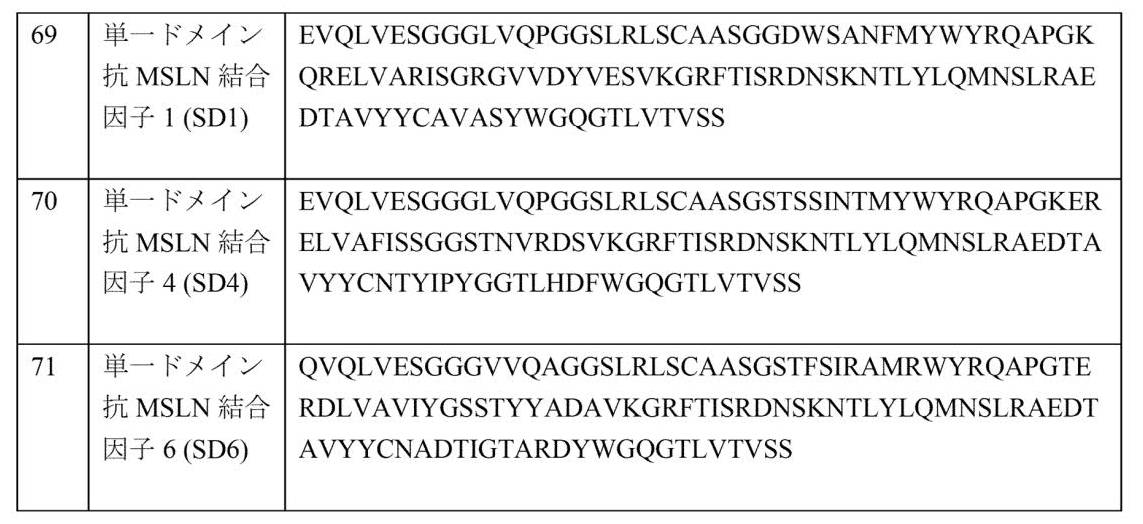
TFP発現ベクター
[0436] プロモーター(EF1αプロモーター)、分泌を可能にするシグナル配列、ポリアデニル化シグナル及び転写ターミネーター(ウシ成長ホルモン(BGH)遺伝子)、エピソーム複製及び原核生物での複製を可能にする要素(例えば、SV40源及びColE1または当技術分野において公知の他のもの)、及び選択を可能にする要素(アンピシリン耐性遺伝子及びゼオシンマーカー)含む発現ベクターを提供する。
TFP expression vector
[0436] A promoter (EF1α promoter), a signal sequence allowing secretion, a polyadenylation signal and a transcription terminator (bovine growth hormone (BGH) gene), elements allowing episomal replication and replication in prokaryotes (e.g., SV40 source and ColE1 or others known in the art), and expression vectors containing elements that allow for selection (ampicillin resistance gene and zeocin marker).
[0437] TFPをコードする核酸構築物をレンチウイルス発現ベクターにクローニングした。
実施例2: TFPを形質導入したT細胞の調製
レンチウイルスの産生
[0438] 適切な構築物をコードするレンチウイルスを以下のように調製した。Expi293F細胞をFS培地に懸濁し、37℃、8%CO2、150rpmで1~3時間インキュベートする。トランスファーDNAプラスミド、Gag/Polプラスミド、Revプラスミド、及びVSV-GプラスミドをFS培地で希釈した。次に、PEIproをFS培地で希釈し、DNA及び培地の混合物に添加した。インキュベートした細胞をこの混合物に添加し、37℃、8%CO2、150rpmで18~24時間インキュベートした。翌日、上清を新鮮な培地に交換し、酪酸ナトリウムを補充し、37℃でさらに24時間インキュベートした。次に、レンチウイルスを含有する上清を、50mL滅菌済みキャップ付きコニカル遠心チューブに採取し、氷上に置いた。3000rpm、4℃で30分間遠心分離した後、清澄化した上清を低タンパク質結合0.45μm滅菌フィルターで濾過した。その後、Lenti-Xによってウイルスを濃縮した。ウイルスストック調製物は、直ちに感染に使用するか、または今後の使用に備え、分注して-80℃で保存した。
[0437] A nucleic acid construct encoding TFP was cloned into a lentiviral expression vector.
Example 2: Preparation of TFP-transduced T cells
Lentivirus production
[0438] Lentiviruses encoding suitable constructs were prepared as follows. Expi293F cells are suspended in FS medium and incubated at 37° C., 8% CO 2 , 150 rpm for 1-3 hours. Transfer DNA plasmid, Gag/Pol plasmid, Rev plasmid and VSV-G plasmid were diluted in FS medium. PEIpro was then diluted in FS medium and added to the mixture of DNA and medium. Incubated cells were added to this mixture and incubated at 37° C., 8% CO 2 , 150 rpm for 18-24 hours. The next day, the supernatant was replaced with fresh medium, supplemented with sodium butyrate and incubated at 37°C for an additional 24 hours. The lentivirus-containing supernatant was then collected into a 50 mL sterile capped conical centrifuge tube and placed on ice. After centrifugation at 3000 rpm for 30 min at 4° C., the clarified supernatant was filtered through a low protein binding 0.45 μm sterile filter. Virus was then concentrated by Lenti-X. Virus stock preparations were either used immediately for infection or stored in aliquots at -80°C for future use.
[0439] 図2は、TFPを発現するTregを産生する工程の概略図を示す。
制御性T細胞の活性化、トランスフェクション、及び増殖
[0440] 制御性T細胞及びCD4+ T細胞を、末梢血から直接単離するか、またはFicollグラジエントで濃縮した末梢血単核細胞(PBMC)から単離した。CD4+ T細胞全体をREAlease CD4マイクロビーズで単離した。これらの細胞の一部を採取し、以下の実験でCD4+細胞として使用する一方、残りの細胞を使用してTregをさらに単離した。次に、Tregの単離では、CD4+ CD25+ CD127dim/-単離キット(Miltenyi)を使用して、CD4+細胞からCD4+ CD25+ CD127dim/-Tregを単離した。次に、CD45マイクロビーズキットを使用して、CD4+ CD25+ CD127dim/- TregからCD4+ CD25+ CD127dim/- CD45RA+を単離し、以下に記載する実験で使用するTregを生成した。Tregの単離スキームと、本工程の各ステップでのFoxP3+ Helios+細胞の濃縮を図3に示す。
[0439] Figure 2 shows a schematic representation of the process of generating Tregs that express TFP.
Activation, transfection and expansion of regulatory T cells
[0440] Regulatory T cells and CD4 + T cells were isolated directly from peripheral blood or from peripheral blood mononuclear cells (PBMC) enriched with a Ficoll gradient. Total CD4 + T cells were isolated with REAlease CD4 microbeads. A portion of these cells were harvested and used as CD4 + cells in the following experiments, while the remaining cells were used to further isolate Tregs. For Treg isolation, CD4 + CD25 + CD127 dim/− Tregs were then isolated from CD4 + cells using the CD4 + CD25 + CD127 dim/− isolation kit (Miltenyi). A CD45 microbead kit was then used to isolate CD4 + CD25 + CD127 dim/− CD45RA + from CD4 + CD25 + CD127 dim/− Tregs to generate Tregs for use in the experiments described below. FIG. 3 shows the Treg isolation scheme and enrichment of FoxP3 + Helios + cells at each step of the process.
[0441] CD4+細胞については、0日目に、単離したCD4+ T細胞をX-Vivo培地+10%FBS+12.5ng/ml IL7/IL15中のMACS GMP T細胞TransAct(Miltenyi Biotech)で活性化した。1日目に、活性化T細胞にHLA-A2 TFPまたはMH1-TFP(FoxP3あり、またはなし)をコードするレンチウイルスを形質導入した。4、7、及び10日目に、細胞を洗浄し、サイトカインを含む新鮮な培地中で継代培養し、14日目まで増殖させた。
[0441] For CD4 + cells, on
[0442] Treg細胞については、0日目に、PBMC(前日に解凍して休止した)からTregを単離し、X-Vivo培地+10%FBS+1000IU/ml IL-2+100nMラパマイシン中のMACS GMP T細胞TransAct(Miltenyi Biotech)で活性化した。1日目に、活性化T細胞にHLA-A2 TFPまたはMH1-TFP(FoxP3あり、またはなし)をコードするレンチウイルスを形質導入した。4、7、及び10日目に、細胞を洗浄し、サイトカインを含む新鮮な培地中で継代培養し、14日目まで増殖させた。継代培養の各日に、細胞を回収、洗浄し、新鮮なサイトカイン含有培地で再懸濁した。
[0442] For Treg cells, on
実施例3: 抗原非依存性抑制アッセイ
[0443] 実施例2の記載のように調製した、FoxP3あり、またはなしのHLA-A2 TFPを有するCD4+細胞及び制御性T細胞を抗原非依存性抑制アッセイに使用した。すべての構築物に短縮型EGFRが含まれていた。FoxP3あり、またはなしのHLA-A2 TFPを有するTreg細胞及びCD4+細胞の増殖工程、ならびに形質導入及び非形質導入CD4細胞及びTreg細胞の増殖率を図4に示す。2名の別々のドナー(ドナー1及びドナー2)から、Treg及びCD4+T細胞を単離、形質導入、及び増殖した。
Example 3: Antigen-independent suppression assay
[0443] CD4 + cells and regulatory T cells bearing HLA-A2 TFPs with or without FoxP3, prepared as described in Example 2, were used in antigen-independent suppression assays. All constructs contained a truncated EGFR. The expansion process of Treg and CD4 + cells with HLA-A2 TFPs with or without FoxP3 and the expansion rate of transduced and non-transduced CD4 and Treg cells are shown in FIG. Tregs and CD4 + T cells were isolated, transduced and expanded from two separate donors (
[0444] TFP発現の検証及びTFP T細胞のフェノタイピング
HLA-A2 TFP形質導入T細胞のフェノタイピングを実施した。TFP T細胞または非形質導入T細胞を上記に記載のように生成した。増殖の14日目にT細胞を回収し、細胞をフローサイトメトリーによりFoxP3、CD25、及びHeliosの発現について特性決定した。抗EGFR染色により、細胞でのTFP発現の検証も確認した。図5A及び図5Bに示すように、非形質導入Treg、FoxP3遺伝子が追加されている場合とされていない場合のHLA-A2 TFP Treg、及びFoxP3遺伝子が追加されているHLA-A2 TFP CD4+細胞は、高レベルのFoxP3発現を有する(図5A及び図5B)。Tregの全集団(非形質導入及び形質導入)は、Helios(図5A及び図5B)及びCD25(図5B)の顕著な発現を有するが、HLA-A2 TFP CD4+細胞ではFoxP3遺伝子が追加された場合でも、HeliosまたはCD25の発現はほとんど見られない。図5Bに示すように、HLA-A2 TFP CD4+細胞は(FoxP3の有無を問わず)高比率でEGFR染色を示しているが、FoxP3遺伝子を追加したHLA-A2 TFP CD4+細胞の方がEGFR染色を示す比率が低く、これらの細胞の形質導入効率が低いことを示唆している。
[0444] Validation of TFP Expression and Phenotyping of TFP T Cells Phenotyping of HLA-A2 TFP transduced T cells was performed. TFP T cells or non-transduced T cells were generated as described above. T cells were harvested on
抗原非依存性抑制アッセイ
[0445] Treg Suppression Inspector Kit(Miltenyi)を使用して、抑制アッセイを実施し、エフェクターT細胞の抑制におけるHLA-A2 TFP制御性T細胞の有効性を試験した。cell trace violet(CTV)で標識したポリクローナルCD4+及びCD8+ T細胞を、抗CD3及び抗CD28抗体ビーズを含むT細胞受容体を介して活性化し(レスポンダー細胞)、TFP.抗HLA-A2 Treg(FoxP3あり、またはなし)、TFP.抗HLA-A2 CD4+ T細胞(FoxP3あり)、またはTFPを発現しない対照Tregと種々の濃度で混合した。次に、上清を採取してサイトカイン分析し、72時間のインキュベーション後のレスポンダー細胞の増殖を評価するためにフロー分析を行った。アッセイの概略図を図6に示す。
Antigen-independent suppression assay
[0445] Suppression assays were performed using the Treg Suppression Inspector Kit (Miltenyi) to test the efficacy of HLA-A2 TFP regulatory T cells in suppressing effector T cells. Cell trace violet (CTV)-labeled polyclonal CD4 + and CD8 + T cells were activated (responder cells) via T cell receptor containing anti-CD3 and anti-CD28 antibody beads and TFP. anti-HLA-A2 Tregs (with or without FoxP3), TFP. Anti-HLA-A2 CD4 + T cells (with FoxP3) or control Tregs not expressing TFP were mixed at various concentrations. Supernatants were then harvested for cytokine analysis and flow analysis to assess responder cell proliferation after 72 hours of incubation. A schematic of the assay is shown in FIG.
[0446] サイトカイン分析では、IFN-γ及びIL-2のレベルを、それぞれのサプレッサーTFP T細胞:レスポンダー細胞比で測定した。図7A(ドナー1)及び図7B(ドナー2)に示すように、IFN-γ及びIL-2のいずれでも、FoxP3遺伝子が追加されているか、されていないかを問わず、HLA-A2 TFP Tregは、レスポンダー細胞のIFN-γ及びIL-2の産生を(TregまたはCD4+ T細胞で処理されていない活性化レスポンダー細胞によって産生されるサイトカインのレベルと比較して)抑制することができた。いずれのドナーでも、達成された抑制は非形質導入Tregの抑制を超えていた。FoxP3遺伝子を追加したHLA-A2 TFP CD4+細胞でレスポンダー細胞を処理すると、IFN-γの発現が無処理の場合を超えて増加した。これは、HLA-A2 TFP TregがエフェクターT細胞によるサイトカイン産生を抗原非依存的に抑制できることを示唆している。 [0446] For cytokine analysis, levels of IFN-γ and IL-2 were measured at their respective suppressor TFP T cell: responder cell ratios. As shown in FIGS. 7A (donor 1) and FIG. 7B (donor 2), both IFN-γ and IL-2, with or without the addition of the FoxP3 gene, induced HLA-A2 TFP Tregs. were able to suppress IFN-γ and IL-2 production of responder cells (compared to levels of cytokines produced by activated responder cells not treated with Tregs or CD4 + T cells). Suppression achieved exceeded that of untransduced Tregs in both donors. Treatment of responder cells with HLA-A2 TFP CD4 + cells supplemented with the FoxP3 gene increased IFN-γ expression over no treatment. This suggests that HLA-A2 TFP Tregs can suppress cytokine production by effector T cells in an antigen-independent manner.
[0447] また、図8A(ドナー1)及び図8B(ドナー2)に示す式によって計算される抑制率(%)を定量化することにより、それぞれのTFP T細胞:レスポンダー細胞比でのFACSによってレスポンダー細胞の増殖率を評価した。図8に示すように、HLA-A2 TFP Tregは、FoxP3が追加されているかいないかを問わず、両方のドナーで、非形質導入Tregを上回るCD4+レスポンダーT細胞、CD8+レスポンダーT細胞、及び総CD3+レスポンダーT細胞の増殖を抑制した。FoxP3遺伝子が追加されているHLA-A2 TFP CD4+ T細胞は、非形質導入T細胞を含め、これらのいずれの細胞集団同様に、細胞増殖を抑制することができず、高いサプレッサー細胞:レスポンダー比でのみ抑制活性を示した。これは、HLA-A2 TFP TregがエフェクターT細胞の増殖を抗原非依存的に抑制できることを示唆している。 [0447] We also quantified the % suppression calculated by the formula shown in Figure 8A (donor 1) and Figure 8B (donor 2) by FACS at each TFP T cell: responder cell ratio. The proliferation rate of responder cells was assessed. As shown in FIG. 8, HLA-A2 TFP Tregs outnumbered non-transduced Tregs in both donors, with or without the addition of FoxP3, outnumbered CD4 + responder T cells, CD8 + responder T cells, and Suppressed proliferation of total CD3 + responder T cells. HLA-A2 TFP CD4 + T cells that have been supplemented with the FoxP3 gene, like any of these cell populations, including non-transduced T cells, are unable to suppress cell proliferation and exhibit high suppressor:responder ratios. showed inhibitory activity only in This suggests that HLA-A2 TFP Tregs can suppress the proliferation of effector T cells in an antigen-independent manner.
実施例4: 抗原依存性抑制アッセイ
[0448] FoxP3あり、またはなしのMH1 TFPを有するCD4+細胞及び制御性T細胞を抗原依存性抑制アッセイに使用した。
Example 4: Antigen-dependent suppression assay
[0448] CD4 + cells with MH1 TFPs with or without FoxP3 and regulatory T cells were used in antigen-dependent suppression assays.
細胞染色によるTFP発現の検証
[0449] レンチウイルスの形質導入に続いて、フローサイトメトリーによりMH1TFPの発現を確認した。抗VHH及び抗CD4抗体を使用した表面マーカーで細胞を染色した。死細胞を排除するために、細胞をLIVE/DEAD(登録商標)Fixable Aqua Dead Cell Stain(Invitrogen)とインキュベートした。フローサイトメトリーはLSRFortessa(商標)X20(BD Biosciences)を使用して実施し、FACS Divaソフトウェアを使用してデータを取得し、FlowJo(登録商標)(Treestar,Inc.Ashland,OR)で分析した。図9に示すように、MH1 TFP、またはFoxP3遺伝子ありのMH1 TFPを形質導入したCD4+ T細胞及びTregはいずれもMH1 TFPを発現した。
Verification of TFP expression by cell staining
[0449] Following lentiviral transduction, MH1TFP expression was confirmed by flow cytometry. Cells were stained with surface markers using anti-VHH and anti-CD4 antibodies. To exclude dead cells, cells were incubated with LIVE/DEAD® Fixable Aqua Dead Cell Stain (Invitrogen). Flow cytometry was performed using an LSRFortessa™ X20 (BD Biosciences) and data were acquired using FACS Diva software and analyzed with FlowJo® (Treestar, Inc. Ashland, OR). As shown in FIG. 9, both CD4 + T cells and Tregs transduced with MH1 TFP or MH1 TFP with FoxP3 gene expressed MH1 TFP.
TFP T細胞のフェノタイピング
[0450] MH1 TFPを形質導入したT細胞のフェノタイピングを実施した。TFP T細胞または非形質導入T細胞を上記に記載のように生成した。増殖の14日目にCD4+細胞及びTreg細胞を回収し、細胞をフローサイトメトリーによりFoxP3、CD25、及びHeliosの発現について特性決定した。図10に示すように、FoxP3遺伝子が追加されている場合とされていない場合のMH1 TFP Treg、及びFoxP3遺伝子が追加されているMH1 CD4+細胞は、高レベルのFoxP3発現を有する。MH1 TFP Treg(FoxP3が追加されている場合といない場合)は、Heliosの顕著な発現を有するが、MH1 TFP CD4+細胞ではFoxP3遺伝子が追加された場合でも、Heliosの発現はほとんど見られない。
Phenotyping of TFP T cells
[0450] Phenotyping of T cells transduced with MH1 TFP was performed. TFP T cells or non-transduced T cells were generated as described above. CD4 + cells and Treg cells were harvested on
MH1抗原依存性抑制アッセイ
[0451] 抑制アッセイを実施して、MH1 TFPエフェクターT細胞(TC-210)の抑制におけるMH1 TFP制御性T細胞の有効性を試験した。MH1 TFPエフェクター細胞は、以前に記載したエフェクターTFP+ T細胞を生成する方法に従って生成した。cell trace violet(CTV)で標識したMH1 TFPエフェクターT細胞(レスポンダー細胞)をMSTO-msln細胞の層に50,000細胞/ウェルの濃度で播種した。MSTO-msln細胞を6,250細胞/ウェルの濃度で播種し、MH1 TFPエフェクターT細胞:MSTO-msln細胞の比を8:1にした。MSTO-msln細胞は、MH1 TFPエフェクターT細胞を抗原特異的に活性化する。次に、MH1 TFP制御性T細胞(FoxP3あり、またはなし)、またはCD4+ MH1 TFP T細胞(FoxP3あり)を種々の濃度のMH1 TFPエフェクターT細胞に添加して、MH1 TFPエフェクターT細胞に対するMH1 TFP TregまたはCD4+細胞の抑制効果を測定した。上清を採取してサイトカイン分析し、72時間のインキュベーション後の増殖を評価するフロー分析をレスポンダー細胞で行った。アッセイの概略図を図11に示す。
MH1 antigen-dependent suppression assay
[0451] A suppression assay was performed to test the efficacy of MH1 TFP regulatory T cells in suppressing MH1 TFP effector T cells (TC-210). MH1 TFP effector cells were generated according to previously described methods for generating effector TFP + T cells. MH1 TFP effector T cells (responder cells) labeled with cell trace violet (CTV) were seeded onto the layer of MSTO-msln cells at a concentration of 50,000 cells/well. MSTO-msln cells were seeded at a concentration of 6,250 cells/well, giving a ratio of MH1 TFP effector T cells:MSTO-msln cells of 8:1. MSTO-msln cells activate MH1 TFP effector T cells in an antigen-specific manner. Next, MH1 TFP regulatory T cells (with or without FoxP3) or CD4 + MH1 TFP T cells (with FoxP3) were added to various concentrations of MH1 TFP effector T cells to increase MH1 to MH1 TFP effector T cells. Suppressive effects of TFP Tregs or CD4 + cells were measured. Supernatants were harvested for cytokine analysis and flow assays were performed on responder cells to assess proliferation after 72 hours of incubation. A schematic of the assay is shown in FIG.
[0452] サイトカイン分析では、IFN-γ及びIL-2のレベルを、それぞれのサプレッサーTFP T細胞:レスポンダー細胞比で測定した。図12に示すように、IFN-γ及びIL-2のいずれでも、FoxP3遺伝子が追加されているか、されていないかを問わず、MH1 TFP Tregは、レスポンダー細胞のIFN-γ及びIL-2の産生を(TregまたはCD4+ T細胞で処理されていない活性化レスポンダー細胞によって産生されるサイトカインのレベルと比較して)抑制することができた。対照的に、FoxP3遺伝子を追加したMH1 TFP CD4+細胞でレスポンダー細胞を処理すると、サイトカイン産生に対する抑制効果は低かった。実際、MH1 TFP CD4+ FoxP3+細胞は、IFN-γの産生をどの比率でも抑制することができなかった。これは、MH1 TFP TregがエフェクターT細胞によるサイトカイン産生を抗原特異的に抑制できることを示唆している。 [0452] For cytokine analysis, levels of IFN-γ and IL-2 were measured at their respective suppressor TFP T cell: responder cell ratios. As shown in FIG. 12, MH1 TFP Tregs, with or without the addition of the FoxP3 gene, for both IFN-γ and IL-2, significantly reduced the levels of IFN-γ and IL-2 in responder cells. production could be suppressed (compared to levels of cytokines produced by activated responder cells not treated with Tregs or CD4 + T cells). In contrast, treatment of responder cells with MH1 TFP CD4 + cells supplemented with the FoxP3 gene had a low inhibitory effect on cytokine production. Indeed, MH1 TFP CD4 + FoxP3 + cells were unable to suppress IFN-γ production at any rate. This suggests that MH1 TFP Tregs can suppress cytokine production by effector T cells in an antigen-specific manner.
[0453] また、図13に示す式によって計算される抑制率(%)を定量化することにより、それぞれのTFP T細胞:レスポンダー細胞比でのFACSによってレスポンダー細胞の増殖率を評価した。図13に示すように、FoxP3遺伝子が追加されている場合とされていない場合のMH1 TFP Tregは、MH1 TFP T CD4+エフェクターT細胞及びMH1 TFP T CD8+エフェクターT細胞の増殖を抑制することができ、その抑制のレベルは、FoxP3遺伝子が追加されているMH1 TFP CD4+ T細胞によって達成されるレベルを上回った。実際、MH1 TFP CD4+ FoxP3+細胞は、最大のサプレッサー:レスポンダー細胞比でのみ増殖を抑制することができた。これは、MH1 TFP TregがエフェクターT細胞の増殖を抗原依存的に抑制できることを示唆している。 [0453] The proliferation rate of responder cells was also assessed by FACS at each TFP T cell: responder cell ratio by quantifying the percent inhibition calculated by the formula shown in Figure 13 . As shown in FIG. 13, MH1 TFP Tregs with and without the addition of the FoxP3 gene were able to suppress the proliferation of MH1 TFP T CD4 + effector T cells and MH1 TFP T CD8 + effector T cells. and the level of suppression exceeded that achieved by MH1 TFP CD4 + T cells to which the FoxP3 gene had been added. Indeed, MH1 TFP CD4 + FoxP3 + cells were able to suppress proliferation only at the highest suppressor:responder cell ratio. This suggests that MH1 TFP Tregs can suppress the proliferation of effector T cells in an antigen-dependent manner.
[0454] HLA-A2抗原依存性抑制アッセイ。実施例2の記載のように調製した、FoxP3あり、またはなしのHLA-A2 TFPを有するCD4+細胞及び制御性T細胞を抗原依存性抑制アッセイに使用して、HLA-A2 TFP Tregが、不適合樹状細胞と共培養したエフェクターT細胞の活性化を抑制できるかどうかを決定した。CD3+ HLA-A2-CD4+及びCD8+エフェクターT細胞を、TFP Tregと同じドナーから生成した。CD14+単球を単離し、MO-DC培地中で7日間培養することによりHLA-A2+樹状細胞を生成した。エフェクターT細胞をHLA-A2+樹状細胞と2:1のTeff:DC比で共培養した(1ウェルあたりのエフェクターT細胞50,000及び樹状細胞25,000)。次に、HLA-A2 TFP制御性T細胞(FoxP3あり、またはなし)、またはCD4+ HLA-A2 TFP T細胞(FoxP3あり)を種々の濃度の共培養物に添加して、エフェクターT細胞に対するHLA-A2 TFP TregまたはCD4+細胞の抑制効果を測定した。Tエフェクター細胞また、単独で培養するか、または対照である、制御性T細胞を含まないHLA適合もしくは不適合樹状細胞と培養した。上清を採取してサイトカイン分析し、72時間のインキュベーション後の増殖を評価するフロー分析をレスポンダー細胞で行った。アッセイの模式図を図14に示す。 [0454] HLA-A2 antigen-dependent suppression assay. HLA-A2 TFP-bearing CD4 + cells and regulatory T cells with or without FoxP3, prepared as described in Example 2, were used in an antigen-dependent suppression assay to demonstrate that HLA-A2 TFP Tregs were mismatched. It was determined whether activation of effector T cells co-cultured with dendritic cells could be suppressed. CD3 + HLA-A2-CD4 + and CD8 + effector T cells were generated from the same donors as the TFP Tregs. CD14 + monocytes were isolated and cultured in MO-DC medium for 7 days to generate HLA-A2 + dendritic cells. Effector T cells were co-cultured with HLA-A2 + dendritic cells at a Teff:DC ratio of 2:1 (50,000 effector T cells and 25,000 dendritic cells per well). HLA-A2 TFP regulatory T cells (with or without FoxP3) or CD4 + HLA-A2 TFP T cells (with FoxP3) were then added to co-cultures at various concentrations to increase HLA to effector T cells. - Suppressive effects of A2 TFP Tregs or CD4 + cells were measured. T effector cells were also cultured alone or with control, HLA-matched or mismatched dendritic cells without regulatory T cells. Supernatants were harvested for cytokine analysis and flow assays were performed on responder cells to assess proliferation after 72 hours of incubation. A schematic diagram of the assay is shown in FIG.
[0455] サイトカイン分析では、IFN-γ及びIL-2のレベルを、それぞれのサプレッサーTFP T細胞:エフェクターT細胞比で測定した。図15に示すように、IFN-γ及びIL-2のいずれでも、FoxP3遺伝子が追加されているか、されていないかを問わず、HLA-A2 TFP Tregは、レスポンダー細胞のIFN-γ及びIL-2の産生を(TregまたはCD4+ T細胞で処理されていないエフェクターT細胞によって産生されるサイトカインのレベルと比較して)抑制することができた。さらに、HLA-A2 TFP FoxP3 Tregは、IFN-γ産生に対して未改変Tregよりも大きな抑制効果があり、FoxP3の有無にかかわらず、いずれのHLA-A2 TFP TregもIL-2産生に対して未改変T細胞よりも大きな抑制効果があった。これは、TFP TregがエフェクターT細胞によるサイトカイン産生を抗原特異的に抑制できることを示している。 [0455] For cytokine analysis, levels of IFN-γ and IL-2 were measured at their respective suppressor TFP T cell:effector T cell ratios. As shown in FIG. 15, HLA-A2 TFP Tregs, with or without the addition of the FoxP3 gene for both IFN-γ and IL-2, are associated with IFN-γ and IL-2 in responder cells. 2 production (compared to levels of cytokines produced by effector T cells not treated with Tregs or CD4 + T cells). Furthermore, HLA-A2 TFP FoxP3 Tregs had a greater suppressive effect than unmodified Tregs on IFN-γ production, and both HLA-A2 TFP Tregs, with or without FoxP3, on IL-2 production. There was a greater suppressive effect than unmodified T cells. This indicates that TFP Tregs can suppress cytokine production by effector T cells in an antigen-specific manner.
[0456] また、図16に示す式によって計算される抑制率(%)を定量化することにより、それぞれのTFP T細胞:エフェクター細胞比でのFACSによってレスポンダー細胞の増殖率を評価した。図16に示すように、FoxP3遺伝子が追加されている場合とされていない場合のHLA-A2 TFP Tregは、エフェクターT細胞の増殖を抑制することができ、その抑制のレベルは、未改変の制御性T細胞によって達成されるレベルを上回った。これは、TFP TregがエフェクターT細胞の増殖を抗原依存的に抑制できることを示唆している。 [0456] Responder cell proliferation rates were also assessed by FACS at each TFP T cell: effector cell ratio by quantifying the percent inhibition calculated by the formula shown in FIG. As shown in FIG. 16, HLA-A2 TFP Tregs with and without the addition of the FoxP3 gene were able to suppress the proliferation of effector T cells, and the level of suppression was similar to that of the unmodified control. surpassed levels achieved by sexual T cells. This suggests that TFP Tregs can suppress the proliferation of effector T cells in an antigen-dependent manner.
実施例5: TFP Tregの改変増殖プロトコル
[0457] TFP Tregの第2の増殖プロトコルを、TFP Tregの増殖を強化するために開発した。
Example 5: Modified Expansion Protocol for TFP Tregs
[0457] A second expansion protocol for TFP Tregs was developed to enhance expansion of TFP Tregs.
[0458] MultiMACを使用してPBMCを単離し、凍結した。細胞を一晩解凍し、AutoMACでCD4+ T細胞を末梢血単核細胞(PBMC)から単離した。CD4+ T細胞全体をCD4 Release Beads(Miltenyi)で単離した。これらの細胞の一部を採取し、以下の実験でCD4+細胞として使用した。次に、CD4+ CD25+ CD127dim/-単離キットII(Miltenyi)を使用することにより、CD4+ CD25+ CD127dim/- Tregを単離した。形質導入前の0日目に、単離したTregをフローサイトメトリーによりHelios、CD25、及びFoxP3の発現について特性決定した。図17に示すように、単離したTregは、高レベルのHelios及びFoxP3の発現を示した。
[0458] PBMC were isolated using the MultiMAC and frozen. Cells were thawed overnight and CD4 + T cells were isolated from peripheral blood mononuclear cells (PBMC) by AutoMAC. Total CD4 + T cells were isolated with CD4 Release Beads (Miltenyi). A portion of these cells were harvested and used as CD4 + cells in the following experiments. CD4 + CD25 + CD127 dim/− Tregs were then isolated by using the CD4 + CD25 + CD127 dim/− isolation kit II (Miltenyi). On
[0459] 0日目に、単離したTregをX-Vivo培地+10%FBS+1000IU/ml IL-2+100nMラパマイシン中のTreg増殖ビーズ(Miltenyi)で活性化した。1日目に、活性化T細胞にHLA-A2 TFP(実施例2に記載)(FoxP3あり、またはなし)をコードするレンチウイルスを形質導入した。4、6、8、及び11日目に、細胞を洗浄し、サイトカインを含む新鮮な培地中で継代培養し、14日目まで増殖させた。継代培養の各日に、細胞を回収、洗浄し、新鮮なサイトカイン含有培地で再懸濁した。実施例2に記載されているように、CD4+細胞を活性化、形質導入、及び増殖した。
[0459] On
TFP発現の検証及びTFP T細胞のフェノタイピング
[0460] HLA-A2 TFP形質導入T細胞のフェノタイピングを実施した。増殖の14日目にT細胞を回収し、細胞をフローサイトメトリーによりFoxP3、CD25、及びHeliosの発現について特性決定した。抗EGFR染色により、細胞でのTFP発現の検証も確認した。図18に示すように、非形質導入Treg、及びFoxP3遺伝子が追加されている場合とされていない場合のHLA-A2 TFP Tregは、高レベルのFoxP3、Helios、及びCD25の発現を有する。すべてのTFP形質導入細胞が高比率でEGFR染色を示しており、高い形質導入効率を示唆している。形質導入及び非形質導入CD4細胞及びTreg細胞の増殖率を図19に示す。すべてのTregについて、10日目の増殖は実施例2で使用したプロトコルで見られたものの約5倍である。
Validation of TFP expression and phenotyping of TFP T cells
[0460] Phenotyping of HLA-A2 TFP-transduced T cells was performed. T cells were harvested on
実施例6: TFP.抗HLA-A2 Treg機能のin vivo試験
[0461] TFP.抗HLA-A2 Tregが、宿主による移植片細胞の拒絶反応の発症または持続期間を変更する能力を決定する。ヒト化マウスモデル系を使用して、TFP.抗HLA-A2 Tregの機能を試験する。ヒト異種移植片モデルにおいて、TFP Tregの養子移入が移植片対宿主病(同種異系末梢血単核細胞(PBMC)の移入によって引き起こされるGVHD)を軽減するかどうかを決定する。成熟T細胞、B細胞、及びNK細胞を欠損するが、機能不全の単球細胞を含んでいる可能性があるマウスに、PBMCの移植前日に放射線照射した。0日目に、HLA-A2+ PBMC及びTFP抗HLA-A2 Treg(Foxp3の追加あり、またはなし)、及びCD4+ TFP抗HLA-A2細胞を、放射線照射マウスにPBMC:TFP細胞1:1比で移植する。移植後、マウスをGVHDの発症について毎日モニターする。試験期間を通じて、毎週採血し、PBMC及びサプレッサー細胞の生着をモニターする。最大49日間、または人道的エンドポイントに達するまでマウスを追跡する。
Example 6: TFP. In vivo testing of anti-HLA-A2 Treg function
[0461] TFP. Anti-HLA-A2 Tregs determine the ability to alter the onset or duration of graft cell rejection by the host. Using a humanized mouse model system, TFP. Anti-HLA-A2 Tregs are tested for function. To determine whether adoptive transfer of TFP Tregs attenuates graft-versus-host disease (GVHD caused by allogeneic peripheral blood mononuclear cell (PBMC) transfer) in a human xenograft model. Mice deficient in mature T cells, B cells, and NK cells, but possibly containing dysfunctional monocytic cells, were irradiated the day before PBMC transplantation. On
他の実施形態
[0462] 上記に示す本開示は、独立した有用性を有する複数の個別の発明を包含し得る。これらの発明はそれぞれ、その好ましい形態(複数可)で開示されているが、本明細書に開示及び例示されているその特定の実施形態は、多数の変形例が可能であるため、限定的な意味に解釈されるべきではない。本発明の主題は、本明細書に開示される種々の要素、特徴、機能、及び/または特性すべての新規の非自明な組み合わせ及びサブコンビネーションを含む。以下の特許請求の範囲は、特に、新規で非自明であるとみなされる特定の組み合わせ及びサブコンビネーションを示している。特徴、機能、要素、及び/または特性の他の組み合わせ及びサブコンビネーションに具体化される発明を、本出願、本出願から優先権を主張する出願、または関連出願において特許請求することができる。そのような請求項はまた、異なる発明に関するか同じ発明に関するかを問わず、及び元の請求項と比較して範囲が広い、狭い、等しい、または異なるかどうかを問わず、本開示の発明の主題に包含されるものとみなされる。
Other embodiment
[0462] The disclosure set forth above may encompass multiple individual inventions with independent utility. While each of these inventions is disclosed in its preferred form(s), the specific embodiments thereof disclosed and illustrated herein are capable of many variations and therefore are not limiting. should not be interpreted in a meaningful way. The subject matter of the invention includes all novel and non-obvious combinations and subcombinations of the various elements, features, functions and/or properties disclosed herein. The following claims particularly point out certain combinations and subcombinations regarded as novel and nonobvious. Inventions embodied in other combinations and subcombinations of features, functions, elements, and/or properties may be claimed in this application, an application claiming priority from this application, or a related application. Such claims also cover the inventions of this disclosure, whether they are directed to different inventions or to the same invention, and whether broader, narrower, equal or different in scope as compared to the original claims. considered to be covered by subject matter.
Claims (129)
(i)以下:
(1)細胞外ドメイン、
(2)TCR膜貫通ドメイン、及び
(3)細胞内シグナル伝達ドメインからの刺激ドメインを含む細胞内ドメイン
を含むTCR統合サブユニットと、
(ii)結合ドメインと
を含む、T細胞受容体(TCR)融合タンパク質(TFP)をコードする配列を含む組換え核酸
を含む、前記制御性T細胞と、
(II)薬学的に許容される担体と
を含み、
前記TCR統合サブユニット及び前記抗原結合ドメインが機能的に連結されており、かつ
T細胞で発現すると前記TFPが内因性TCRと機能的に相互作用する、医薬組成物。 (I)(a) regulatory T cells (Treg) from a human subject, comprising:
(i) below:
(1) an extracellular domain,
(2) a TCR transmembrane domain, and (3) an intracellular domain comprising a stimulatory domain from the intracellular signaling domain;
(ii) a regulatory T cell comprising a recombinant nucleic acid comprising a sequence encoding a T cell receptor (TCR) fusion protein (TFP) comprising a binding domain;
(II) a pharmaceutically acceptable carrier;
A pharmaceutical composition, wherein said TCR integrating subunit and said antigen binding domain are operably linked, and wherein said TFP functionally interacts with an endogenous TCR when expressed in a T cell.
(a)抗原結合ドメイン、
(b)T細胞受容体リガンド、例えばペプチド-MHC複合体、または
(c)例えばペプチド-MHC複合体に結合する、T細胞受容体模倣物
からなる群から選択される、請求項1に記載の医薬組成物。 the binding domain is
(a) an antigen binding domain;
(b) a T-cell receptor ligand, such as a peptide-MHC complex, or (c) a T-cell receptor mimetic that binds, for example, a peptide-MHC complex. pharmaceutical composition.
(i)以下:
(1)TCR細胞外ドメインの少なくとも一部、及び
(2)TCR膜貫通ドメイン
を含む、TCR統合サブユニットと、
(ii)結合ドメインと
を含む、T細胞受容体(TCR)融合タンパク質(TFP)をコードする配列を含む組換え核酸を含み、
前記TCR統合サブユニット及び前記抗原結合ドメインが機能的に連結されており、かつ
T細胞で発現すると前記TFPが内因性TCRと機能的に相互作用する、前記制御性T細胞。 A regulatory T cell (Treg) from a human subject,
(i) below:
a TCR integrated subunit comprising (1) at least a portion of the TCR extracellular domain, and (2) the TCR transmembrane domain;
(ii) a recombinant nucleic acid comprising a sequence encoding a T-cell receptor (TCR) fusion protein (TFP) comprising a binding domain;
Said regulatory T cell, wherein said TCR integrating subunit and said antigen binding domain are operably linked, and said TFP functionally interacts with an endogenous TCR when expressed in the T cell.
(a)抗原結合ドメイン、
(b)T細胞受容体リガンド、例えばペプチド-MHC複合体、または
(c)例えばペプチド-MHC複合体に結合する、T細胞受容体模倣物
から選択される、請求項63または64に記載の制御性T細胞。 the binding domain is
(a) an antigen binding domain;
(b) a T-cell receptor ligand, such as a peptide-MHC complex, or (c) a T-cell receptor mimetic, which binds, for example, to a peptide-MHC complex. sex T cells.
Applications Claiming Priority (5)
| Application Number | Priority Date | Filing Date | Title |
|---|---|---|---|
| US202062959794P | 2020-01-10 | 2020-01-10 | |
| US62/959,794 | 2020-01-10 | ||
| US202063094590P | 2020-10-21 | 2020-10-21 | |
| US63/094,590 | 2020-10-21 | ||
| PCT/US2021/012748 WO2021142302A1 (en) | 2020-01-10 | 2021-01-08 | Compositions and methods for autoimmunity regulation |
Publications (1)
| Publication Number | Publication Date |
|---|---|
| JP2023510353A true JP2023510353A (en) | 2023-03-13 |
Family
ID=76787591
Family Applications (1)
| Application Number | Title | Priority Date | Filing Date |
|---|---|---|---|
| JP2022542341A Pending JP2023510353A (en) | 2020-01-10 | 2021-01-08 | Compositions and methods for autoimmune control |
Country Status (7)
| Country | Link |
|---|---|
| US (1) | US20230338421A1 (en) |
| EP (1) | EP4087620A1 (en) |
| JP (1) | JP2023510353A (en) |
| CN (1) | CN115427084A (en) |
| AU (1) | AU2021205501A1 (en) |
| CA (1) | CA3167308A1 (en) |
| WO (1) | WO2021142302A1 (en) |
Families Citing this family (6)
| Publication number | Priority date | Publication date | Assignee | Title |
|---|---|---|---|---|
| SG10201914069SA (en) | 2015-05-18 | 2020-03-30 | Tcr2 Therapeutics Inc | Compositions and methods for tcr reprogramming using fusion proteins |
| WO2022103789A1 (en) * | 2020-11-10 | 2022-05-19 | Kyverna Therapeutics, Inc. | A method for treating disease using foxp3+cd4+ t cells |
| WO2022165419A1 (en) | 2021-02-01 | 2022-08-04 | Kyverna Therapeutics, Inc. | Methods for increasing t-cell function |
| KR20240004937A (en) | 2021-05-05 | 2024-01-11 | 이매틱스 바이오테크놀로지스 게엠베하 | BMA031 antigen-binding polypeptide |
| WO2025087301A1 (en) * | 2023-10-24 | 2025-05-01 | Therorna Shanghai Co., Ltd. | Circular rna encoding glp-1 and the use thereof |
| CN120913639A (en) * | 2025-07-29 | 2025-11-07 | 中国医学科学院医学实验动物研究所 | IAPP-based computer-aided drug screening method, system and equipment |
Family Cites Families (10)
| Publication number | Priority date | Publication date | Assignee | Title |
|---|---|---|---|---|
| EP1241249A1 (en) * | 2001-03-12 | 2002-09-18 | Gerold Schuler | CD4+CD25+regulatory T cells from human blood |
| WO2008109757A2 (en) * | 2007-03-06 | 2008-09-12 | Iterative Therapeutics, Inc. | Methods and compositions involving polymeric immunoglobulin fusion proteins |
| ES2888651T3 (en) * | 2011-07-29 | 2022-01-05 | Univ Pennsylvania | costimulatory switching receptors |
| HK1201279A1 (en) * | 2011-11-03 | 2015-08-28 | Tolera Therapeutics Inc. | Antibody and methods for selective inhibition of t-cell responses |
| CN106163547A (en) * | 2014-03-15 | 2016-11-23 | 诺华股份有限公司 | Use Chimeric antigen receptor treatment cancer |
| SG10201913245UA (en) * | 2015-10-23 | 2020-02-27 | Eureka Therapeutics Inc | Antibody/t-cell receptor chimeric constructs and uses thereof |
| CN109715668A (en) * | 2016-08-02 | 2019-05-03 | T细胞受体治疗公司 | For using fusion protein to carry out the composition and method of TCR reprogramming |
| EP3848392A1 (en) * | 2016-10-07 | 2021-07-14 | TCR2 Therapeutics Inc. | Compositions and methods for tcr reprogramming using fusion proteins |
| GB201800298D0 (en) * | 2018-01-09 | 2018-02-21 | Autolus Ltd | Method |
| WO2019241549A1 (en) * | 2018-06-15 | 2019-12-19 | A2 Biotherapeutics, Inc. | Foxp3-expressing car-t regulatory cells |
-
2021
- 2021-01-08 JP JP2022542341A patent/JP2023510353A/en active Pending
- 2021-01-08 EP EP21738979.0A patent/EP4087620A1/en not_active Withdrawn
- 2021-01-08 CN CN202180016892.2A patent/CN115427084A/en active Pending
- 2021-01-08 CA CA3167308A patent/CA3167308A1/en active Pending
- 2021-01-08 US US17/791,358 patent/US20230338421A1/en active Pending
- 2021-01-08 WO PCT/US2021/012748 patent/WO2021142302A1/en not_active Ceased
- 2021-01-08 AU AU2021205501A patent/AU2021205501A1/en not_active Abandoned
Also Published As
| Publication number | Publication date |
|---|---|
| AU2021205501A1 (en) | 2022-08-18 |
| US20230338421A1 (en) | 2023-10-26 |
| CA3167308A1 (en) | 2021-07-15 |
| EP4087620A1 (en) | 2022-11-16 |
| WO2021142302A1 (en) | 2021-07-15 |
| CN115427084A (en) | 2022-12-02 |
Similar Documents
| Publication | Publication Date | Title |
|---|---|---|
| JP7578939B2 (en) | Anti-HLA-A2 antibody and method of use thereof | |
| US20220298478A1 (en) | Compositions and methods for tcr reprogramming using fusion proteins | |
| US11242376B2 (en) | Compositions and methods for TCR reprogramming using fusion proteins | |
| JP7123794B2 (en) | Immune cell compositions and methods of using same | |
| EP3298033B1 (en) | Compositions and medical uses for tcr reprogramming using fusion proteins | |
| JP2023109968A (en) | Compositions and methods for TCR reprogramming using fusion proteins | |
| JP2023510353A (en) | Compositions and methods for autoimmune control | |
| US20240067732A1 (en) | Anti-hla-a2 antibodies and uses thereof | |
| JP7618192B2 (en) | Method for protecting transplanted tissue from rejection - Patents.com | |
| JP7519906B2 (en) | Compositions and methods for phospholipase a2 receptor chimeric autoreceptor t cells - Patents.com | |
| JP7561036B2 (en) | Compositions and methods for muscle-specific kinase chimeric autoreceptor cells - Patents.com | |
| WO2023215725A1 (en) | Compositions and methods for cellular immunotherapy | |
| US20230167429A1 (en) | Compositions and methods of adamts13 chimeric autoantibody receptor cells | |
| RU2782276C2 (en) | Anti-hla-a2 antibodies and their application methods | |
| WO2025101820A1 (en) | Compositions and methods for cellular immunotherapy | |
| HK1252643B (en) | Compositions and medical uses for tcr reprogramming using fusion proteins |