JP2023179497A - Compositions and methods for inhibiting gene expression of hepatitis b virus - Google Patents
Compositions and methods for inhibiting gene expression of hepatitis b virus Download PDFInfo
- Publication number
- JP2023179497A JP2023179497A JP2023150873A JP2023150873A JP2023179497A JP 2023179497 A JP2023179497 A JP 2023179497A JP 2023150873 A JP2023150873 A JP 2023150873A JP 2023150873 A JP2023150873 A JP 2023150873A JP 2023179497 A JP2023179497 A JP 2023179497A
- Authority
- JP
- Japan
- Prior art keywords
- double
- ribonucleic acid
- stranded ribonucleic
- hepatitis
- nucleotides
- Prior art date
- Legal status (The legal status is an assumption and is not a legal conclusion. Google has not performed a legal analysis and makes no representation as to the accuracy of the status listed.)
- Pending
Links
Images


Classifications
-
- C—CHEMISTRY; METALLURGY
- C12—BIOCHEMISTRY; BEER; SPIRITS; WINE; VINEGAR; MICROBIOLOGY; ENZYMOLOGY; MUTATION OR GENETIC ENGINEERING
- C12N—MICROORGANISMS OR ENZYMES; COMPOSITIONS THEREOF; PROPAGATING, PRESERVING, OR MAINTAINING MICROORGANISMS; MUTATION OR GENETIC ENGINEERING; CULTURE MEDIA
- C12N15/00—Mutation or genetic engineering; DNA or RNA concerning genetic engineering, vectors, e.g. plasmids, or their isolation, preparation or purification; Use of hosts therefor
- C12N15/09—Recombinant DNA-technology
- C12N15/11—DNA or RNA fragments; Modified forms thereof; Non-coding nucleic acids having a biological activity
- C12N15/113—Non-coding nucleic acids modulating the expression of genes, e.g. antisense oligonucleotides; Antisense DNA or RNA; Triplex- forming oligonucleotides; Catalytic nucleic acids, e.g. ribozymes; Nucleic acids used in co-suppression or gene silencing
- C12N15/1131—Non-coding nucleic acids modulating the expression of genes, e.g. antisense oligonucleotides; Antisense DNA or RNA; Triplex- forming oligonucleotides; Catalytic nucleic acids, e.g. ribozymes; Nucleic acids used in co-suppression or gene silencing against viruses
-
- A—HUMAN NECESSITIES
- A61—MEDICAL OR VETERINARY SCIENCE; HYGIENE
- A61K—PREPARATIONS FOR MEDICAL, DENTAL OR TOILETRY PURPOSES
- A61K31/00—Medicinal preparations containing organic active ingredients
- A61K31/70—Carbohydrates; Sugars; Derivatives thereof
- A61K31/7088—Compounds having three or more nucleosides or nucleotides
- A61K31/713—Double-stranded nucleic acids or oligonucleotides
-
- A—HUMAN NECESSITIES
- A61—MEDICAL OR VETERINARY SCIENCE; HYGIENE
- A61P—SPECIFIC THERAPEUTIC ACTIVITY OF CHEMICAL COMPOUNDS OR MEDICINAL PREPARATIONS
- A61P1/00—Drugs for disorders of the alimentary tract or the digestive system
- A61P1/16—Drugs for disorders of the alimentary tract or the digestive system for liver or gallbladder disorders, e.g. hepatoprotective agents, cholagogues, litholytics
-
- A—HUMAN NECESSITIES
- A61—MEDICAL OR VETERINARY SCIENCE; HYGIENE
- A61P—SPECIFIC THERAPEUTIC ACTIVITY OF CHEMICAL COMPOUNDS OR MEDICINAL PREPARATIONS
- A61P29/00—Non-central analgesic, antipyretic or antiinflammatory agents, e.g. antirheumatic agents; Non-steroidal antiinflammatory drugs [NSAID]
-
- A—HUMAN NECESSITIES
- A61—MEDICAL OR VETERINARY SCIENCE; HYGIENE
- A61P—SPECIFIC THERAPEUTIC ACTIVITY OF CHEMICAL COMPOUNDS OR MEDICINAL PREPARATIONS
- A61P31/00—Antiinfectives, i.e. antibiotics, antiseptics, chemotherapeutics
- A61P31/12—Antivirals
-
- A—HUMAN NECESSITIES
- A61—MEDICAL OR VETERINARY SCIENCE; HYGIENE
- A61P—SPECIFIC THERAPEUTIC ACTIVITY OF CHEMICAL COMPOUNDS OR MEDICINAL PREPARATIONS
- A61P31/00—Antiinfectives, i.e. antibiotics, antiseptics, chemotherapeutics
- A61P31/12—Antivirals
- A61P31/20—Antivirals for DNA viruses
-
- A—HUMAN NECESSITIES
- A61—MEDICAL OR VETERINARY SCIENCE; HYGIENE
- A61P—SPECIFIC THERAPEUTIC ACTIVITY OF CHEMICAL COMPOUNDS OR MEDICINAL PREPARATIONS
- A61P35/00—Antineoplastic agents
-
- C—CHEMISTRY; METALLURGY
- C12—BIOCHEMISTRY; BEER; SPIRITS; WINE; VINEGAR; MICROBIOLOGY; ENZYMOLOGY; MUTATION OR GENETIC ENGINEERING
- C12N—MICROORGANISMS OR ENZYMES; COMPOSITIONS THEREOF; PROPAGATING, PRESERVING, OR MAINTAINING MICROORGANISMS; MUTATION OR GENETIC ENGINEERING; CULTURE MEDIA
- C12N15/00—Mutation or genetic engineering; DNA or RNA concerning genetic engineering, vectors, e.g. plasmids, or their isolation, preparation or purification; Use of hosts therefor
- C12N15/09—Recombinant DNA-technology
- C12N15/11—DNA or RNA fragments; Modified forms thereof; Non-coding nucleic acids having a biological activity
-
- A—HUMAN NECESSITIES
- A61—MEDICAL OR VETERINARY SCIENCE; HYGIENE
- A61K—PREPARATIONS FOR MEDICAL, DENTAL OR TOILETRY PURPOSES
- A61K2300/00—Mixtures or combinations of active ingredients, wherein at least one active ingredient is fully defined in groups A61K31/00 - A61K41/00
-
- C—CHEMISTRY; METALLURGY
- C12—BIOCHEMISTRY; BEER; SPIRITS; WINE; VINEGAR; MICROBIOLOGY; ENZYMOLOGY; MUTATION OR GENETIC ENGINEERING
- C12N—MICROORGANISMS OR ENZYMES; COMPOSITIONS THEREOF; PROPAGATING, PRESERVING, OR MAINTAINING MICROORGANISMS; MUTATION OR GENETIC ENGINEERING; CULTURE MEDIA
- C12N2310/00—Structure or type of the nucleic acid
- C12N2310/10—Type of nucleic acid
- C12N2310/14—Type of nucleic acid interfering nucleic acids [NA]
-
- C—CHEMISTRY; METALLURGY
- C12—BIOCHEMISTRY; BEER; SPIRITS; WINE; VINEGAR; MICROBIOLOGY; ENZYMOLOGY; MUTATION OR GENETIC ENGINEERING
- C12N—MICROORGANISMS OR ENZYMES; COMPOSITIONS THEREOF; PROPAGATING, PRESERVING, OR MAINTAINING MICROORGANISMS; MUTATION OR GENETIC ENGINEERING; CULTURE MEDIA
- C12N2310/00—Structure or type of the nucleic acid
- C12N2310/30—Chemical structure
- C12N2310/31—Chemical structure of the backbone
- C12N2310/315—Phosphorothioates
-
- C—CHEMISTRY; METALLURGY
- C12—BIOCHEMISTRY; BEER; SPIRITS; WINE; VINEGAR; MICROBIOLOGY; ENZYMOLOGY; MUTATION OR GENETIC ENGINEERING
- C12N—MICROORGANISMS OR ENZYMES; COMPOSITIONS THEREOF; PROPAGATING, PRESERVING, OR MAINTAINING MICROORGANISMS; MUTATION OR GENETIC ENGINEERING; CULTURE MEDIA
- C12N2310/00—Structure or type of the nucleic acid
- C12N2310/30—Chemical structure
- C12N2310/32—Chemical structure of the sugar
- C12N2310/321—2'-O-R Modification
-
- C—CHEMISTRY; METALLURGY
- C12—BIOCHEMISTRY; BEER; SPIRITS; WINE; VINEGAR; MICROBIOLOGY; ENZYMOLOGY; MUTATION OR GENETIC ENGINEERING
- C12N—MICROORGANISMS OR ENZYMES; COMPOSITIONS THEREOF; PROPAGATING, PRESERVING, OR MAINTAINING MICROORGANISMS; MUTATION OR GENETIC ENGINEERING; CULTURE MEDIA
- C12N2310/00—Structure or type of the nucleic acid
- C12N2310/30—Chemical structure
- C12N2310/33—Chemical structure of the base
- C12N2310/335—Modified T or U
-
- C—CHEMISTRY; METALLURGY
- C12—BIOCHEMISTRY; BEER; SPIRITS; WINE; VINEGAR; MICROBIOLOGY; ENZYMOLOGY; MUTATION OR GENETIC ENGINEERING
- C12N—MICROORGANISMS OR ENZYMES; COMPOSITIONS THEREOF; PROPAGATING, PRESERVING, OR MAINTAINING MICROORGANISMS; MUTATION OR GENETIC ENGINEERING; CULTURE MEDIA
- C12N2310/00—Structure or type of the nucleic acid
- C12N2310/30—Chemical structure
- C12N2310/35—Nature of the modification
- C12N2310/351—Conjugate
-
- C—CHEMISTRY; METALLURGY
- C12—BIOCHEMISTRY; BEER; SPIRITS; WINE; VINEGAR; MICROBIOLOGY; ENZYMOLOGY; MUTATION OR GENETIC ENGINEERING
- C12N—MICROORGANISMS OR ENZYMES; COMPOSITIONS THEREOF; PROPAGATING, PRESERVING, OR MAINTAINING MICROORGANISMS; MUTATION OR GENETIC ENGINEERING; CULTURE MEDIA
- C12N2310/00—Structure or type of the nucleic acid
- C12N2310/30—Chemical structure
- C12N2310/35—Nature of the modification
- C12N2310/352—Nature of the modification linked to the nucleic acid via a carbon atom
- C12N2310/3521—Methyl
Landscapes
- Health & Medical Sciences (AREA)
- Life Sciences & Earth Sciences (AREA)
- Chemical & Material Sciences (AREA)
- Engineering & Computer Science (AREA)
- Genetics & Genomics (AREA)
- Molecular Biology (AREA)
- General Health & Medical Sciences (AREA)
- Organic Chemistry (AREA)
- Biomedical Technology (AREA)
- Biotechnology (AREA)
- Medicinal Chemistry (AREA)
- Veterinary Medicine (AREA)
- Animal Behavior & Ethology (AREA)
- Pharmacology & Pharmacy (AREA)
- Public Health (AREA)
- Bioinformatics & Cheminformatics (AREA)
- Virology (AREA)
- Biochemistry (AREA)
- General Engineering & Computer Science (AREA)
- Wood Science & Technology (AREA)
- Zoology (AREA)
- Nuclear Medicine, Radiotherapy & Molecular Imaging (AREA)
- General Chemical & Material Sciences (AREA)
- Chemical Kinetics & Catalysis (AREA)
- Epidemiology (AREA)
- Biophysics (AREA)
- Microbiology (AREA)
- Plant Pathology (AREA)
- Physics & Mathematics (AREA)
- Communicable Diseases (AREA)
- Oncology (AREA)
- Gastroenterology & Hepatology (AREA)
- Pain & Pain Management (AREA)
- Rheumatology (AREA)
- Pharmaceuticals Containing Other Organic And Inorganic Compounds (AREA)
- Medicines That Contain Protein Lipid Enzymes And Other Medicines (AREA)
- Micro-Organisms Or Cultivation Processes Thereof (AREA)
- Medicines Containing Material From Animals Or Micro-Organisms (AREA)
Abstract
Description
発明の背景
本発明は、二本鎖リボ核酸(dsRNA)、ならびにB型肝炎ウイルスの複製および病原性の
ために必要な遺伝子の発現を阻害するためのRNA干渉の媒介、特に、ウイルスポリメラー
ゼ、表面抗原、e抗原、およびXタンパク質の阻害におけるそれらの使用に関する。さらに
、B型肝炎ウイルス感染の結果としての慢性肝疾患/障害、炎症、線維症性状態、および
癌のような増殖性障害を処置するかまたは防止するためのdsRNAの使用が、本発明の一部
である。
BACKGROUND OF THE INVENTION The present invention relates to the use of double-stranded ribonucleic acid (dsRNA) and the mediation of RNA interference to inhibit the expression of genes necessary for the replication and pathogenesis of hepatitis B virus, in particular viral polymerases, surface Concerning their use in inhibiting antigens, e-antigens, and X-proteins. Additionally, the use of dsRNA to treat or prevent proliferative disorders such as chronic liver disease/disorder, inflammation, fibrotic conditions, and cancer as a result of hepatitis B virus infection is part of the present invention. Department.
B型肝炎ウイルスは、厳密な肝向性の二本鎖DNA含有ウイルスである。DNAが遺伝材料で
あるが、複製サイクルは、プレゲノムRNAをDNAへコピーするための逆転写工程を含む。こ
の必須の工程を達成するため、ウイルスによってコードされたポリメラーゼは、逆転写酵
素活性を保有している。B型肝炎ウイルスは、ヘパドナウイルスの1つのメンバーとして分
類され、ヘパドナウイルス科に属している。成人のB型肝炎ウイルスによる一次感染は、
器官炎症、発熱、黄疸、および血中肝臓アミノ基転移酵素の増加の症状を有する急性肝炎
を引き起こす。急性肝炎の約95%は処置なしに消散する。ウイルス感染を克服し得ない患
者は、長年に及ぶ慢性疾患進行を経験し、肝硬変または肝臓癌の発症の増加したリスクを
有する。B型肝炎ウイルスに感染した母親からの新生児への周産期伝達も、慢性肝炎をも
たらす。慢性B型肝炎ウイルス感染のための処置オプションは限定されており、いくつか
の症例においてのみ、完全な永続的な寛解をもたらす。C型肝炎ウイルス、D型肝炎ウイル
ス、またはヒト免疫不全ウイルスに同時感染したB型肝炎ウイルス患者においては、臨床
的にも治療的にもさらに困難となる。
Hepatitis B virus is a strictly hepatotropic, double-stranded DNA-containing virus. Although DNA is the genetic material, the replication cycle includes a reverse transcription step to copy pregenomic RNA into DNA. To accomplish this essential step, the virus-encoded polymerase possesses reverse transcriptase activity. Hepatitis B virus is classified as a member of the hepadnaviruses and belongs to the family Hepadnaviridae. Primary infection with hepatitis B virus in adults is
It causes acute hepatitis with symptoms of organ inflammation, fever, jaundice, and increased blood liver aminotransferases. Approximately 95% of acute hepatitis cases resolve without treatment. Patients who cannot overcome viral infections experience chronic disease progression over many years and have an increased risk of developing cirrhosis or liver cancer. Perinatal transmission from mothers infected with hepatitis B virus to newborns also results in chronic hepatitis. Treatment options for chronic hepatitis B virus infection are limited and result in complete and durable remission only in some cases. Clinical and therapeutic challenges are even greater in patients with hepatitis B virus who are co-infected with hepatitis C virus, hepatitis D virus, or human immunodeficiency virus.
B型肝炎ウイルスは、血液もしくは血液製剤、精子、膣分泌物、または唾液を介して伝
達される。薬物乱用および性交は、危険行為であり、ウイルスの蔓延を助長する。傷害を
受けた粘膜上皮の、汚染された体液との接触は、感染のために十分であり得る。潜伏期間
は40~200日である。感染のリスクは、伝達されたB型肝炎ウイルス粒子の数に比例する。
B型肝炎ウイルスを保持している母親によって、しばしば、新生児が周産期感染を受け、
これは、特定の地域において主要な健康問題となっている。
Hepatitis B virus is transmitted through blood or blood products, sperm, vaginal secretions, or saliva. Drug abuse and sexual intercourse are dangerous activities and contribute to the spread of the virus. Contact of the injured mucosal epithelium with contaminated body fluids may be sufficient for infection. The incubation period is 40 to 200 days. The risk of infection is proportional to the number of hepatitis B virus particles transmitted.
Newborns are often infected perinatally by mothers who carry the hepatitis B virus;
This has become a major health problem in certain regions.
約20億人がB型肝炎ウイルスに感染しており、4億人が慢性キャリアである。高い有病率
を有する地域は、アフリカおよび東南アジアであり、20~80%の感染者が局所的に集積し
ている。
Approximately 2 billion people are infected with hepatitis B virus, and 400 million are chronic carriers. Areas with high prevalence are Africa and Southeast Asia, where 20-80% of cases are concentrated locally.
B型肝炎ウイルスは、配列相同性に基づき、遺伝子型A~Hに分類されるが、遺伝子型A~
Dが最も重要なものである。遺伝子型Aは、北西ヨーロッパ、米国、南アメリカ、および中
央アメリカに多い。遺伝子型BおよびCは、中国、日本、インドネシア、および東アジアの
その他の国々において優勢である。遺伝子型Dは、南ヨーロッパ、北アフリカ、および南
アフリカに見出される。疾患の進行および薬学的処置に対する応答は、遺伝子型によって
異なる。
Hepatitis B virus is classified into genotypes A to H based on sequence homology;
D is the most important one. Genotype A is prevalent in northwestern Europe, the United States, South America, and Central America. Genotypes B and C are predominant in China, Japan, Indonesia, and other countries in East Asia. Genotype D is found in southern Europe, northern Africa, and southern Africa. Disease progression and response to pharmaceutical treatment vary by genotype.
感染性のB型肝炎ウイルス粒子は、約42nmの直径を有する。外側の二重膜は、L表面タン
パク質、M表面タンパク質、およびS表面タンパク質を含有している。ウイルス表面タンパ
ク質の結合および内部移行のための同族肝細胞受容体は未知である。多コピーのコアタン
パク質が、ウイルス粒子の内部で球状ヌクレオカプシド構造を形成する。各ヌクレオカプ
シドは、ウイルスポリメラーゼと共に、遺伝材料としての部分的に二本鎖のDNAを保持し
ている。
Infectious hepatitis B virus particles have a diameter of approximately 42 nm. The outer bilayer contains L surface proteins, M surface proteins, and S surface proteins. The cognate hepatocyte receptor for binding and internalization of viral surface proteins is unknown. Multiple copies of the core protein form a globular nucleocapsid structure inside the virus particle. Each nucleocapsid carries partially double-stranded DNA as genetic material, along with a viral polymerase.
肝細胞によって取り込まれると、ヌクレオカプシドは核に移行し、DNAが放出される。
そこで、DNA鎖合成が完了し、ギャップが修復されて、3.2kbの共有結合閉環(ccc)スー
パーコイルDNAが生じる。cccDNAは、3.5kb長、2.4kb長、2.1kb長、および0.7kb長である4
種の主要ウイルスmRNAの転写のための鋳型として機能する。全てのmRNAが、5'にキャップ
構造を有し、3'末においてポリアデニル化されている。4種全てのmRNAの間で、3'末に配
列のオーバーラップが存在する。
Once taken up by hepatocytes, the nucleocapsid translocates to the nucleus and the DNA is released.
There, DNA strand synthesis is completed and the gap is repaired, resulting in 3.2 kb of covalently closed circular (ccc) supercoiled DNA. cccDNA is 3.5kb long, 2.4kb long, 2.1kb long, and 0.7kb long4
Serves as a template for transcription of the species' primary viral mRNA. All mRNAs have a cap structure at the 5' end and are polyadenylated at the 3' end. There is sequence overlap at the 3' end among all four mRNAs.
3.5kb mRNAは、コアタンパク質およびポリメラーゼの産生のための鋳型として機能する
。さらに、同転写物は、プレゲノム複製中間体として機能し、ウイルスポリメラーゼがDN
Aへの逆転写を開始することを可能にする。コアタンパク質は、ヌクレオカプシド形成の
ために必要とされる。さらに、逐次的なプロセシング活性が、いくつかのコアタンパク質
を、分泌可能なe抗原へ変換する。血中のe抗原の量は、肝臓におけるB型肝炎ウイルス複
製と相関し、疾患進行をモニタリングするための重要な診断マーカーとして機能する。
The 3.5kb mRNA serves as a template for the production of core protein and polymerase. Furthermore, the same transcript functions as a pregenome replication intermediate, allowing the viral polymerase to
Allow reverse transcription to begin. Core protein is required for nucleocapsid formation. Furthermore, sequential processing activities convert some core proteins into secretable e-antigens. The amount of e-antigen in the blood correlates with hepatitis B virus replication in the liver and serves as an important diagnostic marker for monitoring disease progression.
2.4kbおよび2.1kbのmRNAは、ウイルスのL表面抗原、M表面抗原、およびS表面抗原の発
現のためのオープンリーディングフレーム、プレS1、プレS2、およびS2を保持している。
s抗原は、感染性完全粒子に関連している。さらに、感染患者の血液は、ゲノムDNAまたは
ポリメラーゼを含まない、単独のs抗原に由来する非感染性粒子も含有している。これら
の粒子の機能は、完全には理解されていない。血中の検出可能なs抗原の完全な永続的な
枯渇は、B型肝炎ウイルス除去についての、従って、治癒成功についての、信頼性のある
指標と見なされている。
The 2.4 kb and 2.1 kb mRNAs carry open reading frames for expression of the viral L, M, and S surface antigens, pre-S1, pre-S2, and S2.
The s antigen is associated with infectious whole particles. Furthermore, the blood of infected patients also contains non-infectious particles derived from the s antigen alone, without genomic DNA or polymerase. The function of these particles is not completely understood. Complete and permanent depletion of detectable s antigen in the blood is considered a reliable indicator of hepatitis B virus clearance and therefore of successful cure.
0.7kb mRNAは、Xタンパク質をコードする。この遺伝子産物は、ウイルス遺伝子の効率
的な転写のために重要であり、宿主遺伝子発現に対するトランス活性化因子としても機能
する。後者の活性は、肝臓癌の発症における肝細胞形質転換のために重要であるようであ
る。
The 0.7kb mRNA encodes the X protein. This gene product is important for efficient transcription of viral genes and also functions as a transactivator for host gene expression. The latter activity appears to be important for hepatocyte transformation in the development of liver cancer.
組換えB型肝炎ウイルスs抗原が、予防接種のために使用されている。1日目、4週間目、
および6ヶ月目に、3回、s抗原製剤を注射することにより、一般的に、中和抗体の十分な
力価が誘導される。予防接種を受けた患者は、10年以上、防御される。しかしながら、ワ
クチンは、治療のためには代用され得ない。
Recombinant hepatitis B virus s antigen has been used for vaccination. 1st day, 4th week,
and 6 months, three injections of the s-antigen preparation generally induce sufficient titers of neutralizing antibodies. Vaccinated patients are protected for more than 10 years. However, vaccines cannot be substituted for treatment.
急性B型肝炎ウイルス感染を有する患者は、高い自然寛解率のため、処置されない。し
かしながら、6ヶ月超にわたり、血中に検出可能なs抗原、e抗原、またはウイルスDNAを有
する患者は、慢性感染していると見なされる。逆転写酵素活性の阻害剤としてのヌクレオ
シド類似体が、多くの患者のための第一選択処置である。ラミブジン、テノホビル、また
はエンテカビルは、時には検出不可能なレベルにまで、B型肝炎ウイルス複製を抑制する
。肝機能の改善および肝臓炎症の低下が、最も重要な利益である。しかしながら、処置が
終わった後、完全な永続的な寛解を達成する患者はほとんどいない。さらに、B型肝炎ウ
イルスは、処置の継続時間が増加するにつれ薬物耐性を発達させる。これは、B型肝炎ウ
イルスおよびヒト免疫不全ウイルスに同時感染した患者について特に困難である。両方の
ウイルスが、ヌクレオシド類似薬に感受性であり、耐性を同時発達させる可能性がある。
Patients with acute hepatitis B virus infection are not treated due to high spontaneous remission rates. However, patients who have detectable s antigen, e antigen, or viral DNA in their blood for more than 6 months are considered chronically infected. Nucleoside analogs as inhibitors of reverse transcriptase activity are the first-line treatment for many patients. Lamivudine, tenofovir, or entecavir inhibit hepatitis B virus replication, sometimes to undetectable levels. Improved liver function and reduced liver inflammation are the most important benefits. However, few patients achieve complete and durable remission after treatment ends. Furthermore, hepatitis B virus develops drug resistance as the duration of treatment increases. This is particularly difficult for patients co-infected with hepatitis B virus and human immunodeficiency virus. Both viruses are sensitive to nucleoside analogues and may co-develop resistance.
第二選択処置は、インターフェロンαの投与である。ここで、患者は、6ヶ月の期間に
わたって高用量のインターフェロンαを受容する。ウイルス遺伝子型に依って、慢性感染
の最大50%が治癒可能である。しかしながら、アジア遺伝子型Bは、極めて低い応答率を
与える。D型肝炎ウイルスまたはヒト免疫不全ウイルスによる同時感染は、インターフェ
ロンα治療を完全に無効にする。強度の肝傷害および重度の線維症性状態を有する患者は
、インターフェロンα治療の資格を有しない。
A second line treatment is the administration of interferon alpha. Here, patients receive high doses of interferon alpha over a period of 6 months. Depending on the viral genotype, up to 50% of chronic infections can be cured. However, Asian genotype B gives a very low response rate. Co-infection with hepatitis D virus or human immunodeficiency virus completely renders interferon alpha therapy ineffective. Patients with severe liver injury and severe fibrotic conditions are not eligible for interferon alpha treatment.
B型肝炎ウイルス処置の領域における相当の進歩にも関わらず、ウイルスの遺伝子発現
を選択的かつ効率的にサイレンシングすることができ、複製を阻止し、続いて、慢性感染
患者におけるウイルス負荷を低下させる薬剤が、未だに必要とされている。
Despite considerable advances in the area of hepatitis B virus treatment, viral gene expression can be selectively and efficiently silenced, preventing replication and subsequently reducing viral load in chronically infected patients. There is still a need for drugs that can help.
二本鎖RNA分子(dsRNA)は、RNA干渉(RNAi)として公知の、高度に保存された調節機
序で、遺伝子発現を阻止することが示されている。本発明は、二本鎖リボ核酸分子(dsRN
A)、ならびにそのようなdsRNAを使用して、B型肝炎ウイルス遺伝子の発現、特に、細胞
、組織、または哺乳動物におけるB型肝炎ウイルス遺伝子の発現を阻害するための組成物
および方法を提供する。本発明は、慢性肝疾患/障害、炎症、線維症性状態、および癌の
ような増殖性障害のような、B型肝炎ウイルスの感染によって引き起こされる病理学的状
態および疾患を処置するかまたは防止するための組成物および方法も提供する。
Double-stranded RNA molecules (dsRNA) have been shown to block gene expression in a highly conserved regulatory mechanism known as RNA interference (RNAi). The present invention provides double-stranded ribonucleic acid molecules (dsRN
A), as well as compositions and methods for inhibiting hepatitis B virus gene expression, particularly hepatitis B virus gene expression in a cell, tissue, or mammal, using such dsRNA. . The present invention treats or prevents pathological conditions and diseases caused by hepatitis B virus infection, such as chronic liver diseases/disorders, inflammation, fibrotic conditions, and proliferative disorders such as cancer. Also provided are compositions and methods for.
本発明は、B型肝炎ウイルス遺伝子の発現を選択的かつ効率的に減少させることができ
る二本鎖リボ核酸(dsRNA)分子を提供する。B型肝炎ウイルスRNAiの使用は、慢性肝疾患
/障害、炎症、線維症性状態、および癌のような増殖性障害に関連している疾患/障害の
治療的なかつ/または予防的な処置の方法を提供し、そのような方法は、B型肝炎ウイル
スを標的とするdsRNAのヒトまたは動物への投与を含む。
The present invention provides double-stranded ribonucleic acid (dsRNA) molecules that can selectively and efficiently reduce the expression of hepatitis B virus genes. The use of hepatitis B virus RNAi is a method for the therapeutic and/or prophylactic treatment of diseases/disorders associated with chronic liver diseases/disorders, inflammation, fibrotic conditions, and proliferative disorders such as cancer. and such methods include administering to a human or animal a dsRNA that targets hepatitis B virus.
一つの好ましい態様において、記載されたdsRNA分子は、少なくとも60%、好ましくは
少なくとも70%、最も好ましくは少なくとも80%、B型肝炎ウイルス遺伝子の発現を阻害
することができる。
In one preferred embodiment, the described dsRNA molecules are capable of inhibiting hepatitis B virus gene expression by at least 60%, preferably by at least 70%, most preferably by at least 80%.
一つの態様において、本発明は、B型肝炎ウイルス遺伝子の発現、特に、B型肝炎ウイル
スの複製または病原性に関連した遺伝子の発現を阻害するための二本鎖リボ核酸(dsRNA
)分子を提供する。dsRNAは、互いに相補的な少なくとも2種の配列を含む。dsRNAは、第
一の配列を含むセンス鎖と、第二の配列を含むアンチセンス鎖とを含む。配列表に提供さ
れた配列、ならびに添付の表1および表2の中の具体的なdsRNA対も参照のこと。一つの態
様において、センス鎖は、B型肝炎ウイルスmRNAの少なくとも一部分と少なくとも90%の
同一性を有する配列を含む。該配列は、アンチセンス鎖と相補的なセンス鎖の領域、好ま
しくは、アンチセンス鎖の5'末端のヌクレオチド2~7に位置する。一つの好ましい態様に
おいて、dsRNAは、コアタンパク質、ウイルスポリメラーゼ、表面抗原、e抗原、またはX
タンパク質をコードするB型肝炎ウイルス遺伝子を特異的に標的とする。さらに、dsRNAは
、遺伝子型A、B、C、およびDのB型肝炎ウイルスゲノム配列の間で高度に保存された核酸
配列を有するコンセンサス配列を特異的に標的とすることが好ましい。好ましくは、コン
センサス配列は、少なくとも13連続ヌクレオチド、より好ましくは、少なくとも17連続ヌ
クレオチド、最も好ましくは、少なくとも19連続ヌクレオチドの長さを有する。好ましい
高度に保存された核酸配列は、表5に列挙される。
In one embodiment, the present invention provides double-stranded ribonucleic acid (dsRNA) for inhibiting the expression of hepatitis B virus genes, in particular the expression of genes associated with hepatitis B virus replication or pathogenesis.
) provides the molecule. dsRNA contains at least two sequences that are complementary to each other. dsRNA includes a sense strand that includes a first sequence and an antisense strand that includes a second sequence. See also the sequences provided in the Sequence Listing and the specific dsRNA pairs in the accompanying Tables 1 and 2. In one embodiment, the sense strand includes a sequence that has at least 90% identity to at least a portion of hepatitis B virus mRNA. The sequence is located in the region of the sense strand that is complementary to the antisense strand, preferably nucleotides 2 to 7 of the 5' end of the antisense strand. In one preferred embodiment, the dsRNA is derived from core protein, viral polymerase, surface antigen, e antigen, or
It specifically targets the hepatitis B virus gene that encodes the protein. Furthermore, it is preferred that the dsRNA specifically targets a consensus sequence that has a highly conserved nucleic acid sequence among the hepatitis B virus genome sequences of genotypes A, B, C, and D. Preferably, the consensus sequence has a length of at least 13 consecutive nucleotides, more preferably at least 17 consecutive nucleotides, most preferably at least 19 consecutive nucleotides. Preferred highly conserved nucleic acid sequences are listed in Table 5.
一つの態様において、アンチセンス鎖は、B型肝炎ウイルス遺伝子をコードするmRNAの
少なくとも一部分に実質的に相補的なヌクレオチド配列を含み、相補領域は、最も好まし
くは、30ヌクレオチド長未満である。さらに、本明細書に記載された本発明のdsRNA分子
の長さ(二重鎖の長さ)は、約16~30ヌクレオチドの範囲、特に、約18~28ヌクレオチド
の範囲にあることが好ましい。本発明に関して特に有用であるのは、約19、20、21、22、
23、または24ヌクレオチドの二重鎖の長さである。最も好ましいのは、19、21、または23
ヌクレオチドの二重鎖ストレッチである。dsRNAは、B型肝炎ウイルスに感染した細胞へ送
達された時、少なくとも60%、好ましくは少なくとも70%、最も好ましくは80%、インビ
トロでB型肝炎ウイルス遺伝子の発現を阻害する。
[本発明1001]
インビトロでB型肝炎ウイルス遺伝子の発現を少なくとも60%、好ましくは少なくとも7
0%、最も好ましくは少なくとも80%阻害することができる二本鎖リボ核酸分子であって
、二本鎖リボ核酸分子が、センス鎖およびアンチセンス鎖を含み、アンチセンス鎖が、セ
ンス鎖に少なくとも部分的に相補的であり、センス鎖が、B型肝炎ウイルスの複製または
病原性のために必要なタンパク質をコードするプレゲノムRNAおよび/またはmRNAの少な
くとも一部分と少なくとも90%の同一性を有する配列を含み、該配列が、(i)アンチセ
ンス鎖に相補的なセンス鎖の領域に位置し、かつ(ii)30ヌクレオチド長未満である、二
本鎖リボ核酸分子。
[本発明1002]
B型肝炎ウイルスの複製または病原性のために必要なタンパク質をコードするプレゲノ
ムRNAおよび/またはmRNAの前記一部分が、遺伝子型A、B、C、およびDのB型肝炎ウイルス
ゲノム配列間のコンセンサス配列を有する、本発明1001の二本鎖リボ核酸分子。
[本発明1003]
B型肝炎ウイルスの複製または病原性のために必要なタンパク質が、コアタンパク質、
ウイルスポリメラーゼ、表面抗原、e抗原、およびXタンパク質からなる群より選択される
、本発明1002の二本鎖リボ核酸分子。
[本発明1004]
アンチセンス鎖が1~5ヌクレオチド長の3'突出部をさらに含む、本発明1003の二本鎖リ
ボ核酸分子。
[本発明1005]
アンチセンス鎖の前記突出部が、ウラシル、またはB型肝炎ウイルスの複製もしくは病
原性のために必要なタンパク質をコードする前記プレゲノムRNAおよび/もしくは前記mRN
Aに相補的なヌクレオチドを含む、本発明1004の二本鎖リボ核酸分子。
[本発明1006]
センス鎖が1~5ヌクレオチド長の3'突出部をさらに含む、本発明1003の二本鎖リボ核酸
分子。
[本発明1007]
センス鎖の前記突出部が、ウラシル、またはB型肝炎ウイルスの複製もしくは病原性の
ために必要なタンパク質をコードする前記プレゲノムRNAおよび/もしくは前記mRNAと同
一のヌクレオチドを含む、本発明1006の二本鎖リボ核酸分子。
[本発明1008]
(a)センス鎖が、SEQ ID NO:1、2、3、4、5、6、7、または26のヌクレオチド1~19を
順番通りに含み;
(b)アンチセンス鎖が、SEQ ID NO:157、158、160、161、162、163、164、または186
のヌクレオチド1~19を順番通りに含み;かつ
(c)二本鎖リボ核酸分子が、SEQ ID NO:1/157、2/158、3/160、4/161、5/162、6/163
、7/164、および26/186からなる群より選択される配列対を含む、
本発明1003の二本鎖リボ核酸分子。
[本発明1009]
2'-O-メチル修飾ヌクレオチド、5'-ホスホロチオエート基を含むヌクレオチド、コレス
テリル誘導体と連結された末端ヌクレオチド、ドデカン酸ビスデシルアミド基と連結され
た末端ヌクレオチド、2'-デオキシ-2'-フルオロ修飾ヌクレオチド、2'-デオキシ修飾ヌク
レオチド、ロックドヌクレオチド、脱塩基ヌクレオチド、デオキシチミジン、逆向き(in
verted)デオキシチミジン、2'-アミノ修飾ヌクレオチド、2'-アルキル修飾ヌクレオチド
、モルホリノヌクレオチド、ホスホルアミデート、および非天然塩基を含むヌクレオチド
からなる群より選択される修飾ヌクレオチドを少なくとも1つ含む、本発明1003の二本鎖
リボ核酸分子。
[本発明1010]
2'-O-メチル修飾ヌクレオチド、5'-ホスホロチオエート基を含むヌクレオチド、および
デオキシチミジンを含有している、本発明1009の二本鎖リボ核酸分子。
[本発明1011]
センス鎖またはアンチセンス鎖がデオキシチミジン1~2個の突出部を含む、本発明1010
の二本鎖リボ核酸分子。
[本発明1012]
SEQ ID NO:321/485、322/486、324/488、325/489、326/490、327/491、328/492、およ
び350/514からなる群より選択される配列対を含む、本発明1011の二本鎖リボ核酸分子。
[本発明1013]
センス鎖またはアンチセンス鎖をコードする核酸配列を含む、本発明1003の二本鎖リボ
核酸分子。
[本発明1014]
(a)本発明1003において定義される少なくとも1種の二本鎖リボ核酸分子;
(b)本発明1003において定義される二本鎖リボ核酸分子を構成するセンス鎖もしくは
アンチセンス鎖をコードする少なくとも1種の核酸配列;または
(c)本発明1003において定義される少なくとも1種の二本鎖リボ核酸分子を含む細胞、
組織、もしくは非ヒト生物
を含む薬学的組成物。
[本発明1015]
(a)各々が本発明1003において定義される第一および第二の二本鎖リボ核酸分子;
(b)各々が本発明1003において定義される第一および第二の二本鎖リボ核酸分子を構
成するセンス鎖もしくはアンチセンス鎖をコードする少なくとも1種の核酸配列;または
(c)各々が本発明1003において定義される第一および第二の二本鎖リボ核酸分子を含
む細胞、組織、もしくは非ヒト生物
を含む薬学的組成物。
[本発明1016]
第一および第二の二本鎖リボ核酸分子が互いに異なる、本発明1015の薬学的組成物。
[本発明1017]
第一および第二の二本鎖リボ核酸分子が、各々、B型肝炎ウイルスの複製または病原性
のために必要なタンパク質をコードするプレゲノムRNAおよび/またはmRNAの異なる一部
分と少なくとも90%の同一性を有する、本発明1016の薬学的組成物。
[本発明1018]
B型肝炎ウイルスの複製または病原性のために必要なタンパク質をコードするプレゲノ
ムRNAおよび/またはmRNAの前記異なる一部分が、異なるタンパク質をコードする、本発
明1017の薬学的組成物。
[本発明1019]
SEQ ID NO:322/486と333/497、322/486と346/510、322/486と330/494、および322/486
と324/488からなる群より選択される、第一の二本鎖リボ核酸分子と第二の二本鎖リボ核
酸分子との組み合わせを含む、本発明1018の薬学的組成物。
[本発明1020]
薬学的に許容される担体、安定剤、および/または希釈剤をさらに含む、本発明1014の
薬学的組成物。
In one embodiment, the antisense strand comprises a nucleotide sequence that is substantially complementary to at least a portion of an mRNA encoding a hepatitis B virus gene, and the complementary region is most preferably less than 30 nucleotides in length. Furthermore, it is preferred that the length (double strand length) of the dsRNA molecules of the invention described herein is in the range of about 16 to 30 nucleotides, particularly in the range of about 18 to 28 nucleotides. Particularly useful in connection with the present invention are about 19, 20, 21, 22,
A duplex length of 23 or 24 nucleotides. Most preferred are 19, 21, or 23
A double-stranded stretch of nucleotides. The dsRNA inhibits hepatitis B virus gene expression in vitro by at least 60%, preferably by at least 70%, and most preferably by 80% when delivered to cells infected with hepatitis B virus.
[Invention 1001]
Expression of hepatitis B virus genes in vitro by at least 60%, preferably at least 7
0%, most preferably at least 80%, wherein the double-stranded ribonucleic acid molecule comprises a sense strand and an antisense strand, the antisense strand being at least at least 80% inhibited by the sense strand. a sequence that is partially complementary and whose sense strand has at least 90% identity with at least a portion of pregenomic RNA and/or mRNA encoding a protein necessary for hepatitis B virus replication or pathogenesis; a double-stranded ribonucleic acid molecule comprising: (i) located in a region of the sense strand that is complementary to the antisense strand; and (ii) less than 30 nucleotides in length.
[Present invention 1002]
Said portion of the pregenomic RNA and/or mRNA encoding a protein necessary for the replication or pathogenesis of hepatitis B virus has a consensus sequence between the hepatitis B virus genome sequences of genotypes A, B, C, and D. The double-stranded ribonucleic acid molecule of the present invention 1001, which has the following.
[Present invention 1003]
The proteins necessary for the replication or pathogenesis of hepatitis B virus are the core protein,
A double-stranded ribonucleic acid molecule of the invention 1002 selected from the group consisting of a viral polymerase, a surface antigen, an e-antigen, and an X protein.
[Present invention 1004]
The double-stranded ribonucleic acid molecule of the invention 1003, wherein the antisense strand further comprises a 3' overhang of 1 to 5 nucleotides in length.
[Present invention 1005]
The overhang of the antisense strand encodes uracil, or the pregenomic RNA and/or the mRNA that encodes a protein necessary for the replication or pathogenesis of hepatitis B virus.
A double-stranded ribonucleic acid molecule of the invention 1004, comprising a nucleotide complementary to A.
[Present invention 1006]
The double-stranded ribonucleic acid molecule of the invention 1003, wherein the sense strand further comprises a 3' overhang of 1 to 5 nucleotides in length.
[Present invention 1007]
The double strand of the present invention 1006, wherein the overhang of the sense strand comprises uracil or the same nucleotide as the pregenomic RNA and/or the mRNA encoding a protein necessary for the replication or pathogenesis of hepatitis B virus. Stranded ribonucleic acid molecule.
[Present invention 1008]
(a) the sense strand comprises nucleotides 1-19 of SEQ ID NO: 1, 2, 3, 4, 5, 6, 7, or 26 in order;
(b) the antisense strand is SEQ ID NO: 157, 158, 160, 161, 162, 163, 164, or 186
in order; and (c) the double-stranded ribonucleic acid molecule comprises SEQ ID NO: 1/157, 2/158, 3/160, 4/161, 5/162, 6/163
, 7/164, and 26/186,
Double-stranded ribonucleic acid molecule of the present invention 1003.
[Present invention 1009]
2'-O-methyl modified nucleotides, nucleotides containing 5'-phosphorothioate groups, terminal nucleotides linked with cholesteryl derivatives, terminal nucleotides linked with dodecanoic acid bisdecylamide groups, 2'-deoxy-2'-fluoro modification nucleotide, 2'-deoxy modified nucleotide, locked nucleotide, abasic nucleotide, deoxythymidine, inverted (in
modified nucleotides selected from the group consisting of deoxythymidine, 2'-amino modified nucleotides, 2'-alkyl modified nucleotides, morpholino nucleotides, phosphoramidates, and nucleotides containing non-natural bases. Double-stranded ribonucleic acid molecule of invention 1003.
[Present invention 1010]
A double-stranded ribonucleic acid molecule of the invention 1009 containing a 2'-O-methyl modified nucleotide, a nucleotide containing a 5'-phosphorothioate group, and deoxythymidine.
[Present invention 1011]
The invention 1010, wherein the sense strand or antisense strand comprises an overhang of 1 to 2 deoxythymidines
double-stranded ribonucleic acid molecule.
[Invention 1012]
The present invention comprises a sequence pair selected from the group consisting of SEQ ID NO: 321/485, 322/486, 324/488, 325/489, 326/490, 327/491, 328/492, and 350/514. 1011 double-stranded ribonucleic acid molecules.
[Present invention 1013]
A double-stranded ribonucleic acid molecule of the invention 1003 comprising a nucleic acid sequence encoding a sense or antisense strand.
[Present invention 1014]
(a) at least one double-stranded ribonucleic acid molecule as defined in the invention 1003;
(b) at least one nucleic acid sequence encoding a sense or antisense strand constituting a double-stranded ribonucleic acid molecule as defined in this invention 1003; or (c) at least one nucleic acid sequence as defined in this invention 1003 cells containing double-stranded ribonucleic acid molecules;
A pharmaceutical composition comprising a tissue or non-human organism.
[Present invention 1015]
(a) first and second double-stranded ribonucleic acid molecules, each as defined in the invention 1003;
(b) at least one nucleic acid sequence encoding a sense or antisense strand, each of which constitutes a first and second double-stranded ribonucleic acid molecule as defined in the invention 1003; or (c) each of which is A pharmaceutical composition comprising a cell, tissue, or non-human organism comprising first and second double-stranded ribonucleic acid molecules as defined in invention 1003.
[Invention 1016]
The pharmaceutical composition of the invention 1015, wherein the first and second double-stranded ribonucleic acid molecules are different from each other.
[Invention 1017]
the first and second double-stranded ribonucleic acid molecules are each at least 90% identical to a different portion of pregenomic RNA and/or mRNA that encodes a protein necessary for the replication or pathogenesis of hepatitis B virus; 1016. The pharmaceutical composition of the present invention, comprising:
[Invention 1018]
1017. The pharmaceutical composition of the invention 1017, wherein said different portions of pregenomic RNA and/or mRNA encoding proteins necessary for the replication or pathogenesis of hepatitis B virus encode different proteins.
[Invention 1019]
SEQ ID NO:322/486 and 333/497, 322/486 and 346/510, 322/486 and 330/494, and 322/486
and 324/488.
[Invention 1020]
Pharmaceutical compositions of the invention 1014 further comprising pharmaceutically acceptable carriers, stabilizers, and/or diluents.
発明の詳細な説明
添付の表1は、本発明に係るdsRNAとして使用される好ましい分子に関する。修飾型dsRN
A分子も、本明細書に提供され、具体的には、本発明の修飾型dsRNA分子の例示的な例を提
供する添付の表2に開示される。本明細書において既に指摘されたように、表2は、本発明
の修飾型dsRNAの例示的な例を提供する(対応するセンス鎖およびアンチセンス鎖がこの
表に提供される)。表1に示される未修飾の好ましい分子の、表2の修飾型dsRNAとの関係
は、表4に例示される。しかし、本発明のdsRNAのこれらの構成要素の例示的な修飾は、修
飾の例として本明細書に提供されている。
DETAILED DESCRIPTION OF THE INVENTION The attached Table 1 relates to preferred molecules for use as dsRNA according to the invention. Qualified dsRN
A molecules are also provided herein and specifically disclosed in the accompanying Table 2, which provides illustrative examples of modified dsRNA molecules of the invention. As previously pointed out herein, Table 2 provides illustrative examples of modified dsRNAs of the invention (corresponding sense and antisense strands are provided in this table). The relationship of the unmodified preferred molecules shown in Table 1 with the modified dsRNA of Table 2 is illustrated in Table 4. However, exemplary modifications of these components of the dsRNA of the invention are provided herein as examples of modifications.
表3は、本発明のある種のdsRNA分子の選択的な生物学的、臨床的、および薬学的な関連
パラメーターを提供する。
Table 3 provides selective biological, clinical, and pharmaceutically relevant parameters for certain dsRNA molecules of the invention.
好ましいdsRNA分子のうちのいくつかが、添付の表1に提供され、とりわけ、好ましくは
、センス鎖は、SEQ ID NO:1、2、3、4、5、6、7、および26に示された核酸配列からなる
群より選択される。アンチセンス鎖は、SEQ ID NO:157、158、160、161、162、163、164
、および186に示された核酸配列からなる群より選択される。従って、本発明のdsRNA分子
は、とりわけ、SEQ ID NO:1/157、2/158、3/160、4/161、5/162、6/163、7/164、および2
6/186からなる群より選択される配列対を含み得る。本明細書に提供された具体的なdsRNA
分子に関して、SEQ ID NOの対は、表にも示されるように、対応するセンス鎖配列および
アンチセンス鎖配列(5'-3')に関する。
Some of the preferred dsRNA molecules are provided in the attached Table 1, particularly preferably the sense strand is shown in SEQ ID NO:1, 2, 3, 4, 5, 6, 7, and 26. selected from the group consisting of nucleic acid sequences. Antisense strands are SEQ ID NO: 157, 158, 160, 161, 162, 163, 164
, and the nucleic acid sequence set forth in 186. Accordingly, the dsRNA molecules of the invention include, inter alia, SEQ ID NOs: 1/157, 2/158, 3/160, 4/161, 5/162, 6/163, 7/164, and 2
6/186. Specific dsRNA provided herein
For molecules, pairs of SEQ ID NOs relate to corresponding sense and antisense strand sequences (5'-3'), as also shown in the table.
一つの態様において、dsRNA分子は、1~5ヌクレオチド長、好ましくは、1~2ヌクレオ
チド長の3'突出部を有するアンチセンス鎖を含む。好ましくは、アンチセンス鎖の突出部
は、ウラシル、またはB型肝炎ウイルスの複製もしくは病原性のために必要なタンパク質
、特に、コアタンパク質、ウイルスポリメラーゼ、表面抗原、e抗原、およびXタンパク質
をコードするmRNAに相補的なヌクレオチドを含む。もう一つの好ましい態様において、ds
RNA分子は、1~5ヌクレオチド長、好ましくは、1~2ヌクレオチド長の3'突出部を有する
センス鎖を含む。好ましくは、センス鎖の突出部は、ウラシル、またはB型肝炎ウイルス
の複製もしくは病原性のために必要なタンパク質をコードするmRNAと同一のヌクレオチド
を含む。
In one embodiment, the dsRNA molecule comprises an antisense strand with a 3' overhang of 1 to 5 nucleotides in length, preferably 1 to 2 nucleotides in length. Preferably, the overhang of the antisense strand encodes uracil or a protein necessary for the replication or pathogenesis of hepatitis B virus, in particular the core protein, viral polymerase, surface antigen, e antigen, and the X protein. Contains nucleotides complementary to mRNA. In another preferred embodiment, ds
The RNA molecule includes a sense strand with a 3' overhang of 1 to 5 nucleotides in length, preferably 1 to 2 nucleotides in length. Preferably, the sense strand overhang contains nucleotides identical to uracil, or an mRNA encoding a protein necessary for hepatitis B virus replication or pathogenesis.
もう一つの好ましい態様において、dsRNA分子は、1~5ヌクレオチド長、好ましくは、1
~2ヌクレオチド長の3'突出部を有するセンス鎖と、1~5ヌクレオチド長、好ましくは、1
~2ヌクレオチド長の3'突出部を有するアンチセンス鎖とを含む。好ましくは、センス鎖
の突出部は、ウラシル、またはB型肝炎ウイルスの複製もしくは病原性のために必要なタ
ンパク質をコードするプレゲノムRNAおよび/もしくはmRNAと少なくとも90%同一のヌク
レオチドを含み、アンチセンス鎖の突出部は、ウラシル、またはB型肝炎ウイルスの複製
もしくは病原性のために必要なタンパク質をコードするmRNAに少なくとも90%相補的なヌ
クレオチドを含む。
In another preferred embodiment, the dsRNA molecule is 1 to 5 nucleotides long, preferably 1
a sense strand with a 3' overhang of ~2 nucleotides in length, and a sense strand with a 3' overhang of ~2 nucleotides in length;
and an antisense strand with a 3' overhang of ~2 nucleotides in length. Preferably, the overhang of the sense strand comprises nucleotides that are at least 90% identical to uracil, or a pregenomic RNA and/or mRNA encoding a protein necessary for the replication or pathogenesis of hepatitis B virus; The overhang contains nucleotides that are at least 90% complementary to uracil, or an mRNA encoding a protein necessary for hepatitis B virus replication or pathogenesis.
本発明のdsRNA分子は、天然に存在するヌクレオチドから構成されてもよいし、または2
'-O-メチル修飾ヌクレオチド、逆向きデオキシチミジン、5'-ホスホロチオエート基を含
むヌクレオチド、およびコレステリル誘導体もしくはドデカン酸ビスデシルアミド基と連
結された末端ヌクレオチドのような少なくとも1つの修飾ヌクレオチドから構成されても
よい。2'修飾ヌクレオチドは、本発明のdsRNA分子が、インビボで、例えば、医学的な環
境において利用される時、ある種の免疫刺激性の因子またはサイトカインが抑制されると
いう付加的な利点を有し得る。あるいは、非限定的に、修飾ヌクレオチドは、以下の群よ
り選ばれてもよい:2'-デオキシ-2'-フルオロ修飾ヌクレオチド、2'-デオキシ修飾ヌクレ
オチド、ロックドヌクレオチド、脱塩基ヌクレオチド、2'-アミノ修飾ヌクレオチド、2'-
アルキル修飾ヌクレオチド、モルホリノヌクレオチド、ホスホルアミデート、および非天
然塩基を含むヌクレオチド。一つの好ましい態様において、dsRNA分子は、以下の修飾ヌ
クレオチドのうちの少なくとも1種を含む:2'-O-メチル修飾ヌクレオチド、5'-ホスホロ
チオエート基を含むヌクレオチド、およびデオキシチミジン。修飾ヌクレオチドを含む好
ましいdsRNA分子は、表2に与えられる。もう一つの好ましい態様において、両方の鎖の3'
におけるデオキシチミジンヌクレオチドのうちの1個は、逆向きデオキシチミジンである
。
The dsRNA molecules of the invention may be composed of naturally occurring nucleotides, or two
consisting of at least one modified nucleotide such as a '-O-methyl modified nucleotide, a reverse deoxythymidine, a nucleotide containing a 5'-phosphorothioate group, and a terminal nucleotide linked with a cholesteryl derivative or a dodecanoic acid bisdecylamide group. Good too. 2' modified nucleotides have the added advantage that certain immunostimulatory factors or cytokines are suppressed when the dsRNA molecules of the invention are utilized in vivo, e.g. in a medical setting. obtain. Alternatively, without limitation, modified nucleotides may be selected from the following groups: 2'-deoxy-2'-fluoro modified nucleotides, 2'-deoxy modified nucleotides, locked nucleotides, abasic nucleotides, 2' -amino modified nucleotide, 2'-
Nucleotides containing alkyl-modified nucleotides, morpholinonucleotides, phosphoramidates, and unnatural bases. In one preferred embodiment, the dsRNA molecule comprises at least one of the following modified nucleotides: a 2'-O-methyl modified nucleotide, a nucleotide containing a 5'-phosphorothioate group, and deoxythymidine. Preferred dsRNA molecules containing modified nucleotides are given in Table 2. In another preferred embodiment, the 3' of both strands
One of the deoxythymidine nucleotides in is a reverse deoxythymidine.
好ましい態様において、本発明のdsRNA分子は、表2に与えられた配列において詳細に示
される修飾ヌクレオチドを含む。一つの好ましい態様において、本発明のdsRNA分子は、S
EQ ID NO:1/157、2/158、3/160、4/161、5/162、6/163、7/164、および26/186からなる群
より選択される配列対を含み、アンチセンス鎖および/またはセンス鎖にデオキシチミジ
ン1~2個の突出部を含む。一つの好ましい態様において、本発明のdsRNA分子は、SEQ ID
NO:1/157、2/158、3/160、4/161、5/162、6/163、7/164、および26/186からなる群より選
択される配列対を含み、表2に詳細に示される修飾を含む。修飾ヌクレオチドを含む好ま
しいdsRNA分子は、表2~4に列挙され、最も好ましいdsRNA分子は、SEQ ID NO:321/485、3
22/486、324/488、325/489、326/490、327/491、328/492、および350/514に示される。
In a preferred embodiment, the dsRNA molecules of the invention contain modified nucleotides as detailed in the sequences given in Table 2. In one preferred embodiment, the dsRNA molecules of the invention are S
EQ ID NO: 1/157, 2/158, 3/160, 4/161, 5/162, 6/163, 7/164, and 26/186; Contains 1-2 deoxythymidine overhangs on the strand and/or sense strand. In one preferred embodiment, the dsRNA molecules of the invention have SEQ ID
Contains sequence pairs selected from the group consisting of NO: 1/157, 2/158, 3/160, 4/161, 5/162, 6/163, 7/164, and 26/186, details in Table 2 Includes the modifications shown. Preferred dsRNA molecules containing modified nucleotides are listed in Tables 2-4, and the most preferred dsRNA molecules are SEQ ID NO:321/485, 3
Shown in 22/486, 324/488, 325/489, 326/490, 327/491, 328/492, and 350/514.
もう一つの態様において、本発明のdsRNAは、表2に開示されたものと異なる位置に修飾
ヌクレオチドを含む。一つの好ましい態様において、2個のデオキシチミジンヌクレオチ
ドが、dsRNA分子の両方の鎖の3'に見出される。
In another embodiment, the dsRNA of the invention comprises modified nucleotides at different positions than those disclosed in Table 2. In one preferred embodiment, two deoxythymidine nucleotides are found 3' on both strands of the dsRNA molecule.
好ましくは、デオキシチミジンヌクレオチドは、突出部を形成する。 Preferably, the deoxythymidine nucleotides form an overhang.
一つの態様において、本発明のdsRNA分子は、センス鎖およびアンチセンス鎖を含み、
両方の鎖が、少なくとも0.9時間の半減期を有する。一つの好ましい態様において、本発
明のdsRNA分子は、センス鎖およびアンチセンス鎖を含み、両方の鎖が、好ましくは、ヒ
ト血清において、少なくとも48時間の半減期を有する。
In one embodiment, a dsRNA molecule of the invention comprises a sense strand and an antisense strand,
Both chains have half-lives of at least 0.9 hours. In one preferred embodiment, the dsRNA molecule of the invention comprises a sense strand and an antisense strand, both strands preferably having a half-life of at least 48 hours in human serum.
もう一つの態様において、本明細書において定義されるdsRNAに含まれるセンス鎖およ
び/またはアンチセンス鎖をコードする核酸配列が、提供される。
In another embodiment, nucleic acid sequences encoding the sense and/or antisense strands comprised in the dsRNA defined herein are provided.
本発明は、本発明のdsRNAのうちの少なくとも1種を含む細胞も提供する。細胞は、好ま
しくは、ヒト細胞のような哺乳動物細胞である。さらに、本明細書において定義されたds
RNA分子を含む組織および/または非ヒト生物が、本発明の態様であり、非ヒト生物は、
研究用に、または、例えば、薬物試験における研究道具として、特に有用である。
The invention also provides cells containing at least one of the dsRNAs of the invention. The cells are preferably mammalian cells, such as human cells. Additionally, ds as defined herein
Tissues and/or non-human organisms that contain RNA molecules are embodiments of the invention, and non-human organisms include:
It is particularly useful for research purposes or as a research tool, for example in drug testing.
さらに、本発明は、以下の工程を含む、細胞、組織、または生物におけるB型肝炎ウイ
ルス遺伝子、特に、コアタンパク質、ウイルスポリメラーゼ、表面抗原、e抗原、またはX
タンパク質をコードするB型肝炎ウイルス遺伝子の発現を阻害する方法に関する:
(a)本明細書において定義される二本鎖リボ核酸(dsRNA)を、細胞、組織、または生物
へ導入する工程;および
(b)工程(a)において作製された細胞、組織、または生物を、B型肝炎ウイルス遺伝子
のmRNA転写物の分解を入手するために十分な時間、維持し、それにより、所定の細胞にお
けるB型肝炎ウイルス遺伝子の発現を阻害する工程。
Additionally, the present invention provides a method for detecting hepatitis B virus genes, in particular the core protein, viral polymerase, surface antigen, e-antigen, or
Relating to a method of inhibiting the expression of hepatitis B virus genes encoding proteins:
(a) introducing double-stranded ribonucleic acid (dsRNA) as defined herein into a cell, tissue, or organism; and (b) introducing the cell, tissue, or organism produced in step (a) into a cell, tissue, or organism; , maintaining for a sufficient period of time to obtain degradation of the hepatitis B virus gene mRNA transcript, thereby inhibiting the expression of the hepatitis B virus gene in the given cell.
本発明は、少なくとも1種類の本発明のdsRNAを含む薬学的組成物にも関する。これらの
薬学的組成物は、細胞、組織、または生物におけるB型肝炎ウイルス遺伝子の発現の阻害
において特に有用である。
The invention also relates to pharmaceutical compositions comprising at least one dsRNA of the invention. These pharmaceutical compositions are particularly useful in inhibiting hepatitis B virus gene expression in cells, tissues, or organisms.
好ましくは、少なくとも1種類の本発明の二本鎖リボ核酸分子は、B型肝炎ウイルス遺伝
子の複製または病原性のために必要なタンパク質をコードするプレゲノムRNAおよび/ま
たはmRNAの領域を標的とする。より好ましくは、本発明の二本鎖リボ核酸分子の標的領域
は、遺伝子型A、B、C、およびDのB型肝炎ウイルスゲノム配列の間で高度に保存されてい
るコンセンサス配列を含み、コンセンサス配列は、少なくとも13連続ヌクレオチド、好ま
しくは、少なくとも17連続ヌクレオチド、最も好ましくは、少なくとも19連続ヌクレオチ
ドの長さを有する。好ましい高度に保存された核酸配列は、表5に列挙される。薬学的組
成物は、B型肝炎ウイルスのいずれかの遺伝子型に感染した患者、またはB型肝炎ウイルス
の異なる遺伝子型に同時感染した患者を処置するために使用され得る。
Preferably, at least one double-stranded ribonucleic acid molecule of the invention targets a region of pregenomic RNA and/or mRNA that encodes a protein necessary for the replication or pathogenesis of a hepatitis B virus gene. More preferably, the target region of the double-stranded ribonucleic acid molecule of the invention comprises a consensus sequence that is highly conserved among the hepatitis B virus genome sequences of genotypes A, B, C, and D; The sequence has a length of at least 13 consecutive nucleotides, preferably at least 17 consecutive nucleotides, most preferably at least 19 consecutive nucleotides. Preferred highly conserved nucleic acid sequences are listed in Table 5. The pharmaceutical compositions can be used to treat patients infected with either genotype of hepatitis B virus, or co-infected with different genotypes of hepatitis B virus.
薬学的組成物が、少なくとも2種類の本発明の二本鎖リボ核酸分子を含む場合、二本鎖
リボ核酸分子の標的は、互いに異なることが好ましい。本発明の薬学的組成物は、患者を
処置し、かつB型肝炎ウイルスが薬学的組成物に対する耐性を発達させるのを防止するた
めに使用され得る。好ましい態様において、本発明の薬学的組成物は、表7に与えられた
配列に詳細に示されるdsRNA分子の組み合わせを含む。一つの好ましい態様において、本
発明の薬学的組成物は、SEQ ID NO:322/486と333/497、322/486と346/510、322/486と330
/494、および322/486と324/488からなる群より選択されるdsRNA対の組み合わせを含む。
When the pharmaceutical composition comprises at least two types of double-stranded ribonucleic acid molecules of the invention, the targets of the double-stranded ribonucleic acid molecules are preferably different from each other. The pharmaceutical compositions of the present invention can be used to treat patients and prevent hepatitis B virus from developing resistance to the pharmaceutical compositions. In a preferred embodiment, the pharmaceutical composition of the invention comprises a combination of dsRNA molecules as detailed in the sequences given in Table 7. In one preferred embodiment, the pharmaceutical composition of the invention comprises SEQ ID NOs: 322/486 and 333/497, 322/486 and 346/510, 322/486 and 330.
/494, and a combination of dsRNA pairs selected from the group consisting of 322/486 and 324/488.
上記の薬学的組成物は、薬学的に許容される担体、希釈剤、および/または賦形剤も含
み得る。
The above pharmaceutical compositions may also include pharmaceutically acceptable carriers, diluents, and/or excipients.
もう一つの態様において、本発明は、B型肝炎ウイルスに関連した慢性肝疾患/障害、
炎症、線維症性状態、および/または癌のような増殖性障害を処置するか、防止するか、
または管理する方法を提供し、方法は、そのような処置、防止、または管理を必要とする
対象へ、本発明のdsRNAのうちの1種または複数種を、治療的にまたは予防的に有効な量、
投与する工程を含む。好ましくは、対象は、哺乳動物、最も好ましくは、ヒト患者である
。
In another embodiment, the invention provides chronic liver diseases/disorders associated with hepatitis B virus,
treating or preventing proliferative disorders such as inflammation, fibrotic conditions, and/or cancer;
dsRNA of the invention to a subject in need of such treatment, prevention, or management, the method provides a method of administering therapeutically or prophylactically effective dsRNAs of the invention to a subject in need of such treatment, prevention, or management. amount,
the step of administering. Preferably, the subject is a mammal, most preferably a human patient.
一つの態様において、本発明は、B型肝炎ウイルスの感染によって媒介される病理学的
状態を有する対象を処置する方法を提供する。そのような状態には、上記のような慢性肝
疾患/障害、炎症、線維症性状態、および/または癌のような増殖性障害に関連した障害
が含まれる。この態様において、dsRNAは、B型肝炎ウイルス遺伝子の発現を制御するため
の治療剤として機能する。方法は、B型肝炎ウイルス遺伝子の発現がサイレンシングされ
るよう、本発明の薬学的組成物を患者(例えば、ヒト)へ投与する工程を含む。高い特異
性のため、本発明のdsRNAは、B型肝炎ウイルス遺伝子のmRNAを特異的に標的とする。一つ
の好ましい態様において、記載されたdsRNAは、B型肝炎ウイルスmRNAレベルを特異的に減
少させ、細胞におけるオフターゲット遺伝子の発現および/またはmRNAレベルには直接影
響を与えない。
In one embodiment, the invention provides a method of treating a subject with a pathological condition mediated by hepatitis B virus infection. Such conditions include disorders associated with chronic liver diseases/disorders, inflammation, fibrotic conditions, and/or proliferative disorders such as cancer, as described above. In this embodiment, dsRNA functions as a therapeutic agent to control hepatitis B virus gene expression. The method includes administering a pharmaceutical composition of the invention to a patient (eg, a human) such that expression of hepatitis B virus genes is silenced. Due to its high specificity, the dsRNA of the present invention specifically targets the mRNA of the hepatitis B virus gene. In one preferred embodiment, the described dsRNA specifically reduces hepatitis B virus mRNA levels and does not directly affect off-target gene expression and/or mRNA levels in the cell.
一つの好ましい態様において、記載されたdsRNAは、肝臓におけるB型肝炎ウイルスmRNA
レベルを、インビボで、少なくとも60%、好ましくは少なくとも70%、最も好ましくは少
なくとも80%、減少させる。もう一つの態様において、記載されたdsRNAは、少なくとも4
日間、インビボで、B型肝炎ウイルスmRNAレベルを減少させる。もう一つの好ましい態様
において、本発明のdsRNAは、慢性肝疾患/障害、炎症、線維症性状態、および癌のよう
な増殖性障害の処置のための薬学的組成物の調製のために使用される。該薬学的組成物に
より処置されるそのような疾患には、慢性肝炎(CH)、肝硬変(HC)、および肝細胞癌(
HCC)が含まれるが、これらに限定されない。
In one preferred embodiment, the described dsRNA is hepatitis B virus mRNA in the liver.
The level is reduced in vivo by at least 60%, preferably by at least 70%, most preferably by at least 80%. In another embodiment, the described dsRNA comprises at least 4
Reduces hepatitis B virus mRNA levels in vivo for days. In another preferred embodiment, the dsRNA of the invention is used for the preparation of pharmaceutical compositions for the treatment of chronic liver diseases/disorders, inflammation, fibrotic conditions, and proliferative disorders such as cancer. Ru. Such diseases treated by the pharmaceutical composition include chronic hepatitis (CH), liver cirrhosis (HC), and hepatocellular carcinoma (
HCC).
もう一つの態様において、本発明は、本発明のdsRNA分子の少なくとも一方の鎖をコー
ドするヌクレオチド配列に機能的に連結された調節配列を含む、細胞におけるB型肝炎ウ
イルス遺伝子、特に、B型肝炎ウイルス遺伝子の発現を阻害するためのベクターを提供す
る。
In another embodiment, the invention provides a hepatitis B virus gene, in particular a hepatitis B virus gene, in a cell comprising a regulatory sequence operably linked to a nucleotide sequence encoding at least one strand of a dsRNA molecule of the invention. Vectors for inhibiting viral gene expression are provided.
もう一つの態様において、本発明は、細胞におけるB型肝炎ウイルス遺伝子の発現を阻
害するためのベクターを含む細胞を提供する。該ベクターは、本発明のdsRNA分子の少な
くとも一方の鎖をコードするヌクレオチド配列に機能的に連結された調節配列を含む。し
かし、該ベクターは、調節配列に加えて、本発明のdsRNAの少なくとも1種の「センス鎖」
および該dsRNAの少なくとも1種の「アンチセンス鎖」をコードする配列を含むことが好ま
しい。特許請求の範囲に記載された細胞が、調節配列に加えて、本発明のdsRNA分子の少
なくとも一方の鎖をコードする本明細書において定義された配列を含むベクターを2種以
上含むことも、構想される。
In another embodiment, the invention provides a cell comprising a vector for inhibiting hepatitis B virus gene expression in the cell. The vector includes regulatory sequences operably linked to a nucleotide sequence encoding at least one strand of a dsRNA molecule of the invention. However, the vector includes, in addition to the regulatory sequences, at least one "sense strand" of the dsRNA of the invention.
and a sequence encoding at least one "antisense strand" of the dsRNA. It is also envisioned that the claimed cells contain, in addition to the regulatory sequences, two or more vectors comprising a sequence as defined herein encoding at least one strand of a dsRNA molecule of the invention. be done.
一つの態様において、方法は、処置される哺乳動物のB型肝炎ウイルス遺伝子のRNA転写
物の少なくとも一部分に相補的なヌクレオチド配列を含むdsRNAを含む組成物を投与する
工程を含む。既に指摘されたように、本明細書において定義されたdsRNA分子の少なくと
も一方の鎖をコードする核酸分子を含むベクターおよび細胞も、薬学的組成物として使用
され得、従って、医学的介入を必要とする対象を処置する本明細書に開示された方法にお
いて利用され得る。薬学的組成物および(ヒト)対象を処置する対応する方法に関するこ
れらの態様が、遺伝子治療アプローチのようなアプローチにも関係することも注意される
。
In one embodiment, the method includes administering a composition comprising a dsRNA that includes a nucleotide sequence that is complementary to at least a portion of an RNA transcript of a hepatitis B virus gene in the mammal being treated. As already pointed out, vectors and cells containing a nucleic acid molecule encoding at least one strand of a dsRNA molecule as defined herein can also be used as pharmaceutical compositions and therefore require medical intervention. may be utilized in the methods disclosed herein to treat a subject. It is also noted that these aspects relating to pharmaceutical compositions and corresponding methods of treating (human) subjects also relate to approaches such as gene therapy approaches.
本明細書に提供されるB型肝炎ウイルス特異的なdsRNA分子、またはこれらの本発明のds
RNA分子の個々の鎖をコードする核酸分子は、ベクターに挿入され、ヒト患者のための遺
伝子治療ベクターとして使用されてもよい。遺伝子治療ベクターは、例えば、静脈内注射
、局所投与(米国特許第5,328,470号を参照のこと)、または定位注射(例えば、Chen et
al.Proc.Natl.Acad.Sci.USA(1994)91:3054-3057を参照のこと)によって、対象へ送達さ
れ得る。遺伝子治療ベクターの薬学的調製物は、許容される希釈剤の中に遺伝子治療ベク
ターを含んでいてもよいし、または遺伝子送達媒体が埋め込まれた徐放性マトリックスを
含んでいてもよい。あるいは、組換え細胞から損なわれることなく完全な遺伝子送達ベク
ター、例えば、レトロウイルスベクターが産生され得る場合には、薬学的調製物は、遺伝
子送達系を産生する1種または複数種の細胞を含んでいてもよい。
Hepatitis B virus-specific dsRNA molecules provided herein or these ds of the invention
Nucleic acid molecules encoding individual strands of RNA molecules may be inserted into vectors and used as gene therapy vectors for human patients. Gene therapy vectors can be administered, for example, by intravenous injection, local administration (see US Pat. No. 5,328,470), or stereotactic injection (e.g., Chen et al.
al.Proc.Natl.Acad.Sci.USA(1994)91:3054-3057). Pharmaceutical preparations of gene therapy vectors may include the gene therapy vector in an acceptable diluent or may include a sustained release matrix in which the gene delivery vehicle is embedded. Alternatively, if intact gene delivery vectors, such as retroviral vectors, can be produced from recombinant cells, the pharmaceutical preparation comprises one or more cells producing the gene delivery system. It's okay to stay.
本発明のもう一つの局面において、B型肝炎ウイルス遺伝子発現活性をモジュレートす
るB型肝炎ウイルス特異的なdsRNA分子は、DNAベクターまたはRNAベクターへ挿入された転
写単位から発現される(例えば、Skillern Aら、国際PCT公開番号WO00/22113を参照のこ
と)。これらのトランスジーンは、宿主ゲノムへ組み込まれたトランスジーンとして取り
込まれ遺伝され得る、直鎖状構築物、環状プラスミド、またはウイルスベクターとして導
入され得る。染色体外プラスミドとして遺伝され得るよう、トランスジーンを構築するこ
ともできる(Gassmann et al.,Proc.Natl.Acad.Sci.USA(1995)92:1292)。
In another aspect of the invention, a hepatitis B virus-specific dsRNA molecule that modulates hepatitis B virus gene expression activity is expressed from a transcription unit inserted into a DNA or RNA vector (e.g., Skillern A et al., International PCT Publication No. WO00/22113). These transgenes can be introduced as linear constructs, circular plasmids, or viral vectors that can be incorporated and inherited as transgenes integrated into the host genome. Transgenes can also be constructed so that they can be inherited as extrachromosomal plasmids (Gassmann et al., Proc. Natl. Acad. Sci. USA (1995) 92:1292).
dsRNAの個々の鎖が、2種の別々の発現ベクター上のプロモーターによって転写され、標
的細胞へコトランスフェクトされてもよい。あるいは、両方とも同一の発現プラスミド上
に位置するプロモーターによって、dsRNAの個々の鎖が各々転写されてもよい。好ましい
態様において、dsRNAは、dsRNAがステムループ構造を有するよう、リンカーポリヌクレオ
チド配列によって接合された逆方向反復配列として発現される。
Individual strands of dsRNA may be transcribed by promoters on two separate expression vectors and co-transfected into target cells. Alternatively, the individual strands of dsRNA may each be transcribed by promoters that are both located on the same expression plasmid. In a preferred embodiment, the dsRNA is expressed as an inverted repeat sequence joined by a linker polynucleotide sequence such that the dsRNA has a stem-loop structure.
組換えdsRNA発現ベクターは、好ましくは、DNAプラスミドまたはウイルスベクターであ
る。dsRNA発現ウイルスベクターは、アデノ随伴ウイルス(概説に関しては、Muzyczka et
al.,Curr.Topics Micro.Immunol.(1992)158:97-129を参照のこと);アデノウイルス(
例えば、Berkner et al.,BioTechniques(1998)6:616;Rosenfeld et al.Science(1991)25
2:431-434;およびRosenfeld et al.Cell(1992)68:143-155を参照のこと);またはアル
ファウイルス、ならびに当技術分野において公知のその他のものに基づき構築され得るが
、これらに限定されない。レトロウイルスは、インビトロおよび/またはインビボで、上
皮細胞を含む多くの異なる細胞型へ多様な遺伝子を導入するために使用されている(例え
ば、Danos and Mulligan,Proc.Natl.Acad.Sci.USA(1998)85:6460-6464を参照のこと)。
遺伝子を細胞のゲノムへ形質導入し、挿入された遺伝子を発現することができる組換えレ
トロウイルスベクターは、PA317およびPsi-CRIPのような適当なパッケージング細胞株へ
組換えレトロウイルスゲノムをトランスフェクトすることにより作製され得る(Comette
et al.,Human Gene Therapy(1991)2:5-10;Cone et al.,Proc.Natl.Acad.Sci.USA(1984)8
1:6349)。組換えアデノウイルスベクターは、感受性宿主(例えば、ラット、ハムスター
、イヌ、およびチンパンジー)において多様な細胞および組織を感染させるために使用さ
れ得(Hsu et al.,J.Infectious Disease,(1992)166:769)、有系分裂活性を有する細胞
を感染のために必要としないという利点も有する。
Recombinant dsRNA expression vectors are preferably DNA plasmids or viral vectors. dsRNA expression viral vectors are adeno-associated viruses (for a review, see Muzyczka et al.
al., Curr. Topics Micro. Immunol. (1992) 158:97-129); Adenovirus (
For example, Berkner et al., BioTechniques (1998) 6:616; Rosenfeld et al. Science (1991) 25
2:431-434; and Rosenfeld et al. Cell (1992) 68:143-155); or alphaviruses, and others known in the art. Not done. Retroviruses have been used to introduce diverse genes in vitro and/or in vivo into many different cell types, including epithelial cells (e.g., Danos and Mulligan, Proc. Natl. Acad. Sci. USA ( 1998)85:6460-6464).
Recombinant retroviral vectors capable of transducing genes into the genome of cells and expressing the inserted genes can be used to transfect recombinant retroviral genomes into suitable packaging cell lines such as PA317 and Psi-CRIP. (Comette
et al., Human Gene Therapy (1991) 2:5-10; Cone et al., Proc. Natl. Acad. Sci. USA (1984) 8
1:6349). Recombinant adenoviral vectors can be used to infect a variety of cells and tissues in susceptible hosts (e.g., rats, hamsters, dogs, and chimpanzees) (Hsu et al., J. Infectious Disease, (1992) 166 :769), it also has the advantage that mitotically active cells are not required for infection.
本発明のDNAプラスミドまたはウイルスベクターのいずれかにおいてdsRNA発現を駆動す
るプロモーターは、真核生物のRNAポリメラーゼI(例えば、リボソームRNAプロモーター
)、RNAポリメラーゼII(例えば、CMV初期プロモーターもしくはアクチンプロモーターも
しくはU1 snRNAプロモーター)、または、好ましくは、RNAポリメラーゼIIIプロモーター
(例えば、U6 snRNAもしくは7SK RNAプロモーター)であってもよいし、または原核生物
プロモーターであってもよく、例えば、発現プラスミドがT7プロモーターからの転写のた
めに必要とされるT7 RNAポリメラーゼもコードするのであれば、T7プロモーターであり得
る。プロモーターは、トランスジーン発現を膵臓へ差し向けることができるものであって
もよい(例えば、insulin regulatory sequence for pancreas(Bucchini et al.,Proc.N
atl.Acad.Sci.USA(1986)83:2511-2515)を参照のこと)。
Promoters driving dsRNA expression in either the DNA plasmids or viral vectors of the invention include eukaryotic RNA polymerase I (e.g., ribosomal RNA promoter), RNA polymerase II (e.g., CMV early promoter or actin promoter or U1 snRNA promoter). promoter), or preferably an RNA polymerase III promoter (e.g. U6 snRNA or 7SK RNA promoter), or may be a prokaryotic promoter, e.g. It can be a T7 promoter if it also encodes the T7 RNA polymerase required for The promoter may be one that is capable of directing transgene expression to the pancreas (e.g., insulin regulatory sequence for pancreas (Bucchini et al., Proc.N
atl.Acad.Sci.USA(1986)83:2511-2515).
さらに、トランスジーンの発現は、例えば、ある種の生理学的調節因子、例えば、循環
血中グルコースレベルまたはホルモンに感受性の調節配列のような、誘導可能な調節配列
および発現系を使用することにより、正確に調節され得る(Docherty et al.,FASEB J.(1
994)8:20-24)。細胞または哺乳動物におけるトランスジーン発現の制御のために適当な
、そのような誘導可能な発現系には、エクジソン、エストロゲン、プロゲステロン、テト
ラサイクリン、二量体化の化学的誘導剤、およびイソプロピル-β-D1-チオガラクトピラ
ノシド(IPTG)による調節が含まれる。当業者は、dsRNAトランスジーンの意図された使
用に基づき、適切な調節/プロモーター配列を選ぶことができるであろう。
Furthermore, expression of the transgene can be achieved, for example, by using inducible regulatory sequences and expression systems, such as regulatory sequences sensitive to certain physiological regulators, such as circulating blood glucose levels or hormones. can be precisely regulated (Docherty et al., FASEB J. (1
994)8:20-24). Such inducible expression systems suitable for the control of transgene expression in cells or mammals include ecdysone, estrogen, progesterone, tetracycline, chemical inducers of dimerization, and isopropyl-β- Includes regulation by D1-thiogalactopyranoside (IPTG). One skilled in the art will be able to choose appropriate regulatory/promoter sequences based on the intended use of the dsRNA transgene.
好ましくは、dsRNA分子を発現することができる組換えベクターは、下記のように送達
され、標的細胞内に存続する。あるいは、dsRNA分子の一過性発現を提供するウイルスベ
クターが使用されてもよい。そのようなベクターは、必要に応じて、反復投与されてもよ
い。発現された後、dsRNAは標的RNAに結合し、その機能または発現をモジュレートする。
dsRNA発現ベクターの送達は、静脈内投与もしくは筋肉内投与のような全身性のものであ
ってもよいし、患者から外植された標的細胞へ投与した後、患者へ再導入することによっ
てもよいし、または所望の標的細胞への導入を可能にするその他の任意の手段によっても
よい。
Preferably, a recombinant vector capable of expressing a dsRNA molecule is delivered and persists within the target cell as described below. Alternatively, viral vectors may be used that provide for transient expression of dsRNA molecules. Such vectors may be administered repeatedly, if necessary. Once expressed, dsRNA binds to the target RNA and modulates its function or expression.
Delivery of the dsRNA expression vector can be systemic, such as intravenously or intramuscularly, or by administration to target cells explanted from the patient and then reintroduced into the patient. or by any other means that allows introduction into the desired target cells.
dsRNA発現DNAプラスミドは、典型的には、カチオン性脂質担体(例えば、Oligofectami
ne)または非カチオン性脂質型担体(例えば、Transit-TKO(商標))との複合体として
標的細胞へトランスフェクトされる。単一のB型肝炎ウイルス遺伝子の異なる領域または
複数のB型肝炎ウイルス遺伝子を標的とするdsRNAにより媒介されるノックダウンのための
、1週間以上の期間にわたる、複数回の脂質トランスフェクションも、本発明によって企
図される。宿主細胞への本発明のベクターの成功した導入は、様々な公知の方法を使用し
てモニタリングされ得る。例えば、一過性トランスフェクションは、緑色蛍光タンパク質
(GFP)のような蛍光マーカーのようなレポーターによってシグナル伝達され得る。エク
スビボの細胞の安定的なトランスフェクションは、ハイグロマイシンB耐性のような、特
定の環境因子(例えば、抗生物質および薬物)に対する耐性を、トランスフェクトされた
細胞に提供するマーカーを使用して、確実にされ得る。
dsRNA expression DNA plasmids are typically carried on cationic lipid carriers (e.g., Oligofectami
ne) or as a complex with a non-cationic lipid-type carrier (eg, Transit-TKO™) into target cells. Multiple lipid transfections over a period of one week or longer for dsRNA-mediated knockdown targeting different regions of a single hepatitis B virus gene or multiple hepatitis B virus genes are also proposed in this study. contemplated by the invention. Successful introduction of vectors of the invention into host cells can be monitored using a variety of known methods. For example, transient transfection can be signaled by a reporter such as a fluorescent marker such as green fluorescent protein (GFP). Stable transfection of cells ex vivo is ensured using markers that provide transfected cells with resistance to specific environmental factors (e.g., antibiotics and drugs), such as hygromycin B resistance. can be made into
以下の詳細な説明は、標的B型肝炎ウイルス遺伝子の発現を阻害するためのdsRNAおよび
dsRNAを含有している組成物を作成し使用する方法、ならびにB型肝炎ウイルスの感染によ
って引き起こされる疾患および障害を処置するための組成物および方法を開示する。
The detailed description below describes dsRNA and
Disclosed are methods of making and using compositions containing dsRNA, as well as compositions and methods for treating diseases and disorders caused by hepatitis B virus infection.
定義
便宜のため、明細書、実施例、および添付の特許請求の範囲において使用されるいくつ
かの用語および語句の意味を、以下に提供する。本明細書の他の部分における用語の使用
法とこのセクションに提供されたその定義との間に明白な相違が存在する場合、このセク
ションにおける定義が優先されるものとする。
DEFINITIONS For convenience, the meanings of certain terms and phrases used in the specification, examples, and appended claims are provided below. If there is an apparent discrepancy between the usage of a term elsewhere in this specification and its definition provided in this section, the definition in this section shall control.
「G」、「C」、「A」、「U」、および「T」、または「dT」は、各々、それぞれ、塩基
としてグアニン、シトシン、アデニン、ウラシル、およびデオキシチミジンを含有してい
るヌクレオチドを一般に表す。しかしながら、「リボヌクレオチド」または「ヌクレオチ
ド」という用語は、以下にさらに詳述される修飾ヌクレオチドまたは代理置換モエティを
さすこともできる。そのような置換モエティを含む配列は、本発明の態様である。以下に
詳述されるように、本明細書に記載されたdsRNA分子は、「突出部」、即ち、本明細書に
おいて定義された「センス鎖」および「アンチセンス鎖」の対によって通常形成されるRN
A二重ヘリックス構造に直接関与しない不対の突出ヌクレオチドも含み得る。しばしば、
そのような突出ストレッチは、デオキシチミジンヌクレオチド、大部分の態様において、
2個のデオキシチミジンを3'末に含む。そのような突出部は、以下に記載され例示される
であろう。
"G", "C", "A", "U", and "T" or "dT" are each nucleotides containing guanine, cytosine, adenine, uracil, and deoxythymidine as bases, respectively; generally represents. However, the term "ribonucleotide" or "nucleotide" can also refer to modified nucleotides or surrogate substitution moieties, as detailed further below. Sequences containing such substitution moieties are an aspect of the invention. As detailed below, the dsRNA molecules described herein are typically formed by an "overhang", i.e. a pair of "sense strand" and "antisense strand" as defined herein. RN
It may also contain unpaired overhanging nucleotides that do not directly participate in the A double helix structure. often,
Such protruding stretches are deoxythymidine nucleotides, in most embodiments,
Contains two deoxythymidines at the 3' end. Such protrusions will be described and illustrated below.
「B型肝炎ウイルス遺伝子」という用語は、本明細書において使用されるように、B型肝
炎ウイルスの複製および病原性のために必要な遺伝子、特に、コアタンパク質、ウイルス
ポリメラーゼ、表面抗原、e抗原、およびXタンパク質をコードする遺伝子、ならびにそれ
らの機能的断片をコードする遺伝子に関する。「B型肝炎ウイルス遺伝子/配列」という
用語は、野生型配列のみならず、該遺伝子/配列に含まれ得る変異および改変にも関する
。従って、本発明は、本明細書に提供される具体的なdsRNA分子に限定されない。本発明
は、そのような変異/改変を含むB型肝炎ウイルス遺伝子のRNA転写物の対応するヌクレオ
チドストレッチに少なくとも85%相補的なアンチセンス鎖を含むdsRNA分子にも関する。
The term "hepatitis B virus genes," as used herein, refers to the genes necessary for the replication and pathogenesis of hepatitis B virus, in particular the core protein, viral polymerase, surface antigen, e antigen , and genes encoding the X protein, as well as genes encoding functional fragments thereof. The term "hepatitis B virus gene/sequence" refers not only to the wild-type sequence, but also to mutations and modifications that may be included in the gene/sequence. Therefore, the invention is not limited to the specific dsRNA molecules provided herein. The invention also relates to dsRNA molecules comprising an antisense strand that is at least 85% complementary to the corresponding nucleotide stretch of the RNA transcript of the hepatitis B virus gene containing such mutation/alteration.
本明細書において使用されるように、「コンセンサス配列」という用語は、遺伝子型A
、B、C、およびDのB型肝炎ウイルスゲノム配列の間で高度に保存されている少なくとも13
個の連続ヌクレオチド、好ましくは、少なくとも17個の連続ヌクレオチド、最も好ましく
は、少なくとも19個の連続ヌクレオチドをさす。
As used herein, the term "consensus sequence" refers to genotype A
At least 13 are highly conserved among the hepatitis B virus genome sequences of , B, C, and D.
consecutive nucleotides, preferably at least 17 consecutive nucleotides, most preferably at least 19 consecutive nucleotides.
本明細書において使用されるように、「標的配列」とは、一次転写産物のRNAプロセシ
ングの産物であるmRNAを含む、B型肝炎ウイルス遺伝子の転写において形成されたmRNA分
子のヌクレオチド配列の連続する一部分をさす。
As used herein, "target sequence" refers to a contiguous nucleotide sequence of an mRNA molecule formed in transcription of a hepatitis B virus gene, including an mRNA that is the product of RNA processing of a primary transcript. Point to a part.
本明細書において使用されるように、「配列を含む鎖」という用語は、標準的なヌクレ
オチド命名法を使用して言及された配列によって記載されるヌクレオチドの鎖を含むオリ
ゴヌクレオチドをさす。しかしながら、本明細書において詳述されるように、そのような
「配列を含む鎖」は、修飾ヌクレオチドのような修飾も含み得る。
As used herein, the term "strand comprising a sequence" refers to an oligonucleotide comprising a strand of nucleotides described by the referenced sequence using standard nucleotide nomenclature. However, as detailed herein, such a "strand comprising a sequence" may also include modifications, such as modified nucleotides.
本明細書において使用されるように、他に示されない限り、「相補的」という用語は、
第二のヌクレオチド配列に関して第一のヌクレオチド配列を記載するために使用される時
、第二のヌクレオチド配列を含むオリゴヌクレオチドまたはポリヌクレオチドと、ある種
の条件の下で、ハイブリダイズして二重鎖構造を形成する、第一のヌクレオチド配列を含
むオリゴヌクレオチドまたはポリヌクレオチドの能力をさす。「相補的」な配列は、本明
細書において使用されるように、ハイブリダイズする能力に関する上記の要件が満たされ
る限り、非ワトソンクリック塩基対、および/または非天然の修飾ヌクレオチドから形成
された塩基対を含むか、またはそれらから完全に形成されていてもよい。
As used herein, unless otherwise indicated, the term "complementary" means
When used to describe a first nucleotide sequence in relation to a second nucleotide sequence, hybridized under certain conditions with an oligonucleotide or polynucleotide comprising the second nucleotide sequence to form a duplex. Refers to the ability of an oligonucleotide or polynucleotide containing a first nucleotide sequence to form a structure. "Complementary" sequences, as used herein, refer to bases formed from non-Watson-Crick base pairs and/or non-naturally modified nucleotides, so long as the above requirements for the ability to hybridize are met. It may include pairs or be formed entirely from them.
「完全に相補的」と言及される配列は、第一および第二のヌクレオチド配列の全長にお
いて、第一のヌクレオチド配列を含むオリゴヌクレオチドまたはポリヌクレオチドの、第
二のヌクレオチド配列を含むオリゴヌクレオチドまたはポリヌクレオチドとの塩基対合を
含む。
Sequences that are referred to as "fully complementary" refer to sequences that are complementary to each other in the entire length of the first and second nucleotide sequences of the oligonucleotide or polynucleotide containing the first nucleotide sequence to the oligonucleotide or polynucleotide containing the second nucleotide sequence. Involves base pairing with nucleotides.
しかしながら、本明細書において、第一の配列が第二の配列に関して「実質的に相補的
」と言及される場合、2種の配列は、完全に相補的であってもよいし、またはハイブリダ
イゼーション時に1個もしくは複数個、好ましくは、13個以下のミスマッチ塩基対を形成
してもよい。
However, as used herein, when a first sequence is referred to as "substantially complementary" with respect to a second sequence, the two sequences may be completely complementary, or the hybridization Sometimes one or more, preferably 13 or less, mismatched base pairs may be formed.
本明細書において、「相補的」、「完全に相補的」、および「実質的に相補的」という
用語は、使用の状況から理解されるように、dsRNAのセンス鎖とアンチセンス鎖との間、
またはdsRNAのアンチセンス鎖と標的配列との間の塩基マッチングに関して使用され得る
。
As used herein, the terms "complementary,""fullycomplementary," and "substantially complementary" refer to the relationship between the sense and antisense strands of a dsRNA, as understood from the context of use. ,
or can be used for base matching between the antisense strand of dsRNA and the target sequence.
「二本鎖RNA」、「dsRNA分子」、または「dsRNA」という用語は、本明細書において使
用されるように、2本の逆平行の実質的に相補的な核酸鎖を含む二重鎖構造を有するリボ
核酸分子またはリボ核酸分子の複合体をさす。二重鎖構造を形成する2本の鎖は、一つの
より大きなRNA分子の異なる一部分であってもよいし、または別々のRNA分子であってもよ
い。2本の鎖が一つのより大きな分子の一部分であって、従って、二重鎖構造を形成する
一方の鎖の3'末と、それぞれの他方の鎖の5'末との間で、中断されていないヌクレオチド
鎖によって接続されている場合、接続しているRNA鎖は「ヘアピンループ」と呼ばれる。2
本の鎖が、二重鎖構造を形成する一方の鎖の3'末と、それぞれの他方の鎖の5'末との間で
、中断されていないヌクレオチド鎖以外の手段によって共有結合的に接続されている場合
、接続している構造は「リンカー」と呼ばれる。RNA鎖は、同一の数または異なる数のヌ
クレオチドを有し得る。二重鎖構造に加えて、dsRNAは、1種または複数種のヌクレオチド
突出部を含んでいてもよい。「突出部」におけるヌクレオチドは、0~5個のヌクレオチド
を含み得る。ここで、「0」とは、「突出部」を形成する付加的なヌクレオチドが存在し
ないことを意味し、「5」とは、dsRNA二重鎖の個々の鎖に5個の付加的なヌクレオチドが
存在することを意味する。これらの随意の「突出部」は、個々の鎖の3'末に位置する。以
下に詳述されるように、2本の鎖のうちの一方にのみ「突出部」を含むdsRNA分子も、本発
明に関して有用であり、有利ですらあり得る。「突出部」は、好ましくは、0~2個のヌク
レオチドを含む。最も好ましくは、2個の「dT」(デオキシチミジン)ヌクレオチドが、d
sRNAの両方の鎖の3'末に見出される。2個の「U」(ウラシル)ヌクレオチドが、dsRNAの
両方の鎖の3'末に突出部として使用されてもよい。従って、「ヌクレオチド突出部」とは
、dsRNAの一方の鎖の3'末が、他方の鎖の5'末を越えて伸長する時、またはその逆の時、d
sRNAの二重鎖構造から突出する1個または複数個の不対ヌクレオチドをさす。例えば、ア
ンチセンス鎖が23個のヌクレオチドを含み、センス鎖が21個のヌクレオチドを含み、アン
チセンス鎖の3'末に2ヌクレオチドの突出部が形成される。好ましくは、2ヌクレオチド突
出部は、標的遺伝子のmRNAに完全に相補的である。「平滑」または「平滑末端」とは、ds
RNAのその末に不対ヌクレオチドが存在しないこと、即ち、ヌクレオチド突出部が存在し
ないことを意味する。「平滑末端を有する」dsRNAとは、その全長において二本鎖である
、即ち、分子のいずれの末にもヌクレオチド突出部が存在しないdsRNAである。
The term "double-stranded RNA,""dsRNAmolecule," or "dsRNA" as used herein refers to a duplex structure comprising two antiparallel substantially complementary nucleic acid strands. Refers to a ribonucleic acid molecule or a complex of ribonucleic acid molecules having the following. The two strands forming a duplex structure may be different parts of one larger RNA molecule or may be separate RNA molecules. The two strands are part of one larger molecule and are therefore interrupted between the 3' end of one strand and the 5' end of each other strand forming a duplex structure. When connected by strands of nucleotides that are not linked together, the connecting RNA strands are called "hairpin loops." 2
The strands of the book are covalently connected by means other than an uninterrupted strand of nucleotides between the 3' end of one strand and the 5' end of each other strand forming a duplex structure , the connecting structure is called a "linker". RNA strands can have the same or different numbers of nucleotides. In addition to double-stranded structure, dsRNA may contain one or more nucleotide overhangs. The nucleotides in the "overhang" can include 0-5 nucleotides. Here, "0" means that there are no additional nucleotides forming an "overhang" and "5" means that there are 5 additional nucleotides on each strand of the dsRNA duplex. means that exists. These optional "overhangs" are located at the 3' ends of the individual strands. As detailed below, dsRNA molecules containing "overhangs" on only one of the two strands may also be useful and even advantageous in connection with the present invention. The "overhang" preferably contains 0-2 nucleotides. Most preferably two "dT" (deoxythymidine) nucleotides are
Found at the 3' end of both strands of sRNA. Two "U" (uracil) nucleotides may be used as an overhang at the 3' end of both strands of the dsRNA. Thus, a "nucleotide overhang" is when the 3' end of one strand of dsRNA extends beyond the 5' end of the other strand, or vice versa.
Refers to one or more unpaired nucleotides that protrude from the double-stranded structure of sRNA. For example, the antisense strand contains 23 nucleotides, the sense strand contains 21 nucleotides, and a 2 nucleotide overhang is formed at the 3' end of the antisense strand. Preferably, the two nucleotide overhang is fully complementary to the target gene's mRNA. "Blunt" or "blunt end" means ds
It means that there are no unpaired nucleotides at that end of the RNA, ie, there are no nucleotide overhangs. A "blunt-ended" dsRNA is a dsRNA that is double-stranded over its entire length, ie, there are no nucleotide overhangs at either end of the molecule.
「アンチセンス鎖」という用語は、標的配列に実質的に相補的な領域を含むdsRNAの鎖
をさす。本明細書において使用されるように、「相補領域」という用語は、ある配列、例
えば、標的配列に実質的に相補的なアンチセンス鎖上の領域をさす。相補領域が標的配列
に完全に相補的でない場合、ミスマッチは、アンチセンス鎖の5'末端のヌクレオチド2~7
の外側で最も容認される。
The term "antisense strand" refers to a strand of dsRNA that includes a region that is substantially complementary to a target sequence. As used herein, the term "complementary region" refers to a region on the antisense strand that is substantially complementary to a sequence, eg, a target sequence. If the complementary region is not completely complementary to the target sequence, the mismatch will occur between
Most acceptable outside of.
「センス鎖」という用語は、本明細書において使用されるように、アンチセンス鎖のあ
る領域に実質的に相補的な領域を含むdsRNAの鎖をさす。「実質的に相補的」とは、好ま
しくは、センス鎖およびアンチセンス鎖のオーバーラップするヌクレオチドの少なくとも
85%が相補的であることを意味する。
The term "sense strand," as used herein, refers to a strand of dsRNA that includes a region that is substantially complementary to a region of the antisense strand. "Substantially complementary" preferably refers to at least one of the overlapping nucleotides of the sense and antisense strands.
85% means complementary.
当業者によって理解されるように、「細胞への導入」とは、dsRNAに言及する時、細胞
への取り込みまたは吸収を容易にすることを意味する。dsRNAの吸収または取り込みは、
援助なしの拡散過程もしくは能動的な細胞過程を通して、または補助的な薬剤もしくは装
置によって起こり得る。この用語の意味は、インビトロの細胞に限定されず;細胞が生存
している生物の一部分である場合にも、dsRNAが「細胞へ導入」され得る。そのような場
合、細胞への導入は、生物への送達を含むであろう。例えば、インビボ送達のため、dsRN
Aは、組織部位へ注射されてもよいし、または全身投与されてもよい。例えば、本発明のd
sRNA分子は、医学的介入を必要とする対象へ投与されることが構想される。そのような投
与は、対象の疾患部位、例えば、肝組織/細胞、または肝臓癌組織のような癌組織/細胞
への、本発明のdsRNA、ベクター、または細胞の注射を含み得る。さらに、注射は、好ま
しくは、構想された疾患組織の近位になされる。細胞へのインビトロ導入には、電気穿孔
およびリポフェクションのような、当技術分野において公知の方法が含まれる。
As understood by those skilled in the art, "introducing into a cell" when referring to dsRNA means facilitating uptake or absorption into a cell. Absorption or uptake of dsRNA is
It can occur through unaided diffusion or active cellular processes, or by auxiliary agents or devices. The meaning of this term is not limited to cells in vitro; dsRNA can also be "introduced into" a cell when the cell is part of a living organism. In such cases, introduction into the cell will include delivery to the organism. For example, for in vivo delivery, dsRN
A may be injected into a tissue site or administered systemically. For example, the d of the present invention
It is envisioned that the sRNA molecules will be administered to a subject in need of medical intervention. Such administration may involve injection of the dsRNA, vector, or cells of the invention into a diseased site of the subject, eg, liver tissue/cells, or cancer tissue/cells, such as liver cancer tissue. Furthermore, the injection is preferably made proximal to the conceived diseased tissue. In vitro introduction into cells includes methods known in the art, such as electroporation and lipofection.
本明細書において使用されるように、「慢性肝疾患/障害」とは、ウイルスの感染によ
って引き起こされ得る、6ヶ月超続く、肝臓の機能的異常をさす。慢性肝疾患/障害の一
例は、慢性肝炎(CH)である。
As used herein, "chronic liver disease/disorder" refers to a functional abnormality of the liver lasting more than 6 months that can be caused by viral infection. An example of a chronic liver disease/disorder is chronic hepatitis (CH).
「炎症」という用語は、本明細書において使用されるように、有害な刺激、例えば、病
原体、傷害を受けた細胞、または刺激物によって引き起こされ得る損傷、過敏、または疾
患に対する身体組織の生物学的応答をさす。炎症は、典型的には、疼痛および腫脹を特徴
とする。炎症には、炎症過程が活発である急性応答(例えば、好中球および白血球)と、
緩徐な進行、炎症部位に存在する細胞の型のシフト、および結合組織の形成によって特徴
付けられる慢性応答との両方が包含されるものとする。炎症により引き起こされる疾患の
一つの例は、線維症である。
The term "inflammation," as used herein, refers to the biology of body tissues in response to damage, hypersensitivity, or disease that may be caused by harmful stimuli, such as pathogens, injured cells, or irritants. Refers to a specific response. Inflammation is typically characterized by pain and swelling. Inflammation includes an acute response in which the inflammatory process is active (e.g., neutrophils and leukocytes);
Both chronic responses characterized by slow progression, a shift in the types of cells present at the site of inflammation, and the formation of connective tissue are intended to be included. One example of a disease caused by inflammation is fibrosis.
「線維症性状態」という用語は、本明細書において使用されるように、線維組織の成長
によって引き起こされ得る器官の機能的問題をさす。そのような種類の疾患の一つのその
ような例は、肝硬変(HC)である。
The term "fibrotic condition" as used herein refers to functional problems in an organ that can be caused by the growth of fibrotic tissue. One such example of such a type of disease is liver cirrhosis (HC).
「増殖する」および「増殖」という用語は、本明細書において使用されるように、有糸
分裂を行う細胞をさす。本願の全体にわたって、「増殖性障害」という用語は、組織の不
要なまたは異常な増殖によって特徴付けられる任意の疾患/障害をさす。本明細書におい
て使用されるように、「増殖性障害」という用語は、細胞の調節されないかつ/または異
常な成長が、癌性であってもよいし、または非癌性であってもよい、望まれない状態また
は疾患の発症をもたらし得る状態をさす。
The terms "proliferate" and "proliferate," as used herein, refer to cells that undergo mitosis. Throughout this application, the term "proliferative disorder" refers to any disease/disorder characterized by unwanted or abnormal growth of tissue. As used herein, the term "proliferative disorder" refers to unregulated and/or abnormal growth of cells, which may be cancerous or non-cancerous; Refers to a condition that can lead to the development of an unwanted condition or disease.
処置される癌には、肝臓癌が含まれるが、これに限定されず、肝臓癌は、とりわけ、肝
細胞癌(HCC)、肝芽腫、混合型肝臓癌、間葉組織に由来する癌、肝臓肉腫、または胆管
細胞癌からなる群より選択される。
Cancers treated include, but are not limited to, liver cancer, including hepatocellular carcinoma (HCC), hepatoblastoma, mixed liver cancer, cancer derived from mesenchymal tissue, among others; selected from the group consisting of hepatic sarcoma or cholangiocarcinoma.
本明細書において、「サイレンシングする」、「発現を阻害する」、および「ノックダ
ウンする」という用語は、B型肝炎ウイルス遺伝子をさす限り、B型肝炎ウイルス遺伝子が
転写され、B型肝炎ウイルス遺伝子の発現が阻害されるよう処理された第一の細胞または
細胞群から単離され得るB型肝炎ウイルス遺伝子から転写されるmRNAの量の、第一の細胞
もしくは細胞群と実質的に同一であるが、そのような処理を受けていない第二の細胞もし
くは細胞群(対照細胞)と比較した、低下によって顕在化する、B型肝炎ウイルス遺伝子
の発現の少なくとも部分的な抑制をさす。阻害の程度は、一般的に、

連しているパラメーター、例えば、細胞によって分泌されるB型肝炎ウイルス遺伝子によ
ってコードされるタンパク質の量、またはある種の表現型を示す細胞の数の低下によって
与えられてもよい。
As used herein, the terms "silencing,""inhibitingexpression," and "knocking down" refer to hepatitis B virus genes insofar as the hepatitis B virus genes are transcribed and the hepatitis B virus an amount of mRNA transcribed from a hepatitis B virus gene that can be isolated from a first cell or group of cells that has been treated such that expression of the gene is inhibited; refers to at least a partial suppression of hepatitis B virus gene expression, manifested by a decrease in hepatitis B virus gene expression compared to a second cell or group of cells (control cells) that has not undergone such treatment. The degree of inhibition is generally
本明細書に提供された添付の実施例および添付の表に例示されるように、本発明のdsRN
A分子は、インビトロアッセイにおいて、即ち、インビトロで、少なくとも約60%、好ま
しくは少なくとも70%、最も好ましくは少なくとも80%、B型肝炎ウイルスの発現を阻害
することができる。「インビトロ」という用語には、本明細書において使用されるように
、細胞培養アッセイが含まれるが、これに限定されない。当業者は、特に、本明細書に提
供されたアッセイを考慮すれば、そのような阻害率および関連効果を容易に決定すること
ができる。
dsRNs of the present invention, as illustrated in the accompanying examples and accompanying tables provided herein.
The A molecule is capable of inhibiting hepatitis B virus expression by at least about 60%, preferably by at least 70%, most preferably by at least 80% in an in vitro assay, ie, in vitro. The term "in vitro" as used herein includes, but is not limited to, cell culture assays. Those skilled in the art can readily determine such inhibition rates and related effects, especially given the assays provided herein.
「オフターゲット」という用語は、本明細書において使用されるように、インシリコの
方法によって、配列相補性に基づき、記載されたdsRNAにハイブリダイズすると予測され
る、トランスクリプトームの全ての非標的mRNAをさす。本発明のdsRNAは、好ましくは、B
型肝炎ウイルス遺伝子の発現を特異的に阻害し、即ち、オフターゲットの発現を阻害しな
い。
The term "off-target", as used herein, refers to all non-target mRNAs of a transcriptome that are predicted by in silico methods to hybridize to a described dsRNA based on sequence complementarity. point to The dsRNA of the present invention is preferably B
Specifically inhibits hepatitis virus gene expression, ie, does not inhibit off-target expression.
「半減期」という用語は、本明細書において使用されるように、化合物または分子の安
定性の尺度であり、特に、本明細書に提供されるアッセイを考慮して、当業者に公知の方
法によって査定され得る。
The term "half-life," as used herein, is a measure of the stability of a compound or molecule, particularly by methods known to those skilled in the art in view of the assays provided herein. can be assessed by
「非免疫刺激性」という用語は、本明細書において使用されるように、本発明のdsRNA
分子による免疫応答の誘導の欠如をさす。実施例セクションに記載されるように、免疫応
答を決定する方法は、当業者に周知であり、例えば、サイトカインの放出の査定による。
The term "non-immunostimulatory," as used herein, refers to the dsRNA of the invention.
Refers to the lack of induction of an immune response by a molecule. As described in the Examples section, methods of determining immune responses are well known to those skilled in the art, eg, by assessing cytokine release.
「処置する」、「処置」等の用語は、本発明に関して、慢性肝疾患/障害、炎症、線維
症性状態、および癌のような増殖性障害のようなB型肝炎ウイルス感染に関連した障害の
緩解または軽減を意味する。
The terms "treat", "treatment" and the like, in the context of the present invention, refer to disorders associated with hepatitis B virus infection, such as chronic liver diseases/disorders, inflammation, fibrotic conditions, and proliferative disorders such as cancer. means remission or alleviation of
本明細書において使用されるように、「薬学的組成物」は、薬理学的に有効な量の少な
くとも1種類のdsRNAと、薬学的に許容される担体とを含む。しかしながら、そのような「
薬学的組成物」は、そのようなdsRNA分子の個々の鎖を含んでいてもよいし、または本発
明のdsRNAに含まれるセンス鎖もしくはアンチセンス鎖の少なくとも一方の鎖をコードす
るヌクレオチド配列に機能的に連結された調節配列を含む本明細書に記載されたベクター
を含んでいてもよい。本明細書において定義されたdsRNAを発現するかまたは含む細胞、
組織、または単離された器官が「薬学的組成物」として使用され得ることも構想される。
本明細書において使用されるように、「薬理学的に有効な量」、「治療的に有効な量」、
または、単に「有効量」とは、意図された薬理学的、治療的、または防止的な結果を生ず
るために有効なRNAの量をさす。
As used herein, a "pharmaceutical composition" comprises a pharmacologically effective amount of at least one dsRNA and a pharmaceutically acceptable carrier. However, such
``Pharmaceutical compositions'' may include individual strands of such dsRNA molecules, or may include functional combinations of nucleotide sequences encoding at least one sense or antisense strand comprised in a dsRNA of the invention. The vectors described herein may include regulatory sequences linked to the vectors. a cell expressing or comprising a dsRNA as defined herein;
It is also envisioned that the tissue, or isolated organ, can be used as a "pharmaceutical composition."
As used herein, "pharmacologically effective amount", "therapeutically effective amount",
Alternatively, simply "effective amount" refers to the amount of RNA effective to produce the intended pharmacological, therapeutic, or preventive result.
「薬学的に許容される担体」という用語は、治療剤の投与のための担体をさす。そのよ
うな担体には、生理食塩水、緩衝生理食塩水、デキストロース、水、グリセロール、エタ
ノール、およびそれらの組み合わせが含まれるが、これらに限定されない。細胞培養培地
は、特別に、その用語から除外される。経口投与される薬物のための、薬学的に許容され
る担体には、当業者に公知の、不活性希釈剤、崩壊剤、結合剤、滑択剤、甘味剤、風味剤
、着色剤、および保存剤のような、薬学的に許容される賦形剤が含まれるが、これらに限
定されない。
The term "pharmaceutically acceptable carrier" refers to a carrier for the administration of a therapeutic agent. Such carriers include, but are not limited to, saline, buffered saline, dextrose, water, glycerol, ethanol, and combinations thereof. Cell culture media are specifically excluded from the term. Pharmaceutically acceptable carriers for orally administered drugs include inert diluents, disintegrants, binders, lubricants, sweeteners, flavoring agents, coloring agents, and the like known to those skilled in the art. Included are pharmaceutically acceptable excipients such as, but not limited to, preservatives.
具体的には、薬学的に許容される担体は、本発明のdsRNA、ベクター、または細胞の全
身投与を可能にすると構想される。経腸投与も構想され、薬物の非経口投与および経皮ま
たは経粘膜(例えば、通気、頬側、膣、肛門)投与、ならびに吸入も、医学的介入を必要
とする患者へ本発明の化合物を投与するための実行可能な方式である。非経口投与が利用
される時、これは、疾患組織または少なくともその近位への本発明の化合物の直接注射を
含み得る。しかしながら、本発明の化合物の静脈内、動脈内、皮下、筋肉内、腹腔内、皮
内、くも膜下腔内、およびその他の投与も、当業者、例えば、主治医の技術の範囲内にあ
る。
Specifically, pharmaceutically acceptable carriers are envisioned to enable systemic administration of the dsRNA, vectors, or cells of the invention. Enteral administration is also contemplated, as well as parenteral and transdermal or transmucosal (e.g., insufflation, buccal, vaginal, anal) administration of drugs, as well as inhalation, to deliver the compounds of the invention to patients in need of medical intervention. is a viable mode of administration. When parenteral administration is utilized, this may involve injection of the compound of the invention directly into or at least proximal to the diseased tissue. However, intravenous, intraarterial, subcutaneous, intramuscular, intraperitoneal, intradermal, intrathecal, and other administrations of the compounds of the invention are also within the skills of those skilled in the art, such as the attending physician.
筋肉内、皮下、および静脈内の使用のため、本発明の薬学的組成物は、一般に、適切な
pHおよび等張性に緩衝された、無菌の水性の溶液または懸濁物で提供されるであろう。好
ましい態様において、担体は、水性緩衝液から排他的になる。これに関して、「排他的」
とは、dsRNAの取り込みに影響を与えるかまたはそれを媒介する可能性のある補助的な薬
剤または封入物質が、B型肝炎ウイルス遺伝子を発現する細胞に存在しないことを意味す
る。本発明に係る水性懸濁物は、セルロース誘導体、アルギン酸ナトリウム、ポリビニル
ピロリドン、およびトラガントのような懸濁剤、ならびにレシチンのような湿潤剤を含み
得る。水性懸濁物のための適当な保存剤には、p-ヒドロキシ安息香酸エチルおよびp-ヒド
ロキシ安息香酸n-プロピルが含まれる。本発明により有用な薬学的組成物には、インプラ
ントおよびマイクロカプセル化送達系を含む、放出制御製剤のような、身体からの迅速な
排除に対してdsRNAを防御するための封入製剤も含まれる。エチレン酢酸ビニル、ポリ酸
無水物、ポリグリコール酸、コラーゲン、ポリオルトエステル、およびポリ乳酸のような
生分解性、生体適合性のポリマーが、使用され得る。そのような製剤の調製の方法は、当
業者には明白であろう。リポソーム懸濁物および二特異性抗体も、薬学的に許容される担
体として使用され得る。これらは、当業者に公知の方法により、例えば、参照によって本
明細書に組み入れられるPCT公開WO91/06309およびWO2011/003780に記載されるようにして
調製され得る。
For intramuscular, subcutaneous, and intravenous use, the pharmaceutical compositions of the invention generally include a suitable
They may be provided in sterile, pH and isotonic, aqueous solutions or suspensions. In a preferred embodiment, the carrier consists exclusively of aqueous buffer. In this regard, "exclusive"
means that there are no auxiliary agents or encapsulating substances present in the cells expressing the hepatitis B virus genes that could affect or mediate dsRNA uptake. Aqueous suspensions according to the invention can contain suspending agents such as cellulose derivatives, sodium alginate, polyvinylpyrrolidone, and tragacanth, and wetting agents such as lecithin. Suitable preservatives for aqueous suspensions include ethyl p-hydroxybenzoate and n-propyl p-hydroxybenzoate. Pharmaceutical compositions useful in accordance with the invention also include encapsulated formulations to protect the dsRNA against rapid clearance from the body, such as controlled release formulations, including implants and microencapsulated delivery systems. Biodegradable, biocompatible polymers such as ethylene vinyl acetate, polyanhydrides, polyglycolic acid, collagen, polyorthoesters, and polylactic acid can be used. Methods for the preparation of such formulations will be apparent to those skilled in the art. Liposomal suspensions and bispecific antibodies can also be used as pharmaceutically acceptable carriers. These may be prepared by methods known to those skilled in the art, for example as described in PCT publications WO91/06309 and WO2011/003780, which are incorporated herein by reference.
本明細書において使用されるように、「形質転換細胞」とは、dsRNA分子またはそのよ
うなdsRNA分子の少なくとも一方の鎖が発現され得る、少なくとも1種のベクターが導入さ
れた細胞である。そのようなベクターは、好ましくは、本発明のdsRNAのセンス鎖または
アンチセンス鎖の少なくとも一方をコードするヌクレオチド配列に機能的に連結された調
節配列を含むベクターである。
As used herein, a "transformed cell" is a cell that has been introduced with at least one vector in which a dsRNA molecule or at least one strand of such a dsRNA molecule can be expressed. Such a vector is preferably a vector comprising a regulatory sequence operably linked to a nucleotide sequence encoding at least one of the sense or antisense strand of the dsRNA of the invention.
表1および4の中の配列のうちの1種を含むが、一方または両方の末の数ヌクレオチドを
欠く、より短いdsRNAは、上記のdsRNAと比較して、同様に有効であり得ることが合理的に
期待される。
It is reasonable that shorter dsRNAs containing one of the sequences in Tables 1 and 4, but lacking the last few nucleotides of one or both, could be equally effective compared to the above dsRNAs. expected.
一つの好ましい態様において、本発明のdsRNA分子は、表1に与えられた配列のヌクレオ
チド1~19を含む。
In one preferred embodiment, the dsRNA molecule of the invention comprises nucleotides 1-19 of the sequence given in Table 1.
既に指摘されたように、本発明の大部分の態様において、本明細書に提供されたdsRNA
分子は、約16~約30ヌクレオチドの二重鎖の長さ(即ち、「突出部」なし)を含む。特定
の有用なdsRNA二重鎖の長さは、約19~約25ヌクレオチドである。最も好ましいのは、19
ヌクレオチドの長さを有する二重鎖構造である。本発明のdsRNA分子において、アンチセ
ンス鎖は、センス鎖に少なくとも部分的に相補的である。
As already pointed out, in most embodiments of the invention, the dsRNA provided herein
The molecules include a duplex length (ie, without "overhangs") of about 16 to about 30 nucleotides. Particular useful dsRNA duplex lengths are about 19 to about 25 nucleotides. The most preferred is 19
It is a double-stranded structure with a length of nucleotides. In the dsRNA molecules of the invention, the antisense strand is at least partially complementary to the sense strand.
本発明のdsRNAは、標的配列に対する1個または複数個のミスマッチを含有していてもよ
い。好ましい態様において、本発明のdsRNAは、13個以下のミスマッチを含有している。d
sRNAのアンチセンス鎖が標的配列に対するミスマッチを含有している場合、ミスマッチの
区域は、アンチセンス鎖の5'末端のヌクレオチド2~7に位置していないことが好ましい。
もう一つの態様において、ミスマッチの区域は、アンチセンス鎖の5'末端のヌクレオチド
2~9に位置していないことが好ましい。
The dsRNA of the invention may contain one or more mismatches to the target sequence. In preferred embodiments, the dsRNA of the invention contains 13 or fewer mismatches. d
If the antisense strand of the sRNA contains a mismatch to the target sequence, it is preferred that the area of mismatch is not located at nucleotides 2-7 of the 5' end of the antisense strand.
In another embodiment, the area of mismatch is a nucleotide at the 5' end of the antisense strand.
Preferably, it is not located at
前述のように、dsRNAの少なくとも1個の末端/鎖は、1~5ヌクレオチド、好ましくは、
1または2ヌクレオチドの一本鎖ヌクレオチド突出部を有し得る。少なくとも1個のヌクレ
オチド突出部を有するdsRNAは、平滑末端を有するカウンターパートより予想外に優れた
阻害特性を有する。さらに、本発明者らは、わずか1個のヌクレオチド突出部の存在が、
全体安定性に影響を与えることなく、dsRNAの干渉活性を強化することを発見した。わず
か1個の突出部を有するdsRNAは、インビボでも、多様な細胞、細胞培養培地、血液、およ
び血清でも、特に安定しており有効であることが判明した。好ましくは、一本鎖突出部は
、アンチセンス鎖の3'末端、あるいはセンス鎖の3'末端に位置する。dsRNAは、好ましく
は、アンチセンス鎖の5'末に位置する、平滑末端を有していてもよい。好ましくは、dsRN
Aのアンチセンス鎖は、3'末にヌクレオチド突出部を有し、5'末は平滑末端である。もう
一つの態様において、突出部におけるヌクレオチドのうちの1個または複数個が、ヌクレ
オシドチオリン酸に置換される。
As mentioned above, at least one end/strand of the dsRNA contains 1 to 5 nucleotides, preferably
It may have single-stranded nucleotide overhangs of 1 or 2 nucleotides. dsRNAs with at least one nucleotide overhang have unexpectedly better inhibitory properties than their blunt-ended counterparts. Furthermore, we found that the presence of just one nucleotide overhang
We found that it enhances the interfering activity of dsRNA without affecting its overall stability. dsRNA with only one overhang was found to be particularly stable and effective in vivo and in a variety of cells, cell culture media, blood, and serum. Preferably, the single-stranded overhang is located at the 3' end of the antisense strand or at the 3' end of the sense strand. The dsRNA may have blunt ends, preferably located at the 5' end of the antisense strand. Preferably, dsRN
The antisense strand of A has a nucleotide overhang at the 3' end and a blunt end at the 5' end. In another embodiment, one or more of the nucleotides in the overhang are replaced with nucleoside thiophosphates.
本発明のdsRNAは、安定性を増強するため、化学的に修飾されてもよい。本発明の核酸
は、当技術分野においてよく確立された方法によって、合成されかつ/または修飾され得
る。化学的修飾には、2'修飾、非天然塩基の導入、リガンドへの共有結合性の付着、およ
びリン酸結合のチオリン酸結合への置換、逆向きデオキシチミジンが含まれ得るが、これ
らに限定されない。この態様において、二重鎖構造の完全性は、少なくとも1個、好まし
くは、2個の化学結合によって強化される。化学的連結は、多様な周知の技術のうちのい
ずれかによって、例えば、共有結合、イオン結合、もしくは水素結合の導入;疎水性相互
作用、ファンデルワールス相互作用もしくはスタッキング相互作用;金属イオン配位、ま
たはプリン類似体の使用によって、達成され得る。好ましくは、dsRNAを修飾するために
使用され得る化学基には、限定されないが、メチレンブルー;二官能性基、好ましくは、
ビス(2-クロロエチル)アミン;N-アセチル-N'-(p-グリオキシルベンゾイル)シスタミン;
4-チオウラシル;およびソラレンが含まれる。一つの好ましい態様において、リンカーは
ヘキサエチレングリコールリンカーである。この場合、dsRNAは、固相合成によって作製
され、ヘキサエチレングリコールリンカーが標準的な方法によって組み入れられる(例え
ば、Williams DJ and Hall KB,Biochem.(1996)35:14665-14670)。具体的な態様において
、アンチセンス鎖の5'末とセンス鎖の3'末が、ヘキサエチレングリコールリンカーを介し
て化学的に連結される。もう一つの態様において、dsRNAの少なくとも1個のヌクレオチド
は、ホスホロチオエート基またはホスホロジチオエート基を含む。dsRNAの末における化
学結合は、好ましくは、三重ヘリックス結合によって形成される。
The dsRNA of the invention may be chemically modified to enhance stability. Nucleic acids of the invention may be synthesized and/or modified by methods well established in the art. Chemical modifications can include, but are not limited to, 2' modifications, introduction of non-natural bases, covalent attachment to the ligand, and replacement of phosphate bonds with thiophosphate bonds, reverse deoxythymidine. Not done. In this embodiment, the integrity of the duplex structure is enhanced by at least one, preferably two, chemical bonds. Chemical linkage can be accomplished by any of a variety of well-known techniques, such as the introduction of covalent, ionic, or hydrogen bonds; hydrophobic, van der Waals or stacking interactions; metal ion coordination. , or by the use of purine analogs. Preferably, chemical groups that can be used to modify dsRNA include, but are not limited to, methylene blue; difunctional groups, preferably;
Bis(2-chloroethyl)amine; N-acetyl-N'-(p-glyoxylbenzoyl)cystamine;
Includes 4-thiouracil; and psoralen. In one preferred embodiment, the linker is a hexaethylene glycol linker. In this case, dsRNA is produced by solid phase synthesis and hexaethylene glycol linkers are incorporated by standard methods (eg, Williams DJ and Hall KB, Biochem. (1996) 35:14665-14670). In a specific embodiment, the 5' end of the antisense strand and the 3' end of the sense strand are chemically linked via a hexaethylene glycol linker. In another embodiment, at least one nucleotide of the dsRNA includes a phosphorothioate group or a phosphorodithioate group. The chemical bond at the end of the dsRNA is preferably formed by a triple helix bond.
ある種の態様において、化学結合は、1個または数種の結合基によって形成され得、そ
のような結合基は、好ましくは、ポリ-(オキシホスフィニコオキシ-1,3-プロパンジオー
ル)鎖および/またはポリエチレングリコール鎖であり得る。他の態様において、化学結
合は、プリンの代わりに二本鎖構造へ導入されたプリン類似体によって形成され得る。さ
らなる態様において、化学結合は、二本鎖構造へ導入されたアザベンゼン単位によって形
成され得る。さらなる態様において、化学結合は、ヌクレオチドの代わりに二本鎖構造へ
導入された分岐型ヌクレオチド類似体によって形成され得る。ある種の態様において、化
学結合は紫外線によって誘導され得る。
In certain embodiments, a chemical bond may be formed by one or several linking groups, preferably a poly-(oxyphosphinicooxy-1,3-propanediol) chain. and/or polyethylene glycol chains. In other embodiments, the chemical bond may be formed by a purine analog introduced into the double-stranded structure in place of a purine. In further embodiments, chemical bonds may be formed by azabenzene units introduced into the double-stranded structure. In further embodiments, chemical bonds may be formed by branched nucleotide analogs introduced into the double-stranded structure in place of nucleotides. In certain embodiments, chemical bonding can be induced by ultraviolet light.
さらにもう一つの態様において、2本の一本鎖のうちの一方または両方のヌクレオチド
が、細胞酵素、例えば、ある種のヌクレアーゼの活性化を防止するかまたは阻害するため
に修飾され得る。細胞酵素の活性化を阻害するための技術は、当技術分野において公知で
あり、2'-アミノ修飾、2'-アミノ糖修飾、2'-F糖修飾、2'-F修飾、2'-アルキル糖修飾、
無電荷骨格修飾、モルホリノ修飾、2'-O-メチル修飾、およびホスホルアミデートが含ま
れるが、これらに限定されない(例えば、Wagner,Nat.Med.(1995)1:1116-8を参照のこと
)。このように、dsRNA上のヌクレオチドの少なくとも1個の2'-ヒドロキシル基は、化学
基、好ましくは、2'-アミノ基または2'-メチル基に置換される。また、少なくとも1個の
ヌクレオチドが、ロックドヌクレオチドを形成するために修飾されてもよい。そのような
ロックドヌクレオチドは、リボースの2'-酸素をリボースの4'-炭素と接続するメチレンブ
リッジを含有している。オリゴヌクレオチドへのロックドヌクレオチドの導入は、相補配
列に対する親和性を改善し、融解温度を数度増加させる。
In yet another embodiment, the nucleotides of one or both of the two single strands may be modified to prevent or inhibit activation of cellular enzymes, such as certain nucleases. Techniques for inhibiting activation of cellular enzymes are known in the art and include 2'-amino modification, 2'-amino sugar modification, 2'-F sugar modification, 2'-F modification, 2'- alkyl sugar modification,
These include, but are not limited to, uncharged backbone modifications, morpholino modifications, 2'-O-methyl modifications, and phosphoramidates (see, e.g., Wagner, Nat. Med. (1995) 1:1116-8). thing). Thus, at least one 2'-hydroxyl group of a nucleotide on the dsRNA is replaced with a chemical group, preferably a 2'-amino group or a 2'-methyl group. Also, at least one nucleotide may be modified to form a locked nucleotide. Such locked nucleotides contain a methylene bridge connecting the 2'-oxygen of the ribose with the 4'-carbon of the ribose. The introduction of locked nucleotides into oligonucleotides improves the affinity for complementary sequences and increases the melting temperature by several degrees.
本明細書に提供されたdsRNA分子の修飾は、インビボでもインビトロでもそれらの安定
性に正の影響を及ぼし、(疾患)標的部位へのそれらの送達も改善することができる。さ
らに、そのような構造的修飾および化学的修飾は、投与時のdsRNA分子に対する生理学的
反応、例えば、サイトカイン放出に、正の影響を及ぼすことができ、サイトカイン放出は
、好ましくは、抑制される。そのような化学的修飾および構造的修飾は、当技術分野にお
いて公知であり、とりわけ、Nawrot Current Topics in Med Chem,(2006)6:913-925に例
示されている。
Modifications of dsRNA molecules provided herein can positively influence their stability both in vivo and in vitro and also improve their delivery to (disease) target sites. Furthermore, such structural and chemical modifications can positively influence the physiological response to the dsRNA molecule upon administration, such as cytokine release, which is preferably suppressed. Such chemical and structural modifications are known in the art and are exemplified by, among others, Nawrot Current Topics in Med Chem, (2006) 6:913-925.
リガンドのdsRNAとの複合によって、細胞吸収も、特定の組織へのターゲティングも増
強され得る。ある種の場合、細胞膜の直接透過を容易にするために、疎水性リガンドがds
RNAと複合させられる。あるいは、dsRNAと複合したリガンドは、受容体により媒介される
エンドサイトーシスのための基質である。これらのアプローチは、アンチセンスオリゴヌ
クレオチドの細胞透過を容易にするために使用されている。例えば、コレステロールを様
々なアンチセンスオリゴヌクレオチドと複合させることにより、非複合類似体と比較して
実質的に高活性の化合物がもたらされている(Manoharan M,Antisense & Nucleic Acid D
rug Development(2002)12:103を参照のこと)。オリゴヌクレオチドと複合させられるそ
の他の親油性化合物には、1-ピレン酪酸、1,3-ビス-O-(ヘキサデシル)グリセロール、お
よびメントールが含まれる。受容体により媒介されるエンドサイトーシスのためのリガン
ドの一例は、葉酸である。葉酸は、葉酸受容体により媒介されるエンドサイトーシスによ
って細胞に入る。葉酸を保持しているdsRNA化合物は、葉酸受容体により媒介されるエン
ドサイトーシスを介して細胞へ効率的に輸送されるであろう。オリゴヌクレオチドの3'末
端への葉酸の付着は、オリゴヌクレオチドの細胞取り込みの増加をもたらす(Li S,Deshm
ukh HM,and Huang L,Pharm.Res.(1998)15:1540)。オリゴヌクレオチドと複合させられる
その他のリガンドには、ポリエチレングリコール、炭水化物クラスター、架橋剤、ポルフ
ィリン複合物、および送達ペプチドが含まれる。
Complexing the ligand with dsRNA can enhance both cellular uptake and targeting to specific tissues. In some cases, hydrophobic ligands are used in ds to facilitate direct penetration of the cell membrane.
Can be complexed with RNA. Alternatively, the ligand complexed with dsRNA is a substrate for receptor-mediated endocytosis. These approaches have been used to facilitate cell penetration of antisense oligonucleotides. For example, conjugation of cholesterol with various antisense oligonucleotides has resulted in compounds with substantially higher activity compared to unconjugated analogs (Manoharan M, Antisense & Nucleic Acid D
rug Development (2002)12:103). Other lipophilic compounds that can be conjugated to oligonucleotides include 1-pyrenebutyric acid, 1,3-bis-O-(hexadecyl)glycerol, and menthol. An example of a ligand for receptor-mediated endocytosis is folic acid. Folic acid enters cells by endocytosis mediated by folate receptors. dsRNA compounds retaining folate will be efficiently transported into cells via endocytosis mediated by folate receptors. Attachment of folic acid to the 3' end of the oligonucleotide results in increased cellular uptake of the oligonucleotide (Li S, Deshm
ukh HM,and Huang L,Pharm.Res.(1998)15:1540). Other ligands that can be conjugated to oligonucleotides include polyethylene glycols, carbohydrate clusters, crosslinkers, porphyrin conjugates, and delivery peptides.
ある種の場合、カチオン性リガンドのオリゴヌクレオチドとの複合は、しばしば、ヌク
レアーゼに対する抵抗性の改善をもたらす。カチオン性リガンドの代表例は、プロピルア
ンモニウムおよびジメチルプロピルアンモニウムである。興味深いことに、アンチセンス
オリゴヌクレオチドは、オリゴヌクレオチドの全体にカチオン性リガンドが散在する時、
mRNAに対する高い結合親和性を保持することが報告された。Manoharan M,Antisense & Nu
cleic Acid Drug Development(2002)12:103およびその中の参照を参照のこと。
In certain cases, conjugation of cationic ligands with oligonucleotides often results in improved resistance to nucleases. Representative examples of cationic ligands are propylammonium and dimethylpropylammonium. Interestingly, antisense oligonucleotides, when cationic ligands are interspersed throughout the oligonucleotide,
It was reported to retain high binding affinity for mRNA. Manoharan M, Antisense & Nu
cleic Acid Drug Development (2002) 12:103 and references therein.
本発明のリガンド複合型dsRNAは、dsRNAへの連結分子の付着に由来するもののような、
付属の反応官能性を保持しているdsRNAの使用によって合成され得る。この反応性オリゴ
ヌクレオチドは、市販されているリガンド、多様な保護基のうちのいずれかを保持してい
る合成されたリガンド、または連結モエティが付着しているリガンドと、直接、反応させ
られ得る。本発明の方法は、いくつかの好ましい態様において、リガンドと適切に複合し
ており、さらに固体支持体材料に付着してもよいヌクレオシドモノマーの使用によって、
リガンド複合型dsRNAの合成を容易にする。固体支持体材料に随意で付着している、その
ようなリガンド-ヌクレオシド複合物は、本発明の方法のいくつかの好ましい態様により
、ヌクレオシドまたはオリゴヌクレオチドの5'位に位置する連結モエティとの、選択され
た血清結合リガンドの反応を介して調製される。ある種の場合、まず、モノマービルディ
ングブロックを、長鎖アミノアルキル基を介して、制御された多孔質ガラス(controlled
-pore-glass)支持体に共有結合的に付着させることにより、dsRNAの3'末端に付着したア
ラルキルリガンドを保持しているdsRNAが調製される。次いで、標準的な固相合成技術を
介して、固体支持体と結合したモノマービルディングブロックと、ヌクレオチドが結合さ
せられる。モノマービルディングブロックは、固相合成と適合性のヌクレオシドまたはそ
の他の有機化合物であり得る。
The ligand-complexed dsRNA of the present invention is derived from the attachment of a linking molecule to the dsRNA.
It can be synthesized through the use of dsRNA that retains the attached reactive functionality. This reactive oligonucleotide can be reacted directly with a commercially available ligand, a synthesized ligand bearing any of a variety of protecting groups, or a ligand to which a linking moiety is attached. The methods of the invention, in some preferred embodiments, involve the use of nucleoside monomers that are suitably conjugated to a ligand and may also be attached to a solid support material.
Facilitates the synthesis of ligand-complexed dsRNA. Such a ligand-nucleoside conjugate, optionally attached to a solid support material, has a linkage moiety located at the 5' position of the nucleoside or oligonucleotide, according to some preferred embodiments of the methods of the invention. Prepared via reaction of selected serum-binding ligands. In some cases, the monomer building blocks are first synthesized into a controlled porosity glass via long chain aminoalkyl groups.
A dsRNA carrying an aralkyl ligand attached to the 3' end of the dsRNA is prepared by covalently attaching it to a support (pore-glass). The nucleotides are then attached to the monomer building blocks bound to the solid support via standard solid phase synthesis techniques. Monomer building blocks can be nucleosides or other organic compounds that are compatible with solid phase synthesis.
本発明の複合物において使用されるdsRNAは、固相合成の周知の技術を通して便利にル
ーチンに作成され得る。ホスホロチオエートおよびアルキル化誘導体のようなその他のオ
リゴヌクレオチドを調製するため、類似の技術を使用することも公知である。
The dsRNA used in the conjugates of the invention can be conveniently and routinely made through the well-known technique of solid phase synthesis. It is also known to use similar techniques to prepare other oligonucleotides such as phosphorothioates and alkylated derivatives.
具体的な修飾オリゴヌクレオチドの合成に関する教示は、以下の米国特許に見出され得
る:ポリアミン複合型オリゴヌクレオチドに関する米国特許第5,218,105号;修飾型骨格
を有するオリゴヌクレオチドに関する米国特許第5,541,307号;キラルリン結合を有する
オリゴヌクレオチドの調製法に関する米国特許第5,521,302号;ペプチド核酸に関する米
国特許第5,539,082号;βラクタム骨格を有するオリゴヌクレオチドに関する米国特許第5
,554,746号;オリゴヌクレオチドの合成のための方法および材料に関する米国特許第5,57
1,902号;アルキルチオ基を有するヌクレオシド(そのような基はヌクレオシドの多様な
位置のうちのいずれかに付着した他のモエティへのリンカーとして使用され得る)に関す
る米国特許第5,578,718号;高いキラル純度のホスホロチオエート結合を有するオリゴヌ
クレオチドに関する米国特許第5,587,361号;2'-O-アルキルグアノシンおよび2,6-ジアミ
ノプリン化合物を含む関連化合物の調製法に関する米国特許第5,506,351号;N-2置換型プ
リンを有するオリゴヌクレオチドに関する米国特許第5,587,469号;3-デアザプリンを有
するオリゴヌクレオチドに関する米国特許第5,587,470号;いずれも複合型4'-デスメチル
ヌクレオシド類似体に関する米国特許第5,608,046号;骨格修飾型オリゴヌクレオチド類
似体に関する米国特許第5,610,289号;とりわけ、2'-フルオロ-オリゴヌクレオチドの合
成法に関する米国特許第6,262,241号。
Teachings regarding the synthesis of specific modified oligonucleotides may be found in the following US patents: US Pat. No. 5,218,105 for polyamine-conjugated oligonucleotides; US Pat. No. 5,541,307 for oligonucleotides with modified backbones; chiral phosphorus linkages. US Patent No. 5,521,302 for the preparation of oligonucleotides having a β-lactam backbone; US Patent No. 5,539,082 for peptide nucleic acids; US Patent No. 5 for oligonucleotides having a β-lactam backbone
, 554,746; U.S. Patent No. 5,57 for methods and materials for the synthesis of oligonucleotides.
No. 1,902; U.S. Patent No. 5,578,718 for nucleosides with alkylthio groups (such groups can be used as linkers to other moieties attached to any of a variety of positions on the nucleoside); phosphorothioates of high chiral purity U.S. Patent No. 5,587,361 for oligonucleotides having linkages; U.S. Patent No. 5,506,351 for methods of preparing related compounds including 2'-O-alkylguanosine and 2,6-diaminopurine compounds; U.S. Patent No. 5,587,469 for nucleotides; U.S. Patent No. 5,587,470 for oligonucleotides with 3-deazapurines; U.S. Patent No. 5,608,046, both for complex 4'-desmethyl nucleoside analogs; Patent No. 5,610,289; U.S. Patent No. 6,262,241, inter alia, for methods of synthesizing 2'-fluoro-oligonucleotides.
本発明のリガンド複合型dsRNAおよび配列特異的な連結されたヌクレオシドを保持して
いるリガンド分子において、オリゴヌクレオチドおよびオリゴヌクレオシドは、適当なオ
リゴヌクレオチド合成装置において、標準的なヌクレオチドもしくはヌクレオシドの前駆
物質、または連結モエティを既に保持しているヌクレオチド複合物もしくはヌクレオシド
複合物の前駆物質、リガンド分子を既に保持しているリガンド-ヌクレオチド複合物もし
くはリガンド-ヌクレオシド複合物の前駆物質、または非ヌクレオシドリガンド保持ビル
ディングブロックを利用して組み立てられ得る。
In the ligand-complexed dsRNA and sequence-specific linked nucleoside-carrying ligand molecules of the invention, the oligonucleotides and oligonucleosides are synthesized using standard nucleotide or nucleoside precursors in a suitable oligonucleotide synthesizer. or a precursor of a nucleotide complex or a nucleoside complex already carrying a linking moiety, a precursor of a ligand-nucleotide complex or a ligand-nucleoside complex already carrying a ligand molecule, or a non-nucleoside ligand-bearing building block. It can be assembled using.
連結モエティを既に保持しているヌクレオチド複合物の前駆物質を使用する時には、典
型的には、配列特異的な連結されたヌクレオシドの合成を完了させ、次いで、リガンド複
合型オリゴヌクレオチドを形成させるため、リガンド分子を連結モエティと反応させる。
ステロイド、ビタミン、脂質、およびレポーター分子のような多様な分子を保持している
オリゴヌクレオチド複合物が、以前に記載されている(Manoharanら、PCT出願WO93/07883
を参照のこと)。好ましい態様において、本発明のオリゴヌクレオチドまたは連結された
ヌクレオシドは、市販されているホスホラミダイトに加えて、リガンド-ヌクレオシド複
合物に由来するホスホラミダイトを使用して、自動合成装置によって合成される。
When using nucleotide conjugate precursors that already retain linkage moieties, typically steps are taken to complete the sequence-specific linked nucleoside synthesis and then form the ligand-conjugated oligonucleotide. React the ligand molecule with the linked moiety.
Oligonucleotide conjugates bearing diverse molecules such as steroids, vitamins, lipids, and reporter molecules have been previously described (Manoharan et al., PCT application WO93/07883).
checking). In a preferred embodiment, oligonucleotides or linked nucleosides of the invention are synthesized by automated synthesizers using phosphoramidites derived from ligand-nucleoside complexes in addition to commercially available phosphoramidites.
オリゴヌクレオチドのヌクレオシドへの2'-O-メチル基、2'-O-エチル基、2'-O-プロピ
ル基、2'-O-アリル基、2'-O-アミノアルキル基、または2'-デオキシ-2'-フルオロ基の組
み入れは、増強されたハイブリダイゼーション特性をオリゴヌクレオチドに付与する。さ
らに、ホスホロチオエート骨格を含有しているオリゴヌクレオチドは、増強されたヌクレ
アーゼ安定性を有する。従って、本発明の官能化された連結されたヌクレオシドは、ホス
ホロチオエート骨格、または2'-O-メチル基、2'-O-エチル基、2'-O-プロピル基、2'-O-ア
ミノアルキル基、2'-O-アリル基、もしくは2'-デオキシ-2'-フルオロ基のいずれかまたは
両方を含むよう強化され得る。
2'-O-methyl group, 2'-O-ethyl group, 2'-O-propyl group, 2'-O-allyl group, 2'-O-aminoalkyl group, or 2' Incorporation of the -deoxy-2'-fluoro group confers enhanced hybridization properties to the oligonucleotide. Additionally, oligonucleotides containing phosphorothioate backbones have enhanced nuclease stability. Thus, the functionalized linked nucleosides of the invention have a phosphorothioate backbone, or 2'-O-methyl, 2'-O-ethyl, 2'-O-propyl, 2'-O-aminoalkyl 2'-O-allyl group, or 2'-deoxy-2'-fluoro group, or both.
いくつかの好ましい態様において、5'末端にアミノ基を保有する本発明の官能化された
ヌクレオシド配列が、DNA合成装置を使用して調製され、次いで、選択されたリガンドの
活性エステル誘導体と反応させられる。活性エステル誘導体は当業者に周知である。代表
的な活性エステルには、N-ヒドロスクシンイミドエステル、テトラフルオロフェノールエ
ステル、ペンタフルオロフェノールエステル、およびペンタクロロフェノールエステルが
含まれる。アミノ基と活性エステルとの反応は、選択されたリガンドが連結基を通して5'
位に付着したオリゴヌクレオチドを生ずる。5'末端のアミノ基は、5'-Amino-Modifier C6
試薬を利用して調製され得る。好ましい態様において、リガンド分子は、直接、またはリ
ンカーを介して間接的に、5'-ヒドロキシ基にリガンドが連結されているリガンド-ヌクレ
オシドホスホラミダイトの使用によって、5'位においてオリゴヌクレオチドと複合させら
れ得る。そのようなリガンド-ヌクレオシドホスホラミダイトは、典型的には、5'末端に
リガンドを保持するリガンド複合型オリゴヌクレオチドを提供するため、自動合成法の最
後に使用される。
In some preferred embodiments, a functionalized nucleoside sequence of the invention bearing an amino group at the 5' end is prepared using a DNA synthesizer and then reacted with an active ester derivative of the selected ligand. It will be done. Active ester derivatives are well known to those skilled in the art. Representative active esters include N-hydrosuccinimide ester, tetrafluorophenol ester, pentafluorophenol ester, and pentachlorophenol ester. The reaction between the amino group and the active ester allows the selected ligand to pass through the linking group to the 5'
resulting in an oligonucleotide attached to the position. The amino group at the 5' end is 5'-Amino-Modifier C6
It can be prepared using reagents. In a preferred embodiment, the ligand molecule is conjugated to the oligonucleotide at the 5' position by the use of a ligand-nucleoside phosphoramidite in which the ligand is linked to the 5'-hydroxy group, either directly or indirectly through a linker. It can be done. Such ligand-nucleoside phosphoramidites are typically used at the end of automated synthesis methods to provide a ligand-conjugated oligonucleotide that retains the ligand at the 5' end.
本発明の方法の一つの好ましい態様において、リガンド複合型オリゴヌクレオチドの調
製は、リガンド分子を構築するための適切な前駆分子の選択で始まる。典型的には、前駆
物質は、一般的に使用されているヌクレオシドの適切に保護された誘導体である。例えば
、本発明のリガンド複合型オリゴヌクレオチドの合成のための合成前駆物質には、分子の
核酸塩基部分において保護されていてもよい、2'-アミノアルコキシ-5'-ODMT-ヌクレオシ
ド、2'-6-アミノアルキルアミノ-5'-ODMT-ヌクレオシド、5'-6-アミノアルコキシ-2'-デ
オキシ-ヌクレオシド、5'-6-アミノアルコキシ-2-保護ヌクレオシド、3'-6-アミノアルコ
キシ-5'-ODMT-ヌクレオシド、および3'-アミノアルキルアミノ-5'-ODMT-ヌクレオシドが
含まれるが、これらに限定されない。そのようなアミノ結合型の保護されたヌクレオシド
前駆物質の合成の方法は、当業者に公知である。
In one preferred embodiment of the method of the invention, the preparation of ligand-conjugated oligonucleotides begins with the selection of appropriate precursor molecules for constructing the ligand molecule. Typically, the precursor is an appropriately protected derivative of a commonly used nucleoside. For example, synthetic precursors for the synthesis of ligand-conjugated oligonucleotides of the invention include 2'-aminoalkoxy-5'-ODMT-nucleosides, 2'- 6-aminoalkylamino-5'-ODMT-nucleoside, 5'-6-aminoalkoxy-2'-deoxy-nucleoside, 5'-6-aminoalkoxy-2-protected nucleoside, 3'-6-aminoalkoxy-5 '-ODMT-nucleosides, and 3'-aminoalkylamino-5'-ODMT-nucleosides. Methods for the synthesis of such amino-linked protected nucleoside precursors are known to those skilled in the art.
多くの場合、本発明の化合物の調製において、保護基が使用される。本明細書において
使用されるように、「保護された」という用語は、示されたモエティに保護基が付加され
ていることを意味する。本発明のいくつかの好ましい態様において、化合物は1個または
複数個の保護基を含有している。極めて多様な保護基が、本発明の方法において利用され
得る。一般に、保護基は、化学的官能性が特定の反応条件に対して不活性となるようにし
、分子の残部に実質的に損害を与えることなく、分子内のそのような官能性に付加され得
、除去され得る。
Protecting groups are often used in the preparation of compounds of the invention. As used herein, the term "protected" means that a protecting group has been added to the indicated moiety. In some preferred embodiments of the invention, the compounds contain one or more protecting groups. A wide variety of protecting groups can be utilized in the methods of the invention. Generally, a protecting group renders a chemical functionality inert to the particular reaction conditions and can be added to such functionality within a molecule without substantial damage to the remainder of the molecule. , may be removed.
保護基一般、特に、ヒドロキシル保護基は、当技術分野において周知である(Greene a
nd Wuts,Protective Groups in Organic Synthesis,Chapter 2,2d ed.,John Wiley & Son
s,New York,1991)。酸処理に対して安定的なアミノ保護基は、塩基処理により選択的に
除去され、反応性アミノ基が置換のために選択的に利用可能となるようにするために使用
される。そのような基の例は、Fmoc、およびNsc基を例とする様々な置換型スルホニルエ
チルカルバメートである。
Protecting groups in general and hydroxyl protecting groups in particular are well known in the art (Greene a
nd Wuts,Protective Groups in Organic Synthesis,
s, New York, 1991). Amino protecting groups that are stable to acid treatment are selectively removed by base treatment and are used to make reactive amino groups selectively available for substitution. Examples of such groups are Fmoc and various substituted sulfonylethyl carbamates, exemplified by the Nsc group.
付加的なアミノ保護基には、2-トリメチルシリルエトキシカルボニル(Teoc)、1-メチ
ル-1-(4-ビフェニリル)-エトキシカルボニル(Bpoc)、t-ブトキシカルボニル(BOC)、
アリルオキシカルボニル(Alloc)、9-フルオレニル-メチルオキシカルボニル(Fmoc)、
およびベンジルオキシカルボニル(Cbz)のようなカルバメート保護基;ホルミル、アセ
チル、トリハロアセチル、ベンゾイル、およびニトロフェニルアセチルのようなアミド保
護基;2-ニトロベンゼンスルホニルのようなスルホンアミド保護基;ならびにフタルイミ
ドおよびジチアスクシノイルのようなイミン保護基および環式イミド保護基が含まれるが
、これらに限定されない。これらのアミノ保護基の等価物も、本発明の化合物および方法
に包含される。
Additional amino protecting groups include 2-trimethylsilylethoxycarbonyl (Teoc), 1-methyl-1-(4-biphenylyl)-ethoxycarbonyl (Bpoc), t-butoxycarbonyl (BOC),
Allyloxycarbonyl (Alloc), 9-fluorenyl-methyloxycarbonyl (Fmoc),
and carbamate protecting groups such as benzyloxycarbonyl (Cbz); amide protecting groups such as formyl, acetyl, trihaloacetyl, benzoyl, and nitrophenylacetyl; sulfonamide protecting groups such as 2-nitrobenzenesulfonyl; and phthalimide and dithi Including, but not limited to, imine protecting groups such as asuccinoyl and cyclic imide protecting groups. Equivalents of these amino protecting groups are also encompassed by the compounds and methods of the invention.
多くの固体支持体が市販されており、当業者は、固相合成工程において使用するための
固体支持体を容易に選択することができる。ある種の態様において、ユニバーサル支持体
が使用される。当技術分野において周知のユニバーサル支持体は、オリゴヌクレオチドの
3'末端に位置する異常ヌクレオチドまたは修飾ヌクレオチドを有するオリゴヌクレオチド
の調製を可能にする。さらに、より容易に塩基性加水分解を受けるsyn-1,2-アセトキシホ
スフェート基を介して、オリゴヌクレオチドが固体支持体に結合している時、より穏和な
反応条件の下で、ユニバーサル支持体からオリゴヌクレオチドを切断し得ることが報告さ
れている。Guzaev AI,and Manoharan MJ.Am.Chem.Soc.(2003)125:2380を参照のこと。
Many solid supports are commercially available, and one skilled in the art can readily select a solid support for use in a solid phase synthesis process. In certain embodiments, a universal support is used. Universal supports, well known in the art, are used to support oligonucleotides.
It allows the preparation of oligonucleotides with unusual or modified nucleotides located at the 3' end. Additionally, when the oligonucleotide is attached to a solid support via the syn-1,2-acetoxyphosphate group, which more readily undergoes basic hydrolysis, it can be removed from the universal support under milder reaction conditions. It has been reported that oligonucleotides can be cleaved. See Guzaev AI, and Manoharan MJ. Am. Chem. Soc. (2003) 125:2380.
ヌクレオシドは、リン含有型または非リン含有型の共有結合性ヌクレオシド間結合によ
って連結される。同定のため、そのような複合型ヌクレオシドは、リガンド保持ヌクレオ
シドまたはリガンド-ヌクレオシド複合物として特徴決定され得る。ヌクレオシドと複合
したアラルキルリガンドを配列内に有する連結されたヌクレオシドは、複合していない同
様のdsRNA化合物と比較した時、増強されたdsRNA活性を示すであろう。
The nucleosides are linked by covalent internucleoside linkages of the phosphorus-containing or non-phosphorus-containing type. For identification, such complex nucleosides can be characterized as ligand-carrying nucleosides or ligand-nucleoside complexes. Linked nucleosides having an aralkyl ligand within the sequence complexed with the nucleoside will exhibit enhanced dsRNA activity when compared to similar uncomplexed dsRNA compounds.
本発明のアラルキル-リガンド複合型オリゴヌクレオチドには、リガンドが、リンカー
基の介在なしに直接、ヌクレオシドまたはヌクレオチドに付着している、オリゴヌクレオ
チドおよび連結されたヌクレオシドの複合物も含まれる。リガンドは、好ましくは、リガ
ンドのカルボキシル基、アミノ基、またはオキソ基に、連結基を介して、付着させられ得
る。典型的な連結基は、エステル基、アミド基、またはカルバメート基であり得る。
Aralkyl-ligand complex oligonucleotides of the invention also include complexes of oligonucleotides and linked nucleosides in which the ligand is attached directly to the nucleoside or nucleotide without the intervening linker group. The ligand may be attached to the carboxyl, amino, or oxo group of the ligand, preferably via a linking group. Typical linking groups can be ester, amide, or carbamate groups.
本発明のリガンド複合型オリゴヌクレオチドにおいて使用されることが構想される、好
ましい修飾オリゴヌクレオチドの具体例には、修飾型の骨格または非天然ヌクレオシド間
連結を含有しているオリゴヌクレオチドが含まれる。ここで定義されるように、修飾型の
骨格またはヌクレオシド間連結を有するオリゴヌクレオチドには、骨格にリン原子を保持
するもの、および骨格にリン原子を有していないものが含まれる。本発明のため、糖間骨
格にリン原子を有していない修飾オリゴヌクレオチドも、オリゴヌクレオシドであると見
なされ得る。
Examples of preferred modified oligonucleotides contemplated for use in the ligand-conjugated oligonucleotides of the invention include oligonucleotides containing modified backbones or non-natural internucleoside linkages. As defined herein, oligonucleotides with modified backbones or internucleoside linkages include those that retain phosphorus atoms in the backbone and those that do not have phosphorus atoms in the backbone. For purposes of the present invention, modified oligonucleotides that do not have phosphorus atoms in the intersugar backbone may also be considered oligonucleosides.
具体的なオリゴヌクレオチドの化学的修飾を以下に記載する。所定の化合物における全
ての位置が均一に修飾されている必要はない。反対に、複数の修飾が、単一のdsRNA化合
物またはさらには単一のヌクレオチドに組み入れられてもよい。
Specific chemical modifications of oligonucleotides are described below. It is not necessary that all positions in a given compound be uniformly modified. Conversely, multiple modifications may be incorporated into a single dsRNA compound or even a single nucleotide.
好ましい修飾型のヌクレオシド間連結または骨格には、例えば、ホスホロチオエート、
キラルホスホロチオエート、ホスホロジチオエート、ホスホトリエステル、アミノアルキ
ルホスホトリエステル、メチルホスホネートならびに3'-アルキレンホスホネートおよび
キラルホスホネートを含むその他のアルキルホスホネート、ホスフィネート、3'-アミノ
ホスホルアミデートおよびアミノアルキルホスホルアミデートを含むホスホルアミデート
、チオノホスホルアミデート、チオノアルキルホスホネート、チオノアルキルホスホトリ
エステル、ならびに通常の3'-5'結合を有するボラノリン酸、これらの2'-5'結合型類似体
、ならびに隣接するヌクレオシド単位の対が3'-5'と5'-3'または2'-5'と5'-2'で連結され
ている逆の極性を有するものが含まれる。様々な塩、混合型の塩、および遊離酸の型も含
まれる。
Preferred modified internucleoside linkages or backbones include, for example, phosphorothioates,
Chiral phosphorothioates, phosphorodithioates, phosphotriesters, aminoalkyl phosphotriesters, methyl phosphonates and other alkyl phosphonates, phosphinates, 3'-aminophosphoramidates and aminoalkyl phosphonates, including 3'-alkylene phosphonates and chiral phosphonates. Phosphoramidates, including ruamidates, thionophosphoramidates, thionoalkylphosphonates, thionoalkylphosphotriesters, as well as boranophosphoric acids with conventional 3'-5' linkages, their 2'-5' Includes conjugated analogs, as well as those with opposite polarity, where pairs of adjacent nucleoside units are linked 3'-5' and 5'-3' or 2'-5' and 5'-2'. . Various salts, mixed salts, and free acid forms are also included.
上記のリン原子含有結合の調製に関する代表的な米国特許には、各々、参照によって本
明細書に組み入れられる、米国特許第4,469,863号、第5,023,243号、第5,264,423号、第5
,321,131号、第5,399,676号、第5,405,939号、第5,453,496号、第5,455,233号、および第
5,466,677号が含まれるが、これらに限定されない。
Representative U.S. patents relating to the preparation of phosphorus atom-containing bonds described above include U.S. Pat.
, 321,131, 5,399,676, 5,405,939, 5,453,496, 5,455,233, and
Including, but not limited to, No. 5,466,677.
リン原子を含まない好ましい修飾型のヌクレオシド間結合または骨格(即ち、オリゴヌ
クレオシド)は、短鎖アルキルもしくはシクロアルキル糖間結合、混合型のヘテロ原子と
アルキルもしくはシクロアルキルとの糖間結合、または1種もしくは複数種の短鎖ヘテロ
原子もしくは複素環式糖間結合によって形成される骨格を有する。これらには、(ヌクレ
オシドの糖部分から一部形成された)モルホリノ結合を有するもの;シロキサン骨格;ス
ルフィド骨格、スルホキシド骨格、およびスルホン骨格;ホルムアセチル骨格およびチオ
ホルムアセチル骨格;メチレンホルムアセチル骨格およびメチレンチオホルムアセチル骨
格;アルケン含有骨格;スルファミン酸骨格;メチレンイミノ骨格およびメチレンヒドラ
ジノ骨格;スルホン酸骨格およびスルホンアミド骨格;アミド骨格;ならびに混合型のN
、O、S、およびCH2構成部分を有するその他のものが含まれる。
Preferred modified internucleoside linkages or backbones (i.e., oligonucleosides) that do not contain phosphorus atoms include short chain alkyl or cycloalkyl intersugar linkages, mixed heteroatom and alkyl or cycloalkyl intersugar linkages, or 1 It has a backbone formed by one or more short-chain heteroatoms or heterocyclic sugar bonds. These include those with morpholino bonds (formed in part from the sugar moiety of the nucleoside); siloxane backbones; sulfide, sulfoxide, and sulfone backbones; formacetyl and thioformacetyl backbones; methyleneformacetyl backbones and methylene formacetyl backbones; thioformacetyl skeleton; alkene-containing skeleton; sulfamic acid skeleton; methyleneimino and methylenehydrazino skeletons; sulfonic acid and sulfonamide skeletons; amide skeleton; and mixed N
, O, S, and others with CH2 components.
上記のオリゴヌクレオシドの調製に関する代表的な米国特許には、各々、参照によって
本明細書に組み入れられる、米国特許第5,034,506号、第5,214,134号、第5,216,141号、
第5,264,562号、第5,466,677号、第5,470,967号、第5,489,677号、第5,602,240号、およ
び第5,663,312号が含まれるが、これらに限定されない。
Representative U.S. patents relating to the preparation of the oligonucleosides described above include U.S. Pat.
No. 5,264,562, No. 5,466,677, No. 5,470,967, No. 5,489,677, No. 5,602,240, and No. 5,663,312.
その他の好ましいオリゴヌクレオチド模倣体において、ヌクレオシド単位の糖およびヌ
クレオシド間結合、即ち、骨格の両方が、新規の基に置換される。核酸塩基単位は、適切
な核酸標的化合物とのハイブリダイゼーションのために維持される。優れたハイブリダイ
ゼーション特性を有することが示されている、一つのそのようなオリゴヌクレオチド、オ
リゴヌクレオチド模倣体は、ペプチド核酸(PNA)と呼ばれる。PNA化合物においては、オ
リゴヌクレオチドの糖-骨格が、アミド含有骨格、特に、アミノエチルグリシン骨格に置
換されている。核酸塩基は保持され、骨格のアミド部分の原子に直接または間接的に結合
している。PNA化合物の教示は、例えば、米国特許第5,539,082号に見出され得る。
In other preferred oligonucleotide mimetics, both the sugar and the internucleoside linkage, ie, backbone, of the nucleoside unit are replaced with novel groups. Nucleobase units are maintained for hybridization with appropriate nucleic acid target compounds. One such oligonucleotide, oligonucleotide mimetic, that has been shown to have excellent hybridization properties is called a peptide nucleic acid (PNA). In PNA compounds, the sugar-backbone of the oligonucleotide is replaced by an amide-containing backbone, especially an aminoethylglycine backbone. The nucleobases are retained and attached directly or indirectly to atoms of the amide portion of the backbone. Teachings of PNA compounds can be found, for example, in US Pat. No. 5,539,082.
本発明のいくつかの好ましい態様は、ホスホロチオエート結合を有するオリゴヌクレオ
チド、ならびにヘテロ原子骨格、具体的には、上記参照の米国特許第5,489,677号の-CH2-
NH-O-CH2-、-CH2-N(CH3)-O-CH2-[メチレン(メチルイミノ)またはMMI骨格として公知]、
-CH2-O-N(CH3)-CH2-、-CH2-N(CH3)-N(CH3)-CH2-、および-O-N(CH3)-CH2-CH2-[未改変のホ
スホジエステル骨格は-O-P-O-CH2-と表される]、ならびに上記参照の米国特許第5,602,24
0号のアミド骨格を有するオリゴヌクレオシドを利用する。上記参照の米国特許第5,034,5
06号のモルホリノ骨格構造を有するオリゴヌクレオチドも、好ましい。
Some preferred embodiments of the invention are oligonucleotides having phosphorothioate linkages, as well as heteroatom backbones, specifically -CH2- of the above-referenced U.S. Pat. No. 5,489,677.
NH-O-CH 2 -, -CH 2 -N(CH 3 )-O-CH 2 - [known as methylene (methylimino) or MMI skeleton],
-CH 2 -ON(CH 3 )-CH 2 -, -CH 2 -N(CH 3 )-N(CH 3 )-CH 2 -, and -ON(CH 3 )-CH 2 -CH 2 -[un The modified phosphodiester backbone is represented as -OPO- CH2- ], as well as the above-referenced U.S. Pat. No. 5,602,24.
An oligonucleoside having a No. 0 amide skeleton is used. U.S. Patent No. 5,034,5, referenced above.
Oligonucleotides having the morpholino backbone structure of No. 06 are also preferred.
本発明のリガンド複合型オリゴヌクレオチドにおいて利用されるオリゴヌクレオチドは
、付加的にまたは代替的に、(当技術分野において、しばしば、単に「塩基」と呼ばれる
)核酸塩基の修飾または置換を含み得る。本明細書において使用されるように、「未修飾
の」または「天然の」核酸塩基には、プリン塩基であるアデニン(A)およびグアニン(G
)、ならびにピリミジン塩基であるチミン(T)、シトシン(C)、およびウラシル(U)
が含まれる。修飾核酸塩基には、5-メチルシトシン(5-me-C)、5-ヒドロキシメチルシト
シン、キサンチン、ヒポキサンチン、2-アミノアデニン、アデニンおよびグアニンの6-メ
チル誘導体およびその他のアルキル誘導体、アデニンおよびグアニンの2-プロピル誘導体
およびその他のアルキル誘導体、2-チオウラシル、2-チオチミン、および2-チオシトシン
、5-ハロウラシルおよび5-ハロシトシン、5-プロピニルウラシルおよび5-プロピニルシト
シン、6-アゾウラシル、6-アゾシトシン、および6-アゾチミン、5-ウラシル(プソイドウ
ラシル)、4-チオウラシル、8-ハロ、8-アミノ、8-チオール、8-チオアルキル、8-ヒドロ
キシル、およびその他の8-置換型のアデニンおよびグアニン、5-ハロ、特に、5-ブロモ、
5-トリフルオロメチル、およびその他の5-置換型のウラシルおよびシトシン、7-メチルグ
アニンおよび7-メチルアデニン、8-アザグアニンおよび8-アザアデニン、7-デアザグアニ
ンおよび7-デアザアデニン、ならびに3-デアザグアニンおよび3-デアザアデニンのような
その他の合成および天然の核酸塩基が含まれる。
The oligonucleotides utilized in the ligand-conjugated oligonucleotides of the invention may additionally or alternatively contain nucleobase modifications or substitutions (often referred to in the art simply as "bases"). As used herein, "unmodified" or "natural" nucleobases include the purine bases adenine (A) and guanine (G
), and the pyrimidine bases thymine (T), cytosine (C), and uracil (U)
is included. Modified nucleobases include 5-methylcytosine (5-me-C), 5-hydroxymethylcytosine, xanthine, hypoxanthine, 2-aminoadenine, 6-methyl and other alkyl derivatives of adenine and guanine, adenine and 2-propyl and other alkyl derivatives of guanine, 2-thiouracil, 2-thiothymine, and 2-thiocytosine, 5-halouracil and 5-halocytosine, 5-propynyluracil and 5-propynylcytosine, 6-azouracil, 6-azocytosine , and 6-azothymine, 5-uracil (pseudouracil), 4-thiouracil, 8-halo, 8-amino, 8-thiol, 8-thioalkyl, 8-hydroxyl, and other 8-substituted forms of adenine and guanine, 5 -halo, especially 5-bromo,
5-trifluoromethyl and other 5-substituted forms of uracil and cytosine, 7-methylguanine and 7-methyladenine, 8-azaguanine and 8-azaadenine, 7-deazaguanine and 7-deazaadenine, and 3-deazaguanine and 3 -Includes other synthetic and natural nucleobases such as deazaadenine.
さらなる核酸塩基には、米国特許第3,687,808号に開示されたもの、または当技術分野
において公知であるか、もしくは市販されているその他のものが含まれる。これらの核酸
塩基のいくつかは、本発明のオリゴヌクレオチドの結合親和性を増加させるため、特に有
用である。これらには、2-アミノプロピルアデニン、5-プロピニルウラシル、および5-プ
ロピニルシトシンを含む、5-置換型ピリミジン、6-アザピリミジン、ならびにN-2置換型
、N-6置換型、およびO-6置換型のプリンが含まれる。5-メチルシトシン置換は、核酸二重
鎖安定性を、0.6~1.2℃、増加させることが示されており、現在好ましい塩基置換であり
、特に、2'-メトキシエチル糖修飾と組み合わせられた時、さらに好ましい。
Additional nucleobases include those disclosed in US Pat. No. 3,687,808, or others known in the art or commercially available. Some of these nucleobases are particularly useful because they increase the binding affinity of the oligonucleotides of the invention. These include 5-substituted pyrimidines, 6-azapyrimidines, and N-2-, N-6-, and O-substituted pyrimidines, including 2-aminopropyladenine, 5-propynyluracil, and 5-propynylcytosine. Contains 6-substituted purines. 5-Methylcytosine substitution has been shown to increase nucleic acid duplex stability by 0.6-1.2°C and is currently the preferred base substitution, especially when combined with the 2'-methoxyethyl sugar modification. , more preferred.
上述の修飾核酸塩基のいくつかおよびその他の修飾核酸塩基の調製に関する代表的な米
国特許には、全て、参照によって本明細書に組み入れられる、上述の米国特許第3,687,80
8号、ならびに米国特許第5,134,066号、第5,459,255号、第5,552,540号、第5,594,121号
、および第5,596,091号が含まれるが、これらに限定されない。
Representative U.S. patents relating to the preparation of some of the modified nucleobases described above and others include U.S. Patent No. 3,687,80, all of which are incorporated herein by reference.
No. 8, and U.S. Pat.
ある種の態様において、本発明のリガンド複合型オリゴヌクレオチドにおいて利用され
るオリゴヌクレオチドは、付加的にまたは代替的に、1種または複数種の置換型糖モエテ
ィを含み得る。好ましいオリゴヌクレオチドは、以下のうちの1個を2'位に含む:OH;F;
O-アルキル、S-アルキル、もしくはN-アルキル、O-アルケニル、S-アルケニル、もしくは
N-アルケニル、またはO-アルキニル、S-アルキニル、もしくはN-アルキニル[ここで、ア
ルキル、アルケニル、およびアルキニルは、置換型または非置換型のC1~C10アルキルま
たはC2~C10アルケニルおよびC2~C10アルキニルであり得る]。特に好ましいのは、O[(C
H2)nO]mCH3、O(CH2)nOCH3、O(CH2)nNH2、O(CH2)nCH3、O(CH2)nONH2、およびO(CH2)nON[(C
H2)nCH3)]2[ここで、nおよびmは1~約10である]である。その他の好ましいオリゴヌク
レオチドは、以下のうちの1個を2'位に含む:C1~C10低級アルキル、置換型の低級アルキ
ル、低級アルカリル、低級アラルキル、低級O-アルカリル、または低級O-アラルキル、SH
、SCH3、OCN、Cl、Br、CN、CF3、OCF3、SOCH3、SO2CH3、ONO2、NO2、N3、NH2、ヘテロシ
クロアルキル、ヘテロシクロアルカリル、アミノアルキルアミノ、ポリアルキルアミノ、
置換型シリル、RNA切断基、レポーター基、インターカレーター、オリゴヌクレオチドの
薬物動態学的特性を改善するための基、またはオリゴヌクレオチドの薬力学的特性を改善
するための基、ならびに類似の特性を有するその他の置換基。好ましい修飾には、2'-メ
トキシエトキシ(2'-O-(2-メトキシエチル)または2'-MOEとしても公知の2'-O-CH2CH2OCH3
)、即ち、アルコキシアルコキシ基が含まれる。さらなる好ましい修飾には、米国特許第
6,127,533号に記載されたような、2'-DMAOEとしても公知の、2'-ジメチルアミノオキシエ
トキシ、即ち、O(CH2)2ON(CH3)2基が含まれる。
In certain embodiments, the oligonucleotides utilized in the ligand-conjugated oligonucleotides of the invention may additionally or alternatively contain one or more substituted sugar moieties. Preferred oligonucleotides contain one of the following in the 2' position: OH; F;
O-alkyl, S-alkyl, or N-alkyl, O-alkenyl, S-alkenyl, or
N-alkenyl, or O-alkynyl, S-alkynyl, or N-alkynyl, where alkyl, alkenyl, and alkynyl are substituted or unsubstituted C 1 -C 10 alkyl or C 2 -C 10 alkenyl and C 2 -C 10 alkynyl]. Particularly preferred is O[(C
H 2 ) n O] m CH 3 , O(CH 2 ) n OCH 3 , O(CH 2 ) n NH 2 , O(CH 2 ) n CH 3 , O(CH 2 ) n ONH 2 , and O(CH 2 ) n ON[(C
H 2 ) n CH 3 )] 2 where n and m are from 1 to about 10. Other preferred oligonucleotides contain one of the following in the 2' position: C1-C10 lower alkyl, substituted lower alkyl, lower alkaryl, lower aralkyl, lower O-alkaryl, or lower O-aralkyl, SH
, SCH 3 , OCN, Cl, Br, CN, CF 3 , OCF 3 , SOCH 3 , SO 2 CH 3 , ONO 2 , NO 2 , N 3 , NH 2 , heterocycloalkyl, heterocycloalkaryl, aminoalkylamino , polyalkylamino,
Substituted silyls, RNA cleavage groups, reporter groups, intercalators, groups for improving the pharmacokinetic properties of oligonucleotides, or groups for improving the pharmacodynamic properties of oligonucleotides, as well as having similar properties Other substituents. Preferred modifications include 2'-methoxyethoxy (2'-O-CH2CH2OCH3, also known as 2'-O-(2-methoxyethyl) or 2' - MOE) .
), that is, an alkoxyalkoxy group. Further preferred modifications include U.S. Pat.
6,127,533, also known as 2'-DMAOE, 2'-dimethylaminooxyethoxy, the O( CH2 ) 2ON ( CH3 ) 2 group.
その他の好ましい修飾には、2'-メトキシ(2'-O-CH3)、2'-アミノプロポキシ(2'-OCH
2CH2CH2NH2)、および2'-フルオロ(2'-F)が含まれる。オリゴヌクレオチド上のその他
の位置、特に、3'末端ヌクレオチド上の糖の3'位において、または2'-5'連結型オリゴヌ
クレオチドにおいて、類似の修飾がなされてもよい。
Other preferred modifications include 2'-methoxy (2'-O- CH3 ), 2'-aminopropoxy (2'-OCH
2 CH 2 CH 2 NH 2 ), and 2'-fluoro (2'-F). Similar modifications may be made at other positions on the oligonucleotide, particularly at the 3' position of the sugar on the 3' terminal nucleotide or in 2'-5' linked oligonucleotides.
本明細書において使用されるように、「糖置換基」または「2'-置換基」という用語に
は、酸素原子を含むかまたは含まないリボフラノシルモエティの2'位に付着した基が含ま
れる。糖置換基には、フルオロ、O-アルキル、O-アルキルアミノ、O-アルキルアルコキシ
、保護されたO-アルキルアミノ、O-アルキルアミノアルキル、O-アルキルイミダゾール、
および式(O-アルキル)mのポリエーテル[mは1~約10である]が含まれるが、これらに限
定されない。これらのポリエーテルの中で好ましいのは、直鎖型および環式のポリエチレ
ングリコール(PEG)、およびクラウンエーテルのような(PEG)含有基、とりわけ、Delgar
doら(Critical Reviews in Therapeutic Drug Carrier Systems(1992)9:249)によって
開示されたものである。さらなる糖修飾は、Cook(Anti-flbrosis Drug Design,(1991)6:
585-607)によって開示されている。フルオロ置換、O-アルキル置換、O-アルキルアミノ
置換、O-アルキルイミダゾール置換、O-アルキルアミノアルキル置換、およびアルキルア
ミノ置換は、参照によってその全体が本明細書に組み入れられる、「Oligomeric Compoun
ds having Pyrimidine Nucleotide(s) with 2' and 5' Substitutions」という名称の米
国特許第6,166,197号に記載されている。
As used herein, the term "sugar substituent" or "2'-substituent" includes groups attached to the 2' position of a ribofuranosyl moiety with or without an oxygen atom. It can be done. Sugar substituents include fluoro, O-alkyl, O-alkylamino, O-alkylalkoxy, protected O-alkylamino, O-alkylaminoalkyl, O-alkylimidazole,
and polyethers of formula (O-alkyl)m, where m is from 1 to about 10. Preferred among these polyethers are linear and cyclic polyethylene glycols (PEG), and (PEG)-containing groups such as crown ethers, especially Delgar
(Critical Reviews in Therapeutic Drug Carrier Systems (1992) 9:249). Further sugar modifications are described by Cook (Anti-flbrosis Drug Design, (1991) 6:
585-607). Fluoro-substituted, O-alkyl-substituted, O-alkylamino-substituted, O-alkylimidazole-substituted, O-alkylaminoalkyl-substituted, and alkylamino-substituted are referred to as "Oligomeric Compoun" herein incorporated by reference in its entirety.
ds having Pyrimidine Nucleotide(s) with 2' and 5'Substitutions'' in US Pat. No. 6,166,197.
本発明において可能な付加的な糖置換基には、2'-SR基および2'-NR2基[ここで、Rは、
各々独立に、水素、保護基、または置換型もしくは非置換型のアルキル、アルケニル、も
しくはアルキニルである]が含まれる。2'-SRヌクレオシドは、参照によってその全体が
本明細書に組み入れられる米国特許第5,670,633号に開示されている。2'-SRモノマーシン
トンの組み入れは、Hammら(J.Org.Chem.,(1997)62:3415-3420)によって開示されている
。2'-NRヌクレオシドは、Thomson JB,J.Org.Chem.,(1996)61:6273-6281;およびPolushin
et al.,Tetrahedron Lett.,(1996)37:3227-3230によって開示されている。本発明におい
て可能なさらなる代表的な2'-置換基には、式IまたはIIのいずれかを有するものが含まれ
る:
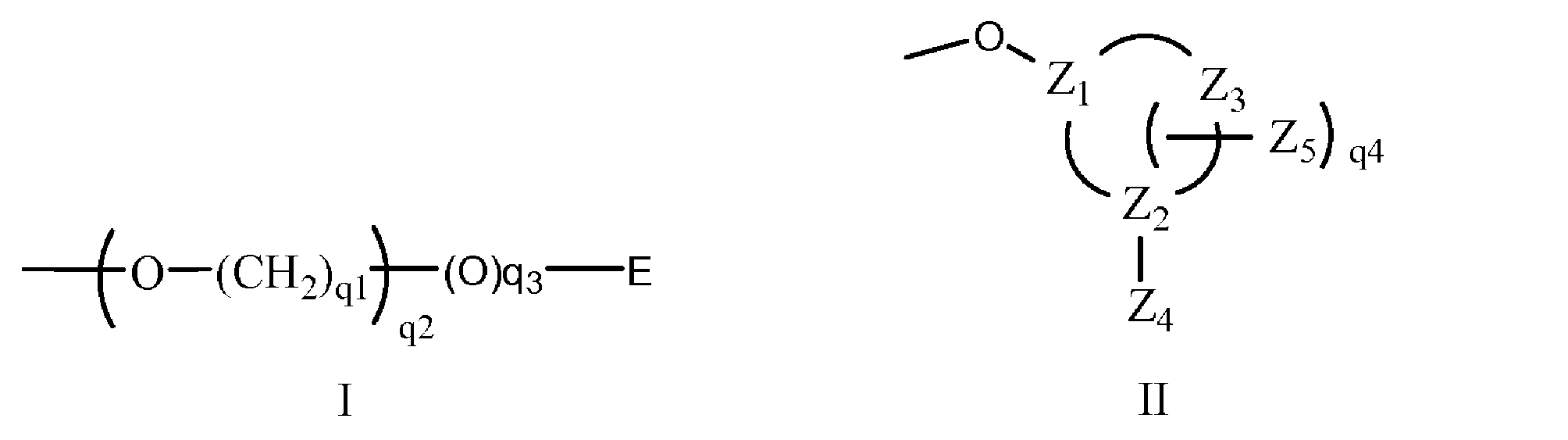
Eは、C1~C10アルキル、N(Q3)(Q4)、またはN=C(Q3)(Q4)であり;Q3およびQ4は、各々独立
に、H、C1~C10アルキル、ジアルキルアミノアルキル、窒素保護基、テザリングされたも
しくはテザリングされていない複合基、固体支持体へのリンカーであるか;またはQ3およ
びQ4は、ともに、窒素保護基、もしくはNおよびOより選択される少なくとも1個の付加的
なヘテロ原子を随意で含む環構造を形成し;
q1は、1~10の整数であり;
q2は、1~10の整数であり;
q3は、0または1であり;
q4は、0、1、または2であり;
Z1、Z2、およびZ3は、各々独立に、C4~C7シクロアルキル、C5~C14アリール、またはC3
~C15ヘテロシクリル(ここで、ヘテロシクリル基のヘテロ原子は、酸素、窒素、および
硫黄より選択される)であり;
Z4は、OM1、SM1、またはN(M1)2であり;M1は、各々独立に、H、C1~C8アルキル、C1~C8
ハロアルキル、C(=NH)N(H)M2、C(=O)N(H)M2、またはOC(=O)N(H)M2であり;M2は、Hまたは
C1~C8アルキルであり;かつ
Z5は、C1~C10アルキル、C1~C10ハロアルキル、C2~C10アルケニル、C2~C10アルキニル
、C6~C14アリール、N(Q3)(Q4)、OQ3、ハロ、SQ3、またはCNである。
Additional sugar substituents possible in the present invention include the 2'-SR group and the 2'- NR2 group [where R is
each independently hydrogen, a protecting group, or substituted or unsubstituted alkyl, alkenyl, or alkynyl. 2'-SR nucleosides are disclosed in US Pat. No. 5,670,633, which is incorporated herein by reference in its entirety. Incorporation of 2'-SR monomer synthons has been disclosed by Hamm et al. (J.Org.Chem., (1997) 62:3415-3420). 2'-NR nucleosides are described by Thomson JB, J.Org.Chem., (1996)61:6273-6281; and Polushin
et al., Tetrahedron Lett., (1996) 37:3227-3230. Additional representative 2'-substituents possible in the present invention include those having either formula I or II:
E is C 1 -C 10 alkyl, N(Q3)(Q4), or N=C(Q3)(Q4); Q3 and Q4 are each independently H, C 1 -C 10 alkyl, dialkyl is an aminoalkyl, a nitrogen protecting group, a tethered or untethered conjugate group, a linker to a solid support; or Q3 and Q4 are both a nitrogen protecting group, or at least one selected from N and O forming a ring structure optionally containing additional heteroatoms;
q1 is an integer from 1 to 10;
q2 is an integer from 1 to 10;
q3 is 0 or 1;
q4 is 0, 1, or 2;
Z1, Z2, and Z3 are each independently C 4 -C 7 cycloalkyl, C 5 -C 14 aryl, or C 3
~C 15 heterocyclyl, where the heteroatoms of the heterocyclyl group are selected from oxygen, nitrogen, and sulfur;
Z4 is OM1, SM1, or N(M1) 2 ; M1 is each independently H, C 1 -C 8 alkyl, C 1 -C 8
haloalkyl, C(=NH)N(H)M2, C(=O)N(H)M2, or OC(=O)N(H)M2; M2 is H or
is C 1 -C 8 alkyl; and
Z5 is C1 - C10 alkyl, C1 - C10 haloalkyl, C2 - C10 alkenyl, C2 - C10 alkynyl, C6 - C14 aryl, N(Q3)(Q4), OQ3, halo, SQ3 or CN.
式Iの代表的な2'-O-糖置換基は、参照によってその全体が本明細書に組み入れられる、
「Capped 2'-Oxyethoxy Oligonucleotides」という名称の米国特許第6,172,209号に開示
されている。式IIの代表的な環式2'-O-糖置換基は、参照によってその全体が本明細書に
組み入れられる、「RNA Targeted 2'-Modified Oligonucleotides that are Conformatio
nally Preorganized」という名称の米国特許第6,271,358号に開示されている。
Representative 2'-O-sugar substituents of Formula I are incorporated herein by reference in their entirety:
Disclosed in US Pat. No. 6,172,209 entitled "Capped 2'-Oxyethoxy Oligonucleotides." Representative cyclic 2'-O-sugar substituents of Formula II are described in "RNA Targeted 2'-Modified Oligonucleotides that are Conformatio
No. 6,271,358 entitled ``Nally Preorganized''.
リボシル環上にO-置換を有する糖も、本発明において可能である。環Oの代表的な置換
には、S、CH2、CHF、およびCF2が含まれるが、これらに限定されない。
Sugars with O-substitution on the ribosyl ring are also possible in the present invention. Representative substitutions for ring O include, but are not limited to, S, CH2 , CHF, and CF2 .
オリゴヌクレオチドは、ペントフラノシル糖の代わりに、シクロブチルモエティのよう
な糖模倣体を有していてもよい。そのような修飾された糖の調製に関する代表的な米国特
許には、全て、参照によって本明細書に組み入れられる、米国特許第5,359,044号、第5,4
66,786号、第5,519,134号、第5,591,722号、第5,597,909号、第5,646,265号、および第5,
700,920号が含まれるが、これらに限定されない。
The oligonucleotide may have a sugar mimetic, such as a cyclobutyl moiety, in place of the pentofuranosyl sugar. Representative U.S. patents relating to the preparation of such modified sugars include U.S. Pat. No. 5,359,044, 5,4
No. 66,786, No. 5,519,134, No. 5,591,722, No. 5,597,909, No. 5,646,265, and No. 5,
No. 700,920 is included, but not limited to.
オリゴヌクレオチド上の他の位置、具体的には、3'末端ヌクレオチド上の糖の3'位に、
付加的な修飾がなされてもよい。例えば、本発明のリガンド複合型オリゴヌクレオチドの
一つの付加的な修飾は、オリゴヌクレオチドの活性、細胞分布、または細胞取り込みを増
強する、1種または複数種の付加的な非リガンドモエティまたは複合物の、オリゴヌクレ
オチドへの化学的連結を含む。そのようなモエティには、コレステロールモエティ(Lets
inger et al.,Proc.Natl.Acad.Sci.USA,(1989)86:6553)、コール酸(Manoharan et al.,
Bioorg.Med.Chem.Lett.,(1994)4:1053)、チオエーテル、例えば、ヘキシル-S-トリチル
チオール(Manoharan et al.,Ann.N.Y.Acad.Sci.,(1992)660:306;Manoharan et al.,Bio
org.Med.Chem.Let.,(1993)3:2765)、チオコレステロール(Oberhauser et al.,Nucl.Aci
ds Res.,(1992)20:533)、脂肪族鎖、例えば、ドデカンジオール残基もしくはウンデシル
残基(Saison-Behmoaras et al.,EMBO J.,(1991)10:111;Kabanov et al.,FEBS Lett.,(1
990)259:327;Svinarchuk et al.,Biochimie,(1993)75:49)、リン脂質、例えば、ジ-ヘ
キサデシル-rac-グリセロールもしくはトリエチルアンモニウム1,2-ジ-O-ヘキサデシル-r
ac-グリセロ-3-H-ホスホネート(Manoharan et al.,Tetrahedron Lett.,(1995)36:3651;
Shea et al.,Nucl.Acids Res.,(1990)18:3777)、ポリアミン鎖もしくはポリエチレング
リコール鎖(Manoharan et al.,Nucleosides & Nucleotides,(1995)14:969)、またはア
ダマンタン酢酸(Manoharan et al.,Tetrahedron Lett.,(1995)36:3651)、パルミチルモ
エティ(Mishra et al.,Biochim.Biophys.Acta,(1995)1264:229)、またはオクタデシル
アミンもしくはヘキシルアミノ-カルボニル-オキシコレステロールモエティ(Crooke et
al.,J.Pharmacol.Exp.Ther.,(1996)277:923)のような脂質モエティが含まれるが、これ
らに限定されない。
At other positions on the oligonucleotide, specifically at the 3' position of the sugar on the 3' terminal nucleotide,
Additional modifications may be made. For example, one additional modification of the ligand-conjugated oligonucleotides of the invention includes one or more additional non-ligand moieties or conjugates that enhance the activity, cellular distribution, or cellular uptake of the oligonucleotide. to the oligonucleotide. Such moetis include cholesterol moetis (Lets
inger et al., Proc. Natl. Acad. Sci. USA, (1989) 86:6553), cholic acid (Manoharan et al.,
Bioorg.Med.Chem.Lett.,(1994)4:1053), thioethers such as hexyl-S-tritylthiol (Manoharan et al.,Ann.NYAcad.Sci.,(1992)660:306; Manoharan et al. .,Bio
org.Med.Chem.Let.,(1993)3:2765), thiocholesterol (Oberhauser et al.,Nucl.Aci
ds Res., (1992) 20:533), aliphatic chains, such as dodecanediol or undecyl residues (Saison-Behmoaras et al., EMBO J., (1991) 10:111; Kabanov et al., FEBS Lett.,(1
990)259:327; Svinarchuk et al., Biochimie, (1993)75:49), phospholipids such as di-hexadecyl-rac-glycerol or
ac-glycero-3-H-phosphonate (Manoharan et al., Tetrahedron Lett., (1995)36:3651;
Shea et al., Nucl. Acids Res., (1990)18:3777), polyamine or polyethylene glycol chains (Manoharan et al., Nucleosides & Nucleotides, (1995)14:969), or adamantane acetic acid (Manoharan et al. ., Tetrahedron Lett., (1995)36:3651), palmityl moiety (Mishra et al., Biochim. Biophys. Acta, (1995)1264:229), or octadecylamine or hexylamino-carbonyl-oxycholesterol moiety. Crooke et
al., J. Pharmacol. Exp. Ther., (1996) 277:923).
本発明には、オリゴヌクレオチド内の特定の位置に関して実質的にキラル的に純粋な(
chirally pure)オリゴヌクレオチドを利用した組成物も含まれる。実質的にキラル的に
純粋なオリゴヌクレオチドの例には、少なくとも75% SpまたはRpであるホスホロチオエ
ート結合を有するもの(Cookら、米国特許第5,587,361号)、ならびに実質的にキラル的
に純粋な(SpまたはRp)アルキルホスホネート結合、ホスホルアミデート結合、またはホ
スホトリエステル結合を有するもの(Cook、米国特許第5,212,295号および米国特許第5,5
21,302号)が含まれるが、これらに限定されない。
The present invention includes substantially chirally pure (
Also included are compositions utilizing chirally pure oligonucleotides. Examples of substantially chirally pure oligonucleotides include those with phosphorothioate linkages that are at least 75% Sp or Rp (Cook et al., U.S. Pat. No. 5,587,361), as well as those that are substantially chirally pure (Sp or Rp) with alkylphosphonate, phosphoramidate, or phosphotriester bonds (Cook, U.S. Pat. No. 5,212,295 and U.S. Pat. No. 5,5
21,302), including but not limited to.
ある種の場合、オリゴヌクレオチドは、非リガンド基によって修飾され得る。多数の非
リガンド分子が、オリゴヌクレオチドの活性、細胞分布、または細胞取り込みを増強する
ため、オリゴヌクレオチドに複合させられており、そのような複合を実施するための手法
は科学文献から入手可能である。そのような非リガンドモエティには、コレステロール(
Letsinger et al.,Proc.Natl.Acad.Sci.USA,(1989,86:6553)、コール酸(Manoharan et
al.,Bioorg.Med.Chem.Lett.,(1994,4:1053)、チオエーテル、例えば、ヘキシル-S-トリ
チルチオール(Manoharan et al.,Ann.N.Y.Acad.Sci.,(1992,660:306;Manoharan et al.
,Bioorg.Med.Chem.Let.,(1993,3:2765)、チオコレステロール(Oberhauser et al.,Nucl
.Acids Res.,(1992,20:533)、脂肪族鎖、例えば、ドデカンジオール残基もしくはウンデ
シル残基(Saison-Behmoaras et al.,EMBO J.,(1991)10:111;Kabanov et al.,FEBS Lett
.,(1990)259:327;Svinarchuk et al.,Biochimie,(1993)75:49)、リン脂質、例えば、ジ
-ヘキサデシル-rac-グリセロールもしくはトリエチルアンモニウム1,2-ジ-O-ヘキサデシ
ル-rac-グリセロ-3-H-ホスホネート(Manoharan et al.,Tetrahedron Lett.,(1995)36:36
51;Shea et al.,Nucl.Acids Res.,(1990)18:3777)、ポリアミン鎖もしくはポリエチレ
ングリコール鎖(Manoharan et al.,Nucleosides & Nucleotides,(1995)14:969)、また
はアダマンタン酢酸(Manoharan et al..Tetrahedron Lett.,(1995)36:3651)、パルミチ
ルモエティ(Mishra et al.,Biochim.Biophys.Acta,(1995)1264:229)、またはオクタデ
シルアミンモエティもしくはヘキシルアミノ-カルボニル-オキシコレステロールモエティ
(Crooke et al.,J.Pharmacol.Exp.Ther.,(1996)277:923)のような脂質モエティが含ま
れる。典型的な複合プロトコルは、配列の1個または複数個の位置にアミノリンカーを保
持するオリゴヌクレオチドの合成を含む。次いで、アミノ基は、適切なカップリング試薬
または活性化試薬を使用して複合させられる分子と反応させられる。複合反応は、固体支
持体へまだ結合しているオリゴヌクレオチドを用いて実施されてもよいし、または溶相で
オリゴヌクレオチドの切断の後に実施されてもよい。HPLCによるオリゴヌクレオチド複合
物の精製は、典型的には、純粋な複合物を与える。
In certain cases, oligonucleotides may be modified with non-ligand groups. Numerous non-ligand molecules have been conjugated to oligonucleotides to enhance their activity, cellular distribution, or cellular uptake, and techniques for performing such conjugations are available in the scientific literature. . Such unliganded moieties include cholesterol (
Letsinger et al., Proc. Natl. Acad. Sci. USA, (1989,86:6553), cholic acid (Manoharan et al.
al.,Bioorg.Med.Chem.Lett.,(1994,4:1053), thioethers, such as hexyl-S-tritylthiol, Manoharan et al.,Ann.NYAcad.Sci.,(1992,660:306; Manoharan et al.
,Bioorg.Med.Chem.Let.,(1993,3:2765), Thiocholesterol (Oberhauser et al.,Nucl
Acids Res., (1992, 20:533), aliphatic chains, such as dodecanediol or undecyl residues (Saison-Behmoaras et al., EMBO J., (1991) 10:111; Kabanov et al. ,FEBS Lett
., (1990) 259:327; Svinarchuk et al., Biochimie, (1993) 75:49), phospholipids, e.g.
-hexadecyl-rac-glycerol or
51; Shea et al., Nucl. Acids Res., (1990) 18:3777), polyamine chains or polyethylene glycol chains (Manoharan et al., Nucleosides & Nucleotides, (1995) 14:969), or adamantane acetic acid (Manoharan Tetrahedron Lett., (1995)36:3651), palmityl moiety (Mishra et al., Biochim. Biophys. Acta, (1995)1264:229), or octadecylamine moiety or hexylamino-carbonyl -Lipid moieties such as oxycholesterol moieties (Crooke et al., J. Pharmacol. Exp. Ther., (1996) 277:923). A typical conjugation protocol involves the synthesis of oligonucleotides bearing amino linkers at one or more positions of the sequence. The amino group is then reacted with the molecule to be conjugated using a suitable coupling or activating reagent. The conjugation reaction may be performed with the oligonucleotide still bound to the solid support, or it may be performed after cleavage of the oligonucleotide in solution phase. Purification of oligonucleotide conjugates by HPLC typically yields pure conjugates.
あるいは、複合させられる分子は、分子内に存在するアルコール基を介して、またはリ
ン酸化され得るアルコール基を保持するリンカーの付着によって、ホスホラミダイトのよ
うなビルディングブロックへ変換されてもよい。
Alternatively, the molecule to be conjugated may be converted into a building block such as a phosphoramidite via an alcohol group present within the molecule or by attachment of a linker carrying an alcohol group that can be phosphorylated.
重要なことに、これらのアプローチは、各々、リガンド複合型オリゴヌクレオチドの合
成のために使用され得る。アミノ結合型オリゴヌクレオチドは、カップリング試薬の使用
を介して、またはNHSもしくはペントフルオロフェノラートエステルとしてのリガンドの
活性化の後、リガンドと直接カップリングされ得る。リガンドホスホラミダイトは、カル
ボキシル基のうちの1個へのアミノヘキサノールリンカーの付着、それに続く、末端アル
コール官能性のホスフィチル化を介して合成され得る。システアミンのようなその他のリ
ンカーも、合成されたオリゴヌクレオチドに存在するクロロアセチルリンカーへの複合の
ために利用され得る。
Importantly, each of these approaches can be used for the synthesis of ligand-conjugated oligonucleotides. Amino-linked oligonucleotides can be coupled directly to the ligand through the use of coupling reagents or after activation of the ligand as an NHS or pentofluorophenolate ester. Ligand phosphoramidites can be synthesized via attachment of an aminohexanol linker to one of the carboxyl groups, followed by phosphitylation of the terminal alcohol functionality. Other linkers such as cysteamine may also be utilized for conjugation to the chloroacetyl linker present in the synthesized oligonucleotide.
当業者は、本発明の分子を細胞、組織、または生物へ導入する方法を、容易に承知して
いる。対応する例が、上記の本発明の詳細な説明にも提供された。例えば、本発明のdsRN
Aの少なくとも一方の鎖をコードする本発明の核酸分子またはベクターは、トランスフェ
クション等のような当技術分野において公知の方法によって、細胞または組織へ導入され
得る。
Those skilled in the art will readily know how to introduce molecules of the invention into cells, tissues, or organisms. Corresponding examples were also provided in the detailed description of the invention above. For example, the dsRN of the present invention
A nucleic acid molecule or vector of the invention encoding at least one chain of A can be introduced into cells or tissues by methods known in the art, such as transfection and the like.
dsRNA分子の導入についても、手段および方法が提供されている。例えば、ガラクトー
スおよび乳糖のようなリガンドを有するポリマー担体の使用、または様々な高分子への葉
酸の付着を含む、グリコシル化分子および葉酸修飾された分子による標的送達は、分子の
結合が葉酸受容体へ送達されることを可能にする。例えば、インビボでsiRNAを送達する
ためのRGD修飾ナノ粒子、または短鎖シクロデキストリン、アダマンチン-PEGを含む多成
分(非ウイルス)送達系を含む、抗体以外のペプチドおよびタンパク質による標的送達が
公知である。さらに、抗体、または抗体の(一価)Fab断片(またはそのような抗体のそ
の他の断片)を含む抗体断片、または単鎖抗体を使用した標的送達も構想される。標的指
向化送達のための注射アプローチには、とりわけ、水力学的i.v.注射が含まれる。親油性
基への複合が、細胞取り込みを増強し、オリゴヌクレオチドの薬物動態および組織体内分
布を改善する、dsRNAのコレステロール複合物が、標的送達のために使用され得る。正味
の正(カチオン性)の電荷を有する合成ベクターが、ポリアニオン性核酸との複合体形成
および負の電荷を有する細胞膜との相互作用を容易にする、カチオン性送達系も公知であ
る。そのようなカチオン性送達系には、カチオン性リポソーム送達系、カチオン性ポリマ
ー送達系、およびカチオン性ペプチド送達系も含まれる。dsRNA/siRNAの細胞取り込みの
ためのその他の送達系は、アプタマー-ds/siRNAである。遺伝子治療アプローチも、本発
明のdsRNA分子またはそれをコードする核酸分子を送達するために使用され得る。そのよ
うな系には、非病原性ウイルス、改変ウイルスベクターの使用、およびナノ粒子またはリ
ポソームによる送達が含まれる。dsRNAの細胞取り込みのためのその他の送達法は、細胞
、器官、または組織の、体外、例えば、エクスビボでの処理である。これらのテクノロジ
ーのいくつかは、Akhtar,Journal of Clinical Investigation(2007)117:3623-3632、Ngu
yen et al.,Current Opinion in Molecular Therapeutics(2008)10:158-167、Zamboni,Cl
in Cancer Res(2005)11:8230-8234、またはIkeda et al.,Pharmaceutical Researeh(2006
)23:1631-1640のような刊行物に記載され要約されている。
Means and methods are also provided for the introduction of dsRNA molecules. Targeted delivery by glycosylated and folic acid-modified molecules, including, for example, the use of polymeric carriers with ligands such as galactose and lactose, or the attachment of folic acid to various macromolecules, suggests that the binding of the molecule to the folate receptor. to be delivered to. Targeted delivery with peptides and proteins other than antibodies is known, including, for example, RGD-modified nanoparticles for delivering siRNA in vivo, or multicomponent (non-viral) delivery systems including short chain cyclodextrins, adamantine-PEG. . Additionally, targeted delivery using antibodies, or antibody fragments, including (monovalent) Fab fragments of antibodies (or other fragments of such antibodies), or single chain antibodies is also envisioned. Injection approaches for targeted delivery include hydrodynamic iv injection, among others. Cholesterol conjugation of dsRNA, where conjugation to lipophilic groups enhances cellular uptake and improves oligonucleotide pharmacokinetics and tissue distribution, can be used for targeted delivery. Cationic delivery systems are also known, in which synthetic vectors with a net positive (cationic) charge facilitate complex formation with polyanionic nucleic acids and interaction with negatively charged cell membranes. Such cationic delivery systems also include cationic liposome delivery systems, cationic polymer delivery systems, and cationic peptide delivery systems. Another delivery system for cellular uptake of dsRNA/siRNA is aptamer-ds/siRNA. Gene therapy approaches can also be used to deliver the dsRNA molecules of the invention or the nucleic acid molecules encoding them. Such systems include the use of non-pathogenic viruses, modified viral vectors, and delivery by nanoparticles or liposomes. Other delivery methods for cellular uptake of dsRNA are treatment of cells, organs, or tissues outside the body, eg, ex vivo. Some of these technologies are Akhtar, Journal of Clinical Investigation (2007) 117:3623-3632, Ngu
yen et al., Current Opinion in Molecular Therapeutics (2008) 10:158-167, Zamboni, Cl
in Cancer Res(2005)11:8230-8234, or Ikeda et al.,Pharmaceutical Researeh(2006
) 23:1631-1640.
他に定義されない限り、本明細書において使用される技術用語および科学用語は、全て
、本発明が属する技術分野の当業者によって一般的に理解されるのと同一の意味を有する
。本明細書に記載されたものに類似しているかまたは等価である方法および材料が、本発
明の実施または試行において使用され得るが、適当な方法および材料が以下に記載される
。全ての刊行物、特許出願、および特許が、参照によってその全体が組み入れられる。矛
盾する場合には、定義を含む本明細書が適用されるであろう。さらに、材料、方法、およ
び例は、例示的なものに過ぎず、限定するためのものではない。
Unless defined otherwise, all technical and scientific terms used herein have the same meaning as commonly understood by one of ordinary skill in the art to which this invention belongs. Although methods and materials similar or equivalent to those described herein can be used in the practice or testing of the present invention, suitable methods and materials are described below. All publications, patent applications, and patents are incorporated by reference in their entirety. In case of conflict, the present specification, including definitions, will control. Additionally, the materials, methods, and examples are illustrative only and not limiting.
本発明の上記の態様および項目を、以下の非限定的な実施例において例示する。 The above aspects and items of the invention are illustrated in the following non-limiting examples.
治療的使用のためのdsRNAの同定。治療的使用のためのB型肝炎ウイルス遺伝子型A、B、
C、およびDを特異的に標的とするdsRNAを同定するため、dsRNA設計を実施した。
Identification of dsRNA for therapeutic use. Hepatitis B virus genotypes A, B, for therapeutic use
In order to identify dsRNAs that specifically target C and D, dsRNA design was performed.
最初に、公知のB型肝炎ウイルスゲノム配列を、NCBI Genbankからダウンロードした(
表6に列挙されたアクセッション)。遺伝子型情報を、NCBI Genbankファイルから抽出す
るか、または参照ゲノムとのコンピューター支援比較によって決定した(表6に列挙され
たアクセッション)。
First, known hepatitis B virus genome sequences were downloaded from NCBI Genbank (
accessions listed in Table 6). Genotypic information was extracted from NCBI Genbank files or determined by computer-assisted comparison with reference genomes (accessions listed in Table 6).
RNAi剤の最適標的領域、即ち、全配列の少なくとも90%において同一である高度に保存
された17ヌクレオチド長配列ストレッチを同定するため、遺伝子型A~DのB型肝炎ウイル
スゲノム配列を、コンピューター分析によって調査した。
Computer analysis of hepatitis B virus genome sequences of genotypes A to D was performed to identify the optimal target region for RNAi agents, a highly conserved 17 nucleotide long sequence stretch that is identical in at least 90% of the total sequence. It was investigated by.
RNAi剤の同定において、専用アルゴリズムを使用することにより、包括的なヒトトラン
スクリプトームを表すと仮定されるヒトRefSeqデータベース(リリース41)内の配列に対
する少なくとも2個のミスマッチを有する17塩基長配列に、選択を限定した。
In identifying RNAi agents, we use a dedicated algorithm to identify 17 base long sequences with at least two mismatches to sequences in the human RefSeq database (Release 41), which is hypothesized to represent the comprehensive human transcriptome. , limited selection.
4個以上の連続G(ポリG配列)を含有している全ての17塩基長配列を、さらに、合成か
ら排除した。
All 17 base long sequences containing 4 or more consecutive G's (poly G sequences) were further excluded from the synthesis.
選択された17塩基長配列を2~18位に保有する19ヌクレオチド長の配列を確定した。
A 19 nucleotide long sequence containing the selected 17 nucleotide sequence at
これらの19塩基長配列は、遺伝子型A~DのB型肝炎ウイルスゲノム配列と交差反応性のR
NA干渉(RNAi)剤を与え、添付の表1および2の中のRNAi剤の合成の基礎を形成した。
These 19 base long sequences are cross-reactive with hepatitis B virus genome sequences of genotypes A to D.
NA interfering (RNAi) agents were provided and formed the basis for the synthesis of RNAi agents in attached Tables 1 and 2.
dsRNA合成。固相で、ホスホラミダイトテクノロジーによって、オリゴリボヌクレオチ
ドを合成した。規模に依って、ABI394合成装置(Applied Biosystems)またはAKTA oligo
pilot 100(GE Healthcare,Freiburg,Germany)のいずれかを使用した。制御された多孔
質ガラス(CPG、520Å、75μmol/gの負荷を有する、Prime Synthesis(Aston,PA,USA)か
ら入手)から作成された固体支持体において、合成を実施した。全ての2'-修飾型RNAホス
ホラミダイトおよび補助試薬を、SAFC(Hamburg,Germany)から購入した。具体的には、
以下の2'-O-メチルホスホラミダイトを使用した:(5'-O-ジメトキシトリチル-N6-(ベンゾ
イル)-2'-O-メチル-アデノシン-3'-O-(2-シアノエチル-N,N-ジイソプロピルアミノ)ホス
ホラミダイト、5'-O-ジメトキシトリチル-N4-(アセチル)-2'-O-メチル-シチジン-3'-O-(2
-シアノエチル-N,N-ジイソプロピルアミノ)ホスホラミダイト、(5'-O-ジメトキシ-トリチ
ル-N2-(イソブチリル)-2'-O-メチル-グアノシン-3'-O-(2-シアノエチル-N,N-ジイソプロ
ピルアミノ)ホスホラミダイト、および5'-O-ジメトキシ-トリチル-2'-O-メチル-ウリジン
-3'-O-(2-シアノエチル-N,N-ジイソプロピルアミノ)ホスホラミダイト。2'-デオキシ-2'
-フルオロ-ホスホラミダイトは、2'-O-メチルRNAアミダイトと同一の保護基を保持してい
た。全てのアミダイトを無水アセトニトリル(100mM)に溶解させ、モレキュラーシーブ
(3Å)を添加した。5'-ホスフェートを生成するため、Glen Research(Sterling,Virgin
ia,USA)からの2-[2-(4,4'-ジメトキシトリチルオキシ)エチルスルホニル]エチル-(2-シ
アノエチル)-(N,N-ジイソプロピル)-ホスホラミダイトを使用した。オリゴマーの5'末にC
-6アミノリンカーを導入するため、Thermo Fisher Scientific(Milwaukee,Wisconsin,US
A)からの6-(トリフルオロアセチルアミノ)-ヘキシル-(2-シアノエチル)-(N,N-ジイソプ
ロピル)-ホスホラミダイトを利用した。5'-修飾は合成サイクルの修飾なしに導入された
。5-エチルチオテトラゾール(ETT、アセトニトリル中500mM)を活性化溶液として使用し
た。カップリング時間は、6分であった。ホスホロチオエート結合を導入するため、無水
アセトニトリル/ピリジン(1:1 v/v)における3-((ジメチルアミノ-メチリデン)アミノ)
-3H-1,2,4-ジチアゾール-3-チオン(DDTT、AM Chemicals(Oceanside,CA,USA)から入手
)の50mM溶液を利用した。
dsRNA synthesis. Oligoribonucleotides were synthesized by phosphoramidite technology on solid phase. Depending on scale, ABI394 synthesizer (Applied Biosystems) or AKTA oligo
pilot 100 (GE Healthcare, Freiburg, Germany) was used. Synthesis was carried out on a solid support made from controlled porosity glass (CPG, 520 Å, with a loading of 75 μmol/g, obtained from Prime Synthesis (Aston, PA, USA)). All 2'-modified RNA phosphoramidites and auxiliary reagents were purchased from SAFC (Hamburg, Germany). in particular,
The following 2'-O-methylphosphoramidite was used: (5'-O-dimethoxytrityl- N6- (benzoyl)-2'-O-methyl-adenosine-3'-O-(2-cyanoethyl- N,N-diisopropylamino)phosphoramidite, 5'-O-dimethoxytrityl- N4- (acetyl)-2'-O-methyl-cytidine-3'-O-(2
-cyanoethyl-N,N-diisopropylamino)phosphoramidite, (5'-O-dimethoxy-trityl-N 2 -(isobutyryl)-2'-O-methyl-guanosine-3'-O-(2-cyanoethyl-N, N-diisopropylamino)phosphoramidite, and 5'-O-dimethoxy-trityl-2'-O-methyl-uridine
-3'-O-(2-cyanoethyl-N,N-diisopropylamino)phosphoramidite. 2'-deoxy-2'
The -fluoro-phosphoramidite retained the same protecting groups as the 2'-O-methyl RNA amidite. All amidites were dissolved in anhydrous acetonitrile (100 mM) and molecular sieves (3 Å) were added. To produce 5'-phosphate, Glen Research (Sterling, Virgin
ia, USA) was used. C at the 5' end of the oligomer
Thermo Fisher Scientific (Milwaukee, Wisconsin, US) was used to introduce the -6 amino linker.
The 6-(trifluoroacetylamino)-hexyl-(2-cyanoethyl)-(N,N-diisopropyl)-phosphoramidite from A) was utilized. The 5'-modification was introduced without modification of the synthetic cycle. 5-Ethylthiotetrazole (ETT, 500mM in acetonitrile) was used as the activation solution. Coupling time was 6 minutes. 3-((dimethylamino-methylidene)amino) in anhydrous acetonitrile/pyridine (1:1 v/v) to introduce a phosphorothioate bond.
A 50 mM solution of -3H-1,2,4-dithiazole-3-thione (DDTT, obtained from AM Chemicals (Oceanside, CA, USA)) was utilized.
支持体に結合したオリゴマーの切断および脱保護。固相合成の完了後、支持体からオリ
ゴヌクレオチドを切断することなく、ACN中の20%ジエチルアミンによる30分間の処理に
よって、シアノエチル保護基を除去した。続いて、乾燥した固体支持体を、15mLチューブ
へ移し、40℃で18時間、濃アンモニア水(Aldrich)により処理した。遠心分離の後、上
清を新たなチューブへ移し、CPGをアンモニア水により洗浄した。合わせた溶液を蒸発さ
せ、固体残さを緩衝液A(下記参照)で再構成した。
Cleavage and deprotection of support-bound oligomers. After completion of the solid phase synthesis, the cyanoethyl protecting group was removed by treatment with 20% diethylamine in ACN for 30 minutes without cleaving the oligonucleotide from the support. The dried solid support was then transferred to a 15 mL tube and treated with concentrated aqueous ammonia (Aldrich) for 18 hours at 40°C. After centrifugation, the supernatant was transferred to a new tube, and the CPG was washed with aqueous ammonia. The combined solution was evaporated and the solid residue was reconstituted with Buffer A (see below).
オリゴリボヌクレオチドの精製。Source Q15(GE Helthcare)が充填されたカラムおよ
びAKTA Explorer系(GE Helthcare)を使用した陰イオン交換HPLCによって、粗オリゴマ
ーを精製した。緩衝液Aは、10mM過塩素酸ナトリウム、20mMトリス、1mM EDTA(pH7.4)(
Fluka,Buchs,Switzerland)であり、20%アセトニトリルを含有しており、緩衝液Bは、50
0mM過塩素酸ナトリウムを除き、緩衝液Aと同一であった。32カラム体積(CV)での22%B
から42%Bへの勾配を利用した。280nmにおけるUVトレースを記録し、適切な画分をプール
し、3M NaOAc、pH=5.2および70%エタノールにより沈降させた。最後に、ペレットを70
%エタノールにより洗浄した。あるいは、製造業者の推奨に従い、Sephadex HiTrapカラ
ム(GE Helthcare)を使用して、脱塩を実施した。
Purification of oligoribonucleotides. The crude oligomer was purified by anion exchange HPLC using a column packed with Source Q15 (GE Healthcare) and an AKTA Explorer system (GE Healthcare). Buffer A consisted of 10mM sodium perchlorate, 20mM Tris, 1mM EDTA (pH 7.4) (
Fluka, Buchs, Switzerland) containing 20% acetonitrile and buffer B containing 50%
Same as buffer A except 0mM sodium perchlorate. 22% B at 32 column volumes (CV)
A gradient from 42%B to 42%B was used. UV traces at 280 nm were recorded and appropriate fractions were pooled and precipitated with 3M NaOAc, pH=5.2 and 70% ethanol. Finally, add 70 pellets
% ethanol. Alternatively, desalting was performed using Sephadex HiTrap columns (GE Healthcare) according to the manufacturer's recommendations.
siRNAを生成するためのオリゴリボヌクレオチドのアニーリング。等モルのRNA溶液を合
わせることにより、相補鎖を混合した。混合物を凍結乾燥させ、所望の濃度を達成するた
めの適切な容量のアニーリング緩衝液(100mM NaCl、20mMリン酸ナトリウム、pH6.8)に
より再構成した。この溶液を80℃の水浴中に置き、3時間以内にRTに冷却した。
Annealing of oligoribonucleotides to generate siRNA. Complementary strands were mixed by combining equimolar RNA solutions. The mixture was lyophilized and reconstituted with the appropriate volume of annealing buffer (100mM NaCl, 20mM sodium phosphate, pH 6.8) to achieve the desired concentration. The solution was placed in an 80°C water bath and cooled to RT within 3 hours.
HBV mRNAを標的とするdsRNAのインビトロスクリーニング。psiCHECK(商標)-2ベクタ
ー(Promega)は、RNAi活性のモニタリングのための2種のレポーター遺伝子:ウミシイタ
ケルシフェラーゼ(hRluc)遺伝子の合成バージョンおよび合成ホタルルシフェラーゼ遺
伝子(hluc+)を含有している。ホタルルシフェラーゼ活性の測定は、被験dsRNAのRNAi活
性と無関係の変化の決定を可能にする。ウミシイタケルシフェラーゼおよびホタルルシフ
ェラーゼの活性を、Dual-Glo(登録商標)Luciferase Assay System(Promega)を使用し
て測定した。合成ウミシイタケルシフェラーゼ遺伝子の翻訳終止コドンおよびポリAテー
ルの3'に位置するマルチクローニング領域へクローニングした後、関心対象のHBV標的部
位をpsiCHECK(商標)-2ベクターへ挿入した。細胞株COS-7をベクターによりトランスフ
ェクトし、続いて、HBV配列を標的とするdsRNA-リポフェクタミン2000リポプレックスに
より処理した。クローニングされたHBV標的部位に対してdsRNAによって付与されたRNAi効
果を、ウミシイタケルシフェラーゼ融合遺伝子の活性を測定することによって決定した。
In vitro screening of dsRNA targeting HBV mRNA. The psiCHECK™-2 vector (Promega) contains two reporter genes for monitoring RNAi activity: a synthetic version of the Renilla luciferase (hRluc) gene and a synthetic firefly luciferase gene (hluc+). Measuring firefly luciferase activity allows for the determination of changes independent of RNAi activity of the test dsRNA. Renilla and firefly luciferase activities were measured using the Dual-Glo® Luciferase Assay System (Promega). The HBV target site of interest was inserted into the psiCHECK™-2 vector after cloning into the multiple cloning region located 3' to the translation stop codon and polyA tail of the synthetic Renilla luciferase gene. Cell line COS-7 was transfected with the vector and subsequently treated with dsRNA-Lipofectamine 2000 lipoplex targeting HBV sequences. The RNAi effect conferred by dsRNA on the cloned HBV target site was determined by measuring the activity of the Renilla luciferase fusion gene.
標的配列を含有しているpsiCHECKベクターの生成。HBV dsRNAの活性を試験するため、D
ual-Luciferase HBVレポーターを構築した。B型肝炎ウイルスゲノム配列アクセッション
番号EU554538.1(遺伝子型C)の領域84~805、1075~1992、2165~2530、および2718~29
40を、インシリコで接合した。2個の変異を故意に挿入した(128A→T、598T→C、EU55453
8.1に対する位置)。1個は内部XhoI部位を除去するために必要であった。第二の変異は、
dsRNAに対する単一のミスマッチの除去をもたらした。このHBV標的構築物を、5'末および
3'末の両方に制限部位を付加することにより延長した。人工DNA配列を、Geneart(Regens
burg,Germany)によって化学合成し、psiCHECK(商標)-2 Dual-LuciferaseベクターのXh
oI/NotI部位へクローニングした。
Generation of psiCHECK vector containing target sequence. To test the activity of HBV dsRNA, D
We constructed a ual-Luciferase HBV reporter. Regions 84-805, 1075-1992, 2165-2530, and 2718-29 of hepatitis B virus genome sequence accession number EU554538.1 (genotype C)
40 were conjugated in silico. Two mutations were intentionally inserted (128A→T, 598T→C, EU55453
8.1). One was needed to remove the internal XhoI site. The second mutation is
resulted in the removal of a single mismatch to dsRNA. This HBV targeting construct was
It was extended by adding restriction sites at both 3' ends. Geneart (Regens)
Xh of the psiCHECK™-2 Dual-Luciferase vector was chemically synthesized by
Cloned into oI/NotI site.
トランスフェクションおよびルシフェラーゼ定量化。Cos-7細胞(DSMZ,Braunschweig,G
ermany,cat.No.ACC-60)を2.25×10⁴細胞/ウェルの密度で96穴プレートに播種した。プラ
スミドトランスフェクションを、製造業者によって記載されたように、0.5μL/ウェルの
リポフェクタミン2000(Invitrogen GmbH,Karlsruhe,Germany,cat.No.11668-019)により
、50ng/ウェルの濃度で実施した。ベクタートランスフェクションの4時間後、培地を廃棄
し、新鮮な培地を添加した。この期間の後の、上記のようにリポフェクタミン2000を使用
して、dsRNAを10nMまたは1nMの濃度で細胞に添加した。HBV遺伝子型被覆を最適化し、dsR
NAに対する耐性の発生を最小化するため、2種の異なるdsRNAを組み合わせて同時に使用す
ることができる。そのようなアプローチの実現可能性を証明するため、最適化された遺伝
子型被覆への付加的なバイアスをかけながら、最も効率的なdsRNAの中から2種の異なるds
RNAの対を選択した。
Transfection and luciferase quantification. Cos-7 cells (DSMZ, Braunschweig, G
ermany, cat. No. ACC-60) were seeded in a 96-well plate at a density of 2.25×10 4 cells/well. Plasmid transfections were performed with 0.5 μL/well of Lipofectamine 2000 (Invitrogen GmbH, Karlsruhe, Germany, cat. No. 11668-019) at a concentration of 50 ng/well as described by the manufacturer. Four hours after vector transfection, the medium was discarded and fresh medium was added. After this period, dsRNA was added to the cells at a concentration of 10 nM or 1 nM using Lipofectamine 2000 as described above. Optimize HBV genotype coverage and dsR
To minimize the development of resistance to NA, two different dsRNAs can be combined and used simultaneously. To prove the feasibility of such an approach, we analyzed two different dsRNAs from among the most efficient dsRNAs, with an additional bias to the optimized genotype coverage.
Pairs of RNA were selected.
上記のようにリポフェクタミン2000を使用して、dsRNAを各dsRNAについて5nMまたは0.5
nMの濃度で細胞へ添加し、10nMまたは1nMの全dsRNA濃度とした。製造業者によって記載
されたようにルシフェラーゼ試薬を使用して、48時間後に細胞を溶解した。トランスフェ
クション効率を考慮するため、ウミシイタケルシフェラーゼタンパク質レベルを、ホタル
ルシフェラーゼレベルに対してノーマライズした。各dsRNAについて、四つの個々のデー
タポイントを収集した。dsRNAにより処理された細胞における相対ウミシイタケルシフェ
ラーゼタンパク質レベルを決定するため、全ての標的部位と無関係な少なくとも1種のdsR
NAを対照として使用した(表8)。完全マッチ条件下でのサイレンシング活性の比較のた
め、ウミシイタケオープンリーディングフレームとの完全マッチを有するdsRNAを合成し
、HBV dsRNAと平行して試験した。
Using Lipofectamine 2000 as above, add dsRNA to 5nM or 0.5nM for each dsRNA.
It was added to cells at a concentration of nM, resulting in a total dsRNA concentration of 10 nM or 1 nM. Cells were lysed after 48 hours using luciferase reagent as described by the manufacturer. Renilla luciferase protein levels were normalized to firefly luciferase levels to account for transfection efficiency. Four individual data points were collected for each dsRNA. At least one dsR independent of all target sites to determine relative Renilla luciferase protein levels in cells treated with dsRNA.
NA was used as a control (Table 8). For comparison of silencing activity under perfect match conditions, dsRNA with a perfect match to Renilla open reading frame was synthesized and tested in parallel with HBV dsRNA.
阻害データは、添付の表2に与えられる。 Inhibition data is given in attached Table 2.
dsRNAの安定性。ヒト、カニクイザル、またはマウスの血清のいずれかを用いたインビ
トロアッセイにおいて、各一本鎖の半減期を測定することにより、ヒトB型肝炎ウイルス
を標的とするdsRNAの安定性を決定した。
Stability of dsRNA. The stability of dsRNA targeting human hepatitis B virus was determined by measuring the half-life of each single strand in in vitro assays using either human, cynomolgus monkey, or mouse serum.
30μLのヒト血清(Sigma)、カニクイザル血清(Sigma)、またはマウス血清(Sigma)
と混合された3μLの50μM dsRNA試料を使用して、各時点について三つ組で、測定を実施
した。混合物を、37℃で、0分、30分、1時間、3時間、6時間、24時間、または48時間、イ
ンキュベートした。非特異的分解の対照として、dsRNAを30μLの1×PBS、pH6.8と共に48
時間インキュベートした。4μLのプロテイナーゼK(20mg/ml)、25μLの「Tissue and Ce
ll Lysis Solution」(Epicentre)、および38μLのMillipore水を、65℃で30分間、添加
することによって、反応を中止した。その後、試料を0.2μm96穴フィルタープレートで14
00rpmで8分間スピンろ過し、55μL Millipore水により2回洗浄し、再びスピンろ過した。
30 μL of human serum (Sigma), cynomolgus monkey serum (Sigma), or mouse serum (Sigma)
Measurements were performed in triplicate for each time point using 3 μL of 50 μM dsRNA sample mixed with The mixture was incubated at 37°C for 0 minutes, 30 minutes, 1 hour, 3 hours, 6 hours, 24 hours, or 48 hours. As a control for non-specific degradation, dsRNA was incubated with 30 μL of 1x PBS, pH 6.8 at 48
Incubated for hours. 4 μL of proteinase K (20 mg/ml), 25 μL of “Tissue and Ce”
The reaction was stopped by adding ``Lysis Solution'' (Epicentre) and 38 μL of Millipore water at 65° C. for 30 minutes. The sample was then filtered into a 0.2 μm 96-well filter plate for 14 days.
Spin filtered at 00 rpm for 8 minutes, washed twice with 55 μL Millipore water, and spin filtered again.
一本鎖の分離および残存全長産物(FLP)の分析のため、10%ACN、pH=11中の20mM Na3
PO4を溶出液Aとして使用し、溶出液A中の1M NaBrを溶出液Bとして使用した変性条件下で
、イオン交換Dionex Summit HPLCで、試料を実行した。
20mM Na3 in 10% ACN, pH=11 for single-strand separation and remaining full-length product (FLP) analysis.
Samples were run on an ion exchange Dionex Summit HPLC under denaturing conditions using PO 4 as eluent A and 1 M NaBr in eluent A as eluent B.
以下の勾配を適用した。

全てのインジェクションについて、クロマトグラムを、Dionex Chromeleon 6.60 HPLC
ソフトウェアによって自動的に積分し、必要であれば手動で調整した。全ピーク面積を内
部標準(IS)ピークに対して補正し、t=0分におけるインキュベーションに対してノーマ
ライズした。ピーク下面積および得られた残存FLPを、各一本鎖について別々に三つ組で
計算した。FLPの半分が分解された時点(時間)の三つ組の平均値によって、鎖の半減期
(t1/2)を確定した。結果は添付の表3に与えられる。
For all injections, chromatograms were generated using Dionex Chromeleon 6.60 HPLC.
It was integrated automatically by the software and adjusted manually if necessary. Total peak areas were corrected to the internal standard (IS) peak and normalized to incubation at t=0 min. The area under the peak and the resulting residual FLP were calculated separately in triplicate for each single strand. The half-life of the strand (t1/2) was determined by the average of triplicates of the time point (time) at which half of the FLP was degraded. The results are given in attached Table 3.
全てのインジェクションについて、クロマトグラムを、Dionex Chromeleon 6.60 HPLCソフトウェアによって自動的に積分し、必要であれば手動で調整した。全ピーク面積を内部標準(IS)ピークに対して補正し、t=0分におけるインキュベーションに対してノーマライズした。ピーク下面積および得られた残存FLPを、各一本鎖について別々に三つ組で計算した。FLPの半分が分解された時点(時間)の三つ組の平均値によって、鎖の半減期(t1/2)を確定した。結果は添付の表3に与えられる。
以下に、本願の当初の特許請求の範囲に記載の発明を列挙する。
[発明1]
インビトロでB型肝炎ウイルス遺伝子の発現を少なくとも60%、好ましくは少なくとも70%、最も好ましくは少なくとも80%阻害することができる二本鎖リボ核酸分子であって、二本鎖リボ核酸分子が、センス鎖およびアンチセンス鎖を含み、アンチセンス鎖が、センス鎖に少なくとも部分的に相補的であり、センス鎖が、B型肝炎ウイルスの複製または病原性のために必要なタンパク質をコードするプレゲノムRNAおよび/またはmRNAの少なくとも一部分と少なくとも90%の同一性を有する配列を含み、該配列が、(i)アンチセンス鎖に相補的なセンス鎖の領域に位置し、かつ(ii)30ヌクレオチド長未満である、二本鎖リボ核酸分子。
[発明2]
B型肝炎ウイルスの複製または病原性のために必要なタンパク質をコードするプレゲノムRNAおよび/またはmRNAの前記一部分が、遺伝子型A、B、C、およびDのB型肝炎ウイルスゲノム配列間のコンセンサス配列を有する、発明1記載の二本鎖リボ核酸分子。
[発明3]
B型肝炎ウイルスの複製または病原性のために必要なタンパク質が、コアタンパク質、ウイルスポリメラーゼ、表面抗原、e抗原、およびXタンパク質からなる群より選択される、発明2記載の二本鎖リボ核酸分子。
[発明4]
アンチセンス鎖が1~5ヌクレオチド長の3'突出部をさらに含む、発明3記載の二本鎖リボ核酸分子。
[発明5]
アンチセンス鎖の前記突出部が、ウラシル、またはB型肝炎ウイルスの複製もしくは病原性のために必要なタンパク質をコードする前記プレゲノムRNAおよび/もしくは前記mRNAに相補的なヌクレオチドを含む、発明4記載の二本鎖リボ核酸分子。
[発明6]
センス鎖が1~5ヌクレオチド長の3'突出部をさらに含む、発明3記載の二本鎖リボ核酸分子。
[発明7]
センス鎖の前記突出部が、ウラシル、またはB型肝炎ウイルスの複製もしくは病原性のために必要なタンパク質をコードする前記プレゲノムRNAおよび/もしくは前記mRNAと同一のヌクレオチドを含む、発明6記載の二本鎖リボ核酸分子。
[発明8]
(a)センス鎖が、SEQ ID NO:1、2、3、4、5、6、7、または26のヌクレオチド1~19を順番通りに含み;
(b)アンチセンス鎖が、SEQ ID NO:157、158、160、161、162、163、164、または186のヌクレオチド1~19を順番通りに含み;かつ
(c)二本鎖リボ核酸分子が、SEQ ID NO:1/157、2/158、3/160、4/161、5/162、6/163、7/164、および26/186からなる群より選択される配列対を含む、
発明3記載の二本鎖リボ核酸分子。
[発明9]
2'-O-メチル修飾ヌクレオチド、5'-ホスホロチオエート基を含むヌクレオチド、コレステリル誘導体と連結された末端ヌクレオチド、ドデカン酸ビスデシルアミド基と連結された末端ヌクレオチド、2'-デオキシ-2'-フルオロ修飾ヌクレオチド、2'-デオキシ修飾ヌクレオチド、ロックドヌクレオチド、脱塩基ヌクレオチド、デオキシチミジン、逆向き(inverted)デオキシチミジン、2'-アミノ修飾ヌクレオチド、2'-アルキル修飾ヌクレオチド、モルホリノヌクレオチド、ホスホルアミデート、および非天然塩基を含むヌクレオチドからなる群より選択される修飾ヌクレオチドを少なくとも1つ含む、発明3記載の二本鎖リボ核酸分子。
[発明10]
2'-O-メチル修飾ヌクレオチド、5'-ホスホロチオエート基を含むヌクレオチド、およびデオキシチミジンを含有している、発明9記載の二本鎖リボ核酸分子。
[発明11]
センス鎖またはアンチセンス鎖がデオキシチミジン1~2個の突出部を含む、発明10記載の二本鎖リボ核酸分子。
[発明12]
SEQ ID NO:321/485、322/486、324/488、325/489、326/490、327/491、328/492、および350/514からなる群より選択される配列対を含む、発明11記載の二本鎖リボ核酸分子。
[発明13]
センス鎖またはアンチセンス鎖をコードする核酸配列を含む、発明3記載の二本鎖リボ核酸分子。
[発明14]
(a)発明3において定義される少なくとも1種の二本鎖リボ核酸分子;
(b)発明3において定義される二本鎖リボ核酸分子を構成するセンス鎖もしくはアンチセンス鎖をコードする少なくとも1種の核酸配列;または
(c)発明3において定義される少なくとも1種の二本鎖リボ核酸分子を含む細胞、組織、もしくは非ヒト生物
を含む薬学的組成物。
[発明15]
(a)各々が発明3において定義される第一および第二の二本鎖リボ核酸分子;
(b)各々が発明3において定義される第一および第二の二本鎖リボ核酸分子を構成するセンス鎖もしくはアンチセンス鎖をコードする少なくとも1種の核酸配列;または
(c)各々が発明3において定義される第一および第二の二本鎖リボ核酸分子を含む細胞、組織、もしくは非ヒト生物
を含む薬学的組成物。
[発明16]
第一および第二の二本鎖リボ核酸分子が互いに異なる、発明15記載の薬学的組成物。
[発明17]
第一および第二の二本鎖リボ核酸分子が、各々、B型肝炎ウイルスの複製または病原性のために必要なタンパク質をコードするプレゲノムRNAおよび/またはmRNAの異なる一部分と少なくとも90%の同一性を有する、発明16記載の薬学的組成物。
[発明18]
B型肝炎ウイルスの複製または病原性のために必要なタンパク質をコードするプレゲノムRNAおよび/またはmRNAの前記異なる一部分が、異なるタンパク質をコードする、発明17記載の薬学的組成物。
[発明19]
SEQ ID NO:322/486と333/497、322/486と346/510、322/486と330/494、および322/486と324/488からなる群より選択される、第一の二本鎖リボ核酸分子と第二の二本鎖リボ核酸分子との組み合わせを含む、発明18記載の薬学的組成物。
[発明20]
薬学的に許容される担体、安定剤、および/または希釈剤をさらに含む、発明14記載の薬学的組成物。
For all injections, chromatograms were automatically integrated by Dionex Chromeleon 6.60 HPLC software and adjusted manually if necessary. Total peak areas were corrected to the internal standard (IS) peak and normalized to incubation at t=0 min. The area under the peak and the resulting residual FLP were calculated separately in triplicate for each single strand. The half-life of the strand (t1/2) was determined by the average of triplicates of the time point (time) at which half of the FLP was degraded. The results are given in attached Table 3.
The inventions described in the original claims of this application are listed below.
[Invention 1]
A double-stranded ribonucleic acid molecule capable of inhibiting hepatitis B virus gene expression in vitro by at least 60%, preferably at least 70%, most preferably at least 80%, wherein the double-stranded ribonucleic acid molecule is strand and an antisense strand, the antisense strand being at least partially complementary to the sense strand, and the sense strand encoding a protein necessary for hepatitis B virus replication or pathogenesis; and/or a sequence having at least 90% identity with at least a portion of an mRNA, wherein the sequence (i) is located in a region of the sense strand that is complementary to the antisense strand, and (ii) is less than 30 nucleotides in length. A double-stranded ribonucleic acid molecule.
[Invention 2]
Said portion of the pregenomic RNA and/or mRNA encoding a protein necessary for the replication or pathogenesis of hepatitis B virus has a consensus sequence between the hepatitis B virus genome sequences of genotypes A, B, C, and D. The double-stranded ribonucleic acid molecule according to
[Invention 3]
The double-stranded ribonucleic acid molecule according to
[Invention 4]
The double-stranded ribonucleic acid molecule according to
[Invention 5]
According to
[Invention 6]
The double-stranded ribonucleic acid molecule according to
[Invention 7]
The two chains according to
[Invention 8]
(a) the sense strand comprises nucleotides 1-19 of SEQ ID NO: 1, 2, 3, 4, 5, 6, 7, or 26 in order;
(b) the antisense strand comprises nucleotides 1-19 of SEQ ID NO: 157, 158, 160, 161, 162, 163, 164, or 186 in order; and
(c) A group of double-stranded ribonucleic acid molecules consisting of SEQ ID NO: 1/157, 2/158, 3/160, 4/161, 5/162, 6/163, 7/164, and 26/186 comprising a pair of sequences selected from
The double-stranded ribonucleic acid molecule according to
[Invention 9]
2'-O-methyl modified nucleotides, nucleotides containing 5'-phosphorothioate groups, terminal nucleotides linked with cholesteryl derivatives, terminal nucleotides linked with dodecanoic acid bisdecylamide groups, 2'-deoxy-2'-fluoro modification Nucleotides, 2'-deoxy modified nucleotides, locked nucleotides, abasic nucleotides, deoxythymidine, inverted deoxythymidine, 2'-amino modified nucleotides, 2'-alkyl modified nucleotides, morpholino nucleotides, phosphoramidates, The double-stranded ribonucleic acid molecule according to
[Invention 10]
The double-stranded ribonucleic acid molecule according to
[Invention 11]
The double-stranded ribonucleic acid molecule according to
[Invention 12]
[Invention 13]
The double-stranded ribonucleic acid molecule according to
[Invention 14]
(a) at least one double-stranded ribonucleic acid molecule as defined in
(b) at least one nucleic acid sequence encoding the sense strand or antisense strand constituting the double-stranded ribonucleic acid molecule defined in
(c) A cell, tissue, or non-human organism containing at least one double-stranded ribonucleic acid molecule as defined in
A pharmaceutical composition comprising.
[Invention 15]
(a) first and second double-stranded ribonucleic acid molecules, each as defined in
(b) at least one nucleic acid sequence encoding a sense or antisense strand, each of which constitutes a first and second double-stranded ribonucleic acid molecule as defined in
(c) a cell, tissue or non-human organism, each comprising a first and second double-stranded ribonucleic acid molecule as defined in
A pharmaceutical composition comprising.
[Invention 16]
The pharmaceutical composition according to
[Invention 17]
the first and second double-stranded ribonucleic acid molecules are each at least 90% identical to a different portion of pregenomic RNA and/or mRNA that encodes a protein necessary for the replication or pathogenesis of hepatitis B virus; The pharmaceutical composition according to
[Invention 18]
Pharmaceutical composition according to
[Invention 19]
A first duplex selected from the group consisting of SEQ ID NO: 322/486 and 333/497, 322/486 and 346/510, 322/486 and 330/494, and 322/486 and 324/488. 19. A pharmaceutical composition according to
[Invention 20]
The pharmaceutical composition according to
Claims (20)
0%、最も好ましくは少なくとも80%阻害することができる二本鎖リボ核酸分子であって
、二本鎖リボ核酸分子が、センス鎖およびアンチセンス鎖を含み、アンチセンス鎖が、セ
ンス鎖に少なくとも部分的に相補的であり、センス鎖が、B型肝炎ウイルスの複製または
病原性のために必要なタンパク質をコードするプレゲノムRNAおよび/またはmRNAの少な
くとも一部分と少なくとも90%の同一性を有する配列を含み、該配列が、(i)アンチセ
ンス鎖に相補的なセンス鎖の領域に位置し、かつ(ii)30ヌクレオチド長未満である、二
本鎖リボ核酸分子。 Expression of hepatitis B virus genes in vitro by at least 60%, preferably at least 7
0%, most preferably at least 80%, wherein the double-stranded ribonucleic acid molecule comprises a sense strand and an antisense strand, the antisense strand being at least at least 80% inhibited by the sense strand. a sequence that is partially complementary and whose sense strand has at least 90% identity with at least a portion of pregenomic RNA and/or mRNA encoding a protein necessary for hepatitis B virus replication or pathogenesis; a double-stranded ribonucleic acid molecule comprising: (i) located in a region of the sense strand that is complementary to the antisense strand; and (ii) less than 30 nucleotides in length.
ムRNAおよび/またはmRNAの前記一部分が、遺伝子型A、B、C、およびDのB型肝炎ウイルス
ゲノム配列間のコンセンサス配列を有する、請求項1記載の二本鎖リボ核酸分子。 Said portion of the pregenomic RNA and/or mRNA encoding a protein necessary for the replication or pathogenesis of hepatitis B virus has a consensus sequence between the hepatitis B virus genome sequences of genotypes A, B, C, and D. 2. The double-stranded ribonucleic acid molecule according to claim 1, which has the following.
ウイルスポリメラーゼ、表面抗原、e抗原、およびXタンパク質からなる群より選択される
、請求項2記載の二本鎖リボ核酸分子。 The proteins required for the replication or pathogenesis of hepatitis B virus are the core protein,
3. The double-stranded ribonucleic acid molecule of claim 2, wherein the double-stranded ribonucleic acid molecule is selected from the group consisting of viral polymerase, surface antigen, e-antigen, and X protein.
リボ核酸分子。 4. The double-stranded ribonucleic acid molecule of claim 3, wherein the antisense strand further comprises a 3' overhang of 1 to 5 nucleotides in length.
原性のために必要なタンパク質をコードする前記プレゲノムRNAおよび/もしくは前記mRN
Aに相補的なヌクレオチドを含む、請求項4記載の二本鎖リボ核酸分子。 The overhang of the antisense strand encodes uracil, or the pregenomic RNA and/or the mRNA that encodes a protein necessary for the replication or pathogenesis of hepatitis B virus.
5. The double-stranded ribonucleic acid molecule of claim 4, comprising a nucleotide complementary to A.
酸分子。 4. The double-stranded ribonucleic acid molecule of claim 3, wherein the sense strand further comprises a 3' overhang of 1 to 5 nucleotides in length.
ために必要なタンパク質をコードする前記プレゲノムRNAおよび/もしくは前記mRNAと同
一のヌクレオチドを含む、請求項6記載の二本鎖リボ核酸分子。 7. The double according to claim 6, wherein the overhang of the sense strand comprises uracil or the same nucleotides as the pregenomic RNA and/or the mRNA encoding a protein necessary for the replication or pathogenesis of hepatitis B virus. Single-stranded ribonucleic acid molecule.
順番通りに含み;
(b)アンチセンス鎖が、SEQ ID NO:157、158、160、161、162、163、164、または186
のヌクレオチド1~19を順番通りに含み;かつ
(c)二本鎖リボ核酸分子が、SEQ ID NO:1/157、2/158、3/160、4/161、5/162、6/163
、7/164、および26/186からなる群より選択される配列対を含む、
請求項3記載の二本鎖リボ核酸分子。 (a) the sense strand comprises nucleotides 1-19 of SEQ ID NO: 1, 2, 3, 4, 5, 6, 7, or 26 in order;
(b) the antisense strand is SEQ ID NO: 157, 158, 160, 161, 162, 163, 164, or 186
in order; and (c) the double-stranded ribonucleic acid molecule comprises SEQ ID NO: 1/157, 2/158, 3/160, 4/161, 5/162, 6/163
, 7/164, and 26/186,
4. The double-stranded ribonucleic acid molecule according to claim 3.
テリル誘導体と連結された末端ヌクレオチド、ドデカン酸ビスデシルアミド基と連結され
た末端ヌクレオチド、2'-デオキシ-2'-フルオロ修飾ヌクレオチド、2'-デオキシ修飾ヌク
レオチド、ロックドヌクレオチド、脱塩基ヌクレオチド、デオキシチミジン、逆向き(in
verted)デオキシチミジン、2'-アミノ修飾ヌクレオチド、2'-アルキル修飾ヌクレオチド
、モルホリノヌクレオチド、ホスホルアミデート、および非天然塩基を含むヌクレオチド
からなる群より選択される修飾ヌクレオチドを少なくとも1つ含む、請求項3記載の二本鎖
リボ核酸分子。 2'-O-methyl modified nucleotides, nucleotides containing 5'-phosphorothioate groups, terminal nucleotides linked with cholesteryl derivatives, terminal nucleotides linked with dodecanoic acid bisdecylamide groups, 2'-deoxy-2'-fluoro modification nucleotide, 2'-deoxy modified nucleotide, locked nucleotide, abasic nucleotide, deoxythymidine, inverted (in
modified nucleotides selected from the group consisting of deoxythymidine, 2'-amino modified nucleotides, 2'-alkyl modified nucleotides, morpholino nucleotides, phosphoramidates, and nucleotides containing non-natural bases. The double-stranded ribonucleic acid molecule according to item 3.
デオキシチミジンを含有している、請求項9記載の二本鎖リボ核酸分子。 10. The double-stranded ribonucleic acid molecule of claim 9, containing a 2'-O-methyl modified nucleotide, a nucleotide containing a 5'-phosphorothioate group, and deoxythymidine.
載の二本鎖リボ核酸分子。 11. The double-stranded ribonucleic acid molecule of claim 10, wherein the sense strand or antisense strand comprises an overhang of 1 to 2 deoxythymidines.
び350/514からなる群より選択される配列対を含む、請求項11記載の二本鎖リボ核酸分子
。 A claim comprising a sequence pair selected from the group consisting of SEQ ID NO: 321/485, 322/486, 324/488, 325/489, 326/490, 327/491, 328/492, and 350/514. 12. The double-stranded ribonucleic acid molecule according to 11.
ボ核酸分子。 4. The double-stranded ribonucleic acid molecule of claim 3, comprising a nucleic acid sequence encoding a sense strand or an antisense strand.
(b)請求項3において定義される二本鎖リボ核酸分子を構成するセンス鎖もしくはアン
チセンス鎖をコードする少なくとも1種の核酸配列;または
(c)請求項3において定義される少なくとも1種の二本鎖リボ核酸分子を含む細胞、組
織、もしくは非ヒト生物
を含む薬学的組成物。 (a) at least one double-stranded ribonucleic acid molecule as defined in claim 3;
(b) at least one nucleic acid sequence encoding a sense or antisense strand constituting a double-stranded ribonucleic acid molecule as defined in claim 3; or (c) at least one nucleic acid sequence as defined in claim 3. A pharmaceutical composition comprising a cell, tissue, or non-human organism comprising a double-stranded ribonucleic acid molecule.
(b)各々が請求項3において定義される第一および第二の二本鎖リボ核酸分子を構成す
るセンス鎖もしくはアンチセンス鎖をコードする少なくとも1種の核酸配列;または
(c)各々が請求項3において定義される第一および第二の二本鎖リボ核酸分子を含む細
胞、組織、もしくは非ヒト生物
を含む薬学的組成物。 (a) first and second double-stranded ribonucleic acid molecules, each as defined in claim 3;
(b) at least one nucleic acid sequence encoding a sense or antisense strand, each of which constitutes a first and second double-stranded ribonucleic acid molecule as defined in claim 3; or (c) each of which is claimed. A pharmaceutical composition comprising a cell, tissue, or non-human organism comprising first and second double-stranded ribonucleic acid molecules as defined in Section 3.
のために必要なタンパク質をコードするプレゲノムRNAおよび/またはmRNAの異なる一部
分と少なくとも90%の同一性を有する、請求項16記載の薬学的組成物。 the first and second double-stranded ribonucleic acid molecules are each at least 90% identical to a different portion of pregenomic RNA and/or mRNA that encodes a protein necessary for the replication or pathogenesis of hepatitis B virus; 17. The pharmaceutical composition according to claim 16, comprising:
ムRNAおよび/またはmRNAの前記異なる一部分が、異なるタンパク質をコードする、請求
項17記載の薬学的組成物。 18. The pharmaceutical composition according to claim 17, wherein said different portions of pregenomic RNA and/or mRNA encoding proteins necessary for the replication or pathogenesis of hepatitis B virus encode different proteins.
と324/488からなる群より選択される、第一の二本鎖リボ核酸分子と第二の二本鎖リボ核
酸分子との組み合わせを含む、請求項18記載の薬学的組成物。 SEQ ID NO:322/486 and 333/497, 322/486 and 346/510, 322/486 and 330/494, and 322/486
19. The pharmaceutical composition of claim 18, comprising a combination of a first double-stranded ribonucleic acid molecule and a second double-stranded ribonucleic acid molecule selected from the group consisting of: and 324/488.
の薬学的組成物。 15. The pharmaceutical composition of claim 14, further comprising a pharmaceutically acceptable carrier, stabilizer, and/or diluent.
Applications Claiming Priority (6)
| Application Number | Priority Date | Filing Date | Title |
|---|---|---|---|
| EP11172235 | 2011-06-30 | ||
| EP11172235.1 | 2011-06-30 | ||
| US13/535,454 | 2012-06-28 | ||
| US13/535,454 US8809293B2 (en) | 2011-06-30 | 2012-06-28 | Compositions and methods for inhibiting gene expression of hepatitis B virus |
| JP2019078663A JP6959293B2 (en) | 2011-06-30 | 2019-04-17 | Compositions and Methods for Inhibiting Hepatitis B Virus Gene Expression |
| JP2021130741A JP2021191274A (en) | 2011-06-30 | 2021-08-10 | Compositions and Methods for Inhibiting Hepatitis B Virus Gene Expression |
Related Parent Applications (1)
| Application Number | Title | Priority Date | Filing Date |
|---|---|---|---|
| JP2021130741A Division JP2021191274A (en) | 2011-06-30 | 2021-08-10 | Compositions and Methods for Inhibiting Hepatitis B Virus Gene Expression |
Publications (1)
| Publication Number | Publication Date |
|---|---|
| JP2023179497A true JP2023179497A (en) | 2023-12-19 |
Family
ID=47391267
Family Applications (5)
| Application Number | Title | Priority Date | Filing Date |
|---|---|---|---|
| JP2014518986A Active JP6165723B2 (en) | 2011-06-30 | 2012-06-28 | Compositions and methods for inhibiting gene expression of hepatitis B virus |
| JP2017073870A Withdrawn JP2017169568A (en) | 2011-06-30 | 2017-04-03 | Composition and method for inhibiting gene expression of hepatitis B virus |
| JP2019078663A Active JP6959293B2 (en) | 2011-06-30 | 2019-04-17 | Compositions and Methods for Inhibiting Hepatitis B Virus Gene Expression |
| JP2021130741A Pending JP2021191274A (en) | 2011-06-30 | 2021-08-10 | Compositions and Methods for Inhibiting Hepatitis B Virus Gene Expression |
| JP2023150873A Pending JP2023179497A (en) | 2011-06-30 | 2023-09-19 | Compositions and methods for inhibiting gene expression of hepatitis b virus |
Family Applications Before (4)
| Application Number | Title | Priority Date | Filing Date |
|---|---|---|---|
| JP2014518986A Active JP6165723B2 (en) | 2011-06-30 | 2012-06-28 | Compositions and methods for inhibiting gene expression of hepatitis B virus |
| JP2017073870A Withdrawn JP2017169568A (en) | 2011-06-30 | 2017-04-03 | Composition and method for inhibiting gene expression of hepatitis B virus |
| JP2019078663A Active JP6959293B2 (en) | 2011-06-30 | 2019-04-17 | Compositions and Methods for Inhibiting Hepatitis B Virus Gene Expression |
| JP2021130741A Pending JP2021191274A (en) | 2011-06-30 | 2021-08-10 | Compositions and Methods for Inhibiting Hepatitis B Virus Gene Expression |
Country Status (21)
| Country | Link |
|---|---|
| US (2) | US8809293B2 (en) |
| EP (3) | EP3901263A1 (en) |
| JP (5) | JP6165723B2 (en) |
| KR (5) | KR102167524B1 (en) |
| CN (3) | CN106434665B (en) |
| AU (5) | AU2012275355B2 (en) |
| BR (1) | BR112013031021A2 (en) |
| CA (2) | CA2833778C (en) |
| DK (1) | DK2726613T3 (en) |
| EA (4) | EA035756B1 (en) |
| ES (1) | ES2690538T3 (en) |
| HR (1) | HRP20181564T1 (en) |
| IL (3) | IL230226B (en) |
| MX (2) | MX342731B (en) |
| PL (1) | PL2726613T3 (en) |
| PT (1) | PT2726613T (en) |
| SG (1) | SG194751A1 (en) |
| SI (1) | SI2726613T1 (en) |
| TW (5) | TWI659040B (en) |
| WO (1) | WO2013003520A1 (en) |
| ZA (1) | ZA201307914B (en) |
Families Citing this family (80)
| Publication number | Priority date | Publication date | Assignee | Title |
|---|---|---|---|---|
| JP2013537423A (en) | 2010-08-17 | 2013-10-03 | メルク・シャープ・エンド・ドーム・コーポレイション | RNA interference-mediated inhibition of hepatitis B virus (HBV) gene expression using small interfering nucleic acids (siNA) |
| EA029137B1 (en) | 2011-04-21 | 2018-02-28 | Ионис Фармасьютикалз, Инк. | Modulation of hepatitis b virus (hbv) expression |
| KR102167524B1 (en) | 2011-06-30 | 2020-10-20 | 애로우헤드 파마슈티컬스 인코포레이티드 | Compositions and Methods for Inhibiting Gene Expression of Hepatitis B Virus |
| BR112015003985A2 (en) | 2012-08-30 | 2017-08-08 | Replicor Inc | methods for treating hepatitis b and hepatitis d infections |
| CN117126846A (en) | 2012-11-15 | 2023-11-28 | 罗氏创新中心哥本哈根有限公司 | Oligonucleotide conjugates |
| CA2893801A1 (en) | 2013-01-30 | 2014-08-07 | F. Hoffmann-La Roche Ag | Lna oligonucleotide carbohydrate conjugates |
| CN105683163B (en) | 2013-10-04 | 2018-11-09 | 诺华股份有限公司 | 3 ' end caps of the RNAi agent used in RNA interference |
| WO2015050871A2 (en) * | 2013-10-04 | 2015-04-09 | Novartis Ag | Organic compounds to treat hepatitis b virus |
| WO2015051366A2 (en) | 2013-10-04 | 2015-04-09 | Novartis Ag | Novel formats for organic compounds for use in rna interference |
| GB201408623D0 (en) * | 2014-05-15 | 2014-07-02 | Santaris Pharma As | Oligomers and oligomer conjugates |
| EP3169784B1 (en) * | 2014-07-16 | 2020-06-10 | Arrowhead Pharmaceuticals, Inc. | Rnai compositions to treat apoc3-related diseases |
| JP2017536092A (en) | 2014-10-02 | 2017-12-07 | プロティバ バイオセラピューティクス インコーポレイテッド | Compositions and methods for silencing gene expression of hepatitis B virus |
| JOP20200092A1 (en) * | 2014-11-10 | 2017-06-16 | Alnylam Pharmaceuticals Inc | HEPATITIS B VIRUS (HBV) iRNA COMPOSITIONS AND METHODS OF USE THEREOF |
| CA2970966A1 (en) * | 2014-12-22 | 2016-06-30 | Anapa Biotech A/S | Dual quenching assay for multiplex detection of target nucleic acids |
| US10898505B2 (en) * | 2015-05-06 | 2021-01-26 | Benitec Biopharma Limited | Reagents for treatment of hepatitis B virus (HBV) infection and use thereof |
| WO2017015175A1 (en) * | 2015-07-17 | 2017-01-26 | Arcturus Therapeutics, Inc. | Compositions and agents against hepatitis b virus and uses thereof |
| US20170137821A1 (en) | 2015-07-17 | 2017-05-18 | Arcturus Therapeutics, Inc. | Molecules and agents for treating hepatitis b virus |
| CN108350455A (en) * | 2015-07-29 | 2018-07-31 | 阿布特斯生物制药公司 | Composition for making hepatitis B virus silenced gene expression and method |
| JO3769B1 (en) * | 2015-08-07 | 2021-01-31 | Arrowhead Pharmaceuticals Inc | RNAi Therapy for Hepatitis B Virus Infection |
| AU2016306275A1 (en) * | 2015-08-07 | 2018-02-08 | Arrowhead Pharmaceuticals, Inc. | RNAi therapy for Hepatitis B virus infection |
| CA3011946A1 (en) * | 2016-03-07 | 2017-09-14 | Arrowhead Pharmaceuticals, Inc. | Targeting ligands for therapeutic compounds |
| EP3431591B1 (en) * | 2016-03-09 | 2020-09-16 | Tokyo University of Science Foundation | Nucleic acid oligomer for rna hybrid formation |
| CN114736901B (en) | 2016-03-14 | 2024-05-31 | 豪夫迈·罗氏有限公司 | Oligonucleotides for reducing PD-L1 expression |
| CN109415733A (en) * | 2016-05-05 | 2019-03-01 | 贝尼泰克生物制药有限公司 | Agents for the treatment of hepatitis B virus (HBV) infection and their use |
| MA45496A (en) | 2016-06-17 | 2019-04-24 | Hoffmann La Roche | NUCLEIC ACID MOLECULES FOR PADD5 OR PAD7 MRNA REDUCTION FOR TREATMENT OF HEPATITIS B INFECTION |
| JOP20170161A1 (en) * | 2016-08-04 | 2019-01-30 | Arrowhead Pharmaceuticals Inc | RNAi Agents for Hepatitis B Virus Infection |
| CA3037042A1 (en) | 2016-09-14 | 2018-03-22 | Janssen Biopharma, Inc. | Modified oligonucleotides and methods of use |
| US10662416B2 (en) * | 2016-10-14 | 2020-05-26 | Precision Biosciences, Inc. | Engineered meganucleases specific for recognition sequences in the hepatitis B virus genome |
| SG11201902944TA (en) | 2016-11-07 | 2019-05-30 | Arbutus Biopharma Corp | Substituted pyridinone-containing tricyclic compounds, and methods using same |
| US20180193270A1 (en) | 2016-11-29 | 2018-07-12 | PureTech Health LLC | Exosomes for delivery of therapeutic agents |
| CA3056886A1 (en) | 2017-03-21 | 2018-09-27 | Arbutus Biopharma Corporation | Substituted dihydroindene-4-carboxamides and analogs thereof, and methods using same |
| RS63836B1 (en) | 2017-04-05 | 2023-01-31 | Silence Therapeutics Gmbh | PRODUCTS AND COMPOSITIONS |
| US11324820B2 (en) | 2017-04-18 | 2022-05-10 | Alnylam Pharmaceuticals, Inc. | Methods for the treatment of subjects having a hepatitis b virus (HBV) infection |
| WO2018195165A1 (en) * | 2017-04-18 | 2018-10-25 | Alnylam Pharmaceuticals, Inc. | Methods for the treatment of subjects having a hepatitis b virus (hbv) infection |
| KR102431353B1 (en) | 2017-10-16 | 2022-08-10 | 에프. 호프만-라 로슈 아게 | NUCLEIC ACID MOLECULE FOR REDUCTION OF PAPD5 AND PAPD7 mRNA FOR TREATING HEPATITIS B INFECTION |
| FI3684377T3 (en) | 2017-10-20 | 2023-01-31 | METHODS FOR TREATMENT OF HEPATITIS B INFECTION | |
| US11414661B2 (en) | 2017-12-01 | 2022-08-16 | Suzhou Ribo Life Science Co., Ltd. | Nucleic acid, composition and conjugate containing nucleic acid, preparation method therefor and use thereof |
| CA3083968C (en) | 2017-12-01 | 2024-04-23 | Suzhou Ribo Life Science Co., Ltd. | Double-stranded oligonucleotide, composition and conjugate comprising double-stranded oligonucleotide, preparation method thereof and use thereof |
| WO2019105419A1 (en) | 2017-12-01 | 2019-06-06 | 苏州瑞博生物技术有限公司 | Nucleic acid, composition and conjugate containing same, preparation method, and use |
| EP3719125B1 (en) | 2017-12-01 | 2025-01-08 | Suzhou Ribo Life Science Co., Ltd. | Nucleic acid, composition and conjugate containing same, and preparation method and use |
| EP3718572B1 (en) | 2017-12-01 | 2024-07-31 | Suzhou Ribo Life Science Co., Ltd. | Nucleic acid, composition and conjugate containing nucleic acid, preparation method and use |
| EA202091513A1 (en) | 2017-12-19 | 2020-09-09 | Янссен Сайенсиз Айрлэнд Анлимитед Компани | VACCINES AGAINST HEPATITIS B VIRUS (HBV) AND THEIR APPLICATION |
| KR102617947B1 (en) | 2017-12-29 | 2023-12-27 | 쑤저우 리보 라이프 사이언스 컴퍼니, 리미티드 | Conjugates and their preparation and uses |
| CR20200453A (en) | 2018-04-05 | 2021-03-02 | Centre Leon Berard | Use of fubp1 inhibitors for treating hepatitis b virus infection |
| BR112020026973A2 (en) | 2018-07-03 | 2021-04-06 | F. Hoffmann-La Roche Ag | OLIGONUCLEOTIDS FOR MODULATION OF TAU EXPRESSION |
| MX2021000404A (en) | 2018-07-13 | 2021-03-25 | Hoffmann La Roche | Oligonucleotides for modulating rtel1 expression. |
| TWI826492B (en) | 2018-07-27 | 2023-12-21 | 加拿大商愛彼特生物製藥公司 | Substituted tetrahydrocyclopenta[c]pyrroles, substituted dihydropyrrolizines, analogues thereof, and methods using same |
| CA3106701A1 (en) | 2018-08-13 | 2020-02-20 | Alnylam Pharmaceuticals, Inc. | Hepatitis b virus (hbv) dsrna agent compositions and methods of use thereof |
| CN111655849B (en) | 2018-08-21 | 2024-05-10 | 苏州瑞博生物技术股份有限公司 | Nucleic acid, pharmaceutical composition and conjugate containing the nucleic acid and use thereof |
| CN111655297A (en) | 2018-09-30 | 2020-09-11 | 苏州瑞博生物技术有限公司 | siRNA conjugate and preparation method and application thereof |
| CN109385459A (en) * | 2018-10-18 | 2019-02-26 | 大连理工大学 | A kind of method that basic element of cell division inhibits cell Proliferation by inhibition DNA polymerase activity |
| TWI827760B (en) | 2018-12-12 | 2024-01-01 | 加拿大商愛彼特生物製藥公司 | Substituted arylmethylureas and heteroarylmethylureas, analogues thereof, and methods using same |
| JP7507495B2 (en) | 2018-12-28 | 2024-06-28 | スーチョウ リボ ライフ サイエンス カンパニー、リミテッド | Nucleic acids, compositions and complexes containing the same, and methods of preparation and use |
| SG11202108395SA (en) | 2019-02-07 | 2021-08-30 | Arrowhead Pharmaceuticals Inc | Rnai agents for hepatitis b virus infection |
| TW202103698A (en) | 2019-04-18 | 2021-02-01 | 美商健生醫藥公司 | Combination therapy for treating hepatitis b virus infection |
| WO2020214974A1 (en) | 2019-04-18 | 2020-10-22 | Janssen Pharmaceuticals, Inc. | Combination therapy for treating hepatitis b virus infection |
| EP3974532A4 (en) | 2019-05-22 | 2024-01-24 | Suzhou Ribo Life Science Co., Ltd. | Nucleic acid, pharmaceutical composition, conjugate, preparation method, and use |
| EP3974530A4 (en) | 2019-05-22 | 2023-07-12 | Suzhou Ribo Life Science Co., Ltd. | Nucleic acid, pharmaceutical composition, conjugate, preparation method, and use |
| AU2020295796A1 (en) | 2019-06-18 | 2022-02-10 | Janssen Sciences Ireland Unlimited Company | Combination of hepatitis B virus (HBV) vaccines and HBV-targeting rnai |
| US20220305107A1 (en) | 2019-06-18 | 2022-09-29 | Janssen Sciences Ireland Unlimited Company | COMBINATION OF HEPATITIS B VIRUS (HBV) VACCINES AND HBV-TARGETING RNAi |
| CN110218728A (en) * | 2019-06-28 | 2019-09-10 | 厦门甘宝利生物医药有限公司 | A kind of noval chemical compound and its application |
| CN114867856A (en) | 2019-12-19 | 2022-08-05 | 豪夫迈·罗氏有限公司 | Use of SARAF inhibitors for the treatment of hepatitis B virus infection |
| JP7634542B2 (en) | 2019-12-19 | 2025-02-21 | エフ. ホフマン-ラ ロシュ アーゲー | Use of SEPT9 inhibitors for treating hepatitis B virus infection - Patents.com |
| JP2023506540A (en) | 2019-12-19 | 2023-02-16 | エフ. ホフマン-ラ ロシュ エージー. | Use of SCAMP3 inhibitors to treat hepatitis B virus infection |
| CN115516091A (en) | 2019-12-19 | 2022-12-23 | 豪夫迈·罗氏有限公司 | Use of COPS3 inhibitors for treating hepatitis B virus infection |
| CN114829601A (en) | 2019-12-19 | 2022-07-29 | 豪夫迈·罗氏有限公司 | Use of SBDS inhibitors for the treatment of hepatitis b virus infection |
| WO2021178612A1 (en) | 2020-03-05 | 2021-09-10 | Janssen Pharmaceuticals, Inc. | Combination therapy for treating hepatitis b virus infection |
| BR112022017287A2 (en) * | 2020-03-06 | 2022-11-16 | Aligos Therapeutics Inc | MODIFIED SHORT INTERFERING NUCLEIC ACID MOLECULES (SINA) AND THEIR USES |
| JP2023538630A (en) * | 2020-08-21 | 2023-09-08 | エフ. ホフマン-ラ ロシュ アーゲー | Use of A1CF inhibitors to treat hepatitis B virus infection |
| TW202245809A (en) | 2020-12-18 | 2022-12-01 | 美商詹森藥物公司 | Combination therapy for treating hepatitis b virus infection |
| KR102798766B1 (en) * | 2020-12-18 | 2025-04-23 | 올릭스 주식회사 | RNA interference agent for inhibiting Hepatitis B virus expression and use thereof |
| WO2022156764A1 (en) * | 2021-01-22 | 2022-07-28 | 泰比棣医药科技(石家庄)有限公司 | Compound for degrading deoxyribonucleic acid (dna) polymerase, and use thereof |
| TW202246500A (en) | 2021-02-02 | 2022-12-01 | 瑞士商赫孚孟拉羅股份公司 | Enhanced oligonucleotides for inhibiting rtel1 expression |
| WO2023109938A1 (en) * | 2021-12-16 | 2023-06-22 | 上海拓界生物医药科技有限公司 | Dsrna, preparation method therefor and use thereof |
| CN119095603A (en) | 2021-12-17 | 2024-12-06 | 豪夫迈·罗氏有限公司 | Combinations of oligonucleotides for regulating RTEL1 and FUBP1 |
| WO2023233290A1 (en) | 2022-05-31 | 2023-12-07 | Janssen Sciences Ireland Unlimited Company | Rnai agents targeting pd-l1 |
| CN119452087A (en) * | 2022-06-21 | 2025-02-14 | 正大天晴药业集团股份有限公司 | Double-stranded RNA for inhibiting hepatitis B virus |
| TW202430183A (en) * | 2022-12-16 | 2024-08-01 | 大陸商上海拓界生物醫藥科技有限公司 | Combination therapy of toll like receptor modulators and dsrna |
| CN119331868A (en) * | 2023-07-18 | 2025-01-21 | 复旦大学 | Nucleic acid, pharmaceutical composition and conjugate containing the nucleic acid and application thereof |
| CN119913146A (en) * | 2023-09-28 | 2025-05-02 | 北京凯因科技股份有限公司 | siRNA for inhibiting hepatitis B virus and its use |
Family Cites Families (114)
| Publication number | Priority date | Publication date | Assignee | Title |
|---|---|---|---|---|
| US3687808A (en) | 1969-08-14 | 1972-08-29 | Univ Leland Stanford Junior | Synthetic polynucleotides |
| US4469863A (en) | 1980-11-12 | 1984-09-04 | Ts O Paul O P | Nonionic nucleic acid alkyl and aryl phosphonates and processes for manufacture and use thereof |
| US5023243A (en) | 1981-10-23 | 1991-06-11 | Molecular Biosystems, Inc. | Oligonucleotide therapeutic agent and method of making same |
| US5034506A (en) | 1985-03-15 | 1991-07-23 | Anti-Gene Development Group | Uncharged morpholino-based polymers having achiral intersubunit linkages |
| US5264423A (en) | 1987-03-25 | 1993-11-23 | The United States Of America As Represented By The Department Of Health And Human Services | Inhibitors for replication of retroviruses and for the expression of oncogene products |
| EP0366685B1 (en) | 1987-06-24 | 1994-10-19 | Howard Florey Institute Of Experimental Physiology And Medicine | Nucleoside derivatives |
| US4924624A (en) | 1987-10-22 | 1990-05-15 | Temple University-Of The Commonwealth System Of Higher Education | 2,',5'-phosphorothioate oligoadenylates and plant antiviral uses thereof |
| US5278302A (en) | 1988-05-26 | 1994-01-11 | University Patents, Inc. | Polynucleotide phosphorodithioates |
| US5216141A (en) | 1988-06-06 | 1993-06-01 | Benner Steven A | Oligonucleotide analogs containing sulfur linkages |
| US5328470A (en) | 1989-03-31 | 1994-07-12 | The Regents Of The University Of Michigan | Treatment of diseases by site-specific instillation of cells or site-specific transformation of cells and kits therefor |
| US5134066A (en) | 1989-08-29 | 1992-07-28 | Monsanto Company | Improved probes using nucleosides containing 3-dezauracil analogs |
| US5591722A (en) | 1989-09-15 | 1997-01-07 | Southern Research Institute | 2'-deoxy-4'-thioribonucleosides and their antiviral activity |
| US5399676A (en) | 1989-10-23 | 1995-03-21 | Gilead Sciences | Oligonucleotides with inverted polarity |
| US5264562A (en) | 1989-10-24 | 1993-11-23 | Gilead Sciences, Inc. | Oligonucleotide analogs with novel linkages |
| EP0942000B1 (en) | 1989-10-24 | 2004-06-23 | Isis Pharmaceuticals, Inc. | 2'-Modified oligonucleotides |
| WO1991006309A1 (en) | 1989-11-03 | 1991-05-16 | Vanderbilt University | Method of in vivo delivery of functioning foreign genes |
| US5177198A (en) | 1989-11-30 | 1993-01-05 | University Of N.C. At Chapel Hill | Process for preparing oligoribonucleoside and oligodeoxyribonucleoside boranophosphates |
| US5212295A (en) | 1990-01-11 | 1993-05-18 | Isis Pharmaceuticals | Monomers for preparation of oligonucleotides having chiral phosphorus linkages |
| US5646265A (en) | 1990-01-11 | 1997-07-08 | Isis Pharmceuticals, Inc. | Process for the preparation of 2'-O-alkyl purine phosphoramidites |
| US5459255A (en) | 1990-01-11 | 1995-10-17 | Isis Pharmaceuticals, Inc. | N-2 substituted purines |
| US5587361A (en) | 1991-10-15 | 1996-12-24 | Isis Pharmaceuticals, Inc. | Oligonucleotides having phosphorothioate linkages of high chiral purity |
| US5506351A (en) | 1992-07-23 | 1996-04-09 | Isis Pharmaceuticals | Process for the preparation of 2'-O-alkyl guanosine and related compounds |
| US5578718A (en) | 1990-01-11 | 1996-11-26 | Isis Pharmaceuticals, Inc. | Thiol-derivatized nucleosides |
| US5670633A (en) | 1990-01-11 | 1997-09-23 | Isis Pharmaceuticals, Inc. | Sugar modified oligonucleotides that detect and modulate gene expression |
| US5587470A (en) | 1990-01-11 | 1996-12-24 | Isis Pharmaceuticals, Inc. | 3-deazapurines |
| US5321131A (en) | 1990-03-08 | 1994-06-14 | Hybridon, Inc. | Site-specific functionalization of oligodeoxynucleotides for non-radioactive labelling |
| US5470967A (en) | 1990-04-10 | 1995-11-28 | The Dupont Merck Pharmaceutical Company | Oligonucleotide analogs with sulfamate linkages |
| US5541307A (en) | 1990-07-27 | 1996-07-30 | Isis Pharmaceuticals, Inc. | Backbone modified oligonucleotide analogs and solid phase synthesis thereof |
| US5608046A (en) | 1990-07-27 | 1997-03-04 | Isis Pharmaceuticals, Inc. | Conjugated 4'-desmethyl nucleoside analog compounds |
| US5610289A (en) | 1990-07-27 | 1997-03-11 | Isis Pharmaceuticals, Inc. | Backbone modified oligonucleotide analogues |
| US5218105A (en) | 1990-07-27 | 1993-06-08 | Isis Pharmaceuticals | Polyamine conjugated oligonucleotides |
| US5489677A (en) | 1990-07-27 | 1996-02-06 | Isis Pharmaceuticals, Inc. | Oligonucleoside linkages containing adjacent oxygen and nitrogen atoms |
| US5602240A (en) | 1990-07-27 | 1997-02-11 | Ciba Geigy Ag. | Backbone modified oligonucleotide analogs |
| US6262241B1 (en) | 1990-08-13 | 2001-07-17 | Isis Pharmaceuticals, Inc. | Compound for detecting and modulating RNA activity and gene expression |
| US5214134A (en) | 1990-09-12 | 1993-05-25 | Sterling Winthrop Inc. | Process of linking nucleosides with a siloxane bridge |
| US5539082A (en) | 1993-04-26 | 1996-07-23 | Nielsen; Peter E. | Peptide nucleic acids |
| AU2916292A (en) | 1991-10-24 | 1993-05-21 | Isis Pharmaceuticals, Inc. | Derivatized oligonucleotides having improved uptake and other properties |
| US5594121A (en) | 1991-11-07 | 1997-01-14 | Gilead Sciences, Inc. | Enhanced triple-helix and double-helix formation with oligomers containing modified purines |
| US5359044A (en) | 1991-12-13 | 1994-10-25 | Isis Pharmaceuticals | Cyclobutyl oligonucleotide surrogates |
| US20030206887A1 (en) * | 1992-05-14 | 2003-11-06 | David Morrissey | RNA interference mediated inhibition of hepatitis B virus (HBV) using short interfering nucleic acid (siNA) |
| EP0577558A2 (en) | 1992-07-01 | 1994-01-05 | Ciba-Geigy Ag | Carbocyclic nucleosides having bicyclic rings, oligonucleotides therefrom, process for their preparation, their use and intermediates |
| GB9304618D0 (en) | 1993-03-06 | 1993-04-21 | Ciba Geigy Ag | Chemical compounds |
| CA2159629A1 (en) | 1993-03-31 | 1994-10-13 | Sanofi | Oligonucleotides with amide linkages replacing phosphodiester linkages |
| US5571902A (en) | 1993-07-29 | 1996-11-05 | Isis Pharmaceuticals, Inc. | Synthesis of oligonucleotides |
| US5519134A (en) | 1994-01-11 | 1996-05-21 | Isis Pharmaceuticals, Inc. | Pyrrolidine-containing monomers and oligomers |
| US5596091A (en) | 1994-03-18 | 1997-01-21 | The Regents Of The University Of California | Antisense oligonucleotides comprising 5-aminoalkyl pyrimidine nucleotides |
| US5554746A (en) | 1994-05-16 | 1996-09-10 | Isis Pharmaceuticals, Inc. | Lactam nucleic acids |
| US5597909A (en) | 1994-08-25 | 1997-01-28 | Chiron Corporation | Polynucleotide reagents containing modified deoxyribose moieties, and associated methods of synthesis and use |
| US6166197A (en) | 1995-03-06 | 2000-12-26 | Isis Pharmaceuticals, Inc. | Oligomeric compounds having pyrimidine nucleotide (S) with 2'and 5 substitutions |
| US5856459A (en) * | 1995-06-06 | 1999-01-05 | Hybridon, Inc. | Oligonucleotides specific for hepatitis B virus |
| US5985662A (en) * | 1995-07-13 | 1999-11-16 | Isis Pharmaceuticals Inc. | Antisense inhibition of hepatitis B virus replication |
| US6172209B1 (en) | 1997-02-14 | 2001-01-09 | Isis Pharmaceuticals Inc. | Aminooxy-modified oligonucleotides and methods for making same |
| US6127533A (en) | 1997-02-14 | 2000-10-03 | Isis Pharmaceuticals, Inc. | 2'-O-aminooxy-modified oligonucleotides |
| CN1057302C (en) * | 1997-08-27 | 2000-10-11 | 中国科学院上海生物化学研究所 | Transdeoxyoilnucleotide for inhibiting replication of hepatitis B virus |
| US6271358B1 (en) | 1998-07-27 | 2001-08-07 | Isis Pharmaceuticals, Inc. | RNA targeted 2′-modified oligonucleotides that are conformationally preorganized |
| EP1117776A1 (en) | 1998-10-09 | 2001-07-25 | Ingene, Inc. | ENZYMATIC SYNTHESIS OF ssDNA |
| US5977341A (en) | 1998-11-20 | 1999-11-02 | Isis Pharmaceuticals Inc. | Antisense modulation of inhibitor-kappa B kinase-beta expression |
| US20050032733A1 (en) * | 2001-05-18 | 2005-02-10 | Sirna Therapeutics, Inc. | RNA interference mediated inhibition of gene expression using chemically modified short interfering nucleic acid (SiNA) |
| US8202979B2 (en) * | 2002-02-20 | 2012-06-19 | Sirna Therapeutics, Inc. | RNA interference mediated inhibition of gene expression using chemically modified short interfering nucleic acid |
| US8273866B2 (en) | 2002-02-20 | 2012-09-25 | Merck Sharp & Dohme Corp. | RNA interference mediated inhibition of gene expression using chemically modified short interfering nucleic acid (SINA) |
| WO2003070918A2 (en) * | 2002-02-20 | 2003-08-28 | Ribozyme Pharmaceuticals, Incorporated | Rna interference by modified short interfering nucleic acid |
| EP1383782A1 (en) | 2001-03-26 | 2004-01-28 | Sirna Therpeutics, Inc. | Oligonucleotide mediated inhibition of hepatitis b virus and hepatitis c virus replication |
| EP1627061B1 (en) * | 2001-05-18 | 2009-08-12 | Sirna Therapeutics, Inc. | RNA INTERFERENCE MEDIATED INHIBITION OF GENE EXPRESSION USING CHEMICALLY MODIFIED SHORT INTERFERING NUCLEIC ACID (siNA) |
| US9994853B2 (en) | 2001-05-18 | 2018-06-12 | Sirna Therapeutics, Inc. | Chemically modified multifunctional short interfering nucleic acid molecules that mediate RNA interference |
| US10590418B2 (en) | 2001-07-23 | 2020-03-17 | The Board Of Trustees Of The Leland Stanford Junior University | Methods and compositions for RNAi mediated inhibition of gene expression in mammals |
| US20030198627A1 (en) | 2001-09-01 | 2003-10-23 | Gert-Jan Arts | siRNA knockout assay method and constructs |
| US6635428B2 (en) | 2001-12-04 | 2003-10-21 | Quest Diagnostics Investments Incorporated | Oligonucleotides and methods for detecting hepatitis B viral nucleic acids |
| US8232383B2 (en) | 2002-02-20 | 2012-07-31 | Sirna Therapeutics, Inc. | RNA interference mediated inhibition of gene expression using chemically modified short interfering nucleic acid (siNA) |
| US9181551B2 (en) | 2002-02-20 | 2015-11-10 | Sirna Therapeutics, Inc. | RNA interference mediated inhibition of gene expression using chemically modified short interfering nucleic acid (siNA) |
| AU2003207708A1 (en) | 2002-02-20 | 2003-09-09 | Sirna Therapeutics, Inc. | Rna interference mediated inhibition of map kinase genes |
| BRPI0313202A8 (en) | 2002-08-05 | 2016-08-16 | Atugen Ag | ADDITIONAL WAYS TO INTERFERE WITH RNA MOLECULES |
| US7956176B2 (en) | 2002-09-05 | 2011-06-07 | Sirna Therapeutics, Inc. | RNA interference mediated inhibition of gene expression using chemically modified short interfering nucleic acid (siNA) |
| AU2003290598A1 (en) | 2002-11-05 | 2004-06-03 | Isis Pharmaceuticals, Inc. | Modified oligonucleotides for use in rna interference |
| WO2005009346A2 (en) | 2003-06-24 | 2005-02-03 | Mirus Corporation | Inhibition of gene function by delivery of polynucleotide-based gene expression inhibitors to mammalian cells in vivo |
| US20080145346A1 (en) | 2003-12-16 | 2008-06-19 | Agency For Science, Technology And Research | Methods And Compounds For Altering The Load Of Hepatitis Virus |
| JP2007520474A (en) | 2004-01-12 | 2007-07-26 | ジーンセンス テクノロジーズ インコーポレーテッド | Antisense oligonucleotides directed to ribonucleotide reductase R2 and its use in combination therapy for the treatment of cancer |
| CA2566286A1 (en) | 2004-05-11 | 2005-12-08 | Rnai Co., Ltd. | Polynucleotide causing rna interfere and method of regulating gene expression with the use of the same |
| EP1786905B1 (en) | 2004-08-18 | 2011-08-03 | Lorus Therapeutics Inc. | Small interfering rna molecules against ribonucleotide reductase and uses thereof |
| KR20100060018A (en) * | 2005-03-09 | 2010-06-04 | 재단법인 목암생명공학연구소 | Small interfering rna and pharmaceutical composition for treatment of hepatitis b comprising the same |
| EP1931781B1 (en) | 2005-08-17 | 2016-07-27 | Sirna Therapeutics, Inc. | Chemically modified short interfering nucleic acid molecules that mediate rna interference |
| CN101426912A (en) * | 2005-08-17 | 2009-05-06 | 瑟纳治疗公司 | Chemically modified short interfering nucleic acid molecules that mediate RNA interference |
| RU2418068C2 (en) * | 2005-08-17 | 2011-05-10 | Сирна Терапьютикс, Инк. | Chemically modified short interfering nucleic acid molecules that mediate rna interference |
| US20070197460A1 (en) | 2005-11-01 | 2007-08-23 | Alnylam Pharmaceuticals, Inc. | Rnai inhibition of influenza virus replication |
| AU2008242583B2 (en) | 2007-04-23 | 2013-10-10 | Alnylam Pharmaceuticals, Inc. | Glycoconjugates of RNA interference agents |
| EP2164965B1 (en) * | 2007-05-29 | 2013-09-11 | University Of The Witwatersrand, Johannesburg | A primary micro rna expression cassette |
| US20100209491A1 (en) | 2007-09-17 | 2010-08-19 | Mogam Biotechnology Research Institute | Method for enhancing serum stability and lowering immune response of sirna down-regulating gene expression of hbv or hcv |
| JP5635412B2 (en) | 2007-12-04 | 2014-12-03 | アルニラム ファーマスーティカルズ インコーポレイテッドAlnylam Pharmaceuticals, Inc. | Targeted lipid |
| US8207138B2 (en) | 2009-05-19 | 2012-06-26 | Medtronic, Inc. | Methods and devices for improved efficiency of RNA delivery to cells |
| SG177560A1 (en) | 2009-07-06 | 2012-03-29 | Hoffmann La Roche | Bi-specific digoxigenin binding antibodies |
| US20110152349A1 (en) * | 2009-12-18 | 2011-06-23 | Anke Geick | Compositions and methods for inhibiting expression of il-18 genes |
| US9198972B2 (en) | 2010-01-28 | 2015-12-01 | Alnylam Pharmaceuticals, Inc. | Monomers and oligonucleotides comprising cycloaddition adduct(s) |
| EP2390327A1 (en) | 2010-05-27 | 2011-11-30 | Sylentis S.A. | siRNA and their use in methods and compositions for the treatment and/or prevention of eye conditions |
| JP2013537423A (en) | 2010-08-17 | 2013-10-03 | メルク・シャープ・エンド・ドーム・コーポレイション | RNA interference-mediated inhibition of hepatitis B virus (HBV) gene expression using small interfering nucleic acids (siNA) |
| AU2011302152B2 (en) | 2010-09-15 | 2015-06-11 | Alnylam Pharmaceuticals, Inc. | Modified iRNA agents |
| CN101948834B (en) * | 2010-09-16 | 2012-07-04 | 山东大学 | siRNA for treating HBV |
| WO2012058210A1 (en) | 2010-10-29 | 2012-05-03 | Merck Sharp & Dohme Corp. | RNA INTERFERENCE MEDIATED INHIBITION OF GENE EXPRESSION USING SHORT INTERFERING NUCLEIC ACIDS (siNA) |
| US8501930B2 (en) | 2010-12-17 | 2013-08-06 | Arrowhead Madison Inc. | Peptide-based in vivo siRNA delivery system |
| EA029137B1 (en) | 2011-04-21 | 2018-02-28 | Ионис Фармасьютикалз, Инк. | Modulation of hepatitis b virus (hbv) expression |
| KR102167524B1 (en) | 2011-06-30 | 2020-10-20 | 애로우헤드 파마슈티컬스 인코포레이티드 | Compositions and Methods for Inhibiting Gene Expression of Hepatitis B Virus |
| WO2013159109A1 (en) | 2012-04-20 | 2013-10-24 | Isis Pharmaceuticals, Inc. | Modulation of hepatitis b virus (hbv) expression |
| PT3241902T (en) | 2012-05-25 | 2018-05-28 | Univ California | METHODS AND COMPOSITIONS FOR MODIFICATION OF TARGETED TARGET DNA BY RNA AND FOR MODULATION DIRECTED BY TRANSCRIPTION RNA |
| GB201215857D0 (en) | 2012-09-05 | 2012-10-24 | Sylentis Sau | siRNA and their use in methods and compositions for the treatment and/or prevention of eye conditions |
| WO2015042447A1 (en) | 2013-09-20 | 2015-03-26 | Isis Pharmaceuticals, Inc. | Targeted therapeutic nucleosides and their use |
| WO2015050871A2 (en) | 2013-10-04 | 2015-04-09 | Novartis Ag | Organic compounds to treat hepatitis b virus |
| EP3137115B1 (en) | 2014-05-01 | 2020-10-14 | Ionis Pharmaceuticals, Inc. | Method for synthesis of reactive conjugate clusters |
| JOP20200115A1 (en) | 2014-10-10 | 2017-06-16 | Alnylam Pharmaceuticals Inc | Compositions And Methods For Inhibition Of HAO1 (Hydroxyacid Oxidase 1 (Glycolate Oxidase)) Gene Expression |
| JOP20200092A1 (en) | 2014-11-10 | 2017-06-16 | Alnylam Pharmaceuticals Inc | HEPATITIS B VIRUS (HBV) iRNA COMPOSITIONS AND METHODS OF USE THEREOF |
| US20170137821A1 (en) | 2015-07-17 | 2017-05-18 | Arcturus Therapeutics, Inc. | Molecules and agents for treating hepatitis b virus |
| WO2017015175A1 (en) | 2015-07-17 | 2017-01-26 | Arcturus Therapeutics, Inc. | Compositions and agents against hepatitis b virus and uses thereof |
| CN108350455A (en) | 2015-07-29 | 2018-07-31 | 阿布特斯生物制药公司 | Composition for making hepatitis B virus silenced gene expression and method |
| AU2016306275A1 (en) | 2015-08-07 | 2018-02-08 | Arrowhead Pharmaceuticals, Inc. | RNAi therapy for Hepatitis B virus infection |
| MA45478A (en) | 2016-04-11 | 2019-02-20 | Arbutus Biopharma Corp | TARGETED NUCLEIC ACID CONJUGATE COMPOSITIONS |
| JOP20170161A1 (en) | 2016-08-04 | 2019-01-30 | Arrowhead Pharmaceuticals Inc | RNAi Agents for Hepatitis B Virus Infection |
| KR102403408B1 (en) | 2016-09-02 | 2022-05-30 | 애로우헤드 파마슈티컬스 인코포레이티드 | targeting ligand |
-
2012
- 2012-06-28 KR KR1020197027444A patent/KR102167524B1/en active Active
- 2012-06-28 KR KR1020217028122A patent/KR102434357B1/en active Active
- 2012-06-28 HR HRP20181564TT patent/HRP20181564T1/en unknown
- 2012-06-28 CN CN201610903171.4A patent/CN106434665B/en active Active
- 2012-06-28 EA EA201690497A patent/EA035756B1/en unknown
- 2012-06-28 EP EP21166938.7A patent/EP3901263A1/en active Pending
- 2012-06-28 CN CN201280031939.3A patent/CN103635576B/en active Active
- 2012-06-28 TW TW101123338A patent/TWI659040B/en active
- 2012-06-28 KR KR1020227028219A patent/KR102554783B1/en active Active
- 2012-06-28 EA EA201391394A patent/EA024762B9/en not_active IP Right Cessation
- 2012-06-28 KR KR1020137031029A patent/KR102025295B1/en active Active
- 2012-06-28 WO PCT/US2012/044505 patent/WO2013003520A1/en not_active Ceased
- 2012-06-28 PL PL12804876T patent/PL2726613T3/en unknown
- 2012-06-28 ES ES12804876.6T patent/ES2690538T3/en active Active
- 2012-06-28 MX MX2013013556A patent/MX342731B/en active IP Right Grant
- 2012-06-28 SG SG2013081286A patent/SG194751A1/en unknown
- 2012-06-28 CA CA2833778A patent/CA2833778C/en active Active
- 2012-06-28 CN CN202110547168.4A patent/CN113430196B/en active Active
- 2012-06-28 KR KR1020207029321A patent/KR102434346B1/en active Active
- 2012-06-28 AU AU2012275355A patent/AU2012275355B2/en not_active Ceased
- 2012-06-28 DK DK12804876.6T patent/DK2726613T3/en active
- 2012-06-28 TW TW111126981A patent/TW202244278A/en unknown
- 2012-06-28 EP EP12804876.6A patent/EP2726613B1/en active Active
- 2012-06-28 EA EA202090994A patent/EA202090994A1/en unknown
- 2012-06-28 PT PT12804876T patent/PT2726613T/en unknown
- 2012-06-28 TW TW106137891A patent/TWI695066B/en active
- 2012-06-28 US US13/535,454 patent/US8809293B2/en not_active Ceased
- 2012-06-28 TW TW113106985A patent/TW202424196A/en unknown
- 2012-06-28 EP EP18187709.3A patent/EP3418386B1/en active Active
- 2012-06-28 CA CA3064103A patent/CA3064103C/en active Active
- 2012-06-28 JP JP2014518986A patent/JP6165723B2/en active Active
- 2012-06-28 SI SI201231383T patent/SI2726613T1/en unknown
- 2012-06-28 TW TW109115575A patent/TWI786401B/en active
- 2012-06-28 EA EA202191537A patent/EA202191537A1/en unknown
- 2012-06-28 BR BR112013031021-9A patent/BR112013031021A2/en not_active Application Discontinuation
-
2013
- 2013-10-23 ZA ZA2013/07914A patent/ZA201307914B/en unknown
- 2013-11-20 MX MX2020011807A patent/MX2020011807A/en unknown
- 2013-12-29 IL IL230226A patent/IL230226B/en active IP Right Grant
-
2016
- 2016-08-19 US US15/241,733 patent/USRE48345E1/en active Active
-
2017
- 2017-04-03 JP JP2017073870A patent/JP2017169568A/en not_active Withdrawn
- 2017-08-03 AU AU2017210563A patent/AU2017210563B2/en not_active Ceased
-
2019
- 2019-04-17 JP JP2019078663A patent/JP6959293B2/en active Active
- 2019-10-02 AU AU2019240625A patent/AU2019240625B2/en not_active Ceased
- 2019-11-24 IL IL270877A patent/IL270877B/en unknown
-
2021
- 2021-07-04 IL IL284578A patent/IL284578A/en unknown
- 2021-08-10 JP JP2021130741A patent/JP2021191274A/en active Pending
-
2022
- 2022-04-08 AU AU2022202365A patent/AU2022202365A1/en not_active Abandoned
- 2022-07-20 AU AU2022206748A patent/AU2022206748A1/en not_active Abandoned
-
2023
- 2023-09-19 JP JP2023150873A patent/JP2023179497A/en active Pending
Also Published As
Similar Documents
| Publication | Publication Date | Title |
|---|---|---|
| JP6959293B2 (en) | Compositions and Methods for Inhibiting Hepatitis B Virus Gene Expression | |
| HK40061440A (en) | Compositions and methods for inhibiting gene expression of hepatitis b virus | |
| HK40064478A (en) | Compositions and methods for inhibiting gene expression of hepatitis b virus | |
| HK1193633B (en) | Compositions and methods for inhibiting gene expression of hepatitis b virus | |
| EA045398B1 (en) | COMPOSITIONS AND METHODS FOR INHIBITION OF HEPATITIS B VIRUS GENE EXPRESSION |
Legal Events
| Date | Code | Title | Description |
|---|---|---|---|
| A521 | Request for written amendment filed |
Free format text: JAPANESE INTERMEDIATE CODE: A523 Effective date: 20231019 |
|
| A621 | Written request for application examination |
Free format text: JAPANESE INTERMEDIATE CODE: A621 Effective date: 20231019 |
|
| RD03 | Notification of appointment of power of attorney |
Free format text: JAPANESE INTERMEDIATE CODE: A7423 Effective date: 20240802 |
|
| RD04 | Notification of resignation of power of attorney |
Free format text: JAPANESE INTERMEDIATE CODE: A7424 Effective date: 20240819 |