JP2022552262A - Adeno-associated virus vector pharmaceutical compositions and methods - Google Patents
Adeno-associated virus vector pharmaceutical compositions and methods Download PDFInfo
- Publication number
- JP2022552262A JP2022552262A JP2022521243A JP2022521243A JP2022552262A JP 2022552262 A JP2022552262 A JP 2022552262A JP 2022521243 A JP2022521243 A JP 2022521243A JP 2022521243 A JP2022521243 A JP 2022521243A JP 2022552262 A JP2022552262 A JP 2022552262A
- Authority
- JP
- Japan
- Prior art keywords
- months
- pharmaceutical composition
- period
- time
- aav
- Prior art date
- Legal status (The legal status is an assumption and is not a legal conclusion. Google has not performed a legal analysis and makes no representation as to the accuracy of the status listed.)
- Pending
Links
Images




Classifications
-
- A—HUMAN NECESSITIES
- A61—MEDICAL OR VETERINARY SCIENCE; HYGIENE
- A61K—PREPARATIONS FOR MEDICAL, DENTAL OR TOILETRY PURPOSES
- A61K35/00—Medicinal preparations containing materials or reaction products thereof with undetermined constitution
- A61K35/66—Microorganisms or materials therefrom
- A61K35/76—Viruses; Subviral particles; Bacteriophages
- A61K35/761—Adenovirus
-
- A—HUMAN NECESSITIES
- A61—MEDICAL OR VETERINARY SCIENCE; HYGIENE
- A61K—PREPARATIONS FOR MEDICAL, DENTAL OR TOILETRY PURPOSES
- A61K9/00—Medicinal preparations characterised by special physical form
- A61K9/08—Solutions
-
- A—HUMAN NECESSITIES
- A61—MEDICAL OR VETERINARY SCIENCE; HYGIENE
- A61K—PREPARATIONS FOR MEDICAL, DENTAL OR TOILETRY PURPOSES
- A61K35/00—Medicinal preparations containing materials or reaction products thereof with undetermined constitution
- A61K35/66—Microorganisms or materials therefrom
- A61K35/76—Viruses; Subviral particles; Bacteriophages
-
- A—HUMAN NECESSITIES
- A61—MEDICAL OR VETERINARY SCIENCE; HYGIENE
- A61K—PREPARATIONS FOR MEDICAL, DENTAL OR TOILETRY PURPOSES
- A61K39/00—Medicinal preparations containing antigens or antibodies
-
- A—HUMAN NECESSITIES
- A61—MEDICAL OR VETERINARY SCIENCE; HYGIENE
- A61K—PREPARATIONS FOR MEDICAL, DENTAL OR TOILETRY PURPOSES
- A61K47/00—Medicinal preparations characterised by the non-active ingredients used, e.g. carriers or inert additives; Targeting or modifying agents chemically bound to the active ingredient
- A61K47/02—Inorganic compounds
-
- A—HUMAN NECESSITIES
- A61—MEDICAL OR VETERINARY SCIENCE; HYGIENE
- A61K—PREPARATIONS FOR MEDICAL, DENTAL OR TOILETRY PURPOSES
- A61K47/00—Medicinal preparations characterised by the non-active ingredients used, e.g. carriers or inert additives; Targeting or modifying agents chemically bound to the active ingredient
- A61K47/06—Organic compounds, e.g. natural or synthetic hydrocarbons, polyolefins, mineral oil, petrolatum or ozokerite
- A61K47/08—Organic compounds, e.g. natural or synthetic hydrocarbons, polyolefins, mineral oil, petrolatum or ozokerite containing oxygen, e.g. ethers, acetals, ketones, quinones, aldehydes, peroxides
- A61K47/10—Alcohols; Phenols; Salts thereof, e.g. glycerol; Polyethylene glycols [PEG]; Poloxamers; PEG/POE alkyl ethers
-
- A—HUMAN NECESSITIES
- A61—MEDICAL OR VETERINARY SCIENCE; HYGIENE
- A61K—PREPARATIONS FOR MEDICAL, DENTAL OR TOILETRY PURPOSES
- A61K47/00—Medicinal preparations characterised by the non-active ingredients used, e.g. carriers or inert additives; Targeting or modifying agents chemically bound to the active ingredient
- A61K47/06—Organic compounds, e.g. natural or synthetic hydrocarbons, polyolefins, mineral oil, petrolatum or ozokerite
- A61K47/16—Organic compounds, e.g. natural or synthetic hydrocarbons, polyolefins, mineral oil, petrolatum or ozokerite containing nitrogen, e.g. nitro-, nitroso-, azo-compounds, nitriles, cyanates
- A61K47/18—Amines; Amides; Ureas; Quaternary ammonium compounds; Amino acids; Oligopeptides having up to five amino acids
- A61K47/183—Amino acids, e.g. glycine, EDTA or aspartame
-
- A—HUMAN NECESSITIES
- A61—MEDICAL OR VETERINARY SCIENCE; HYGIENE
- A61K—PREPARATIONS FOR MEDICAL, DENTAL OR TOILETRY PURPOSES
- A61K47/00—Medicinal preparations characterised by the non-active ingredients used, e.g. carriers or inert additives; Targeting or modifying agents chemically bound to the active ingredient
- A61K47/06—Organic compounds, e.g. natural or synthetic hydrocarbons, polyolefins, mineral oil, petrolatum or ozokerite
- A61K47/26—Carbohydrates, e.g. sugar alcohols, amino sugars, nucleic acids, mono-, di- or oligo-saccharides; Derivatives thereof, e.g. polysorbates, sorbitan fatty acid esters or glycyrrhizin
-
- A—HUMAN NECESSITIES
- A61—MEDICAL OR VETERINARY SCIENCE; HYGIENE
- A61K—PREPARATIONS FOR MEDICAL, DENTAL OR TOILETRY PURPOSES
- A61K9/00—Medicinal preparations characterised by special physical form
- A61K9/0012—Galenical forms characterised by the site of application
- A61K9/0019—Injectable compositions; Intramuscular, intravenous, arterial, subcutaneous administration; Compositions to be administered through the skin in an invasive manner
-
- A—HUMAN NECESSITIES
- A61—MEDICAL OR VETERINARY SCIENCE; HYGIENE
- A61K—PREPARATIONS FOR MEDICAL, DENTAL OR TOILETRY PURPOSES
- A61K9/00—Medicinal preparations characterised by special physical form
- A61K9/0012—Galenical forms characterised by the site of application
- A61K9/0048—Eye, e.g. artificial tears
-
- A—HUMAN NECESSITIES
- A61—MEDICAL OR VETERINARY SCIENCE; HYGIENE
- A61K—PREPARATIONS FOR MEDICAL, DENTAL OR TOILETRY PURPOSES
- A61K9/00—Medicinal preparations characterised by special physical form
- A61K9/14—Particulate form, e.g. powders, Processes for size reducing of pure drugs or the resulting products, Pure drug nanoparticles
- A61K9/19—Particulate form, e.g. powders, Processes for size reducing of pure drugs or the resulting products, Pure drug nanoparticles lyophilised, i.e. freeze-dried, solutions or dispersions
-
- A—HUMAN NECESSITIES
- A61—MEDICAL OR VETERINARY SCIENCE; HYGIENE
- A61P—SPECIFIC THERAPEUTIC ACTIVITY OF CHEMICAL COMPOUNDS OR MEDICINAL PREPARATIONS
- A61P27/00—Drugs for disorders of the senses
- A61P27/02—Ophthalmic agents
-
- C—CHEMISTRY; METALLURGY
- C07—ORGANIC CHEMISTRY
- C07K—PEPTIDES
- C07K16/00—Immunoglobulins [IGs], e.g. monoclonal or polyclonal antibodies
- C07K16/18—Immunoglobulins [IGs], e.g. monoclonal or polyclonal antibodies against material from animals or humans
- C07K16/22—Immunoglobulins [IGs], e.g. monoclonal or polyclonal antibodies against material from animals or humans against growth factors ; against growth regulators
-
- C—CHEMISTRY; METALLURGY
- C12—BIOCHEMISTRY; BEER; SPIRITS; WINE; VINEGAR; MICROBIOLOGY; ENZYMOLOGY; MUTATION OR GENETIC ENGINEERING
- C12N—MICROORGANISMS OR ENZYMES; COMPOSITIONS THEREOF; PROPAGATING, PRESERVING, OR MAINTAINING MICROORGANISMS; MUTATION OR GENETIC ENGINEERING; CULTURE MEDIA
- C12N15/00—Mutation or genetic engineering; DNA or RNA concerning genetic engineering, vectors, e.g. plasmids, or their isolation, preparation or purification; Use of hosts therefor
- C12N15/09—Recombinant DNA-technology
- C12N15/63—Introduction of foreign genetic material using vectors; Vectors; Use of hosts therefor; Regulation of expression
- C12N15/79—Vectors or expression systems specially adapted for eukaryotic hosts
- C12N15/85—Vectors or expression systems specially adapted for eukaryotic hosts for animal cells
- C12N15/86—Viral vectors
-
- A—HUMAN NECESSITIES
- A61—MEDICAL OR VETERINARY SCIENCE; HYGIENE
- A61K—PREPARATIONS FOR MEDICAL, DENTAL OR TOILETRY PURPOSES
- A61K39/00—Medicinal preparations containing antigens or antibodies
- A61K2039/505—Medicinal preparations containing antigens or antibodies comprising antibodies
-
- A—HUMAN NECESSITIES
- A61—MEDICAL OR VETERINARY SCIENCE; HYGIENE
- A61K—PREPARATIONS FOR MEDICAL, DENTAL OR TOILETRY PURPOSES
- A61K39/00—Medicinal preparations containing antigens or antibodies
- A61K2039/51—Medicinal preparations containing antigens or antibodies comprising whole cells, viruses or DNA/RNA
- A61K2039/525—Virus
- A61K2039/5256—Virus expressing foreign proteins
-
- C—CHEMISTRY; METALLURGY
- C12—BIOCHEMISTRY; BEER; SPIRITS; WINE; VINEGAR; MICROBIOLOGY; ENZYMOLOGY; MUTATION OR GENETIC ENGINEERING
- C12N—MICROORGANISMS OR ENZYMES; COMPOSITIONS THEREOF; PROPAGATING, PRESERVING, OR MAINTAINING MICROORGANISMS; MUTATION OR GENETIC ENGINEERING; CULTURE MEDIA
- C12N2750/00—MICROORGANISMS OR ENZYMES; COMPOSITIONS THEREOF; PROPAGATING, PRESERVING, OR MAINTAINING MICROORGANISMS; MUTATION OR GENETIC ENGINEERING; CULTURE MEDIA ssDNA viruses
- C12N2750/00011—Details
- C12N2750/14011—Parvoviridae
- C12N2750/14111—Dependovirus, e.g. adenoassociated viruses
- C12N2750/14141—Use of virus, viral particle or viral elements as a vector
- C12N2750/14143—Use of virus, viral particle or viral elements as a vector viral genome or elements thereof as genetic vector
Landscapes
- Health & Medical Sciences (AREA)
- Life Sciences & Earth Sciences (AREA)
- Chemical & Material Sciences (AREA)
- General Health & Medical Sciences (AREA)
- Medicinal Chemistry (AREA)
- Pharmacology & Pharmacy (AREA)
- Veterinary Medicine (AREA)
- Public Health (AREA)
- Animal Behavior & Ethology (AREA)
- Engineering & Computer Science (AREA)
- Genetics & Genomics (AREA)
- Epidemiology (AREA)
- Organic Chemistry (AREA)
- Bioinformatics & Cheminformatics (AREA)
- Biochemistry (AREA)
- Molecular Biology (AREA)
- Microbiology (AREA)
- Biophysics (AREA)
- Wood Science & Technology (AREA)
- Zoology (AREA)
- General Engineering & Computer Science (AREA)
- Biomedical Technology (AREA)
- Biotechnology (AREA)
- Immunology (AREA)
- Chemical Kinetics & Catalysis (AREA)
- General Chemical & Material Sciences (AREA)
- Virology (AREA)
- Mycology (AREA)
- Oil, Petroleum & Natural Gas (AREA)
- Proteomics, Peptides & Aminoacids (AREA)
- Plant Pathology (AREA)
- Physics & Mathematics (AREA)
- Ophthalmology & Optometry (AREA)
- Inorganic Chemistry (AREA)
- Nuclear Medicine, Radiotherapy & Molecular Imaging (AREA)
- Dermatology (AREA)
- Medicinal Preparation (AREA)
- Medicines Containing Material From Animals Or Micro-Organisms (AREA)
- Medicines That Contain Protein Lipid Enzymes And Other Medicines (AREA)
- Medicines Containing Antibodies Or Antigens For Use As Internal Diagnostic Agents (AREA)
Abstract
組換えアデノ随伴ウイルス(AAV)、塩の賦形剤または緩衝剤、糖および界面活性剤を含む医薬組成物が本明細書において提供される。必要とする対象に治療有効量の前記医薬組成物を投与することにより対象において疾患を処置または予防する方法もまた本明細書において提供される。Provided herein are pharmaceutical compositions comprising a recombinant adeno-associated virus (AAV), a salt excipient or buffer, a sugar and a surfactant. Also provided herein are methods of treating or preventing disease in a subject in need thereof by administering to the subject a therapeutically effective amount of the pharmaceutical composition.
Description
関連出願の相互参照
本出願は、2019年10月7日に出願された米国仮出願第62/911,968号の利益を主張し、その内容は参照により全体が本明細書に組み込まれる。
CROSS-REFERENCE TO RELATED APPLICATIONS This application claims the benefit of US Provisional Application No. 62/911,968, filed October 7, 2019, the contents of which are hereby incorporated by reference in their entirety.
電子的に提出された配列表への参照
本出願は、2020年9月28日に作成された97,652バイトのサイズを有する「Sequence_Listing_12656-124-228.TXT」という名称のテキストファイルとして本出願と共に提出された配列表を参照により組み込む。
REFERENCE TO A SEQUENCE LISTING SUBMITTED ELECTRONICALLY This application is filed as a text file named "Sequence_Listing_12656-124-228.TXT" created on September 28, 2020 and having a size of 97,652 bytes. The Sequence Listing filed with is incorporated by reference.
1.発明の背景
デペンドウイルスと呼称されるパルボウイルス(Parvoviridae)科のメンバーであるアデノ随伴ウイルス(AAV)は、約4.7キロ塩基(kb)~6kbの一本鎖直鎖状DNAゲノムを有する、小さい非エンベロープ正二十面体ウイルスである。非病原特性、分裂細胞および非分裂細胞の両方を含めて、広い感染力の宿主および細胞種トロピズム範囲、ならびに長期間の導入遺伝子発現を確立する能力により、AAVは遺伝子療法のための魅力的なツールである(例えば、Goncalves, 2005, Virology Journal, 2:43)。
AAV製造物は、多くの場合に、製造、輸送、貯蔵、および投与の間に製造物を安定化させるための様々な賦形剤から構成される緩衝剤中に貯蔵される。AAV生物学的製剤は、しかしながら、材料の分解および潜在的な解凍の負の効果に対する安全性のために-80℃で流通されるが、ある特定の領域への輸送は、これらの温度での適切な冷却貯蔵を提供しないことがある。冷凍器温度を≦-60℃に維持することは困難であり、より高い凍結温度、例えば-20℃までで堅牢な、かつ複数の凍結-解凍遷移に対して安定な製剤を提供することが物流の観点から望ましい。すべての臨床現場が-80℃の冷凍器を有するわけではなく、この要求は、広範囲の臨床現場に製造物を流通させる能力に負に影響する。したがって、冷却された状態で短い(最大12カ月)持続期間にわたり安定な製剤を、臨床現場が製造物を解凍し、患者が投薬にスケジューリングされるまでそれを冷蔵庫中に保持することを可能とすることが望ましい。
様々な緩衝剤特性を標的仕様範囲内に維持して製造物安定性を確実にすることが不可欠であるが、-80℃での貯蔵はサプライチェーンおよび流通に影響する。緩慢凍結の間の水の結晶化は賦形剤の濃縮を結果としてもたらすことがあり、これは生物学的製剤の安定性に影響し得る。相分離またはpHシフトもまた起こることがあり、これらは生物学的製剤の安定性に影響し得る。任意の医薬品製造物の商品化のために、延長された期間にわたり安定性を与える製剤を同定することが有利であろう。冷凍器温度の遷移、変動性を考慮して-20℃での凍結貯蔵、もしくは-20℃の冷凍器中での一時的な貯蔵(最大18カ月)、投薬前の診療所での短期間の貯蔵(2~8℃で最大12カ月)を可能とする冷却された状態、製造および標識を可能とするために室温、または充填および標識操作のための薬物物質および薬物製造物の解凍を可能とする複数の凍結解凍(free-thaw)サイクルの下で安定な製剤を同定することがさらに有利であろう。
1. BACKGROUND OF THE INVENTION Adeno-associated viruses (AAV), members of the Parvoviridae family called dependent viruses, have single-stranded linear DNA genomes of approximately 4.7 kilobases (kb) to 6 kb. , is a small non-enveloped icosahedral virus. Non-pathogenic properties, broad host and cell type tropism range of infectivity, including both dividing and non-dividing cells, and the ability to establish long-term transgene expression make AAV attractive for gene therapy. tools (eg Goncalves, 2005, Virology Journal, 2:43).
AAV products are often stored in buffers composed of various excipients to stabilize the product during manufacture, transportation, storage, and administration. AAV biologics, however, are distributed at −80° C. for safety against the negative effects of material degradation and potential thawing, although transport to certain areas may be limited at these temperatures. May not provide adequate cold storage. Maintaining freezer temperatures ≤-60°C is difficult and providing formulations that are robust to higher freezing temperatures, e.g. desirable from the viewpoint of Not all clinical sites have −80° C. freezers, and this requirement negatively impacts the ability to distribute products to a wide range of clinical sites. Thus, a formulation that is stable for a short (up to 12 months) duration in the refrigerated state allows the clinical site to thaw the product and keep it in the refrigerator until the patient is scheduled for dosing. is desirable.
While it is essential to maintain various buffer properties within target specifications to ensure product stability, storage at -80°C impacts supply chains and distribution. Crystallization of water during slow freezing can result in concentration of excipients, which can affect the stability of biologics. Phase separation or pH shifts can also occur, which can affect the stability of biologics. For the commercialization of any pharmaceutical product, it would be advantageous to identify formulations that confer stability over an extended period of time. Frozen storage at -20°C to account for freezer temperature transitions and variability, or temporary storage in a freezer at -20°C (up to 18 months), short term in clinic prior to dosing Chilled state to allow storage (up to 12 months at 2-8°C), room temperature to allow manufacturing and labeling, or thawing of drug substances and drug products for filling and labeling operations. It would be further advantageous to identify formulations that are stable under multiple free-thaw cycles.
2.発明の概要
本開示は、組換えアデノ随伴ウイルス(AAV)、緩衝化剤、イオン性塩、スクロース、および界面活性剤、例えばポロキサマー188を含む医薬組成物を提供する。スクロースは、凍結および液体状態の間に組成物の結晶化を予防し、pH6~9を維持する濃度で提供される。
2. SUMMARY OF THE INVENTION The present disclosure provides pharmaceutical compositions comprising recombinant adeno-associated virus (AAV), a buffering agent, an ionic salt, sucrose, and a surfactant, such as poloxamer 188. Sucrose is provided at a concentration that prevents crystallization of the composition during freezing and liquid states and maintains a pH of 6-9.
一部の実施形態では、AAVは、AAV1、AAV2、AAV2tYF、AAV3、AAV4、AAV5、AAV6、AAV7、AAV8、AAV9、AAV10、AAV11、およびAAVrh10、AAV.rh20、AAV.rh39、AAV.Rh74、AAV.RHM4-1、AAV.hu37、AAV.Anc80、AAV.Anc80L65、rAAV.7m8、AAV.PHP.B、AAV.PHP.eB、AAV2.5、AAV2tYF、AAV3B、AAV.LK03、AAV.HSC1、AAV.HSC2、AAV.HSC3、AAV.HSC4、AAV.HSC5、AAV.HSC6、AAV.HSC7、AAV.HSC8、AAV.HSC9、AAV.HSC10、AAV.HSC11、AAV.HSC12、AAV.HSC13、AAV.HSC14、AAV.HSC15、またはAAV.HSC16からなる群から選択される1つまたは複数のアデノ随伴ウイルス血清型からの成分を含む。一部の実施形態では、rAAVは、AAV8またはAAV9血清型のカプシドタンパク質を含む。 In some embodiments, the AAV is AAV1, AAV2, AAV2tYF, AAV3, AAV4, AAV5, AAV6, AAV7, AAV8, AAV9, AAV10, AAV11, and AAVrhlO, AAV. rh20, AAV. rh39, AAV. Rh74, AAV. RHM4-1, AAV. hu37, AAV. Anc80, AAV. Anc80L65, rAAV. 7m8, AAV. PHP. B, AAV. PHP. eB, AAV2.5, AAV2tYF, AAV3B, AAV. LK03, AAV. HSC1, AAV. HSC2, AAV. HSC3, AAV. HSC4, AAV. HSC5, AAV. HSC6, AAV. HSC7, AAV. HSC8, AAV. HSC9, AAV. HSC10, AAV. HSC11, AAV. HSC12, AAV. HSC13, AAV. HSC14, AAV. HSC15, or AAV. comprising components from one or more adeno-associated virus serotypes selected from the group consisting of HSC16. In some embodiments, the rAAV comprises a capsid protein of AAV8 or AAV9 serotype.
一部の実施形態では、医薬組成物はアミノ酸をさらに含む。
一部の実施形態では、本開示は、組換えアデノ随伴ウイルス(AAV)、イオン性塩の賦形剤または緩衝化剤、スクロース、およびポロキサマー188を含む医薬組成物を提供する。一部の実施形態では、イオン性塩の賦形剤または緩衝化剤は、一塩基性リン酸カリウム、リン酸カリウム、塩化ナトリウム、二塩基性リン酸ナトリウム無水物、リン酸ナトリウム六水和物、一塩基性リン酸ナトリウム一水和物、トロメタミン、トリス(ヒドロキシメチル)アミノメタン塩酸塩(トリス-HCl)、アミノ酸、ヒスチジン、ヒスチジン塩酸塩(ヒスチジン-HCl)、コハク酸ナトリウム、クエン酸ナトリウム、酢酸ナトリウム、および(4-(2-ヒドロキシエチル)-1-ピペラジンエタンスルホン酸)(HEPES)、硫酸ナトリウム、硫酸マグネシウム、塩化マグネシウム6水和物、硫酸カルシウム、塩化カリウム、塩化カルシウム、クエン酸カルシウムからなる群からの1または複数種の成分であることができる。
In some embodiments the pharmaceutical composition further comprises an amino acid.
In some embodiments, the disclosure provides a pharmaceutical composition comprising a recombinant adeno-associated virus (AAV), an ionic salt excipient or buffer, sucrose, and poloxamer 188. In some embodiments, the ionic salt excipient or buffering agent is potassium phosphate monobasic, potassium phosphate, sodium chloride, sodium phosphate dibasic anhydrous, sodium phosphate hexahydrate , monobasic sodium phosphate monohydrate, tromethamine, tris(hydroxymethyl)aminomethane hydrochloride (Tris-HCl), amino acids, histidine, histidine hydrochloride (histidine-HCl), sodium succinate, sodium citrate, Sodium acetate and (4-(2-hydroxyethyl)-1-piperazineethanesulfonic acid) (HEPES), sodium sulfate, magnesium sulfate, magnesium chloride hexahydrate, calcium sulfate, potassium chloride, calcium chloride, calcium citrate can be one or more components from the group consisting of
一部の実施形態では、医薬組成物は、約150mM、約145mM、約140mM、約135mM、約130mM、約125mM、約120mM、約115mM、または約110mM以下のイオン強度を有する。ある特定の実施形態では、医薬組成物は、約150mM、約145mM、約140mM、約135mM、約130mM、約125mM、約120mM、約115mM、または約110mM以下の緩衝化剤イオン強度を有する。
一部の実施形態では、医薬組成物は、150mM、145mM、140mM、135mM、130mM、125mM、120mM、115mM、または110mM以下のイオン強度を有する。ある特定の実施形態では、医薬組成物は、150mM、145mM、140mM、135mM、130mM、125mM、120mM、115mM、または110mM以下の緩衝化剤イオン強度を有する。
In some embodiments, the pharmaceutical composition has an ionic strength of about 150 mM, about 145 mM, about 140 mM, about 135 mM, about 130 mM, about 125 mM, about 120 mM, about 115 mM, or about 110 mM or less. In certain embodiments, the pharmaceutical composition has a buffer ionic strength of about 150 mM, about 145 mM, about 140 mM, about 135 mM, about 130 mM, about 125 mM, about 120 mM, about 115 mM, or about 110 mM or less.
In some embodiments, the pharmaceutical composition has an ionic strength of 150 mM, 145 mM, 140 mM, 135 mM, 130 mM, 125 mM, 120 mM, 115 mM, or 110 mM or less. In certain embodiments, the pharmaceutical composition has a buffer ionic strength of 150 mM, 145 mM, 140 mM, 135 mM, 130 mM, 125 mM, 120 mM, 115 mM, or 110 mM or less.
ある特定の実施形態では、医薬組成物は約60mM~115mMのイオン強度を有する。ある特定の実施形態では、医薬組成物は約60mM~100mMのイオン強度を有する。特有の実施形態では、医薬組成物は約60mMのイオン強度を有する。特有の実施形態では、医薬組成物は約65mMのイオン強度を有する。特有の実施形態では、医薬組成物は約70mMのイオン強度を有する。特有の実施形態では、医薬組成物は約75mMのイオン強度を有する。特有の実施形態では、医薬組成物は約80mMのイオン強度を有する。特有の実施形態では、医薬組成物は約85mMのイオン強度を有する。特有の実施形態では、医薬組成物は約90mMのイオン強度を有する。
ある特定の実施形態では、医薬組成物は約30mM~100mMのイオン強度を有する。特有の実施形態では、医薬組成物は約30mMのイオン強度を有する。特有の実施形態では、医薬組成物は約35mMのイオン強度を有する。特有の実施形態では、医薬組成物は約40mMのイオン強度を有する。特有の実施形態では、医薬組成物は約45mMのイオン強度を有する。特有の実施形態では、医薬組成物は約50mMのイオン強度を有する。特有の実施形態では、医薬組成物は約55mMのイオン強度を有する。特有の実施形態では、医薬組成物は約60mMのイオン強度を有する。特有の実施形態では、医薬組成物は約65mMのイオン強度を有する。特有の実施形態では、医薬組成物は約70mMのイオン強度を有する。特有の実施形態では、医薬組成物は約75mMのイオン強度を有する。特有の実施形態では、医薬組成物は約80mMのイオン強度を有する。特有の実施形態では、医薬組成物は約85mMのイオン強度を有する。特有の実施形態では、医薬組成物は約90mMのイオン強度を有する。特有の実施形態では、医薬組成物は約95mMのイオン強度を有する。特有の実施形態では、医薬組成物は約100mMのイオン強度を有する。
In certain embodiments, pharmaceutical compositions have an ionic strength of about 60 mM to 115 mM. In certain embodiments, pharmaceutical compositions have an ionic strength of about 60 mM to 100 mM. In specific embodiments, the pharmaceutical composition has an ionic strength of about 60 mM. In specific embodiments, the pharmaceutical composition has an ionic strength of about 65 mM. In specific embodiments, the pharmaceutical composition has an ionic strength of about 70 mM. In specific embodiments, the pharmaceutical composition has an ionic strength of about 75 mM. In specific embodiments, the pharmaceutical composition has an ionic strength of about 80 mM. In specific embodiments, the pharmaceutical composition has an ionic strength of about 85 mM. In specific embodiments, the pharmaceutical composition has an ionic strength of about 90 mM.
In certain embodiments, pharmaceutical compositions have an ionic strength of about 30 mM to 100 mM. In specific embodiments, the pharmaceutical composition has an ionic strength of about 30 mM. In specific embodiments, the pharmaceutical composition has an ionic strength of about 35 mM. In specific embodiments, the pharmaceutical composition has an ionic strength of about 40 mM. In specific embodiments, the pharmaceutical composition has an ionic strength of about 45 mM. In specific embodiments, the pharmaceutical composition has an ionic strength of about 50 mM. In specific embodiments, the pharmaceutical composition has an ionic strength of about 55 mM. In specific embodiments, the pharmaceutical composition has an ionic strength of about 60 mM. In specific embodiments, the pharmaceutical composition has an ionic strength of about 65 mM. In specific embodiments, the pharmaceutical composition has an ionic strength of about 70 mM. In specific embodiments, the pharmaceutical composition has an ionic strength of about 75 mM. In specific embodiments, the pharmaceutical composition has an ionic strength of about 80 mM. In specific embodiments, the pharmaceutical composition has an ionic strength of about 85 mM. In specific embodiments, the pharmaceutical composition has an ionic strength of about 90 mM. In specific embodiments, the pharmaceutical composition has an ionic strength of about 95 mM. In specific embodiments, the pharmaceutical composition has an ionic strength of about 100 mM.
ある特定の実施形態では、医薬組成物は約60mM~115mMのイオン強度を有する。ある特定の実施形態では、医薬組成物は約65mM~95mMのイオン強度を有する。ある特定の実施形態では、医薬組成物は約70mM~90mMのイオン強度を有する。ある特定の実施形態では、医薬組成物は約75mM~85mMのイオン強度を有する。
ある特定の実施形態では、医薬組成物は約30mM~100mMのイオン強度を有する。ある特定の実施形態では、医薬組成物は約35mM~95mMのイオン強度を有する。ある特定の実施形態では、医薬組成物は約40mM~90mMのイオン強度を有する。ある特定の実施形態では、医薬組成物は約45mM~85mMのイオン強度を有する。ある特定の実施形態では、医薬組成物は約50mM~80mMのイオン強度を有する。ある特定の実施形態では、医薬組成物は約55mM~75mMのイオン強度を有する。ある特定の実施形態では、医薬組成物は約60mM~70mMのイオン強度を有する。
In certain embodiments, pharmaceutical compositions have an ionic strength of about 60 mM to 115 mM. In certain embodiments, pharmaceutical compositions have an ionic strength of about 65 mM to 95 mM. In certain embodiments, pharmaceutical compositions have an ionic strength of about 70 mM to 90 mM. In certain embodiments, pharmaceutical compositions have an ionic strength of about 75 mM to 85 mM.
In certain embodiments, pharmaceutical compositions have an ionic strength of about 30 mM to 100 mM. In certain embodiments, pharmaceutical compositions have an ionic strength of about 35 mM to 95 mM. In certain embodiments, pharmaceutical compositions have an ionic strength of about 40 mM to 90 mM. In certain embodiments, pharmaceutical compositions have an ionic strength of about 45 mM to 85 mM. In certain embodiments, pharmaceutical compositions have an ionic strength of about 50 mM to 80 mM. In certain embodiments, pharmaceutical compositions have an ionic strength of about 55 mM to 75 mM. In certain embodiments, pharmaceutical compositions have an ionic strength of about 60 mM to 70 mM.
ある特定の実施形態では、医薬組成物は0.2g/Lの濃度の塩化カリウムを含む。
ある特定の実施形態では、医薬組成物は0.2g/Lの濃度の一塩基性リン酸カリウムを含む。
ある特定の実施形態では、医薬組成物は5.84g/Lの濃度の塩化ナトリウムを含み、
ある特定の実施形態では、医薬組成物は1.15g/Lの濃度の二塩基性リン酸ナトリウム無水物を含む。
In certain embodiments, the pharmaceutical composition comprises potassium chloride at a concentration of 0.2 g/L.
In certain embodiments, the pharmaceutical composition comprises monobasic potassium phosphate at a concentration of 0.2 g/L.
In certain embodiments, the pharmaceutical composition comprises sodium chloride at a concentration of 5.84 g/L,
In certain embodiments, the pharmaceutical composition comprises anhydrous sodium phosphate dibasic at a concentration of 1.15 g/L.
ある特定の実施形態では、医薬組成物は3%(質量/体積、30g/L)~18%(質量/体積、180g/L)の濃度のスクロースを含む。ある特定の実施形態では、医薬組成物は4%(質量/体積、30g/L)~6%(質量/体積、180g/L)の濃度のスクロースを含む。ある特定の実施形態では、医薬組成物は3%(質量/体積、30g/L)の濃度のスクロースを含む。ある特定の実施形態では、医薬組成物は3%(質量/体積、30g/L)の濃度のスクロースを含む。ある特定の実施形態では、医薬組成物は4%(質量/体積、40g/L)の濃度のスクロースを含む。ある特定の実施形態では、医薬組成物は5%(質量/体積、50g/L)の濃度のスクロースを含む。ある特定の実施形態では、医薬組成物は6%(質量/体積、60g/L)の濃度のスクロースを含む。ある特定の実施形態では、医薬組成物は7%(質量/体積、70g/L)の濃度のスクロースを含む。ある特定の実施形態では、医薬組成物は8%(質量/体積、80g/L)の濃度のスクロースを含む。ある特定の実施形態では、医薬組成物は9%(質量/体積、90g/L)の濃度のスクロースを含む。ある特定の実施形態では、医薬組成物は10%(質量/体積、100g/L)の濃度のスクロースを含む。ある特定の実施形態では、医薬組成物は11%(質量/体積、110g/L)の濃度のスクロースを含む。ある特定の実施形態では、医薬組成物は12%(質量/体積、120g/L)の濃度のスクロースを含む。ある特定の実施形態では、医薬組成物は13%(質量/体積、130g/L)の濃度のスクロースを含む。ある特定の実施形態では、医薬組成物は14%(質量/体積、140g/L)の濃度のスクロースを含む。ある特定の実施形態では、医薬組成物は15%(質量/体積、150g/L)の濃度のスクロースを含む。ある特定の実施形態では、医薬組成物は16%(質量/体積、160g/L)の濃度のスクロースを含む。ある特定の実施形態では、医薬組成物は17%(質量/体積、170g/L)の濃度のスクロースを含む。ある特定の実施形態では、医薬組成物は18%(質量/体積、180g/L)の濃度のスクロースを含む。 In certain embodiments, the pharmaceutical composition comprises sucrose at a concentration of 3% (weight/volume, 30 g/L) to 18% (weight/volume, 180 g/L). In certain embodiments, the pharmaceutical composition comprises sucrose at a concentration of 4% (weight/volume, 30 g/L) to 6% (weight/volume, 180 g/L). In certain embodiments, the pharmaceutical composition comprises sucrose at a concentration of 3% (weight/volume, 30 g/L). In certain embodiments, the pharmaceutical composition comprises sucrose at a concentration of 3% (weight/volume, 30 g/L). In certain embodiments, the pharmaceutical composition comprises sucrose at a concentration of 4% (mass/volume, 40 g/L). In certain embodiments, the pharmaceutical composition comprises sucrose at a concentration of 5% (weight/volume, 50 g/L). In certain embodiments, the pharmaceutical composition comprises sucrose at a concentration of 6% (mass/volume, 60 g/L). In certain embodiments, the pharmaceutical composition comprises sucrose at a concentration of 7% (mass/volume, 70 g/L). In certain embodiments, the pharmaceutical composition comprises sucrose at a concentration of 8% (mass/volume, 80 g/L). In certain embodiments, the pharmaceutical composition comprises sucrose at a concentration of 9% (weight/volume, 90 g/L). In certain embodiments, the pharmaceutical composition comprises sucrose at a concentration of 10% (weight/volume, 100 g/L). In certain embodiments, the pharmaceutical composition comprises sucrose at a concentration of 11% (mass/volume, 110 g/L). In certain embodiments, the pharmaceutical composition comprises sucrose at a concentration of 12% (weight/volume, 120 g/L). In certain embodiments, the pharmaceutical composition comprises sucrose at a concentration of 13% (mass/volume, 130 g/L). In certain embodiments, the pharmaceutical composition comprises sucrose at a concentration of 14% (mass/volume, 140 g/L). In certain embodiments, the pharmaceutical composition comprises sucrose at a concentration of 15% (mass/volume, 150 g/L). In certain embodiments, the pharmaceutical composition comprises sucrose at a concentration of 16% (mass/volume, 160 g/L). In certain embodiments, the pharmaceutical composition comprises sucrose at a concentration of 17% (mass/volume, 170 g/L). In certain embodiments, the pharmaceutical composition comprises sucrose at a concentration of 18% (mass/volume, 180 g/L).
ある特定の実施形態では、医薬組成物は0.001%(質量/体積、0.01g/L)の濃度のポロキサマー188を含む。
ある特定の実施形態では、医薬組成物は0.0005%(質量/体積、0.005g/L)~0.05%(質量/体積、0.5g/Lの濃度のポロキサマー188を含む。ある特定の実施形態では、医薬組成物は0.0001%(質量/体積、0.001g/L)~0.01%(質量/体積、0.1g/L)のポロキサマー188を含む。ある特定の実施形態では、医薬組成物は0.0005%(質量/体積、0.005g/L)~0.001%(質量/体積、0.01g/L)の濃度のポロキサマー188を含む。ある特定の実施形態では、医薬組成物は0.001%(質量/体積、0.01g/L)~0.05%(質量/体積、0.5g/L)の濃度のポロキサマー188を含む。ある特定の実施形態では、医薬組成物は0.0005%(質量/体積、0.005g/L)の濃度のポロキサマー188を含む。ある特定の実施形態では、医薬組成物は0.0006%(質量/体積、0.006g/L)の濃度のポロキサマー188を含む。ある特定の実施形態では、医薬組成物は0.0007%(質量/体積、0.007g/L)の濃度のポロキサマー188を含む。ある特定の実施形態では、医薬組成物は0.0008%(質量/体積、0.008g/L)の濃度のポロキサマー188を含む。ある特定の実施形態では、医薬組成物は0.0009%(質量/体積、0.009g/L)の濃度のポロキサマー188を含む。ある特定の実施形態では、医薬組成物は0.001%(質量/体積、0.01g/L)の濃度のポロキサマー188を含む。ある特定の実施形態では、医薬組成物は0.002%(質量/体積、0.02g/L)の濃度のポロキサマー188を含む。ある特定の実施形態では、医薬組成物は0.003%(質量/体積、0.03g/L)の濃度のポロキサマー188を含む。ある特定の実施形態では、医薬組成物は0.004%(質量/体積、0.04g/L)の濃度のポロキサマー188を含む。ある特定の実施形態では、医薬組成物は0.005%(質量/体積、0.05g/L)の濃度のポロキサマー188を含む。ある特定の実施形態では、医薬組成物は0.01%(質量/体積、0.1g/L)の濃度のポロキサマー188を含む。ある特定の実施形態では、医薬組成物は0.05%(質量/体積、0.5g/L)の濃度のポロキサマー188を含む。
In certain embodiments, the pharmaceutical composition comprises poloxamer 188 at a concentration of 0.001% (weight/volume, 0.01 g/L).
In certain embodiments, the pharmaceutical composition comprises poloxamer 188 at a concentration of 0.0005% (weight/volume, 0.005 g/L) to 0.05% (weight/volume, 0.5 g/L). In certain embodiments, the pharmaceutical composition comprises 0.0001% (weight/volume, 0.001 g/L) to 0.01% (weight/volume, 0.1 g/L) poloxamer 188. Certain In embodiments, the pharmaceutical composition comprises poloxamer 188 at a concentration of 0.0005% (weight/volume, 0.005 g/L) to 0.001% (weight/volume, 0.01 g/L). In embodiments, the pharmaceutical composition comprises poloxamer 188 at a concentration of 0.001% (weight/volume, 0.01 g/L) to 0.05% (weight/volume, 0.5 g/L). In embodiments, the pharmaceutical composition comprises poloxamer 188 at a concentration of 0.0005% (weight/volume, 0.005 g/L). , 0.006 g/L) of poloxamer 188. In certain embodiments, the pharmaceutical composition comprises poloxamer 188 at a concentration of 0.0007% (weight/volume, 0.007 g/L). In certain embodiments, the pharmaceutical composition comprises poloxamer 188 at a concentration of 0.0008% (weight/volume, 0.008 g/L). (mass/volume, 0.009 g/L) of poloxamer 188. In certain embodiments, the pharmaceutical composition comprises poloxamer 188 at a concentration of 0.001% (mass/volume, 0.01 g/L). In certain embodiments, the pharmaceutical composition comprises poloxamer 188 at a concentration of 0.002% (weight/volume, 0.02 g/L) In certain embodiments, the pharmaceutical composition comprises 0.003% (weight/volume, 0.03 g/L) of poloxamer 188. In certain embodiments, the pharmaceutical composition comprises poloxamer 188 at a concentration of 0.004% (weight/volume, 0.04 g/L). In certain embodiments, the pharmaceutical composition comprises poloxamer 188 at a concentration of 0.005% (weight/volume, 0.05 g/L) In certain embodiments, the pharmaceutical composition comprises 0.05 g/L. 01% (weight/volume, 0.1 g/L) concentration of poloxamer 188. In certain embodiments, the pharmaceutical composition comprises 0.05% (weight/volume, 0.5 g/L) concentration of poloxamer 188. Contains poloxamer 188.
一部の実施形態では、本開示は、組換えアデノ随伴ウイルス(AAV)、イオン性塩の賦形剤または緩衝化剤、スクロース、および界面活性剤を含む医薬組成物を提供する。一部の実施形態では、イオン性塩の賦形剤または緩衝化剤は、一塩基性リン酸カリウム、リン酸カリウム、塩化ナトリウム、二塩基性リン酸ナトリウム無水物、リン酸ナトリウム六水和物、一塩基性リン酸ナトリウム一水和物、トロメタミン、トリス(ヒドロキシメチル)アミノメタン塩酸塩(トリス-HCl)、アミノ酸、ヒスチジン、ヒスチジン塩酸塩(ヒスチジン-HCl)、コハク酸ナトリウム、クエン酸ナトリウム、酢酸ナトリウム、および(4-(2-ヒドロキシエチル)-1-ピペラジンエタンスルホン酸)(HEPES)、硫酸ナトリウム、硫酸マグネシウム、塩化マグネシウム6水和物、硫酸カルシウム、塩化カリウム、塩化カルシウム、クエン酸カルシウムからなる群からの1または複数種の成分であることができる。一部の実施形態では、界面活性剤は、ポロキサマー188、ポリソルベート20、およびポリソルベート80からなる群からの1または複数種の成分であることができる。
In some embodiments, the disclosure provides a pharmaceutical composition comprising a recombinant adeno-associated virus (AAV), an ionic salt excipient or buffer, sucrose, and a surfactant. In some embodiments, the ionic salt excipient or buffering agent is potassium phosphate monobasic, potassium phosphate, sodium chloride, sodium phosphate dibasic anhydrous, sodium phosphate hexahydrate , monobasic sodium phosphate monohydrate, tromethamine, tris(hydroxymethyl)aminomethane hydrochloride (Tris-HCl), amino acids, histidine, histidine hydrochloride (histidine-HCl), sodium succinate, sodium citrate, Sodium acetate and (4-(2-hydroxyethyl)-1-piperazineethanesulfonic acid) (HEPES), sodium sulfate, magnesium sulfate, magnesium chloride hexahydrate, calcium sulfate, potassium chloride, calcium chloride, calcium citrate can be one or more components from the group consisting of In some embodiments, the surfactant can be one or more components from the group consisting of poloxamer 188,
ある特定の実施形態では、医薬組成物は0.0005%(質量/体積、0.005g/L)~0.05%(質量/体積、0.5g/Lの濃度のポリソルベート20を含む。ある特定の実施形態では、医薬組成物は0.0001%(質量/体積、0.001g/L)~0.01%(質量/体積、0.1g/L)の濃度のポリソルベート20を含む。ある特定の実施形態では、医薬組成物は0.0005%(質量/体積、0.005g/L)~0.001%(質量/体積、0.01g/L)の濃度のポリソルベート20を含む。ある特定の実施形態では、医薬組成物は0.001%(質量/体積、0.01g/L)~0.05%(質量/体積、0.5g/L)の濃度のポリソルベート20を含む。ある特定の実施形態では、医薬組成物は0.0005%(質量/体積、0.005g/L)の濃度のポリソルベート20を含む。ある特定の実施形態では、医薬組成物は0.0006%(質量/体積、0.006g/L)の濃度のポリソルベート20を含む。ある特定の実施形態では、医薬組成物は0.0007%(質量/体積、0.007g/L)の濃度のポリソルベート20を含む。ある特定の実施形態では、医薬組成物は0.0008%(質量/体積、0.008g/L)の濃度のポリソルベート20を含む。ある特定の実施形態では、医薬組成物は0.0009%(質量/体積、0.009g/L)の濃度のポリソルベート20を含む。ある特定の実施形態では、医薬組成物は0.001%(質量/体積、0.01g/L)の濃度のポリソルベート20を含む。ある特定の実施形態では、医薬組成物は0.002%(質量/体積、0.02g/L)の濃度のポリソルベート20を含む。ある特定の実施形態では、医薬組成物は0.003%(質量/体積、0.03g/L)の濃度のポリソルベート20を含む。ある特定の実施形態では、医薬組成物は0.004%(質量/体積、0.04g/L)の濃度のポリソルベート20を含む。ある特定の実施形態では、医薬組成物は0.005%(質量/体積、0.05g/L)の濃度のポリソルベート20を含む。ある特定の実施形態では、医薬組成物は0.01%(質量/体積、0.1g/L)の濃度のポリソルベート20を含む。ある特定の実施形態では、医薬組成物は0.05%(質量/体積、0.5g/L)の濃度のポリソルベート20を含む。
In certain embodiments, the pharmaceutical composition comprises
ある特定の実施形態では、医薬組成物は0.0005%(質量/体積、0.005g/L)~0.05%(質量/体積、0.5g/Lの濃度のポリソルベート80を含む。ある特定の実施形態では、医薬組成物は0.0001%(質量/体積、0.001g/L)~0.01%(質量/体積、0.1g/L)の濃度のポリソルベート80を含む。ある特定の実施形態では、医薬組成物は0.0005%(質量/体積、0.005g/L)~0.001%(質量/体積、0.01g/L)の濃度のポリソルベート80を含む。ある特定の実施形態では、医薬組成物は0.001%(質量/体積、0.01g/L)~0.05%(質量/体積、0.5g/L)の濃度のポリソルベート80を含む。ある特定の実施形態では、医薬組成物は0.0005%(質量/体積、0.005g/L)の濃度のポリソルベート80を含む。ある特定の実施形態では、医薬組成物は0.0006%(質量/体積、0.006g/L)の濃度のポリソルベート80を含む。ある特定の実施形態では、医薬組成物は0.0007%(質量/体積、0.007g/L)の濃度のポリソルベート80を含む。ある特定の実施形態では、医薬組成物は0.0008%(質量/体積、0.008g/L)の濃度のポリソルベート80を含む。ある特定の実施形態では、医薬組成物は0.0009%(質量/体積、0.009g/L)の濃度のポリソルベート80を含む。ある特定の実施形態では、医薬組成物は0.001%(質量/体積、0.01g/L)の濃度のポリソルベート80を含む。ある特定の実施形態では、医薬組成物は0.002%(質量/体積、0.02g/L)の濃度のポリソルベート80を含む。ある特定の実施形態では、医薬組成物は0.003%(質量/体積、0.03g/L)の濃度のポリソルベート80を含む。ある特定の実施形態では、医薬組成物は0.004%(質量/体積、0.04g/L)の濃度のポリソルベート80を含む。ある特定の実施形態では、医薬組成物は0.005%(質量/体積、0.05g/L)の濃度のポリソルベート80を含む。ある特定の実施形態では、医薬組成物は0.01%(質量/体積、0.1g/L)の濃度のポリソルベート80を含む。ある特定の実施形態では、医薬組成物は0.05%(質量/体積、0.5g/L)の濃度のポリソルベート80を含む。
In certain embodiments, the pharmaceutical composition comprises
ある特定の実施形態では、医薬組成物のpHは約7.4である。 In certain embodiments, the pH of the pharmaceutical composition is about 7.4.
ある特定の実施形態では、医薬組成物のpHは約6.0~8.8である。ある特定の実施形態では、医薬組成物のpHは約6.0~9.0である。ある特定の実施形態では、医薬組成物のpHは約6.0である。ある特定の実施形態では、医薬組成物のpHは約6.1である。ある特定の実施形態では、医薬組成物のpHは約6.2である。ある特定の実施形態では、医薬組成物のpHは約6.3である。ある特定の実施形態では、医薬組成物のpHは約6.4である。ある特定の実施形態では、医薬組成物のpHは約6.5である。ある特定の実施形態では、医薬組成物のpHは約6.6である。ある特定の実施形態では、医薬組成物のpHは約6.7である。ある特定の実施形態では、医薬組成物のpHは約6.8である。ある特定の実施形態では、医薬組成物のpHは約6.9である。ある特定の実施形態では、医薬組成物のpHは約7.0である。ある特定の実施形態では、医薬組成物のpHは約7.1である。ある特定の実施形態では、医薬組成物のpHは約7.2である。ある特定の実施形態では、医薬組成物のpHは約7.3である。ある特定の実施形態では、医薬組成物のpHは約7.4である。ある特定の実施形態では、医薬組成物のpHは約7.5である。ある特定の実施形態では、医薬組成物のpHは約7.6である。ある特定の実施形態では、医薬組成物のpHは約7.7である。ある特定の実施形態では、医薬組成物のpHは約7.8である。ある特定の実施形態では、医薬組成物のpHは約7.9である。ある特定の実施形態では、医薬組成物のpHは約8.0である。ある特定の実施形態では、医薬組成物のpHは約8.1である。ある特定の実施形態では、医薬組成物のpHは約8.2である。ある特定の実施形態では、医薬組成物のpHは約8.3である。ある特定の実施形態では、医薬組成物のpHは約8.4である。ある特定の実施形態では、医薬組成物のpHは約8.5である。ある特定の実施形態では、医薬組成物のpHは約8.6である。ある特定の実施形態では、医薬組成物のpHは約8.7である。ある特定の実施形態では、医薬組成物のpHは約8.8である。ある特定の実施形態では、医薬組成物のpHは約8.9である。ある特定の実施形態では、医薬組成物のpHは約9.0である。 In certain embodiments, the pH of the pharmaceutical composition is about 6.0-8.8. In certain embodiments, the pH of the pharmaceutical composition is about 6.0-9.0. In certain embodiments, the pH of the pharmaceutical composition is about 6.0. In certain embodiments, the pH of the pharmaceutical composition is about 6.1. In certain embodiments, the pharmaceutical composition has a pH of about 6.2. In certain embodiments, the pharmaceutical composition has a pH of about 6.3. In certain embodiments, the pharmaceutical composition has a pH of about 6.4. In certain embodiments, the pH of the pharmaceutical composition is about 6.5. In certain embodiments, the pharmaceutical composition has a pH of about 6.6. In certain embodiments, the pH of the pharmaceutical composition is about 6.7. In certain embodiments, the pharmaceutical composition has a pH of about 6.8. In certain embodiments, the pH of the pharmaceutical composition is about 6.9. In certain embodiments, the pharmaceutical composition has a pH of about 7.0. In certain embodiments, the pH of the pharmaceutical composition is about 7.1. In certain embodiments, the pharmaceutical composition has a pH of about 7.2. In certain embodiments, the pharmaceutical composition has a pH of about 7.3. In certain embodiments, the pharmaceutical composition has a pH of about 7.4. In certain embodiments, the pH of the pharmaceutical composition is about 7.5. In certain embodiments, the pH of the pharmaceutical composition is about 7.6. In certain embodiments, the pharmaceutical composition has a pH of about 7.7. In certain embodiments, the pharmaceutical composition has a pH of about 7.8. In certain embodiments, the pharmaceutical composition has a pH of about 7.9. In certain embodiments, the pharmaceutical composition has a pH of about 8.0. In certain embodiments, the pH of the pharmaceutical composition is about 8.1. In certain embodiments, the pharmaceutical composition has a pH of about 8.2. In certain embodiments, the pharmaceutical composition has a pH of about 8.3. In certain embodiments, the pharmaceutical composition has a pH of about 8.4. In certain embodiments, the pharmaceutical composition has a pH of about 8.5. In certain embodiments, the pharmaceutical composition has a pH of about 8.6. In certain embodiments, the pH of the pharmaceutical composition is about 8.7. In certain embodiments, the pharmaceutical composition has a pH of about 8.8. In certain embodiments, the pH of the pharmaceutical composition is about 8.9. In certain embodiments, the pharmaceutical composition has a pH of about 9.0.
ある特定の実施形態では、医薬組成物のpHは7.4である。
ある特定の実施形態では、医薬組成物のpHは6.0~8.8である。ある特定の実施形態では、医薬組成物のpHは6.0~9.0である。ある特定の実施形態では、医薬組成物のpHは6.0である。ある特定の実施形態では、医薬組成物のpHは6.1である。ある特定の実施形態では、医薬組成物のpHは6.2である。ある特定の実施形態では、医薬組成物のpHは6.3である。ある特定の実施形態では、医薬組成物のpHは6.4である。ある特定の実施形態では、医薬組成物のpHは6.5である。ある特定の実施形態では、医薬組成物のpHは6.6である。ある特定の実施形態では、医薬組成物のpHは6.7である。ある特定の実施形態では、医薬組成物のpHは6.8である。ある特定の実施形態では、医薬組成物のpHは6.9である。ある特定の実施形態では、医薬組成物のpHは7.0である。ある特定の実施形態では、医薬組成物のpHは7.1である。ある特定の実施形態では、医薬組成物のpHは7.2である。ある特定の実施形態では、医薬組成物のpHは7.3である。ある特定の実施形態では、医薬組成物のpHは7.4である。ある特定の実施形態では、医薬組成物のpHは7.5である。ある特定の実施形態では、医薬組成物のpHは7.6である。ある特定の実施形態では、医薬組成物のpHは7.7である。ある特定の実施形態では、医薬組成物のpHは7.8である。ある特定の実施形態では、医薬組成物のpHは7.9である。ある特定の実施形態では、医薬組成物のpHは8.0である。ある特定の実施形態では、医薬組成物のpHは8.1である。ある特定の実施形態では、医薬組成物のpHは8.2である。ある特定の実施形態では、医薬組成物のpHは8.3である。ある特定の実施形態では、医薬組成物のpHは8.4である。ある特定の実施形態では、医薬組成物のpHは8.5である。ある特定の実施形態では、医薬組成物のpHは8.6である。ある特定の実施形態では、医薬組成物のpHは8.7である。ある特定の実施形態では、医薬組成物のpHは8.8である。ある特定の実施形態では、医薬組成物のpHは8.9である。ある特定の実施形態では、医薬組成物のpHは9.0である。
In certain embodiments, the pharmaceutical composition has a pH of 7.4.
In certain embodiments, the pH of the pharmaceutical composition is 6.0-8.8. In certain embodiments, the pH of the pharmaceutical composition is 6.0-9.0. In certain embodiments, the pharmaceutical composition has a pH of 6.0. In certain embodiments, the pharmaceutical composition has a pH of 6.1. In certain embodiments, the pharmaceutical composition has a pH of 6.2. In certain embodiments, the pharmaceutical composition has a pH of 6.3. In certain embodiments, the pharmaceutical composition has a pH of 6.4. In certain embodiments, the pharmaceutical composition has a pH of 6.5. In certain embodiments, the pharmaceutical composition has a pH of 6.6. In certain embodiments, the pharmaceutical composition has a pH of 6.7. In certain embodiments, the pharmaceutical composition has a pH of 6.8. In certain embodiments, the pharmaceutical composition has a pH of 6.9. In certain embodiments, the pharmaceutical composition has a pH of 7.0. In certain embodiments, the pharmaceutical composition has a pH of 7.1. In certain embodiments, the pharmaceutical composition has a pH of 7.2. In certain embodiments, the pharmaceutical composition has a pH of 7.3. In certain embodiments, the pharmaceutical composition has a pH of 7.4. In certain embodiments, the pharmaceutical composition has a pH of 7.5. In certain embodiments, the pharmaceutical composition has a pH of 7.6. In certain embodiments, the pharmaceutical composition has a pH of 7.7. In certain embodiments, the pharmaceutical composition has a pH of 7.8. In certain embodiments, the pharmaceutical composition has a pH of 7.9. In certain embodiments, the pharmaceutical composition has a pH of 8.0. In certain embodiments, the pharmaceutical composition has a pH of 8.1. In certain embodiments, the pharmaceutical composition has a pH of 8.2. In certain embodiments, the pharmaceutical composition has a pH of 8.3. In certain embodiments, the pharmaceutical composition has a pH of 8.4. In certain embodiments, the pharmaceutical composition has a pH of 8.5. In certain embodiments, the pharmaceutical composition has a pH of 8.6. In certain embodiments, the pharmaceutical composition has a pH of 8.7. In certain embodiments, the pharmaceutical composition has a pH of 8.8. In certain embodiments, the pharmaceutical composition has a pH of 8.9. In certain embodiments, the pharmaceutical composition has a pH of 9.0.
本明細書で使用される場合、他に指定されなければ、「約」という用語は、所与の値または範囲のプラスまたはマイナス10%以内を意味する。
ある特定の実施形態では、医薬組成物は、疎水性コーティングされたガラスバイアル中にある。
ある特定の実施形態では、医薬組成物はシクロオレフィンポリマー(COP)バイアル中にある。
ある特定の実施形態では、医薬組成物はDaikyo Crystal Zenith(登録商標)(CZ)バイアル中にある。
ある特定の実施形態では、医薬組成物は、TopLyoコーティングされたバイアル中にある。
ある特定の実施形態では、(a)組換えAAV、(b)0.2g/Lの濃度の塩化カリウム、(c)0.2g/Lの濃度の一塩基性リン酸カリウム、(d)5.84g/Lの濃度の塩化ナトリウム、(e)1.15g/Lの濃度の二塩基性リン酸ナトリウム無水物、(f)4質量/体積%(40g/L)の濃度のスクロース、(g)0.001質量/体積%(0.01g/L)の濃度のポロキサマー188、および(h)水からなり、組換えAAVがAAV8である、医薬組成物が本明細書に開示される。
As used herein, unless otherwise specified, the term "about" means within plus or minus 10% of a given value or range.
In certain embodiments, the pharmaceutical composition is in a hydrophobic coated glass vial.
In certain embodiments, the pharmaceutical composition is in a cycloolefin polymer (COP) vial.
In certain embodiments, the pharmaceutical composition is in a Daikyo Crystal Zenith® (CZ) vial.
In certain embodiments, the pharmaceutical composition is in a TopLyo coated vial.
In certain embodiments, (a) recombinant AAV, (b) potassium chloride at a concentration of 0.2 g/L, (c) potassium monobasic phosphate at a concentration of 0.2 g/L, (d) 5 (e) sodium chloride dibasic at a concentration of 1.15 g/L; (f) sucrose at a concentration of 4% w/v (40 g/L); Disclosed herein is a pharmaceutical composition consisting of:) poloxamer 188 at a concentration of 0.001% mass/volume (0.01 g/L), and (h) water, wherein the recombinant AAV is AAV8.
ある特定の実施形態では、医薬組成物のベクターゲノム濃度(VGC)は、3×10⁹GC/mL、1×1010GC/mL、1.2×1010GC/mL、1.6×1010GC/mL、4×1010GC/mL、6×1010GC/mL、2×1011GC/mL、2.4×1011GC/mL、2.5×1011GC/mL、3×1011GC/mL、3.2×1011GC/mL、6.2×1011GC/mL、6.5×1011GC/mL、1×1012GC/mL、3×1012GC/mL、2×1013GC/mL、または3×1013GC/mLである。 In certain embodiments, the vector genome concentration (VGC) of the pharmaceutical composition is 3 x 10⁹ GC/mL, 1 x 10¹⁰ GC/mL, 1.2 x 10¹⁰ GC/mL, 1.6 x 10 10 GC/mL, 4 x 10 10 GC/mL, 6 x 10 10 GC/mL, 2 x 10 11 GC/mL, 2.4 x 10 11 GC/mL, 2.5 x 10 11 GC/mL, 3 ×10 11 GC/mL, 3.2 × 10 11 GC/mL, 6.2 × 10 11 GC/mL, 6.5 × 10 11 GC/mL, 1 × 10 12 GC/mL, 3 × 10 12 GC /mL, 2 x 10¹³ GC/mL, or 3 x 10¹³ GC/mL.
ある特定の実施形態では、医薬組成物のベクターゲノム濃度(VGC)は、3×10⁹GC/mL、4×109GC/mL、5×109GC/mL、6×109GC/mL、7×109GC/mL、8×109GC/mL、9×109GC/mL、1×1010GC/mL、2×1010GC/mL、3×1010GC/mL、4×1010GC/mL、5×1010GC/mL、6×1010GC/mL、7×1010GC/mL、8×1010GC/mL、9×1010GC/mL、1×1011GC/mL、2×1011GC/mL、3×1011GC/mL、4×1011GC/mL、5×1011GC/mL、6×1011GC/mL、7×1011GC/mL、8×1011GC/mL、9×1011GC/mL、1×1012GC/mL、2×1012GC/mL、3×1012GC/mL、4×1012GC/mL、5×1012GC/mL、6×1012GC/mL、7×1012GC/mL、8×1012GC/mL、9×1012GC/mL、1×1013GC/mL、1×1013GC/mL、2×1013GC/mL、または3×1013GC/mLである。 In certain embodiments, the pharmaceutical composition has a vector genome concentration (VGC) of 3 x 10 9 GC/mL, 4 x 10 9 GC/mL, 5 x 10 9 GC/mL, 6 x 10 9 GC/mL. , 7×10 9 GC/mL, 8×10 9 GC/mL, 9×10 9 GC/mL, 1×10 10 GC/mL, 2×10 10 GC/mL, 3×10 10 GC/mL, 4 ×10 10 GC/mL, 5 × 10 10 GC/mL, 6 × 10 10 GC/mL, 7 × 10 10 GC/mL, 8 × 10 10 GC/mL, 9 × 10 10 GC/mL, 1 × 10 11 GC/mL, 2×10 11 GC/mL, 3×10 11 GC/mL, 4×10 11 GC/mL, 5×10 11 GC/mL, 6×10 11 GC/mL, 7×10 11 GC /mL, 8×10 11 GC/mL, 9×10 11 GC/mL, 1×10 12 GC/mL, 2×10 12 GC/mL, 3×10 12 GC/mL, 4×10 12 GC/mL , 5 x 10¹² GC/mL, 6 x 10¹² GC/mL, 7 x 10¹² GC/mL, 8 x 10¹² GC/mL, 9 x 10¹² GC/mL, 1 x 10¹³ GC/mL, 1 x10¹³ GC/mL, 2 x 10¹³ GC/mL, or 3 x 10¹³ GC/mL.
ある特定の実施形態では、医薬組成物のベクターゲノム濃度(VGC)は、約3×10⁹GC/mL、約1×1010GC/mL、約1.2×1010GC/mL、約1.6×1010GC/mL、約4×1010GC/mL、約6×1010GC/mL、約2×1011GC/mL、約2.4×1011GC/mL、約2.5×1011GC/mL、約3×1011GC/mL、約3.2×1011GC/mL、約6.2×1011GC/mL、約6.5×1011GC/mL、約1×1012GC/mL、約3×1012GC/mL、約2×1013GC/mLまたは約3×1013GC/mLである。
ある特定の実施形態では、医薬組成物のベクターゲノム濃度(VGC)は、約3×10⁹GC/mL、4×109GC/mL、5×109GC/mL、6×109GC/mL、7×109GC/mL、8×109GC/mL、9×109GC/mL、約1×1010GC/mL、約2×1010GC/mL、約3×1010GC/mL、約4×1010GC/mL、約5×1010GC/mL、約6×1010GC/mL、約7×1010GC/mL、約8×1010GC/mL、約9×1010GC/mL、約1×1011GC/mL、約2×1011GC/mL、約3×1011GC/mL、約4×1011GC/mL、約5×1011GC/mL、約6×1011GC/mL、約7×1011GC/mL、約8×1011GC/mL、約9×1011GC/mL、約1×1012GC/mL、約2×1012GC/mL、約3×1012GC/mL、約4×1012GC/mL、約5×1012GC/mL、約6×1012GC/mL、約7×1012GC/mL、約8×1012GC/mL、約9×1012GC/mL、約1×1013GC/mL、約1×1013GC/mL、約2×1013GC/mL、約3×1013GC/mLである。
In certain embodiments, the pharmaceutical composition has a vector genome concentration (VGC) of about 3 x 10 9 GC/mL, about 1 x 10 10 GC/mL, about 1.2 x 10 10 GC/mL, about 1 6 x 10¹⁰ GC/mL, about 4 x 10¹⁰ GC/mL, about 6 x 10¹⁰ GC/mL, about 2 x 10¹¹ GC/mL, about 2.4 x 10¹¹ GC/mL, about 2. 5×10 11 GC/mL, about 3×10 11 GC/mL, about 3.2×10 11 GC/mL, about 6.2×10 11 GC/mL, about 6.5×10 11 GC/mL, about 1 x 10¹² GC/mL, about 3 x 10¹² GC/mL, about 2 x 10¹³ GC/mL or about 3 x 10¹³ GC/mL.
In certain embodiments, the pharmaceutical composition has a vector genome concentration (VGC) of about 3 x 10 9 GC/mL, 4 x 10 9 GC/mL, 5 x 10 9 GC/mL, 6 x 10 9 GC/mL. mL, 7×10 9 GC/mL, 8×10 9 GC/mL, 9×10 9 GC/mL, about 1×10 10 GC/mL, about 2×10 10 GC/mL, about 3×10 10 GC /mL, about 4 x 10¹⁰ GC/mL, about 5 x 10¹⁰ GC/mL, about 6 x 10¹⁰ GC/mL, about 7 x 10¹⁰ GC/mL, about 8 x 10¹⁰ GC/mL, about 9 ×10 10 GC/mL, about 1×10 11 GC/mL, about 2×10 11 GC/mL, about 3×10 11 GC/mL, about 4×10 11 GC/mL, about 5×10 11 GC/mL mL, about 6×10 11 GC/mL, about 7×10 11 GC/mL, about 8×10 11 GC/mL, about 9×10 11 GC/mL, about 1×10 12 GC/mL, about 2× 10 12 GC/mL, about 3 x 10 12 GC/mL, about 4 x 10 12 GC/mL, about 5 x 10 12 GC/mL, about 6 x 10 12 GC/mL, about 7 x 10 12 GC/mL , about 8 x 10¹² GC/mL, about 9 x 10¹² GC/mL, about 1 x 10¹³ GC/mL, about 1 x 10¹³ GC/mL, about 2 x 10¹³ GC/mL, about 3 x 10 13 GC/mL.
ある特定の実施形態では、医薬組成物中の組換えAAVは、参照医薬組成物中の同じ組換えAAVよりも凍結/解凍サイクルに対して少なくとも2%、5%、7%、10%、12%、15%、17%、20%、25%、30%、35%、40%、45%、50%、100%、2倍、3倍、5倍、10倍、100倍、または1000安定である。ある特定の実施形態では、組換えAAVの安定性は、セクション4.5およびセクション5に開示される1または複数種のアッセイにより決定される。
ある特定の実施形態では、医薬組成物中の組換えAAVは、参照医薬組成物中の同じ組換えAAVよりも少なくとも2%、5%、7%、10%、12%、15%、17%、20%、25%、30%、35%、40%、45%、50%、100%、2倍、3倍、5倍、10倍、100倍、または1000高い感染力を有する。ある特定の実施形態では、組換えAAVのウイルス感染力は、セクション4.5およびセクション5に開示される1または複数種のアッセイにより決定される。ある特定の実施形態では、感染力は、凍結/解凍サイクルの前または後に測定される。
In certain embodiments, the recombinant AAV in the pharmaceutical composition is at least 2%, 5%, 7%, 10%, 12% more per freeze/thaw cycle than the same recombinant AAV in the reference pharmaceutical composition. %, 15%, 17%, 20%, 25%, 30%, 35%, 40%, 45%, 50%, 100%, 2x, 3x, 5x, 10x, 100x, or 1000x stable is. In certain embodiments, recombinant AAV stability is determined by one or more of the assays disclosed in Sections 4.5 and 5.
In certain embodiments, the recombinant AAV in the pharmaceutical composition is at least 2%, 5%, 7%, 10%, 12%, 15%, 17% higher than the same recombinant AAV in the reference pharmaceutical composition. , 20%, 25%, 30%, 35%, 40%, 45%, 50%, 100%, 2-fold, 3-fold, 5-fold, 10-fold, 100-fold, or 1000-fold more infective. In certain embodiments, viral infectivity of recombinant AAV is determined by one or more assays disclosed in Sections 4.5 and 5. In certain embodiments, infectivity is measured before or after a freeze/thaw cycle.
ある特定の実施形態では、医薬組成物中の組換えAAVは、参照医薬組成物中の同じ組換えAAVよりも少なくとも2%、5%、7%、10%、12%、15%、17%、20%、25%、30%、35%、40%、45%、50%、100%、2倍、3倍、5倍、10倍、100倍、または1000低い凝集を有する。ある特定の実施形態では、組換えAAVの凝集は、セクション4.5およびセクション5に開示される1または複数種のアッセイにより決定される。ある特定の実施形態では、凝集は、凍結/解凍サイクルの前または後に測定される。 In certain embodiments, the recombinant AAV in the pharmaceutical composition is at least 2%, 5%, 7%, 10%, 12%, 15%, 17% higher than the same recombinant AAV in the reference pharmaceutical composition. , 20%, 25%, 30%, 35%, 40%, 45%, 50%, 100%, 2-fold, 3-fold, 5-fold, 10-fold, 100-fold, or 1000-fold lower aggregation. In certain embodiments, recombinant AAV aggregation is determined by one or more assays disclosed in Sections 4.5 and 5. In certain embodiments, aggregation is measured before or after freeze/thaw cycles.
ある特定の実施形態では、医薬組成物中の組換えAAVは、参照医薬組成物中の同じ組換えAAVよりも期間、例えば、約1週、約2週、約3週、約4週、約1カ月、約2カ月、約3カ月、約4カ月、約5カ月、約6カ月、約7カ月、約8カ月、約9カ月、約10カ月、約11カ月、12カ月、約15カ月、約18カ月、約24カ月、約2年、約3年、約4年にかけて少なくとも2%、5%、7%、10%、12%、15%、17%、20%、25%、30%、35%、40%、45%、50%、100%、2倍、3倍、5倍、10倍、100倍、または1000安定である。ある特定の実施形態では、組換えAAVの期間にかけての安定性は、セクション4.5およびセクション5に開示される1または複数種のアッセイにより決定される。 In certain embodiments, the recombinant AAV in the pharmaceutical composition is longer than the same recombinant AAV in the reference pharmaceutical composition, e.g., about 1 week, about 2 weeks, about 3 weeks, about 4 weeks, about 1 month, about 2 months, about 3 months, about 4 months, about 5 months, about 6 months, about 7 months, about 8 months, about 9 months, about 10 months, about 11 months, 12 months, about 15 months, At least 2%, 5%, 7%, 10%, 12%, 15%, 17%, 20%, 25%, 30% over about 18 months, about 24 months, about 2 years, about 3 years, about 4 years , 35%, 40%, 45%, 50%, 100%, 2-fold, 3-fold, 5-fold, 10-fold, 100-fold, or 1000-fold stable. In certain embodiments, the stability of recombinant AAV over time is determined by one or more assays disclosed in Sections 4.5 and 5.
ある特定の実施形態では、医薬組成物中の組換えAAVは、参照医薬組成物中の同じ組換えAAVよりも期間、少なくとも例えば、約1週、約2週、約3週、約4週、約1カ月、約2カ月、約3カ月、約4カ月、約5カ月、約6カ月、約7カ月、約8カ月、約9カ月、約10カ月、約11カ月、12カ月、約15カ月、約18カ月、約24カ月、約2年、約3年、約4年にかけて少なくとも2%、5%、7%、10%、12%、15%、17%、20%、25%、30%、35%、40%、45%、50%、100%、2倍、3倍、5倍、10倍、100倍、または1000安定である。ある特定の実施形態では、組換えAAVの期間にかけての安定性は、セクション4.5およびセクション5に開示される1または複数種のアッセイにより決定される。 In certain embodiments, the recombinant AAV in the pharmaceutical composition is for a period of time longer than the same recombinant AAV in the reference pharmaceutical composition, e.g., at least about 1 week, about 2 weeks, about 3 weeks, about 4 weeks, About 1 month, about 2 months, about 3 months, about 4 months, about 5 months, about 6 months, about 7 months, about 8 months, about 9 months, about 10 months, about 11 months, 12 months, about 15 months , about 18 months, about 24 months, about 2 years, about 3 years, about 4 years at least 2%, 5%, 7%, 10%, 12%, 15%, 17%, 20%, 25%, 30 %, 35%, 40%, 45%, 50%, 100%, 2-fold, 3-fold, 5-fold, 10-fold, 100-fold, or 1000-fold stable. In certain embodiments, the stability of recombinant AAV over time is determined by one or more assays disclosed in Sections 4.5 and 5.
ある特定の実施形態では、医薬組成物中の組換えAAVは、参照医薬組成物中の同じ組換えAAVよりも少なくとも2%、5%、7%、10%、12%、15%、17%、20%、25%、30%、35%、40%、45%、50%、100%、2倍、3倍、5倍、10倍、100倍、または1000高いin vitro相対効力(in vitro relative potency;IVRP)である。ある特定の実施形態では、組換えAAVのin vitro相対効力(IVRP)は、セクション4.5およびセクション5に開示される1または複数種のアッセイにより決定される。ある特定の実施形態では、in vitro相対効力(IVRP)は、凍結/解凍サイクルの前または後に測定される。
ある特定の実施形態では、医薬組成物中の組換えAAVは、参照医薬組成物中の同じ組換えAAVよりも少なくとも2%、5%、7%、10%、12%、15%、17%、20%、25%、30%、35%、40%、45%、50%、100%、2倍、3倍、5倍、10倍、100倍、または1000少ない遊離DNAである。ある特定の実施形態では、組換えAAVの遊離DNAは、セクション4.5およびセクション5に開示される1または複数種のアッセイにより決定される。ある特定の実施形態では、凝集は、凍結/解凍サイクルの前または後に測定される。
In certain embodiments, the recombinant AAV in the pharmaceutical composition is at least 2%, 5%, 7%, 10%, 12%, 15%, 17% higher than the same recombinant AAV in the reference pharmaceutical composition. , 20%, 25%, 30%, 35%, 40%, 45%, 50%, 100%, 2-fold, 3-fold, 5-fold, 10-fold, 100-fold, or 1000-fold higher in vitro relative potency (in vitro relative potency; IVRP). In certain embodiments, the in vitro relative potency (IVRP) of recombinant AAV is determined by one or more assays disclosed in Sections 4.5 and 5. In certain embodiments, in vitro relative potency (IVRP) is measured before or after freeze/thaw cycles.
In certain embodiments, the recombinant AAV in the pharmaceutical composition is at least 2%, 5%, 7%, 10%, 12%, 15%, 17% higher than the same recombinant AAV in the reference pharmaceutical composition. , 20%, 25%, 30%, 35%, 40%, 45%, 50%, 100%, 2-fold, 3-fold, 5-fold, 10-fold, 100-fold, or 1000 less free DNA. In certain embodiments, recombinant AAV free DNA is determined by one or more of the assays disclosed in Sections 4.5 and 5. In certain embodiments, aggregation is measured before or after freeze/thaw cycles.
ある特定の実施形態では、医薬組成物中の組換えAAVは、期間、例えば、約1週、約2週、約3週、約4週、約1カ月、約2カ月、約3カ月、約4カ月、約5カ月、約6カ月、約7カ月、約8カ月、約9カ月、約10カ月、約11カ月、約12カ月、約15カ月、約18カ月、約24カ月、約2年、約3年、および約4年にかけてサイズにおける最大で20%、15%、10%、8%、5%、4%、3%、2%、または1%の変化を有する。ある特定の実施形態では、組換えAAVのサイズは、セクション4.5およびセクション5に開示される1または複数種のアッセイにより決定される。ある特定の実施形態では、サイズは、凍結/解凍サイクルの前または後に測定される。 In certain embodiments, the recombinant AAV in the pharmaceutical composition is administered for a period of time, e.g., about 1 week, about 2 weeks, about 3 weeks, about 4 weeks, about 1 month, about 2 months, about 3 months, about 4 months, about 5 months, about 6 months, about 7 months, about 8 months, about 9 months, about 10 months, about 11 months, about 12 months, about 15 months, about 18 months, about 24 months, about 2 years , up to 20%, 15%, 10%, 8%, 5%, 4%, 3%, 2%, or 1% change in size over about 3 years, and about 4 years. In certain embodiments, the size of recombinant AAV is determined by one or more assays disclosed in Sections 4.5 and 5. In certain embodiments, size is measured before or after a freeze/thaw cycle.
ある特定の実施形態では、医薬組成物中の組換えAAVは、期間、例えば、少なくとも約1週、約2週、約3週、約4週、約1カ月、約2カ月、約3カ月、約4カ月、約5カ月、約6カ月、約7カ月、約8カ月、約9カ月、約10カ月、約11カ月、約12カ月、約15カ月、約18カ月、約24カ月、約2年、約3年、および約4年にかけてサイズにおける最大で20%、15%、10%、8%、5%、4%、3%、2%、または1%の変化を有する。ある特定の実施形態では、組換えAAVのサイズは、セクション4.5およびセクション5に開示される1または複数種のアッセイにより決定される。ある特定の実施形態では、サイズは、凍結/解凍サイクルの前または後に測定される。 In certain embodiments, the recombinant AAV in the pharmaceutical composition is administered for a period of time, e.g., at least about 1 week, about 2 weeks, about 3 weeks, about 4 weeks, about 1 month, about 2 months, about 3 months, About 4 months, about 5 months, about 6 months, about 7 months, about 8 months, about 9 months, about 10 months, about 11 months, about 12 months, about 15 months, about 18 months, about 24 months, about 2 Have up to 20%, 15%, 10%, 8%, 5%, 4%, 3%, 2%, or 1% change in size over years, about 3 years, and about 4 years. In certain embodiments, the size of recombinant AAV is determined by one or more assays disclosed in Sections 4.5 and 5. In certain embodiments, size is measured before or after a freeze/thaw cycle.
ある特定の実施形態では、医薬組成物中の組換えAAVは、-20℃で貯蔵された場合に参照医薬組成物中の同じ組換えAAVよりも少なくとも2%、5%、7%、10%、12%、15%、17%、20%、25%、30%、35%、40%、45%、50%、100%、2倍、3倍、5倍、10倍、100倍、または1000安定である。ある特定の実施形態では、組換えAAVの安定性は、セクション4.5およびセクション5に開示される1または複数種のアッセイにより決定される。
ある特定の実施形態では、医薬組成物中の組換えAAVは、参照医薬組成物中の同じ組換えAAVよりも、-20℃で期間、例えば、約1週、約2週、約3週、約4週、約1カ月、約2カ月、約3カ月、約4カ月、約5カ月、約6カ月、約7カ月、約8カ月、約9カ月、約10カ月、約11カ月、約12カ月、約15カ月、約18カ月、約24カ月、約2年、約3年、および約4年にわたり貯蔵された場合に参照医薬組成物中の同じ組換えAAVよりも少なくとも2%、5%、7%、10%、12%、15%、17%、20%、25%、30%、35%、40%、45%、50%、100%、2倍、3倍、5倍、10倍、100倍、または1000高い感染力を有する。ある特定の実施形態では、組換えAAVのウイルス感染力は、セクション4.5およびセクション5に開示される1または複数種のアッセイにより決定される。
In certain embodiments, the recombinant AAV in the pharmaceutical composition is at least 2%, 5%, 7%, 10% higher than the same recombinant AAV in a reference pharmaceutical composition when stored at -20°C. , 12%, 15%, 17%, 20%, 25%, 30%, 35%, 40%, 45%, 50%, 100%, 2x, 3x, 5x, 10x, 100x, or 1000 stable. In certain embodiments, recombinant AAV stability is determined by one or more of the assays disclosed in Sections 4.5 and 5.
In certain embodiments, the recombinant AAV in the pharmaceutical composition is at −20° C. for a longer period of time, e.g., about 1 week, about 2 weeks, about 3 weeks, than the same recombinant AAV in the reference pharmaceutical composition. About 4 weeks, about 1 month, about 2 months, about 3 months, about 4 months, about 5 months, about 6 months, about 7 months, about 8 months, about 9 months, about 10 months, about 11 months, about 12 months months, about 15 months, about 18 months, about 24 months, about 2 years, about 3 years, and about 4 years than the same recombinant AAV in the reference pharmaceutical composition , 7%, 10%, 12%, 15%, 17%, 20%, 25%, 30%, 35%, 40%, 45%, 50%, 100%, 2x, 3x, 5x, 10 It has a fold, 100-fold, or 1000-fold higher infectivity. In certain embodiments, viral infectivity of recombinant AAV is determined by one or more assays disclosed in Sections 4.5 and 5.
ある特定の実施形態では、医薬組成物中の組換えAAVは、参照医薬組成物中の同じ組換えAAVよりも、-20℃で期間、例えば、少なくとも約1週、約2週、約3週、約4週、約1カ月、約2カ月、約3カ月、約4カ月、約5カ月、約6カ月、約7カ月、約8カ月、約9カ月、約10カ月、約11カ月、約12カ月、約15カ月、約18カ月、約24カ月、約2年、約3年、および約4年にわたり貯蔵された場合に参照医薬組成物中の同じ組換えAAVよりも少なくとも2%、5%、7%、10%、12%、15%、17%、20%、25%、30%、35%、40%、45%、50%、100%、2倍、3倍、5倍、10倍、100倍、または1000高い感染力を有する。ある特定の実施形態では、組換えAAVのウイルス感染力は、セクション4.5およびセクション5に開示される1または複数種のアッセイにより決定される。 In certain embodiments, the recombinant AAV in the pharmaceutical composition is maintained at −20° C. for a period of time, e.g., at least about 1 week, about 2 weeks, about 3 weeks, than the same recombinant AAV in the reference pharmaceutical composition. , about 4 weeks, about 1 month, about 2 months, about 3 months, about 4 months, about 5 months, about 6 months, about 7 months, about 8 months, about 9 months, about 10 months, about 11 months, about at least 2%,5 more than the same recombinant AAV in the reference pharmaceutical composition when stored for 12 months, about 15 months, about 18 months, about 24 months, about 2 years, about 3 years, and about 4 years; %, 7%, 10%, 12%, 15%, 17%, 20%, 25%, 30%, 35%, 40%, 45%, 50%, 100%, 2x, 3x, 5x, 10-fold, 100-fold, or 1000-fold more infective. In certain embodiments, viral infectivity of recombinant AAV is determined by one or more assays disclosed in Sections 4.5 and 5.
ある特定の実施形態では、医薬組成物中の組換えAAVは、参照医薬組成物中の同じ組換えAAVよりも、-20℃で期間、例えば、約1週、約2週、約3週、約4週、約1カ月、約2カ月、約3カ月、約4カ月、約5カ月、約6カ月、約7カ月、約8カ月、約9カ月、約10カ月、約11カ月、約12カ月、約15カ月、約18カ月、約24カ月、約2年、約3年、および約4年にわたり貯蔵された場合に参照医薬組成物中の同じ組換えAAVよりも少なくとも2%、5%、7%、10%、12%、15%、17%、20%、25%、30%、35%、40%、45%、50%、100%、2倍、3倍、5倍、10倍、100倍、または1000低い凝集を有する。ある特定の実施形態では、組換えAAVの凝集は、セクション4.5およびセクション5に開示される1または複数種のアッセイにより決定される。 In certain embodiments, the recombinant AAV in the pharmaceutical composition is at −20° C. for a longer period of time, e.g., about 1 week, about 2 weeks, about 3 weeks, than the same recombinant AAV in the reference pharmaceutical composition. About 4 weeks, about 1 month, about 2 months, about 3 months, about 4 months, about 5 months, about 6 months, about 7 months, about 8 months, about 9 months, about 10 months, about 11 months, about 12 months months, about 15 months, about 18 months, about 24 months, about 2 years, about 3 years, and about 4 years than the same recombinant AAV in the reference pharmaceutical composition. , 7%, 10%, 12%, 15%, 17%, 20%, 25%, 30%, 35%, 40%, 45%, 50%, 100%, 2x, 3x, 5x, 10 Have fold, 100 fold, or 1000 fold lower aggregation. In certain embodiments, recombinant AAV aggregation is determined by one or more assays disclosed in Sections 4.5 and 5.
ある特定の実施形態では、医薬組成物中の組換えAAVは、参照医薬組成物中の同じ組換えAAVよりも、-20℃で期間、少なくとも例えば、少なくとも約1 1週、約2週、約3週、約4週、約1カ月、約2カ月、約3カ月、約4カ月、約5カ月、約6カ月、約7カ月、約8カ月、約9カ月、約10カ月、約11カ月、約12カ月、約15カ月、約18カ月、約24カ月、約2年、約3年、および約4年にわたり貯蔵された場合に参照医薬組成物中の同じ組換えAAVよりも少なくとも2%、5%、7%、10%、12%、15%、17%、20%、25%、30%、35%、40%、45%、50%、100%、2倍、3倍、5倍、10倍、100倍、または1000低い凝集を有する。ある特定の実施形態では、組換えAAVの凝集は、セクション4.5およびセクション5に開示される1または複数種のアッセイにより決定される。 In certain embodiments, the recombinant AAV in the pharmaceutical composition is at −20° C. for a period of time, such as at least about 11 weeks, about 2 weeks, about 3 weeks, about 4 weeks, about 1 month, about 2 months, about 3 months, about 4 months, about 5 months, about 6 months, about 7 months, about 8 months, about 9 months, about 10 months, about 11 months , about 12 months, about 15 months, about 18 months, about 24 months, about 2 years, about 3 years, and about 4 years than the same recombinant AAV in the reference pharmaceutical composition , 5%, 7%, 10%, 12%, 15%, 17%, 20%, 25%, 30%, 35%, 40%, 45%, 50%, 100%, 2x, 3x, 5 Have 10-fold, 100-fold, or 1000-fold lower aggregation. In certain embodiments, recombinant AAV aggregation is determined by one or more assays disclosed in Sections 4.5 and 5.
ある特定の実施形態では、医薬組成物中の組換えAAVは、-20℃で期間、例えば、約1週、約2週、約3週、約4週、約1カ月、約2カ月、約3カ月、約4カ月、約5カ月、約6カ月、約7カ月、約8カ月、約9カ月、約10カ月、約11カ月、約12カ月、約15カ月、約18カ月、約24カ月、約2年、約3年、および約4年にわたり貯蔵された場合に、参照医薬組成物中の同じ組換えAAVよりも少なくとも2%、5%、7%、10%、12%、15%、17%、20%、25%、30%、35%、40%、45%、50%、100%、2倍、3倍、5倍、10倍、100倍、または1000安定である。ある特定の実施形態では、組換えAAVの期間にかけての安定性は、セクション4.5およびセクション5に開示される1または複数種のアッセイにより決定される。
ある特定の実施形態では、医薬組成物中の組換えAAVは、-20℃で期間、例えば、少なくとも約1週、約2週、約3週、約4週、約1カ月、約2カ月、約3カ月、約4カ月、約5カ月、約6カ月、約7カ月、約8カ月、約9カ月、約10カ月、約11カ月、約12カ月、約15カ月、約18カ月、約24カ月、約2年、約3年、および約4年にわたり貯蔵された場合に、参照医薬組成物中の同じ組換えAAVよりも少なくとも2%、5%、7%、10%、12%、15%、17%、20%、25%、30%、35%、40%、45%、50%、100%、2倍、3倍、5倍、10倍、100倍、または1000安定である。ある特定の実施形態では、組換えAAVの期間にかけての安定性は、セクション4.5およびセクション5に開示される1または複数種のアッセイにより決定される。
ある特定の実施形態では、医薬組成物中の組換えAAVは、(i)-80℃で第1の期間にわたり貯蔵され;(ii)その後に解凍され;(iii)解凍後に、4℃で第2の期間にわたり貯蔵された場合に参照医薬組成物中の同じ組換えAAVよりも少なくとも2%、5%、7%、10%、12%、15%、17%、20%、25%、30%、35%、40%、45%、50%、100%、2倍、3倍、5倍、10倍、100倍、または1000安定である。ある特定の実施形態では、組換えAAVの期間にかけての安定性は、セクション4.5およびセクション5に開示される1または複数種のアッセイにより決定される。ある特定の実施形態では、第1の期間は、約6カ月、約7カ月、約8カ月、約9カ月、約10カ月、約11カ月、約12カ月、約15カ月、約18カ月、または約24カ月である。28.一部の実施形態では、第2の期間は、約1週、約2週、約3週、約4週、約1カ月、約2カ月である。
In certain embodiments, the recombinant AAV in the pharmaceutical composition is maintained at −20° C. for a period of time, e.g., about 1 week, about 2 weeks, about 3 weeks, about 4 weeks, about 1 month, about 2 months, about 3 months, about 4 months, about 5 months, about 6 months, about 7 months, about 8 months, about 9 months, about 10 months, about 11 months, about 12 months, about 15 months, about 18 months, about 24 months , at least 2%, 5%, 7%, 10%, 12%, 15% over the same recombinant AAV in the reference pharmaceutical composition when stored for about 2, about 3, and about 4 years , 17%, 20%, 25%, 30%, 35%, 40%, 45%, 50%, 100%, 2-fold, 3-fold, 5-fold, 10-fold, 100-fold, or 1000-fold stable. In certain embodiments, the stability of recombinant AAV over time is determined by one or more assays disclosed in Sections 4.5 and 5.
In certain embodiments, the recombinant AAV in the pharmaceutical composition is maintained at -20°C for a period of time, e.g., at least about 1 week, about 2 weeks, about 3 weeks, about 4 weeks, about 1 month, about 2 months, About 3 months, about 4 months, about 5 months, about 6 months, about 7 months, about 8 months, about 9 months, about 10 months, about 11 months, about 12 months, about 15 months, about 18 months, about 24 months at least 2%, 5%, 7%, 10%, 12%, 15% over the same recombinant AAV in the reference pharmaceutical composition when stored for months, about 2 years, about 3 years, and about 4 years %, 17%, 20%, 25%, 30%, 35%, 40%, 45%, 50%, 100%, 2-fold, 3-fold, 5-fold, 10-fold, 100-fold, or 1000-fold stable. In certain embodiments, the stability of recombinant AAV over time is determined by one or more assays disclosed in Sections 4.5 and 5.
In certain embodiments, the recombinant AAV in the pharmaceutical composition is (i) stored at −80° C. for a first period of time; (ii) then thawed; (iii) after thawing, stored at 4° C. for a second period; at least 2%, 5%, 7%, 10%, 12%, 15%, 17%, 20%, 25%, 30% higher than the same recombinant AAV in the reference pharmaceutical composition when stored for a period of 2 %, 35%, 40%, 45%, 50%, 100%, 2-fold, 3-fold, 5-fold, 10-fold, 100-fold, or 1000-fold stable. In certain embodiments, the stability of recombinant AAV over time is determined by one or more assays disclosed in Sections 4.5 and 5. In certain embodiments, the first period of time is about 6 months, about 7 months, about 8 months, about 9 months, about 10 months, about 11 months, about 12 months, about 15 months, about 18 months, or About 24 months. 28. In some embodiments, the second period of time is about 1 week, about 2 weeks, about 3 weeks, about 4 weeks, about 1 month, about 2 months.
ある特定の実施形態では、組換えAAVは、(i)-80℃で第1の期間にわたり貯蔵され;(ii)その後に解凍され;(iii)解凍後に、4℃で第2の期間にわたり貯蔵された場合に参照医薬組成物中の同じ組換えAAVよりも少なくとも2%、5%、7%、10%、12%、15%、17%、20%、25%、30%、35%、40%、45%、50%、100%、2倍、3倍、5倍、10倍、100倍、または1000安定である。一部の実施形態では、第1の期間は、約6カ月、約7カ月、約8カ月、約9カ月、約10カ月、約11カ月、約12カ月、約15カ月、約18カ月、または約24カ月である。一部の実施形態では、第2の期間は、約1週、約2週、約3週、約4週、約1カ月、約2カ月である。 In certain embodiments, the recombinant AAV is (i) stored at −80° C. for a first period of time; (ii) then thawed; (iii) after thawing, stored at 4° C. for a second period of time. at least 2%, 5%, 7%, 10%, 12%, 15%, 17%, 20%, 25%, 30%, 35% more than the same recombinant AAV in the reference pharmaceutical composition if 40%, 45%, 50%, 100%, 2-fold, 3-fold, 5-fold, 10-fold, 100-fold, or 1000-fold stable. In some embodiments, the first period of time is about 6 months, about 7 months, about 8 months, about 9 months, about 10 months, about 11 months, about 12 months, about 15 months, about 18 months, or About 24 months. In some embodiments, the second period of time is about 1 week, about 2 weeks, about 3 weeks, about 4 weeks, about 1 month, about 2 months.
一部の実施形態では、-80℃で期間にわたり貯蔵された後の組換えAAVのベクターゲノム濃度は、-80℃で前記期間にわたり貯蔵される前の組換えAAVのベクターゲノム濃度の少なくとも70%、75%、80%、85%、90%、95%、98%、または99%である。一部の実施形態では、-20℃で期間にわたり貯蔵された後の組換えAAVのベクターゲノム濃度は、-20℃で前記期間にわたり貯蔵される前の組換えAAVのベクターゲノム濃度の少なくとも70%、75%、80%、85%、90%、95%、98%、または99%である。一部の実施形態では、4℃で期間にわたり貯蔵された後の組換えAAVのベクターゲノム濃度は、4℃で前記期間にわたり貯蔵される前の組換えAAVのベクターゲノム濃度の少なくとも70%、75%、80%、85%、90%、95%、98%、または99%である。 In some embodiments, the recombinant AAV vector genome concentration after storage at −80° C. for a period of time is at least 70% of the recombinant AAV vector genome concentration prior to storage at −80° C. for said period of time. , 75%, 80%, 85%, 90%, 95%, 98%, or 99%. In some embodiments, the recombinant AAV vector genome concentration after being stored at −20° C. for a period of time is at least 70% of the recombinant AAV vector genome concentration prior to being stored at −20° C. for said period of time. , 75%, 80%, 85%, 90%, 95%, 98%, or 99%. In some embodiments, the recombinant AAV vector genome concentration after storage at 4°C for a period of time is at least 70%, 75% of the recombinant AAV vector genome concentration prior to storage at 4°C for said period of time. %, 80%, 85%, 90%, 95%, 98%, or 99%.
ある特定の実施形態では、医薬組成物中の組換えAAVは、参照医薬組成物中の同じ組換えAAVよりも、-20℃で期間、例えば、1週、約2週、約3週、約4週、約1カ月、約2カ月、約3カ月、約4カ月、約5カ月、約6カ月、約7カ月、約8カ月、約9カ月、約10カ月、約11カ月、約12カ月、約15カ月、約18カ月、約24カ月、約2年、約3年、および約4年にわたり貯蔵された場合に参照医薬組成物中の同じ組換えAAVよりも少なくとも2%、5%、7%、10%、12%、15%、17%、20%、25%、30%、35%、40%、45%、50%、100%、2倍、3倍、5倍、10倍、100倍、または1000高いin vitro相対効力(IVRP)である。ある特定の実施形態では、組換えAAVのin vitro相対効力(IVRP)は、セクション4.5およびセクション5に開示される1または複数種のアッセイにより決定される。 In certain embodiments, the recombinant AAV in the pharmaceutical composition is maintained at −20° C. for a period of time, e.g., 1 week, about 2 weeks, about 3 weeks, about 4 weeks, about 1 month, about 2 months, about 3 months, about 4 months, about 5 months, about 6 months, about 7 months, about 8 months, about 9 months, about 10 months, about 11 months, about 12 months , at least 2%, 5% more than the same recombinant AAV in the reference pharmaceutical composition when stored for about 15 months, about 18 months, about 24 months, about 2 years, about 3 years, and about 4 years; 7%, 10%, 12%, 15%, 17%, 20%, 25%, 30%, 35%, 40%, 45%, 50%, 100%, 2x, 3x, 5x, 10x , 100-fold, or 1000-fold higher in vitro relative potency (IVRP). In certain embodiments, the in vitro relative potency (IVRP) of recombinant AAV is determined by one or more assays disclosed in Sections 4.5 and 5.
ある特定の実施形態では、医薬組成物中の組換えAAVは、参照医薬組成物中の同じ組換えAAVよりも、-20℃で期間、例えば、少なくとも約1週、約2週、約3週、約4週、約1カ月、約2カ月、約3カ月、約4カ月、約5カ月、約6カ月、約7カ月、約8カ月、約9カ月、約10カ月、約11カ月、約12カ月、約15カ月、約18カ月、約24カ月、約2年、約3年、および約4年にわたり貯蔵された場合に参照医薬組成物中の同じ組換えAAVよりも少なくとも2%、5%、7%、10%、12%、15%、17%、20%、25%、30%、35%、40%、45%、50%、100%、2倍、3倍、5倍、10倍、100倍、または1000高いin vitro相対効力(IVRP)である。ある特定の実施形態では、組換えAAVのin vitro相対効力(IVRP)は、セクション4.5およびセクション5に開示される1または複数種のアッセイにより決定される。
ある特定の実施形態では、医薬組成物中の組換えAAVは、参照医薬組成物中の同じ組換えAAVよりも、-20℃で期間、例えば、約1週、約2週、約3週、約4週、約1カ月、約2カ月、約3カ月、約4カ月、約5カ月、約6カ月、約7カ月、約8カ月、約9カ月、約10カ月、約11カ月、約12カ月、約15カ月、約18カ月、約24カ月、約2年、約3年、および約4年にわたり貯蔵された場合に参照医薬組成物中の同じ組換えAAVよりも少なくとも2%、5%、7%、10%、12%、15%、17%、20%、25%、30%、35%、40%、45%、50%、100%、2倍、3倍、5倍、10倍、100倍、または1000高いin vitro相対効力(IVRP)である。ある特定の実施形態では、組換えAAVのin vitro相対効力(IVRP)は、セクション4.5およびセクション5に開示される1または複数種のアッセイにより決定される。
In certain embodiments, the recombinant AAV in the pharmaceutical composition is maintained at −20° C. for a period of time, e.g., at least about 1 week, about 2 weeks, about 3 weeks, than the same recombinant AAV in the reference pharmaceutical composition. , about 4 weeks, about 1 month, about 2 months, about 3 months, about 4 months, about 5 months, about 6 months, about 7 months, about 8 months, about 9 months, about 10 months, about 11 months, about at least 2%,5 more than the same recombinant AAV in the reference pharmaceutical composition when stored for 12 months, about 15 months, about 18 months, about 24 months, about 2 years, about 3 years, and about 4 years; %, 7%, 10%, 12%, 15%, 17%, 20%, 25%, 30%, 35%, 40%, 45%, 50%, 100%, 2x, 3x, 5x, 10-fold, 100-fold, or 1000-fold higher in vitro relative potency (IVRP). In certain embodiments, the in vitro relative potency (IVRP) of recombinant AAV is determined by one or more assays disclosed in Sections 4.5 and 5.
In certain embodiments, the recombinant AAV in the pharmaceutical composition is at −20° C. for a longer period of time, e.g., about 1 week, about 2 weeks, about 3 weeks, than the same recombinant AAV in the reference pharmaceutical composition. About 4 weeks, about 1 month, about 2 months, about 3 months, about 4 months, about 5 months, about 6 months, about 7 months, about 8 months, about 9 months, about 10 months, about 11 months, about 12 months months, about 15 months, about 18 months, about 24 months, about 2 years, about 3 years, and about 4 years than the same recombinant AAV in the reference pharmaceutical composition , 7%, 10%, 12%, 15%, 17%, 20%, 25%, 30%, 35%, 40%, 45%, 50%, 100%, 2x, 3x, 5x, 10 A fold, 100-fold, or 1000-fold higher in vitro relative potency (IVRP). In certain embodiments, the in vitro relative potency (IVRP) of recombinant AAV is determined by one or more assays disclosed in Sections 4.5 and 5.
ある特定の実施形態では、医薬組成物中の組換えAAVは、参照医薬組成物中の同じ組換えAAVよりも、-20℃で期間、例えば、少なくとも約1週、約2週、約3週、約4週、約1カ月、約2カ月、約3カ月、約4カ月、約5カ月、約6カ月、約7カ月、約8カ月、約9カ月、約10カ月、約11カ月、約12カ月、約15カ月、約18カ月、約24カ月、約2年、約3年、および約4年にわたり貯蔵された場合に参照医薬組成物中の同じ組換えAAVよりも少なくとも2%、5%、7%、10%、12%、15%、17%、20%、25%、30%、35%、40%、45%、50%、100%、2倍、3倍、5倍、10倍、100倍、または1000高いin vitro相対効力(IVRP)である。ある特定の実施形態では、組換えAAVのin vitro相対効力(IVRP)は、セクション4.5およびセクション5に開示される1または複数種のアッセイにより決定される。
ある特定の実施形態では、医薬組成物中の組換えAAVは、参照医薬組成物中の同じ組換えAAVよりも、-20℃で期間、例えば、約1週、約2週、約3週、約4週、約1カ月、約2カ月、約3カ月、約4カ月、約5カ月、約6カ月、約7カ月、約8カ月、約9カ月、約10カ月、約11カ月、約12カ月、約15カ月、約18カ月、約24カ月、約2年、約3年、および約4年にわたり貯蔵された場合に参照医薬組成物中の同じ組換えAAVよりも少なくとも2%、5%、7%、10%、12%、15%、17%、20%、25%、30%、35%、40%、45%、50%、100%、2倍、3倍、5倍、10倍、100倍、または1000少ない遊離DNAを有する。ある特定の実施形態では、組換えAAVの遊離DNAは、セクション4.5およびセクション5に開示される1または複数種のアッセイにより決定される。
In certain embodiments, the recombinant AAV in the pharmaceutical composition is maintained at −20° C. for a period of time, e.g., at least about 1 week, about 2 weeks, about 3 weeks, than the same recombinant AAV in the reference pharmaceutical composition. , about 4 weeks, about 1 month, about 2 months, about 3 months, about 4 months, about 5 months, about 6 months, about 7 months, about 8 months, about 9 months, about 10 months, about 11 months, about at least 2%,5 more than the same recombinant AAV in the reference pharmaceutical composition when stored for 12 months, about 15 months, about 18 months, about 24 months, about 2 years, about 3 years, and about 4 years; %, 7%, 10%, 12%, 15%, 17%, 20%, 25%, 30%, 35%, 40%, 45%, 50%, 100%, 2x, 3x, 5x, 10-fold, 100-fold, or 1000-fold higher in vitro relative potency (IVRP). In certain embodiments, the in vitro relative potency (IVRP) of recombinant AAV is determined by one or more assays disclosed in Sections 4.5 and 5.
In certain embodiments, the recombinant AAV in the pharmaceutical composition is at −20° C. for a longer period of time, e.g., about 1 week, about 2 weeks, about 3 weeks, than the same recombinant AAV in the reference pharmaceutical composition. About 4 weeks, about 1 month, about 2 months, about 3 months, about 4 months, about 5 months, about 6 months, about 7 months, about 8 months, about 9 months, about 10 months, about 11 months, about 12 months months, about 15 months, about 18 months, about 24 months, about 2 years, about 3 years, and about 4 years than the same recombinant AAV in the reference pharmaceutical composition , 7%, 10%, 12%, 15%, 17%, 20%, 25%, 30%, 35%, 40%, 45%, 50%, 100%, 2x, 3x, 5x, 10 have 100-fold, 100-fold, or 1000-fold less free DNA. In certain embodiments, recombinant AAV free DNA is determined by one or more of the assays disclosed in Sections 4.5 and 5.
ある特定の実施形態では、医薬組成物中の組換えAAVは、参照医薬組成物中の同じ組換えAAVよりも、-20℃で期間、例えば、少なくとも約1週、約2週、約3週、約4週、約1カ月、約2カ月、約3カ月、約4カ月、約5カ月、約6カ月、約7カ月、約8カ月、約9カ月、約10カ月、約11カ月、約12カ月、約15カ月、約18カ月、約24カ月、約2年、約3年、および約4年にわたり貯蔵された場合に参照医薬組成物中の同じ組換えAAVよりも少なくとも2%、5%、7%、10%、12%、15%、17%、20%、25%、30%、35%、40%、45%、50%、100%、2倍、3倍、5倍、10倍、100倍、または1000少ない遊離DNAを有する。ある特定の実施形態では、組換えAAVの遊離DNAは、セクション4.5およびセクション5に開示される1または複数種のアッセイにより決定される。 In certain embodiments, the recombinant AAV in the pharmaceutical composition is maintained at −20° C. for a period of time, e.g., at least about 1 week, about 2 weeks, about 3 weeks, than the same recombinant AAV in the reference pharmaceutical composition. , about 4 weeks, about 1 month, about 2 months, about 3 months, about 4 months, about 5 months, about 6 months, about 7 months, about 8 months, about 9 months, about 10 months, about 11 months, about at least 2%,5 over the same recombinant AAV in the reference pharmaceutical composition when stored for 12 months, about 15 months, about 18 months, about 24 months, about 2 years, about 3 years, and about 4 years; %, 7%, 10%, 12%, 15%, 17%, 20%, 25%, 30%, 35%, 40%, 45%, 50%, 100%, 2x, 3x, 5x, Have 10-fold, 100-fold, or 1000-fold less free DNA. In certain embodiments, recombinant AAV free DNA is determined by one or more of the assays disclosed in Sections 4.5 and 5.
ある特定の実施形態では、医薬組成物中の組換えAAVは、-20℃で期間、例えば、約1週、約2週、約3週、約4週、約1カ月、約2カ月、約3カ月、約4カ月、約5カ月、約6カ月、約7カ月、約8カ月、約9カ月、約10カ月、約11カ月、約12カ月、約15カ月、約18カ月、約24カ月、約2年、約3年、および約4年にかけて貯蔵された場合にサイズにおける最大で20%、15%、10%、8%、5%、4%、3%、2%、または1%の変化を有する。ある特定の実施形態では、組換えAAVのサイズは、セクション4.5およびセクション5に開示される1または複数種のアッセイにより決定される。
ある特定の実施形態では、医薬組成物中の組換えAAVは、-20℃で期間、例えば、少なくとも約1週、約2週、約3週、約4週、約1カ月、約2カ月、約3カ月、約4カ月、約5カ月、約6カ月、約7カ月、約8カ月、約9カ月、約10カ月、約11カ月、約12カ月、約15カ月、約18カ月、約24カ月、約2年、約3年、および約4年にかけて貯蔵された場合にサイズにおける最大で20%、15%、10%、8%、5%、4%、3%、2%、または1%の変化を有する。ある特定の実施形態では、組換えAAVのサイズは、セクション4.5およびセクション5に開示される1または複数種のアッセイにより決定される。
In certain embodiments, the recombinant AAV in the pharmaceutical composition is maintained at −20° C. for a period of time, e.g., about 1 week, about 2 weeks, about 3 weeks, about 4 weeks, about 1 month, about 2 months, about 3 months, about 4 months, about 5 months, about 6 months, about 7 months, about 8 months, about 9 months, about 10 months, about 11 months, about 12 months, about 15 months, about 18 months, about 24 months , up to 20%, 15%, 10%, 8%, 5%, 4%, 3%, 2%, or 1% in size when stored for about 2 years, about 3 years, and about 4 years has a change of In certain embodiments, the size of recombinant AAV is determined by one or more assays disclosed in Sections 4.5 and 5.
In certain embodiments, the recombinant AAV in the pharmaceutical composition is maintained at -20°C for a period of time, e.g., at least about 1 week, about 2 weeks, about 3 weeks, about 4 weeks, about 1 month, about 2 months, About 3 months, about 4 months, about 5 months, about 6 months, about 7 months, about 8 months, about 9 months, about 10 months, about 11 months, about 12 months, about 15 months, about 18 months, about 24 months Up to 20%, 15%, 10%, 8%, 5%, 4%, 3%, 2%, or 1 in size when stored for months, about 2 years, about 3 years, and about 4 years % change. In certain embodiments, the size of recombinant AAV is determined by one or more assays disclosed in Sections 4.5 and 5.
ある特定の実施形態では、医薬組成物中の組換えAAVは、37℃で貯蔵された場合に参照医薬組成物中の同じ組換えAAVよりも少なくとも2%、5%、7%、10%、12%、15%、17%、20%、25%、30%、35%、40%、45%、50%、100%、2倍、3倍、5倍、10倍、100倍、または1000安定である。ある特定の実施形態では、組換えAAVの安定性は、セクション4.5およびセクション5に開示される1または複数種のアッセイにより決定される。
ある特定の実施形態では、医薬組成物中の組換えAAVは、参照医薬組成物中の同じ組換えAAVよりも、37℃で期間、例えば、約1週、約2週、約3週、約4週、約1カ月、約2カ月、約3カ月、約4カ月、約5カ月、約6カ月、約7カ月、約8カ月、約9カ月、約10カ月、約11カ月、約12カ月、約15カ月、約18カ月、約24カ月、約2年、約3年、および約4年にわたり貯蔵された場合に参照医薬組成物中の同じ組換えAAVよりも少なくとも2%、5%、7%、10%、12%、15%、17%、20%、25%、30%、35%、40%、45%、50%、100%、2倍、3倍、5倍、10倍、100倍、または1000高い感染力である。ある特定の実施形態では、組換えAAVのウイルス感染力は、セクション4.5およびセクション5に開示される1または複数種のアッセイにより決定される。
In certain embodiments, the recombinant AAV in the pharmaceutical composition is at least 2%, 5%, 7%, 10% higher than the same recombinant AAV in a reference pharmaceutical composition when stored at 37°C; 12%, 15%, 17%, 20%, 25%, 30%, 35%, 40%, 45%, 50%, 100%, 2x, 3x, 5x, 10x, 100x, or 1000 Stable. In certain embodiments, recombinant AAV stability is determined by one or more of the assays disclosed in Sections 4.5 and 5.
In certain embodiments, the recombinant AAV in the pharmaceutical composition is at 37° C. for a period of time, e.g., about 1 week, about 2 weeks, about 3 weeks, about 4 weeks, about 1 month, about 2 months, about 3 months, about 4 months, about 5 months, about 6 months, about 7 months, about 8 months, about 9 months, about 10 months, about 11 months, about 12 months , at least 2%, 5% more than the same recombinant AAV in the reference pharmaceutical composition when stored for about 15 months, about 18 months, about 24 months, about 2 years, about 3 years, and about 4 years; 7%, 10%, 12%, 15%, 17%, 20%, 25%, 30%, 35%, 40%, 45%, 50%, 100%, 2x, 3x, 5x, 10x , 100-fold, or 1000-fold higher infectivity. In certain embodiments, viral infectivity of recombinant AAV is determined by one or more assays disclosed in Sections 4.5 and 5.
ある特定の実施形態では、医薬組成物中の組換えAAVは、参照医薬組成物中の同じ組換えAAVよりも、37℃で期間、例えば、少なくとも約1週、約2週、約3週、約4週、約1カ月、約2カ月、約3カ月、約4カ月、約5カ月、約6カ月、約7カ月、約8カ月、約9カ月、約10カ月、約11カ月、約12カ月、約15カ月、約18カ月、約24カ月、約2年、約3年、および約4年にわたり貯蔵された場合に参照医薬組成物中の同じ組換えAAVよりも少なくとも2%、5%、7%、10%、12%、15%、17%、20%、25%、30%、35%、40%、45%、50%、100%、2倍、3倍、5倍、10倍、100倍、または1000高い感染力を有する。ある特定の実施形態では、組換えAAVのウイルス感染力は、セクション4.5およびセクション5に開示される1または複数種のアッセイにより決定される。 In certain embodiments, the recombinant AAV in the pharmaceutical composition is at 37° C. for a longer period of time than the same recombinant AAV in the reference pharmaceutical composition, e.g., at least about 1 week, about 2 weeks, about 3 weeks, About 4 weeks, about 1 month, about 2 months, about 3 months, about 4 months, about 5 months, about 6 months, about 7 months, about 8 months, about 9 months, about 10 months, about 11 months, about 12 months months, about 15 months, about 18 months, about 24 months, about 2 years, about 3 years, and about 4 years than the same recombinant AAV in the reference pharmaceutical composition. , 7%, 10%, 12%, 15%, 17%, 20%, 25%, 30%, 35%, 40%, 45%, 50%, 100%, 2x, 3x, 5x, 10 It has a fold, 100-fold, or 1000-fold higher infectivity. In certain embodiments, viral infectivity of recombinant AAV is determined by one or more assays disclosed in Sections 4.5 and 5.
ある特定の実施形態では、医薬組成物中の組換えAAVは、参照医薬組成物中の同じ組換えAAVよりも、37℃で期間、例えば、約1週、約2週、約3週、約4週、約1カ月、約2カ月、約3カ月、約4カ月、約5カ月、約6カ月、約7カ月、約8カ月、約9カ月、約10カ月、約11カ月、約12カ月、約15カ月、約18カ月、約24カ月、約2年、約3年、および約4年にわたり貯蔵された場合に参照医薬組成物中の同じ組換えAAVよりも少なくとも2%、5%、7%、10%、12%、15%、17%、20%、25%、30%、35%、40%、45%、50%、100%、2倍、3倍、5倍、10倍、100倍、または1000低い凝集を有する。ある特定の実施形態では、組換えAAVの凝集は、セクション4.5およびセクション5に開示される1または複数種のアッセイにより決定される。 In certain embodiments, the recombinant AAV in the pharmaceutical composition is at 37° C. for a period of time, e.g., about 1 week, about 2 weeks, about 3 weeks, about 4 weeks, about 1 month, about 2 months, about 3 months, about 4 months, about 5 months, about 6 months, about 7 months, about 8 months, about 9 months, about 10 months, about 11 months, about 12 months , at least 2%, 5% more than the same recombinant AAV in the reference pharmaceutical composition when stored for about 15 months, about 18 months, about 24 months, about 2 years, about 3 years, and about 4 years; 7%, 10%, 12%, 15%, 17%, 20%, 25%, 30%, 35%, 40%, 45%, 50%, 100%, 2x, 3x, 5x, 10x , 100-fold, or 1000-fold lower aggregation. In certain embodiments, recombinant AAV aggregation is determined by one or more assays disclosed in Sections 4.5 and 5.
ある特定の実施形態では、医薬組成物中の組換えAAVは、参照医薬組成物中の同じ組換えAAVよりも、37℃で期間、例えば、少なくとも約1週、約2週、約3週、約4週、約1カ月、約2カ月、約3カ月、約4カ月、約5カ月、約6カ月、約7カ月、約8カ月、約9カ月、約10カ月、約11カ月、約12カ月、約15カ月、約18カ月、約24カ月、約2年、約3年、および約4年にわたり貯蔵された場合に参照医薬組成物中の同じ組換えAAVよりも少なくとも2%、5%、7%、10%、12%、15%、17%、20%、25%、30%、35%、40%、45%、50%、100%、2倍、3倍、5倍、10倍、100倍、または1000低い凝集を有する。ある特定の実施形態では、組換えAAVの凝集は、セクション4.5およびセクション5に開示される1または複数種のアッセイにより決定される。 In certain embodiments, the recombinant AAV in the pharmaceutical composition is at 37° C. for a longer period of time than the same recombinant AAV in the reference pharmaceutical composition, e.g., at least about 1 week, about 2 weeks, about 3 weeks, About 4 weeks, about 1 month, about 2 months, about 3 months, about 4 months, about 5 months, about 6 months, about 7 months, about 8 months, about 9 months, about 10 months, about 11 months, about 12 months months, about 15 months, about 18 months, about 24 months, about 2 years, about 3 years, and about 4 years than the same recombinant AAV in the reference pharmaceutical composition. , 7%, 10%, 12%, 15%, 17%, 20%, 25%, 30%, 35%, 40%, 45%, 50%, 100%, 2x, 3x, 5x, 10 Have fold, 100 fold, or 1000 fold lower aggregation. In certain embodiments, recombinant AAV aggregation is determined by one or more assays disclosed in Sections 4.5 and 5.
ある特定の実施形態では、医薬組成物中の組換えAAVは、37℃で期間、例えば、約1週、約2週、約3週、約4週、約1カ月、約2カ月、約3カ月、約4カ月、約5カ月、約6カ月、約7カ月、約8カ月、約9カ月、約10カ月、約11カ月、約12カ月、約15カ月、約18カ月、約24カ月、約2年、約3年、および約4年にわたり貯蔵された場合に、参照医薬組成物中の同じ組換えAAVよりも少なくとも2%、5%、7%、10%、12%、15%、17%、20%、25%、30%、35%、40%、45%、50%、100%、2倍、3倍、5倍、10倍、100倍、または1000安定である。ある特定の実施形態では、組換えAAVの期間にかけての安定性は、セクション4.5およびセクション5に開示される1または複数種のアッセイにより決定される。 In certain embodiments, the recombinant AAV in the pharmaceutical composition is maintained at 37° C. for a period of time, e.g., about 1 week, about 2 weeks, about 3 weeks, about 4 weeks, about 1 month, about 2 months, about 3 months. months, about 4 months, about 5 months, about 6 months, about 7 months, about 8 months, about 9 months, about 10 months, about 11 months, about 12 months, about 15 months, about 18 months, about 24 months, at least 2%, 5%, 7%, 10%, 12%, 15% over the same recombinant AAV in the reference pharmaceutical composition when stored for about 2, about 3, and about 4 years; 17%, 20%, 25%, 30%, 35%, 40%, 45%, 50%, 100%, 2-fold, 3-fold, 5-fold, 10-fold, 100-fold, or 1000-fold stable. In certain embodiments, the stability of recombinant AAV over time is determined by one or more assays disclosed in Sections 4.5 and 5.
ある特定の実施形態では、医薬組成物中の組換えAAVは、37℃で期間、例えば、少なくとも約1週、約2週、約3週、約4週、約1カ月、約2カ月、約3カ月、約4カ月、約5カ月、約6カ月、約7カ月、約8カ月、約9カ月、約10カ月、約11カ月、約12カ月、約15カ月、約18カ月、約24カ月、約2年、約3年、および約4年にわたり貯蔵された場合に、参照医薬組成物中の同じ組換えAAVよりも少なくとも2%、5%、7%、10%、12%、15%、17%、20%、25%、30%、35%、40%、45%、50%、100%、2倍、3倍、5倍、10倍、100倍、または1000安定である。ある特定の実施形態では、組換えAAVの期間にかけての安定性は、セクション4.5およびセクション5に開示される1または複数種のアッセイにより決定される。一部の実施形態では、-80℃で期間にわたり貯蔵された後の組換えAAVのベクターゲノム濃度は、-80℃で前記期間にわたり貯蔵される前の組換えAAVのベクターゲノム濃度の少なくとも70%、75%、80%、85%、90%、95%、98%、または99%である。一部の実施形態では、-20℃で期間にわたり貯蔵された後の組換えAAVのベクターゲノム濃度は、-20℃で前記期間にわたり貯蔵される前の組換えAAVのベクターゲノム濃度の少なくとも70%、75%、80%、85%、90%、95%、98%、または99%である。一部の実施形態では、4℃で期間にわたり貯蔵された後の組換えAAVのベクターゲノム濃度は、4℃で前記期間にわたり貯蔵される前の組換えAAVのベクターゲノム濃度の少なくとも70%、75%、80%、85%、90%、95%、98%、または99%である。一部の実施形態では、-80℃で期間にわたり貯蔵された後の組換えAAVのvitro効力は、-80℃で前記期間にわたり貯蔵される前の組換えAAVのin vitro効力の少なくとも70%、75%、80%、85%、90%、95%、98%、または99%である。一部の実施形態では、20℃で期間にわたり貯蔵された後の組換えAAVのin vitro効力は、20℃で前記期間にわたり貯蔵される前の組換えAAVのin vitro効力の少なくとも70%、75%、80%、85%、90%、95%、98%、または99%である。一部の実施形態では、20℃で期間にわたり貯蔵された後の組換えAAVのin vitro効力は、20℃で前記期間にわたり貯蔵される前の組換えAAVのin vitro効力の少なくとも70%、75%、80%、85%、90%、95%、98%、または99%である。一部の実施形態では、-80℃で期間にわたり貯蔵された後の組換えAAVのサイズ分布は、-80℃で前記期間にわたり貯蔵される前の組換えAAVのサイズ分布に対して少なくとも70%、75%、80%、85%、90%、95%、98%、または99%同一である。一部の実施形態では、-20℃で期間にわたり貯蔵された後の組換えAAVのサイズ分布は、-20℃で前記期間にわたり貯蔵される前の組換えAAVのサイズ分布に対して少なくとも70%、75%、80%、85%、90%、95%、98%、または99%同一である。一部の実施形態では、4℃で期間にわたり貯蔵された後の組換えAAVのサイズ分布は、4℃で前記期間にわたり貯蔵される前の組換えAAVのサイズ分布に対して少なくとも70%、75%、80%、85%、90%、95%、98%、または99%同一である。一部の実施形態では、期間は、約1カ月、約2カ月、約3カ月、約4カ月、約5カ月、約6カ月、約7カ月、約8カ月、約9カ月、約10カ月、約11カ月、約12カ月、約15カ月、約18カ月、または約24カ月である。 In certain embodiments, the recombinant AAV in the pharmaceutical composition is maintained at 37° C. for a period of time, e.g., at least about 1 week, about 2 weeks, about 3 weeks, about 4 weeks, about 1 month, about 2 months, about 3 months, about 4 months, about 5 months, about 6 months, about 7 months, about 8 months, about 9 months, about 10 months, about 11 months, about 12 months, about 15 months, about 18 months, about 24 months , at least 2%, 5%, 7%, 10%, 12%, 15% over the same recombinant AAV in the reference pharmaceutical composition when stored for about 2, about 3, and about 4 years , 17%, 20%, 25%, 30%, 35%, 40%, 45%, 50%, 100%, 2-fold, 3-fold, 5-fold, 10-fold, 100-fold, or 1000-fold stable. In certain embodiments, the stability of recombinant AAV over time is determined by one or more assays disclosed in Sections 4.5 and 5. In some embodiments, the recombinant AAV vector genome concentration after being stored at −80° C. for a period of time is at least 70% of the recombinant AAV vector genome concentration prior to being stored at −80° C. for said period of time. , 75%, 80%, 85%, 90%, 95%, 98%, or 99%. In some embodiments, the recombinant AAV vector genome concentration after storage at −20° C. for a period of time is at least 70% of the recombinant AAV vector genome concentration prior to storage at −20° C. for said period of time. , 75%, 80%, 85%, 90%, 95%, 98%, or 99%. In some embodiments, the recombinant AAV vector genome concentration after storage at 4°C for a period of time is at least 70%, 75% of the recombinant AAV vector genome concentration prior to storage at 4°C for said period of time. %, 80%, 85%, 90%, 95%, 98%, or 99%. In some embodiments, the in vitro potency of the recombinant AAV after being stored at -80°C for a period of time is at least 70% of the in vitro potency of the recombinant AAV prior to being stored at -80°C for said period of time, 75%, 80%, 85%, 90%, 95%, 98%, or 99%. In some embodiments, the in vitro potency of the recombinant AAV after being stored at 20°C for a period of time is at least 70%, 75% of the in vitro potency of the recombinant AAV prior to being stored at 20°C for said period of time. %, 80%, 85%, 90%, 95%, 98%, or 99%. In some embodiments, the in vitro potency of the recombinant AAV after being stored at 20°C for a period of time is at least 70%, 75% of the in vitro potency of the recombinant AAV prior to being stored at 20°C for said period of time. %, 80%, 85%, 90%, 95%, 98%, or 99%. In some embodiments, the size distribution of the recombinant AAV after being stored at −80° C. for a period of time is at least 70% of the size distribution of the recombinant AAV before being stored at −80° C. for said period of time. , 75%, 80%, 85%, 90%, 95%, 98%, or 99% identical. In some embodiments, the size distribution of the recombinant AAV after being stored at -20°C for a period of time is at least 70% of the size distribution of the recombinant AAV before being stored at -20°C for said period of time. , 75%, 80%, 85%, 90%, 95%, 98%, or 99% identical. In some embodiments, the size distribution of recombinant AAV after being stored at 4°C for a period of time is at least 70%, 75% of the size distribution of recombinant AAV before being stored at 4°C for said period of time. %, 80%, 85%, 90%, 95%, 98%, or 99% identical. In some embodiments, the period is about 1 month, about 2 months, about 3 months, about 4 months, about 5 months, about 6 months, about 7 months, about 8 months, about 9 months, about 10 months, about 11 months, about 12 months, about 15 months, about 18 months, or about 24 months.
ある特定の実施形態では、医薬組成物中の組換えAAVは、参照医薬組成物中の同じ組換えAAVよりも、37℃で期間、例えば、約1週、約2週、約3週、約4週、約1カ月、約2カ月、約3カ月、約4カ月、約5カ月、約6カ月、約7カ月、約8カ月、約9カ月、約10カ月、約11カ月、約12カ月、約15カ月、約18カ月、約24カ月、約2年、約3年、および約4年にわたり貯蔵された場合に参照医薬組成物中の同じ組換えAAVよりも少なくとも2%、5%、7%、10%、12%、15%、17%、20%、25%、30%、35%、40%、45%、50%、100%、2倍、3倍、5倍、10倍、100倍、または1000高いin vitro相対効力(IVRP)である。ある特定の実施形態では、組換えAAVのin vitro相対効力(IVRP)は、セクション4.5およびセクション5に開示される1または複数種のアッセイにより決定される。 In certain embodiments, the recombinant AAV in the pharmaceutical composition is at 37° C. for a period of time, e.g., about 1 week, about 2 weeks, about 3 weeks, about 4 weeks, about 1 month, about 2 months, about 3 months, about 4 months, about 5 months, about 6 months, about 7 months, about 8 months, about 9 months, about 10 months, about 11 months, about 12 months , at least 2%, 5% more than the same recombinant AAV in the reference pharmaceutical composition when stored for about 15 months, about 18 months, about 24 months, about 2 years, about 3 years, and about 4 years; 7%, 10%, 12%, 15%, 17%, 20%, 25%, 30%, 35%, 40%, 45%, 50%, 100%, 2x, 3x, 5x, 10x , 100-fold, or 1000-fold higher in vitro relative potency (IVRP). In certain embodiments, the in vitro relative potency (IVRP) of recombinant AAV is determined by one or more assays disclosed in Sections 4.5 and 5.
ある特定の実施形態では、医薬組成物中の組換えAAVは、参照医薬組成物中の同じ組換えAAVよりも、37℃で期間、例えば、少なくとも約1週、約2週、約3週、約4週、約1カ月、約2カ月、約3カ月、約4カ月、約5カ月、約6カ月、約7カ月、約8カ月、約9カ月、約10カ月、約11カ月、約12カ月、約15カ月、約18カ月、約24カ月、約2年、約3年、および約4年にわたり貯蔵された場合に参照医薬組成物中の同じ組換えAAVよりも少なくとも2%、5%、7%、10%、12%、15%、17%、20%、25%、30%、35%、40%、45%、50%、100%、2倍、3倍、5倍、10倍、100倍、または1000高いin vitro相対効力(IVRP)である。ある特定の実施形態では、組換えAAVのin vitro相対効力(IVRP)は、セクション4.5およびセクション5に開示される1または複数種のアッセイにより決定される。 In certain embodiments, the recombinant AAV in the pharmaceutical composition is at 37° C. for a longer period of time than the same recombinant AAV in the reference pharmaceutical composition, e.g., at least about 1 week, about 2 weeks, about 3 weeks, About 4 weeks, about 1 month, about 2 months, about 3 months, about 4 months, about 5 months, about 6 months, about 7 months, about 8 months, about 9 months, about 10 months, about 11 months, about 12 months months, about 15 months, about 18 months, about 24 months, about 2 years, about 3 years, and about 4 years than the same recombinant AAV in the reference pharmaceutical composition , 7%, 10%, 12%, 15%, 17%, 20%, 25%, 30%, 35%, 40%, 45%, 50%, 100%, 2x, 3x, 5x, 10 A fold, 100-fold, or 1000-fold higher in vitro relative potency (IVRP). In certain embodiments, the in vitro relative potency (IVRP) of recombinant AAV is determined by one or more assays disclosed in Sections 4.5 and 5.
ある特定の実施形態では、医薬組成物中の組換えAAVは、参照医薬組成物中の同じ組換えAAVよりも、37℃で期間、例えば、約1週、約2週、約3週、約4週、約1カ月、約2カ月、約3カ月、約4カ月、約5カ月、約6カ月、約7カ月、約8カ月、約9カ月、約10カ月、約11カ月、約12カ月、約15カ月、約18カ月、約24カ月、約2年、約3年、および約4年にわたり貯蔵された場合に参照医薬組成物中の同じ組換えAAVよりも少なくとも2%、5%、7%、10%、12%、15%、17%、20%、25%、30%、35%、40%、45%、50%、100%、2倍、3倍、5倍、10倍、100倍、または1000少ない遊離DNAである。ある特定の実施形態では、組換えAAVの遊離DNAは、セクション4.5およびセクション5に開示される1または複数種のアッセイにより決定される。 In certain embodiments, the recombinant AAV in the pharmaceutical composition is at 37° C. for a period of time, e.g., about 1 week, about 2 weeks, about 3 weeks, about 4 weeks, about 1 month, about 2 months, about 3 months, about 4 months, about 5 months, about 6 months, about 7 months, about 8 months, about 9 months, about 10 months, about 11 months, about 12 months , at least 2%, 5% more than the same recombinant AAV in the reference pharmaceutical composition when stored for about 15 months, about 18 months, about 24 months, about 2 years, about 3 years, and about 4 years; 7%, 10%, 12%, 15%, 17%, 20%, 25%, 30%, 35%, 40%, 45%, 50%, 100%, 2x, 3x, 5x, 10x , 100-fold, or 1000 less free DNA. In certain embodiments, recombinant AAV free DNA is determined by one or more of the assays disclosed in Sections 4.5 and 5.
ある特定の実施形態では、医薬組成物中の組換えAAVは、参照医薬組成物中の同じ組換えAAVよりも、37℃で期間、例えば、少なくとも約1週、約2週、約3週、約4週、約1カ月、約2カ月、約3カ月、約4カ月、約5カ月、約6カ月、約7カ月、約8カ月、約9カ月、約10カ月、約11カ月、約12カ月、約15カ月、約18カ月、約24カ月、約2年、約3年、および約4年にわたり貯蔵された場合に参照医薬組成物中の同じ組換えAAVよりも少なくとも2%、5%、7%、10%、12%、15%、17%、20%、25%、30%、35%、40%、45%、50%、100%、2倍、3倍、5倍、10倍、100倍、または1000少ない遊離DNAである。ある特定の実施形態では、組換えAAVの遊離DNAは、セクション4.5およびセクション5に開示される1または複数種のアッセイにより決定される。 In certain embodiments, the recombinant AAV in the pharmaceutical composition is at 37° C. for a longer period of time than the same recombinant AAV in the reference pharmaceutical composition, e.g., at least about 1 week, about 2 weeks, about 3 weeks, About 4 weeks, about 1 month, about 2 months, about 3 months, about 4 months, about 5 months, about 6 months, about 7 months, about 8 months, about 9 months, about 10 months, about 11 months, about 12 months months, about 15 months, about 18 months, about 24 months, about 2 years, about 3 years, and about 4 years than the same recombinant AAV in the reference pharmaceutical composition , 7%, 10%, 12%, 15%, 17%, 20%, 25%, 30%, 35%, 40%, 45%, 50%, 100%, 2x, 3x, 5x, 10 100-fold, 1000-fold, or 1000-fold less free DNA. In certain embodiments, recombinant AAV free DNA is determined by one or more of the assays disclosed in Sections 4.5 and 5.
ある特定の実施形態では、医薬組成物中の組換えAAVは、37℃で期間、例えば、約1週、約2週、約3週、約4週、約1カ月、約2カ月、約3カ月、約4カ月、約5カ月、約6カ月、約7カ月、約8カ月、約9カ月、約10カ月、約11カ月、約12カ月、約15カ月、約18カ月、約24カ月、約2年、約3年、および約4年にかけて貯蔵された場合にサイズにおける最大で20%、15%、10%、8%、5%、4%、3%、2%、または1%の変化を有する。ある特定の実施形態では、組換えAAVのサイズは、セクション4.5およびセクション5に開示される1または複数種のアッセイにより決定される。
ある特定の実施形態では、医薬組成物中の組換えAAVは、37℃で期間、例えば、少なくとも約1週、約2週、約3週、約4週、約1カ月、約2カ月、約3カ月、約4カ月、約5カ月、約6カ月、約7カ月、約8カ月、約9カ月、約10カ月、約11カ月、約12カ月、約15カ月、約18カ月、約24カ月、約2年、約3年、および約4年にかけて貯蔵された場合にサイズにおける最大で20%、15%、10%、8%、5%、4%、3%、2%、または1%の変化を有する。ある特定の実施形態では、組換えAAVのサイズは、セクション4.5およびセクション5に開示される1または複数種のアッセイにより決定される。
In certain embodiments, the recombinant AAV in the pharmaceutical composition is stored at 37° C. for a period of time, e.g., about 1 week, about 2 weeks, about 3 weeks, about 4 weeks, about 1 month, about 2 months, about 3 months. months, about 4 months, about 5 months, about 6 months, about 7 months, about 8 months, about 9 months, about 10 months, about 11 months, about 12 months, about 15 months, about 18 months, about 24 months, up to 20%, 15%, 10%, 8%, 5%, 4%, 3%, 2%, or 1% in size when stored for about 2 years, about 3 years, and about 4 years have a change. In certain embodiments, the size of recombinant AAV is determined by one or more assays disclosed in Sections 4.5 and 5.
In certain embodiments, the recombinant AAV in the pharmaceutical composition is maintained at 37° C. for a period of time, e.g., at least about 1 week, about 2 weeks, about 3 weeks, about 4 weeks, about 1 month, about 2 months, about 3 months, about 4 months, about 5 months, about 6 months, about 7 months, about 8 months, about 9 months, about 10 months, about 11 months, about 12 months, about 15 months, about 18 months, about 24 months , up to 20%, 15%, 10%, 8%, 5%, 4%, 3%, 2%, or 1% in size when stored for about 2 years, about 3 years, and about 4 years has a change of In certain embodiments, the size of recombinant AAV is determined by one or more assays disclosed in Sections 4.5 and 5.
別の態様では、nAMD(滲出型AMD)、乾燥型AMD、網膜静脈閉塞症(RVO)、糖尿病性黄斑浮腫(DME)、または糖尿病性網膜症(DR)を有すると診断された対象を処置する方法であって、本明細書において提供される医薬組成物を調製すること、医薬組成物を-80℃で第1の期間にわたり貯蔵すること;(ii)医薬組成物を解凍すること;および(iii)解凍後に、医薬組成物を4℃で第2の期間にわたり貯蔵することを含む、方法が本明細書において提供される。一部の実施形態では、第1の期間は、約6カ月、約7カ月、約8カ月、約9カ月、約10カ月、約11カ月、約12カ月、約15カ月、約18カ月、または約24カ月である。61.一部の実施形態では、第2の期間は、約1週、約2週、約3週、約4週、約1カ月、約2カ月である。 In another aspect, treating a subject diagnosed with nAMD (wet AMD), dry AMD, retinal vein occlusion (RVO), diabetic macular edema (DME), or diabetic retinopathy (DR) A method of preparing a pharmaceutical composition provided herein, storing the pharmaceutical composition at −80° C. for a first period of time; (ii) thawing the pharmaceutical composition; and ( iii) After thawing, a method is provided herein comprising storing the pharmaceutical composition at 4° C. for a second period of time. In some embodiments, the first period of time is about 6 months, about 7 months, about 8 months, about 9 months, about 10 months, about 11 months, about 12 months, about 15 months, about 18 months, or About 24 months. 61. In some embodiments, the second period of time is about 1 week, about 2 weeks, about 3 weeks, about 4 weeks, about 1 month, about 2 months.
ある特定の実施形態では、本開示は、組換えアデノ随伴ウイルス(AAV)、一塩基性リン酸カリウム、塩化ナトリウム、二塩基性リン酸ナトリウム無水物、スクロース、およびポロキサマー188を含む医薬組成物または製剤を提供する。一部の実施形態では、AAVはAAV8からの成分を含む。一部の実施形態では、AAVは、本明細書において提供されるAAVウイルスベクターは、以下のエレメントを以下の順序で含む:a)構成的または低酸素誘導性プロモーター配列、およびb)導入遺伝子(例えば、抗VEGF抗原結合性断片部分)をコードする配列。一部の実施形態では、導入遺伝子は、VEGFに対する完全ヒト翻訳後修飾(fully human post-translationally modified;HuPTM)抗体である。抗体としては、モノクローナル抗体、ポリクローナル抗体、組換えにより製造された抗体、ヒト抗体、ヒト化抗体、キメラ抗体、合成抗体、2つの重鎖および2つの軽鎖分子を含む四量体抗体、抗体軽鎖単量体、抗体重鎖単量体、抗体軽鎖二量体、抗体重鎖二量体、抗体軽鎖-重鎖ペア、イントラボディ、ヘテロ共役抗体、一価抗体、全長抗体の抗原結合性断片、ならびに上記のものの融合タンパク質が挙げられるがこれらに限定されない。そのような抗原結合性断片としては、単一ドメイン抗体(重鎖抗体の可変ドメイン(VHH)またはナノボディ)、Fab、F(ab’)2、および全長抗VEGF抗体(好ましくは、全長抗VEGFモノクローナル抗体(mAb))のscFv(一本鎖可変断片)(本明細書において総称的に「抗原結合性断片」と称される)が挙げられるがこれらに限定されない。好ましい実施形態では、VEGFに対する完全ヒト翻訳後修飾抗体は、VEGFに対するモノクローナル抗体(mAb)の完全ヒト翻訳後修飾抗原結合性断片(「HuPTMFabVEGFi」)である。さらなる好ましい実施形態では、HuPTMFabVEGFiは、抗VEGF mAbの完全ヒトグリコシル化抗原結合性断片(「HuGlyFabVEGFi」)である。代替的な実施形態では、全長mAbが使用され得る。好ましい実施形態では、導入遺伝子を送達するために使用されるAAVは、ヒト網膜細胞または光受容体細胞に対するトロピズムを有するべきである。そのようなAAVは非複製性組換えアデノ随伴ウイルスベクター(「rAAV」)を含むことができ、特にはAAV8カプシドを有するものが好ましい。特有の実施形態では、本明細書に記載のウイルスベクターまたは他のDNA発現構築物は構築物Iであり、構築物Iは、以下の成分:(1)発現カセットに隣接するAAV8逆末端反復;(2)a)CMVエンハンサー/ニワトリβ-アクチンプロモーターを含むCB7プロモーター、b)ニワトリβ-アクチンイントロンおよびc)ウサギβ-グロビンポリAシグナルを含む、制御エレメント;ならびに(3)等量の重鎖および軽鎖ポリペプチドの発現を確実にする、自己切断性フューリン(F)/F2Aリンカーにより分離された、抗VEGF抗原結合性断片の重鎖および軽鎖をコードする核酸配列を含む。別の特有の実施形態では、本明細書に記載のウイルスベクターまたは他のDNA発現構築物は構築物IIであり、構築物IIは、以下の成分:(1)発現カセットに隣接するAAV2逆末端反復;(2)a)CMVエンハンサー/ニワトリ□-アクチンプロモーターを含むCB7プロモーター、b)ニワトリ□-アクチンイントロンおよびc)ウサギβ-グロビンポリAシグナルを含む、制御エレメント;ならびに(3)等量の重鎖および軽鎖ポリペプチドの発現を確実にする、自己切断性フューリン(F)/F2Aリンカーにより分離された、抗VEGF抗原結合性断片の重鎖および軽鎖をコードする核酸配列を含む。特有の実施形態では、本明細書に記載の構築物は、図4に示されるものである。一部の実施形態では、抗hVEGF抗体は、配列番号2または配列番号4のアミノ酸配列を含む重鎖、および配列番号1または配列番号3のアミノ酸配列を含む軽鎖を含む。 In certain embodiments, the present disclosure provides a pharmaceutical composition comprising recombinant adeno-associated virus (AAV), monobasic potassium phosphate, sodium chloride, dibasic sodium phosphate anhydrous, sucrose, and poloxamer 188 or Provide a formulation. In some embodiments, the AAV comprises components from AAV8. In some embodiments, the AAV viral vectors provided herein comprise the following elements in the following order: a) a constitutive or hypoxia-inducible promoter sequence, and b) a transgene ( For example, a sequence encoding an anti-VEGF antigen-binding fragment portion). In some embodiments, the transgene is a fully human post-translationally modified (HuPTM) antibody against VEGF. Antibodies include monoclonal antibodies, polyclonal antibodies, recombinantly produced antibodies, human antibodies, humanized antibodies, chimeric antibodies, synthetic antibodies, tetrameric antibodies comprising two heavy chain and two light chain molecules, antibody light Antigen binding of chain monomers, antibody heavy chain monomers, antibody light chain dimers, antibody heavy chain dimers, antibody light-heavy chain pairs, intrabodies, heteroconjugate antibodies, monovalent antibodies, full-length antibodies and fusion proteins of the above, as well as non-limiting examples. Such antigen-binding fragments include single domain antibodies (variable domains (VHH) of heavy chain antibodies or nanobodies), Fab, F(ab') 2 , and full-length anti-VEGF antibodies (preferably full-length anti-VEGF monoclonal antibodies). antibody (mAb)) scFv (single-chain variable fragment) (collectively referred to herein as "antigen-binding fragment"). In a preferred embodiment, the fully human post-translational modification antibody to VEGF is a fully human post-translational modification antigen-binding fragment (“HuPTMFabVEGFi”) of a monoclonal antibody (mAb) to VEGF. In a further preferred embodiment, HuPTMFabVEGFi is a fully human glycosylated antigen-binding fragment of an anti-VEGF mAb (“HuGlyFabVEGFi”). In alternative embodiments, full-length mAbs may be used. In preferred embodiments, the AAV used to deliver the transgene should have tropism for human retinal or photoreceptor cells. Such AAV may comprise a non-replicating recombinant adeno-associated viral vector (“rAAV”), particularly those with an AAV8 capsid. In a specific embodiment, the viral vector or other DNA expression construct described herein is Construct I, which comprises the following components: (1) AAV8 inverted terminal repeats flanking the expression cassette; (2) regulatory elements, including a) the CB7 promoter including the CMV enhancer/chicken β-actin promoter, b) the chicken β-actin intron and c) the rabbit β-globin poly A signal; and (3) equal amounts of heavy and light chain poly It includes nucleic acid sequences encoding the heavy and light chains of an anti-VEGF antigen-binding fragment separated by a self-cleavable furin (F)/F2A linker that ensures expression of the peptide. In another specific embodiment, the viral vector or other DNA expression construct described herein is Construct II, which comprises the following components: (1) AAV2 inverted terminal repeats flanking the expression cassette; 2) regulatory elements, including a) the CMV enhancer/CB7 promoter containing the chicken □-actin promoter, b) the chicken □-actin intron and c) the rabbit β-globin poly A signal; and (3) equal amounts of heavy and light chains. A nucleic acid sequence encoding the heavy and light chains of an anti-VEGF antigen-binding fragment separated by a self-cleavable furin (F)/F2A linker that ensures expression of the chain polypeptides. In specific embodiments, the constructs described herein are those shown in FIG. In some embodiments, the anti-hVEGF antibody comprises a heavy chain comprising the amino acid sequence of SEQ ID NO:2 or SEQ ID NO:4 and a light chain comprising the amino acid sequence of SEQ ID NO:1 or SEQ ID NO:3.
一部の実施形態では、医薬組成物は、(a)抗ヒト血管内皮増殖因子(hVEGF)抗体をコードする構築物II、(b)0.2g/Lの濃度の塩化カリウム、(c)0.2g/Lの濃度の一塩基性リン酸カリウム、(d)5.84g/Lの濃度の塩化ナトリウム、(e)1.15g/Lの濃度の二塩基性リン酸ナトリウム無水物、(f)4質量/体積%(40g/L)の濃度のスクロース、(g)0.001質量/体積%(0.01g/L)の濃度のポロキサマー188、および(h)水からなり、抗hVEGF抗体は、配列番号2または配列番号4のアミノ酸配列を含む重鎖、および配列番号1または配列番号3のアミノ酸配列を含む軽鎖を含む。 In some embodiments, the pharmaceutical composition comprises (a) a construct II encoding an anti-human vascular endothelial growth factor (hVEGF) antibody, (b) potassium chloride at a concentration of 0.2 g/L, (c) 0.2 g/L of potassium chloride. (d) sodium chloride at a concentration of 5.84 g/L; (e) anhydrous sodium phosphate dibasic at a concentration of 1.15 g/L; (f) consisting of sucrose at a concentration of 4% weight/volume (40 g/L), (g) poloxamer 188 at a concentration of 0.001% weight/volume (0.01 g/L), and (h) water, wherein the anti-hVEGF antibody is , a heavy chain comprising the amino acid sequence of SEQ ID NO:2 or SEQ ID NO:4, and a light chain comprising the amino acid sequence of SEQ ID NO:1 or SEQ ID NO:3.
一部の実施形態では、医薬組成物は液体組成物である。一部の実施形態では、医薬組成物は、凍結組成物である。一部の実施形態では、医薬組成物は、本明細書に開示される液体組成物からの凍結乾燥組成物である。一部の実施形態では、医薬組成物は、復元された凍結乾燥製剤である。
一部の実施形態では、医薬組成物は、約1%~約7%の残留水分含有量を含む凍結乾燥組成物である。
ある特定の態様では、対象において疾患を処置または予防する方法であって、対象に医薬組成物を投与することを含む、方法が本明細書に開示される。
In some embodiments, the pharmaceutical composition is a liquid composition. In some embodiments, the pharmaceutical composition is a frozen composition. In some embodiments, the pharmaceutical composition is a lyophilized composition from the liquid compositions disclosed herein. In some embodiments, the pharmaceutical composition is a reconstituted lyophilized formulation.
In some embodiments, the pharmaceutical composition is a lyophilized composition with a residual moisture content of about 1% to about 7%.
In certain aspects, disclosed herein are methods of treating or preventing a disease in a subject comprising administering a pharmaceutical composition to the subject.
ある特定の態様では、対象において疾患を処置または予防する方法であって、静脈内投与、皮下投与、筋肉内注射、上脈絡膜注射(例えば、上脈絡膜薬物送達デバイス、例えばマイクロニードルを有するマイクロインジェクターを介する)、経硝子体アプローチ(外科的処置)を介する網膜下注射、脈絡膜上腔を介する網膜下投与(例えば、カテーテルを含む網膜下薬物送達デバイスであって、カテーテルを脈絡膜上腔に挿入し、脈絡膜上腔を通じて後極に貫通させることができ、そこで小さい針が網膜下空間への注射を行う、網膜下薬物送達デバイスを介する外科的処置)、および/または後部強膜近傍デポー手順(例えば、カニューレを含む強膜近傍薬物送達デバイスであって、カニューレの先端を強膜表面に挿入し、強膜表面と直接的に並置された状態に保つことができる、強膜近傍薬物送達デバイスを介する))により対象に医薬組成物を投与することを含む、方法が本明細書に開示される。 In certain embodiments, methods of treating or preventing a disease in a subject include intravenous administration, subcutaneous administration, intramuscular injection, suprachoroidal injection (e.g., suprachoroidal drug delivery devices, e.g., microinjectors with microneedles). via), subretinal injection via a transvitreal approach (surgical procedure), subretinal administration via the suprachoroidal space (e.g., a subretinal drug delivery device comprising a catheter, wherein the catheter is inserted into the suprachoroidal space, surgical procedures via subretinal drug delivery devices, which can be penetrated through the suprachoroidal space to the posterior pole, where a small needle makes an injection into the subretinal space), and/or posterior juxtascleral depot procedures (e.g., a juxtascleral drug delivery device comprising a cannula, the tip of the cannula can be inserted into the scleral surface and held in direct apposition with the scleral surface via the juxtascleral drug delivery device) Disclosed herein are methods comprising administering a pharmaceutical composition to a subject by ).
ある特定の態様では、医薬組成物は、目への投与(administrant)のために好適である。ある特定の態様では、医薬組成物は、上脈絡膜注射、経硝子体アプローチを介する網膜下注射、脈絡膜上腔を介する網膜下投与、または後部強膜近傍デポー手順のために好適である。
ある特定の実施形態では、医薬組成物は、静脈内投与、皮下投与、筋肉内注射、上脈絡膜注射(例えば、上脈絡膜薬物送達デバイス、例えばマイクロニードルを有するマイクロインジェクターを介する)、経硝子体アプローチ(外科的処置)を介する網膜下注射、脈絡膜上腔を介する網膜下投与(例えば、カテーテルを含む網膜下薬物送達デバイスであって、カテーテルを脈絡膜上腔に挿入し、脈絡膜上腔を通じて後極に貫通させることができ、そこで小さい針が網膜下空間への注射を行う、網膜下薬物送達デバイスを介する外科的処置)、および/または後部強膜近傍デポー手順(例えば、カニューレを含む強膜近傍薬物送達デバイスであって、カニューレの先端を強膜表面に挿入し、強膜表面と直接的に並置された状態に保つことができる、強膜近傍薬物送達デバイスを介する))のために好適である。
In certain aspects, the pharmaceutical composition is suitable for administration to the eye. In certain aspects, the pharmaceutical composition is suitable for suprachoroidal injection, subretinal injection via a transvitreal approach, subretinal administration via the suprachoroidal space, or a posterior juxtascleral depot procedure.
In certain embodiments, the pharmaceutical composition is administered intravenously, subcutaneously, intramuscularly, suprachoroidal injection (e.g., via a suprachoroidal drug delivery device, e.g., a microinjector with microneedles), a transvitreal approach. subretinal injection via (surgical procedure), subretinal administration via the suprachoroidal space (e.g., a subretinal drug delivery device comprising a catheter, the catheter being inserted into the suprachoroidal space and through the suprachoroidal space to the posterior pole) Surgical procedures via subretinal drug delivery devices that can be penetrated, where small needles make injections into the subretinal space), and/or posterior juxtascleral depot procedures (e.g., juxtascleral drug containing cannulas). A delivery device suitable for)) via a juxtascleral drug delivery device where the tip of the cannula can be inserted into the scleral surface and held in direct apposition with the scleral surface. .
ある特定の実施形態では、医薬組成物は、静脈内投与、皮下投与、筋肉内注射、上脈絡膜注射(例えば、上脈絡膜薬物送達デバイス、例えばマイクロニードルを有するマイクロインジェクターを介する)、経硝子体アプローチ(外科的処置)を介する網膜下注射、脈絡膜上腔を介する網膜下投与(例えば、カテーテルを含む網膜下薬物送達デバイスであって、カテーテルを脈絡膜上腔に挿入し、脈絡膜上腔を通じて後極に貫通させることができ、そこで小さい針が網膜下空間への注射を行う、網膜下薬物送達デバイスを介する外科的処置)、および/または後部強膜近傍デポー手順(例えば、カニューレを含む強膜近傍薬物送達デバイスであって、カニューレの先端を強膜表面に挿入し、強膜表面と直接的に並置された状態に保つことができる、強膜近傍薬物送達デバイスを介する))のために好適である望ましい密度を有する。
ある特定の実施形態では、医薬組成物は、静脈内投与、皮下投与、筋肉内注射、上脈絡膜注射(例えば、上脈絡膜薬物送達デバイス、例えばマイクロニードルを有するマイクロインジェクターを介する)、経硝子体アプローチ(外科的処置)を介する網膜下注射、脈絡膜上腔を介する網膜下投与(例えば、カテーテルを含む網膜下薬物送達デバイスであって、カテーテルを脈絡膜上腔に挿入し、脈絡膜上腔を通じて後極に貫通させることができ、そこで小さい針が網膜下空間への注射を行う、網膜下薬物送達デバイスを介する外科的処置)、および/または後部強膜近傍デポー手順(例えば、カニューレを含む強膜近傍薬物送達デバイスであって、カニューレの先端を強膜表面に挿入し、強膜表面と直接的に並置された状態に保つことができる、強膜近傍薬物送達デバイスを介する))のために好適である望ましい重量オスモル濃度を有する。特有の実施形態では、網膜下投与のための望ましい重量オスモル濃度は160~430mOsm/kg H2Oである。他の特有の実施形態では、上脈絡膜投与の望ましい重量オスモル濃度は600mOsm/kg H2Oよりも低い。
In certain embodiments, the pharmaceutical composition is administered intravenously, subcutaneously, intramuscularly, suprachoroidal injection (e.g., via a suprachoroidal drug delivery device, e.g., a microinjector with microneedles), a transvitreal approach. subretinal injection via (surgical procedure), subretinal administration via the suprachoroidal space (e.g., a subretinal drug delivery device that includes a catheter, the catheter is inserted into the suprachoroidal space, and through the suprachoroidal space to the posterior pole Surgical procedures via subretinal drug delivery devices that can be penetrated, where small needles make injections into the subretinal space), and/or posterior juxtascleral depot procedures (e.g., juxtascleral drug containing cannulas). A delivery device suitable for)) via a juxtascleral drug delivery device where the tip of the cannula can be inserted into the scleral surface and held in direct apposition with the scleral surface. It has the desired density.
In certain embodiments, the pharmaceutical composition is administered intravenously, subcutaneously, intramuscularly, suprachoroidal injection (e.g., via a suprachoroidal drug delivery device, e.g., a microinjector with microneedles), a transvitreal approach. subretinal injection via (surgical procedure), subretinal administration via the suprachoroidal space (e.g., a subretinal drug delivery device that includes a catheter, the catheter is inserted into the suprachoroidal space, and through the suprachoroidal space to the posterior pole Surgical procedures via subretinal drug delivery devices that can be penetrated, where small needles make injections into the subretinal space), and/or posterior juxtascleral depot procedures (e.g., juxtascleral drug containing cannulas). A delivery device suitable for)) via a juxtascleral drug delivery device where the tip of the cannula can be inserted into the scleral surface and held in direct apposition with the scleral surface. It has a desirable osmolality. In a specific embodiment, the desired osmolality for subretinal administration is 160-430 mOsm/kg H 2 O. In other specific embodiments, the desired osmolality for suprachoroidal administration is less than 600 mOsm/kg H2O .
ある特定の実施形態では、医薬組成物は、静脈内投与、皮下投与、筋肉内注射、上脈絡膜注射(例えば、上脈絡膜薬物送達デバイス、例えばマイクロニードルを有するマイクロインジェクターを介する)、経硝子体アプローチ(外科的処置)を介する網膜下注射、脈絡膜上腔を介する網膜下投与(例えば、カテーテルを含む網膜下薬物送達デバイスであって、カテーテルを脈絡膜上腔に挿入し、脈絡膜上腔を通じて後極に貫通させることができ、そこで小さい針が網膜下空間への注射を行う、網膜下薬物送達デバイスを介する外科的処置)、および/または後部強膜近傍デポー手順(例えば、カニューレを含む強膜近傍薬物送達デバイスであって、カニューレの先端を強膜表面に挿入し、強膜表面と直接的に並置された状態に保つことができる、強膜近傍薬物送達デバイスを介する))のために好適である望ましい粘度を有する。 In certain embodiments, the pharmaceutical composition is administered intravenously, subcutaneously, intramuscularly, suprachoroidal injection (e.g., via a suprachoroidal drug delivery device, e.g., a microinjector with microneedles), a transvitreal approach. subretinal injection via (surgical procedure), subretinal administration via the suprachoroidal space (e.g., a subretinal drug delivery device comprising a catheter, the catheter being inserted into the suprachoroidal space and through the suprachoroidal space to the posterior pole) Surgical procedures via subretinal drug delivery devices that can be penetrated, where small needles make injections into the subretinal space), and/or posterior juxtascleral depot procedures (e.g., juxtascleral drug containing cannulas). A delivery device suitable for)) via a juxtascleral drug delivery device where the tip of the cannula can be inserted into the scleral surface and held in direct apposition with the scleral surface. It has the desired viscosity.
ある特定の実施形態では、医薬組成物は200mOsm/L~660mOsm/Lの重量オスモル濃度範囲を有する。ある特定の実施形態では、医薬組成物は200mOsm/L~660mOsm/Lの重量オスモル濃度範囲を有する。一部の実施形態では、重量オスモル濃度は600mOsm/kg H2Oよりも低い。ある特定の実施形態では、医薬組成物は約200mOsm/Lの重量オスモル濃度を有する。ある特定の実施形態では、医薬組成物は約250mOsm/Lの重量オスモル濃度を有する。ある特定の実施形態では、医薬組成物は約300mOsm/Lの重量オスモル濃度を有する。ある特定の実施形態では、医薬組成物は約350mOsm/Lの重量オスモル濃度を有する。ある特定の実施形態では、医薬組成物は約400mOsm/Lの重量オスモル濃度を有する。ある特定の実施形態では、医薬組成物は約450mOsm/Lの重量オスモル濃度を有する。ある特定の実施形態では、医薬組成物は約500mOsm/Lの重量オスモル濃度を有する。ある特定の実施形態では、医薬組成物は約550mOsm/Lの重量オスモル濃度を有する。ある特定の実施形態では、医薬組成物は約600mOsm/Lの重量オスモル濃度を有する。ある特定の実施形態では、医薬組成物は約650mOsm/Lの重量オスモル濃度を有する。ある特定の実施形態では、医薬組成物は約660mOsm/Lの重量オスモル濃度を有する。ある特定の態様では、ムコ多糖症IVA型(MPS IVA)、ムコ多糖症I型(MPS I)、またはムコ多糖症II型(MPS II)を有すると診断された対象を処置する方法であって、対象に医薬組成物を投与することを含む、方法が本明細書に開示される。 In certain embodiments, the pharmaceutical composition has an osmolality range of 200 mOsm/L to 660 mOsm/L. In certain embodiments, the pharmaceutical composition has an osmolality range of 200 mOsm/L to 660 mOsm/L. In some embodiments, the osmolality is less than 600 mOsm/kg H2O . In certain embodiments, the pharmaceutical composition has an osmolality of about 200 mOsm/L. In certain embodiments, the pharmaceutical composition has an osmolality of about 250 mOsm/L. In certain embodiments, the pharmaceutical composition has an osmolality of about 300 mOsm/L. In certain embodiments, the pharmaceutical composition has an osmolality of about 350 mOsm/L. In certain embodiments, the pharmaceutical composition has an osmolality of about 400 mOsm/L. In certain embodiments, the pharmaceutical composition has an osmolality of about 450 mOsm/L. In certain embodiments, the pharmaceutical composition has an osmolality of about 500 mOsm/L. In certain embodiments, the pharmaceutical composition has an osmolality of about 550 mOsm/L. In certain embodiments, the pharmaceutical composition has an osmolality of about 600 mOsm/L. In certain embodiments, the pharmaceutical composition has an osmolality of about 650 mOsm/L. In certain embodiments, the pharmaceutical composition has an osmolality of about 660 mOsm/L. In certain aspects, a method of treating a subject diagnosed as having mucopolysaccharidosis type IVA (MPS IVA), mucopolysaccharidosis type I (MPS I), or mucopolysaccharidosis type II (MPS II) comprising: Disclosed herein are methods comprising administering a pharmaceutical composition to a subject.
一部の実施形態では、-80℃で期間にわたり貯蔵された後の構築物IIのベクターゲノム濃度は、-80℃で前記期間にわたり貯蔵される前の構築物IIのベクターゲノム濃度の少なくとも70%、75%、80%、85%、90%、95%、98%、または99%である。一部の実施形態では、-20℃で期間にわたり貯蔵された後の構築物IIのベクターゲノム濃度は、-20℃で前記期間にわたり貯蔵される前の構築物IIのベクターゲノム濃度の少なくとも70%、75%、80%、85%、90%、95%、98%、または99%である。一部の実施形態では、4℃で期間にわたり貯蔵された後の構築物IIのベクターゲノム濃度は、構築物のベクターゲノム濃度の少なくとも70%、75%、80%、85%、90%、95%、98%、または99%である。一部の実施形態では、期間は、約1カ月、約2カ月、約3カ月、約4カ月、約5カ月、約6カ月、約7カ月、約8カ月、約9カ月、約10カ月、約11カ月、約12カ月、約15カ月、約18カ月、または約24カ月である。 In some embodiments, the vector genome concentration of construct II after storage at -80°C for a period of time is at least 70%, 75% of the vector genome concentration of construct II prior to storage at -80°C for said period of time. %, 80%, 85%, 90%, 95%, 98%, or 99%. In some embodiments, the vector genome concentration of Construct II after storage at -20°C for a period of time is at least 70%, 75% of the vector genome concentration of Construct II prior to storage at -20°C for said period of time. %, 80%, 85%, 90%, 95%, 98%, or 99%. In some embodiments, the vector genome concentration of construct II after storage at 4° C. for a period of time is at least 70%, 75%, 80%, 85%, 90%, 95%, 98% or 99%. In some embodiments, the period is about 1 month, about 2 months, about 3 months, about 4 months, about 5 months, about 6 months, about 7 months, about 8 months, about 9 months, about 10 months, about 11 months, about 12 months, about 15 months, about 18 months, or about 24 months.
一部の実施形態では、-80℃で期間にわたり貯蔵された後の構築物IIのin vitro効力は、-80℃で前記期間にわたり貯蔵される前の構築物IIのin vitro効力の少なくとも70%、75%、80%、85%、90%、95%、98%、または99%である。4℃で前記期間にわたり貯蔵される前のII。一部の実施形態では、-20℃で期間にわたり貯蔵された後の構築物IIのin vitro効力は、-20℃で前記期間にわたり貯蔵される前の構築物IIのin vitro効力の少なくとも70%、75%、80%、85%、90%、95%、98%、または99%である。一部の実施形態では、4℃で期間にわたり貯蔵された後の構築物IIのin vitro効力は、4℃で前記期間にわたり貯蔵される前の構築物IIのin vitro効力の少なくとも70%、75%、80%、85%、90%、95%、98%、または99%である。一部の実施形態では、期間は、約1カ月、約2カ月、約3カ月、約4カ月、約5カ月、約6カ月、約7カ月、約8カ月、約9カ月、約10カ月、約11カ月、約12カ月、約15カ月、約18カ月、または約24カ月である。 In some embodiments, the in vitro potency of Construct II after storage at −80° C. for a period of time is at least 70% of the in vitro potency of Construct II before storage at −80° C. for said period of time, 75 %, 80%, 85%, 90%, 95%, 98%, or 99%. II before storage at 4° C. for the above period. In some embodiments, the in vitro potency of Construct II after storage at −20° C. for a period of time is at least 70% of the in vitro potency of Construct II before storage at −20° C. for said period of time, 75 %, 80%, 85%, 90%, 95%, 98%, or 99%. In some embodiments, the in vitro potency of Construct II after being stored at 4°C for a period of time is at least 70%, 75% of the in vitro potency of Construct II prior to being stored at 4°C for said period of time, 80%, 85%, 90%, 95%, 98%, or 99%. In some embodiments, the period is about 1 month, about 2 months, about 3 months, about 4 months, about 5 months, about 6 months, about 7 months, about 8 months, about 9 months, about 10 months, about 11 months, about 12 months, about 15 months, about 18 months, or about 24 months.
一部の実施形態では、-80℃で期間にわたり貯蔵された後の構築物IIのサイズ分布は、-80℃で前記期間にわたり貯蔵される前の構築物IIのサイズ分布に対して少なくとも70%、75%、80%、85%、90%、95%、98%、または99%同一である。一部の実施形態では、-20℃で期間にわたり貯蔵された後の構築物IIのサイズ分布は、-20℃で前記期間にわたり貯蔵される前の構築物IIのサイズ分布に対して少なくとも70%、75%、80%、85%、90%、95%、98%、または99%同一である。一部の実施形態では、4℃で期間にわたり貯蔵された後の構築物IIのサイズ分布は、4℃で前記期間にわたり貯蔵される前の構築物IIのサイズ分布に対して少なくとも70%、75%、80%、85%、90%、95%、98%、または99%同一である。一部の実施形態では、期間は、約1カ月、約2カ月、約3カ月、約4カ月、約5カ月、約6カ月、約7カ月、約8カ月、約9カ月、約10カ月である。ある特定の実施形態では、医薬組成物は、以前に-80℃で約6カ月、約7カ月、約8カ月、約9カ月、約10カ月、約11カ月、約12カ月、約15カ月、約18カ月、約24カ月にわたり貯蔵された後に4℃で1週、約2週、約3週、約4週、約1カ月、約2カ月にわたり貯蔵が可能である。 In some embodiments, the size distribution of Construct II after being stored at -80°C for a period of time is at least 70%, 75 %, 80%, 85%, 90%, 95%, 98%, or 99% identical. In some embodiments, the size distribution of Construct II after being stored at -20°C for a period of time is at least 70%, 75 %, 80%, 85%, 90%, 95%, 98%, or 99% identical. In some embodiments, the size distribution of Construct II after being stored at 4° C. for a period of time is at least 70%, 75%, 80%, 85%, 90%, 95%, 98%, or 99% identical. In some embodiments, the time period is about 1 month, about 2 months, about 3 months, about 4 months, about 5 months, about 6 months, about 7 months, about 8 months, about 9 months, about 10 months. be. In certain embodiments, the pharmaceutical composition has been previously stored at −80° C. for about 6 months, about 7 months, about 8 months, about 9 months, about 10 months, about 11 months, about 12 months, about 15 months, It can be stored for about 18 months, about 24 months and then stored at 4° C. for 1 week, about 2 weeks, about 3 weeks, about 4 weeks, about 1 month, about 2 months.
ある特定の態様では、ムコ多糖症IVA型(MPS IVA)、ムコ多糖症I型(MPS I)、またはムコ多糖症II型(MPS II)を有すると診断された対象を処置する方法であって、対象に治療有効量の医薬組成物を静脈内投与、皮下投与、または筋肉内注射により投与することを含む、方法が本明細書に開示される。 In certain aspects, a method of treating a subject diagnosed as having mucopolysaccharidosis type IVA (MPS IVA), mucopolysaccharidosis type I (MPS I), or mucopolysaccharidosis type II (MPS II) comprising: , administering to the subject a therapeutically effective amount of the pharmaceutical composition by intravenous administration, subcutaneous administration, or intramuscular injection.
ある特定の態様では、対象において疾患を処置または予防する方法であって、nAMD(滲出型AMD)、乾燥型AMD、網膜静脈閉塞症(RVO)、糖尿病性黄斑浮腫(DME)、または糖尿病性網膜症(DR)を有すると診断された対象を処置することを含み、対象に治療有効量の医薬組成物を投与することを含む、方法が本明細書に開示される。
ある特定の態様では、nAMD(滲出型AMD)、乾燥型AMD、網膜静脈閉塞症(RVO)、糖尿病性黄斑浮腫(DME)、または糖尿病性網膜症(DR)を有すると診断された対象を処置する方法であって、対象に治療有効量の医薬組成物を上脈絡膜注射(例えば、上脈絡膜薬物送達デバイス、例えばマイクロニードルを有するマイクロインジェクターを介する)、経硝子体アプローチ(外科的処置)を介する網膜下注射、脈絡膜上腔を介する網膜下投与(例えば、カテーテルを含む網膜下薬物送達デバイスであって、カテーテルを脈絡膜上腔に挿入し、脈絡膜上腔を通じて後極に貫通させることができ、そこで小さい針が網膜下空間への注射を行う、網膜下薬物送達デバイスを介する外科的処置)、または後部強膜近傍デポー手順(例えば、カニューレを含む強膜近傍薬物送達デバイスであって、カニューレの先端を強膜表面に挿入し、強膜表面と直接的に並置された状態に保つことができる、強膜近傍薬物送達デバイスを介する))により投与することを含む、方法が本明細書に開示される。
In certain aspects, a method of treating or preventing a disease in a subject, comprising nAMD (wet AMD), dry AMD, retinal vein occlusion (RVO), diabetic macular edema (DME), or diabetic retina Disclosed herein are methods comprising treating a subject diagnosed as having disease (DR), comprising administering to the subject a therapeutically effective amount of a pharmaceutical composition.
In certain aspects, treating a subject diagnosed with nAMD (wet AMD), dry AMD, retinal vein occlusion (RVO), diabetic macular edema (DME), or diabetic retinopathy (DR) A method of administering to a subject a therapeutically effective amount of a pharmaceutical composition via a suprachoroidal injection (e.g., via a suprachoroidal drug delivery device, e.g., a microinjector with microneedles), a transvitreal approach (surgical procedure) Subretinal injection, subretinal administration via the suprachoroidal space (e.g., a subretinal drug delivery device comprising a catheter, which can be inserted into the suprachoroidal space and penetrated through the suprachoroidal space to the posterior pole, where Surgical procedures via subretinal drug delivery devices, in which a small needle makes an injection into the subretinal space), or posterior juxtascleral depot procedures (e.g., juxtascleral drug delivery devices that include a cannula, the tip of the cannula via a juxtascleral drug delivery device that can be inserted into the scleral surface and held in direct apposition with the scleral surface. be.
ある特定の態様では、nAMD(滲出型AMD)、乾燥型AMD、網膜静脈閉塞症(RVO)、糖尿病性黄斑浮腫(DME)、または糖尿病性網膜症(DR)を有すると診断されたヒト対象を処置する方法であって、前記ヒト対象の目の脈絡膜上腔、網膜下空間、または強膜の外側表面に(例えば、上脈絡膜注射(例えば、上脈絡膜薬物送達デバイス、例えばマイクロニードルを有するマイクロインジェクターを介する)、経硝子体アプローチ(外科的処置)を介する網膜下注射、脈絡膜上腔を介する網膜下投与(例えば、カテーテルを含む網膜下薬物送達デバイスであって、カテーテルを脈絡膜上腔に挿入し、脈絡膜上腔を通じて後極に貫通させることができ、そこで小さい針が網膜下空間への注射を行う、網膜下薬物送達デバイスを介する外科的処置)、または後部強膜近傍デポー手順(例えば、カニューレを含む強膜近傍薬物送達デバイスであって、カニューレの先端を強膜表面に挿入し、強膜表面と直接的に並置された状態に保つことができる、強膜近傍薬物送達デバイスを介する)により)医薬組成物を投与することにより、前記ヒト対象の網膜にヒト網膜細胞により産生された治療有効量の抗hVEGF抗原結合性断片を送達することを含む、方法が本明細書に記載される。 In certain aspects, a human subject diagnosed with nAMD (wet AMD), dry AMD, retinal vein occlusion (RVO), diabetic macular edema (DME), or diabetic retinopathy (DR) A method of treating the suprachoroidal space, the subretinal space, or the outer surface of the sclera of the human subject's eye (e.g., suprachoroidal injection, e.g., a suprachoroidal drug delivery device, e.g., a microinjector with microneedles). subretinal injection via a transvitreal approach (surgical procedure), subretinal administration via the suprachoroidal space (e.g., a subretinal drug delivery device containing a catheter, the catheter being inserted into the suprachoroidal space). , surgical procedures via subretinal drug delivery devices, which can be penetrated through the suprachoroidal space to the posterior pole, where a small needle makes an injection into the subretinal space), or a posterior juxtascleral depot procedure (e.g., cannulation). through the juxtascleral drug delivery device, wherein the tip of the cannula can be inserted into the scleral surface and held in direct apposition with the scleral surface. ) delivering a therapeutically effective amount of an anti-hVEGF antigen-binding fragment produced by human retinal cells to the retina of said human subject by administering a pharmaceutical composition.
ある特定の態様では、nAMD(滲出型AMD)、乾燥型AMD、網膜静脈閉塞症(RVO)、糖尿病性黄斑浮腫(DME)、または糖尿病性網膜症(DR)を有すると診断された対象を処置する方法であって、本明細書において提供される医薬組成物を調製すること、医薬組成物を-80℃で第1の期間にわたり貯蔵すること;(ii)医薬組成物を解凍すること;および(iii)解凍後に、医薬組成物を4℃で第2の期間にわたり貯蔵することを含む、方法が本明細書において提供される。一部の実施形態では、第1の期間は、約6カ月、約7カ月、約8カ月、約9カ月、約10カ月、約11カ月、約12カ月、約15カ月、約18カ月、または約24カ月である。一部の実施形態では、第2の期間は、約1週、約2週、約3週、約4週、約1カ月、約2カ月である。 In certain aspects, treating a subject diagnosed with nAMD (wet AMD), dry AMD, retinal vein occlusion (RVO), diabetic macular edema (DME), or diabetic retinopathy (DR) A method of preparing a pharmaceutical composition provided herein, storing the pharmaceutical composition at −80° C. for a first period of time; (ii) thawing the pharmaceutical composition; and (iii) After thawing, a method is provided herein comprising storing the pharmaceutical composition at 4° C. for a second period of time. In some embodiments, the first period of time is about 6 months, about 7 months, about 8 months, about 9 months, about 10 months, about 11 months, about 12 months, about 15 months, about 18 months, or About 24 months. In some embodiments, the second period of time is about 1 week, about 2 weeks, about 3 weeks, about 4 weeks, about 1 month, about 2 months.
ヒト網膜細胞により産生される、抗ヒト血管内皮増殖因子(hVEGF)抗体、例えば、抗hVEGF抗原結合性断片が本明細書に記載される。ヒトVEGF(hVEGF)は、VEGF(VEGFA、VEGFB、VEGFC、またはVEGFD)遺伝子によりコードされるヒトタンパク質である。hVEGFの例示的なアミノ酸配列は、GenBankアクセッション番号AAA35789.1に見出され得る。hVEGFの例示的な核酸配列は、GenBankアクセッション番号M32977.1に見出され得る。 Described herein are anti-human vascular endothelial growth factor (hVEGF) antibodies, eg, anti-hVEGF antigen-binding fragments, produced by human retinal cells. Human VEGF (hVEGF) is a human protein encoded by the VEGF (VEGFA, VEGFB, VEGFC, or VEGFD) gene. An exemplary amino acid sequence of hVEGF can be found at GenBank Accession No. AAA35789.1. An exemplary nucleic acid sequence for hVEGF can be found at GenBank Accession No. M32977.1.
本明細書に記載の方法のある特定の態様では、抗原結合性断片は、配列番号2または配列番号4のアミノ酸配列を含む重鎖、および配列番号1または配列番号3のアミノ酸配列を含む軽鎖を含む。
本明細書に記載の方法のある特定の態様では、抗原結合性断片は、配列番号14~16の軽鎖CDR1~3および配列番号17~19または配列番号20、18、および21の重鎖CDR1~3を含む。
本明細書に記載の方法の特有の実施形態では、抗原結合性断片は、配列番号14~16の軽鎖CDR1~3ならびに配列番号20、18、および21の重鎖CDR1~3を含み、軽鎖CDR3の第2のアミノ酸残基(すなわち、QQYSTVPWTF(配列番号16)中の第2のQ)は、以下の化学修飾:酸化、アセチル化、脱アミド、およびピログルタミン酸化(pyroglutamation)(ピロGlu)のうちの1つまたは複数を有しない。特有の実施形態では、抗原結合性断片は、配列番号14~16の軽鎖CDR1~3ならびに配列番号20、18、および21の重鎖CDR1~3を含み、軽鎖CDR1の第8および第11のアミノ酸残基(すなわち、SASQDISNYLN(配列番号14中の2つのN)はそれぞれ、以下の化学修飾:酸化、アセチル化、脱アミド、およびピログルタミン酸化(ピロGlu)のうちの1つまたは複数を有し、軽鎖CDR3の第2のアミノ酸残基(すなわち、QQYSTVPWTF(配列番号16)中の第2のQ)は、以下の化学修飾:酸化、アセチル化、脱アミド、およびピログルタミン酸化(ピロGlu)のうちの1つまたは複数を有しない。特有の実施形態では、抗原結合性断片は、配列番号14~16の軽鎖CDR1~3ならびに配列番号20、18、および21の重鎖CDR1~3を含み、軽鎖CDR3の第2のアミノ酸残基(すなわち、QQYSTVPWTF(配列番号16)中の第2のQ)はアセチル化されていない。特有の実施形態では、抗原結合性断片は、配列番号14~16の軽鎖CDR1~3ならびに配列番号20、18、および21の重鎖CDR1~3を含み、軽鎖CDR1の第8および第11のアミノ酸残基(すなわち、SASQDISNYLN(配列番号14中の2つのN)はそれぞれ、以下の化学修飾:酸化、アセチル化、脱アミド、およびピログルタミン酸化(ピロGlu)のうちの1つまたは複数を有し、軽鎖CDR3の第2のアミノ酸残基(すなわち、QQYSTVPWTF(配列番号16)中の第2のQ)はアセチル化されていない。好ましい実施形態では、本明細書に記載の化学修飾または化学修飾の欠如(場合に応じて)は質量分析により決定される。
In certain aspects of the methods described herein, the antigen-binding fragment is a heavy chain comprising the amino acid sequence of SEQ ID NO:2 or SEQ ID NO:4 and a light chain comprising the amino acid sequence of SEQ ID NO:1 or SEQ ID NO:3 including.
In certain aspects of the methods described herein, the antigen-binding fragment comprises light chain CDR1-3 of SEQ ID NOs:14-16 and heavy chain CDR1 of SEQ ID NOs:17-19 or SEQ ID NOs:20, 18, and 21. including ~3.
In specific embodiments of the methods described herein, the antigen-binding fragment comprises the light chain CDRs 1-3 of SEQ ID NOs: 14-16 and the heavy chain CDRs 1-3 of SEQ ID NOs: 20, 18, and 21; The second amino acid residue of chain CDR3 (i.e., the second Q in QQYSTVPWTF (SEQ ID NO: 16)) undergoes the following chemical modifications: oxidation, acetylation, deamidation, and pyroglutamation (pyroGlu ). In a specific embodiment, the antigen-binding fragment comprises light chain CDRs 1-3 of SEQ ID NOs: 14-16 and heavy chain CDRs 1-3 of SEQ ID NOs: 20, 18, and 21, with light chain CDRs 8 and 11 (i.e., SASQDISNYLN (two Ns in SEQ ID NO: 14)) each undergoes one or more of the following chemical modifications: oxidation, acetylation, deamidation, and pyroglutamination (pyroGlu). and the second amino acid residue of the light chain CDR3 (i.e., the second Q in QQYSTVPWTF (SEQ ID NO: 16)) undergoes the following chemical modifications: oxidation, acetylation, deamidation, and pyroglutamination (pyroglutamination). Glu) In specific embodiments, the antigen-binding fragment comprises the light chain CDRs 1-3 of SEQ ID NOs: 14-16 and the heavy chain CDRs 1-3 of SEQ ID NOs: 20, 18, and 21. 3 and the second amino acid residue of the light chain CDR3 (i.e., the second Q in QQYSTVPWTF (SEQ ID NO: 16)) is not acetylated.In a specific embodiment, the antigen-binding fragment comprises the sequence comprising light chain CDRs 1-3 of numbers 14-16 and heavy chain CDRs 1-3 of SEQ ID NOs: 20, 18, and 21, amino acid residues 8 and 11 of light chain CDR1 (ie, SASQDISNYLN in SEQ ID NO: 14); each of the two N) has one or more of the following chemical modifications: oxidation, acetylation, deamidation, and pyroglutamic oxidation (pyroGlu), the second amino acid residue of the light chain CDR3 (i.e., the second Q in QQYSTVPWTF (SEQ ID NO: 16)) is not acetylated.In a preferred embodiment, the chemical modifications described herein, or lack thereof (as the case may be), are analyzed by mass spectrometric analysis. determined by
本明細書に記載の方法の特有の実施形態では、抗原結合性断片は、配列番号14~16の軽鎖CDR1~3ならびに配列番号20、18、および21の重鎖CDR1~3を含み、重鎖CDR1の最後のアミノ酸残基(すなわち、GYDFTHYGMN(配列番号20)中のN)は、以下の化学修飾:酸化、アセチル化、脱アミド、およびピログルタミン酸化(ピロGlu)のうちの1つまたは複数を有しない。特有の実施形態では、抗原結合性断片は、配列番号14~16の軽鎖CDR1~3ならびに配列番号20、18、および21の重鎖CDR1~3を含み、重鎖CDR1の第9のアミノ酸残基(すなわち、GYDFTHYGMN(配列番号20)中のM)は、以下の化学修飾:アセチル化、脱アミド、およびピログルタミン酸化(ピロGlu)のうちの1つまたは複数を有し、重鎖CDR2の第3のアミノ酸残基(すなわち、WINTYTGEPTYAADFKR(配列番号18中のN)は、以下の化学修飾:アセチル化、脱アミド、およびピログルタミン酸化(ピロGlu)のうちの1つまたは複数を有し、重鎖CDR1の最後のアミノ酸残基(すなわち、GYDFTHYGMN(配列番号20)中のN)は、以下の化学修飾:酸化、アセチル化、脱アミド、およびピログルタミン酸化(ピロGlu)のうちの1つまたは複数を有しない。特有の実施形態では、抗原結合性断片は、配列番号14~16の軽鎖CDR1~3ならびに配列番号20、18、および21の重鎖CDR1~3を含み、重鎖CDR1の最後のアミノ酸残基(すなわち、GYDFTHYGMN(配列番号20)中のN)はアセチル化されていない。特有の実施形態では、抗原結合性断片は、配列番号14~16の軽鎖CDR1~3ならびに配列番号20、18、および21の重鎖CDR1~3を含み、重鎖CDR1の第9のアミノ酸残基(すなわち、GYDFTHYGMN(配列番号20)中のM)は、以下の化学修飾:アセチル化、脱アミド、およびピログルタミン酸化(ピロGlu)のうちの1つまたは複数を有し、重鎖CDR2の第3のアミノ酸残基(すなわち、WINTYTGEPTYAADFKR(配列番号18中のN)は、以下の化学修飾:アセチル化、脱アミド、およびピログルタミン酸化(ピロGlu)のうちの1つまたは複数を有し、重鎖CDR1の最後のアミノ酸残基(すなわち、GYDFTHYGMN(配列番号20)中のN)はアセチル化されていない。好ましい実施形態では、本明細書に記載の化学修飾または化学修飾の欠如(場合に応じて)は質量分析により決定される。 In specific embodiments of the methods described herein, the antigen-binding fragment comprises light chain CDRs 1-3 of SEQ ID NOs: 14-16 and heavy chain CDRs 1-3 of SEQ ID NOs: 20, 18, and 21; The last amino acid residue of chain CDR1 (i.e., N in GYDFTHYGMN (SEQ ID NO: 20)) undergoes one of the following chemical modifications: oxidation, acetylation, deamidation, and pyroglutamination (pyroGlu) or do not have a plurality In a specific embodiment, the antigen-binding fragment comprises the light chain CDRs 1-3 of SEQ ID NOs: 14-16 and the heavy chain CDRs 1-3 of SEQ ID NOs: 20, 18, and 21, wherein the 9th amino acid residue of heavy chain CDR1 The group (i.e., M in GYDFTHYGMN (SEQ ID NO: 20)) has one or more of the following chemical modifications: acetylation, deamidation, and pyroglutamination (PyroGlu), resulting in the third amino acid residue (i.e., WINTYTGEPTYADFKR (N in SEQ ID NO: 18)) has one or more of the following chemical modifications: acetylation, deamidation, and pyroglutamation (pyroGlu); The last amino acid residue of heavy chain CDR1 (i.e., N in GYDFTHYGMN (SEQ ID NO: 20)) undergoes one of the following chemical modifications: oxidation, acetylation, deamidation, and pyroglutamination (pyroGlu). or no multiple In specific embodiments, the antigen-binding fragment comprises the light chain CDRs 1-3 of SEQ ID NOs: 14-16 and the heavy chain CDRs 1-3 of SEQ ID NOs: 20, 18, and 21, wherein the heavy chain CDR1 (ie, N in GYDFTHYGMN (SEQ ID NO: 20)) is not acetylated.In a specific embodiment, the antigen-binding fragment comprises the light chain CDRs 1-3 of SEQ ID NOs: 14-16 as well as Comprising heavy chain CDRs 1-3 of SEQ ID NOs:20, 18, and 21, the ninth amino acid residue of heavy chain CDR1 (i.e., M in GYDFTHYGMN (SEQ ID NO:20)) has the following chemical modifications: acetylation; The third amino acid residue of heavy chain CDR2 (i.e., WINTYTGEPTYAADFKR (N in SEQ ID NO: 18) having one or more of deamidation and pyroglutamination (PyroGlu) has the following chemical modifications: : acetylation, deamidation, and pyroglutamination (pyroGlu), and the last amino acid residue of heavy chain CDR1 (i.e., N in GYDFTHYGMN (SEQ ID NO: 20)) is acetyl In a preferred embodiment, the chemical modifications described herein, or lack thereof (as the case may be), are determined by mass spectrometry.
本明細書に記載の方法の特有の実施形態では、抗原結合性断片は、配列番号14~16の軽鎖CDR1~3ならびに配列番号20、18、および21の重鎖CDR1~3を含み、重鎖CDR1の最後のアミノ酸残基(すなわち、GYDFTHYGMN(配列番号20)中のN)は、以下の化学修飾:酸化、アセチル化、脱アミド、およびピログルタミン酸化(ピロGlu)のうちの1つまたは複数を有さず、軽鎖CDR3の第2のアミノ酸残基(すなわち、QQYSTVPWTF(配列番号16)中の第2のQ)は、以下の化学修飾:酸化、アセチル化、脱アミド、およびピログルタミン酸化(ピロGlu)のうちの1つまたは複数を有しない。特有の実施形態では、抗原結合性断片は、配列番号14~16の軽鎖CDR1~3ならびに配列番号20、18、および21の重鎖CDR1~3を含み、(1)重鎖CDR1の第9のアミノ酸残基(すなわち、GYDFTHYGMN(配列番号20)中のM)は、以下の化学修飾:アセチル化、脱アミド、およびピログルタミン酸化(ピロGlu)のうちの1つまたは複数を有し、重鎖CDR2の第3のアミノ酸残基(すなわち、WINTYTGEPTYAADFKR(配列番号18中のN)は、以下の化学修飾:アセチル化、脱アミド、およびピログルタミン酸化(ピロGlu)のうちの1つまたは複数を有し、重鎖CDR1の最後のアミノ酸残基(すなわち、GYDFTHYGMN(配列番号20)中のN)は、以下の化学修飾:酸化、アセチル化、脱アミド、およびピログルタミン酸化(ピロGlu)のうちの1つまたは複数を有さず;(2)軽鎖CDR1の第8および第11のアミノ酸残基(すなわち、SASQDISNYLN(配列番号14中の2つのN)はそれぞれ、以下の化学修飾:酸化、アセチル化、脱アミド、およびピログルタミン酸化(ピロGlu)のうちの1つまたは複数を有し、軽鎖CDR3の第2のアミノ酸残基(すなわち、QQYSTVPWTF(配列番号16)中の第2のQ)は、以下の化学修飾:酸化、アセチル化、脱アミド、およびピログルタミン酸化(ピロGlu)のうちの1つまたは複数を有しない。特有の実施形態では、抗原結合性断片は、配列番号14~16の軽鎖CDR1~3ならびに配列番号20、18、および21の重鎖CDR1~3を含み、重鎖CDR1の最後のアミノ酸残基(すなわち、GYDFTHYGMN(配列番号20)中のN)はアセチル化されておらず、軽鎖CDR3の第2のアミノ酸残基(すなわち、QQYSTVPWTF(配列番号16)中の第2のQ)はアセチル化されていない。特有の実施形態では、抗原結合性断片は、配列番号14~16の軽鎖CDR1~3ならびに配列番号20、18、および21の重鎖CDR1~3を含み、(1)重鎖CDR1の第9のアミノ酸残基(すなわち、GYDFTHYGMN(配列番号20)中のM)は、以下の化学修飾:アセチル化、脱アミド、およびピログルタミン酸化(ピロGlu)のうちの1つまたは複数を有し、重鎖CDR2の第3のアミノ酸残基(すなわち、WINTYTGEPTYAADFKR(配列番号18中のN)は、以下の化学修飾:アセチル化、脱アミド、およびピログルタミン酸化(ピロGlu)のうちの1つまたは複数を有し、重鎖CDR1の最後のアミノ酸残基(すなわち、GYDFTHYGMN(配列番号20)中のN)はアセチル化されておらず;(2)軽鎖CDR1の第8および第11のアミノ酸残基(すなわち、SASQDISNYLN(配列番号14中の2つのN)はそれぞれ、以下の化学修飾:酸化、アセチル化、脱アミド、およびピログルタミン酸化(ピロGlu)のうちの1つまたは複数を有し、軽鎖CDR3の第2のアミノ酸残基(すなわち、QQYSTVPWTF(配列番号16)中の第2のQ)はアセチル化されていない。好ましい実施形態では、本明細書に記載の化学修飾または化学修飾の欠如(場合に応じて)は質量分析により決定される。 In specific embodiments of the methods described herein, the antigen-binding fragment comprises light chain CDRs 1-3 of SEQ ID NOs: 14-16 and heavy chain CDRs 1-3 of SEQ ID NOs: 20, 18, and 21; The last amino acid residue of chain CDR1 (i.e., N in GYDFTHYGMN (SEQ ID NO: 20)) undergoes one of the following chemical modifications: oxidation, acetylation, deamidation, and pyroglutamination (pyroGlu) or Having no multiples, the second amino acid residue of the light chain CDR3 (i.e., the second Q in QQYSTVPWTF (SEQ ID NO: 16)) undergoes the following chemical modifications: oxidation, acetylation, deamidation, and pyroglutamic acid. (PyroGlu). In a specific embodiment, the antigen-binding fragment comprises the light chain CDRs 1-3 of SEQ ID NOs: 14-16 and the heavy chain CDRs 1-3 of SEQ ID NOs: 20, 18, and 21, wherein (1) the ninth of heavy chain CDR1 (i.e., M in GYDFTHYGMN (SEQ ID NO: 20)) have one or more of the following chemical modifications: acetylation, deamidation, and pyroglutamination (pyroGlu); The third amino acid residue of chain CDR2 (ie, WINTYTGEPTYAADFKR (N in SEQ ID NO: 18)) undergoes one or more of the following chemical modifications: acetylation, deamidation, and pyroglutamination (pyroGlu). and the last amino acid residue of heavy chain CDR1 (i.e., N in GYDFTHYGMN (SEQ ID NO: 20)) undergoes one of the following chemical modifications: oxidation, acetylation, deamidation, and pyroglutamination (pyroGlu). (2) the 8th and 11th amino acid residues of light chain CDR1 (i.e., SASQDISNYLN (two Ns in SEQ ID NO: 14) each have the following chemical modifications: oxidation; having one or more of acetylation, deamidation, and pyroglutamination (PyroGlu), the second amino acid residue of light chain CDR3 (i.e., the second Q in QQYSTVPWTF (SEQ ID NO: 16)); ) does not have one or more of the following chemical modifications: oxidation, acetylation, deamidation, and pyroglutamic oxidation (PyroGlu) In a specific embodiment, the antigen-binding fragment is SEQ ID NO: 14 16 light chain CDRs 1-3 and heavy chain CDRs 1-3 of SEQ ID NOS:20, 18, and 21, wherein the last amino acid residue of heavy chain CDR1 (i.e., N in GYDFTHYGMN (SEQ ID NO:20)) is acetyl and the second amino acid residue of the light chain CDR3 (i.e., the second Q in QQYSTVPWTF (SEQ ID NO: 16)) is not acetylated.In a specific embodiment, the antigen-binding fragment is , the light chain CDRs 1-3 of SEQ ID NOs: 14-16 and the heavy chain CDRs 1-3 of SEQ ID NOs: 20, 18, and 21; M in 20) has one or more of the following chemical modifications: acetylation, deamidation, and pyroglutamination (pyroGlu) to the third amino acid residue of heavy chain CDR2 (i.e. , WINTY TGEPTYA ADFKR (N in SEQ ID NO: 18) has one or more of the following chemical modifications: acetylation, deamidation, and pyroglutamination (pyroGlu), the last amino acid residue of heavy chain CDR1 ( (N in GYDFTHYGMN (SEQ ID NO: 20)) is not acetylated; (2) amino acid residues 8 and 11 of light chain CDR1 (i.e., SASQDISNYLN (two N in SEQ ID NO: 14); each have one or more of the following chemical modifications: oxidation, acetylation, deamidation, and pyroglutamic oxidation (pyroGlu), resulting in the second amino acid residue of the light chain CDR3 (i.e., QQYSTVPWTF ( The second Q) in SEQ ID NO: 16) is not acetylated. In preferred embodiments, the chemical modifications or lack thereof (as the case may be) described herein are determined by mass spectrometry.
ある特定の態様では、nAMD(滲出型AMD)、乾燥型AMD、網膜静脈閉塞症(RVO)、糖尿病性黄斑浮腫(DME)、または糖尿病性網膜症(DR)を有すると診断されたヒト対象を処置する方法であって、前記ヒト対象の目に治療有効量の、hVEGFに対するmAbの抗原結合性断片を送達することであって、前記抗原結合性断片がα2,6-シアル酸付加グリカンを含有する、送達することを含む、方法が本明細書に記載される。特有の態様では、nAMD(滲出型AMD)、乾燥型AMD、網膜静脈閉塞症(RVO)、糖尿病性黄斑浮腫(DME)、または糖尿病性網膜症(DR)を有すると診断されたヒト対象を処置する方法であって、前記ヒト対象の目の脈絡膜上腔、網膜下空間、または強膜の外側表面に(例えば、上脈絡膜注射(例えば、上脈絡膜薬物送達デバイス、例えばマイクロニードルを有するマイクロインジェクターを介する)、経硝子体アプローチ(外科的処置)を介する網膜下注射、脈絡膜上腔を介する網膜下投与(例えば、カテーテルを含む網膜下薬物送達デバイスであって、カテーテルを脈絡膜上腔に挿入し、脈絡膜上腔を通じて後極に貫通させることができ、そこで小さい針が網膜下空間への注射を行う、網膜下薬物送達デバイスを介する外科的処置)、または後部強膜近傍デポー手順(例えば、カニューレを含む強膜近傍薬物送達デバイスであって、カニューレの先端を強膜表面に挿入し、強膜表面と直接的に並置された状態に保つことができる、強膜近傍薬物送達デバイスを介する)により)hVEGFに対するmAbの抗原結合性断片をコードする発現ベクターを含む医薬組成物を投与することにより、前記ヒト対象の目に治療有効量の、hVEGFに対するmAbの抗原結合性断片を送達することであって、前記抗原結合性断片がα2,6-シアル酸付加グリカンを含有する、送達することを含む、方法が本明細書に記載される。 In certain aspects, a human subject diagnosed with nAMD (wet AMD), dry AMD, retinal vein occlusion (RVO), diabetic macular edema (DME), or diabetic retinopathy (DR) A method of treatment comprising delivering to the eye of said human subject a therapeutically effective amount of an antigen-binding fragment of a mAb to hVEGF, said antigen-binding fragment containing α2,6-sialylated glycans. Methods are described herein that include providing and delivering. In a specific aspect, treating a human subject diagnosed with nAMD (wet AMD), dry AMD, retinal vein occlusion (RVO), diabetic macular edema (DME), or diabetic retinopathy (DR) wherein a suprachoroidal injection (e.g., a suprachoroidal drug delivery device, e.g., a microinjector with microneedles) is applied to the outer surface of the suprachoroidal space, subretinal space, or sclera of an eye of said human subject. via), subretinal injection via a transvitreal approach (surgical procedure), subretinal administration via the suprachoroidal space (e.g., a subretinal drug delivery device comprising a catheter, wherein the catheter is inserted into the suprachoroidal space, Surgical procedures via subretinal drug delivery devices, which can be penetrated through the suprachoroidal space to the posterior pole, where a small needle makes an injection into the subretinal space), or posterior juxtascleral depot procedures (e.g., cannulation). via a juxtascleral drug delivery device, including a juxtascleral drug delivery device, wherein the tip of the cannula can be inserted into the scleral surface and held in direct apposition with the scleral surface). delivering a therapeutically effective amount of the antigen-binding fragment of the mAb to hVEGF to the eye of said human subject by administering a pharmaceutical composition comprising an expression vector encoding the antigen-binding fragment of the mAb to hVEGF; , wherein said antigen-binding fragment contains an α2,6-sialylated glycan.
ある特定の態様では、nAMD(滲出型AMD)、乾燥型AMD、網膜静脈閉塞症(RVO)、糖尿病性黄斑浮腫(DME)、または糖尿病性網膜症(DR)を有すると診断されたヒト対象を処置する方法であって、前記ヒト対象の目に治療有効量の、hVEGFに対するmAbのグリコシル化された抗原結合性断片を送達することであって、前記抗原結合性断片が、検出可能なNeuGcおよび/またはα-Gal抗原を含有しない(すなわち、本明細書で使用される場合、「検出可能な」は、下記される標準的なアッセイにより検出可能なレベルを意味する)、送達することを含む、方法が本明細書に記載される。特有の実施形態では、nAMD(滲出型AMD)、乾燥型AMD、網膜静脈閉塞症(RVO)、糖尿病性黄斑浮腫(DME)、または糖尿病性網膜症(DR)を有すると診断されたヒト対象を処置する方法であって、前記ヒト対象の目の脈絡膜上腔、網膜下空間、または強膜の外側表面に(例えば、上脈絡膜注射(例えば、上脈絡膜薬物送達デバイス、例えばマイクロニードルを有するマイクロインジェクターを介する)、経硝子体アプローチ(外科的処置)を介する網膜下注射、脈絡膜上腔を介する網膜下投与(例えば、カテーテルを含む網膜下薬物送達デバイスであって、カテーテルを脈絡膜上腔に挿入し、脈絡膜上腔を通じて後極に貫通させることができ、そこで小さい針が網膜下空間への注射を行う、網膜下薬物送達デバイスを介する外科的処置)、または後部強膜近傍デポー手順(例えば、カニューレを含む強膜近傍薬物送達デバイスであって、カニューレの先端を強膜表面に挿入し、強膜表面と直接的に並置された状態に保つことができる、強膜近傍薬物送達デバイスを介する)により)hVEGFに対するmAbのグリコシル化された抗原結合性断片をコードする発現ベクターを含む医薬組成物を投与することにより、前記ヒト対象の目に治療有効量の、hVEGFに対するmAbのグリコシル化された抗原結合性断片を送達することであって、前記抗原結合性断片が、検出可能なNeuGcおよび/またはα-Gal抗原を含有しない、送達することを含む、方法が本明細書に記載される。 In certain aspects, a human subject diagnosed with nAMD (wet AMD), dry AMD, retinal vein occlusion (RVO), diabetic macular edema (DME), or diabetic retinopathy (DR) A method of treatment comprising delivering to the eye of said human subject a therapeutically effective amount of a glycosylated antigen-binding fragment of a mAb to hVEGF, said antigen-binding fragment comprising detectable NeuGc and /or does not contain α-Gal antigen (i.e., as used herein, "detectable" means a level detectable by the standard assays described below), including delivering , methods are described herein. In specific embodiments, a human subject diagnosed with nAMD (wet AMD), dry AMD, retinal vein occlusion (RVO), diabetic macular edema (DME), or diabetic retinopathy (DR) A method of treating the suprachoroidal space, the subretinal space, or the outer surface of the sclera of the human subject's eye (e.g., suprachoroidal injection, e.g., a suprachoroidal drug delivery device, e.g., a microinjector with microneedles). subretinal injection via a transvitreal approach (surgical procedure), subretinal administration via the suprachoroidal space (e.g., a subretinal drug delivery device containing a catheter, the catheter being inserted into the suprachoroidal space). , surgical procedures via subretinal drug delivery devices, which can be penetrated through the suprachoroidal space to the posterior pole, where a small needle makes an injection into the subretinal space), or a posterior juxtascleral depot procedure (e.g., cannulation). through the juxtascleral drug delivery device, wherein the tip of the cannula can be inserted into the scleral surface and held in direct apposition with the scleral surface. ) glycosylated antigen binding of the mAb to hVEGF in a therapeutically effective amount to the eye of said human subject by administering a pharmaceutical composition comprising an expression vector encoding a glycosylated antigen-binding fragment of the mAb to hVEGF A method is described herein comprising delivering a sexual fragment, wherein said antigen-binding fragment does not contain detectable NeuGc and/or α-Gal antigens.
抗hVEGF抗体またはhVEGFに対するmAbの抗原結合性断片に関するより詳細は、国際公開2019/067540号(参照により全体が本明細書に組み込まれる)において提供される。
特有の態様では、抗hVEGF抗体は、配列番号2または配列番号4のアミノ酸配列を含む重鎖、および配列番号1または配列番号3のアミノ酸配列を含む軽鎖を含む。特有の態様では、発現ベクターはAAV8ベクターである。
More details regarding antigen-binding fragments of anti-hVEGF antibodies or mAbs to hVEGF are provided in WO 2019/067540, which is incorporated herein by reference in its entirety.
In specific aspects, the anti-hVEGF antibody comprises a heavy chain comprising the amino acid sequence of SEQ ID NO:2 or SEQ ID NO:4, and a light chain comprising the amino acid sequence of SEQ ID NO:1 or SEQ ID NO:3. In a specific aspect, the expression vector is an AAV8 vector.
本明細書に記載の方法のある特定の態様では、抗原結合性断片導入遺伝子はリーダーペプチドをコードする。リーダーペプチドはまた、本明細書においてシグナルペプチドまたはリーダー配列と称され得る。
本明細書に記載の方法のある特定の態様では、目への送達は、目の網膜、脈絡膜、および/または硝子体液への送達を含む。本明細書に記載の方法のある特定の態様では、抗原結合性断片は、C末端に1、2、3、または4つの追加のアミノ酸を含む重鎖を含む。
In certain aspects of the methods described herein, the antigen binding fragment transgene encodes a leader peptide. Leader peptides may also be referred to herein as signal peptides or leader sequences.
In certain aspects of the methods described herein, delivery to the eye comprises delivery to the retina, choroid, and/or vitreous humor of the eye. In certain aspects of the methods described herein, the antigen-binding fragment comprises a heavy chain that includes 1, 2, 3, or 4 additional amino acids at the C-terminus.
特定の実施形態では、方法は、nAMD(滲出型AMD)、乾燥型AMD、網膜静脈閉塞症(RVO)、糖尿病性黄斑浮腫(DME)、または糖尿病性網膜症(DR)を有すると診断されており、抗VEGF抗体を用いる処置に対して応答性であると同定されている患者を処置することを包含する。より特有の実施形態では、患者は、抗VEGF抗原結合性断片を用いる処置に対して応答性である。ある特定の実施形態では、患者は、遺伝子療法を用いる処置の前に硝子体内に注射される抗VEGF抗原結合性断片を用いる処置に対して応答性であることが示されている。特有の実施形態では、患者は、LUCENTIS(登録商標)(ラニビズマブ)、EYLEA(登録商標)(アフリベルセプト)、および/またはAVASTIN(登録商標)(ベバシズマブ)を用いて以前に処置されており、前記LUCENTIS(登録商標)(ラニビズマブ)、EYLEA(登録商標)(アフリベルセプト)、および/またはAVASTIN(登録商標)(ベバシズマブ)のうちの1つまたは複数に対して応答性であることが見出されている。 In certain embodiments, the method includes having been diagnosed with nAMD (wet AMD), dry AMD, retinal vein occlusion (RVO), diabetic macular edema (DME), or diabetic retinopathy (DR). and treating patients identified as responsive to treatment with an anti-VEGF antibody. In a more specific embodiment, the patient is responsive to treatment with an anti-VEGF antigen-binding fragment. In certain embodiments, the patient is shown to be responsive to treatment with an anti-VEGF antigen-binding fragment injected intravitreally prior to treatment with gene therapy. In a specific embodiment, the patient has been previously treated with LUCENTIS® (ranibizumab), EYLEA® (aflibercept), and/or AVASTIN® (bevacizumab), found to be responsive to one or more of the LUCENTIS® (ranibizumab), EYLEA® (aflibercept), and/or AVASTIN® (bevacizumab) It is
そのようなウイルスベクターまたは他のDNA発現構築物が送達される対象は、ウイルスベクターまたは発現構築物中の導入遺伝子によりコードされる抗hVEGF抗原結合性断片に対して応答性であるべきである。応答性を決定するために、抗VEGF抗原結合性断片導入遺伝子産物(例えば、細胞培養、バイオリアクターなどにおいて産生される)は、硝子体内注射などにより、対象に直接的に投与されてもよい。 Subjects to whom such viral vectors or other DNA expression constructs are delivered should be responsive to the anti-hVEGF antigen-binding fragment encoded by the transgene in the viral vector or expression construct. To determine responsiveness, the anti-VEGF antigen-binding fragment transgene product (eg, produced in cell culture, bioreactor, etc.) may be administered directly to the subject, such as by intravitreal injection.
本明細書に記載の方法のある特定の態様では、抗原結合性断片は、C末端に追加のアミノ酸を含まない重鎖を含む。
本明細書に記載の方法のある特定の態様では、抗原結合性断片分子の集団を製造し、抗原結合性断片分子は重鎖を含み、抗原結合性断片分子の集団の0.5%、1%、2%、3%、4%、5%、10%、もしくは20%、またはそれ未満は、重鎖のC末端に1、2、3、または4つの追加のアミノ酸を含む。本明細書に記載の方法のある特定の態様では、抗原結合性断片分子の集団を製造し、抗原結合性断片分子は重鎖を含み、抗原結合性断片分子の集団の0.5%、1%、2%、3%、4%、5%、10%、もしくは20%、またはそれ未満であるが0%より多くは、重鎖のC末端に1、2、3、または4つの追加のアミノ酸を含む。
本明細書に記載の方法のある特定の態様では、抗原結合性断片分子の集団を製造し、抗原結合性断片分子は重鎖を含み、抗原結合性断片分子の集団の0.5~1%、0.5%~2%、0.5%~3%、0.5%~4%、0.5%~5%、0.5%~10%、0.5%~20%、1%~2%、1%~3%、1%~4%、1%~5%、1%~10%、1%~20%、2%~3%、2%~4%、2%~5%、2%~10%、2%~20%、3%~4%、3%~5%、3%~10%、3%~20%、4%~5%、4%~10%、4%~20%、5%~10%、5%~20%、または10%~20%は、重鎖のC末端に1、2、3、または4つの追加のアミノ酸を含む。
In certain aspects of the methods described herein, the antigen-binding fragment comprises a heavy chain without additional amino acids at the C-terminus.
In certain aspects of the methods described herein, a population of antigen-binding fragment molecules is produced, the antigen-binding fragment molecules comprise heavy chains, 0.5% of the population of antigen-binding fragment molecules, 1 %, 2%, 3%, 4%, 5%, 10%, or 20%, or less, includes 1, 2, 3, or 4 additional amino acids at the C-terminus of the heavy chain. In certain aspects of the methods described herein, a population of antigen-binding fragment molecules is produced, the antigen-binding fragment molecules comprise heavy chains, 0.5% of the population of antigen-binding fragment molecules, 1 %, 2%, 3%, 4%, 5%, 10%, or 20%, or less but greater than 0%, at the C-terminus of the heavy chain with 1, 2, 3, or 4 additional Contains amino acids.
In certain aspects of the methods described herein, a population of antigen-binding fragment molecules is produced, the antigen-binding fragment molecules comprise heavy chains, and 0.5-1% of the population of antigen-binding fragment molecules , 0.5%-2%, 0.5%-3%, 0.5%-4%, 0.5%-5%, 0.5%-10%, 0.5%-20%, 1 %~2%, 1%~3%, 1%~4%, 1%~5%, 1%~10%, 1%~20%, 2%~3%, 2%~4%, 2%~ 5%, 2%-10%, 2%-20%, 3%-4%, 3%-5%, 3%-10%, 3%-20%, 4%-5%, 4%-10% , 4%-20%, 5%-10%, 5%-20%, or 10%-20% include 1, 2, 3, or 4 additional amino acids at the C-terminus of the heavy chain.
導入遺伝子によりコードされるHuPTMFabVEGFi、例えば、HuGlyFabVEGFiは、hVEGFに結合する抗体の抗原結合性断片、例えばベバシズマブ;抗hVEGF Fab部分、例えばラニビズマブ;またはFabドメイン上に追加のグリコシル化部位を含有するように操作されたようなベバシズマブもしくはラニビズマブFab部分(例えば、全長抗体のFabドメイン上の過グリコシル化(hyperglycosylated)されたベバシズマブの誘導体の記載について、参照により全体が本明細書に組み込まれるCourtois et al., 2016, mAbs 8: 99-112を参照されたい)を含むことができるがこれらに限定されない。 The transgene-encoded HuPTMFabVEGFi, e.g., HuGlyFabVEGFi, is an antigen-binding fragment of an antibody that binds to hVEGF, e.g., bevacizumab; an anti-hVEGF Fab portion, e.g., ranibizumab; or such that it contains additional glycosylation sites on the Fab domain. Courtois et al., which is hereby incorporated by reference in its entirety, for a description of bevacizumab or ranibizumab Fab portions as engineered (e.g., derivatives of bevacizumab that are hyperglycosylated on the Fab domain of full-length antibodies). 2016, mAbs 8: 99-112).
導入遺伝子を送達するために使用される組換えベクターは、ヒト網膜細胞または光受容体細胞に対するトロピズムを有するべきである。そのようなベクターは非複製性組換えアデノ随伴ウイルスベクター(「rAAV」)を含むことができ、特にはAAV8カプシドを有するものが好ましい。しかしながら、他のウイルスベクターが使用されてもよく、これには、レンチウイルスベクター、ワクシニアウイルスベクター、または「ネイキッドDNA」構築物と称される非ウイルス発現ベクターが含まれるがこれらに限定されない。好ましくは、HuPTMFabVEGFi、例えば、HuGlyFabVEGFi、導入遺伝子は、適切な発現制御エレメント、少数を挙げれば例えば、CB7プロモーター(ニワトリβ-アクチンプロモーターおよびCMVエンハンサー)、RPE65プロモーター、またはオプシンプロモーターにより制御されるべきであり、ベクターにより駆動される導入遺伝子の発現を増強する他の発現制御エレメント(例えば、イントロン、例えばニワトリβ-アクチンイントロン、マウス微小ウイルス(MVM)イントロン、ヒト第IX因子イントロン(例えば、FIX切断イントロン1)、β-グロビンスプライスドナー/免疫グロブリン重鎖スパイス(spice)アクセプターイントロン、アデノウイルススプライスドナー/免疫グロブリンスプライスアクセプターイントロン、SV40後期スプライスドナー/スプライスアクセプター(19S/16S)イントロン、およびハイブリッドアデノウイルススプライスドナー/IgGスプライスアクセプターイントロンならびにポリAシグナル、例えばウサギβ-グロビンポリAシグナル、ヒト成長ホルモン(hGH)ポリAシグナル、SV40後期ポリAシグナル、合成ポリA(SPA)シグナル、およびウシ成長ホルモン(bGH)ポリAシグナル)を含むことができる。Powell and Rivera-Soto, 2015, Discov. Med., 19(102):49-57を参照されたい。 Recombinant vectors used to deliver transgenes should have tropism for human retinal or photoreceptor cells. Such vectors may include non-replicating recombinant adeno-associated viral vectors (“rAAV”), particularly those with an AAV8 capsid. However, other viral vectors may be used, including but not limited to lentiviral vectors, vaccinia viral vectors, or non-viral expression vectors referred to as "naked DNA" constructs. Preferably, HuPTMFabVEGFi, eg HuGlyFabVEGFi, the transgene should be controlled by appropriate expression control elements, eg, the CB7 promoter (chicken β-actin promoter and CMV enhancer), RPE65 promoter, or opsin promoter, to name a few. and other expression control elements (e.g., introns, e.g. chicken β-actin intron, mouse minute virus (MVM) intron, human Factor IX intron (e.g., FIX truncated intron) that enhance expression of the vector-driven transgene. 1), β-globin splice donor/immunoglobulin heavy chain spice acceptor intron, adenoviral splice donor/immunoglobulin splice acceptor intron, SV40 late splice donor/splice acceptor (19S/16S) intron, and hybrids Adenoviral splice donor/IgG splice acceptor introns and poly A signals such as rabbit β-globin poly A signal, human growth hormone (hGH) poly A signal, SV40 late poly A signal, synthetic poly A (SPA) signal, and bovine growth hormone (bGH) poly A signal). See Powell and Rivera-Soto, 2015, Discov. Med., 19(102):49-57.
遺伝子療法構築物は、重鎖および軽鎖の両方が発現されるように設計される。より特には、重鎖および軽鎖は、おおよそ等量で発現されるべきであり、換言すれば、重鎖および軽鎖は、重鎖:軽鎖の約1:1の比で発現される。重鎖および軽鎖のコーディング配列は、別々の重鎖および軽鎖ポリペプチドが発現されるように重鎖および軽鎖は切断可能なリンカーまたはIRESにより分離された単一の構築物において操作され得る。例えば、特有のリーダー配列についてセクション5.2.4、ならびに特有のIRES、2A、および本明細書において提供される方法および組成物と共に使用され得る他のリンカー配列についてセクション5.2.5を参照されたい。 Gene therapy constructs are designed so that both heavy and light chains are expressed. More particularly, heavy and light chains should be expressed in approximately equal amounts, in other words, heavy and light chains are expressed in a heavy:light chain ratio of about 1:1. The heavy and light chain coding sequences can be engineered in a single construct with the heavy and light chains separated by a cleavable linker or IRES such that separate heavy and light chain polypeptides are expressed. See, eg, Section 5.2.4 for unique leader sequences and Section 5.2.5 for unique IRES, 2A, and other linker sequences that can be used with the methods and compositions provided herein. want to be
ある特定の実施形態では、遺伝子療法構築物は、製剤緩衝剤中のAAVベクター活性成分の凍結された無菌の単回使用溶液として供給される。特有の実施形態では、網膜下投与のために好適な医薬組成物は、生理学的に適合性の水性緩衝液、界面活性剤および任意の賦形剤を含む製剤緩衝剤中の組換え(例えば、rHuGlyFabVEGFi)ベクターの懸濁液を含む。
ある特定の実施形態では、遺伝子療法構築物は、製剤緩衝剤中のAAVベクター活性成分の凍結された無菌の単回使用溶液として供給される。特有の実施形態では、上脈絡膜、網膜下、強膜近傍および/または網膜内投与のために好適な医薬組成物は、生理学的に適合性の水性緩衝液、界面活性剤および任意の賦形剤を含む製剤緩衝剤中の組換え(例えば、rHuGlyFabVEGFi)ベクターの懸濁液を含む。
In certain embodiments, gene therapy constructs are supplied as frozen, sterile, single-use solutions of AAV vector active ingredients in formulation buffer. In a specific embodiment, pharmaceutical compositions suitable for subretinal administration are recombinant (e.g., rHuGlyFabVEGFi) vector suspension.
In certain embodiments, gene therapy constructs are supplied as frozen, sterile, single-use solutions of AAV vector active ingredients in formulation buffer. In specific embodiments, pharmaceutical compositions suitable for suprachoroidal, subretinal, juxtascleral and/or intraretinal administration comprise a physiologically compatible aqueous buffer, a surfactant and optional excipients. A suspension of the recombinant (eg, rHuGlyFabVEGFi) vector in a formulation buffer containing
治療有効用量の組換えベクターは、網膜下および/または網膜内に(例えば、経硝子体アプローチ(外科的処置)を介する網膜下注射、または脈絡膜上腔を介する網膜下投与により)≧0.1mL~≦0.5mL、好ましくは0.1~0.30mL(100~300μl)の範囲内の体積、最も好ましくは、0.25mL(250μl)の体積で投与されるべきである。治療有効用量の組換えベクターは、同じ来診の間に1または複数回の注射において投与されてもよい。 A therapeutically effective dose of recombinant vector is ≧0.1 mL subretinal and/or intraretinal (e.g., by subretinal injection via a transvitreal approach (surgical procedure) or subretinal administration via the suprachoroidal space) It should be administered in a volume within the range of ∼≦0.5 mL, preferably 0.1-0.30 mL (100-300 μl), most preferably 0.25 mL (250 μl). A therapeutically effective dose of recombinant vector may be administered in one or more injections during the same visit.
治療有効用量の組換えベクターは、上脈絡膜に(例えば、上脈絡膜注射により)100μlまたはそれ未満の体積、例えば、50~100μlの体積で投与されるべきである。治療有効用量の組換えベクターは、強膜の外側表面に(例えば、後部強膜近傍デポー手順により)500μlまたはそれ未満の体積、例えば、10~20μl、20~50μl、50~100μl、100~200μl、200~300μl、300~400μl、または400~500μlの体積で投与されるべきである。網膜下注射は、局所麻酔下の対象での硝子体切除術、および網膜への遺伝子療法の網膜下注射を伴う、訓練された網膜外科医により行われる外科的処置である(例えば、Campochiaro et al., 2017, Hum Gen Ther 28(1):99-111を参照されたい;これは参照により全体が本明細書に組み込まれる)。特有の実施形態では、網膜下投与は、網膜下空間に薬物を注射する上脈絡膜カテーテル、例えばカテーテルを含む網膜下薬物送達デバイスであって、カテーテルを脈絡膜上腔に挿入し、脈絡膜上腔を通じて後極に貫通させることができ、そこで小さい針が網膜下空間への注射を行う、網膜下薬物送達デバイスを使用して脈絡膜上腔を介して行われる(例えば、Baldassarre et al., 2017, Subretinal Delivery of Cells via the Suprachoroidal Space: Janssen Trial. In: Schwartz et al. (eds) Cellular Therapies for Retinal Disease, Springer, Cham;国際特許出願公開公報2016/040635号を参照されたい;これらの各々は参照により全体が本明細書に組み込まれる)。上脈絡膜投与手順は、目の脈絡膜上腔への薬物の投与を伴い、通常、上脈絡膜薬物送達デバイス、例えばマイクロニードルを有するマイクロインジェクターを使用して行われる(例えば、Hariprasad, 2016, Retinal Physician 13: 20-23; Goldstein, 2014, Retina Today 9(5): 82-87を参照されたい;これらの各々は参照により全体が本明細書に組み込まれる)。本明細書に記載の発明に従って脈絡膜上腔中に発現ベクターを沈着させるために使用され得る上脈絡膜薬物送達デバイスとしては、Clearside(登録商標)Biomedical, Inc.により製造される上脈絡膜薬物送達デバイス(例えば、Hariprasad, 2016, Retinal Physician 13: 20-23を参照されたい)およびMedOne上脈絡膜カテーテルが挙げられるがこれらに限定されない。本明細書に記載の発明に従って脈絡膜上腔を介して網膜下空間中に発現ベクターを沈着させるために使用され得る網膜下薬物送達デバイスとしては、Janssen Pharmaceuticals, Inc.により製造される網膜下薬物送達デバイス(例えば、国際特許出願公開公報2016/040635号を参照されたい)が挙げられるがこれに限定されない。特有の実施形態では、強膜の外側表面への投与は、カニューレを含む強膜近傍薬物送達デバイスであって、カニューレの先端を強膜表面に挿入し、強膜表面と直接的に並置された状態に保つことができる、強膜近傍薬物送達デバイスにより行われる。投与の異なる様式のより詳細についてセクション5.3.2を参照されたい。上脈絡膜、網膜下、強膜近傍および/または網膜内投与は、網膜、硝子体液、および/または眼房水への可溶性導入遺伝子産物の送達を結果としてもたらすべきである。網膜細胞、例えば、桿体、錐体、網膜色素上皮、水平、双極、アマクリン、神経節、および/またはミュラー細胞による導入遺伝子産物(例えば、抗VEGF抗体によりコードされる)の発現は、網膜、硝子体液、および/または眼房水への導入遺伝子産物の送達およびそこでの維持を結果としてもたらす。特有の実施形態では、導入遺伝子産物の濃度を硝子体液中で少なくとも0.330μg/mL、または眼房水(目の前眼房)中で0.110μg/mLのCminに3カ月間維持する用量が望ましく;その後、1.70~6.60μg/mLの範囲内の導入遺伝子産物の硝子体Cmin濃度、および/または0.567~2.20μg/mLの範囲内の眼房Cmin濃度が維持されるべきである。しかしながら、導入遺伝子産物は連続的に産生されるので、より低い濃度の維持が有効であり得る。導入遺伝子産物の濃度は、処置された目の硝子体液および/または前眼房からの眼房水の患者試料において測定され得る。代替的に、硝子体液濃度は、導入遺伝子産物の患者の血清濃度を測定することにより概算および/またはモニターすることができ、導入遺伝子産物への曝露の全身対硝子体の比は約1:90,000である。(例えば、Xu L, et al., 2013, Invest. Opthal. Vis. Sci. 54: 1616-1624、p. 1621およびTable 5、p. 1623において報告されたラニビズマブの硝子体液および血清濃度を参照されたい;これは参照により全体が本明細書に組み込まれる)。 A therapeutically effective dose of the recombinant vector should be administered to the suprachoroid (eg, by suprachoroidal injection) in a volume of 100 μl or less, eg, 50-100 μl. A therapeutically effective dose of the recombinant vector is applied to the outer surface of the sclera (eg, by a posterior juxtascleral depot procedure) in a volume of 500 μl or less, eg, 10-20 μl, 20-50 μl, 50-100 μl, 100-200 μl. , 200-300 μl, 300-400 μl, or 400-500 μl. Subretinal injection is a surgical procedure performed by a trained retinal surgeon that involves vitrectomy in a subject under local anesthesia and subretinal injection of gene therapy into the retina (eg, Campochiaro et al. , 2017, Hum Gen Ther 28(1):99-111; which is incorporated herein by reference in its entirety). In a specific embodiment, the subretinal administration is a subretinal drug delivery device comprising a suprachoroidal catheter, e.g., a catheter, that injects the drug into the subretinal space, inserting the catheter into the suprachoroidal space and posteriorly through the suprachoroidal space. This is done through the suprachoroidal space using a subretinal drug delivery device that can be pierced to the pole, where a small needle makes an injection into the subretinal space (e.g., Baldassarre et al., 2017, Subretinal Delivery of Cells via the Suprachoroidal Space: Janssen Trial. In: Schwartz et al. (eds) Cellular Therapies for Retinal Disease, Springer, Cham; are incorporated herein). Suprachoroidal administration procedures involve administration of a drug to the suprachoroidal space of the eye and are typically performed using a suprachoroidal drug delivery device, such as a microinjector with microneedles (e.g. Hariprasad, 2016, Retinal Physician 13 : 20-23; Goldstein, 2014, Retina Today 9(5): 82-87; each of which is incorporated herein by reference in its entirety). Suprachoroidal drug delivery devices that can be used to deposit expression vectors into the suprachoroidal space in accordance with the invention described herein include Clearside® Biomedical, Inc.; (see, eg, Hariprasad, 2016, Retinal Physician 13: 20-23) and the MedOne suprachoroidal catheter. Subretinal drug delivery devices that can be used to deposit expression vectors into the subretinal space via the suprachoroidal space in accordance with the invention described herein include Janssen Pharmaceuticals, Inc.; (see, e.g., International Patent Application Publication No. 2016/040635) manufactured by, but are not limited to, Subretinal Drug Delivery Devices manufactured by In a specific embodiment, administration to the outer surface of the sclera is a juxtascleral drug delivery device comprising a cannula, the tip of the cannula inserted into the scleral surface and directly apposed to the scleral surface. It is performed by a juxtascleral drug delivery device that can be kept in place. See Section 5.3.2 for more details on different modes of administration. Epichoroidal, subretinal, juxtascleral and/or intraretinal administration should result in delivery of the soluble transgene product to the retina, vitreous humor, and/or aqueous humor. Expression of a transgene product (e.g., encoded by an anti-VEGF antibody) by retinal cells, e.g., rod, cone, retinal pigment epithelium, horizontal, bipolar, amacrine, ganglionic, and/or Müller cells, may be expressed in the retina, Resulting in delivery and maintenance of the transgene product in the vitreous and/or aqueous humor. In specific embodiments, a dose that maintains the concentration of the transgene product at a Cmin of at least 0.330 μg/mL in the vitreous humor or 0.110 μg/mL in the aqueous humor (anterior chamber of the eye) for 3 months. is desirable; thereafter, a vitreous Cmin concentration of the transgene product within the range of 1.70-6.60 μg/mL and/or an intraocular Cmin concentration within the range of 0.567-2.20 μg/mL is maintained. should. However, since the transgene product is continuously produced, maintenance of lower concentrations may be effective. The concentration of the transgene product can be measured in patient samples of vitreous humor and/or aqueous humor from the anterior chamber of the treated eye. Alternatively, vitreous humor concentration can be estimated and/or monitored by measuring the patient's serum concentration of the transgene product, with a systemic to vitreous ratio of exposure to the transgene product of about 1:90. , 000. (See, e.g., vitreous and serum concentrations of ranibizumab reported in Xu L, et al., 2013, Invest. Opthal. Vis. Sci. 54: 1616-1624, p. 1621 and Table 5, p. 1623.) which is incorporated herein by reference in its entirety).
ある特定の実施形態では、投薬量は、患者の目に(例えば、上脈絡膜注射(例えば、上脈絡膜薬物送達デバイス、例えばマイクロニードルを有するマイクロインジェクターを介する)、経硝子体アプローチ(外科的処置)を介する網膜下注射、または脈絡膜上腔を介する網膜下投与により)投与されるゲノムコピー/mlまたはゲノムコピーの数により測定される。ある特定の実施形態では、2.4×1011ゲノムコピー/ml~1×1013ゲノムコピー/mlが投与される。特有の実施形態では、2.4×1011ゲノムコピー/ml~5×1011ゲノムコピー/mlが投与される。別の特有の実施形態では、5×1011ゲノムコピー/ml~1×1012ゲノムコピー/mlが投与される。別の特有の実施形態では、1×1012ゲノムコピー/ml~5×1012ゲノムコピー/mlが投与される。別の特有の実施形態では、5×1012ゲノムコピー/ml~1×1013ゲノムコピー/mlが投与される。別の特有の実施形態では、約2.4×1011ゲノムコピー/mlが投与される。別の特有の実施形態では、約5×1011ゲノムコピー/mlが投与される。別の特有の実施形態では、約1×1012ゲノムコピー/mlが投与される。別の特有の実施形態では、約5×1012ゲノムコピー/mlが投与される。別の特有の実施形態では、約1×1013ゲノムコピー/mlが投与される。ある特定の実施形態では、1×109~1×1012ゲノムコピーが投与される。特有の実施形態では、3×109~2.5×1011ゲノムコピーが投与される。特有の実施形態では、1×109~2.5×1011ゲノムコピーが投与される。特有の実施形態では、1×109~1×1011ゲノムコピーが投与される。特有の実施形態では、1×109~5×109ゲノムコピーが投与される。特有の実施形態では、6×109~3×1010ゲノムコピーが投与される。特有の実施形態では、4×1010~1×1011ゲノムコピーが投与される。特有の実施形態では、2×1011~1×1012ゲノムコピーが投与される。特有の実施形態では、約3×109ゲノムコピーが投与される(これは250□lの体積中の約1.2×1010ゲノムコピー/mlに対応する)。別の特有の実施形態では、約1×1010ゲノムコピーが投与される(これは250□lの体積中の約4×1010ゲノムコピー/mlに対応する)。別の特有の実施形態では、約6×1010ゲノムコピーが投与される(これは250□lの体積中の約2.4×1011ゲノムコピー/mlに対応する)。別の特有の実施形態では、約1.6×1011ゲノムコピーが投与される(これは250□lの体積中の約6.2×1011ゲノムコピー/mlに対応する)。別の特有の実施形態では、約1.6×1011ゲノムコピーが投与される(これは250□lの体積中の約6.4×1011ゲノムコピー/mlに対応する)。別の特有の実施形態では、約1.55×1011ゲノムコピーが投与される(これは250□lの体積中の約6.2×1011ゲノムコピー/mlに対応する)。別の特有の実施形態では、約2.5×1011ゲノムコピー(これは250□lの体積中の約1.0×1012に対応する)が投与される。 In certain embodiments, the dosage is administered to the patient's eye (e.g., via suprachoroidal injection (e.g., via a suprachoroidal drug delivery device, e.g., a microinjector with microneedles), a transvitreal approach (surgical procedure). or by subretinal administration via the suprachoroidal space) or the number of genome copies/ml administered. In certain embodiments, 2.4×10 11 genome copies/ml to 1×10 13 genome copies/ml are administered. In specific embodiments, 2.4×10 11 genome copies/ml to 5×10 11 genome copies/ml are administered. In another specific embodiment, 5×10 11 genome copies/ml to 1×10 12 genome copies/ml are administered. In another specific embodiment, 1×10 12 genome copies/ml to 5×10 12 genome copies/ml are administered. In another specific embodiment, 5×10 12 genome copies/ml to 1×10 13 genome copies/ml are administered. In another specific embodiment, about 2.4×10 11 genome copies/ml are administered. In another specific embodiment, about 5×10 11 genome copies/ml is administered. In another specific embodiment, about 1×10 12 genome copies/ml is administered. In another specific embodiment, about 5×10 12 genome copies/ml is administered. In another specific embodiment, about 1×10 13 genome copies/ml is administered. In certain embodiments, between 1×10 9 and 1×10 12 genome copies are administered. In a specific embodiment, 3×10 9 to 2.5×10 11 genome copies are administered. In a specific embodiment, 1×10 9 to 2.5×10 11 genome copies are administered. In a specific embodiment, 1×10 9 to 1×10 11 genome copies are administered. In a specific embodiment, 1×10 9 to 5×10 9 genome copies are administered. In a specific embodiment, 6×10 9 to 3×10 10 genome copies are administered. In a specific embodiment, 4×10 10 to 1×10 11 genome copies are administered. In a specific embodiment, 2×10 11 to 1×10 12 genome copies are administered. In a specific embodiment, about 3×10 9 genome copies are administered (this corresponds to about 1.2×10 10 genome copies/ml in a volume of 250 □l). In another specific embodiment, about 1×10 10 genome copies are administered (this corresponds to about 4×10 10 genome copies/ml in a volume of 250 □l). In another specific embodiment, about 6×10 10 genome copies are administered (this corresponds to about 2.4×10 11 genome copies/ml in a volume of 250 □l). In another specific embodiment, about 1.6×10 11 genome copies are administered (this corresponds to about 6.2×10 11 genome copies/ml in a volume of 250 □l). In another specific embodiment, about 1.6×10 11 genome copies are administered (this corresponds to about 6.4×10 11 genome copies/ml in a volume of 250 □l). In another specific embodiment, about 1.55×10 11 genome copies are administered (this corresponds to about 6.2×10 11 genome copies/ml in a volume of 250 □l). In another specific embodiment, about 2.5×10 11 genome copies (which corresponds to about 1.0×10 12 in a volume of 250 □l) are administered.
本明細書で使用される場合、他に指定されなければ、「約」という用語は、所与の値または範囲のプラスまたはマイナス10%以内を意味する。
本発明は、経時的に消散してピークおよびトラフレベルを結果としてもたらすVEGF阻害剤の高用量ボーラスの繰返しの眼注射を伴う標準治療を上回るいくつかの利点を有する。導入遺伝子産物抗体の持続的な発現は、抗体を繰返し注射することとは対照的に、より一貫したレベルの抗体が作用の部位に存在することを可能とし、患者にとってより低いリスクかつより簡便であり、その理由は、より少ない回数の注射が必要とされ、より少ない来院を結果としてもたらすからである。一貫したタンパク質産生は、網膜中の浮腫のリバウンドが起こる可能性がより低いため、より良好な臨床アウトカムに繋がり得る。さらには、導入遺伝子から発現される抗体は、翻訳の間および後に存在する異なる微環境のために直接的に注射されるものとは異なる方式で翻訳後に修飾される。いかなる特定の理論によっても縛られないが、これは、異なる拡散、生物活性、分布、親和性、薬物動態、および免疫原性の特徴を有する抗体を結果としてもたらし、その結果、作用の部位に送達される抗体は、直接的に注射される抗体と比較して「バイオベター」である。
As used herein, unless otherwise specified, the term "about" means within plus or minus 10% of a given value or range.
The present invention has several advantages over standard therapy involving repeated ocular injections of high-dose boluses of VEGF inhibitors that dissipate over time resulting in peak and trough levels. Sustained expression of transgene product antibody allows more consistent levels of antibody to be present at the site of action, as opposed to repeated injections of antibody, and is less risky and more convenient for the patient. Yes, because fewer injections are required, resulting in fewer hospital visits. Consistent protein production may lead to better clinical outcomes as rebound edema in the retina is less likely. Furthermore, antibodies expressed from transgenes are post-translationally modified in a different manner than those directly injected due to the different microenvironments that exist during and after translation. Without being bound by any particular theory, this results in antibodies with different diffusion, bioactivity, distribution, affinity, pharmacokinetic, and immunogenicity characteristics so that they are delivered to the site of action. The injected antibodies are "biobetter" compared to directly injected antibodies.
追加的に、in vivoで導入遺伝子から発現される抗体は、組換え技術により製造される抗体と関連付けられる分解生成物、例えばタンパク質凝集およびタンパク質酸化を含有する可能性が低い。凝集は、高いタンパク質濃度、製造機器および容器との表面相互作用、ならびにある特定の緩衝剤システムを用いる精製に起因してタンパク質の製造および貯蔵と関連付けられる問題である。凝集を促進するこれらの条件は、遺伝子療法における導入遺伝子発現には存在しない。酸化、例えばメチオニン、トリプトファン、およびヒスチジンの酸化もまたタンパク質の製造および貯蔵と関連付けられ、ストレスのある細胞培養条件、金属および空気との接触、ならびに緩衝剤および賦形剤中の不純物により引き起こされる。in vivoで導入遺伝子から発現されるタンパク質もまた、ストレスのある条件において酸化され得る。しかしながら、ヒト、および多くの他の生物は抗酸化防御システムを備えており、これは酸化ストレスを低減させるだけではなく、酸化を修復および/または逆転させることもある。そのため、in vivoで産生されるタンパク質は、酸化された形態である可能性が低い。凝集および酸化の両方は、効力、薬物動態(クリアランス)、および免疫原性に影響し得る。 Additionally, antibodies expressed from transgenes in vivo are less likely to contain degradation products, such as protein aggregation and protein oxidation, associated with recombinantly produced antibodies. Aggregation is a problem associated with protein manufacturing and storage due to high protein concentrations, surface interactions with manufacturing equipment and vessels, and purification using certain buffer systems. These conditions that promote aggregation are absent in transgene expression in gene therapy. Oxidation, such as that of methionine, tryptophan, and histidine, is also associated with protein production and storage and is caused by stressful cell culture conditions, contact with metals and air, and impurities in buffers and excipients. Proteins expressed from transgenes in vivo can also be oxidized in stressful conditions. However, humans, and many other organisms, are equipped with antioxidant defense systems that not only reduce oxidative stress, but may also repair and/or reverse oxidation. As such, proteins produced in vivo are less likely to be in oxidized forms. Both aggregation and oxidation can affect potency, pharmacokinetics (clearance), and immunogenicity.
理論により縛られないが、本明細書において提供される方法および組成物は、部分的に、以下の原理に基づく:
(i)ヒト網膜細胞は、分泌タンパク質の翻訳後プロセシングのための細胞機構を有する分泌細胞であり、該細胞機構としては、網膜細胞における堅牢なプロセスであるグリコシル化およびチロシン-O-硫酸化が挙げられる。(例えば、網膜細胞による糖タンパク質の製造を報告するWang et al., 2013, Analytical Biochem. 427: 20-28およびAdamis et al., 1993, BBRC 193: 631-638;網膜細胞により分泌されるチロシン硫酸化糖タンパク質の製造を報告するKanan et al., 2009, Exp. Eye Res. 89: 559-567 and Kanan & Al-Ubaidi, 2015, Exp. Eye Res. 133: 126-131を参照されたい;これらの各々は、ヒト網膜細胞により為される翻訳後修飾について参照により全体が組み込まれる)。
(ii)当該技術分野の現状の理解とは反対に、抗VEGF抗原結合性断片、例えばラニビズマブ(および全長抗VEGF mAbのFabドメイン、例えばベバシズマブ)はN結合型グリコシル化部位を実際に有する。例えば、CHドメイン(TVSWN165SGAL)中およびCLドメイン(QSGN158SQE)中の非コンセンサスアスパラギン(「N」)グリコシル化部位の他に、ラニビズマブ(およびベバシズマブのFab中の対応する部位)のVHドメイン(Q115GT)およびVLドメイン(TFQ100GT)中のグリコシル化部位であるグルタミン(「Q」)残基を同定する図1を参照されたい。(例えば、Valliere-Douglass et al., 2009, J. Biol. Chem. 284: 32493-32506、およびValliere-Douglass et al., 2010, J. Biol. Chem. 285: 16012-16022を参照されたい;これらの各々は、抗体中のN結合型グリコシル化部位の同定について参照により全体が組み込まれる)。
(iii)そのような非カノニカルな部位は、通常、抗体集団の低いレベルのグリコシル化(例えば、約1~5%)を結果としてもたらすが、機能的な利益は、免疫特権のある臓器、例えば目において著しいものであり得る(例えば、van de Bovenkamp et al., 2016, J. Immunol. 196:1435-1441を参照されたい)。例えば、Fabグリコシル化は、抗体の安定性、半減期、および結合的特徴に影響し得る。その標的についての抗体の親和性に対するFabグリコシル化の効果を決定するために、当業者に公知の任意の技術、例えば、酵素連結免疫吸着アッセイ(ELISA)、または表面プラズモン共鳴(SPR)が使用されてもよい。抗体の半減期に対するFabグリコシル化の効果を決定するために、当業者に公知の任意の技術が使用されてもよく、これは例えば、放射性標識された抗体が投与された対象における血液または臓器(例えば、目)中の放射活性のレベルの測定により為される。抗体の安定性、例えば、凝集またはタンパク質アンフォールディングのレベルに対するFabグリコシル化の効果を決定するために、当業者に公知の任意の技術、例えば、示差走査熱量測定(DSC)、高速液体クロマトグラフィー(HPLC)、例えば、サイズ排除高速液体クロマトグラフィー(SEC-HPLC)、キャピラリー電気泳動、質量分析、または濁度測定が使用されてもよい。本明細書において提供される、HuPTMFabVEGFi、例えば、HuGlyFabVEGFi、導入遺伝子は、非カノニカルな部位において0.5%、1%、2%、3%、4%、5%、6%、7%、8%、9%、もしくは10%またはより高くグリコシル化されるFabの産生を結果としてもたらす。ある特定の実施形態では、Fabの集団からの0.5%、1%、2%、3%、4%、5%、6%、7%、8%、9%、もしくは10%またはより多くのFabは、非カノニカルな部位においてグリコシル化される。ある特定の実施形態では、0.5%、1%、2%、3%、4%、5%、6%、7%、8%、9%、もしくは10%またはより多くの非カノニカルな部位がグリコシル化される。ある特定の実施形態では、これらの非カノニカルな部位におけるFabのグリコシル化は、HEK293細胞中で産生されるFab中のこれらの非カノニカルな部位のグリコシル化の量よりも25%、50%、100%、200%、300%、400%、500%、またはより大きく高い。
(iv)グリコシル化部位に加えて、抗VEGF Fab、例えばラニビズマブ(およびベバシズマブのFab)は、CDR中またはその近くにおいてチロシン(「Y」)硫酸化部位を含有する;ラニビズマブ(およびベバシズマブのFab中の対応する部位)のVH(EDTAVY94Y95)およびVL(EDFATY86)ドメイン中のチロシン-O-硫酸化部位を同定する図1を参照されたい。(例えば、Yang et al., 2015, Molecules 20:2138-2164、特にp. 2154を参照されたい;これは、タンパク質チロシン硫酸化に供されるチロシン残基の周囲のアミノ酸の分析について参照により全体が組み込まれる。「規則」は以下のように要約することができる:Y残基はYの+5~-5位内にEまたはDを伴い、Yの-1位は、中性または酸性荷電性アミノ酸であるが、硫酸化を消失させる塩基性アミノ酸、例えば、R、K、またはHではない)。ヒトIgG抗体は、多数の他の翻訳後修飾、例えばN末端修飾、C末端修飾、アミノ酸残基の分解または酸化、システイン関連バリアント、および糖化を示すことができる(例えば、Liu et al., 2014, mAbs 6(5):1145-1154を参照されたい)。
(v)ヒト網膜細胞による抗VEGF Fab、例えばラニビズマブまたはベバシズマブのFab断片のグリコシル化は、導入遺伝子産物の安定性、半減期を向上させ、望ましくない凝集および/または免疫原性を低減させることができるグリカンの付加を結果としてもたらす。(例えば、Fabグリコシル化の新たに明らかになった重要性の総説についてBovenkamp et al., 2016, J. Immunol. 196: 1435-1441を参照されたい)。著しいことに、本明細書において提供されるHuPTMFabVEGFi、例えば、HuGlyFabVEGFiに付加され得るグリカンは、2,6-シアル酸を含有する高度にプロセシングされる複合体型二分岐N-グリカン(例えば、HuPTMFabVEGFi、例えば、HuGlyFabVEGFiに組み込まれ得るグリカンを描写する図2を参照されたい)およびバイセクティングGlcNAcであるが、NGNA(N-グリコリルノイラミン酸、Neu5Gc)ではない。そのようなグリカンは、ラニビズマブ(大腸菌(E. coli)中で作られ、全くグリコシル化されない)中にもベバシズマブ(この翻訳後修飾を行うために要求される2,6-シアリルトランスフェラーゼを有することも、バイセクティングGlcNAcを産生することもないCHO細胞中で作られるが、それらは、Neu5Ac(NANA)の代わりに、ヒトにとって典型的でない(かつ潜在的に免疫原性の)Neu5Gc(NGNA)をシアル酸として付加する)中にも存在しない。例えば、Dumont et al., 2015, Crit. Rev. Biotechnol.(Early Online、オンラインで2015年9月18日に刊行、pp. 1-13、p.5)を参照されたい。さらに、CHO細胞はまた、免疫原性グリカン、α-Gal抗原を産生することができ、これは、ほとんどの個体中に高濃度で存在する抗α-Gal抗体と反応し、アナフィラキシーのトリガーとなり得る。例えば、Bosques, 2010, Nat Biotech 28: 1153-1156を参照されたい。本明細書において提供されるHuPTMFabVEGFi、例えば、HuGlyFabVEGFiのヒトグリコシル化パターンは、導入遺伝子産物の免疫原性を低減させ、有効性を向上させるはずである。
(vi)抗VEGF Fab、例えばラニビズマブまたはベバシズマブのFab断片のチロシン硫酸化は、ヒト網膜細胞における堅牢な翻訳後プロセスであり、VEGFに対するアビディティが増加した導入遺伝子産物を結果としてもたらし得る。実際に、他の標的に対する治療抗体のFabのチロシン硫酸化は、抗原に対するアビディティおよび活性を劇的に増加させることが示されている。(例えば、Loos et al., 2015, PNAS 112: 12675-12680、およびChoe et al., 2003, Cell 114: 161-170を参照されたい)。そのような翻訳後修飾はラニビズマブ(チロシン硫酸化のために要求される酵素を有しない大腸菌宿主中で作られる)には存在せず、CHO細胞産物であるベバシズマブにおいて最良でも過少に存在する。ヒト網膜細胞とは異なり、CHO細胞は分泌細胞ではなく、翻訳後チロシン硫酸化の限られた能力を有する。(例えば、Mikkelsen & Ezban, 1991, Biochemistry 30: 1533-1537、特にp. 1537の議論を参照されたい)。
Without being bound by theory, the methods and compositions provided herein are based, in part, on the following principles:
(i) Human retinal cells are secretory cells that possess cellular machinery for the post-translational processing of secreted proteins, including glycosylation and tyrosine-O-sulfation, which are robust processes in retinal cells. mentioned. (For example, Wang et al., 2013, Analytical Biochem. 427: 20-28 and Adamis et al., 1993, BBRC 193: 631-638 reporting the production of glycoproteins by retinal cells; Tyrosine secreted by retinal cells See Kanan et al., 2009, Exp. Eye Res. 89: 559-567 and Kanan & Al-Ubaidi, 2015, Exp. Eye Res. 133: 126-131 reporting the production of sulfated glycoproteins; each of which is incorporated by reference in its entirety for post-translational modifications made by human retinal cells).
(ii) Contrary to the current state of the art understanding, anti-VEGF antigen-binding fragments such as ranibizumab (and the Fab domains of full-length anti-VEGF mAbs such as bevacizumab) actually possess N-linked glycosylation sites. For example, in addition to the non-consensus asparagine (“N”) glycosylation sites in the C H domain (TVSWN 165 SGAL) and C L domain (QSGN 158 SQE), See Figure 1, which identifies the glycosylation site, the glutamine ("Q") residue, in the V H domain (Q 115 GT) and the V L domain (TFQ 100 GT). (See, e.g., Valliere-Douglass et al., 2009, J. Biol. Chem. 284: 32493-32506, and Valliere-Douglass et al., 2010, J. Biol. Chem. 285: 16012-16022; each of which is incorporated by reference in its entirety for identification of N-linked glycosylation sites in antibodies).
(iii) such non-canonical sites usually result in low levels of glycosylation (e.g., about 1-5%) of the antibody population, but functional benefits may be associated with immunoprivileged organs, e.g. It can be striking in the eye (see, eg, van de Bovenkamp et al., 2016, J. Immunol. 196:1435-1441). For example, Fab glycosylation can affect antibody stability, half-life, and binding characteristics. To determine the effect of Fab glycosylation on the affinity of the antibody for its target, any technique known to those skilled in the art is used, such as enzyme-linked immunosorbent assay (ELISA), or surface plasmon resonance (SPR). may Any technique known to those of skill in the art may be used to determine the effect of Fab glycosylation on antibody half-life, e.g., blood or organs ( For example, by measuring the level of radioactivity in the eye. Any technique known to those skilled in the art, such as differential scanning calorimetry (DSC), high performance liquid chromatography ( HPLC), such as size exclusion high performance liquid chromatography (SEC-HPLC), capillary electrophoresis, mass spectrometry, or turbidity measurements may be used. Provided herein, HuPTMFabVEGFi, e.g., HuGlyFabVEGFi, transgenes are 0.5%, 1%, 2%, 3%, 4%, 5%, 6%, 7%, 8% at non-canonical sites. %, 9%, or 10% or higher resulting in the production of Fabs that are glycosylated. In certain embodiments, 0.5%, 1%, 2%, 3%, 4%, 5%, 6%, 7%, 8%, 9%, or 10% or more from a population of Fabs Fabs are glycosylated at non-canonical sites. In certain embodiments, 0.5%, 1%, 2%, 3%, 4%, 5%, 6%, 7%, 8%, 9%, or 10% or more non-canonical sites is glycosylated. In certain embodiments, glycosylation of Fabs at these non-canonical sites is 25%, 50%, 100% greater than the amount of glycosylation at these non-canonical sites in Fabs produced in HEK293 cells. %, 200%, 300%, 400%, 500% or greater.
(iv) In addition to glycosylation sites, anti-VEGF Fabs such as ranibizumab (and bevacizumab Fabs) contain tyrosine (“Y”) sulfation sites in or near the CDRs; 1, which identifies the tyrosine-O-sulfation sites in the V H (EDTAVY 94 Y 95 ) and V L (EDFATY 86 ) domains of the corresponding sites of ). (See, e.g., Yang et al., 2015, Molecules 20:2138-2164, particularly p. 2154; which is reviewed by reference for the analysis of amino acids surrounding tyrosine residues that are subject to protein tyrosine sulfation. The "rule" can be summarized as follows: Y residues with E or D within positions +5 to -5 of Y, position -1 of Y is neutral or acid-charged an amino acid, but not a basic amino acid that eliminates sulfation, such as R, K, or H). Human IgG antibodies can exhibit numerous other post-translational modifications, such as N-terminal modifications, C-terminal modifications, degradation or oxidation of amino acid residues, cysteine-associated variants, and glycation (e.g. Liu et al., 2014). , mAbs 6(5):1145-1154).
(v) glycosylation of anti-VEGF Fabs, such as ranibizumab or bevacizumab Fab fragments, by human retinal cells can improve transgene product stability, half-life, and reduce unwanted aggregation and/or immunogenicity; resulting in the addition of soluble glycans. (See, eg, Bovenkamp et al., 2016, J. Immunol. 196: 1435-1441 for a review of the emerging importance of Fab glycosylation). Remarkably, the glycans that can be attached to the HuPTMFabVEGFi provided herein, e.g., HuGlyFabVEGFi, are highly processed complex biantennary N-glycans containing 2,6-sialic acid (e.g., HuPTMFabVEGFi, e.g. , HuGlyFabVEGFi) and bisecting GlcNAc, but not NGNA (N-glycolylneuraminic acid, Neu5Gc). Such glycans may also be present in ranibizumab (made in E. coli and not glycosylated at all) or bevacizumab (having the 2,6-sialyltransferase required to carry out this post-translational modification). , are made in CHO cells that neither produce bisecting GlcNAc, but they sialyte atypical (and potentially immunogenic) Neu5Gc (NGNA) for humans instead of Neu5Ac (NANA). added as an acid). See, for example, Dumont et al., 2015, Crit. Rev. Biotechnol. (Early Online, published online September 18, 2015, pp. 1-13, p.5). In addition, CHO cells can also produce an immunogenic glycan, the α-Gal antigen, which reacts with anti-α-Gal antibodies present in high concentrations in most individuals and can trigger anaphylaxis. . See, eg, Bosques, 2010, Nat Biotech 28: 1153-1156. The human glycosylation pattern of HuPTMFabVEGFi, eg, HuGlyFabVEGFi, provided herein should reduce immunogenicity and improve efficacy of the transgene product.
(vi) Tyrosine sulfation of anti-VEGF Fabs, such as ranibizumab or bevacizumab Fab fragments, is a robust post-translational process in human retinal cells and can result in transgene products with increased avidity for VEGF. Indeed, tyrosine sulfation of Fabs of therapeutic antibodies against other targets has been shown to dramatically increase avidity and activity against the antigen. (See, eg, Loos et al., 2015, PNAS 112: 12675-12680 and Choe et al., 2003, Cell 114: 161-170). Such post-translational modifications are absent in ranibizumab (made in an E. coli host that does not have the enzyme required for tyrosine sulfation) and are, at best, scarcely present in the CHO cell product bevacizumab. Unlike human retinal cells, CHO cells are not secretory cells and have a limited capacity for post-translational tyrosine sulfation. (See, eg, Mikkelsen & Ezban, 1991, Biochemistry 30: 1533-1537, especially the discussion on p. 1537).
以上の理由から、HuPTMFabVEGFi、例えば、HuGlyFabVEGFiの製造は、遺伝子療法を介して達成されるnAMD(滲出型AMD)、乾燥型AMD、網膜静脈閉塞症(RVO)、糖尿病性黄斑浮腫(DME)、または糖尿病性網膜症(DR)の処置のための「バイオベター」分子を結果としてもたらすはずであり、該遺伝子療法は、例えば、HuPTMFabVEGFi、例えば、HuGlyFabVEGFiをコードするウイルスベクターまたは他のDNA発現構築物を、nAMD(滲出型AMD)、乾燥型AMD、網膜静脈閉塞症(RVO)、糖尿病性黄斑浮腫(DME)、または糖尿病性網膜症(DR)を有すると診断された患者(ヒト対象)の目の脈絡膜上腔、網膜下空間、または強膜の外側表面に(例えば、上脈絡膜注射(例えば、上脈絡膜薬物送達デバイス、例えばマイクロニードルを有するマイクロインジェクターを介する)、経硝子体アプローチ(外科的処置)を介する網膜下注射、脈絡膜上腔を介する網膜下投与、または後部強膜近傍デポー手順により)投与して、形質導入された網膜細胞により産生される完全にヒトの翻訳後修飾された、例えば、ヒトグリコシル化された、硫酸化された導入遺伝子産物を連続的に供給する永久的なデポーを目において生成することにより為される。FabVEGFiのためのcDNA構築物は、形質導入された網膜細胞による適切な翻訳時および翻訳後プロセシング(グリコシル化およびタンパク質硫酸化)を確実にするシグナルペプチドを含むべきである。網膜細胞により使用されるそのようなシグナル配列は、以下を含んでもよいがこれらに限定されない:
・MNFLLSWVHW SLALLLYLHH AKWSQA(VEGF-Aシグナルペプチド)(配列番号5)
・MERAAPSRRV PLPLLLLGGL ALLAAGVDA(フィビュリン-1シグナルペプチド)(配列番号6)
・MAPLRPLLIL ALLAWVALA(ビトロネクチンシグナルペプチド)(配列番号7)
・MRLLAKIICLMLWAICVA(補体因子Hシグナルペプチド)(配列番号8)
・MRLLAFLSLL ALVLQETGT(オプチシンシグナルペプチド)(配列番号9)
・MKWVTFISLLFLFSSAYS(アルブミンシグナルペプチド)(配列番号22)
・MAFLWLLSCWALLGTTFG(キモトリプシノーゲンシグナルペプチド)(配列番号23)
・MYRMQLLSCIALILALVTNS (インターロイキン-2シグナルペプチド)(配列番号24)
・MNLLLILTFVAAAVA(トリプシノーゲン-2 シグナルペプチド)(配列番号25)
・MYRMQLLLLIALSLALVTNS(突然変異体インターロイキン-2シグナルペプチド)(配列番号52)。
・Stern et al., 2007, Trends Cell. Mol. Biol., 2:1-17およびDalton & Barton, 2014, Protein Sci, 23: 517-525を参照されたい。これらの各々は、使用され得るシグナルペプチドについて参照により全体が本明細書に組み込まれる。
For the above reasons, the production of HuPTMFabVEGFi, e.g. The gene therapy should result in a "biobetter" molecule for the treatment of diabetic retinopathy (DR), e.g. Choroid of eyes of patients (human subjects) diagnosed with nAMD (wet AMD), dry AMD, retinal vein occlusion (RVO), diabetic macular edema (DME), or diabetic retinopathy (DR) A transvitreal approach (surgical procedure) to the supraluminal space, the subretinal space, or the outer surface of the sclera (e.g., via a suprachoroidal drug delivery device, e.g., a microinjector with microneedles). subretinal injection via the suprachoroidal space, subretinal administration via the suprachoroidal space, or via a posterior juxtascleral depot procedure) to produce fully human post-translationally modified, e.g., human This is done by creating a permanent depot in the eye that continuously supplies the glycosylated, sulfated transgene product. cDNA constructs for FabVEGFi should contain a signal peptide that ensures proper co- and post-translational processing (glycosylation and protein sulfation) by transduced retinal cells. Such signal sequences used by retinal cells may include, but are not limited to:
- MNFLLLSWVHW SLALLLLHH AKWSQA (VEGF-A signal peptide) (SEQ ID NO: 5)
- MERAAPSRRV PLPLLLLGGL ALLAAGVDA (fibulin-1 signal peptide) (SEQ ID NO: 6)
- MAPLRPLLIL ALLAWVALA (vitronectin signal peptide) (SEQ ID NO: 7)
- MRLLAKIICLMLWAICVA (complement factor H signal peptide) (SEQ ID NO: 8)
- MRLLAFLSLL ALVLQETGT (opticin signal peptide) (SEQ ID NO: 9)
- MKWVTFISLLFLFSSAYS (albumin signal peptide) (SEQ ID NO: 22)
- MAFLWLLSCWAALLGTTFG (chymotrypsinogen signal peptide) (SEQ ID NO: 23)
- MYRMQLLSCIALILALVTNS (interleukin-2 signal peptide) (SEQ ID NO: 24)
- MNLLLILTFVAAAVA (trypsinogen-2 signal peptide) (SEQ ID NO: 25)
- MYRMQLLLLIALSLALVTNS (mutant interleukin-2 signal peptide) (SEQ ID NO: 52).
• See Stern et al., 2007, Trends Cell. Mol. Biol., 2:1-17 and Dalton & Barton, 2014, Protein Sci, 23: 517-525. Each of these is incorporated herein by reference in its entirety for signal peptides that may be used.
遺伝子療法の代替、または追加の処置として、HuPTMFabVEGFi産物、例えば、HuGlyFabVEGFi糖タンパク質を組換えDNA技術によりヒト細胞系において製造し、nAMD(滲出型AMD)、乾燥型AMD、網膜静脈閉塞症(RVO)、糖尿病性黄斑浮腫(DME)、または糖尿病性網膜症(DR)を有すると診断された患者に硝子体内または網膜下注射により投与することができる。HuPTMFabVEGFi産物、例えば、糖タンパク質はまた、nAMD(滲出型AMD)、乾燥型AMD、網膜静脈閉塞症(RVO)、糖尿病性黄斑浮腫(DME)、または糖尿病性網膜症(DR)を有する患者に投与されてもよい。そのような組換え糖タンパク質の製造のために使用され得るヒト細胞系としては、少数を挙げれば、ヒト胎児腎臓293細胞(HEK293)、線維肉腫HT-1080、HKB-11、CAP、HuH-7、および網膜細胞系、PER.C6、またはRPEが挙げられるがこれらに限定されない(例えば、Dumont et al., 2015, Crit. Rev. Biotechnol.(Early Online、2015年9月18日にオンラインで刊行、pp.1-13)「Human cell lines for biopharmaceutical manufacturing: history, status, and future perspectives」参照;HuPTMFabVEGFi産物、例えば、HuGlyFabVEGFi糖タンパク質の組換え製造のために使用され得るヒト細胞系の総説のために参照により全体が組み込まれる)。完全なグリコシル化、特にシアリル化、およびチロシン硫酸化を確実にするために、製造のために使用される細胞系は、α-2,6-シアリルトランスフェラーゼ(もしくはα-2,3-およびα-2,6-シアリルトランスフェラーゼの両方)ならびに/または網膜細胞中でのチロシン-O-硫酸化の原因となるTPST-1およびTPST-2酵素を共発現するように宿主細胞を操作することにより強化され得る。 As an alternative or additional treatment to gene therapy, HuPTMFabVEGFi products, such as HuGlyFabVEGFi glycoprotein, are produced by recombinant DNA technology in human cell lines to treat nAMD (wet AMD), dry AMD, retinal vein occlusion (RVO). , diabetic macular edema (DME), or diabetic retinopathy (DR) by intravitreal or subretinal injection. HuPTMFabVEGFi products, e.g., glycoproteins, are also administered to patients with nAMD (wet AMD), dry AMD, retinal vein occlusion (RVO), diabetic macular edema (DME), or diabetic retinopathy (DR). may be Human cell lines that can be used for the production of such recombinant glycoproteins include human embryonic kidney 293 cells (HEK293), fibrosarcoma HT-1080, HKB-11, CAP, HuH-7, to name a few. , and the retinal cell line, PER. C6, or RPE (for example, Dumont et al., 2015, Crit. Rev. Biotechnol. (Early Online, published online September 18, 2015, pp.1-13). See Human cell lines for biopharmaceutical manufacturing: history, status, and future perspectives; incorporated by reference in its entirety for review of human cell lines that can be used for recombinant production of HuPTMFabVEGFi products, e.g., HuGlyFabVEGFi glycoproteins. . To ensure complete glycosylation, in particular sialylation, and tyrosine sulfation, the cell line used for production uses α-2,6-sialyltransferase (or α-2,3- and α- 2,6-sialyltransferase) and/or by engineering the host cells to co-express the TPST-1 and TPST-2 enzymes responsible for tyrosine-O-sulfation in retinal cells. obtain.
他の利用可能な処置の送達が付随する、目/網膜へのHuPTMFabVEGFi、例えば、HuGlyFabVEGFiの送達の組合せは、本明細書において提供される方法により包含される。追加の処置は、遺伝子療法処置の前に、並行してまたは後に投与されてもよい。本明細書において提供される遺伝子療法と組み合わせられ得るnAMD(滲出型AMD)、乾燥型AMD、網膜静脈閉塞症(RVO)、糖尿病性黄斑浮腫(DME)、または糖尿病性網膜症(DR)に対する利用可能な処置としては、レーザー光凝固術、ベルテポルフィンを用いる光線力学的療法、およびペガプタニブ、ラニビズマブ、アフリベルセプト、またはベバシズマブを含めて、抗VEGF剤の硝子体内(IVT)注射が挙げられるがこれらに限定されない。抗VEGF剤、例えば生物学的製剤を用いる追加の処置は、「レスキュー」療法と称され得る。 Combinations of delivery of HuPTMFabVEGFi, eg, HuGlyFabVEGFi, to the eye/retina accompanied by delivery of other available treatments are encompassed by the methods provided herein. Additional treatments may be administered prior to, concurrently with, or after the gene therapy treatment. Use for nAMD (wet AMD), dry AMD, retinal vein occlusion (RVO), diabetic macular edema (DME), or diabetic retinopathy (DR) that may be combined with gene therapy provided herein Possible treatments include laser photocoagulation, photodynamic therapy with verteporfin, and intravitreal (IVT) injection of anti-VEGF agents, including pegaptanib, ranibizumab, aflibercept, or bevacizumab. is not limited to Additional treatment with anti-VEGF agents, such as biologics, may be referred to as "rescue" therapy.
小分子薬物とは異なり、生物学的製剤は、通常、異なる効力、薬物動態、および安全性プロファイルを有する異なる修飾または形態を有する多くのバリアントの混合物を含む。遺伝子療法またはタンパク質療法のいずれかのアプローチにおいて産生されるあらゆる分子が完全にグリコシル化および硫酸化されていることは必須ではない。むしろ、産生される糖タンパク質の集団は、有効性を実証するために、2,6-シアリル化、および硫酸化を含めて、十分なグリコシル化(集団の約1%~約10%)を有するべきである。本明細書において提供される遺伝子療法処置の目標は、網膜変性の進行を緩慢化または停止させること、および最小の介入/侵襲性の手順を用いて視覚の喪失を緩慢化または予防することである。有効性は、BCVA(最良矯正視力)、眼内圧力の測定、細隙灯生体顕微鏡検査法、間接検眼鏡検査法、SD-OCT(SD-光干渉断層撮影法)、網膜電図検査法(ERG)によりモニターされてもよい。視力低下、感染症、炎症、および網膜剥離を含めて他の安全性事象の徴候もまたモニターされ得る。本明細書において提供される処置の有効性を決定するために網膜厚がモニターされてもよい。いかなる特定の理論によっても縛られないが、網膜の厚さが臨床的リードアウトとして使用されてもよく、その場合、網膜厚における低減がより大きい程または網膜の肥厚前の期間がより長い程、処置はより有効である。網膜厚は、例えば、SD-OCTにより決定されてもよい。SD-OCTは、低干渉性インターフェロメトリーを使用して、エコー時間の遅延および目的の対象物から反射される後方散乱光の振幅を決定する三次元イメージング技術である。OCTは、3~15μmの軸分解能と共に組織試料(例えば、網膜)の層を走査するために使用することができ、SD-OCTは、先行する形態の技術に対して軸分解能および走査速度を向上させる(Schuman, 2008, Trans. Am. Opthamol. Soc. 106:426-458)。網膜機能は、例えば、ERGにより決定されてもよい。ERGは、ヒトにおける使用のためにFDAにより承認された、網膜機能の非侵襲的な電気生理学的試験であり、目の光感受性細胞(桿体および錐体)、ならびにそれらに接続する神経節細胞、特に、フラッシュ刺激に対するそれらの応答が調べられる。 Unlike small molecule drugs, biologics usually contain a mixture of many variants with different modifications or forms with different potency, pharmacokinetic, and safety profiles. It is not essential that all molecules produced in either gene therapy or protein therapy approaches be completely glycosylated and sulfated. Rather, the population of glycoproteins produced has sufficient glycosylation (from about 1% to about 10% of the population), including 2,6-sialylation and sulfation, to demonstrate efficacy. should. The goal of the gene therapy treatments provided herein is to slow or stop the progression of retinal degeneration and to slow or prevent visual loss using minimal intervention/invasive procedures. . Efficacy was assessed by BCVA (best corrected visual acuity), measurement of intraocular pressure, slit-lamp biomicroscopy, indirect ophthalmoscopy, SD-OCT (SD-optical coherence tomography), electroretinography ( ERG) may be monitored. Signs of other safety events may also be monitored, including vision loss, infection, inflammation, and retinal detachment. Retinal thickness may be monitored to determine the efficacy of the treatments provided herein. Without being bound by any particular theory, retinal thickness may be used as a clinical readout, where the greater the reduction in retinal thickness or the longer the period before retinal thickening, the Treatment is more effective. Retinal thickness may be determined, for example, by SD-OCT. SD-OCT is a three-dimensional imaging technique that uses low-coherence interferometry to determine the echo time delay and amplitude of backscattered light reflected from an object of interest. OCT can be used to scan layers of a tissue sample (e.g., retina) with an axial resolution of 3-15 μm, and SD-OCT improves axial resolution and scanning speed over previous morphological techniques. (Schuman, 2008, Trans. Am. Opthamol. Soc. 106:426-458). Retinal function may be determined by ERG, for example. ERG is a non-invasive electrophysiological test of retinal function, approved by the FDA for use in humans, that measures the light-sensitive cells (rods and cones) of the eye and their connecting ganglion cells. In particular, their responses to flash stimuli are examined.
好ましい実施形態では、抗原結合性断片は、検出可能なNeuGcおよび/またはα-Galを含有しない。本明細書において使用される「検出可能なNeuGcおよび/またはα-Gal」という語句は、当該技術分野において公知の標準的なアッセイ方法により検出可能なNeuGcおよび/またはα-Gal部分を意味する。例えば、NeuGcは、Hara et al., 1989, “Highly Sensitive Determination of N-Acetyl-and N-Glycolylneuraminic Acids in Human Serum and Urine and Rat Serum by Reversed-Phase Liquid Chromatography with Fluorescence Detection.” J. Chromatogr., B: Biomed. 377: 111-119(NeuGcを検出する方法について参照により本明細書に組み込まれる)に従ってHPLCにより検出されてもよい。代替的に、NeuGcは、質量分析により検出されてもよい。α-Galは、ELISA(例えば、Galili et al., 1998, “A sensitive assay for measuring alpha-Gal epitope expression on cells by a monoclonal anti-Gal antibody.” Transplantation. 65(8):1129-32を参照されたい)、または質量分析(例えば、Ayoub et al., 2013, “Correct primary structure assessment and extensive glyco-profiling of cetuximab by a combination of intact, middle-up, middle-down and bottom-up ESI and MALDI mass spectrometry techniques.” Landes Bioscience. 5(5): 699-710を参照されたい)を使用して検出されてもよい。Platts-Mills et al., 2015, “Anaphylaxis to the Carbohydrate Side-Chain Alpha-gal” Immunol Allergy Clin North Am. 35(2): 247-260において参照される参考文献を参照されたい。 In preferred embodiments, the antigen-binding fragment does not contain detectable NeuGc and/or α-Gal. The phrase "detectable NeuGc and/or α-Gal" as used herein means NeuGc and/or α-Gal moieties that are detectable by standard assay methods known in the art. For example, NeuGc is described in Hara et al., 1989, “Highly Sensitive Determination of N-Acetyl-and N-Glycolylneuraminic Acids in Human Serum and Urine and Rat Serum by Reversed-Phase Liquid Chromatography with Fluorescence Detection.” J. Chromatogr., B: May be detected by HPLC according to Biomed. 377: 111-119 (incorporated herein by reference for methods of detecting NeuGc). Alternatively, NeuGc may be detected by mass spectrometry. α-Gal can be measured by ELISA (see, eg, Galili et al., 1998, "A sensitive assay for measuring alpha-Gal epitope expression on cells by a monoclonal anti-Gal antibody." Transplantation. 65(8):1129-32). or mass spectrometry (e.g. Ayoub et al., 2013, “Correct primary structure assessment and extensive glyco-profiling of cetuximab by a combination of intact, middle-up, middle-down and bottom-up ESI and MALDI mass spectrometry techniques.” Landes Bioscience. 5(5): 699-710). See references cited in Platts-Mills et al., 2015, "Anaphylaxis to the Carbohydrate Side-Chain Alpha-gal" Immunol Allergy Clin North Am. 35(2): 247-260.
ある特定の態様では、配列番号14~16の軽鎖CDR1~3ならびに配列番号20、18、および21の重鎖CDR1~3を含む抗VEGF抗原結合性断片(すなわち、VEGFに免疫特異的に結合する抗原結合性断片)であって、軽鎖CDR3の第2のアミノ酸残基(すなわち、QQYSTVPWTF(配列番号16)中の第2のQ)が、以下の化学修飾:酸化、アセチル化、脱アミド、およびピログルタミン酸化(ピロGlu)のうちの1つまたは複数を有しない、抗VEGF抗原結合性断片もまた本明細書において提供される。特有の実施形態では、抗原結合性断片は、配列番号14~16の軽鎖CDR1~3ならびに配列番号20、18、および21の重鎖CDR1~3を含み、軽鎖CDR1の第8および第11のアミノ酸残基(すなわち、SASQDISNYLN(配列番号14中の2つのN)はそれぞれ、以下の化学修飾:酸化、アセチル化、脱アミド、およびピログルタミン酸化(ピロGlu)のうちの1つまたは複数を有し、軽鎖CDR3の第2のアミノ酸残基(すなわち、QQYSTVPWTF(配列番号16)中の第2のQ)は、以下の化学修飾:酸化、アセチル化、脱アミド、およびピログルタミン酸化(ピロGlu)のうちの1つまたは複数を有しない。特有の実施形態では、抗原結合性断片は、配列番号14~16の軽鎖CDR1~3ならびに配列番号20、18、および21の重鎖CDR1~3を含み、軽鎖CDR3の第2のアミノ酸残基(すなわち、QQYSTVPWTF(配列番号16)中の第2のQ)はアセチル化されていない。特有の実施形態では、抗原結合性断片は、配列番号14~16の軽鎖CDR1~3ならびに配列番号20、18、および21の重鎖CDR1~3を含み、軽鎖CDR1の第8および第11のアミノ酸残基(すなわち、SASQDISNYLN(配列番号14中の2つのN)はそれぞれ、以下の化学修飾:酸化、アセチル化、脱アミド、およびピログルタミン酸化(ピロGlu)のうちの1つまたは複数を有し、軽鎖CDR3の第2のアミノ酸残基(すなわち、QQYSTVPWTF(配列番号16)中の第2のQ)はアセチル化されていない。本明細書において提供される抗VEGF抗原結合性断片は、本明細書に記載の発明による任意の方法において使用され得る。好ましい実施形態では、本明細書に記載の化学修飾または化学修飾の欠如(場合に応じて)は質量分析により決定される。 In certain aspects, an anti-VEGF antigen-binding fragment comprising the light chain CDRs 1-3 of SEQ ID NOs: 14-16 and the heavy chain CDRs 1-3 of SEQ ID NOs: 20, 18, and 21 (i.e., immunospecifically binding antigen-binding fragment), wherein the second amino acid residue of the light chain CDR3 (i.e., the second Q in QQYSTVPWTF (SEQ ID NO: 16)) has undergone the following chemical modification: oxidation, acetylation, deamidation Also provided herein are anti-VEGF antigen-binding fragments that do not have one or more of , , and pyroglutamylation (pyroGlu). In a specific embodiment, the antigen-binding fragment comprises light chain CDRs 1-3 of SEQ ID NOs: 14-16 and heavy chain CDRs 1-3 of SEQ ID NOs: 20, 18, and 21, with light chain CDRs 8 and 11 (i.e., SASQDISNYLN (two Ns in SEQ ID NO: 14)) each undergoes one or more of the following chemical modifications: oxidation, acetylation, deamidation, and pyroglutamination (pyroGlu). and the second amino acid residue of the light chain CDR3 (i.e., the second Q in QQYSTVPWTF (SEQ ID NO: 16)) undergoes the following chemical modifications: oxidation, acetylation, deamidation, and pyroglutamination (pyroglutamination). Glu) In specific embodiments, the antigen-binding fragment comprises the light chain CDRs 1-3 of SEQ ID NOs: 14-16 and the heavy chain CDRs 1-3 of SEQ ID NOs: 20, 18, and 21. 3 and the second amino acid residue of the light chain CDR3 (i.e., the second Q in QQYSTVPWTF (SEQ ID NO: 16)) is not acetylated.In a specific embodiment, the antigen-binding fragment comprises the sequence comprising light chain CDRs 1-3 of numbers 14-16 and heavy chain CDRs 1-3 of SEQ ID NOs: 20, 18, and 21, amino acid residues 8 and 11 of light chain CDR1 (ie, SASQDISNYLN in SEQ ID NO: 14); each of the two N) has one or more of the following chemical modifications: oxidation, acetylation, deamidation, and pyroglutamic oxidation (pyroGlu), the second amino acid residue of the light chain CDR3 (i.e., the second Q in QQYSTVPWTF (SEQ ID NO: 16)) is not acetylated. In a preferred embodiment, the chemical modifications described herein, or lack thereof (as the case may be), are determined by mass spectrometry.
ある特定の態様では、配列番号14~16の軽鎖CDR1~3ならびに配列番号20、18、および21の重鎖CDR1~3を含む抗VEGF抗原結合性断片であって、重鎖CDR1の最後のアミノ酸残基(すなわち、GYDFTHYGMN(配列番号20)中のN)が、以下の化学修飾:酸化、アセチル化、脱アミド、およびピログルタミン酸化(ピロGlu)のうちの1つまたは複数を有しない、抗VEGF抗原結合性断片もまた本明細書において提供される。特有の実施形態では、抗原結合性断片は、配列番号14~16の軽鎖CDR1~3ならびに配列番号20、18、および21の重鎖CDR1~3を含み、重鎖CDR1の第9のアミノ酸残基(すなわち、GYDFTHYGMN(配列番号20)中のM)は、以下の化学修飾:アセチル化、脱アミド、およびピログルタミン酸化(ピロGlu)のうちの1つまたは複数を有し、重鎖CDR2の第3のアミノ酸残基(すなわち、WINTYTGEPTYAADFKR(配列番号18中のN)は、以下の化学修飾:アセチル化、脱アミド、およびピログルタミン酸化(ピロGlu)のうちの1つまたは複数を有し、重鎖CDR1の最後のアミノ酸残基(すなわち、GYDFTHYGMN(配列番号20)中のN)は、以下の化学修飾:酸化、アセチル化、脱アミド、およびピログルタミン酸化(ピロGlu)のうちの1つまたは複数を有しない。特有の実施形態では、抗原結合性断片は、配列番号14~16の軽鎖CDR1~3ならびに配列番号20、18、および21の重鎖CDR1~3を含み、重鎖CDR1の最後のアミノ酸残基(すなわち、GYDFTHYGMN(配列番号20)中のN)はアセチル化されていない。特有の実施形態では、抗原結合性断片は、配列番号14~16の軽鎖CDR1~3ならびに配列番号20、18、および21の重鎖CDR1~3を含み、重鎖CDR1の第9のアミノ酸残基(すなわち、GYDFTHYGMN(配列番号20)中のM)は、以下の化学修飾:アセチル化、脱アミド、およびピログルタミン酸化(ピロGlu)のうちの1つまたは複数を有し、重鎖CDR2の第3のアミノ酸残基(すなわち、WINTYTGEPTYAADFKR(配列番号18中のN)は、以下の化学修飾:アセチル化、脱アミド、およびピログルタミン酸化(ピロGlu)のうちの1つまたは複数を有し、重鎖CDR1の最後のアミノ酸残基(すなわち、GYDFTHYGMN(配列番号20)中のN)はアセチル化されていない。本明細書において提供される抗VEGF抗原結合性断片は、本明細書に記載の発明による任意の方法において使用され得る。好ましい実施形態では、本明細書に記載の化学修飾または化学修飾の欠如(場合に応じて)は質量分析により決定される。 In certain embodiments, an anti-VEGF antigen-binding fragment comprising the light chain CDRs 1-3 of SEQ ID NOs: 14-16 and the heavy chain CDRs 1-3 of SEQ ID NOs: 20, 18, and 21, wherein the amino acid residue (i.e., N in GYDFTHYGMN (SEQ ID NO: 20)) does not have one or more of the following chemical modifications: oxidation, acetylation, deamidation, and pyroglutamic oxidation (pyroGlu); Anti-VEGF antigen-binding fragments are also provided herein. In a specific embodiment, the antigen-binding fragment comprises the light chain CDRs 1-3 of SEQ ID NOs: 14-16 and the heavy chain CDRs 1-3 of SEQ ID NOs: 20, 18, and 21, wherein the 9th amino acid residue of heavy chain CDR1 The group (i.e., M in GYDFTHYGMN (SEQ ID NO: 20)) has one or more of the following chemical modifications: acetylation, deamidation, and pyroglutamination (PyroGlu), resulting in the third amino acid residue (i.e., WINTYTGEPTYADFKR (N in SEQ ID NO: 18)) has one or more of the following chemical modifications: acetylation, deamidation, and pyroglutamation (pyroGlu); The last amino acid residue of heavy chain CDR1 (i.e., N in GYDFTHYGMN (SEQ ID NO: 20)) undergoes one of the following chemical modifications: oxidation, acetylation, deamidation, and pyroglutamination (pyroGlu). or no multiple In specific embodiments, the antigen-binding fragment comprises the light chain CDRs 1-3 of SEQ ID NOs: 14-16 and the heavy chain CDRs 1-3 of SEQ ID NOs: 20, 18, and 21, wherein the heavy chain CDR1 (ie, N in GYDFTHYGMN (SEQ ID NO: 20)) is not acetylated.In a specific embodiment, the antigen-binding fragment comprises the light chain CDRs 1-3 of SEQ ID NOs: 14-16 as well as Comprising heavy chain CDRs 1-3 of SEQ ID NOs:20, 18, and 21, the ninth amino acid residue of heavy chain CDR1 (i.e., M in GYDFTHYGMN (SEQ ID NO:20)) has the following chemical modifications: acetylation; The third amino acid residue of heavy chain CDR2 (i.e., WINTYTGEPTYAADFKR (N in SEQ ID NO: 18) having one or more of deamidation and pyroglutamination (PyroGlu) has the following chemical modifications: : acetylation, deamidation, and pyroglutamination (pyroGlu), and the last amino acid residue of heavy chain CDR1 (i.e., N in GYDFTHYGMN (SEQ ID NO: 20)) is acetyl The anti-VEGF antigen-binding fragments provided herein can be used in any method according to the invention described herein.In preferred embodiments, the chemically modified or Absence of chemical modification (optionally) is determined by mass spectrometry.
ある特定の態様では、配列番号14~16の軽鎖CDR1~3ならびに配列番号20、18、および21の重鎖CDR1~3を含む抗VEGF抗原結合性断片であって、重鎖CDR1の最後のアミノ酸残基(すなわち、GYDFTHYGMN(配列番号20)中のN)が、以下の化学修飾:酸化、アセチル化、脱アミド、およびピログルタミン酸化(ピロGlu)のうちの1つまたは複数を有さず、軽鎖CDR3の第2のアミノ酸残基(すなわち、QQYSTVPWTF(配列番号16)中の第2のQ)が、以下の化学修飾:酸化、アセチル化、脱アミド、およびピログルタミン酸化(ピロGlu)のうちの1つまたは複数を有しない、抗VEGF抗原結合性断片もまた本明細書において提供される。特有の実施形態では、抗原結合性断片は、配列番号14~16の軽鎖CDR1~3ならびに配列番号20、18、および21の重鎖CDR1~3を含み、(1)重鎖CDR1の第9のアミノ酸残基(すなわち、GYDFTHYGMN(配列番号20)中のM)は、以下の化学修飾:アセチル化、脱アミド、およびピログルタミン酸化(ピロGlu)のうちの1つまたは複数を有し、重鎖CDR2の第3のアミノ酸残基(すなわち、WINTYTGEPTYAADFKR(配列番号18中のN)は、以下の化学修飾:アセチル化、脱アミド、およびピログルタミン酸化(ピロGlu)のうちの1つまたは複数を有し、重鎖CDR1の最後のアミノ酸残基(すなわち、GYDFTHYGMN(配列番号20)中のN)は、以下の化学修飾:酸化、アセチル化、脱アミド、およびピログルタミン酸化(ピロGlu)のうちの1つまたは複数を有さず;(2)軽鎖CDR1の第8および第11のアミノ酸残基(すなわち、SASQDISNYLN(配列番号14中の2つのN)はそれぞれ、以下の化学修飾:酸化、アセチル化、脱アミド、およびピログルタミン酸化(ピロGlu)のうちの1つまたは複数を有し、軽鎖CDR3の第2のアミノ酸残基(すなわち、QQYSTVPWTF(配列番号16)中の第2のQ)は、以下の化学修飾:酸化、アセチル化、脱アミド、およびピログルタミン酸化(ピロGlu)のうちの1つまたは複数を有しない。特有の実施形態では、抗原結合性断片は、配列番号14~16の軽鎖CDR1~3ならびに配列番号20、18、および21の重鎖CDR1~3を含み、重鎖CDR1の最後のアミノ酸残基(すなわち、GYDFTHYGMN(配列番号20)中のN)はアセチル化されておらず、軽鎖CDR3の第2のアミノ酸残基(すなわち、QQYSTVPWTF(配列番号16)中の第2のQ)はアセチル化されていない。特有の実施形態では、抗原結合性断片は、配列番号14~16の軽鎖CDR1~3ならびに配列番号20、18、および21の重鎖CDR1~3を含み、(1)重鎖CDR1の第9のアミノ酸残基(すなわち、GYDFTHYGMN(配列番号20)中のM)は、以下の化学修飾:アセチル化、脱アミド、およびピログルタミン酸化(ピロGlu)のうちの1つまたは複数を有し、重鎖CDR2の第3のアミノ酸残基(すなわち、WINTYTGEPTYAADFKR(配列番号18中のN)は、以下の化学修飾:アセチル化、脱アミド、およびピログルタミン酸化(ピロGlu)のうちの1つまたは複数を有し、重鎖CDR1の最後のアミノ酸残基(すなわち、GYDFTHYGMN(配列番号20)中のN)はアセチル化されておらず;(2)軽鎖CDR1の第8および第11のアミノ酸残基(すなわち、SASQDISNYLN(配列番号14中の2つのN)はそれぞれ、以下の化学修飾:酸化、アセチル化、脱アミド、およびピログルタミン酸化(ピロGlu)のうちの1つまたは複数を有し、軽鎖CDR3の第2のアミノ酸残基(すなわち、QQYSTVPWTF(配列番号16)中の第2のQ)はアセチル化されていない。本明細書において提供される抗VEGF抗原結合性断片は、本明細書に記載の発明による任意の方法において使用され得る。好ましい実施形態では、本明細書に記載の化学修飾または化学修飾の欠如(場合に応じて)は質量分析により決定される。 In certain embodiments, an anti-VEGF antigen-binding fragment comprising the light chain CDRs 1-3 of SEQ ID NOs: 14-16 and the heavy chain CDRs 1-3 of SEQ ID NOs: 20, 18, and 21, wherein The amino acid residue (i.e., N in GYDFTHYGMN (SEQ ID NO: 20)) does not have one or more of the following chemical modifications: oxidation, acetylation, deamidation, and pyroglutamic oxidation (pyroGlu) , the second amino acid residue of the light chain CDR3 (i.e., the second Q in QQYSTVPWTF (SEQ ID NO: 16)) undergoes the following chemical modifications: oxidation, acetylation, deamidation, and pyroglutamination (pyroGlu). Also provided herein are anti-VEGF antigen-binding fragments that do not have one or more of: In a specific embodiment, the antigen-binding fragment comprises the light chain CDRs 1-3 of SEQ ID NOs: 14-16 and the heavy chain CDRs 1-3 of SEQ ID NOs: 20, 18, and 21, wherein (1) the ninth of heavy chain CDR1 (i.e., M in GYDFTHYGMN (SEQ ID NO: 20)) have one or more of the following chemical modifications: acetylation, deamidation, and pyroglutamination (pyroGlu); The third amino acid residue of chain CDR2 (ie, WINTYTGEPTYAADFKR (N in SEQ ID NO: 18)) undergoes one or more of the following chemical modifications: acetylation, deamidation, and pyroglutamination (pyroGlu). and the last amino acid residue of heavy chain CDR1 (i.e., N in GYDFTHYGMN (SEQ ID NO: 20)) undergoes one of the following chemical modifications: oxidation, acetylation, deamidation, and pyroglutamination (pyroGlu). (2) the 8th and 11th amino acid residues of light chain CDR1 (i.e., SASQDISNYLN (two Ns in SEQ ID NO: 14) each have the following chemical modifications: oxidation; having one or more of acetylation, deamidation, and pyroglutamination (PyroGlu), the second amino acid residue of light chain CDR3 (i.e., the second Q in QQYSTVPWTF (SEQ ID NO: 16)); ) does not have one or more of the following chemical modifications: oxidation, acetylation, deamidation, and pyroglutamic oxidation (PyroGlu) In a specific embodiment, the antigen-binding fragment is SEQ ID NO: 14 16 light chain CDRs 1-3 and heavy chain CDRs 1-3 of SEQ ID NOS:20, 18, and 21, wherein the last amino acid residue of heavy chain CDR1 (i.e., N in GYDFTHYGMN (SEQ ID NO:20)) is acetyl and the second amino acid residue of the light chain CDR3 (i.e., the second Q in QQYSTVPWTF (SEQ ID NO: 16)) is not acetylated.In a specific embodiment, the antigen-binding fragment is , the light chain CDRs 1-3 of SEQ ID NOs: 14-16 and the heavy chain CDRs 1-3 of SEQ ID NOs: 20, 18, and 21; M in 20) has one or more of the following chemical modifications: acetylation, deamidation, and pyroglutamination (pyroGlu) to the third amino acid residue of heavy chain CDR2 (i.e. , WINTY TGEPTYA ADFKR (N in SEQ ID NO: 18) has one or more of the following chemical modifications: acetylation, deamidation, and pyroglutamination (pyroGlu), the last amino acid residue of heavy chain CDR1 ( (N in GYDFTHYGMN (SEQ ID NO:20)) is not acetylated; (2) amino acid residues 8 and 11 of light chain CDR1 (i.e., SASQDISNYLN (two Ns in SEQ ID NO:14); each have one or more of the following chemical modifications: oxidation, acetylation, deamidation, and pyroglutamic oxidation (PyroGlu), resulting in a second amino acid residue of the light chain CDR3 (i.e., QQYSTVPWTF ( The second Q) in SEQ ID NO: 16) is not acetylated. The anti-VEGF antigen-binding fragments provided herein can be used in any method according to the invention described herein. In preferred embodiments, the chemical modifications or lack thereof (as the case may be) described herein are determined by mass spectrometry.
別の想定される投与経路は、脈絡膜上腔を介する網膜下投与であり、これは、カテーテルを有する網膜下薬物送達デバイスであって、カテーテルを脈絡膜上腔に挿入し、脈絡膜上腔を貫通させて、後極に向けて網膜下空間への注射を行い、そこで小さい針が網膜下空間への注射を行う、網膜下薬物送達デバイスを使用する。この投与の経路は、硝子体がインタクトなままとなることを可能とし、そのため、合併症リスクがより低く(遺伝子療法放出(egress)、ならびに合併症、例えば網膜剥離および黄斑円孔のより低いリスク)、硝子体切除術なしで、結果としてもたらされるブレブは、より拡散的に広がって、網膜の表面積のより多くが、より小さい体積と共に形質導入されることを可能とし得る。この手順後に誘導される白内障のリスクは最小化され、これは若年患者のために望ましい。さらに、この手順は、標準的な経硝子体アプローチよりも安全に中心窩下にブレブを送達することができ、これは、形質導入用の標的細胞が斑中にある中心視に影響する遺伝性の網膜疾患を有する患者のために望ましい。この手順はまた、他の送達の経路に影響し得る全身循環中に存在するAAVに対する中和抗体(Nab)を有する患者のために好都合である。追加的に、この方法は、標準的な経硝子体アプローチよりも少ない網膜切開部位からの放出と共にブレブを生成することが示されている。 Another envisioned route of administration is subretinal administration via the suprachoroidal space, which is a subretinal drug delivery device having a catheter that is inserted into the suprachoroidal space and penetrated through the suprachoroidal space. A subretinal drug delivery device is used that directs the injection into the subretinal space toward the posterior pole, where a small needle directs the injection into the subretinal space. This route of administration allows the vitreous to remain intact, thus lower risk of complications (gene therapy egress) and lower risk of complications such as retinal detachment and macular hole. ), without vitrectomy, the resulting blebs may spread more diffusely, allowing more of the retinal surface area to be transduced with a smaller volume. The risk of cataracts induced after this procedure is minimized, which is desirable for younger patients. In addition, this procedure can deliver subfoveal blebs more safely than the standard transvitreal approach, a hereditary effect that affects central vision, where the target cells for transduction are in the macula. is desirable for patients with retinal disease. This procedure is also advantageous for patients with neutralizing antibodies (Nab) to AAV present in the systemic circulation that may affect other routes of delivery. Additionally, this method has been shown to produce blebs with less emission from the retinotomy site than the standard transvitreal approach.
強膜近傍投与は、治療剤を直接的に目に注射することと一般的に関連付けられる副作用である眼内感染症および網膜剥離のリスクを回避する追加の投与経路を提供する。
ある特定の実施形態では、1つまたは複数の容器および使用のための使用説明書を含むキットであって、1つまたは複数の容器が医薬組成物を含む、キットが本明細書に記載される。ある特定の実施形態では、1つまたは複数の容器のうちの少なくとも1つは、疎水性コーティングされたガラスバイアルから作られている。ある特定の実施形態では、1つまたは複数の容器のうちの少なくとも1つはDaikyo Crystal Zenith(登録商標)(CZ)バイアルから作られている。ある特定の実施形態では、1つまたは複数の容器のうちの少なくとも1つは、TopLyoコーティングされたバイアルから作られている。ある特定の実施形態では、1つまたは複数の容器のうちの少なくとも1つはシクロオレフィンポリマー(COP)から作られている。
Juxtascleral administration provides an additional route of administration that avoids the risk of intraocular infection and retinal detachment, side effects commonly associated with injecting therapeutic agents directly into the eye.
In certain embodiments, kits are described herein comprising one or more containers and instructions for use, wherein the one or more containers contain a pharmaceutical composition. . In certain embodiments, at least one of the one or more containers is made from a hydrophobic coated glass vial. In certain embodiments, at least one of the one or more containers is made from Daikyo Crystal Zenith® (CZ) vials. In certain embodiments, at least one of the one or more containers is made from TopLyo coated vials. In certain embodiments, at least one of the one or more containers is made from cycloolefin polymer (COP).
別の態様では、シクロオレフィンポリマー(COP)バイアル中の少なくとも約0.5mL、少なくとも約0.8mL、約0.6mL、約0.95mLの体積中に3.2×1011GC/mL、6.5×1011GC/mL、2.5×1012GC/mL、3×1013GC/mLの構築物II、0.2g/Lの塩化カリウム、0.2g/Lの一塩基性リン酸カリウム、8.01g/Lの塩化ナトリウム、1.15g/Lの二塩基性リン酸ナトリウム無水物、pH7.4および0.001%のP188を含む単一単位投薬形態物が本明細書において提供される。一部の実施形態では、単一単位投薬形態物は、4℃で1週、約2週、約3週、約4週、約1カ月、約2カ月にわたり貯蔵が可能である。一部の実施形態では、単一単位投薬形態物は、-80℃で約6カ月、約7カ月、約8カ月、約9カ月、約10カ月、約11カ月、約12カ月、約15カ月、約18カ月、約24カ月にわたり貯蔵が可能である。一部の実施形態では、単一単位投薬形態物は、以前に-80℃で約6カ月、約7カ月、約8カ月、約9カ月、約10カ月、約11カ月、約12カ月、約15カ月、約18カ月、約24カ月にわたり貯蔵された後に4℃で1週、約2週、約3週、約4週、約1カ月、約2カ月にわたり貯蔵が可能である。一部の実施形態では、-80℃、-20℃または4℃で期間にわたり貯蔵された後の構築物IIのベクターゲノム濃度は、-80℃、-20℃または4℃で前記期間にわたり貯蔵される前の構築物IIのベクターゲノム濃度の少なくとも70%、75%、80%、85%、90%、95%、98%、または99%である。一部の実施形態では、-80℃、-20℃または4℃で期間にわたり貯蔵された後の構築物IIのin vitro効力は、-80℃、-20℃または4℃で前記期間にわたり貯蔵される前の構築物IIのin vitro効力の少なくとも70%、75%、80%、85%、90%、95%、98%、または99%である。一部の実施形態では、-80℃、-20℃または4℃で期間にわたり貯蔵された後の構築物IIのサイズ分布は、-80℃、-20℃または4℃で前記期間にわたり貯蔵される前の構築物IIのサイズ分布に対して少なくとも70%、75%、80%、85%、90%、95%、98%、または99%同一である。一部の実施形態では、期間は、約1カ月、約2カ月、約3カ月、約4カ月、約5カ月、約6カ月、約7カ月、約8カ月、約9カ月、約10カ月、約11カ月、約12カ月、約15カ月、約18カ月、または約24カ月である。 In another aspect, 3.2×10 11 GC/mL, 6 .5 x 1011 GC/mL, 2.5 x 10¹² GC/mL, 3 x 10¹³ GC/mL construct II, 0.2 g/L potassium chloride, 0.2 g/L monobasic phosphoric acid Provided herein is a single unit dosage form comprising potassium, 8.01 g/L sodium chloride, 1.15 g/L dibasic sodium phosphate anhydrous, pH 7.4 and 0.001% P188 be done. In some embodiments, the single unit dosage form is storable at 4° C. for 1 week, about 2 weeks, about 3 weeks, about 4 weeks, about 1 month, about 2 months. In some embodiments, the single unit dosage form is at −80° C. for about 6 months, about 7 months, about 8 months, about 9 months, about 10 months, about 11 months, about 12 months, about 15 months. , approximately 18 months, approximately 24 months. In some embodiments, the single unit dosage form has been previously stored at −80° C. for about 6 months, about 7 months, about 8 months, about 9 months, about 10 months, about 11 months, about 12 months, about Can be stored at 4° C. for 1 week, about 2 weeks, about 3 weeks, about 4 weeks, about 1 month, about 2 months after storage for 15 months, about 18 months, about 24 months. In some embodiments, the vector genome concentration of construct II after storage at -80°C, -20°C or 4°C for a period of time is stored at -80°C, -20°C or 4°C for a period of time. At least 70%, 75%, 80%, 85%, 90%, 95%, 98%, or 99% of the vector genome concentration of the previous construct II. In some embodiments, the in vitro potency of Construct II after storage at -80°C, -20°C or 4°C for a period of time is measured at -80°C, -20°C or 4°C for a period of time. is at least 70%, 75%, 80%, 85%, 90%, 95%, 98%, or 99% of the in vitro potency of the previous construct II. In some embodiments, the size distribution of Construct II after storage at −80° C., −20° C. or 4° C. for a period of time is the same as before storage at −80° C., −20° C. or 4° C. for a period of time is at least 70%, 75%, 80%, 85%, 90%, 95%, 98%, or 99% identical to the size distribution of construct II of In some embodiments, the period is about 1 month, about 2 months, about 3 months, about 4 months, about 5 months, about 6 months, about 7 months, about 8 months, about 9 months, about 10 months, about 11 months, about 12 months, about 15 months, about 18 months, or about 24 months.
別の態様では、COPバイアル中の少なくとも約0.5mL、少なくとも約0.8mL、約0.6mL、約0.95mLの体積中に3.2×1011GC/mL、6.5×1011GC/mL、2.5×1012GC/mL、3×1013GC/mLの構築物II、0.2g/Lの塩化カリウム、0.2g/Lの一塩基性リン酸カリウム、8.01g/Lの塩化ナトリウム、1.15g/Lの二塩基性リン酸ナトリウム無水物、pH7.4、4%のスクロースおよび0.001%のP188を含む単一単位投薬形態物が本明細書において提供される。一部の実施形態では、単一単位投薬形態物は、4℃で1週、約2週、約3週、約4週、約1カ月、約2カ月にわたり貯蔵が可能である。一部の実施形態では、単一単位投薬形態物は、-80℃で約6カ月、約7カ月、約8カ月、約9カ月、約10カ月、約11カ月、約12カ月、約15カ月、約18カ月、約24カ月にわたり貯蔵が可能である。一部の実施形態では、単一単位投薬形態物は、以前に-80℃で約6カ月、約7カ月、約8カ月、約9カ月、約10カ月、約11カ月、約12カ月、約15カ月、約18カ月、約24カ月にわたり貯蔵された後に4℃で1週、約2週、約3週、約4週、約1カ月、約2カ月にわたり貯蔵が可能である。一部の実施形態では、-80℃、-20℃または4℃で期間にわたり貯蔵された後の構築物IIのベクターゲノム濃度は、-80℃、-20℃または4℃で前記期間にわたり貯蔵される前の構築物IIのベクターゲノム濃度の少なくとも70%、75%、80%、85%、90%、95%、98%、または99%である。一部の実施形態では、-80℃、-20℃または4℃で期間にわたり貯蔵された後の構築物IIのin vitro効力は、-80℃、-20℃または4℃で前記期間にわたり貯蔵される前の構築物IIのin vitro効力の少なくとも70%、75%、80%、85%、90%、95%、98%、または99%である。一部の実施形態では、-80℃、-20℃または4℃で期間にわたり貯蔵された後の構築物IIのサイズ分布は、-80℃、-20℃または4℃で前記期間にわたり貯蔵される前の構築物IIのサイズ分布に対して少なくとも70%、75%、80%、85%、90%、95%、98%、または99%同一である。一部の実施形態では、期間は、約1カ月、約2カ月、約3カ月、約4カ月、約5カ月、約6カ月、約7カ月、約8カ月、約9カ月、約10カ月、約11カ月、約12カ月、約15カ月、約18カ月、または約24カ月である。 In another aspect, 3.2 x 10 11 GC/mL, 6.5 x 10 11 in a volume of at least about 0.5 mL, at least about 0.8 mL, about 0.6 mL, about 0.95 mL in a COP vial. GC/mL, 2.5 x 10¹² GC/mL, 3 x 10¹³ GC/mL Construct II, 0.2 g/L potassium chloride, 0.2 g/L monobasic potassium phosphate, 8.01 g /L sodium chloride, 1.15 g/L dibasic sodium phosphate anhydrous, pH 7.4, 4% sucrose and 0.001% P188. be done. In some embodiments, the single unit dosage form is storable at 4° C. for 1 week, about 2 weeks, about 3 weeks, about 4 weeks, about 1 month, about 2 months. In some embodiments, the single unit dosage form is at −80° C. for about 6 months, about 7 months, about 8 months, about 9 months, about 10 months, about 11 months, about 12 months, about 15 months. , approximately 18 months, approximately 24 months. In some embodiments, the single unit dosage form has been previously stored at −80° C. for about 6 months, about 7 months, about 8 months, about 9 months, about 10 months, about 11 months, about 12 months, about Can be stored at 4° C. for 1 week, about 2 weeks, about 3 weeks, about 4 weeks, about 1 month, about 2 months after storage for 15 months, about 18 months, about 24 months. In some embodiments, the vector genome concentration of construct II after storage at -80°C, -20°C or 4°C for a period of time is stored at -80°C, -20°C or 4°C for a period of time. At least 70%, 75%, 80%, 85%, 90%, 95%, 98%, or 99% of the vector genome concentration of the previous construct II. In some embodiments, the in vitro potency of Construct II after storage at -80°C, -20°C or 4°C for a period of time is measured at -80°C, -20°C or 4°C for a period of time. is at least 70%, 75%, 80%, 85%, 90%, 95%, 98%, or 99% of the in vitro potency of the previous construct II. In some embodiments, the size distribution of Construct II after storage at −80° C., −20° C. or 4° C. for a period of time is the same as before storage at −80° C., −20° C. or 4° C. for said period of time. is at least 70%, 75%, 80%, 85%, 90%, 95%, 98%, or 99% identical to the size distribution of construct II of In some embodiments, the period is about 1 month, about 2 months, about 3 months, about 4 months, about 5 months, about 6 months, about 7 months, about 8 months, about 9 months, about 10 months, about 11 months, about 12 months, about 15 months, about 18 months, or about 24 months.
別の態様では、本明細書において提供される単一単位投薬形態物を含有するプレフィルドシリンジが本明細書において提供される。別の態様では、本明細書において提供される単一単位投薬形態物を含有するプレフィルドシリンジを含むキットが本明細書において提供される。 In another aspect, provided herein are pre-filled syringes containing a single unit dosage form provided herein. In another aspect, provided herein is a kit comprising a pre-filled syringe containing a single unit dosage form provided herein.
2.1 実例的な実施形態
1.(a)組換えアデノ随伴ウイルス(AAV)、
(b)塩化カリウム、
(c)一塩基性リン酸カリウム、
(d)塩化ナトリウム、
(e)二塩基性リン酸ナトリウム無水物、
(f)スクロース、および
(e)ポロキサマー188、ポリソルベート20、またはポリソルベート80
を含む、医薬組成物。
2.前記組換えAAVが、AAV1、AAV2、AAV2tYF、AAV3、AAV4、AAV5、AAV6、AAV7、AAV8、AAV9、AAV10、AAV11、AAVrh10、AAV.rh20、AAV.rh39、AAV.Rh74、AAV.RHM4-1、AAV.hu37、AAV.Anc80、AAV.Anc80L65、rAAV.7m8、AAV.PHP.B、AAV.PHP.eB、AAV2.5、AAV2tYF、AAV3B、AAV.LK03、AAV.HSC1、AAV.HSC2、AAV.HSC3、AAV.HSC4、AAV.HSC5、AAV.HSC6、AAV.HSC7、AAV.HSC8、AAV.HSC9、AAV.HSC10、AAV.HSC11、AAV.HSC12、AAV.HSC13、AAV.HSC14、AAV.HSC15、およびAAV.HSC16からなる群から選択される1つまたは複数のアデノ随伴ウイルス血清型からの成分を含む、パラグラフ1に記載の医薬組成物。
2.1
(b) potassium chloride;
(c) monobasic potassium phosphate;
(d) sodium chloride;
(e) dibasic sodium phosphate anhydrous;
(f) sucrose, and (e) poloxamer 188,
A pharmaceutical composition comprising:
2. The recombinant AAV is AAV1, AAV2, AAV2tYF, AAV3, AAV4, AAV5, AAV6, AAV7, AAV8, AAV9, AAV10, AAV11, AAVrh10, AAV. rh20, AAV. rh39, AAV. Rh74, AAV. RHM4-1, AAV. hu37, AAV. Anc80, AAV. Anc80L65, rAAV. 7m8, AAV. PHP. B, AAV. PHP. eB, AAV2.5, AAV2tYF, AAV3B, AAV. LK03, AAV. HSC1, AAV. HSC2, AAV. HSC3, AAV. HSC4, AAV. HSC5, AAV. HSC6, AAV. HSC7, AAV. HSC8, AAV. HSC9, AAV. HSC10, AAV. HSC11, AAV. HSC12, AAV. HSC13, AAV. HSC14, AAV. HSC15, and AAV. A pharmaceutical composition according to
3.前記組換えAAVがAAV8である、パラグラフ1~2のいずれか1項に記載の医薬組成物。
4.前記組換えAAVがAAV9である、パラグラフ1~2のいずれか1項に記載の医薬組成物。
5.1または複数種のアミノ酸をさらに含む、パラグラフ1~4のいずれか1項に記載の医薬組成物。
6.前記医薬組成物のイオン強度が約60mM~約115mMの範囲内である、パラグラフ1~5のいずれか1項に記載の医薬組成物。
7.前記医薬組成物のイオン強度が約30mM~約100mMの範囲内である、パラグラフ4に記載の医薬組成物。
8.(a)0.2g/Lの濃度の塩化カリウム、
(b)0.2g/Lの濃度の一塩基性リン酸カリウム、
(c)5.84g/Lの濃度の塩化ナトリウム、および
(d)1.15g/Lの濃度の二塩基性リン酸ナトリウム無水物
を含む、パラグラフ1~3のいずれか1項に記載の医薬組成物。
9.3%(質量/体積、30g/L)~18%(質量/体積、180g/L)の範囲内の濃度のスクロースを含む、パラグラフ1~8のいずれか1項に記載の医薬組成物。
3. 3. The pharmaceutical composition of any one of paragraphs 1-2, wherein said recombinant AAV is AAV8.
4. 3. The pharmaceutical composition of any one of paragraphs 1-2, wherein said recombinant AAV is AAV9.
5. A pharmaceutical composition according to any one of paragraphs 1-4, further comprising one or more amino acids.
6. The pharmaceutical composition according to any one of paragraphs 1-5, wherein the ionic strength of said pharmaceutical composition is in the range of about 60 mM to about 115 mM.
7. 5. The pharmaceutical composition of paragraph 4, wherein the ionic strength of said pharmaceutical composition is in the range of about 30 mM to about 100 mM.
8. (a) potassium chloride at a concentration of 0.2 g/L;
(b) monobasic potassium phosphate at a concentration of 0.2 g/L;
The medicament of any one of paragraphs 1-3, comprising (c) sodium chloride at a concentration of 5.84 g/L, and (d) anhydrous sodium phosphate dibasic at a concentration of 1.15 g/L. Composition.
Pharmaceutical composition according to any one of paragraphs 1-8, comprising sucrose at a concentration in the range of 9.3% (weight/volume, 30 g/L) to 18% (weight/volume, 180 g/L). .
10.4%(質量/体積、40g/L)の濃度のスクロースを含む、パラグラフ1~8のいずれか1項に記載の医薬組成物。
11.前記医薬組成物が、ポロキサマー188、ポリソルベート20、またはポリソルベート80を含み;前記ポロキサマー188、ポリソルベート20、またはポリソルベート80が0.0005%(質量/体積、0.005g/L)~0.05%(質量/体積、0.5g/L)の範囲内の濃度である、パラグラフ1~10のいずれか1項に記載の医薬組成物。
12.前記医薬組成物が、ポロキサマー188、ポリソルベート20、またはポリソルベート80を含み;前記ポロキサマー188、ポリソルベート20、またはポリソルベート80が0.001%(質量/体積、0.01g/L)の濃度である、パラグラフ1~10のいずれか1項に記載の医薬組成物。
13.前記医薬組成物のpHが約6.0~約9.0の範囲内である、パラグラフ48~54のいずれか1項に記載の医薬組成物。
14.前記医薬組成物のpHが約7.4である、パラグラフ1~12のいずれか1項に記載の医薬組成物。
Pharmaceutical composition according to any one of paragraphs 1-8, comprising sucrose at a concentration of 10.4% (mass/volume, 40 g/L).
11. Said pharmaceutical composition comprises poloxamer 188,
12. paragraph wherein said pharmaceutical composition comprises poloxamer 188,
13. 55. The pharmaceutical composition of any one of paragraphs 48-54, wherein the pH of said pharmaceutical composition is in the range of about 6.0 to about 9.0.
14. 13. The pharmaceutical composition of any one of paragraphs 1-12, wherein the pH of said pharmaceutical composition is about 7.4.
15.前記医薬組成物の重量オスモル濃度が約200mOsm/L~約660mOsm/Lの範囲内である、パラグラフ1~14のいずれか1項に記載の医薬組成物。
16.疎水性コーティングされたガラスバイアル中にある、パラグラフ1~15のいずれか1項に記載の医薬組成物。
17.シクロオレフィンポリマー(COP)バイアル中にある、パラグラフ1~15のいずれか1項に記載の医薬組成物。
18.Daikyo Crystal Zenith(登録商標)(CZ)バイアル中にある、パラグラフ1~15のいずれか1項に記載の医薬組成物。
19.TopLyoコーティングされたバイアル中にある、パラグラフ1~15のいずれか1項に記載の医薬組成物。
15. 15. The pharmaceutical composition of any one of paragraphs 1-14, wherein the pharmaceutical composition has an osmolality in the range of about 200 mOsm/L to about 660 mOsm/L.
16. 16. The pharmaceutical composition of any one of paragraphs 1-15 in a hydrophobic coated glass vial.
17. 16. The pharmaceutical composition of any one of paragraphs 1-15 in a cycloolefin polymer (COP) vial.
18. 16. The pharmaceutical composition of any one of paragraphs 1-15, in a Daikyo Crystal Zenith® (CZ) vial.
19. 16. The pharmaceutical composition of any one of paragraphs 1-15 in a TopLyo coated vial.
20.(a)前記組換えAAV、
(b)0.2g/Lの濃度の塩化カリウム、
(c)0.2g/Lの濃度の一塩基性リン酸カリウム、
(d)5.84g/Lの濃度の塩化ナトリウム、
(e)1.15g/Lの濃度の二塩基性リン酸ナトリウム無水物、
(f)4質量/体積%(40g/L)の濃度のスクロース、
(g)0.001質量/体積%(0.01g/L)の濃度のポロキサマー188、ポリソルベート20、またはポリソルベート80、および
(h)水
からなり、
前記組換えAAVがAAV8である、
パラグラフ1~19のいずれか1項に記載の医薬組成物。
21.前記医薬組成物のベクターゲノム濃度(VGC)が、約3×10⁹GC/mL、約1×1010GC/mL、約1.2×1010GC/mL、約1.6×1010GC/mL、約4×1010GC/mL、約6×1010GC/mL、約2×1011GC/mL、約2.4×1011GC/mL、約2.5×1011GC/mL、約3×1011GC/mL、約3.2×1011GC/mL、約6.2×1011GC/mL、約6.5×1011GC/mL、約1×1012GC/mL、約3×1012GC/mL、約2×1013GC/mLまたは約3×1013GC/mLである、パラグラフ1~20のいずれか1項に記載の医薬組成物。
20. (a) said recombinant AAV;
(b) potassium chloride at a concentration of 0.2 g/L;
(c) monobasic potassium phosphate at a concentration of 0.2 g/L;
(d) sodium chloride at a concentration of 5.84 g/L;
(e) dibasic sodium phosphate anhydrous at a concentration of 1.15 g/L;
(f) sucrose at a concentration of 4% weight/volume (40 g/L);
(g) poloxamer 188,
wherein said recombinant AAV is AAV8;
A pharmaceutical composition according to any one of paragraphs 1-19.
21. Vector genome concentration (VGC) of said pharmaceutical composition is about 3 x 10⁹ GC/mL, about 1 x 10¹⁰ GC/mL, about 1.2 x 10¹⁰ GC/mL, about 1.6 x 10¹⁰ GC /mL, about 4 x 10¹⁰ GC/mL, about 6 x 10¹⁰ GC/mL, about 2 x 10¹¹ GC/mL, about 2.4 x 10¹¹ GC/mL, about 2.5 x 10¹¹ GC/mL mL, about 3 x 10¹¹ GC/mL, about 3.2 x 10¹¹ GC/mL, about 6.2 x 10¹¹ GC/mL, about 6.5 x 10¹¹ GC/mL, about 1 x 10¹² GC /mL, about 3 x 10 12 GC/mL, about 2 x 10 13 GC/mL or about 3 x 10 13 GC/mL.
22.前記組換えAAVが、参照医薬組成物中の同じ組換えAAVよりも凍結/解凍サイクルに対して少なくとも2%、5%、7%、10%、12%、15%、17%、20%、25%、30%、35%、40%、45%、50%、100%、2倍、3倍、5倍、10倍、100倍、または1000安定である、パラグラフ1~21のいずれか1項に記載の医薬組成物。
23.前記組換えAAVが、-20℃で期間にわたり貯蔵された場合に参照医薬組成物中の同じ組換えAAVよりも少なくとも2%、5%、7%、10%、12%、15%、17%、20%、25%、30%、35%、40%、45%、50%、100%、2倍、3倍、5倍、10倍、100倍、または1000安定であり、前記期間が、約1週、約2週、約3週、約4週、約1カ月、約2カ月、約3カ月、約4カ月、約5カ月、約6カ月、約7カ月、約8カ月、約9カ月、約10カ月、約11カ月、約12カ月、約15カ月、約18カ月、または約24カ月である、パラグラフ1~22のいずれか1項に記載の医薬組成物。
24.前記組換えAAVが、-80℃で期間にわたり貯蔵された場合に参照医薬組成物中の同じ組換えAAVよりも少なくとも2%、5%、7%、10%、12%、15%、17%、20%、25%、30%、35%、40%、45%、50%、100%、2倍、3倍、5倍、10倍、100倍、または1000安定であり、前記期間が、約1週、約2週、約3週、約4週、約1カ月、約2カ月、約3カ月、約4カ月、約5カ月、約6カ月、約7カ月、約8カ月、約9カ月、約10カ月、約11カ月、約12カ月、約15カ月、約18カ月、または約24カ月である、パラグラフ1~23のいずれか1項に記載の医薬組成物。
22. wherein said recombinant AAV is at least 2%, 5%, 7%, 10%, 12%, 15%, 17%, 20% more per freeze/thaw cycle than the same recombinant AAV in the reference pharmaceutical composition; 25%, 30%, 35%, 40%, 45%, 50%, 100%, 2-fold, 3-fold, 5-fold, 10-fold, 100-fold, or 1000-fold stable, any one of paragraphs 1-21 The pharmaceutical composition according to the paragraph.
23. said recombinant AAV is at least 2%, 5%, 7%, 10%, 12%, 15%, 17% higher than the same recombinant AAV in a reference pharmaceutical composition when stored at −20° C. for a period of time , 20%, 25%, 30%, 35%, 40%, 45%, 50%, 100%, 2-fold, 3-fold, 5-fold, 10-fold, 100-fold, or 1000-fold stable, wherein said period is About 1 week, about 2 weeks, about 3 weeks, about 4 weeks, about 1 month, about 2 months, about 3 months, about 4 months, about 5 months, about 6 months, about 7 months, about 8 months, about 9 23. The pharmaceutical composition of any one of paragraphs 1-22, which is months, about 10 months, about 11 months, about 12 months, about 15 months, about 18 months, or about 24 months.
24. said recombinant AAV is at least 2%, 5%, 7%, 10%, 12%, 15%, 17% higher than the same recombinant AAV in a reference pharmaceutical composition when stored at −80° C. for a period of time , 20%, 25%, 30%, 35%, 40%, 45%, 50%, 100%, 2-fold, 3-fold, 5-fold, 10-fold, 100-fold, or 1000-fold stable, and said period is about 1 week, about 2 weeks, about 3 weeks, about 4 weeks, about 1 month, about 2 months, about 3 months, about 4 months, about 5 months, about 6 months, about 7 months, about 8 months, about 9 24. The pharmaceutical composition of any one of paragraphs 1-23, which is months, about 10 months, about 11 months, about 12 months, about 15 months, about 18 months, or about 24 months.
25.前記組換えAAVが、室温で期間にわたり貯蔵された場合に参照医薬組成物中の同じ組換えAAVよりも少なくとも2%、5%、7%、10%、12%、15%、17%、20%、25%、30%、35%、40%、45%、50%、100%、2倍、3倍、5倍、10倍、100倍、または1000安定であり、前記期間が、約1週、約2週、約3週、約4週、約1カ月、約2カ月、約3カ月、約4カ月、約5カ月、約6カ月、約7カ月、約8カ月、約9カ月、約10カ月、約11カ月、約12カ月、約15カ月、約18カ月、または約24カ月である、パラグラフ1~24のいずれか1項に記載の医薬組成物。
26.前記組換えAAVが、(i)-80℃で第1の期間にわたり貯蔵され;(ii)その後に解凍され;(iii)解凍後に、4℃で第2の期間にわたり貯蔵された場合に参照医薬組成物中の同じ組換えAAVよりも少なくとも2%、5%、7%、10%、12%、15%、17%、20%、25%、30%、35%、40%、45%、50%、100%、2倍、3倍、5倍、10倍、100倍、または1000安定である、パラグラフ1~25のいずれか1項に記載の医薬組成物。
27.前記第1の期間が、約6カ月、約7カ月、約8カ月、約9カ月、約10カ月、約11カ月、約12カ月、約15カ月、約18カ月、または約24カ月である、パラグラフ26に記載の医薬組成物。
28.前記第2の期間が、約1週、約2週、約3週、約4週、約1カ月、約2カ月である、パラグラフ26に記載の医薬組成物。
29.-80℃で期間にわたり貯蔵された後の前記組換えAAVのベクターゲノム濃度が、-80℃で前記期間にわたり貯蔵される前の前記組換えAAVのベクターゲノム濃度の少なくとも70%、75%、80%、85%、90%、95%、98%、または99%である、パラグラフ1~22のいずれか1項に記載の医薬組成物。
25. said recombinant AAV is at least 2%, 5%, 7%, 10%, 12%, 15%, 17%, 20% higher than the same recombinant AAV in the reference pharmaceutical composition when stored at room temperature for a period of time; %, 25%, 30%, 35%, 40%, 45%, 50%, 100%, 2-fold, 3-fold, 5-fold, 10-fold, 100-fold, or 1000-fold stable, and said period is about 1 weeks, about 2 weeks, about 3 weeks, about 4 weeks, about 1 month, about 2 months, about 3 months, about 4 months, about 5 months, about 6 months, about 7 months, about 8 months, about 9 months, 25. The pharmaceutical composition of any one of paragraphs 1-24, which is about 10 months, about 11 months, about 12 months, about 15 months, about 18 months, or about 24 months.
26. (ii) then thawed; (iii) after thawing, stored at 4°C for a second period of time. at least 2%, 5%, 7%, 10%, 12%, 15%, 17%, 20%, 25%, 30%, 35%, 40%, 45% more than the same recombinant AAV in the composition; 26. The pharmaceutical composition of any one of paragraphs 1-25, which is 50%, 100%, 2-fold, 3-fold, 5-fold, 10-fold, 100-fold, or 1000-fold stable.
27. said first period of time is about 6 months, about 7 months, about 8 months, about 9 months, about 10 months, about 11 months, about 12 months, about 15 months, about 18 months, or about 24 months; A pharmaceutical composition according to paragraph 26.
28. 27. The pharmaceutical composition of paragraph 26, wherein said second period of time is about 1 week, about 2 weeks, about 3 weeks, about 4 weeks, about 1 month, about 2 months.
29. the recombinant AAV vector genome concentration after storage at -80°C for a period of time is at least 70%, 75%, 80% of the recombinant AAV vector genome concentration prior to storage at -80°C for a period of time; %, 85%, 90%, 95%, 98%, or 99%.
30.-20℃で期間にわたり貯蔵された後の前記組換えAAVのベクターゲノム濃度が、-20℃で前記期間にわたり貯蔵される前の前記組換えAAVのベクターゲノム濃度の少なくとも70%、75%、80%、85%、90%、95%、98%、または99%である、パラグラフ1~22のいずれか1項に記載の医薬組成物。
31.4℃で期間にわたり貯蔵された後の前記組換えAAVのベクターゲノム濃度が、4℃で前記期間にわたり貯蔵される前の前記組換えAAVのベクターゲノム濃度の少なくとも70%、75%、80%、85%、90%、95%、98%、または99%である、パラグラフ1~22のいずれか1項に記載の医薬組成物。
32.-80℃で期間にわたり貯蔵された後の前記組換えAAVのin vitro効力が、-80℃で前記期間にわたり貯蔵される前の前記組換えAAVのin vitro効力の少なくとも70%、75%、80%、85%、90%、95%、98%、または99%である、パラグラフ1~22のいずれか1項に記載の医薬組成物。
33.-20℃で期間にわたり貯蔵された後の前記組換えAAVのin vitro効力が、-20℃で前記期間にわたり貯蔵される前の前記組換えAAVのin vitro効力の少なくとも70%、75%、80%、85%、90%、95%、98%、または99%である、パラグラフ1~22のいずれか1項に記載の医薬組成物。
34.4℃で期間にわたり貯蔵された後の前記組換えAAVのin vitro効力が、4℃で前記期間にわたり貯蔵される前の前記組換えAAVのin vitro効力の少なくとも70%、75%、80%、85%、90%、95%、98%、または99%である、パラグラフ1~22のいずれか1項に記載の医薬組成物。
30. the recombinant AAV vector genome concentration after storage at -20°C for a period of time is at least 70%, 75%, 80% of the recombinant AAV vector genome concentration prior to storage at -20°C for a period of time; %, 85%, 90%, 95%, 98%, or 99%.
The vector genome concentration of said recombinant AAV after being stored at 31.4°C for a period of time is at least 70%, 75%, 80% of the vector genome concentration of said recombinant AAV before being stored at 4°C for said period of time. %, 85%, 90%, 95%, 98%, or 99%.
32. The in vitro potency of said recombinant AAV after being stored at -80°C for a period of time is at least 70%, 75%, 80% of the in vitro potency of said recombinant AAV prior to being stored at -80°C for said period of time. %, 85%, 90%, 95%, 98%, or 99%.
33. The in vitro potency of said recombinant AAV after being stored at -20°C for a period of time is at least 70%, 75%, 80% of the in vitro potency of said recombinant AAV prior to being stored at -20°C for said period of time. %, 85%, 90%, 95%, 98%, or 99%.
The in vitro potency of said recombinant AAV after being stored at 34.4°C for a period of time is at least 70%, 75%, 80% of the in vitro potency of said recombinant AAV prior to being stored at 4°C for said period of time. %, 85%, 90%, 95%, 98%, or 99%.
35.-80℃で期間にわたり貯蔵された後の前記組換えAAVのサイズ分布が、-80℃で前記期間にわたり貯蔵される前の前記組換えAAVのサイズ分布に対して少なくとも70%、75%、80%、85%、90%、95%、98%、または99%同一である、パラグラフ1~22のいずれか1項に記載の医薬組成物。
36.-20℃で期間にわたり貯蔵された後の前記組換えAAVのサイズ分布が、-20℃で前記期間にわたり貯蔵される前の前記組換えAAVのサイズ分布に対して少なくとも70%、75%、80%、85%、90%、95%、98%、または99%同一である、パラグラフ1~22のいずれか1項に記載の医薬組成物。
37.4℃で期間にわたり貯蔵された後の前記組換えAAVのサイズ分布が、4℃で前記期間にわたり貯蔵される前の前記組換えAAVのサイズ分布に対して少なくとも70%、75%、80%、85%、90%、95%、98%、または99%同一である、パラグラフ1~22のいずれか1項に記載の医薬組成物。
38.前記期間が、約1カ月、約2カ月、約3カ月、約4カ月、約5カ月、約6カ月、約7カ月、約8カ月、約9カ月、約10カ月、約11カ月、約12カ月、約15カ月、約18カ月、または約24カ月である、パラグラフ29~37のいずれか1項に記載の医薬組成物。
39.組換えAAVの安定性が組換えAAVの感染力により決定される、パラグラフ1~21のいずれか1項に記載の医薬組成物。
35. The size distribution of said recombinant AAV after being stored at -80°C for a period of time is at least 70%, 75%, 80% of the size distribution of said recombinant AAV before being stored at -80°C for said period of time. %, 85%, 90%, 95%, 98%, or 99% identical pharmaceutical composition according to any one of paragraphs 1-22.
36. The size distribution of said recombinant AAV after being stored at -20°C for a period of time is at least 70%, 75%, 80% of the size distribution of said recombinant AAV before being stored at -20°C for said period of time. %, 85%, 90%, 95%, 98%, or 99% identical pharmaceutical composition according to any one of paragraphs 1-22.
The size distribution of said recombinant AAV after being stored at 37.4°C for a period of time is at least 70%, 75%, 80% of the size distribution of said recombinant AAV before being stored at 4°C for said period of time. %, 85%, 90%, 95%, 98%, or 99% identical pharmaceutical composition according to any one of paragraphs 1-22.
38. the period of time is about 1 month, about 2 months, about 3 months, about 4 months, about 5 months, about 6 months, about 7 months, about 8 months, about 9 months, about 10 months, about 11 months, about 12 months 38. The pharmaceutical composition of any one of paragraphs 29-37, which is months, about 15 months, about 18 months, or about 24 months.
39. 22. The pharmaceutical composition of any one of paragraphs 1-21, wherein the stability of the recombinant AAV is determined by the infectivity of the recombinant AAV.
40.組換えAAVの安定性が組換えAAVの凝集のレベルにより決定される、パラグラフ1~21のいずれか1項に記載の医薬組成物。
41.組換えAAVの安定性が、組換えAAV粒子により放出される遊離DNAのレベルにより決定される、パラグラフ1~21のいずれか1項に記載の医薬組成物。
42.液体組成物である、パラグラフ1~41のいずれか1項に記載の医薬組成物。
43.凍結組成物である、パラグラフ1~41のいずれか1項に記載の医薬組成物。
44.凍結乾燥組成物または復元された凍結乾燥組成物である、パラグラフ1~41のいずれか1項に記載の医薬組成物。
40. 22. The pharmaceutical composition of any one of paragraphs 1-21, wherein the stability of the recombinant AAV is determined by the level of aggregation of the recombinant AAV.
41. 22. The pharmaceutical composition of any one of paragraphs 1-21, wherein the stability of recombinant AAV is determined by the level of free DNA released by the recombinant AAV particles.
42. A pharmaceutical composition according to any one of paragraphs 1-41, which is a liquid composition.
43. 42. The pharmaceutical composition according to any one of paragraphs 1-41, which is a frozen composition.
44. 42. The pharmaceutical composition of any one of paragraphs 1-41, which is a lyophilized composition or a reconstituted lyophilized composition.
45.静脈内投与、皮下投与、筋肉内注射、上脈絡膜注射、経硝子体アプローチを介する網膜下注射、脈絡膜上腔を介する網膜下投与、または後部強膜近傍デポー手順のために好適な特性を有する、パラグラフ1~44のいずれか1項に記載の医薬組成物。
46.静脈内投与、皮下投与、筋肉内注射、上脈絡膜注射、経硝子体アプローチを介する網膜下注射、脈絡膜上腔を介する網膜下投与、または後部強膜近傍デポー手順のために好適な望ましい密度を有する、パラグラフ1~44のいずれか1項に記載の医薬組成物。
47.静脈内投与、皮下投与、筋肉内注射、上脈絡膜注射、経硝子体アプローチを介する網膜下注射、脈絡膜上腔を介する網膜下投与、または後部強膜近傍デポー手順のために好適な望ましい重量オスモル濃度を有する、パラグラフ1~44のいずれか1項に記載の医薬組成物。
48.前記重量オスモル濃度が160~230mOsm/kg H2Oである、パラグラフ47に記載の医薬組成物。
49.前記重量オスモル濃度が600mOsm/kg H2Oよりも低い、パラグラフ47に記載の医薬組成物。
45. suitable properties for intravenous, subcutaneous, intramuscular, suprachoroidal, subretinal injection via transvitreal approach, subretinal administration via suprachoroidal space, or posterior juxtascleral depot procedures; A pharmaceutical composition according to any one of paragraphs 1-44.
46. Has desirable densities suitable for intravenous, subcutaneous, intramuscular, suprachoroidal, subretinal injection via transvitreal approach, subretinal administration via suprachoroidal space, or posterior juxtascleral depot procedures , paragraphs 1-44.
47. Desired osmolality suitable for intravenous administration, subcutaneous administration, intramuscular injection, suprachoroidal injection, subretinal injection via transvitreal approach, subretinal administration via suprachoroidal space, or posterior
48. 48. The pharmaceutical composition according to paragraph 47, wherein said osmolality is 160-230 mOsm/kg H2O .
49. 48. A pharmaceutical composition according to paragraph 47, wherein said osmolality is lower than 600 mOsm/kg H2O .
50.静脈内投与、皮下投与、筋肉内注射、上脈絡膜注射、経硝子体アプローチを介する網膜下注射、脈絡膜上腔を介する網膜下投与、または後部強膜近傍デポー手順のために好適な望ましい粘度を有する、パラグラフ1~44のいずれか1項に記載の医薬組成物。
51.目への投与のために好適である、パラグラフ1~44のいずれか1項に記載の医薬組成物。
52.上脈絡膜注射、経硝子体アプローチを介する網膜下注射、脈絡膜上腔を介する網膜下投与、または後部強膜近傍デポー手順のために好適である、パラグラフ45に記載の医薬組成物。
53.以前に-80℃で約6カ月、約7カ月、約8カ月、約9カ月、約10カ月、約11カ月、約12カ月、約15カ月、約18カ月、約24カ月にわたり貯蔵された後に4℃で1週、約2週、約3週、約4週、約1カ月、約2カ月にわたり貯蔵が可能である、パラグラフ1~52のいずれか1項に記載の医薬組成物。
54.対象において疾患を処置または予防する方法であって、前記対象にパラグラフ1~53のいずれか1項に記載の医薬組成物を投与することを含む、方法。
50. Has desirable viscosity suitable for intravenous administration, subcutaneous administration, intramuscular injection, suprachoroidal injection, subretinal injection via transvitreal approach, subretinal administration via suprachoroidal space, or posterior juxtascleral depot procedures , paragraphs 1-44.
51. 45. A pharmaceutical composition according to any one of paragraphs 1-44, which is suitable for administration to the eye.
52. 46. A pharmaceutical composition according to
53. After previously stored at -80°C for about 6 months, about 7 months, about 8 months, about 9 months, about 10 months, about 11 months, about 12 months, about 15 months, about 18 months, about 24
54. A method of treating or preventing a disease in a subject, comprising administering to said subject a pharmaceutical composition according to any one of paragraphs 1-53.
55.nAMD(滲出型AMD)、乾燥型AMD、網膜静脈閉塞症(RVO)、糖尿病性黄斑浮腫(DME)、または糖尿病性網膜症(DR)を有すると診断された対象を処置する方法であって、前記対象にパラグラフ1~53のいずれか1項のいずれか1項に記載の医薬組成物を投与することを含む、方法。
56.ムコ多糖症IVA型(MPS IVA)、ムコ多糖症I型(MPS I)、ムコ多糖症II型(MPS II)、家族性高コレステロール血症(FH)、ホモ接合性家族性高コレステロール血症(HoFH)、冠動脈疾患、脳血管疾患、デュシェンヌ型筋ジストロフィー、肢帯型筋ジストロフィー、ベッカー型筋ジストロフィーおよび孤発性封入体筋炎、またはカリクレイン関連疾患を有すると診断された対象を処置する方法であって、前記対象にパラグラフ1~53のいずれか1項に記載の医薬組成物を投与することを含む、方法。
57.前記医薬組成物が、静脈内投与、皮下投与、筋肉内注射、上脈絡膜注射、経硝子体アプローチを介する網膜下注射、脈絡膜上腔を介する網膜下投与、または後部強膜近傍デポー手順により投与される、パラグラフ54~56のいずれか1項に記載の方法。
58.前記対象がヒト対象である、パラグラフ54~57のいずれか1項に記載の方法。
55. 1. A method of treating a subject diagnosed as having nAMD (wet AMD), dry AMD, retinal vein occlusion (RVO), diabetic macular edema (DME), or diabetic retinopathy (DR), comprising: A method comprising administering to said subject the pharmaceutical composition of any one of any one of paragraphs 1-53.
56. Mucopolysaccharidosis type IVA (MPS IVA), mucopolysaccharidosis type I (MPS I), mucopolysaccharidosis type II (MPS II), familial hypercholesterolemia (FH), homozygous familial hypercholesterolemia ( HoFH), coronary artery disease, cerebrovascular disease, Duchenne muscular dystrophy, limb girdle muscular dystrophy, Becker muscular dystrophy and sporadic inclusion body myositis, or a kallikrein-related disease, said method of treating a subject diagnosed with A method comprising administering to a subject the pharmaceutical composition of any one of paragraphs 1-53.
57. The pharmaceutical composition is administered by intravenous administration, subcutaneous administration, intramuscular injection, suprachoroidal injection, subretinal injection via a transvitreal approach, subretinal administration via the suprachoroidal space, or a posterior juxtascleral depot procedure. 57. The method of any one of paragraphs 54-56.
58. 58. The method of any one of paragraphs 54-57, wherein said subject is a human subject.
59.nAMD(滲出型AMD)、乾燥型AMD、網膜静脈閉塞症(RVO)、糖尿病性黄斑浮腫(DME)、または糖尿病性網膜症(DR)を有すると診断された対象を処置する方法であって、パラグラフ1~53のいずれか1項に記載の医薬組成物を調製すること、前記医薬組成物を-80℃で第1の期間にわたり貯蔵すること;(ii)前記医薬組成物を解凍すること;および(iii)解凍後に、前記医薬組成物を4℃で第2の期間にわたり貯蔵することを含む、方法。
60.前記第1の期間が、約6カ月、約7カ月、約8カ月、約9カ月、約10カ月、約11カ月、約12カ月、約15カ月、約18カ月、または約24カ月である、パラグラフ59に記載の方法。
61.前記第2の期間が、約1週、約2週、約3週、約4週、約1カ月、約2カ月である、パラグラフ59に記載の方法。
62.1つまたは複数の容器および使用のための使用説明書を含むキットであって、前記1つまたは複数の容器が、パラグラフ1~53のいずれか1項に記載の医薬組成物を含む、キット。
63.前記1つまたは複数の容器のうちの少なくとも1つが、疎水性コーティングされたガラスバイアルから作られている、パラグラフ62に記載のキット。
64.前記1つまたは複数の容器のうちの少なくとも1つが、Daikyo Crystal Zenith(登録商標)(CZ)バイアルから作られている、パラグラフ62に記載のキット。
59. 1. A method of treating a subject diagnosed as having nAMD (wet AMD), dry AMD, retinal vein occlusion (RVO), diabetic macular edema (DME), or diabetic retinopathy (DR), comprising: preparing the pharmaceutical composition of any one of paragraphs 1-53, storing said pharmaceutical composition at -80°C for a first period of time; (ii) thawing said pharmaceutical composition; and (iii) after thawing, storing said pharmaceutical composition at 4° C. for a second period of time.
60. said first period of time is about 6 months, about 7 months, about 8 months, about 9 months, about 10 months, about 11 months, about 12 months, about 15 months, about 18 months, or about 24 months; The method of
61. 60. The method of
62. A kit comprising one or more containers and instructions for use, wherein said one or more containers contain the pharmaceutical composition of any one of paragraphs 1-53, kit.
63. 63. The kit of paragraph 62, wherein at least one of said one or more containers is made from a hydrophobic coated glass vial.
64. 63. The kit of paragraph 62, wherein at least one of said one or more containers is made from Daikyo Crystal Zenith® (CZ) vials.
65.前記1つまたは複数の容器のうちの少なくとも1つが、TopLyoコーティングされたバイアルから作られている、パラグラフ62に記載のキット。
66.前記1つまたは複数の容器のうちの少なくとも1つが、シクロオレフィンポリマー(COP)から作られている、パラグラフ62に記載のキット。
67.(a)抗ヒト血管内皮増殖因子(hVEGF)抗体をコードする構築物II、
(b)塩化カリウム、
(c)一塩基性リン酸カリウム、
(d)塩化ナトリウム、
(e)二塩基性リン酸ナトリウム無水物、
(f)スクロース、および
(e)ポロキサマー188、ポリソルベート20、またはポリソルベート80
を含む医薬組成物であって、
前記抗hVEGF抗体が、配列番号2または配列番号4のアミノ酸配列を含む重鎖、および配列番号1または配列番号3のアミノ酸配列を含む軽鎖を含む、
請求項67~100のいずれか1項に記載の医薬組成物。
68.前記医薬組成物のイオン強度が約60mM~約100mMの範囲内である、パラグラフ67に記載の医薬組成物。
69.(a)0.2g/Lの濃度の塩化カリウム、
(b)0.2g/Lの濃度の一塩基性リン酸カリウム、
(c)5.84g/Lの濃度の塩化ナトリウム、および
(d)1.15g/Lの濃度の二塩基性リン酸ナトリウム無水物
を含む、パラグラフ67~68のいずれか1項に記載の医薬組成物。
65. 63. The kit of paragraph 62, wherein at least one of said one or more containers is made from TopLyo coated vials.
66. 63. The kit of paragraph 62, wherein at least one of said one or more containers is made from a cycloolefin polymer (COP).
67. (a) Construct II encoding an anti-human vascular endothelial growth factor (hVEGF) antibody;
(b) potassium chloride;
(c) monobasic potassium phosphate;
(d) sodium chloride;
(e) dibasic sodium phosphate anhydrous;
(f) sucrose, and (e) poloxamer 188,
A pharmaceutical composition comprising
said anti-hVEGF antibody comprises a heavy chain comprising the amino acid sequence of SEQ ID NO:2 or SEQ ID NO:4 and a light chain comprising the amino acid sequence of SEQ ID NO:1 or SEQ ID NO:3;
The pharmaceutical composition according to any one of claims 67-100.
68. 68. The pharmaceutical composition of paragraph 67, wherein the ionic strength of said pharmaceutical composition is in the range of about 60 mM to about 100 mM.
69. (a) potassium chloride at a concentration of 0.2 g/L;
(b) monobasic potassium phosphate at a concentration of 0.2 g/L;
69. The medicament of any one of paragraphs 67-68, comprising (c) sodium chloride at a concentration of 5.84 g/L and (d) anhydrous sodium phosphate dibasic at a concentration of 1.15 g/L. Composition.
70.3%(質量/体積、30g/L)~18%(質量/体積、180g/L)の範囲内の濃度のスクロースを含む、パラグラフ67~69のいずれか1項に記載の医薬組成物。
71.4%(質量/体積、40g/L)の濃度のスクロースを含む、パラグラフ67~69のいずれか1項に記載の医薬組成物。
72.前記医薬組成物が、ポロキサマー188、ポリソルベート20、またはポリソルベート80を含み;前記ポロキサマー188、ポリソルベート20、またはポリソルベート80が0.0005%(質量/体積、0.005g/L)~0.05%(質量/体積、0.5g/L)の範囲内の濃度である、パラグラフ67~71のいずれか1項に記載の医薬組成物。
69. Pharmaceutical composition according to any one of paragraphs 67-69, comprising sucrose at a concentration in the range of 70.3% (weight/volume, 30 g/L) to 18% (weight/volume, 180 g/L). .
A pharmaceutical composition according to any one of paragraphs 67-69, comprising sucrose at a concentration of 71.4% (mass/volume, 40 g/L).
72. Said pharmaceutical composition comprises poloxamer 188,
73.0.001%(質量/体積、0.01g/L)の濃度のポロキサマー188、ポリソルベート20、またはポリソルベート80を含む、パラグラフ67~71のいずれか1項に記載の医薬組成物。
74.前記医薬組成物のpHが約6.0~約9.0の範囲内である、パラグラフ67~73のいずれか1項に記載の医薬組成物。
73. The pharmaceutical composition of any one of paragraphs 67-71, comprising poloxamer 188,
74. 74. The pharmaceutical composition of any one of paragraphs 67-73, wherein the pH of said pharmaceutical composition is in the range of about 6.0 to about 9.0.
75.前記医薬組成物のpHが約7.4である、パラグラフ67~73のいずれか1項に記載の医薬組成物。
76.前記医薬組成物の重量オスモル濃度が約200mOsm/L~約660mOsm/Lの範囲内である、パラグラフ67~75のいずれか1項に記載の医薬組成物。
77.前記構築物IIが、AAV8からのカプシドを含む、パラグラフ67~76のいずれか1項に記載の医薬組成物。
78.前記構築物IIが、参照医薬組成物中の同じ構築物IIよりも凍結/解凍サイクルに対して少なくとも2%、5%、7%、10%、12%、15%、17%、20%、25%、30%、35%、40%、45%、50%、100%、2倍、3倍、5倍、10倍、100倍、または1000安定である、パラグラフ67~77のいずれか1項に記載の医薬組成物。
78.前記構築物IIが、-20℃で期間にわたり貯蔵された場合に参照医薬組成物中の同じ構築物IIよりも少なくとも2%、5%、7%、10%、12%、15%、17%、20%、25%、30%、35%、40%、45%、50%、100%、2倍、3倍、5倍、10倍、100倍、または1000安定であり、前記期間が、約1週、約2週、約3週、約4週、約1カ月、約2カ月、約3カ月、約4カ月、約5カ月、約6カ月、約7カ月、約8カ月、約9カ月、約10カ月、約11カ月、約12カ月、約15カ月、約18カ月、または約24カ月である、パラグラフ67~77のいずれか1項に記載の医薬組成物。
79.前記構築物IIが、-80℃で期間にわたり貯蔵された場合に参照医薬組成物中の同じ構築物IIよりも少なくとも2%、5%、7%、10%、12%、15%、17%、20%、25%、30%、35%、40%、45%、50%、100%、2倍、3倍、5倍、10倍、100倍、または1000安定であり、前記期間が、約1週、約2週、約3週、約4週、約1カ月、約2カ月、約3カ月、約4カ月、約5カ月、約6カ月、約7カ月、約8カ月、約9カ月、約10カ月、約11カ月、約12カ月、約15カ月、約18カ月、または約24カ月である、パラグラフ67~77のいずれか1項に記載の医薬組成物。
75. 74. The pharmaceutical composition of any one of paragraphs 67-73, wherein the pH of said pharmaceutical composition is about 7.4.
76. 76. The pharmaceutical composition of any one of paragraphs 67-75, wherein the pharmaceutical composition has an osmolality in the range of about 200 mOsm/L to about 660 mOsm/L.
77. 77. The pharmaceutical composition of any one of paragraphs 67-76, wherein said construct II comprises a capsid from AAV8.
78. said construct II is at least 2%, 5%, 7%, 10%, 12%, 15%, 17%, 20%, 25% more freeze/thaw cycles than the same construct II in the reference pharmaceutical composition , 30%, 35%, 40%, 45%, 50%, 100%, 2-fold, 3-fold, 5-fold, 10-fold, 100-fold, or 1000-fold stable Pharmaceutical composition as described.
78. Said construct II is at least 2%, 5%, 7%, 10%, 12%, 15%, 17%, 20% higher than the same construct II in the reference pharmaceutical composition when stored at −20° C. for a period of time. %, 25%, 30%, 35%, 40%, 45%, 50%, 100%, 2-fold, 3-fold, 5-fold, 10-fold, 100-fold, or 1000-fold stable, and said period is about 1 weeks, about 2 weeks, about 3 weeks, about 4 weeks, about 1 month, about 2 months, about 3 months, about 4 months, about 5 months, about 6 months, about 7 months, about 8 months, about 9 months, 78. The pharmaceutical composition of any one of paragraphs 67-77, which is about 10 months, about 11 months, about 12 months, about 15 months, about 18 months, or about 24 months.
79. Said construct II is at least 2%, 5%, 7%, 10%, 12%, 15%, 17%, 20% higher than the same construct II in the reference pharmaceutical composition when stored at −80° C. for a period of time. %, 25%, 30%, 35%, 40%, 45%, 50%, 100%, 2-fold, 3-fold, 5-fold, 10-fold, 100-fold, or 1000-fold stable, and said period is about 1 weeks, about 2 weeks, about 3 weeks, about 4 weeks, about 1 month, about 2 months, about 3 months, about 4 months, about 5 months, about 6 months, about 7 months, about 8 months, about 9 months, 78. The pharmaceutical composition of any one of paragraphs 67-77, which is about 10 months, about 11 months, about 12 months, about 15 months, about 18 months, or about 24 months.
80.前記構築物IIが、室温で期間にわたり貯蔵された場合に参照医薬組成物中の同じ構築物IIよりも少なくとも2%、5%、7%、10%、12%、15%、17%、20%、25%、30%、35%、40%、45%、50%、100%、2倍、3倍、5倍、10倍、100倍、または1000安定であり、前記期間が、約1週、約2週、約3週、約4週、約1カ月、約2カ月、約3カ月、約4カ月、約5カ月、約6カ月、約7カ月、約8カ月、約9カ月、約10カ月、約11カ月、約12カ月、約15カ月、約18カ月、または約24カ月である、パラグラフ67~77のいずれか1項に記載の医薬組成物。
81.前記組換えAAVが、(i)-80℃で第1の期間にわたり貯蔵され;(ii)その後に解凍され;(iii)解凍後に、4℃で第2の期間にわたり貯蔵された場合に参照医薬組成物中の同じ構築物IIよりも少なくとも2%、5%、7%、10%、12%、15%、17%、20%、25%、30%、35%、40%、45%、50%、100%、2倍、3倍、5倍、10倍、100倍、または1000安定である、パラグラフ67~77のいずれか1項に記載の医薬組成物。
82.前記第1の期間が、約6カ月、約7カ月、約8カ月、約9カ月、約10カ月、約11カ月、約12カ月、約15カ月、約18カ月、または約24カ月である、パラグラフ81に記載の医薬組成物。
83.前記第2の期間が、約1週、約2週、約3週、約4週、約1カ月、約2カ月である、パラグラフ81に記載の医薬組成物。
80. said construct II is at least 2%, 5%, 7%, 10%, 12%, 15%, 17%, 20% higher than the same construct II in a reference pharmaceutical composition when stored at room temperature for a period of time; 25%, 30%, 35%, 40%, 45%, 50%, 100%, 2-fold, 3-fold, 5-fold, 10-fold, 100-fold, or 1000-fold stable, and said period is about 1 week, About 2 weeks, about 3 weeks, about 4 weeks, about 1 month, about 2 months, about 3 months, about 4 months, about 5 months, about 6 months, about 7 months, about 8 months, about 9 months, about 10 78. The pharmaceutical composition of any one of paragraphs 67-77, which is months, about 11 months, about 12 months, about 15 months, about 18 months, or about 24 months.
81. (ii) then thawed; (iii) after thawing, stored at 4°C for a second period of time. at least 2%, 5%, 7%, 10%, 12%, 15%, 17%, 20%, 25%, 30%, 35%, 40%, 45%, 50% more than the same construct II in the composition %, 100%, 2-fold, 3-fold, 5-fold, 10-fold, 100-fold, or 1000-fold stable.
82. said first period of time is about 6 months, about 7 months, about 8 months, about 9 months, about 10 months, about 11 months, about 12 months, about 15 months, about 18 months, or about 24 months; Pharmaceutical composition according to paragraph 81.
83. 82. The pharmaceutical composition of paragraph 81, wherein said second period of time is about 1 week, about 2 weeks, about 3 weeks, about 4 weeks, about 1 month, about 2 months.
84.-80℃で期間にわたり貯蔵された後の前記構築物IIのベクターゲノム濃度が、-80℃で前記期間にわたり貯蔵される前の前記構築物IIのベクターゲノム濃度の少なくとも70%、75%、80%、85%、90%、95%、98%、または99%である、パラグラフ67~79のいずれか1項に記載の医薬組成物。 84. the vector genome concentration of said construct II after being stored at -80°C for a period of time is at least 70%, 75%, 80% of the vector genome concentration of said construct II before being stored at -80°C for said period of time; 79. The pharmaceutical composition according to any one of paragraphs 67-79, which is 85%, 90%, 95%, 98%, or 99%.
85.-20℃で期間にわたり貯蔵された後の前記構築物IIのベクターゲノム濃度が、-20℃で前記期間にわたり貯蔵される前の前記構築物IIのベクターゲノム濃度の少なくとも70%、75%、80%、85%、90%、95%、98%、または99%である、パラグラフ67~79のいずれか1項に記載の医薬組成物。
86.4℃で期間にわたり貯蔵された後の前記構築物IIのベクターゲノム濃度が、4℃で前記期間にわたり貯蔵される前の前記構築物IIのベクターゲノム濃度の少なくとも70%、75%、80%、85%、90%、95%、98%、または99%である、パラグラフ67~79のいずれか1項に記載の医薬組成物。
87.-80℃で期間にわたり貯蔵された後の前記構築物IIのin vitro効力が、-80℃で前記期間にわたり貯蔵される前の前記構築物IIのin vitro効力の少なくとも70%、75%、80%、85%、90%、95%、98%、または99%である、パラグラフ67~79のいずれか1項に記載の医薬組成物。
88.-20℃で期間にわたり貯蔵された後の前記構築物IIのin vitro効力が、-20℃で前記期間にわたり貯蔵される前の前記構築物IIのin vitro効力の少なくとも70%、75%、80%、85%、90%、95%、98%、または99%である、パラグラフ67~79のいずれか1項に記載の医薬組成物。
89.4℃で期間にわたり貯蔵された後の前記構築物IIのin vitro効力が、4℃で前記期間にわたり貯蔵される前の前記構築物IIのin vitro効力の少なくとも70%、75%、80%、85%、90%、95%、98%、または99%である、パラグラフ67~79のいずれか1項に記載の医薬組成物。
85. the vector genome concentration of said construct II after being stored at -20°C for a period of time is at least 70%, 75%, 80% of the vector genome concentration of said construct II before being stored at -20°C for said period of time; 79. The pharmaceutical composition according to any one of paragraphs 67-79, which is 85%, 90%, 95%, 98%, or 99%.
the vector genome concentration of said construct II after being stored at 86.4°C for a period of time is at least 70%, 75%, 80% of the vector genome concentration of said construct II before being stored at 4°C for said period of time; 79. The pharmaceutical composition according to any one of paragraphs 67-79, which is 85%, 90%, 95%, 98%, or 99%.
87. the in vitro potency of said Construct II after being stored at -80°C for a period of time is at least 70%, 75%, 80% of the in vitro potency of said Construct II before being stored at -80°C for said period of time; 79. The pharmaceutical composition according to any one of paragraphs 67-79, which is 85%, 90%, 95%, 98%, or 99%.
88. the in vitro potency of said Construct II after being stored at -20°C for a period of time is at least 70%, 75%, 80% of the in vitro potency of said Construct II before being stored at -20°C for said period of time; 79. The pharmaceutical composition according to any one of paragraphs 67-79, which is 85%, 90%, 95%, 98%, or 99%.
the in vitro potency of said Construct II after being stored at 89.4°C for a period of time is at least 70%, 75%, 80% of the in vitro potency of said Construct II prior to being stored at 4°C for said period of time; 79. The pharmaceutical composition according to any one of paragraphs 67-79, which is 85%, 90%, 95%, 98%, or 99%.
90.-80℃で期間にわたり貯蔵された後の前記構築物IIのサイズ分布が、-80℃で前記期間にわたり貯蔵される前の前記構築物IIのサイズ分布に対して少なくとも70%、75%、80%、85%、90%、95%、98%、または99%同一である、パラグラフ67~79のいずれか1項に記載の医薬組成物。
91.-20℃で期間にわたり貯蔵された後の前記構築物IIのサイズ分布が、-20℃で前記期間にわたり貯蔵される前の前記構築物IIのサイズ分布に対して少なくとも70%、75%、80%、85%、90%、95%、98%、または99%同一である、パラグラフ67~79のいずれか1項に記載の医薬組成物。
92.4℃で期間にわたり貯蔵された後の前記構築物IIのサイズ分布が、4℃で前記期間にわたり貯蔵される前の前記構築物IIのサイズ分布に対して少なくとも70%、75%、80%、85%、90%、95%、98%、または99%同一である、パラグラフ67~79のいずれか1項に記載の医薬組成物。
93.前記期間が、約1カ月、約2カ月、約3カ月、約4カ月、約5カ月、約6カ月、約7カ月、約8カ月、約9カ月、約10カ月、約11カ月、約12カ月、約15カ月、約18カ月、または約24カ月である、パラグラフ84~92のいずれか1項に記載の医薬組成物。
94.前記構築物IIの安定性が組換えAAVの感染力により決定される、パラグラフ77~83のいずれか1項に記載の医薬組成物。
90. the size distribution of said construct II after being stored at -80°C for a period of time is at least 70%, 75%, 80% of the size distribution of said construct II before being stored at -80°C for said period of time; 79. The pharmaceutical composition of any one of paragraphs 67-79, which is 85%, 90%, 95%, 98%, or 99% identical.
91. the size distribution of said construct II after being stored at -20°C for a period of time is at least 70%, 75%, 80% of the size distribution of said construct II before being stored at -20°C for said period of time; 79. The pharmaceutical composition of any one of paragraphs 67-79, which is 85%, 90%, 95%, 98%, or 99% identical.
the size distribution of said construct II after being stored at 92.4° C. for a period of time is at least 70%, 75%, 80% of the size distribution of said construct II before being stored at 4° C. for said period of time; 79. The pharmaceutical composition of any one of paragraphs 67-79, which is 85%, 90%, 95%, 98%, or 99% identical.
93. the period of time is about 1 month, about 2 months, about 3 months, about 4 months, about 5 months, about 6 months, about 7 months, about 8 months, about 9 months, about 10 months, about 11 months, about 12 months 93. The pharmaceutical composition of any one of paragraphs 84-92, which is months, about 15 months, about 18 months, or about 24 months.
94. 84. The pharmaceutical composition of any one of paragraphs 77-83, wherein the stability of said construct II is determined by the infectivity of recombinant AAV.
95.前記構築物IIの安定性が組換えAAVの凝集のレベルにより決定される、パラグラフ77~83のいずれか1項に記載の医薬組成物。
96.前記構築物IIの安定性が、組換えAAV粒子により放出される遊離DNAのレベルにより決定される、パラグラフ77~83のいずれか1項に記載の医薬組成物。
97.疎水性コーティングされたガラスバイアル中にある、パラグラフ67~96のいずれか1項に記載の医薬組成物。
98.シクロオレフィンポリマー(COP)バイアル中にある、パラグラフ67~96のいずれか1項に記載の医薬組成物。
99.Daikyo Crystal Zenith(登録商標)(CZ)バイアル中にある、パラグラフ67~96のいずれか1項に記載の医薬組成物。
95. 84. The pharmaceutical composition of any one of paragraphs 77-83, wherein the stability of said construct II is determined by the level of aggregation of recombinant AAV.
96. 84. The pharmaceutical composition of any one of paragraphs 77-83, wherein the stability of said construct II is determined by the level of free DNA released by the recombinant AAV particles.
97. 97. The pharmaceutical composition of any one of paragraphs 67-96 in a hydrophobic coated glass vial.
98. 97. The pharmaceutical composition of any one of paragraphs 67-96 in a cycloolefin polymer (COP) vial.
99. 97. The pharmaceutical composition of any one of paragraphs 67-96, in a Daikyo Crystal Zenith® (CZ) vial.
100.TopLyoコーティングされたバイアル中にある、パラグラフ67~96のいずれか1項に記載の医薬組成物。
101.(a)抗ヒト血管内皮増殖因子(hVEGF)抗体をコードする前記構築物II、
(b)0.2g/Lの濃度の塩化カリウム、
(c)0.2g/Lの濃度の一塩基性リン酸カリウム、
(d)5.84g/Lの濃度の塩化ナトリウム、
(e)1.15g/Lの濃度の二塩基性リン酸ナトリウム無水物、
(f)4質量/体積%(40g/L)の濃度のスクロース、
(g)0.001質量/体積%(0.01g/L)の濃度のポロキサマー188、ポリソルベート20、またはポリソルベート80、および
(h)水
からなり、
前記抗hVEGF抗体が、配列番号2または配列番号4のアミノ酸配列を含む重鎖、および配列番号1または配列番号3のアミノ酸配列を含む軽鎖を含む、
パラグラフ67~100のいずれか1項に記載の医薬組成物。
102.前記医薬組成物のベクターゲノム濃度(VGC)が、約3×10⁹GC/mL、約1×1010GC/mL、約1.2×1010GC/mL、約1.6×1010GC/mL、約4×1010GC/mL、約6×1010GC/mL、約2×1011GC/mL、約2.4×1011GC/mL、約2.5×1011GC/mL、約3×1011GC/mL、約3.2×1011GC/mL、約6.2×1011GC/mL、約6.5×1011GC/mL、約1×1012GC/mL、約3×1012GC/mL、約2×1013GC/mLまたは約3×1013GC/mLである、パラグラフ101に記載の医薬組成物。
103.静脈内投与、皮下投与、筋肉内注射、上脈絡膜注射、経硝子体アプローチを介する網膜下注射、脈絡膜上腔を介する網膜下投与、または後部強膜近傍デポー手順のために好適な特性を有する、パラグラフ67~102のいずれか1項に記載の医薬組成物。
104.静脈内投与、皮下投与、筋肉内注射、上脈絡膜注射、経硝子体アプローチを介する網膜下注射、脈絡膜上腔を介する網膜下投与、または後部強膜近傍デポー手順のために好適な望ましい密度を有する、パラグラフ67~102のいずれか1項に記載の医薬組成物。
100. 97. The pharmaceutical composition of any one of paragraphs 67-96 in a TopLyo coated vial.
101. (a) said construct II encoding an anti-human vascular endothelial growth factor (hVEGF) antibody;
(b) potassium chloride at a concentration of 0.2 g/L;
(c) monobasic potassium phosphate at a concentration of 0.2 g/L;
(d) sodium chloride at a concentration of 5.84 g/L;
(e) dibasic sodium phosphate anhydrous at a concentration of 1.15 g/L;
(f) sucrose at a concentration of 4% weight/volume (40 g/L);
(g) poloxamer 188,
said anti-hVEGF antibody comprises a heavy chain comprising the amino acid sequence of SEQ ID NO:2 or SEQ ID NO:4 and a light chain comprising the amino acid sequence of SEQ ID NO:1 or SEQ ID NO:3;
Pharmaceutical composition according to any one of paragraphs 67-100.
102. The pharmaceutical composition has a vector genome concentration (VGC) of about 3 x 10⁹ GC/mL, about 1 x 10¹⁰ GC/mL, about 1.2 x 10¹⁰ GC/mL, about 1.6 x 10¹⁰ GC. /mL, about 4 x 10¹⁰ GC/mL, about 6 x 10¹⁰ GC/mL, about 2 x 10¹¹ GC/mL, about 2.4 x 10¹¹ GC/mL, about 2.5 x 10¹¹ GC/mL mL, about 3 x 10¹¹ GC/mL, about 3.2 x 10¹¹ GC/mL, about 6.2 x 10¹¹ GC/mL, about 6.5 x 10¹¹ GC/mL, about 1 x 10¹² GC /mL, about 3 x 10¹² GC/mL, about 2 x 10¹³ GC/mL or about 3 x 10¹³ GC/mL.
103. suitable properties for intravenous, subcutaneous, intramuscular, suprachoroidal, subretinal injection via transvitreal approach, subretinal administration via suprachoroidal space, or posterior juxtascleral depot procedures; A pharmaceutical composition according to any one of paragraphs 67-102.
104. Has desirable densities suitable for intravenous, subcutaneous, intramuscular, suprachoroidal, subretinal injection via transvitreal approach, subretinal administration via suprachoroidal space, or posterior juxtascleral depot procedures , paragraphs 67-102.
105.静脈内投与、皮下投与、筋肉内注射、上脈絡膜注射、経硝子体アプローチを介する網膜下注射、脈絡膜上腔を介する網膜下投与、または後部強膜近傍デポー手順のために好適な望ましい重量オスモル濃度を有する、パラグラフ67~102のいずれか1項に記載の医薬組成物。
106.前記重量オスモル濃度が160~230mOsm/kg H2Oである、パラグラフ105に記載の医薬組成物。
107.前記重量オスモル濃度が600mOsm/kg H2Oよりも低い、パラグラフ105に記載の医薬組成物。
108.静脈内投与、皮下投与、筋肉内注射、上脈絡膜注射、経硝子体アプローチを介する網膜下注射、脈絡膜上腔を介する網膜下投与、または後部強膜近傍デポー手順のために好適な望ましい粘度を有する、パラグラフ67~102のいずれか1項に記載の医薬組成物。
109.液体組成物である、パラグラフ67~108のいずれか1項に記載の医薬組成物。
105. Desired osmolality suitable for intravenous administration, subcutaneous administration, intramuscular injection, suprachoroidal injection, subretinal injection via transvitreal approach, subretinal administration via suprachoroidal space, or posterior juxtascleral depot procedures The pharmaceutical composition according to any one of paragraphs 67-102, having
106. 106. The pharmaceutical composition of paragraph 105, wherein said osmolality is 160-230 mOsm/kg H2O .
107. 106. Pharmaceutical composition according to paragraph 105, wherein said osmolality is lower than 600 mOsm/kg H2O .
108. Has desirable viscosity suitable for intravenous administration, subcutaneous administration, intramuscular injection, suprachoroidal injection, subretinal injection via transvitreal approach, subretinal administration via suprachoroidal space, or posterior juxtascleral depot procedures , paragraphs 67-102.
109. The pharmaceutical composition according to any one of paragraphs 67-108, which is a liquid composition.
110.凍結組成物である、パラグラフ67~108のいずれか1項に記載の医薬組成物。
111.凍結乾燥組成物または復元された凍結乾燥組成物である、パラグラフ67~108のいずれか1項に記載の医薬組成物。
112.以前に-80℃で約6カ月、約7カ月、約8カ月、約9カ月、約10カ月、約11カ月、約12カ月、約15カ月、約18カ月、約24カ月にわたり貯蔵された後に4℃で1週、約2週、約3週、約4週、約1カ月、約2カ月にわたり貯蔵が可能である、パラグラフ67~111のいずれか1項に記載の医薬組成物。
113.nAMD(滲出型AMD)、乾燥型AMD、網膜静脈閉塞症(RVO)、糖尿病性黄斑浮腫(DME)、または糖尿病性網膜症(DR)を有すると診断された対象を処置する方法であって、前記対象にパラグラフ67~111のいずれか1項に記載の医薬組成物を投与することを含む、方法。
114.前記医薬組成物が、上脈絡膜注射、経硝子体アプローチを介する網膜下注射、脈絡膜上腔を介する網膜下投与、または後部強膜近傍デポー手順により投与される、パラグラフ113に記載の方法。
110. The pharmaceutical composition according to any one of paragraphs 67-108, which is a frozen composition.
111. 109. The pharmaceutical composition of any one of paragraphs 67-108, which is a lyophilized composition or a reconstituted lyophilized composition.
112. After previously stored at -80°C for about 6 months, about 7 months, about 8 months, about 9 months, about 10 months, about 11 months, about 12 months, about 15 months, about 18 months, about 24 months 112. The pharmaceutical composition of any one of paragraphs 67-111, wherein the pharmaceutical composition is storable at 4°C for 1 week, about 2 weeks, about 3 weeks, about 4 weeks, about 1 month, about 2 months.
113. 1. A method of treating a subject diagnosed as having nAMD (wet AMD), dry AMD, retinal vein occlusion (RVO), diabetic macular edema (DME), or diabetic retinopathy (DR), comprising: A method comprising administering to said subject a pharmaceutical composition according to any one of paragraphs 67-111.
114. 114. The method of paragraph 113, wherein the pharmaceutical composition is administered by suprachoroidal injection, subretinal injection via a transvitreal approach, subretinal administration via the suprachoroidal space, or a posterior juxtascleral depot procedure.
115.前記対象がヒト対象である、パラグラフ113または114のいずれか1項に記載の方法。
116.nAMD(滲出型AMD)、乾燥型AMD、網膜静脈閉塞症(RVO)、糖尿病性黄斑浮腫(DME)、または糖尿病性網膜症(DR)を有すると診断された対象を処置する方法であって、パラグラフ67~108のいずれか1項に記載の医薬組成物を調製すること、前記医薬組成物を-80℃で第1の期間にわたり貯蔵すること;(ii)前記医薬組成物を解凍すること;および(iii)解凍後に、前記医薬組成物を4℃で第2の期間にわたり貯蔵することを含む、方法。
117.前記第1の期間が、約6カ月、約7カ月、約8カ月、約9カ月、約10カ月、約11カ月、約12カ月、約15カ月、約18カ月、または約24カ月である、パラグラフ119に記載の方法。
118.前記第2の期間が、約1週、約2週、約3週、約4週、約1カ月、約2カ月である、パラグラフ119に記載の方法。
119.1つまたは複数の容器および使用のための使用説明書を含むキットであって、前記1つまたは複数の容器が、パラグラフ67~102のいずれか1項に記載の医薬組成物を含む、キット。
115. 115. The method of any one of paragraphs 113 or 114, wherein said subject is a human subject.
116. 1. A method of treating a subject diagnosed as having nAMD (wet AMD), dry AMD, retinal vein occlusion (RVO), diabetic macular edema (DME), or diabetic retinopathy (DR), comprising: preparing the pharmaceutical composition of any one of paragraphs 67-108, storing said pharmaceutical composition at -80°C for a first period of time; (ii) thawing said pharmaceutical composition; and (iii) after thawing, storing said pharmaceutical composition at 4° C. for a second period of time.
117. said first period of time is about 6 months, about 7 months, about 8 months, about 9 months, about 10 months, about 11 months, about 12 months, about 15 months, about 18 months, or about 24 months; The method of paragraph 119.
118. 120. The method of paragraph 119, wherein said second period of time is about 1 week, about 2 weeks, about 3 weeks, about 4 weeks, about 1 month, about 2 months.
119. A kit comprising one or more containers and instructions for use, wherein said one or more containers contain the pharmaceutical composition of any one of paragraphs 67-102, kit.
120.前記1つまたは複数の容器のうちの少なくとも1つが、シクロオレフィンポリマー(COP)から作られている、パラグラフ119に記載のキット。
121.(a)組換えアデノ随伴ウイルス(rAAV)、
(b)イオン性塩を含み、60mM~150mMのイオン強度を有する緩衝化剤、
(d)スクロース、および
(e)界面活性剤
を含む、安定な液体医薬組成物。
122.前記rAAVが、AAV1、AAV2、AAV2tYF、AAV3、AAV4、AAV5、AAV6、AAV7、AAV8、AAV9、AAV10、AAV11、AAVrh10、AAV.rh20、AAV.rh39、AAV.Rh74、AAV.RHM4-1、AAV.hu37、AAV.Anc80、AAV.Anc80L65、rAAV.7m8、AAV.PHP.B、AAV.PHP.eB、AAV2.5、AAV2tYF、AAV3B、AAV.LK03、AAV.HSC1、AAV.HSC2、AAV.HSC3、AAV.HSC4、AAV.HSC5、AAV.HSC6、AAV.HSC7、AAV.HSC8、AAV.HSC9、AAV.HSC10、AAV.HSC11、AAV.HSC12、AAV.HSC13、AAV.HSC14、AAV.HSC15、またはAAV.HSC16を含む、パラグラフ121に記載の組成物。
120. 120. The kit of paragraph 119, wherein at least one of said one or more containers is made from a cycloolefin polymer (COP).
121. (a) recombinant adeno-associated virus (rAAV),
(b) a buffer comprising an ionic salt and having an ionic strength of 60 mM to 150 mM;
A stable liquid pharmaceutical composition comprising (d) sucrose, and (e) a surfactant.
122. The rAAV is AAV1, AAV2, AAV2tYF, AAV3, AAV4, AAV5, AAV6, AAV7, AAV8, AAV9, AAV10, AAV11, AAVrh10, AAV. rh20, AAV. rh39, AAV. Rh74, AAV. RHM4-1, AAV. hu37, AAV. Anc80, AAV. Anc80L65, rAAV. 7m8, AAV. PHP. B, AAV. PHP. eB, AAV2.5, AAV2tYF, AAV3B, AAV. LK03, AAV. HSC1, AAV. HSC2, AAV. HSC3, AAV. HSC4, AAV. HSC5, AAV. HSC6, AAV. HSC7, AAV. HSC8, AAV. HSC9, AAV. HSC10, AAV. HSC11, AAV. HSC12, AAV. HSC13, AAV. HSC14, AAV. HSC15, or AAV. 122. The composition of paragraph 121, comprising HSC16.
123.3~16%のスクロースを含む、パラグラフ121または122に記載の組成物。
124.前記緩衝化剤が、-20℃~室温の温度範囲にかけて約pH6~約pH9のpHを維持する、パラグラフ121~123のいずれか1項に記載の組成物。
123. A composition according to paragraph 121 or 122 comprising 3-16% sucrose.
124. 124. The composition of any one of paragraphs 121-123, wherein said buffering agent maintains a pH of about
125.4~6%のスクロースを含む、パラグラフ121~124のいずれか1項に記載の組成物。
126.前記緩衝化剤が、約150mM、約145mM、約140mM、約135mM、約130mM、約125mM、約120mM、約115mM、または約110mM以下のイオン強度を有する、パラグラフ121~125のいずれか1項に記載の組成物。
127.前記緩衝化剤が約60mM~約115mMのイオン強度を有する、パラグラフ121~126のいずれか1項に記載の組成物。
128.前記緩衝化剤が約60mM~約110mMのイオン強度を有する、パラグラフ121~127のいずれか1項に記載の組成物。
129.60mM~100mMのNaClを含む、パラグラフ121~128のいずれか1項に記載の組成物。
125. The composition of any one of paragraphs 121-124, comprising 4-6% sucrose.
126. 126. Any one of paragraphs 121-125, wherein said buffering agent has an ionic strength of about 150 mM, about 145 mM, about 140 mM, about 135 mM, about 130 mM, about 125 mM, about 120 mM, about 115 mM, or about 110 mM or less. The described composition.
127. 127. The composition of any one of paragraphs 121-126, wherein said buffering agent has an ionic strength of about 60 mM to about 115 mM.
128. 128. The composition of any one of paragraphs 121-127, wherein said buffering agent has an ionic strength of about 60 mM to about 110 mM.
129. The composition of any one of paragraphs 121-128, comprising 60 mM to 100 mM NaCl.
130.4~6%のスクロースを含む、パラグラフ121~129のいずれか1項に記載の組成物。
131.約-20℃の温度に凍結されている、パラグラフ121~130のいずれか1項に記載の組成物。
132.前記凍結組成物が約pH6~約pH9のpHを維持する、パラグラフ121~131のいずれか1項に記載の組成物。
133.前記緩衝化剤が、一塩基性リン酸カリウム、リン酸カリウム、塩化ナトリウム、二塩基性リン酸ナトリウム無水物、リン酸ナトリウム六水和物、一塩基性リン酸ナトリウム一水和物、リン酸ナトリウム六水和物、一塩基性リン酸ナトリウム一水和物、トロメタミン、トリス(ヒドロキシメチル)アミノメタン塩酸塩(トリス-HCl)、アミノ酸、ヒスチジン、ヒスチジン塩酸塩(ヒスチジン-HCl)、コハク酸ナトリウム、クエン酸ナトリウム、酢酸ナトリウム、および(4-(2-ヒドロキシエチル)-1-ピペラジンエタンスルホン酸)(HEPES)、硫酸ナトリウム、硫酸マグネシウム、塩化マグネシウム6水和物、硫酸カルシウム、塩化カリウム、塩化カルシウム、およびクエン酸カルシウムからなる群から選択される1または複数種の成分を含む、パラグラフ121~132のいずれか1項に記載の組成物。
134.前記緩衝化剤が、塩化カリウム、一塩基性リン酸カリウム、塩化ナトリウム、二塩基性リン酸ナトリウム無水物を含む、パラグラフ121~132のいずれか1項に記載の組成物。
130. The composition of any one of paragraphs 121-129, comprising 4-6% sucrose.
131. 131. The composition of any one of paragraphs 121-130, which is frozen to a temperature of about -20°C.
132. 132. The composition of any one of paragraphs 121-131, wherein said frozen composition maintains a pH of from about
133. The buffering agent is monobasic potassium phosphate, potassium phosphate, sodium chloride, dibasic sodium phosphate anhydrous, sodium phosphate hexahydrate, monobasic sodium phosphate monohydrate, phosphoric acid Sodium Hexahydrate, Monobasic Sodium Phosphate Monohydrate, Tromethamine, Tris(hydroxymethyl)aminomethane Hydrochloride (Tris-HCl), Amino Acids, Histidine, Histidine Hydrochloride (Histidine-HCl), Sodium Succinate , sodium citrate, sodium acetate, and (4-(2-hydroxyethyl)-1-piperazineethanesulfonic acid) (HEPES), sodium sulfate, magnesium sulfate, magnesium chloride hexahydrate, calcium sulfate, potassium chloride, chloride 133. The composition of any one of paragraphs 121-132, comprising one or more components selected from the group consisting of calcium and calcium citrate.
134. 133. The composition of any one of paragraphs 121-132, wherein the buffering agent comprises potassium chloride, monobasic potassium phosphate, sodium chloride, dibasic sodium phosphate anhydrous.
135.前記緩衝化剤が、塩化ナトリウム、およびトリス塩酸塩を含む、パラグラフ121~132のいずれか1項に記載の組成物。
136.前記界面活性剤が、ポロキサマー188、ポリソルベート20、またはポリソルベート80である、パラグラフ121~133のいずれか1項に記載の組成物。
137.前記界面活性剤が、ポロキサマー188、ポリソルベート20、またはポリソルベート80であり;前記ポロキサマー188、ポリソルベート20、またはポリソルベート80が0.005%(質量/体積、0.005g/L)~0.05%(質量/体積、0.5g/L)の範囲内の濃度である、パラグラフ121~133のいずれか1項に記載の組成物。
138.前記界面活性剤が、ポロキサマー188、ポリソルベート20、またはポリソルベート80であり;前記ポロキサマー188、ポリソルベート20、またはポリソルベート80が0.001%(質量/体積、0.01g/L)の濃度である、パラグラフ121~133のいずれか1項に記載の組成物。
139.前記液体医薬組成物がさらに凍結乾燥されている、パラグラフ121~138のいずれか1項に記載の組成物。
135. 133. The composition of any one of paragraphs 121-132, wherein said buffering agent comprises sodium chloride and Tris hydrochloride.
136. 134. The composition of any one of paragraphs 121-133, wherein the surfactant is poloxamer 188,
137. The surfactant is Poloxamer 188,
138. paragraph wherein said surfactant is poloxamer 188,
139. 139. The composition of any one of paragraphs 121-138, wherein said liquid pharmaceutical composition is further lyophilized.
140.前記液体医薬組成物が、復元された凍結乾燥粉末である、パラグラフ121~138のいずれか1項に記載の組成物。
141.-80℃で期間にわたり貯蔵された後の前記組換えAAVのベクターゲノム濃度が、-80℃で前記期間にわたり貯蔵される前の前記組換えAAVのベクターゲノム濃度の少なくとも70%、75%、80%、85%、90%、95%、98%、または99%である、パラグラフ121~140のいずれか1項に記載の医薬組成物。
142.-20℃で期間にわたり貯蔵された後の前記組換えAAVのベクターゲノム濃度が、-20℃で前記期間にわたり貯蔵される前の前記組換えAAVのベクターゲノム濃度の少なくとも70%、75%、80%、85%、90%、95%、98%、または99%である、パラグラフ121~140のいずれか1項に記載の医薬組成物。
143.4℃で期間にわたり貯蔵された後の前記組換えAAVのベクターゲノム濃度が、4℃で前記期間にわたり貯蔵される前の前記組換えAAVのベクターゲノム濃度の少なくとも70%、75%、80%、85%、90%、95%、98%、または99%である、パラグラフ121~140のいずれか1項に記載の医薬組成物。
144.-80℃で期間にわたり貯蔵された後の前記組換えAAVのin vitro効力が、-80℃で前記期間にわたり貯蔵される前の前記組換えAAVのin vitro効力の少なくとも70%、75%、80%、85%、90%、95%、98%、または99%である、パラグラフ121~140のいずれか1項に記載の医薬組成物。
140. 139. The composition of any one of paragraphs 121-138, wherein said liquid pharmaceutical composition is a reconstituted lyophilized powder.
141. the recombinant AAV vector genome concentration after storage at -80°C for a period of time is at least 70%, 75%, 80% of the recombinant AAV vector genome concentration prior to storage at -80°C for a period of time; %, 85%, 90%, 95%, 98%, or 99%.
142. the vector genome concentration of said recombinant AAV after being stored at -20°C for a period of time is at least 70%, 75%, 80% of the vector genome concentration of said recombinant AAV before being stored at -20°C for said period of time; %, 85%, 90%, 95%, 98%, or 99%.
The vector genome concentration of said recombinant AAV after being stored at 143.4°C for a period of time is at least 70%, 75%, 80% of the vector genome concentration of said recombinant AAV prior to being stored at 4°C for said period of time. %, 85%, 90%, 95%, 98%, or 99%.
144. The in vitro potency of said recombinant AAV after being stored at -80°C for a period of time is at least 70%, 75%, 80% of the in vitro potency of said recombinant AAV prior to being stored at -80°C for said period of time. %, 85%, 90%, 95%, 98%, or 99%.
145.-20℃で期間にわたり貯蔵された後の前記組換えAAVのin vitro効力が、-20℃で前記期間にわたり貯蔵される前の前記組換えAAVのin vitro効力の少なくとも70%、75%、80%、85%、90%、95%、98%、または99%である、パラグラフ121~140のいずれか1項に記載の医薬組成物。
146.4℃で期間にわたり貯蔵された後の前記組換えAAVのin vitro効力が、4℃で前記期間にわたり貯蔵される前の前記組換えAAVのin vitro効力の少なくとも70%、75%、80%、85%、90%、95%、98%、または99%である、パラグラフ121~140のいずれか1項に記載の医薬組成物。
147.-80℃で期間にわたり貯蔵された後の前記組換えAAVのサイズ分布が、-80℃で前記期間にわたり貯蔵される前の前記組換えAAVのサイズ分布に対して少なくとも70%、75%、80%、85%、90%、95%、98%、または99%同一である、パラグラフ121~140のいずれか1項に記載の医薬組成物。
148.-20℃で期間にわたり貯蔵された後の前記組換えAAVのサイズ分布が、-20℃で前記期間にわたり貯蔵される前の前記組換えAAVのサイズ分布に対して少なくとも70%、75%、80%、85%、90%、95%、98%、または99%同一である、パラグラフ121~140のいずれか1項に記載の医薬組成物。
149.4℃で期間にわたり貯蔵された後の前記組換えAAVのサイズ分布が、4℃で前記期間にわたり貯蔵される前の前記組換えAAVのサイズ分布に対して少なくとも70%、75%、80%、85%、90%、95%、98%、または99%同一である、パラグラフ121~140のいずれか1項に記載の医薬組成物。
145. The in vitro potency of said recombinant AAV after being stored at -20°C for a period of time is at least 70%, 75%, 80% of the in vitro potency of said recombinant AAV prior to being stored at -20°C for said period of time. %, 85%, 90%, 95%, 98%, or 99%.
The in vitro potency of said recombinant AAV after being stored at 146.4°C for a period of time is at least 70%, 75%, 80% of the in vitro potency of said recombinant AAV prior to being stored at 4°C for said period of time. %, 85%, 90%, 95%, 98%, or 99%.
147. The size distribution of said recombinant AAV after being stored at -80°C for a period of time is at least 70%, 75%, 80% of the size distribution of said recombinant AAV before being stored at -80°C for said period of time. 141. The pharmaceutical composition of any one of paragraphs 121-140, which is %, 85%, 90%, 95%, 98%, or 99% identical.
148. The size distribution of said recombinant AAV after being stored at -20°C for a period of time is at least 70%, 75%, 80% of the size distribution of said recombinant AAV before being stored at -20°C for said period of time. 141. The pharmaceutical composition of any one of paragraphs 121-140, which is %, 85%, 90%, 95%, 98%, or 99% identical.
The size distribution of said recombinant AAV after being stored at 149.4°C for a period of time is at least 70%, 75%, 80% of the size distribution of said recombinant AAV before being stored at 4°C for said period of time. 141. The pharmaceutical composition of any one of paragraphs 121-140, which is %, 85%, 90%, 95%, 98%, or 99% identical.
150.前記期間が、約1カ月、約2カ月、約3カ月、約4カ月、約5カ月、約6カ月、約7カ月、約8カ月、約9カ月、約10カ月、約11カ月、約12カ月、約15カ月、約18カ月、または約24カ月である、パラグラフ141~149のいずれか1項に記載の医薬組成物。
151.以前に-80℃で約6カ月、約7カ月、約8カ月、約9カ月、約10カ月、約11カ月、約12カ月、約15カ月、約18カ月、約24カ月にわたり貯蔵された後に4℃で1週、約2週、約3週、約4週、約1カ月、約2カ月にわたり貯蔵が可能である、パラグラフ121~140のいずれか1項に記載の医薬組成物。
152.目的の疾患を処置する方法であって、対象にパラグラフ121~140のいずれか1項に記載の医薬組成物を投与することを含み、前記rAAVが、前記目的の疾患を処置し、または他に寛解させ、予防しまたはその進行を緩慢化させる導入遺伝子をコードする、方法。
153.nAMD(滲出型AMD)、乾燥型AMD、網膜静脈閉塞症(RVO)、糖尿病性黄斑浮腫(DME)、または糖尿病性網膜症(DR)を有すると診断された対象を処置する方法であって、パラグラフ121~140のいずれか1項に記載の医薬組成物を調製すること、前記医薬組成物を-80℃で第1の期間にわたり貯蔵すること;(ii)前記医薬組成物を解凍すること;および(iii)解凍後に、前記医薬組成物を4℃で第2の期間にわたり貯蔵することを含む、方法。
154.前記第1の期間が、約6カ月、約7カ月、約8カ月、約9カ月、約10カ月、約11カ月、約12カ月、約15カ月、約18カ月、または約24カ月である、パラグラフ153に記載の方法組成物。
150. the period of time is about 1 month, about 2 months, about 3 months, about 4 months, about 5 months, about 6 months, about 7 months, about 8 months, about 9 months, about 10 months, about 11 months, about 12 months 149. The pharmaceutical composition of any one of paragraphs 141-149, which is months, about 15 months, about 18 months, or about 24 months.
151. After previously stored at -80°C for about 6 months, about 7 months, about 8 months, about 9 months, about 10 months, about 11 months, about 12 months, about 15 months, about 18 months, about 24 months 141. The pharmaceutical composition of any one of paragraphs 121-140, wherein the pharmaceutical composition is capable of storage at 4°C for 1 week, about 2 weeks, about 3 weeks, about 4 weeks, about 1 month, about 2 months.
152. A method of treating a disease of interest comprising administering to a subject the pharmaceutical composition of any one of paragraphs 121-140, wherein said rAAV treats said disease of interest or otherwise A method encoding a transgene that ameliorate, prevent or slow progression thereof.
153. 1. A method of treating a subject diagnosed as having nAMD (wet AMD), dry AMD, retinal vein occlusion (RVO), diabetic macular edema (DME), or diabetic retinopathy (DR), comprising: preparing the pharmaceutical composition of any one of paragraphs 121-140, storing said pharmaceutical composition at -80°C for a first period of time; (ii) thawing said pharmaceutical composition; and (iii) after thawing, storing said pharmaceutical composition at 4° C. for a second period of time.
154. said first period of time is about 6 months, about 7 months, about 8 months, about 9 months, about 10 months, about 11 months, about 12 months, about 15 months, about 18 months, or about 24 months; 154. The method composition of paragraph 153.
155.前記第2の期間が、約1週、約2週、約3週、約4週、約1カ月、約2カ月である、パラグラフ153に記載の方法。
156.1つまたは複数の容器および使用のための使用説明書を含むキットであって、前記1つまたは複数の容器が、パラグラフ121~140のいずれか1項に記載の医薬組成物を含む、キット。
157.パラグラフ1~53、67~111および121~140のいずれか1項に記載の医薬組成物を含む安定な液体製剤。
158.シクロオレフィンポリマー(COP)バイアル中の約0.95mLの体積中に3.2×10¹¹GC/mLの構築物II、0.2g/Lの塩化カリウム、0.2g/Lの一塩基性リン酸カリウム、8.01g/Lの塩化ナトリウム、1.15g/Lの二塩基性リン酸ナトリウム無水物、pH7.4および0.001%のP188を含む単一単位投薬形態物。
159.COPバイアル中の少なくとも0.8mLの体積中に3.2×10¹¹GC/mLの構築物II、0.2g/Lの塩化カリウム、0.2g/Lの一塩基性リン酸カリウム、8.01g/Lの塩化ナトリウム、1.15g/Lの二塩基性リン酸ナトリウム無水物、pH7.4および0.001%のP188を含む単一単位投薬形態物。
155. 154. The method of paragraph 153, wherein the second period of time is about 1 week, about 2 weeks, about 3 weeks, about 4 weeks, about 1 month, about 2 months.
156. A kit comprising one or more containers and instructions for use, wherein said one or more containers contain the pharmaceutical composition of any one of paragraphs 121-140. kit.
157. A stable liquid formulation comprising the pharmaceutical composition of any one of paragraphs 1-53, 67-111 and 121-140.
158. 3.2×10 11 GC/mL of construct II, 0.2 g/L potassium chloride, 0.2 g/L monobasic phosphoric acid in a volume of about 0.95 mL in a cycloolefin polymer (COP) vial A single unit dosage form containing potassium, 8.01 g/L sodium chloride, 1.15 g/L dibasic sodium phosphate anhydrous, pH 7.4 and 0.001% P188.
159. 3.2×10 11 GC/mL Construct II, 0.2 g/L potassium chloride, 0.2 g/L monobasic potassium phosphate, 8.01 g in a volume of at least 0.8 mL in a COP vial /L sodium chloride, 1.15 g/L dibasic sodium phosphate anhydrous, pH 7.4 and 0.001% P188.
160.COPバイアル中の約0.95mLの体積中に3.2×10¹¹GC/mLの構築物II、0.2g/Lの塩化カリウム、0.2g/Lの一塩基性リン酸カリウム、8.01g/Lの塩化ナトリウム、1.15g/Lの二塩基性リン酸ナトリウム無水物、pH7.4、4%のスクロースおよび0.001%のP188を含む単一単位投薬形態物。
161.COPバイアル中の少なくとも0.8mLの体積中に3.2×10¹¹GC/mLの構築物II、0.2g/Lの塩化カリウム、0.2g/Lの一塩基性リン酸カリウム、8.01g/Lの塩化ナトリウム、1.15g/Lの二塩基性リン酸ナトリウム無水物、pH7.4、4%のスクロースおよび0.001%のP188を含む単一単位投薬形態物。
162.COPバイアル中の約0.95mLの体積中に6.5×10¹¹GC/mLの構築物II、0.2g/Lの塩化カリウム、0.2g/Lの一塩基性リン酸カリウム、8.01g/Lの塩化ナトリウム、1.15g/Lの二塩基性リン酸ナトリウム無水物、pH7.4および0.001%のP188を含む単一単位投薬形態物。
163.COPバイアル中の少なくとも0.8mLの体積中に6.5×10¹¹GC/mLの構築物II、0.2g/Lの塩化カリウム、0.2g/Lの一塩基性リン酸カリウム、8.01g/Lの塩化ナトリウム、1.15g/Lの二塩基性リン酸ナトリウム無水物、pH7.4、および0.001%のP188を含む単一単位投薬形態物。
160. 3.2×10 11 GC/mL Construct II, 0.2 g/L potassium chloride, 0.2 g/L monobasic potassium phosphate, 8.01 g in a volume of about 0.95 mL in a COP vial /L sodium chloride, 1.15 g/L dibasic sodium phosphate anhydrous, pH 7.4, 4% sucrose and 0.001% P188.
161. 3.2×10 11 GC/mL Construct II, 0.2 g/L potassium chloride, 0.2 g/L monobasic potassium phosphate, 8.01 g in a volume of at least 0.8 mL in a COP vial /L sodium chloride, 1.15 g/L dibasic sodium phosphate anhydrous, pH 7.4, 4% sucrose and 0.001% P188.
162. 6.5×10 11 GC/mL Construct II, 0.2 g/L potassium chloride, 0.2 g/L monobasic potassium phosphate, 8.01 g in a volume of about 0.95 mL in a COP vial /L sodium chloride, 1.15 g/L dibasic sodium phosphate anhydrous, pH 7.4 and 0.001% P188.
163. 6.5×10 11 GC/mL Construct II, 0.2 g/L potassium chloride, 0.2 g/L monobasic potassium phosphate, 8.01 g in a volume of at least 0.8 mL in a COP vial /L sodium chloride, 1.15 g/L dibasic sodium phosphate anhydrous, pH 7.4, and 0.001% P188.
164.COPバイアル中の約0.95mLの体積中に6.5×10¹¹GC/mLの構築物II、0.2g/Lの塩化カリウム、0.2g/Lの一塩基性リン酸カリウム、8.01g/Lの塩化ナトリウム、1.15g/Lの二塩基性リン酸ナトリウム無水物、pH7.4、4%のスクロースおよび0.001%のP188を含む単一単位投薬形態物。 164. 6.5×10 11 GC/mL Construct II, 0.2 g/L potassium chloride, 0.2 g/L monobasic potassium phosphate, 8.01 g in a volume of about 0.95 mL in a COP vial /L sodium chloride, 1.15 g/L dibasic sodium phosphate anhydrous, pH 7.4, 4% sucrose and 0.001% P188.
165.COPバイアル中の少なくとも0.8mLの体積中に6.5×10¹¹GC/mLの構築物II、0.2g/Lの塩化カリウム、0.2g/Lの一塩基性リン酸カリウム、8.01g/Lの塩化ナトリウム、1.15g/Lの二塩基性リン酸ナトリウム無水物、pH7.4、4%のスクロースおよび0.001%のP188を含む単一単位投薬形態物。
166.COPバイアル中の約0.6mLの体積中に2.5×10¹²GC/mLの構築物II、0.2g/Lの塩化カリウム、0.2g/Lの一塩基性リン酸カリウム、8.01g/Lの塩化ナトリウム、1.15g/Lの二塩基性リン酸ナトリウム無水物、pH7.4、および0.001%のP188を含む単一単位投薬形態物。
167.COPバイアル中の少なくとも0.5mLの体積中に2.5×10¹²GC/mLの構築物II、0.2g/Lの塩化カリウム、0.2g/Lの一塩基性リン酸カリウム、8.01g/Lの塩化ナトリウム、1.15g/Lの二塩基性リン酸ナトリウム無水物、pH7.4、および0.001%のP188を含む単一単位投薬形態物。
168.COPバイアル中の約0.6mLの体積中に3×10¹³GC/mLの構築物II、0.2g/Lの塩化カリウム、0.2g/Lの一塩基性リン酸カリウム、8.01g/Lの塩化ナトリウム、1.15g/Lの二塩基性リン酸ナトリウム無水物、pH7.4、4%のスクロースおよび0.001%のP188を含む単一単位投薬形態物。
169.COPバイアル中の少なくとも0.5mLの体積中に3×10¹³GC/mLの構築物II、0.2g/Lの塩化カリウム、0.2g/Lの一塩基性リン酸カリウム、8.01g/Lの塩化ナトリウム、1.15g/Lの二塩基性リン酸ナトリウム無水物、pH7.4、4%のスクロースおよび0.001%のP188を含む単一単位投薬形態物。
165. 6.5×10 11 GC/mL Construct II, 0.2 g/L potassium chloride, 0.2 g/L monobasic potassium phosphate, 8.01 g in a volume of at least 0.8 mL in a COP vial /L sodium chloride, 1.15 g/L dibasic sodium phosphate anhydrous, pH 7.4, 4% sucrose and 0.001% P188.
166. 2.5×10 12 GC/mL Construct II, 0.2 g/L potassium chloride, 0.2 g/L monobasic potassium phosphate, 8.01 g in a volume of about 0.6 mL in a COP vial /L sodium chloride, 1.15 g/L dibasic sodium phosphate anhydrous, pH 7.4, and 0.001% P188.
167. 2.5×10 12 GC/mL Construct II, 0.2 g/L potassium chloride, 0.2 g/L monobasic potassium phosphate, 8.01 g in a volume of at least 0.5 mL in a COP vial /L sodium chloride, 1.15 g/L dibasic sodium phosphate anhydrous, pH 7.4, and 0.001% P188.
168. 3×10 13 GC/mL Construct II, 0.2 g/L potassium chloride, 0.2 g/L monobasic potassium phosphate, 8.01 g/L in a volume of about 0.6 mL in a COP vial sodium chloride, 1.15 g/L dibasic sodium phosphate anhydrous, pH 7.4, 4% sucrose and 0.001% P188.
169. 3×10 13 GC/mL Construct II, 0.2 g/L potassium chloride, 0.2 g/L monobasic potassium phosphate, 8.01 g/L in a volume of at least 0.5 mL in a COP vial sodium chloride, 1.15 g/L dibasic sodium phosphate anhydrous, pH 7.4, 4% sucrose and 0.001% P188.
170.4℃で1週、約2週、約3週、約4週、約1カ月、約2カ月にわたり貯蔵が可能である、パラグラフ158~169のいずれか1項に記載の単一単位投薬形態物。
171.-80℃で約6カ月、約7カ月、約8カ月、約9カ月、約10カ月、約11カ月、約12カ月、約15カ月、約18カ月、約24カ月にわたり貯蔵が可能である、パラグラフ158~169のいずれか1項に記載の単一単位投薬形態物。
172.以前に-80℃で約6カ月、約7カ月、約8カ月、約9カ月、約10カ月、約11カ月、約12カ月、約15カ月、約18カ月、約24カ月にわたり貯蔵された後に4℃で1週、約2週、約3週、約4週、約1カ月、約2カ月にわたり貯蔵が可能である、パラグラフ158~169のいずれか1項に記載の単一単位投薬形態物。
173.-80℃で期間にわたり貯蔵された後の前記構築物IIのベクターゲノム濃度が、-80℃で前記期間にわたり貯蔵される前の前記構築物IIのベクターゲノム濃度の少なくとも70%、75%、80%、85%、90%、95%、98%、または99%である、パラグラフ158~169のいずれか1項に記載の単一単位投薬形態物。
174.-20℃で期間にわたり貯蔵された後の前記構築物IIのベクターゲノム濃度が、-20℃で前記期間にわたり貯蔵される前の前記構築物IIのベクターゲノム濃度の少なくとも70%、75%、80%、85%、90%、95%、98%、または99%である、パラグラフ158~169のいずれか1項に記載の単一単位投薬形態物。
169. A single unit dosage according to any one of paragraphs 158-169, capable of storage at 170.4°C for 1 week, about 2 weeks, about 3 weeks, about 4 weeks, about 1 month, about 2 months. form.
171. storable at −80° C. for about 6 months, about 7 months, about 8 months, about 9 months, about 10 months, about 11 months, about 12 months, about 15 months, about 18 months, about 24 months; A single unit dosage form according to any one of paragraphs 158-169.
172. After previously stored at -80°C for about 6 months, about 7 months, about 8 months, about 9 months, about 10 months, about 11 months, about 12 months, about 15 months, about 18 months, about 24 months 169. The single unit dosage form according to any one of paragraphs 158-169, capable of storage at 4°C for 1 week, about 2 weeks, about 3 weeks, about 4 weeks, about 1 month, about 2 months. .
173. the vector genome concentration of said construct II after being stored at -80°C for a period of time is at least 70%, 75%, 80% of the vector genome concentration of said construct II before being stored at -80°C for said period of time; 169. The single unit dosage form of any one of paragraphs 158-169, which is 85%, 90%, 95%, 98%, or 99%.
174. the vector genome concentration of said construct II after being stored at -20°C for a period of time is at least 70%, 75%, 80% of the vector genome concentration of said construct II before being stored at -20°C for said period of time; 169. The single unit dosage form of any one of paragraphs 158-169, which is 85%, 90%, 95%, 98%, or 99%.
175.4℃で期間にわたり貯蔵された後の前記構築物IIのベクターゲノム濃度が、4℃で前記期間にわたり貯蔵される前の前記構築物IIのベクターゲノム濃度の少なくとも70%、75%、80%、85%、90%、95%、98%、または99%である、パラグラフ158~169のいずれか1項に記載の単一単位投薬形態物。
176.-80℃で期間にわたり貯蔵された後の前記構築物IIのin vitro効力が、-80℃で前記期間にわたり貯蔵される前の前記構築物IIのin vitro効力の少なくとも70%、75%、80%、85%、90%、95%、98%、または99%である、パラグラフ158~169のいずれか1項に記載の単一単位投薬形態物。
the vector genome concentration of said construct II after being stored at 175.4°C for a period of time is at least 70%, 75%, 80% of the vector genome concentration of said construct II before being stored at 4°C for said period of time; 169. The single unit dosage form of any one of paragraphs 158-169, which is 85%, 90%, 95%, 98%, or 99%.
176. the in vitro potency of said Construct II after being stored at -80°C for a period of time is at least 70%, 75%, 80% of the in vitro potency of said Construct II before being stored at -80°C for said period of time; 169. The single unit dosage form of any one of paragraphs 158-169, which is 85%, 90%, 95%, 98%, or 99%.
177.-20℃で期間にわたり貯蔵された後の前記構築物IIのin vitro効力が、-20℃で前記期間にわたり貯蔵される前の前記構築物IIのin vitro効力の少なくとも70%、75%、80%、85%、90%、95%、98%、または99%である、パラグラフ158~169のいずれか1項に記載の単一単位投薬形態物。
178.4℃で期間にわたり貯蔵された後の前記構築物IIのin vitro効力が、4℃で前記期間にわたり貯蔵される前の前記構築物IIのin vitro効力の少なくとも70%、75%、80%、85%、90%、95%、98%、または99%である、パラグラフ158~169のいずれか1項に記載の単一単位投薬形態物。
179.-80℃で期間にわたり貯蔵された後の前記構築物IIのサイズ分布が、-80℃で前記期間にわたり貯蔵される前の前記構築物IIのサイズ分布に対して少なくとも70%、75%、80%、85%、90%、95%、98%、または99%同一である、パラグラフ158~169のいずれか1項に記載の単一単位投薬形態物。
177. the in vitro potency of said Construct II after being stored at -20°C for a period of time is at least 70%, 75%, 80% of the in vitro potency of said Construct II before being stored at -20°C for said period of time; 169. The single unit dosage form of any one of paragraphs 158-169, which is 85%, 90%, 95%, 98%, or 99%.
the in vitro potency of said Construct II after being stored at 178.4°C for a period of time is at least 70%, 75%, 80% of the in vitro potency of said Construct II prior to being stored at 4°C for said period of time; 169. The single unit dosage form of any one of paragraphs 158-169, which is 85%, 90%, 95%, 98%, or 99%.
179. the size distribution of said construct II after being stored at -80°C for a period of time is at least 70%, 75%, 80% of the size distribution of said construct II before being stored at -80°C for said period of time; 169. The single unit dosage form of any one of paragraphs 158-169, which is 85%, 90%, 95%, 98%, or 99% identical.
180.-20℃で期間にわたり貯蔵された後の前記構築物IIのサイズ分布が、-20℃で前記期間にわたり貯蔵される前の前記構築物IIのサイズ分布に対して少なくとも70%、75%、80%、85%、90%、95%、98%、または99%同一である、パラグラフ158~169のいずれか1項に記載の単一単位投薬形態物。
181.4℃で期間にわたり貯蔵された後の前記構築物IIのサイズ分布が、4℃で前記期間にわたり貯蔵される前の前記構築物IIのサイズ分布に対して少なくとも70%、75%、80%、85%、90%、95%、98%、または99%同一である、パラグラフ158~169のいずれか1項に記載の単一単位投薬形態物。
182.前記期間が、約1カ月、約2カ月、約3カ月、約4カ月、約5カ月、約6カ月、約7カ月、約8カ月、約9カ月、約10カ月、約11カ月、約12カ月、約15カ月、約18カ月、または約24カ月である、パラグラフ173~181のいずれか1項に記載の単一単位投薬形態物。
183.パラグラフ158~183のいずれか1項に記載の単一単位投薬形態物を含有するプレフィルドシリンジ。
184.パラグラフ183に記載のプレフィルドシリンジを含むキット。
2.2 規約および略語
180. the size distribution of said construct II after being stored at -20°C for a period of time is at least 70%, 75%, 80% of the size distribution of said construct II before being stored at -20°C for said period of time; 169. The single unit dosage form of any one of paragraphs 158-169, which is 85%, 90%, 95%, 98%, or 99% identical.
the size distribution of said construct II after being stored at 181.4° C. for a period of time is at least 70%, 75%, 80% of the size distribution of said construct II before being stored at 4° C. for said period of time; 169. The single unit dosage form of any one of paragraphs 158-169, which is 85%, 90%, 95%, 98%, or 99% identical.
182. the period of time is about 1 month, about 2 months, about 3 months, about 4 months, about 5 months, about 6 months, about 7 months, about 8 months, about 9 months, about 10 months, about 11 months, about 12 months 182. The single unit dosage form of any one of paragraphs 173-181, which is months, about 15 months, about 18 months, or about 24 months.
183. A pre-filled syringe containing a single unit dosage form according to any one of paragraphs 158-183.
184. A kit comprising a prefilled syringe according to paragraph 183.
2.2 Conventions and Abbreviations

4.発明の詳細な説明
医薬組成物、医薬組成物に関する処置方法および医薬組成物に関するキットが本明細書において提供される。一部の実施形態では、セクション4.1において提供される組成物は、セクション4.2に記載の1つまたは複数の機能的特性を有するように製剤化される。ある特定の実施形態では、本明細書において提供される医薬組成物は、様々な利点、例えば、凍結(free)/解凍サイクル後の安定性の向上、および様々な条件下での長期安定性の向上を有する。関連する研究において使用され得るアッセイもまた本明細書において提供される(セクション4.5)。
4. DETAILED DESCRIPTION OF THE INVENTION Provided herein are pharmaceutical compositions, methods of treatment relating to pharmaceutical compositions and kits relating to pharmaceutical compositions. In some embodiments, the compositions provided in Section 4.1 are formulated to have one or more functional properties described in Section 4.2. In certain embodiments, the pharmaceutical compositions provided herein exhibit various advantages, such as improved stability after freeze/thaw cycles and long-term stability under various conditions. have improvement. Assays that can be used in related studies are also provided herein (Section 4.5).
4.1 医薬組成物の製剤
本開示は、組換えアデノ随伴ウイルス(AAV)、一塩基性リン酸カリウム、塩化ナトリウム、二塩基性リン酸ナトリウム無水物、スクロース、および界面活性剤を含む医薬組成物を提供する。
一部の実施形態では、医薬組成物はアミノ酸をさらに含む。
一部の実施形態では、本開示は、組換えアデノ随伴ウイルス(AAV)、イオン性塩の賦形剤または緩衝化剤、スクロース、およびポロキサマー188を含む医薬組成物を提供する。一部の実施形態では、イオン性塩の賦形剤または緩衝化剤は、一塩基性リン酸カリウム、リン酸カリウム、塩化ナトリウム、二塩基性リン酸ナトリウム無水物、リン酸ナトリウム六水和物、一塩基性リン酸ナトリウム一水和物、トロメタミン、トリス(ヒドロキシメチル)アミノメタン塩酸塩(トリス-HCl)、アミノ酸、ヒスチジン、ヒスチジン塩酸塩(ヒスチジン-HCl)、コハク酸ナトリウム、クエン酸ナトリウム、酢酸ナトリウム、および(4-(2-ヒドロキシエチル)-1-ピペラジンエタンスルホン酸)(HEPES)、硫酸ナトリウム、硫酸マグネシウム、塩化マグネシウム6水和物、硫酸カルシウム、塩化カリウム、塩化カルシウム、クエン酸カルシウムからなる群からの1または複数種の成分であることができる。
4.1 Formulations of Pharmaceutical Compositions The present disclosure provides pharmaceutical compositions comprising recombinant adeno-associated virus (AAV), monobasic potassium phosphate, sodium chloride, dibasic sodium phosphate anhydrous, sucrose, and a surfactant. offer things.
In some embodiments the pharmaceutical composition further comprises an amino acid.
In some embodiments, the disclosure provides a pharmaceutical composition comprising a recombinant adeno-associated virus (AAV), an ionic salt excipient or buffer, sucrose, and poloxamer 188. In some embodiments, the ionic salt excipient or buffering agent is potassium phosphate monobasic, potassium phosphate, sodium chloride, sodium phosphate dibasic anhydrous, sodium phosphate hexahydrate , monobasic sodium phosphate monohydrate, tromethamine, tris(hydroxymethyl)aminomethane hydrochloride (Tris-HCl), amino acids, histidine, histidine hydrochloride (histidine-HCl), sodium succinate, sodium citrate, Sodium acetate and (4-(2-hydroxyethyl)-1-piperazineethanesulfonic acid) (HEPES), sodium sulfate, magnesium sulfate, magnesium chloride hexahydrate, calcium sulfate, potassium chloride, calcium chloride, calcium citrate can be one or more components from the group consisting of
ある特定の実施形態では、医薬組成物は約60mM~115mMのイオン強度を有する。ある特定の実施形態では、医薬組成物は約60mM~100mMのイオン強度を有する。ある特定の実施形態では、医薬組成物は約65mM~95mMのイオン強度を有する。ある特定の実施形態では、医薬組成物は約70mM~90mMのイオン強度を有する。ある特定の実施形態では、医薬組成物は約75mM~85mMのイオン強度を有する。
ある特定の実施形態では、医薬組成物は約30mM~100mMのイオン強度を有する。ある特定の実施形態では、医薬組成物は約35mM~95mMのイオン強度を有する。ある特定の実施形態では、医薬組成物は約40mM~90mMのイオン強度を有する。ある特定の実施形態では、医薬組成物は約45mM~85mMのイオン強度を有する。ある特定の実施形態では、医薬組成物は約50mM~80mMのイオン強度を有する。ある特定の実施形態では、医薬組成物は約55mM~75mMのイオン強度を有する。ある特定の実施形態では、医薬組成物は約60mM~70mMのイオン強度を有する。
In certain embodiments, pharmaceutical compositions have an ionic strength of about 60 mM to 115 mM. In certain embodiments, pharmaceutical compositions have an ionic strength of about 60 mM to 100 mM. In certain embodiments, pharmaceutical compositions have an ionic strength of about 65 mM to 95 mM. In certain embodiments, pharmaceutical compositions have an ionic strength of about 70 mM to 90 mM. In certain embodiments, pharmaceutical compositions have an ionic strength of about 75 mM to 85 mM.
In certain embodiments, pharmaceutical compositions have an ionic strength of about 30 mM to 100 mM. In certain embodiments, pharmaceutical compositions have an ionic strength of about 35 mM to 95 mM. In certain embodiments, pharmaceutical compositions have an ionic strength of about 40 mM to 90 mM. In certain embodiments, pharmaceutical compositions have an ionic strength of about 45 mM to 85 mM. In certain embodiments, pharmaceutical compositions have an ionic strength of about 50 mM to 80 mM. In certain embodiments, pharmaceutical compositions have an ionic strength of about 55 mM to 75 mM. In certain embodiments, pharmaceutical compositions have an ionic strength of about 60 mM to 70 mM.
ある特定の実施形態では、医薬組成物は60mM~115mMの範囲内のイオン強度を有する。ある特定の実施形態では、医薬組成物は60mM~100mMの範囲内のイオン強度を有する。ある特定の実施形態では、医薬組成物は65mM~95mMの範囲内のイオン強度を有する。ある特定の実施形態では、医薬組成物は70mM~90mMの範囲内のイオン強度を有する。ある特定の実施形態では、医薬組成物は75mM~85mMの範囲内のイオン強度を有する。
ある特定の実施形態では、医薬組成物は30mM~100mMのイオン強度範囲を有する。ある特定の実施形態では、医薬組成物は35mM~95mMのイオン強度範囲を有する。ある特定の実施形態では、医薬組成物は40mM~90mMのイオン強度範囲を有する。ある特定の実施形態では、医薬組成物は45mM~85mMのイオン強度範囲を有する。ある特定の実施形態では、医薬組成物は50mM~80mMのイオン強度範囲を有する。ある特定の実施形態では、医薬組成物は55mM~75mMのイオン強度範囲を有する。ある特定の実施形態では、医薬組成物は60mM~70mMのイオン強度範囲を有する。
ある特定の実施形態では、医薬組成物は0.2g/Lの濃度の塩化カリウムを含む。
ある特定の実施形態では、医薬組成物は0.2g/Lの濃度の一塩基性リン酸カリウムを含む。
ある特定の実施形態では、医薬組成物は5.84g/Lの濃度の塩化ナトリウムを含み、
ある特定の実施形態では、医薬組成物は1.15g/Lの濃度の二塩基性リン酸ナトリウム無水物を含む。
In certain embodiments, pharmaceutical compositions have an ionic strength within the range of 60 mM to 115 mM. In certain embodiments, pharmaceutical compositions have an ionic strength within the range of 60 mM to 100 mM. In certain embodiments, pharmaceutical compositions have an ionic strength within the range of 65 mM to 95 mM. In certain embodiments, pharmaceutical compositions have an ionic strength within the range of 70 mM to 90 mM. In certain embodiments, pharmaceutical compositions have an ionic strength within the range of 75 mM to 85 mM.
In certain embodiments, pharmaceutical compositions have an ionic strength range of 30 mM to 100 mM. In certain embodiments, pharmaceutical compositions have an ionic strength range of 35 mM to 95 mM. In certain embodiments, pharmaceutical compositions have an ionic strength range of 40 mM to 90 mM. In certain embodiments, pharmaceutical compositions have an ionic strength range of 45 mM to 85 mM. In certain embodiments, pharmaceutical compositions have an ionic strength range of 50 mM to 80 mM. In certain embodiments, pharmaceutical compositions have an ionic strength range of 55 mM to 75 mM. In certain embodiments, pharmaceutical compositions have an ionic strength range of 60 mM to 70 mM.
In certain embodiments, the pharmaceutical composition comprises potassium chloride at a concentration of 0.2 g/L.
In certain embodiments, the pharmaceutical composition comprises monobasic potassium phosphate at a concentration of 0.2 g/L.
In certain embodiments, the pharmaceutical composition comprises sodium chloride at a concentration of 5.84 g/L,
In certain embodiments, the pharmaceutical composition comprises anhydrous sodium phosphate dibasic at a concentration of 1.15 g/L.
ある特定の実施形態では、医薬組成物は3%(質量/体積、30g/L)~18%(質量/体積、180g/L)の濃度のスクロースを含む。ある特定の実施形態では、医薬組成物は4%(質量/体積、40g/L)の濃度のスクロースを含む。
ある特定の実施形態では、医薬組成物は0.001%(質量/体積、0.01g/L)の濃度のポロキサマー188を含む。
ある特定の実施形態では、医薬組成物は0.0005%(質量/体積、0.005g/L)~0.05%(質量/体積、0.5g/L)の濃度のポロキサマー188を含む。ある特定の実施形態では、医薬組成物は0.001%(質量/体積、0.01g/L)の濃度のポロキサマー188を含む。
In certain embodiments, the pharmaceutical composition comprises sucrose at a concentration of 3% (weight/volume, 30 g/L) to 18% (weight/volume, 180 g/L). In certain embodiments, the pharmaceutical composition comprises sucrose at a concentration of 4% (weight/volume, 40 g/L).
In certain embodiments, the pharmaceutical composition comprises poloxamer 188 at a concentration of 0.001% (weight/volume, 0.01 g/L).
In certain embodiments, the pharmaceutical composition comprises poloxamer 188 at a concentration of 0.0005% (weight/volume, 0.005 g/L) to 0.05% (weight/volume, 0.5 g/L). In certain embodiments, the pharmaceutical composition comprises poloxamer 188 at a concentration of 0.001% (weight/volume, 0.01 g/L).
一部の実施形態では、本開示は、組換えアデノ随伴ウイルス(AAV)、イオン性塩の賦形剤または緩衝化剤、スクロース、および界面活性剤を含む医薬組成物を提供する。一部の実施形態では、イオン性塩の賦形剤または緩衝化剤は、一塩基性リン酸カリウム、リン酸カリウム、塩化ナトリウム、二塩基性リン酸ナトリウム無水物、リン酸ナトリウム六水和物、一塩基性リン酸ナトリウム一水和物、トロメタミン、トリス(ヒドロキシメチル)アミノメタン塩酸塩(トリス-HCl)、アミノ酸、ヒスチジン、ヒスチジン塩酸塩(ヒスチジン-HCl)、コハク酸ナトリウム、クエン酸ナトリウム、酢酸ナトリウム、および(4-(2-ヒドロキシエチル)-1-ピペラジンエタンスルホン酸)(HEPES)、硫酸ナトリウム、硫酸マグネシウム、塩化マグネシウム6水和物、硫酸カルシウム、塩化カリウム、塩化カルシウム、クエン酸カルシウムからなる群からの1または複数種の成分であることができる。一部の実施形態では、界面活性剤は、ポロキサマー188、ポリソルベート20、およびポリソルベート80からなる群からの1または複数種の成分であることができる。
In some embodiments, the disclosure provides a pharmaceutical composition comprising a recombinant adeno-associated virus (AAV), an ionic salt excipient or buffer, sucrose, and a surfactant. In some embodiments, the ionic salt excipient or buffering agent is potassium phosphate monobasic, potassium phosphate, sodium chloride, sodium phosphate dibasic anhydrous, sodium phosphate hexahydrate , monobasic sodium phosphate monohydrate, tromethamine, tris(hydroxymethyl)aminomethane hydrochloride (Tris-HCl), amino acids, histidine, histidine hydrochloride (histidine-HCl), sodium succinate, sodium citrate, Sodium acetate and (4-(2-hydroxyethyl)-1-piperazineethanesulfonic acid) (HEPES), sodium sulfate, magnesium sulfate, magnesium chloride hexahydrate, calcium sulfate, potassium chloride, calcium chloride, calcium citrate can be one or more components from the group consisting of In some embodiments, the surfactant can be one or more components from the group consisting of poloxamer 188,
ある特定の実施形態では、医薬組成物は0.0005%(質量/体積、0.05g/L)~0.05%(質量/体積、0.5g/L)の濃度のポリソルベート20を含む。
ある特定の実施形態では、医薬組成物は0.0005%(質量/体積、0.05g/L)~0.05%(質量/体積、0.5g/L)の濃度のポリソルベート80を含む。
ある特定の実施形態では、医薬組成物のpHは約7.4である。
ある特定の実施形態では、医薬組成物のpHは約6.0~9.0である。
ある特定の実施形態では、医薬組成物のpHは7.4である。
ある特定の実施形態では、医薬組成物のpHは6.0~9.0である。
In certain embodiments, the pharmaceutical composition comprises
In certain embodiments, the pharmaceutical composition comprises
In certain embodiments, the pH of the pharmaceutical composition is about 7.4.
In certain embodiments, the pH of the pharmaceutical composition is about 6.0-9.0.
In certain embodiments, the pharmaceutical composition has a pH of 7.4.
In certain embodiments, the pH of the pharmaceutical composition is 6.0-9.0.
本明細書で使用される場合、他に指定されなければ、「約」という用語は、所与の値または範囲のプラスまたはマイナス10%以内を意味する。
ある特定の実施形態では、医薬組成物は、疎水性コーティングされたガラスバイアル中にある。
ある特定の実施形態では、医薬組成物はシクロオレフィンポリマー(COP)バイアル中にある。
ある特定の実施形態では、医薬組成物はDaikyo Crystal Zenith(登録商標)(CZ)バイアル中にある。
ある特定の実施形態では、医薬組成物は、TopLyoコーティングされたバイアル中にある。
As used herein, unless otherwise specified, the term "about" means within plus or minus 10% of a given value or range.
In certain embodiments, the pharmaceutical composition is in a hydrophobic coated glass vial.
In certain embodiments, the pharmaceutical composition is in a cycloolefin polymer (COP) vial.
In certain embodiments, the pharmaceutical composition is in a Daikyo Crystal Zenith® (CZ) vial.
In certain embodiments, the pharmaceutical composition is in a TopLyo coated vial.
ある特定の実施形態では、(a)組換えAAV、(b)0.2g/Lの濃度の塩化カリウム、(c)0.2g/Lの濃度の一塩基性リン酸カリウム、(d)5.84g/Lの濃度の塩化ナトリウム、(e)1.15g/Lの濃度の二塩基性リン酸ナトリウム無水物、(f)4質量/体積%(40g/L)の濃度のスクロース、(g)0.001質量/体積%(0.01g/L)の濃度のポロキサマー188、および(h)水からなり、組換えAAVがAAV8である、医薬組成物が本明細書に開示される。 In certain embodiments, (a) recombinant AAV, (b) potassium chloride at a concentration of 0.2 g/L, (c) potassium monobasic phosphate at a concentration of 0.2 g/L, (d) 5 (e) sodium chloride dibasic at a concentration of 1.15 g/L; (f) sucrose at a concentration of 4% w/v (40 g/L); Disclosed herein is a pharmaceutical composition consisting of:) poloxamer 188 at a concentration of 0.001% mass/volume (0.01 g/L), and (h) water, wherein the recombinant AAV is AAV8.
ある特定の実施形態では、医薬組成物のベクターゲノム濃度(VGC)は、約3×10⁹GC/mL、約1×1010GC/mL、約1.2×1010GC/mL、約1.6×1010GC/mL、約4×1010GC/mL、約6×1010GC/mL、約2×1011GC/mL、約2.4×1011GC/mL、約2.5×1011GC/mL、約3×1011GC/mL、約6.2×1011GC/mL、約1×1012GC/mL、約3×1012GC/mL、約2×1013GC/mLまたは約3×1013GC/mLである。 In certain embodiments, the pharmaceutical composition has a vector genome concentration (VGC) of about 3 x 10⁹ GC/mL, about 1 x 10¹⁰ GC/mL, about 1.2 x 10¹⁰ GC/mL, about 1 6 x 10 10 GC/mL, about 4 x 10 10 GC/mL, about 6 x 10 10 GC/mL, about 2 x 10 11 GC/mL, about 2.4 x 10 11 GC/mL, about 2. 5×10 11 GC/mL, about 3×10 11 GC/mL, about 6.2×10 11 GC/mL, about 1×10 12 GC/mL, about 3×10 12 GC/mL, about 2×10 13 GC/mL or about 3×10 13 GC/mL.
ある特定の実施形態では、本開示は、組換えアデノ随伴ウイルス(AAV)、一塩基性リン酸カリウム、塩化ナトリウム、二塩基性リン酸ナトリウム無水物、スクロース、およびポロキサマー188を含む医薬組成物または製剤を提供する。一部の実施形態では、AAVはAAV8からの成分を含む。一部の実施形態では、AAVは、本明細書において提供されるAAVウイルスベクターは、以下のエレメントを以下の順序で含む:a)構成的または低酸素誘導性プロモーター配列、およびb)導入遺伝子(例えば、抗VEGF抗原結合性断片部分)をコードする配列。一部の実施形態では、導入遺伝子は、VEGFに対する完全ヒト翻訳後修飾(fully human post-translationally modified;HuPTM)抗体である。抗体としては、モノクローナル抗体、ポリクローナル抗体、組換えにより製造された抗体、ヒト抗体、ヒト化抗体、キメラ抗体、合成抗体、2つの重鎖および2つの軽鎖分子を含む四量体抗体、抗体軽鎖単量体、抗体重鎖単量体、抗体軽鎖二量体、抗体重鎖二量体、抗体軽鎖-重鎖ペア、イントラボディ、ヘテロ共役抗体、一価抗体、全長抗体の抗原結合性断片、ならびに上記のものの融合タンパク質が挙げられるがこれらに限定されない。そのような抗原結合性断片としては、単一ドメイン抗体(重鎖抗体の可変ドメイン(VHH)またはナノボディ)、Fab、F(ab’)2、および全長抗VEGF抗体(好ましくは、全長抗VEGFモノクローナル抗体(mAb))のscFv(一本鎖可変断片)(本明細書において総称的に「抗原結合性断片」と称される)が挙げられるがこれらに限定されない。好ましい実施形態では、VEGFに対する完全ヒト翻訳後修飾抗体は、VEGFに対するモノクローナル抗体(mAb)の完全ヒト翻訳後修飾抗原結合性断片(「HuPTMFabVEGFi」)である。さらなる好ましい実施形態では、HuPTMFabVEGFiは、抗VEGF mAbの完全ヒトグリコシル化抗原結合性断片(「HuGlyFabVEGFi」)である。代替的な実施形態では、全長mAbが使用され得る。好ましい実施形態では、導入遺伝子を送達するために使用されるAAVは、ヒト網膜細胞または光受容体細胞に対するトロピズムを有するべきである。そのようなAAVは非複製性組換えアデノ随伴ウイルスベクター(「rAAV」)を含むことができ、特にはAAV8カプシドを有するものが好ましい。特有の実施形態では、本明細書に記載のウイルスベクターまたは他のDNA発現構築物は構築物Iであり、構築物Iは、以下の成分:(1)発現カセットに隣接するAAV8逆末端反復;(2)a)CMVエンハンサー/ニワトリβ-アクチンプロモーターを含むCB7プロモーター、b)ニワトリβ-アクチンイントロンおよびc)ウサギβ-グロビンポリAシグナルを含む、制御エレメント;ならびに(3)等量の重鎖および軽鎖ポリペプチドの発現を確実にする、自己切断性フューリン(F)/F2Aリンカーにより分離された、抗VEGF抗原結合性断片の重鎖および軽鎖をコードする核酸配列を含む。別の特有の実施形態では、本明細書に記載のウイルスベクターまたは他のDNA発現構築物は構築物IIであり、構築物IIは、以下の成分:(1)発現カセットに隣接するAAV2逆末端反復;(2)a)CMVエンハンサー/ニワトリβ-アクチンプロモーターを含むCB7プロモーター、b)ニワトリβ-アクチンイントロンおよびc)ウサギβ-グロビンポリAシグナルを含む、制御エレメント;ならびに(3)等量の重鎖および軽鎖ポリペプチドの発現を確実にする、自己切断性フューリン(F)/F2Aリンカーにより分離された、抗VEGF抗原結合性断片の重鎖および軽鎖をコードする核酸配列を含む。一部の実施形態では、抗hVEGF抗体は、配列番号2または配列番号4のアミノ酸配列を含む重鎖、および配列番号1または配列番号3のアミノ酸配列を含む軽鎖を含む。 In certain embodiments, the present disclosure provides a pharmaceutical composition comprising recombinant adeno-associated virus (AAV), monobasic potassium phosphate, sodium chloride, dibasic sodium phosphate anhydrous, sucrose, and poloxamer 188 or Provide a formulation. In some embodiments, the AAV comprises components from AAV8. In some embodiments, the AAV viral vectors provided herein comprise the following elements in the following order: a) a constitutive or hypoxia-inducible promoter sequence, and b) a transgene ( For example, a sequence encoding an anti-VEGF antigen-binding fragment portion). In some embodiments, the transgene is a fully human post-translationally modified (HuPTM) antibody against VEGF. Antibodies include monoclonal antibodies, polyclonal antibodies, recombinantly produced antibodies, human antibodies, humanized antibodies, chimeric antibodies, synthetic antibodies, tetrameric antibodies comprising two heavy chain and two light chain molecules, antibody light Antigen binding of chain monomers, antibody heavy chain monomers, antibody light chain dimers, antibody heavy chain dimers, antibody light-heavy chain pairs, intrabodies, heteroconjugate antibodies, monovalent antibodies, full-length antibodies and fusion proteins of the above, as well as fusion proteins of the above. Such antigen-binding fragments include single domain antibodies (variable domains (VHH) of heavy chain antibodies or nanobodies), Fab, F(ab') 2 , and full-length anti-VEGF antibodies (preferably full-length anti-VEGF monoclonal antibodies). antibody (mAb)) scFv (single-chain variable fragment) (collectively referred to herein as "antigen-binding fragment"). In a preferred embodiment, the fully human post-translational modification antibody to VEGF is a fully human post-translational modification antigen-binding fragment (“HuPTMFabVEGFi”) of a monoclonal antibody (mAb) to VEGF. In a further preferred embodiment, HuPTMFabVEGFi is a fully human glycosylated antigen-binding fragment of an anti-VEGF mAb (“HuGlyFabVEGFi”). In alternative embodiments, full-length mAbs may be used. In preferred embodiments, the AAV used to deliver the transgene should have tropism for human retinal or photoreceptor cells. Such AAV may comprise a non-replicating recombinant adeno-associated viral vector (“rAAV”), particularly those with an AAV8 capsid. In a specific embodiment, the viral vector or other DNA expression construct described herein is Construct I, which comprises the following components: (1) AAV8 inverted terminal repeats flanking the expression cassette; (2) regulatory elements, including a) the CB7 promoter including the CMV enhancer/chicken β-actin promoter, b) the chicken β-actin intron and c) the rabbit β-globin poly A signal; and (3) equal amounts of heavy and light chain poly It includes nucleic acid sequences encoding the heavy and light chains of an anti-VEGF antigen-binding fragment separated by a self-cleavable furin (F)/F2A linker that ensures expression of the peptide. In another specific embodiment, the viral vector or other DNA expression construct described herein is Construct II, which comprises the following components: (1) AAV2 inverted terminal repeats flanking the expression cassette; 2) regulatory elements, including a) the CMV enhancer/chicken β-actin promoter containing the CB7 promoter, b) the chicken β-actin intron and c) the rabbit β-globin poly A signal; and (3) equal amounts of heavy and light chains. A nucleic acid sequence encoding the heavy and light chains of an anti-VEGF antigen-binding fragment separated by a self-cleavable furin (F)/F2A linker that ensures expression of the chain polypeptides. In some embodiments, the anti-hVEGF antibody comprises a heavy chain comprising the amino acid sequence of SEQ ID NO:2 or SEQ ID NO:4 and a light chain comprising the amino acid sequence of SEQ ID NO:1 or SEQ ID NO:3.
別の実施形態では、AAVカプシド中のパッケージングのために好適なウイルスベクターまたは他の発現構築物は、(1)発現カセットに隣接するAAV逆末端反復(ITR);(2)1つまたは複数のエンハンサーおよび/またはプロモーター、d)ポリAシグナル、およびe)任意にイントロンから本質的になる調節用制御エレメント;ならびに(3)目的の1つまたは複数のRNAまたはタンパク質産物を提供する(例えば、コードする)導入遺伝子を含む。 In another embodiment, a viral vector or other expression construct suitable for packaging in an AAV capsid comprises (1) AAV inverted terminal repeats (ITRs) that flank the expression cassette; (2) one or more enhancers and/or promoters, d) poly A signals, and e) regulatory control elements that optionally consist essentially of introns; and (3) one or more RNA or protein products of interest (e.g., coding do) contain the transgene.
一部の実施形態では、医薬組成物は、(a)抗ヒト血管内皮増殖因子(hVEGF)抗体をコードする構築物II、(b)0.2g/Lの濃度の塩化カリウム、(c)0.2g/Lの濃度の一塩基性リン酸カリウム、(d)5.84g/Lの濃度の塩化ナトリウム、(e)1.15g/Lの濃度の二塩基性リン酸ナトリウム無水物、(f)4質量/体積%(40g/L)の濃度のスクロース、(g)0.001質量/体積%(0.01g/L)の濃度のポロキサマー188、および(h)水からなり、抗hVEGF抗体は、配列番号2または配列番号4のアミノ酸配列を含む重鎖、および配列番号1または配列番号3のアミノ酸配列を含む軽鎖を含む。 In some embodiments, the pharmaceutical composition comprises (a) construct II encoding an anti-human vascular endothelial growth factor (hVEGF) antibody, (b) potassium chloride at a concentration of 0.2 g/L, (c) 0.2 g/L of potassium chloride. (d) sodium chloride at a concentration of 5.84 g/L; (e) anhydrous sodium phosphate dibasic at a concentration of 1.15 g/L; (f) consisting of sucrose at a concentration of 4% weight/volume (40 g/L), (g) poloxamer 188 at a concentration of 0.001% weight/volume (0.01 g/L), and (h) water, wherein the anti-hVEGF antibody is , a heavy chain comprising the amino acid sequence of SEQ ID NO:2 or SEQ ID NO:4, and a light chain comprising the amino acid sequence of SEQ ID NO:1 or SEQ ID NO:3.
一部の実施形態では、医薬組成物は、(a)目的の導入遺伝子をコードするAAVカプシドパッケージングベクター、(b)0.2g/Lの濃度の塩化カリウム、(c)0.2g/Lの濃度の一塩基性リン酸カリウム、(d)5.84g/Lの濃度の塩化ナトリウム、(e)1.15g/Lの濃度の二塩基性リン酸ナトリウム無水物、(f)4質量/体積%(40g/L)の濃度のスクロース、(g)0.001質量/体積%(0.01g/L)の濃度のポロキサマー188、および(h)水からなり、目的の導入遺伝子は、目的のRNAまたは目的のタンパク質、例えば抗体または酵素をコードする。 In some embodiments, the pharmaceutical composition comprises (a) an AAV capsid packaging vector encoding a transgene of interest, (b) potassium chloride at a concentration of 0.2 g/L, (c) 0.2 g/L (d) sodium chloride at a concentration of 5.84 g/L; (e) anhydrous sodium phosphate dibasic at a concentration of 1.15 g/L; (f) 4 mass/ sucrose at a concentration of 40 g/L by volume, (g) poloxamer 188 at a concentration of 0.001% by weight/volume (0.01 g/L), and (h) water; or encodes a protein of interest, such as an antibody or an enzyme.
一部の実施形態では、医薬組成物は、(a)抗ヒト血管内皮増殖因子(hVEGF)抗体をコードする構築物II、(b)0.2g/Lの濃度の塩化カリウム、(c)0.2g/Lの濃度の一塩基性リン酸カリウム、(d)5.84g/Lの濃度の塩化ナトリウム、(e)1.15g/Lの濃度の二塩基性リン酸ナトリウム無水物、(f)4質量/体積%(40g/L)の濃度のスクロース、(g)0.001質量/体積%(0.01g/L)の濃度のポロキサマー188、および(h)水からなり、抗hVEGF抗体は、配列番号2または配列番号4のアミノ酸配列を含む重鎖、および配列番号1または配列番号3のアミノ酸配列を含む軽鎖を含み、医薬組成物は、静脈内投与、皮下投与、筋肉内注射、上脈絡膜注射(例えば、上脈絡膜薬物送達デバイス、例えばマイクロニードルを有するマイクロインジェクターを介する)、経硝子体アプローチ(外科的処置)を介する網膜下注射、脈絡膜上腔を介する網膜下投与(例えば、カテーテルを含む網膜下薬物送達デバイスであって、カテーテルを脈絡膜上腔に挿入し、脈絡膜上腔を通じて後極に貫通させることができ、そこで小さい針が網膜下空間への注入を行う、網膜下薬物送達デバイスを介する外科的処置)、および/または後部強膜近傍デポー手順(例えば、カニューレを含む強膜近傍薬物送達デバイスであって、カニューレの先端を強膜表面に挿入し、強膜表面と直接的に並置された状態に保つことができる、強膜近傍薬物送達デバイスを介する))のために好適である望ましい粘度、密度、および/または重量オスモル濃度を有する。 In some embodiments, the pharmaceutical composition comprises (a) a construct II encoding an anti-human vascular endothelial growth factor (hVEGF) antibody, (b) potassium chloride at a concentration of 0.2 g/L, (c) 0.2 g/L of potassium chloride. (d) sodium chloride at a concentration of 5.84 g/L; (e) anhydrous sodium phosphate dibasic at a concentration of 1.15 g/L; (f) consisting of sucrose at a concentration of 4% weight/volume (40 g/L), (g) poloxamer 188 at a concentration of 0.001% weight/volume (0.01 g/L), and (h) water, wherein the anti-hVEGF antibody is , a heavy chain comprising the amino acid sequence of SEQ ID NO:2 or SEQ ID NO:4, and a light chain comprising the amino acid sequence of SEQ ID NO:1 or SEQ ID NO:3, wherein the pharmaceutical composition is administered intravenously, subcutaneously, intramuscularly, Suprachoroidal injection (e.g. via a suprachoroidal drug delivery device, e.g. a microinjector with microneedles), subretinal injection via a transvitreal approach (surgical procedure), subretinal administration via the suprachoroidal space (e.g. a catheter) wherein a catheter can be inserted into the suprachoroidal space and passed through the suprachoroidal space to the posterior pole where a small needle provides injection into the subretinal space and/or posterior juxtascleral depot procedures (e.g., juxtascleral drug delivery devices comprising a cannula, the tip of the cannula being inserted into the scleral surface and directly with the scleral surface). via a juxtascleral drug delivery device)) that can be kept in apposition to the body)).
一部の実施形態では、医薬組成物は、(a)抗ヒト血管内皮増殖因子(hVEGF)抗体をコードする構築物II、(b)0.2g/Lの濃度の塩化カリウム、(c)0.2g/Lの濃度の一塩基性リン酸カリウム、(d)5.84g/Lの濃度の塩化ナトリウム、(e)1.15g/Lの濃度の二塩基性リン酸ナトリウム無水物、(f)4質量/体積%(40g/L)の濃度のスクロース、(g)0.001質量/体積%(0.01g/L)の濃度のポロキサマー188、および(h)水からなり、抗hVEGF抗体は、配列番号2または配列番号4のアミノ酸配列を含む重鎖、および配列番号1または配列番号3のアミノ酸配列を含む軽鎖を含み、医薬組成物は約60mM~100mMのイオン強度を有する。 In some embodiments, the pharmaceutical composition comprises (a) construct II encoding an anti-human vascular endothelial growth factor (hVEGF) antibody, (b) potassium chloride at a concentration of 0.2 g/L, (c) 0.2 g/L of potassium chloride. (d) sodium chloride at a concentration of 5.84 g/L; (e) anhydrous sodium phosphate dibasic at a concentration of 1.15 g/L; (f) consisting of sucrose at a concentration of 4% weight/volume (40 g/L), (g) poloxamer 188 at a concentration of 0.001% weight/volume (0.01 g/L), and (h) water, wherein the anti-hVEGF antibody is , a heavy chain comprising the amino acid sequence of SEQ ID NO:2 or SEQ ID NO:4, and a light chain comprising the amino acid sequence of SEQ ID NO:1 or SEQ ID NO:3, the pharmaceutical composition having an ionic strength of about 60 mM to 100 mM.
一部の実施形態では、医薬組成物は、(a)抗ヒト血管内皮増殖因子(hVEGF)抗体をコードする構築物II、(b)0.2g/Lの濃度の塩化カリウム、(c)0.2g/Lの濃度の一塩基性リン酸カリウム、(d)5.84g/Lの濃度の塩化ナトリウム、(e)1.15g/Lの濃度の二塩基性リン酸ナトリウム無水物、(f)4質量/体積%(40g/L)の濃度のスクロース、(g)0.001質量/体積%(0.01g/L)の濃度のポロキサマー188、および(h)水からなり、抗hVEGF抗体は、配列番号2または配列番号4のアミノ酸配列を含む重鎖、および配列番号1または配列番号3のアミノ酸配列を含む軽鎖を含み、医薬組成物は、静脈内投与、皮下投与、筋肉内注射、上脈絡膜注射(例えば、上脈絡膜薬物送達デバイス、例えばマイクロニードルを有するマイクロインジェクターを介する)、経硝子体アプローチ(外科的処置)を介する網膜下注射、脈絡膜上腔を介する網膜下投与(例えば、カテーテルを含む網膜下薬物送達デバイスであって、カテーテルを脈絡膜上腔に挿入し、脈絡膜上腔を通じて後極に貫通させることができ、そこで小さい針が網膜下空間への注入を行う、網膜下薬物送達デバイスを介する外科的処置)、および/または後部強膜近傍デポー手順(例えば、カニューレを含む強膜近傍薬物送達デバイスであって、カニューレの先端を強膜表面に挿入し、強膜表面と直接的に並置された状態に保つことができる、強膜近傍薬物送達デバイスを介する))のために好適である望ましい粘度、密度、および/または重量オスモル濃度を有する。 In some embodiments, the pharmaceutical composition comprises (a) construct II encoding an anti-human vascular endothelial growth factor (hVEGF) antibody, (b) potassium chloride at a concentration of 0.2 g/L, (c) 0.2 g/L of potassium chloride. (d) sodium chloride at a concentration of 5.84 g/L; (e) anhydrous sodium phosphate dibasic at a concentration of 1.15 g/L; (f) consisting of sucrose at a concentration of 4% weight/volume (40 g/L), (g) poloxamer 188 at a concentration of 0.001% weight/volume (0.01 g/L), and (h) water, wherein the anti-hVEGF antibody is , a heavy chain comprising the amino acid sequence of SEQ ID NO:2 or SEQ ID NO:4, and a light chain comprising the amino acid sequence of SEQ ID NO:1 or SEQ ID NO:3, wherein the pharmaceutical composition is administered intravenously, subcutaneously, intramuscularly, Suprachoroidal injection (e.g. via a suprachoroidal drug delivery device, e.g. a microinjector with microneedles), subretinal injection via a transvitreal approach (surgical procedure), subretinal administration via the suprachoroidal space (e.g. a catheter) A subretinal drug delivery device comprising and/or posterior juxtascleral depot procedures (e.g., juxtascleral drug delivery devices comprising a cannula, the tip of the cannula being inserted into the scleral surface and directly with the scleral surface). via a juxtascleral drug delivery device)) that can be kept in apposition to the body)).
一部の実施形態では、医薬組成物は液体組成物である。一部の実施形態では、医薬組成物は、凍結組成物である。一部の実施形態では、医薬組成物は、本明細書に開示される液体組成物からの凍結乾燥組成物である。一部の実施形態では、医薬組成物は、復元された凍結乾燥製剤である。
一部の実施形態では、医薬組成物は、約1%~約7%の残留水分含有量を含む凍結乾燥組成物である。一部の実施形態では、医薬組成物は、約2%~約6%の残留水分含有量を含む凍結乾燥組成物である。一部の実施形態では、医薬組成物は、約3%~約4%の残留水分含有量を含む凍結乾燥組成物である。一部の実施形態では、医薬組成物は、約5%の残留水分含有量を含む凍結乾燥組成物である。
In some embodiments, the pharmaceutical composition is a liquid composition. In some embodiments, the pharmaceutical composition is a frozen composition. In some embodiments, the pharmaceutical composition is a lyophilized composition from the liquid compositions disclosed herein. In some embodiments, the pharmaceutical composition is a reconstituted lyophilized formulation.
In some embodiments, the pharmaceutical composition is a lyophilized composition with a residual moisture content of about 1% to about 7%. In some embodiments, the pharmaceutical composition is a lyophilized composition with a residual moisture content of about 2% to about 6%. In some embodiments, the pharmaceutical composition is a lyophilized composition with a residual moisture content of about 3% to about 4%. In some embodiments, the pharmaceutical composition is a lyophilized composition with a residual moisture content of about 5%.
ある特定の態様では、対象において疾患を処置または予防する方法であって、対象に医薬組成物を投与することを含む、方法が本明細書に開示される。一部の実施形態では、本明細書において提供される医薬組成物は、1、2つまたはそれより多くの投与の経路による投与のために好適である(例えば、上脈絡膜および網膜下投与のために好適である)。 In certain aspects, disclosed herein are methods of treating or preventing a disease in a subject comprising administering a pharmaceutical composition to the subject. In some embodiments, the pharmaceutical compositions provided herein are suitable for administration by one, two or more routes of administration (e.g., for suprachoroidal and subretinal administration). (suitable for
提供される方法は、導入遺伝子をコードする組換えAAVを含む医薬組成物の製造において使用されるために好適である。一部の実施形態では、抗VEGF Fabまたは抗VEGF抗体をコードするrAAVウイルスベクターが本明細書において提供される。一部の実施形態では、抗VEGF Fabまたは抗VEGF抗体をコードするrAAV8ベースウイルスベクターが本明細書において提供される。さらなる実施形態では、ラニビズマブをコードするrAAV8ベースウイルスベクターが本明細書において提供される。一部の実施形態では、イズロニダーゼ(IDUA)をコードするrAAVウイルスベクターが本明細書において提供される。一部の実施形態では、IDUAをコードするrAAV9ベースウイルスベクターが本明細書において提供される。一部の実施形態では、イズロン酸2-スルファターゼ(IDS)をコードするrAAVウイルスベクターが本明細書において提供される。一部の実施形態では、IDSをコードするrAAV9ベースウイルスベクターが本明細書において提供される。一部の実施形態では、低密度リポタンパク質受容体(LDLR)をコードするrAAVウイルスベクターが本明細書において提供される。一部の実施形態では、LDLRをコードするrAAV8ベースウイルスベクターが本明細書において提供される。一部の実施形態では、トリペプチジルペプチダーゼ1(TPP1)タンパク質をコードするrAAVウイルスベクターが本明細書において提供される。一部の実施形態では、TPP1をコードするrAAV9ベースウイルスベクターが本明細書において提供される。一部の実施形態では、マイクロジストロフィンタンパク質をコードするrAAVウイルスベクターが本明細書において提供される。一部の実施形態では、マイクロジストロフィンをコードするrAAV8ベースウイルスベクターが本明細書において提供される。一部の実施形態では、マイクロジストロフィンをコードするrAAV9ベースウイルスベクターが本明細書において提供される。一部の実施形態では、抗カリクレイン(抗pKal)タンパク質をコードするrAAVウイルスベクターが本明細書において提供される。一部の実施形態では、ラナデルマブFabまたは全長抗体をコードするrAAV8ベースまたはrAAV9ベースウイルスベクターが本明細書において提供される。一部の実施形態では、ヒト-アルファ-サルコグリカン-ガンマ-サルコグリカンをコードするrAAVウイルスベクターが本明細書において提供される。一部の実施形態では、huホリスタチン344をコードするrAAVウイルスベクターが本明細書において提供される。一部の実施形態では、ヒト-アルファ-サルコグリカン-ガンマ-サルコグリカンをコードするrAAVウイルスベクターが本明細書において提供される。一部の実施形態では、CLN2をコードするrAAVウイルスベクターが本明細書において提供される。一部の実施形態では、CLN3をコードするrAAVウイルスベクターが本明細書において提供される。一部の実施形態では、CLN6をコードするrAAVウイルスベクターが本明細書において提供される。一部の実施形態では、ヒト-アルファ-サルコグリカン-ガンマ-サルコグリカンをコードするrAAV8ベースまたはrAAV9ベースウイルスベクターが本明細書において提供される。一部の実施形態では、huホリスタチン344をコードするrAAV8ベースまたはrAAV9ベースウイルスベクターが本明細書において提供される。一部の実施形態では、ヒト-アルファ-サルコグリカン-ガンマ-サルコグリカンをコードするrAAV8ベースまたはrAAV9ベースウイルスベクターが本明細書において提供される。一部の実施形態では、CLN2をコードするrAAV8ベースまたはrAAV9ベースウイルスベクターが本明細書において提供される。一部の実施形態では、CLN3をコードするrAAV8ベースまたはrAAV9ベースウイルスベクターが本明細書において提供される。一部の実施形態では、CLN6をコードするrAAV8ベースまたはrAAV9ベースウイルスベクターが本明細書において提供される。 The methods provided are suitable for use in the manufacture of pharmaceutical compositions comprising recombinant AAV encoding transgenes. In some embodiments, rAAV viral vectors encoding anti-VEGF Fabs or anti-VEGF antibodies are provided herein. In some embodiments, rAAV8-based viral vectors encoding anti-VEGF Fabs or anti-VEGF antibodies are provided herein. In further embodiments, provided herein are rAAV8-based viral vectors encoding ranibizumab. In some embodiments, rAAV viral vectors encoding iduronidase (IDUA) are provided herein. In some embodiments, rAAV9-based viral vectors encoding IDUA are provided herein. In some embodiments, rAAV viral vectors encoding iduronate 2-sulfatase (IDS) are provided herein. In some embodiments, rAAV9-based viral vectors encoding IDS are provided herein. In some embodiments, rAAV viral vectors encoding low density lipoprotein receptor (LDLR) are provided herein. In some embodiments, rAAV8-based viral vectors encoding LDLR are provided herein. In some embodiments, provided herein are rAAV viral vectors that encode the tripeptidyl peptidase 1 (TPP1) protein. In some embodiments, rAAV9-based viral vectors encoding TPP1 are provided herein. In some embodiments, rAAV viral vectors encoding microdystrophin proteins are provided herein. In some embodiments, rAAV8-based viral vectors encoding microdystrophin are provided herein. In some embodiments, rAAV9-based viral vectors encoding microdystrophin are provided herein. In some embodiments, rAAV viral vectors encoding anti-kallikrein (anti-pKal) proteins are provided herein. In some embodiments, rAAV8- or rAAV9-based viral vectors encoding lanadelumab Fab or full-length antibodies are provided herein. In some embodiments, rAAV viral vectors encoding human-alpha-sarcoglycan-gamma-sarcoglycan are provided herein. In some embodiments, rAAV viral vectors encoding hu follistatin 344 are provided herein. In some embodiments, rAAV viral vectors encoding human-alpha-sarcoglycan-gamma-sarcoglycan are provided herein. In some embodiments, rAAV viral vectors encoding CLN2 are provided herein. In some embodiments, rAAV viral vectors encoding CLN3 are provided herein. In some embodiments, rAAV viral vectors encoding CLN6 are provided herein. In some embodiments, rAAV8-based or rAAV9-based viral vectors encoding human-alpha-sarcoglycan-gamma-sarcoglycan are provided herein. In some embodiments, rAAV8- or rAAV9-based viral vectors encoding hu follistatin 344 are provided herein. In some embodiments, rAAV8-based or rAAV9-based viral vectors encoding human-alpha-sarcoglycan-gamma-sarcoglycan are provided herein. In some embodiments, rAAV8- or rAAV9-based viral vectors encoding CLN2 are provided herein. In some embodiments, rAAV8- or rAAV9-based viral vectors encoding CLN3 are provided herein. In some embodiments, rAAV8- or rAAV9-based viral vectors encoding CLN6 are provided herein.
ある特定の態様では、対象において疾患を処置または予防する方法であって、静脈内投与、皮下投与、筋肉内注射、上脈絡膜注射(例えば、上脈絡膜薬物送達デバイス、例えばマイクロニードルを有するマイクロインジェクターを介する)、経硝子体アプローチ(外科的処置)を介する網膜下注射、脈絡膜上腔を介する網膜下投与(例えば、カテーテルを含む網膜下薬物送達デバイスであって、カテーテルを脈絡膜上腔に挿入し、脈絡膜上腔を通じて後極に貫通させることができ、そこで小さい針が網膜下空間への注射を行う、網膜下薬物送達デバイスを介する外科的処置)、および/または後部強膜近傍デポー手順(例えば、カニューレを含む強膜近傍薬物送達デバイスであって、カニューレの先端を強膜表面に挿入し、強膜表面と直接的に並置された状態に保つことができる、強膜近傍薬物送達デバイスを介する))により対象に医薬組成物を投与することを含む、方法が本明細書に開示される。 In certain embodiments, methods of treating or preventing a disease in a subject include intravenous administration, subcutaneous administration, intramuscular injection, suprachoroidal injection (e.g., suprachoroidal drug delivery devices, e.g., microinjectors with microneedles). subretinal injection via a transvitreal approach (surgical procedure), subretinal administration via the suprachoroidal space (e.g., a subretinal drug delivery device comprising a catheter, wherein the catheter is inserted into the suprachoroidal space, surgical procedures via subretinal drug delivery devices, which can be penetrated through the suprachoroidal space to the posterior pole, where small needles make injections into the subretinal space), and/or posterior juxtascleral depot procedures (e.g., a juxtascleral drug delivery device comprising a cannula, the tip of the cannula can be inserted into the scleral surface and held in direct apposition with the scleral surface via the juxtascleral drug delivery device) ) to a subject is disclosed herein.
ある特定の実施形態では、本明細書において提供される医薬組成物は、静脈内投与、皮下投与、筋肉内注射、上脈絡膜注射(例えば、上脈絡膜薬物送達デバイス、例えばマイクロニードルを有するマイクロインジェクターを介する)、経硝子体アプローチ(外科的処置)を介する網膜下注射、脈絡膜上腔を介する網膜下投与(例えば、カテーテルを含む網膜下薬物送達デバイスであって、カテーテルを脈絡膜上腔に挿入し、脈絡膜上腔を通じて後極に貫通させることができ、そこで小さい針が網膜下空間への注射を行う、網膜下薬物送達デバイスを介する外科的処置)、および/または後部強膜近傍デポー手順(例えば、カニューレを含む強膜近傍薬物送達デバイスであって、カニューレの先端を強膜表面に挿入し、強膜表面と直接的に並置された状態に保つことができる、強膜近傍薬物送達デバイスを介する))のために好適である。 In certain embodiments, the pharmaceutical compositions provided herein are administered intravenously, subcutaneously, intramuscularly, by suprachoroidal injection (e.g., suprachoroidal drug delivery devices, e.g., microinjectors with microneedles). subretinal injection via a transvitreal approach (surgical procedure), subretinal administration via the suprachoroidal space (e.g., a subretinal drug delivery device comprising a catheter, wherein the catheter is inserted into the suprachoroidal space, surgical procedures via subretinal drug delivery devices, which can be penetrated through the suprachoroidal space to the posterior pole, where small needles make injections into the subretinal space), and/or posterior juxtascleral depot procedures (e.g., a juxtascleral drug delivery device comprising a cannula, the tip of the cannula can be inserted into the scleral surface and held in direct apposition with the scleral surface via the juxtascleral drug delivery device) ).
ある特定の実施形態では、医薬組成物は、静脈内投与、皮下投与、筋肉内注射、上脈絡膜注射(例えば、上脈絡膜薬物送達デバイス、例えばマイクロニードルを有するマイクロインジェクターを介する)、経硝子体アプローチ(外科的処置)を介する網膜下注射、脈絡膜上腔を介する網膜下投与(例えば、カテーテルを含む網膜下薬物送達デバイスであって、カテーテルを脈絡膜上腔に挿入し、脈絡膜上腔を通じて後極に貫通させることができ、そこで小さい針が網膜下空間への注射を行う、網膜下薬物送達デバイスを介する外科的処置)、および/または後部強膜近傍デポー手順(例えば、カニューレを含む強膜近傍薬物送達デバイスであって、カニューレの先端を強膜表面に挿入し、強膜表面と直接的に並置された状態に保つことができる、強膜近傍薬物送達デバイスを介する))のために好適である望ましい粘度を有する。 In certain embodiments, the pharmaceutical composition is administered intravenously, subcutaneously, intramuscularly, suprachoroidal injection (e.g., via a suprachoroidal drug delivery device, e.g., a microinjector with microneedles), a transvitreal approach. subretinal injection via (surgical procedure), subretinal administration via the suprachoroidal space (e.g., a subretinal drug delivery device comprising a catheter, the catheter being inserted into the suprachoroidal space and through the suprachoroidal space to the posterior pole) Surgical procedures via subretinal drug delivery devices that can be penetrated, where small needles make injections into the subretinal space), and/or posterior juxtascleral depot procedures (e.g., juxtascleral drug containing cannulas). A delivery device suitable for)) via a juxtascleral drug delivery device where the tip of the cannula can be inserted into the scleral surface and held in direct apposition with the scleral surface. It has the desired viscosity.
ある特定の実施形態では、医薬組成物は、静脈内投与、皮下投与、筋肉内注射、上脈絡膜注射(例えば、上脈絡膜薬物送達デバイス、例えばマイクロニードルを有するマイクロインジェクターを介する)、経硝子体アプローチ(外科的処置)を介する網膜下注射、脈絡膜上腔を介する網膜下投与(例えば、カテーテルを含む網膜下薬物送達デバイスであって、カテーテルを脈絡膜上腔に挿入し、脈絡膜上腔を通じて後極に貫通させることができ、そこで小さい針が網膜下空間への注射を行う、網膜下薬物送達デバイスを介する外科的処置)、および/または後部強膜近傍デポー手順(例えば、カニューレを含む強膜近傍薬物送達デバイスであって、カニューレの先端を強膜表面に挿入し、強膜表面と直接的に並置された状態に保つことができる、強膜近傍薬物送達デバイスを介する))のために好適である望ましい密度を有する。 In certain embodiments, the pharmaceutical composition is administered intravenously, subcutaneously, intramuscularly, suprachoroidal injection (e.g., via a suprachoroidal drug delivery device, e.g., a microinjector with microneedles), a transvitreal approach. subretinal injection via (surgical procedure), subretinal administration via the suprachoroidal space (e.g., a subretinal drug delivery device comprising a catheter, the catheter being inserted into the suprachoroidal space and through the suprachoroidal space to the posterior pole) Surgical procedures via subretinal drug delivery devices that can be penetrated, where small needles make injections into the subretinal space), and/or posterior juxtascleral depot procedures (e.g., juxtascleral drug containing cannulas). A delivery device suitable for)) via a juxtascleral drug delivery device where the tip of the cannula can be inserted into the scleral surface and held in direct apposition with the scleral surface. It has the desired density.
ある特定の実施形態では、医薬組成物は、静脈内投与、皮下投与、筋肉内注射、上脈絡膜注射(例えば、上脈絡膜薬物送達デバイス、例えばマイクロニードルを有するマイクロインジェクターを介する)、経硝子体アプローチ(外科的処置)を介する網膜下注射、脈絡膜上腔を介する網膜下投与(例えば、カテーテルを含む網膜下薬物送達デバイスであって、カテーテルを脈絡膜上腔に挿入し、脈絡膜上腔を通じて後極に貫通させることができ、そこで小さい針が網膜下空間への注射を行う、網膜下薬物送達デバイスを介する外科的処置)、および/または後部強膜近傍デポー手順(例えば、カニューレを含む強膜近傍薬物送達デバイスであって、カニューレの先端を強膜表面に挿入し、強膜表面と直接的に並置された状態に保つことができる、強膜近傍薬物送達デバイスを介する))のために好適である望ましい重量オスモル濃度を有する。特有の実施形態では、網膜下投与のための望ましい重量オスモル濃度は160~430mOsm/kg H2Oである。他の特有の実施形態では、上脈絡膜投与の望ましい重量オスモル濃度は600mOsm/kg H2Oよりも低い。 In certain embodiments, the pharmaceutical composition is administered intravenously, subcutaneously, intramuscularly, suprachoroidal injection (e.g., via a suprachoroidal drug delivery device, e.g., a microinjector with microneedles), a transvitreal approach. subretinal injection via (surgical procedure), subretinal administration via the suprachoroidal space (e.g., a subretinal drug delivery device that includes a catheter, the catheter is inserted into the suprachoroidal space, and through the suprachoroidal space to the posterior pole Surgical procedures via subretinal drug delivery devices that can be penetrated, where small needles make injections into the subretinal space), and/or posterior juxtascleral depot procedures (e.g., juxtascleral drug containing cannulas). A delivery device suitable for)) via a juxtascleral drug delivery device where the tip of the cannula can be inserted into the scleral surface and held in direct apposition with the scleral surface. It has a desirable osmolality. In a specific embodiment, the desired osmolality for subretinal administration is 160-430 mOsm/kg H 2 O. In other specific embodiments, the desired osmolality for suprachoroidal administration is less than 600 mOsm/kg H2O .
ある特定の実施形態では、医薬組成物は約100~500mOsm/kg H2Oの重量オスモル濃度を有する。ある特定の実施形態では、医薬組成物は約130~470mOsm/kg H2Oの重量オスモル濃度を有する。ある特定の実施形態では、医薬組成物は約160~430mOsm/kg H2Oの重量オスモル濃度を有する。ある特定の実施形態では、医薬組成物は約200~400mOsm/kg H2Oの重量オスモル濃度を有する。ある特定の実施形態では、医薬組成物は約240~340mOsm/kg H2Oの重量オスモル濃度を有する。ある特定の実施形態では、医薬組成物は約280~300mOsm/kg H2Oの重量オスモル濃度を有する。ある特定の実施形態では、医薬組成物は約295~395mOsm/kg H2Oの重量オスモル濃度を有する。ある特定の実施形態では、医薬組成物は600mOsm/kg H2Oより低い重量オスモル濃度を有する。ある特定の実施形態では、医薬組成物は200mOsm/L~660mOsm/Lの重量オスモル濃度範囲を有する。ある特定の実施形態では、医薬組成物は約200mOsm/Lの重量オスモル濃度を有する。ある特定の実施形態では、医薬組成物は約250mOsm/Lの重量オスモル濃度を有する。ある特定の実施形態では、医薬組成物は約300mOsm/Lの重量オスモル濃度を有する。ある特定の実施形態では、医薬組成物は約350mOsm/Lの重量オスモル濃度を有する。ある特定の実施形態では、医薬組成物は約400mOsm/Lの重量オスモル濃度を有する。ある特定の実施形態では、医薬組成物は約450mOsm/Lの重量オスモル濃度を有する。ある特定の実施形態では、医薬組成物は約500mOsm/Lの重量オスモル濃度を有する。ある特定の実施形態では、医薬組成物は約550mOsm/Lの重量オスモル濃度を有する。ある特定の実施形態では、医薬組成物は約600mOsm/Lの重量オスモル濃度を有する。ある特定の実施形態では、医薬組成物は約650mOsm/Lの重量オスモル濃度を有する。ある特定の実施形態では、医薬組成物は約660mOsm/Lの重量オスモル濃度を有する。ある特定の態様では、ムコ多糖症IVA型(MPS IVA)、ムコ多糖症I型(MPS I)、ムコ多糖症II型(MPS II)、家族性高コレステロール血症(FH)、ホモ接合性家族性高コレステロール血症(HoFH)、冠動脈疾患、脳血管疾患、デュシェンヌ型筋ジストロフィー、肢帯型筋ジストロフィー、ベッカー型筋ジストロフィーおよび孤発性封入体筋炎、またはカリクレイン関連疾患を有すると診断された対象を処置する方法であって、対象に医薬組成物を投与することを含む、方法が本明細書に開示される。 In certain embodiments, the pharmaceutical composition has an osmolality of about 100-500 mOsm/kg H2O . In certain embodiments, the pharmaceutical composition has an osmolality of about 130-470 mOsm/kg H 2 O. In certain embodiments, the pharmaceutical composition has an osmolality of about 160-430 mOsm/kg H2O . In certain embodiments, the pharmaceutical composition has an osmolality of about 200-400 mOsm/kg H2O . In certain embodiments, the pharmaceutical composition has an osmolality of about 240-340 mOsm/kg H2O . In certain embodiments, the pharmaceutical composition has an osmolality of about 280-300 mOsm/kg H2O . In certain embodiments, the pharmaceutical composition has an osmolality of about 295-395 mOsm/kg H 2 O. In certain embodiments, the pharmaceutical composition has an osmolality of less than 600 mOsm/kg H2O . In certain embodiments, the pharmaceutical composition has an osmolality range of 200 mOsm/L to 660 mOsm/L. In certain embodiments, the pharmaceutical composition has an osmolality of about 200 mOsm/L. In certain embodiments, the pharmaceutical composition has an osmolality of about 250 mOsm/L. In certain embodiments, the pharmaceutical composition has an osmolality of about 300 mOsm/L. In certain embodiments, the pharmaceutical composition has an osmolality of about 350 mOsm/L. In certain embodiments, the pharmaceutical composition has an osmolality of about 400 mOsm/L. In certain embodiments, the pharmaceutical composition has an osmolality of about 450 mOsm/L. In certain embodiments, the pharmaceutical composition has an osmolality of about 500 mOsm/L. In certain embodiments, the pharmaceutical composition has an osmolality of about 550 mOsm/L. In certain embodiments, the pharmaceutical composition has an osmolality of about 600 mOsm/L. In certain embodiments, the pharmaceutical composition has an osmolality of about 650 mOsm/L. In certain embodiments, the pharmaceutical composition has an osmolality of about 660 mOsm/L. In certain aspects, mucopolysaccharidosis type IVA (MPS IVA), mucopolysaccharidosis type I (MPS I), mucopolysaccharidosis type II (MPS II), familial hypercholesterolemia (FH), homozygous family treating subjects diagnosed with hypercholesterolemia (HoFH), coronary artery disease, cerebrovascular disease, Duchenne muscular dystrophy, limb girdle muscular dystrophy, Becker muscular dystrophy and sporadic inclusion body myositis, or kallikrein-related disease A method is disclosed herein comprising administering a pharmaceutical composition to a subject.
ある特定の態様では、ムコ多糖症IVA型(MPS IVA)、ムコ多糖症I型(MPS I)、ムコ多糖症II型(MPS II)、家族性高コレステロール血症(FH)、ホモ接合性家族性高コレステロール血症(HoFH)、冠動脈疾患、脳血管疾患、デュシェンヌ型筋ジストロフィー、肢帯型筋ジストロフィー、ベッカー型筋ジストロフィーおよび孤発性封入体筋炎、またはカリクレイン関連疾患を有すると診断された対象を処置する方法であって、対象に医薬組成物を投与することを含む、方法が本明細書に開示される。 In certain aspects, mucopolysaccharidosis type IVA (MPS IVA), mucopolysaccharidosis type I (MPS I), mucopolysaccharidosis type II (MPS II), familial hypercholesterolemia (FH), homozygous family treating subjects diagnosed with hypercholesterolemia (HoFH), coronary artery disease, cerebrovascular disease, Duchenne muscular dystrophy, limb girdle muscular dystrophy, Becker muscular dystrophy and sporadic inclusion body myositis, or kallikrein-related disease A method is disclosed herein comprising administering a pharmaceutical composition to a subject.
ある特定の態様では、ムコ多糖症IVA型(MPS IVA)、ムコ多糖症I型(MPS I)、ムコ多糖症II型(MPS II)、家族性高コレステロール血症(FH)、ホモ接合性家族性高コレステロール血症(HoFH)、冠動脈疾患、脳血管疾患、デュシェンヌ型筋ジストロフィー、肢帯型筋ジストロフィー、ベッカー型筋ジストロフィーおよび孤発性封入体筋炎、またはカリクレイン関連疾患を有すると診断された対象を処置する方法であって、対象に治療有効量の医薬組成物を静脈内投与、皮下投与、または筋肉内注射により投与することを含む、方法が本明細書に開示される。 In certain aspects, mucopolysaccharidosis type IVA (MPS IVA), mucopolysaccharidosis type I (MPS I), mucopolysaccharidosis type II (MPS II), familial hypercholesterolemia (FH), homozygous family treating subjects diagnosed with hypercholesterolemia (HoFH), coronary artery disease, cerebrovascular disease, Duchenne muscular dystrophy, limb girdle muscular dystrophy, Becker muscular dystrophy and sporadic inclusion body myositis, or kallikrein-related disease Disclosed herein are methods comprising administering to a subject a therapeutically effective amount of a pharmaceutical composition by intravenous, subcutaneous, or intramuscular injection.
ある特定の態様では、対象において疾患を処置または予防する方法であって、nAMD(滲出型AMD)、乾燥型AMD、網膜静脈閉塞症(RVO)、糖尿病性黄斑浮腫(DME)、糖尿病性網膜症(DR)、またはバッテン病を有すると診断された対象を処置することを含み、対象に治療有効量の医薬組成物を投与することを含む、方法が本明細書に開示される。 In certain aspects, a method of treating or preventing a disease in a subject, comprising nAMD (wet AMD), dry AMD, retinal vein occlusion (RVO), diabetic macular edema (DME), diabetic retinopathy (DR), or Batten's disease, comprising administering to the subject a therapeutically effective amount of a pharmaceutical composition.
ある特定の態様では、nAMD(滲出型AMD)、乾燥型AMD、網膜静脈閉塞症(RVO)、糖尿病性黄斑浮腫(DME)、糖尿病性網膜症(DR)、またはバッテン(Batten)を有すると診断された対象を処置する方法であって、対象に治療有効量の医薬組成物を上脈絡膜注射(例えば、上脈絡膜薬物送達デバイス、例えばマイクロニードルを有するマイクロインジェクターを介する)、経硝子体アプローチ(外科的処置)を介する網膜下注射、脈絡膜上腔を介する網膜下投与(例えば、カテーテルを含む網膜下薬物送達デバイスであって、カテーテルを脈絡膜上腔に挿入し、脈絡膜上腔を通じて後極に貫通させることができ、そこで小さい針が網膜下空間への注射を行う、網膜下薬物送達デバイスを介する外科的処置)、または後部強膜近傍デポー手順(例えば、カニューレを含む強膜近傍薬物送達デバイスであって、カニューレの先端を強膜表面に挿入し、強膜表面と直接的に並置された状態に保つことができる、強膜近傍薬物送達デバイスを介する))により投与することを含む、方法が本明細書に開示される。 In certain aspects, diagnosed with nAMD (wet AMD), dry AMD, retinal vein occlusion (RVO), diabetic macular edema (DME), diabetic retinopathy (DR), or Batten A method of treating a subject having undergone a disease comprising administering a therapeutically effective amount of a pharmaceutical composition to the subject by suprachoroidal injection (e.g., via a suprachoroidal drug delivery device, e.g., a microinjector with microneedles), a transvitreal approach (surgical subretinal injection via suprachoroidal space (e.g., a subretinal drug delivery device containing a catheter through which the catheter is inserted into the suprachoroidal space and penetrated through the suprachoroidal space to the posterior pole) (surgical procedures via subretinal drug delivery devices), or posterior juxtascleral depot procedures (e.g., juxtascleral drug delivery devices containing cannulas), where small needles perform injections into the subretinal space. via a juxtascleral drug delivery device that can be held in direct apposition with the scleral surface by inserting the tip of the cannula into the scleral surface. disclosed in the specification.
ある特定の実施形態では、nAMD(滲出型AMD)、乾燥型AMD、網膜静脈閉塞症(RVO)、糖尿病性黄斑浮腫(DME)、または糖尿病性網膜症(DR)を有すると診断された患者(ヒト対象)の目の網膜/硝子体液へのVEGFに対する完全ヒト翻訳後修飾(HuPTM)抗体を含む医薬組成物の送達のための組成物および方法が記載される。抗体としては、モノクローナル抗体、ポリクローナル抗体、組換えにより製造された抗体、ヒト抗体、ヒト化抗体、キメラ抗体、合成抗体、2つの重鎖および2つの軽鎖分子を含む四量体抗体、抗体軽鎖単量体、抗体重鎖単量体、抗体軽鎖二量体、抗体重鎖二量体、抗体軽鎖-重鎖ペア、イントラボディ、ヘテロ共役抗体、一価抗体、および全長抗体の抗原結合性断片、ならびに上記のものの融合タンパク質が挙げられるがこれらに限定されない。そのような抗原結合性断片としては、単一ドメイン抗体(重鎖抗体の可変ドメイン(VHH)またはナノボディ)、Fab、F(ab’)2、および全長抗VEGF抗体(好ましくは、全長抗VEGFモノクローナル抗体(mAb))のscFv(一本鎖可変断片)(本明細書において総称的に「抗原結合性断片」と称される)が挙げられるがこれらに限定されない。好ましい実施形態では、VEGFに対する完全ヒト翻訳後修飾抗体は、VEGFに対するモノクローナル抗体(mAb)の完全ヒト翻訳後修飾抗原結合性断片(「HuPTMFabVEGFi」)である。さらなる好ましい実施形態では、HuPTMFabVEGFiは、抗VEGF mAbの完全ヒトグリコシル化抗原結合性断片(「HuGlyFabVEGFi」)である。国際特許出願公開公報2017/180936号(2017年4月14日に出願された国際特許出願番号PCT/US2017/027529)、国際特許出願公開公報2017/181021号(2017年4月14日に出願された国際特許出願番号PCT/US2017/027650)、および国際特許出願公開公報2019/067540号(2018年9月26日に出願された国際特許出願番号PCT/US2018/052855)も参照。これらの各々は、本明細書に記載の発明に従って使用され得る組成物および方法について参照により全体が本明細書に組み込まれる。代替的な実施形態では、全長mAbが使用され得る。送達は、遺伝子療法を介して達成されてもよく、これは例えば、抗VEGF抗原結合性断片またはmAb(または過グリコシル化された誘導体)をコードするウイルスベクターまたは他のDNA発現構築物を、nAMD(滲出型AMD)、乾燥型AMD、網膜静脈閉塞症(RVO)、糖尿病性黄斑浮腫(DME)、または糖尿病性網膜症(DR)を有すると診断された患者(ヒト対象)の目の脈絡膜上腔、網膜下空間(経硝子体アプローチからもしくはカテーテルを用いて脈絡膜上腔を通じて)、網膜内空間、および/または強膜の外側表面(すなわち、強膜近傍投与)に投与して、ヒトPTM、例えば、ヒトグリコシル化導入遺伝子産物を連続的に供給する永久的なデポーを目に生成させることにより為される。例えば、セクション5.3.2に記載の投与の態様を参照されたい。 In certain embodiments, patients diagnosed with nAMD (wet AMD), dry AMD, retinal vein occlusion (RVO), diabetic macular edema (DME), or diabetic retinopathy (DR) ( Compositions and methods are described for the delivery of pharmaceutical compositions comprising fully human post-translational modified (HuPTM) antibodies to VEGF to the retina/vitreous humor of the eye (human subject). Antibodies include monoclonal antibodies, polyclonal antibodies, recombinantly produced antibodies, human antibodies, humanized antibodies, chimeric antibodies, synthetic antibodies, tetrameric antibodies comprising two heavy chain and two light chain molecules, antibody light Chain monomers, antibody heavy chain monomers, antibody light chain dimers, antibody heavy chain dimers, antibody light-heavy chain pairs, intrabodies, heteroconjugate antibodies, monovalent antibodies, and full-length antibody antigens Binding fragments, as well as fusion proteins of the above, include, but are not limited to. Such antigen-binding fragments include single domain antibodies (variable domains (VHH) of heavy chain antibodies or nanobodies), Fab, F(ab') 2 , and full-length anti-VEGF antibodies (preferably full-length anti-VEGF monoclonal antibodies). antibody (mAb)) scFv (single-chain variable fragment) (collectively referred to herein as "antigen-binding fragment"). In a preferred embodiment, the fully human post-translational modification antibody to VEGF is a fully human post-translational modification antigen-binding fragment (“HuPTMFabVEGFi”) of a monoclonal antibody (mAb) to VEGF. In a further preferred embodiment, HuPTMFabVEGFi is a fully human glycosylated antigen-binding fragment of an anti-VEGF mAb (“HuGlyFabVEGFi”). International Patent Application Publication No. 2017/180936 (International Patent Application No. PCT/US2017/027529 filed on April 14, 2017), International Patent Application Publication No. 2017/181021 (filed on April 14, 2017) See also International Patent Application No. PCT/US2017/027650), and International Patent Application Publication No. 2019/067540 (International Patent Application No. PCT/US2018/052855, filed September 26, 2018). each of which is hereby incorporated by reference in its entirety for compositions and methods that may be used in accordance with the inventions described herein. In alternative embodiments, full-length mAbs may be used. Delivery may also be accomplished via gene therapy, which includes, for example, viral vectors or other DNA expression constructs encoding anti-VEGF antigen-binding fragments or mAbs (or hyperglycosylated derivatives) that are transfected with nAMD ( Wet AMD), dry AMD, retinal vein occlusion (RVO), diabetic macular edema (DME), or diabetic retinopathy (DR) in the suprachoroidal space of the eye of a patient (human subject) diagnosed , the subretinal space (from a transvitreal approach or through the suprachoroidal space using a catheter), the intraretinal space, and/or the outer surface of the sclera (i.e., juxtascleral administration) to administer human PTMs, e.g. , by creating a permanent depot in the eye that continuously supplies the human glycosylated transgene product. See, eg, modes of administration described in Section 5.3.2.
ある特定の実施形態では、患者は、遺伝子療法を用いる処置の前に硝子体内に注射される抗VEGF抗原結合性断片を用いる処置に対して応答性であることが示されている。特有の実施形態では、患者は、LUCENTIS(登録商標)(ラニビズマブ)、EYLEA(登録商標)(アフリベルセプト)、および/またはAVASTIN(登録商標)(ベバシズマブ)を用いて以前に処置されており、前記LUCENTIS(登録商標)(ラニビズマブ)、EYLEA(登録商標)(アフリベルセプト)、および/またはAVASTIN(登録商標)(ベバシズマブ)のうちの1つまたは複数に対して応答性であることが見出されている。
そのようなウイルスベクターまたは他のDNA発現構築物が送達される対象は、ウイルスベクターまたは発現構築物中の導入遺伝子によりコードされる抗VEGF抗原結合性断片に対して応答性であるべきである。応答性を決定するために、抗hVEGF抗原結合性断片導入遺伝子産物(例えば、細胞培養、バイオリアクターなどにおいて産生される)は、硝子体内注射などにより、対象に直接的に投与されてもよい。
In certain embodiments, the patient is shown to be responsive to treatment with an anti-VEGF antigen-binding fragment injected intravitreally prior to treatment with gene therapy. In a specific embodiment, the patient has been previously treated with LUCENTIS® (ranibizumab), EYLEA® (aflibercept), and/or AVASTIN® (bevacizumab), found to be responsive to one or more of said LUCENTIS® (ranibizumab), EYLEA® (aflibercept), and/or AVASTIN® (bevacizumab) It is
Subjects to whom such viral vectors or other DNA expression constructs are delivered should be responsive to the anti-VEGF antigen-binding fragment encoded by the transgene in the viral vector or expression construct. To determine responsiveness, the anti-hVEGF antigen-binding fragment transgene product (eg, produced in cell culture, bioreactor, etc.) may be administered directly to the subject, such as by intravitreal injection.
導入遺伝子によりコードされるHuPTMFabVEGFi、例えば、HuGlyFabVEGFiは、hVEGFに結合する抗体の抗原結合性断片、例えばベバシズマブ;抗hVEGF Fab部分、例えばラニビズマブ;またはFabドメイン上に追加のグリコシル化部位を含有するように操作されたようなベバシズマブもしくはラニビズマブFab部分(例えば、全長抗体のFabドメイン上の過グリコシル化(hyperglycosylated)されたベバシズマブの誘導体の記載について、参照により全体が本明細書に組み込まれるCourtois et al., 2016, mAbs 8: 99-112を参照されたい)を含むことができるがこれらに限定されない。 The transgene-encoded HuPTMFabVEGFi, e.g., HuGlyFabVEGFi, is an antigen-binding fragment of an antibody that binds to hVEGF, e.g., bevacizumab; an anti-hVEGF Fab portion, e.g., ranibizumab; or such that it contains additional glycosylation sites on the Fab domain. Courtois et al., which is hereby incorporated by reference in its entirety, for a description of bevacizumab or ranibizumab Fab portions as engineered (e.g., derivatives of bevacizumab that are hyperglycosylated on the Fab domain of full-length antibodies). 2016, mAbs 8: 99-112).
導入遺伝子を送達するために使用される組換えベクターは、ヒト網膜細胞または光受容体細胞に対するトロピズムを有するべきである。そのようなベクターは非複製性組換えアデノ随伴ウイルスベクター(「rAAV」)を含むことができ、特にはAAV8カプシドを有するものが好ましい。しかしながら、他のウイルスベクターが使用されてもよく、これには、レンチウイルスベクター、ワクシニアウイルスベクター、または「ネイキッドDNA」構築物と称される非ウイルス発現ベクターが含まれるがこれらに限定されない。好ましくは、HuPTMFabVEGFi、例えば、HuGlyFabVEGFi、導入遺伝子は、適切な発現制御エレメント、少数を挙げれば例えば、CB7プロモーター(ニワトリβ-アクチンプロモーターおよびCMVエンハンサー)、RPE65プロモーター、またはオプシンプロモーターにより制御されるべきであり、ベクターにより駆動される導入遺伝子の発現を増強する他の発現制御エレメント(例えば、イントロン、例えばニワトリβ-アクチンイントロン、マウス微小ウイルス(MVM)イントロン、ヒト第IX因子イントロン(例えば、FIX切断イントロン1)、β-グロビンスプライスドナー/免疫グロブリン重鎖スパイス(spice)アクセプターイントロン、アデノウイルススプライスドナー/免疫グロブリンスプライスアクセプターイントロン、SV40後期スプライスドナー/スプライスアクセプター(19S/16S)イントロン、およびハイブリッドアデノウイルススプライスドナー/IgGスプライスアクセプターイントロンならびにポリAシグナル、例えばウサギβ-グロビンポリAシグナル、ヒト成長ホルモン(hGH)ポリAシグナル、SV40後期ポリAシグナル、合成ポリA(SPA)シグナル、およびウシ成長ホルモン(bGH)ポリAシグナル)を含むことができる。Powell and Rivera-Soto, 2015, Discov. Med., 19(102):49-57を参照されたい。 Recombinant vectors used to deliver transgenes should have tropism for human retinal or photoreceptor cells. Such vectors may include non-replicating recombinant adeno-associated viral vectors (“rAAV”), particularly those with an AAV8 capsid. However, other viral vectors may be used, including but not limited to lentiviral vectors, vaccinia viral vectors, or non-viral expression vectors referred to as "naked DNA" constructs. Preferably, HuPTMFabVEGFi, eg HuGlyFabVEGFi, the transgene should be controlled by appropriate expression control elements, eg, the CB7 promoter (chicken β-actin promoter and CMV enhancer), RPE65 promoter, or opsin promoter, to name a few. and other expression control elements (e.g., introns, e.g. chicken β-actin intron, mouse minute virus (MVM) intron, human Factor IX intron (e.g., FIX truncated intron) that enhance expression of the vector-driven transgene. 1), β-globin splice donor/immunoglobulin heavy chain spice acceptor intron, adenoviral splice donor/immunoglobulin splice acceptor intron, SV40 late splice donor/splice acceptor (19S/16S) intron, and hybrids Adenoviral splice donor/IgG splice acceptor introns and poly A signals such as rabbit β-globin poly A signal, human growth hormone (hGH) poly A signal, SV40 late poly A signal, synthetic poly A (SPA) signal, and bovine growth hormone (bGH) poly A signal). See Powell and Rivera-Soto, 2015, Discov. Med., 19(102):49-57.
好ましい実施形態では、遺伝子療法構築物は、重鎖および軽鎖の両方が発現されるように設計される。より特には、重鎖および軽鎖は、おおよそ等量で発現されるべきであり、換言すれば、重鎖および軽鎖は、重鎖:軽鎖の約1:1の比で発現される。重鎖および軽鎖のコーディング配列は、別々の重鎖および軽鎖ポリペプチドが発現されるように重鎖および軽鎖が切断可能なリンカーまたはIRESにより分離された単一の構築物において操作され得る。例えば、特有のリーダー配列についてセクション5.2.4、ならびに特有のIRES、2A、および本明細書において提供される方法および組成物と共に使用され得る他のリンカー配列についてセクション5.2.5を参照されたい。
ある特定の実施形態では、遺伝子療法構築物は、製剤緩衝剤中のAAVベクター活性成分のかn無菌の単回使用溶液として供給される。特有の実施形態では、網膜下投与のために好適な医薬組成物は、生理学的に適合性の水性緩衝液、界面活性剤および任意の賦形剤を含む製剤緩衝剤中の組換え(例えば、rHuGlyFabVEGFi)ベクターの懸濁液を含む。特有の実施形態では、構築物は、ダルベッコリン酸緩衝食塩水および0.001%のポロキサマー188、pH=7.4中に製剤化される。
In preferred embodiments, gene therapy constructs are designed such that both heavy and light chains are expressed. More particularly, heavy and light chains should be expressed in approximately equal amounts, in other words, heavy and light chains are expressed in a heavy:light chain ratio of about 1:1. The heavy and light chain coding sequences can be engineered in a single construct with the heavy and light chains separated by a cleavable linker or IRES such that separate heavy and light chain polypeptides are expressed. See, eg, Section 5.2.4 for unique leader sequences and Section 5.2.5 for unique IRES, 2A, and other linker sequences that can be used with the methods and compositions provided herein. want to be
In certain embodiments, gene therapy constructs are supplied as sterile, single-use solutions of AAV vector active ingredients in formulation buffer. In specific embodiments, pharmaceutical compositions suitable for subretinal administration are formulated in a formulation buffer comprising a physiologically compatible aqueous buffer, surfactants and optional excipients (e.g. rHuGlyFabVEGFi) vector suspension. In a specific embodiment, the construct is formulated in Dulbecco's Phosphate Buffered Saline and 0.001% Poloxamer 188, pH=7.4.
4.2 機能的特性
ある特定の実施形態では、本明細書に記載の医薬組成物は、静脈内投与、皮下投与、筋肉内注射、上脈絡膜注射(例えば、上脈絡膜薬物送達デバイス、例えばマイクロニードルを有するマイクロインジェクターを介する)、経硝子体アプローチ(外科的処置)を介する網膜下注射、脈絡膜上腔を介する網膜下投与(例えば、カテーテルを含む網膜下薬物送達デバイスであって、カテーテルを脈絡膜上腔に挿入し、脈絡膜上腔を通じて後極に貫通させることができ、そこで小さい針が網膜下空間への注射を行う、網膜下薬物送達デバイスを介する外科的処置)、および/または後部強膜近傍デポー手順(例えば、カニューレを含む強膜近傍薬物送達デバイスであって、カニューレの先端を強膜表面に挿入し、強膜表面と直接的に並置された状態に保つことができる、強膜近傍薬物送達デバイスを介する))のために好適である。
4.2 Functional Properties In certain embodiments, the pharmaceutical compositions described herein are administered intravenously, subcutaneously, intramuscularly, suprachoroidal injection (e.g., suprachoroidal drug delivery devices, e.g., microneedle subretinal injection via a transvitreal approach (surgical procedure), subretinal administration via the suprachoroidal space (e.g., a subretinal drug delivery device comprising a catheter, wherein the catheter is placed in the suprachoroidal Surgical procedure via a subretinal drug delivery device), which can be inserted into the space and penetrated through the suprachoroidal space to the posterior pole, where a small needle makes an injection into the subretinal space), and/or near the posterior sclera. A depot procedure (e.g., a juxtascleral drug delivery device comprising a cannula, the tip of which can be inserted into the scleral surface and held in direct apposition with the scleral surface). via a delivery device)).
ある特定の実施形態では、医薬組成物は、静脈内投与、皮下投与、筋肉内注射、上脈絡膜注射(例えば、上脈絡膜薬物送達デバイス、例えばマイクロニードルを有するマイクロインジェクターを介する)、経硝子体アプローチ(外科的処置)を介する網膜下注射、脈絡膜上腔を介する網膜下投与(例えば、カテーテルを含む網膜下薬物送達デバイスであって、カテーテルを脈絡膜上腔に挿入し、脈絡膜上腔を通じて後極に貫通させることができ、そこで小さい針が網膜下空間への注射を行う、網膜下薬物送達デバイスを介する外科的処置)、および/または後部強膜近傍デポー手順(例えば、カニューレを含む強膜近傍薬物送達デバイスであって、カニューレの先端を強膜表面に挿入し、強膜表面と直接的に並置された状態に保つことができる、強膜近傍薬物送達デバイスを介する))のために好適である望ましい密度を有する。 In certain embodiments, the pharmaceutical composition is administered intravenously, subcutaneously, intramuscularly, suprachoroidal injection (e.g., via a suprachoroidal drug delivery device, e.g., a microinjector with microneedles), a transvitreal approach. subretinal injection via (surgical procedure), subretinal administration via the suprachoroidal space (e.g., a subretinal drug delivery device comprising a catheter, the catheter being inserted into the suprachoroidal space and through the suprachoroidal space to the posterior pole) Surgical procedures via subretinal drug delivery devices that can be penetrated, where small needles make injections into the subretinal space), and/or posterior juxtascleral depot procedures (e.g., juxtascleral drug containing cannulas). A delivery device suitable for)) via a juxtascleral drug delivery device where the tip of the cannula can be inserted into the scleral surface and held in direct apposition with the scleral surface. It has the desired density.
ある特定の実施形態では、医薬組成物は、静脈内投与、皮下投与、筋肉内注射、上脈絡膜注射(例えば、上脈絡膜薬物送達デバイス、例えばマイクロニードルを有するマイクロインジェクターを介する)、経硝子体アプローチ(外科的処置)を介する網膜下注射、脈絡膜上腔を介する網膜下投与(例えば、カテーテルを含む網膜下薬物送達デバイスであって、カテーテルを脈絡膜上腔に挿入し、脈絡膜上腔を通じて後極に貫通させることができ、そこで小さい針が網膜下空間への注射を行う、網膜下薬物送達デバイスを介する外科的処置)、および/または後部強膜近傍デポー手順(例えば、カニューレを含む強膜近傍薬物送達デバイスであって、カニューレの先端を強膜表面に挿入し、強膜表面と直接的に並置された状態に保つことができる、強膜近傍薬物送達デバイスを介する))のために好適である望ましい重量オスモル濃度を有する。 In certain embodiments, the pharmaceutical composition is administered intravenously, subcutaneously, intramuscularly, suprachoroidal injection (e.g., via a suprachoroidal drug delivery device, e.g., a microinjector with microneedles), a transvitreal approach. subretinal injection via (surgical procedure), subretinal administration via the suprachoroidal space (e.g., a subretinal drug delivery device comprising a catheter, the catheter being inserted into the suprachoroidal space and through the suprachoroidal space to the posterior pole) Surgical procedures via subretinal drug delivery devices that can be penetrated, where small needles make injections into the subretinal space), and/or posterior juxtascleral depot procedures (e.g., juxtascleral drug containing cannulas). A delivery device suitable for)) via a juxtascleral drug delivery device where the tip of the cannula can be inserted into the scleral surface and held in direct apposition with the scleral surface. It has a desirable osmolality.
ある特定の実施形態では、医薬組成物は、静脈内投与、皮下投与、筋肉内注射、上脈絡膜注射(例えば、上脈絡膜薬物送達デバイス、例えばマイクロニードルを有するマイクロインジェクターを介する)、経硝子体アプローチ(外科的処置)を介する網膜下注射、脈絡膜上腔を介する網膜下投与(例えば、カテーテルを含む網膜下薬物送達デバイスであって、カテーテルを脈絡膜上腔に挿入し、脈絡膜上腔を通じて後極に貫通させることができ、そこで小さい針が網膜下空間への注射を行う、網膜下薬物送達デバイスを介する外科的処置)、および/または後部強膜近傍デポー手順(例えば、カニューレを含む強膜近傍薬物送達デバイスであって、カニューレの先端を強膜表面に挿入し、強膜表面と直接的に並置された状態に保つことができる、強膜近傍薬物送達デバイスを介する))のために好適である望ましい粘度を有する。 In certain embodiments, the pharmaceutical composition is administered intravenously, subcutaneously, intramuscularly, suprachoroidal injection (e.g., via a suprachoroidal drug delivery device, e.g., a microinjector with microneedles), a transvitreal approach. subretinal injection via (surgical procedure), subretinal administration via the suprachoroidal space (e.g., a subretinal drug delivery device comprising a catheter, the catheter being inserted into the suprachoroidal space and through the suprachoroidal space to the posterior pole) Surgical procedures via subretinal drug delivery devices that can be penetrated, where small needles make injections into the subretinal space), and/or posterior juxtascleral depot procedures (e.g., juxtascleral drug containing cannulas). A delivery device suitable for)) via a juxtascleral drug delivery device where the tip of the cannula can be inserted into the scleral surface and held in direct apposition with the scleral surface. It has the desired viscosity.
ある特定の実施形態では、医薬組成物は約100~500mOsm/kg H2Oの重量オスモル濃度を有する。ある特定の実施形態では、医薬組成物は約130~470mOsm/kg H2Oの重量オスモル濃度を有する。ある特定の実施形態では、医薬組成物は約160~430mOsm/kg H2Oの重量オスモル濃度を有する。ある特定の実施形態では、医薬組成物は約200~400mOsm/kg H2Oの重量オスモル濃度を有する。ある特定の実施形態では、医薬組成物は約280~300mOsm/kg H2Oの重量オスモル濃度を有する。ある特定の実施形態では、医薬組成物は約240~340mOsm/kg H2Oの重量オスモル濃度を有する。ある特定の実施形態では、医薬組成物は約295~395mOsm/kg H2Oの重量オスモル濃度を有する。ある特定の実施形態では、医薬組成物は600mOsm/kg H2Oより低い重量オスモル濃度を有する。ある特定の実施形態では、医薬組成物は200mOsm/L~660mOsm/Lの重量オスモル濃度範囲を有する。ある特定の実施形態では、医薬組成物は約200mOsm/Lの重量オスモル濃度を有する。ある特定の実施形態では、医薬組成物は約250mOsm/Lの重量オスモル濃度を有する。ある特定の実施形態では、医薬組成物は約300mOsm/Lの重量オスモル濃度を有する。ある特定の実施形態では、医薬組成物は約350mOsm/Lの重量オスモル濃度を有する。ある特定の実施形態では、医薬組成物は約400mOsm/Lの重量オスモル濃度を有する。ある特定の実施形態では、医薬組成物は約450mOsm/Lの重量オスモル濃度を有する。ある特定の実施形態では、医薬組成物は約500mOsm/Lの重量オスモル濃度を有する。ある特定の実施形態では、医薬組成物は約550mOsm/Lの重量オスモル濃度を有する。ある特定の実施形態では、医薬組成物は約600mOsm/Lの重量オスモル濃度を有する。ある特定の実施形態では、医薬組成物は約650mOsm/Lの重量オスモル濃度を有する。ある特定の実施形態では、医薬組成物は約660mOsm/Lの重量オスモル濃度を有する。ある特定の態様では、ムコ多糖症IVA型(MPS IVA)、ムコ多糖症I型(MPS I)、ムコ多糖症II型(MPS II)、家族性高コレステロール血症(FH)、ホモ接合性家族性高コレステロール血症(HoFH)、冠動脈疾患、脳血管疾患、デュシェンヌ型筋ジストロフィー、肢帯型筋ジストロフィー、ベッカー型筋ジストロフィーおよび孤発性封入体筋炎、またはカリクレイン関連疾患を有すると診断された対象を処置する方法であって、対象に医薬組成物を投与することを含む、方法が本明細書に開示される。 In certain embodiments, the pharmaceutical composition has an osmolality of about 100-500 mOsm/kg H2O . In certain embodiments, the pharmaceutical composition has an osmolality of about 130-470 mOsm/kg H 2 O. In certain embodiments, the pharmaceutical composition has an osmolality of about 160-430 mOsm/kg H2O . In certain embodiments, the pharmaceutical composition has an osmolality of about 200-400 mOsm/kg H2O . In certain embodiments, the pharmaceutical composition has an osmolality of about 280-300 mOsm/kg H2O . In certain embodiments, the pharmaceutical composition has an osmolality of about 240-340 mOsm/kg H2O . In certain embodiments, the pharmaceutical composition has an osmolality of about 295-395 mOsm/kg H 2 O. In certain embodiments, the pharmaceutical composition has an osmolality of less than 600 mOsm/kg H2O . In certain embodiments, the pharmaceutical composition has an osmolality range of 200 mOsm/L to 660 mOsm/L. In certain embodiments, the pharmaceutical composition has an osmolality of about 200 mOsm/L. In certain embodiments, the pharmaceutical composition has an osmolality of about 250 mOsm/L. In certain embodiments, the pharmaceutical composition has an osmolality of about 300 mOsm/L. In certain embodiments, the pharmaceutical composition has an osmolality of about 350 mOsm/L. In certain embodiments, the pharmaceutical composition has an osmolality of about 400 mOsm/L. In certain embodiments, the pharmaceutical composition has an osmolality of about 450 mOsm/L. In certain embodiments, the pharmaceutical composition has an osmolality of about 500 mOsm/L. In certain embodiments, the pharmaceutical composition has an osmolality of about 550 mOsm/L. In certain embodiments, the pharmaceutical composition has an osmolality of about 600 mOsm/L. In certain embodiments, the pharmaceutical composition has an osmolality of about 650 mOsm/L. In certain embodiments, the pharmaceutical composition has an osmolality of about 660 mOsm/L. In certain aspects, mucopolysaccharidosis type IVA (MPS IVA), mucopolysaccharidosis type I (MPS I), mucopolysaccharidosis type II (MPS II), familial hypercholesterolemia (FH), homozygous family treating subjects diagnosed with hypercholesterolemia (HoFH), coronary artery disease, cerebrovascular disease, Duchenne muscular dystrophy, limb girdle muscular dystrophy, Becker muscular dystrophy and sporadic inclusion body myositis, or kallikrein-related disease A method is disclosed herein comprising administering a pharmaceutical composition to a subject.
ある特定の実施形態では、医薬組成物は200mOsm/L~660mOsm/Lの重量オスモル濃度範囲を有する。ある特定の実施形態では、医薬組成物は250mOsm/L~600mOsm/Lの重量オスモル濃度範囲を有する。ある特定の実施形態では、医薬組成物は300mOsm/L~550mOsm/Lの重量オスモル濃度範囲を有する。ある特定の実施形態では、医薬組成物は350mOsm/L~500mOsm/Lの重量オスモル濃度範囲を有する。ある特定の実施形態では、医薬組成物は400mOsm/L~500mOsm/Lの重量オスモル濃度範囲を有する。
ある特定の実施形態では、医薬組成物中の組換えAAVは、参照医薬組成物中の同じ組換えAAVよりも凍結/解凍サイクルに対して少なくとも2%、5%、7%、10%、12%、15%、17%、20%、25%、30%、35%、40%、45%、50%、100%、2倍、3倍、5倍、10倍、100倍、または1000安定である。ある特定の実施形態では、組換えAAVの安定性は、セクション4.5およびセクション5に開示される1または複数種のアッセイにより決定される。
In certain embodiments, the pharmaceutical composition has an osmolality range of 200 mOsm/L to 660 mOsm/L. In certain embodiments, the pharmaceutical composition has an osmolality range of 250 mOsm/L to 600 mOsm/L. In certain embodiments, the pharmaceutical composition has an osmolality range of 300 mOsm/L to 550 mOsm/L. In certain embodiments, the pharmaceutical composition has an osmolality range of 350 mOsm/L to 500 mOsm/L. In certain embodiments, the pharmaceutical composition has an osmolality range of 400 mOsm/L to 500 mOsm/L.
In certain embodiments, the recombinant AAV in the pharmaceutical composition is at least 2%, 5%, 7%, 10%, 12% more per freeze/thaw cycle than the same recombinant AAV in the reference pharmaceutical composition. %, 15%, 17%, 20%, 25%, 30%, 35%, 40%, 45%, 50%, 100%, 2x, 3x, 5x, 10x, 100x, or 1000x stable is. In certain embodiments, recombinant AAV stability is determined by one or more of the assays disclosed in Sections 4.5 and 5.
ある特定の実施形態では、医薬組成物中の組換えAAVは、参照医薬組成物中の同じ組換えAAVよりも少なくとも2%、5%、7%、10%、12%、15%、17%、20%、25%、30%、35%、40%、45%、50%、100%、2倍、3倍、5倍、10倍、100倍、または1000高い感染力である。ある特定の実施形態では、組換えAAVのウイルス感染力は、セクション4.5およびセクション5に開示される1または複数種のアッセイにより決定される。ある特定の実施形態では、感染力は、凍結/解凍サイクルの前または後に測定される。
ある特定の実施形態では、医薬組成物中の組換えAAVは、参照医薬組成物中の同じ組換えAAVよりも少なくとも2%、5%、7%、10%、12%、15%、17%、20%、25%、30%、35%、40%、45%、50%、100%、2倍、3倍、5倍、10倍、100倍、または1000低い凝集である。ある特定の実施形態では、組換えAAVの凝集は、セクション4.5およびセクション5に開示される1または複数種のアッセイにより決定される。ある特定の実施形態では、凝集は、凍結/解凍サイクルの前または後に測定される。
In certain embodiments, the recombinant AAV in the pharmaceutical composition is at least 2%, 5%, 7%, 10%, 12%, 15%, 17% higher than the same recombinant AAV in the reference pharmaceutical composition. , 20%, 25%, 30%, 35%, 40%, 45%, 50%, 100%, 2-fold, 3-fold, 5-fold, 10-fold, 100-fold, or 1000-fold more infective. In certain embodiments, viral infectivity of recombinant AAV is determined by one or more assays disclosed in Sections 4.5 and 5. In certain embodiments, infectivity is measured before or after a freeze/thaw cycle.
In certain embodiments, the recombinant AAV in the pharmaceutical composition is at least 2%, 5%, 7%, 10%, 12%, 15%, 17% higher than the same recombinant AAV in the reference pharmaceutical composition. , 20%, 25%, 30%, 35%, 40%, 45%, 50%, 100%, 2-fold, 3-fold, 5-fold, 10-fold, 100-fold, or 1000-fold lower aggregation. In certain embodiments, recombinant AAV aggregation is determined by one or more assays disclosed in Sections 4.5 and 5. In certain embodiments, aggregation is measured before or after freeze/thaw cycles.
ある特定の実施形態では、医薬組成物中の組換えAAVは、参照医薬組成物中の同じ組換えAAVよりも期間、例えば、約1週、約2週、約3週、約4週、約1カ月、約2カ月、約3カ月、約4カ月、約5カ月、約6カ月、約7カ月、約8カ月、約9カ月、約10カ月、約11カ月、12カ月、約15カ月、約18カ月、約24カ月、約2年、約3年、約4年にかけて少なくとも2%、5%、7%、10%、12%、15%、17%、20%、25%、30%、35%、40%、45%、50%、100%、2倍、3倍、5倍、10倍、100倍、または1000安定である。ある特定の実施形態では、組換えAAVの期間にかけての安定性は、セクション4.5およびセクション5に開示される1または複数種のアッセイにより決定される。 In certain embodiments, the recombinant AAV in the pharmaceutical composition is longer than the same recombinant AAV in the reference pharmaceutical composition, e.g., about 1 week, about 2 weeks, about 3 weeks, about 4 weeks, about 1 month, about 2 months, about 3 months, about 4 months, about 5 months, about 6 months, about 7 months, about 8 months, about 9 months, about 10 months, about 11 months, 12 months, about 15 months, At least 2%, 5%, 7%, 10%, 12%, 15%, 17%, 20%, 25%, 30% over about 18 months, about 24 months, about 2 years, about 3 years, about 4 years , 35%, 40%, 45%, 50%, 100%, 2-fold, 3-fold, 5-fold, 10-fold, 100-fold, or 1000-fold stable. In certain embodiments, the stability of recombinant AAV over time is determined by one or more assays disclosed in Sections 4.5 and 5.
ある特定の実施形態では、医薬組成物中の組換えAAVは、参照医薬組成物中の同じ組換えAAVよりも期間、少なくとも例えば、約1週、約2週、約3週、約4週、約1カ月、約2カ月、約3カ月、約4カ月、約5カ月、約6カ月、約7カ月、約8カ月、約9カ月、約10カ月、約11カ月、12カ月、約15カ月、約18カ月、約24カ月、約2年、約3年、約4年にかけて少なくとも2%、5%、7%、10%、12%、15%、17%、20%、25%、30%、35%、40%、45%、50%、100%、2倍、3倍、5倍、10倍、100倍、または1000安定である。ある特定の実施形態では、組換えAAVの期間にかけての安定性は、セクション4.5およびセクション5に開示される1または複数種のアッセイにより決定される。 In certain embodiments, the recombinant AAV in the pharmaceutical composition is for a period of time longer than the same recombinant AAV in the reference pharmaceutical composition, e.g., at least about 1 week, about 2 weeks, about 3 weeks, about 4 weeks, About 1 month, about 2 months, about 3 months, about 4 months, about 5 months, about 6 months, about 7 months, about 8 months, about 9 months, about 10 months, about 11 months, 12 months, about 15 months , about 18 months, about 24 months, about 2 years, about 3 years, about 4 years at least 2%, 5%, 7%, 10%, 12%, 15%, 17%, 20%, 25%, 30 %, 35%, 40%, 45%, 50%, 100%, 2-fold, 3-fold, 5-fold, 10-fold, 100-fold, or 1000-fold stable. In certain embodiments, the stability of recombinant AAV over time is determined by one or more assays disclosed in Sections 4.5 and 5.
ある特定の実施形態では、医薬組成物中の組換えAAVは、参照医薬組成物中の同じ組換えAAVよりも少なくとも2%、5%、7%、10%、12%、15%、17%、20%、25%、30%、35%、40%、45%、50%、100%、2倍、3倍、5倍、10倍、100倍、または1000高いin vitro相対効力(in vitro relative potency;IVRP)である。ある特定の実施形態では、組換えAAVのin vitro相対効力(IVRP)は、セクション4.5およびセクション5に開示される1または複数種のアッセイにより決定される。ある特定の実施形態では、in vitro相対効力(IVRP)は、凍結/解凍サイクルの前または後に測定される。 In certain embodiments, the recombinant AAV in the pharmaceutical composition is at least 2%, 5%, 7%, 10%, 12%, 15%, 17% higher than the same recombinant AAV in the reference pharmaceutical composition. , 20%, 25%, 30%, 35%, 40%, 45%, 50%, 100%, 2-fold, 3-fold, 5-fold, 10-fold, 100-fold, or 1000-fold higher in vitro relative potency (in vitro relative potency; IVRP). In certain embodiments, the in vitro relative potency (IVRP) of recombinant AAV is determined by one or more assays disclosed in Sections 4.5 and 5. In certain embodiments, in vitro relative potency (IVRP) is measured before or after freeze/thaw cycles.
ある特定の実施形態では、医薬組成物中の組換えAAVは、参照医薬組成物中の同じ組換えAAVよりも少なくとも2%、5%、7%、10%、12%、15%、17%、20%、25%、30%、35%、40%、45%、50%、100%、2倍、3倍、5倍、10倍、100倍、または1000少ない遊離DNAである。ある特定の実施形態では、組換えAAVの遊離DNAは、セクション4.5およびセクション5に開示される1または複数種のアッセイにより決定される。ある特定の実施形態では、凝集は、凍結/解凍サイクルの前または後に測定される。 In certain embodiments, the recombinant AAV in the pharmaceutical composition is at least 2%, 5%, 7%, 10%, 12%, 15%, 17% higher than the same recombinant AAV in the reference pharmaceutical composition. , 20%, 25%, 30%, 35%, 40%, 45%, 50%, 100%, 2-fold, 3-fold, 5-fold, 10-fold, 100-fold, or 1000 less free DNA. In certain embodiments, recombinant AAV free DNA is determined by one or more of the assays disclosed in Sections 4.5 and 5. In certain embodiments, aggregation is measured before or after freeze/thaw cycles.
ある特定の実施形態では、医薬組成物中の組換えAAVは、期間、例えば、約1週、約2週、約3週、約4週、約1カ月、約2カ月、約3カ月、約4カ月、約5カ月、約6カ月、約7カ月、約8カ月、約9カ月、約10カ月、約11カ月、約12カ月、約15カ月、約18カ月、約24カ月、約2年、約3年、および約4年にかけてサイズにおける最大で20%、15%、10%、8%、5%、4%、3%、2%、または1%の変化を有する。ある特定の実施形態では、組換えAAVのサイズは、セクション4.5およびセクション5に開示される1または複数種のアッセイにより決定される。ある特定の実施形態では、サイズは、凍結/解凍サイクルの前または後に測定される。
ある特定の実施形態では、医薬組成物中の組換えAAVは、期間、例えば、少なくとも約1週、約2週、約3週、約4週、約1カ月、約2カ月、約3カ月、約4カ月、約5カ月、約6カ月、約7カ月、約8カ月、約9カ月、約10カ月、約11カ月、約12カ月、約15カ月、約18カ月、約24カ月、約2年、約3年、および約4年にかけてサイズにおける最大で20%、15%、10%、8%、5%、4%、3%、2%、または1%の変化を有する。ある特定の実施形態では、組換えAAVのサイズは、セクション4.5およびセクション5に開示される1または複数種のアッセイにより決定される。ある特定の実施形態では、サイズは、凍結/解凍サイクルの前または後に測定される。
In certain embodiments, the recombinant AAV in the pharmaceutical composition is administered for a period of time, e.g., about 1 week, about 2 weeks, about 3 weeks, about 4 weeks, about 1 month, about 2 months, about 3 months, about 4 months, 5 months, 6 months, 7 months, 8 months, 9 months, 10 months, 11 months, 12 months, 15 months, 18 months, 24 months, 2 years , up to 20%, 15%, 10%, 8%, 5%, 4%, 3%, 2%, or 1% change in size over about 3 years, and about 4 years. In certain embodiments, the size of recombinant AAV is determined by one or more assays disclosed in Sections 4.5 and 5. In certain embodiments, size is measured before or after a freeze/thaw cycle.
In certain embodiments, the recombinant AAV in the pharmaceutical composition is administered for a period of time, e.g., at least about 1 week, about 2 weeks, about 3 weeks, about 4 weeks, about 1 month, about 2 months, about 3 months, About 4 months, about 5 months, about 6 months, about 7 months, about 8 months, about 9 months, about 10 months, about 11 months, about 12 months, about 15 months, about 18 months, about 24 months, about 2 Have up to 20%, 15%, 10%, 8%, 5%, 4%, 3%, 2%, or 1% change in size over years, about 3 years, and about 4 years. In certain embodiments, the size of recombinant AAV is determined by one or more assays disclosed in Sections 4.5 and 5. In certain embodiments, size is measured before or after a freeze/thaw cycle.
ある特定の実施形態では、医薬組成物中の組換えAAVは、-20℃で貯蔵された場合に参照医薬組成物中の同じ組換えAAVよりも少なくとも2%、5%、7%、10%、12%、15%、17%、20%、25%、30%、35%、40%、45%、50%、100%、2倍、3倍、5倍、10倍、100倍、または1000安定である。ある特定の実施形態では、組換えAAVの安定性は、セクション4.5およびセクション5に開示される1または複数種のアッセイにより決定される。
ある特定の実施形態では、医薬組成物中の組換えAAVは、参照医薬組成物中の同じ組換えAAVよりも、-20℃で期間、例えば、約1週、約2週、約3週、約4週、約1カ月、約2カ月、約3カ月、約4カ月、約5カ月、約6カ月、約7カ月、約8カ月、約9カ月、約10カ月、約11カ月、約12カ月、約15カ月、約18カ月、約24カ月、約2年、約3年、および約4年にわたり貯蔵された場合に参照医薬組成物中の同じ組換えAAVよりも少なくとも2%、5%、7%、10%、12%、15%、17%、20%、25%、30%、35%、40%、45%、50%、100%、2倍、3倍、5倍、10倍、100倍、または1000高い感染力である。ある特定の実施形態では、組換えAAVのウイルス感染力は、セクション4.5およびセクション5に開示される1または複数種のアッセイにより決定される。
ある特定の実施形態では、医薬組成物中の組換えAAVは、参照医薬組成物中の同じ組換えAAVよりも、-20℃で期間、例えば、少なくとも約1週、約2週、約3週、約4週、約1カ月、約2カ月、約3カ月、約4カ月、約5カ月、約6カ月、約7カ月、約8カ月、約9カ月、約10カ月、約11カ月、約12カ月、約15カ月、約18カ月、約24カ月、約2年、約3年、および約4年にわたり貯蔵された場合に参照医薬組成物中の同じ組換えAAVよりも少なくとも2%、5%、7%、10%、12%、15%、17%、20%、25%、30%、35%、40%、45%、50%、100%、2倍、3倍、5倍、10倍、100倍、または1000高い感染力である。ある特定の実施形態では、組換えAAVのウイルス感染力は、セクション4.5およびセクション5に開示される1または複数種のアッセイにより決定される。
In certain embodiments, the recombinant AAV in the pharmaceutical composition is at least 2%, 5%, 7%, 10% higher than the same recombinant AAV in a reference pharmaceutical composition when stored at -20°C. , 12%, 15%, 17%, 20%, 25%, 30%, 35%, 40%, 45%, 50%, 100%, 2x, 3x, 5x, 10x, 100x, or 1000 stable. In certain embodiments, recombinant AAV stability is determined by one or more of the assays disclosed in Sections 4.5 and 5.
In certain embodiments, the recombinant AAV in the pharmaceutical composition is at −20° C. for a longer period of time, e.g., about 1 week, about 2 weeks, about 3 weeks, than the same recombinant AAV in the reference pharmaceutical composition. About 4 weeks, about 1 month, about 2 months, about 3 months, about 4 months, about 5 months, about 6 months, about 7 months, about 8 months, about 9 months, about 10 months, about 11 months, about 12 months months, about 15 months, about 18 months, about 24 months, about 2 years, about 3 years, and about 4 years than the same recombinant AAV in the reference pharmaceutical composition , 7%, 10%, 12%, 15%, 17%, 20%, 25%, 30%, 35%, 40%, 45%, 50%, 100%, 2x, 3x, 5x, 10 fold, 100-fold, or 1000-fold higher infectivity. In certain embodiments, viral infectivity of recombinant AAV is determined by one or more assays disclosed in Sections 4.5 and 5.
In certain embodiments, the recombinant AAV in the pharmaceutical composition is maintained at −20° C. for a period of time, e.g., at least about 1 week, about 2 weeks, about 3 weeks, than the same recombinant AAV in the reference pharmaceutical composition. , about 4 weeks, about 1 month, about 2 months, about 3 months, about 4 months, about 5 months, about 6 months, about 7 months, about 8 months, about 9 months, about 10 months, about 11 months, about at least 2%,5 over the same recombinant AAV in the reference pharmaceutical composition when stored for 12 months, about 15 months, about 18 months, about 24 months, about 2 years, about 3 years, and about 4 years; %, 7%, 10%, 12%, 15%, 17%, 20%, 25%, 30%, 35%, 40%, 45%, 50%, 100%, 2x, 3x, 5x, 10-fold, 100-fold, or 1000-fold more infectious. In certain embodiments, viral infectivity of recombinant AAV is determined by one or more assays disclosed in Sections 4.5 and 5.
ある特定の実施形態では、医薬組成物中の組換えAAVは、参照医薬組成物中の同じ組換えAAVよりも、-20℃で期間、例えば、約1週、約2週、約3週、約4週、約1カ月、約2カ月、約3カ月、約4カ月、約5カ月、約6カ月、約7カ月、約8カ月、約9カ月、約10カ月、約11カ月、約12カ月、約15カ月、約18カ月、約24カ月、約2年、約3年、および約4年にわたり貯蔵された場合に参照医薬組成物中の同じ組換えAAVよりも少なくとも2%、5%、7%、10%、12%、15%、17%、20%、25%、30%、35%、40%、45%、50%、100%、2倍、3倍、5倍、10倍、100倍、または1000低い凝集である。ある特定の実施形態では、組換えAAVの凝集は、セクション4.5およびセクション5に開示される1または複数種のアッセイにより決定される。
ある特定の実施形態では、医薬組成物中の組換えAAVは、参照医薬組成物中の同じ組換えAAVよりも、-20℃で期間、少なくとも例えば、少なくとも約1 1週、約2週、約3週、約4週、約1カ月、約2カ月、約3カ月、約4カ月、約5カ月、約6カ月、約7カ月、約8カ月、約9カ月、約10カ月、約11カ月、約12カ月、約15カ月、約18カ月、約24カ月、約2年、約3年、および約4年にわたり貯蔵された場合に参照医薬組成物中の同じ組換えAAVよりも少なくとも2%、5%、7%、10%、12%、15%、17%、20%、25%、30%、35%、40%、45%、50%、100%、2倍、3倍、5倍、10倍、100倍、または1000低い凝集である。ある特定の実施形態では、組換えAAVの凝集は、セクション4.5およびセクション5に開示される1または複数種のアッセイにより決定される。
In certain embodiments, the recombinant AAV in the pharmaceutical composition is at −20° C. for a longer period of time, e.g., about 1 week, about 2 weeks, about 3 weeks, than the same recombinant AAV in the reference pharmaceutical composition. About 4 weeks, about 1 month, about 2 months, about 3 months, about 4 months, about 5 months, about 6 months, about 7 months, about 8 months, about 9 months, about 10 months, about 11 months, about 12 months months, about 15 months, about 18 months, about 24 months, about 2 years, about 3 years, and about 4 years than the same recombinant AAV in the reference pharmaceutical composition , 7%, 10%, 12%, 15%, 17%, 20%, 25%, 30%, 35%, 40%, 45%, 50%, 100%, 2x, 3x, 5x, 10 fold, 100-fold, or 1000-fold lower aggregation. In certain embodiments, recombinant AAV aggregation is determined by one or more assays disclosed in Sections 4.5 and 5.
In certain embodiments, the recombinant AAV in the pharmaceutical composition is at −20° C. for a period of time, such as at least about 11 weeks, about 2 weeks, about 3 weeks, about 4 weeks, about 1 month, about 2 months, about 3 months, about 4 months, about 5 months, about 6 months, about 7 months, about 8 months, about 9 months, about 10 months, about 11 months , about 12 months, about 15 months, about 18 months, about 24 months, about 2 years, about 3 years, and about 4 years than the same recombinant AAV in the reference pharmaceutical composition , 5%, 7%, 10%, 12%, 15%, 17%, 20%, 25%, 30%, 35%, 40%, 45%, 50%, 100%, 2x, 3x, 5 10-fold, 100-fold, or 1000-fold lower aggregation. In certain embodiments, recombinant AAV aggregation is determined by one or more assays disclosed in Sections 4.5 and 5.
ある特定の実施形態では、医薬組成物中の組換えAAVは、-20℃で期間、例えば、約1週、約2週、約3週、約4週、約1カ月、約2カ月、約3カ月、約4カ月、約5カ月、約6カ月、約7カ月、約8カ月、約9カ月、約10カ月、約11カ月、約12カ月、約15カ月、約18カ月、約24カ月、約2年、約3年、および約4年にわたり貯蔵された場合に、参照医薬組成物中の同じ組換えAAVよりも少なくとも2%、5%、7%、10%、12%、15%、17%、20%、25%、30%、35%、40%、45%、50%、100%、2倍、3倍、5倍、10倍、100倍、または1000安定である。ある特定の実施形態では、組換えAAVの期間にかけての安定性は、セクション4.5およびセクション5に開示される1または複数種のアッセイにより決定される。 In certain embodiments, the recombinant AAV in the pharmaceutical composition is maintained at −20° C. for a period of time, e.g., about 1 week, about 2 weeks, about 3 weeks, about 4 weeks, about 1 month, about 2 months, about 3 months, about 4 months, about 5 months, about 6 months, about 7 months, about 8 months, about 9 months, about 10 months, about 11 months, about 12 months, about 15 months, about 18 months, about 24 months , at least 2%, 5%, 7%, 10%, 12%, 15% more than the same recombinant AAV in the reference pharmaceutical composition when stored for about 2, about 3, and about 4 years , 17%, 20%, 25%, 30%, 35%, 40%, 45%, 50%, 100%, 2-fold, 3-fold, 5-fold, 10-fold, 100-fold, or 1000-fold stable. In certain embodiments, the stability of recombinant AAV over time is determined by one or more assays disclosed in Sections 4.5 and 5.
ある特定の実施形態では、医薬組成物中の組換えAAVは、-20℃で期間、例えば、少なくとも約1週、約2週、約3週、約4週、約1カ月、約2カ月、約3カ月、約4カ月、約5カ月、約6カ月、約7カ月、約8カ月、約9カ月、約10カ月、約11カ月、約12カ月、約15カ月、約18カ月、約24カ月、約2年、約3年、および約4年にわたり貯蔵された場合に、参照医薬組成物中の同じ組換えAAVよりも少なくとも2%、5%、7%、10%、12%、15%、17%、20%、25%、30%、35%、40%、45%、50%、100%、2倍、3倍、5倍、10倍、100倍、または1000安定である。ある特定の実施形態では、組換えAAVの期間にかけての安定性は、セクション4.5およびセクション5に開示される1または複数種のアッセイにより決定される。 In certain embodiments, the recombinant AAV in the pharmaceutical composition is maintained at -20°C for a period of time, e.g., at least about 1 week, about 2 weeks, about 3 weeks, about 4 weeks, about 1 month, about 2 months, About 3 months, about 4 months, about 5 months, about 6 months, about 7 months, about 8 months, about 9 months, about 10 months, about 11 months, about 12 months, about 15 months, about 18 months, about 24 months at least 2%, 5%, 7%, 10%, 12%, 15% over the same recombinant AAV in the reference pharmaceutical composition when stored for months, about 2 years, about 3 years, and about 4 years %, 17%, 20%, 25%, 30%, 35%, 40%, 45%, 50%, 100%, 2-fold, 3-fold, 5-fold, 10-fold, 100-fold, or 1000-fold stable. In certain embodiments, the stability of recombinant AAV over time is determined by one or more assays disclosed in Sections 4.5 and 5.
ある特定の実施形態では、医薬組成物中の組換えAAVは、参照医薬組成物中の同じ組換えAAVよりも、-20℃で期間、例えば、1週、約2週、約3週、約4週、約1カ月、約2カ月、約3カ月、約4カ月、約5カ月、約6カ月、約7カ月、約8カ月、約9カ月、約10カ月、約11カ月、約12カ月、約15カ月、約18カ月、約24カ月、約2年、約3年、および約4年にわたり貯蔵された場合に参照医薬組成物中の同じ組換えAAVよりも少なくとも2%、5%、7%、10%、12%、15%、17%、20%、25%、30%、35%、40%、45%、50%、100%、2倍、3倍、5倍、10倍、100倍、または1000高いin vitro相対効力(IVRP)である。ある特定の実施形態では、組換えAAVのin vitro相対効力(IVRP)は、セクション4.5およびセクション5に開示される1または複数種のアッセイにより決定される。 In certain embodiments, the recombinant AAV in the pharmaceutical composition is at −20° C. for a period of time, e.g., 1 week, about 2 weeks, about 3 weeks, about 4 weeks, about 1 month, about 2 months, about 3 months, about 4 months, about 5 months, about 6 months, about 7 months, about 8 months, about 9 months, about 10 months, about 11 months, about 12 months , at least 2%, 5% more than the same recombinant AAV in the reference pharmaceutical composition when stored for about 15 months, about 18 months, about 24 months, about 2 years, about 3 years, and about 4 years; 7%, 10%, 12%, 15%, 17%, 20%, 25%, 30%, 35%, 40%, 45%, 50%, 100%, 2x, 3x, 5x, 10x , 100-fold, or 1000-fold higher in vitro relative potency (IVRP). In certain embodiments, the in vitro relative potency (IVRP) of recombinant AAV is determined by one or more assays disclosed in Sections 4.5 and 5.
ある特定の実施形態では、医薬組成物中の組換えAAVは、参照医薬組成物中の同じ組換えAAVよりも、-20℃で期間、例えば、少なくとも約1週、約2週、約3週、約4週、約1カ月、約2カ月、約3カ月、約4カ月、約5カ月、約6カ月、約7カ月、約8カ月、約9カ月、約10カ月、約11カ月、約12カ月、約15カ月、約18カ月、約24カ月、約2年、約3年、および約4年にわたり貯蔵された場合に参照医薬組成物中の同じ組換えAAVよりも少なくとも2%、5%、7%、10%、12%、15%、17%、20%、25%、30%、35%、40%、45%、50%、100%、2倍、3倍、5倍、10倍、100倍、または1000高いin vitro相対効力(IVRP)である。ある特定の実施形態では、組換えAAVのin vitro相対効力(IVRP)は、セクション4.5およびセクション5に開示される1または複数種のアッセイにより決定される。 In certain embodiments, the recombinant AAV in the pharmaceutical composition is maintained at −20° C. for a period of time, e.g., at least about 1 week, about 2 weeks, about 3 weeks, than the same recombinant AAV in the reference pharmaceutical composition. , about 4 weeks, about 1 month, about 2 months, about 3 months, about 4 months, about 5 months, about 6 months, about 7 months, about 8 months, about 9 months, about 10 months, about 11 months, about at least 2%,5 more than the same recombinant AAV in the reference pharmaceutical composition when stored for 12 months, about 15 months, about 18 months, about 24 months, about 2 years, about 3 years, and about 4 years; %, 7%, 10%, 12%, 15%, 17%, 20%, 25%, 30%, 35%, 40%, 45%, 50%, 100%, 2x, 3x, 5x, 10-fold, 100-fold, or 1000-fold higher in vitro relative potency (IVRP). In certain embodiments, the in vitro relative potency (IVRP) of recombinant AAV is determined by one or more assays disclosed in Sections 4.5 and 5.
ある特定の実施形態では、医薬組成物中の組換えAAVは、参照医薬組成物中の同じ組換えAAVよりも、-20℃で期間、例えば、約1週、約2週、約3週、約4週、約1カ月、約2カ月、約3カ月、約4カ月、約5カ月、約6カ月、約7カ月、約8カ月、約9カ月、約10カ月、約11カ月、約12カ月、約15カ月、約18カ月、約24カ月、約2年、約3年、および約4年にわたり貯蔵された場合に参照医薬組成物中の同じ組換えAAVよりも少なくとも2%、5%、7%、10%、12%、15%、17%、20%、25%、30%、35%、40%、45%、50%、100%、2倍、3倍、5倍、10倍、100倍、または1000高いin vitro相対効力(IVRP)である。ある特定の実施形態では、組換えAAVのin vitro相対効力(IVRP)は、セクション4.5およびセクション5に開示される1または複数種のアッセイにより決定される。 In certain embodiments, the recombinant AAV in the pharmaceutical composition is at −20° C. for a longer period of time, e.g., about 1 week, about 2 weeks, about 3 weeks, than the same recombinant AAV in the reference pharmaceutical composition. About 4 weeks, about 1 month, about 2 months, about 3 months, about 4 months, about 5 months, about 6 months, about 7 months, about 8 months, about 9 months, about 10 months, about 11 months, about 12 months months, about 15 months, about 18 months, about 24 months, about 2 years, about 3 years, and about 4 years than the same recombinant AAV in the reference pharmaceutical composition , 7%, 10%, 12%, 15%, 17%, 20%, 25%, 30%, 35%, 40%, 45%, 50%, 100%, 2x, 3x, 5x, 10 A fold, 100-fold, or 1000-fold higher in vitro relative potency (IVRP). In certain embodiments, the in vitro relative potency (IVRP) of recombinant AAV is determined by one or more assays disclosed in Sections 4.5 and 5.
ある特定の実施形態では、医薬組成物中の組換えAAVは、参照医薬組成物中の同じ組換えAAVよりも、-20℃で期間、例えば、少なくとも約1週、約2週、約3週、約4週、約1カ月、約2カ月、約3カ月、約4カ月、約5カ月、約6カ月、約7カ月、約8カ月、約9カ月、約10カ月、約11カ月、約12カ月、約15カ月、約18カ月、約24カ月、約2年、約3年、および約4年にわたり貯蔵された場合に参照医薬組成物中の同じ組換えAAVよりも少なくとも2%、5%、7%、10%、12%、15%、17%、20%、25%、30%、35%、40%、45%、50%、100%、2倍、3倍、5倍、10倍、100倍、または1000高いin vitro相対効力(IVRP)である。ある特定の実施形態では、組換えAAVのin vitro相対効力(IVRP)は、セクション4.5およびセクション5に開示される1または複数種のアッセイにより決定される。 In certain embodiments, the recombinant AAV in the pharmaceutical composition is maintained at −20° C. for a period of time, e.g., at least about 1 week, about 2 weeks, about 3 weeks, than the same recombinant AAV in the reference pharmaceutical composition. , about 4 weeks, about 1 month, about 2 months, about 3 months, about 4 months, about 5 months, about 6 months, about 7 months, about 8 months, about 9 months, about 10 months, about 11 months, about at least 2%,5 more than the same recombinant AAV in the reference pharmaceutical composition when stored for 12 months, about 15 months, about 18 months, about 24 months, about 2 years, about 3 years, and about 4 years; %, 7%, 10%, 12%, 15%, 17%, 20%, 25%, 30%, 35%, 40%, 45%, 50%, 100%, 2x, 3x, 5x, 10-fold, 100-fold, or 1000-fold higher in vitro relative potency (IVRP). In certain embodiments, the in vitro relative potency (IVRP) of recombinant AAV is determined by one or more assays disclosed in Sections 4.5 and 5.
ある特定の実施形態では、医薬組成物中の組換えAAVは、参照医薬組成物中の同じ組換えAAVよりも、-20℃で期間、例えば、約1週、約2週、約3週、約4週、約1カ月、約2カ月、約3カ月、約4カ月、約5カ月、約6カ月、約7カ月、約8カ月、約9カ月、約10カ月、約11カ月、約12カ月、約15カ月、約18カ月、約24カ月、約2年、約3年、および約4年にわたり貯蔵された場合に参照医薬組成物中の同じ組換えAAVよりも少なくとも2%、5%、7%、10%、12%、15%、17%、20%、25%、30%、35%、40%、45%、50%、100%、2倍、3倍、5倍、10倍、100倍、または1000少ない遊離DNAである。ある特定の実施形態では、組換えAAVの遊離DNAは、セクション4.5およびセクション5に開示される1または複数種のアッセイにより決定される。 In certain embodiments, the recombinant AAV in the pharmaceutical composition is at −20° C. for a longer period of time, e.g., about 1 week, about 2 weeks, about 3 weeks, than the same recombinant AAV in the reference pharmaceutical composition. About 4 weeks, about 1 month, about 2 months, about 3 months, about 4 months, about 5 months, about 6 months, about 7 months, about 8 months, about 9 months, about 10 months, about 11 months, about 12 months months, about 15 months, about 18 months, about 24 months, about 2 years, about 3 years, and about 4 years than the same recombinant AAV in the reference pharmaceutical composition. , 7%, 10%, 12%, 15%, 17%, 20%, 25%, 30%, 35%, 40%, 45%, 50%, 100%, 2x, 3x, 5x, 10 100-fold, 1000-fold, or 1000-fold less free DNA. In certain embodiments, recombinant AAV free DNA is determined by one or more of the assays disclosed in Sections 4.5 and 5.
ある特定の実施形態では、医薬組成物中の組換えAAVは、参照医薬組成物中の同じ組換えAAVよりも、-20℃で期間、例えば、少なくとも約1週、約2週、約3週、約4週、約1カ月、約2カ月、約3カ月、約4カ月、約5カ月、約6カ月、約7カ月、約8カ月、約9カ月、約10カ月、約11カ月、約12カ月、約15カ月、約18カ月、約24カ月、約2年、約3年、および約4年にわたり貯蔵された場合に参照医薬組成物中の同じ組換えAAVよりも少なくとも2%、5%、7%、10%、12%、15%、17%、20%、25%、30%、35%、40%、45%、50%、100%、2倍、3倍、5倍、10倍、100倍、または1000少ない遊離DNAである。ある特定の実施形態では、組換えAAVの遊離DNAは、セクション4.5およびセクション5に開示される1または複数種のアッセイにより決定される。
ある特定の実施形態では、医薬組成物中の組換えAAVは、-20℃で期間、例えば、約1週、約2週、約3週、約4週、約1カ月、約2カ月、約3カ月、約4カ月、約5カ月、約6カ月、約7カ月、約8カ月、約9カ月、約10カ月、約11カ月、約12カ月、約15カ月、約18カ月、約24カ月、約2年、約3年、および約4年にかけて貯蔵された場合にサイズにおける最大で20%、15%、10%、8%、5%、4%、3%、2%、または1%の変化を有する。ある特定の実施形態では、組換えAAVのサイズは、セクション4.5およびセクション5に開示される1または複数種のアッセイにより決定される。
In certain embodiments, the recombinant AAV in the pharmaceutical composition is maintained at −20° C. for a period of time, e.g., at least about 1 week, about 2 weeks, about 3 weeks, than the same recombinant AAV in the reference pharmaceutical composition. , about 4 weeks, about 1 month, about 2 months, about 3 months, about 4 months, about 5 months, about 6 months, about 7 months, about 8 months, about 9 months, about 10 months, about 11 months, about at least 2%,5 more than the same recombinant AAV in the reference pharmaceutical composition when stored for 12 months, about 15 months, about 18 months, about 24 months, about 2 years, about 3 years, and about 4 years; %, 7%, 10%, 12%, 15%, 17%, 20%, 25%, 30%, 35%, 40%, 45%, 50%, 100%, 2x, 3x, 5x, 10-fold, 100-fold, or 1000-fold less free DNA. In certain embodiments, recombinant AAV free DNA is determined by one or more of the assays disclosed in Sections 4.5 and 5.
In certain embodiments, the recombinant AAV in the pharmaceutical composition is maintained at −20° C. for a period of time, e.g., about 1 week, about 2 weeks, about 3 weeks, about 4 weeks, about 1 month, about 2 months, about 3 months, about 4 months, about 5 months, about 6 months, about 7 months, about 8 months, about 9 months, about 10 months, about 11 months, about 12 months, about 15 months, about 18 months, about 24 months , up to 20%, 15%, 10%, 8%, 5%, 4%, 3%, 2%, or 1% in size when stored for about 2 years, about 3 years, and about 4 years has a change of In certain embodiments, the size of recombinant AAV is determined by one or more assays disclosed in Sections 4.5 and 5.
ある特定の実施形態では、医薬組成物中の組換えAAVは、-20℃で期間、例えば、少なくとも約1週、約2週、約3週、約4週、約1カ月、約2カ月、約3カ月、約4カ月、約5カ月、約6カ月、約7カ月、約8カ月、約9カ月、約10カ月、約11カ月、約12カ月、約15カ月、約18カ月、約24カ月、約2年、約3年、および約4年にかけて貯蔵された場合にサイズにおける最大で20%、15%、10%、8%、5%、4%、3%、2%、または1%の変化を有する。ある特定の実施形態では、組換えAAVのサイズは、セクション4.5およびセクション5に開示される1または複数種のアッセイにより決定される。
ある特定の実施形態では、医薬組成物中の組換えAAVは、37℃で貯蔵された場合に参照医薬組成物中の同じ組換えAAVよりも少なくとも2%、5%、7%、10%、12%、15%、17%、20%、25%、30%、35%、40%、45%、50%、100%、2倍、3倍、5倍、10倍、100倍、または1000安定である。ある特定の実施形態では、組換えAAVの安定性は、セクション4.5およびセクション5に開示される1または複数種のアッセイにより決定される。
In certain embodiments, the recombinant AAV in the pharmaceutical composition is maintained at -20°C for a period of time, e.g., at least about 1 week, about 2 weeks, about 3 weeks, about 4 weeks, about 1 month, about 2 months, About 3 months, about 4 months, about 5 months, about 6 months, about 7 months, about 8 months, about 9 months, about 10 months, about 11 months, about 12 months, about 15 months, about 18 months, about 24 months Up to 20%, 15%, 10%, 8%, 5%, 4%, 3%, 2%, or 1 in size when stored for months, about 2 years, about 3 years, and about 4 years % change. In certain embodiments, the size of recombinant AAV is determined by one or more assays disclosed in Sections 4.5 and 5.
In certain embodiments, the recombinant AAV in the pharmaceutical composition is at least 2%, 5%, 7%, 10% higher than the same recombinant AAV in a reference pharmaceutical composition when stored at 37°C; 12%, 15%, 17%, 20%, 25%, 30%, 35%, 40%, 45%, 50%, 100%, 2x, 3x, 5x, 10x, 100x, or 1000 Stable. In certain embodiments, recombinant AAV stability is determined by one or more of the assays disclosed in Sections 4.5 and 5.
ある特定の実施形態では、医薬組成物中の組換えAAVは、参照医薬組成物中の同じ組換えAAVよりも、37℃で期間、例えば、約1週、約2週、約3週、約4週、約1カ月、約2カ月、約3カ月、約4カ月、約5カ月、約6カ月、約7カ月、約8カ月、約9カ月、約10カ月、約11カ月、約12カ月、約15カ月、約18カ月、約24カ月、約2年、約3年、および約4年にわたり貯蔵された場合に参照医薬組成物中の同じ組換えAAVよりも少なくとも2%、5%、7%、10%、12%、15%、17%、20%、25%、30%、35%、40%、45%、50%、100%、2倍、3倍、5倍、10倍、100倍、または1000高い感染力である。ある特定の実施形態では、組換えAAVのウイルス感染力は、セクション4.5およびセクション5に開示される1または複数種のアッセイにより決定される。 In certain embodiments, the recombinant AAV in the pharmaceutical composition is at 37° C. for a period of time, e.g., about 1 week, about 2 weeks, about 3 weeks, about 4 weeks, about 1 month, about 2 months, about 3 months, about 4 months, about 5 months, about 6 months, about 7 months, about 8 months, about 9 months, about 10 months, about 11 months, about 12 months , at least 2%, 5% more than the same recombinant AAV in the reference pharmaceutical composition when stored for about 15 months, about 18 months, about 24 months, about 2 years, about 3 years, and about 4 years; 7%, 10%, 12%, 15%, 17%, 20%, 25%, 30%, 35%, 40%, 45%, 50%, 100%, 2x, 3x, 5x, 10x , 100-fold, or 1000-fold higher infectivity. In certain embodiments, viral infectivity of recombinant AAV is determined by one or more assays disclosed in Sections 4.5 and 5.
ある特定の実施形態では、医薬組成物中の組換えAAVは、参照医薬組成物中の同じ組換えAAVよりも、37℃で期間、例えば、少なくとも約1週、約2週、約3週、約4週、約1カ月、約2カ月、約3カ月、約4カ月、約5カ月、約6カ月、約7カ月、約8カ月、約9カ月、約10カ月、約11カ月、約12カ月、約15カ月、約18カ月、約24カ月、約2年、約3年、および約4年にわたり貯蔵された場合に参照医薬組成物中の同じ組換えAAVよりも少なくとも2%、5%、7%、10%、12%、15%、17%、20%、25%、30%、35%、40%、45%、50%、100%、2倍、3倍、5倍、10倍、100倍、または1000高い感染力である。ある特定の実施形態では、組換えAAVのウイルス感染力は、セクション4.5およびセクション5に開示される1または複数種のアッセイにより決定される。 In certain embodiments, the recombinant AAV in the pharmaceutical composition is at 37° C. for a longer period of time than the same recombinant AAV in the reference pharmaceutical composition, e.g., at least about 1 week, about 2 weeks, about 3 weeks, About 4 weeks, about 1 month, about 2 months, about 3 months, about 4 months, about 5 months, about 6 months, about 7 months, about 8 months, about 9 months, about 10 months, about 11 months, about 12 months months, about 15 months, about 18 months, about 24 months, about 2 years, about 3 years, and about 4 years than the same recombinant AAV in the reference pharmaceutical composition , 7%, 10%, 12%, 15%, 17%, 20%, 25%, 30%, 35%, 40%, 45%, 50%, 100%, 2x, 3x, 5x, 10 fold, 100-fold, or 1000-fold higher infectivity. In certain embodiments, viral infectivity of recombinant AAV is determined by one or more assays disclosed in Sections 4.5 and 5.
ある特定の実施形態では、医薬組成物中の組換えAAVは、参照医薬組成物中の同じ組換えAAVよりも、37℃で期間、例えば、約1週、約2週、約3週、約4週、約1カ月、約2カ月、約3カ月、約4カ月、約5カ月、約6カ月、約7カ月、約8カ月、約9カ月、約10カ月、約11カ月、約12カ月、約15カ月、約18カ月、約24カ月、約2年、約3年、および約4年にわたり貯蔵された場合に参照医薬組成物中の同じ組換えAAVよりも少なくとも2%、5%、7%、10%、12%、15%、17%、20%、25%、30%、35%、40%、45%、50%、100%、2倍、3倍、5倍、10倍、100倍、または1000低い凝集である。ある特定の実施形態では、組換えAAVの凝集は、セクション4.5およびセクション5に開示される1または複数種のアッセイにより決定される。 In certain embodiments, the recombinant AAV in the pharmaceutical composition is at 37° C. for a period of time, e.g., about 1 week, about 2 weeks, about 3 weeks, about 4 weeks, about 1 month, about 2 months, about 3 months, about 4 months, about 5 months, about 6 months, about 7 months, about 8 months, about 9 months, about 10 months, about 11 months, about 12 months , at least 2%, 5% more than the same recombinant AAV in the reference pharmaceutical composition when stored for about 15 months, about 18 months, about 24 months, about 2 years, about 3 years, and about 4 years; 7%, 10%, 12%, 15%, 17%, 20%, 25%, 30%, 35%, 40%, 45%, 50%, 100%, 2x, 3x, 5x, 10x , 100-fold, or 1000-fold lower aggregation. In certain embodiments, recombinant AAV aggregation is determined by one or more assays disclosed in Sections 4.5 and 5.
ある特定の実施形態では、医薬組成物中の組換えAAVは、参照医薬組成物中の同じ組換えAAVよりも、37℃で期間、例えば、少なくとも約1週、約2週、約3週、約4週、約1カ月、約2カ月、約3カ月、約4カ月、約5カ月、約6カ月、約7カ月、約8カ月、約9カ月、約10カ月、約11カ月、約12カ月、約15カ月、約18カ月、約24カ月、約2年、約3年、および約4年にわたり貯蔵された場合に参照医薬組成物中の同じ組換えAAVよりも少なくとも2%、5%、7%、10%、12%、15%、17%、20%、25%、30%、35%、40%、45%、50%、100%、2倍、3倍、5倍、10倍、100倍、または1000低い凝集である。ある特定の実施形態では、組換えAAVの凝集は、セクション4.5およびセクション5に開示される1または複数種のアッセイにより決定される。 In certain embodiments, the recombinant AAV in the pharmaceutical composition is at 37° C. for a longer period of time than the same recombinant AAV in the reference pharmaceutical composition, e.g., at least about 1 week, about 2 weeks, about 3 weeks, About 4 weeks, about 1 month, about 2 months, about 3 months, about 4 months, about 5 months, about 6 months, about 7 months, about 8 months, about 9 months, about 10 months, about 11 months, about 12 months months, about 15 months, about 18 months, about 24 months, about 2 years, about 3 years, and about 4 years than the same recombinant AAV in the reference pharmaceutical composition. , 7%, 10%, 12%, 15%, 17%, 20%, 25%, 30%, 35%, 40%, 45%, 50%, 100%, 2x, 3x, 5x, 10 fold, 100-fold, or 1000-fold lower aggregation. In certain embodiments, recombinant AAV aggregation is determined by one or more assays disclosed in Sections 4.5 and 5.
ある特定の実施形態では、医薬組成物中の組換えAAVは、37℃で期間、例えば、約1週、約2週、約3週、約4週、約1カ月、約2カ月、約3カ月、約4カ月、約5カ月、約6カ月、約7カ月、約8カ月、約9カ月、約10カ月、約11カ月、約12カ月、約15カ月、約18カ月、約24カ月、約2年、約3年、および約4年にわたり貯蔵された場合に、参照医薬組成物中の同じ組換えAAVよりも少なくとも2%、5%、7%、10%、12%、15%、17%、20%、25%、30%、35%、40%、45%、50%、100%、2倍、3倍、5倍、10倍、100倍、または1000安定である。ある特定の実施形態では、組換えAAVの期間にかけての安定性は、セクション4.5およびセクション5に開示される1または複数種のアッセイにより決定される。 In certain embodiments, the recombinant AAV in the pharmaceutical composition is maintained at 37° C. for a period of time, e.g., about 1 week, about 2 weeks, about 3 weeks, about 4 weeks, about 1 month, about 2 months, about 3 months. months, about 4 months, about 5 months, about 6 months, about 7 months, about 8 months, about 9 months, about 10 months, about 11 months, about 12 months, about 15 months, about 18 months, about 24 months, at least 2%, 5%, 7%, 10%, 12%, 15% over the same recombinant AAV in the reference pharmaceutical composition when stored for about 2, about 3, and about 4 years; 17%, 20%, 25%, 30%, 35%, 40%, 45%, 50%, 100%, 2-fold, 3-fold, 5-fold, 10-fold, 100-fold, or 1000-fold stable. In certain embodiments, the stability of recombinant AAV over time is determined by one or more assays disclosed in Sections 4.5 and 5.
ある特定の実施形態では、医薬組成物中の組換えAAVは、37℃で期間、例えば、少なくとも約1週、約2週、約3週、約4週、約1カ月、約2カ月、約3カ月、約4カ月、約5カ月、約6カ月、約7カ月、約8カ月、約9カ月、約10カ月、約11カ月、約12カ月、約15カ月、約18カ月、約24カ月、約2年、約3年、および約4年にわたり貯蔵された場合に、参照医薬組成物中の同じ組換えAAVよりも少なくとも2%、5%、7%、10%、12%、15%、17%、20%、25%、30%、35%、40%、45%、50%、100%、2倍、3倍、5倍、10倍、100倍、または1000安定である。ある特定の実施形態では、組換えAAVの期間にかけての安定性は、セクション4.5およびセクション5に開示される1または複数種のアッセイにより決定される。 In certain embodiments, the recombinant AAV in the pharmaceutical composition is maintained at 37° C. for a period of time, e.g., at least about 1 week, about 2 weeks, about 3 weeks, about 4 weeks, about 1 month, about 2 months, about 3 months, about 4 months, about 5 months, about 6 months, about 7 months, about 8 months, about 9 months, about 10 months, about 11 months, about 12 months, about 15 months, about 18 months, about 24 months , at least 2%, 5%, 7%, 10%, 12%, 15% more than the same recombinant AAV in the reference pharmaceutical composition when stored for about 2, about 3, and about 4 years , 17%, 20%, 25%, 30%, 35%, 40%, 45%, 50%, 100%, 2-fold, 3-fold, 5-fold, 10-fold, 100-fold, or 1000-fold stable. In certain embodiments, the stability of recombinant AAV over time is determined by one or more assays disclosed in Sections 4.5 and 5.
ある特定の実施形態では、医薬組成物中の組換えAAVは、参照医薬組成物中の同じ組換えAAVよりも、37℃で期間、例えば、約1週、約2週、約3週、約4週、約1カ月、約2カ月、約3カ月、約4カ月、約5カ月、約6カ月、約7カ月、約8カ月、約9カ月、約10カ月、約11カ月、約12カ月、約15カ月、約18カ月、約24カ月、約2年、約3年、および約4年にわたり貯蔵された場合に参照医薬組成物中の同じ組換えAAVよりも少なくとも2%、5%、7%、10%、12%、15%、17%、20%、25%、30%、35%、40%、45%、50%、100%、2倍、3倍、5倍、10倍、100倍、または1000高いin vitro相対効力(IVRP)である。ある特定の実施形態では、組換えAAVのin vitro相対効力(IVRP)は、セクション4.5およびセクション5に開示される1または複数種のアッセイにより決定される。
ある特定の実施形態では、医薬組成物中の組換えAAVは、参照医薬組成物中の同じ組換えAAVよりも、37℃で期間、例えば、少なくとも約1週、約2週、約3週、約4週、約1カ月、約2カ月、約3カ月、約4カ月、約5カ月、約6カ月、約7カ月、約8カ月、約9カ月、約10カ月、約11カ月、約12カ月、約15カ月、約18カ月、約24カ月、約2年、約3年、および約4年にわたり貯蔵された場合に参照医薬組成物中の同じ組換えAAVよりも少なくとも2%、5%、7%、10%、12%、15%、17%、20%、25%、30%、35%、40%、45%、50%、100%、2倍、3倍、5倍、10倍、100倍、または1000高いin vitro相対効力(IVRP)である。ある特定の実施形態では、組換えAAVのin vitro相対効力(IVRP)は、セクション4.5およびセクション5に開示される1または複数種のアッセイにより決定される。
In certain embodiments, the recombinant AAV in the pharmaceutical composition is at 37° C. for a period of time, e.g., about 1 week, about 2 weeks, about 3 weeks, about 4 weeks, about 1 month, about 2 months, about 3 months, about 4 months, about 5 months, about 6 months, about 7 months, about 8 months, about 9 months, about 10 months, about 11 months, about 12 months , at least 2%, 5% more than the same recombinant AAV in the reference pharmaceutical composition when stored for about 15 months, about 18 months, about 24 months, about 2 years, about 3 years, and about 4 years; 7%, 10%, 12%, 15%, 17%, 20%, 25%, 30%, 35%, 40%, 45%, 50%, 100%, 2x, 3x, 5x, 10x , 100-fold, or 1000-fold higher in vitro relative potency (IVRP). In certain embodiments, the in vitro relative potency (IVRP) of recombinant AAV is determined by one or more assays disclosed in Sections 4.5 and 5.
In certain embodiments, the recombinant AAV in the pharmaceutical composition is at 37° C. for a longer period of time than the same recombinant AAV in the reference pharmaceutical composition, e.g., at least about 1 week, about 2 weeks, about 3 weeks, About 4 weeks, about 1 month, about 2 months, about 3 months, about 4 months, about 5 months, about 6 months, about 7 months, about 8 months, about 9 months, about 10 months, about 11 months, about 12 months months, about 15 months, about 18 months, about 24 months, about 2 years, about 3 years, and about 4 years than the same recombinant AAV in the reference pharmaceutical composition , 7%, 10%, 12%, 15%, 17%, 20%, 25%, 30%, 35%, 40%, 45%, 50%, 100%, 2x, 3x, 5x, 10 A fold, 100-fold, or 1000-fold higher in vitro relative potency (IVRP). In certain embodiments, the in vitro relative potency (IVRP) of recombinant AAV is determined by one or more assays disclosed in Sections 4.5 and 5.
ある特定の実施形態では、医薬組成物中の組換えAAVは、参照医薬組成物中の同じ組換えAAVよりも、37℃で期間、例えば、約1週、約2週、約3週、約4週、約1カ月、約2カ月、約3カ月、約4カ月、約5カ月、約6カ月、約7カ月、約8カ月、約9カ月、約10カ月、約11カ月、約12カ月、約15カ月、約18カ月、約24カ月、約2年、約3年、および約4年にわたり貯蔵された場合に参照医薬組成物中の同じ組換えAAVよりも少なくとも2%、5%、7%、10%、12%、15%、17%、20%、25%、30%、35%、40%、45%、50%、100%、2倍、3倍、5倍、10倍、100倍、または1000少ない遊離DNAである。ある特定の実施形態では、組換えAAVの遊離DNAは、セクション4.5およびセクション5に開示される1または複数種のアッセイにより決定される。
ある特定の実施形態では、医薬組成物中の組換えAAVは、参照医薬組成物中の同じ組換えAAVよりも、37℃で期間、例えば、少なくとも約1週、約2週、約3週、約4週、約1カ月、約2カ月、約3カ月、約4カ月、約5カ月、約6カ月、約7カ月、約8カ月、約9カ月、約10カ月、約11カ月、約12カ月、約15カ月、約18カ月、約24カ月、約2年、約3年、および約4年にわたり貯蔵された場合に参照医薬組成物中の同じ組換えAAVよりも少なくとも2%、5%、7%、10%、12%、15%、17%、20%、25%、30%、35%、40%、45%、50%、100%、2倍、3倍、5倍、10倍、100倍、または1000少ない遊離DNAである。ある特定の実施形態では、組換えAAVの遊離DNAは、セクション4.5およびセクション5に開示される1または複数種のアッセイにより決定される。
In certain embodiments, the recombinant AAV in the pharmaceutical composition is at 37° C. for a period of time, e.g., about 1 week, about 2 weeks, about 3 weeks, about 4 weeks, about 1 month, about 2 months, about 3 months, about 4 months, about 5 months, about 6 months, about 7 months, about 8 months, about 9 months, about 10 months, about 11 months, about 12 months , at least 2%, 5% more than the same recombinant AAV in the reference pharmaceutical composition when stored for about 15 months, about 18 months, about 24 months, about 2 years, about 3 years, and about 4 years; 7%, 10%, 12%, 15%, 17%, 20%, 25%, 30%, 35%, 40%, 45%, 50%, 100%, 2x, 3x, 5x, 10x , 100-fold, or 1000 less free DNA. In certain embodiments, recombinant AAV free DNA is determined by one or more of the assays disclosed in Sections 4.5 and 5.
In certain embodiments, the recombinant AAV in the pharmaceutical composition is at 37° C. for a longer period of time than the same recombinant AAV in the reference pharmaceutical composition, e.g., at least about 1 week, about 2 weeks, about 3 weeks, About 4 weeks, about 1 month, about 2 months, about 3 months, about 4 months, about 5 months, about 6 months, about 7 months, about 8 months, about 9 months, about 10 months, about 11 months, about 12 months months, about 15 months, about 18 months, about 24 months, about 2 years, about 3 years, and about 4 years than the same recombinant AAV in the reference pharmaceutical composition , 7%, 10%, 12%, 15%, 17%, 20%, 25%, 30%, 35%, 40%, 45%, 50%, 100%, 2x, 3x, 5x, 10 100-fold, 1000-fold, or 1000-fold less free DNA. In certain embodiments, recombinant AAV free DNA is determined by one or more of the assays disclosed in Sections 4.5 and 5.
ある特定の実施形態では、医薬組成物中の組換えAAVは、37℃で期間、例えば、約1週、約2週、約3週、約4週、約1カ月、約2カ月、約3カ月、約4カ月、約5カ月、約6カ月、約7カ月、約8カ月、約9カ月、約10カ月、約11カ月、約12カ月、約15カ月、約18カ月、約24カ月、約2年、約3年、および約4年にかけて貯蔵された場合にサイズにおける最大で20%、15%、10%、8%、5%、4%、3%、2%、または1%の変化を有する。ある特定の実施形態では、組換えAAVのサイズは、セクション4.5およびセクション5に開示される1または複数種のアッセイにより決定される。 In certain embodiments, the recombinant AAV in the pharmaceutical composition is maintained at 37° C. for a period of time, e.g., about 1 week, about 2 weeks, about 3 weeks, about 4 weeks, about 1 month, about 2 months, about 3 months. months, about 4 months, about 5 months, about 6 months, about 7 months, about 8 months, about 9 months, about 10 months, about 11 months, about 12 months, about 15 months, about 18 months, about 24 months, up to 20%, 15%, 10%, 8%, 5%, 4%, 3%, 2%, or 1% in size when stored for about 2 years, about 3 years, and about 4 years have a change. In certain embodiments, the size of recombinant AAV is determined by one or more assays disclosed in Sections 4.5 and 5.
ある特定の実施形態では、医薬組成物中の組換えAAVは、37℃で期間、例えば、少なくとも約1週、約2週、約3週、約4週、約1カ月、約2カ月、約3カ月、約4カ月、約5カ月、約6カ月、約7カ月、約8カ月、約9カ月、約10カ月、約11カ月、約12カ月、約15カ月、約18カ月、約24カ月、約2年、約3年、および約4年にかけて貯蔵された場合にサイズにおける最大で20%、15%、10%、8%、5%、4%、3%、2%、または1%の変化を有する。ある特定の実施形態では、組換えAAVのサイズは、セクション4.5およびセクション5に開示される1または複数種のアッセイにより決定される。 In certain embodiments, the recombinant AAV in the pharmaceutical composition is maintained at 37° C. for a period of time, e.g., at least about 1 week, about 2 weeks, about 3 weeks, about 4 weeks, about 1 month, about 2 months, about 3 months, about 4 months, about 5 months, about 6 months, about 7 months, about 8 months, about 9 months, about 10 months, about 11 months, about 12 months, about 15 months, about 18 months, about 24 months , up to 20%, 15%, 10%, 8%, 5%, 4%, 3%, 2%, or 1% in size when stored for about 2 years, about 3 years, and about 4 years has a change of In certain embodiments, the size of recombinant AAV is determined by one or more assays disclosed in Sections 4.5 and 5.
ある特定の実施形態では、本明細書において提供される医薬組成物は、1、2、3、4、5、6、7、8、9、10、12、13、14、15、16、17、18、19、20、21、22、23、24、25、26、27、28、29、30、31、32、33、34、35、36、37、38、39、40、41、42、43、44、45、46、47、または48カ月にわたり、例えば、セクション4.5または5において開示される1または複数種のアッセイにより決定される場合に、安定性の喪失なしに貯蔵が可能である。ある特定の実施形態では、本明細書において提供される医薬組成物は、1、2、3、4、5、6、7、8、9、10、12、13、14、15、16、17、18、19、20、21、22、23、または24カ月にわたり4℃で安定性の喪失なしに貯蔵が可能である。ある特定の実施形態では、本明細書において提供される医薬組成物は、1、2、3、4、5、6、7、8、9、10、12、13、14、15、16、17、18、19、20、21、22、23、24、25、26、27、28、29、30、31、32、33、34、35、36、37、38、39、40、41、42、43、44、45、46、47、または48カ月にわたり≦60℃で安定性の喪失なしに貯蔵が可能である。ある特定の実施形態では、本明細書において提供される医薬組成物は、1、2、3、4、5、6、7、8、9、10、12、13、14、15、16、17、18、19、20、21、22、23、24、25、26、27、28、29、30、31、32、33、34、35、36、37、38、39、40、41、42、43、44、45、46、47、または48カ月にわたり-80℃で安定性の喪失なしに貯蔵が可能である。ある特定の実施形態では、本明細書において提供される医薬組成物は、-20℃で1、2、3、4、5、6、7、8、9、10、または12カ月にわたり貯蔵された後に4℃で1、2、3、4、5、6、7、8、9、10、12、13、14、15、16、17、18、19、20、21、22、23、または24カ月にわたり安定性の喪失なしに貯蔵が可能である。 In certain embodiments, the pharmaceutical compositions provided herein are 1, 2, 3, 4, 5, 6, 7, 8, 9, 10, 12, 13, 14, 15, 16, 17 , 18, 19, 20, 21, 22, 23, 24, 25, 26, 27, 28, 29, 30, 31, 32, 33, 34, 35, 36, 37, 38, 39, 40, 41, 42 , 43, 44, 45, 46, 47, or 48 months without loss of stability, e.g., as determined by one or more of the assays disclosed in Sections 4.5 or 5. is. In certain embodiments, the pharmaceutical compositions provided herein are 1, 2, 3, 4, 5, 6, 7, 8, 9, 10, 12, 13, 14, 15, 16, 17 , 18, 19, 20, 21, 22, 23, or 24 months without loss of stability at 4°C. In certain embodiments, the pharmaceutical compositions provided herein are 1, 2, 3, 4, 5, 6, 7, 8, 9, 10, 12, 13, 14, 15, 16, 17 , 18, 19, 20, 21, 22, 23, 24, 25, 26, 27, 28, 29, 30, 31, 32, 33, 34, 35, 36, 37, 38, 39, 40, 41, 42 , 43, 44, 45, 46, 47, or 48 months without loss of stability at <60°C. In certain embodiments, the pharmaceutical compositions provided herein are 1, 2, 3, 4, 5, 6, 7, 8, 9, 10, 12, 13, 14, 15, 16, 17 , 18, 19, 20, 21, 22, 23, 24, 25, 26, 27, 28, 29, 30, 31, 32, 33, 34, 35, 36, 37, 38, 39, 40, 41, 42 , 43, 44, 45, 46, 47, or 48 months at −80° C. without loss of stability. In certain embodiments, the pharmaceutical compositions provided herein have been stored at −20° C. for 1, 2, 3, 4, 5, 6, 7, 8, 9, 10, or 12 months. 1, 2, 3, 4, 5, 6, 7, 8, 9, 10, 12, 13, 14, 15, 16, 17, 18, 19, 20, 21, 22, 23, or 24 at 4°C later Storage for months without loss of stability is possible.
ある特定の実施形態では、本明細書において提供される医薬組成物は、例えば、セクション4.5または5において開示される1または複数種のアッセイにより決定される場合に、安定性の喪失なしに、最初に1、2、3、4、5、6、7、8、9、10、12、13、14、15、16、17、18、19、20、21、22、23、24、25、26、27、28、29、30、31、32、33、34、35、36、37、38、39、40、41、42、43、44、45、46、47、または48カ月にわたり-80℃で貯蔵され、次に解凍され、解凍後に、2~10℃、4~8℃、2、3、4、5、6、7、8または9℃でさらに1、2、3、4、5、6、7、8、9、10、または12カ月にわたり貯蔵されることが可能である。ある特定の実施形態では、本明細書において提供される医薬組成物は、例えば、セクション4.5または5において開示される1または複数種のアッセイにより決定される場合に、安定性の喪失なしに、最初に1、2、3、4、5、6、7、8、9、10、12、13、14、15、16、17、18、19、20、21、22、23、24、25、26、27、28、29、30、31、32、33、34、35、36、37、38、39、40、41、42、43、44、45、46、47、または48カ月にわたり-80℃で貯蔵され、次に解凍され、解凍後に、約4℃でさらに1、2、3、4、5、6、7、8、9、10、または12カ月にわたり貯蔵されることが可能である。ある特定の実施形態では、本明細書において提供される医薬組成物は、例えば、セクション4.5または5において開示される1または複数種のアッセイにより決定される場合に、安定性の喪失なしに、最初に1、2、3、4、5、6、7、8、9、10、12、13、14、15、16、17、18、19、20、21、22、23、24、25、26、27、28、29、30、31、32、33、34、35、36、37、38、39、40、41、42、43、44、45、46、47、または48カ月にわたり≦60℃で貯蔵され、次に解凍され、解凍後に、約4℃でさらに1、2、3、4、5、6、7、8、9、10、または12カ月にわたり貯蔵されることが可能である。 In certain embodiments, pharmaceutical compositions provided herein have no loss of stability, e.g., as determined by one or more assays disclosed in Sections 4.5 or 5. , first 1, 2, 3, 4, 5, 6, 7, 8, 9, 10, 12, 13, 14, 15, 16, 17, 18, 19, 20, 21, 22, 23, 24, 25 , 26, 27, 28, 29, 30, 31, 32, 33, 34, 35, 36, 37, 38, 39, 40, 41, 42, 43, 44, 45, 46, 47, or 48 months— Stored at 80°C, then thawed, after thawing at 2-10°C, 4-8°C, 2, 3, 4, 5, 6, 7, 8 or 9°C for a further 1, 2, 3, 4, It can be stored for 5, 6, 7, 8, 9, 10, or 12 months. In certain embodiments, pharmaceutical compositions provided herein have no loss of stability, e.g., as determined by one or more assays disclosed in Sections 4.5 or 5. , first 1, 2, 3, 4, 5, 6, 7, 8, 9, 10, 12, 13, 14, 15, 16, 17, 18, 19, 20, 21, 22, 23, 24, 25 , 26, 27, 28, 29, 30, 31, 32, 33, 34, 35, 36, 37, 38, 39, 40, 41, 42, 43, 44, 45, 46, 47, or 48 months— Stored at 80° C., then thawed, and after thawing can be stored at about 4° C. for an additional 1, 2, 3, 4, 5, 6, 7, 8, 9, 10, or 12 months. be. In certain embodiments, pharmaceutical compositions provided herein have no loss of stability, e.g., as determined by one or more assays disclosed in Sections 4.5 or 5. , first 1, 2, 3, 4, 5, 6, 7, 8, 9, 10, 12, 13, 14, 15, 16, 17, 18, 19, 20, 21, 22, 23, 24, 25 , 26, 27, 28, 29, 30, 31, 32, 33, 34, 35, 36, 37, 38, 39, 40, 41, 42, 43, 44, 45, 46, 47, or 48 months Stored at 60° C., then thawed, and after thawing can be stored at about 4° C. for an additional 1, 2, 3, 4, 5, 6, 7, 8, 9, 10, or 12 months. be.
別の態様では、本明細書において提供される組換えAAV(例えば、構築物II)を含む単一単位投薬形態物が本明細書において提供される。本明細書で使用される場合、「単一単位投薬形態物」という用語は、1回の来診において1人の患者のために要求される組換えAAV(例えば、構築物II)の量を含む投薬形態を指す。一部の実施形態では、患者は、組換えAAV(例えば、構築物II)を1つの目に投与されてもよい。他の実施形態では、患者は、組換えAAV(例えば、構築物II)を両目に投与されてもよい。
一部の実施形態では、バイアル中の約0.95mLの体積中に3.2×10¹¹ゲノムコピー(GC)/mLの構築物II、0.2g/Lの塩化カリウム、0.2g/Lの一塩基性リン酸カリウム、8.01g/Lの塩化ナトリウム、1.15g/Lの二塩基性リン酸ナトリウム無水物、pH7.4および0.001%のP188を含む単一単位投薬形態物が本明細書において提供される。一部の実施形態では、バイアル中の少なくとも0.8mLの体積中に3.2×1011GC/mLの構築物II、0.2g/Lの塩化カリウム、0.2g/Lの一塩基性リン酸カリウム、8.01g/Lの塩化ナトリウム、1.15g/Lの二塩基性リン酸ナトリウム無水物、pH7.4および0.001%のP188を含む単一単位投薬形態物が本明細書において提供される。
In another aspect, provided herein is a single unit dosage form comprising a recombinant AAV (eg, Construct II) provided herein. As used herein, the term "single unit dosage form" includes the amount of recombinant AAV (e.g., Construct II) required for one patient in one visit. Refers to dosage form. In some embodiments, the patient may be administered recombinant AAV (eg, Construct II) in one eye. In other embodiments, the patient may be administered recombinant AAV (eg, Construct II) bilaterally.
In some embodiments, 3.2×10 11 genome copies (GC)/mL of construct II, 0.2 g/L potassium chloride, 0.2 g/L in a volume of about 0.95 mL in a vial. A single unit dosage form comprising monobasic potassium phosphate, 8.01 g/L sodium chloride, 1.15 g/L dibasic sodium phosphate anhydrous, pH 7.4 and 0.001% P188 Provided herein. In some embodiments, 3.2×10 11 GC/mL of Construct II, 0.2 g/L potassium chloride, 0.2 g/L monobasic phosphorous in a volume of at least 0.8 mL in a vial. A single unit dosage form comprising potassium phosphate, 8.01 g/L sodium chloride, 1.15 g/L dibasic sodium phosphate anhydrous, pH 7.4 and 0.001% P188 is herein provided.
一部の実施形態では、バイアル中の約0.95mLの体積中に3.2×10¹¹GC/mLの構築物II、0.2g/Lの塩化カリウム、0.2g/Lの一塩基性リン酸カリウム、8.01g/Lの塩化ナトリウム、1.15g/Lの二塩基性リン酸ナトリウム無水物、pH7.4、4%のスクロースおよび0.001%のP188を含む単一単位投薬形態物が本明細書において提供される。一部の実施形態では、バイアル中の少なくとも0.8mLの体積中に3.2×1011GC/mLの構築物II、0.2g/Lの塩化カリウム、0.2g/Lの一塩基性リン酸カリウム、8.01g/Lの塩化ナトリウム、1.15g/Lの二塩基性リン酸ナトリウム無水物、pH7.4、4%のスクロースおよび0.001%のP188を含む単一単位投薬形態物が本明細書において提供される。 In some embodiments, 3.2×10 11 GC/mL of Construct II, 0.2 g/L potassium chloride, 0.2 g/L monobasic phosphorous in a volume of about 0.95 mL in a vial. 8.01 g/L sodium chloride, 1.15 g/L dibasic sodium phosphate anhydrous, pH 7.4, 4% sucrose and 0.001% P188. is provided herein. In some embodiments, 3.2×10 11 GC/mL of Construct II, 0.2 g/L potassium chloride, 0.2 g/L monobasic phosphorous in a volume of at least 0.8 mL in a vial. 8.01 g/L sodium chloride, 1.15 g/L dibasic sodium phosphate anhydrous, pH 7.4, 4% sucrose and 0.001% P188. is provided herein.
一部の実施形態では、バイアル中の約0.95mLの体積中に6.5×10¹¹GC/mLの構築物II、0.2g/Lの塩化カリウム、0.2g/Lの一塩基性リン酸カリウム、8.01g/Lの塩化ナトリウム、1.15g/Lの二塩基性リン酸ナトリウム無水物、pH7.4および0.001%のP188を含む単一単位投薬形態物が本明細書において提供される。一部の実施形態では、バイアル中の少なくとも0.8mLの体積中に6.5×1011GC/mLの構築物II、0.2g/Lの塩化カリウム、0.2g/Lの一塩基性リン酸カリウム、8.01g/Lの塩化ナトリウム、1.15g/Lの二塩基性リン酸ナトリウム無水物、pH7.4および0.001%のP188を含む単一単位投薬形態物が本明細書において提供される。 In some embodiments, 6.5×10 11 GC/mL of Construct II, 0.2 g/L potassium chloride, 0.2 g/L monobasic phosphorous in a volume of about 0.95 mL in a vial. A single unit dosage form comprising potassium phosphate, 8.01 g/L sodium chloride, 1.15 g/L dibasic sodium phosphate anhydrous, pH 7.4 and 0.001% P188 is herein provided. In some embodiments, 6.5×10 11 GC/mL of Construct II, 0.2 g/L potassium chloride, 0.2 g/L monobasic phosphorus in a volume of at least 0.8 mL in a vial. A single unit dosage form comprising potassium phosphate, 8.01 g/L sodium chloride, 1.15 g/L dibasic sodium phosphate anhydrous, pH 7.4 and 0.001% P188 is herein provided.
一部の実施形態では、バイアル中の約0.95mLの体積中に6.5×10¹¹GC/mLの構築物II、0.2g/Lの塩化カリウム、0.2g/Lの一塩基性リン酸カリウム、8.01g/Lの塩化ナトリウム、1.15g/Lの二塩基性リン酸ナトリウム無水物、pH7.4、4%のスクロースおよび0.001%のP188を含む単一単位投薬形態物が本明細書において提供される。一部の実施形態では、バイアル中の少なくとも0.8mLの体積中に6.5×1011GC/mLの構築物II、0.2g/Lの塩化カリウム、0.2g/Lの一塩基性リン酸カリウム、8.01g/Lの塩化ナトリウム、1.15g/Lの二塩基性リン酸ナトリウム無水物、pH7.4、4%のスクロースおよび0.001%のP188を含む単一単位投薬形態物が本明細書において提供される。 In some embodiments, 6.5×10 11 GC/mL of Construct II, 0.2 g/L potassium chloride, 0.2 g/L monobasic phosphorous in a volume of about 0.95 mL in a vial. 8.01 g/L sodium chloride, 1.15 g/L dibasic sodium phosphate anhydrous, pH 7.4, 4% sucrose and 0.001% P188. is provided herein. In some embodiments, 6.5×10 11 GC/mL of Construct II, 0.2 g/L potassium chloride, 0.2 g/L monobasic phosphorous in a volume of at least 0.8 mL in a vial. 8.01 g/L sodium chloride, 1.15 g/L dibasic sodium phosphate anhydrous, pH 7.4, 4% sucrose and 0.001% P188. is provided herein.
一部の実施形態では、バイアル中の約0.6mLの体積中に2.5×10¹²GC/mLの構築物II、0.2g/Lの塩化カリウム、0.2g/Lの一塩基性リン酸カリウム、8.01g/Lの塩化ナトリウム、1.15g/Lの二塩基性リン酸ナトリウム無水物、pH7.4および0.001%のP188を含む単一単位投薬形態物が本明細書において提供される。一部の実施形態では、バイアル中の少なくとも0.5mLの体積中に2.5×1012GC/mLの構築物II、0.2g/Lの塩化カリウム、0.2g/Lの一塩基性リン酸カリウム、8.01g/Lの塩化ナトリウム、1.15g/Lの二塩基性リン酸ナトリウム無水物、pH7.4および0.001%のP188を含む単一単位投薬形態物が本明細書において提供される。 In some embodiments, 2.5×10 12 GC/mL of Construct II, 0.2 g/L potassium chloride, 0.2 g/L monobasic phosphorous in a volume of about 0.6 mL in a vial. A single unit dosage form comprising potassium phosphate, 8.01 g/L sodium chloride, 1.15 g/L dibasic sodium phosphate anhydrous, pH 7.4 and 0.001% P188 is herein provided. In some embodiments, 2.5×10 12 GC/mL of Construct II, 0.2 g/L potassium chloride, 0.2 g/L monobasic phosphorous in a volume of at least 0.5 mL in a vial. A single unit dosage form comprising potassium phosphate, 8.01 g/L sodium chloride, 1.15 g/L dibasic sodium phosphate anhydrous, pH 7.4 and 0.001% P188 is herein provided.
一部の実施形態では、バイアル中の約0.6mLの体積中に3×10¹³GC/mLの構築物II、0.2g/Lの塩化カリウム、0.2g/Lの一塩基性リン酸カリウム、8.01g/Lの塩化ナトリウム、1.15g/Lの二塩基性リン酸ナトリウム無水物、pH7.4、4%のスクロースおよび0.001%のP188を含む単一単位投薬形態物が本明細書において提供される。一部の実施形態では、バイアル中の少なくとも0.5mLの体積中に3×1013GC/mLの構築物II、0.2g/Lの塩化カリウム、0.2g/Lの一塩基性リン酸カリウム、8.01g/Lの塩化ナトリウム、1.15g/Lの二塩基性リン酸ナトリウム無水物、pH7.4、4%のスクロースおよび0.001%のP188を含む単一単位投薬形態物が本明細書において提供される。
一部の実施形態では、本明細書において提供される単一単位投薬形態物は、疎水性コーティングされたガラスバイアル中に含有される。一部の実施形態では、本明細書において提供される単一単位投薬形態物は、シクロオレフィンポリマー(COP)バイアル中に含有される。一部の実施形態では、本明細書において提供される単一単位投薬形態物は、Daikyo Crystal Zenith(登録商標)(CZ)バイアル中に含有される。
In some embodiments, 3×10 13 GC/mL of Construct II, 0.2 g/L potassium chloride, 0.2 g/L potassium monobasic phosphate in a volume of about 0.6 mL in a vial , 8.01 g/L sodium chloride, 1.15 g/L dibasic sodium phosphate anhydrous, pH 7.4, 4% sucrose and 0.001% P188. provided in the specification. In some embodiments, 3×10 13 GC/mL of Construct II, 0.2 g/L potassium chloride, 0.2 g/L potassium monobasic phosphate in a volume of at least 0.5 mL in a vial , 8.01 g/L sodium chloride, 1.15 g/L dibasic sodium phosphate anhydrous, pH 7.4, 4% sucrose and 0.001% P188. provided in the specification.
In some embodiments, a single unit dosage form provided herein is contained in a hydrophobic coated glass vial. In some embodiments, a single unit dosage form provided herein is contained in a cycloolefin polymer (COP) vial. In some embodiments, a single unit dosage form provided herein is contained in a Daikyo Crystal Zenith® (CZ) vial.
一部の実施形態では、本明細書において提供される単一単位投薬形態物は、対象に網膜下投与を介して投与される。一部の実施形態では、本明細書において提供される単一単位投薬形態物は、対象に上脈絡膜投与を介して投与される。一部の実施形態では、本明細書において提供される単一単位投薬形態物は、網膜下投与および上脈絡膜投与の両方のために好適であってもよい。本明細書において提供される単一単位投薬形態物を含有するプレフィルドシリンジもまた本明細書において提供される。一部の実施形態では、本明細書において提供される単一単位投薬形態物は、4℃で1週、約2週、約3週、約4週、約1カ月、約2カ月にわたり貯蔵が可能である。一部の実施形態では、本明細書において提供される単一単位投薬形態物は、-80℃で約6カ月、約7カ月、約8カ月、約9カ月、約10カ月、約11カ月、約12カ月、約15カ月、約18カ月、約24カ月にわたり貯蔵が可能である。一部の実施形態では、本明細書において提供される単一単位投薬形態物は、以前に-80℃で約6カ月、約7カ月、約8カ月、約9カ月、約10カ月、約11カ月、約12カ月、約15カ月、約18カ月、約24カ月にわたり貯蔵された後に4℃で1週、約2週、約3週、約4週、約1カ月、約2カ月にわたり貯蔵が可能である。 In some embodiments, a single unit dosage form provided herein is administered to a subject via subretinal administration. In some embodiments, a single unit dosage form provided herein is administered to a subject via suprachoroidal administration. In some embodiments, a single unit dosage form provided herein may be suitable for both subretinal and suprachoroidal administration. Also provided herein are pre-filled syringes containing single unit dosage forms provided herein. In some embodiments, a single unit dosage form provided herein is capable of storage at 4° C. for 1 week, about 2 weeks, about 3 weeks, about 4 weeks, about 1 month, about 2 months. It is possible. In some embodiments, the single unit dosage forms provided herein are administered at −80° C. for about 6 months, about 7 months, about 8 months, about 9 months, about 10 months, about 11 months, It can be stored for about 12 months, about 15 months, about 18 months, about 24 months. In some embodiments, the single unit dosage forms provided herein have been previously stored at -80°C for about 6 months, about 7 months, about 8 months, about 9 months, about 10 months, about 11 months. months, about 12 months, about 15 months, about 18 months, about 24 months followed by storage at 4° C. for 1 week, about 2 weeks, about 3 weeks, about 4 weeks, about 1 month, about 2 months. It is possible.
4.3 投薬量および投与の態様
ある特定の態様では、対象において疾患を処置または予防する方法であって、静脈内投与、皮下投与、筋肉内注射、上脈絡膜注射(例えば、上脈絡膜薬物送達デバイス、例えばマイクロニードルを有するマイクロインジェクターを介する)、経硝子体アプローチ(外科的処置)を介する網膜下注射、脈絡膜上腔を介する網膜下投与(例えば、カテーテルを含む網膜下薬物送達デバイスであって、カテーテルを脈絡膜上腔に挿入し、脈絡膜上腔を通じて後極に貫通させることができ、そこで小さい針が網膜下空間への注射を行う、網膜下薬物送達デバイスを介する外科的処置)、および/または後部強膜近傍デポー手順(例えば、カニューレを含む強膜近傍薬物送達デバイスであって、カニューレの先端を強膜表面に挿入し、強膜表面と直接的に並置された状態に保つことができる、強膜近傍薬物送達デバイスを介する))により対象に医薬組成物を投与することを含む、方法が本明細書に開示される。ある特定の実施形態では、医薬組成物のベクターゲノム濃度(VGC)は、約3×109GC/mL、約1×1010GC/mL、約1.2×1010GC/mL、約1.6×1010GC/mL、約4×1010GC/mL、約6×1010GC/mL、約2×1011GC/mL、約2.4×1011GC/mL、約2.5×1011GC/mL、約3×1011GC/mL、約6.2×1011GC/mL、約1×1012GC/mL、約3×1012GC/mL、約2×1013GC/mLまたは約3×1013GC/mLである。
4.3 Dosage and Modes of Administration In certain embodiments, a method of treating or preventing a disease in a subject comprises intravenous administration, subcutaneous administration, intramuscular injection, suprachoroidal injection (e.g., suprachoroidal drug delivery device , e.g. via a microinjector with microneedles), subretinal injection via a transvitreal approach (surgical procedure), subretinal administration via the suprachoroidal space (e.g. subretinal drug delivery devices including catheters, a surgical procedure via a subretinal drug delivery device) in which a catheter can be inserted into the suprachoroidal space and passed through the suprachoroidal space to the posterior pole where a small needle makes an injection into the subretinal space; and/or Posterior juxtascleral depot procedures (e.g., juxtascleral drug delivery devices comprising a cannula, the tip of which can be inserted into the scleral surface and held in direct apposition with the scleral surface, Disclosed herein are methods comprising administering a pharmaceutical composition to a subject via a juxtascleral drug delivery device)). In certain embodiments, the pharmaceutical composition has a vector genome concentration (VGC) of about 3 x 10 9 GC/mL, about 1 x 10 10 GC/mL, about 1.2 x 10 10 GC/mL, about 1 6 x 10¹⁰ GC/mL, about 4 x 10¹⁰ GC/mL, about 6 x 10¹⁰ GC/mL, about 2 x 10¹¹ GC/mL, about 2.4 x 10¹¹ GC/mL, about 2. 5×10 11 GC/mL, about 3×10 11 GC/mL, about 6.2×10 11 GC/mL, about 1×10 12 GC/mL, about 3×10 12 GC/mL, about 2×10 13 GC/mL or about 3×10 13 GC/mL.
ある特定の実施形態では、医薬組成物のベクターゲノム濃度(VGC)は、約3×10⁹GC/mL、4×109GC/mL、5×109GC/mL、6×109GC/mL、7×109GC/mL、8×109GC/mL、9×109GC/mL、約1×1010GC/mL、約2×1010GC/mL、約3×1010GC/mL、約4×1010GC/mL、約5×1010GC/mL、約6×1010GC/mL、約7×1010GC/mL、約8×1010GC/mL、約9×1010GC/mL、約1×1011GC/mL、約2×1011GC/mL、約3×1011GC/mL、約4×1011GC/mL、約5×1011GC/mL、約6×1011GC/mL、約7×1011GC/mL、約8×1011GC/mL、約9×1011GC/mL、約1×1012GC/mL、約2×1012GC/mL、約3×1012GC/mL、約4×1012GC/mL、約5×1012GC/mL、約6×1012GC/mL、約7×1012GC/mL、約8×1012GC/mL、約9×1012GC/mL、約1×1013GC/mL、約1×1013GC/mL、約2×1013GC/mL、約3×1013GC/mLである。 In certain embodiments, the pharmaceutical composition has a vector genome concentration (VGC) of about 3 x 10 9 GC/mL, 4 x 10 9 GC/mL, 5 x 10 9 GC/mL, 6 x 10 9 GC/mL. mL, 7×10 9 GC/mL, 8×10 9 GC/mL, 9×10 9 GC/mL, about 1×10 10 GC/mL, about 2×10 10 GC/mL, about 3×10 10 GC /mL, about 4 x 10¹⁰ GC/mL, about 5 x 10¹⁰ GC/mL, about 6 x 10¹⁰ GC/mL, about 7 x 10¹⁰ GC/mL, about 8 x 10¹⁰ GC/mL, about 9 ×10 10 GC/mL, about 1×10 11 GC/mL, about 2×10 11 GC/mL, about 3×10 11 GC/mL, about 4×10 11 GC/mL, about 5×10 11 GC/mL mL, about 6×10 11 GC/mL, about 7×10 11 GC/mL, about 8×10 11 GC/mL, about 9×10 11 GC/mL, about 1×10 12 GC/mL, about 2× 10 12 GC/mL, about 3 x 10 12 GC/mL, about 4 x 10 12 GC/mL, about 5 x 10 12 GC/mL, about 6 x 10 12 GC/mL, about 7 x 10 12 GC/mL , about 8 x 10¹² GC/mL, about 9 x 10¹² GC/mL, about 1 x 10¹³ GC/mL, about 1 x 10¹³ GC/mL, about 2 x 10¹³ GC/mL, about 3 x 10 13 GC/mL.
治療有効用量の組換えベクターは、網膜下および/または網膜内に(例えば、経硝子体アプローチ(外科的処置)を介する、または脈絡膜上腔を介する網膜下投与により)≧0.1mL~≦0.5mL、好ましくは0.1~0.30mL(100~300μl)の範囲内の体積、最も好ましくは、0.25mL(250μl)の体積で投与されるべきである。治療有効用量の組換えベクターは、同じ来診の間に1または複数回の注射において投与されてもよい。治療有効用量の組換えベクターは、上脈絡膜に(例えば、上脈絡膜注射により)100μlまたはそれ未満の体積、例えば、50~100μlの体積で投与されるべきである。治療有効用量の組換えベクターは、強膜の外側表面に500μlまたはそれ未満の体積、例えば、500μlまたはそれ未満の体積、例えば、10~20μl、20~50μl、50~100μl、100~200μl、200~300μl、300~400μl、または400~500μlの体積で投与されるべきである。 A therapeutically effective dose of recombinant vector is subretinal and/or intraretinal (e.g., via a transvitreal approach (surgical procedure) or by subretinal administration via the suprachoroidal space) from ≧0.1 mL to ≦0 It should be administered in a volume of 0.5 mL, preferably in the range of 0.1-0.30 mL (100-300 μl), most preferably in a volume of 0.25 mL (250 μl). A therapeutically effective dose of recombinant vector may be administered in one or more injections during the same visit. A therapeutically effective dose of the recombinant vector should be administered to the suprachoroid (eg, by suprachoroidal injection) in a volume of 100 μl or less, eg, 50-100 μl. A therapeutically effective dose of the recombinant vector is applied to the outer surface of the sclera in a volume of 500 μl or less, such as a volume of 500 μl or less, such as 10-20 μl, 20-50 μl, 50-100 μl, 100-200 μl, 200 μl. A volume of ˜300 μl, 300-400 μl, or 400-500 μl should be administered.
ある特定の実施形態では、組換えベクターは、上脈絡膜に(例えば、上脈絡膜注射により)投与される。特有の実施形態では、上脈絡膜投与(例えば、脈絡膜上腔への注射)は、上脈絡膜薬物送達デバイスを使用して行われる。上脈絡膜薬物送達デバイスは、多くの場合に、上脈絡膜投与手順において使用され、該手順は、目の脈絡膜上腔への薬物の投与を伴う(例えば、Hariprasad, 2016, Retinal Physician 13: 20-23; Goldstein, 2014, Retina Today 9(5): 82-87; Baldassarre et al., 2017を参照されたい;これらの各々は参照により全体が本明細書に組み込まれる)。本明細書に記載の発明に従って網膜下空間中に発現ベクターを沈着させるために使用され得る上脈絡膜薬物送達デバイスとしては、Clearside(登録商標)Biomedical, Inc.により製造される上脈絡膜薬物送達デバイス(例えば、Hariprasad, 2016, Retinal Physician 13: 20-23を参照されたい)およびMedOne上脈絡膜カテーテルが挙げられるがこれらに限定されない。 In certain embodiments, the recombinant vector is administered suprachoroidally (eg, by suprachoroidal injection). In specific embodiments, suprachoroidal administration (eg, injection into the suprachoroidal space) is performed using a suprachoroidal drug delivery device. Suprachoroidal drug delivery devices are often used in suprachoroidal administration procedures, which involve administration of drugs to the suprachoroidal space of the eye (e.g., Hariprasad, 2016, Retinal Physician 13: 20-23 Goldstein, 2014, Retina Today 9(5): 82-87; Baldassarre et al., 2017; each of which is incorporated herein by reference in its entirety). Suprachoroidal drug delivery devices that can be used to deposit expression vectors into the subretinal space in accordance with the invention described herein include Clearside® Biomedical, Inc.; (see, eg, Hariprasad, 2016, Retinal Physician 13: 20-23) and the MedOne suprachoroidal catheter.
特有の実施形態では、上脈絡膜薬物送達デバイスは、1ミリメートル30ゲージ針を有するシリンジである(図5参照)。このデバイスを使用する注射の間に、針が強膜の基部に貫通し、薬物を含有する流体が脈絡膜上腔に入り、脈絡膜上腔の拡大に繋がる。結果として、注射の間に触覚的および視覚的フィードバックがある。注射後に、流体が後側に流れ、主として脈絡膜および網膜に吸収される。これは、すべての網膜細胞層および脈絡膜細胞からの導入遺伝子タンパク質の産生を結果としてもたらす。この種類のデバイスおよび手順の使用は、合併症の低いリスクと共に迅速かつ容易な診療室内手順を可能とする。100μlの最大体積を脈絡膜上腔に注射することができる。
In a specific embodiment, the suprachoroidal drug delivery device is a syringe with a 1
ある特定の実施形態では、組換えベクターは、網膜下に脈絡膜上腔を介して網膜下薬物送達デバイスの使用により投与される。ある特定の実施形態では、網膜下薬物送達デバイスはカテーテルであり、カテーテルは、薬物を網膜下空間に送達するために外科的処置の間に脈絡膜上腔に挿入され、目の後部辺りまで脈絡膜上腔を貫通させられる(図6参照)。この手順は、硝子体がインタクトなままとなることを可能とし、そのため、合併症リスクがより低く(遺伝子療法放出(egress)、ならびに合併症、例えば網膜剥離および黄斑円孔のより低いリスク)、硝子体切除術なしで、結果としてもたらされるブレブは、より拡散的に広がって、網膜の表面積のより多くが、より小さい体積と共に形質導入されることを可能とし得る。この手順後に誘導される白内障のリスクは最小化され、これは若年患者のために望ましい。さらに、この手順は、標準的な経硝子体アプローチよりも安全に中心窩下にブレブを送達することができ、これは、形質導入用の標的細胞が斑中にある中心視に影響する遺伝性の網膜疾患を有する患者のために望ましい。この手順はまた、他の送達の経路(例えば上脈絡膜および硝子体内)に影響し得る全身循環中に存在するAAVに対する中和抗体(Nab)を有する患者のために好都合である。追加的に、この方法は、標準的な経硝子体アプローチよりも少ない網膜切開部位からの放出と共にブレブを生成することが示されている。元々はJanssen Pharmaceuticals, Inc.により製造され、現在はOrbit Biomedical Inc.により製造される網膜下薬物送達デバイス(例えば、Subretinal Delivery of Cells via the Suprachoroidal Space: Janssen Trial. In: Schwartz et al. (eds) Cellular Therapies for Retinal Disease, Springer, Cham;国際特許出願公開公報2016/040635号を参照されたい)をそのような目的のために使用することができる。 In certain embodiments, the recombinant vector is administered subretinal via the suprachoroidal space through the use of a subretinal drug delivery device. In certain embodiments, the subretinal drug delivery device is a catheter that is inserted into the suprachoroidal space during a surgical procedure to deliver the drug to the subretinal space and extends suprachoroidally to about the back of the eye. The cavity is penetrated (see Figure 6). This procedure allows the vitreous to remain intact, thus lower risk of complications (gene therapy egress and lower risk of complications such as retinal detachment and macular hole), Without vitrectomy, the resulting blebs may spread more diffusely, allowing more of the retinal surface area to be transduced with a smaller volume. The risk of cataracts induced after this procedure is minimized, which is desirable for younger patients. In addition, this procedure can deliver subfoveal blebs more safely than the standard transvitreal approach, a hereditary effect that affects central vision, where the target cells for transduction are in the macula. is desirable for patients with retinal disease. This procedure is also advantageous for patients with neutralizing antibodies (Nab) to AAV present in the systemic circulation that may affect other routes of delivery (eg, suprachoroidal and intravitreal). Additionally, this method has been shown to produce blebs with less emission from the retinotomy site than the standard transvitreal approach. Originally from Janssen Pharmaceuticals, Inc. and is now Orbit Biomedical Inc. (e.g., Subretinal Delivery of Cells via the Suprachoroidal Space: Janssen Trial. In: Schwartz et al. (eds) Cellular Therapies for Retinal Disease, Springer, Cham; International Patent Application Publication 2016/ 040635) can be used for such purposes.
ある特定の実施形態では、組換えベクターは、強膜の外側表面に(例えば、カニューレを含む強膜近傍薬物送達デバイスであって、カニューレの先端を強膜表面に挿入し、強膜表面と直接的に並置された状態に保つことができる、強膜近傍薬物送達デバイスの使用により)投与される。特有の実施形態では、強膜の外側表面への投与は、後部強膜近傍デポー手順を使用して行われ、該手順は、薬物が鈍角の先端の湾曲したカニューレに入れられ、次に眼球に穿刺することなく強膜の外側表面との直接的な接触において送達されることを伴う。特に、裸の強膜への小さい切開の生成後に、カニューレの先端は挿入される(図7A参照)。カニューレのシャフトの湾曲した部分は、カニューレの先端を強膜表面との直接的な並置に保った状態で挿入される(図7B~7D参照)。カニューレの完全な挿入後に(図7D)、無菌の綿スワブを用いてカニューレのシャフトの上部および側部に沿って穏やかな圧力を維持しながら、薬物が緩徐に注射される。この送達方法は、治療剤を直接的に目に注射することと一般的に関連付けられる副作用である眼内感染症および網膜剥離のリスクを回避する。 In certain embodiments, the recombinant vector is placed on the outer surface of the sclera (e.g., a juxtascleral drug delivery device comprising a cannula in which the tip of the cannula is inserted into the scleral surface and directly with the scleral surface). (through the use of a juxtascleral drug delivery device that can be kept in apposition). In a specific embodiment, administration to the outer surface of the sclera is performed using a posterior juxtascleral depot procedure in which the drug is placed in a curved cannula with an obtuse tip and then injected into the globe. It involves being delivered in direct contact with the outer surface of the sclera without puncturing. Specifically, after creating a small incision in the bare sclera, the tip of the cannula is inserted (see Figure 7A). The curved portion of the cannula shaft is inserted keeping the cannula tip in direct apposition with the scleral surface (see FIGS. 7B-7D). After full insertion of the cannula (Fig. 7D), the drug is slowly injected while maintaining gentle pressure along the top and sides of the cannula shaft using sterile cotton swabs. This method of delivery avoids the risk of intraocular infection and retinal detachment, side effects commonly associated with injecting therapeutic agents directly into the eye.
導入遺伝子産物の濃度を硝子体液中で少なくとも0.330μg/mL、または眼房水(目の前眼房)中で0.110μg/mLのCminに3カ月間維持する用量が望ましく;その後、1.70~6.60μg/mLの範囲内の導入遺伝子産物の硝子体Cmin濃度、および/または0.567~2.20μg/mLの範囲内の眼房Cmin濃度が維持されるべきである。しかしながら、導入遺伝子産物は、(構成的プロモーターの制御下でまたは低酸素誘導性プロモーターを使用する場合には低酸素状態により誘導されて)連続的に産生されるので、より低い濃度の維持は有効であり得る。硝子体液濃度は、硝子体液もしくは前眼房から収集される流体の患者試料中で直接的に測定することができるか、または導入遺伝子産物の患者の血清濃度を測定することにより概算および/もしくはモニターすることができ、導入遺伝子産物への曝露の全身対硝子体の比は約1:90,000である。(例えば、Xu L, et al., 2013, Invest. Opthal. Vis. Sci. 54: 1616-1624、p. 1621およびTable 5、p. 1623において報告されたラニビズマブの硝子体液および血清濃度を参照されたい;これは参照により全体が本明細書に組み込まれる)。 Desired is a dose that maintains the concentration of the transgene product at a Cmin of at least 0.330 μg/mL in the vitreous humor or 0.110 μg/mL in the aqueous humor (anterior chamber of the eye) for 3 months; A vitreous Cmin concentration of the transgene product within the range of 0.70-6.60 μg/mL and/or an intraocular Cmin concentration within the range of 0.567-2.20 μg/mL should be maintained. However, since the transgene product is produced continuously (under the control of a constitutive promoter or induced by hypoxia if a hypoxia-inducible promoter is used), maintenance of lower concentrations is effective. can be Vitreous humor concentration can be measured directly in a patient sample of fluid collected from the vitreous humor or the anterior chamber of the eye, or estimated and/or monitored by measuring the patient's serum concentration of the transgene product. and the whole body to vitreous ratio of exposure to the transgene product is about 1:90,000. (See, e.g., vitreous and serum concentrations of ranibizumab reported in Xu L, et al., 2013, Invest. Opthal. Vis. Sci. 54: 1616-1624, p. 1621 and Table 5, p. 1623.) which is incorporated herein by reference in its entirety).
ある特定の実施形態では、投薬量は、患者の目に投与される(例えば、上脈絡膜に、網膜下に、強膜近傍におよび/または網膜内に(例えば、上脈絡膜注射、経硝子体アプローチ(外科的処置)を介する網膜下注射、脈絡膜上腔を介する網膜下投与、または後部強膜近傍デポー手順により投与される)ゲノムコピー/mlまたはゲノムコピーの数により測定される。ある特定の実施形態では、2.4×1011ゲノムコピー/ml~1×1013ゲノムコピー/mlが投与される。特有の実施形態では、2.4×1011ゲノムコピー/ml~5×1011ゲノムコピー/mlが投与される。別の特有の実施形態では、5×1011ゲノムコピー/ml~1×1012ゲノムコピー/mlが投与される。別の特有の実施形態では、1×1012ゲノムコピー/ml~5×1012ゲノムコピー/mlが投与される。別の特有の実施形態では、5×1012ゲノムコピー/ml~1×1013ゲノムコピー/mlが投与される。別の特有の実施形態では、約2.4×1011ゲノムコピー/mlが投与される。別の特有の実施形態では、約5×1011ゲノムコピー/mlが投与される。別の特有の実施形態では、約1×1012ゲノムコピー/mlが投与される。別の特有の実施形態では、約5×1012ゲノムコピー/mlが投与される。別の特有の実施形態では、約1×1013ゲノムコピー/mlが投与される。ある特定の実施形態では、1×109~1×1012ゲノムコピーが投与される。特有の実施形態では、3×109~2.5×1011ゲノムコピーが投与される。特有の実施形態では、1×109~2.5×1011ゲノムコピーが投与される。特有の実施形態では、1×109~1×1011ゲノムコピーが投与される。特有の実施形態では、1×109~5×109ゲノムコピーが投与される。特有の実施形態では、6×109~3×1010ゲノムコピーが投与される。特有の実施形態では、4×1010~1×1011ゲノムコピーが投与される。特有の実施形態では、2×1011~1×1012ゲノムコピーが投与される。特有の実施形態では、約3×109ゲノムコピーが投与される(これは250μlの体積中の約1.2×1010ゲノムコピー/mlに対応する)。別の特有の実施形態では、約1×1010ゲノムコピーが投与される(これは250μlの体積中の約4×1010ゲノムコピー/mlに対応する)。別の特有の実施形態では、約6×1010ゲノムコピーが投与される(これは250μlの体積中の約2.4×1011ゲノムコピー/mlに対応する)。別の特有の実施形態では、約1.6×1011ゲノムコピーが投与される(これは250μlの体積中の約6.2×1011ゲノムコピー/mlに対応する)。別の特有の実施形態では、約1.55×1011ゲノムコピーが投与される(これは250μlの体積中の約6.2×1011ゲノムコピー/mlに対応する)。別の特有の実施形態では、約1.6×1011ゲノムコピーが投与される(これは250μlの体積中の約6.4×1011ゲノムコピー/mlに対応する)。別の特有の実施形態では、約2.5×1011ゲノムコピー(これは250μlの体積中の約1.0×1012ゲノムコピー/mlに対応する)が投与される。別の特有の実施形態では、約6.4×1010ゲノムコピー(これは200μlの体積中の約3.2×1011ゲノムコピー/mlに対応する)が投与される。別の特有の実施形態では、約1.3×1011ゲノムコピー(これは200μlの体積中の約6.5×1011ゲノムコピー/mlに対応する)が投与される。
本明細書で使用される場合、他に指定されなければ、「約」という用語は、所与の値または範囲のプラスまたはマイナス10%以内を意味する。
In certain embodiments, the dosage is administered to the patient's eye (e.g., suprachoroidal, subretinal, juxtascleral and/or intraretinal (e.g., suprachoroidal injection, transvitreal approach). (administered via subretinal injection (surgical procedure), subretinal administration via the suprachoroidal space, or posterior juxtascleral depot procedure) or by the number of genome copies. 2.4×10 11 genome copies/ml to 1×10 13 genome copies/ml, in specific embodiments 2.4×10 11 genome copies/ml to 5×10 11 genome copies/ml. /ml.In another specific embodiment, 5×10 11 genome copies/ml to 1×10 12 genome copies/ml are administered.In another specific embodiment, 1×10 12 genome copies/ml. copies/ml to 5×10 12 genome copies/ml are administered, hi another specific embodiment, 5×10 12 genome copies/ml to 1×10 13 genome copies/ml are administered. In another specific embodiment, about 2.4×10 11 genome copies/ml are administered, in another specific embodiment about 5×10 11 genome copies/ml are administered, in another specific embodiment , about 1×10 12 genome copies/ml is administered, in another specific embodiment about 5×10 12 genome copies/ml is administered, in another specific embodiment about 1×10 13 genome copies/ml. Genome copies/ml are administered, In certain embodiments, 1×10 9 to 1×10 12 genome copies are administered, In specific embodiments, 3×10 9 to 2.5×10 11 genome copies are administered. In a specific embodiment, between 1×10 9 and 2.5×10 11 genome copies are administered, In a specific embodiment, between 1×10 9 and 1×10 11 genome copies are administered. In a specific embodiment, between 1×10 9 and 5×10 9 genome copies are administered, In a specific embodiment, between 6×10 9 and 3×10 10 genome copies are administered. In specific embodiments, 4×10 10 to 1×10 11 genome copies are administered, in specific embodiments, 2×10 11 to 1×10 12 genome copies are administered, in specific embodiments, about 3×10 genome copies are administered. 9 genome copies are administered, which corresponds to approximately 1.2 x 10¹⁰ genome copies/ml in a volume of 250 μl.In another specific embodiment, About 1×10 10 genome copies are administered (this corresponds to about 4×10 10 genome copies/ml in a volume of 250 μl). In another specific embodiment, about 6×10 10 genome copies are administered (this corresponds to about 2.4×10 11 genome copies/ml in a volume of 250 μl). In another specific embodiment, about 1.6×10 11 genome copies are administered (this corresponds to about 6.2×10 11 genome copies/ml in a volume of 250 μl). In another specific embodiment, about 1.55×10 11 genome copies are administered (this corresponds to about 6.2×10 11 genome copies/ml in a volume of 250 μl). In another specific embodiment, about 1.6×10 11 genome copies are administered (this corresponds to about 6.4×10 11 genome copies/ml in a volume of 250 μl). In another specific embodiment, about 2.5×10 11 genome copies (which corresponds to about 1.0×10 12 genome copies/ml in a volume of 250 μl) are administered. In another specific embodiment, about 6.4×10 10 genome copies (which corresponds to about 3.2×10 11 genome copies/ml in a volume of 200 μl) are administered. In another specific embodiment, about 1.3×10 11 genome copies (which corresponds to about 6.5×10 11 genome copies/ml in a volume of 200 μl) are administered.
As used herein, unless otherwise specified, the term "about" means within plus or minus 10% of a given value or range.
別の態様では、nAMD(滲出型AMD)、乾燥型AMD、網膜静脈閉塞症(RVO)、糖尿病性黄斑浮腫(DME)、または糖尿病性網膜症(DR)を有すると診断された対象を処置する方法であって、本明細書において提供される医薬組成物を調製すること、医薬組成物を-80℃で第1の期間にわたり貯蔵すること、医薬組成物を解凍すること;および、解凍後に、医薬組成物を4℃で第2の期間にわたり貯蔵することを含む、方法が本明細書において提供される。一部の実施形態では、第1の期間は、約6カ月、約7カ月、約8カ月、約9カ月、約10カ月、約11カ月、約12カ月、約15カ月、約18カ月、約24カ月、約25カ月、約26カ月、約27カ月、約28カ月、約28カ月、約30カ月(monhts)、約31カ月、約32カ月、約33カ月、約34カ月、約35カ月、約36カ月、約37カ月、約38カ月、約39カ月、約40カ月、約41カ月、約42カ月、約43カ月、約44カ月、約45カ月、約46カ月、約47カ月、または約48カ月である。一部の実施形態では、第2の期間は、約1週、約2週、約3週、約4週、約1カ月、約2カ月、約3カ月、約4カ月、約5カ月、または約6カ月である。 In another aspect, treating a subject diagnosed with nAMD (wet AMD), dry AMD, retinal vein occlusion (RVO), diabetic macular edema (DME), or diabetic retinopathy (DR) A method of preparing a pharmaceutical composition provided herein, storing the pharmaceutical composition at −80° C. for a first period of time, thawing the pharmaceutical composition; and, after thawing, A method is provided herein comprising storing the pharmaceutical composition at 4° C. for a second period of time. In some embodiments, the first period of time is about 6 months, about 7 months, about 8 months, about 9 months, about 10 months, about 11 months, about 12 months, about 15 months, about 18 months, about 24 months, about 25 months, about 26 months, about 27 months, about 28 months, about 28 months, about 30 months, about 31 months, about 32 months, about 33 months, about 34 months, about 35 months, about 36 months, about 37 months, about 38 months, about 39 months, about 40 months, about 41 months, about 42 months, about 43 months, about 44 months, about 45 months, about 46 months, about 47 months, or about 48 months. In some embodiments, the second period of time is about 1 week, about 2 weeks, about 3 weeks, about 4 weeks, about 1 month, about 2 months, about 3 months, about 4 months, about 5 months, or About 6 months.
4.4 構築物I、構築物IIおよび他の構築物
一部の実施形態では、AAVは、本明細書において提供されるAAVウイルスベクターは、以下のエレメントを以下の順序で含む:a)構成的または低酸素誘導性プロモーター配列、およびb)導入遺伝子(例えば、抗VEGF抗原結合性断片部分)をコードする配列。一部の実施形態では、導入遺伝子は、VEGFに対する完全ヒト翻訳後修飾(fully human post-translationally modified;HuPTM)抗体である。抗体としては、モノクローナル抗体、ポリクローナル抗体、組換えにより製造された抗体、ヒト抗体、ヒト化抗体、キメラ抗体、合成抗体、2つの重鎖および2つの軽鎖分子を含む四量体抗体、抗体軽鎖単量体、抗体重鎖単量体、抗体軽鎖二量体、抗体重鎖二量体、抗体軽鎖-重鎖ペア、イントラボディ、ヘテロ共役抗体、一価抗体、全長抗体の抗原結合性断片、ならびに上記のものの融合タンパク質が挙げられるがこれらに限定されない。そのような抗原結合性断片としては、単一ドメイン抗体(重鎖抗体の可変ドメイン(VHH)またはナノボディ)、Fab、F(ab’)2、および全長抗VEGF抗体(好ましくは、全長抗VEGFモノクローナル抗体(mAb))のscFv(一本鎖可変断片)(本明細書において総称的に「抗原結合性断片」と称される)が挙げられるがこれらに限定されない。好ましい実施形態では、VEGFに対する完全ヒト翻訳後修飾抗体は、VEGFに対するモノクローナル抗体(mAb)の完全ヒト翻訳後修飾抗原結合性断片(「HuPTMFabVEGFi」)である。さらなる好ましい実施形態では、HuPTMFabVEGFiは、抗VEGF mAbの完全ヒトグリコシル化抗原結合性断片(「HuGlyFabVEGFi」)である。代替的な実施形態では、全長mAbが使用され得る。好ましい実施形態では、導入遺伝子を送達するために使用されるAAVは、ヒト網膜細胞または光受容体細胞に対するトロピズムを有するべきである。そのようなAAVは非複製性組換えアデノ随伴ウイルスベクター(「rAAV」)を含むことができ、特にはAAV8カプシドを有するものが好ましい。特有の実施形態では、本明細書に記載のウイルスベクターまたは他のDNA発現構築物は構築物Iであり、構築物Iは、以下の成分:(1)発現カセットに隣接するAAV8逆末端反復;(2)a)CMVエンハンサー/ニワトリβ-アクチンプロモーターを含むCB7プロモーター、b)ニワトリβ-アクチンイントロンおよびc)ウサギβ-グロビンポリAシグナルを含む、制御エレメント;ならびに(3)等量の重鎖および軽鎖ポリペプチドの発現を確実にする、自己切断性フューリン(F)/F2Aリンカーにより分離された、抗VEGF抗原結合性断片の重鎖および軽鎖をコードする核酸配列を含む。別の特有の実施形態では、本明細書に記載のウイルスベクターまたは他のDNA発現構築物は構築物IIであり、構築物IIは、以下の成分:(1)発現カセットに隣接するAAV2逆末端反復;(2)a)CMVエンハンサー/ニワトリβ-アクチンプロモーターを含むCB7プロモーター、b)ニワトリβ-アクチンイントロンおよびc)ウサギβ-グロビンポリAシグナルを含む、制御エレメント;ならびに(3)等量の重鎖および軽鎖ポリペプチドの発現を確実にする、自己切断性フューリン(F)/F2Aリンカーにより分離された、抗VEGF抗原結合性断片の重鎖および軽鎖をコードする核酸配列を含む。一部の実施形態では、抗hVEGF抗体は、配列番号2または配列番号4のアミノ酸配列を含む重鎖、および配列番号1または配列番号3のアミノ酸配列を含む軽鎖を含む。
4.4 Construct I, Construct II and Other Constructs In some embodiments, the AAV viral vectors provided herein comprise the following elements in the following order: a) constitutive or low an oxygen-inducible promoter sequence; and b) a sequence encoding a transgene (eg, an anti-VEGF antigen-binding fragment portion). In some embodiments, the transgene is a fully human post-translationally modified (HuPTM) antibody against VEGF. Antibodies include monoclonal antibodies, polyclonal antibodies, recombinantly produced antibodies, human antibodies, humanized antibodies, chimeric antibodies, synthetic antibodies, tetrameric antibodies comprising two heavy chain and two light chain molecules, antibody light Antigen binding of chain monomers, antibody heavy chain monomers, antibody light chain dimers, antibody heavy chain dimers, antibody light-heavy chain pairs, intrabodies, heteroconjugate antibodies, monovalent antibodies, full-length antibodies and fusion proteins of the above, as well as non-limiting examples. Such antigen-binding fragments include single domain antibodies (variable domains (VHH) of heavy chain antibodies or nanobodies), Fab, F(ab') 2 , and full-length anti-VEGF antibodies (preferably full-length anti-VEGF monoclonal antibodies). antibody (mAb)) scFv (single-chain variable fragment) (collectively referred to herein as "antigen-binding fragment"). In a preferred embodiment, the fully human post-translational modification antibody to VEGF is a fully human post-translational modification antigen-binding fragment (“HuPTMFabVEGFi”) of a monoclonal antibody (mAb) to VEGF. In a further preferred embodiment, HuPTMFabVEGFi is a fully human glycosylated antigen-binding fragment of an anti-VEGF mAb (“HuGlyFabVEGFi”). In alternative embodiments, full-length mAbs may be used. In preferred embodiments, the AAV used to deliver the transgene should have tropism for human retinal or photoreceptor cells. Such AAV may comprise a non-replicating recombinant adeno-associated viral vector (“rAAV”), particularly those with an AAV8 capsid. In a specific embodiment, the viral vector or other DNA expression construct described herein is Construct I, which comprises the following components: (1) AAV8 inverted terminal repeats flanking the expression cassette; (2) regulatory elements, including a) the CB7 promoter including the CMV enhancer/chicken β-actin promoter, b) the chicken β-actin intron and c) the rabbit β-globin poly A signal; and (3) equal amounts of heavy and light chain poly It includes nucleic acid sequences encoding the heavy and light chains of an anti-VEGF antigen-binding fragment separated by a self-cleavable furin (F)/F2A linker that ensures expression of the peptide. In another specific embodiment, the viral vector or other DNA expression construct described herein is Construct II, which comprises the following components: (1) AAV2 inverted terminal repeats flanking the expression cassette; 2) regulatory elements, including a) the CB7 promoter including the CMV enhancer/chicken β-actin promoter, b) the chicken β-actin intron and c) the rabbit β-globin poly A signal; and (3) equal amounts of heavy and light chains. A nucleic acid sequence encoding the heavy and light chains of an anti-VEGF antigen-binding fragment separated by a self-cleavable furin (F)/F2A linker that ensures expression of the chain polypeptides. In some embodiments, the anti-hVEGF antibody comprises a heavy chain comprising the amino acid sequence of SEQ ID NO:2 or SEQ ID NO:4 and a light chain comprising the amino acid sequence of SEQ ID NO:1 or SEQ ID NO:3.
一部の実施形態では、医薬組成物は、(a)抗ヒト血管内皮増殖因子(hVEGF)抗体をコードする構築物II、(b)0.2g/Lの濃度の塩化カリウム、(c)0.2g/Lの濃度の一塩基性リン酸カリウム、(d)5.84g/Lの濃度の塩化ナトリウム、(e)1.15g/Lの濃度の二塩基性リン酸ナトリウム無水物、(f)4質量/体積%(40g/L)の濃度のスクロース、(g)0.001質量/体積%(0.01g/L)の濃度のポロキサマー188、および(h)水からなり、抗hVEGF抗体は、配列番号2または配列番号4のアミノ酸配列を含む重鎖、および配列番号1または配列番号3のアミノ酸配列を含む軽鎖を含む。
一部の態様では、抗VEGF抗原結合性断片または抗VEGF抗原結合性断片の過グリコシル化された誘導体をコードするAAVウイルスベクターが本明細書において提供される。本明細書において提供されるウイルスベクターおよび他のDNA発現構築物は、標的細胞(例えば、網膜色素上皮細胞)への導入遺伝子の送達のための任意の好適な方法を含む。導入遺伝子の送達の手段は、ウイルスベクター、リポソーム、他の脂質含有複合体、他の高分子複合体、合成の改変されたmRNA、非改変のmRNA、小分子、非生物活性分子(例えば、金粒子)、重合した分子(例えば、デンドリマー)、ネイキッドDNA、プラスミド、ファージ、トランスポゾン、コスミド、またはエピソームを含む。一部の実施形態では、ベクターは、標的化されたベクター、例えば、網膜色素上皮細胞に標的化されたベクターである。
In some embodiments, the pharmaceutical composition comprises (a) a construct II encoding an anti-human vascular endothelial growth factor (hVEGF) antibody, (b) potassium chloride at a concentration of 0.2 g/L, (c) 0.2 g/L of potassium chloride. (d) sodium chloride at a concentration of 5.84 g/L; (e) anhydrous sodium phosphate dibasic at a concentration of 1.15 g/L; (f) consisting of sucrose at a concentration of 4% weight/volume (40 g/L), (g) poloxamer 188 at a concentration of 0.001% weight/volume (0.01 g/L), and (h) water, wherein the anti-hVEGF antibody is , a heavy chain comprising the amino acid sequence of SEQ ID NO:2 or SEQ ID NO:4, and a light chain comprising the amino acid sequence of SEQ ID NO:1 or SEQ ID NO:3.
In some aspects, provided herein are AAV viral vectors encoding anti-VEGF antigen-binding fragments or hyperglycosylated derivatives of anti-VEGF antigen-binding fragments. Viral vectors and other DNA expression constructs provided herein include any suitable method for delivery of transgenes to target cells (eg, retinal pigment epithelial cells). Means of transgene delivery include viral vectors, liposomes, other lipid-containing complexes, other macromolecular complexes, synthetic modified mRNA, unmodified mRNA, small molecules, non-bioactive molecules (e.g., gold particles), polymerized molecules (eg, dendrimers), naked DNA, plasmids, phages, transposons, cosmids, or episomes. In some embodiments, the vector is a targeted vector, eg, a vector targeted to retinal pigment epithelial cells.
一部の態様では、本開示は、使用のための核酸であって、核酸が、CB7プロモーター(ニワトリβ-アクチンプロモーターおよびCMVエンハンサー)、サイトメガロウイルス(CMV)プロモーター、ラウス肉腫ウイルス(RSV)プロモーター、MMT プロモーター、EF-1アルファプロモーター、UB6 プロモーター、ニワトリベータ-アクチンプロモーター、CAGプロモーター、RPE65プロモーターならびにオプシンプロモーターからなる群から選択されるプロモーターに作動可能に連結したHuPTMFabVEGFi、例えば、HuGlyFabVEGFiをコードする、使用のための核酸を提供する。特有の実施形態では、HuPTMFabVEGFiは、CB7プロモーターに作動可能に連結している。 In some aspects, the disclosure provides a nucleic acid for use, wherein the nucleic acid is a CB7 promoter (chicken β-actin promoter and CMV enhancer), a cytomegalovirus (CMV) promoter, a Rous sarcoma virus (RSV) promoter , the MMT promoter, the EF-1 alpha promoter, the UB6 promoter, the chicken beta-actin promoter, the CAG promoter, the RPE65 promoter and the opsin promoter, encoding HuPTMFabVEGFi, e.g., HuGlyFabVEGFi, operably linked to a promoter selected from the group consisting of: A nucleic acid for use is provided. In a specific embodiment, HuPTMFabVEGFi is operably linked to the CB7 promoter.
ある特定の実施形態では、1つまたは複数の核酸(例えばポリヌクレオチド)を含む組換えベクターが本明細書において提供される。核酸は、DNA、RNA、またはDNAおよびRNAの組合せを含んでもよい。ある特定の実施形態では、DNAは、プロモーター配列、目的の遺伝子(導入遺伝子、例えば、抗VEGF抗原結合性断片)の配列、非翻訳領域、および終結配列からなる群から選択される配列のうちの1つまたは複数を含む。ある特定の実施形態では、本明細書において提供されるウイルスベクターは、目的の遺伝子に作動可能に連結したプロモーターを含む。
ある特定の実施形態では、本明細書に開示される核酸(例えば、ポリヌクレオチド)および核酸配列は、コドン最適化されていてもよく、例えば、当業者に公知の任意のコドン最適化技術を介して最適化されていてもよい(例えば、Quax et al., 2015, Mol Cell 59:149-161による総説を参照されたい)。
In certain embodiments, provided herein are recombinant vectors comprising one or more nucleic acids (eg, polynucleotides). Nucleic acids may include DNA, RNA, or a combination of DNA and RNA. In certain embodiments, the DNA comprises a sequence selected from the group consisting of a promoter sequence, a sequence of a gene of interest (transgene, e.g., anti-VEGF antigen-binding fragment), an untranslated region, and a termination sequence. including one or more. In certain embodiments, the viral vectors provided herein contain a promoter operably linked to the gene of interest.
In certain embodiments, the nucleic acids (e.g., polynucleotides) and nucleic acid sequences disclosed herein may be codon-optimized, e.g., via any codon-optimization technique known to those of skill in the art. (see, eg, review by Quax et al., 2015, Mol Cell 59:149-161).
4.4.1 mRNA
ある特定の実施形態では、本明細書において提供されるベクターは、目的の遺伝子(例えば、導入遺伝子、例えば、抗VEGF抗原結合性断片部分)をコードする改変されたmRNAである。網膜色素上皮細胞への導入遺伝子の送達のための改変されたおよび非改変のmRNAの合成は、例えば、Hansson et al., J. Biol. Chem., 2015, 290(9):5661-5672(参照により全体が本明細書に組み込まれる)において教示されている。ある特定の実施形態では、抗VEGF抗原結合性断片部分をコードする改変されたmRNAが本明細書において提供される。
4.4.1 mRNA
In certain embodiments, vectors provided herein are modified mRNAs encoding genes of interest (eg, transgenes, eg, anti-VEGF antigen-binding fragment portions). Synthesis of modified and unmodified mRNAs for delivery of transgenes to retinal pigment epithelial cells is described, for example, in Hansson et al., J. Biol. Chem., 2015, 290(9):5661-5672 ( , which is incorporated herein by reference in its entirety. In certain embodiments, provided herein are modified mRNAs encoding anti-VEGF antigen-binding fragment portions.
4.4.2 ウイルスベクター
ある特定の実施形態では、本明細書において提供されるウイルスベクターは、AAVベースウイルスベクターである。好ましい実施形態では、本明細書において提供されるウイルスベクターは、AAV8ベースウイルスベクターである。ある特定の実施形態では、本明細書において提供されるAAV8ベースウイルスベクターは、網膜細胞に対するトロピズムを保持する。ある特定の実施形態では、本明細書において提供されるAAVベースベクターは、AAV rep遺伝子(複製のために要求される)および/またはAAV cap遺伝子(カプシドタンパク質の合成のために要求される)をコードする。複数のAAV血清型が同定されている。ある特定の実施形態では、本明細書において提供されるAAVベースベクターは、AAVの1つまたは複数の血清型からの成分を含む。ある特定の実施形態では、本明細書において提供されるAAVベースベクターは、AAV1、AAV2、AAV2tYF、AAV3、AAV4、AAV5、AAV6、AAV7、AAV8、AAV9、AAV10、AAV11、AAVrh10、AAV.rh20、AAV.rh39、AAV.Rh74、AAV.RHM4-1、AAV.hu37、AAV.Anc80、AAV.Anc80L65、rAAV.7m8、AAV.PHP.B、AAV.PHP.eB、AAV2.5、AAV2tYF、AAV3B、AAV.LK03、AAV.HSC1、AAV.HSC2、AAV.HSC3、AAV.HSC4、AAV.HSC5、AAV.HSC6、AAV.HSC7、AAV.HSC8、AAV.HSC9、AAV.HSC10、AAV.HSC11、AAV.HSC12、AAV.HSC13、AAV.HSC14、AAV.HSC15、およびAAV.HSC16のうちの1つまたは複数からのカプシド成分を含む。好ましい実施形態では、本明細書において提供されるAAVベースベクターは、AAV8、AAV9、AAV10、AAV11、またはAAVrh10血清型のうちの1つまたは複数からの成分を含む。
4.4.2 Viral Vectors In certain embodiments, the viral vectors provided herein are AAV-based viral vectors. In preferred embodiments, the viral vectors provided herein are AAV8-based viral vectors. In certain embodiments, the AAV8-based viral vectors provided herein retain tropism for retinal cells. In certain embodiments, the AAV-based vectors provided herein contain AAV rep genes (required for replication) and/or AAV cap genes (required for synthesis of capsid proteins). code. Multiple AAV serotypes have been identified. In certain embodiments, the AAV-based vectors provided herein contain components from one or more serotypes of AAV. In certain embodiments, the AAV-based vectors provided herein are AAV1, AAV2, AAV2tYF, AAV3, AAV4, AAV5, AAV6, AAV7, AAV8, AAV9, AAV10, AAV11, AAVrhlO, AAV. rh20, AAV. rh39, AAV. Rh74, AAV. RHM4-1, AAV. hu37, AAV. Anc80, AAV. Anc80L65, rAAV. 7m8, AAV. PHP. B, AAV. PHP. eB, AAV2.5, AAV2tYF, AAV3B, AAV. LK03, AAV. HSC1, AAV. HSC2, AAV. HSC3, AAV. HSC4, AAV. HSC5, AAV. HSC6, AAV. HSC7, AAV. HSC8, AAV. HSC9, AAV. HSC10, AAV. HSC11, AAV. HSC12, AAV. HSC13, AAV. HSC14, AAV. HSC15, and AAV. Contains capsid components from one or more of HSC16. In preferred embodiments, the AAV-based vectors provided herein comprise components from one or more of the AAV8, AAV9, AAV10, AAV11, or AAVrh10 serotypes.
調節エレメントの制御下のかつITRにより隣接される導入遺伝子、およびAAV8カプシドタンパク質のアミノ酸配列を有する、またはAAV8カプシドの生物学的機能を保持しながらAAV8カプシドタンパク質のアミノ酸配列(配列番号48)に対して少なくとも95%、96%、97%、98%、99%もしくは99.9%同一のウイルスカプシドの発現用の発現カセットを含むウイルスゲノムを含むAAV8ベクターが特定の実施形態において提供される。ある特定の実施形態では、コードされるAAV8カプシドは、1、2、3、4、5、6、7、8、9、10、11、12、13、14、15、16、17、18、19、20、21、22、23、24、25、26、27、28、29または30個のアミノ酸置換を有し、AAV8カプシドの生物学的機能を保持する、配列番号48の配列を有する。図8は、異なるAAV血清型のカプシドタンパク質のアミノ酸配列の比較アライメントを、SUBSと標識される行中の比較に基づくアライメントされた配列中のある特定の位置において置換され得る潜在的なアミノ酸と共に提供する。よって、特有の実施形態では、AAV8ベクターは、ネイティブなAAV8配列中ではその位置に存在しない図8のSUBS行中に同定される1、2、3、4、5、6、7、8、9、10、11、12、13、14、15、16、17、18、19、20、21、22、23、24、25、26、27、28、29または30個のアミノ酸置換を有するAAV8カプシドバリアントを含む。 transgene under the control of regulatory elements and flanked by ITRs, and having the amino acid sequence of the AAV8 capsid protein, or to the amino acid sequence of the AAV8 capsid protein (SEQ ID NO: 48) while retaining the biological function of the AAV8 capsid AAV8 vectors comprising viral genomes comprising expression cassettes for expression of viral capsids that are at least 95%, 96%, 97%, 98%, 99% or 99.9% identical to each other are provided in certain embodiments. In certain embodiments, the encoded AAV8 capsid is 1, 2, 3, 4, 5, 6, 7, 8, 9, 10, 11, 12, 13, 14, 15, 16, 17, 18, It has the sequence of SEQ ID NO: 48 with 19, 20, 21, 22, 23, 24, 25, 26, 27, 28, 29 or 30 amino acid substitutions and retains the biological function of the AAV8 capsid. Figure 8 provides a comparative alignment of amino acid sequences of capsid proteins of different AAV serotypes, along with potential amino acids that may be substituted at certain positions in the aligned sequences based on comparisons in the rows labeled SUBS. do. Thus, in specific embodiments, AAV8 vectors are identified in the SUBS rows of FIG. , 10, 11, 12, 13, 14, 15, 16, 17, 18, 19, 20, 21, 22, 23, 24, 25, 26, 27, 28, 29 or 30 amino acid substitutions Including variants.
ある特定の実施形態では、本明細書に記載の方法において使用されるAAVは、Zinn et al., 2015, Cell Rep. 12(6): 1056-1068(参照により全体が組み込まれる)に記載されるようなAnc80またはAnc80L65である。ある特定の実施形態では、本明細書に記載の方法において使用されるAAVは、米国特許第9,193,956号;同第9458517号;および同第9,587,282号ならびに米国特許出願公開第2016/0376323号(これらの各々は参照により全体が本明細書に組み込まれる)に記載されるように、以下のアミノ酸挿入:LGETTRPまたはLALGETTRPのうちの1つを含む。ある特定の実施形態では、本明細書に記載の方法において使用されるAAVは、米国特許第9,193,956号;同第9,458,517号;および同第9,587,282号ならびに米国特許出願公開第2016/0376323号(これらの各々は参照により全体が本明細書に組み込まれる)に記載されるようなAAV.7m8である。ある特定の実施形態では、本明細書に記載の方法において使用されるAAVは、米国特許第9,585,971号において開示される任意のAAV、例えばAAV.PHP.Bである。ある特定の実施形態では、本明細書に記載の方法において使用されるAAVは、以下の特許および特許出願(これらの各々は参照により全体が本明細書に組み込まれる)のいずれかにおいて開示されるAAVである:米国特許第7,906,111号;同第8,524,446号;同第8,999,678号;同第8,628,966号;同第8,927,514号;同第8,734,809号;同第9,284,357号;同第9,409,953号;同第9,169,299号;同第9,193,956号;同第9458517号;および同第9,587,282号、米国特許出願公開第2015/0374803号;同第2015/0126588号;同第2017/0067908号;同第2013/0224836号;同第2016/0215024号;同第2017/0051257;ならびに国際特許出願番号PCT/US2015/034799;同PCT/EP2015/053335。 In certain embodiments, the AAV used in the methods described herein are those described in Zinn et al., 2015, Cell Rep. 12(6): 1056-1068 (incorporated by reference in its entirety). Anc80 or Anc80L65 such as In certain embodiments, the AAV used in the methods described herein is U.S. Patent Nos. 9,193,956; 9,458,517; As described in 2016/0376323 (each of which is incorporated herein by reference in its entirety), it contains one of the following amino acid insertions: LGETTRP or LALGETTRP. In certain embodiments, the AAV used in the methods described herein is U.S. Patent Nos. 9,193,956; 9,458,517; and 9,587,282 and AAV. 7m8. In certain embodiments, the AAV used in the methods described herein is any AAV disclosed in US Pat. No. 9,585,971, such as AAV. PHP. It is B. In certain embodiments, the AAV used in the methods described herein are disclosed in any of the following patents and patent applications, each of which is hereby incorporated by reference in its entirety: Is AAV: U.S. Pat. Nos. 7,906,111; 8,524,446; 8,999,678; 8,628,966; 8,927,514; 9,284,357; 9,409,953; 9,169,299; 9,193,956; 9458517; and 9,587,282, U.S. Patent Application Publication Nos. 2015/0374803; 2015/0126588; 2017/0067908; 2013/0224836; 2017/0051257; and International Patent Application Nos. PCT/US2015/034799; ibid. PCT/EP2015/053335.
AAV8ベースウイルスベクターは、本明細書に記載のある特定の方法において使用される。AAVベースウイルスベクターの核酸配列ならびに組換えAAVおよびAAVカプシドを製造する方法は、例えば、米国特許第7,282,199号、米国特許第7,790,449号、米国特許第8,318,480号、米国特許第8,962,332号および国際特許出願番号PCT/EP2014/076466(これらの各々は参照により全体が本明細書に組み込まれる)において教示されている。1つの態様では、導入遺伝子(例えば、抗VEGF抗原結合性断片)をコードするAAV(例えば、AAV8)ベースウイルスベクターが本明細書において提供される。特有の実施形態では、抗VEGF抗原結合性断片をコードするAAV8ベースウイルスベクターが本明細書において提供される。より特有の実施形態では、ラニビズマブをコードするAAV8ベースウイルスベクターが本明細書において提供される。 AAV8-based viral vectors are used in certain methods described herein. Nucleic acid sequences of AAV-based viral vectors and methods of producing recombinant AAV and AAV capsids are described, for example, in US Pat. No. 7,282,199, US Pat. No. 7,790,449, US Pat. No. 8,962,332, and International Patent Application No. PCT/EP2014/076466, each of which is hereby incorporated by reference in its entirety. In one aspect, provided herein are AAV (eg, AAV8)-based viral vectors that encode a transgene (eg, an anti-VEGF antigen-binding fragment). In specific embodiments, provided herein are AAV8-based viral vectors encoding anti-VEGF antigen-binding fragments. In a more specific embodiment, provided herein is an AAV8-based viral vector encoding ranibizumab.
ある特定の実施形態では、一本鎖AAV(ssAAV)が上記において使用されてもよい。ある特定の実施形態では、自己相補性ベクター、例えば、scAAVが使用されてもよい(例えば、Wu, 2007, Human Gene Therapy, 18(2):171-82, McCarty et al, 2001, Gene Therapy, Vol 8, Number 16, Pages 1248-1254;ならびに米国特許第6,596,535号;同第7,125,717号;および同第7,456,683号を参照されたい;これらの各々は参照により全体が本明細書に組み込まれる)。 In certain embodiments, single-stranded AAV (ssAAV) may be used above. In certain embodiments, self-complementing vectors such as scAAV may be used (see, eg, Wu, 2007, Human Gene Therapy, 18(2):171-82, McCarty et al, 2001, Gene Therapy, Vol 8, Number 16, Pages 1248-1254; and U.S. Patent Nos. 6,596,535; 7,125,717; and 7,456,683; is incorporated herein in its entirety).
ある特定の実施形態では、本明細書に記載の方法において使用されるウイルスベクターは、アデノウイルスベースウイルスベクターである。組換えアデノウイルスベクターは、抗VEGF抗原結合性断片の移入のために使用されてもよい。組換えアデノウイルスは、第1世代ベクターであって、E1欠失を有し、E3欠失を有しまたは有さず、発現カセットがいずれかの欠失された領域に挿入されたものであることができる。組換えアデノウイルスは、第2世代ベクターであって、E2およびE4領域の全体的または部分的な欠失を含有するものであることができる。ヘルパー依存性アデノウイルスは、アデノウイルス逆末端反復およびパッケージングシグナル(phi)のみを保持する。導入遺伝子は、パッケージングシグナルおよび3’ITRの間に挿入され、約36kbの野生型サイズの近くにゲノムを保つためのスタッファー配列が用いられるまたは用いられない。アデノウイルスベクターの製造のための例示的なプロトコールは、Alba et al., 2005, “Gutless adenovirus: last generation adenovirus for gene therapy,” Gene Therapy 12:S18-S27(参照により全体が本明細書に組み込まれる)において見出され得る。 In certain embodiments, viral vectors used in the methods described herein are adenovirus-based viral vectors. Recombinant adenoviral vectors may be used for transfer of anti-VEGF antigen-binding fragments. Recombinant adenoviruses are first generation vectors with an E1 deletion, with or without an E3 deletion, and with an expression cassette inserted into any deleted region. be able to. Recombinant adenoviruses can be second generation vectors and contain a total or partial deletion of the E2 and E4 regions. Helper-dependent adenoviruses retain only the adenoviral inverted terminal repeat and packaging signal (phi). The transgene is inserted between the packaging signal and the 3'ITR, with or without stuffer sequences to keep the genome near the wild-type size of approximately 36 kb. An exemplary protocol for the production of adenoviral vectors is described in Alba et al., 2005, "Gutless adenovirus: last generation adenovirus for gene therapy," Gene Therapy 12:S18-S27 (incorporated herein by reference in its entirety). ).
特有の実施形態では、本明細書に記載の方法における使用のためのベクターは、抗VEGF抗原結合性断片(例えば、ラニビズマブ)をコードするベクターであって、関連する細胞(例えば、in vivoまたはin vitroの網膜細胞)へのベクターの導入で抗VEGF抗原結合性断片のグリコシル化およびまたはチロシン硫酸化バリアントが該細胞により発現されるようなものである。特有の実施形態では、発現される抗VEGF抗原結合性断片は、上記のセクション4.1に記載されるようなグリコシル化および/またはチロシン硫酸化パターンを含む。 In specific embodiments, the vector for use in the methods described herein is a vector encoding an anti-VEGF antigen-binding fragment (e.g., ranibizumab) that is administered in a relevant cell (e.g., in vivo or in Introduction of the vector into retinal cells in vitro) is such that glycosylation and/or tyrosine sulfate variants of the anti-VEGF antigen-binding fragment are expressed by the cells. In specific embodiments, the expressed anti-VEGF antigen-binding fragment comprises a glycosylation and/or tyrosine sulfation pattern as described in Section 4.1 above.
4.4.3 遺伝子発現のプロモーターおよび修飾因子
ある特定の実施形態では、本明細書において提供されるベクターは、遺伝子送達または遺伝子発現をモジュレートする成分(例えば、「発現制御エレメント」)を含む。ある特定の実施形態では、本明細書において提供されるベクターは、遺伝子発現をモジュレートする成分を含む。ある特定の実施形態では、本明細書において提供されるベクターは、細胞への結合または標的化に影響を及ぼす成分を含む。ある特定の実施形態では、本明細書において提供されるベクターは、取込み後の細胞内でのポリヌクレオチド(例えば、導入遺伝子)の局在性に影響を及ぼす成分を含む。ある特定の実施形態では、本明細書において提供されるベクターは、例えば、ポリヌクレオチドを取り込んだ細胞を検出または選択するために、検出可能または選択可能なマーカーとして使用され得る成分を含む。
4.4.3 Promoters and Modulators of Gene Expression In certain embodiments, the vectors provided herein contain components that modulate gene delivery or gene expression (e.g., "expression control elements"). . In certain embodiments, the vectors provided herein contain components that modulate gene expression. In certain embodiments, the vectors provided herein contain components that affect binding or targeting to cells. In certain embodiments, the vectors provided herein contain components that affect the localization of a polynucleotide (eg, transgene) within a cell after uptake. In certain embodiments, the vectors provided herein contain components that can be used as detectable or selectable markers, eg, to detect or select cells that have taken up the polynucleotide.
ある特定の実施形態では、本明細書において提供されるウイルスベクターは1つまたは複数のプロモーターを含む。ある特定の実施形態では、プロモーターは構成的プロモーターである。ある特定の実施形態では、プロモーターは誘導性プロモーターである。導入遺伝子発現が治療有効性のために望ましいようにオンおよびオフされ得るため、誘導性プロモーターが好ましいことがある。そのようなプロモーターとしては、例えば、低酸素誘導性プロモーターおよび薬物誘導性プロモーター、例えばラパマイシンおよび関連する作用因子により誘導されるプロモーターが挙げられる。低酸素誘導性プロモーターとしては、HIF結合性部位を有するプロモーターが挙げられる。例えば、Schodel, et al., 2011, Blood 117(23):e207-e217およびKenneth and Rocha, 2008, Biochem J. 414:19-29(これらの各々は、低酸素誘導性プロモーターの教示について参照により組み込まれる)を参照されたい。追加的に、構築物において使用され得る低酸素誘導性プロモーターとしては、エリスロポエチンプロモーターおよびN-WASPプロモーターが挙げられる(エリスロポエチンプロモーターの開示についてTsuchiya, 1993, J. Biochem. 113:395およびN-WASPプロモーターの開示についてはSalvi, 2017, Biochemistry and Biophysics Reports 9:13-21を参照されたい;これらの両方は、低酸素誘導性プロモーターの教示について参照により組み込まれる)。代替的に、構築物は、薬物誘導性プロモーター、例えば、ラパマイシンおよび関連するアナログの投与により誘導可能なプロモーターを含有してもよい(例えば、国際特許出願公開第94/18317号、同第96/20951号、同第96/41865号、同第99/10508号、同第99/10510号、同第99/36553号、および同第99/41258号、ならびに米国特許第7,067,526号(ラパマイシンアナログを開示する)を参照されたい;これらは、薬物誘導性プロモーターの開示について参照により本明細書に組み込まれる)。ある特定の実施形態では、プロモーターは低酸素誘導性プロモーターである。ある特定の実施形態では、プロモーターは低酸素誘導因子(HIF)結合性部位を含む。ある特定の実施形態では、プロモーターはHIF-1α結合性部位を含む。ある特定の実施形態では、プロモーターはHIF-2α結合性部位を含む。ある特定の実施形態では、HIF結合性部位はRCGTGモチーフを含む。HIF結合性部位の位置および配列に関する詳細について、例えば、Schodel, et al., Blood, 2011, 117(23):e207-e217(参照により全体が本明細書に組み込まれる)を参照されたい。ある特定の実施形態では、プロモーターは、HIF転写因子以外の低酸素誘導性転写因子のための結合性部位を含む。ある特定の実施形態では、本明細書において提供されるウイルスベクターは、低酸素において優先的に翻訳される1つまたは複数のIRES部位を含む。低酸素誘導性遺伝子発現およびそれに関与する因子に関する教示について、例えば、Kenneth and Rocha, Biochem J., 2008, 414:19-29(参照により全体が本明細書に組み込まれる)を参照されたい。 In certain embodiments, the viral vectors provided herein contain one or more promoters. In certain embodiments, the promoter is a constitutive promoter. In certain embodiments the promoter is an inducible promoter. Inducible promoters may be preferred because transgene expression can be turned on and off as desired for therapeutic efficacy. Such promoters include, for example, hypoxia-inducible promoters and drug-inducible promoters, such as those induced by rapamycin and related agents. Hypoxia-inducible promoters include promoters with HIF binding sites. For example, Schodel, et al., 2011, Blood 117(23):e207-e217 and Kenneth and Rocha, 2008, Biochem J. 414:19-29, each of which is incorporated by reference for its teaching of hypoxia-inducible promoters. incorporated). Additionally, hypoxia-inducible promoters that can be used in the constructs include the erythropoietin promoter and the N-WASP promoter (see Tsuchiya, 1993, J. Biochem. 113:395 for disclosure of the erythropoietin promoter and the N-WASP promoter). See Salvi, 2017, Biochemistry and Biophysics Reports 9:13-21 for disclosure; both of which are incorporated by reference for their teachings of hypoxia-inducible promoters). Alternatively, the construct may contain drug-inducible promoters, such as promoters inducible by administration of rapamycin and related analogues (e.g., International Patent Application Publication Nos. 94/18317, 96/20951). 96/41865, 99/10508, 99/10510, 99/36553, and 99/41258, and U.S. Patent No. 7,067,526 (rapamycin disclosing analogs); which are incorporated herein by reference for their disclosure of drug-inducible promoters). In certain embodiments, the promoter is a hypoxia-inducible promoter. In certain embodiments, the promoter contains a hypoxia-inducible factor (HIF) binding site. In certain embodiments, the promoter contains a HIF-1α binding site. In certain embodiments, the promoter contains a HIF-2α binding site. In certain embodiments, the HIF binding site comprises the RCGTG motif. For details regarding the location and sequence of HIF binding sites, see, eg, Schodel, et al., Blood, 2011, 117(23):e207-e217, incorporated herein by reference in its entirety. In certain embodiments, the promoter contains binding sites for hypoxia-inducible transcription factors other than the HIF transcription factor. In certain embodiments, viral vectors provided herein contain one or more IRES sites that are preferentially translated in hypoxia. See, eg, Kenneth and Rocha, Biochem J., 2008, 414:19-29 (incorporated herein by reference in its entirety) for teachings regarding hypoxia-inducible gene expression and the factors involved therein.
ある特定の実施形態では、プロモーターはCB7プロモーターである(Dinculescu et al., 2005, Hum Gene Ther 16: 649-663を参照されたい;参照により全体が本明細書に組み込まれる)。一部の実施形態では、CB7プロモーターは、ベクターにより駆動される導入遺伝子の発現を増強する他の発現制御エレメントを含む。ある特定の実施形態では、他の発現制御エレメントは、ニワトリβ-アクチンイントロンおよび/またはウサギβ-グロビンポリAシグナルを含む。ある特定の実施形態では、プロモーターはTATAボックスを含む。ある特定の実施形態では、プロモーターは1つまたは複数のエレメントを含む。ある特定の実施形態では、1つまたは複数のプロモーターエレメントは、互いに対して逆位または移動していてもよい。ある特定の実施形態では、プロモーターのエレメントは、協同的に機能するように配置されている。ある特定の実施形態では、プロモーターのエレメントは、独立的に機能するように配置されている。ある特定の実施形態では、本明細書において提供されるウイルスベクターは、ヒトCMV最初期遺伝子プロモーター、SV40初期プロモーター、ラウス肉腫ウイルス(RS)長鎖末端反復、およびラットインスリンプロモーターからなる群から選択される1つまたは複数のプロモーターを含む。ある特定の実施形態では、本明細書において提供されるベクターは、AAV、MLV、MMTV、SV40、RSV、HIV-1、およびHIV-2長鎖末端反復(LTR)からなる群から選択される1つまたは複数のLTRプロモーターを含む。ある特定の実施形態では、本明細書において提供されるベクターは、1つまたは複数の組織特異的プロモーター(例えば、網膜色素上皮細胞特異的プロモーター)を含む。ある特定の実施形態では、本明細書において提供されるウイルスベクターはRPE65プロモーターを含む。ある特定の実施形態では、本明細書において提供されるベクターはVMD2プロモーターを含む。 In certain embodiments, the promoter is the CB7 promoter (see Dinculescu et al., 2005, Hum Gene Ther 16: 649-663; incorporated herein by reference in its entirety). In some embodiments, the CB7 promoter contains other expression control elements that enhance expression of the vector-driven transgene. In certain embodiments, other expression control elements include chicken β-actin introns and/or rabbit β-globin poly A signals. In certain embodiments, the promoter contains a TATA box. In certain embodiments, a promoter comprises one or more elements. In certain embodiments, one or more promoter elements may be inverted or moved relative to each other. In certain embodiments, the promoter elements are arranged to function cooperatively. In certain embodiments, the promoter elements are arranged to function independently. In certain embodiments, the viral vectors provided herein are selected from the group consisting of the human CMV immediate early gene promoter, the SV40 early promoter, the Rous sarcoma virus (RS) long terminal repeat, and the rat insulin promoter. contains one or more promoters that In certain embodiments, the vectors provided herein are selected from the group consisting of AAV, MLV, MMTV, SV40, RSV, HIV-1, and HIV-2 long terminal repeats (LTRs). Contains one or more LTR promoters. In certain embodiments, vectors provided herein comprise one or more tissue-specific promoters (eg, retinal pigment epithelium cell-specific promoters). In certain embodiments, the viral vectors provided herein contain the RPE65 promoter. In certain embodiments, vectors provided herein comprise a VMD2 promoter.
ある特定の実施形態では、本明細書において提供されるウイルスベクターは、プロモーター以外の1つまたは複数の調節エレメントを含む。ある特定の実施形態では、本明細書において提供されるウイルスベクターはエンハンサーを含む。ある特定の実施形態では、本明細書において提供されるウイルスベクターはリプレッサーを含む。ある特定の実施形態では、本明細書において提供されるウイルスベクターはイントロンまたはキメライントロンを含む。ある特定の実施形態では、本明細書において提供されるウイルスベクターはポリアデニル化配列を含む。 In certain embodiments, the viral vectors provided herein contain one or more regulatory elements other than promoters. In certain embodiments, the viral vectors provided herein contain an enhancer. In certain embodiments, the viral vectors provided herein contain a repressor. In certain embodiments, the viral vectors provided herein contain an intron or chimeric intron. In certain embodiments, the viral vectors provided herein contain a polyadenylation sequence.
4.4.4 シグナルペプチド
ある特定の実施形態では、本明細書において提供されるベクターは、タンパク質送達をモジュレートする成分を含む。ある特定の実施形態では、本明細書において提供されるウイルスベクターは1つまたは複数のシグナルペプチドを含む。シグナルペプチドはまた、本明細書において「リーダー配列」または「リーダーペプチド」と称されることがある。ある特定の実施形態では、シグナルペプチドは、導入遺伝子産物(例えば、抗VEGF抗原結合性断片部分)が細胞中での適切なパッケージング(例えばグリコシル化)を達成することを可能とする。ある特定の実施形態では、シグナルペプチドは、導入遺伝子産物(例えば、抗VEGF抗原結合性断片部分)が細胞中での適切な局在性を達成することを可能とする。ある特定の実施形態では、シグナルペプチドは、導入遺伝子産物(例えば、抗VEGF抗原結合性断片部分)が細胞からの分泌を達成することを可能とする。本明細書において提供されるベクターおよび導入遺伝子との繋がりにおいて使用されるシグナルペプチドの例は、表1において見出され得る。
4.4.4 Signal Peptides In certain embodiments, the vectors provided herein contain components that modulate protein delivery. In certain embodiments, viral vectors provided herein comprise one or more signal peptides. Signal peptides are also sometimes referred to herein as "leader sequences" or "leader peptides." In certain embodiments, the signal peptide enables the transgene product (eg, anti-VEGF antigen-binding fragment portion) to achieve proper packaging (eg, glycosylation) in cells. In certain embodiments, the signal peptide enables the transgene product (eg, anti-VEGF antigen-binding fragment portion) to achieve proper localization in cells. In certain embodiments, the signal peptide enables the transgene product (eg, anti-VEGF antigen-binding fragment portion) to achieve secretion from the cell. Examples of signal peptides used in conjunction with the vectors and transgenes provided herein can be found in Table 1.

4.4.5 ポリシストロン性メッセージ - IRESおよびF2Aリンカー
内部リボソーム進入部位。単一の構築物は、別々の重鎖および軽鎖ポリペプチドが形質導入された細胞により発現されるように切断可能なリンカーまたはIRESにより分離された重鎖および軽鎖の両方をコードするように操作され得る。ある特定の実施形態では、本明細書において提供されるウイルスベクターはポリシストロン性(例えば、2シストロン性)メッセージを提供する。例えば、ウイルス構築物は、内部リボソーム進入部位(IRES)エレメント(例えば2シストロン性ベクターを生成するためのIRESエレメントの使用)により分離された重鎖および軽鎖をコードすることができる。例えば、Gurtu et al., 1996, Biochem. Biophys. Res. Comm. 229(1):295-8(参照により全体が本明細書に組み込まれる)を参照されたい。IRESエレメントは、リボソームスキャニングモデルをバイパスし、内部部位において翻訳を開始させる。AAVにおけるIRESの使用は、例えば、Furling et al., 2001, Gene Ther 8(11): 854-73(参照により全体が本明細書に組み込まれる)において記載されている。ある特定の実施形態では、2シストロン性メッセージは、その中のポリヌクレオチドのサイズに対する制約と共にウイルスベクター内に含有される。ある特定の実施形態では、2シストロン性メッセージは、AAVウイルスベースベクター(例えば、AAV8ベースベクター)内に含有される。
4.4.5 Polycistronic Messages—IRES and F2A Linkers Internal Ribosome Entry Sites. A single construct is engineered to encode both heavy and light chains separated by a cleavable linker or IRES such that separate heavy and light chain polypeptides are expressed by transduced cells. can be In certain embodiments, the viral vectors provided herein provide polycistronic (eg, bicistronic) message. For example, a viral construct can encode heavy and light chains separated by an internal ribosome entry site (IRES) element (eg, use of an IRES element to generate a bicistronic vector). See, eg, Gurtu et al., 1996, Biochem. Biophys. Res. Comm. 229(1):295-8, incorporated herein by reference in its entirety. The IRES element bypasses the ribosome scanning model and initiates translation at an internal site. The use of IRES in AAV is described, for example, in Furling et al., 2001, Gene Ther 8(11): 854-73, incorporated herein by reference in its entirety. In certain embodiments, the bicistronic message is contained within a viral vector with constraints on the size of the polynucleotide therein. In certain embodiments, the bicistronic message is contained within an AAV viral-based vector (eg, an AAV8-based vector).
フューリン-F2Aリンカー。他の実施形態では、本明細書において提供されるウイルスベクターは、切断可能なリンカー、例えば自己切断性フューリン/F2A(F/F2A)リンカーにより分離された重鎖および軽鎖をコードする(Fang et al., 2005, Nature Biotechnology 23: 584-590、およびFang, 2007, Mol Ther 15: 1153-9;これらの各々は参照により全体が本明細書に組み込まれる)。 Furin-F2A linker. In other embodiments, the viral vectors provided herein encode heavy and light chains separated by a cleavable linker, such as a self-cleaving furin/F2A (F/F2A) linker (Fang et al. al., 2005, Nature Biotechnology 23: 584-590, and Fang, 2007, Mol Ther 15: 1153-9; each of which is incorporated herein by reference in its entirety).
例えば、フューリン-F2Aリンカーは、重鎖および軽鎖コーディング配列を分離するために発現カセットに組み込まれてもよく、それにより、構造:
リーダー-重鎖-フューリン部位-F2A部位-リーダー-軽鎖-ポリA
が結果としてもたらされ得る。
For example, a furin-F2A linker may be incorporated into the expression cassette to separate the heavy and light chain coding sequences, thereby providing the structure:
leader-heavy chain-furin site-F2A site-leader-light chain-polyA
can result.
アミノ酸配列LLNFDLLKLAGDVESNPGP(配列番号26)を有するF2A部位は自己プロセシング性であり、最後のGおよびPアミノ酸残基の間の「切断」を結果としてもたらす。使用され得る追加のリンカーとしては、以下が挙げられるがこれらに限定されない:
・T2A:(GSG) E G R G S L T C G D V E N P G P(配列番号27);
・P2A:(GSG) A T N F S L K Q A G D V E E N P G P(配列番号28);
・E2A:(GSG) Q C T N Y A L L K L A G D V E S N P G P(配列番号29);
・F2A:(GSG) V K Q T L N F D L L K L A G D V E S N P G P(配列番号30);
The F2A site with amino acid sequence LLNFDLLKLAGDVESNPGP (SEQ ID NO: 26) is self-processing, resulting in a "truncation" between the last G and P amino acid residues. Additional linkers that can be used include, but are not limited to:
- T2A: (GSG) EGRGSLTCGDVENPGP (SEQ ID NO: 27);
- P2A: (GSG) AT N F S L K Q A G D V E N P G P (SEQ ID NO: 28);
- E2A: (GSG) QCTNYALLKLAG DVE SNPGP (SEQ ID NO: 29);
- F2A: (GSG) VKQTLNFDLLKLLAGDVESNPGP (SEQ ID NO: 30);
リボソームがオープンリーディングフレーム中のF2A配列に遭遇した場合にペプチド結合はスキップされ、翻訳の終了、または下流の配列(軽鎖)の継続した翻訳が結果としてもたらされる。この自己プロセシング性配列は、重鎖のC末端の終わりにおいて追加のアミノ酸の列を結果としてもたらす。しかしながら、そのような追加のアミノ酸は次に、F2A部位の直前および重鎖配列の後に位置するフューリン部位において宿主細胞フューリンにより切断され、さらにカルボキシペプチダーゼにより切断される。結果物の重鎖は、使用されるフューリンリンカーの配列およびin vivoでリンカーを切断するカルボキシペプチダーゼに依存して、C末端に含まれる1、2、3、もしくはより多くの追加のアミノ酸を有し得るか、またはそのような追加のアミノ酸を有しないことがある(例えば、Fang et al., 17 April 2005, Nature Biotechnol. Advance Online Publication; Fang et al., 2007, Molecular Therapy 15(6):1153-1159; Luke, 2012, Innovations in Biotechnology, Ch. 8, 161-186を参照されたい)。使用され得るフューリンリンカーは、4つの塩基性アミノ酸のシリーズ、例えば、RKRR、RRRR、RRKR、またはRKKRを含む。このリンカーがカルボキシペプチダーゼにより切断されると、追加のアミノ酸が残存することがあり、その結果、追加の0、1、2、3または4つのアミノ酸が重鎖のC末端に残存することがあり、これは例えば、R、RR、RK、RKR、RRR、RRK、RKK、RKRR、RRRR、RRKR、またはRKKRである。ある特定の実施形態では、リンカーがカルボキシペプチダーゼにより切断されると、追加のアミノ酸は残存しない。ある特定の実施形態では、本明細書に記載の方法における使用のための構築物により産生される抗体、例えば、抗原結合性断片、集団の0.5%、1%、2%、3%、4%、5%、10%、15%、もしくは20%、またはそれ未満であるが0%より多くは、切断後に重鎖のC末端に残存する1、2、3、または4つのアミノ酸を有する。ある特定の実施形態では、本明細書に記載の方法における使用のための構築物により産生される抗体、例えば、抗原結合性断片、集団の0.5~1%、0.5%~2%、0.5%~3%、0.5%~4%、0.5%~5%、0.5%~10%、0.5%~20%、1%~2%、1%~3%、1%~4%、1%~5%、1%~10%、1%~20%、2%~3%、2%~4%、2%~5%、2%~10%、2%~20%、3%~4%、3%~5%、3%~10%、3%~20%、4%~5%、4%~10%、4%~20%、5%~10%、5%~20%、または10%~20%は、切断後に重鎖のC末端に残存する1、2、3、または4つのアミノ酸を有する。ある特定の実施形態では、フューリンリンカーは、配列R-X-K/R-Rを有し、その結果、重鎖のC末端における追加のアミノ酸は、R、RX、RXK、RXR、RXKR、またはRXRRであり、ここでXは、任意のアミノ酸、例えば、アラニン(A)である。ある特定の実施形態では、追加のアミノ酸は重鎖のC末端に残存しなくてもよい。
ある特定の実施形態では、本明細書に記載の発現カセットは、その中のポリヌクレオチドのサイズに対する制約と共にウイルスベクター内に含有される。ある特定の実施形態では、発現カセットは、AAVウイルスベースベクター(例えば、AAV8ベースベクター)内に含有される。
Peptide binding is skipped when the ribosome encounters the F2A sequence in the open reading frame, resulting in termination of translation or continued translation of the downstream sequence (light chain). This self-processing sequence results in an additional string of amino acids at the C-terminal end of the heavy chain. However, such additional amino acids are then cleaved by host cell furin at the furin site located immediately before the F2A site and after the heavy chain sequence, and further cleaved by a carboxypeptidase. The resulting heavy chain may have 1, 2, 3, or more additional amino acids included at the C-terminus, depending on the sequence of the furin linker used and the carboxypeptidase that cleaves the linker in vivo. or may lack such additional amino acids (e.g., Fang et al., 17 April 2005, Nature Biotechnol. Advance Online Publication; Fang et al., 2007, Molecular Therapy 15(6): 1153-1159; Luke, 2012, Innovations in Biotechnology, Ch. 8, 161-186). Furin linkers that may be used include a series of four basic amino acids, eg, RKRR, RRRR, RRKR, or RKKR. Additional amino acids may remain when the linker is cleaved by a carboxypeptidase, so that 0, 1, 2, 3 or 4 additional amino acids may remain at the C-terminus of the heavy chain; This is for example R, RR, RK, RKR, RRR, RRK, RKK, RKRR, RRRR, RRKR or RKKR. In certain embodiments, no additional amino acids remain when the linker is cleaved by a carboxypeptidase. In certain embodiments, antibodies produced by the constructs for use in the methods described herein, e.g., antigen-binding fragments, 0.5%, 1%, 2%, 3%, 4% of the population %, 5%, 10%, 15%, or 20%, or less but greater than 0%, have 1, 2, 3, or 4 amino acids remaining at the C-terminus of the heavy chain after cleavage. In certain embodiments, antibodies produced by constructs for use in the methods described herein, such as antigen-binding fragments, 0.5-1%, 0.5%-2% of the population, 0.5%-3%, 0.5%-4%, 0.5%-5%, 0.5%-10%, 0.5%-20%, 1%-2%, 1%-3 %, 1% to 4%, 1% to 5%, 1% to 10%, 1% to 20%, 2% to 3%, 2% to 4%, 2% to 5%, 2% to 10%, 2%-20%, 3%-4%, 3%-5%, 3%-10%, 3%-20%, 4%-5%, 4%-10%, 4%-20%, 5% ˜10%, 5%-20%, or 10%-20% have 1, 2, 3, or 4 amino acids remaining at the C-terminus of the heavy chain after cleavage. In certain embodiments, the furin linker has the sequence RXK/RR such that the additional amino acids at the C-terminus of the heavy chain are R, RX, RXK, RXR, RXKR, or RXRR, where X is any amino acid, eg, alanine (A). In certain embodiments, no additional amino acids may remain at the C-terminus of the heavy chain.
In certain embodiments, the expression cassettes described herein are contained within a viral vector with constraints on the size of the polynucleotides therein. In certain embodiments, the expression cassette is contained within an AAV virus-based vector (eg, an AAV8-based vector).
4.4.6 非翻訳領域
ある特定の実施形態では、本明細書において提供されるウイルスベクターは、1つまたは複数の非翻訳領域(UTR)、例えば、3’および/または5’UTRを含む。ある特定の実施形態では、UTRは、タンパク質発現の望ましいレベルのために最適化される。ある特定の実施形態では、UTRは、導入遺伝子のmRNA半減期のために最適化される。ある特定の実施形態では、UTRは、導入遺伝子のmRNAの安定性のために最適化される。ある特定の実施形態では、UTRは、導入遺伝子のmRNAの二次構造のために最適化される。
4.4.6 Untranslated Regions In certain embodiments, the viral vectors provided herein comprise one or more untranslated regions (UTRs), e.g., 3' and/or 5'UTRs. . In certain embodiments, UTRs are optimized for desired levels of protein expression. In certain embodiments, the UTRs are optimized for transgene mRNA half-life. In certain embodiments, the UTRs are optimized for transgene mRNA stability. In certain embodiments, the UTRs are optimized for secondary structure of the transgene mRNA.
4.4.7 逆末端反復
ある特定の実施形態では、本明細書において提供されるウイルスベクターは1つまたは複数の逆末端反復(ITR)配列を含む。ITR配列は、ウイルスベクターのビリオンに組換え遺伝子発現カセットをパッケージングするために使用されてもよい。ある特定の実施形態では、ITRは、AAV、例えば、AAV8またはAAV2からのものである(例えば、Yan et al., 2005, J. Virol., 79(1):364-379;米国特許第7,282,199号、米国特許第7,790,449号、米国特許第8,318,480号、米国特許第8,962,332号および国際特許出願番号PCT/EP2014/076466を参照されたい。これらの各々は参照により全体が本明細書に組み込まれる)。
4.4.7 Inverted Terminal Repeats In certain embodiments, the viral vectors provided herein comprise one or more inverted terminal repeat (ITR) sequences. The ITR sequences may be used to package the recombinant gene expression cassette into viral vector virions. In certain embodiments, the ITR is from AAV, e.g., AAV8 or AAV2 (e.g., Yan et al., 2005, J. Virol., 79(1):364-379; U.S. Patent No. 7). , 282,199, U.S. Patent No. 7,790,449, U.S. Patent No. 8,318,480, U.S. Patent No. 8,962,332 and International Patent Application No. PCT/EP2014/076466. each of which is incorporated herein by reference in its entirety).
4.4.8 導入遺伝子
導入遺伝子によりコードされるHuPTMFabVEGFi、例えば、HuGlyFabVEGFiは、VEGFに結合する抗体の抗原結合性断片、例えばベバシズマブ;抗VEGF Fab部分、例えばラニビズマブ;またはFabドメイン上に追加のグリコシル化部位を含有するように操作されたようなベバシズマブもしくはラニビズマブFab部分(例えば、全長抗体のFabドメイン上の過グリコシル化されたベバシズマブの誘導体の記載について、参照により全体が本明細書に組み込まれるCourtois et al., 2016, mAbs 8: 99-112を参照されたい)を含むことができるがこれらに限定されない。
4.4.8 Transgenes The transgene-encoded HuPTMFabVEGFi, e.g., HuGlyFabVEGFi, is an antigen-binding fragment of an antibody that binds VEGF, e.g., bevacizumab; an anti-VEGF Fab portion, e.g., ranibizumab; bevacizumab or ranibizumab Fab moieties such as those engineered to contain mutagenesis sites (e.g., Courtois, which is incorporated herein by reference in its entirety for a description of derivatives of hyperglycosylated bevacizumab on the Fab domain of full-length antibodies). et al., 2016, mAbs 8: 99-112).
ある特定の実施形態では、本明細書において提供されるベクターは抗VEGF抗原結合性断片導入遺伝子をコードする。特有の実施形態では、抗VEGF抗原結合性断片導入遺伝子は、網膜細胞中での発現のために適切な発現制御エレメントにより制御される:ある特定の実施形態では、抗VEGF抗原結合性断片導入遺伝子は軽鎖および重鎖cDNA配列(それぞれ配列番号10および11)のベバシズマブFab部分を含む。ある特定の実施形態では、抗VEGF抗原結合性断片導入遺伝子はラニビズマブ軽鎖および重鎖cDNA配列(それぞれ配列番号12および13)を含む。ある特定の実施形態では、抗VEGF抗原結合性断片導入遺伝子は、それぞれ配列番号3および4の軽鎖および重鎖を含むベバシズマブFabをコードする。ある特定の実施形態では、抗VEGF抗原結合性断片導入遺伝子は、配列番号3に記載される配列に対して少なくとも85%、86%、87%、88%、89%、90%、91%、92%、93%、94%、95%、96%、97%、98%または99%同一のアミノ酸配列を含む軽鎖を含む抗原結合性断片をコードする。ある特定の実施形態では、抗VEGF抗原結合性断片導入遺伝子は、配列番号4に記載される配列に対して少なくとも85%、86%、87%、88%、89%、90%、91%、92%、93%、94%、95%、96%、97%、98%または99%同一のアミノ酸配列を含む重鎖を含む抗原結合性断片をコードする。ある特定の実施形態では、抗VEGF抗原結合性断片導入遺伝子は、配列番号3に記載される配列に対して少なくとも85%、86%、87%、88%、89%、90%、91%、92%、93%、94%、95%、96%、97%、98%または99%同一のアミノ酸配列を含む軽鎖および配列番号4に記載される配列に対して少なくとも85%、86%、87%、88%、89%、90%、91%、92%、93%、94%、95%、96%、97%、98%または99%同一のアミノ酸配列を含む重鎖を含む抗原結合性断片をコードする。ある特定の実施形態では、抗VEGF抗原結合性断片導入遺伝子は、それぞれ配列番号1および2の軽鎖および重鎖を含む過グリコシル化されたラニビズマブをコードする。ある特定の実施形態では、抗VEGF抗原結合性断片導入遺伝子は、配列番号1に記載される配列に対して少なくとも85%、86%、87%、88%、89%、90%、91%、92%、93%、94%、95%、96%、97%、98%または99%同一のアミノ酸配列を含む軽鎖を含む抗原結合性断片をコードする。ある特定の実施形態では、抗VEGF抗原結合性断片導入遺伝子は、配列番号2に記載される配列に対して少なくとも85%、86%、87%、88%、89%、90%、91%、92%、93%、94%、95%、96%、97%、98%または99%同一のアミノ酸配列を含む重鎖を含む抗原結合性断片をコードする。ある特定の実施形態では、抗VEGF抗原結合性断片導入遺伝子は、配列番号1に記載される配列に対して少なくとも85%、86%、87%、88%、89%、90%、91%、92%、93%、94%、95%、96%、97%、98%または99%同一のアミノ酸配列を含む軽鎖および配列番号2に記載される配列に対して少なくとも85%、86%、87%、88%、89%、90%、91%、92%、93%、94%、95%、96%、97%、98%または99%同一のアミノ酸配列を含む重鎖を含む抗原結合性断片をコードする。 In certain embodiments, the vectors provided herein encode an anti-VEGF antigen-binding fragment transgene. In a specific embodiment, the anti-VEGF antigen binding fragment transgene is controlled by expression control elements suitable for expression in retinal cells: In certain embodiments, the anti-VEGF antigen binding fragment transgene contains the bevacizumab Fab portion of the light and heavy chain cDNA sequences (SEQ ID NOs: 10 and 11, respectively). In certain embodiments, the anti-VEGF antigen-binding fragment transgene comprises ranibizumab light and heavy chain cDNA sequences (SEQ ID NOs: 12 and 13, respectively). In certain embodiments, the anti-VEGF antigen-binding fragment transgene encodes a bevacizumab Fab comprising light and heavy chains of SEQ ID NOs:3 and 4, respectively. In certain embodiments, the anti-VEGF antigen-binding fragment transgene is at least 85%, 86%, 87%, 88%, 89%, 90%, 91%, It encodes an antigen-binding fragment comprising a light chain comprising 92%, 93%, 94%, 95%, 96%, 97%, 98% or 99% identical amino acid sequences. In certain embodiments, the anti-VEGF antigen-binding fragment transgene is at least 85%, 86%, 87%, 88%, 89%, 90%, 91%, It encodes an antigen-binding fragment comprising a heavy chain comprising 92%, 93%, 94%, 95%, 96%, 97%, 98% or 99% identical amino acid sequences. In certain embodiments, the anti-VEGF antigen-binding fragment transgene is at least 85%, 86%, 87%, 88%, 89%, 90%, 91%, a light chain comprising an amino acid sequence that is 92%, 93%, 94%, 95%, 96%, 97%, 98% or 99% identical to the sequence set forth in SEQ ID NO: 4 and at least 85%, 86%; Antigen binding comprising heavy chains comprising 87%, 88%, 89%, 90%, 91%, 92%, 93%, 94%, 95%, 96%, 97%, 98% or 99% identical amino acid sequences Encoding sex fragments. In certain embodiments, the anti-VEGF antigen-binding fragment transgene encodes hyperglycosylated ranibizumab comprising the light and heavy chains of SEQ ID NOs: 1 and 2, respectively. In certain embodiments, the anti-VEGF antigen-binding fragment transgene is at least 85%, 86%, 87%, 88%, 89%, 90%, 91%, It encodes an antigen-binding fragment comprising a light chain comprising 92%, 93%, 94%, 95%, 96%, 97%, 98% or 99% identical amino acid sequences. In certain embodiments, the anti-VEGF antigen-binding fragment transgene is at least 85%, 86%, 87%, 88%, 89%, 90%, 91%, It encodes an antigen-binding fragment comprising a heavy chain comprising 92%, 93%, 94%, 95%, 96%, 97%, 98% or 99% identical amino acid sequences. In certain embodiments, the anti-VEGF antigen-binding fragment transgene is at least 85%, 86%, 87%, 88%, 89%, 90%, 91%, a light chain comprising an amino acid sequence that is 92%, 93%, 94%, 95%, 96%, 97%, 98% or 99% identical and at least 85%, 86% to the sequence set forth in SEQ ID NO:2; Antigen binding comprising heavy chains comprising 87%, 88%, 89%, 90%, 91%, 92%, 93%, 94%, 95%, 96%, 97%, 98% or 99% identical amino acid sequences Encoding sex fragments.
ある特定の実施形態では、抗VEGF抗原結合性断片導入遺伝子は、以下の突然変異:L118N(重鎖)、E195N(軽鎖)、またはQ160NもしくはQ160S(軽鎖)のうちの1つまたは複数と共に配列番号3および4の軽鎖および重鎖を含む過グリコシル化されたベバシズマブFabをコードする。ある特定の実施形態では、抗VEGF抗原結合性断片導入遺伝子は、以下の突然変異:L118N(重鎖)、E195N(軽鎖)、またはQ160NもしくはQ160S(軽鎖)のうちの1つまたは複数と共に配列番号1および2の軽鎖および重鎖を含む過グリコシル化されたラニビズマブをコードする。抗原結合性断片導入遺伝子cDNAの配列は、例えば、表2に見出すことができる。ある特定の実施形態では、抗原結合性断片導入遺伝子cDNAの配列は、配列番号10および11または配列番号12および13のシグナル配列を、表1に列記される1つまたは複数のシグナル配列で置き換えることにより得られる。 In certain embodiments, the anti-VEGF antigen-binding fragment transgene has one or more of the following mutations: L118N (heavy chain), E195N (light chain), or Q160N or Q160S (light chain). Encodes a hyperglycosylated bevacizumab Fab containing the light and heavy chains of SEQ ID NOS:3 and 4. In certain embodiments, the anti-VEGF antigen-binding fragment transgene has one or more of the following mutations: L118N (heavy chain), E195N (light chain), or Q160N or Q160S (light chain). It encodes a hyperglycosylated ranibizumab containing the light and heavy chains of SEQ ID NOs:1 and 2. The sequences of antigen-binding fragment transgene cDNAs can be found in Table 2, for example. In certain embodiments, the sequence of the antigen binding fragment transgene cDNA replaces the signal sequences of SEQ ID NOs: 10 and 11 or SEQ ID NOs: 12 and 13 with one or more signal sequences listed in Table 1. obtained by
ある特定の実施形態では、抗VEGF抗原結合性断片導入遺伝子は、抗原結合性断片をコードし、6つのベバシズマブCDRのヌクレオチド配列を含む。ある特定の実施形態では、抗VEGF抗原結合性断片導入遺伝子は、抗原結合性断片をコードし、6つのラニビズマブCDRのヌクレオチド配列を含む。ある特定の実施形態では、抗VEGF抗原結合性断片導入遺伝子は、ラニビズマブの重鎖CDR1~3(配列番号20、18、および21)を含む重鎖可変領域を含む抗原結合性断片をコードする。ある特定の実施形態では、抗VEGF抗原結合性断片導入遺伝子は、ラニビズマブの軽鎖CDR1~3(配列番号14~16)を含む軽鎖可変領域を含む抗原結合性断片をコードする。ある特定の実施形態では、抗VEGF抗原結合性断片導入遺伝子は、ベバシズマブの重鎖CDR1~3(配列番号17~19)を含む重鎖可変領域を含む抗原結合性断片をコードする。ある特定の実施形態では、抗VEGF抗原結合性断片導入遺伝子は、ベバシズマブの軽鎖CDR1~3(配列番号14~16)を含む軽鎖可変領域を含む抗原結合性断片をコードする。ある特定の実施形態では、抗VEGF抗原結合性断片導入遺伝子は、ラニビズマブの重鎖CDR1~3(配列番号20、18、および21)を含む重鎖可変領域ならびにラニビズマブの軽鎖CDR1~3(配列番号14~16)を含む軽鎖可変領域を含む抗原結合性断片をコードする。ある特定の実施形態では、抗VEGF抗原結合性断片導入遺伝子は、ベバシズマブの重鎖CDR1~3(配列番号17~19)を含む重鎖可変領域およびベバシズマブの軽鎖CDR1~3(配列番号14~16)を含む軽鎖可変領域を含む抗原結合性断片をコードする。 In certain embodiments, the anti-VEGF antigen-binding fragment transgene encodes an antigen-binding fragment and comprises the nucleotide sequences of six bevacizumab CDRs. In certain embodiments, the anti-VEGF antigen-binding fragment transgene encodes an antigen-binding fragment and comprises the nucleotide sequences of six ranibizumab CDRs. In certain embodiments, the anti-VEGF antigen-binding fragment transgene encodes an antigen-binding fragment comprising a heavy chain variable region comprising ranibizumab heavy chain CDRs 1-3 (SEQ ID NOs:20, 18, and 21). In certain embodiments, the anti-VEGF antigen-binding fragment transgene encodes an antigen-binding fragment comprising a light chain variable region comprising ranibizumab light chain CDRs 1-3 (SEQ ID NOs: 14-16). In certain embodiments, the anti-VEGF antigen-binding fragment transgene encodes an antigen-binding fragment comprising a heavy chain variable region comprising heavy chain CDRs 1-3 (SEQ ID NOs: 17-19) of bevacizumab. In certain embodiments, the anti-VEGF antigen-binding fragment transgene encodes an antigen-binding fragment comprising a light chain variable region comprising the light chain CDRs 1-3 (SEQ ID NOs: 14-16) of bevacizumab. In certain embodiments, the anti-VEGF antigen-binding fragment transgene comprises a heavy chain variable region comprising the heavy chain CDRs 1-3 of ranibizumab (SEQ ID NOS: 20, 18, and 21) and the light chain CDRs 1-3 of ranibizumab (SEQ ID NOS: 20, 18, and 21). It encodes an antigen-binding fragment comprising a light chain variable region containing numbers 14-16). In certain embodiments, the anti-VEGF antigen-binding fragment transgene comprises a heavy chain variable region comprising the heavy chain CDRs 1-3 of bevacizumab (SEQ ID NOs: 17-19) and the light chain CDRs 1-3 of bevacizumab (SEQ ID NOs: 14-19). 16), which encodes an antigen-binding fragment containing the light chain variable region.
ある特定の実施形態では、抗VEGF抗原結合性断片導入遺伝子は、配列番号14~16の軽鎖CDR1~3を含む軽鎖可変領域を含む抗原結合性断片をコードし、軽鎖CDR3の第2のアミノ酸残基(すなわち、QQYSTVPWTF(配列番号16)中の第2のQ)は、以下の化学修飾:酸化、アセチル化、脱アミド、およびピログルタミン酸化(ピロGlu)のうちの1つまたは複数を有しない。特有の実施形態では、抗VEGF抗原結合性断片導入遺伝子は、配列番号14~16の軽鎖CDR1~3を含む軽鎖可変領域を含む抗原結合性断片をコードし、軽鎖CDR1の第8および第11のアミノ酸残基(すなわち、SASQDISNYLN(配列番号14中の2つのN)はそれぞれ、以下の化学修飾:酸化、アセチル化、脱アミド、およびピログルタミン酸化(ピロGlu)のうちの1つまたは複数を有し、軽鎖CDR3の第2のアミノ酸残基(すなわち、QQYSTVPWTF(配列番号16)中の第2のQ)は、以下の化学修飾:酸化、アセチル化、脱アミド、およびピログルタミン酸化(ピロGlu)のうちの1つまたは複数を有しない。特有の実施形態では、抗VEGF抗原結合性断片導入遺伝子は、配列番号14~16の軽鎖CDR1~3を含む軽鎖可変領域を含む抗原結合性断片をコードし、軽鎖CDR3の第2のアミノ酸残基(すなわち、QQYSTVPWTF(配列番号16)中の第2のQ)はアセチル化されていない。特有の実施形態では、抗VEGF抗原結合性断片導入遺伝子は、配列番号14~16の軽鎖CDR1~3を含む軽鎖可変領域を含む抗原結合性断片をコードし、軽鎖CDR1の第8および第11のアミノ酸残基(すなわち、SASQDISNYLN(配列番号14中の2つのN)はそれぞれ、以下の化学修飾:酸化、アセチル化、脱アミド、およびピログルタミン酸化(ピロGlu)のうちの1つまたは複数を有し、軽鎖CDR3の第2のアミノ酸残基(すなわち、QQYSTVPWTF(配列番号16)中の第2のQ)はアセチル化されていない。好ましい実施形態では、本明細書に記載の化学修飾または化学修飾の欠如(場合に応じて)は質量分析により決定される。 In certain embodiments, the anti-VEGF antigen-binding fragment transgene encodes an antigen-binding fragment comprising a light chain variable region comprising light chain CDRs 1-3 of SEQ ID NOs: 14-16, the second of light chain CDR3 (i.e., the second Q in QQYSTVPWTF (SEQ ID NO: 16)) is subjected to one or more of the following chemical modifications: oxidation, acetylation, deamidation, and pyroglutamic oxidation (pyroGlu) does not have In a specific embodiment, the anti-VEGF antigen-binding fragment transgene encodes an antigen-binding fragment comprising a light chain variable region comprising the light chain CDRs 1-3 of SEQ ID NOs: 14-16, the eighth and The eleventh amino acid residue (i.e., SASQDISNYLN (two N's in SEQ ID NO: 14) is each one of the following chemical modifications: oxidation, acetylation, deamidation, and pyroglutamic oxidation (pyroGlu) or Multiple, the second amino acid residue of the light chain CDR3 (i.e., the second Q in QQYSTVPWTF (SEQ ID NO: 16)) undergoes the following chemical modifications: oxidation, acetylation, deamidation, and pyroglutamination. (PyroGlu) In a specific embodiment, the anti-VEGF antigen-binding fragment transgene comprises a light chain variable region comprising the light chain CDRs 1-3 of SEQ ID NOs: 14-16 The second amino acid residue of the light chain CDR3 (i.e., the second Q in QQYSTVPWTF (SEQ ID NO: 16)) that encodes an antigen-binding fragment is not acetylated, hi a specific embodiment, the anti-VEGF antigen The binding fragment transgene encodes an antigen-binding fragment comprising a light chain variable region comprising the light chain CDRs 1-3 of SEQ ID NOS: 14-16, and amino acid residues 8 and 11 of light chain CDR1 (ie, Each SASQDISNYLN (two N's in SEQ ID NO: 14) has one or more of the following chemical modifications: oxidation, acetylation, deamidation, and pyroglutamic oxidation (pyroGlu) to reduce the light chain CDR3 The second amino acid residue (i.e., the second Q in QQYSTVPWTF (SEQ ID NO: 16)) is not acetylated.In a preferred embodiment, a chemical modification described herein or the absence of a chemical modification (optionally depending on) is determined by mass spectrometry.
ある特定の実施形態では、抗VEGF抗原結合性断片導入遺伝子は、配列番号20、18、および21の重鎖CDR1~3を含む重鎖可変領域を含む抗原結合性断片をコードし、重鎖CDR1の最後のアミノ酸残基(すなわち、GYDFTHYGMN(配列番号20)中のN)は、以下の化学修飾:酸化、アセチル化、脱アミド、およびピログルタミン酸化(ピロGlu)のうちの1つまたは複数を有しない。特有の実施形態では、抗VEGF抗原結合性断片導入遺伝子は、配列番号20、18、および21の重鎖CDR1~3を含む重鎖可変領域を含む抗原結合性断片をコードし、重鎖CDR1の第9のアミノ酸残基(すなわち、GYDFTHYGMN(配列番号20)中のM)は、以下の化学修飾:アセチル化、脱アミド、およびピログルタミン酸化(ピロGlu)のうちの1つまたは複数を有し、重鎖CDR2の第3のアミノ酸残基(すなわち、WINTYTGEPTYAADFKR(配列番号18中のN)は、以下の化学修飾:アセチル化、脱アミド、およびピログルタミン酸化(ピロGlu)のうちの1つまたは複数を有し、重鎖CDR1の最後のアミノ酸残基(すなわち、GYDFTHYGMN(配列番号20)中のN)は、以下の化学修飾:酸化、アセチル化、脱アミド、およびピログルタミン酸化(ピロGlu)のうちの1つまたは複数を有しない。特有の実施形態では、抗VEGF抗原結合性断片導入遺伝子は、配列番号20、18、および21の重鎖CDR1~3を含む重鎖可変領域を含む抗原結合性断片をコードし、重鎖CDR1の最後のアミノ酸残基(すなわち、GYDFTHYGMN(配列番号20)中のN)はアセチル化されていない。特有の実施形態では、抗VEGF抗原結合性断片導入遺伝子は、配列番号20、18、および21の重鎖CDR1~3を含む重鎖可変領域を含む抗原結合性断片をコードし、重鎖CDR1の第9のアミノ酸残基(すなわち、GYDFTHYGMN(配列番号20)中のM)は、以下の化学修飾:アセチル化、脱アミド、およびピログルタミン酸化(ピロGlu)のうちの1つまたは複数を有し、重鎖CDR2の第3のアミノ酸残基(すなわち、WINTYTGEPTYAADFKR(配列番号18中のN)は、以下の化学修飾:アセチル化、脱アミド、およびピログルタミン酸化(ピロGlu)のうちの1つまたは複数を有し、重鎖CDR1の最後のアミノ酸残基(すなわち、GYDFTHYGMN(配列番号20)中のN)はアセチル化されていない。好ましい実施形態では、本明細書に記載の化学修飾または化学修飾の欠如(場合に応じて)は質量分析により決定される。 In certain embodiments, the anti-VEGF antigen-binding fragment transgene encodes an antigen-binding fragment comprising a heavy chain variable region comprising heavy chain CDR1-3 of SEQ ID NOS:20, 18, and 21, wherein heavy chain CDR1 (i.e., N in GYDFTHYGMN (SEQ ID NO: 20)) undergoes one or more of the following chemical modifications: oxidation, acetylation, deamidation, and pyroglutamination (pyroGlu). don't have In a specific embodiment, the anti-VEGF antigen-binding fragment transgene encodes an antigen-binding fragment comprising a heavy chain variable region comprising the heavy chain CDRs 1-3 of SEQ ID NOS:20, 18, and 21; The ninth amino acid residue (i.e., M in GYDFTHYGMN (SEQ ID NO:20)) has one or more of the following chemical modifications: acetylation, deamidation, and pyroglutamination (pyroGlu). , the third amino acid residue of heavy chain CDR2 (i.e., WINTYTGEPTYAADFKR (N in SEQ ID NO: 18)) undergoes one of the following chemical modifications: acetylation, deamidation, and pyroglutamination (pyroGlu), or Multiple, the last amino acid residue of heavy chain CDR1 (i.e., N in GYDFTHYGMN (SEQ ID NO: 20)) undergoes the following chemical modifications: oxidation, acetylation, deamidation, and pyroglutamination (pyroGlu). In a specific embodiment, the anti-VEGF antigen-binding fragment transgene comprises a heavy chain variable region comprising the heavy chain CDRs 1-3 of SEQ ID NOs:20, 18, and 21. The last amino acid residue of heavy chain CDR1 (i.e., N in GYDFTHYGMN (SEQ ID NO: 20)) that encodes a binding fragment is not acetylated, hi a specific embodiment, an anti-VEGF antigen binding fragment transgene encodes an antigen-binding fragment comprising a heavy chain variable region comprising the heavy chain CDRs 1-3 of SEQ ID NOS:20, 18, and 21, and the 9th amino acid residue of heavy chain CDR1 (ie, GYDFTHYGMN (SEQ ID NO:20 M) in ) has one or more of the following chemical modifications: acetylation, deamidation, and pyroglutamination (pyroGlu) to the third amino acid residue of heavy chain CDR2 (i.e., WINTYTGEPTYAADFKR (N in SEQ ID NO: 18) has one or more of the following chemical modifications: acetylation, deamidation, and pyroglutamination (PyroGlu) at the last amino acid residue of heavy chain CDR1 (i.e. N in GYDFTHYGMN (SEQ ID NO: 20)) is not acetylated. be.
ある特定の実施形態では、抗VEGF抗原結合性断片導入遺伝子は、配列番号14~16の軽鎖CDR1~3を含む軽鎖可変領域ならびに配列番号20、18、および21の重鎖CDR1~3を含む重鎖可変領域を含む抗原結合性断片をコードし、軽鎖CDR3の第2のアミノ酸残基(すなわち、QQYSTVPWTF(配列番号16)中の第2のQ)は、以下の化学修飾:酸化、アセチル化、脱アミド、およびピログルタミン酸化(ピロGlu)のうちの1つまたは複数を有さず、重鎖CDR1の最後のアミノ酸残基(すなわち、GYDFTHYGMN(配列番号20)中のN)は、以下の化学修飾:酸化、アセチル化、脱アミド、およびピログルタミン酸化(ピロGlu)のうちの1つまたは複数を有しない。特有の実施形態では、抗VEGF抗原結合性断片導入遺伝子は、配列番号14~16の軽鎖CDR1~3を含む軽鎖可変領域ならびに配列番号20、18、および21の重鎖CDR1~3を含む重鎖可変領域を含む抗原結合性断片をコードし、(1)重鎖CDR1の第9のアミノ酸残基(すなわち、GYDFTHYGMN(配列番号20)中のM)は、以下の化学修飾:アセチル化、脱アミド、およびピログルタミン酸化(ピロGlu)のうちの1つまたは複数を有し、重鎖CDR2の第3のアミノ酸残基(すなわち、WINTYTGEPTYAADFKR(配列番号18中のN)は、以下の化学修飾:アセチル化、脱アミド、およびピログルタミン酸化(ピロGlu)のうちの1つまたは複数を有し、重鎖CDR1の最後のアミノ酸残基(すなわち、GYDFTHYGMN(配列番号20)中のN)は、以下の化学修飾:酸化、アセチル化、脱アミド、およびピログルタミン酸化(ピロGlu)のうちの1つまたは複数を有さず;(2)軽鎖CDR1の第8および第11のアミノ酸残基(すなわち、SASQDISNYLN(配列番号14中の2つのN)はそれぞれ、以下の化学修飾:酸化、アセチル化、脱アミド、およびピログルタミン酸化(ピロGlu)のうちの1つまたは複数を有し、軽鎖CDR3の第2のアミノ酸残基(すなわち、QQYSTVPWTF(配列番号16)中の第2のQ)は、以下の化学修飾:酸化、アセチル化、脱アミド、およびピログルタミン酸化(ピロGlu)のうちの1つまたは複数を有しない。特有の実施形態では、抗VEGF抗原結合性断片導入遺伝子は、配列番号14~16の軽鎖CDR1~3を含む軽鎖可変領域ならびに配列番号20、18、および21の重鎖CDR1~3を含む重鎖可変領域を含む抗原結合性断片をコードし、軽鎖CDR3の第2のアミノ酸残基(すなわち、QQYSTVPWTF(配列番号16)中の第2のQ)はアセチル化されておらず、重鎖CDR1の最後のアミノ酸残基(すなわち、GYDFTHYGMN(配列番号20)中のN)はアセチル化されていない。特有の実施形態では、抗原結合性断片は、配列番号20の重鎖CDR1を含み、(1)重鎖CDR1の第9のアミノ酸残基(すなわち、GYDFTHYGMN(配列番号20)中のM)は、以下の化学修飾:アセチル化、脱アミド、およびピログルタミン酸化(ピロGlu)のうちの1つまたは複数を有し、重鎖CDR2の第3のアミノ酸残基(すなわち、WINTYTGEPTYAADFKR(配列番号18中のN)は、以下の化学修飾:アセチル化、脱アミド、およびピログルタミン酸化(ピロGlu)のうちの1つまたは複数を有し、重鎖CDR1の最後のアミノ酸残基(すなわち、GYDFTHYGMN(配列番号20)中のN)はアセチル化されておらず;(2)軽鎖CDR1の第8および第11のアミノ酸残基(すなわち、SASQDISNYLN(配列番号14中の2つのN)はそれぞれ、以下の化学修飾:酸化、アセチル化、脱アミド、およびピログルタミン酸化(ピロGlu)のうちの1つまたは複数を有し、軽鎖CDR3の第2のアミノ酸残基(すなわち、QQYSTVPWTF(配列番号16)中の第2のQ)はアセチル化されていない。好ましい実施形態では、本明細書に記載の化学修飾または化学修飾の欠如(場合に応じて)は質量分析により決定される。 In certain embodiments, the anti-VEGF antigen-binding fragment transgene comprises a light chain variable region comprising the light chain CDRs 1-3 of SEQ ID NOs: 14-16 and the heavy chain CDRs 1-3 of SEQ ID NOs: 20, 18, and 21. wherein the second amino acid residue of the light chain CDR3 (i.e., the second Q in QQYSTVPWTF (SEQ ID NO: 16)) has undergone the following chemical modification: oxidation; Without one or more of acetylation, deamidation, and pyroglutamination (PyroGlu), the last amino acid residue of heavy chain CDR1 (i.e., N in GYDFTHYGMN (SEQ ID NO: 20)) is It does not have one or more of the following chemical modifications: oxidation, acetylation, deamidation, and pyroglutamic oxidation (pyroGlu). In a specific embodiment, the anti-VEGF antigen-binding fragment transgene comprises a light chain variable region comprising light chain CDRs 1-3 of SEQ ID NOs: 14-16 and heavy chain CDRs 1-3 of SEQ ID NOs: 20, 18, and 21. encoding an antigen-binding fragment comprising a heavy chain variable region, wherein (1) the ninth amino acid residue of heavy chain CDR1 (i.e., M in GYDFTHYGMN (SEQ ID NO: 20)) has undergone the following chemical modification: acetylation; The third amino acid residue of heavy chain CDR2 (i.e., WINTYTGEPTYAADFKR (N in SEQ ID NO: 18) having one or more of deamidation and pyroglutamination (PyroGlu) has the following chemical modifications: : acetylation, deamidation, and pyroglutamination (PyroGlu), the last amino acid residue of heavy chain CDR1 (i.e., N in GYDFTHYGMN (SEQ ID NO: 20)) is (2) amino acid residues 8 and 11 of light chain CDR1 ( That is, each SASQDISNYLN (two N's in SEQ ID NO: 14) has one or more of the following chemical modifications: oxidation, acetylation, deamidation, and pyroglutamic oxidation (pyroGlu), resulting in a light chain The second amino acid residue of CDR3 (i.e., the second Q in QQYSTVPWTF (SEQ ID NO: 16)) undergoes one of the following chemical modifications: oxidation, acetylation, deamidation, and pyroglutamination (pyroGlu). No one or more In a specific embodiment, the anti-VEGF antigen-binding fragment transgene has a light chain variable region comprising the light chain CDRs 1-3 of SEQ ID NOs: 14-16 and SEQ ID NOs: 20, 18, and 21 wherein the second amino acid residue of light chain CDR3 (i.e., the second Q in QQYSTVPWTF (SEQ ID NO: 16)) is acetyl and the last amino acid residue of heavy chain CDR1 (i.e., N in GYDFTHYGMN (SEQ ID NO:20)) is not acetylated.In a specific embodiment, the antigen-binding fragment comprises SEQ ID NO:20 (1) the ninth amino acid residue of heavy chain CDR1 (i.e., M in GYDFTHYGMN (SEQ ID NO: 20)) undergoes the following chemical modifications: acetylation, deamidation, and pyroglutamination one of (Pyro Glu) The third amino acid residue of heavy chain CDR2 (i.e., WINTYTGEPTYAADFKR (N in SEQ ID NO: 18)) has the following chemical modifications: acetylation, deamidation, and pyroglutamination (pyroGlu). and the last amino acid residue of heavy chain CDR1 (i.e., N in GYDFTHYGMN (SEQ ID NO: 20)) is not acetylated; (2) the eighth of light chain CDR1 and the 11th amino acid residue (i.e., SASQDISNYLN (double N in SEQ ID NO: 14)) each undergoes one of the following chemical modifications: oxidation, acetylation, deamidation, and pyroglutamic oxidation (pyroGlu). or multiple and the second amino acid residue of the light chain CDR3 (ie, the second Q in QQYSTVPWTF (SEQ ID NO: 16)) is not acetylated. In preferred embodiments, the chemical modifications or lack thereof (as the case may be) described herein are determined by mass spectrometry.
ある特定の態様では、配列番号14~16の軽鎖CDR1~3および配列番号20、18、および21の重鎖CDR1~3を含む抗VEGF抗原結合性断片、ならびにそのような抗原-VEGF抗原結合性断片をコードする導入遺伝子もまた本明細書において提供され、軽鎖CDR3の第2のアミノ酸残基(すなわち、QQYSTVPWTF(配列番号16)中の第2のQ)は、以下の化学修飾:酸化、アセチル化、脱アミド、およびピログルタミン酸化(ピロGlu)のうちの1つまたは複数を有しない。特有の実施形態では、抗原結合性断片は、配列番号14~16の軽鎖CDR1~3ならびに配列番号20、18、および21の重鎖CDR1~3を含み、軽鎖CDR1の第8および第11のアミノ酸残基(すなわち、SASQDISNYLN(配列番号14中の2つのN)はそれぞれ、以下の化学修飾:酸化、アセチル化、脱アミド、およびピログルタミン酸化(ピロGlu)のうちの1つまたは複数を有し、軽鎖CDR3の第2のアミノ酸残基(すなわち、QQYSTVPWTF(配列番号16)中の第2のQ)は、以下の化学修飾:酸化、アセチル化、脱アミド、およびピログルタミン酸化(ピロGlu)のうちの1つまたは複数を有しない。特有の実施形態では、抗原結合性断片は、配列番号14~16の軽鎖CDR1~3ならびに配列番号20、18、および21の重鎖CDR1~3を含み、軽鎖CDR3の第2のアミノ酸残基(すなわち、QQYSTVPWTF(配列番号16)中の第2のQ)はアセチル化されていない。特有の実施形態では、抗原結合性断片は、配列番号14~16の軽鎖CDR1~3ならびに配列番号20、18、および21の重鎖CDR1~3を含み、軽鎖CDR1の第8および第11のアミノ酸残基(すなわち、SASQDISNYLN(配列番号14中の2つのN)はそれぞれ、以下の化学修飾:酸化、アセチル化、脱アミド、およびピログルタミン酸化(ピロGlu)のうちの1つまたは複数を有し、軽鎖CDR3の第2のアミノ酸残基(すなわち、QQYSTVPWTF(配列番号16)中の第2のQ)はアセチル化されていない。本明細書において提供される抗VEGF抗原結合性断片および導入遺伝子は、本明細書に記載の発明による任意の方法において使用され得る。好ましい実施形態では、本明細書に記載の化学修飾または化学修飾の欠如(場合に応じて)は質量分析により決定される。 In certain aspects, anti-VEGF antigen-binding fragments comprising light chain CDRs 1-3 of SEQ ID NOs: 14-16 and heavy chain CDRs 1-3 of SEQ ID NOs: 20, 18, and 21, and such antigen-VEGF antigen binding A transgene encoding a sex fragment is also provided herein, wherein the second amino acid residue of the light chain CDR3 (i.e., the second Q in QQYSTVPWTF (SEQ ID NO: 16)) is chemically modified as follows: oxidation , acetylation, deamidation, and pyroglutamic oxidation (pyroGlu). In a specific embodiment, the antigen-binding fragment comprises light chain CDRs 1-3 of SEQ ID NOs: 14-16 and heavy chain CDRs 1-3 of SEQ ID NOs: 20, 18, and 21, with light chain CDRs 8 and 11 (i.e., SASQDISNYLN (two Ns in SEQ ID NO: 14)) each undergoes one or more of the following chemical modifications: oxidation, acetylation, deamidation, and pyroglutamination (pyroGlu). and the second amino acid residue of the light chain CDR3 (i.e., the second Q in QQYSTVPWTF (SEQ ID NO: 16)) undergoes the following chemical modifications: oxidation, acetylation, deamidation, and pyroglutamination (pyroglutamination). Glu) In specific embodiments, the antigen-binding fragment comprises the light chain CDRs 1-3 of SEQ ID NOs: 14-16 and the heavy chain CDRs 1-3 of SEQ ID NOs: 20, 18, and 21. 3 and the second amino acid residue of the light chain CDR3 (i.e., the second Q in QQYSTVPWTF (SEQ ID NO: 16)) is not acetylated.In a specific embodiment, the antigen-binding fragment comprises the sequence comprising light chain CDRs 1-3 of numbers 14-16 and heavy chain CDRs 1-3 of SEQ ID NOs: 20, 18, and 21, amino acid residues 8 and 11 of light chain CDR1 (ie, SASQDISNYLN in SEQ ID NO: 14); each of the two N) has one or more of the following chemical modifications: oxidation, acetylation, deamidation, and pyroglutamic oxidation (pyroGlu), the second amino acid residue of the light chain CDR3 (i.e., the second Q in QQYSTVPWTF (SEQ ID NO: 16)) is not acetylated.The anti-VEGF antigen-binding fragments and transgenes provided herein can be any of the In a preferred embodiment, the chemical modification or lack thereof (as the case may be) described herein is determined by mass spectrometry.
ある特定の態様では、配列番号14~16の軽鎖CDR1~3および配列番号20、18、および21の重鎖CDR1~3を含む抗VEGF抗原結合性断片、ならびにそのような抗原-VEGF抗原結合性断片をコードする導入遺伝子もまた本明細書において提供され、重鎖CDR1の最後のアミノ酸残基(すなわち、GYDFTHYGMN(配列番号20)中のN)は、以下の化学修飾:酸化、アセチル化、脱アミド、およびピログルタミン酸化(ピロGlu)のうちの1つまたは複数を有しない。特有の実施形態では、抗原結合性断片は、配列番号14~16の軽鎖CDR1~3ならびに配列番号20、18、および21の重鎖CDR1~3を含み、重鎖CDR1の第9のアミノ酸残基(すなわち、GYDFTHYGMN(配列番号20)中のM)は、以下の化学修飾:アセチル化、脱アミド、およびピログルタミン酸化(ピロGlu)のうちの1つまたは複数を有し、重鎖CDR2の第3のアミノ酸残基(すなわち、WINTYTGEPTYAADFKR(配列番号18中のN)は、以下の化学修飾:アセチル化、脱アミド、およびピログルタミン酸化(ピロGlu)のうちの1つまたは複数を有し、重鎖CDR1の最後のアミノ酸残基(すなわち、GYDFTHYGMN(配列番号20)中のN)は、以下の化学修飾:酸化、アセチル化、脱アミド、およびピログルタミン酸化(ピロGlu)のうちの1つまたは複数を有しない。特有の実施形態では、抗原結合性断片は、配列番号14~16の軽鎖CDR1~3ならびに配列番号20、18、および21の重鎖CDR1~3を含み、重鎖CDR1の最後のアミノ酸残基(すなわち、GYDFTHYGMN(配列番号20)中のN)はアセチル化されていない。特有の実施形態では、抗原結合性断片は、配列番号14~16の軽鎖CDR1~3ならびに配列番号20、18、および21の重鎖CDR1~3を含み、重鎖CDR1の第9のアミノ酸残基(すなわち、GYDFTHYGMN(配列番号20)中のM)は、以下の化学修飾:アセチル化、脱アミド、およびピログルタミン酸化(ピロGlu)のうちの1つまたは複数を有し、重鎖CDR2の第3のアミノ酸残基(すなわち、WINTYTGEPTYAADFKR(配列番号18中のN)は、以下の化学修飾:アセチル化、脱アミド、およびピログルタミン酸化(ピロGlu)のうちの1つまたは複数を有し、重鎖CDR1の最後のアミノ酸残基(すなわち、GYDFTHYGMN(配列番号20)中のN)はアセチル化されていない。本明細書において提供される抗VEGF抗原結合性断片および導入遺伝子は、本明細書に記載の発明による任意の方法において使用され得る。好ましい実施形態では、本明細書に記載の化学修飾または化学修飾の欠如(場合に応じて)は質量分析により決定される。 In certain aspects, anti-VEGF antigen-binding fragments comprising light chain CDRs 1-3 of SEQ ID NOs: 14-16 and heavy chain CDRs 1-3 of SEQ ID NOs: 20, 18, and 21, and such antigen-VEGF antigen binding Transgenes encoding sex fragments are also provided herein, wherein the last amino acid residue of heavy chain CDR1 (i.e., N in GYDFTHYGMN (SEQ ID NO: 20)) is subjected to the following chemical modifications: oxidation, acetylation, It does not have one or more of deamidation and pyroglutamic oxidation (pyroGlu). In a specific embodiment, the antigen-binding fragment comprises the light chain CDRs 1-3 of SEQ ID NOs: 14-16 and the heavy chain CDRs 1-3 of SEQ ID NOs: 20, 18, and 21, wherein the 9th amino acid residue of heavy chain CDR1 The group (i.e., M in GYDFTHYGMN (SEQ ID NO: 20)) has one or more of the following chemical modifications: acetylation, deamidation, and pyroglutamination (PyroGlu), resulting in the third amino acid residue (i.e., WINTYTGEPTYADFKR (N in SEQ ID NO: 18)) has one or more of the following chemical modifications: acetylation, deamidation, and pyroglutamation (pyroGlu); The last amino acid residue of heavy chain CDR1 (i.e., N in GYDFTHYGMN (SEQ ID NO: 20)) undergoes one of the following chemical modifications: oxidation, acetylation, deamidation, and pyroglutamination (pyroGlu). or no multiple In specific embodiments, the antigen-binding fragment comprises the light chain CDRs 1-3 of SEQ ID NOs: 14-16 and the heavy chain CDRs 1-3 of SEQ ID NOs: 20, 18, and 21, wherein the heavy chain CDR1 (ie, N in GYDFTHYGMN (SEQ ID NO: 20)) is not acetylated.In a specific embodiment, the antigen-binding fragment comprises the light chain CDRs 1-3 of SEQ ID NOs: 14-16 as well as Comprising heavy chain CDRs 1-3 of SEQ ID NOs:20, 18, and 21, the ninth amino acid residue of heavy chain CDR1 (i.e., M in GYDFTHYGMN (SEQ ID NO:20)) has the following chemical modifications: acetylation; The third amino acid residue of heavy chain CDR2 (i.e., WINTYTGEPTYAADFKR (N in SEQ ID NO: 18) having one or more of deamidation and pyroglutamination (PyroGlu) has the following chemical modifications: : acetylation, deamidation, and pyroglutamination (pyroGlu), and the last amino acid residue of heavy chain CDR1 (i.e., N in GYDFTHYGMN (SEQ ID NO: 20)) is acetyl The anti-VEGF antigen-binding fragments and transgenes provided herein can be used in any method according to the invention described herein. Chemical modification or lack of chemical modification (as the case may be) is determined by mass spectrometry.
ある特定の態様では、配列番号14~16の軽鎖CDR1~3および配列番号20、18、および21の重鎖CDR1~3を含む抗VEGF抗原結合性断片、ならびにそのような抗原-VEGF抗原結合性断片をコードする導入遺伝子もまた提供され、重鎖CDR1の最後のアミノ酸残基(すなわち、GYDFTHYGMN(配列番号20)中のN)は、以下の化学修飾:酸化、アセチル化、脱アミド、およびピログルタミン酸化(ピロGlu)のうちの1つまたは複数を有さず、軽鎖CDR3の第2のアミノ酸残基(すなわち、QQYSTVPWTF(配列番号16)中の第2のQ)は、以下の化学修飾:酸化、アセチル化、脱アミド、およびピログルタミン酸化(ピロGlu)のうちの1つまたは複数を有しない。特有の実施形態では、抗原結合性断片は、配列番号14~16の軽鎖CDR1~3ならびに配列番号20、18、および21の重鎖CDR1~3を含み、(1)重鎖CDR1の第9のアミノ酸残基(すなわち、GYDFTHYGMN(配列番号20)中のM)は、以下の化学修飾:アセチル化、脱アミド、およびピログルタミン酸化(ピロGlu)のうちの1つまたは複数を有し、重鎖CDR2の第3のアミノ酸残基(すなわち、WINTYTGEPTYAADFKR(配列番号18中のN)は、以下の化学修飾:アセチル化、脱アミド、およびピログルタミン酸化(ピロGlu)のうちの1つまたは複数を有し、重鎖CDR1の最後のアミノ酸残基(すなわち、GYDFTHYGMN(配列番号20)中のN)は、以下の化学修飾:酸化、アセチル化、脱アミド、およびピログルタミン酸化(ピロGlu)のうちの1つまたは複数を有さず;(2)軽鎖CDR1の第8および第11のアミノ酸残基(すなわち、SASQDISNYLN(配列番号14中の2つのN)はそれぞれ、以下の化学修飾:酸化、アセチル化、脱アミド、およびピログルタミン酸化(ピロGlu)のうちの1つまたは複数を有し、軽鎖CDR3の第2のアミノ酸残基(すなわち、QQYSTVPWTF(配列番号16)中の第2のQ)は、以下の化学修飾:酸化、アセチル化、脱アミド、およびピログルタミン酸化(ピロGlu)のうちの1つまたは複数を有しない。特有の実施形態では、抗原結合性断片は、配列番号14~16の軽鎖CDR1~3ならびに配列番号20、18、および21の重鎖CDR1~3を含み、重鎖CDR1の最後のアミノ酸残基(すなわち、GYDFTHYGMN(配列番号20)中のN)はアセチル化されておらず、軽鎖CDR3の第2のアミノ酸残基(すなわち、QQYSTVPWTF(配列番号16)中の第2のQ)はアセチル化されていない。特有の実施形態では、抗原結合性断片は、配列番号14~16の軽鎖CDR1~3ならびに配列番号20、18、および21の重鎖CDR1~3を含み、(1)重鎖CDR1の第9のアミノ酸残基(すなわち、GYDFTHYGMN(配列番号20)中のM)は、以下の化学修飾:アセチル化、脱アミド、およびピログルタミン酸化(ピロGlu)のうちの1つまたは複数を有し、重鎖CDR2の第3のアミノ酸残基(すなわち、WINTYTGEPTYAADFKR(配列番号18中のN)は、以下の化学修飾:アセチル化、脱アミド、およびピログルタミン酸化(ピロGlu)のうちの1つまたは複数を有し、重鎖CDR1の最後のアミノ酸残基(すなわち、GYDFTHYGMN(配列番号20)中のN)はアセチル化されておらず;(2)軽鎖CDR1の第8および第11のアミノ酸残基(すなわち、SASQDISNYLN(配列番号14中の2つのN)はそれぞれ、以下の化学修飾:酸化、アセチル化、脱アミド、およびピログルタミン酸化(ピロGlu)のうちの1つまたは複数を有し、軽鎖CDR3の第2のアミノ酸残基(すなわち、QQYSTVPWTF(配列番号16)中の第2のQ)はアセチル化されていない。本明細書において提供される抗VEGF抗原結合性断片および導入遺伝子は、本明細書に記載の発明による任意の方法において使用され得る。好ましい実施形態では、本明細書に記載の化学修飾または化学修飾の欠如(場合に応じて)は質量分析により決定される。 In certain aspects, anti-VEGF antigen-binding fragments comprising light chain CDRs 1-3 of SEQ ID NOs: 14-16 and heavy chain CDRs 1-3 of SEQ ID NOs: 20, 18, and 21, and such antigen-VEGF antigen binding A transgene encoding a sex fragment is also provided, wherein the last amino acid residue of heavy chain CDR1 (i.e., N in GYDFTHYGMN (SEQ ID NO: 20)) undergoes the following chemical modifications: oxidation, acetylation, deamidation, and The second amino acid residue of the light chain CDR3 (i.e., the second Q in QQYSTVPWTF (SEQ ID NO: 16)) without one or more of pyroglutamic acid (PyroGlu) was treated with the following chemistry: Modifications: Not having one or more of oxidation, acetylation, deamidation, and pyroglutamic oxidation (pyroGlu). In a specific embodiment, the antigen-binding fragment comprises the light chain CDRs 1-3 of SEQ ID NOs: 14-16 and the heavy chain CDRs 1-3 of SEQ ID NOs: 20, 18, and 21, wherein (1) the ninth of heavy chain CDR1 (i.e., M in GYDFTHYGMN (SEQ ID NO: 20)) have one or more of the following chemical modifications: acetylation, deamidation, and pyroglutamination (pyroGlu); The third amino acid residue of chain CDR2 (ie, WINTYTGEPTYAADFKR (N in SEQ ID NO: 18)) undergoes one or more of the following chemical modifications: acetylation, deamidation, and pyroglutamination (pyroGlu). and the last amino acid residue of heavy chain CDR1 (i.e., N in GYDFTHYGMN (SEQ ID NO: 20)) undergoes one of the following chemical modifications: oxidation, acetylation, deamidation, and pyroglutamination (pyroGlu). (2) the 8th and 11th amino acid residues of light chain CDR1 (i.e., SASQDISNYLN (two Ns in SEQ ID NO: 14) each have the following chemical modifications: oxidation; having one or more of acetylation, deamidation, and pyroglutamination (PyroGlu), the second amino acid residue of light chain CDR3 (i.e., the second Q in QQYSTVPWTF (SEQ ID NO: 16)); ) does not have one or more of the following chemical modifications: oxidation, acetylation, deamidation, and pyroglutamic oxidation (PyroGlu) In a specific embodiment, the antigen-binding fragment is SEQ ID NO: 14 16 light chain CDRs 1-3 and heavy chain CDRs 1-3 of SEQ ID NOS:20, 18, and 21, wherein the last amino acid residue of heavy chain CDR1 (i.e., N in GYDFTHYGMN (SEQ ID NO:20)) is acetyl and the second amino acid residue of the light chain CDR3 (i.e., the second Q in QQYSTVPWTF (SEQ ID NO: 16)) is not acetylated.In a specific embodiment, the antigen-binding fragment is , the light chain CDRs 1-3 of SEQ ID NOs: 14-16 and the heavy chain CDRs 1-3 of SEQ ID NOs: 20, 18, and 21; M in 20) has one or more of the following chemical modifications: acetylation, deamidation, and pyroglutamination (pyroGlu) to the third amino acid residue of heavy chain CDR2 (i.e. , WINTY TGEPTYA ADFKR (N in SEQ ID NO: 18) has one or more of the following chemical modifications: acetylation, deamidation, and pyroglutamination (pyroGlu), the last amino acid residue of heavy chain CDR1 ( (N in GYDFTHYGMN (SEQ ID NO:20)) is not acetylated; (2) amino acid residues 8 and 11 of light chain CDR1 (i.e., SASQDISNYLN (two Ns in SEQ ID NO:14); each have one or more of the following chemical modifications: oxidation, acetylation, deamidation, and pyroglutamic oxidation (PyroGlu), resulting in a second amino acid residue of the light chain CDR3 (i.e., QQYSTVPWTF ( The second Q) in SEQ ID NO: 16) is not acetylated. The anti-VEGF antigen-binding fragments and transgenes provided herein can be used in any method according to the invention described herein. In preferred embodiments, the chemical modifications or lack thereof (as the case may be) described herein are determined by mass spectrometry.



4.4.9 ベクターの製造および試験
本明細書において提供されるウイルスベクターは、宿主細胞を使用して製造されてもよい。本明細書において提供されるウイルスベクターは、哺乳動物宿主細胞、例えば、A549、WEHI、10T1/2、BHK、MDCK、COS1、COS7、BSC 1、BSC 40、BMT 10、VERO、W138、HeLa、293、Saos、C2C12、L、HT1080、HepG2、初代線維芽細胞、肝細胞、および筋芽細胞を使用して製造されてもよい。本明細書において提供されるウイルスベクターは、ヒト、サル、マウス、ラット、ウサギ、またはハムスターからの宿主細胞を使用して製造されてもよい。
4.4.9 Vector Production and Testing The viral vectors provided herein may be produced using host cells. Viral vectors provided herein can be used in mammalian host cells such as A549, WEHI, 10T1/2, BHK, MDCK, COS1, COS7,
宿主細胞は、導入遺伝子および関連付けられるエレメント(すなわち、ベクターゲノム)、ならびに宿主細胞中でウイルスを製造する手段、例えば、複製およびカプシド遺伝子(例えば、AAVのrepおよびcap遺伝子)をコードする配列で安定的に形質転換される。AAV8カプシドを有する組換えAAVベクターを製造する方法について、参照により全体が本明細書に組み込まれる米国特許第7,282,199号の詳細な説明のセクションIVを参照されたい。前記ベクターのゲノムコピータイターは、例えば、TAQMAN(登録商標)分析により決定されてもよい。ビリオンは、例えば、CsCl2沈降により回収されてもよい。 The host cell is stable with sequences encoding the transgene and associated elements (i.e., the vector genome) and means for producing virus in the host cell, e.g., replication and capsid genes (e.g., AAV rep and cap genes). transformed. See Section IV of the detailed description of US Pat. No. 7,282,199, which is hereby incorporated by reference in its entirety for methods of producing recombinant AAV vectors with AAV8 capsids. The genomic copy titer of the vector may be determined, for example, by TAQMAN® analysis. Virions may be recovered, for example, by CsCl2 precipitation.
in vitroアッセイ、例えば、細胞培養アッセイを使用して、本明細書に記載のベクターからの導入遺伝子発現を測定すること、そのため、例えば、ベクターの効力を指し示すことができる。例えば、PER.C6(登録商標)Cell Line(Lonza)、ヒト胚性網膜細胞に由来する細胞系、または網膜色素上皮細胞、例えば、網膜色素上皮細胞系hTERT RPE-1(ATCC(登録商標)から入手可能)を使用して導入遺伝子発現を評価することができる。発現されたら、発現された産物(すなわち、HuGlyFabVEGFi)の特徴を決定することができ、これには、HuGlyFabVEGFiと関連付けられるグリコシル化およびチロシン硫酸化パターンの決定が含まれる。グリコシル化パターンおよびそれを決定する方法はセクション5.1.1において議論されており、チロシン硫酸化パターンおよびそれを決定する方法はセクション5.1.2において議論されている。追加的に、細胞発現HuGlyFabVEGFiのグリコシル化/硫酸化の結果としてもたらされる利益は、当該技術分野において公知のアッセイ、例えば、セクション5.1.1および5.1.2に記載の方法を使用して決定され得る。 In vitro assays, such as cell culture assays, can be used to measure transgene expression from the vectors described herein and thus, for example, indicate vector efficacy. For example, PER. C6® Cell Line (Lonza), a cell line derived from human embryonic retinal cells, or retinal pigment epithelial cells, such as the retinal pigment epithelial cell line hTERT RPE-1 (available from ATCC®). can be used to assess transgene expression. Once expressed, the expressed product (ie, HuGlyFabVEGFi) can be characterized, including determining the glycosylation and tyrosine sulfation patterns associated with HuGlyFabVEGFi. Glycosylation patterns and methods for their determination are discussed in Section 5.1.1, and tyrosine sulfation patterns and methods for their determination are discussed in Section 5.1.2. Additionally, the resulting benefit of glycosylation/sulfation of cell-expressed HuGlyFabVEGFi can be determined using assays known in the art, such as the methods described in Sections 5.1.1 and 5.1.2. can be determined by
4.4.10 標的患者集団
本明細書に記載の方法に従って処置される対象は、任意の哺乳動物、例えば齧歯動物、家畜動物、例えばイヌもしくはネコ、または霊長動物、例えば非ヒト霊長動物であることができる。好ましい実施形態では、対象はヒトである。ある特定の実施形態では、本明細書において提供される方法は、眼疾患、特に血管新生の増加により引き起こされる眼疾患を有すると診断された患者への投与方法である。ある特定の実施形態では、本明細書において提供される方法は、nAMD(滲出型AMD)、乾燥型AMD、網膜静脈閉塞症(RVO)、糖尿病性黄斑浮腫(DME)、または糖尿病性網膜症(DR)を有すると診断された患者への投与方法である。
4.4.10 Target Patient Populations Subjects to be treated according to the methods described herein can be any mammal, such as rodents, domestic animals such as dogs or cats, or primates, such as non-human primates. can be. In preferred embodiments, the subject is human. In certain embodiments, the methods provided herein are methods of administration to a patient diagnosed with an ocular disease, particularly an ocular disease caused by increased angiogenesis. In certain embodiments, the methods provided herein are used to treat nAMD (wet AMD), dry AMD, retinal vein occlusion (RVO), diabetic macular edema (DME), or diabetic retinopathy ( DR).
4.4.11 試料採取および有効性のモニタリング
視覚障害に対する本明細書において提供される処置方法の効果は、BCVA(最良矯正視力)、眼内圧力、細隙灯生体顕微鏡検査法、および/または間接検眼鏡検査法により測定されてもよい。BCVAは、Early Treatment Diabetic Retinopathy Study(ETDRS)スコアを使用してモニターされてもよい。
目/網膜の物理的変化に対する本明細書において提供される処置方法の効果は、SD-OCT(SD-光干渉断層撮影法)により測定されてもよい。
有効性は、網膜電図検査法(ERG)による測定でモニターされてもよい。
4.4.11 Sampling and Monitoring of Efficacy It may be measured by indirect ophthalmoscopy. BCVA may be monitored using the Early Treatment Diabetic Retinopathy Study (ETDRS) score.
The effect of the treatment methods provided herein on physical changes in the eye/retina may be measured by SD-OCT (SD-optical coherence tomography).
Efficacy may be monitored as measured by electroretinography (ERG).
本明細書において提供される処置方法の効果は、視力低下、感染症、炎症、および網膜剥離を含めて他の安全性事象の徴候を測定することによりモニターされてもよい。
網膜厚(例えば、中心網膜厚)または中心窩厚をモニターして、本明細書において提供される処置の有効性を決定してもよい。いかなる特定の理論によっても縛られないが、網膜の厚さが臨床的リードアウトとして使用されてもよく、その場合、網膜厚における低減がより大きい程または網膜の肥厚前の期間がより長い程、処置はより有効である。網膜機能は、例えば、ERGにより決定されてもよい。ERGは、ヒトにおける使用のためにFDAにより承認された、網膜機能の非侵襲的な電気生理学的試験であり、目の光感受性細胞(桿体および錐体)、ならびにそれらに接続する神経節細胞、特に、フラッシュ刺激に対するそれらの応答が調べられる。網膜厚および/または中心窩厚は、例えば、SD-OCTにより決定されてもよい。SD-OCTは、低干渉性インターフェロメトリーを使用して、エコー時間の遅延および目的の対象物から反射される後方散乱光の振幅を決定する三次元イメージング技術である。OCTは、3~15μmの軸分解能と共に組織試料(例えば、網膜)の層を走査するために使用することができ、SD-OCTは、先行する形態の技術に対して軸分解能および走査速度を向上させる(Schuman, 2008, Trans. Am. Opthamol. Soc. 106:426-458)。
The efficacy of the treatment methods provided herein may be monitored by measuring signs of other safety events, including vision loss, infection, inflammation, and retinal detachment.
Retinal thickness (eg, central retinal thickness) or foveal thickness may be monitored to determine efficacy of the treatments provided herein. Without being bound by any particular theory, retinal thickness may be used as a clinical readout, where the greater the reduction in retinal thickness or the longer the period before retinal thickening, the Treatment is more effective. Retinal function may be determined by ERG, for example. ERG is a non-invasive electrophysiological test of retinal function, approved by the FDA for use in humans, that measures the light-sensitive cells (rods and cones) of the eye and their connecting ganglion cells. In particular, their responses to flash stimuli are examined. Retinal thickness and/or foveal thickness may be determined, for example, by SD-OCT. SD-OCT is a three-dimensional imaging technique that uses low-coherence interferometry to determine the echo time delay and amplitude of backscattered light reflected from an object of interest. OCT can be used to scan layers of a tissue sample (e.g., retina) with an axial resolution of 3-15 μm, and SD-OCT improves axial resolution and scanning speed over previous morphological techniques. (Schuman, 2008, Trans. Am. Opthamol. Soc. 106:426-458).
導入遺伝子産物の濃度は、当該技術分野において公知の任意の好適な方法により、例えばELISAまたはウエスタンブロットにより、眼房水において測定されてもよい。
ベクター導入遺伝子が、シェディング(標的細胞に感染しておらず、糞便もしくは体液を介して身体からクリアランスされたベクターの放出)、モビリゼーション(mobilization)(導入遺伝子の複製および標的細胞からの移動)、または生殖系列伝播(精液を通じた子孫への遺伝子伝播)から意図されないレシピエントに拡大する可能性は、当該技術分野において公知の任意の好適な方法により評価されてもよい。例えば、生体液(例えば、尿、涙液または血清)中のベクターシェディングは、ベクターDNAを測定する定量的ポリメラーゼ連鎖反応によりアッセイされてもよい。一部の実施形態では、ベクター遺伝子コピーは、ベクターの投与後の任意の時点において生体液(例えば、尿、涙液または血清)中に検出可能でない。一部の実施形態では、210未満の遺伝子コピー/5μLが、ベクターの投与の14週後に血清中に検出可能である。
The concentration of the transgene product may be measured in the aqueous humor by any suitable method known in the art, such as by ELISA or Western blot.
Shed (release of vector not infecting target cells and cleared from the body via faeces or bodily fluids), mobilization (transgene replication and movement from target cells) , or the potential for spread from germline transmission (gene transmission to offspring through semen) to unintended recipients may be assessed by any suitable method known in the art. For example, vector shedding in biological fluids (eg urine, tears or serum) may be assayed by quantitative polymerase chain reaction that measures vector DNA. In some embodiments, vector gene copies are not detectable in biological fluids (eg, urine, tears, or serum) at any time after administration of the vector. In some embodiments, less than 210 gene copies/5 μL are detectable in serum 14 weeks after administration of the vector.
抗VEGF注射(例えば、ラニビズマブ注射またはアフリベルセプト注射)の回数をモニターして、本明細書において提供される処置の有効性および持続期間を決定してもよい。一部の実施形態では、ある特定の時間量(例えば、月)にかけて本明細書に記載の方法に従って処置される対象により要求される抗VEGF注射の量は、標準治療と比較して10~20%、20~30%、30~40%、40~50%、50~60%、60~70%、70~80%、80~90%または90%より大きく減少する。一部の実施形態では、本明細書に記載の方法に従って処置されるある特定の時間量(例えば、月)にかけて対象により要求される抗VEGF注射の量は、本明細書に記載の方法による処置を開始する前の同じ対象により要求されるものと比較して10~20%、20~30%、30~40%、40~50%、50~60%、60~70%、70~80%、80~90%または90%より大きく減少する。新たな網膜色素沈着の発生率および新たな地図状萎縮の発生率をモニターして、本明細書に記載の処置の安全性を評価してもよい。 The number of anti-VEGF injections (eg, ranibizumab or aflibercept injections) may be monitored to determine the efficacy and duration of the treatments provided herein. In some embodiments, the amount of anti-VEGF injections required by a subject treated according to the methods described herein over a certain amount of time (eg, months) is 10-20% compared to standard therapy. %, 20-30%, 30-40%, 40-50%, 50-60%, 60-70%, 70-80%, 80-90% or greater than 90%. In some embodiments, the amount of anti-VEGF injections required by a subject over a certain amount of time (e.g., months) being treated according to the methods described herein is less than 10-20%, 20-30%, 30-40%, 40-50%, 50-60%, 60-70%, 70-80% compared to that required by the same subject before starting , 80-90% or greater than 90%. The incidence of new retinal pigmentation and the incidence of new geographic atrophy may be monitored to assess the safety of the treatments described herein.



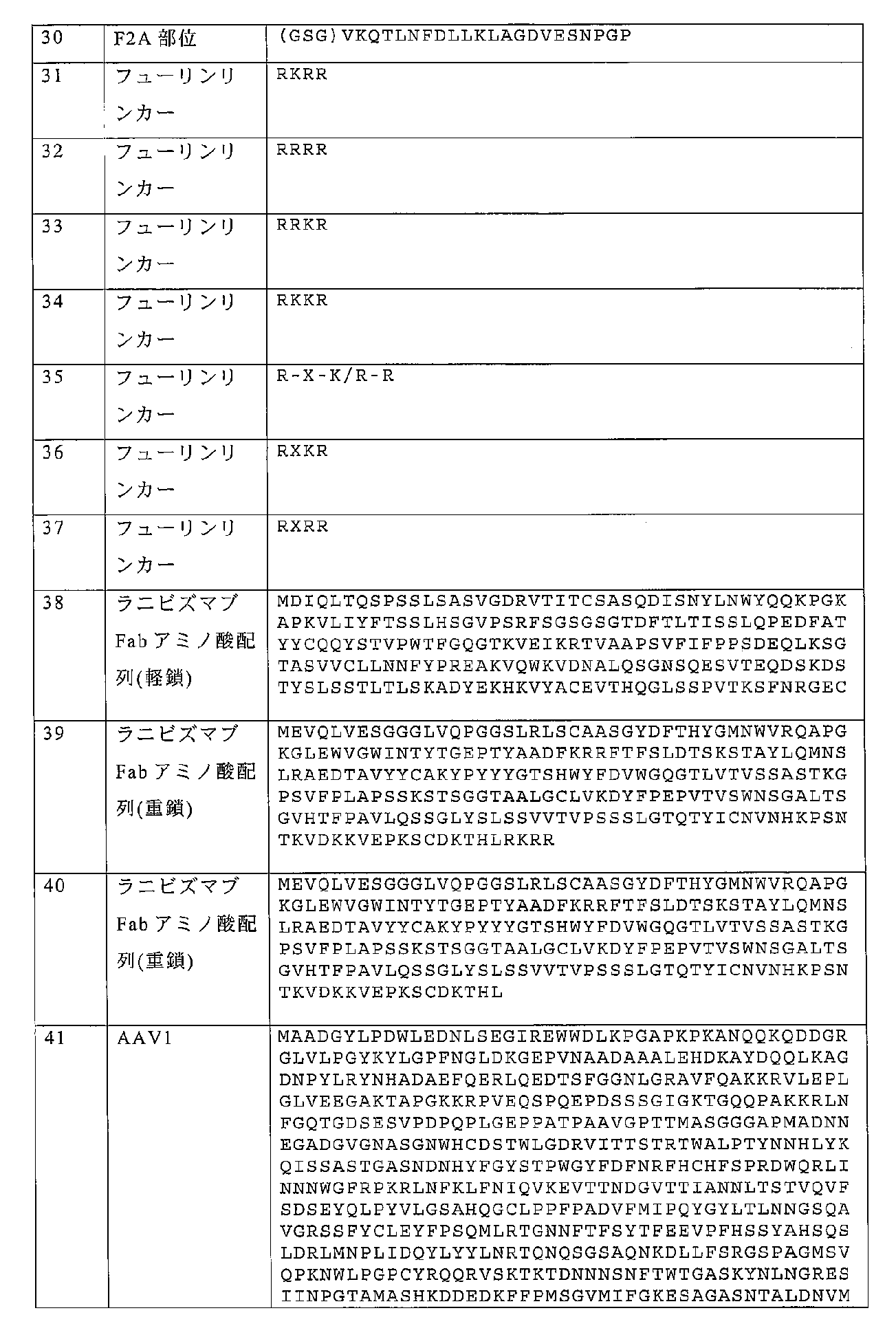
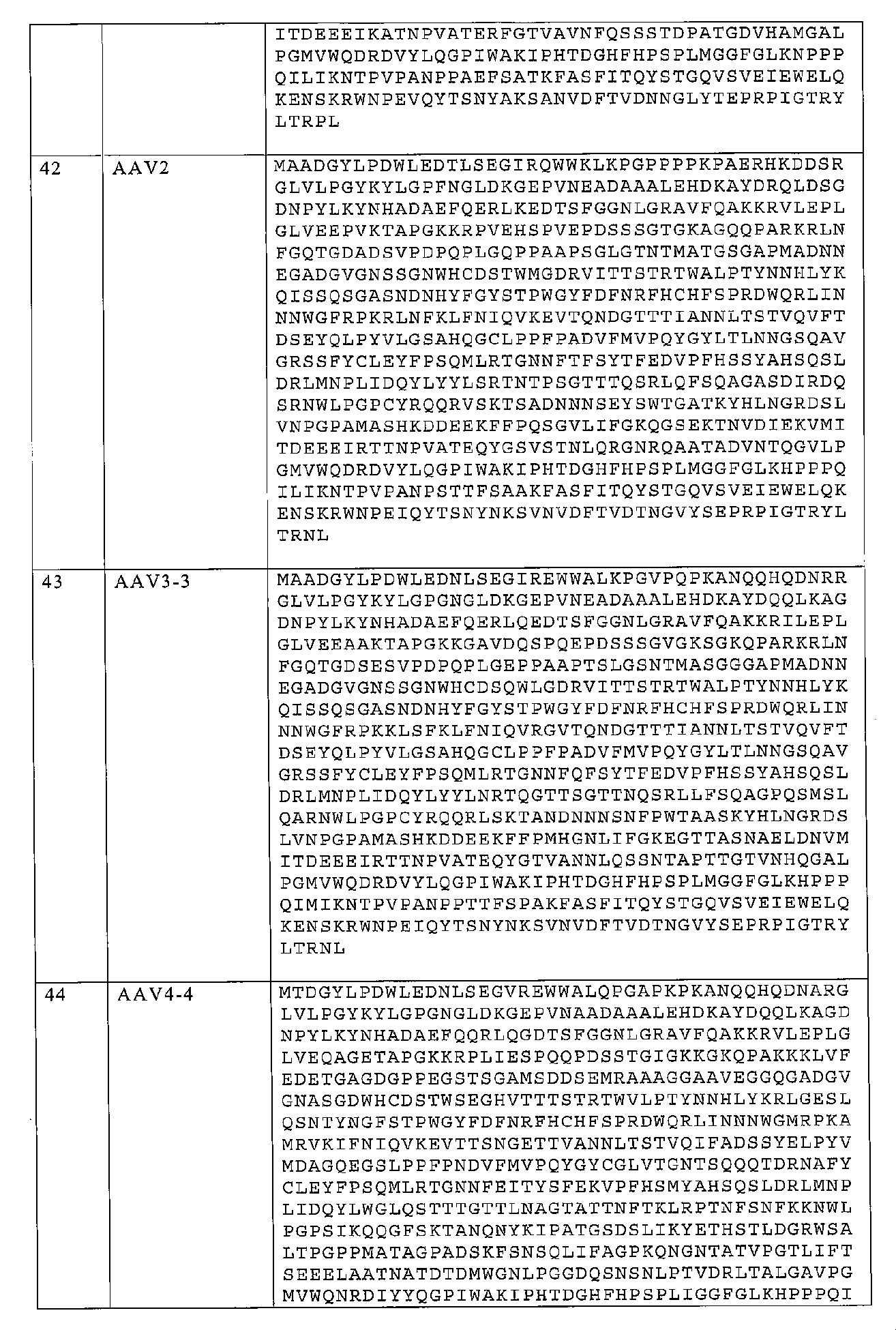


4.5 アッセイ
当業者は、本明細書に記載の組成物および方法を研究するため、例えば本明細書において提供される製剤を試験するために本明細書に記載されるようなアッセイおよび/または当該技術分野において公知の技術を使用することができる。セクション5において提供される実施例もまた、そのようなアッセイが本明細書において提供される製剤を試験するためにどのように使用され得るのかをより詳細に実証する。
4.5 Assays Assays and/or assays such as those described herein to study the compositions and methods described herein, e.g., to test the formulations provided herein, and/or Techniques known in the art can be used. The examples provided in
Li et al., 2019 Cell & Gene Therapy Insights, 5(4):537-547(参照により全体が本明細書に組み込まれる)に記載されるように、例示的なアッセイとしては以下が挙げられるがこれらに限定されない:(1)ゲノムコピー決定のためのデジタルドロップレットPCR(ddPCR);(2)分光光度法によるAAVのゲノム含有量および%フルカプシド分析;(3)DNA分布およびカプシド中の純度を決定するためのサイズ排除クロマトグラフィー;(4)キャピラリー電気泳動を使用するカプシドウイルスタンパク質純度の評価;(5)in vitro効力方法 - in vitroでAAVベクターの感染力における差異を定量化する信頼できる方法としての相対的な感染力;ならびに(6)カプシドエンプティー/フル比およびサイズ分布を決定するための分析的超遠心分離(AUC)。
追加的に、関連する従来の方法としては、2019年に刊行された米国薬局方(USP)およびその先行するバージョン(参照により全体が本明細書に組み込まれる)において提供される方法が挙げられ、例えば、pH測定のためのUSP<791>、重量オスモル濃度測定のためのUSP<785>、特定の物質(不純物)の測定のためのUSP<787>、およびエンドトキシン(安全性)測定のためのUSP<785>、および無菌性測定のためのUSP<71>である。
セクション5において詳述されるように、以下のアッセイもまた本明細書において提供される。
Exemplary assays, as described in Li et al., 2019 Cell & Gene Therapy Insights, 5(4):537-547 (incorporated herein by reference in its entirety) include: (2) AAV genomic content and % full capsid analysis by spectrophotometry; (3) DNA distribution and purity in capsids; (4) assessment of capsid virus protein purity using capillary electrophoresis; (5) in vitro potency method - a reliable method to quantify differences in infectivity of AAV vectors in vitro. and (6) analytical ultracentrifugation (AUC) to determine the capsid empty/full ratio and size distribution.
Additionally, related conventional methods include those provided in the United States Pharmacopeia (USP) published in 2019 and earlier versions thereof, which are hereby incorporated by reference in their entirety; For example, USP <791> for pH determination, USP <785> for osmolality determination, USP <787> for determination of specific substances (impurities), and for endotoxin (safety) determination. USP <785>, and USP <71> for sterility determination.
The following assays are also provided herein, as detailed in
4.5.1 凍結/解凍サイクルアッセイ
制御された凍結/解凍サイクルは、表12に従って凍結乾燥器において実行され得る。バイアルを、棚に十分な間隔で置くことができ、緩衝剤の4つのバイアルに熱電対をセットすることができる。
4.5.1 Freeze/Thaw Cycle Assay A controlled freeze/thaw cycle can be performed in a freeze dryer according to Table 12. The vials can be placed on the shelf at sufficient intervals and a thermocouple can be set on the four vials of buffer.
4.5.2 温度ストレスアッセイ
温度ストレス進展安定性研究を1.0×10¹²GC/mLにおいて4日にかけて37℃で実行して、本明細書において提供される製剤の相対的な安定性を評価することができる。
アッセイを使用して安定性を評価することができ、これには、in vitro相対効力(IVRP)、ベクターゲノム濃度(ddPCRによるVGC)、色素蛍光による遊離DNA、動的光散乱、外見、およびpHが含まれるがこれらに限定されない。
4.5.2 Temperature Stress Assay A temperature stress evolution stability study was performed at 1.0×10 12 GC/mL over 4 days at 37° C. to determine the relative stability of the formulations provided herein. can be evaluated.
Assays can be used to assess stability, including in vitro relative potency (IVRP), vector genome concentration (VGC by ddPCR), free DNA by dye fluorescence, dynamic light scattering, appearance, and pH including but not limited to.
4.5.3 長期安定性アッセイ
長期進展安定性研究を12カ月にかけて実行して、本明細書において提供される製剤における80℃(≦-60℃)および-20℃(-25℃~-15℃)でのin-vitro相対効力および他の品質の維持を実証することができる。
4.5.3 Long-Term Stability Assay A long-term evolutionary stability study was conducted over a period of 12 months to test the 80°C (≤ -60°C) and -20°C (-25°C to -15°C) in the formulations provided herein. ° C.) in-vitro relative potency and maintenance of other qualities can be demonstrated.
4.5.4 in vitro相対効力(IVRP)アッセイ
様々な実施形態では、本明細書において提供される組成物は、以下のアッセイにより決定される場合に参照医薬組成物よりも安定である。安定性における差異パーセンテージまたは倍数は、このアッセイにより決定される場合のin vitro相対効力を指す。
ddPCR GCタイターを遺伝子発現に関連付けるために、HEK293細胞への形質導入を行うことおよび抗VEGF Fabタンパク質レベルについて細胞培養上清をアッセイすることによりin vitroバイオアッセイが行われてもよい。HEK293細胞が、3つのポリ-D-リジンをコートした96ウェル組織培養プレートに終夜プレーティングされる。細胞は次に、野生型ヒトAd5ウイルスを予備感染され、続いて構築物II参照標準品および試験物品の3つの独立して調製された段階希釈液を用いて形質導入され、各調製物は別々のプレートに異なる位置においてプレーティングされる。形質導入後3日目に、細胞培養培地はプレートから収集され、ELISAを介してVEGF結合性Fabタンパク質レベルについて測定される。ELISAのために、VEGFでコートされた96ウェルELISAプレートはブロッキングされ、次に収集された細胞培養培地とインキュベートされて、HEK293細胞により産生された抗VEGF Fabが捕捉される。Fab特異的抗ヒトIgG抗体を使用して、VEGF捕捉Fabタンパク質が検出される。洗浄後に、ホースラディッシュペルオキシダーゼ(HRP)基質溶液が加えられ、顕色させ、停止緩衝剤を用いて中止され、プレートがプレートリーダーにおいて読まれる。HRP生成物の吸光度またはODが対数希釈に対してプロットされ、各試験物品の相対効力が同じプレート上の参照標準品に対して算出され、これはパラレリズム類似性試験を通過した後に式:EC50参照÷EC50試験物品を使用して4-パラメーターロジスティック回帰モデルとフィッティングされる。試験物品の効力は、3つのプレートの加重平均から算出される、参照標準品効力のパーセンテージとして報告される。
ddPCR GCタイターを機能的な遺伝子発現に関連付けるために、HEK293細胞への形質導入を行うことおよび導入遺伝子(例えば酵素)活性についてアッセイすることによりin vitroバイオアッセイが行われてもよい。HEK293細胞が、3つの96ウェル組織培養プレートに終夜プレーティングされる。細胞は次に、野生型ヒトアデノウイルス血清型5を予備感染され、続いて酵素参照標準品および試験物品の3つの独立して調製された段階希釈液を用いて形質導入され、各調製物は別々のプレートに異なる位置においてプレーティングされる。形質導入後2日目に、細胞は溶解され、酵素を活性化させるために低いpHで処理され、導入遺伝子(酵素)による切断で蛍光シグナルの増加をもたらすペプチド基質を使用して酵素活性についてアッセイされる。蛍光またはRFUが対数希釈に対してプロットされ、各試験物品の相対効力が同じプレート上の参照標準品に対して算出され、これはパラレリズム類似性試験を通過した後に式:EC50参照÷EC50試験物品を使用して4-パラメーターロジスティック回帰モデルとフィッティングされる。試験物品の効力は、3つのプレートの加重平均から算出される、参照標準品効力のパーセンテージとして報告される。
4.5.4 In Vitro Relative Potency (IVRP) Assays In various embodiments, the compositions provided herein are more stable than the Reference Pharmaceutical Compositions as determined by the following assays. Percentage or fold differences in stability refer to relative in vitro potency as determined by this assay.
To relate ddPCR GC titers to gene expression, an in vitro bioassay may be performed by transducing HEK293 cells and assaying cell culture supernatants for anti-VEGF Fab protein levels. HEK293 cells are plated overnight in three poly-D-lysine coated 96-well tissue culture plates. Cells were then preinfected with wild-type human Ad5 virus and subsequently transduced with three independently prepared serial dilutions of the Construct II reference standard and test article, each preparation in a separate The plates are plated at different positions. Three days after transduction, cell culture medium is harvested from the plates and measured for VEGF-binding Fab protein levels via ELISA. For the ELISA, 96-well ELISA plates coated with VEGF are blocked and then incubated with harvested cell culture media to capture anti-VEGF Fabs produced by HEK293 cells. VEGF-captured Fab protein is detected using a Fab-specific anti-human IgG antibody. After washing, horseradish peroxidase (HRP) substrate solution is added, developed, stopped with stop buffer, and the plate read in a plate reader. The absorbance or OD of the HRP product is plotted against logarithmic dilution and the relative potency of each test article is calculated against the reference standard on the same plate, which is calculated after passing the parallelism similarity test with the formula: EC50. Fitted with a 4-parameter logistic regression model using ÷EC50 test articles. Test article efficacy is reported as a percentage of the reference standard efficacy calculated from the weighted average of the three plates.
To relate ddPCR GC titers to functional gene expression, in vitro bioassays may be performed by transducing HEK293 cells and assaying for transgene (eg, enzymatic) activity. HEK293 cells are plated overnight in three 96-well tissue culture plates. Cells were then preinfected with wild-type
一部の実施形態では、≦-60℃(例えば、約-80℃)、-30℃~-15℃(例えば、約-20℃)、または2℃~10℃(例えば、約4℃)で期間にわたり貯蔵された後の本明細書において提供される組換えAAVのin vitro効力は、≦-60℃(例えば、約-80℃)、-30℃~-15℃(例えば、約-20℃)、または2℃~10℃(例えば、約4℃)で前記期間にわたり貯蔵される前の組換えAAVのin vitro効力の少なくとも70%、75%、80%、85%、90%、95%、98%、または99%である。一部の実施形態では、期間は、約1カ月、約2カ月、約3カ月、約4カ月、約5カ月、約6カ月、約7カ月、約8カ月、約9カ月、約10カ月、約11カ月、約12カ月、約15カ月、約18カ月、または約24カ月である。 In some embodiments, the The in vitro potency of the recombinant AAV provided herein after storage for a period of time is ≤ -60°C (eg, about -80°C), -30°C to -15°C (eg, about -20°C). ), or at least 70%, 75%, 80%, 85%, 90%, 95% of the in vitro potency of the recombinant AAV prior to storage at 2°C to 10°C (e.g., about 4°C) for said period of time. , 98%, or 99%. In some embodiments, the period is about 1 month, about 2 months, about 3 months, about 4 months, about 5 months, about 6 months, about 7 months, about 8 months, about 9 months, about 10 months, about 11 months, about 12 months, about 15 months, about 18 months, or about 24 months.
4.5.5 ベクターゲノム濃度アッセイ
様々な実施形態では、本明細書において提供される組成物は、以下のアッセイにより決定される場合に参照医薬組成物よりも安定である。安定性における差異パーセンテージまたは倍数は、このアッセイにより決定される場合のベクターゲノム濃度を指す。ベクターゲノム濃度GCはまた、ddPCRを使用して評価され得る。一部の実施形態では、≦-60℃(例えば、約-80℃)、-30℃~-15℃(例えば、約-20℃)、または2℃~10℃(例えば、約4℃)で期間にわたり貯蔵された後の本明細書において提供される組換えAAVのベクターゲノム濃度は、≦-60℃(例えば、約-80℃)、-30℃~-15℃(例えば、約-20℃)、または2℃~10℃(例えば、約4℃)で前記期間にわたり貯蔵される前の組換えAAVのベクターゲノム濃度の少なくとも70%、75%、80%、85%、90%、95%、98%、または99%である。一部の実施形態では、期間は、約1カ月、約2カ月、約3カ月、約4カ月、約5カ月、約6カ月、約7カ月、約8カ月、約9カ月、約10カ月、約11カ月、約12カ月、約15カ月、約18カ月、または約24カ月である。
4.5.5 Vector Genome Concentration Assays In various embodiments, the compositions provided herein are more stable than the reference pharmaceutical compositions as determined by the following assays. Percentage or fold difference in stability refers to vector genome concentration as determined by this assay. Vector genome concentration GC can also be assessed using ddPCR. In some embodiments, the The vector genome concentration of the recombinant AAV provided herein after storage for a period of time is ≤-60°C (eg, about -80°C), -30°C to -15°C (eg, about -20°C). ), or at least 70%, 75%, 80%, 85%, 90%, 95% of the recombinant AAV vector genome concentration prior to storage at 2° C.-10° C. (eg, about 4° C.) for said period of time. , 98%, or 99%. In some embodiments, the period is about 1 month, about 2 months, about 3 months, about 4 months, about 5 months, about 6 months, about 7 months, about 8 months, about 9 months, about 10 months, about 11 months, about 12 months, about 15 months, about 18 months, or about 24 months.
4.5.6 色素蛍光アッセイを使用する遊離DNA分析
様々な実施形態では、本明細書において提供される組成物は、以下のアッセイにより決定される場合に参照医薬組成物よりも安定である。安定性における差異パーセンテージまたは倍数は、このアッセイにより決定される場合の遊離DNAの量を指す。
遊離DNAは、DNAに結合したSYBR(登録商標)Gold核酸ゲル染色剤(「SYBR Gold色素」)の蛍光により決定され得る。蛍光は、マイクロプレートリーダーを使用して測定され、DNA標準品を用いて定量化され得る。ng/μLでの結果が報告され得る。
4.5.6 Free DNA Analysis Using Dye Fluorescence Assay In various embodiments, the compositions provided herein are more stable than the Reference Pharmaceutical Compositions as determined by the following assays. The percentage or fold difference in stability refers to the amount of free DNA as determined by this assay.
Free DNA can be determined by the fluorescence of SYBR® Gold Nucleic Acid Gel Stain (“SYBR Gold dye”) bound to the DNA. Fluorescence can be measured using a microplate reader and quantified using DNA standards. Results in ng/μL can be reported.
ng/μLでの測定された遊離DNAを遊離DNAのパーセンテージに変換するために、2つのアプローチを使用して全DNAを概算することができる。第1のアプローチでは、UV-可視分光法により決定されたGC/mL(OD)を使用して試料中の全DNAが概算され、ここでMはDNAの分子量であり、1×106は単位変換係数であり:
概算される全DNA(ng/μL)=1×106×GC/mL(OD)×M(g/mol)/6.02×1023である。
第2のアプローチでは、試料を85℃に20分間0.05%のポロキサマー188と共に加熱することができ、SYBR Gold色素アッセイにより加熱された試料中で測定された実際のDNAをトータルとして使用することができる。これはしたがって、すべてのDNAが回収および定量化されたという仮定を有する。例えば、(UV読取りに対する)SYBR gold色素による全DNAの決定は、構築物II dPBS製剤について131%および構築物II改変dPBS+スクロース製剤について152%であることが見出され得る(遊離DNAのパーセンテージへのng/μLの変換におけるこの変形形態は、報告される結果における範囲として取得され得る)。趨勢のために、未加工のng/μLを使用することができ、または一貫した方法により決定されたパーセンテージを使用することができる。
To convert the measured free DNA in ng/μL to a percentage of free DNA, two approaches can be used to estimate total DNA. In the first approach, GC/mL (OD) determined by UV-visible spectroscopy was used to estimate the total DNA in the sample, where M is the molecular weight of the DNA and 1×10 6 units are the conversion factors:
Estimated total DNA (ng/μL) = 1 x 10⁶ x GC/mL (OD) x M (g/mol) /6.02 x 1023.
In a second approach, the sample can be heated to 85° C. for 20 minutes with 0.05% poloxamer 188, and the actual DNA measured in the heated sample by the SYBR Gold dye assay is used as total. can be done. This therefore has the assumption that all DNA has been recovered and quantified. For example, determination of total DNA by SYBR gold dye (for UV reading) can be found to be 131% for the Construct II dPBS formulation and 152% for the Construct II modified dPBS+sucrose formulation (ng This variation in conversion of /μL can be taken as a range in the reported results). For trends, raw ng/μL can be used, or percentages determined by consistent methods can be used.
一部の実施形態では、≦-60℃(例えば、約-80℃)、-30℃~-15℃(例えば、約-20℃)、または2℃~10℃(例えば、約4℃)で期間にわたり貯蔵された後の本明細書において提供される組成物中の遊離DNAの量は、≦-60℃(例えば、約-80℃)、-30℃~-15℃(例えば、約-20℃)、または2℃~10℃(例えば、約4℃)で前記期間にわたり貯蔵される前の前記組成物中の遊離DNAの量と少なくとも70%、75%、80%、85%、90%、95%、98%、または99%同一である。一部の実施形態では、期間は、約1カ月、約2カ月、約3カ月、約4カ月、約5カ月、約6カ月、約7カ月、約8カ月、約9カ月、約10カ月、約11カ月、約12カ月、約15カ月、約18カ月、または約24カ月である。 In some embodiments, the The amount of free DNA in the compositions provided herein after storage for a period of time is ≤ -60°C (eg, about -80°C), -30°C to -15°C (eg, about -20°C). ° C.), or at least 70%, 75%, 80%, 85%, 90% of the amount of free DNA in said composition prior to storage at 2° C.-10° C. (eg, about 4° C.) for said period of time. , 95%, 98%, or 99% identical. In some embodiments, the period is about 1 month, about 2 months, about 3 months, about 4 months, about 5 months, about 6 months, about 7 months, about 8 months, about 9 months, about 10 months, about 11 months, about 12 months, about 15 months, about 18 months, or about 24 months.
4.5.7 サイズ排除クロマトグラフィー(SEC)
様々な実施形態では、本明細書において提供される組成物は、以下のアッセイにより決定される場合に参照医薬組成物よりも安定である。安定性における差異パーセンテージまたは倍数は、このアッセイにより決定される場合のサイズ分布を指す。
SECは、Sepax SRT SEC-1000 Peek column(PN 215950P-4630、SN:8A11982、LN:BT090、5μm 1000A、4.6×300mm)を使用してWaters Acquity Arc Equipment ID 0447(C3PO)上で、25mm経路長フローセルを用いて行われ得る。移動相は、例えば、20mMのリン酸ナトリウム、300mMのNaCl、0.005%のポロキサマー188、pH6.5、0.35mL/分の流速で20分間、周囲温度のカラムとすることができる。データ収集は、2点/秒のサンプリング速度および1.2nmの分解能、214、260、および280nmにおける25点平均の平滑化を用いて行われ得る。理想的な標的負荷は1.511GCであり得る。試料は、50μL、理想的な標的の約1/3で注入することができ、または5μLで注入することができる。
4.5.7 Size Exclusion Chromatography (SEC)
In various embodiments, the compositions provided herein are more stable than the Reference Pharmaceutical Compositions as determined by the following assays. The percentage or fold difference in stability refers to the size distribution as determined by this assay.
SEC was run on Waters Acquity Arc Equipment ID 0447 (C23PO) using a Sepax SRT SEC-1000 Peek column (PN 215950P-4630, SN: 8A11982, LN: BT090, 5 μm 1000A, 4.6×300 mm). It can be done using a path length flow cell. The mobile phase can be, for example, a column of 20 mM sodium phosphate, 300 mM NaCl, 0.005% poloxamer 188, pH 6.5 at a flow rate of 0.35 mL/min for 20 minutes at ambient temperature. Data collection can be performed with a sampling rate of 2 points/second and a resolution of 1.2 nm, with smoothing of 25-point averages at 214, 260, and 280 nm. An ideal target load would be 1.5 11 GC. Samples can be injected at 50 μL, approximately ⅓ of the ideal target, or can be injected at 5 μL.
一部の実施形態では、≦-60℃(例えば、約-80℃)、-30℃~-15℃(例えば、約-20℃)、または2℃~10℃(例えば、約4℃)で期間にわたり貯蔵された後のSECにより決定される場合の本明細書において提供される組換えAAVのサイズ分布は、≦-60℃(例えば、約-80℃)、-30℃~-15℃(例えば、約-20℃)、または2℃~10℃(例えば、約4℃)で前記期間にわたり貯蔵される前の組換えAAVのSECにより決定される場合のサイズ分布と少なくとも70%、75%、80%、85%、90%、95%、98%、または99%同一である。一部の実施形態では、期間は、約1カ月、約2カ月、約3カ月、約4カ月、約5カ月、約6カ月、約7カ月、約8カ月、約9カ月、約10カ月、約11カ月、約12カ月、約15カ月、約18カ月、または約24カ月である。 In some embodiments, the The size distribution of the recombinant AAV provided herein as determined by SEC after storage for a period of time is ≦−60° C. (eg, about −80° C.), −30° C. to −15° C. ( at least 70%, 75% as determined by SEC of recombinant AAV prior to storage at 2°C to 10°C (e.g., about 4°C) for said period of time; , 80%, 85%, 90%, 95%, 98%, or 99% identical. In some embodiments, the period is about 1 month, about 2 months, about 3 months, about 4 months, about 5 months, about 6 months, about 7 months, about 8 months, about 9 months, about 10 months, about 11 months, about 12 months, about 15 months, about 18 months, or about 24 months.
4.5.8 動的光散乱(DLS)アッセイ
様々な実施形態では、本明細書において提供される組成物は、以下のアッセイにより決定される場合に参照医薬組成物よりも安定である。安定性における差異パーセンテージまたは倍数は、このアッセイにより決定される場合のサイズ分布を指す。
動的光散乱(DLS)は、Wyatt DynaProIII上で、Corning 3540 384ウェルプレートを使用して30μLの試料体積を用いて行われ得る。複製物当たり各10s間の10回の取得を収集することができ、試料当たり3回の複製物の測定が為された。溶媒は、試料中に使用される溶媒に従って設定することができ、例えばdPBS中の構築物IIについて「PBS」、改変dPBS+スクロース試料中の構築物IIについて「4%のスクロース」とすることができる。データ品質基準(ベースライン、SOS、ノイズ、フィット)を満たさない結果を「マーク」し、分析から除外することができる。低遅延時間カットオフを改変dPBS+スクロース試料について1.4μsから10μsに変更して、人為現象的に低いキュムラント分析直径結果の惹起における約1nmのスクロース賦形剤ピークの影響力を排除することができる。
一部の実施形態では、≦-60℃(例えば、約-80℃)、-30℃~-15℃(例えば、約-20℃)、または2℃~10℃(例えば、約4℃)で期間にわたり貯蔵された後のDLSにより決定される場合の本明細書において提供される組換えAAVのサイズ分布は、≦-60℃(例えば、約-80℃)、-30℃~-15℃(例えば、約-20℃)、または2℃~10℃(例えば、約4℃)で前記期間にわたり貯蔵される前の組換えAAVのDLSにより決定される場合のサイズ分布と少なくとも70%、75%、80%、85%、90%、95%、98%、または99%同一である。一部の実施形態では、期間は、約1カ月、約2カ月、約3カ月、約4カ月、約5カ月、約6カ月、約7カ月、約8カ月、約9カ月、約10カ月、約11カ月、約12カ月、約15カ月、約18カ月、または約24カ月である。
4.5.8 Dynamic Light Scattering (DLS) Assay In various embodiments, the compositions provided herein are more stable than the Reference Pharmaceutical Compositions as determined by the following assays. The percentage or fold difference in stability refers to the size distribution as determined by this assay.
Dynamic light scattering (DLS) can be performed on a Wyatt DynaProIII using Corning 3540 384-well plates with a sample volume of 30 μL. Ten acquisitions of 10 s duration each could be collected per replicate, with three replicate measurements per sample. The solvent can be set according to the solvent used in the sample, for example "PBS" for construct II in dPBS, "4% sucrose" for construct II in modified dPBS + sucrose sample. Results that do not meet data quality criteria (baseline, SOS, noise, fit) can be "marked" and excluded from analysis. The low lag time cutoff can be changed from 1.4 μs to 10 μs for the modified dPBS+sucrose samples to eliminate the influence of the ˜1 nm sucrose excipient peak in causing the artifactually low cumulant analysis diameter results. .
In some embodiments, the The size distribution of the recombinant AAV provided herein as determined by DLS after storage for a period of time is ≦−60° C. (eg, about −80° C.), −30° C. to −15° C. ( at least 70%, 75% as determined by DLS of recombinant AAV prior to storage at 2°C to 10°C (e.g., about 4°C) for said period of time; , 80%, 85%, 90%, 95%, 98%, or 99% identical. In some embodiments, the period is about 1 month, about 2 months, about 3 months, about 4 months, about 5 months, about 6 months, about 7 months, about 8 months, about 9 months, about 10 months, about 11 months, about 12 months, about 15 months, about 18 months, or about 24 months.
4.5.9 示差走査熱量測定
低温示差走査熱量測定(低温DSC)は、TA Instruments DSC250を使用して実行され得る。約20μLの試料をTzeroパンにロードし、Tzero Hermeticリッドを用いて圧着することができる。試料を25℃で2分間平衡化させ、次に5℃/分で-60℃に冷却し、2分間平衡化させ、次に5℃/分で25℃に加熱することができる。熱フローデータを従来のモードにおいて収集することができる。
4.5.9 Differential Scanning Calorimetry Cryogenic Differential Scanning Calorimetry (Cryogenic DSC) can be performed using a TA Instruments DSC250. Approximately 20 μL of sample can be loaded into a Tzero pan and crimped using a Tzero Hermetic lid. The sample can be equilibrated at 25°C for 2 minutes, then cooled at 5°C/min to -60°C, allowed to equilibrate for 2 minutes, then heated at 5°C/min to 25°C. Heat flow data can be collected in conventional mode.
4.5.10 リアルタイム緩衝剤pH追跡
-30℃もの低下させた温度までpHを検出することができるINLAB COOL PRO-ISM低温pHプローブを用いて異なる製剤緩衝剤のpHをモニターした。1ミリリットルの緩衝剤を15mLのファルコンチューブに入れ、次にpHプローブを緩衝剤に浸した。パラフィルムの小片を使用してファルコンチューブおよびpHプローブの間の間隙を密閉し、夾雑および蒸発を回避した。プローブをファルコンチューブと共に-20 AD冷凍器に入れた。緩衝剤のpHおよび温度を約20時間またはpH対温度の挙動が繰返しのパターンを達成するまで2.5分ごとに記録した。自動的な除霜プロセスにより引き起こされる温度変化は、緩衝剤pH安定性に対するストレス状態を生成した。
4.5.10 Real Time Buffer pH Tracking The pH of the different formulation buffers was monitored using an INLAB COOL PRO-ISM cryogenic pH probe capable of detecting pH down to temperatures as low as -30°C. One milliliter of buffer was placed in a 15 mL Falcon tube, then the pH probe was submerged in the buffer. A small piece of Parafilm was used to seal the gap between the Falcon tube and pH probe to avoid contamination and evaporation. The probe was placed in a -20 AD freezer with the Falcon tube. The pH and temperature of the buffer were recorded every 2.5 minutes for approximately 20 hours or until the behavior of pH versus temperature achieved a repeating pattern. Temperature changes caused by the automatic defrosting process created stress conditions for buffer pH stability.
4.5.11 重量オスモル濃度
様々な実施形態では、本明細書において提供される組成物は、以下のアッセイにより決定される場合に参照医薬組成物よりも安定である。安定性における差異パーセンテージまたは倍数は、このアッセイにより決定される場合の重量オスモル濃度を指す。
オスモメーターは、重量オスモル濃度を測定するために凝固点降下の技術を使用する。機器の軟正は、50mOsm/kg、850mOsm/kg、および2000mOsm/kgのNIST追跡可能標準品を使用して行われ得る。290mOsm/kgの参照溶液を使用してオスモメーターのシステム好適性を決定することができる。
4.5.11 Osmolality In various embodiments, the compositions provided herein are more stable than the Reference Pharmaceutical Compositions as determined by the following assays. Percentage or fold difference in stability refers to osmolality as determined by this assay.
Osmometers use the technique of freezing point depression to measure osmolality. Instrument calibration may be performed using NIST traceable standards of 50 mOsm/kg, 850 mOsm/kg, and 2000 mOsm/kg. A reference solution of 290 mOsm/kg can be used to determine the system suitability of the osmometer.
一部の実施形態では、≦-60℃(例えば、約-80℃)、-30℃~-15℃(例えば、約-20℃)、または2℃~10℃(例えば、約4℃)で期間にわたり貯蔵された後の組換えAAVの重量オスモル濃度は、≦-60℃(例えば、約-80℃)、-30℃~-15℃(例えば、約-20℃)、または2℃~10℃(例えば、約4℃)で前記期間にわたり貯蔵される前の組換えAAVの重量オスモル濃度の少なくとも70%、75%、80%、85%、90%、95%、98%、または99%である。一部の実施形態では、期間は、約1カ月、約2カ月、約3カ月、約4カ月、約5カ月、約6カ月、約7カ月、約8カ月、約9カ月、約10カ月、約11カ月、約12カ月、約15カ月、約18カ月、または約24カ月である。 In some embodiments, the The osmolality of recombinant AAV after storage for a period of time is ≤ -60°C (eg, about -80°C), -30°C to -15°C (eg, about -20°C), or 2°C to 10°C. at least 70%, 75%, 80%, 85%, 90%, 95%, 98%, or 99% of the osmolality of the recombinant AAV prior to being stored at 90° C. (e.g., about 4° C.) for said period of time is. In some embodiments, the period is about 1 month, about 2 months, about 3 months, about 4 months, about 5 months, about 6 months, about 7 months, about 8 months, about 9 months, about 10 months, about 11 months, about 12 months, about 15 months, about 18 months, or about 24 months.
4.5.12 密度測定
様々な実施形態では、本明細書において提供される組成物は、以下のアッセイにより決定される場合に参照医薬組成物よりも安定である。安定性における差異パーセンテージまたは倍数は、このアッセイにより決定される場合の密度を指す。
密度は、Anton Paar DMA500デンシトメーターを用いて、水を参照として使用して測定され得る。デンシトメーターは、水および次にメタノールを用いて洗浄し、続いて試料間に空気乾燥することができる。
一部の実施形態では、≦-60℃(例えば、約-80℃)、-30℃~-15℃(例えば、約-20℃)、または2℃~10℃(例えば、約4℃)で期間にわたり貯蔵された後の組換えAAVの密度は、≦-60℃(例えば、約-80℃)、-30℃~-15℃(例えば、約-20℃)、または2℃~10℃(例えば、約4℃)で前記期間にわたり貯蔵される前の組換えAAVの密度の少なくとも70%、75%、80%、85%、90%、95%、98%、または99%である。一部の実施形態では、期間は、約1カ月、約2カ月、約3カ月、約4カ月、約5カ月、約6カ月、約7カ月、約8カ月、約9カ月、約10カ月、約11カ月、約12カ月、約15カ月、約18カ月、または約24カ月である。
4.5.12 Density Measurements In various embodiments, the compositions provided herein are more stable than the Reference Pharmaceutical Compositions as determined by the following assays. Percentage or fold differences in stability refer to density as determined by this assay.
Density can be measured using an Anton Paar DMA500 densitometer using water as a reference. The densitometer can be washed with water and then methanol followed by air drying between samples.
In some embodiments, the The density of recombinant AAV after storage for a period of time is ≤ -60°C (eg, about -80°C), -30°C to -15°C (eg, about -20°C), or 2°C to 10°C ( at least 70%, 75%, 80%, 85%, 90%, 95%, 98%, or 99% of the density of the recombinant AAV prior to storage at about 4° C. for said period of time. In some embodiments, the period is about 1 month, about 2 months, about 3 months, about 4 months, about 5 months, about 6 months, about 7 months, about 8 months, about 9 months, about 10 months, about 11 months, about 12 months, about 15 months, about 18 months, or about 24 months.
4.5.13 粘度測定
様々な実施形態では、本明細書において提供される組成物は、以下のアッセイにより決定される場合に参照医薬組成物よりも安定である。安定性における差異パーセンテージまたは倍数は、このアッセイにより決定される場合の粘度を指す。
粘度は、当該技術分野において公知の方法、例えば2019年に刊行された米国薬局方(USP)およびその先行するバージョン(参照により全体が本明細書に組み込まれる)において提供される方法を使用して測定され得る。
一部の実施形態では、≦-60℃(例えば、約-80℃)、-30℃~-15℃(例えば、約-20℃)、または2℃~10℃(例えば、約4℃)で期間にわたり貯蔵された後の組換えAAVの粘度は、≦-60℃(例えば、約-80℃)、-30℃~-15℃(例えば、約-20℃)、または2℃~10℃(例えば、約4℃)で前記期間にわたり貯蔵される前の組換えAAVの粘度の少なくとも70%、75%、80%、85%、90%、95%、98%、または99%である。一部の実施形態では、期間は、約1カ月、約2カ月、約3カ月、約4カ月、約5カ月、約6カ月、約7カ月、約8カ月、約9カ月、約10カ月、約11カ月、約12カ月、約15カ月、約18カ月、または約24カ月である。
4.5.13 Viscosity Measurements In various embodiments, the compositions provided herein are more stable than the Reference Pharmaceutical Compositions as determined by the following assays. The percentage or fold difference in stability refers to viscosity as determined by this assay.
Viscosity is measured using methods known in the art, such as those provided in the United States Pharmacopeia (USP) published in 2019 and its earlier versions, which are incorporated herein by reference in their entirety. can be measured.
In some embodiments, the The viscosity of recombinant AAV after being stored for a period of time is ≤ -60°C (eg, about -80°C), -30°C to -15°C (eg, about -20°C), or 2°C to 10°C ( For example, at least 70%, 75%, 80%, 85%, 90%, 95%, 98%, or 99% of the viscosity of the recombinant AAV prior to storage at about 4° C. for said period of time. In some embodiments, the period is about 1 month, about 2 months, about 3 months, about 4 months, about 5 months, about 6 months, about 7 months, about 8 months, about 9 months, about 10 months, about 11 months, about 12 months, about 15 months, about 18 months, or about 24 months.
4.5.14 ウイルス感染力アッセイ
様々な実施形態では、本明細書において提供される組成物は、以下のアッセイにより決定される場合に参照医薬組成物よりも安定である。安定性における差異パーセンテージまたは倍数は、このアッセイにより決定される場合のウイルス感染力を指す。
Francois, et al. Molecular Therapy Methods & Clinical Development (2018) Vol. 10, pp. 223-236(参照により全体が本明細書に組み込まれる)に記載されるようなTCID50感染タイターアッセイを使用することができる。2018年10月15日に出願された仮出願第62/745859号に記載されるような相対感染力アッセイを使用することができる。
4.5.14 Viral Infectivity Assays In various embodiments, the compositions provided herein are more stable than the Reference Pharmaceutical Compositions as determined by the following assays. The percentage or fold difference in stability refers to viral infectivity as determined by this assay.
Using the TCID 50 infection titer assay as described in Francois, et al. Molecular Therapy Methods & Clinical Development (2018) Vol. 10, pp. 223-236, which is incorporated herein by reference in its entirety. can be done. A relative infectivity assay such as that described in Provisional Application No. 62/745859 filed Oct. 15, 2018 can be used.
一部の実施形態では、≦-60℃(例えば、約-80℃)、-30℃~-15℃(例えば、約-20℃)、または2℃~10℃(例えば、約4℃)で期間にわたり貯蔵された後の組換えAAVのウイルス感染力は、≦-60℃(例えば、約-80℃)、-30℃~-15℃(例えば、約-20℃)、または2℃~10℃(例えば、約4℃)で前記期間にわたり貯蔵される前の組換えAAVのウイルス感染力の少なくとも70%、75%、80%、85%、90%、95%、98%、または99%である。一部の実施形態では、期間は、約1カ月、約2カ月、約3カ月、約4カ月、約5カ月、約6カ月、約7カ月、約8カ月、約9カ月、約10カ月、約11カ月、約12カ月、約15カ月、約18カ月、または約24カ月である。 In some embodiments, the The viral infectivity of recombinant AAV after storage for a period of time is ≤ -60°C (eg, about -80°C), -30°C to -15°C (eg, about -20°C), or 2°C to 10°C. at least 70%, 75%, 80%, 85%, 90%, 95%, 98%, or 99% of the viral infectivity of the recombinant AAV prior to storage at 90° C. (e.g., about 4° C.) for said period of time is. In some embodiments, the period is about 1 month, about 2 months, about 3 months, about 4 months, about 5 months, about 6 months, about 7 months, about 8 months, about 9 months, about 10 months, about 11 months, about 12 months, about 15 months, about 18 months, or about 24 months.
4.5.15 結晶化およびガラス転移温度
例示的な方法は、Croyle et al., 2001, Gene Ther. 8(17):1281-90(参照により全体が本明細書に組み込まれる)において記載されている。
4.5.15 Crystallization and Glass Transition Temperature An exemplary method is described in Croyle et al., 2001, Gene Ther. 8(17):1281-90 (incorporated herein by reference in its entirety). ing.
4.5.16 参照組成物
本明細書において提供される組成物の安定性は、組成物を参照医薬組成物と比較することにより評価されてもよい。一部の実施形態では、参照医薬組成物は、リン酸緩衝化食塩水中の評価されている組成物と同じ濃度の同じ組換えAAVを含む医薬組成物である。一部の実施形態では、参照医薬組成物は、評価されている組成物と同じ濃度の同じ組換えAAVを含む医薬組成物であるが、スクロースを含まない。一部の実施形態では、参照医薬組成物は、組成物が≦-60°(例えば、約-80℃)で6~12カ月にわたり貯蔵される前の評価されている組成物と同じである。一部の実施形態では、参照医薬組成物は、組成物が2℃~10℃(例えば、約4℃)で1~6カ月にわたり貯蔵される前の評価されている組成物と同じである。一部の実施形態では、参照医薬組成物は、組成物が約≦-60°(例えば、約-80℃)で6~12カ月にわたり貯蔵され、その後に2℃~10℃(例えば、約4℃)で1~6カ月にわたり貯蔵される前の評価されている組成物と同じである。
一部の実施形態では、≦-60℃(例えば、約-80℃)、-30℃~-15℃(例えば、約-20℃)、または2℃~10℃(例えば、約4℃)で期間にわたり貯蔵された後の組換えAAVの所与の特性(例えば、このセクション、すなわち、セクション4.5に記載のアッセイにより決定される特性)は、≦-60℃(例えば、約-80℃)、-30℃~-15℃(例えば、約-20℃)、または2℃~10℃(例えば、約4℃)で前記期間にわたり貯蔵される前の同じアッセイにより決定される場合の組換えAAVの特性と少なくとも70%、75%、80%、85%、90%、95%、98%、または99%同一である。一部の実施形態では、期間は、約1カ月、約2カ月、約3カ月、約4カ月、約5カ月、約6カ月、約7カ月、約8カ月、約9カ月、約10カ月、約11カ月、約12カ月、約15カ月、約18カ月、または約24カ月である。
4.5.16 Reference Compositions The stability of the compositions provided herein may be assessed by comparing the composition to a reference pharmaceutical composition. In some embodiments, the reference pharmaceutical composition is a pharmaceutical composition comprising the same recombinant AAV at the same concentration as the composition being evaluated in phosphate-buffered saline. In some embodiments, a reference pharmaceutical composition is a pharmaceutical composition comprising the same recombinant AAV at the same concentration as the composition being evaluated, but without sucrose. In some embodiments, the reference pharmaceutical composition is the same as the composition being evaluated before the composition is stored at ≦−60° C. (eg, about −80° C.) for 6-12 months. In some embodiments, the reference pharmaceutical composition is the same as the composition being evaluated before the composition is stored at 2° C.-10° C. (eg, about 4° C.) for 1-6 months. In some embodiments, the reference pharmaceutical composition is stored at about ≦−60° C. (eg, about −80° C.) for 6-12 months, followed by 2° C.-10° C. (eg, about 4° C.). ° C.) for 1-6 months.
In some embodiments, the A given property (e.g., property determined by the assays described in this section, Section 4.5) of recombinant AAV after being stored for a period of time is ≤ -60°C (e.g., about -80°C ), −30° C. to −15° C. (eg, about −20° C.), or 2° C. to 10° C. (eg, about 4° C.) for said period of time. At least 70%, 75%, 80%, 85%, 90%, 95%, 98%, or 99% identical to the properties of AAV. In some embodiments, the period is about 1 month, about 2 months, about 3 months, about 4 months, about 5 months, about 6 months, about 7 months, about 8 months, about 9 months, about 10 months, about 11 months, about 12 months, about 15 months, about 18 months, or about 24 months.
5.実施例
このセクション(すなわち、セクション5)における実施例は、限定としてではなく、例示として提供される。
5.1 実施例1:製剤Aおよび製剤Bにおける成分
この実施例は、≦-60℃で保存された製剤A(0.001%ポロキサマー188を含むダルベッコリン酸緩衝食塩水、pH7.4)、および-15℃~-25℃で保存された製剤B(「4%スクロースおよび0.001%ポロキサマー188を含む改変ダルベッコリン酸緩衝食塩水、pH7.4」)における成分を示す。2つの製剤の比較および影響分析を表4に提供する。製剤Bは、保存の1年後に現在までに観察されたAAV製造物に影響を与えることなく、保存の実施可能性を改善した。
5. Examples The examples in this section (ie, Section 5) are provided by way of illustration and not by way of limitation.
5.1 Example 1: Ingredients in Formulation A and Formulation B and in Formulation B ("Modified Dulbecco's Phosphate Buffered Saline with 4% Sucrose and 0.001% Poloxamer 188, pH 7.4") stored at -15°C to -25°C. A comparison and impact analysis of the two formulations is provided in Table 4. Formulation B improved storage feasibility without affecting AAV production observed to date after 1 year of storage.
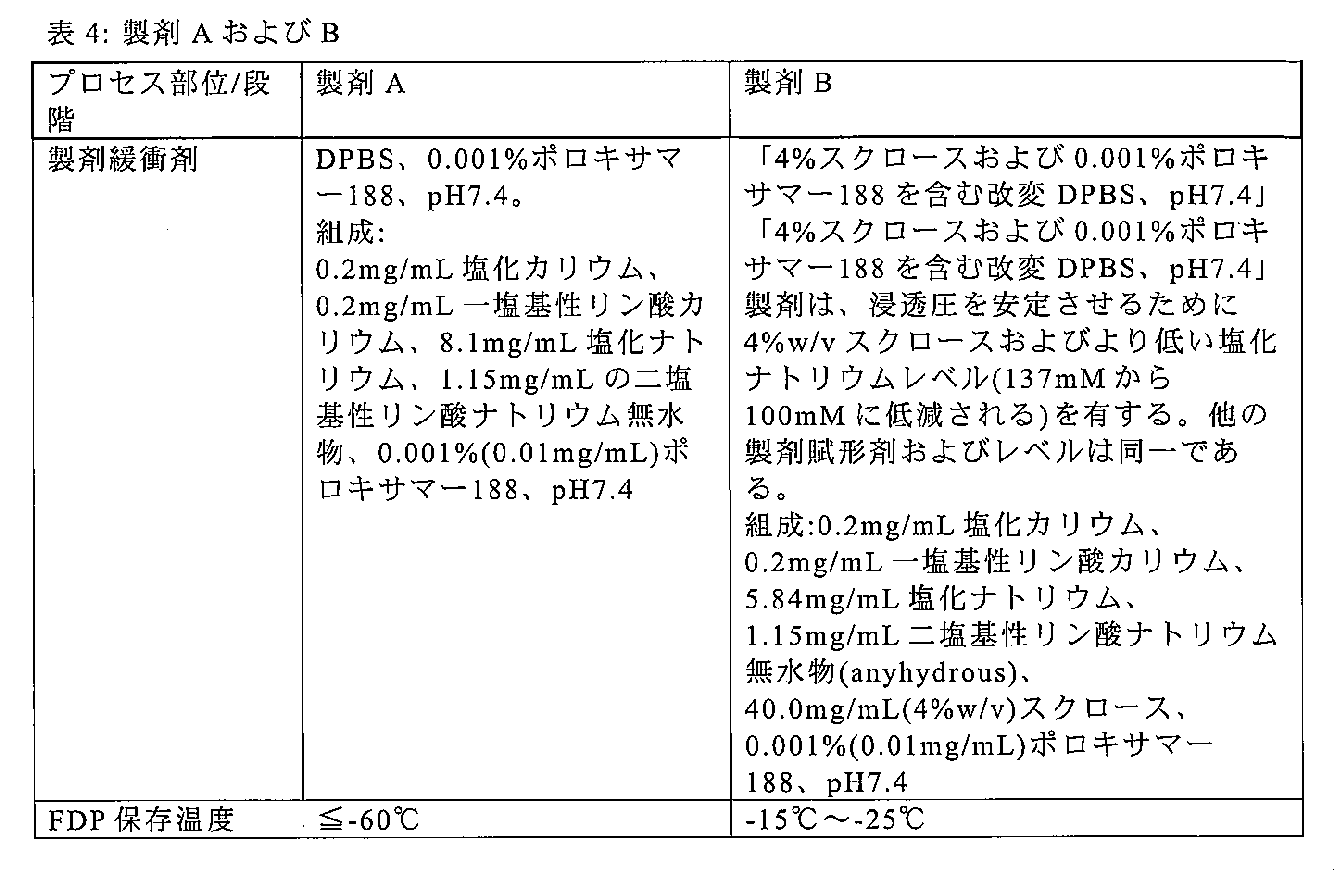
製剤B(スクロースを含む改変DPBS)には、0.2mg/mLの塩化カリウム、0.2mg/mLの一塩基性リン酸カリウム、5.84mg/mLの塩化ナトリウム、1.15mg/mLの二塩基性リン酸ナトリウム無水物(anyhydrous)、40.0mg/mL(4%w/v)のスクロース、0.001%(0.01mg/mL)のポロキサマー188、pH7.4が含まれる(表5)。モル単位では、製剤Bは、2.70mM塩化カリウム、1.47mM一塩基性リン酸カリウム、100mM塩化ナトリウム、8.1mM二塩基性リン酸ナトリウム無水物、117mMスクロース、0.001%(0.01mg/mL)ポロキサマー188、pH7.4を含む。製剤Bの密度は1.0188g/mLとすることができ、製剤Bの浸透圧は約345(331~354)とすることができる。 Formulation B (modified DPBS with sucrose) contains 0.2 mg/mL potassium chloride, 0.2 mg/mL monobasic potassium phosphate, 5.84 mg/mL sodium chloride, 1.15 mg/mL Contains anyhydrous basic phosphate, 40.0 mg/mL (4% w/v) sucrose, 0.001% (0.01 mg/mL) poloxamer 188, pH 7.4 (Table 5 ). On a molar basis, Formulation B contains 2.70 mM potassium chloride, 1.47 mM monobasic potassium phosphate, 100 mM sodium chloride, 8.1 mM dibasic sodium phosphate anhydrous, 117 mM sucrose, 0.001% (0.001%). 01 mg/mL) Poloxamer 188, pH 7.4. The density of formulation B can be 1.0188 g/mL and the osmotic pressure of formulation B can be about 345 (331-354).

5.2 実施例2:放出特性における製剤Aと製剤Bの比較
この実施例は、放出特性における製剤Aと製剤Bの比較を示す。
5.2 Example 2: Comparison of Formulation A and Formulation B in Release Profile This example shows a comparison of Formulation A and Formulation B in release profile.
5.2.1 放出および特性の分析方法および仕様
本セクションは、製剤Aにおける1ロットの最終薬物製造物(FDP)、および新しい「4%スクロースおよび0.001%ポロキサマー188を含む改変DPBS、pH7.4」(製剤B)における1ロットのFDPの分析証明書からのロット放出結果の比較を示す。放出試験に加えて、動的光散乱(DLS)のための通常の特徴付け試験結果を比較することができる。比較可能性を裏付けるために提案された試験のパネルおよび判定基準を表6に示す。
5.2.1 Release and Characterization Analytical Methods and Specifications .4” (formulation B) shows a comparison of lot release results from a certificate of analysis of one lot of FDP. In addition to emission tests, conventional characterization test results for dynamic light scattering (DLS) can be compared. A panel of studies and acceptance criteria proposed to support comparability are shown in Table 6.

「4%スクロースおよび0.001%ポロキサマー188を含む改変DPBS、pH7.4」(製剤B)を開発し、凍結/解凍サイクルに対するFDP安定性の長期凍結保存安定性および頑健性を改善した。製剤変更は、4%w/vの凍結保護賦形剤スクロースの添加、適切な浸透圧を維持するために137mMから100mMへの塩化ナトリウムレベルの低減が伴った。他の製剤賦形剤およびレベルは同一であった。「4%スクロースおよび0.001%ポロキサマー188を含む改変DPBS、pH7.4」のFDP製剤中のFDPの生成は、組成物を最終組成物に調整するために、DPBS(製剤A)中のBDSに、より濃縮したスクローススパイク溶液を添加することによって達成された。
5.2.3 FDP製剤プロセスの変更の評価
スパイク、混合、および濾過工程は、両方のプロセスのための同様のプロセス行程、取扱い、および接触面を伴った。スパイキングプロセスは、1.37倍の希釈をもたらした。次に、標的に濃度に連続希釈した。
5.2.3 Evaluation of FDP Formulation Process Modifications The spike, mix, and filtration steps involved similar process steps, handling, and contact surfaces for both processes. The spiking process resulted in a 1.37-fold dilution. Then serially diluted to target concentration.
5.2.4 FDP製剤変更が臨床の安全性および有効性に与える影響の評価
FDP製剤Bは、DPBS製剤Aと比較した場合、安全性および有効性に差がない可能性があった。一般的な特性である浸透圧を除き、製造物品質プロファイルおよび放出仕様は同一であった。
DPBS製剤Aの浸透圧は240~340mOsm/kgであり、製剤Bの浸透圧は295~395mOsm/kgであった。これらは、製剤Bにおけるスクロースおよび塩化ナトリウムのレベルの調整によるものであった。文献に基づくと、これらのわずかに高い浸透圧値を有するブレブの吸収時間に影響を及ぼさない可能性があった(例えば、Negi and Marmour, 1984 Invest Ophthalmol Vis Sci. 25(5):616-20を参照されたい)。
5.2.4 Evaluation of the Impact of FDP Formulation Changes on Clinical Safety and Efficacy FDP Formulation B was likely to have no difference in safety and efficacy when compared to DPBS Formulation A. The product quality profiles and release specifications were identical, except for the general property osmotic pressure.
DPBS formulation A had an osmotic pressure of 240-340 mOsm/kg and formulation B had an osmotic pressure of 295-395 mOsm/kg. These were due to adjustment of the sucrose and sodium chloride levels in Formulation B. Based on the literature, it was possible that blebs with these slightly higher osmolarity values had no effect on absorption time (e.g. Negi and Marmour, 1984 Invest Ophthalmol Vis Sci. 25(5):616-20 (see ).
5.2.5 製剤Aから製剤Bへの変更による分析放出方法への影響の評価
分析法の評価では、それらが目的に適していることが示された。それらの手法の軽微な改変は、新しいFDPに対応することができる(表7)。
5.2.5 Evaluation of Effect of Change from Formulation A to Formulation B on Analytical Release Methods An evaluation of the analytical methods indicated that they were fit for purpose. Minor modifications of those procedures can accommodate new FDPs (Table 7).

5.3 実施例3:製剤Aと製剤Bの安定性の比較
この実施例は、安定性における製剤Aと製剤Bの比較を示す。
新しい製剤Bは、凍結/解凍サイクルおよび温度ストレスに際して、カプシドの破壊および少量の遊離DNAの放出から保護する。現在、12カ月間の長期安定性試験では、FDP製剤Bのin vitro相対的効力および他の品質特性は-80℃(≦-60℃)および-20℃(-25℃~-15℃)で維持されることが示されている。
利用可能な凍結/解凍データ、温度ストレスデータ、および長期安定性データは、新しい製剤において同様のまたは改善された安定性を示した。
5.3 Example 3 Comparison of Stability of Formulation A and Formulation B This example shows a comparison of formulation A and formulation B in stability.
The new formulation B protects against capsid disruption and release of small amounts of free DNA upon freeze/thaw cycles and temperature stress. Currently, in a 12-month long-term stability study, the in vitro relative potency and other quality attributes of FDP Formulation B are shown to be maintained.
Available freeze/thaw data, temperature stress data, and long-term stability data indicated similar or improved stability in the new formulations.
新しいFDP製剤BのFDPロットは、-80℃(≦-60℃)および-20℃(-25℃~-15℃)の長期安定性に設定することができ、安定性傾向データは安定性プログラムの一環としてモニタリングされ、新しいFDPの有効期限が規制に適合していることを確認することができる。 FDP lots of new FDP Formulation B can be set for long-term stability at -80°C (≤-60°C) and -20°C (-25°C to -15°C) and stability trend data will be to ensure that new FDP expiration dates are compliant with regulations.
5.3.1 DPBSおよび新しいFDP製剤B中の構築物IIの凍結/解凍研究
凍結/解凍サイクルがDPBSの構築物IIおよび新FDP製剤Bに及ぼす影響を評価するために研究を実施した。凍結/解凍速度は、BDSのボトルの製造中、またはDPバイアルのサプライチェーンもしくはクリニックでの製造中に起こり得ることが予想される速度をひとくくりにするために選択された。複数サイクルを、臨床において起こり得るものを超えて試料にストレスを加えるために適用した。
研究の結果、製剤Bは、緩慢(0.12℃/分または約11時間超)および/または急速(1℃/分または約1時間超)のいずれかで、-60℃未満から25℃5回までの凍結/解凍サイクルに曝露された場合、製剤Aよりも頑健であることが示された。緩慢速度および急速速度のすべての並べ替えをそれぞれ凍結および解凍について評価した(すなわち、FF/FT=急速凍結/急速解凍;FF/ST=急速凍結/緩慢解凍;SF/FT=緩慢凍結/急速解凍;SF/ST=緩慢凍結/緩慢解凍)。
5.3.1 Freeze/Thaw Study of Construct II in DPBS and New FDP Formulation B A study was conducted to evaluate the effect of freeze/thaw cycles on Construct II and New FDP Formulation B of DPBS. The freeze/thaw rates were chosen to bracket the rates expected to occur during the manufacture of bottles of BDS, or supply chain or clinic manufacturing of DP vials. Multiple cycles were applied to stress the samples beyond what would occur in the clinic.
Studies have shown that Formulation B is either slow (0.12°C/min or greater than about 11 hours) and/or rapid (1°C/min or greater than about 1 hour) from below -60°C to 25°C5. It was shown to be more robust than Formulation A when exposed to up to freeze/thaw cycles. All permutations of slow and fast rates were evaluated for freeze and thaw respectively (i.e. FF/FT = fast freeze/fast thaw; FF/ST = fast freeze/slow thaw; SF/FT = slow freeze/fast thaw). SF/ST = slow freeze/slow thaw).
凍結および解凍速度は、生物学的製剤の安定性に影響を及ぼす可能性がある(Cao et al., 2003, Biotechnol. Bioeng. 82(6):684-90))。凍結の間の水の結晶化は賦形剤の濃縮を結果としてもたらすことがあり、これは生物学的製剤の安定性に影響し得る。相分離またはpHシフトはまた、生物学的製剤の安定性に影響を及ぼすことがある。急速凍結は、界面ストレスを与える可能性のある、より小さな氷結晶およびより大きな氷-水界面領域をもたらす場合がある。急速凍結はまた、氷中の気泡を取り込んで、解凍中の空気-水界面ストレスを引き起こす可能性がある。緩慢解凍は氷が再結晶化をもたらし、界面ストレスにより溶液中の生物学的製剤の安定性に影響を与える場合がある。
本研究では、試料をin vitro相対的効力、サイズ排除クロマトグラフィー純度(SEC)、蛍光色素による遊離DNAレベル、および動的光散乱によるサイズ分布によって分析した。凍結解凍時の製剤の相変化を熱量測定により評価した。
Freezing and thawing rates can affect the stability of biologics (Cao et al., 2003, Biotechnol. Bioeng. 82(6):684-90)). Crystallization of water during freezing can result in concentration of excipients, which can affect the stability of biologics. Phase separation or pH shifts can also affect the stability of biologics. Rapid freezing can result in smaller ice crystals and larger ice-water interfacial areas that can impart interfacial stress. Rapid freezing can also entrap air bubbles in the ice, causing air-water interface stress during thawing. Slow thawing can cause ice to recrystallize and affect the stability of biologics in solution due to interfacial stress.
In this study, samples were analyzed by in vitro relative potency, size exclusion chromatography purity (SEC), free DNA levels by fluorochrome, and size distribution by dynamic light scattering. The phase change of the formulation upon freeze-thaw was assessed by calorimetry.
この研究では、凍結および解凍の急速速度と緩慢速度の異なる速度についての結果において差異はほとんどなかった。凍結解凍研究の結果の概要を表8に提供する。この研究において適用された温度プロファイル(急速凍結/緩慢解凍)の代表例を図9に示す(プロファイルの他の並べ替えは示されていない)。効力の結果は、凍結および解凍の急速速度と緩慢速度のすべての並べ替えについて、対照と同様であった。製剤Aまたは製剤Bのいずれも凍結/解凍サイクルでは、方法のばらつきの範囲内のサイズ分布において変化はなかった(図12参照)。約28nmの製剤B中のキュムラントDLS直径は、27nmのDPBS製剤Aよりもわずかに高かった。この非常にわずかな見かけのサイズ増加は、AAVカプシドの水和、したがって流体力学的挙動に及ぼすスクロースの影響に関連する。DPBS製剤A中の構築物IIでは、すべての凍結-解凍ストレス条件(1.7%~6.9%まで)について色素蛍光による遊離DNAの増加があった。SECによる遊離DNA定量は、一般的に色素蛍光と一致した。SECにより、第1のプレピークは遊離DNAを含有し、第2の小さなプレピークは凝集体を含有し、ポストピークは緩衝剤種を含有する(図10および図11参照)。SECによるわずかに低い遊離DNAは、主ピークと共に共溶出するか、緩衝剤と共に共溶出するか、カラムに入らないかのいずれかで、非常に小さいかまたは非常に大きなDNA断片に起因する場合がある。増加は同程度の大きさであり、凍結-解凍速度の急速と非常な緩慢の異なる並べ替えは明確に相違しなかった。製剤Bでは、遊離DNAまたは凝集体の増加は観察されなかった。 In this study, there was little difference in the results for different speeds, fast and slow, of freezing and thawing. A summary of the freeze-thaw study results is provided in Table 8. A representative example of the temperature profile (fast freeze/slow thaw) applied in this study is shown in Figure 9 (other permutations of the profile are not shown). Efficacy results were similar to controls for all permutations of fast and slow rates of freezing and thawing. Freeze/thaw cycles for either Formulation A or Formulation B did not change the size distribution within the method variability (see Figure 12). The cumulant DLS diameter in formulation B of about 28 nm was slightly higher than DPBS formulation A of 27 nm. This very small apparent size increase is related to the effect of sucrose on the hydration of the AAV capsid and hence its hydrodynamic behavior. With construct II in DPBS formulation A, there was an increase in free DNA by dye fluorescence for all freeze-thaw stress conditions (from 1.7% to 6.9%). Free DNA quantification by SEC was generally consistent with dye fluorescence. By SEC, the first pre-peak contains free DNA, the second small pre-peak contains aggregates and the post-peak contains buffer species (see Figures 10 and 11). Slightly lower free DNA by SEC may be due to very small or very large DNA fragments that either co-elute with the main peak, co-elute with the buffer, or do not enter the column. be. The increases were of similar magnitude and did not differ significantly between different permutations of fast and very slow freeze-thaw rates. No increase in free DNA or aggregates was observed with Formulation B.
冷却中に完全に結晶化しなかった非晶質塩化ナトリウムの結晶化のために、約-41℃で製剤A中に小さな発熱が観察された(図13)。製剤Aについては、-22.1℃のピークと共に未分離の低温肩部を有する共融も観察された。塩化ナトリウムに関する文献においても同様の共融および再結晶事象が報告されている(Milton et al., 2007, Journal of Pharmaceutical Sciences, 96(7))。製剤Bにおける共融の欠如(図14)は結晶化の阻害と一致した。製剤B中の凍結保護性スクロース賦形剤による非晶質粘稠状態の維持は、凍結/解凍サイクル時のカプシド破壊および遊離DNAの放出に対する保護を提供する場合がある。したがって、製剤Bへの変更により、製剤Aと比べて同等または改善された安定性が得られた。 A small exotherm was observed in Formulation A at approximately -41°C due to crystallization of amorphous sodium chloride that did not fully crystallize during cooling (Figure 13). For Formulation A, a eutectic with an unresolved low temperature shoulder was also observed along with a peak at -22.1°C. Similar eutectic and recrystallization events have been reported in the literature on sodium chloride (Milton et al., 2007, Journal of Pharmaceutical Sciences, 96(7)). The lack of eutectic in Formulation B (Figure 14) was consistent with inhibition of crystallization. Maintenance of an amorphous consistency by the cryoprotective sucrose excipient in Formulation B may provide protection against capsid rupture and release of free DNA during freeze/thaw cycles. Therefore, the change to Formulation B resulted in equal or improved stability compared to Formulation A.

5.3.2 製剤Aおよび新しいFDP製剤Bにおける構築物IIの温度ストレス安定性
1.0×10¹²GC/mLで4日間にわたって、37℃で行った温度ストレス進行安定性研究を用いて、製剤Aおよび製剤Bの相対的安定性を評価した。安定性を評価するために用いたアッセイは、in vitro相対的効力(IVRP)、ベクターゲノム濃度(ddPCRによるVGC)、色素蛍光による遊離DNA、動的光散乱、外観、およびpHを含んだ。製剤Aの結果を表9に示し、製剤Bの結果を表10に示す。1日当たり約14~16%のアッセイのばらつきの範囲内での同程度の効力の減少が、両方の製剤について観察された(図15参照)。また、ベクターゲノムコピーの減少もわずかであり、製剤Aと製剤Bの両方で同等であった。約29~34nmの製剤BのキュムラントDLS直径は、28~30nmのDPBS製剤Aよりもわずかに高かった。この非常にわずかな(1~3nm)見かけのサイズ増加は、AAVカプシドの水和と、したがって流体力学的挙動に及ぼすスクロースの影響に関連していた。ストレス研究中、製剤Aまたは製剤Bのいずれについても、DLS直径において、方法のばらつきの範囲内で傾向はなかった。製剤Bは、カプシド破壊に関してわずかにより安定であり、遊離DNAのレベルが低かった。遊離DNAは、製剤Aについては約1%から3%に増加し、製剤Bについては1%未満に留まった(図16参照)。全体として、製剤Aおよび製剤Bの温度ストレス安定性は類似しており、製剤Bはカプシド破壊および遊離DNAの放出に関してわずかにより安定であった。したがって、製剤Bへの変更は、製剤Aと比べて同等または改善された安定性をもたらす可能性がある。
5.3.2 Temperature Stress Stability of Construct II in Formulation A and New FDP Formulation B The relative stability of A and Formulation B was evaluated. Assays used to assess stability included in vitro relative potency (IVRP), vector genome concentration (VGC by ddPCR), free DNA by dye fluorescence, dynamic light scattering, appearance, and pH. The results for Formulation A are shown in Table 9 and the results for Formulation B are shown in Table 10. A similar reduction in potency within an assay variability of approximately 14-16% per day was observed for both formulations (see Figure 15). The reduction in vector genome copy was also modest and comparable in both Formulation A and Formulation B. The cumulant DLS diameter of Formulation B of about 29-34 nm was slightly higher than DPBS Formulation A of 28-30 nm. This very small (1-3 nm) apparent size increase was associated with the hydration of the AAV capsid and thus the effect of sucrose on its hydrodynamic behavior. There was no trend within method variability in DLS diameter for either Formulation A or Formulation B during the stress study. Formulation B was slightly more stable with respect to capsid disruption and had lower levels of free DNA. Free DNA increased from about 1% to 3% for formulation A and remained below 1% for formulation B (see Figure 16). Overall, the temperature stress stability of Formulation A and Formulation B were similar, with Formulation B being slightly more stable with respect to capsid disruption and release of free DNA. Therefore, changes to Formulation B may result in comparable or improved stability compared to Formulation A.


5.3.3 新しいFDP製剤Bにおける構築物IIの長期安定性
12カ月間の長期進展安定性研究は、FDP製剤Bにおいて、in vitro相対的効力および他の品質特性が-80℃(≦-60℃)および-20℃(-25℃~-15℃)で維持されることを示した。研究は、1.0×10¹²GC/mLと2.1×1011GC/mLの両方で行われた。安定性を評価するために用いたアッセイは、in vitro相対的効力(IVRP)、ベクターゲノム濃度(ddPCRによるVGC)、色素蛍光による遊離DNA(9カ月までの時点で-80℃に対しての相対値、および12カ月時点での絶対パーセンテージ)、1.0×10¹²GC/mLのみのサイズ排除クロマトグラフィー(SEC)、動的光散乱(DLS)、pH、および外観を含んだ。
両方の濃度について-80℃および-20℃で、12カ月間にわたって安定性に傾向はなかった。方法のばらつきの範囲内では-80℃および-20℃の結果はすべて同じであり、初期時点の結果と同じである。-80℃(表11)と-20℃(表12)で保持された1.0×10¹²GC/mL、ならびに-80℃(表13)および-20℃(表14)で保持された2.1×1011GC/mLの長期安定性データは、構築物IIが製剤Bにおいて少なくとも12カ月間安定であることを示す。IVRP効力傾向グラフを図17および図18に示す。IVRP効力は、長期安定性データの12カ月間にわたる方法のばらつきと比較して、一貫した傾向を示さない。
5.3.3 Long-Term Stability of Construct II in New FDP Formulation B A 12-month long-term evolutionary stability study demonstrated that in vitro relative potency and other quality °C) and -20°C (-25°C to -15°C). Studies were performed at both 1.0×10 12 GC/mL and 2.1×10 11 GC/mL. Assays used to assess stability included in vitro relative potency (IVRP), vector genome concentration (VGC by ddPCR), free DNA by dye fluorescence (relative to −80° C. at time points up to 9 months). values, and absolute percentages at 12 months), size exclusion chromatography (SEC) only at 1.0×10 12 GC/mL, dynamic light scattering (DLS), pH, and appearance.
There was no trend in stability over 12 months at −80° C. and −20° C. for both concentrations. The −80° C. and −20° C. results are all the same within method variability and are the same as the results for the earlier time points. 1.0×10 12 GC/mL held at −80° C. (Table 11) and −20° C. (Table 12), and 2 held at −80° C. (Table 13) and −20° C. (Table 14). Long-term stability data of .1×10 11 GC/mL indicate that Construct II is stable in Formulation B for at least 12 months. IVRP efficacy trend graphs are shown in FIGS. IVRP efficacy does not show consistent trends compared to method variability over 12 months of long-term stability data.


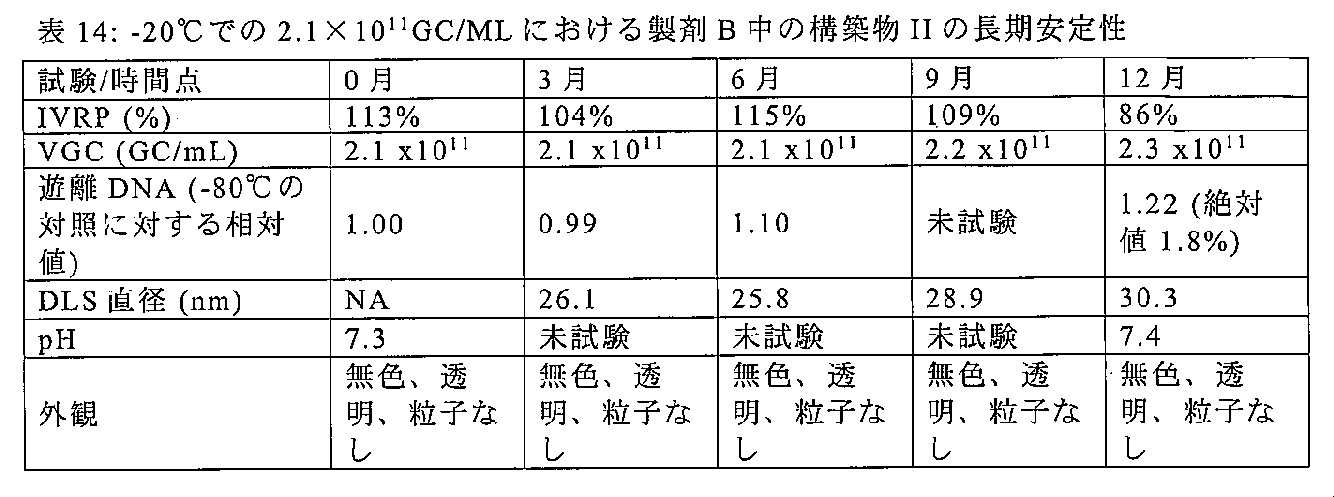
5.4 実施例4:凍結解凍サイクル安定性における製剤Aと製剤Bの比較
5.4.1 はじめに
凍結および解凍速度は、生物学的製剤の安定性に影響を及ぼす可能性がある(Cao et al., 2003, Biotechnol. Bioeng. 82(6):684-90)。緩慢凍結の間の水の結晶化は賦形剤の濃縮を結果としてもたらすことがあり、これは生物学的製剤の安定性に影響し得る。相分離またはpHシフトはまた、生物学的製剤の安定性に影響を及ぼすことがある。急速凍結は、界面ストレスを与える可能性のある、より小さな氷結晶およびより大きな氷-水界面領域をもたらす可能性がある。急速凍結はまた、氷中の気泡を取り込んで、解凍中の空気-水界面ストレスを引き起こす可能性がある。緩慢解凍は氷が再結晶をもたらし、界面ストレスにより溶液中の生物学的製剤の安定性に影響を与える場合がある。
5.4 Example 4: Comparison of Formulation A and Formulation B in Freeze-Thaw Cycle Stability 5.4.1 Introduction Freeze and thaw rates can affect the stability of biologics (Cao et al. al., 2003, Biotechnol. Bioeng. 82(6):684-90). Crystallization of water during slow freezing can result in concentration of excipients, which can affect the stability of biologics. Phase separation or pH shifts can also affect the stability of biologics. Rapid freezing can result in smaller ice crystals and larger ice-water interfacial areas that can impart interfacial stress. Rapid freezing can also entrap air bubbles in the ice, causing air-water interface stress during thawing. Slow thawing can cause ice to recrystallize and affect the stability of biologics in solution due to interfacial stress.
凍結-解凍ストレスはAAVカプシドを潜在的に破壊し、少量の遊離DNAの放出をもたらす可能性がある。臨床試験の間、FDPは、充填仕上げ、保存、臨床用包装およびラベリングに使用される複数の供給業者間で出荷することができ、最終的には臨床施設に送達させることができる。出荷中または製造物取扱い中に計画外の温度逸脱が発生した場合、製造物の加温、または解凍と再凍結にさえつながることがあり得る。凍結および解凍速度の相対的な影響は、CMOおよびクリニックでの逸脱を評価し、ならびに凍結および解凍使用説明書をガイドするために用いることができた。凍結および解凍の影響は、AAVのタイプおよびその製剤にも依存する場合がある。この実施例では、これらの因子を評価した。 Freeze-thaw stress can potentially disrupt the AAV capsid, resulting in the release of small amounts of free DNA. During clinical trials, FDP can be shipped between multiple suppliers used for fill finishing, storage, clinical packaging and labeling, and ultimately delivered to clinical sites. Unplanned temperature excursions during shipping or product handling can lead to product warming or even thawing and refreezing. The relative impact of freeze and thaw rates could be used to assess CMO and clinic deviations and guide freeze and thaw instructions for use. The effects of freezing and thawing may also depend on the type of AAV and its formulation. These factors were evaluated in this example.
BDSボトル中のより大きな体積(60~110mL)は、60および110mLの水に対して、それぞれ約0.5℃/分および0.3℃/分の全体平均速度で凍結することが見出された。CZバイアル中のより小さい0.6mL充填物は、室温または-20℃(約2.0℃/分の速度)のいずれかから凍結するのに約30~40分かかったが、一方、解凍には室温から30分かかり、-20℃から10分かかった(それぞれ約2.4℃/分および4.5℃/分の速度)。以前の研究では、水60および110mLを充填した250mLのNalgene HDPE(BDS)ボトルが、-65℃未満で凍結するのにそれぞれ163および266分かかることが示された。これらの体積の対応する凍結速度は、60および110mLの水についてそれぞれ0.53℃/分および0.33℃/分であった。解凍中、融点に到達するまでに温度の急激な上昇が観察され、その時点で温度は室温に向かってゆっくりと上昇した。解凍には、60および110mLボトルでそれぞれ273分および337分かかった(全体平均速度0.32℃~0.25℃/分に相当)。ボトル内の凍結および解凍の温度プロファイルを図19Aに示す。
別の以前の研究では、2mLのNalgeneクライオバイアル中への0.6mL水充填の凍結/解凍温度プロファイルが調査された。-80℃の冷凍器と-20℃の冷凍器またはベンチトップ(室温)のいずれかで温度サイクルを生じさせた。データを図19Bに示す。室温から-60℃までの凍結には平均して約40分かかり、一方、-20℃から-60℃までの凍結には約30分かかった。これは両研究とも約2.0℃/分の速度に相対応する。-60℃から-20℃までの解凍は比較的速く、10分かかり、一方、室温までの解凍は約30分かかった。これは-20℃研究では約4.5℃/分、室温研究では2.4℃/分の速度に対応する。
Larger volumes (60-110 mL) in BDS bottles were found to freeze at overall average rates of about 0.5° C./min and 0.3° C./min for 60 and 110 mL of water, respectively. rice field. The smaller 0.6 mL fill in the CZ vial took about 30-40 minutes to freeze from either room temperature or −20° C. (rate of about 2.0° C./min), while thawing was took 30 minutes from room temperature and 10 minutes from −20° C. (rates of about 2.4° C./min and 4.5° C./min, respectively). Previous studies have shown that 250 mL Nalgene HDPE (BDS) bottles filled with 60 and 110 mL water take 163 and 266 minutes to freeze below -65°C, respectively. The corresponding freezing rates for these volumes were 0.53° C./min and 0.33° C./min for 60 and 110 mL water, respectively. During thawing, a rapid rise in temperature was observed until the melting point was reached, at which point the temperature slowly rose towards room temperature. Thawing took 273 and 337 minutes for the 60 and 110 mL bottles, respectively (corresponding to an overall average rate of 0.32°C to 0.25°C/min). The temperature profile for freezing and thawing in the bottle is shown in Figure 19A.
Another previous study investigated the freeze/thaw temperature profile of 0.6 mL water fills into 2 mL Nalgene cryovials. Temperature cycling occurred in either a −80° C. freezer and a −20° C. freezer or bench top (room temperature). The data are shown in Figure 19B. Freezing from room temperature to -60°C took on average about 40 minutes, while freezing from -20°C to -60°C took about 30 minutes. This corresponds to a rate of about 2.0°C/min in both studies. Thawing from -60°C to -20°C was relatively fast, taking 10 minutes, while thawing to room temperature took about 30 minutes. This corresponds to a rate of about 4.5°C/min for the -20°C study and 2.4°C/min for the room temperature study.
この実施例では、緩慢と急速の凍結および解凍速度での複数サイクルの凍結/解凍の影響を評価した。代表的なAAV8(構築物II)の製造物品質における約0.13℃/分(11時間の凍結または解凍)および1.5℃/分(1時間の凍結または解凍)の凍結/解凍速度の影響を評価した。これは、AAV8の品質における温度の実際の逸脱におけるばらつきの可能性をさらに特徴付けるために行われた。BDS緩慢の凍結および解凍について予想される速度より遅くなるように緩慢速度が選択された。急速速度について、約1℃/分の最大到達可能速度(緩慢速度よりも約10倍速い)を、急速の解凍と凍結の代表として研究した。複数サイクルを、臨床において起こり得るものを超えて試料にストレスを加えるために適用した。試料は、in vitro相対的効力、サイズ排除クロマトグラフィー純度、遊離DNAレベル(凍結-解凍ストレスに感受性であることが見出された新しいSYBR Gold色素ベースのアッセイを用いる)、および動的光散乱によるサイズ分布により分析された。 In this example, the effects of multiple freeze/thaw cycles on slow and fast freeze and thaw rates were evaluated. Effect of freeze/thaw rates of approximately 0.13° C./min (11 h freeze or thaw) and 1.5° C./min (1 h freeze or thaw) on product quality of representative AAV8 (construct II) evaluated. This was done to further characterize the potential variability in actual deviations in temperature of AAV8 quality. The slow rate was chosen to be slower than expected for BDS slow freeze and thaw. For rapid rates, a maximum attainable rate of approximately 1°C/min (approximately 10 times faster than the slow rate) was studied as representative of rapid thawing and freezing. Multiple cycles were applied to stress the samples beyond what would occur in the clinic. Samples are evaluated for in vitro relative potency, size exclusion chromatography purity, free DNA levels (using a new SYBR Gold dye-based assay found to be sensitive to freeze-thaw stress), and by dynamic light scattering. Analyzed by size distribution.
5.4.2 凍結-解凍研究の結果の概要
全体として、データは、0.12℃/分(または約11時間超)の緩慢から1℃/分(または約1時間超)の急速の範囲の速度での5回の凍結/解凍サイクルについて、dPBSおよび「スクロースを含む改変dPBS」中の構築物IIの品質特性に最小限の影響があることを示した。
凍結/解凍速度は、BDSのボトルまたはDPのバイアルについて臨床で起こり得ることが予想される速度をひとくくりにするように選択された。複数サイクルを、臨床で起こり得るものを超えて試料にストレスを加えるために適用した。
凍結-解凍研究の結果の全体的な概要を表15に提供する。
5.4.2 Summary of Freeze-Thaw Study Results Overall, the data ranged from slow at 0.12°C/min (or over about 11 hours) to rapid at 1°C/min (or over about 1 hour). showed minimal impact on the quality attributes of construct II in dPBS and 'modified dPBS with sucrose' for 5 freeze/thaw cycles at a rate of .
Freeze/thaw rates were chosen to bracket the rates expected to occur clinically for bottles of BDS or vials of DP. Multiple cycles were applied to stress the samples beyond what would occur clinically.
A general summary of the freeze-thaw study results is provided in Table 15.

5.4.3 材料
バイアル:CZ 2mLバイアル、13mm、19550057(West,Daikyo)
ストッパー:13mm血清NovaPure RP S2-F451 45432/50 Gray(West)
構築物II:0.001%ポロキサマー188を含むダルベッコリン酸緩衝食塩水(dPBS)緩衝剤(0.2g/L塩化カリウム、0.2g/L一塩基性リン酸カリウム、8.01g/L塩化ナトリウム、1.15g/L二塩基性リン酸ナトリウム無水物、pH7.4)中で約1×1012GC/mLで製剤化し、CZバイアル中に0.5mLでバイアル化した(この実施例では、dPBSが言及されている場合、これは、0.001%ポロキサマー188も含有するdPBS緩衝剤を暗黙的に記載する)。
5.4.3 Materials Vial:
Stopper: 13mm Serum NovaPure RP S2-F451 45432/50 Gray (West)
Construct II: Dulbecco's Phosphate Buffered Saline (dPBS) Buffer with 0.001% Poloxamer 188 (0.2 g/L Potassium Chloride, 0.2 g/L Monobasic Potassium Phosphate, 8.01 g/L Sodium Chloride , 1.15 g/L dibasic sodium phosphate anhydrate, pH 7.4) at approximately 1 x 10 GC/mL and vialed at 0.5 mL in CZ vials (in this example, Where dPBS is mentioned, this implicitly describes a dPBS buffer that also contains 0.001% poloxamer 188).
構築物II:「スクロースを含む改変dPBS」(0.2g/L塩化カリウム、0.2g/L一塩基性リン酸カリウム、5.84g/L塩化ナトリウム、1.15g/L二塩基性リン酸ナトリウム無水物、4%スクロース、0.001%ポロキサマー188、pH7.4)中で約1×1012GC/mLで製剤化し、CZバイアル中に0.5mLでバイアル化した。 Construct II: "modified dPBS with sucrose" (0.2 g/L potassium chloride, 0.2 g/L monobasic potassium phosphate, 5.84 g/L sodium chloride, 1.15 g/L dibasic sodium phosphate Formulated at approximately 1×10 12 GC/mL in anhydrous, 4% sucrose, 0.001% poloxamer 188, pH 7.4) and vialed at 0.5 mL in CZ vials.
5.4.4 機器
温度プローブ熱電対を備えるGenesis 25EL凍結乾燥機(SP Scientific)アセットタグ0941(FFF)。
Cytation 5プレートリーダー(BioTek,Winooski,VT)、アセットタグ0867(FFF機器)
Cary 60 UV-可視分光光度計(Agilent, Santa Clara, CA)、Asset Tag 0999(FFF)
サーマルミキサー/ヒートブロック(Thermo Scientific)、S/N:01014318110768
Waters Acquity Arc Equipment ID 0447(C3PO)およびSepax SRT SEC-1000 Peekカラム(PN215950P-4630、SN:8A11982、LN:BT090、5μm 1000A、4.6×300mm)
TA Instruments示差走査熱量計、DSC250/RCS90、製造番号DSC2A-00980、アセットタグ0866。
5.4.4 Equipment Genesis 25EL Freeze Dryer (SP Scientific) Asset Tag 0941 (FFF) with temperature probe thermocouple.
Thermal mixer/heat block (Thermo Scientific), S/N: 01014318110768
Waters Acquity Arc Equipment ID 0447 (C3PO) and Sepax SRT SEC-1000 Peek column (PN215950P-4630, SN: 8A11982, LN: BT090, 5 μm 1000A, 4.6×300 mm)
TA Instruments Differential Scanning Calorimeter, DSC250/RCS90, serial number DSC2A-00980, asset tag 0866.
5.4.5 方法
(a)凍結乾燥機における制御された凍結-解凍サイクル
制御された凍結/解凍サイクルは、表16に従って凍結乾燥機において実行された。バイアルを棚上に十分に間隔をあけ、緩衝剤の4バイアルに熱電対を付けた。
5.4.5 Method (a) Controlled Freeze-Thaw Cycle in Freeze Dryer A controlled freeze/thaw cycle was performed in the freeze dryer according to Table 16. The vials were well spaced on the shelf and 4 vials of buffer were thermocoupled.

(b)in vitro相対的効力
構築物IIのIVRPを行った:
ddPCR GCタイターを遺伝子発現に関連付けるために、HEK293細胞への形質導入を行うことおよび抗VEGF Fabタンパク質レベルについて細胞培養上清をアッセイすることによりin vitroバイオアッセイが行われた。HEK293細胞が、3つのポリ-D-リジンをコートした96ウェル組織培養プレート上に終夜プレーティングされた。細胞は次に、野生型ヒトAd5ウイルスを予備感染され、続いて構築物II参照標準品および試験物品の3つの独立して調製された段階希釈液を用いて形質導入され、各調製物は別々のプレートに異なる位置においてプレーティングされた。形質導入後3日目に、細胞培養培地はプレートから収集され、ELISAを介してVEGF結合性Fabタンパク質レベルについて測定された。ELISAのために、VEGFでコートされた96ウェルELISAプレートはブロッキングされ、次に収集された細胞培養培地とインキュベートされて、HEK293細胞により産生された抗VEGF Fabが捕捉された。Fab特異的抗ヒトIgG抗体を使用して、VEGF捕捉Fabタンパク質が検出された。洗浄後に、ホースラディッシュペルオキシダーゼ(HRP)基質溶液が加えられ、顕色させ、停止緩衝剤を用いて中止され、プレートがプレートリーダーにおいて読まれた。HRP生成物の吸光度またはODが対数希釈に対してプロットされ、各試験物品の相対効力が同じプレート上の参照標準品に対して算出され、これはパラレリズム類似性試験を通過した後に式:EC50参照÷EC50試験物品を使用して4-パラメーターロジスティック回帰モデルとフィッティングされた。試験物品の効力は、3つのプレートの加重平均から算出される、参照標準品効力のパーセンテージとして報告された。
(b) In vitro relative potency IVRP of construct II was performed:
To relate ddPCR GC titers to gene expression, an in vitro bioassay was performed by transducing HEK293 cells and assaying cell culture supernatants for anti-VEGF Fab protein levels. HEK293 cells were plated overnight on three poly-D-lysine coated 96-well tissue culture plates. Cells were then preinfected with wild-type human Ad5 virus and subsequently transduced with three independently prepared serial dilutions of the Construct II reference standard and test article, each preparation in a separate The plates were plated at different positions. Three days after transduction, cell culture medium was harvested from the plates and measured for VEGF-binding Fab protein levels via ELISA. For ELISA, 96-well ELISA plates coated with VEGF were blocked and then incubated with collected cell culture media to capture anti-VEGF Fabs produced by HEK293 cells. VEGF-captured Fab protein was detected using a Fab-specific anti-human IgG antibody. After washing, horseradish peroxidase (HRP) substrate solution was added, developed, stopped with stop buffer, and the plate read in a plate reader. The absorbance or OD of the HRP product is plotted against logarithmic dilution and the relative potency of each test article is calculated against the reference standard on the same plate, which is calculated after passing the parallelism similarity test with the formula: EC50. A 4-parameter logistic regression model was fitted using the ÷EC50 test article. Test article efficacy was reported as a percentage of the reference standard efficacy calculated from the weighted average of the three plates.
(c)遊離DNA分析
遊離DNAは、DNAに結合するSYBR(登録商標)Gold核酸ゲル染色剤(「SYBR Gold色素」)の蛍光により決定された。蛍光は、マイクロプレートリーダーを使用して測定され、DNA標準品を用いて定量化された。ng/μLでの結果が報告された。
ng/μLでの測定された遊離DNAを遊離DNAのパーセンテージに変換するために、2つのアプローチを使用して全DNAを概算した。第1のアプローチでは、UV-可視分光法により決定されたGC/mL(OD)を使用して試料中の全DNAが概算され、ここでMはDNAの分子量であり、1E6は単位変換係数であり:
概算される全DNA(ng/μL)=1E6×GC/mL(OD)×M(g/mol)/6.02×1023である。
(c) Free DNA Analysis Free DNA was determined by the fluorescence of SYBR® Gold Nucleic Acid Gel Stain (“SYBR Gold dye”) that binds to DNA. Fluorescence was measured using a microplate reader and quantified using DNA standards. Results were reported in ng/μL.
To convert the measured free DNA in ng/μL to percentage free DNA, two approaches were used to estimate total DNA. In the first approach, GC/mL (OD) determined by UV-visible spectroscopy was used to estimate the total DNA in the sample, where M is the molecular weight of the DNA and 1E6 is the unit conversion factor. can be:
Estimated total DNA (ng/μL)=1E6×GC/mL (OD)×M (g/mol)/6.02×10 23 .
第2のアプローチでは、試料を85℃に20分間0.05%のポロキサマー188と共に加熱し、SYBR Gold色素アッセイにより加熱された試料中で測定された実際のDNAをトータルとして使用した。これはしたがって、すべてのDNAが回収および定量化されたという仮定を有する。(UV読取りに対する)SYBR gold色素による全DNAの決定は、構築物II dPBS製剤について131%および構築物IIスクロースを含む改変dPBS製剤についてはより高い152%であることが見出された。遊離DNAのパーセンテージへのng/μLの変換におけるこの変形形態は、報告される結果における範囲として取得された。趨勢のために、未加工のng/μLを使用することができ、または一貫した方法により決定されたパーセンテージを使用することができる。 In the second approach, the samples were heated to 85° C. for 20 minutes with 0.05% poloxamer 188 and the actual DNA measured in the heated samples by the SYBR Gold dye assay was used as total. This therefore has the assumption that all DNA has been recovered and quantified. Total DNA determination by SYBR gold dye (vs. UV reading) was found to be 131% for the Construct II dPBS formulation and higher 152% for the modified dPBS formulation containing Construct II sucrose. This variation in converting ng/μL to percentage of free DNA was taken as a range in the reported results. For trends, raw ng/μL can be used, or percentages determined by consistent methods can be used.
(d)サイズ排除HPLC分析
SECは、Waters Acquity Arc Equipment ID 0447(C3PO)上の、Sepax SRT SEC-1000 Peek column(PN 215950P-4630、SN:8A11982、LN:BT090、5μm 1000A、4.6×300mm)を使用して、25mm経路長フローセルを用いて行われた。移動相は、(20mMのリン酸ナトリウム、300mMのNaCl、0.005%のポロキサマー188、pH6.5-VA 15Apr19)、0.35mL/分の流速で20分間、周囲温度のカラムとした。データ収集は、2点/秒のサンプリング速度および1.2nmの分解能、214、260、および280nmにおける25点平均の平滑化を用いて行われた。理想的な標的負荷は1.5×1011GCであった。構築物II試料は、50μL、理想的な標的の約1/3で注入することができ、または構築物IIを5μLで注入した。
(d) Size Exclusion HPLC Analysis SEC was obtained on a Sepax SRT SEC-1000 Peek column (PN 215950P-4630, SN: 8A11982, LN: BT090, 5
(e)動的光散乱
動的光散乱(DLS)は、Wyatt DynaProIII上で、Corning 3540 384ウェルプレートを使用して30μLの試料体積を用いて行われた。繰返し当たり各10s間の10回の取得を収集し、試料当たり3回の繰返しの測定が為された。溶媒は、dPBS中の構築物IIについて「PBS」とし、スクロースを含む改変dPBS試料中の構築物IIについて「4%のスクロース」とした。データ品質基準(ベースライン、SOS、ノイズ、フィット)を満たさない結果を「マーク」し、分析から除外した。低遅延時間カットオフを、スクロースを含む改変dPBS試料について1.4μsから10μsに変更して、人為現象的に低いキュムラント分析直径結果の惹起における約1nmのスクロース賦形剤ピークの影響力を排除した。
(e) Dynamic Light Scattering Dynamic light scattering (DLS) was performed on a Wyatt DynaProIII using Corning 3540 384-well plates with a sample volume of 30 μL. Ten acquisitions of 10 s duration each were collected per repeat and three replicate measurements were made per sample. Solvent was "PBS" for construct II in dPBS and "4% sucrose" for construct II in modified dPBS samples containing sucrose. Results that did not meet data quality criteria (baseline, SOS, noise, fit) were "marked" and excluded from analysis. The low lag time cutoff was changed from 1.4 μs to 10 μs for modified dPBS samples containing sucrose to eliminate the influence of the ˜1 nm sucrose excipient peak in evoking artificially low cumulant analysis diameter results. .
(f)示差走査熱量測定
低温示差走査熱量測定(低温DSC)は、TA Instruments DSC250を使用して実行された。約20μLの試料をTzeroパンにロードし、Tzero Hermeticリッドを用いて圧着した。試料を25℃で2分間平衡化させ、次に5℃/分で-60℃に冷却し、2分間平衡化させ、次に5℃/分で25℃に加熱した。熱フローデータを従来のモードで収集した。
(f) Differential Scanning Calorimetry Cryogenic Differential Scanning Calorimetry (Cryogenic DSC) was performed using a TA Instruments DSC250. Approximately 20 μL of sample was loaded into a Tzero pan and crimped using a Tzero Hermetic lid. The sample was equilibrated at 25°C for 2 minutes, then cooled at 5°C/min to -60°C, equilibrated for 2 minutes, then heated at 5°C/min to 25°C. Heat flow data were collected in conventional mode.
5.4.6 結果
(a)凍結-解凍研究の温度プロファイル
凍結および解凍中の緩衝剤の熱伝達の限界および相転移のため、製造物温度は棚と正確に一致しなかった。サイクルの代表的な部分について、製造物が25℃近くおよび-60℃近くまでの期間を用いて決定された平均速度を、全体の平均速度を計算するために、表17に概要する。
予想されるように、冷凍中にエネルギーが放出されるため、約-10℃で、製造物が棚温度よりもわずかに温かくなった温度の上昇が特徴的である。同様に、0℃付近での氷の解凍時には、製造物は棚に対してわずかに低い温度であった。下記のセクションにプローブ温度のデータを示す。さらに、FT/FTおよびSF/SFについては、棚およびプローブの速度(すなわち、温度および時間の5点勾配)が、緩慢速度および急速速度について達成された実際の速度を表すものとして示される。
急速凍結平均速度は約1℃/分に制限され、急速解凍平均速度は約0.8~1℃/分に制限された。
実際の製造物温度「急速」速度は、凍結で約1時間、解凍で1.5時間であった。「緩慢」速度は、約0.12℃/分であり、凍結と解凍の両方とも約11時間かかった。
5.4.6 Results (a) Temperature Profiles of Freeze-Thaw Studies Due to buffer heat transfer limitations and phase transitions during freezing and thawing, the product temperature was not exactly matched to the shelf. For a representative portion of the cycle, the average velocities determined using periods where the product was near 25° C. and near −60° C. are summarized in Table 17 to calculate the overall average velocities.
As expected, due to the release of energy during freezing, a temperature rise of about -10°C was characteristic with the product slightly warmer than the shelf temperature. Similarly, when the ice thawed around 0°C, the product was slightly cooler to the shelf. Probe temperature data is presented in the section below. In addition, for FT/FT and SF/SF, shelf and probe velocities (ie, 5-point slopes of temperature and time) are shown to represent actual velocities achieved for slow and fast velocities.
The average rapid freeze rate was limited to about 1°C/min and the average rapid thaw rate was limited to about 0.8-1°C/min.
The actual product temperature "rapid" rate was about 1 hour for freezing and 1.5 hours for thawing. The "slow" rate was about 0.12°C/min and both freezing and thawing took about 11 hours.
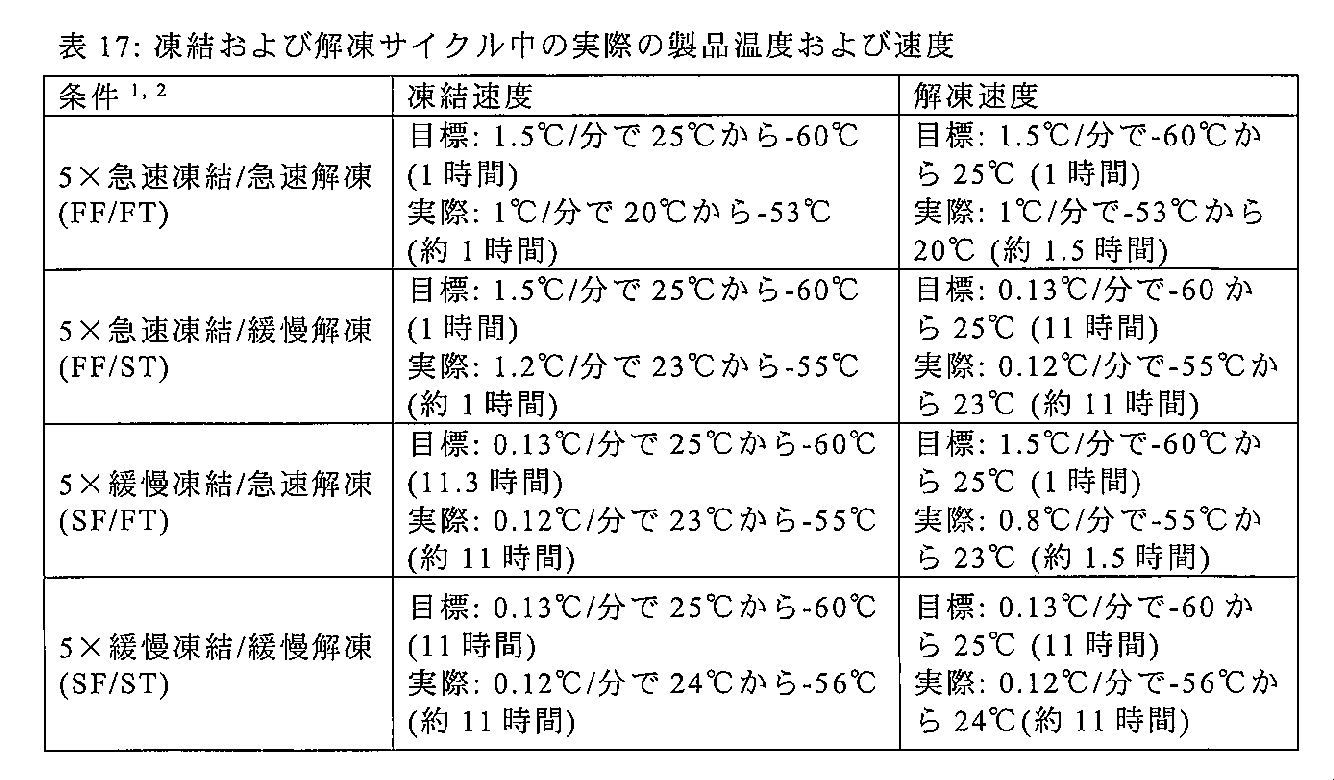
(b)急速凍結/急速解凍(FF/FT)
図20Aは、FF/FTの棚およびプローブ温度プロファイルを示す。実験室でのスケジューリング目的のために、いくつかのサイクルについて、より長い凍結保持が行われた。
急速凍結平均速度は約1℃/分に制限され、急速解凍平均速度は約0.8~1℃/分に制限された。
1回目のサイクルの凍結部分の間の温度スパイクは、機器スパイクであるように見える。3回目のサイクルにおける室温近くのスパイクは、サイクルを継続するシステムの手動リセット、およびそれに伴う一時的な(数分間の)棚温度設定の低下により、10℃近くのデフォルトになったためであった。
図20Bは、棚と製造物の両方の温度およびそれらの速度の拡大を示す(25分間にわたる平均)。実際の速度は、平均製造物温度および棚温度が、プログラムされた急速速度でのこれらのプロセスの間の非常に急速な凍結と解凍、および関連付けられる熱伝達の限界によって影響されたことを示す。製造物の解凍は、棚から熱を取り出し、解凍温度範囲の間、棚温度速度の低減をもたらした。
(b) Fast Freeze/Fast Thaw (FF/FT)
FIG. 20A shows shelf and probe temperature profiles for FF/FT. Longer cryopreservations were performed for some cycles for laboratory scheduling purposes.
The average rapid freeze rate was limited to about 1°C/min and the average rapid thaw rate was limited to about 0.8-1°C/min.
The temperature spike during the freezing portion of the first cycle appears to be an instrumental spike. The spike near room temperature in the third cycle was due to a manual reset of the system to continue cycling and the accompanying temporary (several minutes) reduction in shelf temperature setting to default near 10°C.
FIG. 20B shows the expansion of both shelf and product temperatures and their velocities (averaged over 25 minutes). Actual rates show that average product and shelf temperatures were affected by very rapid freezing and thawing during these processes at the programmed rapid rate and associated heat transfer limitations. Thawing the product removed heat from the shelf resulting in a reduced shelf temperature rate during the thaw temperature range.
(c)急速凍結/緩慢解凍(FF/ST)
図21は、FF/STの棚およびプローブ温度プロファイルを示す。FF/STの1回目のサイクルは、凝縮器への負荷を低減するために、25℃から-55℃に、および25℃に戻すように実行された。その後の4サイクルを-60℃に設定した。凍結および解凍までの時間は更新されず、標的速度を(1.5℃/分から)1.6℃/分および(0.125℃/分から)0.13℃/分に増加させた。この差は、当初の標的速度から10%未満でありごくわずかである。3回目のサイクルの室温近くのスパイクは、サイクルを継続するシステムの手動リセット、およびそれに伴う一時的な(数分間の)棚温度設定の減少により、10℃近くのデフォルトになったためであった。
(c) fast freeze/slow thaw (FF/ST)
FIG. 21 shows shelf and probe temperature profiles for FF/ST. A first cycle of FF/ST was run from 25° C. to −55° C. and back to 25° C. to reduce the load on the condenser. The subsequent 4 cycles were set at -60°C. The times to freeze and thaw were not updated, increasing target rates to 1.6°C/min (1.5°C/min) and 0.13°C/min (from 0.125°C/min). This difference is negligible at less than 10% from the original target velocity. The spike near room temperature on the third cycle was due to a manual reset of the system continuing the cycle and a concomitant temporary (several minutes) decrease in shelf temperature setting to default near 10°C.
(d)緩慢凍結/急速解凍(SF/FT)
図22は、SF/FTの棚およびプローブ温度プロファイルを示す。実験室のスケジューリング目的で、最後のサイクルのためにより長い凍結保持が行われた。
(d) slow freeze/fast thaw (SF/FT)
FIG. 22 shows shelf and probe temperature profiles for SF/FT. A longer cryopreservation was performed for the last cycle for laboratory scheduling purposes.
(e)緩慢凍結/緩慢解凍(SF/ST)
図23は、FF/FTの棚およびプローブ温度プロファイルを示す。実験室のスケジューリング目的で、3回目のサイクルのためにより長い凍結保持があった。3回目のサイクルの室温近くのスパイクは、サイクルを継続するシステムの手動リセット、およびそれに伴う一時的な(数分間の)棚温度設定の減少により、10℃近くのデフォルトになったためであった。
図24は、棚と製造物の両方の温度およびそれらの速度の拡大を示す(25分間にわたる平均)。速度は、平均製造物温度が凍結および解凍プロセスによって影響を受けたが、棚温度速度は、(FT/FTと比較して)これらのより緩慢速度で安定したままであったことを示す。
(e) slow freeze/slow thaw (SF/ST)
FIG. 23 shows shelf and probe temperature profiles for FF/FT. For laboratory scheduling purposes, there was a longer cryopreservation for the third cycle. The spike near room temperature on the 3rd cycle was due to a manual reset of the system continuing the cycle, and a concomitant temporary (several minutes) decrease in shelf temperature setting to default near 10°C.
Figure 24 shows the expansion of both shelf and product temperatures and their velocities (averaged over 25 minutes). The rates show that the average product temperature was affected by the freeze and thaw process, but the shelf temperature rates remained stable at these slower rates (compared to FT/FT).
5.4.7 in vitro相対的効力
in vitro相対的効力(IVRP)の結果は、dPBSとスクロースを含む改変dPBS製剤の両方において、構築物IIの凍結および解凍の急速速度および緩慢速度のすべての並べ替えについて、対照と同程度であり、方法のばらつきの範囲内であった(表18)。
5.4.7 In Vitro Relative Potency The in vitro relative potency (IVRP) results showed a full array of fast and slow freeze and thaw rates for Construct II in both dPBS and modified dPBS formulations containing sucrose. Replacement was comparable to controls and within method variability (Table 18).

5.4.8 SYBR色素結合およびSECによる遊離DNAの結果
遊離DNAの全体的な結果の概要を表19に提供する。100%のGC/mL(OD)値または100%基準の熱ストレスの結果のいずれかに基づくパーセンテージを表すSYBR Gold結合により、遊離DNAについての範囲が提供される。
5.4.8 Free DNA Results by SYBR Dye Binding and SEC A summary of the overall free DNA results is provided in Table 19. Ranges for free DNA are provided by SYBR Gold binding expressing percentages based on either 100% GC/mL (OD) values or 100% baseline heat stress results.

SEC結果プロファイルの拡大図を図25、図26、および図27に示す。260nmのUVチャネルを用いて、遊離DNA(先のピーク)およびいくつかのタンパク質(閉じたプレピーク)を表すパーセントのプレピークを決定した。ピークとそれらの溶出位置のスペクトル分析は、プレピークが主に遊離DNAであったことを示す。主ピーク後のピークは賦形剤に関連する。 Magnified views of the SEC result profiles are shown in FIGS. 25, 26 and 27. FIG. The 260 nm UV channel was used to determine the percent pre-peak representing free DNA (early peak) and some protein (closed pre-peak). Spectral analysis of the peaks and their elution positions indicates that the pre-peaks were primarily free DNA. The peaks after the main peak are related to excipients.
5.4.9 動的光散乱結果
DLSの結果は、図28におけるdPBS中の構築物II、および図29におけるスクロースを含む改変dPBS中で構築物IIについて示される。キュムラント適合の直径結果と正規化適合による主ピークを表20に示す。
キュムラント直径は27.1~27.5nmの範囲(対照=27.5)であり、正規化適合結果は28.2~28.7nmの範囲(対照=28.4)であった。キュムラントデータの範囲は0.4nmであり、正規化データの範囲は0.5nmであった。反復測定の平均直径の標準偏差は、キュムラント適合については約0.2であり、正規化適合について最大0.8nmであった。
5.4.9 Dynamic Light Scattering Results DLS results are shown for construct II in dPBS in FIG. 28 and construct II in modified dPBS with sucrose in FIG. The diameter results of the cumulant fit and the main peak from the normalized fit are shown in Table 20.
Cumulant diameters ranged from 27.1 to 27.5 nm (control=27.5) and normalized fit results ranged from 28.2 to 28.7 nm (control=28.4). The cumulant data range was 0.4 nm and the normalized data range was 0.5 nm. The standard deviation of the average diameter of repeated measurements was about 0.2 for the cumulant fit and up to 0.8 nm for the normalized fit.
いずれかの凍結解凍条件後のdPBSにおける構築物IIのサイズ分布については、方法のばらつきの範囲内で変化しなかった。キュムラント直径は26.7~28.4nmの範囲(対照=26.8)であり、正規化は26.2~27.6nmの範囲(対照=27.1)であった。キュムラントデータの範囲は1.7nmであり、正規化データの範囲は1.4nmであった。反復測定の平均直径の標準偏差は、キュムラント適合については約0.1であり、正規化適合については最大0.4nmであった。
凍結-解凍条件後、スクロースを含む改変dPBS中の構築物IIの方法のばらつきの範囲内でサイズ分布に変化はなかった。キュムラント直径は27.7~28.5nmの範囲(対照=28.0)であり、正規化は28.2~31.3nmの範囲(対照=30.3)であった。キュムラントデータの範囲は0.8nmであり、正規化データの範囲は3.1nmであった。スクロースを含む改変dPBSにおいては、反復測定の平均直径の標準偏差は、キュムラント適合について約0.2nmであり、正規化適合について最大1.3nmであった。
約28nmのスクロース中のキュムラント直径は、27nmのdPBS中よりもわずかに高かった(図30)。また、30nmの正規化適合直径は、図31に示されるように、約27nmでのdPBSよりもわずかに高かった。この非常にわずかな見かけのサイズ増加は、水和へのスクロースの影響、したがってカプシドの流体力学的挙動に関係している可能性がある。
The size distribution of construct II in dPBS after either freeze-thaw condition did not change within method variability. Cumulant diameters ranged from 26.7 to 28.4 nm (control=26.8) and normalization ranged from 26.2 to 27.6 nm (control=27.1). The cumulant data range was 1.7 nm and the normalized data range was 1.4 nm. The standard deviation of the average diameter of repeated measurements was about 0.1 for the cumulant fit and up to 0.4 nm for the normalized fit.
There was no change in size distribution within method variability for construct II in modified dPBS containing sucrose after freeze-thaw conditions. Cumulant diameters ranged from 27.7 to 28.5 nm (control=28.0) and normalization ranged from 28.2 to 31.3 nm (control=30.3). The cumulant data range was 0.8 nm and the normalized data range was 3.1 nm. In the modified dPBS containing sucrose, the standard deviation of the average diameter of repeated measurements was approximately 0.2 nm for the cumulant fit and up to 1.3 nm for the normalized fit.
The cumulant diameter in sucrose at about 28 nm was slightly higher than in dPBS at 27 nm (Figure 30). Also, the normalized fit diameter at 30 nm was slightly higher than dPBS at about 27 nm, as shown in FIG. This very small apparent size increase may be related to the effect of sucrose on hydration and thus the hydrodynamic behavior of the capsid.
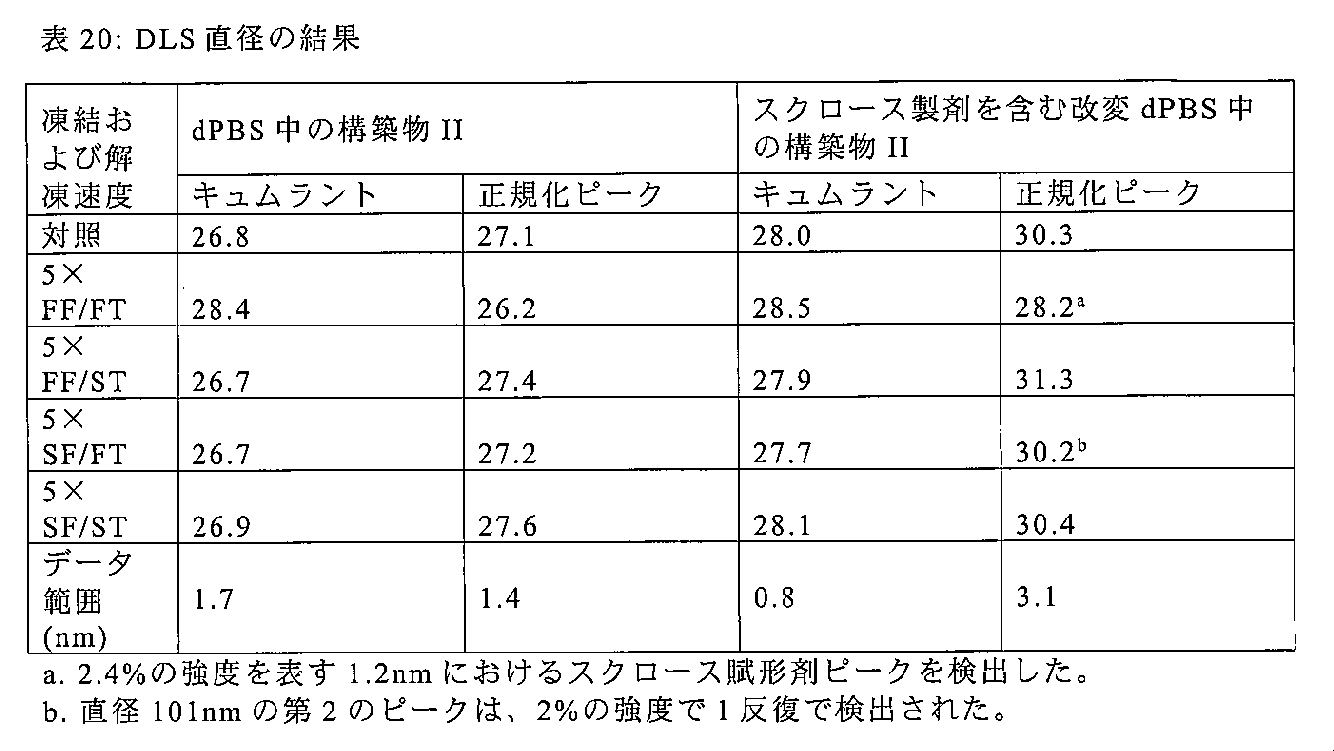
5.4.10 製剤の熱特性
図32に示されるdPBS製剤緩衝剤についての低温DSCサーモグラムは、冷却中に完全に結晶化しなかった非晶質塩化ナトリウムの結晶化により、約-41℃で小さな発熱を有する。賦形剤の再結晶はガラスバイアルの破損に関係している。これは、CZバイアル(COP材料)の問題ではないと予想される。さらに、このシナリオの文献参照は、バイアル破損がガラスバイアルに対してさえ懸念されない可能性があることを示す(Milton et al., 2007, Journal of Pharmaceutical Sciences, 96(7))。未分解の低温肩部を有する共融が-22.1℃のピークで観察され、続いて氷の解凍による大きな吸熱ピークが観察された。共融は塩化ナトリウムおよび水共晶と一致する。塩化ナトリウムに関する文献(Milton et al., 2007, Journal of Pharmaceutical Sciences, 96(7))では、同じ共晶事象および再結晶事象が報告されている。
5.4.10 Thermal Properties of Formulations The cryogenic DSC thermogram for the dPBS formulation buffer, shown in Figure 32, shows a low temperature at approximately -41°C due to crystallization of amorphous sodium chloride that did not fully crystallize during cooling. Has a small fever. Recrystallization of excipients has been associated with breakage of glass vials. This is not expected to be an issue with CZ vials (COP material). Furthermore, literature references in this scenario indicate that vial breakage may not even be a concern for glass vials (Milton et al., 2007, Journal of Pharmaceutical Sciences, 96(7)). A eutectic with an unresolved cold shoulder was observed at the −22.1° C. peak, followed by a large endothermic peak due to ice thawing. Eutectic is consistent with sodium chloride and water eutectic. The literature on sodium chloride (Milton et al., 2007, Journal of Pharmaceutical Sciences, 96(7)) reports the same eutectic and recrystallization events.
図33に示される「スクロースを含む改変dPBS」緩衝剤の低温DSCサーモグラムは、-45.1℃でガラス転移を有し、続いて氷の解凍による大きな吸熱ピークを有する。他の転移は観察されなかった。ガラス転移はガラス形成賦形剤、スクロースの存在と一致する。共融の欠如は、スクロース賦形剤による結晶化の阻害および非晶質粘性状態の維持と一致する。これらの結果は、より高い(0.25M)塩化ナトリウム含有量のより低い(3%)スクロースについて報告された結晶化の阻害および共融の欠如と一致する(Milton et al., 2007, Journal of Pharmaceutical Sciences, 96(7))。 The low-temperature DSC thermogram of the “modified dPBS with sucrose” buffer shown in FIG. 33 has a glass transition at −45.1° C. followed by a large endothermic peak due to ice thawing. No other metastases were observed. The glass transition is consistent with the presence of the glass forming excipient, sucrose. The lack of eutectic is consistent with inhibition of crystallization and maintenance of an amorphous viscous state by the sucrose excipient. These results are consistent with the inhibition of crystallization and lack of eutectic reported for lower (3%) sucrose with higher (0.25 M) sodium chloride content (Milton et al., 2007, Journal of Pharmaceutical Sciences, 96(7)).
5.4.11 結論
この研究のこれらの結果は、緩慢速度(0.12℃/分または約11時間以上)および/または急速速度(1℃/分または約1時間以上)で最大5回の凍結/解凍サイクルが、dPBSおよび「スクロースを含む改変dPBS」製剤中の構築物IIの許容可能な遷移であることを示した。
凍結/解凍速度は、BDSのボトルまたはDPのバイアルに対して起こり得ることが予想される速度をひとくくりにするように選択された。複数サイクルは、複数の遷移をサポートするために、臨床で起こり得るものを超えて試料にストレスを加えるために適用された。
効力の結果は、dPBSおよびスクロースを含む改変dPBS製剤のいずれにおいても、構築物IIの凍結および解凍の急速速度と緩慢速度のすべての並べ替えについて、対照および方法のばらつきの範囲内と同様であった。
凍結-解凍条件後のdPBS中の構築物II、またはスクロースを含む改変dPBS製剤中の構築物IIについては、方法のばらつきの範囲内でサイズ分布に変化はなかった。
凍結-解凍ストレスは、凍結保護賦形剤なしで製剤化した場合に、少量の遊離DNAの放出をもたらす構築物IIの少数のカプシド(AAV8)を破壊することが示された。
dPBS製剤中の構築物IIについては、すべての凍結-解凍ストレス条件(1.7%から6.9%まで)について遊離DNAの増加があった。増加は同程度の大きさであり、凍結-解凍速度の急速と非常に緩慢の異なる並べ替えは明確に相違しなかった。
最も安定な製剤は、遊離DNAの増加が観察されなかった、スクロースを含む改変dPBS製剤であった。この製剤の共融の欠如は、凍結保護スクロース賦形剤による結晶化の阻害および非晶質粘性状態の維持と一致する。
5.5 実施例5:走査熱量プロファイルにおける製剤Aと製剤Bの比較
この実施例は、熱量プロファイルにおける製剤Aと製剤Bの比較を示す。
本研究は、セクション4.5.9、セクション5.4.5(f)および/または本明細書において提供される他の関連セクションに示される方法と同一のまたは類似した手法で行われた。図34に示されるように、製剤Bは、凍結/解凍ストレスに対する頑健性を改善する結晶化/共晶転移を阻害する非晶質賦形剤を含んだ。
5.4.11 Conclusions These results of this study indicate that up to 5 Freeze/thaw cycles were shown to be an acceptable transition for construct II in dPBS and “modified dPBS with sucrose” formulations.
Freeze/thaw rates were chosen to bracket the rates expected to occur for bottles of BDS or vials of DP. Multiple cycles were applied to stress the samples beyond what would occur clinically to support multiple transitions.
Efficacy results were similar for all permutations of fast and slow rates of freeze and thaw for Construct II in both dPBS and modified dPBS formulations containing sucrose, within control and method variability. .
There was no change in size distribution within method variability for construct II in dPBS after freeze-thaw conditions or in modified dPBS formulations containing sucrose.
Freeze-thaw stress has been shown to disrupt minority capsids (AAV8) of construct II resulting in the release of small amounts of free DNA when formulated without cryoprotective excipients.
For construct II in dPBS formulations, there was an increase in free DNA for all freeze-thaw stress conditions (from 1.7% to 6.9%). The increases were of similar magnitude and did not differ significantly between different permutations of fast and very slow freeze-thaw rates.
The most stable formulation was the modified dPBS formulation with sucrose where no increase in free DNA was observed. The lack of eutectic of this formulation is consistent with the inhibition of crystallization and maintenance of an amorphous viscous state by the cryoprotective sucrose excipient.
5.5 Example 5 Comparison of Formulation A and Formulation B in Scanning Calorimetric Profiles This example shows a comparison of Formulation A and Formulation B in calorimetric profiles.
This study was conducted in the same or similar manner as the methods set forth in Section 4.5.9, Section 5.4.5(f) and/or other related sections provided herein. As shown in Figure 34, Formulation B contained amorphous excipients that inhibited the crystallization/eutectic transition that improved robustness to freeze/thaw stress.
実施例6:製剤Aの凍結/解凍サイクルごとに遊離DNAが増加する
この実施例は、製剤Aの凍結/解凍サイクルごとに遊離DNAが増加することを示す。
本研究は、セクション4.5.1、セクション5.4.5(c)および/または本明細書において提供される他の関連セクションに示される方法と同一のまたは類似した手法で行われた。図35に示されるように、製剤Aの凍結/解凍サイクルごとに、遊離DNAのわずかで一貫した増加が検出された。
Example 6: Free DNA Increases with Each Freeze/Thaw Cycle of Formulation A This example shows that free DNA increases with each freeze/thaw cycle of Formulation A.
This study was conducted in the same or similar manner as the methods set forth in Section 4.5.1, Section 5.4.5(c) and/or other related sections provided herein. As shown in Figure 35, a small and consistent increase in free DNA was detected with each freeze/thaw cycle of Formulation A.
5.7 実施例7:30回の凍結および解凍サイクル後の製剤Aと製剤Bの効力の比較
この実施例は、30回の凍結および解凍サイクル後の製剤Aと製剤Bの効力の比較を示す。
本研究は、セクション4.5.1、セクション5.4.5(c)および/または本明細書において提供される他の関連セクションに示される手法と類似した手法で行われた。
緑色蛍光タンパク質の遺伝子を有するAAV8について実施例を行った。凍結-解凍サイクルを用いて、輸送および保存物流の温度変化をシミュレートし、また、製剤最適化作業のためのAAVの劣化を強制する「加速された」ストレスとしても使用した。図36に示されるように、「4%スクロースを含む改変dPBS」製剤B(濃灰色のバー)は、30回の凍結-解凍サイクル後も効力を維持した。対照的に、参照製剤(dPBS、薄灰色バー)の効力は、15~30回の凍結-解凍サイクル後に66~72%に減少した。
化学的および物理的分解をもたらす酸性pHへのシフト、塩の結晶化(効力損失をもたらす表面への曝露)、および低粘度(低粘度はより高い分子移動度および反応速度をもたらす)は、参照DPBS製剤の効力損失の原因となり得る。これらの分解経路は、「4%スクロースを含む改変dPBS」製剤で緩和される可能性がある。
5.7 Example 7: Comparison of Efficacy of Formulation A and Formulation B After 30 Freeze and Thaw Cycles This example shows a comparison of efficacy of Formulation A and Formulation B after 30 freeze and thaw cycles. .
This study was conducted in a manner similar to that set forth in Section 4.5.1, Section 5.4.5(c) and/or other relevant sections provided herein.
An example was performed with AAV8 that has the gene for green fluorescent protein. Freeze-thaw cycles were used to simulate temperature changes in shipping and storage streams, and were also used as 'accelerated' stresses to force AAV degradation for formulation optimization work. As shown in Figure 36, "modified dPBS with 4% sucrose" formulation B (dark gray bars) remained potent after 30 freeze-thaw cycles. In contrast, the efficacy of the reference formulation (dPBS, light gray bars) decreased to 66-72% after 15-30 freeze-thaw cycles.
A shift to acidic pH leading to chemical and physical degradation, salt crystallization (exposure to surfaces leading to loss of potency), and low viscosity (low viscosity leads to higher molecular mobility and reaction rates) can be attributed to ref. It can cause loss of potency of DPBS formulations. These degradation pathways may be mitigated with the 'modified dPBS with 4% sucrose' formulation.
5.8 実施例8:吸着損失における製剤Aと製剤Bの比較
この実施例は、吸着損失における製剤Aと製剤Bを比較する方法を示す。
接触材料は、AAV薬物製造物設計および投与成分について考慮しなければならない。図37に示されるように、製剤Bの非晶質賦形剤は、ガラスバイアルへのAAVの吸着特性を変化させなかった。ガラスバイアルでは吸着損失が生じたが、COPバイアルでは検出されなかった。
5.8 Example 8 Comparison of Formulation A and Formulation B on Adsorption Loss This example demonstrates how to compare Formulation A and Formulation B on adsorption loss.
Contact materials must be considered for AAV drug product design and dosage components. As shown in Figure 37, Formulation B amorphous excipients did not alter the adsorption properties of AAV to glass vials. Adsorption losses occurred with glass vials but were not detected with COP vials.
5.9 実施例9:長期安定性における製剤Aと製剤Bの比較
この実施例は、製剤Aと製剤Bの長期安定性の比較を示す。
本研究は、セクション4.5.3および/または本明細書において提供される他の関連セクションに示される手法と同一のまたは類似した手法で行われた。図38および54に示されるように、製剤AおよびBは-80℃で同等の長期凍結安定性を有し、製剤Bは-20℃においても安定であった。「4%スクロースを含む改変dPBS」の製剤Bは、-20℃および80℃において12カ月間効力を維持した。参照製剤A(dPBS)はコンパレータとして-80℃の保存性を示した。
5.9 Example 9: Comparison of Formulation A and Formulation B in Long Term Stability This example shows a comparison of long term stability of Formulation A and Formulation B.
This study was conducted in a manner identical or similar to that set forth in Section 4.5.3 and/or other relevant sections provided herein. As shown in Figures 38 and 54, Formulations A and B had comparable long-term freeze stability at -80°C, and Formulation B was also stable at -20°C. Formulation B of "modified dPBS with 4% sucrose" maintained potency for 12 months at -20°C and 80°C. Reference formulation A (dPBS) exhibited −80° C. storage stability as a comparator.
5.10 実施例10:物理化学的性質における製剤の比較
この実施例は、pH、ガラス転移温度(Tg’)、浸透圧および密度を含む種々の構築物II製剤緩衝剤候補の物理化学的特性の特性を示す。構築物IIは現在、冷凍製剤に保存するように設計されている。緩衝剤pHにおける凍結および冷凍器温度の変動の影響は、-20℃自動除霜(-20℃ AD)冷凍器中の低温pHプローブを用いたpHおよび温度のリアルタイム追跡により調べられた。凍結および解凍時の製剤の相変化を熱量測定により評価した。この研究の結果は、薬物製造物の長期保存のための安定なpHの重要性を考慮するために重要な要素である製剤緩衝剤組成に依存して、異なるpHシフトの大きさが生じることを示す。加えて、異なる製剤緩衝剤のガラス転移温度もまた製剤緩衝剤組成に依存して変化した。低いTg’は、潜在的な物理的および/または化学的分解のための分子移動度を最小にするために、溶液を完全に凝固させるために低い保存温度を必要とする。すべての緩衝剤の浸透圧および密度は、構築物IIの適応の許容範囲内であった。この特性研究は、物理化学的特性に基づく構築物II製剤緩衝剤スクリーニングのための情報を提供する。
5.10 Example 10 Comparison of Formulations on Physico-Chemical Properties characterize. Construct II is currently designed to be stored in cryogenic formulations. The effects of freezing and freezer temperature variations on buffer pH were investigated by real-time tracking of pH and temperature using a cryogenic pH probe in a -20°C automatic defrost (-20°C AD) freezer. Phase changes of the formulations upon freezing and thawing were evaluated calorimetrically. The results of this study demonstrate that different pH shift magnitudes occur depending on the formulation buffer composition, an important factor for considering the importance of stable pH for long-term storage of drug products. show. In addition, the glass transition temperatures of different formulation buffers also varied depending on formulation buffer composition. A low Tg' requires a low storage temperature to completely solidify the solution to minimize molecular mobility for potential physical and/or chemical degradation. The osmolality and density of all buffers were within acceptable limits for the Construct II indication. This characterization study provides information for Construct II formulation buffer screening based on physicochemical properties.
5.10.1 はじめに
生物学的製剤は、保存中に薬物製造物を安定化させるために、様々な賦形剤で構成される緩衝液に保存されることが多い。製造物の安定性を確保するためには、緩衝剤のpHおよび浸透圧を標的仕様範囲内に維持することが重要である。構築物II薬物製造物は、-80~-20℃の凍結状態で保存されるように標的化された。緩慢凍結の間の水の結晶化は賦形剤の濃縮を結果としてもたらすことがあり、これは生物学的製剤の安定性に影響し得る。相分離またはpHシフトも起こり、生物学的製剤の安定性に影響を及ぼす場合がある。
本研究では、製剤緩衝剤のpH安定性に及ぼす凍結および温度遷移の影響を調べた。構築物IIは、現在、dPBSおよび「スクロースを含む改変dPBS製剤」に保存される。
凍結ストレスに対するpH安定化における緩衝剤成分および濃度の影響を例証した。さらに、Tris緩衝食塩水(TBS)ベースの製剤もまた、AAVの潜在的な代替製剤として評価された。
5.10.1 Introduction Biologics are often stored in buffers composed of various excipients to stabilize the drug product during storage. To ensure product stability, it is important to maintain the pH and osmolality of the buffer within target specifications. The Construct II drug product was targeted to be stored frozen at -80 to -20°C. Crystallization of water during slow freezing can result in concentration of excipients, which can affect the stability of biologics. Phase separation or pH shifts can also occur and affect the stability of biologics.
In this study, the effects of freezing and temperature transitions on the pH stability of formulation buffers were investigated. Construct II is currently stored in dPBS and "modified dPBS formulations containing sucrose".
The effect of buffer composition and concentration on pH stabilization against freezing stress was illustrated. Additionally, a Tris-buffered saline (TBS)-based formulation was also evaluated as a potential alternative formulation to AAV.
5.10.2 凍結-解凍研究結果の概要
全体として、データは、PBSベースの製剤緩衝剤が凍結および温度変動に応答して許容可能なpHシフトを示すことを示した。4%および6%スクロースの添加は、150mMまでのイオン強度を有するPBSベースの緩衝剤のpHシフトの大きさを緩和することができる。Trisベースの製剤緩衝剤は凍結時に1pH単位シフトを示した。凍結ストレスに対するpH安定化に及ぼす緩衝剤成分および濃度の影響を調べた。試験したすべての製剤を表21に列挙する。
5.10.2 Summary of Freeze-Thaw Study Results Overall, the data showed that the PBS-based formulation buffer exhibited acceptable pH shifts in response to freezing and temperature fluctuations. Addition of 4% and 6% sucrose can moderate the magnitude of pH shifts in PBS-based buffers with ionic strength up to 150 mM. The Tris-based formulation buffer exhibited a 1 pH unit shift upon freezing. The effects of buffer components and concentrations on pH stabilization against freezing stress were investigated. All formulations tested are listed in Table 21.

5.10.3 定義および略語
dPBS:ダルベッコリン酸緩衝食塩水(通常のPBSよりもリン酸塩レベルがわずかに低い)。dPBSが言及されている本報告において、これは、0.001%のポロキサマー188も含有するdPBS緩衝剤を暗黙的に記述することに留意されたい。
5.10.3 Definitions and Abbreviations dPBS: Dulbecco's Phosphate Buffered Saline (slightly lower phosphate levels than regular PBS). Note that in this report where dPBS is mentioned, this implicitly describes a dPBS buffer that also contains 0.001% poloxamer 188.
ガラス転移温度(Tg’)
-20℃自動的除霜冷凍器:-20℃ AD。この冷凍器は、4時間ごとに-20から-6℃に昇温し、-20に戻すことによって、霜が降りるのを防ぐ。1回の除霜の1サイクル(-20℃→-6℃→-20℃)は、約1時間かかる。
5.10.4 材料
Glass transition temperature (Tg')
-20°C automatic defrost freezer: -20°C AD. This freezer prevents frost by increasing the temperature from -20 to -6°C and back to -20 every 4 hours. One defrosting cycle (-20°C→-6°C→-20°C) takes about one hour.
5.10.4 Materials

5.10.5 機器
pHメーター:Mettler Toledo SevenExcellence、アセットタグ1000
低温pHプローブ:INLAB COOL PRO-ISM。このpHプローブは、-30℃までpHを検出することができる。
天秤:Mettler Toledo、XSR4002S、アセットタグ0971(質量が大きい場合)
天秤:Mettler Toledo、XSR105、アセットタグ1020(質量が小さい場合)
-20℃ AD冷凍器:VWR 10819-664、アセットタグ1213
TA Instruments示差走査熱量計、DSC250/RCS90、製造番号DSC2A-00980、アセットタグ0866。
デンシトメーター:Anton Paar DMA500デンシトメーター、アセットタグ1087
浸透圧計:Advanced Instruments、アセットタグ0472
5.10.5 Equipment pH meter: Mettler Toledo SevenExcellence, Asset Tag 1000
Cold pH probe: INLAB COOL PRO-ISM. This pH probe can detect pH down to -30°C.
Balance: Mettler Toledo, XSR4002S, Asset Tag 0971 (for higher mass)
Balance: Mettler Toledo, XSR105, AssetTag 1020 (for low mass)
-20°C AD refrigerator: VWR 10819-664, Asset tag 1213
TA Instruments Differential Scanning Calorimeter, DSC250/RCS90, serial number DSC2A-00980, asset tag 0866.
Densitometer: Anton Paar DMA500 Densitometer, Asset Tag 1087
Osmometer: Advanced Instruments, Asset Tag 0472
5.10.6 方法
(a)リアルタイム緩衝剤pH追跡
-30℃もの低下させた温度までpHを検出することができるINLAB COOL PRO-ISM低温pHプローブを用いて異なる製剤緩衝剤のpHをモニターした。1ミリリットルの緩衝剤を15mLのファルコンチューブに入れ、次にpHプローブを緩衝剤に浸した。パラフィルムの小片を使用してファルコンチューブおよびpHプローブの間の間隙を密閉し、夾雑および蒸発を回避した。プローブをファルコンチューブと共に-20 AD冷凍器に入れた。緩衝剤のpHおよび温度を約20時間またはpH対温度の挙動が繰返しのパターンを達成するまで2.5分ごとに記録した。自動的な除霜プロセスにより引き起こされる温度変化は、緩衝剤pH安定性に対するストレス状態を生成した。
5.10.6 Method (a) Real-Time Buffer pH Tracking The pH of different formulation buffers was monitored using an INLAB COOL PRO-ISM cryogenic pH probe capable of detecting pH down to temperatures as low as -30°C. . One milliliter of buffer was placed in a 15 mL Falcon tube, then the pH probe was submerged in the buffer. A small piece of Parafilm was used to seal the gap between the Falcon tube and pH probe to avoid contamination and evaporation. The probe was placed in a -20 AD freezer with the Falcon tube. The pH and temperature of the buffer were recorded every 2.5 minutes for approximately 20 hours or until the behavior of pH versus temperature achieved a repeating pattern. Temperature changes caused by the automatic defrosting process created stress conditions for buffer pH stability.
(b)示差走査熱量測定
低温示差走査熱量測定(低温DSC)は、TA InstrumentsDSC250を使用して実行された。約20μLの試料をTzeroパンに装填し、Tzero Hermetic蓋でクリンプした。試料を25℃で2分間平衡化し、次に5℃/分で-60℃に冷却し、2分間平衡化し、次に5℃/分で25℃まで加熱し、熱流量データを従来のモードで収集した。
(b) Differential Scanning Calorimetry Cryogenic Differential Scanning Calorimetry (Cryogenic DSC) was performed using a TA Instruments DSC250. Approximately 20 μL of sample was loaded into a Tzero pan and crimped with a Tzero Hermetic lid. The sample was equilibrated at 25° C. for 2 minutes, then cooled at 5° C./min to −60° C., equilibrated for 2 minutes, then heated at 5° C./min to 25° C., and heat flow data were recorded in conventional mode. collected.
(c)浸透圧
オスモメーターは、浸透圧を測定するために凝固点降下の技術を使用する。機器の較正は、50mOsm/kg、850mOsm/kg、および2000mOsm/kgのNIST追跡可能標準品を使用して行った。290mOsm/kgの参照溶液を使用してオスモメーターのシステム好適性を決定した。
(c) Osmolarity Osmometers use the technique of freezing point depression to measure osmotic pressure. Instrument calibration was performed using NIST traceable standards of 50 mOsm/kg, 850 mOsm/kg, and 2000 mOsm/kg. A reference solution of 290 mOsm/kg was used to determine the system suitability of the osmometer.
(d)密度
密度は、Anton Paar DMA500デンシトメーターを用いて、水を参照として使用して測定された。デンシトメーターは、水および次にメタノールを用いて洗浄し、続いて試料間に空気乾燥した。
(d) Density Density was measured using an Anton Paar DMA500 densitometer using water as a reference. The densitometer was cleaned with water and then methanol followed by air drying between samples.
5.10.7 結果
(a)リアルタイム緩衝剤pH追跡
製剤緩衝剤のpHは、長期保存中の生物学的薬物製造物の安定性を維持する上で重要である。一部の賦形剤成分は、温度が共晶点以下に減少した場合に沈殿し、緩衝剤のpHシフトを引き起こし、薬物製造物の安定性に潜在的に影響を与える。低温pHプローブを用いて、8つの製剤緩衝剤の温度と共にpH変化をモニタリングした。製剤#2、4%スクロースを含む改変dPBSのpHおよび温度をモニタリングする例を図39に示す。安定化に達した後のすべての製剤のpHは図40中にある。
PBSベースの製剤#1-7は、温度が0から-18℃に減少するにつれてpHが減少する傾向を示した(図41)。製剤#1(dPBS)は、PBSベースの製剤#1~7の間で最大のpHシフトの7.4から4.2への3pH単位の減少を示した(図42)。リン酸塩ベースの製剤中の二塩基性リン酸ナトリウムは溶液凍結時に沈殿し、3pH単位の変化は以前の報告と一致する(Zbacnik, 2017, Journal of Pharmaceutical Sciences, 106(3):713-733)。しかしながら、製剤#2~7のpHは、溶液に4~6%のスクロースを添加した場合、1pH単位のみ減少した。以前の研究は、トレハロースおよびマンニトールがある種の条件下で緩衝塩の結晶化を阻害し、非晶質状態で凍結溶液を作り、共晶解凍を抑制することによりpHシフトの大きさを減弱できることを示している(Thorat and Suryanarayanan, 2019, Pharmaceutical Research 26(7):98)。PBSベースの製剤のpHシフトを減衰させるスクロースのメカニズムを説明するために、すべての製剤の相転移挙動をDSCにより特徴付けした。
Trisベースの製剤#8のpHは7.6から8.7に増加し、これは温度低下に応答したTrisのpKa変化(-0.03/℃)と一致した(Zbacnik, 2017, Journal of Pharmaceutical Sciences, 106(3):713 -733)。Tris塩は溶液が凍結すると結晶化しないため、スクロースはこの製剤において凍結保護剤として機能する。
5.10.7 Results (a) Real-Time Buffer pH Tracking The pH of formulation buffers is important in maintaining the stability of biological drug products during long-term storage. Some excipient components precipitate when the temperature is reduced below the eutectic point, causing pH shifts in the buffer and potentially impacting drug product stability. A cold pH probe was used to monitor pH changes with temperature for the eight formulation buffers. An example of monitoring the pH and temperature of
PBS-based formulations #1-7 showed a trend of decreasing pH as the temperature decreased from 0 to -18°C (Figure 41). Formulation #1 (dPBS) showed a decrease of 3 pH units from 7.4 to 4.2 in the largest pH shift among PBS-based formulations #1-7 (Figure 42). Dibasic sodium phosphate in phosphate-based formulations precipitates upon freezing of the solution, a change of 3 pH units consistent with previous reports (Zbacnik, 2017, Journal of Pharmaceutical Sciences, 106(3):713-733 ). However, the pH of formulations #2-7 decreased by only 1 pH unit when 4-6% sucrose was added to the solution. Previous studies have shown that trehalose and mannitol can inhibit crystallization of buffer salts under certain conditions, produce frozen solutions in an amorphous state, and attenuate the magnitude of pH shifts by inhibiting eutectic thawing. (Thorat and Suryanarayan, 2019, Pharmaceutical Research 26(7):98). To explain the mechanism of sucrose dampening the pH shift in PBS-based formulations, the phase transition behavior of all formulations was characterized by DSC.
The pH of Tris-based formulation #8 increased from 7.6 to 8.7, consistent with a change in the pKa of Tris (-0.03/°C) in response to temperature reduction (Zbacnik, 2017, Journal of Pharmaceutical Sciences, 106(3):713-733). Sucrose functions as a cryoprotectant in this formulation because the Tris salt does not crystallize when the solution is frozen.
(b)熱分析
図43に示される製剤#1(dPBS)用の低温DSCサーモグラムは、-22.1℃でピークを有する共融を有し、続いて氷の解凍による大きな吸熱ピークを有する。他の遷移は観察されなかった。共融は塩化ナトリウムおよび水共融と一致する。図43に示される製剤#1の低温DSCサーモグラムは、冷却中に完全に結晶化しなかった非晶質塩化ナトリウムの結晶化により、約-43℃で小さな発熱を有する。
図44に示される製剤#2(スクロースを含む改変dPBS)の低温DSCサーモグラムは、-44.83℃でガラス転移を有し、続いて氷の解凍による大きな吸熱ピークを有する。他の転移は観察されなかった。ガラス転移はガラス形成賦形剤、スクロースの存在と一致した。共融の欠如は、スクロース賦形剤による結晶化の抑制および非晶質粘性状態の維持と一致する。これらの結果は、より高い(0.25M)塩化ナトリウム含有量のより低いスクロース(3%)について報告された結晶化の阻害および共融の欠如と一致する(Milton et al., 2007, Journal of Pharmaceutical Sciences, 96(7))。
製剤#2~7は、同じ成分を有するが、二塩基性リン酸ナトリウム無水物、一塩基性リン酸カリウム、またはスクロースについては異なる濃度を有する。したがって、製剤#3~7は、製剤#2と同様の相転移挙動を示し、ガラス転移は-40~-45℃の間であり、続いて氷の解凍による大きな吸熱ピークを示した(図45)。8種類の製剤すべての相転移温度を表21に示す。-41~-42℃のより高いガラス転移温度が6%スクロースを含む製剤において観察され、さらに、緩衝剤塩結晶化の阻害におけるスクロースの影響を証明した。
(b) Thermal Analysis The cryogenic DSC thermogram for formulation #1 (dPBS) shown in Figure 43 has a eutectic with a peak at -22.1°C followed by a large endothermic peak due to ice thawing. . No other transitions were observed. Eutectic is consistent with sodium chloride and water eutectic. The cold DSC thermogram of
The cold DSC thermogram of Formulation #2 (modified dPBS with sucrose) shown in Figure 44 has a glass transition at -44.83°C followed by a large endothermic peak due to ice thawing. No other metastases were observed. The glass transition was consistent with the presence of the glass-forming excipient, sucrose. The lack of eutectic is consistent with suppression of crystallization and maintenance of an amorphous viscous state by the sucrose excipient. These results are consistent with the inhibition of crystallization and lack of eutectic reported for lower sucrose (3%) with higher (0.25 M) sodium chloride content (Milton et al., 2007, Journal of Pharmaceutical Sciences, 96(7)).
Formulations #2-7 have the same ingredients but different concentrations of dibasic sodium phosphate anhydrous, monobasic potassium phosphate, or sucrose. Thus, Formulations #3-7 exhibited phase transition behavior similar to
(c)浸透圧および密度
浸透圧は、注射時の製剤の忍容性を決定する重要な因子の1つである。高張性は、局所的な不快感、刺激感、ならびに熱感および疼痛等を引き起こすことがある。一般的に、筋肉内または皮下注射用に意図された薬物製造物については、浸透圧の上限を600mOsm/kg以下に制御することが推奨される(Wang, 2015, Int J Pharm, 490(1-2):308-15)。表23の8つの製剤の浸透圧は276~404mOsm/kgの範囲であり、いずれも筋肉内または皮下注射の安全限界内である。ヒト涙液の浸透圧は約318mOsm/Kgである(Hill et al., 1983, Investigative Ophthalmology & Visual Science, Vol. 24:1624-1626)。「眼用調製物の配合ガイド(Compounding Guide for Ophthalmic Preparations)」は、ほとんどの患者は、浸透圧が200~600mOsm/Lの溶液に耐えることができると報告した(McElhiney, 2013, Compounding Guide for Ophthalmic Preparations, 1 ed.)。8種類の製剤すべての密度を表23に示す。製剤2~8と比較した製剤1の密度は、互いに有意差はないと考えられ得るとしても、密度はスクロース調製物の計算に影響を与える場合がある。
(c) Osmotic Pressure and Density Osmotic pressure is one of the important factors determining the tolerability of a formulation upon injection. Hypertonicity can cause localized discomfort, irritation, and burning and pain. In general, for drug preparations intended for intramuscular or subcutaneous injection, it is recommended to control the upper osmolality limit below 600 mOsm/kg (Wang, 2015, Int J Pharm, 490(1- 2):308-15). The osmolality of the eight formulations in Table 23 ranged from 276 to 404 mOsm/kg, all within safe limits for intramuscular or subcutaneous injection. The osmotic pressure of human tears is approximately 318 mOsm/Kg (Hill et al., 1983, Investigative Ophthalmology & Visual Science, Vol. 24:1624-1626). The “Compounding Guide for Ophthalmic Preparations” reported that most patients could tolerate solutions with an osmolarity between 200 and 600 mOsm/L (McElhiney, 2013, Compounding Guide for Ophthalmic Preparations). Preparations, 1 ed.). The densities of all eight formulations are shown in Table 23. Even though the densities of

5.10.8 結論
本研究のこれらの結果は、dPBS製剤が凍結溶液中で3のpH単位シフトを受けることを実証する。「4~6%スクロースを含む改変dPBS製剤」は、DSCによる熱分析によって証明されるように、凍結保護性スクロース賦形剤による塩の結晶化および非晶質粘稠状態の維持を阻害することによって、1のみのpH単位へのpHシフトを弱めることができる。これは、「スクロースを含む改変dPBS製剤」が凍結製剤中の溶液pHを維持する点でdPBS製剤よりも優れていることを示唆する。TBSベースの製剤は、凍結時に大きなpH安定性を示し、AAV凍結製剤の代替製剤緩衝剤として使用するためのさらなる探索に値する可能性がある。全8種類の製剤の浸透圧は、眼科用および/または非経口用の許容範囲内である。
5.10.8 Conclusions These results of this study demonstrate that the dPBS formulation undergoes a pH unit shift of 3 in frozen solution. "Modified dPBS formulations containing 4-6% sucrose" inhibited salt crystallization and maintenance of an amorphous viscous state by cryoprotective sucrose excipients as evidenced by thermal analysis by DSC. can attenuate the pH shift to only one pH unit. This suggests that the 'modified dPBS formulation with sucrose' is superior to the dPBS formulation in maintaining the solution pH in the frozen formulation. TBS-based formulations exhibit greater pH stability when frozen and may merit further exploration for use as alternative formulation buffers for AAV frozen formulations. The osmolality of all eight formulations is acceptable for ophthalmic and/or parenteral use.
5.11 実施例11:AAVの凝集は製剤化チャレンジである
AAV粒子凝集が報告されており、この凝集を防止するためには、少なくとも200mMの溶液イオン強度が必要であることが報告されている。米国特許第9,051,542号。しかしながら、より高いイオン強度は、結晶化の防止のためには望ましくない(例えば、Bhatangar et al., 2007, Blood, 110(9):3233-44)。
AAV粒子の凝集または自己会合を防ぐためには、最小イオン強度が必要である(図46)。粒子凝集または自己会合を防ぐために必要な最小イオン強度は、AAV血清型依存性であることが分かった。AAV8凝集は、200mM未満のイオン強度で防ぐことができ(図47)、AAV8と比較してAAV9にはより低いイオン強度が必要である(図48)。より少ない塩で製剤化する能力は、凍結および乾燥製剤に有利である。しかしながら、粒子凝集における血清型特異的差異は、異なる血清型に対して、少なくともイオン強度のレベルに関して、異なる製剤が必要であることを示す。
5.11 Example 11: AAV Aggregation is a Formulation Challenge AAV particle aggregation has been reported and a solution ionic strength of at least 200 mM was reported to be required to prevent this aggregation. . U.S. Pat. No. 9,051,542. However, higher ionic strength is undesirable for prevention of crystallization (eg Bhatangar et al., 2007, Blood, 110(9):3233-44).
A minimum ionic strength is required to prevent aggregation or self-association of AAV particles (Figure 46). The minimum ionic strength required to prevent particle aggregation or self-association was found to be AAV serotype dependent. AAV8 aggregation can be prevented at ionic strength below 200 mM (Figure 47), and a lower ionic strength is required for AAV9 compared to AAV8 (Figure 48). The ability to formulate with less salt is an advantage for frozen and dried formulations. However, serotype-specific differences in particle aggregation indicate that different formulations, at least with respect to levels of ionic strength, are required for different serotypes.
5.12 実施例12:製剤Aと製剤Cのin vitro効力の比較
この実施例は、製剤Aと製剤Cの長期安定性の比較を示す。
本研究は、セクション4.5.3および/または本明細書において提供される他の関連セクションに示される方法と同一のまたは類似した手法で行われた。製剤Cは、60mMのNaClおよび6%のスクロースを含む「スクロースを含む改変dPBS」のバリアントである。製剤Cには、0.2mg/mL塩化カリウム、0.2mg/mL一塩基性リン酸カリウム、3.50mg/mL塩化ナトリウム、1.15mg/mL二塩基性リン酸ナトリウム無水物(anyhydrous)、60.0mg/mL(6%w/v)スクロース、0.001%(0.01mg/mL)ポロキサマー188、pH7.4が含まれる。
図49に示されるように、製剤Cは-20℃で2年間安定である。参照製剤A(dPBS)はコンパレータとして-20℃保存について示され、-20℃では安定ではなかった。製剤Bおよび製剤Cは、-20℃で同等であり、優れた長期安定性を有する可能性がある。
5.12 Example 12: Comparison of In Vitro Efficacy of Formulation A and Formulation C This example shows a comparison of long-term stability of Formulation A and Formulation C.
This study was conducted in the same or similar manner as the methods set forth in Section 4.5.3 and/or other related sections provided herein. Formulation C is a variant of "modified dPBS with sucrose" containing 60 mM NaCl and 6% sucrose. Formulation C contains 0.2 mg/mL potassium chloride, 0.2 mg/mL monobasic potassium phosphate, 3.50 mg/mL sodium chloride, 1.15 mg/mL dibasic sodium phosphate anyhydrous, Contains 60.0 mg/mL (6% w/v) sucrose, 0.001% (0.01 mg/mL) poloxamer 188, pH 7.4.
As shown in Figure 49, Formulation C is stable at -20°C for 2 years. Reference formulation A (dPBS) was shown for -20°C storage as a comparator and was not stable at -20°C. Formulation B and Formulation C are comparable at −20° C. and may have excellent long-term stability.
5.13 実施例13:構築物IIの治療的使用
この実施例は、構築物IIの治療的使用を示す。
5.13.1 非臨床研究
製剤Aにおける構築物IIの治療的使用を支持する薬理研究および毒性研究の表による概要を表24に提供する。
5.13 Example 13: Therapeutic Use of Construct II This example demonstrates the therapeutic use of Construct II.
5.13.1 Nonclinical Studies A tabular summary of the pharmacological and toxicological studies supporting the therapeutic use of Construct II in Formulation A is provided in Table 24.
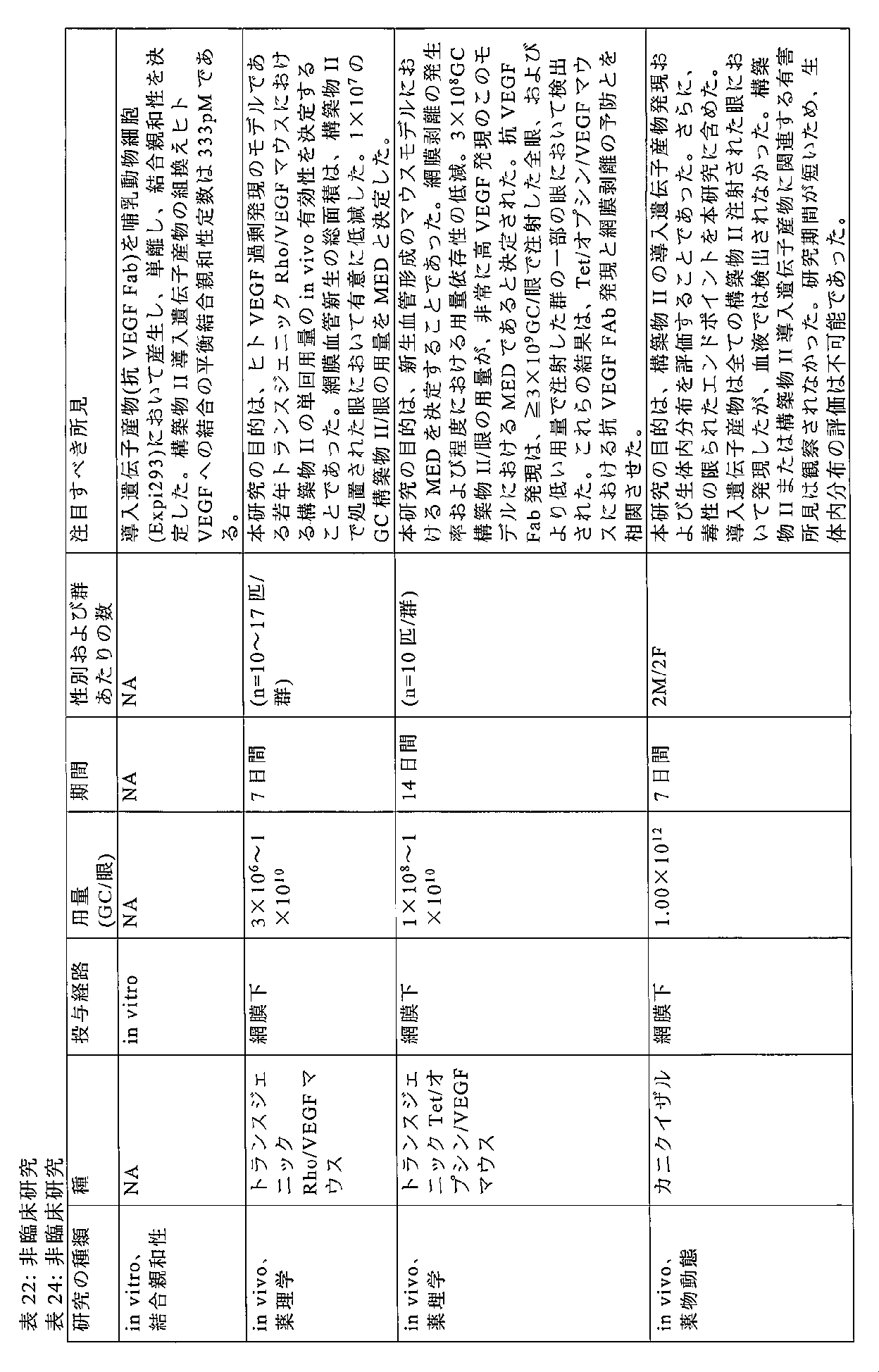

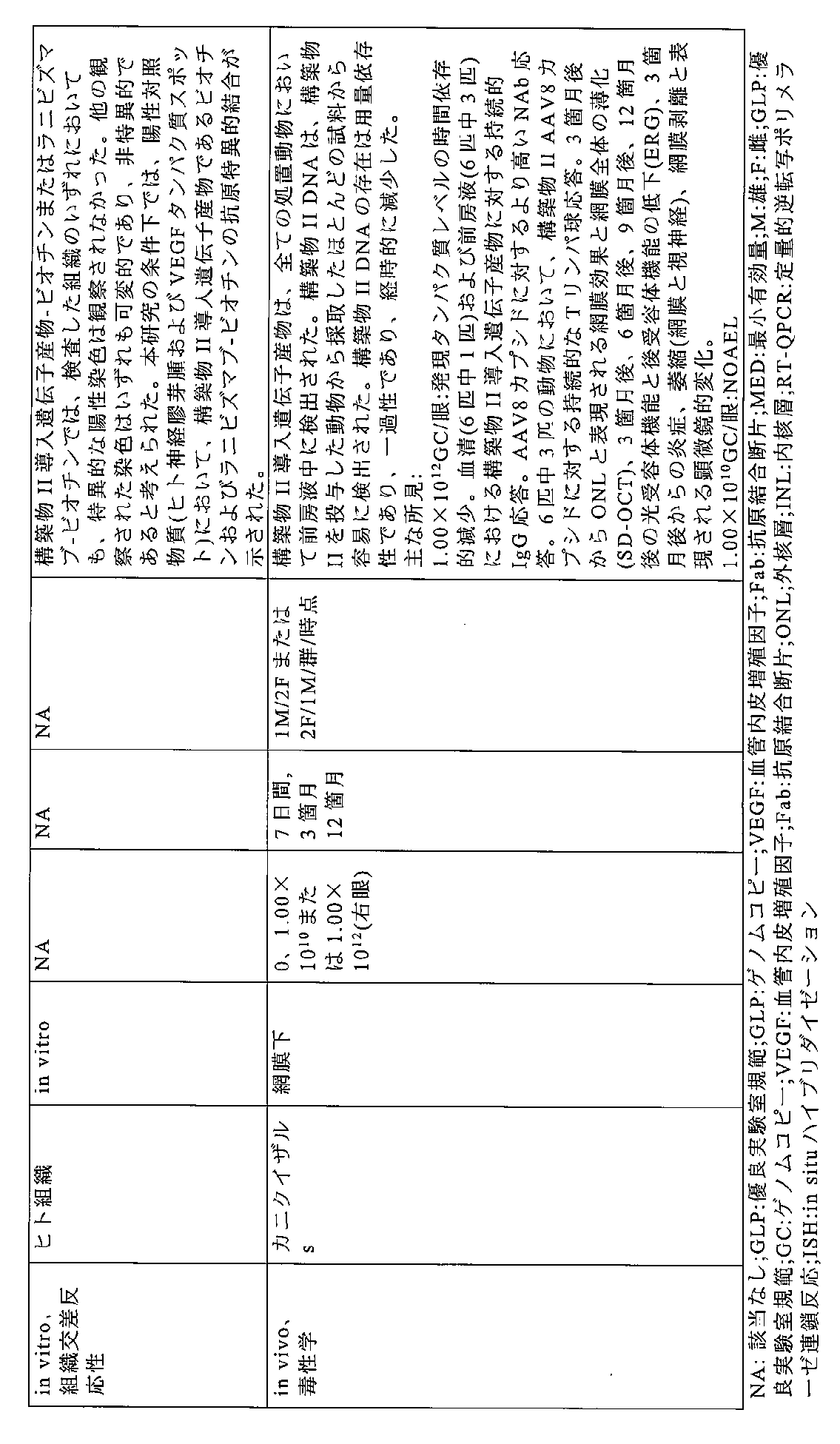
本研究では、眼科検査による眼毒性、眼圧測定、光干渉断層撮影、眼底写真、および全視野網膜電図を評価することができる。本研究では、房水および血清中の導入遺伝子産物濃度、体内分布、免疫原性、臨床病理学、臓器重量および組織病理学を評価することもできる。結果は、安全性および導入遺伝子産物発現の評価を介して改良BDS製造プロセスで製造されたFDPの臨床使用を支持する可能性がある。
In this study, ocular toxicity by ophthalmologic examination, intraocular pressure measurement, optical coherence tomography, fundus photography, and full-field electroretinogram can be evaluated. The study can also assess transgene product concentrations in aqueous humor and serum, biodistribution, immunogenicity, clinical pathology, organ weights and histopathology. The results may support clinical use of FDPs produced with the improved BDS manufacturing process through evaluation of safety and transgene product expression.
5.13.2 臨床研究
製剤Aの構築物IIは、現在、2年間にわたって評価されたnAMDの成人対象における5つの用量コホートを用いて第1/2a相、ヒト初回、非盲検(標識)、単回漸増投薬研究で評価されている。主要目的は、単回用量投与から24週間後までの処置された対象における、構築物IIの安全性および忍容性を評価することである。
対象は、5つの用量コホートにわたって処置された。コホート当たり6(コホート1~3)または12(コホート4および5)対象:3×10⁹GC/眼(コホート1)、1×1010GC/眼(コホート2)、6×1010GC/eye(コホート3)、1.6×1011GC/眼(コホート4)、および2.5×1011GC/眼(コホート5)であった。
構築物II投与後の最初の24週間(最初の研究期間)は、安全性を第一の焦点とする。構築物IIの安全性と忍容性、および臨床効果は、眼と非眼のAEおよび重篤な有害事象(SAE)の評価、臨床検査室試験(化学、血液学、凝固、尿検査)、免疫原性、眼の検査およびイメージング(BCVA、IOP、細隙灯生体顕微鏡検査、間接検眼鏡検査、SD-OCT、フルオレセイン血管造影、眼底自己蛍光、およびカラー眼底写真)、およびバイタルサインを介してモニタリングすることができる。
5.13.2 Clinical Studies Construct II of Formulation A is currently in
Subjects were treated across 5 dose cohorts. 6 (cohorts 1-3) or 12 (cohorts 4 and 5) subjects per cohort: 3 x 10 9 GC/eye (cohort 1), 1 x 10 10 GC/eye (cohort 2), 6 x 10 10 GC/eye (cohort 3), 1.6×10 11 GC/eye (cohort 4), and 2.5×10 11 GC/eye (cohort 5).
Safety will be the primary focus during the first 24 weeks following Construct II administration (initial study period). The safety, tolerability, and clinical efficacy of Construct II have been assessed in ocular and non-ocular AEs and serious adverse events (SAEs), clinical laboratory studies (chemistry, hematology, coagulation, urinalysis), immunological Monitoring via primary, ocular examination and imaging (BCVA, IOP, slit-lamp biomicroscopy, indirect ophthalmoscopy, SD-OCT, fluorescein angiography, fundus autofluorescence, and color fundus photography), and vital signs can do.
最初の研究期間の完了後、構築物IIによる処置後104週間(106週目)まで、対象の安全性の評価を継続することができる。研究終了時に、対象は、第1/2a相研究の5年間の累積投与期間と構築物II投与後のLTFU研究を通じた安全性追跡調査のための長期追跡(LTFU)研究に参加するように招待されることができる。
nAMDにおける第1/2a相試験では、42人の対象が構築物IIに曝露され、中間データが、(コホート5における最後に登録された対象から構築物II投与後の安全性追跡調査の少なくとも4週間を通じて)評価された。構築物IIの網膜下投与は、試験したすべての用量レベルで良好な忍容性を示すようであり、構築物IIに関連するAEまたはSAEは報告されなかった。網膜の薄化は観察されず、構築物IIに関連するAEとみなされた周辺視野の損失、視力低下または光視症などの眼症状のいずれの徴候も認められなかった。
After completion of the initial study period, subject safety assessments can continue for up to 104 weeks (week 106) after treatment with Construct II. At the end of the study, subjects were invited to participate in a long-term follow-up (LTFU) study for safety follow-up through the 5-year cumulative dosing period of the
In a
改変BDS製造プロセスを用いて製造されたFDPの同等性を支持するために、分析の同等性および非臨床的忍容性の評価を行った後、新たなプロセス材料(例えば、製剤B)を、進行中の第1/2a相研究においてさらなる別のコホートに導入することができる。このコホートは、試験された最高用量を単回網膜下投与された6人の対象で構成され、最低3カ月間の曝露(現在、コホート5(2.5×1011GC/眼;1×1012GC/mL)であると予測されている)によって許容可能な安全域が決定される。新しい製造プロセス材料の安全性、忍容性および臨床効果は、前の第1/2a相コホートについて記載したように評価することができ、ベネフィット:リスクプロファイルが前の臨床材料と同等である場合、新しいFDP材料を確認のための第3相研究で使用することを検討することができる。
To support the comparability of FDP manufactured using the modified BDS manufacturing process, new process material (e.g., Formulation B) was Additional cohorts can be introduced in
5.14 実施例14:冷蔵短期安定性
凍結薬物製造物の臨床施設への輸送、および患者がそれらの投与を受ける予定になるまでの臨床施設での一時保存は、地域のクリニック(非病院クリニック)にとって課題となり得る。多数の臨床施設では、薬物製造物の一時保存のための-80℃(≦-60℃)の冷凍器は設置されていない。いくつかの臨床施設は-20℃の冷凍器を備えている場合があり、前述の実施例(例えば、実施例1、3および9)は、製剤Bがリアルタイム安定性データに基づいて-20℃で18カ月間、外挿した場合は30カ月間安定であることを示す。他のクリニックでは信頼性の高い冷凍器がないが、2~8℃の冷蔵庫を備えている場合がある。したがって、冷蔵庫で薬物製造物を解凍した後、冷蔵庫で短期間(最大9~12カ月)保存することがロジスティック的に望ましい。
5.14 Example 14: Refrigeration Short Term Stability Transportation of frozen drug products to clinical facilities and temporary storage at clinical facilities until patients are scheduled to receive them may be used in community clinics (non-hospital clinics). ) can be a challenge. Many clinical sites do not have −80° C. (≦−60° C.) freezers for temporary storage of drug products. Some clinical facilities may be equipped with −20° C. freezers, and the previous examples (eg, Examples 1, 3 and 9) indicate that Formulation B was cooled to −20° C. based on real-time stability data. is stable for 18 months at , extrapolated for 30 months. Other clinics do not have reliable freezers, but may have refrigerators at 2-8°C. Therefore, it is logistically desirable to store the drug product in the refrigerator for a short period of time (up to 9-12 months) after thawing the drug product in the refrigerator.
2~8℃でスクロースを含む改変DPBSの冷蔵短期進展安定性のデータは、3.0×10¹³GC/mL、1.0×1012GC/mL、2.1×1011GC/mLの研究に基づき、in vitroでの効力および他の品質特性が少なくとも9カ月間維持されることを示す。データを表25、表26および表27に示す。 Refrigeration short-term evolution stability data for modified DPBS containing sucrose at 2-8° C. is 3.0×10 13 GC/mL, 1.0×10 12 GC/mL, 2.1×10 11 GC/mL. Studies show that in vitro potency and other quality attributes are maintained for at least 9 months. The data are presented in Tables 25, 26 and 27.
ベクターゲノム濃度、外観、SDS-CGEによる純度、DLSによるサイズ分布、HIACによる可視下粒子、SYBR Goldによる遊離DNA、pHまたは2~8℃での浸透圧は傾向が見られなかった。2~8℃での長期間後、効力が低下する傾向が見られた。Prism 8ソフトウェア(GraphPad LLC,San Diego,CA)における単純線形回帰フィットを用いて傾向分析を行った。効力データの傾向を図50に示す。黒い実線は、データへの回帰フィットを示す:3.0×10¹³GC/mL(丸)、1.0×1012GC/mL(四角形)、および2.1×1011GC/mL(三角形)。 No trends were observed for vector genome concentration, appearance, purity by SDS-CGE, size distribution by DLS, sub-visible particles by HIAC, free DNA by SYBR Gold, pH or osmolality at 2-8°C. After extended periods of time at 2-8°C, a trend towards decreased potency was observed. Trend analysis was performed using a simple linear regression fit in Prism 8 software (GraphPad LLC, San Diego, Calif.). Trends in efficacy data are shown in FIG. Solid black lines indicate regression fits to the data: 3.0 x 10¹³ GC/mL (circles), 1.0 x 10¹² GC/mL (squares), and 2.1 x 10¹¹ GC/mL (triangles). ).
2~8℃での効力消失速度は、3つの研究で同様であり、濃度の2桁をカバーした。分析は、勾配の差は有意ではなく、データは月当たり約-2.0%のプールされた勾配に適合することを示した。データは、2~8℃で9カ月~12カ月間、効力が許容範囲内(>75%)にとどまることを示す。 The rate of potency loss at 2-8°C was similar in the three studies, covering two orders of magnitude of concentration. Analysis showed that the difference in slopes was not significant and the data fit a pooled slope of approximately -2.0% per month. The data show that efficacy remains acceptable (>75%) for 9-12 months at 2-8°C.


5.15 実施例15:室温短期安定性
製造、ラベル貼付、投薬準備および送達の間に、製剤が室温に曝される短い期間がある。
約22℃(20.7~23.7℃)でのスクロースを含む、3.0×10¹³GC/mLの改変dPBS中での構造物IIの、制御された室温短期進展安定性データを表28に示す。ベクターゲノム濃度、外観、SDS-CGEによる純度、DLSによるサイズ分布、HIACによる可視下粒子、SYBR Goldによる遊離DNA、pHまたは浸透圧に傾向はなかった。制御された室温で効力の減少傾向が認められた。統計分析は、Prism 8ソフトウェア(GraphPad LLC,San Diego,CA)における非線形回帰関数を用いて行われた。効力データは線形回帰モデルに最適であった。最適勾配は、制御された室温で-0.8958%/日であった。室温における効力の傾向を図51に示す。黒い実線はデータへの回帰フィットを示し、点線は95%CIを示す。典型的には、薬物製造物の製造および送達には、最大3日間の累積曝露が必要である。この曝露は、効力の予想される平均2.7%の減少に対応し、製造物の安定性の観点からは許容される。
5.15 Example 15: Room Temperature Short Term Stability There is a brief period during which the formulation is exposed to room temperature during manufacturing, labeling, dosing preparation and delivery.
Table 1 shows controlled room temperature short-term evolutionary stability data for Structure II in modified dPBS at 3.0 x 10 GC/mL with sucrose at about 22°C (20.7-23.7°C). 28. There was no trend for vector genome concentration, appearance, purity by SDS-CGE, size distribution by DLS, sub-visible particles by HIAC, free DNA by SYBR Gold, pH or osmolarity. A trend towards decreased potency was observed at controlled room temperature. Statistical analysis was performed using non-linear regression functions in Prism 8 software (GraphPad LLC, San Diego, Calif.). Efficacy data fit a linear regression model. The optimal slope was −0.8958%/day at controlled room temperature. Room temperature potency trends are shown in FIG. The solid black line shows the regression fit to the data and the dashed line shows the 95% CI. Typically, up to three days of cumulative exposure are required for manufacturing and delivery of drug products. This exposure corresponds to the expected average 2.7% reduction in potency, which is acceptable from a product stability standpoint.
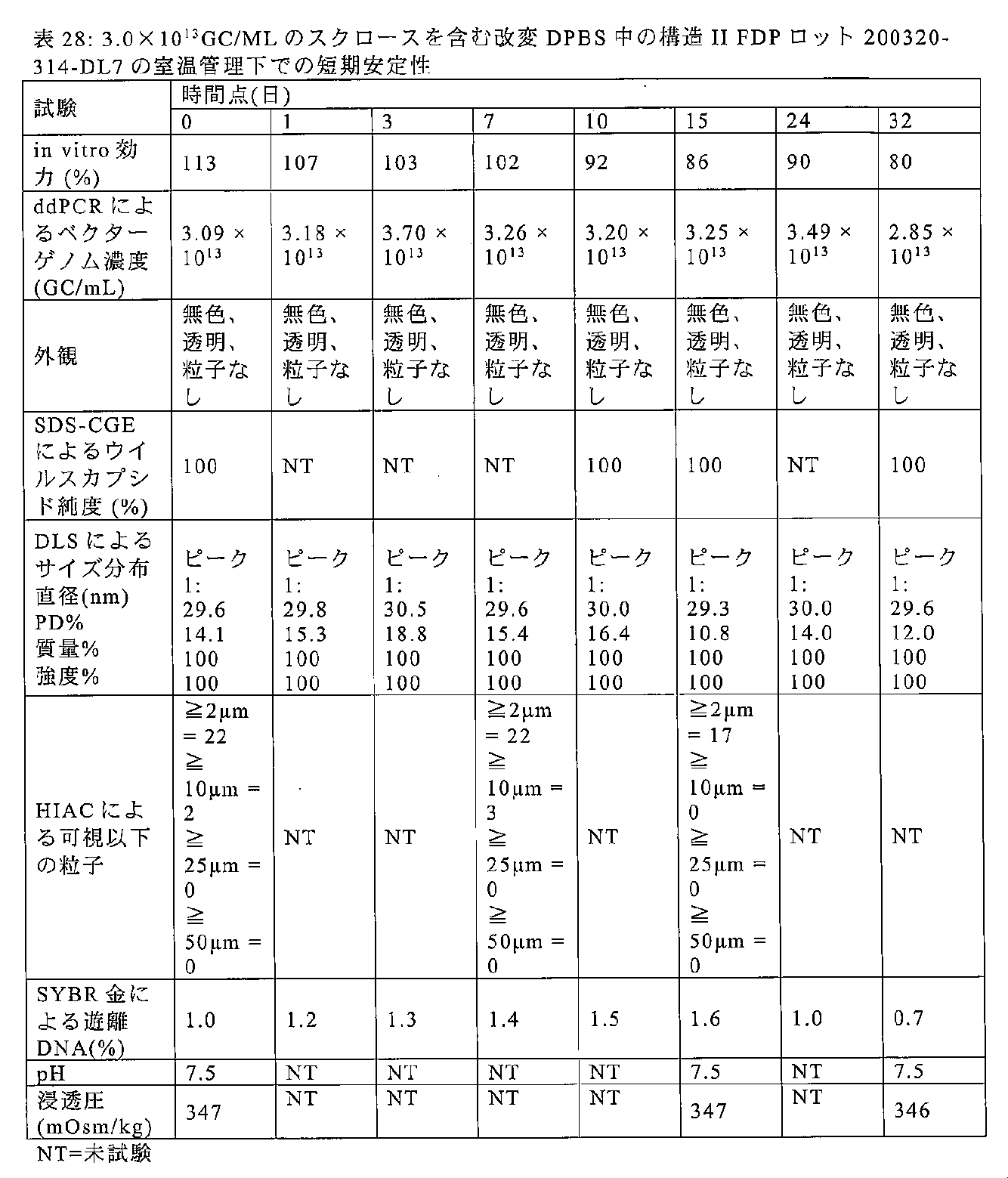
5.16 実施例16:加速された高温凍結温度逸脱条件(-15℃、-7℃、および-20℃「自動除霜」凍結器)で評価した製剤組成物の頑健性
いくつかの製剤変形形態の効力を、意図された保存温度変動範囲≦-20℃より高い温度に保持した場合の製剤Bに対するそれらの相対的安定性を決定するために研究した。
表29の最初の行は、対照としての製剤Bの結果を示す。結果は、-15℃、-7℃および-20℃の「自動除霜」冷凍器(-20℃から約-6℃まで4時間ごとに変化する)での6カ月間の逸脱を示す。効力は、6カ月後にすべての条件において許容可能なレベルに維持され、製剤Bが頑健な安定性を有することが示された。
5.16 Example 16: Robustness of Formulation Compositions Evaluated in Accelerated Hot Freeze Temperature Excursion Conditions (-15°C, -7°C, and -20°C "Auto Defrost" Freezers) Several Formulation Variants The potency of the forms was studied to determine their relative stability to Formulation B when held above the intended storage temperature range of ≤-20°C.
The first row of Table 29 shows results for Formulation B as a control. Results show excursions at -15°C, -7°C and -20°C "auto-defrost" freezers (changing from -20°C to about -6°C every 4 hours) over a 6 month period. Efficacy was maintained at acceptable levels in all conditions after 6 months, indicating that Formulation B has robust stability.
製剤Dは、有意に高いスクロースおよび低い塩を有する製剤Bの変形形態である。製剤Eは、中程度に高いスクロースおよび低い塩を有する製剤Bの変形形態である。これらの製剤はいずれも-15℃で6カ月後に製剤Bと同等の効力を示し、製剤Bが頑健な安定性設計空間を有することが示された。すでに製剤Bに含まれているものよりも高いスクロースおよび低い塩は、製剤Bの安定性を改善しなかった。これは、この広い範囲内の組成物が安定性に対して許容可能であることを示す。
製剤Fは、pH変動を最小化または相殺するという試みにおいて、5mMの添加TRIS緩衝液剤で改変された製剤Bである。この製剤は、凍結時にリン酸塩のpHが減少し、TRISのpHが増加するため、両者の組合せがより安定である可能性があるという仮説に基づいて研究された。この製剤はまた、-15℃で6月箇後に製剤Bと同等の効力を有した。
製剤Gは、リン酸緩衝剤の代わりにTRIS緩衝剤、より低いレベルでNaClに置換された硫酸ナトリウム、より高いレベルのスクロース、およびより高いポロキサマー188を有する新しい製剤である。この製剤は-7℃で6カ月後に製剤Bと同様の安定性を有する。
Formulation D is a variation of Formulation B with significantly higher sucrose and lower salt. Formulation E is a variation of Formulation B with moderately high sucrose and low salt. Both of these formulations showed comparable potency to Formulation B after 6 months at -15°C, indicating that Formulation B has a robust stability design space. Higher sucrose and lower salt than already in Formulation B did not improve the stability of Formulation B. This indicates that compositions within this broad range are acceptable for stability.
Formulation F is Formulation B modified with 5 mM added TRIS buffer in an attempt to minimize or offset pH fluctuations. This formulation was studied under the hypothesis that the combination of the two may be more stable due to the decreased pH of phosphate and the increased pH of TRIS upon freezing. This formulation was also as potent as formulation B after 6 months at -15°C.
Formulation G is a new formulation with TRIS buffer instead of phosphate buffer, lower levels of sodium sulfate substituted for NaCl, higher levels of sucrose, and higher poloxamer 188. This formulation has similar stability to Formulation B after 6 months at -7°C.
これらのデータは、製剤B中に添加されるスクロースのレベル(≧4%)が重要な凍結保護賦形剤であることを示す。このレベルのスクロースは、pHシフトおよび塩の結晶化を緩和するのに十分であり、効力損失を最小限に抑える。スクロースは、塩化ナトリウムまたは硫酸ナトリウムベースの塩製剤のいずれかで凍結保護性であり、いずれの塩も製剤に適している。硫酸ナトリウムを塩化ナトリウムで置換した低い塩を有する製剤は安定性を改善しなかった。より低い塩またはより高いスクロースを用いたさらなる安定性の改善は観察されず、これは、4%が100mM塩化ナトリウムで凍結保護特性を提供する頑健なレベルのスクロースであることを示す。TRIS緩衝剤によるリン酸塩の置換は安定性を改善されず、いずれの緩衝剤も、安定なスクロースおよび塩ベースの製剤に用いることができた。より高いレベルのポロキサマー188はまた安定性を改善しなかった。 These data indicate that the level of sucrose added (≧4%) in Formulation B is an important cryoprotectant excipient. This level of sucrose is sufficient to moderate pH shifts and salt crystallization, minimizing potency loss. Sucrose is cryoprotective in either sodium chloride or sodium sulfate based salt formulations, either salt being suitable for formulation. Formulations with lower salt in which sodium chloride was substituted for sodium sulfate did not improve stability. No further stability improvement was observed with lower salt or higher sucrose, indicating that 4% is a robust level of sucrose that provides cryoprotective properties at 100 mM sodium chloride. Phosphate replacement with TRIS buffer did not improve stability and either buffer could be used for stable sucrose and salt-based formulations. Higher levels of poloxamer 188 also did not improve stability.

5.17 実施例17:放出特性における製剤Aと製剤Bの比較
この実施例は、上記の実施例2の更新版である。
この実施例は、放出特性における製剤Aと製剤Bの比較を示す。
5.17 Example 17 Comparison of Formulation A and Formulation B in Release Profile This example is an update of Example 2 above.
This example shows a comparison of Formulation A and Formulation B in release profile.
5.17.1 放出および特性の分析方法および仕様
本セクションは、製剤A中の最終薬物製造物(FDP)の1ロット、および新しい「4%スクロースおよび0.001%ポロキサマー188を含む改変DPBS、pH7.4」(製剤B)中のFDPの1ロットの分析証明書からのロット放出結果の比較を示す。放出試験に加えて、動的光散乱(DLS)のための通常の特性試験結果を比較することができる。比較可能性を支持するために提案された試験のパネルおよび判定基準を表30に示す。
5.17.1 Release and Characterization Analytical Methods and Specifications Figure 3 shows a comparison of lot release results from one lot of Certificate of Analysis of FDP in pH 7.4" (Formulation B). In addition to emission tests, conventional characterization test results for dynamic light scattering (DLS) can be compared. A panel of tests and criteria proposed to support comparability are shown in Table 30.

5.17.2 FDP製剤変更の背景
「4%スクロースおよび0.001%ポロキサマー188を含む改変DPBS、pH7.4」(製剤B)を開発し、凍結/解凍サイクルに対する長期凍結保存安定性およびFDP安定性の頑健性を改善した。製剤変更は、4%w/vの凍結保護賦形剤スクロースの添加、および適切な浸透圧を維持するために137mMから100mMへの塩化ナトリウムレベルの低減を伴った。他の製剤賦形剤およびレベルは同一であった。「4%スクロースおよび0.001%ポロキサマー188を含む改変DPBS、pH7.4」FDP製剤中のFDPの生成は、組成物を最終組成物に調整するために、DPBS(製剤A)中のBDSに、より濃縮したスクローススパイク溶液を添加することによって達成された。この組成物はまた、接線流濾過緩衝液交換を用いて達成することもできる。
5.17.2 Background to FDP Formulation Changes “Modified DPBS with 4% sucrose and 0.001% poloxamer 188, pH 7.4” (formulation B) was developed to improve long-term cryopreservation stability and FDP stability against freeze/thaw cycles. Improved stability robustness. Formulation changes involved the addition of 4% w/v of the cryoprotectant excipient sucrose and the reduction of sodium chloride level from 137 mM to 100 mM to maintain adequate osmolality. Other formulation excipients and levels were identical. "Modified DPBS with 4% Sucrose and 0.001% Poloxamer 188, pH 7.4" FDP production in the FDP formulation was performed by adding BDS in DPBS (Formulation A) to adjust the composition to the final composition. , was achieved by adding a more concentrated sucrose spike solution. This composition can also be achieved using tangential flow filtration buffer exchange.
5.17.3 FDP製剤プロセスの変更の評価
スパイキング、混合、および濾過工程は、両方のプロセスについて同様のプロセス工程、取扱い、および接触面を伴った。スパイキングプロセスは、1.37倍の希釈をもたらした。次に、標的濃度に希釈した。
5.17.3 Evaluation of FDP Formulation Process Modifications Spiking, mixing, and filtering steps involved similar process steps, handling, and contact surfaces for both processes. The spiking process resulted in a 1.37-fold dilution. Then diluted to the target concentration.
5.17.4 臨床上の安全性および有効性へのFDP製剤の変更の影響の評価
FDP製剤Bは、DPBS製剤Aと比較した場合、安全性および有効性に差がない可能性がある。一般的な特性である浸透圧を除き、製造物品質プロファイルおよび放出仕様は同一であった。
DPBS製剤Aの浸透圧は240~340mOsm/kgであり、製剤Bの浸透圧は295~395mOsm/kgであった。これらは、製剤Bにおけるスクロースおよび塩化ナトリウムのレベルの調整によるものであった。文献に基づくと、これらのわずかに高い浸透圧値を有するブレブの吸収時間に影響を及ぼさない可能性があった(Negi and Marmour, 1984 Invest Ophthalmol Vis Sci. 25(5):616-20を参照されたい)。
5.17.4 Evaluation of the Impact of Changes in FDP Formulations on Clinical Safety and Efficacy FDP Formulation B may not differ in safety and efficacy when compared to DPBS Formulation A. The product quality profiles and release specifications were identical, except for the general property osmotic pressure.
DPBS formulation A had an osmotic pressure of 240-340 mOsm/kg and formulation B had an osmotic pressure of 295-395 mOsm/kg. These were due to adjustment of the sucrose and sodium chloride levels in Formulation B. Based on the literature, it is possible that these slightly higher osmolarity values did not affect the absorption time of blebs (see Negi and Marmour, 1984 Invest Ophthalmol Vis Sci. 25(5):616-20). want to be).
5.17.5 製剤Aから製剤Bへの変更による分析放出方法への影響の評価
分析法の評価では、分析法が目的に適していることが示された。これらの手法にわずかな変更を加えることで、新しいFDPに適合させることができる(表31)。
5.17.5 Evaluation of Effect of Change from Formulation A to Formulation B on Analytical Release Method Evaluation of the analytical method indicated that the analytical method was fit for purpose. Minor modifications to these techniques can be adapted to the new FDP (Table 31).

5.18 実施例18:製剤Aと製剤Bの安定性の比較
この実施例は、製剤Aと製剤Bの安定性の比較を示す。この実施例は、上記の実施例3の更新版である。
新しい製剤Bは、凍結/解凍サイクルおよび温度ストレスに際して、カプシドの破壊および少量の遊離DNAの放出から保護する。現在、24カ月間の長期安定性試験では、FDP製剤Bにおいて、in vitroの相対的効力および他の品質特性が-80℃(≦-60℃)および≦-20℃で維持されていることを示した。
利用可能な凍結/解凍データ、温度ストレスデータ、および長期安定性データは、新しい製剤において同様のまたは改善された安定性を示した。
5.18 Example 18: Stability Comparison of Formulation A and Formulation B This example shows a comparison of the stability of Formulation A and Formulation B. This example is an update to Example 3 above.
The new formulation B protects against capsid disruption and release of small amounts of free DNA upon freeze/thaw cycles and temperature stress. Currently, a 24-month long-term stability study demonstrates that in vitro relative potency and other quality attributes are maintained at −80° C. (≦−60° C.) and ≦−20° C. for FDP Formulation B. Indicated.
Available freeze/thaw data, temperature stress data, and long-term stability data indicated similar or improved stability in the new formulations.
新しいFDP製剤BのFDPロットは、-80℃(≦-60℃)および≦-20℃の長期安定性に設定することができ、新しいFDPの有効期限が規制に適合していることを確実にするために、安定性の傾向データを安定性プログラムの一部として監視することができる。 FDP lots of the new FDP Formulation B can be set for long-term stability of −80° C. (≦−60° C.) and ≦−20° C., ensuring that the expiration date of the new FDP is compliant with regulations. To do so, stability trend data can be monitored as part of the stability program.
5.18.1 DPBSおよび新しいFDP製剤Bにおける構築物IIの凍結/解凍研究
凍結/解凍サイクルがDPBSおよび新しいFDP製剤B中の構築物IIに及ぼす影響を評価するために研究を行った。凍結/解凍速度は、BDSのボトルの製造中、またはDPのサプライチェーンもしくはクリニックにおいて起こることが予想され得る速度をひとくくりにするために選択された。複数サイクルは、クリニックで起こり得るものを超えて試料にストレスを加えるために適用された。
研究の結果、製剤Bは、緩慢(0.12℃/分または約11時間超)および/または急速(1℃/分または約1時間超)のいずれかで、-60℃未満から25℃までの5回の凍結/解凍サイクルに曝露された場合、製剤Aよりも頑健であることを示した。緩慢および急速の並べ替えをそれぞれ凍結および解凍について評価した(すなわち、FF/FT=急速凍結/急速解凍;FF/ST=急速凍結/緩慢解凍;SF/FT=緩慢凍結/急速解凍;SF/ST=緩慢凍結/緩慢解凍)。
5.18.1 Freeze/Thaw Study of Construct II in DPBS and New FDP Formulation B A study was conducted to evaluate the effect of freeze/thaw cycles on Construct II in DPBS and New FDP Formulation B. Freeze/thaw rates were chosen to bracket the rates that might be expected to occur during the manufacture of bottles of BDS or in the DP supply chain or clinic. Multiple cycles were applied to stress the samples beyond what would occur in the clinic.
Studies have shown that Formulation B either slows (0.12° C./min or over about 11 hours) and/or rapidly (1° C./min or over about 1 hour) from less than −60° C. to 25° C. was shown to be more robust than Formulation A when exposed to 5 freeze/thaw cycles of . Slow and fast permutations were evaluated for freeze and thaw, respectively (i.e., FF/FT = fast freeze/fast thaw; FF/ST = fast freeze/slow thaw; SF/FT = slow freeze/fast thaw; SF/ST = slow freeze/slow thaw).
凍結および解凍速度は、生物学的製剤の安定性に影響を及ぼす可能性がある(Cao et al., 2003, Biotechnol. Bioeng. 82(6):684-90))。凍結の間の水の結晶化は賦形剤の濃縮をもたらすことがあり、これは生物学的製剤の安定性に影響し得る。相分離またはpHシフトは、生物学的製剤の安定性に影響を及ぼすこともある。急速凍結は、界面ストレスを与える可能性のある、より小さな氷結晶およびより大きな氷-水界面領域をもたらす可能性がある。急速凍結はまた、氷中の気泡を取り込んで、解凍中の空気-水界面ストレスを引き起こす可能性がある。緩慢解凍は、氷の再結晶をもたらす可能性があり、界面ストレスにより溶液中の生物学的製剤の安定性に影響を及ぼす場合がある。
本研究では、試料をin vitro相対的効力、サイズ排除クロマトグラフィー純度(SEC)、蛍光色素による遊離DNAレベル、および動的光散乱によるサイズ分布により分析した。凍結解凍時の製剤の相変化を熱量測定により評価した。
Freezing and thawing rates can affect the stability of biologics (Cao et al., 2003, Biotechnol. Bioeng. 82(6):684-90)). Crystallization of water during freezing can lead to concentration of excipients, which can affect the stability of biologics. Phase separation or pH shifts can also affect the stability of biologics. Rapid freezing can result in smaller ice crystals and larger ice-water interfacial areas that can impart interfacial stress. Rapid freezing can also entrap air bubbles in the ice, causing air-water interface stress during thawing. Slow thawing can lead to ice recrystallization and interfacial stress can affect the stability of biologics in solution.
In this study, samples were analyzed by in vitro relative potency, size exclusion chromatography purity (SEC), free DNA levels by fluorochrome, and size distribution by dynamic light scattering. The phase change of the formulation upon freeze-thaw was assessed by calorimetry.
この研究では、凍結および解凍の急速速度と緩慢速度の異なる速度についての結果において差異はほとんどなかった。凍結解凍研究の結果の概要を表32に提供する。本研究において適用された温度プロファイル(急速凍結/緩慢解凍)の代表例を図9に示す(プロファイルの他の並べ替えは示されていない)。効力の結果は、凍結および解凍の急速速度と緩慢速度のすべての並べ替えについて、対照と同様であった。製剤Aまたは製剤Bの凍結/解凍サイクルでは、方法ばらつきの範囲内のサイズ分布において変化はなかった(図12参照)。約28nmの製剤B中の蓄積剤DLS直径は、27nmでのDPBS製剤Aよりもわずかに高かった。この非常にわずかな見かけのサイズ増加は、AAVカプシドの水和、したがって流体力学的挙動に及ぼすスクロースの影響に関連する。DPBS製剤A中の構築物IIでは、すべての凍結-解凍ストレス条件(1.7%から6.9%まで)について色素蛍光による遊離DNAの増加があった。SECによる遊離DNA定量は、一般的に色素蛍光と一致した。SECにより、第1のプレピークは遊離DNAを含有し、第2の小さなプレピークは凝集体を含有し、ポストピークは緩衝剤種を含有する(図10および図11参照)。SECによるわずかに低い遊離DNAは、主ピークと共に共溶出するか、緩衝剤と共に共溶出するか、カラムに入らないかのいずれかで、非常に小さいかまたは非常に大きなDNA断片に起因する場合がある。増加は同程度の大きさであり、凍結-解凍速度の急速と非常な緩慢の異なる並べ替えは明確に相違しなかった。製剤Bでは、遊離DNAまたは凝集体の増加は観察されなかった。 In this study, there was little difference in the results for different speeds, fast and slow, of freezing and thawing. A summary of the freeze-thaw study results is provided in Table 32. A representative example of the temperature profile (quick freeze/slow thaw) applied in this study is shown in Figure 9 (other permutations of the profile are not shown). Efficacy results were similar to controls for all permutations of fast and slow rates of freezing and thawing. Freeze/thaw cycles for Formulation A or Formulation B did not change the size distribution within method variability (see Figure 12). The depot DLS diameter in Formulation B at approximately 28 nm was slightly higher than DPBS Formulation A at 27 nm. This very small apparent size increase is related to the effect of sucrose on AAV capsid hydration and hence hydrodynamic behavior. With construct II in DPBS formulation A, there was an increase in free DNA by dye fluorescence for all freeze-thaw stress conditions (from 1.7% to 6.9%). Free DNA quantification by SEC was generally consistent with dye fluorescence. By SEC, the first pre-peak contains free DNA, the second small pre-peak contains aggregates and the post-peak contains buffer species (see Figures 10 and 11). Slightly lower free DNA by SEC may be due to very small or very large DNA fragments that either co-elute with the main peak, co-elute with the buffer, or do not enter the column. be. The increases were of similar magnitude and did not differ significantly between different permutations of fast and very slow freeze-thaw rates. No increase in free DNA or aggregates was observed with Formulation B.
冷却中に完全に結晶化しなかった非晶質塩化ナトリウムの結晶化のために、約-41℃で製剤A中に小さな発熱が観察された(図13)。未分解の低温肩部を有する共融はまた製剤Aについて-22.1℃のピークで観察された。塩化ナトリウムに関する文献においても同様の共融および再結晶事象が報告されている(Milton et al., 2007, Journal of Pharmaceutical Sciences, 96(7))。製剤Bのための共融の欠如(図14)は結晶化の阻害と一致した。製剤B中の凍結保護性スクロース賦形剤による非晶質粘稠状態の維持は、凍結/解凍サイクル時のカプシド破壊および遊離DNAの放出に対する保護を提供する場合がある。したがって、製剤Bの変更により、製剤Aと同等または改善された安定性が得られた。 A small exotherm was observed in Formulation A at approximately -41°C due to crystallization of amorphous sodium chloride that did not crystallize completely during cooling (Figure 13). A eutectic with an unresolved low temperature shoulder was also observed for Formulation A with a peak at -22.1°C. Similar eutectic and recrystallization events have been reported in the literature on sodium chloride (Milton et al., 2007, Journal of Pharmaceutical Sciences, 96(7)). The lack of eutectic for Formulation B (Figure 14) was consistent with inhibition of crystallization. Maintenance of an amorphous consistency by the cryoprotective sucrose excipient in Formulation B may provide protection against capsid rupture and release of free DNA during freeze/thaw cycles. Thus, the formulation B modification provided similar or improved stability to formulation A.
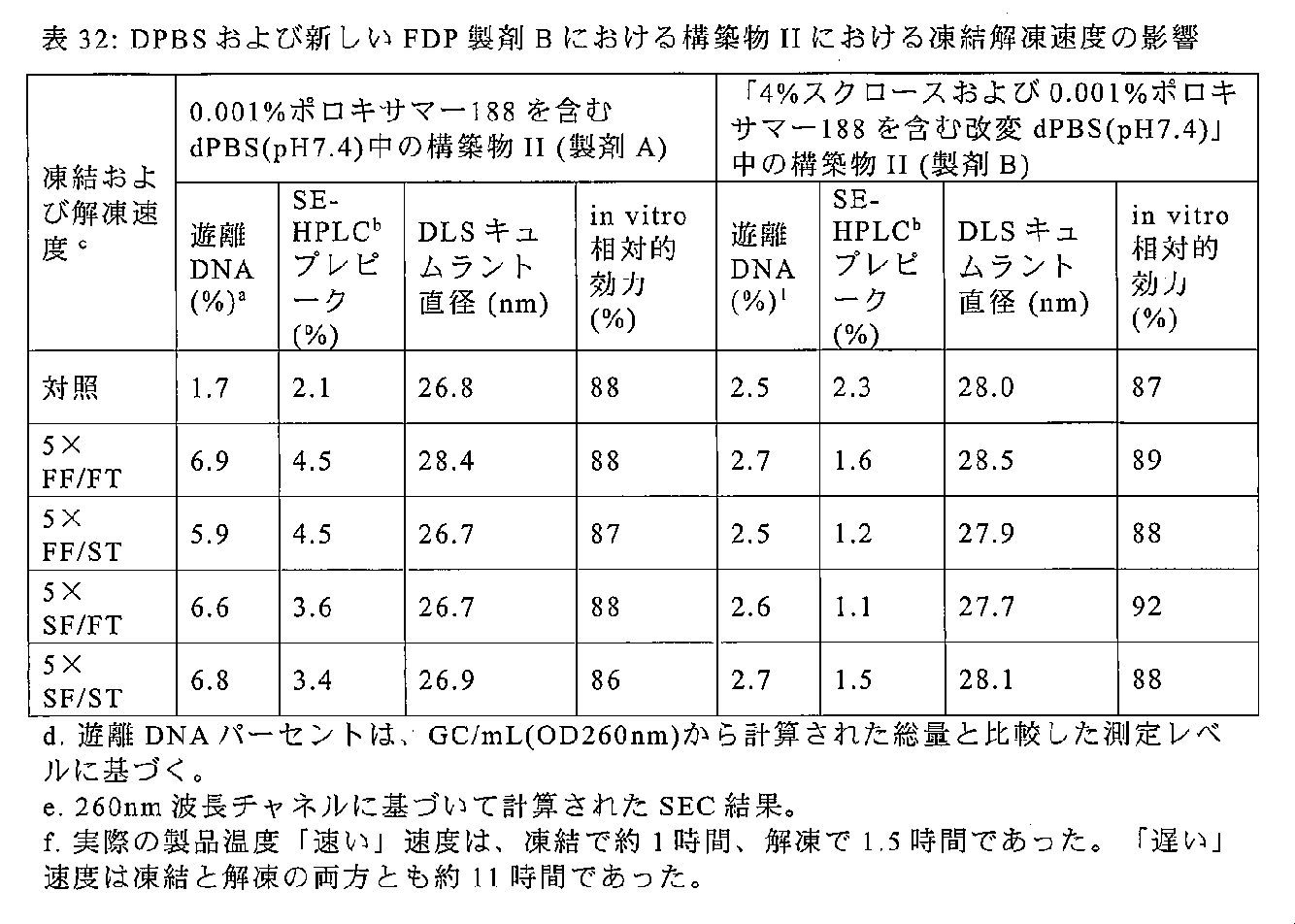
5.18.2 製剤Aおよび新しいFDP製剤Bにおける構築物IIの温度ストレス安定性
1.0×10¹²GC/mLで4日間、37℃で行った温度ストレス進展安定性研究を用いて、製剤Aおよび製剤Bの相対的安定性を評価した。安定性を評価するために用いたアッセイは、in vitro相対的効力(IVRP)、ベクターゲノム濃度(ddPCRによるVGC)、色素蛍光による遊離DNA、動的光散乱、外観、およびpHを含む。製剤Aの結果を表33に示し、製剤Bの結果を表34に示す。1日当たり約14~16%のアッセイばらつきの範囲内での同程度の効力の減少が、両方の製剤について観察された(図15参照)。また、ベクターゲノムコピーの減少もわずかであり、製剤Aと製剤Bの両方で同等であった。約29~34nmの製剤BのキュムラントDLS直径は、28~30nmのDPBS製剤Aよりもわずかに高かった。この非常にわずかな(1~3nm)見かけのサイズ増加は、AAVカプシドの水和と、したがって流体力学的挙動に及ぼすスクロースの影響に関連していた。ストレス研究中、製剤Aまたは製剤Bのいずれについても、DLS直径において、方法ばらつきの範囲内で傾向はなかった。製剤Bは、カプシド破壊に関してわずかに安定であり、遊離DNAのレベルが低かった。遊離DNAは、製剤Aについては約1%から3%に増加し、製剤Bについては1%未満に留まった(図16参照)。全体として、製剤Aおよび製剤Bの温度ストレス安定性は類似しており、製剤Bはカプシド破壊および遊離DNAの放出に関してわずかにより安定であった。したがって、製剤Bへの変更は、製剤Aと同等または改善された安定性をもたらす可能性がある。
5.18.2 Temperature Stress Stability of Construct II in Formulation A and New FDP Formulation B and the relative stability of Formulation B were evaluated. Assays used to assess stability include in vitro relative potency (IVRP), vector genome concentration (VGC by ddPCR), free DNA by dye fluorescence, dynamic light scattering, appearance, and pH. The results for Formulation A are shown in Table 33 and the results for Formulation B are shown in Table 34. A similar reduction in potency within an assay variability of approximately 14-16% per day was observed for both formulations (see Figure 15). The reduction in vector genome copy was also modest and comparable in both Formulation A and Formulation B. The cumulant DLS diameter of Formulation B of about 29-34 nm was slightly higher than DPBS Formulation A of 28-30 nm. This very small (1-3 nm) apparent size increase was associated with the hydration of the AAV capsid and thus the effect of sucrose on its hydrodynamic behavior. There was no trend within method variability in DLS diameter for either Formulation A or Formulation B during the stress study. Formulation B was slightly more stable with respect to capsid disruption and had lower levels of free DNA. Free DNA increased from about 1% to 3% for formulation A and remained below 1% for formulation B (see Figure 16). Overall, the temperature stress stability of Formulation A and Formulation B were similar, with Formulation B being slightly more stable with respect to capsid disruption and release of free DNA. Therefore, changes to Formulation B may result in comparable or improved stability to Formulation A.

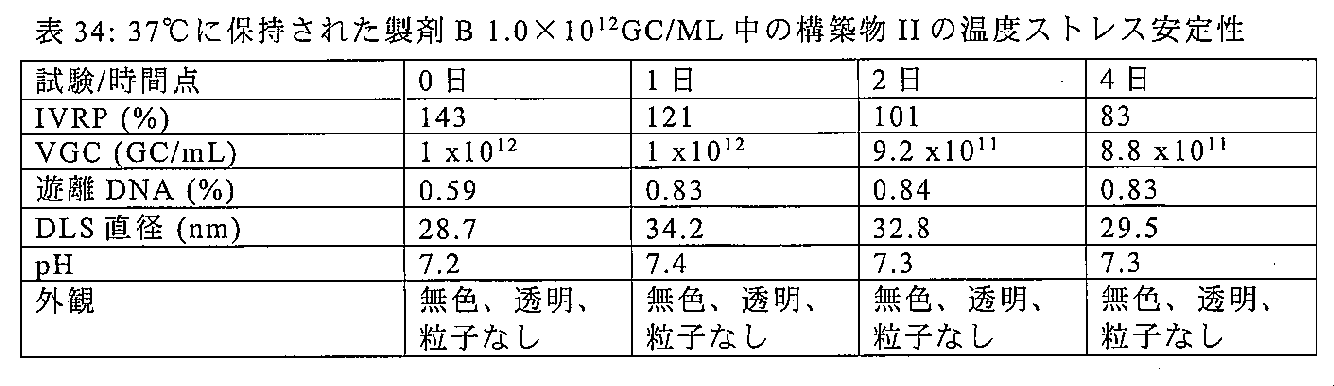
5.18.3 新しいFDP製剤Bにおける構築物IIの長期安定性
長期開発安定性研究では、FDP製剤Bについて、in vitroでの相対的効力および他の品質特性が-80℃(≦-60℃)で24カ月間、および-20℃で18カ月間維持されていることを示した。この研究は、この温度での試験期間が相当なものであり、より高い(より温かい)凍結安定性温度での製剤Bの長期安定性に対する頑健性を実証するのに十分であることから、-20℃での研究は18カ月で中止された。ICH Q1Eガイドライン「安定性データの評価」に概説されている原則に基づくデータの外挿は、12カ月間の外挿が妥当であり、製剤は-80℃(≦-60℃)で少なくとも36カ月間安定であり、より高い-20℃の保存温度で30カ月間安定であることを示す。研究は、1.0×10¹²GC/mLと2.1×1011GC/mLの両方で行われた。安定性を評価するために使用したアッセイは、in vitro相対的効力(IVRP)、ベクターゲノム濃度(ddPCRによるVGC)、色素蛍光による遊離DNA(9カ月までの時点で-80℃に対する相対値、および12カ月時点での絶対パーセンテージ)、外観、1.0×10¹²GC/mLのみのサイズ排除クロマトグラフィー(SEC)、動的光散乱(DLS)、pH、および外観を含んだ。
-80℃での24カ月間のすべての結果に安定性の傾向はなく、-20℃での18カ月間の傾向はなかった。方法ばらつきの範囲内では-80℃および-20℃の結果はすべて同じであり、初期時点の結果と同じである。-80℃(表35)および-20℃(表36で保持された1.0×10¹²GC/mL、ならびに-80℃(表37)および-20℃(表38)に保持された2.1×1011GC/mLの長期安定性データは、構築物IIは、製剤Bにおいて、リアルタイムデータに基づき少なくとも24カ月間安定であり、外挿により少なくとも36カ月間安定であることが期待されることを示す。IVRP効力傾向グラフを図52および図53に示す。IVRPの効力は、長期安定性データの24カ月間にわたる方法ばらつきと比較して、一貫した傾向を示さない。
5.18.3 Long-Term Stability of Construct II in New FDP Formulation B In a long-term development stability study, FDP Formulation B demonstrated relative potency and other quality attributes in vitro at −80° C. (≦−60° C.). 24 months at and -20°C for 18 months. This study indicated that the duration of the study at this temperature was substantial and sufficient to demonstrate robustness to the long-term stability of Formulation B at higher (warmer) freeze stability temperatures. The 20° C. study was discontinued at 18 months. Data extrapolation based on the principles outlined in the ICH Q1E Guideline "Evaluation of Stability Data" is reasonable for 12 month extrapolation and formulations are at -80°C (≤ -60°C) for at least 36 months. It is stable for 30 months at a higher storage temperature of -20°C. Studies were performed at both 1.0×10 12 GC/mL and 2.1×10 11 GC/mL. Assays used to assess stability included in vitro relative potency (IVRP), vector genome concentration (VGC by ddPCR), free DNA by dye fluorescence (relative to −80° C. at time points up to 9 months, and absolute percentage at 12 months), appearance, size exclusion chromatography (SEC) only at 1.0×10 12 GC/mL, dynamic light scattering (DLS), pH, and appearance.
All results at -80°C for 24 months showed no trends in stability and no trends at -20°C for 18 months. The −80° C. and −20° C. results are all the same within method variability and are the same as the results for the earlier time points. 1.0×10 12 GC/mL held at −80° C. (Table 35) and −20° C. (Table 36) and 2.0° C. held at −80° C. (Table 37) and −20° C. (Table 38). Long-term stability data of 1×10 11 GC/mL indicate that Construct II is stable in Formulation B for at least 24 months based on real-time data and is expected to be stable for at least 36 months by extrapolation. IVRP efficacy trend graphs are shown in Figures 52 and 53. IVRP efficacy does not show consistent trends compared to methodological variability over 24 months of long-term stability data.


5.19 実施例19:構築物IIの非ヒト霊長類研究
本研究の目的は、カニクイザルに脈絡膜上または網膜下注射により単回用量を投与した場合の構築物IIの薬力学、体内分布、免疫原性および毒性を評価することであった。投与後、少なくとも13週間動物を投与後に観察した(投薬期の92日目;最終屠殺)。雄および雌のカニクイザルを5群に割り付け、用量を表39に示すように投与した。第1群の動物には、投薬期の1日目に左眼に50μL/注射剤/左眼の体積で2回(計100μL/左眼)脈絡膜上注射し、投薬期の1日目に右眼に100μL/右眼の体積で1回(単回100μLブレブ/右眼投与)網膜下注射した。第2群、第3群および第4群の動物に、投薬期の1目日に各眼に50μL/注射剤/眼の体積で脈絡膜上注射を2回投与(計100μL/眼)した。第5群の動物には、投薬期の1日に網膜下注射により各眼に1回、100μL/眼の体積で投薬した(単回100μLブレブ/眼投与)。ビヒクル対照物質はプラセボであった。
5.19 Example 19: Non-Human Primate Studies of Construct II and to assess toxicity. Animals were observed post-dosing for at least 13 weeks after dosing (Day 92 of the dosing phase; terminal sacrifice). Male and female cynomolgus monkeys were assigned to 5 groups and dosed as shown in Table 39. Animals in
抗VEGF Fab濃度によって評価した場合、導入遺伝子産物発現は、研究期間中の房水および血清において、ならびに硝子体液の最終試料において、電気化学発光(ECL)アッセイを用いて評価された。このアッセイは、発現された遺伝子産物である任意の構築物IIを測定するように設計されている。メソスケールディスカバリー(MSD)プラットフォームを用いて実施されたECLイムノアッセイを、架橋法に基づいてサル房水試料または硝子体液中の構築物II TPを定量するように設計した。簡単に説明すると、このアッセイは、キャリブレーター、QC、およびVEGF-ビオチンとウサギ抗構築物II TP抗体の両方を含む試料の一晩のインキュベーションから開始する。これは、構築物II TPが、VEGF-ビオチンおよびウサギ抗構築物II TPを架橋することを可能にする。翌日、混合物を、ブロックされたMSDストレプトアビジンプレートに移し、架橋複合体はVEGF-ビオチンを介してストレプトアビジンに結合することができる。培養後、プレートを洗浄し、SULFO-TAGヤギ抗ウサギ二次抗体を添加する。インキュベーション後、プレートを洗浄し、MSD読取り緩衝剤を含むトリプロピルアミン(TPA)を添加する。TPAおよび電流の存在下で、SULFO-TAGは、房水中に存在する構築物II TPの量に比例する化学発光シグナルを生成する。 Transgene product expression, as assessed by anti-VEGF Fab concentration, was assessed using electrochemiluminescence (ECL) assays in aqueous humor and serum for the duration of the study and in final samples of vitreous humor. This assay is designed to measure any construct II that is an expressed gene product. An ECL immunoassay performed using the Mesoscale Discovery (MSD) platform was designed to quantify Construct II TP in monkey aqueous humor samples or vitreous humor based on a cross-linking method. Briefly, the assay begins with an overnight incubation of calibrators, QCs, and samples containing both VEGF-biotin and rabbit anti-construct II TP antibody. This allows Construct II TP to cross-link VEGF-biotin and rabbit anti-Construct II TP. The next day, the mixture is transferred to blocked MSD streptavidin plates and cross-linked complexes are allowed to bind streptavidin via VEGF-biotin. After incubation, plates are washed and SULFO-TAG goat anti-rabbit secondary antibody is added. After incubation, plates are washed and tripropylamine (TPA) containing MSD read buffer is added. In the presence of TPA and current, SULFO-TAG produces a chemiluminescent signal proportional to the amount of Construct II TP present in the aqueous humor.
構築物IIを脈絡膜上注射により与えられた動物では、導入遺伝子産物の用量比例的増加が、3×10¹⁰~3×10¹²GC/眼の房水および血清(平均Cmax、AUC0-56d、およびAUC0-92d)および硝子体液(濃度として)で観察された。房水中では、抗VEGF Fab濃度の42日目以降の全般的な低下が、脈絡膜上投薬群のみで3×10¹¹/眼以上の用量で認められたが、これは抗導入遺伝子産物抗体と関連している可能性がある。房水と硝子体液の両方について、脈絡膜上に送達された同用量と比較した場合、抗VEGF Fab濃度(平均Cmax、AUC0-56d、およびAUC0-92dとして)は網膜下群で有意に高かった。しかしながら、3×10¹¹GC/眼の網膜下で投薬された動物についての血清中抗VEGF-Fab濃度は、3×1011GC/眼の脈絡膜上で投薬された動物よりも高かった。
In animals given Construct II by suprachoroidal injection, a dose-proportional increase in transgene product was observed at 3×10 10 to 3×10 12 GC/eye aqueous humor and serum (mean C max , AUC 0-56d , and AUC 0-92d ) and vitreous humor (as concentration). In the aqueous humor, a general decrease in anti-VEGF Fab concentrations after

5.19.1 結果
ビヒクル対照群の抗VEGF Fabのすべての濃度値は、定量下限値未満(<0.100ng/mL)であった。
5.19.1 Results All concentration values of anti-VEGF Fab in the vehicle control group were below the lower limit of quantitation (<0.100 ng/mL).
抗VEGF Fabの平均Cmax、AUC0-56d、AUC0-92d値で評価した場合、導入遺伝子産物の発現は、脈絡膜上投薬した場合、3×10¹⁰から3×10¹²GC/眼に、構築物IIの用量レベルの増加に伴って増加した。脈絡膜上に投薬した場合の平均Cmax、AUC0-56dおよびAUC0-92d値の増加は、一般的に用量に比例していた。3×1011GC/眼で網膜下に投薬された動物の抗VEGF Fab濃度は、3×10¹¹GC/眼で脈絡膜上に投薬された動物よりも高く、いずれの投与経路も試験期間を通じてCmaxレベル近辺に達し、維持された。より高用量の脈絡膜上投薬群では、42日目以降の抗VEGF Fabレベルの一般的な低下が観察される。
Expression of the transgene product, as assessed by mean Cmax , AUC0-56d , AUC0-92d values of the anti-VEGF Fabs, increased from 3 x 10¹⁰ to 3 x 10¹² GC/eye when suprachoroidally dosed; It increased with increasing dose levels of Construct II. The increases in mean C max , AUC 0-56d and AUC 0-92d values with intrachoroidal dosing were generally dose-proportional. Anti-VEGF Fab concentrations in animals dosed subretinally at 3 x 10 GC/eye were higher than in animals dosed epichoroidally at 3 x 10 GC/eye, and both routes of administration showed a C2C concentration throughout the study. Reached near max level and maintained. A general decline in anti-VEGF Fab levels from
硝子体液中の抗VEGF Fabの平均レベルは、一般的に構築物IIの用量レベルの増加と共に増加した。網膜下投薬は、脈絡膜上に送達された同用量と比較した場合、有意に増加した抗VEGF Fabレベルを示した。92日目の平均房水対硝子体液の抗VEGF Fab濃度は、脈絡膜上に投薬した場合は0.114~0.348の範囲であり、網膜下に投与した場合は0.201であった。 Mean levels of anti-VEGF Fabs in the vitreous humor generally increased with increasing dose levels of Construct II. Subretinal dosing showed significantly increased anti-VEGF Fab levels when compared to the same dose delivered suprachoroidally. Mean aqueous versus vitreous humor anti-VEGF Fab concentrations on day 92 ranged from 0.114 to 0.348 when dosed epichoroidally and 0.201 when dosed subretinal.
5.20 実施例20:新生血管系加齢黄斑変性の参加者に網膜下送達を介して投与した構築II遺伝子治療の2つの製剤における2つの用量の薬力学を検討する第2相非盲検研究
この第2相非盲検多重コホート研究では、選択/除外基準を満たす約60人の参加者(コホート当たり15人)を4つの連続投薬コホートに組み入れる。用量コホートは、房水中のTP濃度に基づいて構築物IIの薬力学を探索するために、2種類の製剤のうち1種類の用量の構築物IIから構成される。評価項目を下記の表40に記載する。
5.20 Example 20: A

5.20.1 選択基準
参加者は、以下の基準のすべてが適用される場合にのみ、本研究に参加する適格がある:
1.50歳以上89歳以下の男女。
2.スクリーニング来院1でETDRS BCVA-レタースコアが、研究眼において≦78かつ≧40であること。
両眼が適格である場合、無作為化前に治験責任医師が判断したように、研究眼は参加者の視力が低下した眼でなければならない。
3.CRCによって評価した場合、スクリーニング来院1で、研究眼の加齢性黄斑変性(AMD)に続発する中心窩下CNVと、中心窩傍(ETDRSグリッドに基づく黄斑の3mm中心)内の液体との診断が必要である。
CNV病変の特徴:病変サイズは視神経乳頭部面積の10未満(典型的な視神経乳頭部面積=2.54mm2)である必要がある。
4.研究眼が偽水晶体(白内障手術後の少なくとも12週間)であること。
5.自発的であり、すべての研究手法を順守し、試験期間中、対応可能でなければならない。
5.20.1 Inclusion Criteria Participants are eligible to participate in the study only if all of the following criteria apply:
1. Men and women between the ages of 50 and 89.
2. ETDRS BCVA-Letter score ≤78 and ≥40 in the study eye at
If both eyes are eligible, the study eye must be the eye with reduced visual acuity of the participant, as determined by the Investigator prior to randomization.
3. Diagnosis of subfoveal CNV secondary to age-related macular degeneration (AMD) in study eye with fluid within parafovea (3 mm center of macula based on ETDRS grid) at
CNV Lesion Characteristics: Lesion size should be less than 10 optic nerve head areas (typical optic nerve head area = 2.54 mm 2 ).
4. Study eyes must be pseudophakic (at least 12 weeks after cataract surgery).
5. Must be voluntary, adhere to all study procedures, and be available for the duration of the study.
6.女性は、閉経後(月経を伴わない連続12カ月以上として定義される)または外科的に不妊化(すなわち、両側卵管結紮術/両側卵管摘出術、両側卵管閉塞術、子宮摘出術または両側卵巣摘出術)を受けていなければならない。
もしそうでなければ、女性は、スクリーニング来院1に尿および血清妊娠検査の結果が陰性でなければならず、研究中に追加の妊娠検査を受けるのに自発的でなければならない。
7.妊娠可能な女性(WOCBP)(およびそれらの男性パートナー)は、非常に効果的な避妊法を積極的に用いなければならず、WOCBPと性的関係にある男性参加者は、スクリーニング来院1からコンドームの使用を構築物II投与後の24週間まで自発的にしなければならない。
8.書面による署名入りインフォームド・コンセントを提供する意思と能力がなければならない。
9.スクリーニング来院2のSD-OCTに基づいて、参加者は体液が50μmを超える改善または50%を超える改善(下記の奏効基準参照)を示し、CRCにより決定した場合、CRTが400μm未満でなければならない。
参加者がCRTの増加に寄与する体液以外の疾患(すなわち、色素上皮剥離[PED]または網膜下高反射物質[SHRM])を有する場合、CRCにより決定した体液(網膜内または網膜下)が50μm未満の場合、参加者が適格であることに留意する。
応答基準:スクリーニング来院1と比較して、網膜内(傍中心窩3mm)液の改善が>50μmまたは50%でなければならない。
6. Women must be postmenopausal (defined as ≥12 consecutive months without menstruation) or surgically sterilized (i.e., bilateral tubal ligation/salpingectomy, bilateral tubal occlusion, hysterectomy or bilateral oophorectomy).
If not, the woman must have negative urine and serum pregnancy test results at
7. Women of childbearing potential (WOCBPs) (and their male partners) must actively use highly effective contraception, and male participants who are sexually active with WOCBPs should be given condoms from
8. Must be willing and able to provide written and signed informed consent.
9. Based on SD-OCT at
If the participant has a non-fluid disorder that contributes to increased CRT (i.e., pigment epithelial detachment [PED] or subretinal hyperreflective matter [SHRM]), fluid (intraretinal or subretinal) as determined by CRC is 50 μm Note that participants are eligible if less than
Response Criteria: Compared to
5.20.2 除外基準
以下の基準のいずれかが適用される場合、参加者は研究から除外される:
10.AMD以外の任意の原因に続発する研究眼におけるCNVまたは黄斑浮腫。
11.CRCにより決定される中心窩下線維化または萎縮。
12.スクリーニング来院1前の12カ月間に>9回の抗VEGF注射を必要とした参加者。
13.治験責任医師の見解で、研究眼のVA改善を制限する可能性のある任意の状態。
14.研究眼における網膜剥離または網膜裂孔の発症または既往歴。
5.20.2 Exclusion Criteria Participants will be excluded from the study if any of the following criteria apply:
10. CNV or macular edema in the study eye secondary to any cause other than AMD.
11. Subfoveal fibrosis or atrophy as determined by CRC.
12. Participants who required >9 anti-VEGF injections in the 12 months prior to
13. Any condition that, in the investigator's opinion, may limit VA improvement in the study eye.
14. Occurrence or history of retinal detachment or retinal tear in the study eye.
15.IOPが>23mmHg、2種類のIOP降下薬または緑内障治療のための任意の侵襲的処置(例えば、シャント、チューブ、または低侵襲緑内障手術[MIGS]装置;選択的レーザー線維柱帯切除術、アルゴンレーザー線維柱帯形成術、およびMIGS装置が認められる)で制御されていないもので定義される研究眼の進行性緑内障。
16.スクリーニング来院1前の>4年にnAMDと診断された任意の参加者。
17.治験責任医師の見解において、参加者のリスクを増大させ、研究期間中に視力障害を予防もしくは処置する過程において医学的または外科的介入を必要とし、あるいは研究手法または評価に支障を来す可能性がある、研究眼における任意の状態。
18.スクリーニング来院1前の12週間以内に研究眼における眼内手術の既往歴。スクリーニング来院1前の>10週間に行われる場合、イットリウムアルミニウムガーネット(YAG)カプセル切開は許容される。
19.スクリーニング来院1前の6カ月において、研究眼における硝子体内療法、例えば、抗VEGF療法以外の硝子体内ステロイド注射または治験薬などの既往歴。
15. IOP >23 mmHg, 2 IOP-lowering drugs or any invasive procedure to treat glaucoma (e.g., shunt, tube, or minimally invasive glaucoma surgery [MIGS] device; selective laser trabeculectomy, argon laser) Progressive glaucoma in the study eye defined as uncontrolled with trabeculoplasty, and MIGS device allowed).
16. Any participant diagnosed with nAMD >4 years prior to
17. Potentially, in the opinion of the investigator, increase the risk of participants, require medical or surgical intervention in the course of preventing or treating visual impairment during the study period, or interfere with study procedures or assessments. Any condition in the study eye that has
18. History of intraocular surgery in the study eye within 12 weeks prior to
19. History of intravitreal therapy in the study eye, eg, intravitreal steroid injections other than anti-VEGF therapy or investigational drug, in the 6 months prior to
20.スクリーニング来院1時点での研究眼における任意の埋め込み用具の存在(眼内レンズまたはMIGSデバイスを除く)。
21.スクリーニング来院1前の5年において化学療法および/または放射線療法を必要とする免疫系を損なう可能性のある悪性腫瘍または血液悪性腫瘍の既往歴。
限局性基底細胞癌腫は許容される。
22.登録から30日または臨床試験用医薬品の5半減期のいずれか長い方の期間内に臨床試験用医薬品を受けた場合。
23.遺伝子治療を受けた。
24.治療、またはVAに影響を及ぼす可能性がある任意の薬物もしくは公知の網膜毒性を有する任意の薬剤、例えば、クロロキンもしくはヒドロキシクロロキンとの併用療法によって引き起こされた網膜毒性の既往歴。
25.外科的手法を妨げる可能性のある、研究眼における眼または眼周囲の感染。
26.過去6カ月以内の心筋梗塞、脳血管発作、または一過性脳虚血発作。
27.最大の医学的処置にもかかわらず、制御されていない高血圧(収縮期血圧[BP]>180mmHg、拡張期血圧>100mmHg)。
28.スクリーニング来院1で以下の臨床検査値を有する任意の参加者は研究から離脱する:
●アスパラギン酸アミノトランスフェラーゼ(AST)/アラニンアミノトランスフェラーゼ(ALT)>2.5×正常上限(ULN)。
●参加者がGilbert症候群の既往歴があり、総ビリルビンの35%未満の抱合型ビリルビンを示す分画ビリルビンを有する場合を除き、総ビリルビン>1.5×ULN。
●参加者が抗凝固療法を受けていない限り、プロトロンビン時間>1.5×ULN。
●抗凝固療法を受けている参加者は、地域の検査機関によってモニタリングされ、研究手法のために抗凝固療法を実施または橋渡しするために地域の診療所で管理される;Medical Monitorとのコンサルテーションも必要である。
●男性参加者ではヘモグロビン<10g/dL、女性参加者では<9g/dL。
●血小板<100×103/μL。
●推定される糸球体濾過速度<30mL/分/1.73m2。
●現在、糖尿病に対するインスリンの投与を受けている。
20. Presence of any implants (other than intraocular lenses or MIGS devices) in the study eye at
21. History of malignancies that may compromise the immune system or hematologic malignancies requiring chemotherapy and/or radiotherapy in the 5 years prior to
Localized basal cell carcinoma is permissible.
22. Received an investigational medicinal product within 30 days of enrollment or within 5 half-lives of the investigational medicinal product, whichever is longer.
23. received gene therapy.
24. History of retinal toxicity caused by treatment or combination therapy with any drug that may affect VA or any agent with known retinal toxicity, eg, chloroquine or hydroxychloroquine.
25. Ocular or periocular infections in the study eye that may interfere with the surgical procedure.
26. Myocardial infarction, cerebrovascular accident, or transient ischemic attack within the past 6 months.
27. Uncontrolled hypertension (systolic blood pressure [BP]>180 mmHg, diastolic blood pressure>100 mmHg) despite maximal medical treatment.
28. Any participant with the following laboratory values at
• Aspartate aminotransferase (AST)/alanine aminotransferase (ALT) > 2.5 x upper limit of normal (ULN).
• Total bilirubin >1.5 x ULN, unless the participant has a history of Gilbert's syndrome and has fractionated bilirubin representing less than 35% conjugated bilirubin of total bilirubin.
• Prothrombin time >1.5 x ULN, unless the participant is on anticoagulant therapy.
Participants receiving anticoagulant therapy will be monitored by local laboratories and managed at the local clinic to administer or bridge anticoagulation for study procedures; also consult with Medical Monitor is necessary.
• Hemoglobin <10 g/dL in male participants and <9 g/dL in female participants.
• Platelets <100 x 103 /μL.
• Estimated glomerular filtration rate <30 mL/min/1.73 m 2 .
●Currently receiving insulin for diabetes.
29.治験責任医師(すなわち、網膜外科医)および参加者に抗凝固療法を処方する医師の見解において、構築物II投与のために抗凝固療法を保持することが適応とされていないまたは安全でないと考えられる抗凝固療法を現在実施中である。
30.治験責任医師の見解において、眼科手術または治癒プロセスに支障を来す可能性のある併用療法。
31.ラニビズマブまたはその成分のいずれかに対する公知の過敏症。
32.治験責任医師または治験依頼者の見解において、参加者の安全性、結果の解釈、または研究におけるすべての評価およびフォローアップを完了する能力が損なわれる可能性がある、重篤、慢性、もしくは不安定な医学的または心理学的状態を有する。
29. Anticoagulants for which, in the opinion of the investigator (i.e., retinal surgeon) and the physician prescribing anticoagulant therapy to the participant, it is not indicated or considered unsafe to maintain anticoagulant therapy for Construct II administration. He is currently undergoing coagulation therapy.
30. Eye surgery or concomitant therapy that, in the Investigator's opinion, may interfere with the healing process.
31. Known hypersensitivity to ranibizumab or any of its components.
32. Serious, chronic, or unstable that, in the opinion of the investigator or sponsor, may compromise the participant's safety, interpretation of results, or ability to complete all evaluations and follow-up in the study have a medical or psychological condition;
5.20.3 投与された研究介入
適格な参加者は、下記の表41に記載されるように、構築物IIの2つの用量のうち1つ、および2つの製剤のうち1つにコホートにより割り付けられる。参加者は、手術室で網膜下送達を介して1日目に構築物IIを投与される。研究期間中、参加者は、スクリーニング来院1、第2週、続いて必要に応じて第4週から開始して約28日ごとに硝子体内注射により投与で、ラニビズマブ0.5mgを受ける。
5.20.3 Study Interventions Administered Eligible participants were cohort-assigned to 1 of 2 doses and 1 of 2 formulations of Construct II, as described in Table 41 below. be done. Participants will receive Construct II on

均等
本発明がその特有の実施形態を参照して詳細に記載されているが、機能的に同等の変形形態は本発明の範囲内にあることが理解されるであろう。実際に、本明細書に示され、記載されるものに加えて本発明の様々な改変が、以上の記載および添付の図面から当業者に明らかとなるであろう。そのような改変は、添付の請求項の範囲内に入ることが意図される。当業者は、本明細書に記載の発明の特有の実施形態に対する多くの均等物を認識し、または常法に過ぎない実験を使用して確認することができる。そのような均等物は、以下の請求項により包含されることが意図される。
Equivalents Although the invention has been described in detail with reference to specific embodiments thereof, it will be understood that functionally equivalent variations are within the scope of the invention. Indeed, various modifications of the invention in addition to those shown and described herein will become apparent to those skilled in the art from the foregoing description and accompanying drawings. Such modifications are intended to fall within the scope of the appended claims. Those skilled in the art will recognize, or be able to ascertain using no more than routine experimentation, many equivalents to the specific embodiments of the invention described herein. Such equivalents are intended to be covered by the following claims.
本明細書において言及されるすべての刊行物、特許および特許出願は、各個々の刊行物、特許または特許出願が、参照により全体が本明細書に組み込まれることを特におよび個々に指し示された場合と同じ程度まで参照により本明細書に組み込まれる。 All publications, patents and patent applications mentioned in this specification are specifically and individually indicated that each individual publication, patent or patent application is hereby incorporated by reference in its entirety. are incorporated herein by reference to the same extent.
Claims (184)
(b)塩化カリウム、
(c)一塩基性リン酸カリウム、
(d)塩化ナトリウム、
(e)二塩基性リン酸ナトリウム無水物、
(f)スクロース、および
(e)ポロキサマー188、ポリソルベート20、またはポリソルベート80
を含む、医薬組成物。 (a) a recombinant adeno-associated virus (AAV);
(b) potassium chloride;
(c) monobasic potassium phosphate;
(d) sodium chloride;
(e) dibasic sodium phosphate anhydrous;
(f) sucrose, and (e) poloxamer 188, polysorbate 20, or polysorbate 80
A pharmaceutical composition comprising:
(b)0.2g/Lの濃度の一塩基性リン酸カリウム、
(c)5.84g/Lの濃度の塩化ナトリウム、および
(d)1.15g/Lの濃度の二塩基性リン酸ナトリウム無水物
を含む、請求項1~3のいずれか1項に記載の医薬組成物。 (a) potassium chloride at a concentration of 0.2 g/L;
(b) monobasic potassium phosphate at a concentration of 0.2 g/L;
(c) sodium chloride at a concentration of 5.84 g/L; and (d) anhydrous sodium phosphate dibasic at a concentration of 1.15 g/L. pharmaceutical composition.
(b)0.2g/Lの濃度の塩化カリウム、
(c)0.2g/Lの濃度の一塩基性リン酸カリウム、
(d)5.84g/Lの濃度の塩化ナトリウム、
(e)1.15g/Lの濃度の二塩基性リン酸ナトリウム無水物、
(f)4質量/体積%(40g/L)の濃度のスクロース、
(g)0.001質量/体積%(0.01g/L)の濃度のポロキサマー188、ポリソルベート20、またはポリソルベート80、および
(h)水
からなり、
前記組換えAAVがAAV8である、
請求項1~19のいずれか1項に記載の医薬組成物。 (a) said recombinant AAV;
(b) potassium chloride at a concentration of 0.2 g/L;
(c) monobasic potassium phosphate at a concentration of 0.2 g/L;
(d) sodium chloride at a concentration of 5.84 g/L;
(e) dibasic sodium phosphate anhydrous at a concentration of 1.15 g/L;
(f) sucrose at a concentration of 4% weight/volume (40 g/L);
(g) poloxamer 188, polysorbate 20, or polysorbate 80 at a concentration of 0.001% weight/volume (0.01 g/L), and (h) water;
wherein said recombinant AAV is AAV8;
The pharmaceutical composition according to any one of claims 1-19.
(b)塩化カリウム、
(c)一塩基性リン酸カリウム、
(d)塩化ナトリウム、
(e)二塩基性リン酸ナトリウム無水物、
(f)スクロース、および
(e)ポロキサマー188、ポリソルベート20、またはポリソルベート80
を含む医薬組成物であって、
前記抗hVEGF抗体が、配列番号2または配列番号4のアミノ酸配列を含む重鎖、および配列番号1または配列番号3のアミノ酸配列を含む軽鎖を含む、医薬組成物。 (a) Construct II encoding an anti-human vascular endothelial growth factor (hVEGF) antibody;
(b) potassium chloride;
(c) monobasic potassium phosphate;
(d) sodium chloride;
(e) dibasic sodium phosphate anhydrous;
(f) sucrose, and (e) poloxamer 188, polysorbate 20, or polysorbate 80
A pharmaceutical composition comprising
A pharmaceutical composition, wherein said anti-hVEGF antibody comprises a heavy chain comprising the amino acid sequence of SEQ ID NO:2 or SEQ ID NO:4 and a light chain comprising the amino acid sequence of SEQ ID NO:1 or SEQ ID NO:3.
(b)0.2g/Lの濃度の一塩基性リン酸カリウム、
(c)5.84g/Lの濃度の塩化ナトリウム、および
(d)1.15g/Lの濃度の二塩基性リン酸ナトリウム無水物
を含む、請求項67~68のいずれか1項に記載の医薬組成物。 (a) potassium chloride at a concentration of 0.2 g/L;
(b) monobasic potassium phosphate at a concentration of 0.2 g/L;
(c) sodium chloride at a concentration of 5.84 g/L; and (d) anhydrous sodium phosphate dibasic at a concentration of 1.15 g/L. pharmaceutical composition.
(b)0.2g/Lの濃度の塩化カリウム、
(c)0.2g/Lの濃度の一塩基性リン酸カリウム、
(d)5.84g/Lの濃度の塩化ナトリウム、
(e)1.15g/Lの濃度の二塩基性リン酸ナトリウム無水物、
(f)4質量/体積%(40g/L)の濃度のスクロース、
(g)0.001質量/体積%(0.01g/L)の濃度のポロキサマー188、ポリソルベート20、またはポリソルベート80、および
(h)水
からなり、
前記抗hVEGF抗体が、配列番号2または配列番号4のアミノ酸配列を含む重鎖、および配列番号1または配列番号3のアミノ酸配列を含む軽鎖を含む、
請求項67~100のいずれか1項に記載の医薬組成物。 (a) said construct II encoding an anti-human vascular endothelial growth factor (hVEGF) antibody;
(b) potassium chloride at a concentration of 0.2 g/L;
(c) monobasic potassium phosphate at a concentration of 0.2 g/L;
(d) sodium chloride at a concentration of 5.84 g/L;
(e) dibasic sodium phosphate anhydrous at a concentration of 1.15 g/L;
(f) sucrose at a concentration of 4% weight/volume (40 g/L);
(g) poloxamer 188, polysorbate 20, or polysorbate 80 at a concentration of 0.001% weight/volume (0.01 g/L), and (h) water;
said anti-hVEGF antibody comprises a heavy chain comprising the amino acid sequence of SEQ ID NO:2 or SEQ ID NO:4 and a light chain comprising the amino acid sequence of SEQ ID NO:1 or SEQ ID NO:3;
The pharmaceutical composition according to any one of claims 67-100.
(b)イオン性塩を含み、60mM~150mMのイオン強度を有する緩衝化剤、
(d)スクロース、および
(e)界面活性剤
を含む、安定な液体医薬組成物。 (a) recombinant adeno-associated virus (rAAV),
(b) a buffer comprising an ionic salt and having an ionic strength of 60 mM to 150 mM;
A stable liquid pharmaceutical composition comprising (d) sucrose, and (e) a surfactant.
Applications Claiming Priority (3)
| Application Number | Priority Date | Filing Date | Title |
|---|---|---|---|
| US201962911968P | 2019-10-07 | 2019-10-07 | |
| US62/911,968 | 2019-10-07 | ||
| PCT/US2020/054400 WO2021071835A1 (en) | 2019-10-07 | 2020-10-06 | Adeno-associated virus vector pharmaceutical composition and methods |
Publications (2)
| Publication Number | Publication Date |
|---|---|
| JP2022552262A true JP2022552262A (en) | 2022-12-15 |
| JPWO2021071835A5 JPWO2021071835A5 (en) | 2023-10-17 |
Family
ID=73131798
Family Applications (1)
| Application Number | Title | Priority Date | Filing Date |
|---|---|---|---|
| JP2022521243A Pending JP2022552262A (en) | 2019-10-07 | 2020-10-06 | Adeno-associated virus vector pharmaceutical compositions and methods |
Country Status (13)
| Country | Link |
|---|---|
| US (1) | US20240108669A1 (en) |
| EP (1) | EP4041292A1 (en) |
| JP (1) | JP2022552262A (en) |
| KR (1) | KR20220081365A (en) |
| CN (1) | CN114728049A (en) |
| AR (1) | AR120171A1 (en) |
| AU (1) | AU2020362119A1 (en) |
| BR (1) | BR112022006718A2 (en) |
| CA (1) | CA3156984A1 (en) |
| IL (1) | IL291930A (en) |
| MX (1) | MX2022004146A (en) |
| TW (2) | TW202525312A (en) |
| WO (1) | WO2021071835A1 (en) |
Families Citing this family (15)
| Publication number | Priority date | Publication date | Assignee | Title |
|---|---|---|---|---|
| MX2020006435A (en) | 2017-12-19 | 2021-02-09 | Akouos Inc | ADMINISTRATION OF THERAPEUTIC ANTIBODIES MEDIATED BY ADENO ASSOCIATED VIRUS (AAV) VECTOR IN THE INNER EAR. |
| PE20240115A1 (en) | 2020-12-01 | 2024-01-22 | Akouos Inc | CONSTRUCTIONS OF ANTI-VEGF ANTIBODIES AND RELATED METHODS FOR THE TREATMENT OF SYMPTOMS ASSOCIATED WITH VESTIBULAR SCHWANNOMA |
| KR20230122076A (en) * | 2020-12-18 | 2023-08-22 | 상가모 테라퓨틱스, 인코포레이티드 | Improved pharmaceutical compositions containing adeno-associated viral vectors |
| TW202406560A (en) * | 2022-03-14 | 2024-02-16 | 美商再生元醫藥公司 | Lyophilized formulations of aav drug products |
| TW202404651A (en) * | 2022-04-06 | 2024-02-01 | 美商銳進科斯生物股份有限公司 | Formulations for suprachoroidal administration such as formulations with aggregate formation |
| JP2025534347A (en) | 2022-09-30 | 2025-10-15 | リジェネックスバイオ インコーポレイテッド | Treatment of ocular diseases using recombinant viral vectors encoding anti-VEGF FABs |
| CN116350801A (en) * | 2022-11-22 | 2023-06-30 | 四川至善唯新生物科技有限公司 | Pharmaceutical composition of recombinant adeno-associated virus vector and application thereof |
| CN115869425B (en) * | 2022-12-12 | 2024-08-20 | 北京生物制品研究所有限责任公司 | AAV (AAV) eye injection and preparation method and application thereof |
| CN120584187A (en) * | 2022-12-23 | 2025-09-02 | 斯帕克医疗有限公司 | Adeno-associated virus preparations |
| WO2024220966A1 (en) * | 2023-04-21 | 2024-10-24 | The Regents Of The University Of California | Novel glycan compounds for age-related macular degeneration |
| WO2024238867A1 (en) | 2023-05-16 | 2024-11-21 | Regenxbio Inc. | Vectorized anti-complement antibodies and administration thereof |
| WO2025040166A1 (en) * | 2023-08-23 | 2025-02-27 | 上海瑞宏迪医药有限公司 | Pharmaceutical composition and use thereof |
| CN119015447A (en) * | 2023-09-01 | 2024-11-26 | 康霖生物科技(杭州)有限公司 | A buffer system and its corresponding liquid preparation and its use |
| WO2025113676A1 (en) * | 2023-11-29 | 2025-06-05 | Neuexcell Therapeutics (Suzhou) Co., Ltd. | Compositions and methods for treating stroke in primates |
| WO2025217230A1 (en) | 2024-04-08 | 2025-10-16 | Regenxbio Inc. | Vectorized anti-complement antibodies and complement agents and administration thereof |
Citations (2)
| Publication number | Priority date | Publication date | Assignee | Title |
|---|---|---|---|---|
| WO2018128689A1 (en) * | 2016-11-04 | 2018-07-12 | Baxalta Incorporated | Adeno-associated virus formulations |
| JP2019518427A (en) * | 2016-04-15 | 2019-07-04 | ザ・トラステイーズ・オブ・ザ・ユニバーシテイ・オブ・ペンシルベニア | Composition for the treatment of wet age-related macular degeneration |
Family Cites Families (33)
| Publication number | Priority date | Publication date | Assignee | Title |
|---|---|---|---|---|
| CN1119876A (en) | 1993-02-12 | 1996-04-03 | 莱兰斯坦福初级大学评议会 | Regulated targeted gene transcription and other biological processes |
| CA2209183A1 (en) | 1994-12-29 | 1996-07-11 | Joel L. Pomerantz | Chimeric dna-binding proteins |
| WO1996041865A1 (en) | 1995-06-07 | 1996-12-27 | Ariad Gene Therapeutics, Inc. | Rapamcycin-based regulation of biological events |
| JP2003524368A (en) | 1997-08-26 | 2003-08-19 | アリアド ジーン セラピューティクス インコーポレイテッド | Fusion protein comprising a dimerization domain, a trimerization domain or a tetramerization domain and a complementary heterologous transcriptional activation domain, a transcription repression domain, a DNA binding domain or a ligand binding domain |
| CA2303482A1 (en) | 1997-08-27 | 1999-03-04 | Ariad Gene Therapeutics, Inc. | Chimeric transcriptional activators and compositions and uses related thereto |
| AU755784B2 (en) | 1998-01-15 | 2002-12-19 | Ariad Pharmaceuticals, Inc. | Regulation of biological events using multimeric chimeric proteins |
| EP1053241A1 (en) | 1998-02-13 | 2000-11-22 | President And Fellows Of Harvard College | Novel dimerizing agents, their production and use |
| ES2308989T3 (en) | 1999-08-09 | 2008-12-16 | Targeted Genetics Corporation | INCREASE IN THE EXPRESSION OF A NUCLEOTIDIC SEQUENCE HETEROLOGY FROM RECOMBINANT VIRECT VECTORS CONTAINING A SEQUENCE FORMING INTRACATENARY BASE PAIRS. |
| US7067526B1 (en) | 1999-08-24 | 2006-06-27 | Ariad Gene Therapeutics, Inc. | 28-epirapalogs |
| JP4677187B2 (en) | 2001-11-13 | 2011-04-27 | ザ・トラステイーズ・オブ・ザ・ユニバーシテイ・オブ・ペンシルベニア | Novel adeno-associated virus (AAV) 7 sequences, vectors containing them and their use |
| WO2003052051A2 (en) | 2001-12-17 | 2003-06-26 | The Trustees Of The University Of Pennsylvania | Adeno-associated virus (aav) serotype 8 sequences |
| NZ545628A (en) | 2003-09-30 | 2009-04-30 | Univ Pennsylvania | Adeno-associated virus (AAV) clades, sequences, vectors containing same, and uses therefor |
| EP3290513B1 (en) | 2004-06-01 | 2022-09-07 | Genzyme Corporation | Compositions and methods to prevent aav vector aggregation |
| EP2359866B1 (en) | 2005-04-07 | 2013-07-17 | The Trustees of The University of Pennsylvania | Modified AAV rh48 capsids, compositions containing same and uses thereof |
| EP1777906A1 (en) | 2005-06-09 | 2007-04-25 | Matsushita Electric Industrial Co., Ltd. | Amplitude error compensating apparatus and orthogonality error compensating apparatus |
| WO2010138263A2 (en) | 2009-05-28 | 2010-12-02 | University Of Massachusetts | Novel aav 's and uses thereof |
| US8628966B2 (en) | 2010-04-30 | 2014-01-14 | City Of Hope | CD34-derived recombinant adeno-associated vectors for stem cell transduction and systemic therapeutic gene transfer |
| US8927514B2 (en) | 2010-04-30 | 2015-01-06 | City Of Hope | Recombinant adeno-associated vectors for targeted treatment |
| CN103189507A (en) | 2010-10-27 | 2013-07-03 | 学校法人自治医科大学 | Adeno-associated virus particles for gene delivery into nervous system cells |
| JP6042825B2 (en) | 2011-02-10 | 2016-12-14 | ザ・ユニヴァーシティ・オヴ・ノース・キャロライナ・アト・チャペル・ヒル | Viral vectors with modified transduction profiles and methods for their production and use |
| SI3693025T1 (en) | 2011-04-22 | 2022-04-29 | The Regents Of The University Of California | Adeno-associated virus virions with capsid variant and procedures for their use |
| WO2013029030A1 (en) | 2011-08-24 | 2013-02-28 | The Board Of Trustees Of The Leland Stanford Junior University | New aav capsid proteins for nucleic acid transfer |
| WO2013170078A1 (en) | 2012-05-09 | 2013-11-14 | Oregon Health & Science University | Adeno associated virus plasmids and vectors |
| WO2014160092A1 (en) | 2013-03-13 | 2014-10-02 | The Children's Hospital Of Philadelphia | Adeno-associated virus vectors and methods of use thereof |
| ES2739288T3 (en) | 2013-09-13 | 2020-01-30 | California Inst Of Techn | Selective recovery |
| LT3459965T (en) | 2013-10-11 | 2021-03-10 | Massachusetts Eye & Ear Infirmary | Methods of predicting ancestral virus sequences and uses thereof |
| US10746742B2 (en) | 2014-04-25 | 2020-08-18 | Oregon Health & Science University | Methods of viral neutralizing antibody epitope mapping |
| US10064752B2 (en) | 2014-09-11 | 2018-09-04 | Orbit Biomedical Limited | Motorized suprachoroidal injection of therapeutic agent |
| SG10202008378UA (en) | 2016-04-15 | 2020-10-29 | Regenxbio Inc | Treatment of ocular diseases with fully-human post-translationally modified anti-vegf fab |
| LT3472317T (en) * | 2016-06-16 | 2022-06-27 | Adverum Biotechnologies, Inc. | Compositions and methods for reducing ocular neovascularization |
| KR102850887B1 (en) * | 2017-08-03 | 2025-08-28 | 보이저 테라퓨틱스, 인크. | Compositions and methods for delivering AAV |
| KR20200060456A (en) | 2017-09-27 | 2020-05-29 | 리젠엑스바이오 인크. | Treatment of ocular diseases with modified anti-VEGF Fab after full-human translation |
| JP2022513034A (en) * | 2018-11-14 | 2022-02-07 | レジェンクスバイオ インコーポレーテッド | Gene therapy for neuronal ceroid lipofuscinosis |
-
2020
- 2020-10-06 AU AU2020362119A patent/AU2020362119A1/en active Pending
- 2020-10-06 MX MX2022004146A patent/MX2022004146A/en unknown
- 2020-10-06 JP JP2022521243A patent/JP2022552262A/en active Pending
- 2020-10-06 WO PCT/US2020/054400 patent/WO2021071835A1/en not_active Ceased
- 2020-10-06 EP EP20801425.8A patent/EP4041292A1/en active Pending
- 2020-10-06 BR BR112022006718A patent/BR112022006718A2/en unknown
- 2020-10-06 US US17/766,941 patent/US20240108669A1/en active Pending
- 2020-10-06 KR KR1020227015158A patent/KR20220081365A/en active Pending
- 2020-10-06 CN CN202080079668.3A patent/CN114728049A/en active Pending
- 2020-10-06 IL IL291930A patent/IL291930A/en unknown
- 2020-10-06 CA CA3156984A patent/CA3156984A1/en active Pending
- 2020-10-07 TW TW114110012A patent/TW202525312A/en unknown
- 2020-10-07 TW TW109134835A patent/TWI879814B/en active
- 2020-10-07 AR ARP200102778A patent/AR120171A1/en unknown
Patent Citations (2)
| Publication number | Priority date | Publication date | Assignee | Title |
|---|---|---|---|---|
| JP2019518427A (en) * | 2016-04-15 | 2019-07-04 | ザ・トラステイーズ・オブ・ザ・ユニバーシテイ・オブ・ペンシルベニア | Composition for the treatment of wet age-related macular degeneration |
| WO2018128689A1 (en) * | 2016-11-04 | 2018-07-12 | Baxalta Incorporated | Adeno-associated virus formulations |
Also Published As
| Publication number | Publication date |
|---|---|
| AR120171A1 (en) | 2022-02-02 |
| CN114728049A (en) | 2022-07-08 |
| WO2021071835A1 (en) | 2021-04-15 |
| TW202126319A (en) | 2021-07-16 |
| CA3156984A1 (en) | 2021-04-15 |
| MX2022004146A (en) | 2022-09-19 |
| KR20220081365A (en) | 2022-06-15 |
| AU2020362119A1 (en) | 2022-05-26 |
| TW202525312A (en) | 2025-07-01 |
| US20240108669A1 (en) | 2024-04-04 |
| BR112022006718A2 (en) | 2022-07-12 |
| IL291930A (en) | 2022-06-01 |
| EP4041292A1 (en) | 2022-08-17 |
| TWI879814B (en) | 2025-04-11 |
Similar Documents
| Publication | Publication Date | Title |
|---|---|---|
| TWI879814B (en) | Adeno-associated virus vector pharmaceutical composition and methods | |
| EP4667578A2 (en) | Gene therapy for eye pathologies | |
| AU2025204780A1 (en) | Compositions For Treatment Of Wet Age-Related Macular Degeneration | |
| JP2020535184A (en) | Treatment of eye diseases with post-translationally modified fully human anti-VEGF Fab | |
| IL262207B1 (en) | Preparations for the treatment of wet age-related macular degeneration | |
| US20230372538A1 (en) | Formulations for suprachoroidal administration such as formulations with aggregate formation | |
| JP7597380B2 (en) | Sequential intravitreal administration of AAV gene therapy to the contralateral eye | |
| CN114502197A (en) | Treatment of diabetic retinopathy with fully human post-translationally modified anti-VEGF Fab | |
| TW202228646A (en) | Formulations for suprachoroidal administration such as gel formulations | |
| JP2025534347A (en) | Treatment of ocular diseases using recombinant viral vectors encoding anti-VEGF FABs | |
| WO2020022438A1 (en) | Treatment agent for ophthalmic disease associated with retinal fibrosis | |
| CN116601299A (en) | Formulations for suprachoroidal administration such as formulations with aggregate formation |
Legal Events
| Date | Code | Title | Description |
|---|---|---|---|
| A521 | Request for written amendment filed |
Free format text: JAPANESE INTERMEDIATE CODE: A523 Effective date: 20231006 |
|
| A621 | Written request for application examination |
Free format text: JAPANESE INTERMEDIATE CODE: A621 Effective date: 20231006 |
|
| A131 | Notification of reasons for refusal |
Free format text: JAPANESE INTERMEDIATE CODE: A131 Effective date: 20240826 |
|
| A977 | Report on retrieval |
Free format text: JAPANESE INTERMEDIATE CODE: A971007 Effective date: 20240828 |
|
| A601 | Written request for extension of time |
Free format text: JAPANESE INTERMEDIATE CODE: A601 Effective date: 20241126 |
|
| A521 | Request for written amendment filed |
Free format text: JAPANESE INTERMEDIATE CODE: A523 Effective date: 20250225 |
|
| A131 | Notification of reasons for refusal |
Free format text: JAPANESE INTERMEDIATE CODE: A131 Effective date: 20250529 |
|
| A601 | Written request for extension of time |
Free format text: JAPANESE INTERMEDIATE CODE: A601 Effective date: 20250815 |
|
| A521 | Request for written amendment filed |
Free format text: JAPANESE INTERMEDIATE CODE: A523 Effective date: 20251128 |