JP2022540610A - Antibodies that bind to cancer cells and target radionuclides to said cells - Google Patents
Antibodies that bind to cancer cells and target radionuclides to said cells Download PDFInfo
- Publication number
- JP2022540610A JP2022540610A JP2022501132A JP2022501132A JP2022540610A JP 2022540610 A JP2022540610 A JP 2022540610A JP 2022501132 A JP2022501132 A JP 2022501132A JP 2022501132 A JP2022501132 A JP 2022501132A JP 2022540610 A JP2022540610 A JP 2022540610A
- Authority
- JP
- Japan
- Prior art keywords
- seq
- antibody
- amino acid
- acid sequence
- domain
- Prior art date
- Legal status (The legal status is an assumption and is not a legal conclusion. Google has not performed a legal analysis and makes no representation as to the accuracy of the status listed.)
- Withdrawn
Links
Images


Classifications
-
- C—CHEMISTRY; METALLURGY
- C07—ORGANIC CHEMISTRY
- C07K—PEPTIDES
- C07K16/00—Immunoglobulins [IGs], e.g. monoclonal or polyclonal antibodies
- C07K16/18—Immunoglobulins [IGs], e.g. monoclonal or polyclonal antibodies against material from animals or humans
- C07K16/28—Immunoglobulins [IGs], e.g. monoclonal or polyclonal antibodies against material from animals or humans against receptors, cell surface antigens or cell surface determinants
- C07K16/30—Immunoglobulins [IGs], e.g. monoclonal or polyclonal antibodies against material from animals or humans against receptors, cell surface antigens or cell surface determinants from tumour cells
- C07K16/3007—Carcino-embryonic Antigens
-
- A—HUMAN NECESSITIES
- A61—MEDICAL OR VETERINARY SCIENCE; HYGIENE
- A61K—PREPARATIONS FOR MEDICAL, DENTAL OR TOILETRY PURPOSES
- A61K51/00—Preparations containing radioactive substances for use in therapy or testing in vivo
- A61K51/02—Preparations containing radioactive substances for use in therapy or testing in vivo characterised by the carrier, i.e. characterised by the agent or material covalently linked or complexing the radioactive nucleus
- A61K51/04—Organic compounds
- A61K51/0474—Organic compounds complexes or complex-forming compounds, i.e. wherein a radioactive metal (e.g. 111In3+) is complexed or chelated by, e.g. a N2S2, N3S, NS3, N4 chelating group
- A61K51/0482—Organic compounds complexes or complex-forming compounds, i.e. wherein a radioactive metal (e.g. 111In3+) is complexed or chelated by, e.g. a N2S2, N3S, NS3, N4 chelating group chelates from cyclic ligands, e.g. DOTA
-
- A—HUMAN NECESSITIES
- A61—MEDICAL OR VETERINARY SCIENCE; HYGIENE
- A61K—PREPARATIONS FOR MEDICAL, DENTAL OR TOILETRY PURPOSES
- A61K51/00—Preparations containing radioactive substances for use in therapy or testing in vivo
- A61K51/02—Preparations containing radioactive substances for use in therapy or testing in vivo characterised by the carrier, i.e. characterised by the agent or material covalently linked or complexing the radioactive nucleus
- A61K51/04—Organic compounds
- A61K51/0495—Pretargeting
-
- A—HUMAN NECESSITIES
- A61—MEDICAL OR VETERINARY SCIENCE; HYGIENE
- A61P—SPECIFIC THERAPEUTIC ACTIVITY OF CHEMICAL COMPOUNDS OR MEDICINAL PREPARATIONS
- A61P35/00—Antineoplastic agents
-
- C—CHEMISTRY; METALLURGY
- C07—ORGANIC CHEMISTRY
- C07K—PEPTIDES
- C07K16/00—Immunoglobulins [IGs], e.g. monoclonal or polyclonal antibodies
- C07K16/44—Immunoglobulins [IGs], e.g. monoclonal or polyclonal antibodies against material not provided for elsewhere, e.g. haptens, metals, DNA, RNA, amino acids
-
- A—HUMAN NECESSITIES
- A61—MEDICAL OR VETERINARY SCIENCE; HYGIENE
- A61K—PREPARATIONS FOR MEDICAL, DENTAL OR TOILETRY PURPOSES
- A61K39/00—Medicinal preparations containing antigens or antibodies
- A61K2039/505—Medicinal preparations containing antigens or antibodies comprising antibodies
-
- A—HUMAN NECESSITIES
- A61—MEDICAL OR VETERINARY SCIENCE; HYGIENE
- A61K—PREPARATIONS FOR MEDICAL, DENTAL OR TOILETRY PURPOSES
- A61K39/00—Medicinal preparations containing antigens or antibodies
- A61K2039/505—Medicinal preparations containing antigens or antibodies comprising antibodies
- A61K2039/507—Comprising a combination of two or more separate antibodies
-
- C—CHEMISTRY; METALLURGY
- C07—ORGANIC CHEMISTRY
- C07K—PEPTIDES
- C07K2317/00—Immunoglobulins specific features
- C07K2317/20—Immunoglobulins specific features characterized by taxonomic origin
- C07K2317/24—Immunoglobulins specific features characterized by taxonomic origin containing regions, domains or residues from different species, e.g. chimeric, humanized or veneered
-
- C—CHEMISTRY; METALLURGY
- C07—ORGANIC CHEMISTRY
- C07K—PEPTIDES
- C07K2317/00—Immunoglobulins specific features
- C07K2317/30—Immunoglobulins specific features characterized by aspects of specificity or valency
- C07K2317/31—Immunoglobulins specific features characterized by aspects of specificity or valency multispecific
-
- C—CHEMISTRY; METALLURGY
- C07—ORGANIC CHEMISTRY
- C07K—PEPTIDES
- C07K2317/00—Immunoglobulins specific features
- C07K2317/30—Immunoglobulins specific features characterized by aspects of specificity or valency
- C07K2317/34—Identification of a linear epitope shorter than 20 amino acid residues or of a conformational epitope defined by amino acid residues
-
- C—CHEMISTRY; METALLURGY
- C07—ORGANIC CHEMISTRY
- C07K—PEPTIDES
- C07K2317/00—Immunoglobulins specific features
- C07K2317/30—Immunoglobulins specific features characterized by aspects of specificity or valency
- C07K2317/35—Valency
-
- C—CHEMISTRY; METALLURGY
- C07—ORGANIC CHEMISTRY
- C07K—PEPTIDES
- C07K2317/00—Immunoglobulins specific features
- C07K2317/50—Immunoglobulins specific features characterized by immunoglobulin fragments
- C07K2317/52—Constant or Fc region; Isotype
- C07K2317/522—CH1 domain
-
- C—CHEMISTRY; METALLURGY
- C07—ORGANIC CHEMISTRY
- C07K—PEPTIDES
- C07K2317/00—Immunoglobulins specific features
- C07K2317/50—Immunoglobulins specific features characterized by immunoglobulin fragments
- C07K2317/55—Fab or Fab'
-
- C—CHEMISTRY; METALLURGY
- C07—ORGANIC CHEMISTRY
- C07K—PEPTIDES
- C07K2317/00—Immunoglobulins specific features
- C07K2317/50—Immunoglobulins specific features characterized by immunoglobulin fragments
- C07K2317/56—Immunoglobulins specific features characterized by immunoglobulin fragments variable (Fv) region, i.e. VH and/or VL
- C07K2317/565—Complementarity determining region [CDR]
-
- C—CHEMISTRY; METALLURGY
- C07—ORGANIC CHEMISTRY
- C07K—PEPTIDES
- C07K2317/00—Immunoglobulins specific features
- C07K2317/60—Immunoglobulins specific features characterized by non-natural combinations of immunoglobulin fragments
- C07K2317/64—Immunoglobulins specific features characterized by non-natural combinations of immunoglobulin fragments comprising a combination of variable region and constant region components
-
- C—CHEMISTRY; METALLURGY
- C07—ORGANIC CHEMISTRY
- C07K—PEPTIDES
- C07K2317/00—Immunoglobulins specific features
- C07K2317/70—Immunoglobulins specific features characterized by effect upon binding to a cell or to an antigen
- C07K2317/71—Decreased effector function due to an Fc-modification
-
- C—CHEMISTRY; METALLURGY
- C07—ORGANIC CHEMISTRY
- C07K—PEPTIDES
- C07K2317/00—Immunoglobulins specific features
- C07K2317/90—Immunoglobulins specific features characterized by (pharmaco)kinetic aspects or by stability of the immunoglobulin
- C07K2317/92—Affinity (KD), association rate (Ka), dissociation rate (Kd) or EC50 value
-
- C—CHEMISTRY; METALLURGY
- C07—ORGANIC CHEMISTRY
- C07K—PEPTIDES
- C07K2319/00—Fusion polypeptide
Landscapes
- Health & Medical Sciences (AREA)
- Chemical & Material Sciences (AREA)
- Life Sciences & Earth Sciences (AREA)
- General Health & Medical Sciences (AREA)
- Medicinal Chemistry (AREA)
- Organic Chemistry (AREA)
- Immunology (AREA)
- Proteomics, Peptides & Aminoacids (AREA)
- Pharmacology & Pharmacy (AREA)
- Veterinary Medicine (AREA)
- Public Health (AREA)
- Animal Behavior & Ethology (AREA)
- Physics & Mathematics (AREA)
- Genetics & Genomics (AREA)
- Epidemiology (AREA)
- Optics & Photonics (AREA)
- Biochemistry (AREA)
- Biophysics (AREA)
- Molecular Biology (AREA)
- Oncology (AREA)
- Cell Biology (AREA)
- Nuclear Medicine, Radiotherapy & Molecular Imaging (AREA)
- General Chemical & Material Sciences (AREA)
- Chemical Kinetics & Catalysis (AREA)
- Peptides Or Proteins (AREA)
- Medicines Containing Antibodies Or Antigens For Use As Internal Diagnostic Agents (AREA)
- Medicines Containing Material From Animals Or Micro-Organisms (AREA)
- Medicines That Contain Protein Lipid Enzymes And Other Medicines (AREA)
- Micro-Organisms Or Cultivation Processes Thereof (AREA)
Abstract
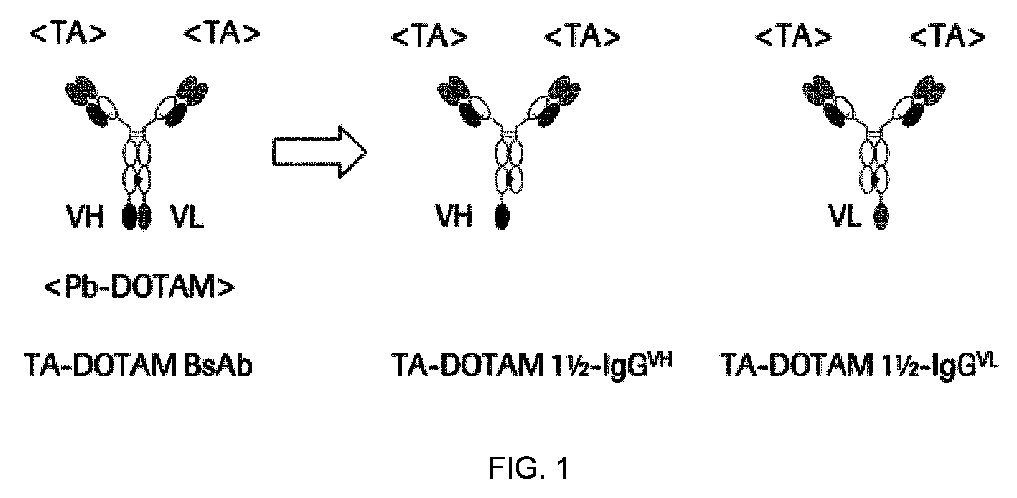
本発明は、標的細胞上の抗原に結合し、放射性核種を前記細胞にターゲティングする抗体、およびこの抗体を使用する方法に関する。
【選択図】図1
The present invention relates to antibodies that bind to antigens on target cells and target radionuclides to said cells, and methods of using these antibodies.
[Selection drawing] Fig. 1
Description
本発明は、標的細胞上の抗原に結合し、放射性核種を前記細胞にターゲティングする抗体、およびこの抗体を使用する方法に関する。 The present invention relates to antibodies that bind to antigens on target cells and target radionuclides to said cells, and methods of using these antibodies.
モノクローナル抗体は、薬物をがん細胞にターゲティングするために開発された。毒性薬剤を、腫瘍関連抗原に結合する抗体にコンジュゲートすることにより、周囲組織への損傷を低減した、より特異的な腫瘍殺滅をもたらす、潜在的可能性が存在する。 Monoclonal antibodies have been developed to target drugs to cancer cells. The potential exists for conjugating toxic agents to antibodies that bind tumor-associated antigens, resulting in more specific tumor killing with less damage to surrounding tissue.
プレターゲティング放射免疫療法(PRIT)では、一方では、腫瘍関連抗原に対する親和性を有し、他方では、放射標識化合物に対する親和性を有する、抗体コンストラクトが使用される。第1の工程では、抗体が投与され、腫瘍に局在化する。その後、放射標識化合物が投与される。放射標識化合物は、低分子であるため、腫瘍に、迅速に送達され、急速に除去される可能性があり、これにより、腫瘍の外部における照射への曝露量を低減する(Goldenbergら、Theranostics、2012、2(5)、523~540)。同様の手順はまた、イメージングのためにも使用されうる。プレターゲティングは、二重特異性抗体またはアビジン-ビオチンを使用するシステムを使用しうるが、後者は、アビジン/ストレプトアビジンが、免疫原性であることの欠点を有する。 Pretargeting radioimmunotherapy (PRIT) uses antibody constructs that have an affinity for tumor-associated antigens on the one hand and radiolabeled compounds on the other hand. In the first step, an antibody is administered and localized to the tumor. A radiolabeled compound is then administered. Because radiolabeled compounds are small molecules, they can be rapidly delivered to the tumor and cleared rapidly, thereby reducing exposure to irradiation outside the tumor (Goldenberg et al., Theranostics. 2012, 2(5), 523-540). A similar procedure can also be used for imaging. Pre-targeting may use systems using bispecific antibodies or avidin-biotin, although the latter has the disadvantage that avidin/streptavidin is immunogenic.
プレターゲティング放射免疫療法またはイメージングは、一般に、抗体を投与する工程と、放射標識化合物を投与する工程との間に投与される、除去剤またはブロッキング剤を使用する。目的は、抗体を、血液から除去し、かつ/または放射標識化合物に対する循環抗体の結合部位をブロックすることである(例えば、Karacayら、Bioconj.Chem.、13(5)、1054~1070(2002)を参照されたい)。除去剤またはブロッキング剤の使用は、有害な毒性を制限しながら、効率的な処置に十分なレベルの放射能が投与されることを可能とするが、タイミングおよび投与量を、注意して選び出さなければならない。したがって、除去相の使用は、プレターゲティング法における複雑な側面である。 Pretargeting radioimmunotherapy or imaging generally employs a clearing or blocking agent that is administered between administering the antibody and administering the radiolabeled compound. The purpose is to remove the antibody from the blood and/or block the binding site of the circulating antibody to the radiolabeled compound (eg Karacay et al., Bioconj. Chem., 13(5), 1054-1070 (2002)). )). The use of clearing or blocking agents allows sufficient levels of radioactivity to be administered for effective treatment while limiting adverse toxicity, although timing and dosage must be carefully chosen. There must be. Therefore, the use of elimination phases is a complicated aspect in pretargeting methods.
本発明は、プレターゲティング法において有用な抗体のセット、およびこの抗体を使用する方法を提供する。 The present invention provides a set of antibodies useful in pretargeting methods, and methods of using the antibodies.
一態様では、本発明は、
i)標的細胞の表面上で発現される抗原に結合する第1の抗体であって、放射標識化合物に対する抗原結合部位のVHドメインをさらに含むが、放射標識化合物に対する抗原結合部位のVLドメインを含まない、第1の抗体;および
ii)標的細胞の表面上で発現される抗原に結合する第2の抗体であって、放射標識化合物に対する抗原結合部位のVLドメインをさらに含むが、放射標識化合物に対する抗原結合部位のVHドメインを含まない、第2の抗体
を含み;
第1の抗体の前記VHドメインおよび第2の抗体の前記VLドメインが、併せて、放射標識化合物に対する機能的抗原結合部位を形成することが可能である、
抗体のセットを提供する。
In one aspect, the invention provides:
i) a first antibody that binds to an antigen expressed on the surface of a target cell, further comprising a VH domain of an antigen binding site for the radiolabeled compound, but comprising a VL domain of the antigen binding site for the radiolabeled compound; and ii) a second antibody that binds to an antigen expressed on the surface of the target cell, the second antibody further comprising the VL domain of the antigen-binding site for the radiolabeled compound, but not for the radiolabeled compound. comprising a second antibody that does not contain the VH domain of the antigen binding site;
said VH domain of a first antibody and said VL domain of a second antibody can together form a functional antigen binding site for a radiolabeled compound;
Provide a set of antibodies.
第1の抗体も第2の抗体も、それら自体の上に、放射標識化合物に対する機能的抗原結合部位を含まない。第1の抗体は、放射標識化合物に対する機能的結合部位に由来するVHドメインだけを有し、VLドメインを有さない。第2の抗体は、VLドメインだけを有し、VHドメインを有さない。 Neither the first antibody nor the second antibody contain on themselves a functional antigen binding site for the radiolabeled compound. The first antibody has only the VH domain, not the VL domain, derived from the functional binding site for the radiolabeled compound. The second antibody has only the VL domain and no VH domain.
放射標識化合物に対する機能的抗原結合部位は、第1の抗体のVHドメインと、第2の抗体のVLドメインとが会合している場合に形成される。これは、例えば、第1の抗体と、第2の抗体とが、同じ個別の標的細胞または隣接細胞に結合している場合に生じうる。 A functional antigen-binding site for a radiolabeled compound is formed when the VH domain of a first antibody and the VL domain of a second antibody are associated. This can occur, for example, when a first antibody and a second antibody bind to the same individual target cell or adjacent cells.
本明細書では、本明細書で記載される第1の抗体および第2の抗体は、「単一ドメインスプリット抗体」、「スプリット抗体」、または「デミボディー」と称されうる。併せて、放射標識化合物に結合することが可能な抗原結合部位を形成する、VHドメインと、VLドメインとは、2つの抗体の間に分配され、同じ抗体の一部として存在しない。 As used herein, the first and second antibodies described herein may be referred to as "single domain split antibodies," "split antibodies," or "demibodies." The VH and VL domains, which together form an antigen-binding site capable of binding radiolabeled compounds, are distributed between the two antibodies and are not part of the same antibody.
スプリットドメインフォーマットとは、放射標識化合物が、それ自体の上における第1の抗体、またはそれ自体の上における第2の抗体に結合しえないことを意味する。血中では、第1の抗体と第2の抗体との間で、安定的な会合が、ほとんどまたは全くなされないので、放射標識化合物への安定的な結合も、ほとんどまたは全くなされない。 A split domain format means that the radiolabeled compound cannot bind the first antibody on itself or the second antibody on itself. Since little or no stable association is made between the first antibody and the second antibody in blood, little or no stable binding to the radiolabeled compound is also made.
本明細書では、標的細胞の表面上で発現される抗原は、「標的抗原」または「TA」と称されうる。本発明に従い、上記で記載された、第1の抗体および第2の抗体は、同じ標的抗原に対する結合部位を有する(疑義を回避するために、抗体が、同じ標的抗原に結合すると言明される場合、これは、抗体が、同じ標的抗原に結合することが可能な結合部位を有することを意味し、抗体が、互いと同じである、2つの個別の抗原分子に結合しうる可能性を含む)。例えば、一実施形態では、第1の抗体および第2の抗体の両方は、CEAに結合する。 An antigen expressed on the surface of a target cell may be referred to herein as a "target antigen" or "TA." According to the present invention, the first antibody and the second antibody, described above, have binding sites for the same target antigen (for the avoidance of doubt, where antibodies are stated to bind to the same target antigen , which means that an antibody has binding sites that are capable of binding to the same target antigen, including the possibility that an antibody can bind to two separate antigen molecules that are the same as each other) . For example, in one embodiment, both the first antibody and the second antibody bind CEA.
一部の実施形態では、第1の抗体および第2の抗体は、標的抗原の同じエピトープに結合しうる(これらに対する結合部位を有する)。他の実施形態では、第1の抗体は、標的抗原の、第2の抗体と異なるエピトープに結合しうる(これらに対する結合部位を有する)。 In some embodiments, the first antibody and the second antibody can bind to (have binding sites for) the same epitope of the target antigen. In other embodiments, the first antibody may bind to (have binding sites for) different epitopes of the target antigen than the second antibody.
一部の実施形態では、第1の抗体および第2の抗体は、標的抗原に対する、同じ抗原結合部位を含むことができる。すなわち、第1の抗体および第2の抗体は、VL配列およびVH配列を含む、標的抗原に結合することが可能な抗原結合部位を含むことができ、この抗原結合部位を形成するVL配列およびVH配列は、第1の抗体と第2の抗体とにおいて、同じである。 In some embodiments, the first antibody and the second antibody can contain the same antigen binding site for the target antigen. That is, the first antibody and the second antibody can comprise an antigen binding site capable of binding to a target antigen, comprising a VL sequence and a VH sequence, wherein the VL sequence and the VH sequence forming the antigen binding site. The sequence is the same in the first antibody and the second antibody.
一部の実施形態では、第1の抗体および第2の抗体の各々は、標的抗原について二価である。一部の実施形態では、第1の抗体および第2の抗体は、各々、エピトープについて、二価であり、かつ、単一特異性である。他の実施形態では、第1の抗体および第2の抗体の各々は、標的抗原について二重パラトープ性である、すなわち、第1の抗体および第2の抗体は、各々、標的抗原の2つの異なるエピトープに対する結合部位を有する。 In some embodiments, each of the first antibody and the second antibody are bivalent with respect to the target antigen. In some embodiments, the first antibody and the second antibody are each bivalent and monospecific for the epitope. In other embodiments, each of the first antibody and the second antibody is double paratopic with respect to the target antigen, i.e., the first antibody and the second antibody each have two different It has binding sites for epitopes.
一部の実施形態では、第1の抗体および/または第2の抗体は、Fc領域を含むことが好ましい場合がある。Fc領域の存在は、放射免疫療法および放射線イメージングの文脈では、利益を有する、例えば、タンパク質の循環半減期を延長し、かつ/または小断片により観察される場合より高度の、腫瘍への取込みを結果としてもたらす。本明細書で記載される「スプリットドメイン」フォーマットは、そうでなければ、循環抗体の存在の延長に起因して生じる、放射標識化合物との会合の可能性の増大を緩和するので、この文脈では、特に有利でありうる。 In some embodiments it may be preferred that the first antibody and/or the second antibody comprise an Fc region. The presence of the Fc region has benefits in the context of radioimmunotherapy and radioimaging, e.g., prolonging the circulating half-life of the protein and/or increasing tumor uptake higher than that observed with small fragments. bring about as a result. In this context, the "split-domain" format described herein mitigates the increased likelihood of association with radiolabeled compounds that would otherwise occur due to prolonged presence of circulating antibody. , can be particularly advantageous.
一部の実施形態では、Fcドメインは、エフェクター機能を低減するか、または消失させるように修飾される。 In some embodiments, the Fc domain is modified to reduce or eliminate effector function.
別の態様では、本発明は、本明細書で記載される抗体のセットを含む薬学的組成物を提供する。別の態様では、本発明は、各々が、本明細書で記載される抗体のうちの1つ(すなわち、第1の抗体および第2の抗体のそれぞれ)を含む、2つの個別の薬学的組成物を含むキットを提供する。 In another aspect, the invention provides pharmaceutical compositions comprising the set of antibodies described herein. In another aspect, the invention provides two separate pharmaceutical compositions, each comprising one of the antibodies described herein (i.e., the first antibody and the second antibody, respectively). Provide a kit containing the items.
さらなる態様では、本発明は、本明細書で記載される抗体または抗体のセットのうちのいずれかをコードするポリヌクレオチドまたはポリヌクレオチドのセットに関する。別の態様では、本発明は、前記1つまたは複数のポリヌクレオチドを含むベクターまたはベクターのセット、任意選択で、発現ベクターまたは発現ベクターのセットに関する。さらなる目的では、本発明は、本発明のベクターもしくはベクターのセットを含む、原核宿主細胞もしくは真核宿主細胞または宿主細胞のセットに関する。加えて、抗体を作製する方法であって、抗体が産生されるように、宿主細胞を培養することを含む方法が提供される。 In a further aspect, the invention relates to a polynucleotide or set of polynucleotides encoding any of the antibodies or sets of antibodies described herein. In another aspect, the invention relates to a vector or set of vectors, optionally an expression vector or set of expression vectors, comprising said one or more polynucleotides. In a further object, the invention relates to a prokaryotic or eukaryotic host cell or set of host cells comprising a vector or set of vectors according to the invention. Additionally provided is a method of making an antibody comprising culturing a host cell such that the antibody is produced.
一部の実施形態では、本明細書で記載される抗体は、プレターゲティング放射免疫療法(PRIT)、またはプレターゲティング放射線イメージング法において使用される。 In some embodiments, the antibodies described herein are used in pretargeted radioimmunotherapy (PRIT), or pretargeted radioimaging methods.
一態様では、本発明は、
i)対象に、上記で記載された第1の抗体および第2の抗体を投与すること;ならびに
ii)続いて前記対象に放射標識化合物を投与すること
を含む、プレターゲティング放射免疫療法を提供する。
In one aspect, the invention provides:
i) administering to a subject a first antibody and a second antibody as described above; and ii) subsequently administering a radiolabeled compound to said subject. .
別の態様では、本発明は、第1の抗体および第2の抗体を対象に投与すること、ならびに続いて、前記対象に放射標識化合物を投与することを含む処置法における使用のための、上記で記載された第1の抗体および第2の抗体を提供する。別の態様では、本発明は、第1の抗体および第2の抗体を対象に投与すること、ならびに続いて、前記対象に放射標識化合物を投与することを含む処置法における使用のための、上記で記載された第1の抗体を提供する。別の態様では、本発明は、第1の抗体および第2の抗体を対象に投与すること、ならびに続いて、前記対象に放射標識化合物を投与することを含む処置法における使用のための、上記で記載された第2の抗体を提供する。 In another aspect, the invention provides the above-described antibody for use in a method of treatment comprising administering a first antibody and a second antibody to a subject, and subsequently administering a radiolabeled compound to said subject. A first antibody and a second antibody are provided. In another aspect, the invention provides the above-described antibody for use in a method of treatment comprising administering a first antibody and a second antibody to a subject, and subsequently administering a radiolabeled compound to said subject. provides a first antibody as described in In another aspect, the invention provides the above-described antibody for use in a method of treatment comprising administering a first antibody and a second antibody to a subject, and subsequently administering a radiolabeled compound to said subject. provides a second antibody as described in
別の態様では、本発明は、
i)対象に、本明細書で記載される第1の抗体および第2の抗体を投与することであり、抗体が、標的抗原に結合し、標的抗原を発現する細胞の表面に局在化し、本明細書で記載される、第1の抗体および第2の抗体を投与すること;
ii)続いて、放射標識化合物を投与すること;ならびに任意選択で、
iii)放射性核種が局在化している組織または臓器をイメージングすること
を含む、放射線イメージング法を提供する。
In another aspect, the invention provides
i) administering to a subject a first antibody and a second antibody described herein, wherein the antibodies bind to the target antigen and localize to the surface of cells expressing the target antigen; administering a first antibody and a second antibody as described herein;
ii) subsequently administering a radiolabeled compound; and optionally
iii) provide radioimaging methods, including imaging tissues or organs in which radionuclides are localized;
別の態様では、本発明は、ヒトまたは動物の身体において実行される診断法であって、
i)対象に、本明細書で記載される第1の抗体および第2の抗体を投与することであり、抗体が、標的抗原に結合し、標的抗原を発現する細胞の表面に局在化し、本明細書で記載される、第1の抗体および第2の抗体を投与すること;
ii)続いて、放射標識化合物を投与すること;ならびに任意選択で、
iii)放射性核種が局在化している組織または臓器をイメージングすること
を含む診断法における使用のための、本明細書で記載される第1の抗体および第2の抗体を提供する。
In another aspect, the invention is a diagnostic method performed in the human or animal body, comprising:
i) administering to a subject a first antibody and a second antibody described herein, wherein the antibodies bind to the target antigen and localize to the surface of cells expressing the target antigen; administering a first antibody and a second antibody as described herein;
ii) subsequently administering a radiolabeled compound; and optionally
iii) providing a first antibody and a second antibody as described herein for use in a diagnostic method comprising imaging a tissue or organ in which a radionuclide is localized;
イメージングする工程に続き、診断を形成する工程、および任意選択で、この診断を対象に配信する工程を行う。一部の実施形態では、方法は、適切な処置を決定すること、および任意選択で、この処置を対象に投与することをさらに含むことができる。 The imaging step is followed by forming a diagnosis and optionally delivering this diagnosis to a subject. In some embodiments, the method can further comprise determining an appropriate treatment, and optionally administering this treatment to the subject.
上記の方法/使用の各々では、第1の抗体および第2の抗体の、同じ標的細胞または隣接する標的細胞への結合は、放射標識化合物に対する抗原結合部位の、VHドメインとVLドメインとの会合、および放射標識化合物に対する機能的抗原結合部位の形成を結果としてもたらす。したがって、放射標識化合物の投与の後、放射標識化合物は、VHとVLとの会合により形成される機能的抗原結合部位に結合する。 In each of the above methods/uses, binding of the first antibody and the second antibody to the same target cell or to adjacent target cells is associated with the association of the VH and VL domains of the antigen binding site for the radiolabeled compound. , and results in the formation of a functional antigen-binding site for the radiolabeled compound. Thus, after administration of the radiolabeled compound, the radiolabeled compound binds to the functional antigen binding site formed by the association of VH and VL.
本明細書で記載される方法および使用のうちのいずれかでは、第1の抗体および第2の抗体は、いずれかの順序で、同時に、または逐次的に投与されうる。 In any of the methods and uses described herein, the first antibody and the second antibody can be administered in any order, simultaneously or sequentially.
当技術分野では、しばしば、PRIT法または放射線イメージング法は、除去工程を伴う。除去工程は、抗体の投与と、放射標識化合物の投与との間に、薬剤を投与することを含み、薬剤は、抗体の、血液からの除去の速度を増大させ、かつ/または放射標識化合物の、抗体への結合をブロックする。 In the art, often the PRIT method or radiographic imaging method involves an ablation step. The removing step comprises administering an agent between the administration of the antibody and the administration of the radiolabeled compound, the agent increasing the rate of removal of the antibody from the blood and/or removing the radiolabeled compound. , blocks binding to the antibody.
本明細書で記載される方法および使用についての、ある実施形態では、方法は、除去工程を含まない。すなわち、方法は、第1の抗体および第2の抗体の投与と、放射標識化合物の投与との間に(すなわち、抗体の投与の後であるが、放射標識化合物の投与の前に)、除去剤またはブロッキング剤を投与する工程を含まない。別の実施形態では、第1の抗体および第2の抗体の投与と、放射標識化合物の投与との間に、任意選択の、放射性増感剤、免疫療法剤、および/または化学療法剤以外の薬剤が投与されない。別の実施形態では、第1の抗体および第2の抗体の投与と、放射標識化合物の投与との間で、薬剤が投与されない。 In certain embodiments of the methods and uses described herein, the method does not include a removal step. That is, the method includes removing the It does not include the step of administering agents or blocking agents. In another embodiment, between the administration of the first antibody and the second antibody and the administration of the radiolabeled compound, an optional No drug is administered. In another embodiment, no drug is administered between the administration of the first antibody and the second antibody and the administration of the radiolabeled compound.
一部の実施形態では、本明細書で記載される抗体は、併用療法の一部として投与されうる。例えば、本明細書で記載される抗体は、1つまたは複数の放射性増感剤、免疫療法剤、および/または化学療法剤と組み合わせて投与されうる:放射性増感剤、免疫療法剤、または化学療法剤と、抗体とは、いずれかの順序で、同時に、または逐次的に投与されうる。 In some embodiments, the antibodies described herein can be administered as part of a combination therapy. For example, the antibodies described herein can be administered in combination with one or more radiosensitizers, immunotherapeutic agents, and/or chemotherapeutic agents: radiosensitizers, immunotherapeutic agents, or chemical The therapeutic agent and antibody can be administered in either order, simultaneously or sequentially.
本明細書で記載される、放射線イメージング法、および放射免疫療法は、任意選択で、本明細書でさらに論じられる通りに組み合わされうる。 The radioimaging methods and radioimmunotherapy described herein can optionally be combined as discussed further herein.
さらなる態様では、本発明は、
i)本明細書で記載される、第1の抗体および第2の抗体;
ii)第1の抗体と、第2の抗体との会合により形成される抗原結合部位に結合する放射標識化合物
を含むキットを提供する。
In a further aspect, the invention provides
i) a first antibody and a second antibody as described herein;
ii) providing a kit comprising a first antibody and a radiolabeled compound that binds to the antigen binding site formed by association with the second antibody;
任意選択で、キットは、本明細書で記載される、除去剤またはブロッキング剤を除外しうる(すなわち、これらを含まない場合がある)。 Optionally, the kit can exclude (ie, do not include) the clearing or blocking agents described herein.
任意選択で、キットは、放射性増感剤、免疫療法剤、または化学療法剤をさらに含むことができる。 Optionally, the kit can further comprise a radiosensitizer, an immunotherapeutic agent, or a chemotherapeutic agent.
一部の実施形態では、第1の抗体および第2の抗体は、同じ薬学的組成物中に存在しうる。他の実施形態では、第1の抗体および第2の抗体は、個別の薬学的組成物中に存在しうる。一部の実施形態では、放射標識化合物は、抗体とは別個の薬学的組成物中に存在する。 In some embodiments, the first antibody and second antibody can be in the same pharmaceutical composition. In other embodiments, the first antibody and the second antibody may be in separate pharmaceutical compositions. In some embodiments, the radiolabeled compound is in a separate pharmaceutical composition from the antibody.
I.定義
本明細書の目的のための「ヒトアクセプターフレームワーク」は、下記で規定される通り、ヒト免疫グロブリンフレームワーク、またはヒトコンセンサスフレームワークに由来する、軽鎖可変ドメイン(VL)フレームワーク、または重鎖可変ドメイン(VH)フレームワークのアミノ酸配列を含むフレームワークである。ヒト免疫グロブリンフレームワーク、またはヒトコンセンサスフレームワーク「に由来する」ヒトアクセプターフレームワークは、ヒト免疫グロブリンフレームワーク、またはヒトコンセンサスフレームワークの、同じアミノ酸配列を含むことができ、アミノ酸配列変化を含有する場合もある。一部の態様では、アミノ酸変化の数は、10もしくはこれ未満、9もしくはこれ未満、8もしくはこれ未満、7もしくはこれ未満、6もしくはこれ未満、5もしくはこれ未満、4もしくはこれ未満、3もしくはこれ未満、または2もしくはこれ未満である。一部の態様では、ヒトVLアクセプターフレームワークは、ヒト免疫グロブリンVLフレームワーク配列、またはヒトVLコンセンサスフレームワーク配列と、配列が同一である。
I. DEFINITIONS A "human acceptor framework" for the purposes of this specification is a light chain variable domain (VL) framework derived from a human immunoglobulin framework, or a human consensus framework, as defined below, or a framework comprising the amino acid sequence of a heavy chain variable domain (VH) framework. A human immunoglobulin framework, or human acceptor framework “derived from” a human consensus framework, can comprise the same amino acid sequence of the human immunoglobulin framework, or human consensus framework, and contains amino acid sequence variations. sometimes. In some aspects, the number of amino acid changes is 10 or less, 9 or less, 8 or less, 7 or less, 6 or less, 5 or less, 4 or less, 3 or less less than, or 2 or less. In some aspects, the human VL acceptor framework is identical in sequence to a human immunoglobulin VL framework sequence or a human VL consensus framework sequence.
「親和性」とは、分子(例えば、抗体)の単一の結合部位と、その結合パートナー(例えば、抗原)との、非共有結合性相互作用の総合計による強度を指す。別途指示されない限り、本明細書で使用される、「結合親和性」とは、結合対のメンバー(例えば、抗体および抗原)の間における、1:1の相互作用を反映する、固有の結合親和性を指す。分子Xの、そのパートナーYに対する親和性は、一般に、解離定数(KD)により表されうる。親和性は、当技術分野で公知の、本明細書で記載される方法を含む、一般的な方法により測定されうる。結合親和性を測定するための、具体的な例示的(illustrativeおよびexemplary)方法については、以下において記載される。 "Affinity" refers to the total strength of non-covalent interactions between a single binding site of a molecule (eg, an antibody) and its binding partner (eg, an antigen). As used herein, unless otherwise indicated, "binding affinity" refers to the intrinsic binding affinity that reflects a 1:1 interaction between members of a binding pair (e.g., antibody and antigen). refers to gender. The affinity of molecule X for its partner Y can generally be expressed by the dissociation constant (KD). Affinity can be measured by common methods known in the art, including those described herein. Specific illustrative and exemplary methods for measuring binding affinity are described below.
「親和性成熟」抗体とは、1つまたは複数の相補性決定領域(CDR)内に、このような変更を保有しない親抗体と比較して、1つまたは複数の変更を伴う抗体であって、このような変更が、抗体の、抗原に対する親和性の改善を結果としてもたらす抗体を指す。 An "affinity matured" antibody is an antibody with one or more alterations in one or more complementarity determining regions (CDRs) as compared to a parent antibody that does not possess such alterations. , refers to antibodies in which such alterations result in improved affinity of the antibody for its antigen.
「標的細胞の表面上で発現される抗原に結合する抗体」という用語は、抗体が、前記抗原のターゲティングにおいて、診断剤および/または治療剤として有用であるように、十分な親和性で、前記抗原に結合することが可能な抗体を指す。一態様では、抗体の、非類縁である、非抗原タンパク質への結合の程度は、例えば、表面プラズモン共鳴(SPR)により測定される、抗体の、抗原への結合の、約10%未満である。ある特定の態様では、標的細胞の表面上で発現される抗原に結合する抗体は、≦1μM、≦100nM、≦10nM、≦1nM、≦0.1nM、≦0.01nMもしくは≦0.001nM(例えば、10-8M、またはこれ未満、例えば、10-8M~10-13M、例えば、10-9M~10-13M)の解離定数(KD)を有する。抗体は、抗体が、1μM、またはこれ未満のKDを有する場合に、標的細胞の表面上で発現される抗原「に特異的に結合する」といわれる。ある特定の態様では、抗体は、異なる種に由来する前記抗原の間で保存された、前記抗原のエピトープに結合する。 The term "antibody that binds to an antigen expressed on the surface of a target cell" means that the antibody binds to an antigen expressed on the surface of a target cell with sufficient affinity such that the antibody is useful as a diagnostic and/or therapeutic agent in targeting said antigen. Refers to an antibody capable of binding to an antigen. In one aspect, the degree of binding of the antibody to a non-related, non-antigen protein is less than about 10% of the binding of the antibody to the antigen, e.g., as measured by surface plasmon resonance (SPR). . In certain aspects, the antibody that binds to an antigen expressed on the surface of a target cell is ≤1 μM, ≤100 nM, ≤10 nM, ≤1 nM, ≤0.1 nM, ≤0.01 nM or ≤0.001 nM (e.g. , 10 −8 M, or less, eg, between 10 −8 M and 10 −13 M, such as between 10 −9 M and 10 −13 M). An antibody is said to “specifically bind to” an antigen expressed on the surface of a target cell if the antibody has a KD of 1 μM or less. In certain aspects, the antibody binds to an epitope of said antigen that is conserved among said antigens from different species.
「放射標識化合物に対する抗原結合部位」または「放射標識化合物に対する機能的抗原結合部位」という用語は、抗体が、放射標識化合物を、抗体と会合させる診断剤および/または治療剤として有用であるように、十分な親和性で、放射標識化合物に結合することが可能なVHおよびVLドメインを含む抗原結合部位を指す。一態様では、抗原結合部位の、非類縁である、非抗原化合物への結合の程度は、例えば、表面プラズモン共鳴(SPR)により測定される、抗体の、放射標識化合物への結合の、約10%未満である。ある特定の態様では、放射標識化合物に結合する抗原結合部位は、≦1μM、≦100nM、≦10nM、≦1nM、≦0.1nM、≦0.01nMもしくは≦0.001nM(例えば、10-8M、またはこれ未満、例えば、10-8M~10-13M、例えば、10-9M~10-13M)の解離定数(KD)を有する。放射標識化合物に結合する抗原結合部位は、100pM、50pM、20pM、10pM、5pM、1pMもしくはこれ未満、例えば、0.9pMもしくはこれ未満、0.8pMもしくはこれ未満、0.7pMもしくはこれ未満、0.6pMもしくはこれ未満、または0.5pMもしくはこれ未満のKDを有することが好ましい場合がある。例えば、機能的結合部位は、放射標識化合物に、約1pM~1nM、例えば、約1~10pM、1~100pM、5~50pM、100~500pM、または500pM~1nMのKdで結合しうる。抗原結合部位は、抗原結合部位が、1μM、またはこれ未満のKDを有する場合に、放射標識化合物「に特異的に結合する」といわれる。 The terms "antigen-binding site for a radiolabeled compound" or "functional antigen-binding site for a radiolabeled compound" are used so that the antibody is useful as a diagnostic and/or therapeutic agent that associates the radiolabeled compound with the antibody. , refers to the antigen-binding site comprising the VH and VL domains capable of binding radiolabeled compounds with sufficient affinity. In one aspect, the degree of binding of the antigen-binding site to a dissimilar, non-antigen compound is about 10% of the binding of the antibody to the radiolabeled compound as measured, for example, by surface plasmon resonance (SPR). %. In certain aspects, the antigen binding site that binds the radiolabeled compound is ≤1 μM, ≤100 nM, ≤10 nM, ≤1 nM, ≤0.1 nM, ≤0.01 nM or ≤0.001 nM (e.g., 10 −8 M , or less, such as 10 −8 M to 10 −13 M, such as 10 −9 M to 10 −13 M). Antigen binding sites that bind radiolabeled compounds are 100 pM, 50 pM, 20 pM, 10 pM, 5 pM, 1 pM or less, such as 0.9 pM or less, 0.8 pM or less, 0.7 pM or less, 0 It may be preferred to have a K D of 0.6 pM or less, or 0.5 pM or less. For example, a functional binding site may bind a radiolabeled compound with a Kd of about 1 pM to 1 nM, eg, about 1-10 pM, 1-100 pM, 5-50 pM, 100-500 pM, or 500 pM-1 nM. An antigen binding site is said to “specifically bind” a radiolabeled compound if the antigen binding site has a K D of 1 μM or less.
本明細書における、「抗体」という用語は、最広義において使用され、それらが、所望の抗原結合活性を呈する限りにおいて、モノクローナル抗体、ポリクローナル抗体、多重特異性抗体(例えば、二重特異性抗体)、および抗体断片を含むがこれらに限定されない、多様な抗体構造を包摂する。 As used herein, the term "antibody" is used in the broadest sense, and as long as they exhibit the desired antigen-binding activity, monoclonal antibodies, polyclonal antibodies, multispecific antibodies (e.g., bispecific antibodies) , and antibody fragments, including, but not limited to, a variety of antibody structures.
「抗体断片」とは、インタクト抗体が結合する抗原に結合するインタクト抗体の部分を含むインタクト抗体以外の分子を指す。抗体断片の例は、Fv、Fab、交差Fab、Fab’、Fab’-SH、F(ab’)2;ダイアボディー;直鎖状抗体;単鎖抗体分子(例えば、scFvおよびscFab);単一ドメイン抗体(dAb);および抗体断片から形成される多重特異性抗体を含むがこれらに限定されない。ある特定の抗体断片の総説については、HolligerおよびHudson、Nature Biotechnology、23:1126~1136(2005)を参照されたい。したがって、「Fab断片」という用語は、VLドメインおよびCLドメインを含む軽鎖と、VHドメインおよびCH1ドメインを含む重鎖断片とを含む抗体断片を指す。「Fab’断片」は、CH1ドメインのカルボキシ末端における、抗体のヒンジ領域に由来する、1つまたは複数のシステインを含む残基の添加により、Fab断片と異なる。サルベージ受容体結合エピトープ残基を含み、in vivoにおける半減期を延長させる、Fab断片およびF(ab’)2断片の考察については、米国特許第5,869,046号を参照されたい。「交差Fab断片」または「xFab断片」または「クロスオーバーFab断片」という用語は、重鎖の可変領域または定常領域と、軽鎖の可変領域または定常領域とが交換されたFab断片を指す。交差Fab断片は、軽鎖可変領域(VL)および重鎖定常領域1(CH1)から構成されるポリペプチド鎖、ならびに重鎖可変領域(VH)および軽鎖定常領域(CL)から構成されるポリペプチド鎖を含む。非対称Fabアームはまた、荷電アミノ酸突然変異または非荷電アミノ酸突然変異を、ドメイン接触面に導入して、適正なFabペアリングを方向付けることによっても操作されうる。例えば、WO2016/172485を参照されたい。 "Antibody fragment" refers to a molecule other than an intact antibody that contains a portion of the intact antibody that binds to the antigen to which the intact antibody binds. Examples of antibody fragments include Fv, Fab, cross-Fab, Fab′, Fab′-SH, F(ab′) 2 ; diabodies; linear antibodies; single chain antibody molecules (eg, scFv and scFab); domain antibodies (dAbs); and multispecific antibodies formed from antibody fragments. For a review of certain antibody fragments, see Holliger and Hudson, Nature Biotechnology, 23:1126-1136 (2005). Accordingly, the term "Fab fragment" refers to an antibody fragment comprising a light chain comprising the VL and CL domains and a heavy chain fragment comprising the VH and CH1 domains. "Fab'fragments" differ from Fab fragments by the addition of one or more cysteine-containing residues from the antibody hinge region at the carboxy terminus of the CH1 domain. See US Pat. No. 5,869,046 for a discussion of Fab and F(ab′) 2 fragments that contain salvage receptor binding epitope residues and have increased in vivo half-lives. The term "crossover Fab fragment" or "xFab fragment" or "crossover Fab fragment" refers to a Fab fragment in which the variable or constant region of the heavy chain and the variable or constant region of the light chain have been exchanged. The cross-Fab fragment consists of a polypeptide chain composed of the light chain variable region (VL) and heavy chain constant region 1 (CH1), and a poly chain composed of the heavy chain variable region (VH) and the light chain constant region (CL). Contains peptide chains. Asymmetric Fab arms can also be engineered by introducing charged or uncharged amino acid mutations at domain interfaces to direct proper Fab pairing. See for example WO2016/172485.
「単鎖可変断片」または「scFv」とは、ペプチドリンカーにより接続された、抗体の重鎖(VH)および軽鎖(VL)の可変ドメインの融合タンパク質である。特に、リンカーは、10~25アミノ酸の短いポリペプチドであり、通例、可撓性のためのグリシンのほか、溶解度のためのセリンまたはスレオニンに富み、VHのN末端を、VLのC末端と接続しうるか、またはこの逆である。このタンパク質は、定常領域の除去、およびリンカーの導入にもかかわらず、元の抗体の特異性を保持する。scFv断片の総説については、例えば、Plueckthun、「Pharmacology of Monoclonal Antibodies」、113巻、RosenburgおよびMoore編(Springer-Verlag、New York)、269~315頁(1994)を参照されたい;また、WO93/16185;ならびに米国特許第5,571,894号および同第5,587,458号も参照されたい。 A “single-chain variable fragment” or “scFv” is a fusion protein of the variable domains of the heavy (VH) and light (VL) chains of an antibody connected by a peptide linker. In particular, linkers are short polypeptides of 10-25 amino acids, usually rich in glycine for flexibility, as well as serine or threonine for solubility, connecting the N-terminus of VH with the C-terminus of VL. or vice versa. This protein retains the specificity of the original antibody despite the removal of the constant region and the introduction of the linker. For a review of scFv fragments, see, for example, Plueckthun, "Pharmacology of Monoclonal Antibodies" 113, Rosenburg and Moore, eds. (Springer-Verlag, New York), 269-315 (1994); 16185; and also US Pat. Nos. 5,571,894 and 5,587,458.
「ブロッキング剤」という用語は、エフェクター分子、特に、放射標識化合物の、このエフェクター分子に対する機能的結合部位への結合をブロックする薬剤を指す。一般に、前記ブロッキング剤は、エフェクター分子に対する機能的結合部位に結合する、例えば、前記機能的結合部位に特異的に結合する。 The term "blocking agent" refers to an agent that blocks binding of an effector molecule, particularly a radiolabeled compound, to the functional binding site for this effector molecule. Generally, said blocking agent binds to, eg specifically binds to, a functional binding site for an effector molecule.
「除去剤」という用語は、対象の循環からの、抗体のクリアランスの速度を増大させる薬剤を指す。一般に、除去剤は、抗体に結合する、例えば、抗体に特異的に結合する。 The term "clearing agent" refers to an agent that increases the rate of clearance of antibodies from the circulation of a subject. Generally, the clearing agent binds to the antibody, eg, specifically binds to the antibody.
本明細書で使用される「除去工程」または「除去相」という用語は、ブロッキング剤または除去剤の使用を包摂する。一部の薬剤は、除去剤およびブロッキング剤の両方として機能しうる。 The term "removal step" or "removal phase" as used herein encompasses the use of blocking or removing agents. Some agents can function as both clearing agents and blocking agents.
「エピトープ」という用語は、抗体が結合する、タンパク質性または非タンパク質性である抗原上の部位を表示する。エピトープは、近接アミノ酸の連なり(直鎖状エピトープ)および、例えば、抗原のフォールディングに起因して、すなわち、タンパク質抗原の三次フォールディングにより、空間的に近接する、非近接アミノ酸(コンフォメーションエピトープ)のいずれからも形成されうる。直鎖状エピトープが、典型的に、タンパク質抗原の、変性剤への曝露の後でもなお、抗体が結合するのに対し、コンフォメーションエピトープは、典型的に、変性剤による処理時に破壊される。エピトープは、固有の空間コンフォメーションにある、少なくとも3、少なくとも4、少なくとも5、少なくとも6、少なくとも7、または8~10アミノ酸を含む。 The term "epitope" denotes the site on an antigen, proteinaceous or non-proteinaceous, to which an antibody binds. Epitopes are both stretches of contiguous amino acids (linear epitopes) and non-contiguous amino acids (conformational epitopes) that are spatially contiguous, e.g. due to folding of the antigen, i.e. by tertiary folding of protein antigens. can also be formed from Linear epitopes are typically bound by antibodies even after exposure of protein antigens to denaturants, whereas conformational epitopes are typically disrupted upon treatment with denaturants. An epitope includes at least 3, at least 4, at least 5, at least 6, at least 7, or 8-10 amino acids in a unique spatial conformation.
特定のエピトープに結合する抗体(すなわち、同じエピトープに結合する抗体)についてのスクリーニングは、例えば、限定せずに述べると、アラニンスキャニング、ペプチドブロット(Meth.Mol.Biol.、248(2004)、443~463を参照されたい)、ペプチド切断解析、エピトープ切出し、エピトープ抽出、抗原の化学修飾(Prot.Sci.9(2000)、487~496を参照されたい)、および交差ブロッキング(「Antibodies」、HarlowおよびLane(Cold Spring Harbor Press、Cold Spring Harb.、NYを参照されたい)など、当技術分野で常套的な方法を使用してなされうる。 Screening for antibodies that bind to a particular epitope (i.e. antibodies that bind to the same epitope) include, but are not limited to, alanine scanning, peptide blots (Meth. Mol. Biol., 248 (2004), 443). ~463), peptide cleavage analysis, epitope excision, epitope extraction, antigen chemical modification (see Prot. and Lane (Cold Spring Harbor Press, Cold Spring Harb., NY), using methods routine in the art.
MAP(Modification-Assisted Profiling)としてもまた公知のASAP(Antigen Structure-based Antibody Profiling)は、多数に由来する抗体の各々の、化学的に、または酵素的に修飾された抗原表面に対する結合プロファイルに基づき、抗原に特異的に結合する、多数のモノクローナル抗体をビニングすることを可能とする(例えば、US2004/0101920を参照されたい)。各ビン内の抗体は、別のビンにより表されるエピトープと顕著に異なるか、または部分的に重複する、固有のエピトープでありうる、同じエピトープに結合する。 ASAP (Antigen Structure-based Antibody Profiling), also known as MAP (Modification-Assisted Profiling), is based on the binding profile of each antibody from a large number to a chemically or enzymatically modified antigen surface. , makes it possible to bin large numbers of monoclonal antibodies that specifically bind to an antigen (see, eg, US2004/0101920). Antibodies within each bin bind the same epitope, which can be a unique epitope that is significantly different from, or partially overlapping with, the epitope represented by another bin.
また、競合的結合も、抗体が参照抗体と同じエピトープに結合するのか、結合について、参照抗体と競合するのかを容易に決定するのに使用されうる。例えば、参照抗体と「同じエピトープに結合する抗体」とは、競合アッセイにおいて、参照抗体の、その抗原への結合を、50%、またはこれを超えてブロックする抗体を指し、逆に、参照抗体は、競合アッセイにおいて、抗体の、その抗原への結合を、50%、またはこれを超えてブロックする。また、例えば、抗体が、参照抗体と同じエピトープに結合するのかどうかを決定するために、飽和条件下で、参照抗体を抗原に結合させる。過剰量の参照抗体を除去した後で、問題の抗体が、抗原に結合する能力を評価する。問題の抗体が、参照抗体の飽和的結合の後で、抗原に結合することが可能である場合、問題の抗体は、参照抗体と異なるエピトープに結合すると結論づけられうる。しかし、問題の抗体が、参照抗体の飽和的結合の後で、抗原に結合することが可能でない場合、問題の抗体は、参照抗体が結合するエピトープと同じエピトープに結合しうる。問題の抗体が、同じエピトープに結合するのか、立体的理由で結合を妨げられるだけであるのかを確認するために、常套的実験(例えば、ペプチド突然変異法、およびELISA、RIA、表面プラズモン共鳴、フローサイトメトリー、または当技術分野で利用可能な、他の任意の定量的抗体結合アッセイもしくは定性的抗体結合アッセイを使用する結合解析)が使用されうる。このアッセイは、2つの設定、すなわち、両方の抗体を飽和抗体とする設定で実行されるものとする。両方の設定において、第1の(飽和)抗体だけが、抗原に結合することが可能である場合、問題の抗体と、参照抗体とは、抗原への結合について競合すると結論づけられうる。 Competitive binding can also be used to readily determine whether an antibody binds to the same epitope as a reference antibody or competes with the reference antibody for binding. For example, an "antibody that binds to the same epitope" as a reference antibody refers to an antibody that blocks the binding of the reference antibody to its antigen by 50% or more in a competition assay; blocks antibody binding to its antigen by 50% or more in a competition assay. Also, for example, a reference antibody is allowed to bind to the antigen under saturating conditions to determine if the antibody binds to the same epitope as the reference antibody. After removing excess reference antibody, the antibody in question is assessed for its ability to bind antigen. If the antibody in question is able to bind the antigen after saturating binding of the reference antibody, it can be concluded that the antibody in question binds to a different epitope than the reference antibody. However, if the antibody in question is not capable of binding the antigen after saturating binding of the reference antibody, the antibody in question may bind to the same epitope as the reference antibody binds. Routine experiments (e.g., peptide mutagenesis and ELISA, RIA, surface plasmon resonance, Binding analysis using flow cytometry, or any other quantitative or qualitative antibody binding assay available in the art) may be used. The assay shall be run in two settings, ie, both antibodies as saturating antibodies. In both settings, if only the first (saturating) antibody is able to bind the antigen, it can be concluded that the antibody in question and the reference antibody compete for binding to the antigen.
一部の態様では、2つの抗体は、1、5、10、20、または100倍過剰量の、一方の抗体が、競合的結合アッセイ(例えば、Junghansら、Cancer Res.、50(1990)、1495~1502を参照されたい)において測定される通り、他方の抗体の結合を、少なくとも50%、少なくとも75%、少なくとも90%、なおもしくは99%、またはこれを超えて阻害する場合に、同じエピトープまたは重複エピトープに結合すると考えられる。 In some aspects, two antibodies are used in a 1, 5, 10, 20, or 100-fold excess of one antibody in a competitive binding assay (e.g., Junghans et al., Cancer Res., 50 (1990), 1495-1502) inhibits binding of the other antibody by at least 50%, at least 75%, at least 90%, or even 99% or more. or may bind to overlapping epitopes.
一部の態様では、2つの抗体は、一方の抗体の結合を低減するか、または消失させる、抗原内の、本質的に全てのアミノ酸突然変異がまた、他方の抗体の結合も低減するか、または消失させる場合に、同じエピトープに結合すると考えられる。2つの抗体は、一方の抗体の結合を低減するか、または消失させる、アミノ酸突然変異のサブセットだけが、他方の抗体の結合を低減するか、または消失させる場合に、「重複エピトープ」を有すると考えられる。 In some aspects, the two antibodies are such that essentially all amino acid mutations in the antigen that reduce or eliminate binding of one antibody also reduce binding of the other antibody; Or when deleted, they are likely to bind to the same epitope. Two antibodies are said to have "overlapping epitopes" if only a subset of the amino acid mutations that reduce or eliminate binding of one antibody reduce or eliminate binding of the other antibody. Conceivable.
「キメラ」抗体という用語は、重鎖および/または軽鎖の一部が、特定の供給源または種に由来する一方、重鎖および/または軽鎖の残りは、異なる供給源または種に由来する抗体を指す。 The term "chimeric" antibody means that a portion of the heavy and/or light chains are derived from a particular source or species, while the remainder of the heavy and/or light chains are derived from a different source or species. refers to antibodies.
抗体の「クラス」とは、その重鎖により保有される定常ドメインまたは定常領域の種類を指す。抗体の5つの主要なクラス:IgA、IgD、IgE、IgG、およびIgMが存在し、これらのうちのいくつかは、サブクラス(アイソタイプ)、例えば、IgG1、IgG2、IgG3、IgG4、IgA1、およびIgA2にさらに分けられうる。ある特定の態様では、抗体は、IgG1アイソタイプの抗体である。ある特定の態様では、抗体は、Fc領域のエフェクター機能を低減するように、P329G、L234A、およびL235Aの突然変異を伴う、IgG1アイソタイプの抗体である。他の態様では、抗体は、IgG2アイソタイプの抗体である。ある特定の態様では、抗体は、IgG4抗体の安定性を改善するように、ヒンジ領域内に、S228P突然変異を伴う、IgG4アイソタイプの抗体である。免疫グロブリンの異なるクラスに対応する重鎖定常ドメインは、それぞれ、α、δ、ε、γ、およびμと呼ばれる。抗体の軽鎖は、その定常ドメインのアミノ酸配列に基づき、カッパ(κ)およびラムダ(λ)と呼ばれる、2つ種類のうちの1つに割り当てられうる。 The "class" of an antibody refers to the type of constant domain or region possessed by its heavy chains. There are five major classes of antibodies: IgA, IgD, IgE, IgG, and IgM, some of which have subclasses ( isotypes), e.g., IgG1, IgG2, IgG3 , IgG4 , IgA 1 , and IgA2 . In certain aspects, the antibody is of the IgG 1 isotype. In certain aspects, the antibody is of the IgG 1 isotype with mutations at P329G, L234A and L235A to reduce effector function of the Fc region. In another aspect, the antibody is of the IgG2 isotype. In certain aspects, the antibody is of the IgG4 isotype with the S228P mutation in the hinge region to improve the stability of the IgG4 antibody. The heavy-chain constant domains that correspond to the different classes of immunoglobulins are called α, δ, ε, γ, and μ, respectively. The light chains of antibodies can be assigned to one of two classes, called kappa (κ) and lambda (λ), based on the amino acid sequences of their constant domains.
「エフェクター機能」とは、抗体アイソタイプと共に変動する、抗体のFc領域に帰せられうる生物活性を指す。抗体エフェクター機能の例は、C1qへの結合および補体依存性細胞傷害(CDC);Fc受容体への結合;抗体依存性細胞媒介性細胞傷害(ADCC);食作用;細胞表面受容体(例えば、B細胞受容体)の下方調節;およびB細胞活性化を含む。 "Effector functions" refer to those biological activities attributable to the Fc region of an antibody that vary with antibody isotype. Examples of antibody effector functions include binding to C1q and complement dependent cytotoxicity (CDC); binding to Fc receptors; antibody dependent cell-mediated cytotoxicity (ADCC); phagocytosis; , B-cell receptor); and B-cell activation.
薬剤、例えば、薬学的組成物の「有効量」とは、所望の治療結果または予防結果を達成するのに必要な投与量で、これに必要な時間にわたり有効な量を指す。 An "effective amount" of an agent, eg, a pharmaceutical composition, refers to an amount effective, at a dosage and for a period of time necessary, to achieve the desired therapeutic or prophylactic result.
「タンデムFab」という用語は、ペプチドリンカー/テザーを介して接続された、2つのFab断片を含む抗体を指す。一部の実施形態では、タンデムFabは、ペプチドリンカー/テザーにより接続された、1つのFab断片、および1つの交差Fab断片を含むことができる。 The term "tandem Fab" refers to an antibody comprising two Fab fragments connected via a peptide linker/tether. In some embodiments, a tandem Fab can comprise one Fab fragment and one crossed Fab fragment connected by a peptide linker/tether.
本明細書では、「Fc領域」という用語は、定常領域の少なくとも一部を含有する、免疫グロブリン重鎖のC末端領域を規定するのに使用される。「Fc領域」という用語は、天然配列によるFc領域、および変異Fc領域を含む。一態様では、ヒトIgG重鎖のFc領域は、重鎖のCys226またはPro230から、カルボキシル末端に伸びる。しかし、宿主細胞により産生される抗体は、重鎖のC末端に由来する、1つまたは複数のアミノ酸、特に、1つまたは2つのアミノ酸の翻訳後切断を経る場合がある。したがって、完全長重鎖をコードする、特異的な核酸分子の発現を介して、宿主細胞により産生される抗体は、完全長重鎖を含むことができ、完全長重鎖の切断型変異体を含むことができる。これは、重鎖の、最終的な2つのC末端アミノ酸が、グリシン(G446)およびリジン(K447;EUインデックスに従う番号付け)である場合でありうる。したがって、Fc領域のC末端のリジン(Lys447)、またはC末端のグリシン(Gly446)およびリジン(Lys447)は、存在する場合もあり、存在しない場合もある。一態様では、本発明に従う抗体内に含まれる、本明細書で指定されるFc領域を含む重鎖は、さらなるC末端のグリシン-リジンジペプチド(G446およびK447;EUインデックスに従う番号付け)を含む。一態様では、本発明に従う抗体内に含まれる、本明細書で指定されるFc領域を含む重鎖は、さらなるC末端のグリシン残基(G446;EUインデックスに従う番号付け)を含む。本明細書で別途に指定されない限り、Fc領域内または定常領域内のアミノ酸残基の番号付けは、Kabatら、「Sequences of Proteins of Immunological Interest」、5版、Public Health Service、National Institutes of Health、Bethesda、MD、1991において記載されている、また、EUインデックスとも呼ばれる、EU番号付けシステムに従う。 As used herein, the term "Fc region" is used to define a C-terminal region of an immunoglobulin heavy chain, containing at least part of the constant region. The term "Fc region" includes native sequence Fc regions, as well as variant Fc regions. In one aspect, the Fc region of a human IgG heavy chain extends from Cys226 or Pro230 of the heavy chain to the carboxyl terminus. However, antibodies produced by host cells may undergo post-translational cleavage of one or more amino acids, particularly one or two amino acids, from the C-terminus of the heavy chain. Thus, antibodies produced by host cells through expression of specific nucleic acid molecules encoding full-length heavy chains can include full-length heavy chains, including truncated variants of full-length heavy chains. can contain. This can be the case when the final two C-terminal amino acids of the heavy chain are glycine (G446) and lysine (K447; numbering according to the EU index). Thus, the C-terminal lysine (Lys447), or the C-terminal glycine (Gly446) and lysine (Lys447) of the Fc region may or may not be present. In one aspect, a heavy chain comprising an Fc region as specified herein contained within an antibody according to the invention comprises an additional C-terminal glycine-lysine dipeptide (G446 and K447; numbering according to the EU index). In one aspect, a heavy chain comprising an Fc region as specified herein contained within an antibody according to the invention comprises an additional C-terminal glycine residue (G446; numbering according to the EU index). Unless otherwise specified herein, the numbering of amino acid residues within the Fc region or constant region is according to Kabat et al., "Sequences of Proteins of Immunological Interest", 5th Edition, Public Health Service, National Institutes of Health, It follows the EU numbering system, also called the EU index, described in Bethesda, MD, 1991.
「フレームワーク」または「FR」とは、相補性決定領域(CDR)以外の可変ドメイン残基を指す。可変ドメインのFRは、一般に、4つのFRドメイン:FR1、FR2、FR3、およびFR4からなる。したがって、CDR配列およびFR配列は、一般に、VH(またはVL)内の以下の配列:FR1-CDR-H1(CDR-L1)-FR2-CDR-H2(CDR-L2)-FR3-CDR-H3(CDR-L3)-FR4に現れる。 "Framework" or "FR" refers to variable domain residues other than the complementarity determining regions (CDRs). The FRs of variable domains generally consist of four FR domains: FR1, FR2, FR3 and FR4. Thus, the CDR and FR sequences are generally the following sequences within VH (or VL): FR1-CDR-H1 (CDR-L1)-FR2-CDR-H2 (CDR-L2)-FR3-CDR-H3 ( Appears in CDR-L3)-FR4.
本明細書では、「完全長抗体」、「インタクト抗体」、および「全抗体」という用語は、天然の抗体構造と実質的に同様の構造を有するか、または本明細書で規定されるFc領域を含有する重鎖を有する抗体を指すように、互換的に使用される。 As used herein, the terms "full-length antibody," "intact antibody," and "whole antibody" have a structure substantially similar to that of a native antibody, or have an Fc region as defined herein. are used interchangeably to refer to antibodies with heavy chains containing
「宿主細胞」、「宿主細胞株」、および「宿主細胞培養物」という用語は、互換的に使用され、外因性核酸が導入された細胞であって、このような細胞の子孫細胞を含む細胞を指す。宿主細胞は、初代形質転換細胞、および、継代数に関わらない、これらに由来する子孫細胞を含む、「形質転換体」および「形質転換細胞」を含む。子孫細胞は、核酸含有量において、親細胞と完全に同一ではない場合があり、突然変異を含有しうる。本明細書には、元の形質転換細胞においてスクリーニングまたは選択される機能または生物活性と、同じ機能または生物活性を有する、突然変異体子孫細胞も含まれる。 The terms "host cell," "host cell line," and "host cell culture" are used interchangeably and are cells into which exogenous nucleic acid has been introduced, including progeny of such cells. point to A host cell includes "transformants" and "transformed cells," which include the primary transformant and progeny derived therefrom, regardless of passage number. Progeny cells may not be completely identical in nucleic acid content to the parent cell and may contain mutations. Also included herein are mutant progeny that have the same function or biological activity as screened for or selected for in the originally transformed cell.
「ヒト抗体」とは、ヒトもしくはヒト細胞により産生されるか、またはヒト抗体レパートリーもしくは他のヒト抗体コード配列を利用する非ヒト供給源に由来する抗体のアミノ酸配列に対応するアミノ酸配列を保有する抗体である。ヒト抗体についてのこの定義は、とりわけ、非ヒト抗原結合残基を含む、ヒト化抗体を除外する。 A "human antibody" possesses an amino acid sequence that corresponds to that of an antibody produced by a human or human cells, or derived from a non-human source utilizing a human antibody repertoire or other human antibody coding sequences. is an antibody. This definition of human antibodies specifically excludes humanized antibodies, which contain non-human antigen-binding residues.
「ヒトコンセンサスフレームワーク」とは、ヒト免疫グロブリンのVLまたはVHのフレームワーク配列の選択において、最も一般的に生じるアミノ酸残基を表すフレームワークである。一般に、ヒト免疫グロブリンのVL配列またはVH配列の選択は、可変ドメイン配列の亜群に由来する。一般に、配列の亜群は、Kabatら、「Sequences of Proteins of Immunological Interest」、5版、NIH刊行物第91ー3242号、Bethesda、MD(1991)、1~3巻における亜群のような亜群である。一態様では、VLについて、亜群は、Kabatら、前出における亜群のような亜群カッパIである。一態様では、VHについて、亜群は、Kabatら、前出における亜群のような亜群IIIである。 A "human consensus framework" is a framework that represents the most commonly occurring amino acid residues in a selection of human immunoglobulin VL or VH framework sequences. Generally, the choice of human immunoglobulin VL or VH sequences is derived from a subgroup of variable domain sequences. In general, subgroups of sequences are subgroups such as those in Kabat et al., "Sequences of Proteins of Immunological Interest," 5th Edition, NIH Publication No. 91-3242, Bethesda, MD (1991), vols. group. In one aspect, for VL, the subgroup is subgroup kappa I, such as the subgroup in Kabat et al., supra. In one aspect, for VH, the subgroup is subgroup III, such as the subgroup in Kabat et al., supra.
「ヒト化」抗体とは、非ヒトCDRに由来するアミノ酸残基と、ヒトFRに由来するアミノ酸残基とを含むキメラ抗体を指す。ある特定の態様では、ヒト化抗体は、CDRの全てまたは実質的に全てが、非ヒト抗体のCDRに対応し、FRの全てまたは実質的に全てが、ヒト抗体のFRに対応する、少なくとも1つの可変ドメイン、典型的に2つの可変ドメインの実質的に全てを含むであろう。ヒト化抗体は、任意選択で、ヒト抗体に由来する抗体定常領域の少なくとも一部を含むことができる。抗体、例えば、非ヒト抗体の「ヒト化形態」とは、ヒト化を経た抗体を指す。 A "humanized" antibody refers to a chimeric antibody comprising amino acid residues from non-human CDRs and amino acid residues from human FRs. In certain aspects, the humanized antibody has at least one CDR in which all or substantially all of the CDRs correspond to the CDRs of a non-human antibody and all or substantially all of the FRs correspond to the FRs of a human antibody. It will comprise substantially all of one variable domain, typically two variable domains. A humanized antibody can optionally comprise at least a portion of an antibody constant region derived from a human antibody. A “humanized form” of an antibody, eg, a non-human antibody, refers to an antibody that has undergone humanization.
本明細書で使用される「超可変領域」または「HVR」という用語は、配列内で超可変性であり、抗原結合特異性を決定する、抗体可変ドメインの領域、例えば、「相補性決定領域」(「CDR」)の各々を指す。 The term "hypervariable region" or "HVR" as used herein refers to regions of antibody variable domains that are hypervariable in sequence and determine antigen-binding specificity, e.g. ” (“CDR”).
一般に、抗体は、6つのCDR:VH内の3つ(CDR-H1、CDR-H2、CDR-H3)、およびVL内の3つ(CDR-L1、CDR-L2、CDR-L3)を含む。本明細書における例示的CDRは、
(a)アミノ酸残基26~32(L1)、50~52(L2)、91~96(L3)、26~32(H1)、53~55(H2)、および96~101(H3)において生じる、超可変ループ(ChothiaおよびLesk、J.Mol.Biol.、196:901~917(1987));
(b)アミノ酸残基24~34(L1)、50~56(L2)、89~97(L3)、31~35b(H1)、50~65(H2)、および95~102(H3)において生じるCDR(Kabatら、「Sequences of Proteins of Immunological Interest」、5版、Public Health Service、National Institutes of Health、Bethesda、MD(1991));ならびに
(c)アミノ酸残基27c~36(L1)、46~55(L2)、89~96(L3)、30~35b(H1)、47~58(H2)、および93~101(H3)において生じる抗原接触部(MacCallumら、J.Mol.Biol.262:732~745(1996))
を含む。
Generally, an antibody contains 6 CDRs: 3 in VH (CDR-H1, CDR-H2, CDR-H3) and 3 in VL (CDR-L1, CDR-L2, CDR-L3). Exemplary CDRs herein are
(a) occurs at amino acid residues 26-32 (L1), 50-52 (L2), 91-96 (L3), 26-32 (H1), 53-55 (H2), and 96-101 (H3); , hypervariable loops (Chothia and Lesk, J. Mol. Biol., 196:901-917 (1987));
(b) occur at amino acid residues 24-34 (L1), 50-56 (L2), 89-97 (L3), 31-35b (H1), 50-65 (H2), and 95-102 (H3) CDRs (Kabat et al., "Sequences of Proteins of Immunological Interest", 5th Edition, Public Health Service, National Institutes of Health, Bethesda, Md. (1991)); and (c) amino acid residues 27c-36 (L1), 46- Antigen contacts (MacCallum et al., J. Mol. Biol. 262: 732-745 (1996))
including.
別途指示がない限り、CDRは、Kabatら、前出に従い決定される。当業者は、CDRの表示法はまた、Chothia、前出、McCallum、前出、または他の任意の、学術的に許容される用語法システムに従っても決定されうることを理解するであろう。上記に代えて、本明細書で記載されるCDR-H1の配列は、例えば、Pb-DOTAMに結合する可変ドメインについて、カバット26からカバット35に伸びる場合もある。
Unless otherwise indicated, CDRs are determined according to Kabat et al., supra. Those skilled in the art will appreciate that CDR designations may also be determined according to Chothia, supra, McCallum, supra, or any other academically acceptable nomenclature system. Alternatively, the CDR-H1 sequence described herein may extend from Kabat 26 to
一態様では、CDR残基は、配列表または本明細書の別の箇所において同定されるCDR残基を含む。 In one aspect, the CDR residues include CDR residues identified in the sequence listing or elsewhere herein.
別途指示がない限り、本明細書では、HVR/CDR残基および可変ドメイン(例えば、FR残基)内の他の残基は、Kabatら、前出に従い番号付けされる。 Unless otherwise indicated, HVR/CDR residues and other residues within variable domains (eg, FR residues) are numbered herein according to Kabat et al., supra.
「イムノコンジュゲート」とは、細胞傷害剤を含むがこれらに限定されない、1つまたは複数の異種分子(複数可)にコンジュゲートしている抗体である。 An "immunoconjugate" is an antibody conjugated to one or more heterologous molecule(s), including but not limited to cytotoxic agents.
「個体」または「対象」とは、哺乳動物である。哺乳動物は、家畜(例えば、ウシ、ヒツジ、ネコ、イヌ、およびウマ)、霊長類(例えば、ヒトおよびサルなどの非ヒト霊長類)、ウサギ、およびげっ歯類(例えば、マウスおよびラット)を含むがこれらに限定されない。ある特定の態様では、個体または対象は、ヒトである。 An "individual" or "subject" is a mammal. Mammals include farm animals (eg, cows, sheep, cats, dogs, and horses), primates (eg, humans and non-human primates such as monkeys), rabbits, and rodents (eg, mice and rats). Including but not limited to. In certain aspects, the individual or subject is human.
本明細書で記載される分子は、「単離」分子でありうる。「単離」抗体とは、その天然環境の構成要素から分離された抗体である。一部の態様では、抗体は、例えば、電気泳動法(例えば、SDS-PAGE、等電点電気泳動法(IEF)、キャピラリー電気泳動)、またはクロマトグラフィー法(例えば、イオン交換または逆相HPLC)により決定される、95%または99%を超える純度まで精製される。抗体純度を評価するための方法の総説については、例えば、Flatmanら、J.Chromatogr.、B848:79~87(2007)を参照されたい。 A molecule described herein can be an "isolated" molecule. An "isolated" antibody is one that has been separated from a component of its natural environment. In some aspects, antibodies are analyzed by, for example, electrophoresis (eg, SDS-PAGE, isoelectric focusing (IEF), capillary electrophoresis), or chromatographic methods (eg, ion-exchange or reverse-phase HPLC). Purified to greater than 95% or 99% purity, as determined by For a review of methods for assessing antibody purity, see, eg, Flatman et al., J. Am. Chromatogr. , B848:79-87 (2007).
「核酸分子」または「ポリヌクレオチド」という用語は、ヌクレオチドのポリマーを含む、任意の化合物および/または物質を含む。各ヌクレオチドは、塩基、具体的に、プリン塩基またはピリミジン塩基(すなわち、シトシン(C)、グアニン(G)、アデニン(A)、チミン(T)、またはウラシル(U))、糖(すなわち、デオキシリボースまたはリボース)、およびリン酸基から構成される。核酸分子は、塩基の配列により記載され、この場合、前記塩基は、核酸分子の一次構造(直鎖状構造)を表すことが多い。塩基の配列は、典型的に、5’から3’に表される。本明細書に、核酸分子という用語は、例えば、相補性DNA(cDNA)およびゲノムDNA、リボ核酸(RNA)、特に、メッセンジャーRNA(mRNA)、DNAまたはRNAの合成型、およびこれらの分子のうちの、2つまたはこれを超える分子を含む混合ポリマーを含むデオキシリボ核酸(DNA)を包摂する。核酸分子は、直鎖状の場合もあり、環状の場合もある。加えて、核酸分子という用語は、センス鎖およびアンチセンス鎖の両方のほか、一本鎖形態および二本鎖形態の両方を含む。さらに、本明細書で記載される核酸分子は、天然に存在するヌクレオチドを含有する場合もあり、非天然ヌクレオチドを含有する場合もある。非天然ヌクレオチドの例は、糖類またはリン酸骨格連結が誘導体化された修飾ヌクレオチド塩基、または化学修飾残基を含む。核酸分子はまた、in vitroおよび/またはin vivo、例えば、宿主または患者における、本発明の抗体の直接的な発現のためのベクターとして適する、DNA分子およびRNA分子も包摂する。このようなDNA(例えば、cDNA)ベクターまたはRNA(例えば、mRNA)ベクターは、非改変ベクターの場合もあり、改変ベクターの場合もある。例えば、in vivoにおいて、抗体を発生させるよう、mRNAが、対象に注入されうるように、mRNAは、RNAベクターの安定性および/またはコードされる分子の発現を増強するように化学修飾されうる(例えば、Stadlerら、Nature Medicine、2017、2017年6月12日オンライン公開、doi:10.1038/nm.4356またはEP2101823B1を参照されたい)。 The term "nucleic acid molecule" or "polynucleotide" includes any compound and/or substance comprising a polymer of nucleotides. Each nucleotide comprises a base, specifically a purine or pyrimidine base (i.e., cytosine (C), guanine (G), adenine (A), thymine (T), or uracil (U)), a sugar (i.e., deoxy ribose or ribose), and a phosphate group. Nucleic acid molecules are described by a sequence of bases, where the bases often represent the primary structure (linear structure) of the nucleic acid molecule. A sequence of bases is typically represented from 5' to 3'. As used herein, the term nucleic acid molecule includes, for example, complementary DNA (cDNA) and genomic DNA, ribonucleic acid (RNA), especially messenger RNA (mRNA), synthetic forms of DNA or RNA, and among these molecules deoxyribonucleic acid (DNA) comprising mixed polymers containing two or more molecules of Nucleic acid molecules may be linear or circular. In addition, the term nucleic acid molecule includes both sense and antisense strands, as well as single and double-stranded forms. Furthermore, the nucleic acid molecules described herein may contain naturally occurring nucleotides or non-naturally occurring nucleotides. Examples of non-natural nucleotides include modified nucleotide bases, derivatized sugar or phosphate backbone linkages, or chemically modified residues. Nucleic acid molecules also encompass DNA and RNA molecules suitable as vectors for direct expression of the antibodies of the invention in vitro and/or in vivo, eg, in a host or patient. Such DNA (eg, cDNA) or RNA (eg, mRNA) vectors may be unmodified vectors or modified vectors. For example, the mRNA can be chemically modified to enhance the stability of the RNA vector and/or the expression of the encoded molecule, such that the mRNA can be injected into a subject to generate antibodies in vivo ( See, e.g., Stadler et al., Nature Medicine, 2017, published online June 12, 2017, doi: 10.1038/nm.4356 or EP2101823B1).
「単離」核酸とは、その天然環境の構成要素から分離された核酸分子を指す。単離核酸は通常、核酸分子を含有するが、核酸分子が、染色体外に存在するか、またはその天然の染色体内位置と異なる染色体内位置に存在する細胞内に含有される核酸分子を含む。 An "isolated" nucleic acid refers to a nucleic acid molecule that is separated from a component of its natural environment. An isolated nucleic acid typically contains the nucleic acid molecule, but includes nucleic acid molecules contained within cells in which the nucleic acid molecule is present extrachromosomally or in a chromosomal location different from its natural chromosomal location.
「抗体をコードする単離核酸」とは、抗体の重鎖および軽鎖(またはその断片)をコードする、1つまたは複数の核酸分子であって、単一のベクター内または別個のベクター内のこのような核酸分子(複数可)、および宿主細胞内の、1つまたは複数の位置に存在する、このような核酸分子(複数可)を含む核酸分子を指す。 An "isolated nucleic acid encoding an antibody" means one or more nucleic acid molecules encoding the heavy and light chains (or fragments thereof) of an antibody, either in a single vector or in separate vectors. It refers to such nucleic acid molecule(s) and to nucleic acid molecules comprising such nucleic acid molecule(s) in one or more locations within a host cell.
本明細書で使用される「モノクローナル抗体」という用語は、実質的に均一な抗体の集団から得られる抗体を指す、すなわち、例えば、天然に存在する突然変異またはモノクローナル抗体調製物の作製時に発生する突然変異であって、一般に、少量で存在する、このような変異体を含有する、可能な変異体抗体を除き、集団を構成する個々の抗体は、同一であり、かつ/または同じエピトープに結合する。異なる決定基(エピトープ)に対して、異なる抗体を典型的に含む、ポリクローナル抗体調製物と対照的に、モノクローナル抗体調製物の各モノクローナル抗体は、抗原上の単一の決定群に対して方向付けられている。したがって、「モノクローナル」という修飾語は、実質的に均一の抗体集団から得られた抗体の性格を指し示し、任意の特定の方法による抗体の作製を要求するとは考えられない。例えば、本発明に従うモノクローナル抗体は、ハイブリドーマ法、組換えDNA法、ファージディスプレイ法、およびヒト免疫グロブリン遺伝子の全部または一部を含有するトランスジェニック動物を利用する方法、本明細書で記載されるモノクローナル抗体を作製するためのこのような方法および他の例示的方法を含むがこれらに限定されない、様々な技法により作製されうる。 As used herein, the term "monoclonal antibody" refers to an antibody obtained from a population of substantially homogeneous antibodies, i.e., that arise, for example, from naturally occurring mutations or during the production of monoclonal antibody preparations. The individual antibodies that make up the population are identical and/or bind the same epitope, except for possible variant antibodies containing such variants, which are mutations and are generally present in minor amounts. do. In contrast to polyclonal antibody preparations, which typically contain different antibodies directed against different determinants (epitopes), each monoclonal antibody of a monoclonal antibody preparation is directed against a single determinant group on the antigen. It is Thus, the modifier "monoclonal" indicates the character of the antibody obtained from a substantially homogeneous population of antibodies and is not believed to require production of the antibody by any particular method. For example, monoclonal antibodies in accordance with the present invention can be produced using hybridoma methods, recombinant DNA methods, phage display methods, and methods utilizing transgenic animals containing all or part of the human immunoglobulin genes, the monoclonal antibodies described herein. They can be made by a variety of techniques including, but not limited to, such methods and other exemplary methods for making antibodies.
「ネイキッド抗体」とは、異種部分(例えば、細胞傷害性部分)または放射性標識にコンジュゲートしていない抗体を指す。ネイキッド抗体は、薬学的組成物中に存在しうる。 A "naked antibody" refers to an antibody that is not conjugated to a heterologous moiety (eg, a cytotoxic moiety) or a radiolabel. A naked antibody can be present in a pharmaceutical composition.
「天然抗体」とは、構造を変動させる、天然に存在する免疫グロブリン分子を指す。例えば、天然のIgG抗体は、ジスルフィド結合している、2つの同一な軽鎖と、2つの同一な重鎖とから構成された、約150,000ドルトンのヘテロテトラマー糖タンパク質である。N末端からC末端に、各重鎖は、また、重鎖可変ドメインまたは重鎖可変領域も呼ばれる、可変ドメイン(VH)、に続き、3つの重鎖定常ドメイン(CH1、CH2、およびCH3)を有する。同様に、N末端からC末端に、各軽鎖は、また、軽鎖可変ドメインまたは軽鎖可変領域も呼ばれる、可変ドメイン(VL)、に続き、軽鎖定常(CL)ドメインを有する。 A "native antibody" refers to a naturally occurring immunoglobulin molecule that varies in structure. For example, a naturally occurring IgG antibody is a heterotetrameric glycoprotein of approximately 150,000 Daltons, composed of two identical light chains and two identical heavy chains that are disulfide-bonded. From N-terminus to C-terminus, each heavy chain comprises a variable domain (VH), also called a heavy chain variable domain or heavy chain variable region, followed by three heavy chain constant domains (CH1, CH2, and CH3). have. Similarly, from N-terminus to C-terminus, each light chain has a variable domain (VL), also called a light chain variable domain or light chain variable region, followed by a light chain constant (CL) domain.
「添付文書」という用語は、通常、医薬品の市販のパッケージに含まれる指示書であって、このような医薬品の使用に関する適応、用法、投与量、投与、併用療法、禁忌、および/または警告についての情報を含有する指示書を指すのに使用される。 The term "package insert" means the instructions, usually included in the commercial packaging of a medicinal product, regarding indications, dosage, administration, concomitant therapy, contraindications, and/or warnings regarding the use of such medicinal product. used to refer to instructions containing information about
参照ポリペプチド配列に照らした「アミノ酸配列の同一性パーセント(%)」とは、最大の配列同一性パーセントを達成するように、配列をアライメントし、必要な場合に、ギャップを導入し、アライメントを目的とする保存的置換を、配列同一性の一部と考えずにおいた後で、参照ポリペプチド配列内のアミノ酸残基と同一な、候補配列内のアミノ酸残基の百分率として規定される。アミノ酸配列の同一性パーセントを決定することを目的とするアライメントは、当技術分野の技術の範囲内にある、多様な方式で、例えば、BLASTソフトウェア、BLAST-2ソフトウェア、Clustal Wソフトウェア、Megalign(DNASTAR)ソフトウェア、またはFASTAプログラムパッケージなど、公開されているコンピュータソフトウェアを使用して達成されうる。当業者は、比較される配列の完全長にわたる、最大限のアライメントを達成するのに必要とされる、配列をアライメントするための任意のアルゴリズムを含む、適切なパラメータ配列を決定することができる。代替的に、配列同一性パーセントの値は、配列比較コンピュータプログラムである、ALIGN-2を使用して生成されうる。ALIGN-2配列比較コンピュータプログラムは、Genentech,Inc.により作製され、ソースコードが、ユーザー文書と共に、U.S.Copyright Office、Washington D.C.、20559に提出され、ここで、米国著作権登録番号第TXU510087号の下に登録されており、WO2001/007611において記載されている。 A "percent (%) amino acid sequence identity" relative to a reference polypeptide sequence means that the sequences are aligned, gaps are introduced if necessary, and the alignment is adjusted to achieve maximum percent sequence identity. Conservative substitutions of interest are defined as the percentage of amino acid residues in a candidate sequence that are identical to amino acid residues in a reference polypeptide sequence, after not being considered part of the sequence identity. Alignments for the purpose of determining percent identity of amino acid sequences can be performed in a variety of ways within the skill in the art, such as BLAST software, BLAST-2 software, Clustal W software, Megalign (DNASTAR ) software, or publicly available computer software, such as the FASTA program package. Those skilled in the art can determine appropriate parameter sequences, including any algorithm for aligning sequences needed to achieve maximal alignment over the full length of the sequences being compared. Alternatively, percent sequence identity values can be generated using the sequence comparison computer program, ALIGN-2. The ALIGN-2 sequence comparison computer program is available from Genentech, Inc.; and the source code, together with the user documentation, is published by U.S.A. S. Copyright Office, Washington DC. C. , 20559, where it is registered under US Copyright Registration No. TXU510087 and described in WO2001/007611.
別途指示がない限り、本明細書の目的では、アミノ酸配列の同一性パーセント値は、FASTAパッケージversion 36.3.8cのggsearchプログラム、または、その後で、BLOSUM50比較マトリックスを使用して生成される。FASTAプログラムパッケージは、W.R.PearsonおよびD.J.Lipman(1988)、「Improved Tools for Biological Sequence Analysis」、PNAS、85:2444~2448;W.R.Pearson(1996)、「Effective protein sequence comparison」、Meth.Enzymol.、266:227~258;およびPearsonら(1997)、Genomics、46:24~36により作製され、www.fasta.bioch.virginia.edu/fasta_www2/fasta_down.shtmlまたはwww.ebi.ac.uk/Tools/sss/fastaから公開されている。代替的に、fasta.bioch.virginia.edu/fasta_www2/index.cgiにおいてアクセス可能な公開サーバーは、ローカルではなく、グローバルなアライメントが確保されるように、ggsearch(global protein:protein)プログラムおよびデフォルトのオプション(BLOSUM50;open:-10;ext:-2;Ktup=2)を使用して、配列を比較するのに使用されうる。アミノ酸同一性パーセントは、出力のアライメントヘッダーに示される。 Unless otherwise indicated, for the purposes of this specification, percent amino acid sequence identity values are generated using the ggsearch program in FASTA package version 36.3.8c or, thereafter, the BLOSUM50 comparison matrix. The FASTA program package is available from W.W. R. Pearson and D. J. Lipman (1988), "Improved Tools for Biological Sequence Analysis," PNAS, 85:2444-2448; R. Pearson (1996), "Effective protein sequence comparison," Meth. Enzymol. , 266:227-258; and Pearson et al. (1997) Genomics 46:24-36, www. fasta. bioch. virginia. edu/fasta_www2/fasta_down. shtml or www. ebi. ac. Available from uk/Tools/sss/fasta. Alternatively, fasta. bioch. virginia. edu/fasta_www2/index.edu/fasta_www2/index. A public server accessible at cgi uses the ggsearch (global protein: protein) program and default options (BLOSUM50; open: -10; ext: -2; Ktup= 2) can be used to compare sequences. Percent amino acid identities are shown in the alignment header of the output.
「薬学的組成物」または「薬学的製剤」という用語は、その中に含有される有効成分の生物活性が有効であることを可能とするような形態にあり、薬学的組成物が投与される対象に対して、許容不可能な程度に毒性である、さらなる構成要素を含有しない調製物を指す。 The term "pharmaceutical composition" or "pharmaceutical formulation" means that the pharmaceutical composition is in such a form as to permit the biological activity of the active ingredients contained therein to be effective. Refers to a preparation that does not contain additional components that are unacceptably toxic to the subject.
「薬学的に許容される担体」とは、対象に対して非毒性である、薬学的組成物または製剤中の、有効成分以外の成分を指す。薬学的に許容される担体は、バッファー、添加物、安定剤、または防腐剤を含むがこれらに限定されない。 "Pharmaceutically acceptable carrier" refers to an ingredient, other than the active ingredient, in a pharmaceutical composition or formulation that is non-toxic to the subject. Pharmaceutically acceptable carriers include, but are not limited to, buffers, additives, stabilizers, or preservatives.
本明細書で使用される標的抗原への言及は、別途指示がない限り、霊長類(例えば、ヒト)およびげっ歯類(例えば、マウスおよびラット)などの哺乳動物を含む、任意の脊椎動物供給源に由来する、任意の天然の標的抗原を指す。標的抗原という用語は、プロセシングされていない、「完全長」の標的抗原のほか、細胞内のプロセシングから生じる、標的抗原の任意の形態を包摂する。標的抗原という用語はまた、標的抗原の、天然に存在する変異体、例えば、スプライスバリアントまたは対立遺伝子変異体も包摂する。例えば、標的抗原CEAは、UniProt(www.uniprot.org)受託番号:P06731(version 119)、またはNCBI(www.ncbi.nlm.nih.gov/)RefSeq:NP_004354.2に示されている、ヒトCEA、特に、がん胎児性抗原関連細胞接着分子5(CEACAM5)のアミノ酸配列を有しうる。標的抗原の別の例は、線維芽細胞活性化タンパク質(FAP)である。ヒトFAPのアミノ酸配列は、UniProt(www.uniprot.org)受託番号:Q12884(version 149)、またはNCBI(www.ncbi.nlm.nih.gov/)RefSeq:NP_004451.2に示されている。標的抗原の別の例は、GPRC5D(ヒト配列については、UniProt受託番号:Q9NZD1(version 115);NCBI RefSeq受託番号:NP_061124.1を参照されたい)である。 References to target antigen as used herein, unless otherwise indicated, refer to any vertebrate source, including mammals such as primates (e.g., humans) and rodents (e.g., mice and rats). It refers to any naturally occurring target antigen from a source. The term target antigen encompasses the unprocessed "full-length" target antigen as well as any form of the target antigen that results from intracellular processing. The term target antigen also encompasses naturally occurring variants, such as splice variants or allelic variants, of the target antigen. For example, the target antigen CEA is shown in UniProt (www.uniprot.org) accession number: P06731 (version 119), or NCBI (www.ncbi.nlm.nih.gov/) RefSeq: NP_004354.2, human It may have the amino acid sequence of CEA, particularly carcinoembryonic antigen-related cell adhesion molecule 5 (CEACAM5). Another example of a target antigen is fibroblast activation protein (FAP). The amino acid sequence of human FAP is shown in UniProt (www.uniprot.org) accession number: Q12884 (version 149) or NCBI (www.ncbi.nlm.nih.gov/) RefSeq: NP_004451.2. Another example of a target antigen is GPRC5D (for human sequence see UniProt accession number: Q9NZD1 (version 115); NCBI RefSeq accession number: NP_061124.1).
本明細書で、「スプリット抗体」、「スプリット抗体」、「単一ドメインスプリット抗体」、または「SPLIT PRIT」と称される用語は、併せて、放射標識化合物に結合することが可能な抗原結合部位を形成する、VHドメインと、VLドメインとは、2つの抗体の間に分配され、同じ抗体の一部として存在しないこと(in vivoにおけるアセンブリーの前に)を意味する。「CEAターゲティングSPLIT PRIT」とは、CEAをターゲティングするスプリット抗体を指す。「SPLIT PRIT」という用語はまた、「TA-スプリット-DOTAM-VH/VL」という用語(例えば、「TA」または標的抗原が、CEA、FAP、またはGPRC5Dである場合)と互換的にも使用されうる。「CEAターゲティングSPLIT PRIT」という用語は、「CEA-スプリット-DOTAM-VH/VL」という用語と互換的に使用されうる。 As used herein, the terms "split antibody," "split antibody," "single domain split antibody," or "SPLIT PRIT" collectively refer to an antigen-binding antibody capable of binding a radiolabeled compound. The VH and VL domains that form the site are meant to be distributed between two antibodies and not exist as part of the same antibody (prior to in vivo assembly). "CEA targeting SPLIT PRIT" refers to a split antibody targeting CEA. The term "SPLIT PRIT" is also used interchangeably with the term "TA-split-DOTAM-VH/VL" (e.g., when the "TA" or target antigen is CEA, FAP, or GPRC5D). sell. The term "CEA targeting SPLIT PRIT" may be used interchangeably with the term "CEA-split-DOTAM-VH/VL".
本明細書で使用される、「処置」という用語(および「~を処置する」または「~を処置すること」など、その文法的変化形)は、処置される個体において疾患の天然の経過を変更しようとする試みにおける臨床的介入を指し、臨床病態の予防のために実施される場合もあり、臨床病態の経過中に実施される場合もある。処置の所望の効果は、疾患の発生または再発の防止、症状の緩和、疾患の任意の直接的な病理学的帰結または間接的な病理学的帰結の減弱、転移の防止、疾患の進行速度の減殺、病状の改善(ameliorating)または緩和、および寛解または予後の改善(improved)を含む。一部の態様では、本発明の抗体は、疾患の発症を遅延させるか、または疾患の進行を緩徐化するのに使用される。 As used herein, the term "treatment" (and grammatical variations thereof such as "treating" or "treating") refers to the prevention of the natural course of the disease in the individual being treated. Refers to a clinical intervention in an attempt to change, which may be performed to prevent a clinical condition or during the course of a clinical condition. The desired effect of treatment is to prevent disease onset or recurrence, to alleviate symptoms, to attenuate any direct or indirect pathological consequences of the disease, to prevent metastasis, to slow the rate of disease progression. Includes abatement, ameliorating or alleviation of a condition, and remission or improved prognosis. In some aspects, the antibodies of the invention are used to delay onset of disease or slow progression of disease.
「可変領域」または「可変ドメイン」という用語は、抗体の、抗原への結合に関与する、抗体の重鎖または軽鎖のドメインを指す。天然抗体の重鎖および軽鎖の可変ドメイン(それぞれ、VHおよびVL)は一般に、各ドメインが、4つの保存的フレームワーク領域(FR)と、3つの相補性決定領域(CDR)とを含む、類似の構造を有する(例えば、Kindtら、「Kuby Immunology」、6版,W.H.Freeman and Co.、91頁(2007)を参照されたい)。単一のVHドメインまたはVLドメインは、抗原結合特異性を付与するのに十分でありうる。さらに、特定の抗原に結合する抗体は、相補性VLまたは相補性VHドメインのライブラリーのそれぞれをスクリーニングするように、抗原に結合する抗体に由来するVHドメインまたはVLドメインを使用して単離されうる。例えば、Portolanoら、J.Immunol.、150:880~887(1993);Clarksonら、Nature、352:624~628(1991)を参照されたい。 The terms "variable region" or "variable domain" refer to the domains of the heavy or light chains of an antibody that are responsible for binding the antibody to its antigen. The heavy and light chain variable domains (VH and VL, respectively) of naturally occurring antibodies generally each domain comprises four conserved framework regions (FR) and three complementarity determining regions (CDR). It has a similar structure (see, eg, Kindt et al., "Kuby Immunology", 6th edition, WH Freeman and Co., page 91 (2007)). A single VH or VL domain may be sufficient to confer antigen-binding specificity. Additionally, antibodies that bind a particular antigen are isolated using VH or VL domains derived from the antigen-binding antibody to screen a complementary VL or library of complementary VH domains, respectively. sell. For example, Portolano et al. Immunol. , 150:880-887 (1993); Clarkson et al., Nature, 352:624-628 (1991).
本明細書で使用される、「ベクター」という用語は、それが連結された、別の核酸を伝搬することが可能な核酸分子を指す。「ベクター」という用語は、自己複製型核酸構造としてのベクターのほか、それが導入された宿主細胞のゲノムに組み込まれるベクターを含む。ある特定のベクターは、それらが作動的に連結された核酸の発現を方向付けることが可能である。本明細書では、このようなベクターは、「発現ベクター」と言及される。 As used herein, the term "vector" refers to a nucleic acid molecule capable of transporting another nucleic acid to which it has been linked. The term "vector" includes vectors as self-replicating nucleic acid structures as well as vectors that integrate into the genome of a host cell into which they are introduced. Certain vectors are capable of directing the expression of nucleic acids to which they are operably linked. Such vectors are referred to herein as "expression vectors".
本明細書で使用される「Pb」または「鉛」という用語は、そのイオン、例えば、Pb(II)を含む。他の金属への言及もまた、そのイオンを含む。したがって、当業者は、例えば、鉛、Pb、212Pb、または203Pbという用語が、元素、特に、Pb(II)のイオン形態を包摂するように意図されることを理解する。 The term "Pb" or "lead" as used herein includes its ions, eg Pb(II). References to other metals also include their ions. Thus, those skilled in the art will understand that the terms lead, Pb, 212 Pb, or 203 Pb, for example, are intended to encompass the ionic forms of the element, particularly Pb(II).
II.組成物および方法
一態様では、本発明は、部分的に、第1の抗体および第2の抗体を含む、抗体のセットに基づき、この場合、各抗体が、標的細胞上の抗原に結合しうるが、エフェクター剤に対する機能的抗原結合部位が、第1の抗体と、第2の抗体とが、互いと会合している場合に限り形成される。本発明の抗体は、例えば、プレターゲティング型免疫療法および/またはプレターゲティング型イメージング法に有用である。好ましい態様では、方法は、除去剤またはブロッキング剤を投与する工程を消滅させる。
II. Compositions and Methods In one aspect, the invention is based, in part, on a set of antibodies, comprising a first antibody and a second antibody, where each antibody is capable of binding an antigen on a target cell. However, a functional antigen-binding site for the effector agent is formed only when the first antibody and the second antibody are associated with each other. Antibodies of the invention are useful, for example, in pretargeting immunotherapy and/or pretargeting imaging methods. In preferred embodiments, the method eliminates the step of administering a clearing or blocking agent.
A.標的抗原
本明細書では、標的細胞の表面上で発現される抗原はまた、「標的抗原」とも称される。
A. Target Antigens Antigens expressed on the surface of target cells are also referred to herein as "target antigens."
本発明が、処置法および処置法における使用のための医薬品に関する限りにおいて、本発明は、患者の細胞、例えば、罹患細胞にターゲティングされた細胞傷害活性により処置可能な、任意の状態に対して適用可能である。したがって、標的細胞は、それに対して細胞傷害性をターゲティングすることが所望される任意の細胞、例えば、任意の罹患細胞である。処置は、好ましくは、腫瘍またはがんの処置である。しかし、本発明の適用可能性は、腫瘍およびがんに限定されない。例えば、処置はまた、ウイルス感染の処置(感染細胞をターゲティングすることによる)、またはT細胞駆動性自己免疫疾患の処置(T細胞をターゲティングすることによる)でもありうる。感染細胞の表面において発現されるウイルス抗原に対して方向付けられたイムノトキシンが、HIV、狂犬病、EBVなど、様々なウイルス感染のために探索されている。CaiおよびBerger、2011、Antiviral Research、90(3):143~50は、カポジ肉腫関連ヘルペスウイルスに感染した細胞のターゲティング型殺滅のために、PE38を含有するイムノトキシンを使用した。加えて、Resimmune(登録商標)(A-dmDT390-bisFv(UCHT1))は、ヒト悪性T細胞を、選択的に死滅させ、正常T細胞を一過性に枯渇させ、多発性硬化症および移植片対宿主病などのT細胞駆動性自己免疫疾患のほか、臨床治験を経つつあるT細胞性血液がんの処置に対する潜在的可能性を有すると考えられる。同様に、本発明の方法は、それについての放射線イメージングが所望される任意の細胞型であって、がん細胞または腫瘍細胞を含むがこれらに限定されない細胞型に対して適用可能でありうる。 Insofar as the invention relates to methods of treatment and medicaments for use in methods of treatment, the invention applies to any condition treatable by targeted cytotoxic activity to patient cells, e.g., diseased cells. It is possible. A target cell is thus any cell against which it is desired to target cytotoxicity, eg, any diseased cell. Treatment is preferably treatment of a tumor or cancer. However, the applicability of the present invention is not limited to tumors and cancers. For example, treatment can also be treatment of viral infections (by targeting infected cells), or treatment of T-cell driven autoimmune diseases (by targeting T-cells). Immunotoxins directed against viral antigens expressed on the surface of infected cells are being sought for various viral infections such as HIV, rabies, EBV. Cai and Berger, 2011, Antiviral Research, 90(3):143-50 used an immunotoxin containing PE38 for targeted killing of cells infected with Kaposi's sarcoma-associated herpesvirus. In addition, Resimmune® (A-dmDT390-bisFv (UCHT1)) selectively kills human malignant T cells, transiently depletes normal T cells, treats multiple sclerosis and graft It is believed to have potential for the treatment of T-cell driven autoimmune diseases such as host-versus-disease, as well as T-cell hematological cancers that are undergoing clinical trials. Similarly, the methods of the invention may be applicable to any cell type for which radioimaging is desired, including but not limited to cancer or tumor cells.
したがって、適切な標的抗原は、がん細胞抗原、ウイルス抗原、または微生物性抗原を含むことができる。 Suitable target antigens may therefore include cancer cell antigens, viral antigens, or microbial antigens.
抗原は、通例、異常時に過剰発現または発現される、正常な細胞表面抗原である。標的抗原は、罹患細胞(腫瘍細胞など)だけにおいて発現されることが理想的であるが、これが実際に観察されることは稀である。結果として、標的抗原は、通例、罹患組織と健常組織との示差的発現に基づき選択される。 Antigens are usually normal cell surface antigens that are overexpressed or expressed in abnormal conditions. Ideally, the target antigen should be expressed only in diseased cells (such as tumor cells), but this is rarely observed in practice. As a result, target antigens are typically selected based on differential expression between diseased and healthy tissue.
細胞表面マーカーまたは標的抗原は、例えば、腫瘍関連抗原でありうる。 A cell surface marker or target antigen can be, for example, a tumor-associated antigen.
本明細書で使用される「腫瘍関連抗原」または「腫瘍特異的抗原」という用語は、抗原が、腫瘍(複数可)および/またはがん(複数可)と関連するように、腫瘍細胞および/もしくはがん細胞、またはがん関連線維芽細胞など、他の腫瘍間質細胞により、もっぱらまたは主に発現または過剰発現される、任意の分子(例えば、タンパク質、ペプチド、脂質、炭水化物など)を指す。加えて、腫瘍関連抗原は、正常細胞、非腫瘍細胞、または非がん性細胞によっても発現されうる。しかし、このような場合に、正常細胞、非腫瘍細胞、または非がん性細胞による腫瘍関連抗原の発現は、腫瘍細胞またはがん細胞による発現ほど頑健ではない。この点で、腫瘍細胞またはがん細胞は、抗原を過剰発現する場合もあり、抗原を、正常細胞、非腫瘍細胞、または非がん性細胞による抗原の発現と比較して、著明に高レベルで発現する場合もある。加えて、腫瘍関連抗原はまた、発生状態または成熟状態が異なる細胞によっても発現されうる。例えば、加えて、腫瘍関連抗原は、胚段階または胎児段階の細胞であって、正常の成体宿主では見出されない細胞により発現される場合もある。代替的に、加えて、腫瘍関連抗原は、正常の成体宿主では見出されない、幹細胞または前駆細胞により発現される場合もある。 As used herein, the term "tumor-associated antigen" or "tumor-specific antigen" refers to antigens associated with tumor(s) and/or cancer(s), tumor cells and/or cancer cells. or any molecule (e.g., protein, peptide, lipid, carbohydrate, etc.) that is expressed or overexpressed exclusively or predominantly by cancer cells, or other tumor stromal cells, such as cancer-associated fibroblasts . In addition, tumor-associated antigens can be expressed by normal, non-tumor, or non-cancerous cells. However, in such cases, expression of tumor-associated antigens by normal, non-tumor, or non-cancerous cells is less robust than by tumor or cancer cells. In this regard, tumor or cancer cells may overexpress antigens, which may be significantly elevated compared to expression of antigens by normal, non-tumor, or non-cancerous cells. It may also be expressed at the level. In addition, tumor-associated antigens can also be expressed by cells with different developmental or maturation states. For example, the tumor-associated antigen may additionally be expressed by embryonic or fetal stage cells that are not found in the normal adult host. Alternatively, in addition, tumor-associated antigens may be expressed by stem or progenitor cells that are not found in normal adult hosts.
腫瘍関連抗原は、本明細書で記載されるがんおよび腫瘍を含む、任意のがんまたは腫瘍の任意の細胞により発現される抗原でありうる。腫瘍関連抗原は、腫瘍関連抗原が、唯一の種類のがんまたは腫瘍と関連するか、またはこれに特徴的であるように、唯一の種類のがんまたは腫瘍の腫瘍関連抗原でありうる。代替的に、腫瘍関連抗原は、1つを超える種類のがんまたは腫瘍の腫瘍関連抗原でありうる(例えば、これらに特徴的でありうる)。例えば、腫瘍関連抗原は、乳がん細胞および前立腺がん細胞のいずれによっても発現されうるが、正常細胞、非腫瘍細胞、または非がん性細胞によっては、全く発現されない。 A tumor-associated antigen can be an antigen expressed by any cell of any cancer or tumor, including the cancers and tumors described herein. A tumor-associated antigen can be a tumor-associated antigen of only one type of cancer or tumor, such that the tumor-associated antigen is associated with or characteristic of only one type of cancer or tumor. Alternatively, the tumor-associated antigen may be (eg, characteristic of) more than one type of cancer or tumor. For example, tumor-associated antigens can be expressed by both breast and prostate cancer cells, but not at all by normal, non-tumor, or non-cancerous cells.
本発明の抗体が結合しうる、例示的腫瘍関連抗原は、ムチン1(MUC1;tumour-associated epithelial mucin)、PRAME(preferentially expressed antigen of melanoma)、がん胎児性抗原(CEA)、前立腺特異的膜抗原(PSMA)、PSCA、EpCAM、Trop2(また、EGP-1としても公知の、トロホブラスト2)、顆粒球マクロファージコロニー刺激因子受容体(GM-CSFR)、CD56、ヒト上皮増殖因子受容体2(HER2/neu)(また、erbB-2としても公知である)、CDS、CD7、チロシンキナーゼ関連タンパク質(TRP)I、およびTRP2を含むがこれらに限定されない。別の実施形態では、腫瘍抗原は、分化抗原群(CD)19、CD20、CD21、CD22、CD25、CD30、CD33(骨髄細胞表面抗原である、シアル酸結合Ig様レクチン3)、CD79b、CD123(インターロイキン3受容体アルファ)、トランスフェリン受容体、EGF受容体、メソテリン、カドヘリン、Lewis Y、グリピカン3、FAP(線維芽細胞活性化タンパク質アルファ)、GPRC5D(Gタンパク質共役受容体クラスC群5メンバーD)、PSMA(前立腺特異的な膜抗原)、CA9=CAIX(炭酸脱水酵素IX)、LlCAM(神経細胞接着分子L1)、エンドシアリン、HER3(上皮増殖因子受容体ファミリーメンバー3の活性化コンフォメーション)、Alk1/BMP9複合体(未分化リンパ腫キナーゼ1/骨形成タンパク質9)、TPBG=5T4(トロホブラスト糖タンパク質)、ROR1(受容体チロシンキナーゼ様表面抗原)、HER1(上皮増殖因子受容体の活性化コンフォメーション)、およびCLL1(C型レクチンドメインファミリー12メンバーA)からなる群から選択されうる。メソテリンは、例えば、卵巣がん、中皮腫、非小細胞肺がん、肺腺癌、ファローピウス管がん、頭頸部がん、子宮頸がん、および膵臓がんにおいて発現される。CD22は、例えば、毛様細胞白血病、慢性リンパ性白血病(CLL)、前リンパ球性白血病(PLL)、非ホジキンリンパ腫、小リンパ球性リンパ腫(SLL)、および急性リンパ性白血病(ALL)において発現される。CD25は、例えば、毛様細胞白血病およびホジキンリンパ腫を含む、白血病およびリンパ腫において発現される。Lewis Y抗原は、例えば、膀胱がん、乳がん、卵巣がん、結腸直腸がん、食道がん、胃がん、肺がん、および膵臓がんにおいて発現される。CD33は、例えば、急性骨髄白血病(AML)、慢性骨髄単球性白血病(CML)、および骨髄増殖性疾患において発現される。
Exemplary tumor-associated antigens to which the antibodies of the invention may bind include mucin 1 (MUC1; tumor-associated epithelial mucin), PRAME (preferentially expressed antigen of melanoma), carcinoembryonic antigen (CEA), prostate-specific membrane antigen (PSMA), PSCA, EpCAM, Trop2 (also known as EGP-1, trophoblast 2), granulocyte-macrophage colony-stimulating factor receptor (GM-CSFR), CD56, human epidermal growth factor receptor 2 (HER2 /neu) (also known as erbB-2), CDS, CD7, tyrosine kinase-related protein (TRP) I, and TRP2. In another embodiment, the tumor antigen is cluster of differentiation (CD) 19, CD20, CD21, CD22, CD25, CD30, CD33 (myeloid cell surface antigen, sialic acid-binding Ig-like lectin 3), CD79b, CD123 (
腫瘍関連抗原に特異的に結合する例示的抗体は、トランスフェリン受容体に対する抗体(例えば、HB21およびその変異体)、CD22に対する抗体(例えば、RFB4およびその変異体)、CD25に対する抗体(例えば、抗Tacおよびその変異体)、メソテリンに対する抗体(例えば、SS1、MORAb-009、SS、HN1、HN2、MN、MBおよびこれらの変異体)、およびLewis Y抗原に対する抗体(例えば、B3およびその変異体)を含むがこれらに限定されない。この点で、ターゲティング部分(細胞結合剤)は、B3、RFB4、SS、SS1、MN、MB、HN1、HN2、HB21、およびMORAb-009、ならびにこれらの抗原結合部分からなる群から選択される抗体でありうる。本発明のキメラ分子における使用に適する、さらなる例示的ターゲティング部分は、例えば、それらの各々が参照により本明細書に組み込まれる、米国特許第5,242,824号(抗トランスフェリン受容体);同第5,846,535号(抗CD25);同第5,889,157号(抗Lewis Y);同第5,981,726号(抗Lewis Y);同第5,990,296号(抗Lewis Y);同第7,081,518号(抗メソテリン);同第7,355,012号(抗CD22および抗CD25);同第7,368,110号(抗メソテリン);同第7,470,775号(抗CD30);同第7,521,054号(抗CD25);および同第7,541,034号(抗CD22);米国特許出願公開第2007/0189962号(抗CD22);Frankelら、Clin.Cancer Res.、6:326~334(2000);およびKreitmanら、AAPS Journal、8(3):E532~E551(2006)において開示されている。 Exemplary antibodies that specifically bind to tumor-associated antigens include antibodies to transferrin receptor (e.g., HB21 and variants thereof), antibodies to CD22 (e.g., RFB4 and variants thereof), antibodies to CD25 (e.g., anti-Tac and variants thereof), antibodies to mesothelin (e.g., SS1, MORAb-009, SS, HN1, HN2, MN, MB and variants thereof), and antibodies to the Lewis Y antigen (e.g., B3 and variants thereof). Including but not limited to. In this regard, the targeting moiety (cell-binding agent) is an antibody selected from the group consisting of B3, RFB4, SS, SS1, MN, MB, HN1, HN2, HB21, and MORAb-009, and antigen-binding portions thereof can be Further exemplary targeting moieties suitable for use in the chimeric molecules of the invention are, for example, US Pat. No. 5,242,824 (anti-transferrin receptor); each of which is incorporated herein by reference; 5,846,535 (anti-CD25); 5,889,157 (anti-Lewis Y); 5,981,726 (anti-Lewis Y); 5,990,296 (anti-Lewis Y); Y); 7,081,518 (anti-mesothelin); 7,355,012 (anti-CD22 and anti-CD25); 7,368,110 (anti-mesothelin); , 775 (anti-CD30); 7,521,054 (anti-CD25); and 7,541,034 (anti-CD22); U.S. Patent Application Publication No. 2007/0189962 (anti-CD22); et al., Clin. Cancer Res. 6:326-334 (2000); and Kreitman et al., AAPS Journal, 8(3):E532-E551 (2006).
Cripto、CD30、CD19、CD33、糖タンパク質であるNMB、CanAg、Her2(ErbB2/Neu)、CD56(NCAM)、CD22(Siglec2)、CD33(Siglec3)、CD79、CD138、PSCA、PSMA(前立腺特異的膜抗原)、BCMA、CD20、CD70、E-セレクチン、EphB2、メラノトランスフェリン、Muc16、およびTMEFF2を含む、標的特異的な腫瘍関連抗原に対して、さらなる抗体が惹起されている。これらの抗体のうちのいずれか、またはその抗原結合断片は、本発明において有用でありうる、すなわち、本明細書で記載される抗体に組み込まれうる。 Cripto, CD30, CD19, CD33, glycoproteins NMB, CanAg, Her2 (ErbB2/Neu), CD56 (NCAM), CD22 (Siglec2), CD33 (Siglec3), CD79, CD138, PSCA, PSMA (prostate specific membrane Additional antibodies have been raised against target-specific tumor-associated antigens, including antigens), BCMA, CD20, CD70, E-selectin, EphB2, melanotransferrin, Muc16, and TMEFF2. Any of these antibodies, or antigen-binding fragments thereof, may be useful in the present invention, ie, incorporated into the antibodies described herein.
本発明についての、一部の実施形態では、腫瘍関連抗原は、がん胎児性抗原(CEA)であることが好ましい場合がある。 In some embodiments of the present invention, it may be preferred that the tumor-associated antigen is carcinoembryonic antigen (CEA).
CEAは、本発明の文脈では、比較的緩徐に内部化され、したがって、抗体のうちの高百分率は、初期処置の後、放射性核種への結合のために、細胞の表面上で、依然としてアベイラブルであるため、有利である。他の低内部化標的/腫瘍関連抗原もまた、好ましい場合がある。腫瘍関連抗原の他の例は、CD20またはHER2を含む。なおさらなる実施形態では、標的は、EGP-1(トロホブラスト2としてもまた公知の上皮糖タンパク質1)、結腸特異的抗原p(CSAp)、または膵ムチンMUC1でありうる。例えば、参照により本明細書に組み込まれる、Goldenbergら、2012(Theranostics、2(5))を参照されたい。この参考文献はまた、CSApに結合するミュー9(また、Sharkeyら、Cancer Res.、2003;63:354~63も参照されたい)、MUC1に結合するhPAM4(また、Goldら、Cancer Res.、2008、68:4819~26も参照されたい)、CD20に結合するバルツズマブ(また、Sharkeyら、Cancer Res.、2008、68:5282~90も参照されたい)、およびEGP-1に結合するhRS7(また、Cubasら、Biochim Biophys Acta、2009、1796:309~14も参照されたい)などの抗体についても記載する。これらの抗体、またはこれらの抗原結合部分のうちのいずれかは、本発明において有用でありうる、すなわち、本明細書で記載される抗体に組み込まれうる。CEAに対して惹起されている抗体の1つの例は、T84.66(重鎖について、NCBI受託番号:CAA36980、および軽鎖について、同CAA36979において示されるか、またはWO2016/075278の配列番号317および318において示されている)、ならびにWO2016/075278A1および/またはWO2017/055389において記載されている、T84.66-LCHAなど、そのヒト化形およびキメラ形である。別の例は、WO2012/117002およびWO2014/131712において記載されている抗CEA抗体である、CH1A1a、ならびにCEA hMN-14である(また、US6676924およびUS5874540も参照されたい)。別の抗CEA抗体は、M.J.Banfieldら、Proteins、1997、29(2)、161~171において記載されているA5B7である。マウス抗体であるA5B7に由来するヒト化抗体については、WO92/01059およびWO2007/071422において開示されている。また、同時係属出願である、PCT/EP2020/067582も参照されたい。A5B7のヒト化型の例は、A5H1EL1(G54A)である。CEAに対する、さらなる例示的抗体は、US7626011および/または同時係属出願である、PCT/EP2020/067582において記載されているMFE23、およびそのヒト化形である。CEAに対する抗体の、なおさらなる例は、28A9である。これらの抗体、またはこれらの抗原結合断片のうちのいずれかは、本発明におけるCEA結合部分を形成するのに有用でありうる。
CEA, in the context of the present invention, is internalized relatively slowly, and thus a high percentage of antibodies are still available on the surface of cells for binding to radionuclides after initial treatment. It is advantageous because Other low-internalizing targets/tumor-associated antigens may also be preferred. Other examples of tumor-associated antigens include CD20 or HER2. In still further embodiments, the target can be EGP-1 (
一部の実施形態では、FAP(線維芽細胞活性化タンパク質アルファ)またはGPRC5D(Gタンパク質共役受容体クラスC群5メンバーD)もまた好ましい場合がある。FAPとは、多数の腫瘍型、例えば、膵臓がん、乳がん、および肺がんの微小環境における、その広範な発現のために、イメージングおよび治療のために確立された標的である(Lindner,T.、Loktev,A.、Giesel,F.ら、「Targeting of activated fibroblasts for imaging and therapy」、EJNMMI radiopharm.chem、4、16(2019))。したがって、FAP-スプリット-DOTAM-VH/VL抗体を使用するSPLIT PRITであれば、活性化がん関連線維芽細胞において、212Pb-DOTAMの特異的な蓄積をもたらすことが予測されるであろう。結果として、放出アルファ線であれば、隣接する腫瘍細胞に対する、直接的な腫瘍殺滅効果の制限に加えて、FAP発現悪性腫瘍による免疫抑制に対して、否定的な影響を及ぼすことが予測されるであろう。Gタンパク質共役受容体ファミリーC5群メンバーD(GPRC5D)は、多発性骨髄腫形質細胞上で、過剰発現され(Atamaniuk J、Gleiss A、Porpaczy E、Kainz B、Grunt TW、Raderer Mら、「Overexpression of G protein-coupled receptor 5D in the bone marrow is associated with poor prognosis in patients with multiple myeloma」、Eur J Clin Invest.、2012、42:953~60)、確立されたSC(皮下)in vivoモデル、例えば、OPM-2およびNCI-H929は、多発性骨髄腫患者において見出される発現を反映する(Kodama T、Kochi Y、Nakai W、Mizuno H、Baba T、Habu Kら、「Anti-GPRC5D/CD3 bispecific T-cell-redirecting antibody for the treatment of multiple myeloma」、Mol Cancer Ther.(2019)、18:1555~64)。したがって、本発明者らは、GPRC5D-スプリット-DOTAM-VH/VL抗体を使用するSPLIT PRITが、212Pb-DOTAMの腫瘍特異的蓄積に続き、照射誘導性腫瘍細胞死をもたらすことを期待する。
FAP (fibroblast activation protein alpha) or GPRC5D (G protein-coupled receptor
一部の実施形態では、本発明の抗体は、標的抗原(例えば、本明細書で論じられる標的抗原のうちのいずれか)に特異的に結合しうる。一部の実施形態では、本発明の抗体は、≦1μM、≦100nM、≦10nM、≦1nM、≦0.1nM、≦0.01nMもしくは≦0.001nM(例えば、10-7M、またはこれ未満、例えば、10-7~10-13、10-8M、またはこれ未満、例えば、10-8M~10-13M、例えば、10-9M~10-13M)の解離定数(KD)で結合しうる。 In some embodiments, the antibodies of the invention can specifically bind to a target antigen (eg, any of the target antigens discussed herein). In some embodiments, the antibodies of the invention are ≤1 μM, ≤100 nM, ≤10 nM, ≤1 nM, ≤0.1 nM, ≤0.01 nM or ≤0.001 nM (e.g., 10 −7 M, or less , such as from 10 −7 to 10 −13 , 10 −8 M, or less, such as from 10 −8 M to 10 −13 M, such as from 10 −9 M to 10 −13 M). can be combined with
第1の抗体および第2の抗体は、各々、「抗原A」と称されうる、同じ標的抗原に結合する(すなわち、第1の抗体および第2の抗体は、同じ標的抗原に対する結合特異性を有する)。第1の抗体および第2の抗体は、抗原A上の、同じエピトープに対する結合特異性を有しうる。代替的に、第1の抗体は、抗原A上の第1のエピトープに結合することが可能であり、第2の抗体は、抗原A上の、異なる第2のエピトープに結合しうる。例えば、一実施形態では、抗体のうちの一方は、CEAのT84.66エピトープに結合することが可能であり、他方は、CEAのA5B7エピトープに結合しうる。 The first antibody and the second antibody each bind to the same target antigen, which may be referred to as "antigen A" (i.e., the first antibody and the second antibody have binding specificity for the same target antigen). have). The first antibody and the second antibody may have binding specificities for the same epitope on Antigen A. Alternatively, the first antibody can bind to a first epitope on antigen A and the second antibody can bind to a different second epitope on antigen A. For example, in one embodiment, one of the antibodies may bind to the T84.66 epitope of CEA and the other may bind to the A5B7 epitope of CEA.
一部の実施形態では、第1の抗体および/または第2の抗体の一方または両方は、抗原Aに対して、二重パラトープ性でありうる(すなわち、個々の抗体の各々は、抗原Aの、2つの異なるエピトープに結合しうる)。第1の抗体は、抗原Aの第1のエピトープおよび第2のエピトープのそれぞれに結合する、第1の結合部位および第2の結合部位を含むことができ、第1のエピトープおよび第2のエピトープは、互いと異なる。代替的に、または加えて、第2の抗体は、抗原Aの第1のエピトープおよび第2のエピトープに結合する、第1の結合部位および第2の結合部位を含むことができ、第1のエピトープおよび第2のエピトープは、互いと異なる。一部の実施形態では、第1の抗体が結合するエピトープの一方または両方は、第2の抗体が結合するエピトープの一方または両方と異なりうる。他の実施形態では、第1の抗体が結合する2つのエピトープは、第2の抗体が結合する2つのエピトープと同じでありうる。 In some embodiments, one or both of the first antibody and/or the second antibody can be biparatopic with respect to antigen A (i.e., each individual antibody , can bind to two different epitopes). The first antibody can comprise a first binding site and a second binding site that bind to a first epitope and a second epitope, respectively, of antigen A, wherein the first epitope and the second epitope are different from each other. Alternatively, or in addition, the second antibody can comprise a first binding site and a second binding site that bind to the first epitope and the second epitope of Antigen A; The epitope and the second epitope are different from each other. In some embodiments, one or both of the epitopes bound by the first antibody can be different from one or both of the epitopes bound by the second antibody. In other embodiments, the two epitopes bound by the first antibody can be the same as the two epitopes bound by the second antibody.
B.放射性標識化合物
本発明に従い、第1の抗体と第2の抗体との会合は、エフェクター分子に対する機能的結合部位を形成する。本発明に従うエフェクター分子は、放射性同位体を含む放射標識化合物である、例えば、放射標識ハプテンである。
B. Radiolabeled Compounds According to the present invention, the association of the first antibody with the second antibody forms a functional binding site for the effector molecule. An effector molecule according to the invention is a radiolabeled compound comprising a radioisotope, eg a radiolabeled hapten.
一部の実施形態では、エフェクター分子は、キレート化放射性同位体を含むことができる。 In some embodiments, effector molecules can include chelating radioisotopes.
一部の実施形態では、エフェクター分子に対する機能的結合部位は、キレート剤および放射性同位体を含むキレートに結合しうる。他の実施形態では、抗体は、キレート化放射性同位体、例えば、ヒスタミン-スクシニル-グリシン(HSG)、ジゴキシゲニン、ビオチン、またはカフェインにコンジュゲートしている部分に結合しうる。 In some embodiments, functional binding sites for effector molecules can bind chelates, including chelators and radioisotopes. In other embodiments, the antibody may be conjugated to a chelating radioisotope such as histamine-succinyl-glycine (HSG), digoxigenin, biotin, or caffeine-conjugated moieties.
キレート剤は、例えば、アミノポリカルボン酸もしくはアミノポリチオカルボン酸、またはこれらの塩もしくは機能的変異体などの多座配位分子でありうる。キレート剤は、例えば、二座配位キレート剤または三座配位キレート剤または四座配位キレート剤でありうる。適切な金属キレート剤の例は、EDTA(エチレンジアミン四酢酸またはCaNa2EDTAなどの塩形態)、DTPA(ジエチレントリアミン五酢酸)、DOTA(1,4,7,10-テトラアザシクロドデカン-1,4,7,10-四酢酸)、NOTA (2,2’,2’’-(1,4,7-トリアザノナン-1,4,7-トリイル)三酢酸)、IDA(イミノ二酢酸)、MIDA((メチルイミノ)二酢酸)、TTHA(3,6,9,12-テトラキス(カルボキシメチル)-3,6,9,12-テトラ-アザテトラデカン二酸)、TETA(2,2’,2’’,2’’’-(1,4,8,11-テトラアザシクロテトラデカン-1,4,8,11-テトライル)四酢酸)、DOTAM(1,4,7,10-テトラキス(カルバモイルメチル)-1,4,7,10-テトラアザシクロドデカン)、HEHA(1,4,7,10,13,16-ヘキサアザシクロヘキサデカン-1,4,7,10,13,16-ヘキサ酢酸;Macrocyclics,Inc.、Plano、Texasから市販されている)、NTA(ニトリロ三酢酸)EDDHA(エチレンジアミン-N、N’-ビス(2-ヒドロキシフェニル酢酸)、BAL(2,3,-ジメルカプトプロパノール)、DMSA(2,3-ジメルカプトコハク酸)、DMPS(2,3-ジメルカプト-1-プロパンスルホン酸)、D-ペニシラミン(B-ジメチルシステイン)、MAG3(メルカプトアセチルトリグリシン)、Hynic(6-ヒドラジノピリジン-3-カルボン酸)、p-イソチオシアナトベンジル-デスフェリオキサミン(例えば、イメージングのために、ジルコニウムで標識された)、および金属をキレート化することが可能な、これらの塩または機能的変異体/誘導体を含む分子を含む。一部の実施形態では、キレート剤は、DOTAもしくはDOTAM、または金属をキレート化することが可能な、これらの塩もしくは機能的変異体/誘導体であることが好ましい場合がある。したがって、キレート剤は、放射性同位体がこれらにキレート化された、DOTAまたはDOTAMでありうるか、またはこれらを含むことができる。 Chelating agents can be multidentate molecules such as, for example, aminopolycarboxylic acids or aminopolythiocarboxylic acids, or salts or functional variants thereof. The chelating agent can be, for example, a bidentate chelating agent or a tridentate chelating agent or a tetradentate chelating agent. Examples of suitable metal chelating agents are EDTA (ethylenediaminetetraacetic acid or salt forms such as CaNa 2 EDTA), DTPA (diethylenetriaminepentaacetic acid), DOTA (1,4,7,10-tetraazacyclododecane-1,4, 7,10-tetraacetic acid), NOTA (2,2′,2″-(1,4,7-triazanonane-1,4,7-triyl)triacetic acid), IDA (iminodiacetic acid), MIDA (( methylimino)diacetic acid), TTHA (3,6,9,12-tetrakis(carboxymethyl)-3,6,9,12-tetra-azatetradecanedioic acid), TETA (2,2′,2″,2 '''-(1,4,8,11-tetraazacyclotetradecane-1,4,8,11-tetrayl)tetraacetic acid), DOTAM (1,4,7,10-tetrakis(carbamoylmethyl)-1, 4,7,10-tetraazacyclododecane), HEHA (1,4,7,10,13,16-hexaazacyclohexadecane-1,4,7,10,13,16-hexaacetic acid; Macrocyclics, Inc.; , Plano, Texas), NTA (nitrilotriacetic acid) EDDHA (ethylenediamine-N,N'-bis(2-hydroxyphenylacetic acid), BAL (2,3,-dimercaptopropanol), DMSA (2 , 3-dimercaptosuccinic acid), DMPS (2,3-dimercapto-1-propanesulfonic acid), D-penicillamine (B-dimethylcysteine), MAG3 (mercaptoacetyltriglycine), Hynic (6-hydrazinopyridine- 3-carboxylic acid), p-isothiocyanatobenzyl-desferrioxamine (eg labeled with zirconium for imaging), and salts or functional variants thereof capable of chelating metals. In some embodiments, the chelating agent is preferably DOTA or DOTAM, or a salt or functional variant/derivative thereof capable of chelating metals Thus, the chelating agent can be or include DOTA or DOTAM with a radioisotope chelated thereto.
エフェクター分子は、放射性核種と併せて、上記のキレート剤の機能的変異体または機能的誘導体を含むか、またはこれらからなることができる。適する変異体/誘導体は、ある限定された程度に異なる構造を有し、キレート剤として機能する能力を保持する(すなわち、本明細書で記載される目的のうちの1つまたは複数のために使用されるのに十分な活性を保持する)。機能的変異体/誘導体はまた、低分子、ポリペプチド、または炭水化物を含む、1つまたは複数のさらなる部分または置換基にコンジュゲートしている、上記で記載されたキレート剤も含むことができる。この接合は、例えば、キレート剤の骨格部分における、構成要素である炭素のうちの1つを介して生じうる。適切な置換基は、例えば、アルキル、アルケニル、アリールまたはアルキニル;ヒドロキシ基;アルコール基;ハロゲン原子;ニトロ基;シアノ基;スルホニル基;チオール基;アミン基;オキソ基;カルボキシ基;チオカルボキシ基;カルボニル基;アミド基;エステル基;またはヘテロアリール基を含む複素環などの炭化水素基でありうる。置換基は、例えば、下記で「R1」基について規定される置換基のうちの1つでありうる。低分子は、例えば、染料(Alexa 647またはAlexa 488など)、ビオチンもしくはビオチン部分、またはフェニル部分もしくはベンジル部分でありうる。ポリペプチドは、例えば、オリゴペプチド、例えば、2または3アミノ酸のオリゴペプチドでありうる。例示的炭水化物は、デキストラン、直鎖状または分枝状のポリマーまたはコポリマー(例えば、ポリアルキレン、ポリ(エチレン-リジン)、ポリメタクリレート、ポリアミノ酸、多糖またはオリゴ糖、デンドリマー)を含む。誘導体はまた、上記で明示された化合物が、リンカー部分を介して連結された、キレート剤化合物の多量体も含むことができる。誘導体はまた、金属イオンをキレート化する能力を保持する、上記の化合物の機能的断片も含むことができる。 The effector molecule can comprise or consist of a functional variant or derivative of the chelators described above, in conjunction with a radionuclide. Suitable variants/derivatives will have structures that differ to a limited degree and retain the ability to function as chelating agents (i.e., use for one or more of the purposes described herein). (retains sufficient activity to be tested). Functional variants/derivatives can also include the chelators described above conjugated to one or more additional moieties or substituents, including small molecules, polypeptides, or carbohydrates. This conjugation can occur, for example, through one of the constituent carbons in the backbone of the chelator. Suitable substituents are, for example, alkyl, alkenyl, aryl or alkynyl; hydroxy groups; alcohol groups; halogen atoms; nitro groups; cyano groups; It can be a hydrocarbon group such as a carbonyl group; an amide group; an ester group; or a heterocycle, including a heteroaryl group. The substituent can be, for example, one of the substituents defined for the "R1" group below. Small molecules can be, for example, dyes (such as Alexa 647 or Alexa 488), biotin or biotin moieties, or phenyl or benzyl moieties. A polypeptide can be, for example, an oligopeptide, eg, an oligopeptide of 2 or 3 amino acids. Exemplary carbohydrates include dextrans, linear or branched polymers or copolymers (eg, polyalkylenes, poly(ethylene-lysine), polymethacrylates, polyaminoacids, polysaccharides or oligosaccharides, dendrimers). Derivatives can also include multimers of chelator compounds in which the above-specified compounds are linked via linker moieties. Derivatives can also include functional fragments of the above compounds that retain the ability to chelate metal ions.
誘導体の特定の例は、ベンジル-EDTAおよびヒドロキシエチル-チオウリド-ベンジルEDTA、DOTA-ベンゼン(例えば、(S-2-(4-アミノベンジル)-1,4,7,10-テトラアザシクロドデカン四酢酸)、DOTA-ビオチン、ならびにDOTA-TyrLys-DOTAを含む。 Particular examples of derivatives are benzyl-EDTA and hydroxyethyl-thiourido-benzyl EDTA, DOTA-benzene (e.g. (S-2-(4-aminobenzyl)-1,4,7,10-tetraazacyclododecanetetra acetic acid), DOTA-biotin, and DOTA-TyrLys-DOTA.
本発明についての、一部の実施形態では、第1の抗体と第2の抗体との会合により形成される、機能的結合部位は、DOTAMと、金属、例えば、鉛(Pb)とを含む金属キレートに結合する。上記で言及された通り、「DOTAM」は、以下の式:
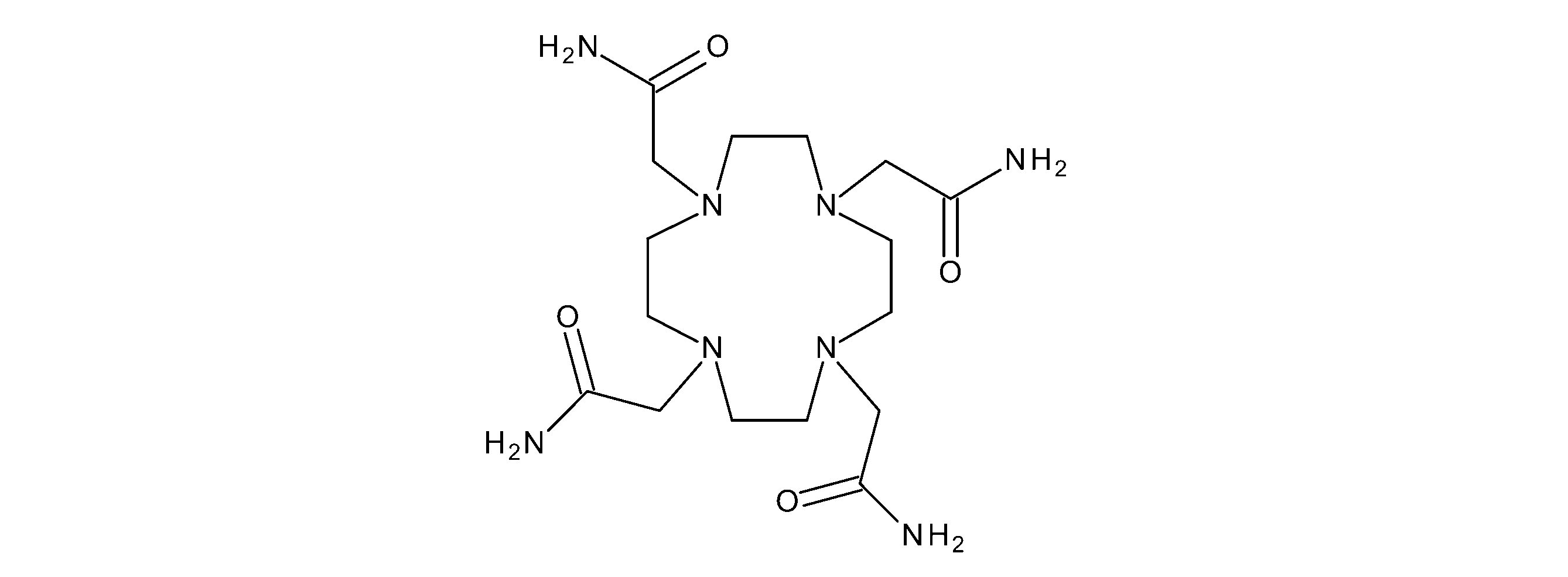
1,4,7,10-テトラキス(カルバモイルメチル)-1,4,7,10-テトラアザシクロドデカンを有する。
In some embodiments of the present invention, the functional binding site formed by the association of the first antibody and the second antibody comprises DOTAM and a metal, such as lead (Pb). Binds to chelates. As mentioned above, "DOTAM" has the following formula:
It has 1,4,7,10-tetrakis(carbamoylmethyl)-1,4,7,10-tetraazacyclododecane.
ある特定の態様および実施形態では、本発明はまた、金属イオンを組み込む、DOTAMの機能的変異体または機能的誘導体も使用しうる。DOTAMの適切な変異体/誘導体は、DOTAMの構造と、ある限定された程度に異なる構造を有し、機能する能力を保持する(すなわち、本明細書で記載される目的のうちの1つまたは複数のために使用されるのに十分な活性を保持する)。このような態様および実施形態では、DOTAMまたはDOTAMの機能的変異体/誘導体は、WO2010/099536において開示されている、活性変異体のうちの1つでありうる。適切な機能的変異体/誘導体は、以下の式:
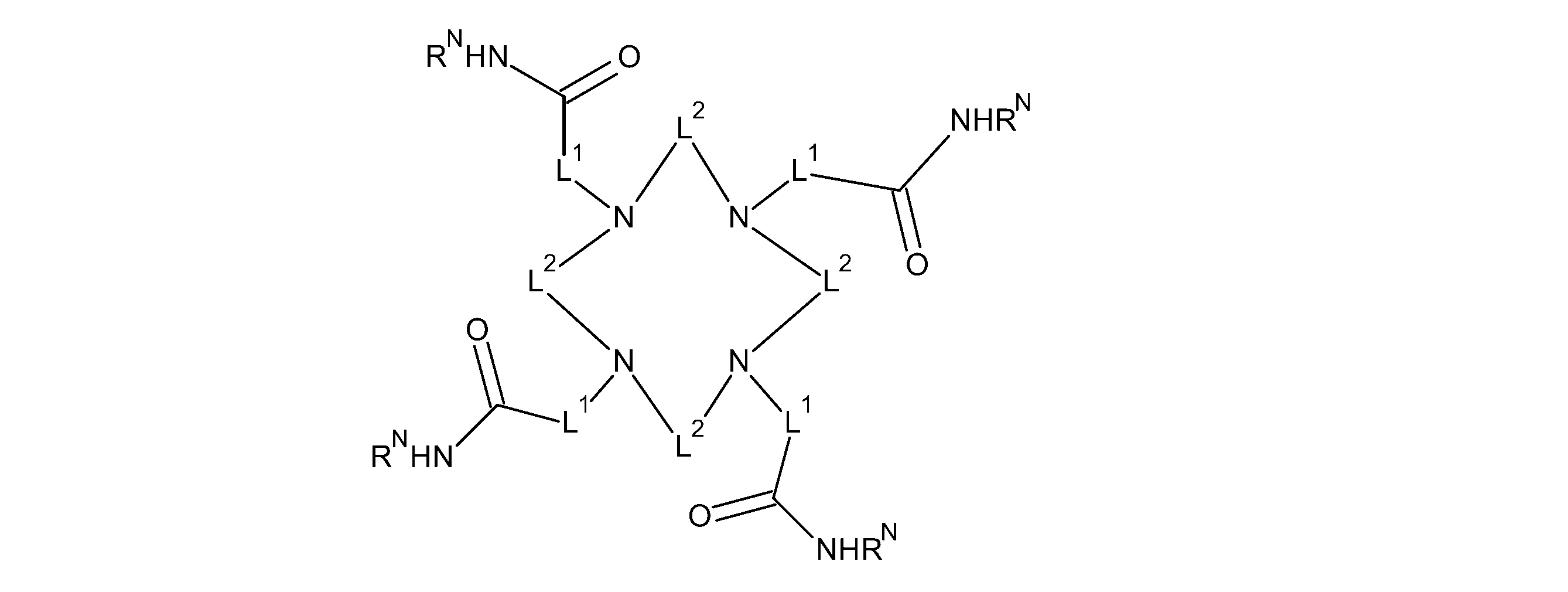
置換されていてもよい部分における各原子の価数が超過されないことを条件として
RNは、H、C1-C6アルキル、C1-C6ハロアルキル、C2-C6アルケニル、C2-C6アルキニル、C3-C7シクロアルキル、C3-C7シクロアルキル-C1-C4アルキル、C2-C7ヘテロシクロアルキル、C2-C7ヘテロシクロアルキル-C1-C4アルキル、フェニル、フェニル-C1-C4アルキル、C1-C7ヘテロアリール、およびC1-C7ヘテロアリール-C1-C4アルキル[式中、C1-C6アルキル、C1-C6ハロアルキル、C2-C6アルケニル、およびC2-C6アルキニルは、各々、1つ、2つ、3つ、または4つの、独立して選択されたRw基により置換されていてもよく;前記C3-C7シクロアルキル、C3-C7シクロアルキル-C1-C4アルキル、C2-C7ヘテロシクロアルキル、C2-C7ヘテロシクロアルキル-C1-C4アルキル、フェニル、フェニル-C1-C4アルキル、C1-C7ヘテロアリール、およびC1-C7ヘテロアリール-C1-C4アルキルは、各々、1つ、2つ、3つ、または4つの、独立して選択されたRx基により置換されていてもよい]であり;
L1は、独立して、それらの各々が、1つ、2つ、または3つの、独立して選択されたR1基により置換されていてもよい、C1-C6アルキレン、C1-C6アルケニレン、またはC1-C6アルキニレンであり;
L2は、独立して選択されたR1基により置換されていてもよく;C1-C4アルキル、および/またはC1-C4ハロアルキルから独立して選択される、1つ、2つ、3つ、または4つの基により置換されていてもよい、C2-C4直鎖アルキレンであり;
R1は、独立して、D1-D2-D3、ハロゲン、シアノ、ニトロ、ヒドロキシル、C1~6アルコキシ、C1~6ハロアルコキシ、C1~6アルキルチオ、C1~6アルキルスルフィニル、C1~6アルキルスルホニル、アミノ、C1~6アルキルアミノ、ジ-C1~6アルキルアミノ、C1~4アルキルカルボニル、カルボキシ、C1~6アルコキシカルボニル、C1~6アルキルカルボニルアミノ、ジ-C1~6アルキルカルボニルアミノ、C1~6アルコキシカルボニルアミノ、C1~6アルコキシカルボニル-(C1~6アルキル)アミノ、カルバミル、C1~6アルキルカルバミル、およびジ-C1~6アルキルカルバミルから選択され;
各D1は、独立して、C6-C10アリール-C1-C4アルキル、C1-C9ヘテロアリール-C1-C4アルキル、C3-C10シクロアルキル-C1-C4アルキル、C2-C9ヘテロシクロアルキル-C1-C4アルキル、C1-C8アルキレン、C1-C8アルケニレン、およびC1-C8アルキニレン[式中、前記C1-C8アルキレン、C1-C8アルケニレン、およびC1-C8アルキニレンは、1つ、2つ、3つ、または4つの、独立して選択されたR4基により置換されていてもよく;前記C6-C10アリール-C1-C4アルキル、C1-C9ヘテロアリール-C1-C4アルキル、C3-C10シクロアルキル-C1-C4アルキル、C2-C9ヘテロシクロアルキル-C1-C4アルキルは、各々、1つ、2つ、3つ、または4つの、独立して選択されたR5基により置換されていてもよい]から選択され;
各D2は、独立して、非存在であるか、またはC1-C20直鎖アルキレン[式中、前記C1-C20直鎖アルキレンの、1つ~6つの非隣接メチレン基は、前記C1-C20直鎖アルキレン内の、少なくとも1つのメチレン単位が、任意選択で、-D4-部分[式中、前記C1-C20直鎖アルキレンは、ハロゲン、シアノ、ニトロ、ヒドロキシル、C1~4アルキル、C1~4ハロアルキル、C1~4アルコキシ、C1~4ハロアルコキシ、アミノ、C1~4アルキルアミノ、ジ-C1~4アルキルアミノ、C1~4アルキルカルボニル、カルボキシ、C1~4アルコキシカルボニル、C1~4アルキルカルボニルアミノ、ジ-C1~4アルキルカルボニルアミノ、C1~4アルコキシカルボニルアミノ、C1~4アルコキシカルボニル-(C1~4アルキル)アミノ、カルバミル、C1~4アルキルカルバミル、およびジ-C1~4アルキルカルバミルから独立して選択される、1つまたは複数の基により置換されていてもよい]により置きかえられないことを条件として、各々、任意選択で、独立して選択された-D4-部分により置きかえられる]であり;
各D3は、独立して、H、ハロゲン、シアノ、ニトロ、ヒドロキシル、C1-C6アルキル、C1-C6ハロアルキル、C2-C6アルケニル、C2-C6アルキニル、C3-C14シクロアルキル、C3-C14シクロアルキル-C1-C4アルキル、C2-C14ヘテロシクロアルキル、C2-C14ヘテロシクロアルキル-C1-C4アルキル、C6-C14アリール、C6-C14アリール-C1-C4アルキル、C1-C13ヘテロアリール、C1-C13ヘテロアリール-C1-C4アルキル[式中、前記C1-C6アルキル、C1-C6ハロアルキル、C2-C6アルケニル、C2-C6アルキニルは、各々、1つ、2つ、3つ、または4つの、独立して選択されたR6基により置換されていてもよく;前記C3-C14シクロアルキル、C3-C14シクロアルキル-C1-C4アルキル、C2-C14ヘテロシクロアルキル、C2-C14ヘテロシクロアルキル-C1-C4アルキル、C6-C14アリール、C6-C14アリール-C1-C4アルキル、C1-C13ヘテロアリール、C1-C13ヘテロアリール-C1-C4アルキルは、各々、1つ、2つ、3つ、または4つの、独立して選択されたR7基により置換されていてもよい]から選択され;
各D4は、独立して、-O-、-S-、-NRaC(=O)-、-NRaC(=S)-、-NRbC(=O)NRc-、-NRbC(=S)NRc-、-S(=O)-、-S(=O)2-、-S(=O)NRa-、-C(=O)-、-C(=S)-、-C(=O)O-、-OC(=O)NRa-、-OC(=S)NRa-、-NRa-、-NRbS(=O)NRc-、およびNRbS(=O)2NRO-から選択され;
各R4およびR6は、独立して、ハロゲン、シアノ、ニトロ、ヒドロキシル、C1~4アルコキシ、C1~4ハロアルコキシ、C1~4アルキルチオ、C1~4アルキルスルフィニル、C1~4アルキルスルホニル、アミノ、C1~4アルキルアミノ、ジ-C1~4アルキルアミノ、C1~4アルキルカルボニル、カルボキシ、C1~4アルコキシカルボニル、C1~4アルキルカルボニルアミノ、ジ-C1~4アルキルカルボニルアミノ、C1~4アルコキシカルボニルアミノ、C1~4アルコキシカルボニル-(C1~4アルキル)アミノ、カルバミル、C1~4アルキルカルバミル、およびジ-C1~4アルキルカルバミルから選択され;
各R5は、独立して、ハロゲン、シアノ、シアネート、イソチオシアネート、ニトロ、ヒドロキシル、C1~4アルキル、C2~4アルケニル、C2~4アルキニル、C1~4アルコキシ、C1~4ハロアルコキシ、C1~4アルキルチオ、C1~4アルキルスルフィニル、C1~4アルキルスルホニル、アミノ、C1~4アルキルアミノ、ジ-C1~4アルキルアミノ、C1~4アルキルカルボニル、カルボキシ、C1~4アルコキシカルボニル、C1~4アルキルカルボニルアミノ、ジ-C1~4アルキルカルボニルアミノ、C1~4アルコキシカルボニルアミノ、C1~4アルコキシカルボニル-(C1~4アルキル)アミノ、カルバミル、C1~4アルキルカルバミル、およびジ-C1~4アルキルカルバミルから選択され;
各R7は、独立して、ハロゲン、シアノ、ニトロ、ヒドロキシル、C1-C6アルキル、C2-C6アルケニル、C2-C6アルキニル、C3-C7シクロアルキル、C3-C7シクロアルキル-C1-C4アルキル、C2-C7ヘテロシクロアルキル、C2-C7ヘテロシクロアルキル-C1-C4アルキル、フェニル、フェニル-C1-C4アルキル、C1-C7ヘテロアリール、C1-C7ヘテロアリール-C1-C4アルキル、-ORO、-SRO、-S(=O)RP、-S(=O)2RP、-S(=O)NRsRt、-C(=O)RP、-C(=O)ORP、-C(=O)NRsRt、-OC(=O)RP、-OC(=O)NRsRt、-NRsRt、-NRqC(=O)Rr、-NRqC(=O)ORr、-NRqC(=O)NRr、-NRqS(=O)2Rr、および-NRPS(=O)2NRsRt[式中、前記C1-C6アルキル、C2-C6アルケニル、C2-C6アルキニルは、各々、1つ、2つ、3つ、または4つの、独立して選択されたR’基により置換されていてもよく;前記C3-C7シクロアルキル、C3-C7シクロアルキル-C1-C4アルキル、C2-C7ヘテロシクロアルキル、C2-C7ヘテロシクロアルキル-C1-C4アルキル、フェニル、フェニル-C1-C4アルキル、C1-C7ヘテロアリール、C1-C7ヘテロアリール-C1-C4アルキルは、各々、1つ、2つ、3つ、または4つの、独立して選択されたR’’基により置換されていてもよい]から選択され;
各Ra、Rb、およびRcは、独立して、H、C1-C6アルキル、C1-C6ハロアルキル、C2-C6アルケニル、C2-C6アルキニル、C3-C7シクロアルキル、C3-C7シクロアルキル-C1-C4アルキル、C2-C7ヘテロシクロアルキル、C2-C7ヘテロシクロアルキル-C1-C4アルキル、フェニル、フェニル-C1-C4アルキル、C1-C7ヘテロアリール、C1-C7ヘテロアリール-C1-C4アルキル[式中、前記C1-C6アルキル、C1-C6ハロアルキル、C2-C6アルケニル、C2-C6アルキニルは、各々、1つ、2つ、3つ、または4つの、独立して選択されたRw基により置換されていてもよく;前記C3-C7シクロアルキル、C3-C7シクロアルキル-C1-C4アルキル、C2-C7ヘテロシクロアルキル、C2-C7ヘテロシクロアルキル-C1-C4アルキル、フェニル、フェニル-C1-C4アルキル、C1-C7ヘテロアリール、C1-C7ヘテロアリール-C1-C4アルキルは、各々、1つ、2つ、3つ、または4つの、独立して選択されたRx基により置換されていてもよい]から選択され;
各RO、RP、Rq、Rr、Rs、およびRtは、独立して、H、C1-C6アルキル、C1-C6ハロアルキル、C2-C6アルケニル、C2-C6アルキニル、C3-C7シクロアルキル、C3-C7シクロアルキル-C1-C4アルキル、C2-C7ヘテロシクロアルキル、C2-C7ヘテロシクロアルキル-C1-C4アルキル、フェニル、フェニル-C1-C4アルキル、C1-C7ヘテロアリール、C1-C7ヘテロアリール-C1-C4アルキル[式中、前記C1-C6アルキル、C1-C6ハロアルキル、C2-C6アルケニル、C2-C6アルキニルは、各々、1つ、2つ、3つ、または4つの、独立して選択されたRy基により置換されていてもよく;前記C3-C7シクロアルキル、C3-C7シクロアルキル-C1-C4アルキル、C2-C7ヘテロシクロアルキル、C2-C7ヘテロシクロアルキル-C1-C4アルキル、フェニル、フェニル-C1-C4アルキル、C1-C7ヘテロアリール、C1-C7ヘテロアリール-C1-C4アルキルは、各々、1つ、2つ、3つ、または4つの、独立して選択されたRz基により置換されていてもよい]から選択され;
各R’、Rw、およびRyは、独立して、ヒドロキシル、シアノ、ニトロ、C1-C4アルコキシ、C1-C4ハロアルコキシ、アミノ、C1-C4アルキルアミノ、およびジC1-C4アルキルアミノ
から選択され;
各R’’、Rx、およびRzは、独立して、ヒドロキシル、ハロゲン、シアノ、ニトロ、C1-C4アルキル、C1-C4ハロアルキル、C1-C4アルコキシ、C1-C4ハロアルコキシ、アミノ、C1-C4アルキルアミノ、およびジ-C1-C4アルキルアミノ
から選択される]
でありうる。
In certain aspects and embodiments, the present invention may also employ functional variants or derivatives of DOTAM that incorporate metal ions. Suitable variants/derivatives of DOTAM have a structure that differs to a limited extent from that of DOTAM and retain the ability to function (i.e., for one of the purposes described herein or retain sufficient activity to be used for multiple purposes). In such aspects and embodiments, the DOTAM or functional variant/derivative of DOTAM can be one of the active variants disclosed in WO2010/099536. Suitable functional variants/derivatives have the formula:
provided that the valence of each atom in the optionally substituted moiety is not exceeded, R N is H, C 1 -C 6 alkyl, C 1 -C 6 haloalkyl, C 2 -C 6 alkenyl, C 2 - C 6 alkynyl, C 3 -C 7 cycloalkyl, C 3 -C 7 cycloalkyl-C 1 -C 4 alkyl, C 2 -C 7 heterocycloalkyl, C 2 -C 7 heterocycloalkyl-C 1 -C 4 alkyl, phenyl, phenyl-C 1 -C 4 alkyl, C 1 -C 7 heteroaryl, and C 1 -C 7 heteroaryl-C 1 -C 4 alkyl [wherein C 1 -C 6 alkyl, C 1 - C 6 haloalkyl, C 2 -C 6 alkenyl, and C 2 -C 6 alkynyl may each be substituted with 1, 2, 3, or 4 independently selected R w groups well; said C 3 -C 7 cycloalkyl, C 3 -C 7 cycloalkyl-C 1 -C 4 alkyl, C 2 -C 7 heterocycloalkyl, C 2 -C 7 heterocycloalkyl-C 1 -C 4 alkyl , phenyl, phenyl-C 1 -C 4 alkyl, C 1 -C 7 heteroaryl, and C 1 -C 7 heteroaryl-C 1 -C 4 alkyl are each 1, 2, 3, or 4 optionally substituted by one independently selected R x group];
L 1 is independently each of them optionally substituted by 1, 2, or 3 independently selected R 1 groups, C 1 -C 6 alkylene, C 1 - C 6 alkenylene, or C 1 -C 6 alkynylene;
L 2 is optionally substituted by independently selected R 1 groups; 1, 2 independently selected from C 1 -C 4 alkyl and/or C 1 -C 4 haloalkyl , C 2 -C 4 linear alkylene optionally substituted by 3 or 4 groups;
R 1 is independently D 1 -D 2 -D 3 , halogen, cyano, nitro, hydroxyl, C 1-6 alkoxy, C 1-6 haloalkoxy, C 1-6 alkylthio, C 1-6 alkylsulfinyl , C 1-6 alkylsulfonyl, amino, C 1-6 alkylamino, di-C 1-6 alkylamino, C 1-4 alkylcarbonyl, carboxy, C 1-6 alkoxycarbonyl, C 1-6 alkylcarbonylamino, di-C 1-6 alkylcarbonylamino, C 1-6 alkoxycarbonylamino, C 1-6 alkoxycarbonyl-(C 1-6 alkyl)amino, carbamyl, C 1-6 alkylcarbamyl, and di-C 1-6 6 alkylcarbamyl;
Each D 1 is independently C 6 -C 10 aryl-C 1 -C 4 alkyl, C 1 -C 9 heteroaryl-C 1 -C 4 alkyl, C 3 -C 10 cycloalkyl-C 1 -C 4alkyl , C 2 -C 9 heterocycloalkyl-C 1 -C 4 alkyl, C 1 -C 8 alkylene, C 1 -C 8 alkenylene, and C 1 -C 8 alkynylene, wherein said C 1 -C 8 Alkylene, C 1 -C 8 alkenylene, and C 1 -C 8 alkynylene may be substituted with 1, 2, 3, or 4 independently selected R 4 groups; 6 -C10 aryl - C1 - C4 alkyl, C1- C9 heteroaryl - C1 - C4 alkyl, C3 - C10 cycloalkyl - C1 - C4 alkyl, C2 - C9 heterocyclo each alkyl-C 1 -C 4 alkyl is optionally substituted with 1, 2, 3, or 4 independently selected R 5 groups;
Each D 2 is independently absent or C 1 -C 20 linear alkylene, wherein from 1 to 6 non-adjacent methylene groups of said C 1 -C 20 linear alkylene are At least one methylene unit within said C 1 -C 20 linear alkylene is optionally a -D 4 - moiety [wherein said C 1 -C 20 linear alkylene is halogen, cyano, nitro, hydroxyl , C 1-4 alkyl, C 1-4 haloalkyl, C 1-4 alkoxy, C 1-4 haloalkoxy, amino, C 1-4 alkylamino, di-C 1-4 alkylamino, C 1-4 alkylcarbonyl , carboxy, C 1-4 alkoxycarbonyl, C 1-4 alkylcarbonylamino, di-C 1-4 alkylcarbonylamino, C 1-4 alkoxycarbonylamino, C 1-4 alkoxycarbonyl-(C 1-4 alkyl) optionally substituted by one or more groups independently selected from amino, carbamyl, C 1-4 alkylcarbamyl, and di-C 1-4 alkylcarbamyl. provided that each is optionally replaced by an independently selected -D4- moiety];
Each D 3 is independently H, halogen, cyano, nitro, hydroxyl, C 1 -C 6 alkyl, C 1 -C 6 haloalkyl, C 2 -C 6 alkenyl, C 2 -C 6 alkynyl, C 3 - C 14 cycloalkyl, C 3 -C 14 cycloalkyl-C 1 -C 4 alkyl, C 2 -C 14 heterocycloalkyl, C 2 -C 14 heterocycloalkyl-C 1 -C 4 alkyl, C 6 -C 14 aryl, C 6 -C 14 aryl-C 1 -C 4 alkyl, C 1 -C 13 heteroaryl, C 1 -C 13 heteroaryl-C 1 -C 4 alkyl, wherein said C 1 -C 6 alkyl, each C 1 -C 6 haloalkyl, C 2 -C 6 alkenyl, C 2 -C 6 alkynyl is substituted with 1, 2, 3 or 4 independently selected R 6 groups; said C 3 -C 14 cycloalkyl, C 3 -C 14 cycloalkyl-C 1 -C 4 alkyl, C 2 -C 14 heterocycloalkyl, C 2 -C 14 heterocycloalkyl-C 1 -C 4alkyl, C 6 -C 14 aryl, C 6 -C 14 aryl-C 1 -C 4 alkyl, C 1 -C 13 heteroaryl, C 1 -C 13 heteroaryl-C 1 -C 4 alkyl are each optionally substituted with 1, 2, 3, or 4 independently selected R 7 groups;
Each D 4 is independently -O-, -S-, -NR a C(=O)-, -NR a C(=S)-, -NR b C(=O)NR c -,- NR b C(=S)NR c -, -S(=O)-, -S(=O) 2 -, -S(=O)NR a -, -C(=O)-, -C(= S)-, -C(=O)O-, -OC(=O)NR a -, -OC(=S)NR a -, -NR a -, -NR b S(=O)NR c -, and NR b S(=O)2NR O -;
each R 4 and R 6 is independently halogen, cyano, nitro, hydroxyl, C 1-4 alkoxy, C 1-4 haloalkoxy, C 1-4 alkylthio, C 1-4 alkylsulfinyl, C 1-4 alkylsulfonyl, amino, C 1-4 alkylamino, di-C 1-4 alkylamino, C 1-4 alkylcarbonyl, carboxy, C 1-4 alkoxycarbonyl, C 1-4 alkylcarbonylamino, di-C 1- from 4 alkylcarbonylamino, C 1-4 alkoxycarbonylamino, C 1-4 alkoxycarbonyl-(C 1-4 alkyl)amino, carbamyl, C 1-4 alkylcarbamyl, and di-C 1-4 alkylcarbamyl selected;
each R 5 is independently halogen, cyano, cyanate, isothiocyanate, nitro, hydroxyl, C 1-4 alkyl, C 2-4 alkenyl, C 2-4 alkynyl, C 1-4 alkoxy, C 1-4 haloalkoxy, C 1-4 alkylthio, C 1-4 alkylsulfinyl, C 1-4 alkylsulfonyl, amino, C 1-4 alkylamino, di-C 1-4 alkylamino, C 1-4 alkylcarbonyl, carboxy, C 1-4 alkoxycarbonyl, C 1-4 alkylcarbonylamino, di-C 1-4 alkylcarbonylamino, C 1-4 alkoxycarbonylamino, C 1-4 alkoxycarbonyl-(C 1-4 alkyl)amino, carbamyl , C 1-4 alkylcarbamyl, and di-C 1-4 alkylcarbamyl;
Each R 7 is independently halogen, cyano, nitro, hydroxyl, C 1 -C 6 alkyl, C 2 -C 6 alkenyl, C 2 -C 6 alkynyl, C 3 -C 7 cycloalkyl, C 3 -C 7 cycloalkyl-C 1 -C 4 alkyl, C 2 -C 7 heterocycloalkyl, C 2 -C 7 heterocycloalkyl-C 1 -C 4 alkyl, phenyl, phenyl-C 1 -C 4 alkyl, C 1 - C 7 heteroaryl, C 1 -C 7 heteroaryl-C 1 -C 4 alkyl, —OR O , —SR O , —S(=O)R P , —S(=O) 2 R P , —S( =O)NR s R t , -C(=O)R P , -C(=O)OR P , -C(=O)NR s R t , -OC(=O)R P , -OC(= O) NR s R t , -NR s R t , -NR q C(=O)R r , -NR q C(=O)OR r , -NR q C(=O) NR r , -NR q S (=O) 2 R r , and —NR P S(=O) 2 NR s R t [wherein said C 1 -C 6 alkyl, C 2 -C 6 alkenyl, C 2 -C 6 alkynyl are each , optionally substituted by 1, 2, 3, or 4 independently selected R′ groups; said C 3 -C 7 cycloalkyl, C 3 -C 7 cycloalkyl-C 1 —C4 alkyl, C2 - C7 heterocycloalkyl, C2 - C7 heterocycloalkyl - C1 - C4 alkyl, phenyl, phenyl - C1 - C4 alkyl, C1 - C7 heteroaryl, C each 1 - C7heteroaryl - C1- C4alkyl is optionally substituted with 1, 2, 3, or 4 independently selected R''groups;be;
Each R a , R b , and R c is independently H, C 1 -C 6 alkyl, C 1 -C 6 haloalkyl, C 2 -C 6 alkenyl, C 2 -C 6 alkynyl, C 3 -C 7 cycloalkyl, C 3 -C 7 cycloalkyl-C 1 -C 4 alkyl, C 2 -C 7 heterocycloalkyl, C 2 -C 7 heterocycloalkyl-C 1 -C 4 alkyl, phenyl, phenyl-C 1 —C 4 alkyl, C 1 -C 7 heteroaryl, C 1 -C 7 heteroaryl-C 1 -C 4 alkyl, wherein said C 1 -C 6 alkyl, C 1 -C 6 haloalkyl, C 2 -C 6 alkenyl, C 2 -C 6 alkynyl, each optionally substituted with 1, 2, 3, or 4 independently selected R w groups; said C 3 -C 7 cyclo alkyl, C 3 -C 7 cycloalkyl-C 1 -C 4 alkyl, C 2 -C 7 heterocycloalkyl, C 2 -C 7 heterocycloalkyl-C 1 -C 4 alkyl, phenyl, phenyl-C 1 -C 4alkyl, C 1 -C 7 heteroaryl, C 1 -C 7 heteroaryl-C 1 -C 4 alkyl each represents 1, 2, 3 or 4 independently selected R x optionally substituted by a group];
Each R O , R P , R q , R r , R s and R t is independently H, C 1 -C 6 alkyl, C 1 -C 6 haloalkyl, C 2 -C 6 alkenyl, C 2 —C 6 alkynyl, C 3 -C 7 cycloalkyl, C 3 -C 7 cycloalkyl-C 1 -C 4 alkyl, C 2 -C 7 heterocycloalkyl, C 2 -C 7 heterocycloalkyl-C 1 -C 4 alkyl, phenyl, phenyl-C 1 -C 4 alkyl, C 1 -C 7 heteroaryl, C 1 -C 7 heteroaryl-C 1 -C 4 alkyl [wherein said C 1 -C 6 alkyl, C 1 —C 6 haloalkyl, C 2 -C 6 alkenyl, C 2 -C 6 alkynyl may each be substituted with 1, 2, 3 or 4 independently selected R y groups well; said C 3 -C 7 cycloalkyl, C 3 -C 7 cycloalkyl-C 1 -C 4 alkyl, C 2 -C 7 heterocycloalkyl, C 2 -C 7 heterocycloalkyl-C 1 -C 4 alkyl , phenyl, phenyl-C 1 -C 4 alkyl, C 1 -C 7 heteroaryl, C 1 -C 7 heteroaryl-C 1 -C 4 alkyl each have one, two, three or four , optionally substituted by independently selected R z groups;
Each R′, R w , and R y is independently hydroxyl, cyano, nitro, C 1 -C 4 alkoxy, C 1 -C 4 haloalkoxy, amino, C 1 -C 4 alkylamino, and di-C selected from 1 - C4 alkylamino;
Each R″, R x , and R z is independently hydroxyl, halogen, cyano, nitro, C 1 -C 4 alkyl, C 1 -C 4 haloalkyl, C 1 -C 4 alkoxy, C 1 -C 4 haloalkoxy, amino, C 1 -C 4 alkylamino, and di-C 1 -C 4 alkylamino]
can be
適切には、上記の式の機能的変異体/誘導体は、本発明の抗体に対して、DOTAMの親和性と同等であるか、またはこれを超える親和性を有し、Pbに対して、DOTAMの親和性と同等であるか、またはこれを超える結合強度(上記で記載された解離定数により測定されるものとしての「親和性」)を有する。例えば、機能的変異体/誘導体の、本発明の抗体/Pbに対する解離定数は、DOTAMの、同じ抗体/Pbに対する解離定数の1.1分の1もしくはこれ未満、1.2分の1もしくはこれ未満、1.3分の1もしくはこれ未満、1.4分の1もしくはこれ未満、1.5分の1もしくはこれ未満、または2分の1もしくはこれ未満でありうる。 Suitably, functional variants/derivatives of the above formula have an affinity for the antibody of the invention equal to or exceeding that of DOTAM, and for Pb, DOTAM has a binding strength (“affinity” as measured by the dissociation constant described above) that is equal to or exceeds that of For example, the dissociation constant of the functional variant/derivative for an antibody/Pb of the invention is 1.1 times or less, 1.2 times or less that of DOTAM for the same antibody/Pb. It can be less than, 1.3 fold or less, 1.4 fold or less, 1.5 fold or less, or 2 fold or less.
各RNは、H、C1-C6アルキル、またはC1-C6ハロアルキル;好ましくは、H、C1-C4アルキル、またはC1-C4ハロアルキルでありうる。最も好ましくは、各RNは、Hである。 Each R N can be H, C 1 -C 6 alkyl, or C 1 -C 6 haloalkyl; preferably H, C 1 -C 4 alkyl, or C 1 -C 4 haloalkyl. Most preferably each RN is H.
DOTAM変異体について述べると、1つ、2つ、3つ、または、最も好ましくは、各L2は、C2アルキレンであることが好ましい。DOTAMのC2アルキレン変異体は、特に、Pbに対する高親和性を有しうると有利である。L2に対する、任意選択の置換基は、R1、C1-C4アルキル、またはC1-C4ハロアルキルでありうる。適切には、L2に対する、任意選択の置換基は、C1-C4アルキルの場合もあり、C1-C4ハロアルキルの場合もある。 When referring to DOTAM variants, it is preferred that one, two , three, or most preferably each L2 is C2 alkylene. The C2 alkylene variant of DOTAM can advantageously have a particularly high affinity for Pb. Optional substituents for L 2 can be R 1 , C 1 -C 4 alkyl, or C 1 -C 4 haloalkyl. Suitably the optional substituents for L 2 may be C 1 -C 4 alkyl or C 1 -C 4 haloalkyl.
任意選択で、各L2は、非置換C2アルキレン-CH2CH2-でありうる。 Optionally, each L 2 can be unsubstituted C 2 alkylene-CH 2 CH 2 —.
各L1とは、好ましくは、C1-C4アルキレン、より好ましくは、-CH2-などのC1アルキレンである。 Each L 1 is preferably C 1 -C 4 alkylene, more preferably C 1 alkylene such as —CH 2 —.
DOTAMの機能的変異体/誘導体は、以下の式:
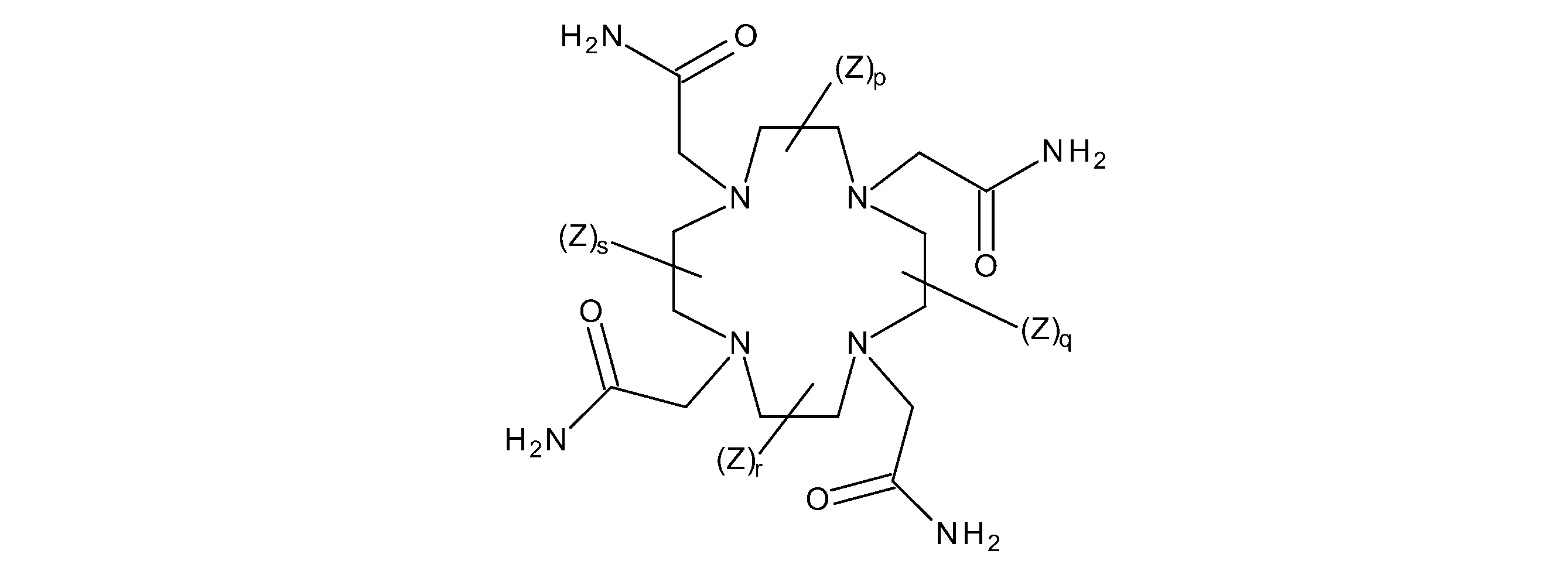
の化合物でありうる。
A functional variant/derivative of DOTAM has the formula:
can be a compound of
本発明において有用な放射性核種は、鉛(Pb)、ルテチウム(Lu)、またはイットリウム(Y)などの金属の放射性同位体を含むことができる。 Radionuclides useful in the present invention can include radioisotopes of metals such as lead (Pb), lutetium (Lu), or yttrium (Y).
イメージング適用において特に有用な放射性核種は、ガンマ放射体である放射性核種でありうる。例えば、放射性核種は、203Pbまたは205Biから選択されうる。 Radionuclides that are particularly useful in imaging applications can be those that are gamma emitters. For example, the radionuclide can be selected from 203 Pb or 205 Bi.
治療適用において特に有用な放射性核種は、アルファ放射体またはベータ放射体である放射性核種でありうる。例えば、放射性核種は、212Pb、212Bi、213Bi、90Y、177Lu、225Ac、211At、227Th、223Raから選択されうる。 Radionuclides that are particularly useful in therapeutic applications can be radionuclides that are alpha-emitters or beta-emitters. For example, the radionuclide may be selected from 212 Pb, 212 Bi, 213 Bi, 90Y , 177 Lu, 225 Ac, 211 At, 227 Th, 223 Ra.
一部の実施形態では、DOTAM(またはその塩もしくは機能的変異体)は、上記で列挙された、PbまたはBiの放射性同位体のうちの1つなど、PbまたはBiと共にキレート化されることが好ましい場合がある。他の実施形態では、DOTA(またはその塩もしくは機能的変異体)は、上記で列挙された、LuまたはYの放射性同位体のうちの1つなど、LuまたはYと共にキレート化されることが好ましい場合がある。 In some embodiments, DOTAM (or a salt or functional variant thereof) can be chelated with Pb or Bi, such as one of the radioisotopes of Pb or Bi listed above. Sometimes preferred. In other embodiments, DOTA (or a salt or functional variant thereof) is preferably chelated with Lu or Y, such as one of the radioisotopes of Lu or Y listed above. Sometimes.
一部の実施形態では、方法および使用は、放射性同位体の混合物、例えば、治療に適する放射性同位体と、イメージングに適する放射性同位体との混合物を使用する、治療とイメージングとの組合せ法を含むことができる。例えば、これらは、同じキレート剤によりキレート化された、同じ金属の、異なる放射性同位体でありうる。一実施形態では、方法は、203Pb-DOTAM、および212Pb-DOTAMを、混合物として投与することを含むことができる。別の実施形態では、方法は、203Pbまたは205Biなどのガンマ放射体を使用する第1の線量測定サイクルに続き、212Pb、212Bi、213Bi、90Y、177Lu、225Ac、211At、227Th、または223Raなどのアルファ放射体またはベータ放射体を使用する1つまたは複数のラウンドにわたる処置を含むことができる。このような方法については、下記でさらに記載される。 In some embodiments, the methods and uses include combined therapy and imaging using mixtures of radioisotopes, e.g., mixtures of radioisotopes suitable for therapy and radioisotopes suitable for imaging. be able to. For example, they can be different radioisotopes of the same metal chelated by the same chelating agent. In one embodiment, the method can include administering 203 Pb-DOTAM and 212 Pb-DOTAM as a mixture. In another embodiment, the method comprises a first dosimetry cycle using a gamma emitter such as 203 Pb or 205 Bi followed by 212 Pb, 212 Bi, 213 Bi, 90Y , 177 Lu, 225 Ac, 211 At. , 227 Th, or 223 Ra, for one or more rounds of treatment. Such methods are described further below.
一部の実施形態では、第1の抗体と第2の抗体との会合により形成される、機能的結合部位は、Pb-DOTAMキレートに結合しうる。 In some embodiments, the functional binding site formed by the association of the first antibody and the second antibody can bind to the Pb-DOTAM chelate.
一部の実施形態では、第1の抗体と第2の抗体との会合により形成される、機能的結合部位は、放射標識化合物に特異的に結合しうる。一部の実施形態では、機能的結合部位は、Pb-DOTAMキレートなどの放射標識化合物に、Pb-DOTAMおよび/または標的に対する、≦1μM、≦100nM、≦10nM、≦1nM、≦0.1nM、≦0.01nMもしくは≦0.001nM(例えば、10-7M、またはこれ未満、例えば、10-7~10-13、10-8M、またはこれ未満、例えば、10-8M~10-13M、例えば、10-9M~10-13M)の解離定数(KD)で結合しうる。一部の実施形態では、機能的結合部位は、結合親和性についての、100pM、50pM、20pM、10pM、5pM、1pMもしくはこれ未満、例えば、0.9pMもしくはこれ未満、0.8pMもしくはこれ未満、0.7pMもしくはこれ未満、0.6pMもしくはこれ未満、または0.5pMもしくはこれ未満のKd値で結合することが好ましい場合がある。例えば、機能的結合部位は、金属キレートに、約1pM~1nM、例えば、約1~10pM、1~100pM、5~50pM、100~500pM、または500pM~1nMのKdで結合しうる。 In some embodiments, the functional binding site formed by the association of the first antibody and the second antibody can specifically bind a radiolabeled compound. In some embodiments, the functional binding site is ≤1 μM, ≤100 nM, ≤10 nM, ≤1 nM, ≤0.1 nM, to a radiolabeled compound, such as a Pb-DOTAM chelate, to Pb-DOTAM and/or a target. ≦0.01 nM or ≦0.001 nM (eg 10 −7 M or less, such as 10 −7 to 10 −13 , 10 −8 M or less, such as 10 −8 M to 10 −13 M, eg, 10 −9 M to 10 −13 M). In some embodiments, the functional binding site has a binding affinity of 100 pM, 50 pM, 20 pM, 10 pM, 5 pM, 1 pM or less, such as 0.9 pM or less, 0.8 pM or less, Binding with a Kd value of 0.7 pM or less, 0.6 pM or less, or 0.5 pM or less may be preferred. For example, a functional binding site can bind a metal chelate with a Kd of about 1 pM to 1 nM, eg, about 1-10 pM, 1-100 pM, 5-50 pM, 100-500 pM, or 500 pM-1 nM.
C.DOTAに対する例示的抗原結合部位
本発明についての特定の一実施形態では、第1の抗体と第2の抗体とは、会合して、DOTA(またはその機能的誘導体もしくは機能的変異体)、例えば、LuまたはY(例えば、177Luまたは90Y)と共にキレート化されたDOTAに対する機能的結合部位を形成する。例えば、機能的結合部位は、放射標識化合物に、約1pM~1nM、例えば、約1~10pM、1~100pM、5~50pM、100~500pM、または500pM~1nMのKdで結合しうる。
C. Exemplary Antigen-Binding Sites for DOTA In one particular embodiment of the invention, the first antibody and the second antibody are associated with DOTA (or a functional derivative or variant thereof), e.g., Together with Lu or Y (eg 177 Lu or 90 Y) form a functional binding site for chelated DOTA. For example, a functional binding site may bind a radiolabeled compound with a Kd of about 1 pM to 1 nM, eg, about 1-10 pM, 1-100 pM, 5-50 pM, 100-500 pM, or 500 pM-1 nM.
C825とは、177Luおよび90Yなどの放射性金属と錯体化しているDOTA-Bn(S-2-(4-アミノベンジル)-1,4,7,10-テトラアザシクロドデカン四酢酸)に対する高親和性を伴う、公知のscFvである(例えば、参照により本明細書に組み込まれる、Chealら、2018、Theranostics、2018、およびWO2010099536を参照されたい)。本明細書には、C825CDR配列ならびにVL配列およびVH配列が提示される。一実施形態では、放射標識化合物に対する抗原結合部位の一部を形成する重鎖可変領域は、(a)配列番号35のアミノ酸配列を含むCDR-H1;(b)配列番号36のアミノ酸配列を含むCDR-H2;(c)配列番号37のアミノ酸配列を含むCDR-H3から選択される、少なくとも1つ、2つ、または3つ全てのCDRを含むことができる。代替的実施形態では、CDR-H1は、GFSLTDYGVH(配列番号148)の配列を有しうる。放射標識化合物に対する結合部位の一部を形成する軽鎖可変領域は、(d)配列番号38のアミノ酸配列を含むCDR-L1;(e)配列番号39のアミノ酸配列を含むCDR-L2;および(f)配列番号40のアミノ酸配列を含むCDR-L3から選択される、少なくとも1つ、2つ、または3つ全てのCDRを含むことができる。 C825 is a high-potential reaction for DOTA-Bn (S-2-(4-aminobenzyl)-1,4,7,10-tetraazacyclododecanetetraacetic acid) complexed with radiometals such as 177Lu and 90Y . known scFv with affinities (see, eg, Cheal et al., 2018, Theranostics, 2018, and WO2010099536, incorporated herein by reference). Presented herein are the C825 CDR sequences and the VL and VH sequences. In one embodiment, the heavy chain variable region that forms part of the antigen binding site for the radiolabeled compound comprises (a) a CDR-H1 comprising the amino acid sequence of SEQ ID NO:35; (b) the amino acid sequence of SEQ ID NO:36. CDR-H2; (c) CDR-H3 comprising the amino acid sequence of SEQ ID NO:37. In an alternative embodiment, CDR-H1 may have the sequence GFSLTDYGVH (SEQ ID NO: 148). The light chain variable regions that form part of the binding site for the radiolabeled compound are (d) CDR-L1 comprising the amino acid sequence of SEQ ID NO:38; (e) CDR-L2 comprising the amino acid sequence of SEQ ID NO:39; f) can include at least one, two, or all three CDRs selected from CDR-L3 comprising the amino acid sequence of SEQ ID NO:40.
別の実施形態では、放射標識化合物に対する機能的抗原結合部位の一部を形成する重鎖可変ドメイン(第1の抗体上の)は、配列番号41、または配列番号41に対して少なくとも90、91、92、93、94、95、96、97、98、もしくは99%の同一性を有するアミノ酸配列を含むその変異体のアミノ酸配列を含む。ある特定の実施形態では、少なくとも90%、91%、92%、93%、94%、95%、96%、97%、98%、または99%の同一性を有するVH配列は、参照配列と比べた置換(例えば、保存的置換)、挿入、または欠失を含有するが、この配列を含む結合部位は、LuまたはYと錯体化しているDOTAに、好ましくは、本明細書で記載される親和性で結合する能力を保持する。ある特定の実施形態では、配列番号41内の、合計1つ~10のアミノ酸が、置換され、挿入され、かつ/または欠失している。ある特定の実施形態では、置換、挿入、または欠失は、CDRの外部の領域内で(すなわち、FR内で)生じる。任意選択で、抗体は、配列番号41内のVH配列であって、この配列の翻訳後修飾を含むVH配列を含む。特定の実施形態では、VHは、(a)配列番号35のアミノ酸配列またはGFSLTDYGVH(配列番号148)の配列を含むCDR-H1、(b)配列番号36のアミノ酸配列を含むCDR-H2、および(c)配列番号37のアミノ酸配列を含むCDR-H3から選択される、1つ、2つ、または3つのCDRを含む。 In another embodiment, the heavy chain variable domain (on the first antibody) that forms part of the functional antigen binding site for the radiolabeled compound is SEQ ID NO: 41, or at least 90, 91 relative to SEQ ID NO: 41 , 92, 93, 94, 95, 96, 97, 98, or variants thereof, including amino acid sequences having 92, 93, 94, 95, 96, 97, 98, or 99% identity. In certain embodiments, a VH sequence having at least 90%, 91%, 92%, 93%, 94%, 95%, 96%, 97%, 98%, or 99% identity to a reference sequence is Binding sites containing this sequence, but containing substitutions (e.g., conservative substitutions), insertions, or deletions compared to DOTA complexed with Lu or Y, are preferably described herein. Retain the ability to bind with affinity. In certain embodiments, a total of 1-10 amino acids within SEQ ID NO:41 have been substituted, inserted, and/or deleted. In certain embodiments, substitutions, insertions, or deletions occur within regions outside the CDRs (ie, within the FRs). Optionally, the antibody comprises the VH sequence within SEQ ID NO:41, comprising post-translational modifications of this sequence. In certain embodiments, the VH is (a) a CDR-H1 comprising the amino acid sequence of SEQ ID NO:35 or the sequence of GFSLTDYGVH (SEQ ID NO:148), (b) a CDR-H2 comprising the amino acid sequence of SEQ ID NO:36, and ( c) 1, 2 or 3 CDRs selected from CDR-H3 comprising the amino acid sequence of SEQ ID NO:37.
任意選択で、放射標識化合物に対する機能的抗原結合部位の一部を形成する軽鎖可変ドメイン(第2の抗体上の)は、配列番号42、または配列番号42に対して少なくとも90、91、92、93、94、95、96、97、98、もしくは99%の同一性を有するアミノ酸配列を含む、その変異体のアミノ酸配列を含む。ある特定の実施形態では、少なくとも90%、91%、92%、93%、94%、95%、96%、97%、98%、または99%の同一性を有するVL配列は、参照配列と比べた置換(例えば、保存的置換)、挿入、または欠失を含有するが、この配列を含む結合部位は、LuまたはYと錯体化しているDOTAに、好ましくは、本明細書で記載される親和性で結合する能力を保持する。ある特定の実施形態では、配列番号42内の合計1つ~10のアミノ酸が、置換され、挿入され、かつ/または欠失している。ある特定の実施形態では、置換、挿入、または欠失は、CDRの外部の領域内で(すなわち、FR内で)生じる。任意選択で、抗体は、配列番号42内のVL配列であって、この配列の翻訳後修飾を含むVL配列を含む。特定の実施形態では、VLは、(a)配列番号38のアミノ酸配列を含むCDR-L1;(b)配列番号39のアミノ酸配列を含むCDR-L2;および(c)配列番号40のアミノ酸配列を含むCDR-L3から選択される、1つ、2つ、または3つのCDRを含む。 Optionally, the light chain variable domain (on the second antibody) that forms part of the functional antigen binding site for the radiolabeled compound is SEQ ID NO: 42, or at least 90, 91, 92 relative to SEQ ID NO: 42 , including amino acid sequences having 93, 94, 95, 96, 97, 98, or 99% identity, and variants thereof. In certain embodiments, a VL sequence having at least 90%, 91%, 92%, 93%, 94%, 95%, 96%, 97%, 98%, or 99% identity to a reference sequence is Binding sites containing this sequence, but containing substitutions (e.g., conservative substitutions), insertions, or deletions compared to DOTA complexed with Lu or Y, are preferably described herein. Retain the ability to bind with affinity. In certain embodiments, a total of 1-10 amino acids within SEQ ID NO:42 have been substituted, inserted, and/or deleted. In certain embodiments, substitutions, insertions, or deletions occur within regions outside the CDRs (ie, within the FRs). Optionally, the antibody comprises the VL sequence within SEQ ID NO:42 comprising post-translational modifications of this sequence. In certain embodiments, the VL comprises (a) a CDR-L1 comprising the amino acid sequence of SEQ ID NO:38; (b) a CDR-L2 comprising the amino acid sequence of SEQ ID NO:39; and (c) the amino acid sequence of SEQ ID NO:40. 1, 2 or 3 CDRs selected from the CDR-L3 comprising.
重鎖可変領域および軽鎖可変領域に関する実施形態は、明示的に、組合せで想定される。したがって、機能的抗原結合部位は、第1の抗体および第2の抗体のそれぞれにおいて、上記で規定された重鎖可変領域と、上記で規定された軽鎖可変領域とから形成されうる。 Embodiments involving heavy chain variable regions and light chain variable regions are expressly envisioned in combination. Thus, functional antigen binding sites may be formed from the heavy chain variable regions defined above and the light chain variable regions defined above in each of the first and second antibodies.
上記の実施形態のうちのいずれかでは、DOTA錯体に対する結合部位を形成する、軽鎖可変領域および重鎖可変領域は、ヒト化されうる。一実施形態では、軽鎖可変領域および重鎖可変領域は、上記の実施形態のうちのいずれかにおけるCDRを含み、ヒトアクセプターフレームワーク、例えば、ヒト免疫グロブリンフレームワーク、またはヒトコンセンサスフレームワークをさらに含む。 In any of the above embodiments, the light and heavy chain variable regions that form the binding site for the DOTA complex can be humanized. In one embodiment, the light and heavy chain variable regions comprise the CDRs of any of the above embodiments and a human acceptor framework, e.g., a human immunoglobulin framework, or a human consensus framework. Including further.
一部の実施形態では、重鎖可変ドメインは、下記でさらに論じられる通り、1つまたは複数のC末端アラニン残基、またはCH1ドメインのN末端に由来する1つまたは複数の残基など、1つまたは複数のC末端残基により伸長されうる。 In some embodiments, the heavy chain variable domain comprises one or more residues, such as one or more C-terminal alanine residues, or one or more residues from the N-terminus of the CH1 domain, as discussed further below. It can be extended by one or more C-terminal residues.
D.DOTAMに対する、例示的な抗原結合部位
本発明についての別の特定の実施形態では、第1の抗体および第2の抗体は、会合して、Pb-DOTAMに対する機能的抗原結合部位キレート(Pb-DOTAM)を形成する。
D. Exemplary Antigen Binding Sites for DOTAM In another specific embodiment of the invention, the first antibody and the second antibody are associated to form a functional antigen binding site chelate for Pb-DOTAM (Pb-DOTAM). ).
ある特定の実施形態では、Pb-DOTAMに結合する、機能的抗原結合部位は、以下の特性:
・Pb-DOTAMおよびBi-DOTAMに特異的に結合する特性;
・Cu-DOTAMなど、他のキレート化金属と比較して、Pb-DOTAM(および、任意選択で、Bi-DOTAM)に対して選択的である特性;
・Pb-DOTAMに、極めて高度の親和性で結合する特性;
・Pb-DOTAM上の、本明細書で記載される抗体、例えば、PRIT-0213もしくはPRIT-0214と同じエピトープに結合する特性、および/または前記抗体と同じ接触残基を有する特性
のうちの1つまたは複数を有しうる。
In certain embodiments, a functional antigen binding site that binds Pb-DOTAM has the following properties:
- the property of specifically binding to Pb-DOTAM and Bi-DOTAM;
the property of being selective for Pb-DOTAM (and optionally Bi-DOTAM) compared to other chelating metals such as Cu-DOTAM;
the property of binding to Pb-DOTAM with very high affinity;
- On Pb-DOTAM, one of the properties of binding to the same epitope as an antibody described herein, e.g., PRIT-0213 or PRIT-0214, and/or having the same contact residues as said antibody. can have one or more
Pbの放射性同位体は、診断法および治療において有用である。本発明において有用でありうる鉛の、特定の放射性同位体は、212Pbおよび203Pbを含む。 Radioisotopes of Pb are useful in diagnostics and therapeutics. Particular radioisotopes of lead that may be useful in the present invention include 212 Pb and 203 Pb.
α粒子放射体である放射性核種は、短い経路長と、高度な線エネルギー転移との組合せのために、周囲組織への損傷が、β放射体より小さく、より特異的な腫瘍細胞の殺滅の潜在的可能性を有する。212Biは、α粒子放射体であるが、その短い半減期は、その直接的な使用を妨げる。212Pbは、212Biの親放射性核種であり、in vivoにおける212Biの発生源として用いられ、これにより、212Biの短い半減期を、効果的に克服しうる(YongおよびBrechbiel、Dalton Trans.、2001年6月21日、40(23)6068~6076)。 Radionuclides that are alpha-particle emitters cause less damage to surrounding tissue and more specific tumor cell killing than beta-emitters due to the combination of short path length and high linear energy transfer. Has potential. 212 Bi is an alpha particle emitter, but its short half-life precludes its direct use. 212 Pb is the parent radionuclide of 212 Bi and can be used as the source of 212 Bi in vivo, thereby effectively overcoming the short half-life of 212 Bi (Yong and Brechbiel, Dalton Trans. , June 21, 2001, 40(23) 6068-6076).
203Pbは、イメージング同位体として有用である。したがって、203Pb-DOTAMに結合している抗体は、ラジオイムノイメージング(RII)において、有用性を有しうる。 203 Pb is useful as an imaging isotope. Therefore, antibodies that bind 203 Pb-DOTAM may have utility in radioimmunimaging (RII).
一般に、放射性金属は、キレート化形態で使用される。本発明のある特定の態様では、DOTAMは、キレート剤として使用される。DOTAMは、Pb(II)の安定的なキレート剤(YongおよびBrechbiel、Dalton Trans.、2001年6月21日、40(23)6068~6076;Chappellら、Nuclear Medicine and Biology、27巻、93~100頁、2000)である。したがって、DOTAMは、212Pbおよび203Pbなど、上記で論じられた鉛の同位体を伴う場合に、特に有用である。 Generally, radiometals are used in chelated form. In certain aspects of the invention, DOTAM is used as a chelating agent. DOTAM is a stable chelator of Pb(II) (Yong and Brechbiel, Dalton Trans. 2001 Jun 21, 40(23) 6068-6076; Chappell et al., Nuclear Medicine and Biology 27:93- 100, 2000). DOTAM is therefore particularly useful with the isotopes of lead discussed above, such as 212 Pb and 203 Pb.
一部の実施形態では、抗体が、Pb-DOTAMに、結合親和性についての、100pM、50pM、20pM、10pM、5pM、1pMもしくはこれ未満、例えば、0.9pMもしくはこれ未満、0.8pMもしくはこれ未満、0.7pMもしくはこれ未満、0.6pMもしくはこれ未満、または0.5pMもしくはこれ未満のKd値で結合することが好ましい場合がある。例えば、機能的結合部位は、放射標識化合物に、約1pM~1nM、例えば、約1~10pM、1~100pM、5~50pM、100~500pM、または500pM~1nMのKdで結合しうる。 In some embodiments, the antibody is conjugated to Pb-DOTAM with a binding affinity of 100 pM, 50 pM, 20 pM, 10 pM, 5 pM, 1 pM or less, such as 0.9 pM or less, 0.8 pM or less. Binding with a Kd value of less than, 0.7 pM or less, 0.6 pM or less, or 0.5 pM or less may be preferred. For example, a functional binding site may bind a radiolabeled compound with a Kd of about 1 pM to 1 nM, eg, about 1-10 pM, 1-100 pM, 5-50 pM, 100-500 pM, or 500 pM-1 nM.
ある特定の実施形態では、抗体は、加えて、DOTAMによりキレート化されたBiに結合する。一部の実施形態では、抗体は、Bi-DOTAM(すなわち、本明細書ではまた、「Bi-DOTAMキレート」とも称する、ビスマスと錯体化しているDOTAMを含むキレート)に、結合親和性についての、1nM、500pM、200pM、100pM、50pM、10pMもしくはこれ未満、例えば、9pM、8pM、7pM、6pM、5pMもしくはこれ未満のKd値で結合することが好ましい場合がある。例えば、機能的結合部位は、金属キレートに、約1pM~1nM、例えば、約1~10pM、1~100pM、5~50pM、100~500pM、または500pM~1nMのKdで結合しうる。 In certain embodiments, the antibody additionally binds Bi chelated by DOTAM. In some embodiments, the antibody binds to Bi-DOTAM (i.e., a chelate comprising DOTAM complexed with bismuth, also referred to herein as a "Bi-DOTAM chelate") It may be preferred to bind with a Kd value of 1 nM, 500 pM, 200 pM, 100 pM, 50 pM, 10 pM or less, such as 9 pM, 8 pM, 7 pM, 6 pM, 5 pM or less. For example, a functional binding site can bind a metal chelate with a Kd of about 1 pM to 1 nM, eg, about 1-10 pM, 1-100 pM, 5-50 pM, 100-500 pM, or 500 pM-1 nM.
一部の実施形態では、抗体は、Bi-DOTAMおよびPb-DOTAMに、同様の親和性で結合しうる。例えば、Bi-DOTAM/Pb-DOTAMに対する親和性の比、例えば、Kd値の比は、0.1~10、例えば、1~10の範囲にあることが好ましい場合がある。 In some embodiments, the antibody can bind to Bi-DOTAM and Pb-DOTAM with similar affinity. For example, it may be preferred that the ratio of affinities, eg, Kd values, for Bi-DOTAM/Pb-DOTAM is in the range of 0.1-10, eg, 1-10.
一実施形態では、Pb-DOTAMのための抗原結合部位の一部を形成する重鎖可変領域は、(a)GFSLSTYSMSのアミノ酸配列(配列番号1)を含むCDR-H1;(b)FIGSRGDTYYASWAKGのアミノ酸配列(配列番号2)を含むCDR-H2;(c)ERDPYGGGAYPPHLのアミノ酸配列(配列番号3)を含むCDR-H3から選択される、少なくとも1つ、2つ、または3つ全てのCDRを含むことができる。Pb-DOTAMのための抗原結合部位の一部を形成する軽鎖可変領域は、(d)QSSHSVYSDNDLAのアミノ酸配列(配列番号4)を含むCDR-L1;(e)QASKLASのアミノ酸配列(配列番号5)を含むCDR-L2;および(f)LGGYDDESDTYGのアミノ酸配列(配列番号6)を含むCDR-L3から選択される、少なくとも1つ、2つ、または3つ全てのCDRを含むことができる。 In one embodiment, the heavy chain variable region that forms part of the antigen binding site for Pb-DOTAM has (a) a CDR-H1 comprising the amino acid sequence of GFSLSTYSMS (SEQ ID NO: 1); (c) CDR-H3 comprising the amino acid sequence of ERDPYGGGAYPPHL (SEQ ID NO:3); can be done. The light chain variable region that forms part of the antigen binding site for Pb-DOTAM has (d) a CDR-L1 comprising the amino acid sequence of QSSHSVYSDNDLA (SEQ ID NO:4); (e) the amino acid sequence of QASKLAS (SEQ ID NO:5 and (f) a CDR-L3 comprising the amino acid sequence of LGGYDDESDTYG (SEQ ID NO: 6).
一部の実施形態では、抗体は、配列番号1~6のアミノ酸配列と比較した置換、それぞれ、例えば、1つ、2つ、または3つの置換を有する、CDR-H1、CDR-H2、および/またはCDR-H3のうちの1つまたは複数、またはCDR-L1、CDR-L2、および/またはCDR-L3のうちの1つまたは複数を含むことができる。 In some embodiments, the antibody has a CDR-H1, a CDR-H2, and/or a substitution relative to the amino acid sequences of SEQ ID NOs: 1-6, e.g., 1, 2, or 3 substitutions, respectively. or one or more of CDR-H3, or one or more of CDR-L1, CDR-L2, and/or CDR-L3.
一部の実施形態では、抗体は、本明細書で記載される接触残基と同じ接触残基を共有しうる:例えば、これらの残基は、不変でありうる。これらの残基は、以下を含むことができる:全てが、カバットに従い番号付けされる、
a)重鎖CDR2内に、Phe50、Asp56、および/またはTyr58を含むことができ、任意選択でまた、Gly52および/またはArg54も含むことができる;
b)重鎖CDR3内に、Glu95、Arg96、Asp97、Pro98、Tyr99、Ala100C、および/またはTyr100Dを含むことができ、任意選択でまた、Pro100Eも含むことができる;
c)軽鎖CDR1内に、Tyr28および/またはAsp32を含むことができる;
d)軽鎖CDR3内に、Gly91、Tyr92、Asp93、Thr95c、および/またはTyr96を含むことができる;
e)軽鎖CDR2内に、任意選択で、Gln50を含むことができる。
In some embodiments, antibodies may share the same contact residues as those described herein; for example, these residues may be invariant. These residues can include: all numbered according to Kabat;
a) within heavy chain CDR2 may include Phe50, Asp56 and/or Tyr58, optionally also Gly52 and/or Arg54;
b) within heavy chain CDR3 can include Glu95, Arg96, Asp97, Pro98, Tyr99, Ala100C and/or Tyr100D, optionally also Pro100E;
c) may include Tyr28 and/or Asp32 within the light chain CDR1;
d) can include Gly91, Tyr92, Asp93, Thr95c, and/or Tyr96 within the light chain CDR3;
e) Within the light chain CDR2 can optionally include Gln50.
例えば、一部の実施形態では、CDR-H2は、FIGSRGDTYYASWAKG(配列番号2)のアミノ酸配列、または配列番号2内に、最大で、1つ、2つ、もしくは3つの置換を有するその変異体を含むことができ、この場合、これらの置換は、全てが、カバットに従い番号付けされる、Phe50、Asp56、および/またはTyr58を含まず、任意選択で、また、Gly52および/またはArg54も含まない。 For example, in some embodiments, the CDR-H2 is the amino acid sequence of FIGSRGDTYYASWAKG (SEQ ID NO:2), or variants thereof having up to 1, 2, or 3 substitutions within SEQ ID NO:2. where these substitutions do not include Phe50, Asp56 and/or Tyr58, and optionally also do not include Gly52 and/or Arg54, all numbered according to Kabat.
一部の実施形態では、CDR-H2は、下記に示される、1つまたは複数の位置において置換されうる。本明細書、および以下の置換表において、置換は、生殖系列残基(下線を付された)に基づくか、または理論的に、立体適合し、また、結晶レパートリーのこの部位においても生じるアミノ酸による。一部の実施形態では、上記で言及された残基は、固定され、他の残基が、下記の表に従い置換される場合もあり、他の実施形態では、任意の残基の置換が、下記の表に従いなされる場合もある。
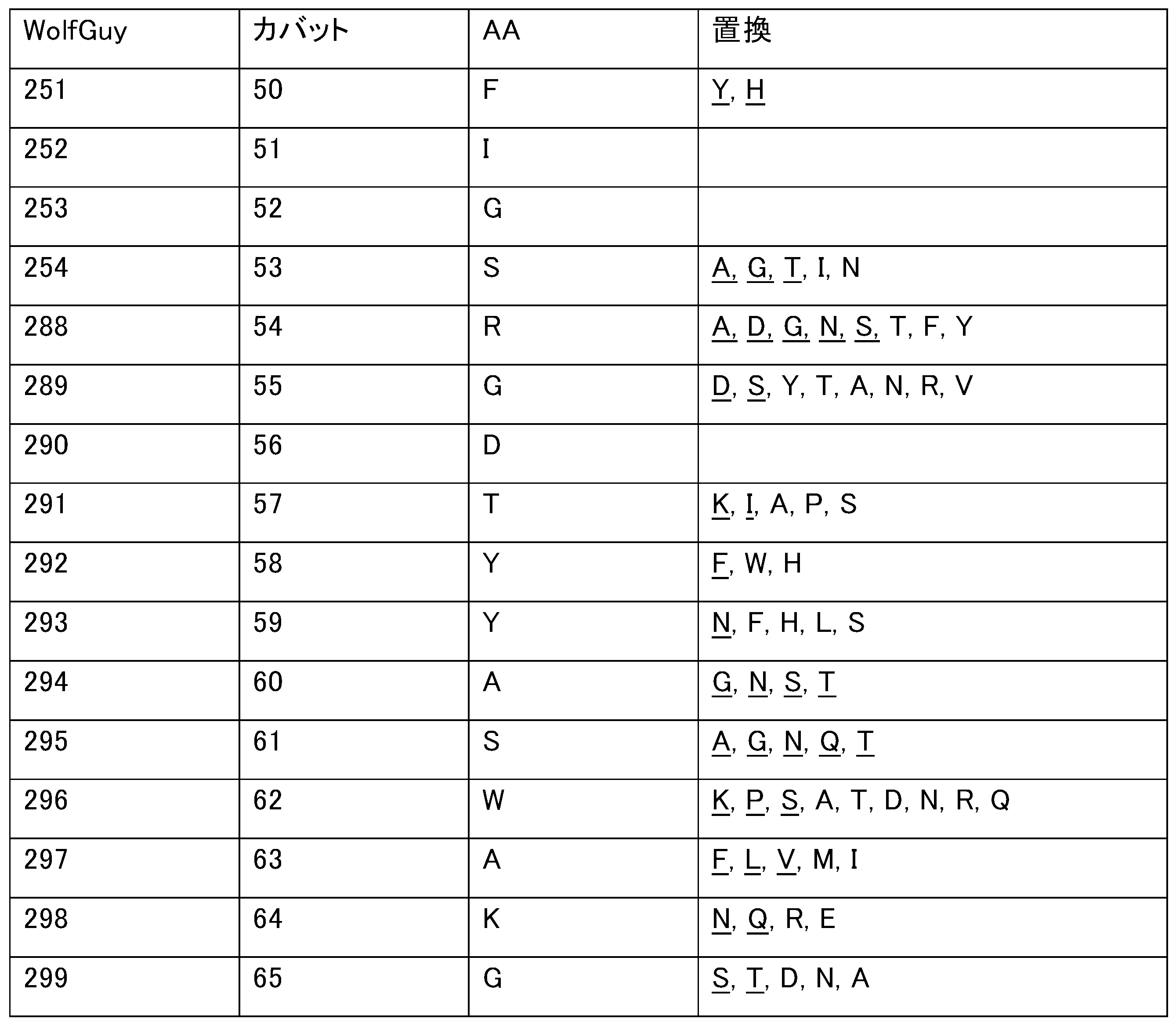
任意選択で、CDR-H3は、ERDPYGGGAYPPHL(配列番号3)のアミノ酸配列、または配列番号3内に、最大で、1つ、2つ、もしくは3つの置換を有するその変異体を含むことができ、この場合、これらの置換は、Glu95、Arg96、Asp97、Pro98を含まず、任意選択でまた、Ala100C、Tyr100D、および/もしくはPro100Eも含まず、かつ/または、任意選択でまた、Tyr99も含まない。例えば、一部の実施形態では、置換は、Glu95、Arg96、Asp97、Pro98、Tyr99、Ala100C、およびTyr100Dを含まない。 optionally, the CDR-H3 can comprise the amino acid sequence of ERDPYGGGAYPPHL (SEQ ID NO:3), or a variant thereof having up to 1, 2, or 3 substitutions within SEQ ID NO:3; In this case, these substitutions do not include Glu95, Arg96, Asp97, Pro98, optionally also not Ala100C, Tyr100D, and/or Pro100E, and/or optionally also not Tyr99. For example, in some embodiments, substitutions do not include Glu95, Arg96, Asp97, Pro98, Tyr99, Ala100C, and Tyr100D.
ある特定の実施形態では、CDR-H3は、下記に示される、1つまたは複数の位置において置換されうる。一部の実施形態では、上記で言及された残基は、固定され、他の残基が、下記の表に従い置換される場合もあり、他の実施形態では、任意の残基の置換が、下記の表に従いなされる場合もある。
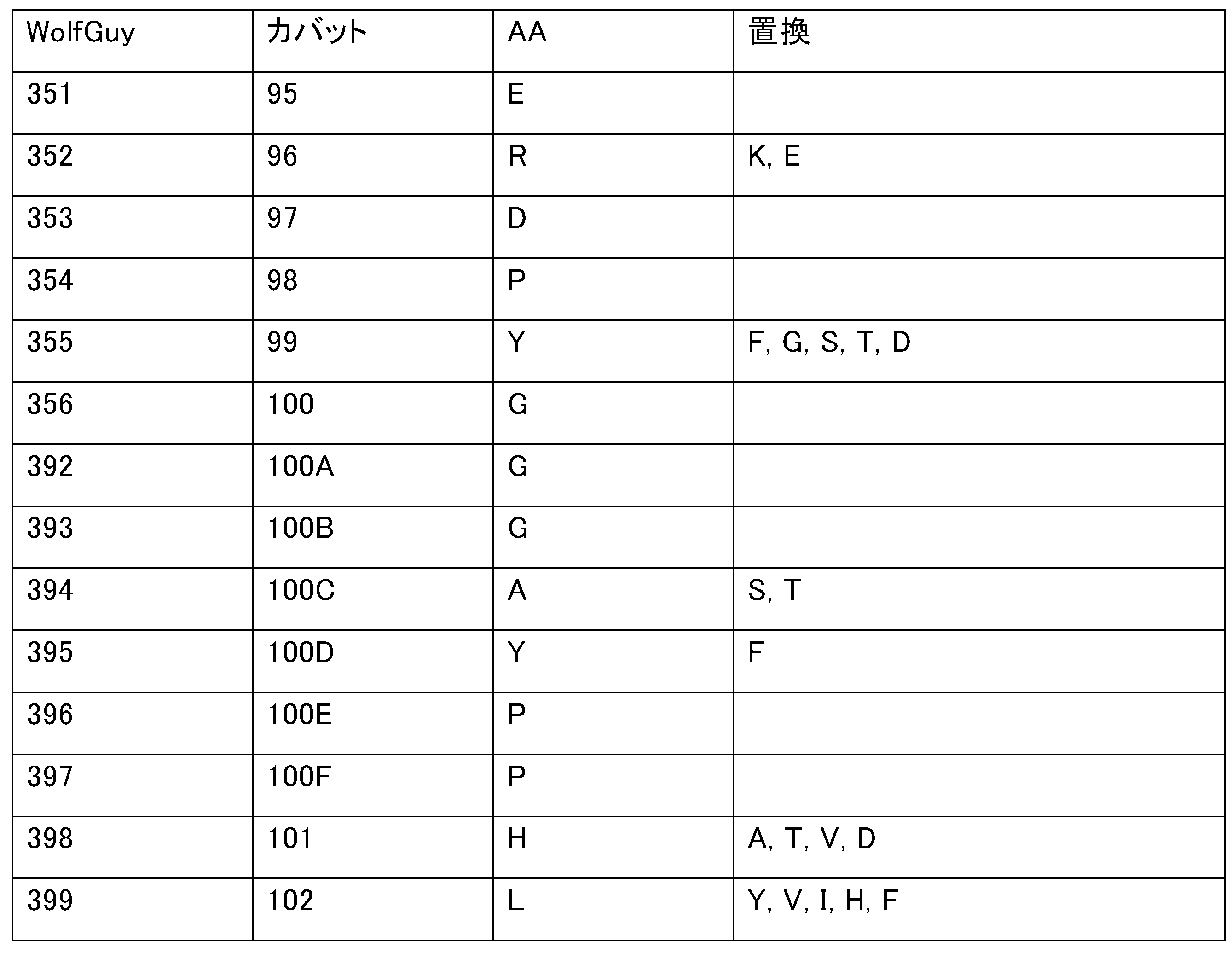
任意選択で、CDR-L1は、QSSHSVYSDNDLA(配列番号4)のアミノ酸配列、または配列番号4内に、最大で、1つ、2つ、もしくは3つの置換を有するその変異体を含むことができ、この場合、これらの置換は、Tyr28および/またはAsp32(カバット番号付け)を含まない。 optionally, the CDR-L1 can comprise the amino acid sequence of QSSHSVYSDNDLA (SEQ ID NO:4), or a variant thereof with up to 1, 2, or 3 substitutions within SEQ ID NO:4; In this case, these substitutions do not include Tyr28 and/or Asp32 (Kabat numbering).
ある特定の実施形態では、CDR-L1は、下記に示される、1つまたは複数の位置において置換されうる。ここでもまた、一部の実施形態では、上記で言及された残基は、固定され、他の残基が、下記の表に従い置換される場合もあり、他の実施形態では、任意の残基の置換が、下記の表に従いなされる場合もある。
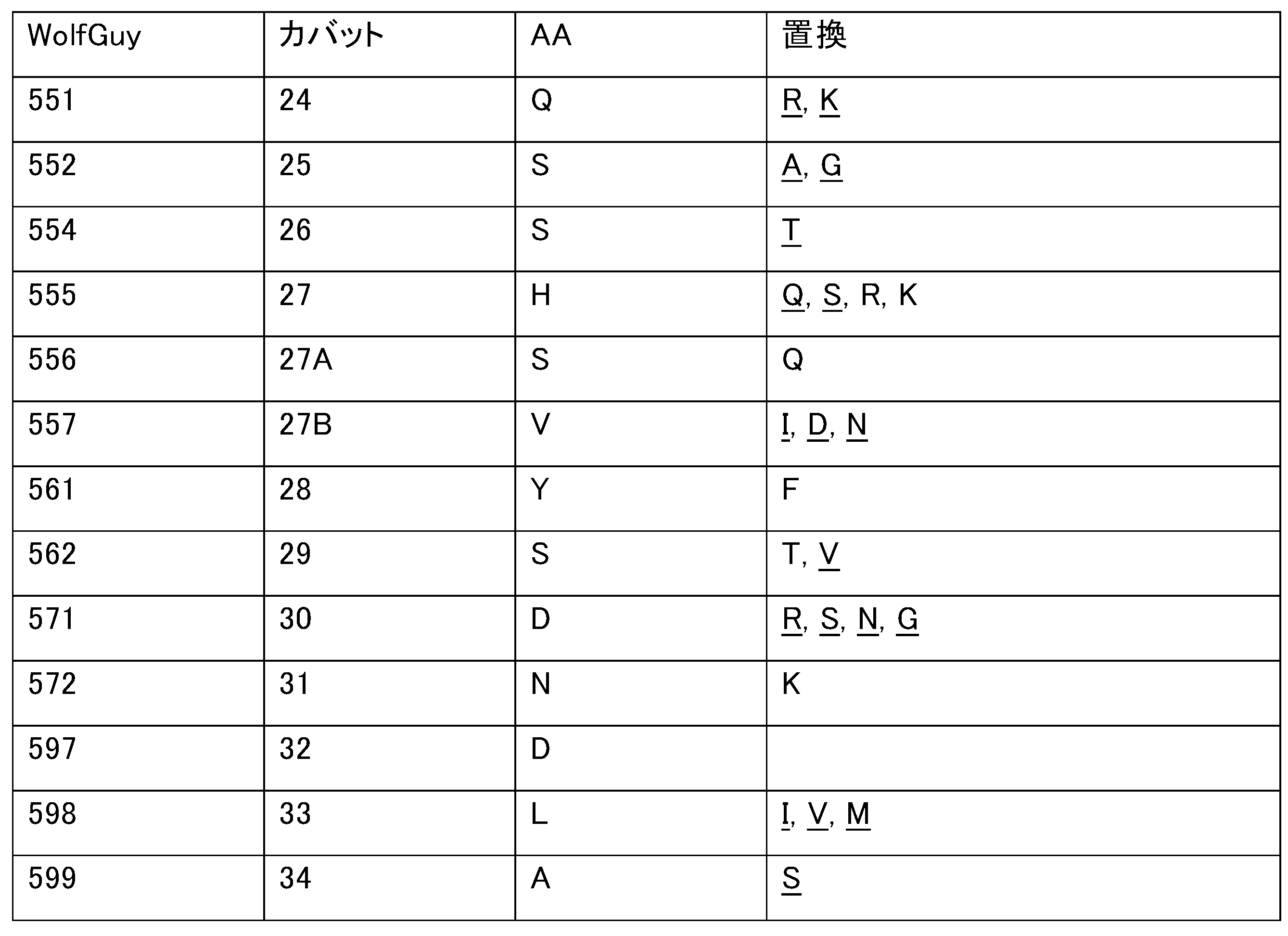
任意選択で、CDR-L3は、LGGYDDESDTYG(配列番号6)のアミノ酸配列、または配列番号6内に、最大で、1つ、2つ、もしくは3つの置換を有するその変異体を含むことができ、この場合、これらの置換は、Gly91、Tyr92、Asp93、Thr95c、および/またはTyr96(カバット)を含まない。 optionally, CDR-L3 can comprise the amino acid sequence of LGGYDDESDTYG (SEQ ID NO: 6), or a variant thereof with up to 1, 2, or 3 substitutions within SEQ ID NO: 6; In this case, these substitutions do not include Gly91, Tyr92, Asp93, Thr95c, and/or Tyr96 (Kabat).
ある特定の実施形態では、CDR-L3は、下記に示される、以下の位置において置換されうる(大半の残基は、溶媒に曝露され、抗原との接触部を伴わないので、多くの置換が想定できる)。ここでもまた、一部の実施形態では、上記で言及された残基は、固定され、他の残基が、下記の表に従い置換される場合もあり、他の実施形態では、任意の残基の置換が、下記の表に従いなされる場合もある。
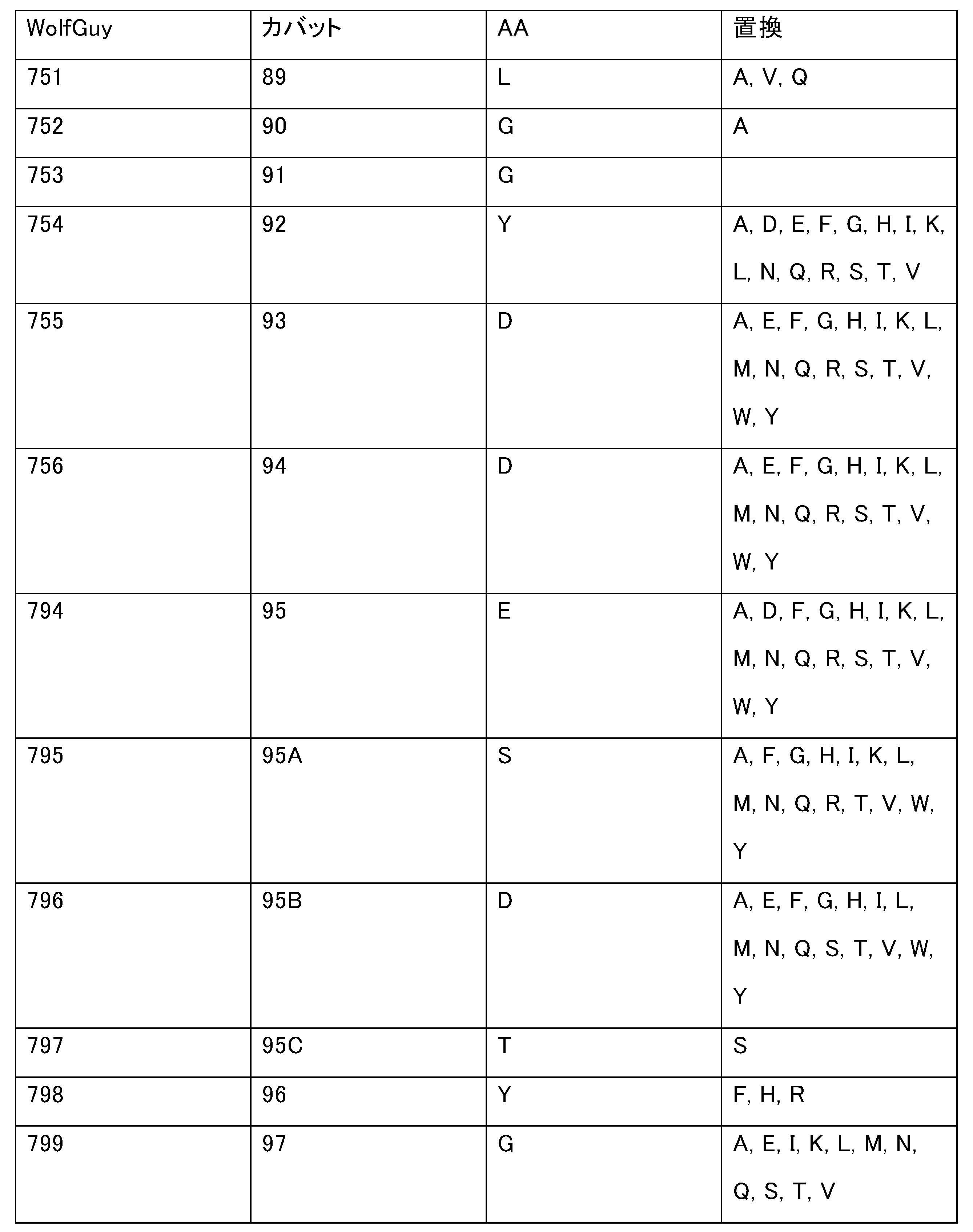
抗体は、任意選択で、配列番号1または配列番号5のそれぞれの配列、またはこれらに対して、少なくとも1つ、2つ、もしくは3つの置換、任意選択で、保存的置換を有する、これらの変異体を有する、CDR-H1またはCDR-L2をさらに含むことができる。 The antibody optionally comprises the sequences of SEQ ID NO: 1 or SEQ ID NO: 5, respectively, or variants thereof, with at least 1, 2, or 3 substitutions, optionally conservative substitutions, thereto. It can further include CDR-H1 or CDR-L2, with the
したがって、Pb-DOTAMのための抗原結合部位の一部を形成する重鎖可変ドメインは、少なくとも:
a)FIGSRGDTYYASWAKGのアミノ酸配列(配列番号2)、または配列番号2内に、最大で、1つ、2つ、もしくは3つの置換を有するその変異体を含み、これらの置換が、Phe50、Asp56、および/またはTyr58を含まず、任意選択でまた、Gly52および/またはArg54も含まない、重鎖CDR2;
b)ERDPYGGGAYPPHLのアミノ酸配列(配列番号3)、または配列番号3内に、最大で、1つ、2つ、もしくは3つの置換を有するその変異体を含み、これらの置換が、Glu95、Arg96、Asp97、Pro98を含まず、任意選択でまた、Ala100C、Tyr100D、および/もしくはPro100Eも含まず、かつ/または、任意選択でまた、Tyr99も含まない重鎖CDR3
を含むことができる。
Thus, the heavy chain variable domain that forms part of the antigen binding site for Pb-DOTAM has at least:
a) the amino acid sequence of FIGSRGDTYYASWAKG (SEQ ID NO: 2), or variants thereof having up to 1, 2, or 3 substitutions within SEQ ID NO: 2, wherein these substitutions are Phe50, Asp56, and heavy chain CDR2 without Tyr58 and optionally also without Gly52 and/or Arg54;
b) the amino acid sequence of ERDPYGGGAYPPHL (SEQ ID NO: 3), or variants thereof having up to 1, 2 or 3 substitutions within SEQ ID NO: 3, wherein these substitutions are Glu95, Arg96, Asp97 , without Pro98, optionally also without Ala100C, Tyr100D and/or Pro100E, and/or optionally also without Tyr99
can include
一部の実施形態では、重鎖可変ドメインは、加えて、任意選択で、
c)GFSLSTYSMSのアミノ酸配列(配列番号1)、または配列番号1内に、最大で、1つ、2つ、もしくは3つの置換を有するその変異体を含む重鎖CDR1
である重鎖CDR1を含む。
In some embodiments, the heavy chain variable domain additionally optionally has
c) a heavy chain CDR1 comprising the amino acid sequence of GFSLSTYSMS (SEQ ID NO: 1), or a variant thereof having up to 1, 2 or 3 substitutions within SEQ ID NO: 1
contains a heavy chain CDR1 that is
一部の実施形態では、重鎖可変ドメインは、加えて、遊離VH領域を認識する、既存の抗体の結合を回避するように、C末端アラニン(例えば、カバット番号付けシステムに従う、Ala 114)を含む。Holland MCら、J.Clin Immunol(2013)において報告されている通り、HAVH自己抗体は、インタクトのIgG、もしくは同じVHフレームワーク配列を含有するIgG断片(fAbまたは修飾VH分子)、またはVKドメイン抗体に結合しないので、遊離C末端は、HAVH(ヒト抗VHドメイン)自己抗体の、VHドメイン抗体への結合に重要であると考えられる。Cordy JCら、Clinical and Experimental Immunology(2015)は、完全IgG分子内のHAVH抗体に、天然ではアクセスできない、VH dAbのC末端エピトープにおける、クリプティックエピトープの存在に言及している。 In some embodiments, the heavy chain variable domain additionally includes a C-terminal alanine (e.g., Ala 114 according to the Kabat numbering system) to avoid binding of pre-existing antibodies that recognize free VH regions. include. Holland MC, et al. As reported in Clin Immunol (2013), HAVH autoantibodies do not bind to intact IgG, or IgG fragments (fAbs or modified VH molecules) containing the same VH framework sequences, or to VK domain antibodies, thus free The C-terminus is thought to be important for the binding of HAVH (human anti-VH domain) autoantibodies to VH domain antibodies. Cordy JC et al., Clinical and Experimental Immunology (2015) refer to the presence of cryptic epitopes in the C-terminal epitopes of VH dAbs that are not naturally accessible to HAVH antibodies in full IgG molecules.
したがって、抗体が、遊離VH領域(そのC末端において、他の任意のドメインに融合していないVH領域)を含む場合、配列は、1つまたは複数のC末端残基により伸長されうる。伸長は、遊離VH領域を認識する抗体の結合を防止しうる。例えば、伸長は、1つ~10の残基、例えば、1つ、2つ、3つ、4つ、5つ、6つ、7つ、8つ、9つ、または10の残基による伸長でありうる。一実施形態では、VH配列は、1つまたは複数のC末端アラニン残基により伸長されうる。VH配列はまた、CH1ドメインのN末端部分、例えば、例えば、ヒトIgG1のCH1ドメインに由来する、CH1ドメインのN末端に由来する、1つ~10の残基によっても伸長されうる(ヒトIgG1のCH1ドメインの、最初の10の残基は、ASTKGPSVFP(配列番号149)であるので、一実施形態では、1つ~10の残基は、この配列のN末端から採取されうる)。例えば、一実施形態では、ペプチドであるASTの配列(IgG1のCH1ドメインの、最初の3つの残基に対応する)は、VH領域のC末端に付加されている。 Thus, if an antibody comprises a free VH region (a VH region not fused at its C-terminus to any other domain), the sequence may be extended by one or more C-terminal residues. Extension may prevent binding of antibodies that recognize the free VH region. For example, the extension can be from 1 to 10 residues, such as by 1, 2, 3, 4, 5, 6, 7, 8, 9, or 10 residues. Possible. In one embodiment, the VH sequence may be extended by one or more C-terminal alanine residues. The VH sequence may also be extended by the N-terminal portion of the CH1 domain, eg, 1 to 10 residues derived from the N-terminus of the CH1 domain, eg, from the CH1 domain of human IgG1. The first 10 residues of the CH1 domain are ASTKGPSVFP (SEQ ID NO: 149), so in one embodiment residues 1-10 can be taken from the N-terminus of this sequence). For example, in one embodiment, the peptide AST sequence (corresponding to the first three residues of the CH1 domain of IgG1) is appended to the C-terminus of the VH region.
別の実施形態では、Pb-DOTAMのための抗原結合部位の一部を形成する軽鎖可変ドメインは、少なくとも:
d)QSSHSVYSDNDLAのアミノ酸配列(配列番号4)、または配列番号4内に、最大で、1つ、2つ、もしくは3つの置換を有するその変異体を含み、これらの置換が、Tyr28およびAsp32を含まない、軽鎖CDR1;
e)LGGYDDESDTYGのアミノ酸配列(配列番号6)、または配列番号6内に、最大で、1つ、2つ、もしくは3つの置換を有するその変異体を含み、これらの置換が、Gly91、Tyr92、Asp93、Thr95c、およびTyr96を含まない、軽鎖CDR3を含む。
In another embodiment, the light chain variable domain forming part of the antigen binding site for Pb-DOTAM has at least:
d) the amino acid sequence of QSSHSVYSDNDLA (SEQ ID NO: 4), or variants thereof having up to 1, 2, or 3 substitutions within SEQ ID NO: 4, wherein these substitutions include Tyr28 and Asp32; no, light chain CDR1;
e) the amino acid sequence of LGGYDDESDTYG (SEQ ID NO: 6), or variants thereof having up to 1, 2, or 3 substitutions within SEQ ID NO: 6, wherein these substitutions are Gly91, Tyr92, Asp93 , Thr95c, and the light chain CDR3 without Tyr96.
一部の実施形態では、軽鎖可変ドメインは、加えて、任意選択で、
f)QASKLASのアミノ酸配列(配列番号5)、または配列番号5内に少なくとも1つ、2つ、もしくは3つの置換を有するその変異体を含み、任意選択でGln50を含まない、軽鎖CDR2
である、軽鎖CDR2
を含む。
In some embodiments, the light chain variable domain additionally optionally comprises
f) a light chain CDR2 comprising the amino acid sequence of QASKLAS (SEQ ID NO:5), or a variant thereof having at least one, two, or three substitutions within SEQ ID NO:5, optionally without Gln50
is the light chain CDR2
including.
上記で明示されたCDR(例えば、可変ドメインの)を含む配列の変異体を含む、本発明の任意の実施形態では、タンパク質は、上記で明示されたCDR残基のうちの1つまたは複数において、不変でありうる。 In any embodiment of the invention, including variants of sequences comprising the above specified CDRs (e.g., of a variable domain), the protein has at one or more of the above specified CDR residues , can be invariant.
任意選択で、Pb-DOTAMに対する機能的抗原結合部位(第1の抗体上の)の一部を形成する重鎖可変ドメインは、配列番号7および配列番号9、または配列番号7または配列番号9に対して少なくとも90、91、92、93、94、95、96、97、98、もしくは99%の同一性を有するアミノ酸配列を含むこれらの変異体からなる群から選択されるアミノ酸配列を含む。ある特定の実施形態では、少なくとも90%、91%、92%、93%、94%、95%、96%、97%、98%、または99%の同一性を有するVH配列は、参照配列と比べた置換(例えば、保存的置換)、挿入、または欠失を含有するが、この配列を含む結合部位は、Pb-DOTAMに、好ましくは、本明細書で記載される親和性で結合する能力を保持する。VH配列は、上記で明示された不変残基を保持しうる。ある特定の実施形態では、配列番号7または配列番号9における、合計1つ~10のアミノ酸が、置換され、挿入され、かつ/または欠失している。ある特定の実施形態では、置換、挿入、または欠失は、CDRの外部の領域内で(すなわち、FR内で)生じる。任意選択で、抗体は、配列番号7または配列番号9におけるVH配列であって、任意選択で、C末端のAlaを伴う、この配列の翻訳後修飾を含むVH配列を含む。特定の実施形態では、VHは、(a)配列番号1のアミノ酸配列を含むCDR-H1、(b)配列番号2のアミノ酸配列を含むCDR-H2、および(c)配列番号3のアミノ酸配列を含むCDR-H3から選択される、1つ、2つ、または3つのCDRを含む。 Optionally, the heavy chain variable domain forming part of the functional antigen binding site (on the first antibody) for Pb-DOTAM is set forth in SEQ ID NO:7 and SEQ ID NO:9, or SEQ ID NO:7 or SEQ ID NO:9. including amino acid sequences having at least 90, 91, 92, 93, 94, 95, 96, 97, 98, or 99% identity to the amino acid sequences selected from the group consisting of variants thereof. In certain embodiments, a VH sequence having at least 90%, 91%, 92%, 93%, 94%, 95%, 96%, 97%, 98%, or 99% identity to a reference sequence is Binding sites containing this sequence, although containing substitutions (e.g., conservative substitutions), insertions, or deletions, are capable of binding Pb-DOTAM, preferably with the affinities described herein. hold. The VH sequence may retain the invariant residues specified above. In certain embodiments, a total of 1-10 amino acids in SEQ ID NO:7 or SEQ ID NO:9 have been substituted, inserted and/or deleted. In certain embodiments, substitutions, insertions, or deletions occur within regions outside the CDRs (ie, within the FRs). Optionally, the antibody comprises a VH sequence in SEQ ID NO:7 or SEQ ID NO:9, optionally comprising a post-translational modification of this sequence with a C-terminal Ala. In certain embodiments, the VH comprises (a) a CDR-H1 comprising the amino acid sequence of SEQ ID NO:1, (b) a CDR-H2 comprising the amino acid sequence of SEQ ID NO:2, and (c) the amino acid sequence of SEQ ID NO:3. 1, 2, or 3 CDRs selected from CDR-H3, including
上記で言及された、一部の実施形態の、一部の変異体では、配列番号7または9は、1つまたは複数のさらなるC末端残基により、例えば、1つまたは複数のアラニン残基、任意選択で、単一のアラニン残基により伸長されうる。したがって、例えば、具体的な一変異体では、配列番号7の配列は、
VTLKESGPVLVKPTETLTLTCTVSGFSLSTYSMSWIRQPPGKALEWLGFIGSRGDTYYASWAKGRLTISKDTSKSQVVLTMTNMDPVDTATYYCARERDPYGGGAYPPHLWGRGTLVTVSSA(配列番号150)
となるように伸長されうる。
In some variants, of some embodiments referred to above, SEQ ID NO: 7 or 9 is modified by one or more additional C-terminal residues, e.g., one or more alanine residues, Optionally, it can be extended by a single alanine residue. Thus, for example, in one particular variant, the sequence of SEQ ID NO:7 is
VTLKESGPVLVKPTETLTLTCTVSGFSLSTYSMSWIRQPPGKALEWLGFIGSRGDTYYASWAKGRLTISKDTSKSQVVLTMTNMDPVDTATYYCARERDPYGGGAYPPHLWGRGTLVTVSSA (SEQ ID NO: 150)
can be extended so that
他の実施形態では、伸長は、上記で記載されたCH1ドメインのN末端部分による伸長、例えば、CH1ドメインのN末端に由来する、例えば、ヒトIgG1のCH1ドメインに由来する、1つ~10の残基による伸長でありうる。例えば、伸長は、ペプチドであるASTの配列による伸長でありうる。 In other embodiments, the extension is an extension with the N-terminal portion of the CH1 domain described above, e.g., 1-10 from the N-terminus of the CH1 domain, e.g., from the CH1 domain of human IgG1. It can be an extension by residues. For example, the extension can be a sequence extension of an AST that is a peptide.
任意選択で、Pb-DOTAMに対する機能的抗原結合部位(第2の抗体上の)の一部を形成する軽鎖可変ドメインは、配列番号8、または配列番号8に対して少なくとも90、91、92、93、94、95、96、97、98、もしくは99%の同一性を有するアミノ酸配列を含むその変異体のアミノ酸配列を含む。ある特定の実施形態では、少なくとも90%、91%、92%、93%、94%、95%、96%、97%、98%、または99%の同一性を有するVL配列は、参照配列と比べた置換(例えば、保存的置換)、挿入、または欠失を含有するが、この配列を含む抗Pb-DOTAM結合部位は、Pb-DOTAMに、好ましくは、本明細書で記載される親和性で結合する能力を保持する。VL配列は、上記で明示された不変残基を保持しうる。ある特定の実施形態では、配列番号8内の、合計1つ~10のアミノ酸が、置換され、挿入され、かつ/または欠失している。ある特定の実施形態では、置換、挿入、または欠失は、CDRの外部の領域内で(すなわち、FR内で)生じる。任意選択で、抗Pb-DOTAM抗体は、配列番号8内のVL配列であって、この配列の翻訳後修飾を含むVL配列を含む。特定の実施形態では、VLは、(a)配列番号4のアミノ酸配列を含むCDR-L1;(b)配列番号5のアミノ酸配列を含むCDR-L2;および(c)配列番号6のアミノ酸配列を含むCDR-L3から選択される、1つ、2つ、または3つのCDRを含む。 Optionally, the light chain variable domain that forms part of the functional antigen binding site (on the second antibody) for Pb-DOTAM is SEQ ID NO: 8, or at least 90, 91, 92 for SEQ ID NO: 8 , variants thereof, including amino acid sequences having 93, 94, 95, 96, 97, 98, or 99% identity. In certain embodiments, a VL sequence having at least 90%, 91%, 92%, 93%, 94%, 95%, 96%, 97%, 98%, or 99% identity to a reference sequence is Anti-Pb-DOTAM binding sites containing this sequence, although containing substitutions (e.g., conservative substitutions), insertions, or deletions compared to Pb-DOTAM, preferably have an affinity as described herein. retain the ability to bind with The VL sequence may retain the constant residues specified above. In certain embodiments, a total of 1-10 amino acids within SEQ ID NO:8 have been substituted, inserted, and/or deleted. In certain embodiments, substitutions, insertions, or deletions occur within regions outside the CDRs (ie, within the FRs). Optionally, the anti-Pb-DOTAM antibody comprises a VL sequence within SEQ ID NO: 8 comprising post-translational modifications of this sequence. In certain embodiments, the VL comprises (a) a CDR-L1 comprising the amino acid sequence of SEQ ID NO:4; (b) a CDR-L2 comprising the amino acid sequence of SEQ ID NO:5; and (c) the amino acid sequence of SEQ ID NO:6. 1, 2 or 3 CDRs selected from the CDR-L3 comprising.
重鎖可変領域および軽鎖可変領域に関する実施形態は、明示的に、組合せで想定される。したがって、Pb-DOTAMに対する機能的抗原結合部位は、第1の抗体および第2の抗体のそれぞれにおいて、上記で規定された重鎖可変領域と、上記で規定された軽鎖可変領域とから形成されうる。 Embodiments involving heavy chain variable regions and light chain variable regions are expressly envisioned in combination. Thus, functional antigen-binding sites for Pb-DOTAM are formed from the heavy chain variable regions defined above and the light chain variable regions defined above in each of the first antibody and the second antibody. sell.
任意選択で、Pb-DOTAMキレートに特異的な抗原結合部位は、上記で規定された通り、配列番号7もしくは配列番号9からなる群から選択されるアミノ酸配列、または上記で規定されたこれらの変異体(上記で論じられたC末端伸長を伴う変異体を含む)を含む重鎖可変ドメイン、および配列番号8のアミノ酸配列またはその変異体を含む軽鎖可変ドメインから形成されうる。例えば、Pb-DOTAMキレートに特異的な抗原結合部位は、これらの配列の翻訳後修飾を含む、配列番号7のアミノ酸配列またはその変異体を含む重鎖可変ドメイン、および配列番号8のアミノ酸配列またはその変異体を含む軽鎖可変ドメインを含むことができる。別の実施形態では、Pb-DOTAMキレートに特異的な抗原結合部位は、これらの配列の翻訳後修飾を含む、配列番号9のアミノ酸配列またはその変異体(上記で論じられたC末端伸長を伴う変異体を含む)を含む重鎖可変ドメイン、および配列番号8のアミノ酸配列またはその変異体を含む軽鎖可変ドメインを含むことができる。 Optionally, the antigen binding site specific for the Pb-DOTAM chelate is an amino acid sequence selected from the group consisting of SEQ ID NO: 7 or SEQ ID NO: 9, as defined above, or mutations thereof as defined above. (including variants with C-terminal extensions discussed above), and a light chain variable domain comprising the amino acid sequence of SEQ ID NO:8 or variants thereof. For example, an antigen binding site specific for a Pb-DOTAM chelate may be a heavy chain variable domain comprising the amino acid sequence of SEQ ID NO:7 or variants thereof, and the amino acid sequence of SEQ ID NO:8 or A light chain variable domain including variants thereof can be included. In another embodiment, the antigen binding site specific for the Pb-DOTAM chelate is the amino acid sequence of SEQ ID NO: 9 or variants thereof (with the C-terminal extension discussed above), including post-translational modifications of these sequences. and a light chain variable domain comprising the amino acid sequence of SEQ ID NO:8 or variants thereof.
上記の実施形態のうちのいずれかでは、抗Pb-DOTAM結合部位を形成する、軽鎖可変領域および重鎖可変領域は、ヒト化されうる。一実施形態では、軽鎖可変領域および重鎖可変領域は、上記の実施形態のうちのいずれかにおけるCDRを含み、ヒトアクセプターフレームワーク、例えば、ヒト免疫グロブリンフレームワーク、またはヒトコンセンサスフレームワークをさらに含む。別の実施形態では、軽鎖可変領域および/または重鎖可変領域は、上記の実施形態のうちのいずれかにおけるCDRを含み、vk 1~39および/またはvh 2~26に由来するフレームワーク領域をさらに含む。一部の実施形態では、vk 1~39について、復帰突然変異は存在しない場合がある。vh 2~26について、生殖系列Ala49残基は、Gly49に復帰突然変異する場合がある。 In any of the above embodiments, the light and heavy chain variable regions that form the anti-Pb-DOTAM binding sites can be humanized. In one embodiment, the light and heavy chain variable regions comprise the CDRs of any of the above embodiments and a human acceptor framework, e.g., a human immunoglobulin framework, or a human consensus framework. Including further. In another embodiment, the light and/or heavy chain variable region comprises the CDRs in any of the above embodiments and framework regions from vk 1-39 and/or vh 2-26 further includes In some embodiments, there may be no backmutations for vk 1-39. For vh 2-26, the germline Ala49 residue may be backmutated to Gly49.
E.CEAに対する例示的抗原結合部位
上記で論じられた実施形態と組み合わされうる、本発明の、別の特定の実施形態では、第1の抗体および第2の抗体が結合する標的抗原は、CEA(がん胎児性抗原)でありうる。CEAに対して惹起されている抗体は、T84.66、ならびにWO2016/075278A1および/またはWO2017/055389において記載されている、T84.66-LCHAなど、そのヒト化形およびキメラ形、WO2012/117002およびWO2014/131712において記載されている抗CEA抗体である、CH1A1a、ならびにCEA hMN-14またはラベツズマブ(例えば、US6676924およびUS5874540において記載されている)を含む。CEAに対する、別の例示的抗体は、A5B7(例えば、M.J.Banfieldら、Proteins、1997、29(2)、161~171において記載されている)、またはWO92/01059およびWO2007/071422において記載されているマウスA5B7に由来するヒト化抗体である。また、同時係属出願である、PCT/EP2020/067582も参照されたい。A5B7のヒト化型の例は、A5H1EL1(G54A)である。CEAに対する、さらなる例示的抗体は、US7626011および/または同時係属出願である、PCT/EP2020/067582において記載されているMFE23、およびそのヒト化形である。抗CEA抗体の、なおさらなる例は、28A9である。これらの抗体、またはこれらの抗原結合断片のうちのいずれかは、本発明におけるCEA結合部分を形成するのに使用されうる。
E. Exemplary Antigen Binding Sites for CEA In another specific embodiment of the invention, which may be combined with the embodiments discussed above, the target antigen to which the first and second antibodies bind is CEA ( fetal antigen). Antibodies raised against CEA include T84.66 and its humanized and chimeric forms, such as T84.66-LCHA, described in WO2016/075278A1 and/or WO2017/055389, WO2012/117002 and CH1A1a, an anti-CEA antibody described in WO2014/131712, and CEA hMN-14 or labetuzumab (described for example in US6676924 and US5874540). Another exemplary antibody against CEA is A5B7 (described, for example, in MJ Banfield et al., Proteins, 1997, 29(2), 161-171), or described in WO92/01059 and WO2007/071422. It is a humanized antibody derived from murine A5B7 that has been published. See also co-pending application PCT/EP2020/067582. An example of a humanized version of A5B7 is A5H1EL1 (G54A). Further exemplary antibodies against CEA are MFE23, and humanized forms thereof, described in US7626011 and/or co-pending application PCT/EP2020/067582. A still further example of an anti-CEA antibody is 28A9. Any of these antibodies, or antigen-binding fragments thereof, can be used to form the CEA binding portion in the present invention.
任意選択で、CEAに結合する抗原結合部位は、一価の結合についての、1nMもしくはこれ未満、500pMもしくはこれ未満、200pMもしくはこれ未満、または100pMもしくはこれ未満のKd値で結合しうる。 Optionally, the antigen binding site that binds CEA can bind with a Kd value of 1 nM or less, 500 pM or less, 200 pM or less, or 100 pM or less for monovalent binding.
一部の実施形態では、第1の抗体および/または第2の抗体は、CEAのCH1A1aエピトープ、A5B7エピトープ、MFE23エピトープ、T84.66エピトープ、または28A9エピトープに結合しうる。 In some embodiments, the first antibody and/or the second antibody may bind to the CH1A1a epitope, A5B7 epitope, MFE23 epitope, T84.66 epitope, or 28A9 epitope of CEA.
一部の実施形態では、第1の抗体および第2の抗体のうちの少なくとも1つは、可溶型CEA(sCEA)上に存在しないCEAエピトープに結合する。可溶型CEAは、GPIホスホリパーゼにより切断され、血液に放出される、CEA分子の一部である。可溶型CEA上で見出されないエピトープの例は、CH1A1Aエピトープである。任意選択で、第1の抗体および/または第2の抗体のうちの1つは、可溶型CEA上に存在しないエピトープに結合し、他方は、可溶型CEA上に存在するエピトープに結合する。 In some embodiments, at least one of the first antibody and the second antibody binds to a CEA epitope not present on soluble CEA (sCEA). Soluble CEA is the portion of the CEA molecule that is cleaved by GPI phospholipases and released into the blood. An example of an epitope not found on soluble CEA is the CH1A1A epitope. Optionally, one of the first antibody and/or the second antibody binds to an epitope not present on soluble CEA and the other binds to an epitope present on soluble CEA .
CH1A1aおよびその親マウス抗体であるPR1A3のエピトープについては、WO2012/117002A1、およびDurbin H.ら、Proc.Natl.Scad.Sci.USA、91:4313~4317、1994において記載されている。CH1A1aエピトープに結合する抗体は、CEA分子のB3ドメイン内およびGPIアンカー内のコンフォメーションエピトープに結合する。一態様では、抗体は、本明細書における配列番号25のVHおよび配列番号26のVLを有するCH1A1a抗体と同じエピトープに結合する。A5B7エピトープについては、同時係属出願である、PCT/EP2020/067582において記載されている。A5B7エピトープに結合する抗体は、CEAのA2ドメイン、すなわち、配列番号154:
PKPFITSNNSNPVEDEDAVALTCEPEIQNTTYLWWVNNQSLPVSPRLQLSNDNRTLTLLSVTRNDVGP YECGIQNKLSVDHSDPVILN(配列番号154)
のアミノ酸を含むドメインに結合する。
一態様では、抗体は、本明細書における配列番号49のVHおよび配列番号50のVLを有するA5B7抗体と同じエピトープに結合する。
Epitopes of CH1A1a and its parental murine antibody PR1A3 are described in WO2012/117002A1 and Durbin H. et al. et al., Proc. Natl. Scad. Sci. USA, 91:4313-4317, 1994. Antibodies that bind the CH1A1a epitope bind conformational epitopes within the B3 domain of the CEA molecule and within the GPI anchor. In one aspect, the antibody binds to the same epitope as the CH1A1a antibody having the VH of SEQ ID NO:25 and the VL of SEQ ID NO:26 herein. The A5B7 epitope is described in co-pending application PCT/EP2020/067582. An antibody that binds to the A5B7 epitope is the A2 domain of CEA, ie SEQ ID NO: 154:
PKPFITSNNSNPVEDEDAVALTCEPEIQNTTYLWWVNNQSLPVSPRLQLSNDNRTLTLLSVTRNDVGP YECGIQNKLSVDHSDPVILN (SEQ ID NO: 154)
binds to a domain containing amino acids of
In one aspect, the antibody binds to the same epitope as the A5B7 antibody having a VH of SEQ ID NO:49 and a VL of SEQ ID NO:50 herein.
一態様では、抗体は、WO2016/075278において記載されているT84.66と同じエピトープに結合する。抗体は、本明細書における配列番号17のVHおよび配列番号18のVLを有する抗体と同じエピトープに結合しうる。 In one aspect, the antibody binds to the same epitope as T84.66 as described in WO2016/075278. The antibody may bind to the same epitope as the antibody having the VH of SEQ ID NO: 17 and the VL of SEQ ID NO: 18 herein.
MFE23エピトープについては、同時係属出願である、PCT/EP2020/067582において記載されている。MFE23エピトープに結合する抗体は、CEAのA1ドメイン、すなわち、配列番号155:
PKPSISSNNSKPVEDKDAVAFTCEPETQDATYLWWVNNQSLPVSPRLQLSNGNRTLTLFNVTRNDTASYKCETQNPVSARRSDSVILN(配列番号155)
のアミノ酸を含むドメインに結合する。
一態様では、抗体は、本明細書における配列番号167のVHドメインおよび配列番号168のVLドメインを有する抗体と同じエピトープに結合しうる。
The MFE23 epitope is described in co-pending application PCT/EP2020/067582. An antibody that binds to the MFE23 epitope is the A1 domain of CEA, ie SEQ ID NO: 155:
PKPSISSNNSKPVEDKDAVAFTCEPETQDATYLWWVNNQSLPVSPRLQLSNGNRTLTLFNVTRNDTASYKCETQNPVSARRSDSVILN (SEQ ID NO: 155)
binds to a domain containing amino acids of
In one aspect, the antibody may bind to the same epitope as the antibody having the VH domain of SEQ ID NO: 167 and the VL domain of SEQ ID NO: 168 herein.
一部の実施形態では、第1の抗体および/または第2の抗体は、本明細書で提示される抗体、例えば、P1AD8749、P1AD8592、P1AE4956、P1AE4957、P1AF0709、P1AF0298、P1AF0710、またはP1AF0711と同じCEAエピトープに結合しうる。 In some embodiments, the first antibody and/or the second antibody has the same CEA as an antibody presented herein, e.g. It can bind to an epitope.
一部の実施形態では、第1の抗体および第2の抗体は、CEAの、互いと同じエピトープに結合する。したがって、例えば、第1の抗体および第2の抗体の両方は、CH1A1aエピトープ、A5B7エピトープ、MFE23エピトープ、T84.66エピトープ、または28A9エピトープに結合しうる。 In some embodiments, the first antibody and the second antibody bind to the same epitope of CEA as each other. Thus, for example, both the first antibody and the second antibody can bind to the CH1A1a epitope, the A5B7 epitope, the MFE23 epitope, the T84.66 epitope, or the 28A9 epitope.
一部の実施形態では、第1の抗体および第2の抗体の両方は、CH1A1Aに由来するCEA結合配列(すなわち、CDRおよび/またはVH/VLドメイン)を有する場合もあり;第1の抗体および第2の抗体の両方は、A5B7またはそのヒト化型に由来するCEA結合配列を有する場合もあり;第1の抗体および第2の抗体の両方は、T84.66またはそのヒト化型に由来するCEA結合配列を有する場合もあり;第1の抗体および第2の抗体の両方は、MFE23またはそのヒト化型に由来するCEA結合配列を有する場合もあり;第1の抗体および第2の抗体の両方は、28A9またはそのヒト化型に由来するCEA結合配列を有する場合もある。例示的配列は、本明細書で開示される。 In some embodiments, both the first antibody and the second antibody may have CEA binding sequences (i.e., CDRs and/or VH/VL domains) derived from CH1A1A; Both of the second antibodies may have CEA binding sequences derived from A5B7 or a humanized version thereof; both the first and second antibodies are derived from T84.66 or a humanized version thereof both the first antibody and the second antibody may have CEA binding sequences derived from MFE23 or a humanized version thereof; Both may have CEA binding sequences derived from 28A9 or a humanized version thereof. Exemplary sequences are disclosed herein.
他の実施形態では、第1の抗体および第2の抗体は、CEAの異なるエピトープに結合する。したがって、例えば、i)一方の抗体は、CH1A1Aエピトープに結合することが可能であり、他方の抗体は、A5B7エピトープ、T84.66エピトープ、MFE23エピトープ、または28A9エピトープに結合する場合もあり;ii)一方の抗体は、A5B7エピトープに結合することが可能であり、他方の抗体は、CH1A1Aエピトープ、T84.66エピトープ、MFE23エピトープ、または28A9エピトープに結合する場合もあり;iii)一方の抗体は、MFE23エピトープに結合することが可能であり、他方の抗体は、CH1A1Aエピトープ、A5B7エピトープ、T84.66エピトープ、または28A9エピトープに結合する場合もあり;iv)一方の抗体は、T84.66エピトープに結合することが可能であり、他方の抗体は、CH1A1Aエピトープ、A5B7エピトープ、MFE23エピトープ、または28A9エピトープに結合する場合もあり;v)一方の抗体は、28A9エピトープに結合することが可能であり、他方の抗体は、CH1A1aエピトープ、A5B7エピトープ、MFE23エピトープ、またはT84.66エピトープに結合する場合もある。 In other embodiments, the first antibody and the second antibody bind to different epitopes on CEA. Thus, for example, i) one antibody may bind the CH1A1A epitope and the other antibody may bind the A5B7 epitope, the T84.66 epitope, the MFE23 epitope, or the 28A9 epitope; ii) One antibody may bind the A5B7 epitope and the other antibody may bind the CH1A1A epitope, the T84.66 epitope, the MFE23 epitope, or the 28A9 epitope; iii) one antibody may bind the MFE23 can bind epitopes, the other antibody may bind the CH1A1A epitope, the A5B7 epitope, the T84.66 epitope, or the 28A9 epitope; iv) one antibody binds the T84.66 epitope and the other antibody may bind to the CH1A1A epitope, the A5B7 epitope, the MFE23 epitope, or the 28A9 epitope; v) one antibody may bind to the 28A9 epitope; The antibody may also bind to the CH1A1a epitope, the A5B7 epitope, the MFE23 epitope, or the T84.66 epitope.
一部の実施形態では、i)一方の抗体は、CH1A1Aに由来するCEA結合配列(すなわち、CDRまたはVH/VLドメイン)を有することが可能であり、他方は、A5B7もしくはそのヒト化型、T84.66もしくはそのヒト化型、MFE23もしくはそのヒト化型、または28A9もしくはそのヒト化型に由来するCEA結合配列を有することが可能であり;ii)一方の抗体は、A5B7またはそのヒト化型に由来するCEA結合配列を有することが可能であり、他方は、CH1A1A、T84.66もしくはそのヒト化型、MFE23もしくはそのヒト化型、または28A9もしくはそのヒト化型に由来するCEA結合配列を有することが可能であり;iii)一方の抗体は、MFE23またはそのヒト化型に由来するCEA結合配列を有することが可能であり、他方は、CH1A1A、A5B7もしくはそのヒト化型、T84.66もしくはそのヒト化型、または28A9もしくはそのヒト化型に由来するCEA結合配列を有することが可能であり;iv)一方の抗体は、T84.66またはそのヒト化型に由来するCEA結合配列を有することが可能であり、他方は、CH1A1A、A5B7もしくはそのヒト化型、MFE23もしくはそのヒト化型、または28A9もしくはそのヒト化型に由来するCEA結合配列を有することが可能であり;v)一方の抗体は、28A9またはそのヒト化型に由来するCEA結合配列を有することが可能であり、他方は、CH1A1A、A5B7もしくはそのヒト化型、T84.66もしくはそのヒト化型、またはMFE23もしくはそのヒト化型に由来するCEA結合配列を有しうる。 In some embodiments, i) one antibody can have CEA binding sequences (i.e., CDRs or VH/VL domains) derived from CH1A1A and the other can have A5B7 or a humanized version thereof, T84. .66 or a humanized form thereof, MFE23 or a humanized form thereof, or 28A9 or a humanized form thereof; The other can have a CEA binding sequence derived from CH1A1A, T84.66 or a humanized version thereof, MFE23 or a humanized version thereof, or 28A9 or a humanized version thereof. iii) one antibody can have a CEA binding sequence derived from MFE23 or a humanized version thereof and the other can have a CEA binding sequence derived from MFE23 or a humanized version thereof, T84.66 or a humanized version thereof iv) one antibody can have a CEA binding sequence derived from T84.66 or a humanized version thereof; and the other can have a CEA binding sequence derived from CH1A1A, A5B7 or a humanized form thereof, MFE23 or a humanized form thereof, or 28A9 or a humanized form thereof; v) one antibody is 28A9 or a humanized form thereof, the other can be derived from CH1A1A, A5B7 or a humanized form thereof, T84.66 or a humanized form thereof, or MFE23 or a humanized form thereof can have a CEA binding sequence that
1つの特定の実施形態では、一方の抗体は、CH1A1Aエピトープに結合することが可能であり、他方は、A5B7エピトープに結合しうる。第1の抗体は、抗体であるCH1A1Aに由来するCEA結合配列を有することが可能であり、第2の抗体は、A5B7(そのヒト化型を含む)に由来するCEA結合配列を有する場合もあり;第1の抗体は、抗体であるA5B7(そのヒト化型を含む)に由来するCEA結合配列を有することが可能であり、第2の抗体は、CH1A1Aに由来するCEA結合配列を有する場合もある。 In one particular embodiment, one antibody may bind the CH1A1A epitope and the other may bind the A5B7 epitope. The first antibody can have a CEA binding sequence derived from the antibody CH1A1A and the second antibody can have a CEA binding sequence derived from A5B7 (including humanized versions thereof). the first antibody can have CEA binding sequences derived from antibody A5B7 (including humanized versions thereof) and the second antibody can have CEA binding sequences derived from CH1A1A; be.
別の特定の実施形態では、一方の抗体は、CH1A1Aエピトープに結合することが可能であり、他方は、T84.66エピトープに結合しうる。第1の抗体は、抗体であるCH1A1Aに由来するCEA結合配列を有することが可能であり、第2の抗体は、T84.66(そのヒト化型を含む)に由来するCEA結合配列を有する場合もあり;第1の抗体は、抗体であるT84.66(そのヒト化型を含む)に由来するCEA結合配列を有することが可能であり、第2の抗体は、CH1A1Aに由来するCEA結合配列を有する場合もある。一部の実施形態では、第1の抗体は、T84.66エピトープに結合することが可能であり、かつ/または下記の(i)に記載された抗原結合部位を有することが可能であり、第2の抗体は、CH1A1Aエピトープに結合することが可能であり、かつ/または下記の(ii)に記載された抗原結合部位を有することが可能である。 In another specific embodiment, one antibody may bind the CH1A1A epitope and the other may bind the T84.66 epitope. The first antibody can have a CEA binding sequence derived from the antibody CH1A1A and the second antibody has a CEA binding sequence derived from T84.66 (including humanized versions thereof). the first antibody can have a CEA binding sequence derived from antibody T84.66 (including humanized versions thereof) and the second antibody has a CEA binding sequence derived from CH1A1A may also have In some embodiments, the first antibody is capable of binding the T84.66 epitope and/or can have an antigen binding site as described in (i) below; 2 antibodies can bind to the CH1A1A epitope and/or have an antigen binding site as described in (ii) below.
例示的CEA結合配列であるi)~v)は、下記に開示される。これらは、i)T84.66、ii)CH1A1A、iii)A5B7、iv)28A9、およびv)MFE23(またはそのヒト化型に由来する)に由来するCEA結合配列の例を提示する。 Exemplary CEA binding sequences i)-v) are disclosed below. These provide examples of CEA binding sequences derived from i) T84.66, ii) CH1A1A, iii) A5B7, iv) 28A9, and v) MFE23 (or its humanized form).
i)一実施形態では、CEAに結合する抗原結合部位は、(a)配列番号11のアミノ酸配列を含むCDR-H1;(b)配列番号12のアミノ酸配列を含むCDR-H2;(c)配列番号13のアミノ酸配列を含むCDR-H3;(d)配列番号14のアミノ酸配列を含むCDR-L1;(e)配列番号15のアミノ酸配列を含むCDR-L2;および(f)配列番号16のアミノ酸配列を含むCDR-L3から選択される、少なくとも1つ、2つ、3つ、4つ、5つ、または6つのCDRを含むことができる。 i) In one embodiment, the antigen binding site that binds CEA comprises (a) CDR-H1 comprising the amino acid sequence of SEQ ID NO:11; (b) CDR-H2 comprising the amino acid sequence of SEQ ID NO:12; (d) CDR-L1 comprising the amino acid sequence of SEQ ID NO:14; (e) CDR-L2 comprising the amino acid sequence of SEQ ID NO:15; and (f) the amino acid sequence of SEQ ID NO:16. It can comprise at least 1, 2, 3, 4, 5, or 6 CDRs selected from CDR-L3 containing sequences.
任意選択で、CEAに結合する抗原結合部位は、(a)配列番号11のアミノ酸配列を含むCDR-H1;(b)配列番号12のアミノ酸配列を含むCDR-H2;および(c)配列番号13のアミノ酸配列を含むCDR-H3から選択される、少なくとも1つ、少なくとも2つ、または3つ全てのVH CDR配列を含むことができる。 Optionally, the antigen binding site that binds CEA comprises: (a) CDR-H1 comprising the amino acid sequence of SEQ ID NO:11; (b) CDR-H2 comprising the amino acid sequence of SEQ ID NO:12; and (c) SEQ ID NO:13 at least one, at least two, or all three VH CDR sequences selected from a CDR-H3 comprising an amino acid sequence of
任意選択で、CEAに結合する抗原結合部位は、(a)配列番号14のアミノ酸配列を含むCDR-L1;(b)配列番号15のアミノ酸配列を含むCDR-L2;および(c)配列番号16のアミノ酸配列を含むCDR-L3から選択される、少なくとも1つ、少なくとも2つ、または3つ全てのVL CDR配列を含む。 Optionally, the antigen binding site that binds CEA comprises: (a) CDR-L1 comprising the amino acid sequence of SEQ ID NO:14; (b) CDR-L2 comprising the amino acid sequence of SEQ ID NO:15; and (c) SEQ ID NO:16 at least one, at least two, or all three VL CDR sequences selected from CDR-L3 comprising the amino acid sequence of
任意選択で、CEAに結合する抗原結合部位は、(a)(i)配列番号11のアミノ酸配列を含むCDR-H1、(ii)配列番号12のアミノ酸配列を含むCDR-H2、および(iii)配列番号13から選択されるアミノ酸配列を含むCDR-H3から選択される、少なくとも1つ、少なくとも2つ、または3つ全てのVH CDR配列を含むVHドメイン;ならびに(b)(i)配列番号14のアミノ酸配列を含むCDR-L1、(ii)配列番号15のアミノ酸配列を含むCDR-L2、および(iii)配列番号16のアミノ酸配列を含むCDR-L3から選択される、少なくとも1つ、少なくとも2つ、または3つ全てのVL CDR配列を含むVLドメインを含む。 Optionally, the antigen binding site that binds CEA comprises (a) (i) CDR-H1 comprising the amino acid sequence of SEQ ID NO:11, (ii) CDR-H2 comprising the amino acid sequence of SEQ ID NO:12, and (iii) a VH domain comprising at least one, at least two, or all three VH CDR sequences selected from CDR-H3 comprising an amino acid sequence selected from SEQ ID NO: 13; and (b)(i) SEQ ID NO: 14 (ii) CDR-L2 comprising the amino acid sequence of SEQ ID NO: 15; and (iii) CDR-L3 comprising the amino acid sequence of SEQ ID NO: 16. Including a VL domain containing one or all three VL CDR sequences.
別の態様では、CEAに結合する抗原結合部位は、(a)配列番号11のアミノ酸配列を含むCDR-H1;(b)配列番号12のアミノ酸配列を含むCDR-H2;(c)配列番号13のアミノ酸配列を含むCDR-H3;(d)配列番号14のアミノ酸配列を含むCDR-L1;(e)配列番号15のアミノ酸配列を含むCDR-L2;および(f)配列番号16のアミノ酸配列を含むCDR-L3を含む。 In another aspect, the antigen binding site that binds CEA comprises: (a) CDR-H1 comprising the amino acid sequence of SEQ ID NO:11; (b) CDR-H2 comprising the amino acid sequence of SEQ ID NO:12; (c) SEQ ID NO:13 (d) CDR-L1 comprising the amino acid sequence of SEQ ID NO: 14; (e) CDR-L2 comprising the amino acid sequence of SEQ ID NO: 15; and (f) the amino acid sequence of SEQ ID NO: 16. including CDR-L3.
上記の実施形態のうちのいずれかでは、多重特異性抗体は、ヒト化されうる。一実施形態では、抗CEA抗原結合部位は、上記の実施形態のうちのいずれかにおけるCDRを含み、ヒトアクセプターフレームワーク、例えば、ヒト免疫グロブリンフレームワーク、またはヒトコンセンサスフレームワークをさらに含む。 In any of the above embodiments, the multispecific antibody can be humanized. In one embodiment, the anti-CEA antigen binding site comprises the CDRs of any of the above embodiments and further comprises a human acceptor framework, eg, a human immunoglobulin framework, or a human consensus framework.
別の実施形態では、CEAに結合する抗原結合部位は、配列番号17のアミノ酸配列に対して少なくとも90%、91%、92%、93%、94%、95%、96%、97%、98%、99%、または100%の配列同一性を有する重鎖可変ドメイン(VH)配列を含む。ある特定の実施形態では、少なくとも90%、91%、92%、93%、94%、95%、96%、97%、98%、または99%の同一性を有するVH配列は、参照配列と比べた置換(例えば、保存的置換)、挿入、または欠失を含有するが、この配列を含む抗原結合部位は、CEAに、好ましくは、上記で明示された親和性で結合する能力を保持する。ある特定の実施形態では、配列番号17内の、合計1つ~10のアミノ酸が、置換され、挿入され、かつ/または欠失している。ある特定の実施形態では、置換、挿入、または欠失は、HVRの外部の領域内で(すなわち、FR内で)生じる。任意選択で、CEAに結合する抗原結合部位は、配列番号17内のVH配列であって、この配列の翻訳後修飾を含むVH配列を含む。特定の実施形態では、VHは、(a)配列番号11のアミノ酸配列を含むCDR-H1、(b)配列番号12のアミノ酸配列を含むCDR-H2、および(c)配列番号13のアミノ酸配列を含むCDR-H3から選択される、1つ、2つ、または3つのCDRを含む。 In another embodiment, the antigen binding site that binds CEA is at least 90%, 91%, 92%, 93%, 94%, 95%, 96%, 97%, 98% relative to the amino acid sequence of SEQ ID NO:17 Include heavy chain variable domain (VH) sequences with %, 99%, or 100% sequence identity. In certain embodiments, a VH sequence having at least 90%, 91%, 92%, 93%, 94%, 95%, 96%, 97%, 98%, or 99% identity to a reference sequence is Although containing substitutions (e.g., conservative substitutions), insertions, or deletions, antigen binding sites containing this sequence retain the ability to bind CEA, preferably with the affinities specified above. . In certain embodiments, a total of 1-10 amino acids within SEQ ID NO: 17 have been substituted, inserted, and/or deleted. In certain embodiments, substitutions, insertions, or deletions occur within regions outside the HVR (ie, within FRs). Optionally, the antigen binding site that binds CEA comprises the VH sequence within SEQ ID NO: 17, comprising post-translational modifications of this sequence. In certain embodiments, the VH comprises (a) a CDR-H1 comprising the amino acid sequence of SEQ ID NO:11, (b) a CDR-H2 comprising the amino acid sequence of SEQ ID NO:12, and (c) the amino acid sequence of SEQ ID NO:13. 1, 2, or 3 CDRs selected from CDR-H3, including
別の実施形態では、CEAに結合する抗原結合部位は、配列番号18のアミノ酸配列に対して少なくとも90%、91%、92%、93%、94%、95%、96%、97%、98%、99%、または100%の配列同一性を有する軽鎖可変ドメイン(VL)を含む。ある特定の実施形態では、少なくとも90%、91%、92%、93%、94%、95%、96%、97%、98%、または99%の同一性を有するVL配列は、参照配列と比べた置換(例えば、保存的置換)、挿入、または欠失を含有するが、この配列を含む抗原結合部位は、CEAに、好ましくは、上記で明示された親和性で結合する能力を保持する。ある特定の実施形態では、配列番号18内の、合計1つ~10のアミノ酸が、置換され、挿入され、かつ/または欠失している。ある特定の実施形態では、置換、挿入、または欠失は、HVRの外部の領域内で(すなわち、FR内で)生じる。任意選択で、CEAに対する抗原結合部位は、配列番号18内のVL配列であって、この配列の翻訳後修飾を含むVL配列を含む。特定の実施形態では、VLは、(a)配列番号14のアミノ酸配列を含むCDR-L1;(b)配列番号15のアミノ酸配列を含むCDR-L2;および(c)配列番号16のアミノ酸配列を含むCDR-L3から選択される、1つ、2つ、または3つのCDRを含む。 In another embodiment, the antigen binding site that binds CEA is at least 90%, 91%, 92%, 93%, 94%, 95%, 96%, 97%, 98% relative to the amino acid sequence of SEQ ID NO:18 light chain variable domains (VL) with %, 99%, or 100% sequence identity. In certain embodiments, a VL sequence having at least 90%, 91%, 92%, 93%, 94%, 95%, 96%, 97%, 98%, or 99% identity to a reference sequence is Although containing substitutions (e.g., conservative substitutions), insertions, or deletions, antigen binding sites containing this sequence retain the ability to bind CEA, preferably with the affinities specified above. . In certain embodiments, a total of 1-10 amino acids within SEQ ID NO: 18 have been substituted, inserted, and/or deleted. In certain embodiments, substitutions, insertions, or deletions occur within regions outside the HVR (ie, within FRs). Optionally, the antigen binding site for CEA comprises the VL sequence within SEQ ID NO: 18, including post-translational modifications of this sequence. In certain embodiments, the VL comprises (a) a CDR-L1 comprising the amino acid sequence of SEQ ID NO:14; (b) a CDR-L2 comprising the amino acid sequence of SEQ ID NO:15; and (c) the amino acid sequence of SEQ ID NO:16. 1, 2 or 3 CDRs selected from the CDR-L3 comprising.
別の実施形態では、CEAに結合する抗原結合部位は、上記で提示された実施形態のうちのいずれかにおけるVH、および上記で提示された実施形態のうちのいずれかにおけるVLを含む。一実施形態では、抗体は、配列番号17および配列番号18のそれぞれにおける、VH配列およびVL配列であって、これらの配列の翻訳後修飾を含む、VH配列およびVL配列を含む。 In another embodiment, the antigen binding site that binds CEA comprises VH in any of the above presented embodiments and VL in any of the above presented embodiments. In one embodiment, the antibody comprises the VH and VL sequences of SEQ ID NO: 17 and SEQ ID NO: 18, respectively, including post-translational modifications of these sequences.
ii)さらなる特定の実施形態では、CEAに結合する抗原結合部位は、(a)配列番号19のアミノ酸配列を含むCDR-H1;(b)配列番号20のアミノ酸配列を含むCDR-H2;(c)配列番号21のアミノ酸配列を含むCDR-H3;(d)配列番号22のアミノ酸配列を含むCDR-L1;(e)配列番号23のアミノ酸配列を含むCDR-L2;および(f)配列番号24のアミノ酸配列を含むCDR-L3から選択される、少なくとも1つ、2つ、3つ、4つ、5つ、または6つのCDRを含むことができる。 ii) In a further specific embodiment, the antigen binding site that binds CEA comprises: (a) CDR-H1 comprising the amino acid sequence of SEQ ID NO:19; (b) CDR-H2 comprising the amino acid sequence of SEQ ID NO:20; (d) CDR-L1 comprising the amino acid sequence of SEQ ID NO:22; (e) CDR-L2 comprising the amino acid sequence of SEQ ID NO:23; and (f) SEQ ID NO:24. at least 1, 2, 3, 4, 5, or 6 CDRs selected from CDR-L3 comprising the amino acid sequence of
任意選択で、CEAに結合する抗原結合部位は、(a)配列番号19のアミノ酸配列を含むCDR-H1;(b)配列番号20のアミノ酸配列を含むCDR-H2;および(c)配列番号21のアミノ酸配列を含むCDR-H3から選択される、少なくとも1つ、少なくとも2つ、または3つ全てのVH CDR配列を含むことができる。 Optionally, the antigen binding site that binds CEA comprises: (a) CDR-H1 comprising the amino acid sequence of SEQ ID NO:19; (b) CDR-H2 comprising the amino acid sequence of SEQ ID NO:20; and (c) SEQ ID NO:21 at least one, at least two, or all three VH CDR sequences selected from a CDR-H3 comprising an amino acid sequence of
任意選択で、CEAに結合する抗原結合部位は、(a)配列番号22のアミノ酸配列を含むCDR-L1;(b)配列番号23のアミノ酸配列を含むCDR-L2;および(c)配列番号24のアミノ酸配列を含むCDR-L3から選択される、少なくとも1つ、少なくとも2つ、または3つ全てのVL CDR配列を含む。 Optionally, the antigen binding site that binds CEA comprises: (a) CDR-L1 comprising the amino acid sequence of SEQ ID NO:22; (b) CDR-L2 comprising the amino acid sequence of SEQ ID NO:23; and (c) SEQ ID NO:24 at least one, at least two, or all three VL CDR sequences selected from CDR-L3 comprising the amino acid sequence of
任意選択で、CEAに結合する抗原結合部位は、(a)(i)配列番号19のアミノ酸配列を含むCDR-H1、(ii)配列番号20のアミノ酸配列を含むCDR-H2、および(iii)配列番号21から選択されるアミノ酸配列を含むCDR-H3から選択される、少なくとも1つ、少なくとも2つ、または3つ全てのVH CDR配列を含むVHドメイン;ならびに(b)(i)配列番号22のアミノ酸配列を含むCDR-L1、(ii)配列番号23のアミノ酸配列を含むCDR-L2、および(iii)配列番号24のアミノ酸配列を含むCDR-L3から選択される、少なくとも1つ、少なくとも2つ、または3つ全てのVL CDR配列を含むVLドメインを含む。 Optionally, the antigen binding site that binds CEA comprises (a) (i) a CDR-H1 comprising the amino acid sequence of SEQ ID NO:19, (ii) a CDR-H2 comprising the amino acid sequence of SEQ ID NO:20, and (iii) a VH domain comprising at least one, at least two, or all three VH CDR sequences selected from CDR-H3 comprising an amino acid sequence selected from SEQ ID NO:21; and (b)(i) SEQ ID NO:22 (ii) CDR-L2 comprising the amino acid sequence of SEQ ID NO:23; and (iii) CDR-L3 comprising the amino acid sequence of SEQ ID NO:24. Including a VL domain containing one or all three VL CDR sequences.
別の態様では、CEAに結合する抗原結合部位は、(a)配列番号19のアミノ酸配列を含むCDR-H1;(b)配列番号20のアミノ酸配列を含むCDR-H2;(c)配列番号21のアミノ酸配列を含むCDR-H3;(d)配列番号22のアミノ酸配列を含むCDR-L1;(e)配列番号23のアミノ酸配列を含むCDR-L2;および(f)配列番号24のアミノ酸配列を含むCDR-L3を含む。 In another aspect, the antigen binding site that binds CEA comprises: (a) CDR-H1 comprising the amino acid sequence of SEQ ID NO:19; (b) CDR-H2 comprising the amino acid sequence of SEQ ID NO:20; (c) SEQ ID NO:21 (d) CDR-L1 comprising the amino acid sequence of SEQ ID NO:22; (e) CDR-L2 comprising the amino acid sequence of SEQ ID NO:23; and (f) the amino acid sequence of SEQ ID NO:24. including CDR-L3.
上記の実施形態のうちのいずれかでは、多重特異性抗体は、ヒト化されうる。一実施形態では、抗CEA抗原結合部位は、上記の実施形態のうちのいずれかにおけるCDRを含み、ヒトアクセプターフレームワーク、例えば、ヒト免疫グロブリンフレームワーク、またはヒトコンセンサスフレームワークをさらに含む。 In any of the above embodiments, the multispecific antibody can be humanized. In one embodiment, the anti-CEA antigen binding site comprises the CDRs of any of the above embodiments and further comprises a human acceptor framework, eg, a human immunoglobulin framework, or a human consensus framework.
別の実施形態では、CEAに結合する抗原結合部位は、配列番号25のアミノ酸配列に対して少なくとも90%、91%、92%、93%、94%、95%、96%、97%、98%、99%、または100%の配列同一性を有する重鎖可変ドメイン(VH)配列を含む。ある特定の実施形態では、少なくとも90%、91%、92%、93%、94%、95%、96%、97%、98%、または99%の同一性を有するVH配列は、参照配列と比べた置換(例えば、保存的置換)、挿入、または欠失を含有するが、この配列を含む抗原結合部位は、CEAに、好ましくは、上記で明示された親和性で結合する能力を保持する。ある特定の実施形態では、配列番号25内の、合計1つ~10のアミノ酸が、置換され、挿入され、かつ/または欠失している。ある特定の実施形態では、置換、挿入、または欠失は、HVRの外部の領域内で(すなわち、FR内で)生じる。任意選択で、CEAに結合する抗原結合部位は、配列番号25内のVH配列であって、この配列の翻訳後修飾を含むVH配列を含む。特定の実施形態では、VHは、(a)配列番号19のアミノ酸配列を含むCDR-H1、(b)配列番号20のアミノ酸配列を含むCDR-H2、および(c)配列番号21のアミノ酸配列を含むCDR-H3から選択される、1つ、2つ、または3つのCDRを含む。 In another embodiment, the antigen binding site that binds CEA is at least 90%, 91%, 92%, 93%, 94%, 95%, 96%, 97%, 98% relative to the amino acid sequence of SEQ ID NO:25 Include heavy chain variable domain (VH) sequences with %, 99%, or 100% sequence identity. In certain embodiments, a VH sequence having at least 90%, 91%, 92%, 93%, 94%, 95%, 96%, 97%, 98%, or 99% identity to a reference sequence is Although containing substitutions (e.g., conservative substitutions), insertions, or deletions, antigen binding sites containing this sequence retain the ability to bind CEA, preferably with the affinities specified above. . In certain embodiments, a total of 1-10 amino acids within SEQ ID NO:25 have been substituted, inserted, and/or deleted. In certain embodiments, substitutions, insertions, or deletions occur within regions outside the HVR (ie, within FRs). Optionally, the antigen binding site that binds CEA comprises the VH sequence within SEQ ID NO:25, comprising post-translational modifications of this sequence. In certain embodiments, the VH comprises (a) a CDR-H1 comprising the amino acid sequence of SEQ ID NO:19, (b) a CDR-H2 comprising the amino acid sequence of SEQ ID NO:20, and (c) the amino acid sequence of SEQ ID NO:21. 1, 2, or 3 CDRs selected from CDR-H3, including
別の実施形態では、CEAに結合する抗原結合部位は、配列番号26のアミノ酸配列に対して少なくとも90%、91%、92%、93%、94%、95%、96%、97%、98%、99%、または100%の配列同一性を有する軽鎖可変ドメイン(VL)を含む。ある特定の実施形態では、少なくとも90%、91%、92%、93%、94%、95%、96%、97%、98%、または99%の同一性を有するVL配列は、参照配列と比べた置換(例えば、保存的置換)、挿入、または欠失を含有するが、この配列を含む抗原結合部位は、CEAに、好ましくは、上記で明示された親和性で結合する能力を保持する。ある特定の実施形態では、配列番号26内の、合計1つ~10のアミノ酸が、置換され、挿入され、かつ/または欠失している。ある特定の実施形態では、置換、挿入、または欠失は、HVRの外部の領域内で(すなわち、FR内で)生じる。任意選択で、CEAに対する抗原結合部位は、配列番号26内のVL配列であって、この配列の翻訳後修飾を含むVL配列を含む。特定の実施形態では、VLは、(a)配列番号22のアミノ酸配列を含むCDR-L1;(b)配列番号23のアミノ酸配列を含むCDR-L2;および(c)配列番号24のアミノ酸配列を含むCDR-L3から選択される、1つ、2つ、または3つのCDRを含む。 In another embodiment, the antigen binding site that binds CEA is at least 90%, 91%, 92%, 93%, 94%, 95%, 96%, 97%, 98% relative to the amino acid sequence of SEQ ID NO:26 light chain variable domains (VL) with %, 99%, or 100% sequence identity. In certain embodiments, a VL sequence having at least 90%, 91%, 92%, 93%, 94%, 95%, 96%, 97%, 98%, or 99% identity to a reference sequence is Although containing substitutions (e.g., conservative substitutions), insertions, or deletions, antigen binding sites containing this sequence retain the ability to bind CEA, preferably with the affinities specified above. . In certain embodiments, a total of 1-10 amino acids within SEQ ID NO:26 have been substituted, inserted, and/or deleted. In certain embodiments, substitutions, insertions, or deletions occur within regions outside the HVR (ie, within FRs). Optionally, the antigen binding site for CEA comprises the VL sequence within SEQ ID NO:26, comprising post-translational modifications of this sequence. In certain embodiments, the VL comprises (a) a CDR-L1 comprising the amino acid sequence of SEQ ID NO:22; (b) a CDR-L2 comprising the amino acid sequence of SEQ ID NO:23; and (c) the amino acid sequence of SEQ ID NO:24. 1, 2 or 3 CDRs selected from the CDR-L3 comprising.
別の実施形態では、CEAに結合する抗原結合部位は、上記で提示された実施形態のうちのいずれかにおけるVH、および上記で提示された実施形態のうちのいずれかにおけるVLを含む。一実施形態では、抗体は、配列番号25および配列番号26のそれぞれにおける、VH配列およびVL配列であって、これらの配列の翻訳後修飾を含む、VH配列およびVL配列を含む。 In another embodiment, the antigen binding site that binds CEA comprises VH in any of the above presented embodiments and VL in any of the above presented embodiments. In one embodiment, the antibody comprises the VH and VL sequences of SEQ ID NO:25 and SEQ ID NO:26, respectively, including post-translational modifications of these sequences.
iii)さらなる特定の実施形態では、CEAに結合する抗原結合部位は、(a)配列番号43のアミノ酸配列を含むCDR-H1;(b)配列番号44のアミノ酸配列を含むCDR-H2;(c)配列番号45のアミノ酸配列を含むCDR-H3;(d)配列番号46のアミノ酸配列を含むCDR-L1;(e)配列番号47のアミノ酸配列を含むCDR-L2;および(f)配列番号48のアミノ酸配列を含むCDR-L3から選択される、少なくとも1つ、2つ、3つ、4つ、5つ、または6つのCDRを含むことができる。一部の実施形態では、CDR-H1は、GFTFTDYYMN(配列番号151)の配列を有しうる。 iii) In a further specific embodiment, the antigen binding site that binds CEA comprises: (a) CDR-H1 comprising the amino acid sequence of SEQ ID NO:43; (b) CDR-H2 comprising the amino acid sequence of SEQ ID NO:44; (d) CDR-L1 comprising the amino acid sequence of SEQ ID NO:46; (e) CDR-L2 comprising the amino acid sequence of SEQ ID NO:47; and (f) SEQ ID NO:48. at least 1, 2, 3, 4, 5, or 6 CDRs selected from CDR-L3 comprising the amino acid sequence of In some embodiments, CDR-H1 can have the sequence GFTFTDYYMN (SEQ ID NO: 151).
任意選択で、CEAに結合する抗原結合部位は、(a)配列番号43のアミノ酸配列を含むCDR-H1;(b)配列番号44のアミノ酸配列を含むCDR-H2;および(c)配列番号45のアミノ酸配列を含むCDR-H3から選択される、少なくとも1つ、少なくとも2つ、または3つ全てのVH CDR配列を含むことができる。一部の実施形態では、CDR-H1は、GFTFTDYYMN(配列番号151)の配列を有しうる。 Optionally, the antigen binding site that binds CEA comprises: (a) CDR-H1 comprising the amino acid sequence of SEQ ID NO:43; (b) CDR-H2 comprising the amino acid sequence of SEQ ID NO:44; and (c) SEQ ID NO:45 at least one, at least two, or all three VH CDR sequences selected from a CDR-H3 comprising an amino acid sequence of In some embodiments, CDR-H1 can have the sequence GFTFTDYYMN (SEQ ID NO: 151).
任意選択で、CEAに結合する抗原結合部位は、(a)配列番号46のアミノ酸配列を含むCDR-L1;(b)配列番号47のアミノ酸配列を含むCDR-L2;および(c)配列番号48のアミノ酸配列を含むCDR-L3から選択される、少なくとも1つ、少なくとも2つ、または3つ全てのVL CDR配列を含む。 Optionally, the antigen binding site that binds CEA comprises: (a) CDR-L1 comprising the amino acid sequence of SEQ ID NO:46; (b) CDR-L2 comprising the amino acid sequence of SEQ ID NO:47; and (c) SEQ ID NO:48 at least one, at least two, or all three VL CDR sequences selected from CDR-L3 comprising the amino acid sequence of
任意選択で、CEAに結合する抗原結合部位は、(a)(i)配列番号43のアミノ酸配列を含むCDR-H1、(ii)配列番号44のアミノ酸配列を含むCDR-H2、および(iii)配列番号45から選択されるアミノ酸配列を含むCDR-H3から選択される、少なくとも1つ、少なくとも2つ、または3つ全てのVH CDR配列を含むVHドメイン;ならびに(b)(i)配列番号46のアミノ酸配列を含むCDR-L1、(ii)配列番号47のアミノ酸配列を含むCDR-L2、および(iii)配列番号48のアミノ酸配列を含むCDR-L3から選択される、少なくとも1つ、少なくとも2つ、または3つ全てのVL CDR配列を含むVLドメインを含む。一部の実施形態では、CDR-H1は、GFTFTDYYMN(配列番号151)の配列を有しうる。 Optionally, the antigen binding site that binds CEA comprises (a) (i) CDR-H1 comprising the amino acid sequence of SEQ ID NO:43, (ii) CDR-H2 comprising the amino acid sequence of SEQ ID NO:44, and (iii) a VH domain comprising at least one, at least two, or all three VH CDR sequences selected from CDR-H3 comprising an amino acid sequence selected from SEQ ID NO:45; and (b)(i) SEQ ID NO:46 (ii) CDR-L2 comprising the amino acid sequence of SEQ ID NO:47; and (iii) CDR-L3 comprising the amino acid sequence of SEQ ID NO:48. Including a VL domain containing one or all three VL CDR sequences. In some embodiments, CDR-H1 can have the sequence GFTFTDYYMN (SEQ ID NO: 151).
別の態様では、CEAに結合する抗原結合部位は、(a)配列番号43のアミノ酸配列を含むCDR-H1;(b)配列番号44のアミノ酸配列を含むCDR-H2;(c)配列番号45のアミノ酸配列を含むCDR-H3;(d)配列番号46のアミノ酸配列を含むCDR-L1;(e)配列番号47のアミノ酸配列を含むCDR-L2;および(f)配列番号48のアミノ酸配列を含むCDR-L3を含む。一部の実施形態では、CDR-H1は、GFTFTDYYMN(配列番号151)の配列を有しうる。 In another aspect, the antigen binding site that binds CEA comprises: (a) CDR-H1 comprising the amino acid sequence of SEQ ID NO:43; (b) CDR-H2 comprising the amino acid sequence of SEQ ID NO:44; (c) SEQ ID NO:45 (d) CDR-L1 comprising the amino acid sequence of SEQ ID NO:46; (e) CDR-L2 comprising the amino acid sequence of SEQ ID NO:47; and (f) the amino acid sequence of SEQ ID NO:48. including CDR-L3. In some embodiments, CDR-H1 can have the sequence GFTFTDYYMN (SEQ ID NO: 151).
上記の実施形態のうちのいずれかでは、多重特異性抗体は、ヒト化されうる。一実施形態では、抗CEA抗原結合部位は、上記の実施形態のうちのいずれかにおけるCDRを含み、ヒトアクセプターフレームワーク、例えば、ヒト免疫グロブリンフレームワーク、またはヒトコンセンサスフレームワークをさらに含む。 In any of the above embodiments, the multispecific antibody can be humanized. In one embodiment, the anti-CEA antigen binding site comprises the CDRs of any of the above embodiments and further comprises a human acceptor framework, eg, a human immunoglobulin framework, or a human consensus framework.
別の実施形態では、CEAに結合する抗原結合部位は、配列番号49のアミノ酸配列に対して少なくとも90%、91%、92%、93%、94%、95%、96%、97%、98%、99%、または100%の配列同一性を有する重鎖可変ドメイン(VH)配列を含む。ある特定の実施形態では、少なくとも90%、91%、92%、93%、94%、95%、96%、97%、98%、または99%の同一性を有するVH配列は、参照配列と比べた置換(例えば、保存的置換)、挿入、または欠失を含有するが、この配列を含む抗原結合部位は、CEAに、好ましくは、上記で明示された親和性で結合する能力を保持する。ある特定の実施形態では、配列番号49内の、合計1つ~10のアミノ酸が、置換され、挿入され、かつ/または欠失している。ある特定の実施形態では、置換、挿入、または欠失は、HVRの外部の領域内で(すなわち、FR内で)生じる。任意選択で、CEAに結合する抗原結合部位は、配列番号49内のVH配列であって、この配列の翻訳後修飾を含むVH配列を含む。特定の実施形態では、VHは、(a)配列番号43のアミノ酸配列またはGFTFTDYYMN(配列番号151)の配列を含むCDR-H1、(b)配列番号44のアミノ酸配列を含むCDR-H2、および(c)配列番号45のアミノ酸配列を含むCDR-H3から選択される、1つ、2つ、または3つのCDRを含む。 In another embodiment, the antigen binding site that binds CEA is at least 90%, 91%, 92%, 93%, 94%, 95%, 96%, 97%, 98% relative to the amino acid sequence of SEQ ID NO:49 Include heavy chain variable domain (VH) sequences with %, 99%, or 100% sequence identity. In certain embodiments, a VH sequence having at least 90%, 91%, 92%, 93%, 94%, 95%, 96%, 97%, 98%, or 99% identity to a reference sequence is Although containing substitutions (e.g., conservative substitutions), insertions, or deletions, antigen binding sites containing this sequence retain the ability to bind CEA, preferably with the affinities specified above. . In certain embodiments, a total of 1-10 amino acids within SEQ ID NO:49 have been substituted, inserted, and/or deleted. In certain embodiments, substitutions, insertions, or deletions occur within regions outside the HVR (ie, within FRs). Optionally, the antigen binding site that binds CEA comprises the VH sequence within SEQ ID NO:49, comprising post-translational modifications of this sequence. In certain embodiments, the VH is (a) a CDR-H1 comprising the amino acid sequence of SEQ ID NO:43 or GFTFTDYYMN (SEQ ID NO:151), (b) a CDR-H2 comprising the amino acid sequence of SEQ ID NO:44, and ( c) 1, 2 or 3 CDRs selected from CDR-H3 comprising the amino acid sequence of SEQ ID NO:45.
別の実施形態では、CEAに結合する抗原結合部位は、配列番号50のアミノ酸配列に対して少なくとも90%、91%、92%、93%、94%、95%、96%、97%、98%、99%、または100%の配列同一性を有する軽鎖可変ドメイン(VL)を含む。ある特定の実施形態では、少なくとも90%、91%、92%、93%、94%、95%、96%、97%、98%、または99%の同一性を有するVL配列は、参照配列と比べた置換(例えば、保存的置換)、挿入、または欠失を含有するが、この配列を含む抗原結合部位は、CEAに、好ましくは、上記で明示された親和性で結合する能力を保持する。ある特定の実施形態では、配列番号50内の、合計1つ~10のアミノ酸が、置換され、挿入され、かつ/または欠失している。ある特定の実施形態では、置換、挿入、または欠失は、HVRの外部の領域内で(すなわち、FR内で)生じる。任意選択で、CEAに対する抗原結合部位は、配列番号50内のVL配列であって、この配列の翻訳後修飾を含むVL配列を含む。特定の実施形態では、VLは、(a)配列番号46のアミノ酸配列を含むCDR-L1;(b)配列番号47のアミノ酸配列を含むCDR-L2;および(c)配列番号48のアミノ酸配列を含むCDR-L3から選択される、1つ、2つ、または3つのCDRを含む。 In another embodiment, the antigen binding site that binds CEA is at least 90%, 91%, 92%, 93%, 94%, 95%, 96%, 97%, 98% relative to the amino acid sequence of SEQ ID NO:50 light chain variable domains (VL) with %, 99%, or 100% sequence identity. In certain embodiments, a VL sequence having at least 90%, 91%, 92%, 93%, 94%, 95%, 96%, 97%, 98%, or 99% identity to a reference sequence is Although containing substitutions (e.g., conservative substitutions), insertions, or deletions, antigen binding sites containing this sequence retain the ability to bind CEA, preferably with the affinities specified above. . In certain embodiments, a total of 1-10 amino acids within SEQ ID NO:50 have been substituted, inserted, and/or deleted. In certain embodiments, substitutions, insertions, or deletions occur within regions outside the HVR (ie, within FRs). Optionally, the antigen binding site for CEA comprises the VL sequence within SEQ ID NO:50, including post-translational modifications of this sequence. In certain embodiments, the VL comprises (a) a CDR-L1 comprising the amino acid sequence of SEQ ID NO:46; (b) a CDR-L2 comprising the amino acid sequence of SEQ ID NO:47; and (c) the amino acid sequence of SEQ ID NO:48. 1, 2 or 3 CDRs selected from the CDR-L3 comprising.
別の実施形態では、CEAに結合する抗原結合部位は、上記で提示された実施形態のうちのいずれかにおけるVH、および上記で提示された実施形態のうちのいずれかにおけるVLを含む。一実施形態では、抗体は、配列番号49および配列番号50のそれぞれにおける、VH配列およびVL配列であって、これらの配列の翻訳後修飾を含む、VH配列およびVL配列を含む。 In another embodiment, the antigen binding site that binds CEA comprises VH in any of the above presented embodiments and VL in any of the above presented embodiments. In one embodiment, the antibody comprises the VH and VL sequences of SEQ ID NO:49 and SEQ ID NO:50, respectively, including post-translational modifications of these sequences.
iv)なおさらなる特定の実施形態では、CEAに結合する抗原結合部位は、(a)配列番号59のアミノ酸配列を含むCDR-H1;(b)配列番号60のアミノ酸配列を含むCDR-H2;(c)配列番号61のアミノ酸配列を含むCDR-H3;(d)配列番号62のアミノ酸配列を含むCDR-L1;(e)配列番号63のアミノ酸配列を含むCDR-L2;および(f)配列番号64のアミノ酸配列を含むCDR-L3から選択される、少なくとも1つ、2つ、3つ、4つ、5つ、または6つのCDRを含むことができる。 iv) In still further specific embodiments, the antigen binding site that binds CEA comprises: (a) CDR-H1 comprising the amino acid sequence of SEQ ID NO:59; (b) CDR-H2 comprising the amino acid sequence of SEQ ID NO:60; (d) a CDR-L1 comprising the amino acid sequence of SEQ ID NO:62; (e) a CDR-L2 comprising the amino acid sequence of SEQ ID NO:63; and (f) a CDR-H3 comprising the amino acid sequence of SEQ ID NO:61. It can comprise at least 1, 2, 3, 4, 5, or 6 CDRs selected from CDR-L3, which comprises a 64 amino acid sequence.
任意選択で、CEAに結合する抗原結合部位は、(a)配列番号59のアミノ酸配列を含むCDR-H1;(b)配列番号60のアミノ酸配列を含むCDR-H2;および(c)配列番号61のアミノ酸配列を含むCDR-H3から選択される、少なくとも1つ、少なくとも2つ、または3つ全てのVH CDR配列を含むことができる。 Optionally, the antigen binding site that binds CEA comprises: (a) CDR-H1 comprising the amino acid sequence of SEQ ID NO:59; (b) CDR-H2 comprising the amino acid sequence of SEQ ID NO:60; and (c) SEQ ID NO:61 at least one, at least two, or all three VH CDR sequences selected from a CDR-H3 comprising an amino acid sequence of
任意選択で、CEAに結合する抗原結合部位は、(a)配列番号62のアミノ酸配列を含むCDR-L1;(b)配列番号63のアミノ酸配列を含むCDR-L2;および(c)配列番号64のアミノ酸配列を含むCDR-L3から選択される、少なくとも1つ、少なくとも2つ、または3つ全てのVL CDR配列を含む。 Optionally, the antigen binding site that binds CEA comprises: (a) CDR-L1 comprising the amino acid sequence of SEQ ID NO:62; (b) CDR-L2 comprising the amino acid sequence of SEQ ID NO:63; and (c) SEQ ID NO:64 at least one, at least two, or all three VL CDR sequences selected from CDR-L3 comprising the amino acid sequence of
任意選択で、CEAに結合する抗原結合部位は、(a)(i)配列番号59のアミノ酸配列を含むCDR-H1、(ii)配列番号60のアミノ酸配列を含むCDR-H2、および(iii)配列番号61から選択されるアミノ酸配列を含むCDR-H3から選択される、少なくとも1つ、少なくとも2つ、または3つ全てのVH CDR配列を含むVHドメイン;ならびに(b)(i)配列番号62のアミノ酸配列を含むCDR-L1、(ii)配列番号63のアミノ酸配列を含むCDR-L2、および(iii)配列番号64のアミノ酸配列を含むCDR-L3から選択される、少なくとも1つ、少なくとも2つ、または3つ全てのVL CDR配列を含むVLドメインを含む。 Optionally, the antigen binding site that binds CEA comprises (a) (i) CDR-H1 comprising the amino acid sequence of SEQ ID NO:59, (ii) CDR-H2 comprising the amino acid sequence of SEQ ID NO:60, and (iii) a VH domain comprising at least one, at least two, or all three VH CDR sequences selected from CDR-H3 comprising an amino acid sequence selected from SEQ ID NO:61; and (b)(i) SEQ ID NO:62 (ii) CDR-L2 comprising the amino acid sequence of SEQ ID NO:63; and (iii) CDR-L3 comprising the amino acid sequence of SEQ ID NO:64. Including a VL domain containing one or all three VL CDR sequences.
別の態様では、CEAに結合する抗原結合部位は、(a)配列番号59のアミノ酸配列を含むCDR-H1;(b)配列番号60のアミノ酸配列を含むCDR-H2;(c)配列番号61のアミノ酸配列を含むCDR-H3;(d)配列番号62のアミノ酸配列を含むCDR-L1;(e)配列番号63のアミノ酸配列を含むCDR-L2;および(f)配列番号64のアミノ酸配列を含むCDR-L3を含む。 In another aspect, the antigen binding site that binds CEA comprises: (a) CDR-H1 comprising the amino acid sequence of SEQ ID NO:59; (b) CDR-H2 comprising the amino acid sequence of SEQ ID NO:60; (c) SEQ ID NO:61 (d) CDR-L1 comprising the amino acid sequence of SEQ ID NO:62; (e) CDR-L2 comprising the amino acid sequence of SEQ ID NO:63; and (f) the amino acid sequence of SEQ ID NO:64. including CDR-L3.
上記の実施形態のうちのいずれかでは、多重特異性抗体は、ヒト化されうる。一実施形態では、抗CEA抗原結合部位は、上記の実施形態のうちのいずれかにおけるCDRを含み、ヒトアクセプターフレームワーク、例えば、ヒト免疫グロブリンフレームワーク、またはヒトコンセンサスフレームワークをさらに含む。 In any of the above embodiments, the multispecific antibody can be humanized. In one embodiment, the anti-CEA antigen binding site comprises the CDRs of any of the above embodiments and further comprises a human acceptor framework, eg, a human immunoglobulin framework, or a human consensus framework.
別の実施形態では、CEAに結合する抗原結合部位は、配列番号65のアミノ酸配列に対して少なくとも90%、91%、92%、93%、94%、95%、96%、97%、98%、99%、または100%の配列同一性を有する重鎖可変ドメイン(VH)配列を含む。ある特定の実施形態では、少なくとも90%、91%、92%、93%、94%、95%、96%、97%、98%、または99%の同一性を有するVH配列は、参照配列と比べた置換(例えば、保存的置換)、挿入、または欠失を含有するが、この配列を含む抗原結合部位は、CEAに、好ましくは、上記で明示された親和性で結合する能力を保持する。ある特定の実施形態では、配列番号65内の、合計1つ~10のアミノ酸が、置換され、挿入され、かつ/または欠失している。ある特定の実施形態では、置換、挿入、または欠失は、HVRの外部の領域内で(すなわち、FR内で)生じる。任意選択で、CEAに結合する抗原結合部位は、配列番号65内のVH配列であって、この配列の翻訳後修飾を含むVH配列を含む。特定の実施形態では、VHは、(a)配列番号59のアミノ酸配列を含むCDR-H1、(b)配列番号60のアミノ酸配列を含むCDR-H2、および(c)配列番号61のアミノ酸配列を含むCDR-H3から選択される、1つ、2つ、または3つのCDRを含む。 In another embodiment, the antigen binding site that binds CEA is at least 90%, 91%, 92%, 93%, 94%, 95%, 96%, 97%, 98% relative to the amino acid sequence of SEQ ID NO:65 Include heavy chain variable domain (VH) sequences with %, 99%, or 100% sequence identity. In certain embodiments, a VH sequence having at least 90%, 91%, 92%, 93%, 94%, 95%, 96%, 97%, 98%, or 99% identity to a reference sequence is Although containing substitutions (e.g., conservative substitutions), insertions, or deletions, antigen binding sites containing this sequence retain the ability to bind CEA, preferably with the affinities specified above. . In certain embodiments, a total of 1-10 amino acids within SEQ ID NO:65 have been substituted, inserted, and/or deleted. In certain embodiments, substitutions, insertions, or deletions occur within regions outside the HVR (ie, within FRs). Optionally, the antigen binding site that binds CEA comprises the VH sequence within SEQ ID NO:65, comprising post-translational modifications of this sequence. In certain embodiments, the VH comprises (a) a CDR-H1 comprising the amino acid sequence of SEQ ID NO:59, (b) a CDR-H2 comprising the amino acid sequence of SEQ ID NO:60, and (c) the amino acid sequence of SEQ ID NO:61. 1, 2, or 3 CDRs selected from CDR-H3, including
別の実施形態では、CEAに結合する抗原結合部位は、配列番号66のアミノ酸配列に対して少なくとも90%、91%、92%、93%、94%、95%、96%、97%、98%、99%、または100%の配列同一性を有する軽鎖可変ドメイン(VL)を含む。ある特定の実施形態では、少なくとも90%、91%、92%、93%、94%、95%、96%、97%、98%、または99%の同一性を有するVL配列は、参照配列と比べた置換(例えば、保存的置換)、挿入、または欠失を含有するが、この配列を含む抗原結合部位は、CEAに、好ましくは、上記で明示された親和性で結合する能力を保持する。ある特定の実施形態では、配列番号66内の、合計1つ~10のアミノ酸が、置換され、挿入され、かつ/または欠失している。ある特定の実施形態では、置換、挿入、または欠失は、HVRの外部の領域内で(すなわち、FR内で)生じる。任意選択で、CEAに対する抗原結合部位は、配列番号66内のVL配列であって、この配列の翻訳後修飾を含むVL配列を含む。特定の実施形態では、VLは、(a)配列番号62のアミノ酸配列を含むCDR-L1;(b)配列番号63のアミノ酸配列を含むCDR-L2;および(c)配列番号64のアミノ酸配列を含むCDR-L3から選択される、1つ、2つ、または3つのCDRを含む。 In another embodiment, the antigen binding site that binds CEA is at least 90%, 91%, 92%, 93%, 94%, 95%, 96%, 97%, 98% relative to the amino acid sequence of SEQ ID NO:66 light chain variable domains (VL) with %, 99%, or 100% sequence identity. In certain embodiments, a VL sequence having at least 90%, 91%, 92%, 93%, 94%, 95%, 96%, 97%, 98%, or 99% identity to a reference sequence is Although containing substitutions (e.g., conservative substitutions), insertions, or deletions, antigen binding sites containing this sequence retain the ability to bind CEA, preferably with the affinities specified above. . In certain embodiments, a total of 1-10 amino acids within SEQ ID NO:66 have been substituted, inserted, and/or deleted. In certain embodiments, substitutions, insertions, or deletions occur within regions outside the HVR (ie, within FRs). Optionally, the antigen binding site for CEA comprises the VL sequence within SEQ ID NO:66, including post-translational modifications of this sequence. In certain embodiments, the VL comprises (a) a CDR-L1 comprising the amino acid sequence of SEQ ID NO:62; (b) a CDR-L2 comprising the amino acid sequence of SEQ ID NO:63; and (c) the amino acid sequence of SEQ ID NO:64. 1, 2 or 3 CDRs selected from the CDR-L3 comprising.
別の実施形態では、CEAに結合する抗原結合部位は、上記で提示された実施形態のうちのいずれかにおけるVH、および上記で提示された実施形態のうちのいずれかにおけるVLを含む。一実施形態では、抗体は、配列番号65および配列番号66のそれぞれにおける、VH配列およびVL配列であって、これらの配列の翻訳後修飾を含む、VH配列およびVL配列を含む。 In another embodiment, the antigen binding site that binds CEA comprises VH in any of the above presented embodiments and VL in any of the above presented embodiments. In one embodiment, the antibody comprises the VH and VL sequences of SEQ ID NO:65 and SEQ ID NO:66, respectively, including post-translational modifications of these sequences.
v)なおさらなる特定の実施形態では、CEAに結合する抗原結合部位は、(a)配列番号156のアミノ酸配列を含むCDR-H1;(b)配列番号157、または158のアミノ酸配列を含むCDR-H2;(c)配列番号159のアミノ酸配列を含むCDR-H3;(d)配列番号160、161、または162のアミノ酸配列を含むCDR-L1;(e)配列番号163、164、または165のアミノ酸配列を含むCDR-L2;および(f)配列番号166のアミノ酸配列を含むCDR-L3から選択される、少なくとも1つ、2つ、3つ、4つ、5つ、または6つのCDRを含むことができる。 v) In still further specific embodiments, the antigen binding site that binds CEA comprises (a) a CDR-H1 comprising the amino acid sequence of SEQ ID NO:156; (b) a CDR-H1 comprising the amino acid sequence of SEQ ID NO:157, or (c) a CDR-H3 comprising the amino acid sequence of SEQ ID NO: 159; (d) a CDR-L1 comprising the amino acid sequence of SEQ ID NO: 160, 161 or 162; (e) an amino acid of SEQ ID NO: 163, 164 or 165 (f) a CDR-L3 comprising the amino acid sequence of SEQ ID NO: 166; and at least one, two, three, four, five, or six CDRs selected from can be done.
任意選択で、CEAに結合する抗原結合部位は、
(a)配列番号156のアミノ酸配列を含むCDR-H1;(b)配列番号157、または158のアミノ酸配列を含むCDR-H2;および(c)配列番号159のアミノ酸配列を含むCDR-H3である、VH CDR配列;ならびに/または
(a)配列番号160、161、または162のアミノ酸配列を含むCDR-L1;(b)配列番号163、164、または165のアミノ酸配列を含むCDR-L2;および(c)配列番号166のアミノ酸配列を含むCDR-L3である、VL CDR配列
を含むことができる。
Optionally, the antigen binding site that binds CEA is
(a) CDR-H1 comprising the amino acid sequence of SEQ ID NO: 156; (b) CDR-H2 comprising the amino acid sequence of SEQ ID NO: 157 or 158; and (c) CDR-H3 comprising the amino acid sequence of SEQ ID NO: 159. , VH CDR sequences; and/or (a) a CDR-L1 comprising the amino acid sequence of SEQ ID NO: 160, 161, or 162; (b) a CDR-L2 comprising the amino acid sequence of SEQ ID NO: 163, 164, or 165; c) a VL CDR sequence, which is a CDR-L3 comprising the amino acid sequence of SEQ ID NO:166.
一実施形態では、CEAに対する抗原結合部位は、配列番号167のアミノ酸配列を含むか、または(より好ましくは)配列番号169、170、171、172、173、もしくは174から選択される重鎖可変領域(VH)、および配列番号168のアミノ酸配列を含むか、または(より好ましくは)配列番号175、176、177、178、179、もしくは180から選択される軽鎖可変領域(VL)を含む。 In one embodiment, the antigen binding site for CEA comprises the amino acid sequence of SEQ ID NO: 167 or (more preferably) a heavy chain variable region selected from SEQ ID NO: 169, 170, 171, 172, 173, or 174 (VH), and a light chain variable region (VL) comprising the amino acid sequence of SEQ ID NO: 168 or (more preferably) selected from SEQ ID NO: 175, 176, 177, 178, 179, or 180.
上記の実施形態のうちのいずれかでは、多重特異性抗体は、ヒト化されうる。一実施形態では、抗CEA抗原結合部位は、上記の実施形態のうちのいずれかにおけるCDRを含み、ヒトアクセプターフレームワーク、例えば、ヒト免疫グロブリンフレームワーク、またはヒトコンセンサスフレームワークをさらに含む。 In any of the above embodiments, the multispecific antibody can be humanized. In one embodiment, the anti-CEA antigen binding site comprises the CDRs of any of the above embodiments and further comprises a human acceptor framework, eg, a human immunoglobulin framework, or a human consensus framework.
特定の態様では、CEAに結合することが可能な抗原結合ドメインは、
(a)配列番号169のアミノ酸配列を含むVHドメイン、および配列番号179のアミノ酸配列を含むVLドメイン、または
(b)配列番号173のアミノ酸配列を含むVHドメイン、および配列番号179のアミノ酸配列を含むVLドメイン、または
(c)配列番号170のアミノ酸配列を含むVHドメイン、および配列番号179のアミノ酸配列を含むVLドメイン、または
(d)配列番号174のアミノ酸配列を含むVHドメイン、および配列番号178のアミノ酸配列を含むVLドメイン、または
(e)配列番号173のアミノ酸配列を含むVHドメイン、および配列番号178のアミノ酸配列を含むVLドメイン、または
(f)配列番号171のアミノ酸配列を含むVHドメイン、および配列番号178のアミノ酸配列を含むVLドメイン、または
(g)配列番号169のアミノ酸配列を含むVHドメイン、および配列番号178のアミノ酸配列を含むVLドメイン
を含む。
In certain aspects, the antigen binding domain capable of binding CEA comprises
(a) a VH domain comprising the amino acid sequence of SEQ ID NO: 169 and a VL domain comprising the amino acid sequence of SEQ ID NO: 179; or (b) a VH domain comprising the amino acid sequence of SEQ ID NO: 173 and the amino acid sequence of SEQ ID NO: 179 or (c) a VH domain comprising the amino acid sequence of SEQ ID NO: 170 and a VL domain comprising the amino acid sequence of SEQ ID NO: 179; or (d) a VH domain comprising the amino acid sequence of SEQ ID NO: 174 and SEQ ID NO: 178 or (e) a VH domain comprising the amino acid sequence of SEQ ID NO: 173 and a VL domain comprising the amino acid sequence of SEQ ID NO: 178; or (f) a VH domain comprising the amino acid sequence of SEQ ID NO: 171; or (g) a VH domain comprising the amino acid sequence of SEQ ID NO:169 and a VL domain comprising the amino acid sequence of SEQ ID NO:178.
別の実施形態では、CEAに結合する抗原結合部位は、上記のa)~g)で言及されたアミノ酸配列に対して少なくとも90%、91%、92%、93%、94%、95%、96%、97%、98%、99%、または100%の配列同一性を有する重鎖可変ドメイン(VH)配列を含む。ある特定の実施形態では、少なくとも90%、91%、92%、93%、94%、95%、96%、97%、98%、または99%の同一性を有するVH配列は、参照配列と比べた置換(例えば、保存的置換)、挿入、または欠失を含有するが、この配列を含む抗原結合部位は、CEAに、好ましくは、上記で明示された親和性で結合する能力を保持する。ある特定の実施形態では、合計1つ~10のアミノ酸は、置換され、挿入され、かつ/または欠失している。ある特定の実施形態では、置換、挿入、または欠失は、HVRの外部の領域内で(すなわち、FR内で)生じる。 In another embodiment, the antigen binding site that binds CEA is at least 90%, 91%, 92%, 93%, 94%, 95%, Includes heavy chain variable domain (VH) sequences having 96%, 97%, 98%, 99% or 100% sequence identity. In certain embodiments, a VH sequence having at least 90%, 91%, 92%, 93%, 94%, 95%, 96%, 97%, 98%, or 99% identity to a reference sequence is Although containing substitutions (e.g., conservative substitutions), insertions, or deletions, antigen binding sites containing this sequence retain the ability to bind CEA, preferably with the affinities specified above. . In certain embodiments, a total of 1-10 amino acids have been substituted, inserted and/or deleted. In certain embodiments, substitutions, insertions, or deletions occur within regions outside the HVR (ie, within FRs).
別の実施形態では、CEAに結合する抗原結合部位は、上記のa)~g)で言及されたアミノ酸配列に対して少なくとも90%、91%、92%、93%、94%、95%、96%、97%、98%、99%、または100%の配列同一性を有する軽鎖可変ドメイン(VL)を含む。ある特定の実施形態では、少なくとも90%、91%、92%、93%、94%、95%、96%、97%、98%、または99%の同一性を有するVL配列は、参照配列と比べた置換(例えば、保存的置換)、挿入、または欠失を含有するが、この配列を含む抗原結合部位は、CEAに、好ましくは、上記で明示された親和性で結合する能力を保持する。ある特定の実施形態では、合計1つ~10のアミノ酸は、置換され、挿入され、かつ/または欠失している。ある特定の実施形態では、置換、挿入、または欠失は、HVRの外部の領域内で(すなわち、FR内で)生じる。 In another embodiment, the antigen binding site that binds CEA is at least 90%, 91%, 92%, 93%, 94%, 95%, Include light chain variable domains (VL) with 96%, 97%, 98%, 99% or 100% sequence identity. In certain embodiments, a VL sequence having at least 90%, 91%, 92%, 93%, 94%, 95%, 96%, 97%, 98%, or 99% identity to a reference sequence is Although containing substitutions (e.g., conservative substitutions), insertions, or deletions, antigen binding sites containing this sequence retain the ability to bind CEA, preferably with the affinities specified above. . In certain embodiments, a total of 1-10 amino acids have been substituted, inserted and/or deleted. In certain embodiments, substitutions, insertions, or deletions occur within regions outside the HVR (ie, within FRs).
別の実施形態では、CEAに結合する抗原結合部位は、上記で提示された実施形態のうちのいずれかにおけるVH、および上記で提示された実施形態のうちのいずれかにおけるVLを含む。 In another embodiment, the antigen binding site that binds CEA comprises VH in any of the above presented embodiments and VL in any of the above presented embodiments.
F.他の標的に対する、例示的抗原結合部位
上記で論じられた実施形態(例えば、DOTAまたはDOTAMに対する結合部位)と組み合わされうる、本発明の別の特定の実施形態では、第1の抗体および第2の抗体が結合する標的抗原は、GPRC5DまたはFAPでありうる。
F. Exemplary Antigen Binding Sites for Other Targets In another specific embodiment of the invention, which may be combined with the embodiments discussed above (e.g. can be GPRC5D or FAP.
任意選択で、GPRC5DまたはFAPに結合する抗原結合部位は、一価の結合についての、1nMもしくはこれ未満、500pMもしくはこれ未満、200pMもしくはこれ未満、または100pMもしくはこれ未満のKd値で結合しうる。 Optionally, the antigen binding site that binds GPRC5D or FAP can bind with a Kd value of 1 nM or less, 500 pM or less, 200 pM or less, or 100 pM or less for monovalent binding.
下記では、例示的GPRC5D結合配列について記載される。 Below, exemplary GPRC5D binding sequences are described.
一実施形態では、GPRC5Dに結合する抗原結合部位は、(a)配列番号67のアミノ酸配列を含むCDR-H1;(b)配列番号68のアミノ酸配列を含むCDR-H2;(c)配列番号69のアミノ酸配列を含むCDR-H3;(d)配列番号70のアミノ酸配列を含むCDR-L1;(e)配列番号71のアミノ酸配列を含むCDR-L2;および(f)配列番号72のアミノ酸配列を含むCDR-L3から選択される、少なくとも1つ、2つ、3つ、4つ、5つ、または6つのCDRを含むことができる。 In one embodiment, the antigen binding site that binds GPRC5D comprises: (a) CDR-H1 comprising the amino acid sequence of SEQ ID NO:67; (b) CDR-H2 comprising the amino acid sequence of SEQ ID NO:68; (c) SEQ ID NO:69 (d) CDR-L1 comprising the amino acid sequence of SEQ ID NO:70; (e) CDR-L2 comprising the amino acid sequence of SEQ ID NO:71; and (f) the amino acid sequence of SEQ ID NO:72. It can comprise at least 1, 2, 3, 4, 5, or 6 CDRs selected from the CDR-L3 comprising.
任意選択で、GPRC5Dに結合する抗原結合部位は、(a)配列番号67のアミノ酸配列を含むCDR-H1;(b)配列番号68のアミノ酸配列を含むCDR-H2;および(c)配列番号69のアミノ酸配列を含むCDR-H3から選択される、少なくとも1つ、少なくとも2つ、または3つ全てのVH CDR配列を含むことができる。 Optionally, the antigen binding site that binds GPRC5D comprises: (a) CDR-H1 comprising the amino acid sequence of SEQ ID NO:67; (b) CDR-H2 comprising the amino acid sequence of SEQ ID NO:68; and (c) SEQ ID NO:69 at least one, at least two, or all three VH CDR sequences selected from a CDR-H3 comprising an amino acid sequence of
任意選択で、GPRC5Dに結合する抗原結合部位は、(a)配列番号70のアミノ酸配列を含むCDR-L1;(b)配列番号71のアミノ酸配列を含むCDR-L2;および(c)配列番号72のアミノ酸配列を含むCDR-L3から選択される、少なくとも1つ、少なくとも2つ、または3つ全てのVL CDR配列を含む。 Optionally, the antigen binding site that binds GPRC5D comprises (a) CDR-L1 comprising the amino acid sequence of SEQ ID NO:70; (b) CDR-L2 comprising the amino acid sequence of SEQ ID NO:71; and (c) SEQ ID NO:72 at least one, at least two, or all three VL CDR sequences selected from CDR-L3 comprising the amino acid sequence of
任意選択で、GPRC5Dに結合する抗原結合部位は、(a)(i)配列番号67のアミノ酸配列を含むCDR-H1、(ii)配列番号68のアミノ酸配列を含むCDR-H2、および(iii)配列番号69から選択されるアミノ酸配列を含むCDR-H3から選択される、少なくとも1つ、少なくとも2つ、または3つ全てのVH CDR配列を含むVHドメイン;ならびに(b)(i)配列番号70のアミノ酸配列を含むCDR-L1、(ii)配列番号71のアミノ酸配列を含むCDR-L2、および(iii)配列番号72のアミノ酸配列を含むCDR-L3から選択される、少なくとも1つ、少なくとも2つ、または3つ全てのVL CDR配列を含むVLドメインを含む。 Optionally, the antigen binding site that binds GPRC5D comprises (a) (i) CDR-H1 comprising the amino acid sequence of SEQ ID NO:67, (ii) CDR-H2 comprising the amino acid sequence of SEQ ID NO:68, and (iii) a VH domain comprising at least one, at least two, or all three VH CDR sequences selected from CDR-H3 comprising an amino acid sequence selected from SEQ ID NO:69; and (b)(i) SEQ ID NO:70 (ii) CDR-L2 comprising the amino acid sequence of SEQ ID NO:71; and (iii) CDR-L3 comprising the amino acid sequence of SEQ ID NO:72. Including a VL domain containing one or all three VL CDR sequences.
別の態様では、GPRC5Dに結合する抗原結合部位は、(a)配列番号67のアミノ酸配列を含むCDR-H1;(b)配列番号68のアミノ酸配列を含むCDR-H2;(c)配列番号69のアミノ酸配列を含むCDR-H3;(d)配列番号70のアミノ酸配列を含むCDR-L1;(e)配列番号71のアミノ酸配列を含むCDR-L2;および(f)配列番号72のアミノ酸配列を含むCDR-L3を含む。 In another aspect, the antigen binding site that binds GPRC5D comprises: (a) CDR-H1 comprising the amino acid sequence of SEQ ID NO:67; (b) CDR-H2 comprising the amino acid sequence of SEQ ID NO:68; (c) SEQ ID NO:69 (d) CDR-L1 comprising the amino acid sequence of SEQ ID NO:70; (e) CDR-L2 comprising the amino acid sequence of SEQ ID NO:71; and (f) the amino acid sequence of SEQ ID NO:72. including CDR-L3.
上記の実施形態のうちのいずれかでは、多重特異性抗体は、ヒト化されうる。一実施形態では、抗GPRC5D抗原結合部位は、上記の実施形態のうちのいずれかにおけるCDRを含み、ヒトアクセプターフレームワーク、例えば、ヒト免疫グロブリンフレームワーク、またはヒトコンセンサスフレームワークをさらに含む。 In any of the above embodiments, the multispecific antibody can be humanized. In one embodiment, the anti-GPRC5D antigen binding site comprises the CDRs of any of the above embodiments and further comprises a human acceptor framework, eg, a human immunoglobulin framework, or a human consensus framework.
別の実施形態では、GPRC5Dに結合する抗原結合部位は、配列番号73のアミノ酸配列に対して少なくとも90%、91%、92%、93%、94%、95%、96%、97%、98%、99%、または100%の配列同一性を有する重鎖可変ドメイン(VH)配列を含む。ある特定の実施形態では、少なくとも90%、91%、92%、93%、94%、95%、96%、97%、98%、または99%の同一性を有するVH配列は、参照配列と比べた置換(例えば、保存的置換)、挿入、または欠失を含有するが、この配列を含む抗原結合部位は、GPRC5Dに、好ましくは、上記で明示された親和性で結合する能力を保持する。ある特定の実施形態では、配列番号73内の、合計1つ~10のアミノ酸が、置換され、挿入され、かつ/または欠失している。ある特定の実施形態では、置換、挿入、または欠失は、HVRの外部の領域内で(すなわち、FR内で)生じる。任意選択で、GPRC5Dに結合する抗原結合部位は、配列番号73内のVH配列であって、この配列の翻訳後修飾を含むVH配列を含む。特定の実施形態では、VHは、(a)配列番号67のアミノ酸配列を含むCDR-H1、(b)配列番号68のアミノ酸配列を含むCDR-H2、および(c)配列番号69のアミノ酸配列を含むCDR-H3から選択される、1つ、2つ、または3つのCDRを含む。 In another embodiment, the antigen binding site that binds GPRC5D is at least 90%, 91%, 92%, 93%, 94%, 95%, 96%, 97%, 98% relative to the amino acid sequence of SEQ ID NO:73. Include heavy chain variable domain (VH) sequences with %, 99%, or 100% sequence identity. In certain embodiments, a VH sequence having at least 90%, 91%, 92%, 93%, 94%, 95%, 96%, 97%, 98%, or 99% identity to a reference sequence is Although containing substitutions (e.g., conservative substitutions), insertions, or deletions compared, antigen binding sites comprising this sequence retain the ability to bind GPRC5D, preferably with the affinities specified above. . In certain embodiments, a total of 1-10 amino acids within SEQ ID NO:73 have been substituted, inserted, and/or deleted. In certain embodiments, substitutions, insertions, or deletions occur within regions outside the HVR (ie, within FRs). Optionally, the antigen binding site that binds GPRC5D comprises the VH sequence within SEQ ID NO:73, comprising post-translational modifications of this sequence. In certain embodiments, the VH comprises (a) a CDR-H1 comprising the amino acid sequence of SEQ ID NO:67, (b) a CDR-H2 comprising the amino acid sequence of SEQ ID NO:68, and (c) the amino acid sequence of SEQ ID NO:69. 1, 2, or 3 CDRs selected from CDR-H3, including
別の実施形態では、GPRC5Dに結合する抗原結合部位は、配列番号74のアミノ酸配列に対して少なくとも90%、91%、92%、93%、94%、95%、96%、97%、98%、99%、または100%の配列同一性を有する軽鎖可変ドメイン(VL)を含む。ある特定の実施形態では、少なくとも90%、91%、92%、93%、94%、95%、96%、97%、98%、または99%の同一性を有するVL配列は、参照配列と比べた置換(例えば、保存的置換)、挿入、または欠失を含有するが、この配列を含む抗原結合部位は、GPRC5Dに、好ましくは、上記で明示された親和性で結合する能力を保持する。ある特定の実施形態では、配列番号74内の、合計1つ~10のアミノ酸が、置換され、挿入され、かつ/または欠失している。ある特定の実施形態では、置換、挿入、または欠失は、HVRの外部の領域内で(すなわち、FR内で)生じる。任意選択で、GPRC5Dに対する抗原結合部位は、配列番号74内のVL配列であって、この配列の翻訳後修飾を含むVL配列を含む。特定の実施形態では、VLは、(a)配列番号70のアミノ酸配列を含むCDR-L1;(b)配列番号71のアミノ酸配列を含むCDR-L2;および(c)配列番号72のアミノ酸配列を含むCDR-L3から選択される、1つ、2つ、または3つのCDRを含む。 In another embodiment, the antigen binding site that binds GPRC5D is at least 90%, 91%, 92%, 93%, 94%, 95%, 96%, 97%, 98% relative to the amino acid sequence of SEQ ID NO:74. light chain variable domains (VL) with %, 99%, or 100% sequence identity. In certain embodiments, a VL sequence having at least 90%, 91%, 92%, 93%, 94%, 95%, 96%, 97%, 98%, or 99% identity to a reference sequence is Although containing substitutions (e.g., conservative substitutions), insertions, or deletions compared, antigen binding sites comprising this sequence retain the ability to bind GPRC5D, preferably with the affinities specified above. . In certain embodiments, a total of 1-10 amino acids within SEQ ID NO:74 have been substituted, inserted, and/or deleted. In certain embodiments, substitutions, insertions, or deletions occur within regions outside the HVR (ie, within FRs). Optionally, the antigen binding site for GPRC5D comprises the VL sequence within SEQ ID NO:74, comprising post-translational modifications of this sequence. In certain embodiments, the VL comprises (a) a CDR-L1 comprising the amino acid sequence of SEQ ID NO:70; (b) a CDR-L2 comprising the amino acid sequence of SEQ ID NO:71; and (c) the amino acid sequence of SEQ ID NO:72. 1, 2 or 3 CDRs selected from the CDR-L3 comprising.
別の実施形態では、GPRC5Dに結合する抗原結合部位は、上記で提示された実施形態のうちのいずれかにおけるVH、および上記で提示された実施形態のうちのいずれかにおけるVLを含む。一実施形態では、抗体は、配列番号73および配列番号74のそれぞれにおける、VH配列およびVL配列であって、これらの配列の翻訳後修飾を含む、VH配列およびVL配列を含む。 In another embodiment, the antigen binding site that binds GPRC5D comprises VH in any of the above presented embodiments and VL in any of the above presented embodiments. In one embodiment, the antibody comprises the VH and VL sequences of SEQ ID NO:73 and SEQ ID NO:74, respectively, including post-translational modifications of these sequences.
下記では、例示的FAP結合配列について記載される。 Below, exemplary FAP binding sequences are described.
一実施形態では、FAPに結合する抗原結合部位は、(a)配列番号75のアミノ酸配列を含むCDR-H1;(b)配列番号76のアミノ酸配列を含むCDR-H2;(c)配列番号77のアミノ酸配列を含むCDR-H3;(d)配列番号78のアミノ酸配列を含むCDR-L1;(e)配列番号79のアミノ酸配列を含むCDR-L2;および(f)配列番号80のアミノ酸配列を含むCDR-L3から選択される、少なくとも1つ、2つ、3つ、4つ、5つ、または6つのCDRを含むことができる。 In one embodiment, the antigen binding site that binds FAP comprises: (a) CDR-H1 comprising the amino acid sequence of SEQ ID NO:75; (b) CDR-H2 comprising the amino acid sequence of SEQ ID NO:76; (c) SEQ ID NO:77 (d) CDR-L1 comprising the amino acid sequence of SEQ ID NO:78; (e) CDR-L2 comprising the amino acid sequence of SEQ ID NO:79; and (f) the amino acid sequence of SEQ ID NO:80. It can comprise at least 1, 2, 3, 4, 5, or 6 CDRs selected from the CDR-L3 comprising.
任意選択で、FAPに結合する抗原結合部位は、(a)配列番号75のアミノ酸配列を含むCDR-H1;(b)配列番号76のアミノ酸配列を含むCDR-H2;および(c)配列番号77のアミノ酸配列を含むCDR-H3から選択される、少なくとも1つ、少なくとも2つ、または3つ全てのVH CDR配列を含むことができる。 Optionally, the antigen binding site that binds FAP comprises (a) CDR-H1 comprising the amino acid sequence of SEQ ID NO:75; (b) CDR-H2 comprising the amino acid sequence of SEQ ID NO:76; and (c) SEQ ID NO:77 at least one, at least two, or all three VH CDR sequences selected from a CDR-H3 comprising an amino acid sequence of
任意選択で、FAPに結合する抗原結合部位は、(a)配列番号78のアミノ酸配列を含むCDR-L1;(b)配列番号79のアミノ酸配列を含むCDR-L2;および(c)配列番号80のアミノ酸配列を含むCDR-L3から選択される、少なくとも1つ、少なくとも2つ、または3つ全てのVL CDR配列を含む。 Optionally, the antigen binding site that binds FAP comprises (a) CDR-L1 comprising the amino acid sequence of SEQ ID NO:78; (b) CDR-L2 comprising the amino acid sequence of SEQ ID NO:79; and (c) SEQ ID NO:80 at least one, at least two, or all three VL CDR sequences selected from CDR-L3 comprising the amino acid sequence of
任意選択で、FAPに結合する抗原結合部位は、(a)(i)配列番号75のアミノ酸配列を含むCDR-H1、(ii)配列番号76のアミノ酸配列を含むCDR-H2、および(iii)配列番号77から選択されるアミノ酸配列を含むCDR-H3から選択される、少なくとも1つ、少なくとも2つ、または3つ全てのVH CDR配列を含むVHドメイン;ならびに(b)(i)配列番号78のアミノ酸配列を含むCDR-L1、(ii)配列番号79のアミノ酸配列を含むCDR-L2、および(iii)配列番号80のアミノ酸配列を含むCDR-L3から選択される、少なくとも1つ、少なくとも2つ、または3つ全てのVL CDR配列を含むVLドメインを含む。 Optionally, the antigen binding site that binds FAP comprises (a) (i) CDR-H1 comprising the amino acid sequence of SEQ ID NO:75, (ii) CDR-H2 comprising the amino acid sequence of SEQ ID NO:76, and (iii) a VH domain comprising at least one, at least two, or all three VH CDR sequences selected from CDR-H3 comprising an amino acid sequence selected from SEQ ID NO:77; and (b)(i) SEQ ID NO:78 (ii) CDR-L2 comprising the amino acid sequence of SEQ ID NO:79; and (iii) CDR-L3 comprising the amino acid sequence of SEQ ID NO:80. Including a VL domain containing one or all three VL CDR sequences.
別の態様では、FAPに結合する抗原結合部位は、(a)配列番号75のアミノ酸配列を含むCDR-H1;(b)配列番号76のアミノ酸配列を含むCDR-H2;(c)配列番号77のアミノ酸配列を含むCDR-H3;(d)配列番号78のアミノ酸配列を含むCDR-L1;(e)配列番号79のアミノ酸配列を含むCDR-L2;および(f)配列番号80のアミノ酸配列を含むCDR-L3を含む。 In another aspect, the antigen binding site that binds FAP comprises: (a) CDR-H1 comprising the amino acid sequence of SEQ ID NO:75; (b) CDR-H2 comprising the amino acid sequence of SEQ ID NO:76; (c) SEQ ID NO:77 (d) CDR-L1 comprising the amino acid sequence of SEQ ID NO:78; (e) CDR-L2 comprising the amino acid sequence of SEQ ID NO:79; and (f) the amino acid sequence of SEQ ID NO:80. including CDR-L3.
上記の実施形態のうちのいずれかでは、多重特異性抗体は、ヒト化されうる。一実施形態では、抗FAP抗原結合部位は、上記の実施形態のうちのいずれかにおけるCDRを含み、ヒトアクセプターフレームワーク、例えば、ヒト免疫グロブリンフレームワーク、またはヒトコンセンサスフレームワークをさらに含む。 In any of the above embodiments, the multispecific antibody can be humanized. In one embodiment, the anti-FAP antigen binding site comprises the CDRs of any of the above embodiments and further comprises a human acceptor framework, eg, a human immunoglobulin framework, or a human consensus framework.
別の実施形態では、FAPに結合する抗原結合部位は、配列番号81のアミノ酸配列に対して少なくとも90%、91%、92%、93%、94%、95%、96%、97%、98%、99%、または100%の配列同一性を有する重鎖可変ドメイン(VH)配列を含む。ある特定の実施形態では、少なくとも90%、91%、92%、93%、94%、95%、96%、97%、98%、または99%の同一性を有するVH配列は、参照配列と比べた置換(例えば、保存的置換)、挿入、または欠失を含有するが、この配列を含む抗原結合部位は、FAPに、好ましくは、上記で明示された親和性で結合する能力を保持する。ある特定の実施形態では、配列番号81内の、合計1つ~10のアミノ酸が、置換され、挿入され、かつ/または欠失している。ある特定の実施形態では、置換、挿入、または欠失は、HVRの外部の領域内で(すなわち、FR内で)生じる。任意選択で、FAPに結合する抗原結合部位は、配列番号81内のVH配列であって、この配列の翻訳後修飾を含むVH配列を含む。特定の実施形態では、VHは、(a)配列番号75のアミノ酸配列を含むCDR-H1、(b)配列番号76のアミノ酸配列を含むCDR-H2、および(c)配列番号77のアミノ酸配列を含むCDR-H3から選択される、1つ、2つ、または3つのCDRを含む。 In another embodiment, the antigen binding site that binds FAP is at least 90%, 91%, 92%, 93%, 94%, 95%, 96%, 97%, 98% relative to the amino acid sequence of SEQ ID NO:81 Include heavy chain variable domain (VH) sequences with %, 99%, or 100% sequence identity. In certain embodiments, a VH sequence having at least 90%, 91%, 92%, 93%, 94%, 95%, 96%, 97%, 98%, or 99% identity to a reference sequence is Although containing substitutions (e.g., conservative substitutions), insertions, or deletions, antigen binding sites containing this sequence retain the ability to bind FAP, preferably with the affinities specified above. . In certain embodiments, a total of 1-10 amino acids within SEQ ID NO:81 have been substituted, inserted, and/or deleted. In certain embodiments, substitutions, insertions, or deletions occur within regions outside the HVR (ie, within FRs). Optionally, the antigen binding site that binds FAP comprises the VH sequence within SEQ ID NO:81, comprising post-translational modifications of this sequence. In certain embodiments, the VH comprises (a) a CDR-H1 comprising the amino acid sequence of SEQ ID NO:75, (b) a CDR-H2 comprising the amino acid sequence of SEQ ID NO:76, and (c) the amino acid sequence of SEQ ID NO:77. 1, 2, or 3 CDRs selected from CDR-H3, including
別の実施形態では、FAPに結合する抗原結合部位は、配列番号82のアミノ酸配列に対して少なくとも90%、91%、92%、93%、94%、95%、96%、97%、98%、99%、または100%の配列同一性を有する軽鎖可変ドメイン(VL)配列を含む。ある特定の実施形態では、少なくとも90%、91%、92%、93%、94%、95%、96%、97%、98%、または99%の同一性を有するVL配列は、参照配列と比べた置換(例えば、保存的置換)、挿入、または欠失を含有するが、この配列を含む抗原結合部位は、FAPに、好ましくは、上記で明示された親和性で結合する能力を保持する。ある特定の実施形態では、配列番号82内の、合計1つ~10のアミノ酸が、置換され、挿入され、かつ/または欠失している。ある特定の実施形態では、置換、挿入、または欠失は、HVRの外部の領域内で(すなわち、FR内で)生じる。任意選択で、FAPに対する抗原結合部位は、配列番号82内のVL配列であって、この配列の翻訳後修飾を含むVL配列を含む。特定の実施形態では、VLは、(a)配列番号78のアミノ酸配列を含むCDR-L1;(b)配列番号79のアミノ酸配列を含むCDR-L2;および(c)配列番号80のアミノ酸配列を含むCDR-L3から選択される、1つ、2つ、または3つのCDRを含む。 In another embodiment, the antigen binding site that binds FAP is at least 90%, 91%, 92%, 93%, 94%, 95%, 96%, 97%, 98% relative to the amino acid sequence of SEQ ID NO:82 Include light chain variable domain (VL) sequences with %, 99%, or 100% sequence identity. In certain embodiments, a VL sequence having at least 90%, 91%, 92%, 93%, 94%, 95%, 96%, 97%, 98%, or 99% identity to a reference sequence is Although containing substitutions (e.g., conservative substitutions), insertions, or deletions, antigen binding sites containing this sequence retain the ability to bind FAP, preferably with the affinities specified above. . In certain embodiments, a total of 1-10 amino acids within SEQ ID NO:82 have been substituted, inserted, and/or deleted. In certain embodiments, substitutions, insertions, or deletions occur within regions outside the HVR (ie, within FRs). Optionally, the antigen binding site for FAP comprises the VL sequence within SEQ ID NO:82, including post-translational modifications of this sequence. In certain embodiments, the VL comprises (a) a CDR-L1 comprising the amino acid sequence of SEQ ID NO:78; (b) a CDR-L2 comprising the amino acid sequence of SEQ ID NO:79; and (c) the amino acid sequence of SEQ ID NO:80. 1, 2 or 3 CDRs selected from the CDR-L3 comprising.
別の実施形態では、FAPに結合する抗原結合部位は、上記で提示された実施形態のうちのいずれかにおけるVH、および上記で提示された実施形態のうちのいずれかにおけるVLを含む。一実施形態では、抗体は、配列番号81および配列番号82のそれぞれにおける、VH配列およびVL配列であって、これらの配列の翻訳後修飾を含む、VH配列およびVL配列を含む。 In another embodiment, the antigen binding site that binds FAP comprises VH in any of the above presented embodiments and VL in any of the above presented embodiments. In one embodiment, the antibody comprises the VH and VL sequences of SEQ ID NO:81 and SEQ ID NO:82, respectively, including post-translational modifications of these sequences.
G.抗体のフォーマット
上記で記載された通り、本発明は、
i)標的細胞の表面上で発現される抗原に結合する第1の抗体であって、放射標識化合物に対する抗原結合部位のVHドメインをさらに含むが、放射標識化合物に対する抗原結合部位のVLドメインを含まない、第1の抗体;および
ii)標的細胞の表面上で発現される抗原に結合する第2の抗体であって、放射標識化合物に対する抗原結合部位のVLドメインをさらに含むが、放射標識化合物に対する抗原結合部位のVHドメインを含まない、第2の抗体
を含み;
第1の抗体の前記VHドメインおよび第2の抗体の前記VLドメインが、併せて、放射標識化合物に対する機能的抗原結合部位を形成することが可能である、
抗体のセットに関する。
G. Antibody Formats As described above, the present invention provides
i) a first antibody that binds to an antigen expressed on the surface of a target cell, further comprising a VH domain of an antigen binding site for the radiolabeled compound, but comprising a VL domain of the antigen binding site for the radiolabeled compound; and ii) a second antibody that binds to an antigen expressed on the surface of the target cell, the second antibody further comprising the VL domain of the antigen-binding site for the radiolabeled compound, but not for the radiolabeled compound. comprising a second antibody that does not contain the VH domain of the antigen binding site;
said VH domain of a first antibody and said VL domain of a second antibody can together form a functional antigen binding site for a radiolabeled compound;
Regarding a set of antibodies.
一部の実施形態では、第1の抗体および第2の抗体は各々、Fcドメインを含むことができる。Fc領域の存在は、放射免疫療法および放射線イメージングの文脈では、利益を有する、例えば、タンパク質の循環半減期を延長し、かつ/または小断片により観察される場合より高度の、腫瘍への取込みを結果としてもたらす。 In some embodiments, the first antibody and the second antibody can each comprise an Fc domain. The presence of the Fc region has benefits in the context of radioimmunotherapy and radioimaging, e.g., prolonging the circulating half-life of the protein and/or increasing tumor uptake higher than that observed with small fragments. bring about as a result.
一部の実施形態では、Fc領域が、存在する場合、Fc領域は、エフェクター機能を低減するか、または消失させるように操作されることが好ましい場合がある。これは、Fc領域の残基234、235、238、265、269、270、297、327、および/または329のうちの1つまたは複数、例えば、234、235、および/または329のうちの1つまたは複数の置換を含むことができる。一部の実施形態では、Fc領域は、Pro329からGlyへの置換、Leu234からAlaへの置換、および/またはLeu235からAlaへの置換(EUインデックスに従う番号付け)を含むように操作されうる。 In some embodiments, it may be preferred that the Fc region, if present, be engineered to reduce or eliminate effector function. This is one or more of residues 234, 235, 238, 265, 269, 270, 297, 327 and/or 329 of the Fc region, such as one of 234, 235 and/or 329 It can contain one or more substitutions. In some embodiments, the Fc region can be engineered to contain a Pro329 to Gly substitution, a Leu234 to Ala substitution, and/or a Leu235 to Ala substitution (numbering according to the EU index).
一部の実施形態では、上記で論じられた通り、放射標識化合物に対する抗原結合部位のVHドメインが、そのC末端において、遊離である(例えば、そのC末端を介して、別のドメインに融合していない)場合、放射標識化合物に対する抗原結合部位のVHドメインは、HAVH自己抗体の結合を回避するように、1つまたは複数の残基により伸長されうる。例えば、伸長は、1つ~10の残基、例えば、1つ、2つ、3つ、4つ、5つ、6つ、7つ、8つ、9つ、または10の残基による伸長でありうる。一実施形態では、放射標識化合物に対する抗原結合部位のVHドメインは、1つまたは複数のアラニン残基により、任意選択で、1つのアラニン残基により伸長されうる。VH配列はまた、CH1ドメインのN末端部分、例えば、ヒトIgG1のCH1ドメインに由来する、例えば、CH1ドメインのN末端に由来する、1つ~10の残基によっても伸長されうる(ヒトIgG1のCH1ドメインの、最初の10の残基は、ASTKGPSVFP(配列番号149)であるので、一実施形態では、1つ~10の残基は、この配列のN末端から採取されうる)。例えば、一実施形態では、ペプチドであるASTの配列(IgG1のCH1ドメインの、最初の3つの残基に対応する)は、VH領域のC末端に付加されている。一部の実施形態では、第1の抗体および/または第2の抗体は、各々、標的抗原(例えば、腫瘍関連抗原)について多価、例えば、二価でありうる。これは、アビディティーを増大させる利点を有する。 In some embodiments, as discussed above, the VH domain of the antigen binding site for the radiolabeled compound is free at its C-terminus (e.g., fused via its C-terminus to another domain). not), the VH domain of the antigen-binding site for the radiolabeled compound may be extended by one or more residues to avoid binding of HAVH autoantibodies. For example, the extension can be from 1 to 10 residues, such as by 1, 2, 3, 4, 5, 6, 7, 8, 9, or 10 residues. Possible. In one embodiment, the VH domain of the antigen binding site for the radiolabeled compound can be extended by one or more alanine residues, optionally by one alanine residue. The VH sequence may also be extended by 1 to 10 residues derived from the N-terminal portion of the CH1 domain, such as from the CH1 domain of human IgG1, such as from the N-terminus of the CH1 domain (human IgG1 The first 10 residues of the CH1 domain are ASTKGPSVFP (SEQ ID NO: 149), so in one embodiment residues 1-10 can be taken from the N-terminus of this sequence). For example, in one embodiment, the peptide AST sequence (corresponding to the first three residues of the CH1 domain of IgG1) is appended to the C-terminus of the VH region. In some embodiments, the first antibody and/or the second antibody can each be multivalent, eg, bivalent with respect to the target antigen (eg, tumor-associated antigen). This has the advantage of increasing avidity.
一部の実施形態では、第1の抗体と、第2の抗体とが会合している場合、第1の抗体と、第2の抗体とは、放射標識化合物について一価である抗体複合体を形成することが好ましい場合がある。したがって、第1の抗体および第2の抗体が、併せて、放射標識化合物に対する、1つの完全な機能的結合部位だけを形成するように、第1の抗体は、放射標識化合物に対する抗原結合部位の1つのVHドメインだけを含むことができ、第2の抗体は、放射標識化合物に対する抗原結合部位の1つのVLドメインだけを含むことができる。 In some embodiments, when the first antibody and the second antibody are associated, the first antibody and the second antibody form an antibody conjugate that is monovalent with respect to the radiolabeled compound. It may be preferable to form Thus, the first antibody has an antigen binding site for the radiolabeled compound such that together the first antibody and the second antibody form only one complete functional binding site for the radiolabeled compound. It may contain only one VH domain and the second antibody may contain only one VL domain of the antigen binding site for the radiolabeled compound.
抗体は、各々、i)標的抗原に対して特異的な抗原結合部位を含む少なくとも1つの抗体断片、ii)放射標識化合物に対する抗原結合部位のVLドメインまたはVHドメイン、およびiii)任意選択でFc領域を含むことができる。抗体断片は、例えば、標的抗原に対して特異的な抗原結合部位を含む、少なくとも1つのFv断片、scFv断片、Fab断片、または交差Fab断片でありうる。抗体断片は、a)放射標識化合物に対する抗原結合部位のVLドメインまたはVHドメイン、またはb)抗体が、Fc領域を含む場合、放射標識化合物に対する抗原結合部位のVLドメインまたはVHドメインに融合しているFc領域に融合していてもよい。一部の実施形態では、Fc領域のC末端は、VLドメインまたはVHドメインのN末端に融合している。 The antibodies each comprise: i) at least one antibody fragment comprising an antigen binding site specific for a target antigen, ii) a VL or VH domain of an antigen binding site for a radiolabeled compound, and iii) optionally an Fc region. can include An antibody fragment can be, for example, at least one Fv, scFv, Fab, or cross-Fab fragment that contains specific antigen-binding sites for a target antigen. The antibody fragment is fused to a) the VL or VH domain of the antigen binding site for the radiolabeled compound, or b) if the antibody contains an Fc region, the VL or VH domain of the antigen binding site for the radiolabeled compound. It may be fused to the Fc region. In some embodiments, the C-terminus of the Fc region is fused to the N-terminus of a VL or VH domain.
融合は、直接的な場合もあり、間接的な場合もある。一部の実施形態では、融合は、リンカーを介しうる。例えば、Fc領域は、ヒンジ領域または別の適切なリンカーを介して、抗体断片に融合していてもよい。同様に、放射標識化合物に対する抗原結合部位のVLドメインまたはVHドメインの、抗体構造の残りの部分への接続は、リンカーを介してなされうる。リンカーは、少なくとも5アミノ酸、好ましくは、5~100、より好ましくは、10~50または25~50アミノ酸のペプチドでありうる。リンカーは、非可撓性リンカーまたは可撓性リンカーでありうる。一部の実施形態では、リンカーは、Thr残基、Ser残基、Gly残基、および/またはAla残基を含むか、またはこれらからなる可撓性リンカーである。例えば、リンカーは、Gly残基およびSer残基を含むか、またはこれらからなることができる。一部の実施形態では、リンカーは、(Gly-Gly-Gly-Gly-Ser)n[式中、nは、例えば、1、2、3、4、5、6、7、8、9、または10である]などの反復モチーフを有しうる。別の実施形態では、前記ペプチドリンカーは、G=グリシン、S=セリンとし、(x=3、n=3、4、5、または6、およびm=0、1、2、または3)、または(x=4、n=2、3、4、または5、およびm=0、1、2、または3)、例えば、x=4、およびn=2または3、例えば、x=4、n=2とする、(GxS)nまたは(GxS)nGmである。一部の実施形態では、リンカーは、GGGGSGGGGSGGGGSGGGGS(配列番号31)の配列でありうるか、またはこれらを含むことができる。他のリンカーも使用される場合があり、当業者により同定されうる。 Fusion may be direct or indirect. In some embodiments, the fusion can be through a linker. For example, the Fc region can be fused to the antibody fragment via a hinge region or another suitable linker. Similarly, the connection of the VL or VH domain of the antigen binding site for the radiolabeled compound to the rest of the antibody structure can be via a linker. The linker may be a peptide of at least 5 amino acids, preferably 5-100, more preferably 10-50 or 25-50 amino acids. A linker can be an inflexible linker or a flexible linker. In some embodiments, the linker is a flexible linker comprising or consisting of Thr, Ser, Gly, and/or Ala residues. For example, a linker can comprise or consist of Gly and Ser residues. In some embodiments, the linker is (Gly-Gly-Gly-Gly-Ser)n, where n is, for example, 1, 2, 3, 4, 5, 6, 7, 8, 9, or is 10]. In another embodiment, said peptide linker is G = glycine, S = serine, (x = 3, n = 3, 4, 5, or 6 and m = 0, 1, 2, or 3), or (x=4, n=2, 3, 4, or 5 and m=0, 1, 2, or 3), for example x=4 and n=2 or 3, for example x=4, n= 2, (GxS)n or (GxS)nGm. In some embodiments, the linker can be or include the sequence GGGGSGGGGSGGGGSGGGGS (SEQ ID NO:31). Other linkers may also be used and can be identified by those skilled in the art.
1つの特定の実施形態では、第1の抗体は、
a)標的抗原に結合するscFv断片;および
b)
i)抗体重鎖可変ドメイン(VH);または
ii)VHドメインのC末端が定常ドメインのN末端に融合している、抗体重鎖可変ドメイン(VH)および抗体重鎖定常ドメイン
を含むか、またはこれらからなるポリペプチドであって、
VHドメインのN末端により、好ましくはペプチドリンカーを介して、scFv断片のC末端に融合しているポリペプチド
を含むか、またはこれらからなることができる。
In one particular embodiment, the first antibody is
a) a scFv fragment that binds to a target antigen; and b)
i) an antibody heavy chain variable domain (VH); or ii) an antibody heavy chain variable domain (VH) and an antibody heavy chain constant domain, wherein the C-terminus of the VH domain is fused to the N-terminus of the constant domain, or A polypeptide consisting of these,
It may comprise or consist of a polypeptide fused to the C-terminus of the scFv fragment by the N-terminus of the VH domain, preferably via a peptide linker.
第2の抗体は、
c)標的抗原に結合する第2のscFv断片;および
d)
i)抗体軽鎖可変ドメイン(VL);または
ii)VLドメインのC末端が定常ドメインのN末端に融合している、抗体軽鎖可変ドメイン(VL)および抗体軽鎖定常ドメイン
を含むか、またはこれらからなるポリペプチドであって、
VLドメインのN末端により、好ましくはペプチドリンカーを介して、scFv断片のC末端に融合しているポリペプチド
を含むか、またはこれらからなることができる。
the second antibody is
c) a second scFv fragment that binds to the target antigen; and d)
i) an antibody light chain variable domain (VL); or ii) an antibody light chain variable domain (VL) and an antibody light chain constant domain, wherein the C-terminus of the VL domain is fused to the N-terminus of the constant domain, or A polypeptide consisting of these,
It may comprise or consist of a polypeptide fused to the C-terminus of the scFv fragment by the N-terminus of the VL domain, preferably via a peptide linker.
第1の抗体の抗体重鎖可変ドメイン(VH)および第2の抗体の抗体軽鎖可変ドメイン(VL)は、2つの抗体が会合すると、併せて、放射標識化合物に対する機能的抗原結合部位を形成する。 The antibody heavy chain variable domain (VH) of the first antibody and the antibody light chain variable domain (VL) of the second antibody together form a functional antigen binding site for the radiolabeled compound when the two antibodies are associated. do.
任意選択で、部分b(i)のポリペプチドは、加えて、VHドメインのC末端における、1つまたは複数の残基、任意選択で、1つまたは複数のアラニン残基、任意選択で、単一のアラニン残基を含むことができる。任意選択で、さらなる残基は、上記で記載されたCH1ドメインのN末端部分、例えば、ヒトIgG1のCH1ドメインに由来する、例えば、CH1ドメインのN末端に由来する、1つ~10の残基でありうる。例えば、さらなる残基は、ASTでありうる。 Optionally, the polypeptide of portion b(i) additionally comprises one or more residues, optionally one or more alanine residues, optionally a single It can contain one alanine residue. Optionally, the additional residues are from the N-terminal portion of the CH1 domain described above, e.g., 1 to 10 residues from the CH1 domain of human IgG1, e.g., from the N-terminus of the CH1 domain. can be For example, the additional residue can be AST.
標的抗原を認識する、scFvの重鎖および軽鎖の可変ドメインは、ペプチドテザーにより接続されうる。このようなペプチドテザーは、1~25アミノ酸、好ましくは、12~20アミノ酸、好ましくは、12~16または15~20アミノ酸を含むことができる。上記で記載されたテザーは、1つまたは複数の(G3S)モチーフおよび/または(G4S)モチーフ、特に、1つ、2つ、3つ、4つ、5つ、または6つの(G3S)モチーフおよび/または(G4S)モチーフ、好ましくは、3つまたは4つの(G3S)モチーフおよび/または(G4S)モチーフ、より好ましくは、3つまたは4つの(G4S)モチーフを含むことができる。 The scFv heavy and light chain variable domains that recognize the target antigen may be connected by a peptide tether. Such peptide tethers may comprise 1-25 amino acids, preferably 12-20 amino acids, preferably 12-16 or 15-20 amino acids. The tethers described above comprise one or more (G3S) and/or (G4S) motifs, in particular one, two, three, four, five or six (G3S) motifs and /or (G4S) motifs, preferably 3 or 4 (G3S) motifs and/or (G4S) motifs, more preferably 3 or 4 (G4S) motifs.
任意選択で、第1の抗体は、上記で列挙された構成要素(a)および(b)から本質的になるか、またはこれらからなることができ、第2の抗体は、上記で列挙された構成要素(c)および(d)からなるか、またはこれらから本質的になることができる。いずれにせよ、第1の抗体は、第1の抗体の構成要素(b)と会合して、放射標識化合物に対する機能的抗原結合部位を形成することが可能な抗体軽鎖可変ドメイン(VL)を含まず;第2の抗体は、第2の抗体の構成要素(d)と会合して、放射標識化合物に対する機能的抗原結合部位を形成することが可能な抗体重鎖可変ドメイン(VH)を含まない。 Optionally, the first antibody consists essentially of or consists of components (a) and (b) listed above, and the second antibody It can consist of or consist essentially of components (c) and (d). In any event, the first antibody comprises an antibody light chain variable domain (VL) capable of associating with component (b) of the first antibody to form a functional antigen binding site for the radiolabeled compound. No; the second antibody comprises an antibody heavy chain variable domain (VH) capable of forming a functional antigen binding site for the radiolabeled compound in association with component (d) of the second antibody. do not have.
別の特定の実施形態では、第1の抗体は、
a)標的抗原に結合するFab断片、ならびに
b)
i)放射標識化合物に対する抗原結合部位の抗体重鎖可変ドメイン(VH)、または
ii)VHドメインのC末端が定常ドメインのN末端に融合している、放射標識化合物に対する抗原結合部位の、抗体重鎖可変ドメイン(VH)および抗体重鎖定常ドメイン
を含むか、またはこれらからなるポリペプチドであって、
VHドメインのN末端により、好ましくはペプチドリンカーを介して、Fab断片のCLドメインまたはCH1ドメインのC末端に融合しているポリペプチド
を含むか、またはこれらからなることができる。
In another specific embodiment, the first antibody is
a) a Fab fragment that binds to a target antigen, and b)
i) an antibody heavy chain variable domain (VH) of the antigen binding site for a radiolabeled compound; A polypeptide comprising or consisting of a chain variable domain (VH) and an antibody heavy chain constant domain,
It may comprise or consist of a polypeptide fused by the N-terminus of the VH domain, preferably via a peptide linker, to the C-terminus of the CL or CH1 domain of the Fab fragment.
第2の抗体は、
c)標的抗原に結合するFab断片、ならびに
d)
iii)放射標識化合物に対する抗原結合部位の抗体軽鎖可変ドメイン(VL)、または
iv)VLドメインのC末端が定常ドメインのN末端に融合している、放射標識化合物に対する抗原結合部位の、抗体軽鎖可変ドメイン(VL)および抗体軽鎖定常ドメイン
を含むか、またはこれらからなるポリペプチドであって、
VLドメインのN末端により、好ましくはペプチドリンカーを介して、Fab断片のCLドメインまたはCH1ドメインのC末端に融合しているポリペプチド
を含むか、またはこれらからなることができる。
the second antibody is
c) a Fab fragment that binds to a target antigen, and d)
iii) an antibody light chain variable domain (VL) of the antigen binding site for a radiolabeled compound; a polypeptide comprising or consisting of a chain variable domain (VL) and an antibody light chain constant domain,
It may comprise or consist of a polypeptide fused by the N-terminus of the VL domain, preferably via a peptide linker, to the C-terminus of the CL or CH1 domain of the Fab fragment.
(b)のポリペプチドの抗体重鎖可変ドメイン(VH)および(d)のポリペプチドの抗体軽鎖可変ドメイン(VL)は、併せて、放射標識化合物に対する機能的抗原結合部位(すなわち、2つの抗体が会合すると)を形成する。 Together, the antibody heavy chain variable domain (VH) of the polypeptide of (b) and the antibody light chain variable domain (VL) of the polypeptide of (d) are functional antigen binding sites for the radiolabeled compound (i.e., two when the antibodies associate).
任意選択で、部分b(i)のポリペプチドは、加えて、VHドメインのC末端における、1つまたは複数の残基、任意選択で、1つまたは複数のアラニン残基、任意選択で、単一のアラニン残基を含むことができる。任意選択で、さらなる残基は、上記で記載されたCH1ドメインのN末端部分、例えば、ヒトIgG1のCH1ドメインに由来する、例えば、CH1ドメインのN末端に由来する、1つ~10の残基でありうる。例えば、さらなる残基は、ASTでありうる。 Optionally, the polypeptide of portion b(i) additionally comprises one or more residues, optionally one or more alanine residues, optionally a single It can contain one alanine residue. Optionally, the additional residues are from the N-terminal portion of the CH1 domain described above, e.g., 1 to 10 residues from the CH1 domain of human IgG1, e.g., from the N-terminus of the CH1 domain. can be For example, the additional residue can be AST.
任意選択で、第1の抗体は、上記で列挙された構成要素(a)および(b)から本質的になるか、またはこれらからなることができ、第2の抗体は、上記で列挙された構成要素(c)および(d)からなるか、またはこれらから本質的になることができる。いずれにせよ、第1の抗体は、第1の抗体の構成要素(b)と会合して、放射標識化合物に対する機能的抗原結合部位を形成することが可能な抗体軽鎖可変ドメイン(VL)を含まず;第2の抗体は、第2の抗体の構成要素(d)と会合して、放射標識化合物に対する機能的抗原結合部位を形成することが可能な抗体重鎖可変ドメイン(VH)を含まない。 Optionally, the first antibody consists essentially of or consists of components (a) and (b) listed above, and the second antibody It can consist of or consist essentially of components (c) and (d). In any event, the first antibody comprises an antibody light chain variable domain (VL) capable of associating with component (b) of the first antibody to form a functional antigen binding site for the radiolabeled compound. No; the second antibody comprises an antibody heavy chain variable domain (VH) capable of forming a functional antigen binding site for the radiolabeled compound in association with component (d) of the second antibody. do not have.
ポリペプチドに融合しているFab断片の鎖は、第1の抗体および第2の抗体について、独立に選択されうる。したがって、一実施形態では、(b)のポリペプチドは、第1の抗体のFab断片のCH1ドメインのC末端に融合しており、(d)のポリペプチドは、第2の抗体のFab断片のCH1ドメインのC末端に融合している。別の実施形態では、(b)のポリペプチドは、第1の抗体のFab断片のCLドメインのC末端に融合しており、(d)のポリペプチドは、第2の抗体のFab断片のCLドメインのC末端に融合している。別の実施形態では、(b)のポリペプチドは、第1の抗体のFab断片のCH1ドメインのC末端に融合しており、(d)のポリペプチドは、第2の抗体のFab断片のCLドメインのC末端に融合している。さらなる実施形態では、(b)のポリペプチドは、第1の抗体のFab断片のCLドメインのC末端に融合しており、(d)のポリペプチドは、第2の抗体のFab断片のCH1ドメインのC末端に融合している。 The chains of Fab fragments fused to the polypeptide can be independently selected for the first and second antibodies. Thus, in one embodiment, the polypeptide of (b) is fused to the C-terminus of the CH1 domain of the Fab fragment of the first antibody and the polypeptide of (d) is fused to the Fab fragment of the second antibody. It is fused to the C-terminus of the CH1 domain. In another embodiment, the polypeptide of (b) is fused to the C-terminus of the CL domain of the Fab fragment of the first antibody and the polypeptide of (d) is the CL domain of the Fab fragment of the second antibody. It is fused to the C-terminus of the domain. In another embodiment, the polypeptide in (b) is fused to the C-terminus of the CH1 domain of the Fab fragment of the first antibody and the polypeptide in (d) is the CL domain of the Fab fragment of the second antibody. It is fused to the C-terminus of the domain. In a further embodiment, the polypeptide of (b) is fused to the C-terminus of the CL domain of the Fab fragment of the first antibody and the polypeptide of (d) is the CH1 domain of the Fab fragment of the second antibody. is fused to the C-terminus of
上記で言及された通り、一部の実施形態では、第1の抗体および/または第2の抗体は、各々、標的抗原(例えば、腫瘍関連抗原)について多価、例えば、二価でありうる。これは、アビディティーを増大させる利点を有する。抗体は、多価、例えば、二価であることが可能であり、各々、特定のエピトープについて、単一特異性(第1の抗体および第2の抗体に対する、同じエピトープの場合もあり、第1の抗体および第2の抗体に対する、異なる同じエピトープの場合もある)でありうる。したがって、一部の実施形態では、第1の抗体は、i)標的抗原の同じエピトープに特異的な抗原結合部位を含む、2つまたはこれを超える抗体断片、ii)放射標識化合物に対する抗原結合部位のVLドメインまたはVHドメイン(ただし、これらの両方ではない)、およびiii)任意選択でFc領域を含むことができる。第2の抗体は、i)標的抗原の同じエピトープに特異的な抗原結合部位を含む、2つまたはこれを超える抗体断片、ii)放射標識化合物に対する抗原結合部位のVLドメインまたはVHドメイン(ただし、これらの両方ではない)、およびiii)任意選択で、Fc領域を含むことができる。上記で言明された通り、エピトープは、第1の抗体および第2の抗体に対して、同じ場合もあり、第1の抗体および第2の抗体に対して、異なる場合もある。 As mentioned above, in some embodiments, the first antibody and/or the second antibody can each be multivalent, eg, bivalent with respect to the target antigen (eg, tumor-associated antigen). This has the advantage of increasing avidity. Antibodies can be multivalent, eg, bivalent, each monospecific for a particular epitope (the first antibody and the second antibody, which may be of the same epitope, the first and the second antibody, which may be the same epitope). Thus, in some embodiments, the first antibody comprises: i) two or more antibody fragments comprising antigen binding sites specific for the same epitope of the target antigen; ii) an antigen binding site for a radiolabeled compound; and iii) optionally an Fc region. The second antibody comprises i) two or more antibody fragments containing antigen-binding sites specific for the same epitope of the target antigen, ii) the VL or VH domain of the antigen-binding site for the radiolabeled compound, provided that but not both), and iii) optionally an Fc region. As stated above, the epitope can be the same for the first antibody and the second antibody or it can be different for the first antibody and the second antibody.
例えば、第1の抗体および第2の抗体の各々は、タンデムFab、すなわち、ペプチドテザーを介して接続される、2つのFab断片(Fab-テザー-Fab)を含むことができ、第1のFabは、そのC末端を介して、第2のFabのN末端に接続している。 For example, each of the first antibody and the second antibody can comprise a tandem Fab, ie, two Fab fragments (Fab-tether-Fab) connected via a peptide tether, the first Fab is connected through its C-terminus to the N-terminus of the second Fab.
一実施形態では、第1の抗体は、
a)2つのFab断片を含むタンデムFabであって、第1のFab断片および第2のFab断片が、同じ標的抗原(「標的抗原A」)に結合し、第1のFab断片が結合するエピトープが、第2のFab断片が結合するエピトープと同じであり、第1のFab断片および第2のFab断片が、ペプチドテザーを介して接続しており、第1のFabがそのC末端を介して第2のFabのN末端に接続している、タンデムFab;ならびに
b)
i)抗体重鎖可変ドメイン(VH);または
ii)VHドメインのC末端がCH1ドメインのN末端に融合している、抗体重鎖可変ドメイン(VH)および抗体定常ドメイン(CH1)
を含むか、またはこれらからなるポリペプチドであって、
VHドメインのN末端により、好ましくはペプチドリンカーを介して、第2のFab断片のCLドメインまたはCH1ドメインのC末端に融合しているポリペプチド
を含み、第2の抗体は、
c)2つのFab断片を含むタンデムFabであって、第1のFab断片および第2のFab断片が、標的抗原Aに結合し、第1のFab断片が結合するエピトープが、第2のFab断片が結合するエピトープと同じであり、第1のFab断片および第2のFab断片が、ペプチドテザーを介して接続しており、第1のFabが、そのC末端を介して、第2のFabのN末端に接続している、タンデムFab;ならびに
d)
i)抗体軽鎖可変ドメイン(VL);または
ii)VHドメインのC末端が定常ドメインのN末端に融合している、抗体軽鎖可変ドメイン(VL)および抗体軽鎖定常ドメイン(CL)
を含むか、またはこれらからなるポリペプチドであって、
VLドメインのN末端により、好ましくはペプチドリンカーを介して、第2のFab断片のCLドメインまたはCH1ドメインのC末端に融合しているポリペプチド
を含む。
In one embodiment, the first antibody is
a) a tandem Fab comprising two Fab fragments, wherein the first Fab fragment and the second Fab fragment bind to the same target antigen (“Target Antigen A”) and the epitope to which the first Fab fragment binds is the same epitope bound by the second Fab fragment, the first Fab fragment and the second Fab fragment are connected via a peptide tether, and the first Fab via its C-terminus a tandem Fab, connected to the N-terminus of a second Fab; and b)
i) an antibody heavy chain variable domain (VH); or ii) an antibody heavy chain variable domain (VH) and an antibody constant domain (CH1), wherein the C-terminus of the VH domain is fused to the N-terminus of the CH1 domain.
A polypeptide comprising or consisting of
comprising a polypeptide fused at the N-terminus of the VH domain, preferably via a peptide linker, to the C-terminus of the CL or CH1 domain of the second Fab fragment, wherein the second antibody comprises
c) a tandem Fab comprising two Fab fragments, wherein the first Fab fragment and the second Fab fragment bind to target antigen A and the epitope to which the first Fab fragment binds is bound by the second Fab fragment is the same epitope that binds, the first Fab fragment and the second Fab fragment are connected via a peptide tether, the first Fab via its C-terminus, the second Fab's a tandem Fab, attached to the N-terminus; and d)
i) an antibody light chain variable domain (VL); or ii) an antibody light chain variable domain (VL) and an antibody light chain constant domain (CL), wherein the C-terminus of the VH domain is fused to the N-terminus of the constant domain.
A polypeptide comprising or consisting of
comprising a polypeptide fused by the N-terminus of the VL domain, preferably via a peptide linker, to the C-terminus of the CL or CH1 domain of the second Fab fragment.
部分b(第1の抗体内の)の抗体重鎖可変ドメイン(VH)および部分(d)(第2の抗体内の)の抗体軽鎖可変ドメイン(VL)は、併せて、すなわち、2つの抗体が会合すると、放射標識化合物に対する機能的抗原結合部位を形成する。 The antibody heavy chain variable domain (VH) of portion b (in the first antibody) and the antibody light chain variable domain (VL) of portion (d) (in the second antibody) are combined, i.e., two When the antibody associates, it forms a functional antigen-binding site for the radiolabeled compound.
任意選択で、部分b(i)のポリペプチドは、加えて、VHドメインのC末端における、1つまたは複数の残基、任意選択で、1つまたは複数のアラニン残基、任意選択で、単一のアラニン残基を含むことができる。任意選択で、さらなる残基は、上記で記載されたCH1ドメインのN末端部分、例えば、ヒトIgG1のCH1ドメインに由来する、例えば、CH1ドメインのN末端に由来する、1つ~10の残基でありうる。例えば、さらなる残基は、ASTでありうる。 Optionally, the polypeptide of portion b(i) additionally comprises one or more residues, optionally one or more alanine residues, optionally a single It can contain one alanine residue. Optionally, the additional residues are from the N-terminal portion of the CH1 domain described above, e.g., 1 to 10 residues from the CH1 domain of human IgG1, e.g., from the N-terminus of the CH1 domain. can be For example, the additional residue can be AST.
ポリペプチドに融合しているFabタンデムの鎖(すなわち、ポリペプチドが、第2のFab断片のCLドメインに融合しているのであれ、CH1ドメインに融合しているのであれ)は、第1の抗体および第2の抗体について、独立に選択されうる。 The chain of the Fab tandem fused to the polypeptide (i.e., whether the polypeptide is fused to the CL domain or the CH1 domain of the second Fab fragment) is the first antibody and the second antibody can be selected independently.
上記で記載された通り、Fabタンデムの第1のFab断片は、第2のFab断片のN末端に接続している。一実施形態では、第1のFab断片の重鎖断片のC末端は、第2のFab断片の重鎖断片または軽鎖断片のN末端に接続している。別の実施形態では、第1のFab断片の軽鎖断片のC末端は、第2のFab断片の重鎖断片または軽鎖断片のN末端に接続している。したがって、一部の実施形態では、第1の抗体および/または第2の抗体のFabタンデムは、以下の通りの3つの鎖:
1)第1のFab断片の軽鎖断片((VLCL)1)、ペプチドテザーを介して、第2のFab断片の重鎖断片に接続している、第1のFab断片の重鎖断片((VHCH1)1-テザー-(VHCH1)2)、および第2のFab断片の軽鎖断片((VLCL)2);または
2)第1のFab断片の軽鎖断片((VLCL)1)、ペプチドテザーを介して、第2のFab断片の軽鎖断片に接続している、第1のFab断片の重鎖断片((VHCH1)1-テザー-(VLCL)2)、および第2のFab断片の重鎖断片((VH-CH1)2);または
3)第1のFab断片の重鎖断片(VHCH1)、ペプチドテザーを介して、第2のFab断片の軽鎖断片に接続している、第1のFab断片の軽鎖断片((VLCL)1-テザー-(VLCL)2)、および第2のFab断片の重鎖断片;または
4)第1のFab断片の重鎖断片(VHCH1)、ペプチドテザーを介して、第2のFab断片の重鎖断片に接続している、第1のFab断片の軽鎖断片((VLCL)1-テザー-(VHCH1)2)、および第2のFab断片の軽鎖断片((VLCL)2)
を含むことができる。
As described above, the first Fab fragment of the Fab tandem is connected to the N-terminus of the second Fab fragment. In one embodiment, the C-terminus of the heavy chain fragment of the first Fab fragment is connected to the N-terminus of the heavy or light chain fragment of the second Fab fragment. In another embodiment, the C-terminus of the light chain fragment of the first Fab fragment is connected to the N-terminus of the heavy or light chain fragment of the second Fab fragment. Thus, in some embodiments, the Fab tandem of the first antibody and/or the second antibody comprises three chains as follows:
1) the light chain fragment of the first Fab fragment ((VLCL)1), the heavy chain fragment of the first Fab fragment connected via a peptide tether to the heavy chain fragment of the second Fab fragment (( VHCH1) 1-tether-(VHCH1)2), and light chain fragment of the second Fab fragment ((VLCL)2); or 2) light chain fragment of the first Fab fragment ((VLCL)1), peptide tether The heavy chain fragment of the first Fab fragment ((VHCH1)1-tether-(VLCL)2), which is connected to the light chain fragment of the second Fab fragment via or 3) the heavy chain fragment (VHCH1) of the first Fab fragment, connected via a peptide tether to the light chain fragment of the second Fab fragment, the first or 4) heavy chain fragment of the first Fab fragment (VHCH1), peptide tether The light chain fragment of the first Fab fragment ((VLCL)1-tether-(VHCH1)2) connected to the heavy chain fragment of the second Fab fragment via Chain fragment ((VLCL)2)
can include
別の実施形態では、第1の抗体および/または第2の抗体は、各々、標的抗原の、1つを超える異なるエピトープ、任意選択で、2つの異なるエピトープに結合しうる。したがって、抗体の一方または両方は、標的抗原について二重パラトープ性でありうる。一部の実施形態では、第1の抗体および第2の抗体は、各々、i)標的抗原Aの第1のエピトープに特異的な抗原結合部位を含む抗体断片;ii)標的抗原Aの第2のエピトープに対する抗原結合部位を含む抗体断片、iii)放射標識化合物に対する抗原結合部位のVLドメインまたはVHドメイン(ただし、これらの両方ではない)、およびiv)任意選択でFc領域を含むことができる。 In another embodiment, the first antibody and/or the second antibody may each bind more than one different epitope, optionally two different epitopes, of the target antigen. Thus, one or both of the antibodies may be doubly paratopic with respect to the target antigen. In some embodiments, the first antibody and the second antibody are each i) an antibody fragment comprising an antigen binding site specific for a first epitope of target antigen A; iii) the VL or VH domain (but not both) of the antigen binding site for the radiolabeled compound, and iv) optionally the Fc region.
このような実施形態では、軽鎖の、それらのそれぞれの重鎖との適正なアセンブリーは、交差mab技術を使用することにより支援されうる。例えば、一実施形態では、各抗体は、1つのFabと、1つの交差Fabとを含む、タンデムFabを含むことができ、Fabおよび交差Fabから選択される、一方の断片は、第1のエピトープに特異的であり、他方は、第2のエピトープに特異的である。 In such embodiments, proper assembly of the light chains with their respective heavy chains can be aided through the use of crossed mab technology. For example, in one embodiment, each antibody can comprise a tandem Fab, comprising one Fab and one crossover Fab, wherein one fragment selected from the Fab and the crossover Fab has a first epitope and the other to a second epitope.
1つの特定の例では、第1の抗体は、
a)第1の断片および第2の断片を含むタンデムFabであって、第1の断片が、そのC末端により、ペプチドテザーを介して、第2の断片のN末端に接続しており、第1の断片が、標的抗原Aの第1のエピトープに結合し、第2の断片が、標的抗原Aの第2のエピトープに結合し、第1の断片および第2の断片から選択される断片の一方がFabであり、他方が交差Fabである、タンデムFab;
b)
i)抗体重鎖可変ドメイン(VH);または
ii)VHドメインのC末端がCH1ドメインのN末端に融合している、抗体重鎖可変ドメイン(VH)および抗体重鎖定常ドメイン(CH1)
を含むか、またはこれらからなるポリペプチドであって、
VHドメインのN末端により、好ましくはペプチドリンカーを介して、第2の断片の鎖の1つのC末端に融合しているポリペプチド
を含むことができる。
In one particular example, the first antibody is
a) a tandem Fab comprising a first fragment and a second fragment, wherein the first fragment is connected by its C-terminus to the N-terminus of the second fragment via a peptide tether; one fragment binds to a first epitope of target antigen A, the second fragment binds to a second epitope of target antigen A, and a fragment selected from the first fragment and the second fragment Tandem Fabs, one being a Fab and the other a crossed Fab;
b)
i) an antibody heavy chain variable domain (VH); or ii) an antibody heavy chain variable domain (VH) and an antibody heavy chain constant domain (CH1), wherein the C-terminus of the VH domain is fused to the N-terminus of the CH1 domain.
A polypeptide comprising or consisting of
The N-terminus of the VH domain may comprise a polypeptide fused to the C-terminus of one of the chains of the second fragment, preferably via a peptide linker.
第2の抗体は、
c)第1の断片および第2の断片を含むタンデムFabであって、第1の断片が、そのC末端により、第2の断片のN末端に接続しており、第1の断片が、標的抗原Aの第1のエピトープに結合し、第2の断片が、標的抗原Aの第2のエピトープに結合し、第1の断片および第2の断片から選択される断片の一方がFabであり、他方が交差Fabである、タンデムFab;ならびに
d)
i)抗体軽鎖可変ドメイン(VL);または
ii)VLドメインのC末端が軽鎖定常ドメインのN末端に融合している、抗体軽鎖可変ドメイン(VL)および抗体軽鎖定常ドメイン(CL)
を含むか、またはこれらからなるポリペプチドであって、
VLドメインのN末端により、好ましくはペプチドリンカーを介して、第2の断片の鎖の1つのC末端に融合しているポリペプチド
を含むことができる。
the second antibody is
c) a tandem Fab comprising a first fragment and a second fragment, the first fragment being connected by its C-terminus to the N-terminus of the second fragment, the first fragment being the target one of the fragments selected from the first fragment and the second fragment is a Fab; Tandem Fabs, the other being a crossed Fab; and d)
i) an antibody light chain variable domain (VL); or ii) an antibody light chain variable domain (VL) and an antibody light chain constant domain (CL), wherein the C-terminus of the VL domain is fused to the N-terminus of the light chain constant domain.
A polypeptide comprising or consisting of
The N-terminus of the VL domain may comprise a polypeptide fused to the C-terminus of one of the chains of the second fragment, preferably via a peptide linker.
第1の抗体の抗体重鎖可変ドメイン(VH)および第2の抗体の抗体軽鎖可変ドメイン(VL)は、併せて、放射標識化合物に対する機能的抗原結合部位を形成する。 Together, the antibody heavy chain variable domain (VH) of the first antibody and the antibody light chain variable domain (VL) of the second antibody form a functional antigen binding site for the radiolabeled compound.
任意選択で、部分b(i)のポリペプチドは、加えて、VHドメインのC末端における、1つまたは複数の残基、任意選択で、1つまたは複数のアラニン残基、任意選択で、単一のアラニン残基を含むことができる。任意選択で、さらなる残基は、上記で記載されたCH1ドメインのN末端部分、例えば、ヒトIgG1のCH1ドメインに由来する、例えば、CH1ドメインのN末端に由来する、1つ~10の残基でありうる。例えば、さらなる残基は、ASTでありうる。 Optionally, the polypeptide of portion b(i) additionally comprises one or more residues, optionally one or more alanine residues, optionally a single It can contain one alanine residue. Optionally, the additional residues are from the N-terminal portion of the CH1 domain described above, e.g., 1 to 10 residues from the CH1 domain of human IgG1, e.g., from the N-terminus of the CH1 domain. can be For example, the additional residue can be AST.
第1の断片または第2の断片は、タンデムFabが、1つの従来型Fabおよび1つの交差Fabを含む限りにおいて、交差Fabでありうる。 The first fragment or the second fragment can be a crossover Fab, as long as the tandem Fab comprises one conventional Fab and one crossover Fab.
上記で記載された、タンデムFabについての実施形態のうちのいずれか(交差Fabを伴う実施形態を含む)では、任意選択で、第1の抗体は、構成要素(a)および(b)から本質的になるか、またはこれらからなることができ、第2の抗体は、構成要素(c)および(d)からなるか、またはこれらから本質的になることができる。いずれにせよ、第1の抗体は、第1の抗体の構成要素(b)と会合して、放射標識化合物に対する機能的抗原結合部位を形成することが可能な、抗体軽鎖可変ドメイン(VL)を含まず;第2の抗体は、第2の抗体の構成要素(d)と会合して、放射標識化合物に対する機能的抗原結合部位を形成することが可能な、抗体重鎖可変ドメイン(VH)を含まない。 In any of the embodiments described above for tandem Fabs (including embodiments with crossed Fabs), optionally the first antibody consists essentially of components (a) and (b). The second antibody can consist of or consist essentially of components (c) and (d). In any event, the first antibody comprises an antibody light chain variable domain (VL) capable of associating with component (b) of the first antibody to form a functional antigen binding site for the radiolabeled compound the second antibody is an antibody heavy chain variable domain (VH) capable of associating with component (d) of the second antibody to form a functional antigen binding site for the radiolabeled compound does not include
タンデムFabについての実施形態のうちのいずれか(交差Fabを伴う実施形態を含む)では、第1の抗体におけるFab断片と、第2の抗体におけるFab断片とを接続するペプチドテザーは、少なくとも5アミノ酸の長さ、好ましくは、5~100、より好ましくは、10~50アミノ酸の長さであるアミノ酸配列を伴うペプチドでありうる。一実施形態では、前記ペプチドリンカーは、G=グリシン、S=セリンとし、(x=3、n=3、4、5、または6、およびm=0、1、2、または3)、または(x=4、n=2、3、4、または5、およびm=0、1、2、または3)、好ましくは、x=4、およびn=2または3、より好ましくは、x=4、n=2とする、(GxS)nまたは(GxS)nGmである。一実施形態では、前記ペプチドテザーは、(G4S)2である。 In any of the embodiments for tandem Fabs (including those with crossed Fabs), the peptide tether connecting the Fab fragment in the first antibody and the Fab fragment in the second antibody is at least 5 amino acids , preferably 5 to 100, more preferably 10 to 50 amino acids long. In one embodiment, said peptide linker is G = glycine, S = serine, (x = 3, n = 3, 4, 5, or 6 and m = 0, 1, 2, or 3), or ( x=4, n=2, 3, 4 or 5 and m=0, 1, 2 or 3), preferably x=4 and n=2 or 3, more preferably x=4, (GxS)n or (GxS)nGm, where n=2. In one embodiment, said peptide tether is (G4S) 2 .
上記で言及された通り、一部の実施形態では、第1の抗体および第2の抗体は、各々、任意選択で、エフェクター機能を低減するか、または消失させるように操作された、Fcドメインを含むことができる。 As mentioned above, in some embodiments, the first antibody and the second antibody each optionally have an Fc domain engineered to reduce or eliminate effector function. can contain.
一実施形態では、第1の抗体および第2の抗体の各々は、i)Fcドメイン、ii)標的抗原に対して特異的な抗原結合部位を含む、scFv、Fv、Fab、または交差Fab断片など、少なくとも1つの抗体断片、およびiii)放射標識化合物に対する抗原結合部位のVLドメインまたはVHドメイン(ただし、これらの両方ではない)を含むことができる。 In one embodiment, each of the first antibody and the second antibody comprises i) an Fc domain, ii) an antigen binding site specific for a target antigen, such as a scFv, Fv, Fab, or cross-Fab fragment , at least one antibody fragment, and iii) a VL or VH domain (but not both) of an antigen-binding site for a radiolabeled compound.
任意選択で、Fcドメインを含む抗体は、標的抗原への結合に関して、一価でありうる。他の実施形態では、Fcドメインを含む抗体は、多価、例えば、二価でありうる。第1の抗体および第2の抗体は、各々、標的抗原の同じエピトープに対して、多価であり、かつ、単一特異性でありうる。さらに他の実施形態では、第1の抗体および第2の抗体は、各々、標的抗原の異なるエピトープに対する結合部位を有しうる(例えば、第1の抗体および第2の抗体は、二重パラトープ性でありうる)。 Optionally, an antibody comprising an Fc domain can be monovalent with respect to binding a target antigen. In other embodiments, an antibody comprising an Fc domain can be multivalent, eg, bivalent. The first antibody and the second antibody can each be multivalent and monospecific to the same epitope of the target antigen. In still other embodiments, the first antibody and the second antibody may each have binding sites for different epitopes of the target antigen (e.g., the first antibody and the second antibody are biparatopic). can be).
抗体断片は、scFvでありうる。したがって、一実施形態では、第1の抗体は、
a)標的抗原に結合するscFv断片;
b)Fcドメイン;および
c)
i)抗体重鎖可変ドメイン(VH);または
ii)VHドメインのC末端が定常ドメインのN末端に融合している、抗体重鎖可変ドメイン(VH)および抗体重鎖定常ドメイン(CH1)
を含むか、またはこれらからなるポリペプチド
を含むか、またはこれらからなることができ、
(a)のscFvは、FcドメインのN末端に融合しており、c)のポリペプチドは、VHドメインのN末端により、好ましくはペプチドリンカーを介して、FcドメインのC末端に融合している。
An antibody fragment can be a scFv. Thus, in one embodiment, the first antibody is
a) a scFv fragment that binds to a target antigen;
b) an Fc domain; and c)
i) an antibody heavy chain variable domain (VH); or ii) an antibody heavy chain variable domain (VH) and an antibody heavy chain constant domain (CH1), wherein the C-terminus of the VH domain is fused to the N-terminus of the constant domain
comprising or consisting of a polypeptide comprising or consisting of
The scFv of (a) is fused to the N-terminus of the Fc domain and the polypeptide of c) is fused to the C-terminus of the Fc domain by the N-terminus of the VH domain, preferably via a peptide linker. .
任意選択で、部分c(i)のポリペプチドは、加えて、VHドメインのC末端における、1つまたは複数の残基、任意選択で、1つまたは複数のアラニン残基、任意選択で、単一のアラニン残基を含むことができる。任意選択で、さらなる残基は、上記で記載されたCH1ドメインのN末端部分、例えば、ヒトIgG1のCH1ドメインに由来する、例えば、CH1ドメインのN末端に由来する、1つ~10の残基でありうる。例えば、さらなる残基は、ASTでありうる。 Optionally, the polypeptide of portion c(i) additionally comprises one or more residues at the C-terminus of the VH domain, optionally one or more alanine residues, optionally a single It can contain one alanine residue. Optionally, the additional residues are from the N-terminal portion of the CH1 domain described above, e.g., 1 to 10 residues from the CH1 domain of human IgG1, e.g., from the N-terminus of the CH1 domain. can be For example, the additional residue can be AST.
第2の抗体は、
d)標的抗原に結合する、第2のscFv;
e)Fcドメイン;ならびに
f)
i)抗体軽鎖可変ドメイン(VL);または
ii)VLドメインのC末端が定常ドメインのN末端に融合している、抗体軽鎖可変ドメイン(VL)および抗体軽鎖定常ドメイン(CL)
を含むか、またはこれらからなるポリペプチド
を含むか、またはこれらからなることができ、
(d)のscFvは、FcドメインのN末端に融合しており、(f)のポリペプチドは、VHドメインのN末端により、好ましくはペプチドリンカーを介して、FcドメインのC末端に融合している。
the second antibody is
d) a second scFv that binds to the target antigen;
e) an Fc domain; and f)
i) an antibody light chain variable domain (VL); or ii) an antibody light chain variable domain (VL) and an antibody light chain constant domain (CL), wherein the C-terminus of the VL domain is fused to the N-terminus of the constant domain.
comprising or consisting of a polypeptide comprising or consisting of
The scFv of (d) is fused to the N-terminus of the Fc domain and the polypeptide of (f) is fused to the C-terminus of the Fc domain by the N-terminus of the VH domain, preferably via a peptide linker. there is
別の実施形態では、第1の抗体および第2の抗体は、各々、標的抗原に対するFab(例えば、標的抗原に対する単一のFab)を含む、単一アームIgGおよびFcドメインでありうる。したがって、第1の抗体は、
i)完全軽鎖断片;
ii)完全重鎖;
iii)Fdを欠くさらなるFc鎖;および
iv)放射性標識化合物に対する抗原結合部位のVHドメインを含むか、またはこれらからなるポリペプチド
を含むか、またはこれらからなることができ、
(i)の軽鎖および(ii)の重鎖は、併せて、標的抗原に対する抗原結合部位をもたらし;放射性標識化合物に対する抗原結合部位のVHドメインを含むか、またはこれらからなるポリペプチドは、そのN末端により、好ましくは、リンカーを介して、(ii)または(iii)のC末端に融合している。
In another embodiment, the first antibody and the second antibody can each be a single arm IgG and Fc domain comprising a Fab against the target antigen (eg, a single Fab against the target antigen). Therefore, the first antibody is
i) a complete light chain fragment;
ii) a complete heavy chain;
iii) an additional Fc chain lacking an Fd; and iv) a polypeptide comprising or consisting of a VH domain of an antigen binding site for a radiolabeled compound,
The (i) light chain and (ii) heavy chain together provide the antigen binding site for the target antigen; the polypeptide comprising or consisting of the VH domain of the antigen binding site for the radiolabeled compound is It is fused at its N-terminus, preferably via a linker, to the C-terminus of (ii) or (iii).
第2の抗体は、
v)完全軽鎖断片;
vi)完全重鎖;
vii)Fdを欠くさらなるFc鎖;および
viii)放射性標識化合物に対する抗原結合部位のVLドメインを含むか、またはこれらからなるポリペプチド
を含むか、またはこれらからなることができ、
(v)の軽鎖および(vi)の重鎖は、併せて、標的抗原に対する抗原結合部位をもたらし;放射性標識化合物に対する抗原結合部位のVLドメインを含むか、またはこれらからなるポリペプチドは、そのN末端により、好ましくは、リンカーを介して、(vi)または(vii)のC末端に融合している。
the second antibody is
v) a complete light chain fragment;
vi) a complete heavy chain;
vii) an additional Fc chain lacking an Fd; and viii) a polypeptide comprising or consisting of a VL domain of an antigen binding site for a radiolabeled compound,
The light chain of (v) and the heavy chain of (vi) together provide the antigen binding site for the target antigen; the polypeptide comprising or consisting of the VL domain of the antigen binding site for the radiolabeled compound It is fused at its N-terminus, preferably via a linker, to the C-terminus of (vi) or (vii).
放射性標識化合物に対する抗原結合部位のVHドメインを含むか、またはこれらからなるポリペプチドは、
i)抗体重鎖可変ドメイン(VH)であって、ポリペプチドが、加えて、VHドメインのC末端におけるつもしくは複数の残基、任意選択で1つもしくは複数のアラニン残基、任意選択で、単一のアラニン残基、または任意選択で上記で記載されたCH1ドメインのN末端部分を含むことができる抗体重鎖可変ドメイン(VH);あるいは
ii)VHドメインのC末端がCH1ドメインのN末端に融合している、抗体重鎖可変ドメイン(VH)および抗体重鎖定常ドメイン(CH1)
を含むか、またはこれらからなるポリペプチド
でありうる。
A polypeptide comprising or consisting of a VH domain of an antigen binding site for a radiolabeled compound,
i) an antibody heavy chain variable domain (VH), the polypeptide additionally comprising one or more residues at the C-terminus of the VH domain, optionally one or more alanine residues, optionally an antibody heavy chain variable domain (VH) which can comprise a single alanine residue, or optionally the N-terminal portion of the CH1 domain described above; or ii) the C-terminus of the VH domain is the N-terminus of the CH1 domain an antibody heavy chain variable domain (VH) and an antibody heavy chain constant domain (CH1) fused to
It may be a polypeptide comprising or consisting of
放射性標識化合物に対する抗原結合部位のVLドメインを含むか、またはこれらからなるポリペプチドは、
i)抗体重鎖可変ドメイン(VL);または
ii)VLドメインのC末端が定常ドメインのN末端に融合している、抗体重鎖可変ドメイン(VL)および抗体軽鎖定常ドメイン
を含むか、またはこれらからなるポリペプチド
でありうる。
A polypeptide comprising or consisting of a VL domain of an antigen binding site for a radiolabeled compound,
i) an antibody heavy chain variable domain (VL); or ii) an antibody heavy chain variable domain (VL) and an antibody light chain constant domain, wherein the C-terminus of the VL domain is fused to the N-terminus of the constant domain, or It may be a polypeptide consisting of these.
第1の抗体および第2の抗体が、例えば、単一アームIgGのためのヘテロダイマーである場合、第1の抗体および第2の抗体のアセンブリーは、下記でさらに記載される通り、ノブ・イントゥー・ホール技術の使用により支援されうる。 If the first and second antibodies are heterodimers, e.g., for single-armed IgG, the assembly of the first and second antibodies is done by knob-into-body, as further described below. • May be aided by the use of Hall technology.
別の実施形態では、抗体は、各々、上記で記載されたタンデムFab(例えば、第1のFab断片および第2のFab断片の両方が、標的抗原Aの同じエピトープに結合する、2つのFab断片を含むか;またはそれらのうちの一方が標的抗原Aの第1のエピトープに結合し、他方が標的抗原Aの第2のエピトープに結合する、Fabおよび交差Fabを含む)を含むことができ、Fabタンデムは、(例えば、そのC末端を介して)FcドメインのN末端に融合しており、放射標識化合物に対する抗原結合部位のVHドメインまたはVLドメインを含むか、またはこれらからなるペプチドは(例えば、そのN末端を介して)、FcドメインのC末端に融合している。 In another embodiment, the antibody is a tandem Fab as described above (e.g., two Fab fragments where both the first Fab fragment and the second Fab fragment bind to the same epitope of target antigen A). or Fabs and cross-over Fabs, one of which binds to a first epitope of target antigen A and the other of which binds to a second epitope of target antigen A, The Fab tandem is fused (e.g., via its C-terminus) to the N-terminus of the Fc domain, and a peptide comprising or consisting of the VH or VL domain of the antigen binding site for a radiolabeled compound (e.g., , via its N-terminus) to the C-terminus of the Fc domain.
したがって、第1の抗体は、
a)
i)2つのFab断片を含むタンデムFabであって、第1のFab断片および第2のFab断片が、標的抗原Aに結合し、第1のFab断片が結合するエピトープが、第2のFab断片が結合するエピトープと同じであり、第1のFab断片および第2のFab断片が、ペプチドテザーを介して接続しており、第1のFabが、そのC末端を介して、第2のFabのN末端に接続している、タンデムFab;ならびに
ii)第1の断片および第2の断片を含むタンデムFabであって、第1の断片が、そのC末端により、ペプチドテザーを介して第2の断片のN末端に接続しており、第1の断片が、標的抗原Aの第1のエピトープに結合し、第2の断片が、標的抗原Aの第2のエピトープに結合し、第1の断片および第2の断片から選択される断片の一方がFabであり、他方が交差Fabである、タンデムFab
から選択されるタンデムFab;
b)Fcドメイン;ならびに
c)
i)抗体重鎖可変ドメイン(VH);または
ii)VHドメインのC末端がCH1ドメインのN末端に融合している、抗体重鎖可変ドメイン(VH)および抗体重鎖定常ドメイン(CH1)
を含むか、またはこれらからなるポリペプチド
を含むか、またはこれらからなることができ、
タンデムFabは、Fcドメインの鎖のうちの1つのN末端に融合しており、c)のポリペプチドは、VHドメインのN末端により、好ましくはペプチドリンカーを介して、Fcドメインの鎖のうちの1つのC末端に融合している。
Therefore, the first antibody is
a)
i) a tandem Fab comprising two Fab fragments, wherein the first Fab fragment and the second Fab fragment bind to target antigen A and the epitope to which the first Fab fragment binds is bound by the second Fab fragment is the same epitope that binds, the first Fab fragment and the second Fab fragment are connected via a peptide tether, the first Fab via its C-terminus, the second Fab's and ii) a tandem Fab comprising a first fragment and a second fragment, wherein the first fragment connects via its C-terminus to a second fragment via a peptide tether. connecting to the N-terminus of the fragments, a first fragment binding to a first epitope of target antigen A, a second fragment binding a second epitope of target antigen A, a first fragment and a tandem Fab, wherein one of the fragments selected from the second fragment is a Fab and the other is a crossover Fab
a tandem Fab selected from;
b) an Fc domain; and c)
i) an antibody heavy chain variable domain (VH); or ii) an antibody heavy chain variable domain (VH) and an antibody heavy chain constant domain (CH1), wherein the C-terminus of the VH domain is fused to the N-terminus of the CH1 domain.
comprising or consisting of a polypeptide comprising or consisting of
The tandem Fab is fused to the N-terminus of one of the chains of the Fc domain and the polypeptide of c) is attached to one of the chains of the Fc domain by the N-terminus of the VH domain, preferably via a peptide linker. It is fused to one C-terminus.
任意選択で、部分c(i)のポリペプチドは、加えて、VHドメインのC末端における、1つまたは複数の残基、任意選択で、1つまたは複数のアラニン残基、任意選択で、単一のアラニン残基を含むことができる。任意選択で、さらなる残基は、上記で記載されたCH1ドメインのN末端部分、例えば、ヒトIgG1のCH1ドメインに由来する、例えば、CH1ドメインのN末端に由来する、1つ~10の残基でありうる。例えば、さらなる残基は、ASTでありうる。 Optionally, the polypeptide of portion c(i) additionally comprises one or more residues at the C-terminus of the VH domain, optionally one or more alanine residues, optionally a single It can contain one alanine residue. Optionally, the additional residues are from the N-terminal portion of the CH1 domain described above, e.g., 1 to 10 residues from the CH1 domain of human IgG1, e.g., from the N-terminus of the CH1 domain. can be For example, the additional residue can be AST.
第2の抗体は、
d)
i)2つのFab断片を含むタンデムFabであって、第1のFab断片および第2のFab断片が、標的抗原Aに結合し、第1のFab断片が結合するエピトープが、第2のFab断片が結合するエピトープと同じであり、第1のFab断片および第2のFab断片が、ペプチドテザーを介して接続しており、第1のFabが、そのC末端を介して、第2のFabのN末端に接続している、タンデムFab;ならびに
ii)第1の断片および第2の断片を含むタンデムFabであって、第1の断片が、そのC末端により、ペプチドテザーを介して、第2の断片のN末端に接続しており、第1の断片が、標的抗原Aの第1のエピトープに結合し、第2の断片が、標的抗原Aの第2のエピトープに結合し、第1の断片および第2の断片から選択される断片の一方がFabであり、他方が交差Fabである、タンデムFab
から選択されるタンデムFab;
e)Fcドメイン;ならびに
f)
i)抗体重鎖可変ドメイン(VL);または
ii)VLドメインのC末端が軽鎖定常ドメインのN末端に融合している、抗体重鎖可変ドメイン(VL)および抗体軽鎖定常ドメイン
を含むか、またはこれらからなるポリペプチド
を含むか、またはこれらからなることができ、
(d)のタンデムFabは、Fcドメインの鎖のうちの1つのN末端に融合しており、(f)のポリペプチドは、VLドメインのN末端により、好ましくはペプチドリンカーを介して、Fcドメインの鎖のうちの1つのC末端に融合している。
the second antibody is
d)
i) a tandem Fab comprising two Fab fragments, wherein the first Fab fragment and the second Fab fragment bind to target antigen A and the epitope to which the first Fab fragment binds is bound by the second Fab fragment is the same epitope that binds, the first Fab fragment and the second Fab fragment are connected via a peptide tether, the first Fab via its C-terminus, the second Fab's and ii) a tandem Fab comprising a first fragment and a second fragment, wherein the first fragment connects via its C-terminus to a second The first fragment binds to a first epitope of target antigen A, the second fragment binds to a second epitope of target antigen A, and the first fragment of Tandem Fab, wherein one of the fragments selected from the fragment and the second fragment is a Fab and the other is a crossover Fab
a tandem Fab selected from;
e) an Fc domain; and f)
i) an antibody heavy chain variable domain (VL); or ii) an antibody heavy chain variable domain (VL) and an antibody light chain constant domain, wherein the C-terminus of the VL domain is fused to the N-terminus of the light chain constant domain , or can comprise or consist of a polypeptide consisting of
The tandem Fab of (d) is fused to the N-terminus of one of the chains of the Fc domain and the polypeptide of (f) is fused to the Fc domain by the N-terminus of the VL domain, preferably via a peptide linker. is fused to the C-terminus of one of the strands of
第1の抗体のVHドメインおよび第2の抗体のVLドメインは、併せて、すなわち、2つの抗体が会合すると放射標識化合物に対する抗原結合部位を形成する。 The VH domain of the first antibody and the VL domain of the second antibody together form an antigen-binding site for a radiolabeled compound, ie, when the two antibodies associate.
第1の抗体が、(a)(i)に従うタンデムFabを含む場合は、一般に、第2の抗体が、d(i)に従うタンデムFabを含む場合となり;第1の抗体が、(a)(ii)に従うタンデムFabを含む場合は、一般に、第2の抗体が、d(ii)に従うタンデムFabを含む場合となる。 When the first antibody comprises a tandem Fab according to (a)(i), generally the second antibody comprises a tandem Fab according to d(i); If it comprises a tandem Fab according to ii), it will generally be the case that the second antibody comprises a tandem Fab according to d(ii).
タンデムFabは、一般に、上記で記載された通りでありうる。例えば、タンデムFabの2つ断片の、テザーによる連結は、上記で記載された通りでありうる。タンデムFabは、上記で明示された鎖のセットのうちのいずれかから構成されうる。一般に、第2のFab(交差Fabでありうる)の重鎖断片は、Fcドメインに連結されうる。 Tandem Fabs can generally be as described above. For example, tethering of the two fragments of a tandem Fab can be as described above. A tandem Fab can be composed of any of the sets of chains specified above. Generally, the heavy chain fragment of the second Fab (which may be a crossover Fab) can be linked to the Fc domain.
さらなる実施形態では、第1の抗体および第2の抗体の各々は、a)Fcドメイン、b)標的抗原に対する抗原結合部位を含む、scFv、Fv、Fab、または交差Fab断片など、少なくとも1つの抗体断片、およびc)放射標識化合物に対する抗原結合部位のVLドメインまたはVHドメインを含むポリペプチド(ただし、これらの両方ではない)を含むことができ、(b)の抗体断片のC末端は、Fcドメインの一方の鎖のN末端に融合しており、(c)のポリペプチドのC末端は、Fcドメインの他方の鎖のN末端に融合している。(b)の抗体断片の融合は、好ましくは、ヒンジ領域を介する。(c)のポリペプチドの融合は、ポリペプチドのC末端と、Fc領域のN末端との間に位置しているリンカーを介する場合もあり、かつ/または上部ヒンジ領域の一部または全部を介する(例えば、EU番号付けインデックスに従う、Asp221およびC末端残基)場合もある。一実施形態では、(b)の抗体断片は、Fab断片でありうる。一実施形態では、第1の抗体において、(c)のポリペプチドは、放射標識化合物に対する抗原結合部位のVHドメインからなり;第2の抗体において、(c)のポリペプチドは、放射標識化合物に対する抗原結合部位のVLドメインからなる。 In further embodiments, each of the first antibody and the second antibody comprises at least one antibody, such as a scFv, Fv, Fab, or cross-Fab fragment, comprising a) an Fc domain, b) an antigen binding site for a target antigen and c) a polypeptide comprising, but not both, a VL or VH domain of an antigen-binding site for a radiolabeled compound, wherein the C-terminus of the antibody fragment of (b) is an Fc domain. and the C-terminus of the polypeptide of (c) is fused to the N-terminus of the other chain of the Fc domain. The fusion of the antibody fragment of (b) is preferably via the hinge region. Fusion of the polypeptide of (c) may be via a linker located between the C-terminus of the polypeptide and the N-terminus of the Fc region and/or via part or all of the upper hinge region (eg, Asp221 and the C-terminal residue, according to the EU numbering index). In one embodiment, the antibody fragment of (b) can be a Fab fragment. In one embodiment, in the first antibody, the polypeptide of (c) consists of the VH domain of the antigen binding site for the radiolabeled compound; in the second antibody, the polypeptide of (c) comprises It consists of the VL domain of the antigen-binding site.
したがって、一実施形態では、第1の抗体は、
i)完全軽鎖;
ii)完全重鎖;
iii)さらなるFc鎖;および
iv)放射性標識化合物に対する抗原結合部位のVHドメインを含むか、またはこれらからなるポリペプチド
を含むか、またはこれらからなることができ、
(i)の軽鎖および(ii)の重鎖は、併せて、標的抗原に対する抗原結合部位をもたらし;放射性標識化合物に対する抗原結合部位のVHドメインを含むか、またはこれらからなるポリペプチドは、そのC末端により、好ましくは、リンカーを介して、(iii)のN末端に融合している。
Thus, in one embodiment, the first antibody is
i) a complete light chain;
ii) a complete heavy chain;
iii) an additional Fc chain; and iv) a polypeptide comprising or consisting of a VH domain of an antigen binding site for a radiolabeled compound,
The (i) light chain and (ii) heavy chain together provide the antigen binding site for the target antigen; the polypeptide comprising or consisting of the VH domain of the antigen binding site for the radiolabeled compound is It is fused at its C-terminus, preferably via a linker, to the N-terminus of (iii).
第2の抗体は、
v)完全軽鎖;
vi)完全重鎖;
vii)さらなるFc鎖;および
viii)放射性標識化合物に対する抗原結合部位のVLドメインを含むか、またはこれらからなるポリペプチド
を含むか、またはこれらからなることができ、
(v)の軽鎖および(vi)の重鎖は、併せて、標的抗原に対する抗原結合部位をもたらし;放射性標識化合物に対する抗原結合部位のVLドメインを含むか、またはこれらからなるポリペプチドは、そのC末端により、好ましくは、リンカーを介して、(vii)のN末端に融合している。
the second antibody is
v) a complete light chain;
vi) a complete heavy chain;
vii) an additional Fc chain; and viii) a polypeptide comprising or consisting of a VL domain of an antigen binding site for a radiolabeled compound,
The light chain of (v) and the heavy chain of (vi) together provide the antigen binding site for the target antigen; the polypeptide comprising or consisting of the VL domain of the antigen binding site for the radiolabeled compound It is fused at its C-terminus, preferably via a linker, to the N-terminus of (vii).
リンカーは、当業者に公知である、任意の可撓性リンカー、例えば、リンカーGGGGSGGGGSGGGGSGGSGG(配列番号152)を含むことができる。リンカーは、ヒンジ領域の上部全てをさらに含むことができる、例えば、Asp221から、Fc鎖の始点(例えば、Cys226における)に伸びうる。 The linker can include any flexible linker known to those skilled in the art, such as the linker GGGGSGGGGSGGGGGSGGSGG (SEQ ID NO: 152). The linker can further include all of the top of the hinge region, eg, extending from Asp221 to the start of the Fc chain (eg, at Cys226).
なおさらなる実施形態では、第1の抗体および/または第2の抗体は、各々、標的抗原に対する抗原結合部位を有する、完全長抗体を含み、放射標識化合物に対する抗原結合部位のVLドメインまたはVHドメインをさらに含む。 In still further embodiments, the first antibody and/or the second antibody each comprise a full-length antibody having an antigen binding site for a target antigen, the VL domain or VH domain of the antigen binding site for a radiolabeled compound. Including further.
1つの特定の実施形態では、第1の抗体は、
a)2つの抗体重鎖および2つの抗体軽鎖からなり、完全長抗体の、少なくとも1つのアームが、標的抗原Aに結合する、第1の完全長抗体;ならびに
b)
i)さらなる抗体重鎖可変ドメイン(VH);または
ii)VHドメインのC末端がCH1ドメインのN末端に融合している、さらなる抗体重鎖可変ドメイン(VH)およびさらなる抗体定常ドメイン(CH1)
を含むか、またはこれらからなるポリペプチドであって、
VHドメインのN末端により、好ましくは、ペプチドリンカーを介して、前記第1の完全長抗体の2つの重鎖の1つのC末端に融合しているポリペプチド
を含むことができる。
In one particular embodiment, the first antibody is
a) a first full-length antibody consisting of two antibody heavy chains and two antibody light chains, wherein at least one arm of the full-length antibody binds target antigen A; and b)
i) a further antibody heavy chain variable domain (VH); or ii) a further antibody heavy chain variable domain (VH) and a further antibody constant domain (CH1), wherein the C-terminus of the VH domain is fused to the N-terminus of the CH1 domain.
A polypeptide comprising or consisting of
The N-terminus of the VH domain may comprise a polypeptide fused to the C-terminus of one of the two heavy chains of said first full-length antibody, preferably via a peptide linker.
第2の抗体は、
c)2つの抗体重鎖および2つの抗体軽鎖からなり、完全長抗体の、少なくとも1つのアームが、標的抗原Aに結合する、第2の完全長抗体;ならびに
d)
i)さらなる抗体軽鎖可変ドメイン(VL);または
ii)VLドメインのC末端がCLドメインのN末端に融合している、さらなる抗体軽鎖可変ドメイン(VL)、およびさらなる抗体軽鎖定常ドメイン(CL)
を含むか、またはこれらからなるポリペプチドであって、
VLドメインのN末端により、好ましくはペプチドリンカーを介して、前記第2の完全長抗体の2つの重鎖の1つのC末端に融合しているポリペプチド
を含むことができる。
the second antibody is
c) a second full-length antibody consisting of two antibody heavy chains and two antibody light chains, wherein at least one arm of the full-length antibody binds target antigen A; and d)
i) a further antibody light chain variable domain (VL); or ii) a further antibody light chain variable domain (VL), wherein the C-terminus of the VL domain is fused to the N-terminus of the CL domain, and a further antibody light chain constant domain ( CL)
A polypeptide comprising or consisting of
The N-terminus of the VL domain may comprise a polypeptide fused to the C-terminus of one of the two heavy chains of said second full-length antibody, preferably via a peptide linker.
第1の抗体の抗体重鎖可変ドメイン(VH)および第2の抗体の抗体軽鎖可変ドメイン(VL)は、併せて、すなわち、2つの抗体が会合すると、放射標識化合物に対する機能的抗原結合部位を形成する。 The antibody heavy chain variable domain (VH) of the first antibody and the antibody light chain variable domain (VL) of the second antibody together, i.e. when the two antibodies are associated, form functional antigen binding sites for radiolabeled compounds. to form
任意選択で、部分b(i)のポリペプチドは、加えて、VHドメインのC末端における、1つまたは複数の残基、任意選択で、1つまたは複数のアラニン残基、任意選択で、単一のアラニン残基を含むことができる。任意選択で、さらなる残基は、上記で記載されたCH1ドメインのN末端部分、例えば、ヒトIgG1のCH1ドメインに由来する、例えば、CH1ドメインのN末端に由来する、1つ~10の残基でありうる。例えば、さらなる残基は、ASTでありうる。 Optionally, the polypeptide of portion b(i) additionally comprises one or more residues, optionally one or more alanine residues, optionally a single It can contain one alanine residue. Optionally, the additional residues are from the N-terminal portion of the CH1 domain described above, e.g., 1 to 10 residues from the CH1 domain of human IgG1, e.g., from the N-terminus of the CH1 domain. can be For example, the additional residue can be AST.
任意選択で、第1の抗体は、上記で列挙された構成要素(a)および(b)から本質的になりうか、またはこれらからなることができ、第2の抗体は、上記で列挙された構成要素(c)および(d)から本質的になるか、またはこれらからなることができる。いずれにせよ、第1の抗体は、第1の抗体の構成要素(b)と会合して、放射標識化合物に対する機能的抗原結合部位を形成することが可能な、抗体軽鎖可変ドメイン(VL)を含まず;第2の抗体は、第2の抗体の構成要素(b)と会合して、放射標識化合物に対する機能的抗原結合部位を形成することが可能な、抗体重鎖可変ドメイン(VH)を含まない。 Optionally, the first antibody may consist essentially of or consist of components (a) and (b) listed above, and the second antibody may consist of components (a) and (b) listed above. It may consist essentially of or consist of components (c) and (d). In any event, the first antibody comprises an antibody light chain variable domain (VL) capable of associating with component (b) of the first antibody to form a functional antigen binding site for the radiolabeled compound the second antibody is an antibody heavy chain variable domain (VH) capable of associating with component (b) of the second antibody to form a functional antigen binding site for the radiolabeled compound does not include
完全長抗体の両方のアームは、標的抗原Aに対する結合特異性を有することが好ましい場合がある。抗体が、標的抗原について二価である場合、完全長抗体の両方のアームは、標的抗原Aの同じエピトープに結合しうる。 Both arms of the full-length antibody may preferably have binding specificity for target antigen A. Both arms of a full-length antibody can bind the same epitope on target antigen A if the antibody is bivalent with respect to the target antigen.
別の実施形態では、抗体は、標的抗原について二重パラトープ性でありうる;例えば、完全長抗体の1つのアームは、標的抗原Aの第1のエピトープに結合することができ、1つのアームは、標的抗原Aの第2のエピトープに結合することができる。このような実施形態では、抗体の1つのアームは、Fabを含むことができ、1つのアームは、軽鎖の、それらのそれぞれの重鎖との適正なアセンブリーを支援するように、交差Fabを含むことができる。したがって、一実施形態では、完全長抗体の第1の重鎖は、VHドメインの代わりに、VLドメイン(例えば、VL-CH1-ヒンジ-CH2-CH3)を含むことができ、第1の軽鎖は、VLドメインと交換されるVHドメイン(例えば、VH-CL)を含むことができるか、または第1の重鎖は、HC1ドメインの代わりに、CLドメイン(例えば、VH-CL-ヒンジ-CH2-CH3)を含むことができ、第1の軽鎖は、CLドメインの代わりに、CH1ドメイン(例えば、VL-CH1)を含むことができる。この実施形態では、第2の重鎖および第2の軽鎖は、従来型のドメイン構造(例えば、それぞれ、VH-CH1-ヒンジ-CH2-CH3およびVL-CL)を有する。代替的実施形態では、完全長抗体の第2の重鎖は、VHドメインの代わりに、VLドメイン(例えば、VL-CH1-ヒンジ-CH2-CH3)を含むことができ、第2の軽鎖は、VLドメインと交換されるVHドメイン(例えば、VH-CL)を含むことができるか、または第2の重鎖は、HC1ドメインの代わりに、CLドメイン(例えば、VH-CL-ヒンジ-CH2-CH3)を含むことができ、第2の軽鎖は、CLドメインの代わりに、CH1ドメイン(例えば、VL-CH1)を含むことができる。この実施形態では、第1の重鎖および第1の軽鎖は、従来型のドメイン構造を有する。 In another embodiment, an antibody can be double paratopic with respect to the target antigen; for example, one arm of the full-length antibody can bind the first epitope of target antigen A and one arm can , can bind to a second epitope of target antigen A. In such embodiments, one arm of the antibody may comprise a Fab, and one arm has crossed-over Fabs to assist in the proper assembly of the light chains with their respective heavy chains. can contain. Thus, in one embodiment, the first heavy chain of a full-length antibody can comprise a VL domain (eg, VL-CH1-hinge-CH2-CH3) instead of a VH domain, and the first light chain can comprise a VH domain (eg, VH-CL) swapped for a VL domain, or the first heavy chain can replace the HC1 domain with a CL domain (eg, VH-CL-hinge-CH2 —CH3), and the first light chain can include a CH1 domain (eg, VL-CH1) instead of the CL domain. In this embodiment, the second heavy chain and the second light chain have conventional domain structures (eg, VH-CH1-hinge-CH2-CH3 and VL-CL, respectively). In an alternative embodiment, the second heavy chain of the full-length antibody can comprise a VL domain (eg, VL-CH1-hinge-CH2-CH3) instead of the VH domain, and the second light chain , a VH domain swapped for a VL domain (eg, VH-CL), or the second heavy chain can include a CL domain (eg, VH-CL-hinge-CH2- CH3) and the second light chain can comprise a CH1 domain (eg, VL-CH1) instead of the CL domain. In this embodiment, the first heavy chain and the first light chain have a conventional domain structure.
加えて、または代替的に、一部の実施形態では、軽鎖の、それらのそれぞれの重鎖との適正なアセンブリーは、下記でさらに論じられる電荷修飾を使用することにより支援されうる。 Additionally or alternatively, in some embodiments, proper assembly of light chains with their respective heavy chains may be aided by using charge modifications, which are discussed further below.
ヘテロダイマー重鎖の適正なアセンブリーは、ノブ・イントゥー・ホール技術により支援されうる。 Proper assembly of heterodimeric heavy chains can be aided by the knob-into-hole technique.
本明細書で使用される、「完全長抗体」という用語は、2つの「完全長抗体重鎖」と、2つの「完全長抗体軽鎖」とからなる抗体を表示する。「完全長抗体重鎖」は、N末端からC末端の方向に、VH-CH1-HR-CH2-CH3と略記される、抗体重鎖可変ドメイン(VH)、抗体定常重鎖ドメイン1(CH1)、抗体のヒンジ領域(HR)、抗体重鎖定常ドメイン2(CH2)、および抗体重鎖定常ドメイン3(CH3);ならびに、任意選択で、サブクラスIgEの抗体の場合における、抗体重鎖定常ドメイン4(CH4)から構成されるポリペプチドでありうる。好ましくは、「完全長抗体重鎖」とは、N末端からC末端の方向に、VH、CH1、HR、CH2、およびCH3から構成されるポリペプチドである。「完全長」への言及により、交差Mab形成の可能性が除外されることは意図されない(したがって、重鎖は、VLドメインと交換されたVHドメイン、またはCLドメインと交換されたCH1ドメインを有しうる)。「完全長抗体軽鎖」は、N末端からC末端の方向に、VL-CLと略記される、抗体軽鎖可変ドメイン(VL)、および抗体軽鎖定常ドメイン(CL)から構成されるポリペプチドでありうる。代替的に、交差Mabの場合、VLドメインが、VHドメインと交換される場合もあり、CLドメインが、CH1ドメインと交換される場合もある。抗体軽鎖定常ドメイン(CL)は、κ(カッパ)ドメインの場合もあり、λ(ラムダ)ドメインの場合もある。2つの完全長抗体鎖は、CLドメインと、CH1ドメインとの間、および完全長抗体重鎖のヒンジ領域間における、ポリペプチド間ジスルフィド結合を介して、一体に連結される。典型的な完全長抗体の例は、天然抗体様IgG(例えば、IgG1およびIgG2)、IgM、IgA、IgD、およびIgE)である。本発明に従う完全長抗体は、単一の種、例えば、ヒトに由来する場合もあり、キメラ抗体またはヒト化抗体の場合もある。本明細書で記載される完全長抗体は、一部の実施形態では、いずれもが、同じ抗原に特異的に結合する場合もあり、異なる抗原に結合する場合もある、VHおよびVLの対により、各々が形成される、2つの抗原結合部位を含む。前記完全長抗体の重鎖または軽鎖のC末端は、前記重鎖または軽鎖のC末端における、最後のアミノ酸を表示する。 As used herein, the term "full-length antibody" denotes an antibody that is composed of two "full-length antibody heavy chains" and two "full-length antibody light chains". A "full-length antibody heavy chain" is an antibody heavy chain variable domain (VH), an antibody constant heavy chain domain 1 (CH1), abbreviated from N-terminus to C-terminus as VH-CH1-HR-CH2-CH3 , the antibody hinge region (HR), the antibody heavy chain constant domain 2 (CH2), and the antibody heavy chain constant domain 3 (CH3); and, optionally, the antibody heavy chain constant domain 4 in the case of antibodies of subclass IgE. (CH4). Preferably, a "full-length antibody heavy chain" is a polypeptide composed, in N-terminal to C-terminal direction, of VH, CH1, HR, CH2, and CH3. Reference to "full-length" is not intended to exclude the possibility of cross-Mab formation (thus the heavy chain has a VH domain swapped for a VL domain, or a CH1 domain swapped for a CL domain). possible). A "full-length antibody light chain" is a polypeptide composed, in N-terminal to C-terminal direction, of an antibody light chain variable domain (VL) and an antibody light chain constant domain (CL), abbreviated as VL-CL can be Alternatively, for crossed Mabs, the VL domain may be swapped with the VH domain and the CL domain may be swapped with the CH1 domain. The antibody light chain constant domain (CL) may be a κ (kappa) domain or a λ (lambda) domain. The two full-length antibody chains are linked together via interpolypeptide disulfide bonds between the CL and CH1 domains and between the hinge regions of the full-length antibody heavy chains. Examples of typical full-length antibodies are native antibody-like IgG (eg, IgG1 and IgG2), IgM, IgA, IgD, and IgE). Full-length antibodies according to the invention may be derived from a single species, eg, humans, or may be chimeric or humanized. The full-length antibodies described herein are, in some embodiments, bound by pairs of VH and VL, both of which may specifically bind to the same antigen or may bind to different antigens. , each containing two antigen-binding sites formed. The C-terminus of said full-length antibody heavy or light chain refers to the last amino acid at the C-terminus of said heavy or light chain.
b)下におけるポリペプチドの抗体重鎖可変ドメイン(VH)、およびd)下におけるポリペプチドの抗体軽鎖可変ドメイン(VL)のN末端は、VHドメインまたはVLドメインのN末端における最後のアミノ酸を表示する。 The N-terminus of b) the antibody heavy chain variable domain (VH) of the polypeptide below and d) the antibody light chain variable domain (VL) of the polypeptide below is the last amino acid at the N-terminus of the VH or VL domain. indicate.
多重特異性抗体を作製するための公知の技法はまた、本明細書で記載されるヘテロダイマーのうちのいずれかを作製するのにも使用されうる。これらは、異なる特異性を有する、2つの免疫グロブリン重鎖-軽鎖対の組換え共発現(MilsteinおよびCuello、Nature、305:537(1983)を参照されたい)、および「ノブ・イントゥー・ホール」操作(例えば、米国特許第5,731,168号;およびAtwellら、J.Mol.Biol.、270:26(1997)を参照されたい)を含むがこれらに限定されない。他の方法は、抗体Fcヘテロダイマー分子を作製するための、静電ステアリング効果の操作(例えば、WO2009/089004を参照されたい);2つまたはこれを超える抗体または断片の架橋(例えば、米国特許第4,676,980号;およびBrennanら、Science、229:81(1985)を参照されたい);ロイシンジッパーの使用(例えば、Kostelnyら、J.Immunol.、148(5):1547~1553(1992)およびWO2011/034605を参照されたい);および軽鎖ミスペアリング問題を回避するための一般的な軽鎖技術の使用(例えば、WO98/50431を参照されたい)を含む。 Known techniques for making multispecific antibodies can also be used to make any of the heterodimers described herein. These include recombinant co-expression of two immunoglobulin heavy-light chain pairs with different specificities (see Milstein and Cuello, Nature, 305:537 (1983)) and "knob into hole". manipulations (see, eg, US Pat. No. 5,731,168; and Atwell et al., J. Mol. Biol., 270:26 (1997)). Other methods include manipulation of electrostatic steering effects (see, e.g., WO2009/089004); cross-linking of two or more antibodies or fragments (e.g., US Patent 4,676,980; and Brennan et al., Science, 229:81 (1985)); 1992) and WO2011/034605); and the use of general light chain technology to avoid the light chain mispairing problem (see, eg, WO98/50431).
上記で記載された完全長抗体のCH3ドメインは、例えば、WO96/027011、Ridgway,J.B.ら、Protein Eng、9(1996)、617~621;およびMerchant,A.M.ら、Nat Biotechnol、16(1998)、677~681において、いくつか例と共に、詳細に記載されている、「ノブ・イントゥー・ホール」技術により変更されうる。この方法では、2つのCH3ドメインの相互作用表面が、これらの2つのCH3ドメインを含有する、両方の重鎖のヘテロ二量体化を増大させるように変更される。2つのCH3ドメイン(2つの重鎖の)の各々が、「ノブ」でありうるのに対し、他方は、「ホール」である。例えば、一方は、いわゆる「ノブ突然変異」(T366W、および、任意選択で、S354CまたはY349Cのうちの1つ)を含み、他方は、EUインデックスによる番号付けに従う、いわゆる「ホール突然変異」(T366S、L368A、およびY407V、ならびに、任意選択で、Y349CまたはS354C)(例えば、Carter,P.ら、Immunotechnol.2(1996)73を参照されたい)を含む。 The CH3 domains of the full-length antibodies described above are described, for example, in WO96/027011, Ridgway, J. Am. B. et al., Protein Eng, 9 (1996), 617-621; M. et al., Nat Biotechnol, 16 (1998), 677-681, with some examples, by the "knob into hole" technique. In this method, the interaction surface of two CH3 domains is altered to increase heterodimerization of both heavy chains containing these two CH3 domains. Each of the two CH3 domains (of the two heavy chains) can be a 'knob' while the other is a 'hole'. For example, one contains the so-called "knob mutations" (T366W and optionally one of S354C or Y349C) and the other the so-called "hole mutations" (T366S , L368A, and Y407V, and optionally Y349C or S354C) (see, eg, Carter, P. et al., Immunotechnol. 2 (1996) 73).
加えて、または代替的に、ジスルフィド架橋の導入が、ヘテロダイマーを安定化させ(Merchant,A.M.ら、Nature Biotech、16(1998)、677~681;Atwell,S.ら、J.Mol.Biol.、270(1997)、26~35)、収量を増大させるのに使用されうる。 Additionally or alternatively, the introduction of disulfide bridges stabilizes the heterodimer (Merchant, AM et al., Nature Biotech, 16 (1998), 677-681; Atwell, S. et al., J. Mol. Biol., 270 (1997), 26-35), can be used to increase yield.
したがって、一部の実施形態では、第1の抗体および/または第2の抗体は、完全長抗体の一方の重鎖のCH3ドメイン、および完全長抗体の他方の重鎖のCH3ドメインの各々が、元の抗体のCH3ドメインの間の接触面を含む接触面において遭遇するという点で、さらに特徴づけられ、この場合、前記接触面は、抗体の形成を促進するように変更され、変更は、
a)一方の重鎖のCH3ドメインが、抗体内の他方の重鎖のCH3ドメインの元の接触面と遭遇する一方の重鎖のCH3ドメインの元の接触面内で、アミノ酸残基が、側鎖の体積が大きなアミノ酸残基で置きかえられ、これにより、一方の重鎖のCH3ドメインの接触面内に、凸部を作出し、これが、他方の重鎖のCH3ドメインの接触面内の凹部内に配置されるように変更され;
b)他方の重鎖のCH3ドメインが、抗体内の第1のCH3ドメインの元の接触面と遭遇する第2のCH3ドメインの元の接触面内で、アミノ酸残基が、側鎖の体積が小さなアミノ酸残基で置きかえられ、これにより、第2のCH3ドメインの接触面内に、凹部を作出し、この中に、第1のCH3ドメインの接触面内の凸部が配置されるように変更される
という点で特徴づけられる。
Thus, in some embodiments, the first antibody and/or the second antibody each have a CH3 domain of one heavy chain of the full-length antibody and a CH3 domain of the other heavy chain of the full-length antibody further characterized in that they are encountered at interfaces including those between the CH3 domains of the original antibody, where said interfaces are altered to facilitate formation of the antibody, where the alteration is
a) where the CH3 domain of one heavy chain meets the original interface of the CH3 domain of the other heavy chain in the antibody, within the original interface of the CH3 domain of one heavy chain, the amino acid residues The volume of the chain is displaced by a large amino acid residue, thereby creating a ridge in the interface of the CH3 domain of one heavy chain, which in turn is recessed in the interface of the CH3 domain of the other heavy chain. is changed to be located at;
b) the CH3 domain of the other heavy chain meets the original interface of the first CH3 domain in the antibody, within the original interface of the second CH3 domain, the amino acid residue is replaced by a small amino acid residue, thereby creating a recess in the interface of the second CH3 domain into which the protrusion in the interface of the first CH3 domain is modified. characterized in that
大側鎖容量を有する、前記アミノ酸残基は、任意選択で、アルギニン(R)、フェニルアラニン(F)、チロシン(Y)、トリプトファン(W)からなる群から選択されうる。小側鎖容量を有する、前記アミノ酸残基は、任意選択で、アラニン(A)、セリン(S)、スレオニン(T)、バリン(V)からなる群から選択されうる。 Said amino acid residues with large side chain capacity may optionally be selected from the group consisting of arginine (R), phenylalanine (F), tyrosine (Y), tryptophan (W). Said amino acid residues having small side chain capacity may optionally be selected from the group consisting of alanine (A), serine (S), threonine (T), valine (V).
任意選択で、一部の実施形態では、両方のCH3ドメインは、両方のCH3ドメインの間に、ジスルフィド架橋が形成されうるように、各CH3ドメインの対応する位置におけるアミノ酸としてのシステイン(C)の導入によりさらに変更される。 Optionally, in some embodiments, both CH3 domains have cysteines (C) as amino acids at corresponding positions of each CH3 domain such that disulfide bridges can be formed between both CH3 domains. Further modified by introduction.
本発明の多重特異性(例えば、二重パラトープ性)抗体は、それらの結合アームのうちの1つ(または、2つを超える抗原結合Fab分子を含む分子の場合、1つを超える)において、VH/VL交換を伴う、Fabベースの二重/多重特異性抗原結合分子の作製において生じうる、軽鎖の、マッチしない重鎖とのミスペアリング(ベンス-ジョーンズ型副産物)の低減において、特に、効率的である、その中に含まれるFab分子(交差Fab分子を含む)内に、アミノ酸置換を含むことができる(また、参照によりその全体において本明細書に組み込まれる、PCT公開第2015/150447号、特に、その中の実施例も参照されたい)。所望される多重特異性抗体の、所望されない副産物、特に、それらの結合アームのうちの1つにおいて生じる、ベンス-ジョーンズ型副産物と比較した比は、Fab分子の、CH1ドメイン内およびCLドメイン内の特異的なアミノ酸位置において、反対の電荷を伴う、荷電アミノ酸の導入(本明細書では、場合によって、「電荷修飾」と称される)により改善されうる。 Multispecific (e.g., biparatopic) antibodies of the invention have, in one of their binding arms (or, in the case of molecules comprising more than two antigen-binding Fab molecules, more than one): especially in reducing the mispairing of light chains with unmatched heavy chains (Bence-Jones by-products) that can occur in the generation of Fab-based bi/multispecific antigen binding molecules involving VH/VL exchanges. can include amino acid substitutions within the Fab molecules (including cross-Fab molecules) contained therein that are efficient (also incorporated herein by reference in its entirety, PCT Publication No. 2015/ 150447, especially the examples therein). The ratio of the desired multispecific antibody compared to the undesired side-products, particularly the Bence-Jones type side-products that occur in one of their binding arms, is within the CH1 domain and within the CL domain of the Fab molecule. Improvement can be achieved by the introduction of charged amino acids (sometimes referred to herein as "charge modifications") with opposite charges at specific amino acid positions.
したがって、一部の実施形態では、Fab分子を含む、本発明の抗体は、本明細書で記載される電荷修飾を含む重鎖定常ドメインである、CH1ドメイン、および本明細書で記載される電荷修飾を含む軽鎖定常ドメインである、CLドメインを伴う、少なくとも1つのFabを含む。 Thus, in some embodiments, an antibody of the invention comprising a Fab molecule is a heavy chain constant domain comprising a charge modification as described herein, a CH1 domain, and a charge as described herein. It contains at least one Fab with a CL domain that is a light chain constant domain containing modifications.
電荷修飾は、本発明の抗体に含まれる、従来型のFab分子(複数可)内、または本発明の抗体に含まれる、クロスオーバーFab分子(複数可)内に(ただし、これらの両方においてではない)施されうる。特定の実施形態では、電荷修飾は、本発明の抗体に含まれる、従来型のFab分子(複数可)内に施される。 The charge modification may be within the conventional Fab molecule(s) contained in the antibody of the invention or within the crossover Fab molecule(s) contained in the antibody of the invention, but not both. no). In certain embodiments, charge modifications are made within the conventional Fab molecule(s) contained in the antibodies of the invention.
一部の実施形態では、電荷修飾を含む軽鎖定常ドメインであるCLと、電荷修飾を含む重鎖定常ドメインであるCH1とを含むFabまたは交差Fabにおいて、軽鎖定常ドメインであるCL内の電荷修飾は、124位であり、任意選択で、123位(カバットに従う番号付け)であり、重鎖定常ドメインであるCH1内の電荷修飾は、147および/または213位(カバットEUインデックスに従う番号付け)である。一部の実施形態では、軽鎖定常ドメインであるCLの、124位におけるアミノ酸は、独立して、リジン(K)、アルギニン(R)またはヒスチジン(H)(カバットに従う番号付け)により(好ましい一実施形態では、独立して、リジン(K)により)置換され、重鎖定常ドメインであるCH1の、147位におけるアミノ酸および/または213位におけるアミノ酸は、独立して、グルタミン酸(E)またはアスパラギン酸(D)(カバットEUインデックスに従う番号付けにより置換される。 In some embodiments, in a Fab or crossed Fab comprising a light chain constant domain, CL, containing a charge modification and a heavy chain constant domain, CH1, containing a charge modification, the charge within the light chain constant domain, CL Modifications are at position 124, optionally at position 123 (numbering according to Kabat) and charge modifications within the heavy chain constant domain, CH1, at positions 147 and/or 213 (numbering according to Kabat EU index) is. In some embodiments, the amino acid at position 124 of the light chain constant domain, CL, is independently lysine (K), arginine (R) or histidine (H) (numbering according to Kabat) (preferred one In embodiments, the amino acid at position 147 and/or the amino acid at position 213 of the heavy chain constant domain, CH1, is independently substituted by lysine (K) and/or is independently glutamic acid (E) or aspartic acid. (D) (Replaced by numbering according to the Kabat EU index.
H.例示的抗体
一部の実施形態では、標的への結合(例えば、CEAへの結合、FAPへの結合、またはGPRC5Dへの結合)に関する態様および実施形態と、DOTAへの結合に関する態様および実施形態とは、組み合わされうる。すなわち、第1の抗体および第2の抗体は、各々、例えば、上記で記載された配列のうちのいずれかを含む、CEA、FAP、またはGPRC5Dに対する結合部位を含み、第1の抗体および第2の抗体は、会合して、上記で記載された配列のうちのいずれかを有する、DOTAキレートに対する結合部位を形成することが好ましい場合がある。また、CEA、FAP、もしくはGPRC5Dへの結合に関する態様および実施形態、および/またはDOTAへの結合は、上記で記載された抗体のための好ましいフォーマット(すなわち、好ましいフォーマットのうちのいずれかでは、標的抗原に結合する部分は、上記で記載された、CDRまたは可変領域配列を含むことができ、かつ/または放射性核種標識化合物に結合する部分は、上記で記載されたCDRおよび/または可変領域配列を有するDOTA結合剤でありうる)と組み合わされうることも明示的に想定される。
H. Exemplary Antibodies In some embodiments, aspects and embodiments relating to binding to a target (e.g., binding to CEA, binding to FAP, or binding to GPRC5D) and aspects and embodiments relating to binding to DOTA can be combined. That is, the first antibody and the second antibody each comprise a binding site for CEA, FAP, or GPRC5D comprising, for example, any of the sequences described above, and may preferably associate to form a binding site for a DOTA chelate having any of the sequences described above. Aspects and embodiments relating to binding to CEA, FAP, or GPRC5D, and/or binding to DOTA are also preferred formats for the antibodies described above (i.e., in any of the preferred formats, the target The antigen-binding portion can comprise the CDRs or variable region sequences described above, and/or the radionuclide-labeled compound-binding portion includes the CDRs and/or variable region sequences described above. It is also expressly envisioned that it may be combined with a DOTA binding agent having
1つの特定の実施形態では、第1の抗体は、
a)CEAに特異的に結合し、2つの抗体重鎖および2つの抗体軽鎖からなる、第1の完全長抗体;および
b)配列番号35~37の重鎖CDRを含み(またはCDR-H1が、GFSLTDYGVH(配列番号148)の配列を有し)、かつ/または配列番号41に対して少なくとも90、91、92、93、94、95、96、97、98、99、もしくは100%の同一性を有する、抗体重鎖可変ドメイン(VH)を含むか、またはこれらからなるポリペプチドであって、
VHドメインのN末端により、好ましくはペプチドリンカーを介して、前記第1の完全長抗体の2つの重鎖の1つのC末端に融合しているポリペプチド
を含むことができる。
In one particular embodiment, the first antibody is
a) a first full-length antibody that specifically binds to CEA and consists of two antibody heavy chains and two antibody light chains; has the sequence GFSLTDYGVH (SEQ ID NO: 148)) and/or at least 90, 91, 92, 93, 94, 95, 96, 97, 98, 99, or 100% identical to SEQ ID NO: 41 a polypeptide comprising or consisting of an antibody heavy chain variable domain (VH), having
The N-terminus of the VH domain may comprise a polypeptide fused to the C-terminus of one of the two heavy chains of said first full-length antibody, preferably via a peptide linker.
第1の抗体は、(b)のポリペプチドと会合して、放射標識化合物に対する機能的結合ドメインを形成する、軽鎖ドメインを含まない。 The first antibody does not contain a light chain domain that associates with the polypeptide of (b) to form a functional binding domain for the radiolabeled compound.
(b)のポリペプチドは、VHドメインのC末端における、1つまたは複数の残基、例えば、1つ~10の残基をさらに含むことが好ましい場合がある。任意選択で、これらは、1つまたは複数のアラニン残基、任意選択で、単一のアラニン残基でありうる。別の実施形態では、さらなる残基は、上記で記載されたCH1ドメインのN末端部分、例えば、ヒトIgG1のCH1ドメインに由来する、例えば、CH1ドメインのN末端に由来する、1つ~10の残基でありうる。例えば、さらなる残基は、ASTでありうる。 It may be preferred that the polypeptide of (b) further comprises one or more residues, eg 1-10 residues, at the C-terminus of the VH domain. Optionally, they can be one or more alanine residues, optionally a single alanine residue. In another embodiment, the additional residues are from 1 to 10 from the N-terminal portion of the CH1 domain described above, e.g., from the CH1 domain of human IgG1, e.g., from the N-terminus of the CH1 domain. It can be a residue. For example, the additional residue can be AST.
一部の実施形態では、部分(a)における、2つの抗体重鎖は、同一な可変ドメイン、任意選択で、同一な可変CH1ドメインおよび/または可変CH2ドメインを有する。部分(a)における、2つの抗体重鎖は、任意選択で、例えば、ノブ・イントゥー・ホール突然変異、およびヘテロダイマーの適正な会合を促進することが意図される他の突然変異の創出により、それらのCH3ドメインだけにおいて異なりうる。 In some embodiments, the two antibody heavy chains in part (a) have identical variable domains, optionally identical variable CH1 and/or variable CH2 domains. In part (a), the two antibody heavy chains are optionally combined, e.g., by the creation of knob-in-to-hole mutations and other mutations intended to promote proper assembly of the heterodimer. They may differ only in their CH3 domains.
第2の抗体は、
c)CEAに特異的に結合し、2つの抗体重鎖および2つの抗体軽鎖からなる、第2の完全長抗体;および
d)配列番号38~40のCDRを含み、かつ/または配列番号42に対して少なくとも90、91、92、93、94、95、96、97、98、99、もしくは100%の同一性を有する、抗体軽鎖可変ドメイン(VL)を含むか、またはこれらからなるポリペプチド
を含むことができ、
前記ポリペプチドは、VLドメインのN末端により、好ましくはペプチドリンカーを介して、前記第2の完全長抗体の2つの重鎖の1つのC末端に融合しており、第2の抗体は、(d)のポリペプチドと会合して、放射標識化合物に対する機能的結合ドメインを形成する、重鎖ドメインを含まない。
the second antibody is
c) a second full-length antibody that specifically binds to CEA and consists of two antibody heavy chains and two antibody light chains; and d) comprising the CDRs of SEQ ID NOs:38-40 and/or SEQ ID NO:42 a poly (VL) comprising or consisting of an antibody light chain variable domain (VL) having at least 90, 91, 92, 93, 94, 95, 96, 97, 98, 99, or 100% identity to can contain a peptide,
Said polypeptide is fused by the N-terminus of the VL domain, preferably via a peptide linker, to the C-terminus of one of the two heavy chains of said second full-length antibody, the second antibody comprising ( It does not contain a heavy chain domain that associates with the polypeptide of d) to form a functional binding domain for the radiolabeled compound.
一部の実施形態では、部分(c)における、2つの抗体重鎖は、互いと同一な可変ドメイン、任意選択で、同一な可変CH1ドメインおよび/または可変CH2ドメインを有する。部分(c)における、2つの抗体重鎖は、任意選択で、例えば、ノブ・イントゥー・ホール突然変異、およびヘテロダイマーの適正な会合を促進することが意図される他の突然変異の創出により、それらのCH3ドメインだけにおいて異なりうる。 In some embodiments, the two antibody heavy chains in part (c) have variable domains identical to each other, optionally identical variable CH1 and/or variable CH2 domains. In part (c), the two antibody heavy chains are optionally combined, e.g., by the creation of knob-in-to-hole mutations and other mutations intended to promote proper assembly of the heterodimer. They may differ only in their CH3 domains.
CEA結合部位/配列は、上記で記載されたCEA結合部位/配列のうちのいずれかでありうる。 The CEA binding site/sequence can be any of the CEA binding sites/sequences described above.
1つの特定の実施形態では、第1の抗体は、抗体であるCH1A1Aに由来するCEA結合配列(すなわち、CDRまたはVH/VLドメイン)を有しうる。 In one particular embodiment, the first antibody may have CEA binding sequences (ie, CDRs or VH/VL domains) from antibody CH1A1A.
例えば、(a)における、2つの軽鎖は、配列番号22~24のCDRを含むことができ、かつ/または配列番号26に対して少なくとも90、91、92、93、94、95、96、97、98、99、または100%の同一性を有する軽鎖可変ドメインを含むことができる。一部の実施形態では、(a)における、2つの軽鎖は、配列番号103に対して少なくとも90、91、92、93、94、95、96、97、98、99、または100%の同一性を有しうる。一部の実施形態では、(a)における、2つの軽鎖は、互いと同一であることが好ましい場合がある。 For example, in (a), the two light chains can comprise the CDRs of SEQ ID NOs:22-24 and/or at least 90, 91, 92, 93, 94, 95, 96, relative to SEQ ID NO:26. Light chain variable domains having 97, 98, 99, or 100% identity can be included. In some embodiments, in (a) the two light chains are at least 90, 91, 92, 93, 94, 95, 96, 97, 98, 99, or 100% identical to SEQ ID NO: 103 can have sex. In some embodiments it may be preferred that the two light chains in (a) are identical to each other.
部分(a)における2つの抗体重鎖は、配列番号19~21のCDRを含むことができ、かつ/または部分(a)における2つの抗体重鎖は、配列番号25に対して少なくとも90、91、92、93、94、95、96、97、98、99、または100%の同一性を有する可変ドメインを含む。一実施形態では、部分(a)における一方の重鎖は、配列番号100の配列を有し、他方の重鎖は、配列番号102の配列を有する。 The two antibody heavy chains in portion (a) can comprise the CDRs of SEQ ID NOS: 19-21 and/or the two antibody heavy chains in portion (a) are at least 90, 91 relative to SEQ ID NO:25 , 92, 93, 94, 95, 96, 97, 98, 99, or 100% identity. In one embodiment, one heavy chain in portion (a) has the sequence of SEQ ID NO:100 and the other heavy chain has the sequence of SEQ ID NO:102.
具体的な一実施形態では、第1の抗体は、配列番号100の第1の重鎖、および配列番号101の第2の重鎖(この場合、C末端のASTは、任意選択であり存在しなくてもよく、本明細書で記載される別のC末端伸長で置換されていてもよい)、および配列番号103の軽鎖を含むことができる。 In one specific embodiment, the first antibody comprises a first heavy chain of SEQ ID NO: 100 and a second heavy chain of SEQ ID NO: 101 (where the C-terminal AST is optional and absent). (optionally absent or replaced with another C-terminal extension described herein), and the light chain of SEQ ID NO:103.
第2の抗体はまた、抗体であるCH1A1Aに由来するCEA結合配列(すなわち、CDRまたはVH/VLドメイン)も有しうる。 The second antibody can also have CEA binding sequences (ie, CDRs or VH/VL domains) from antibody CH1A1A.
例えば、(c)における2つの軽鎖は、配列番号22~24のCDRを含むことができ、かつ/または、配列番号26に対して少なくとも90、91、92、93、94、95、96、97、98、99、または100%の同一性を有する軽鎖可変ドメインを含むことができる。一部の実施形態では、(c)における2つの軽鎖は、配列番号103に対して少なくとも90、91、92、93、94、95、96、97、98、99、または100%の同一性を有しうる。一部の実施形態では、(c)における2つの軽鎖は、互いと同一であることが好ましい場合がある。一部の実施形態では、(c)における2つの軽鎖が、第1の抗体の(a)における軽鎖と同じ配列を有する、例えば、部分(a)および(c)における前記軽鎖の全てが、同じ配列を有することが好ましい場合がある。 For example, the two light chains in (c) can comprise the CDRs of SEQ ID NO:22-24 and/or at least 90, 91, 92, 93, 94, 95, 96, Light chain variable domains having 97, 98, 99, or 100% identity can be included. In some embodiments, the two light chains in (c) are at least 90, 91, 92, 93, 94, 95, 96, 97, 98, 99, or 100% identical to SEQ ID NO: 103 can have In some embodiments it may be preferred that the two light chains in (c) are identical to each other. In some embodiments, the two light chains in (c) have the same sequence as the light chains in (a) of the first antibody, e.g., all of said light chains in portions (a) and (c) have the same sequence.
一部の実施形態では、部分(c)における2つの抗体重鎖は、配列番号19~21のCDRを含み、かつ/または部分(c)における2つの抗体重鎖は、配列番号25に対して少なくとも90、91、92、93、94、95、96、97、98、99、または100%の同一性を有する可変ドメインを含む。一実施形態では、部分(c)の一方の重鎖は、配列番号97の配列を有し、他方の重鎖は、配列番号99の配列を有する。 In some embodiments, the two antibody heavy chains in portion (c) comprise the CDRs of SEQ ID NOS: 19-21 and/or the two antibody heavy chains in portion (c) are relative to SEQ ID NO:25 Includes variable domains with at least 90, 91, 92, 93, 94, 95, 96, 97, 98, 99, or 100% identity. In one embodiment, one heavy chain of portion (c) has the sequence of SEQ ID NO:97 and the other heavy chain has the sequence of SEQ ID NO:99.
具体的な一実施形態では、第2の抗体は、配列番号97の第1の重鎖、および配列番号98の第2の重鎖、および配列番号103の軽鎖を含むことができる。 In one specific embodiment, the second antibody can comprise a first heavy chain of SEQ ID NO:97, a second heavy chain of SEQ ID NO:98, and a light chain of SEQ ID NO:103.
同様に、一部の実施形態では、標的への結合(例えば、CEAへの結合、FAPへの結合、またはGPRC5Dへの結合)に関する態様および実施形態と、Pb-DOTAMへの結合に関する態様および実施形態とは、組み合わされうる。すなわち、第1の抗体および第2の抗体は、各々、例えば、上記で記載された配列のうちのいずれかを含む、CEA、FAP、またはGPRC5Dに対する結合部位を含み、第1の抗体および第2の抗体は、会合して、上記で記載された配列のうちのいずれかを有する、Pb-DOTAMキレートに対する結合部位を形成することが好ましい場合がある。また、CEA、FAP、もしくはGPRC5Dへの結合、および/またはPb-DOTAMへの結合に関する態様および実施形態は、上記で記載された抗体のための好ましいフォーマット(すなわち、好ましいフォーマットのうちのいずれかでは、標的抗原に結合する部分は、上記で記載された、CDRまたは可変領域配列を含むことができ、かつ/または放射性核種標識化合物に結合する部分は、上記で記載されたCDRおよび/または可変領域配列を有するPb-DOTAM結合剤でありうる)と組み合わされうることも明示的に想定される。 Similarly, in some embodiments, aspects and embodiments relating to binding to a target (e.g., binding to CEA, binding to FAP, or binding to GPRC5D) and aspects and embodiments relating to binding to Pb-DOTAM Forms can be combined. That is, the first antibody and the second antibody each comprise a binding site for CEA, FAP, or GPRC5D comprising, for example, any of the sequences described above, and may preferably associate to form a binding site for a Pb-DOTAM chelate having any of the sequences described above. Aspects and embodiments relating to binding to CEA, FAP, or GPRC5D and/or binding to Pb-DOTAM are also preferred formats for the antibodies described above (i.e., in any of the preferred formats , the portion that binds the target antigen may comprise the CDRs or variable region sequences described above, and/or the portion that binds the radionuclide-labeled compound includes the CDRs and/or variable regions described above. It is also expressly envisioned that it can be combined with a Pb-DOTAM binder having a sequence).
1つの特定の実施形態では、第1の抗体は、
a)CEAに特異的に結合し、2つの抗体重鎖および2つの抗体軽鎖からなる、第1の完全長抗体;および
b)配列番号1~3の重鎖CDRを含み、かつ/または配列番号7に対して少なくとも90、91、92、93、94、95、96、97、98、99、または100%の同一性を有する、抗体重鎖可変ドメイン(VH)を含むか、またはこれらからなり;
VHドメインのN末端により、好ましくはペプチドリンカーを介して、前記第1の完全長抗体の2つの重鎖の1つのC末端に融合しているポリペプチド
を含むことができる。
In one particular embodiment, the first antibody is
a) a first full-length antibody that specifically binds to CEA and consists of two antibody heavy chains and two antibody light chains; and b) the heavy chain CDRs of SEQ ID NOs: 1-3 and/or sequences comprising or from an antibody heavy chain variable domain (VH) having at least 90, 91, 92, 93, 94, 95, 96, 97, 98, 99, or 100% identity to number 7 becomes;
The N-terminus of the VH domain may comprise a polypeptide fused to the C-terminus of one of the two heavy chains of said first full-length antibody, preferably via a peptide linker.
第1の抗体は、(b)のポリペプチドと会合して、放射標識化合物に対する機能的結合ドメインを形成する、軽鎖ドメインを含まない。 The first antibody does not contain a light chain domain that associates with the polypeptide of (b) to form a functional binding domain for the radiolabeled compound.
(b)のポリペプチドは、VHドメインのC末端における、1つまたは複数の残基、任意選択で、1つまたは複数のアラニン残基、任意選択で、単一のアラニン残基をさらに含むことが好ましい場合がある。例えば、(b)のポリペプチドは、C末端アラニンの伸長を伴う配列番号7、すなわち、配列
VTLKESGPVLVKPTETLTLTCTVSGFSLSTYSMSWIRQPPGKALEWLGFIGSRGDTYYASWAKGRLTISKDTSKSQVVLTMTNMDPVDTATYYCARERDPYGGGAYPPHLWGRGTLVTVSSA(配列番号150)
を含むか、またはこれらからなることができる。
the polypeptide of (b) further comprises one or more residues, optionally one or more alanine residues, optionally a single alanine residue, at the C-terminus of the VH domain may be preferred. For example, the polypeptide of (b) is SEQ ID NO: 7 with an extension of the C-terminal alanine, i.e. the sequence
VTLKESGPVLVKPTETLTLTCTVSGFSLSTYSMSWIRQPPGKALEWLGFIGSRGDTYYASWAKGRLTISKDTSKSQVVLTMTNMDPVDTATYYCARERDPYGGGAYPPHLWGRGTLVTVSSA (SEQ ID NO: 150)
may comprise or consist of
別の実施形態では、さらなる残基は、上記で記載されたCH1ドメインのN末端部分、例えば、ヒトIgG1のCH1ドメインに由来する、例えば、CH1ドメインのN末端に由来する、1つ~10の残基でありうる。例えば、さらなる残基は、ASTでありうる。 In another embodiment, the additional residues are from 1 to 10 from the N-terminal portion of the CH1 domain described above, e.g., from the CH1 domain of human IgG1, e.g., from the N-terminus of the CH1 domain. It can be a residue. For example, the additional residue can be AST.
一部の実施形態では、部分(a)における、2つの抗体重鎖は、同一な可変ドメイン、任意選択で、同一な可変CH1ドメインおよび/または可変CH2ドメインを有する。部分(a)における、2つの抗体重鎖は、任意選択で、例えば、ノブ・イントゥー・ホール突然変異、およびヘテロダイマーの適正な会合を促進することが意図される他の突然変異の創出により、それらのCH3ドメインだけにおいて異なりうる。 In some embodiments, the two antibody heavy chains in part (a) have identical variable domains, optionally identical variable CH1 and/or variable CH2 domains. In part (a), the two antibody heavy chains are optionally combined, e.g., by the creation of knob-in-to-hole mutations and other mutations intended to promote proper assembly of the heterodimer. They may differ only in their CH3 domains.
第2の抗体は、
c)CEAに特異的に結合し、2つの抗体重鎖および2つの抗体軽鎖からなる、第2の完全長抗体;および
d)配列番号4~6のCDRを含み、かつ/または配列番号8に対して少なくとも90、91、92、93、94、95、96、97、98、99、もしくは100%の同一性を有する、抗体軽鎖可変ドメイン(VL)を含むか、またはこれらからなるポリペプチド
を含むことができ、
前記ポリペプチドは、VLドメインのN末端により、好ましくはペプチドリンカーを介して、前記第2の完全長抗体の2つの重鎖の1つのC末端に融合しており、第2の抗体は、(d)のポリペプチドと会合して、放射標識化合物に対する機能的結合ドメインを形成する、重鎖ドメインを含まない。
the second antibody is
c) a second full-length antibody that specifically binds to CEA and consists of two antibody heavy chains and two antibody light chains; and d) comprising the CDRs of SEQ ID NOs:4-6 and/or SEQ ID NO:8 a poly (VL) comprising or consisting of an antibody light chain variable domain (VL) having at least 90, 91, 92, 93, 94, 95, 96, 97, 98, 99, or 100% identity to can contain a peptide,
Said polypeptide is fused by the N-terminus of the VL domain, preferably via a peptide linker, to the C-terminus of one of the two heavy chains of said second full-length antibody, the second antibody comprising ( It does not contain a heavy chain domain that associates with the polypeptide of d) to form a functional binding domain for the radiolabeled compound.
一部の実施形態では、部分(c)における2つの抗体重鎖は、互いと同一な可変ドメイン、任意選択で、同一な可変CH1ドメインおよび/または可変CH2ドメインを有する。部分(c)における2つの抗体重鎖は、任意選択で、例えば、ノブ・イントゥー・ホール突然変異、およびヘテロダイマーの適正な会合を促進することが意図される他の突然変異の創出により、それらのCH3ドメインだけにおいて異なりうる。 In some embodiments, the two antibody heavy chains in part (c) have variable domains identical to each other, optionally identical variable CH1 domains and/or variable CH2 domains. The two antibody heavy chains in portion (c) are optionally separated by, for example, knob-in-to-hole mutations and the creation of other mutations intended to promote proper assembly of the heterodimer. may differ only in the CH3 domain of
特定の実施形態では、第1の抗体は、抗体であるCH1A1Aに由来するCEA結合配列(すなわち、CDRまたはVH/VLドメイン)を有しうる。 In certain embodiments, the first antibody may have CEA binding sequences (ie, CDRs or VH/VL domains) from antibody CH1A1A.
例えば、(a)における2つの軽鎖は、配列番号22~24のCDRを含むことができ、かつ/または配列番号26に対して少なくとも90、91、92、93、94、95、96、97、98、99、または100%の同一性を有する軽鎖可変ドメインを含むことができる。一部の実施形態では、(a)における2つの軽鎖は、配列番号34に対して少なくとも90、91、92、93、94、95、96、97、98、99、または100%の同一性を有しうる。一部の実施形態では、(a)における、2つの軽鎖は、互いと同一であることが好ましい場合がある。 For example, the two light chains in (a) can comprise the CDRs of SEQ ID NOS:22-24 and/or at least 90, 91, 92, 93, 94, 95, 96, 97 relative to SEQ ID NO:26. , 98, 99, or 100% identity. In some embodiments, the two light chains in (a) are at least 90, 91, 92, 93, 94, 95, 96, 97, 98, 99, or 100% identical to SEQ ID NO:34 can have In some embodiments it may be preferred that the two light chains in (a) are identical to each other.
部分(a)における2つの抗体重鎖は、配列番号19~21のCDRを含むことができ、かつ/または部分(a)における2つの抗体重鎖は、配列番号25に対して少なくとも90、91、92、93、94、95、96、97、98、99、または100%の同一性を有する可変ドメインを含む。一実施形態では、部分(a)における一方の重鎖は、配列番号27の配列を有し、他方の重鎖は、配列番号28の配列を有する。 The two antibody heavy chains in portion (a) can comprise the CDRs of SEQ ID NOS: 19-21 and/or the two antibody heavy chains in portion (a) are at least 90, 91 relative to SEQ ID NO:25 , 92, 93, 94, 95, 96, 97, 98, 99, or 100% identity. In one embodiment, one heavy chain in portion (a) has the sequence of SEQ ID NO:27 and the other heavy chain has the sequence of SEQ ID NO:28.
具体的な一実施形態では、第1の抗体は、配列番号28の第1の重鎖、および配列番号32の第2の重鎖(またはさらなるC末端アラニン、もしくはASTを伴う伸長など、本明細書で記載される、他のC末端伸長を含むその変異体)、ならびに配列番号34の軽鎖を含むことができる。C末端アラニンの伸長を伴う、配列番号32の変異体を、下記:
QVQLVQSGAEVKKPGASVKVSCKASGYTFTEFGMNWVRQAPGQGLEWMGWINTKTGEATYVEEFKGRVTFTTDTSTSTAYMELRSLRSDDTAVYYCARWDFAYYVEAMDYWGQGTTVTVSSASTKGPSVFPLAPSSKSTSGGTAALGCLVKDYFPEPVTVSWNSGALTSGVHTFPAVLQSSGLYSLSSVVTVPSSSLGTQTYICNVNHKPSNTKVDKKVEPKSCDKTHTCPPCPAPEAAGGPSVFLFPPKPKDTLMISRTPEVTCVVVDVSHEDPEVKFNWYVDGVEVHNAKTKPREEQYNSTYRVVSVLTVLHQDWLNGKEYKCKVSNKALGAPIEKTISKAKGQPREPQVYTLPPCRDELTKNQVSLWCLVKGFYPSDIAVEWESNGQPENNYKTTPPVLDSDGSFFLYSKLTVDKSRWQQGNVFSCSVMHEALHNHYTQKSLSLSPGGGGGSGGGGSGGGGSGGGGSVTLKESGPVLVKPTETLTLTCTVSGFSLSTYSMSWIRQPPGKALEWLGFIGSRGDTYYASWAKGRLTISKDTSKSQVVLTMTNMDPVDTATYYCARERDPYGGGAYPPHLWGRGTLVTVSSA(配列番号153)
に示す。
In one specific embodiment, the first antibody comprises a first heavy chain of SEQ ID NO:28 and a second heavy chain of SEQ ID NO:32 (or an additional C-terminal alanine, or an extension with an AST, etc., as described herein). variants thereof containing other C-terminal extensions, as described in the literature), as well as the light chain of SEQ ID NO:34. A variant of SEQ ID NO:32 with an extension of the C-terminal alanine is shown below:
(SEQ ID NO: 153)
shown in
別の特定の実施形態では、第1の抗体は、抗体であるA5B7(そのヒト化型を含む)に由来するCEA結合配列(すなわち、CDRまたはVH/VLドメイン)を有しうる。 In another specific embodiment, the first antibody may have CEA binding sequences (ie, CDRs or VH/VL domains) derived from antibody A5B7 (including humanized versions thereof).
例えば、(a)における2つの軽鎖は、配列番号46~48のCDRを含むことができ、かつ/または、配列番号50に対して少なくとも90、91、92、93、94、95、96、97、98、99、または100%の同一性を有する軽鎖可変ドメインを含むことができる。一部の実施形態では、(a)における2つの軽鎖は、配列番号54に対して少なくとも90、91、92、93、94、95、96、97、98、99、または100%の同一性を有しうる。一部の実施形態では、(a)における、2つの軽鎖は、互いと同一であることが好ましい場合がある。 For example, the two light chains in (a) can comprise the CDRs of SEQ ID NO: 46-48 and/or at least 90, 91, 92, 93, 94, 95, 96, Light chain variable domains having 97, 98, 99, or 100% identity can be included. In some embodiments, the two light chains in (a) are at least 90, 91, 92, 93, 94, 95, 96, 97, 98, 99, or 100% identical to SEQ ID NO:54 can have In some embodiments it may be preferred that the two light chains in (a) are identical to each other.
一部の実施形態では、部分(a)における2つの抗体重鎖は、配列番号43~45のCDRを含むことができ、かつ/または部分(a)における2つの抗体重鎖は、配列番号49に対して少なくとも90、91、92、93、94、95、96、97、98、99、または100%の同一性を有する可変ドメインを含む。一実施形態では、部分(a)における一方の重鎖は、配列番号51の配列を有し、他方の重鎖は、配列番号53の配列を有する。 In some embodiments, the two antibody heavy chains in portion (a) can comprise the CDRs of SEQ ID NOs:43-45 and/or the two antibody heavy chains in portion (a) are SEQ ID NO:49 includes variable domains having at least 90, 91, 92, 93, 94, 95, 96, 97, 98, 99, or 100% identity to. In one embodiment, one heavy chain in portion (a) has the sequence of SEQ ID NO:51 and the other heavy chain has the sequence of SEQ ID NO:53.
具体的な一実施形態では、第1の抗体は、配列番号51の第1の重鎖、および配列番号52の第2の重鎖(またはC末端アラニンの伸長、もしくはASTを伴う伸長など、本明細書で記載される、他のC末端伸長を伴うその変異体)、および配列番号54の軽鎖を含むことができる。 In one specific embodiment, the first antibody comprises a first heavy chain of SEQ ID NO:51 and a second heavy chain of SEQ ID NO:52 (or a C-terminal alanine extension, or an extension with an AST, etc.) variants thereof with other C-terminal extensions described herein), and the light chain of SEQ ID NO:54.
別の特定の実施形態では、第1の抗体は、抗体であるT84.66(そのヒト化型を含む)に由来するCEA結合配列(すなわち、CDRまたはVH/VLドメイン)を有しうる。 In another specific embodiment, the first antibody may have CEA binding sequences (ie, CDRs or VH/VL domains) derived from antibody T84.66 (including humanized versions thereof).
例えば、(a)における2つの軽鎖は、配列番号14~16のCDRを含むことができ、かつ/または配列番号18に対して少なくとも90、91、92、93、94、95、96、97、98、99、または100%の同一性を有する軽鎖可変ドメインを含むことができる。一部の実施形態では、(a)における2つの軽鎖は、配列番号89に対して少なくとも90、91、92、93、94、95、96、97、98、99、または100%の同一性を有しうる。一部の実施形態では、(a)における2つの軽鎖は、互いと同一であることが好ましい場合がある。 For example, the two light chains in (a) can comprise the CDRs of SEQ ID NOS: 14-16 and/or at least 90, 91, 92, 93, 94, 95, 96, 97 relative to SEQ ID NO: 18. , 98, 99, or 100% identity. In some embodiments, the two light chains in (a) are at least 90, 91, 92, 93, 94, 95, 96, 97, 98, 99, or 100% identical to SEQ ID NO:89 can have In some embodiments it may be preferred that the two light chains in (a) are identical to each other.
一部の実施形態では、部分(a)における2つの抗体重鎖は、配列番号11~13のCDRを含むことができ、かつ/または部分(a)における2つの抗体重鎖は、配列番号17に対して少なくとも90、91、92、93、94、95、96、97、98、99、または100%の同一性を有する可変ドメインを含む。一実施形態では、部分(a)における、一方の重鎖は、配列番号86の配列を有し、他方の重鎖は、配列番号88の配列を有する。 In some embodiments, the two antibody heavy chains in portion (a) can comprise the CDRs of SEQ ID NOS: 11-13 and/or the two antibody heavy chains in portion (a) comprise SEQ ID NO: 17 includes variable domains having at least 90, 91, 92, 93, 94, 95, 96, 97, 98, 99, or 100% identity to. In one embodiment, one heavy chain in part (a) has the sequence of SEQ ID NO:86 and the other heavy chain has the sequence of SEQ ID NO:88.
具体的な一実施形態では、第1の抗体は、配列番号86の第1の重鎖、および配列番号87の第2の重鎖(またはC末端の「AST」が、非存在であるか、本明細書で開示される、異なるC末端伸長で置換される、その変異体)、および配列番号89の軽鎖を含むことができる。 In a specific embodiment, the first antibody has the first heavy chain of SEQ ID NO:86 and the second heavy chain of SEQ ID NO:87 (or C-terminal "AST" absent or variants thereof, as disclosed herein, substituted with different C-terminal extensions), and the light chain of SEQ ID NO:89.
別の特定の実施形態では、第1の抗体は、抗体である28A9(そのヒト化型を含む)に由来するCEA結合配列(すなわち、CDRまたはVH/VLドメイン)を有しうる。 In another specific embodiment, the first antibody may have CEA binding sequences (ie, CDRs or VH/VL domains) derived from antibody 28A9 (including humanized versions thereof).
例えば、(a)における2つの軽鎖は、配列番号62~64のCDRを含むことができ、かつ/または、配列番号66に対して少なくとも90、91、92、93、94、95、96、97、98、99、または100%の同一性を有する軽鎖可変ドメインを含むことができる。一部の実施形態では、(a)における2つの軽鎖は、配列番号96に対して少なくとも90、91、92、93、94、95、96、97、98、99、または100%の同一性を有しうる。一部の実施形態では、(a)における2つの軽鎖は、互いと同一であることが好ましい場合がある。 For example, the two light chains in (a) can comprise the CDRs of SEQ ID NO: 62-64 and/or at least 90, 91, 92, 93, 94, 95, 96, Light chain variable domains having 97, 98, 99, or 100% identity can be included. In some embodiments, the two light chains in (a) are at least 90, 91, 92, 93, 94, 95, 96, 97, 98, 99, or 100% identical to SEQ ID NO:96 can have In some embodiments it may be preferred that the two light chains in (a) are identical to each other.
一部の実施形態では、部分(a)における2つの抗体重鎖は、配列番号59~61のCDRを含むことができ、かつ/または部分(a)における2つの抗体重鎖は、配列番号65に対して少なくとも90、91、92、93、94、95、96、97、98、99、または100%の同一性を有する可変ドメインを含む。一実施形態では、部分(a)における一方の重鎖は、配列番号93の配列を有し、他方の重鎖は、配列番号95の配列を有する。 In some embodiments, the two antibody heavy chains in portion (a) can comprise the CDRs of SEQ ID NOS:59-61 and/or the two antibody heavy chains in portion (a) are SEQ ID NO:65 includes variable domains having at least 90, 91, 92, 93, 94, 95, 96, 97, 98, 99, or 100% identity to. In one embodiment, one heavy chain in portion (a) has the sequence of SEQ ID NO:93 and the other heavy chain has the sequence of SEQ ID NO:95.
具体的な一実施形態では、第1の抗体は、配列番号93の第1の重鎖、および配列番号94の第2の重鎖(またはC末端の「AST」を伴わないか、本明細書で記載される、異なるC末端伸長で置換される、その変異体)、および配列番号96の軽鎖を含むことができる。 In one specific embodiment, the first antibody has a first heavy chain of SEQ ID NO:93 and a second heavy chain of SEQ ID NO:94 (or without the C-terminal "AST" or (mutants thereof, substituted with different C-terminal extensions, described in ), and the light chain of SEQ ID NO:96.
一部の実施形態では、第2の抗体は、抗体であるCH1A1Aに由来するCEA結合配列(すなわち、CDRまたはVH/VLドメイン)を有しうる。 In some embodiments, the second antibody can have CEA binding sequences (ie, CDRs or VH/VL domains) from antibody CH1A1A.
例えば、(c)における2つの軽鎖は、配列番号22~24のCDRを含むことができ、かつ/または、配列番号26に対して少なくとも90、91、92、93、94、95、96、97、98、99、または100%の同一性を有する軽鎖可変ドメインを含むことができる。一部の実施形態では、(c)における2つの軽鎖は、配列番号34に対して少なくとも90、91、92、93、94、95、96、97、98、99、または100%の同一性を有しうる。一部の実施形態では、(c)における2つの軽鎖は、互いと同一であることが好ましい場合がある。一部の実施形態では、(c)における2つの軽鎖が、第1の抗体の(a)における軽鎖と同じ配列を有する、例えば、部分(a)および(c)における前記軽鎖の全てが、同じ配列を有することが好ましい場合がある。 For example, the two light chains in (c) can comprise the CDRs of SEQ ID NO:22-24 and/or at least 90, 91, 92, 93, 94, 95, 96, Light chain variable domains having 97, 98, 99, or 100% identity can be included. In some embodiments, the two light chains in (c) are at least 90, 91, 92, 93, 94, 95, 96, 97, 98, 99, or 100% identical to SEQ ID NO:34 can have In some embodiments it may be preferred that the two light chains in (c) are identical to each other. In some embodiments, the two light chains in (c) have the same sequence as the light chains in (a) of the first antibody, e.g., all of said light chains in portions (a) and (c) have the same sequence.
一部の実施形態では、部分(c)における2つの抗体重鎖は、配列番号19~21のCDRを含み、かつ/または部分(c)における2つの抗体重鎖は、配列番号25に対して少なくとも90、91、92、93、94、95、96、97、98、99、または100%の同一性を有する可変ドメインを含む。一実施形態では、部分(c)の一方の重鎖は、配列番号29の配列を有し、他方の重鎖は、配列番号30の配列を有する。 In some embodiments, the two antibody heavy chains in portion (c) comprise the CDRs of SEQ ID NOS: 19-21 and/or the two antibody heavy chains in portion (c) are relative to SEQ ID NO:25 Includes variable domains with at least 90, 91, 92, 93, 94, 95, 96, 97, 98, 99, or 100% identity. In one embodiment, one heavy chain of portion (c) has the sequence of SEQ ID NO:29 and the other heavy chain has the sequence of SEQ ID NO:30.
具体的な一実施形態では、第2の抗体は、配列番号30の第1の重鎖、および配列番号33の第2の重鎖、および配列番号34の軽鎖を含むことができる。 In one specific embodiment, the second antibody can comprise a first heavy chain of SEQ ID NO:30, a second heavy chain of SEQ ID NO:33, and a light chain of SEQ ID NO:34.
別の特定の実施形態では、第2の抗体は、A5B7(そのヒト化型を含む)に由来するCEA結合配列(すなわち、CDRまたはVH/VLドメイン)を有しうる。 In another specific embodiment, the second antibody may have CEA binding sequences (ie, CDRs or VH/VL domains) derived from A5B7 (including humanized versions thereof).
例えば、(c)における2つの軽鎖は、配列番号46~48のCDRを含むことができ、かつ/または配列番号50に対して少なくとも90、91、92、93、94、95、96、97、98、99、または100%の同一性を有する軽鎖可変ドメインを含むことができる。一部の実施形態では、(c)における2つの軽鎖は、配列番号58に対して少なくとも90、91、92、93、94、95、96、97、98、99、または100%の同一性を有しうる。一部の実施形態では、(c)における2つの軽鎖は、互いと同一であることが好ましい場合がある。一部の実施形態では、(c)における2つの軽鎖が、第1の抗体の(a)における軽鎖と同じ配列を有する、例えば、部分(a)および(c)における前記軽鎖の全てが、同じ配列を有することが好ましい場合がある。 For example, the two light chains in (c) can comprise the CDRs of SEQ ID NO: 46-48 and/or at least 90, 91, 92, 93, 94, 95, 96, 97 relative to SEQ ID NO: 50 , 98, 99, or 100% identity. In some embodiments, the two light chains in (c) are at least 90, 91, 92, 93, 94, 95, 96, 97, 98, 99, or 100% identical to SEQ ID NO:58 can have In some embodiments it may be preferred that the two light chains in (c) are identical to each other. In some embodiments, the two light chains in (c) have the same sequence as the light chains in (a) of the first antibody, e.g., all of said light chains in portions (a) and (c) have the same sequence.
一部の実施形態では、部分(c)における2つの抗体重鎖は、配列番号43~45のCDRを含み、かつ/または部分(c)における2つの抗体重鎖は、配列番号49に対して少なくとも90、91、92、93、94、95、96、97、98、99、または100%の同一性を有する可変ドメインを含む。一実施形態では、部分(c)の一方の重鎖は、配列番号55の配列を有し、他方の重鎖は、配列番号57の配列を有する。 In some embodiments, the two antibody heavy chains in portion (c) comprise the CDRs of SEQ ID NOs:43-45 and/or the two antibody heavy chains in portion (c) are relative to SEQ ID NO:49 Includes variable domains with at least 90, 91, 92, 93, 94, 95, 96, 97, 98, 99, or 100% identity. In one embodiment, one heavy chain of portion (c) has the sequence of SEQ ID NO:55 and the other heavy chain has the sequence of SEQ ID NO:57.
具体的な一実施形態では、第2の抗体は、配列番号55の第1の重鎖、および配列番号56の第2の重鎖、および配列番号58の軽鎖を含むことができる。 In one specific embodiment, the second antibody can comprise a first heavy chain of SEQ ID NO:55, a second heavy chain of SEQ ID NO:56, and a light chain of SEQ ID NO:58.
別の特定の実施形態では、第2の抗体は、抗体であるT84.66(そのヒト化型を含む)に由来するCEA結合配列(すなわち、CDRまたはVH/VLドメイン)を有しうる。 In another specific embodiment, the second antibody may have CEA binding sequences (ie, CDRs or VH/VL domains) derived from antibody T84.66 (including humanized versions thereof).
例えば、(c)における2つの軽鎖は、配列番号14~16のCDRを含むことができ、かつ/または、配列番号18に対して少なくとも90、91、92、93、94、95、96、97、98、99、または100%の同一性を有する軽鎖可変ドメインを含むことができる。一部の実施形態では、(c)における2つの軽鎖は、配列番号89に対して少なくとも90、91、92、93、94、95、96、97、98、99、または100%の同一性を有しうる。一部の実施形態では、(c)における2つの軽鎖は、互いと同一であることが好ましい場合がある。 For example, the two light chains in (c) can comprise the CDRs of SEQ ID NOs: 14-16 and/or at least 90, 91, 92, 93, 94, 95, 96, relative to SEQ ID NO: 18 Light chain variable domains having 97, 98, 99, or 100% identity can be included. In some embodiments, the two light chains in (c) are at least 90, 91, 92, 93, 94, 95, 96, 97, 98, 99, or 100% identical to SEQ ID NO:89 can have In some embodiments it may be preferred that the two light chains in (c) are identical to each other.
一部の実施形態では、部分(c)における2つの抗体重鎖は、配列番号11~13のCDRを含むことができ、かつ/または部分(c)における2つの抗体重鎖は、配列番号17に対して少なくとも90、91、92、93、94、95、96、97、98、99、または100%の同一性を有する可変ドメインを含む。一実施形態では、部分(c)における一方の重鎖は、配列番号83の配列を有し、他方の重鎖は、配列番号85の配列を有する。 In some embodiments, the two antibody heavy chains in portion (c) can comprise the CDRs of SEQ ID NOS: 11-13 and/or the two antibody heavy chains in portion (c) are SEQ ID NO: 17 includes variable domains having at least 90, 91, 92, 93, 94, 95, 96, 97, 98, 99, or 100% identity to. In one embodiment, one heavy chain in portion (c) has the sequence of SEQ ID NO:83 and the other heavy chain has the sequence of SEQ ID NO:85.
具体的な一実施形態では、第2の抗体は、配列番号83の第1の重鎖、および配列番号84の第2の重鎖、および配列番号89の軽鎖を含むことができる。 In one specific embodiment, the second antibody can comprise a first heavy chain of SEQ ID NO:83, a second heavy chain of SEQ ID NO:84, and a light chain of SEQ ID NO:89.
別の特定の実施形態では、第2の抗体は、抗体である28A9(そのヒト化型を含む)に由来するCEA結合配列(すなわち、CDRまたはVH/VLドメイン)を有しうる。 In another specific embodiment, the second antibody may have CEA binding sequences (ie, CDRs or VH/VL domains) derived from antibody 28A9 (including humanized versions thereof).
例えば、(c)における2つの軽鎖は、配列番号62~64のCDRを含むことができ、かつ/または配列番号66に対して少なくとも90、91、92、93、94、95、96、97、98、99、または100%の同一性を有する軽鎖可変ドメインを含むことができる。一部の実施形態では、(c)における2つの軽鎖は、配列番号96に対する、して少なくとも90、91、92、93、94、95、96、97、98、99、または100%の同一性を有しうる。一部の実施形態では、(c)における2つの軽鎖は、互いと同一であることが好ましい場合がある。 For example, the two light chains in (c) can comprise the CDRs of SEQ ID NOs: 62-64 and/or at least 90, 91, 92, 93, 94, 95, 96, 97 relative to SEQ ID NO: 66. , 98, 99, or 100% identity. In some embodiments, the two light chains in (c) are at least 90, 91, 92, 93, 94, 95, 96, 97, 98, 99, or 100% identical to SEQ ID NO:96 can have sex. In some embodiments it may be preferred that the two light chains in (c) are identical to each other.
一部の実施形態では、部分(c)における2つの抗体重鎖は、配列番号59~61のCDRを含むことができ、かつ/または部分(a)における2つの抗体重鎖は、配列番号65に対して少なくとも90、91、92、93、94、95、96、97、98、99、または100%の同一性を有する可変ドメインを含む。一実施形態では、部分(c)における一方の重鎖は、配列番号90の配列を有し、他方の重鎖は、配列番号92の配列を有する。 In some embodiments, the two antibody heavy chains in portion (c) can comprise the CDRs of SEQ ID NOS:59-61 and/or the two antibody heavy chains in portion (a) are SEQ ID NO:65 includes variable domains having at least 90, 91, 92, 93, 94, 95, 96, 97, 98, 99, or 100% identity to. In one embodiment, one heavy chain in portion (c) has the sequence of SEQ ID NO:90 and the other heavy chain has the sequence of SEQ ID NO:92.
具体的な一実施形態では、第2の抗体は、配列番号90の第1の重鎖、および配列番号91の第2の重鎖、および配列番号96の軽鎖を含むことができる。 In one specific embodiment, the second antibody can comprise a first heavy chain of SEQ ID NO:90, a second heavy chain of SEQ ID NO:91, and a light chain of SEQ ID NO:96.
一部の実施形態では、第1の抗体および第2の抗体は、CEAの同じエピトープに結合する。したがって、例えば、第1の抗体および第2の抗体の両方は、抗体であるCH1A1Aに由来するCEA結合配列を有する場合もあり;第1の抗体および第2の抗体の両方は、A5B7(そのヒト化型を含む)に由来するCEA結合配列を有する場合もあり;第1の抗体および第2の抗体の両方は、T84.66(そのヒト化型を含む)に由来するCEA結合配列を有する場合もあり;第1の抗体および第2の抗体の両方は、28A9(そのヒト化型を含む)に由来するCEA結合配列を有する場合もあり;第1の抗体および第2の抗体の両方は、MFE23(そのヒト化型を含む)に由来するCEA結合配列を有する場合もある。 In some embodiments, the first antibody and the second antibody bind to the same epitope on CEA. Thus, for example, both the first antibody and the second antibody may have CEA binding sequences derived from the antibody CH1A1A; both the first antibody and the second antibody have CEA binding sequences derived from T84.66 (including humanized forms thereof); both the first antibody and the second antibody may have a CEA binding sequence derived from 28A9 (including humanized versions thereof); both the first antibody and the second antibody are It may also have a CEA binding sequence derived from MFE23 (including humanized versions thereof).
したがって、例えば、
i)第1の抗体は、配列番号28の第1の重鎖、配列番号32の第2の重鎖(任意選択で、本明細書で記載されるC末端伸長、例えば、ASTを有する)、および配列番号34の軽鎖を含むことができ;第2の抗体は、配列番号30の第1の重鎖、配列番号33の第2の重鎖、および配列番号34の軽鎖を含むことができ;
ii)第1の抗体は、配列番号51の第1の重鎖、配列番号52の第2の重鎖(任意選択で、本明細書で記載されるC末端伸長、例えば、ASTを有する)、および配列番号54の軽鎖を含むことができ;第2の抗体は、配列番号55の第1の重鎖、配列番号56の第2の重鎖、および配列番号58の軽鎖を含むことができ;
iii)第1の抗体は、配列番号86の第1の重鎖、配列番号87の第2の重鎖(この場合、C末端のAST残基は、任意選択であり存在しなくてもよく、代替的C末端伸長により置換されていてもよい)、および配列番号89の軽鎖を含むことができ;第2の抗体は、配列番号83の第1の重鎖、配列番号84の第2の重鎖、および配列番号89の軽鎖を含むことができ;
iv)第1の抗体は、配列番号93の第1の重鎖、配列番号94の第2の重鎖(この場合、C末端のAST残基は、任意選択であり存在しなくてもよく、代替的C末端伸長により置換されていてもよい)、および配列番号96の軽鎖を含むことができ;第2の抗体は、配列番号90の第1の重鎖、配列番号91の第2の重鎖、および配列番号96の軽鎖を含むことができる。
So for example,
i) the first antibody comprises a first heavy chain of SEQ ID NO:28, a second heavy chain of SEQ ID NO:32 (optionally with a C-terminal extension, e.g., AST, as described herein); and a light chain of SEQ ID NO:34; the second antibody can comprise a first heavy chain of SEQ ID NO:30, a second heavy chain of SEQ ID NO:33, and a light chain of SEQ ID NO:34 can;
ii) the first antibody comprises a first heavy chain of SEQ ID NO: 51, a second heavy chain of SEQ ID NO: 52 (optionally with a C-terminal extension, e.g., AST, as described herein); and a light chain of SEQ ID NO:54; the second antibody can comprise a first heavy chain of SEQ ID NO:55, a second heavy chain of SEQ ID NO:56, and a light chain of SEQ ID NO:58 can;
iii) the first antibody comprises a first heavy chain of SEQ ID NO: 86, a second heavy chain of SEQ ID NO: 87 (where the C-terminal AST residue is optional and may be absent; alternative C-terminal extensions), and a light chain of SEQ ID NO:89; the second antibody comprises a first heavy chain of SEQ ID NO:83, a second a heavy chain, and a light chain of SEQ ID NO:89;
iv) the first antibody comprises a first heavy chain of SEQ ID NO: 93, a second heavy chain of SEQ ID NO: 94 (where the C-terminal AST residue is optional and may be absent; alternative C-terminal extensions), and a light chain of SEQ ID NO:96; the second antibody comprises a first heavy chain of SEQ ID NO:90, a second A heavy chain and a light chain of SEQ ID NO:96 can be included.
他の実施形態では、第1の抗体および第2の抗体は、上記で論じられた、CEAの異なるエピトープに結合する。したがって、例えば、第1の抗体は、抗体であるCH1A1Aに由来するCEA結合配列を有することが可能であり、第2の抗体は、A5B7に由来するCEA結合配列を有する場合もあり;第1の抗体は、抗体であるA5B7に由来するCEA結合配列を有することが可能であり、第2の抗体は、CH1A1Aに由来するCEA結合配列を有する場合もある。二重パラトープ(CH1A1AおよびA5B7)対の使用の例については、実施例6cにおいて記載されている。 In other embodiments, the first antibody and the second antibody bind to different epitopes of CEA, discussed above. Thus, for example, a first antibody can have CEA binding sequences derived from antibody CH1A1A, and a second antibody can have CEA binding sequences derived from A5B7; An antibody can have a CEA binding sequence derived from antibody A5B7 and a second antibody can have a CEA binding sequence derived from CH1A1A. An example of the use of dual paratope (CH1A1A and A5B7) pairs is described in Example 6c.
なおさらなる具体的な実施形態では、標的抗原は、GPRC5DまたはFAPであることが可能であり、フォーマットは、図25Bに示される通りでありうる。任意選択で、第1の抗体および第2の抗体は、会合して、Pb-DOTAMに対する機能的抗原結合部位キレート(Pb-DOTAM)を形成する。 In still further specific embodiments, the target antigen can be GPRC5D or FAP and the format can be as shown in FIG. 25B. Optionally, the first antibody and the second antibody associate to form a functional antigen binding site chelate for Pb-DOTAM (Pb-DOTAM).
したがって、一実施形態(標的抗原がGPRC5Dである場合)では、
i)第1の抗体は、配列番号104の第1の重鎖、配列番号106の第2の重鎖(この場合、C末端アラニンは、任意選択であり存在しなくてもよく、本明細書で記載される代替的C末端伸長で置きかえられていてもよい)、および配列番号107の軽鎖を含み;
ii)第2の抗体は、配列番号104の第1の重鎖、配列番号105の第2の重鎖、および配列番号107の軽鎖を含む。
Thus, in one embodiment (where the target antigen is GPRC5D)
i) the first antibody comprises a first heavy chain of SEQ ID NO: 104, a second heavy chain of SEQ ID NO: 106 (in which case the C-terminal alanine is optional and may be absent, described herein optionally replaced with an alternative C-terminal extension described in ), and the light chain of SEQ ID NO: 107;
ii) the second antibody comprises a first heavy chain of SEQ ID NO:104, a second heavy chain of SEQ ID NO:105, and a light chain of SEQ ID NO:107;
別の実施形態(標的抗原は、FAPである場合)では、
i)第1の抗体は、配列番号108の第1の重鎖、配列番号110の第2の重鎖(この場合、C末端アラニンは、任意選択であり存在しなくてもよく、本明細書で記載される代替的C末端伸長で置きかえられていてもよい)、および配列番号111の軽鎖を含み;
ii)第2の抗体は、配列番号108の第1の重鎖、配列番号109の第2の重鎖、および配列番号111の軽鎖を含む。
In another embodiment (where the target antigen is FAP),
i) the first antibody comprises a first heavy chain of SEQ ID NO: 108, a second heavy chain of SEQ ID NO: 110 (in which case the C-terminal alanine is optional and may be absent, described herein optionally replaced with an alternative C-terminal extension described in ), and the light chain of SEQ ID NO: 111;
ii) the second antibody comprises a first heavy chain of SEQ ID NO:108, a second heavy chain of SEQ ID NO:109, and a light chain of SEQ ID NO:111;
なおさらなる具体的な実施形態では、標的は、CEAであることが可能であり、例えば、抗体は、抗体であるCH1A1Aに由来するCEA結合配列を有し、フォーマットは、図25Cに示される通りでありうる。任意選択で、第1の抗体および第2の抗体は、会合して、Pb-DOTAMに対する機能的抗原結合部位キレート(Pb-DOTAM)を形成する。したがって、具体的な一実施形態では、
i)第1の抗体は、配列番号112の第1の重鎖、配列番号114の第2の重鎖、および配列番号115の軽鎖を含み;
ii)第2の抗体は、配列番号112の第1の重鎖、配列番号113の第2の重鎖、および配列番号115の軽鎖を含む。
In still further specific embodiments, the target can be CEA, for example, the antibody has a CEA binding sequence derived from the antibody CH1A1A and the format is as shown in FIG. 25C. Possible. Optionally, the first antibody and the second antibody associate to form a functional antigen binding site chelate for Pb-DOTAM (Pb-DOTAM). Therefore, in one specific embodiment,
i) the first antibody comprises a first heavy chain of SEQ ID NO: 112, a second heavy chain of SEQ ID NO: 114, and a light chain of SEQ ID NO: 115;
ii) the second antibody comprises a first heavy chain of SEQ ID NO:112, a second heavy chain of SEQ ID NO:113, and a light chain of SEQ ID NO:115;
I.抗体変異体
ある特定の実施形態では、本明細書で提示される抗体のアミノ酸配列変異体が想定される。例えば、抗体の結合親和性および/または他の生物学的特性を改善することが所望でありうる。抗体のアミノ酸配列変異体は、適切な修飾を、抗体をコードするヌクレオチド配列に導入することにより調製される場合もあり、ペプチド合成により調製される場合もある。このような修飾は、例えば、抗体のアミノ酸配列内の残基からの欠失、および/または抗体のアミノ酸配列内の残基への挿入、および/または抗体のアミノ酸配列内の残基の置換を含む。最終的なコンストラクトが、所望の特性、例えば、抗原への結合を保有することを条件として、最終的なコンストラクトに到達するように、欠失、挿入、および置換の任意の組合せが施されうる。
I. Antibody Variants In certain embodiments, amino acid sequence variants of the antibodies presented herein are envisioned. For example, it may be desirable to improve the binding affinity and/or other biological properties of an antibody. Amino acid sequence variants of the antibody may be prepared by introducing appropriate modifications into the nucleotide sequence encoding the antibody, or may be prepared by peptide synthesis. Such modifications include, for example, deletions from, and/or insertions into, and/or substitutions of residues within the amino acid sequences of the antibody. include. Any combination of deletion, insertion, and substitution may be made to arrive at the final construct, provided that the final construct possesses the desired properties, eg, binding to antigen.
置換変異体、挿入変異体、および欠失変異体
ある特定の実施形態では、1つまたは複数のアミノ酸置換を有する抗体変異体が提供される。置換突然変異誘発のための目的の部位は、HVR(CDR)およびFRを含む。保存的置換を、表1の「好ましい置換」の見出しの下に示す。表1の「例示的置換」の見出しの下には、下記で、アミノ酸側鎖クラスを参照しながらさらに記載される通り、より実質的な変化が提示される。アミノ酸置換が、目的の抗体に導入される場合があり、産物は、所望の活性、例えば、抗原への結合の保持/改善、免疫原性の低下、またはADCCもしくはCDCの低減もしくは消失についてスクリーニングされうる。
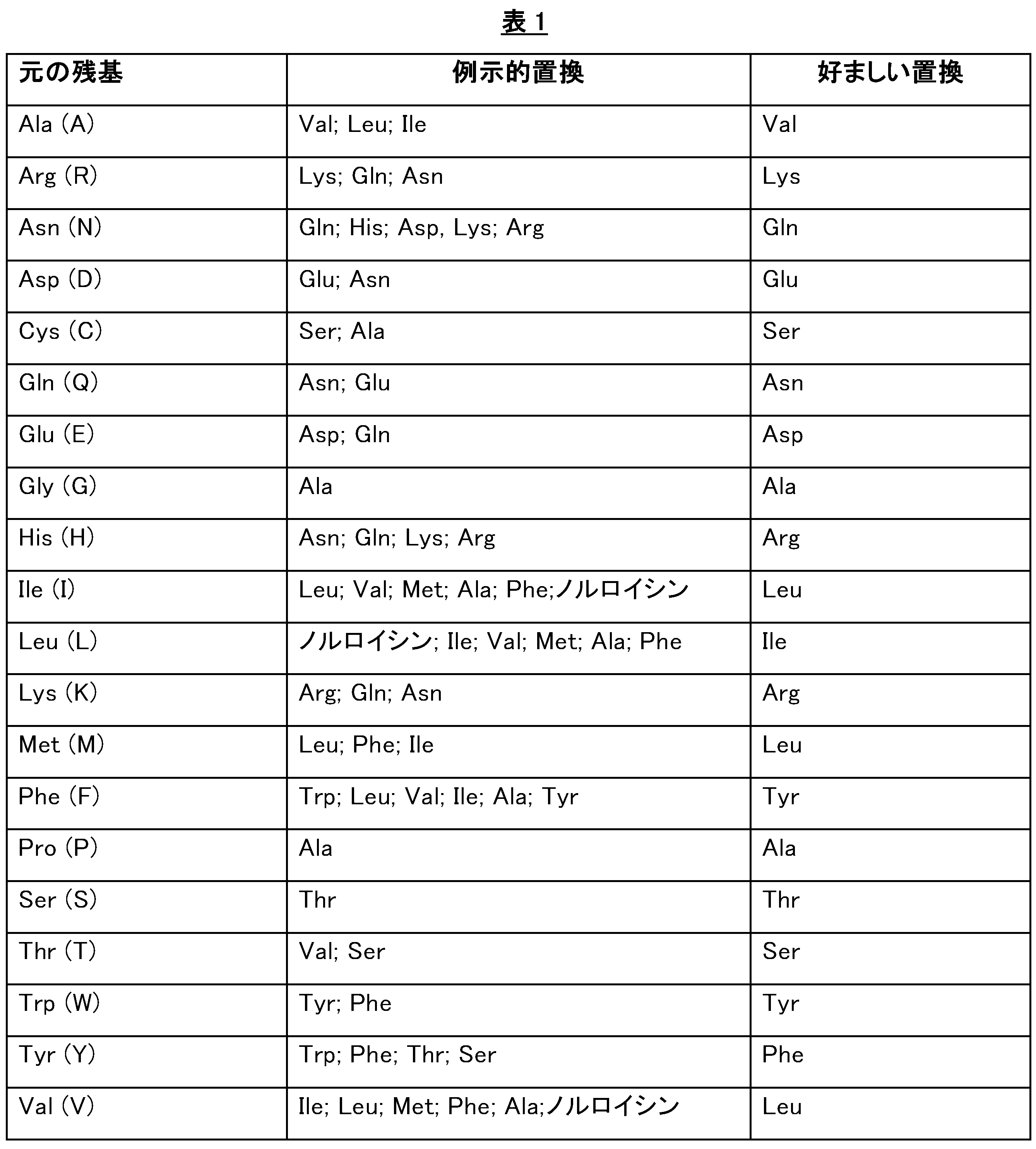
アミノ酸は、一般的な側鎖特性:
(1)疎水性:ノルロイシン、Met、Ala、Val、Leu、Ile;
(2)中性親水性:Cys、Ser、Thr、Asn、Gln;
(3)酸性:Asp、Glu;
(4)塩基性:His、Lys、Arg;
(5)鎖配向に影響を及ぼす残基:Gly、Pro;
(6)芳香族:Trp、Tyr、Phe
に従い群分けされうる。
Amino acids have common side chain properties:
(1) Hydrophobic: Norleucine, Met, Ala, Val, Leu, Ile;
(2) neutral hydrophilicity: Cys, Ser, Thr, Asn, Gln;
(3) acidic: Asp, Glu;
(4) basic: His, Lys, Arg;
(5) residues affecting chain orientation: Gly, Pro;
(6) Aromatics: Trp, Tyr, Phe
can be grouped according to
非保存的置換は、これらのクラスのうちの1つのメンバーを、別のクラスのメンバーと交換することを伴うであろう。 Non-conservative substitutions will entail exchanging a member of one of these classes for a member of another class.
置換変異体の1つの種類は、親抗体(例えば、ヒト化抗体またはヒト抗体)の1つまたは複数の超可変領域残基を置換することを伴う。一般に、結果としてもたらされ、さらなる研究のために選択される(1つまたは複数の)変異体は、ある特定の生物学的特性(例えば、親和性の増大、免疫原性の低減)の、親抗体と比べた改変(例えば、改善)を有し、かつ/または親抗体のある特定の生物学的特性も実質的に保持するであろう。例示的な置換変異体は、親和性成熟抗体であって、例えば、本明細書で記載される親和性成熟法など、ファージディスプレイベースの親和性成熟法を使用して簡便に作出されうる抗体である。略述すると、1つまたは複数のCDR残基を突然変異させ、変異体抗体をファージ上に提示し、特定の生物学的活性(例えば、結合親和性)についてスクリーニングする。 One type of substitutional variant involves substituting one or more hypervariable region residues of a parent antibody (eg, a humanized or human antibody). Generally, the variant(s) that result and are selected for further study have certain biological properties (e.g., increased affinity, reduced immunogenicity), It will have modifications (eg, improvements) relative to the parent antibody and/or will also substantially retain certain biological properties of the parent antibody. Exemplary substitutional variants are affinity matured antibodies, e.g., antibodies that can be conveniently generated using phage display-based affinity maturation methods, such as the affinity maturation methods described herein. be. Briefly, one or more CDR residues are mutated and the variant antibodies are displayed on phage and screened for a particular biological activity (eg, binding affinity).
変更(例えば、置換)は、例えば、抗体親和性を改善するように、CDR内でなされうる。このような変更は、CDRの「ホットスポット」、すなわち、体細胞の成熟過程において突然変異を高頻度で経るコドンによりコードされる残基(例えば、Chowdhury、Methods Mol.Biol.、207:179~196(2008)を参照されたい)、および/または抗原に接触する残基においてなされる場合があり、結果としてもたらされる変異体のVHまたはVLは、結合親和性について調べられる。二次ライブラリーからの構築および再選択による親和性成熟については、例えば、Hoogenboomら、「Methods in Molecular Biology」、178:1~37(O’Brienら編、Humana Press、Totowa、NJ、(2001))において記載されている。親和性成熟についての一部の態様では、様々な方法(例えば、エラープローンPCR、鎖シャフリング、またはオリゴヌクレオチド指定突然変異)のうちのいずれかにより、成熟について選び出された可変遺伝子に多様性が導入される。次いで、二次ライブラリーが創出される。次いで、所望の親和性を伴う任意の抗体の変異体を同定するように、ライブラリーがスクリーニングされる。多様性を導入する別の方法は、CDR指定法を伴うが、この場合、いくつかのCDR残基(例えば、一度に4~6残基)がランダム化される。抗原結合に関与するCDR残基は、例えば、アラニンスキャニング突然変異誘発またはモデル化を用いて、具体的に同定されうる。CDR-H3およびCDR-L3は、特に、ターゲティングされることが多い。 Alterations (eg, substitutions) can be made within the CDRs, eg, to improve antibody affinity. Such alterations are likely to result in CDR "hotspots", ie, residues encoded by codons that are frequently mutated during somatic cell maturation (see, eg, Chowdhury, Methods Mol. Biol., 207:179– 196 (2008)), and/or at antigen-contacting residues, and the resulting variant VH or VL is examined for binding affinity. For affinity maturation by construction and reselection from secondary libraries, see, for example, Hoogenboom et al., Methods in Molecular Biology, 178:1-37 (O'Brien et al., eds., Humana Press, Totowa, NJ, (2001). )). In some aspects of affinity maturation, diversity is introduced into the variable genes selected for maturation by any of a variety of methods (e.g., error-prone PCR, strand shuffling, or oligonucleotide-directed mutagenesis). is introduced. A secondary library is then created. The library is then screened to identify any antibody variants with the desired affinity. Another method of introducing diversity involves the CDR designation method, in which several CDR residues (eg, 4-6 residues at a time) are randomized. CDR residues involved in antigen binding can be specifically identified using, for example, alanine scanning mutagenesis or modeling. CDR-H3 and CDR-L3 in particular are often targeted.
ある特定の態様では、置換、挿入、または欠失は、このような変更が、抗原に結合する抗体の能力を実質的に低減しない限りにおいて、1つまたは複数のCDR内でなされうる。例えば、結合親和性を実質的に低減しない保存的変更(例えば、本明細書で提示される保存的置換)は、CDR内でなされうる。このような変更は、例えばCDR内の抗原接触残基の外部でありうる。上記で提示された、ある特定の変異体のVH配列およびVL配列では、各CDRは、変更されないか、または1つ、2つ、もしくは3つを超えないアミノ酸置換を含有する。 In certain aspects, substitutions, insertions, or deletions may be made within one or more CDRs, so long as such alterations do not substantially reduce the ability of the antibody to bind antigen. For example, conservative alterations (eg, conservative substitutions provided herein) that do not substantially reduce binding affinity can be made within a CDR. Such alterations can be external to the antigen-contacting residues, eg, within the CDRs. In certain variant VH and VL sequences presented above, each CDR is unaltered or contains no more than 1, 2, or 3 amino acid substitutions.
突然変異誘発のためにターゲティングされうる抗体の残基または領域を同定するために有用な方法は、CunninghamおよびWells(1989)、Science、244:1081~1085により記載されている通り、「アラニンスキャニング突然変異誘発」と呼ばれる。この方法では、抗体の抗原との相互作用が影響を受けるのかどうかを決定するように、残基または標的残基群(例えば、arg、asp、his、lys、およびgluなどの荷電残基)が同定され、中性アミノ酸または負に荷電したアミノ酸(例えば、アラニンまたはポリアラニン)で置きかえられる。さらなる置換は、初期の置換に対して機能的な感受性を顕示するアミノ酸位置に導入されうる。代替的に、または加えて、抗体と抗原との間の接触点を同定するのに、抗原-抗体複合体の結晶構造が使用されうる。このような接触残基および近傍残基は、置換のための候補残基としてターゲティングされる場合もあり、消失させされられる場合もある。変異体は、それらが所望の特性を含有するのかどうかを決定するようにスクリーニングされうる。 A useful method for identifying residues or regions of an antibody that can be targeted for mutagenesis is "alanine scanning mutagenesis," as described by Cunningham and Wells (1989) Science 244:1081-1085. called mutagenesis. In this method, a residue or group of target residues (e.g., charged residues such as arg, asp, his, lys, and glu) are used to determine whether the interaction of the antibody with the antigen is affected. Identified and replaced with neutral or negatively charged amino acids (eg, alanine or polyalanine). Further substitutions may be introduced at amino acid positions that display functional sensitivity to the initial substitutions. Alternatively, or additionally, a crystal structure of the antigen-antibody complex can be used to identify contact points between the antibody and antigen. Such contact and neighboring residues may be targeted as candidate residues for substitution or eliminated. Mutants can be screened to determine whether they contain the desired property.
アミノ酸配列の挿入は、アミノ末端および/またはカルボキシル末端における、長さが1残基~百またはこれを超える残基を含有するポリペプチドの範囲の融合のほか、配列内における単一または複数のアミノ酸残基の挿入も含む。末端における挿入の例は、N末端のメチオニル残基を伴う抗体を含む。抗体分子の他の挿入変異体は、酵素に対する抗体(例えば、ADEPT(antibody directed enzyme prodrug therapy)のための)のN末端もしくはC末端への融合体、または抗体の血清半減期を延長するポリペプチドのN末端もしくはC末端への融合体を含む。 Amino acid sequence insertions include fusions ranging from one residue in length to polypeptides containing a hundred or more residues at the amino and/or carboxyl terminus, as well as single or multiple amino acids within a sequence. It also includes residue insertions. Examples of terminal insertions include antibodies with an N-terminal methionyl residue. Other insertional variants of antibody molecules are fusions to the N-terminus or C-terminus of an antibody to an enzyme (e.g., for antibody directed enzyme prodrug therapy (ADEPT)), or polypeptides that extend the serum half-life of the antibody. including fusions to the N-terminus or C-terminus of
グリコシル化変異体
ある特定の態様では、本明細書で提示される抗体は、抗体がグリコシル化される程度を増大または低下させるように変更される。グリコシル化部位の、抗体への付加または欠失は、1つまたは複数のグリコシル化部位が、創出または除去されるように、アミノ酸配列を変更することにより、簡便に達せられうる。
Glycosylation Variants In certain aspects, the antibodies presented herein are altered to increase or decrease the degree to which the antibodies are glycosylated. Addition or deletion of glycosylation sites to the antibody may be conveniently accomplished by altering the amino acid sequence such that one or more glycosylation sites are created or removed.
抗体がFc領域を含む場合、抗体に接合しているオリゴ糖は、変更されうる。哺乳動物細胞により産生される天然抗体は、典型的に、一般に、Fc領域のCH2ドメインのAsn297に、N連結により接合している、分枝状の二分岐オリゴ糖を含む。例えば、Wrightら、TIBTECH、15:26~32(1997)を参照されたい。オリゴ糖は、多様な炭水化物、例えば、マンノース、N-アセチルグルコサミン(GlcNAc)、ガラクトース、およびシアル酸のほか、二分岐オリゴ糖構造の「ステム部」内のGlcNAcに接合しているフコースを含むことができる。一部の態様では、本発明の抗体内のオリゴ糖の修飾は、ある特定の特性が改善された抗体変異体を創出するためになされうる。 If the antibody contains an Fc region, the oligosaccharides attached to the antibody may be altered. Natural antibodies produced by mammalian cells typically contain branched, biantennary oligosaccharides that are generally N-linked to Asn297 of the CH2 domain of the Fc region. See, eg, Wright et al., TIBTECH, 15:26-32 (1997). Oligosaccharides include a variety of carbohydrates such as mannose, N-acetylglucosamine (GlcNAc), galactose, and sialic acid, as well as fucose attached to GlcNAc within the "stem" of the biantennary oligosaccharide structure. can be done. In some aspects, modifications of oligosaccharides within the antibodies of the invention may be made to create antibody variants with improved certain properties.
一態様では、非フコシル化オリゴ糖、すなわち、Fc領域に接合している(直接的に、または間接的に)フコースを欠くオリゴ糖構造を有する抗体変異体が提供される。このような非フコシル化オリゴ糖(また、「アフコシル化」オリゴ糖とも称される)は、特に、二分岐オリゴ糖構造のステム部における、第1のGlcNAcに接合しているフコース残基を欠く、N結合型オリゴ糖である。一態様では、Fc領域内の非フコシル化オリゴ糖の比率を、天然抗体または親抗体と比較して増大させた抗体変異体が提供される。例えば、非フコシル化オリゴ糖の比率は、少なくとも約20%、少なくとも約40%、少なくとも約60%、少なくとも約80%、なおまたは約100%(すなわち、フコシル化オリゴ糖が存在しない)でありうる。非フコシル化オリゴ糖の百分率は、例えば、WO2006/082515において記載されている通り、MALDI-TOF質量分析により測定される、Asn297に接合している全てのオリゴ糖(例えば、複合マンノース構造、ハイブリッドマンノース構造、および高マンノース構造)の合計と比べた、フコース残基を欠くオリゴ糖の(平均)量である。Asn297とは、Fc領域内の約297位(Fc領域の残基についてのEU番号付け)に位置するアスパラギン残基を指すが;Asn297はまた、抗体内の微細な配列差異に起因して、297位から、約±3アミノ酸上流または下流に、すなわち、294~300位の間に位置する場合もある。Fc領域内の非フコシル化オリゴ糖の比率を増大させた、このような抗体は、FcγRIIIa受容体への結合が改善される場合があり、かつ/またはエフェクター機能、特に、ADCC機能が改善される場合がある。例えば、US2003/0157108;US2004/0093621を参照されたい。 In one aspect, antibody variants are provided that have non-fucosylated oligosaccharides, ie, oligosaccharide structures that lack fucose attached (directly or indirectly) to the Fc region. Such non-fucosylated oligosaccharides (also referred to as "afucosylated" oligosaccharides) specifically lack the fucose residue conjugated to the first GlcNAc in the stem portion of the biantennary oligosaccharide structure. , which are N-linked oligosaccharides. In one aspect, antibody variants are provided that have an increased proportion of non-fucosylated oligosaccharides in the Fc region compared to the native or parent antibody. For example, the proportion of nonfucosylated oligosaccharides can be at least about 20%, at least about 40%, at least about 60%, at least about 80%, or even about 100% (i.e., no fucosylated oligosaccharides are present). . The percentage of non-fucosylated oligosaccharides is measured by MALDI-TOF mass spectrometry, eg as described in WO2006/082515, for all oligosaccharides conjugated to Asn297 (e.g. complex mannose structures, hybrid mannose structure, and the (average) amount of oligosaccharides lacking fucose residues compared to the sum of the structures and high mannose structures). Asn297 refers to the asparagine residue located at about position 297 (EU numbering for Fc region residues) within the Fc region; about ±3 amino acids upstream or downstream from the position, ie, between positions 294-300. Such antibodies with an increased proportion of non-fucosylated oligosaccharides in the Fc region may have improved binding to FcγRIIIa receptors and/or improved effector function, particularly ADCC function. Sometimes. See for example US2003/0157108; US2004/0093621.
フコシル化が低減された抗体を作製することが可能な細胞株の例は、タンパク質のフコシル化が欠損するLec13 CHO細胞(Ripkaら、Arch.Biochem.Biophys.、249:533~545(1986);US2003/0157108;およびとりわけ、実施例11における、WO2004/056312)、およびアルファ-1,6-フコシルトランスフェラーゼ遺伝子であるFUT8がノックアウトされたCHO細胞(例えば、Yamane-Ohnukiら、Biotech.Bioeng.、87:614~622(2004);Kanda,Y.ら、Biotechnol.Bioeng.、94(4):680~688(2006);およびWO2003/085107を参照されたい)などのノックアウト細胞株、またはGDP-フコース合成タンパク質またはGDP-フコース輸送体タンパク質の活性が低減されるか、または消失している細胞(例えば、US2004259150、US2005031613、US2004132140、US2004110282を参照されたい)を含む。 An example of a cell line capable of producing antibodies with reduced fucosylation is Lec13 CHO cells, which are deficient in protein fucosylation (Ripka et al., Arch. Biochem. Biophys., 249:533-545 (1986); US2003/0157108; and WO2004/056312, inter alia, in Example 11), and CHO cells in which the alpha-1,6-fucosyltransferase gene, FUT8, has been knocked out (e.g., Yamane-Ohnuki et al., Biotech. Bioeng., 87). Kanda, Y. et al., Biotechnol.Bioeng., 94(4):680-688 (2006); and WO2003/085107), or GDP-fucose. Cells in which synthetic protein or GDP-fucose transporter protein activity is reduced or eliminated (see, eg, US2004259150, US2005031613, US2004132140, US2004110282).
さらなる態様では、オリゴ糖が二分された抗体変異体であって、例えば、抗体のFc領域に接合している二分岐オリゴ糖が、GlcNAcにより二分された抗体変異体が提供される。このような抗体変異体は、上記で記載された通り、フコシル化が低減されている場合もあり、かつ/またはADCC機能が改善されている場合もある。このような抗体変異体の例については、例えば、Umanaら、Nat Biotechnol、17、176~180(1999);Ferraraら、Biotechn Bioeng、93、851~861(2006);WO99/54342、WO2004/065540、WO2003/011878において記載されている。 In a further aspect, an oligosaccharide bisected antibody variant is provided, for example, wherein the biantennary oligosaccharide attached to the Fc region of the antibody is bisected by GlcNAc. Such antibody variants may have reduced fucosylation and/or improved ADCC function, as described above. For examples of such antibody variants see, eg, Umana et al., Nat Biotechnol, 17, 176-180 (1999); Ferrara et al., Biotechn Bioeng, 93, 851-861 (2006); WO99/54342, WO2004/065540 , WO2003/011878.
オリゴ糖内の少なくとも1つのガラクトース残基が、Fc領域に接合している、抗体変異体もまた提供される。このような抗体変異体は、CDC機能が改善されている場合がある。このような抗体変異体については、例えば、WO1997/30087;WO1998/58964;およびWO1999/22764において記載されている。 Antibody variants are also provided in which at least one galactose residue within the oligosaccharide is attached to the Fc region. Such antibody variants may have improved CDC function. Such antibody variants are described, for example, in WO1997/30087; WO1998/58964; and WO1999/22764.
抗体は、グリコシル化の程度を低減するように修飾されることが好ましい場合がある。一部の実施形態では、抗体は、非グリコシル化される場合もあり、脱グリコシル化される場合もある。抗体は、N297における置換、例えば、N297D/Aを含むことができる。 It may be preferred that the antibody be modified to reduce the degree of glycosylation. In some embodiments, antibodies may be non-glycosylated or deglycosylated. Antibodies can include a substitution at N297, eg, N297D/A.
Fc領域変異体
ある特定の実施形態では、1つまたは複数のアミノ酸修飾が、本明細書で提示される抗体のFc領域に導入され、これにより、Fc領域変異体を作出する場合がある。Fc領域変異体は、1つまたは複数のアミノ酸位置におけるアミノ酸修飾(例えば、置換)を含む、ヒトFc領域配列(例えば、ヒトIgG1、ヒトIgG2、ヒトIgG3、またはヒトIgG4のFc領域)を含むことができる。
Fc Region Variants In certain embodiments, one or more amino acid modifications may be introduced into the Fc region of the antibodies presented herein, thereby creating Fc region variants. An Fc region variant comprises a human Fc region sequence (e.g., a human IgG1, human IgG2, human IgG3, or human IgG4 Fc region) comprising amino acid modifications (e.g., substitutions) at one or more amino acid positions can be done.
ある特定の実施形態では、本発明は、エフェクター機能が低減された抗体変異体、例えば、CDC、ADCC、および/またはFcγRへの結合が低減されるか、または消失している抗体変異体を想定する。ある特定の態様では、本発明は、エフェクター機能の一部を保有するが、全部は保有しない抗体変異体を想定し、これを、in vivoにおける抗体の半減期は、重要であるが、ある特定のエフェクター機能(補体依存性細胞傷害性(CDC)および抗体依存性細胞媒介性細胞傷害(ADCC)など)は、不要または有害である適用に所望の候補物質とする。 In certain embodiments, the invention contemplates antibody variants with reduced effector functions, e.g., antibody variants with reduced or abolished binding to CDC, ADCC, and/or FcγRs. do. In certain aspects, the invention contemplates antibody variants that retain some, but not all, of the effector functions, indicating that the half-life of the antibody in vivo is important, but that certain effector functions of , such as complement-dependent cytotoxicity (CDC) and antibody-dependent cell-mediated cytotoxicity (ADCC), make them desirable candidates for unwanted or harmful applications.
CDC活性および/またはADCC活性の低減/枯渇を確認するように、in vitroおよび/またはin vivo細胞傷害アッセイが行われうる。例えば、抗体が、FcγRへの結合を欠く(よって、ADCC活性を欠く可能性が高い)が、FcRnへの結合能を保持することを確認するように、Fc受容体(FcR)結合アッセイが行われうる。ADCCを媒介するための主要な細胞であるNK細胞が、FcγRIIIだけを発現するのに対し、単球は、FcγRI、FcγRII、およびFcγRIIIを発現する。造血細胞上のFcR発現については、RavetchおよびKinet、Annu.Rev.Immunol.、9:457~492(1991)の464頁の表3にまとめられている。目的の分子のADCC活性について評価するin vitroアッセイの非限定例については、米国特許第5,500,362号(例えば、Hellstrom,I.ら、Proc.Nat’l Acad.Sci.USA、83:7059~7063(1986)を参照されたい)およびHellstrom,Iら、Proc.Nat’l Acad.Sci.USA、82:1499~1502(1985);同第5,821,337号(Bruggemann,M.ら、J.Exp.Med.、166:1351~1361(1987)を参照されたい)において記載されている。代替的に、非放射性アッセイ法も援用されうる(例えば、フローサイトメトリーのためのACTI(商標)非放射性細胞傷害アッセイ(Cell Technology,Inc.、MountainView、CA;およびCytoTox 96(登録商標)非放射性細胞傷害アッセイ(Promega、Madison、WI)を参照されたい。アッセイに有用なエフェクター細胞は、末梢血単核細胞(PBMC)およびナチュラルキラー(NK)細胞を含む。代替的に、または加えて、目的の分子のADCC活性は、in vivoにおいて、例えば、Clynesら、Proc.Nat’l Acad.Sci.USA、95:652~656(1998)において開示されている動物モデルなどの動物モデルにおいて評価されうる。抗体が、C1qに結合することが不可能であり、よって、CDC活性を欠くことを確認するように、C1q結合アッセイもまた、実行されうる。例えば、WO2006/029879およびWO2005/100402における、C1q結合ELISAおよびC3c結合ELISAを参照されたい。補体活性化について評価するために、CDCアッセイが実施されうる(例えば、Gazzano-Santoroら、J.Immunol.Methods、202:163(1996);Cragg,M.S.ら、Blood、101:1045~1052(2003);ならびにCragg,M.S.およびM.J.Glennie、Blood、103:2738~2743(2004)を参照されたい)。当技術分野で公知の方法を使用して、FcRnへの結合およびin vivoにおけるクリアランス/半減期の決定もまた、実施されうる(例えば、Petkova,S.B.ら、Int’l.Immunol.、18(12):1759~1769(2006);WO2013/120929 A1を参照されたい)。
In vitro and/or in vivo cytotoxicity assays can be performed to confirm reduction/depletion of CDC and/or ADCC activity. For example, an Fc receptor (FcR) binding assay is performed to confirm that the antibody lacks binding to FcγRs (and thus likely lacks ADCC activity) but retains the ability to bind FcRn. can be broken NK cells, the primary cells for mediating ADCC, express only FcγRIII, whereas monocytes express FcγRI, FcγRII and FcγRIII. For FcR expression on hematopoietic cells, see Ravetch and Kinet, Annu. Rev. Immunol. , 9:457-492 (1991), page 464, Table 3. For non-limiting examples of in vitro assays to assess for ADCC activity of a molecule of interest, see, eg, Hellstrom, I. et al., Proc. Nat'l Acad. Sci. USA, 83: 7059-7063 (1986)) and Hellstrom, I et al., Proc. Nat'l Acad. Sci. USA, 82:1499-1502 (1985); there is Alternatively, non-radioactive assays can also be employed (e.g., the ACTI™ non-radioactive cytotoxicity assay for flow cytometry (Cell Technology, Inc., Mountain View, Calif.; and the
エフェクター機能が低減された抗体は、Fc領域の残基238、265、269、270、297、327、および329のうちの1つまたは複数の置換を伴う抗体(米国特許第6,737,056号)、例えば、P329Gを含む。このようなFc突然変異体は、アミノ酸位置265、269、270、297、および327のうちの、2つまたはこれを超える位置における置換を伴うFc突然変異体であって、残基265および297の、アラニンへの置換を伴う、いわゆる「DANA」Fc突然変異体を含むFc突然変異体(米国特許第7,332,581号)を含む。 Antibodies with reduced effector functions are antibodies with substitutions of one or more of residues 238, 265, 269, 270, 297, 327, and 329 of the Fc region (U.S. Pat. No. 6,737,056). ), including, for example, P329G. Such Fc mutants are Fc mutants with substitutions at two or more of amino acid positions 265, 269, 270, 297, and 327, wherein residues 265 and 297 , including so-called "DANA" Fc mutants with substitutions to alanine (US Pat. No. 7,332,581).
ある特定の態様では、抗体変異体は、FcγRへの結合を減弱させる、1つまたは複数のアミノ酸置換、例えば、Fc領域の234および235位(残基のEU番号付け)における置換を伴うFc領域を含む。一態様では、置換は、L234AおよびL235A(LALA)である。ある特定の態様では、抗体変異体は、ヒトIgG1のFc領域に由来する、Fc領域内のD265Aおよび/またはP329Gをさらに含む。一態様では、置換は、ヒトIgG1のFc領域に由来する、Fc領域内のL234A、L235A、およびP329G(LALA-PG)である(例えば、WO2012/130831を参照されたい)。別の態様では、置換は、ヒトIgG1のFc領域に由来する、Fc領域内のL234A、L235A、およびD265A(LALA-DA)である。 In certain aspects, the antibody variant has an Fc region with one or more amino acid substitutions that attenuate binding to FcγRs, e.g., substitutions at positions 234 and 235 (EU numbering of residues) of the Fc region including. In one aspect, the substitutions are L234A and L235A (LALA). In certain aspects, the antibody variant further comprises D265A and/or P329G within the Fc region derived from the Fc region of human IgG1. In one aspect, the substitutions are L234A, L235A, and P329G (LALA-PG) within the Fc region from the Fc region of human IgG1 (see, eg, WO2012/130831). In another aspect, the substitutions are L234A, L235A, and D265A (LALA-DA) within the Fc region from the Fc region of human IgG1.
他の実施形態では、IgG4またはIgG2など、エフェクター機能が低減されたIgG亜型を使用することが可能でありうる。 In other embodiments, it may be possible to use IgG subtypes with reduced effector function, such as IgG4 or IgG2.
FcRへの結合が改善されるか、または減弱している、ある特定の抗体変異体については、記載されている(例えば、米国特許第6,737,056号;WO2004/056312;およびShieldsら、J.Biol.Chem.、9(2):6591~6604(2001)を参照されたい)。 Certain antibody variants with improved or diminished binding to FcRs have been described (e.g., US Pat. No. 6,737,056; WO2004/056312; and Shields et al., J. Biol. Chem., 9(2):6591-6604 (2001)).
一部の実施形態では、例えば、米国特許第6,194,551号;WO99/51642;およびIdusogieら、J.Immunol.、164:4178~4184(2000)において記載されている、C1qへの結合および/または補体依存性細胞傷害(CDC)の変更(すなわち、改善または減弱、好ましくは、減弱)を結果としてもたらすFc領域内の変更が施される。 In some embodiments, for example, US Pat. No. 6,194,551; WO99/51642; and Idusogie et al., J. Am. Immunol. , 164:4178-4184 (2000) resulting in altered (i.e. improved or attenuated, preferably attenuated) binding to C1q and/or complement dependent cytotoxicity (CDC). Changes within the region are made.
ある特定の態様では、抗体変異体は、FcRnへの結合が低減する、1つまたは複数のアミノ酸置換、例えば、Fc領域の253および/または310および/または435位(残基のEU番号付け)における置換を伴うFc領域を含む。ある特定の態様では、抗体変異体は、253、310、および435位におけるアミノ酸置換を伴うFc領域を含む。一態様では、置換は、ヒトIgG1のFc領域に由来する、Fc領域内のI253A、H310AおよびH435Aである。例えば、Grevys,A.ら、J.Immunol.、194(2015)5497~5508を参照されたい。 In certain aspects, the antibody variant has one or more amino acid substitutions that reduce binding to FcRn, e.g., positions 253 and/or 310 and/or 435 (EU numbering of residues) of the Fc region. An Fc region with a substitution in In certain aspects, the antibody variant comprises an Fc region with amino acid substitutions at positions 253, 310 and 435. In one aspect, the substitutions are I253A, H310A and H435A within the Fc region from the Fc region of human IgG1. For example, Grevys, A.; et al. Immunol. , 194 (2015) 5497-5508.
ある特定の態様では、抗体変異体は、FcRnへの結合が低減する、1つまたは複数のアミノ酸置換、例えば、Fc領域の310および/または433および/または436位(残基のEU番号付け)における置換を伴うFc領域を含む。ある特定の態様では、抗体変異体は、310、433、および436位におけるアミノ酸置換を伴うFc領域を含む。一態様では、置換は、ヒトIgG1のFc領域に由来する、Fc領域内のH310A、H433AおよびY436Aである。(例えば、WO2014/177460 A1を参照されたい)。例えば、一部の実施形態では、通常のFcRnへの結合が使用されうる。 In certain aspects, the antibody variant has one or more amino acid substitutions that reduce binding to FcRn, e.g., positions 310 and/or 433 and/or 436 (EU numbering of residues) of the Fc region. An Fc region with a substitution in In certain aspects, the antibody variant comprises an Fc region with amino acid substitutions at positions 310, 433, and 436. In one aspect, the substitutions are H310A, H433A and Y436A within the Fc region from the Fc region of human IgG1. (See, eg, WO2014/177460 A1). For example, in some embodiments, conventional binding to FcRn may be used.
また、Fc領域変異体の他の例に関するDuncanおよびWinter、Nature、322:738~40(1988);米国特許第5,648,260号;米国特許第5,624,821号;およびWO94/29351も参照されたい。 See also Duncan and Winter, Nature, 322:738-40 (1988); US Patent No. 5,648,260; US Patent No. 5,624,821; See also
本明細書で報告される完全長抗体の重鎖C末端は、アミノ酸残基PGKを終端とする、完全C末端でありうる。重鎖のC末端は、C末端アミノ酸残基のうちの1つまたは2つが除去された、短縮C末端でありうる。重鎖のC末端は、PGを終端とする、短縮C末端でありうる。本明細書で報告される全ての態様のうちの一態様では、本明細書で指定される、C末端CH3ドメインを含む重鎖を含む抗体は、C末端のグリシン残基(G446;EUインデックスによるアミノ酸位置の番号付け)を含む。これは、本明細書で使用される「完全長抗体」または「完全長重鎖」という用語によっても、やはり、明示的に包摂されている。 The heavy chain C-terminus of the full-length antibodies reported herein can be a complete C-terminus, terminating with amino acid residues PGK. The C-terminus of the heavy chain can be a truncated C-terminus, with one or two of the C-terminal amino acid residues removed. The C-terminus of the heavy chain may be a truncated C-terminus terminating in PG. In one aspect of all the aspects reported herein, an antibody as specified herein comprising a heavy chain comprising a C-terminal CH3 domain comprises a C-terminal glycine residue (G446; amino acid position numbering). This is also expressly encompassed by the terms "full-length antibody" or "full-length heavy chain" as used herein.
抗体誘導体
ある特定の態様では、本明細書で提示される抗体は、当技術分野で公知であり、たやすく入手可能である、さらなる非タンパク質性部分を含有するようにさらに改変されうる。抗体の誘導に適する部分は、水溶性ポリマーを含むがこれらに限定されない。水溶性ポリマーの非限定例は、ポリエチレングリコール(PEG)、エチレングリコール/プロピレングリコールの共重合体、カルボキシメチルセルロース、デキストラン、ポリビニルアルコール、ポリビニルピロリドン、ポリ-1、3-ジオキソラン、ポリ-1,3,6-トリオキサン、エチレン/無水マレイン酸共重合体、ポリアミノ酸(ホモポリマーまたはランダム共重合体)、およびデキストランまたはポリ(n-ビニルピロリドン)ポリエチレングリコール、プロピレングリコールホモポリマー、酸化ポリプロピレン/エチレンオキシドコポリマー、ポリオキシエチル化ポリオール(例えば、グリセロール)、ポリビニルアルコール、ならびにこれらの混合物を含むがこれらに限定されない。ポリエチレングリコールプロピオンアルデヒドは、水中におけるその安定性のために、製造において、利点を有しうる。ポリマーは、任意の分子量のポリマーであることが可能であり、分枝状の場合もあり、非分枝状の場合もある。抗体に接合しているポリマーの数は、変動する場合があり、1つを超えるポリマーが接合している場合、同じ分子の場合もあり、異なる分子の場合もある。一般に、導出のために使用されるポリマーの数および/または種類は、改善される抗体の特定の特性または機能、抗体誘導体が、規定された条件下で、治療において使用されるのかどうかなどを含むがこれらに限定されない検討事項に基づき決定されうる。
Antibody Derivatives In certain aspects, the antibodies presented herein may be further modified to contain additional non-proteinaceous moieties that are known in the art and readily available. Moieties suitable for deriving antibodies include, but are not limited to, water-soluble polymers. Non-limiting examples of water-soluble polymers include polyethylene glycol (PEG), copolymers of ethylene glycol/propylene glycol, carboxymethylcellulose, dextran, polyvinyl alcohol, polyvinylpyrrolidone, poly-1,3-dioxolane, poly-1,3, 6-trioxane, ethylene/maleic anhydride copolymers, polyamino acids (homopolymers or random copolymers), and dextran or poly(n-vinylpyrrolidone) polyethylene glycol, propylene glycol homopolymers, polypropylene oxide/ethylene oxide copolymers, poly Including, but not limited to, oxyethylated polyols (eg, glycerol), polyvinyl alcohol, and mixtures thereof. Polyethylene glycol propionaldehyde may have advantages in manufacturing due to its stability in water. The polymer can be of any molecular weight and can be branched or unbranched. The number of polymers conjugated to the antibody may vary, and if more than one polymer is conjugated, it may be the same molecule or different molecules. Generally, the number and/or type of polymers used for derivation include the specific property or function of the antibody to be improved, whether the antibody derivative is used therapeutically under defined conditions, etc. may be determined based on considerations including, but not limited to:
J.組換え法および組換え組成物
抗体は、例えば、米国特許第4,816,567号において記載されている、組換え法および組換え組成物を使用して作製されうる。一実施形態では、本明細書で記載される抗体のセットをコードする単離核酸または単離核酸のセットが提供される。
J. Recombinant Methods and Compositions Antibodies can be made using recombinant methods and compositions, eg, as described in US Pat. No. 4,816,567. In one embodiment, an isolated nucleic acid or set of isolated nucleic acids encoding a set of antibodies described herein is provided.
例えば、核酸のセットは、第1の抗体をコードする以下の核酸:
i)第1の抗体の第1の重鎖をコードする核酸であって、前記第1の重鎖が、そのC末端を介して、放射標識化合物に対する抗原結合部位のVHドメインを含むポリペプチドに融合している、標的抗原に特異的に結合する完全長抗体の重鎖を含む、核酸;
ii)第1の抗体の第2の重鎖をコードする核酸であって、前記第2の重鎖が、標的抗原に特異的に結合する完全長抗体の重鎖を含み、放射標識化合物に対する抗原結合部位のVLドメインを含まない(任意選択で、第2の重鎖が、標的抗原に特異的に結合する完全長抗体の重鎖からなる)、核酸;
iii)第1の抗体の軽鎖をコードする核酸
を含むことができる。
For example, the set of nucleic acids includes the following nucleic acids encoding the first antibody:
i) a nucleic acid encoding the first heavy chain of the first antibody, said first heavy chain being linked via its C-terminus to a polypeptide comprising the VH domain of the antigen binding site for the radiolabeled compound a nucleic acid comprising, fused to it, a heavy chain of a full-length antibody that specifically binds to a target antigen;
ii) a nucleic acid encoding a second heavy chain of a first antibody, said second heavy chain comprising a heavy chain of a full-length antibody that specifically binds to a target antigen, the antigen against a radiolabeled compound; a nucleic acid that does not contain the VL domain of the binding site (optionally, the second heavy chain consists of the heavy chain of a full-length antibody that specifically binds to the target antigen);
iii) can include a nucleic acid encoding the light chain of the first antibody;
加えて、または代替的に、本発明に従う核酸のセットは、第2の抗体をコードする以下の核酸:
iv)第2の抗体の第1の重鎖をコードする核酸であって、前記第1の重鎖が、そのC末端を介して、放射標識化合物に対する抗原結合部位のVLドメインを含むポリペプチドに融合している、標的抗原に特異的に結合する完全長抗体の重鎖を含む、核酸;
v)第2の抗体の第2の重鎖をコードする核酸であって、前記第2の重鎖が、標的抗原に特異的に結合する完全長抗体の重鎖を含み、放射標識化合物に対する抗原結合部位のVHドメインを含まない(任意選択で、第2の重鎖が、標的抗原に特異的に結合する完全長抗体の重鎖からなる)、核酸;
vi)第2の抗体の軽鎖をコードする核酸
を含むことができる。
Additionally or alternatively, the set of nucleic acids according to the invention may comprise the following nucleic acids encoding the second antibody:
iv) a nucleic acid encoding the first heavy chain of the second antibody, said first heavy chain via its C-terminus to a polypeptide comprising the VL domain of the antigen binding site for the radiolabeled compound a nucleic acid comprising, fused to it, a heavy chain of a full-length antibody that specifically binds to a target antigen;
v) a nucleic acid encoding a second heavy chain of a second antibody, said second heavy chain comprising a heavy chain of a full-length antibody that specifically binds to a target antigen, the antigen to the radiolabeled compound; a nucleic acid that does not contain the VH domain of the binding site (optionally, the second heavy chain consists of the heavy chain of a full-length antibody that specifically binds to the target antigen);
vi) can include a nucleic acid encoding the light chain of the second antibody.
一部の実施形態では、これらの核酸のうちの、ある特定の核酸は、互いと同じでありうる。例えば、(iii)における核酸は、セットの全体が、5つの顕著に異なる核酸配列だけを含むように、(vi)における核酸と同じでありうる。 In some embodiments, certain of these nucleic acids can be the same as each other. For example, the nucleic acids in (iii) can be the same as the nucleic acids in (vi) such that the entire set contains only 5 significantly different nucleic acid sequences.
核酸は、1つまたは複数の核酸分子内または発現ベクター内に組み入れられうる。 A nucleic acid can be incorporated within one or more nucleic acid molecules or within an expression vector.
したがって、さらなる実施形態では、このような核酸(複数可)を含む1つまたは複数のベクター(例えば、発現ベクター)が提供される。一実施形態では、それぞれの重鎖および軽鎖の各々は、個々のプラスミドから発現される。 Accordingly, in further embodiments, one or more vectors (eg, expression vectors) comprising such nucleic acid(s) are provided. In one embodiment, each heavy and light chain is expressed from a separate plasmid.
さらなる実施形態では、このような核酸(複数可)またはベクター(複数可)を含む宿主細胞または宿主細胞のセットが提供される。一実施形態では、第1の抗体を発現する第1の宿主細胞が提供され、第2の抗体を発現する第2の宿主細胞が提供される。 In a further embodiment, a host cell or set of host cells comprising such nucleic acid(s) or vector(s) is provided. In one embodiment, a first host cell is provided expressing a first antibody and a second host cell is provided expressing a second antibody.
このような一実施形態では、第1の宿主細胞は、(1)上記の核酸(i)~(iii)を含むベクター、または(2)核酸(i)を含む第1のベクター、核酸(ii)を含む第2のベクター、および核酸(iii)を含む第3のベクター;または(3)上記の核酸(i)~(iii)を併せて含む2つのベクターを含む(例えば、これらにより形質転換されている)。第2の宿主細胞は、(1)上記の核酸(iv)~(vi)を含むベクター、または(2)核酸(iv)を含む第1のベクター、核酸(v)を含む第2のベクター、および核酸(vi)を含む第3のベクター;または(3)上記の核酸(iv)~(vi)を併せて含む2つのベクターを含む(例えば、これらにより形質転換されている)。 In one such embodiment, the first host cell comprises (1) a vector comprising nucleic acids (i)-(iii) above, or (2) a first vector comprising nucleic acid (i), nucleic acid (ii) ), and a third vector comprising nucleic acid (iii); or (3) two vectors comprising nucleic acids (i)-(iii) above together (e.g., transformed with is being used). The second host cell comprises (1) a vector comprising nucleic acids (iv) to (vi) above, or (2) a first vector comprising nucleic acid (iv), a second vector comprising nucleic acid (v), and a third vector comprising nucleic acid (vi); or (3) two vectors comprising (eg, transformed with) nucleic acids (iv)-(vi) above.
一実施形態では、宿主細胞は、真核細胞、例えば、チャイニーズハムスター卵巣(CHO)細胞またはリンパ球(例えば、Y0、NS0、Sp20細胞)である。一実施形態では、本発明に従う抗体を作製する方法であって、上記で提示された抗体をコードする核酸を含む宿主細胞を、抗体の発現に適する条件下で培養することと、任意選択で、抗体を、宿主細胞(または宿主細胞培地)から回収することとを含む方法が提供される。 In one embodiment, the host cell is a eukaryotic cell, such as a Chinese Hamster Ovary (CHO) cell or a lymphocyte (eg, Y0, NS0, Sp20 cells). In one embodiment, a method of making an antibody according to the invention, comprising culturing a host cell containing a nucleic acid encoding the antibody provided above under conditions suitable for expression of the antibody, and optionally recovering the antibody from the host cell (or host cell culture medium).
組換えによる抗体の作製のために、例えば、上記で記載された抗体をコードする核酸が単離され、宿主細胞内のさらなるクローニングおよび/または発現のために、1つまたは複数のベクターに挿入される。このような核酸は、従来の手順を使用して(例えば、抗体の重鎖および軽鎖をコードする遺伝子に特異的に結合することが可能なオリゴヌクレオチドプローブを使用することにより)、たやすく単離およびシーケンシングされうる。 For recombinant production of antibodies, for example, nucleic acids encoding the antibodies described above are isolated and inserted into one or more vectors for further cloning and/or expression in a host cell. be. Such nucleic acids are readily prepared using conventional procedures (eg, by using oligonucleotide probes capable of specifically binding to the genes encoding the heavy and light chains of the antibody). separated and sequenced.
抗体をコードするベクターのクローニングまたは発現に適する宿主細胞は、本明細書で記載される、原核細胞または真核細胞を含む。例えば、抗体は、特に、グリコシル化およびFcエフェクター機能が必要とされない場合、細菌内で作製されうる。細菌内の、抗体断片およびポリペプチドの発現については、例えば、US5,648,237、US5,789,199、およびUS5,840,523を参照されたい(また、大腸菌内の抗体断片の発現について記載する、Charlton,K.A.、「Methods in Molecular Biology」、248巻、Lo、B.K.C.(編)、Humana Press、Totowa、NJ(2003)、245~254頁も参照されたい)。発現の後、抗体は、可溶型画分中の細菌細胞ペーストから単離され、さらに精製されうる。 Suitable host cells for cloning or expression of antibody-encoding vectors include prokaryotic or eukaryotic cells as described herein. For example, antibodies may be produced in bacteria, particularly if glycosylation and Fc effector functions are not required. For expression of antibody fragments and polypeptides in bacteria see, for example, US Pat. No. 5,648,237, US Pat. (see also Charlton, KA, Methods in Molecular Biology, Vol. 248, Lo, B.K.C. (Ed.), Humana Press, Totowa, NJ (2003), pp. 245-254) . After expression, the antibody can be isolated from the bacterial cell paste in the soluble fraction and further purified.
原核生物に加えて、糸状菌または酵母などの真核微生物であって、グリコシル化経路が「ヒト化」された結果として、部分的であるか、または完全なヒトグリコシル化パターンを伴う抗体の作製をもたらす真菌株および酵母株を含む真核微生物も、抗体をコードするベクターに適する、クローニング宿主または発現宿主である。Gerngross,T.U.、Nat.Biotech.、22(2004)、1409~1414;およびLi,H.ら、Nat.Biotech.24(2006)、210~215を参照されたい。 Prokaryotes, as well as eukaryotic microbes such as filamentous fungi or yeast, in which the glycosylation pathway has been "humanized", resulting in the production of antibodies with a partially or fully human glycosylation pattern. Also suitable cloning or expression hosts for antibody-encoding vectors are eukaryotic microbes, including fungal and yeast strains that cause . Gerngross, T.; U.S.A. , Nat. Biotech. , 22 (2004), 1409-1414; and Li, H.; et al., Nat. Biotech. 24 (2006), 210-215.
(グリコシル化)抗体の発現に適する宿主細胞はまた、多細胞生物(無脊椎動物および脊椎動物)にも由来する。無脊椎動物細胞の例は、植物細胞および昆虫細胞を含む。特に、ヨトウガ(Spodoptera frugiperda)細胞のトランスフェクションのために、昆虫細胞と共に使用されうる、多数のバキュロウイルス株が同定されている。 Suitable host cells for the expression of (glycosylated) antibodies are also derived from multicellular organisms (invertebrates and vertebrates). Examples of invertebrate cells include plant cells and insect cells. A number of baculovirus strains have been identified that can be used with insect cells, particularly for transfection of Spodoptera frugiperda cells.
植物細胞培養物もまた、宿主として利用されうる。例えば、US5,959,177、US6,040,498、US6,420,548、US7,125,978、およびUS6,417,429(トランスジェニック植物内で抗体を作製するための、PLANTIBODIESTM技術について記載する)を参照されたい。 Plant cell cultures can also be used as hosts. For example, US Pat. No. 5,959,177, US Pat. No. 6,040,498, US Pat. ).
脊椎動物細胞もまた、宿主として使用されうる。例えば、懸濁液中で増殖するように適合している哺乳動物細胞株は、有用でありうる。有用な哺乳動物宿主細胞株の他の例は、SV40(COS-7)により形質転換された、サル腎臓CV1細胞株;ヒト胎児性腎臓細胞株(例えば、Graham,F.L.ら、J.Gen Virol.、36(1977)、59~74において記載されている、293細胞または293T細胞);ベビーハムスター腎臓細胞(BHK);マウスセルトリ細胞(例えば、Mather,J.P.、Biol.Reprod.、23(1980)、243~252において記載されている、TM4細胞);サル腎臓細胞(CV1);アフリカミドリザル腎臓細胞(VERO-76);ヒト子宮頸癌細胞(HELA);イヌ腎臓細胞(MDCK;バッファローラット肝臓細胞(BRL3A);ヒト肺細胞(W138);ヒト肝臓細胞(Hep G2);マウス乳房腫瘍(MMT 060562);TRI細胞(例えば、Mather,J.P.ら、Annals N.Y.Acad.Sci.、383(1982)、44~68において記載されている);MRC5細胞;およびFS4細胞である。他の有用な哺乳動物宿主細胞株は、DHFR-CHO細胞を含む、チャイニーズハムスター卵巣(CHO)細胞(Urlaub,G.ら、Proc.Natl.Acad.Sci.USA、77(1980)、4216~4220);およびY0、NS0、およびSp2/0などの骨髄腫細胞株を含む。抗体の作製に適する、ある特定の哺乳動物宿主細胞株の総説については、例えば、Yazaki,P.およびWu,A.M.、「Methods in Molecular Biology」、248巻、Lo,B.K.C.(編)、Humana Press、Totowa、NJ (2004)、255~268頁を参照されたい。 Vertebrate cells can also be used as hosts. For example, mammalian cell lines adapted to grow in suspension may be useful. Other examples of useful mammalian host cell lines are the monkey kidney CV1 cell line transformed with SV40 (COS-7); human embryonic kidney cell lines (eg, Graham, FL et al., J. Am. Gen Virol., 36 (1977), 59-74, 293 cells or 293T cells); baby hamster kidney cells (BHK); mouse Sertoli cells (eg, Mather, JP, Biol. Reprod. TM4 cells); monkey kidney cells (CV1); African green monkey kidney cells (VERO-76); human cervical carcinoma cells (HELA); human lung cells (W138); human liver cells (Hep G2); mouse mammary tumor (MMT 060562); Sci., 383 (1982), 44-68), MRC5 cells, and FS4 cells Other useful mammalian host cell lines include Chinese Hamster Ovary, including DHFR-CHO cells. (CHO) cells (Urlaub, G. et al., Proc. Natl. Acad. Sci. USA, 77 (1980), 4216-4220); For a review of certain mammalian host cell lines suitable for the production of , see, for example, Yazaki, P. and Wu, AM, "Methods in Molecular Biology" 248, Lo, BKC. (eds.), Humana Press, Totowa, NJ (2004), pp. 255-268.
一態様では、宿主細胞は、真核細胞、例えば、チャイニーズハムスター卵巣(CHO)細胞またはリンパ球(例えば、Y0、NS0、Sp20細胞)である。 In one aspect, the host cell is a eukaryotic cell, such as a Chinese Hamster Ovary (CHO) cell or a lymphocyte (eg, Y0, NS0, Sp20 cells).
K.アッセイ
本明細書で提示される抗体は、当技術分野で公知の多様なアッセイにより同定されうるか、それらの物理的/化学的特性、および/または生物活性についてスクリーニングされうるか、またはこれらについて特徴づけられうる。
K. Assays Antibodies presented herein can be identified, screened for their physical/chemical properties, and/or biological activity, or characterized by a variety of assays known in the art. sell.
一態様では、本発明の抗体は、例えば、ELISA、ウエスタンブロットなど、公知の方法により、その抗原結合活性について調べられる。 In one aspect, the antibodies of the present invention are tested for their antigen-binding activity by known methods such as ELISA, Western blot, and the like.
抗体の親和性
ある特定の実施形態では、本明細書で提示される抗体は、標的抗原に対する、≦1μM、≦100nM、≦10nM、≦1nM、≦0.1nM、≦0.01nMもしくは≦0.001nM(例えば、10-8M、またはこれ未満、例えば、10-8M~10-13M、例えば、10-9M~10-13M)、または本明細書の他の箇所で言明される通りの解離定数(KD)を有する。
Antibody Affinity In certain embodiments, the antibodies presented herein have an affinity of <1 μM, <100 nM, <10 nM, <1 nM, <0.1 nM, <0.01 nM or <0.01 nM for the target antigen. 001 nM (eg, 10 −8 M, or less, such as 10 −8 M to 10 −13 M, such as 10 −9 M to 10 −13 M), or as stated elsewhere herein It has a dissociation constant (KD) of
ある特定の実施形態では、放射標識化合物に対する抗原結合部位は、放射標識化合物に対する、≦1μM、≦100nM、≦10nM、≦1nM、≦0.1nM、≦0.01nMもしくは≦0.001nM(例えば、10-8M、またはこれ未満、例えば、10-8M~10-13M、例えば、10-9M~10-13M)の解離定数(KD)を有する。一部の実施形態では、Kdとは、1nMもしくはこれ未満、500pMもしくはこれ未満、200pMもしくはこれ未満、100pMもしくはこれ未満、50pMもしくはこれ未満、20pMもしくはこれ未満、10pMもしくはこれ未満、5pMもしくはこれ未満、または1pMもしくはこれ未満、または本明細書の他の箇所で言明される通りである。例えば、機能的結合部位は、放射標識化合物/金属キレートに、約1pM~1nM、例えば、約1~10pM、1~100pM、5~50pM、100~500pM、または500pM~1nMのKdで結合しうる。 In certain embodiments, the antigen binding site for the radiolabeled compound is ≤1 μM, ≤100 nM, ≤10 nM, ≤1 nM, ≤0.1 nM, ≤0.01 nM or ≤0.001 nM for the radiolabeled compound (e.g., It has a dissociation constant (KD) of 10 −8 M, or less, eg between 10 −8 M and 10 −13 M, such as between 10 −9 M and 10 −13 M). In some embodiments, Kd is 1 nM or less, 500 pM or less, 200 pM or less, 100 pM or less, 50 pM or less, 20 pM or less, 10 pM or less, 5 pM or less , or 1 pM or less, or as stated elsewhere herein. For example, a functional binding site may bind a radiolabeled compound/metal chelate with a Kd of about 1 pM to 1 nM, such as about 1-10 pM, 1-100 pM, 5-50 pM, 100-500 pM, or 500 pM-1 nM. .
一実施形態では、Kdは、放射標識抗原結合アッセイ(RIA)により測定される。一実施形態では、RIAは、目的の抗体のFab変化形およびその抗原により実施される。例えば、溶液中における、Fabの、抗原に対する結合親和性は、非標識抗原の滴定系列の存在下において、Fabを、最小濃度の(125I標識)抗原で平衡化し、次いで、抗Fab抗体でコーティングされたプレートで、結合している抗原を捕捉することにより測定される(例えば、Chenら、J.Mol.Biol.、293:865~881(1999)を参照されたい)。アッセイのための条件を確立するために、MICROTITER(登録商標)マルチウェルプレート(Thermo Scientific)を、50mMの炭酸ナトリウム(pH9.6)中に5μg/mlの捕捉用抗Fab抗体(Cappel Labs)で一晩にわたりコーティングするのに続き、PBS中に2%(w/v)のウシ血清アルブミンにより、室温(約23℃)で、2~5時間にわたりブロックする。非吸着型プレート(Nunc;型番269620)、100pMまたは26pMの[125I]-抗原を、目的のFabの段階希釈液と共に混合する(例えば、Prestaら、Cancer Res.、57:4593~4599(1997)における、抗VEGF抗体である、Fab-12の評価に準拠する)。次いで、目的のFabを、一晩にわたりインキュベートするが、インキュベーションをいっそう長時間(例えば、約65時間)にわたり持続して、平衡に達したことを確認することもできる。その後、混合物を、室温での(例えば、1時間にわたる)インキュベーションのための捕捉用プレートに移す。次いで、溶液を除去し、プレートを、PBS中に0.1%のポリソルベート20(TWEEN-20(登録商標))で8回にわたり洗浄する。プレートが乾燥したら、ウェル1つ当たり150μlの閃光物質(MICROSCINT-20(商標);Packard)を添加し、プレートを、TOPCOUNT(商標)ガンマカウンター(Packard)上で、10分間にわたりカウントする。最大の結合の20%以下を示す濃度の各Fabを、競合的結合アッセイにおける使用のために選び出す。 In one embodiment, Kd is measured by radiolabeled antigen binding assay (RIA). In one embodiment, the RIA is performed with a Fab variant of the antibody of interest and its antigen. For example, the binding affinity of Fabs for antigen in solution can be determined by equilibrating Fabs with a minimal concentration of ( 125 I-labeled) antigen in the presence of a titration series of unlabeled antigen and then coating with anti-Fab antibody. It is measured by capturing bound antigen on a plate that has been plated (see, eg, Chen et al., J. Mol. Biol., 293:865-881 (1999)). To establish conditions for the assay, MICROTITER® multiwell plates (Thermo Scientific) were treated with 5 μg/ml capture anti-Fab antibody (Cappel Labs) in 50 mM sodium carbonate, pH 9.6. Overnight coating is followed by blocking with 2% (w/v) bovine serum albumin in PBS at room temperature (approximately 23° C.) for 2-5 hours. Nonadsorbent plates (Nunc; Cat. No. 269620), 100 pM or 26 pM [ 125 I]-antigen are mixed with serial dilutions of the Fabs of interest (see, eg, Presta et al., Cancer Res., 57:4593-4599 (1997)). ), based on the evaluation of Fab-12, an anti-VEGF antibody, in ). The Fab of interest is then incubated overnight, although incubation may be continued for longer periods (eg, about 65 hours) to ensure that equilibrium has been reached. The mixture is then transferred to a capture plate for incubation (eg, for 1 hour) at room temperature. The solution is then removed and the plate washed 8 times with 0.1% polysorbate 20 (TWEEN-20®) in PBS. Once the plates are dry, 150 μl of scintillant (MICROSCINT-20™; Packard) is added per well and the plates are counted on a TOPCOUNT™ gamma counter (Packard) for 10 minutes. Concentrations of each Fab exhibiting 20% or less of maximal binding are selected for use in competitive binding assays.
別の実施形態に従い、Kdは、BIACORE(登録商標)表面プラズモン共鳴アッセイを使用して測定される。例えば、BIACORE(登録商標)-2000またはBIACORE(登録商標)-3000(BIAcore,Inc.、Piscataway、NJ)を使用するアッセイは、25℃で、約10反応単位(RU)の固定化抗原CM5チップにより実施される。一実施形態では、カルボキシメチル化デキストランバイオセンサーチップ(CM5;BIACORE,Inc)を、供給元の指示書に従い、N-エチル-N’-(3-ジメチルアミノプロピル)-カルボジイミド塩酸塩(EDC)およびN-ヒドロキシスクシンイミド(NHS)で活性化する。抗原を、10mMの酢酸ナトリウム、pH4.8で、5μg/ml(約0.2μM)に希釈してから、5μl/分の流量で注入して、約10反応単位(RU)のタンパク質のカップリングを達成する。抗原を注入した後、1Mのエタノールアミンを注入して、非反応基をブロックする。反応速度を測定するために、Fabの2倍段階希釈液(0.78nM~500nM)を、0.05%のポリソルベート20(Tween-20(商標))界面活性剤(PBST)と共に、25℃、約25μl/分の流量でPBS中に注入する。会合速度(kon)および解離速度(koff)は、単純一対一ラングミュア結合モデル(BIACORE(登録商標)Evaluation Software version 3.2)を使用して、会合センサーグラムと解離センサーグラムとを同時に当てはめることにより計算される。平衡解離定数(Kd)は、比koff/konとして計算される。例えば、Chenら、J.Mol.Biol.、293:865~881(1999)を参照されたい。上記の表面プラズモン共鳴アッセイによる会合速度が106M-1秒-1を超える場合、会合速度は、流動停止を備えた分光光度計(Aviv Instruments)または撹拌型キュベットを伴う8000シリーズのSLM-AMINCO(商標)分光光度計(ThermoSpectronic)などの分光計により測定される、漸増濃度の抗原の存在下における、PBS、pH7.2中に20nMの抗抗原抗体(Fab形態)の、25℃における蛍光放出強度(励起=295nm;放出=340nm、帯域通過を16nmとする)の増大または減少を測定する蛍光消光技術を用いることにより決定されうる。 According to another embodiment, the Kd is measured using the BIACORE® surface plasmon resonance assay. For example, assays using the BIACORE®-2000 or BIACORE®-3000 (BIAcore, Inc., Piscataway, NJ), at 25° C., approximately 10 response units (RU) of immobilized antigen on a CM5 chip. carried out by In one embodiment, a carboxymethylated dextran biosensor chip (CM5; BIACORE, Inc) is prepared according to the supplier's instructions with N-ethyl-N'-(3-dimethylaminopropyl)-carbodiimide hydrochloride (EDC) and Activate with N-hydroxysuccinimide (NHS). Antigen was diluted to 5 μg/ml (approximately 0.2 μM) in 10 mM sodium acetate, pH 4.8, and injected at a flow rate of 5 μl/min for coupling of approximately 10 response units (RU) of protein. achieve After injection of antigen, 1M ethanolamine is injected to block non-reactive groups. To measure kinetics, two-fold serial dilutions of Fabs (0.78 nM to 500 nM) were diluted with 0.05% polysorbate 20 (Tween-20™) detergent (PBST) at 25°C. Inject into PBS at a flow rate of approximately 25 μl/min. The association rate (k on ) and dissociation rate (k off ) are fitted to the association and dissociation sensorgrams simultaneously using a simple one-to-one Langmuir binding model (BIACORE® Evaluation Software version 3.2). It is calculated by The equilibrium dissociation constant (Kd) is calculated as the ratio k off /k on . For example, Chen et al. Mol. Biol. , 293:865-881 (1999). If the association rate by the surface plasmon resonance assay above exceeds 10 6 M −1 sec −1 , the association rate can be measured using a spectrophotometer (Aviv Instruments) equipped with a flow stop or an 8000 series SLM-AMINCO with a stirring cuvette. Fluorescence emission at 25° C. of 20 nM anti-antigen antibody (Fab form) in PBS, pH 7.2 in the presence of increasing concentrations of antigen as measured by a spectrometer such as the ThermoSpectronic™ It can be determined by using a fluorescence quenching technique that measures the increase or decrease in intensity (excitation = 295 nm; emission = 340 nm, bandpass at 16 nm).
別の実施形態では、SET(solution equilibration titration)アッセイを使用して、Kdを測定する。このアッセイに従い、典型的には、被験抗体を、定常濃度で適用し、被験抗原の段階希釈液と共に混合する。平衡を確立するインキュベーションの後、遊離抗体の一部を、抗原コーティング表面上で捕捉し、一般に、電気化学発光(例えば、Haenelら、Analytical Biochemistry、339(2005)、182~184において記載されている)を使用して、標識/タグ付け抗種抗体により検出する。 In another embodiment, the Kd is measured using a SET (solution equilibration titration) assay. According to this assay, the antibody to be tested is typically applied at a constant concentration and mixed with serial dilutions of the antigen to be tested. After incubation to establish equilibrium, a portion of the free antibody is captured on the antigen-coated surface, generally by electrochemiluminescence (e.g., as described in Haenel et al., Analytical Biochemistry, 339 (2005), 182-184). ) using labeled/tagged anti-species antibody.
例えば、一実施形態では、384ウェルストレプトアビジンプレート(Nunc、Microcoat;型番:11974998001)を、PBSバッファー中に20ng/mlの濃度で、ウェル1つ当たり25μlの抗原-ビオチン-異性体ミックスと共に、4℃で、一晩にわたりインキュベートする。抗体試料の、遊離抗原との平衡化のために、0.01nM~1nMの抗体を、2500nM、500nM、または100nMの濃度で始める、1:3、1:2、または1:1.7の段階希釈において、関与性の抗原により滴定する。試料を、シーリングされたREMP Storageポリプロピレン製マイクロプレート(Brooks)内、4℃で、一晩にわたりインキュベートする。一晩にわたるインキュベーションの後、ストレプトアビジンプレートを、ウェル1つ当たり90μlずつのPBSTで、3回にわたり洗浄する。各試料15μlずつを、平衡化プレートから、アッセイプレートに移し、RTで、15分間にわたりインキュベートするのに続き、PBSTバッファー90μlずつ3回にわたる洗浄工程にかける。25μlのヤギ抗ヒトIgG抗体-PODコンジュゲート(Jackson、109-036-088、OSEP中に1:4000)を添加することにより、検出を実行するのに続き、PBSTバッファー90μlずつ6回にわたる洗浄工程にかける。25μlのTMB基質(Roche Diagnostics GmbH;型番:11835033001)を、各ウェルに添加する。測定は、Safire 2リーダー(Tecan)上、370/492nmで行う。
For example, in one embodiment, a 384-well streptavidin plate (Nunc, Microcoat; model number: 11974998001) was prepared at a concentration of 20 ng/ml in PBS buffer with 25 μl per well of the antigen-biotin-isomer mix. °C overnight. For equilibration of the antibody sample with free antigen, 1:3, 1:2, or 1:1.7 steps starting with 0.01 nM to 1 nM antibody at concentrations of 2500 nM, 500 nM, or 100 nM At dilution, titrate with antigen of interest. Samples are incubated overnight at 4° C. in sealed REMP Storage polypropylene microplates (Brooks). After overnight incubation, the streptavidin plates are washed 3 times with 90 μl/well PBST. 15 μl of each sample is transferred from the equilibration plate to the assay plate and incubated at RT for 15 minutes, followed by 3 washing steps of 90 μl of PBST buffer. Detection was performed by adding 25 μl of goat anti-human IgG antibody-POD conjugate (Jackson, 109-036-088, 1:4000 in OSEP), followed by 6 washing steps of 90 μl each of PBST buffer. put it on 25 μl of TMB substrate (Roche Diagnostics GmbH; model number: 11835033001) is added to each well. Measurements are made at 370/492 nm on a
別の実施形態では、KinExA(kinetic exclusion)アッセイを使用して、Kdを測定する。このアッセイに従い、典型的に、抗原を、一定濃度の抗体結合部位に滴定し、試料を平衡化させ、次いで、フローセルを介して、速やかに取り出し、遊離抗体結合部位を、抗原コーティングビーズ上で捕捉する一方で、抗原飽和抗体複合体を、洗い流す。次いで、ビーズ捕捉抗体を、標識抗種抗体、例えば、蛍光標識により検出する(Beeら、PloS One、2012、7(4):e36261)。例えば、一実施形態では、KinExA実験は、PBS pH7.4を、ランニングバッファーとして使用して、室温(RT)で実施される。試料は、1mg/mlのBSAを補充したランニングバッファー(「試料バッファー」)中で調製する。0.25ml/分の流量を使用する。結合部位濃度を5pMとする、一定量の抗体を、100pM(濃度範囲:0.049pM~100pM)で始める、2倍の段階希釈を介する抗原により滴定する。抗原を伴わない、1例の抗体試料は、100%のシグナル(すなわち、阻害を伴わないシグナル)として用いられる。抗原-抗体複合体を、RTで、少なくとも24時間にわたりインキュベートして、平衡に達することを可能とする。次いで、KinExAシステム内、溶液の平衡状態を撹乱せずに、非結合抗体が、ビーズにより捕捉されることを可能とする、5mlの容量で、抗原カップリングビーズのカラムを介して、平衡化混合物を取り出す。捕捉された抗体は、試料バッファー中に250ng/mlのDylight 650(著作権)コンジュゲート抗ヒトFc断片特異的二次抗体を使用して検出する。各試料は、全ての平衡実験について、二連で測定する。KDは、「標準的解析」法を使用する、KinExAソフトウェア(Version 4.0.11)内に含有される、1部位均一結合モデルを使用して、データの非線形回帰分析から得られる。 In another embodiment, the Kd is measured using a KinExA (kinetic exclusion) assay. According to this assay, antigen is typically titrated to a constant concentration of antibody binding sites, the sample is allowed to equilibrate, then rapidly removed through a flow cell, and free antibody binding sites are captured on antigen-coated beads. Meanwhile, antigen-saturated antibody complexes are washed away. The bead capture antibody is then detected with a labeled anti-species antibody, such as a fluorescent label (Bee et al., PloS One, 2012, 7(4):e36261). For example, in one embodiment, KinExA experiments are performed at room temperature (RT) using PBS pH 7.4 as running buffer. Samples are prepared in running buffer (“sample buffer”) supplemented with 1 mg/ml BSA. A flow rate of 0.25 ml/min is used. A fixed amount of antibody, with a binding site concentration of 5 pM, is titrated with antigen through two-fold serial dilutions starting at 100 pM (concentration range: 0.049 pM to 100 pM). One antibody sample without antigen is used as 100% signal (ie signal without inhibition). Antigen-antibody complexes are incubated at RT for at least 24 hours to allow them to reach equilibrium. The equilibrated mixture is then passed through a column of antigen-coupled beads in a volume of 5 ml, allowing unbound antibody to be captured by the beads without disturbing the equilibration of the solution in the KinExA system. take out. Captured antibodies are detected using a Dylight 650 (copyright) conjugated anti-human Fc fragment specific secondary antibody at 250 ng/ml in sample buffer. Each sample is measured in duplicate for all equilibrium experiments. KDs are obtained from non-linear regression analysis of the data using the one-site uniform binding model contained within the KinExA software (Version 4.0.11) using the "standard analysis" method.
L.治療法および治療用組成物
本明細書で記載される抗体のセットは、治療法において使用されうる。一態様では、医薬としての使用のための、本明細書で記載される抗体のセットが提供される。ある特定の態様では、処置法における使用のための抗体のセットが提供される。
L. Therapeutic Methods and Therapeutic Compositions The antibody sets described herein can be used in therapeutic methods. In one aspect there is provided a set of antibodies described herein for use as a medicament. In certain aspects, a set of antibodies for use in a method of treatment is provided.
上記で論じられた通り、一部の態様では、本発明に従う抗体のセットは、放射性核種を、対象における標的細胞に送達することが所望される、任意の処置に適する。例えば、例えば、がん処置のためのプレターゲティング放射免疫療法における使用のための、本明細書で記載される抗体のセットが提供される。 As discussed above, in some aspects, sets of antibodies according to the present invention are suitable for any treatment in which it is desired to deliver radionuclides to target cells in a subject. For example, there is provided a set of antibodies as described herein for use in pretargeting radioimmunotherapy, eg, for cancer treatment.
ある特定の態様では、本発明は、個体におけるプレターゲティング放射免疫療法であって、個体に有効量の抗体のセットを投与することを含むプレターゲティング放射免疫療法における使用のための抗体のセットを提供する。上記の態様のうちのいずれかに従う「個体」は、好ましくは、ヒトである。 In certain aspects, the invention provides a set of antibodies for use in pretargeting radioimmunotherapy in an individual comprising administering to the individual an effective amount of the set of antibodies. do. An "individual" according to any of the above aspects is preferably a human.
上記で言及された通り、処置は、患者の罹患細胞にターゲティングされた細胞傷害活性により処置可能な任意の状態の処置でありうる。処置は、好ましくは、腫瘍またはがんの処置である。しかし、本発明の適用可能性は、腫瘍およびがんに限定されない。例えば、処置はまた、ウイルス感染、または別の病原性生物体、例えば、原核生物の感染の処置でもありうる。任意選択で、ターゲティングはまた、T細胞駆動性自己免疫疾患またはT細胞性血液がんの処置のためのT細胞のターゲティングでもありうる。したがって、処置される状態は、HIV、狂犬病、EBVおよびカポジ肉腫関連ヘルペスウイルスなどのウイルス感染、ならびに多発性硬化症および移植片対宿主病などの自己免疫疾患を含むことができる。 As mentioned above, the treatment can be treatment of any condition treatable by targeted cytotoxic activity to the patient's diseased cells. Treatment is preferably treatment of a tumor or cancer. However, the applicability of the present invention is not limited to tumors and cancers. For example, treatment can also be treatment of viral infections, or infections of another pathogenic organism, eg, prokaryotes. Optionally, targeting can also be targeting T cells for the treatment of T cell driven autoimmune diseases or T cell hematological cancers. Thus, conditions to be treated can include HIV, rabies, viral infections such as EBV and Kaposi's sarcoma-associated herpes virus, and autoimmune diseases such as multiple sclerosis and graft-versus-host disease.
本明細書で使用される「がん」という用語は、下記のがんのうちのいずれかの難治性型、上記のがんのうちのいずれかの、チェックポイント阻害剤経過形、または下記のがんのうちの1つまたは複数の組合せを含む、リンパ腫、リンパ性白血病、肺がん、非小細胞肺(NSCL)がん、細気管支肺胞上皮細胞肺がん、骨がん、膵管腺癌(PDAC)を含む膵臓がん、皮膚がん、頭部がんまたは頸部がん、皮膚黒色腫または眼内黒色腫、子宮がん、卵巣がん、肛門領域がん、胃(stomach、gastric)がん、結腸がんおよび/または直腸がんでありうる結腸直腸がん、乳がん、子宮がん、ファローピウス管癌、子宮内膜癌、子宮頸癌、膣癌、外陰癌、ホジキン病、食道がん、小腸がん、内分泌系がん、甲状腺がん、副甲状腺がん、副腎がん、軟組織肉腫、尿道がん、陰茎がん、前立腺がん、膀胱がん、腎臓がんまたは尿管がん、腎細胞癌、腎盂癌、中皮腫、肝細胞がん、胆管がん、中枢神経系(CNS)新生物、脊髄軸腫瘍、脳幹神経膠腫、多形神経膠芽腫、星状細胞腫、シュワン細胞腫、上衣腫、髄芽腫、髄膜腫、扁平上皮癌、下垂体腺腫、およびユーイング肉腫など、固形がんおよび血液がんの両方を含む。 As used herein, the term "cancer" refers to a refractory form of any of the cancers described below, a checkpoint inhibitor progress form of any of the cancers described above, or a Lymphoma, lymphocytic leukemia, lung cancer, non-small cell lung (NSCL) cancer, bronchioloalveolar cell lung cancer, bone cancer, pancreatic ductal adenocarcinoma (PDAC), including a combination of one or more of the cancers including pancreatic cancer, skin cancer, head or neck cancer, cutaneous or intraocular melanoma, uterine cancer, ovarian cancer, anal region cancer, stomach, gastric cancer , colorectal cancer, which can be colon and/or rectal cancer, breast cancer, uterine cancer, fallopian tube cancer, endometrial cancer, cervical cancer, vaginal cancer, vulvar cancer, Hodgkin's disease, esophageal cancer, Small bowel cancer, endocrine cancer, thyroid cancer, parathyroid cancer, adrenal cancer, soft tissue sarcoma, urethral cancer, penile cancer, prostate cancer, bladder cancer, kidney cancer or ureter cancer, renal cell carcinoma, renal pelvic carcinoma, mesothelioma, hepatocellular carcinoma, cholangiocarcinoma, central nervous system (CNS) neoplasm, spinal axis tumor, brain stem glioma, glioblastoma multiforme, astrocytoma, Includes both solid and hematological cancers, such as schwannoma, ependymoma, medulloblastoma, meningioma, squamous cell carcinoma, pituitary adenoma, and Ewing's sarcoma.
治療のために、放射性同位体を、細胞、組織、または臓器にターゲティングする方法は、
i)対象に、本明細書で記載される、第1の抗体および第2の抗体を投与すること(いずれかの順序で、同時に、または逐次的に)であり、抗体が、標的抗原に結合し、標的抗原を発現する細胞の表面に局在化し;第1の抗体と、第2の抗体との会合が、放射標識化合物に対する機能的結合部位を形成する、本明細書で記載される、第1の抗体および第2の抗体を投与すること(いずれかの順序で、同時に、または逐次的に);
ならびに
ii)続いて、放射標識化合物に対する機能的結合部位に結合する放射標識化合物を投与すること
を含むことができる。
A method of targeting a radioisotope to a cell, tissue, or organ for treatment comprises:
i) administering to a subject a first antibody and a second antibody described herein (in either order, simultaneously or sequentially), wherein the antibodies bind to the target antigen; and localize to the surface of cells expressing the target antigen; association of the first antibody with the second antibody forms a functional binding site for the radiolabeled compound, as described herein; administering the first antibody and the second antibody (in either order, simultaneously or sequentially);
and ii) subsequently administering a radiolabeled compound that binds to a functional binding site for the radiolabeled compound.
放射標識化合物は、細胞に対して細胞傷害性である、放射性同位体で標識される。適切な放射性同位体は、上記で論じられた、アルファ放射体およびベータ放射体を含む。 A radiolabeled compound is labeled with a radioactive isotope that is cytotoxic to cells. Suitable radioisotopes include the alpha-emitters and beta-emitters discussed above.
二重特異性抗体(すなわち、本発明に従う「スプリット」抗体ではない抗体)を使用するプレターゲティング放射免疫療法では、抗体の投与と、放射標識化合物の投与との間に、除去剤またはブロッキング剤を投与することが、一般的慣行である。除去剤は、抗体に結合し、それらの体内からのクリアランスの速度を増強する。除去剤は、抗イディオタイプ抗体を含む。ブロッキング剤とは、典型的に、放射標識化合物に対する抗原結合部位に結合するが、それら自体が放射標識ではない薬剤である。例えば、放射標識化合物が、ある特定の化学元素(例えば、金属)の放射性同位体をロードされたキレート剤を含む場合、ブロッキング剤は、それが、抗原結合部位により、なおも結合しうることを条件として、同じ元素(例えば、金属)の非放射性同位体をロードされた、同じキレート剤を含むことができ、非ロードキレート剤、または異なる非放射性部分(例えば、異なる元素の非放射性同位体)をロードされたキレート剤を含むことができる。一部の場合に、ブロッキング剤は、加えて、分子のサイズおよび/または流体力学半径を増大させる部分を含むことができる。これらは、分子が、循環中の抗体に結合する能力に干渉せずに、分子が、腫瘍に接近する能力を妨げる。例示的部分は、親水性ポリマーを含む。部分は、例えば、デキストラン、デキストリン、PEG、ポリシアル酸(PSA)、ヒアルロン酸、ヒドロキシエチルデンプン(HES)、またはポリ(2-エチル2-オキサゾリン)(PEOZ)のポリマーまたはコポリマーでありうる。他の実施形態では、部分は、XTENポリペプチド(非構造化親水性タンパク質ポリマー)、ホモ-アミノ酸ポリマー(HAP)、プロリン-アラニン-セリンポリマー(PAS)、エラスチン様ペプチド(ELP)、またはゼラチン様タンパク質(GLK)などの非構造化ペプチドまたは非構造化タンパク質でありうる。さらなる例示的部分は、アルブミン、例えば、ウシ血清アルブミンまたはIgGなどのタンパク質を含む。部分/ポリマーに適する分子量は、例えば、少なくとも50kDa、例えば、50kDa~2000kDaの間の範囲でありうる。例えば、分子量は、200~800kDa、任意選択で、300、350、400、または450kDaを超え、任意選択で、700、650、600、または550kDa未満、任意選択で、約500kDaでありうる。 Pretargeting radioimmunotherapy using bispecific antibodies (i.e., antibodies that are not "split" antibodies according to the present invention) include a clearing or blocking agent between administration of the antibody and administration of the radiolabeled compound. Dosing is common practice. Clearing agents bind to antibodies and enhance the rate of their clearance from the body. Clearing agents include anti-idiotypic antibodies. Blocking agents are typically agents that bind to the antigen binding site for radiolabeled compounds, but are not themselves radiolabels. For example, if a radiolabeled compound comprises a chelating agent loaded with a radioisotope of a particular chemical element (e.g., a metal), the blocking agent indicates that it can still bind through the antigen binding site. Conditions may include the same chelating agent loaded with a non-radioactive isotope of the same element (e.g. metal), an unloaded chelating agent, or a different non-radioactive moiety (e.g. non-radioactive isotope of a different element). can include a chelating agent loaded with In some cases, blocking agents can additionally include moieties that increase the size and/or hydrodynamic radius of the molecule. These impede the ability of molecules to access tumors without interfering with their ability to bind circulating antibodies. Exemplary moieties include hydrophilic polymers. A moiety can be, for example, a polymer or copolymer of dextran, dextrin, PEG, polysialic acid (PSA), hyaluronic acid, hydroxyethyl starch (HES), or poly(2-ethyl 2-oxazoline) (PEOZ). In other embodiments, the moiety is an XTEN polypeptide (unstructured hydrophilic protein polymer), homo-amino acid polymer (HAP), proline-alanine-serine polymer (PAS), elastin-like peptide (ELP), or gelatin-like It can be an unstructured peptide or an unstructured protein, such as a protein (GLK). Further exemplary moieties include proteins such as albumin, eg bovine serum albumin or IgG. Suitable molecular weights for the moieties/polymers may range, for example, from at least 50 kDa, such as between 50 kDa and 2000 kDa. For example, the molecular weight can be 200-800 kDa, optionally greater than 300, 350, 400, or 450 kDa, optionally less than 700, 650, 600, or 550 kDa, optionally about 500 kDa.
本発明のある特定の態様に従い、除去剤またはブロッキング剤を、対象に投与する工程は存在しない。ある特定の態様では、抗体の投与と、放射標識化合物の投与との間に、第1の抗体または第2の抗体に結合する、任意の薬剤を投与する工程は存在しない。ある特定の態様では、任意選択で、化学療法剤、免疫療法剤、および放射性増感剤から選択される化合物を除き、抗体の投与と、放射標識化合物の投与との間に、任意の薬剤を投与する工程は存在しない。一部の実施形態では、抗体の投与と、放射標識化合物の投与との間で、薬剤が投与されない。一部の実施形態では、抗体の投与と、放射標識化合物の投与との間に、他の任意の薬剤の、対象への注射または点滴は存在しない場合がある。 According to certain aspects of the invention, there is no step of administering a clearing or blocking agent to the subject. In certain aspects, there is no step of administering any agent that binds to the first antibody or the second antibody between the administration of the antibody and the administration of the radiolabeled compound. In certain embodiments, any agent is optionally administered between administration of the antibody and administration of the radiolabeled compound, except compounds selected from chemotherapeutic agents, immunotherapeutic agents, and radiosensitizers. There is no administering step. In some embodiments, no drug is administered between administration of the antibody and administration of the radiolabeled compound. In some embodiments, there may be no injection or infusion of any other agent into the subject between administration of the antibody and administration of the radiolabeled compound.
一部の実施形態では、方法は、i)抗体のセットを投与する工程(この場合、第1の抗体および第2の抗体は、同時に投与される場合もあり、いずれかの順序で、逐次的に投与される場合もある)と、ii)続いて、放射標識化合物を投与する工程とからなるか、またはこれらから本質的になる、2工程プレターゲティング放射免疫療法でありうる。処置は、このような治療の複数のサイクル、すなわち、これらの2つの工程の複数のサイクルを伴いうる。例示的処置サイクルの持続期間は、抗体のセットが、サイクルの1日目に投与され、放射標識化合物が、任意選択で、サイクルの1、2、3、4、5、6、7、または8日目に、例えば、7日目に投与される、28日間である。治療サイクルの数は、変動しうる。一実施形態では、4、5、または6つの処置サイクルが施されうる。
In some embodiments, the method comprises i) administering a set of antibodies (wherein the first antibody and the second antibody may be administered simultaneously, in any order, sequentially and ii) subsequently administering a radiolabeled compound. Treatment may involve multiple cycles of such therapy, ie multiple cycles of these two steps. The duration of an exemplary treatment cycle is that the antibody set is administered on
驚くべきことに、本発明者らは、本発明に従う抗体を使用して、正常組織中の過剰な放射能の蓄積を回避しながら、治療的に有効な放射標識化合物の、腫瘍への取込みを得ることが可能であることを決定した。実際、実施例において、非標的組織中の放射能の蓄積レベルは、二重特異性抗体および除去工程を使用し、また、より簡単な手順の使用ももたらす、3工程PRIT法の場合よりも低いことが見出された。 Surprisingly, the inventors have used antibodies according to the present invention to increase the uptake of therapeutically effective radiolabeled compounds into tumors while avoiding excessive accumulation of radioactivity in normal tissues. determined that it is possible to obtain Indeed, in the examples, the level of accumulation of radioactivity in non-target tissues is lower than with the 3-step PRIT method, which uses bispecific antibodies and a clearing step, also resulting in the use of a simpler procedure. It was found that
一部の実施形態では、放射標識化合物は、第1の抗体および第2の抗体が、標的細胞に局在化するのに適する時間を与えられたら、対象に投与されうる。例えば、一部の実施形態では、放射標識化合物は、第1の抗体および第2の抗体の直後に、対象に投与される場合もあり、第1の抗体および第2の抗体の、少なくとも4時間、8時間、1日間、または2日間後に、対象に投与される場合もある。任意選択で、放射標識化合物は、第1の抗体および第2の抗体の後、3日間、5日間、または7日間を超えずに投与されうる。1つの特定の実施形態では、放射標識化合物は、第1の抗体および第2の抗体の2~7日後に、対象に投与されうる。 In some embodiments, the radiolabeled compound can be administered to the subject once the first and second antibodies have been given adequate time to localize to the target cells. For example, in some embodiments, the radiolabeled compound may be administered to the subject immediately after the first antibody and the second antibody, and at least 4 hours after the first antibody and the second antibody. , 8 hours, 1 day, or 2 days later. Optionally, the radiolabeled compound can be administered no more than 3 days, 5 days, or 7 days after the first antibody and the second antibody. In one specific embodiment, the radiolabeled compound can be administered to the subject 2-7 days after the first antibody and the second antibody.
一部の実施形態では、本明細書で記載される抗体は、併用療法の一部として投与されうる。例えば、本明細書で記載される抗体は、1つまたは複数の化学療法剤と組み合わせて投与される場合がある:化学療法剤と、抗体とは、いずれかの順序で、同時に、または逐次的に投与されうる。加えて、または代替的に、本明細書で記載される抗体は、1つまたは複数の免疫療法剤と組み合わせて投与される場合がある:免疫療法剤と、抗体とは、いずれかの順序で、同時に、または逐次的に投与されうる。 In some embodiments, the antibodies described herein can be administered as part of a combination therapy. For example, the antibodies described herein may be administered in combination with one or more chemotherapeutic agents: chemotherapeutic agent and antibody in any order, simultaneously or sequentially can be administered to Additionally or alternatively, the antibodies described herein may be administered in combination with one or more immunotherapeutic agents: immunotherapeutic agents and antibodies in any order , may be administered simultaneously or sequentially.
一部の実施形態では、加えて、または代替的に、本明細書で記載される抗体は、放射性増感剤と組み合わせて投与されうる。放射性増感剤と、抗体とは、いずれかの順序で、同時に、または逐次的に投与されうる。 In some embodiments, additionally or alternatively, the antibodies described herein can be administered in combination with a radiosensitizer. The radiosensitizer and antibody can be administered in either order, simultaneously or sequentially.
本発明の抗体(および任意のさらなる治療剤、例えば、放射標識化合物)は、非経口投与、肺内投与、および鼻腔内投与を含む、任意の適切な手段により投与される場合があり、局所処置に所望される場合、病巣内投与により投与されうる。非経口注入は、筋肉内投与、静脈内投与、動脈内投与、腹腔内投与、または皮下投与を含む。投与は、任意の適切な経路による投与、例えば、静脈内または皮下注射など、注射による投与でありうる。 Antibodies of the invention (and any additional therapeutic agents, such as radiolabeled compounds) may be administered by any suitable means, including parenteral, pulmonary, and intranasal administration, and topical treatment. If desired, it can be administered by intralesional administration. Parenteral injection includes intramuscular, intravenous, intraarterial, intraperitoneal, or subcutaneous administration. Administration can be by any suitable route, for example by injection, such as intravenous or subcutaneous injection.
一部の実施形態では、上記で記載された、1つまたは複数の処置サイクルの前に、1つまたは複数の線量測定サイクルが使用されうる。線量測定サイクルは、i)抗体のセットを投与する工程(この場合、第1の抗体および第2の抗体は、同時に投与される場合もあり、いずれかの順序で、逐次的に投与される場合もある)と、ii)続いて、ガンマ放射体による放射標識のイメージングに適する化合物を投与する工程(この場合、前記放射標識化合物は、放射標識化合物に対する機能的結合部位に結合する)とを含むことができる。化合物は、それが、アルファ放射体またはベータ放射体ではなく、ガンマ放射体で標識されることを除き、その後の処置サイクルで使用される化合物と同じでありうる。例えば、一実施形態では、線量測定サイクルで使用される放射標識化合物は、203Pb-DOTAMであることが可能であり、処置サイクルで使用される放射標識化合物は、212Pb-DOTAMでありうる。患者は、化合物の、腫瘍への取込みを決定し、かつ/または化合物の吸収線量を推定するように、イメージングにかけられうる。この情報は、その後の処置工程において予測される照射曝露量を推定し、処置工程で使用される放射標識化合物の用量を、安全なレベルに補正するのに使用されうる。 In some embodiments, one or more dosimetry cycles may be used prior to one or more treatment cycles, as described above. A dosimetry cycle consists of i) administering a set of antibodies, where the first antibody and the second antibody may be administered simultaneously or may be administered sequentially in any order. ii) followed by administering a compound suitable for imaging the radiolabel with a gamma emitter, wherein the radiolabeled compound binds to a functional binding site for the radiolabeled compound. be able to. The compound can be the same compound used in subsequent cycles of treatment, except that it is labeled with a gamma-emitter rather than an alpha- or beta-emitter. For example, in one embodiment, the radiolabeled compound used in the dosimetry cycle can be 203 Pb-DOTAM and the radiolabeled compound used in the treatment cycle can be 212 Pb-DOTAM. A patient can be imaged to determine the uptake of the compound into the tumor and/or to estimate the absorbed dose of the compound. This information can be used to estimate expected radiation exposure in subsequent treatment steps and to correct doses of radiolabeled compounds used in treatment steps to safe levels.
M.薬学的製剤
本明細書で記載される第1の抗体および第2の抗体は、単一の薬学的組成物中に製剤化される場合もあり、個別の薬学的組成物中に製剤化される場合もある。したがって、さらなる態様では、本発明は、例えば、本明細書で記載される治療法または診断法のうちのいずれかにおける使用のための、本発明の第1の抗体および第2の抗体、または本発明の第1の抗体を含む、第1の薬学的製剤と、本発明の第2の抗体を含む、第2の薬学的組成物とを含む薬学的組成物を提供する。一実施形態では、薬学的組成物は、薬学的に許容される担体をさらに含む。別の実施形態では、薬学的組成物は、例えば、下記で記載される、少なくとも1つのさらなる治療剤をさらに含む。
M. Pharmaceutical Formulations The first antibody and second antibody described herein may be formulated in a single pharmaceutical composition or may be formulated in separate pharmaceutical compositions In some cases. Thus, in a further aspect, the invention provides a first antibody and a second antibody of the invention, or a antibody of the invention, for use, e.g., in any of the therapeutic or diagnostic methods described herein. A pharmaceutical composition is provided comprising a first pharmaceutical formulation comprising a first antibody of the invention and a second pharmaceutical composition comprising a second antibody of the invention. In one embodiment the pharmaceutical composition further comprises a pharmaceutically acceptable carrier. In another embodiment, the pharmaceutical composition further comprises at least one additional therapeutic agent, eg, described below.
本明細書で記載される抗体の薬学的製剤は、所望の純度を有する、このような抗体を、1つまたは複数の任意選択の、薬学的に許容される担体(「Remington’s Pharmaceutical Sciences」、16版、Osol,A.編(1980))と、凍結乾燥製剤または水溶液の形態で混合することにより調製されうる。 Pharmaceutical formulations of the antibodies described herein, having the desired purity, combine such antibodies with one or more optional pharmaceutically acceptable carriers ("Remington's Pharmaceutical Sciences"). , 16th edition, Osol, A. Ed. (1980)) in the form of a lyophilized formulation or an aqueous solution.
薬学的に許容される担体は、一般に、援用される投与量および濃度において、レシピエントに対して非毒性であり、ヒスチジン、ホスフェート、シトレート、アセテート、および他の有機酸などのバッファー;アスコルビン酸およびメチオニンを含む抗酸化剤;防腐剤(オクタデシルジメチルベンジルアンモニウムクロリド;ヘキサメトニウムクロライド;ベンザルコニウムクロライド;ベンゼトニウムクロライド;フェノール、ブチルアルコール、もしくはベンジルアルコール;メチルパラベンもしくはプロピルパラベンなどのアルキルパラベン;カテコール;レゾルシノール;シクロヘキサノール;3-ペンタノール;およびm-クレゾールなど);低分子量(約10残基未満の)ポリペプチド;血清アルブミン、ゼラチン、もしくは免疫グロブリンなどのタンパク質;ポリビニルピロリドンなどの親水性ポリマー;グリシン、グルタミン、アスパラギン、ヒスチジン、アルギニン、もしくはリジンなどのアミノ酸;単糖類、二糖類、およびグルコース、マンノース、もしくはデキストリンを含む他の炭水化物;EDTAなどのキレート剤;スクロース、マンニトール、トレハロース、もしくはソルビトールなどの糖類;ナトリウムなどの塩形成対イオン;金属錯体(例えば、Zn-タンパク質錯体);ならびに/またはポリエチレングリコール(PEG)などの非イオン性界面活性剤を含むがこれらに限定されない。本明細書において例示的な、薬学的に許容される担体は、可溶型中性活性ヒアルロニダーゼ糖タンパク質(sHASEGP)、例えば、rHuPH20(HYLENEX(登録商標)、Halozyme,Inc.)などのヒト可溶型PH-20ヒアルロニダーゼ糖タンパク質などの間質内薬物分散剤をさらに含む。rHuPH20を含む、ある特定の例示的sHASEGPおよびこれらの使用法については、米国特許公開第2005/0260186号および同第2006/0104968号において記載されている。一態様では、sHASEGPとは、コンドロイチナーゼなど、1つまたは複数のさらなるグリコサミノグリカナーゼと組み合わされる。 Pharmaceutically acceptable carriers are generally nontoxic to recipients at the dosages and concentrations employed and buffers such as histidine, phosphate, citrate, acetate, and other organic acids; ascorbic acid and Antioxidants, including methionine; preservatives (octadecyldimethylbenzylammonium chloride; hexamethonium chloride; benzalkonium chloride; benzethonium chloride; phenol, butyl or benzyl alcohol; alkylparabens such as methylparaben or propylparaben; catechol; cyclohexanol; 3-pentanol; and m-cresol); low molecular weight (less than about 10 residues) polypeptides; proteins such as serum albumin, gelatin, or immunoglobulins; hydrophilic polymers such as polyvinylpyrrolidone; monosaccharides, disaccharides, and other carbohydrates including glucose, mannose, or dextrins; chelating agents such as EDTA; sucrose, mannitol, trehalose, or sorbitol. salt-forming counterions such as sodium; metal complexes (eg, Zn-protein complexes); and/or nonionic surfactants such as polyethylene glycol (PEG). Exemplary pharmaceutically acceptable carriers herein are soluble neutral-active hyaluronidase glycoproteins (sHASEGP), e.g. Further included are interstitial drug dispersing agents such as type PH-20 hyaluronidase glycoprotein. Certain exemplary sHASEGPs, including rHuPH20, and their uses are described in US Patent Publication Nos. 2005/0260186 and 2006/0104968. In one aspect, sHASEGP is combined with one or more additional glycosaminoglycanase, such as a chondroitinase.
例示的な凍結乾燥抗体組成物については、米国特許第6,267,958号において記載されている。水性抗体組成物は、米国特許第6,171,586号およびWO2006/044908において記載されている水性抗体組成物を含み、後者の組成物は、ヒスチジン-アセテートバッファーを含む。 Exemplary lyophilized antibody compositions are described in US Pat. No. 6,267,958. Aqueous antibody compositions include those described in US Pat. No. 6,171,586 and WO 2006/044908, the latter compositions containing a histidine-acetate buffer.
本明細書における製剤はまた、処置される特定の適応に必要な、1つを超える有効成分、好ましくは、互いに有害な影響を及ぼさない、相補的活性を伴う有効成分も含有しうる。例えば、上記で論じられた、化学療法剤、免疫療法剤、および/または放射性増感剤をさらにもたらすことが所望でありうる。このような有効成分は、意図される目的に有効な量で組み合わされて存在することが適切である。 The formulations herein may also contain more than one active ingredient as required for the particular indication being treated, preferably active ingredients with complementary activities that do not adversely affect each other. For example, it may be desirable to provide further chemotherapeutic agents, immunotherapeutic agents, and/or radiosensitizers as discussed above. Suitably such active ingredients are present in combination in amounts that are effective for the purpose intended.
有効成分は、例えば、コアセルベーション法または界面重合により調製されたマイクロカプセル中に、例えば、それぞれ、コロイド状薬物送達システム(例えば、リポソーム、アルブミンミクロスフェア、マイクロエマルジョン、ナノ粒子、およびナノカプセル)中、またはマクロエマルジョン中にある、ヒドロキシメチルセルロースマイクロカプセル中、またはゼラチンマイクロカプセル中およびポリ(メチルメタクリレート)マイクロカプセル中に封入されうる。このような技法は、「Remington’s Pharmaceutical Sciences」、16版、Osol,A.編(1980)において開示されている。 The active ingredients are contained in microcapsules prepared, for example, by coacervation methods or interfacial polymerization, respectively, in colloidal drug delivery systems (e.g., liposomes, albumin microspheres, microemulsions, nanoparticles, and nanocapsules). encapsulated in hydroxymethylcellulose microcapsules, or in gelatin microcapsules and in poly(methyl methacrylate) microcapsules, in macroemulsions, or in macroemulsions. Such techniques are described in "Remington's Pharmaceutical Sciences", 16th edition, Osol, A.; (1980).
徐放性調製物も調製されうる。徐放性調製物の適切な例は、抗体を含有する、固形疎水性ポリマーの半透性マトリックスであって、成形品、例えば、フィルムまたはマイクロカプセルの形態にあるマトリックスを含む。 Sustained-release preparations may also be prepared. Suitable examples of sustained-release preparations include semipermeable matrices of solid hydrophobic polymers containing the antibody, which matrices are in the form of shaped articles, eg films, or microcapsules.
in vivoにおける投与のために使用される製剤は、一般に、滅菌である。無菌状態は、例えば、滅菌濾過膜を介する濾過により、たやすく達せられうる。 The formulations to be used for in vivo administration are generally sterile. Sterility can be readily achieved, for example, by filtration through sterile filtration membranes.
N.診断および検出のための方法および組成物
本明細書で記載される抗体のセットはまた、診断法またはイメージング法、好ましくは、プレターゲティング型ラジオイムノイメージング法、またはこれを含む方法においても使用されうる。したがって、本発明は、診断法およびイメージング法を提供する。本発明は、本明細書で記載されるイメージング法における、抗体のセットの使用、および対象において、例えば、ヒトまたは動物の体内において実行される診断法における使用のための、本明細書で記載される抗体のセット(すなわち、本明細書で記載される、第1の抗体および第2の抗体)をさらに提供する。
N. Methods and Compositions for Diagnosis and Detection The sets of antibodies described herein may also be used in diagnostic or imaging methods, preferably pretargeted radioimmunoimaging methods, or methods involving the same. . Accordingly, the present invention provides diagnostic and imaging methods. The present invention relates to the use of the antibody set described herein in the imaging methods described herein and for use in diagnostic methods performed in a subject, e.g., in a human or animal body. (ie, a first antibody and a second antibody, as described herein).
イメージング法は、体内における、標的抗原存在および/または分布のイメージングに適する。例えば、方法は、上記で論じられた疾患状態のうちのいずれかなどの疾患と関連する抗原を発現する細胞をイメージングする方法でありうる。任意選択で、方法は、腫瘍またはがんをイメージングするための方法である。方法は、がんなどの増殖性疾患または感染性疾患を有することが疑われる対象を診断するための方法でありうる。 The imaging method is suitable for imaging target antigen presence and/or distribution within the body. For example, the method can be a method of imaging cells expressing antigens associated with a disease, such as any of the disease states discussed above. Optionally, the method is for imaging a tumor or cancer. The method can be for diagnosing a subject suspected of having a proliferative disease, such as cancer, or an infectious disease.
一部の実施形態では、対象は、ヒトであることが好ましい場合がある。 In some embodiments, it may be preferred that the subject is human.
イメージングまたは診断のために、放射性同位体を、組織または臓器にターゲティングする方法は、
i)対象に、本明細書で記載される第1の抗体および第2の抗体を投与すること(いずれかの順序で、同時に、または逐次的に)であり、抗体が、標的抗原に結合し、標的抗原を発現する細胞の表面に局在化し;第1の抗体と第2の抗体との会合が、放射標識化合物に対する機能的結合部位を形成する、本明細書で記載される第1の抗体および第2の抗体を投与すること(いずれかの順序で、同時に、または逐次的に);
ならびに
ii)続いて、放射標識化合物に対する機能的結合部位に結合する放射標識化合物を投与すること
を含むことができる。
A method of targeting a radioisotope to a tissue or organ for imaging or diagnosis comprises:
i) administering (in either order, simultaneously or sequentially) a first antibody and a second antibody described herein to a subject, wherein the antibodies bind to the target antigen; , localizes to the surface of cells expressing the target antigen; association of the first antibody with the second antibody forms a functional binding site for the radiolabeled compound. administering the antibody and the second antibody (in either order, simultaneously or sequentially);
and ii) subsequently administering a radiolabeled compound that binds to a functional binding site for the radiolabeled compound.
任意選択で、方法は、
iii)組織または臓器をイメージングすることであって、放射標識化合物が、局在化しているか、または局在化していることが予測される、組織または臓器をイメージングすること
をさらに含むことができる。
Optionally, the method is
iii) imaging a tissue or organ, wherein the radiolabeled compound is or is expected to be localized.
任意選択で、方法は、診断を形成し、診断を対象に配信し、かつ/または診断に基づき、適切な処置を決定および/もしくは投与する、1つまたは複数の工程をさらに含むことができる。 Optionally, the method can further comprise one or more steps of forming a diagnosis, delivering the diagnosis to a subject, and/or determining and/or administering an appropriate treatment based on the diagnosis.
別の実施形態では、本発明の方法は、既に、
i)抗体が、標的抗原に結合し、標的抗原を発現する細胞の表面に局在化し;第1の抗体と、第2の抗体との会合が、放射標識化合物に対する機能的結合部位を形成する、本明細書で記載される、第1の抗体および第2の抗体(いずれかの順序で、同時に、または逐次的に);ならびに
ii)第1の抗体と第2の抗体との会合により形成される、前記放射標識化合物に対する抗原結合部位に結合する放射標識化合物
を投与されている対象の組織または臓器をイメージングすること
を含むことができる。
In another embodiment, the method of the invention already comprises
i) the antibody binds to the target antigen and localizes to the surface of the cell expressing the target antigen; association of the first antibody with the second antibody forms a functional binding site for the radiolabeled compound , a first antibody and a second antibody (in either order, simultaneously or sequentially) as described herein; and ii) formed by association of the first antibody and the second antibody. imaging a tissue or organ of a subject being administered a radiolabeled compound that binds to the antigen binding site for said radiolabeled compound.
本明細書で記載される、イメージング法および/または診断法では、放射標識化合物は、イメージングに適する放射性同位体で標識される。適切な放射性同位体は、上記で論じられたガンマ放射体を含む。 In the imaging and/or diagnostic methods described herein, radiolabeled compounds are labeled with radioisotopes suitable for imaging. Suitable radioisotopes include the gamma emitters discussed above.
従来のプレターゲティング放射線イメージング法では、抗体の投与と、放射標識化合物の投与との間に、除去剤またはブロッキング剤、例えば、上記で記載された除去剤またはブロッキング剤を投与することが、一般的慣行である。 In conventional pretargeted radioimaging methods, it is common to administer a clearing or blocking agent, such as those described above, between the administration of the antibody and the radiolabeled compound. It is customary.
本発明のある特定の実施形態では、除去剤またはブロッキング剤を投与する工程は存在しない。ある特定の態様では、抗体の投与と、放射標識化合物の投与との間に、第1の抗体または第2の抗体に結合する、任意の薬剤を投与する工程は存在しない。ある特定の態様では、任意選択で、化学療法剤、免疫療法剤、および放射性増感剤から選択される化合物を除き、抗体の投与と、放射標識化合物の投与との間に、任意の薬剤を投与する工程は存在しない。一部の実施形態では、抗体の投与と、放射標識化合物の投与との間で、薬剤が投与されない。一部の実施形態では、抗体の投与と、放射標識化合物の投与との間に、他の任意の薬剤の、対象への注射または点滴は存在しない場合がある。 In certain embodiments of the invention, there is no step of administering a removing or blocking agent. In certain aspects, there is no step of administering any agent that binds to the first antibody or the second antibody between the administration of the antibody and the administration of the radiolabeled compound. In certain embodiments, any agent is optionally administered between administration of the antibody and administration of the radiolabeled compound, except compounds selected from chemotherapeutic agents, immunotherapeutic agents, and radiosensitizers. There is no administering step. In some embodiments, no drug is administered between administration of the antibody and administration of the radiolabeled compound. In some embodiments, there may be no injection or infusion of any other agent into the subject between administration of the antibody and administration of the radiolabeled compound.
一部の実施形態では、放射標識化合物は、第1の抗体および第2の抗体が、標的細胞に局在化するのに適する時間を与えられたら、対象に投与されうる。例えば、一部の実施形態では、放射標識化合物は、第1の抗体および第2の抗体の直後に、または第1の抗体および第2の抗体の、少なくとも4時間後、8時間後、1日後、もしくは2日後に、対象に投与されうる。任意選択で、放射標識化合物は、第1の抗体および第2の抗体の後、3日間、5日間、または7日間を超えずに投与されうる。1つの特定の実施形態では、放射標識化合物は、第1の抗体および第2の抗体の2~7日後に、対象に投与されうる。 In some embodiments, the radiolabeled compound can be administered to the subject once the first and second antibodies have been given adequate time to localize to the target cells. For example, in some embodiments, the radiolabeled compound is administered immediately after the first antibody and the second antibody, or at least 4 hours, 8 hours, 1 day after the first antibody and the second antibody. , or two days later. Optionally, the radiolabeled compound can be administered no more than 3 days, 5 days, or 7 days after the first antibody and the second antibody. In one specific embodiment, the radiolabeled compound can be administered to the subject 2-7 days after the first antibody and the second antibody.
一部の実施形態では、イメージング法は、i)抗体のセットを投与する工程(この場合、第1の抗体および第2の抗体は、同時に投与される場合もあり、いずれかの順序で、逐次的に投与される場合もある)、ii)続いて、放射標識化合物を投与する工程、およびiii)目的の組織または臓器をイメージングする工程からなるか、またはこれらから本質的になる、プレターゲティング型放射線イメージング法でありうる。診断法は、前記工程に続く、診断を形成する工程からなるか、またはこれらから本質的になることができ、次いで、この診断は、患者に送達され、治療レジメンの選択および/または治療レジメンの投与のための基礎として使用されうる。 In some embodiments, the imaging method comprises i) administering a set of antibodies (wherein the first antibody and the second antibody may be administered simultaneously, in any order, sequentially ii) subsequently administering a radiolabeled compound; and iii) imaging the tissue or organ of interest. It can be a radiographic imaging method. The diagnostic method can consist of or consist essentially of the steps of forming a diagnosis following the above steps, which diagnosis is then delivered to the patient for the selection and/or selection of a therapeutic regimen. It can be used as a basis for administration.
標的抗原は、本明細書で論じられる、任意の標的抗原でありうる。一部の実施形態では、標的抗原は、上記で論じられた腫瘍特異的抗原であることが可能であり、イメージングは、1つまたは複数の腫瘍のイメージング法でありうる。個体は、腫瘍を有することが公知であるか、またはこれが疑われる個体でありうる。 The target antigen can be any target antigen discussed herein. In some embodiments, the target antigen can be a tumor-specific antigen discussed above and the imaging can be one or more tumor imaging methods. The individual can be an individual known or suspected of having a tumor.
例えば、方法は、下記のがんのうちのいずれかの難治性型、またはこれらのがんのうちのいずれかの、チェックポイント阻害剤経過形、または下記のがんのうちの1つまたは複数の組合せを含む、肺がん、非小細胞肺(NSCL)がん、細気管支肺胞上皮細胞肺がん、骨がん、PDACを含む膵臓がん、皮膚がん、頭部がんまたは頸部がん、皮膚黒色腫または眼内黒色腫、子宮がん、卵巣がん、直腸がんおよび/または結腸がんでありうる結腸直腸がん、肛門領域がん、胃(stomach、gastric)がん、乳がん、子宮がん、ファローピウス管癌、子宮内膜癌、子宮頸癌、膣癌、外陰癌、ホジキン病、食道がん、小腸がん、内分泌系がん、甲状腺がん、副甲状腺がん、副腎がん、軟組織肉腫、尿道がん、陰茎がん、前立腺がん、膀胱がん、腎臓がんまたは尿管がん、腎細胞癌、腎盂癌、中皮腫、肝細胞がん、胆管がん、中枢神経系(CNS)新生物、脊髄軸腫瘍、脳幹神経膠腫、多形神経膠芽腫、星状細胞腫、シュワン細胞腫、上衣腫、髄芽腫、髄膜腫、扁平上皮癌、下垂体腺腫、およびユーイング肉腫を有するか、またはこれらを有することが疑われる個体における、腫瘍のイメージング法でありうる。 For example, a method may comprise a refractory form of any of the cancers described below, or a checkpoint inhibitor progressing form of any of these cancers, or one or more of the cancers described below. lung cancer, non-small cell lung (NSCL) cancer, bronchioloalveolar cell lung cancer, bone cancer, pancreatic cancer including PDAC, skin cancer, head or neck cancer, including combinations of Cutaneous melanoma or intraocular melanoma, colorectal cancer, which can be uterine cancer, ovarian cancer, rectal cancer and/or colon cancer, anal region cancer, stomach, gastric cancer, breast cancer, uterus cancer, Fallopian tube cancer, endometrial cancer, cervical cancer, vaginal cancer, vulvar cancer, Hodgkin's disease, esophageal cancer, small intestine cancer, endocrine cancer, thyroid cancer, parathyroid cancer, adrenal gland cancer, soft tissue sarcoma, urethral cancer, penile cancer, prostate cancer, bladder cancer, kidney or ureter cancer, renal cell carcinoma, renal pelvic carcinoma, mesothelioma, hepatocellular carcinoma, cholangiocarcinoma, Central nervous system (CNS) neoplasm, spinal axis tumor, brain stem glioma, glioblastoma multiforme, astrocytoma, Schwann cell tumor, ependymoma, medulloblastoma, meningioma, squamous cell carcinoma, lower Tumor imaging in individuals with or suspected of having pituitary adenoma and Ewing's sarcoma.
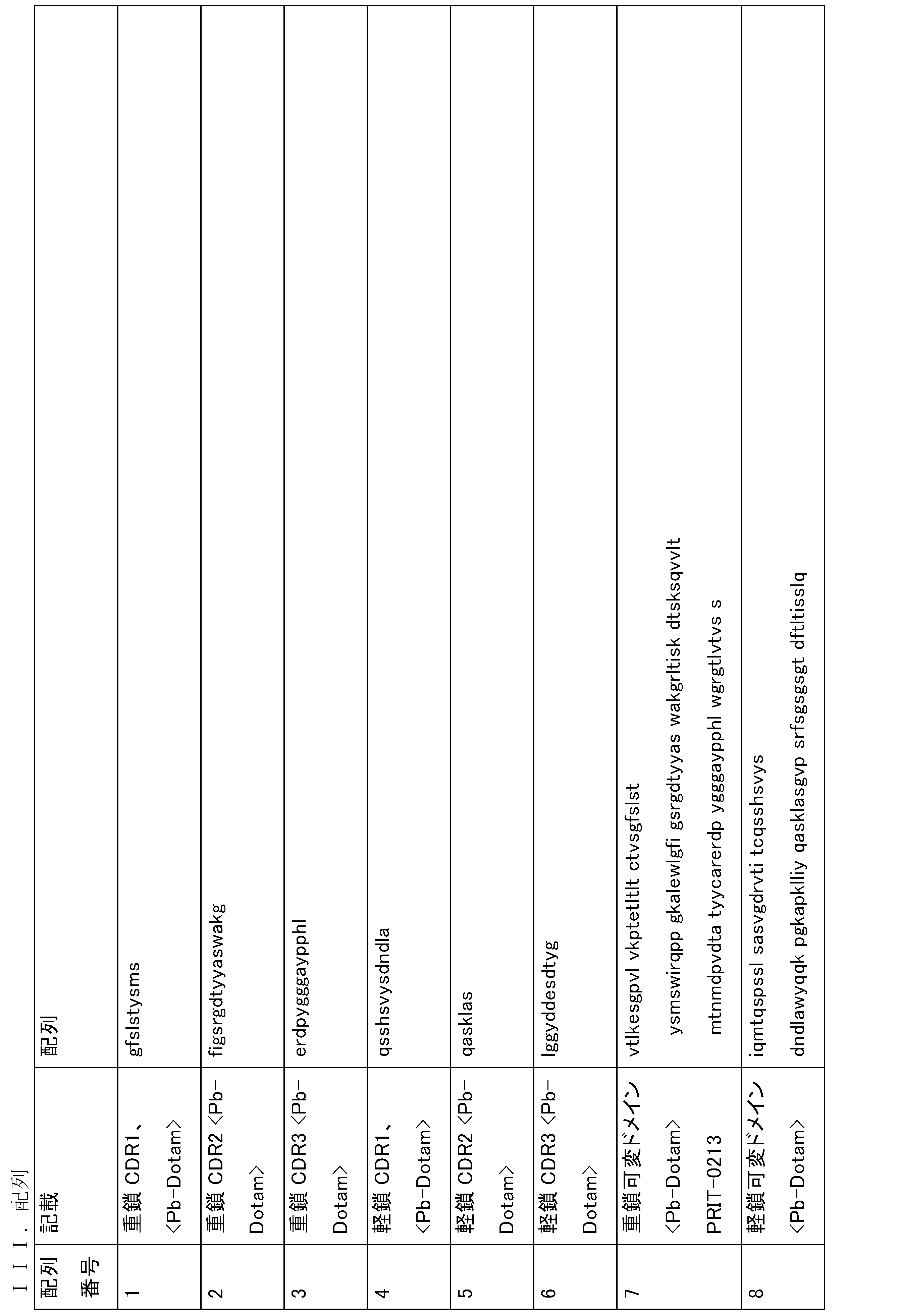
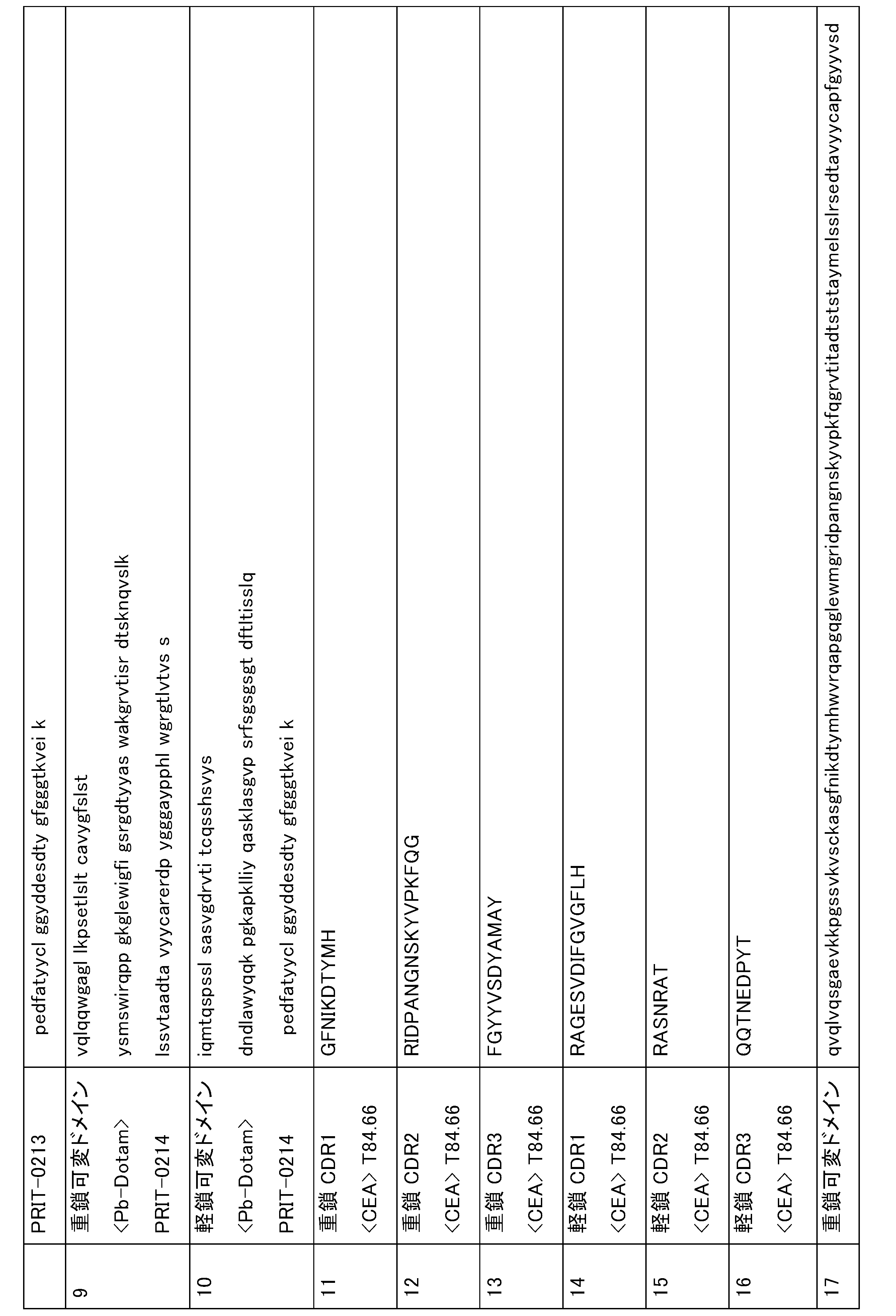

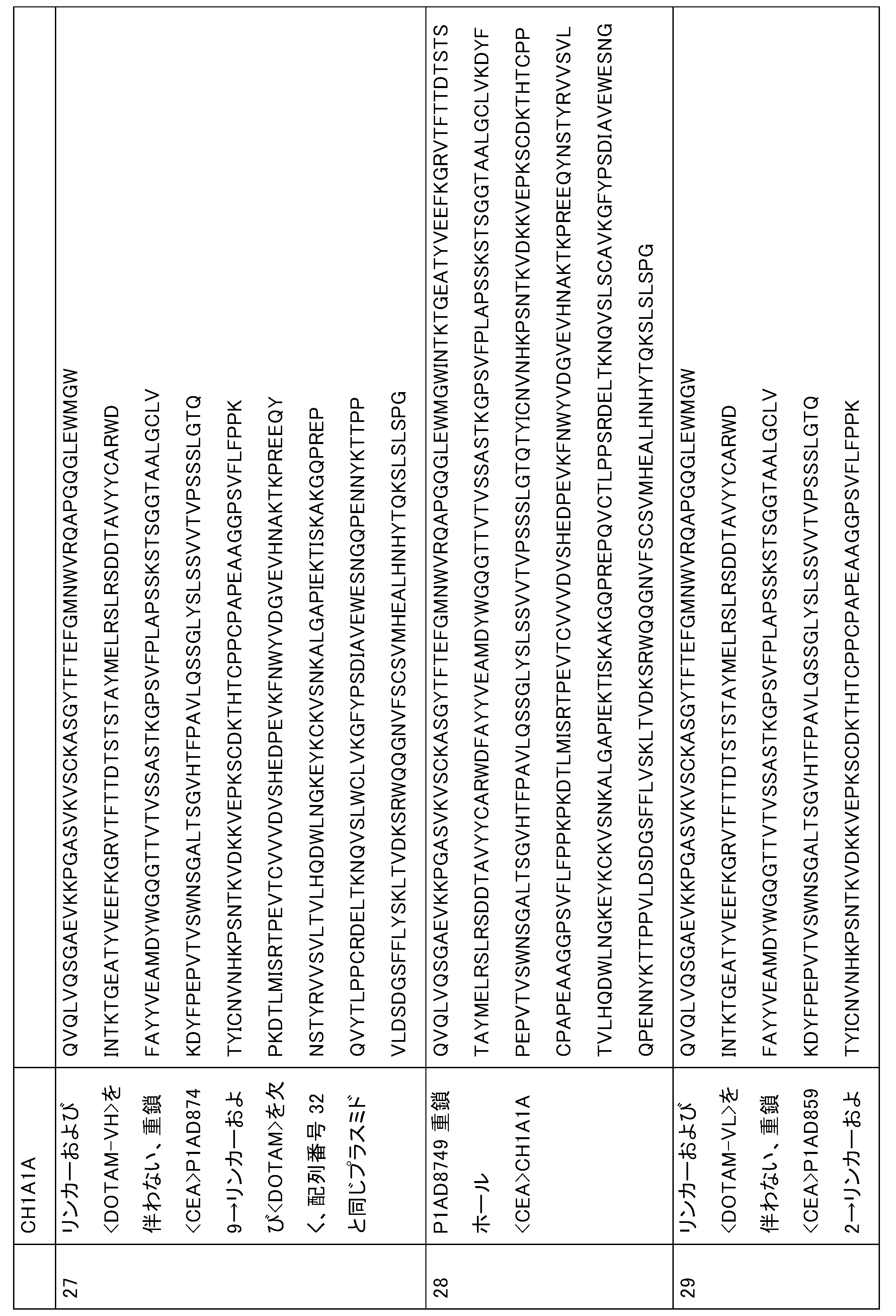
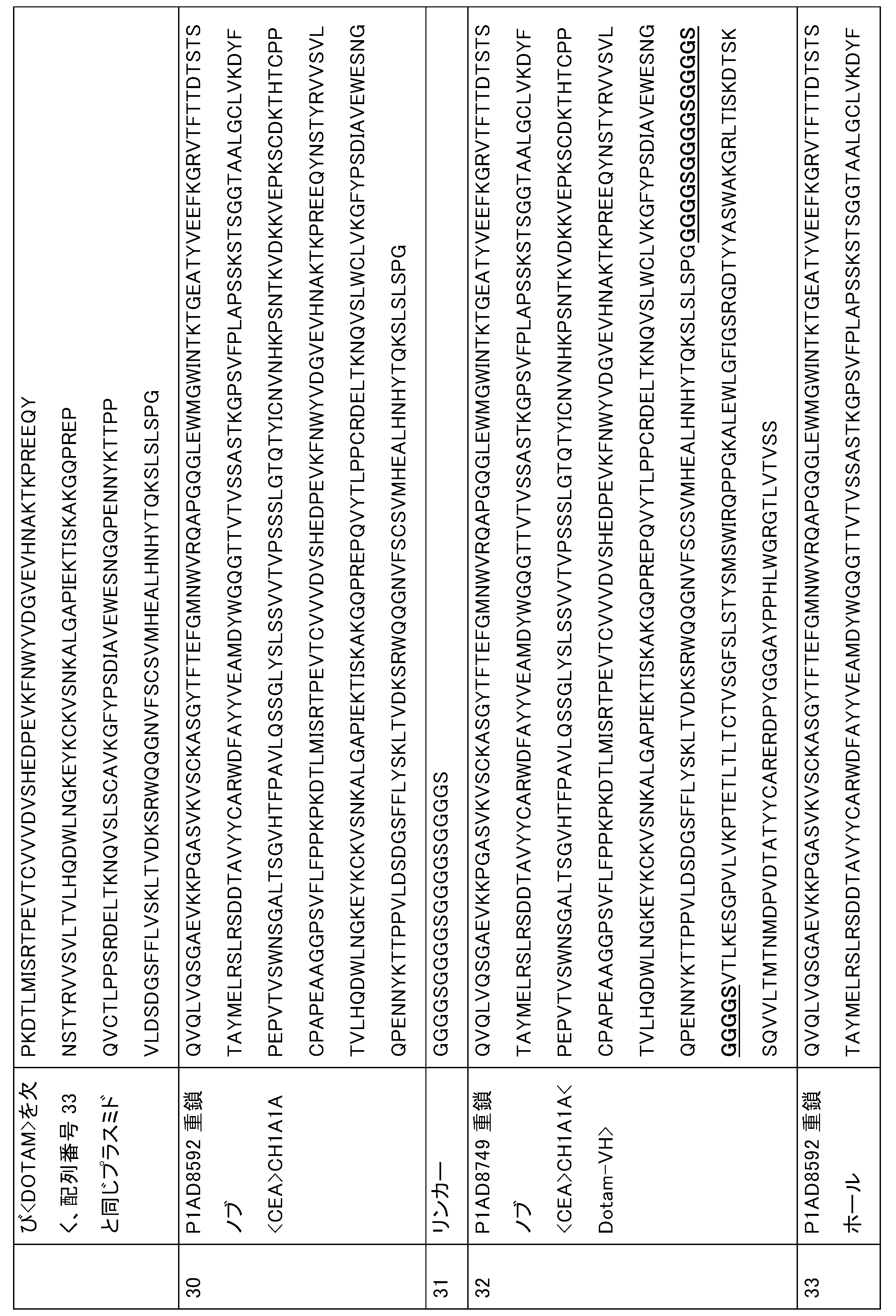
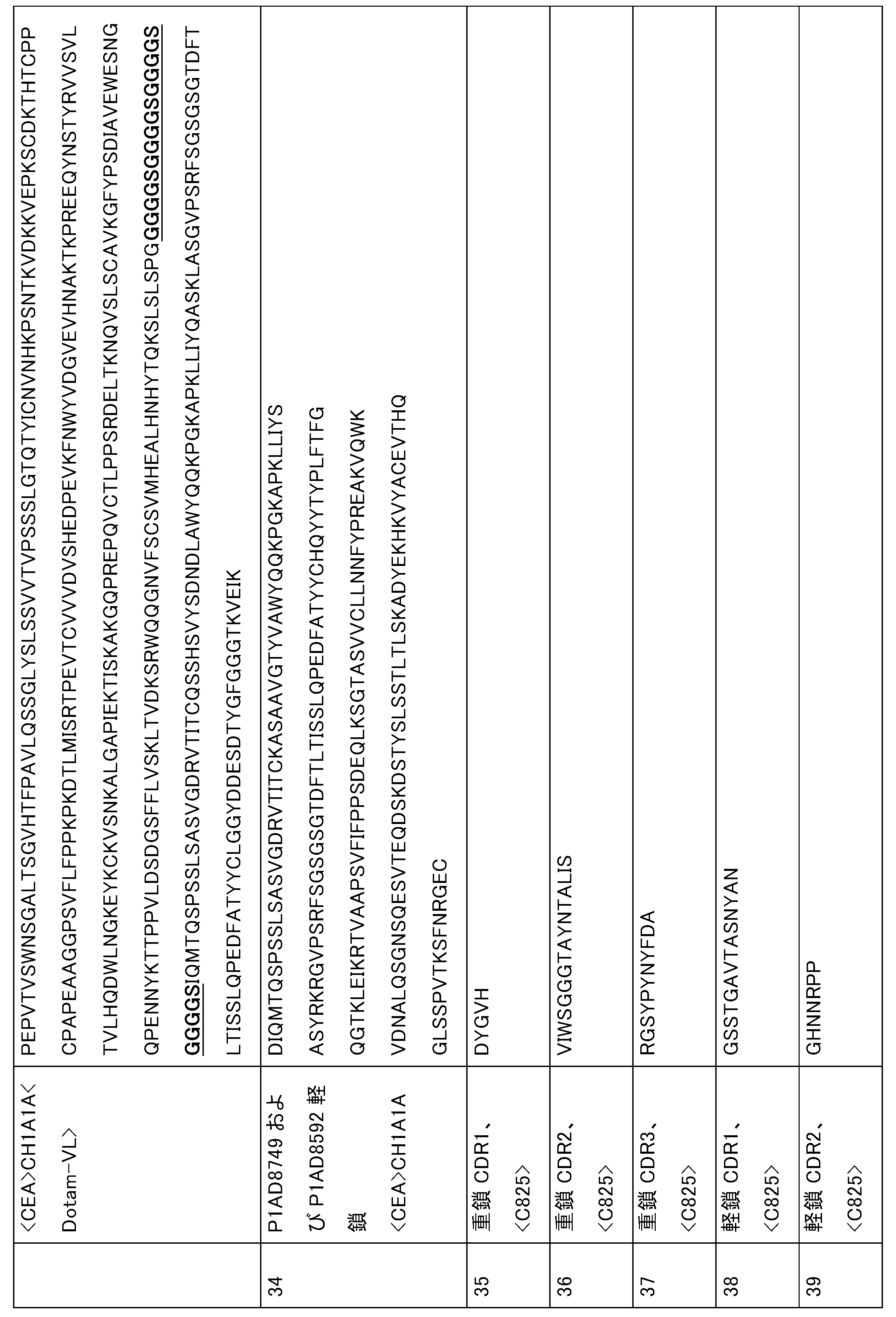
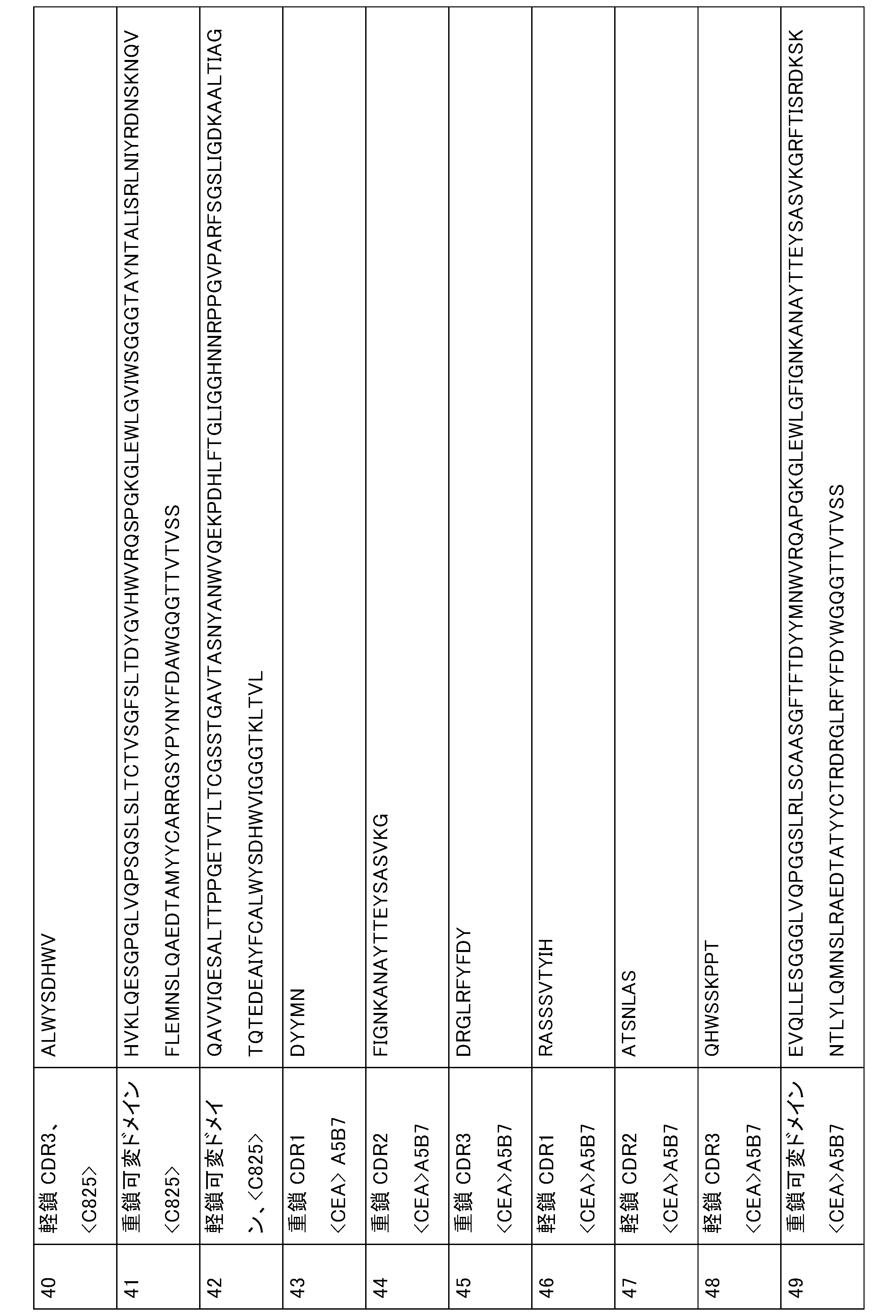
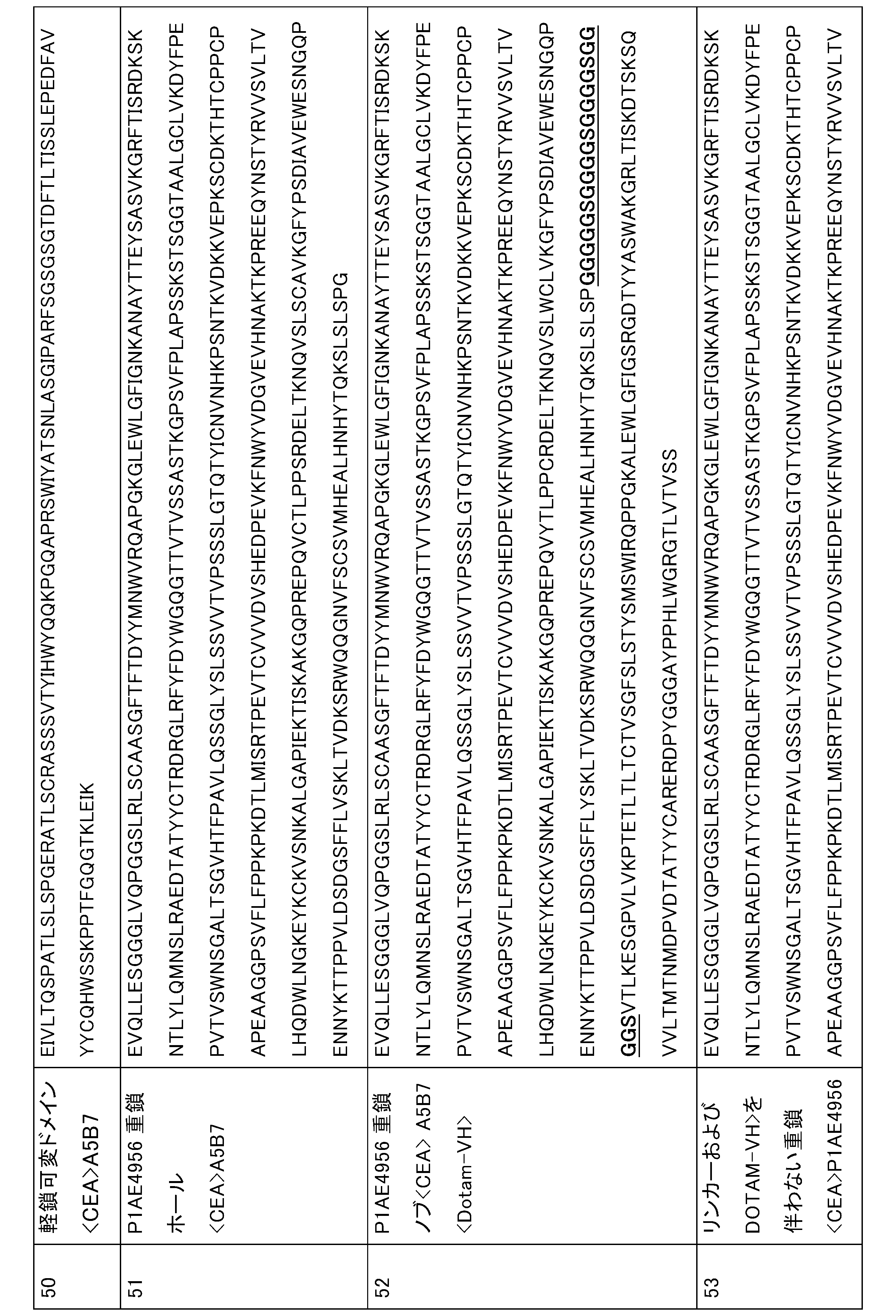
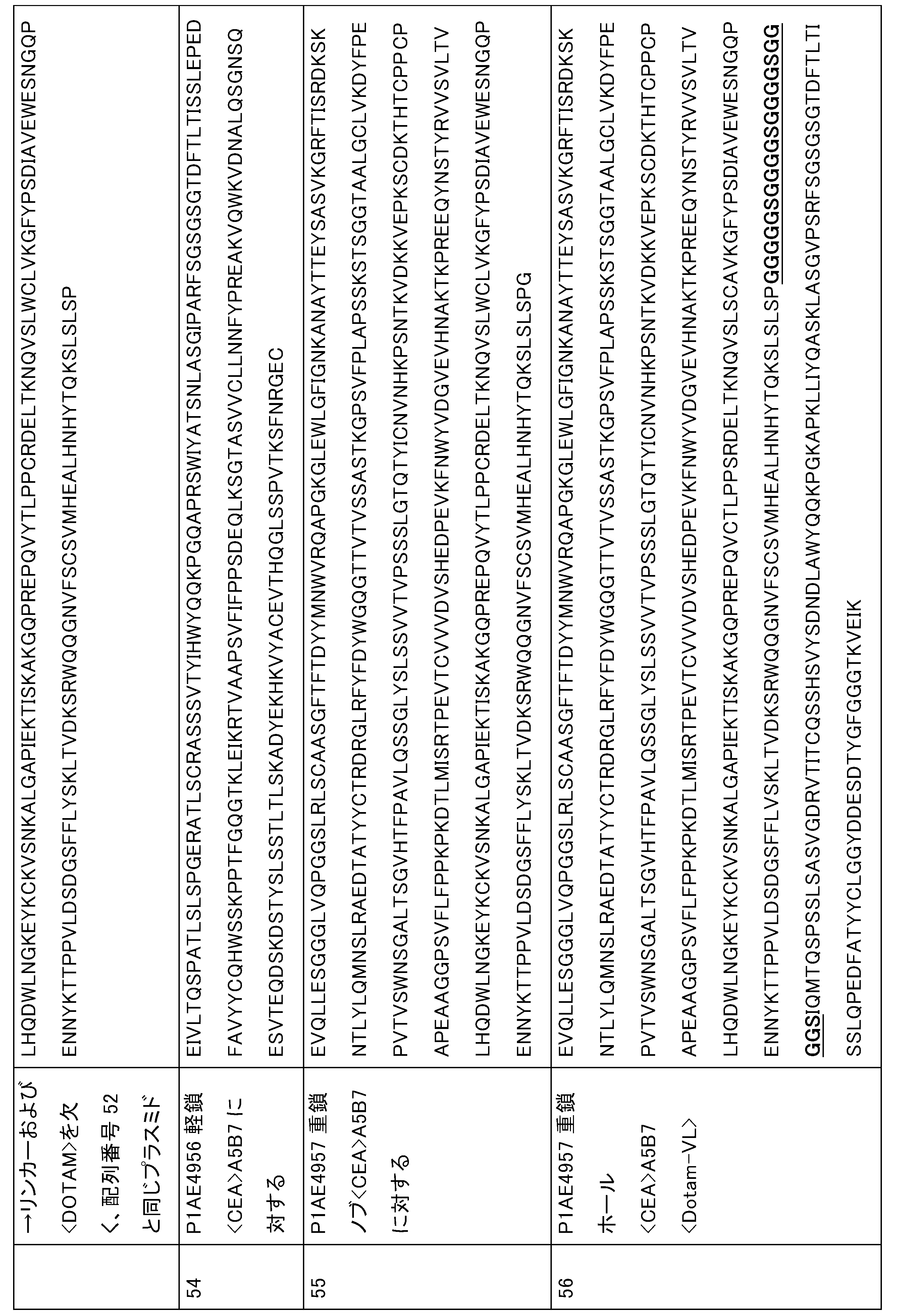
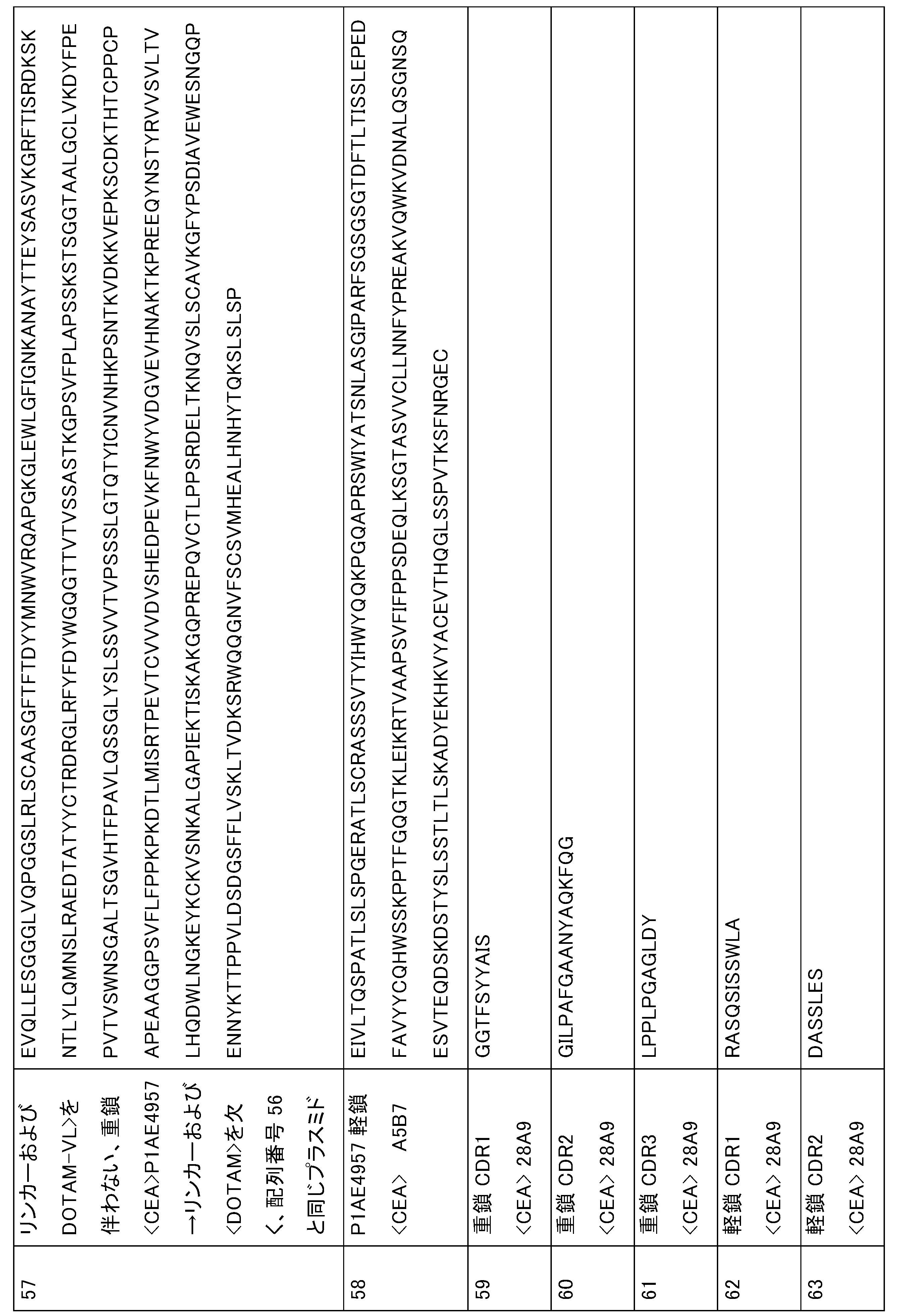


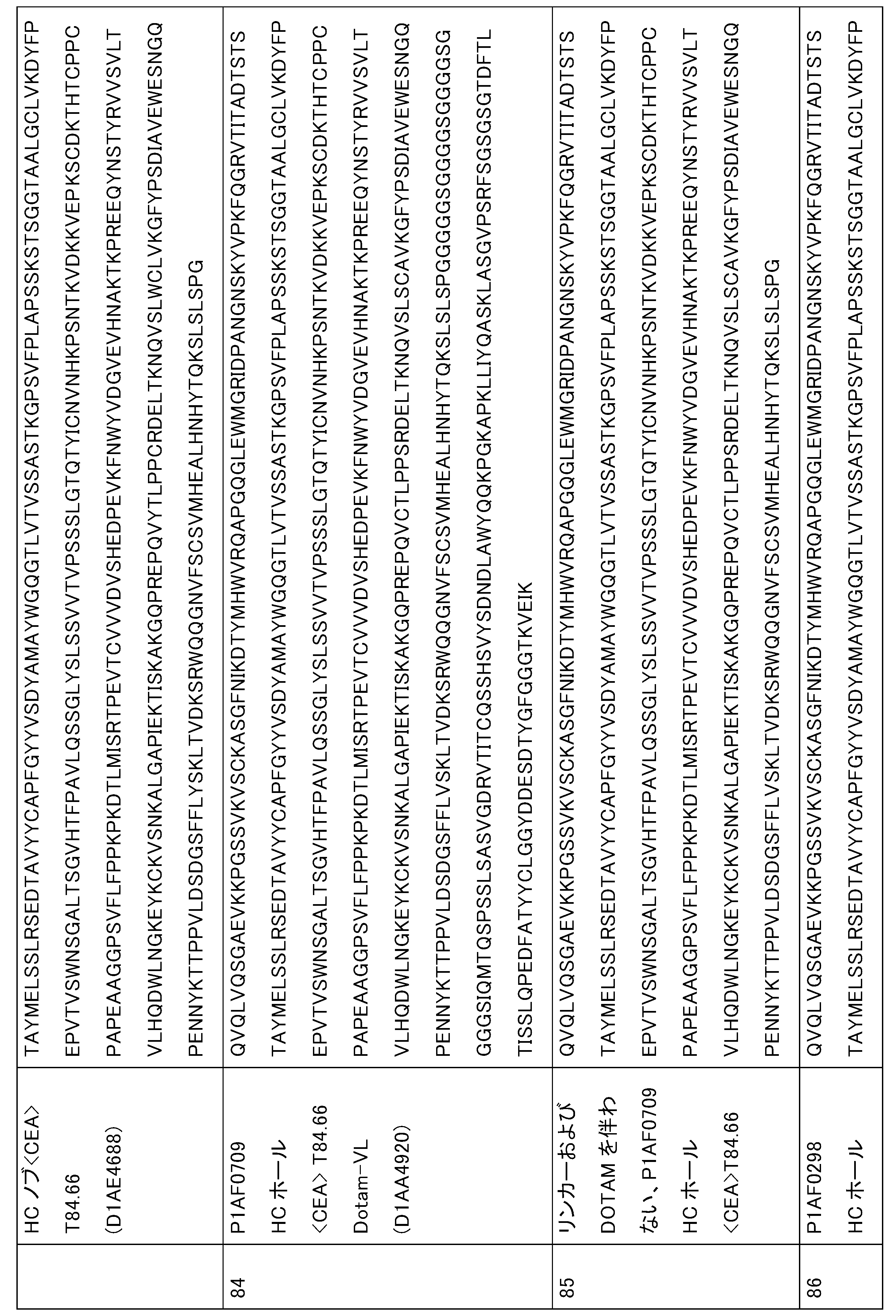
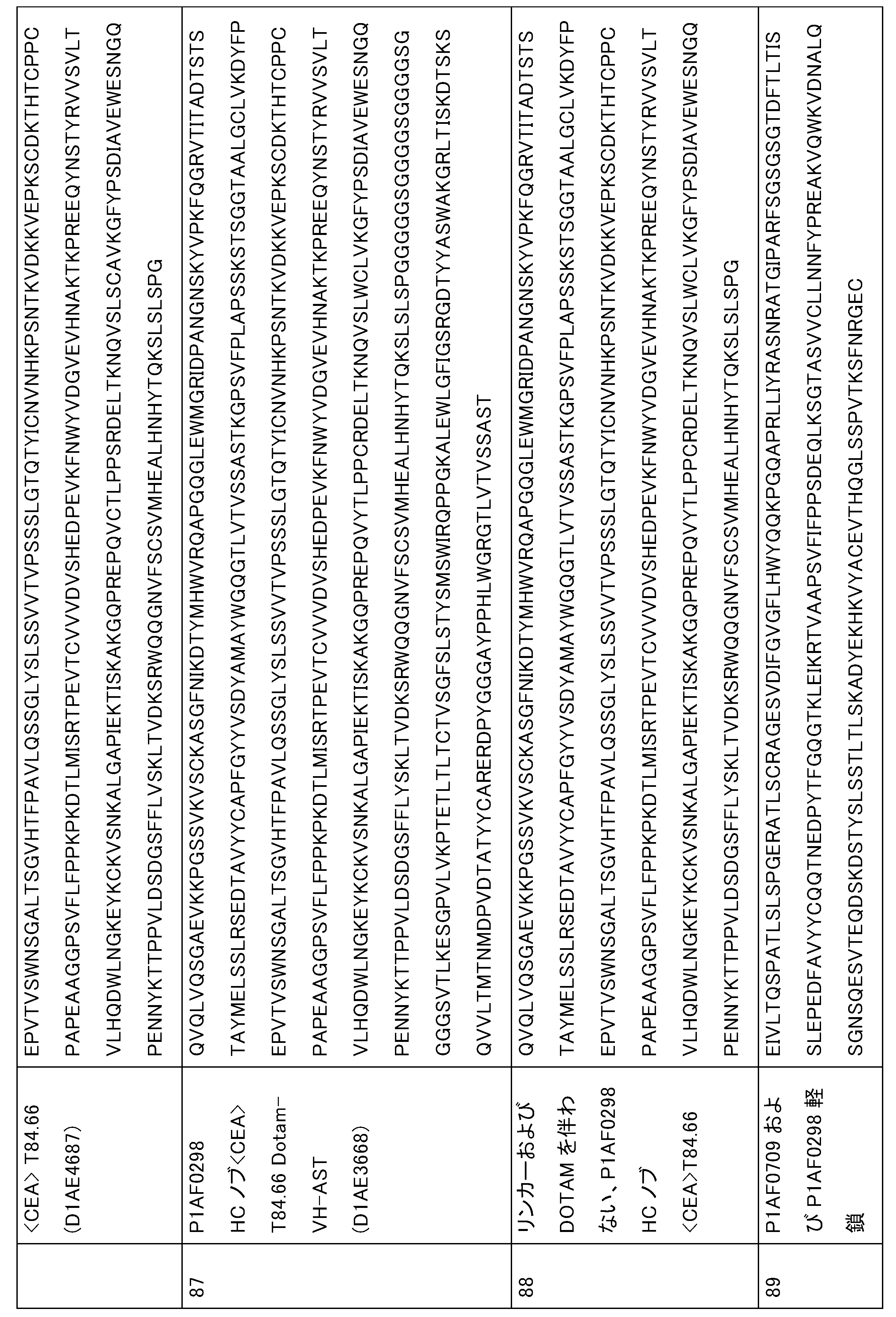
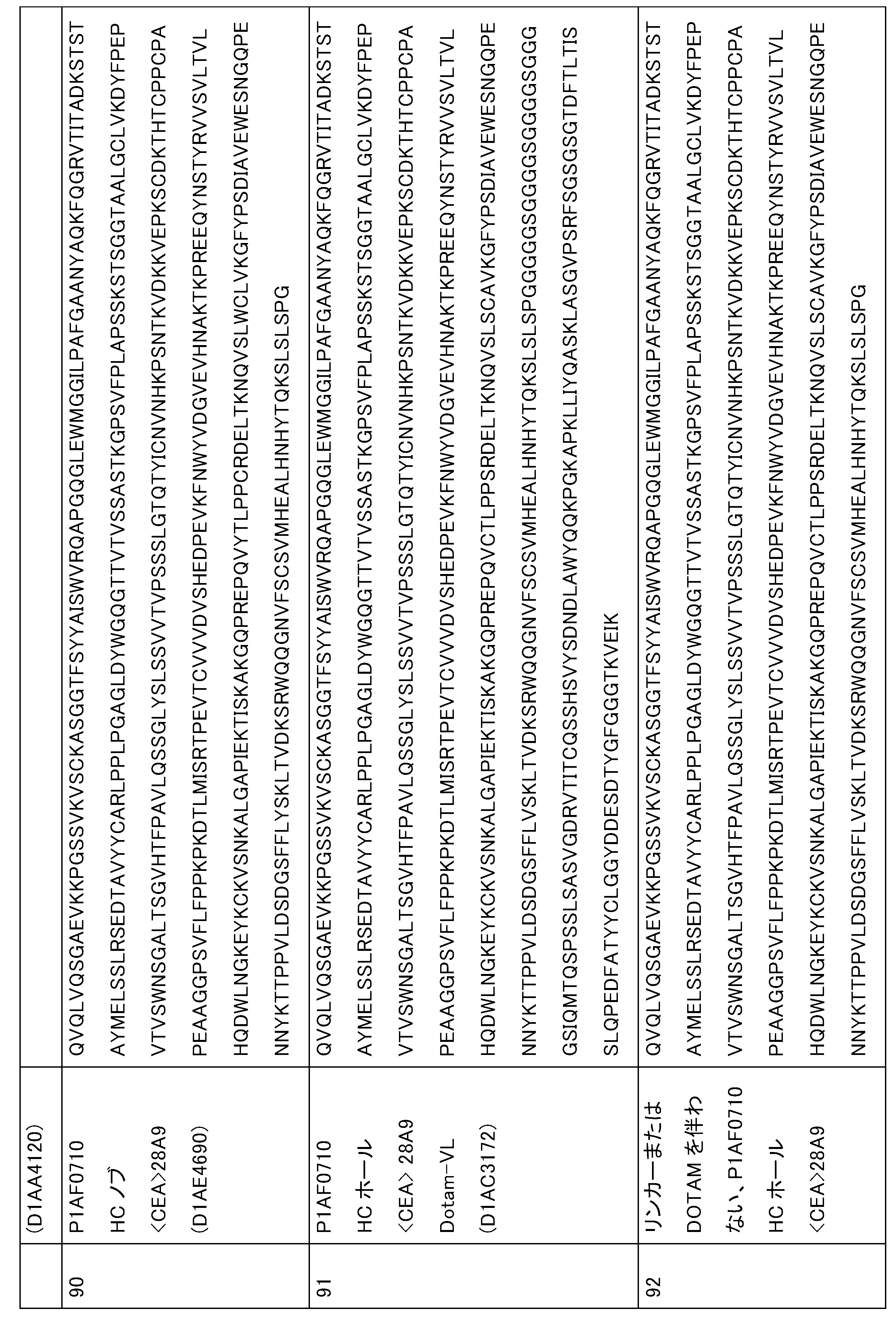
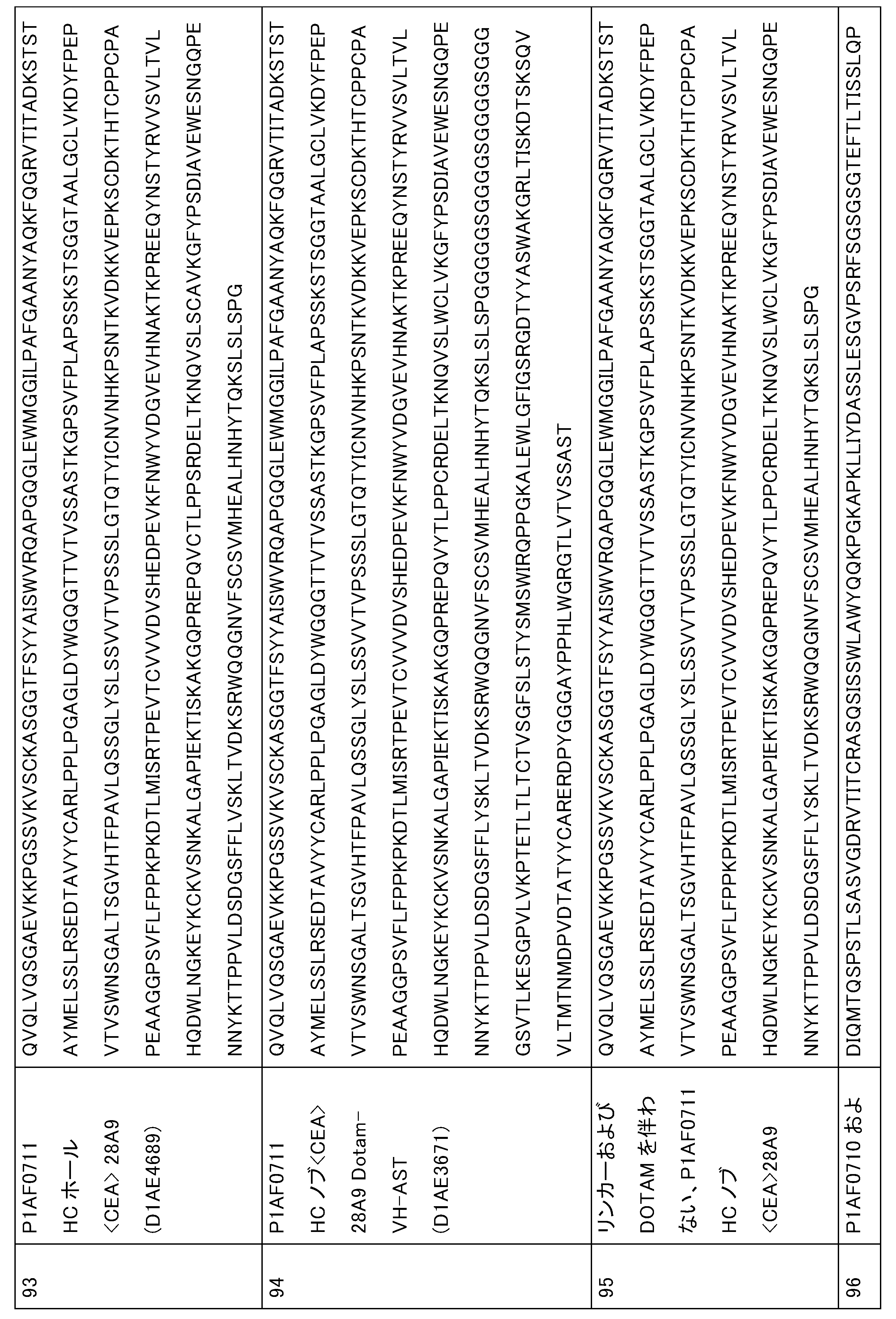

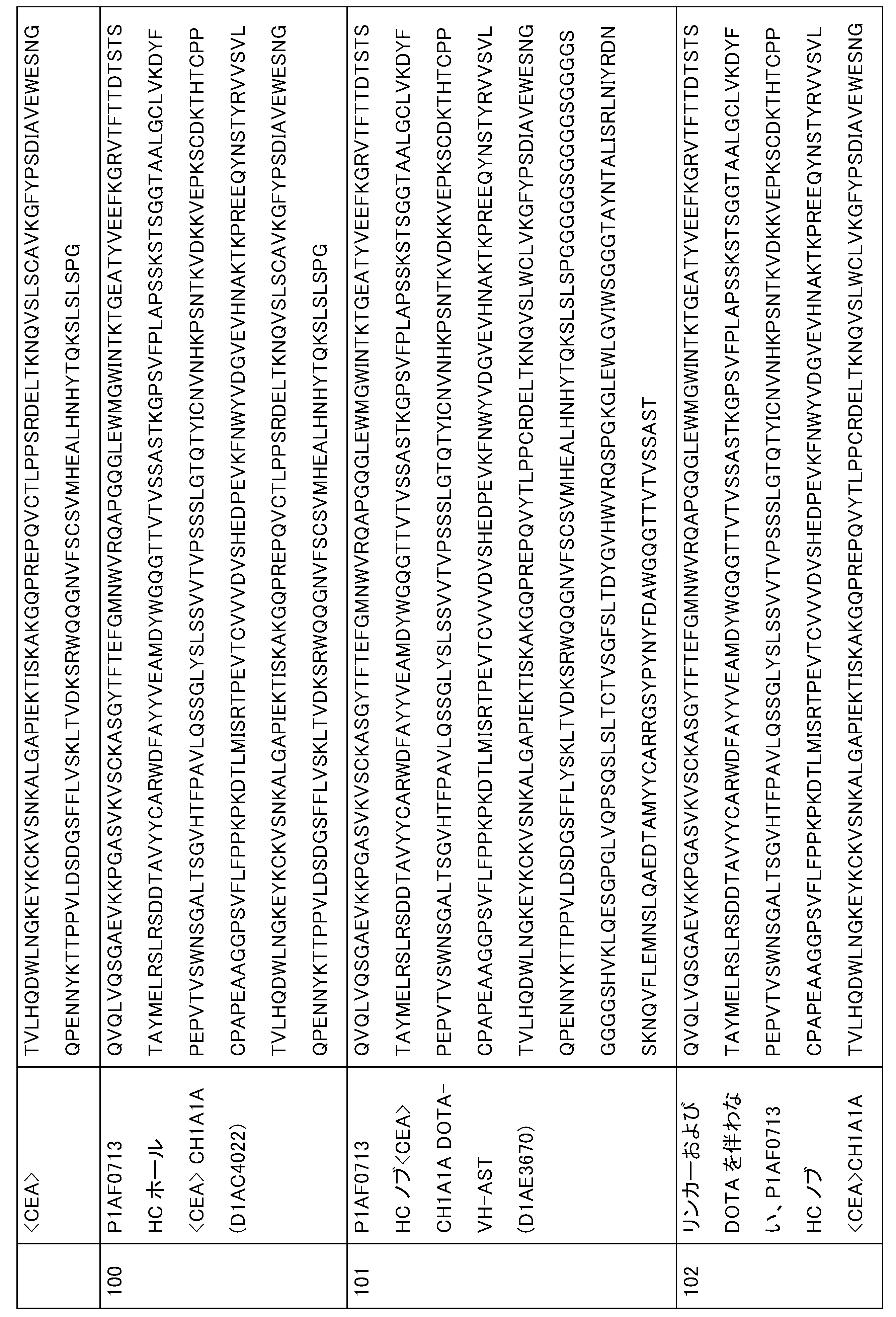

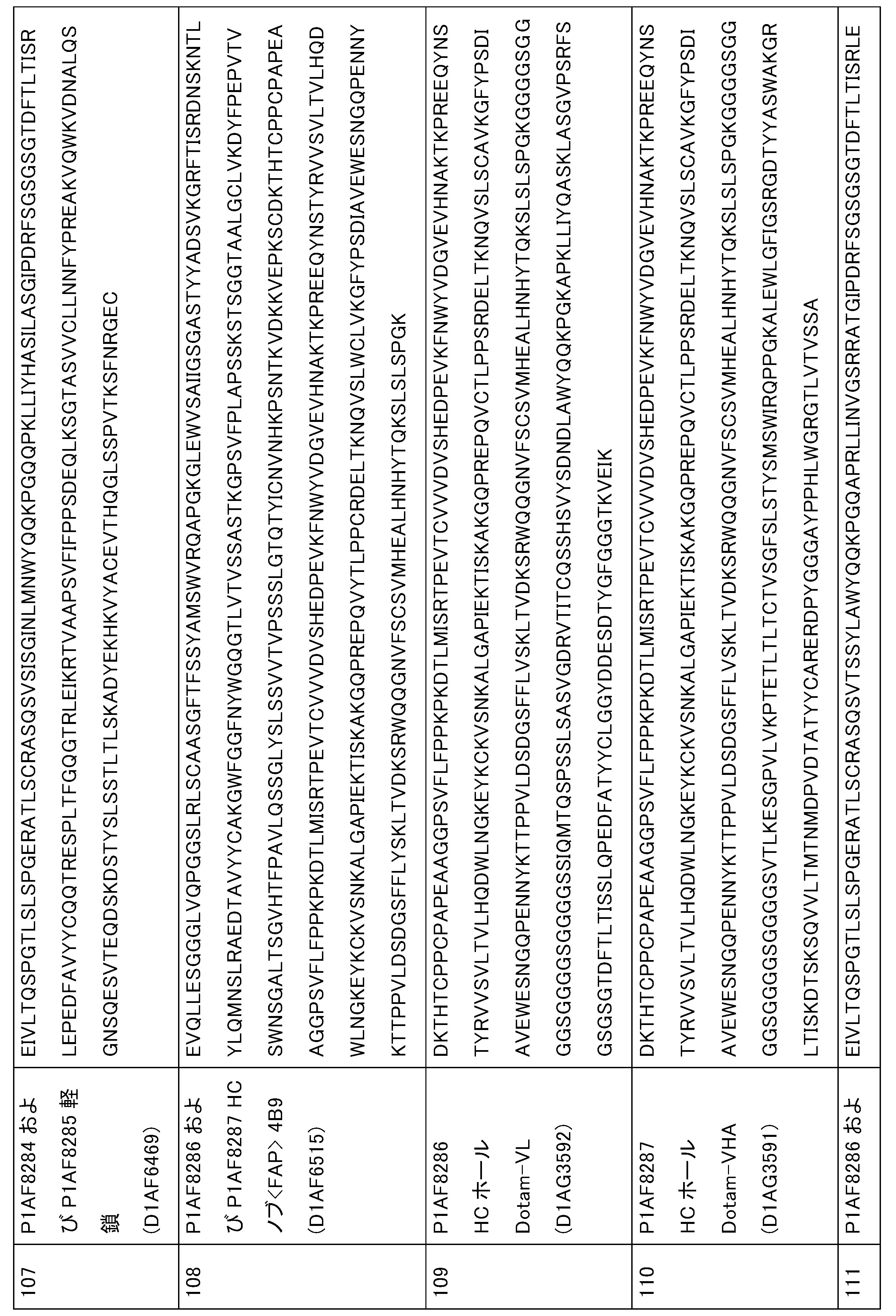
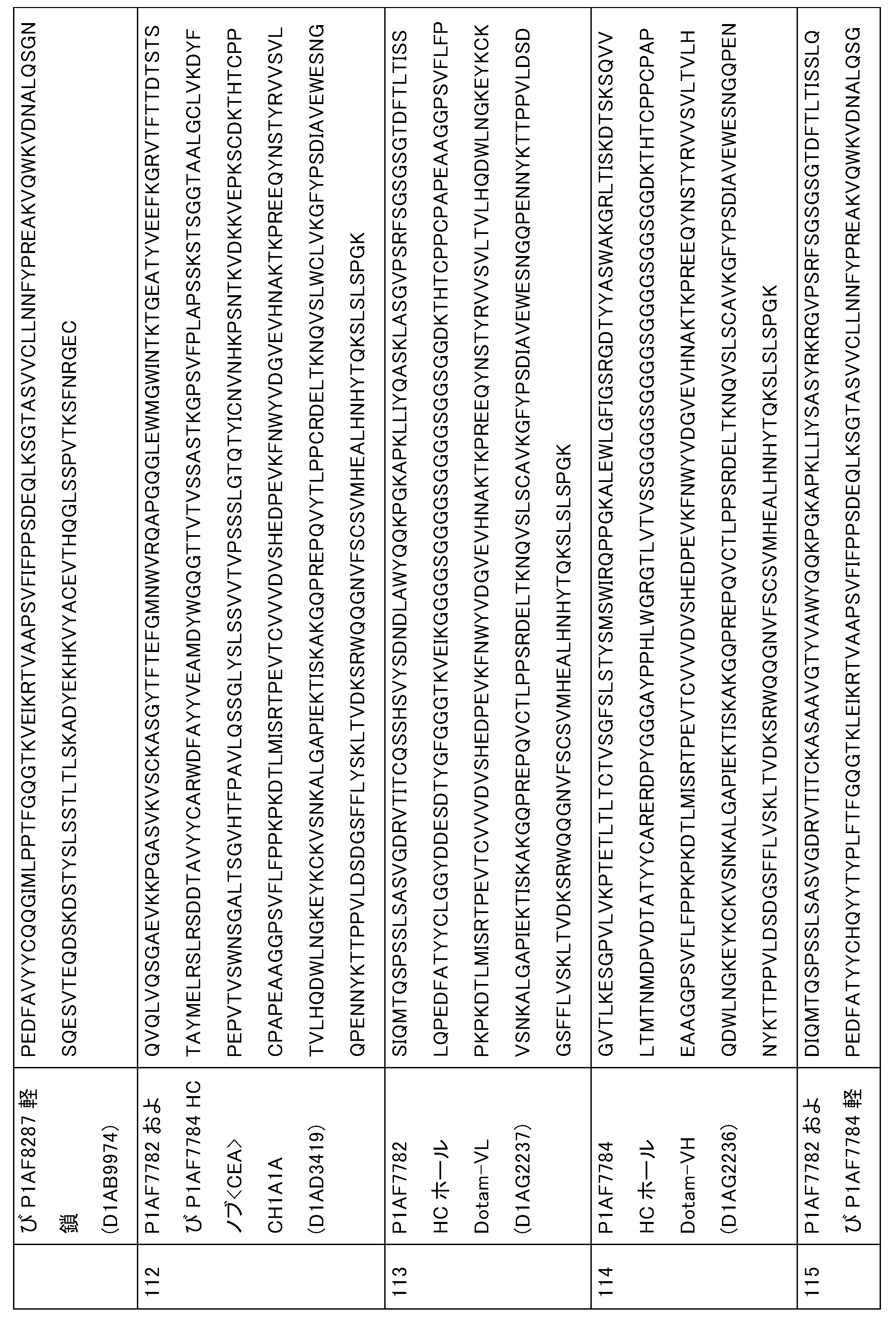
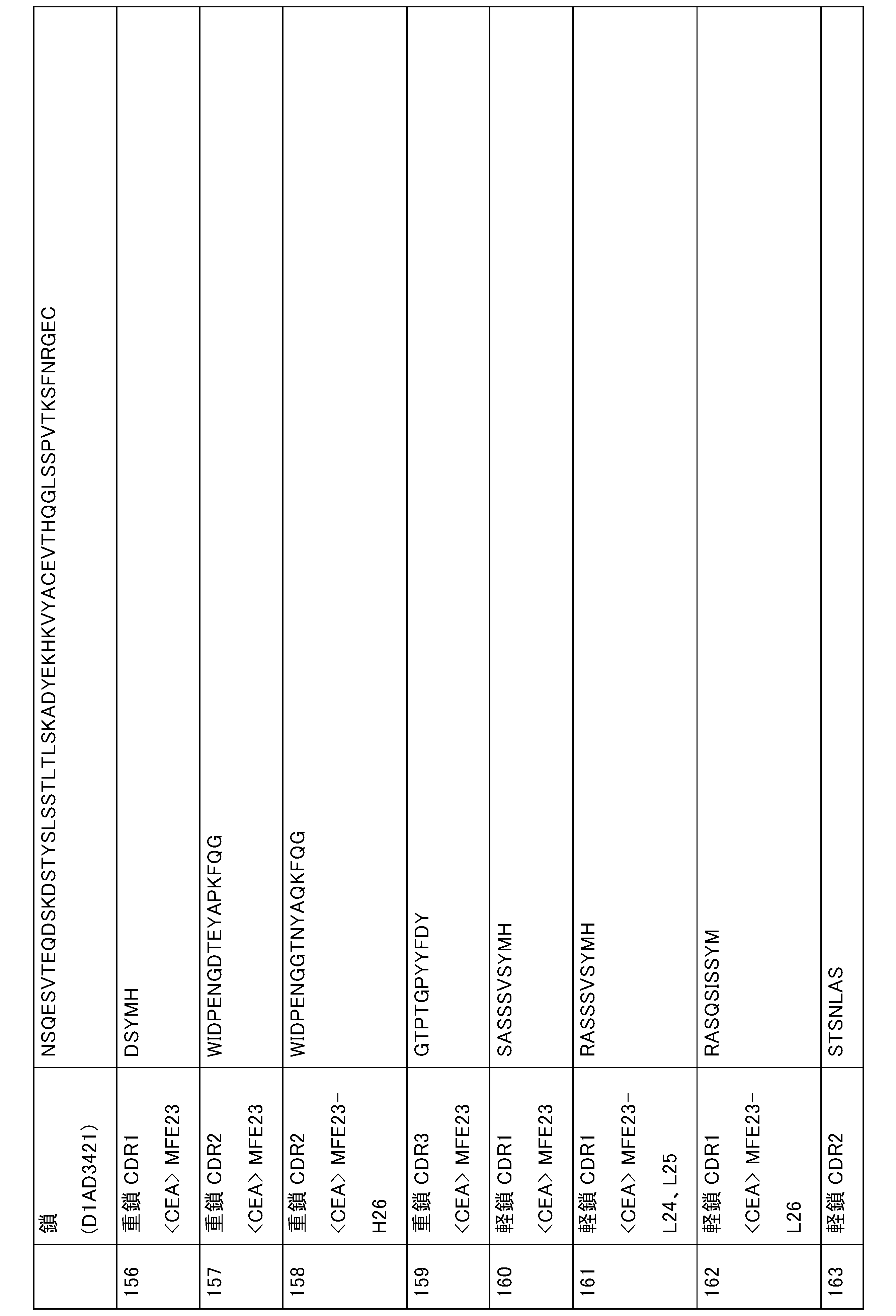
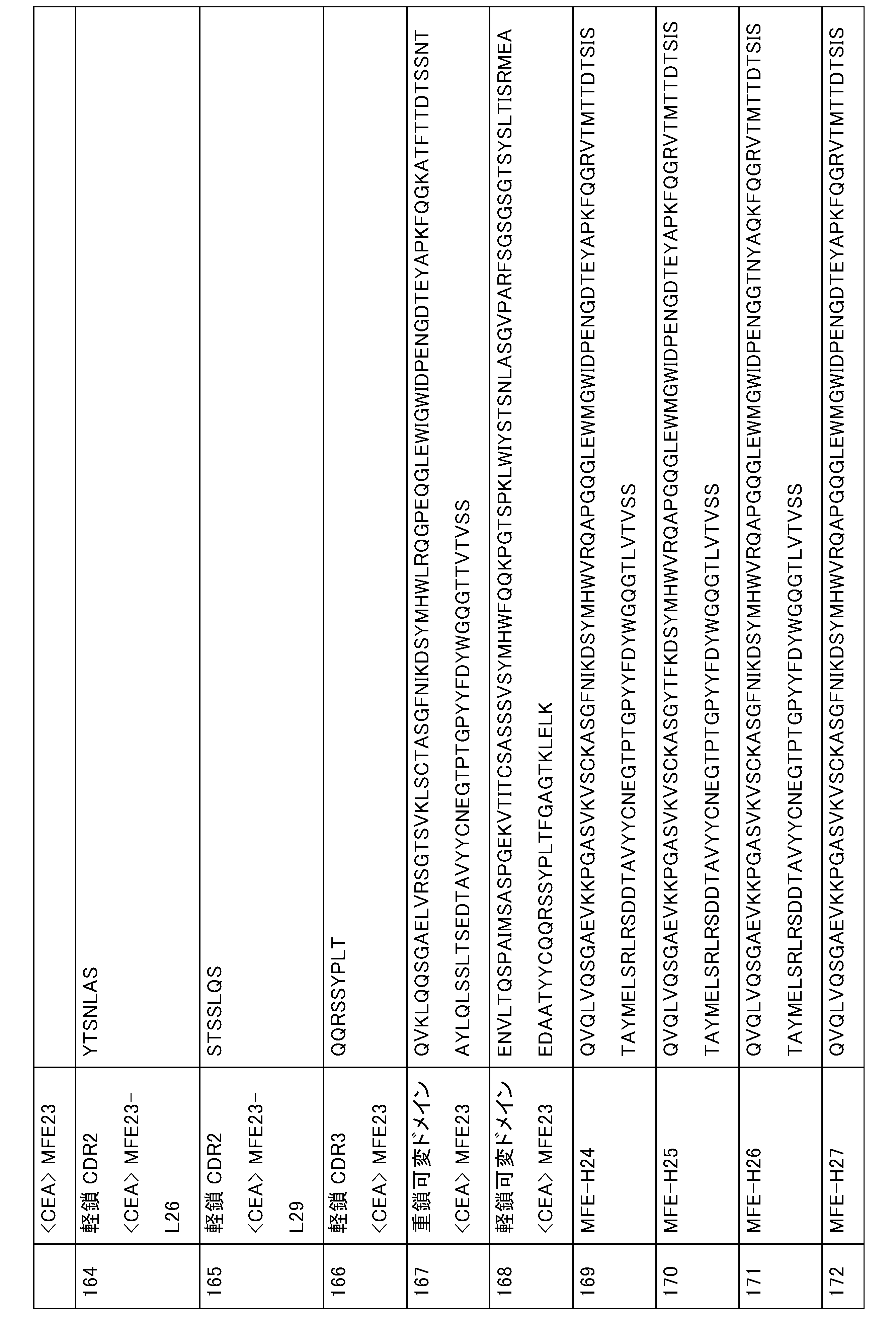

IV.例
以下は、本発明の方法および組成物の例である。上記で提示された一般的な記載を踏まえ、他の多様な実施形態も実施されうることが理解される。
IV. Examples The following are examples of the methods and compositions of the present invention. It is understood that various other embodiments may be practiced, given the general description provided above.
略号の語釈
ADA 抗薬剤抗体
AST アラニン、セリン、スレオニン
BsAb 二重特異性抗体
CA 除去剤
CEA がん胎児性抗原
DOTAM 1,4,7,10-テトラキス(カルバモイルメチル)-1,4,7,10-テトラアザシクロドデカン
ID 注入(注射)用量
ELISA 酵素免疫測定アッセイ
FAP 線維芽細胞活性化タンパク質
GPRC5D Gタンパク質共役受容体ファミリーC5群メンバーD
IV 静脈内
MW 分子量
PBS リン酸緩衝食塩水
p.i. 注射後
PK 薬物動態
PRIT プレターゲティング放射免疫療法
RIT 放射免疫療法
RT 室温
SC 皮下
SCID 重度複合免疫不全
SD 標準偏差
SOPF Specific and opportunistic pathogen-free
TA 標的抗原
TGI 腫瘍増殖阻害
TR 腫瘍縮小
Abbreviations ADA anti-drug antibody AST alanine, serine, threonine BsAb bispecific antibody CA clearing agent CEA
IV intravenous MW molecular weight PBS phosphate buffered saline p. i. Post-injection PK Pharmacokinetics PRIT Pretargeting radioimmunotherapy RIT Radioimmunotherapy RT Room temperature SC Subcutaneous SCID Severe combined immunodeficiency SD Standard deviation SOPF Specific and opportunistic pathogen-free
TA target antigen TGI tumor growth inhibition TR tumor reduction
実施例1
DOTAMに結合するウサギ抗体の作出
実施例1A
ウサギの免疫化
2つのエナンチオマーPb-DOTAM-アルキル-PEG4-KLH画分(MS2-DOTAM KLH画分1およびMS2-DOTAM KLH画分2)の1:1ミックスを、WO2000/46251、WO2002/12437、WO2005/007696、WO2006/047367、US2007/0033661、およびWO2008/027986において報告されている、ヒト免疫グロブリン遺伝子座を含む、ニュージーランドホワイトウサギまたはトランスジェニックウサギの免疫化のために使用した。0日目に、皮内適用により、各ウサギを、完全フロイントアジュバントによりエマルジョン化された、500ugの免疫原ミックスにより免疫化し、7、14、28、56日目に、筋肉内適用および皮下適用の交替を介する、500ugずつの同ミックスにより免疫化した。その後、ウサギに、毎月、500ugの皮下免疫化を施し、免疫化の7日後に、血清力価の決定のために、少量の血液試料を採取した。大量の血液試料(推定全血液体積の10%)を、免疫化の3カ月目および9カ月目に(免疫化の5~7日後に)採取し、末梢血単核細胞を分離し、これを、B細胞クローニング工程における、抗原特異的B細胞の供給源として使用した。
Example 1
Generation of rabbit antibodies that bind to DOTAM Example 1A
Immunization of rabbits A 1:1 mix of the two enantiomers Pb-DOTAM-alkyl-PEG4 - KLH fractions (MS2-
血清力価の決定(ELISA)
2つのエナンチオマーPb-DOTAM画分(PJRD05.133F1またはPJRD05.133F2)の各々を、ウェル1つ当たり100ulずつのPBS中に、1ug/mlで、NUNC Maxisorp96ウェルプレート上に固定化するのに続き:ウェル1つ当たり200ulずつのPBS中に2%のCrotein Cによるプレートのブロック;ウェル1つ当たり100ulずつのPBS中に0.5%のCrotein C中で、二連における、抗血清の段階希釈液の適用;HRPコンジュゲートロバ抗ウサギIgG抗体(Jackson Immunoresearch/Dianova;711-036-152;1/16,000)、およびストレプトアビジン-HRPによる検出;ウェル1つ当たり100ulのPBS中に0.5%のCrotein C中における、各々の希釈を行った。全ての工程について、プレートを、37℃で、1時間にわたりインキュベートした。全ての工程の間で、プレートを、PBS中に0.05%のTween 20で、3回にわたり洗浄した。ウェル1つ当たり100ulの、BM Blue POD Substrate soluble(Roche)の添加により、シグナルを発生させ;1M HClの、ウェル1つ当たり100ulの添加により、停止させた。吸光度は、参照としての690nmに対して、450nmで読み取った。力価は、最大半量のシグナルを結果としてもたらす抗血清の希釈率と規定した。
Determination of serum titer (ELISA)
Following immobilization of each of the two enantiomeric Pb-DOTAM fractions (PJRD05.133F1 or PJRD05.133F2) at 1 ug/ml in 100 ul per well of PBS on NUNC Maxisorp 96-well plates: Block plate with 2% Protein C in PBS, 200 ul per well; Serial dilutions of antiserum in duplicate, 0.5% Protein C in PBS, 100 ul per well HRP-conjugated donkey anti-rabbit IgG antibody (Jackson Immunoresearch/Dianova; 711-036-152; 1/16,000), and detection with streptavidin-HRP; 0.5 in 100 ul PBS per well Each dilution in % Protein C was performed. Plates were incubated for 1 hour at 37° C. for all steps. Between all steps, plates were washed 3 times with 0.05
実施例1B
ウサギからのB細胞クローニング
ウサギ末梢血単核細胞(PBMC)の分離
血液試料を、免疫化ウサギから採取した。EDTAを含有する全血を、製造元の仕様に従い、lympholyte mammal(Cedarlane Laboratories、Burlington、Ontario、Canada)を使用する、密度遠心分離の前に、1倍濃度のPBS(PAA、Pasching、Austria)で2倍に希釈した。PBMCを、1倍濃度のPBSで、2回にわたり洗浄した。
Example 1B
Isolation of B cell cloned rabbit peripheral blood mononuclear cells (PBMC) from rabbits Blood samples were taken from immunized rabbits. Whole blood containing EDTA was spiked with 1×PBS (PAA, Pasching, Austria) prior to density centrifugation using lympholyte mammal (Cedarlane Laboratories, Burlington, Ontario, Canada) according to manufacturer's specifications. Diluted twice. PBMC were washed twice with 1×PBS.
EL-4 B5培地
10%FCS(Hyclone、Logan、UT、USA)、2mMのグルタミン、1%ペニシリン/ストレプトマイシン溶液(PAA、Pasching、Austria)、2mMのピルビン酸ナトリウム、10mMのHEPES(PAN Biotech、Aidenbach、Germany)、および0.05mMのb-メルカプトエタノール(Gibco、Paisley、Scotland)を補充したRPMI 1640(Pan Biotech、Aidenbach、Germany)を使用した。
EL-4 B5 medium 10% FCS (Hyclone, Logan, UT, USA), 2 mM glutamine, 1% penicillin/streptomycin solution (PAA, Pasching, Austria), 2 mM sodium pyruvate, 10 mM HEPES (PAN Biotech, Aidenbach , Germany) and RPMI 1640 (Pan Biotech, Aidenbach, Germany) supplemented with 0.05 mM b-mercaptoethanol (Gibco, Paisley, Scotland) were used.
プレートのコーティング
滅菌細胞培養6ウェルプレートを、炭酸塩バッファー(0.1Mの重炭酸ナトリウム、34mMの炭酸水素二ナトリウム、pH9.55)中に2μg/mlのKLHにより、4℃で、一晩にわたりコーティングした。プレートを、使用の前に、滅菌PBS中で、3回にわたり洗浄した。滅菌ストレプトアビジンコーティング6ウェルプレート(Microcoat、Bernried、Germany)を、PBS中にビオチン化TCMC-Pb-dPEC3-ビオチン異性体A(1μg/ml)およびB(1μg/ml)の1+1エナンチオマー混合物により、室温で、3時間にわたりコーティングした。パニング工程の前に、これらの6ウェルプレートを、滅菌PBSで、3回にわたり洗浄した。
Plate Coating Sterile cell culture 6-well plates were coated with 2 μg/ml KLH in carbonate buffer (0.1 M sodium bicarbonate, 34 mM disodium bicarbonate, pH 9.55) at 4° C. overnight. coated. Plates were washed 3 times in sterile PBS before use. Sterile streptavidin-coated 6-well plates (Microcoat, Bernried, Germany) were treated with a 1+1 enantiomer mixture of biotinylated TCMC-Pb-dPEC3-biotin isomers A (1 μg/ml) and B (1 μg/ml) in PBS at room temperature. and coated for 3 hours. Prior to the panning step, these 6-well plates were washed 3 times with sterile PBS.
マクロファージ/単球の枯渇
非特異的接着を介して、マクロファージおよび単球を枯渇させ、KLHに結合する細胞を除去するように、PBMCを、滅菌KLHコーティング6ウェルプレート上に播種した。各ウェルを、最大4mlの培地、および免疫化ウサギに由来する6×10⁶個のPBMCで満たし、37℃および5%CO2で、1時間にわたり結合させた。上清中の細胞(末梢血リンパ球(PBL))を、抗原パニング工程のために使用した。
Depletion of Macrophages/Monocytes PBMCs were plated on sterile KLH-coated 6-well plates to deplete macrophages and monocytes via non-specific adhesion and remove cells that bind KLH. Each well was filled with up to 4 ml of medium and 6×10 6 PBMC from immunized rabbits and allowed to bind for 1 hour at 37° C. and 5% CO2. Cells in the supernatant (peripheral blood lymphocytes (PBL)) were used for the antigen panning step.
Pb含有TCMCエナンチオマー上における、B細胞のエンリッチメント
TCMC-Pb-dPEC3-ビオチン異性体AおよびBのエナンチオマー混合物でコーティングした6ウェルプレートに、培地4ml当たり、最大で、6×10⁶個のPBLを播種し、37℃および5%CO2で、1時間にわたり結合させた。ウェルを、1倍濃度のPBSで、1~3回にわたり、注意深く洗浄することにより、非接着細胞を除去した。残りの粘着細胞を、トリプシンにより、37℃および5%CO2で、10分間にわたり解離させた。EL-4 B5培地により、トリプシン化を停止させた。免疫蛍光染色まで、細胞を、氷上で保持した。
Enrichment of B cells on Pb-containing TCMC enantiomers A maximum of 6×10 6 PBLs per 4 ml of medium were applied to 6-well plates coated with enantiomer mixtures of TCMC-Pb-dPEC3-biotin isomers A and B. Seeds were allowed to bind for 1 hour at 37°C and 5% CO2. Non-adherent cells were removed by carefully washing the wells 1-3 times with 1×PBS. The remaining adherent cells were dissociated with trypsin for 10 minutes at 37°C and 5% CO2. Trypsinization was stopped by EL-4 B5 medium. Cells were kept on ice until immunofluorescence staining.
免疫蛍光染色およびフローサイトメトリー
抗IgG FITC(AbD Serotec、Dusseldorf、Germany)を、単一細胞分取のために使用した。表面染色のために、枯渇工程およびエンリッチメント工程からの細胞を、PBS中の抗IgG FITC抗体と共にインキュベートし、暗所内、4℃で、45分間にわたりインキュベートした。染色の後、PBMCを、氷冷PBSで、2回にわたり洗浄した。最後に、PBMCを、氷冷PBS中に再懸濁させ、速やかに、FACS解析にかけた。FACS解析の前に、5μg/ml(BD Pharmingen、San Diego、CA、USA)の濃度のヨウ化プロピジウムを添加して、死細胞と生細胞とを弁別した。
Immunofluorescent Staining and Flow Cytometry Anti-IgG FITC (AbD Serotec, Dusseldorf, Germany) was used for single cell sorting. For surface staining, cells from depletion and enrichment steps were incubated with anti-IgG FITC antibody in PBS and incubated in the dark at 4°C for 45 minutes. After staining, PBMC were washed twice with ice-cold PBS. Finally, PBMCs were resuspended in ice-cold PBS and immediately subjected to FACS analysis. Prior to FACS analysis, propidium iodide at a concentration of 5 μg/ml (BD Pharmingen, San Diego, Calif., USA) was added to discriminate between dead and live cells.
コンピュータおよびFACSDivaソフトウェア(BD Biosciences、USA)を装備した、Becton Dickinson FACSAriaを、単一細胞分取のために使用した。 A Becton Dickinson FACSAria equipped with a computer and FACSDiva software (BD Biosciences, USA) was used for single cell sorting.
B細胞の培養
ウサギB細胞の培養物は、Lightwoodら(J Immunol Methods、2006、316:133~143)により記載されている方法により調製した。略述すると、単一分取ウサギB細胞を、インキュベーター内、96ウェルプレート内、Pansorbin Cell(1:100000)(Calbiochem(Merck)、Darmtadt、Deutschland)、5%ウサギ胸腺細胞上清(MicroCoat、Bernried、Germany)、およびガンマ照射マウスEL-4 B5胸腺腫細胞(ウェル1つ当たりの細胞5×10⁵個)を含有する、ウェル1つ当たり200μlのEL-4 B5培地と共に、37℃で、7日間にわたりインキュベートした。スクリーニングのために、B細胞培養物の上清を除去し、残りの細胞を、速やかに採取し、100μlのRLTバッファー(Qiagen、Hilden、Germany)中、-80℃で凍結させた。
B Cell Culture Rabbit B cell cultures were prepared by the method described by Lightwood et al. (J Immunol Methods, 2006, 316:133-143). Briefly, single prep rabbit B cells were added in an incubator, in 96-well plates, Pansorbin Cell (1:100000) (Calbiochem (Merck), Darmtadt, Deutschland), 5% rabbit thymocyte supernatant (MicroCoat, Bernried , Germany) and gamma-irradiated mouse EL-4 B5 thymoma cells ( 5 x 10⁵ cells per well) with 200 μl per well of EL-4 B5 medium at 37°C for 7 days. Incubated for 2 days. For screening, the B cell culture supernatant was removed and the remaining cells were rapidly harvested and frozen at -80°C in 100 μl RLT buffer (Qiagen, Hilden, Germany).
実施例1C
ウサギ抗体の発現
VドメインのPCR増幅
全RNAは、製造元のプロトコールに従い、NucleoSpin 8/96 RNAキット(Macherey&Nagel;740709.4、740698)を使用して、B細胞溶解物(RLTバッファー;Qiagen;型番:79216中に再懸濁させた)から調製した。RNAは、60μlのRNase非含有水で溶出させた。製造元の指示書に従い、Superscript III First-Strand Synthesis Supermix(Invitrogen 18080-400)およびオリゴdTプライマーを使用する、逆転写酵素反応により、cDNAを作出するのに、6μlのRNAを使用した。全ての工程は、Hamilton ML Star System上で実施した。重鎖のために、プライマーであるrbHC.upおよびrbHC.doを使用し、軽鎖のために、プライマーであるrbLC.upおよびrbLC.do(下記の表)を使用して、50μlの最終容量中で、AccuPrime Supermix(Invitrogen 12344-040)により、免疫グロブリンの重鎖可変領域および軽鎖可変領域(VHおよびVL)を増幅するのに、4μlのcDNAを使用した。全てのフォワードプライマーが、シグナルペプチド(それぞれ、VHおよびVLの)に特異的であるのに対し、リバースプライマーは、定常領域(それぞれ、VHおよびVLの)に特異的であった。RbVH+RbVLのためのPCR条件は、以下:94℃で5分間にわたる、高温における開始;94℃で20秒間、70℃で20秒間、68℃で45秒間、および68℃で7分間にわたる最終伸長の35サイクルの通りであった。
Example 1C
PCR Amplification of Rabbit Antibody Expressed V Domains Total RNA was isolated from B cell lysate (RLT buffer; Qiagen; model no.: resuspended in 79216). RNA was eluted with 60 μl of RNase-free water. Six μl of RNA was used to generate cDNA by reverse transcriptase reaction using Superscript III First-Strand Synthesis Supermix (Invitrogen 18080-400) and oligo dT primers according to the manufacturer's instructions. All steps were performed on a Hamilton ML Star System. For the heavy chain, the primer rbHC. up and rbHC. do and for the light chain the primer rbLC. up and rbLC. To amplify immunoglobulin heavy and light chain variable regions (VH and VL) with AccuPrime Supermix (Invitrogen 12344-040) in a final volume of 50 μl using do (table below) , 4 μl of cDNA was used. All forward primers were specific for the signal peptide (VH and VL, respectively), whereas reverse primers were specific for the constant region (VH and VL, respectively). The PCR conditions for RbVH+RbVL were as follows: initiation at elevated temperature for 5 min at 94°C; It was a cycle.
プライマー配列

50μlのPCR溶液のうちの8μlを、48 E-Gel 2%(Invitrogen G8008-02)上にロードした。製造元のプロトコールに従い、NucleoSpin Extract IIキット(Macherey&Nagel;740609250)を使用して、陽性のPCR反応物をクリーニングし、50μlの溶出バッファー中で溶出させた。全てのクリーニング工程は、Hamilton ML Starlet System上で実施した。
8 μl of the 50 μl PCR solution was loaded onto 48
ウサギモノクローナル二価抗体の組換え発現
ウサギモノクローナル二価抗体の組換え発現のために、突出末端クローニング法(RS Haunら、Biotechniques(1992)、13、515~518;MZ Liら、Nature Methods(2007)、4、251~256)により、VHまたはVLをコードするPCR産物を、cDNAとして、発現ベクターにクローニングした。発現ベクターは、イントロンAおよび3’BGHポリアデニル化配列を含む、5’CMVプロモーターからなる発現カセットを含有した。発現カセットに加えて、プラスミドは、大腸菌(E.coli)内のプラスミド増幅のために、pUC18由来複製開始点と、アンピシリン耐性を付与するベータ-ラクタマーゼ遺伝子とを含有した。基本プラスミドの3つの変化形:1つのプラスミドが、VH領域を受容するようにデザインされたウサギIgG定常領域を含有するのに対し、2つのさらなるプラスミドは、VL領域を受容するように、ウサギまたはヒトのカッパLC定常領域を含有する変化形を使用した。重複プライマーを使用するPCRにより、カッパ定常領域またはガンマ定常領域およびVL/VHインサートをコードする直鎖化発現プラスミドを増幅した。精製PCR産物を、T4DNA-ポリメラーゼと共にインキュベートし、これにより、一本鎖突出末端を作出した。dCTPの添加により、反応を停止させた。次の工程では、プラスミドとインサートとを組み合わせ、recAと共にインキュベートし、これにより、部位特異的組換えを誘導した。組換えプラスミドを、大腸菌(E.coli)に形質転換した。翌日、増殖したコロニーを採取し、プラスミドの調製、制限解析、およびDNAシーケンシングにより、適正な組換えプラスミドについて調べた。抗体発現のために、試薬供給元により示唆される手順に従い、239-Freeトランスフェクション試薬(Novagen)を使用することにより、単離HCプラスミドおよび単離LCプラスミドを、2ml(96ウェルプレート)のFreeStyle HEK293-F細胞(Invitrogen R790-07)に、一過性にコトランスフェクトした。1週間後に、上清を採取し、精製に引き渡した。
Recombinant expression of rabbit monoclonal bivalent antibodies. ), 4, 251-256), PCR products encoding VH or VL were cloned as cDNAs into expression vectors. The expression vector contained an expression cassette consisting of the 5'CMV promoter, including intron A and 3'BGH polyadenylation sequences. In addition to the expression cassette, the plasmid contained a pUC18-derived origin of replication and a beta-lactamase gene conferring ampicillin resistance for plasmid amplification in E. coli. Three variations of the basic plasmid: one plasmid contains a rabbit IgG constant region designed to accept the VH region, while two additional plasmids are designed to accept the VL region, rabbit or A variant containing the human kappa LC constant region was used. Linearized expression plasmids encoding kappa or gamma constant regions and VL/VH inserts were amplified by PCR using overlapping primers. Purified PCR products were incubated with T4 DNA-polymerase, which generated single-stranded overhanging ends. The reaction was stopped by the addition of dCTP. In the next step, the plasmid and insert were combined and incubated with recA to induce site-specific recombination. Recombinant plasmids were transformed into E. coli. The next day, grown colonies were picked and checked for the correct recombinant plasmid by plasmid preparation, restriction analysis, and DNA sequencing. For antibody expression, isolated HC and LC plasmids were transfected into 2 ml (96-well plates) of FreeStyle by using 239-Free transfection reagent (Novagen), following the procedure suggested by the reagent supplier. HEK293-F cells (Invitrogen R790-07) were transiently co-transfected. After 1 week, the supernatant was harvested and submitted for purification.
実施例1D
ウサギモノクローナル抗体の選択
SET(solution equilibration titration)アッセイは、下記で記載される通りに実行した。
Example 1D
Selection of Rabbit Monoclonal Antibodies SET (solution equilibration titration) assays were performed as described below.
SETアッセイ
材料:
1.DOTAM-ビオチン異性体ミックス:
濃度=20ng/mlをとする、以下の成分の混合物:
・Pb-Dotam-Bn-ビオチン/TCMC-Pb-dPEG3-ビオチン、異性体A
・Pb-Dotam-Bn-ビオチン/TCMC-Pb-dPEG3-ビオチン、異性体B
・Pb-Dotam-アルキル-ビオチン異性体A
・Pb-Dotam-アルキル-ビオチン異性体B
2.PBS:DPBS;PAN;P04-36500
3.BSA:Roche;10735086001
4.Tween 20:Polysorbat 20(usb;型番:20605、500ml)
5.PBST:10倍濃度;Roche;型番:11666789001/0.1%のTween 20
6.OSEP:PBS(10倍濃度;Roche;型番:11666789001)/0.5%BSA(脂肪酸非含有ウシ血清アルブミン画分V;Roche;型番:10735086001)/0.05%Tween 20
SET Assay Materials:
1. DOTAM-biotin isomer mix:
A mixture of the following components with concentration = 20 ng/ml:
・Pb-Dotam-Bn-biotin/TCMC-Pb-dPEG3-biotin, isomer A
・Pb-Dotam-Bn-biotin/TCMC-Pb-dPEG3-biotin, isomer B
・Pb-Dotam-alkyl-biotin isomer A
・Pb-Dotam-alkyl-biotin isomer B
2. PBS: DPBS; PAN; P04-36500
3. BSA: Roche; 10735086001
4. Tween 20: Polysorbat 20 (usb; model number: 20605, 500 ml)
5. PBST: 10x concentration; Roche; Catalog No.: 11666789001/0.1
6. OSEP: PBS (10x concentration; Roche; Cat. No.: 11666789001)/0.5% BSA (Fatty Acid Free Bovine Serum Albumin Fraction V; Roche; Cat. No.: 10735086001)/0.05
アッセイプレートの調製:384ウェルストレプトアビジンプレート(Nunc、Microcoat;型番:11974998001)を、PBSバッファー中に20ng/mlの濃度の、DOTAM-ビオチン-異性体ミックス、ウェル1つ当たり25μlと共に、4℃で、一晩にわたりインキュベートした。 Assay plate preparation: 384-well streptavidin plates (Nunc, Microcoat; model number: 11974998001) were treated with DOTAM-biotin-isomer mix at a concentration of 20 ng/ml in PBS buffer with 25 μl per well at 4°C. , incubated overnight.
抗DOTAM抗体試料の、遊離DOTAM-金属キレート(Pb、Bi、Ca、Cu、Zn、Mg、Fe)との平衡化:0.01nM~1nMの抗体を、2500nM、500nM、または100nMのDOTAM-金属キレートの濃度で始める、1:3、1:2、または1:1.7の段階希釈において、関与性のDOTAM-金属キレートにより滴定した。試料を、シーリングされたREMP Storageポリプロピレン製マイクロプレート(Brooks)内、4℃で、一晩にわたりインキュベートした。 Equilibration of anti-DOTAM antibody samples with free DOTAM-metal chelates (Pb, Bi, Ca, Cu, Zn, Mg, Fe): 0.01 nM to 1 nM antibody to 2500 nM, 500 nM, or 100 nM DOTAM-metal Titrated with participating DOTAM-metal chelates in serial dilutions of 1:3, 1:2, or 1:1.7 starting at the concentration of chelate. Samples were incubated overnight at 4° C. in sealed REMP Storage polypropylene microplates (Brooks).
一晩にわたるインキュベーションの後、ストレプトアビジンプレートを、ウェル1つ当たり90μlずつのPBSTで、3回にわたり洗浄した。各試料15μlずつを、平衡化プレートから、アッセイプレートに移し、RTで、15分間にわたりインキュベートするのに続き、PBSTバッファー90μlずつ3回にわたる洗浄工程にかけた。25μlのヤギ抗ヒトIgG抗体-PODコンジュゲート(Jackson、109-036-088、OSEP中に1:4000)を添加することにより、検出を実行するのに続き、PBSTバッファー90μlずつ6回にわたる洗浄工程にかけた。25μlのTMB基質(Roche Diagnostics GmbH;型番:11835033001)を、各ウェルに添加した。測定は、Safire 2リーダー(Tecan)上、370/492nmで行った。
After overnight incubation, the streptavidin plates were washed 3 times with 90 μl/well PBST. 15 μl of each sample was transferred from the equilibration plate to the assay plate and incubated at RT for 15 minutes, followed by three washing steps of 90 μl of PBST buffer. Detection was performed by adding 25 μl of goat anti-human IgG antibody-POD conjugate (Jackson, 109-036-088, 1:4000 in OSEP), followed by 6 washing steps of 90 μl each of PBST buffer. I put it on. 25 μl of TMB substrate (Roche Diagnostics GmbH; model number: 11835033001) was added to each well. Measurements were made at 370/492 nm on a
下記の表は、このアッセイを使用して決定される、多様な二価モノクローナルウサギ抗体の特性を示す。キレート化Pbおよびキレート化Biへの同等の結合、他のキレート化金属への結合の低減、ならびに高親和性(<100pM)を有するので、PRIT-0128を、主要候補物質として選択した。
二価モノクローナルウサギ抗体の、キレート化金属への結合
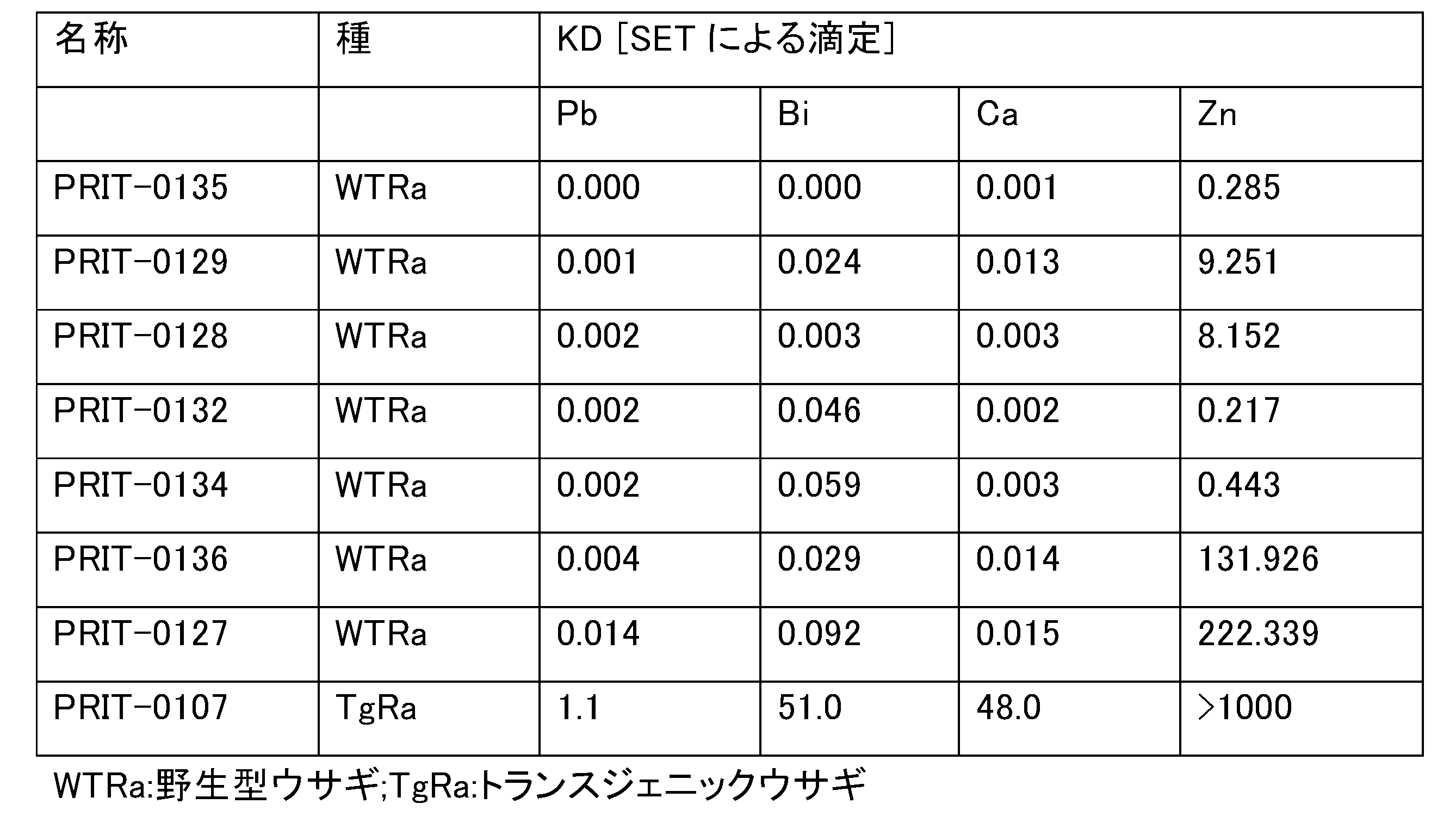
Binding of Bivalent Monoclonal Rabbit Antibodies to Chelated Metals
実施例2
ヒト化
ヒト化
次に、主要候補物質である、PRIT-0128を、ヒト化にかけた。
Example 2
Humanization Humanization The lead candidate, PRIT-0128, was then subjected to humanization.
DOTAM結合剤であるPRIT-0128のヒト化時に適する、ヒトアクセプターフレームワークを同定するために、2つの方法の組合せを使用した。一方では、親抗体に対して、高度の配列相同性を伴うアクセプターフレームワークを探索し、その後、CDR領域を、このアクセプターフレームワークにグラフティングすることによる、古典的手法を取った。同定されたフレームワークの、親抗体に対する、各アミノ酸の差違を、結合剤の構造的完全性に対する影響について判定し、適切な場合は、いつでも、親配列に対する復帰突然変異を導入した。 A combination of two methods was used to identify a suitable human acceptor framework during humanization of the DOTAM binder, PRIT-0128. On the one hand, we have taken the classical approach by searching for acceptor frameworks with a high degree of sequence homology to the parental antibody and then grafting the CDR regions onto this acceptor framework. Each amino acid difference of the identified framework relative to the parental antibody was assessed for impact on the structural integrity of the binder and, whenever appropriate, backmutations to the parental sequence were introduced.
他方では、社内で開発されたコンピュータツールを使用して、ヒト化型のVHドメインおよびVLドメインの、互いに対する配向性を予測した(WO2016/062734を参照されたい)。これを、全ての可能なヒト生殖系列の組合せにおける、CDRの仮想上のグラフトについて実行した。結果を、親結合剤のVH-VLドメインの配向性と比較して、形状が出発抗体に近接するフレームワークの組合せを選択した。 On the other hand, an in-house developed computer tool was used to predict the orientation of the humanized VH and VL domains relative to each other (see WO2016/062734). This was performed for hypothetical grafting of the CDRs in all possible human germline combinations. Results were compared to the orientation of the VH-VL domains of the parent binders to select framework combinations that were close in shape to the starting antibody.
各場合に、親抗体の、以下のCDR領域(カバットに従う番号付け):
VH_CDR1:31~35
VH_CDR2:50~65
VH_CDR3:95~102
VL_CDR1:24~34
VL_CDR2:50~56
VL_CDR3:89~97
を、アクセプターフレームワークにグラフトした。
In each case the following CDR regions (numbering according to Kabat) of the parent antibody:
VH_CDR1: 31-35
VH_CDR2: 50-65
VH_CDR3: 95-102
VL_CDR1: 24-34
VL_CDR2: 50-56
VL_CDR3: 89-97
was grafted onto the acceptor framework.
Dotam結合剤のVHドメインのN末端に融合させた、重鎖のうちの一方のC末端と、DOTAM結合剤のVLドメインのN末端に融合させた、他方の重鎖のC末端とを伴い、CEAに対する2つの結合部位と、DOTAMに対する1つ機能的結合部位とを伴う、二重特異性抗体を形成する、CEAに対する完全長抗体を含むフォーマットで、ヒト化変異体を作製した。したがって、DOTAM結合剤を、VH/VL Fv融合体として、腫瘍をターゲティングするIgGのFcのC末端(それぞれ、CH1およびCkを伴わない)に融合させた。この二重特異性フォーマットにおける、親DOTAM結合剤であるPRIT-0128に由来する分子を、PRIT-0156と呼ぶ。 with the C-terminus of one of the heavy chains fused to the N-terminus of the VH domain of the Dotam binder and the C-terminus of the other heavy chain fused to the N-terminus of the VL domain of the DOTAM binder, Humanized variants were generated in a format containing a full-length antibody against CEA, forming a bispecific antibody with two binding sites for CEA and one functional binding site for DOTAM. Therefore, the DOTAM binder was fused as a VH/VL Fv fusion to the C-terminus of the tumor-targeting IgG Fc (without CH1 and Ck, respectively). A molecule derived from the parent DOTAM binder, PRIT-0128, in this bispecific format is referred to as PRIT-0156.
VH/VLの予測およびフレームワークの安定性の増大の点における適性のために、ハーセプチンフレームワークも組み入れた。全てのVHのヒト化変異体のために、ヒトJエレメントであるhJH2を使用した。全てのVKのヒト化変異体のために、ヒトJエレメントであるhJK4を使用した。 The Herceptin framework was also incorporated because of its suitability in terms of VH/VL prediction and increased framework stability. For all VH humanized variants, the human J element hJH2 was used. For all humanized variants of VK, the human J element hJK4 was used.
HC4とは、1つの復帰突然変異である、カバットA49Gを伴う、PRIT-128の、ヒト生殖系列であるIGHV3-30-02へのグラフティングである。 HC4 is the grafting of PRIT-128 into human germline IGHV3-30-02 with one back mutation, Kabat A49G.
可変重鎖であるHC5を得るために、元のウサギN末端を反映するように、復帰突然変異としてのA49G、および第1のアミノ酸の欠失を伴うCDRを、ヒト生殖系列hVH_2_26にグラフトした。 To obtain HC5, a variable heavy chain, the CDRs with A49G as a back mutation and deletion of the first amino acid were grafted into human germline hVH_2_26 to reflect the original rabbit N-terminus.
ハーセプチンV領域(ヒト生殖系列であるhVH3_66に由来する)にグラフトされる、変異体HC7は、アクセプターフレームワーク内の少数の修飾:N末端におけるEの欠失、A49G、A71R、およびS93Aにより特徴づけられる。 Mutant HC7, grafted onto the Herceptin V region (derived from human germline hVH3_66), is characterized by a few modifications within the acceptor framework: deletion of E at the N-terminus, A49G, A71R, and S93A. be attached.
HC10のために、PRIT-128のCDRを、ヒト生殖系列であるIGHV4_34_01にグラフトした。 For HC10, the PRIT-128 CDRs were grafted into human germline IGHV4_34_01.
ここで、Q2で始まる元のウサギ抗体を反映するように、N末端を修飾し、V2で始まるようにした。加えて、G29FおよびF31Lのほか、フレームワーク3内のV71RおよびF78Vを、カバット用語法に従う復帰突然変異と考えた。
Here the N-terminus was modified to start with V2 to reflect the original rabbit antibody starting with Q2. In addition, G29F and F31L as well as V71R and F78V within
軽鎖LC1のために、復帰突然変異を伴わないCDRを、ヒト生殖系列である、IGKV1_39_01にグラフトした。A2で始まる元のウサギAbを反映するように、始点を、I2として選び出した。 For light chain LC1, the CDRs without backmutations were grafted into human germline, IGKV1_39_01. The starting point was chosen as I2 to reflect the original rabbit Ab starting with A2.
軽鎖変異体であるLC3は、ヒト生殖系列hVK1_5へのCDRのグラフティングにより得た。D1を欠失させ、I2A復帰突然変異を、新たなN末端と考えた。さらなる復帰突然変異として、K42QおよびA43Pを考慮に入れた。 A light chain variant, LC3, was obtained by grafting the CDRs into human germline hVK1_5. D1 was deleted and the I2A backmutation was considered the new N-terminus. K42Q and A43P were considered as additional back mutations.
ヒト化マトリックスの全ての可能な組合せを作製したが、VH/VLの予測、および所与の組合せの配列の危険性などの検討に基づき、規定された組合せの選択を選び出した。 While all possible combinations of humanized matrices were generated, a selection of defined combinations was picked based on considerations such as VH/VL predictions and sequence risk of a given combination.
候補物質の選択
ヒト化の目標は、DOTAMに対する親和性の点で、10倍を超える喪失を示さないヒト化結合剤を得ることであった。これは、DOTAMに対する親和性が、同等であるか、なおまたは良好である、いくつか結合剤により達成した。
Selection of Candidate Substances The goal of humanization was to obtain a humanized binding agent that does not show more than a 10-fold loss in affinity for DOTAM. This was achieved with several binders with comparable, even better, affinity for DOTAM.
上記で言及された通り、PRIT-0156とは、ウサギDOTAM結合剤である、PRIT-0128を、CEA結合剤である、CH1A1Aと組み合わせて含む2:1抗体である。PRIT-0178~PRIT-0204は、同じCEA結合剤を伴う、同じフォーマットのヒト化変異体である。PRIT-0205~PRIT-0221は、DOTAM結合部分では、PRIT-0178~PRIT-0204のヒト化変異体に対応するが、CEA結合剤を、T84.66に変化させている。 As mentioned above, PRIT-0156 is a 2:1 antibody comprising the rabbit DOTAM binder, PRIT-0128, in combination with the CEA binder, CH1A1A. PRIT-0178 through PRIT-0204 are humanized variants of the same format with the same CEA binders. PRIT-0205 through PRIT-0221 correspond to humanized variants of PRIT-0178 through PRIT-0204 in the DOTAM binding portion, but with the CEA binder changed to T84.66.
溶液平衡ベースのkdの決定
大量のヒト化候補物質を、Pb-DOTAMに対するそれらの親和性についてスクリーニングするために、SET(solution equilibration titration)を使用した。下記の表は、Pb-DOTAMに対して選択された、ヒト化DOTAM結合剤についての、SETベースの親和性決定について詳述する。この表における全ての抗体は、CEAへの二価結合、およびPb-Dotamへの一価の結合を含む、二重特異性抗体(2:1フォーマット)である。
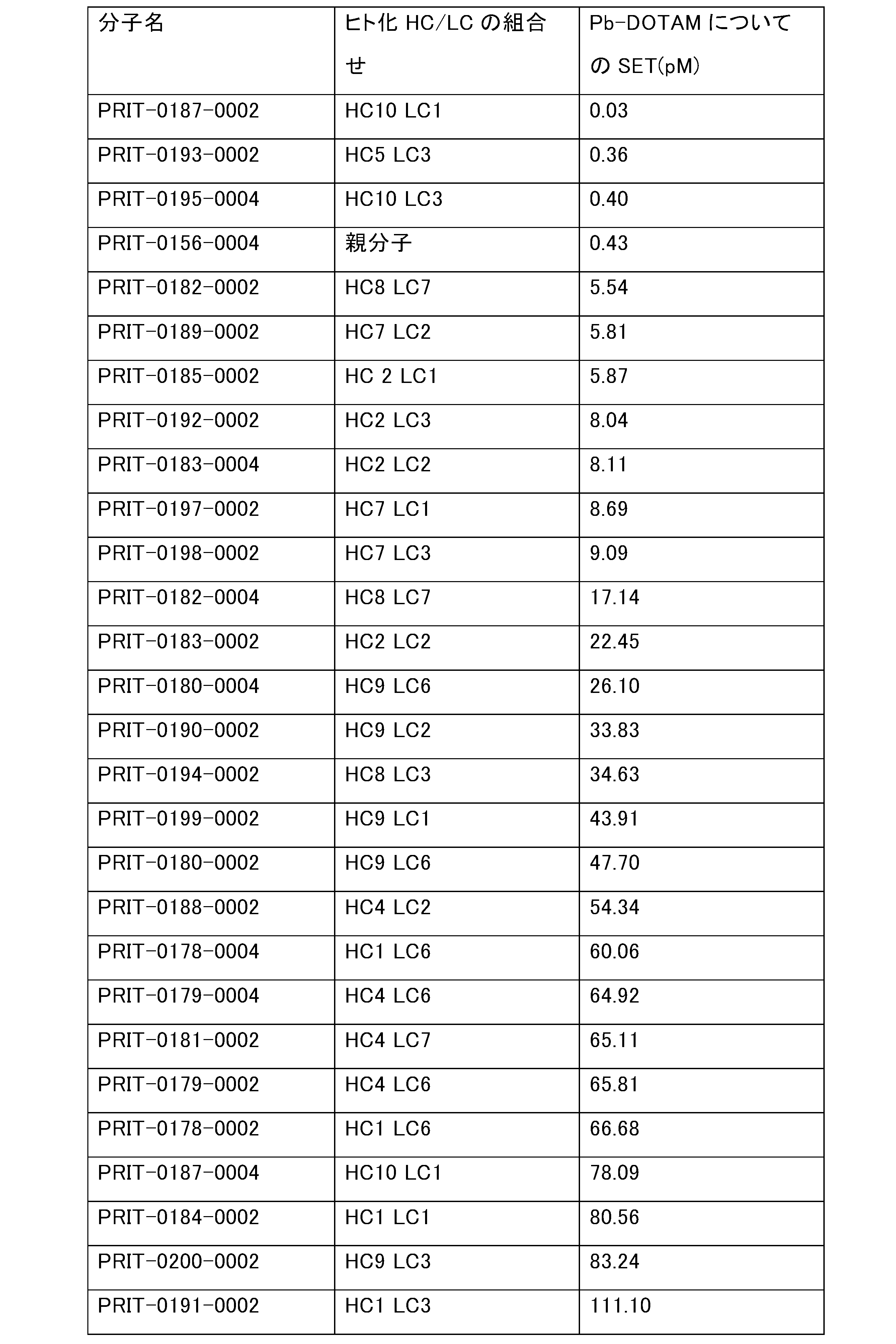
Kinexaベースのkdの決定
親和性決定についての、より詳細な解析および直交法のために、Kinexaを使用した。
Kinexa-based kd determination Kinexa was used for more detailed analysis and orthogonal methods for affinity determination.
測定器および材料
オートサンプラーを伴う、Sapidyne Instruments(Boise、ID)製のKinExA 3200測定器を使用した。ポリメチルメタクリレート(PMMA)ビーズは、Sapidyneから購入したが、PBS(リン酸緩衝生理食塩水)、BSA(ウシ血清アルブミン画分V)、および抗DOTAM抗体は、社内(Roche)で調製した。Dylight650(登録商標)コンジュゲート親和性精製ヤギ抗ヒトIgG-Fc断片交差吸着抗体は、Bethyl Laboratories(Montgomery、TX)から購入した。ビオチン化Pb-DOTAM抗原(Pb-DOTAM-アルキル-ビオチン異性体AおよびB、Pb-DOTAM-Bn-ビオチン/TCMC-Pb-dPEG3-ビオチン、異性体AおよびB)、および非ビオチン化Pb-DOTAMは、AREVA Med(Bethesda、MD)から得た。
Instruments and Materials A KinExA 3200 instrument from Sapidyne Instruments (Boise, Id.) with an autosampler was used. Polymethylmethacrylate (PMMA) beads were purchased from Sapidyne, while PBS (phosphate buffered saline), BSA (bovine serum albumin fraction V), and anti-DOTAM antibody were prepared in-house (Roche). Dylight650® conjugated affinity-purified goat anti-human IgG-Fc fragment cross-absorbed antibody was purchased from Bethyl Laboratories (Montgomery, Tex.). Biotinylated Pb-DOTAM antigen (Pb-DOTAM-alkyl-biotin isomers A and B, Pb-DOTAM-Bn-biotin/TCMC-Pb-dPEG3-biotin, isomers A and B), and non-biotinylated Pb-DOTAM was obtained from AREVA Med (Bethesda, Md.).
抗原コーティングビーズの調製
「KinExA Handbook protocol for biotinylated molecules」(Sapidyne)に従い、PMMAビーズをコーティングした。略述すると、第1に、吸着コーティングのためのビーズバイアル(200mg)1本当たり、1mlのPBS(pH7.4)中に、10μgのビオチン-BSA(Thermo Scientific)を添加した。室温で、2時間にわたり回転させた後で、上清を除去し、ビーズを、1mlのPBSで、5回にわたり洗浄した。第2に、10mg/mlのBSAを含有するPBS中に100μgのNeutrAvidinビオチン結合タンパク質(Thermo Scientific)1mlを、ビーズに添加し、室温で、さらに2時間にわたりインキュベートして、NeutrAvidinを、ビーズにカップリングさせ、その後におけるビオチン化タンパク質の結合のための、さらなるビオチン結合部位をもたらした。次いで、NeutrAvidinコーティングビーズを、1mlのPBSで、5回にわたりすすいだ。最後に、ビーズを、PBS中に200ng/mlのビオチン化Pb-DOTAM-異性体ミックス(各異性体について50ngずつ)でコーティングし、室温で、さらに2時間にわたりインキュベートした。次いで、ビーズを、30mlのPBS中に再懸濁させ、速やかに使用した。
Preparation of Antigen-Coated Beads PMMA beads were coated according to the “KinExA Handbook protocol for biotinylated molecules” (Sapidyne). Briefly, 10 μg biotin-BSA (Thermo Scientific) in 1 ml PBS (pH 7.4) was added per bead vial (200 mg) for adsorption coating. After spinning for 2 hours at room temperature, the supernatant was removed and the beads were washed 5 times with 1 ml PBS. Second, 1 ml of 100 μg NeutrAvidin biotin binding protein (Thermo Scientific) in PBS containing 10 mg/ml BSA was added to the beads and incubated at room temperature for an additional 2 hours to allow NeutrAvidin to cup to the beads. ring to provide additional biotin binding sites for subsequent binding of biotinylated proteins. The NeutrAvidin-coated beads were then rinsed 5 times with 1 ml of PBS. Finally, the beads were coated with 200 ng/ml biotinylated Pb-DOTAM-isomer mix (50 ng for each isomer) in PBS and incubated at room temperature for an additional 2 hours. Beads were then resuspended in 30 ml PBS and used immediately.
KinExA平衡アッセイ
全てのKinExA実験は、PBS pH7.4を、ランニングバッファーとして使用して、室温(RT)で実施した。試料は、1mg/mlのBSAを補充したランニングバッファー(「試料バッファー」)中で調製した。0.25ml/分の流量を使用した。結合部位濃度を5pMとする、一定量の抗DOTAM抗体を、100pM(濃度範囲:0.049pM~100pM)で始める、2倍の段階希釈を介するPb-DOTAM抗原により滴定した。抗原を伴わない、1例の抗体試料は、100%のシグナル(すなわち、阻害を伴わないシグナル)として用いられた。抗原-抗体複合体を、RTで、少なくとも24時間にわたりインキュベートして、平衡に達することを可能とした。次いで、KinExAシステム内、溶液の平衡状態を撹乱せずに、非結合抗体が、ビーズにより捕捉されることを可能とする、5mlの容量で、Pb-DOTAMカップリングビーズのカラムを介して、平衡化混合物を取り出した。捕捉された抗体は、試料バッファー中に250ng/mlのDylight 650(著作権)コンジュゲート抗ヒトFc断片特異的二次抗体を使用して検出した。各試料は、全ての平衡実験について、二連で測定した。
KinExA Equilibrium Assay All KinExA experiments were performed at room temperature (RT) using PBS pH 7.4 as running buffer. Samples were prepared in running buffer (“sample buffer”) supplemented with 1 mg/ml BSA. A flow rate of 0.25 ml/min was used. A constant amount of anti-DOTAM antibody, with a binding site concentration of 5 pM, was titrated with Pb-DOTAM antigen through two-fold serial dilutions starting at 100 pM (concentration range: 0.049 pM to 100 pM). One antibody sample without antigen was used as 100% signal (ie signal without inhibition). Antigen-antibody complexes were incubated at RT for at least 24 hours to allow them to reach equilibrium. Then equilibrate through a column of Pb-DOTAM-coupled beads in a volume of 5 ml, allowing unbound antibody to be captured by the beads without disturbing the equilibration of the solution in the KinExA system. The mixture was removed. Captured antibodies were detected using a Dylight 650 (copyright) conjugated anti-human Fc fragment specific secondary antibody at 250 ng/ml in sample buffer. Each sample was measured in duplicate for all equilibrium experiments.
KDは、「標準的解析」法を使用する、KinExAソフトウェア(Version 4.0.11)内に含有される、1部位均一結合モデルを使用して、データの非線形回帰分析から得られた。ソフトウェアは、KDを計算し、データ点を、理論によるKD曲線に当てはめることにより、95%信頼区間を決定する。95%信頼区間(Sapidyne TechNote TN207R0)は、低値KDおよび高値KDとして与えられる。 KDs were obtained from non-linear regression analysis of the data using the one-site homogeneous binding model contained within the KinExA software (Version 4.0.11) using the "standard analysis" method. The software calculates the KD and determines the 95% confidence interval by fitting the data points to the theoretical KD curve. 95% confidence intervals (Sapidyne TechNote TN207R0) are given as low KD and high KD.
ヒト化PRIT分子についての熱安定性の測定
方法およびデータ解析
最終的なフォーマット(20mMのヒスチジン、140mMのNaCl、pH6.0)におけるヒト化PRIT分子の異なる変異体を、同じバッファー中で、1mg/mlに希釈した。各試料30μlずつを、384ウェルプレートフィルターデバイスに移した(参照としての抗HER3抗体と共に)。1,000gで、1分間にわたる遠心分離の後、ウェルを、10μlのパラフィン油で覆った。プレートを、再度遠心分離し(1,000gで、1分間にわたる)、DLSプレートリーダー(Dyna Pro PlateReader-II、Wyatt)に移した。25℃で始め、温度を、0.05℃/分の速度で、79.9℃に上昇させた。散乱光は、Dynamics Software(V7.0)を使用して記録した。
Thermostability Measurement Method and Data Analysis for Humanized PRIT Molecules Different variants of humanized PRIT molecules in final format (20 mM histidine, 140 mM NaCl, pH 6.0) were treated in the same buffer at 1 mg/ml. ml. 30 μl of each sample was transferred to a 384-well plate filter device (with anti-HER3 antibody as reference). After centrifugation at 1,000 g for 1 minute, wells were overlaid with 10 μl of paraffin oil. Plates were centrifuged again (1,000 g for 1 minute) and transferred to a DLS plate reader (Dyna Pro PlateReader-II, Wyatt). Starting at 25°C, the temperature was increased to 79.9°C at a rate of 0.05°C/min. Scattered light was recorded using Dynamics Software (V7.0).
データを、Excel(Microsoft)に変換し、試料および温度によりソートし、ソフトウェアのアドインを使用して、溶融曲線を作成した。ベースラインからの明らかな逸脱が生じる温度を、「凝集の開始」温度と規定し、溶融曲線の屈折点を、「溶融温度」と規定した。 Data were converted to Excel (Microsoft), sorted by sample and temperature, and a software add-in was used to generate melting curves. The temperature at which a clear deviation from the baseline occurs was defined as the 'onset of aggregation' temperature and the inflection point of the melting curve was defined as the 'melting temperature'.
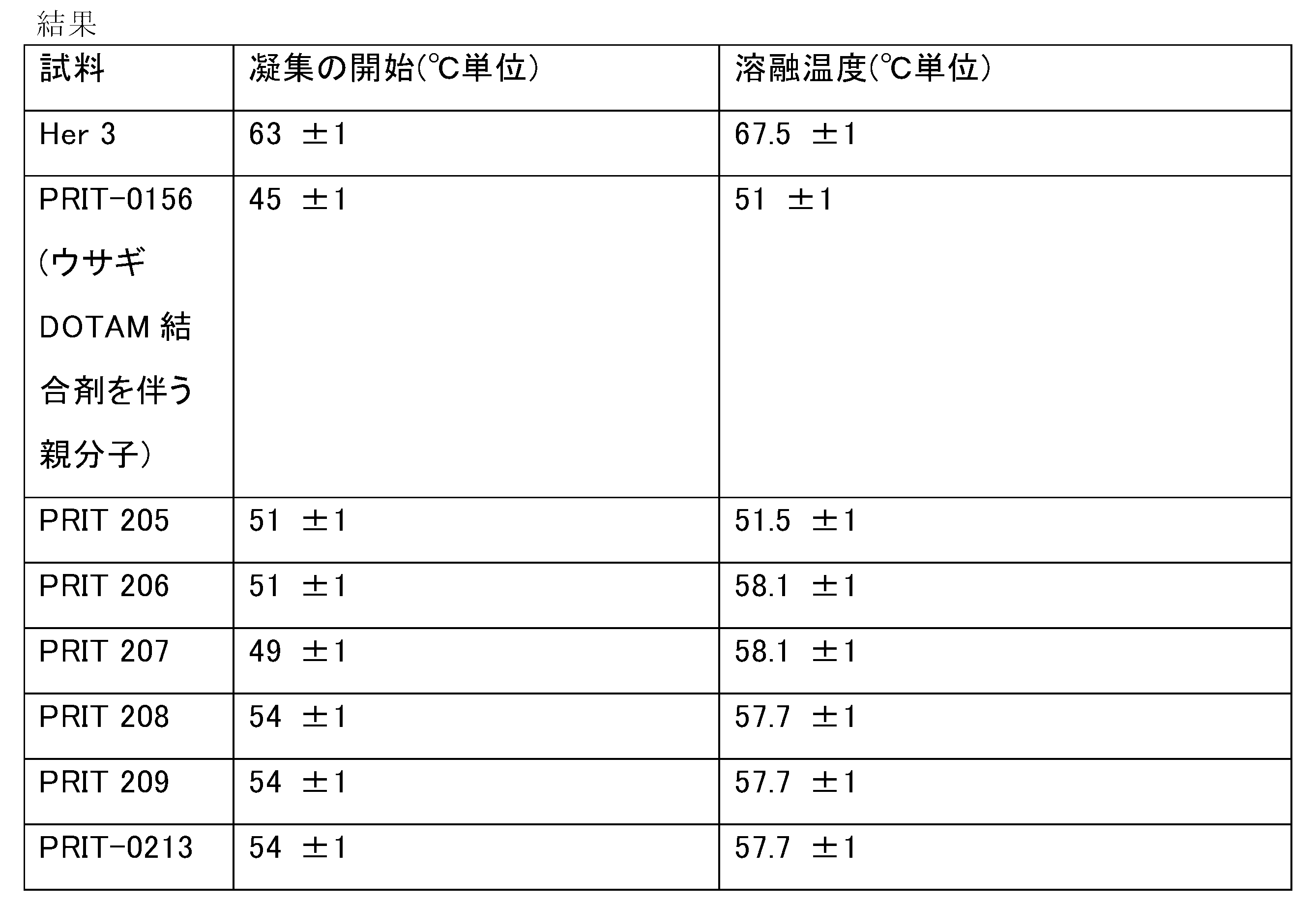
候補物質の特性
下記の表は、多様なPRIT分子の識別についてまとめ、それらの特性を比較する。好ましい化合物は、PRIT-0213およびPRIT-0214であった。
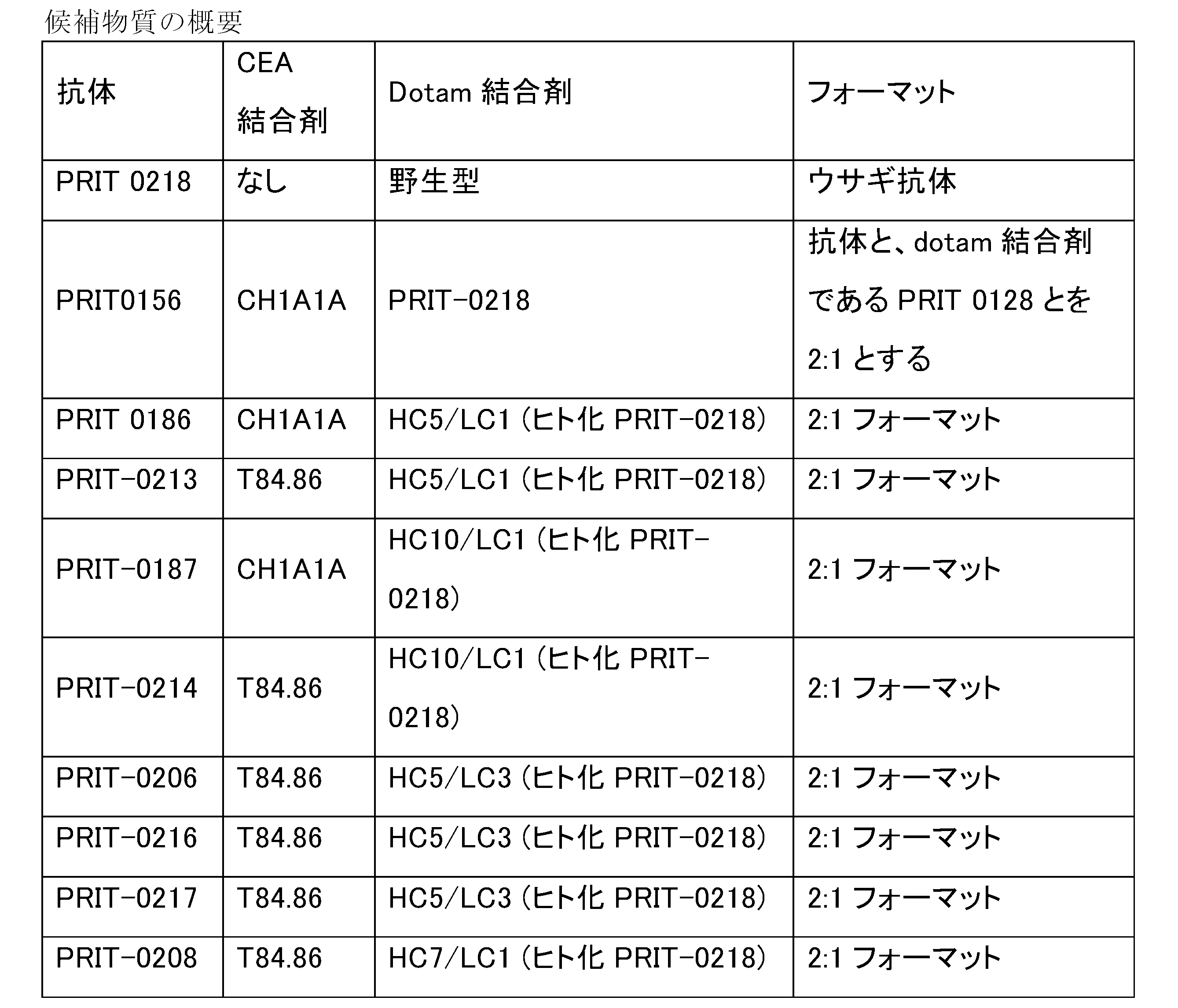
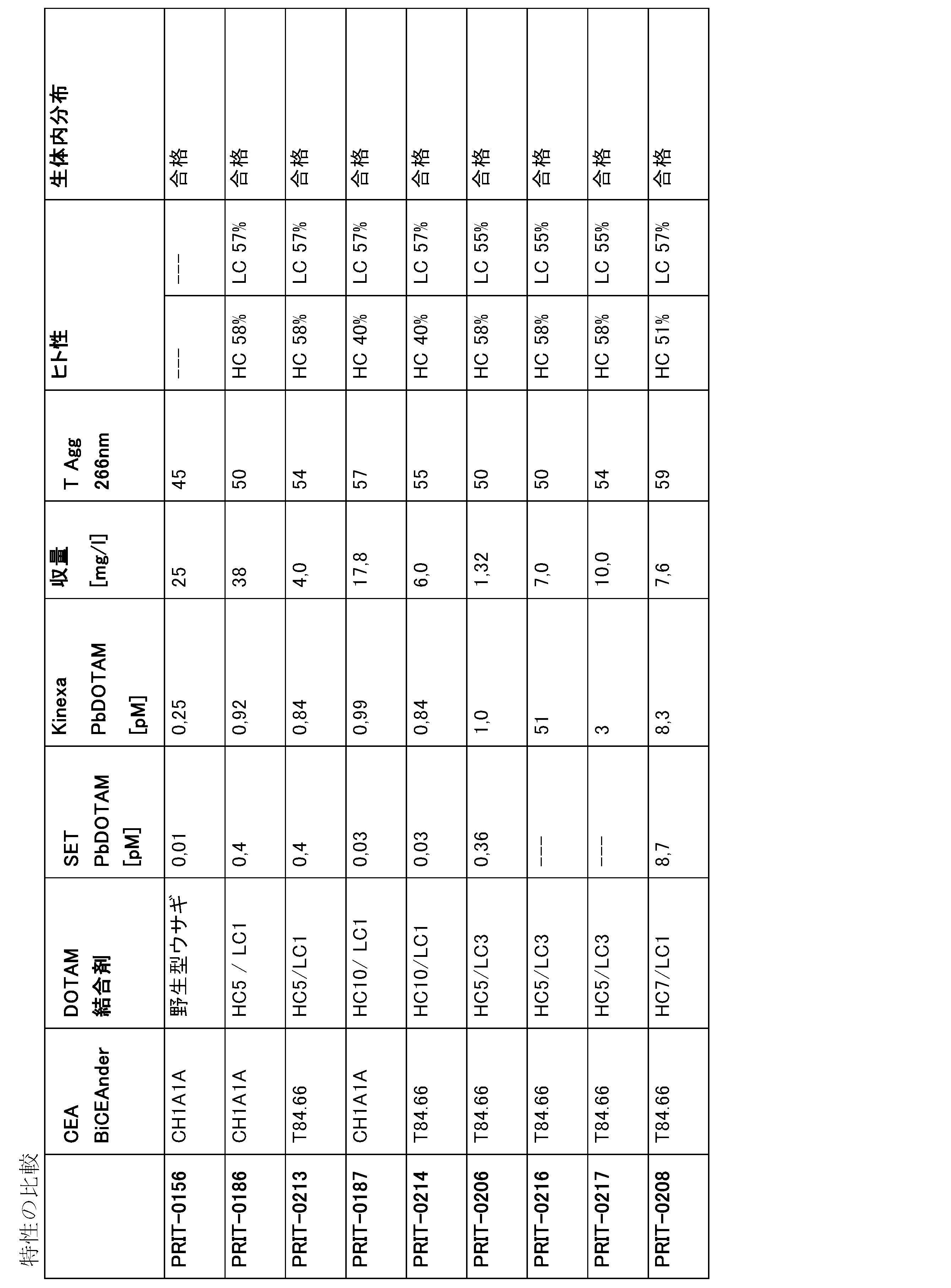
PRIT-0213について、Kinexaにより決定される親和性値についてのさらにデータを、下記に提示する(PRIT-0213は、別のCEA結合性VH/VLを除き、PRIT-0186と同じ分子である)。
CEA-DOTAM BsAbの、金属-DOTAMキレートに対する親和性
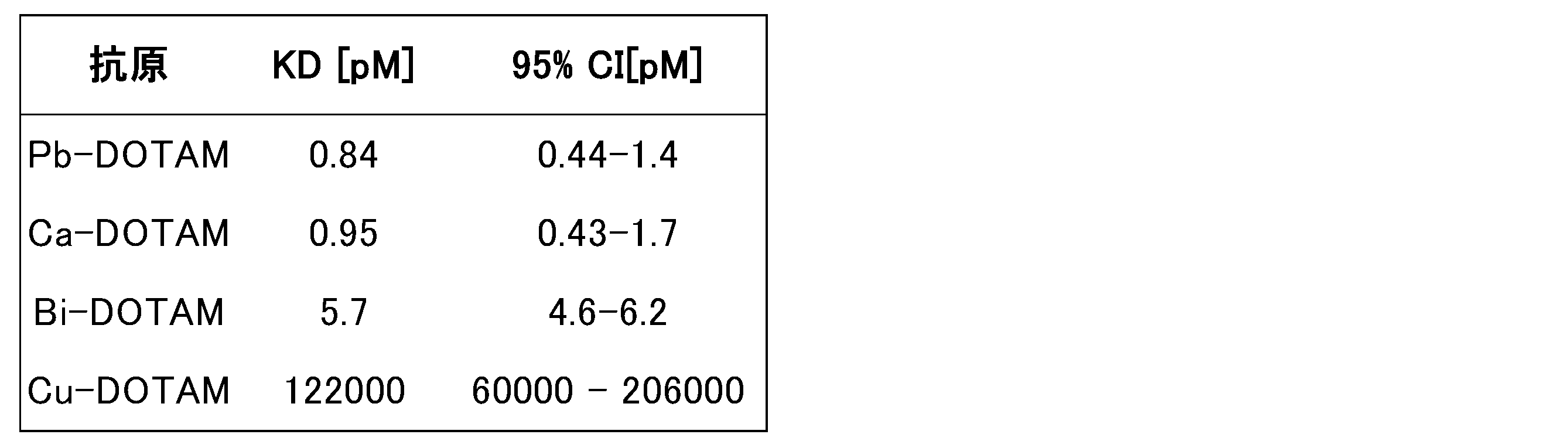
Affinity of CEA-DOTAM BsAbs for metal-DOTAM chelates.
さらなる値を下記に示す:
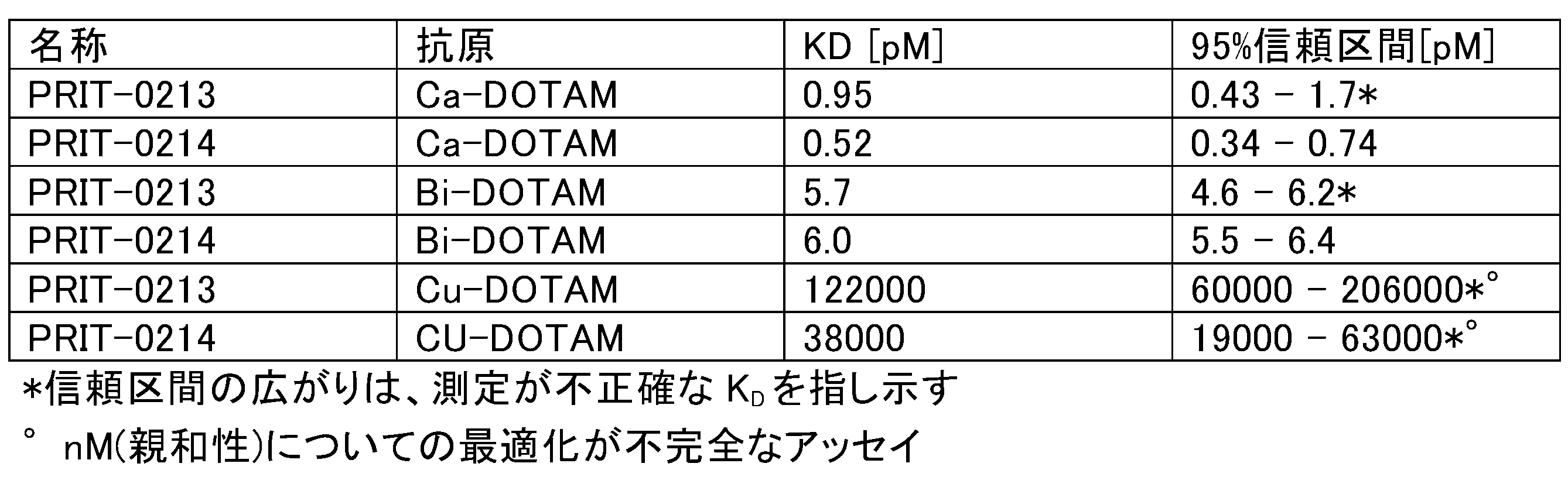
配列
本実施例のための配列を下記に提示する。PRIT-0213およびPRIT-0214は、いずれも、下記の配列番号116~121のCDRを含む、Pb-DOTAM結合部位を有する。PRIT-0213のPb-DOTAM結合部位の重鎖可変領域および軽鎖可変領域の配列を、配列番号122~123に示し、PRIT-0214のPb-DOTAM結合部位の重鎖可変領域および軽鎖可変領域の配列を、配列番号124~125に示す。
Sequences The sequences for this example are provided below. Both PRIT-0213 and PRIT-0214 have Pb-DOTAM binding sites that include the CDRs of SEQ ID NOs: 116-121 below. The sequences of the heavy and light chain variable regions of the Pb-DOTAM binding site of PRIT-0213 are shown in SEQ ID NOS: 122-123 and the heavy and light chain variable regions of the Pb-DOTAM binding site of PRIT-0214. are shown in SEQ ID NOS: 124-125.
PRIT-0214は、
i)配列番号126のアミノ酸配列を有する、第1の重鎖;
ii)配列番号127のアミノ酸配列を有する、第2の重鎖;および
iii)配列番号128のアミノ酸配列を有する、2つの抗体軽鎖
から構成される。
PRIT-0214 is
i) a first heavy chain having the amino acid sequence of SEQ ID NO: 126;
ii) a second heavy chain having the amino acid sequence of SEQ ID NO:127; and iii) two antibody light chains having the amino acid sequence of SEQ ID NO:128.
PRIT-0213は、
i)配列番号129のアミノ酸配列を有する、第1の重鎖;
ii)配列番号130のアミノ酸配列を有する、第2の重鎖;および
iii)配列番号128のアミノ酸配列を有する、2つの抗体軽鎖
から構成される。
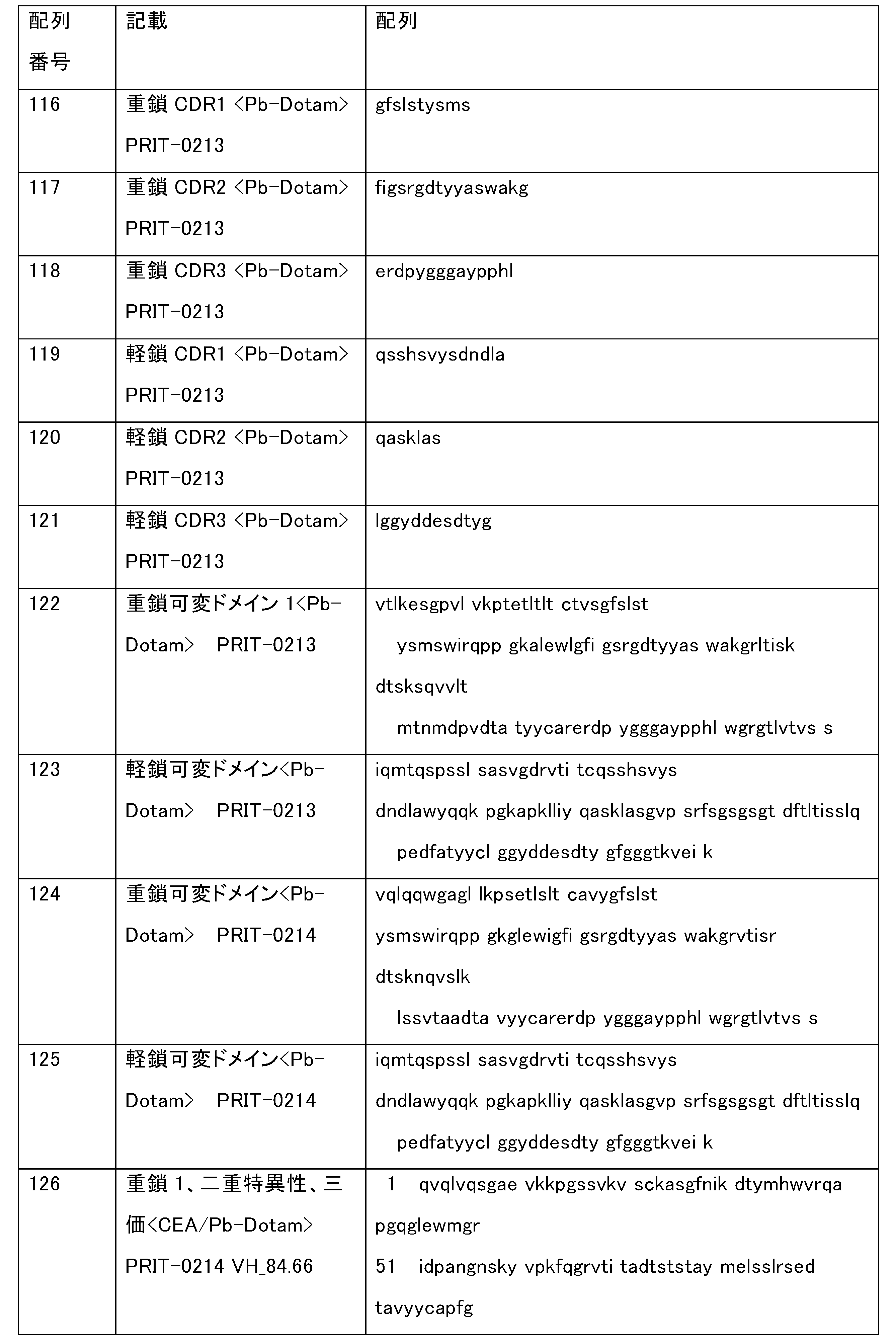
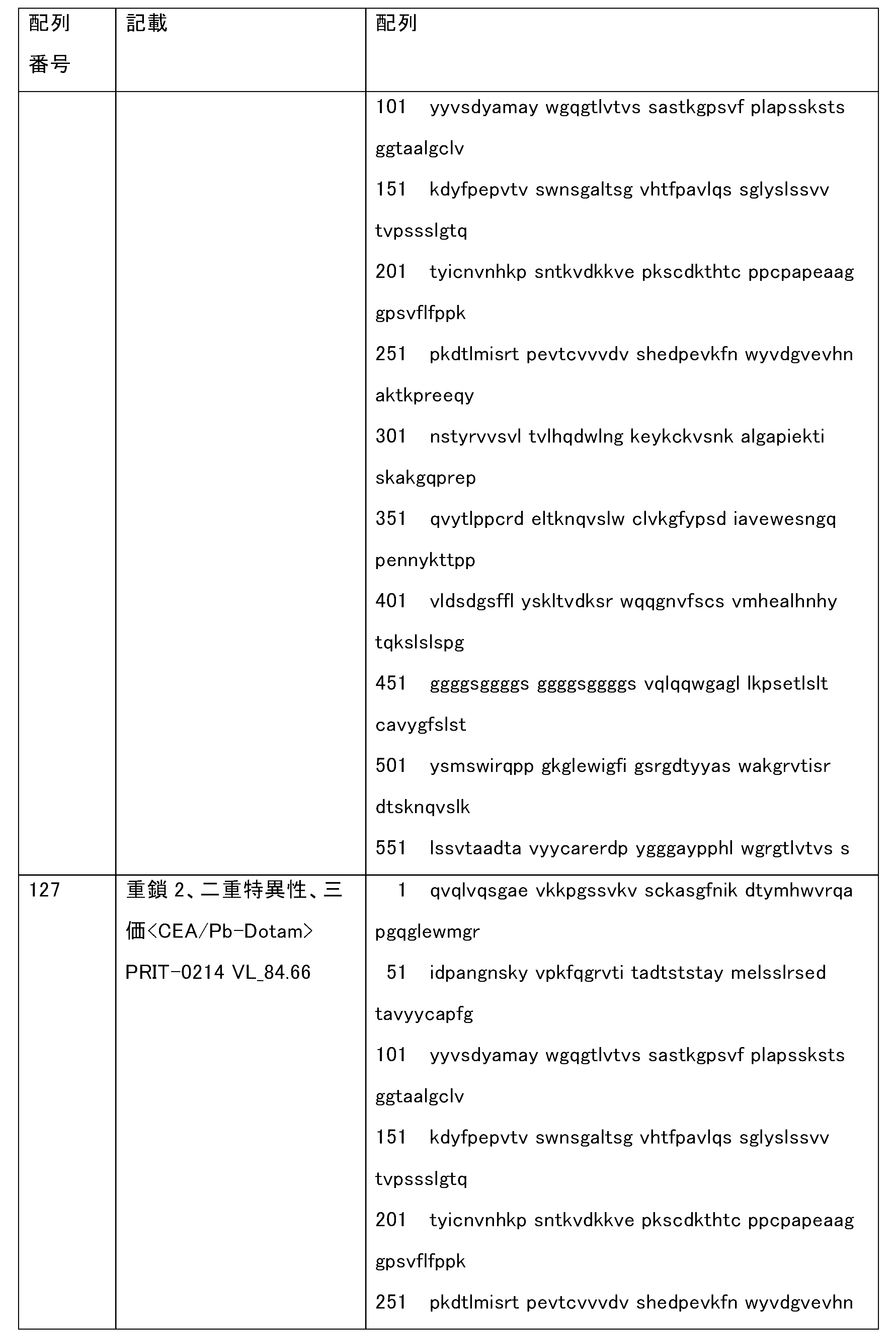
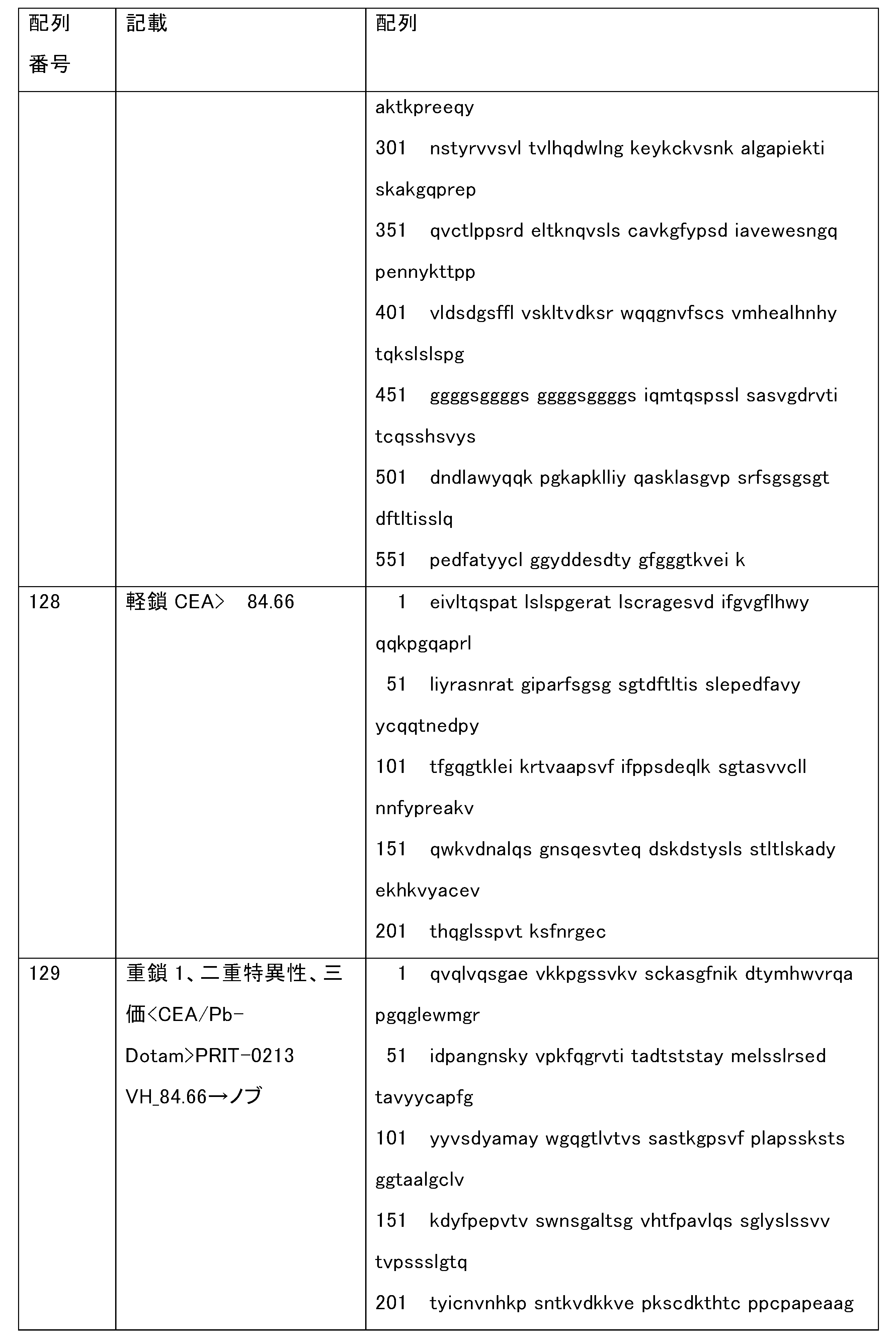
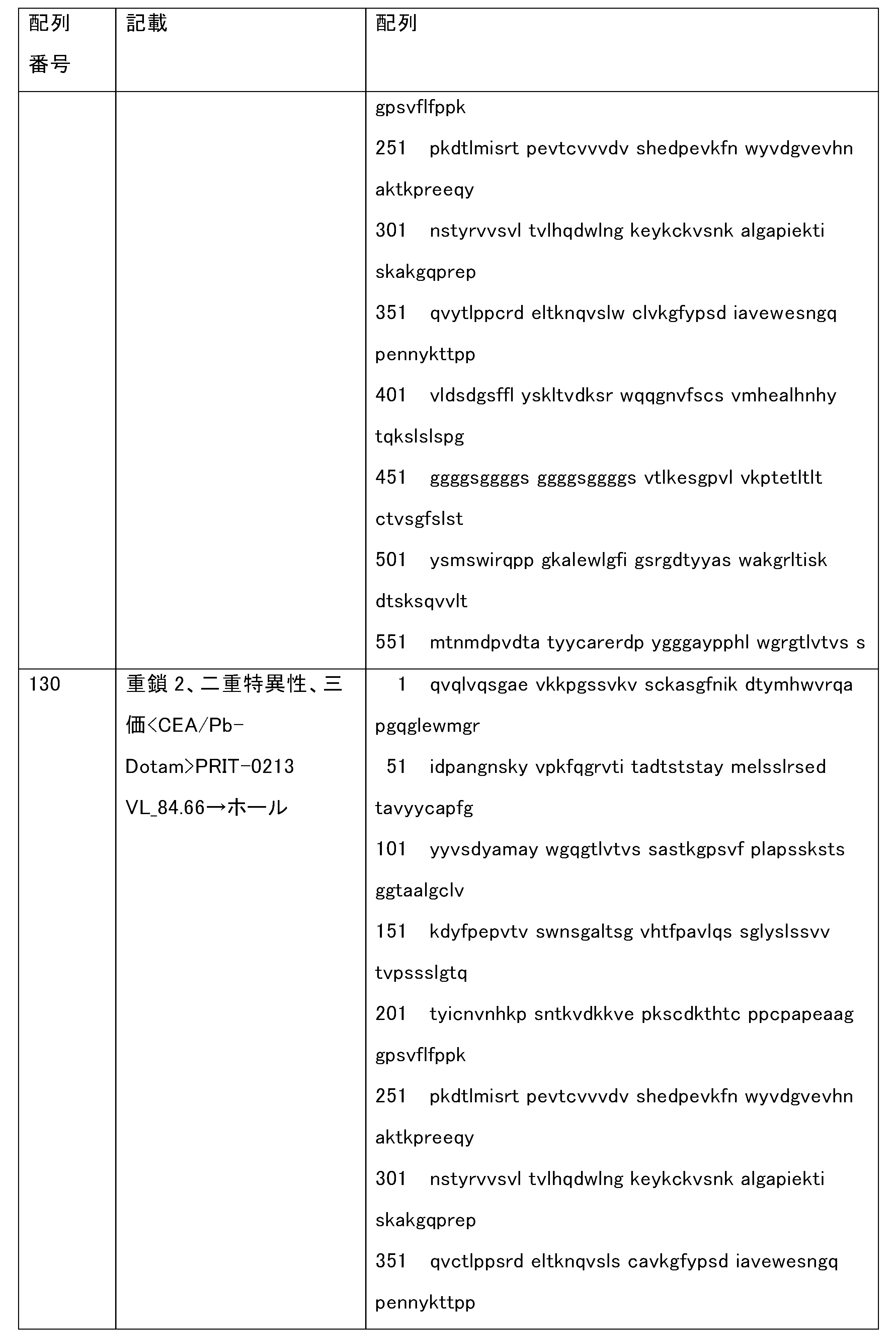

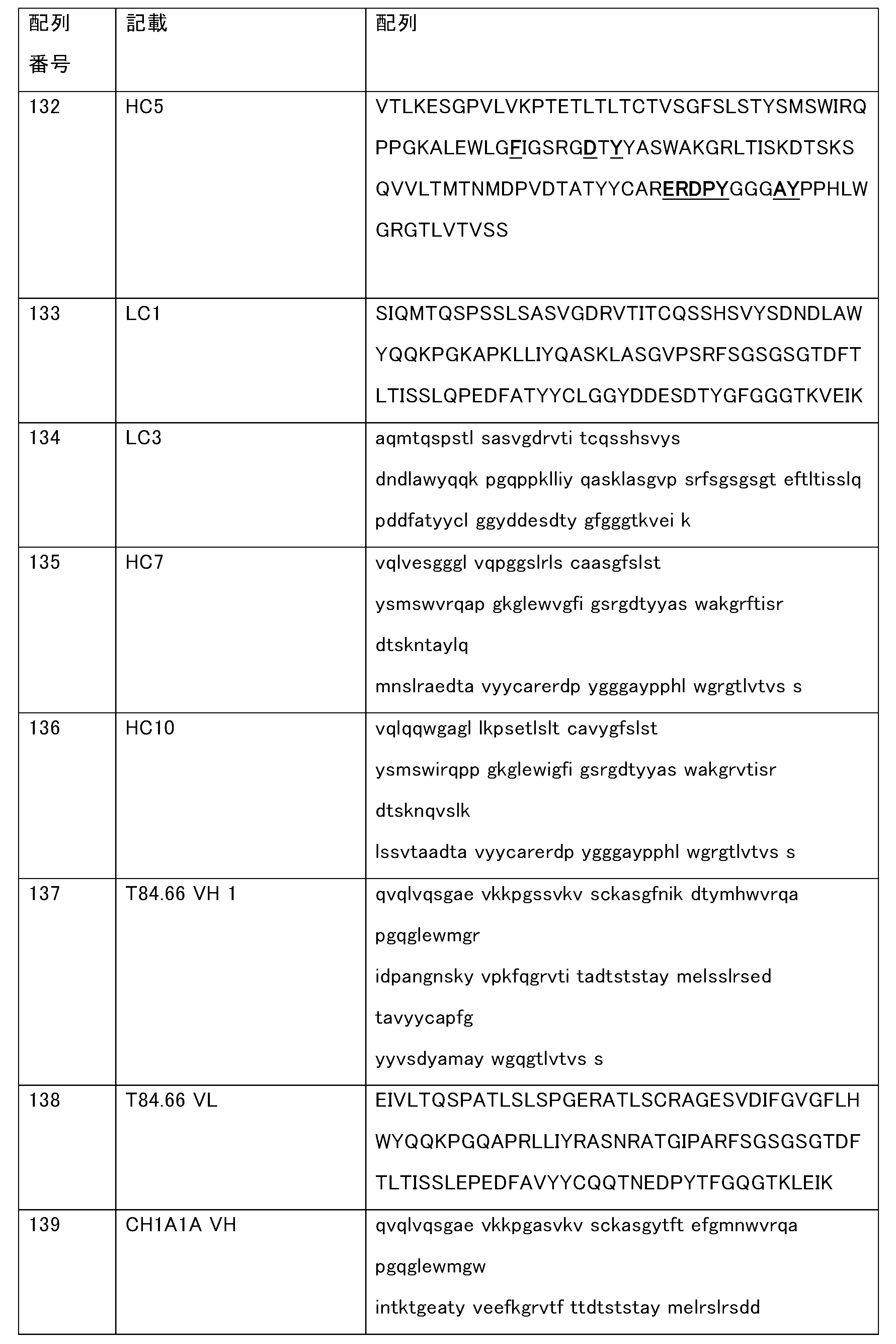
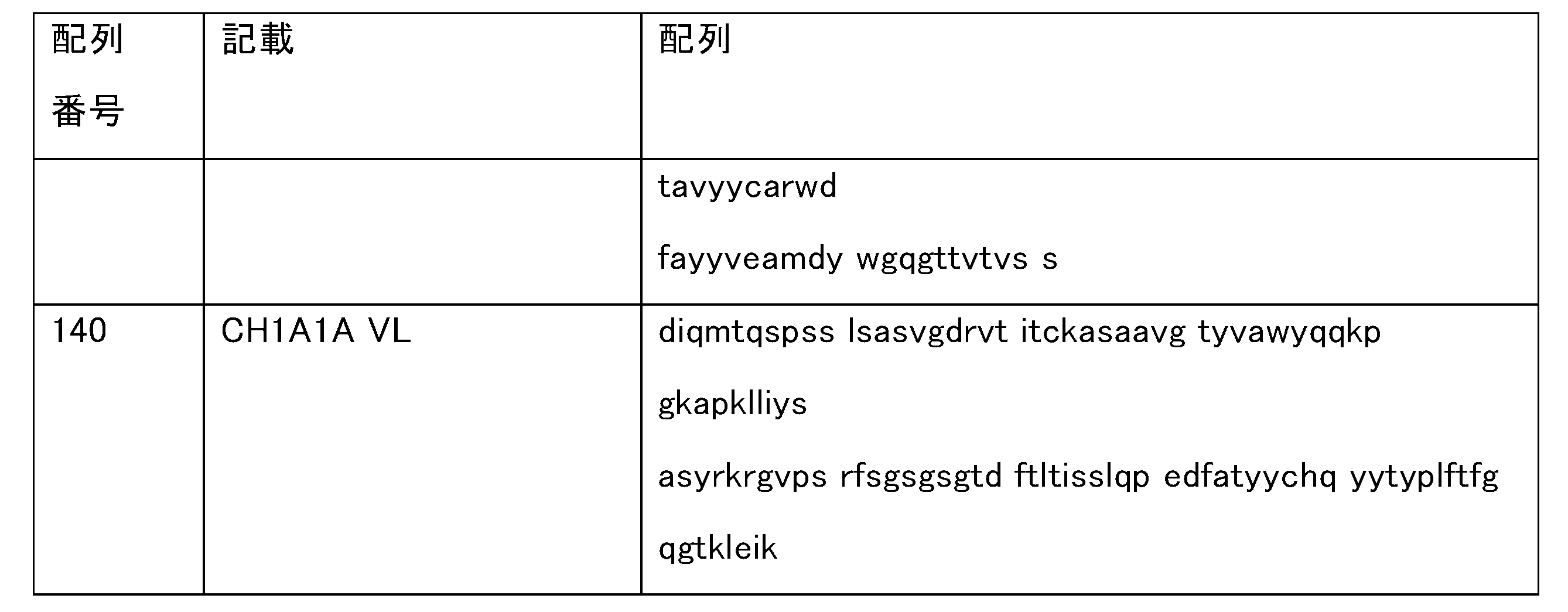
i) a first heavy chain having the amino acid sequence of SEQ ID NO: 129;
ii) a second heavy chain having the amino acid sequence of SEQ ID NO:130; and iii) two antibody light chains having the amino acid sequence of SEQ ID NO:128.
実施例3
Fab P1AA1227 Pb-DOTAM複合体の結晶化、データ回収、および構造決定
複合体を形成するために、26mg/mlの、P1AA1227と呼ばれる、PRIT-0213内のヒト化VH/VLに由来するFabを、Pb-DOTAM粉末と、1:4.2のモル比で混合した。4℃で、2時間にわたるインキュベーションの後、初期結晶化試験は、JCSG+ screen(Qiagen、Hilden)を使用して、21℃のシッティングドロップ蒸気拡散設定で実施した。結晶は、0.2Mの(NH4)2SO4、0.1Mのビス-トリスpH5.5、25%w/vのPEG3350から、5日間以内に現れた。結晶を、任意のさらなる最適化工程を伴わずに、スクリーニングプレートから直接採取した。
Example 3
Crystallization, Data Recovery and Structure Determination of the Fab P1AA1227 Pb-DOTAM Complex To form the complex, 26 mg/ml of a Fab derived from the humanized VH/VL within PRIT-0213, called P1AA1227, was It was mixed with Pb-DOTAM powder at a molar ratio of 1:4.2. After incubation for 2 hours at 4°C, initial crystallization studies were performed using a JCSG+ screen (Qiagen, Hilden) with a sitting drop vapor diffusion setting at 21°C. Crystals appeared from 0.2 M (NH4)2SO4, 0.1 M Bis-Tris pH 5.5, 25% w/v PEG3350 within 5 days. Crystals were picked directly from the screening plate without any further optimization steps.
データ回収および構造決定:データ回収のために、結晶を、10%のエチレングリコールを含有する沈殿剤溶液中、100Kで、瞬時凍結させた。回折データは、PILATUS 6M検出器を、Swiss Light Source(Villigen、Switzerland)のビームラインX10SAで使用して、1.0000Åの波長で回収した。データは、XDS(Kabsch,W.、Acta Cryst.、D66、133~144(2010))で加工し、SADABS(BRUKER)でスケーリングした。複合体の結晶は、セル軸を、a=135.63Å、b=56.42Å、c=64.52Åとし、β=108.36°とする空間群C2に属し、1.40Åの分解能で回折される。構造は、自社製のFab構造についての座標を、探索モデルとして使用する、PHASER(McCoy,A.J、Grosse-Kunstleve,R.W.、Adams,P.D.、Storoni,L.C.、およびRead,R.J.、J.Appl.Cryst.、40、658~674(2007))を伴う分子置換法により決定した。電子密度差を使用して、Pb-DOTAMを配置し、実空間精緻化による配列差に従い、アミノ酸を変化させた。構造は、CCP4パッケージソフト(「Collaborative Computational Project」、その4、Acta Cryst.、D50、760~763(1994))、およびBUSTER(Bricogne,G.、Blanc,E.、Brandl,M.、Flensburg,C.、Keller,P.、Paciorek,W.、Roversi,P.、Sharff,A.、Smart,O.S.、Vonrhein,C.、Womack,T.O.(2011)、Buster version 2.9.5、Cambridge、United Kingdom:Global Phasing Ltd.)に由来するプログラムにより精緻化した。マニュアルの再構築は、COOTにより行った(Emsley,P.、Lohkamp,B.、Scott,W.G.、およびCowtan,K.、Acta Cryst、D66、486~501(2010))。 Data collection and structure determination: For data collection, crystals were flash frozen at 100 K in a precipitant solution containing 10% ethylene glycol. Diffraction data were collected at a wavelength of 1.0000 Å using a PILATUS 6M detector at beamline X10SA of the Swiss Light Source (Villigen, Switzerland). Data were processed with XDS (Kabsch, W., Acta Cryst., D66, 133-144 (2010)) and scaled with SADABS (BRUKER). Crystals of the complex belong to space group C2 with cell axes a = 135.63 Å, b = 56.42 Å, c = 64.52 Å, and β = 108.36°, and diffract at a resolution of 1.40 Å. be done. The structures were derived from PHASER (McCoy, AJ, Grosse-Kunstleve, RW, Adams, PD, Storoni, LC; and Read, RJ, J. Appl. Cryst., 40, 658-674 (2007)). Electron density differences were used to place Pb-DOTAM and change amino acids according to sequence differences by real-space refinement. The structure is based on the CCP4 package software (“Collaborative Computational Project”, Part 4, Acta Cryst., D50, 760-763 (1994)) and BUSTER (Bricogne, G., Blanc, E., Brandl, M., Flensburg, C., Keller, P., Paciorek, W., Roversi, P., Sharff, A., Smart, OS, Vonrhein, C., Womack, TO (2011), Buster version 2.9. .5, Cambridge, United Kingdom: Global Phasing Ltd.). Manual reconstruction was performed by COOT (Emsley, P., Lohkamp, B., Scott, WG, and Cowtan, K., Acta Cryst, D66, 486-501 (2010)).
データ回収および精緻化統計学を、下記にまとめる。 Data collection and refinement statistics are summarized below.
全てのグラフ表示は、PYMOL(Pymol Molecular Graphics System、Version 1.7.4.、Schroedinger,LLC.)により作成した。
Fab P1AA1227-Pb-DOTAM複合体についてのデータ回収および精緻化統計学

Data collection and refinement statistics for Fab P1AA1227-Pb-DOTAM conjugates
Pb-DOTAMと複合させたFab P1AA1227の構造
Pb-DOTAMの、Fab P1AA1227との相互作用の詳細を特徴付けるために、本発明者らは、複合体の結晶構造を、1.40Åの分解能で決定した。構造は、軽鎖のCDR1およびCDR3、ならびに重鎖のCDR2およびCDR3による主要な寄与により、Fab P1AA1227が、Pb-DOTAMに結合することを明らかにする。
Structure of Fab P1AA1227 in complex with Pb-DOTAM To characterize the details of the interaction of Pb-DOTAM with Fab P1AA1227, we determined the crystal structure of the complex at 1.40 Å resolution. . The structure reveals that Fab P1AA1227 binds to Pb-DOTAM with major contributions from light chain CDR1 and CDR3 and heavy chain CDR2 and CDR3.
プログラムであるPISAによる、結合接触面についての解析は、3つの水素結合、極性相互作用、およびファンデルワールス力による接触を介する、Fab P1AA1227の、Pb-DOTAMとの相互作用パターンを明らかにする。Pb-DOTAMは、重鎖および軽鎖により形成されるポケット内で結合している。このポケットは、1つの面において開く箱の形状を有する。ポケットの側壁面が、無極性相互作用に寄与するのに対し、壁面の縁辺部では、極性相互作用が中心をなす。重鎖のCDR3残基であるGlu95およびAsp97の、DOTAMのカルバモイルの窒素原子であるN7およびN8との間では、側鎖間の水素結合が形成される。さらなる水素結合は、主鎖Arg96のカルボニル炭素原子およびDOTAMの原子N7を介して確立される。複合体は、アザシクロドデカン環に対してエッジ-フェイス配向をなす、重鎖CDR2のPhe50およびTyr58の側鎖の無極性相互作用を介して、さらに安定化される。軽鎖は、主に、CDR3の残基Gly91~Tyr96と共に、ポケットの「ボトム」を与え、テトラシクロドデカン環に対する、無極性の接触面をもたらす。Asp32は、DOTAMのカルバモイルの窒素原子N6に対する水素結合を受け入れる(カバットに従う番号付け)。 Analysis of the binding interfaces by the program PISA reveals the interaction pattern of Fab P1AA1227 with Pb-DOTAM via contacts due to three hydrogen bonds, polar interactions, and van der Waals forces. Pb-DOTAM binds within the pocket formed by the heavy and light chains. This pocket has the shape of a box that opens on one side. The sidewall surfaces of the pocket contribute to the non-polar interactions, whereas the polar interactions dominate at the edges of the walls. Inter-side chain hydrogen bonds are formed between the heavy chain CDR3 residues Glu95 and Asp97 with the DOTAM carbamoyl nitrogen atoms N7 and N8. A further hydrogen bond is established through the carbonyl carbon atom of main chain Arg96 and atom N7 of DOTAM. The complex is further stabilized through non-polar interactions of the side chains of Phe50 and Tyr58 of heavy chain CDR2 in edge-face orientation with respect to the azacyclododecane ring. The light chain, mainly with CDR3 residues Gly91-Tyr96, provides the 'bottom' of the pocket and provides non-polar contacts to the tetracyclododecane ring. Asp32 accepts a hydrogen bond to the carbamoyl nitrogen atom N6 of DOTAM (numbering according to Kabat).
下記の表は、PISAプログラムによる解析に基づく、重鎖パラトープ残基を示す。

下記の表は、PISAプログラムによる解析に基づく、軽鎖パラトープ残基を示す。
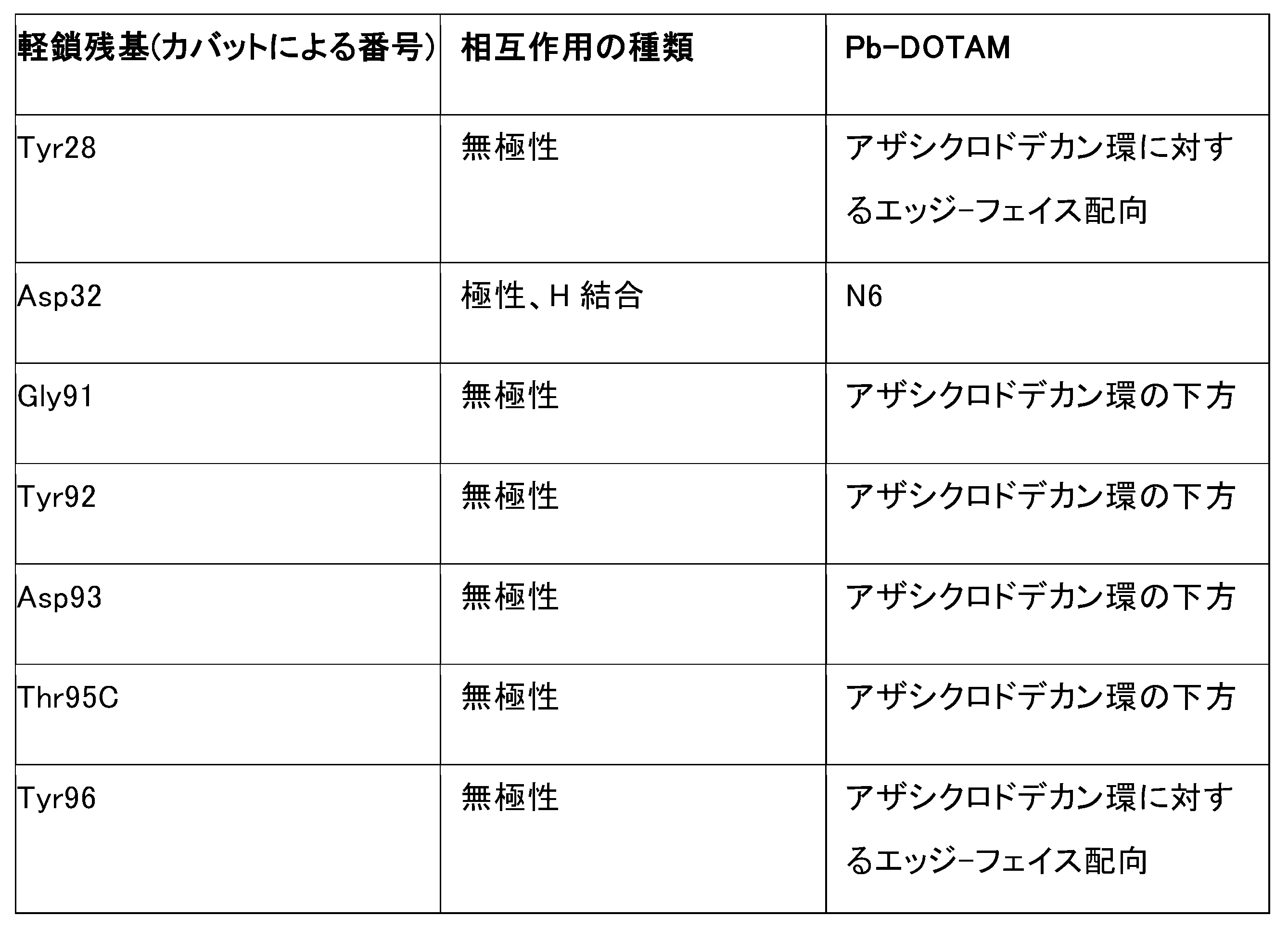
下記の配列でもまた、パラトープ残基に下線を付す:
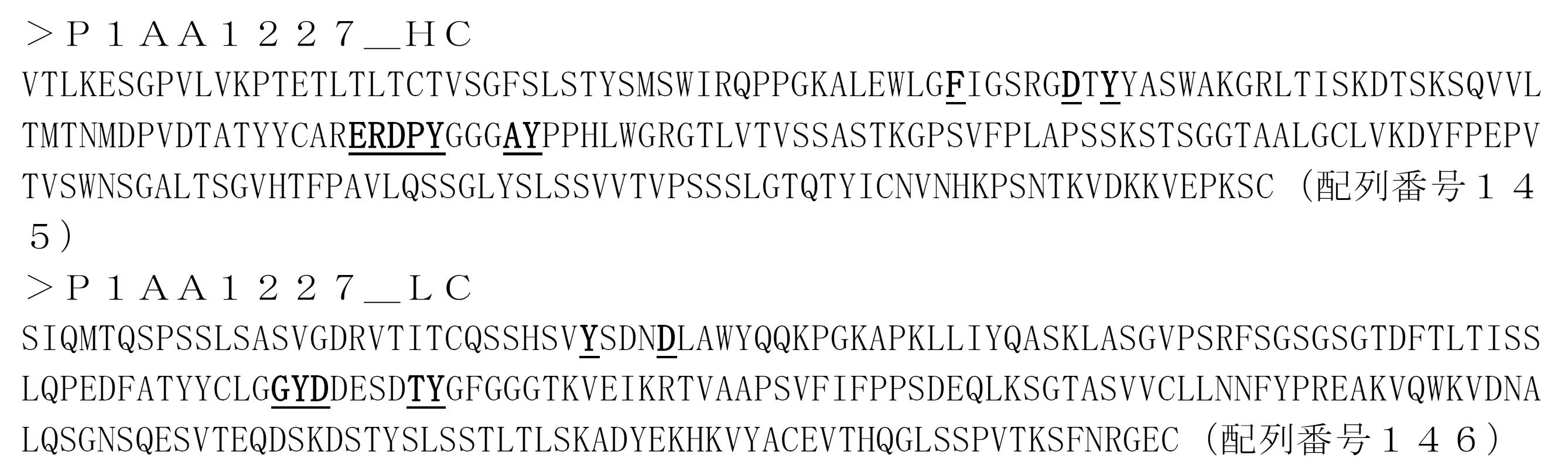
実施例4
CEA-スプリット-DOTAM VH/VL抗体の作出
標的抗原に対する結合部位と、放射標識化合物に対する結合部位とを有する二重特異性抗体を使用するPRIT法(プレターゲティング放射免疫療法)は、一般に、有効なターゲティング、および高腫瘍に吸収された用量対正常組織に吸収された用量の比を確認するように、抗体の投与と、放射性リガンドの投与と間に、除去剤(CA)を使用する(図3を参照されたい)。このような一方法の例では、注入されたBsAbは、一般に、4~10日間である、腫瘍への浸透に十分な時間を与えられ、この後、Pb-DOTAM-デキストラン-500 CAを使用して、循環BsAbが中和される。CAは、212Pb-DOTAMの、腫瘍への浸透を伴わない、非標的BsAbへの結合をブロックし、これにより、プレターゲティング部位をブロックする。このプレターゲティングレジメンは、続いて投与される放射標識キレートである、212Pb-DOTAMの、効率的な腫瘍蓄積を可能とする。
Example 4
Generation of CEA-Split-DOTAM VH/VL Antibodies PRIT (pretargeted radioimmunotherapy), which uses bispecific antibodies with binding sites for target antigens and binding sites for radiolabeled compounds, is generally effective. A clearing agent (CA) is used between the administration of the antibody and the radioligand to ensure targeting and the ratio of the dose absorbed to the high tumor versus the dose absorbed to the normal tissue (Fig. 3). (see ). In one example of such a method, the injected BsAb was given sufficient time to penetrate the tumor, generally 4-10 days, after which Pb-DOTAM-Dextran-500 CA was used. Thus, circulating BsAbs are neutralized. CA blocks the binding of 212 Pb-DOTAM to non-targeted BsAbs without tumor penetration, thereby blocking the pre-targeting site. This pretargeting regimen allows efficient tumor accumulation of the subsequently administered radiolabeled chelate, 212 Pb-DOTAM.
しかし、除去剤を伴う方法では、CAの使用は、非効率的な方法に、さらなる工程を導入する。さらに、複合因子である、CA投与のタイミングおよび投与量は、注意深く選び出すことが重要である。 However, in methods involving scavenging agents, the use of CA introduces an additional step into the inefficient process. Furthermore, the timing and dosage of CA administration, which are complex factors, are important to choose carefully.
除去剤の使用と関連する問題に取り組むために、本発明者らは、それらが、個別の抗体上で見出されるように、DOTAM VLドメインと、DOTAM VHドメインとを分配する戦略を提起した。 To address the issues associated with the use of clearing agents, we proposed a strategy to partition the DOTAM VL and VH domains as they are found on individual antibodies.
例示的なスプリットDOTAM VH/VL抗体の作出については、下記でさらに論じられる。 Generation of exemplary split DOTAM VH/VL antibodies is discussed further below.
抗体の重鎖または軽鎖の組換え発現のためのプラスミドの作出
所望のタンパク質は、ヒト胎児性腎細胞(HEK 293)の一過性トランスフェクションにより発現させた。さらなるドメイン(例えば、そのC末端における、免疫グロブリンの重鎖可変ドメインまたは軽鎖可変ドメイン)を含有する、所望の遺伝子/タンパク質(例えば、完全長抗体重鎖、完全長抗体軽鎖、または完全長抗体重鎖の発現のために、以下の機能的エレメント:
・イントロンAを含む、ヒトサイトメガロウイルス(P-CMV)に由来する、即初期エンハンサーおよび即初期プロモーター、
・ヒト重鎖免疫グロブリン5’側非翻訳領域(5’UTR)、
・マウス免疫グロブリン重鎖シグナル配列(SS)、
・発現される遺伝子/タンパク質、および
・ウシ成長ホルモンポリアデニル化配列(BGHpA)
を含む転写単位を使用した。
Generation of Plasmids for Recombinant Expression of Antibody Heavy or Light Chains The desired proteins were expressed by transient transfection of human embryonic kidney cells (HEK 293). desired gene/protein (e.g., full-length antibody heavy chain, full-length antibody light chain, or full-length For the expression of antibody heavy chains, the following functional elements:
the immediate early enhancer and immediate early promoter from human cytomegalovirus (P-CMV) containing intron A;
- Human heavy chain immunoglobulin 5' untranslated region (5'UTR),
- mouse immunoglobulin heavy chain signal sequence (SS),
- expressed gene/protein, and - bovine growth hormone polyadenylation sequence (BGHpA)
A transcription unit containing was used.
発現される所望の遺伝子を含む、発現単位/カセットに加えて、基本的/標準的哺乳動物発現プラスミドは、
このプラスミドの、大腸菌内の複製を可能とするベクターである、pUC18に由来する複製開始点、および
大腸菌内でアンピシリン耐性を付与する、ベータ-ラクタマーゼ遺伝子を含有した。
In addition to the expression unit/cassette containing the desired gene to be expressed, a basic/standard mammalian expression plasmid is
This plasmid contained an origin of replication derived from pUC18, a vector that allows it to replicate in E. coli, and a beta-lactamase gene that confers ampicillin resistance in E. coli.
a)抗体重鎖のための発現プラスミド
完全でかつ機能的な抗体重鎖に続き、さらなる抗体の重鎖Vドメインまたは軽鎖Vドメインを含む、C末端融合遺伝子を含む遺伝子をコードする抗体重鎖を、各々が、G4S×4リンカーにより分離された、それぞれの配列エレメント(重鎖Vエレメントまたは軽鎖Vエレメント)をコードするDNA断片を、ヒトIgG分子(VH-CH1-ヒンジ-CH2-CH3-リンカー-VHまたはVH-CH1-ヒンジ-CH2-CH3-リンカー-VL)のCH3ドメインのC末端に融合させることによりアセンブルした。2つのCH3ドメインそれぞれのC末端に、1つのVHと、1つのVLドメインとを保有する組換え抗体分子は、ノブ・イントゥー・ホール技術を使用して発現させた。
a) Expression Plasmids for Antibody Heavy Chains An antibody heavy chain encoding a gene containing a complete and functional antibody heavy chain followed by a C-terminal fusion gene containing an additional antibody heavy or light chain V domain. were combined into human IgG molecules (VH-CH1-hinge-CH2-CH3- It was assembled by fusing to the C-terminus of the CH3 domain of linker-VH or VH-CH1-hinge-CH2-CH3-linker-VL). Recombinant antibody molecules carrying one VH and one VL domain at the C-terminus of each of the two CH3 domains were expressed using the knob-in-to-hole technique.
HEK293細胞内の、C末端にVHドメインまたはVLドメインを伴う抗体重鎖の一過性発現のための発現プラスミドは、C末端にVHドメインまたはVLドメインを伴う抗体重鎖断片の発現カセットに加えて、このプラスミドの、大腸菌内の複製を可能とするベクターである、pUC18に由来する複製開始点、および大腸菌内でアンピシリン耐性を付与する、ベータ-ラクタマーゼ遺伝子を含んだ。C末端にVHドメインまたはVLドメインの融合遺伝子を伴う抗体重鎖断片の転写単位は、以下の機能的エレメント:
・イントロンAを含む、ヒトサイトメガロウイルス(P-CMV)に由来する、即初期エンハンサーおよび即初期プロモーター、
・ヒト重鎖免疫グロブリン5’側非翻訳領域(5’UTR)、
・マウス免疫グロブリン重鎖シグナル配列、
・抗体重鎖(VH-CH1-ヒンジ-CH2-CH3-リンカー-VH、またはVH-CH1-ヒンジ-CH2-CH3-リンカー-VL)をコードする核酸、および
・ウシ成長ホルモンポリアデニル化配列(BGHpA)
を含む。
Expression plasmids for the transient expression of antibody heavy chains with a VH or VL domain at the C-terminus in HEK293 cells are expressed in addition to expression cassettes for antibody heavy chain fragments with a VH or VL domain at the C-terminus. , an origin of replication derived from pUC18, a vector that allows this plasmid to replicate in E. coli, and a beta-lactamase gene that confers ampicillin resistance in E. coli. A transcription unit of an antibody heavy chain fragment with a VH or VL domain fusion gene at the C-terminus comprises the following functional elements:
the immediate early enhancer and immediate early promoter from human cytomegalovirus (P-CMV) containing intron A;
- Human heavy chain immunoglobulin 5' untranslated region (5'UTR),
a mouse immunoglobulin heavy chain signal sequence,
a nucleic acid encoding an antibody heavy chain (VH-CH1-hinge-CH2-CH3-linker-VH, or VH-CH1-hinge-CH2-CH3-linker-VL), and a bovine growth hormone polyadenylation sequence (BGHpA)
including.
C末端において、VHドメインまたはVLドメインの融合タンパク質を伴う、成熟抗体重鎖断片のアミノ酸配列を、下記に示す:
DOTAM-VHを伴うPRITスプリット抗体(P1AD8749)
>D1AC4022
QVQLVQSGAEVKKPGASVKVSCKASGYTFTEFGMNWVRQAPGQGLEWMGW
INTKTGEATYVEEFKGRVTFTTDTSTSTAYMELRSLRSDDTAVYYCARWD
FAYYVEAMDYWGQGTTVTVSSASTKGPSVFPLAPSSKSTSGGTAALGCLV
KDYFPEPVTVSWNSGALTSGVHTFPAVLQSSGLYSLSSVVTVPSSSLGTQ
TYICNVNHKPSNTKVDKKVEPKSCDKTHTCPPCPAPEAAGGPSVFLFPPK
PKDTLMISRTPEVTCVVVDVSHEDPEVKFNWYVDGVEVHNAKTKPREEQY
NSTYRVVSVLTVLHQDWLNGKEYKCKVSNKALGAPIEKTISKAKGQPREP
QVCTLPPSRDELTKNQVSLSCAVKGFYPSDIAVEWESNGQPENNYKTTPP
VLDSDGSFFLVSKLTVDKSRWQQGNVFSCSVMHEALHNHYTQKSLSLSPG(配列番号28)(配列番号99)(配列番号100)
>D1AA4507
QVQLVQSGAEVKKPGASVKVSCKASGYTFTEFGMNWVRQAPGQGLEWMGW
INTKTGEATYVEEFKGRVTFTTDTSTSTAYMELRSLRSDDTAVYYCARWD
FAYYVEAMDYWGQGTTVTVSSASTKGPSVFPLAPSSKSTSGGTAALGCLV
KDYFPEPVTVSWNSGALTSGVHTFPAVLQSSGLYSLSSVVTVPSSSLGTQ
TYICNVNHKPSNTKVDKKVEPKSCDKTHTCPPCPAPEAAGGPSVFLFPPK
PKDTLMISRTPEVTCVVVDVSHEDPEVKFNWYVDGVEVHNAKTKPREEQY
NSTYRVVSVLTVLHQDWLNGKEYKCKVSNKALGAPIEKTISKAKGQPREP
QVYTLPPCRDELTKNQVSLWCLVKGFYPSDIAVEWESNGQPENNYKTTPP
VLDSDGSFFLYSKLTVDKSRWQQGNVFSCSVMHEALHNHYTQKSLSLSPG
GGGGSGGGGSGGGGSGGGGSVTLKESGPVLVKPTETLTLTCTVSGFSLST
YSMSWIRQPPGKALEWLGFIGSRGDTYYASWAKGRLTISKDTSKSQVVLT
MTNMDPVDTATYYCARERDPYGGGAYPPHLWGRGTLVTVSS(配列番号32)
DOTAM-VLを伴うPRITスプリット抗体(P1AD8592)
>D1AA4506
QVQLVQSGAEVKKPGASVKVSCKASGYTFTEFGMNWVRQAPGQGLEWMGW
INTKTGEATYVEEFKGRVTFTTDTSTSTAYMELRSLRSDDTAVYYCARWD
FAYYVEAMDYWGQGTTVTVSSASTKGPSVFPLAPSSKSTSGGTAALGCLV
KDYFPEPVTVSWNSGALTSGVHTFPAVLQSSGLYSLSSVVTVPSSSLGTQ
TYICNVNHKPSNTKVDKKVEPKSCDKTHTCPPCPAPEAAGGPSVFLFPPK
PKDTLMISRTPEVTCVVVDVSHEDPEVKFNWYVDGVEVHNAKTKPREEQY
NSTYRVVSVLTVLHQDWLNGKEYKCKVSNKALGAPIEKTISKAKGQPREP
QVCTLPPSRDELTKNQVSLSCAVKGFYPSDIAVEWESNGQPENNYKTTPP
VLDSDGSFFLVSKLTVDKSRWQQGNVFSCSVMHEALHNHYTQKSLSLSPG
GGGGSGGGGSGGGGSGGGGSIQMTQSPSSLSASVGDRVTITCQSSHSVYS
DNDLAWYQQKPGKAPKLLIYQASKLASGVPSRFSGSGSGTDFTLTISSLQ
PEDFATYYCLGGYDDESDTYGFGGGTKVEIK(配列番号33)
>D1AC4023
QVQLVQSGAEVKKPGASVKVSCKASGYTFTEFGMNWVRQAPGQGLEWMGW
INTKTGEATYVEEFKGRVTFTTDTSTSTAYMELRSLRSDDTAVYYCARWD
FAYYVEAMDYWGQGTTVTVSSASTKGPSVFPLAPSSKSTSGGTAALGCLV
KDYFPEPVTVSWNSGALTSGVHTFPAVLQSSGLYSLSSVVTVPSSSLGTQ
TYICNVNHKPSNTKVDKKVEPKSCDKTHTCPPCPAPEAAGGPSVFLFPPK
PKDTLMISRTPEVTCVVVDVSHEDPEVKFNWYVDGVEVHNAKTKPREEQY
NSTYRVVSVLTVLHQDWLNGKEYKCKVSNKALGAPIEKTISKAKGQPREP
QVYTLPPCRDELTKNQVSLWCLVKGFYPSDIAVEWESNGQPENNYKTTPP
VLDSDGSFFLYSKLTVDKSRWQQGNVFSCSVMHEALHNHYTQKSLSLSPG(配列番号30、97)
The amino acid sequence of a mature antibody heavy chain fragment with a VH or VL domain fusion protein at the C-terminus is shown below:
PRIT split antibody with DOTAM-VH (P1AD8749)
>D1AC4022
QVQLVQSGAEVKKPGASVKVSCKASGYTFTEFGMNWVRQAPGQGLEWMGW
INTKTGEATYVEEFKGRVTFTTDTSTSTAYMELRSLRSDDTAVYYCARWD
FAYYVEAMDYWGQGTTVSSASTKGPSVFPLAPSSKSTSGGTAALGCLV
KDYFPEPVTVSWNSGALTSGVHTFPAVLQSSGLYSLSSVVTVPSSSLGTQ
TYICNVNHKPSNTKVDKKVEPKSCDKTHTCPPCPAPEAAGGPSVFLFPPK
PKDTLMISRTPEVTCVVVDVSHEDPEVKFNWYVDGVEVHNAKTKPREEQY
NSTYRVVSSVLTVLHQDWLNGKEYKCKVSNKALGAPIEKTISKAKGQPREP
QVCTLPPSRDELTKNQVSLSCAVKGFYPSDIAVEWESNGQPENNYKTTPP
VLDSDGSFFLVSKLTVDKSRWQQGNVFCSVMHEALHNHYTQKSLSLSPG (SEQ ID NO: 28) (SEQ ID NO: 99) (SEQ ID NO: 100)
>D1AA4507
QVQLVQSGAEVKKPGASVKVSCKASGYTFTEFGMNWVRQAPGQGLEWMGW
INTKTGEATYVEEFKGRVTFTTDTSTSTAYMELRSLRSDDTAVYYCARWD
FAYYVEAMDYWGQGTTVSSASTKGPSVFPLAPSSKSTSGGTAALGCLV
KDYFPEPVTVSWNSGALTSGVHTFPAVLQSSGLYSLSSVVTVPSSSLGTQ
TYICNVNHKPSNTKVDKKVEPKSCDKTHTCPPCPAPEAAGGPSVFLFPPK
PKDTLMISRTPEVTCVVVDVSHEDPEVKFNWYVDGVEVHNAKTKPREEQY
NSTYRVVSSVLTVLHQDWLNGKEYKCKVSNKALGAPIEKTISKAKGQPREP
QVYTLPPCRDELTKNQVSLWCLVKGFYPSDIAVEWESNGQPENNYKTTPP
VLDSDGSFFLYSKLTVDKSRWQQGNVFSCSVMHEALHNHYTQKSLSLSPG
GGGGSGGGGSGGGGSGGGGSVTLKESGPVLVKPTETLTLTCTVSGFSLST
YSMSWIRQPPGKALEWLGFIGSRGDTYYASWKGRLTISKDTSKSQVVLT
MTNMDPVDTATYYCARERDPYGGGAYPPHLWGRGTLVTVSS (SEQ ID NO: 32)
PRIT split antibody (P1AD8592) with DOTAM-VL
>D1AA4506
QVQLVQSGAEVKKPGASVKVSCKASGYTFTEFGMNWVRQAPGQGLEWMGW
INTKTGEATYVEEFKGRVTFTTDTSTSTAYMELRSLRSDDTAVYYCARWD
FAYYVEAMDYWGQGTTVSSASTKGPSVFPLAPSSKSTSGGTAALGCLV
KDYFPEPVTVSWNSGALTSGVHTFPAVLQSSGLYSLSSVVTVPSSSLGTQ
TYICNVNHKPSNTKVDKKVEPKSCDKTHTCPPCPAPEAAGGPSVFLFPPK
PKDTLMISRTPEVTCVVVDVSHEDPEVKFNWYVDGVEVHNAKTKPREEQY
NSTYRVVSSVLTVLHQDWLNGKEYKCKVSNKALGAPIEKTISKAKGQPREP
QVCTLPPSRDELTKNQVSLSCAVKGFYPSDIAVEWESNGQPENNYKTTPP
VLDSDGSFFLVSKLTVDKSRWQQGNVFSCSVMHEALHNHYTQKSLSLSPG
GGGGSGGGGSGGGGSGGGGSIQMTQSPSSLSASVGDRVTITCQSSHSVYS
DNDLAWYQQKPGKAPKLLIYQASKLASGVPSRFSGSGSGTDFTLTISSLQ
PEDFATYYCLGGYDDESDTYGFGGGTKVEIK (SEQ ID NO: 33)
>D1AC4023
QVQLVQSGAEVKKPGASVKVSCKASGYTFTEFGMNWVRQAPGQGLEWMGW
INTKTGEATYVEEFKGRVTFTTDTSTSTAYMELRSLRSDDTAVYYCARWD
FAYYVEAMDYWGQGTTVSSASTKGPSVFPLAPSSKSTSGGTAALGCLV
KDYFPEPVTVSWNSGALTSGVHTFPAVLQSSGLYSLSSVVTVPSSSLGTQ
TYICNVNHKPSNTKVDKKVEPKSCDKTHTCPPCPAPEAAGGPSVFLFPPK
PKDTLMISRTPEVTCVVVDVSHEDPEVKFNWYVDGVEVHNAKTKPREEQY
NSTYRVVSSVLTVLHQDWLNGKEYKCKVSNKALGAPIEKTISKAKGQPREP
QVYTLPPCRDELTKNQVSLWCLVKGFYPSDIAVEWESNGQPENNYKTTPP
VLDSDGSFFLYSKLTVDKSRWQQGNVFCSVMHEALHNHYTQKSLSLSPG (SEQ ID NOS: 30, 97)
b)抗体軽鎖のための発現プラスミド
完全でかつ機能的な抗体軽鎖を含む遺伝子をコードする抗体軽鎖を、それぞれの配列エレメントをコードするDNA断片を融合させることによりアセンブルした。
b) Expression plasmids for antibody light chains Antibody light chains encoding genes containing complete and functional antibody light chains were assembled by fusing DNA fragments encoding the respective sequence elements.
抗体軽鎖の一過性発現のための発現プラスミドは、抗体軽鎖断片に加えて、このプラスミドの、大腸菌内の複製を可能とするベクターである、pUC18に由来する複製開始点、および大腸菌内でアンピシリン耐性を付与する、ベータ-ラクタマーゼ遺伝子を含んだ。抗体軽鎖断片の転写単位は、以下の機能的エレメント:
・イントロンAを含む、ヒトサイトメガロウイルス(P-CMV)に由来する、即初期エンハンサーおよび即初期プロモーター、
・ヒト重鎖免疫グロブリン5’側非翻訳領域(5’UTR)、
・マウス免疫グロブリン重鎖シグナル配列、
・抗体軽鎖(VL-CL)をコードする核酸、および
・ウシ成長ホルモンポリアデニル化配列(BGHpA)
を含む。
The expression plasmid for the transient expression of the antibody light chain contains, in addition to the antibody light chain fragment, an origin of replication derived from pUC18, a vector that allows replication of this plasmid in E. coli, and an E. coli included the beta-lactamase gene, which confers ampicillin resistance at The transcription unit of an antibody light chain fragment comprises the following functional elements:
the immediate early enhancer and immediate early promoter from human cytomegalovirus (P-CMV) containing intron A;
- Human heavy chain immunoglobulin 5' untranslated region (5'UTR),
a mouse immunoglobulin heavy chain signal sequence,
a nucleic acid encoding an antibody light chain (VL-CL), and a bovine growth hormone polyadenylation sequence (BGHpA)
including.
成熟抗体軽鎖断片のアミノ酸配列は、P1AD8592およびP1AD8749の両方について、同じである。
>D1AA3384
DIQMTQSPSSLSASVGDRVTITCKASAAVGTYVAWYQQKPGKAPKLLIYS
ASYRKRGVPSRFSGSGSGTDFTLTISSLQPEDFATYYCHQYYTYPLFTFG
QGTKLEIKRTVAAPSVFIFPPSDEQLKSGTASVVCLLNNFYPREAKVQWK
VDNALQSGNSQESVTEQDSKDSTYSLSSTLTLSKADYEKHKVYACEVTHQ
GLSSPVTKSFNRGEC(配列番号34)、(配列番号103)、(配列番号115)
The amino acid sequences of the mature antibody light chain fragments are the same for both P1AD8592 and P1AD8749.
>D1AA3384
DIQMTQSPSSLSASVGDRVTITCKASAAVGTYVAWYQQKPGKAPKLLIYS
ASYRKRGVPSRFSGSGSGTDFTLTISSLQPEDFATYYCHQYYTYPLFTFG
QGTKLEIKRTVAAPSVFIFPPSDEQLKSGTASVVCLLNNFYPREAKVQWK
VDNALQSGNSQESVTEQDSKDSTYSLSSTLTLSKADYEKHKVYACEVTHQ
GLSSPVTKSFNRGEC (SEQ ID NO: 34), (SEQ ID NO: 103), (SEQ ID NO: 115)
一過性抗体分子の発現
抗体分子を、F17培地(Invitrogen Corp.)中で培養された、一過性トランスフェクトHEK293細胞(ヒト胎児性腎細胞株293由来)内で作出した。トランスフェクションのために、「293-Free」トランスフェクション試薬(Novagen)を使用した。上記で記載された、それぞれの抗体重鎖分子および抗体軽鎖分子は、個々の発現プラスミドから発現させた。トランスフェクションは、製造元の指示書に指定されている通りに実施した。免疫グロブリン含有細胞培養上清を、トランスフェクションの3~7日後に採取した。上清を、精製まで、低温(例えば、-80℃)で保管した。
Expression of Transient Antibody Molecules Antibody molecules were produced in transiently transfected HEK293 cells (derived from human embryonic kidney cell line 293) cultured in F17 medium (Invitrogen Corp.). For transfection, '293-Free' transfection reagent (Novagen) was used. Each antibody heavy chain molecule and antibody light chain molecule described above was expressed from individual expression plasmids. Transfections were performed as specified in the manufacturer's instructions. Immunoglobulin-containing cell culture supernatants were harvested 3-7 days after transfection. Supernatants were stored at low temperature (eg -80°C) until purification.
例えば、HEK293細胞内における、ヒト免疫グロブリンの組換え発現に関する一般的情報は、Meissner,P.ら、Biotechnol.Bioeng.、75(2001)、197~203において与えられている。 For general information on recombinant expression of human immunoglobulins in, for example, HEK293 cells, see Meissner, P.; et al., Biotechnol. Bioeng. , 75 (2001), 197-203.
PRITヘミボディー(スプリット抗体)は、MabSelect Sure(親和性クロマトグラフィー)、およびこれに続く、Superdex 200(サイズ排除クロマトグラフィー)により精製した。DOTAM-VH/P1AD8592を伴うPRITスプリット抗体のために、解析用SECおよびCE-SDSに基づき、濃度を1.372mg/mLとし、純度>96%とする5mgを作製した。DOTAM-VH/P1AD8749を伴うPRITスプリット抗体のために、解析用SECおよびCE-SDSに基づき、濃度を2.03mg/mLとし、純度>91%とする14mgを作製した。 PRIT hemibodies (split antibodies) were purified by MabSelect Sure (affinity chromatography) followed by Superdex 200 (size exclusion chromatography). For the PRIT split antibody with DOTAM-VH/P1AD8592, 5 mg was made with a concentration of 1.372 mg/mL and a purity of >96% based on analytical SEC and CE-SDS. For the PRIT split antibody with DOTAM-VH/P1AD8749, 14 mg was made with a concentration of 2.03 mg/mL and a purity of >91% based on analytical SEC and CE-SDS.
また、抗体である、P1AE4956およびP1AE4957も作出したが、本明細書では、これらの配列を提示する(P1AE4956は、配列番号51および52の重鎖、ならびに配列番号54の軽鎖を有し;P1AE4957は、配列番号55および56の重鎖、ならびに配列番号58の軽鎖を有する)。DOTAM-VL/P1AE4957を伴うPRITスプリット抗体のために、解析用SECおよびCE-SDSに基づき、濃度を2.6mg/mLとし、純度>81.6%とする19mgを作製した。DOTAM-VH/P1AE4956を伴うPRITスプリット抗体のために、解析用SECおよびCE-SDSに基づき、濃度を1.5mg/mLとし、純度>90%とする6.9mgを作製した。ESI-MSを使用して、PRITヘミボディーの同一性を確認した。 Antibodies P1AE4956 and P1AE4957 were also generated and their sequences are presented here (P1AE4956 has heavy chains of SEQ ID NOS:51 and 52 and light chain of SEQ ID NO:54; P1AE4957 has heavy chains of SEQ ID NOs:55 and 56, and light chain of SEQ ID NO:58). For the PRIT split antibody with DOTAM-VL/P1AE4957, 19 mg was made with a concentration of 2.6 mg/mL and a purity of >81.6% based on analytical SEC and CE-SDS. For the PRIT split antibody with DOTAM-VH/P1AE4956, 6.9 mg was made with a concentration of 1.5 mg/mL and a purity of >90% based on analytical SEC and CE-SDS. ESI-MS was used to confirm the identity of the PRIT hemibody.
実施例5
スプリット抗体の機能性についのFACS解析
スプリット抗体またはヘミボディーの機能性について評価するために、37℃で、10分間にわたりアキュターゼを使用して、MKN-45細胞を、培養物容器から解離させた。その後、細胞を、PBS中で、2回にわたり洗浄し、96ウェルv字底プレートに、ウェル1つ当たりの細胞4×10⁶個の最終密度まで播種した。
Example 5
FACS Analysis for Split Antibody Functionality To assess split antibody or hemibody functionality, MKN-45 cells were dissociated from the culture vessel using Accutase for 10 minutes at 37°C. Cells were then washed twice in PBS and seeded in 96-well v-bottom plates to a final density of 4×10 6 cells per well.
ヘミボディーP1AD8749およびP1AD8592、ならびにヒトISOコントロールを、1:1で混合し、図5に表示の濃度で、細胞に添加した。その後、細胞を、氷上で、1時間にわたりインキュベートし、PBS中で、2回にわたり洗浄した。細胞ペレットを再懸濁させ、ウェル1つ当たり40μlの検出試薬である、PBS/5%FCS中の、<ヒトIgG(H+L)>FITC(10μg/ml)、またはPb_Dotam_FITC1:100(10μg/ml)を添加した。氷上で60分間にわたるインキュベーションの後、細胞を、PBS中で、2回にわたり洗浄し、FACS cantoを使用する、FITC蛍光の測定のために、PBS/5%FCS 200μl中に再懸濁させた。 Hemibodies P1AD8749 and P1AD8592, and a human ISO control were mixed 1:1 and added to cells at the concentrations indicated in FIG. Cells were then incubated on ice for 1 hour and washed twice in PBS. Resuspend the cell pellet and add <human IgG (H+L)> FITC (10 μg/ml) or Pb_Dotam_FITC1:100 (10 μg/ml) in PBS/5% FCS, 40 μl detection reagent per well. was added. After incubation on ice for 60 minutes, cells were washed twice in PBS and resuspended in 200 μl PBS/5% FCS for measurement of FITC fluorescence using a FACS canto.
ヘミボディーの、MKN-45細胞上のCEAへの結合能について評価するために、ヒトIgGに特異的な二次抗体を使用して、ヘミボディーを、検出した(図5)。予測される通り、これらの細胞上では、ヒトISOコントロールの著明な結合は観察されない。同じIgG濃度に補正すると、いずれのヘミボディーも、両方のヘミボディーの組合せも、MKN-45細胞への用量依存的結合を示し、予測される通り、極高濃度では、顕著なフック効果を伴う。この実験は、ヘミボディーでは、CEAへの結合が機能的であることを裏付ける。 To assess the ability of hemibodies to bind to CEA on MKN-45 cells, hemibodies were detected using a secondary antibody specific for human IgG (Figure 5). As expected, no significant binding of the human ISO control is observed on these cells. Corrected for the same IgG concentration, both hemibodies and the combination of both hemibodies showed dose-dependent binding to MKN-45 cells, with a pronounced hook effect at very high concentrations, as expected. . This experiment confirms that for hemibodies, the binding to CEA is functional.
ヘミボディーの、DOTAMへの結合能について評価するために、これらを、1:1比のヒトISOコントロールまたはそれらのそれぞれのスプリット抗体パートナーの存在下で、細胞に結合させた。それらのMKN-45細胞への結合の後、細胞を洗浄して、非結合抗体を除去した。その後、Pb-DOTAM-FITC(蛍光標識Pb-DOTAM)を添加して、DOTAMの、コンピテント細胞に結合した抗体への結合を検出した(図6)。予測される通り、スプリット抗体のパートナーのうちの一方が、ヒトISOコントロールと組み合わされている場合は、これらの細胞上で、著明なFITCは観察されない。両方のヘミボディーの、1:1の比における組合せだけが、用量依存的FITCシグナルを示す。この実験は、両方のヘミボディーが、1つの細胞上で一体となった場合に、DOTAM結合部位は、機能的となることを示す。 To assess the ability of hemibodies to bind DOTAM, they were allowed to bind to cells in the presence of a 1:1 ratio of human ISO controls or their respective split antibody partners. After their binding to MKN-45 cells, the cells were washed to remove unbound antibody. Pb-DOTAM-FITC (fluorescently labeled Pb-DOTAM) was then added to detect binding of DOTAM to antibody bound to competent cells (Fig. 6). As expected, no significant FITC is observed on these cells when one of the split antibody partners is combined with the human ISO control. Only the combination of both hemibodies at a 1:1 ratio shows a dose-dependent FITC signal. This experiment shows that the DOTAM binding site becomes functional when both hemibodies are brought together on one cell.
実施例6
in vivo研究
実施例6a
材料および方法:全般
全ての実験プロトコールは、地域の規制機関(Comite Regional d’Ethique de l’Experimentation Animale du Limousin[CREEAL]、Laboratoire Departemental d’Analyses et de Recherches de la Haute-Vienne)により審査および承認された。雌重度複合免疫不全(SCID)マウス(Charles River)を、倫理的ガイドラインと共に、毎日の明暗周期(12時間/12時間)を伴う、SOPF(specific and opportunistic pathogen free)条件下で維持した。動物を、新たな環境に馴らすように、到着後、最初の5日間は、操作を実施しなかった。臨床症状および有害事象の検出のために、動物を毎日制御下に置いた。
Example 6
In vivo study Example 6a
Materials and Methods: General All experimental protocols were reviewed and approved by the local regulatory bodies (Comite Regional d'Ethique de l'Experimentation Animale du Limousin [CREEAL], Laboratoire Departmental d'Analyses et de Recherches de la Venue). was done. Female severe combined immunodeficient (SCID) mice (Charles River) were maintained under specific and opportunistic pathway free (SOPF) conditions with a daily light/dark cycle (12h/12h) with ethical guidelines. No manipulations were performed during the first 5 days after arrival to allow the animals to acclimate to the new environment. Animals were kept under control daily for detection of clinical symptoms and adverse events.
固形異種移植片は、Corning(登録商標)マトリゲル(登録商標)基底膜マトリックス(増殖因子低減型;型番:354230)と、1:1で混合された細胞培養物中のCEA発現腫瘍細胞の皮下(SC)注射により確立した。腫瘍体積は、毎週3回、手作業のノギスによる計測を介して推定し、式:体積=0.5×長さ×幅2に従い計算した。腫瘍増殖速度に応じて必要とされる場合は、さらなる腫瘍測定を行った。 Solid xenografts were grown subcutaneously with CEA-expressing tumor cells in cell culture mixed 1:1 with Corning® Matrigel® basement membrane matrix (reduced growth factors; model number: 354230). SC) established by injection. Tumor volume was estimated via manual caliper measurements three times weekly and calculated according to the formula : volume = 0.5 x length x width2. Additional tumor measurements were performed as required by tumor growth rate.
腫瘍負荷、注射の副作用、または他の原因による、不適切な苦痛または疼痛の徴候を示した場合は、マウスを、予定の終点の前に安楽死させた。疼痛、苦痛、または不快感の徴候は、急性体重(BW)減少、毛並みの乱れ、下痢、猫背の姿勢、および嗜眠を含むがこれらに限定されない。処置動物の体重は、毎週3回測定し、健康状態により、必要に応じてさらに測定した。放射性物質注射の翌日から始めて、7日間にわたり、または全ての個体が、任意の急性体重減少から十分に回復するまで、全てのマウスに含水食餌を与えた。体重減少が、それらの初期体重の20%を超えるか、または腫瘍容量が、3000mm3に達したマウスは、速やかに安楽死させた。倫理的理由による安楽死のために考慮される他の因子は、腫瘍状態(例えば、壊死領域、血液/体液の漏出、自傷の徴候)、および動物の一般的な外見(例えば、毛並み、姿勢、動き)であった。 Mice were euthanized prior to the scheduled endpoint if they showed signs of inappropriate distress or pain due to tumor burden, injection side effects, or other causes. Signs of pain, distress, or discomfort include, but are not limited to, acute weight loss (BW), ruffled coat, diarrhea, hunched posture, and lethargy. The body weight of treated animals was measured 3 times weekly, with further measurements as needed depending on their health status. All mice were fed a hydrated diet beginning the day after radioactivity injection for 7 days or until all individuals had fully recovered from any acute weight loss. Mice that lost more than 20% of their initial body weight or whose tumor volume reached 3000 mm 3 were promptly euthanized. Other factors considered for euthanasia for ethical reasons are tumor status (e.g. necrotic areas, blood/fluid leakage, signs of self-mutilation), and general physical appearance of the animal (e.g. coat, posture). , movement).
放射性尿/糞便の再摂取を最小化するため、全ての有効性研究用マウスを、212Pb-DOTAMの投与後、4時間にわたり、床面を格子状としたケージに入れてから、標準的な寝藁を備えた、新たなケージに移した。次いで、注射の24時間後(p.i.)に、全てのケージを交換した。この手順は、放射性物質注射後24時間以内における、生体内分布を目的として屠殺されたマウスには実施しなかった。 To minimize reuptake of radioactive urine/feces, all efficacy study mice were housed in cages with a grid floor for 4 hours after administration of 212 Pb-DOTAM and then placed in standard cages. They were transferred to new cages with bedding. All cages were then changed 24 hours after injection (p.i.). This procedure was not performed on mice sacrificed for biodistribution within 24 hours after radioinjection.
プロトコールにより指示される通りに、安楽死時に、頸椎脱臼を介する終結の前に、麻酔下マウスにおける眼窩後採血を使用して、静脈洞から血液を回収するのに続き、放射能の測定および/または組織学的解析のために、さらなる組織採取を行った。予測外の状態または異常な状態は記録した。ホルマリン固定のために回収された組織は、速やかに、10%の中性緩衝ホルマリン(4℃)中に入れ、次いで、5日後に、リン酸緩衝食塩水(PBS;4℃)に移した。生体内分布目的で回収された臓器および組織を秤量し、2470 WIZARD2自動式ガンマカウンター(PerkinElmer)を使用して放射能について測定し、その後、減衰およびバックグラウンドについての補正を含む、組織1グラム当たりの注入用量パーセント(1g当たりのID%)を計算した。 At euthanasia, retro-orbital bleeding in anesthetized mice was used to collect blood from the sinus venosus prior to termination via cervical dislocation, as directed by the protocol, followed by measurement of radioactivity and/or Alternatively, additional tissue sampling was performed for histological analysis. Unexpected or unusual conditions were recorded. Tissues harvested for formalin fixation were immediately placed in 10% neutral buffered formalin (4°C) and then transferred to phosphate buffered saline (PBS; 4°C) after 5 days. Organs and tissues harvested for biodistribution purposes were weighed and measured for radioactivity using a 2470 WIZARD 2 automated gamma counter (PerkinElmer), then including corrections for attenuation and background, per gram of tissue. Percent injected dose (% ID per g) was calculated.
統計学的解析は、GraphPad Prism 7(GraphPad Software,Inc.)およびJMP 12(SAS Institute Inc.)を使用して実施した。腫瘍増殖阻害(TGI)についての曲線解析は、式:

を使用する、平均値腫瘍体積に基づき実施した。ビヒクルを、参照群として選択した。腫瘍縮小(TR)は、

に従い計算した。
Statistical analysis was performed using GraphPad Prism 7 (GraphPad Software, Inc.) and JMP 12 (SAS Institute Inc.). Curve analysis for tumor growth inhibition (TGI) was performed using the formula:
was performed based on the mean tumor volume using . Vehicle was chosen as the reference group. Tumor reduction (TR) is
calculated according to
被験化合物
記載される研究で利用された化合物を、それぞれ、二重特異性抗体、除去剤、および放射性標識キレートについて、下記の表に提示する。
Test Compounds The compounds utilized in the studies described are presented in the table below for bispecific antibodies, clearing agents, and radiolabeled chelates, respectively.
CEA-DOTAM(RO7198427、PRIT-0213)が、CEAのT84.66エピトープをターゲティングする完全ヒト化BsAbであるのに対し、DIG-DOTAM(RO7204012)は、ネガティブコントロールとして使用される、非CEA結合BsAbである。P1AD8749、P1AD8592、P1AE4956、およびP1AE4957は、CH1A1AまたはCEAのA5B7エピトープをターゲティングするCEA-スプリット-DOTAM-VH/VL抗体である。全ての抗体コンストラクトを、注射日まで、-80℃で保管し、そこで、これらを融解させ、標準的ビヒクルバッファー(20mMのヒスチジン、140mMのNaCl;pH6.0)または0.9%NaCl中で、静脈内(IV)投与または腹腔内(IP)投与のための、それらそれぞれの最終濃度に希釈した。 CEA-DOTAM (RO7198427, PRIT-0213) is a fully humanized BsAb targeting the T84.66 epitope of CEA, whereas DIG-DOTAM (RO7204012) is a non-CEA binding BsAb used as a negative control. is. P1AD8749, P1AD8592, P1AE4956 and P1AE4957 are CEA-Split-DOTAM-VH/VL antibodies targeting the A5B7 epitope of CH1A1A or CEA. All antibody constructs were stored at −80° C. until the day of injection, where they were thawed and placed in standard vehicle buffer (20 mM histidine, 140 mM NaCl; pH 6.0) or 0.9% NaCl. Diluted to their respective final concentrations for intravenous (IV) or intraperitoneal (IP) administration.
Pb-DOTAM-デキストラン-500 CA(RO7201869)を、注射日まで、-20℃で保管し、そこで、これらを融解させ、IV投与またはIP投与のために、PBS中で希釈した。 Pb-DOTAM-Dextran-500 CA (RO7201869) was stored at −20° C. until the day of injection, where they were thawed and diluted in PBS for IV or IP administration.
放射性標識のためのDOTAMキレートは、Macrocyclicsにより提供され、Orano Med(Razes、France)により実施される放射性標識の前に、-20℃で維持された。212Pb-DOTAM(RO7205834)は、DOTAMによる、トリウム発生物質からの溶出を介して作出し、続いて、標識付けの後、Caによりクエンチングした。212Pb-DOTAM溶液は、0.9%NaClで希釈して、IV注射に所望の212Pb活性濃度を得た。 DOTAM chelates for radiolabeling were provided by Macrocyclics and kept at −20° C. prior to radiolabeling performed by Orano Med (Razes, France). 212 Pb-DOTAM (RO7205834) was generated via elution from thorium generators with DOTAM, followed by quenching with Ca after labeling. The 212 Pb-DOTAM solution was diluted with 0.9% NaCl to obtain the desired 212 Pb activity concentration for IV injection.
ビヒクル対照群内のマウスには、BsAb、CA、および212Pb-DOTAMの代わりに、ビヒクルバッファーの複数回の注射を施した。
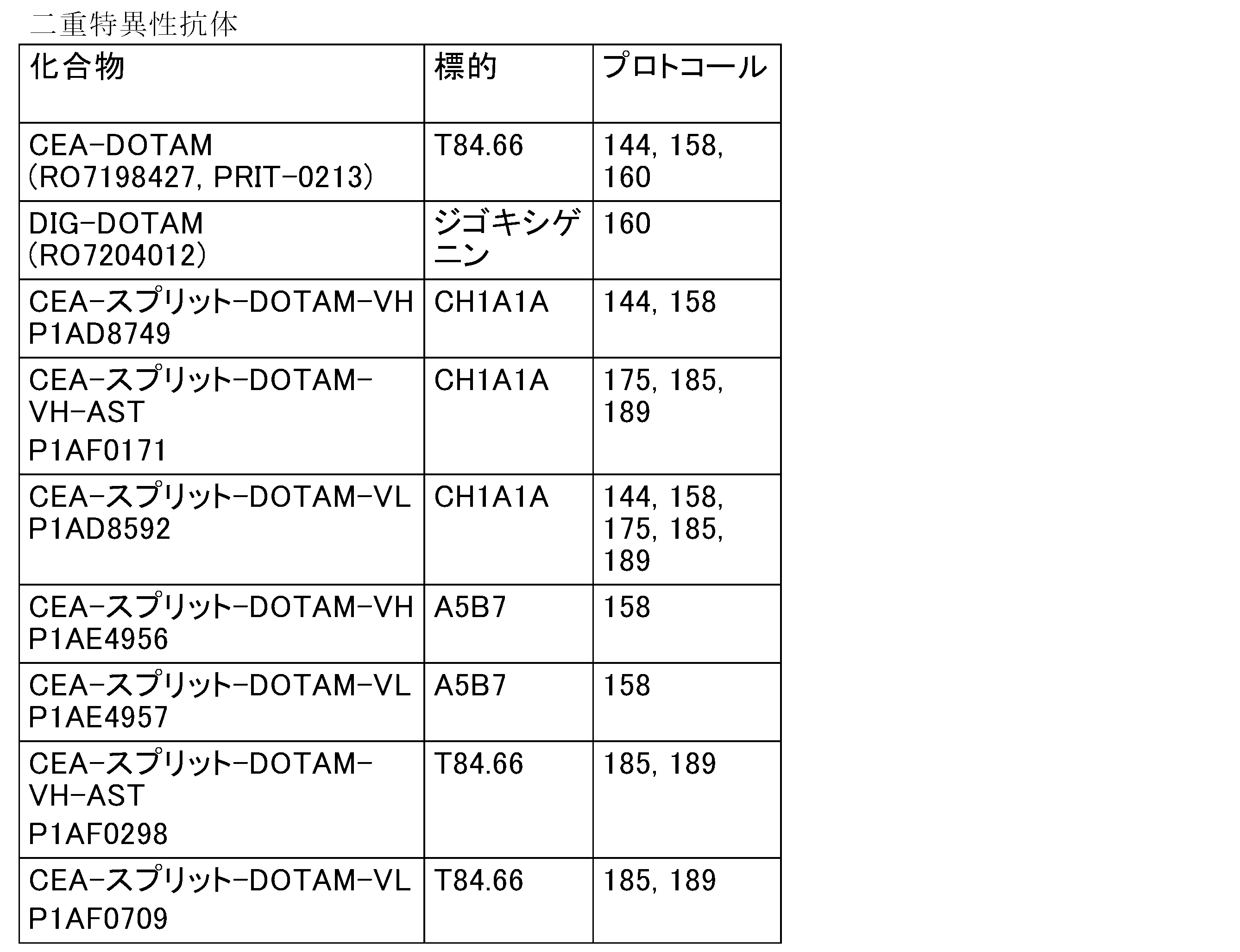


腫瘍モデル
使用される腫瘍細胞株、およびマウスにおける接種のための注入量については、下記の表において記載される。BxPC3とは、天然でCEAを発現させる、ヒト初代膵腺癌細胞株である。細胞を、10%ウシ胎児血清(GE Healthcare Hyclone SH30088.03)で濃縮された、RPMI 1640培地、GlutaMAX(商標)サプリメント、HEPES(Gibco;型番:72400-021)中で培養した。固形異種移植片は、研究0日目に、Corning(登録商標)マトリゲル(登録商標)基底膜マトリックス(増殖因子低減型;型番:354230)と、1:1で混合されたRPMI培地中の細胞の、右脇腹への皮下注射により、各SCIDマウスにおいて確立した。

実施例6b
プロトコール144
プロトコール144の目的は、CEA-スプリット-DOTAM-VH/VL BsAbを使用する2工程PRIT後の、SC BxPC3腫瘍を保有するSCIDマウスにおける、プレターゲティング212Pb-DOTAMについてのPKデータおよびin vivo分布データを提示することであった。
Example 6b
The purpose of
2工程PRITは、CEA-スプリット-DOTAM-VHおよびCEA-スプリット-DOTAM-VL(P1AD8749およびP1AD8592)の、個別の注入、または併せた注入の7日後における、212Pb-DOTAMの注射により実施した。マウスを、放射性物質注射の6時間後に屠殺し、放射能の測定のために、血液および臓器を採取した。2工程スキームを、標準的なCEA-DOTAM二重特異性抗体の7日後における、Ca-DOTAM-デキストラン-500 CA、およびCAの24時間後における212Pb-DOTAMを使用する、3工程PRITと比較した。 Two-step PRIT was performed by injection of CEA-split-DOTAM-VH and CEA-split-DOTAM-VL (P1AD8749 and P1AD8592) separately or 7 days after combined injection of 212 Pb-DOTAM. Mice were sacrificed 6 hours after radioinjection and blood and organs were collected for radioactivity measurements. A two-step scheme is compared to a three-step PRIT using Ca-DOTAM-Dextran-500 CA at 7 days after a standard CEA-DOTAM bispecific antibody and 212 Pb-DOTAM at 24 hours after CA. did.
CEA-スプリット-DOTAM-VH/VLのクリアランスについてのPKデータは、抗体注射の1時間~7日間後における採血の反復により回収し、その後、ELISAにより解析した。 PK data for clearance of CEA-split-DOTAM-VH/VL were collected by repeated blood draws from 1 hour to 7 days after antibody injection and then analyzed by ELISA.
研究の概観を、図7に示す。図7aは、SC BxPC3腫瘍を保有するSCIDマウスにおける、CEA-スプリット-DOTAM-VH/VL PKのための採血を含む、2工程PRITレジメンについての概観を示す。図7bは、SC BxPC3腫瘍を保有するSCIDマウスにおいて実施された、3工程PRITレジメンについての概観(h=時間、d=日)を示す。 An overview of the study is shown in FIG. FIG. 7a shows an overview of the two-step PRIT regimen, including bleeding for CEA-Split-DOTAM-VH/VL PK, in SC BxPC3 tumor-bearing SCID mice. FIG. 7b shows an overview (h=hours, d=days) for the 3-step PRIT regimen performed in SC BxPC3 tumor-bearing SCID mice.
研究デザイン
プロトコール144の時間経過およびデザインを、下記の表に示す。
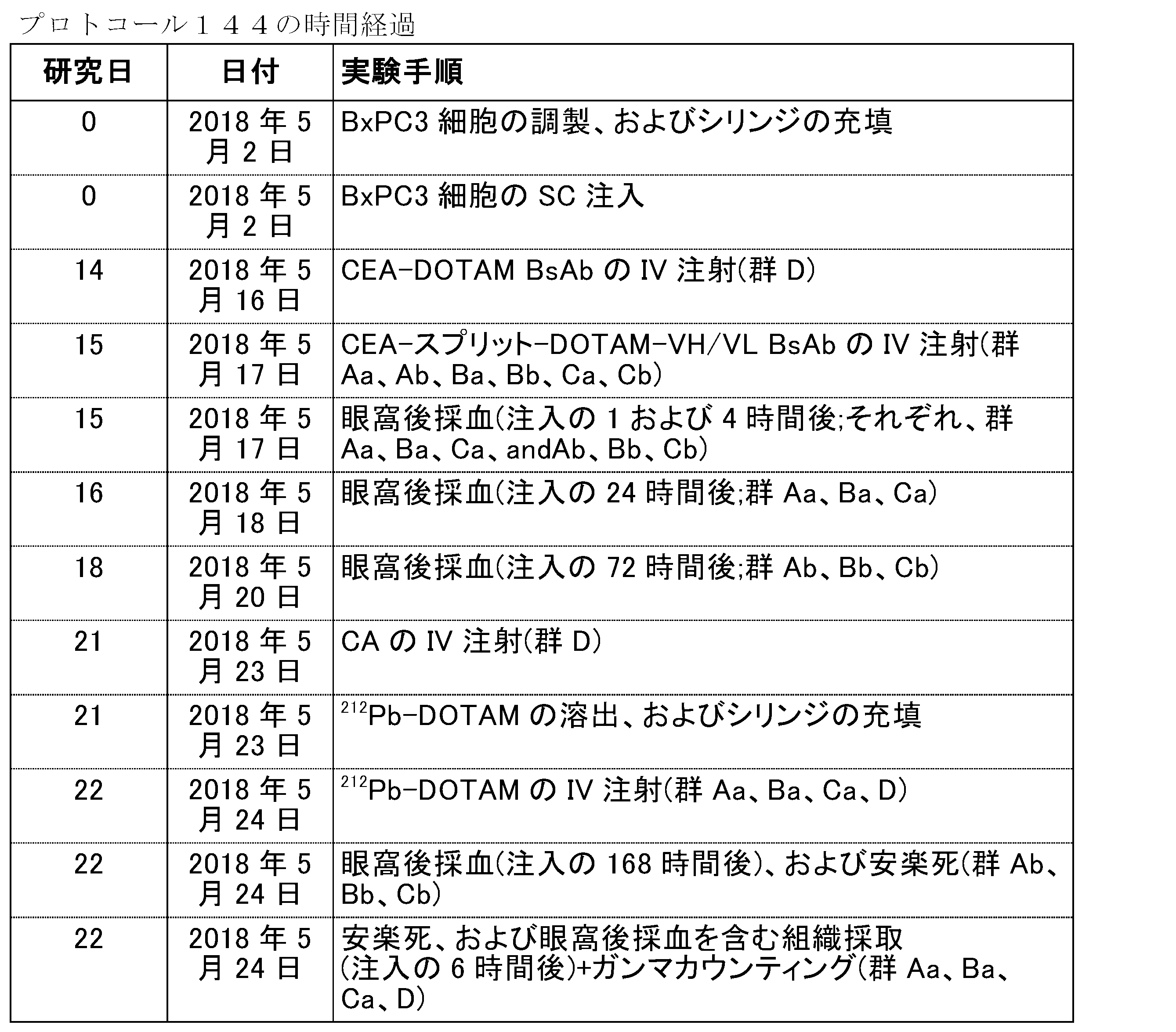
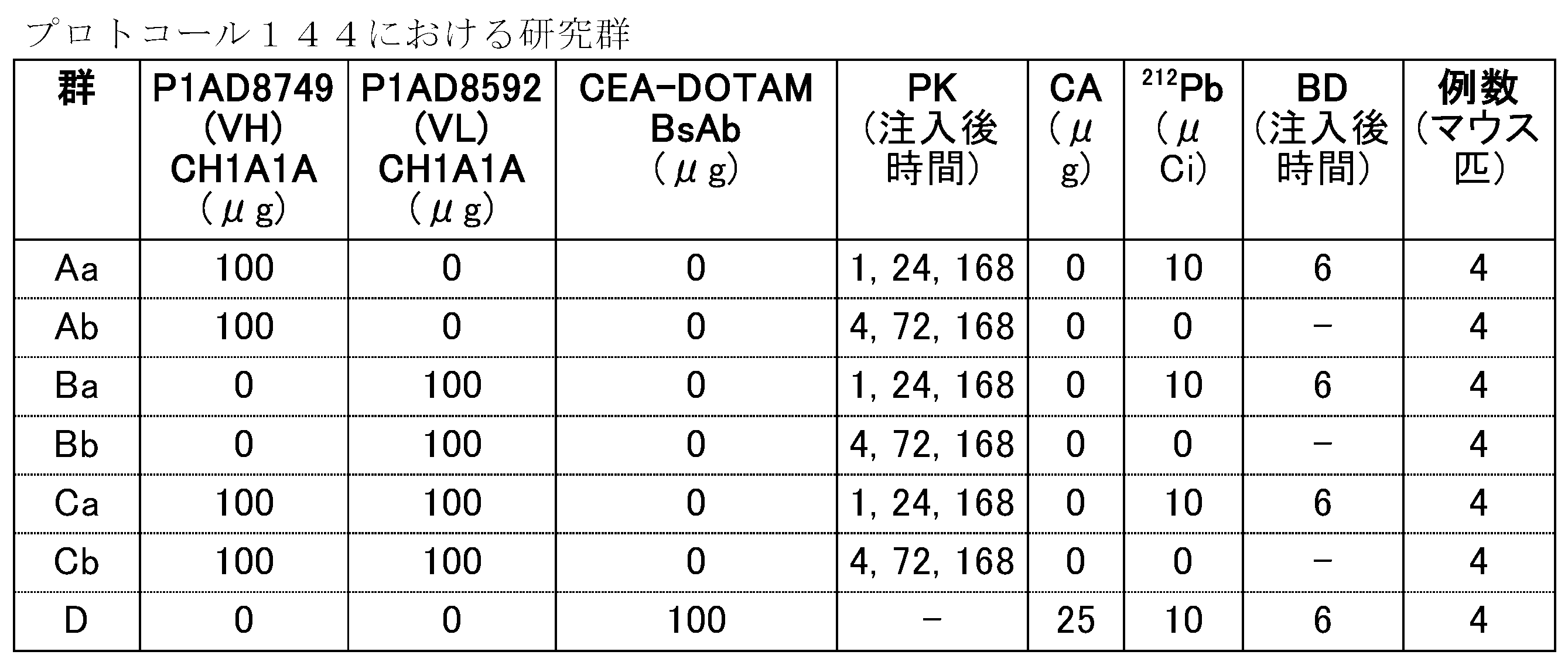
固形異種移植片は、研究0日目に、RPMI/マトリゲル中の細胞5×106個(第26継代)の、右脇腹へのSC注入により、各SCIDマウスにおいて確立した。腫瘍細胞注入の14日後に、マウスを、平均腫瘍体積を116mm3とする実験群に分けた。212Pb-DOTAMを、接種後22日目に注入した;平均腫瘍体積は、21日目において、140mm3であった。
Solid xenografts were established in each SCID mouse on
群Aa、Ba、およびCaにおけるマウスからの血液は、CEA-スプリット-DOTAM-VH/VLの注射の1時間(右眼)、24時間(左眼)、および168時間(右眼、終結時)後の麻酔下において、眼窩後採血を介して回収した。同様に、試料を、CEA-スプリット-DOTAM-VH/VLの注射の4時間(右眼)、72時間(左眼)、および168時間(右眼、終結時)後に、群Ab、Bb、およびCbにおけるマウスから採取した。 Blood from mice in groups Aa, Ba, and Ca was collected at 1 hour (right eye), 24 hours (left eye), and 168 hours (right eye, terminal) after injection of CEA-split-DOTAM-VH/VL. Collected via retro-orbital bleeding under anesthesia afterward. Similarly, samples were administered in groups Ab, Bb and Collected from mice in Cb.
群Aa、Ba、Ca、およびD内のマウスを屠殺し、212Pb-DOTAMの注射の6時間後に剖検し、放射性物質の含有量の測定のために、以下の臓器および組織:血液、皮膚、膀胱、胃、小腸、結腸、脾臓、膵臓、腎臓、肝臓、肺、心臓、大腿骨、筋肉、脳、尾、耳、および腫瘍を採取した。
Mice in groups Aa, Ba, Ca, and D were sacrificed,
結果
注射の6時間後における全ての回収組織中の平均212Pb蓄積およびクリアランスを、図8に提示する。CEA-スプリット-DOTAM-VHまたはCEA-スプリット-DOTAM-VL単独によるプレターゲティングは、腫瘍内の放射能の蓄積を結果としてもたらさなかった。2つの相補的抗体の組合せは、標準的な3工程PRITレジメンのための1g当たり87±15%のIDと比較される、1g当たり65±12%のIDによる2工程PRITの後に、腫瘍への取込みを結果としてもたらした。チューキーの多重比較検定による二元分散分析(ANOVA)は、2つのPRIT処置の間の、腫瘍への取込みの差違は、膀胱における差違と同様に有意であること(2工程PRITおよび3工程PRITについて、それぞれ、1g当たり1±2%のIDおよび1g当たり38±17%のID)を示したが;この検定(p=0.05)を使用する、他の組織蓄積の差違は、統計学的に有意ではなかった。
Results Mean 212 Pb accumulation and clearance in all collected
酵素免疫測定アッセイ(ELISA)により解析される、IV注入CEA-スプリット-DOTAM-VH/VLコンストラクトのクリアランスを、図9に示す。 Clearance of IV-infused CEA-Split-DOTAM-VH/VL constructs analyzed by enzyme-linked immunosorbent assay (ELISA) is shown in FIG.
有害事象および毒性
本研究と関連する有害事象または毒性は見られなかった。
Adverse Events and Toxicity There were no adverse events or toxicities related to this study.
結論
研究結果は、相補的CEA-スプリット-DOTAM-VH/VL抗体を使用する、CA非依存型2工程プレターゲティングの概念実証を裏付けた。2工程PRITおよび標準的3工程PRITを使用して、212Pb-DOTAMの、腫瘍への、高度かつ特異的な取込みを達成したところ、相補的CEA-スプリット-DOTAM-VH/VL抗体を使用した場合の正常組織中の放射能の蓄積は、ごくわずかしか見られなかった。
CONCLUSIONS The results of the study supported the proof-of-concept of CA-independent two-step pretargeting using complementary CEA-split-DOTAM-VH/VL antibodies. Two-step PRIT and standard three-step PRIT were used to achieve high and specific uptake of 212 Pb-DOTAM into tumors using complementary CEA-split-DOTAM-VH/VL antibodies. Very little accumulation of radioactivity in normal tissues was seen.
実施例6c
プロトコール158
プロトコール158の目的は、除去剤非依存型2工程CEA-PRITのための、CEA-スプリット-DOTAM-VH/VL抗体の二重パラトープ(CH1A1AおよびA5B7)対によりプレターゲティングされたマウスにおける、212Pb-DOTAMの、皮下BxPC3腫瘍との会合について評価することであった。腫瘍への取込みを、標準的な3工程CEA-PRITの場合と比較した。
Example 6c
Protocol 158
The purpose of protocol 158 was to determine the 212 Pb in mice pretargeted with a dual paratope (CH1A1A and A5B7) pair of CEA-split-DOTAM-VH/VL antibodies for a clearing-agent-independent two-step CEA-PRIT. - To evaluate the association of DOTAM with subcutaneous BxPC3 tumors. Tumor uptake was compared with standard 3-step CEA-PRIT.
皮下BxPC3腫瘍を保有するマウスに、
・CEA-スプリット-DOTAM-VH/VL抗体の7日後における、放射性標識212Pb-DOTAM(2工程PRIT)、または
・CEA-DOTAM BsAbの7日後における、CA、および、最後の24時間後における、放射性標識212Pb-DOTAM(3工程PRIT)
を注入した。
Mice bearing subcutaneous BxPC3 tumors were
- Radiolabeled 212 Pb-DOTAM (2-step PRIT) after 7 days of CEA-Split-DOTAM-VH/VL antibody, or - CA after 7 days of CEA-DOTAM BsAb and after the last 24 hours Radiolabeled 212 Pb-DOTAM (3-step PRIT)
was injected.
212Pb-DOTAMの、in vivoにおける分布を、放射性物質注射の6時間後に評価した。研究の概観を、図10に示す。 The in vivo distribution of 212 Pb-DOTAM was assessed 6 hours after radioinjection. An overview of the study is shown in FIG.
研究デザイン
プロトコール158の時間経過およびデザインを、下記の表に示す。
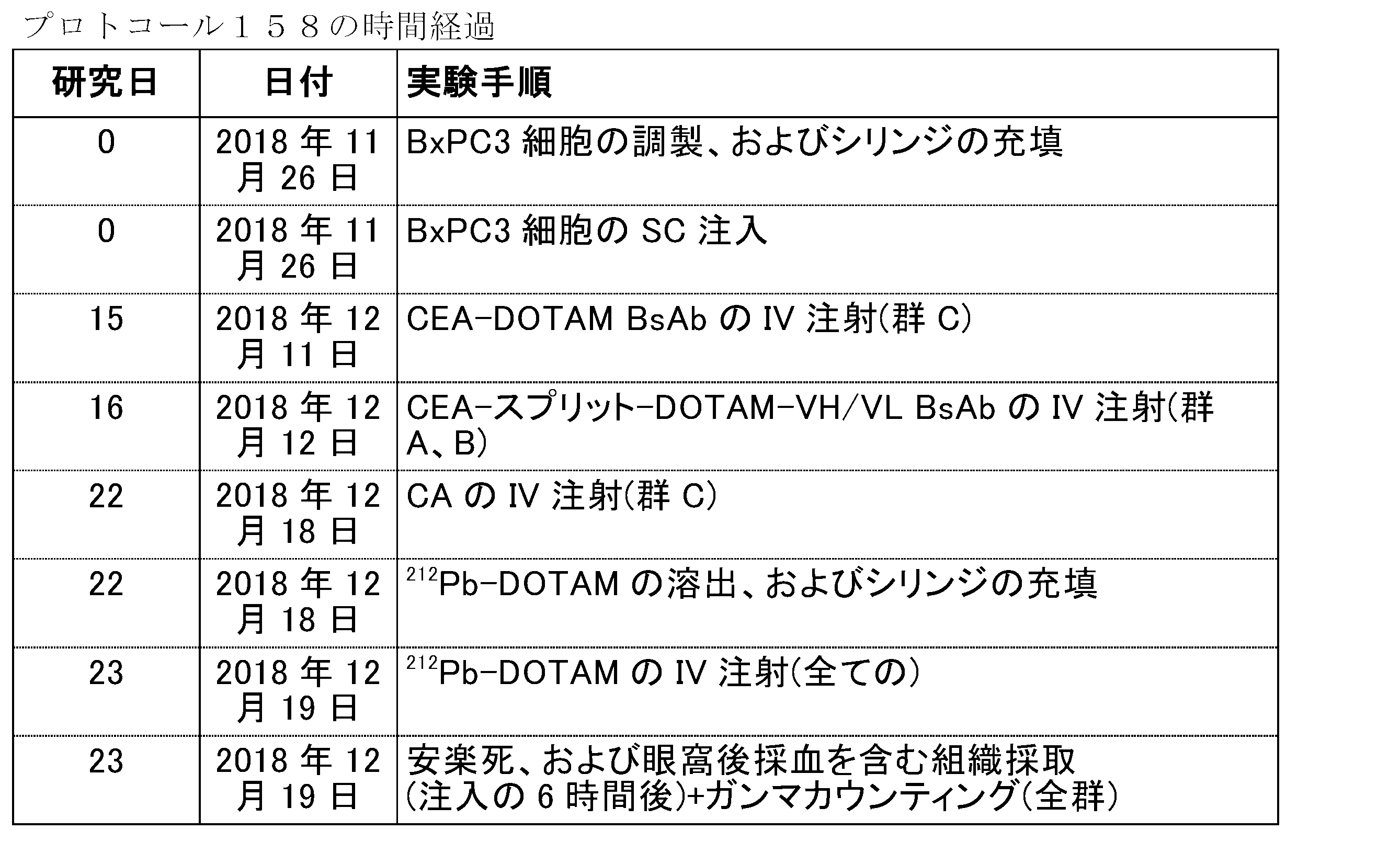
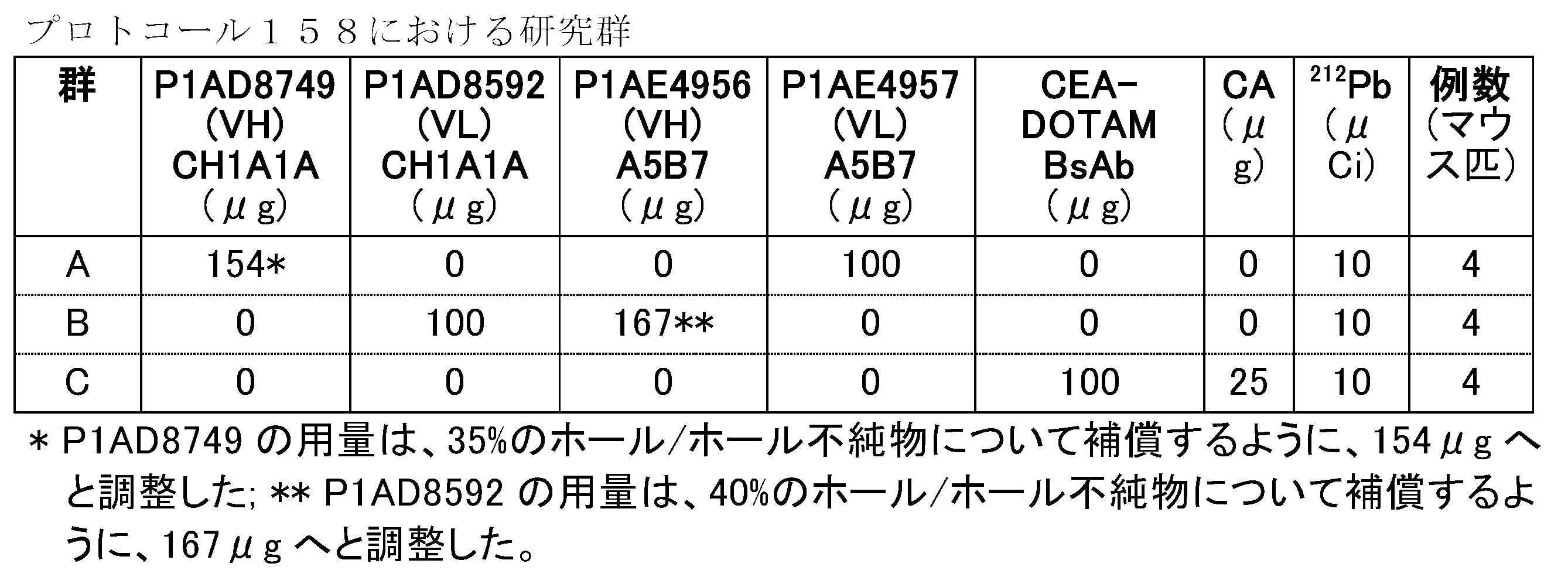
固形異種移植片は、研究0日目に、RPMI/マトリゲル中の細胞5×106個(第27継代)の、右脇腹へのSC注入により、各SCIDマウスにおいて確立した。腫瘍細胞注入の14日後に、マウスを、平均腫瘍体積を177mm3とする実験群に分けた。212Pb-DOTAMを、接種後20日目に注入した;平均腫瘍体積は、21日目において、243mm3であった。
Solid xenografts were established in each SCID mouse on
全ての群内のマウスを屠殺し、212Pb-DOTAMの注射の6時間後に剖検し、放射性物質の含有量の測定のために、以下の臓器および組織:血液、皮膚、膀胱、胃、小腸、結腸、脾臓、膵臓、腎臓、肝臓、肺、心臓、大腿骨、筋肉、脳、尾、および腫瘍を採取した。
Mice in all groups were sacrificed,
結果
注射の6時間後における全ての回収組織内の平均212Pb分布を、図11に示す。チューキーの多重比較検定による二元ANOVAは、いずれの二重パラトープ型CEA-スプリット-DOTAM-VH/VL対も、標準的3工程PRITより低量の蓄積をもたらした膀胱を除き、3つの処置の間で、正常組織内の212Pbの取込みに有意差は見られないことを示した。腎臓への取込みは、3つの処置全てについて、1g当たり3~4%のIDであった。二重パラトープの組合せは、3工程PRITについての1g当たりのIDを67%と比較して、1g当たりのIDを約56%とする腫瘍蓄積を結果としてもたらし;2工程PRITと、3工程PRITとの差違は、統計学的に有意であった(p<0.0001)。
Results The mean 212 Pb distribution within all collected
有害事象および毒性
本研究と関連する有害事象または毒性は見られなかった。
Adverse Events and Toxicity There were no adverse events or toxicities related to this study.
結論
本研究は、CA非依存型2工程CEA-PRITのための、CEA-スプリット-DOTAM-VH/VL抗体の二重パラトープ対によりプレターゲティングされたマウスにおける、212Pb-DOTAMの、SC BxPC3腫瘍との会合を、標準的な3工程PRITと比較して評価した。注入の6時間後における212Pbの分布は、2工程PRITと3工程PRITとで同等であり、腫瘍内の蓄積は高度であり、健常組織内の放射能は、極微量であった。これは、CEA-スプリット-DOTAM-VH/VL抗体を使用する、2工程CEA-PRITのための、CEA発現腫瘍の、二重パラトープによるプレターゲティングの概念実証を裏付けた。
Conclusions This study demonstrated that 212 Pb-DOTAM, SC BxPC3 tumors in mice pretargeted with a dual paratope pair of CEA-split-DOTAM-VH/VL antibodies for CA-independent two-step CEA-PRIT. was evaluated relative to the standard three-step PRIT. Six hours after injection, the distribution of 212 Pb was comparable between 2-step and 3-step PRIT, with high accumulation in tumors and negligible radioactivity in healthy tissues. This supported the proof-of-concept of dual paratopic pretargeting of CEA-expressing tumors for two-step CEA-PRIT using CEA-split-DOTAM-VH/VL antibodies.
実施例6d
プロトコール160
プロトコール160の目的は、SC BxPC3腫瘍を保有するマウスの、相補的なCEA-スプリット-DOTAM-VH/VL抗体を使用する、3サイクルにわたる、CA非依存型2工程CEA-PRITの後における治療有効性を、標準的な3工程CEA-PRITの場合と比較することであった。比較はまた、注入の前に、212Pb-DOTAMと共にプレインキュベートされた、BsAbを使用する、1工程CEA-RITによっても行った。
Example 6d
Protocol 160
The purpose of protocol 160 is to demonstrate therapeutic efficacy of SC BxPC3 tumor-bearing mice following CA-independent two-step CEA-PRIT for three cycles using complementary CEA-split-DOTAM-VH/VL antibodies. was to compare the performance with that of the standard 3-step CEA-PRIT. Comparisons were also made by one-step CEA-RIT using BsAb pre-incubated with 212 Pb-DOTAM prior to injection.
SC BxPC3腫瘍を保有するマウスに、
・CEA-DOTAM BsAbの7日後における、CA、および、最後の24時間後における、放射性標識212Pb-DOTAM(3工程PRIT)、
・CEA-スプリット-DOTAM-VH/VL抗体の7日後における、放射性標識212Pb-DOTAM(2工程PRIT)、または
・212Pb-DOTAM-CEA-DOTAM BsAb(プレインキュベートあり;1工程RIT)
を注入した。
Mice bearing SC BxPC3 tumors were
- CA at 7 days after CEA-DOTAM BsAb and radiolabeled 212 Pb-DOTAM at 24 hours after the final (3-step PRIT);
- Radiolabeled 212 Pb-DOTAM (2-step PRIT), or - 212 Pb-DOTAM-CEA-DOTAM BsAb (with pre-incubation; 1-step RIT) after 7 days of CEA-split-DOTAM-VH/VL antibody
was injected.
治療は、非CEA結合対照抗体(DIG-DOTAM)、および非処置(ビヒクル)との比較もまた含む、20μCiの212Pb-DOTAMによる、3回にわたる反復サイクルで投与した。各処置サイクルにおける、212Pb-DOTAMのターゲティングおよびクリアランスを確認するように、特化マウスを、生体内分布を目的として屠殺した。処置の有効性を、TGIおよびTRについて評価し、処置の忍容性について評価するように、マウスを、研究の持続期間にわたり、注意深くモニタリングした。研究の概観を、図12に示す。 Treatment was administered for three repeated cycles with 20 μCi of 212 Pb-DOTAM, including a non-CEA binding control antibody (DIG-DOTAM), and also a comparison to no treatment (vehicle). Specialized mice were sacrificed for biodistribution purposes to confirm targeting and clearance of 212 Pb-DOTAM at each treatment cycle. Mice were carefully monitored over the duration of the study to assess treatment efficacy for TGI and TR and assess treatment tolerability. An overview of the study is shown in FIG.
プロトコール160の時間経過およびデザインを、下記の表に示す。
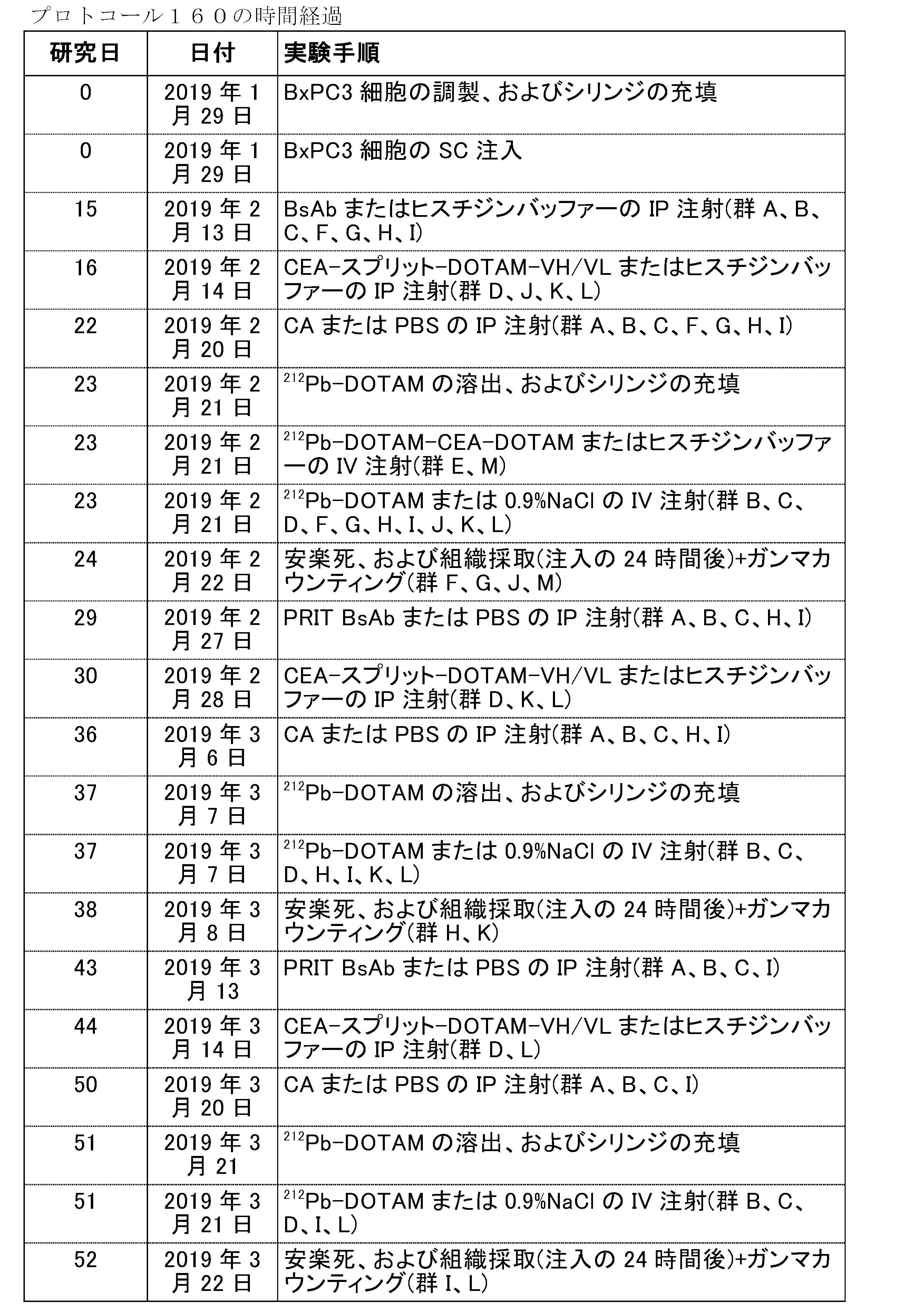
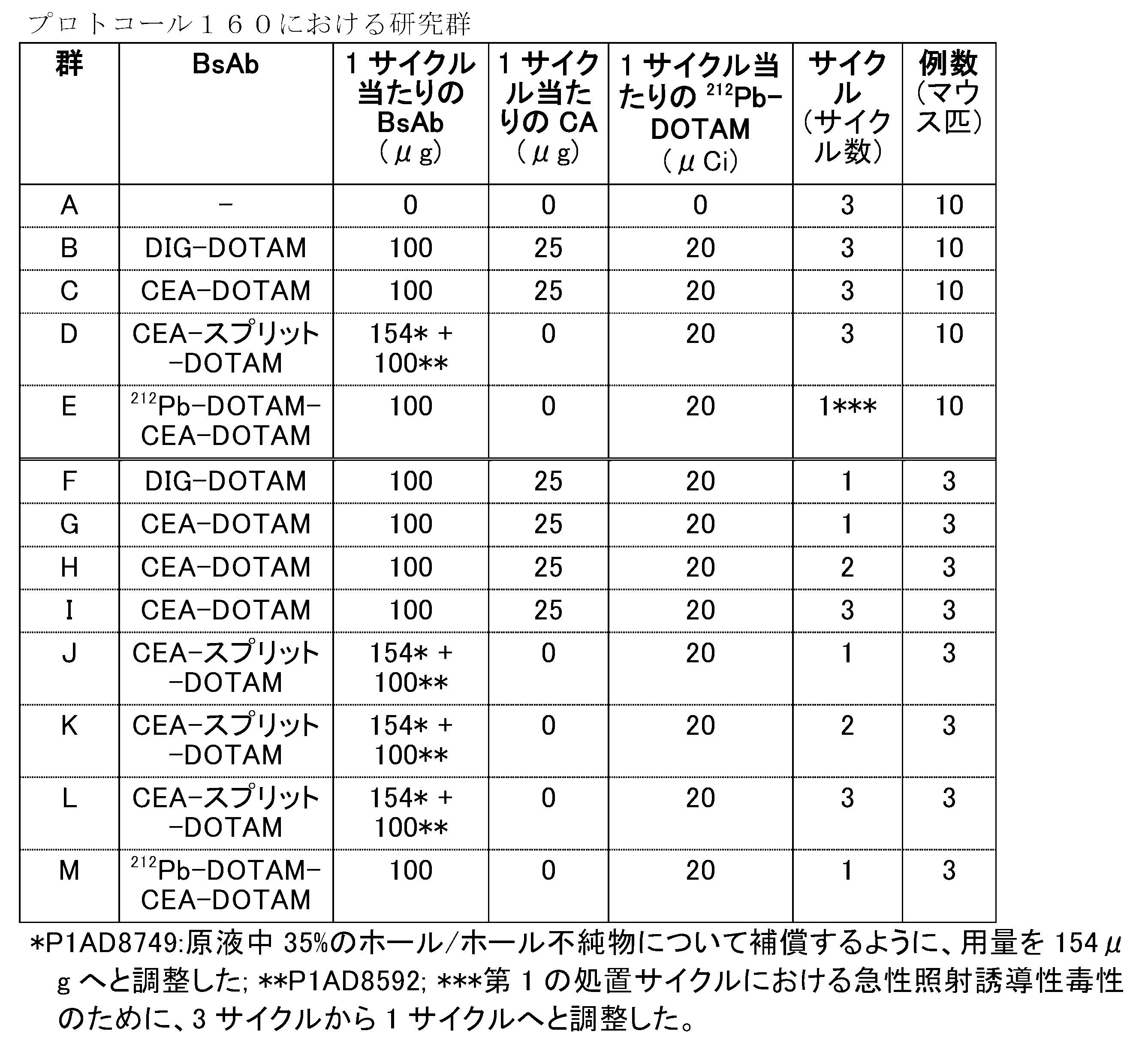
固形異種移植片は、研究0日目に、RPMI/マトリゲル中の細胞5×106個(第24継代)の、右脇腹へのSC注入により、各SCIDマウスにおいて確立した。腫瘍細胞注入の15日後に、マウスを、平均腫瘍体積を122mm3とする実験群に分けた。212Pb-DOTAMを、接種後23日目に注入した;平均腫瘍体積は、22日目において、155mm3であった。
Solid xenografts were established in each SCID mouse on
CEA-DOTAM、およびDIG-DOTAM抗体を、上記の表に従うIP投与(プロトコール160における研究群)のために、ビヒクルバッファー中で、200μL当たり100μgの最終濃度に希釈した。CEA-スプリット-DOTAM-VH/VL抗体を、200μL当たり100μgの各コンストラクトを含有する、IP投与のための、単一の注射溶液に、併せて混合した。P1AD8749のために、用量は、原液中に35%のホール/ホール不純物について補償するように、154μgに調整した(VH/VLを保有しない側の分子)。Ca-DOTAM-デキストラン-500 CAを、BsAb注射の7日後にIP(PBS 200μL当たり25μg)の24時間後に、図12における実験スケジュールに従い、212Pb-DOTAM(RO7205834)を投与した。PRIT処置マウス(2工程および3工程)に、100μLのCaクエンチング212Pb-DOTAM溶液(0.9%NaCl 100μL中に20μCi)をIV注射した。
CEA-DOTAM and DIG-DOTAM antibodies were diluted in vehicle buffer to a final concentration of 100 μg per 200 μL for IP administration according to the table above (study group in protocol 160). CEA-Split-DOTAM-VH/VL antibodies were mixed together into a single injection solution for IP administration containing 100 μg of each construct per 200 μL. For P1AD8749, the dose was adjusted to 154 μg to compensate for the 35% hole/hole impurity in the stock solution (molecule on the non-VH/VL-bearing side). Ca-DOTAM-Dextran-500 CA was administered 7 days after BsAb injection IP (25 μg per 200 μL PBS) 24 hours followed by 212 Pb-DOTAM (RO7205834) according to the experimental schedule in FIG. PRIT-treated mice (
1工程RITで処置されるマウスには、1回の注射:あらかじめ結合している212Pb-DOTAM-CEA-DOTAM(IV注射のための0.9%NaCl 100μL中に20μCi/20μgのBsAb)だけを施した。直接標識化抗体は、212Pb-DOTAMを、CEA-DOTAM BsAbと共に、37℃で、10分間にわたりインキュベートすることにより調製した。 Mice treated with 1-step RIT received 1 injection: preconjugated 212 Pb-DOTAM-CEA-DOTAM (20 μCi/20 μg BsAb in 100 μL 0.9% NaCl for IV injection) alone. was applied. Directly labeled antibodies were prepared by incubating 212 Pb-DOTAM with CEA-DOTAM BsAb at 37° C. for 10 minutes.
安楽死時に、群A~Eのマウスから、以下の臓器および組織:血清、肝臓、脾臓、腎臓、膵臓、および腫瘍を採取した。安楽死の前に、眼窩後採血による血液回収のために、生存マウスに麻酔をかけた。回収された血液試料を、10000rcfで、5分間にわたり遠心分離し、結果として得られる血清画分を分離し、凍結させ、-20℃で保管した。切り出された組織は、速やかに、10%中性緩衝ホルマリン(4℃)中に入れ、次いで、24時間後に、1倍濃度のPBS(4℃)に移した。さらなる加工および解析のために、ホルマリン固定試料を、Roche Pharma Research and Easy Development、Roche Innovation Center Baselに送付した。 At the time of euthanasia, the following organs and tissues were collected from mice in groups AE: serum, liver, spleen, kidney, pancreas, and tumors. Prior to euthanasia, surviving mice were anesthetized for blood collection by retro-orbital bleeding. Collected blood samples were centrifuged at 10000 rcf for 5 minutes and the resulting serum fractions were separated, frozen and stored at -20°C. Excised tissues were immediately placed in 10% neutral buffered formalin (4° C.) and then transferred to 1×PBS (4° C.) after 24 hours. Formalin-fixed samples were sent to Roche Pharma Research and Easy Development, Roche Innovation Center Basel for further processing and analysis.
群F、G、J、およびM内のマウスを屠殺し、それらの1回目ので唯一の212Pb-DOTAMまたは212Pb-DOTAM-BsAbの注射の24時間後に剖検し;群HおよびK内のマウスを屠殺し、それらの2回目の212Pb-DOTAMの注射の24時間後に剖検し;群IおよびL内のマウスを屠殺し、それらの3回目の212Pb-DOTAMの注射の24時間後に剖検した。血液は、安楽死時に、頸椎脱臼を介する終結の前に、麻酔下マウスにおける眼窩後採血を使用して、静脈洞から回収した。生体内分布を目的として、以下の臓器および組織:膀胱、脾臓、腎臓、肝臓、肺、筋肉、尾、皮膚、および腫瘍もまた採取した。 Mice in groups F, G, J, and M were sacrificed and necropsied 24 hours after their first and only injection of 212Pb -DOTAM or 212Pb -DOTAM-BsAb; mice in groups H and K. were sacrificed and necropsied 24 hours after their second injection of 212 Pb-DOTAM; mice in groups I and L were sacrificed and necropsied 24 hours after their third injection of 212 Pb-DOTAM. . Blood was collected from the sinus venosus using retro-orbital bleeding in anesthetized mice prior to termination via cervical dislocation at the time of euthanasia. The following organs and tissues were also collected for biodistribution purposes: bladder, spleen, kidney, liver, lung, muscle, tail, skin, and tumor.
結果
注射の24時間後における全ての回収組織中の平均212Pb蓄積およびクリアランスを、各治療および処置サイクルについて、図13に示す。ネガティブコントロールは、腫瘍内の取込みを結果としてもたらさなかった(1g当たり0.4%のID)。チューキーの多重比較検定による二元分散分析(ANOVA)は、2工程PRITおよび3工程PRITについて、いかなるサイクルにおいても、分布は、有意に異ならないが;ネガティブコントロールおよび1工程RITと比較した差違は、全てのサイクルにおいて、統計学的に有意(p<0.05)であることを示した。腫瘍への取込みは、3工程PRITについて、1g当たり25~45%のIDであり、2工程PRITについて、1g当たり25~30%のIDであり、いずれの処置またはサイクルの間でも、統計学的有意差を伴わなかった。1工程RITについて、腫瘍への取込みは、唯一の処置サイクルにおいて、99%であった。正常組織内の取込みは、いずれのPRITレジメンについても、極めて低度であったが、1工程RITの後では、プレインキュベート抗体の循環時間が、低分子放射性標識DOTAMキレートと比較して、はるかに長いために、全ての臓器内および組織内で、有意に高度であった。
Results Mean 212 Pb accumulation and clearance in all collected
平均腫瘍発症数および個別の腫瘍増殖曲線を、それぞれ、図14および図15に示す。非処置ビヒクル群およびDIG-DOTAM群における腫瘍は、後者では、3回目の処置の後に、倍加速度がわずかに低下したが、着実に増殖した。これに対し、PRIT群およびRIT群における腫瘍は、第1の処置サイクルの後で、サイズが減少し、腫瘍のサイズが増大し始める、接種の約10週間後まで、腫瘍コントロールを維持した。2工程PRIT処置および3工程PRIT処置は、ほぼ同一な腫瘍コントロールを結果としてもたらした。腫瘍の完全な退縮は、見られなかった。 Mean tumor incidence and individual tumor growth curves are shown in Figures 14 and 15, respectively. Tumors in the untreated vehicle and DIG-DOTAM groups grew steadily, although the doubling rate decreased slightly after the third treatment in the latter. In contrast, tumors in the PRIT and RIT groups decreased in size after the first treatment cycle and remained tumor-controlled until approximately 10 weeks after inoculation when tumors began to increase in size. Two-step and three-step PRIT treatments resulted in nearly identical tumor control. Complete regression of tumors was not seen.
全ての処置群を、平均値に基づき解析しうる最後の日である、研究83日目に、TGIは、それぞれ、CEA-DOTAM(3工程)およびCEA-スプリット-DOTAM-VH/VL(2工程)を使用するPRITについて、ビヒクル対照と比較して、91.7%および88.4%であった。1工程RITについて対応する数が、72.6%であったのに対し、非特異的DIG-DOTAM対照についてのTGIは、-59.7%であった。同じ日に、平均値に基づくTRは、3工程CEA-DOTAM PRITについての-39.3、-2.9for2工程CEA-スプリット-DOTAM-VH/VL PRIT、1工程RITについての-4.7、DIG-DOTAM PRITについての-28.8、およびビヒクル対照についての-39.3であった。 On study day 83, the last day on which all treatment groups could be analyzed based on mean values, TGI was administered to CEA-DOTAM (3 steps) and CEA-Split-DOTAM-VH/VL (2 steps), respectively. ) were 91.7% and 88.4% compared to the vehicle control. The corresponding number for the 1-step RIT was 72.6%, while the TGI for the non-specific DIG-DOTAM control was -59.7%. On the same day, TR based on mean values were −39.3 for 3-step CEA-DOTAM PRIT, −2.9 for 2-step CEA-Split-DOTAM-VH/VL PRIT, −4.7 for 1-step RIT, -28.8 for DIG-DOTAM PRIT and -39.3 for vehicle control.
下記に記載される有害事象のために、生存解析は、統計学的に関与性であると考えられなかった。 Survival analyzes were not considered statistically relevant because of the adverse events described below.
有害事象および毒性
全ての治療群における体重の推移を、図16に示す。複数のサイクルにわたる、20μCiの212Pb-DOTAMを伴う、2工程PRITおよび3工程PRITは、良好な耐容性を示したが、1工程RITを施されるマウスでは、急性の体重減少が生じ、群Eのマウス10匹中8匹を、第1のRITサイクルの後(212Pb照射の6~11日後)に、20%またはこれを超える体重の降下のために安楽死させた。残りの2匹のRITマウスには、さらなる212Pb-DOTAM-CEA-DOTAMの注射を施さず、腫瘍増殖の評価のために、継続的に追跡した。
Adverse Events and Toxicity Body weight trends for all treatment groups are shown in FIG. Two-step and three-step PRIT with 20 μCi of 212 Pb-DOTAM for multiple cycles were well tolerated, but acute weight loss occurred in mice receiving one-step RIT; Eight of ten mice in E were euthanized after the first RIT cycle (6-11 days after 212 Pb irradiation) due to weight loss of 20% or more. The remaining two RIT mice received no further 212 Pb-DOTAM-CEA-DOTAM injections and were followed continuously for assessment of tumor growth.
加えて、多数のマウスを、腫瘍状態の増悪、すなわち、腫瘍の開口または漏出に起因する倫理的理由で屠殺した。DIG-DOTAM群では、この理由で、10匹中9匹のマウスを、3000mm3の腫瘍容量に達する前に安楽死させた;非処置ビヒクル対照について、対応する数は、10匹中5匹であった。PRIT群およびRIT群では、問題は、それほど顕著ではなく、3工程PRIT群、2工程PRIT群、および1工程RIT群では、それぞれ、10匹中1匹、10匹中2匹、および10匹中2匹のマウスを、たこの理由で安楽死させた。これは、図15の個別の腫瘍増殖曲に反映されている。 In addition, a large number of mice were sacrificed for ethical reasons due to progression of tumor status, ie tumor opening or leakage. In the DIG-DOTAM group, 9 out of 10 mice were euthanized before reaching a tumor volume of 3000 mm 3 for this reason; there were. In the PRIT and RIT groups, the problem was less pronounced, with 1 out of 10, 2 out of 10, and 1 out of 10 animals in the 3-step PRIT, 2-step PRIT, and 1-step RIT groups, respectively. Two mice were euthanized due to calluses. This is reflected in the individual tumor growth curves in FIG.
最後に、群C内の1匹のマウスを、肛門下方の創傷の増悪のために安楽死させた。 Finally, one mouse in group C was euthanized due to worsening wound below the anus.
全ての有害事象を、下記の表に列挙する。
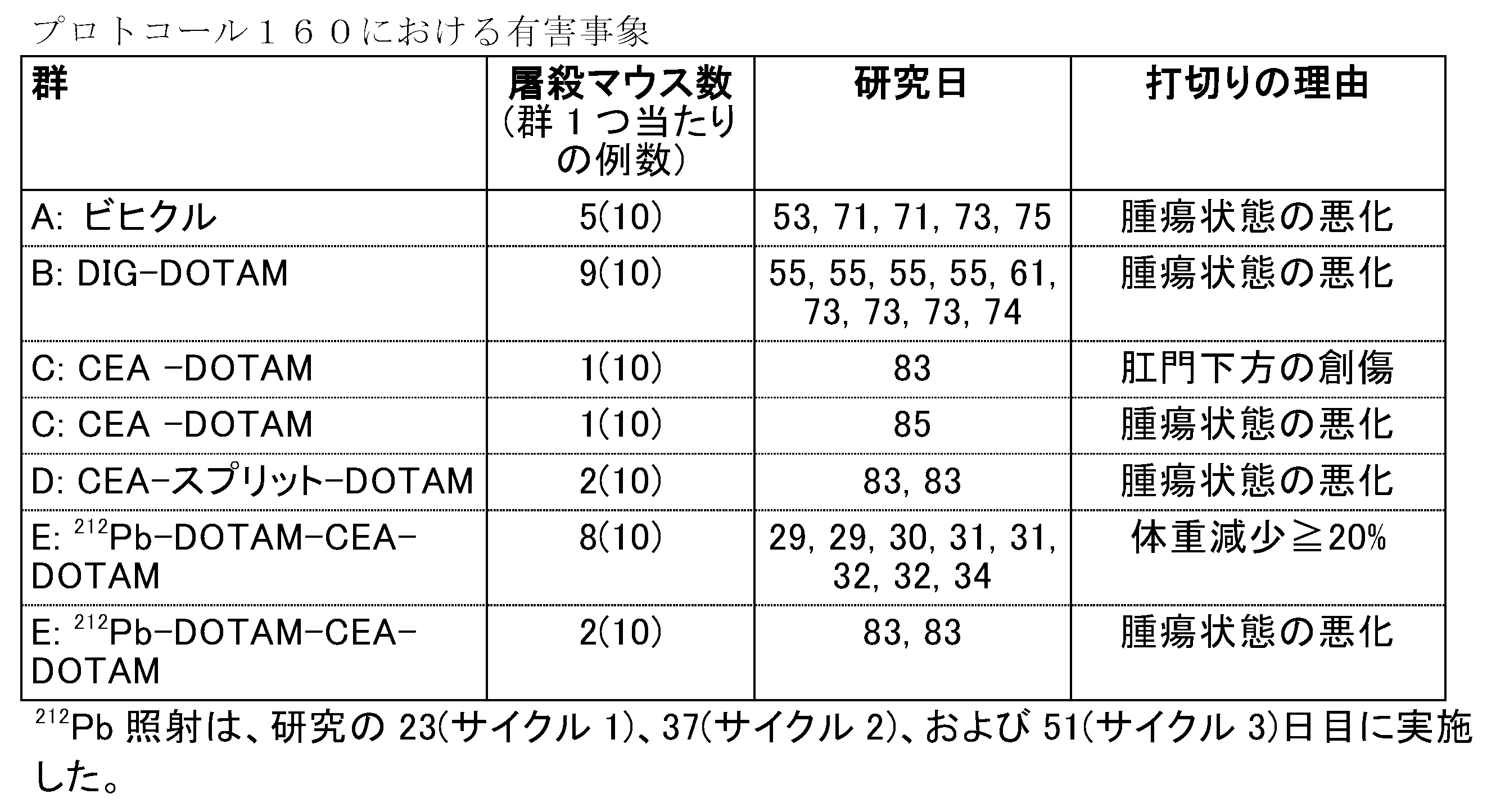
結論
3工程スキーム(CEA-DOTAM BsAb、CA、および212Pb-DOTAM)を使用するCEA-PRITと、2工程スキーム(CEA-スプリット-DOTAM-VH/VL抗体および212Pb-DOTAM)を使用するCEA-PRITとの間に、差違は見られなかった;TGIは、2つの処置について、著明かつ同一であり、いずれの場合にも、3サイクルにわたる20μCiは、安全に投与された。対照的に、注射の前にCEA-DOTAMにあらかじめ結合している、20μCiの212Pb-DOTAM(1工程RIT)は、処置されたマウスの大部分により忍容されなかった。
Conclusions CEA-PRIT using a 3-step scheme (CEA-DOTAM BsAb, CA, and 212Pb -DOTAM) and CEA using a 2-step scheme (CEA-Split-DOTAM-VH/VL antibody and 212Pb -DOTAM) No difference was seen between -PRIT; TGI was marked and identical for the two treatments, and in both
こうして、研究は、開発されたCEA-スプリット-DOTAM-VH/VLコンストラクトを使用する、CA非依存型2工程PRITの忍容性および治療有効性を裏付けた。 Thus, the study supported the tolerability and therapeutic efficacy of CA-independent two-step PRIT using the developed CEA-split-DOTAM-VH/VL construct.
実施例7
プロトコール175
プロトコール175の目的は、注入されるプレターゲティング抗体量の増大の、その後における、腫瘍組織内および健常組織内の212Pbの蓄積に対する影響について評価することであった。CEA-スプリット-DOTAM-VH/VL抗体の2つの異なる用量:標準量(100μg)と、2.5倍の高用量(250μg)とを比較した。さらに、そのVHを伸長させて、抗薬剤抗体(ADA)の形成を回避するように、CEA-スプリット-DOTAM-VHコンストラクトに修飾を施した(これを、既に調べられたCEA-スプリット-DOTAM-VLコンストラクトと併せて使用した)。抗体のCH1ドメインに由来する、最初の3つのアミノ酸:アラニン、セリン、およびスレオニン(AST)を含むようにVHを伸長させ、本明細書の以下では、コンストラクトを、抗体のCH1ドメインに由来する、最初の3つのアミノ酸:アラニン、セリン、およびスレオニン(AST)と称する。
Example 7
protocol 175
The purpose of Protocol 175 was to assess the effect of increasing amounts of pre-targeting antibody infused on the subsequent accumulation of 212 Pb in tumor and healthy tissues. Two different doses of CEA-Split-DOTAM-VH/VL antibody were compared: a standard dose (100 μg) and a 2.5-fold higher dose (250 μg). In addition, we modified the CEA-split-DOTAM-VH construct to extend its VH and avoid the formation of anti-drug antibodies (ADA) (this was compared to the previously examined CEA-split-DOTAM- used in conjunction with the VL construct). VH is extended to include the first three amino acids from the CH1 domain of the antibody: alanine, serine, and threonine (AST), and hereafter constructs are derived from the CH1 domain of the antibody. The first three amino acids are called: alanine, serine, and threonine (AST).
抗体P1AD8592については、上記の実施例4で既に記載した。P1AF0171は、融合HCが、残基ASTにより伸長される点を除き、P1AD8749と同じである。(したがって、抗体P1AD0171は、上記で記載された軽鎖である、D1AA3384(配列番号34)、上記で記載された第1の重鎖である、D1AC4022(配列番号28)、および下記に示される第2の重鎖である、D1AE3669:
D1AE3669(HCknob<CEA>CH1A1A Dotam-VH-AST)
QVQLVQSGAEVKKPGASVKVSCKASGYTFTEFGMNWVRQAPGQGLEWMGWINTKTGEATYVEEFKGRVTFTTDTSTSTAYMELRSLRSDDTAVYYCARWDFAYYVEAMDYWGQGTTVTVSSASTKGPSVFPLAPSSKSTSGGTAALGCLVKDYFPEPVTVSWNSGALTSGVHTFPAVLQSSGLYSLSSVVTVPSSSLGTQTYICNVNHKPSNTKVDKKVEPKSCDKTHTCPPCPAPEAAGGPSVFLFPPKPKDTLMISRTPEVTCVVVDVSHEDPEVKFNWYVDGVEVHNAKTKPREEQYNSTYRVVSVLTVLHQDWLNGKEYKCKVSNKALGAPIEKTISKAKGQPREPQVYTLPPCRDELTKNQVSLWCLVKGFYPSDIAVEWESNGQPENNYKTTPPVLDSDGSFFLYSKLTVDKSRWQQGNVFSCSVMHEALHNHYTQKSLSLSPGGGGGSGGGGSGGGGSGGGGSVTLKESGPVLVKPTETLTLTCTVSGFSLSTYSMSWIRQPPGKALEWLGFIGSRGDTYYASWAKGRLTISKDTSKSQVVLTMTNMDPVDTATYYCARERDPYGGGAYPPHLWGRGTLVTVSSAST(配列番号147)
からなる)。
Antibody P1AD8592 has already been described in Example 4 above. P1AF0171 is the same as P1AD8749 except that the fusion HC is extended by residues AST. (Thus, antibody P1AD0171 has the light chain, D1AA3384 (SEQ ID NO:34), described above, the first heavy chain, D1AC4022 (SEQ ID NO:28), described above, and the second chain shown below. 2 heavy chain, D1AE3669:
D1AE3669 (HCknob<CEA>CH1A1A Dotam-VH-AST)
(SEQ ID NO: 147)
consisting of).
SC BxPC3腫瘍を保有するマウスに、
・標準用量の1倍容量のCEA-スプリット-DOTAM-VH/VL BsAbの7日後における、放射性標識212Pb-DOTAM、または
・標準用量の2.5倍容量のCEA-スプリット-DOTAM-VH/VL BsAbの7日後における、放射性標識212Pb-DOTAM
を注入した。
Mice bearing SC BxPC3 tumors were
Radiolabeled 212Pb -DOTAM at 7 days after 1 standard dose CEA-Split-DOTAM-VH/VL BsAb, or 2.5 standard dose CEA-Split-DOTAM-VH/VL Radiolabeled 212 Pb-DOTAM 7 days after BsAb
was injected.
212Pb-DOTAMの、in vivoにおける分布を、放射性物質注射の24時間後に評価した。研究の概観を、図17に示す。 The in vivo distribution of 212 Pb-DOTAM was assessed 24 hours after radioinjection. An overview of the study is shown in FIG.
研究デザイン
プロトコール175の時間経過およびデザインを、下記に示す。
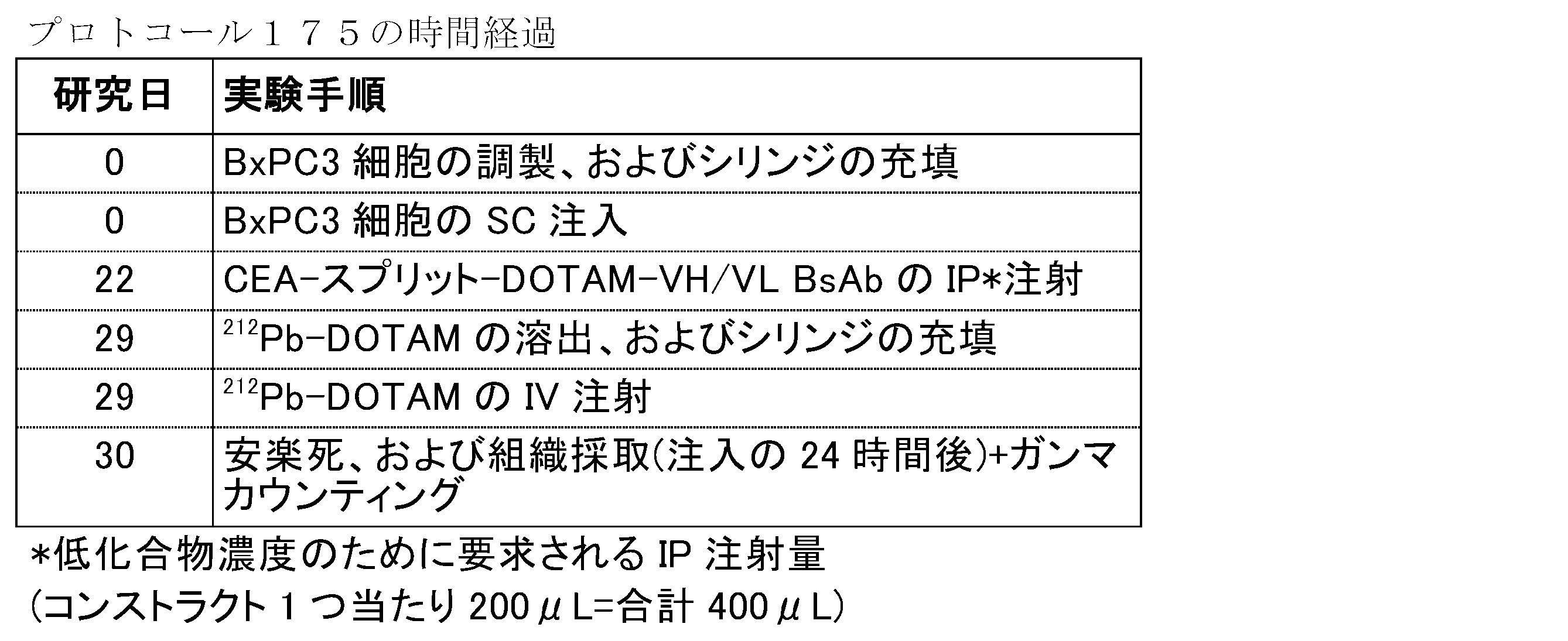
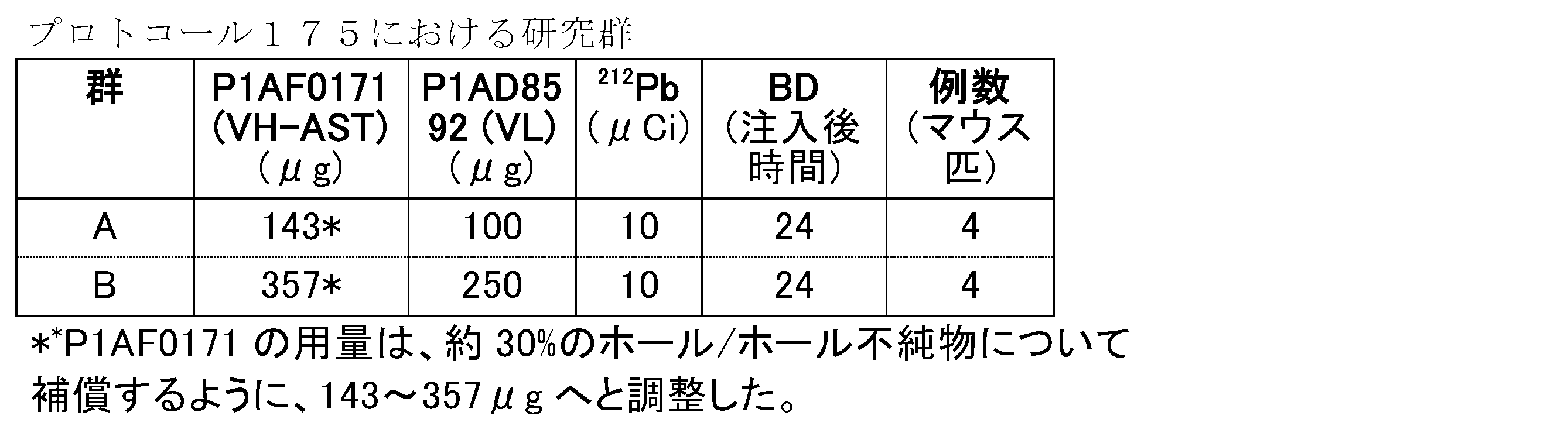
固形異種移植片は、研究0日目に、RPMI/マトリゲル中の細胞5×106個(第24継代)の、右脇腹へのSC注入により、各SCIDマウスにおいて確立した。腫瘍細胞注入の21日後に、マウスを、平均腫瘍体積を310mm3とする実験群に分けた。212Pb-DOTAMを、接種後29日目に注入した;平均腫瘍体積は、30日目において、462mm3であった。
Solid xenografts were established in each SCID mouse on
全てのマウスを屠殺し、212Pb-DOTAMの注射の24時間後に剖検し、放射性物質の含有量の測定のために、以下の臓器および組織:血液、皮膚、脾臓、膵臓、腎臓、肝臓、筋肉、尾、および腫瘍を採取した。 All mice were sacrificed and necropsied 24 hours after injection of 212 Pb-DOTAM and the following organs and tissues were analyzed for radioactive content determination: blood, skin, spleen, pancreas, kidney, liver, muscle. , tails, and tumors were harvested.
結果
注射の24時間後における全ての回収組織内の平均212Pb分布を、図18に示す。2つの用量レベルの間で、腫瘍組織または正常組織内の212Pbの取込みに有意差は見られなかった。腫瘍蓄積は、いずれの処置群については、1g当たり30~31%のIDであり、腎臓への取込みは、この時点において、1g当たり<2%のIDであった。1匹のマウスは、212Pb-DOTAMの注射問題のために、尾内に、1g当たり約1%のIDを有したが、他の回収健常組織は、相当量の212Pb蓄積を示さなかった。
Results The average 212 Pb distribution within all collected
有害事象および毒性
本研究と関連する有害事象または毒性は見られなかった。
Adverse Events and Toxicity There were no adverse events or toxicities related to this study.
結論
このin vivoモデルでは、プレターゲティングCEA-スプリット-DOTAM-VH/VL抗体の用量の、2.5倍の増大は、続いて投与された212Pb-DOTAMの腫瘍への蓄積を改善しなかった。しかし、プレターゲティングCEA-スプリット-DOTAM-VH/VL抗体はまた、正常組織中の放射能の蓄積も増大させなかったことから、この2工程プレターゲティングレジメンを使用して達成される、強力な特異性を強調した。最後に、結果は、伸長型VHCEA-スプリット-DOTAM-VH-ASTコンストラクトの機能について検証した。
Conclusions In this in vivo model, a 2.5-fold increase in the dose of pretargeting CEA-split-DOTAM-VH/VL antibody did not improve tumor accumulation of subsequently administered 212 Pb-DOTAM. . However, the pretargeting CEA-split-DOTAM-VH/VL antibody also did not increase the accumulation of radioactivity in normal tissues, indicating the strong specificity achieved using this two-step pretargeting regimen. emphasized sexuality. Finally, the results validated the functionality of the extended VHCEA-split-DOTAM-VH-AST construct.
実施例8
プロトコール185
プロトコール185の目的は、T84.66エピトープをターゲティングする、CEA-スプリット-DOTAM-VH/VLについて評価することであった。本明細書では、P1AF0709およびP1AF0298の配列が提示される。P1AF0709は、D1AE4688(配列番号83)の第1の重鎖と、D1AA4920(配列番号84)の第2の重鎖とを有する。P1AF0298は、D1AE4687(配列番号86)の第1の重鎖と、D1AE3668(配列番号87)の第2の重鎖とを有する。いずれも、D1AA4120(配列番号89)の軽鎖を有する。
Example 8
protocol 185
The purpose of protocol 185 was to evaluate CEA-split-DOTAM-VH/VL targeting the T84.66 epitope. Presented herein are the sequences of P1AF0709 and P1AF0298. P1AF0709 has a first heavy chain of D1AE4688 (SEQ ID NO:83) and a second heavy chain of D1AA4920 (SEQ ID NO:84). P1AF0298 has a first heavy chain of D1AE4687 (SEQ ID NO:86) and a second heavy chain of D1AE3668 (SEQ ID NO:87). Both have a light chain of D1AA4120 (SEQ ID NO:89).
SC BxPC3腫瘍を保有するマウスに、標準用量のCEA-スプリット-DOTAM-VH/VL BsAb(抗体1つ当たり100μg)を注入した6日後に、放射性標識212Pb-DOTAMを注射した。212Pb-DOTAMの、in vivoにおける分布を、放射性物質注射の6時間後に評価した。研究の概観を、図19に示す。 SC BxPC3 tumor-bearing mice were injected with a standard dose of CEA-split-DOTAM-VH/VL BsAb (100 μg per antibody) 6 days before injection with radiolabeled 212 Pb-DOTAM. The in vivo distribution of 212 Pb-DOTAM was assessed 6 hours after radioinjection. An overview of the study is shown in FIG.
研究デザイン
プロトコール185の時間経過およびデザインを、下記に示す。
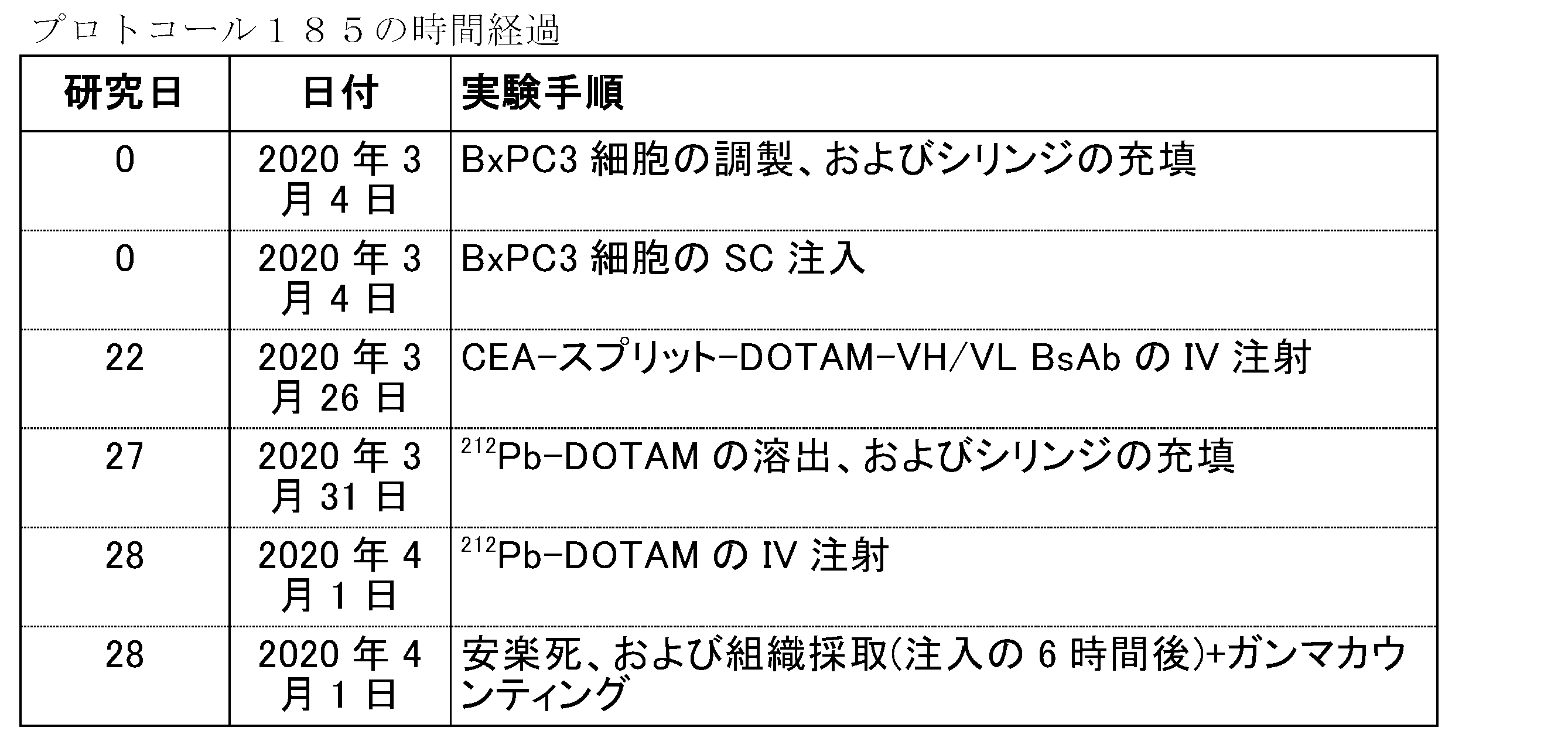
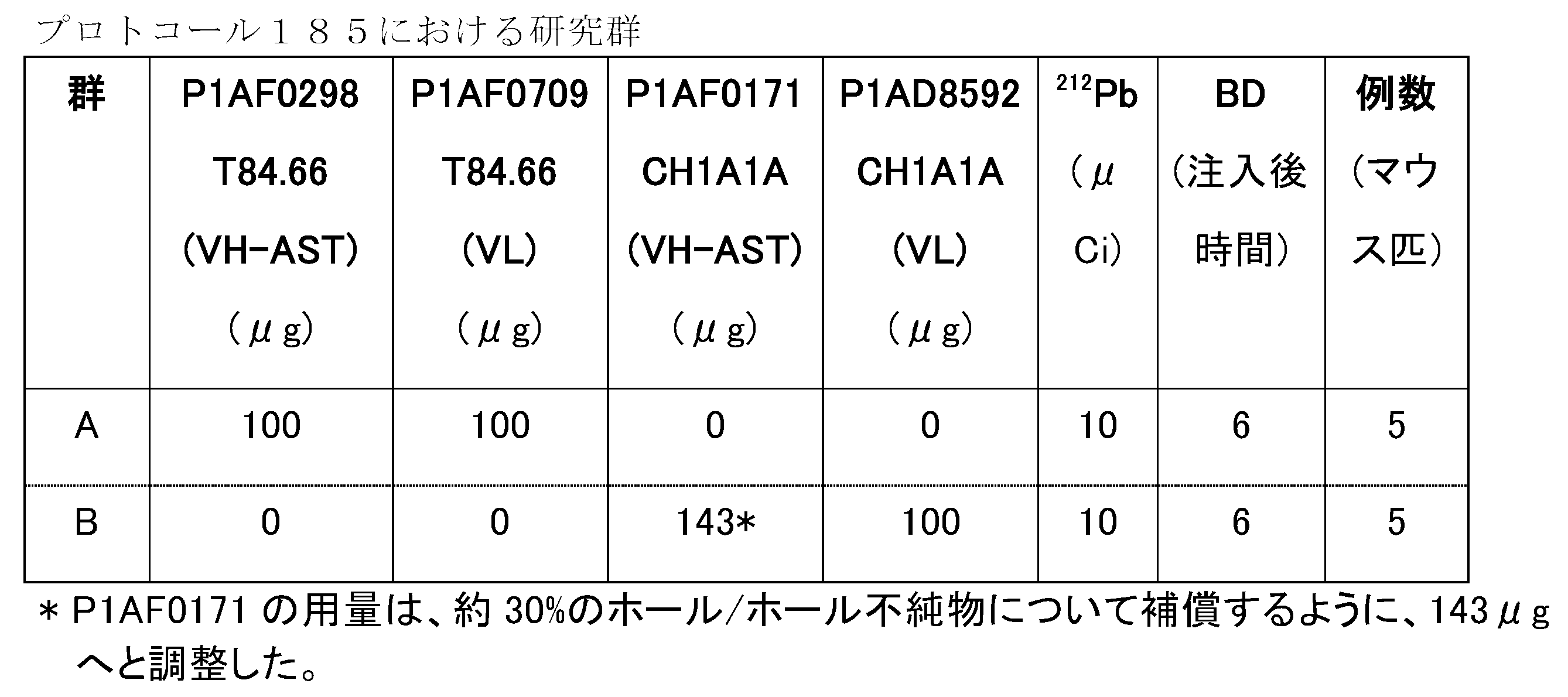
固形異種移植片は、研究0日目に、RPMI/マトリゲル中の細胞5×106個(第27継代)の、右脇腹へのSC注入により、各SCIDマウスにおいて確立した。腫瘍細胞注入の22日後に、マウスを、平均腫瘍体積を224mm3とする実験群に分けた。212Pb-DOTAMを、接種後28日目に注入した;この時点で、平均腫瘍体積は、385mm3に達していた。
Solid xenografts were established in each SCID mouse on
全てのマウスを屠殺し、212Pb-DOTAMの注射の6時間後に剖検し、放射性物質の含有量の測定のために、以下の臓器および組織:血液、皮膚、脾臓、膵臓、腎臓、肝臓、筋肉、尾、および腫瘍を採取した。回収された腫瘍を、2つの小片の分けた:一方を、放射性物質の含有量について測定し、他方を、Tissue-Tek(登録商標)最適切断温度(OCT)用包埋培地を含有するクリオモルド中に入れ、急速凍結のために、ドライアイス上に置いた。OCT中で凍結させた試料を、凍結切片化、免疫蛍光染色、およびZeiss Axio Scope.A1型モジュラー顕微鏡を使用する解析の前に、-80℃で維持した。 All mice were sacrificed and necropsied 6 hours after injection of 212 Pb-DOTAM and the following organs and tissues were analyzed for radioactive content determination: blood, skin, spleen, pancreas, kidney, liver, muscle. , tails, and tumors were harvested. Harvested tumors were divided into two pieces: one measured for radioactive content and the other in cryomolds containing Tissue-Tek® Optimal Cutting Temperature (OCT) embedding medium. and placed on dry ice for quick freezing. Samples frozen in OCT were subjected to cryosectioning, immunofluorescent staining, and Zeiss Axio Scope. They were kept at −80° C. before analysis using a model A1 modular microscope.
結果
注射の6時間後における全ての回収組織内の平均212Pb分布を、図20に示す。腫瘍蓄積は、1g当たり40%のID(CH1A1A)、または1g当たり44%のID(T84.66)であった。他の相当量の放射能蓄積は、腎臓内だけで見出された:2つの群について、注射の6時間後において、1g当たり3~5%のIDであった。
Results The mean 212 Pb distribution within all collected tissues at 6 hours post-injection is shown in FIG. Tumor accumulation was 40% ID per gram (CH1A1A) or 44% ID per gram (T84.66). Another substantial accumulation of radioactivity was found only in the kidney: 3-5% ID/g at 6 hours post-injection for the two groups.
T84.66(群A)またはCH1A1A(群B)をターゲティングする、CEA-スプリット-DOTAM-VH/VL対の腫瘍内分布の例を、図21に示す。パネルAおよびCは、CEAの発現が、BxPC3腫瘍内で、高度かつ均一であることを示し、パネルBおよびDは、注入の7日後における抗体分布が同様であることを裏付ける。しかし、群Aからの試料は、群Bからの腫瘍試料と比較して、全体として強いシグナルを提示し、T84.66が、CH1A1Aより強い結合剤であることの証拠を提示する。 Examples of intratumoral distribution of CEA-split-DOTAM-VH/VL pairs targeting T84.66 (group A) or CH1A1A (group B) are shown in FIG. Panels A and C show that CEA expression is high and homogeneous within BxPC3 tumors, and panels B and D confirm similar antibody distribution at 7 days post-injection. However, samples from group A displayed a stronger signal overall compared to tumor samples from group B, providing evidence that T84.66 is a stronger binder than CH1A1A.
有害事象および毒性
本研究と関連する有害事象または毒性は見られなかった。
Adverse Events and Toxicity There were no adverse events or toxicities related to this study.
結論
結果は、CEAのT84.66エピトープをターゲティングする、CEA-スプリット-DOTAM-VH/VLコンストラクトの機能について検証した。結果として得られる、プレターゲティングされたCEA発現腫瘍内の212Pbの蓄積は、高度かつ特異的であり、CH1A1AエピトープまたはT84.66エピトープをターゲティングする、CEA-スプリット-DOTAM-VH/VL対は、CEA発現腫瘍の内部において、均一に分布した。
Conclusions The results validate the functionality of the CEA-split-DOTAM-VH/VL construct targeting the T84.66 epitope of CEA. The resulting accumulation of 212 Pb within pre-targeted CEA-expressing tumors was highly and specific, with CEA-split-DOTAM-VH/VL pairs targeting the CH1A1A or T84.66 epitopes Homogeneously distributed within CEA-expressing tumors.
実施例9
プロトコール189
プロトコール189の目的は、T84.66 VH-AST/CH1A1A VLおよびT84.66 VL/CH1A1 VH-ASTをターゲティングする、二重パラトープCEA-スプリット-DOTAM-VH/VL抗体対について、CH1A1A VH-AST/VLをターゲティングするポジティブコントロール対と比較して評価することであった。この二重パラトープの組合せは、2つのエピトープのうちの1つ(例えば、T84.66エピトープ)だけを発現させる、可溶型CEA上における、完全なPb-DOTAM結合剤の形成を排除し、これにより、循環放射能の増大、および関連する照射誘導性毒性、ならびに腫瘍オフ標的との競合に由来する有効性の減少など、その潜在的有害作用を緩和する。
Example 9
Protocol 189
The purpose of protocol 189 is to use CH1A1A VH-AST/CH1A1A VH-AST/ was to be evaluated relative to a positive control pair targeting the VL. This dual paratope combination precludes the formation of a complete Pb-DOTAM binder on soluble CEA that expresses only one of the two epitopes (eg, the T84.66 epitope). thereby mitigating its potential adverse effects, such as increased circulating radioactivity and associated radiation-induced toxicity, as well as reduced efficacy from competition with tumor off-targets.
SC BxPC3腫瘍を保有するマウスに、標準用量のCEA-スプリット-DOTAM-VH/VL BsAb(抗体1つ当たり100μg)を注入した7日後に、放射性標識212Pb-DOTAMを注射した。212Pb-DOTAMの、in vivoにおける分布を、放射性物質注射の6時間後に評価した。研究の概観を、図22に示す。 SC BxPC3 tumor-bearing mice were injected with a standard dose of CEA-split-DOTAM-VH/VL BsAb (100 μg per antibody) 7 days before injection with radiolabeled 212 Pb-DOTAM. The in vivo distribution of 212 Pb-DOTAM was assessed 6 hours after radioinjection. An overview of the study is shown in FIG.
研究デザイン
プロトコール189の時間経過およびデザインを、下記に示す。

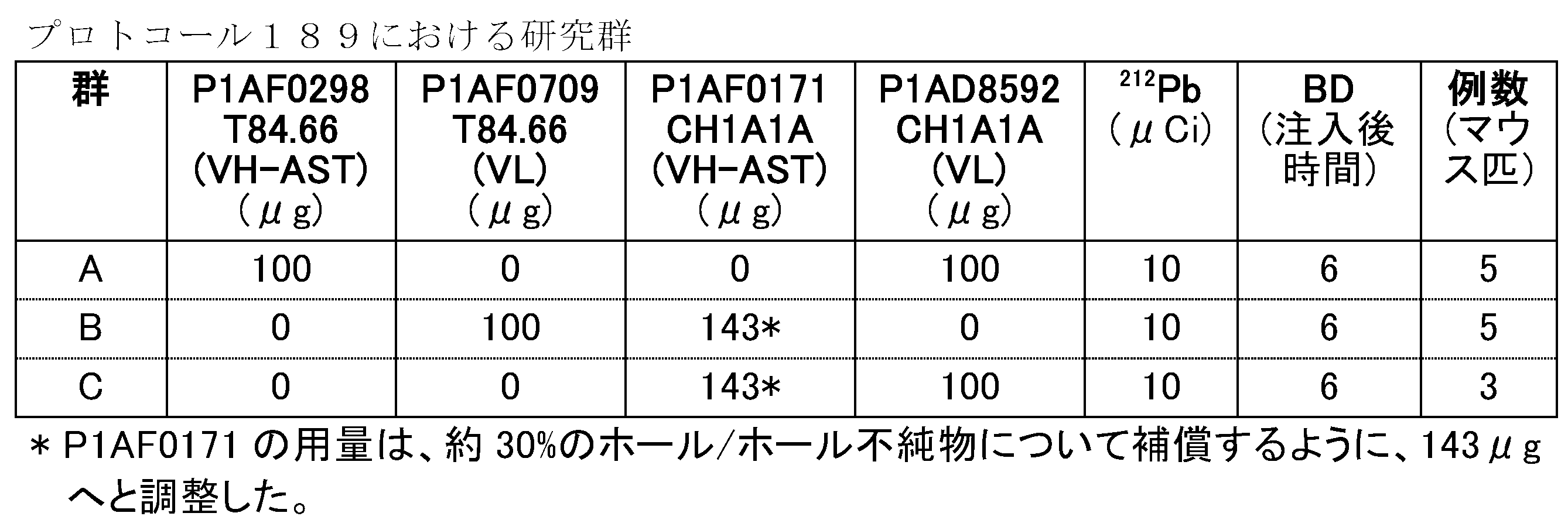
固形異種移植片は、研究0日目に、RPMI/マトリゲル中の細胞5×106個(第31継代)の、右脇腹へのSC注入により、各SCIDマウスにおいて確立した。腫瘍細胞注入の14日後に、マウスを、平均腫瘍体積を343mm3とする実験群に分けた。212Pb-DOTAMを、接種後22日目に注入した;平均腫瘍体積は、21日目において、557mm3に達していた。
Solid xenografts were established in each SCID mouse on
全てのマウスを屠殺し、212Pb-DOTAMの注射の6時間後に剖検し、放射性物質の含有量の測定のために、以下の臓器および組織:血液、皮膚、脾臓、膵臓、腎臓、肝臓、筋肉、尾、および腫瘍を採取した。 All mice were sacrificed and necropsied 6 hours after injection of 212 Pb-DOTAM and the following organs and tissues were analyzed for radioactive content determination: blood, skin, spleen, pancreas, kidney, liver, muscle. , tails, and tumors were harvested.
結果
注射の6時間後における全ての回収組織内の平均212Pb分布を、図23に示す。二重パラトープの腫瘍への蓄積の変動は、T84.66 VH-AST+CH1A1A VLおよびT84.66 VL+CH1A1A VH-ASTのそれぞれについて、1g当たり71%のID~1g当たり46%のIDであった。ポジティブコントロールである、CH1A1Aは、1g当たり37%のIDを結果としてもたらした。チューキーの多重比較検定による二元ANOVAは、3つの群全ては、腫瘍への取込みの点で、互いと著明に異なること(他の2つの群と対比した、T84.66 VH-AST+CH1A1A VLについてのp<0.0001;CH1A1Aだけと対比した、T84.66 VL+CH1A1A VH-ASTについてのp=0.0020)を示した。他の臓器は、群間の統計学的有意差を示さなかったが、他の2つの群:1g当たり<1%のIDと比較した、1g当たり2%のIDと比較した、T84.66 VH-AST+CH1A1A VLの組合せについて、血液中の、わずかに高度の保持が指し示された。腎臓への取込みは、統計学的に有意にではないが、同様に、わずかに高度であった:他の2つの群についての、1g当たり3%のIDと比較された、T84.66 VH-AST+CH1A1Aについて1g当たり4.5%のIDであった。
Results The mean 212 Pb distribution within all collected tissues at 6 hours post-injection is shown in FIG. Tumor accumulation of the dual paratope varied from 71% ID per g to 46% ID per g for T84.66 VH-AST+CH1A1A VL and T84.66 VL+CH1A1A VH-AST, respectively. The positive control, CH1A1A, resulted in 37% ID/g. A two-way ANOVA with Tukey's multiple comparison test showed that all three groups were significantly different from each other in terms of tumor uptake (for T84.66 VH-AST+CH1A1A VL versus the other two groups). p < 0.0001 of ; p = 0.0020 for T84.66 VL + CH1A1A VH-AST vs. CH1A1A alone). Other organs showed no statistically significant differences between groups, but the other two groups: T84.66 VH compared to <1% ID/g compared to 2% ID/g A slightly higher retention in blood was indicated for the -AST+CH1A1A VL combination. Kidney uptake was also slightly higher, although not statistically significant: T84.66 VH-, compared to an ID of 3% per g for the other two groups. 4.5% ID per gram for AST+CH1A1A.
有害事象および毒性
本研究と関連する有害事象または毒性は見られなかった。しかし、本研究におけるBxPC3腫瘍の増殖は、標準的な増殖速度と比較して、有意に速く、ばらつきの増大を伴った。剖検時に、大型の腫瘍(大部分)は、放射能の測定の前に、腫瘍を半分に切断するとなくなる液体で充たされていることが結論づけられた;この液体は、増殖速度の加速化により引き起こされた可能性が高いが、腫瘍は、開口させた後で秤量し、測定したので、1g当たりのIA%に、大きな程度で影響を及ぼすことはなかった。
Adverse Events and Toxicity There were no adverse events or toxicities related to this study. However, the growth of BxPC3 tumors in this study was significantly faster and with increased variability compared to standard growth rates. At autopsy, it was concluded that large tumors (mostly) were filled with fluid that disappeared when the tumor was cut in half prior to radioactivity measurement; Although likely induced, the tumors were weighed and measured after opening and did not affect %IA/g to a large extent.
結論
結果は、被験CEA-スプリット-DOTAM-VH/VLコンストラクトを使用して、CEAのT84.66エピトープおよびCH1A1Aエピトープをターゲティングする二重パラトープの機能について検証し、驚くべきことに、この組合せについて、ポジティブコントロールである、CH1A1Aと比較した、高度の有効性を裏付けた。結果として得られる、プレターゲティングされたCEA発現腫瘍内の212Pbの蓄積は、高度かつ特異的であり、T84.66 VH-AST+CH1A1A VL対について、特定の利点を指し示した。
Conclusions The results validate the ability of the dual paratope to target the T84.66 and CH1A1A epitopes of CEA using the tested CEA-split-DOTAM-VH/VL constructs, and surprisingly, for this combination: A high degree of efficacy was demonstrated compared to the positive control, CH1A1A. The resulting accumulation of 212 Pb within pre-targeted, CEA-expressing tumors was high and specific, pointing to a particular advantage for the T84.66 VH-AST+CH1A1A VL pair.
実施例10
これらの例は、本明細書で記載されるスプリット抗体による、Pb-DOTAの、細胞への動員について探索する。
Example 10
These examples explore the recruitment of Pb-DOTA into cells by the split antibodies described herein.
P1AF0712は、配列番号97の第1の重鎖、配列番号98の第2の重鎖、および配列番号103の軽鎖を有する。P1AF0713は、配列番号100の第1の重鎖、配列番号101の第2の重鎖、および配列番号103の軽鎖を有する。 P1AF0712 has a first heavy chain of SEQ ID NO:97, a second heavy chain of SEQ ID NO:98, and a light chain of SEQ ID NO:103. P1AF0713 has a first heavy chain of SEQ ID NO:100, a second heavy chain of SEQ ID NO:101, and a light chain of SEQ ID NO:103.
トリプシンを使用して、MKN-45細胞を、培養ボトルから解離させ、Casy細胞カウンターを使用してカウントした。4℃、300gにおけるペレット化の後、細胞を、FACSバッファー(PBS中に2.5%のFCS)中に再懸濁させ、96ウェルPP製V字底プレート(ウェル1つ当たり25μL=ウェル1つ当たりの細胞5.0×10⁴個)に分注される、1mL当たりの細胞2.0×10⁶個に調整した。 MKN-45 cells were dissociated from culture bottles using trypsin and counted using a Casy cell counter. After pelleting at 300 g at 4° C., cells were resuspended in FACS buffer (2.5% FCS in PBS) and plated in 96-well PP V-bottom plates (25 μL per well = well 1). Adjusted to 2.0×10 6 cells per mL, dispensed (5.0×10 4 cells/ml).
DOTA-FITCを使用するFACS染色
CEA特異的スプリット抗体(それぞれ、P1AF0712またはP1AF0713)を、FACSバッファー中に40μg/mLに調整する結果として、10μg/mLの最終濃度をもたらした。両方の抗体を、組み合わせて、または個別に、細胞に添加するのに続き、バッファーを添加し、4℃で、1時間にわたりインキュベートした。その後、Pb-DOTA標識FITCを、抗体に対する等モル比で、細胞に添加し、4℃で、1時間にわたりインキュベートした。次いで、細胞を、FACSバッファー中で、2回にわたり洗浄し、FACS Canto(BD、Pharmingen)を使用する測定のために、ウェル1つ当たり70μlのFACSバッファー中に再懸濁させた。スプリットの片割れのいずれも、蛍光シグナルをもたらさなかったことが示された(図24)ことは、Pb-DOTAへの結合能の欠如を指し示す。スプリットの片割れ両方の組合せだけが、Pb-DOTAM-FITCを、標的細胞に動員することが可能であった(図24)。
FACS staining using DOTA-FITC CEA-specific split antibodies (P1AF0712 or P1AF0713, respectively) were adjusted to 40 μg/mL in FACS buffer, resulting in a final concentration of 10 μg/mL. Both antibodies, combined or individually, were added to the cells followed by addition of buffer and incubation at 4° C. for 1 hour. Pb-DOTA-labeled FITC was then added to the cells at an equimolar ratio to antibody and incubated at 4° C. for 1 hour. Cells were then washed twice in FACS buffer and resuspended in 70 μl per well of FACS buffer for measurement using a FACS Canto (BD, Pharmingen). None of the split halves were shown to yield a fluorescent signal (Figure 24), indicating a lack of ability to bind Pb-DOTA. Only the combination of both split halves was able to recruit Pb-DOTAM-FITC to target cells (FIG. 24).
<huIgG(H+L)A488>を使用するFACS染色
CEA特異的スプリット抗体(それぞれ、P1AF0712またはP1AF0713)を、FACSバッファー中に40μg/mLに調整する結果として、10μg/mLの最終濃度をもたらした。両方の抗体を、細胞に、個別に添加するのに続き、バッファーを添加するか、または組み合わせて添加し、4℃で、1時間にわたりインキュベートした。次いで、細胞を、FACSバッファー中で、2回にわたり洗浄した。洗浄した後で、細胞を、二次抗体(<huIgG(H+L)>-Alexa488、濃度=10μg/mL)を含有する、50μLのFACSバッファー中に再懸濁させ、4℃で、1時間にわたりインキュベートした。次いで、細胞を、FACSバッファー中で、2回にわたり洗浄し、FACS Canto(BD、Pharmingen)を使用する測定のために、ウェル1つ当たり70μlのFACSバッファー中に再懸濁させた。両方のスプリット抗体についてのEC50が同等であったことは、両方のスプリット抗体の、CEA特異的細胞への結合を指し示す。これらの状況下では、下記の表において示される通り、混合物中に高量の抗体のために、低値のEC50が得られた。
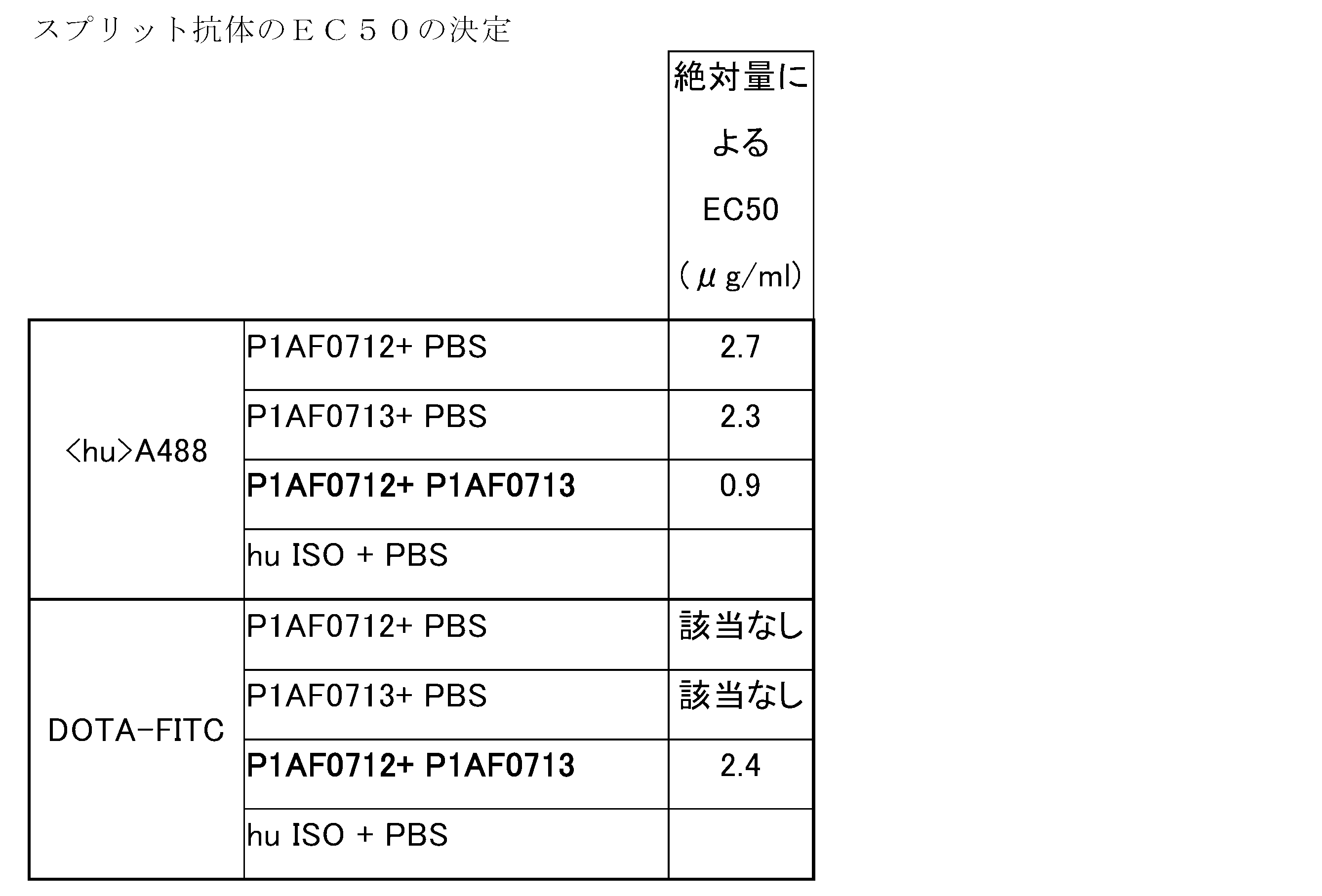

実施例11
Biacore結合実験
本実施例は、TA-スプリット-DOTAM-VH、およびTA-スプリット-DOTAM-VLの、DOTAMへの結合について、参照抗体であるCEA-DOTAM(RO7198427、PRIT-0213)と比較して、個別に調べる。本実施例は、DOTAMの、TA-スプリット-DOTAM-VH/VL対への結合についても、参照抗体と比較してさらに調べる。
Example 11
Biacore Binding Experiments This example demonstrates the binding of TA-split-DOTAM-VH and TA-split-DOTAM-VL to DOTAM in comparison to the reference antibody CEA-DOTAM (RO7198427, PRIT-0213). , examine separately. This example also further investigates the binding of DOTAM to the TA-split-DOTAM-VH/VL pair compared to a reference antibody.
これらの例において使用されるコード化と、本出願の別の箇所で使用されるタンパク質番号との対応を、下記に示す。配列もまた、提示される。本実施例では、参照抗体は、「PRIT_RS」とコード化される。

これらの実験のために、PRITスプリット抗体を、MabSelect Sure(親和性クロマトグラフィー)による第1の工程、およびイオン交換クロマトグラフィー(例えば、POROS XS)による第2の工程により精製し、次いで、Superdex 200(サイズ排除クロマトグラフィー)により精製した。 For these experiments, the PRIT split antibody was purified by a first step by MabSelect Sure (affinity chromatography) and a second step by ion exchange chromatography (e.g. POROS XS) followed by Superdex 200 (size exclusion chromatography).
実験は、測定温度を25℃として、Biacore T200により.全てのBiacore T200実験は、pH7.4のHBS-P+(GE Healthcare、Br-1008-27)ランニングバッファー中で実施した。2つの実験は、異なるDOTAM画分を使用して、被験抗体/抗体対について実施した。 The experiment was carried out using a Biacore T200 at a measurement temperature of 25°C. All Biacore T200 experiments were performed in HBS-P+ (GE Healthcare, Br-1008-27) running buffer at pH 7.4. Two experiments were performed for the tested antibody/antibody pairs using different DOTAM fractions.
1.第1の実験では、個別のTA-スプリット-DOTAM-VH抗体、およびTA-スプリット-DOTAM-VL抗体のチップ上に捕捉されたビオチン化DOTAMへの結合を、参照抗体と比べて評価した。 1. In the first experiment, the binding of individual TA-split-DOTAM-VH and TA-split-DOTAM-VL antibodies to biotinylated DOTAM captured on a chip was assessed relative to a reference antibody.
DOTAM(HBS-P+中の120nM溶液)を、CAP Chip表面上の高密度で捕捉した(10μl/分、60秒間)。次いで、プロドラッグ_Aまたはプロドラッグ_Bの、HBS-P+中の600nM溶液を、DOTAM表面上に注入した(10μl/分、90秒間)。解離を、10μl/分の流量で、240秒間にわたりモニタリングした。相対最大応答決定は、T200査定ソフトウェアを使用して査定した。 DOTAM (120 nM solution in HBS-P+) was captured at high density on the CAP Chip surface (10 μl/min for 60 seconds). A 600 nM solution of prodrug_A or prodrug_B in HBS-P+ was then injected over the DOTAM surface (10 μl/min for 90 seconds). Dissociation was monitored for 240 seconds at a flow rate of 10 μl/min. Relative maximal response determinations were assessed using the T200 assessment software.
結果を、図26に示す。個別の抗体のうちのいずれも、捕捉されたDOTAMへの結合を示さなかった。 Results are shown in FIG. None of the individual antibodies showed binding to captured DOTAM.
2.第2の実験では、固定化抗hFabを使用して、まず、個別のTA-スプリット-DOTAM-VH抗体、およびTA-スプリット-DOTAM-VL抗体を、チップ内に捕捉し、次いで、DOTAM-モノストレプトアビジン複合体(RTで1時間にわたる、1:1のモル比による、600nMのDOTAM+モノストレプトアビジンカップリング)の結合を評価した。 2. In a second experiment, immobilized anti-hFab was used to first capture individual TA-split-DOTAM-VH and TA-split-DOTAM-VL antibodies into the chip and then DOTAM-mono Binding of the streptavidin conjugate (600 nM DOTAM+monostreptavidin coupling at a 1:1 molar ratio for 1 h at RT) was assessed.
プロドラッグ_Aまたはプロドラッグ_Bの、HBS-P+中の600nM溶液を、抗hFab(GE Healthcare、BR-1008-27)CM5 Chip表面上に注入した(10μl/分、120秒間)。プロドラッグ_A溶液またはプロドラッグ_B溶液の、高密度捕捉の後、DOTAM-モノストレプトアビジン複合体を注入した(20μl/分、90秒間)。解離を、20μl/分の流量で、180秒間にわたりモニタリングした。新たなサイクルのために、Glycin 2.1および10μl/分で、75秒間の再生時間を使用することにより、表面を再生した。相対最大応答決定は、T200査定ソフトウェアを使用して査定した。 A 600 nM solution of prodrug_A or prodrug_B in HBS-P+ was injected over the anti-hFab (GE Healthcare, BR-1008-27) CM5 Chip surface (10 μl/min for 120 seconds). After high-density capture of prodrug_A or prodrug_B solutions, the DOTAM-monostreptavidin complex was injected (20 μl/min for 90 seconds). Dissociation was monitored for 180 seconds at a flow rate of 20 μl/min. For a new cycle, the surface was regenerated by using Glycin 2.1 and 10 μl/min with a regeneration time of 75 seconds. Relative maximal response determinations were assessed using the T200 assessment software.
結果を、図27に示す。低百分率の最大応答(図中に、*でマークした)は、DOTAM-SAとの、「微量」相互作用または非特異的相互作用であると考えられ、アッセイを最適化する必要を反映する。 Results are shown in FIG. A low percentage of maximal responses (marked with * in the figure) are considered to be "minor" or non-specific interactions with DOTAM-SA and reflect the need to optimize the assay.
3.第3の実験では、TA-スプリット-DOTAM-VH/VL対のDOTAMへの結合を、参照抗体と比較して評価する。固定化抗hFabを使用して、まず、抗体を、チップ内に捕捉し、次いで、DOTAM-モノストレプトアビジン複合体(RTで1時間にわたる、1:1のモル比による、600nMのDOTAM+モノストレプトアビジンカップリング)の結合を評価した。 3. In a third experiment, binding of the TA-split-DOTAM-VH/VL pair to DOTAM is assessed relative to the reference antibody. Using immobilized anti-hFab, antibodies were first captured into the chip, followed by a DOTAM-monostreptavidin complex (600 nM DOTAM + monostreptavidin at a 1:1 molar ratio for 1 hour at RT). coupling) was evaluated.
プロドラッグ_Aおよびプロドラッグ_Bの、HBS-P+中の300nM溶液を、抗hFab(GE Healthcare、BR-1008-27)CM5 Chip表面上に注入した(10μl/分、120秒間)。プロドラッグ_A溶液およびプロドラッグ_B溶液の、高密度捕捉の後、DOTAM-モノストレプトアビジン複合体を注入した(20μl/分、90秒間)。解離を、20μl/分の流量で、180秒間にわたりモニタリングした。新たなサイクルのために、Glycin 2.1および10μl/分で、75秒間の再生時間を使用することにより、表面を再生した。相対最大応答決定は、T200査定ソフトウェアを使用して査定した。 A 300 nM solution of Prodrug_A and Prodrug_B in HBS-P+ was injected over the anti-hFab (GE Healthcare, BR-1008-27) CM5 Chip surface (10 μl/min for 120 seconds). After high-density capture of prodrug_A and prodrug_B solutions, the DOTAM-monostreptavidin complex was injected (20 μl/min for 90 seconds). Dissociation was monitored for 180 seconds at a flow rate of 20 μl/min. For a new cycle, the surface was regenerated by using Glycin 2.1 and 10 μl/min with a regeneration time of 75 seconds. Relative maximal response determinations were assessed using the T200 assessment software.
結果を、図28に示す。全てのTA-スプリット-DOTAM-VH/VL対は、DOTA結合剤である、P6_AB(P1AF0712/P1AF0713)対を除き、DOTAMに対する、著明量の結合を示した。 Results are shown in FIG. All TA-split-DOTAM-VH/VL pairs showed significant amounts of binding to DOTAM, except for the DOTA binder, the P6_AB (P1AF0712/P1AF0713) pair.
FAP結合剤である、P1AF8286およびP1AF8287についてもまた、著明量のDOTAMの、TA-スプリット-DOTAM-VH/VL対に対する結合を示すが、対の個々のメンバーに対する著明量の結合は示さない、同様の結果が得られた。P1AF8286は、配列番号108の第1の重鎖、配列番号109の第2の重鎖、および配列番号111の軽鎖から構成され、P1AF8287は、配列番号108の第1の重鎖、配列番号110の第2の重鎖、および配列番号111の軽鎖から構成される。しかし、このアッセイは、最適化されることをさらに必要とする。 The FAP binders, P1AF8286 and P1AF8287, also show significant amounts of DOTAM binding to the TA-split-DOTAM-VH/VL pair, but not to the individual members of the pair. , gave similar results. P1AF8286 is composed of the first heavy chain of SEQ ID NO:108, the second heavy chain of SEQ ID NO:109, and the light chain of SEQ ID NO:111; P1AF8287 is composed of the first heavy chain of SEQ ID NO:108, SEQ ID NO:110 and the light chain of SEQ ID NO:111. However, this assay still needs to be optimized.
理解の明確さを目的とする、例示および例のために、前出の発明について、ある程度詳しく記載されたが、記載および例は、本発明の範囲を限定するものとして考えられるべきではない。本明細書で引用される、全ての特許および学術文献の開示は、参照によりそれらの全体において明示的に組み込まれる。 Although the foregoing invention has been described in some detail for purposes of illustration and example for purposes of clarity of understanding, the description and examples should not be construed as limiting the scope of the invention. The disclosures of all patents and scientific publications cited herein are expressly incorporated by reference in their entirety.
Claims (103)
ii)標的細胞の表面上で発現される前記抗原に結合する第2の抗体であって、放射標識化合物に対する抗原結合部位のVLドメインをさらに含むが、放射標識化合物に対する抗原結合部位のVHドメインを含まない、第2の抗体
を含み;
第1の抗体の前記VHドメインおよび第2の抗体の前記VLドメインが、併せて、放射標識化合物に対する機能的抗原結合部位を形成することが可能である、
抗体のセット。 i) a first antibody that binds to an antigen expressed on the surface of a target cell, further comprising a VH domain of an antigen binding site for a radiolabeled compound, but comprising a VL domain of an antigen binding site for the radiolabeled compound; and ii) a second antibody that binds to said antigen expressed on the surface of a target cell, the second antibody further comprising the VL domain of the antigen binding site for the radiolabeled compound, but the radiolabeled compound comprising a second antibody that does not contain the VH domain of the antigen-binding site for
said VH domain of a first antibody and said VL domain of a second antibody can together form a functional antigen binding site for a radiolabeled compound;
A set of antibodies.
a)前記抗原に結合するFab断片、ならびに
b)
i)放射標識化合物に対する抗原結合部位の抗体重鎖可変ドメイン(VH)、または
ii)VHドメインのC末端が定常ドメインのN末端に融合している、放射標識化合物に対する抗原結合部位の抗体重鎖可変ドメイン(VH)および抗体重鎖定常ドメイン
を含むか、またはこれらからなるポリペプチドであって、
VHドメインのN末端により、Fab断片のCLドメインまたはCH1ドメインのC末端に融合しているポリペプチド
を含むか、またはこれらからなり、
第2の抗体が、
c)前記抗原に結合するFab断片、ならびに
d)
iii)放射標識化合物に対する抗原結合部位の抗体軽鎖可変ドメイン(VL)、または
iv)VLドメインのC末端が定常ドメインのN末端に融合している、放射標識化合物に対する抗原結合部位の抗体軽鎖可変ドメイン(VL)および抗体軽鎖定常ドメイン
を含むか、またはこれらからなるポリペプチドであって、
VLドメインのN末端により、Fab断片のCLドメインまたはCH1ドメインのC末端に融合しているポリペプチド
を含むか、またはこれらからなり、
(b)のポリペプチドの抗体重鎖可変ドメイン(VH)および(d)のポリペプチドの抗体軽鎖可変ドメイン(VL)が、併せて、放射標識化合物に対する機能的抗原結合部位を形成することが可能である、
請求項3に記載の抗体のセット。 the first antibody is
a) a Fab fragment that binds to said antigen, and b)
i) an antibody heavy chain variable domain (VH) of an antigen binding site for a radiolabeled compound, or ii) an antibody heavy chain of an antigen binding site for a radiolabeled compound, wherein the C-terminus of the VH domain is fused to the N-terminus of a constant domain A polypeptide comprising or consisting of a variable domain (VH) and an antibody heavy chain constant domain,
comprising or consisting of a polypeptide fused by the N-terminus of a VH domain to the C-terminus of a CL or CH1 domain of a Fab fragment;
the second antibody
c) a Fab fragment that binds said antigen, and d)
iii) an antibody light chain variable domain (VL) of an antigen binding site for a radiolabeled compound, or iv) an antibody light chain of an antigen binding site for a radiolabeled compound, wherein the C-terminus of the VL domain is fused to the N-terminus of a constant domain A polypeptide comprising or consisting of a variable domain (VL) and an antibody light chain constant domain,
comprising or consisting of a polypeptide fused by the N-terminus of a VL domain to the C-terminus of a CL or CH1 domain of a Fab fragment;
The antibody heavy chain variable domain (VH) of the polypeptide of (b) and the antibody light chain variable domain (VL) of the polypeptide of (d) together may form a functional antigen binding site for the radiolabeled compound. is possible,
A set of antibodies according to claim 3 .
a)2つのFab断片を含むタンデムFabであって、第1のFab断片および第2のFab断片が各々、前記抗原の同じエピトープに結合し、第1のFab断片および第2のFab断片が、ペプチドテザーを介して接続しており、第1のFabが、そのC末端を介して第2のFabのN末端に接続している、タンデムFab;ならびに
b)
i)抗体重鎖可変ドメイン(VH);または
ii)VHドメインのC末端がCH1ドメインのN末端に融合している、抗体重鎖可変ドメイン(VH)および抗体定常ドメイン(CH1)
を含むか、またはこれらからなるポリペプチドであって、
VHドメインのN末端により、第2のFab断片のCLドメインまたはCH1ドメインのC末端に融合しているポリペプチド
を含み;
第2の抗体が、
c)2つのFab断片を含むタンデムFabであって、第1のFab断片および第2のFab断片が各々、前記抗原の同じエピトープに結合し、第1のFab断片および第2のFab断片が、ペプチドテザーを介して接続しており、第1のFabが、そのC末端を介して第2のFabのN末端に接続している、タンデムFab;ならびに
d)
i)抗体軽鎖可変ドメイン(VL);または
ii)VHドメインのC末端が定常ドメインのN末端に融合している、抗体軽鎖可変ドメイン(VL)および抗体軽鎖定常ドメイン(CL)
を含むか、またはこれらからなるポリペプチドであって、
VLドメインのN末端により、第2のFab断片のCLドメインまたはCH1ドメインのC末端に融合しているポリペプチド
を含み、
(b)のポリペプチドの抗体重鎖可変ドメイン(VH)および(d)のポリペプチドの抗体軽鎖可変ドメイン(VL)が、併せて、放射標識化合物に対する機能的抗原結合部位を形成することが可能である、
請求項3に記載の抗体のセット。 the first antibody is
a) a tandem Fab comprising two Fab fragments, the first Fab fragment and the second Fab fragment each binding to the same epitope of said antigen, wherein the first Fab fragment and the second Fab fragment: a tandem Fab, connected via a peptide tether, the first Fab being connected via its C-terminus to the N-terminus of the second Fab; and b)
i) an antibody heavy chain variable domain (VH); or ii) an antibody heavy chain variable domain (VH) and an antibody constant domain (CH1), wherein the C-terminus of the VH domain is fused to the N-terminus of the CH1 domain.
A polypeptide comprising or consisting of
comprising a polypeptide fused by the N-terminus of the VH domain to the C-terminus of the CL or CH1 domain of the second Fab fragment;
the second antibody
c) a tandem Fab comprising two Fab fragments, the first Fab fragment and the second Fab fragment each binding to the same epitope of said antigen, wherein the first Fab fragment and the second Fab fragment: tandem Fabs connected via a peptide tether, the first Fab being connected via its C-terminus to the N-terminus of the second Fab; and d)
i) an antibody light chain variable domain (VL); or ii) an antibody light chain variable domain (VL) and an antibody light chain constant domain (CL), wherein the C-terminus of the VH domain is fused to the N-terminus of the constant domain.
A polypeptide comprising or consisting of
a polypeptide fused by the N-terminus of the VL domain to the C-terminus of the CL domain or CH1 domain of the second Fab fragment;
The antibody heavy chain variable domain (VH) of the polypeptide of (b) and the antibody light chain variable domain (VL) of the polypeptide of (d) together may form a functional antigen binding site for the radiolabeled compound. is possible,
A set of antibodies according to claim 3 .
a)第1の断片および第2の断片を含むタンデムFabであって、第1の断片が、そのC末端により、ペプチドテザーを介して第2の断片のN末端に接続しており、第1の断片が、前記抗原の第1のエピトープに結合し、第2の断片が、前記抗原の第2のエピトープに結合し、第1の断片および第2の断片から選択される断片の一方がFabであり、他方が交差Fabである、タンデムFab;
b)
i)抗体重鎖可変ドメイン(VH);または
ii)VHドメインのC末端がCH1ドメインのN末端に融合している、抗体重鎖可変ドメイン(VH)および抗体重鎖定常ドメイン(CH1)
を含むか、またはこれらからなるポリペプチドであって、
VHドメインのN末端により、第2の断片の鎖の1つのC末端に融合しているポリペプチド
を含み;
第2の抗体が、
c)第1の断片および第2の断片を含むタンデムFabであって、第1の断片が、そのC末端により、第2の断片のN末端に接続しており、第1の断片が、前記抗原の第1のエピトープに結合し、第2の断片が、前記抗原の第2のエピトープに結合し、第1の断片および第2の断片から選択される断片の一方がFabであり、他方が交差Fabである、タンデムFab;ならびに
d)
i)抗体軽鎖可変ドメイン(VL);または
ii)VLドメインのC末端が軽鎖定常ドメインのN末端に融合している、抗体軽鎖可変ドメイン(VL)および抗体軽鎖定常ドメイン(CL)
を含むか、またはこれらからなるポリペプチドであって、
VLドメインのN末端により、第2の断片の鎖の1つのC末端に融合しているポリペプチド
を含み;
(b)のポリペプチドの抗体重鎖可変ドメイン(VH)および(d)のポリペプチドの抗体軽鎖可変ドメイン(VL)が、併せて、放射標識化合物に対する機能的抗原結合部位を形成することが可能である、
請求項3に記載の抗体のセット。 the first antibody is
a) a tandem Fab comprising a first fragment and a second fragment, the first fragment being connected by its C-terminus to the N-terminus of the second fragment via a peptide tether; a fragment of binds to a first epitope of said antigen, a second fragment binds to a second epitope of said antigen, and one of the fragments selected from the first fragment and the second fragment is Fab and the other is a crossed Fab;
b)
i) an antibody heavy chain variable domain (VH); or ii) an antibody heavy chain variable domain (VH) and an antibody heavy chain constant domain (CH1), wherein the C-terminus of the VH domain is fused to the N-terminus of the CH1 domain.
A polypeptide comprising or consisting of
comprising a polypeptide fused to the C-terminus of one of the chains of the second fragment by the N-terminus of the VH domain;
the second antibody
c) a tandem Fab comprising a first fragment and a second fragment, the first fragment being connected by its C-terminus to the N-terminus of the second fragment, the first fragment comprising wherein one of the fragments selected from the first fragment and the second fragment is a Fab and the other is a Fab Tandem Fabs, which are crossed Fabs; and d)
i) an antibody light chain variable domain (VL); or ii) an antibody light chain variable domain (VL) and an antibody light chain constant domain (CL), wherein the C-terminus of the VL domain is fused to the N-terminus of the light chain constant domain.
A polypeptide comprising or consisting of
comprising a polypeptide fused to the C-terminus of one of the chains of the second fragment by the N-terminus of the VL domain;
The antibody heavy chain variable domain (VH) of the polypeptide of (b) and the antibody light chain variable domain (VL) of the polypeptide of (d) together may form a functional antigen binding site for the radiolabeled compound. is possible,
A set of antibodies according to claim 3 .
i)完全軽鎖断片;
ii)完全重鎖;
iii)Fdを欠くさらなるFc鎖;および
iv)放射性標識化合物に対する抗原結合部位のVHドメインを含むか、またはこれらからなるポリペプチド
を含むか、またはこれらからなり;
(i)の軽鎖および(ii)の重鎖が、併せて、前記抗原に対する抗原結合部位をもたらし;放射性標識化合物に対する抗原結合部位のVHドメインを含むか、またはこれらからなるポリペプチドが、そのN末端により、(ii)または(iii)のC末端に融合しており;
第2の抗体が、
v)完全軽鎖断片;
vi)完全重鎖;
vii)Fdを欠くさらなるFc鎖;および
viii)放射性標識化合物に対する抗原結合部位のVLドメインを含むか、またはこれらからなるポリペプチド
を含むか、またはこれらからなり;
(v)の軽鎖および(vi)の重鎖が、併せて、前記抗原に対する抗原結合部位をもたらし;放射性標識化合物に対する抗原結合部位のVLドメインを含むか、またはこれらからなるポリペプチドが、そのN末端により、(vi)または(vii)のC末端に融合しており;
(iv)のポリペプチドの抗体重鎖可変ドメイン(VH)および(viii)のポリペプチドの抗体軽鎖可変ドメイン(VL)が、併せて、放射標識化合物に対する機能的抗原結合部位を形成することが可能である、
請求項10から12のいずれか一項に記載の抗体のセット。 the first antibody is
i) a complete light chain fragment;
ii) a complete heavy chain;
iii) an additional Fc chain lacking an Fd; and iv) a polypeptide comprising or consisting of a VH domain of an antigen binding site for a radiolabeled compound;
(i) the light chain and (ii) the heavy chain together provide an antigen binding site for said antigen; a polypeptide comprising or consisting of a VH domain of an antigen binding site for a radiolabeled compound fused by its N-terminus to the C-terminus of (ii) or (iii);
the second antibody
v) a complete light chain fragment;
vi) a complete heavy chain;
vii) an additional Fc chain lacking an Fd; and viii) a polypeptide comprising or consisting of a VL domain of an antigen binding site for a radiolabeled compound;
(v) the light chain and (vi) the heavy chain together provide an antigen binding site for said antigen; a polypeptide comprising or consisting of the VL domain of the antigen binding site for a radiolabeled compound fused by its N-terminus to the C-terminus of (vi) or (vii);
The antibody heavy chain variable domain (VH) of the polypeptide of (iv) and the antibody light chain variable domain (VL) of the polypeptide of (viii) together may form a functional antigen binding site for the radiolabeled compound. is possible,
A set of antibodies according to any one of claims 10-12.
i)完全軽鎖;
ii)完全重鎖;
iii)さらなるFc鎖;および
iv)放射性標識化合物に対する抗原結合部位のVHドメインを含むか、またはこれらからなるポリペプチド
を含み;
(i)の軽鎖および(ii)の重鎖が、併せて、標的抗原に対する抗原結合部位をもたらし;放射性標識化合物に対する抗原結合部位のVHドメインを含むか、またはこれらからなるポリペプチドが、そのC末端により、リンカーを介して、(iii)のN末端に融合しており;
第2の抗体が、
v)完全軽鎖;
vi)完全重鎖;
vii)さらなるFc鎖;および
viii)放射性標識化合物に対する抗原結合部位のVLドメインを含むか、またはこれらからなるポリペプチド
を含み;
(v)の軽鎖および(vi)の重鎖が、併せて、標的抗原に対する抗原結合部位をもたらし;放射性標識化合物に対する抗原結合部位のVLドメインを含むか、またはこれらからなるポリペプチドが、そのC末端により、リンカーを介して、(vii)のN末端に融合している、
請求項15に記載の抗体のセット。 the first antibody is
i) a complete light chain;
ii) a complete heavy chain;
iii) an additional Fc chain; and iv) a polypeptide comprising, or consisting of, a VH domain of an antigen binding site for a radiolabeled compound;
The light chain of (i) and the heavy chain of (ii) together provide the antigen binding site for the target antigen; the polypeptide comprising or consisting of the VH domain of the antigen binding site for the radiolabeled compound fused at its C-terminus, via a linker, to the N-terminus of (iii);
the second antibody
v) a complete light chain;
vi) a complete heavy chain;
vii) an additional Fc chain; and viii) a polypeptide comprising, or consisting of, a VL domain of an antigen binding site for a radiolabeled compound;
(v) the light chain and (vi) the heavy chain together provide the antigen binding site for the target antigen; the polypeptide comprising or consisting of the VL domain of the antigen binding site for the radiolabeled compound fused at its C-terminus, via a linker, to the N-terminus of (vii);
A set of antibodies according to claim 15 .
ii)第2の抗体が、配列番号112の第1の重鎖、配列番号113の第2の重鎖、および配列番号115の軽鎖を含む、
請求項16に記載の抗体のセット。 i) the first antibody comprises a first heavy chain of SEQ ID NO: 112, a second heavy chain of SEQ ID NO: 114, and a light chain of SEQ ID NO: 115;
ii) the second antibody comprises a first heavy chain of SEQ ID NO: 112, a second heavy chain of SEQ ID NO: 113, and a light chain of SEQ ID NO: 115;
A set of antibodies according to claim 16 .
a)2つの抗体重鎖および2つの抗体軽鎖からなる第1の完全長抗体であって、完全長抗体の少なくとも1つのアームが前記抗原に結合する、第1の完全長抗体;ならびに
b)
i)抗体重鎖可変ドメイン(VH);または
ii)抗体重鎖可変ドメイン(VH)および抗体定常ドメイン(CH1)
からなるポリペプチドであって、
VHドメインのN末端により、前記第1の完全長抗体の2つの重鎖の1つのC末端に融合しているポリペプチド
を含み、
第2の抗体が、
c)2つの抗体重鎖および2つの抗体軽鎖からなる第2の完全長抗体であって、抗体の少なくとも1つのアームが前記抗原に結合する、第2の完全長抗体;ならびに
d)
i)抗体軽鎖可変ドメイン(VL);または
ii)抗体軽鎖可変ドメイン(VL)および抗体軽鎖定常ドメイン(CL)
からなるポリペプチドであって、
VLドメインのN末端により、前記第2の完全長抗体の2つの重鎖の1つのC末端に融合しているポリペプチド
を含み、
(b)のポリペプチドおよび(d)のポリペプチドが、併せて、放射標識化合物に対する機能的抗原結合部位を形成することが可能である、
請求項10から12のいずれか一項に記載の抗体のセット。 the first antibody is
a) a first full-length antibody consisting of two antibody heavy chains and two antibody light chains, wherein at least one arm of the full-length antibody binds said antigen; and b)
i) an antibody heavy chain variable domain (VH); or ii) an antibody heavy chain variable domain (VH) and an antibody constant domain (CH1)
A polypeptide consisting of
a polypeptide fused by the N-terminus of a VH domain to the C-terminus of one of the two heavy chains of said first full-length antibody;
the second antibody
c) a second full-length antibody consisting of two antibody heavy chains and two antibody light chains, wherein at least one arm of the antibody binds said antigen; and d)
i) an antibody light chain variable domain (VL); or ii) an antibody light chain variable domain (VL) and an antibody light chain constant domain (CL)
A polypeptide consisting of
a polypeptide fused by the N-terminus of the VL domain to the C-terminus of one of the two heavy chains of said second full-length antibody;
the polypeptide of (b) and the polypeptide of (d) together are capable of forming a functional antigen binding site for the radiolabeled compound;
A set of antibodies according to any one of claims 10-12.
a)FIGSRGDTYYASWAKGのアミノ酸配列(配列番号2)、または配列番号2内に最大で1つ、2つ、もしくは3つの置換を有するその変異体を含み、これらの置換が、Phe50、Asp56、および/またはTyr58を含まず、任意選択でまた、Gly52および/またはArg54も含まない、重鎖CDR2;
b)ERDPYGGGAYPPHLのアミノ酸配列(配列番号3)、または配列番号3内に最大で1つ、2つ、もしくは3つの置換を有するその変異体を含み、これらの置換が、Glu95、Arg96、Asp97、Pro98を含まず、任意選択でまた、Ala100C、Tyr100D、および/もしくはPro100Eも含まず、かつ/または、任意選択でまた、Tyr99も含まない、重鎖CDR3;
ならびに任意選択で、
c)GFSLSTYSMSのアミノ酸配列(配列番号1)、または配列番号1内に最大で1つ、2つ、もしくは3つの置換を有するその変異体を含む重鎖CDR1
を含む、請求項32から34のいずれか一項に記載の抗体のセット。 the VH domain of the antigen-binding site for the radiolabeled compound is
a) the amino acid sequence of FIGSRGDTYYASWAKG (SEQ ID NO:2), or variants thereof having at most one, two, or three substitutions within SEQ ID NO:2, wherein these substitutions are Phe50, Asp56, and/or heavy chain CDR2 without Tyr58 and optionally also without Gly52 and/or Arg54;
b) the amino acid sequence of ERDPYGGGAYPPHL (SEQ ID NO:3), or variants thereof having up to 1, 2 or 3 substitutions within SEQ ID NO:3, wherein these substitutions are Glu95, Arg96, Asp97, Pro98 and optionally also free of Ala100C, Tyr100D, and/or Pro100E, and/or optionally also free of Tyr99;
and optionally,
c) a heavy chain CDR1 comprising the amino acid sequence of GFSLSTYSMS (SEQ ID NO: 1) or a variant thereof with up to 1, 2 or 3 substitutions within SEQ ID NO: 1
35. The set of antibodies of any one of claims 32-34, comprising
d)QSSHSVYSDNDLAのアミノ酸配列(配列番号4)、または配列番号4内に最大で1つ、2つ、もしくは3つの置換を有するその変異体を含み、これらの置換がTyr28およびAsp32を含まない、軽鎖CDR1;
e)LGGYDDESDTYGのアミノ酸配列(配列番号6)、または配列番号6内に最大で1つ、2つ、もしくは3つの置換を有するその変異体を含み、これらの置換がGly91、Tyr92、Asp93、Thr95c、およびTyr96を含まない、軽鎖CDR3
ならびに任意選択で、
f)QASKLASのアミノ酸配列(配列番号5)、または配列番号5内に少なくとも1つ、2つ、もしくは3つの置換を有するその変異体を含み、任意選択でGln50を含まない軽鎖CDR2
を含む、請求項32から39のいずれか一項に記載の抗体のセット。 the VL domain of the antigen-binding site for the radiolabeled compound is
d) the amino acid sequence of QSSHSVYSDNDLA (SEQ ID NO: 4), or a variant thereof having up to 1, 2, or 3 substitutions within SEQ ID NO: 4, wherein these substitutions do not include Tyr28 and Asp32; chain CDR1;
e) the amino acid sequence of LGGYDDESDTYG (SEQ ID NO: 6), or variants thereof having up to 1, 2, or 3 substitutions within SEQ ID NO: 6, wherein these substitutions are Gly91, Tyr92, Asp93, Thr95c, and light chain CDR3 without Tyr96
and optionally,
f) a light chain CDR2 comprising the amino acid sequence of QASKLAS (SEQ ID NO:5), or a variant thereof having at least one, two, or three substitutions within SEQ ID NO:5, optionally without Gln50
40. The set of antibodies of any one of claims 32-39, comprising
ii)第2の抗体が、配列番号104の第1の重鎖、配列番号105の第2の重鎖、および配列番号107の軽鎖を含む、
請求項47に記載の抗体のセット。 i) the first antibody is the first heavy chain of SEQ ID NO: 104, the second heavy chain of SEQ ID NO: 106, and the C-terminal alanine of SEQ ID NO: 106 is optionally absent , comprising a second heavy chain, optionally replaced with an alternative C-terminal extension, and a light chain of SEQ ID NO: 107;
ii) the second antibody comprises a first heavy chain of SEQ ID NO: 104, a second heavy chain of SEQ ID NO: 105, and a light chain of SEQ ID NO: 107;
48. A set of antibodies according to claim 47.
ii)第2の抗体が、配列番号108の第1の重鎖、配列番号109の第2の重鎖、および配列番号111の軽鎖を含む、
請求項47に記載の抗体のセット。 i) the first antibody is the first heavy chain of SEQ ID NO: 108, the second heavy chain of SEQ ID NO: 110, and the C-terminal alanine of SEQ ID NO: 110 is optionally absent , comprising a second heavy chain, optionally replaced with an alternative C-terminal extension, and a light chain of SEQ ID NO: 111;
ii) the second antibody comprises a first heavy chain of SEQ ID NO: 108, a second heavy chain of SEQ ID NO: 109, and a light chain of SEQ ID NO: 111;
48. A set of antibodies according to claim 47.
(a)配列番号19のアミノ酸配列を含むCDR-H1;(b)配列番号20のアミノ酸配列を含むCDR-H2;および(c)配列番号21のアミノ酸配列を含むCDR-H3を含む重鎖可変領域;ならびに
(d)配列番号22のアミノ酸配列を含むCDR-L1;(e)配列番号23のアミノ酸配列を含むCDR-L2;および(f)配列番号24のアミノ酸配列を含むCDR-L3を含む軽鎖可変領域
を含む、CEAに結合する抗原結合部位を含む、請求項50に記載の抗体のセット。 the first antibody is
(a) CDR-H1 comprising the amino acid sequence of SEQ ID NO:19; (b) CDR-H2 comprising the amino acid sequence of SEQ ID NO:20; and (c) CDR-H3 comprising the amino acid sequence of SEQ ID NO:21. and (d) a CDR-L1 comprising the amino acid sequence of SEQ ID NO:22; (e) a CDR-L2 comprising the amino acid sequence of SEQ ID NO:23; and (f) a CDR-L3 comprising the amino acid sequence of SEQ ID NO:24. 51. The set of antibodies of claim 50, comprising an antigen binding site that binds CEA, comprising a light chain variable region.
(a)配列番号11のアミノ酸配列を含むCDR-H1;(b)配列番号12のアミノ酸配列を含むCDR-H2;および(c)配列番号13のアミノ酸配列を含むCDR-H3を含む重鎖可変領域;ならびに
(d)配列番号14のアミノ酸配列を含むCDR-L1;(e)配列番号15のアミノ酸配列を含むCDR-L2;および(f)配列番号16のアミノ酸配列を含むCDR-L3を含む軽鎖可変領域
を含む、CEAに結合する抗原結合部位を含む、請求項50に記載の抗体のセット。 the first antibody is
(b) CDR-H2 comprising the amino acid sequence of SEQ ID NO:12; and (c) CDR-H3 comprising the amino acid sequence of SEQ ID NO:13. and (d) CDR-L1 comprising the amino acid sequence of SEQ ID NO:14; (e) CDR-L2 comprising the amino acid sequence of SEQ ID NO:15; and (f) CDR-L3 comprising the amino acid sequence of SEQ ID NO:16. 51. The set of antibodies of claim 50, comprising an antigen binding site that binds CEA, comprising a light chain variable region.
(a)配列番号59のアミノ酸配列を含むCDR-H1;(b)配列番号60のアミノ酸配列を含むCDR-H2;および(c)配列番号61のアミノ酸配列を含むCDR-H3を含む重鎖可変領域;ならびに
(d)配列番号62のアミノ酸配列を含むCDR-L1;(e)配列番号63のアミノ酸配列を含むCDR-L2;および(f)配列番号64のアミノ酸配列を含むCDR-L3を含む軽鎖可変領域
を含む、CEAに結合する抗原結合部位を含む、請求項50に記載の抗体のセット。 the first antibody is
(a) CDR-H1 comprising the amino acid sequence of SEQ ID NO:59; (b) CDR-H2 comprising the amino acid sequence of SEQ ID NO:60; and (c) CDR-H3 comprising the amino acid sequence of SEQ ID NO:61. and (d) a CDR-L1 comprising the amino acid sequence of SEQ ID NO:62; (e) a CDR-L2 comprising the amino acid sequence of SEQ ID NO:63; and (f) a CDR-L3 comprising the amino acid sequence of SEQ ID NO:64. 51. The set of antibodies of claim 50, comprising an antigen binding site that binds CEA, comprising a light chain variable region.
(a)配列番号169のアミノ酸配列を含むVHドメイン、および配列番号179のアミノ酸配列を含むVLドメイン、または
(b)配列番号173のアミノ酸配列を含むVHドメイン、および配列番号179のアミノ酸配列を含むVLドメイン、または
(c)配列番号170のアミノ酸配列を含むVHドメイン、および配列番号179のアミノ酸配列を含むVLドメイン、または
(d)配列番号174のアミノ酸配列を含むVHドメイン、および配列番号178のアミノ酸配列を含むVLドメイン、または
(e)配列番号173のアミノ酸配列を含むVHドメイン、および配列番号178のアミノ酸配列を含むVLドメイン、または
(f)配列番号171のアミノ酸配列を含むVHドメイン、および配列番号178のアミノ酸配列を含むVLドメイン、または
(g)配列番号169のアミノ酸配列を含むVHドメイン、および配列番号178のアミノ酸配列を含むVLドメイン
を含む、CEAに結合する抗原結合部位を含む、請求項50、63、または64のいずれか一項に記載の抗体のセット。 the first antibody is
(a) a VH domain comprising the amino acid sequence of SEQ ID NO: 169 and a VL domain comprising the amino acid sequence of SEQ ID NO: 179; or (b) a VH domain comprising the amino acid sequence of SEQ ID NO: 173 and the amino acid sequence of SEQ ID NO: 179 or (c) a VH domain comprising the amino acid sequence of SEQ ID NO: 170 and a VL domain comprising the amino acid sequence of SEQ ID NO: 179; or (d) a VH domain comprising the amino acid sequence of SEQ ID NO: 174 and SEQ ID NO: 178 or (e) a VH domain comprising the amino acid sequence of SEQ ID NO: 173 and a VL domain comprising the amino acid sequence of SEQ ID NO: 178; or (f) a VH domain comprising the amino acid sequence of SEQ ID NO: 171; a VL domain comprising the amino acid sequence of SEQ ID NO: 178, or (g) a VH domain comprising the amino acid sequence of SEQ ID NO: 169 and an antigen binding site that binds CEA, comprising a VL domain comprising the amino acid sequence of SEQ ID NO: 178 65. A set of antibodies according to any one of claims 50, 63 or 64.
(a)配列番号19のアミノ酸配列を含むCDR-H1;(b)配列番号20のアミノ酸配列を含むCDR-H2;および(c)配列番号21のアミノ酸配列を含むCDR-H3を含む重鎖可変領域;ならびに
(d)配列番号22のアミノ酸配列を含むCDR-L1;(e)配列番号23のアミノ酸配列を含むCDR-L2;および(f)配列番号24のアミノ酸配列を含むCDR-L3を含む軽鎖可変領域
を含む、CEAに結合する抗原結合部位を含む、請求項50から65のいずれか一項に記載の抗体のセット。 the second antibody
(a) CDR-H1 comprising the amino acid sequence of SEQ ID NO:19; (b) CDR-H2 comprising the amino acid sequence of SEQ ID NO:20; and (c) CDR-H3 comprising the amino acid sequence of SEQ ID NO:21. and (d) a CDR-L1 comprising the amino acid sequence of SEQ ID NO:22; (e) a CDR-L2 comprising the amino acid sequence of SEQ ID NO:23; and (f) a CDR-L3 comprising the amino acid sequence of SEQ ID NO:24. 66. The set of antibodies of any one of claims 50-65, comprising an antigen binding site that binds CEA, comprising a light chain variable region.
(a)配列番号11のアミノ酸配列を含むCDR-H1;(b)配列番号12のアミノ酸配列を含むCDR-H2;および(c)配列番号13のアミノ酸配列を含むCDR-H3を含む重鎖可変領域;ならびに
(d)配列番号14のアミノ酸配列を含むCDR-L1;(e)配列番号15のアミノ酸配列を含むCDR-L2;および(f)配列番号16のアミノ酸配列を含むCDR-L3を含む軽鎖可変領域
を含む、CEAに結合する抗原結合部位を含む、請求項50から65のいずれか一項に記載の抗体のセット。 the second antibody
(b) CDR-H2 comprising the amino acid sequence of SEQ ID NO:12; and (c) CDR-H3 comprising the amino acid sequence of SEQ ID NO:13. and (d) CDR-L1 comprising the amino acid sequence of SEQ ID NO:14; (e) CDR-L2 comprising the amino acid sequence of SEQ ID NO:15; and (f) CDR-L3 comprising the amino acid sequence of SEQ ID NO:16. 66. The set of antibodies of any one of claims 50-65, comprising an antigen binding site that binds CEA, comprising a light chain variable region.
(a)配列番号59のアミノ酸配列を含むCDR-H1;(b)配列番号60のアミノ酸配列を含むCDR-H2;および(c)配列番号61のアミノ酸配列を含むCDR-H3を含む重鎖可変領域;ならびに
(d)配列番号62のアミノ酸配列を含むCDR-L1;(e)配列番号63のアミノ酸配列を含むCDR-L2;および(f)配列番号64のアミノ酸配列を含むCDR-L3を含む軽鎖可変領域
を含む、CEAに結合する抗原結合部位を含む、請求項50から65のいずれか一項に記載の抗体のセット。 the second antibody
(a) CDR-H1 comprising the amino acid sequence of SEQ ID NO:59; (b) CDR-H2 comprising the amino acid sequence of SEQ ID NO:60; and (c) CDR-H3 comprising the amino acid sequence of SEQ ID NO:61. and (d) a CDR-L1 comprising the amino acid sequence of SEQ ID NO:62; (e) a CDR-L2 comprising the amino acid sequence of SEQ ID NO:63; and (f) a CDR-L3 comprising the amino acid sequence of SEQ ID NO:64. 66. The set of antibodies of any one of claims 50-65, comprising an antigen binding site that binds CEA, comprising a light chain variable region.
(a)配列番号169のアミノ酸配列を含むVHドメイン、および配列番号179のアミノ酸配列を含むVLドメイン、または
(b)配列番号173のアミノ酸配列を含むVHドメイン、および配列番号179のアミノ酸配列を含むVLドメイン、または
(c)配列番号170のアミノ酸配列を含むVHドメイン、および配列番号179のアミノ酸配列を含むVLドメイン、または
(d)配列番号174のアミノ酸配列を含むVHドメイン、および配列番号178のアミノ酸配列を含むVLドメイン、または
(e)配列番号173のアミノ酸配列を含むVHドメイン、および配列番号178のアミノ酸配列を含むVLドメイン、または
(f)配列番号171のアミノ酸配列を含むVHドメイン、および配列番号178のアミノ酸配列を含むVLドメイン、または
(g)配列番号169のアミノ酸配列を含むVHドメイン、および配列番号178のアミノ酸配列を含むVLドメイン
を含む、CEAに結合する抗原結合部位を含む、請求項50から65、78、または79のいずれか一項に記載の抗体のセット。 the second antibody
(a) a VH domain comprising the amino acid sequence of SEQ ID NO: 169 and a VL domain comprising the amino acid sequence of SEQ ID NO: 179; or (b) a VH domain comprising the amino acid sequence of SEQ ID NO: 173 and the amino acid sequence of SEQ ID NO: 179 or (c) a VH domain comprising the amino acid sequence of SEQ ID NO: 170 and a VL domain comprising the amino acid sequence of SEQ ID NO: 179; or (d) a VH domain comprising the amino acid sequence of SEQ ID NO: 174 and SEQ ID NO: 178 or (e) a VH domain comprising the amino acid sequence of SEQ ID NO: 173 and a VL domain comprising the amino acid sequence of SEQ ID NO: 178; or (f) a VH domain comprising the amino acid sequence of SEQ ID NO: 171; a VL domain comprising the amino acid sequence of SEQ ID NO: 178, or (g) a VH domain comprising the amino acid sequence of SEQ ID NO: 169 and an antigen binding site that binds CEA, comprising a VL domain comprising the amino acid sequence of SEQ ID NO: 178 80. A set of antibodies according to any one of claims 50-65, 78 or 79.
i)対象に、請求項1から91のいずれか一項に記載の抗体のセットを投与することであり、第1の抗体および第2の抗体が、いずれかの順序で、同時に、または逐次的に投与され、抗体が、標的抗原に結合し、標的抗原を発現する細胞の表面に局在化し;第1の抗体と第2の抗体との会合が、放射標識化合物に対する機能的結合部位を形成する、請求項1から91のいずれか一項に記載の抗体のセットを投与すること;
ならびに
ii)続いて、放射標識化合物に対する機能的結合部位に結合する放射標識化合物を投与すること
を含む方法。 A method of pretargeting radioimmunotherapy comprising:
i) administering to a subject a set of antibodies according to any one of claims 1-91, the first antibody and the second antibody in any order, simultaneously or sequentially the antibody binds to the target antigen and localizes to the surface of cells expressing the target antigen; the association of the first antibody with the second antibody forms a functional binding site for the radiolabeled compound administering a set of antibodies according to any one of claims 1 to 91;
and ii) subsequently administering a radiolabeled compound that binds to a functional binding site for the radiolabeled compound.
i)対象に、請求項1から91のいずれか一項に記載の抗体のセットを投与することであり、第1の抗体および第2の抗体が、いずれかの順序で、同時に、または逐次的に投与され、抗体が、標的抗原に結合し、標的抗原を発現する細胞の表面に局在化し;第1の抗体と、第2の抗体との会合が、放射標識化合物に対する機能的結合部位を形成する、請求項1から91のいずれか一項に記載の抗体のセットを投与すること;
ならびに
ii)続いて、放射標識化合物に対する機能的結合部位に結合する放射標識化合物を投与すること
を含む方法。 A method of targeting a radioisotope to a tissue or organ for radiological imaging, comprising:
i) administering to a subject a set of antibodies according to any one of claims 1-91, the first antibody and the second antibody in any order, simultaneously or sequentially the antibody binds to the target antigen and localizes to the surface of cells expressing the target antigen; association of the first antibody with the second antibody opens a functional binding site for the radiolabeled compound administering a set of antibodies according to any one of claims 1 to 91 which form;
and ii) subsequently administering a radiolabeled compound that binds to a functional binding site for the radiolabeled compound.
103. The method of claim 102, wherein the target antigen is a cancer-associated or tumor-associated antigen and is a method of imaging a tumor or cancer.
Priority Applications (1)
| Application Number | Priority Date | Filing Date | Title |
|---|---|---|---|
| JP2025139960A JP2026000913A (en) | 2019-07-12 | 2025-08-25 | Antibodies that bind to cancer cells and target radionuclides to those cells |
Applications Claiming Priority (3)
| Application Number | Priority Date | Filing Date | Title |
|---|---|---|---|
| EP19186135.0 | 2019-07-12 | ||
| EP19186135 | 2019-07-12 | ||
| PCT/EP2020/069561 WO2021009047A1 (en) | 2019-07-12 | 2020-07-10 | Antibodies which bind to cancer cells and target radionuclides to said cells |
Related Child Applications (1)
| Application Number | Title | Priority Date | Filing Date |
|---|---|---|---|
| JP2025139960A Division JP2026000913A (en) | 2019-07-12 | 2025-08-25 | Antibodies that bind to cancer cells and target radionuclides to those cells |
Publications (2)
| Publication Number | Publication Date |
|---|---|
| JP2022540610A true JP2022540610A (en) | 2022-09-16 |
| JPWO2021009047A5 JPWO2021009047A5 (en) | 2024-05-20 |
Family
ID=67262219
Family Applications (2)
| Application Number | Title | Priority Date | Filing Date |
|---|---|---|---|
| JP2022501132A Withdrawn JP2022540610A (en) | 2019-07-12 | 2020-07-10 | Antibodies that bind to cancer cells and target radionuclides to said cells |
| JP2025139960A Pending JP2026000913A (en) | 2019-07-12 | 2025-08-25 | Antibodies that bind to cancer cells and target radionuclides to those cells |
Family Applications After (1)
| Application Number | Title | Priority Date | Filing Date |
|---|---|---|---|
| JP2025139960A Pending JP2026000913A (en) | 2019-07-12 | 2025-08-25 | Antibodies that bind to cancer cells and target radionuclides to those cells |
Country Status (18)
| Country | Link |
|---|---|
| US (1) | US20220267463A1 (en) |
| EP (1) | EP3997130A1 (en) |
| JP (2) | JP2022540610A (en) |
| KR (1) | KR20220034208A (en) |
| CN (1) | CN114341188A (en) |
| AR (2) | AR119382A1 (en) |
| AU (1) | AU2020313285A1 (en) |
| BR (1) | BR112022000481A2 (en) |
| CA (1) | CA3143464A1 (en) |
| CL (1) | CL2022000052A1 (en) |
| CO (1) | CO2022001021A2 (en) |
| CR (1) | CR20220061A (en) |
| IL (1) | IL289040A (en) |
| MX (1) | MX2022000379A (en) |
| PE (1) | PE20220596A1 (en) |
| PH (1) | PH12022550035A1 (en) |
| TW (1) | TW202115117A (en) |
| WO (1) | WO2021009047A1 (en) |
Families Citing this family (4)
| Publication number | Priority date | Publication date | Assignee | Title |
|---|---|---|---|---|
| KR20230037578A (en) * | 2020-07-10 | 2023-03-16 | 에프. 호프만-라 로슈 아게 | Antibodies that bind to cancer cells and target radionuclides to those cells |
| US20240082437A1 (en) * | 2021-01-12 | 2024-03-14 | Hoffmann-La Roche Inc. | Split antibodies which bind to cancer cells and target radionuclides to said cells |
| WO2025165830A1 (en) * | 2024-01-30 | 2025-08-07 | Wisconsin Alumni Research Foundation | Compositions and methods for targeting cell surface markers induced by radiation therapy |
| WO2025176614A1 (en) | 2024-02-20 | 2025-08-28 | F. Hoffmann-La Roche Ag | Novel pre-targeting antibodies and uses thereof |
Citations (3)
| Publication number | Priority date | Publication date | Assignee | Title |
|---|---|---|---|---|
| JP2015505319A (en) * | 2012-01-13 | 2015-02-19 | ユリウス−マクシミリアンズ−ウニヴェルジテート ウュルツブルグ | Dual antigen-derived bipartite functional complementation |
| JP2017530102A (en) * | 2014-08-29 | 2017-10-12 | エフ・ホフマン−ラ・ロシュ・アクチェンゲゼルシャフト | Combination therapy of IL-2 variant immune cytokine targeting tumor and antibody against human PD-L1 |
| WO2019122350A1 (en) * | 2017-12-21 | 2019-06-27 | Gernot Stuhler | Specific dosage regimen for hemibody therapy |
Family Cites Families (79)
| Publication number | Priority date | Publication date | Assignee | Title |
|---|---|---|---|---|
| US4816567A (en) | 1983-04-08 | 1989-03-28 | Genentech, Inc. | Recombinant immunoglobin preparations |
| US4676980A (en) | 1985-09-23 | 1987-06-30 | The United States Of America As Represented By The Secretary Of The Department Of Health And Human Services | Target specific cross-linked heteroantibodies |
| IL85035A0 (en) | 1987-01-08 | 1988-06-30 | Int Genetic Eng | Polynucleotide molecule,a chimeric antibody with specificity for human b cell surface antigen,a process for the preparation and methods utilizing the same |
| WO1988007089A1 (en) | 1987-03-18 | 1988-09-22 | Medical Research Council | Altered antibodies |
| US5242824A (en) | 1988-12-22 | 1993-09-07 | Oncogen | Monoclonal antibody to human carcinomas |
| US5959177A (en) | 1989-10-27 | 1999-09-28 | The Scripps Research Institute | Transgenic plants expressing assembled secretory antibodies |
| GB9014932D0 (en) | 1990-07-05 | 1990-08-22 | Celltech Ltd | Recombinant dna product and method |
| US5571894A (en) | 1991-02-05 | 1996-11-05 | Ciba-Geigy Corporation | Recombinant antibodies specific for a growth factor receptor |
| JP4124480B2 (en) | 1991-06-14 | 2008-07-23 | ジェネンテック・インコーポレーテッド | Immunoglobulin variants |
| WO1993006217A1 (en) | 1991-09-19 | 1993-04-01 | Genentech, Inc. | EXPRESSION IN E. COLI OF ANTIBODY FRAGMENTS HAVING AT LEAST A CYSTEINE PRESENT AS A FREE THIOL, USE FOR THE PRODUCTION OF BIFUNCTIONAL F(ab')2 ANTIBODIES |
| FI941572L (en) | 1991-10-07 | 1994-05-27 | Oncologix Inc | Combination and method of use of anti-erbB-2 monoclonal antibodies |
| ATE503496T1 (en) | 1992-02-06 | 2011-04-15 | Novartis Vaccines & Diagnostic | BIOSYNTHETIC BINDING PROTEIN FOR TUMOR MARKERS |
| GB9221657D0 (en) * | 1992-10-15 | 1992-11-25 | Scotgen Ltd | Recombinant bispecific antibodies |
| CA2163345A1 (en) | 1993-06-16 | 1994-12-22 | Susan Adrienne Morgan | Antibodies |
| US5874540A (en) | 1994-10-05 | 1999-02-23 | Immunomedics, Inc. | CDR-grafted type III anti-CEA humanized mouse monoclonal antibodies |
| US5789199A (en) | 1994-11-03 | 1998-08-04 | Genentech, Inc. | Process for bacterial production of polypeptides |
| US5731168A (en) | 1995-03-01 | 1998-03-24 | Genentech, Inc. | Method for making heteromultimeric polypeptides |
| US5840523A (en) | 1995-03-01 | 1998-11-24 | Genetech, Inc. | Methods and compositions for secretion of heterologous polypeptides |
| US5869046A (en) | 1995-04-14 | 1999-02-09 | Genentech, Inc. | Altered polypeptides with increased half-life |
| US6267958B1 (en) | 1995-07-27 | 2001-07-31 | Genentech, Inc. | Protein formulation |
| GB9603256D0 (en) | 1996-02-16 | 1996-04-17 | Wellcome Found | Antibodies |
| IL132560A0 (en) | 1997-05-02 | 2001-03-19 | Genentech Inc | A method for making multispecific antibodies having heteromultimeric and common components |
| US6171586B1 (en) | 1997-06-13 | 2001-01-09 | Genentech, Inc. | Antibody formulation |
| ES2244066T3 (en) | 1997-06-24 | 2005-12-01 | Genentech, Inc. | PROCEDURE AND COMPOSITIONS OF GALACTOSILATED GLICOPROTEINS. |
| US6040498A (en) | 1998-08-11 | 2000-03-21 | North Caroline State University | Genetically engineered duckweed |
| WO1999022764A1 (en) | 1997-10-31 | 1999-05-14 | Genentech, Inc. | Methods and compositions comprising glycoprotein glycoforms |
| ES2234241T3 (en) * | 1998-01-23 | 2005-06-16 | Vlaams Interuniversitair Instituut Voor Biotechnologie | DERIVATIVES OF ANTIBODY OF MULTIPLE PURPOSES. |
| ATE375365T1 (en) | 1998-04-02 | 2007-10-15 | Genentech Inc | ANTIBODIES VARIANTS AND FRAGMENTS THEREOF |
| US6194551B1 (en) | 1998-04-02 | 2001-02-27 | Genentech, Inc. | Polypeptide variants |
| PT1071700E (en) | 1998-04-20 | 2010-04-23 | Glycart Biotechnology Ag | Glycosylation engineering of antibodies for improving antibody-dependent cellular cytotoxicity |
| US6737056B1 (en) | 1999-01-15 | 2004-05-18 | Genentech, Inc. | Polypeptide variants with altered effector function |
| ATE307830T1 (en) | 1999-02-05 | 2005-11-15 | Therapeutic Human Polyclonals | HUMAN POLYCLONAL ANTIBODIES DERIVED FROM NON-HUMAN TRANSGENIC ANIMALS |
| EP1196570A2 (en) | 1999-07-26 | 2002-04-17 | Genentech, Inc. | Human polypeptides and methods for the use thereof |
| US7125978B1 (en) | 1999-10-04 | 2006-10-24 | Medicago Inc. | Promoter for regulating expression of foreign genes |
| KR100797667B1 (en) | 1999-10-04 | 2008-01-23 | 메디카고 인코포레이티드 | How to regulate transcription of foreign genes |
| NZ524523A (en) | 2000-08-03 | 2006-02-24 | Therapeutic Human Polyclonals | Production of humanized antibodies in transgenic animals |
| EP1423510A4 (en) | 2001-08-03 | 2005-06-01 | Glycart Biotechnology Ag | ANTIBODY GLYCOSYLATION VARIANTS WITH INCREASED CELL CYTOTOXICITY DEPENDENT OF ANTIBODIES |
| HUP0600342A3 (en) | 2001-10-25 | 2011-03-28 | Genentech Inc | Glycoprotein compositions |
| US20040093621A1 (en) | 2001-12-25 | 2004-05-13 | Kyowa Hakko Kogyo Co., Ltd | Antibody composition which specifically binds to CD20 |
| CN102911987B (en) | 2002-04-09 | 2015-09-30 | 协和发酵麒麟株式会社 | The adorned cell of genome |
| CA2481656A1 (en) | 2002-04-09 | 2003-10-16 | Kyowa Hakko Kogyo Co., Ltd. | Cells in which activity of the protein involved in transportation of gdp-fucose is reduced or lost |
| US20050031613A1 (en) | 2002-04-09 | 2005-02-10 | Kazuyasu Nakamura | Therapeutic agent for patients having human FcgammaRIIIa |
| WO2003085119A1 (en) | 2002-04-09 | 2003-10-16 | Kyowa Hakko Kogyo Co., Ltd. | METHOD OF ENHANCING ACTIVITY OF ANTIBODY COMPOSITION OF BINDING TO FcϜ RECEPTOR IIIa |
| CA2481837A1 (en) | 2002-04-09 | 2003-10-16 | Kyowa Hakko Kogyo Co., Ltd. | Production process for antibody composition |
| US7232888B2 (en) | 2002-07-01 | 2007-06-19 | Massachusetts Institute Of Technology | Antibodies against tumor surface antigens |
| US20040101920A1 (en) | 2002-11-01 | 2004-05-27 | Czeslaw Radziejewski | Modification assisted profiling (MAP) methodology |
| DK2289936T3 (en) | 2002-12-16 | 2017-07-31 | Genentech Inc | IMMUNGLOBULIN VARIATIONS AND APPLICATIONS THEREOF |
| NZ582315A (en) | 2003-01-22 | 2011-01-28 | Glycart Biotechnology Ag | Fusion constructs and use of same to produce antibodies with increased Fc receptor binding affinity and effector function |
| US20060104968A1 (en) | 2003-03-05 | 2006-05-18 | Halozyme, Inc. | Soluble glycosaminoglycanases and methods of preparing and using soluble glycosaminogly ycanases |
| US7871607B2 (en) | 2003-03-05 | 2011-01-18 | Halozyme, Inc. | Soluble glycosaminoglycanases and methods of preparing and using soluble glycosaminoglycanases |
| MXPA06000562A (en) | 2003-07-15 | 2006-03-30 | Therapeutic Human Polyclonals | Humanized immunoglobulin loci. |
| AU2004293471C1 (en) | 2003-11-25 | 2011-02-24 | The Government Of The United States, As Represented By The Secretary Of Health And Human Services | Mutated anti-CD22 antibodies and immunoconjugates |
| PL1737891T3 (en) | 2004-04-13 | 2013-08-30 | Hoffmann La Roche | Anti-p-selectin antibodies |
| TWI380996B (en) | 2004-09-17 | 2013-01-01 | Hoffmann La Roche | Anti-ox40l antibodies |
| JO3000B1 (en) | 2004-10-20 | 2016-09-05 | Genentech Inc | Antibody Formulations. |
| CA2584814A1 (en) | 2004-10-22 | 2006-05-04 | Therapeutic Human Polyclonals, Inc. | Suppression of endogenous immunoglobulin expression in non-human transgenic animals |
| RU2488597C2 (en) | 2005-02-07 | 2013-07-27 | Гликарт Биотехнологи Аг | Antigen-binding molecules, which bind egfr, their coding vectors and their usage |
| US7919672B2 (en) | 2005-08-03 | 2011-04-05 | Therapeutic Human Polyclonals, Inc. | Suppression of B-cell apoptosis in transgenic animals expressing humanized immunoglobulin |
| US20090226444A1 (en) | 2005-12-21 | 2009-09-10 | Micromet Ag | Pharmaceutical antibody compositions with resistance to soluble cea |
| PE20081216A1 (en) | 2006-09-01 | 2008-09-04 | Therapeutic Human Polyclonals Inc | ENHANCED EXPRESSION OF HUMAN OR HUMANIZED IMMUNOGLOBULIN IN NON-HUMAN TRANSGENIC ANIMALS |
| SI2235064T1 (en) | 2008-01-07 | 2016-04-29 | Amgen Inc. | Method for making antibody fc-heterodimeric molecules using electrostatic steering effects |
| CA2723973A1 (en) * | 2008-05-15 | 2009-11-19 | Biogen Idec Ma Inc. | Anti-fn14 antibodies and uses thereof |
| EP2403530B1 (en) | 2009-02-27 | 2016-05-11 | Massachusetts Institute of Technology | Engineered proteins with high affinity for dota chelates |
| CA2781519A1 (en) | 2009-09-16 | 2011-03-24 | Genentech, Inc. | Coiled coil and/or tether containing protein complexes and uses thereof |
| TWI666027B (en) * | 2011-02-10 | 2019-07-21 | 羅齊克雷雅公司 | Mutant interleukin-2 polypeptides |
| PT2681244T (en) | 2011-03-02 | 2018-01-24 | Roche Glycart Ag | Cea antibodies |
| KR101614195B1 (en) | 2011-03-29 | 2016-04-20 | 로슈 글리카트 아게 | Antibody fc variants |
| CN104125852B9 (en) | 2012-02-15 | 2017-05-17 | 弗·哈夫曼-拉罗切有限公司 | Fc-receptor based affinity chromatography |
| EP2961771B1 (en) | 2013-02-26 | 2020-01-01 | Roche Glycart AG | Bispecific t cell activating antigen binding molecules specific to cd3 and cea |
| HK1213578A1 (en) | 2013-04-29 | 2016-07-08 | 豪夫迈‧罗氏有限公司 | Human fcrn-binding modified antibodies and methods of use |
| KR20240017102A (en) * | 2013-12-17 | 2024-02-06 | 제넨테크, 인크. | Methods of treating cancers using pd-1 axis binding antagonists and taxanes |
| UA117289C2 (en) | 2014-04-02 | 2018-07-10 | Ф. Хоффманн-Ля Рош Аг | MULTISPECIFIC ANTIBODY |
| KR20170070070A (en) | 2014-10-24 | 2017-06-21 | 에프. 호프만-라 로슈 아게 | Vh-vl-interdomain angle based antibody humanization |
| DK3489256T3 (en) | 2014-11-14 | 2021-05-25 | Hoffmann La Roche | Antigen-binding molecules comprising a TNF family ligand trimer |
| JP6952605B2 (en) | 2015-04-24 | 2021-10-20 | ジェネンテック, インコーポレイテッド | Multispecific antigen binding protein |
| CN107849137B (en) | 2015-10-02 | 2021-11-26 | 豪夫迈·罗氏有限公司 | Bispecific anti-CEAXCD 3T cell activating antigen binding molecules |
| DK3377103T4 (en) * | 2015-11-19 | 2025-05-19 | Revitope Ltd | Functional antibody fragment complementation for a two-components system for redirected killing of unwanted cells |
| US11565005B2 (en) * | 2017-07-06 | 2023-01-31 | Memorial Sloan Kettering Cancer Center | Dota-hapten compositions for anti-dota/anti-tumor antigen bispecific antibody pretargeted radioimmunotherapy |
| ES2985352T3 (en) * | 2018-04-16 | 2024-11-05 | Hoffmann La Roche | Antibodies to chelated radionuclides |
-
2020
- 2020-07-08 AR ARP200101934A patent/AR119382A1/en unknown
- 2020-07-10 JP JP2022501132A patent/JP2022540610A/en not_active Withdrawn
- 2020-07-10 CN CN202080062757.7A patent/CN114341188A/en active Pending
- 2020-07-10 KR KR1020227004727A patent/KR20220034208A/en active Pending
- 2020-07-10 CA CA3143464A patent/CA3143464A1/en active Pending
- 2020-07-10 TW TW109123333A patent/TW202115117A/en unknown
- 2020-07-10 CR CR20220061A patent/CR20220061A/en unknown
- 2020-07-10 BR BR112022000481A patent/BR112022000481A2/en unknown
- 2020-07-10 US US17/625,719 patent/US20220267463A1/en active Pending
- 2020-07-10 EP EP20737035.4A patent/EP3997130A1/en active Pending
- 2020-07-10 WO PCT/EP2020/069561 patent/WO2021009047A1/en not_active Ceased
- 2020-07-10 AU AU2020313285A patent/AU2020313285A1/en active Pending
- 2020-07-10 PE PE2021002320A patent/PE20220596A1/en unknown
- 2020-07-10 PH PH1/2022/550035A patent/PH12022550035A1/en unknown
- 2020-07-10 MX MX2022000379A patent/MX2022000379A/en unknown
-
2021
- 2021-07-08 AR ARP210101933A patent/AR122930A1/en not_active Application Discontinuation
- 2021-12-15 IL IL289040A patent/IL289040A/en unknown
-
2022
- 2022-01-10 CL CL2022000052A patent/CL2022000052A1/en unknown
- 2022-01-31 CO CONC2022/0001021A patent/CO2022001021A2/en unknown
-
2025
- 2025-08-25 JP JP2025139960A patent/JP2026000913A/en active Pending
Patent Citations (3)
| Publication number | Priority date | Publication date | Assignee | Title |
|---|---|---|---|---|
| JP2015505319A (en) * | 2012-01-13 | 2015-02-19 | ユリウス−マクシミリアンズ−ウニヴェルジテート ウュルツブルグ | Dual antigen-derived bipartite functional complementation |
| JP2017530102A (en) * | 2014-08-29 | 2017-10-12 | エフ・ホフマン−ラ・ロシュ・アクチェンゲゼルシャフト | Combination therapy of IL-2 variant immune cytokine targeting tumor and antibody against human PD-L1 |
| WO2019122350A1 (en) * | 2017-12-21 | 2019-06-27 | Gernot Stuhler | Specific dosage regimen for hemibody therapy |
Non-Patent Citations (2)
| Title |
|---|
| "Design of split superantigen fusion proteins for cancer immunotherapy", JBC PAPERS IN PRESS, vol. Manuscript RA118.006742, JPN6024027741, 19 February 2019 (2019-02-19), pages 1 - 20, ISSN: 0005583543 * |
| PROTEIN ENGINEERING, DESIGN & SELECTION, vol. 26, no. 3, JPN6024027742, 2013, pages 187 - 193, ISSN: 0005583544 * |
Also Published As
| Publication number | Publication date |
|---|---|
| MX2022000379A (en) | 2022-02-10 |
| EP3997130A1 (en) | 2022-05-18 |
| IL289040A (en) | 2022-02-01 |
| JP2026000913A (en) | 2026-01-06 |
| WO2021009047A1 (en) | 2021-01-21 |
| TW202115117A (en) | 2021-04-16 |
| CN114341188A (en) | 2022-04-12 |
| CO2022001021A2 (en) | 2022-04-29 |
| AR119382A1 (en) | 2021-12-15 |
| CL2022000052A1 (en) | 2022-10-21 |
| BR112022000481A2 (en) | 2022-03-08 |
| AR122930A1 (en) | 2022-10-19 |
| AU2020313285A1 (en) | 2022-02-17 |
| CR20220061A (en) | 2022-04-20 |
| KR20220034208A (en) | 2022-03-17 |
| PH12022550035A1 (en) | 2023-04-03 |
| CA3143464A1 (en) | 2021-01-21 |
| US20220267463A1 (en) | 2022-08-25 |
| PE20220596A1 (en) | 2022-04-22 |
Similar Documents
| Publication | Publication Date | Title |
|---|---|---|
| US20260015436A1 (en) | Antibodies for chelated radionuclides | |
| JP7582867B2 (en) | Antibodies and scavengers for chelated radionuclides | |
| JP2026000913A (en) | Antibodies that bind to cancer cells and target radionuclides to those cells | |
| US20240173442A1 (en) | Combination therapy | |
| US20230272116A1 (en) | Antibodies which bind to cancer cells and target radionuclides to said cells | |
| US20240082437A1 (en) | Split antibodies which bind to cancer cells and target radionuclides to said cells | |
| RU2833191C2 (en) | Antibodies that bind to cancer cells and provide targeted transfer of radionuclides to said cells | |
| RU2833233C2 (en) | Antibodies to chelated radionuclides | |
| HK40063708A (en) | Antibodies which bind to cancer cells and target radionuclides to said cells | |
| HK40083267A (en) | Antibodies which bind to cancer cells and target radionuclides to said cells | |
| HK40093537A (en) | Split antibodies which bind to cancer cells and target radionuclides to said cells |
Legal Events
| Date | Code | Title | Description |
|---|---|---|---|
| A521 | Request for written amendment filed |
Free format text: JAPANESE INTERMEDIATE CODE: A523 Effective date: 20230703 |
|
| A621 | Written request for application examination |
Free format text: JAPANESE INTERMEDIATE CODE: A621 Effective date: 20230703 |
|
| A521 | Request for written amendment filed |
Free format text: JAPANESE INTERMEDIATE CODE: A523 Effective date: 20240509 |
|
| A977 | Report on retrieval |
Free format text: JAPANESE INTERMEDIATE CODE: A971007 Effective date: 20240709 |
|
| A131 | Notification of reasons for refusal |
Free format text: JAPANESE INTERMEDIATE CODE: A131 Effective date: 20240716 |
|
| A601 | Written request for extension of time |
Free format text: JAPANESE INTERMEDIATE CODE: A601 Effective date: 20240912 |
|
| A02 | Decision of refusal |
Free format text: JAPANESE INTERMEDIATE CODE: A02 Effective date: 20250430 |
|
| A761 | Written withdrawal of application |
Free format text: JAPANESE INTERMEDIATE CODE: A761 Effective date: 20250827 |