JP2022537555A - Virus-based gene therapy treatment methods - Google Patents
Virus-based gene therapy treatment methods Download PDFInfo
- Publication number
- JP2022537555A JP2022537555A JP2021575397A JP2021575397A JP2022537555A JP 2022537555 A JP2022537555 A JP 2022537555A JP 2021575397 A JP2021575397 A JP 2021575397A JP 2021575397 A JP2021575397 A JP 2021575397A JP 2022537555 A JP2022537555 A JP 2022537555A
- Authority
- JP
- Japan
- Prior art keywords
- patient
- gene therapy
- viral
- smrt
- ncor2
- Prior art date
- Legal status (The legal status is an assumption and is not a legal conclusion. Google has not performed a legal analysis and makes no representation as to the accuracy of the status listed.)
- Pending
Links
Images




Classifications
-
- A—HUMAN NECESSITIES
- A61—MEDICAL OR VETERINARY SCIENCE; HYGIENE
- A61K—PREPARATIONS FOR MEDICAL, DENTAL OR TOILETRY PURPOSES
- A61K31/00—Medicinal preparations containing organic active ingredients
- A61K31/56—Compounds containing cyclopenta[a]hydrophenanthrene ring systems; Derivatives thereof, e.g. steroids
- A61K31/57—Compounds containing cyclopenta[a]hydrophenanthrene ring systems; Derivatives thereof, e.g. steroids substituted in position 17 beta by a chain of two carbon atoms, e.g. pregnane or progesterone
- A61K31/573—Compounds containing cyclopenta[a]hydrophenanthrene ring systems; Derivatives thereof, e.g. steroids substituted in position 17 beta by a chain of two carbon atoms, e.g. pregnane or progesterone substituted in position 21, e.g. cortisone, dexamethasone, prednisone or aldosterone
-
- A—HUMAN NECESSITIES
- A61—MEDICAL OR VETERINARY SCIENCE; HYGIENE
- A61K—PREPARATIONS FOR MEDICAL, DENTAL OR TOILETRY PURPOSES
- A61K38/00—Medicinal preparations containing peptides
- A61K38/16—Peptides having more than 20 amino acids; Gastrins; Somatostatins; Melanotropins; Derivatives thereof
- A61K38/17—Peptides having more than 20 amino acids; Gastrins; Somatostatins; Melanotropins; Derivatives thereof from animals; from humans
- A61K38/36—Blood coagulation or fibrinolysis factors
- A61K38/37—Factors VIII
-
- A—HUMAN NECESSITIES
- A61—MEDICAL OR VETERINARY SCIENCE; HYGIENE
- A61K—PREPARATIONS FOR MEDICAL, DENTAL OR TOILETRY PURPOSES
- A61K39/00—Medicinal preparations containing antigens or antibodies
- A61K39/395—Antibodies; Immunoglobulins; Immune serum, e.g. antilymphocytic serum
- A61K39/39533—Antibodies; Immunoglobulins; Immune serum, e.g. antilymphocytic serum against materials from animals
- A61K39/3955—Antibodies; Immunoglobulins; Immune serum, e.g. antilymphocytic serum against materials from animals against proteinaceous materials, e.g. enzymes, hormones, lymphokines
-
- A—HUMAN NECESSITIES
- A61—MEDICAL OR VETERINARY SCIENCE; HYGIENE
- A61K—PREPARATIONS FOR MEDICAL, DENTAL OR TOILETRY PURPOSES
- A61K48/00—Medicinal preparations containing genetic material which is inserted into cells of the living body to treat genetic diseases; Gene therapy
- A61K48/0008—Medicinal preparations containing genetic material which is inserted into cells of the living body to treat genetic diseases; Gene therapy characterised by an aspect of the 'non-active' part of the composition delivered, e.g. wherein such 'non-active' part is not delivered simultaneously with the 'active' part of the composition
-
- A—HUMAN NECESSITIES
- A61—MEDICAL OR VETERINARY SCIENCE; HYGIENE
- A61K—PREPARATIONS FOR MEDICAL, DENTAL OR TOILETRY PURPOSES
- A61K48/00—Medicinal preparations containing genetic material which is inserted into cells of the living body to treat genetic diseases; Gene therapy
- A61K48/005—Medicinal preparations containing genetic material which is inserted into cells of the living body to treat genetic diseases; Gene therapy characterised by an aspect of the 'active' part of the composition delivered, i.e. the nucleic acid delivered
-
- A—HUMAN NECESSITIES
- A61—MEDICAL OR VETERINARY SCIENCE; HYGIENE
- A61P—SPECIFIC THERAPEUTIC ACTIVITY OF CHEMICAL COMPOUNDS OR MEDICINAL PREPARATIONS
- A61P7/00—Drugs for disorders of the blood or the extracellular fluid
-
- A—HUMAN NECESSITIES
- A61—MEDICAL OR VETERINARY SCIENCE; HYGIENE
- A61P—SPECIFIC THERAPEUTIC ACTIVITY OF CHEMICAL COMPOUNDS OR MEDICINAL PREPARATIONS
- A61P7/00—Drugs for disorders of the blood or the extracellular fluid
- A61P7/04—Antihaemorrhagics; Procoagulants; Haemostatic agents; Antifibrinolytic agents
-
- C—CHEMISTRY; METALLURGY
- C07—ORGANIC CHEMISTRY
- C07K—PEPTIDES
- C07K14/00—Peptides having more than 20 amino acids; Gastrins; Somatostatins; Melanotropins; Derivatives thereof
- C07K14/435—Peptides having more than 20 amino acids; Gastrins; Somatostatins; Melanotropins; Derivatives thereof from animals; from humans
- C07K14/745—Blood coagulation or fibrinolysis factors
-
- C—CHEMISTRY; METALLURGY
- C07—ORGANIC CHEMISTRY
- C07K—PEPTIDES
- C07K16/00—Immunoglobulins [IGs], e.g. monoclonal or polyclonal antibodies
- C07K16/18—Immunoglobulins [IGs], e.g. monoclonal or polyclonal antibodies against material from animals or humans
- C07K16/24—Immunoglobulins [IGs], e.g. monoclonal or polyclonal antibodies against material from animals or humans against cytokines, lymphokines or interferons
- C07K16/244—Interleukins [IL]
- C07K16/248—IL-6
-
- C—CHEMISTRY; METALLURGY
- C07—ORGANIC CHEMISTRY
- C07K—PEPTIDES
- C07K16/00—Immunoglobulins [IGs], e.g. monoclonal or polyclonal antibodies
- C07K16/18—Immunoglobulins [IGs], e.g. monoclonal or polyclonal antibodies against material from animals or humans
- C07K16/28—Immunoglobulins [IGs], e.g. monoclonal or polyclonal antibodies against material from animals or humans against receptors, cell surface antigens or cell surface determinants
- C07K16/2866—Immunoglobulins [IGs], e.g. monoclonal or polyclonal antibodies against material from animals or humans against receptors, cell surface antigens or cell surface determinants against receptors for cytokines, lymphokines, interferons
-
- C—CHEMISTRY; METALLURGY
- C12—BIOCHEMISTRY; BEER; SPIRITS; WINE; VINEGAR; MICROBIOLOGY; ENZYMOLOGY; MUTATION OR GENETIC ENGINEERING
- C12N—MICROORGANISMS OR ENZYMES; COMPOSITIONS THEREOF; PROPAGATING, PRESERVING, OR MAINTAINING MICROORGANISMS; MUTATION OR GENETIC ENGINEERING; CULTURE MEDIA
- C12N15/00—Mutation or genetic engineering; DNA or RNA concerning genetic engineering, vectors, e.g. plasmids, or their isolation, preparation or purification; Use of hosts therefor
- C12N15/09—Recombinant DNA-technology
- C12N15/63—Introduction of foreign genetic material using vectors; Vectors; Use of hosts therefor; Regulation of expression
- C12N15/79—Vectors or expression systems specially adapted for eukaryotic hosts
- C12N15/85—Vectors or expression systems specially adapted for eukaryotic hosts for animal cells
- C12N15/86—Viral vectors
-
- C—CHEMISTRY; METALLURGY
- C12—BIOCHEMISTRY; BEER; SPIRITS; WINE; VINEGAR; MICROBIOLOGY; ENZYMOLOGY; MUTATION OR GENETIC ENGINEERING
- C12N—MICROORGANISMS OR ENZYMES; COMPOSITIONS THEREOF; PROPAGATING, PRESERVING, OR MAINTAINING MICROORGANISMS; MUTATION OR GENETIC ENGINEERING; CULTURE MEDIA
- C12N2750/00—MICROORGANISMS OR ENZYMES; COMPOSITIONS THEREOF; PROPAGATING, PRESERVING, OR MAINTAINING MICROORGANISMS; MUTATION OR GENETIC ENGINEERING; CULTURE MEDIA ssDNA viruses
- C12N2750/00011—Details
- C12N2750/14011—Parvoviridae
- C12N2750/14111—Dependovirus, e.g. adenoassociated viruses
- C12N2750/14141—Use of virus, viral particle or viral elements as a vector
- C12N2750/14143—Use of virus, viral particle or viral elements as a vector viral genome or elements thereof as genetic vector
Landscapes
- Health & Medical Sciences (AREA)
- Chemical & Material Sciences (AREA)
- Life Sciences & Earth Sciences (AREA)
- Medicinal Chemistry (AREA)
- General Health & Medical Sciences (AREA)
- Organic Chemistry (AREA)
- Genetics & Genomics (AREA)
- Engineering & Computer Science (AREA)
- Molecular Biology (AREA)
- Pharmacology & Pharmacy (AREA)
- Veterinary Medicine (AREA)
- Public Health (AREA)
- Animal Behavior & Ethology (AREA)
- Bioinformatics & Cheminformatics (AREA)
- Immunology (AREA)
- Biochemistry (AREA)
- Biophysics (AREA)
- Epidemiology (AREA)
- Biotechnology (AREA)
- Proteomics, Peptides & Aminoacids (AREA)
- Zoology (AREA)
- Hematology (AREA)
- Microbiology (AREA)
- General Engineering & Computer Science (AREA)
- Wood Science & Technology (AREA)
- Biomedical Technology (AREA)
- Nuclear Medicine, Radiotherapy & Molecular Imaging (AREA)
- Chemical Kinetics & Catalysis (AREA)
- Gastroenterology & Hepatology (AREA)
- General Chemical & Material Sciences (AREA)
- Diabetes (AREA)
- Mycology (AREA)
- Endocrinology (AREA)
- Plant Pathology (AREA)
- Virology (AREA)
- Toxicology (AREA)
- Physics & Mathematics (AREA)
- Medicines Containing Material From Animals Or Micro-Organisms (AREA)
- Medicines That Contain Protein Lipid Enzymes And Other Medicines (AREA)
- Peptides Or Proteins (AREA)
Abstract
持続性の導入遺伝子発現を促進するウイルスベースの遺伝子療法による、患者を治療するための方法を提供する。方法は、インターロイキン-6(IL6)シグナル伝達経路またはNCOR2/SMRTヒストン脱アセチル化経路の阻害剤、及び、ウイルスベースの遺伝子療法ベクターを患者に投与することを含む。SMRT/NCOR2タンパク質機能の低下と関連したSMRT/NCOR2遺伝子における変異、または、インターロイキン-6受容体(IL-6R)機能の低下と関連したIL-6R遺伝子における変異を患者が有するか否かを評価することにより、ウイルスベースの遺伝子療法ベクターによって持続性感染に対して当該患者を増感させる遺伝子型を、当該患者が有するか否かを判定することを含む、患者にウイルスベースの遺伝子療法を割り当てるための方法もまた提供する。SMRT/NCOR2タンパク質機能の低下と関連した、SMRT/NCOR2遺伝子における変異、または、IL-6R機能の低下と関連した、IL-6R遺伝子における変異のいずれかを患者が有する場合、ウイルスベースの遺伝子療法ベクターが患者に割り当てられる。【選択図】なしMethods are provided for treating patients with viral-based gene therapy that promotes sustained transgene expression. Methods include administering to the patient an inhibitor of the interleukin-6 (IL6) signaling pathway or the NCOR2/SMRT histone deacetylation pathway and a viral-based gene therapy vector. whether the patient has a mutation in the SMRT/NCOR2 gene associated with decreased SMRT/NCOR2 protein function or a mutation in the IL-6R gene associated with decreased interleukin-6 receptor (IL-6R) function; administering viral-based gene therapy to a patient, comprising evaluating to determine whether said patient has a genotype that sensitizes said patient to persistent infection with a viral-based gene therapy vector. A method for assigning is also provided. Viral-based gene therapy if the patient has either a mutation in the SMRT/NCOR2 gene associated with decreased SMRT/NCOR2 protein function or a mutation in the IL-6R gene associated with decreased IL-6R function A vector is assigned to the patient. [Selection figure] None
Description
関連出願の相互参照
本出願は、2019年6月20日に出願された、米国仮特許出願第62/864,404号、及び、2019年6月26日に出願された同第62/867,172号の優先権を主張し、その内容は、全体として、あらゆる目的のために、参照により本明細書に組み込まれる。
CROSS-REFERENCE TO RELATED APPLICATIONS This application is filed June 20, 2019, U.S. Provisional Patent Application Serial Nos. 62/864,404 and 62/867, filed June 26, 2019. 172, the contents of which are hereby incorporated by reference in their entirety for all purposes.
資金提供の声明
本発明は、国立衛生研究所により認可された補助金番号NIH NHLBI RC3 HL103396-01の元で、部分的に政府の援助により行われた。連邦政府は本発明において、一定の権利を有し得る。
FUNDING STATEMENT This invention was made in part with government support under grant number NIH NHLBI RC3 HL103396-01 awarded by the National Institutes of Health. The federal government may have certain rights in this invention.
背景
いくつかの臨床研究は、血友病Bを患う患者などの、遺伝子療法を必要とする患者への導入遺伝子の送達を成功させるための、非病原性アデノ随伴ウイルス(AAV)に由来する、DNAウイルスベクターの使用を示した。AAVベクター構築物は、ウイルス遺伝子を、プロモーターと、対象の導入遺伝子と、ポリA尾部とからなる治療用カセットで置き換えることにより作製される。機能的導入遺伝子の発現は患者で実現しているものの、導入遺伝子由来のタンパク質または酵素の効果的な血漿濃度を維持することは、AAVベクターに向けられた免疫応答(IR)により限定されるという仮説が立てられており、形質導入が成功した肝細胞がもたらされない。Nathwani AC et al.,The New England Journal of Medicine,371:1994-2004(2014)(非特許文献1)及びNathwani AC et al.,The New England Journal of Medicine,365:2357-65(2011)(非特許文献2)を参照されたい。
BACKGROUND Several clinical studies have demonstrated the successful delivery of transgenes to patients in need of gene therapy, such as those with hemophilia B, derived from non-pathogenic adeno-associated viruses (AAV). The use of DNA viral vectors has been demonstrated. AAV vector constructs are made by replacing the viral genes with a therapeutic cassette consisting of a promoter, a transgene of interest and a poly A tail. Although functional transgene expression is achieved in patients, maintaining effective plasma concentrations of transgene-derived proteins or enzymes is said to be limited by the AAV vector-directed immune response (IR). It has been hypothesized that it does not result in successfully transduced hepatocytes. Nathwani AC et al. , The New England Journal of Medicine, 371: 1994-2004 (2014) (Non-Patent Document 1) and Nathwani AC et al. , The New England Journal of Medicine, 365:2357-65 (2011).
場合によっては、AAVベクター注入の6~10週後に何名かの患者で観察された、アラニンアミノトランスフェラーゼ(ALT)濃度の無症候性増加は、コルチコステロイドにより上手く治療され、導入遺伝子由来のタンパク質または酵素の、血液中での活性濃度の維持を可能にした。Nathwani AC et al.,Hum.Gene Ther.,28:1004-12(2017)(非特許文献3),上述のNathwani AC et al.,(2014)、及び上述のNathwani AC et al.,(2011)を参照されたい。高トランスアミナーゼ血症、導入遺伝子の発現の不安定さは、AAVキャプシドを認識する循環細胞傷害性T細胞(CTL)の、ベクター用量に依存する産生と関連することが発見され、適応性CTL IRが、形質導入した肝細胞のクリアランス、及び導入遺伝子発現の喪失を担い得るという結論を導いた。上述のNathwani AC et al.,(2017)、上述のNathwani AC et al.,(2014)、及び上述のNathwani AC et al.,(2011)。 In some cases, asymptomatic increases in alanine aminotransferase (ALT) levels, observed in some patients 6-10 weeks after AAV vector infusion, were successfully treated with corticosteroids and transgene-derived protein Or, it made it possible to maintain the active concentration of the enzyme in the blood. Nathwani AC et al. , Hum. Gene Ther. , 28:1004-12 (2017), Nathwani AC et al., supra. , (2014), and Nathwani AC et al., supra. , (2011). Hypertransaminasemia, transgene expression instability, was found to be associated with vector dose-dependent production of circulating cytotoxic T cells (CTLs) that recognize the AAV capsid, and adaptive CTL IR , could be responsible for the clearance of transduced hepatocytes and the loss of transgene expression. Nathwani AC et al., supra. , (2017), supra Nathwani AC et al. , (2014), and Nathwani AC et al., supra. , (2011).
遺伝子療法による治療の影響を受けやすい状態の1つは、血友病Bである。血友病Bは、X染色体のF9遺伝子における変異によりもたらされる、血液凝固因子IX(FIX)の活性欠損により引き起こされる出血性疾患である。患者で見られる出血の傾向は、循環FIX濃度に関連した可変性の重症度を有する:通常の活性の1%未満(重度の疾患)は、一般的には関節及び筋肉への、自然な出血と関連する一方で、5%より大きく40%以下の活性(中程度)は、自然出血、及び、関節機能の良好な保護が希少となることと関連する。凝固因子濃度の、15~20%までの比較的穏やかな増加は、これらの患者における関節出血、及び、関連する衰弱効果を防ぐのに十分であると考えられている。 One condition amenable to treatment with gene therapy is hemophilia B. Hemophilia B is a bleeding disorder caused by defective activity of blood clotting factor IX (FIX) resulting from mutations in the F9 gene of the X chromosome. The bleeding tendency observed in patients has a variable severity related to circulating FIX concentration: less than 1% of normal activity (severe disease) is spontaneous bleeding, generally into joints and muscles while activity greater than 5% and less than or equal to 40% (moderate) is associated with spontaneous bleeding and a rarity of good protection of joint function. A relatively modest increase in clotting factor concentration to 15-20% is believed to be sufficient to prevent joint bleeding and the associated debilitating effects in these patients.
血友病Bの現在の標準的な治療法は、予防としての、または、出血の発症を治療するための、交換FIX凝固因子濃縮物の静脈内注射を伴う。これには、頻繁な予防注入(最大3回/週)のコスト及び不便さ、濃度凝固因子のピーク及びトラフ周辺で身体活動を計画する必要性、ならびに、ブレークスルー出血の可能性を含む、いくつかの不利益がある。代償療法による管理にもかかわらず、血友病Bは、苦しむヒトの日常生活に相当の負の影響をもたらし続ける。 The current standard therapy for hemophilia B involves intravenous injection of replacement FIX clotting factor concentrates as prophylaxis or to treat bleeding episodes. This includes several, including the cost and inconvenience of frequent prophylactic injections (up to 3 times/week), the need to schedule physical activity around peaks and troughs of clotting factor concentrations, and the potential for breakthrough bleeding. There are some disadvantages. Despite management with replacement therapy, hemophilia B continues to have a substantial negative impact on the daily lives of afflicted humans.
遺伝子療法は、機能しているヒトFIX遺伝子を肝細胞に送達することにより、これらの患者における効果的な循環FIX濃度を維持するための、治癒的な潜在的アプローチとして研究され続けている。同様に、持続性の遺伝子発現をもたらすウイルスベースの遺伝子療法による患者の治療方法も研究されている。 Gene therapy continues to be investigated as a potential curative approach to maintaining effective circulating FIX levels in these patients by delivering functioning human FIX genes to hepatocytes. Similarly, methods of treating patients with viral-based gene therapy that result in sustained gene expression are being investigated.
概要
したがって、従来の遺伝子療法を改善する方法が、当該技術分野において求められている。具体的には、アデノウイルスなどの非統合性ウイルスベクターにおける、一過性の導入遺伝子発現の長さを改善する方法が求められている。本開示は、例えば、AAVウイルスベースの遺伝子療法の際に、例えば、IL6シグナル伝達経路、及び/またはNCoR2/SMRT脱アセチル化経路の付随抑制により、持続した導入遺伝子発現を促進する方法を提供することにより、当該技術分野のこれらの、及び他の問題を解決する。
SUMMARY Accordingly, there is a need in the art for methods to improve conventional gene therapy. Specifically, there is a need for methods to improve the length of transient transgene expression in non-integrating viral vectors such as adenovirus. The present disclosure provides methods to promote sustained transgene expression, e.g., during AAV virus-based gene therapy, e.g., by concomitant suppression of the IL6 signaling pathway, and/or the NCoR2/SMRT deacetylation pathway. This solves these and other problems in the art.
いくつかの実施形態では、本開示は、ウイルスベースの遺伝子療法による患者の治療方法であって、インターロイキン-6(IL6)経路阻害剤、及びウイルスベースの遺伝子療法ベクターを当該患者に投与することを含む、上記方法を提供する。いくつかの実施形態では、IL6経路阻害剤は、IL6の阻害剤、または、インターロイキン-6受容体(IL6R)の阻害剤である。いくつかの実施形態では、IL6経路阻害剤は、抗IL6、または抗IL6Rモノクローナル抗体である。 In some embodiments, the disclosure provides a method of treating a patient with viral-based gene therapy, comprising administering an interleukin-6 (IL6) pathway inhibitor and a viral-based gene therapy vector to the patient The above method is provided, comprising: In some embodiments, the IL6 pathway inhibitor is an inhibitor of IL6 or an inhibitor of interleukin-6 receptor (IL6R). In some embodiments, the IL6 pathway inhibitor is an anti-IL6, or anti-IL6R monoclonal antibody.
本開示は、遺伝子療法、例えばアデノウイルスベースの遺伝子療法により好ましく応答する可能性のある患者を識別する方法もまた提供する。いくつかの実施形態では、これらの方法は、持続性のウイルスベースの遺伝子療法に対して患者を増感させる遺伝子型を、当該患者が有するか否かを判定することを含む。いくつかの実施形態では、本方法は、IL6シグナル伝達経路及び/またはNCoR2/SMRT脱アセチル化経路を抑制する変異を対象が有するか否かを評価する。 The disclosure also provides methods of identifying patients who are likely to respond favorably to gene therapy, such as adenovirus-based gene therapy. In some embodiments, these methods involve determining whether the patient has a genotype that sensitizes the patient to persistent viral-based gene therapy. In some embodiments, the methods assess whether a subject has a mutation that suppresses the IL6 signaling pathway and/or the NCoR2/SMRT deacetylation pathway.
いくつかの実施形態では、かかる方法は、ウイルスベースの遺伝子療法ベクターによって持続性感染に対して患者を増感させる遺伝子型を、当該患者が有するか否かを判定することと、当該患者が上記遺伝子型を有するという判定に応じて、ウイルスベースの遺伝子療法ベクターを当該患者に投与することと、を含む。 In some embodiments, such methods comprise determining whether the patient has a genotype that sensitizes the patient to persistent infection with a viral-based gene therapy vector; administering a viral-based gene therapy vector to the patient in response to being determined to have the genotype.
いくつかの実施形態では、上記遺伝子型を患者が有するか否かを判定することは、SMRT/NCOR2タンパク質機能の低下と関連した、SMRT/NCOR2遺伝子における変異を当該患者が有するか否か、及び、インターロイキン-6受容体(IL-6R)機能の低下と関連した、IL-6R遺伝子における変異を当該患者が有するか否か、の一方または両方を評価することを含む。 In some embodiments, determining whether a patient has the genotype includes whether the patient has a mutation in the SMRT/NCOR2 gene that is associated with decreased SMRT/NCOR2 protein function, and , whether the patient has a mutation in the IL-6R gene that is associated with decreased interleukin-6 receptor (IL-6R) function, or both.
いくつかの実施形態では、ウイルスベースの遺伝子療法ベクターによって持続性感染に対して患者を増感させる遺伝子型は、IL-6Rハプロ欠損を引き起こす患者のIL-6R遺伝子の少なくとも1つのコピーにおける変異を含む。いくつかの実施形態では、患者のIL-6R遺伝子の少なくとも1つのコピーにおける変異は、IL-6R遺伝子におけるミスセンス変異である。 In some embodiments, the genotype that sensitizes the patient to persistent infection with a viral-based gene therapy vector carries a mutation in at least one copy of the patient's IL-6R gene that causes an IL-6R haplodeficiency. include. In some embodiments, the mutation in at least one copy of the patient's IL-6R gene is a missense mutation in the IL-6R gene.
いくつかの実施形態では、ウイルスベースの遺伝子療法ベクターによって持続性感染に対して患者を増感させる遺伝子型は、野生型のSMRT/NCOR2タンパク質機能と比較して、コードされたSMRT/NCOR2タンパク質のタンパク質機能を少なくとも75%低下させる、患者のSMRT/NCOR2遺伝子の両方のコピーにおける変異を含む。 In some embodiments, a genotype that sensitizes a patient to persistent infection with a viral-based gene therapy vector reduces the encoded SMRT/NCOR2 protein function compared to wild-type SMRT/NCOR2 protein function. Include mutations in both copies of the patient's SMRT/NCOR2 gene that reduce protein function by at least 75%.
いくつかの実施形態では、患者は、不十分なレベルの酵素活性と関連する疾患の治療を必要とする対象である。 In some embodiments, the patient is a subject in need of treatment for a disease associated with insufficient levels of enzyme activity.
別の態様では、本開示は、不十分なレベルの酵素活性と関連する疾患の治療方法を提供する。方法は、ウイルスベースの遺伝子療法ベクターによって持続性感染に対して患者を増感させる遺伝子型を、当該患者が有するか否かを判定することと、当該患者が上記遺伝子型を有するという判定に応じて、ウイルスベースの遺伝子療法ベクターを当該患者に投与することと、を含む。 In another aspect, the present disclosure provides methods of treating diseases associated with insufficient levels of enzymatic activity. The method includes determining whether the patient has a genotype that sensitizes the patient to persistent infection with a viral-based gene therapy vector; and administering a viral-based gene therapy vector to the patient.
いくつかの実施形態では、患者が上記遺伝子型を有しないという判定の際に、方法は、酵素活性を有する治療用タンパク質を患者に投与することを含む。 In some embodiments, upon determining that the patient does not have the genotype, the method comprises administering to the patient a therapeutic protein having enzymatic activity.
いくつかの実施形態では、上記遺伝子型を患者が有するか否かを判定することは、SMRT/NCOR2タンパク質機能の低下と関連した、SMRT/NCOR2遺伝子における変異を当該患者が有するか否か、及び、インターロイキン-6受容体(IL-6R)機能の低下と関連した、IL-6R遺伝子における変異を当該患者が有するか否か、の一方または両方を評価することを含む。 In some embodiments, determining whether a patient has the genotype includes whether the patient has a mutation in the SMRT/NCOR2 gene that is associated with decreased SMRT/NCOR2 protein function, and , whether the patient has a mutation in the IL-6R gene that is associated with decreased interleukin-6 receptor (IL-6R) function, or both.
いくつかの実施形態では、ウイルスベースの遺伝子療法ベクターによって持続性感染に対して患者を増感させる遺伝子型は、IL-6Rハプロ欠損を引き起こす患者のIL-6R遺伝子の少なくとも1つのコピーにおける変異を含む。いくつかの実施形態では、患者のIL-6R遺伝子の少なくとも1つのコピーにおける変異は、IL-6R遺伝子におけるミスセンス変異である。 In some embodiments, the genotype that sensitizes the patient to persistent infection with a viral-based gene therapy vector carries a mutation in at least one copy of the patient's IL-6R gene that causes an IL-6R haplodeficiency. include. In some embodiments, the mutation in at least one copy of the patient's IL-6R gene is a missense mutation in the IL-6R gene.
いくつかの実施形態では、ウイルスベースの遺伝子療法ベクターによって持続性感染に対して患者を増感させる遺伝子型は、野生型のSMRT/NCOR2タンパク質機能と比較して、コードされたSMRT/NCOR2タンパク質のタンパク質機能を少なくとも75%低下させる、患者のSMRT/NCOR2遺伝子の両方のコピーにおける変異を含む。 In some embodiments, a genotype that sensitizes a patient to persistent infection with a viral-based gene therapy vector reduces the encoded SMRT/NCOR2 protein function compared to wild-type SMRT/NCOR2 protein function. Include mutations in both copies of the patient's SMRT/NCOR2 gene that reduce protein function by at least 75%.
いくつかの実施形態では、ウイルスベースの遺伝子療法ベクターは、アデノ随伴ウイルス(AAV)ベクターである。 In some embodiments, the viral-based gene therapy vector is an adeno-associated virus (AAV) vector.
いくつかの実施形態では、ウイルスベースの遺伝子療法ベクターは、治療用タンパク質をコードする核酸配列を有するポリヌクレオチドを含み、治療用タンパク質をコードする核酸配列は、少なくとも10CGのジヌクレオチドを含む。 In some embodiments, the viral-based gene therapy vector comprises a polynucleotide having a therapeutic protein-encoding nucleic acid sequence, wherein the therapeutic protein-encoding nucleic acid sequence comprises at least 10 CG dinucleotides.
いくつかの実施形態では、患者は血友病Aを有し、ウイルスベースの遺伝子療法ベクターは第VIII因子ポリペプチドをコードする。いくつかの実施形態では、コードされた第VIII因子ポリペプチドは、Bドメインが欠失された第VIII因子ポリペプチドである。いくつかの実施形態では、コードされた第IX因子ポリペプチドは、野生型第IX因子配列と比較して、R338Lアミノ酸変化を有する。 In some embodiments, the patient has hemophilia A and the viral-based gene therapy vector encodes a Factor VIII polypeptide. In some embodiments, the encoded Factor VIII polypeptide is a B-domain deleted Factor VIII polypeptide. In some embodiments, the encoded Factor IX polypeptide has an R338L amino acid change compared to the wild-type Factor IX sequence.
いくつかの実施形態では、ウイルスベースの遺伝子療法ベクターは、第VIII因子ポリペプチドをコードする第VIII因子ポリヌクレオチドを含み、第VIII因子ポリヌクレオチドは、配列番号X[CS04]の核酸配列を含む。 In some embodiments, the viral-based gene therapy vector comprises a Factor VIII polynucleotide encoding a Factor VIII polypeptide, the Factor VIII polynucleotide comprising the nucleic acid sequence of SEQ ID NO:X[CS04].
いくつかの実施形態では、ウイルスベースの遺伝子療法ベクターは、第VIII因子ポリペプチドをコードする第VIII因子ポリヌクレオチドを含み、第VIII因子ポリヌクレオチドは、配列番号X[CS04+NG5+X5]の核酸配列を含む。 In some embodiments, the viral-based gene therapy vector comprises a Factor VIII polynucleotide encoding a Factor VIII polypeptide, the Factor VIII polynucleotide comprising the nucleic acid sequence of SEQ ID NO:X[CS04+NG5+X5].
いくつかの実施形態では、ウイルスベースの遺伝子療法ベクターは、第IX因子ポリペプチドをコードする第IX因子ポリヌクレオチドを含み、第IX因子子ポリヌクレオチドは、配列番号X[CS06]の核酸配列を含む。 In some embodiments, the viral-based gene therapy vector comprises a Factor IX polynucleotide encoding a Factor IX polypeptide, the Factor IX polynucleotide comprising the nucleic acid sequence of SEQ ID NO:X [CS06] .
本発明の他の目的、利点、及び実施形態が、以下の詳細の説明から明らかとなろう。 Other objects, advantages and embodiments of the present invention will become apparent from the detailed description below.
発明の詳細な説明
ウイルスベクターを用いるインビボでの導入遺伝子送達により、標的臓器、例えば肝臓内での、強力な応答が誘発される。IL-6シグナル伝達は、ウイルス性病原体に対する、不可欠なストレス応答経路であるが、これは、アデノウイルス随伴ウイルス(AAV)媒介遺伝子療法などの、ウイルスベースの遺伝子療法スキームの有効性を低下させ得る。本開示は、AAV8-FIX遺伝子療法で治療した、8名の血友病B患者における臨床研究からの、遺伝的所見に基づく。8名の患者のコホートにて、1名の患者のみが、5年を超える持続性の導入遺伝子発現を示した。他の全ての患者において、発現は、8~12週以内の治療閾値を下回った。持続性の導入遺伝子発現を有する1名の患者において、IL-6受容体α遺伝子内での、ヘテロ接合ミスセンスバリアントが同定された。したがって、この変異は、患者の肝臓内で、IL-6が媒介するストレス応答を弱めたという仮説が立てられる。したがって、他の態様の中でも、本開示は、遺伝子療法の改善された方法を提供し、本方法は、ウイルスベクターベースの遺伝子療法を受ける対象における、IL6が媒介するストレス応答の付随的な抑制を含む。
DETAILED DESCRIPTION OF THE INVENTION In vivo transgene delivery using viral vectors elicits potent responses within target organs, such as the liver. IL-6 signaling is an essential stress response pathway against viral pathogens, but it can reduce the effectiveness of viral-based gene therapy schemes, such as adenovirus-associated virus (AAV)-mediated gene therapy. . The present disclosure is based on genetic findings from a clinical study in eight hemophilia B patients treated with AAV8-FIX gene therapy. In a cohort of 8 patients, only 1 patient showed persistent transgene expression for more than 5 years. In all other patients, expression was below treatment threshold within 8-12 weeks. A heterozygous missense variant within the IL-6 receptor alpha gene was identified in one patient with persistent transgene expression. It is therefore hypothesized that this mutation attenuated the IL-6-mediated stress response in the patient's liver. Accordingly, among other aspects, the present disclosure provides improved methods of gene therapy, which reduce concomitant suppression of IL6-mediated stress responses in subjects undergoing viral vector-based gene therapy. include.
有利には、本明細書に記載する改善された方法は、ウイルスベクターベースの遺伝子療法を改善するための、安全かつより効果的な手段を提供する。ウイルスベクターベースの遺伝子療法を受ける患者で免疫応答を弱めるための以前の試みは、プレドニゾンなどの、非選択性コルチコステロイドの、オンデマンド式、または予防的のいずれかでの使用で構成された。コルチコステロイドは一般に、肝臓での毒性を含む、潜在的な炎症反応に対応するクリニックで用いられる。しかし、高用量コルチコステロイドの使用は、インビボでのAAV媒介遺伝子導入の際に、深刻な副作用、及び、導入遺伝子発現を救助する単に散在性の有効性と関連する。対照的に、抗lL-6/抗lL-6R治療法は、特に、制限のある時間で用いられるときに、クリニックにおいて安全であることが証明されている。したがって、抗IL-6/抗IL-6R治療法を用いることにより、より具体的で焦点が当てられ、かつ安全な、炎症の抑制が提供され、ウイルスベクターベースの遺伝子療法、例えば、AAV媒介遺伝子療法の際に、治療用導入遺伝子の発現の持続を促進する。 Advantageously, the improved methods described herein provide a safer and more effective means for improving viral vector-based gene therapy. Previous attempts to dampen the immune response in patients undergoing viral vector-based gene therapy have consisted of the use of nonselective corticosteroids, such as prednisone, either on demand or prophylactically. . Corticosteroids are commonly used in the clinic for potential inflammatory reactions, including liver toxicity. However, the use of high-dose corticosteroids is associated with severe side effects and only diffuse efficacy in rescuing transgene expression during AAV-mediated gene transfer in vivo. In contrast, anti-lL-6/anti-lL-6R therapy has proven safe in the clinic, especially when used for a limited amount of time. Therefore, using anti-IL-6/anti-IL-6R therapy provides more specific, focused and safe suppression of inflammation and viral vector-based gene therapy, such as AAV-mediated gene therapy. Promotes sustained expression of the therapeutic transgene during therapy.
しかし、場合によっては、コルチコステロイドの有益な抗炎症性に因り、遺伝子療法中のコルチコステロイド同時治療が依然として望ましい。抗IL6モノクローナル抗体であるトシリズマブを投与することにより、コルチコステロイドの節約、例えば、コルチコステロイド治療の有効性を低下させることなく、コルチコステロイドの用量を低下させる能力を促進することが見いだされた。Fortunet C.et al.,Rheumatology,54(4):672-77(2015)、その内容は、全体として、あらゆる目的のために、参照により本明細書に組み込まれる。有利には、本明細書に記載するように、遺伝子療法の間に、抗IL6/IL6R経路阻害剤と、低用量のコルチコステロイドとを同時投与することで、肝臓損傷、体液貯留、骨損傷、血糖値の上昇、ならびに、気分、記憶、及び躁病に関する問題などの悪影響が低下した、コルチコステロイド治療の有益な抗炎症効果がもたらされる。 However, in some cases corticosteroid co-treatment during gene therapy is still desirable due to the beneficial anti-inflammatory properties of corticosteroids. Administration of the anti-IL6 monoclonal antibody, tocilizumab, has been found to promote corticosteroid sparing, e.g., the ability to lower corticosteroid doses without reducing the efficacy of corticosteroid therapy. rice field. FortunetC. et al. , Rheumatology, 54(4):672-77 (2015), the contents of which are incorporated herein by reference in their entirety for all purposes. Advantageously, as described herein, co-administration of an anti-IL6/IL6R pathway inhibitor and a low dose of corticosteroid during gene therapy reduces liver injury, fluid retention, bone injury. , resulting in beneficial anti-inflammatory effects of corticosteroid treatment with reduced adverse effects such as elevated blood sugar levels and problems with mood, memory, and mania.
定義
本明細書及び添付の特許請求の範囲で使用する単数形「1つの(a)」、「1つの(an)」、及び「その(the)」は、文脈が別に指示しない限り複数の言及を含む。したがって、例えば、「1つの抗体」への言及は、複数のかかる抗体を含み、「宿主細胞」への言及は、当業者などに既知の1つ以上の宿主細胞、及びその等価物への言及を含む。特許請求の範囲が任意の要素を除外するように作成されてもよいことにさらに留意する。したがって、この記述は、特許請求の範囲の要素の列挙に関して「単に」、「のみ」等の排他的な専門用語の使用、または「否定的な」制限の使用のための先行する基準として役立つことが意図される。
DEFINITIONS As used in this specification and the appended claims, the singular forms "a,""an," and "the" refer to the plural unless the context dictates otherwise. including. Thus, for example, reference to "an antibody" includes a plurality of such antibodies, and reference to "host cell" refers to one or more host cells known to those skilled in the art, etc., and equivalents thereof. including. It is further noted that the claims may be drafted to exclude any optional element. Accordingly, this statement should serve as an antecedent basis for the use of exclusive terminology such as "merely", "only", etc., or the use of "negative" limitations with respect to the recitation of claim elements. is intended.
本発明をさらに説明する前に、本発明は、記載される特定の実施形態に限定されず、したがって、言うまでもなく、変化し得ることを理解されたい。本明細書で使用される専門用語は、特定の実施形態を説明するためのものに過ぎず、本発明の範囲は添付の特許請求の範囲によってのみ限定されるため、限定するものとしては意図されないことも理解されたい。 Before further describing this invention, it is to be understood that this invention is not limited to particular embodiments described, as such may, of course, vary. The terminology used herein is for the purpose of describing particular embodiments only and is not intended to be limiting, as the scope of the invention is limited only by the appended claims It should also be understood.
本明細書で使用する場合、「rFIX」は、組み換えFIXを意味する。 As used herein, "rFIX" means recombinant FIX.
例えば、細胞、または核酸、タンパク質、もしくはベクターを参照して使用する場合の用語「組み換え」とは、細胞、核酸、タンパク質もしくはベクターが、異種核酸もしくはタンパク質の導入、もしくは天然核酸もしくはタンパク質の変更により改変されているか、またはその細胞が、そのように改変された細胞に由来することを示す。したがって、例えば、組み換え細胞は、細胞の天然(非組み換え)な形態内に見出されない遺伝子を発現するか、または別様では異常発現するか、低度に発現するか、もしくは全く発現しない天然遺伝子を発現する。 For example, the term "recombinant" when used with reference to a cell or nucleic acid, protein, or vector means that the cell, nucleic acid, protein, or vector is modified by introduction of a heterologous nucleic acid or protein, or alteration of a naturally occurring nucleic acid or protein. modified or indicates that the cell is derived from a cell that has been so modified. Thus, for example, a recombinant cell may express genes that are not found within the native (non-recombinant) form of the cell, or otherwise aberrantly expressed, underexpressed, or not expressed native genes. express.
本明細書で使用する場合、「組み換えFIX」は、組み換えDNA技術により得られたFIXを含む。本発明でのFIXは、単量体及び多量体形体を含む、可能性のある全ての形体を含むことができる。本発明は、組み合わせで使用可能なFIXの異なる形体を包含することもまた理解されなければならない。例えば、本発明のFIXは、異なる多量体、異なる誘導体、ならびに、生物学的に活性な誘導体及び生物学的に活性でない誘導体の両方を含むことができる。 As used herein, "recombinant FIX" includes FIX obtained by recombinant DNA technology. FIX in the present invention can include all possible forms, including monomeric and multimeric forms. It should also be understood that the invention encompasses different forms of FIX that can be used in combination. For example, the FIX of the present invention can include different multimers, different derivatives, and both biologically active and non-biologically active derivatives.
本発明の文脈では、組み換えFIXは、任意のFIXファミリー形体のメンバー、例えば、霊長類、ヒト、サル、ウサギ、ブタ、げっ歯類、マウス、ラット、ハムスター、アレチネズミ、イヌ科動物、ネコ科動物、及び、これらの生物学的に活性な誘導体などの哺乳類を含む。活性を有する変異及びバリアントFIXタンパク質もまた、VWFタンパク質の機能的断片及び融合タンパク質であるため、含まれる。さらに、本発明のFIXは、精製、検出、またはその両方を促進するタグをさらに含むことができる。本明細書に記載するFIXはさらに、治療用部位、または、インビトロもしくはインビボでのイメージングに好適な部位で修飾することができる。 In the context of the present invention, recombinant FIX is a member of any FIX family form, such as primates, humans, monkeys, rabbits, pigs, rodents, mice, rats, hamsters, gerbils, canines, felines. , and mammals such as biologically active derivatives thereof. Mutant and variant FIX proteins with activity are also included as they are functional fragments and fusion proteins of the VWF protein. Additionally, the FIX of the present invention can further include tags that facilitate purification, detection, or both. The FIX described herein can be further modified with therapeutic sites or sites suitable for in vitro or in vivo imaging.
用語「単離された」、「精製された」、または「生物学的に純粋な」とは、天然状態で発見される、通常付随する構成成分を実質的に、または本質的に含有しない物質を意味する。純度及び均質性は典型的には、ポリアクリルアミドゲル電気泳動または高速液体クロマトグラフィーなどの分析化学技術を用いて測定される。VWFは、実質的に精製された調製液中に存在する、顕性種である。いくつかの実施形態では、用語「精製された」とは、核酸またはタンパク質が、電気泳動ゲルの本質的に1つのバンドにて生じることを意味する。他の実施形態では、これは、核酸またはタンパク質が、少なくとも50%純粋、より好ましくは、少なくとも60%、65%、70%、75%、80%、85%、90%、95%、96%、97%、98%、99%、またはそれ以上に純粋であることを意味する。他の実施形態では、「精製する」または「精製」とは、精製される組成物から、少なくとも1つの汚染物質を取り除くことを意味する。この意味において、精製は、精製された化合物が均質である、例えば、100%純粋である必要はない。 The terms "isolated," "purified," or "biologically pure" refer to material that is substantially or essentially free from components that normally accompany it as found in its natural state. means Purity and homogeneity are typically determined using analytical chemistry techniques such as polyacrylamide gel electrophoresis or high performance liquid chromatography. VWF is the predominant species present in substantially purified preparations. In some embodiments, the term "purified" means that the nucleic acid or protein occurs in essentially one band on an electrophoretic gel. In other embodiments, this means that the nucleic acid or protein is at least 50% pure, more preferably at least 60%, 65%, 70%, 75%, 80%, 85%, 90%, 95%, 96% pure. , means 97%, 98%, 99% or more pure. In another embodiment, "purifying" or "purifying" means removing at least one contaminant from the composition being purified. Purification in this sense does not require that the purified compound be homogeneous, eg, 100% pure.
本明細書で使用する場合、「投与すること」(及び、あらゆる文法的な等価物)は、静脈内投与、筋肉内投与、皮下投与、経口投与、座薬としての投与、局所接触、腹腔内、病巣内、もしくは経鼻投与、または、徐放性デバイス、例えば、小型浸透圧ポンプを対象に実装することを含む。投与は、非経口及び経粘膜(例えば、口、鼻、膣、直腸、または経皮)を含む、任意の経路による。非経口的投与としては、例えば、静脈内、筋肉内、細動脈内、皮内、皮下、腹腔内、心室内、及び頭蓋内が挙げられる。他の送達様式としては、リポソーム製剤、静脈内注射、経皮貼付剤などの使用が挙げられるが、これらに限定されない。 As used herein, "administering" (and all grammatical equivalents) includes intravenous administration, intramuscular administration, subcutaneous administration, oral administration, administration as a suppository, topical contact, intraperitoneal administration, Intralesional or nasal administration, or implementation of a sustained release device, eg, a mini-osmotic pump, into the subject. Administration is by any route, including parenteral and transmucosal (eg, oral, nasal, vaginal, rectal, or transdermal). Parenteral administration includes, for example, intravenous, intramuscular, intraarteriolar, intradermal, subcutaneous, intraperitoneal, intraventricular, and intracranial. Other modes of delivery include, but are not limited to, the use of liposomal formulations, intravenous injections, transdermal patches, and the like.
「治療的に有効な量または用量」または「治療的に十分な量または用量」または「有効または十分な量または用量」という用語は、投与される対象に治療効果をもたらす用量を意味する。例えば、血友病の治療に有用な薬物の治療的に有効な量は、血友病に関連する1つ以上の症状を防止または緩和することができる量であり得る。正確な用量は、治療の目的に左右され、当業者であれば公知の技術を使用して確認することができる(例えば、Lieberman,Pharmaceutical Dosage Forms(vols.1-3,1992);Lloyd,The Art,Science and Technology of Pharmaceutical Compounding(1999);Pickar,Dosage Calculations(1999);及びRemington:The Science and Practice of Pharmacy,20th Edition,2003,Gennaro,Ed.,Lippincott,Williams & Wilkinsを参照されたい)。 The terms "therapeutically effective amount or dose" or "therapeutically sufficient amount or dose" or "effective or sufficient amount or dose" mean a dose that produces a therapeutic effect in the subject to which it is administered. For example, a therapeutically effective amount of a drug useful for treating hemophilia can be an amount that can prevent or alleviate one or more symptoms associated with hemophilia. The exact dosage will depend on the purpose of treatment and can be ascertained by those skilled in the art using techniques known in the art (eg, Lieberman, Pharmaceutical Dosage Forms (vols. 1-3, 1992); Lloyd, The Art,Science and Technology of Pharmaceutical Compounding(1999);Pickar,Dosage Calculations(1999);及びRemington:The Science and Practice of Pharmacy,20th Edition,2003,Gennaro,Ed.,Lippincott,Williams & Wilkinsを参照されたい) .
本明細書で使用する場合、用語「患者」及び「対象」は同じ意味で用いられ、疾患を有する、または、疾患にかかる可能性を有する哺乳類(好ましくはヒト)を意味する。この用語は、特定の年齢を示さない。したがって、成人及び新生児個体の両方が、対象となる。 As used herein, the terms "patient" and "subject" are used interchangeably and refer to a mammal (preferably a human) that has a disease or is likely to have a disease. The term does not indicate a specific age. Thus, both adult and neonatal individuals are of interest.
本明細書で使用する場合、用語「約」は、明記した値の±10%のおよその範囲を意味する。例えば、「約20%」という言葉は、18~22%の範囲を包含する。 As used herein, the term "about" means an approximate range of ±10% of the stated value. For example, the term "about 20%" encompasses the range of 18-22%.
本明細書で使用する場合、用語「半減期」とは、減衰(または、サンプルもしくは患者からのクリアランス)を受けて、半分に減少する物質量を考慮した期間を意味する。 As used herein, the term "half-life" means the period of time that allows for the amount of a substance to undergo decay (or clearance from a sample or patient) and decrease by half.
「生体サンプル」とは、例えば、血液、血漿、血清、糞便物質、尿、骨髄、胆汁、脊髄液、リンパ液、皮膚サンプル、皮膚の外部分泌物、呼吸器、腸管、及び泌尿生殖器、涙、唾液、母乳、血液細胞、臓器、生検、ならびに、培地内での細胞及び組織、例えば、組み換え細胞及び細胞構成成分の増殖により得られる調整培地を含むがこれらに限定されない、インビトロ細胞培養成分のサンプルを含むがこれらに限定されない、対象から単離した組織または流体のサンプルを意味する。 "Biological sample" includes, for example, blood, plasma, serum, fecal material, urine, bone marrow, bile, spinal fluid, lymph, skin sample, external skin secretions, respiratory, intestinal and urogenital, tears, saliva Samples of in vitro cell culture components including, but not limited to, breast milk, blood cells, organs, biopsies, and conditioned media obtained by growing cells and tissues, e.g., recombinant cells and cell components, in culture. means a sample of tissue or fluid isolated from a subject, including but not limited to.
「治療的に有効な用量または量」とは、本明細書に記載するように投与した場合に、所望の治療応答、例えば、出血の低下、または凝固時間の短縮をもたらす量を意味する。 By "therapeutically effective dose or amount" is meant an amount that, when administered as described herein, provides the desired therapeutic response, eg, reduced bleeding or decreased clotting time.
従来の抗体構造単位は典型的には、四量体を含む。各四量体は典型的には、それぞれの対が、1つの「軽」(典型的には、約25kDaの分子量を有する)、及び、1つの「重」鎖(典型的には、約50~70kDaの分子量を有する)を有する、ポリペプチド鎖の2つの同一対で構成される。ヒト軽鎖は、κ及びλ軽鎖として分類される。治療用抗体は通常、IgGクラスをベースにし、このクラスは、IgG1、IgG2、IgG3、及びIgG4を含むがこれらに限定されない、いくつかのサブクラスを有する。一般に、IgG1、IgG2、及びIgG4は、IgG3よりも頻繁に用いられる。 Conventional antibody structural units typically include tetramers. Each tetramer typically has one "light" (typically having a molecular weight of about 25 kDa) and one "heavy" chain (typically about 50 kDa) in each pair. It is composed of two identical pairs of polypeptide chains, with a molecular weight of ~70 kDa). Human light chains are classified as kappa and lambda light chains. Therapeutic antibodies are usually based on the IgG class, which has several subclasses including, but not limited to, IgG1, IgG2, IgG3, and IgG4. In general, IgG1, IgG2, and IgG4 are used more frequently than IgG3.
各連鎖のアミノ末端部分は、主に抗原認識を担い、一般に、「Fvドメイン」または「Fv領域」と、当該技術分野及び本明細書において呼ばれる、約100~110個、またはそれ以上のアミノ酸の可変領域を含む。可変領域において、重鎖及び軽鎖のVドメインのそれぞれの3つのループが集まり、抗原結合部位を形成する。ループのそれぞれは、相補性決定領域(以下、「CDR」と呼ばれる)と呼ばれ、この領域では、アミノ酸配列の変化が最も著しい。「可変性」とは、可変領域の特定のセグメントが、抗体間の配列で大きく異なるという事実を意味する。可変領域内の可変性は、均一に分布していない。代わりに、V領域は、それぞれが、9~15アミノ酸長またはそれ以上の、「超可変領域」と呼ばれる、極端に可変性の、さらに短い領域により分離された、15~30個のアミノ酸のフレームワーク領域(FR)と呼ばれる、比較的変化のない伸長部で構成される。 The amino-terminal portion of each chain is primarily responsible for antigen recognition and is generally of about 100-110 or more amino acids, referred to in the art and herein as the "Fv domain" or "Fv region". Contains variable regions. In the variable region, three loops of each of the heavy and light chain V domains come together to form the antigen-binding site. Each of the loops is called a complementarity determining region (hereinafter referred to as "CDR"), and it is in this region that the amino acid sequence changes are most pronounced. "Variable" refers to the fact that certain segments of the variable regions differ significantly in sequence between antibodies. The variability within the variable regions is not evenly distributed. Alternatively, the V regions are frames of 15-30 amino acids separated by shorter regions of extreme variability, called "hypervariable regions", each 9-15 amino acids long or longer. It consists of a relatively unchanged extension called the working region (FR).
それぞれのVH及びVLは、アミノ末端からカルボキシ末端にかけて、以下の順序、すなわちFR1-CDR1-FR2-CDR2-FR3-CDR3-FR4で並んだ、3つの超可変領域(「相補性決定領域」、「CDR」)、及び4つのFRで構成されている。 Each VH and VL has three hypervariable regions ("complementarity determining regions", " CDR”), and four FRs.
超可変領域は通常、軽鎖可変領域のおよそアミノ酸残基24~34(LCDR1、「L」は軽鎖を表す)、50~56(LCDR2)、及び89~97(LCDR3)、ならびに、重鎖可変領域のおよそ31~35B(HCDR1、「H」は重鎖を表す)、50~65(HCDR2)、及び95~102(HCDR3)あたりの、アミノ酸残基;Kabat et al.,SEQUENCES OF PROTEINS OF IMMUNOLOGICAL INTEREST,5th Ed.Public Health Service,National Institutes of Health,Bethesda,Md.(1991)、及び/または、超可変ループ(例えば、軽鎖可変領域の残基26~32(LCDR1)、50~52(LCDR2)、及び91~96(LCDR3)、ならびに、重鎖可変領域の残基26~32(HCDR1)、53~55(HCDR2)、及び96~101(HCDR3))を形成するアミノ酸残基;Chothia and Lesk(1987)J.Mol.Biol.196:901-917、を包含する。本発明の具体的なCDRについて以下で説明する。 The hypervariable region typically comprises about amino acid residues 24-34 (LCDR1, "L" stands for light chain), 50-56 (LCDR2), and 89-97 (LCDR3) of the light chain variable region and the heavy chain. Amino acid residues around 31-35B (HCDR1, "H" represents heavy chain), 50-65 (HCDR2), and 95-102 (HCDR3) of the variable region; Kabat et al. , SEQUENCES OF PROTEINS OF IMMUNOLOGICAL INTEREST, 5th Ed. Public Health Service, National Institutes of Health, Bethesda, Md. (1991), and/or the hypervariable loops (eg, residues 26-32 (LCDR1), 50-52 (LCDR2), and 91-96 (LCDR3) of the light chain variable region and of the heavy chain variable region). Amino acid residues forming residues 26-32 (HCDR1), 53-55 (HCDR2), and 96-101 (HCDR3)); Chothia and Lesk (1987) J. Am. Mol. Biol. 196:901-917. Specific CDRs of the present invention are described below.
当業者が理解するように、CDRの厳密なナンバリング及び配置は、個別のナンバリングシステムの間で異なり得る。しかしながら、可変重鎖配列及び/または可変軽鎖配列の本開示が、会合する(固有の)CDRの本開示を含むということを理解すべきである。それゆえ、それぞれの可変重鎖領域の本開示は、vhCDR(例えば、vhCDR1、vhCDR2、及びvhCDR3)の開示であり、それぞれの可変軽鎖領域の本開示は、vlCDR(例えば、vlCDR1、vlCDR2、及びvlCDR3)の開示である。 As those skilled in the art will appreciate, the exact numbering and placement of the CDRs may differ between individual numbering systems. However, it should be understood that this disclosure of variable heavy and/or variable light chain sequences includes this disclosure of the associated (unique) CDRs. Thus, this disclosure of each variable heavy chain region is a disclosure of vhCDRs (e.g., vhCDR1, vhCDR2, and vhCDR3) and this disclosure of each variable light chain region is a disclosure of vlCDRs (e.g., vlCDR1, vlCDR2, and vhCDR2). vlCDR3).
CDRナンバリングの利用可能な比較は以下のとおりであり、Lafranc et al.,Dev.Comp.Immunol.27(1):55-77(2003)を参照されたい。 Available comparisons of CDR numbering are as follows, Lafranc et al. , Dev. Comp. Immunol. 27(1):55-77 (2003).
(表1)
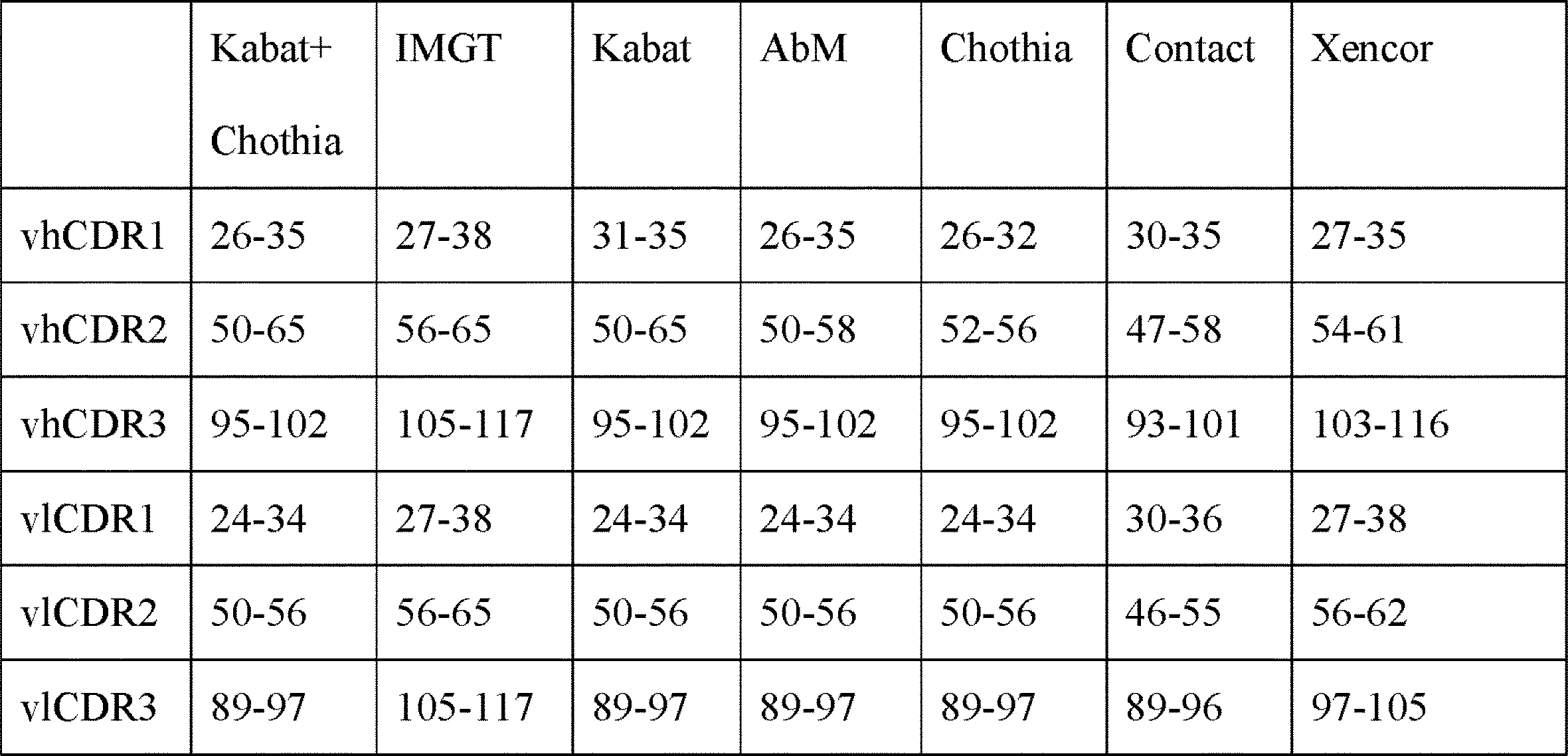
本発明は、多数の異なるCDRセットを提供する。この場合、「完全なCDRセット」は、3つの可変軽鎖CDR及び3つの可変重鎖CDR、例えば、vlCDR1、vlCDR2、vlCDR3、vhCDR1、vhCDR2、及びvhCDR3を含む。これらはそれぞれ、より大きな可変軽鎖ドメインまたは可変重鎖ドメインの一部であってもよい。加えて、本明細書でより詳細に概要を示すとおり、可変重鎖ドメイン及び可変軽鎖ドメインは、重鎖及び軽鎖が使用されるとき(例えば、Fabが使用されるとき)は、別々のポリペプチド鎖上、またはscFv配列の場合、単一のポリペプチド鎖上にあってもよい。 The invention provides a number of different CDR sets. In this case, the "complete CDR set" includes three variable light chain CDRs and three variable heavy chain CDRs, eg, vlCDRl, vlCDR2, vlCDR3, vhCDRl, vhCDR2, and vhCDR3. Each of these may be part of a larger variable light or variable heavy domain. In addition, as outlined in more detail herein, the variable heavy and light domains are separated when heavy and light chains are used (e.g. when Fab is used). It may be on a polypeptide chain or, in the case of scFv sequences, on a single polypeptide chain.
CDRは、抗原結合部位、またはより具体的には、抗体のエピトープ結合部位の形成に寄与する。「エピトープ」とは、パラトープとして知られている抗体分子の可変領域の特定の抗原結合部位と相互作用する決定基のことを意味する。エピトープは、アミノ酸または糖側鎖などの分子の集合であり、通常、特定の構造特性に加えて特定の荷電特性を有する。単一の抗原は2つ以上のエピトープを有していてもよい。 CDRs contribute to the formation of the antigen binding site, or more specifically the epitope binding site of an antibody. By "epitope" is meant a determinant that interacts with a specific antigen-binding site of the variable region of antibody molecules known as the paratope. Epitopes are groupings of molecules such as amino acids or sugar side chains and usually have specific structural characteristics, as well as specific charge characteristics. A single antigen may have more than one epitope.
各鎖のカルボキシ末端部分は、主にエフェクター機能に関与する定常領域を定義する。Kabat et al.は、重鎖及び軽鎖の可変領域の多数の一次配列を収集した。配列の保存度に応じて、彼らは、個別の一次配列をCDR及びフレームワークに分類し、その一覧を作成した(全体が参照により組み込まれている、SEQUENCES OF IMMUNOLOGICAL INTEREST,5th edition,NIH publication,No.91-3242,E.A.Kabat et al.を参照されたい)。 The carboxy-terminal portion of each chain defines a constant region primarily responsible for effector function. Kabat et al. have collected a large number of primary sequences of heavy and light chain variable regions. According to the degree of sequence conservation, they grouped individual primary sequences into CDRs and frameworks and cataloged them (SEQUENCES OF IMMUNOLOGICAL INTEREST, 5th edition, NIH publication, incorporated by reference in its entirety). No. 91-3242, EA Kabat et al.).
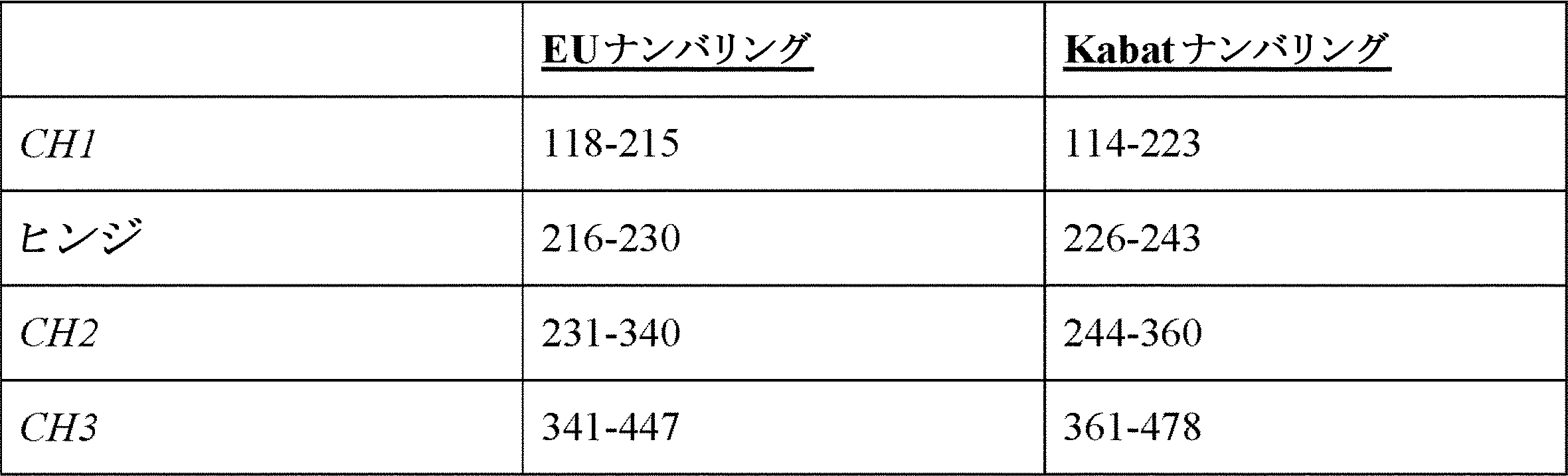
免疫グロブリンのIgGサブクラスにおいて、重鎖にいくつかの免疫グロブリンドメインが存在する。本明細書において、「免疫グロブリン(Ig)ドメイン」とは、異なる三次構造を有する免疫グロブリンの領域を意味する。本発明の対象は、定常重鎖(CH)ドメイン及びヒンジドメインを含む、重鎖ドメインである。IgG抗体との関係において、IgGアイソタイプはそれぞれ、3つのCH領域を有する。したがって、IgGとの関係における「CH」ドメインは、以下のとおりである:「CH1」とは、KabatにおけるEUインデックスに従った、位置118~120を意味する。「CH2」とは、KabatにおけるEUインデックスに従った、位置237~340を意味し、「CH3」は、KabatにおけるEUインデックスに従った、位置341~447を意味する。本明細書に示し、以下で記載するように、pIバリアントは、以下で論じるCH領域、加えて、ヒンジ領域の1つまたはそれ以上に存在することができる。 In the IgG subclass of immunoglobulins, there are several immunoglobulin domains in the heavy chain. As used herein, "immunoglobulin (Ig) domains" refer to regions of immunoglobulins that have different tertiary structures. A subject of the present invention are heavy chain domains, including the constant heavy chain (CH) domain and the hinge domain. In relation to IgG antibodies, each IgG isotype has three CH regions. Thus, the "CH" domains in relation to IgG are as follows: "CH1" means positions 118-120 according to the EU index in Kabat. "CH2" means positions 237-340 according to the EU index in Kabat and "CH3" means positions 341-447 according to the EU index in Kabat. As shown herein and described below, pi variants can be present in one or more of the CH regions discussed below, as well as the hinge region.
重鎖の別のタイプのIgドメインは、ヒンジ領域である。本明細書における、「ヒンジ」または「ヒンジ領域」または「抗体ヒンジ領域」または「免疫グロブリンヒンジ領域」とは、抗体の第1の定常ドメインと第2の定常ドメインとの間にアミノ酸を含む、柔軟なポリペプチドを意味する。構造上、IgG CH1ドメインはEU位置220で終了し、IgG CH2ドメインは、残基EU位置237で開始する。したがって、IgGに関して、抗体ヒンジは本明細書において、位置221(IgG1のD221)~236(IgG1のG236)を含むように定義され、ナンバリングは、KabatにおけるEUインデックスに従う。例えば、Fc領域と関係するいくつかの実施形態では、低いヒンジが含まれ、「低いヒンジ」とは一般に、位置226または230を意味する。本明細書に記載するように、pIバリアントは、ヒンジ領域でも同様に作製されることが可能である。 Another type of Ig domain in heavy chains is the hinge region. As used herein, a "hinge" or "hinge region" or "antibody hinge region" or "immunoglobulin hinge region" comprises the amino acids between the first and second constant domains of an antibody, A flexible polypeptide is meant. Structurally, the IgG CH1 domain ends at EU position 220 and the IgG CH2 domain starts at residue EU position 237. Thus, for IgG, the antibody hinge is defined herein to include positions 221 (D221 of IgG1) to 236 (G236 of IgG1), with numbering according to the EU index in Kabat. For example, some embodiments involving Fc regions include a lower hinge, where "lower hinge" generally refers to position 226 or 230. As described herein, pi variants can be made in the hinge region as well.
当業者により理解されるように、重鎖定常領域ドメインの厳密なナンバリング及び配置は、異なるナンバリングシステムの間で異なる場合がある。EU及びKabatに従った、重鎖定常領域ナンバリングの有用な比較は以下のとおりであり、全体が参考により組み込まれる、Edelman et al.,1969,Proc Natl Acad Sci USA 63:78-85 and Kabat et al.,1991,Sequences of Proteins of Immunological Interest,5th Ed.,United States Public Health Service,National Institutes of Health,Bethesdaを参照されたい。 As appreciated by those of skill in the art, the exact numbering and arrangement of heavy chain constant region domains may differ between different numbering systems. A useful comparison of heavy chain constant region numbering according to EU and Kabat follows, Edelman et al. , 1969, Proc Natl Acad Sci USA 63:78-85 and Kabat et al. , 1991, Sequences of Proteins of Immunological Interest, 5th Ed. , United States Public Health Service, National Institutes of Health, Bethesda.
(表2)
軽鎖は一般に、2つのドメイン、すなわち、可変軽鎖ドメイン(軽鎖CDRを含有し、可変重鎖ドメインと共にFv領域を形成する)、及び、定常軽鎖領域(多くの場合、CLまたはCKと呼ばれる)を含む。 A light chain generally consists of two domains, a variable light chain domain (which contains the light chain CDRs and together with the variable heavy chain domain forms the Fv region), and a constant light chain region (often combined with CL or CK). called).
「特異的結合」、または特定の抗原もしくはエピトープ、例えば、IL6もしくはIL6R「に特異的に結合する」もしくは「に特異的な」とは、非特異的相互作用とは測定可能に異なる結合のことを意味する。特異的結合は、例えば、一般に、結合活性を有しない同様の構造の分子である対照分子の結合と比較して、分子の結合を測定することにより、測定することができる。例えば、特異的結合は、標的に類似した対照分子との競合により測定することができる。 "Specific binding", or "specifically binds to" or "specific for" a particular antigen or epitope, e.g., IL6 or IL6R, refers to binding that is measurably different from non-specific interactions. means Specific binding can be measured, for example, by measuring the binding of a molecule compared to the binding of a control molecule, generally a molecule of similar structure that does not have binding activity. For example, specific binding can be determined by competition with a control molecule similar to the target.
特定の抗原またはエピトープ、例えば、IL6またはIL6Rに対する特異的結合は、例えば、抗原またはエピトープに対する少なくとも約10-4M、少なくとも約10-5M、少なくとも約10-6M、少なくとも約10-7M、少なくとも約10-8M、少なくとも約10-9M、あるいは少なくとも約10-10M、少なくとも約10-11M、少なくとも約10-12M、またはそれ以上のKD(KDとは、特定の抗体-抗原相互作用の解離速度のことを意味する)を有する抗体により示され得る。一般的に、抗原に特異的に結合する抗体は、対照分子と比較して20倍、50倍、100倍、500倍、1000倍、5,000倍、10,000倍またはそれ以上の倍数より大きな、抗原またはエピトープに対するKDを有する。 Specific binding to a particular antigen or epitope, such as IL6 or IL6R, is, for example, at least about 10-4 M, at least about 10-5 M, at least about 10-6 M, at least about 10-7 M, at least about 10 -8 M, at least about 10-9 M, or at least about 10-10 M, at least about 10-11 M, at least about 10-12 M, or more (KD refers to the dissociation rate of a particular antibody-antigen interaction). (meaning ). Generally, an antibody that specifically binds to an antigen is 20-fold, 50-fold, 100-fold, 500-fold, 1000-fold, 5,000-fold, 10,000-fold or more than a control molecule. It has a large KD for an antigen or epitope.
同様に、特定の抗原またはエピトープ、例えばIL6またはIL6Rに対する特異的結合は、例えば、対照と比較して、少なくとも20倍、50倍、100倍、500倍、1000倍、5,000倍、10,000倍またはそれ以上の倍数より大きな、抗原またはエピトープに対するKAまたはKa(KAまたはKaとは、特定の抗体-抗原相互作用の会合速度のことを意味する)を有する抗体により示され得る。結合親和性は一般に、BIACORE(登録商標)アッセイを使用して測定される。 Similarly, specific binding to a particular antigen or epitope, e.g., IL6 or IL6R, is e.g. It can be exhibited by an antibody that has a KA or Ka (KA or Ka refers to the association rate of a particular antibody-antigen interaction) for an antigen or epitope that is greater than 000-fold or more. Binding affinities are generally measured using BIACORE® assays.
本明細書で使用する場合、用語「ヒストン脱アセチル化酵素」または「HDAC」とは、遺伝子発現のエピジェネティック制御において、様々な機能を有する酵素の一種を意味する。いくつかのHDACにより示される、かかる機能の1つは、ヒストン上のε-N-アセチルリジンアミノ酸からアセチル基を取り除くことである。HDAC酵素は、他の標的もまた脱アセチル化する。しかし、ヒストンの脱アセチル化は、標的遺伝子発現の持続と直接関連している。HDACタンパク質は、機能及びDNA配列の類似性に基づき、4つのクラスにグルーピングすることができる。最初の2つのクラスは、活性がトリコスタチンA(TSA)により阻害される「古典的」HDACであると考えられ、一方で、3番目のクラスは、TSAによる影響を受けず、他の3つのクラスに系統学的に関係しない、NAD+依存性タンパク質のファミリーである。4番目のクラスは、他のものに対するDNA配列の類似性に基づいた、非典型的カテゴリーと考えられる。クラスIIをさらに、2つのサブクラスに細分する:クラスIIをさらに、2つのサブクラスクラス:IIA及びクラスIIBに細分し、後者は、2つの独立したHDACドメインで構成される。 As used herein, the term "histone deacetylase" or "HDAC" refers to a class of enzymes with diverse functions in epigenetic regulation of gene expression. One such function exhibited by some HDACs is the removal of the acetyl group from ε-N-acetyllysine amino acids on histones. HDAC enzymes also deacetylate other targets. However, histone deacetylation is directly associated with sustained target gene expression. HDAC proteins can be grouped into four classes based on function and DNA sequence similarity. The first two classes are considered "classical" HDACs whose activity is inhibited by trichostatin A (TSA), while the third class is unaffected by TSA and the other three A family of NAD+ dependent proteins, phylogenetically unrelated to class. A fourth class is considered an atypical category based on DNA sequence similarity to others. Class II is further subdivided into two subclasses: Class II is further subdivided into two subclasses: Class IIA and Class IIB, the latter consisting of two independent HDAC domains.
「出血性疾患」とは、先天性凝固異常、後天性凝固異常、抗凝血物質の投与、または、外傷誘発性の出血状態などの、過度の出血と関連する任意の疾患を意味する。以下で論ずるとおり、出血性疾患としては、血友病A、血友病B、フォン・ヴィレブランド病、特発性血小板減少症、第XI因子、第XII因子、プレカリクレイン、及び高分子量キニノーゲン(HMWK)などの、1つ以上の接触因子の欠損症、第V因子、第VII因子、第VIII因子、第IX因子、第X因子、第XIII因子、第II因子(低プロトロンビン血症)、及びフォン・ヴィレブランド因子などの、臨床的に深刻な出血と関連する1つ以上の因子の欠損症、ビタミンK欠乏症、アフィブリノーゲン血症、低フィブリノーゲン血症、及びジスフィブリノーゲン血症を含む、フィブリノーゲンの疾患、α2-抗プラスミン欠損症、ならびに、例えば肝疾患、腎疾患、血小板減少症、血小板機能障害、血腫、内出血、関節血腫、手術、外傷、低体温、月経、及び妊娠により引き起こされる、過度の出血を挙げることができるが、これらに限定されない。 By "bleeding disorder" is meant any disorder associated with excessive bleeding, such as congenital coagulation disorders, acquired coagulation disorders, administration of anticoagulants, or trauma-induced bleeding conditions. As discussed below, bleeding disorders include hemophilia A, hemophilia B, von Willebrand disease, idiopathic thrombocytopenia, factor XI, factor XII, prekallikrein, and high molecular weight kininogen (HMWK). ), factors V, VII, VIII, IX, X, XIII, II (hypoprothrombinemia), and von Disorders of fibrinogen, including deficiency of one or more factors associated with clinically significant bleeding, such as Willebrand factor, vitamin K deficiency, afibrinogenemia, hypofibrinogenemia, and dysfibrinogenemia , α2-antiplasmin deficiency, and excessive bleeding caused, for example, by liver disease, renal disease, thrombocytopenia, platelet dysfunction, hematoma, internal bleeding, joint hematoma, surgery, trauma, hypothermia, menstruation, and pregnancy can include, but are not limited to.
本明細書で使用する場合、「血友病」という用語は、凝血または血液凝固の低下を大きな特徴とする病状群を意味する。血友病は、A型、B型、もしくはC型血友病、または3つすべての疾患型の複合を意味し得る。A型血友病(血友病A)は、第VIII因子(FVIII)活性の低下または喪失によって生じ、血友病サブタイプの中で最も顕著なものである。B型血友病(血友病B)は、第IX因子(FIX)凝血機能の喪失または低下に起因する。C型血友病(血友病C)は、第XI因子(FXI)凝血活性の喪失または低下の結果である。血友病A及びBはX連鎖性疾患であり、血友病Cは常染色体性である。血友病の従来の治療は、FVIII、FIX(Bebulin(登録商標)-VHを含む)、及びFXIのような凝血因子の予防的及び応需的な投与、ならびにFEIBA-VH、デスモプレシン、及び血漿注入を含む。 As used herein, the term "hemophilia" refers to a group of conditions characterized largely by blood clotting or decreased blood clotting. Hemophilia can refer to hemophilia A, B, or C, or a combination of all three disease types. Hemophilia A (hemophilia A) is caused by reduced or lost factor VIII (FVIII) activity and is the most prominent of the hemophilia subtypes. Type B hemophilia (hemophilia B) results from loss or reduction of factor IX (FIX) clotting function. Hemophilia C (hemophilia C) is the result of loss or reduction of factor XI (FXI) clotting activity. Hemophilia A and B are X-linked disorders, and hemophilia C is autosomal. Conventional treatments for hemophilia include prophylactic and ad libitum administration of clotting factors such as FVIII, FIX (including Bebulin®-VH), and FXI, as well as FEIBA-VH, desmopressin, and plasma infusion. including.
「相同性」とは、2つのポリペプチド部分間でのパーセント同一性を意味する。本明細書において言及される場合、2つのポリペプチド配列は互いに、配列が約50%以上の配列同一性、例えば60%以上の配列同一性、例えば75%以上の配列同一性、例えば85%以上の配列同一性、例えば90%以上の配列同一性、例えば、95%以上の配列同一性を含む、99%以上の配列同一性を示すときに、「実質的に相同」である。いくつかの実施形態では、実質的に相同なポリペプチドは、明記された配列に対して完全な同一性を有する配列を含む。 "Homology" means the percent identity between two polypeptide moieties. As referred to herein, two polypeptide sequences with each other have a sequence identity of about 50% or greater, such as a sequence identity of 60% or greater, such as a sequence identity of 75% or greater, such as a sequence identity of 85% or greater. are "substantially homologous" when they exhibit 99% or greater sequence identity, including, for example, 90% or greater sequence identity, such as 95% or greater sequence identity. In some embodiments, substantially homologous polypeptides include sequences that have complete identity to a specified sequence.
「同一性」とは、2つのポリマー配列の、サブユニット同士の厳密な対応を意味する。例えば、同一のポリペプチドは、別のポリペプチドと、アミノ酸同士の厳密な対応を有するものであるか、または、同一のポリヌクレオチドは、別のポリヌクレオチドと、ヌクレオチド同士の厳密な対応を有するものである。パーセント同一性は、配列をアラインし、2つのアラインした配列間での正確な一致数を計数し、参照配列の長さで除し、結果に100を掛けることにより、2つの分子(参照配列と、参照配列に対して%同一性が未知である配列)間の配列情報を直接比較することにより測定することができる。例えば、ペプチド分析のためにSmith and WatermanAdvances in Appl.Math.2:482-489,1981の局所相同性アルゴリズムを適用する、ALIGN,Dayhoff,M.O.inAtlas of Protein Sequence and StructureM.O.Dayhoff ed.,5 Suppl.3:353-358,National biomedical Research Foundation,Washington,D.C.などの、任意の便利なプロトコルを用いて、2つのポリマー配列間のパーセント同一性を測定することができる。 "Identity" refers to an exact subunit-to-subunit correspondence of two polymer sequences. For example, the same polypeptide has an exact amino acid-to-nucleotide correspondence with another polypeptide, or the same polynucleotide has an exact nucleotide-to-nucleotide correspondence with another polynucleotide. is. Percent identity is determined by aligning the sequences, counting the number of exact matches between the two aligned sequences, dividing by the length of the reference sequence, and multiplying the result by 100 to determine the number of two molecules (reference sequence and , the percent identity to a reference sequence is unknown) can be determined by direct comparison of sequence information. For peptide analysis see, for example, Smith and Waterman Advances in Appl. Math. 2:482-489, 1981, ALIGN, Dayhoff, M.; O. inAtlas of Protein Sequence and StructureM. O. Dayhoff ed. , 5 Suppl. 3:353-358, National Biomedical Research Foundation, Washington, DC. C. Percent identity between two polymer sequences can be determined using any convenient protocol, such as.
用語「バリアント」、「類縁体」、及び「ムテイン」とは、所望の活性、例えば、出血性疾患の治療における凝固活性を保持する、参照分子の生物学的に活性な誘導体を意味する。ポリペプチド(例えば、凝固因子)について言及する用語「バリアント」及び「類似体」とは、修飾が生物活性を破壊せず、以下で定義する参照分子と「実質的に相同」である限り、天然分子と比較して、1つ以上のアミノ酸の付加、置換(一般には本質的に保存的)、及び/または欠失を有する、天然ポリペプチド配列及び構造を有する化合物を意味する。かかる類似体のアミノ酸配列は、2つの配列がアラインされたときに、参照配列に対する高度の配列相同性、例えば、50%以上、例えば60%以上、例えば70%以上、例えば80%以上、例えば90%以上、例えば、99%以上を含む95%以上のアミノ酸配列相同性を有する。場合によっては、類似体は、同じ数のアミノ酸を含むが、置換を含む。用語「ムテイン」は、アミノ及び/またはイミノ分子のみを含有する化合物、アミノ酸の1つ以上の類似体(例えば、合成の非自然アミノ酸などを含む)を含有するポリペプチド、結合が置換されたポリペプチド、加えて、自然、及び非自然(例えば合成)の両方、環化、分枝鎖分子などの、当該技術分野において公知の他の修飾を含むがこれらに限定されない、1つ以上のアミノ酸様分子を有するポリペプチドをさらに含む。この用語は、1つ以上のN置換グリシン残基(「ペプトイド」)、及び他の合成アミノ酸またはペプチドを含む分子もまた含む。(例えば、ペプトイドの記載に関しては、米国特許第5,831,005号;同第5,877,278号;及び同第5,977,301号;Nguyen et al.,Chem.Biol.(2000) 7:463-473;and Simon et al.,Proc.Natl.Acad.Sci.USA(1992) 89:9367-9371を参照されたい。)本発明の実施形態では、類似体及びムテインは、天然分子と、少なくとも同一の凝固活性を有する。 The terms "variant," "analog," and "mutein" refer to biologically active derivatives of the reference molecule that retain the desired activity, eg, clotting activity in treating bleeding disorders. The terms "variant" and "analog" when referring to a polypeptide (e.g., a coagulation factor) include any derivative of a naturally occurring molecule, so long as the modification does not destroy biological activity and is "substantially homologous" to the reference molecule defined below. A compound having a native polypeptide sequence and structure with one or more amino acid additions, substitutions (generally conservative in nature), and/or deletions as compared to the molecule. The amino acid sequences of such analogs have a high degree of sequence homology to the reference sequence, such as 50% or more, such as 60% or more, such as 70% or more, such as 80% or more, such as 90%, when the two sequences are aligned. % or greater, such as 95% or greater, including 99% or greater, amino acid sequence homology. In some cases, analogs contain the same number of amino acids but contain substitutions. The term "mutein" includes compounds containing only amino and/or imino molecules, polypeptides containing one or more analogues of amino acids (including, for example, synthetic unnatural amino acids), polypeptides with substituted bonds, peptides, as well as one or more amino acid-like compounds, including, but not limited to, other modifications known in the art, both natural and non-natural (e.g., synthetic), cyclizations, branched-chain molecules, etc. Further includes a polypeptide having a molecule. The term also includes molecules containing one or more N-substituted glycine residues (“peptoids”), and other synthetic amino acids or peptides. (For example, for a description of peptoids, see U.S. Pat. Nos. 5,831,005; 5,877,278; and 5,977,301; Nguyen et al., Chem. Biol. (2000). 7:463-473; and Simon et al., Proc. Natl. Acad. Sci. have at least the same clotting activity as
本明細書で論ずるように、分子量は、数平均分子量または重量平均分子量のいずれかとして表すことができる。特に明記しない限り、本明細書における、分子量へのあらゆる言及は、重量平均分子量を意味する。分子量測定、即ち、数平均及び重量平均の両方は、例えばゲル透過クロマトグラフィー、または他の液体クロマトグラフィー技術を用いて測定することができる。 As discussed herein, molecular weight can be expressed as either number average molecular weight or weight average molecular weight. Unless otherwise specified, all references to molecular weight herein mean weight average molecular weight. Molecular weight measurements, both number average and weight average, can be determined using, for example, gel permeation chromatography, or other liquid chromatography techniques.
本明細書で使用する場合、「第VIII因子」及び「FVIII」という用語は、同義に使用され、第VIII因子活性を有する任意のタンパク質(例えば、しばしばFVIIIaと称される活性FVIII)、または、特定の条件下で、例えば、欧州薬局方9.0の第2.7.4章に記載されている2ステップ発色第X因子活性化アッセイを使用して測定した場合に、第IXa因子補因子活性を有するタンパク質のタンパク質前駆体(例えば、プロタンパク質またはプレプロタンパク質)を意味する。例示的な実施形態では、第VIII因子ポリペプチドとは、野生型第VIII因子ポリペプチドの重鎖及び軽鎖と高い配列同一性(例えば、少なくとも70%、75%、80%、85%、90%、95%、99%、またはそれ以上)を有する配列を有するポリペプチドを意味する。いくつかの実施形態では、第VIII因子ポリペプチドのBドメインは、第VIII因子ポリペプチドをコードするポリヌクレオチドのサイズを削減するように、欠失しているか、切断されているか、またはリンカーポリペプチドで置換されている。 As used herein, the terms "Factor VIII" and "FVIII" are used interchangeably and any protein having Factor VIII activity (e.g. active FVIII, often referred to as FVIIIa), or Factor IXa cofactor, under certain conditions, e.g., when measured using the two-step chromogenic factor X activation assay described in Chapter 2.7.4 of European Pharmacopoeia 9.0 A protein precursor (eg, proprotein or preproprotein) of an active protein is meant. In exemplary embodiments, the Factor VIII polypeptide has a high sequence identity (e.g., at least 70%, 75%, 80%, 85%, 90%, 90%, 80%, 85%, 90%, 80%, 80%, 80%, 80%, 90%, 90%, 80%, 90% %, 95%, 99%, or more). In some embodiments, the B domain of the Factor VIII polypeptide is deleted, truncated, or linked to a linker polypeptide to reduce the size of the polynucleotide encoding the Factor VIII polypeptide. is replaced by
野生型第VIII因子ポリペプチドの非限定的な例としては、ヒトプレプロ第VIII因子(例えば、GenBank寄託番号AAA52485、CAA25619、AAA58466、AAA52484、AAA52420、AAV85964、BAF82636、BAG36452、CAI41660、CAI41666、CAI41672、CAI43241、CAO03404、EAW72645、AAH22513、AAH64380、AAH98389、AAI11968、AAI11970、またはAAB61261)、対応するプロ第VIII因子、及びそれらの天然バリアント;ブタプレプロ第VIII因子(例えば、UniProt寄託番号F1RZ36またはK7GSZ5)、対応するプロ第VIII因子、及びそれらの天然バリアント;マウスプレプロ第VIII因子(例えば、GenBank寄託番号AAA37385、CAM15581、CAM26492、またはEDL29229)、対応するプロ第VIII因子、ラットプレプロ第VIII因子(例えば、GenBank寄託番号AAQ21580)、対応するプロ第VIII因子、及びそれらの天然バリアント;ラットプレプロ第VIII因子;ならびに他の哺乳動物の第VIII因子相同体(例えば、サル、類人猿、ハムスター、モルモットなど)が挙げられる。 Non-limiting examples of wild-type factor VIII polypeptides include human prepro factor VIII (e.g., GenBank Accession Nos. CAO03404, EAW72645, AAH22513, AAH64380, AAH98389, AAI11968, AAI11970, or AAB61261), the corresponding pro-Factor VIII, and natural variants thereof; Factor VIII, and natural variants thereof; mouse pre-pro Factor VIII (e.g., GenBank Accession No. AAA37385, CAM15581, CAM26492, or EDL29229), corresponding pro-Factor VIII, rat pre-pro Factor VIII (e.g., GenBank Accession No. AAQ21580) , the corresponding pro-factor VIII, and natural variants thereof; rat pre-pro-factor VIII; and other mammalian factor VIII homologues (eg, monkeys, apes, hamsters, guinea pigs, etc.).
概して、第VIII因子をコードするポリヌクレオチドは、翻訳後プロセシングを受けて活性の第VIII因子タンパク質(例えば、FVIIIa)を形成する不活性の一本鎖ポリペプチド(例えば、プレプロタンパク質)をコードする。例えば、図15を参照すると、野生型ヒト第VIII因子プレプロタンパク質がまず切断されて、コードされるシグナルペプチド(図示せず)を放出し、第1の一本鎖プロタンパク質(「ヒト野生型FVIII」として示される)を形成する。プロタンパク質は次いで、BドメインとA3ドメインとの間で切断されて、第VIII因子重鎖(例えば、A1ドメイン及びA2ドメイン)及びBドメインを含む第1のポリペプチド、ならびに第VIII因子軽鎖を含む(例えば、A3、C1、及びC3ドメインを含む)第2のポリペプチドを形成する。第1のポリペプチドはさらに切断されてBドメインが除去され、また、A1ドメイン及びA2ドメインが分離するが、これらは、成熟した第VIIIa因子タンパク質の第VIII因子軽鎖と関連したままである。第VIII因子の成熟プロセスの概説については、Graw et al.,Nat Rev Genet.,6(6):488-501(2005)を参照されたい。その内容は、全体として、あらゆる目的のために、参照により本明細書に組み込まれる。 Generally, a polynucleotide encoding Factor VIII encodes an inactive single-chain polypeptide (eg, preproprotein) that undergoes post-translational processing to form an active Factor VIII protein (eg, FVIIIa). For example, referring to Figure 15, the wild-type human factor VIII preproprotein is first cleaved to release the encoded signal peptide (not shown) and the first single-chain proprotein ("human wild-type FVIII ). The proprotein is then cleaved between the B and A3 domains to produce a first polypeptide comprising the Factor VIII heavy chain (e.g., A1 and A2 domains) and the B domain, and the Factor VIII light chain. A second polypeptide comprising (eg, comprising the A3, C1, and C3 domains) is formed. The first polypeptide is further cleaved to remove the B domain and separate the A1 and A2 domains, which remain associated with the factor VIII light chain of the mature factor VIIIa protein. For a review of the factor VIII maturation process, see Graw et al. , Nat Rev Genet. , 6(6):488-501 (2005). The contents of which are incorporated herein by reference in their entirety for all purposes.
本明細書で使用する場合、用語「第VIII因子ポリペプチド」及び「第FVIIIポリペプチド」とは、特定の条件下で、第VIII因子セリンプロテアーゼ活性を有するポリペプチドを意味する。第VIII因子ポリペプチドは、上記の翻訳後処理により活性化されたときに、第VIII因子セリンプロテアーゼ活性を備える活性第VIII因子タンパク質になる、一本鎖前駆体ポリペプチド(第VIII因子プレ-プロポリペプチド、第VIII因子プロペプチド、及び、成熟した一本鎖第VIII因子ポリペプチド)、加えて、活性第VIII因子タンパク質自身を含む。例示的実施形態において、ヒト第VIII因子ポリペプチドとは、軽鎖及び重鎖を含む野生型ヒトアミノ酸配列の部分と、高い配列同一性(例えば、少なくとも85%、90%、95%、99%、またはそれ以上)を有するアミノ酸配列を含むポリペプチドを意味する。 As used herein, the terms "Factor VIII polypeptide" and "FVIII polypeptide" refer to polypeptides that have Factor VIII serine protease activity under specified conditions. The Factor VIII polypeptide is a single-chain precursor polypeptide (Factor VIII pre-proportionate) which, when activated by the post-translational processes described above, becomes an active Factor VIII protein with Factor VIII serine protease activity. factor VIII propeptides, and mature single-chain factor VIII polypeptides), as well as the active factor VIII protein itself. In exemplary embodiments, a human Factor VIII polypeptide has a high sequence identity (e.g., at least 85%, 90%, 95%, 99%) with portions of the wild-type human amino acid sequence, including the light and heavy chains. , or more).
本明細書で使用する場合、第VIII因子ポリペプチドは、第IX因子補因子活性を有する天然バリアント及び人工構築物を含む。本開示において使用する場合、第VIII因子は、いくらかの基礎的な第IX因子補因子活性(例えば、対応する野生型活性の少なくとも5%、10%、25%、50%、75%、またはそれ以上)を保持する、あらゆる天然バリアント、代替的な配列、アイソフォーム、または変異体タンパク質を包含する。「第VIII因子」の定義には、「バリアントFVIII」と称される場合もある第VIII因子バリアントが具体的に含まれる。バリアントFVIIIタンパク質は、ヒト野生型FVIIIと比較して少なくとも1つのアミノ酸修飾を有する。ヒト集団に見出される第VIII因子の(FVIII-FL-AA(配列番号19)に対する)アミノ酸変化の例は、限定するものではないが、S19R、R22T、Y24C、Y25C、L26P/R、E30V、W33G、Y35C/H、G41C、R48C/K、K67E/N、L69P、E72K、D75E/V/Y、P83R、G89D/V、G92A/V、A97P、E98K、V99D、D101G/H/V、V104D、K108T、M110V、A111T/V、H113R/Y、L117F/R、G121S、E129V、G130R、E132D、Y133C、D135G/Y、T137A/I、S138R、E141K、D145H、V147D、Y155H、V159A、N163K、G164D/V、P165S、C172W、S176P、S179P、V181E/M、K185T、D186G/N/Y、S189L、L191F、G193R、L195P、C198G、S202N/R、F214V、L217H、A219D/T、V220G、D222V、E223K、G224W、T252I、V253F、N254I、G255V、L261P、P262L、G263S、G266F、C267Y、W274C、H275L、G278R、G280D、E284K、V285G、E291G/K、T294I、F295L、V297A、N299I、R301C/H/L、A303E/P、I307S、S308L、F312S、T314A/I、A315V、G323E、L326P、L327P/V、C329F、I331V、M339T、E340K、V345A/L、C348R/S/Y、Y365C、R391C/H/P、S392L/P、A394S、W401G、I405F/S、E409G、W412G/R、K427I、L431F/S、R437P/W、I438F、G439D/S/V、Y442C、K444R、Y450D/N、T454I、F455C、G466E、P470L/R/T、G474E/R/V、E475K、G477V、D478N、T479R、F484C、A488G、R490G、Y492C/H、Y492H、I494T、P496R、G498R、R503H、G513S/V、I522Y、K529E、W532G、P540T、T541S、D544N、R546W、R550C/G/H、S553P、S554C/G、V556D、R560T、D561G/H/Y、I567T、P569R、S577F、V578A、D579A/H、N583S、Q584H/K/R、I585R/T、M586V、D588G/Y、L594Q、S596P、N601D/K、R602G、S603I/R、W604C、Y605H/S、N609I、R612C、N631K/S、M633I、S635N、N637D/I/S、Y639C、L644V、L650F、V653A/M、L659P、A663V、Q664P、F677L、M681I、V682F、Y683C/N、T686R、F698L、M699T/V、M701I、G705V、G710W、N713I、R717L/W、G720D/S、M721I/L、A723T、L725Q、V727F、E739K、Y742C、R795G、P947R、V1012L、E1057K、H1066Y、D1260E、K1289Q、Q1336K、N1460K、L1481P、A1610S、I1698T、Y1699C/F、E1701K、Q1705H、R1708C/H、T1714S、R1715G、A1720V、E1723K、D1727V、Y1728C、R1740G、K1751Q、F1762L、R1768H、G1769R、L1771P、L1775F/V、L1777P、G1779E/R、P1780L、I1782R、D1788H、M1791T、A1798P、S1799H、R1800C/G/H、P1801A、Y1802C、S1803Y、F1804S、L1808F、M1842I、P1844S、T1845P、E1848G、A1853T/V、S1858C、K1864E、D1865N/Y、H1867P/R、G1869D/V、G1872E、P1873R、L1875P、V1876L、C1877R/Y、L1882P、R1888I、E1894G、I1901F、E1904D/K、S1907C/R、W1908L、Y1909C、A1939T/V、N1941D/S、G1942A、M1945V、L1951F、R1960L/Q、L1963P、S1965I、M1966I/V、G1967D、S1968R、N1971T、H1973L、G1979V、H1980P/Y、F1982I、R1985Q、L1994P、Y1998C、G2000A、T2004R、M2007I、G2013R、W2015C、R2016P/W、E2018G、G2022D、G2028R、S2030N、V2035A、Y2036C、N2038S、2040Y、G2045E/V、I2051S、I2056N、A2058P、W2065R、P2067L、A2070V、S2082N、S2088F、D2093G/Y、H2101D、T2105N、Q2106E/P/R、G2107S、R2109C、I2117F/S、Q2119R、F2120C/L、Y2124C、R2135P、S2138Y、T2141N、M2143V、F2145C、N2148S、N2157D、P2162L、R2169C/H、P2172L/Q/R、T2173A/I、H2174D、R2178C/H/L、R2182C/H/P、M2183R/V、L2185S/W、S2192I、C2193G、P2196R、G2198V、E2200D、I2204T、I2209N、A2211P、A2220P、P2224L、R2228G/L/P/Q、L2229F、V2242M、W2248C/S、V2251A/E、M2257V、T2264A、Q2265R、F2279C/I、I2281T、D2286G、W2290L、G2304V、D2307A、P2319L/S、R2323C/G/H/L、R2326G/L/P/Q、Q2330P、W2332R、I2336F、R2339T、G2344C/D/S、及びC2345S/Yを含む。第VIII因子タンパク質には、翻訳後修飾を含むポリペプチドも含まれる。 As used herein, Factor VIII polypeptides include naturally occurring variants and artificial constructs that possess Factor IX cofactor activity. As used in this disclosure, Factor VIII exhibits some basal Factor IX cofactor activity (e.g., at least 5%, 10%, 25%, 50%, 75%, or less of the corresponding wild-type activity). above), including any naturally occurring variant, alternative sequence, isoform, or mutant protein. Specifically included in the definition of "Factor VIII" are variants of Factor VIII, sometimes referred to as "variant FVIII". A variant FVIII protein has at least one amino acid modification compared to human wild-type FVIII. Examples of amino acid changes of Factor VIII (relative to FVIII-FL-AA (SEQ ID NO: 19)) found in the human population include, but are not limited to: S19R, R22T, Y24C, Y25C, L26P/R, E30V, W33G , Y35C/H, G41C, R48C/K, K67E/N, L69P, E72K, D75E/V/Y, P83R, G89D/V, G92A/V, A97P, E98K, V99D, D101G/H/V, V104D, K108T , M110V, A111T/V, H113R/Y, L117F/R, G121S, E129V, G130R, E132D, Y133C, D135G/Y, T137A/I, S138R, E141K, D145H, V147D, Y155H, V159A, N163K, G164D/V , P165S, C172W, S176P, S179P, V181E/M, K185T, D186G/N/Y, S189L, L191F, G193R, L195P, C198G, S202N/R, F214V, L217H, A219D/T, V220G, D222V, E224W, , T252I, V253F, N254I, G255V, L261P, P262L, G263S, G266F, C267Y, W274C, H275L, G278R, G280D, E284K, V285G, E291G/K, T294I, F295L, V297A, N299I, N299I, H3H/L30 /P, I307S, S308L, F312S, T314A/I, A315V, G323E, L326P, L327P/V, C329F, I331V, M339T, E340K, V345A/L, C348R/S/Y, Y365C, R391C/H/P, S392L /P, A394S, W401G, I405F/S, E409G, W412G/R, K427I, L431F/S, R437P/W, I438F, G439D/S/V, Y442C, K444R, Y450D/N, T454I, F455C, G466E, P470L /R/T, G474E/R/V, E475K, G477V, D478N, T479R, F484C, A488G, R490G, Y492C/H, Y492H, I494T, P496R, G498R, R503H, G513S/V, I522Y, K529E, W532G, P540T , T541S, D544N, R546W, R550C/G/H, S553P, S554C/G , V556D, R560T, D561G/H/Y, I567T, P569R, S577F, V578A, D579A/H, N583S, Q584H/K/R, I585R/T, M586V, D588G/Y, L594Q, S596P, N601D/K, R602G , S603I/R, W604C, Y605H/S, N609I, R612C, N631K/S, M633I, S635N, N637D/I/S, Y639C, L644V, L650F, V653A/M, L659P, A663V, Q664P, F677L, M681I, V682F , Y683C/N, T686R, F698L, M699T/V, M701I, G705V, G710W, N713I, R717L/W, G720D/S, M721I/L, A723T, L725Q, V727F, E739K, Y742C, R795G, P947R, V1057L, KE 、H1066Y、D1260E、K1289Q、Q1336K、N1460K、L1481P、A1610S、I1698T、Y1699C/F、E1701K、Q1705H、R1708C/H、T1714S、R1715G、A1720V、E1723K、D1727V、Y1728C、R1740G、K1751Q、F1762L、R1768H、G1769R 、L1771P、L1775F/V、L1777P、G1779E/R、P1780L、I1782R、D1788H、M1791T、A1798P、S1799H、R1800C/G/H、P1801A、Y1802C、S1803Y、F1804S、L1808F、M1842I、P1844S、T1845P、E1848G、A1853T /V, S1858C, K1864E, D1865N/Y, H1867P/R, G1869D/V, G1872E, P1873R, L1875P, V1876L, C1877R/Y, L1882P, R1888I, E1894G, I1901F, E1904D/K, S1907C/K, S1907C/8 、A1939T/V、N1941D/S、G1942A、M1945V、L1951F、R1960L/Q、L1963P、S1965I、M1966I/V、G1967D、S1968R、N1971T、H1973L、G1979V、H1980P/Y、F1982I、R1985Q、L1994P、Y1998C、G2000A , T2004R, M2007I 、G2013R、W2015C、R2016P/W、E2018G、G2022D、G2028R、S2030N、V2035A、Y2036C、N2038S、2040Y、G2045E/V、I2051S、I2056N、A2058P、W2065R、P2067L、A2070V、S2082N、S2088F、D2093G/Y、H2101D , T2105N, Q2106E/P/R, G2107S, R2109C, I2117F/S, Q2119R, F2120C/L, Y2124C, R2135P, S2138Y, T2141N, M2143V, F2145C, N2148S, N2157D, P2162HLP/Q2162L, R2162L/Q2169 , T2173A/I, H2174D, R2178C/H/L, R2182C/H/P, M2183R/V, L2185S/W, S2192I, C2193G, P2196R, G2198V, E2200D, I2204T, I2209N, A2211P, A2220P, /L2224L /P/Q, L2229F, V2242M, W2248C/S, V2251A/E, M2257V, T2264A, Q2265R, F2279C/I, I2281T, D2286G, W2290L, G2304V, D2307A, P2319L/S, R2323C/G/H26G/L, R2323C/G/H26G/L /L/P/Q, Q2330P, W2332R, I2336F, R2339T, G2344C/D/S, and C2345S/Y. Factor VIII proteins also include polypeptides containing post-translational modifications.
本明細書で使用する場合、用語「第VIII因子ポリヌクレオチド」及び「第FVIIIポリヌクレオチド」とは、例えば、欧州薬局方9.0の2.7.4章で説明されている、2段階色素体第X因子活性化アッセイを用いて測定する特定の条件下で、第IXa因子補助因子活性(例えば、多くの場合FVIIaと呼ばれる、活性FVIII)、または、第IXa因子補助因子活性を有するタンパク質のタンパク質前駆体(例えば、プロタンパク質またはプレ-プロタンパク質)を有する第FVIIIポリペプチドをコードするポリヌクレオチドを意味する。 As used herein, the terms "Factor VIII polynucleotide" and "FVIII polynucleotide" refer to two-step dyes, e.g. Factor IXa cofactor activity (e.g., active FVIII, often referred to as FVIIa), or a protein that has Factor IXa cofactor activity, under certain conditions as measured using a somatic factor X activation assay A polynucleotide encoding a FVIII polypeptide with a protein precursor (eg, proprotein or pre-proprotein) is meant.
本明細書における「第VIII因子活性」または「第IX因子セリン補助因子活性」とは、例えば、野生型第IX因子内でArg194-Ile195ペプチド結合を加水分解し、故に第X因子を活性化して第Xa因子にすることにより、第IXa因子の存在下において、第X因子ポリペプチドを切断する能力を意味する。活性レベルは、当該技術分野において公知の任意の第VIII因子活性アッセイを用いて測定することができる。第VIII因子活性を測定するためのある例示的なアッセイは、欧州薬局方9.0の2.7.4章で説明されている、2段階色素体第X因子活性化アッセイである。 "Factor VIII activity" or "Factor IX serine cofactor activity" herein refers to, for example, hydrolyzing the Arg194-Ile195 peptide bond within wild-type Factor IX, thus activating Factor X. By factor Xa is meant the ability to cleave a factor X polypeptide in the presence of factor IXa. Activity levels can be measured using any factor VIII activity assay known in the art. One exemplary assay for measuring factor VIII activity is the two-step plastid factor X activation assay, described in European Pharmacopoeia 9.0, chapter 2.7.4.
本明細書で使用する場合、用語「FVIII療法」とは、第VIII因子を患者に供給し、血友病Aと関連する1つ以上の症状(即ち、臨床的因子)を緩和する、低減する、または再発を防止するための、あらゆる治療的アプローチを含む。この用語は、血友病を有する個体の健康を維持または改善するのに有用な任意の修飾形体の第VIII因子を含む、第VIII因子を含む任意の化合物、薬剤、手順、またはレジメンを投与することを包含し、本明細書に記載する治療薬のいずれかを含む。当業者には、FVIII療法の過程またはFVIII療法の用量はいずれも、例えば、本開示に従って得られる結果に基づいて変更され得ることが理解されよう。 As used herein, the term "FVIII therapy" provides a patient with Factor VIII to alleviate, reduce one or more symptoms (i.e., clinical factors) associated with hemophilia A. , or any therapeutic approach to prevent recurrence. The term administers any factor VIII-containing compound, agent, procedure, or regimen, including any modified form of factor VIII that is useful for maintaining or improving the health of an individual with hemophilia and includes any of the therapeutic agents described herein. It will be appreciated by those skilled in the art that either the course of FVIII therapy or the dose of FVIII therapy may be altered, for example, based on results obtained according to the present disclosure.
本明細書で使用する場合、「バイパス療法」という用語は、血友病に関連する1つ以上の症状(例えば、臨床因子)の緩和、減少、または再発防止のために、第VIII因子ではない止血剤、化合物、または凝固因子を患者に提供する、任意の治療手法を含む。第VIII因子ではない、提供可能な化合物及び凝固因子としては、限定するものではないが、第VIII因子阻害剤バイパス活性(FEIBA)、組換え活性化型第VII因子(FVIIa)、プロトロンビン複合体濃縮物、及び活性化型プロトロンビン複合体濃縮物が挙げられる。これらの第VIII因子ではない化合物及び凝固因子は、組換え型であっても血漿由来であってもよい。当業者には、バイパス療法の過程またはバイパス療法の用量はいずれも、例えば、本発明に従って得られる結果に基づいて変更され得ることが理解されよう。バイパス療法で投与される、第FVIII因子でない化合物は、本明細書で、「第FVIIIバイパス複合体」または「第VIII因子バイパス複合体」と呼ばれる。 As used herein, the term "bypass therapy" refers to the relief, reduction, or prevention of recurrence of one or more symptoms (e.g., clinical factors) associated with hemophilia without factor VIII Includes any therapeutic procedure that provides a patient with a hemostatic agent, compound, or clotting factor. Non-factor VIII compounds and clotting factors that can be provided include, but are not limited to, factor VIII inhibitor bypassing activity (FEIBA), recombinant activated factor VII (FVIIa), prothrombin complex enrichment and activated prothrombin complex concentrates. These non-Factor VIII compounds and clotting factors may be recombinant or plasma-derived. It will be appreciated by those skilled in the art that either the course of bypass therapy or the dose of bypass therapy may be altered, for example, based on the results obtained according to the present invention. Non-FVIII compounds administered in bypass therapy are referred to herein as "FVIII bypassing complexes" or "Factor VIII bypassing complexes."
本明細書で使用する場合、用語「第IX因子」及び「FIX」(「IX」は、ローマ数字を指して「9」を意味する)は同じ意味で用いられ、例えば、その内容は、参照により本明細書に組み込まれる、欧州薬局方9.0の2.7.11章で説明されている、1段階第IX因子凝固アッセイを用いて測定した、第IX因子活性、特に、第VIII因子の存在下での第X因子切断活性を有する任意のタンパク質(例えば、多くの場合「FIXa」と呼ばれる活性FIX)、または、第IX因子活性を有するタンパク質のタンパク質前駆体(例えば、多くの場合pFIX及びppFIXと呼ばれる、プロタンパク質もしくはプレ-プロタンパク質)を意味する。 As used herein, the terms "Factor IX" and "FIX" ("IX" refers to Roman numerals and means "9") are used interchangeably, e.g. factor IX activity, in particular factor VIII, as measured using the one-step factor IX clotting assay, as described in European Pharmacopoeia 9.0 chapter 2.7.11, incorporated herein by Any protein that has Factor X cleaving activity in the presence of (e.g., active FIX, often referred to as "FIXa"), or a protein precursor of a protein that has Factor IX activity (e.g., pFIX, often and ppFIX, proprotein or pre-proprotein).
野生型第IX因子ポリペプチドの非限定例としては、シグナルペプチド(プレ-プロタンパク質のアミノ酸1~28)及び/またはプロペプチド(プレ-プロタンパク質のアミノ酸29~46)を欠く一本鎖第IX因子に対応する、ヒトプレ-プロ第IX因子(例えば、GenBank寄託番号NP_000124.1)及びNP_001300842.1(FIX2-FL-AA)、及びその天然バリアント;シグナルペプチドを欠く一本鎖第IX因子に対応する、ブタプレ-プロ第IX因子(例えば、UniProt寄託番号P00741)、及びその天然バリアント;シグナルペプチドを欠く一本鎖第IX因子に対応する、マウスプレ-プロ第IX因子(例えば、UniProt寄託番号P16294)、及びその天然バリアント;シグナルペプチドを欠く一本鎖第IX因子に対応する、ラットプレ-プロ第IX因子(例えば、UniProt寄託番号P16296)、及びその天然バリアント;ならびに、他の哺乳類第VIII因子同族体(例えば、チンパンジー、類人猿、ハムスター、モルモットなど)が挙げられる。 Non-limiting examples of wild-type Factor IX polypeptides include single chain Factor IX lacking the signal peptide (amino acids 1-28 of the pre-proprotein) and/or the propeptide (amino acids 29-46 of the pre-proprotein). Human pre-pro Factor IX (e.g., GenBank Accession No. NP_000124.1) and NP_001300842.1 (FIX2-FL-AA), corresponding to factors, and natural variants thereof; corresponding to single-chain Factor IX lacking the signal peptide , pig pre-pro factor IX (e.g., UniProt accession number P00741), and natural variants thereof; mouse pre-pro factor IX (e.g., UniProt accession number P16294), which corresponds to single chain factor IX lacking the signal peptide. , and natural variants thereof; rat pre-pro factor IX (e.g., UniProt Accession No. P16296), corresponding to single-chain factor IX lacking the signal peptide, and natural variants thereof; and other mammalian factor VIII homologues. (eg, chimpanzees, apes, hamsters, guinea pigs, etc.).
第IX因子は、多くの場合、第IX因子プレ-プロポリペプチドと呼ばれる、シグナルペプチド、プロペプチド、軽鎖、活性化ペプチド、及び重鎖を含む、不活性の一本鎖ポリペプチドとして翻訳される。第IX因子プレ-プロペプチドは、翻訳後処理を受け、活性第IX因子タンパク質(例えば、FIXa)を形成する。この処理は、シグナルペプチドの(例えば、切断による)除去、続いて、プロペプチドの(例えば、切断による)除去により、第IX因子軽鎖及び第IX因子重鎖を含有する、依然として不活性な一本鎖成熟第IX因子ポリペプチドを形成することを含む。成熟第IX因子ポリペプチドをさらに切断し、第IX因子軽鎖と第IX因子重鎖との間の活性化ペプチドを取り除き、活性第IX因子タンパク質(例えば、FIXa)を形成する。第IX因子軽鎖及び第IX因子軽鎖は依然として、ジスルフィド結合により会合したままである。第IX因子の構造、機能、及び活性化についてのさらなる情報については、例えば、これらの内容は、全体として、あらゆる目的のために、参照により本明細書に組み込まれている、Brandstetter H.et al.P.N.A.S.USA,92(21):9796-800(1995),Hopfner K P et al.,Structure,7(8):989-96(1999),Gailani D.et al.,Thromb Res.,133 Suppl 1:S48-51(2014)、及び米国特許出願公開公報第2018/0339026号を参照されたい。 Factor IX is translated as an inactive, single-chain polypeptide comprising a signal peptide, propeptide, light chain, activation peptide, and heavy chain, often referred to as the Factor IX pre-propolypeptide. . The Factor IX pre-propeptide undergoes post-translational processing to form an active Factor IX protein (eg, FIXa). This treatment removes (e.g., by cleavage) the signal peptide, followed by removal (e.g., by cleavage) of the propeptide, resulting in a still inactive fragment containing the Factor IX light chain and Factor IX heavy chain. Forming a main chain mature Factor IX polypeptide. The mature Factor IX polypeptide is further cleaved to remove the activation peptide between the Factor IX light chain and Factor IX heavy chain to form the active Factor IX protein (eg, FIXa). The Factor IX light chain and Factor IX light chain still remain associated by disulfide bonds. For further information on the structure, function, and activation of Factor IX, see, for example, Brandstetter H. et al., the contents of which are incorporated herein by reference for all purposes in their entirety. et al. P. N. A. S. USA, 92(21):9796-800 (1995), Hopfner KP et al. , Structure, 7(8):989-96 (1999), Gailani D.; et al. , Thromb Res. , 133 Suppl 1:S48-51 (2014), and US Patent Application Publication No. 2018/0339026.
本明細書で使用する場合、用語「第IX因子ポリペプチド」及び「FIXポリペプチド」とは、例えば、欧州薬局方9.0の2.7.11章に記載されている、1段階第IX因子凝固アッセイを使用して測定すると、特定の条件下で第IX因子セリンプロテアーゼ活性を有するポリペプチドを意味する。第IX因子ポリペプチドは、上記の翻訳後処理により活性化されたときに、第IX因子セリンプロテアーゼ活性を備える活性第IX因子タンパク質になる、一本鎖前駆体ポリペプチド(第IX因子プレ-プロポリペプチド、第IX因子プロペプチド、及び、成熟した一本鎖第IX因子ポリペプチド)、加えて、活性第IX因子タンパク質自身を含む。R338Lバリアントを含む第IX因子ポリペプチドが、第IX因子ポリペプチドの定義に具体的には含まれる。例示的実施形態では、ヒト第IX因子ポリペプチドとは、軽鎖及び重鎖を含む野生型ヒト第IX因子ポリペプチドの部分、即ちFIX-MP-AA(図XXに示す配列番号XX)と、または、軽鎖及び重鎖を含むPaudaヒト第IX因子ポリペプチドの部分、即ちFIXp-MP-AA(配列番号XX)と、高い配列同一性(例えば、少なくとも85%、90%、95%、99%、またはそれ以上)を有するアミノ酸配列を含むポリペプチドを意味する。 As used herein, the terms "Factor IX polypeptide" and "FIX polypeptide" refer, for example, to Phase 1 Phase IX, as described in Chapter 2.7.11 of European Pharmacopoeia 9.0. A polypeptide that has Factor IX serine protease activity under specified conditions, as measured using a factor clotting assay. The Factor IX polypeptide is a single-chain precursor polypeptide (Factor IX pre-propionate) which, when activated by the post-translational processes described above, becomes an active Factor IX protein with Factor IX serine protease activity. factor IX propeptide, and mature single-chain factor IX polypeptide), as well as the active factor IX protein itself. Specifically included in the definition of Factor IX polypeptides are Factor IX polypeptides containing the R338L variant. In an exemplary embodiment, the human Factor IX polypeptide is a portion of the wild-type human Factor IX polypeptide comprising the light and heavy chains, namely FIX-MP-AA (SEQ ID NO: XX shown in Figure XX); Alternatively, a portion of the Pauda human Factor IX polypeptide comprising the light and heavy chains, namely FIXp-MP-AA (SEQ ID NO:XX), with high sequence identity (e.g., at least 85%, 90%, 95%, 99%). %, or more).
本明細書で使用する場合、第IX因子ポリペプチドは、第VIII因子の存在下にて第X因子切断活性を有する、天然バリアント及び人工構築物を含む。本開示で使用するように、第IX因子は、任意の天然バリアント、代替配列、アイソフォーム、または、2.7.11章におけるAssay of Human Coagulation Factor IXの教示が参照により具体的に本明細書に組み込まれている、欧州薬局方9.0の2.7.11章に従った1段階凝固アッセイでアッセイすると、対応する野生型活性の、ある程度の基礎第IX因子切断活性(例えば、少なくとも5%、10%、25%、50%、75%、またはそれ以上)を保持する変異タンパク質を包含する。ヒト集団で発見される、(FIX-FL-AA(配列番号XX)に対する)第IX因子アミノ酸のバリエーションの例としては、I17N、L20S、C28R、C28Y、V30I、R43L、R43Q、R43W、K45N、R46S、R46T、N48I、S49P、L52S、E53A、E54D、E54G、F55C、G58A、G58E、G58R、E66V、E67K、F71S、E73K、E73V、R75Q、E79D、T84R、Y91C、D93G、Q96P、C97S、P101R、C102R、C102R、G106D、G106S、C108S、D110N、I112S、N113K、Y115C、C119F、C119R、E124K、G125E、G125R、G125V、C134Y、I136T、N138H、G139D、G139S、C155F、G160E、Q167H、S169C、C170F、C178R、C178W、R191C、R191H、R226G、R226Q、R226W、V227D、V227F、V228F、V228L、Q241H、Q241K、C252S、C252Y、G253E、G253R、A265T、C268W、A279T、N283D、E291V、R294G、R294Q、V296M、H302R、N306S、I316F、L318R、L321Q、N328K、N328Y、P333H、P333T、T342K、T342M、I344L、G351D、W356C、G357E、G357R、K362E、G363W、A366D、R379G、R379Q、C382Y、L392F、L383I、R384L、K387E、I390F、M394K、F395I、F395L、C396F、C396S、A397P、R404T、C407R、C407S、D410H、S411G、S411I、G412E、G413R、P414T、V419E、F424V、T426P、S430T、W431G、W431R、G432S、E433A、G433K、C435Y、A436V、G442E、G442R、I443T、R449Q、R449W、Y450C、W453R、及びI454Tが挙げられるが、これらに限定されない。以下でより完全に論じるように、このナンバリングは、野生型ヒトFIXに対応する。ヒト集団で同定された他のアミノ酸のバリエーションは既知であり、例えば、国立生物工学情報センター(「NCBI」)バリエーションビューワーを使用して発見することができ、寄託番号GCF_000001405.25がある。第VIII因子タンパク質には、翻訳後修飾を含むポリペプチドも含まれる。 As used herein, Factor IX polypeptides include naturally occurring variants and artificial constructs that have Factor X cleaving activity in the presence of Factor VIII. As used in this disclosure, Factor IX is any naturally occurring variant, alternative sequence, isoform, or factor IX, the teachings of the Assay of Human Coagulation Factor IX in section 2.7.11 are specifically herein incorporated by reference. Some basal factor IX cleaving activity (e.g., at least 5 %, 10%, 25%, 50%, 75%, or more). Examples of Factor IX amino acid variations (relative to FIX-FL-AA (SEQ ID NO:XX)) found in the human population include I17N, L20S, C28R, C28Y, V30I, R43L, R43Q, R43W, K45N, R46S , R46T, N48I, S49P, L52S, E53A, E54D, E54G, F55C, G58A, G58E, G58R, E66V, E67K, F71S, E73K, E73V, R75Q, E79D, T84R, Y91C, D93G, Q96P, C97S, P101RR, C102 、C102R、G106D、G106S、C108S、D110N、I112S、N113K、Y115C、C119F、C119R、E124K、G125E、G125R、G125V、C134Y、I136T、N138H、G139D、G139S、C155F、G160E、Q167H、S169C、C170F、C178R 、C178W、R191C、R191H、R226G、R226Q、R226W、V227D、V227F、V228F、V228L、Q241H、Q241K、C252S、C252Y、G253E、G253R、A265T、C268W、A279T、N283D、E291V、R294G、R294Q、V296M、H302R 、N306S、I316F、L318R、L321Q、N328K、N328Y、P333H、P333T、T342K、T342M、I344L、G351D、W356C、G357E、G357R、K362E、G363W、A366D、R379G、R379Q、C382Y、L392F、L383I、R384L、K387E 、I390F、M394K、F395I、F395L、C396F、C396S、A397P、R404T、C407R、C407S、D410H、S411G、S411I、G412E、G413R、P414T、V419E、F424V、T426P、S430T、W431G、W431R、G432S、E433A、G433K , C435Y, A436V, G442E, G442R, I443T, R449Q, R449W, Y450C, W453R, and I454T. As discussed more fully below, this numbering corresponds to wild-type human FIX. Other amino acid variations identified in the human population are known and can be found, for example, using the National Center for Biotechnology Information (“NCBI”) Variation Viewer and have accession number GCF — 000001405.25. Factor VIII proteins also include polypeptides containing post-translational modifications.
本開示において、いわゆる「Pauda」変異、即ち、成熟一本鎖第IX因子タンパク質(R338L)の位置338、第IX因子プレ-プロポリペプチド(R384L)の位置384における、アルギニンのロイシンへの変化を含むFIXタンパク質が具体的に使用される。この変異により、機能亢進活性がFIXタンパク質に付与される。例えば、「Pauda」タンパク質(例えば、R338L変異を含有する第IX因子)は、野生型第IX因子よりも、インビボで5倍から10倍活性であることが示された。米国特許第6,531,298号;Simioni P.et al.,N Engl J Med.361(17): 1671-75(2009)、その全体が参照により本明細書に組み込まれる。したがって、本開示は、場合によっては、本明細書では「FIXp」または「pFIX」と呼ばれる、Pauda-FIXタンパク質をコードするアミノ酸及び核酸構築物を提供する。 In the present disclosure, the so-called "Pauda" mutations, namely the change of arginine to leucine at position 338 of the mature single chain Factor IX protein (R338L) and position 384 of the Factor IX pre-propolypeptide (R384L) are included. FIX proteins are specifically used. This mutation confers hyperactive activity to the FIX protein. For example, the "Pauda" protein (eg, Factor IX containing the R338L mutation) was shown to be 5- to 10-fold more active in vivo than wild-type Factor IX. US Patent No. 6,531,298; Simioni P.; et al. , N Engl J Med. 361(17): 1671-75 (2009), which is incorporated herein by reference in its entirety. Accordingly, the present disclosure provides amino acid and nucleic acid constructs encoding Pauda-FIX proteins, sometimes referred to herein as "FIXp" or "pFIX."
本明細書で使用する場合、用語「第IX因子ポリヌクレオチド」及び「FIXポリヌクレオチド」とは、例えば、欧州薬局方9.0の2.7.11章に記載されている、1段階第IX因子凝固アッセイを使用して測定すると、特定の条件下で第IX因子セリンプロテアーゼ活性を有する第IX因子ポリペプチドをコードするポリヌクレオチドを意味する。R338Lバリアントを含む第IX因子ポリペプチドをコードするポリヌクレオチドが、第IX因子ポリヌクレオチドの定義に具体的には含まれる。
As used herein, the terms "Factor IX polynucleotide" and "FIX polynucleotide" refer to, for example,
本明細書における「第IX因子活性」または「第IX因子セリンプロテアーゼ活性」とは、例えば、野生型第IX因子内でArg194-Ile195ペプチド結合を加水分解し、故に第X因子を活性化して第Xa因子にすることにより、第Villa因子補助因子の存在下において、第X因子ポリペプチドを切断する能力を意味する。活性レベルは、当該技術分野において公知の任意の第IX因子活性アッセイを用いて測定することができる。第IX因子活性を測定するための例示的なアッセイは、欧州薬局方9.0の2.7.11章に記載されている、1段階第IX因子凝固アッセイである。 "Factor IX activity" or "Factor IX serine protease activity" herein refers to, for example, hydrolyzing the Arg194-Ile195 peptide bond within wild-type Factor IX, thus activating Factor X to By factor Xa is meant the ability to cleave a factor X polypeptide in the presence of a factor Villa cofactor. Activity levels can be measured using any Factor IX activity assay known in the art. An exemplary assay for measuring Factor IX activity is the one-step Factor IX coagulation assay, described in Chapter 2.7.11 of European Pharmacopoeia 9.0.
本明細書で使用する場合、用語「FIX療法」とは、第IX因子を患者に供給し、血友病Bと関連する1つ以上の症状(即ち、臨床的因子)を緩和する、低減する、または再発を防止するための、あらゆる治療的アプローチを含む。この用語は、血友病を有する個体の健康を維持または改善するのに有用な任意の修飾形体の第IX因子を含む、第IX因子を含む任意の化合物、薬剤、手順、またはレジメンを投与することを包含し、本明細書に記載する治療薬のいずれかを含む。当業者には、FIX療法の過程またはFIX療法の用量はいずれも、例えば、本開示に従って得られる結果に基づいて変更され得ることが理解されよう。 As used herein, the term "FIX therapy" provides a patient with Factor IX to alleviate, reduce one or more symptoms (i.e., clinical factors) associated with hemophilia B. , or any therapeutic approach to prevent recurrence. The term administers any compound, agent, procedure, or regimen that contains Factor IX, including any modified form of Factor IX that is useful for maintaining or improving the health of an individual with hemophilia and includes any of the therapeutic agents described herein. It will be appreciated by those skilled in the art that either the course of FIX therapy or the dose of FIX therapy may be altered, for example, based on the results obtained according to the present disclosure.
本明細書で使用する場合、用語「ベクター」とは、治療用タンパク質をコードする核酸を宿主細胞に転写するために使用する、任意の核酸構築物を意味する。いくつかの実施形態では、ベクターはレプリコンを含み、レプリコンは、核酸構築物を複製する機能を持つ。遺伝子療法に有用なベクターの非限定的な例としては、インビボで自律的複製単位として機能する、プラスミド、ファージ、コスミド、人工染色体、及びウイルスが挙げられる。いくつかの実施形態では、ベクターは、治療用タンパク質をコードする核酸を宿主細胞に導入するためのウイルスベクターである。当該技術分野では、遺伝子療法に有用な、多くの改変された真核生物ウイルスが知られている。例えば、アデノ随伴ウイルス(AAV)は、ヒト遺伝子療法に使用するのに特に適しているが、その理由は、ヒトがこのウイルスの天然の宿主であり、天然のウイルスが何らかの疾患に寄与するとは知られておらず、これらのウイルスは軽度の免疫応答を誘起するからである。 As used herein, the term "vector" means any nucleic acid construct that is used to transfer a nucleic acid encoding a therapeutic protein into a host cell. In some embodiments, the vector comprises a replicon, and the replicon functions to replicate the nucleic acid construct. Non-limiting examples of vectors useful for gene therapy include plasmids, phages, cosmids, artificial chromosomes, and viruses that function as autonomously replicating units in vivo. In some embodiments, the vector is a viral vector, for introducing nucleic acids encoding therapeutic proteins into host cells. Many modified eukaryotic viruses useful for gene therapy are known in the art. For example, adeno-associated virus (AAV) is particularly suitable for use in human gene therapy because humans are the natural host for this virus and the natural virus is not known to contribute to any disease. This is because these viruses elicit a mild immune response.
本明細書で使用する場合、用語「ウイルス粒子」とは、治療用タンパク質をコードするポリヌクレオチドを封入するウイルス粒子を意味し、ウイルス粒子は、好適な動物宿主(例えばヒト)に導入されたときに、治療用タンパク質の発現に対して特異的である。治療用タンパク質をコードするコドン改変ポリヌクレオチドが挿入されたゲノムを封入する、組み換えウイルス粒子が、ウイルス粒子の定義に具体的に含まれる。 As used herein, the term "viral particle" means a viral particle encapsulating a polynucleotide encoding a therapeutic protein, which virus particle, when introduced into a suitable animal host (e.g., human) Additionally, it is specific for the expression of therapeutic proteins. Specifically included in the definition of viral particles are recombinant viral particles that encapsulate a genome into which a codon-altered polynucleotide encoding a therapeutic protein has been inserted.
本明細書で使用する場合、用語「ミスセンス変異」とは、単一のヌクレオチドにおける点突然変異から生じる、タンパク質中のあるアミノ酸における変化を意味し、これは、DNA配列における非同義的置換の一種である。 As used herein, the term "missense mutation" means a change in an amino acid in a protein resulting from a point mutation at a single nucleotide, which is a type of non-synonymous substitution in a DNA sequence. is.
本明細書で使用する場合、用語「ハプロ欠損」とは、特定の遺伝子が、非機能的またはほぼ非機能的な遺伝子によりコードされる遺伝子産物の1つのコピーを提供する変異を含む、または、遺伝子の1つのコピーが、二倍体ゲノムから部分的に、もしくは完全になくなった、二倍体ゲノムでのゲノム状態を描写する。したがって、用語「ハプロ不全」とは、遺伝子産物(例えば、特定のタンパク質)の全レベル及び/または活性が、通常レベル及び/または活性の約半分であり、低下した活性が、通常の細胞機能に対して不十分である状態を意味する。いくつかの実施形態では、ハプロ不全は、遺伝子産物の通常のレベル及び/または活性が、ハプロ不全を有しない生体における、野生型レベル及び/または活性の約25%~約75%、または約30%~約70%、または約35%~約65%、または約40%~約60%、または約45%~約55%である状態を表す。場合によっては、遺伝子の他のコピーから、より多くの遺伝子産物を産生することにより、細胞が、特定の遺伝子のある機能的コピーの喪失を埋め合わせるため、このことは正しい。同様に、場合によっては、遺伝子の他のコピーが欠損されるか、または非機能的になるとき、例えば、ポジティブフィードバックループが機能して、少なくとも部分的には遺伝子の発現を制御する場合に、細胞は、遺伝子の機能的コピーから、より少量の遺伝子産物を産生する。 As used herein, the term "haplodeficient" includes mutations in which a particular gene provides one copy of the gene product encoded by the non-functional or nearly non-functional gene, or It describes the genomic state in a diploid genome in which one copy of a gene is partially or completely absent from the diploid genome. Thus, the term "haploinsufficiency" means that the total level and/or activity of a gene product (e.g., a particular protein) is about half of its normal level and/or activity, and reduced activity is associated with normal cell function. It means the state of being inadequate for In some embodiments, the haploinsufficiency is such that the normal level and/or activity of the gene product is about 25% to about 75%, or about 30%, of the wild-type level and/or activity in an organism without haploinsufficiency. % to about 70%, or about 35% to about 65%, or about 40% to about 60%, or about 45% to about 55%. This is true because in some cases cells compensate for the loss of one functional copy of a particular gene by producing more gene product from other copies of the gene. Similarly, in some cases, when the other copy of the gene is deficient or non-functional, e.g., when a positive feedback loop functions to at least partially control the expression of the gene, Cells produce lesser amounts of gene products from functional copies of genes.
本明細書の「AAV」または「アデノ随伴ウイルス」とは、治療用タンパク質をコードするポリヌクレオチドが挿入されている、自然に存在する「野生型」AAVゲノムに由来するウイルス、自然に存在するAAVキャップ遺伝子によりコードされるキャプシドタンパク質を使用してキャプシド内にパッケージされた治療用タンパク質をコードする組み換えポリヌクレオチドに由来する組み換えウイルス、または、非自然のキャプシドキャップ遺伝子によりコードされたキャプシドタンパク質を使用してキャプシド内にパッケージされた治療用タンパク質をコードする組み換えポリヌクレオチドに由来する組み換えウイルスを意味する。治療用タンパク質をコードするポリヌクレオチド、及び、治療用タンパク質をコードするポリヌクレオチドを封入する1つ以上のバリアントAAVキャプシドタンパク質により形成されるウイルスを封入する、血清型AAV1型(AAV1)、AAV2型(AAV2)、AAV3型(AAV3)、AAV4型(AAV4)、AAV5型(AAV5)、AAV6型(AAV6)、AAV7型(AAV7)、AAV8型(AAV8)、及びAAV9型(AAV9)が、AAVの定義に含まれる。 As used herein, "AAV" or "adeno-associated virus" refers to a virus derived from a naturally occurring "wild-type" AAV genome into which a polynucleotide encoding a therapeutic protein has been inserted, a naturally occurring AAV A recombinant virus derived from a recombinant polynucleotide encoding a therapeutic protein packaged within a capsid using a capsid protein encoded by a cap gene, or a capsid protein encoded by a non-native capsid cap gene. means a recombinant virus derived from a recombinant polynucleotide encoding a therapeutic protein packaged within a capsid. serotypes AAV type 1 (AAV1), AAV type 2 ( AAV2), AAV type 3 (AAV3), AAV type 4 (AAV4), AAV type 5 (AAV5), AAV type 6 (AAV6), AAV type 7 (AAV7), AAV type 8 (AAV8), and AAV type 9 (AAV9) define AAV. include.
本明細書で使用する場合、用語「遺伝子療法」は、治療用タンパク質をコードする核酸を患者に提供し、疾患と関連する1つ以上の症状(例えば、臨床的因子)を緩和する、低減する、または再発を防止するための、あらゆる治療的アプローチを含む。この用語は、疾患、例えば、内因性治療用タンパク質の活性の欠損を有する個体の健康を維持または改善するための、治療用タンパク質の任意の修飾形体を含む、治療用タンパク質をコードする核酸を含む任意の化合物、薬剤、手順、またはレジメンを投与することを包含する。当業者には、遺伝子療法の過程または遺伝子療法治療薬の用量はいずれも、例えば、本開示に従って得られる結果に基づいて変更され得ることが理解されよう。 As used herein, the term "gene therapy" provides a patient with a nucleic acid encoding a therapeutic protein to alleviate, reduce one or more symptoms (e.g., clinical factors) associated with a disease. , or any therapeutic approach to prevent recurrence. The term includes nucleic acids encoding therapeutic proteins, including any modified form of the therapeutic protein, to maintain or improve the health of an individual with a disease, e.g., a lack of endogenous therapeutic protein activity. It includes administering any compound, agent, procedure or regimen. It will be appreciated by those skilled in the art that either the course of gene therapy or the dosage of the gene therapy agent may be altered, for example, based on the results obtained according to the present disclosure.
本明細書で使用する場合、「遺伝子」という用語は、ポリペプチド鎖をコードするDNA分子のセグメント(例えば、コード領域)を意味する。いくつかの実施形態では、遺伝子は、ポリペプチド鎖の生成に関与するコード領域の直前にある領域、直後にある領域、及び/または介在する領域(例えば、プロモーター、エンハンサー、ポリアデニル化配列、5’非翻訳領域、3’非翻訳領域、またはイントロンなどの制御エレメント)によって位置付けられる。 As used herein, the term "gene" refers to a segment (eg, coding region) of a DNA molecule that encodes a polypeptide chain. In some embodiments, the gene includes regions immediately preceding, immediately following, and/or intervening regions (e.g., promoters, enhancers, polyadenylation sequences, 5′ coding regions) involved in the production of polypeptide chains. untranslated regions, 3′ untranslated regions, or regulatory elements such as introns).
本明細書で使用する場合、「制御エレメント」という用語は、細胞におけるコード配列の発現をもたらすプロモーター、エンハンサー、ターミネーター、ポリアデニル化配列、イントロンなどのようなヌクレオチド配列を意味する。 As used herein, the term "regulatory element" refers to nucleotide sequences such as promoters, enhancers, terminators, polyadenylation sequences, introns, etc. that provide for expression of a coding sequence in a cell.
本明細書で使用する場合、「プロモーターエレメント」という用語は、コード配列の発現のコントロールを助けるヌクレオチド配列を意味する。概して、プロモーターエレメントは、遺伝子の翻訳開始部位の5’に位置する。しかしながら、特定の実施形態では、プロモーターエレメントは、イントロン配列内、またはコード配列の3’に位置し得る。いくつかの実施形態では、遺伝子療法ベクターに有用なプロモーターは、標的タンパク質の天然遺伝子に由来する。いくつかの実施形態では、遺伝子療法ベクターに有用なプロモーターは、標的生物の特定の細胞または組織における発現に特異的である(例えば、肝臓特異的プロモーター)。さらに他の実施形態では、複数の十分に特徴付けられたプロモーターエレメントのうちの1つが、本明細書に記載する遺伝子療法ベクターに使用される。十分に特徴付けられたプロモーターエレメントの非限定的な例としては、CMV初期プロモーター、β-アクチンプロモーター、及びメチルCpG結合タンパク質2(MeCP2)プロモーターが挙げられる。いくつかの実施形態では、プロモーターは、標的タンパク質の実質的に一定の発現を駆動する構成的プロモーターである。他の実施形態では、プロモーターは、特定の刺激(例えば、特定の治療または薬剤への曝露)に応答して標的タンパク質の発現を駆動する誘導性プロモーターである。AAVによる遺伝子療法のためのプロモーターの設計の概説については、Gray et al.(Human Gene Therapy 22:1143-53(2011))を参照されたい。その内容は、全体として、あらゆる目的のために、参照により明確に組み込まれる。 As used herein, the term "promoter element" means a nucleotide sequence that helps control the expression of a coding sequence. Generally, promoter elements are positioned 5' to the translation start site of a gene. However, in certain embodiments the promoter element may be located within an intron sequence or 3' to the coding sequence. In some embodiments, promoters useful in gene therapy vectors are derived from the native gene for the target protein. In some embodiments, promoters useful in gene therapy vectors are specific for expression in particular cells or tissues of the target organism (eg, liver-specific promoters). In still other embodiments, one of a plurality of well-characterized promoter elements is used in the gene therapy vectors described herein. Non-limiting examples of well-characterized promoter elements include the CMV early promoter, β-actin promoter, and methyl CpG binding protein 2 (MeCP2) promoter. In some embodiments, the promoter is a constitutive promoter that drives substantially constant expression of the target protein. In other embodiments, the promoter is an inducible promoter that drives expression of the target protein in response to a particular stimulus (eg, exposure to a particular treatment or drug). For a review of promoter design for AAV gene therapy, see Gray et al. (Human Gene Therapy 22:1143-53 (2011)). The contents of which are expressly incorporated by reference in their entirety for all purposes.
本明細書で使用する場合、「CpG」という用語は、DNAの一本鎖に沿ったシトシン-グアニンジヌクレオチドを意味し、ここで「p」は、2つの間のリン酸結合を表す。 As used herein, the term "CpG" means a cytosine-guanine dinucleotide along a single strand of DNA, where "p" represents a phosphate bond between the two.
本明細書で使用する場合、「CpGアイランド」という用語は、ポリヌクレオチドのうち、統計学的に高い密度のCpGジヌクレオチドを有する領域を意味する。本明細書で使用する場合、ポリヌクレオチド(例えば、治療用タンパク質をコードするポリヌクレオチド)の領域は、200塩基対ウィンドウを超えて、(i)領域が50%を超えるCG含有量を有し、かつ、(ii)予想されるCpGジヌクレオチド当たりで観察されるCpGジヌクレオチドの比率が、関係:

本明細書で使用する場合、「核酸」という用語は、一本鎖または二本鎖のいずれかの形態におけるデオキシリボヌクレオチドまたはリボヌクレオチド及びそれらのポリマー、ならびにそれらの相補体を意味する。この用語には、既知のヌクレオチド類似体または修飾された骨格残基もしくは連結を含む核酸であって、合成、天然、及び非天然のものであり、参照核酸と同様の結合特性を有し、参照ヌクレオチドと同様の様式で代謝される核酸が包含される。かかる類似体の例としては、限定するものではないが、ホスホロチオエート、ホスホロアミデート、メチルホスホネート、キラル-メチルホスホネート、2-O-メチルリボヌクレオチド、及びペプチド-核酸(PNA)が挙げられる。しかし、患者での遺伝子療法に使用するための、本明細書で特に有用な実施形態は、ホスホジエステル結合を用いる。 As used herein, the term "nucleic acid" means deoxyribonucleotides or ribonucleotides and polymers thereof in either single- or double-stranded form, and complements thereof. The term includes nucleic acids containing known nucleotide analogs or modified backbone residues or linkages, synthetic, naturally occurring, and non-naturally occurring, which have similar binding properties to the reference nucleic acid; Nucleic acids that are metabolized in a manner similar to nucleotides are included. Examples of such analogs include, but are not limited to, phosphorothioates, phosphoramidates, methylphosphonates, chiral-methylphosphonates, 2-O-methylribonucleotides, and peptide-nucleic acids (PNAs). However, embodiments particularly useful herein for use in gene therapy in patients employ phosphodiester linkages.
用語「アミノ酸」とは、天然、ならびに、天然アミノ酸に類似の様式で機能するアミノ酸類似体及びアミノ酸模倣体を含む非天然アミノ酸を意味する。天然アミノ酸としては、遺伝暗号によってコードされるものと、それらのアミノ酸が後で修飾されたもの、例えば、ヒドロキシプロリン、γ-カルボキシグルタメート及びO-ホスホセリンが挙げられる。天然アミノ酸には、例えば、D-アミノ酸及びL-アミノ酸が含まれ得る。アミノ酸に関して、当業者は、コードされた配列中で、単一のアミノ酸または小さな割合のアミノ酸を改変、付加、または欠失する、核酸またはペプチド配列への個別の置換、欠失、または付加は、「保存的に修飾されたバリアント」であり、ここで改変は、あるアミノ酸の、化学的に同様のアミノ酸での置換をもたらすことを理解するであろう。機能的に同様のアミノ酸をもたらす保存的置換表が、当該技術分野において周知である。かかる保存的に修飾されたバリアントとしては、本開示の多型バリアント、種間同族体、及び対立遺伝子が挙げられる。 The term "amino acid" refers to naturally occurring as well as unnatural amino acids, including amino acid analogs and amino acid mimetics that function in a manner similar to the naturally occurring amino acids. Natural amino acids include those encoded by the genetic code and those to which those amino acids have been subsequently modified, such as hydroxyproline, γ-carboxyglutamate and O-phosphoserine. Natural amino acids can include, for example, D-amino acids and L-amino acids. With regard to amino acids, those skilled in the art will recognize that individual substitutions, deletions, or additions to nucleic acid or peptide sequences that alter, add, or delete single amino acids or small percentages of amino acids in the encoded sequence are It will be understood that "conservatively modified variants", where modifications result in the replacement of one amino acid with a chemically similar amino acid. Conservative substitution tables providing functionally similar amino acids are well known in the art. Such conservatively modified variants include polymorphic variants, interspecies homologs, and alleles of the disclosure.
本明細書で使用する場合、用語「肝臓特異的発現」とは、他の組織と比較して、肝臓組織における特定の遺伝子の優先的または顕性的なインビボ発現を意味する。いくつかの実施形態では、肝臓特異的発現とは、特定の遺伝子の全発現の少なくとも50%が対象の肝組織内で生じることを意味する。他の実施形態では、肝臓特異的発現とは、特定の遺伝子の全発現の少なくとも55%、60%、65%、70%、75%、80%、85%、90%、95%、99%、または100%が対象の肝組織内で生じることを意味する。したがって、肝臓特異的制御エレメントは、肝組織における遺伝子の肝臓特異的発現を駆動する制御エレメントである。 As used herein, the term "liver-specific expression" refers to preferential or predominant in vivo expression of a particular gene in liver tissue compared to other tissues. In some embodiments, liver-specific expression means that at least 50% of the total expression of a particular gene occurs in liver tissue of the subject. In other embodiments, liver-specific expression is at least 55%, 60%, 65%, 70%, 75%, 80%, 85%, 90%, 95%, 99% of total expression of a particular gene. , or 100% occurs within the subject's liver tissue. A liver-specific regulatory element is therefore a regulatory element that drives liver-specific expression of a gene in liver tissue.
本明細書に記載するように、治療用タンパク質をコードするポリヌクレオチドとしては、制御因子(例えばプロモーター、エンハンサー、ターミネーター、ポリアデニル化配列、及びイントロン)、加えて、ウイルスパッケージング因子(例えば、反転末端反復(「ITR」)、及び/または、非ウイルス性宿主細胞にてポリヌクレオチドの複製を支持する他の要素、例えば、細菌、酵母菌、もしくは哺乳動物宿主細胞におけるポリヌクレオチドの伝播を支持するレプリコンを挙げることができる。 As described herein, therapeutic protein-encoding polynucleotides include regulatory elements (eg, promoters, enhancers, terminators, polyadenylation sequences, and introns), as well as viral packaging factors (eg, inverted ends). Repeats (“ITRs”) and/or other elements that support polynucleotide replication in non-viral host cells, such as replicons that support polynucleotide dissemination in bacterial, yeast, or mammalian host cells can be mentioned.
本開示において、治療用タンパク質をコードするコドン改変ポリヌクレオチドが具体的に使用される。本明細書に記載するように、コドン改変ポリヌクレオチドは、自然にコードされる構築物(例えば、野生型ヒトコドンを用いて同一の治療用アミノ酸配列をコードするポリヌクレオチド)によりもたらされる治療用タンパク質の発現度合いと比較して、トランスジェニック治療用タンパク質のインビボでの発現の増加をもたらす。本明細書で使用する場合、用語「発現の増加」とは、自然にコードされた構築物を投与された動物の血液中でのトランスジェニック治療用タンパク質の濃度と比較して、コドン改変ポリヌクレオチドを投与された動物の血液中での、トランスジェニック治療用タンパク質の濃度が増加することを意味する。タンパク質の発現の増加は、タンパク質の活性の増加をもたらす。故に、発現の増加は、活性の増加をもたらす。 Of particular use in the present disclosure are codon-modified polynucleotides that encode therapeutic proteins. As described herein, a codon-altered polynucleotide is a therapeutic protein expression resulting from a naturally encoded construct (e.g., a polynucleotide encoding the same therapeutic amino acid sequence using wild-type human codons). This results in increased in vivo expression of the transgenic therapeutic protein relative to the degree. As used herein, the term "increased expression" refers to the codon-modified polynucleotide compared to the concentration of the transgenic therapeutic protein in the blood of animals administered the naturally-encoded construct. It means an increase in the concentration of transgenic therapeutic protein in the blood of the animal to which it is administered. Increased protein expression results in increased activity of the protein. Increased expression therefore leads to increased activity.
いくつかの実施形態では、発現の増加とは、自然にコードされたポリヌクレオチドを投与された動物の血液中でのトランスジェニック治療用ポリペプチドの濃度と比較して、コドン改変ポリヌクレオチドを投与された動物の血液中で、トランスジェニック治療用ポリペプチドが少なくとも25%を超えることを意味する。本開示の目的に関して、発現の増加とは、根底にあるアミノ酸置換、例えば、第IX因子における「Pauda」変異により引き起こされる過活性ではなく、コドン配列の改変により生み出される効果を意味する。即ち、「Pauda」第IX因子ポリヌクレオチドをコードするコドン最適化配列により得られる発現レベルを、自然にコードされた「Pauda」変異により得られる発現レベルと比較する。いくつかの実施形態では、発現の増加とは、自然にコードされたポリヌクレオチドを投与された動物の血液中でのトランスジェニック治療用ポリペプチドの濃度と比較して、コドン改変ポリヌクレオチドを投与された動物の血液中で、少なくとも50%多い、少なくとも75%多い、少なくとも100%多い、少なくとも3倍多い、少なくとも4倍多い、少なくとも5倍多い、少なくとも6倍多い、少なくとも7倍多い、少なくとも8倍多い、少なくとも9倍多い、少なくとも10倍多い、少なくとも15倍多い、少なくとも20倍多い、少なくとも25倍多い、少なくとも30倍多い、少なくとも40倍多い、少なくとも50倍多い、少なくとも60倍多い、少なくとも70倍多い、少なくとも80倍多い、少なくとも90倍多い、少なくとも100倍多い、少なくとも125倍多い、少なくとも150倍多い、少なくとも175倍多い、少なくとも200倍多い、少なくとも225倍多い、または少なくとも250倍多い、トランスジェニック治療用ポリペプチドを意味する。動物の血液中での治療用ポリペプチドの濃度は、例えば、治療用ポリペプチドに対して特異的なELISAアッセイを用いて測定することができる。 In some embodiments, increased expression is the level of transgenic therapeutic polypeptide administered the codon-modified polynucleotide compared to the concentration of the transgenic therapeutic polypeptide in the blood of animals administered the naturally-encoded polynucleotide. transgenic therapeutic polypeptide is at least 25% greater in the blood of the animal. For the purposes of this disclosure, increased expression refers to effects produced by codon sequence modifications rather than hyperactivity caused by underlying amino acid substitutions, such as the "Pauda" mutation in Factor IX. That is, the expression levels obtained with the codon-optimized sequence encoding the "Pauda" Factor IX polynucleotide are compared to the expression levels obtained with the naturally encoded "Pauda" mutation. In some embodiments, increased expression is the level of transgenic therapeutic polypeptide administered the codon-modified polynucleotide compared to the concentration of the transgenic therapeutic polypeptide in the blood of animals administered the naturally-encoded polynucleotide. at least 50% more, at least 75% more, at least 100% more, at least 3 times more, at least 4 times more, at least 5 times more, at least 6 times more, at least 7 times more, at least 8 times more more, at least 9 times more, at least 10 times more, at least 15 times more, at least 20 times more, at least 25 times more, at least 30 times more, at least 40 times more, at least 50 times more, at least 60 times more, at least 70 times more transgenic A therapeutic polypeptide is meant. Concentrations of therapeutic polypeptides in the blood of animals can be measured, for example, using ELISA assays specific for therapeutic polypeptides.
IL-6は、B細胞刺激因子2(BSF2)またはインターフェロンβ2とも呼ばれるサイトカインである。IL-6は、Bリンパ球リネージ細胞の活性化に伴う分化因子として発見され(Hirano,T.et al.,Nature,324:73-76,1986)、その後、IL-6は、様々な細胞の機能に影響を及ぼす多機能サイトカインであることが示された(Akira,S.et al.,Adv.in Immunology,54:1-78,1993)。IL-6は、Tリンパ球リネージ細胞の成熟を誘発することが報告されている(Lotz,M.et al.,J.Exp.Med.,167:1253-1258,1988)。 IL-6 is a cytokine also called B cell stimulating factor 2 (BSF2) or interferon β2. IL-6 was discovered as a differentiation factor associated with the activation of B-lymphocyte lineage cells (Hirano, T. et al., Nature, 324:73-76, 1986). (Akira, S. et al., Adv. in Immunology, 54:1-78, 1993). IL-6 has been reported to induce maturation of T lymphocyte lineage cells (Lotz, M. et al., J. Exp. Med., 167:1253-1258, 1988).
IL-6は、細胞上の2種類のタンパク質を介して、その生物活性を伝達する。一方は、約80kDの分子量を有するリガンド結合タンパク質であるIL-6受容体(本明細書では、IL-6Rとも呼ばれる)であり、これにIL-6が結合する(Taga,T.et al.,J.Exp.Med.,166:967-981,1987;Yamasaki,K.et al.,Science,241:825-828,1987)。IL-6受容体は、細胞膜を貫通し、細胞膜で発現する膜結合種に加えて、細胞外領域で主に構成される可溶性IL-6受容体としても生じる。 IL-6 mediates its biological activity through two proteins on the cell. One is the IL-6 receptor (also referred to herein as IL-6R), a ligand-binding protein with a molecular weight of about 80 kD, to which IL-6 binds (Taga, T. et al. Med., 166:967-981, 1987; Yamasaki, K. et al., Science, 241:825-828, 1987). The IL-6 receptor penetrates the cell membrane and, in addition to the membrane-bound species expressed at the cell membrane, also occurs as a soluble IL-6 receptor that is predominantly composed of the extracellular region.
本明細書において言及される場合、「レチノイドまたは甲状腺ホルモン受容体2/核内受容体同時抑制因子2遺伝子のサイレンシングメディエーター」、または「SMRT/NCOR-2遺伝子」とは、ヒストン脱アセチル化酵素及びメチルトランスフェラーゼなどの、クロマチン全体を修飾する酵素の動員により、標的遺伝子の転写サイレンシングを媒介する核内受容体または同時抑制因子複合体の形成に必要な核内受容体同時抑制因子である、レチノイドまたは甲状腺ホルモン受容体2/核内受容体同時抑制因子2のサイレンシングメディエーターをコードする遺伝子を意味する。SMRT複合体はHNF-4αと直接相互作用することにより、HNF4αが媒介するTTRプロモーター発現に、潜在的に直接影響を及ぼす。
As referred to herein, the term "retinoid or
本明細書で使用する場合、用語「遺伝子型」とは、個体の遺伝子構造を意味する。用語「ジェノタイピング」または「遺伝型アッセイ」とは、生物学的アッセイにより、個体の遺伝子型を判定するプロセスを意味する。ジェノタイピングに用いるバイオアッセイとしては、例えば、ポリメラーゼ連鎖反応(PCR)、DNA断片分析、対立遺伝子特異的オリゴヌクレオチド(ASO)プローブ、DNAシーケンシング、DNAマイクロアレイ法などの技術、またはこれらの組み合わせが挙げられる。一般的なジェノタイピング技術としては、制限酵素断片長多型(RFLP)、末端制限酵素断片長多型(t-RFLP)、増幅断片長多型(AFLP)、多重ライゲーション依存性プローブ増幅(MLPA)、ならびに、全エクソームシーケンシング及びバリアント分析が挙げられるが、これらに限定されない。 As used herein, the term "genotype" means the genetic make-up of an individual. The terms "genotyping" or "genotypic assay" refer to the process of determining the genotype of an individual by biological assay. Bioassays used for genotyping include, for example, techniques such as polymerase chain reaction (PCR), DNA fragment analysis, allele-specific oligonucleotide (ASO) probes, DNA sequencing, DNA microarray technology, or combinations thereof. be done. Common genotyping techniques include restriction fragment length polymorphism (RFLP), terminal restriction fragment length polymorphism (t-RFLP), amplified fragment length polymorphism (AFLP), multiplex ligation dependent probe amplification (MLPA) , as well as whole-exome sequencing and variant analysis.
一実施形態では、ジェノタイピングアッセイは、全エクソームシーケンシング及びバリアント分析を含む。例えば、一実施形態では、患者のゲノムDNAは、EDTAで処理された全血液サンプルから抽出される。次に、市販されているキットを用いて、エクソームの濃縮を行う。断片化されたDNAライブラリーをサンプル用に構築し、ハイスループットのシーケンシングを行う。配列読取り値を、例えばBurrows-Wheeler Alignerを用いてアラインする。患者の全エクソームにおける(他の同様の個体の全ゲノムと比較しての)変化を、Combined Annotation Dependent Depletion(CADD)を用いて評価し、ヒトゲノムにおける単一ヌクレオチドバリアント及び挿入/欠失の有害性可能性をスコアリングし、対象遺伝子において患者が変異(例えば、ウイルスベースの遺伝子療法ベクターによる、持続する感染に対する感度の増加と関連するもの)を有するか否かを判定する。 In one embodiment, genotyping assays include whole-exome sequencing and variant analysis. For example, in one embodiment, the patient's genomic DNA is extracted from an EDTA-treated whole blood sample. Next, exome enrichment is performed using a commercially available kit. A fragmented DNA library is constructed for the sample and subjected to high-throughput sequencing. Sequence reads are aligned using, for example, a Burrows-Wheeler Aligner. Alterations in the patient's whole exome (relative to the whole genome of other similar individuals) are assessed using Combined Annotation Dependent Depletion (CADD) to determine the hazards of single nucleotide variants and insertions/deletions in the human genome. Probability is scored to determine whether the patient has a mutation in the gene of interest (eg, one associated with increased susceptibility to persistent infection by viral-based gene therapy vectors).
序論
AAVベースのFIX遺伝子療法により、血友病Bを有する患者を治療するための臨床試験において、高トランスアミナーゼ血症及びFIX発現の不安定性が、AAVキャプシドを認識する循環細胞傷害性T細胞(CTL)の、ベクター用量に依存する産生と関連することが発見され、適応性CTL IRが、形質導入した肝細胞のクリアランス、及びFIX発現の喪失を担い得るという仮説を導いた。
INTRODUCTION In clinical trials to treat patients with hemophilia B with AAV-based FIX gene therapy, hypertransaminasemia and instability of FIX expression were associated with circulating cytotoxic T cells (CTLs) that recognize the AAV capsid. ), leading to the hypothesis that adaptive CTL IR may be responsible for the clearance of transduced hepatocytes and the loss of FIX expression.
この効果は、AAV FIX遺伝子療法による前臨床の動物研究においては以前に観察されておらず、提示された、CTLが媒介する導入遺伝子喪失モデルは、いくつかの未回答の質問を残した。まず、エビデンスは、AAVキャプシドの抗原提示が、AAV投与の直後に最も効果的であり、その後減少することを示唆しており、このことは、キャプシド特異的CTLが、初期の時点において、最もAAVを形質導入した肝細胞を取り除くはずである、ということを示唆している。CTLが媒介する、形質導入した肝細胞の除去の後で、プレドニゾロンがどのようにFIX活性を回復することができるのかを説明することも、困難である。一本鎖及び自己相補性(scAAV)ベクターの両方が、ベクター注入後早期に、Toll様受容体9(TLR9;病原体関連分子パターン[PAMPS]の認識に伴う、重要なウイルスセンサーの1つ)を通して、先天性免疫を上方制御することが示された。また、長期のAAV形質導入に対する、後期の応答の統合における自然免疫系の役割もまた、提示されている。 This effect has not been previously observed in preclinical animal studies with AAV FIX gene therapy, and the presented CTL-mediated transgene loss model leaves several unanswered questions. First, evidence suggests that antigen presentation of AAV capsids is most effective shortly after AAV administration and declines thereafter, suggesting that capsid-specific CTL are most effective at early time points. should eliminate hepatocytes that have transduced . It is also difficult to explain how prednisolone can restore FIX activity after CTL-mediated ablation of transduced hepatocytes. Both single-stranded and self-complementary (scAAV) vectors are activated through Toll-like receptor 9 (TLR9; one of the key viral sensors involved in recognition of pathogen-associated molecular patterns [PAMPS]) early after vector injection. , was shown to upregulate innate immunity. A role for the innate immune system in integrating the late response to long-term AAV transduction has also been proposed.
初期のAAV FIX遺伝子療法治験で使用するベクターストックは、過剰のAAV非含有キャプシドを含有し(推定で、約15%のみがベクターゲノムを含有した)、故に、キャプシドの残りの大部分が潜在的に免疫原性となったが、FIX遺伝子を有しなかった。AAVキャプシド用量依存性T細胞応答が、観察された高トランスアミナーゼ血症の根底にある唯一のメカニズムである場合、AAV非含有キャプシドの装入量を大幅に減少することにより、高トランスアミナーゼ血症と、FIX活性の関連する喪失との合併症を潜在的に回避することができる。 Vector stocks used in early AAV FIX gene therapy trials contained an excess of AAV-free capsids (estimated that only about 15% contained the vector genome), thus leaving most of the capsids in potential but did not carry the FIX gene. If AAV capsid dose-dependent T-cell responses were the only mechanism underlying the observed hypertransaminemia, significantly reducing the load of AAV-free capsids would reduce hypertransaminemia and Complications with associated loss of FIX activity can potentially be avoided.
FIX遺伝子療法に最初に使用した、AAVベクターの免疫原性を低下させるその後の努力は、ウイルスベクターへの曝露を減らしながら、FIX発現を最大化することに焦点を当てた。一本鎖DNAからscAAVベクターに切り替えること(前臨床試験にてより強力であることが示された)、加えて、FIX配列のコドン最適化により、より少量のベクター用量を用いることが容易になった。さらに、ヒトにおける中和抗体(NAb)の血清学的有病率の報告が少なかったため、AAV2よりも優先して、AAV血清型8(AAV8:アカゲザル血清型)を用いた。AAV8はまた、肝細胞に対する化学走性の改善とも関連しており、末梢静脈への送達を可能にしながら、ベクター用量を下げるのに役立つ。 Subsequent efforts to reduce the immunogenicity of AAV vectors initially used for FIX gene therapy focused on maximizing FIX expression while reducing exposure to viral vectors. Switching from single-stranded DNA to scAAV vectors, which were shown to be more potent in preclinical studies, plus codon optimization of the FIX sequences facilitated the use of lower vector doses. rice field. In addition, AAV serotype 8 (AAV8: rhesus monkey serotype) was used in preference to AAV2 due to the low reported seroprevalence of neutralizing antibodies (NAbs) in humans. AAV8 is also associated with improved chemotaxis to hepatocytes, helping to reduce vector doses while allowing delivery to peripheral veins.
scAAV8 FIX発現方法は、機能亢進FIXバリアント(FIX Pauda)を組み込むように再設計されている。この天然一本鎖アミノ酸バリアントは、野生型FIXタンパク質と比較して、特定の活性の5~10倍の増加をもたらす、機能獲得変異(位置338における、ロイシンで置換されたアルギニン)を含有する。 The scAAV8 FIX expression method has been redesigned to incorporate a hyperactive FIX variant (FIX Pauda). This natural single-chain amino acid variant contains a gain-of-function mutation (arginine replaced by leucine at position 338) that results in a 5-10 fold increase in specific activity compared to the wild-type FIX protein.
AAV8ベースのFIX Pauda遺伝子療法FIX遺伝子治療構築物の開発には、機能亢進FIX Paudaバリアントを組み込み、FIXの発現を最大化し、精製工程を含めて、AAV非含有キャプシドの量を約30%まで低下させ、免疫系活性化の可能性を最小限にした。前臨床試験での有望な結果は、関節での出血を効果的に保護することが予想される程度にまでFIX活性を改善するように設計された、血友病Bの潜在的治療剤としての、FIX遺伝子治療構築物のさらなる開発をもたらした。 AAV8-Based FIX Pauda Gene Therapy Development of FIX gene therapy constructs incorporates a hyperactive FIX Pauda variant, maximizes FIX expression, and includes purification steps to reduce the amount of AAV-free capsid to approximately 30%. , minimized the potential for immune system activation. Encouraging results from preclinical studies indicate that the drug is a potential therapeutic agent for hemophilia B, designed to improve FIX activity to the extent that it is expected to effectively protect against joint bleeding. , led to the further development of FIX gene therapy constructs.
しかし、導入遺伝子の持続的な発現が、問題として残る。有利には、本開示は、導入遺伝子の持続的な発現の改善により、遺伝子療法を改善する方法を提供する。具体的には、いくつかの実施形態では、持続的な発現の改善は、IL6シグナル伝達経路、及び/またはNCoR2/SMRT脱アセチル化経路の付随抑制により実現する。 However, persistent expression of the transgene remains a problem. Advantageously, the present disclosure provides methods for improving gene therapy by improving sustained expression of transgenes. Specifically, in some embodiments, improved sustained expression is achieved through concomitant suppression of the IL6 signaling pathway and/or the NCoR2/SMRT deacetylation pathway.
本開示はまた、血友病だけでなく、遺伝子療法により潜在的に治療可能な任意の他の疾患にも対する、ウイルスベースの遺伝子療法の患者を同定する方法、及び、投与後に遺伝子療法ベクターの持続的な発現を促進するウイルスベースの遺伝子療法による、患者の治療方法を提供する。 The present disclosure also provides a method of identifying patients for viral-based gene therapy, not only for hemophilia, but for any other disease potentially treatable by gene therapy, and the use of gene therapy vectors after administration. A method of treating patients with viral-based gene therapy that promotes sustained expression is provided.
改善されたウイルスベクターベース遺伝子療法の方法
実施例1で記載するように、AAVベースの第IX因子遺伝子療法ベクターを投与した8名の血友病B患者のうち、1名の患者(患者5)のみが、4年以上にわたって、遺伝子療法ベクターからのトランスジェニック第IX因子の発現を維持した。患者5のゲノム分析により、患者はインターロイキン-6(IL6)及びNCOR2/SMRT遺伝子に変異を有することが明らかとなった。したがって、一態様では、本開示は、インターロイキン-6(IL6)シグナル伝達経路またはNCOR2/SMRTヒストン脱アセチル化経路の阻害剤と、ウイルスベースの遺伝子療法ベクターとの同時投与により、本患者で観察される、抑制されたIL6及び/またはNCOR2/SMRT機能を刺激する、改善された遺伝子療法の方法を提供する。
Methods of Improved Viral Vector-Based Gene Therapy Of the 8 patients with hemophilia B who received an AAV-based Factor IX gene therapy vector as described in Example 1, 1 patient (Patient 5) maintained transgenic factor IX expression from gene therapy vectors for over four years. Genomic analysis of
IL6経路阻害剤の同時投与
したがって、いくつかの実施形態では、本明細書に記載の方法は、インターロイキン-6(IL6)シグナル伝達経路の阻害剤を投与することを含む。いくつかの実施形態では、阻害剤はIL6阻害剤である。例えば、いくつかの実施形態では、IL6阻害剤は、モノクローナル抗体またはその誘導体、例えば、抗IL6モノクローナル抗体のCDR配列をベースにして遺伝子操作された、IL6特異的結合分子である。いくつかの抗IL6モノクローナル抗体が、治療用の使用に認可されているか、または前臨床/臨床試験の最中である。これらの抗体としては、シルツキシマブ、オロキズマブ、エルシリモマブ、クラザキズマブ、シルクマブ、ゲリリムズマブ、FM101、及びMEDI5117が挙げられる。抗IL6モノクローナル抗体、そのバリアント、及びその誘導体の非限定例は例えば、米国特許第7,291,721号、同第7,560,112号、同第7,612,182号、同第7,820,155号、同第7,919,095号、同第7,955,597号、同第8,062,866号、同第8,632,774号、同第9,234,034号、米国特許出願公開公報第2014/0127209号、同第2011/0059080号、及びPCT国際公開特許第WO2019/109947号に記載されており、これらの内容は、全体として、あらゆる目的のために、参照により本明細書に組み込まれる。
Co-Administration of an IL6 Pathway Inhibitor Accordingly, in some embodiments, the methods described herein comprise administering an inhibitor of the interleukin-6 (IL6) signaling pathway. In some embodiments the inhibitor is an IL6 inhibitor. For example, in some embodiments, the IL6 inhibitor is an IL6-specific binding molecule genetically engineered based on the CDR sequences of a monoclonal antibody or derivative thereof, eg, an anti-IL6 monoclonal antibody. Several anti-IL6 monoclonal antibodies have been approved for therapeutic use or are in preclinical/clinical trials. These antibodies include siltuximab, orokizumab, ercilimomab, clazakizumab, silkumab, geririmuzumab, FM101, and MEDI5117. Non-limiting examples of anti-IL6 monoclonal antibodies, variants thereof, and derivatives thereof include, for example, US Pat. 820,155, 7,919,095, 7,955,597, 8,062,866, 8,632,774, 9,234,034, US Patent Application Publication Nos. 2014/0127209, 2011/0059080, and PCT International Publication No. WO2019/109947, the contents of which are incorporated herein by reference for all purposes. incorporated herein.
したがって、いくつかの実施形態では、方法は、患者に、治療的に有効な用量のウイルスベースの遺伝子療法ベクター及びシルツキシマブを投与することを含む。関連する実施形態では、方法は、患者に、治療的に有効な用量のウイルスベースの遺伝子療法ベクター、及びシルツキシマブのバリアント、例えば、抗体の定常領域に1つ以上のアミノ酸置換、抗体の可変領域に1つ以上のアミノ酸置換、及び/または、抗体のCDRに1つ以上のアミノ酸置換を有するモノクローナル抗体を投与すること含む。同様に、いくつかの実施形態では、方法は、患者に、治療的に有効な用量のウイルスベースの遺伝子療法ベクター、及びシルツキシマブの誘導体、例えば、シルツキシマブのCDR領域の1つ以上を含有する抗体の誘導体を投与することを含む。商品名SYLVANT(登録商標)にて市販されているシルツキシマブのさらなる情報については、その内容が、全体として、あらゆる目的のために、参照により本明細書に組み込まれている、米国特許第7,612,182号及び同第7,291,721号を参照されたい。 Thus, in some embodiments, the method comprises administering to the patient a therapeutically effective dose of a viral-based gene therapy vector and siltuximab. In a related embodiment, the method comprises administering to a patient a therapeutically effective dose of a viral-based gene therapy vector and a variant of siltuximab, e.g., one or more amino acid substitutions in the constant region of the antibody, one or more amino acid substitutions in the variable region of the antibody. administering a monoclonal antibody having one or more amino acid substitutions and/or one or more amino acid substitutions in the CDRs of the antibody. Similarly, in some embodiments, the method comprises administering to the patient a therapeutically effective dose of a viral-based gene therapy vector and a derivative of siltuximab, e.g., an antibody containing one or more of the CDR regions of siltuximab. including administering the derivative. For further information on siltuximab, which is marketed under the trade name SYLVANT®, see US Pat. No. 7,612, the contents of which are hereby incorporated by reference in its entirety for all purposes. , 182 and 7,291,721.
同様に、いくつかの実施形態では、方法は、患者に、治療的に有効な用量のウイルスベースの遺伝子療法ベクター及びオロキズマブを投与することを含む。関連する実施形態では、方法は、患者に、治療的に有効な用量のウイルスベースの遺伝子療法ベクター、及びオロキズマブのバリアント、例えば、抗体の定常領域に1つ以上のアミノ酸置換、抗体の可変領域に1つ以上のアミノ酸置換、及び/または、抗体のCDRに1つ以上のアミノ酸置換を有するモノクローナル抗体を投与すること含む。同様に、いくつかの実施形態では、方法は、患者に、治療的に有効な用量のウイルスベースの遺伝子療法ベクター、及びオロキズマブの誘導体、例えば、オロキズマブのCDR領域の1つ以上を含有する抗体の誘導体を投与することを含む。 Similarly, in some embodiments, the method comprises administering to the patient a therapeutically effective dose of a viral-based gene therapy vector and orokizumab. In a related embodiment, the method comprises administering to a patient a therapeutically effective dose of a viral-based gene therapy vector and a variant of orokizumab, e.g., one or more amino acid substitutions in the constant region of the antibody, administering a monoclonal antibody having one or more amino acid substitutions and/or one or more amino acid substitutions in the CDRs of the antibody. Similarly, in some embodiments, the method comprises administering to the patient a therapeutically effective dose of a viral-based gene therapy vector and a derivative of orokizumab, e.g., an antibody containing one or more of the CDR regions of orokizumab. including administering the derivative.
同様に、いくつかの実施形態では、方法は、患者に、治療的に有効な用量のウイルスベースの遺伝子療法ベクター及びエルシリモマブを投与することを含む。関連する実施形態では、方法は、患者に、治療的に有効な用量のウイルスベースの遺伝子療法ベクター、及びエルシリモマブのバリアント、例えば、抗体の定常領域に1つ以上のアミノ酸置換、抗体の可変領域に1つ以上のアミノ酸置換、及び/または、抗体のCDRに1つ以上のアミノ酸置換を有するモノクローナル抗体を投与すること含む。同様に、いくつかの実施形態では、方法は、患者に、治療的に有効な用量のウイルスベースの遺伝子療法ベクター、及びエルシリモマブの誘導体、例えば、エルシリモマブのCDR領域の1つ以上を含有する抗体の誘導体を投与することを含む。 Similarly, in some embodiments, the method comprises administering to the patient a therapeutically effective dose of a viral-based gene therapy vector and ercilimomab. In a related embodiment, the method comprises administering to a patient a therapeutically effective dose of a viral-based gene therapy vector and a variant of ercilimomab, e.g., one or more amino acid substitutions in the constant region of the antibody, one or more amino acid substitutions in the variable region of the antibody. administering a monoclonal antibody having one or more amino acid substitutions and/or one or more amino acid substitutions in the CDRs of the antibody. Similarly, in some embodiments, the method comprises administering to the patient a therapeutically effective dose of a viral-based gene therapy vector and a derivative of ercilimomab, e.g., an antibody containing one or more of the CDR regions of ercilimomab. including administering the derivative.
同様に、いくつかの実施形態では、方法は、患者に、治療的に有効な用量のウイルスベースの遺伝子療法ベクター及びクラザキズマブを投与することを含む。関連する実施形態では、方法は、患者に、治療的に有効な用量のウイルスベースの遺伝子療法ベクター、及びクラザキズマブのバリアント、例えば、抗体の定常領域に1つ以上のアミノ酸置換、抗体の可変領域に1つ以上のアミノ酸置換、及び/または、抗体のCDRに1つ以上のアミノ酸置換を有するモノクローナル抗体を投与すること含む。同様に、いくつかの実施形態では、方法は、患者に、治療的に有効な用量のウイルスベースの遺伝子療法ベクター、及びクラザキズマブの誘導体、例えば、クラザキズマブのCDR領域の1つ以上を含有する抗体の誘導体を投与することを含む。 Similarly, in some embodiments, the method comprises administering to the patient a therapeutically effective dose of a viral-based gene therapy vector and clazakizumab. In a related embodiment, the method comprises administering to a patient a therapeutically effective dose of a viral-based gene therapy vector and a variant of clazakizumab, e.g., one or more amino acid substitutions in the constant region of the antibody, one or more amino acid substitutions in the variable region of the antibody. administering a monoclonal antibody having one or more amino acid substitutions and/or one or more amino acid substitutions in the CDRs of the antibody. Similarly, in some embodiments, the method comprises administering to the patient a therapeutically effective dose of a viral-based gene therapy vector and a derivative of clazakizumab, e.g., an antibody containing one or more of the CDR regions of clazakizumab. including administering the derivative.
同様に、いくつかの実施形態では、方法は、患者に、治療的に有効な用量のウイルスベースの遺伝子療法ベクター及びシルクマブを投与することを含む。関連する実施形態では、方法は、患者に、治療的に有効な用量のウイルスベースの遺伝子療法ベクター、及びシルクマブのバリアント、例えば、抗体の定常領域に1つ以上のアミノ酸置換、抗体の可変領域に1つ以上のアミノ酸置換、及び/または、抗体のCDRに1つ以上のアミノ酸置換を有するモノクローナル抗体を投与すること含む。同様に、いくつかの実施形態では、方法は、患者に、治療的に有効な用量のウイルスベースの遺伝子療法ベクター、及びシルクマブの誘導体、例えば、シルクマブのCDR領域の1つ以上を含有する抗体の誘導体を投与することを含む。シルクマブのさらなる情報については、その内容が、全体として、あらゆる目的のために、参照により本明細書に組み込まれている、米国特許第7,560,112号を参照されたい。 Similarly, in some embodiments, the method comprises administering to the patient a therapeutically effective dose of a viral-based gene therapy vector and silkumab. In a related embodiment, the method comprises administering to a patient a therapeutically effective dose of a viral-based gene therapy vector and a variant of silkumab, e.g., one or more amino acid substitutions in the constant region of the antibody, one or more amino acid substitutions in the variable region of the antibody. administering a monoclonal antibody having one or more amino acid substitutions and/or one or more amino acid substitutions in the CDRs of the antibody. Similarly, in some embodiments, the method comprises administering to the patient a therapeutically effective dose of a viral-based gene therapy vector and a derivative of silkumab, e.g., an antibody containing one or more of the CDR regions of silkumab. including administering the derivative. For additional information on silkumab, see US Pat. No. 7,560,112, the contents of which are incorporated herein by reference in their entirety for all purposes.
同様に、いくつかの実施形態では、方法は、患者に、治療的に有効な用量のウイルスベースの遺伝子療法ベクター及びゲリリムズマブを投与することを含む。関連する実施形態では、方法は、患者に、治療的に有効な用量のウイルスベースの遺伝子療法ベクター、及びゲリリムズマブのバリアント、例えば、抗体の定常領域に1つ以上のアミノ酸置換、抗体の可変領域に1つ以上のアミノ酸置換、及び/または、抗体のCDRに1つ以上のアミノ酸置換を有するモノクローナル抗体を投与すること含む。同様に、いくつかの実施形態では、方法は、患者に、治療的に有効な用量のウイルスベースの遺伝子療法ベクター、及びゲリリムズマブの誘導体、例えば、ゲリリムズマブのCDR領域の1つ以上を含有する抗体の誘導体を投与することを含む。 Similarly, in some embodiments, the method comprises administering to the patient a therapeutically effective dose of a viral-based gene therapy vector and gerilimuzumab. In a related embodiment, the method comprises administering to a patient a therapeutically effective dose of a viral-based gene therapy vector and a variant of gerilimuzumab, e.g., one or more amino acid substitutions in the constant region of the antibody, one or more amino acid substitutions in the variable region of the antibody. administering a monoclonal antibody having one or more amino acid substitutions and/or one or more amino acid substitutions in the CDRs of the antibody. Similarly, in some embodiments, the method comprises administering to the patient a therapeutically effective dose of a viral-based gene therapy vector and a derivative of gerilimuzumab, e.g., an antibody containing one or more of the CDR regions of gerilimuzumab. including administering the derivative.
同様に、いくつかの実施形態では、本明細書に記載の方法は、インターロイキン-6受容体(IL6R)の阻害剤を投与することを含む。いくつかの実施形態では、IL6R阻害剤は、モノクローナル抗体またはその誘導体、例えば、抗IL6Rモノクローナル抗体のCDR配列をベースにして遺伝子操作された、IL6R特異的結合分子である。いくつかの抗IL6モノクローナル抗体が、治療用の使用に認可されているか、または前臨床/臨床試験の最中である。これらの抗体としては、トシリズマブ、サリルマブ、レビリマブ、ボバリリズマブ、またはサトラリズマブが挙げられる。抗IL6モノクローナル抗体、そのバリアント、及びその誘導体の非限定例は例えば、米国特許第5,795,965号、同第7,582,298号、同第8,337,849号、同第8,562,991号、同第9,017,678号、同第9,173,880号、同第9,828,430号、及び同第10,618,964号、米国特許出願公開公報第2017/0166646号、ならびに、PCT公報番号第WO2018/029182号、同第WO2018/112237号、及び同第WO2019/052457号に記載されており、これらの内容は、全体として、あらゆる目的のために、参照により本明細書に組み込まれる。 Similarly, in some embodiments, the methods described herein comprise administering an inhibitor of interleukin-6 receptor (IL6R). In some embodiments, the IL6R inhibitor is an IL6R-specific binding molecule genetically engineered based on the CDR sequences of a monoclonal antibody or derivative thereof, eg, an anti-IL6R monoclonal antibody. Several anti-IL6 monoclonal antibodies have been approved for therapeutic use or are in preclinical/clinical trials. These antibodies include tocilizumab, sarilumab, levilimab, bovalilizumab, or satralizumab. Non-limiting examples of anti-IL6 monoclonal antibodies, variants thereof, and derivatives thereof include, for example, US Pat. 562,991, 9,017,678, 9,173,880, 9,828,430, and 10,618,964, U.S. Patent Application Publication No. 2017/ 0166646, and PCT Publication Nos. WO2018/029182, WO2018/112237, and WO2019/052457, the contents of which are incorporated by reference in their entireties for all purposes. incorporated herein.
したがって、いくつかの実施形態では、方法は、患者に、治療的に有効な用量のウイルスベースの遺伝子療法ベクター及びトシリズマブを投与することを含む。関連する実施形態では、方法は、患者に、治療的に有効な用量のウイルスベースの遺伝子療法ベクター、及びトシリズマブのバリアント、例えば、抗体の定常領域に1つ以上のアミノ酸置換、抗体の可変領域に1つ以上のアミノ酸置換、及び/または、抗体のCDRに1つ以上のアミノ酸置換を有するモノクローナル抗体を投与すること含む。同様に、いくつかの実施形態では、方法は、患者に、治療的に有効な用量のウイルスベースの遺伝子療法ベクター、及びトシリズマブの誘導体、例えば、トシリズマブのCDR領域の1つ以上を含有する抗体の誘導体を投与することを含む。商品名ACTEMRA(登録商標)にて市販されているシルツキシマブのさらなる情報については、その内容が、全体として、あらゆる目的のために、参照により本明細書に組み込まれている、米国特許第5,795,965号を参照されたい。 Thus, in some embodiments, the method comprises administering to the patient a therapeutically effective dose of a viral-based gene therapy vector and tocilizumab. In a related embodiment, the method comprises administering to a patient a therapeutically effective dose of a viral-based gene therapy vector and a variant of tocilizumab, e.g., one or more amino acid substitutions in the constant region of the antibody, one or more amino acid substitutions in the variable region of the antibody. administering a monoclonal antibody having one or more amino acid substitutions and/or one or more amino acid substitutions in the CDRs of the antibody. Similarly, in some embodiments, the method comprises administering to the patient a therapeutically effective dose of a viral-based gene therapy vector and a derivative of tocilizumab, e.g., an antibody containing one or more of the CDR regions of tocilizumab. including administering the derivative. For further information on siltuximab, marketed under the trade name ACTEMRA®, see US Pat. No. 5,795, the contents of which are hereby incorporated by reference in their entirety for all purposes. , 965.
同様に、いくつかの実施形態では、方法は、患者に、治療的に有効な用量のウイルスベースの遺伝子療法ベクター及びサリルマブを投与することを含む。関連する実施形態では、方法は、患者に、治療的に有効な用量のウイルスベースの遺伝子療法ベクター、及びサリルマブのバリアント、例えば、抗体の定常領域に1つ以上のアミノ酸置換、抗体の可変領域に1つ以上のアミノ酸置換、及び/または、抗体のCDRに1つ以上のアミノ酸置換を有するモノクローナル抗体を投与すること含む。同様に、いくつかの実施形態では、方法は、患者に、治療的に有効な用量のウイルスベースの遺伝子療法ベクター、及びサリルマブの誘導体、例えば、サリルマブのCDR領域の1つ以上を含有する抗体の誘導体を投与することを含む。商品名KEVZARA(登録商標)にて市販されているサリルマブのさらなる情報については、その内容が、全体として、あらゆる目的のために、参照により本明細書に組み込まれている、米国特許第7,582,298号を参照されたい。 Similarly, in some embodiments, the method comprises administering to the patient a therapeutically effective dose of a viral-based gene therapy vector and sarilumab. In a related embodiment, the method comprises administering to a patient a therapeutically effective dose of a viral-based gene therapy vector and a variant of sarilumab, e.g., one or more amino acid substitutions in the constant region of the antibody, one or more amino acid substitutions in the variable region of the antibody. administering a monoclonal antibody having one or more amino acid substitutions and/or one or more amino acid substitutions in the CDRs of the antibody. Similarly, in some embodiments, the method comprises administering to the patient a therapeutically effective dose of a viral-based gene therapy vector and a derivative of sarilumab, e.g., an antibody containing one or more of the CDR regions of sarilumab. including administering the derivative. For further information on sarilumab, marketed under the trade name KEVZARA®, see US Pat. No. 7,582, the contents of which are hereby incorporated by reference in its entirety for all purposes. , 298.
同様に、いくつかの実施形態では、方法は、患者に、治療的に有効な用量のウイルスベースの遺伝子療法ベクター及びレビリマブを投与することを含む。関連する実施形態では、方法は、患者に、治療的に有効な用量のウイルスベースの遺伝子療法ベクター、及びレビリマブのバリアント、例えば、抗体の定常領域に1つ以上のアミノ酸置換、抗体の可変領域に1つ以上のアミノ酸置換、及び/または、抗体のCDRに1つ以上のアミノ酸置換を有するモノクローナル抗体を投与すること含む。同様に、いくつかの実施形態では、方法は、患者に、治療的に有効な用量のウイルスベースの遺伝子療法ベクター、及びレビリマブの誘導体、例えば、レビリマブのCDR領域の1つ以上を含有する抗体の誘導体を投与することを含む。 Similarly, in some embodiments, the method comprises administering to the patient a therapeutically effective dose of a viral-based gene therapy vector and levilimab. In a related embodiment, the method comprises administering to a patient a therapeutically effective dose of a viral-based gene therapy vector and a variant of levilimab, e.g., one or more amino acid substitutions in the constant region of the antibody, one or more amino acid substitutions in the variable region of the antibody, administering a monoclonal antibody having one or more amino acid substitutions and/or one or more amino acid substitutions in the CDRs of the antibody. Similarly, in some embodiments, the method comprises administering to the patient a therapeutically effective dose of a viral-based gene therapy vector and a derivative of levirimab, e.g., an antibody containing one or more of the CDR regions of levirimab. including administering the derivative.
同様に、いくつかの実施形態では、方法は、患者に、治療的に有効な用量のウイルスベースの遺伝子療法ベクター及びボバリリズマブを投与することを含む。関連する実施形態では、方法は、患者に、治療的に有効な用量のウイルスベースの遺伝子療法ベクター、及びボバリリズマブのバリアント、例えば、抗体の定常領域に1つ以上のアミノ酸置換、抗体の可変領域に1つ以上のアミノ酸置換、及び/または、抗体のCDRに1つ以上のアミノ酸置換を有するモノクローナル抗体を投与すること含む。同様に、いくつかの実施形態では、方法は、患者に、治療的に有効な用量のウイルスベースの遺伝子療法ベクター、及びボバリリズマブの誘導体、例えば、ボバリリズマブのCDR領域の1つ以上を含有する抗体の誘導体を投与することを含む。 Similarly, in some embodiments, the method comprises administering to the patient a therapeutically effective dose of a viral-based gene therapy vector and bovalilizumab. In a related embodiment, the method comprises administering to a patient a therapeutically effective dose of a viral-based gene therapy vector and a variant of bovalilizumab, e.g., one or more amino acid substitutions in the constant region of the antibody, one or more amino acid substitutions in the variable region of the antibody. administering a monoclonal antibody having one or more amino acid substitutions and/or one or more amino acid substitutions in the CDRs of the antibody. Similarly, in some embodiments, the method comprises administering to the patient a therapeutically effective dose of a viral-based gene therapy vector and a derivative of bovalilizumab, e.g., an antibody containing one or more of the CDR regions of bovalilizumab. including administering the derivative.
同様に、いくつかの実施形態では、方法は、患者に、治療的に有効な用量のウイルスベースの遺伝子療法ベクター及びサトラリズマブを投与することを含む。関連する実施形態では、方法は、患者に、治療的に有効な用量のウイルスベースの遺伝子療法ベクター、及びサトラリズマブのバリアント、例えば、抗体の定常領域に1つ以上のアミノ酸置換、抗体の可変領域に1つ以上のアミノ酸置換、及び/または、抗体のCDRに1つ以上のアミノ酸置換を有するモノクローナル抗体を投与すること含む。同様に、いくつかの実施形態では、方法は、患者に、治療的に有効な用量のウイルスベースの遺伝子療法ベクター、及びサトラリズマブの誘導体、例えば、サトラリズマブのCDR領域の1つ以上を含有する抗体の誘導体を投与することを含む。サトラリズマブのさらなる情報については、その内容が、全体として、あらゆる目的のために、参照により本明細書に組み込まれている、米国特許第8,562,991号を参照されたい。 Similarly, in some embodiments, the method comprises administering to the patient a therapeutically effective dose of a viral-based gene therapy vector and satralizumab. In a related embodiment, the method comprises administering to a patient a therapeutically effective dose of a viral-based gene therapy vector and a variant of satralizumab, e.g., one or more amino acid substitutions in the constant region of the antibody, one or more amino acid substitutions in the variable region of the antibody. administering a monoclonal antibody having one or more amino acid substitutions and/or one or more amino acid substitutions in the CDRs of the antibody. Similarly, in some embodiments, the method comprises administering to the patient a therapeutically effective dose of a viral-based gene therapy vector and a derivative of satralizumab, e.g., an antibody containing one or more of the CDR regions of satralizumab. including administering the derivative. For additional information on satralizumab, see US Pat. No. 8,562,991, the contents of which are incorporated herein by reference in their entirety for all purposes.
インターロイキン6(IL-6)は、プロ炎症性サイトカイン及び抗炎症性マイオカインの療法として作用するインターロイキンである。IL-6の過剰産生は、いくつかの慢性炎症性疾患及びがんを含む様々な疾患の病因において示唆されている。IL6は、JAK/STATシグナル伝達経路、Ras/MAKシグナル伝達経路、SHP-2/ERK MAPKシグナル伝達経路、及び、PI3K/Aktシグナル伝達経路の中で作用することが知られている。肝臓内では、IL6/IL6Rシグナル伝達系は、2つの細胞間シグナル伝達経路、即ちSHP-2/ERK MAPK経路及びJAK/STAT経路を活性化するように機能する。内容が、全体として、あらゆる目的のために、参照により本明細書に組み込まれている、Mihara M.et al.,Clin Sci(Lond),122(4):143-59(2012)を参照されたい。したがって、いくつかの実施形態では、本明細書に記載の方法は、これらの経路の1つにおいて、例えば、IL6またはIL6R以外の因子の阻害剤を投与することを含む。 Interleukin-6 (IL-6) is an interleukin that acts as a pro-inflammatory cytokine and anti-inflammatory myokine therapy. Overproduction of IL-6 has been implicated in the pathogenesis of various diseases, including some chronic inflammatory diseases and cancer. IL6 is known to act in the JAK/STAT signaling pathway, the Ras/MAK signaling pathway, the SHP-2/ERK MAPK signaling pathway, and the PI3K/Akt signaling pathway. Within the liver, the IL6/IL6R signaling system functions to activate two intercellular signaling pathways, the SHP-2/ERK MAPK pathway and the JAK/STAT pathway. Mihara M.; et al. , Clin Sci (Lond), 122(4):143-59 (2012). Thus, in some embodiments, the methods described herein comprise administering inhibitors of factors other than IL6 or IL6R in one of these pathways, for example.
いくつかの実施形態では、本明細書に記載の方法は、ウイルスベースの遺伝子療法ベクターと共に、JAK/STATシグナル伝達経路における因子の阻害剤を投与することを含む。例えば、いくつかの実施形態では、方法は、JAK阻害物質を投与することを含む。JAK阻害剤は、Janusキナーゼファミリーの酵素(JAK1、JAK2、JAK3、TYK2)の1つ以上の活性を阻害することにより機能し、これにより、JAK-STATシグナル伝達経路に干渉する。JAK阻害剤の非限定例としては、ルキソリチニブ、トファシチニブ、オクラシチニブ、バリシチニブ、ペフィシチニブ、フェドラチニブ、ウパダシチニブ、フィルゴチニブ、セルデュラチニブ、ガンドチニブ、レスタウルチニブ、モメロチニブ、パクリチニブ、アブロシチニブ、ククルビタシンI、及びCHZ868が挙げられる。同様に、いくつかの実施形態では、本明細書に記載の方法は、STAT阻害剤の投与を含む。STAT阻害剤は、転写因子(STAT1、STAT2、STAT3、STAT4、STAT5A、STAT5B、STAT6)のシグナル伝達物質及び活性化因子の1つ以上の活性を阻害することにより機能する。STAT阻害剤の非限定例としては、ピオグリタゾン、メトトレキサート、シロリムス、タクロリムス、シロリムス、AT9283、クリトタンシノン、カプサイシン、クルクミン、ククルビタシン1、セラストロール、アトリプリモド、及びスルフォラファンが挙げられる。 臨床試験におけるJAK及びSTAT阻害剤のさらなる情報については、その内容が、全体として、あらゆる目的のために、参照により本明細書に組み込まれている、Chin-Yap L.et al.,Front.Oncol.,9(48)(2019)を参照されたい。
In some embodiments, the methods described herein comprise administering inhibitors of factors in the JAK/STAT signaling pathway in conjunction with virus-based gene therapy vectors. For example, in some embodiments the method includes administering a JAK inhibitor. JAK inhibitors function by inhibiting the activity of one or more of the Janus kinase family of enzymes (JAK1, JAK2, JAK3, TYK2), thereby interfering with the JAK-STAT signaling pathway. Non-limiting examples of JAK inhibitors include ruxolitinib, tofacitinib, oclacitinib, baricitinib, peficitinib, fedratinib, upadacitinib, filgotinib, serduratinib, gandotinib, lestaurtinib, momerotinib, pacritinib, abrocitinib, cucurbitacin I, and CHZ868. Similarly, in some embodiments, the methods described herein comprise administration of a STAT inhibitor. STAT inhibitors function by inhibiting the activity of one or more of the signal transducers and activators of transcription factors (STAT1, STAT2, STAT3, STAT4, STAT5A, STAT5B, STAT6). Non-limiting examples of STAT inhibitors include pioglitazone, methotrexate, sirolimus, tacrolimus, sirolimus, AT9283, critotanshinone, capsaicin, curcumin,
同様に、いくつかの実施形態では、本明細書に記載の方法は、ウイルスベースの遺伝子療法ベクターと共に、SHP-2/ERK MAPKシグナル伝達経路における因子の阻害剤を投与することを含む。MAPKシグナル伝達経路の阻害剤の非限定例としては、ソマトスタチン類似体(例えば、SOM230及びオクトレオチド)、ドーパミン及びそのアゴニスト(例えば、ドーパミン、ブロモクリプチン、及びカベルゴリン)、TGF-β、18-β-グリチルレチン酸、BIM-23A760、ウソリン酸、ならびにフルベストラントが挙げられる。MAPKシグナル伝達経路の阻害剤のさらなる情報については、Lu M et al.,Frontiers in Endocrinology,10(330)(2019)を参照されたい。 Similarly, in some embodiments, the methods described herein comprise administering inhibitors of factors in the SHP-2/ERK MAPK signaling pathway in conjunction with viral-based gene therapy vectors. Non-limiting examples of inhibitors of the MAPK signaling pathway include somatostatin analogues (eg SOM230 and octreotide), dopamine and its agonists (eg dopamine, bromocriptine, and cabergoline), TGF-β, 18-β-glycyrrhetinic acid. , BIM-23A760, usolinic acid, and fulvestrant. For further information on inhibitors of the MAPK signaling pathway, see Lu M et al. , Frontiers in Endocrinology, 10 (330) (2019).
ヒストンデアセチラーゼ阻害剤の同時投与
いくつかの実施形態では、本明細書に記載の方法は、NCOR2/SMRTヒストン脱アセチル化経路の阻害剤を投与することを含む。NCOR2/SMRT遺伝子は、特定の標的遺伝子の転写サイレンシングを媒介する、核内受容体同時抑制因子をコードする。コードされたタンパク質は、甲状腺ホルモン及びレチノイン酸受容体関連同時抑制因子のファミリーのメンバーである。このタンパク質は、ヒストン脱アセチル化酵素を含み、標的遺伝子の基礎となる転写活性を防ぐクロマチン構造を修飾する、マルチサブユニット複合体の一部として作用する。この遺伝子の異常発現は、特定のがんと関連する。選択的スプライシングは、異なるアイソフォームをコードする複数の転写バリアントをもたらす。
Co-Administering a Histone Deacetylase Inhibitor In some embodiments, the methods described herein comprise administering an inhibitor of the NCOR2/SMRT histone deacetylation pathway. The NCOR2/SMRT gene encodes a nuclear receptor co-repressor that mediates transcriptional silencing of specific target genes. The encoded protein is a member of the family of thyroid hormone and retinoic acid receptor-related co-inhibitors. This protein contains histone deacetylases and acts as part of a multi-subunit complex that modifies the chromatin structure that prevents the underlying transcriptional activity of target genes. Aberrant expression of this gene is associated with certain cancers. Alternative splicing results in multiple transcript variants encoding different isoforms.
したがって、いくつかの実施形態では、本明細書に記載の方法は、治療的に有効な用量のウイルスベースの遺伝子療法ベクター及びヒストン脱アセチル化酵素阻害剤を患者に投与することを含む、改善された遺伝子療法の方法を提供する。 Thus, in some embodiments, the methods described herein are improved comprising administering to the patient a therapeutically effective dose of a viral-based gene therapy vector and a histone deacetylase inhibitor. A method of gene therapy is provided.
典型的には、HDACの亜鉛含有触媒ドメインに結合することにより、クラスI、IIa、及びIIb HDACにて作用する、いくつかのヒストン脱アセチル化酵素阻害剤が同定されている。これらの阻害剤は、ヒドロキサム酸(例、トリコスタチンA)、環状テトラペプチド(例、トラポキシンB)及びデプシペプチド、ベンズアミド、求電子性ケトン、ならびに、脂肪酸化合物(例えば、フェニルブチレート及びバルプロ酸)を含むいくつかのグループに収まる。これらのグループに由来する第2世代の阻害剤としては、ヒドロキサム酸ボリノスタット(SAHA)、ベリノスタット(PXD101)、LAQ824、パノビノスタット(LBH-589)、ギビノスタット(ITF2357)、ならびに、ベンズアミドエンチノスタット(MS275)、CL-994、及びモセチノスタット(MGCD0103)が挙げられる。一般に、ベンズアミドは、クラスIIではなくクラスI HDACを阻害し、ヒドロキサム酸は、クラスIIa HDACよりも、クラスI及びIIb HDACの強力な阻害剤である、一方で、クラス内のイソ型選択性は著しく低い。 Several histone deacetylase inhibitors have been identified that act at class I, IIa, and IIb HDACs, typically by binding to the zinc-containing catalytic domain of HDACs. These inhibitors include hydroxamic acids (eg, trichostatin A), cyclic tetrapeptides (eg, trapoxin B) and depsipeptides, benzamides, electrophilic ketones, and fatty acid compounds (eg, phenylbutyrate and valproic acid). Fits into several groups, including Second-generation inhibitors from these groups include vorinostat hydroxamate (SAHA), belinostat (PXD101), LAQ824, panobinostat (LBH-589), gibinostat (ITF2357), and benzamide entinostat (MS275). , CL-994, and mosetinostat (MGCD0103). In general, benzamides inhibit class I but not class II HDACs, and hydroxamic acids are more potent inhibitors of class I and IIb HDACs than of class IIa HDACs, while isoform selectivity within classes is remarkably low.
治療用タンパク質
一般に、本明細書に記載の方法は、提示された作用機序が、ベクターから発現されるタンパク質とは独立しているため、ウイルスベースの遺伝子療法ベクター、例えば、任意の治療用タンパク質をコードするアデノ随伴遺伝子療法ベクターとともに用いるのに好適である。本明細書に記載の方法で使用するのに十分適した治療用タンパク質の種類の例としては、血液凝固因子、セリンプロテアーゼ、サイトカイン、サイトカイン受容体タンパク質の可溶性部分、免疫グロブリン、T細胞受容体の可溶性部分、主要組織適合複合体(MHC)タンパク質の可溶性部分、補体調節タンパク質、増殖因子、ホルモン受容タンパク質の可溶性部分、コレステロール受容タンパク質の可溶性部分、転写因子タンパク質、及び、代謝酵素が挙げられる。
Therapeutic Proteins In general, the methods described herein apply to viral-based gene therapy vectors, e.g., any therapeutic protein, since the proposed mechanism of action is independent of the protein expressed from the vector. suitable for use with adeno-associated gene therapy vectors encoding Examples of classes of therapeutic proteins that are well suited for use in the methods described herein include blood clotting factors, serine proteases, cytokines, soluble portions of cytokine receptor proteins, immunoglobulins, T-cell receptor proteins. Included are soluble portions, soluble portions of major histocompatibility complex (MHC) proteins, complement regulatory proteins, growth factors, soluble portions of hormone receptor proteins, soluble portions of cholesterol receptor proteins, transcription factor proteins, and metabolic enzymes.
実際に、規制認可が降りているいくつかの遺伝子療法が存在する。例えば、タリモジーン ラハーパレプベック(顆粒球マクロファージコロニー刺激因子(GM-CSF)をコードする)、ボレチジーン ネパルボベック-rzyl(レチノイドイソメロヒドロラーゼ(RPE65))をコードする)、及び、オナセムノジーン アベパルボベック-xioi(生存運動ニューロン1(SMN1)をコードする)。したがって、いくつかの実施形態では、本明細書に記載の方法は、IL6/IL6R阻害剤、及び、顆粒球マクロファージコロニー刺激因子(GM-CSF)ポリペプチド、レチノイドイソメロヒドロラーゼ(RPE65)ポリペプチド、または、生存運動ニューロン1(SMN1)ポリペプチドをコードするウイルスベースの遺伝子療法ベクターを投与することを含む。特定の実施形態では、本明細書に記載の方法は、IL6/IL6R阻害剤、ならびに、タリモジーン ラハーパレプベック、ボレチジーン ネパルボベック-rzyl、及びオナセムノジーン アベパルボベック-xioiのうちの1つを投与することを含む。 In fact, there are several gene therapies that have received regulatory approval. For example, talimogene laharparepvec (encoding granulocyte-macrophage colony-stimulating factor (GM-CSF)), boletigene neparvovec-rzyl (encoding retinoid isomerohydrolase (RPE65)), and onasemnogene abeparvovec- xioi (encodes survival motor neuron 1 (SMN1)); Accordingly, in some embodiments, the methods described herein comprise an IL6/IL6R inhibitor and a granulocyte-macrophage colony-stimulating factor (GM-CSF) polypeptide, a retinoid isomerohydrolase (RPE65) polypeptide, Alternatively, administering a viral-based gene therapy vector encoding survival motor neuron 1 (SMN1) polypeptide. In certain embodiments, the methods described herein administer an IL6/IL6R inhibitor and one of tarimogene laharparepvec, boletigene neparvovec-rzyl, and onasemnogene abeparvovec-xioi Including.
いくつかの実施形態では、遺伝子療法ベクターは、血液因子、例えば凝固因子、例えば第II因子、第V因子、第VII因子、第VIII因子、第IX因子、第X因子、第XI因子、または第XII因子をコードする。したがって、いくつかの実施形態では、本明細書に記載の方法は、IL6/IL6R阻害剤、及び、第II因子、第V因子、第VII因子、第VIII因子、第IX因子、第X因子、第XI因子、または第XII因子をコードするウイルスベースの遺伝子療法ベクターを投与することを含む。 In some embodiments, the gene therapy vector is a blood factor, such as a clotting factor, such as factor II, factor V, factor VII, factor VIII, factor IX, factor X, factor XI, or factor Encodes factor XII. Thus, in some embodiments, the methods described herein comprise an IL6/IL6R inhibitor and a factor II, factor V, factor VII, factor VIII, factor IX, factor X, administering a viral-based gene therapy vector encoding factor XI or factor XII.
第VIII因子
いくつかの実施形態では、患者は血友病Aを有し、ウイルスベースの遺伝子療法ベクターは第VIII因子ポリペプチドをコードする。一実施形態では、コードされた第VIII因子ポリペプチドは、Bドメインが欠失された第VIII因子ポリペプチドである。いくつかの実施形態では、本開示は、第VIII因子バリアントをコードするコドン改変ポリヌクレオチドを提供する。これらのコドン改変ポリヌクレオチドは、AAVベースの遺伝子療法構築物において投与すると、著しく改善された第VIII因子の生物作用能(例えば、活性)をもたらす。コドン改変ポリヌクレオチドはまた、従来的にコドン最適化された構築物と比較して改善されたAAV-ビリオンパッケージングを示す。
Factor VIII In some embodiments, the patient has hemophilia A and the viral-based gene therapy vector encodes a Factor VIII polypeptide. In one embodiment, the encoded Factor VIII polypeptide is a B-domain deleted Factor VIII polypeptide. In some embodiments, the present disclosure provides codon-altered polynucleotides encoding Factor VIII variants. These codon-modified polynucleotides provide significantly improved Factor VIII biopotency (eg, activity) when administered in AAV-based gene therapy constructs. Codon-modified polynucleotides also show improved AAV-virion packaging compared to conventionally codon-optimized constructs.
野生型第VIII因子は19個のアミノ酸シグナルペプチドでコードされ、これは、第VIII因子の活性化の前に、コードされたポリペプチドから切断される。当業者には理解されるように、第VIII因子シグナルペプチドは、シグナルペプチドが細胞プロセシングによって除去された後に残る成熟ポリペプチドの配列に影響を及ぼすことなく、変異させる、他の遺伝子もしくは他の生物の第VIII因子遺伝子のシグナルペプチドに置換する、または完全に除去することができる。 Wild-type Factor VIII is encoded by a 19 amino acid signal peptide, which is cleaved from the encoded polypeptide prior to Factor VIII activation. As will be appreciated by those skilled in the art, the Factor VIII signal peptide may be mutated in other genes or other organisms without affecting the sequence of the mature polypeptide remaining after the signal peptide is removed by cellular processing. can be replaced with the signal peptide of the factor VIII gene of , or removed entirely.
したがって、いくつかの実施形態では、本明細書で提供するコドン改変ポリヌクレオチド(例えば、核酸組成物)は、第VIII因子の重鎖及び軽鎖、ならびに短い14アミノ酸のBドメイン置換リンカー(例えば、活性FVIIIaタンパク質のインビボでの成熟を促進するフリン切断部位を含む「SQ」リンカー)をコードする部分と高い配列同一性を有するヌクレオチド配列を有し、これは、5つの「X5変異」のうちの1つ以上(例えば、完全長ヒト野生型第VIII因子配列に対するI105V/A127S/G151K/M166T/L171P変異(SPIナンバリング;(SPEナンバリングはそれぞれ、I86V/A108S/G132K/M147T/L152Pである))のうちの1つ、2つ、3つ、4つ、または5つすべて)、及び/またはBドメイン置換リンカー(例えば、SQリンカー)に挿入された短いグリコシル化ペプチドをさらに含む。 Thus, in some embodiments, the codon-modified polynucleotides (e.g., nucleic acid compositions) provided herein comprise a Factor VIII heavy and light chain and a short 14 amino acid B domain-substituted linker (e.g., The "SQ" linker containing the furin cleavage site that facilitates in vivo maturation of the active FVIIIa protein has a nucleotide sequence with high sequence identity to the portion encoding the one or more (e.g., I105V/A127S/G151K/M166T/L171P mutations relative to the full-length human wild-type factor VIII sequence (SPI numbering; (SPE numbering is I86V/A108S/G132K/M147T/L152P, respectively)) 1, 2, 3, 4, or all 5 of them), and/or short glycosylated peptides inserted into the B domain-substituted linkers (eg, SQ linkers).
具体的には、X5変異セットは、Bドメイン欠失遺伝子療法構築物において対応するヒトアミノ酸をブタアミノ酸82~176で置換すると、HEK293細胞で発現させた第VIII因子の活性が上昇したという事実に基づく(W.Xiao、短報)。単一ブタアミノ酸のヒトBDD-FVIII構築物への復帰変異により、この現象に寄与するA1ドメイン内の5つのアミノ酸:I105V、A127S、G151K、M166T、及びL171P(SPI)が同定された。これらの変異の組み合わせをヒト構築物に導入すると、より大きなブタ置換の活性の改善が再現された。したがって、いくつかの実施形態では、コードされる第VIII因子ポリペプチドは、I105V、A127S、G151K、M166T、及びL171Pから選択される1つ以上のアミノ酸置換を含み、この5アミノ酸セット全体が、多くの実施形態において特に有用である。 Specifically, the X5 mutation set is based on the fact that substitution of porcine amino acids 82-176 for the corresponding human amino acids in a B domain-deleted gene therapy construct increased the activity of Factor VIII expressed in HEK293 cells. (W. Xiao, Brief). Backmutation of a single porcine amino acid into the human BDD-FVIII construct identified five amino acids within the A1 domain that contribute to this phenomenon: I105V, A127S, G151K, M166T, and L171P (SPI). Introducing a combination of these mutations into the human construct reproduced the improved activity of the larger porcine replacement. Thus, in some embodiments, the encoded Factor VIII polypeptide comprises one or more amino acid substitutions selected from I105V, A127S, G151K, M166T, and L171P, wherein the entire five amino acid set is often It is particularly useful in the embodiment of
いくつかの実施形態では、第VIII因子ポリペプチドは、A1ドメイン内の11個のアミノ酸疎水性βシートの中に変異を含み、これがBiPと相互作用して、第VIII因子の分泌を増加させる。例えば、ポケット内でのF328S(SPI、F309S SPE)アミノ酸置換が、第VIII因子分泌を3倍増加させた。バリアントの数は、シグナルペプチド、即ち、「Signal Peptide Inclusive」もしくは「SPI」を含んで完了することができるか、または、処理した最終のタンパク質配列、即ち、「Signal Peptide Exclusive」もしくは「SPE」から開始することができる。したがって、SPIナンバリングを用いると、変異F328Sは、F309 SPE変異体と同じである。一般に、本明細書ではSPIナンバリングを用いるが、当業者により理解されるように、いずれのナンバリングシステムでも同じ変異(複数可)がもたらされる。 In some embodiments, the Factor VIII polypeptide contains a mutation in the 11 amino acid hydrophobic β-sheet within the A1 domain that interacts with BiP to increase Factor VIII secretion. For example, F328S (SPI, F309S SPE) amino acid substitution within the pocket increased factor VIII secretion by 3-fold. The number of variants can be completed with a signal peptide ie "Signal Peptide Inclusive" or "SPI" or from the final processed protein sequence ie "Signal Peptide Exclusive" or "SPE". can start. Therefore, using SPI numbering, mutation F328S is identical to the F309 SPE mutant. In general, SPI numbering will be used herein, but the same variation(s) are made in either numbering system, as will be understood by those skilled in the art.
他の第VIII因子バリアントが、有利な性質をもたらすことが知られている。例えば、A1ドメインとC2ドメインとの界面に位置する、残基A108、R121、及びL2302(SPE)の変異は、第VIII因子の安定性を増加させる。例えば、A108Iアミノ酸置換は、ドメイン空間の間を良好に満たす疎水性残基を導入し、相互作用を安定化させる。同様に、R121C/L2302C(SPE)二重アミノ酸置換は、A1-C2ドメインにわたりジスルフィド結合を導入し、相互作用をさらに安定化させる。これらを合わせると、3つ全てのアミノ酸置換が、第VIII因子の熱安定性を3~4倍増加させる。確認には、Wakabayashi et al.,J Biol Chem.286(29):25748-55(2011)、及びWakabayashi et al.,Thromb Haemost.10(3):492-95(2012)を参照されたい。 Other factor VIII variants are known to confer advantageous properties. For example, mutation of residues A108, R121 and L2302 (SPE), located at the interface of the A1 and C2 domains, increases the stability of Factor VIII. For example, the A108I amino acid substitution introduces a hydrophobic residue that fills well between domain spaces and stabilizes the interaction. Similarly, the R121C/L2302C (SPE) double amino acid substitution introduces a disulfide bond across the A1-C2 domain, further stabilizing the interaction. Together, all three amino acid substitutions increase the thermostability of Factor VIII by 3-4 fold. For confirmation, Wakabayashi et al. , J Biol Chem. 286(29):25748-55 (2011), and Wakabayashi et al. , Thromb Haemost. 10(3):492-95 (2012).
同様に、第VIII因子のカルシウム結合ドメイン内に位置するE113(SPE)の変異は、特異的なFVIII凝固活性を増加させる。例えば、E113Aは、第IXa因子に対するFVIII親和性の増加により、FXase形成を増加させる。具体的には、E113Aアミノ酸置換は、特異的なFVIII凝固活性を2倍増加させ、第IXa因子に対する親和性を4倍増加させる(Biochemistry,41:8485(2002);J.Biol.Chem.,279:12677(2004);及びBiochemistry,44:10298(2005))。 Similarly, mutation of E113 (SPE), located within the calcium-binding domain of factor VIII, increases specific FVIII clotting activity. For example, E113A increases FXase formation by increasing FVIII affinity for factor IXa. Specifically, the E113A amino acid substitution increases specific FVIII clotting activity by 2-fold and affinity to factor IXa by 4-fold (Biochemistry, 41:8485 (2002); J. Biol. Chem., 279:12677 (2004); and Biochemistry, 44:10298 (2005)).
第VIII因子APC切断部位(残基331~341(SPE))を取り巻く1つ以上のアミノ酸残基における置換は、FVIII活性に影響を及ぼすことなく、活性化されたプロテインCにより、第VIIIa因子の失活を低下させる。例えば、PQL333-335VDQ(SPE)アミノ酸置換は、第VIII因子の失活を16分の1に低下させる。同様に、MKN336-339GNQアミノ酸置換基は、第VIII因子の失活を9分の1に低下させる。これらを組み合わせると、2つの三重アミノ酸置換(例えば、PQLRMKN333-339VDQRGNQ)(それぞれ、配列番号34及び35)が、第VIII因子の失活を100分の1に低下させる(J.Biol.Chem.,282:20264(2007))。したがって、いくつかの実施形態では、コードされた第VIII因子ポリペプチドは、PQL333-335VDQ及び/またはMKN337-339GNQ(SPE)アミノ酸置換を含む。 Substitutions in one or more of the amino acid residues surrounding the Factor VIII APC cleavage site (residues 331-341 (SPE)) allow activation of Factor VIIIa by activated protein C without affecting FVIII activity. Reduce deactivation. For example, the PQL333-335VDQ (SPE) amino acid substitution reduces factor VIII inactivation by 16-fold. Similarly, the MKN336-339GNQ amino acid substitutions reduce factor VIII inactivation 9-fold. Combined, two triple amino acid substitutions (eg, PQLRMKN333-339VDQRGNQ) (SEQ ID NOs:34 and 35, respectively) reduce factor VIII inactivation 100-fold (J. Biol. Chem., 282:20264 (2007)). Thus, in some embodiments, the encoded Factor VIII polypeptide comprises PQL333-335VDQ and/or MKN337-339GNQ (SPE) amino acid substitutions.
A2ドメイン界面内での変異は、第VIII因子の安定性もまた増加させる。具体的には、A1-A2及びA2-A3ドメイン界面における、荷電した残基を変異させることにより、第VIIIa因子におけるA2サブユニットの安定性及び保持が増加する。例えば、D519、E665、及びE1984を、VまたはAに変異することにより、最大2倍増加した第VIII因子の安定性、及び、最大5倍の第VIIIa因子の安定性が得られる。具体的には、D519A/E665Vアミノ酸置換は、安定性の3倍の増加をもたらし、D519V/E665Vアミノ酸置換は、安定性の2倍の増加、A2解離の8倍の減少、及び、トロンビン生成能力の2~4倍の増加をもたらし、D519V/E1984Aアミノ酸置換は、安定性の2倍の増加をもたらし、D519V/E665V/E1984Aアミノ酸置換は、安定性の2倍の増加をもたらす(Blood 112:2761-69(2008);J.Thromb.Haemost.,7:438-44(2009))。 Mutations within the A2 domain interface also increase factor VIII stability. Specifically, mutating the charged residues at the A1-A2 and A2-A3 domain interfaces increases the stability and retention of the A2 subunit in Factor VIIIa. For example, mutating D519, E665, and E1984 to V or A results in up to a 2-fold increase in Factor VIII stability and up to a 5-fold increase in Factor VIIIa stability. Specifically, the D519A/E665V amino acid substitution resulted in a 3-fold increase in stability, and the D519V/E665V amino acid substitution resulted in a 2-fold increase in stability, an 8-fold decrease in A2 dissociation, and thrombin generating capacity. , the D519V/E1984A amino acid substitution results in a 2-fold increase in stability, and the D519V/E665V/E1984A amino acid substitution results in a 2-fold increase in stability (Blood 112:2761 -69 (2008); J. Thromb.Haemost., 7:438-44 (2009)).
さらなるグリコシル化部位を導入するHC-Bドメイン界面にまたがる7個のアミノ酸の、6個への置換を、界面近くに導入した。したがって、いくつかの実施形態では、m3は、FVIII-FL-AA(配列番号19)(例えば、AIEPRSF755-761TTYVNRSL)(配列番号33として開示されている「TTYVNRSL」)と比較して、N754の後で、アミノ酸AIEPRSF755-761を欠失してアミノ酸TTYVNRSL(配列番号33)を挿入することである。野生型第VIII因子配列と比較して、残基AIEPR755-759は重鎖の末端に収まる一方で、残基S760及びF761はBドメインに収まる。FVIII Bドメインが欠失、切頭、または置換されるいくつかの実施形態では、残基S760及びF761は、変異している基本的なアミノ酸配列に存在しない場合がある。 Substitutions of 6 of the 7 amino acids spanning the HC-B domain interface that introduce additional glycosylation sites were introduced near the interface. Thus, in some embodiments, m3 is after N754 compared to FVIII-FL-AA (SEQ ID NO: 19) (eg, AIEPRSF755-761 TTYVNRSL) (“TTYVNRSL” disclosed as SEQ ID NO: 33). and deleting amino acids AIEPRSF755-761 and inserting amino acids TTYVNRSL (SEQ ID NO:33). Residues AIEPR755-759 fit in the end of the heavy chain, while residues S760 and F761 fit in the B domain, compared to the wild-type factor VIII sequence. In some embodiments where the FVIII B domain is deleted, truncated, or substituted, residues S760 and F761 may be absent from the basic amino acid sequence being mutated.
さらなる実施形態では、本開示のポリペプチド及びポリヌクレオチドは、m4変異を含む。第VIII因子の中のC1899-C1903ジスルフィド結合を取り除くことにより、分泌もまた増加した。さらに、第VIII因子分泌の増加は、F328S(SPI、F309S SPE)及びC1918G/C1922Gアミノ酸置換の組み合わせに対して、付加的なものである(Miao et al.,Blood,103:3412-19(2004);Selvaraj et al.,J.Thromb.Haemost.,10:107-15(2012))。 In further embodiments, the polypeptides and polynucleotides of this disclosure comprise an m4 mutation. Secretion was also increased by removing the C1899-C1903 disulfide bond in factor VIII. Furthermore, increased factor VIII secretion is additive to the combination of F328S (SPI, F309S SPE) and C1918G/C1922G amino acid substitutions (Miao et al., Blood, 103:3412-19 (2004). ); Selvaraj et al., J. Thromb.Haemost., 10:107-15 (2012)).
いくつかの実施形態では、FVIII重鎖と軽鎖との間の結合(例えば、野生型第VIII因子のBドメイン)をさらに改変する。AAVパッケージング能力のサイズ制限のため、Bドメイン欠失型、切断型、及び/またはリンカー置換型のバリアントは、FVIII遺伝子療法構築物の有効性を改善するはずである。従来最も使用されているBドメイン置換リンカーは、リンカー配列としてBドメインの14アミノ酸のみを保持するSQ FVIIIのものである。ブタVIIIの別のバリアント(米国特許第6,458,563号に記載されている「OBI-1」)は、CHO細胞で良好に発現され、わずかに長い24アミノ酸のリンカーを有する。いくつかの実施形態では、本明細書に記載するコドン改変ポリヌクレオチドによってコードされる第VIII因子構築物は、SQ型Bドメインリンカー配列を含む。他の実施形態では、本明細書に記載するコドン改変ポリヌクレオチドによってコードされる第VIII因子構築物は、OBI-1型Bドメインリンカー配列を含む。 In some embodiments, the binding between the FVIII heavy and light chains (eg, the B domain of wild-type Factor VIII) is further modified. Due to size limitations of AAV packaging capacity, B-domain deleted, truncated, and/or linker-substituted variants should improve the efficacy of FVIII gene therapy constructs. The most used B domain replacement linker to date is that of SQ FVIII, which retains only 14 amino acids of the B domain as the linker sequence. Another variant of porcine VIII (“OBI-1” described in US Pat. No. 6,458,563) expresses well in CHO cells and has a slightly longer 24 amino acid linker. In some embodiments, the Factor VIII constructs encoded by the codon-altered polynucleotides described herein comprise an SQ-type B domain linker sequence. In other embodiments, the Factor VIII constructs encoded by the codon-altered polynucleotides described herein comprise an OBI-1 type B domain linker sequence.
いくつかの実施形態では、本明細書に記載するコードされた第VIII因子ポリペプチドは、野生型ヒト第VIII因子Bドメインのアミノ酸760-762/1657-1667を含む、SQ型Bドメインリンカーを含む(Sandberg et al.Thromb.Haemost.85:93(2001))。いくつかの実施形態では、SQ型Bドメインリンカーは、対応する野生型配列に対して1つのアミノ酸置換を有する。いくつかの実施形態では、SQ型Bドメインリンカーは、対応する野生型配列に対して2つのアミノ酸置換を有する。いくつかの実施形態では、グリコシル化ペプチドがSQ型Bドメインリンカーに挿入されている。 In some embodiments, the encoded Factor VIII polypeptides described herein comprise an SQ-type B domain linker comprising amino acids 760-762/1657-1667 of wild-type human Factor VIII B domain (Sandberg et al. Thromb. Haemost. 85:93 (2001)). In some embodiments, the SQ-type B domain linker has a single amino acid substitution relative to the corresponding wild-type sequence. In some embodiments, the SQ-type B domain linker has two amino acid substitutions relative to the corresponding wild-type sequence. In some embodiments, glycosylated peptides are inserted into SQ-type B domain linkers.
いくつかの実施形態では、本明細書に記載するコードされた第VIII因子ポリペプチドは、野生型ヒト第VIII因子Bドメインのアミノ酸760/1582-1667を含む、Greengene型Bドメインリンカーを含む(Oh et al.,Biotechnol.Prog.,17:1999(2001))。いくつかの実施形態では、Greengene型Bドメインリンカーは、対応する野生型配列に対して1つのアミノ酸置換を有する。いくつかの実施形態では、Greengene型Bドメインリンカーは、対応する野生型配列に対して2つのアミノ酸置換を有する。いくつかの実施形態では、グリコシル化ペプチドがGreengene型Bドメインリンカーに挿入されている。 In some embodiments, the encoded Factor VIII polypeptides described herein comprise a Greengene-type B domain linker comprising amino acids 760/1582-1667 of wild-type human Factor VIII B domain (Oh et al., Biotechnol.Prog., 17:1999 (2001)). In some embodiments, the Greengene-type B domain linker has a single amino acid substitution relative to the corresponding wild-type sequence. In some embodiments, the Greengene-type B domain linker has two amino acid substitutions relative to the corresponding wild-type sequence. In some embodiments, the glycosylated peptide is inserted into a Greengene-type B domain linker.
いくつかの実施形態では、本明細書に記載するコードされた第VIII因子ポリペプチドは、野生型ヒト第VIII因子Bドメインのアミノ酸760-769/1657-1667を含む、伸長したSQ型Bドメインリンカー(SFSQNPPVLKRHQR)を含む(Thim et al.,Haemophilia,16:349(2010))。いくつかの実施形態では、伸長したSQ型Bドメインリンカーは、対応する野生型配列に対して1つのアミノ酸置換を有する。いくつかの実施形態では、伸長したSQ型Bドメインリンカーは、対応する野生型配列に対して2つのアミノ酸置換を有する。いくつかの実施形態では、グリコシル化ペプチドが伸長したSQ型Bドメインリンカーに挿入されている。 In some embodiments, the encoded Factor VIII polypeptides described herein comprise an extended SQ-type B domain linker comprising amino acids 760-769/1657-1667 of the wild-type human Factor VIII B domain. (SFSQNPPVLKRHQR) (Thim et al., Haemophilia, 16:349 (2010)). In some embodiments, the extended SQ-type B domain linker has a single amino acid substitution relative to the corresponding wild-type sequence. In some embodiments, the extended SQ-type B domain linker has two amino acid substitutions relative to the corresponding wild-type sequence. In some embodiments, a glycosylated peptide is inserted into an extended SQ-type B domain linker.
いくつかの実施形態では、本明細書に記載するコードされた第VIII因子ポリペプチドは、野生型のブタ第VIII因子Bドメインに由来するアミノ酸SFAQNSRPPSASAPKPPVLRRHQR(配列番号31) を含む、ブタOBI-1型Bドメインリンカーを含む(Toschi et al.,Curr.Opin.Mol.Ther.12:517(2010))。いくつかの実施形態では、ブタOBI-1型Bドメインリンカーは、対応する野生型配列に対して1つのアミノ酸置換を有する。いくつかの実施形態では、ブタOBI-1型Bドメインリンカーは、対応する野生型配列と比較して、2つのアミノ酸置換を有する。いくつかの実施形態では、グリコシル化ペプチドは、ブタOBI-1型Bドメインリンカーに挿入される。いくつかの実施形態では、グリコシル化ペプチドは、図13に示すもの(それぞれ、見える順番で配列番号51、53、55、57、59、61、63、65、67、69、71、73、及び75)から選択される。 In some embodiments, the encoded Factor VIII polypeptides described herein comprise the amino acids SFAQNSRPPSASAPKPPVLRRHQR (SEQ ID NO: 31) from a wild-type porcine Factor VIII B domain. contains a B-domain linker (Toschi et al., Curr. Opin. Mol. Ther. 12:517 (2010)). In some embodiments, the porcine OBI-1 type B domain linker has a single amino acid substitution relative to the corresponding wild-type sequence. In some embodiments, the porcine OBI-1 type B domain linker has two amino acid substitutions compared to the corresponding wild-type sequence. In some embodiments, the glycosylated peptide is inserted into a porcine OBI-1 type B domain linker. In some embodiments, the glycosylated peptides are those shown in FIG. 75).
いくつかの実施形態では、本明細書に記載するコードされた第VIII因子ポリペプチドは、野生型ヒト第VIII因子Bドメイン(FVIII-FL-AA:配列番号19)のアミノ酸760-772/1655-1667を含む、ヒトOBI-1型Bドメインリンカーを含む。いくつかの実施形態では、ヒトOBI-1型Bドメインリンカーは、対応する野生型配列に対して1つのアミノ酸置換を有する。いくつかの実施形態では、ヒトOBI-1型Bドメインリンカーは、対応する野生型配列と比較して、2つのアミノ酸置換を有する。いくつかの実施形態では、グリコシル化ペプチドは、ヒトOBI-1型Bドメインリンカーに挿入される。いくつかの実施形態では、グリコシル化ペプチドは、図13に示すもの(それぞれ、見える順番で配列番号51、53、55、57、59、61、63、65、67、69、71、73、及び75)から選択される。 In some embodiments, the encoded Factor VIII polypeptides described herein are amino acids 760-772/1655-760-772/1655 of the wild-type human Factor VIII B domain (FVIII-FL-AA: SEQ ID NO: 19). Includes human OBI-1 type B domain linkers, including 1667. In some embodiments, the human OBI-1 type B domain linker has a single amino acid substitution relative to the corresponding wild-type sequence. In some embodiments, the human OBI-1 type B domain linker has two amino acid substitutions compared to the corresponding wild-type sequence. In some embodiments, the glycosylated peptide is inserted into a human OBI-1 type B domain linker. In some embodiments, the glycosylated peptides are those shown in FIG. 75).
いくつかの実施形態では、本明細書に記載するコードされた第VIII因子ポリペプチドは、野生型のブタ第VIII因子Bドメインに由来するアミノ酸SFSQNSRHQAYRYRRG(配列番号32)を含む、08型Bドメインリンカーを含む(Toschi et al.,Curr.Opin.Mol.Ther.12:517(2010))。いくつかの実施形態では、ブタOBI-1型Bドメインリンカーは、対応する野生型配列に対して1つのアミノ酸置換を有する。いくつかの実施形態では、ブタOBI-1型Bドメインリンカーは、対応する野生型配列と比較して、2つのアミノ酸置換を有する。いくつかの実施形態では、グリコシル化ペプチドは、ブタOBI-1型Bドメインリンカーに挿入される。いくつかの実施形態では、グリコシル化ペプチドは、図13に示すもの(それぞれ、見える順番で配列番号51、53、55、57、59、61、63、65、67、69、71、73、及び75)から選択される。 In some embodiments, the encoded Factor VIII polypeptides described herein comprise a type 08 B domain linker comprising the amino acids SFSQNSRHQAYRYRRG (SEQ ID NO: 32) derived from a wild-type porcine Factor VIII B domain. (Toschi et al., Curr. Opin. Mol. Ther. 12:517 (2010)). In some embodiments, the porcine OBI-1 type B domain linker has a single amino acid substitution relative to the corresponding wild-type sequence. In some embodiments, the porcine OBI-1 type B domain linker has two amino acid substitutions compared to the corresponding wild-type sequence. In some embodiments, the glycosylated peptide is inserted into a porcine OBI-1 type B domain linker. In some embodiments, the glycosylated peptides are those shown in FIG. 75).
第VIII因子構築物からのBドメインの除去は、活性化型酵素(例えば、FVIIIa)の活性に影響を及ぼさないようであるが、これは、Bドメインが活性化中に除去されるためだと考えられる。しかし、第VIII因子のBドメインは、例えば、NまたはO結合グリコシル化により、翻訳後に修飾されたいくつかの残基を含有する。野生型第VIII因子BドメインのIn silico分析(Prediction of N-glycosylation sites in human proteins,R.Gupta,E.Jung and S.Brunak,in preparation(2004))は、これらの部位のうちの少なくとも4つがインビボでグリコシル化されることを予測する(図14)。Bドメイン内のこれらの修飾は、インビボの第VIII因子の翻訳後制御及び/または半減期に寄与すると考えられている。 Removal of the B domain from the Factor VIII construct does not appear to affect the activity of activated enzymes (e.g. FVIIIa), presumably because the B domain is removed during activation. be done. However, the B domain of Factor VIII contains some residues that are post-translationally modified, eg by N- or O-linked glycosylation. In silico analysis of the wild-type factor VIII B domain (Prediction of N-glycosylation sites in human proteins, R. Gupta, E. Jung and S. Brunak, in preparation (2004)) revealed that at least four of these sites We predict that two will be glycosylated in vivo (Fig. 14). These modifications within the B domain are believed to contribute to the post-translational regulation and/or half-life of Factor VIII in vivo.
第VIII因子Bドメインは成熟した第VIIIa因子タンパク質には存在しないが、前駆体第VIII因子分子のBドメイン内でのグリコシル化は、活性化前にタンパク質の循環半減期を増加させ得る。したがって、いくつかの実施形態では、本明細書に記載するコードされる第VIII因子構築物のポリペプチドリンカーは、インビボのグリコシル化を可能にするために、1つ以上のグリコシル化配列を含む。いくつかの実施形態では、ポリペプチドリンカーは、少なくとも1つのコンセンサスグリコシル化配列(例えば、N-結合型またはO-結合型グリコシル化コンセンサス配列)を含む。いくつかの実施形態では、ポリペプチドリンカーは、少なくとも2つのコンセンサスグリコシル化配列を含む。いくつかの実施形態では、ポリペプチドリンカーは、少なくとも3つのコンセンサスグリコシル化配列を含む。いくつかの実施形態では、ポリペプチドリンカーは、少なくとも4つのコンセンサスグリコシル化配列を含む。いくつかの実施形態では、ポリペプチドリンカーは、少なくとも5つのコンセンサスグリコシル化配列を含む。いくつかの実施形態では、ポリペプチドリンカーは、少なくとも6、7、8、9、10個、またはそれ以上のコンセンサスグリコシル化配列を含む。 Although the Factor VIII B domain is not present in the mature Factor VIIIa protein, glycosylation within the B domain of the precursor Factor VIII molecule can increase the circulating half-life of the protein prior to activation. Accordingly, in some embodiments, the polypeptide linker of the encoded Factor VIII constructs described herein comprises one or more glycosylation sequences to allow for glycosylation in vivo. In some embodiments, a polypeptide linker comprises at least one consensus glycosylation sequence (eg, an N-linked or O-linked glycosylation consensus sequence). In some embodiments, the polypeptide linker comprises at least two consensus glycosylation sequences. In some embodiments, the polypeptide linker comprises at least 3 consensus glycosylation sequences. In some embodiments, the polypeptide linker comprises at least four consensus glycosylation sequences. In some embodiments, the polypeptide linker comprises at least 5 consensus glycosylation sequences. In some embodiments, the polypeptide linker comprises at least 6, 7, 8, 9, 10, or more consensus glycosylation sequences.
いくつかの実施形態では、ポリペプチドリンカーは、少なくとも1つのN-結合型グリコシル化配列N-X-S/Tを含み、ここでXは、P、S、またはT以外の任意のアミノ酸である。いくつかの実施形態では、ポリペプチドリンカーは、少なくとも2つのN-結合型グリコシル化配列N-X-S/Tを含み、ここでXは、P、S、またはT以外の任意のアミノ酸である。いくつかの実施形態では、ポリペプチドリンカーは、少なくとも3つのN-結合型グリコシル化配列N-X-S/Tを含み、ここでXは、P、S、またはT以外の任意のアミノ酸である。いくつかの実施形態では、ポリペプチドリンカーは、少なくとも4つのN-結合型グリコシル化配列N-X-S/Tを含み、ここでXは、P、S、またはT以外の任意のアミノ酸である。いくつかの実施形態では、ポリペプチドリンカーは、少なくとも5つのN-結合型グリコシル化配列N-X-S/Tを含み、ここでXは、P、S、またはT以外の任意のアミノ酸である。いくつかの実施形態では、ポリペプチドリンカーは、少なくとも6、7、8、9、10個、またはそれ以上のN-結合型グリコシル化配列N-X-S/Tを含み、ここでXは、P、S、またはT以外の任意のアミノ酸である。 In some embodiments, the polypeptide linker comprises at least one N-linked glycosylation sequence NXS/T, where X is any amino acid other than P, S, or T. In some embodiments, the polypeptide linker comprises at least two N-linked glycosylation sequences NXS/T, where X is any amino acid other than P, S, or T. In some embodiments, the polypeptide linker comprises at least three N-linked glycosylation sequences NXS/T, where X is any amino acid other than P, S, or T. In some embodiments, the polypeptide linker comprises at least four N-linked glycosylation sequences NXS/T, where X is any amino acid other than P, S, or T. In some embodiments, the polypeptide linker comprises at least five N-linked glycosylation sequences NXS/T, where X is any amino acid other than P, S, or T. In some embodiments, the polypeptide linker comprises at least 6, 7, 8, 9, 10, or more N-linked glycosylation sequences NXS/T, where X is P , S, or any amino acid other than T.
第VIII因子
いくつかの実施形態では、患者は血友病Aを有し、ウイルスベースの遺伝子療法ベクターは第VIX因子ポリペプチドをコードする。一実施形態では、コードされた第IX因子ポリペプチドは、野生型第IX因子配列と比較して、R338Lアミノ酸変化を有する。いくつかの実施形態では、本開示は、第IX因子バリアントをコードするコドン改変ポリヌクレオチドを提供する。これらのコドン改変ポリヌクレオチドは、AAVベースの遺伝子療法構築物において投与すると、著しく改善された第IX因子の生物作用能(例えば、活性)をもたらす。コドン改変ポリヌクレオチドはまた、従来的にコドン最適化された構築物と比較して改善されたAAV-ビリオンパッケージングを示す。
Factor VIII In some embodiments, the patient has hemophilia A and the viral-based gene therapy vector encodes a Factor VIX polypeptide. In one embodiment, the encoded Factor IX polypeptide has an R338L amino acid change compared to the wild-type Factor IX sequence. In some embodiments, the present disclosure provides codon-altered polynucleotides encoding Factor IX variants. These codon-modified polynucleotides provide significantly improved Factor IX biopotency (eg, activity) when administered in AAV-based gene therapy constructs. Codon-modified polynucleotides also show improved AAV-virion packaging compared to conventionally codon-optimized constructs.
コルチコステロイドの同時投与
いくつかの実施形態では、改善された遺伝子療法に関する上述の方法は、患者に、例えば、当該患者のサイトカイン及び/またはケモカインの産生を低下させることにより、炎症反応のレベルを低下させるために、IL6/IL6Rシグナル伝達経路及び/もしくはNCoR2/SMRT脱アセチル化経路の阻害剤とともに、一連のコルチコステロイド(例えばプレドニゾロンまたはプレドニゾン)を投与することもまた含む。プレドニゾロンまたはプレドニゾンを遺伝子療法とともに同時投与する例示的な方法は例えば、その内容が、全体として、あらゆる目的のために、参照により本明細書に組み込まれている、国際特許出願公開第WO2008/069942号に記載されている。
Co-Administration of Corticosteroids In some embodiments, the above-described methods for improved gene therapy can induce a patient to reduce the level of inflammatory response, e.g., by reducing the patient's production of cytokines and/or chemokines. Also included is administration of a course of corticosteroids (eg, prednisolone or prednisone) with inhibitors of the IL6/IL6R signaling pathway and/or the NCoR2/SMRT deacetylation pathway to reduce. Exemplary methods of co-administering prednisolone or prednisone with gene therapy include, for example, International Patent Application Publication No. WO2008/069942, the contents of which are incorporated herein by reference in their entirety for all purposes. It is described in.
いくつかの実施形態では、コルチコステロイド(例えば、プレドニゾロンまたはプレドニゾン)は、ウイルスベースの遺伝子療法ベクター(例えば、アデノ随伴ウイルス(AAV)粒子)を投与する前に、ヒト患者に投与される。例えば、いくつかの実施形態では、コルチコステロイド(例えばプレドニゾロンまたはプレドニゾン)は、ウイルスベースの遺伝子療法ベクター(例えばAAV粒子)が患者に投与される前に、約1週間、または約1もしくは2日間投与される。いくつかの実施形態では、一連のコルチコステロイド(例えばプレドニゾロンまたはプレドニゾン)は、ウイルスベースの遺伝子療法ベクター(例えばAAV粒子)が投与される前に、約1週間から、または約1もしくは2日から投与が開始され、ウイルスベースの遺伝子療法ベクター(例えばAAV粒子)の投与後も継続される。 In some embodiments, a corticosteroid (eg, prednisolone or prednisone) is administered to a human patient prior to administration of a viral-based gene therapy vector (eg, adeno-associated virus (AAV) particles). For example, in some embodiments, the corticosteroid (eg, prednisolone or prednisone) is administered for about 1 week, or about 1 or 2 days before the viral-based gene therapy vector (eg, AAV particles) is administered to the patient. administered. In some embodiments, the course of corticosteroids (e.g., prednisolone or prednisone) is administered from about 1 week, or from about 1 or 2 days before the viral-based gene therapy vector (e.g., AAV particles) is administered. Administration is initiated and continued after administration of the viral-based gene therapy vector (eg, AAV particles).
いくつかの実施形態では、コルチコステロイド(例えばプレドニゾロンまたはプレドニゾン)は、ウイルスベースの遺伝子療法ベクター(例えば、アデノ随伴ウイルス(AAV)粒子)を投与するときに、ヒト対象に同時投与される。例えば、いくつかの実施形態では、コルチコステロイド(例えばプレドニゾロンまたはプレドニゾン)は、例えば、ウイルスベースの遺伝子療法ベクター(例えばAAV粒子)の投与の直前または直後に、同日に投与される。いくつかの実施形態では、一連のコルチコステロイド(例えばプレドニゾロンまたはプレドニゾン)は、ウイルスベースの遺伝子療法ベクター(例えばAAV粒子)が投与されると同日に投与され、ウイルスベースの遺伝子療法ベクター(例えばAAV粒子)の投与後も継続される。 In some embodiments, a corticosteroid (eg, prednisolone or prednisone) is co-administered to a human subject when a viral-based gene therapy vector (eg, adeno-associated virus (AAV) particles) is administered. For example, in some embodiments, a corticosteroid (eg, prednisolone or prednisone) is administered on the same day, eg, immediately before or after administration of a viral-based gene therapy vector (eg, AAV particles). In some embodiments, the course of corticosteroids (e.g., prednisolone or prednisone) is administered on the same day that the viral-based gene therapy vector (e.g., AAV particles) is administered and the viral-based gene therapy vector (e.g., AAV particles).
いくつかの実施形態では、コルチコステロイド(例えばプレドニゾロンまたはプレドニゾン)は、ウイルスベースの遺伝子療法ベクター(例えばアデノ随伴ウイルス(AAV)粒子)が投与された後に患者に投与される。例えば、いくつかの実施形態では、コルチコステロイド(例えばプレドニゾロンまたはプレドニゾン)はまず、ウイルスベースの遺伝子療法ベクター(例えばAAV粒子)が患者に投与された1または2日後に投与される。 In some embodiments, the corticosteroid (eg, prednisolone or prednisone) is administered to the patient after a viral-based gene therapy vector (eg, adeno-associated virus (AAV) particles) is administered. For example, in some embodiments, the corticosteroid (eg, prednisolone or prednisone) is first administered 1 or 2 days after the viral-based gene therapy vector (eg, AAV particles) is administered to the patient.
コルチコステロイド(例えばプレドニゾロンまたはプレドニゾン)は、(静脈内投与も可能であるものの)経口投与される低分子薬剤であるため、本文脈では「同時投与」とは必ずしも、単一の溶液が両方の薬剤を含有する必要がないことに留意すべきである。 Since corticosteroids (e.g. prednisolone or prednisone) are small molecule drugs that are administered orally (although intravenous administration is also possible), "co-administration" in this context does not necessarily mean that a single solution contains both It should be noted that it need not contain a drug.
いくつかの実施形態では、一連のコルチコステロイド(例えばプレドニゾロンまたはプレドニゾン)は、少なくとも2週間、例えば毎日、または2日に1回の期間にわたって、患者に投与される。いくつかの実施形態では、一連のコルチコステロイド(例えばプレドニゾロンまたはプレドニゾン)は、少なくとも3週間の期間にわたって投与される。いくつかの実施形態では、コルチコステロイド(例えばプレドニゾロンまたはプレドニゾン)の用量は経過中に低下する。例えば、一実施形態では、過程は、1日当たり約60mgのコルチコステロイド(例えばプレドニゾロンまたはプレドニゾン)の投与で開始し、過程が進行するにつれ低下する。 In some embodiments, the course of corticosteroids (eg, prednisolone or prednisone) is administered to the patient over a period of at least two weeks, eg, daily or every other day. In some embodiments, the course of corticosteroids (eg, prednisolone or prednisone) is administered over a period of at least 3 weeks. In some embodiments, the corticosteroid (eg, prednisolone or prednisone) dose is decreased over time. For example, in one embodiment, the course begins with administration of about 60 mg corticosteroid (eg, prednisolone or prednisone) per day and decreases as the course progresses.
一実施形態では、過程は、過程の第1週の間に、ヒト患者に1日当たり約60mgのコルチコステロイド(例えばプレドニゾロンまたはプレドニゾン)を投与すること、過程の第2週の間に、患者に1日当たり約40mgのコルチコステロイド(例えばプレドニゾロンまたはプレドニゾン)を投与すること、及び、AAV粒子の注入直後の第3週の間に、患者に1日当たり約30mgのコルチコステロイド(例えばプレドニゾロンまたはプレドニゾン)を投与することを含む。 In one embodiment, the process comprises administering to the human patient about 60 mg per day of a corticosteroid (e.g., prednisolone or prednisone) during the first week of the course, and administering to the patient Administering about 40 mg of corticosteroid (e.g., prednisolone or prednisone) per day, and the patient receiving about 30 mg of corticosteroid (e.g., prednisolone or prednisone) per day during the third week immediately after infusion of AAV particles. including administering
いくつかの実施形態では、過程は、第3週の後に、コルチコステロイド(例えばプレドニゾロンまたはプレドニゾン)を漸減投与すること、例えば、漸減用量のコルチコステロイド(例えばプレドニゾロンまたはプレドニゾン)を投与することを含む。一実施形態では、漸減用量のコルチコステロイド(例えばプレドニゾロンまたはプレドニゾン)は、1日当たり約20mgのコルチコステロイド(例えばプレドニゾロンまたはプレドニゾン)、1日当たり約15mgのコルチコステロイド(例えばプレドニゾロンまたはプレドニゾン)、1日当たり約10mgのコルチコステロイド(例えばプレドニゾロンまたはプレドニゾン)、及び、1日当たり約5mgのコルチコステロイド(例えばプレドニゾロンまたはプレドニゾン)の用量を連続して投与すること(例えば、各濃度における1つ以上の用量)を含む。
In some embodiments, the course comprises administering a tapering corticosteroid (e.g., prednisolone or prednisone) after
一実施形態では、漸減用量のコルチコステロイド(例えばプレドニゾロンまたはプレドニゾン)は、コルチコステロイド(例えばプレドニゾロンまたはプレドニゾン)の最初の過程の完了(例えば直)後の連続した5日間、患者に1日当たり約20mgのコルチコステロイド(例えばプレドニゾロンまたはプレドニゾン)を投与すること、患者に20mgのコルチコステロイド(例えばプレドニゾロンまたはプレドニゾン)が投与された5日間の(例えば直)後の連続した3日間、患者に1日当たり約15mgのコルチコステロイド(例えばプレドニゾロンまたはプレドニゾン)を投与すること、患者に15mgのコルチコステロイド(例えばプレドニゾロンまたはプレドニゾン)が投与された3日間の(例えば直)後の連続した3日間、患者に1日当たり約10mgのコルチコステロイド(例えばプレドニゾロンまたはプレドニゾン)を投与すること、及び、患者に10mgのコルチコステロイド(例えばプレドニゾロンまたはプレドニゾン)が投与された3日間の(例えば直)後の連続した3日間、患者に1日当たり約5mgのコルチコステロイド(例えばプレドニゾロンまたはプレドニゾン)を投与することを含む。
In one embodiment, tapering doses of the corticosteroid (e.g., prednisolone or prednisone) are administered to the patient about 100 g/day for 5 consecutive days after completion (e.g., immediately) of the first course of corticosteroid (e.g., prednisolone or prednisone). Administering 20 mg of a corticosteroid (e.g., prednisolone or prednisone), giving the
一実施形態では、漸減用量のコルチコステロイド(例えばプレドニゾロンまたはプレドニゾン)は、コルチコステロイド(例えばプレドニゾロンまたはプレドニゾン)の最初の過程の完了直後の連続した7日間、患者に1日当たり約30mgのコルチコステロイド(例えばプレドニゾロンまたはプレドニゾン)を投与すること、患者に30mgのコルチコステロイド(例えばプレドニゾロンまたはプレドニゾン)が投与された7日間の直後の連続した7日間、患者に1日当たり約20mgのコルチコステロイド(例えばプレドニゾロンまたはプレドニゾン)を投与すること、ヒト対象に20mgのコルチコステロイド(例えばプレドニゾロンまたはプレドニゾン)が投与された7日間の直後の連続した5日間、患者に1日当たり約15mgのコルチコステロイド(例えばプレドニゾロンまたはプレドニゾン)を投与すること、患者に15mgのコルチコステロイド(例えばプレドニゾロンまたはプレドニゾン)が投与された5日間の直後の連続した5日間、患者に1日当たり約10mgのコルチコステロイド(例えばプレドニゾロンまたはプレドニゾン)を投与すること、及び、患者に10mgのコルチコステロイド(例えばプレドニゾロンまたはプレドニゾン)が投与された5日間の直後の連続した5日間、患者に1日当たり約5mgのコルチコステロイド(例えばプレドニゾロンまたはプレドニゾン)を投与することを含む。 In one embodiment, tapering doses of the corticosteroid (e.g., prednisolone or prednisone) are administered to the patient at about 30 mg of corticosteroid per day for seven consecutive days immediately after completion of the first course of corticosteroid (e.g., prednisolone or prednisone). administering a steroid (e.g., prednisolone or prednisone), the patient receiving approximately 20 mg of corticosteroid (e.g., prednisolone or prednisone) per day for seven consecutive days immediately following the seven days in which the patient received 30 mg of corticosteroid (e.g., prednisolone or prednisone); administering about 15 mg of corticosteroid (e.g., prednisolone or prednisone) to the patient per day for 5 consecutive days immediately following 7 days in which the human subject received 20 mg of corticosteroid (e.g., prednisolone or prednisone); administering about 10 mg of corticosteroid (e.g., prednisolone or prednisone) per day to the patient for five consecutive days immediately following the five days on which the patient received 15 mg of corticosteroid (e.g., prednisolone or prednisone); and administering about 5 mg of corticosteroid (e.g., prednisolone or prednisone).
いくつかの実施形態では、患者に投与される漸減用量のコルチコステロイド(例えばプレドニゾロンまたはプレドニゾン)の長さは、例えば、導入遺伝子の発現の低下、発現した治療用タンパク質の活性における発現の低下、または、肝酵素での増加により示されるように、患者が依然として、コルチコステロイド(例えばプレドニゾロンまたはプレドニゾン)の最初の過程の終了時に肝炎の徴候を示しているか否かに基づき決定される。 In some embodiments, the length of the tapering dose of corticosteroid (e.g., prednisolone or prednisone) administered to the patient results in, for example, reduced expression of the transgene, reduced expression in the activity of the expressed therapeutic protein, Alternatively, the decision is based on whether the patient is still showing signs of hepatitis at the end of the first course of corticosteroids (eg, prednisolone or prednisone), as indicated by increases in liver enzymes.
いくつかの実施形態では、患者における肝酵素の濃度の増加は、対象における肝炎を示す。例えば、いくつかの実施形態では、患者における肝酵素の濃度は、ウイルスベースの遺伝子療法ベクター(例えばAAV粒子)の投与後に監視され、肝酵素の濃度の増加が検出された(例えば、ベクター投与前、または、ベクター投与直後における、患者の肝酵素の基準濃度と比較して、肝酵素の量の閾値増加を超える)場合、患者には、一連のプレドニゾロンまたはプレドニゾンが投与される。コルチコステロイドをウイルスベースの遺伝子療法ベクターと同時投与するための様々なレジメンの詳細については、その内容が、全体として、あらゆる目的のために、参照により本明細書に組み込まれている、2019年7月19日に出願されたPCT出願第PCT/US19/41802号を参照されたい。 In some embodiments, increased levels of liver enzymes in the patient are indicative of hepatitis in the subject. For example, in some embodiments, liver enzyme levels in a patient are monitored after administration of a viral-based gene therapy vector (e.g., AAV particles) and an increase in liver enzyme levels is detected (e.g., prior to vector administration). or above a threshold increase in the amount of liver enzymes compared to the patient's baseline levels of liver enzymes immediately after vector administration), the patient is administered a course of prednisolone or prednisone. For details of various regimens for co-administering corticosteroids with viral-based gene therapy vectors, the contents of which are hereby incorporated by reference in their entirety for all purposes, 2019. See PCT Application No. PCT/US19/41802, filed July 19.
トシリズマブによるコルチコステロイド節約に関する臨床的証拠を考慮すると、いくつかの実施形態では、本明細書に記載の方法は、抗IL6/IL6R経路阻害剤及び低用量のコルチコステロイドレジメンを投与することを含む。いくつかの実施形態では、低用量コルチコステロイド療法は、1日当たり30mg以下の用量のコルチコステロイド(例えばプレドニゾロンまたはプレドニゾン)を含む。いくつかの実施形態では、低用量コルチコステロイド療法は、1日当たり25mg以下の用量のコルチコステロイド(例えばプレドニゾロンまたはプレドニゾン)を含む。いくつかの実施形態では、低用量コルチコステロイド療法は、1日当たり20mg以下の用量のコルチコステロイド(例えばプレドニゾロンまたはプレドニゾン)を含む。いくつかの実施形態では、低用量コルチコステロイド療法は、1日当たり15mg以下の用量のコルチコステロイド(例えばプレドニゾロンまたはプレドニゾン)を含む。いくつかの実施形態では、低用量コルチコステロイド療法は、1日当たり10mg以下の用量のコルチコステロイド(例えばプレドニゾロンまたはプレドニゾン)を含む。いくつかの実施形態では、低用量コルチコステロイド療法は、1日当たり7.5mg以下の用量のコルチコステロイド(例えばプレドニゾロンまたはプレドニゾン)を含む。いくつかの実施形態では、低用量コルチコステロイド療法は、1日当たり5mg以下の用量のコルチコステロイド(例えばプレドニゾロンまたはプレドニゾン)を含む。いくつかの実施形態では、低用量コルチコステロイド療法は、1日当たり2.5mg以下の用量のコルチコステロイド(例えばプレドニゾロンまたはプレドニゾン)を含む。いくつかの実施形態では、低用量コルチコステロイド療法は、1日当たり1mg~1日当たり30mgの用量のコルチコステロイド(例えばプレドニゾロンまたはプレドニゾン)を含む。いくつかの実施形態では、低用量コルチコステロイド療法は、1日当たり1mg~1日当たり20mgの用量のコルチコステロイド(例えばプレドニゾロンまたはプレドニゾン)を含む。 Given the clinical evidence for corticosteroid sparing with tocilizumab, in some embodiments, the methods described herein recommend administering an anti-IL6/IL6R pathway inhibitor and a low-dose corticosteroid regimen. include. In some embodiments, low-dose corticosteroid therapy comprises a corticosteroid (eg, prednisolone or prednisone) at a dose of 30 mg or less per day. In some embodiments, low-dose corticosteroid therapy comprises a dose of corticosteroid (eg, prednisolone or prednisone) of 25 mg or less per day. In some embodiments, low-dose corticosteroid therapy comprises a corticosteroid (eg, prednisolone or prednisone) at a dose of 20 mg or less per day. In some embodiments, low-dose corticosteroid therapy comprises a corticosteroid (eg, prednisolone or prednisone) at a dose of 15 mg or less per day. In some embodiments, low-dose corticosteroid therapy comprises a corticosteroid (eg, prednisolone or prednisone) at a dose of 10 mg or less per day. In some embodiments, low-dose corticosteroid therapy comprises a dose of corticosteroid (eg, prednisolone or prednisone) of 7.5 mg or less per day. In some embodiments, low-dose corticosteroid therapy comprises a corticosteroid (eg, prednisolone or prednisone) at a dose of 5 mg or less per day. In some embodiments, low-dose corticosteroid therapy comprises a dose of corticosteroid (eg, prednisolone or prednisone) of 2.5 mg or less per day. In some embodiments, low-dose corticosteroid therapy comprises corticosteroids (eg, prednisolone or prednisone) at doses from 1 mg per day to 30 mg per day. In some embodiments, low-dose corticosteroid therapy comprises corticosteroids (eg, prednisolone or prednisone) at doses of 1 mg per day to 20 mg per day.
いくつかの実施形態では、低用量コルチコステロイド療法は、1日当たり1mg~1日当たり15mgの用量のコルチコステロイド(例えばプレドニゾロンまたはプレドニゾン)を含む。いくつかの実施形態では、低用量コルチコステロイド療法は、1日当たり1mg~1日当たり10mgの用量のコルチコステロイド(例えばプレドニゾロンまたはプレドニゾン)を含む。いくつかの実施形態では、低用量コルチコステロイド療法は、1日当たり1mg~1日当たり7.5mgの用量のコルチコステロイド(例えばプレドニゾロンまたはプレドニゾン)を含む。いくつかの実施形態では、低用量コルチコステロイド療法は、1日当たり1mg~1日当たり5mgの用量のコルチコステロイド(例えばプレドニゾロンまたはプレドニゾン)を含む。いくつかの実施形態では、低用量コルチコステロイド療法は、1日当たり1mg~1日当たり30mgの用量のコルチコステロイド(例えばプレドニゾロンまたはプレドニゾン)を含む。いくつかの実施形態では、低用量コルチコステロイド療法は、1日当たり、約1mg、2.5mg、5mg、7.5mg、10mg、12.5mg、15mg、20mg、25mg、または30mgの用量のコルチコステロイド(例えばプレドニゾロンまたはプレドニゾン)を含む。 In some embodiments, low-dose corticosteroid therapy comprises corticosteroids (eg, prednisolone or prednisone) at doses of 1 mg per day to 15 mg per day. In some embodiments, low-dose corticosteroid therapy comprises corticosteroids (eg, prednisolone or prednisone) at doses of 1 mg per day to 10 mg per day. In some embodiments, low-dose corticosteroid therapy comprises corticosteroids (eg, prednisolone or prednisone) at doses from 1 mg per day to 7.5 mg per day. In some embodiments, low-dose corticosteroid therapy comprises corticosteroids (eg, prednisolone or prednisone) at doses of 1 mg per day to 5 mg per day. In some embodiments, low-dose corticosteroid therapy comprises corticosteroids (eg, prednisolone or prednisone) at doses from 1 mg per day to 30 mg per day. In some embodiments, the low-dose corticosteroid therapy comprises corticosteroids at doses of about 1 mg, 2.5 mg, 5 mg, 7.5 mg, 10 mg, 12.5 mg, 15 mg, 20 mg, 25 mg, or 30 mg per day. Including steroids (eg prednisolone or prednisone).
上述に記載したのと同様に、いくつかの実施形態では、本明細書に記載の方法は、IL6/IL6R経路阻害剤を投与したときに、最初に低用量コルチコステロイド、続いて、用量の低下、及び/または用量の漸減の過程を含む。いくつかの実施形態では、さらに低用量を、長時間にわたり投与する。しかし、いくつかの実施形態では、さらなる低用量は毎日ではなく、むしろ2日に1回、3日に1回、週に2回、週に1回、2週に1回、月に1回、3ヶ月に1回、半年に1回、年に1回などで投与される。いくつかの実施形態では、低用量のコルチコステロイドは、オンデマンド様式で投与される。 Similar to that described above, in some embodiments, the methods described herein provide that when an IL6/IL6R pathway inhibitor is administered, first a low dose of corticosteroid followed by a low dose of Including the process of descent and/or dose taper. In some embodiments, even lower doses are administered over an extended period of time. However, in some embodiments, the lower dose is not daily, but rather every other day, every third day, twice a week, once a week, once every two weeks, once a month. , once every three months, once every six months, once a year, etc. In some embodiments, low-dose corticosteroids are administered in an on-demand manner.
好適な患者を特定する方法
一態様では、本開示は、投与後に遺伝子療法ベクターの持続的な発現を促進するまたは確実にするウイルスベースの遺伝子療法による、患者の治療方法に関する。方法は、(i)SMRT/NCOR2タンパク質機能の低下と関連した、SMRT/NCOR2遺伝子における変異を患者が有するか否かを評価すること、及び、(ii)インターロイキン-6受容体(IL-6R)機能の低下と関連した、IL-6R遺伝子における変異を患者が有するか否かを評価すること、の一方または両方により、ウイルスベースの遺伝子療法ベクターによって持続性感染に対して当該患者を増感させる遺伝子型を、当該患者が有するか否かを判定することを含む。SMRT/NCOR2タンパク質機能の低下と関連した、SMRT/NCOR2遺伝子における変異、または、IL-6R機能の低下と関連した、IL-6R遺伝子における変異のいずれかを患者が有する場合、ウイルスベースの遺伝子療法ベクターが当該患者に割り当てられる。
Methods of Identifying Suitable Patients In one aspect, the present disclosure relates to methods of treating patients with viral-based gene therapy that promotes or ensures sustained expression of gene therapy vectors after administration. The method comprises (i) assessing whether the patient has a mutation in the SMRT/NCOR2 gene that is associated with decreased SMRT/NCOR2 protein function; and (ii) the interleukin-6 receptor (IL-6R ) sensitizing the patient to persistent infection with a viral-based gene therapy vector by assessing whether the patient has a mutation in the IL-6R gene that is associated with reduced function, and/or determining whether the patient has the genotype that causes the disease. Viral-based gene therapy if the patient has either a mutation in the SMRT/NCOR2 gene associated with decreased SMRT/NCOR2 protein function or a mutation in the IL-6R gene associated with decreased IL-6R function A vector is assigned to the patient.
一実施形態では、ウイルスベースの遺伝子療法ベクターによって持続性感染に対して患者を増感させる遺伝子型を、当該患者が有するか否かを判定することは、例えば、患者から生体サンプルを入手することにより、ウイルスベースの遺伝子療法ベクターによる、持続する感染に対する感度の増加と関連した、SMRT/NCOR2またはIL-6R遺伝子における変異を、当該患者が有するか否かを判定することと、生体サンプルで表現型アッセイを行い、SMRT/NCOR2またはIL-6R遺伝子に当該患者が変異を有するか否かを判定することと、を含む。 In one embodiment, determining whether the patient has a genotype that sensitizes the patient to persistent infection with a viral-based gene therapy vector includes, for example, obtaining a biological sample from the patient. to determine whether the patient has mutations in the SMRT/NCOR2 or IL-6R genes that are associated with increased susceptibility to persistent infection by viral-based gene therapy vectors; performing a typing assay to determine whether the patient has a mutation in the SMRT/NCOR2 or IL-6R gene.
いくつかの実施形態では、ウイルスベースの遺伝子療法ベクターによって持続性感染に対して患者を増感させる遺伝子型は、野生型のSMRT/NCOR2タンパク質機能と比較して、コードされたSMRT/NCOR2タンパク質のタンパク質機能を少なくとも75%低下させる、患者のSMRT/NCOR2遺伝子の両方のコピーにおける変異を含む。 In some embodiments, a genotype that sensitizes a patient to persistent infection with a viral-based gene therapy vector reduces the encoded SMRT/NCOR2 protein function compared to wild-type SMRT/NCOR2 protein function. Include mutations in both copies of the patient's SMRT/NCOR2 gene that reduce protein function by at least 75%.
いくつかの実施形態では、ウイルスベースの遺伝子療法ベクターによって持続性感染に対して患者を増感させる遺伝子型は、IL-6Rハプロ欠損を引き起こす患者のIL-6R遺伝子の少なくとも1つのコピーにおける変異を含む。一実施形態では、患者のIL-6R遺伝子の少なくとも1つのコピーにおける変異は、IL-6R遺伝子におけるミスセンス変異である。 In some embodiments, the genotype that sensitizes the patient to persistent infection with a viral-based gene therapy vector carries a mutation in at least one copy of the patient's IL-6R gene that causes an IL-6R haplodeficiency. include. In one embodiment, the mutation in at least one copy of the patient's IL-6R gene is a missense mutation in the IL-6R gene.
いくつかの実施形態では、ウイルスベースの遺伝子療法ベクターは、アデノ随伴ウイルス(AAV)ベクターである。一実施形態では、AAVベクターは血清型8AAV(AAV8)ベクターである。いくつかの実施形態では、ウイルスベースの遺伝子療法ベクターは、治療用タンパク質をコードする核酸配列を有するポリヌクレオチドを含み、治療用タンパク質をコードする核酸配列は、少なくとも10CGのジヌクレオチドを含む。いくつかの実施形態では、治療用タンパク質をコードする核酸配列は、少なくとも25CGのジヌクレオチド、少なくとも30CGのジヌクレオチド、少なくとも35CGのジヌクレオチド、少なくとも40CGのジヌクレオチド、少なくとも50CGのジヌクレオチド、または、これらの数値のいずれか2つの間の、任意の他の数のCGのジヌクレオチドを含む。
In some embodiments, the viral-based gene therapy vector is an adeno-associated virus (AAV) vector. In one embodiment, the AAV vector is a
いくつかの実施形態では、患者は血友病Aを有し、ウイルスベースの遺伝子療法ベクターは第VIII因子ポリペプチドをコードする。一実施形態では、コードされた第VIII因子ポリペプチドは、Bドメインが欠失された第VIII因子ポリペプチドである。一実施形態では、ウイルスベースの遺伝子療法ベクターは、第VIII因子ポリペプチドをコードする第VIII因子ポリヌクレオチドを含み、第VIII因子ポリヌクレオチドは、核酸配列CS04を含む。一実施形態では、ウイルスベースの遺伝子療法ベクターは、第VIII因子ポリペプチドをコードする第VIII因子ポリヌクレオチドを含み、第VIII因子ポリヌクレオチドは、核酸配列CS04+NG5+X5を含む。 In some embodiments, the patient has hemophilia A and the viral-based gene therapy vector encodes a Factor VIII polypeptide. In one embodiment, the encoded Factor VIII polypeptide is a B-domain deleted Factor VIII polypeptide. In one embodiment, the viral-based gene therapy vector comprises a Factor VIII polynucleotide encoding a Factor VIII polypeptide, the Factor VIII polynucleotide comprising the nucleic acid sequence CS04. In one embodiment, the viral-based gene therapy vector comprises a Factor VIII polynucleotide encoding a Factor VIII polypeptide, the Factor VIII polynucleotide comprising the nucleic acid sequence CS04+NG5+X5.
いくつかの実施形態では、患者は血友病Bを有し、ウイルスベースの遺伝子療法ベクターは第IX因子ポリペプチドをコードする。一実施形態では、コードされた第IX因子ポリペプチドは、野生型第IX因子配列と比較して、R338Lアミノ酸変化を有する。一実施形態では、ウイルスベースの遺伝子療法ベクターは、第IX因子ポリペプチドをコードする第IX因子ポリヌクレオチドを含み、第IX因子ポリヌクレオチドは核酸配列CS06を含む。 In some embodiments, the patient has hemophilia B and the viral-based gene therapy vector encodes a Factor IX polypeptide. In one embodiment, the encoded Factor IX polypeptide has an R338L amino acid change compared to the wild-type Factor IX sequence. In one embodiment, the viral-based gene therapy vector comprises a Factor IX polynucleotide encoding a Factor IX polypeptide, the Factor IX polynucleotide comprising the nucleic acid sequence CS06.
本開示の別の態様では、ウイルスベースの遺伝子療法による、患者の治療方法は、インターロイキン-6受容体(IL-6R)機能の低下と関連した、IL-6R遺伝子における変異を当該患者が有するか否かを評価することにより、ウイルスベースの遺伝子療法ベクターによって持続性感染に対して当該患者を増感させる遺伝子型を、当該患者が有するか否かを判定することを含む。患者が、IL-6R機能の低下と関連した、IL-6R遺伝子における変異を有する場合、ウイルスベースの遺伝子療法ベクターが当該患者に投与される。 In another aspect of the present disclosure, a method of treating a patient with virus-based gene therapy, wherein the patient has a mutation in the IL-6R gene associated with decreased interleukin-6 receptor (IL-6R) function determining whether the patient has a genotype that sensitizes the patient to persistent infection with a viral-based gene therapy vector by assessing whether the patient has a genotype. If a patient has a mutation in the IL-6R gene that is associated with decreased IL-6R function, a viral-based gene therapy vector is administered to that patient.
いくつかの実施形態では、ウイルスベースの遺伝子療法ベクターによって持続性感染に対して患者を増感させる遺伝子型を、当該患者が有するか否かを判定することは、例えば、患者から生体サンプルを入手することにより、ウイルスベースの遺伝子療法ベクターによる、持続する感染に対する感度の増加と関連した、IL-6R遺伝子における変異を、当該患者が有するか否かを判定することと、生体サンプルで表現型アッセイを行い、IL-6R遺伝子に当該患者が変異を有するか否かを判定することと、を含む。 In some embodiments, determining whether the patient has a genotype that sensitizes the patient to persistent infection with a viral-based gene therapy vector is performed, for example, by obtaining a biological sample from the patient. determining whether the patient has a mutation in the IL-6R gene that is associated with increased susceptibility to persistent infection by viral-based gene therapy vectors; to determine whether the patient has a mutation in the IL-6R gene.
いくつかの実施形態では、ウイルスベースの遺伝子療法ベクターによって持続性感染に対して患者を増感させる遺伝子型は、IL-6Rハプロ欠損を引き起こす患者のIL-6R遺伝子の少なくとも1つのコピーにおける変異を含む。一実施形態では、患者のIL-6R遺伝子の少なくとも1つのコピーにおける変異は、IL-6R遺伝子におけるミスセンス変異である。 In some embodiments, the genotype that sensitizes the patient to persistent infection with a viral-based gene therapy vector carries a mutation in at least one copy of the patient's IL-6R gene that causes an IL-6R haplodeficiency. include. In one embodiment, the mutation in at least one copy of the patient's IL-6R gene is a missense mutation in the IL-6R gene.
いくつかの実施形態では、ウイルスベースの遺伝子療法ベクターは、アデノ随伴ウイルス(AAV)ベクターである。一実施形態では、AAVベクターは血清型8AAV(AAV8)ベクターである。いくつかの実施形態では、ウイルスベースの遺伝子療法ベクターは、治療用タンパク質をコードする核酸配列を有するポリヌクレオチドを含み、治療用タンパク質をコードする核酸配列は、少なくとも10CGのジヌクレオチドを含む。いくつかの実施形態では、治療用タンパク質をコードする核酸配列は、少なくとも25CGのジヌクレオチド、少なくとも30CGのジヌクレオチド、少なくとも35CGのジヌクレオチド、少なくとも40CGのジヌクレオチド、少なくとも50CGのジヌクレオチド、または、これらの数値のいずれか2つの間の、任意の他の数のCGのジヌクレオチドを含む。
In some embodiments, the viral-based gene therapy vector is an adeno-associated virus (AAV) vector. In one embodiment, the AAV vector is a
いくつかの実施形態では、患者は血友病Aを有し、ウイルスベースの遺伝子療法ベクターは第VIII因子ポリペプチドをコードする。一実施形態では、コードされた第VIII因子ポリペプチドは、Bドメインが欠失された第VIII因子ポリペプチドである。一実施形態では、ウイルスベースの遺伝子療法ベクターは、第VIII因子ポリペプチドをコードする第VIII因子ポリヌクレオチドを含み、第VIII因子ポリヌクレオチドは、核酸配列CS04を含む。一実施形態では、ウイルスベースの遺伝子療法ベクターは、第VIII因子ポリペプチドをコードする第VIII因子ポリヌクレオチドを含み、第VIII因子ポリヌクレオチドは、核酸配列CS04+NG5+X5を含む。 In some embodiments, the patient has hemophilia A and the viral-based gene therapy vector encodes a Factor VIII polypeptide. In one embodiment, the encoded Factor VIII polypeptide is a B-domain deleted Factor VIII polypeptide. In one embodiment, the viral-based gene therapy vector comprises a Factor VIII polynucleotide encoding a Factor VIII polypeptide, the Factor VIII polynucleotide comprising the nucleic acid sequence CS04. In one embodiment, the viral-based gene therapy vector comprises a Factor VIII polynucleotide encoding a Factor VIII polypeptide, the Factor VIII polynucleotide comprising the nucleic acid sequence CS04+NG5+X5.
いくつかの実施形態では、患者は血友病Bを有し、ウイルスベースの遺伝子療法ベクターは第IX因子ポリペプチドをコードする。一実施形態では、コードされた第IX因子ポリペプチドは、野生型第IX因子配列と比較して、R338Lアミノ酸変化を有する。一実施形態では、ウイルスベースの遺伝子療法ベクターは、第IX因子ポリペプチドをコードする第IX因子ポリヌクレオチドを含み、第IX因子ポリヌクレオチドは核酸配列CS06を含む。 In some embodiments, the patient has hemophilia B and the viral-based gene therapy vector encodes a Factor IX polypeptide. In one embodiment, the encoded Factor IX polypeptide has an R338L amino acid change compared to the wild-type Factor IX sequence. In one embodiment, the viral-based gene therapy vector comprises a Factor IX polynucleotide encoding a Factor IX polypeptide, the Factor IX polynucleotide comprising the nucleic acid sequence CS06.
本開示の別の態様では、ウイルスベースの遺伝子療法による、患者の治療方法は、SMRT/NCOR2タンパク質機能の低下と関連した、SMRT/NCOR2遺伝子における変異を当該患者が有するか否かを評価することにより、ウイルスベースの遺伝子療法ベクターによって持続性感染に対して当該患者を増感させる遺伝子型を、当該患者が有するか否かを判定することを含む。患者が、SMRT/NCOR2タンパク質機能の低下と関連した、SMRT/NCOR2遺伝子における変異を有する場合、ウイルスベースの遺伝子療法ベクターが当該患者に投与される。 In another aspect of the present disclosure, a method of treating a patient with viral-based gene therapy comprises assessing whether the patient has a mutation in the SMRT/NCOR2 gene that is associated with reduced SMRT/NCOR2 protein function. determining whether the patient has a genotype that sensitizes the patient to persistent infection by a viral-based gene therapy vector. If a patient has a mutation in the SMRT/NCOR2 gene that is associated with decreased SMRT/NCOR2 protein function, a viral-based gene therapy vector is administered to that patient.
いくつかの実施形態では、ウイルスベースの遺伝子療法ベクターによって持続性感染に対して患者を増感させる遺伝子型を、当該患者が有するか否かを判定することは、例えば、患者から生体サンプルを入手することにより、ウイルスベースの遺伝子療法ベクターによる、持続する感染に対する感度の増加と関連した、SMRT/NCOR2遺伝子における変異を、当該患者が有するか否かを判定することと、生体サンプルで表現型アッセイを行い、SMRT/NCOR2遺伝子に当該患者が変異を有するか否かを判定することと、を含む。 In some embodiments, determining whether the patient has a genotype that sensitizes the patient to persistent infection with a viral-based gene therapy vector involves, for example, obtaining a biological sample from the patient. to determine whether the patient has a mutation in the SMRT/NCOR2 gene that is associated with increased susceptibility to persistent infection by viral-based gene therapy vectors; to determine whether the patient has a mutation in the SMRT/NCOR2 gene.
いくつかの実施形態では、ウイルスベースの遺伝子療法ベクターによって持続性感染に対して患者を増感させる遺伝子型は、野生型のSMRT/NCOR2タンパク質機能と比較して、コードされたSMRT/NCOR2タンパク質のタンパク質機能を少なくとも75%低下させる、患者のSMRT/NCOR2遺伝子の両方のコピーにおける変異を含む。 In some embodiments, a genotype that sensitizes a patient to persistent infection with a viral-based gene therapy vector reduces the encoded SMRT/NCOR2 protein function compared to wild-type SMRT/NCOR2 protein function. Include mutations in both copies of the patient's SMRT/NCOR2 gene that reduce protein function by at least 75%.
いくつかの実施形態では、ウイルスベースの遺伝子療法ベクターは、アデノ随伴ウイルス(AAV)ベクターである。一実施形態では、AAVベクターは血清型8AAV(AAV8)ベクターである。いくつかの実施形態では、ウイルスベースの遺伝子療法ベクターは、治療用タンパク質をコードする核酸配列を有するポリヌクレオチドを含み、治療用タンパク質をコードする核酸配列は、少なくとも10CGのジヌクレオチドを含む。いくつかの実施形態では、治療用タンパク質をコードする核酸配列は、少なくとも25CGのジヌクレオチド、少なくとも30CGのジヌクレオチド、少なくとも35CGのジヌクレオチド、少なくとも40CGのジヌクレオチド、少なくとも50CGのジヌクレオチド、または、これらの数値のいずれか2つの間の、任意の他の数のCGのジヌクレオチドを含む。
In some embodiments, the viral-based gene therapy vector is an adeno-associated virus (AAV) vector. In one embodiment, the AAV vector is a
いくつかの実施形態では、患者は血友病Aを有し、ウイルスベースの遺伝子療法ベクターは第VIII因子ポリペプチドをコードする。一実施形態では、治療用タンパク質は第VIII因子を含む。一実施形態では、治療用タンパク質は第VIII因子バイパス複合体を含む。一実施形態では、コードされた第VIII因子ポリペプチドは、Bドメインが欠失された第VIII因子ポリペプチドである。一実施形態では、ウイルスベースの遺伝子療法ベクターは、第VIII因子ポリペプチドをコードする第VIII因子ポリヌクレオチドを含み、第VIII因子ポリヌクレオチドは、核酸配列CS04を含む。一実施形態では、ウイルスベースの遺伝子療法ベクターは、第VIII因子ポリペプチドをコードする第VIII因子ポリヌクレオチドを含み、第VIII因子ポリヌクレオチドは、核酸配列CS04+NG5+X5を含む。 In some embodiments, the patient has hemophilia A and the viral-based gene therapy vector encodes a Factor VIII polypeptide. In one embodiment, the therapeutic protein comprises Factor VIII. In one embodiment, the therapeutic protein comprises a factor VIII bypass complex. In one embodiment, the encoded Factor VIII polypeptide is a B-domain deleted Factor VIII polypeptide. In one embodiment, the viral-based gene therapy vector comprises a Factor VIII polynucleotide encoding a Factor VIII polypeptide, the Factor VIII polynucleotide comprising the nucleic acid sequence CS04. In one embodiment, the viral-based gene therapy vector comprises a Factor VIII polynucleotide encoding a Factor VIII polypeptide, the Factor VIII polynucleotide comprising the nucleic acid sequence CS04+NG5+X5.
いくつかの実施形態では、患者は血友病Bを有し、ウイルスベースの遺伝子療法ベクターは第IX因子ポリペプチドをコードする。一実施形態では、治療用タンパク質は第IX因子を含む。一実施形態では、コードされた第IX因子ポリペプチドは、野生型第IX因子配列と比較して、R338Lアミノ酸変化を有する。一実施形態では、ウイルスベースの遺伝子療法ベクターは、第IX因子ポリペプチドをコードする第IX因子ポリヌクレオチドを含み、第IX因子ポリヌクレオチドは核酸配列CS06を含む。 In some embodiments, the patient has hemophilia B and the viral-based gene therapy vector encodes a Factor IX polypeptide. In one embodiment, the therapeutic protein comprises Factor IX. In one embodiment, the encoded Factor IX polypeptide has an R338L amino acid change compared to the wild-type Factor IX sequence. In one embodiment, the viral-based gene therapy vector comprises a Factor IX polynucleotide encoding a Factor IX polypeptide, the Factor IX polynucleotide comprising the nucleic acid sequence CS06.
本開示の別の態様では、患者における、不十分なレベルの酵素活性と関連する疾患の治療方法は、(i)SMRT/NCOR2タンパク質機能の低下と関連した、SMRT/NCOR2遺伝子における変異を、当該患者が有するか否かを評価すること、及び、(ii)インターロイキン-6受容体(IL-6R)機能の低下と関連した、IL-6R遺伝子における変異を、当該患者が有するか否かを評価すること、の一方または両方により、ウイルスベースの遺伝子療法ベクターによって持続性感染に対して当該患者を増感させる遺伝子型を、当該患者が有するか否かを判定することを含む。SMRT/NCOR2タンパク質機能の低下と関連した、SMRT/NCOR2遺伝子における変異、または、IL-6R機能の低下と関連した、IL-6R遺伝子における変異のいずれかを患者が有する場合、ウイルスベースの遺伝子療法ベクターが当該患者に投与される。SMRT/NCOR2タンパク質機能の低下と関連した、SMRT/NCOR2遺伝子における変異、または、IL-6R機能の低下と関連した、IL-6R遺伝子における変異、のいずれもまたはいずれかを患者が有しない場合、酵素活性を有する治療用タンパク質を当該患者に投与する。 In another aspect of the disclosure, a method of treating a disease associated with insufficient levels of enzyme activity in a patient comprises: (i) mutations in the SMRT/NCOR2 gene associated with reduced SMRT/NCOR2 protein function; (ii) determining whether the patient has a mutation in the IL-6R gene that is associated with decreased interleukin-6 receptor (IL-6R) function; determining whether the patient has a genotype that sensitizes the patient to persistent infection by the viral-based gene therapy vector. Viral-based gene therapy if the patient has either a mutation in the SMRT/NCOR2 gene associated with decreased SMRT/NCOR2 protein function or a mutation in the IL-6R gene associated with decreased IL-6R function A vector is administered to the patient. if the patient does not have a mutation in the SMRT/NCOR2 gene that is associated with decreased SMRT/NCOR2 protein function or a mutation in the IL-6R gene that is associated with decreased IL-6R function, and/or A therapeutic protein having enzymatic activity is administered to the patient.
一実施形態では、ウイルスベースの遺伝子療法ベクターによって持続性感染に対して患者を増感させる遺伝子型を、当該患者が有するか否かを判定することは、例えば、患者から生体サンプルを入手することにより、ウイルスベースの遺伝子療法ベクターによる、持続する感染に対する感度の増加と関連した、SMRT/NCOR2またはIL-6R遺伝子における変異を、当該患者が有するか否かを判定することと、生体サンプルで表現型アッセイを行い、SMRT/NCOR2またはIL-6R遺伝子に当該患者が変異を有するか否かを判定することと、を含む。 In one embodiment, determining whether the patient has a genotype that sensitizes the patient to persistent infection with a viral-based gene therapy vector includes, for example, obtaining a biological sample from the patient. to determine whether the patient has mutations in the SMRT/NCOR2 or IL-6R genes that are associated with increased susceptibility to persistent infection by viral-based gene therapy vectors; performing a typing assay to determine whether the patient has a mutation in the SMRT/NCOR2 or IL-6R gene.
いくつかの実施形態では、ウイルスベースの遺伝子療法ベクターによって持続性感染に対して患者を増感させる遺伝子型は、野生型のSMRT/NCOR2タンパク質機能と比較して、コードされたSMRT/NCOR2タンパク質のタンパク質機能を少なくとも75%低下させる、患者のSMRT/NCOR2遺伝子の両方のコピーにおける変異を含む。 In some embodiments, a genotype that sensitizes a patient to persistent infection with a viral-based gene therapy vector reduces the encoded SMRT/NCOR2 protein function compared to wild-type SMRT/NCOR2 protein function. Include mutations in both copies of the patient's SMRT/NCOR2 gene that reduce protein function by at least 75%.
いくつかの実施形態では、ウイルスベースの遺伝子療法ベクターによって持続性感染に対して患者を増感させる遺伝子型は、IL-6Rハプロ欠損を引き起こす患者のIL-6R遺伝子の少なくとも1つのコピーにおける変異を含む。一実施形態では、患者のIL-6R遺伝子の少なくとも1つのコピーにおける変異は、IL-6R遺伝子におけるミスセンス変異である。 In some embodiments, the genotype that sensitizes the patient to persistent infection with a viral-based gene therapy vector carries a mutation in at least one copy of the patient's IL-6R gene that causes an IL-6R haplodeficiency. include. In one embodiment, the mutation in at least one copy of the patient's IL-6R gene is a missense mutation in the IL-6R gene.
いくつかの実施形態では、ウイルスベースの遺伝子療法ベクターは、アデノ随伴ウイルス(AAV)ベクターである。一実施形態では、AAVベクターは血清型8AAV(AAV8)ベクターである。いくつかの実施形態では、ウイルスベースの遺伝子療法ベクターは、治療用タンパク質をコードする核酸配列を有するポリヌクレオチドを含み、治療用タンパク質をコードする核酸配列は、少なくとも10CGのジヌクレオチドを含む。いくつかの実施形態では、治療用タンパク質をコードする核酸配列は、少なくとも25CGのジヌクレオチド、少なくとも30CGのジヌクレオチド、少なくとも35CGのジヌクレオチド、少なくとも40CGのジヌクレオチド、少なくとも50CGのジヌクレオチド、または、これらの数値のいずれか2つの間の、任意の他の数のCGのジヌクレオチドを含む。
In some embodiments, the viral-based gene therapy vector is an adeno-associated virus (AAV) vector. In one embodiment, the AAV vector is a
いくつかの実施形態では、患者は血友病Aを有し、ウイルスベースの遺伝子療法ベクターは第VIII因子ポリペプチドをコードする。一実施形態では、治療用タンパク質は第VIII因子を含む。一実施形態では、治療用タンパク質は第VIII因子バイパス複合体を含む。一実施形態では、コードされた第VIII因子ポリペプチドは、Bドメインが欠失された第VIII因子ポリペプチドである。一実施形態では、ウイルスベースの遺伝子療法ベクターは、第VIII因子ポリペプチドをコードする第VIII因子ポリヌクレオチドを含み、第VIII因子ポリヌクレオチドは、核酸配列CS04を含む。一実施形態では、ウイルスベースの遺伝子療法ベクターは、第VIII因子ポリペプチドをコードする第VIII因子ポリヌクレオチドを含み、第VIII因子ポリヌクレオチドは、核酸配列CS04+NG5+X5を含む。 In some embodiments, the patient has hemophilia A and the viral-based gene therapy vector encodes a Factor VIII polypeptide. In one embodiment, the therapeutic protein comprises Factor VIII. In one embodiment, the therapeutic protein comprises a factor VIII bypass complex. In one embodiment, the encoded Factor VIII polypeptide is a B-domain deleted Factor VIII polypeptide. In one embodiment, the viral-based gene therapy vector comprises a Factor VIII polynucleotide encoding a Factor VIII polypeptide, the Factor VIII polynucleotide comprising the nucleic acid sequence CS04. In one embodiment, the viral-based gene therapy vector comprises a Factor VIII polynucleotide encoding a Factor VIII polypeptide, the Factor VIII polynucleotide comprising the nucleic acid sequence CS04+NG5+X5.
いくつかの実施形態では、患者は血友病Bを有し、ウイルスベースの遺伝子療法ベクターは第IX因子ポリペプチドをコードする。一実施形態では、治療用タンパク質は第IX因子を含む。一実施形態では、コードされた第IX因子ポリペプチドは、野生型第IX因子配列と比較して、R338Lアミノ酸変化を有する。一実施形態では、ウイルスベースの遺伝子療法ベクターは、第IX因子ポリペプチドをコードする第IX因子ポリヌクレオチドを含み、第IX因子ポリヌクレオチドは核酸配列CS06を含む。 In some embodiments, the patient has hemophilia B and the viral-based gene therapy vector encodes a Factor IX polypeptide. In one embodiment, the therapeutic protein comprises Factor IX. In one embodiment, the encoded Factor IX polypeptide has an R338L amino acid change compared to the wild-type Factor IX sequence. In one embodiment, the viral-based gene therapy vector comprises a Factor IX polynucleotide encoding a Factor IX polypeptide, the Factor IX polynucleotide comprising the nucleic acid sequence CS06.
本開示の別の態様では、患者における、不十分なレベルの酵素活性と関連する疾患の治療方法は、インターロイキン-6受容体(IL-6R)機能の低下と関連した、IL-6R遺伝子における変異を当該患者が有するか否かを評価することにより、ウイルスベースの遺伝子療法ベクターによって持続性感染に対して当該患者を増感させる遺伝子型を、当該患者が有するか否かを判定することを含む。患者が、IL-6R機能の低下と関連した、IL-6R遺伝子における変異のいずれかを有する場合、ウイルスベースの遺伝子療法ベクターが当該患者に投与される。患者が、IL-6R機能の低下と関連した、IL-6R遺伝子における変異を有しない場合、酵素活性を有する治療用タンパク質を当該患者に投与する。 In another aspect of the present disclosure, a method of treating a disease associated with insufficient levels of enzyme activity in a patient comprises: Determining whether the patient has a genotype that sensitizes the patient to persistent infection by viral-based gene therapy vectors by assessing whether the patient has the mutation. include. If a patient has any of the mutations in the IL-6R gene that are associated with decreased IL-6R function, a viral-based gene therapy vector is administered to that patient. If the patient does not have a mutation in the IL-6R gene that is associated with decreased IL-6R function, then a therapeutic protein with enzymatic activity is administered to the patient.
一実施形態では、ウイルスベースの遺伝子療法ベクターによって持続性感染に対して患者を増感させる遺伝子型を、当該患者が有するか否かを判定することは、例えば、患者から生体サンプルを入手することにより、ウイルスベースの遺伝子療法ベクターによる、持続する感染に対する感度の増加と関連した、IL-6R遺伝子における変異を、当該患者が有するか否かを判定することと、生体サンプルで表現型アッセイを行い、IL-6R遺伝子に当該患者が変異を有するか否かを判定することと、を含む。 In one embodiment, determining whether the patient has a genotype that sensitizes the patient to persistent infection with a viral-based gene therapy vector includes, for example, obtaining a biological sample from the patient. to determine whether the patient has a mutation in the IL-6R gene that is associated with increased susceptibility to persistent infection by viral-based gene therapy vectors, and to perform phenotypic assays on biological samples. and determining whether the patient has a mutation in the IL-6R gene.
いくつかの実施形態では、ウイルスベースの遺伝子療法ベクターによって持続性感染に対して患者を増感させる遺伝子型は、IL-6Rハプロ欠損を引き起こす患者のIL-6R遺伝子の少なくとも1つのコピーにおける変異を含む。一実施形態では、患者のIL-6R遺伝子の少なくとも1つのコピーにおける変異は、IL-6R遺伝子におけるミスセンス変異である。 In some embodiments, the genotype that sensitizes the patient to persistent infection with a viral-based gene therapy vector carries a mutation in at least one copy of the patient's IL-6R gene that causes an IL-6R haplodeficiency. include. In one embodiment, the mutation in at least one copy of the patient's IL-6R gene is a missense mutation in the IL-6R gene.
いくつかの実施形態では、ウイルスベースの遺伝子療法ベクターは、アデノ随伴ウイルス(AAV)ベクターである。一実施形態では、AAVベクターは血清型8AAV(AAV8)ベクターである。いくつかの実施形態では、ウイルスベースの遺伝子療法ベクターは、治療用タンパク質をコードする核酸配列を有するポリヌクレオチドを含み、治療用タンパク質をコードする核酸配列は、少なくとも10CGのジヌクレオチドを含む。いくつかの実施形態では、治療用タンパク質をコードする核酸配列は、少なくとも25CGのジヌクレオチド、少なくとも30CGのジヌクレオチド、少なくとも35CGのジヌクレオチド、少なくとも40CGのジヌクレオチド、少なくとも50CGのジヌクレオチド、または、これらの数値のいずれか2つの間の、任意の他の数のCGのジヌクレオチドを含む。
In some embodiments, the viral-based gene therapy vector is an adeno-associated virus (AAV) vector. In one embodiment, the AAV vector is a
いくつかの実施形態では、患者は血友病Aを有し、ウイルスベースの遺伝子療法ベクターは第VIII因子ポリペプチドをコードする。一実施形態では、治療用タンパク質は第VIII因子を含む。一実施形態では、治療用タンパク質は第VIII因子バイパス複合体を含む。一実施形態では、コードされた第VIII因子ポリペプチドは、Bドメインが欠失された第VIII因子ポリペプチドである。一実施形態では、ウイルスベースの遺伝子療法ベクターは、第VIII因子ポリペプチドをコードする第VIII因子ポリヌクレオチドを含み、第VIII因子ポリヌクレオチドは、核酸配列CS04を含む。一実施形態では、ウイルスベースの遺伝子療法ベクターは、第VIII因子ポリペプチドをコードする第VIII因子ポリヌクレオチドを含み、第VIII因子ポリヌクレオチドは、核酸配列CS04+NG5+X5を含む。 In some embodiments, the patient has hemophilia A and the viral-based gene therapy vector encodes a Factor VIII polypeptide. In one embodiment, the therapeutic protein comprises Factor VIII. In one embodiment, the therapeutic protein comprises a factor VIII bypass complex. In one embodiment, the encoded Factor VIII polypeptide is a B-domain deleted Factor VIII polypeptide. In one embodiment, the viral-based gene therapy vector comprises a Factor VIII polynucleotide encoding a Factor VIII polypeptide, the Factor VIII polynucleotide comprising the nucleic acid sequence CS04. In one embodiment, the viral-based gene therapy vector comprises a Factor VIII polynucleotide encoding a Factor VIII polypeptide, the Factor VIII polynucleotide comprising the nucleic acid sequence CS04+NG5+X5.
いくつかの実施形態では、患者は血友病Bを有し、ウイルスベースの遺伝子療法ベクターは第IX因子ポリペプチドをコードする。一実施形態では、治療用タンパク質は第IX因子を含む。一実施形態では、コードされた第IX因子ポリペプチドは、野生型第IX因子配列と比較して、R338Lアミノ酸変化を有する。一実施形態では、ウイルスベースの遺伝子療法ベクターは、第IX因子ポリペプチドをコードする第IX因子ポリヌクレオチドを含み、第IX因子ポリヌクレオチドは核酸配列CS06を含む。 In some embodiments, the patient has hemophilia B and the viral-based gene therapy vector encodes a Factor IX polypeptide. In one embodiment, the therapeutic protein comprises Factor IX. In one embodiment, the encoded Factor IX polypeptide has an R338L amino acid change compared to the wild-type Factor IX sequence. In one embodiment, the viral-based gene therapy vector comprises a Factor IX polynucleotide encoding a Factor IX polypeptide, the Factor IX polynucleotide comprising the nucleic acid sequence CS06.
本開示の別の態様では、患者における、不十分なレベルの酵素活性と関連する疾患の治療方法は、SMRT/NCOR2タンパク質機能の低下と関連した、SMRT/NCOR2遺伝子における変異を当該患者が有するか否かを評価することにより、ウイルスベースの遺伝子療法ベクターによって持続性感染に対して当該患者を増感させる遺伝子型を、当該患者が有するか否かを判定することを含む。患者が、SMRT/NCOR2タンパク質機能の低下と関連した、SMRT/NCOR2遺伝子における変異のいずれかを有する場合、ウイルスベースの遺伝子療法ベクターが当該患者に投与される。患者が、SMRT/NCOR2タンパク質機能の低下と関連した、SMRT/NCOR2遺伝子における変異を有しない場合、酵素活性を有する治療用タンパク質を当該患者に投与する。 In another aspect of the present disclosure, a method of treating a disease associated with insufficient levels of enzymatic activity in a patient comprises determining whether the patient has a mutation in the SMRT/NCOR2 gene associated with decreased SMRT/NCOR2 protein function. determining whether the patient has a genotype that sensitizes the patient to persistent infection with a viral-based gene therapy vector by assessing whether the patient has a genotype. If a patient has any of the mutations in the SMRT/NCOR2 gene that are associated with decreased SMRT/NCOR2 protein function, a viral-based gene therapy vector is administered to the patient. If the patient does not have a mutation in the SMRT/NCOR2 gene that is associated with decreased SMRT/NCOR2 protein function, then a therapeutic protein with enzymatic activity is administered to the patient.
一実施形態では、ウイルスベースの遺伝子療法ベクターによって持続性感染に対して患者を増感させる遺伝子型を、当該患者が有するか否かを判定することは、例えば、患者から生体サンプルを入手することにより、ウイルスベースの遺伝子療法ベクターによる、持続する感染に対する感度の増加と関連した、SMRT/NCOR2遺伝子における変異を、当該患者が有するか否かを判定することと、生体サンプルで表現型アッセイを行い、SMRT/NCOR2遺伝子に当該患者が変異を有するか否かを判定することと、を含む。 In one embodiment, determining whether the patient has a genotype that sensitizes the patient to persistent infection with a viral-based gene therapy vector includes, for example, obtaining a biological sample from the patient. to determine whether the patient has a mutation in the SMRT/NCOR2 gene that is associated with increased susceptibility to persistent infection by viral-based gene therapy vectors, and to perform phenotypic assays on biological samples. , determining whether the patient has a mutation in the SMRT/NCOR2 gene.
いくつかの実施形態では、ウイルスベースの遺伝子療法ベクターによって持続性感染に対して患者を増感させる遺伝子型は、野生型のSMRT/NCOR2タンパク質機能と比較して、コードされたSMRT/NCOR2タンパク質のタンパク質機能を少なくとも75%低下させる、患者のSMRT/NCOR2遺伝子の両方のコピーにおける変異を含む。 In some embodiments, a genotype that sensitizes a patient to persistent infection with a viral-based gene therapy vector reduces the encoded SMRT/NCOR2 protein function compared to wild-type SMRT/NCOR2 protein function. Include mutations in both copies of the patient's SMRT/NCOR2 gene that reduce protein function by at least 75%.
いくつかの実施形態では、ウイルスベースの遺伝子療法ベクターは、アデノ随伴ウイルス(AAV)ベクターである。一実施形態では、AAVベクターは血清型8AAV(AAV8)ベクターである。いくつかの実施形態では、ウイルスベースの遺伝子療法ベクターは、治療用タンパク質をコードする核酸配列を有するポリヌクレオチドを含み、治療用タンパク質をコードする核酸配列は、少なくとも10CGのジヌクレオチドを含む。いくつかの実施形態では、治療用タンパク質をコードする核酸配列は、少なくとも25CGのジヌクレオチド、少なくとも30CGのジヌクレオチド、少なくとも35CGのジヌクレオチド、少なくとも40CGのジヌクレオチド、少なくとも50CGのジヌクレオチド、または、これらの数値のいずれか2つの間の、任意の他の数のCGのジヌクレオチドを含む。
In some embodiments, the viral-based gene therapy vector is an adeno-associated virus (AAV) vector. In one embodiment, the AAV vector is a
いくつかの実施形態では、患者は血友病Aを有し、ウイルスベースの遺伝子療法ベクターは第VIII因子ポリペプチドをコードする。一実施形態では、治療用タンパク質は第VIII因子を含む。一実施形態では、治療用タンパク質は第VIII因子バイパス複合体を含む。一実施形態では、コードされた第VIII因子ポリペプチドは、Bドメインが欠失された第VIII因子ポリペプチドである。一実施形態では、ウイルスベースの遺伝子療法ベクターは、第VIII因子ポリペプチドをコードする第VIII因子ポリヌクレオチドを含み、第VIII因子ポリヌクレオチドは、核酸配列CS04を含む。一実施形態では、ウイルスベースの遺伝子療法ベクターは、第VIII因子ポリペプチドをコードする第VIII因子ポリヌクレオチドを含み、第VIII因子ポリヌクレオチドは、核酸配列CS04+NG5+X5を含む。 In some embodiments, the patient has hemophilia A and the viral-based gene therapy vector encodes a Factor VIII polypeptide. In one embodiment, the therapeutic protein comprises Factor VIII. In one embodiment, the therapeutic protein comprises a factor VIII bypass complex. In one embodiment, the encoded Factor VIII polypeptide is a B-domain deleted Factor VIII polypeptide. In one embodiment, the viral-based gene therapy vector comprises a Factor VIII polynucleotide encoding a Factor VIII polypeptide, the Factor VIII polynucleotide comprising the nucleic acid sequence CS04. In one embodiment, the viral-based gene therapy vector comprises a Factor VIII polynucleotide encoding a Factor VIII polypeptide, the Factor VIII polynucleotide comprising the nucleic acid sequence CS04+NG5+X5.
いくつかの実施形態では、患者は血友病Bを有し、ウイルスベースの遺伝子療法ベクターは第IX因子ポリペプチドをコードする。一実施形態では、治療用タンパク質は第IX因子を含む。一実施形態では、コードされた第IX因子ポリペプチドは、野生型第IX因子配列と比較して、R338Lアミノ酸変化を有する。一実施形態では、ウイルスベースの遺伝子療法ベクターは、第IX因子ポリペプチドをコードする第IX因子ポリヌクレオチドを含み、第IX因子ポリヌクレオチドは核酸配列CS06を含む。 In some embodiments, the patient has hemophilia B and the viral-based gene therapy vector encodes a Factor IX polypeptide. In one embodiment, the therapeutic protein comprises Factor IX. In one embodiment, the encoded Factor IX polypeptide has an R338L amino acid change compared to the wild-type Factor IX sequence. In one embodiment, the viral-based gene therapy vector comprises a Factor IX polynucleotide encoding a Factor IX polypeptide, the Factor IX polynucleotide comprising the nucleic acid sequence CS06.
本開示の別の態様では、ウイルスベースの遺伝子療法を患者に割り当てる方法は、(i)SMRT/NCOR2タンパク質機能の低下と関連した、SMRT/NCOR2遺伝子における変異を当該患者が有するか否かを評価すること、及び、(ii)インターロイキン-6受容体(IL-6R)機能の低下と関連した、IL-6R遺伝子における変異を当該患者が有するか否かを評価すること、の一方または両方により、ウイルスベースの遺伝子療法ベクターによって持続性感染に対して当該患者を増感させる遺伝子型を、当該患者が有するか否かを判定することを含む。SMRT/NCOR2タンパク質機能の低下と関連した、SMRT/NCOR2遺伝子における変異、または、IL-6R機能の低下と関連した、IL-6R遺伝子における変異のいずれかを患者が有する場合、ウイルスベースの遺伝子療法を当該患者に割り当てる。 In another aspect of the present disclosure, a method of assigning virus-based gene therapy to a patient comprises: (i) assessing whether the patient has a mutation in the SMRT/NCOR2 gene associated with reduced SMRT/NCOR2 protein function; and (ii) assessing whether the patient has a mutation in the IL-6R gene that is associated with decreased interleukin-6 receptor (IL-6R) function. , determining whether the patient has a genotype that sensitizes the patient to persistent infection by a viral-based gene therapy vector. Viral-based gene therapy if the patient has either a mutation in the SMRT/NCOR2 gene associated with decreased SMRT/NCOR2 protein function or a mutation in the IL-6R gene associated with decreased IL-6R function to the patient.
一実施形態では、ウイルスベースの遺伝子療法ベクターによって持続性感染に対して患者を増感させる遺伝子型を、当該患者が有するか否かを判定することは、例えば、患者から生体サンプルを入手することにより、ウイルスベースの遺伝子療法ベクターによる、持続する感染に対する感度の増加と関連した、SMRT/NCOR2またはIL-6R遺伝子における変異を、当該患者が有するか否かを判定することと、生体サンプルで表現型アッセイを行い、SMRT/NCOR2またはIL-6R遺伝子に当該患者が変異を有するか否かを判定することと、を含む。 In one embodiment, determining whether the patient has a genotype that sensitizes the patient to persistent infection with a viral-based gene therapy vector includes, for example, obtaining a biological sample from the patient. to determine whether the patient has mutations in the SMRT/NCOR2 or IL-6R genes that are associated with increased susceptibility to persistent infection by viral-based gene therapy vectors; performing a typing assay to determine whether the patient has a mutation in the SMRT/NCOR2 or IL-6R gene.
いくつかの実施形態では、ウイルスベースの遺伝子療法ベクターによって持続性感染に対して患者を増感させる遺伝子型は、野生型のSMRT/NCOR2タンパク質機能と比較して、コードされたSMRT/NCOR2タンパク質のタンパク質機能を少なくとも75%低下させる、患者のSMRT/NCOR2遺伝子の両方のコピーにおける変異を含む。 In some embodiments, a genotype that sensitizes a patient to persistent infection with a viral-based gene therapy vector reduces the encoded SMRT/NCOR2 protein function compared to wild-type SMRT/NCOR2 protein function. Include mutations in both copies of the patient's SMRT/NCOR2 gene that reduce protein function by at least 75%.
いくつかの実施形態では、ウイルスベースの遺伝子療法ベクターによって持続性感染に対して患者を増感させる遺伝子型は、IL-6Rハプロ欠損を引き起こす患者のIL-6R遺伝子の少なくとも1つのコピーにおける変異を含む。一実施形態では、患者のIL-6R遺伝子の少なくとも1つのコピーにおける変異は、IL-6R遺伝子におけるミスセンス変異である。 In some embodiments, the genotype that sensitizes the patient to persistent infection with a viral-based gene therapy vector carries a mutation in at least one copy of the patient's IL-6R gene that causes an IL-6R haplodeficiency. include. In one embodiment, the mutation in at least one copy of the patient's IL-6R gene is a missense mutation in the IL-6R gene.
いくつかの実施形態では、ウイルスベースの遺伝子療法ベクターは、アデノ随伴ウイルス(AAV)ベクターである。一実施形態では、AAVベクターは血清型8AAV(AAV8)ベクターである。いくつかの実施形態では、ウイルスベースの遺伝子療法ベクターは、治療用タンパク質をコードする核酸配列を有するポリヌクレオチドを含み、治療用タンパク質をコードする核酸配列は、少なくとも10CGのジヌクレオチドを含む。いくつかの実施形態では、治療用タンパク質をコードする核酸配列は、少なくとも25CGのジヌクレオチド、少なくとも30CGのジヌクレオチド、少なくとも35CGのジヌクレオチド、少なくとも40CGのジヌクレオチド、少なくとも50CGのジヌクレオチド、または、これらの数値のいずれか2つの間の、任意の他の数のCGのジヌクレオチドを含む。
In some embodiments, the viral-based gene therapy vector is an adeno-associated virus (AAV) vector. In one embodiment, the AAV vector is a
いくつかの実施形態では、患者は血友病Aを有し、ウイルスベースの遺伝子療法ベクターは第VIII因子ポリペプチドをコードする。一実施形態では、コードされた第VIII因子ポリペプチドは、Bドメインが欠失された第VIII因子ポリペプチドである。一実施形態では、ウイルスベースの遺伝子療法ベクターは、第VIII因子ポリペプチドをコードする第VIII因子ポリヌクレオチドを含み、第VIII因子ポリヌクレオチドは、核酸配列CS04を含む。一実施形態では、ウイルスベースの遺伝子療法ベクターは、第VIII因子ポリペプチドをコードする第VIII因子ポリヌクレオチドを含み、第VIII因子ポリヌクレオチドは、核酸配列CS04+NG5+X5を含む。 In some embodiments, the patient has hemophilia A and the viral-based gene therapy vector encodes a Factor VIII polypeptide. In one embodiment, the encoded Factor VIII polypeptide is a B-domain deleted Factor VIII polypeptide. In one embodiment, the viral-based gene therapy vector comprises a Factor VIII polynucleotide encoding a Factor VIII polypeptide, the Factor VIII polynucleotide comprising the nucleic acid sequence CS04. In one embodiment, the viral-based gene therapy vector comprises a Factor VIII polynucleotide encoding a Factor VIII polypeptide, the Factor VIII polynucleotide comprising the nucleic acid sequence CS04+NG5+X5.
いくつかの実施形態では、患者は血友病Bを有し、ウイルスベースの遺伝子療法ベクターは第IX因子ポリペプチドをコードする。一実施形態では、コードされた第IX因子ポリペプチドは、野生型第IX因子配列と比較して、R338Lアミノ酸変化を有する。一実施形態では、ウイルスベースの遺伝子療法ベクターは、第IX因子ポリペプチドをコードする第IX因子ポリヌクレオチドを含み、第IX因子ポリヌクレオチドは核酸配列CS06を含む。 In some embodiments, the patient has hemophilia B and the viral-based gene therapy vector encodes a Factor IX polypeptide. In one embodiment, the encoded Factor IX polypeptide has an R338L amino acid change compared to the wild-type Factor IX sequence. In one embodiment, the viral-based gene therapy vector comprises a Factor IX polynucleotide encoding a Factor IX polypeptide, the Factor IX polynucleotide comprising the nucleic acid sequence CS06.
本開示の別の態様では、ウイルスベースの遺伝子療法を患者に割り当てる方法は、SMRT/NCOR2タンパク質機能の低下と関連した、SMRT/NCOR2遺伝子における変異を当該患者が有するか否かを評価することにより、ウイルスベースの遺伝子療法ベクターによって持続性感染に対して当該患者を増感させる遺伝子型を、当該患者が有するか否かを判定することを含む。患者が、SMRT/NCOR2タンパク質機能の低下と関連した、SMRT/NCOR2遺伝子における変異を有する場合、ウイルスベースの遺伝子療法を当該患者に割り当てる。 In another aspect of the present disclosure, a method of assigning virus-based gene therapy to a patient is by assessing whether the patient has a mutation in the SMRT/NCOR2 gene that is associated with reduced SMRT/NCOR2 protein function. , determining whether the patient has a genotype that sensitizes the patient to persistent infection by a viral-based gene therapy vector. If a patient has a mutation in the SMRT/NCOR2 gene that is associated with decreased SMRT/NCOR2 protein function, viral-based gene therapy is assigned to the patient.
いくつかの実施形態では、ウイルスベースの遺伝子療法ベクターによって持続性感染に対して患者を増感させる遺伝子型を、当該患者が有するか否かを判定することは、例えば、患者から生体サンプルを入手することにより、ウイルスベースの遺伝子療法ベクターによる、持続する感染に対する感度の増加と関連した、SMRT/NCOR2遺伝子における変異を、当該患者が有するか否かを判定することと、生体サンプルで表現型アッセイを行い、SMRT/NCOR2遺伝子に当該患者が変異を有するか否かを判定することと、を含む。 In some embodiments, determining whether the patient has a genotype that sensitizes the patient to persistent infection with a viral-based gene therapy vector involves, for example, obtaining a biological sample from the patient. to determine whether the patient has a mutation in the SMRT/NCOR2 gene that is associated with increased susceptibility to persistent infection by viral-based gene therapy vectors; to determine whether the patient has a mutation in the SMRT/NCOR2 gene.
いくつかの実施形態では、ウイルスベースの遺伝子療法ベクターによって持続性感染に対して患者を増感させる遺伝子型は、野生型のSMRT/NCOR2タンパク質機能と比較して、コードされたSMRT/NCOR2タンパク質のタンパク質機能を少なくとも75%低下させる、患者のSMRT/NCOR2遺伝子の両方のコピーにおける変異を含む。 In some embodiments, a genotype that sensitizes a patient to persistent infection with a viral-based gene therapy vector reduces the encoded SMRT/NCOR2 protein function compared to wild-type SMRT/NCOR2 protein function. Include mutations in both copies of the patient's SMRT/NCOR2 gene that reduce protein function by at least 75%.
いくつかの実施形態では、ウイルスベースの遺伝子療法ベクターは、アデノ随伴ウイルス(AAV)ベクターである。一実施形態では、AAVベクターは血清型8AAV(AAV8)ベクターである。いくつかの実施形態では、ウイルスベースの遺伝子療法ベクターは、治療用タンパク質をコードする核酸配列を有するポリヌクレオチドを含み、治療用タンパク質をコードする核酸配列は、少なくとも10CGのジヌクレオチドを含む。いくつかの実施形態では、治療用タンパク質をコードする核酸配列は、少なくとも25CGのジヌクレオチド、少なくとも30CGのジヌクレオチド、少なくとも35CGのジヌクレオチド、少なくとも40CGのジヌクレオチド、少なくとも50CGのジヌクレオチド、または、これらの数値のいずれか2つの間の、任意の他の数のCGのジヌクレオチドを含む。
In some embodiments, the viral-based gene therapy vector is an adeno-associated virus (AAV) vector. In one embodiment, the AAV vector is a
いくつかの実施形態では、患者は血友病Aを有し、ウイルスベースの遺伝子療法ベクターは第VIII因子ポリペプチドをコードする。一実施形態では、コードされた第VIII因子ポリペプチドは、Bドメインが欠失された第VIII因子ポリペプチドである。一実施形態では、ウイルスベースの遺伝子療法ベクターは、第VIII因子ポリペプチドをコードする第VIII因子ポリヌクレオチドを含み、第VIII因子ポリヌクレオチドは、核酸配列CS04を含む。一実施形態では、ウイルスベースの遺伝子療法ベクターは、第VIII因子ポリペプチドをコードする第VIII因子ポリヌクレオチドを含み、第VIII因子ポリヌクレオチドは、核酸配列CS04+NG5+X5を含む。 In some embodiments, the patient has hemophilia A and the viral-based gene therapy vector encodes a Factor VIII polypeptide. In one embodiment, the encoded Factor VIII polypeptide is a B-domain deleted Factor VIII polypeptide. In one embodiment, the viral-based gene therapy vector comprises a Factor VIII polynucleotide encoding a Factor VIII polypeptide, the Factor VIII polynucleotide comprising the nucleic acid sequence CS04. In one embodiment, the viral-based gene therapy vector comprises a Factor VIII polynucleotide encoding a Factor VIII polypeptide, the Factor VIII polynucleotide comprising the nucleic acid sequence CS04+NG5+X5.
いくつかの実施形態では、患者は血友病Bを有し、ウイルスベースの遺伝子療法ベクターは第IX因子ポリペプチドをコードする。一実施形態では、コードされた第IX因子ポリペプチドは、野生型第IX因子配列と比較して、R338Lアミノ酸変化を有する。一実施形態では、ウイルスベースの遺伝子療法ベクターは、第IX因子ポリペプチドをコードする第IX因子ポリヌクレオチドを含み、第IX因子ポリヌクレオチドは核酸配列CS06を含む。 In some embodiments, the patient has hemophilia B and the viral-based gene therapy vector encodes a Factor IX polypeptide. In one embodiment, the encoded Factor IX polypeptide has an R338L amino acid change compared to the wild-type Factor IX sequence. In one embodiment, the viral-based gene therapy vector comprises a Factor IX polynucleotide encoding a Factor IX polypeptide, the Factor IX polynucleotide comprising the nucleic acid sequence CS06.
本開示の別の態様では、ウイルスベースの遺伝子療法を患者に割り当てる方法は、インターロイキン-6受容体(IL-6R)機能の低下と関連した、IL-6R遺伝子における変異を当該患者が有するか否かを評価することにより、ウイルスベースの遺伝子療法ベクターによって持続性感染に対して当該患者を増感させる遺伝子型を、当該患者が有するか否かを判定することを含む。患者が、IL-6R機能の低下と関連した、IL-6R遺伝子における変異を有する場合、ウイルスベースの遺伝子療法を当該患者に割り当てる。 In another aspect of the present disclosure, a method of assigning virus-based gene therapy to a patient comprises determining whether the patient has a mutation in the IL-6R gene associated with decreased interleukin-6 receptor (IL-6R) function. determining whether the patient has a genotype that sensitizes the patient to persistent infection with a viral-based gene therapy vector by assessing whether the patient has a genotype. If a patient has a mutation in the IL-6R gene that is associated with decreased IL-6R function, viral-based gene therapy is assigned to the patient.
いくつかの実施形態では、ウイルスベースの遺伝子療法ベクターによって持続性感染に対して患者を増感させる遺伝子型を、当該患者が有するか否かを判定することは、例えば、患者から生体サンプルを入手することにより、ウイルスベースの遺伝子療法ベクターによる、持続する感染に対する感度の増加と関連した、IL-6R遺伝子における変異を、当該患者が有するか否かを判定することと、生体サンプルで表現型アッセイを行い、IL-6R遺伝子に当該患者が変異を有するか否かを判定することと、を含む。 In some embodiments, determining whether the patient has a genotype that sensitizes the patient to persistent infection with a viral-based gene therapy vector involves, for example, obtaining a biological sample from the patient. determining whether the patient has a mutation in the IL-6R gene that is associated with increased susceptibility to persistent infection by viral-based gene therapy vectors; to determine whether the patient has a mutation in the IL-6R gene.
いくつかの実施形態では、ウイルスベースの遺伝子療法ベクターによって持続性感染に対して患者を増感させる遺伝子型は、IL-6Rハプロ欠損を引き起こす患者のIL-6R遺伝子の少なくとも1つのコピーにおける変異を含む。一実施形態では、患者のIL-6R遺伝子の少なくとも1つのコピーにおける変異は、IL-6R遺伝子におけるミスセンス変異である。 In some embodiments, the genotype that sensitizes the patient to persistent infection with a viral-based gene therapy vector carries a mutation in at least one copy of the patient's IL-6R gene that causes an IL-6R haplodeficiency. include. In one embodiment, the mutation in at least one copy of the patient's IL-6R gene is a missense mutation in the IL-6R gene.
いくつかの実施形態では、ウイルスベースの遺伝子療法ベクターは、アデノ随伴ウイルス(AAV)ベクターである。一実施形態では、AAVベクターは血清型8AAV(AAV8)ベクターである。いくつかの実施形態では、ウイルスベースの遺伝子療法ベクターは、治療用タンパク質をコードする核酸配列を有するポリヌクレオチドを含み、治療用タンパク質をコードする核酸配列は、少なくとも10CGのジヌクレオチドを含む。いくつかの実施形態では、治療用タンパク質をコードする核酸配列は、少なくとも25CGのジヌクレオチド、少なくとも30CGのジヌクレオチド、少なくとも35CGのジヌクレオチド、少なくとも40CGのジヌクレオチド、少なくとも50CGのジヌクレオチド、または、これらの数値のいずれか2つの間の、任意の他の数のCGのジヌクレオチドを含む。
In some embodiments, the viral-based gene therapy vector is an adeno-associated virus (AAV) vector. In one embodiment, the AAV vector is a
いくつかの実施形態では、患者は血友病Aを有し、ウイルスベースの遺伝子療法ベクターは第VIII因子ポリペプチドをコードする。一実施形態では、コードされた第VIII因子ポリペプチドは、Bドメインが欠失された第VIII因子ポリペプチドである。一実施形態では、ウイルスベースの遺伝子療法ベクターは、第VIII因子ポリペプチドをコードする第VIII因子ポリヌクレオチドを含み、第VIII因子ポリヌクレオチドは、核酸配列CS04を含む。一実施形態では、ウイルスベースの遺伝子療法ベクターは、第VIII因子ポリペプチドをコードする第VIII因子ポリヌクレオチドを含み、第VIII因子ポリヌクレオチドは、核酸配列CS04+NG5+X5を含む。 In some embodiments, the patient has hemophilia A and the viral-based gene therapy vector encodes a Factor VIII polypeptide. In one embodiment, the encoded Factor VIII polypeptide is a B-domain deleted Factor VIII polypeptide. In one embodiment, the viral-based gene therapy vector comprises a Factor VIII polynucleotide encoding a Factor VIII polypeptide, the Factor VIII polynucleotide comprising the nucleic acid sequence CS04. In one embodiment, the viral-based gene therapy vector comprises a Factor VIII polynucleotide encoding a Factor VIII polypeptide, the Factor VIII polynucleotide comprising the nucleic acid sequence CS04+NG5+X5.
いくつかの実施形態では、患者は血友病Bを有し、ウイルスベースの遺伝子療法ベクターは第IX因子ポリペプチドをコードする。一実施形態では、コードされた第IX因子ポリペプチドは、野生型第IX因子配列と比較して、R338Lアミノ酸変化を有する。一実施形態では、ウイルスベースの遺伝子療法ベクターは、第IX因子ポリペプチドをコードする第IX因子ポリヌクレオチドを含み、第IX因子ポリヌクレオチドは核酸配列CS06を含む。 In some embodiments, the patient has hemophilia B and the viral-based gene therapy vector encodes a Factor IX polypeptide. In one embodiment, the encoded Factor IX polypeptide has an R338L amino acid change compared to the wild-type Factor IX sequence. In one embodiment, the viral-based gene therapy vector comprises a Factor IX polynucleotide encoding a Factor IX polypeptide, the Factor IX polynucleotide comprising the nucleic acid sequence CS06.
本開示の別の態様では、患者に、不十分なレベルの酵素活性と関連する疾患用の治療を割り当てる方法は、(i)SMRT/NCOR2タンパク質機能の低下と関連した、SMRT/NCOR2遺伝子における変異を当該患者が有するか否かを評価すること、及び、(ii)インターロイキン-6受容体(IL-6R)機能の低下と関連した、IL-6R遺伝子における変異を当該患者が有するか否かを評価すること、の一方または両方により、ウイルスベースの遺伝子療法ベクターによって持続性感染に対して当該患者を増感させる遺伝子型を、当該患者が有するか否かを判定することを含む。SMRT/NCOR2タンパク質機能の低下と関連した、SMRT/NCOR2遺伝子における変異、または、IL-6R機能の低下と関連した、IL-6R遺伝子における変異のいずれかを患者が有する場合、ウイルスベースの遺伝子療法を当該患者に割り当てる。SMRT/NCOR2タンパク質機能の低下と関連した、SMRT/NCOR2遺伝子における変異、または、IL-6R機能の低下と関連した、IL-6R遺伝子における変異、のいずれもまたはいずれかを患者が有しない場合、酵素活性を有するポリペプチドを投与することによる治療を当該患者に割り当てる。 In another aspect of the present disclosure, a method of assigning a patient a treatment for a disease associated with insufficient levels of enzyme activity comprises: (i) a mutation in the SMRT/NCOR2 gene associated with decreased SMRT/NCOR2 protein function; and (ii) whether the patient has a mutation in the IL-6R gene that is associated with decreased interleukin-6 receptor (IL-6R) function. determining whether the patient has a genotype that sensitizes the patient to persistent infection by the viral-based gene therapy vector. Viral-based gene therapy if the patient has either a mutation in the SMRT/NCOR2 gene associated with decreased SMRT/NCOR2 protein function or a mutation in the IL-6R gene associated with decreased IL-6R function to the patient. if the patient does not have a mutation in the SMRT/NCOR2 gene that is associated with decreased SMRT/NCOR2 protein function or a mutation in the IL-6R gene that is associated with decreased IL-6R function, and/or The patient is assigned treatment by administering a polypeptide having enzymatic activity.
一実施形態では、ウイルスベースの遺伝子療法ベクターによって持続性感染に対して患者を増感させる遺伝子型を、当該患者が有するか否かを判定することは、例えば、患者から生体サンプルを入手することにより、ウイルスベースの遺伝子療法ベクターによる、持続する感染に対する感度の増加と関連した、SMRT/NCOR2またはIL-6R遺伝子における変異を、当該患者が有するか否かを判定することと、生体サンプルで表現型アッセイを行い、SMRT/NCOR2またはIL-6R遺伝子に当該患者が変異を有するか否かを判定することと、を含む。 In one embodiment, determining whether the patient has a genotype that sensitizes the patient to persistent infection with a viral-based gene therapy vector includes, for example, obtaining a biological sample from the patient. to determine whether the patient has mutations in the SMRT/NCOR2 or IL-6R genes that are associated with increased susceptibility to persistent infection by viral-based gene therapy vectors; performing a typing assay to determine whether the patient has a mutation in the SMRT/NCOR2 or IL-6R gene.
いくつかの実施形態では、ウイルスベースの遺伝子療法ベクターによって持続性感染に対して患者を増感させる遺伝子型は、野生型のSMRT/NCOR2タンパク質機能と比較して、コードされたSMRT/NCOR2タンパク質のタンパク質機能を少なくとも75%低下させる、患者のSMRT/NCOR2遺伝子の両方のコピーにおける変異を含む。 In some embodiments, a genotype that sensitizes a patient to persistent infection with a viral-based gene therapy vector reduces the encoded SMRT/NCOR2 protein function compared to wild-type SMRT/NCOR2 protein function. Include mutations in both copies of the patient's SMRT/NCOR2 gene that reduce protein function by at least 75%.
いくつかの実施形態では、ウイルスベースの遺伝子療法ベクターによって持続性感染に対して患者を増感させる遺伝子型は、IL-6Rハプロ欠損を引き起こす患者のIL-6R遺伝子の少なくとも1つのコピーにおける変異を含む。一実施形態では、患者のIL-6R遺伝子の少なくとも1つのコピーにおける変異は、IL-6R遺伝子におけるミスセンス変異である。 In some embodiments, the genotype that sensitizes the patient to persistent infection with a viral-based gene therapy vector carries a mutation in at least one copy of the patient's IL-6R gene that causes an IL-6R haplodeficiency. include. In one embodiment, the mutation in at least one copy of the patient's IL-6R gene is a missense mutation in the IL-6R gene.
いくつかの実施形態では、ウイルスベースの遺伝子療法ベクターは、アデノ随伴ウイルス(AAV)ベクターである。一実施形態では、AAVベクターは血清型8AAV(AAV8)ベクターである。いくつかの実施形態では、ウイルスベースの遺伝子療法ベクターは、治療用タンパク質をコードする核酸配列を有するポリヌクレオチドを含み、治療用タンパク質をコードする核酸配列は、少なくとも10CGのジヌクレオチドを含む。いくつかの実施形態では、治療用タンパク質をコードする核酸配列は、少なくとも25CGのジヌクレオチド、少なくとも30CGのジヌクレオチド、少なくとも35CGのジヌクレオチド、少なくとも40CGのジヌクレオチド、少なくとも50CGのジヌクレオチド、または、これらの数値のいずれか2つの間の、任意の他の数のCGのジヌクレオチドを含む。
In some embodiments, the viral-based gene therapy vector is an adeno-associated virus (AAV) vector. In one embodiment, the AAV vector is a
いくつかの実施形態では、患者は血友病Aを有し、ウイルスベースの遺伝子療法ベクターは第VIII因子ポリペプチドをコードする。一実施形態では、治療用タンパク質は第VIII因子を含む。一実施形態では、治療用タンパク質は第VIII因子バイパス複合体を含む。一実施形態では、コードされた第VIII因子ポリペプチドは、Bドメインが欠失された第VIII因子ポリペプチドである。一実施形態では、ウイルスベースの遺伝子療法ベクターは、第VIII因子ポリペプチドをコードする第VIII因子ポリヌクレオチドを含み、第VIII因子ポリヌクレオチドは、核酸配列CS04を含む。一実施形態では、ウイルスベースの遺伝子療法ベクターは、第VIII因子ポリペプチドをコードする第VIII因子ポリヌクレオチドを含み、第VIII因子ポリヌクレオチドは、核酸配列CS04+NG5+X5を含む。 In some embodiments, the patient has hemophilia A and the viral-based gene therapy vector encodes a Factor VIII polypeptide. In one embodiment, the therapeutic protein comprises Factor VIII. In one embodiment, the therapeutic protein comprises a factor VIII bypass complex. In one embodiment, the encoded Factor VIII polypeptide is a B-domain deleted Factor VIII polypeptide. In one embodiment, the viral-based gene therapy vector comprises a Factor VIII polynucleotide encoding a Factor VIII polypeptide, the Factor VIII polynucleotide comprising the nucleic acid sequence CS04. In one embodiment, the viral-based gene therapy vector comprises a Factor VIII polynucleotide encoding a Factor VIII polypeptide, the Factor VIII polynucleotide comprising the nucleic acid sequence CS04+NG5+X5.
いくつかの実施形態では、患者は血友病Bを有し、ウイルスベースの遺伝子療法ベクターは第IX因子ポリペプチドをコードする。一実施形態では、治療用タンパク質は第IX因子を含む。一実施形態では、コードされた第IX因子ポリペプチドは、野生型第IX因子配列と比較して、R338Lアミノ酸変化を有する。一実施形態では、ウイルスベースの遺伝子療法ベクターは、第IX因子ポリペプチドをコードする第IX因子ポリヌクレオチドを含み、第IX因子ポリヌクレオチドは核酸配列CS06を含む。 In some embodiments, the patient has hemophilia B and the viral-based gene therapy vector encodes a Factor IX polypeptide. In one embodiment, the therapeutic protein comprises Factor IX. In one embodiment, the encoded Factor IX polypeptide has an R338L amino acid change compared to the wild-type Factor IX sequence. In one embodiment, the viral-based gene therapy vector comprises a Factor IX polynucleotide encoding a Factor IX polypeptide, the Factor IX polynucleotide comprising the nucleic acid sequence CS06.
本開示の別の態様では、患者に、不十分なレベルの酵素活性と関連する疾患用の治療を割り当てる方法は、インターロイキン-6受容体(IL-6R)機能の低下と関連した、IL-6R遺伝子における変異を当該患者が有するか否かを評価することにより、ウイルスベースの遺伝子療法ベクターによって持続性感染に対して当該患者を増感させる遺伝子型を、当該患者が有するか否かを判定することを含む。患者が、IL-6R機能の低下と関連した、IL-6R遺伝子における変異のいずれかを有する場合、ウイルスベースの遺伝子療法を当該患者に割り当てる。患者が、IL-6R機能の低下と関連した、IL-6R遺伝子における変異を有しない場合、酵素活性を有するポリペプチドを投与することによる治療を当該患者に割り当てる。 In another aspect of the present disclosure, a method of assigning a patient treatment for a disease associated with insufficient levels of enzyme activity comprises IL-6 receptor (IL-6R) associated with decreased function. Determining whether the patient has a genotype that sensitizes the patient to persistent infection by viral-based gene therapy vectors by assessing whether the patient has a mutation in the 6R gene including doing If the patient has any of the mutations in the IL-6R gene that are associated with decreased IL-6R function, viral-based gene therapy is assigned to the patient. If the patient does not have a mutation in the IL-6R gene that is associated with decreased IL-6R function, the patient is assigned treatment by administering a polypeptide having enzymatic activity.
一実施形態では、ウイルスベースの遺伝子療法ベクターによって持続性感染に対して患者を増感させる遺伝子型を、当該患者が有するか否かを判定することは、例えば、患者から生体サンプルを入手することにより、ウイルスベースの遺伝子療法ベクターによる、持続する感染に対する感度の増加と関連した、IL-6R遺伝子における変異を、当該患者が有するか否かを判定することと、生体サンプルで表現型アッセイを行い、IL-6R遺伝子に当該患者が変異を有するか否かを判定することと、を含む。 In one embodiment, determining whether the patient has a genotype that sensitizes the patient to persistent infection with a viral-based gene therapy vector includes, for example, obtaining a biological sample from the patient. to determine whether the patient has a mutation in the IL-6R gene that is associated with increased susceptibility to persistent infection by viral-based gene therapy vectors, and to perform phenotypic assays on biological samples. and determining whether the patient has a mutation in the IL-6R gene.
いくつかの実施形態では、ウイルスベースの遺伝子療法ベクターによって持続性感染に対して患者を増感させる遺伝子型は、IL-6Rハプロ欠損を引き起こす患者のIL-6R遺伝子の少なくとも1つのコピーにおける変異を含む。一実施形態では、患者のIL-6R遺伝子の少なくとも1つのコピーにおける変異は、IL-6R遺伝子におけるミスセンス変異である。 In some embodiments, the genotype that sensitizes the patient to persistent infection with a viral-based gene therapy vector carries a mutation in at least one copy of the patient's IL-6R gene that causes an IL-6R haplodeficiency. include. In one embodiment, the mutation in at least one copy of the patient's IL-6R gene is a missense mutation in the IL-6R gene.
いくつかの実施形態では、ウイルスベースの遺伝子療法ベクターは、アデノ随伴ウイルス(AAV)ベクターである。一実施形態では、AAVベクターは血清型8AAV(AAV8)ベクターである。いくつかの実施形態では、ウイルスベースの遺伝子療法ベクターは、治療用タンパク質をコードする核酸配列を有するポリヌクレオチドを含み、治療用タンパク質をコードする核酸配列は、少なくとも10CGのジヌクレオチドを含む。いくつかの実施形態では、治療用タンパク質をコードする核酸配列は、少なくとも25CGのジヌクレオチド、少なくとも30CGのジヌクレオチド、少なくとも35CGのジヌクレオチド、少なくとも40CGのジヌクレオチド、少なくとも50CGのジヌクレオチド、または、これらの数値のいずれか2つの間の、任意の他の数のCGのジヌクレオチドを含む。
In some embodiments, the viral-based gene therapy vector is an adeno-associated virus (AAV) vector. In one embodiment, the AAV vector is a
いくつかの実施形態では、患者は血友病Aを有し、ウイルスベースの遺伝子療法ベクターは第VIII因子ポリペプチドをコードする。一実施形態では、治療用タンパク質は第VIII因子を含む。一実施形態では、治療用タンパク質は第VIII因子バイパス複合体を含む。一実施形態では、コードされた第VIII因子ポリペプチドは、Bドメインが欠失された第VIII因子ポリペプチドである。一実施形態では、ウイルスベースの遺伝子療法ベクターは、第VIII因子ポリペプチドをコードする第VIII因子ポリヌクレオチドを含み、第VIII因子ポリヌクレオチドは、核酸配列CS04を含む。一実施形態では、ウイルスベースの遺伝子療法ベクターは、第VIII因子ポリペプチドをコードする第VIII因子ポリヌクレオチドを含み、第VIII因子ポリヌクレオチドは、核酸配列CS04+NG5+X5を含む。 In some embodiments, the patient has hemophilia A and the viral-based gene therapy vector encodes a Factor VIII polypeptide. In one embodiment, the therapeutic protein comprises Factor VIII. In one embodiment, the therapeutic protein comprises a factor VIII bypass complex. In one embodiment, the encoded Factor VIII polypeptide is a B-domain deleted Factor VIII polypeptide. In one embodiment, the viral-based gene therapy vector comprises a Factor VIII polynucleotide encoding a Factor VIII polypeptide, the Factor VIII polynucleotide comprising the nucleic acid sequence CS04. In one embodiment, the viral-based gene therapy vector comprises a Factor VIII polynucleotide encoding a Factor VIII polypeptide, the Factor VIII polynucleotide comprising the nucleic acid sequence CS04+NG5+X5.
いくつかの実施形態では、患者は血友病Bを有し、ウイルスベースの遺伝子療法ベクターは第IX因子ポリペプチドをコードする。一実施形態では、治療用タンパク質は第IX因子を含む。一実施形態では、コードされた第IX因子ポリペプチドは、野生型第IX因子配列と比較して、R338Lアミノ酸変化を有する。一実施形態では、ウイルスベースの遺伝子療法ベクターは、第IX因子ポリペプチドをコードする第IX因子ポリヌクレオチドを含み、第IX因子ポリヌクレオチドは核酸配列CS06を含む。 In some embodiments, the patient has hemophilia B and the viral-based gene therapy vector encodes a Factor IX polypeptide. In one embodiment, the therapeutic protein comprises Factor IX. In one embodiment, the encoded Factor IX polypeptide has an R338L amino acid change compared to the wild-type Factor IX sequence. In one embodiment, the viral-based gene therapy vector comprises a Factor IX polynucleotide encoding a Factor IX polypeptide, the Factor IX polynucleotide comprising the nucleic acid sequence CS06.
本開示の別の態様では、患者に、不十分なレベルの酵素活性と関連する疾患用の治療を割り当てる方法は、SMRT/NCOR2タンパク質機能の低下と関連した、SMRT/NCOR2遺伝子における変異を当該患者が有するか否かを評価することにより、ウイルスベースの遺伝子療法ベクターによって持続性感染に対して当該患者を増感させる遺伝子型を、当該患者が有するか否かを判定することを含む。患者が、SMRT/NCOR2タンパク質機能の低下と関連した、SMRT/NCOR2遺伝子における変異のいずれかを有する場合、ウイルスベースの遺伝子療法を当該患者に割り当てる。患者が、SMRT/NCOR2タンパク質機能の低下と関連した、SMRT/NCOR2遺伝子における変異を有しない場合、酵素活性を有するポリペプチドを投与することによる治療を当該患者に割り当てる。 In another aspect of the present disclosure, a method of assigning a patient a treatment for a disease associated with insufficient levels of enzyme activity comprises determining a mutation in the SMRT/NCOR2 gene associated with decreased SMRT/NCOR2 protein function in the patient. determining whether the patient has a genotype that sensitizes the patient to persistent infection with a viral-based gene therapy vector by assessing whether the patient has a genotype. If a patient has any of the mutations in the SMRT/NCOR2 gene that are associated with decreased SMRT/NCOR2 protein function, viral-based gene therapy is assigned to the patient. If the patient does not have a mutation in the SMRT/NCOR2 gene that is associated with decreased SMRT/NCOR2 protein function, the patient is assigned treatment by administering a polypeptide having enzymatic activity.
一実施形態では、ウイルスベースの遺伝子療法ベクターによって持続性感染に対して患者を増感させる遺伝子型を、当該患者が有するか否かを判定することは、例えば、患者から生体サンプルを入手することにより、ウイルスベースの遺伝子療法ベクターによる、持続する感染に対する感度の増加と関連した、SMRT/NCOR2遺伝子における変異を、当該患者が有するか否かを判定することと、生体サンプルで表現型アッセイを行い、SMRT/NCOR2遺伝子に当該患者が変異を有するか否かを判定することと、を含む。 In one embodiment, determining whether the patient has a genotype that sensitizes the patient to persistent infection with a viral-based gene therapy vector includes, for example, obtaining a biological sample from the patient. to determine whether the patient has a mutation in the SMRT/NCOR2 gene that is associated with increased susceptibility to persistent infection by viral-based gene therapy vectors, and to perform phenotypic assays on biological samples. , determining whether the patient has a mutation in the SMRT/NCOR2 gene.
いくつかの実施形態では、ウイルスベースの遺伝子療法ベクターによって持続性感染に対して患者を増感させる遺伝子型は、野生型のSMRT/NCOR2タンパク質機能と比較して、コードされたSMRT/NCOR2タンパク質のタンパク質機能を少なくとも75%低下させる、患者のSMRT/NCOR2遺伝子の両方のコピーにおける変異を含む。 In some embodiments, a genotype that sensitizes a patient to persistent infection with a viral-based gene therapy vector reduces the encoded SMRT/NCOR2 protein function compared to wild-type SMRT/NCOR2 protein function. Include mutations in both copies of the patient's SMRT/NCOR2 gene that reduce protein function by at least 75%.
いくつかの実施形態では、ウイルスベースの遺伝子療法ベクターは、アデノ随伴ウイルス(AAV)ベクターである。一実施形態では、AAVベクターは血清型8AAV(AAV8)ベクターである。いくつかの実施形態では、ウイルスベースの遺伝子療法ベクターは、治療用タンパク質をコードする核酸配列を有するポリヌクレオチドを含み、治療用タンパク質をコードする核酸配列は、少なくとも10CGのジヌクレオチドを含む。いくつかの実施形態では、治療用タンパク質をコードする核酸配列は、少なくとも25CGのジヌクレオチド、少なくとも30CGのジヌクレオチド、少なくとも35CGのジヌクレオチド、少なくとも40CGのジヌクレオチド、少なくとも50CGのジヌクレオチド、または、これらの数値のいずれか2つの間の、任意の他の数のCGのジヌクレオチドを含む。
In some embodiments, the viral-based gene therapy vector is an adeno-associated virus (AAV) vector. In one embodiment, the AAV vector is a
いくつかの実施形態では、患者は血友病Aを有し、ウイルスベースの遺伝子療法ベクターは第VIII因子ポリペプチドをコードする。一実施形態では、治療用タンパク質は第VIII因子を含む。一実施形態では、治療用タンパク質は第VIII因子バイパス複合体を含む。一実施形態では、コードされた第VIII因子ポリペプチドは、Bドメインが欠失された第VIII因子ポリペプチドである。一実施形態では、ウイルスベースの遺伝子療法ベクターは、第VIII因子ポリペプチドをコードする第VIII因子ポリヌクレオチドを含み、第VIII因子ポリヌクレオチドは、核酸配列CS04を含む。一実施形態では、ウイルスベースの遺伝子療法ベクターは、第VIII因子ポリペプチドをコードする第VIII因子ポリヌクレオチドを含み、第VIII因子ポリヌクレオチドは、核酸配列CS04+NG5+X5を含む。 In some embodiments, the patient has hemophilia A and the viral-based gene therapy vector encodes a Factor VIII polypeptide. In one embodiment, the therapeutic protein comprises Factor VIII. In one embodiment, the therapeutic protein comprises a factor VIII bypass complex. In one embodiment, the encoded Factor VIII polypeptide is a B-domain deleted Factor VIII polypeptide. In one embodiment, the viral-based gene therapy vector comprises a Factor VIII polynucleotide encoding a Factor VIII polypeptide, the Factor VIII polynucleotide comprising the nucleic acid sequence CS04. In one embodiment, the viral-based gene therapy vector comprises a Factor VIII polynucleotide encoding a Factor VIII polypeptide, the Factor VIII polynucleotide comprising the nucleic acid sequence CS04+NG5+X5.
いくつかの実施形態では、患者は血友病Bを有し、ウイルスベースの遺伝子療法ベクターは第IX因子ポリペプチドをコードする。一実施形態では、治療用タンパク質は第IX因子を含む。一実施形態では、コードされた第IX因子ポリペプチドは、野生型第IX因子配列と比較して、R338Lアミノ酸変化を有する。一実施形態では、ウイルスベースの遺伝子療法ベクターは、第IX因子ポリペプチドをコードする第IX因子ポリヌクレオチドを含み、第IX因子ポリヌクレオチドは核酸配列CS06を含む。 In some embodiments, the patient has hemophilia B and the viral-based gene therapy vector encodes a Factor IX polypeptide. In one embodiment, the therapeutic protein comprises Factor IX. In one embodiment, the encoded Factor IX polypeptide has an R338L amino acid change compared to the wild-type Factor IX sequence. In one embodiment, the viral-based gene therapy vector comprises a Factor IX polynucleotide encoding a Factor IX polypeptide, the Factor IX polynucleotide comprising the nucleic acid sequence CS06.
実施例1-アデノ随伴ウイルス血清型8第IX因子(AAV8-FIX)遺伝子療法で治療した患者の全エクソームシーケンシングは、持続した導入遺伝子発現の潜在的な決定因子を明らかにする
血友病Bの患者における、FIX遺伝子療法の安全性及び動態を、第I/II相臨床治験で研究し、FIX活性レベル及び出血速度への治療の影響を評価し、患者を監視した。
Example 1 - Whole Exome Sequencing of Patients Treated with Adeno-
第I/II相の前向き・多中心・非盲検First in Human研究(NCT01687608)にて、非無作為化(非標識単群研究)・単回投与漸増設計を用い、血友病Bの患者における、FIX遺伝子治療構築物FIX Pauda遺伝子療法の安全性及び動態を評価した。本研究は、医薬品の臨床試験の実施の基準(Good Clinical Practice)の規格、及びヘルシンキ宣言の原理に従い実施した。倫理的認可は、全ての臨床現場の施設内治験審査委員会から得た。研究手順は、アメリカ国立衛生研究所の組み換えDNA諮問委員会、アメリカ食品医薬品局、及び、アメリカ国立心肺血液研究所により確認された。研究準備及び全エクソームシーケンシングのための、書面にされたインフォームドコンセントが、全患者から提供された。 A phase I/II, prospective, multicenter, open-label First in Human study (NCT01687608) using a non-randomized (unlabeled, single-arm study), single-dose escalation design, in patients with hemophilia B was assessed for the safety and kinetics of the FIX gene therapy construct FIX Pauda gene therapy in . This study was conducted in accordance with the standards of Good Clinical Practice and the principles of the Declaration of Helsinki. Ethical approval was obtained from institutional review boards for all clinical sites. The study protocol was validated by the Recombinant DNA Advisory Board of the National Institutes of Health, the US Food and Drug Administration, and the US National Heart, Lung, and Blood Institute. Written informed consent for study preparation and whole-exome sequencing was provided by all patients.
研究は、血友病Bの男性患者(18~75歳の年齢)(FIX≦2%;最初のコホートに対しては<1%)、外因性FIX濃縮物への150日を超える曝露、及び、FIXの交換を必要とする、1年当たり3回を超える出血または出血を防止するためのFIX予防の規則的な使用のいずれか一方を含んだ。肝疾患、肝炎もしくは制御が不十分なHIVによる活性のウイルス感染症、または、AAV8に対する中和抗体(抗体力価が<1:5)のエビデンスを有する場合に、患者を除外した(適格性基準の完全なリストに関しては、表3を参照されたい)。的確な患者を、2013年1月から2016年7月の間に登録し、スクリーニングに通した(血清、サイトカイン、AAV8及びAAV2 NAb、及び、抗原特異的IFN-γ酵素結合イムノスポット[ELISPOT]アッセイに対する方法論の詳細を含む、実験スクリーニング評価の完全なリストについては追加のマテリアル[表S2]を参照されたい)。 The study included male patients with hemophilia B (aged 18-75 years) (FIX≤2%; <1% for initial cohort), >150 days exposure to exogenous FIX concentrate, and , including either more than 3 bleedings per year requiring replacement of FIX or regular use of FIX prophylaxis to prevent bleeding. Patients were excluded if they had evidence of liver disease, active viral infection with hepatitis or poorly controlled HIV, or neutralizing antibodies to AAV8 (antibody titer <1:5) (eligibility criteria See Table 3 for a complete list of ). Eligible patients were enrolled and screened between January 2013 and July 2016 (serum, cytokine, AAV8 and AAV2 NAb, and antigen-specific IFN-γ enzyme-linked immunospot [ELISPOT] assays). See additional material [Table S2] for a complete list of experimental screening assessments, including methodological details for .
(表3)研究の選択基準及び除外基準
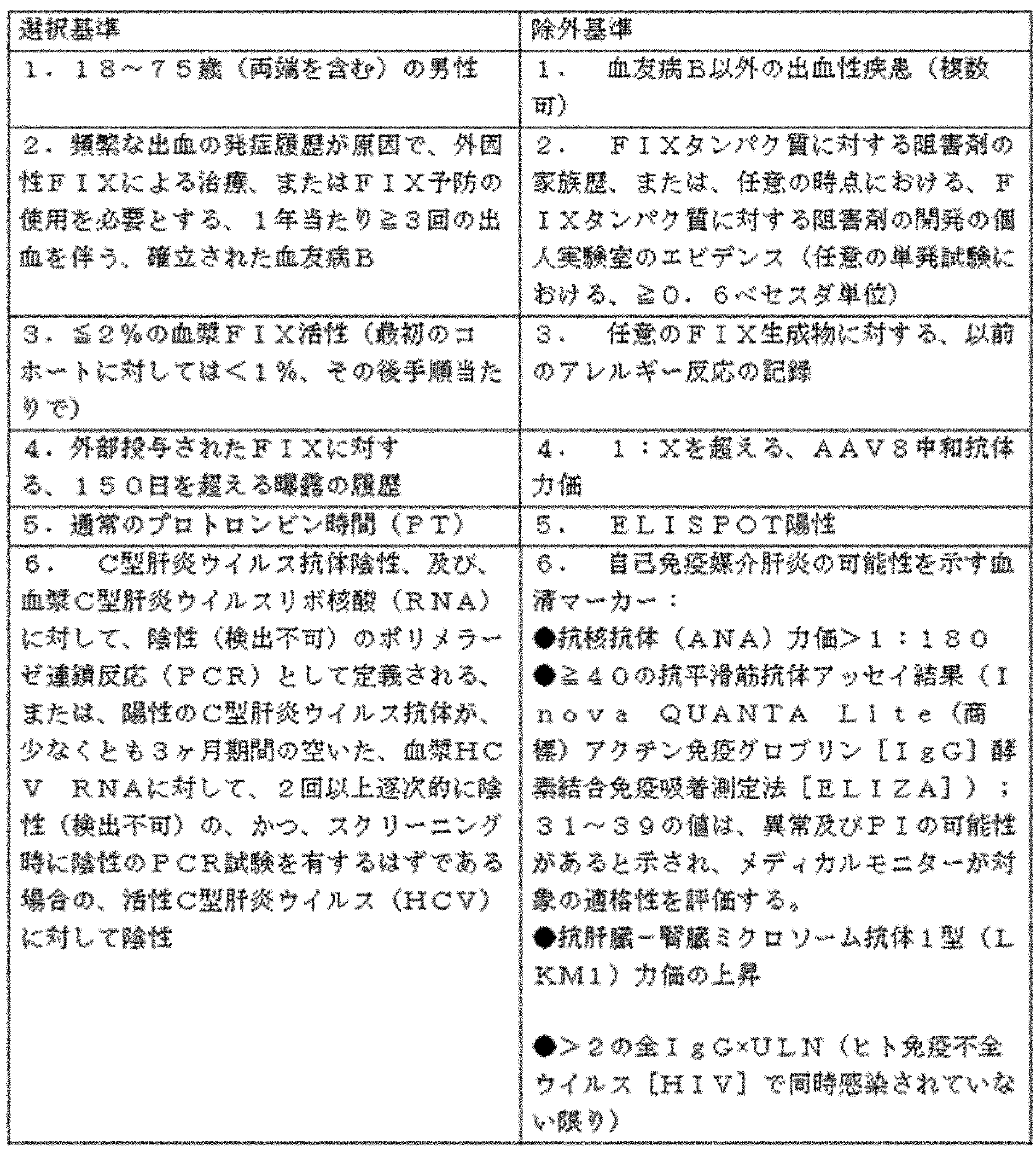
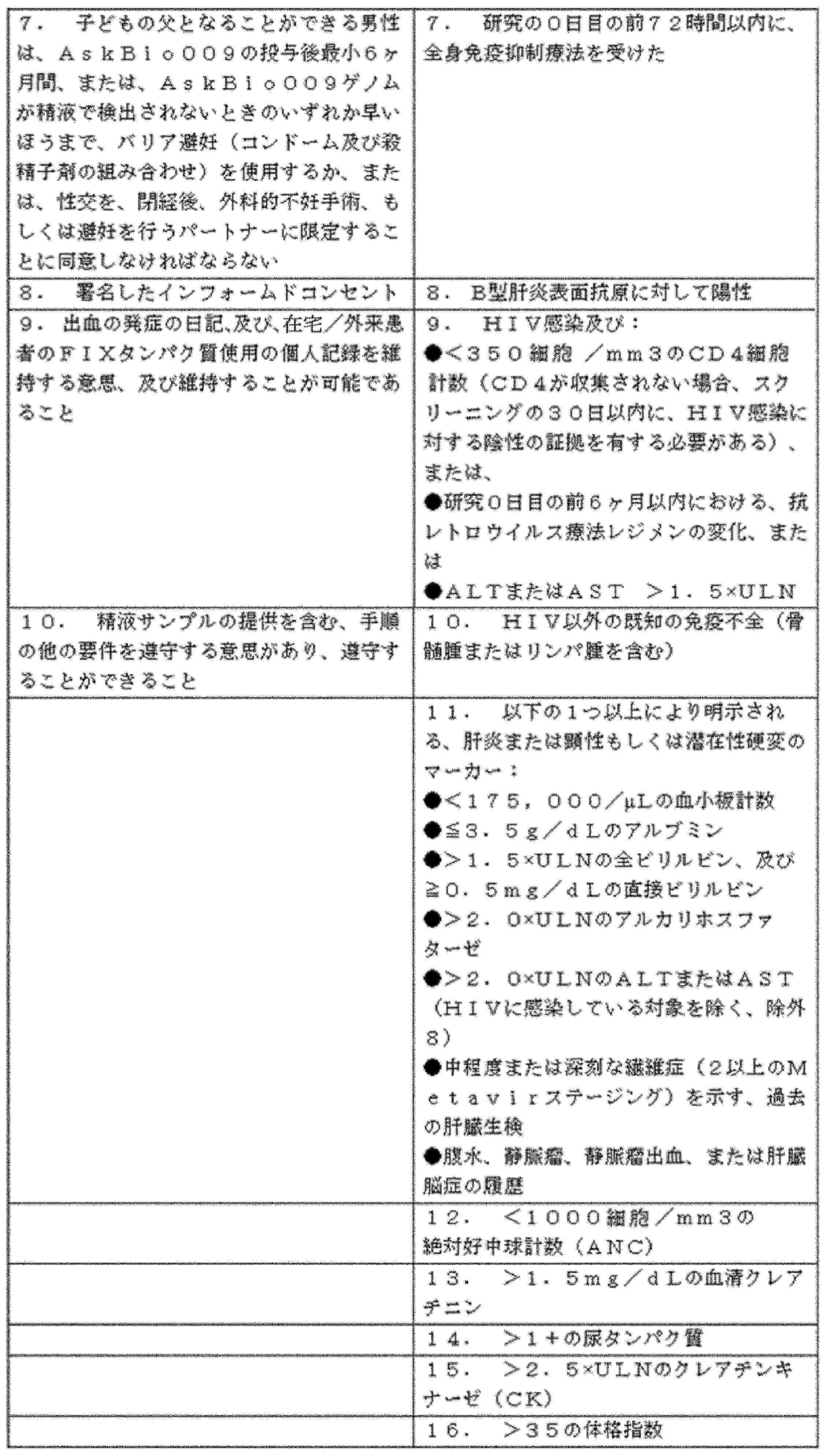

FIX遺伝子療法発現カセットは、AAV由来の反転末端反復(ITR)、肝臓特異的トランスサイレチン(TTR)プロモーター/エンハンサー、及び、機能亢進FIX(R338L)Paudaバリアントに隣接する自己相補性導入遺伝子で構成された(図1)。グッドマニュファクチャリングプラクティスのFIX遺伝子治療構築物 を、WAVEバイオリアクターシステム(GE Healthcare,Piscataway,NJ,USA)で増殖する懸濁HEK293細胞の3重プラスミドトランスフェクションプロトコルを使用して、ノースカロライナ州大学のChapel Hill School of Medicine(UNC)のベクターコア施設にて製造した。ベクター力価をQ-PCR及びドットプロットアッセイにより測定した。 The FIX gene therapy expression cassette consists of an AAV-derived inverted terminal repeat (ITR), a liver-specific transthyretin (TTR) promoter/enhancer, and a self-complementary transgene flanked by a hyperactive FIX (R338L) Pauda variant. (Fig. 1). A FIX gene therapy construct of Good Manufacturing Practices was produced by Chapel of the University of North Carolina using a triple-plasmid transfection protocol of suspension HEK293 cells grown in a WAVE bioreactor system (GE Healthcare, Piscataway, NJ, USA). Manufactured at the Vector Core facility at the Hill School of Medicine (UNC). Vector titers were determined by Q-PCR and dot plot assays.
登録した患者を、3つの投与漸増コホート:1)2.0×10¹¹ベクターゲノム(vg)/kg;2)1.0×1012vg/kg;3)3.0×1012vg/kgのうちの1つにて、FIX遺伝子治療構築物の単回静脈内注入を受けるように割り当てた。患者には、研究中に必要に応じて、標準的なケア血友病B治療(出血の発症及び/または予防のオンデマンド治療のための、外因性FIXタンパク質を含む)を受けさせた。 Enrolled patients were assigned to one of three escalating dose cohorts: 1) 2.0 x 10 vector genomes (vg)/kg; 2) 1.0 x 10 vg/kg; 3) 3.0 x 10 vg/kg. , to receive a single intravenous infusion of the FIX gene therapy construct. Patients received standard of care hemophilia B therapy (including exogenous FIX protein for on-demand treatment of bleeding episodes and/or prevention) as needed during the study.
主たるアウトカムの測定は、用量コホートによる有害事象の評価、及び基準からの実験室評価の変化であった。二次アウトカムの測定には、体液(血液、唾液、尿、大便、及び精液)において減少するベクターの監視、加えて、注入後の特定の時点における、全身性IR(体液性、及び細胞性)の、FIX Pauda(R338L)導入遺伝子生成物への、及び、AAV8キャプシドタンパク質への評価を含んだ。wt FIX及びFIX Paudaに対するIg抗体の結合もまた、アッセイした。さらに、血液中での、循環腫瘍壊死因子α(TNFa)及びインターロイキン-6(IL-6)の濃度を、FIX遺伝子治療構築物注入(追加の材料にてさらに詳述)の前、及び24時間後に測定した。 The primary outcome measures were adverse event ratings by dose cohort and laboratory-assessed change from baseline. Secondary outcome measures include monitoring vector depletion in bodily fluids (blood, saliva, urine, stool, and semen), as well as systemic IR (humoral and cellular) at specific time points post-infusion. to the FIX Pauda (R338L) transgene product and to the AAV8 capsid protein. Binding of Ig antibodies to wt FIX and FIX Pauda was also assayed. In addition, concentrations of circulating tumor necrosis factor alpha (TNFa) and interleukin-6 (IL-6) in the blood were measured prior to FIX gene therapy construct injection (detailed further in Additional Materials) and for 24 hours. measured later.
二次的な有効性アウトカムは、注入前基準からの、FIX活性及びFIXタンパク質濃度の変化を含んだ。FIX活性を、中央実験室(Esoterix,Inc.Englewood,Colorado)にて行われる、Siemens BCS-XP自動分析器、及び、aPTTアクティベーターとしてのエラグ酸を使用して、標準的な1段階FIX活性アッセイで測定した。このアッセイは、ベセスタ阻害剤アッセイに基づいても行い、これを使用して、wt FIX含有血漿、及び、FIX Pauda含有血漿における凝固阻害を調査した。導入遺伝子生成物特異的ELISAを開発して、患者の血漿のサンプル由来のFIX Paudaタンパク質を定量化することは、以前に説明した。出血の発症頻度及び深刻度、ならびに、研究中での、外因性FIX生成物の使用もまた、研究前12ヶ月の期間で収集したデータと比較した。 Secondary efficacy outcomes included change in FIX activity and FIX protein concentration from pre-infusion baseline. FIX activity was measured using a standard one-step FIX activity assay using a Siemens BCS-XP automated analyzer and ellagic acid as the aPTT activator performed in a central laboratory (Esoterix, Inc. Englewood, Colorado). measured in This assay was also based on the Becesta Inhibitor Assay and was used to investigate clotting inhibition in wt FIX- and FIX Pauda-containing plasma. Developing a transgene product-specific ELISA to quantify FIX Pauda protein from patient plasma samples was previously described. Incidence and severity of bleeding and use of exogenous FIX products during the study were also compared with data collected during the 12-month period prior to the study.
Human Luminexキットを、Millipore(登録商標)(Merck Millipore,Darmstadt,Germany)によりカスタム設計した。キットは、アッセイに対する規格としての、対応する検体のすぐに使えるカクテルを提供した。アッセイを、メーカーのプロトコルに従い行った。簡単に言うと、規格を250μLの脱イオン水で再構築し、全サイトカインに対して10000pg/mLの濃度を得た。バイアルを混合のために複数回反転し、使用するまで氷上で保管した。品質管理(低及び高)はキットの構成要素であり、それぞれの品質管理範囲は、メーカーにより提供された。2つの品質管理(低及び高)を、250μLの脱イオン水(低及び高)で再構築した。サンプルを、懸濁アレイ多重システム(Bio-Plex(登録商標)200 System,BioRad(登録商標))で測定した。以下のパラメーターを分析した:サイトカイン(インターフェロン[IFN]a2、IFNγ、インターロイキン[IL]-10、IL-12p70、IL-13、IL-17A、IL-1a、IL-1B、IL-2、IL-4、IL-6、IL-8単核細胞化学遊走因子タンパク質-1[MCP-1]、マクロファージ炎症性タンパク質-1a[MIP-1a]、腫瘍壊死因子a[TNFa]、トランスフォーミング増殖因子-βI[TGF-βI]、可溶性CD40リガンド[sCD40L]及びインターフェロンγ誘導タンパク質10[IP-10]);肝臓パラメーター(γ-グルタミルトランスフェラーゼ[GGT]、アルカリホスファターゼ、鉄、フェリチン、全タンパク質、アルブミン、a-1グロブリン、a-2-グロブリン、β-グロブリン、β-1グロブリン、β-2グロブリン、γ-グロブリン、a-1-フェトプロテイン、及びC反応性タンパク質[CRP])。
The Human Luminex kit was custom designed by Millipore® (Merck Millipore, Darmstadt, Germany). The kit provided a ready-to-use cocktail of corresponding analytes as a standard for the assay. Assays were performed according to the manufacturer's protocol. Briefly, standards were reconstituted with 250 μL of deionized water to give a concentration of 10000 pg/mL for all cytokines. The vial was inverted multiple times to mix and stored on ice until use. Quality controls (low and high) are components of the kit and respective quality control ranges were provided by the manufacturer. Two quality controls (low and high) were reconstituted with 250 μL of deionized water (low and high). Samples were measured on a suspension array multiplex system (
C57BL6マウス(チャールズリバーラボラトリー)を、4×10¹²vg/kgを使用して、FIX遺伝子治療構築物ベクター、及び、次世代CpG枯渇ベクターで免疫付与した。抗原投与の4週間後に、マウスに適合した、上述の中和抗体アッセイを使用して、抗AAV8中和抗体(NAb)を評価した。 C57BL6 mice (Charles River Laboratories) were immunized with FIX gene therapy construct vector and next generation CpG depleted vector using 4x10¹² vg/kg. Four weeks after challenge, anti-AAV8 neutralizing antibodies (NAbs) were assessed using the mouse-adapted neutralizing antibody assay described above.
何名かの患者での導入遺伝子発現の喪失を調査する、根本的原因の分析は、CpGリッチAAV8ベクターと、CpG枯渇したAAV8ベクターを注入したマウスにおける、AAV8中和抗体力価(Nab)の比較を含んだ。 A root cause analysis investigating the loss of transgene expression in some patients showed that AAV8 neutralizing antibody titers (Nab) in mice injected with CpG-rich and CpG-depleted AAV8 vectors Includes comparisons.
AAV8及びAAV2に対する、中和Abのアッセイ(インビトロ形質導入阻害アッセイ)
血清を、スクリーニング中、及び、その後の規則的なFIX遺伝子治療構築物注入における、AAV8キャプシドに対する中和抗体(NAb)の存在についてアッセイした。各時点において、AAV2に対するNAbもまたアッセイした。ヒトはAAV2の自然宿主であり、スクリーニングした約半分の成人が、以前から存在する抗AAV2 Nabを有することが予想された。以前に記載したとおりに、インビトロ形質導入阻害アッセイを使用し、研究対象に由来する血清が、AAVにより、細胞培養液中でのルシフェラーゼマーカー遺伝子移動を阻害する能力についてアッセイした。対象血清の連続2倍希釈液に、AAV・ルシフェラーゼを1:1で混合し、37℃で2時間インキュベートし、その後、これを使用して、組織培養液中で、(AAV2及びAAV8の両方による感染を受ける)Huh7細胞を感染させた。感染から24時間後に、ルシフェリンを、発現したルシフェラーゼ、及び、照度計により定量化されたルシフェラーゼ活性に対する基質として細胞に添加した。(血清なしの対照と比較して)≧50%のルシフェラーゼ活性阻害をもたらした対象の血清の最も高い希釈を、NAb力価として記録した。
Assay for Neutralizing Abs Against AAV8 and AAV2 (In Vitro Transduction Inhibition Assay)
Sera were assayed for the presence of neutralizing antibodies (NAb) to the AAV8 capsid during screening and following regular FIX gene therapy construct injections. NAb against AAV2 was also assayed at each time point. Humans are the natural host for AAV2 and it was expected that approximately half of the screened adults would have pre-existing anti-AAV2 Nabs. As previously described, an in vitro transduction inhibition assay was used to assay the ability of sera from study subjects to inhibit luciferase marker gene transfer in cell culture by AAV. Serial 2-fold dilutions of target serum were mixed 1:1 with AAV-luciferase, incubated at 37° C. for 2 hours, and then used in tissue culture (both AAV2 and AAV8 Infected) Huh7 cells were infected. Twenty-four hours after infection, luciferin was added to the cells as a substrate for expressed luciferase and luciferase activity quantified by a luminometer. The highest dilution of subject's serum that resulted in ≧50% inhibition of luciferase activity (compared to no serum control) was recorded as the NAb titer.
AAV8キャプシド及びFIX Paudaに対して向けられるT細胞応答の評価を、末梢血単核球細胞(末梢血Tリンパ球、PBMC)のIFNy放出酵素結合イムノスポットアッセイを使用して、基準にて、及びFIX遺伝子治療構築物注入の後に連続して評価した。配列中で、10個のアミノ酸までが重複する15量体ペプチドのライブラリーを生成し(Mimotopes)て、AAV8キャプシドVP1タンパク質の全体まで伸ばし、3つのプールに組織化した(AAV8抗原プール1~3)。また、配列中で、10個のアミノ酸までが重複する15量体ペプチドのライブラリーを生成し(Mimotopes)て、FIX R338Lタンパク質の全体まで伸ばし、2つのプールに組織化した(FIX R338L抗原プール1及び2)。細胞の生存能の陽性対照として、1pg/mLの終濃度にて、レウコアグルチニン(leucoagglutinin)PHA-Lを試験した。ポリクローナル活性化の陽性対照として、5ng/mL PMA及び2mMイオノマイシンの終濃度にて、PMA-イオノマイシンを試験した。各プレートに関して、CMV、EBV、及びインフルエンザウイルス由来のエピトープのプールを含むCEF(Cellular Technology Limited)を参照対照に対しても行った。完全なリンパ球培地(10% FBSを含むRPMI)を、陰性反応性対照として試験した。細胞培養の予定日に先立ち、マルチウェルプレートを、滅菌したPBS中で一晩、ヒトIFNyコーティング抗体(Mabtech)でコーティングした。細胞培養の日に、プレートをPBSで洗浄し、完全培地でブロックした。研究対象由来の新鮮なPBMCを、リンパ球培地中で2×10cells/mLの濃度に調節し、等体積の100μLの細胞懸濁液を、抗原(または対照)含有ウェルに添加した。37℃で18~24時間刺激(インキュベーション)した後、細胞培養プレートを洗浄し、ヒトIFNy HRP検出抗体(Mabtech)でインキュベートし、続いてAviden-HRPでインキュベートし、その後AEC色素体試薬でインキュベートした。発色を、インキュベーションの5分後に停止し、プレートを乾燥させ、ヒトIFNγ活性化計数を、AID Elispot Reader ELR03を用いて定量化した。
Evaluation of T cell responses directed against AAV8 capsid and FIX Pauda using an IFNy-releasing enzyme-linked immunospot assay of peripheral blood mononuclear cells (peripheral blood T lymphocytes, PBMC) at baseline and FIX gene therapy construct injection was followed by serial evaluation. A library of 15-mer peptides overlapping in sequence by up to 10 amino acids was generated (Mimotopes), extended throughout the AAV8 capsid VP1 protein, and organized into three pools (AAV8 antigen pools 1-3 ). A library of 15-mer peptides overlapping in sequence by up to 10 amino acids was also generated (Mimotopes) and extended throughout the FIX R338L protein and organized into two pools (FIX
定量リアルタイムポリメラーゼ連鎖反応(qPCR)を使用して、治療後の研究1日目に、及び、2個の逐次サンプルが検出限界を下回るまで、1週間の間隔で、全血、唾液、精液、尿、及び大便中のFIX遺伝子治療構築物ベクターゲノムを検出した。
Using quantitative real-time polymerase chain reaction (qPCR), whole blood, saliva, semen, and urine were analyzed on
書面にされたインフォームドコンセントにより、FIX遺伝子治療構築物を受ける8名の患者のゲノムDNAを、全エクソームシーケンシングのために抽出した。研究中、及び4年を超える追跡のために、高レベルのFIX発現を維持した患者(患者5)を、指標対象として使用した。バリアント分析を行い、指標患者5由来のエクソーム配列を含むFIX遺伝子治療構築物の注入後に、FIX導入遺伝子の維持ができなかった7名の患者由来のエクソーム配列を比較した。QIAamp DSP DNA Blood Mini Kit(Qiagen)を使用して、EDTA処理した全血サンプルからゲノムDNAを抽出した。メーカーの取扱説明書に従い、各サンプルに対して、TruSeq Rapid Capture Exome Library kit(Illumina)を使用してエクソーム濃縮を行った。各サンプルに対して、断片化したDNAライブラリーを構築し、100bpの対形成したエンドモードで、Illumina HiSeq2000シーケンシングプラットフォームを用いて、ハイスループットシーケンシングを行った。塩基当たり125~180個の読取り値を有する平均シーケンシング深さは、信頼されたバリアント同定のために推奨されるシーケンシング深さを満たした。シーケンシングした読取り値を、Burrows-Wheeler Alignerを用いてGRCh37にアラインした。重複した読取り値は、Picard Tools(http://picard.sourceforge.net)でマークした一方、挿入/欠失のリアラインメント及び塩基品質スコアの再較正を、GATKを用いて行った。GATKパッケージ内でSnpEff ツールを用いて、バリアントコーリングを行った。バリアントの優先順位付けを、Ingenuity Variant Analysisツール(Qiagen)を用いて行った。患者5の全エクソーム配列と、他の対象の全エクソーム配列とにおける変化を、ヒトゲノムにおける単一ヌクレオチドバリアント及び挿入/欠失の有害性可能性をスコアリングする方法として、Combined Annotation Dependent Depletion(CADD)を用いて評価した。CADDは、シミュレーションされた変異により自然淘汰を生き延びたバリアントを対比することにより、複数のバリアントアノテーションツールを単一のメトリックに組み込むフレームワークをもたらす。観察される可能性が低い(自然淘汰を生き延びていない)バリアントはより高いスコアを受け、これは、バリアントがどれほど有害であるかに相関する。
With written informed consent, genomic DNA of 8 patients receiving FIX gene therapy constructs was extracted for whole-exome sequencing. Patients who maintained high levels of FIX expression (patient 5) were used as index subjects during the study and for more than 4 years of follow-up. Variant analysis was performed to compare exome sequences from 7 patients who failed to maintain the FIX transgene after injection of a FIX gene therapy construct containing exome sequences from
適応性抗AAV免疫応答を増強可能な、推定される先天性免疫シグナルとしての役割を果たす、FIX遺伝子治療構築物ベクター内でのCpGオリゴデオキシヌクレオチド配列の可能性を評価するために、コドン最適化FIX cDNAを発現するさらなる遺伝子療法ベクターを生成した。これら全てが、同一のAAV2 ITR配列に隣接するFIX Paudaコード配列をパッケージングするscAAV8ベクターであり、同一のTTRプロモーター/エンハンサー及び転写制御因子により駆動される発現を伴った。ベクターは、以下で詳述するように、FIX Pauda発現カセット内のCpGエレメントの数のみが異なった:FIX遺伝子治療構築物において99個のCpG;ベクターODNO(Blue02)においてゼロ個のCpG;ベクターODN3において3個のCpG。さらに、GrayO1遺伝子配列を、Nathwani et al.により報告される、コドン最適化FIX遺伝子配列を用いて合成した(Self-complementary adeno-associated virus vectors containing a novel liver-specific human factor IX expression cassette enable highly efficient transduction of murine and nonhuman primate liver.Blood 2006;107:2653-61)。 To assess the potential of CpG oligodeoxynucleotide sequences within the FIX gene therapy construct vector to serve as putative innate immune signals capable of enhancing adaptive anti-AAV immune responses, codon-optimized FIX Additional gene therapy vectors were generated that expressed the cDNA. All of these were scAAV8 vectors packaging the FIX Pauda coding sequence flanked by the same AAV2 ITR sequences, with expression driven by the same TTR promoter/enhancer and transcriptional regulator. The vectors differed only in the number of CpG elements within the FIX Pauda expression cassette, as detailed below: 99 CpGs in the FIX gene therapy construct; 0 CpGs in vector ODNO (Blue02); 3 CpGs. Additionally, the GrayO1 gene sequence was obtained from Nathwani et al.により報告される、コドン最適化FIX遺伝子配列を用いて合成した(Self-complementary adeno-associated virus vectors containing a novel liver-specific human factor IX expression cassette enable highly efficient transduction of murine and nonhuman primate liver.Blood 2006; 107:2653-61).
全ての動物実験は、動物ケア機関及び使用委員会により認可された。動物実験は全て、止血して通常のオスC56Bl/6マウスで行った。8~10週齢の年齢で、マウスは、FIX遺伝子治療構築物、または、CpG減少scAAV8 FIX発現ベクターのうちの1つのいずれかの、4×10¹²vg/kgの単回尾静脈注射を受けた(n=6~8匹のマウス/治療群/実験)。FIX遺伝子治療構築物の3つの別個の臨床生産ロットを実験した。マウスを、ベクター注入の26日後に犠牲にした。血液を収集し、適応免疫(抗体産生)が、遺伝子療法ベクター内でのTLR9リガンドCpGの濃縮によりブーストされたか否かのマーカーとして、抗AAV8中和抗体(NAb)の形成を調査した。 All animal experiments were approved by the Animal Care Agency and Use Committee. All animal experiments were performed in normal male C56B1/6 mice under hemostasis. At the age of 8-10 weeks, mice received a single tail vein injection of 4×10 vg/kg of either the FIX gene therapy construct or one of the CpG-reduced scAAV8 FIX expression vectors (n = 6-8 mice/treatment group/experiment). Three separate clinical production lots of FIX gene therapy constructs were tested. Mice were sacrificed 26 days after vector injection. Blood was collected and anti-AAV8 neutralizing antibody (NAb) formation was investigated as a marker of whether adaptive immunity (antibody production) was boosted by enrichment of the TLR9 ligand CpG within the gene therapy vector.
結果
20~69歳の8名の男性(平均[SD]年齢は30.5[15.98]歳;6/8名が30歳未満)が、スクリーニングにおける研究参加に適格であり、3つの用量コホートのうちの1つに登録された(図1)。7名の患者がコーカサス人であり、1名が黒人/アフリカ系米国人であった。3名が、FIX抗原交差反応性物質(CRM)に対して陽性であった。いずれの患者も、活性HIVまたはHCVの血清学的エビデンスを有しなかった(2名は抗HCV抗体を有したが、PCRにより、全員が活性HCV RNAに対して陰性であった)。全員が未検出レベルのAAV8 NAbを有したが、AAV2に対するNAbは2名の患者で検出された(それぞれ、力価1:10、及び1:5)(図1)。AAV8に対する循環末梢血単核球(PBMC)応答が、スクリーニング時に7名の患者で検出された。
Results Eight males aged 20-69 years (mean [SD] age 30.5 [15.98] years; 6/8 <30 years) were eligible for study participation at screening and were enrolled in three doses. Enrolled in one of the cohorts (Fig. 1). Seven patients were Caucasian and one was Black/African American. Three were positive for FIX antigen cross-reactive material (CRM). None of the patients had serological evidence of active HIV or HCV (2 had anti-HCV antibodies, but all were negative for active HCV RNA by PCR). All had undetectable levels of AAV8 NAb, whereas NAb to AAV2 was detected in two patients (titers 1:10 and 1:5, respectively) (Figure 1). A circulating peripheral blood mononuclear cell (PBMC) response to AAV8 was detected in 7 patients at screening.
全身へのFIX遺伝子治療構築物注入の間、または注入後8時間の期間において、生命徴候または血清/血液学的パラメーターにおける異常は報告されなかった。最も低い用量コホートの1名の患者がグレード1の過敏性反応を有したが、これは30分以内に回復した。注入が中断した患者はいなかった。血清IL-6の無症候性上昇が、注入後4~8時間の間に、最も高い用量コホートの1名の患者で報告されたが、注入後24時間で基準に戻った(図8)。
No abnormalities in vital signs or serum/hematologic parameters were reported during systemic FIX gene therapy construct infusion or in the 8 hour period following infusion. One patient in the lowest dose cohort had a
4つのSAE:横紋筋融解症、扁桃の細菌感染、扁桃出血、及び、扁桃の扁平上皮細胞癌が、3名の患者で報告された(この最後の事象における説明情報は、追加情報にて提供される)。全てが、FIX遺伝子治療構築物とは無関係であるとみなされた。(4名の患者における)10個のAEが、研究治療に関係する可能性があるとみなされた。これらのうち、7つは重症度が軽度であり(倦怠感、顔面紅潮、頭痛、インフルエンザのような症状、足首の腫れ、肝酵素の上昇、及び高血圧)、3つが中度であった(肝酵素の上昇、膿瘍、及び倦怠感)。 Four SAEs: rhabdomyolysis, bacterial infection of the tonsils, tonsil hemorrhage, and squamous cell carcinoma of the tonsils were reported in three patients (descriptive information on this last event is available in Additional Information). provided). All were considered independent of the FIX gene therapy construct. Ten AEs (in four patients) were considered potentially related to study treatment. Of these, 7 were mild in severity (fatigue, flushing, headache, flu-like symptoms, swollen ankles, elevated liver enzymes, and hypertension) and 3 were moderate in severity (liver elevated enzymes, abscesses, and malaise).
ベクターゲノムを尿、精液、唾液、大便、及び全血で測定し、ピーク濃度及び減少期間は幅広く、3つのコホートにまたがる用量依存性を示す(表4)。全血の例外はあれど、いずれの患者も、4週間(精液、大便)から5週間(唾液、尿)後において、体液の減少を示さなかった。血液からのベクターシグナルは、コホート1及び2で失われたが、最も用量の多いコホートにおいては、12ヶ月の来診時に検出限界を上回ったままであった。
Vector genomes were measured in urine, semen, saliva, stool, and whole blood, showing broad peak concentrations and periods of decline and dose-dependence across the three cohorts (Table 4). With the exception of whole blood, none of the patients showed fluid loss after 4 weeks (semen, stool) to 5 weeks (saliva, urine). Vector signal from blood was lost in
(表4)体液中でのwt FIXベクターゲノムの減少
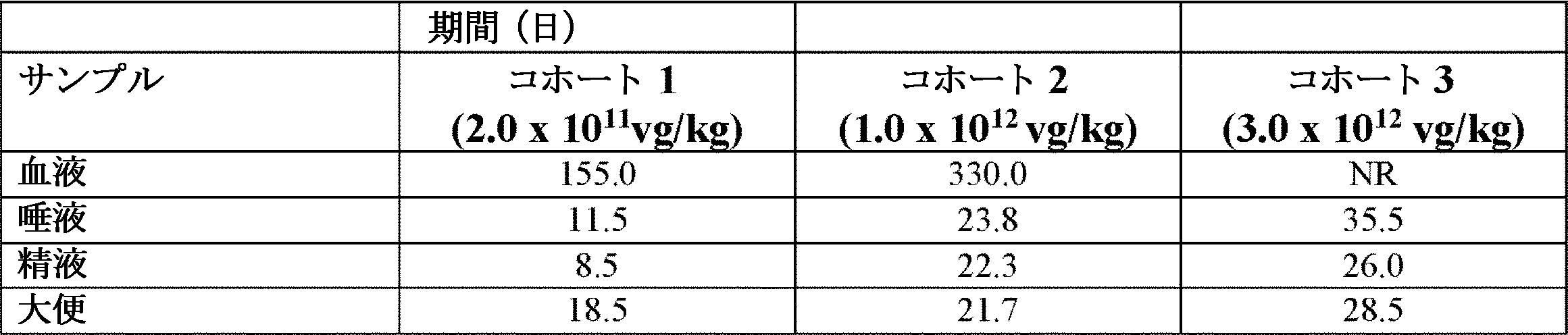
投薬コホートにより体液でWT FIXゲノムが検出された、平均日数。最も高い投薬コホートの患者から採取した全血サンプルに関して、WT FIXゲノムは、12ヶ月の来診時に検出レベルを上回ったままであった。 Mean number of days the WT FIX genome was detected in bodily fluids by the dosing cohort. For whole blood samples taken from patients in the highest dose cohort, the WT FIX genome remained above detection levels at the 12-month visit.
コホート1で治療した第1の患者の例外はあれど、患者は全員、ベクター由来のhFIX発現を示した。これは、最も高い用量コホートにおける、FIX遺伝子治療構築物注入の1~2週間後に明らかとなり(図2)、血栓形成性、またはFIX Paudaへの細胞性及び体液性IRのいずれのエビデンスもなしに生じた。FIX遺伝子治療構築物由来のFIX発現は、用量依存性であった(図2及び3)。平均(範囲)ピークFIX活性は、コホート1で3.5%(3~4%)、コホート2で13%(3~25%)、及びコホート3で45%(32~58%)であった。ピーク発現時において、(野生型FIXではなく)機能獲得FIX Pauda由来の循環凝固活性は、基準にてFIX CRM陰性であった患者において、FIX特異的活性により示された(図2)。FIX Pauda抗原レベルは、標準的なFIX ELISAアッセイで測定したFIX抗原レベルではなく、測定したFIX活性と相関したため、FIX Pauda特異的ELISAを用いることで、全(CRM+及びCRIM-)患者において、導入遺伝子特異的発現が実証された(図2)。
With the exception of the first patient treated in
コホート1では、患者2は、4週目に2~3%のFIX活性を実現し、一時的に予防を中断した。コホート2の4名の患者全員が、著しいレベルのFIX活性を経験したが、患者間の変動性は相当であった。患者3は、11週目に16.9%のピークを有するFIX活性を示したが、12週目にFIX発現の急性喪失を経験し、その後予防治療を再開した。患者4は、約7%の初期ピークFIX活性レベルを有し、これはその後、6週目と7週目の間に下がった。彼もまた、代償療法を再開した。患者8は、予防コルチコステロイドを受けた。2~3%のFIX活性は、最初の6ヶ月の間に達成された。患者5は、7週目に約20%のFIX活性を達成し、4年を超える追跡の間に活性を維持した唯一の患者であり、出血またはFIXタンパク質注入なしを達成した(図2)。患者3及び患者4の両方が、80%を超えるピーク発現を急に(約2週間にわたって)喪失したものの、いずれの患者も、肝臓アミノ基転移酵素の増加、ベクターまたは導入遺伝子に応答したT細胞の活性化(抗原特異的IFN-γ ELISPOT)、この喪失と同時発生する、FIX、またはFIX Pauda、または他の症状/実験室摂動に対する、阻害剤または非中和抗体の発達を示さなかった。
In
最高用量コホートでは、患者6が、6週目までに58.5%のピークFIX活性を実現し、これは、AAVキャプシドが指示するT細胞の活性化の増加と一致した。7週目にFIX活性の急速な低下が生じ、これに、肝臓アミノ基転移酵素の増加及びさらなるT細胞の活性化が付随した。プロトコルに従い、プレドニゾンでの治療を72時間以内に開始すると、肝酵素及びELISPOT結果の急激な正規化が得られた。FIX活性は回復せず、患者は予防FIX注入を再開した。患者7は、5週目までに30%、FIX活性が超過した。6週目に、FIXの急激な喪失と共に、肝酵素のわずかな上昇を経験した後、彼はプレドニゾンを開始したが、FIX活性は低下し続けた(図2)。
In the highest dose cohort,
ピーク因子発現の期間を含む、FIX遺伝子治療構築物注入後の12ヶ月の追跡の間に、外因性FIXの消費は、前年と比較して減少したようである(FIXの年換算した使用は、6/8名の患者で減少し、7/8名の患者で、1ヶ月当たりのFIX注入回数が減少した)。因子消費での最も大きな減少は、最高用量コホートの患者で生じたようであった(図5)。 During the 12-month follow-up after FIX gene therapy construct injection, including the period of peak factor expression, consumption of exogenous FIX appeared to decrease compared to the previous year (annualized use of FIX was 6 /8 patients and 7/8 patients had fewer FIX infusions per month). The greatest reduction in factor consumption appeared to occur in patients in the highest dose cohort (Figure 5).
ベクターに対するAAV8特異的T細胞応答
AAV8特異的細胞傷害性T細胞は、形質導入した肝細胞を殺傷すると考えられる。しかし、最高用量コホートの中の2名の患者のみが、AAV8キャプシド反応性T細胞に対する強力なELISPOTシグナルを有し、これらの知見は、AEを伴わなかった(図2)。コルチコステロイド療法の開始は、患者6におけるIFN-γ ELISPOTの即座の正規化と関連したが、このシグナルは、患者7においては、プレドニゾンの開始後数週間の間上昇したままであった。
AAV8-specific T cell responses to vectors AAV8-specific cytotoxic T cells are thought to kill transduced hepatocytes. However, only 2 patients in the top dose cohort had strong ELISPOT signals for AAV8 capsid-reactive T cells, and these findings were not accompanied by AEs (Fig. 2). Initiation of corticosteroid therapy was associated with immediate normalization of IFN-γ ELISPOT in
患者6及び7におけるALT上昇に応答して、ならびに、患者8における予防として開始した、全身コルチコステロイド投与は、これらの患者においてFIX活性レベルを維持する役割を果たさなかった(図2)。
Systemic corticosteroid administration, initiated in response to ALT elevation in
投薬後に、最大5~8ヶ月にわたり、患者の血漿サンプルの、18個のサイトカイン、及び15個の肝臓パラメーターをアッセイすると、患者5の1名のみがなぜ、4年超にわたり選択的に、安定したFIX Pauda発現を示したのかについての何らかの、確証的なヒントは明らかとならなかった(データは図示せず)。
When patients' plasma samples were assayed for 18 cytokines and 15 liver parameters for up to 5-8 months after dosing, only 1 of
CpGクラスターを有するベクター化した発現カセットは、導入遺伝子発現に負の影響を及ぼし得る、toll様受容体9(TLR9)を介して自然免疫系を活性化し得る。FIX遺伝子治療構築物内のFIX Pauda導入遺伝子が99個のCpGモチーフを含有するため、CpGジヌクレオチド密度が上昇したCpGアイランドが生じる。この仮説は、自然免疫系のベクター依存性活性化が、AAV8に対するNAbの力価を測定することにより間接的に分析された動物モデルで試験した。動物に、FIX遺伝子治療構築物、または、CpG枯渇FIX Pauda導入遺伝子を有するFIX遺伝子治療構築物様構築物を抗原投与したとき、AAV8に対するNAb力価は、FIX遺伝子治療構築物で治療した動物において増加した(図4)。CpGモチーフの数が増加することにより実際、ベクターにより標的化された適応免疫を増強可能な先天性免疫シグナル伝達を駆動することができることを、これらのデータは示唆している。 Vectorized expression cassettes with CpG clusters can activate the innate immune system through toll-like receptor 9 (TLR9), which can negatively affect transgene expression. The FIX Pauda transgene within the FIX gene therapy construct contains 99 CpG motifs, resulting in CpG islands with increased CpG dinucleotide density. This hypothesis was tested in an animal model in which vector-dependent activation of the innate immune system was indirectly analyzed by measuring NAb titers against AAV8. When animals were challenged with a FIX gene therapy construct or a FIX gene therapy construct-like construct with a CpG-depleted FIX Pauda transgene, NAb titers to AAV8 increased in animals treated with the FIX gene therapy construct (Fig. 4). These data suggest that an increased number of CpG motifs can indeed drive innate immune signaling that can enhance vector-targeted adaptive immunity.
ベクターの潜在的な免疫原性がどのように、患者5の安定した発現に変換されたのかを理解するために、遺伝変化が患者5の、示された長期間の導入遺伝子発現を容易にする抗AAV8免疫応答をマウントできないことに寄与した可能性があるという仮説が立てられた。したがって、全エクソームシーケンシングによる、全患者のゲノムのコード領域内での潜在的な遺伝変化を調査した。
To understand how the vector's potential immunogenicity translated into stable expression in
同定されたバリアントを、同定された遺伝子、変異内での、既知のバリアントの表現型の出現についての以前の知識に基づき、加えて、SIFT、PolyPhen-2、及び、Combined Annotation Dependent Depletion(CADD)アルゴリズム値に従い、評価した。3つの方法は全て、ヒトゲノムでの単一ヌクレオチドバリアント及び挿入/欠失の有害性を予言する。患者5のゲノムに固有のホモ接合遺伝子バリアントは存在しなかったものの、いくつかの固有のヘテロ接合及び化合物ヘテロ接合バリアントが発見された(図9)。現在の知識に基づき、本明細書に記載の、同定されたバリアントのうちの2つは、潜在的に、より高い確率で、導入遺伝子発現に影響を及ぼし得る(図2)。
Based on previous knowledge of the phenotypic occurrence of known variants within the identified genes, mutations, plus SIFT, PolyPhen-2, and Combined Annotation Dependent Depletion (CADD). Evaluated according to algorithm values. All three methods predict the deleteriousness of single nucleotide variants and insertions/deletions in the human genome. Although there were no unique homozygous gene variants in
一方は、化合物ヘテロ接合遺伝子バリアントであり、これは、SMRT/NCOR2(「レチノイドまたは甲状腺ホルモン受容体2/核内受容体同時抑制因子2のサイレンシング媒介因子」)遺伝子の両方の対立遺伝子における複製、具体的には、p.Q508-509dup、及びp.Q507-509dupを伴う。同定したバリアントのCADDスコアは、有害性の中度のリスクを示した(図2及び9)。SMRT/NCoR2は、核内受容体同時抑制因子複合体の形成に必要であり、これは、一般的なクロマチン修飾酵素の動員による中度の転写サイレンシングに対する部位特異的転写因子との相互作用により、一連の標的遺伝子に動員される。
One is a compound heterozygous gene variant, which duplicates in both alleles of the SMRT/NCOR2 (“retinoid or
エクソームシーケンシングにより同定された別のバリアントは、インターロイキン-6に対する受容体をコードするIL-6R遺伝子内での、ヘテロ接合ミスセンス変異バリアントc.344A>C、p.A1 15Eであった。IL-6結合ドメイン内で、グルタミン酸塩をアラニンで置換することにより、26.1のCADDスコアが生成され、これは、IL-6受容体機能に対する有害性の確率が非常に高いことの特徴である(図2及び9)。さらに、ヒト及びマウスにおけるIL-6Rのハプロ不全は以前に記録されており、このことは、患者5で同定された遺伝変化が、高負荷のAAV8キャプシドにより引き起こされる、IL-6が媒介する炎症性ストレスに対する感度を下げ、標的化された肝細胞を、ストレス誘発性の死から守る可能性があることを示唆している。
Another variant identified by exome sequencing is a heterozygous missense mutation within the IL-6R gene that encodes the receptor for interleukin-6 c. 344A>C, p. It was A1 15E. Substitution of glutamate with alanine within the IL-6 binding domain generated a CADD score of 26.1, which is characteristic of a very high probability of detriment to IL-6 receptor function. (Figs. 2 and 9). Moreover, haploinsufficiency of IL-6R in humans and mice has been previously documented, suggesting that the genetic alterations identified in
血友病Bの8名の成人男性患者の、この第I/II相臨床用量漸増研究において、AAV8ベースのFIX Pauda FIX遺伝子治療構築物遺伝子療法は、患者全員で十分に耐容性を示した。1年間の研究の間、またはその後の追跡の間に、著しい、注入に関連する安全性異常、またはその後の安全性異常はなく、阻害剤または他のFIX Paudaにより指示される免疫による血栓症及びエビデンスも存在しなかった。免疫原性のAAV非含有キャプシド汚染物質を減少させるように設計された、FIX遺伝子治療構築物ベクター構築物による治療は、8名の患者のうち7名において、コドン最適化FIX Pauda遺伝子の形質導入の成功、及びFIX発現の増加をもたらした。FIX遺伝子治療構築物の投与は、FIX Pauda特異的ELISAにより示されるように、導入遺伝子生成物の発現により明確に引き起こされる、ピークFIX:C活性における用量依存性の増加と関連した。FIX遺伝子治療構築物遺伝子療法の後での、患者における機能的FIX Pauda発現により、因子消費の低下がもたらされ、これは、動物研究、及び、異なるAAV8ベースのFIX Pauda因子を受ける、血友病Bの患者におけるこの実現と一致した。 In this phase I/II clinical dose escalation study of eight adult male patients with hemophilia B, AAV8-based FIX Pauda FIX gene therapy construct gene therapy was well tolerated by all patients. There were no significant infusion-related safety abnormalities or subsequent safety abnormalities during the 1-year study or during subsequent follow-up, and no inhibitor or other FIX Pauda-directed immune-induced thrombosis and No evidence existed. Treatment with the FIX gene therapy construct vector construct, designed to reduce immunogenic AAV-free capsid contaminants, resulted in successful transduction of the codon-optimized FIX Pauda gene in 7 of 8 patients. , and resulted in increased FIX expression. Administration of FIX gene therapy constructs was associated with a dose-dependent increase in peak FIX:C activity, clearly caused by transgene product expression, as shown by the FIX Pauda-specific ELISA. Functional FIX Pauda expression in patients after FIX gene therapy construct gene therapy results in decreased factor consumption, which is demonstrated in animal studies and in hemophilia, subject to different AAV8-based FIX Pauda factors Consistent with this realization in the B patient.
1名の患者は、出血を伴う、または4年超にわたるFIX代償療法を用いることなく、約20%の治療FIX活性を有するFIX発現の持続を実現した。しかし、FIX活性は、測定可能なFIX Pauda発現を伴う他の患者においては、5~11週を超えて維持されなかった。 One patient achieved sustained FIX expression with approximately 20% therapeutic FIX activity without bleeding or using FIX replacement therapy for more than 4 years. However, FIX activity was not maintained beyond 5-11 weeks in other patients with measurable FIX Pauda expression.
多くの場合、(患者6の結果により例示されるように)肝酵素の上昇が付随する、注入後の最初の数ヶ月以内での、導入遺伝子発現レベルの急速な喪失は、他のAAVベクター血友病遺伝子療法治験でもまた報告されている。遺伝子発現の急速な喪失と一致する、この臨床上の無症候性肝毒性(自己免疫肝炎に類似する)は、ベクター用量依存性の、キャプシドにより指示される細胞IRに属している。実際、最も強いELISPOT及びアミノ基転移酵素シグナルを、本研究の最高用量コホートで測定すると、以前の治験から明らかな、ベクター用量との関係を支持する。 The rapid loss of transgene expression levels within the first few months after injection, often accompanied by elevations in liver enzymes (as exemplified by the results in patient 6), has been associated with other AAV vector blood vessels. Friendship gene therapy trials have also been reported. This clinical asymptomatic hepatotoxicity (similar to autoimmune hepatitis), consistent with rapid loss of gene expression, is attributed to vector dose-dependent, capsid-directed cellular IR. In fact, the strongest ELISPOT and transaminase signals, measured in the highest dose cohort of this study, support the relationship with vector dose that is evident from previous trials.
キャプシドにより指示される、FIX発現を制限する適応性IRが免疫抑制により管理され得る、他のAAV FIX遺伝子療法研究とは対照的に、FIX活性は、本研究では、コルチコステロイド予防または動員により維持されることができない。フィラデルフィアの小児病院での、AAV8 FIX遺伝子療法研究でも同様に、免疫抑制により同院不可能なベクターキャプシドIRを有する3名の患者が報告され、ALT正規化と、ステロイド免疫抑制と、因子発現の安定化との明確な関係は、血友病のAAV遺伝子療法を受ける患者全員において、示されていなかった。 In contrast to other AAV FIX gene therapy studies, in which capsid-directed, adaptive IR limiting FIX expression can be managed by immunosuppression, FIX activity, in the present study, is controlled by corticosteroid prophylaxis or mobilization. cannot be maintained. An AAV8 FIX gene therapy study at the Children's Hospital of Philadelphia similarly reported three patients with vector capsid IR not hospitalizable due to immunosuppression, with ALT normalization, steroid immunosuppression, and factor expression A clear relationship with stabilization was not shown in all patients undergoing AAV gene therapy for hemophilia.
FIX遺伝子治療構築物によるFIX発現の免疫原性喪失に対する代わりの説明を調査するために行った分析では、マウスで刺激されたNAb力価から、NAb力価が下がると、FIX遺伝子治療構築物と比較して、CpGが低下したベクター構築物に対する応答が発生したため、(コドン最適化により導入された)FIX遺伝子治療構築物中でのFIX cDNAコード配列の、最も高いCpGオリゴデオキシヌクレオチド(ODN)含有量が、ベクターの免疫原性の増加に寄与し得るというエビデンスがもたらされた。肝臓に向けられるAAV遺伝子療法の動物モデルは、臨床的に観察されるAAVに対して向けられるCTL IRを予想または再生産せず、これにより、これらの応答のモデリングが難しくなる。したがって、同様のFIX発現ベクターの比較免疫原性を評価するための、これらのモデルの妥当性は、不明瞭である。 Analyzes conducted to investigate an alternative explanation for the loss of immunogenicity of FIX expression by the FIX gene therapy construct showed that from stimulated NAb titers in mice, decreased NAb titers compared to FIX gene therapy constructs. , the highest CpG oligodeoxynucleotide (ODN) content of the FIX cDNA coding sequences in the FIX gene therapy constructs (introduced by codon optimization) was associated with vector constructs with reduced CpGs. provided evidence that it could contribute to increased immunogenicity of Animal models of liver-directed AAV gene therapy do not predict or reproduce clinically observed AAV-directed CTL IRs, making modeling of these responses difficult. Therefore, the relevance of these models for assessing the comparative immunogenicity of similar FIX expression vectors is unclear.
TLR9を介するPAMPシグナル伝達として、先天性IPを刺激するCpGの免疫原性を示す確固たるエビデンスが存在し、これは次いで、強力な適応性IRの発達を補助する。この知識は、トランスジェニックDNAワクチンの開発に応用されており、ここでは、CpG ODNモチーフが配列に計画的に遺伝子操作され、アジュバント効果が付与された。さらに、AAVベクターは、TLR9-MyD88経路により、先天性免疫シグナル伝達を上方制御し、適応性IRを開始することが示されている。自然免疫系の活性化及びAAV抗原提示は、AAVベクター投与の直後に生じるものと考えられているものの、初代ヒト肝細胞、及びヒトキメラマウスモデルにおける近年の研究では、AAV形質導入を加速させるために活性化可能なIFN-βを介して、長期間のAAV形質導入が後の初期IRをトリガーするメカニズムが示された。まとめると、このエビデンスは、CpG濃縮されたFIX遺伝子治療構築物ベクターは、ベクター標的化適応免疫を増強し、観察されるFIX発現の急速な喪失を引き起こすことが可能な先天性免疫シグナル伝達を駆動可能であることを示唆している。TLR9を介する、CpG ODNにより刺激される先天性免疫シグナル伝達は、CpG-ODN含有量が少ない、他のAAV FIX Paudaベクターと比較して、よりロバストな様式で、AAVに対する適応免疫を開始し維持することが予想され得る。 There is strong evidence of the immunogenicity of CpG to stimulate innate IP as PAMP signaling through TLR9, which in turn aids in the development of potent adaptive IRs. This knowledge has been applied to the development of transgenic DNA vaccines, where CpG ODN motifs were deliberately engineered into sequences to confer adjuvant effects. In addition, AAV vectors have been shown to upregulate innate immune signaling and initiate adaptive IR via the TLR9-MyD88 pathway. Although activation of the innate immune system and AAV antigen presentation is thought to occur shortly after AAV vector administration, recent studies in primary human hepatocytes and human chimeric mouse models have shown that to accelerate AAV transduction, A mechanism by which long-term AAV transduction triggers later early IR was demonstrated, via IFN-β that can be activated by cytotoxicity. Taken together, this evidence suggests that CpG-enriched FIX gene therapy construct vectors can enhance vector-targeted adaptive immunity and drive innate immune signaling that can cause the observed rapid loss of FIX expression. suggests that CpG ODN-stimulated innate immune signaling through TLR9 initiates and maintains adaptive immunity against AAV in a more robust manner compared to other AAV FIX Pauda vectors with lower CpG-ODN content can be expected to do.
本研究での、(PBMCのIFN-γ ELISPOTにより測定される)抗AAV CTL活性化の高トランスアミナーゼ血症またはエビデンスは、特に低用量コホートにおいて、常にFIX活性の喪失を予想するとは限らないが、肝臓に局在化するベクターに対する、比較的弱いIRは、常に末梢血のアッセイで検出可能であるわけでもない場合がある。最高用量のFIX遺伝子治療構築物を受ける患者6の、6週目における58.5%の活性のFIX発現ピークの急激な喪失は、AAV8に対して反応性である肝酵素及びPBMCの増加と一致した。
Hypertransaminasemia or evidence of anti-AAV CTL activation (measured by IFN-γ ELISPOT in PBMCs) in the present study, especially in the low-dose cohort, does not always predict loss of FIX activity, but Relatively weak IR for liver-localized vectors may not always be detectable in peripheral blood assays. The rapid loss of peak FIX expression at 58.5% activity at
自然免疫系活性化の指標としての、IL-6の一過性の上昇は、scAAVベクターをマウスの肝臓に注入した後で、NF-κBのTLR9依存性の活性化、及び、一過性のプロ炎症性サイトカイン導入をマッピングする2つの異なる研究にて記載されていた。ヒトにおける先天性免疫応答をトリガーするFIX遺伝子治療構築物の、直接的な実験エビデンスは得られなかったものの、配列分析により同定された、患者5のIL-6R遺伝子におけるバリアントは、この患者が、IL-6により駆動される先天性免疫シグナル伝達の影響をさほど受けないことを示唆している。患者5で同定された具体的なp.A115Eバリアントは研究されていないが、低下した機能と関連する、非同義的なIL-6R SNPの先例が存在する。微小な対立遺伝子バリアントであるIL-6R 358Alaの発現は特に、細胞表面IL-6R発現の低下、IL-6シグナル伝達に対する感度の低下、ならびに、関節リウマチ、1型糖尿病、及び冠状動脈性心疾患を含む、確立された炎症性成分を伴う多数の病状の進行からの保護と関連している。この特異的なIL-6R(遺伝子)バリアントの例は、患者5は、恒常性条件下では臨床表現型を示し得ないものの、強力な免疫アジュバントと共に提示された場合、免疫応答は不完全となり得るという見解を支持する。さらに、IL-6を含む炎症性サイトカインは、転写因子HNF4aと、トランスサイレチン(TTR)プロモーターとの相互作用の度合いにも影響を及ぼし得、これにより、遺伝子発現を制御する。
The transient elevation of IL-6, as an indicator of innate immune system activation, was associated with TLR9-dependent activation of NF-κB and transient It has been described in two different studies mapping pro-inflammatory cytokine transduction. Although direct experimental evidence of a FIX gene therapy construct triggering an innate immune response in humans was not available, a variant in the IL-6R gene of
現在までに、核内受容体同時抑制因子をコードするSMRT/NCOR2遺伝子の、同定された複合ヘテロ接合体バリアントの臨床的影響についての情報は存在しない。ヒストン脱アセチル化酵素及びメチルトランスフェラーゼなどの、クロマチン全体を修飾する酵素の動員により、標的遺伝子の転写サイレンシングを媒介する核内受容体または同時抑制因子複合体を形成するために、SMRT/NCOR2は必要である。SMRT複合体はHNF-4aと直接相互作用することにより、HNF4aが媒介するTTRプロモーター発現に、潜在的に直接影響を及ぼす。クロマチン化されたエピソームAAVベクターゲノムがヒストン修飾により制御可能であることを考慮すると、オープンクロマチン状態を維持することが、持続的な導入遺伝子発現に寄与するということが妥当である。 To date, there is no information about the clinical impact of identified compound heterozygous variants of the SMRT/NCOR2 gene, which encodes a nuclear receptor co-repressor. SMRT/NCOR2 is required to form nuclear receptor or co-repressor complexes that mediate transcriptional silencing of target genes by recruiting enzymes that modify the entire chromatin, such as histone deacetylases and methyltransferases. is necessary. By directly interacting with HNF-4a, the SMRT complex potentially directly affects HNF4a-mediated TTR promoter expression. Considering that the chromatinized episomal AAV vector genome can be controlled by histone modifications, it is plausible that maintaining an open chromatin state contributes to sustained transgene expression.
まとめると、IL-6Rバリアントは、AAVに向けられるIRのエビデンスがない中で、本患者で固有に観察されるFIX発現の維持についての、信頼できる可能性のある説明を付与する。この患者では、さらなる研究を保証する、AAVベースの遺伝子療法の成功における、患者間の変動性の影響もまた強調される。 Taken together, IL-6R variants offer a credible potential explanation for the maintenance of FIX expression uniquely observed in this patient in the absence of evidence of AAV-directed IR. This patient also highlights the impact of patient-to-patient variability in the success of AAV-based gene therapy that warrants further study.
以前の臨床治験の経験では、AAVベクターからの発現の持続を主に制限する因子としての、キャプシドに向けられた適応性IRが示唆された。FIX遺伝子治療構築物のCpGデオキシリボヌクレオチド含有量により潜在的に駆動される、先天性免疫刺激が、AAVベクターからの遺伝子発現の喪失において示唆されるのはこれが初めてである。これらの知見は、遺伝子療法のための、CpGが減少したベクターの開発をもたらし、さらなる臨床研究に重要な示唆を有する。ベクター設計の間に導入された免疫活性化成分の覚度を増加させることだけでなく、先天性免疫を初期に制御することもまた、ベクターの免疫原性を低下させ、AAV形質導入の効率を改善するのに役立ち得る。機能障害IL-6受容体シグナリングと関連することが推定される、患者5における、4年を超える治療FIX発現の維持は、どの患者に関連する変数が、現在の遺伝子導入技術の成功を予想する可能性が高いかを理解する必要性もまた、強調する。
Previous clinical trial experience suggested capsid-directed adaptive IR as the major limiting factor for sustained expression from AAV vectors. This is the first time that innate immune stimulation, potentially driven by the CpG deoxyribonucleotide content of FIX gene therapy constructs, is suggested in loss of gene expression from AAV vectors. These findings led to the development of reduced CpG vectors for gene therapy and have important implications for further clinical studies. Early control of innate immunity, as well as increasing the visibility of immune-stimulatory components introduced during vector design, can also reduce vector immunogenicity and reduce the efficiency of AAV transduction. can help improve. Maintenance of therapeutic FIX expression beyond 4 years in
IL-6R機能の低下と関連した、IL-6R遺伝子における変異、または、SMRT/NOCR2タンパク質機能の低下と関連した、SMRT/NCOR2遺伝子における変異、のいずれかまたは両方が、ウイルスベースの導入遺伝子ベクターによる、持続性感染に対する患者の感度の増加を示し、また、これらの変異の一方または両方を有する対象が、これらの変異を有しない対象よりも、遺伝子療法により応答性であり得ることを、患者5における遺伝子療法ベクターの持続的な発現は示す。 Mutations in the IL-6R gene associated with decreased IL-6R function, or mutations in the SMRT/NCOR2 gene associated with decreased SMRT/NOCR2 protein function, or both, in virus-based transgene vectors and that subjects with one or both of these mutations may be more responsive to gene therapy than subjects without these mutations. Sustained expression of gene therapy vectors in 5 is shown.
したがって、不十分なレベルの酵素活性と関連する疾患の治療を必要とする対象の治療計画を決定する前に、IL-6R機能の低下と関連した、IL-6R遺伝子における変異、または、SMRT/NOCR2タンパク質機能の低下と関連した、SMRT/NCOR2遺伝子における変異、の一方または両方を対象が有するか否かを評価することにより、ウイルスベースの遺伝子療法ベクターによって持続性感染に対して当該対象を増感させる遺伝子型を、当該対象が有するか否かを判定するのが有用であり得る。 Therefore, prior to determining a therapeutic regimen for a subject in need of treatment for a disease associated with insufficient levels of enzyme activity, mutations in the IL-6R gene, or SMRT/ increasing the subject against persistent infection with a viral-based gene therapy vector by assessing whether the subject has mutations in the SMRT/NCOR2 gene, or both, that are associated with decreased NOCR2 protein function; It may be useful to determine whether the subject has the sensitizing genotype.
対象が、IL-6R機能の低下と関連した、IL-6R遺伝子における変異、または、SMRT/NOCR2タンパク質機能の低下と関連した、SMRT/NCOR2遺伝子における変異、の一方または両方を有するという判定がされた場合、対象は、ウイルスベースの遺伝子療法ベクターによって持続性感染に対して当該対象を増感させる遺伝子型を有し得、それ故、より高い、ウイルスベースの遺伝子療法の成功確率を有し得る。したがって、IL-6R機能の低下と関連した、IL-6R遺伝子における変異、または、SMRT/NOCR2タンパク質機能の低下と関連した、SMRT/NCOR2遺伝子における変異、の一方または両方を有すると判定された対象には、ウイルスベースの遺伝子療法ベクターを用いる遺伝子療法が割り当てられ得る。 A subject has been determined to have one or both of a mutation in the IL-6R gene associated with reduced IL-6R function or a mutation in the SMRT/NCOR2 gene associated with reduced SMRT/NOCR2 protein function. If so, the subject may have a genotype that sensitizes the subject to persistent infection by the viral-based gene therapy vector, and thus may have a higher probability of success for viral-based gene therapy. . Thus, a subject determined to have either or both a mutation in the IL-6R gene associated with decreased IL-6R function or a mutation in the SMRT/NCOR2 gene associated with decreased SMRT/NOCR2 protein function. can be assigned to gene therapy using viral-based gene therapy vectors.
他方、対象が、IL-6R機能の低下と関連した、IL-6R遺伝子における変異、または、SMRT/NOCR2タンパク質機能の低下と関連した、SMRT/NCOR2遺伝子における変異のいずれも有しないと判定された場合、対象は、ウイルスベースの遺伝子療法ベクターによって持続性感染に対して当該対象を増感させる遺伝子型を有し得ず、それ故、ウイルスベースの遺伝子療法の成功確率は比較的低い可能性がある。対象はそれ故、ウイルスベースの遺伝子療法が割り当てられ得ず、代わりに、例えば、対象で欠いている酵素活性を有する治療用タンパク質を投与することによる酵素補充療法などの、代替療法が割り当てられ得る。 On the other hand, the subject was determined not to have either a mutation in the IL-6R gene associated with decreased IL-6R function or a mutation in the SMRT/NCOR2 gene associated with decreased SMRT/NOCR2 protein function. In that case, the subject may not have a genotype that sensitizes the subject to persistent infection by the viral-based gene therapy vector, and therefore the probability of success of viral-based gene therapy may be relatively low. be. Subjects may therefore not be assigned viral-based gene therapy and instead alternative therapies, such as, for example, enzyme replacement therapy by administering a therapeutic protein that has an enzymatic activity that the subject lacks. .
実施例2-アデノ随伴ウイルス血清型8(AAV8)構築物を含有するCpGの免疫原性の増加は、導入遺伝子発現の低下に寄与し得る
AAV8遺伝子療法は、臨床試験で有効性を示した。しかし、導入遺伝子発現の初期における自然な低下が、数名の患者で観察された。抗AAV8特異的T細胞応答は、形質導入した肝細胞を殺傷し、導入遺伝子発現の低下、ならびに、ALT及びASTレベルの増加をもたらしたという仮説が立てられた。従来、動物モデルは、導入遺伝子発現の自然な低下を示してこず、導入遺伝子活性の低下におけるベクター免疫原性の分析を困難なものとしてきた。したがって、一次ヒト肝細胞を用いるマウスモデル及び3Dバイオリアクターモデルを開発し、AAV8ベクターの免疫原性を評価した。最初に用いるモデルとして、ベクターの免疫原性への、ヒトFIX(huFIX)AAV8ベクター(AAV8-huFIX)における免疫活性化CpGアイランドの影響を評価した。
Example 2 Increased Immunogenicity of CpG Containing Adeno-Associated Virus Serotype 8 (AAV8) Constructs May Contribute to Lower Transgene Expression AAV8 gene therapy has shown efficacy in clinical trials. However, an early spontaneous decline in transgene expression was observed in some patients. It was hypothesized that anti-AAV8-specific T cell responses killed transduced hepatocytes, resulting in decreased transgene expression and increased ALT and AST levels. To date, animal models have failed to demonstrate spontaneous reduction in transgene expression, making analysis of vector immunogenicity in reduced transgene activity difficult. Therefore, a mouse model and a 3D bioreactor model using primary human hepatocytes were developed to assess the immunogenicity of AAV8 vectors. As an initial model, the impact of immunostimulatory CpG islands in the human FIX (huFIX) AAV8 vector (AAV8-huFIX) on vector immunogenicity was evaluated.
3Dバイオリアクターシステムは、一次ヒト肝細胞を培養するのに最適なシステムである。したがって、これを、体外肝臓支持のために院内で使用した。簡潔に述べると、Schmelzer et al.,Biotechnol Bioeng.,103(4):817-27(2009)、及びHoffmann SA,et al.,Biotechnol Bioeng.,109(12):3172-81(2012)(その内容が参照により本明細書に組み込まれている)に記載されているように、一次ヒト肝臓細胞をヒトの部分的な肝除去により単離し、-3日目からバイオリアクターで培養した。3日後、即ち0日目にて、例えばクッパー細胞を含む一次肝臓細胞を、99CpGアイランドを含有するAAV8-huFIX-cpg構築物、及び、CpG非含有のAAV8-huFIX-null構築物で処理した。培養を10日後、即ち10日目に終了し、次いでサイトカイン産生、肝臓特異的酵素の濃度、及びFIX遺伝子発現を評価した。
The 3D bioreactor system is the system of choice for culturing primary human hepatocytes. Therefore, it was used in-hospital for extracorporeal liver support. Briefly, Schmelzer et al. , Biotechnol Bioeng. , 103(4):817-27 (2009), and Hoffmann SA, et al. , Biotechnol Bioeng. , 109(12):3172-81 (2012), the contents of which are incorporated herein by reference. , cultured in bioreactors from day -3. After 3 days,
図17に示すように、AAV8-huFIX-nullベクターは、より高い形質導入効果(左パネル)、及びより高いFIX発現(右パネル)を示す。両方のグラフで、ドナーAの結果をバーの対の左に示し、ドナーBの結果をバーの対の右に示す。 As shown in Figure 17, the AAV8-huFIX-null vector shows higher transduction efficiency (left panel) and higher FIX expression (right panel). In both graphs, Donor A results are shown to the left of the bar pair and Donor B results are shown to the right of the bar pair.
さらに、図18に示すように、Th1様サイトカインIP-10及びMip-laの導入の増加は、AAV8-huFIX-nullベクターの低い免疫原性を示唆する。図18は、2つの例示的なドナー:対照バイオリアクター(円)、及びAAV8-huFIX-cpg(正方形)またはAAV8-huFIX-null(三角形)で処理したバイオリアクターの、選択したサイトカインの正規化した時間過程を示す。サイトカイン発現は全体的に弱かったが、IP-10及びMip-la濃度の上昇が、2~3日目に、AAV8-huFIX-cpgにより誘発された。 Furthermore, as shown in FIG. 18, the increased induction of the Th1-like cytokines IP-10 and Mip-la suggests low immunogenicity of the AAV8-huFIX-null vector. Figure 18 shows normalization of selected cytokines of two exemplary donors: control bioreactor (circles) and bioreactors treated with AAV8-huFIX-cpg (squares) or AAV8-huFIX-null (triangles). Show the time course. Cytokine expression was generally weak, but increases in IP-10 and Mip-la levels were induced by AAV8-huFIX-cpg on days 2-3.
しかし、図19に示すように、肝細胞のアスパラギン酸アミノトランスフェラーゼ(AST)及びアラニンアミノトランスフェラーゼ(ALT)パラメーターは、ベクター適用後のバイオリアクター培養の間に、変化しなかった。図19は、細胞シーディング後の、AST及びALTの時間過程:感染なしの対照(円)、及び、AAV8-huFIX-cpg(正方形)またはAAV8-huFIX-null(三角形)で感染した対照を示す。ウイルス粒子を、24時間適用した(0日目~1日目)。 However, aspartate aminotransferase (AST) and alanine aminotransferase (ALT) parameters of hepatocytes did not change during bioreactor culture after vector application, as shown in FIG. FIG. 19 shows the time course of AST and ALT after cell seeding: controls without infection (circles) and controls infected with AAV8-huFIX-cpg (squares) or AAV8-huFIX-null (triangles). . Viral particles were applied for 24 hours (days 0-1).
この現象をインビボでさらに調査するために、AAV8-huFIX-cpg及びAAV8-huFIX-nullベクターの比較免疫原性評価を、マウスで行った。先天性免疫活性化により、抗AAV8結合(BAB)及び中和抗体(NAB)が誘発できる能力を、読み出しとして使用した。AAV8-huFIX-nullベクターは、AAV8-huFIX-cpgベクターよりも低い免疫原性を有することが発見された。具体的には、図20は、AAV8-huFIX-cpgベクターが、AAV8-huFIX-nullベクターよりも高い、抗AAV8 BAB(左パネル)及びNAb(右パネル)応答を誘発したことを示す。このことは、CpGによるTLR9経路のより強力な活性化を示唆する。 To further investigate this phenomenon in vivo, a comparative immunogenicity evaluation of AAV8-huFIX-cpg and AAV8-huFIX-null vectors was performed in mice. The ability to induce anti-AAV8 binding (BAB) and neutralizing antibodies (NAB) by innate immune activation was used as a readout. The AAV8-huFIX-null vector was found to be less immunogenic than the AAV8-huFIX-cpg vector. Specifically, Figure 20 shows that the AAV8-huFIX-cpg vector induced higher anti-AAV8 BAB (left panel) and NAb (right panel) responses than the AAV8-huFIX-null vector. This suggests stronger activation of the TLR9 pathway by CpG.
まとめると、これらの結果は、CpGリッチAAV8-FIX構築物は、免疫系をより活性化する傾向にあり、AAV8ベクターで処理した数名の患者で観察された導入遺伝子発現の低下に寄与し得たことを示唆している。 Taken together, these results indicated that CpG-rich AAV8-FIX constructs were more likely to activate the immune system and could contribute to the observed reduction in transgene expression in some patients treated with AAV8 vectors. suggests that
上述の例は、当業者に、本発明の組成物、システム及び方法の実施形態を作製して用いるかについての完全な開示及び説明を行うために提供され、発明者らが発明として認識するものの範囲を限定することを意図するものではない。当業者には自明である、本発明を実施するための上述のモデルの変更は、以下の特許請求の範囲内であると意図される。明細書内で述べられている全ての特許出願及び刊行物は、本発明が関係する当業者の技術のレベルを示している。本開示で引用される全ての参考文献は、各参考文献がその全体が個別に参照により組み込まれた場合と同じ程度に、参照により組み込まれる。 The foregoing examples are provided to provide those skilled in the art with a complete disclosure and description of how to make and use embodiments of the compositions, systems and methods of the present invention, and what the inventors recognize as their invention. It is not intended to limit the scope. Modifications of the above-described models for implementing the invention that are obvious to those skilled in the art are intended to be within the scope of the following claims. All patent applications and publications mentioned in the specification are indicative of the level of skill of those skilled in the art to which this invention pertains. All references cited in this disclosure are incorporated by reference to the same extent as if each reference were individually incorporated by reference in its entirety.
全ての見出し及び章の表記は、明確性及び参照のためだけに用いられ、いかなる方法でも限定を行うものとみなされるべきではない。例えば、当業者は、本明細書に記載する本発明の趣旨及び範囲に従い、異なる見出し及び章での様々な態様を組み合わせることの有用性が適切であると理解するであろう。 All headings and chapter designations are used for clarity and reference only and should not be considered limiting in any way. For example, those skilled in the art will appreciate the utility of combining various aspects under different headings and chapters as appropriate in accordance with the spirit and scope of the invention described herein.
本明細書で引用される全ての参考文献は、各個別の刊行物又は特許又は特許出願が、全体として、あらゆる目的のために、参照により組み込まれるように特異的かつ個別に示された場合と同一の程度に、その全体があらゆる目的のために、参照により本明細書に組み込まれる。 All references cited herein are specifically and individually indicated such that each individual publication or patent or patent application is incorporated by reference in its entirety for all purposes. To the same extent, its entirety is incorporated herein by reference for all purposes.
本出願の多くの修正及び変形は、当業者には明らかであるように、その精神及び範囲から逸脱することなく行うことができる。本明細書に記載する特定の実施形態及び実施例は、単に例として提供され、出願は、添付の特許請求の範囲、加えて、特許請求の範囲の表題が付いた等価物の完全な範囲によってのみ限定されるべきである。 Many modifications and variations of this application can be made without departing from its spirit and scope, as will be apparent to those skilled in the art. The specific embodiments and examples described herein are provided by way of example only, and the application may be filed by the following claims, along with the full scope of equivalents to which such claims are entitled. should be limited to
Claims (47)
前記患者に、
(1)インターロイキン-6(IL6)経路阻害剤と、
(2)ウイルスベースの遺伝子療法ベクターと
を投与する段階
を含む、前記方法。 A method for treating a patient by viral-based gene therapy, comprising:
to said patient,
(1) an interleukin-6 (IL6) pathway inhibitor;
(2) the above method, comprising administering a virus-based gene therapy vector;
前記患者に、
(1)NCOR2/SMRTヒストン脱アセチル化経路の阻害剤と、
(2)ウイルスベースの遺伝子療法ベクターと
を投与する段階
を含む、前記方法。 A method for treating a patient by viral-based gene therapy, comprising:
to said patient,
(1) an inhibitor of the NCOR2/SMRT histone deacetylation pathway;
(2) the above method, comprising administering a virus-based gene therapy vector;
をさらに含む、請求項1~23のいずれか1項に記載の方法。 24. The method of any one of claims 1-23, further comprising administering a series of corticosteroids to the patient.
前記ウイルスベースの遺伝子療法ベクターを前記患者に投与した直後の最初の週の間に、前記患者に、1日当たり40~80mgのプレドニゾロンまたはプレドニゾンを投与することと;
前記ウイルスベースの遺伝子療法ベクターを前記患者に投与した直後の第2の週の間に、前記患者に、1日当たり20~60mgのプレドニゾロンまたはプレドニゾンを投与することと;
前記ウイルスベースの遺伝子療法ベクターを前記患者に投与した直後の第3の週の間に、前記患者に、1日当たり10~50mgのプレドニゾロンまたはプレドニゾンを投与することと
を含む、請求項27に記載の方法。 administering the course of prednisolone or prednisone,
administering 40-80 mg of prednisolone or prednisone per day to the patient during the first week immediately following administration of the viral-based gene therapy vector to the patient;
administering to the patient 20-60 mg of prednisolone or prednisone per day during the second week immediately after administering the virus-based gene therapy vector to the patient;
administering to the patient 10-50 mg of prednisolone or prednisone per day for a third week immediately after administering the virus-based gene therapy vector to the patient. Method.
前記患者に、
(1)インターロイキン-6(IL6)経路阻害剤と、
(2)ウイルスベースの遺伝子療法ベクターと、
(3)1日当たり20mg以下の用量のコルチコステロイドと
を投与する段階
を含む、前記方法。 A method for treating a patient by viral-based gene therapy, comprising:
to said patient,
(1) an interleukin-6 (IL6) pathway inhibitor;
(2) a viral-based gene therapy vector;
(3) administering a corticosteroid at a dose of 20 mg or less per day;
以下:
SMRT/NCOR2タンパク質機能の低下と関連した、前記SMRT/NCOR2遺伝子における変異を、前記患者が有するか否かを評価すること、及び、
インターロイキン-6受容体(IL-6R)機能の低下と関連した、前記IL-6R遺伝子における変異を、前記患者が有するか否かを評価すること
の一方または両方により、ウイルスベースの遺伝子療法ベクターによって持続性感染に対して前記患者を増感させる遺伝子型を、前記患者が有するか否かを判定する段階と;
SMRT/NCOR2タンパク質機能の低下と関連した、前記SMRT/NCOR2遺伝子における変異、または、IL-6R機能の低下と関連した、前記IL-6R遺伝子における変異のいずれかを前記患者が有する場合、ウイルスベースの遺伝子療法ベクターを前記患者に投与する段階と
を含む、前記方法。 A method for treating a patient by viral-based gene therapy, comprising:
Less than:
assessing whether the patient has a mutation in the SMRT/NCOR2 gene that is associated with decreased SMRT/NCOR2 protein function;
a virus-based gene therapy vector by one or both of assessing whether said patient has a mutation in said IL-6R gene that is associated with decreased interleukin-6 receptor (IL-6R) function determining whether the patient has a genotype that sensitizes the patient to persistent infection by
if said patient has either a mutation in said SMRT/NCOR2 gene associated with decreased SMRT/NCOR2 protein function or a mutation in said IL-6R gene associated with decreased IL-6R function, virus-based and administering to said patient a gene therapy vector of .
インターロイキン-6受容体(IL-6R)機能の低下と関連した、前記IL-6R遺伝子における変異を、前記患者が有するか否かを評価することにより、ウイルスベースの遺伝子療法ベクターによって持続性感染に対して前記患者を増感させる遺伝子型を、前記患者が有するか否かを判定する段階と;
IL-6R機能の低下と関連した、前記IL-6R遺伝子における変異を、前記患者が有する場合、ウイルスベースの遺伝子療法ベクターを前記患者に投与する段階と
を含む、前記方法。 A method for treating a patient by viral-based gene therapy, comprising:
persistent infection with a viral-based gene therapy vector by assessing whether the patient has a mutation in the IL-6R gene that is associated with decreased interleukin-6 receptor (IL-6R) function determining whether the patient has a genotype that sensitizes the patient to
and administering a viral-based gene therapy vector to said patient if said patient has a mutation in said IL-6R gene that is associated with reduced IL-6R function.
SMRT/NCOR2タンパク質機能の低下と関連した、前記SMRT/NCOR2遺伝子における変異を、前記患者が有するか否かを評価することにより、ウイルスベースの遺伝子療法ベクターによって持続性感染に対して前記患者を増感させる遺伝子型を、前記患者が有するか否かを判定する段階と;
SMRT/NCOR2タンパク質機能の低下と関連した、前記SMRT/NCOR2遺伝子における変異を、前記患者が有する場合、ウイルスベースの遺伝子療法ベクターを前記患者に投与する段階と
を含む、前記方法。 A method for treating a patient by viral-based gene therapy, comprising:
Elevating said patient against persistent infection with a viral-based gene therapy vector by assessing whether said patient has a mutation in said SMRT/NCOR2 gene that is associated with reduced SMRT/NCOR2 protein function. determining whether the patient has the sensitizing genotype;
administering a viral-based gene therapy vector to the patient if the patient has a mutation in the SMRT/NCOR2 gene that is associated with decreased SMRT/NCOR2 protein function.
以下:
SMRT/NCOR2タンパク質機能の低下と関連した、前記SMRT/NCOR2遺伝子における変異を、前記患者が有するか否かを評価すること、及び、
インターロイキン-6受容体(IL-6R)機能の低下と関連した、前記IL-6R遺伝子における変異を、前記患者が有するか否かを評価すること
の一方または両方により、ウイルスベースの遺伝子療法ベクターによって持続性感染に対して前記患者を増感させる遺伝子型を、前記患者が有するか否かを判定する段階と;
SMRT/NCOR2タンパク質機能の低下と関連した、前記SMRT/NCOR2遺伝子における変異、または、IL-6R機能の低下と関連した、前記IL-6R遺伝子における変異のいずれかを前記患者が有する場合、ウイルスベースの遺伝子療法ベクターを前記患者に投与する段階と;
SMRT/NCOR2タンパク質機能の低下と関連した、前記SMRT/NCOR2遺伝子における変異、または、IL-6R機能の低下と関連した、前記IL-6R遺伝子における変異のいずれも前記患者が有しない場合、前記酵素活性を有する治療用タンパク質を前記患者に投与する段階と
を含む、前記方法。 A method for treating a disease associated with insufficient levels of enzyme activity in a patient, comprising:
Less than:
assessing whether the patient has a mutation in the SMRT/NCOR2 gene that is associated with decreased SMRT/NCOR2 protein function;
a virus-based gene therapy vector by one or both of assessing whether said patient has a mutation in said IL-6R gene that is associated with decreased interleukin-6 receptor (IL-6R) function determining whether the patient has a genotype that sensitizes the patient to persistent infection by
if said patient has either a mutation in said SMRT/NCOR2 gene associated with decreased SMRT/NCOR2 protein function or a mutation in said IL-6R gene associated with decreased IL-6R function, virus-based administering to said patient a gene therapy vector of
if said patient does not have a mutation in said SMRT/NCOR2 gene associated with decreased SMRT/NCOR2 protein function or a mutation in said IL-6R gene associated with decreased IL-6R function, said enzyme administering to said patient an active therapeutic protein.
SMRT/NCOR2タンパク質機能の低下と関連した、前記SMRT/NCOR2遺伝子における変異を、前記患者が有するか否かを評価することにより、ウイルスベースの遺伝子療法ベクターによって持続性感染に対して前記患者を増感させる遺伝子型を、前記患者が有するか否かを判定する段階と;
SMRT/NCOR2タンパク質機能の低下と関連した、前記SMRT/NCOR2遺伝子におけるいずれかの変異を、前記患者が有する場合、ウイルスベースの遺伝子療法ベクターを前記患者に投与する段階と;
SMRT/NCOR2タンパク質機能の低下と関連した、前記SMRT/NCOR2遺伝子における変異のいずれも前記患者が有しない場合、前記酵素活性を有する治療用タンパク質を前記患者に投与する段階と
を含む、前記方法。 A method for treating a disease associated with insufficient levels of enzyme activity in a patient, comprising:
Elevating said patient against persistent infection with a viral-based gene therapy vector by assessing whether said patient has a mutation in said SMRT/NCOR2 gene that is associated with reduced SMRT/NCOR2 protein function. determining whether the patient has the sensitizing genotype;
administering a viral-based gene therapy vector to said patient if said patient has any mutation in said SMRT/NCOR2 gene that is associated with decreased SMRT/NCOR2 protein function;
administering to said patient a therapeutic protein having said enzymatic activity if said patient does not have any of the mutations in said SMRT/NCOR2 gene associated with reduced SMRT/NCOR2 protein function.
インターロイキン-6受容体(IL-6R)機能の低下と関連した、前記IL-6R遺伝子における変異を、前記患者が有するか否かを評価することにより、ウイルスベースの遺伝子療法ベクターによって持続性感染に対して前記患者を増感させる遺伝子型を、前記患者が有するか否かを判定する段階と;
IL-6R機能の低下と関連した、前記IL-6R遺伝子における変異を、前記患者が有する場合、ウイルスベースの遺伝子療法ベクターを前記患者に割り当てる段階と
を含む、前記方法。 A method for assigning viral-based gene therapy to a patient, comprising:
persistent infection with a viral-based gene therapy vector by assessing whether the patient has a mutation in the IL-6R gene that is associated with decreased interleukin-6 receptor (IL-6R) function determining whether the patient has a genotype that sensitizes the patient to
and assigning a viral-based gene therapy vector to said patient if said patient has a mutation in said IL-6R gene that is associated with reduced IL-6R function.
インターロイキン-6受容体(IL-6R)機能の低下と関連した、前記IL-6R遺伝子における変異を、前記患者が有するか否かを評価することにより、ウイルスベースの遺伝子療法ベクターによって持続性感染に対して前記患者を増感させる遺伝子型を、前記患者が有するか否かを判定する段階と;
IL-6R機能の低下と関連した、前記IL-6R遺伝子における変異を、前記患者が有する場合、ウイルスベースの遺伝子療法ベクターを前記患者に投与する段階と;
IL-6R機能の低下と関連した、前記IL-6R遺伝子における変異を、前記患者が有しない場合、前記酵素活性を有する治療用タンパク質を前記患者に投与する段階と
を含む、前記方法。 A method for treating a disease associated with insufficient levels of enzyme activity in a patient, comprising:
persistent infection with a viral-based gene therapy vector by assessing whether the patient has a mutation in the IL-6R gene that is associated with decreased interleukin-6 receptor (IL-6R) function determining whether the patient has a genotype that sensitizes the patient to
administering a viral-based gene therapy vector to the patient if the patient has a mutation in the IL-6R gene that is associated with reduced IL-6R function;
administering to said patient a therapeutic protein having said enzymatic activity if said patient does not have a mutation in said IL-6R gene associated with reduced IL-6R function.
以下:
SMRT/NCOR2タンパク質機能の低下と関連した、前記SMRT/NCOR2遺伝子における変異を、前記患者が有するか否かを評価すること、及び
インターロイキン-6受容体(IL-6R)機能の低下と関連した、前記IL-6R遺伝子における変異を、前記患者が有するか否かを評価すること
の一方または両方により、ウイルスベースの遺伝子療法ベクターによって持続性感染に対して前記患者を増感させる遺伝子型を、前記患者が有するか否かを判定する段階と;
SMRT/NCOR2タンパク質機能の低下と関連した、前記SMRT/NCOR2遺伝子における変異、または、IL-6R機能の低下と関連した、前記IL-6R遺伝子における変異のいずれかを前記患者が有する場合、ウイルスベースの遺伝子療法ベクターを前記患者に割り当てる段階と
を含む、前記方法。 A method for assigning viral-based gene therapy to a patient, comprising:
Less than:
assessing whether said patient has a mutation in said SMRT/NCOR2 gene that is associated with decreased SMRT/NCOR2 protein function; and associated with decreased interleukin-6 receptor (IL-6R) function. a genotype that sensitizes said patient to persistent infection by a viral-based gene therapy vector by one or both of: assessing whether said patient has a mutation in said IL-6R gene; determining whether the patient has;
if said patient has either a mutation in said SMRT/NCOR2 gene associated with decreased SMRT/NCOR2 protein function or a mutation in said IL-6R gene associated with decreased IL-6R function, virus-based and assigning a gene therapy vector of to said patient.
SMRT/NCOR2タンパク質機能の低下と関連した、前記SMRT/NCOR2遺伝子における変異を、前記患者が有するか否かを評価することにより、ウイルスベースの遺伝子療法ベクターによって持続性感染に対して前記患者を増感させる遺伝子型を、前記患者が有するか否かを判定する段階と;
SMRT/NCOR2タンパク質機能の低下と関連した、前記SMRT/NCOR2遺伝子における変異を、前記患者が有する場合、ウイルスベースの遺伝子療法ベクターを前記患者に割り当てる段階と
を含む、前記方法。 A method for assigning viral-based gene therapy to a patient, comprising:
Elevating said patient against persistent infection with a viral-based gene therapy vector by assessing whether said patient has a mutation in said SMRT/NCOR2 gene that is associated with reduced SMRT/NCOR2 protein function. determining whether the patient has the sensitizing genotype;
and assigning a viral-based gene therapy vector to said patient if said patient has a mutation in said SMRT/NCOR2 gene that is associated with reduced SMRT/NCOR2 protein function.
以下:
SMRT/NCOR2タンパク質機能の低下と関連した、前記SMRT/NCOR2遺伝子における変異を、前記患者が有するか否かを評価すること、及び
インターロイキン-6受容体(IL-6R)機能の低下と関連した、前記IL-6R遺伝子における変異を、前記患者が有するか否かを評価すること
の一方または両方により、ウイルスベースの遺伝子療法ベクターによって持続性感染に対して前記患者を増感させる遺伝子型を、前記患者が有するか否かを判定する段階と;
SMRT/NCOR2タンパク質機能の低下と関連した、前記SMRT/NCOR2遺伝子における変異、または、IL-6R機能の低下と関連した、前記IL-6R遺伝子における変異のいずれかを前記患者が有する場合、ウイルスベースの遺伝子療法ベクターを前記患者に割り当てる段階と;
SMRT/NCOR2タンパク質機能の低下と関連した、前記SMRT/NCOR2遺伝子における変異、または、IL-6R機能の低下と関連した、前記IL-6R遺伝子における変異のいずれも前記患者が有しない場合、前記酵素活性を有するポリペプチドを前記患者に割り当てる段階と
を含む、前記方法。 A method for assigning a patient to treatment for a disease associated with insufficient levels of enzyme activity, comprising:
Less than:
assessing whether said patient has a mutation in said SMRT/NCOR2 gene that is associated with decreased SMRT/NCOR2 protein function; and associated with decreased interleukin-6 receptor (IL-6R) function. a genotype that sensitizes said patient to persistent infection by a viral-based gene therapy vector by one or both of: assessing whether said patient has a mutation in said IL-6R gene; determining whether the patient has;
if said patient has either a mutation in said SMRT/NCOR2 gene associated with decreased SMRT/NCOR2 protein function or a mutation in said IL-6R gene associated with decreased IL-6R function, virus-based and assigning to said patient a gene therapy vector of
if said patient does not have a mutation in said SMRT/NCOR2 gene associated with decreased SMRT/NCOR2 protein function or a mutation in said IL-6R gene associated with decreased IL-6R function, said enzyme and assigning an active polypeptide to said patient.
インターロイキン-6受容体(IL-6R)機能の低下と関連した、前記IL-6R遺伝子における変異を、前記患者が有するか否かを評価することにより、ウイルスベースの遺伝子療法ベクターによって持続性感染に対して前記患者を増感させる遺伝子型を、前記患者が有するか否かを判定する段階と;
IL-6R機能の低下と関連した、前記IL-6R遺伝子における変異を、前記患者が有する場合、ウイルスベースの遺伝子療法ベクターを前記患者に割り当てる段階と;
IL-6R機能の低下と関連した、前記IL-6R遺伝子における変異を、前記患者が有しない場合、前記酵素活性を有するポリペプチドを前記患者に割り当てる段階と
を含む、前記方法。 A method for assigning a patient to treatment for a disease associated with insufficient levels of enzyme activity, comprising:
persistent infection with a viral-based gene therapy vector by assessing whether the patient has a mutation in the IL-6R gene that is associated with decreased interleukin-6 receptor (IL-6R) function determining whether the patient has a genotype that sensitizes the patient to
assigning a viral-based gene therapy vector to said patient if said patient has a mutation in said IL-6R gene that is associated with reduced IL-6R function;
and assigning the polypeptide having said enzymatic activity to said patient if said patient does not have a mutation in said IL-6R gene that is associated with reduced IL-6R function.
SMRT/NCOR2タンパク質機能の低下と関連した、前記SMRT/NCOR2遺伝子における変異を、前記患者が有するか否かを評価することにより、ウイルスベースの遺伝子療法ベクターによって持続性感染に対して前記患者を増感させる遺伝子型を、前記患者が有するか否かを判定する段階と;
SMRT/NCOR2タンパク質機能の低下と関連した、前記SMRT/NCOR2遺伝子における変異を、前記患者が有する場合、ウイルスベースの遺伝子療法ベクターを前記患者に割り当てる段階と;
SMRT/NCOR2タンパク質機能の低下と関連した、前記SMRT/NCOR2遺伝子における変異を、前記患者が有しない場合、前記酵素活性を有するポリペプチドを前記患者に割り当てる段階と
を含む、前記方法。 A method for assigning a patient to treatment for a disease associated with insufficient levels of enzyme activity, comprising:
Elevating said patient against persistent infection with a viral-based gene therapy vector by assessing whether said patient has a mutation in said SMRT/NCOR2 gene that is associated with reduced SMRT/NCOR2 protein function. determining whether the patient has the sensitizing genotype;
assigning a viral-based gene therapy vector to the patient if the patient has a mutation in the SMRT/NCOR2 gene that is associated with decreased SMRT/NCOR2 protein function;
and assigning the polypeptide having said enzymatic activity to said patient if said patient does not have a mutation in said SMRT/NCOR2 gene that is associated with reduced SMRT/NCOR2 protein function.
Applications Claiming Priority (5)
| Application Number | Priority Date | Filing Date | Title |
|---|---|---|---|
| US201962864404P | 2019-06-20 | 2019-06-20 | |
| US62/864,404 | 2019-06-20 | ||
| US201962867172P | 2019-06-26 | 2019-06-26 | |
| US62/867,172 | 2019-06-26 | ||
| PCT/US2020/038643 WO2020257586A2 (en) | 2019-06-20 | 2020-06-19 | Method of treatment with viral-based gene therapy |
Publications (2)
| Publication Number | Publication Date |
|---|---|
| JP2022537555A true JP2022537555A (en) | 2022-08-26 |
| JPWO2020257586A5 JPWO2020257586A5 (en) | 2023-06-23 |
Family
ID=71579659
Family Applications (1)
| Application Number | Title | Priority Date | Filing Date |
|---|---|---|---|
| JP2021575397A Pending JP2022537555A (en) | 2019-06-20 | 2020-06-19 | Virus-based gene therapy treatment methods |
Country Status (5)
| Country | Link |
|---|---|
| US (1) | US20200405883A1 (en) |
| EP (1) | EP3986481A2 (en) |
| JP (1) | JP2022537555A (en) |
| CN (1) | CN114375205A (en) |
| WO (1) | WO2020257586A2 (en) |
Families Citing this family (3)
| Publication number | Priority date | Publication date | Assignee | Title |
|---|---|---|---|---|
| CN114277057B (en) * | 2021-07-09 | 2023-10-13 | 上海天泽云泰生物医药有限公司 | Recombinant adeno-associated viral vectors and methods for treating or preventing hemophilia B |
| CN115772214B (en) * | 2022-11-30 | 2023-09-29 | 湖南家辉生物技术有限公司 | F8 mutant protein, F8 gene mutant, primer combination for detecting F8 gene mutant, reagent and application |
| WO2024151568A1 (en) * | 2023-01-09 | 2024-07-18 | Biomarin Pharmaceutical Inc. | Epigenetic modifiers improve aav gene therapy durability |
Citations (1)
| Publication number | Priority date | Publication date | Assignee | Title |
|---|---|---|---|---|
| JP2017531652A (en) * | 2014-10-06 | 2017-10-26 | アルスロジェン ビー.ブイ.Arthrogen B.V. | Gene therapy based on AAV |
Family Cites Families (35)
| Publication number | Priority date | Publication date | Assignee | Title |
|---|---|---|---|---|
| JP3370324B2 (en) | 1991-04-25 | 2003-01-27 | 中外製薬株式会社 | Reshaped human antibodies to human interleukin-6 receptor |
| US5877278A (en) | 1992-09-24 | 1999-03-02 | Chiron Corporation | Synthesis of N-substituted oligomers |
| US5831005A (en) | 1992-09-24 | 1998-11-03 | Chiron Corporation | Synthesis of N-substituted oligomers |
| US6458563B1 (en) | 1996-06-26 | 2002-10-01 | Emory University | Modified factor VIII |
| WO1999003496A1 (en) | 1997-07-21 | 1999-01-28 | The University Of North Carolina At Chapel Hill | Factor ix antihemophilic factor with increased clotting activity |
| US20020014242A1 (en) * | 2000-07-31 | 2002-02-07 | Abraham Scaria | Use of rapamycin to inhibit immune response and induce tolerance to gene therapy vector and encoded transgene products |
| ES2624547T3 (en) | 2001-11-14 | 2017-07-14 | Janssen Biotech, Inc. | Anti il 6 antibodies, compositions, methods and uses |
| PA8672101A1 (en) | 2005-04-29 | 2006-12-07 | Centocor Inc | ANTI-IL-6 ANTIBODIES, COMPOSITIONS, METHODS AND USES |
| BRPI0620797A2 (en) | 2005-12-30 | 2011-11-22 | Merck Patent Ges Mit Beschonkter Haftung | anti-il-6 antibodies that prevent the binding of il-6 complexed with il-6ralfa to gp130 |
| MX2008014804A (en) | 2006-06-02 | 2009-01-27 | Regeneron Pharma | High affinity antibodies to human il-6 receptor. |
| WO2008019061A2 (en) | 2006-08-03 | 2008-02-14 | Vaccinex, Inc. | Anti-il-6 monoclonal antibodies and uses thereof |
| WO2008069942A2 (en) | 2006-12-05 | 2008-06-12 | Biogen Idec Ma Inc. | Novel methods of enhancing delivery of a gene therapy vector using steroids |
| ES2564635T3 (en) | 2008-05-13 | 2016-03-28 | Novimmune Sa | Anti-IL-6 / IL-6R antibodies and methods of use thereof |
| CA2729747A1 (en) | 2008-07-02 | 2010-01-07 | Emergent Product Development Seattle, Llc | Il6 immunotherapeutics |
| TWI440469B (en) | 2008-09-26 | 2014-06-11 | Chugai Pharmaceutical Co Ltd | Improved antibody molecules |
| CA2742786A1 (en) | 2008-11-13 | 2010-05-20 | Femta Pharmaceuticals, Inc. | Humanized anti-il-6 antibodies |
| WO2010115995A2 (en) | 2009-04-10 | 2010-10-14 | Ablynx Nv | Improved amino acid sequences directed against il-6r and polypeptides comprising the same for the treatment of il-6r related diseases and disorders |
| US20110059080A1 (en) | 2009-09-08 | 2011-03-10 | Mark Cornfeld | Use of an anti-il6 antibody to decrease hepcidin in cancer patients |
| JO3417B1 (en) | 2010-01-08 | 2019-10-20 | Regeneron Pharma | Stabilized formulations containing anti-interleukin-6 receptor (il-6r) antibodies |
| WO2012032181A2 (en) | 2010-09-10 | 2012-03-15 | Allozyne, Inc | Novel antibody derivatives |
| US9017678B1 (en) | 2014-07-15 | 2015-04-28 | Kymab Limited | Method of treating rheumatoid arthritis using antibody to IL6R |
| CN108093639B (en) * | 2015-04-16 | 2022-07-19 | 埃默里大学 | Recombinant promoter and vector for protein expression in liver and application thereof |
| CA2991637C (en) * | 2015-07-31 | 2022-07-05 | Medimmune Limited | Methods for treating hepcidin-mediated disorders |
| WO2017053677A1 (en) * | 2015-09-24 | 2017-03-30 | Biomarin Pharmaceutical Inc. | Adeno-associated virus factor viii vectors, associated viral particles and therapeutic formulations comprising the same |
| KR20180073680A (en) | 2015-11-03 | 2018-07-02 | 사노피 바이오테크놀로지, 소시에떼 빠르 악씨옹 셍쁠리피에 | Compositions comprising IL6R antibodies for treatment of uveitis and macular edema and methods of using same |
| SG10202106307UA (en) * | 2015-11-13 | 2021-07-29 | Takeda Pharmaceuticals Co | Viral vectors encoding recombinant fviii variants with increased expression for gene therapy of hemophilia a |
| EA202092049A1 (en) * | 2015-11-13 | 2020-11-10 | Баксалта Инкорпорейтед | VIRAL VECTORS CODING RECOMBINANT FVIII VERSIONS WITH INCREASED EXPRESSION FOR GENE THERAPY OF HEMOPHILIA A |
| WO2018029182A1 (en) | 2016-08-08 | 2018-02-15 | Ablynx N.V. | Il-6r single variable domain antibodies for treatment of il-6r related diseases |
| WO2018112237A1 (en) | 2016-12-14 | 2018-06-21 | Progenity Inc. | Treatment of a disease of the gastrointestinal tract with an il-6r inhibitor |
| JP2020506890A (en) * | 2017-01-07 | 2020-03-05 | セレクタ バイオサイエンシーズ インコーポレーテッドSelecta Biosciences,Inc. | Patterned administration of immunosuppressants coupled to synthetic nanocarriers |
| AU2018214554C1 (en) * | 2017-02-01 | 2022-12-15 | Novo Nordisk A/S | Treatment of diuretic resistance |
| US11617797B2 (en) * | 2017-04-28 | 2023-04-04 | David T. Tran | Multi-targeted multi-valent ligand drug particles for the treatment and prevention of diseases and conditions |
| CA3064730A1 (en) | 2017-05-22 | 2018-11-29 | Baxalta Incorporated | Viral vectors encoding recombinant fix variants with increased expression for gene therapy of hemophilia b |
| US20200369774A1 (en) | 2017-09-13 | 2020-11-26 | Jiangsu Hengrui Medicine Co., Ltd. | Il-6r antibody and antigen binding fragment thereof and medical use |
| CN109867723B (en) | 2017-12-05 | 2022-06-17 | 南京金斯瑞生物科技有限公司 | Anti-human IL6 monoclonal antibody and preparation method and application thereof |
-
2020
- 2020-06-19 JP JP2021575397A patent/JP2022537555A/en active Pending
- 2020-06-19 WO PCT/US2020/038643 patent/WO2020257586A2/en not_active Ceased
- 2020-06-19 CN CN202080044892.9A patent/CN114375205A/en active Pending
- 2020-06-19 EP EP20739798.5A patent/EP3986481A2/en not_active Withdrawn
- 2020-06-19 US US16/906,349 patent/US20200405883A1/en not_active Abandoned
Patent Citations (1)
| Publication number | Priority date | Publication date | Assignee | Title |
|---|---|---|---|---|
| JP2017531652A (en) * | 2014-10-06 | 2017-10-26 | アルスロジェン ビー.ブイ.Arthrogen B.V. | Gene therapy based on AAV |
Non-Patent Citations (2)
| Title |
|---|
| KLAUDIA KURANDA ET AL.: ""Exposure to wild-type AAV drives distinct capsid immunity profiles in humans"", JOURNAL OF CLINICAL INVESTIGATION, vol. 128, no. 12, JPN6024027726, 22 October 2018 (2018-10-22), pages 5267 - 5279, ISSN: 0005613709 * |
| VICTORIA M. VELAZQUEZ ET AL.: ""Effective Depletion of Pre-existing Anti-AAV Antibodies Requires Broad Immune Targeting"", MOLECULAR THERAPY - METHODS & CLINICAL DEVELOPMENT, vol. 4, JPN6024027727, March 2017 (2017-03-01), pages 159 - 168, ISSN: 0005613710 * |
Also Published As
| Publication number | Publication date |
|---|---|
| EP3986481A2 (en) | 2022-04-27 |
| US20200405883A1 (en) | 2020-12-31 |
| WO2020257586A2 (en) | 2020-12-24 |
| CN114375205A (en) | 2022-04-19 |
| WO2020257586A3 (en) | 2021-03-04 |
Similar Documents
| Publication | Publication Date | Title |
|---|---|---|
| Herzog et al. | Influence of vector dose on factor IX-specific T and B cell responses in muscle-directed gene therapy | |
| JP6462044B2 (en) | Method for reducing immunogenicity against factor VIII in an individual undergoing factor VIII therapy | |
| KR102766526B1 (en) | Factor VIII expression cassette, a liver-specific construct, and methods of using the same | |
| Vercelli et al. | Regulation of IgE synthesis in humans: a tale of two signals | |
| JP6831779B2 (en) | Modified Factor IX and compositions, methods and uses for gene transfer into cells, organs and tissues | |
| JP6290270B2 (en) | Use for the treatment of genetically engineered dendritic cells and cancer | |
| JP2022537555A (en) | Virus-based gene therapy treatment methods | |
| AU2017214378A1 (en) | Optimized Factor VIII genes | |
| AU2019392915B2 (en) | Identification and targeting of tumor promoting carcinoma associated fibroblasts for diagnosis and treatment of cancer and other diseases | |
| US20240117364A1 (en) | Synthetic immunomodulation with a crispr super-repressor in vivo | |
| US20230133243A1 (en) | Conditioning regimens for in vivo gene therapy | |
| US20230159649A1 (en) | Methods and combinations for dual targeting of tnf family members | |
| Nayak et al. | Prevention and reversal of antibody responses against factor IX in gene therapy for hemophilia B | |
| CN119095612A (en) | For the treatment of Pompe disease in the setting of long-term discontinuation of GAA enzyme replacement therapy | |
| TW202006141A (en) | Gene therapy of hemophilia A using viral vectors encoding recombinant FVIII variants with increased expression | |
| US8063022B1 (en) | Methods for preventing formation of inhibitory antibodies in the setting of gene therapy | |
| US20240269241A1 (en) | Gene therapy of hemophilia a using viral vectors encoding recombinant fviii variants with increased expression | |
| US20250276092A1 (en) | Methods and compositions for re-dosing aav using anti-cd40 antagonistic antibody to suppress host anti-aav antibody response | |
| US20250242056A1 (en) | Methods and compositions for using plasma cell depleting agents and/or b cell depleting agents to suppress host anti-aav antibody response and enable aav transduction and re-dosing | |
| RU2799048C2 (en) | Improvement of clinical parameters through factor viii expression | |
| WO2024238591A2 (en) | Methods of treating anti-aav seropositive hemophilia patients | |
| JP2003146909A (en) | Induction of immune tolerance to therapeutic polypeptides | |
| HK40121378A (en) | Therapeutic adeno-associated virus for treating pompe disease with long term cessation of gaa enzyme replacement therapy | |
| TW202546235A (en) | Adeno-associated virus vector sequence | |
| JP2023506171A (en) | Gene Therapy for Hemophilia A Using Viral Vectors Encoding Recombinant FVIII Variants with Increased Expression |
Legal Events
| Date | Code | Title | Description |
|---|---|---|---|
| A521 | Request for written amendment filed |
Free format text: JAPANESE INTERMEDIATE CODE: A523 Effective date: 20221205 |
|
| A521 | Request for written amendment filed |
Free format text: JAPANESE INTERMEDIATE CODE: A523 Effective date: 20230615 |
|
| A621 | Written request for application examination |
Free format text: JAPANESE INTERMEDIATE CODE: A621 Effective date: 20230615 |
|
| RD04 | Notification of resignation of power of attorney |
Free format text: JAPANESE INTERMEDIATE CODE: A7424 Effective date: 20230818 |
|
| A131 | Notification of reasons for refusal |
Free format text: JAPANESE INTERMEDIATE CODE: A131 Effective date: 20240716 |
|
| A601 | Written request for extension of time |
Free format text: JAPANESE INTERMEDIATE CODE: A601 Effective date: 20240912 |
|
| A521 | Request for written amendment filed |
Free format text: JAPANESE INTERMEDIATE CODE: A523 Effective date: 20241114 |
|
| A131 | Notification of reasons for refusal |
Free format text: JAPANESE INTERMEDIATE CODE: A131 Effective date: 20250120 |
|
| A601 | Written request for extension of time |
Free format text: JAPANESE INTERMEDIATE CODE: A601 Effective date: 20250319 |
|
| A02 | Decision of refusal |
Free format text: JAPANESE INTERMEDIATE CODE: A02 Effective date: 20250610 |