JP2022533247A - CCR4-targeted chimeric antigen receptor-modified T cells for the treatment of CCR4-positive malignancies - Google Patents
CCR4-targeted chimeric antigen receptor-modified T cells for the treatment of CCR4-positive malignancies Download PDFInfo
- Publication number
- JP2022533247A JP2022533247A JP2021569314A JP2021569314A JP2022533247A JP 2022533247 A JP2022533247 A JP 2022533247A JP 2021569314 A JP2021569314 A JP 2021569314A JP 2021569314 A JP2021569314 A JP 2021569314A JP 2022533247 A JP2022533247 A JP 2022533247A
- Authority
- JP
- Japan
- Prior art keywords
- cells
- ccr4
- car
- seq
- nucleic acid
- Prior art date
- Legal status (The legal status is an assumption and is not a legal conclusion. Google has not performed a legal analysis and makes no representation as to the accuracy of the status listed.)
- Pending
Links
Images


Classifications
-
- C—CHEMISTRY; METALLURGY
- C07—ORGANIC CHEMISTRY
- C07K—PEPTIDES
- C07K14/00—Peptides having more than 20 amino acids; Gastrins; Somatostatins; Melanotropins; Derivatives thereof
- C07K14/435—Peptides having more than 20 amino acids; Gastrins; Somatostatins; Melanotropins; Derivatives thereof from animals; from humans
- C07K14/705—Receptors; Cell surface antigens; Cell surface determinants
- C07K14/70503—Immunoglobulin superfamily
- C07K14/7051—T-cell receptor (TcR)-CD3 complex
-
- A—HUMAN NECESSITIES
- A61—MEDICAL OR VETERINARY SCIENCE; HYGIENE
- A61K—PREPARATIONS FOR MEDICAL, DENTAL OR TOILETRY PURPOSES
- A61K40/00—Cellular immunotherapy
- A61K40/10—Cellular immunotherapy characterised by the cell type used
- A61K40/11—T-cells, e.g. tumour infiltrating lymphocytes [TIL] or regulatory T [Treg] cells; Lymphokine-activated killer [LAK] cells
-
- A—HUMAN NECESSITIES
- A61—MEDICAL OR VETERINARY SCIENCE; HYGIENE
- A61K—PREPARATIONS FOR MEDICAL, DENTAL OR TOILETRY PURPOSES
- A61K40/00—Cellular immunotherapy
- A61K40/30—Cellular immunotherapy characterised by the recombinant expression of specific molecules in the cells of the immune system
- A61K40/31—Chimeric antigen receptors [CAR]
-
- A—HUMAN NECESSITIES
- A61—MEDICAL OR VETERINARY SCIENCE; HYGIENE
- A61K—PREPARATIONS FOR MEDICAL, DENTAL OR TOILETRY PURPOSES
- A61K40/00—Cellular immunotherapy
- A61K40/40—Cellular immunotherapy characterised by antigens that are targeted or presented by cells of the immune system
- A61K40/41—Vertebrate antigens
- A61K40/42—Cancer antigens
- A61K40/4202—Receptors, cell surface antigens or cell surface determinants
- A61K40/4214—Receptors for cytokines
- A61K40/4219—Receptors for chemokines
-
- A—HUMAN NECESSITIES
- A61—MEDICAL OR VETERINARY SCIENCE; HYGIENE
- A61P—SPECIFIC THERAPEUTIC ACTIVITY OF CHEMICAL COMPOUNDS OR MEDICINAL PREPARATIONS
- A61P35/00—Antineoplastic agents
-
- C—CHEMISTRY; METALLURGY
- C07—ORGANIC CHEMISTRY
- C07K—PEPTIDES
- C07K14/00—Peptides having more than 20 amino acids; Gastrins; Somatostatins; Melanotropins; Derivatives thereof
- C07K14/435—Peptides having more than 20 amino acids; Gastrins; Somatostatins; Melanotropins; Derivatives thereof from animals; from humans
- C07K14/705—Receptors; Cell surface antigens; Cell surface determinants
- C07K14/70503—Immunoglobulin superfamily
-
- C—CHEMISTRY; METALLURGY
- C07—ORGANIC CHEMISTRY
- C07K—PEPTIDES
- C07K14/00—Peptides having more than 20 amino acids; Gastrins; Somatostatins; Melanotropins; Derivatives thereof
- C07K14/435—Peptides having more than 20 amino acids; Gastrins; Somatostatins; Melanotropins; Derivatives thereof from animals; from humans
- C07K14/705—Receptors; Cell surface antigens; Cell surface determinants
- C07K14/715—Receptors; Cell surface antigens; Cell surface determinants for cytokines; for lymphokines; for interferons
- C07K14/7158—Receptors; Cell surface antigens; Cell surface determinants for cytokines; for lymphokines; for interferons for chemokines
-
- C—CHEMISTRY; METALLURGY
- C07—ORGANIC CHEMISTRY
- C07K—PEPTIDES
- C07K16/00—Immunoglobulins [IGs], e.g. monoclonal or polyclonal antibodies
- C07K16/18—Immunoglobulins [IGs], e.g. monoclonal or polyclonal antibodies against material from animals or humans
- C07K16/28—Immunoglobulins [IGs], e.g. monoclonal or polyclonal antibodies against material from animals or humans against receptors, cell surface antigens or cell surface determinants
- C07K16/2866—Immunoglobulins [IGs], e.g. monoclonal or polyclonal antibodies against material from animals or humans against receptors, cell surface antigens or cell surface determinants against receptors for cytokines, lymphokines, interferons
-
- C—CHEMISTRY; METALLURGY
- C12—BIOCHEMISTRY; BEER; SPIRITS; WINE; VINEGAR; MICROBIOLOGY; ENZYMOLOGY; MUTATION OR GENETIC ENGINEERING
- C12N—MICROORGANISMS OR ENZYMES; COMPOSITIONS THEREOF; PROPAGATING, PRESERVING, OR MAINTAINING MICROORGANISMS; MUTATION OR GENETIC ENGINEERING; CULTURE MEDIA
- C12N15/00—Mutation or genetic engineering; DNA or RNA concerning genetic engineering, vectors, e.g. plasmids, or their isolation, preparation or purification; Use of hosts therefor
- C12N15/09—Recombinant DNA-technology
- C12N15/63—Introduction of foreign genetic material using vectors; Vectors; Use of hosts therefor; Regulation of expression
- C12N15/79—Vectors or expression systems specially adapted for eukaryotic hosts
- C12N15/85—Vectors or expression systems specially adapted for eukaryotic hosts for animal cells
- C12N15/86—Viral vectors
-
- C—CHEMISTRY; METALLURGY
- C12—BIOCHEMISTRY; BEER; SPIRITS; WINE; VINEGAR; MICROBIOLOGY; ENZYMOLOGY; MUTATION OR GENETIC ENGINEERING
- C12N—MICROORGANISMS OR ENZYMES; COMPOSITIONS THEREOF; PROPAGATING, PRESERVING, OR MAINTAINING MICROORGANISMS; MUTATION OR GENETIC ENGINEERING; CULTURE MEDIA
- C12N5/00—Undifferentiated human, animal or plant cells, e.g. cell lines; Tissues; Cultivation or maintenance thereof; Culture media therefor
- C12N5/06—Animal cells or tissues; Human cells or tissues
- C12N5/0602—Vertebrate cells
- C12N5/0634—Cells from the blood or the immune system
- C12N5/0636—T lymphocytes
-
- C—CHEMISTRY; METALLURGY
- C12—BIOCHEMISTRY; BEER; SPIRITS; WINE; VINEGAR; MICROBIOLOGY; ENZYMOLOGY; MUTATION OR GENETIC ENGINEERING
- C12N—MICROORGANISMS OR ENZYMES; COMPOSITIONS THEREOF; PROPAGATING, PRESERVING, OR MAINTAINING MICROORGANISMS; MUTATION OR GENETIC ENGINEERING; CULTURE MEDIA
- C12N5/00—Undifferentiated human, animal or plant cells, e.g. cell lines; Tissues; Cultivation or maintenance thereof; Culture media therefor
- C12N5/06—Animal cells or tissues; Human cells or tissues
- C12N5/0602—Vertebrate cells
- C12N5/0634—Cells from the blood or the immune system
- C12N5/0636—T lymphocytes
- C12N5/0638—Cytotoxic T lymphocytes [CTL] or lymphokine activated killer cells [LAK]
-
- A—HUMAN NECESSITIES
- A61—MEDICAL OR VETERINARY SCIENCE; HYGIENE
- A61K—PREPARATIONS FOR MEDICAL, DENTAL OR TOILETRY PURPOSES
- A61K39/00—Medicinal preparations containing antigens or antibodies
- A61K2039/505—Medicinal preparations containing antigens or antibodies comprising antibodies
-
- A—HUMAN NECESSITIES
- A61—MEDICAL OR VETERINARY SCIENCE; HYGIENE
- A61K—PREPARATIONS FOR MEDICAL, DENTAL OR TOILETRY PURPOSES
- A61K2239/00—Indexing codes associated with cellular immunotherapy of group A61K40/00
- A61K2239/31—Indexing codes associated with cellular immunotherapy of group A61K40/00 characterized by the route of administration
-
- A—HUMAN NECESSITIES
- A61—MEDICAL OR VETERINARY SCIENCE; HYGIENE
- A61K—PREPARATIONS FOR MEDICAL, DENTAL OR TOILETRY PURPOSES
- A61K2239/00—Indexing codes associated with cellular immunotherapy of group A61K40/00
- A61K2239/38—Indexing codes associated with cellular immunotherapy of group A61K40/00 characterised by the dose, timing or administration schedule
-
- A—HUMAN NECESSITIES
- A61—MEDICAL OR VETERINARY SCIENCE; HYGIENE
- A61K—PREPARATIONS FOR MEDICAL, DENTAL OR TOILETRY PURPOSES
- A61K2239/00—Indexing codes associated with cellular immunotherapy of group A61K40/00
- A61K2239/46—Indexing codes associated with cellular immunotherapy of group A61K40/00 characterised by the cancer treated
- A61K2239/48—Blood cells, e.g. leukemia or lymphoma
-
- C—CHEMISTRY; METALLURGY
- C07—ORGANIC CHEMISTRY
- C07K—PEPTIDES
- C07K2317/00—Immunoglobulins specific features
- C07K2317/20—Immunoglobulins specific features characterized by taxonomic origin
- C07K2317/24—Immunoglobulins specific features characterized by taxonomic origin containing regions, domains or residues from different species, e.g. chimeric, humanized or veneered
-
- C—CHEMISTRY; METALLURGY
- C07—ORGANIC CHEMISTRY
- C07K—PEPTIDES
- C07K2317/00—Immunoglobulins specific features
- C07K2317/60—Immunoglobulins specific features characterized by non-natural combinations of immunoglobulin fragments
- C07K2317/62—Immunoglobulins specific features characterized by non-natural combinations of immunoglobulin fragments comprising only variable region components
- C07K2317/622—Single chain antibody (scFv)
-
- C—CHEMISTRY; METALLURGY
- C07—ORGANIC CHEMISTRY
- C07K—PEPTIDES
- C07K2317/00—Immunoglobulins specific features
- C07K2317/70—Immunoglobulins specific features characterized by effect upon binding to a cell or to an antigen
- C07K2317/73—Inducing cell death, e.g. apoptosis, necrosis or inhibition of cell proliferation
-
- C—CHEMISTRY; METALLURGY
- C07—ORGANIC CHEMISTRY
- C07K—PEPTIDES
- C07K2319/00—Fusion polypeptide
- C07K2319/01—Fusion polypeptide containing a localisation/targetting motif
- C07K2319/03—Fusion polypeptide containing a localisation/targetting motif containing a transmembrane segment
-
- C—CHEMISTRY; METALLURGY
- C07—ORGANIC CHEMISTRY
- C07K—PEPTIDES
- C07K2319/00—Fusion polypeptide
- C07K2319/33—Fusion polypeptide fusions for targeting to specific cell types, e.g. tissue specific targeting, targeting of a bacterial subspecies
-
- C—CHEMISTRY; METALLURGY
- C12—BIOCHEMISTRY; BEER; SPIRITS; WINE; VINEGAR; MICROBIOLOGY; ENZYMOLOGY; MUTATION OR GENETIC ENGINEERING
- C12N—MICROORGANISMS OR ENZYMES; COMPOSITIONS THEREOF; PROPAGATING, PRESERVING, OR MAINTAINING MICROORGANISMS; MUTATION OR GENETIC ENGINEERING; CULTURE MEDIA
- C12N2510/00—Genetically modified cells
-
- C—CHEMISTRY; METALLURGY
- C12—BIOCHEMISTRY; BEER; SPIRITS; WINE; VINEGAR; MICROBIOLOGY; ENZYMOLOGY; MUTATION OR GENETIC ENGINEERING
- C12N—MICROORGANISMS OR ENZYMES; COMPOSITIONS THEREOF; PROPAGATING, PRESERVING, OR MAINTAINING MICROORGANISMS; MUTATION OR GENETIC ENGINEERING; CULTURE MEDIA
- C12N2740/00—Reverse transcribing RNA viruses
- C12N2740/00011—Details
- C12N2740/10011—Retroviridae
- C12N2740/15011—Lentivirus, not HIV, e.g. FIV, SIV
- C12N2740/15041—Use of virus, viral particle or viral elements as a vector
- C12N2740/15043—Use of virus, viral particle or viral elements as a vector viral genome or elements thereof as genetic vector
-
- C—CHEMISTRY; METALLURGY
- C12—BIOCHEMISTRY; BEER; SPIRITS; WINE; VINEGAR; MICROBIOLOGY; ENZYMOLOGY; MUTATION OR GENETIC ENGINEERING
- C12N—MICROORGANISMS OR ENZYMES; COMPOSITIONS THEREOF; PROPAGATING, PRESERVING, OR MAINTAINING MICROORGANISMS; MUTATION OR GENETIC ENGINEERING; CULTURE MEDIA
- C12N2800/00—Nucleic acids vectors
- C12N2800/10—Plasmid DNA
- C12N2800/106—Plasmid DNA for vertebrates
- C12N2800/107—Plasmid DNA for vertebrates for mammalian
Landscapes
- Health & Medical Sciences (AREA)
- Life Sciences & Earth Sciences (AREA)
- Chemical & Material Sciences (AREA)
- Immunology (AREA)
- Organic Chemistry (AREA)
- General Health & Medical Sciences (AREA)
- Engineering & Computer Science (AREA)
- Genetics & Genomics (AREA)
- Biomedical Technology (AREA)
- Zoology (AREA)
- Biochemistry (AREA)
- Biotechnology (AREA)
- Wood Science & Technology (AREA)
- Bioinformatics & Cheminformatics (AREA)
- Public Health (AREA)
- Veterinary Medicine (AREA)
- Animal Behavior & Ethology (AREA)
- Cell Biology (AREA)
- Medicinal Chemistry (AREA)
- Molecular Biology (AREA)
- Biophysics (AREA)
- Epidemiology (AREA)
- Proteomics, Peptides & Aminoacids (AREA)
- General Engineering & Computer Science (AREA)
- Microbiology (AREA)
- Hematology (AREA)
- Toxicology (AREA)
- Gastroenterology & Hepatology (AREA)
- Pharmacology & Pharmacy (AREA)
- Chemical Kinetics & Catalysis (AREA)
- General Chemical & Material Sciences (AREA)
- Nuclear Medicine, Radiotherapy & Molecular Imaging (AREA)
- Virology (AREA)
- Physics & Mathematics (AREA)
- Plant Pathology (AREA)
- Medicines Containing Material From Animals Or Micro-Organisms (AREA)
- Micro-Organisms Or Cultivation Processes Thereof (AREA)
- Peptides Or Proteins (AREA)
- Medicines Containing Antibodies Or Antigens For Use As Internal Diagnostic Agents (AREA)
- Preparation Of Compounds By Using Micro-Organisms (AREA)
Abstract
リンパ腫関連C-Cケモカイン受容体4型(CCR4)及びCCR4を発現する他のがんの治療に用いられるキメラ抗原受容体に関する。Lymphoma-associated CC chemokine receptor type 4 (CCR4) and chimeric antigen receptors used in the treatment of other cancers expressing CCR4.
Description
〔優先権の主張〕
本出願は、2019年5月24日に出願された米国仮出願第62/852,934号の利益を主張する。その内容全体は、参照により本明細書に援用される。
[Priority claim]
This application claims the benefit of US Provisional Application No. 62 / 852,934 filed May 24, 2019. The entire contents are incorporated herein by reference.
〔技術分野〕
本開示は、リンパ腫関連C-Cケモカイン受容体4型(CCR4)特異的キメラ抗原受容体(CAR)組換えT細胞、その処方方法、及びCCR4陽性細胞に対して選択的な抗がん剤としての使用方法に関する。
〔Technical field〕
The present disclosure describes lymphoma-related CC chemokine receptor type 4 (CCR4) -specific chimeric antigen receptor (CAR) recombinant T cells, methods of formulation thereof, and selective anticancer agents for CCR4-positive cells. Regarding how to use.
CCR4は、悪性の皮膚ホーミングT細胞に高レベルで発現し、その表面発現は、皮膚T細胞リンパ腫(CTCL)細胞の皮膚ホーミング特性の増強及び好ましくない疾患の転帰と密接に関連している(非特許文献1)。ヒト化された可変重鎖(Vh)及びκ軽鎖(Vl)部分を用いてCCR4を標的とするCARは、モガムリズマブとは異なる抗CCR4抗体に由来することができる(非特許文献2)。 CCR4 is expressed at high levels in malignant cutaneous homing T cells, the surface expression of which is closely associated with enhanced cutaneous homing properties of cutaneous T cell lymphoma (CTCL) cells and the outcome of unwanted diseases (non-). Patent Document 1). CARs that target CCR4 using humanized variable heavy chain (Vh) and κ light chain (Vl) moieties can be derived from anti-CCR4 antibodies that differ from mogamulizumab (Non-Patent Document 2).
本明細書では、CCR4標的化CAR T細胞(本明細書中ではCCR4 CAR T細胞ともいう)を用いて、様々ながん、例えば、皮膚T細胞リンパ腫(CTCL)を治療する方法が記載される。
さらに、CCR4陽性細胞に対して選択的な抗がん剤としての使用方法に加えて、本明細書は、調節性T細胞(Treg)の集団を減少させる方法を記載する。理論に縛られることなく、Tregは望ましい免疫応答を阻害することができ、かつ、本明細書に記載の方法を用いてCCR4陽性Tregの数を排除又は減少させることができる。
This specification describes methods of treating various cancers, such as cutaneous T cell lymphoma (CTCL), using CCR4 targeted CAR T cells (also referred to herein as CCR4 CAR T cells). ..
Furthermore, in addition to its use as a selective anti-cancer agent for CCR4-positive cells, this specification describes a method of reducing the population of regulatory T cells (Tregs). Without being bound by theory, Tregs can inhibit the desired immune response and can eliminate or reduce the number of CCR4-positive Tregs using the methods described herein.
本明細書は、キメラ抗原受容体(CAR)又はポリペプチドをコードするコードするヌクレオチド配列を含む核酸分子を記載し、前記キメラ抗原受容体又はポリペプチドは、CCR4を標的とするscFv、スペーサー、膜貫通ドメイン、又は41-BB共刺激ドメイン、及びCD3ζシグナル伝達ドメインを含む。 The present specification describes a nucleic acid molecule comprising a nucleotide sequence encoding a chimeric antigen receptor (CAR) or polypeptide, wherein the chimeric antigen receptor or polypeptide is a scFv, spacer, membrane that targets CCR4. Includes a penetrating domain, or 41-BB costimulatory domain, and a CD3ζ signaling domain.
様々な実施形態では、膜貫通ドメインは、1~5個のアミノ酸が修飾されたCD4膜貫通ドメイン又はその変異体、1~5個のアミノ酸が修飾されたCD8膜貫通ドメイン又はその変異体、1~5個のアミノ酸が修飾されたCD28膜貫通ドメイン又はその変異体から選択され、スペーサーは20~150個を含む。scFvと膜貫通ドメインとの間に位置するアミノ酸;膜貫通ドメインは、1~5個のアミノ酸が修飾されたCD4膜貫通ドメイン又はその変異体;膜貫通ドメインは、1~2個のアミノ酸が修飾されたCD4膜貫通ドメイン又はその変異体;CD28膜貫通ドメイン又はその変異体;スペーサードメインは、配列番号2~12からなる群から選択されるアミノ酸配列又は1~5個のアミノ酸が修飾されたその変異体から選択される膜貫通ドメインを含み;スペーサーは、IgGヒンジ領域を含む; スペーサーが10~50個のアミノ酸を含み、4-1BB共刺激ドメインが配列番号24のアミノ酸配列又は1~5個のアミノ酸が修飾されたその変異体を含み、CD3ζシグナル伝達ドメインが配列番号21のアミノ酸配列を含み、3~15個のアミノ酸のリンカーが4-1BB共刺激ドメインとCD3ζシグナル伝達ドメイン又はその変異体の間に位置し、CAR又はポリペプチドが配列番号29のアミノ酸配列又は1~5個のアミノ酸が修飾されたその変異体を含み、scFvが配列番号1のアミノ酸配列を含む。請求項1の核酸分子に関する。
In various embodiments, the transmembrane domain is a CD4 transmembrane domain modified with 1-5 amino acids or a variant thereof, or a CD8 transmembrane domain modified with 1-5 amino acids or a variant thereof, 1 Selected from the CD28 transmembrane domain or variants thereof in which ~ 5 amino acids have been modified, the spacer comprises 20 ~ 150. Amino acids located between scFv and transmembrane domain; transmembrane domain is a CD4 transmembrane domain modified with 1 to 5 amino acids or a variant thereof; transmembrane domain is modified with 1 to 2 amino acids CD4 transmembrane domain or variant thereof; CD28 transmembrane domain or variant thereof; spacer domain is an amino acid sequence selected from the group consisting of SEQ ID NOs: 2 to 12 or one in which 1 to 5 amino acids are modified. Contains transmembrane domains selected from variants; spacers contain IgG hinge regions; spacers contain 10-50 amino acids and 4-1BB costimulatory domains have the amino acid sequence of SEQ ID NO: 24 or 1-5. Contains the amino acid-modified variant of, the CD3ζ signaling domain comprises the amino acid sequence of SEQ ID NO: 21, and the linkers of 3 to 15 amino acids are the 4-1BB costimulatory domain and the CD3ζ signaling domain or variants thereof. The CAR or polypeptide comprises the amino acid sequence of SEQ ID NO: 29 or a variant thereof modified with 1-5 amino acids, and scFv comprises the amino acid sequence of SEQ ID NO: 1. The nucleic acid molecule of
また、本明細書に開示されるのは、本明細書に記載される核酸分子を含むウイルスベクター;本明細書に記載される核酸分子を含むベクターによって形質導入されたヒトT細胞の集団(例えば、セントラルメモリーT細胞を含む集団)である。ある実施形態では、ベクターは、CCR4 CAR又はCCR4ポリペプチドの発現が誘導性プロモーターの制御下にある発現ベクターである。ある実施形態では、CCR4 CAR又はCCR4ポリペプチドの発現は、Tet Offシステムの制御下にある。 Also disclosed herein are viral vectors containing the nucleic acid molecules described herein; a population of human T cells transduced by a vector containing the nucleic acid molecules described herein (eg,). , A population containing central memory T cells). In certain embodiments, the vector is an expression vector in which expression of the CCR4 CAR or CCR4 polypeptide is under the control of an inducible promoter. In certain embodiments, expression of the CCR4 CAR or CCR4 polypeptide is under the control of the TetOff system.
また、本明細書は、患者においてCCR4陽性がん(例えば、末梢T細胞リンパ腫、成人T細胞リンパ腫、未分化大細胞リンパ腫、原発性皮膚T細胞リンパ腫、腎細胞がん、肺がん、肝細胞がん、及びびまん性大細胞型B細胞リンパ腫を含む)を治療する方法が記載され、本明細書に記載されている核酸分子を含むベクターによって形質導入された自家性又は同種ヒトT細胞の集団を投与する工程を包含し、ここで、T細胞リンパ腫はCCR4を発現する細胞を含む。様々な実施形態では、キメラ抗原受容体又はポリペプチドは、局所又は全身に投与され;CCR4発現細胞は、がん性T細胞であり;キメラ抗原受容体又はポリペプチドは、単回又は反復投与によって投与される。 In addition, the present specification describes CCR4-positive cancers (eg, peripheral T-cell lymphoma, adult T-cell lymphoma, undifferentiated large-cell lymphoma, primary cutaneous T-cell lymphoma, renal cell cancer, lung cancer, hepatocellular carcinoma) in patients. , And a population of autologous or allogeneic human T cells transfected with a vector containing the nucleic acid molecules described herein, including methods for treating diffuse large B-cell lymphoma). Where the T-cell lymphoma comprises cells expressing CCR4. In various embodiments, the chimeric antigen receptor or polypeptide is administered locally or systemically; the CCR4-expressing cells are cancerous T cells; the chimeric antigen receptor or polypeptide is administered by a single or repeated dose. Be administered.
様々な実施形態では、キメラ抗原受容体又はポリペプチドは、huCCR4 scFv(例えば、以下の:
QVQLVQSGAEVVKPGASVKISCKASGYTFTDHAIHWVKQNPGQRLEWIGYFSPGNDDFKYNERFKGKATLTADTSASTAYVELSSLRSEDTAVYFCTRSLNMAYWGQGTLVTVSSGSTSGGGSGGGSGGGGSSDIVMSQSPDSLAVSLGERVTLNCKSSQSLLYSGNQKNYLAWYQQKPGQSPKLLIYWASARESGVPDRFSGSGSGTDFTLTISSVQAEDVAVYYCQQYYSYPLTFGAGTKLELK(配列番号1)
で表されるアミノ酸配列を含むscFvであって、10個以下の単一アミノ酸置換がある)を含む。
In various embodiments, the chimeric antigen receptor or polypeptide is a huCCR4 scFv (eg,:
QVQLVQSGAEVVKPGASVKISCKASGYTFTDHAIHWVKQNPGQRLEWIGYFSPGNDDFKYNERFKGKATLTADTSASTAYVELSSLRSEDTAVYFCTRSLNMAYWGQGTLVTVSSGSTSGGGSGGGSGGGGSSDIVMSQSPDSLAVSLGERVTLNCKSSQSLLYSGNQKNYLAWYQQKPGQSPKLLIYWASARESGVPDRFSGSGSGTDFTLTISSVQAEDVAVYYCQQYYSYPLTFGAGTKLELK(配列番号1)
It is a scFv containing the amino acid sequence represented by, and contains 10 or less single amino acid substitutions).
様々な実施形態では、キメラ抗原受容体又はポリペプチドは、huCCR4 scFv (例えば、以下の:
QVQLVQSGAEVKKPGASVKVSCKASGYTFASYYMHWMRQAPGQGLEWIGWINPGNVNTKYNEKFKGRATLTVDTSTNTAYMELSSLRSEDTAVYYCARSTYYRPLDYWGQGTLVTVSSSGGGSGGGGSGGGGSDIVMTQSPDSLAVSLGERATINCKSSQSILYSSNQKNYLAWYQQKPGQSPKLLIYWASTRESGVPDRFSGSGSGTDFTLTISSLQAEDVAVYYCHQYLSSYTFGQGTKLEIK(配列番号43)
で表されるアミノ酸配列を含むscFvであって、10個以下の単一アミノ酸置換がある)を含む。
In various embodiments, the chimeric antigen receptor or polypeptide is a huCCR4 scFv (eg,:
QVQLVQSGAEVKKPGASVKVSCKASGYTFASYYMHWMRQAPGQGLEWIGWINPGNVNTKYNEKFKGRATLTVDTSTNTAYMELSSLRSEDTAVYYCARSTYYRPLDYWGQGTLVTVSSSGGGSGGGGSGGGGSDIVMTQSPDSLAVSLGERATINCKSSQSILYSSNQKNYLAWYQQKPGQSPKLLIYWASTRESGVPDRFSGSGSGTDFTLTISSLQAEDVAVYYCHQYLSSYTFGQGTKLEIK(配列番号43)
It is a scFv containing the amino acid sequence represented by, and contains 10 or less single amino acid substitutions).
様々な実施形態では、キメラ抗原受容体又はポリペプチドは、huCCR4 scFv (例えば、以下の:
QVQLVQSGAEVKKPGASVKVSCKASGYTFASYYMHWMRQAPGQGLEWIGWINPGNVNTKYNEKFKGRATLTVDTSTNTAYMELSSLRSEDTAVYYCARSTYYRPLDYWGQGTLVTVSSSGGGGSDIVMTQSPDSLAVSLGERATINCKSSQSILYSSNQKNYLAWYQQKPGQSPKLLIYWASTRESGVPDRFSGSGSGTDFTLTISSLQAEDVAVYYCHQYLSSYTFGQGTKLEIK(配列番号44)
で表されるアミノ酸配列を含むscFvであって、10個以下の単一アミノ酸置換がある)を含む。
In various embodiments, the chimeric antigen receptor or polypeptide is a huCCR4 scFv (eg,:
QVQLVQSGAEVKKPGASVKVSCKASGYTFASYYMHWMRQAPGQGLEWIGWINPGNVNTKYNEKFKGRATLTVDTSTNTAYMELSSLRSEDTAVYYCARSTYYRPLDYWGQGTLVTVSSSGGGGSDIVMTQSPDSLAVSLGERATINCKSSQSILYSSNQKNYLAWYQQKPGQSPKLLIYWASTRESGVPDRFSGSGSGTDFTLTISSLQAEDVAVYYCHQYLSSYTFGQGTKLEIK(配列番号44)
It is a scFv containing the amino acid sequence represented by, and contains 10 or less single amino acid substitutions).
様々な実施形態では、キメラ抗原受容体又はポリペプチドは、huCCR4 scFv (例えば、以下の:
QVQLVQSGAEVKKPGASVKVSCKASGYTFASYYMHWMRQAPGQGLEWIGWINPGNVNTKYNEKFKGRATLTVDTSTNTAYMELSSLRSEDTAVYYCARSTYYRPLDYWGQGTLVTVSSGGGGSGGGGSDIVMTQSPDSLAVSLGERATINCKSSQSILYSSNQKNYLAWYQQKPGQSPKLLIYWASTRESGVPDRFSGSGSGTDFTLTISSLQAEDVAVYYCHQYLSSYTFGQGTKLEIK(配列番号45)
で表されるアミノ酸配列を含むscFvであって、10個以下の単一アミノ酸置換がある)を含む。
In various embodiments, the chimeric antigen receptor or polypeptide is a huCCR4 scFv (eg,:
QVQLVQSGAEVKKPGASVKVSCKASGYTFASYYMHWMRQAPGQGLEWIGWINPGNVNTKYNEKFKGRATLTVDTSTNTAYMELSSLRSEDTAVYYCARSTYYRPLDYWGQGTLVTVSSGGGGSGGGGSDIVMTQSPDSLAVSLGERATINCKSSQSILYSSNQKNYLAWYQQKPGQSPKLLIYWASTRESGVPDRFSGSGSGTDFTLTISSLQAEDVAVYYCHQYLSSYTFGQGTKLEIK(配列番号45)
It is a scFv containing the amino acid sequence represented by, and contains 10 or less single amino acid substitutions).
また、CAR又はポリペプチドを発現するベクターを有するT細胞も記載されている。様々な実施形態では、形質導入されたヒトT細胞の少なくとも20%、30%又は40%は、セントラルメモリーT細胞であり;形質導入されたヒトT細胞の少なくとも30%は、CD4+及びCD62L+又はCD8+及びCD62L+であり;ヒトT細胞の集団は、患者に自家性であり;及びヒトT細胞の集団は、患者に同種異系性である。 Also described are T cells with vectors expressing CARs or polypeptides. In various embodiments, at least 20%, 30% or 40% of transfected human T cells are central memory T cells; at least 30% of transfected human T cells are CD4 + and CD62L + or CD8 +. And CD62L +; the population of human T cells is autologous to the patient; and the population of human T cells is allogeneic to the patient.
CCR4標的CAR
本明細書中に記載されるCCR4標的化CAR又はCCR4標的化ポリペプチドは、CCR4標的化scFvを含む。ある実施形態では、scFvは、以下のアミノ酸配列:
QVQLVQSGAEVKKPGASVKVSCKASGYTFASYYMHWMRQAPGQGLEWIGWINPGNVNTKYNEKFKGRATLTVDTSTNTAYMELSSLRSEDTAVYYCARSTYYRPLDYWGQGTLVTVSSSGGGSGGGGSGGGGSDIVMTQSPDSLAVSLGERATINCKSSQSILYSSNQKNYLAWYQQKPGQSPKLLIYWASTRESGVPDRFSGSGSGTDFTLTISSLQAEDVAVYYCHQYLSSYTFGQGTKLEIK(配列番号43)を含むか、又は、可撓性リンカーによって連結された、以下の配列:
QVQLVQSGAEVKKPGASVKVSCKASGYTFASYYMHWMRQAPGQGLEWIGWINPGNVNTKYNEKFKGRATLTVDTSTNTAYMELSSLRSEDTAVYYCARSTYYRPLDYWGQGTLVTVSS(配列番号32)及び、以下の配列
DIVMTQSPDSLAVSLGERATMSCKSSQSILYSSNQKNYLAWYQQKPGQSPKLLIYWASTRESGVPDRFSGSGSGTDFTLTISSLQAEDVAVYYCHQYLSSYTFGQGTKLEIK(配列番号33)を含む。
CCR4 target CAR
The CCR4 targeting CAR or CCR4 targeting polypeptide described herein comprises a CCR4 targeting scFv. In certain embodiments, scFv has the following amino acid sequence:
QVQLVQSGAEVKKPGASVKVSCKASGYTFASYYMHWMRQAPGQGLEWIGWINPGNVNTKYNEKFKGRATLTVDTSTNTAYMELSSLRSEDTAVYYCARSTYYRPLDYWGQGTLVTVSSSGGGSGGGGSGGGGSDIVMTQSPDSLAVSLGERATINCKSSQSILYSSNQKNYLAWYQQKPGQSPKLLIYWASTRESGVPDRFSGSGSGTDFTLTISSLQAEDVAVYYCHQYLSSYTFGQGTKLEIK(配列番号43)を含むか、又は、可撓性リンカーによって連結された、以下の配列:
QVQLVQSGAEVKKPGASVKVSCKASGYTFASYYMHWMRQAPGQGLEWIGWINPGNVNTKYNEKFKGRATLTVDTSTNTAYMELSSLRSEDTAVYYCARSTYYRPLDYWGQGTLVTVSS(配列番号32)及び、以下の配列DIVMTQSPDSLAVSLGERATMSCKSSQSILYSSNQKNYLAWYQQKPGQSPKLLIYWASTRESGVPDRFSGSGSGTDFTLTISSLQAEDVAVYYCHQYLSSYTFGQGTKLEIK(配列番号33)を含む。
ある実施形態では、scFvは、可撓性リンカーによって連結された、以下のアミノ酸配列:QVQLVQSGAEVKKPGASVKVSCKASGYTFASQWMHWMRQAPGQGLEWIGWINPGNVNTKYNEKFKGRATLTVDTSTNTAYMELSSLRSEDTAVYYCARSTWYRPLDYWGQGTLVTVSS(配列番号34)及び以下の配列:
DIVMTQSPDSLAVSLGERATMSCKSSQSILYSSNQKNYLAWYQQKPGQSPKLLIYWASTRESGVPDRFSGSGSGTDFTLTISSLQAEDVAVYYCHQYISSYTFGQGTKLEIK(配列番号35)を含む。
In certain embodiments, the scFv is linked by a flexible linker with the following amino acid sequences: QVQLVQSGAEVKKPGASVKVSCKASGYTFASQWMHWMRHMRQUAPGQGLEWIGWINPGNVNTKYNEKFKKGRATLT TVDTSTNTSTAYMELSSLRSTA
DIVMTTQSPDSLAVSLGERATMSCKSSQSILYSSNQKNYLAWYQQKPGQSPKLLIYWASTRESGVPDRFSGSGSGSGDTDFTLTISSSLQAEDVAVYCHQYISSSYTFGQGTKLEIK (SEQ ID NO: 35) is included.
ある実施形態では、scFvは、可撓性リンカーによって連結された、以下のアミノ酸配列:QVQLVQSGAEVKKPGASVKVSCKASGYTFASAWMHWMRQAPGQGLEWIGWINPGNVNTKYNEKFKGRATLTVDTSTNTAYMELSSLRSEDTAVYYCARSTYYRPLDYWGQGTLVTVSS(配列番号36)及び以下の配列:
DIVMTQSPDSLAVSLGERATMSCKSSQSILYSSNQKNYLAWYQQKPGQSPKLLIYWASTRESGVPDRFSGSGSGTDFTLTISSLQAEDVAVYYCHQYMSSYTFGQGTKLEIK(配列番号37)を含む。
In certain embodiments, the scFv is linked by a flexible linker with the following amino acid sequences: QVQLVQSGAEVKKPGASVKVSCKASGYTFASAWMHWMRHMRQUAPGQGLEWIGWINPGNVNTKYNEKFKGRATLTVDTSTNTDAYMELSSLY
DIVMTTQSPDSLAVSLGERATMSCKSSQSILYSSNQKNYLAWYQQKPGQSPCKLLIYWASTRESGVPDRFSGSGSGSGDTDFTLTISSSLQAEDVAVYCHQYMSSYTFGQGTKLEIK (SEQ ID NO: 37) is included.
ある実施形態では、有用な可撓性リンカーは、配列GGGS(配列番号46)が、1、2、3、4、5、6、7、8、9、又は10回反復されている。ある実施形態では、有用な可撓性リンカーは、配列GGGS(配列番号47)が、1、2、3、4、5、6、7、8、9、又は10回反復されている。 In certain embodiments, the useful flexible linker has the sequence GGGS (SEQ ID NO: 46) repeated 1, 2, 3, 4, 5, 6, 7, 8, 9, or 10 times. In certain embodiments, the useful flexible linker has the sequence GGGS (SEQ ID NO: 47) repeated 1, 2, 3, 4, 5, 6, 7, 8, 9, or 10 times.
有用なCCR4 CAR又はCCR4ポリペプチドは、配列番号38、39、若しくは40のアミノ酸配列(シグナル配列欠損成熟CAR)からなるか、又はそれを含むことができ、あるいは、CCR4 CAR若しくはCCR4ポリペプチドは、配列番号29、30、若しくは31のアミノ酸配列(GMCSFRaシグナル配列含有未成熟CAR)からなるか、又はそれを含むことができる。CAR又はポリペプチドは、シグナル配列、例えば、ヒトGM-CSF受容体αシグナル配列(MLLLVTSLLPELPHPAFLLIP;配列番号43)を含む形態で発現されることができる。CAR又はポリペプチドは、例えば、T2Aスキップ配列及び切断型EGFRt又は切断型CD19を、発現の追跡用に有用なさらなる配列で発現させることができる。したがって、CAR又はポリペプチドは、配列番号1、29、30、31、38、39、40、43、44、又は45のアミノ酸配列を含むか、又はそれらからなることができ、あるいは、配列番号1、29、30、31、38、39、40、43、44、又は45と少なくとも95%、96%、96%、97%、98%又は99%が同一であるアミノ酸配列を含むか、又はそれらからなることができる。CAR又はポリペプチドは、配列番号1、29、30、31、38、39、40、43、44、又は45のいずれかのアミノ酸配列のうち、1、2、3、4、又は5個までのアミノ酸が変化(好ましくは、保存的アミノ酸変化)したアミノ酸配列からなるか、又はそれを含むことができる。CAR又はポリペプチドは、可撓性リンカーによって連結された、1、2、3、4または5個までのアミノ酸が変化した(好ましくは保存的アミノ酸変化)配列番号32及び1、2、3、4または5個までのアミノ酸が変化した(好ましくは保存的アミノ酸変化)配列番号33を含むことができる。CAR又はポリペプチドは、可撓性リンカーによって連結された、1、2、3、4または5個までのアミノ酸が変化した(好ましくは保存的アミノ酸変化)配列番号34及び1、2、3、4または5個までのアミノ酸が変化した(好ましくは保存的アミノ酸変化)配列番号35を含むことができる。CAR又はポリペプチドは、可撓性リンカーによって連結された、1、2、3、4または5個までのアミノ酸が変化した(好ましくは保存的アミノ酸変化)配列番号36及び1、2、3、4または5個までのアミノ酸が変化した(好ましくは保存的アミノ酸変化)配列番号37を含むことができる。 A useful CCR4 CAR or CCR4 polypeptide consists of or may contain the amino acid sequence of SEQ ID NO: 38, 39, or 40 (signal sequence-deficient mature CAR), or the CCR4 CAR or CCR4 polypeptide It consists of or can contain the amino acid sequence of SEQ ID NO: 29, 30, or 31 (GMCSFRa signal sequence-containing immature CAR). The CAR or polypeptide can be expressed in a form comprising a signal sequence, eg, a human GM-CSF receptor α signal sequence (MLLLVTSLLPELPHPAFLLIP; SEQ ID NO: 43). The CAR or polypeptide can, for example, express the T2A skip sequence and truncated EGFRt or truncated CD19 with additional sequences useful for tracking expression. Thus, the CAR or polypeptide can contain or consist of the amino acid sequences of SEQ ID NOs: 1, 29, 30, 31, 38, 39, 40, 43, 44, or 45, or SEQ ID NO: 1. , 29, 30, 31, 38, 39, 40, 43, 44, or 45 at least 95%, 96%, 96%, 97%, 98% or 99% of the same amino acid sequence, or they. Can consist of. The CAR or polypeptide can be up to 1, 2, 3, 4, or 5 of any of the amino acid sequences of SEQ ID NO: 1, 29, 30, 31, 38, 39, 40, 43, 44, or 45. Amino acids can consist of or include amino acid sequences with altered (preferably conservative amino acid alterations). The CAR or polypeptide was linked by a flexible linker with up to 1, 2, 3, 4 or 5 amino acid changes (preferably conservative amino acid changes) SEQ ID NO: 32 and 1, 2, 3, 4 Alternatively, it can include SEQ ID NO: 33 in which up to 5 amino acids have changed (preferably conservative amino acid changes). The CAR or polypeptide was linked by a flexible linker with up to 1, 2, 3, 4 or 5 amino acid changes (preferably conservative amino acid changes) SEQ ID NO: 34 and 1, 2, 3, 4 Alternatively, it can include SEQ ID NO: 35 in which up to 5 amino acids have changed (preferably conservative amino acid changes). The CAR or polypeptide was linked by a flexible linker with up to 1, 2, 3, 4 or 5 amino acid changes (preferably conservative amino acid changes) SEQ ID NO: 36 and 1, 2, 3, 4 Alternatively, it can include SEQ ID NO: 37 in which up to 5 amino acids have changed (preferably conservative amino acid changes).
ある実施形態では、配列番号1、29~40、及び43~45のアミノ酸配列をコードする核酸は、コドンが最適化されている。 In certain embodiments, the nucleic acids encoding the amino acid sequences of SEQ ID NOs: 1, 29-40, and 43-45 are codon-optimized.
スペーサードメイン
本明細書に記載されるCAR又はポリペプチドは、CCR4標的化ドメイン(すなわち、CCR4標的化ScFv又はその変異体)と膜貫通ドメインとの間に位置するスペーサーを含むことができる。様々な異なるスペーサーを用いることができる。それらのいくつかは、ヒトFc領域の少なくとも部分、例えば、ヒトFc領域のヒンジ部分、若しくはCH3ドメイン又はその変異体を含む。以下の表1は、本明細書に記載されるCARにおいて用いられることができる様々なスペーサーを提供する。
表1:スペーサーの例
Spacer Domains The CARs or polypeptides described herein may include spacers located between the CCR4 targeting domain (ie, CCR4 targeting ScFv or variants thereof) and the transmembrane domain. can. A variety of different spacers can be used. Some of them include at least a portion of the human Fc region, eg, the hinge portion of the human Fc region, or the CH3 domain or a variant thereof. Table 1 below provides various spacers that can be used in the CARs described herein.
Table 1: Examples of spacers
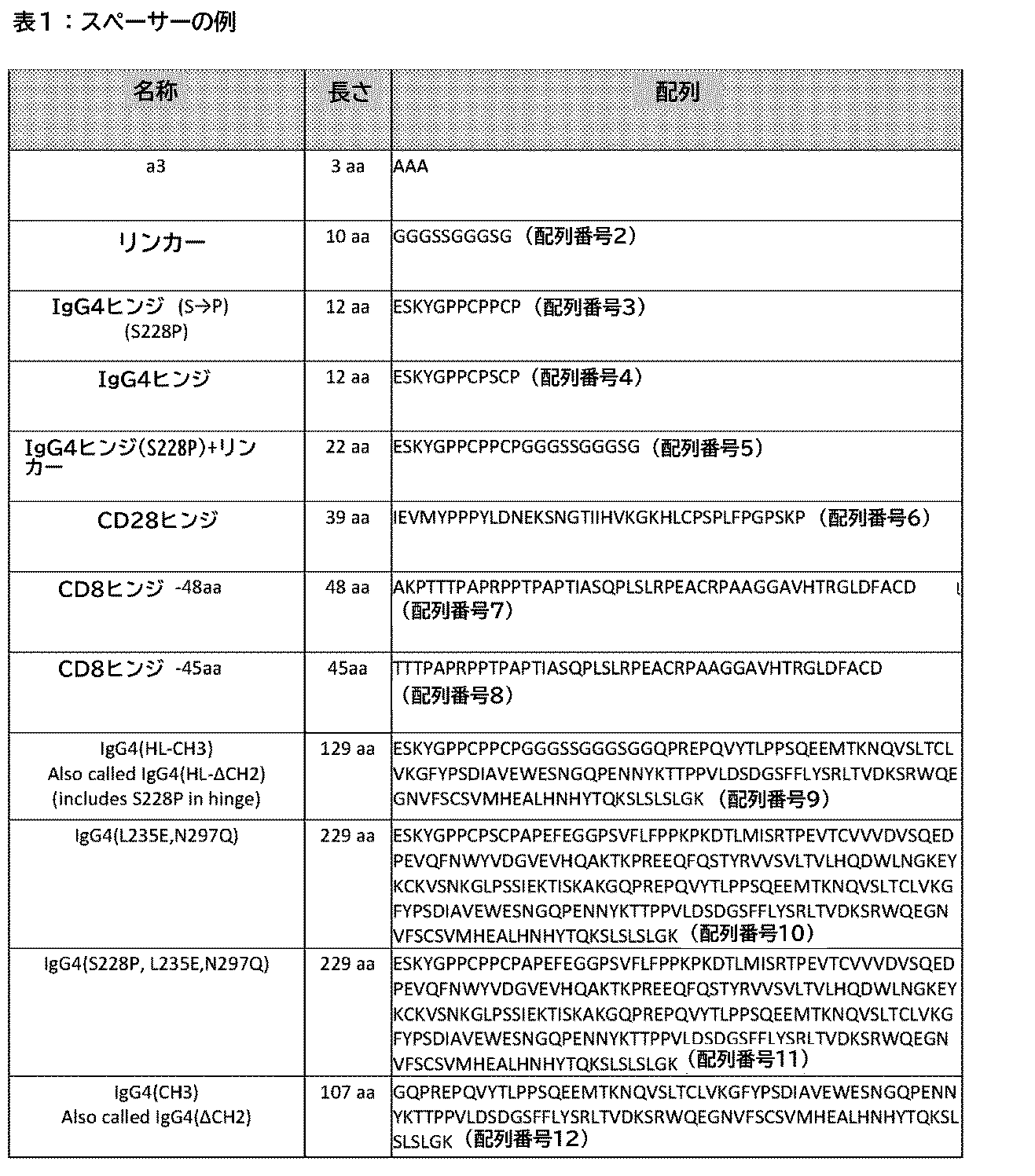
ヒンジ/リンカー領域はまた、配列がESKYGPPCPSCP(配列番号4)又はESKYGPPCPPCP(配列番号3)であるIgG4ヒンジ領域を含むことができる。ヒンジ/リンガー領域はまた、配列ESKYGPPCPPCP(配列番号3)、続いてリンカー配列GGGSSGGGSG(配列番号2)、続いてIgG4 CH3配列GQPREPQVYTLPPSQEEMTKNQVSLTCLVKGFYPSDIAVEWESNGQPENNYKTTPPVLDSDGSFFLYSRLTVDKSRWQEGNVFSCSVMHEALHNHYTQKSLSLSLGK(配列番号12)を含むことができる。従って、リンカー/スペーサードメイン全体は、ESKYGPPCPPCPGGGSSGGGSGGQPREPQVYTLPPSQEEMTKNQVSLTCLVKGFYPSDIAVEWESNGQPENNYKTTPPVLDSDGSFFLYSRLTVDKSRWQEGNVFSCSVMHEALHNHYTQKSLSLSLGK(配列番号11)という配列を含むことができる。ある場合、スペーサーは、配列番号11と比較して1、2、3、4、又は5個の単一のアミノ酸が変化(例えば、保存的変化)している。ある場合では、IgG4 Fcヒンジ/リンカー領域は、Fc受容体(FcR)による結合が低下するように、2つの位置(L235E;N297Q)で変異する。
The hinge / linker region can also include an IgG4 hinge region whose sequence is ESKYGPPCPSCP (SEQ ID NO: 4) or ESKYGPPCPPCP (SEQ ID NO: 3). The hinge / ringer region can also include the sequence ESKYGPPPCPPCP (SEQ ID NO: 3), followed by the linker sequence GGGSSGGGGSG (SEQ ID NO: 2), followed by the IgG4 CH3 sequence GQPREPQVYTLPSQUEMTKKNQVSLTCLVKGFYPSDIAVEWESNGGQPENNYKTPVLSGSLGFSLVSLVSLVSLG Therefore, the entire linker / spacer domain can contain the sequence number ESKYGPCPPCPGGGSSGGGSGGQPREPQVYTLPPPSQEEMTKNQVSLTCLVKGFYPSDIAVEWESNGQPENNYKTTPPVLDSDGSFFLYSRLTVDKSRWQEGNVFSLSLVMSVMHESLVMSLV In some cases, the spacer has 1, 2, 3, 4, or 5 single amino acid changes (eg, conservative changes) compared to SEQ ID NO: 11. In some cases, the IgG4 Fc hinge / linker region is mutated at two positions (L235E; N297Q) such that binding by the Fc receptor (FcR) is reduced.
膜貫通ドメイン
様々な膜貫通ドメインを用いることができる。表2には、適当な膜貫通ドメインが例示されている。スペーサードメインが存在する場合、膜貫通ドメイン(TM)は、スペーサードメインのカルボキシ末端に位置する。
表2:膜貫通ドメインの例
Transmembrane domain Various transmembrane domains can be used. Table 2 illustrates suitable transmembrane domains. If a spacer domain is present, the transmembrane domain (TM) is located at the carboxy terminus of the spacer domain.
Table 2: Examples of transmembrane domains

共刺激ドメインは、CD3ζシグナル伝達ドメインと共に用いるのに適したいかなるドメインであってよい。ある場合、共シグナル伝達ドメインは、KRGRKKLLYIFKQPFMRPVQTTQEEDGCSCRFPEEEEGGCEL(配列番号24)と、同一又は少なくとも90%、少なくとも95%、少なくとも98%が同一である配列があげられる4-1BB共シグナル伝達ドメインである。ある場合、当該4-1BB共シグナル伝達ドメインは、配列番号24と比較して、1、2、3、4又は5個のアミノ酸が変化(好ましくは、保存的な)している。共刺激ドメインは、膜貫通ドメインとCD3ζシグナル伝達ドメインの間に位置する。表3は、CD3ζシグナル伝達ドメインの配列と適当な共刺激ドメインを例示する。
表3: CD3ζドメインと共刺激ドメインの例
Table 3: Examples of CD3ζ domain and co-stimulation domain

CD3ζシグナル伝達ドメイン
CD3ζシグナル伝達ドメインは、CD3ζシグナル伝達ドメインと共に用いるのに適したいかなるドメインであってよい。ある場合、CD3ζシグナル伝達ドメインは、RVKFSRSADAPAYQQGQNQLYNELNLGRREEYDVLDKRRGRDPEMGGKPRRKNPQEGLYNELQKDKMAEAYSEIGMKGERRRGKGHDGLYQGLSTATKDTYDALHMQALPPR(配列番号21)と少なくとも90%、少なくとも95%、又は少なくとも98%が同一である配列を含む。ある場合、CD3ζシグナル伝達は、配列番号21と比較して、1、2、3、4又は5個のアミノ酸が変化(好ましくは、保存的な)している。
CD3ζ Signaling Domain The CD3ζ signaling domain can be any domain suitable for use with the CD3ζ signaling domain. If there is, the CD3ζ signaling domain is RVKFSRSADAPAYQQGQNQLYNELNLGRREEYDVLDKRRGRDPEMGGKPRRKNPQEGLYNELQKDKMAEAYSEIGMMKGERRRRGKGHDGLYQGLSTATKDTY at least 90% sequence, including at least SEIGMKKGERRGKGHDGLYQGLSTATKDTY. In some cases, CD3ζ signaling has 1, 2, 3, 4 or 5 amino acids altered (preferably conservative) as compared to SEQ ID NO: 21.
切断型のEGFR又はCD19
CD3ζシグナル伝達ドメインの後方には、リボソームスキップ配列(例えば、LEGGGEGRGSLLTCGDVEENPGPR;配列番号27)及び、以下の配列:
LVTSLLLCELPHPAFLLIPRKVCNGIGIGEFKDSLSINATNIKHFKNCTSISGDLHILPVAFRGDSFTHTPPLDPQELDILKTVKEITGFLLIQAWPENRTDLHAFENLEIIRGRTKQHGQFSLAVVSLNITSLGLRSLKEISDGDVIISGNKNLCYANTINWKKLFGTSGQKTKIISNRGENSCKATGQVCHALCSPEGCWGPEPRDCVSCRNVSRGRECVDKCNLLEGEPREFVENSECIQCHPECLPQAMNITCTGRGPDNCIQCAHYIDGPHCVKTCPAGVMGENNTLVWKYADAGHVCHLCHPNCTYGCTGPGLEGCPTNGPKIPSIATGMVGALLLLLVVALGIGLFM(配列番号28)
と同一又は少なくとも90%、少なくとも95%、少なくとも98%が同一である配列である、切断型EGFRが位置してよい。ある場合、当該切断型EGFRは、配列番号28と比較して、1、2、3、4又は5個のアミノ酸が変化(好ましくは、保存的な)している。あるいは、CD3ζシグナル伝達ドメインの後方には、リボソームスキップ配列(例えば、LEGGGEGRGSLLTCGDVEENPGPR;配列番号27)及び、以下の配列:
MPPPRLLFFLLFLTPMEVRPEEPLVVKVEEGDNAVLQCLKGTSDGPTQQLTWSRESPLKPFLKLSLGLPGLGIHMRPLAIWLFIFNVSQQMGGFYLCQPGPPSEKAWQPGWTVNVEGSGELFRWNVSDLGGLGCGLKNRSSEGPSSPSGKLMSPKLYVWAKDRPEIWEGEPPCVPPRDSLNQSLSQDLTMAPGSTLWLSCGVPPDSVSRGPLSWTHVHPKGPKSLLSLELKDDRPARDMWVMETGLLLPRATAQDAGKYYCHRGNLTMSFHLEITARPVLWHWLLRTGGWKVSAVTLAYLIFCLCSLVGILHLQRALVLRRKR(配列番号26)
と同一又は少なくとも90%、少なくとも95%、少なくとも98%が同一である配列である、切断型CD19R(CD19tという)が位置してよい。
Cut-type EGFR or CD19
Behind the CD3ζ signaling domain are a ribosome skip sequence (eg, LEGGGEGRGSLLTCGDVEENGPR; SEQ ID NO: 27) and the following sequences:
LVTSLLLCELPHPAFLLIPRKVCNGIGIGEFKDSLSINATNIKHFKNCTSISGDLHILPVAFRGDSFTHTPPLDPQELDILKTVKEITGFLLIQAWPENRTDLHAFENLEIIRGRTKQHGQFSLAVVSLNITSLGLRSLKEISDGDVIISGNKNLCYANTINWKKLFGTSGQKTKIISNRGENSCKATGQVCHALCSPEGCWGPEPRDCVSCRNVSRGRECVDKCNLLEGEPREFVENSECIQCHPECLPQAMNITCTGRGPDNCIQCAHYIDGPHCVKTCPAGVMGENNTLVWKYADAGHVCHLCHPNCTYGCTGPGLEGCPTNGPKIPSIATGMVGALLLLLVVALGIGLFM(配列番号28)
A truncated EGFR may be located which is the same or at least 90%, at least 95%, at least 98% identical to the sequence. In some cases, the truncated EGFR has 1, 2, 3, 4 or 5 amino acids altered (preferably conservative) as compared to SEQ ID NO: 28. Alternatively, behind the CD3ζ signaling domain, a ribosome skip sequence (eg, LEGGGEGRGSLLTCGDVEENGPR; SEQ ID NO: 27) and the following sequence:
MPPPRLLFFLLFLTPMEVRPEEPLVVKVEEGDNAVLQCLKGTSDGPTQQLTWSRESPLKPFLKLSLGLPGLGIHMRPLAIWLFIFNVSQQMGGFYLCQPGPPSEKAWQPGWTVNVEGSGELFRWNVSDLGGLGCGLKNRSSEGPSSPSGKLMSPKLYVWAKDRPEIWEGEPPCVPPRDSLNQSLSQDLTMAPGSTLWLSCGVPPDSVSRGPLSWTHVHPKGPKSLLSLELKDDRPARDMWVMETGLLLPRATAQDAGKYYCHRGNLTMSFHLEITARPVLWHWLLRTGGWKVSAVTLAYLIFCLCSLVGILHLQRALVLRRKR(配列番号26)
A truncated CD19R (referred to as CD19t) may be located which is the same or at least 90%, at least 95%, and at least 98% identical to the sequence.
「アミノ酸の修飾」は、タンパク質又はペプチド配列におけるアミノ酸置換、挿入、及び/又は欠失を意味する。「アミノ酸の置換」又は「置換」とは、親ペプチド又はタンパク質配列中の特定の位置のアミノ酸を他のアミノ酸で置換することをいう。当該置換は、非保存的様式(すなわち、コドンを、ある特定の大きさ又は特性があるアミノ酸群に属するアミノ酸から他の群に属するアミノ酸に変化させる)又は保存的様式(すなわち、コドンを、ある特定の大きさ又は特性があるアミノ酸の群に属するアミノ酸から同じ群に属するアミノ酸に変化させる)で、得られたタンパク質中のアミノ酸を変化させることができる。当該保存的変化では、一般に、結果として生じるタンパク質の構造及び機能の変化がより少なくなる。以下に、アミノ酸の様々な群分けを例示する:1)非極性R基を有するアミノ酸:アラニン、バリン、ロイシン、イソロイシン、プロリン、フェニルアラニン、トリプトファン、メチオニン;2)非荷電極性R基を有するアミノ酸:グリシン、セリン、トレオニン、システイン、チロシン、アスパラギン、グルタミン;3)荷電極性R基を有するアミノ酸(pH6.0で負に荷電):アスパラギン酸、グルタミン酸;4)塩基性アミノ酸(pH6.0で正に荷電):リジン、アルギニン、ヒスチジン(pH 6.0で正に荷電)。他の群はフェニル基をもつアミノ酸:フェニルアラニン、トリプトファン、チロシンである。 "Amino acid modification" means an amino acid substitution, insertion, and / or deletion in a protein or peptide sequence. "Amino acid substitution" or "substitution" means substituting an amino acid at a specific position in a parent peptide or protein sequence with another amino acid. The substitution is in a non-conservative mode (ie, changing a codon from an amino acid belonging to an amino acid group having a particular size or property to an amino acid belonging to another group) or a conservative mode (ie, a codon). The amino acids in the obtained protein can be changed by changing from an amino acid belonging to a group of amino acids having a specific size or property to an amino acid belonging to the same group). The conservative changes generally result in less change in the structure and function of the protein. The various groups of amino acids are illustrated below: 1) Amino acids with non-polar R groups: alanine, valine, leucine, isoleucine, proline, phenylalanine, tryptophan, methionine; 2) Amino acids with uncharged polar R groups: Glycin, serine, threonine, cysteine, tyrosine, asparagine, glutamine; 3) Amino acids with charged polar R groups (negatively charged at pH 6.0): aspartic acid, glutamic acid; 4) Basic amino acids (positively at pH 6.0) Charged): Lysine, arginine, histidine (positively charged at pH 6.0). The other group is amino acids with phenyl groups: phenylalanine, tryptophan, tyrosine.
ある場合、CARオープンリーディングフレームの後方にT2Aリボソームスキップ配列及び細胞質シグナル伝達尾部欠損切断型EGFR(EGFRt)が位置するベクターを用いて、CCR4 CAR又はCCR4ポリペプチドを産生することができる。この配列により、遺伝子修飾細胞の正の選択、ならびに養子移入後の治療用T細胞の生体内で効率的に細胞を追跡できる不活性な非免疫原性表面マーカーが提供され、EGFRtの共発現において、遺伝子修飾細胞を正確に測定できる。サイトカインストーム及び標的外毒性を回避するための増殖の効率的な制御は、T細胞免疫療法の成功にとって重要なハードルである。CCR4 CARレンチウイルスベクターに組み込まれたEGFRtは、自殺遺伝子として作用し、治療関連毒性の場合にCAR+ T細胞を除去することができる。 In some cases, a vector with the T2A ribosome skip sequence and cytoplasmic signaling tail-deficient truncated EGFR (EGFRt) located behind the CAR open reading frame can be used to produce the CCR4 CAR or CCR4 polypeptide. This sequence provides a positive selection of genetically modified cells, as well as an inactive non-immunogenic surface marker that can efficiently track cells in vivo after adoption of therapeutic T cells, in co-expression of EGFRt. , Gene modified cells can be measured accurately. Efficient control of proliferation to avoid cytokine storms and exotoxins is an important hurdle to the success of T cell immunotherapy. EGFRt integrated into the CCR4 CAR lentiviral vector acts as a suicide gene and can eliminate CAR + T cells in case of treatment-related toxicity.
本明細書中に記載されるCAR又はポリペプチドは、好ましくは組換えDNA技術を用いて製造されるが、当技術分野で公知のいかなる手段により製造することができる。キメラ受容体のいくつかの領域をコードする核酸は、当技術分野で公知の分子クローニングの標準的な技術(ゲノムライブラリースクリーニング、オーバーラップPCR、プライマー支援ライゲーション、部位特異的突然変異誘発等)により、簡便に調製し、完全なコード配列を構築することができる。得られたコード領域は、好ましくは発現ベクターに挿入され、好適な発現宿主細胞系、好ましくはTリンパ球、最も好ましくは自己Tリンパ球の形質転換に用いられる。 The CARs or polypeptides described herein are preferably produced using recombinant DNA technology, but can be produced by any means known in the art. Nucleic acids encoding several regions of the chimeric receptor are subjected to standard molecular cloning techniques known in the art (genomic library screening, overlap PCR, primer-assisted ligation, site-specific mutagenesis, etc.). , Can be easily prepared and a complete coding sequence can be constructed. The resulting coding region is preferably inserted into an expression vector and used for transformation of a suitable expression host cell line, preferably T lymphocytes, most preferably autologous T lymphocytes.
患者から単離された様々なT細胞サブセットを、CAR又はポリペプチド発現用のベクターで形質導入することができる。セントラルメモリーT細胞は、有用なT細胞サブセットの1つである。セントラルメモリーT細胞は、例えば、CliniMACS(登録商標)装置を用いて、CD45RO+/CD62L+細胞を選択することにより、末梢血単核細胞(PBMC)から単離して、所望の受容体を発現する細胞を免疫磁気的に選択することができる。セントラルメモリーT細胞用に濃縮された細胞は、抗CD3/CD28で活性化することができ、例えば、CCR4 CARの発現を指向するレンチウイルスベクター、並びにインビボ検出、アブレーション、及び潜在的ex vivo選択用の非免疫原性表面マーカーで形質導入することができる。活性化された/遺伝子修飾されたCCR4セントラルメモリーT細胞は、IL-2/IL-15を用いてインビトロで増殖させ、次いで凍結保存することができる。CAR T細胞を調製するさらなる方法は、PCT/US2016/043392に記載されている。 Various T cell subsets isolated from the patient can be transduced with CAR or a vector for polypeptide expression. Central memory T cells are one of the useful T cell subsets. Central memory T cells are isolated from peripheral blood mononuclear cells (PBMCs) by selecting CD45RO + / CD62L + cells, for example using a CliniMACS® device, to express cells expressing the desired receptor. It can be selected immunomagnetically. Cells enriched for central memory T cells can be activated with anti-CD3 / CD28, eg, a lentiviral vector directed to the expression of CCR4 CAR, and for in vivo detection, ablation, and potential ex vivo selection. Can be transduced with non-immunogenic surface markers. Activated / genetically modified CCR4 central memory T cells can be grown in vitro using IL-2 / IL-15 and then cryopreserved. Further methods of preparing CAR T cells are described in PCT / US2016 / 0433392.
有用なT細胞集団を調製する方法は、例えば、WO 2017/015490及びWO 2018/102761に記載されている。ある場合、ナチュラルキラー(NK)細胞、例えば末梢血又は臍帯血に由来する同種異系NK細胞を用いることが有用でありうる。NK細胞は、ヒト胚性幹細胞(hESC)又は誘導多能性幹細胞(iPSC)に由来する場合もある。 Methods for preparing useful T cell populations are described, for example, in WO 2017/015490 and WO 2018/102761. In some cases, it may be useful to use natural killer (NK) cells, such as allogeneic NK cells derived from peripheral or umbilical cord blood. NK cells may also be derived from human embryonic stem cells (hESC) or induced pluripotent stem cells (iPSC).
特段の限り、本明細書中で用いられる全ての技術用語及び科学用語は、本発明が属する技術分野の当業者により一般に理解されるものと同義である。本発明で用いる方法及び材料は本明細書に記載されるが、当該技術分野で公知の他の適当な方法及び材料も用いてよい。材料、方法、及び実施例は、例示に過ぎず、限定することを意図しない。本明細書に記載されている全ての刊行物、特許出願、特許、配列、データベース表示、及び他の参考文献は、全ての目的のため、その全体が参照され援用される。矛盾がある場合、定義がある場合は本明細書の記載が優先される。
本発明の他の特徴及び利点は、以下の記載及び図面、並びに特許請求の範囲から明らかであろう。
Unless otherwise specified, all technical and scientific terms used herein are synonymous with those commonly understood by one of ordinary skill in the art to which the present invention belongs. The methods and materials used in the present invention are described herein, but other suitable methods and materials known in the art may also be used. The materials, methods, and examples are exemplary only and are not intended to be limiting. All publications, patent applications, patents, sequences, database representations, and other references described herein are hereby incorporated by reference in their entirety for all purposes. In the event of any inconsistency, the description herein will prevail if there is a definition.
Other features and advantages of the present invention will be apparent from the following description and drawings, as well as the claims.
本開示では、ヒト化抗ヒトCCR4 scFv抗原結合ドメイン及び4-1BB細胞内共刺激シグナル伝達ドメインを含有するCARの生成及び抗腫瘍効果が記載される。CCR4 CAR T細胞は、複数のCCR4発現ヒトT細胞がん株に対して強力な抗原依存性細胞毒性を呈示した。ヒト白血病/リンパ腫マウス腫瘍モデルにおけるCCR4 CAR T細胞の静注生体内送達により、抗原陽性疾患が除去され、かつ、生存期間が延長された。 The present disclosure describes the generation and antitumor effects of CARs containing the humanized anti-human CCR4 scFv antigen binding domain and the 4-1BB intracellular co-stimulation signaling domain. CCR4 CAR T cells exhibited strong antigen-dependent cytotoxicity against multiple CCR4-expressing human T cell cancer lines. In vivo delivery of CCR4 CAR T cells in a human leukemia / lymphoma mouse tumor model eliminated antigen-positive disease and prolonged survival.
本開示はまた、非ホジキンリンパ腫、末梢T細胞リンパ腫(PTCL)、未分化大細胞リンパ腫、リンパ芽球性リンパ腫、前駆T細胞リンパ腫、血管免疫芽球性T細胞リンパ腫、皮膚T細胞リンパ腫(CTCL)、菌状息肉腫(MF)、セザリー症候群(SS)等の、T細胞がんである被験体の治療方法を提供する。T細胞リンパ腫は、(a)胸腺由来の原始リンパ系前駆細胞に悪性腫瘍が発生するリンパ芽球性リンパ腫;(b)T細胞前リンパ球性白血病、T細胞顆粒リンパ球性白血病、NK細胞白血病、皮膚T細胞リンパ腫(菌状息肉腫及びセザリー症候群)、未分化大細胞リンパ腫、T細胞型、腸症型T細胞リンパ腫、HTLV-1と関連するものを含む成人T細胞白血病/リンパ腫、及び血管免疫芽球性T細胞リンパ腫、並びに、皮下脂肪織性T細胞リンパ腫;かつ、
(c)最初はリンパ節傍皮質に関与するが、真の濾胞パターンには成長しない末梢性T細胞リンパ腫;を含むが、これらに限定されない。
〔実施例〕
本発明は、特許請求の範囲に記載された本発明の範囲を限定しない以下の実施例にて、さらに説明される。
材料及び方法
以下の材料及び方法を、本明細書に記載した実施例において用いた。
The present disclosure also includes non-Hodgkin's lymphoma, peripheral T-cell lymphoma (PTCL), undifferentiated large-cell lymphoma, lymphoblastic lymphoma, precursor T-cell lymphoma, vascular immunoblastic T-cell lymphoma, cutaneous T-cell lymphoma (CTCL). , A method for treating a subject with T-cell cancer, such as mycobacterial sarcoma (MF), Cesarly syndrome (SS). T-cell lymphomas are (a) lymphoblastic lymphomas in which malignant tumors develop in primordial lymphoid precursor cells derived from the thoracic gland; (b) pre-T cell lymphocytic leukemia, T cell granule lymphocytic leukemia, NK cell leukemia. , Skin T-cell lymphoma (bacterial sarcoma and cesarly syndrome), undifferentiated large-cell lymphoma, T-cell type, enteropathy-type T-cell lymphoma, adult T-cell leukemia / lymphoma including those associated with HTLV-1, and blood vessels Immunoblastic T-cell lymphoma and subcutaneous lipophilic T-cell lymphoma;
(C) Peripheral T-cell lymphomas that initially involve the paralymph node cortex but do not grow into a true follicular pattern; but are not limited to these.
〔Example〕
The present invention will be further described in the following examples which do not limit the scope of the invention described in the claims.
Materials and methods
The following materials and methods were used in the examples described herein.
[細胞株]
CEM (成人T細胞白血病株)、MT-1(成人T細胞白血病株)及びLCL(PBMCから作成;免疫不全マウスにおけるヒトセントラルメモリー由来エフェクターCD8+ T細胞の生着)細胞株(Xiuli Wang et al(2011)Blood)を、10%ウシ胎児血清(FBS、Hyclone)含有RPMI-1640(Lonza)(完全RPMI)中で培養した。293T細胞系を、10% FBS、1X AA、25mM HEPES (Irvine Scientific)、及び2mM L-グルタミン(Fisher Scientific)を含むダルベッコ改変イーグル培地(DMEM、Life Technologies)(完全DMEM)中で培養した。すべての細胞を5% CO2の37℃で培養した。HUT78細胞を20%FBSと共にIMDM(Iscove改変ダルベッコ培地;Fisher Scientific)中で培養した。
[Cell line]
CEM (adult T-cell leukemia line), MT-1 (adult T-cell leukemia line) and LCL (created from PBMC; human central memory-derived effector CD8 + T cell engraftment in immunodeficient mice) cell line (Xiuli Wang et al (Xiuli Wang et al) 2011) Blood) was cultured in RPMI-1640 (Lonza) (complete RPMI) containing 10% bovine fetal serum (FBS, Hycrone). 293T cell lines were cultured in Dulbecco's Modified Eagle's Medium (DMEM, Life Technologies) (Complete DMEM) containing 10% FBS, 1XAA, 25 mM HEPES (Irvine Scientific), and 2 mM L-Glutamine (Fisher Scientific). All cells were cultured at 37 ° C with 5% CO 2 . HUT78 cells were cultured with 20% FBS in IMDM (Iscover modified Dulbecco medium; Fisher Scientific).
[DNA構築物とレンチウイルス産生]
腫瘍細胞を、上記のように、EF1αプロモーターの制御下で、eGFP/ffluc融合を担持するeHIV7レンチウイルスを用いた形質導入により、増強された緑色蛍光タンパク質及びホタルルシフェラーゼ(eGFP/fluc)を発現するように組換えた(Lenalidomide Enhances the Function of CS1 Chimeric Antigen Receptor-Redirected T Cells Against Multiple Myeloma (Wang et al))Clinical Cancer Research 2018)。CAR構築物に用いられるヒト化scFv配列は、CCR4を標的とするモノクローナル抗体クローンh1567(非特許文献1)から得られた。
[DNA construct and lentivirus production]
Tumor cells express enhanced green fluorescent protein and firefly luciferase (eGFP / fluc) by transduction with eHIV7 lentivirus carrying eGFP / flux fusion, as described above, under the control of the EF1α promoter. Recombined as follows (Lenialidode Engineers the Function of CS1 Chemical Antigen Receptor-Redirected T Cells Aginal Multiple Myeloma (Wang et al)) Clin The humanized scFv sequence used in the CAR construct was obtained from a monoclonal antibody clone h1567 (Non-Patent Document 1) targeting CCR4.
レンチウイルスは、改変ポリエチレンイミン(PEI)介在トランスフェクション法を用いて作製した(Optimization of lentiviral vector production using polyethylenimine-mediated transfection) Yong Tang, et al. Oncology Letters. 2015)。簡潔には、293T細胞を、改変PEI法を用いてパッケージングプラスミド及びCARレンチウイルス骨格プラスミドでトランスフェクトした。ウイルス上清を3~4日後に採取した。上清を高速遠心分離により濃縮し、レンチウイルスペレットをリン酸緩衝生理食塩水(PBS)-乳糖溶液(PBS100mL当たり乳糖4g)に再懸濁し、-80℃で分注保存した。レンチウイルス力価は、EGFRt発現に基づいてjurkat細胞を用いて定量した。 Lentivirus was prepared using a modified polyethyleneimine (PEI) -mediated transfection method (Optimization of lentivial vector producation using polyethylenimine-mediated transfection). Oncology Letters. 2015). Briefly, 293T cells were transfected with the packaging plasmid and CAR lentivirus backbone plasmid using the modified PEI method. The virus supernatant was collected after 3-4 days. The supernatant was concentrated by high-speed centrifugation, and the lactose virus pellet was resuspended in phosphate buffered saline (PBS) -lactose solution (4 g of lactose per 100 mL of PBS) and stored by dispensing at -80 ° C. Lentivirus titers were quantified using jurkat cells based on EGFRt expression.
[T細胞単離、レンチウイルス形質導入、及びEx vivo増殖]
白血球除去輸血製品は、シティオブホープ内部審査会(IRB)により承認されたプロトコルに基づき、同意を得た研究参加者(健常ドナー)から入手した。白血球除去輸血の日に、末梢血単核細胞(PBMC)を、Ficoll-Paque (GEヘルスケア)上での密度勾配遠心分離、続いてPBS/EDTA (Miltenyi Biotec)で複数回洗浄して単離した。細胞を室温(RT)で回転子上に一晩静置し、次いで洗浄し、10% FBS(完全X-VIVO)を含むX-VIVO T細胞培地(Lonza)に再懸濁した。最大5.0×10⁹個のPBMCを、抗CD14及び抗CD25マイクロビーズ(MiltenyiBiotec)と共に室温で30分間インキュベートし、製造業者のプロトコルに従ってCliniMACS(登録商標)システム(MiltenyiBiotec)を用いて磁気的に除去し、これらを枯渇PBMC(dPBMC)とした。dPBMCをCryoStor(登録商標)CS5(StemCell Technologies)で、次の処理まで凍結した。
[T cell isolation, lentivirus transduction, and ex vivo proliferation]
Leukapheresis transfusion products were obtained from study participants (healthy donors) who consented to the protocol approved by the City of Hope Internal Review Board (IRB). On the day of leukocyte depletion transfusion, peripheral blood mononuclear cells (PBMC) were isolated by density gradient centrifugation on Ficoll-Paque (GE Healthcare) followed by multiple washes with PBS / EDTA (Miltenyi Biotec). did. Cells were allowed to stand on the rotor overnight at room temperature (RT), then washed and resuspended in X-VIVO T cell medium (Lonza) containing 10% FBS (complete X-VIVO). Up to 5.0 × 10 9 PBMCs are incubated with anti-CD14 and anti-CD25 microbeads (Miltenyi Biotec) for 30 minutes at room temperature and magnetically using the CliniMACS® system (Miltenyi Biotec) according to the manufacturer's protocol. They were removed and these were designated as depleted PBMC (dPBMC). The dPBMC was frozen in CryoStor® CS5 (StemCell Technologies) until the next treatment.
T細胞の活性化及び形質導入は、上記のように実施した(Co-stimulatory signaling determines tumor antigen sensitivity and persistence of CAR T cells targeting PSCA+ metastatic prostate cancer. Priceman Saul J, et al. 2018. Oncoimmunology)。簡潔には、新たに解凍したdPBMCを1回洗浄し、100U/mL組換えヒトIL-2(rhIL-2、Novartis Oncology)及び0.5ng/mL組換えヒトIL-15(rhIL-15、CellGenix)含有完全X-VIVO中で培養した。CARレンチウイルス形質導入のため、T細胞を、CD3/CD28 ダイナビーズ(登録商標)(LifeTechnologies)、硫酸プロタミン(APP Pharmaceuticals)、サイトカイン混合物(上記のように)、及びビーズ刺激の翌日の1-3の感染多重度(MOI)で所望のレンチウイルスと共に培養した。次いで、細胞を培養し、2~3日毎にサイトカインを含む新鮮な完全X-VIVOで補充した。7日後、ビーズを磁気的に除去し、細胞を、サイトカインを含む完全X-VIVO中でさらに増殖させて所望の細胞収率を達成させた。さらなる拡張後、細胞を、インビトロ機能アッセイ及びインビボ腫瘍モデルの前に、CryoStor(登録商標)CS5中で凍結した。 T cell activation and transduction were carried out as described above (Co-stimulation singing data tumor antigen sensitivity and persistence of CAR T cells targeting PSCA + metastasis. Briefly, freshly thawed dPBMC was washed once to 100 U / mL recombinant human IL-2 (rhIL-2, Novartis Oncology) and 0.5 ng / mL recombinant human IL-15 (rhIL-15, CellGenix). ) Cultivated in complete X-VIVO containing. For CAR lentivirus transduction, T cells were subjected to CD3 / CD28 Dynabeads® (Life Technologies), protamine sulfate (APP Pharmaceuticals), cytokine mixture (as above), and 1-3 the day after bead stimulation. Infected with the desired lentivirus at the multiplicity of infection (MOI). Cells were then cultured and supplemented with fresh complete X-VIVO containing cytokines every 2-3 days. After 7 days, the beads were magnetically removed and the cells were further grown in complete X-VIVO containing cytokines to achieve the desired cell yield. After further expansion, cells were frozen in CryoStor® CS5 prior to in vitro function assays and in vivo tumor models.
[フローサイトメトリー]
フローサイトメトリー分析用に、細胞をFACS緩衝液(2% FBS及び1×AAを含み、Ca2+、Mg2+又はフェノールレッドを含まないHankの平衡食塩溶液(HBSS-/-、Life Technologies))に再懸濁した。細胞を一次抗体と共に暗所4℃で30分間インキュベートした。二次染色には、Brilliant Violet 510(BV510)、フルオレセインイソチオシアネート(FITC)、フィコエリトリン(PE)、ペリジニンクロロフィルタンパク質複合体(PerCP)、PerCP-Cy5.5、PE-Cy7、アロフィコシアニン(APC)又はAPC-Cy7(又はAPC-eFluor780)結合抗体を用いて、暗所で4℃30分間インキュベートする前に細胞を2回洗浄した。CD3(BD Biosciences、クローン:SK7)、CD4(BD Biosciences、クローン:SK3)、CD8(BD Biosciences、クローン:SK1)、CD14(BD Biosciences、クローン:MΦP9)、CD19(BD Biosciences、クローン:SJ25C1)、CD25(BD Biosciences、クローン:2A3)、マウスCD45(BioLegend、クローン:30-F11)、CD45(BD Biosciences、クローン:2D1)、CD69(BD Biosciences、クローン:L78)、CD137(BD Biosciences、クローン:4B4-1)、MUC1(Biolegend、クローン:16A)、ビオチン化Protein-L(GenScript USA)、CCR4(クローン:L291H4)、及びストレプトアビジン(BD Biosciences)の抗体を用いた。細胞生存率は、4’、6-ジアミジノ-2-フェニルインドール(DAPI、Sigma)を用いて測定した。フローサイトメトリーをMACSQuant Analyzer 10(Miltenyi Biotec)で行い、データをFlowJoソフトウェア(v10、TreeStar)で分析した。
[Flow cytometry]
For flow cytometric analysis, cells were placed in FACS buffer (Hank's equilibrium saline solution (HBSS − / − , Life Technologies) containing 2% FBS and 1 × AA and not Ca 2+ , Mg 2+ or phenol red). Resuspended. Cells were incubated with primary antibody at 4 ° C. in the dark for 30 minutes. Secondary staining includes Brilliant antibody 510 (BV510), fluorescein isothiocyanate (FITC), phycoerythrin (PE), peridinin chlorophyll protein complex (PerCP), PerCP-Cy5.5, PE-Cy7, allophycocyanin (APC). Alternatively, cells were washed twice with an APC-Cy7 (or APC-eFluor780) -binding antibody before incubating in the dark at 4 ° C. for 30 minutes. CD3 (BD Biosciences, clone: SK7), CD4 (BD Biosciences, clone: SK3), CD8 (BD Biosciences, clone: SK1), CD14 (BD Biosciences, clone: MΦP9), CD19 (BDiCences, clone: MΦP9), CD19 CD25 (BD Biosciences, clone: 2A3), mouse CD45 (BioLegend, clone: 30-F11), CD45 (BD Biosciences, clone: 2D1), CD69 (BD Biosciences, clone: L78), CD137 (BDBiosciences, clone: L78), CD137 (BDBiosciences) -1), MUC1 (Biolegend, clone: 16A), biotinylated Protein-L (GenScript USA), CCR4 (clone: L291H4), and streptavidin (BD Biosciences) antibodies were used. Cell viability was measured using 4', 6-diamidino-2-phenylindole (DAPI, Sigma). Flow cytometry was performed with MACSQuant Analyzer 10 (Miltenyi Biotec) and the data was analyzed with FlowJo software (v10, TreeStar).
[生体外腫瘍キリングアッセイ及び再投与アッセイ]
腫瘍キリングアッセイ用に、CAR T細胞及び腫瘍標的を、96穴プレート中の外因性サイトカインの非存在下で、完全X-VIVO中の示されたエフェクター:腫瘍(E:T)比で24~72時間共培養し、上記のようにフローサイトメトリーで分析した。CAR T細胞による腫瘍死滅は、標的をMock(非形質導入)T細胞と共培養した場合に観察されたものと比較したGFP陽性腫瘍細胞数から算出した。再投与アッセイについては、キリングアッセイの完了から24~72時間後に、CAR T細胞及び腫瘍標的を、外因性サイトカインの非存在下で、完全X-VIVO中の示されたエフェクター:腫瘍(E:T)比で再度24~72時間共培養し、上記のようにフローサイトメトリーにより分析した。
[In vitro tumor killing assay and re-administration assay]
For tumor killing assays, CAR T cells and tumor targets were subjected to the indicated effector: tumor (E: T) ratio in complete X-VIVO in the absence of exogenous cytokines in 96-well plates 24-72. It was co-cultured for hours and analyzed by flow cytometry as described above. Tumor death by CAR T cells was calculated from the number of GFP-positive tumor cells compared to those observed when the target was co-cultured with Mock (non-transduced) T cells. For the re-administration assay, 24-72 hours after completion of the killing assay, CAR T cells and tumor targets were subjected to the indicated effector: tumor (E: T) in complete X-VIVO in the absence of exogenous cytokines. ) The ratio was again co-cultured for 24-72 hours and analyzed by flow cytometry as described above.
[生体内腫瘍試験]
すべての動物実験は、シティオブホープ施設動物ケア及び使用委員会が承認したプロトコルに基づいて実施した。生体内腫瘍研究のために、CEM細胞(3.0×10⁶)を150μlの最終容量のHBSS-/-中に調製し、6~8週齢の雌又は雄のNSGマウスに注射により生着させた。ある実施形態では、生着は、皮下注射(s.c.)又は静脈内(i.v.)注射を含む。腫瘍の増殖は、少なくとも週1回、バイオホトニック画像(Xenogen、LagoX)により追跡し、フラックスシグナルをLiving Imageソフトウェア(Xenogen)で分析した。画像化用に、マウスに、4.29mg/マウスのPBS中に懸濁した150μLのD-ルシフェリンカリウム塩(Perkin Elmer)を腹腔内注射した。ひとたびフラックスシグナルが所望のレベルに達したら、4日目又は5日目のT細胞を1X PBS中で調製し、マウスに3.0×10⁶ Mock又はCCR4 CAR2 T細胞を150μL静脈内(i.v.)注射した。CEM腫瘍モデルでは、4日目から静注CCR4 EQ CAR T細胞による治療の影響を検討した。人道的エンドポイントを用いて生存期間を決定した。マウスは、呼吸困難、明らかな体重減少、運動能力の低下、又は病的な状態等の苦痛の兆候が見られた時点で安楽死させた。所定の時点又は瀕死状態で、マウスを安楽死させ、組織を回収し、以下に記載のフローサイトメトリー用及び/又は免疫組織化学用に処理した。
ヘパリン/PBS溶液(1000単位/mL、Sagent Pharmaceuticals)を含むポリスチレンチューブにヘパリン処理したキャピラリーチューブ(Chase Scientific)を通して、イソフルラン麻酔マウスから後眼窩出血により末梢血を採取した。各RO採血量(約120μL/マウス)を血液1μL当たりの細胞定量用に記録した。赤血球(RBC)を、製造業者のプロトコルに従って1×赤血球溶解緩衝液(Sigma)で溶解し、次いで、洗浄し、染色し、上記のようにフローサイトメトリーで分析した。
[In vivo tumor test]
All animal studies were performed according to a protocol approved by the City of Hope Facility Animal Care and Use Committee. For in vivo tumor studies, CEM cells (3.0 × 10⁶ ) were prepared in 150 μl final volume of HBSS − / − and engrafted by injection into 6-8 week old female or male NSG mice. I let you. In certain embodiments, engraftment comprises subcutaneous (sc) or intravenous (iv) injection. Tumor growth was followed at least once weekly by biophotonic imaging (Xenogen, LagoX) and flux signals were analyzed with Living Image software (Xenogen). For imaging, mice were injected intraperitoneally with 150 μL of D-luciferin potassium salt (PerkinElmer) suspended in 4.29 mg / mouse PBS. Once the flux signal reached the desired level,
Peripheral blood was collected from isoflurane-anesthetized mice by posterior orbital hemorrhage through a heparinized capillary tube (Case Scientific) in a polystyrene tube containing a heparin / PBS solution (1000 units / mL, Sagent Pharmaceuticals). Each RO blood draw (approximately 120 μL / mouse) was recorded for cell quantification per 1 μL of blood. Red blood cells (RBC) were lysed with 1x erythrocyte lysis buffer (Sigma) according to the manufacturer's protocol, then washed, stained and analyzed by flow cytometry as described above.
異なるリンカーを含むCCR4 CAR T細胞の構築
以下の研究では、CCR4 CARが初代T細胞上で安定に発現されうることを示す。
CAR構築物を標的化する3つのCCR4を設計した(図1及び2)。3つの構築物はすべて、同じコドンを最適化したヒト化CCR4単鎖可変断片を発現した。CAR構築物はまた、CD4膜貫通ドメイン(TM)、4-1BB共刺激ドメイン、CD3ゼータドメインも含んでいた。CARは、CAR構築物と共に細胞の形質導入の成功についてのマーカーとして役立つ切断EGFRと共発現された。3つのCCR4 CAR構築物は各々リンカーが異なる(図2)。理論に拘束されることなく、構築物の細胞外部分の長さが異なることで、抗原結合後に抗原に結合し、活性化シグナルを伝達するCARの機能が相違する可能性がある。これらの相違により、CCR4を発現する腫瘍細胞に対する殺傷能が異なる可能性がある(図1)。
既報(Priceman SJ,Gerdts EA,Tilakawardane D,Kennewick KT,Murad JP,Park AK,Jeang B,Yamaguchi Y,Yang X,Urak R,Weng L,Chang WC,Wright S,Pal S,Reiter RE,Wu AM,Brown CE,Forman SJ.Co-stimulatory signaling determines tumor antigen sensitivity and persistence of CAR T cells targeting PSCA+ metastatic prostate cancer.Oncoimmunology.2018;7(2):e1380764)や、濃縮T細胞(EasySep Human T cell isolation Kit.StemCell Technologies)等の他の種類の細胞のように、CCR4 CARレンチウイルスを用いて、CD14+及びCD25+細胞(dPBMC)を除去したヒト健常ドナー由来の末梢血単核細胞を形質導入した。トラッキングマーカーとしてEGFRtを用いて、フローサイトメトリーを用いて、上記のようにCAR発現を示した。3つのCCR4 CAR構築物は全て、T細胞において安定的に発現した(図4)。dPBMC細胞を形質導入してから7日後、細胞を抗CD3で染色してT細胞を標識し、CCR4 CAR構築物の取り込みの成功を標示するように抗EGFRで染色した。CCR4 L CAR、CCR4 EQ CAR、及びCCR4±CH2 CARはすべて、形質導入後7日目に安定して発現し(図4)、EGFRの発現は、形質導入開始後28日目まで安定であることが示された(データは示さず)。
Construction of CCR4 CAR T cells with different linkers The following studies show that CCR4 CAR can be stably expressed on primary T cells.
Three CCR4s were designed to target CAR constructs (FIGS. 1 and 2). All three constructs expressed the same codon-optimized humanized CCR4 single chain variable fragment. The CAR construct also included a CD4 transmembrane domain (TM), a 4-1BB co-stimulation domain, and a CD3 zeta domain. CAR was co-expressed with the truncated EGFR, which, along with the CAR construct, served as a marker for successful cell transduction. Each of the three CCR4 CAR constructs has a different linker (Fig. 2). Without being bound by theory, different lengths of the extracellular components of the construct may result in different functions of CAR that binds to the antigen after antigen binding and transmits the activation signal. Due to these differences, the killing ability of tumor cells expressing CCR4 may differ (Fig. 1).
Previously reported (Priceman SJ, Gerds EA, Tirakawardane D, Kennewick KT, Murad JP, Park AK, Jang B, Yamaguchi Y, Yang X, Urak R, Weng L, Cell, Cell, Cell, Cell, Cell Brown CE,Forman SJ.Co-stimulatory signaling determines tumor antigen sensitivity and persistence of CAR T cells targeting PSCA+ metastatic prostate cancer.Oncoimmunology.2018;7(2):e1380764)や、濃縮T細胞(EasySep Human T cell isolation Kit. Peripheral blood mononuclear cells from healthy human donors from which CD14 + and CD25 + cells (dPBMC) had been removed were transfected with CCR4 CAR lentivirus, such as other types of cells (StemCell Technologies). CAR expression was shown as described above using EGFRt as a tracking marker and flow cytometry. All three CCR4 CAR constructs were stably expressed in T cells (Fig. 4). Seven days after transduction of dPBMC cells, the cells were stained with anti-CD3 to label T cells and stained with anti-EGFR to indicate successful uptake of the CCR4 CAR construct. CCR4 L CAR, CCR4 EQ CAR, and CCR4 ± CH2 CAR were all stably expressed 7 days after transduction (Fig. 4), and EGFR expression was stable until 28 days after the start of transduction. Was shown (data not shown).
T細胞集団におけるCCR4の発現
以下の研究では、PBMC(CD14-、CD25-)及びpan-T細胞等の異なるT細胞亜集団におけるCCR4 CAR T細胞の増殖及び活性を検討した。
CAR T細胞の産生に用いられるT細胞集団の出発物は、CAR T細胞の標的細胞除去能に影響を及ぼす可能性がある。また、14日間の製造プロセス中の細胞の増殖に差異がある可能性がある。
発明者らは、同一の健常ドナー由来の異なるT細胞集団に3つの異なるCCR4 CAR構築物を形質導入し(図1)、13日間にわたって細胞の生細胞数を追跡した。CCR4 EQ CAR及びCCR4 #CH2 CARの増殖は、全体的に最も良好であった(図6A~6B)。発明者らは、開始時期が異なるT細胞集団において、異なる健常ドナーから生成されたCCR4 L CAR細胞を用いた複数の独立した研究において、CCR4 L CARの増殖が不良であることを見出した(データは示さず)。
Expression of CCR4 in T cell populations The following studies examined the proliferation and activity of CCR4 CAR T cells in different T cell subpopulations such as PBMC (CD14-, CD25-) and pan-T cells.
The starting point of the T cell population used to produce CAR T cells can affect the ability of CAR T cells to remove target cells. There may also be differences in cell proliferation during the 14-day manufacturing process.
The inventors transduced three different CCR4 CAR constructs into different T cell populations from the same healthy donor (FIG. 1) and tracked the viable cell count for 13 days. Proliferation of CCR4 EQ CAR and CCR4 # CH2 CAR was the best overall (FIGS. 6A-6B). The inventors found that CCR4 L CAR proliferation was poor in multiple independent studies using CCR4 L CAR cells generated from different healthy donors in T cell populations with different initiation times (data). Is not shown).
CCR4 CAR T細胞が生体外でCCR4陽性細胞を選択的に標的とすることの検証
CCR4 CAR T細胞がCCR4陽性がん細胞に対して選択的活性を示すかを判定するために、CCR4 CAR T細胞をCCR4陽性がん細胞又はCCR4陰性がん細胞のいずれかの存在下で増殖させ、死滅したがん細胞の比率を定量した。
発明者らのCCR4 CAR T細胞の抗原依存性活性を評価するため、CCR4陽性腫瘍標的及びCCR4陰性腫瘍標的を用いた共培養アッセイをE:T比1:2~1:10で行い、その殺傷能を測定した。用いたCCR4陽性T細胞腫瘍株はMT-1及びCEMであった。用いたCCR4陰性細胞株は、B細胞腫瘍細胞株であるLCLであった。CCR4 EQ CAR T細胞と腫瘍細胞を、10個の腫瘍細胞につき1個のT細胞の比率で共培養した(1:10 E:T)。フローサイトメトリーを用いて、48時間後に腫瘍細胞の殺傷(%特異的溶解)を試験した。
48時間後、CEM腫瘍系(図7B、上部)及びMT-1腫瘍細胞系(図7C、上部)では、Mock T細胞に対するCCR4 EQ CAR T細胞の、抗原特異的T細胞媒介性殺傷活性が明らかであった。CCR4 EQ CAR2 T細胞は、CEM腫瘍株(図7B、上部)及びMT-1腫瘍細胞株(図7C、上部)の両方で、100%の溶解か、又はほぼ溶解して、持続的な殺傷能を示した。E:Tが1:10のこれらの結果は、CCR4 EQ CAR T細胞の強力な殺傷能を示す。CCR4 EQ CAR T細胞は、CCR4陰性LCL細胞を最小限殺傷した(図7D、上)。CCR4 L CAR T細胞及びCCR4±CH2 CAR T細胞もCCR4+腫瘍細胞を殺傷した(データは示さず)。
さらに、CCR4 EQ CAR T細胞が再投与された場合に腫瘍細胞を殺傷が持続するかを試験するため、CAR T細胞と腫瘍細胞を1:2(1 T細胞:2 腫瘍細胞)の比率で48時間培養した。48時間後、共培養ウェルにさらなる腫瘍細胞を1:2のE:Tで添加し、さらに48時間後、フローサイトメトリーを用いて腫瘍細胞の%特異的溶解を測定した。驚くべきことに、CCR4 EQ CAR T細胞は、再投与された場合でもCCR4+腫瘍株に対する殺傷能を備えていたことが見出された(図7B~7C、下)。CCR4 L CAR T細胞及びCCR4 #CH2 CAR T細胞はともに、再投与した場合にCCR4+腫瘍細胞を殺傷した(データは示さず)。
Verification that CCR4 CAR T cells selectively target CCR4-positive cells in vitro To determine whether CCR4 CAR T cells exhibit selective activity against CCR4-positive cancer cells, CCR4 CAR T cells Was grown in the presence of either CCR4-positive or CCR4-negative cancer cells, and the proportion of dead cancer cells was quantified.
In order to evaluate the antigen-dependent activity of CCR4 CAR T cells of the inventors, a co-culture assay using a CCR4-positive tumor target and a CCR4-negative tumor target was performed at an E: T ratio of 1: 2 to 1:10, and the killing thereof was performed. The ability was measured. The CCR4-positive T cell tumor strains used were MT-1 and CEM. The CCR4-negative cell line used was LCL, a B cell tumor cell line. CCR4 EQ CAR T cells and tumor cells were co-cultured at a ratio of 1 T cell per 10 tumor cells (1:10 E: T). Tumor cell killing (% specific lysis) was tested after 48 hours using flow cytometry.
After 48 hours, CEM tumor lineage (Fig. 7B, top) and MT-1 tumor cell line (Fig. 7C, top) reveal antigen-specific T cell-mediated killing activity of CCR4 EQ CAR T cells against Mock T cells. Met. CCR4 EQ CAR2 T cells are 100% lysed or nearly lysed in both CEM tumor cell lines (Fig. 7B, top) and MT-1 tumor cell lines (Fig. 7C, top) for sustained killing potential. showed that. These results with an E: T of 1:10 indicate a potent killing ability of CCR4 EQ CAR T cells. CCR4 EQ CAR T cells killed minimally CCR4-negative LCL cells (Fig. 7D, top). CCR4 L CAR T cells and CCR4 ± CH2 CAR T cells also killed CCR4 + tumor cells (data not shown).
In addition, to test whether tumor cell killing persists when CCR4 EQ CAR T cells are re-administered, CAR T cells to tumor cells at a ratio of 1: 2 (1 T cells: 2 tumor cells) 48 It was cultured for hours. After 48 hours, additional tumor cells were added to the co-culture wells at a ratio of 1: 2 E: T, and after an additional 48 hours,% specific lysis of tumor cells was measured using flow cytometry. Surprisingly, CCR4 EQ CAR T cells were found to be capable of killing CCR4 + tumor strains even when re-administered (FIGS. 7B-7C, bottom). Both CCR4 L CAR T cells and CCR4 # CH2 CAR T cells killed CCR4 + tumor cells when re-administered (data not shown).
生体内悪性T細胞マウスモデルの確立
CCCR4 CAR T細胞の生体内での治療可能性を評価するため、様々な注射経路を用いる3つのマウスモデルを確立した。
ヒトエンドポイントを用いて、悪性T細胞系を発現するCCR4で生着したNSGマウスの生存曲線を決定した。マウスは、呼吸困難、明らかな体重減少、運動能力の低下、又は病的な状態等の苦痛の兆候が見られた時点で安楽死させた。マウスに、HUT78、CEM、及びMT-1が送達された細胞を、全身に又は局所に、腹腔内、皮下及び静脈内注射により、生着させた(図8)。
Establishment of in vivo malignant T cell mouse model In order to evaluate the therapeutic potential of CCCR4 CAR T cells in vivo, three mouse models using various injection routes were established.
Human endpoints were used to determine the survival curve of CCR4 engrafted NSG mice expressing a malignant T cell line. Mice were euthanized when they showed signs of distress such as dyspnea, apparent weight loss, decreased athletic performance, or morbidity. Mice were engrafted with cells delivered with HUT78, CEM, and MT-1 systemically or locally by intraperitoneal, subcutaneous, and intravenous injection (FIG. 8).
マウスモデルの生体内で送達されたCCR4 CAR T細胞が強力な抗腫瘍活性を示し、マウスの生存期間が延びることの検証
CEMモデルにおいて、CCR4陽性細胞を選択的に標的とするCCR4 CAR T細胞の生体内での効能を評価するため、CCR4 CAR T細胞を送達し、腫瘍の大きさ及び生存期間を経時的に評価した。
CEM細胞をレンチウイルスで形質導入してホタルルシフェラーゼ(fluc)を発現させて、非侵襲的光学イメージングで腫瘍増殖を追跡した。腫瘍皮下注射の4日後に、マウスを、全身静脈内(i.v.)送達で、Mock又はCCR4 EQ CAR2 T細胞(3.0×10⁶)で処理した(図9A)。CCR4 EQ CAR T細胞を静注投与したマウスでは、迅速な抗腫瘍効果が観察され、投与後1~2週間で最大の抗腫瘍反応に達した。マウスにおける抗腫瘍反応は3~4週間持続したが、最終的にはマウスで腫瘍再発が観察された。CCR4 EQ CAR T細胞の送達により、マウスの生存期間が有意に延長された(図9B及び図11)。
Verification that CCR4 CAR T cells delivered in vivo in a mouse model exhibit strong antitumor activity and prolong the survival of mice In a CEM model, CCR4 CAR T cells that selectively target CCR4 positive cells To assess efficacy in vivo, CCR4 CAR T cells were delivered and tumor size and survival were assessed over time.
CEM cells were transduced with lentivirus to express firefly luciferase (fluc) and tumor growth was followed by non-invasive optical imaging. Four days after subcutaneous injection of the tumor, mice were treated with Mock or CCR4 EQ CAR2 T cells (3.0 × 10⁶ ) by systemic intravenous (iv) delivery (FIG. 9A). In the mice to which CCR4 EQ CAR T cells were administered intravenously, a rapid antitumor effect was observed, and the maximum antitumor response was reached 1 to 2 weeks after the administration. The antitumor response in the mice lasted for 3-4 weeks, but eventually tumor recurrence was observed in the mice. Delivery of CCR4 EQ CAR T cells significantly prolonged the survival of mice (FIGS. 9B and 11).
マウスモデルの生体内で送達されたCCR4 CAR T細胞が強力な抗腫瘍活性を示し、マウスの生存期間が長期化することの検証
播種モデルにおけるCCR4 CAR T細胞の生体内での効能を評価するため、CCR4 CAR T細胞をHUT78マウスモデルに送達し、腫瘍の大きさと生存期間を経時的に評価した。
HUT78を、20%FBS含有IMDM(Iscove改変ダルベッコ培地;Fisher Scientific)中で培養した。HUT78生体内モデルでは、CD4及びCD8は、PBMCと抗CD4及び抗CD8マイクロビーズ(Miltenyi Biotech)とのインキュベーションを介して、PBMC由来の細胞を濃縮した。用いた他のT細胞集団は、PBMCの負の選択によって生成されたT細胞であった。幹細胞からのヒトT細胞単離キットも用いた。
生体内腫瘍研究のため、HUT78細胞(1.0×10⁶)を150μlのHBSS-/-の最終容量中に調製し、6~8週齢の雌又は雄のNSGマウスに注射により生着させた。HUT78動物モデルは広く普及しているモデルである。ある実施形態では、生着は、皮下注射(s.c.)又は静脈内(i.v.)注射を含む。HUT78細胞をレンチウイルスで形質導入してホタルルシフェラーゼ(ffluc)を発現させることで、非侵襲的光学イメージングによる腫瘍増殖を追跡した。腫瘍静脈内注射の10日後、マウスをMock又はCCR4 EQ CAR2 T細胞(3.0×10⁶)で全身静脈内(i.v.)により処理した(図12A)。抗腫瘍効果は、処理後にCCR4 EQ CAR T細胞で処理したマウスで観察された。CCR4 EQ CAR T細胞の送達により、マウスの生存期間は有意に延長された(図12B)。
Verification that CCR4 CAR T cells delivered in vivo in a mouse model show strong antitumor activity and prolong the survival of mice To evaluate the efficacy of CCR4 CAR T cells in vivo in a seeded model , CCR4 CAR T cells were delivered to a HUT78 mouse model and tumor size and survival were evaluated over time.
HUT78 was cultured in IMDM (Iscover modified Dulbecco medium; Fisher Scientific) containing 20% FBS. In the HUT78 in vivo model, CD4 and CD8 enriched PBMC-derived cells via incubation of PBMC with anti-CD4 and anti-CD8 microbeads (Miltenyi Biotec). The other T cell population used was T cells produced by negative selection of PBMCs. A human T cell isolation kit from stem cells was also used.
For in vivo tumor studies, HUT78 cells (1.0 × 10⁶ ) were prepared in a final volume of 150 μl HBSS − / − and engrafted in 6-8 week old female or male NSG mice by injection. rice field. The HUT78 animal model is a widely used model. In certain embodiments, engraftment comprises subcutaneous (sc) or intravenous (iv) injection. HUT78 cells were transduced with lentivirus to express firefly luciferase (ffluc) to track tumor growth by non-invasive optical imaging. Mice were treated with Mock or CCR4 EQ CAR2 T cells (3.0 × 10⁶ ) intravenously (iv) 10 days after intravenous tumor injection (FIG. 12A). Antitumor effects were observed in mice treated with CCR4 EQ CAR T cells after treatment. Delivery of CCR4 EQ CAR T cells significantly prolonged the survival of mice (Fig. 12B).
誘導性CCR4 CAR T細胞
ある状況では、CCR4 CARの発現を制御することが望ましい。例えば、ベクターをT細胞の集団に導入した後、細胞を増殖させて、治療に用いるのに十分な数の細胞を調製する。この増殖段階では、CCR4 CARの発現を減少させるか、又はほぼ消失させることが望ましく、例えば、いかなるフラトリサイドをも減少させることが望ましい。Tet-Off制御を用いるシステムは有用でありうる(Das et al.2016 Current Gene Therapy 16:156)。従って、CCR4 CARの発現用の発現ベクターは、tetオペレーターの数コピー及び最小限のプロモーターを含む誘導性プロモーターの制御下でCCR4 CARを発現することができる。ベクターはまた、TetRに融合したVP16のドメインの転写活性化を含む融合タンパク質をコードすることができる。テトラサイクリン又はドキシサイクリンの存在下では、CCR4 CARの発現が抑制される。テトラサイクリン又はドキシサイクリンが存在しない場合、CCR4が発現される。したがって、CCR4 CARをコードする核酸があるT細胞は、CCR4 CAR発現が抑制される条件下で増殖することができる。所望の数の細胞が得られると、テトラサイクリン又はドキシサイクリンを除去して発現を誘導する。
図13Aは、4つの誘導可能なCCR4 CAR構築物の概略図を示す。図13Bは、誘導性CAR1(CD19tを有するCCR4 EQ)のプラスミドマップを示す。図13Cは、誘導性CAR2(CD19tを有するCCR4 CH3)のプラスミドマップを示す。図13Dは、誘導性CAR3(CCR4 EQ)のプラスミドマップを示す。図13Eは、誘導性CAR4(CCR4 CH3)のプラスミドマップを示す。
Inducible CCR4 CAR T cells In some situations, it is desirable to control the expression of CCR4 CAR. For example, after introducing the vector into a population of T cells, the cells are grown to prepare a sufficient number of cells for therapeutic use. In this growth step, it is desirable to reduce or nearly eliminate the expression of CCR4 CAR, for example, to reduce any fratricide. Systems using Tet-Off control can be useful (Das et al. 2016 Current Gene Therapy 16: 156). Thus, an expression vector for the expression of CCR4 CAR can express CCR4 CAR under the control of an inducible promoter containing a few copies of the tet operator and a minimal promoter. The vector can also encode a fusion protein containing transcriptional activation of the domain of VP16 fused to TetR. In the presence of tetracycline or doxycycline, the expression of CCR4 CAR is suppressed. In the absence of tetracycline or doxycycline, CCR4 is expressed. Therefore, T cells with nucleic acids encoding CCR4 CAR can proliferate under conditions where CCR4 CAR expression is suppressed. Once the desired number of cells is obtained, tetracycline or doxycycline is removed to induce expression.
FIG. 13A shows a schematic diagram of four inducible CCR4 CAR constructs. FIG. 13B shows a plasmid map of inducible CAR1 (CCR4 EQ with CD19t). FIG. 13C shows a plasmid map of inducible CAR2 (CCR4 CH3 with CD19t). FIG. 13D shows a plasmid map of inducible CAR3 (CCR4 EQ). FIG. 13E shows a plasmid map of inducible CAR4 (CCR4 CH3).
他の実施形態
本発明をその詳細な説明と組み合わせて記載してきたが、上記の説明は例示を意図し、付随する特許請求の範囲に定義される本発明の範囲を限定することを意図しないことが理解されるであろう。他の態様、利点、及び変更は特許請求の範囲内に内在する。
全ての参考文献は、全ての目的のためにその全体が本明細書に援用される。
Other Embodiments Although the present invention has been described in combination with its detailed description, the above description is intended to be exemplary and not intended to limit the scope of the invention as defined in the accompanying claims. Will be understood. Other aspects, advantages, and changes are inherent in the claims.
All references are incorporated herein by reference in their entirety for all purposes.
Claims (26)
自己又は同種のヒトT細胞の集団を提供し、かつ、
請求項1に記載の核酸分子を含むベクターにより、T細胞を形質導入する
、ことを含む、CCR4 CAR T細胞を調製する方法であって、ここで、
T細胞は、PBMC細胞を含む、方法。 below:
Provides a population of autologous or allogeneic human T cells and
A method for preparing CCR4 CAR T cells, which comprises transducing T cells with a vector containing the nucleic acid molecule according to claim 1, wherein the T cells are prepared.
A method in which T cells include PBMC cells.
Priority Applications (1)
| Application Number | Priority Date | Filing Date | Title |
|---|---|---|---|
| JP2025101926A JP2025157227A (en) | 2019-05-24 | 2025-06-18 | CCR4-targeted chimeric antigen receptor-modified T cells for the treatment of CCR4-positive malignancies |
Applications Claiming Priority (3)
| Application Number | Priority Date | Filing Date | Title |
|---|---|---|---|
| US201962852934P | 2019-05-24 | 2019-05-24 | |
| US62/852,934 | 2019-05-24 | ||
| PCT/US2020/034389 WO2020243007A1 (en) | 2019-05-24 | 2020-05-22 | Ccr4 targeted chimeric antigen receptor modified t cells for treatment of ccr4 positive malignancies |
Related Child Applications (1)
| Application Number | Title | Priority Date | Filing Date |
|---|---|---|---|
| JP2025101926A Division JP2025157227A (en) | 2019-05-24 | 2025-06-18 | CCR4-targeted chimeric antigen receptor-modified T cells for the treatment of CCR4-positive malignancies |
Publications (1)
| Publication Number | Publication Date |
|---|---|
| JP2022533247A true JP2022533247A (en) | 2022-07-21 |
Family
ID=71094826
Family Applications (2)
| Application Number | Title | Priority Date | Filing Date |
|---|---|---|---|
| JP2021569314A Pending JP2022533247A (en) | 2019-05-24 | 2020-05-22 | CCR4-targeted chimeric antigen receptor-modified T cells for the treatment of CCR4-positive malignancies |
| JP2025101926A Pending JP2025157227A (en) | 2019-05-24 | 2025-06-18 | CCR4-targeted chimeric antigen receptor-modified T cells for the treatment of CCR4-positive malignancies |
Family Applications After (1)
| Application Number | Title | Priority Date | Filing Date |
|---|---|---|---|
| JP2025101926A Pending JP2025157227A (en) | 2019-05-24 | 2025-06-18 | CCR4-targeted chimeric antigen receptor-modified T cells for the treatment of CCR4-positive malignancies |
Country Status (6)
| Country | Link |
|---|---|
| US (1) | US20220249560A1 (en) |
| EP (2) | EP3976640A1 (en) |
| JP (2) | JP2022533247A (en) |
| CN (1) | CN114051532A (en) |
| CA (1) | CA3141812A1 (en) |
| WO (1) | WO2020243007A1 (en) |
Families Citing this family (1)
| Publication number | Priority date | Publication date | Assignee | Title |
|---|---|---|---|---|
| CA3207861A1 (en) * | 2021-02-11 | 2022-08-18 | Carl H. June | Ccr4-targeting chimeric antigen receptor cell therapy |
Citations (5)
| Publication number | Priority date | Publication date | Assignee | Title |
|---|---|---|---|---|
| JP2017537972A (en) * | 2014-10-06 | 2017-12-21 | デイナ ファーバー キャンサー インスティチュート,インコーポレイテッド | Humanized CC chemokine receptor 4 (CCR4) antibody and method of use thereof |
| JP2017537627A (en) * | 2014-12-05 | 2017-12-21 | シティ・オブ・ホープCity of Hope | CS1-targeted chimeric antigen receptor modified T cells |
| WO2018057585A1 (en) * | 2016-09-21 | 2018-03-29 | The United States Of America, As Represented By The Secretary, Department Of Health And Human Services | Chimeric antigen receptor (car) that targets chemokine receptor ccr4 and its use |
| WO2018175453A1 (en) * | 2017-03-20 | 2018-09-27 | City Of Hope | Cs1 targeted chimeric antigen receptor-modified t cells for treatment of al amyloidosis |
| JP2018531015A (en) * | 2015-10-13 | 2018-10-25 | シティ・オブ・ホープCity of Hope | Chimeric antigen receptor containing chlorotoxin domain |
Family Cites Families (7)
| Publication number | Priority date | Publication date | Assignee | Title |
|---|---|---|---|---|
| US8962806B2 (en) * | 2007-12-28 | 2015-02-24 | Dana-Farber Cancer Institute, Inc. | Humanized monoclonal antibodies and methods of use |
| GB201020738D0 (en) * | 2010-12-07 | 2011-01-19 | Affitech Res As | Antibodies |
| PH12013501201A1 (en) * | 2010-12-09 | 2013-07-29 | Univ Pennsylvania | Use of chimeric antigen receptor-modified t cells to treat cancer |
| TWI654206B (en) * | 2013-03-16 | 2019-03-21 | 諾華公司 | Treatment of cancer with a humanized anti-CD19 chimeric antigen receptor |
| RU2749922C2 (en) * | 2014-09-19 | 2021-06-21 | Сити Оф Хоуп | T- CELLS WITH COSTIMULATING CHIMERIC ANTIGEN RECEPTOR TARGETING IL13Rα2 |
| HK1256130A1 (en) | 2015-07-21 | 2019-09-13 | City Of Hope | T cells for expression of chimeric antigen receptors and other receptors |
| WO2018102761A1 (en) | 2016-12-02 | 2018-06-07 | City Of Hope | Methods for manufacturing and expanding t cells expressing chimeric antigen receptors and other receptors |
-
2020
- 2020-05-22 JP JP2021569314A patent/JP2022533247A/en active Pending
- 2020-05-22 EP EP20733103.4A patent/EP3976640A1/en not_active Withdrawn
- 2020-05-22 CN CN202080047852.XA patent/CN114051532A/en active Pending
- 2020-05-22 CA CA3141812A patent/CA3141812A1/en active Pending
- 2020-05-22 US US17/612,794 patent/US20220249560A1/en active Pending
- 2020-05-22 EP EP25152170.4A patent/EP4549555A3/en active Pending
- 2020-05-22 WO PCT/US2020/034389 patent/WO2020243007A1/en not_active Ceased
-
2025
- 2025-06-18 JP JP2025101926A patent/JP2025157227A/en active Pending
Patent Citations (5)
| Publication number | Priority date | Publication date | Assignee | Title |
|---|---|---|---|---|
| JP2017537972A (en) * | 2014-10-06 | 2017-12-21 | デイナ ファーバー キャンサー インスティチュート,インコーポレイテッド | Humanized CC chemokine receptor 4 (CCR4) antibody and method of use thereof |
| JP2017537627A (en) * | 2014-12-05 | 2017-12-21 | シティ・オブ・ホープCity of Hope | CS1-targeted chimeric antigen receptor modified T cells |
| JP2018531015A (en) * | 2015-10-13 | 2018-10-25 | シティ・オブ・ホープCity of Hope | Chimeric antigen receptor containing chlorotoxin domain |
| WO2018057585A1 (en) * | 2016-09-21 | 2018-03-29 | The United States Of America, As Represented By The Secretary, Department Of Health And Human Services | Chimeric antigen receptor (car) that targets chemokine receptor ccr4 and its use |
| WO2018175453A1 (en) * | 2017-03-20 | 2018-09-27 | City Of Hope | Cs1 targeted chimeric antigen receptor-modified t cells for treatment of al amyloidosis |
Non-Patent Citations (1)
| Title |
|---|
| CANCER IMMUNOL. RES., vol. 6, no. 1, JPN6024020227, 2018, pages 47 - 58, ISSN: 0005529592 * |
Also Published As
| Publication number | Publication date |
|---|---|
| CN114051532A (en) | 2022-02-15 |
| JP2025157227A (en) | 2025-10-15 |
| WO2020243007A1 (en) | 2020-12-03 |
| US20220249560A1 (en) | 2022-08-11 |
| CA3141812A1 (en) | 2020-12-03 |
| EP3976640A1 (en) | 2022-04-06 |
| EP4549555A3 (en) | 2025-07-30 |
| EP4549555A2 (en) | 2025-05-07 |
Similar Documents
| Publication | Publication Date | Title |
|---|---|---|
| US20230340113A1 (en) | CHIMERIC ANTIGEN RECEPTORS (CARs), COMPOSITIONS AND METHODS THEREOF | |
| US20250243259A1 (en) | Chimeric antigen receptors and methods of use thereof | |
| CA2938887C (en) | Chimeric antigen receptors and methods of making | |
| JP2023145589A (en) | Novel platforms for costimulation, novel CAR designs, and other enhancements for adoptive cell therapy | |
| JP7450892B2 (en) | Artificial HLA-positive feeder cell line for NK cells and its use | |
| KR102483822B1 (en) | Tagged chimeric effector molecules and receptors thereof | |
| US20230338531A1 (en) | Compositions and uses of cd45 targeted chimeric antigen receptor modified t cells | |
| US20220378911A1 (en) | Use of Triplex CMV Vaccine in CAR T Cell Therapy | |
| CN111247242A (en) | Chimeric Antigen Receptors (CARs), compositions and methods of use thereof | |
| JP2022514023A (en) | Methods and Uses for Expanding Tumor-Infiltrating Lymphocytes Using Manipulated Cytokine Receptor Pairs | |
| CN105873952A (en) | Modified hematopoietic stem/progenitor and non-t effector cells, and uses thereof | |
| BR112020011144A2 (en) | formulation of serum-free medium for cell culture and methods of using it | |
| JP2018521628A (en) | Engineered hematopoietic stem / progenitor cells and non-T effector cells and uses thereof | |
| JP2021517473A (en) | CAR-CD30T cells for the treatment of CD30 + tumors | |
| CN108064251A (en) | Carbonic anhydrase IX specific chimerics antigen receptor and its application method | |
| US20250320291A1 (en) | Compositions and uses of cd19 targeted chimeric antigen receptor modified immune cells | |
| JP2025157227A (en) | CCR4-targeted chimeric antigen receptor-modified T cells for the treatment of CCR4-positive malignancies | |
| US20230374085A1 (en) | Dual-targeting chimeric antigen receptor modified t cells comprising il-13 and chlorotoxin for cancer treatment | |
| CN114929341A (en) | Chimeric antigen receptor for the treatment of myeloid malignancies | |
| JP2025540949A (en) | Artificial immune cells, compositions and methods thereof for treating disease | |
| US20230381312A1 (en) | Redirecting glucose metabolism to limit stress and improve adoptive cell therapy | |
| KR20230019414A (en) | Combination therapy comprising anti-CD39 antibody and adoptive cell therapy | |
| EP4658299A1 (en) | Switch receptor for use in adoptive cell therapy | |
| WO2024059733A2 (en) | Chimeric antigen receptors binding nectin-4 | |
| WO2024153124A1 (en) | Modified primary t cell and use thereof |
Legal Events
| Date | Code | Title | Description |
|---|---|---|---|
| A621 | Written request for application examination |
Free format text: JAPANESE INTERMEDIATE CODE: A621 Effective date: 20230522 |
|
| A131 | Notification of reasons for refusal |
Free format text: JAPANESE INTERMEDIATE CODE: A131 Effective date: 20240528 |
|
| A977 | Report on retrieval |
Free format text: JAPANESE INTERMEDIATE CODE: A971007 Effective date: 20240531 |
|
| A601 | Written request for extension of time |
Free format text: JAPANESE INTERMEDIATE CODE: A601 Effective date: 20240820 |
|
| A601 | Written request for extension of time |
Free format text: JAPANESE INTERMEDIATE CODE: A601 Effective date: 20241025 |
|
| A521 | Request for written amendment filed |
Free format text: JAPANESE INTERMEDIATE CODE: A523 Effective date: 20241128 |
|
| A02 | Decision of refusal |
Free format text: JAPANESE INTERMEDIATE CODE: A02 Effective date: 20250218 |