JP2022515248A - Novel salicylic acid derivative, pharmaceutically acceptable salt thereof, composition thereof and method of use thereof - Google Patents
Novel salicylic acid derivative, pharmaceutically acceptable salt thereof, composition thereof and method of use thereof Download PDFInfo
- Publication number
- JP2022515248A JP2022515248A JP2021536402A JP2021536402A JP2022515248A JP 2022515248 A JP2022515248 A JP 2022515248A JP 2021536402 A JP2021536402 A JP 2021536402A JP 2021536402 A JP2021536402 A JP 2021536402A JP 2022515248 A JP2022515248 A JP 2022515248A
- Authority
- JP
- Japan
- Prior art keywords
- cancer
- group
- compound
- stat3
- pharmaceutically acceptable
- Prior art date
- Legal status (The legal status is an assumption and is not a legal conclusion. Google has not performed a legal analysis and makes no representation as to the accuracy of the status listed.)
- Pending
Links
- 0 *C(C1)C(C(O)=O)=CC=C1N(Cc1cc(*)cc(*)c1)C(CNCOSc(c(F)c(c(F)c1F)F)c1F)=O Chemical compound *C(C1)C(C(O)=O)=CC=C1N(Cc1cc(*)cc(*)c1)C(CNCOSc(c(F)c(c(F)c1F)F)c1F)=O 0.000 description 10
- AJEAODFIJPTRTM-OHAITUNLSA-N CC(/C(/N)=C(\C=C\N)/[Ar])N Chemical compound CC(/C(/N)=C(\C=C\N)/[Ar])N AJEAODFIJPTRTM-OHAITUNLSA-N 0.000 description 1
- ZFYLCCNIBPVICC-TZLYQZOHSA-N CC(C)COC(c(cc1)ccc1NCC(/C=C(/C(C)(C)C)\C=C\C1CC1)=C)=O Chemical compound CC(C)COC(c(cc1)ccc1NCC(/C=C(/C(C)(C)C)\C=C\C1CC1)=C)=O ZFYLCCNIBPVICC-TZLYQZOHSA-N 0.000 description 1
Images


Classifications
-
- A—HUMAN NECESSITIES
- A61—MEDICAL OR VETERINARY SCIENCE; HYGIENE
- A61K—PREPARATIONS FOR MEDICAL, DENTAL OR TOILETRY PURPOSES
- A61K31/00—Medicinal preparations containing organic active ingredients
- A61K31/60—Salicylic acid; Derivatives thereof
- A61K31/603—Salicylic acid; Derivatives thereof having further aromatic rings, e.g. diflunisal
-
- C—CHEMISTRY; METALLURGY
- C07—ORGANIC CHEMISTRY
- C07C—ACYCLIC OR CARBOCYCLIC COMPOUNDS
- C07C311/00—Amides of sulfonic acids, i.e. compounds having singly-bound oxygen atoms of sulfo groups replaced by nitrogen atoms, not being part of nitro or nitroso groups
- C07C311/15—Sulfonamides having sulfur atoms of sulfonamide groups bound to carbon atoms of six-membered aromatic rings
- C07C311/16—Sulfonamides having sulfur atoms of sulfonamide groups bound to carbon atoms of six-membered aromatic rings having the nitrogen atom of at least one of the sulfonamide groups bound to hydrogen atoms or to an acyclic carbon atom
- C07C311/19—Sulfonamides having sulfur atoms of sulfonamide groups bound to carbon atoms of six-membered aromatic rings having the nitrogen atom of at least one of the sulfonamide groups bound to hydrogen atoms or to an acyclic carbon atom to an acyclic carbon atom of a hydrocarbon radical substituted by carboxyl groups
-
- A—HUMAN NECESSITIES
- A61—MEDICAL OR VETERINARY SCIENCE; HYGIENE
- A61K—PREPARATIONS FOR MEDICAL, DENTAL OR TOILETRY PURPOSES
- A61K31/00—Medicinal preparations containing organic active ingredients
- A61K31/16—Amides, e.g. hydroxamic acids
- A61K31/18—Sulfonamides
-
- A—HUMAN NECESSITIES
- A61—MEDICAL OR VETERINARY SCIENCE; HYGIENE
- A61P—SPECIFIC THERAPEUTIC ACTIVITY OF CHEMICAL COMPOUNDS OR MEDICINAL PREPARATIONS
- A61P35/00—Antineoplastic agents
-
- C—CHEMISTRY; METALLURGY
- C07—ORGANIC CHEMISTRY
- C07C—ACYCLIC OR CARBOCYCLIC COMPOUNDS
- C07C2601/00—Systems containing only non-condensed rings
- C07C2601/02—Systems containing only non-condensed rings with a three-membered ring
-
- C—CHEMISTRY; METALLURGY
- C07—ORGANIC CHEMISTRY
- C07C—ACYCLIC OR CARBOCYCLIC COMPOUNDS
- C07C2601/00—Systems containing only non-condensed rings
- C07C2601/06—Systems containing only non-condensed rings with a five-membered ring
Landscapes
- Chemical & Material Sciences (AREA)
- Health & Medical Sciences (AREA)
- Organic Chemistry (AREA)
- Veterinary Medicine (AREA)
- General Health & Medical Sciences (AREA)
- Medicinal Chemistry (AREA)
- Public Health (AREA)
- Pharmacology & Pharmacy (AREA)
- Life Sciences & Earth Sciences (AREA)
- Animal Behavior & Ethology (AREA)
- General Chemical & Material Sciences (AREA)
- Nuclear Medicine, Radiotherapy & Molecular Imaging (AREA)
- Chemical Kinetics & Catalysis (AREA)
- Epidemiology (AREA)
- Pharmaceuticals Containing Other Organic And Inorganic Compounds (AREA)
- Acyclic And Carbocyclic Compounds In Medicinal Compositions (AREA)
- Organic Low-Molecular-Weight Compounds And Preparation Thereof (AREA)
Abstract
本発明は、新規な化合物、それを含む組成物及び式Iの化合物又はその医薬的に許容される塩、溶媒和物若しくは水和物を使用して、STAT3及び/又はSTAT5活性を阻害するため又はがん等の細胞増殖性疾患を治療するための方法に関し、式中、R及びR1は異なっており、-H、(Ia)、(Ib)及び(Ic)からなる群から選択され、R及びR1の一方が-Hである場合、R及びR1の他方はシクロペンチル部分であり、R2は1~5個のハロゲン、好ましくは-Cl、-F又は-Brで置換されたベンジルであり、R3は、-H又は-OHからなる群から選択される。To inhibit STAT3 and / or STAT5 activity using novel compounds, compositions containing them and compounds of formula I or pharmaceutically acceptable salts, solvates or hydrates thereof. Or, regarding the method for treating cell proliferation diseases such as cancer, R and R1 are different in the formula, and are selected from the group consisting of —H, (Ia), (Ib) and (Ic), and R. And when one of R1 is -H, the other of R and R1 is the cyclopentyl moiety, R2 is a benzyl substituted with 1-5 halogens, preferably -Cl, -F or -Br, and R3. Is selected from the group consisting of —H or —OH.
Description
開示の分野
本発明は、新規なサリチル酸誘導体化合物、それを含む組成物及び上記化合物を用いてSTAT3活性を阻害する方法又は脳のがん、乳がん、大腸がん、血液のがん、肺がん、卵巣がん、前立腺がん等のSTAT3/5が関与するがんを治療するための方法に関する。
Field of Disclosure The present invention relates to a novel salicylic acid derivative compound, a composition containing the same, a method for inhibiting STAT3 activity using the above compound, or brain cancer, breast cancer, colon cancer, blood cancer, lung cancer, ovary. The present invention relates to a method for treating a cancer associated with STAT3 / 5, such as cancer and prostate cancer.
開示の背景
STAT3は、乳がん、脳のがん、結腸がん、膵臓がん、卵巣がん、頭頸部扁平上皮がん(SCCHN)を含むあらゆる主要ながん腫及び黒色腫に加えて一部の血液腫瘍を含む多くの種類のヒトのがんで持続的に活性化されている(Bowman T, et al (2000) Oncogene 19, 2474-88, and Darnell, J. E. (2005) Nat.Med.1 1, 595-596)。そのため、特に、医師が治療成績の向上を目指しているがん並びに/又は患者の管理、生活の質、及び治療成績という観点で満足のいく標準的治療の確立さえ困難であったがんに対処するための戦略として、持続的活性を有するSTAT3を阻害することによる抗がん療法を発展させることへの関心が高まっている。
Disclosure Background STAT3 is part of all major oncogenes and melanomas including breast cancer, brain cancer, colon cancer, pancreatic cancer, ovarian cancer, head and neck squamous cell carcinoma (SCCHN). It is persistently activated in many types of human cancer, including hematological malignancies in (Bowman T, et al (2000) Oncogene 19, 2474-88, and Darnell, JE (2005) Nat.Med.1 1 , 595-596). Therefore, in particular, it deals with cancers that physicians seek to improve outcomes and / or cancers for which it was difficult to even establish a satisfactory standard of care in terms of patient management, quality of life, and outcomes. There is growing interest in developing anti-cancer therapies by inhibiting STAT3, which has sustained activity, as a strategy to do so.
神経膠芽腫(GBM)は、最も悪性度が高く且つ致死率が高い脳のがんと見なされており、治療後の生存期間の中央値は約15カ月である。これはまずまずの結果であるが、衝撃的なのは、これが比較的若年(即ち、70歳未満)の患者と、それ以外の、普通の生活を送れる患者(healthy patient)とでのみ達成することができた結果である。多く存在するそれよりも高齢の患者及び診断時のパフォーマンスステータスが悪いGBM患者は、同じ療法を受けた後の生存期間がそれよりも大幅に短くなる。更に、GBMは、社会の高齢化により発生頻度が増加する。その上、より一般的な肺がん、乳がん、結腸がん等のがんと異なり、GBMは予防することもできないし、早期治療を行うことが実質的により有効であると期待できる段階で検出することもできない。更に、何十年にも亘り徹底した研究が行われているにも拘わらず、全生存期間の目立った改善はなかなか達成されないままである。したがって、この満たされていない要求を満足するための治療的アプローチを発展させることが重要である。 Glioblastoma (GBM) is considered the most malignant and most lethal cancer of the brain, with a median survival time of approximately 15 months after treatment. This is a decent result, but what is shocking is that it can only be achieved in relatively young (ie, under 70) patients and other, healthy patients. Is the result. Many older patients and GBM patients with poor performance status at diagnosis have significantly shorter survival times after receiving the same therapy. Furthermore, the frequency of GBM increases due to the aging of society. Moreover, unlike more common cancers such as lung, breast and colon cancer, GBM cannot be prevented and should be detected at a stage where early treatment can be expected to be substantially more effective. I can't do that. Moreover, despite decades of thorough research, a noticeable improvement in overall survival remains difficult to achieve. Therefore, it is important to develop a therapeutic approach to satisfy this unmet requirement.
脳のがんには脳のがん幹細胞(BTSC)の希少な亜集団が含まれることが示されており、これらは、幹細胞の基本的な特性であるクローン原性の自己複製、多分化能及び造腫瘍性を有している。この高い自己複製能力及び増殖能力と、従来の放射線及び化学療法に非感受性であることが重なり、BTSCは、GBMの成長及び治療後の再発の一因となっていることが提唱されている。したがって、BTSCは「病原巣(reservoir of disease)」に相当し、GBMの治療成績を向上するためには、これを有効に取り除く新規な治療的アプローチが必要である。 Brain cancers have been shown to contain a rare subpopulation of brain cancer stem cells (BTSCs), which are clonogenic self-renewal, pluripotency, which are the basic properties of stem cells. And has tumorigenicity. Combined with this high self-renewal and proliferative capacity and insensitivity to conventional radiation and chemotherapy, it has been proposed that BTSC contributes to GBM growth and post-treatment recurrence. Therefore, BTSC corresponds to a "reservoir of disease", and in order to improve the therapeutic outcome of GBM, a new therapeutic approach to effectively remove it is required.
STATタンパク質は、元々はサイトカイン及び成長因子応答を媒介する潜在型細胞質転写因子として発見された(Darnell, J. E., Jr. (1996) Recent Prog. Norm. Res. 51, 391-403;Darnell, J. E. (2005) Nat. Med. 1 1, 595-596)。このファミリーの7種の構成因子であるSTAT1、STAT2、STAT3、STAT4、STAT5a及びSTAT5b並びにSTAT6は、成長及び分化、生存、発生並びに炎症を含む幾つかの生理学的作用を媒介する。STATはSH2ドメインを持つタンパク質である。サイトカイン受容体又は成長因子受容体にリガンドが結合すると、STATの重要なTyr残基(STAT3の場合はTyr705)が、成長因子受容体、細胞質内のヤヌスキナーゼ(Jak)又はSrcファミリーキナーゼによってリン酸化される。2個のリン酸化及び活性化されたSTAT単量体は、互いのpTyr-SH2ドメインの相互作用を介して二量体化することによって核内に移行し、標的遺伝子の特定のDNA応答要素に結合し、それにより遺伝子転写を誘発する(Darnell, J. E., Jr. (1996) Recent Prog. Norm. Res. 51, 391-403;Darnell, J. E. (2005) Nat. Med. 1 1, 595-596)。多くのヒト固形及び血液腫瘍においては、正常なSTATシグナル伝達が起こらず、STAT3活性に異常を来している(Turkson, J. Expert Opin. Ther. Targets 2004, 8, 409-422;Darnell, J. E., Jr. (1996) Recent Prog. Norm. Res. 51, 391-403;Darnell, J. E. (2005) Nat. Med. 11(6), 595-596;Bowman, T. et al. (2000) Oncogene 19(21), 2474-2488;Buettner, et al. (2002) Clin. Cancer Res. 8(4), 945-954;Yu, H. and Jove. R. (2004) Nat. Rev. Cancer 4(2), 97- 105;Haura, E. B., et al. (2005) Nat. Clin. Pract. Oncol. 2(6), 315-324)。
The STAT protein was originally discovered as a latent cytoplasmic transcription factor that mediates cytokine and growth factor responses (Darnell, JE, Jr. (1996) Recent Prog. Norm. Res. 51, 391-403; Darnell, JE (Darnell, JE). 2005) Nat. Med. 1 1, 595-596). The seven constituents of this family, STAT1, STAT2, STAT3, STAT4, STAT5a and STAT5b and STAT6, mediate several physiological actions including growth and differentiation, survival, development and inflammation. STAT is a protein with SH2 domain. Upon binding of the ligand to the cytokine or growth factor receptor, a key Tyr residue of STAT (Tyr705 for STAT3) is phosphorylated by the growth factor receptor, Janus kinase (Jak) in the cytoplasm or Src family kinase. Will be done. The two phosphorylated and activated STAT monomers translocate into the nucleus by dimerizing through the interaction of each other's pTyr-SH2 domains and become specific DNA response elements of the target gene. Binds and thereby induces gene transcription (Darnell, JE, Jr. (1996) Recent Prog. Norm. Res. 51, 391-403; Darnell, JE (2005) Nat. Med. 1 1, 595-596) .. In many human solid and hematological tumors, normal STAT signaling does not occur and STAT3 activity is abnormal (Turkson, J. Expert Opin. Ther.
周知のことであるが、STAT3タンパク質は、転写因子タンパク質であるSTATファミリーの7つのファミリー構成因子のうちの1つである。STAT3はチロシン705(Y705)のリン酸化を介して活性化され、これが2個のリン酸化されたSTAT3単量体(pSTAT3)の複合体化を開始させる。pSTAT3のホモ二量体は、互いのSTAT3 Src Homology 2(SH2)ドメイン-pY705 STAT3の相互作用によって媒介されている。pSTAT3:pSTAT3ホモ二量体は核内に移行してDNAに結合し、STAT3の標的遺伝子の転写を促進する。STAT3の標的化は、かつては、ドミナント・ネガティブ変異体(dominant negative construct)、オリゴヌクレオチド、又は、最も一般的には、結合配列を含む天然のpY705を模倣したリン酸化ペプチドを含む剤(phosphopeptidic agent)を用いて行われてきた。生憎なことに、これらの阻害剤は生体内で速やかに分解されるため、外来での使用が制限されていた。こうした問題を回避するために、過剰に活性化されたSTAT3タンパク質を有するがんを治療するための小分子STAT3阻害剤が設計された。国際公開第2012/018868号パンフレットにおいては、STAT3の二量体化及びDNA結合活性を強力且つ選択的に阻害する酸をベースとする阻害剤、即ち、BP-1-102とも称される化合物45O(本明細書においては化合物1と称することもある)が同定された。国際公開第2012018868号パンフレットにおける化合物45Oは、多様な培養がん細胞(乳房、肺、膵臓、前立腺、肺)の細胞増殖、足場非依存性細胞増殖、遊走、侵襲及び運動を含む複数の造腫瘍能を強力に抑制する。これはSTAT3に対する選択性を有しており、93%の相同性を有するSTATタンパク質であるSTAT1に対する結合性は10倍超低い。Shc、Src、Jak-1/2、Erk1/2又はAktのリン酸化には殆ど又は全く影響せず、非形質転換細胞にも全く影響しなかった(NIH 3T3細胞、STAT3ヌルマウス胚繊維芽細胞又はマウス胸腺間質細胞にも影響せず、活性化STAT3を含まない形質転換細胞にも悪影響しない)。更に、BP-1-102は、肺がん又は乳がんのマウス異種移植モデルにおいてin vivoで著しい抗腫瘍効果を示し、その結果として腫瘍体積を著しく縮小させた。治療したマウスの残存腫瘍のウェスタンブロットから、pSTAT3、cMyc、Cyclin D1、Bcl-xL、サバイビン及びVEGFが用量依存的に抑制されていることが示された。更に、国際公開第2013/177534号パンフレットには、STAT3活性を阻害する、又はSTAT3/5が関与するがんを治療するための代替的な誘導体化合物が教示されている。 As is well known, the STAT3 protein is one of the seven family constituents of the STAT family, which are transcription factor proteins. STAT3 is activated via phosphorylation of tyrosine 705 (Y705), which initiates the complexation of two phosphorylated STAT3 monomers (pSTAT3). The homodimers of pSTAT3 are mediated by the interaction of the STAT3 Src Homologic 2 (SH2) domain-pY705 STAT3 with each other. pSTAT3: The pSTAT3 homodimer translocates into the nucleus and binds to DNA, facilitating transcription of the STAT3 target gene. Targeting of STAT3 was once a dominant negative mutant, an oligonucleotide, or, most commonly, a phosphorylated peptide that mimics the natural pY705 containing a binding sequence. ) Has been used. Unfortunately, these inhibitors are rapidly degraded in vivo, limiting their outpatient use. To avoid these problems, small molecule STAT3 inhibitors have been designed to treat cancers with overactivated STAT3 proteins. In WO 2012/018868, an acid-based inhibitor that potently and selectively inhibits STAT3 dimerization and DNA binding activity, ie compound 45O, also referred to as BP-1-102. (Sometimes referred to as compound 1 herein) has been identified. Compound 45O in WO 20118868 is a plurality of tumors including cell proliferation, scaffold-independent cell proliferation, migration, invasiveness and motility of various cultured cancer cells (breast, lung, pancreas, prostate, lung). It strongly suppresses the ability. It has selectivity for STAT3 and is more than 10-fold less binding to STAT1, a STAT protein with 93% homology. It had little or no effect on phosphorylation of Shc, Src, Jak-1 / 2, Erk1 / 2 or Akt and had no effect on non-transformed cells (NIH 3T3 cells, STAT3 null mouse embryo fibroblasts or It does not affect mouse thoracic stromal cells and does not adversely affect transformed cells that do not contain activated STAT3). In addition, BP-1-102 showed significant in vivo antitumor effects in a mouse xenograft model of lung or breast cancer, resulting in a significant reduction in tumor volume. Western blots of residual tumors in treated mice showed that pSTAT3, cMyc, Cyclin D1, Bcl-xL, survivin and VEGF were dose-dependently suppressed. In addition, WO 2013/177534 teaches alternative derivative compounds for treating cancers that inhibit STAT3 activity or involve STAT3 / 5.
更に、遺伝学的及び他の分子的証拠から、持続的なSTAT3のTyrリン酸化が上流の異常なTyrキナーゼにより媒介されることが明らかになっており、がん細胞が腫瘍を維持及び進行させるために、恒常的に活性な二量体化されたSTAT3を必要としていることが示されている。つまり、多くの概念実証試験において(Turkson, J., et al. Mol. Cancer Ther. 2004, 3(3), 261-269;Turkson, J., et al. J. Biol. Chem. 2001, 276(48), 45443-45455; Siddiquee, K.; et al. Proc. Natl. Acad. Sci. U.S.A. 2007, 104, 7391-7396.;Turkson, J.; et al. Mol. Cancer Ther. 2004, 3, 1533-1542;及びTurkson, J.; et al. J. Biol. Chem. 2005, 280(38), 32979-32988)STAT3の活性化の阻害又は二量体化の崩壊によってがん細胞死及び腫瘍退縮が誘発されている。したがって、小分子STAT3阻害剤は、発がん及び悪性進展を招く事象のシグナル伝達中間体及び介在分子としてのSTAT3の役割を理解するための、STAT3の細胞過程における分子動態を探索するためのツールとなる。更に、STAT3経路は、乳がん、脳のがん、結腸がん、膵臓がん、卵巣がん及び頭頸部扁平上皮癌(SCCHN)を含むあらゆる主要ながん腫並びに黒色腫に加えて、一部の血液腫瘍を含む多くの種類のヒトのがんの鍵を握る発がんドライバー(oncogenic driver)であり(Bowman T, et al (2000) Oncogene 19, 2474-88, and Darnell, J. E. (2005) Nat. Med. 1 1, 595-596)、STAT3を直接阻害することにより、これらのがん、特にGBM等の悪性度の高い形態を有効に操作する分子標的経路が得られるであろう。 In addition, genetic and other molecular evidence reveals that sustained STAT3 Tyr phosphorylation is mediated by aberrant upstream Tyr kinases that allow cancer cells to maintain and advance tumors. Therefore, it has been shown that a constitutively active dimerized STAT3 is required. That is, in many proof-of-concept tests (Turkson, J., et al. Mol. Cancer Ther. 2004, 3 (3), 261-269; Turkson, J., et al. J. Biol. Chem. 2001, 276. (48), 45443-45455; Siddiquee, K .; et al. Proc. Natl. Acad. Sci. USA 2007, 104, 7391-7396 .; Turkson, J .; et al. Mol. Cancer Ther. 2004, 3 , 1533-1542; and Turkson, J .; et al. J. Biol. Chem. 2005, 280 (38), 32979-32988) Cancer cell death and disruption of STAT3 activation or dimerization Tumor regression has been induced. Therefore, small molecule STAT3 inhibitors are a tool for exploring the molecular dynamics of STAT3 in cellular processes to understand its role as a signaling intermediate and intervening molecule in events that lead to carcinogenesis and malignant progression. .. In addition, the STAT3 pathway is partly in addition to all major oncogenes and melanomas, including breast cancer, brain cancer, colon cancer, pancreatic cancer, ovarian cancer and head and neck squamous cell carcinoma (SCCHN). An oncogeneic driver who holds the key to many types of human cancer, including hematological malignancies in (Bowman T, et al (2000) Oncogene 19, 2474-88, and Darnell, JE (2005) Nat. Direct inhibition of Med. 1 1, 595-596), STAT3 will provide a molecular target pathway that effectively manipulates these cancers, especially highly malignant forms such as GBM.
主要論文であるCarro et al. (Nature, 463(7279): 318-325, 2010)においては、GBMにおいて異常な活性化を来しているシグナル伝達性転写因子(STAT3)遺伝子が、GBMの腫瘍成長及び治療抵抗性獲得の非常に重要なメディエーターであることが示されている。神経膠腫、星細胞腫、神経膠芽腫等の治療が困難な脳のがんは、恒常的に活性化されたSTAT3を有している。加えて、JAKファミリーの構成因子等の上流の分子を標的とすることによりSTAT3を間接的に阻害する様々な小分子を用いることによって集められた証拠が最近になって増えてきており、STAT3のシグナル伝達はin vivo及びin vitroの両方において、BTSC及びGBMの生存及び増殖に極めて重要であることが強く示唆されている。しかしながら、GBMを治療するための既存の薬物は、標的が幅広く、副作用が多いため、応用の可能性は限られている。したがって、より特異的にSTAT3活性を阻害する能力を有する薬物であれば、GBMの患者を効果的に治療することができる。 In the main paper, Carlo et al. (Nature, 463 (7279): 318-325, 2010), the signal transduction transcription factor (STAT3) gene, which causes aberrant activation in GBM, is a tumor of GBM. It has been shown to be a very important mediator for growth and acquisition of treatment resistance. Difficult-to-treat brain cancers such as glioma, astrocytoma, and glioblastoma have constitutively activated STAT3. In addition, evidence gathered by using various small molecules that indirectly inhibit STAT3 by targeting upstream molecules such as components of the JAK family has recently increased, and STAT3. It is strongly suggested that signaling is crucial for the survival and proliferation of BTSCs and GBMs, both in vivo and in vitro. However, existing drugs for treating GBM have limited potential for application due to their wide range of targets and many side effects. Therefore, any drug that has the ability to more specifically inhibit STAT3 activity can effectively treat GBM patients.
STAT5シグナル伝達は、STAT3シグナル伝達と同様に、正常な細胞では一時的に活性化され、ホスファターゼ、SOCS、PIAS及びプロテアソーム分解を含む多くの異なる細胞質及び核内制御因子により不活性化される。STAT3と同様、STAT5は、ヒトのがん及び造腫瘍においてその機能に異常を来していることはよく知られており、乳房、肝臓、前立腺、血液、皮膚、頭部及び頸部のがんを含む多くのがんで恒常的に活性化されていることが判明している(Muller, J., et al. ChemBioChem 2008, 9, 723-727)。がん細胞において、STAT5は決まって恒常的にリン酸化されており、それによりSTAT5標的遺伝子発現の異常を引き起こし、結果として悪性転化をきたす。持続的に活性化されたSTAT5を有するがん細胞は、Bcl-xL、Myc、MCL-1等の抗アポトーシスタンパク質を過剰発現し、自然なアポトーシスの合図及び投与された化学療法剤に対する強力な抵抗性を付与する。特に興味深いことに、STAT5は急性骨髄性白血病(AML)及び急性リンパ性白血病の発症及び進行における重要な制御因子であることが同定されている(ALL; Gouilleux-Gruart, V., et al. Leukemia and Lymphoma 1997, 28, 83-88;Gouilleux-Gruart, V., et al. Blood 1996, 87, 1692-1697;Weber-Nordt, R. M., et al. Blood 1996, 88, 809-816)。更に、上流のSTAT5活性化因子(JA及びFLT3等)の阻害剤が有望な抗がん作用を有することが示されている(Pardanani, A., et al. Leukemia 2011, 25, 218-225;Quintas-Cardama, A., et al. Nature Reviews Drug Discovery 2011, 10, 127- 140)。 STAT5 signaling, like STAT3 signaling, is transiently activated in normal cells and inactivated by many different cytoplasmic and nuclear regulators, including phosphatases, SOCS, PIAS and proteasome degradation. Like STAT3, STAT5 is well known to have abnormal functions in human cancers and tumorigenesis, cancers of the breast, liver, prostate, blood, skin, head and neck. It has been found to be constitutively activated in many cancers, including Muller, J., et al. ChemBioChem 2008, 9, 723-727. In cancer cells, STAT5 is routinely and constitutively phosphorylated, thereby causing abnormal expression of the STAT5 target gene, resulting in malignant transformation. Cancer cells with persistently activated STAT5 overexpress anti-apoptotic proteins such as Bcl-xL, Myc, MCL-1 and signal natural apoptosis and strong resistance to administered chemotherapeutic agents. Give sex. Of particular interest, STAT5 has been identified as an important regulator in the development and progression of acute myeloid leukemia (AML) and acute lymphocytic leukemia (ALL; Gouilleux-Gruart, V., et al. Leukemia). and Lymphoma 1997, 28, 83-88; Gouilleux-Gruart, V., et al. Blood 1996, 87, 1692-1697; Weber-Nordt, RM, et al. Blood 1996, 88, 809-816). Furthermore, inhibitors of upstream STAT5 activators (JA and FLT3, etc.) have been shown to have promising anti-cancer effects (Pardanani, A., et al. Leukemia 2011, 25, 218-225; Quintas-Cardama, A., et al. Nature Reviews Drug Discovery 2011, 10, 127-140).
STAT3/5を阻害することによる医療上の利益は、その標的が恒常的に活性化されている本明細書に記載するがんの様々な形態に限定されず、その経路が重要や役割を果たすことが知られている他の状態、例えば、これらに限定されるものではないが、自己免疫疾患(Harris, T. J.; et al Immunol. (2007) 179(7): 4313-4317)、関節炎が関連する炎症(Miyamoto. T, et al, Arthritis Research & Therapy (2012), 14(Suppl 1):P43)、炎症性腸疾患(IBD)(World J Gastroenterol.(2008) 14(33): 5110-5114.)、糖尿病(Mashili, F.; et al (2013) Diabetes 62(2), 457-465)、過敏性腸症候群(IBS);腎疾患(Weimbs, T., (2013) JAK-STAT, 2(2), 0-1)及び臓器移植(Debonera, F.; et al (2001) J. Surg. Res. 96(2), 289-295)の治療にも適用可能となることに注目すべきである。 The medical benefits of inhibiting STAT3 / 5 are not limited to the various forms of cancer described herein in which the target is constitutively activated, and the pathway plays an important role. Other known conditions, such as, but not limited to, autoimmune disorders (Harris, TJ; et al Immunol. (2007) 179 (7): 4313-4317), are associated with arthritis. Inflammation (Miyamoto. T, et al, Arthritis Research & Therapy (2012), 14 (Suppl 1): P43), Inflammatory Intestinal Disease (IBD) (World J Gastroenterol. (2008) 14 (33): 5110-5114 .), Diabetes (Mashili, F .; et al (2013) Diabetes 62 (2), 457-465), Hypersensitivity bowel syndrome (IBS); Renal disease (Weimbs, T., (2013) JAK-STAT, 2) It should be noted that it can also be applied to the treatment of (2), 0-1) and organ transplantation (Debonera, F .; et al (2001) J. Surg. Res. 96 (2), 289-295). Is.
STATタンパク質活性の阻害剤の同定に向けた創薬が進展しているにも関わらず、強力であり、有効であり、且つ選択性を示すSTAT3及びSTAT5の活性化因子であると共に、STAT3、STAT5又は両方のタンパク質の機能不全が関連するがん及び他の疾患並びにSTAT3及びSTAT5の一方又は両方が関与する疾患の治療にも有用な化合物が依然として不足している。更に、既存の化合物の効力を最適化し、薬物動態における不安定性を低減することが依然として求められている。上述の要求及び他の要求は本発明により満足される。 Despite the progress of drug discovery towards the identification of inhibitors of STAT protein activity, they are potent, effective and selective activators of STAT3 and STAT5, as well as STAT3 and STAT5. There is still a shortage of compounds useful in the treatment of cancers and other diseases associated with dysfunction of or both proteins and diseases involving one or both of STAT3 and STAT5. Furthermore, there is still a need to optimize the efficacy of existing compounds and reduce their pharmacokinetic instability. The above requirements and other requirements are satisfied by the present invention.
概要
本明細書において具現化され、広範に記載される本発明の目的によれば、本発明は、一態様において、STAT3の阻害剤として有用な化合物に関する。
Summary According to the object of the invention embodied and broadly described herein, the invention relates to a compound useful as an inhibitor of STAT3 in one aspect.
更なる態様において、本開示の化合物及びその製造方法による生成物、並びにその医薬的に許容される塩、水和物、溶媒和物若しくは多形は、STAT3及び/又はSTAT5活性の調節因子、その製造方法、それを含む医薬組成物、並びにそれを使用してSTAT3活性の機能不全が関連する障害を治療する方法である。 In a further embodiment, the compound of the present disclosure and the product thereof, as well as pharmaceutically acceptable salts, hydrates, solvates or polymorphs thereof, are STAT3 and / or STAT5 activity regulators thereof. A method of manufacture, a pharmaceutical composition comprising it, and a method of using it to treat a disorder associated with a dysfunction of STAT3 activity.
更なる態様において、本発明は、STAT3タンパク質に結合し、STAT3活性を負に調節する化合物に関する。 In a further aspect, the invention relates to a compound that binds to the STAT3 protein and negatively regulates STAT3 activity.
更なる態様において、本発明は、STAT5タンパク質に結合し、STAT5活性を負に調節する化合物に関する。 In a further aspect, the invention relates to a compound that binds to the STAT5 protein and negatively regulates STAT5 activity.
治療有効量の開示された化合物と医薬的に許容される担体とを含む、医薬組成物も開示する。 Also disclosed is a pharmaceutical composition comprising a therapeutically effective amount of the disclosed compound and a pharmaceutically acceptable carrier.
哺乳動物のSTAT3/STAT5活性の機能不全、好ましくは機能亢進又は過剰発現が関連する障害を治療するための方法であって、哺乳動物に治療有効量の開示された化合物又はその医薬的に許容される塩、水和物、溶媒和物若しくは多形を投与する工程を含む、方法を開示する。 A method for treating a disorder associated with dysfunction, preferably hyperactivity or overexpression of STAT3 / STAT5 activity in a mammal, wherein a therapeutically effective amount of the disclosed compound or pharmaceutically acceptable thereof in the mammal. Disclose a method comprising administering a salt, a hydrate, a solvate or a polymorph.
哺乳動物のSTAT3及び/又はSTAT5活性を阻害するための方法であって、哺乳動物に治療有効量の少なくとも1種の開示された化合物又はその医薬的に許容される塩、水和物、溶媒和物若しくは多形を投与することを含む、方法も開示する。 A method for inhibiting mammalian STAT3 and / or STAT5 activity, wherein a therapeutically effective amount of at least one disclosed compound or pharmaceutically acceptable salt, hydrate, solvate thereof is used in the mammal. Methods, including administration of the substance or polymorph, are also disclosed.
少なくとも1個の細胞のSTAT3及び/又はSTAT5活性を阻害するための方法であって、少なくとも1個の細胞に、有効量の少なくとも1種の開示された化合物又はその医薬的に許容される塩、水和物、溶媒和物若しくは多形と接触させる工程を含む、方法も開示する。 A method for inhibiting STAT3 and / or STAT5 activity in at least one cell, wherein an effective amount of at least one disclosed compound or pharmaceutically acceptable salt thereof, in at least one cell. Methods also include contacting with hydrates, solvates or polymorphs.
少なくとも1種の開示された化合物又はその医薬的に許容される塩、水和物若しくは溶媒和物の使用も開示する。 Also disclosed is the use of at least one disclosed compound or a pharmaceutically acceptable salt, hydrate or solvate thereof.
一態様において、本明細書に定義する式I:

(式中、RはR1とは異っており、R及びR1は両方共:

からなる群から選択され、ここで、R及びR1の一方が-Hである場合、R及びR1の他方はシクロペンチル部分であり、
R2は、1~5個のハロゲン、好ましくは-Cl、-F又は-Brで置換されたベンジルであり、
R3は、H又はOHからなる群から選択される)の化合物又はその医薬的に許容される塩、溶媒和物若しくは水和物も提供する。
Selected from the group consisting of, where one of R and R 1 is −H, the other of R and R 1 is a cyclopentyl moiety.
R 2 is a benzyl substituted with 1-5 halogens, preferably -Cl, -F or -Br.
R 3 also provides a compound of (selected from the group consisting of H or OH) or a pharmaceutically acceptable salt, solvate or hydrate thereof.
更なる態様において、本発明は、医薬的に許容される担体と、有効量の開示された化合物又はその医薬的に許容される塩、水和物若しくは溶媒和物とを含む、医薬組成物に関する。 In a further aspect, the invention relates to a pharmaceutical composition comprising a pharmaceutically acceptable carrier and an effective amount of the disclosed compound or a pharmaceutically acceptable salt, hydrate or solvate thereof. ..
本開示の他の態様においては、本明細書に定義する化合物又はその医薬的に許容される塩、水和物若しくは溶媒和物と、許容される医薬品添加物(excipient)とを含む、医薬組成物を提供する。 In another aspect of the present disclosure, a pharmaceutical composition comprising a compound as defined herein or a pharmaceutically acceptable salt, hydrate or solvate thereof and an acceptable pharmaceutical additive (excipient). Provide things.
本開示の他の態様においては、STAT3及び/又はSTAT5活性を阻害するための方法であって、治療有効量の本明細書に定義する化合物又はその医薬的に許容される塩、溶媒和物若しくは水和物を患者に投与することを含む、方法を提供する。 In another aspect of the present disclosure, a method for inhibiting STAT3 and / or STAT5 activity, a therapeutically effective amount of a compound as defined herein or a pharmaceutically acceptable salt, solvate or solvate thereof. Provided are methods comprising administering a hydrate to a patient.
本開示の更なる他の態様においては、STAT3/STAT5活性の機能不全(好ましくはその機能亢進又はその過剰発現)が関連するがんを治療又は予防するための方法であって、治療有効量の本明細書に定義した化合物又はその医薬的に許容される塩、溶媒和物若しくは水和物を患者に投与することを含む、方法を提供する。他の態様においては、がんは固形がん又は血液腫瘍からのものである。更なる他の態様においては、がんは活性化されたSTAT3及び/又はSTAT5を有する。この種のがんは、例えば、乳がん、肝臓がん、前立腺がん、血液がん、皮膚がん、頭部がん、頸部がん、神経膠芽腫、急性骨髄性(AML)白血病及び急性リンパ性白血病であってもよい。 In yet another aspect of the present disclosure, a method for treating or preventing a cancer associated with a dysfunction of STAT3 / STAT5 activity (preferably its hyperactivity or its overexpression), the therapeutically effective amount. Provided are methods comprising administering to a patient a compound as defined herein or a pharmaceutically acceptable salt, solvate or hydrate thereof. In other embodiments, the cancer is from a solid cancer or a hematological malignancies. In yet another embodiment, the cancer has activated STAT3 and / or STAT5. This type of cancer includes, for example, breast cancer, liver cancer, prostate cancer, blood cancer, skin cancer, head cancer, cervical cancer, glioblastoma, acute myeloid (AML) leukemia and It may be acute lymphocytic leukemia.
本開示の他の態様においては、STAT3及び/又はSTAT5活性を阻害するための医薬の製造における、本明細書に定義する化合物又はその医薬的に許容される塩、溶媒和物若しくは水和物の使用を提供する。 In another aspect of the present disclosure, a compound as defined herein or a pharmaceutically acceptable salt, solvate or hydrate thereof in the manufacture of a reagent for inhibiting STAT3 and / or STAT5 activity. Provide use.
本開示の他の態様においては、活性化されたSTAT3及び/又はSTAT5を有するがん、例えば、固形又は血液腫瘍、乳がん、肝臓がん、前立腺がん、血液がん、皮膚がん、頭部がん、頸部がん、神経膠芽腫又は急性骨髄性(AML)及び急性リンパ性白血病からのがんを治療又は予防するための医薬の製造における、本明細書に定義する化合物又はその医薬的に許容される塩、溶媒和物若しくは水和物の使用を提供する。 In another aspect of the present disclosure, cancers with activated STAT3 and / or STAT5, such as solid or hematological tumors, breast cancers, liver cancers, prostate cancers, hematological cancers, skin cancers, heads. Compounds or pharmaceuticals thereof as defined herein in the manufacture of a pharmaceutical for treating or preventing cancer from cancer, cervical cancer, glioma or acute myeloid (AML) and acute lymphocytic leukemia. Provided is the use of pharmaceutically acceptable salts, solvates or hydrates.
本開示の更なる他の態様において、STAT3及び/又はSTAT5活性を阻害するための、本明細書に定義する化合物又はその医薬的に許容される塩、溶媒和物若しくは水和物の使用を提供する。 In still other embodiments of the present disclosure, the use of a compound as defined herein or a pharmaceutically acceptable salt, solvate or hydrate thereof to inhibit STAT3 and / or STAT5 activity is provided. do.
本開示の他の態様においては、活性化されたSTAT3及び/又はSTAT5を有するがん、固形又は血液腫瘍、乳がん、肝臓がん、前立腺がん、血液がん、皮膚がん、頭部がん、頸部がん、神経膠芽腫、又はSTAT3/STAT5活性の機能不全が関連する急性骨髄性(AML)及び急性リンパ性白血病、例えば乳がん、前立腺がん、脳のがん、からのがんを治療又は予防するための、本明細書に定義する化合物又は医薬的に許容される塩、溶媒和物若しくは水和物の使用を提供する。 In another aspect of the present disclosure, cancers, solid or hematological malignancies, breast cancers, liver cancers, prostate cancers, blood cancers, skin cancers, head cancers with activated STAT3 and / or STAT5. Cancer from cervical cancer, glioblastoma, or acute myeloid (AML) and acute lymphocytic leukemia associated with DAT3 / STAT5 activity dysfunction, such as breast cancer, prostate cancer, brain cancer. Provided are the use of the compounds defined herein or pharmaceutically acceptable salts, solvates or hydrates for the treatment or prevention of.
本開示の他の態様においては、STAT3及び/又はSTAT5活性の阻害に使用するための、本明細書に定義する医薬組成物を提供する。 In another aspect of the disclosure, there is provided a pharmaceutical composition as defined herein for use in inhibiting STAT3 and / or STAT5 activity.
本開示の更なる他の態様においては、活性化されたSTAT3及び/又はSTAT5を有するがん、例えば、固形腫瘍又は血液腫瘍、乳がん、肝臓がん、前立腺がん、血液がん、皮膚がん、頭部がん、頸部がん、神経膠芽腫又は急性骨髄性(AML)及び急性リンパ性白血病からのがんの治療又は予防に使用するための、本明細書に定義する医薬組成物を提供する。 In yet another aspect of the present disclosure, cancers with activated STAT3 and / or STAT5, such as solid tumors or hematological malignancies, breast cancers, liver cancers, prostate cancers, hematological cancers, skin cancers. , A pharmaceutical composition as defined herein for use in the treatment or prevention of cancer from head cancer, cervical cancer, glioma or acute myeloid (AML) and acute lymphocytic leukemia. I will provide a.
少なくとも1種の開示された化合物又は少なくとも1種の開示された生成物を医薬的に許容される担体又は希釈剤と一緒に含む医薬を製造するための方法も開示する。更なる態様において、本発明は、開示された化合物の、STAT3/STAT5活性の機能不全(機能亢進や過剰発現等)が関連する障害を治療するための医薬の製造における使用に関する。更なる他の態様において、本発明は、開示された化合物の、活性化されたSTAT3及び/又はSTAT5を有するがん、例えば、固形腫瘍又は血液腫瘍、乳がん、肝臓がん、前立腺がん、血液がん、皮膚がん、頭部がん、頸部がん、神経膠芽腫又は急性骨髄性(AML)及び急性リンパ性白血病からのがんを治療するための医薬の製造における、使用に関する。 Also disclosed are methods for making a drug comprising at least one disclosed compound or at least one disclosed product with a pharmaceutically acceptable carrier or diluent. In a further aspect, the invention relates to the use of the disclosed compounds in the manufacture of a pharmaceutical for treating disorders associated with STAT3 / STAT5 activity dysfunction (hyperactivity, overexpression, etc.). In yet another embodiment, the invention relates to cancers having activated STAT3 and / or STAT5 of the disclosed compounds, such as solid tumors or hematological malignancies, breast cancers, liver cancers, prostate cancers, blood. For use in the manufacture of a pharmaceutical for treating cancer from cancer, skin cancer, head cancer, cervical cancer, glioma or acute myeloid (AML) and acute lymphocytic leukemia.
本発明の更なる利点の一部を以下の記載において説明し、一部はこの記載から明らかになり、それ以外は本発明を実施することにより知ることができるであろう。本発明の利点は、特に添付の特許請求の範囲において指摘する構成要素及び組合せによって実現及び達成されるであろう。上述の一般的な説明及び以下の詳細な説明は例示的且つ説明的なものであり、特許請求される本発明を限定するものではないことを理解すべきである。 Some of the further advantages of the present invention will be described in the following description, some will be apparent from this description, and others will be known by practicing the present invention. The advantages of the present invention will be realized and achieved by the components and combinations pointed out specifically in the appended claims. It should be understood that the general description above and the detailed description below are exemplary and descriptive and are not intended to limit the claimed invention.
本発明は、以下の本発明の詳細な説明及びそこに含まれる実施例を参照することによってより容易に理解することができる。 The invention can be more easily understood by reference to the following detailed description of the invention and examples contained therein.
実施形態の説明
本化合物、組成物、物品、システム、装置及び/又は方法を開示及び説明する前に、これらは特段の記載がない限り特定の合成方法に限定されず、又は特段の記載がない限り特定の試薬に限定されず、したがって、勿論変化し得ることを理解すべきである。本明細書に使用する専門用語は具体的な態様を説明することのみを目的としており、限定を意図するものではないことも理解すべきである。本明細書に記載するものと類似の又は均等な任意の方法及び材料を本発明の実施又は試験に使用することができるが、例示的な方法及び材料をここに説明する。
Description of Embodiments Prior to disclosing and describing the compounds, compositions, articles, systems, devices and / or methods, these are not limited to specific synthetic methods or are not otherwise described unless otherwise stated. It should be understood that as long as it is not limited to a particular reagent, it can, of course, change. It should also be understood that the terminology used herein is for the purpose of explaining specific embodiments only and is not intended to be limiting. Any method and material similar or equivalent to that described herein can be used in the practice or testing of the invention, but exemplary methods and materials are described herein.
本明細書に述べるあらゆる刊行物を、その刊行物が引用する方法及び/又は材料と関連する方法及び/又は材料を開示及び説明するために、参照により本明細書に援用する。本明細書で扱う刊行物は、本出願の出願日以前の開示のみのために提供するものである。本明細書におけるいかなるものも、本発明が、先行発明を理由として、そのような刊行物に先行する権利がないことを認めるものと解釈すべきではない。更に、本明細書に示す刊行日は実際の刊行日とは異なる可能性があり、個々に確認することが必要となる可能性がある。 Any publication described herein is incorporated herein by reference to disclose and explain the methods and / or materials associated with the publications cited by the publication. The publications referred to herein are provided solely for disclosure prior to the filing date of this application. Nothing herein should be construed as recognizing that the invention does not have the right to precede such publications because of the prior invention. Furthermore, the publication dates shown herein may differ from the actual publication dates and may need to be confirmed individually.
本明細書において用いる有機化合物を含む化合物の命名には、慣用名、命名法勧告であるIUPAC、IUBMB又はCASを用いる。1種又は複数種の立体化学的な特徴が存在する場合、立体化学的な優先順位、EIZ体の特定及び同種のものの指定には、立体化学に関するカーン・インゴルド・プレローグ順位則(Cahn-Ingold-Prelog rules)を用いることができる。当業者は、化合物の名称が与えられた場合、命名規則を用いて化合物の構造を体系的に解読(systemic reduction)するか、又はCHEMDRAW(商標)(Cambridge soft Corporation, U.S.A.)等の市販のソフトウェアを用いるかのいずれかによりその構造を容易に確認することができる。 For the naming of compounds including organic compounds used herein, trivial names, nomenclature recommendations IUPAC, IUBMB or CAS are used. When one or more stereochemical features are present, the Cahn-Ingold-Ingold-ordering rule for stereochemistry is used for stereochemical priorities, identification of EIZ forms and designation of the same species. Prelog rules) can be used. Those skilled in the art, given the name of the compound, can systematically decode the structure of the compound using a naming convention, or commercially available software such as CHEMDRAW ™ (Cambridge soft Corporation, USA). The structure can be easily confirmed by either of the above.
本明細書及び添付の特許請求の範囲において使用する単数形(a、an、及びthe)は、文脈からそうでないことが明らかに指示されていない限り複数形も包含する。したがって、例えば、「官能基(a functional group)」、「アルキル(an alkyl)」又は「残基(a residue)」は、この種の官能基、アルキル基又は残基及び同種のものの2以上の混合物を包含する。 The singular forms (a, an, and the) used herein and in the appended claims also include the plural unless the context clearly indicates otherwise. Thus, for example, an "a functional group", an "alkyl" or a "residue" may be two or more of this type of functional group, alkyl group or residue and of the same kind. Including the mixture.
本明細書における範囲は、「約」を付記した具体的な数値から及び/又は「約」を付記した具体的な数値までとして表すことができる。そのような範囲を表す場合、更なる態様は、1つの具体的な数値から及び/又は他の具体的な数値までを含む。同様に、数値が先行詞「約」を用いて近似値として表される場合、その具体的な数値は他の態様を構成することが理解されるであろう。各範囲の境界値は、他方の境界値との関係において、及び他方の境界値とは独立に、重要であることが更に理解されるであろう。本明細書に多くの数値を開示するが、各値は、その数値自体に加えて、その具体的な数値に「約」を付記した数値も本明細書に開示されていることも理解される。例えば、「10」という数値を開示する場合、「約10」も開示される。2つの具体的な単位の間の各単位も同様に開示されることも理解される。例えば、10及び15が開示されている場合、11、12、13及び14も開示される。

明細書及び末尾の特許請求の範囲において、具体的な構成要素又は組成物の成分の重量部に言及する場合、これは、重量部で表される組成物又は物品における該構成要素又は成分と他の任意の構成要素又は組成物又は物品の成分との重量関係を表している。したがって、2重量部の成分X及び5重量部の成分Yを含む化合物において、X及びYは、2:5の重量比で存在し、当該化合物中に追加の成分が含まれるか否かに関わらず、この比で存在する。 When referring to a specific component or component by weight in the claims at the end of the specification, this is the component or component in the composition or article represented by the weight part and others. Represents the weight relationship with any component or composition of the above or the components of the article. Therefore, in a compound containing 2 parts by weight of component X and 5 parts by weight of component Y, X and Y are present in a weight ratio of 2: 5, regardless of whether or not the compound contains additional components. It does exist in this ratio.
成分の重量パーセント(wt.%)は、特段の記載がない限り、その成分を含有する製剤又は組成物の総重量を基準とする。 Unless otherwise specified, the weight percent (wt.%) Of an ingredient is based on the total weight of the formulation or composition containing the ingredient.
本明細書において使用される、「任意選択的な」又は「任意選択的に」という語は、それに続いて記載される事象又は状況が起こっても起こらなくてもよいことと、その記載には、上記事象又は状況が起こる例及び起こらない例が包含されていることとを意味する。 As used herein, the terms "arbitrarily" or "arbitrarily" are used in the description that subsequent events or situations may or may not occur. , Means that the above-mentioned event or situation includes cases where it occurs and cases where it does not occur.
本明細書において使用される「STAT3」、「シグナル伝達兼転写活性化因子3(急性期応答)」及び「シグナル伝達兼転写活性化因子3」という語は互換的に使用することができ、ヒトではSTAT3遺伝子と称される遺伝子であって、ヒト遺伝子座17q21に位置し、Entrez Gene細胞遺伝学的バンド(cytogenetic band):17q21.31;Ensembl細胞遺伝学的バンド:17q21.2;及びHGNC細胞遺伝学的バンド:17q21と表記される遺伝子によりコードされる転写因子を指す。STAT3という語は、770個のアミノ酸残基を有し、分子量が約88,068Daであるヒトのタンパク質を指す。この語はスプライスアイソフォーム又はバリアントを包含し、また、当業者が使用する、ヒトのSTAT3遺伝子によりコードされるタンパク質の代替的な呼称であるAPRF、MGC16063、急性期応答因子、DNA結合タンパク質APRF、HIES等と称されるタンパク質も包含する。この語はまた、ヒト以外のオーソログ又はそのホモログも包含する。 The terms "STAT3", "signal transduction and transcriptional activator 3 (acute phase response)" and "signal transduction and transcriptional activator 3" as used herein can be used interchangeably and are human. A gene called the STAT3 gene, located at the human locus 17q21, Entrez Gene cell genetic band: 17q21.31; Ensembl cell genetic band: 17q21.2; and HGNC cells. Genetic band: Refers to a transcription factor encoded by a gene labeled 17q21. The term STAT3 refers to a human protein having 770 amino acid residues and a molecular weight of approximately 88,068 Da. The term includes splice isoforms or variants and is an alternative designation for proteins encoded by the human STAT3 gene used by those of skill in the art, APRF, MGC16063, acute phase response factors, DNA binding protein APRF, It also includes proteins called HIES and the like. The term also includes non-human orthologs or homologs thereof.
本明細書において使用される「STAT5」は、STAT5A及び/又はSTAT5Bを指す。STAT5A又はSTAT5Bのいずれかに具体的に言及することが求められる場合、本明細書において具体的な語を使用することとなる。 As used herein, "STAT5" refers to STAT5A and / or STAT5B. Where specific references to either STAT5A or STAT5B are required, specific terms will be used herein.
本明細書において使用される「STAT5A」及び「シグナル伝達兼転写活性化因子5A」という語は互換的に使用することができ、ヒトではSTAT5A遺伝子と称される遺伝子であって、Entrez Gene細胞遺伝学的バンド:17ql1.2;Ensembl細胞遺伝学的バンド:17q21.2;及びHGNC細胞遺伝学的バンド:17ql1.2と表記されるヒト遺伝子座に位置する遺伝子によりコードされる転写因子を指す。STAT5Aという語は、794個のアミノ酸残基を有し、分子量が約90,647Daであるヒトのタンパク質を指す。この語は、スプライスアイソフォーム又はバリアントを包含し、また、当業者が使用する、ヒトのSTAT5A遺伝子によりコードされるタンパク質の代替的な呼称であるMGFやSTAT5等と称されるタンパク質も包含する。この語はまた、ヒト以外のオーソログ又はそのホモログも包含する。 As used herein, the terms "STAT5A" and "signal transduction and transcriptional activator 5A" can be used interchangeably and are genes referred to in humans as the STAT5A gene, which are inherited by Entrez Gene cells. Scientific band: 17ql1.2; Ensembl cell genetic band: 17q21.2; and HGNC cell genetic band: 17ql1.2 refers to a transcription factor encoded by a gene located at the human locus. The term STAT5A refers to a human protein having 794 amino acid residues and a molecular weight of approximately 90,647 Da. The term includes splice isoforms or variants, as well as proteins used by those of skill in the art, such as MGF and STAT5, which are alternative designations for proteins encoded by the human STAT5A gene. The term also includes non-human orthologs or homologs thereof.
本明細書において使用される「STAT5B」及び「シグナル伝達兼転写活性化因子5B」という語は互換的に使用することができ、ヒトではSTAT5B遺伝子と称される遺伝子であって、Entrez Gene細胞遺伝学的バンド:17ql1.2;Ensembl細胞遺伝学的バンド:17q21.2;及びHGNC細胞遺伝学的バンド:17ql1.2と表記されるヒト遺伝子座に位置する遺伝子によりコードされる転写因子を指す。STAT5Aという語は、787個のアミノ酸残基を有し、分子量が約89,866Daであるヒトのタンパク質を指す。この語は、スプライスアイソフォーム又はバリアントを包含し、また、当業者が使用するヒトのSTAT5A遺伝子によりコードされるタンパク質の代替的な呼称である、転写因子STAT5B等と称されるタンパク質も包含する。この語はまた、ヒト以外のオーソログ又はそのホモログも包含する。 The terms "STAT5B" and "signaling and transcriptional activator 5B" as used herein can be used interchangeably and are genes referred to in humans as the STAT5B gene, which are inherited by Entrez Gene cells. Scientific band: 17ql1.2; Ensembl cell genetic band: 17q21.2; and HGNC cell genetic band: 17ql1.2 refers to a transcription factor encoded by a gene located at the human loci. The term STAT5A refers to a human protein having 787 amino acid residues and a molecular weight of approximately 89,866 Da. The term includes splice isoforms or variants and also includes proteins such as the transcription factor STAT5B, which is an alternative designation for proteins encoded by the human STAT5A gene used by those of skill in the art. The term also includes non-human orthologs or homologs thereof.
本明細書において使用される「対象」という語は、脊椎動物、例えば、哺乳類、魚類、鳥類、爬虫類又は両生類とすることができる。したがって、本明細書に開示する方法の対象は、ヒト、ヒト以外の霊長類、ウマ、ブタ、ウサギ、イヌ、ヒツジ、ヤギ、雌ウシ、ネコ、モルモット又はげっ歯類とすることができる。この語は特定の年齢又は性別を表すものではない。一態様において、対象は哺乳動物である。本明細書における患者は、がん、好ましくは神経膠芽腫に罹患している対象を指す。「患者」という語は、ヒト及び獣医学の対象を包含する。 The term "subject" as used herein can be vertebrates, such as mammals, fish, birds, reptiles or amphibians. Accordingly, the objects of the methods disclosed herein can be humans, non-human primates, horses, pigs, rabbits, dogs, sheep, goats, cows, cats, guinea pigs or rodents. The term does not refer to a particular age or gender. In one embodiment, the subject is a mammal. Patients herein refer to subjects suffering from cancer, preferably glioblastoma. The term "patient" includes subjects of human and veterinary medicine.
本明細書において使用される「治療」という語は、患者の疾患、病理学的状態又は障害を、治癒、回復(ameliorate)、安定化又は予防することを目的として医学的に管理することを指す。この語は、積極的治療、即ち、特に、疾患、病理学的状態又は障害の改善を対象とする治療を包含し、これに加えて、原因治療、即ち、それに付随する疾患、病理学的状態又は障害の原因の除去を対象とする治療も包含する。加えて、この語は、緩和治療、即ち、疾患、病理学的状態又は障害を治癒するよりも寧ろ症状を軽減することが意図された治療;予防的治療、即ち、それに付随する疾患、病理学的状態又は障害の発生を最小限に抑えるか又は部分的若しくは完全に阻止することを対象とする治療;及び補助的治療、即ち、それに付随する疾患、病理学的状態又は障害を改善することを対象とする他の特定の療法を補うために採用される治療も包含する。様々な態様において、この語は、哺乳動物(例えば、ヒト)を含む対象のあらゆる治療を網羅し:(i)疾患の素因を有し得るが、まだ該疾患を有すると診断されていない対象の該疾患の発症の予防;(ii)疾患の阻止、即ち、その発生の抑止;又は(iii)疾患の軽減、即ち、該疾患を逆行させること;を含む。一態様において、対象は哺乳動物、例えば霊長類であり、更なる態様において、対象はヒトである。「対象」という語はまた、飼い慣らされた動物(例えば、ネコ、イヌ等)、家畜(例えば、ウシ、ブタ、ヒツジ、ヤギ等)及び実験動物(例えば、マウス、ウサギ、ラット、モルモット、ショウジョウバエ等)も包含する。 As used herein, the term "treatment" refers to the medical management of a patient's disease, pathological condition or disorder for the purpose of ameliorating, stabilizing or preventing it. .. The term includes aggressive treatments, that is, treatments specifically aimed at ameliorating a disease, pathological condition or disorder, in addition to causative treatments, i.e., associated diseases, pathological conditions. Or it also includes treatments that target the elimination of the cause of the disorder. In addition, the term palliative treatment, i.e., treatment intended to alleviate symptoms rather than cure the disease, pathological condition or disorder; prophylactic treatment, i.e., associated disease, pathology. Treatment aimed at minimizing or partially or completely preventing the occurrence of a condition or disorder; and adjunctive treatment, i.e., ameliorating the associated disease, pathological condition or disorder. It also includes treatments adopted to supplement other specific therapies of interest. In various embodiments, the term covers all treatments of a subject, including mammals (eg, humans): (i) a subject who may have a predisposition to a disease but has not yet been diagnosed with the disease. It includes prevention of the onset of the disease; (ii) prevention of the disease, i.e., suppression of its development; or (iii) mitigation of the disease, i.e., reversal of the disease. In one embodiment, the subject is a mammal, eg, a primate, and in a further embodiment, the subject is a human. The term "subject" also refers to domesticated animals (eg, cats, dogs, etc.), domestic animals (eg, cows, pigs, sheep, goats, etc.) and laboratory animals (eg, mice, rabbits, rats, guinea pigs, ginger flies, etc.). ) Is also included.
本明細書において使用される「予防する(prevent)」又は「予防(すること)」という語は、何かが起こることを、特に、事前の行為によって、妨げる(precluding)、回避する(averting)、未然に除去する(obviating)、前もって措置を講じる(forestalling)、止める(stopping)又は邪魔する(hindering)ことを指す。本明細書において、低減する(reduce)、阻害(阻止)する(inhibit)又は防止(予防)する(prevent)が使用される場合、特段の記載がない限り、他の2つの単語の使用も明示的に開示されていることが理解される。 As used herein, the term "prevent" or "preventing" means preventing or avoiding something from happening, especially by prior action. , Refers to obliving, forestalling, stopping or hindering. In the present specification, when reducing, inhibiting or present is used, the use of the other two words is also specified unless otherwise specified. It is understood that it is disclosed.
本明細書において使用される「診断される」という語は、当業者、例えば、医師による健康診断を受け、本明細書に開示する化合物、組成物又は方法により診断又は治療することができる状態を有することが判明することを意味する。例えば「STAT3を阻害することにより治療可能な障害であると診断される」とは、当業者、例えば、医師による健康診断を受け、STAT3を阻害又は負に調節することができる化合物又は組成物により診断又は治療することができる状態を有することが判明することを意味する。他の例として、「STAT3を阻害することが必要であると診断される」とは、当業者、例えば、医師による健康診断を受け、STAT3活性の機能不全を特徴とする状態を有することが判明することを意味する。この種の診断は、例えば、本明細書において検討する腫瘍学的障害若しくは疾患、がん及び/又は細胞増殖が制御されていない障害並びに同種のもの等の障害に関するものであってもよい。例えば、「STAT3活性を阻害することが必要であると診断される」という語は、当業者、例えば、医師による健康診断を受け、STAT3活性を阻害することにより診断又は治療することができる状態を有することが判明することを指す。例えば、「STAT3活性を調節することが必要であると診断される」とは、当業者、例えば、医師による健康診断を受け、STAT3活性を調節、例えば、負に調節することにより診断又は治療することができる状態を有することが判明することを意味する。例えば、「STAT3の機能不全が関連する、細胞増殖が制御されない1又は複数の障害を治療することが必要であると診断される」とは、当業者、例えば、医師による健康診断を受け、STAT3の機能不全が関連する、細胞増殖が制御されない1又は複数の障害、例えば、がんを有することが判明することを意味する。 As used herein, the term "diagnosed" refers to a condition that can be diagnosed or treated by a person skilled in the art, eg, a physician, and the compounds, compositions or methods disclosed herein. Means that it turns out to have. For example, "diagnosed as a treatable disorder by inhibiting STAT3" is defined by a compound or composition capable of inhibiting or negatively regulating STAT3 upon a medical examination by a person skilled in the art, eg, a physician. It means that it turns out to have a condition that can be diagnosed or treated. As another example, "diagnosed that it is necessary to inhibit STAT3" has been diagnosed by a person skilled in the art, eg, a doctor, and has been found to have a condition characterized by dysfunction of STAT3 activity. Means to do. This type of diagnosis may relate, for example, to oncological disorders or diseases discussed herein, disorders such as cancer and / or disorders in which cell proliferation is not regulated, and of the same kind. For example, the phrase "diagnosed that it is necessary to inhibit STAT3 activity" refers to a condition that can be diagnosed or treated by having a medical examination by a person skilled in the art, eg, a doctor, and inhibiting STAT3 activity. Refers to being found to have. For example, "diagnosed that it is necessary to regulate STAT3 activity" is diagnosed or treated by undergoing a health examination by one of ordinary skill in the art, eg, a physician, and regulating, eg, negatively, regulating STAT3 activity. It means that it turns out to have a state that can be. For example, "diagnosed as the need to treat one or more disorders associated with STAT3 dysfunction that do not control cell proliferation" is said to have undergone a health examination by a person skilled in the art, eg, a doctor, and STAT3. It means that the dysfunction of the cell proliferation is associated with one or more disorders, eg, cancer, which is found to be present.
本明細書において使用される「STAT3又はSTAT5依存性のがん」という表現は、恒常的に活性化されたSTAT3又はSTAT5を有するがんを指す。 As used herein, the expression "STAT3 or STAT5-dependent cancer" refers to cancer with constitutively activated STAT3 or STAT5.
本明細書において使用される、「障害の治療の必要性を見極める」という句又は同種の句は、該障害の治療の必要性に基づき対象を選択することを指す。例えば、対象は、当業者による早期の診断に基づき、障害(例えば、STAT3活性が関連する障害)の治療の必要性を見極めることができ、その後、該障害の治療を受けることができる。この見極めは、一態様において、診断を行った者とは異なる者が実施してもよいことが想定されている。更なる態様において、投与は、それに続いて投与を行う者が行ってもよいことも想定されている。 As used herein, the phrase "determine the need for treatment of a disorder" or similar phrase refers to selecting a subject based on the need for treatment of the disorder. For example, a subject can determine the need for treatment of a disorder (eg, a disorder associated with STAT3 activity) based on an early diagnosis by one of ordinary skill in the art, and then receive treatment for that disorder. In one embodiment, it is assumed that this determination may be performed by a person different from the person who made the diagnosis. In a further embodiment, it is also envisioned that the administration may be performed by a person who subsequently administers the administration.
本明細書において使用される「投与(すること)(administering)」及び「投与(administration)」という語は、対象に医薬製剤を提供する任意の方法を指す。この種の方法は当業者によく知られており、これらに限定されるものではないが、経口投与、経皮投与、吸入による投与、経鼻投与、局所投与、膣内投与、眼内投与、耳内投与、脳内投与、直腸内投与、舌下投与、頬側投与並びに注射剤を含む非経口投与、例えば、静脈内投与、動脈内投与、筋肉内投与及び皮下投与が挙げられる。投与は連続的又は断続的に行うことができる。様々な態様において、製剤は、治療的に投与する、即ち、既存の疾患又は状態を治療するために投与することができる。更なる様々な態様において、製剤は、予防的に投与;即ち、疾患又は状態を予防するために投与することができる。 As used herein, the terms "administering" and "administration" refer to any method of providing a pharmaceutical product to a subject. This type of method is well known to those skilled in the art and is not limited to oral administration, transdermal administration, inhalation administration, nasal administration, topical administration, intravaginal administration, intraocular administration, etc. Intraocular administration, intracerebral administration, rectal administration, sublingual administration, buccal administration and parenteral administration including injections include, for example, intravenous administration, intraarterial administration, intramuscular administration and subcutaneous administration. Administration can be continuous or intermittent. In various embodiments, the pharmaceutical product can be administered therapeutically, i.e., to treat an existing disease or condition. In a further variety of embodiments, the formulation can be administered prophylactically; i.e., to prevent a disease or condition.
本明細書において使用される「接触させる(こと)」という語は、開示された化合物と、細胞、標的のSTAT3タンパク質又は他の生物学的存在とを、該化合物が該標的(例えば、スプライセオソーム、細胞等)の活性に、直接的に、即ち、該標的自体と相互作用することによるか、又は間接的に、即ち、該標的の活性が依存している他の分子、補因子、因子若しくはタンパク質と相互作用することによるかのいずれかによって影響を及ぼすような形で、一緒にすることを指す。 As used herein, the term "contact" refers to a disclosed compound as a cell, a target STAT3 protein or other biological entity, wherein the compound refers to the target (eg, spliceo). Other molecules, cofactors, factors that depend on the activity of the target (some, cell, etc.) directly, i.e., by interacting with the target itself, or indirectly, i.e. Or they are combined in a way that is influenced by either by interacting with the protein.
本明細書において使用される「有効量」及び「有効な量(amount effective)」という語は、所望の結果を達成するか又は望ましくない状態に対し影響を及ぼすのに充分な量を指す。例えば、「治療有効量」は、所望の治療結果を達成するか又は望ましくない症状に影響を及ぼすのに充分であるが、有害な副作用を起こすには一般に不充分な量を指す。任意の特定の患者に対する特定の治療有効用量(therapeutically effective dose level)は、治療すべき障害及び障害の重症度;採用した具体的な組成物;患者の年齢、体重、全体的な健康状態、性別及び食事;投与時間;投与経路;採用した具体的な活性剤の排泄率;治療期間;採用した具体的な化合物と組み合わせて又は同時に使用される薬物;及び医療技術分野においてよく知られている類似の因子等の様々な因子に応じて変化するであろう。例えば、所望の治療効果を達成するために必要な化合物の量よりも低い用量から開始して、所望の効果が達成されるまで投与量を徐々に増加することは当業者の技術範囲内である。所望により、有効な1日用量を、投与のために、複数回用量に分割することができる。したがって、1回量の組成物は、そのような量を含むか、又は1日用量を構成するその約量を含むことができる。投与量は、何らかの禁忌がある場合、医師が個別に調整することができる。投与量は変化させることができ、用量を1日1回又は複数回、1日又は数日間に亘り投与することができる。医薬品の決められた分類に関する適切な投与量の指針が文献に記載されている。更なる様々な態様においては、製剤を「予防的有効量」、即ち、疾患又は状態を予防するのに有効な量で投与することができる。 As used herein, the terms "effective amount" and "amount effective" refer to an amount sufficient to achieve the desired result or influence an undesired condition. For example, a "therapeutically effective amount" refers to an amount that is sufficient to achieve the desired therapeutic outcome or affect undesired symptoms, but is generally insufficient to cause adverse side effects. A particular therapeutic effective dose level for any particular patient is the disorder to be treated and the severity of the disorder; the specific composition adopted; the patient's age, weight, overall health, gender. And diet; time of administration; route of administration; excretion rate of the specific active agent adopted; duration of treatment; drugs used in combination with or simultaneously with the specific compound adopted; and similarities well known in the medical technology field. It will change depending on various factors such as the factors of. For example, it is within the skill of one of ordinary skill in the art to start with a dose lower than the amount of compound required to achieve the desired therapeutic effect and gradually increase the dose until the desired effect is achieved. .. If desired, the effective daily dose can be divided into multiple doses for administration. Thus, a single dose of a composition can include such an amount or include a reduced amount thereof constituting a daily dose. The dosage can be adjusted individually by the physician if there are any contraindications. The dose can be varied and the dose can be administered once or multiple times daily over a day or days. Appropriate dosage guidelines for a given classification of medicinal products are provided in the literature. In still various embodiments, the pharmaceutical product can be administered in a "prophylactically effective amount", i.e., in an amount effective to prevent a disease or condition.
本明細書において使用される「EC50」は、タンパク質、サブユニット、細胞小器官、リボ核タンパク質等の生物学的過程又は過程の構成部分を50%受容体活性化(agonism)又は活性化するのに必要な物質(例えば、化合物又は薬物)の濃度を指すことを意図している。一態様において、EC50は、本明細書の他の箇所で更に定義するように、in vivoで50%受容体活性化又は活性化するのに必要な物質の濃度を指すことができる。更なる態様において、EC50は、ベースライン及び反応の最大値の中間の反応を誘発するアゴニスト又は活性化因子の濃度を指す。 As used herein, "EC 50 " is a 50% receptor activation or activation of a biological process or component of a process such as a protein, subunit, organelle, ribonucleoprotein, etc. It is intended to refer to the concentration of substance (eg, compound or drug) required for. In one aspect, the EC 50 can refer to the concentration of substance required to activate or activate a 50% receptor in vivo, as further defined elsewhere herein. In a further embodiment, EC 50 refers to the concentration of agonist or activator that elicits a reaction between baseline and maximum of the reaction.
本明細書において使用される「IC50」は、タンパク質、サブユニット、細胞小器官、リボ核タンパク質等の生物学的過程又は過程の構成部分を50%阻害するのに必要な物質(例えば、化合物又は薬物)の濃度を指すことを意図している。一部の文脈において、IC50は、本明細書の他の箇所で更に定義するように、in vivoで50%阻害するのに必要な物質の血漿中濃度を指すことができる。より一般的には、IC50は、in vitroで過程又は活性を阻害するのに必要な物質の半数(50%)阻害濃度(IC)を指す。 As used herein, "IC 50 " is a substance (eg, a compound) required to inhibit a biological process or component of a process such as a protein, subunit, organelle, ribonucleoprotein, etc. by 50%. Or intended to refer to the concentration of the drug). In some contexts, the IC 50 can refer to the plasma concentration of a substance required to inhibit 50% in vivo, as further defined elsewhere herein. More generally, the IC 50 refers to the inhibition concentration (IC) of half (50%) of the substance required to inhibit the process or activity in vitro.
本明細書において使用される「STAT3 IC50」は、STAT3活性を50%阻害するのに必要な物質(例えば、化合物又は薬物)の濃度を指す。一部の文脈において、IC50は、本明細書の他の箇所で更に定義するように、in vivo活性又は過程、例えば、動物又はヒトにおける腫瘍の成長を50%阻害するのに必要な物質の血漿中濃度を指すことができる。他の文脈において、STAT3 IC50は、in vitroの状況、例えば、無細胞又は細胞アッセイで過程又は活性を阻害するのに必要な物質又は化合物の半数(50%)阻害濃度(IC)を指す。例えば、STAT3 IC50は、細胞の成長を阻害するのに必要な半数阻害濃度に関連し得る。後述するように、この反応は、STAT3活性に異常を来している細胞株を用いて測定される。或いは、この反応は、STAT3が持続的に活性な細胞株を用いて測定される。この反応は、ヒトの乳がん、ヒトの膵臓がん及びヒトの前立腺がんに由来する細胞株を用いて測定することができる。例えば、この反応は、MDA-MB-231、Panc-1及びDU-145から選択される細胞株で測定することができる。特定の遺伝子を導入した細胞株を使用することもできる。例えば、この反応は、v-Srcを導入した細胞株で測定することができる。或いは、v-Srcを導入した細胞株は不死化細胞株である。幾つかの場合において、STAT3 IC50は、無細胞アッセイ、例えば、電気泳動移動度シフト解析(「EMSA」)においてSTAT3活性を阻害するのに必要な半数阻害濃度である。或いは、STAT3 IC50は、細胞増殖、細胞生存率又は細胞遊走活性を阻害するのに必要な半数阻害濃度である。 As used herein, "STAT3 IC 50 " refers to the concentration of substance (eg, compound or drug) required to inhibit STAT3 activity by 50%. In some contexts, the IC 50 , as further defined elsewhere herein, is an in vivo activity or process, eg, a substance required to inhibit tumor growth by 50% in an animal or human. It can refer to the plasma concentration. In other contexts, the STAT3 IC 50 refers to an in vitro situation, eg, a half (50%) inhibitory concentration (IC) of a substance or compound required to inhibit a process or activity in a cell-free or cell assay. For example, the STAT3 IC 50 may be associated with a half inhibitory concentration required to inhibit cell growth. As will be described later, this reaction is measured using cell lines with abnormal STAT3 activity. Alternatively, this reaction is measured using a cell line in which STAT3 is persistently active. This response can be measured using cell lines derived from human breast cancer, human pancreatic cancer and human prostate cancer. For example, this reaction can be measured in cell lines selected from MDA-MB-231, Panc-1 and DU-145. Cell lines into which specific genes have been introduced can also be used. For example, this reaction can be measured in v-Src-introduced cell lines. Alternatively, the cell line into which v-Src has been introduced is an immortalized cell line. In some cases, the STAT3 IC 50 is the half inhibitory concentration required to inhibit STAT3 activity in cell-free assays, such as electrophoretic mobility shift analysis (“EMSA”). Alternatively, STAT3 IC 50 is a half inhibitory concentration required to inhibit cell proliferation, cell viability or cell migration activity.
本明細書において使用される「STAT3 KD」という語は、in vitroアッセイで算出される、STAT3に対する化合物又は物質の結合親和性を指す。ある物質のタンパク質に対するKDは、当業者に知られている様々な方法で、例えば、平衡透析、超遠心分析及び表面プラズモン共鳴(「SPR」)分析により決定することができる。本明細書において通常使用されるSTAT3 KDは、精製STAT3タンパク質を用いるSPR分析を用いて決定される結合速度定数及び解離速度定数の比として求められる。 As used herein, the term "STAT3 KD " refers to the binding affinity of a compound or substance for STAT3 as calculated in an in vitro assay. The KD for a protein of a substance can be determined by various methods known to those of skill in the art, for example, by equilibrium dialysis, ultracentrifugation and surface plasmon resonance (“SPR”) analysis. STAT3 KD, commonly used herein, is determined as the ratio of binding rate constants to dissociation rate constants determined using SPR analysis with purified STAT3 proteins.
本明細書において使用される「STAT3 Ki」という語は、STAT3タンパク質からSTAT3のSH2プローブを置換する際の阻害定数を指す。例えば、STAT3のSH2は蛍光標識されたGpYLPQTVとすることができる。本明細書に記載する蛍光標識は5-カルボキシフルオレセインであるが、当業者に有用且つ好都合であると確認された他の好適な蛍光プローブも使用することができる。 As used herein, the term " STAT3 Ki" refers to the inhibition constant in replacing the STAT3 protein with the STAT3 SH2 probe. For example, SH2 of STAT3 can be a fluorescently labeled GpYLPQTV. The fluorescent label described herein is 5-carboxyfluorescein, but other suitable fluorescent probes that have been found to be useful and convenient to those of skill in the art can also be used.
「医薬的に許容される」という語は、生物学的に又はそれ以外の形で望ましくないものではなく、即ち、許容できない水準の望ましくない生物学的効果をもたらさないか又は有害な形で相互作用しない材料を表す。 The term "pharmaceutically acceptable" is not biologically or otherwise undesirable, that is, it does not result in an unacceptable level of undesired biological effect or is mutually harmful. Represents a material that does not work.
本明細書において使用される「誘導体」という語は、親化合物(例えば、本明細書に開示する化合物)の構造から誘導される構造を有し、その構造が本明細書に開示する構造と充分に類似しており、その類似性に基づき、特許請求された化合物と同一若しくは類似の活性及び有用性示すこと、又は前駆体として、特許請求された化合物と同一若しくは類似の活性及び有用性を誘導することを当業者が期待することができるであろう化合物を指す。好ましい誘導体としては、親化合物の塩、エステル、アミド、エステル又はアミドの塩及びN-オキシドが挙げられる。 As used herein, the term "derivative" has a structure derived from the structure of the parent compound (eg, the compound disclosed herein), the structure of which is sufficient with the structure disclosed herein. To show the same or similar activity and usefulness as the claimed compound, or to induce the same or similar activity and usefulness as the patented compound as a precursor. Refers to a compound that one of ordinary skill in the art could expect to do. Preferred derivatives include salts of parent compounds, esters, amides, esters or salts of amides and N-oxides.
本明細書において使用される「医薬的に許容される担体」という語は、無菌の水性又は非水性の溶液、分散液、懸濁液又は乳化液に加えて、使用直前に再構成して無菌の注射用溶液又は分散液とするための無菌粉末を指す。好適な水性及び非水性の担体、希釈剤、溶媒又は媒体の例としては、水、エタノール、ポリオール(例えば、グリセロール、プロピレングリコール、ポリエチレングリコール及び同種のもの)、カルボキシメチルセルロース及びこれらの好適な混合物、植物油(例えば、オリーブ油)並びに注射用有機エステル、例えば、オレイン酸エチルが挙げられる。適切な流動性の維持は、例えば、レシチン等の被覆材料の使用、分散液の場合は所要の粒子径の維持、及び界面活性剤の使用によって行うことができる。これらの組成物はまた、保存剤、湿潤剤、乳化剤、分散剤等の補助剤も含有することができる。様々な抗細菌剤及び抗真菌剤、例えば、パラベン、クロロブタノール、フェノール、ソルビン酸及び同種のものを含有させることにより、微生物の活動を確実に阻止することができる。等張化剤、例えば、糖類、塩化ナトリウム及び同種のものを含有させることが望ましい場合もある。注射可能な剤形を長期間で吸収させることは、吸収を遅らせるモノステアリン酸アルミニウムやゼラチン等の薬剤を含有させることによって可能になる。注射用デポ剤形は、薬物を、ポリラクチド-ポリグリコリド、ポリ(オルトエステル)、ポリ(無水物)等の生分解性ポリマー中でマイクロカプセル化マトリックス(microencapsule matrices)を形成することにより製造される。薬物対ポリマーの比及び採用した具体的なポリマーの性質に応じて薬物放出速度を制御することができる。注射用デポ製剤はまた、リポソーム又は生体組織と適合性を有するマイクロエマルジョン中に薬物を内包させることにより製剤化することもできる。注射用製剤の滅菌は、例えば、細菌保持フィルタ(bacterial-retaining filter)で濾過することによるか、又は使用直前に無菌の水若しくは他の無菌の注射用媒体に溶解若しくは分散させることができる無菌固体組成物の形態にある滅菌剤を添加することにより行うことができる。好適な不活性担体としては、ラクトース等の糖類を挙げることができる。望ましくは、有効成分の粒子の少なくとも95重量%の有効粒子径は0.01~10マイクロメートルの範囲内にある。 As used herein, the term "pharmaceutically acceptable carrier" is used in addition to sterile aqueous or non-aqueous solutions, dispersions, suspensions or emulsions, and is reconstituted and sterile immediately prior to use. Refers to a sterile powder for making an injectable solution or dispersion. Examples of suitable aqueous and non-aqueous carriers, diluents, solvents or vehicles include water, ethanol, polyols (eg, glycerol, propylene glycol, polyethylene glycol and the like), carboxymethyl cellulose and suitable mixtures thereof. Vegetable oils (eg, olive oil) and organic esters for injection, such as ethyl oleate, can be mentioned. Proper fluidity can be maintained, for example, by using a coating material such as lecithin, maintaining the required particle size in the case of dispersions, and using surfactants. These compositions can also contain auxiliaries such as preservatives, wetting agents, emulsifiers, dispersants and the like. By containing various antibacterial and antifungal agents such as parabens, chlorobutanols, phenols, sorbic acids and the like, the activity of microorganisms can be reliably blocked. It may be desirable to include isotonic agents such as sugars, sodium chloride and the like. Long-term absorption of injectable dosage forms is made possible by the inclusion of agents such as aluminum monostearate and gelatin that delay absorption. Injectable depot dosage forms are prepared by forming a microencapsule matrix in a biodegradable polymer such as polylactide-polyglycolide, poly (orthoester), poly (anhydride). .. The rate of drug release can be controlled depending on the drug-to-polymer ratio and the properties of the specific polymer used. The injectable depot preparation can also be formulated by encapsulating the drug in a liposome or a microemulsion compatible with living tissue. Sterilization of injectable formulations is performed, for example, by filtering through a bacterial-retaining filter, or aseptic solids that can be dissolved or dispersed in sterile water or other sterile injectable medium immediately prior to use. This can be done by adding a sterile agent in the form of the composition. Suitable inert carriers include saccharides such as lactose. Desirably, the effective particle size of at least 95% by weight of the active ingredient particles is in the range of 0.01 to 10 micrometers.
本明細書及び末尾の特許請求の範囲において使用する化学種の残基(residue)とは、該化学種から特定の反応スキーム若しくはその後の製剤化により得られる生成物又は化学製品である部分を指し、該部分が実際に該化学種から得られたものか否かは関係ない。 As used herein and at the end of the claims, a chemical species residue refers to a portion of a chemical species that is a product or product obtained from a particular reaction scheme or subsequent formulation. It does not matter if the part is actually obtained from the species.
本明細書において使用される「置換された」という語は、有機化合物に許されているあらゆる置換基を含むことを想定している。広い態様において、許される置換基としては、有機化合物の非環式及び環式、分岐及び非分岐、炭素環式及び複素環式、並びに芳香族及び非芳香族の置換基が挙げられる。好ましい置換基としては、例えば、次に記載するものが挙げられる。許される置換基は、適切な有機化合物において1個又は複数個であってもよく、同一であっても異なっていてもよい。本開示の目的上、窒素等のヘテロ原子は、水素置換基及び/又はそのヘテロ原子の原子価を満たす本明細書に記載する有機化合物の任意の許される置換基を有することができる。本開示は、有機化合物の許される置換基によって制限されることをいかなる形でも意図していない。同様に、「置換」又は「~で置換された」という語は、そのような置換が、置換された原子及び置換基に許される原子価に従い、且つその置換によって得られる化合物は、安定した化合物、例えば、自発的に転位、環化、脱離等の変換を起こさない化合物である、という暗黙の条件を含む。特定の態様において、そうでないことが明示的に指示されていない限り、個々の置換基は更に任意選択的に置換されていてもよい(即ち、更に置換されているか又は無置換である)ことも想定されている。 The term "substituted" as used herein is intended to include any substituents permitted in organic compounds. In a broad sense, permissible substituents include acyclic and cyclic, branched and non-branched, carbocyclic and heterocyclic substituents of organic compounds, as well as aromatic and non-aromatic substituents. Preferred substituents include, for example, those described below. The allowed substituents may be one or more in a suitable organic compound and may be the same or different. For the purposes of the present disclosure, a heteroatom such as nitrogen can have any permitted substituents of the organic compounds described herein that satisfy the valence of the hydrogen substituent and / or the heteroatom thereof. The present disclosure is not intended in any way to be limited by the permissible substituents of the organic compound. Similarly, the term "substituent" or "substituted with" means that such substitutions follow the valences allowed for the substituted atom and substituent, and the compound obtained by the substitution is a stable compound. For example, it includes the implicit condition that the compound does not spontaneously undergo conversion such as rearrangement, cyclization, and elimination. In certain embodiments, the individual substituents may be further optionally substituted (ie, further substituted or unsubstituted) unless explicitly indicated otherwise. It is supposed.
本明細書において使用される様々な語の定義において、「R」、「R1」、「R2」及び「R3」を、様々な具体的な置換基を表す一般的な記号として使用する。これらの記号は任意の置換基となり得、本明細書に開示するものに限定されず、ある例においてこれらが特定の置換基であると定義されている場合、これらは、他の例において、他の何らかの置換基となり得る。 In the definitions of the various terms used herein, "R", "R 1 ", "R 2 " and "R 3 " are used as general symbols to represent various specific substituents. .. These symbols can be any substituents and are not limited to those disclosed herein, and if they are defined as specific substituents in one example, they are, in other examples, others. Can be some substituent of.
本明細書において使用される「アルキル」という語は、1~24個の炭素原子を有する分枝又は非分枝の飽和炭化水素基、例えば、メチル、エチル、n-プロピル、イソプロピル、n-ブチル、イソブチル、s-ブチル、i-ブチル、n-ペンチル、イソペンチル、i-ペンチル、ネオペンチル、ヘキシル、ヘプチル、オクチル、ノニル、デシル、ドデシル、テトラデシル、ヘキサデシル、エイコシル、テトラコシル及び同種のものである。アルキル基は環状であっても非環状であってもよい。アルキル基は分岐であっても非分岐であってもよい。アルキル基はまた、置換されていても無置換であってもよい。例えば、アルキル基は、これらに限定されるものではないが、本明細書に記載する、アルキル、シクロアルキル、アルコキシ、アミノ、エーテル、ハライド、ヒドロキシ、ニトロ、シリル、スルホ-オキソ又はチオール等の1又は複数の基で置換されていてもよい。「低級アルキル」基は、1~6個(例えば、1~4個)の炭素原子を含むアルキル基である。 As used herein, the term "alkyl" refers to a branched or unbranched saturated hydrocarbon group having 1 to 24 carbon atoms, such as methyl, ethyl, n-propyl, isopropyl, n-butyl. , Isobutyl, s-butyl, i-butyl, n-pentyl, isopentyl, i-pentyl, neopentyl, hexyl, heptyl, octyl, nonyl, decyl, dodecyl, tetradecyl, hexadecyl, eicosyl, tetracosyl and the like. The alkyl group may be cyclic or acyclic. The alkyl group may be branched or unbranched. Alkyl groups may also be substituted or unsubstituted. For example, the alkyl group is one of, but not limited to, alkyl, cycloalkyl, alkoxy, amino, ether, halide, hydroxy, nitro, silyl, sulfo-oxo, thiol and the like described herein. Alternatively, it may be substituted with a plurality of groups. A "lower alkyl" group is an alkyl group containing 1 to 6 (eg, 1 to 4) carbon atoms.
本明細書全体を通して、「アルキル」は、一般に、無置換のアルキル基及び置換されたアルキル基の両方を指すために用いられるが、本明細書においては、置換されたアルキル基は、アルキル基上の具体的な置換基を特定することによって具体的に表されることもある。例えば、「ハロゲン化アルキル」又は「ハロアルキル」という語は、具体的に、1又は複数のハライド、例えば、フッ素、塩素、臭素又はヨウ素で置換されたアルキル基を指す。「アルコキシアルキル」という語は、後述するように、具体的に、1又は複数のアルコキシ基で置換されたアルキル基を指す。「アルキルアミノ」という語は、後述するように、具体的に、1又は複数のアミノ基及び同種のもので置換されたアルキル基を指す。ある例において「アルキル」が使用され、他の例において「アルキルアルコール」等の具体的な語が使用されている場合、これは、「アルキル」という語が「アルキルアルコール」及び同種のもの等の具体的な語に言及していないことを示唆することを意味する訳ではない。この用法は、本明細書に記載する他の基にも使用される。即ち、「シクロアルキル」等の語は無置換及び置換シクロアルキル部分の両方を指すが、これに加えて、本明細書においては、置換された部分を具体的に特定することができ、例えば、特定の置換シクロアルキルを、例えば、「アルキルシクロアルキル」と称することができる。同様に、置換されたアルコキシは、具体的に、例えば、「ハロゲン化アルコキシ」と称することができ、特定の置換されたアルケニルは、例えば、「アルケニルアルコール」と称することができ、他も同様である。繰り返すが、「シクロアルキル」等の一般的な語及び「アルキルシクロアルキル」等の具体的な語を使用する用法は、一般的な語が具体的な語も包含しないことを示唆することを意味する訳ではない。 Throughout the specification, "alkyl" is commonly used to refer to both unsubstituted and substituted alkyl groups, but herein the substituted alkyl group is on the alkyl group. It may be specifically expressed by specifying a specific substituent of. For example, the term "alkyl halide" or "haloalkyl" specifically refers to an alkyl group substituted with one or more halides, such as fluorine, chlorine, bromine or iodine. The term "alkoxyalkyl" specifically refers to an alkyl group substituted with one or more alkoxy groups, as described below. The term "alkylamino" specifically refers to one or more amino groups and alkyl groups substituted with the same species, as described below. If "alkyl" is used in one example and a specific word such as "alkyl alcohol" is used in another example, this means that the word "alkyl" is used as "alkyl alcohol" and the like. It does not mean to suggest that you are not referring to a specific word. This usage is also used in other groups described herein. That is, terms such as "cycloalkyl" refer to both unsubstituted and substituted cycloalkyl moieties, but in addition to this, the substituted moieties can be specifically specified herein, eg, for example. Certain substituted cycloalkyls can be referred to, for example, as "alkylcycloalkyls". Similarly, the substituted alkoxy can be specifically referred to, for example, "halogenated alkoxy", the particular substituted alkoxy can be referred to, for example, "alkenyl alcohol", and so on. be. Again, the use of common words such as "cycloalkyl" and specific words such as "alkylcycloalkyl" means that the general words suggest that they also do not include specific words. I don't mean to do it.
本明細書において使用される「シクロアルキル」という語は、少なくとも3個の炭素原子から構成される非芳香族の炭素系環である。シクロアルキル基の例としては、これらに限定されるものではないが、シクロプロピル、シクロブチル、シクロペンチル、シクロヘキシル、ノルボルニル及び同種のものが挙げられる。「ヘテロシクロアルキル」という語は、上に定義したシクロアルキル基の1種であり、「シクロアルキル」の意味の範囲に含まれ、環の炭素原子の少なくとも1個が、これらに限定されるものではないが、窒素、酸素、硫黄、リン等のヘテロ原子に置き換えられている。シクロアルキル基及びヘテロシクロアルキル基は置換されていても無置換であってもよい。シクロアルキル基及びヘテロシクロアルキル基は、これらに限定されるものではないが、本明細書に記載するように、アルキル、シクロアルキル、アルコキシ、アミノ、エーテル、ハライド、ヒドロキシ、ニトロ、シリル、スルホ-オキソ又はチオール等の1又は複数の基で置換されていてもよい。 As used herein, the term "cycloalkyl" is a non-aromatic carbon-based ring composed of at least three carbon atoms. Examples of cycloalkyl groups include, but are not limited to, cyclopropyl, cyclobutyl, cyclopentyl, cyclohexyl, norbornyl and the like. The term "heterocycloalkyl" is one of the cycloalkyl groups defined above, which is within the meaning of "cycloalkyl" and is limited to at least one carbon atom of the ring. Although not, it has been replaced by heteroatoms such as nitrogen, oxygen, sulfur and phosphorus. The cycloalkyl group and the heterocycloalkyl group may be substituted or unsubstituted. Cycloalkyl groups and heterocycloalkyl groups are not limited thereto, but as described herein, alkyl, cycloalkyl, alkoxy, amino, ether, halide, hydroxy, nitro, silyl, sulfo-. It may be substituted with one or more groups such as oxo or thiol.
本明細書において使用される「ポリアルキレン基」という語は、互いに連結している2個以上のCH2基を有する基である。ポリアルキレン基は、式-(CH2)a-で表すことができ、ここで「a」は2~500の整数である。 As used herein, the term "polyalkylene group" is a group having two or more CH 2 groups linked to each other. The polyalkylene group can be represented by the formula − (CH 2 ) a −, where “a” is an integer from 2 to 500.
本明細書において使用される「アルコキシ」及び「アルコキシル」という語は、エーテル結合を介して結合しているアルキル基又はシクロアルキル基を指す。即ち、「アルコキシ」基は-OA1で定義することができ、A1は上に定義したアルキル又はシクロアルキルである。「アルコキシ」はまた、直前に記載したように、アルコキシ基の重合体も包含する。即ち、アルコキシは、-OA1-OA2又は-OA1-(OA2)a-OA3等のポリエーテルであってもよく、「a」は1~200の整数であり、A1、A2及びA3はアルキル基及び/又はシクロアルキル基である。 As used herein, the terms "alkoxy" and "alkoxyl" refer to alkyl or cycloalkyl groups attached via ether bonds. That is, the "alkoxy" group can be defined as -OA 1 and A 1 is the alkyl or cycloalkyl defined above. "Alkoxy" also includes polymers of alkoxy groups, as just described. That is, the alkoxy may be a polyether such as -OA 1 -OA 2 or -OA 1- (OA 2 ) a -OA 3 , and "a" is an integer of 1 to 200, and A 1 , A. 2 and A 3 are alkyl and / or cycloalkyl groups.
本明細書において使用される「アルケニル」という語は、少なくとも1つの炭素-炭素二重結合を含む構造式を有する、2~24個の炭素原子を有する炭化水素基である。(A1A2)C=C(A3A4)等の非対称構造は、E及びZ異性体の両方を含むことを意図している。これは、非対称アルケンが存在する本明細書における構造式から推定することができ、又は結合の記号C=Cにより明示的に表示することができる。アルケニル基は、これらに限定されるものではないが、本明細書に記載する、アルキル、シクロアルキル、アルコキシ、アルケニル、シクロアルケニル、アルキニル、シクロアルキニル、アリール、ヘテロアリール、アルデヒド、アミノ、カルボン酸、エステル、エーテル、ハライド、ヒドロキシ、ケトン、アジド、ニトロ、シリル、スルホ-オキソ、チオール等の1又は複数の基で置換されていてもよい。 As used herein, the term "alkenyl" is a hydrocarbon group having 2 to 24 carbon atoms having a structural formula containing at least one carbon-carbon double bond. Asymmetric structures such as (A 1 A 2 ) C = C (A 3 A 4 ) are intended to contain both E and Z isomers. This can be inferred from the structural formulas herein in the presence of asymmetric alkenes, or can be explicitly indicated by the bond symbol C = C. Alkoxy groups are, but are not limited to, alkyl, cycloalkyl, alkoxy, alkenyl, cycloalkenyl, alkynyl, cycloalkynyl, aryl, heteroaryl, aldehydes, aminos, carboxylic acids, as described herein. It may be substituted with one or more groups such as esters, ethers, halides, hydroxys, ketones, azides, nitros, silyls, sulfo-oxos, thiols and the like.
本明細書において使用される「シクロアルケニル」という語は、少なくとも3個の炭素原子から構成され、少なくとも1つの炭素-炭素二重結合、即ち、C=Cを含む非芳香族の炭素系環である。シクロアルケニル基の例としては、これらに限定されるものではないが、シクロプロペニル、シクロブテニル、シクロペンテニル、シクロペンタジエニル、シクロヘキセニル、シクロヘキサジエニル、ノルボルネニル及び同種のものが挙げられる。「ヘテロシクロアルケニル」という語は、上に定義したシクロアルケニル基の1種であり、「シクロアルケニル」という語の意味の範囲に含まれており、環の炭素原子の少なくとも1個が、これらに限定されるものではないが、窒素、酸素、硫黄、リン等のヘテロ原子に置き換えらえている。シクロアルケニル基及びヘテロシクロアルケニル基は置換されていても無置換であってもよい。シクロアルケニル基及びヘテロシクロアルケニル基は、これらに限定されるものではないが、本明細書に記載する、アルキル、シクロアルキル、アルコキシ、アルケニル、シクロアルケニル、アルキニル、シクロアルキニル、アリール、ヘテロアリール、アルデヒド、アミノ、カルボン酸、エステル、エーテル、ハライド、ヒドロキシ、ケトン、アジド、ニトロ、シリル、スルホ-オキソ、チオール等の1又は複数の基で置換されていてもよい。 As used herein, the term "cycloalkenyl" is composed of at least three carbon atoms and is a non-aromatic carbon-based ring containing at least one carbon-carbon double bond, ie C = C. be. Examples of cycloalkenyl groups include, but are not limited to, cyclopropenium, cyclobutenyl, cyclopentenyl, cyclopentadienyl, cyclohexenyl, cyclohexadienyl, norbornenyl and the like. The term "heterocycloalkenyl" is one of the cycloalkenyl groups defined above and is included within the meaning of the term "cycloalkenyl", to which at least one carbon atom of the ring is present. It has been replaced with heteroatoms such as nitrogen, oxygen, sulfur and phosphorus, but not limited to. The cycloalkenyl group and the heterocycloalkenyl group may be substituted or unsubstituted. Cycloalkenyl groups and heterocycloalkenyl groups are not limited thereto, but are described herein as alkyl, cycloalkyl, alkoxy, alkenyl, cycloalkenyl, alkynyl, cycloalkynyl, aryl, heteroaryl, aldehyde. , Amino, carboxylic acid, ester, ether, halide, hydroxy, ketone, azido, nitro, silyl, sulfo-oxo, thiol and the like may be substituted with one or more groups.
本明細書において使用される「アルキニル」という語は、少なくとも1つの炭素-炭素三重結合を含む構造式を有する、2~24個の炭素原子を有する炭化水素基である。アルキニル基は、無置換であってもよいし、又はこれらに限定されるものではないが、本明細書に記載する、アルキル、シクロアルキル、アルコキシ、アルケニル、シクロアルケニル、アルキニル、シクロアルキニル、アリール、ヘテロアリール、アルデヒド、アミノ、カルボン酸、エステル、エーテル、ハライド、ヒドロキシ、ケトン、アジド、ニトロ、シリル、スルホ-オキソ、チオール等の1若しくは複数の基で置換されていてもよい。 As used herein, the term "alkynyl" is a hydrocarbon group having 2 to 24 carbon atoms having a structural formula containing at least one carbon-carbon triple bond. The alkynyl group may be unsubstituted, or is not limited to these, alkyl, cycloalkyl, alkoxy, alkenyl, cycloalkenyl, alkynyl, cycloalkynyl, aryl, as described herein. It may be substituted with one or more groups such as heteroaryl, aldehyde, amino, carboxylic acid, ester, ether, halide, hydroxy, ketone, azide, nitro, silyl, sulfo-oxo, thiol and the like.
本明細書において使用される「シクロアルキニル」という語は、少なくとも7個の炭素原子から構成され、少なくとも1つの炭素-炭素三重結合を含む、非芳香族の炭素系環である。シクロアルキニル基の例としては、これらに限定されるものではないが、シクロヘプチニル、シクロオクチニル、シクロノニニル及び同種のものが挙げられる。「ヘテロシクロアルキニル」という語は、上に定義したシクロアルケニル基の1種であり、「シクロアルキニル」という語の意味の範囲に含まれ、環の炭素原子の少なくとも1個が、これらに限定されるものではないが、窒素、酸素、硫黄、リン等のヘテロ原子に置き換えられている。シクロアルキニル基及びヘテロシクロアルキニル基は置換されていても無置換であってもよい。シクロアルキニル基及びヘテロシクロアルキニル基は、これらに限定されるものではないが、本明細書に記載する、アルキル、シクロアルキル、アルコキシ、アルケニル、シクロアルケニル、アルキニル、シクロアルキニル、アリール、ヘテロアリール、アルデヒド、アミノ、カルボン酸、エステル、エーテル、ハライド、ヒドロキシ、ケトン、アジド、ニトロ、シリル、スルホ-オキソ、チオール等の1又は複数の基で置換されていてもよい。 As used herein, the term "cycloalkynyl" is a non-aromatic carbon-based ring composed of at least 7 carbon atoms and containing at least one carbon-carbon triple bond. Examples of cycloalkynyl groups include, but are not limited to, cycloheptynyl, cyclooctynyl, cyclononinyl and the like. The term "heterocycloalkynyl" is one of the cycloalkenyl groups defined above and is within the meaning of the term "cycloalkynyl" and is limited to at least one carbon atom of the ring. Although not, it has been replaced by heteroatoms such as nitrogen, oxygen, sulfur and phosphorus. The cycloalkynyl group and the heterocycloalkynyl group may be substituted or unsubstituted. Cycloalkynyl groups and heterocycloalkynyl groups are not limited thereto, but are described herein as alkyl, cycloalkyl, alkoxy, alkenyl, cycloalkenyl, alkynyl, cycloalkynyl, aryl, heteroaryl, aldehyde. , Amino, carboxylic acid, ester, ether, halide, hydroxy, ketone, azide, nitro, silyl, sulfo-oxo, thiol and the like may be substituted with one or more groups.
本明細書において使用される「アリール」という語は、これらに限定されるものではないが、ベンゼン、ナフタレン、フェニル、ビフェニル、フェノキシベンゼン及び同種のもの等の任意の炭素系芳香族基を含む基である。「アリール」という語はまた、芳香族基の環内に組み込まれた少なくとも1個のヘテロ原子を有する芳香族基を含む基として定義される「ヘテロアリール」も包含する。ヘテロ原子の例としては、これらに限定されるものではないが、窒素、酸素、硫黄、及びリンが挙げられる。同様に、「アリール」という語にも包含される「非ヘテロアリール」という語は、ヘテロ原子を含まない芳香族基を含む基を定義する。アリール基は、置換されていても無置換であってもよい。アリール基は、これらに限定されるものではないが、本明細書に記載する、アルキル、シクロアルキル、アルコキシ、アルケニル、シクロアルケニル、アルキニル、シクロアルキニル、アリール、ヘテロアリール、アルデヒド、アミノ、カルボン酸、エステル、エーテル、ハライド、ヒドロキシ、ケトン、アジド、ニトロ、シリル、スルホ-オキソ、チオール等の1又は複数の基で置換されていてもよい。「ビアリール」という語はアリール基の特定の種類であり、「アリール」の定義に包含される。ビアリールは、ナフタレンのように縮合環構造を介して結合しているか、又はビフェニルのように1若しくは複数の炭素-炭素結合を介して結合している2個のアリール基を指す。 As used herein, the term "aryl" is used, but is not limited to, a group comprising any carbon-based aromatic group such as benzene, naphthalene, phenyl, biphenyl, phenoxybenzene and the like. Is. The term "aryl" also includes "heteroaryl" as defined as a group comprising an aromatic group having at least one heteroatom incorporated within the ring of the aromatic group. Examples of heteroatoms include, but are not limited to, nitrogen, oxygen, sulfur, and phosphorus. Similarly, the term "non-heteroaryl", also included in the term "aryl", defines a group containing an aromatic group that does not contain a heteroatom. The aryl group may be substituted or unsubstituted. Aryl groups are, but are not limited to, alkyl, cycloalkyl, alkoxy, alkenyl, cycloalkenyl, alkynyl, cycloalkynyl, aryl, heteroaryl, aldehydes, aminos, carboxylic acids, as described herein. It may be substituted with one or more groups such as esters, ethers, arylides, hydroxys, ketones, azides, nitros, silyls, sulfo-oxos, thiols and the like. The term "biaryl" is a particular type of aryl group and is included in the definition of "aryl". Biaryl refers to two aryl groups that are bonded via a fused ring structure, such as naphthalene, or via one or more carbon-carbon bonds, such as biphenyl.
本明細書において使用される「アルデヒド」という語は式-C(O)Hで表される。本明細書全体を通して、「C(O)」はカルボニル基、即ちC=Oの簡易表記である。 The term "aldehyde" as used herein is represented by the formula-C (O) H. Throughout this specification, "C (O)" is a simplified notation for a carbonyl group, i.e. C = O.
本明細書において使用される「アミン」又は「アミノ」という語は、式-NA1A2で表され、A1及びA2は、独立に、水素又は本明細書に記載するアルキル、シクロアルキル、アルケニル、シクロアルケニル、アルキニル、シクロアルキニル、アリール若しくはヘテロアリール基とすることができる。 As used herein, the term "amine" or "amino" is represented by the formula-NA 1 A 2 , where A 1 and A 2 are independently hydrogen or alkyl, cycloalkyl described herein. , Alkenyl, cycloalkenyl, alkynyl, cycloalkynyl, aryl or heteroaryl groups.
本明細書において使用される「アルキルアミノ」という語は式-NH(-アルキル)で表され、アルキルは本明細書に記載する通りである。代表的な例としては、これらに限定されるものではないが、メチルアミノ基、エチルアミノ基、プロピルアミノ基、イソプロピルアミノ基、ブチルアミノ基、イソブチルアミノ基、(sec-ブチル)アミノ基、(tert-ブチル)アミノ基、ペンチルアミノ基、イソペンチルアミノ基、(tert-ペンチル)アミノ基、ヘキシルアミノ基及び同種のものが挙げられる。 The term "alkylamino" as used herein is represented by the formula -NH (-alkyl), where alkyl is as described herein. Representative examples include, but are not limited to, methylamino groups, ethylamino groups, propylamino groups, isopropylamino groups, butylamino groups, isobutylamino groups, (sec-butyl) amino groups, (. Examples thereof include a tert-butyl) amino group, a pentylamino group, an isopentylamino group, a (tert-pentyl) amino group, a hexylamino group and the like.
本明細書において使用される「ジアルキルアミノ」という語は式-N(-アルキル)2で表され、ここでアルキルは本明細書に記載する通りである。代表的な例としては、これらに限定されるものではないが、ジメチルアミノ基、ジエチルアミノ基、ジプロピルアミノ基、ジイソプロピルアミノ基、ジブチルアミノ基、ジイソブチルアミノ基、ジ(sec-ブチル)アミノ基、ジ(tert-ブチル)アミノ基、ジペンチルアミノ基、ジイソペンチルアミノ基、ジ(tert-ペンチル)アミノ基、ジヘキシルアミノ基、N-エチル-N-メチルアミノ基、N-メチル-N-プロピルアミノ基、N-エチル-N-プロピルアミノ基及び同種のものが挙げられる。 As used herein, the term "dialkylamino" is represented by the formula -N (-alkyl) 2 , where alkyl is as described herein. Representative examples include, but are not limited to, dimethylamino groups, diethylamino groups, dipropylamino groups, diisopropylamino groups, dibutylamino groups, diisobutylamino groups, di (sec-butyl) amino groups, and the like. Di (tert-butyl) amino group, dipentylamino group, diisopentylamino group, di (tert-pentyl) amino group, dihexylamino group, N-ethyl-N-methylamino group, N-methyl-N-propylamino Groups, N-ethyl-N-propylamino groups and similar ones can be mentioned.
本明細書において使用される「カルボン酸」という語は、式-C(O)OHで表される。 The term "carboxylic acid" as used herein is represented by the formula —C (O) OH.
本明細書において使用される「エステル」という語は式-OC(O)A1又は-C(O)OA1で表され、A1は、本明細書に記載するアルキル、シクロアルキル、アルケニル、シクロアルケニル、アルキニル、シクロアルキニル、アリール又はヘテロアリール基とすることができる。本明細書において使用される「ポリエステル」という語は、式-(A1O-(O)C-A2-C(O)O)a-又は-(A1O(O)C-A2-OC(O))a-で表され、A1及びA2は、独立に、本明細書に記載するアルキル、シクロアルキル、アルケニル、シクロアルケニル、アルキニル、シクロアルキニル、アリール又はヘテロアリール基とすることができ、「a」は1~500の整数である。「ポリエステル」は、少なくとも2個のカルボン酸基を有する化合物を少なくとも2個のヒドロキシル基を有する化合物と反応させることにより生成する基を表すために用いられる語である。 As used herein, the term "ester" is represented by the formula -OC (O) A 1 or -C (O) OA 1 , where A 1 is the alkyl, cycloalkyl, alkenyl, described herein. It can be a cycloalkenyl, alkynyl, cycloalkynyl, aryl or heteroaryl group. The term "polyester" as used herein refers to the formula-(A 1 O- (O) CA 2 -C (O) O) a -or-(A 1 O (O) CA 2 ). Represented by —OC (O)) a −, A 1 and A 2 are independently the alkyl, cycloalkyl, alkenyl, cycloalkenyl, alkynyl, cycloalkynyl, aryl or heteroaryl groups described herein. Can be, "a" is an integer from 1 to 500. "Polyester" is a term used to describe a group produced by reacting a compound having at least two carboxylic acid groups with a compound having at least two hydroxyl groups.
本明細書において使用される「エーテル」という語は式A1OA2で表され、A1及びA2は、独立に、本明細書に記載するアルキル、シクロアルキル、アルケニル、シクロアルケニル、アルキニル、シクロアルキニル、アリール又はヘテロアリール基とすることができる。本明細書において使用される「ポリエーテル」という語は、式-(A1O-A2O)a-で表され、A1及びA2は、独立に、本明細書に記載するアルキル、シクロアルキル、アルケニル、シクロアルケニル、アルキニル、シクロアルキニル、アリール又はヘテロアリール基とすることができ、「a」は1~500の整数である。ポリエーテル基の例としては、ポリエチレンオキシド、ポリプロピレンオキシド及びポリブチレンオキシドが挙げられる。 As used herein, the term "ether" is represented by the formula A 1 OA 2 , where A 1 and A 2 are independently the alkyl, cycloalkyl, alkenyl, cycloalkenyl, alkynyl, described herein. It can be a cycloalkynyl, aryl or heteroaryl group. As used herein, the term "polyether" is represented by the formula-(A 1 O-A 2 O) a -where A 1 and A 2 are independently the alkyls described herein. It can be a cycloalkyl, alkenyl, cycloalkenyl, alkynyl, cycloalkynyl, aryl or heteroaryl group, where "a" is an integer from 1 to 500. Examples of polyether groups include polyethylene oxide, polypropylene oxide and polybutylene oxide.
本明細書において使用される「ハライド」という語は、ハロゲンであるフッ素、塩素、臭素及びヨウ素を指す。 As used herein, the term "halide" refers to the halogens fluorine, chlorine, bromine and iodine.
本明細書において使用される「複素環」という語は、環員の少なくとも1個が炭素以外である、単環式又は多環式芳香族又は非芳香族環系を指す。複素環としては、アゼチジン、ジオキサン、フラン、イミダゾール、イソチアゾール、イソオキサゾール、モルホリン、オキサゾール、1,2,3-オキサジアゾール、1,2,5-オキサジアゾール及び1,3,4-オキサジアゾールを含むオキサゾール、ピペラジン、ピペリジン、ピラジン、ピラゾール、ピリダジン、ピリジン、ピリミジン、ピロール、ピロリジン、テトラヒドロフラン、テトラヒドロピラン、1,2,4,5-テトラジンを含むテトラジン、1、2,3,4-テトラゾール及び1,2,4,5-テトラゾールを含むテトラゾール、1,2,3-チアジアゾール、1,2,5-チアジアゾール及び1,3,4-チアジアゾールを含むチアジアゾール、チアゾール、チオフェン、1,3,5-トリアジン及び1,2,4-トリアジンを含むトリアジン、1,2,3-トリアゾール、1,3,4-トリアゾールを含むトリアゾール並びに同種のものが挙げられる。 As used herein, the term "heterocycle" refers to a monocyclic or polycyclic aromatic or non-aromatic ring system in which at least one of the ring members is other than carbon. The heterocycles include azetidine, dioxane, furan, imidazole, isothiazole, isooxazole, morpholine, oxazole, 1,2,3-oxadiazole, 1,2,5-oxadiazole and 1,3,4-oxa. Oxazole containing diazole, piperazin, piperidine, pyrazine, pyrazole, pyridazine, pyridine, pyrimidine, pyrrol, pyrrolidine, tetrahydrofuran, tetrahydropyran, tetrazine containing 1,2,4,5-tetrazine, 1,2,3,4- Tetrazole containing tetrazole and 1,2,4,5-tetrazole, thiazole containing 1,2,3-thiazole, 1,2,5-thiazole and 1,3,4-thiazole, thiazole, thiophene, 1,3. Examples thereof include triazine containing 5-triazine and 1,2,4-triazine, 1,2,3-triazole, triazole containing 1,3,4-triazole, and the same species.
本明細書において使用される「ヒドロキシル」という語は、式-OHで表される。 The term "hydroxyl" as used herein is expressed by the formula -OH.
本明細書において使用される「ケトン」という語は、式A1C(O)A2で表され、A1及びA2は、独立に、本明細書に記載するアルキル、シクロアイキル(cycloaikyl)、アルケニル、シクロアルケニル、アルキニル、シクロアルキニル、アリール又はヘテロアリール基とすることができる。 As used herein, the term "ketone" is represented by the formula A 1 C (O) A 2 , where A 1 and A 2 are independently the alkyl, cycloaicyl, described herein. It can be an alkenyl, cycloalkenyl, alkynyl, cycloalkynyl, aryl or heteroaryl group.
本明細書において使用される「アジド」という語は、式-N3で表される。 The word "azido" as used herein is expressed by Equation-N 3 .
本明細書において使用される「ニトロ」という語は、式-NO2で表される。 The word "nitro" as used herein is expressed by the formula -NO 2 .
本明細書において使用される「ニトリル」という語は、式-CNで表される。 The term "nitrile" as used herein is represented by the formula-CN.
本明細書において使用される「スルホ-オキソ」という語は、式-S(O)A1、-S(O)2A1、-OS(O)2A1又は-OS(O)2OA1で表され、A1は、水素又は本明細書に記載するアルキル、シクロアイキル(cycloaikyl)、アルケニル、シクロアルケニル、アルキニル、シクロアルキニル、アリール若しくはヘテロアリール基とすることができる。本明細書全体を通して、「S(O)」はS=Oの簡易表記である。本明細書において使用される「スルホニル」という語は、-S(O)2A1で表されるスルホーオキソ基を表すために使用され、A1は、水素又は本明細書に記載するアルキル、シクロアイキル(cycloaikyl)、アルケニル、シクロアルケニル、アルキニル、シクロアルキニル、アリール若しくはヘテロアリール基とすることができる。本明細書において使用される「スルホン」という語は、式A1S(O)2A2で表され、A1及びA2は、独立に、本明細書に記載するアルキル、シクロアイキル(cycloaikyl)、アルケニル、シクロアルケニル、アルキニル、シクロアルキニル、アリール又はヘテロアリール基とすることができる。本明細書において使用される「スルホキシド」という語は、式A1S(O)A2で表され、A1及びA2は、独立に、本明細書に記載するアルキル、シクロアイキル(cycloaikyl)、アルケニル、シクロアルケニル、アルキニル、シクロアルキニル、アリール又はヘテロアリール基とすることができる。 As used herein, the term "sulfo-oxo" is used in the formulas -S (O) A 1 , -S (O) 2 A 1 , -OS (O) 2 A 1 or -OS (O) 2 OA. Represented by 1 , A 1 can be hydrogen or an alkyl, cycloaicyl, alkenyl, cycloalkenyl, alkynyl, cycloalkynyl, aryl or heteroaryl group described herein. Throughout this specification, "S (O)" is a simplified notation for S = O. As used herein, the term "sulfonyl" is used to refer to the sulfooxo group represented by -S (O) 2 A 1 , where A 1 is hydrogen or the alkyl, cycloiquil as described herein. It can be a (cycloaikyl), alkenyl, cycloalkenyl, alkynyl, cycloalkynyl, aryl or heteroaryl group. As used herein, the term "sulfone" is represented by the formula A 1 S (O) 2 A 2 , where A 1 and A 2 are independently the alkyl, cycloaicyl, described herein. It can be an alkenyl, cycloalkenyl, alkynyl, cycloalkynyl, aryl or heteroaryl group. As used herein, the term "sulfoxide" is represented by the formula A 1 S (O) A 2 , where A 1 and A 2 are independently the alkyl, cycloayl, described herein. It can be an alkenyl, cycloalkenyl, alkynyl, cycloalkynyl, aryl or heteroaryl group.
本明細書において使用される「チオール」という語は、式-SHで表される。 The word "thiol" as used herein is represented by the formula-SH.
本明細書において使用される「R1」、「R2」、「R3」、「Rn」(ここでnは整数である)は、独立に、上に列挙した1又は複数の基を有することができる。例えば、R1が直鎖アルキル基である場合、アルキル基の水素原子の1個は、ヒドロキシル基、アルコキシ基、アルキル基、ハライド及び同種のもので任意選択的に置換されていてもよい。選択された基に応じて、第1基を第2基内に組み込むことができ、或いは、第1基を第2基に懸垂させる(即ち、結合させる)ことができる。例えば、「アミノ基を含むアルキル基」という句を用いる場合、アミノ基はアルキル基の主鎖内に組み込まれていてもよい。或いは、アミノ基は、アルキル基の主鎖に結合していてもよい。選択された基の性質により、第1基が第2基に埋め込まれているか又は結合しているかが決まるであろう。 As used herein, "R 1 ", "R 2 ", "R 3 ", "R n " (where n is an integer) independently refer to one or more of the groups listed above. Can have. For example, when R 1 is a linear alkyl group, one of the hydrogen atoms of the alkyl group may be optionally substituted with a hydroxyl group, an alkoxy group, an alkyl group, a halide and the like. Depending on the selected group, the first group can be incorporated within the second group, or the first group can be suspended (ie, bonded) to the second group. For example, when the phrase "alkyl group containing an amino group" is used, the amino group may be incorporated in the main chain of the alkyl group. Alternatively, the amino group may be attached to the main chain of the alkyl group. The nature of the selected group will determine whether the first group is embedded or bonded to the second group.
本明細書に記載するように、本発明の化合物は、「任意選択的に置換された」部分を含むことができる。一般に、「置換された」という語は、「任意選択的に」という語が先行していてもいなくても、指定された部分の1個又は複数個の水素が好適な置換基に置き換えられていることを意味する。特段の記載がない限り、「任意選択的に置換された」基は、該基の置換可能な位置のそれぞれに好適な置換基を有していてもよく、任意の所与の構造内の1を超える位置が、指定された群から選択される1を超える置換基で置換されていてもよい場合、その置換基は、各位置で同一であっても異なっていてもよい。本発明により想定されている置換基の組合せは、好ましくは、結果として安定な又は化学的に実現可能な化合物を形成するものである。特定の態様において、そうでないことが明示的に示されていない限り、個々の置換基は、任意選択的に更に置換されていてもよい(即ち、更に置換されていても無置換であってもよい)ことも想定されている。 As described herein, the compounds of the invention can include "optionally substituted" moieties. In general, the word "substituted" is substituted with one or more hydrogens in a specified moiety with a suitable substituent, whether preceded by the word "arbitrarily" or not. Means that you are. Unless otherwise stated, an "arbitrarily substituted" group may have a suitable substituent at each of the substitutable positions of the group, one in any given structure. Where more than one position may be substituted with more than one substituent selected from the specified group, the substituents may be the same or different at each position. The combination of substituents envisioned by the present invention preferably results in the formation of stable or chemically feasible compounds. In certain embodiments, the individual substituents may optionally be further substituted (ie, further substituted or unsubstituted, unless explicitly indicated otherwise. Good) is also assumed.
本明細書において使用される「安定な」という語は、本明細書に開示する1又は複数の目的のための、それらの製造、検出が可能になる条件、並びに特定の態様においては、その回収、精製及び使用が可能になる条件に曝されても、実質的に変化しない化合物を指す。 As used herein, the term "stable" refers to the conditions under which they can be manufactured, detected, and, in certain embodiments, their recovery for one or more purposes disclosed herein. Refers to a compound that does not substantially change when exposed to conditions that allow it to be purified and used.
「任意選択的に置換された」基の置換可能な炭素原子上の好適な1価の置換基は、独立に、ハロゲン;-(CH2)0~4R0;-(CH2)0~4OR0;-O(CH2)0~4R0、-O-(CH2)0~4C(O)OR0;-(CH2)0~4CH(OR0)2;R0で置換されていてもよい-(CH2)0~4Ph;R0で置換されていてもよい-(CH2)0~4O(CH2)0~1Ph;R0で置換されていてもよい-CH=CHPh;R0で置換されていてもよい-(CH2)0~4O(CH2)0~1-ピリジル;-NO2;-CN;-N3;-(CH2)0~4N(R0)2;-(CH2)0~4N(R0)C(O)R0;-N(R0)C(S)R0;-(CH2)0~4N(R0)C(O)NR0 2;-N(R0)C(S)NR0 2;-(CH2)0~4N(R0)C(O)OR0;-N(R0)N(R0)C(O)R0;-N(R0)N(R0)C(O)NR0 2;-N(R0)N(R0)C(O)OR0;-(CH2)0~4C(O)R0;-C(S)R0;-(CH2)0~4C(O)OR0;-(CH2)0~4C(O)SR0;-(CH2)0~4C(O)OSiR0 3;-(CH2)0~4OC(O)R0;-OC(O)(CH2)0~4SR-;SC(S)SR0;-(CH2)0~4SC(O)R0;-(CH2)0~4C(O)NR0 2;-C(S)NR0 2;-C(S)SR0;-SC(S)SR0;-(CH2)0~4OC(O)NR0 2;-C(O)N(OR0)R0;-C(O)C(O)R0;-C(O)CH2C(O)R0;-C(NOR0)R0;-(CH2)0~4SSR0;-(CH2)0~4S(O)2R0;-(CH2)0~4S(O)2OR0;-(CH2)0~4OS(O)2R0;-S(O)2NR0 2;-(CH2)0~4S(O)R0;-N(R0)S(O)2NR0 2;-N(R0)S(O)2R0;-N(OR0)R0;-C(NH)NR0 2;-P(O)2R0;-P(O)R0 2;-OP(O)R0 2;-OP(O)(OR0)2;SiR0 3;-(C1~4直鎖又は分岐アルキレン)O-N(R0)2;又は-(C1~4直鎖又は分岐アルキレン)C(O)ON(R0)2であり、R0は、それぞれ、後に定義するように置換されていてもよく、独立に、水素、C1~6脂肪族、-CH2Ph、-O(CH2)0~1Ph、-CH2-(5~6員ヘテロアリール環)又は窒素、酸素若しくは硫黄から独立に選択される0~4個のヘテロ原子を有する5~6員の飽和、一部不飽和若しくはアリール環であるか、或いは、上の定義に関わらず、2個の独立に存在するR0が、それらの間に介在する原子と一緒になって、後に定義するように置換されていてもよい、窒素、酸素又は硫黄から独立に選択される0~4個のヘテロ原子を有する3~12員の飽和、一部不飽和又はアリール単環又は二環を形成する。 Suitable monovalent substituents on the substitutable carbon atom of the "arbitrarily substituted" group are independently halogens;-(CH 2 ) 0-4 R 0 ;-(CH 2 ) 0 ~ . 4 OR 0 ; -O (CH 2 ) 0 to 4 R 0 , -O- (CH 2 ) 0 to 4 C (O) OR 0 ;-(CH 2 ) 0 to 4 CH (OR 0 ) 2 ; R 0 May be substituted with-(CH 2 ) 0 to 4 Ph; may be substituted with R 0- (CH 2 ) 0 to 4 O (CH 2 ) 0 to 1 Ph; substituted with R 0 -CH = CHPh; may be substituted with R 0- (CH 2 ) 0 to 4 O (CH 2 ) 0 to 1 -pyridyl; -NO 2 ; -CN; -N 3 ;-(CH) 2 ) 0 ~ 4 N (R 0 ) 2 ;-(CH 2 ) 0 ~ 4 N (R 0 ) C (O) R 0 ; -N (R 0 ) C (S) R 0 ;-(CH 2 ) 0 to 4 N (R 0 ) C (O) NR 0 2 ; -N (R 0 ) C (S) NR 0 2 ;-(CH 2 ) 0 to 4 N (R 0 ) C (O) OR 0 ; -N (R 0 ) N (R 0 ) C (O) R 0 ; -N (R 0 ) N (R 0 ) C (O) NR 0 2 ; -N (R 0 ) N (R 0 ) C ( O) OR 0 ;-(CH 2 ) 0 ~ 4 C (O) R 0 ; -C (S) R 0 ;-(CH 2 ) 0 ~ 4 C (O) OR 0 ;-(CH 2 ) 0 ~ 4 C (O) SR 0 ;-(CH 2 ) 0 ~ 4 C (O) OSiR 0 3 ;-(CH 2 ) 0 ~ 4 OC (O) R 0 ; -OC (O) (CH 2 ) 0 ~ 4 SR-; SC (S) SR 0 ;-(CH 2 ) 0 ~ 4 SC (O) R 0 ;-(CH 2 ) 0 ~ 4 C (O) NR 0 2 ; -C (S) NR 0 2 -C (S) SR 0 ; -SC (S) SR 0 ;-(CH 2 ) 0 ~ 4 OC (O) NR 0 2 ; -C (O) N (OR 0 ) R 0 ; -C (O) ) C (O) R 0 ; -C (O) CH 2 C (O) R 0 ; -C (NOR 0 ) R 0 ;-(CH 2 ) 0 to 4 SSR 0 ;-(CH 2 ) 0 to 4 S (O) 2 R 0 ;-(CH 2 ) 0 ~ 4 S (O) 2 OR 0 ;-(CH 2 ) 0 ~ 4 OS (O) 2 R 0 ; -S (O) 2 NR 0 2 ; -(CH 2 ) 0 ~ 4 S (O) R 0 ; -N (R 0 ) S (O) 2 NR 0 2 ; -N (R 0 ) S (O) 2 R 0 ; -N (OR 0 ) R 0 ; -C ( NH) NR 0 2 ; -P (O) 2 R 0 ; -P (O) R 0 2 ; -OP (O) R 0 2 ; -OP (O) (OR 0 ) 2 ; SiR 0 3 ;-( C 1 to 4 linear or branched alkylene) ON (R 0 ) 2 ; or-(C 1 to 4 linear or branched alkylene) C (O) ON (R 0 ) 2 and R 0 is each. , May be substituted as defined later, independently, hydrogen, C 1-6 aliphatic, -CH 2 Ph, -O (CH 2 ) 0-1 Ph, -CH 2- (5-6 members). Heteroaryl ring) or a 5- to 6-membered saturated, partially unsaturated or aryl ring with 0-4 heteroatoms independently selected from nitrogen, oxygen or sulfur, or regardless of the above definition. Instead, two independently existing R 0s are selected independently of nitrogen, oxygen or sulfur, which may be substituted as defined below, together with the atoms intervening between them. It forms a 3- to 12-membered saturated, partially unsaturated or aryl monocycle or bicycle with up to 4 heteroatoms.
R0(又は独立に存在する2個のR0がそれらの間に介在する原子と一緒になって形成する環)上の好適な1価の置換基は、独立に、ハロゲン-(CH2)0~2R*、-(ハロR*)、-(CH2)0~2OH、-(CH2)0~2OR*、-(CH2)0~2CH(OR*)2;-O(ハロR*)、-CN、-N3、-(CH2)0~2C(O)R*、-(CH2)0~2C(O)OH、-(CH2)0~2C(O)OR*、-(CH2)0~2SR*、-(CH2)0~2SH、-(CH2)0~2NH2、-(CH2)0~2NHR*、-(CH2)0~2NR* 2、-NO2、-SiR* 3、-OSiR* 3、-C(O)SR*、-(C1~4直鎖又は分岐アルキレン)C(O)OR*又は-SSR*であり、R*は、それぞれ、無置換であるか、又は「ハロ」が先行している場合は、1若しくは複数のハロゲンのみで置換されており、独立に、C1~4脂肪族、-CH2Ph、-O(CH2)0~1Ph又は窒素、酸素若しくは硫黄から独立に選択される0~4個のヘテロ原子を有する5~6員の飽和、一部不飽和若しくはアリール環から選択される。R*の飽和炭素原子上の好適な2価の置換基としては=O及び=Sが挙げられる。 Suitable monovalent substituents on R 0 (or a ring formed by two independently existing R 0s together with an intervening atom) are independently halogen- (CH 2 ). 0 ~ 2 R * ,-(Halo R * ),-(CH 2 ) 0 ~ 2 OH,-(CH 2 ) 0 ~ 2 OR * ,-(CH 2 ) 0 ~ 2 CH (OR * ) 2 ;- O (halo R * ), -CN, -N 3 ,-(CH 2 ) 0 ~ 2 C (O) R * ,-(CH 2 ) 0 ~ 2 C (O) OH,-(CH 2 ) 0 ~ 2 C (O) OR * ,-(CH 2 ) 0 ~ 2 SR * ,-(CH 2 ) 0 ~ 2 SH,-(CH 2 ) 0 ~ 2 NH 2 ,-(CH 2 ) 0 ~ 2 NHR * ,-(CH 2 ) 0 ~ 2 NR * 2 , -NO 2 , -SiR * 3 , -OSiR * 3 , -C (O) SR * ,-(C 1 ~ 4 linear or branched alkylene) C (O) ) OR * or -SSR * , where R * is unsubstituted or substituted with only one or more halogens if preceded by "halo", respectively, and independently C 1 to 4 aliphatic, -CH 2 Ph, -O (CH 2 ) 0 to 1 Ph or 5- to 6-membered saturation with 0 to 4 heteroatoms independently selected from nitrogen, oxygen or sulfur, 1 Selected from partially unsaturated or aryl rings. Suitable divalent substituents on the saturated carbon atom of R * include = O and = S.
「任意選択的に置換された」基の飽和炭素原子上の好適な2価の置換基としては、次に示すもの:=O、=S、=NNR* 2、=NNHC(O)R*=NNHC(O)OR*、=NNHS(O)2R*、=NR*、=NOR*-O(C(R* 2))2~3O-又は-S(C(R* 2))2~3S-が挙げられ、R*は、それぞれ独立に、水素、後に定義するように置換されていてもよいC1~6脂肪族又は窒素、酸素若しくは硫黄から独立に選択される0~4個のヘテロ原子を有する無置換の5~6員の飽和、一部不飽和若しくはアリール環から選択される。「任意選択的に置換された」基の隣接している置換可能な炭素に結合するのに適した2価の置換基としては、次に示すもの:-O(CR* 2)2~3O-が挙げられ、R*は、それぞれ独立に、後に定義するように置換されていてもよいC1~6脂肪族又は窒素、酸素若しくは硫黄から独立に選択される0~4個のヘテロ原子を有する無置換の5~6員の飽和、一部不飽和若しくはアリール環から選択される。 Suitable divalent substituents on the saturated carbon atom of the "arbitrarily substituted" group include: = O, = S, = NNR * 2 , = NNHC (O) R * = NNHC (O) OR * , = NNHS (O) 2 R * , = NR * , = NOR * -O (C (R * 2 )) 2-3 O- or -S (C (R * 2 )) 2 ~ 3 S-can be mentioned, where R * is independently selected from hydrogen, C 1-6 aliphatic or nitrogen, oxygen or sulfur, which may be substituted as defined below, respectively 0-4. It is selected from an unsubstituted 5- to 6-membered saturated, partially unsaturated or aryl ring having a heteroatom. Suitable divalent substituents for bonding to adjacent substitutable carbons of "arbitrarily substituted" groups include: -O (CR * 2 ) 2-3 O -, And R * is a C 1-6 aliphatic or 0-4 heteroatoms independently selected from nitrogen, oxygen or sulfur, each of which may be substituted as defined below. It is selected from unsubstituted 5- to 6-membered saturated, partially unsaturated or aryl rings having.
R*の脂肪族基の好適な置換基としては、ハロゲン、-R*、-(ハロR*)、-OH、-OR*、-O(ハロR*)、-CN、-C(O)OH、-C(O)OR*、-NH2、-NHR*、-NR*
2又は-NO2が挙げられ、R*は、それぞれ、無置換であるか又は「ハロ」が先行する場合は1若しくは複数のハロゲンでのみ置換されており、独立に、C1~4脂肪族、-CH2Ph、-O(CH2)0~1Ph又は窒素、酸素若しくは硫黄から独立に選択される0~4個のヘテロ原子を有する5~6員の飽和、一部不飽和若しくはアリール環である。
Suitable substituents on the aliphatic group of R * include halogen, -R * ,-(halo R * ), -OH, -OR * , -O (halo R * ), -CN, -C (O). OH, -C (O) OR * , -NH 2 , -NHR * , -NR * 2 or -NO 2 , respectively, where R * is unsubstituted or preceded by "halo", respectively. Substituted only with one or more halogens and independently selected from C 1-4 aliphatic, -CH 2 Ph, -O (CH 2 ) 0-1 Ph or nitrogen, oxygen or
「任意選択的に置換された」基の置換可能な窒素上の好適な置換基としては、-R+、-NR+ 2、-C(O)R+、-C(O)OR+、-C(O)C(O)R+、-C(O)CH2C(O)R+、-S(O)2R+、-S(O)2NR+ 2、-C(S)NR+ 2、-C(NH)NR+ 2又は-N(R+)S(O)2R+;が挙げられ、R+は、それぞれ独立に、水素、後に定義するように置換されていてもよいC1~6脂肪族、無置換の-OPh又は窒素、酸素若しくは硫黄から独立に選択される0~4個のヘテロ原子を有する無置換の5~6員の飽和、一部不飽和若しくはアリール環であるか、或いは、上の定義に関わらず、独立に存在する2個のR+が、それらの間に介在する原子と一緒になって、窒素、酸素又は硫黄から独立に選択される0~4個のヘテロ原子を有する無置換の3~12員の飽和、一部不飽和又はアリール単又は二環を形成する。 Suitable substituents on the substitutable nitrogen of the "arbitrarily substituted" group are -R + , -NR + 2 , -C (O) R + , -C (O) OR + ,-. C (O) C (O) R + , -C (O) CH 2 C (O) R + , -S (O) 2 R + , -S (O) 2 NR + 2 , -C (S) NR + 2 , -C (NH) NR + 2 or -N (R + ) S (O) 2 R + ;, where R + is each independently substituted with hydrogen, as defined below. Good C 1-6 aliphatic, unsubstituted -OPh or unsaturated 5- to 6-membered saturated, partially unsaturated or aryl having 0-4 heteroatoms independently selected from nitrogen, oxygen or sulfur. Two R + , which are rings or, regardless of the above definition, are independently selected from nitrogen, oxygen or sulfur together with the atoms intervening between them. It forms an unsubstituted 3- to 12-membered saturated, partially unsaturated or aryl mono- or bi-ring having up to 4 heteroatoms.
R・の脂肪族基上の好適な置換基は、独立に、ハロゲン、-R・、-(ハロR・)、-OH、-OR・、-O(ハロR・)、-CN、-C(O)OH、-C(O)OR・、-NH2、-NHR・、-NR・ 2又は-NO2であり、ここでR・は、それぞれ、無置換であるか、又は「ハロ」が先行する場合は、1若しくは複数のハロゲンでのみ置換されており、独立に、C1~4脂肪族、-CH2Ph、-O(CH2)0~1Ph又は窒素、酸素若しくは硫黄から独立に選択される0~4個のヘテロ原子を有する5~6員の飽和、一部不飽和若しくはアリール環である。 Suitable substituents on the aliphatic group of R. are independently halogen, -R ., -(Halo R. ), -OH, -OR ., -O (Halo R. ), -CN, -C. (O) OH, -C (O) OR · , -NH 2 , -NHR · , -NR · 2 or -NO 2 , where R · are unsubstituted or "halo", respectively. Is preceded by only one or more halogens, independently from C 1 to 4 aliphatics, -CH 2 Ph, -O (CH 2 ) 0 to 1 Ph or nitrogen, oxygen or sulfur. A 5- to 6-membered saturated, partially unsaturated or aryl ring with 0 to 4 heteroatoms selected independently.
「脱離基」という語は、安定な化学種として結合電子と一緒に取り去られることができる電子求引性を有する原子(又は原子の群)を指す。好適な脱離基の例としては、ハライド(クロロ、ブロモ及びヨードを含む)並びに擬ハライド(スルホン酸エステル)(トリフラート、メシラート、トシラート及びブロシラートを含む)が挙げられる。ヒドロキシル部分が光延反応(Mitsunobu reaction)を介して脱離基に変換され得ることも想定されている。 The term "leaving group" refers to an atom (or group of atoms) with electron-withdrawing properties that can be removed with bound electrons as a stable species. Examples of suitable leaving groups include halides (including chloro, bromo and iodine) and pseudohalides (sulphonates) (including triflate, mesylate, tosylate and brosilate). It is also envisioned that the hydroxyl moiety can be converted to a leaving group via the Mitsunobu reaction.
「加水分解性基」及び「加水分解性部分」という語は、例えば、塩基性又は酸性条件下で加水分解することが可能な官能基を指す。加水分解性残基の例としては、これらに限定されるものではないが、酸ハロゲン化物、活性化されたカルボン酸及び当該技術分野において知られている様々な保護基(例えば、"Protective Groups in Organic Synthesis," T. W. Greene, P. G. M. Wuts, Wiley-Interscience, 1999参照)が挙げられる。 The terms "hydrolyzable group" and "hydrolyzable moiety" refer to, for example, functional groups that can be hydrolyzed under basic or acidic conditions. Examples of hydrolyzable residues are, but are not limited to, acid halides, activated carboxylic acids and various protecting groups known in the art (eg, "Protective Groups in". Organic Synthesis, "TW Greene, PGM Wuts, Wiley-Interscience, 1999).
「有機残基」という語は、炭素含有残基、即ち、少なくとも1個の炭素原子を含む残基を定義し、これらに限定されるものではないが、上に定義した炭素含有基(group)、残基(residue)又はラジカル(radical)が挙げられる。有機残基は、様々なヘテロ原子を含んでいてもよいし、又は酸素、窒素、硫黄、リン若しくは同種のもの等のヘテロ原子を介して他の分子に結合していてもよい。有機残基の例としては、これらに限定されるものではないが、アルキル又は置換アルキル、アルコキシ又は置換アルコキシ、一又は二置換アミノ、アミド基等が挙げられる。有機残基は、好ましくは、1~18個の炭素原子、1~15個の炭素原子、1~12個の炭素原子、1~8個の炭素原子、1~6個の炭素原子又は1~4個の炭素原子を含む。更なる態様において、有機残基は、2~18個の炭素原子、2~15個の炭素原子、2~12個の炭素原子、2~8個の炭素原子、2~4個の炭素原子又は2~4個の炭素原子を含むことができる。 The term "organic residue" defines, but is not limited to, a carbon-containing residue, i.e., a residue containing at least one carbon atom, as defined above. , Residue or radical. Organic residues may contain various heteroatoms or may be attached to other molecules via heteroatoms such as oxygen, nitrogen, sulfur, phosphorus or the like. Examples of organic residues include, but are not limited to, alkyl or substituted alkyl, alkoxy or substituted alkoxy, mono- or di-substituted amino, amide groups and the like. The organic residue is preferably 1 to 18 carbon atoms, 1 to 15 carbon atoms, 1 to 12 carbon atoms, 1 to 8 carbon atoms, 1 to 6 carbon atoms, or 1 to 1 to. Contains 4 carbon atoms. In a further embodiment, the organic residue is 2-18 carbon atoms, 2-15 carbon atoms, 2-12 carbon atoms, 2-8 carbon atoms, 2-4 carbon atoms or It can contain 2-4 carbon atoms.
「残基」という語とほぼ同義の類義語が「ラジカル」という語であり、これは、本明細書及び末尾の特許請求の範囲において使用される場合、その分子がどのように調製されたかに関わらず、本明細書に記載する分子の断片(fragment)、基(group)又は下位構造(substructure)を指す。幾つかの実施形態において、ラジカル(例えば、アルキル)は、1又は複数の「置換ラジカル」をそこに結合させることにより更に修飾することができる(即ち、置換アルキル)。所与のラジカルの原子数は、本明細書の他の箇所に特段の記載がない限り、本発明に重要ではない。 A synonym that is almost synonymous with the word "residue" is the word "radical", regardless of how the molecule was prepared, as used herein and in the claims at the end. Instead, it refers to a fragment, group, or substructure of the molecule described herein. In some embodiments, radicals (eg, alkyls) can be further modified by attaching one or more "substituted radicals" to them (ie, substituted alkyls). The number of atoms of a given radical is not important to the invention unless otherwise stated elsewhere in the specification.
本明細書において定義及び使用される「有機ラジカル」は、1個又は複数個の炭素原子を有する。「有機ラジカル」は、例えば、1~26個の炭素原子、1~18個の炭素原子、1~12個の炭素原子、1~8個の炭素原子、1~6個の炭素原子又は1~4個の炭素原子を有することができる。更なる態様において、有機ラジカルは、2~26個の炭素原子、2~18炭素原子、2~12個の炭素原子、2~8個の炭素原子、2~6個の炭素原子又は2~4個の炭素原子を有することができる。有機ラジカルは、多くの場合、有機ラジカルの少なくとも一部の炭素原子に結合している水素を有する。幾つかの実施形態において、有機ラジカルは、そこに結合している又はその中に含まれる1~10個のハロゲン、酸素、窒素、リン及び同種のもの等の無機ヘテロ原子を含むことができる。有機ラジカルの例としては、これらに限定されるものではないが、アルキル、置換アルキル、シクロアルキル、置換シクロアルキル、一置換アミノ、二置換アミノ、アシルオキシ、シアノ、カルボキシ、カルボアルコキシ、アルキルカルボキサミド、置換アルキルカルボキサミド、ジアルキルカルボキサミド、置換ジアルキルカルボキサミド、アルキルスルホニル、アルキルスルフィニル、チオアルキル、チオハロアルキル、アルコキシ、置換アルコキシ、ハロアルキル、ハロアルコキシ、アリール、置換アリール、ヘテロアリール、複素環式又は置換複素環式ラジカルが挙げられ、これらの語は本明細書の他の箇所に定義されている。ヘテロ原子を含む有機ラジカルの幾つかの非限定的な例として、アルコキシラジカル、トリフルオロメトキシラジカル、アセトキシラジカル、ジメチルアミノラジカル及び同種のものが挙げられる。 As defined and used herein, an "organic radical" has one or more carbon atoms. The "organic radical" is, for example, 1 to 26 carbon atoms, 1 to 18 carbon atoms, 1 to 12 carbon atoms, 1 to 8 carbon atoms, 1 to 6 carbon atoms, or 1 to 1 to. It can have 4 carbon atoms. In a further embodiment, the organic radical is 2 to 26 carbon atoms, 2 to 18 carbon atoms, 2 to 12 carbon atoms, 2 to 8 carbon atoms, 2 to 6 carbon atoms or 2 to 4 carbon atoms. It can have a number of carbon atoms. Organic radicals often have hydrogen attached to at least some of the carbon atoms of the organic radical. In some embodiments, the organic radical can include from 1 to 10 halogens, oxygen, nitrogen, phosphorus and other inorganic heteroatoms attached to or contained therein. Examples of organic radicals include, but are not limited to, alkyl, substituted alkyl, cycloalkyl, substituted cycloalkyl, monosubstituted amino, disubstituted amino, acyloxy, cyano, carboxy, carboalkoxy, alkylcarboxamide, substituted. Alkoxycarboxamide, dialkylcarboxamide, substituted dialkylcarboxamide, alkylsulfonyl, alkylsulfinyl, thioalkyl, thiohaloalkyl, alkoxy, substituted alkoxy, haloalkyl, haloalkoxy, aryl, substituted aryl, heteroaryl, heterocyclic or substituted heterocyclic radicals. These terms are defined elsewhere herein. Some non-limiting examples of organic radicals containing heteroatoms include alkoxy radicals, trifluoromethoxy radicals, acetoxy radicals, dimethylamino radicals and the like.
「無機ラジカル」という語が本明細書において定義及び使用される場合、これは炭素原子を含まず、したがって、炭素以外の原子のみを含む。無機ラジカルは、水素、窒素、酸素、ケイ素、リン、硫黄、セレン及びフッ素、塩素、臭素、ヨウ素等のハロゲンから選択される原子の結合した組合せを含み、これらは単独で存在していても、それらの化学的に安定な組合せで結合して存在していてもよい。無機ラジカルは10個以下、好ましくは1~6個又は1~4個の一緒に結合している上に列挙した無機原子を有する。無機ラジカルの例としては、これらに限定されるものではないが、アミノ、ヒドロキシ、ハロゲン、ニトロ、チオール、サルフェート、ホスフェート及び同種の一般に知られている無機ラジカルが挙げられる。無機ラジカルは、その中に結合している周期律表の金属元素(例えば、アルカリ金属、アルカリ土類金属、遷移金属、ランタニド金属又はアクチニド金属)を有していないが、この種の金属イオンは、場合によっては、サルフェート、ホスフェート又は同種の陰イオン性無機ラジカル等の陰イオン性無機ラジカルに対し、医薬的に許容される陽イオンとして機能することができる。無機ラジカルは、本明細書の他の箇所に特段の記載がない限り、ホウ素、アルミニウム、ガリウム、ゲルマニウム、ヒ素、スズ、鉛、テルル等のメタロイド元素又は希ガス元素を含まない。 When the term "inorganic radical" is defined and used herein, it does not include carbon atoms and therefore contains only non-carbon atoms. Inorganic radicals include bonded combinations of atoms selected from halogens such as hydrogen, nitrogen, oxygen, silicon, phosphorus, sulfur, selenium and fluorine, chlorine, bromine, iodine, even if they are present alone. They may be bound and present in a chemically stable combination thereof. The inorganic radical has 10 or less, preferably 1 to 6 or 1 to 4 bonded together inorganic atoms listed above. Examples of inorganic radicals include, but are not limited to, amino, hydroxy, halogen, nitro, thiol, sulfate, phosphate and similar commonly known inorganic radicals. Inorganic radicals do not have the metal elements of the periodic table bonded therein (eg, alkali metals, alkaline earth metals, transition metals, lanthanide metals or actinide metals), but this type of metal ion does not. In some cases, it can function as a pharmaceutically acceptable cation against anionic inorganic radicals such as sulfates, phosphates or the same kind of anionic inorganic radicals. Inorganic radicals do not contain metalloid or noble gas elements such as boron, aluminum, gallium, germanium, arsenic, tin, lead, tellurium, etc., unless otherwise stated herein.
本明細書に記載する化合物は1又は複数の二重結合を含むことができ、したがって、シス/トランス(E/Z)異性体に加えて、他の配座異性体も生じる可能性がある。特段の記載がない限り、本発明は、この種のあらゆる可能な異性体に加えて、この種の異性体の混合物も包含する。 The compounds described herein can contain one or more double bonds, and thus, in addition to the cis / trans (E / Z) isomers, other conformational isomers may also occur. Unless otherwise stated, the invention includes all possible isomers of this type as well as mixtures of isomers of this type.
特段の記載がない限り、化学結合が楔や破線ではなく、実線のみで示されている式は、それぞれの可能な異性体、例えば、それぞれのエナンチオマー及びジアステレオマー並びに異性体の混合物、例えば、ラセミ混合物又は非ラセミ(scalemic)混合物が想定されている。本明細書に記載する化合物は1又は複数の不斉中心を含むことができ、したがって、ジアステレオマー及び光学異性体が生じる可能性がある。特段の記載がない限り、本発明は、あらゆるこの種の可能なジアステレオマーに加えて、それらのラセミ混合物、それらの実質的に純粋な分割されたエナンチオマー、あらゆる可能な幾何異性体及びそれらの医薬的に許容される塩を包含する。立体異性体の混合物に加えて、単離された特定の立体異性体も包含される。この種の化合物の調製に使用される合成手順の過程で、又は当業者に知られているラセミ化又はエピマー化手順の使用において、この種の手順により得られる生成物は、立体異性体の混合物となり得る。 Unless otherwise stated, formulas in which the chemical bond is shown only in solid lines, not wedges or broken lines, are for each possible isomer, eg, each enantiomeric and diastereomeric and mixture of isomers, eg, Racemic or non-racemic mixtures are envisioned. The compounds described herein can contain one or more asymmetric centers, and thus diastereomers and optical isomers can occur. Unless otherwise stated, the present invention, in addition to any possible diastereomers of this kind, their racemic mixtures, their substantially purely split enantiomers, any possible geometric isomers and theirs. Includes pharmaceutically acceptable salts. In addition to the mixture of stereoisomers, certain isolated stereoisomers are also included. In the course of the synthetic procedure used to prepare this type of compound, or in the use of racemization or epimerization procedures known to those of skill in the art, the product obtained by this type of procedure is a mixture of stereoisomers. Can be.
多くの有機化合物が、平面偏光の偏光面を回転させる能力を有する光学活性な形態で存在する。光学活性化合物の表記において、接頭辞D及びL又はR及びSは、分子のその不斉中心に対する絶対配置を表すために使用される。接頭辞d及びl又は(+)及び(-)は、化合物による面偏光の回転を記号で表記するために用いられ、(-)又はlは、該化合物が左旋性であることを意味する。接頭辞(+)又はdを有する化合物は右旋性である。所与の化学構造に関し、立体異性体と呼ばれる化合物は、互いに重ね合わせられない鏡像であることを除いて同一である。特定の立体異性体はエナンチオマーと称することもでき、この種の異性体の混合物は、多くの場合、鏡像体混合物(enantiomeric mixture)と称される。エナンチオマーの50:50混合物はラセミ混合物と称される。本明細書に記載する化合物の多くは1又は複数の不斉中心を有し、したがって、異なる鏡像異性体で存在することができる。所望により、不斉炭素をアスタリスク(*)で示すことができる。開示された式において不斉炭素への結合が直線で描かれている場合、不斉炭素に対する(R)及び(S)の両方の配置、したがって、両方のエナンチオマー及びその混合物がその式に包含されると理解される。当該技術分野において用いられているように、不斉炭素に対する絶対配置を指定したい場合、不斉炭素への一方の結合を楔として描くことができ(平面よりも上にある原子への結合)、他方を一連の短い平行線又は短い平行線の楔として描くことができる(平面よりも下にある原子への結合)。不斉炭素に対する(R)又は(S)配置の帰属にカーン・インゴルド・プレローグ順位則を使用することができる。 Many organic compounds exist in optically active form with the ability to rotate the plane of plane polarization. In the notation of optically active compounds, the prefixes D and L or R and S are used to represent the absolute configuration of the molecule with respect to its asymmetric center. The prefixes d and l or (+) and (-) are used to symbolize the rotation of surface polarization by a compound, where (-) or l means that the compound is left-handed. Compounds with the prefix (+) or d are right-handed. For a given chemical structure, the compounds, called stereoisomers, are identical except that they are mirror images that cannot be superposed on each other. Certain stereoisomers can also be referred to as enantiomers, and mixtures of this type of isomers are often referred to as enantiomeric mixtures. A 50:50 mixture of enantiomers is referred to as a racemic mixture. Many of the compounds described herein have one or more asymmetric centers and can therefore be present in different enantiomers. If desired, the asymmetric carbon can be indicated by an asterisk ( * ). When the bond to the asymmetric carbon is drawn in a straight line in the disclosed equation, both arrangements of (R) and (S) with respect to the asymmetric carbon, and thus both enantiomers and mixtures thereof, are included in the equation. Is understood. As used in the art, if you want to specify the absolute configuration for an asymmetric carbon, you can draw one bond to the asymmetric carbon as a wedge (bond to an atom above a plane). The other can be drawn as a series of short parallel lines or wedges of short parallel lines (bonds to atoms below the plane). The Cahn-Ingold-prelogue ordering rule can be used to assign the (R) or (S) arrangement to the asymmetric carbon.
本明細書に記載する化合物は天然の同位体存在度及び非天然の存在度の両方の原子を含む。開示された化合物は、記載されたものと同一であるが、1個又は複数個の原子が、自然界に通常みられる原子質量又は質量数とは異なる原子質量又は質量数を有する原子に置き換えられている、同位体標識又は同位体置換された化合物とすることができる。本発明の化合物に組み込むことができる同位体の例としては、水素、炭素、窒素、酸素、リン、フッ素及び塩素の同位体、例えば、それぞれ、2H、3H、13C、14C、15N、16O、17O、35S、18F及び36Clが挙げられる。そのプロドラッグを更に含む化合物及び上記化合物又は上記プロドラッグの医薬的に許容される塩であって、上述の同位体及び/又は他の原子の他の同位体を含むものも、本発明の範囲に含まれる。特定の同位体標識された本発明の化合物、例えば、HやC等の放射性同位体が組み込まれたものは、薬物及び/又は基質の組織内分布アッセイに有用である。トリチウム化、即ち、3H及び炭素-14、即ち、14C同位体は、調製が容易であり且つ検出しやすいことから特に好ましい。更に、重水素(即ち、2H)等の質量数がより高い同位体で置換すると、これらの代謝的安定性が高いことに起因して、例えば、生体内半減期がより長くなる又は必要投与量が低減されるなど、特定の治療的利点を得ることが可能になり、したがって、状況によっては好ましい場合もある。同位体標識された本発明の化合物及びそのプロドラッグは、一般に、以下に示す手順を実施して、同位体標識されていない試薬を容易に入手可能な同位体標識された試薬に置き換えることにより、調製することができる。 The compounds described herein contain atoms of both natural isotope abundance and non-natural abundance. The disclosed compounds are the same as those described, but one or more atoms are replaced with atoms having an atomic mass or mass number that is different from the atomic mass or mass number normally found in nature. It can be an isotope-labeled or isotope-substituted compound. Examples of isotopes that can be incorporated into the compounds of the present invention are hydrogen, carbon, nitrogen, oxygen, phosphorus, fluorine and chlorine isotopes, such as 2 H, 3 H, 13 C, 14 C, 15 respectively. Examples include N, 16 O, 17 O, 35 S, 18 F and 36 Cl. Compounds further comprising the prodrug and pharmaceutically acceptable salts of the above compounds or prodrugs comprising the isotopes and / or other isotopes of other atoms are also within the scope of the invention. include. Specific isotope-labeled compounds of the invention, such as those incorporating radioisotopes such as H and C, are useful for intra-tissue distribution assays of drugs and / or substrates. Tritiumization, ie 3 H and carbon-14, ie 14 C isotopes, are particularly preferred due to their ease of preparation and detection. In addition, replacement with higher mass number isotopes such as deuterium (ie, 2H ) results in longer or required administration of, for example, in vivo half-life due to their higher metabolic stability. It is possible to obtain certain therapeutic benefits, such as reduced doses, which may be preferable in some circumstances. Isotope-labeled compounds of the invention and prodrugs thereof are generally performed by performing the procedures shown below to replace the non-isotope-labeled reagent with an readily available isotope-labeled reagent. Can be prepared.
本発明において記載する化合物は溶媒和物として存在することができる。一部の例では、溶媒和物の調製に使用される溶媒は水溶液であり、その場合、溶媒和物は、多くの場合、水和物と称される。化合物は水和物として存在することができ、これは例えば、溶媒から又は水溶液から結晶化させることにより得ることができる。これに関連して、1個、2個、3個又は任意の数の溶媒和物又は水の分子が本発明による化合物と結合して溶媒和物及び水和物を形成することができる。特段の記載がない限り、本発明はあらゆるこの種の可能な溶媒和物を包含する。 The compounds described in the present invention can exist as solvates. In some examples, the solvent used to prepare the solvate is an aqueous solution, in which case the solvate is often referred to as a hydrate. The compound can exist as a hydrate, which can be obtained, for example, by crystallizing from a solvent or from an aqueous solution. In this regard, one, two, three or any number of solvates or water molecules can be combined with the compounds according to the invention to form solvates and hydrates. Unless otherwise stated, the invention includes all possible solvates of this type.
「共結晶」という語は、2種以上の分子が物理的に会合しており、その安定化を非共有結合的相互作用が担っていることを意味する。この分子複合体の1種又は複数種の成分は結晶格子に安定な枠組みを付与する。特定の例においては、ゲスト分子が結晶格子内に無水物又は溶媒和物として取り込まれる。例えば、"Crystal Engineering of the Composition of Pharmaceutical Phases. Do Pharmaceutical Co-crystals Represent a New Path to Improved Medicines?" Almarasson, O., et. al., The Royal Society of Chemistry, 1889- 1896, 2004を参照されたい。共結晶の例として、p-トルエンスルホン酸及びベンゼンスルホン酸が挙げられる。 The term "cocrystal" means that two or more molecules are physically associated and that non-covalent interactions are responsible for their stabilization. One or more components of this molecular complex provide a stable framework for the crystal lattice. In certain examples, guest molecules are incorporated into the crystal lattice as anhydrate or solvate. See, for example, "Crystal Engineering of the Composition of Pharmaceutical Phases. Do Pharmaceutical Co-crystals Represent a New Path to Improved Medicines?" Almarasson, O., et. Al., The Royal Society of Chemistry, 1889-1896, 2004. sea bream. Examples of co-crystals include p-toluenesulfonic acid and benzenesulfonic acid.
本明細書に記載する特定の化合物が平衡状態にある互変異性体として存在し得ることも理解される。例えば、α-水素を有するケトンは、平衡状態にあるケト型及びエノール型として存在することができる。

同様に、N-水素を有するアミドは、平衡状態にあるアミド型及びイミド酸型として存在することができる。特段の記載がない限り、本発明はあらゆるこの種の可能な互変異性体を包含する。 Similarly, amides with N-hydrogen can exist as equilibrium amides and imide acids. Unless otherwise stated, the invention includes all possible tautomers of this type.
化学物質が多形又は変態と称される秩序の状態が異なる固体を形成することは知られている。多形物質の異なる変態は、その物理的性質が大きく異なる場合がある。本発明による化合物は異なる多形で存在することができ、特定の変態が準安定性を示す可能性がある。特段の記載がない限り、本発明はあらゆるこの種の可能な多形を包含する。 It is known that chemicals form solids with different states of order, called polymorphs or metamorphosis. Different transformations of polymorphic substances can have very different physical properties. The compounds according to the invention can exist in different polymorphs and certain transformations may exhibit metastability. Unless otherwise stated, the invention includes all possible polymorphs of this type.
幾つかの態様において、化合物の構造は式:

で表すことができ、これは次式:

(式中、nは、通常、整数である)と均等であると理解される。即ち、Rnは、5個の独立した置換基、Rn(a)、Rn(b)、Rn(c)、Rn(d)及びRn(e)を表すと理解される。「独立した置換基」とは、置換基Rをそれぞれ独立に定義することができることを意味する。例えば、一例において、Rn(a)がハロゲンである場合、Rn(b)はその例において必ずしもハロゲンではない。 It is understood to be equivalent to (in the equation, n is usually an integer). That is, R n is understood to represent five independent substituents, R n (a) , R n (b) , R n (c) , R n (d) and R n (e) . By "independent substituent" is meant that each substituent R can be defined independently. For example, if R n (a) is a halogen in one example, then R n (b) is not necessarily a halogen in that example.
本明細書に定義する化合物は不斉中心を含むことができ、それによりエナンチオマーが生じる。したがって、この化合物は、2種の異なる光学異性体、即ち、(+)又は(-)体で存在することができる。あらゆるこの種の可能なエナンチオマー及びこれらの混合物(ラセミ混合物又はそれ以外の比率の個々のエナンチオマーの混合物を含む)が本発明の範囲に含まれる。単一種のエナンチオマーは、当業者によく知られている方法、例えば、キラルHPLC、酵素的分割及び不斉補助剤による誘導体化により得ることができる。 The compounds as defined herein can contain asymmetric centers, thereby producing enantiomers. Therefore, this compound can be present in two different optical isomers, ie (+) or (-) forms. Any possible enantiomers of this kind and mixtures thereof, including racemic mixtures or mixtures of individual enantiomers in other proportions, are included within the scope of the invention. A single species of enantiomer can be obtained by methods well known to those of skill in the art, such as chiral HPLC, enzymatic splitting and derivatization with chiral auxiliary.
本開示による化合物は1個を超える不斉中心を含み得ることも理解されるであろう。したがって、本発明の化合物は、異なるジアステレオマーの形態で存在することができる。あらゆるこの種のジアステレオマー及びその混合物が本発明の範囲に含まれる。単一種のジアステレオマーは、HPLC、結晶化及びクロマトグラフィー等の当該技術分野において知られている方法により得ることができる。 It will also be appreciated that the compounds according to the present disclosure may contain more than one asymmetric center. Thus, the compounds of the invention can exist in different diastereomeric forms. All diastereomers of this kind and mixtures thereof are included within the scope of the invention. A single species of diastereomers can be obtained by methods known in the art such as HPLC, crystallization and chromatography.
「溶媒和物」という語は、本明細書に定義する化合物が、水等の1種又は複数種の医薬的に許容される溶媒を取り込んで水和物を生じることを意味する。溶媒和物は化合物1分子当たり1個若しくは複数個の溶媒分子を含むことができ、又は溶媒1分子当たり1個若しくは複数個の化合物の分子を含むことができる。例示的な非限定的な水和物の例としては、一水和物、二水和物、三水和物及び四水和物又は半水和物が挙げられる。一実施形態において、溶媒は結晶内に様々な形で保持することができ、したがって、溶媒分子は結晶格子内の位置を占有することができるか、或いはこれらは本明細書に記載する化合物の塩と結合を形成することができる。溶媒和物は、その受容者に悪影響を及ぼさないという意味で「許容できる」ものでなければならない。溶媒和は、乾燥減量法(LOD)等の当該技術分野において知られている方法により評価することができる。 The term "solvate" means that a compound as defined herein takes in one or more pharmaceutically acceptable solvents such as water to produce a hydrate. The solvate can contain one or more solvent molecules per molecule of the compound, or can contain one or more molecules of the compound per molecule of solvent. Examples of exemplary non-limiting hydrates include monohydrates, dihydrates, trihydrates and tetrahydrates or hemihydrates. In one embodiment, the solvent can be retained in the crystal in various forms and thus the solvent molecule can occupy a position in the crystal lattice or these are salts of the compounds described herein. Can form a bond with. The solvate must be "acceptable" in the sense that it does not adversely affect its recipient. Solvation can be evaluated by methods known in the art such as dry weight loss method (LOD).
本発明の組成物を調製するために使用される成分に加えて、本明細書に開示する方法に使用される組成物自体を開示する。上述の材料及び他の材料を本明細書に開示するが、これらの材料の組合せ、部分集合(subset)、相互作用、群等を開示する場合、これらの化合物の様々な個々の及び集合的な組合せ及び置き換えをそれぞれ具体的に言及して明示的に開示することはできないが、それぞれが具体的に想定されており、本明細書に記載されていることが理解される。例えば、特定の化合物が開示さえ論じられており、該化合物を含む多くの分子に施すことが可能な修正の数が論じられている場合、特段の記載がない限り、該化合物及び可能な修正のあらゆる組合せ及び置き換えが具体的に想定されている。この概念は、これらに限定されるものではないが、本発明の組成物を製造及び使用する方法における工程等の本出願のあらゆる態様に適用される。したがって、実施可能な様々な追加の工程が存在する場合、これらの追加の工程のそれぞれを、本発明の方法の実施形態の任意の特定の実施形態又は実施形態の組合せにおいて実施することができることが理解される。 In addition to the ingredients used to prepare the compositions of the invention, the compositions themselves used in the methods disclosed herein are disclosed. The materials mentioned above and other materials are disclosed herein, but when disclosing combinations, subsets, interactions, groups, etc. of these materials, various individual and collective of these compounds. It is not possible to specifically mention and explicitly disclose each combination and replacement, but it is understood that each is specifically envisioned and described herein. For example, if a particular compound is even discussed in the disclosure and the number of modifications that can be made to many molecules containing the compound is discussed, unless otherwise stated, the compound and possible modifications are made. All combinations and replacements are specifically envisioned. This concept is not limited to these, but applies to all aspects of the present application, such as steps in the method of making and using the compositions of the present invention. Thus, if there are various additional steps that can be performed, each of these additional steps can be performed in any particular embodiment or combination of embodiments of the methods of the invention. Understood.
一態様において、本発明は、STAT3/STAT5阻害剤として有用な化合物に関する。更なる態様において、開示された化合物及び開示された製造方法の生成物は、STAT3/STAT5活性の調節因子である。様々な態様において、本発明は、STAT3タンパク質に結合し、STAT3活性を負に調節する化合物に関する。他の様々な態様において、本発明は、STAT5タンパク質に結合し、STAT5活性を負に調節する化合物に関する。更なる態様において、開示された化合物は、STAT3/5活性を阻害する。 In one aspect, the invention relates to compounds useful as STAT3 / STAT5 inhibitors. In a further embodiment, the disclosed compound and the product of the disclosed production method are regulators of STAT3 / STAT5 activity. In various aspects, the invention relates to compounds that bind to the STAT3 protein and negatively regulate STAT3 activity. In various other embodiments, the invention relates to compounds that bind to the STAT5 protein and negatively regulate STAT5 activity. In a further embodiment, the disclosed compound inhibits STAT3 / 5 activity.
一態様において、本発明の化合物は、本明細書において更に説明するように、STAT3/STAT5活性の機能不全が関連するがん、例えば、乳がん、前立腺がん又は脳のがん及び神経膠芽腫並びにSTAT3/5タンパク質が関与する他の疾患の治療に有用である。 In one aspect, the compounds of the invention, as further described herein, are cancers associated with dysfunction of STAT3 / STAT5 activity, such as breast cancer, prostate cancer or brain cancer and glioblastoma. It is also useful in the treatment of other diseases involving the STAT3 / 5 protein.
開示された誘導体は、それぞれ任意選択的に更に置換され得ることが想定されている。任意の1種又は複数種の誘導体を任意選択的に本発明から省くことができることも想定されている。開示された化合物を開示された方法により提供することができることが理解される。開示された化合物を開示された使用方法に用いることができることも理解される。 It is envisioned that each of the disclosed derivatives may be further optionally further substituted. It is also assumed that any one or more derivatives can be optionally omitted from the present invention. It is understood that the disclosed compounds can be provided by the disclosed methods. It is also understood that the disclosed compounds can be used in the disclosed usage.
一態様において、強力な抗がん活性、正常な細胞に対する最小限の毒性、マウス及びヒト肝細胞における好ましい(exemplary)代謝安定性、マウスにおける血漿中安定性を示す新規な一連の化合物を本明細書に記載する。この一連の化合物からのリード化合物は、急性骨髄性白血病細胞である、MV4;11細胞において、nM IC50で強力ながん殺傷力を示す。2種の注目すべき実施例である、化合物I(JPX-0431)及び化合物II(JPX-0432)は、急性骨髄性白血病細胞MV4;11において、文献からの比較化合物であるAC-3-19よりも6~8倍高い効力を示す。この好ましい効力及び代謝安定性は、式Iの化合物を含む特権的足場がペンタフルオロベンゼンスルホンアミドをグルタチオン等の生物学的な求核剤による攻撃から保護することに由来する。 In one aspect, a novel series of compounds exhibiting potent anticancer activity, minimal toxicity to normal cells, favorable metabolic stability in mouse and human hepatocytes, and plasma stability in mice. Describe in the book. Lead compounds from this series of compounds show potent cancer-killing power at nMIC 50 in MV4; 11 cells, which are acute myeloid leukemia cells. Two notable examples, Compound I (JPX-0431) and Compound II (JPX-0432), are comparative compounds from the literature in acute myeloid leukemia cells MV4; 11. It is 6 to 8 times more effective than. This favorable efficacy and metabolic stability derive from the privileged scaffold containing the compound of formula I protecting the pentafluorobenzene sulfonamide from attack by biological nucleophiles such as glutathione.
幾つかの態様において、式I:

(式I中:

であり、R及びR1の一方が-Hである場合、R及びR1の他方はシクロペンチル部分であり、
R2は、1~5個のハロゲン、好ましくは-Cl、-F又は-Brで置換されたベンジルであり、
R2は、次に示すものから選択され:

R 2 is a benzyl substituted with 1-5 halogens, preferably -Cl, -F or -Br.
R 2 is selected from the following:
R3は、-H又は-OHからなる群から選択される)で表される化合物又はその医薬的に許容される塩及び/若しくは溶媒和物を開示する。 R 3 discloses a compound represented by (selected from the group consisting of —H or —OH) or a pharmaceutically acceptable salt and / or solvate thereof.
具体例
幾つかの態様において、式Iの化合物は、次に示すものから選択される。

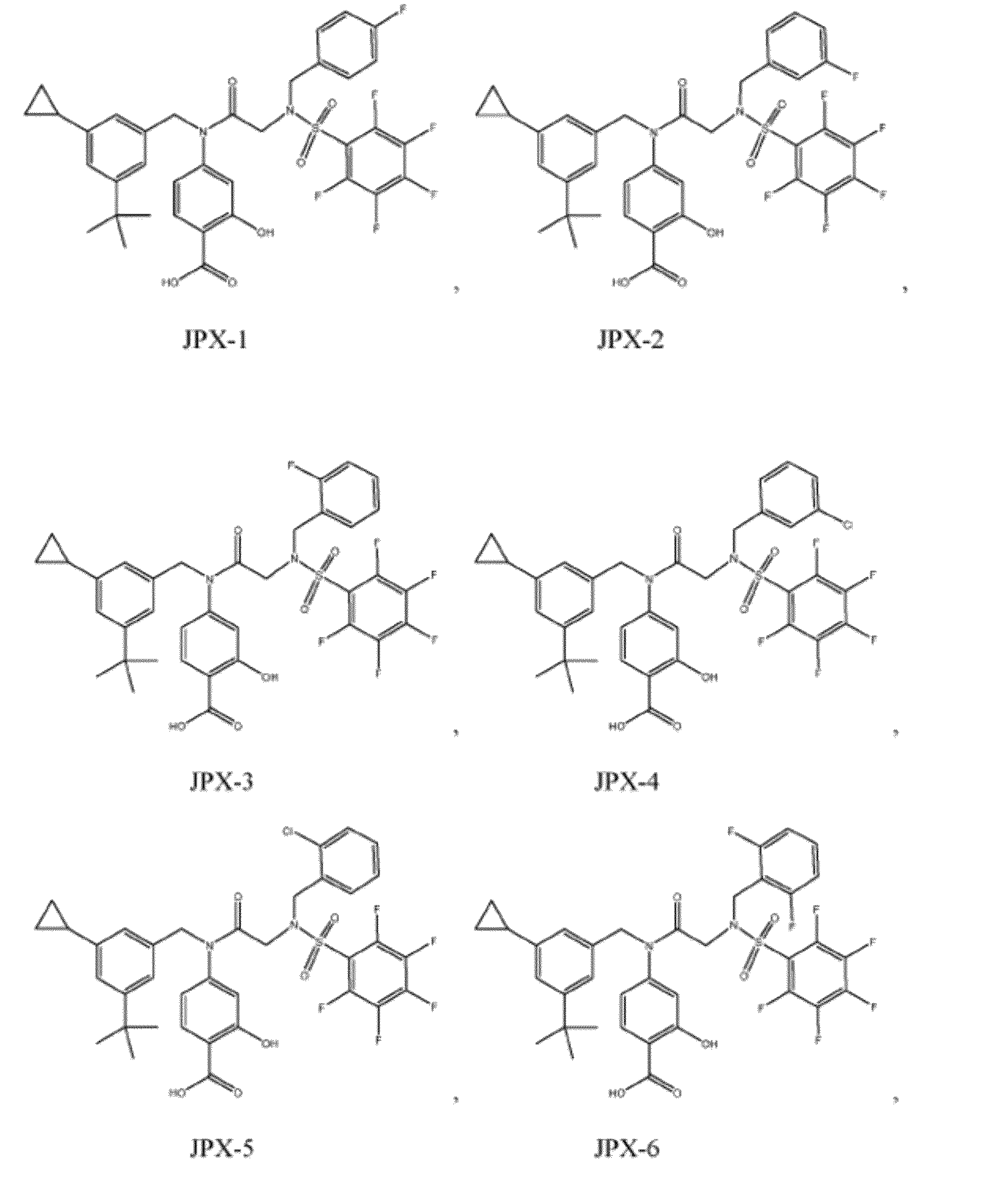


本出願の化合物の製造方法
一般方法

スキーム1.a)1)SOCl2、還流3h、2)tBuOH、DMAP(触媒)、DCM、室温、14h、62%;b)アルデヒド、DCE、AcOH、Na(OAc)3BH、室温、12h、70~88%;c)PPh3Cl2、CHCl3、30~45min、100℃でマイクロ波加熱、33~85%;d)DCM:TFA 1:1、室温、2h、90~95%。DMAP=4-(ジメチルアミノ)ピリジン、DCM=ジクロロメタン、DCE=1,2-ジクロロエタン、TFA=トリフルオロ酢酸。 Scheme 1. a) 1) SOCl 2 , reflux 3h, 2) t BuOH, DMAP (catalyst), DCM, room temperature, 14h, 62%; b) Aldehyde, DCE, AcOH, Na (OAc) 3 BH, room temperature, 12h, 70- 88%; c) PPh 3 Cl 2 , CHCl 3 , 30-45 min, microwave heating at 100 ° C., 33-85%; d) DCM: TFA 1: 1, room temperature, 2h, 90-95%. DMAP = 4- (dimethylamino) pyridine, DCM = dichloromethane, DCE = 1,2-dichloroethane, TFA = trifluoroacetic acid.
一般手順a:tブチルエステル化
4-アミノサリチル酸(1.0eq)を丸底フラスコに装入した後、SOCl2(5.0eq)を室温で滴下した。次いで反応混合物を3時間還流した。次いで過剰のSOCl2を減圧下に除去し、微量物質をCHCl3と共沸させた。DCM(1M)中の4-(ジメチルアミノ)ピリジン(0.1eq)及びtBuOH(15eq)を加え、得られた混合物を室温で14時間撹拌した。1MのNaOHを加えて反応を停止した後、EtOAc(4×)で抽出した。有機画分を合一し、飽和NaHCO3(2×)、飽和NaCl(1×)で洗浄し、MgSO4で乾燥させた。有機画分を合一し、Biotage Isolera自動カラムクロマトグラフィー装置を用いて精製し、ヘキサン/EtOAcのグラジエント条件下に溶出させることにより1級アニリンを得た。
General procedure a: After charging t -butyl esterified 4-aminosalicylic acid (1.0 eq) into a round-bottom flask, SOCL 2 (5.0 eq) was added dropwise at room temperature. The reaction mixture was then refluxed for 3 hours. Excess SOCL 2 was then removed under reduced pressure and the trace material was azeotropically distilled with CHCl 3 . 4- (Dimethylamino) pyridine (0.1 eq) and t BuOH (15 eq) in DCM (1 M) were added and the resulting mixture was stirred at room temperature for 14 hours. The reaction was stopped by adding 1 M NaOH and then extracted with EtOAc (4x). The organic fractions were combined, washed with saturated NaCl 3 (2x), saturated NaCl (1x) and dried with ו 4 . The organic fractions were combined and purified using a Biotage Isolera automatic column chromatography device and eluted under hexane / EtOAc gradient conditions to give primary aniline.
一般手順b:トリアセトキシ水素化ホウ素ナトリウムを用いた還元的アミノ化
1級アニリン(1.0eq)及びAcOH(1.1eq)を無水DCE(0.1M)に溶解した溶液に、対応するアルデヒド(1.0eq)を加えた。次いでこの溶液を室温で10分間撹拌した後、Na(OAc)3BH(1.5eq)を加え、反応物を室温で撹拌した。1級アニリンが完全に消費されたことがTLCで示されたら、反応物をDCMで希釈し、NaHCO3の飽和溶液に注いだ。相を分液し、水層をDCM(3×)で抽出した。有機画分を合一して飽和食塩水で洗浄し、MgSO4で乾燥させ、減圧下に濃縮した。試料の粗生成物をカラムクロマトグラフィーで精製するために直接シリカに吸収させ、ヘキサン及びEtOAcのグラジエントを用いて2級アニリンを得た。
General procedure b: Reductive amination with sodium triacetoxyborohydride A solution of primary aniline (1.0 eq) and AcOH (1.1 eq) in anhydrous DCE (0.1 M) with the corresponding aldehyde ( 1.0 eq) was added. The solution was then stirred at room temperature for 10 minutes, then Na (OAc) 3 BH (1.5 eq) was added and the reaction was stirred at room temperature. When TLC showed that the primary aniline was completely consumed, the reaction was diluted with DCM and poured into a saturated solution of NaHCO 3 . The phases were separated and the aqueous layer was extracted with DCM (3x). The organic fractions were combined, washed with saturated brine, dried over ו 4 , and concentrated under reduced pressure. The crude product of the sample was absorbed directly into silica for purification by column chromatography and a gradient of hexane and EtOAc was used to give secondary aniline.
一般手順c:Ph3PCl2によるペプチドのカップリング
カルボン酸(1.2eq)のCHCl3(0.08M)溶液を撹拌しながらPh3PCl2(2.5eq)を加えた。反応混合物を15分間又は完全に溶解するまで室温で撹拌した後、2級アニリン(1.0eq)を滴下した。次いで反応混合物をマイクロ波照射装置を用いて100℃で最大45分間マイクロ波照射した。反応混合物に0℃で飽和NaHCO3を加えることにより反応停止した。2層を分液し、水層をDCM(3×)で抽出した。有機画分を合一し、飽和NaCl(1×)で洗浄し、MgSO4で乾燥させた。試料の粗生成物をシリカに直接吸収させ、ヘキサン及びEtOAcの適切なグラジエントを用いてカラムクロマトグラフィーで精製した。
General procedure c: Coupling of peptides with Ph 3 PCl 2 Ph 3 PCl 2 (2.5 eq) was added with stirring a solution of carboxylic acid (1.2 eq) in CHCl 3 (0.08 M). The reaction mixture was stirred for 15 minutes or at room temperature until completely dissolved, and then secondary aniline (1.0 eq) was added dropwise. The reaction mixture was then microwave irradiated at 100 ° C. for up to 45 minutes using a microwave irradiator. The reaction was stopped by adding saturated NaHCO 3 at 0 ° C. to the reaction mixture. The two layers were separated and the aqueous layer was extracted with DCM (3x). The organic fractions were combined, washed with saturated NaCl (1x) and dried with Л4 . The crude product of the sample was absorbed directly into silica and purified by column chromatography using the appropriate gradient of hexane and EtOAc.
一般手順d:t-ブチルエステルの脱保護
t-ブチルエステル(1eq)溶液をTFA及びDCMの1:1混合物(0.1M)溶液に溶解した。得られた溶液を2時間撹拌した後、MeOH(3×)及びCHCl3(3×)と一緒に共沸蒸留した。

スキーム2.3-(tert-ブチル)-5-シクロプロピルベンズアルデヒド2の合成
3-ブロモ-5-(tert-ブチル)ベンズアルデヒド(1)
1,3-ジブロモ-5-(tert-ブチル)ベンゼン(2.57mmol)の無水THF(0.3M)溶液を-78℃に冷却した後、nBuLi(2.5M、ヘキサン中、2.83mmol)を滴下し、N2中、この温度で0.5時間撹拌した。次いでDMF(3.85mmol)をゆっくりと加え、反応混合物を-78℃から室温まで3時間かけてゆっくりと加温した。反応物に飽和NH4Cl溶液(20mL)を加えて反応停止した。2層を分液し、水層をEt2O(3×)で抽出した。有機画分を合一して飽和食塩水で洗浄し、MgSO4で乾燥させ、減圧下に濃縮した。粗生成物1を黄色油状物として単離し(544mg、88%)、次の工程にそのまま使用した。
Scheme 2.3 (tert-butyl) -Synthesis of 5-
An anhydrous THF (0.3M) solution of 1,3-dibromo-5- (tert-butyl) benzene (2.57 mmol) was cooled to −78 ° C. and then nBuLi (2.5 M, 2.83 mmol in hexanes). Was added dropwise, and the mixture was stirred in N 2 at this temperature for 0.5 hours. DMF (3.85 mmol) was then added slowly and the reaction mixture was slowly warmed from −78 ° C. to room temperature over 3 hours. A saturated NH 4 Cl solution (20 mL) was added to the reaction product to terminate the reaction. The two layers were separated and the aqueous layer was extracted with Et 2 O (3 ×). The organic fractions were combined, washed with saturated brine, dried over ו 4 , and concentrated under reduced pressure. Crude product 1 was isolated as a yellow oil (544 mg, 88%) and used as is in the next step.
1H NMR (400 MHz, クロロホルム-d) δ 9.95 (s, 1H), 7.83 (s, 1H), 7.82 (s, 1H) 7.77 (t, J = 1.8 Hz, 1H), 1.36 (s, 9H). 1 H NMR (400 MHz, chloroform-d) δ 9.95 (s, 1H), 7.83 (s, 1H), 7.82 (s, 1H) 7.77 (t, J = 1.8 Hz, 1H), 1.36 (s, 9H) ..
3-(tert-ブチル)-5-シクロプロピルベンズアルデヒド(2)
スターラーバーを備えた丸底フラスコを乾燥器で乾燥させ、1(3.11mmol)、シクロプロピルボロン酸(4.35mmol)、トリシクロヘキシルホスフィン(0.311mmol)及びK3PO4(12.4mmol)を装入し、N2置換した。次いでトルエン(0.2M)及びH2O(4M)を加えた後、Pd(OAc)2(0.156mmol)を加え、反応混合物を100℃の油浴に入れ、10時間撹拌した。反応物を冷却して室温に戻し、セライトで濾過してEtOAcで洗浄した。濾液をEtOAc及びH2Oで希釈し、分液漏斗に移し替えた。2層を分液し、水層をEtOAc(3×)で抽出した。有機画分を合一して飽和食塩水で洗浄し、MgSO4で乾燥させた。粗生成物を直接シリカに吸収させ、Biotage Isolera自動カラムクロマトグラフィーを使用し、ヘキサン/EtOAcのグラジエントにより精製した。3-(tert-ブチル)-5-シクロプロピルベンズアルデヒドを透明油状物として得た(452mg、72%)。
3- (tert-Butyl) -5-cyclopropylbenzaldehyde (2)
A round bottom flask equipped with a stirrer bar is dried in a desiccator and 1 (3.11 mmol), cyclopropylboronic acid (4.35 mmol), tricyclohexylphosphin (0.311 mmol) and K 3 PO 4 (12.4 mmol). Was charged and replaced with N 2 . Then, after adding toluene (0.2 M) and H 2 O (4 M), Pd (OAc) 2 (0.156 mmol) was added, and the reaction mixture was placed in an oil bath at 100 ° C. and stirred for 10 hours. The reaction was cooled to room temperature, filtered through Celite and washed with EtOAc. The filtrate was diluted with EtOAc and H2O and transferred to a separatory funnel. The two layers were separated and the aqueous layer was extracted with EtOAc (3x). The organic fractions were combined, washed with saturated brine and dried over ו 4 . The crude product was absorbed directly into silica and purified by hexane / EtOAc gradients using Biotage Isolera automated column chromatography. 3- (tert-Butyl) -5-cyclopropylbenzaldehyde was obtained as a clear oil (452 mg, 72%).
1H NMR (400 MHz, クロロホルム-d) δ 9.97 (s, 1H), 7.69 (t, J = 1.7 Hz, 1H), 7.44 (t, J = 1.9 Hz, 1H), 7.34 (t, J = 1.5 Hz, 1H), 2.00 - 1.93 (m, 1H), 1.35 (s, 7H), 1.06 - 0.96 (m, 2H), 0.79 - 0.70 (m, 2H). 13C NMR (101 MHz, CDCl3) δ 192.96, 152.07, 144.85, 136.49, 129.91, 124.20, 123.50, 34.78, 31.25, 15.44, 9.49. 1 H NMR (400 MHz, chloroform-d) δ 9.97 (s, 1H), 7.69 (t, J = 1.7 Hz, 1H), 7.44 (t, J = 1.9 Hz, 1H), 7.34 (t, J = 1.5) Hz, 1H), 2.00-1.93 (m, 1H), 1.35 (s, 7H), 1.06-0.96 (m, 2H), 0.79-0.70 (m, 2H). 13 C NMR (101 MHz, CDCl 3 ) δ 192.96, 152.07, 144.85, 136.49, 129.91, 124.20, 123.50, 34.78, 31.25, 15.44, 9.49.
4-((3-(tert-ブチル)-5-シクロプロピルベンジル)アミノ)-2-ヒドロキシ-安息香酸tert-ブチル(3)

一般手順bに従い化合物3を調製し、非晶質白色固体として単離した(78%)。1H NMR (400 MHz, クロロホルム-d) δ 11.39 (s, 1H), 7.65 (d, J = 8.5 Hz, 1H), 7.22 (s, 1H), 7.15 (s, 1H), 6.91 (s, 1H), 6.19 - 6.15 (m, 2H), 4.50 (broad s, 1H), 4.33 (s, 2H), 2.00 - 1.93 (m, 1H), 1.66 (s, 9H), 1.39 (s, 9H), 1.05 - 0.98 (m, 2H), 0.79 - 0.75 (m, 2H). 13C NMR (101 MHz, CDCl3) δ 170.11, 163.96, 153.96, 151.75, 144.23, 137.90, 131.48, 122.40, 122.07, 121.90, 105.32, 103.49, 98.07, 81.42, 48.13, 34.73, 31.47, 28.45, 15.68, 9.37. Compound 3 was prepared according to general procedure b and isolated as an amorphous white solid (78%). 1 H NMR (400 MHz, chloroform-d) δ 11.39 (s, 1H), 7.65 (d, J = 8.5 Hz, 1H), 7.22 (s, 1H), 7.15 (s, 1H), 6.91 (s, 1H) ), 6.19 --6.15 (m, 2H), 4.50 (broad s, 1H), 4.33 (s, 2H), 2.00 --1.93 (m, 1H), 1.66 (s, 9H), 1.39 (s, 9H), 1.05 --0.98 (m, 2H), 0.79 --0.75 (m, 2H). 13 C NMR (101 MHz, CDCl 3 ) δ 170.11, 163.96, 153.96, 151.75, 144.23, 137.90, 131.48, 122.40, 122.07, 121.90, 105.32, 103.49, 98.07, 81.42, 48.13, 34.73, 31.47, 28.45, 15.68, 9.37.
4-(N-(3-(tert-ブチル)-5-シクロプロピルベンジル)-2-((N-(4-クロロベンジル)-2,3,4,5,6-ペンタフルオロフェニル)スルホンアミド)アセトアミド)-2-ヒドロキシ安息香酸tert-ブチル(4)

一般手順cに従い化合物4を調製し、非晶質ベージュ色固体として単離した(66%)。1H NMR (400 MHz, クロロホルム-d) δ 11.07 (s, 1H), 7.65 (d, J = 8.4 Hz, 1H), 7.28 (d, J = 8.4 Hz, 2H), 7.18 (d, J = 8.4 Hz, 2H), 7.03 (t, J = 1.8 Hz, 1H), 6.81 (d, J = 1.7 Hz, 1H), 6.59 (s, 1H), 6.37 (s, 1H), 6.21 (d, J = 8.3 Hz, 1H), 4.68 (s, 2H), 4.62 (s, 2H), 3.81 (s, 2H), 1.89 - 1.83 (m, 1H), 1.60 (s, 9H), 1.24 (s, 9H), 0.99 - 0.94 (m, 2H), 0.65 - 0.61 (m, 2H). 13C NMR (101 MHz, CDCl3) δ 168.80, 165.54, 162.57, 151.35, 145.64, 144.02, 135.36, 134.47, 132.82, 131.66, 130.10, 129.10, 123.16, 122.75, 122.52, 118.43, 116.91, 114.10, 83.73, 53.15, 50.53, 47.74, 34.51, 31.23, 28.13, 15.49, 9.24.
4-(N-(3-(tert-ブチル)-5-シクロプロピルベンジル)-2-((N-(4-クロロベンジル)-2,3,4,5,6-ペンタフルオロフェニル)スルホンアミド)アセトアミド)-2-ヒドロキシ安息香酸tert-ブチル(化合物I)

一般手順dに従い化合物Iを調製し、非晶質白色粉末として単離した(89%)。1H NMR (400 MHz, クロロホルム-d) δ 10.48 (s, 1H), 7.79 (d, J = 8.4 Hz, 1H), 7.30 - 7.24 (d, J = 8.2 Hz, 2H), 7.18 (d, J = 8.2 Hz, 2H), 7.05 (s, 1H), 6.80 (s, 1H), 6.61 (s, 1H), 6.41 (s, 1H), 6.28 (s, 1H), 4.71 (s, 2H), 4.63 (s, 2H), 3.84 (s, 2H), 1.87 (ddd, J = 13.6, 8.5, 5.1 Hz, 1H), 1.24 (s, 8H), 1.00 - 0.92 (m, 2H), 0.69 - 0.56 (m, 2H).HRMS (ESI+) (C36H32ClF5N2O6S + H)の理論値:751.1668、実測値:751.1673. Compound I was prepared according to general procedure d and isolated as an amorphous white powder (89%). 1 H NMR (400 MHz, chloroform-d) δ 10.48 (s, 1H), 7.79 (d, J = 8.4 Hz, 1H), 7.30 --7.24 (d, J = 8.2 Hz, 2H), 7.18 (d, J) = 8.2 Hz, 2H), 7.05 (s, 1H), 6.80 (s, 1H), 6.61 (s, 1H), 6.41 (s, 1H), 6.28 (s, 1H), 4.71 (s, 2H), 4.63 (s, 2H), 3.84 (s, 2H), 1.87 (ddd, J = 13.6, 8.5, 5.1 Hz, 1H), 1.24 (s, 8H), 1.00 --0.92 (m, 2H), 0.69 --0.56 (m) , 2H) .HRMS (ESI +) (C 36 H 32 ClF 5 N 2 O 6 S + H) theoretical value: 751.1668, actual measurement value: 751.1673.
4-((3-(tert-ブチル)-5-シクロプロピルベンジル)アミノ)-2-ヒドロキシ安息香酸tert-ブチル(6)

一般手順bに従い化合物6を調製し、非晶質ベージュ色固体として単離した(75%)。1H NMR (400 MHz, クロロホルム-d) δ 7.84 (d, J = 8.6 Hz, 2H), 7.16 (d, J = 1.6 Hz, 1H), 7.09 (d, J = 1.8 Hz, 1H), 6.86 (d, J = 1.7 Hz, 1H), 6.60 (d, J = 8.8 Hz, 2H), 4.37 (s, 1H), 4.31 (s, 2H), 1.90 (tt, J = 8.5, 5.1 Hz, 1H), 1.59 (s, 9H), 1.32 (s, 9H), 1.01 - 0.90 (m, 2H), 0.74 - 0.65 (m, 2H). 13C NMR (101 MHz, CDCl3) δ 166.20, 151.73, 151.60, 144.18, 138.07, 131.34, 122.33, 122.00, 121.79, 120.54, 111.50, 79.85, 48.29, 34.69, 31.40, 28.36, 15.60, 9.27.
4-(N-(3-(tert-ブチル)-5-シクロプロピルベンジル)-2-((N-(4-クロロベンジル)-2,3,4,5,6-ペンタフルオロフェニル)スルホンアミド)アセトアミド)安息香酸tert-ブチル(7)
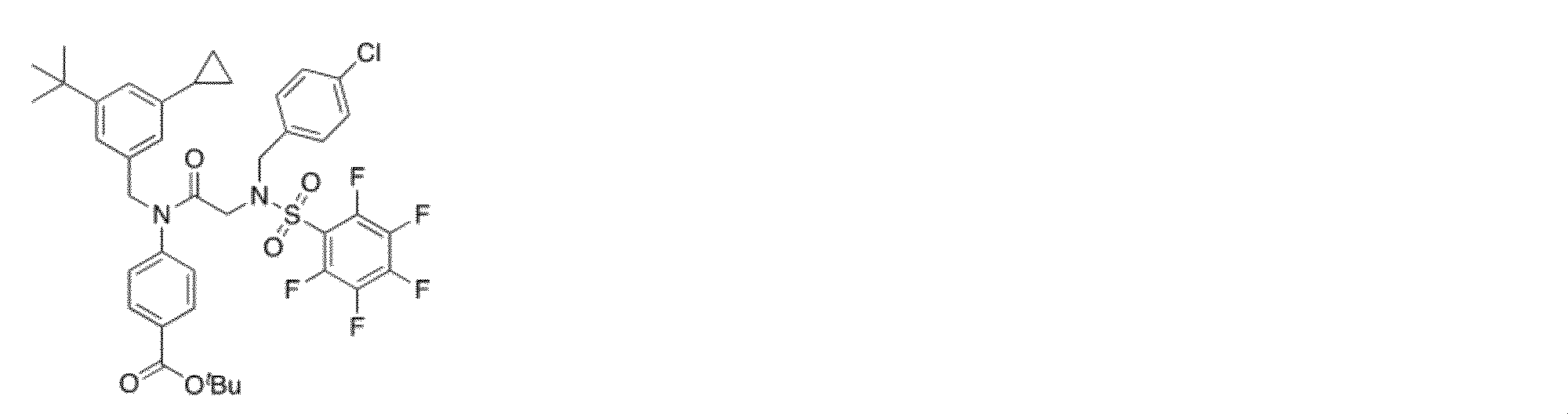
一般手順cに従い化合物7を調製し、非晶質ベージュ色固体として単離した(31%)。1H NMR (400 MHz, クロロホルム-d) δ 7.88 (d, J = 8.1 Hz, 2H), 7.28 (d, J = 8.2 Hz, 2H), 7.18 (d, J = 8.4 Hz, 2H), 7.04 (t, J = 1.8 Hz, 1H), 6.80 - 6.70 (m, 3H), 6.59 (s, 1H), 4.71 (s, 2H), 4.65 (s, 2H), 3.73 (s, 2H), 1.91 - 1.85 (m, 1H), 1.60 (s, 9H), 1.24 (s, 9H), 0.99 - 0.95 (m, 2H), 0.65 - 0.61 (m, 2H). Compound 7 was prepared according to general procedure c and isolated as an amorphous beige solid (31%). 1 H NMR (400 MHz, chloroform-d) δ 7.88 (d, J = 8.1 Hz, 2H), 7.28 (d, J = 8.2 Hz, 2H), 7.18 (d, J = 8.4 Hz, 2H), 7.04 ( t, J = 1.8 Hz, 1H), 6.80 --6.70 (m, 3H), 6.59 (s, 1H), 4.71 (s, 2H), 4.65 (s, 2H), 3.73 (s, 2H), 1.91 --1.85 (m, 1H), 1.60 (s, 9H), 1.24 (s, 9H), 0.99 --0.95 (m, 2H), 0.65 --0.61 (m, 2H).
4-(N-(3-(tert-ブチル)-5-シクロプロピルベンジル)-2-((N-(4-クロロベンジル)-2,3,4,5,6-ペンタフルオロフェニル)スルホンアミド)アセトアミド)安息香酸(化合物II)

一般手順dに従い化合物IIを調製し、非晶質白色粉末として単離した(82%)。1H NMR (400 MHz, クロロホルム-d) δ 8.00 (d, J = 8.0 Hz, 2H), 7.27 (d, J = 8.3 Hz, 2H), 7.18 (d, J = 8.3 Hz, 2H), 7.04 (d, J = 1.8 Hz, 1H), 6.80 (d, J = 8.1 Hz, 2H), 6.76 (s, 1H), 6.59 (d, J = 1.7 Hz, 1H), 4.72 (s, 2H), 4.64 (s, 2H), 3.74 (s, 2H), 1.86 (tt, J = 8.5, 5.1 Hz, 1H), 1.22 (s, 9H), 1.01 - 0.92 (m, 2H), 0.62 (dt, J = 6.6, 4.7 Hz, 2H). Compound II was prepared according to general procedure d and isolated as an amorphous white powder (82%). 1 H NMR (400 MHz, chloroform-d) δ 8.00 (d, J = 8.0 Hz, 2H), 7.27 (d, J = 8.3 Hz, 2H), 7.18 (d, J = 8.3 Hz, 2H), 7.04 ( d, J = 1.8 Hz, 1H), 6.80 (d, J = 8.1 Hz, 2H), 6.76 (s, 1H), 6.59 (d, J = 1.7 Hz, 1H), 4.72 (s, 2H), 4.64 ( s, 2H), 3.74 (s, 2H), 1.86 (tt, J = 8.5, 5.1 Hz, 1H), 1.22 (s, 9H), 1.01 --0.92 (m, 2H), 0.62 (dt, J = 6.6, 4.7 Hz, 2H).
4-(N-(3-シクロペンチルベンジル)-2-((2,3,4,5,6-ペンタフルオロ-N-((パーフルオロフェニル)メチル)フェニル)スルホンアミド)アセトアミド)安息香酸(JPX-303)

一般手順dに従い化合物JPX-303を調製し、非晶質白色粉末として単離した(88%)。1H NMR (400 MHz, クロロホルム-d) δ 8.08 (d, J = 8.4 Hz, 2H), 7.21-7.14 (m, 2H), 7.05 (d, J = 8.1 Hz, 2H), 6.88 (s, 1H), 6.85 (d, J = 7.6 Hz, 1H), 4.81 (s, 2H), 4.79 (s, 2H), 3.88 (s, 2H), 2.91 (ddd, J = 17.4, 9.7, 7.5 Hz, 1H) 2.03-1.96 (m, 2H), 1.78-1.71 (m, 2H), 1.69-1.64 (m, 2H), 1.52-1.43 (m, 2H). 13C NMR (101 MHz, CDCl3) δ 170.10, 165.31, 147.07, 146.35, 145.68, 144.98, 144.69, 144.53, 144.19, 143.24, 142.31, 140.86, 138.53, 138.24, 137.07, 136.80, 135.28, 132.10, 129.76, 128.56, 128.35, 127.51, 126.74, 125.91, 116.02, 108.77, 53.42, 49.06, 45.69, 39.29, 34.47, 25.40. Compound JPX-303 was prepared according to general procedure d and isolated as an amorphous white powder (88%). 1 H NMR (400 MHz, chloroform-d) δ 8.08 (d, J = 8.4 Hz, 2H), 7.21-7.14 (m, 2H), 7.05 (d, J = 8.1 Hz, 2H), 6.88 (s, 1H) ), 6.85 (d, J = 7.6 Hz, 1H), 4.81 (s, 2H), 4.79 (s, 2H), 3.88 (s, 2H), 2.91 (ddd, J = 17.4, 9.7, 7.5 Hz, 1H) 2.03-1.96 (m, 2H), 1.78-1.71 (m, 2H), 1.69-1.64 (m, 2H), 1.52-1.43 (m, 2H). 13 C NMR (101 MHz, CDCl 3 ) δ 170.10, 165.31 , 147.07, 146.35, 145.68, 144.98, 144.69, 144.53, 144.19, 143.24, 142.31, 140.86, 138.53, 138.24, 137.07, 136.80, 135.28, 132.10, 129.76, 128.56, 128.35, 127.51, 126.74, 125.91, 116.02, , 49.06, 45.69, 39.29, 34.47, 25.40.
4-(N-(3-シクロペンチルベンジル)-2-((2,3,4,5,6-ペンタフルオロ-N-((パーフルオロフェニル)メチル)フェニル)スルホンアミド)アセトアミド)-2-ヒドロキシ安息香酸(JPX-320)

一般手順dに従い化合物JPX-320を調製し、非晶質白色粉末として単離した(89%)。1H NMR (400 MHz,クロロホルム-d) δ 10.54 (s, 1H), 7.86 (d, J = 8.4 Hz, 1H), 7.20-7.14 (m, 2H), 6.92-6.87 (m, 2H), 6.62 (s, 1H), 6.51 (d, J = 8.4 Hz, 1H), 4.81 (s, 2H), 4.76 (s, 2H), 3.98 (s, 2H), 2.92 (q, J = 7.2, 2.4 Hz, 1H), 2.02-1.99 (m, 2H), 1.77-1.74 (m, 2H), 1.69-1.65 (m, 2H), 1.52-1.46 (m, 2H). Compound JPX-320 was prepared according to general procedure d and isolated as an amorphous white powder (89%). 1 H NMR (400 MHz, chloroform-d) δ 10.54 (s, 1H), 7.86 (d, J = 8.4 Hz, 1H), 7.20-7.14 (m, 2H), 6.92-6.87 (m, 2H), 6.62 (s, 1H), 6.51 (d, J = 8.4 Hz, 1H), 4.81 (s, 2H), 4.76 (s, 2H), 3.98 (s, 2H), 2.92 (q, J = 7.2, 2.4 Hz, 1H), 2.02-1.99 (m, 2H), 1.77-1.74 (m, 2H), 1.69-1.65 (m, 2H), 1.52-1.46 (m, 2H).
4-(2-((N-(4-クロロベンジル)-2,3,4,5,6-ペンタフルオロフェニル)スルホンアミド)-N-(3-シクロペンチルベンジル)アセトアミド)安息香酸(JPX-313)

一般手順dに従い化合物JPX-313を調製し、非晶質白色粉末として単離した(92%)。1H NMR (400 MHz, クロロホルム-d) δ 7.98 (d, J = 8.0 Hz, 2H), 7.26 (d, J = 2.8 Hz, 1H),7.20-7.17 (m, 4H), 6.87-6.85 (m, 4H), 4.72 (s, 2H), 4.64 (s, 2H), 3.74 (s, 2H), 2.94-2.89 (m, 1H), 2.02-1.99 (m, 2H), 1.77-1.74 (m, 2H), 1.68-1.65 (m, 2H), 1.50-1.47 (m, 2H). Compound JPX-313 was prepared according to general procedure d and isolated as an amorphous white powder (92%). 1 H NMR (400 MHz, chloroform-d) δ 7.98 (d, J = 8.0 Hz, 2H), 7.26 (d, J = 2.8 Hz, 1H), 7.20-7.17 (m, 4H), 6.87-6.85 (m) , 4H), 4.72 (s, 2H), 4.64 (s, 2H), 3.74 (s, 2H), 2.94-2.89 (m, 1H), 2.02-1.99 (m, 2H), 1.77-1.74 (m, 2H) ), 1.68-1.65 (m, 2H), 1.50-1.47 (m, 2H).
4-(2-((N-(4-クロロベンジル)-2,3,4,5,6-ペンタフルオロフェニル)スルホンアミド)-N-(3-シクロペンチルベンジル)アセトアミド)-2-ヒドロキシ安息香酸(JPX-062)

一般手順dに従い化合物JPX-062を調製し、非晶質白色粉末として単離した(82%)。1H NMR (400 MHz, クロロホルム-d) δ 10.49 (s, 1H), 7.77 (d, 8.4 Hz, 1H), 7.29-7.27 (m, 2H), 7.21-7.15 (m, 4H), 6.90-6.87 (m, 2H), 6.45 (s, 1H), 6.32 (s, 1H), 4.71 (s, 2H), 4.63 (s, 2H), 2.95-2.90 (m, 1H), 2.03-1.99 (m, 2H), 1.78-1.75 (m, 2H), 1.69-1.65 (m, 2H), 1.51-1.48 (m, 2H). Compound JPX-062 was prepared according to general procedure d and isolated as an amorphous white powder (82%). 1 H NMR (400 MHz, chloroform-d) δ 10.49 (s, 1H), 7.77 (d, 8.4 Hz, 1H), 7.29-7.27 (m, 2H), 7.21-7.15 (m, 4H), 6.90-6.87 (m, 2H), 6.45 (s, 1H), 6.32 (s, 1H), 4.71 (s, 2H), 4.63 (s, 2H), 2.95-2.90 (m, 1H), 2.03-1.99 (m, 2H) ), 1.78-1.75 (m, 2H), 1.69-1.65 (m, 2H), 1.51-1.48 (m, 2H).
予期せぬことに、本出願の化合物は文献からの化合物に匹敵する代謝安定性を示す。 Unexpectedly, the compounds of this application exhibit metabolic stability comparable to the compounds from the literature.
in vitro細胞生存率試験
本出願の好ましい化合物の抗がん効果を、異なるがん細胞株を用いてin vitroで評価した。様々な濃度の阻害剤(0.097656~50μM)で処理した後、cell Titer-Blue cell viability assayを用いて細胞生存率を調査した。培地を入れた96ウェルアッセイプレートに細胞を1×10⁴個/ウェルで播種した。細胞は全て10%FBSを添加したDMEM、IMDM及びRPMI-1640で培養した。24時間後、試験化合物及び溶媒対照を適切なウェルに添加し、各ウェルの最終容積が100μLになるようにした。細胞を37℃及び5%CO2で所望の試験曝露期間(72時間)培養した。アッセイプレートを37℃のインキュベータから取り出し、CellTiter-Blue(登録商標) Reagentを20μL/ウェルで加えた。プレートを標準的な細胞培養条件で1~4時間インキュベートし、プレートを10秒間振盪し、蛍光を560/590nmで記録した。
In vitro Cell Survival Test The anticancer effects of the preferred compounds of this application were evaluated in vitro using different cancer cell lines. After treatment with various concentrations of inhibitor (0.097656-50 μM), cell viability was investigated using the cell Titer-Blue cell viability assay. Cells were seeded at 1 × 10 4 cells / well on 96-well assay plates containing medium. All cells were cultured in DMEM, IMDM and RPMI-1640 supplemented with 10% FBS. After 24 hours, test compounds and solvent controls were added to the appropriate wells to bring the final volume of each well to 100 μL. Cells were cultured at 37 ° C. and 5% CO 2 for the desired test exposure period (72 hours). The assay plate was removed from the 37 ° C. incubator and CellTiter-Blue® Reagent was added at 20 μL / well. The plates were incubated under standard cell culture conditions for 1-4 hours, the plates were shaken for 10 seconds and fluorescence was recorded at 560/590 nm.
本出願の好ましい化合物は、MV4-11、MOLM-13、K562等のがん細胞に対し0.4~8.0μM、好ましくは0.4~5.0μMの範囲のIC50値を示した。MRC9等の健康な細胞に対するIC50値は、通常、20μMを超えていた。 Preferred compounds of the present application exhibited IC50 values in the range of 0.4 to 8.0 μM, preferably 0.4 to 5.0 μM for cancer cells such as MV4-11, MOLM-13, K562. IC50 values for healthy cells such as MRC9 were usually above 20 μM.
選択された慢性骨髄性白血病、急性骨髄性白血病及び健康なヒト肺細胞株に対する化合物I及びIIの有効性を上に述べた手順を用いて試験した。 The efficacy of Compounds I and II on selected chronic myelogenous leukemias, acute myelogenous leukemias and healthy human lung cell lines was tested using the procedures described above.
表1に、様々な細胞株に対する化合物IのIC50値を示す。

予期せぬことに、本出願の化合物は、文献からの比較用化合物と比較して抗がん効果が向上している。急性骨髄性白血病細胞(MV-4-11細胞)における式Iに分類される化合物の好ましい活性の例として、化合物I及び化合物IIのIC50はそれぞれ0.56及び0.48μMであり、これと比較すると、類似化合物であるAC-3-19(国際公開第2015179956号パンフレットに記載)の有効性は著しく低く、IC50は約3~5μMであった。 Unexpectedly, the compounds of this application have improved anti-cancer effects compared to the comparative compounds from the literature. As an example of the preferred activity of compounds of formula I in acute myeloid leukemia cells (MV-4-11 cells), the IC 50s of compound I and compound II are 0.56 and 0.48 μM, respectively. By comparison, the effectiveness of the similar compound AC-3-19 (described in International Publication No. 2015179956) was significantly lower, with an IC 50 of about 3-5 μM.
MV4-11細胞に対する細胞毒性アッセイの例として、MV4-11細胞を10%ウシ胎児血清(FBS)を添加したイスコフ改変ダルベッコ培地(IMDM)で培養した。低蒸発構造フタ付き96ウェル平底滅菌済み培養プレートに細胞10,000個を播種した。24時間後、阻害剤及び溶媒対照(0.5%DMSO)を添加し、細胞を37℃及び5%CO2で培養した。阻害剤の最大濃度を50μMとし、それに続くウェルは1:2で希釈して(25、12.5、6.25、3.125、1.5625、0.78125、0.390625、0.195313及び0.097656μM)3連で試験を行った。72時間後、これらのウェルをCellTiter-Blue(登録商標)(20μL/ウェル)で処理し、プレートを標準的な細胞培養条件で1時間インキュベートした。蛍光を560/590nmで測定した。非線形回帰分析によりIC50値を求めた。他の細胞株についても同様の手順を用いた。 As an example of a cytotoxicity assay for MV4-11 cells, MV4-11 cells were cultured in Iskov modified Dalveco medium (IMDM) supplemented with 10% fetal bovine serum (FBS). 10,000 cells were seeded on a 96-well flat bottom sterile culture plate with a low evaporation structure lid. After 24 hours, inhibitors and solvent controls (0.5% DMSO) were added and cells were cultured at 37 ° C. and 5% CO 2 . The maximum concentration of inhibitor was 50 μM, the subsequent wells were diluted 1: 2 (25, 12.5, 6.25, 3.125, 1.5625, 0.78125, 0.390625, 0.195313). And 0.097656 μM) The test was carried out in triplets. After 72 hours, these wells were treated with CellTiter-Blue® (20 μL / well) and the plates were incubated for 1 hour under standard cell culture conditions. Fluorescence was measured at 560/590 nm. The IC 50 value was obtained by non-linear regression analysis. The same procedure was used for other cell lines.
薬物動態-ADME試験
マウス肝細胞における化合物I及びIIの固有クリアランス
化合物Iのin vitro T1/2(min)は100minと算出された。
Pharmacokinetics-ADME test In vitro T 1/2 (min) of compound I and II specific clearance in mouse hepatocytes was calculated to be 100 min.
10mMの試験化合物のDMSO溶液をアセトニトリル50%及び水50%で希釈することにより、試験化合物の100μMのストック溶液を調製した。96ウェルノンコートプレートに肝細胞198μLをピペットで加え、プレートをインキュベータ内のオービタルシェーカーに載せ、肝細胞を10分間加温した。この溶液に100μMの試験化合物2μLを加えて反応を開始させ、プレートをオービタルシェーカーに載せた。0、15、30、60、90及び120分後にアリコートを分取し、アセトニトリル及び内部標準の溶液(100nMアルプラゾラム、200nMラベタロール及び2μMケトプロフェン)を混合して反応を停止させた。次いで反応溶液を10分間ボルテックスで撹拌し、4℃で30分間4,000rpmで遠心した。上清400μLを1枚の新しい96ウェルプレートに移し、4℃で30分間4,000rpmで遠心し、ペレットを確実に崩さないようにして上清100μLを新しい96ウェルプレートに移した。LC-MS/MSで分析を行うために超純水100μLを全てのプレートに加えた。 A 100 μM stock solution of test compound was prepared by diluting a DMSO solution of 10 mM test compound with 50% acetonitrile and 50% water. 198 μL of hepatocytes were pipetted to a 96-well non-coated plate, the plate was placed on an orbital shaker in an incubator, and the hepatocytes were warmed for 10 minutes. 2 μL of 100 μM test compound was added to this solution to initiate the reaction and the plate was placed on an orbital shaker. After 0, 15, 30, 60, 90 and 120 minutes, the aliquot was fractionated and mixed with acetonitrile and an internal standard solution (100 nM alprazolam, 200 nM labetalol and 2 μM ketoprofen) to terminate the reaction. The reaction solution was then vortexed for 10 minutes and centrifuged at 4 ° C. for 30 minutes at 4,000 rpm. 400 μL of the supernatant was transferred to one new 96-well plate and centrifuged at 4,000 rpm for 30 minutes at 4 ° C. to ensure that the pellet was not broken and 100 μL of the supernatant was transferred to the new 96-well plate. 100 μL of ultrapure water was added to all plates for analysis by LC-MS / MS.
インキュベーション時間に対する親薬物残存率の自然対数の曲線を線形回帰することによりin vitro半減期(T1/2)を求めた。次いで曲線の傾き(k)を次式に代入してin vitro半減期を求めた。

in vitro固有クリアランス(in vitro CLint、単位:μL/min/106cells)を次式に従い求めた。

ここで、インキュベーション容量=0.2mLであり、1ウェル当たりの肝細胞数=0.1×10⁶個である。 Here, the incubation volume = 0.2 mL, and the number of hepatocytes per well = 0.1 × 10 6 .
生物分析方法:カラム-Phenomenex Synergi 4μ Hydro-PR 80A(2.0×30mm)。移動相-0.1%ギ酸含有水(溶媒A)及び0.1%ギ酸含有アセトニトリル(溶媒B)。カラム温度-室温。注入量-10μL。MS分析-AB Inc(Canada)からのESIインターフェースを備えるAPI 4000機器。 Biological analysis method: Column-Phenomenex Synergi 4μ Hydro-PR 80A (2.0 × 30 mm). Mobile phase-0.1% formic acid-containing water (solvent A) and 0.1% formic acid-containing acetonitrile (solvent B). Column temperature-room temperature. Injection volume -10 μL. MS Analysis-API 4000 device with ESI interface from AB Inc (Canada).
図1から分かるように、化合物IのT1/2は101minであり、一方、ペンタフルオロベンゼンスルホンアミドを含むAC-3-19のT1/2は83minである。化合物Iは、文献からの比較用化合物よりもクリアランス速度が遅い。式Iに分類される化合物の好ましい安定性の一例を示すと、tert-ブチル基が除去された類似化合物であるJPX-0372(構造を図2Aに示す)はクリアランスが非常に速く、T1/2は16.4minである(図2B)(Pharmaron, China)。 As can be seen from FIG. 1, T 1/2 of compound I is 101 min, while T 1/2 of AC-3-19 containing pentafluorobenzene sulfonamide is 83 min. Compound I has a slower clearance rate than the comparative compound from the literature. To give an example of the preferred stability of a compound classified in Formula I, JPX-0372 (structure shown in FIG. 2A), a similar compound with the tert-butyl group removed, has a very fast clearance and T 1 /. 2 is 16.4 min (Fig. 2B) (Pharmaron, China).
式Iの化合物により得られる代謝安定性の更なる例として、化合物Iのc-Pr基を除去した化合物JPX-0369(図3A)はクリアランス速度が非常に速く、T1/2=36.5min(図3B)であった。 As a further example of the metabolic stability obtained by the compound of formula I, compound JPX-0369 (FIG. 3A) from which the c-Pr group of compound I has been removed has a very high clearance rate, T 1/2 = 36.5 min. (FIG. 3B).
式Iの化合物により得られる代謝安定性の更なる例として、非対称二置換化合物Iに替えて、対称的に二置換された3,5-ジ-c-Pr基を有する化合物JPX-0371(図4A)もやはりクリアランス速度ははるかに劣っており、T1/2=25.1minであった(図4B)。 As a further example of the metabolic stability obtained by the compound of formula I, the compound JPX-0371 having a symmetrically bisubstituted 3,5-di-c-Pr group instead of the asymmetric disubstituted compound I (Fig. In 4A), the clearance rate was also much inferior, and T 1/2 = 25.1 min (FIG. 4B).
式Iの化合物により得られる更なる代謝安定性の例として、安息香酸を有する非対称二置換化合物IIに替えて、安息香酸及び一置換3-tert-ブチル基を有する化合物JPX-0318(図5A)は、やはりクリアランス速度が大幅に劣っており、化合物IIのT1/2=46minであったのに対し、T1/2=10.3minであった(図5B)。 As an example of the further metabolic stability obtained by the compound of formula I, the compound JPX-0318 having benzoic acid and a mono-substituted 3-tert-butyl group instead of the asymmetric disubstituted compound II having benzoic acid (FIG. 5A). The clearance rate was also significantly inferior, and T 1/2 = 46 min for Compound II, whereas T 1/2 = 10.3 min (FIG. 5B).
したがって、本明細書に記載する式Iの化合物は、先行例であるペンタフルオロベンゼンスルホンアミド含有化合物と比較して、マウス肝細胞におけるクリアランス速度が優れていることを理解することができる。 Therefore, it can be understood that the compound of the formula I described in the present specification has an excellent clearance rate in mouse hepatocytes as compared with the priori pentafluorobenzene sulfonamide-containing compound.
グルタチオン(GSH)との反応性プロファイリング(Reactivity Profiling)解析
10%FBS及び抗生物質-抗真菌薬溶液を5mMのグルタチオンと一緒に添加したイスコフ改変ダルベッコ培地(IMDM)697.5μLに、阻害剤をDMSOに溶解した5mMのストック溶液3.5μLを加え、0.5%DMSOで阻害剤の終濃度を25mMとした。次いでこの溶液を即座に25℃のサンプルトレイに載せた。試料を更に前処理することなく、予め定められた時間間隔(通常は1.5時間毎)で、4回注入を行うまでHPLCで分析した(0時間を含む)。各阻害剤に関し、各時点のピークを積分し、残存率を求めるために0時間の注入時と比較した。半減期を、一次反応速度論に従い、阻害剤の残存率が40%を超えている時点を考慮に入れて、式:t1/2=Ln(2)/kを用いて算出した。kは、式:Ln[A]=Ln[A]0-ktに従う、時間に対するLn[阻害剤]の直線プロットの傾きであり、[A]は、各時点における積分から得られた値であり、[A]0は0時間における値であり、tは時間である。
Reactivity Profiling Analysis with Glutathion (GSH) DMSO the inhibitor into 697.5 μL of Iskov modified Dalveco medium (IMDM) with 10% FBS and antibiotic-antifungal solution added with 5 mM glutathione. 3.5 μL of a 5 mM stock solution dissolved in was added, and the final concentration of the inhibitor was 25 mM with 0.5% DMSO. The solution was then immediately placed on a sample tray at 25 ° C. Samples were analyzed by HPLC (including 0 hours) at predetermined time intervals (usually every 1.5 hours) until 4 injections were performed without further pretreatment. For each inhibitor, peaks at each time point were integrated and compared to 0 hour infusion to determine residual rate. The half-life was calculated using the formula: t 1/2 = Ln (2) / k, according to the primary reaction kinetics, taking into account the time point when the residual rate of the inhibitor exceeds 40%. k is the slope of the linear plot of Ln [inhibitor] with respect to time according to the formula: Ln [A] = Ln [A] 0-kt, where [A] is the value obtained from the integral at each time point. , [A] 0 is a value at 0 hours, and t is an hour.
各阻害剤に関し、両方の反復試料を平均する。GSHが存在しない同じ溶液中の阻害剤に関しては、ある時間が経過した後に1回の解析を行い得られたt1/2を報告する。特にGSHに対する選択的反応性を、GSHを含む試料を分析した最も遅い時点よりも長くインキュベートすることにより確認した。 For each inhibitor, both repeat samples are averaged. For inhibitors in the same solution in the absence of GSH, we report t 1/2 obtained by performing a single analysis after a period of time. In particular, selective reactivity to GSH was confirmed by incubating the sample containing GSH longer than the latest time point analyzed.
上述の方法を用いて、次の表2に報告するように化合物JPX-1~JPX-15のt1/2を得た。


CD-1マウスによるバイオアベイラビリティ試験(IP注射) Bioavailability test with CD-1 mice (IP injection)
化合物I、II並びにAC-3-19及びJPX-0371を用いる比較実験のPK試験群を表3に示す。

全ての動物には餌及び水を自由に摂取させた。投与時の投与用製剤の処理:製剤は、投与前の少なくとも15分間及び投与中は室温で撹拌し続けるものとする。薬物動態(PK)スケジュールを次の表4に示す。

各時点で血液約0.03mLを採取した。各サンプルの血液を、抗凝血剤としてのヘパリンNaを含むプラスチック製マイクロ遠心チューブに移し替えた。血液サンプル及び抗凝血剤を含むコレクションチューブを数回転倒させてチューブの内容物を適切に混合し、氷に載せてから血漿を得るために遠心した。血液サンプルを4000gで5分間4℃で遠心することにより血漿を得た。分析を行うまでサンプルを-75±15℃の冷凍庫で保存した。試験には約6~8週齢(20~30g)のCD-1マウス(雄)をn=3で用いた。 Approximately 0.03 mL of blood was collected at each time point. Blood from each sample was transferred to a plastic microcentrifuge tube containing heparin Na as an anticoagulant. The collection tube containing the blood sample and anticoagulant was tilted several turns to properly mix the contents of the tube, placed on ice and then centrifuged to obtain plasma. Plasma was obtained by centrifuging the blood sample at 4000 g for 5 minutes at 4 ° C. Samples were stored in a -75 ± 15 ° C. freezer until analysis was performed. In the test, CD-1 mice (male) about 6 to 8 weeks old (20 to 30 g) were used at n = 3.
投与用製剤(dose formulation)

血漿サンプル中の化合物の濃度をLC-MS/MS法を用いて分析した。WinNonlin(Phoenix(商標)、version 6.1)。他の類似のソフトウェアも薬物動態の計算に使用することが可能であった。薬物動態パラメータを、可能な場合は常に、血漿中濃度対時間のデータから算出した:T1/2、Cmax、Tmax、AUClast、AUCinf、MRTを含むIPパラメータを算出した。 The concentration of the compound in the plasma sample was analyzed using the LC-MS / MS method. WinNonlin (Phoenix ™, version 6.1). Other similar software could also be used to calculate pharmacokinetics. Pharmacokinetic parameters were calculated from plasma concentration vs. time data whenever possible: IP parameters including T 1/2 , C max , T max , AUC last , AUC inf , MRT were calculated.
図6に、化合物I及び比較化合物JPX-0371のクリアランス速度を示す。化合物Iに関し算出されたT1/2は3.9時間であり、一方、ペンタフルオロベンゼンスルホンアミド含有JPX-0371のT1/2は0.66時間であった。化合物I(表6)及びJPX-0371(表7)に関するPKパラメータの概要を示すが、表6及び7から分かるように、本出願の化合物は、予期せぬことに、比較用の類似化合物よりもクリアランス速度がはるかに遅く、バイオアベイラビリティが高い。


同様に、化合物JPX-303、JPX-320、JPX-313及びJPX-062に関し得られたt1/2(時間)は、それぞれ0.35、0.861、0.31及び0.94であった。 Similarly, the t 1/2 (hours) obtained for compounds JPX-303, JPX-320, JPX-313 and JPX-062 were 0.35, 0.861, 0.31 and 0.94, respectively. rice field.
治療に使用するために必要な本発明の化合物の量は、選択された具体的な化合物のみならず、投与経路、治療が必要な状態の性質並びに患者の年齢及び状態によっても変化することとなり、最終的には担当医の判断によることが理解されるであろう。一般に、投与される量は経験的に決定されることになり、通常、約10μg~100mg/kg受容者の体重の範囲となる。 The amount of the compound of the invention required for use in treatment will vary not only with the specific compound selected, but also with the route of administration, the nature of the condition requiring treatment and the age and condition of the patient. Ultimately, it will be understood that it depends on the judgment of the doctor in charge. Generally, the dose to be administered will be determined empirically and will typically range from about 10 μg to 100 mg / kg body weight of the recipient.
所望の用量は、好都合には、単回用量で、又は適切な間隔、例えば、1日2回、3回、4回、若しくはそれを超える回数で投与される分割用量で提供することができる。 The desired dose can conveniently be provided in single doses or in divided doses administered at appropriate intervals, eg, twice daily, three times, four times, or more.
医薬組成物としては、これらに限定されるものではないが、経口(頬側及び舌下を含む)、経皮若しくは非経口(筋肉内、皮下及び静脈内を含む)投与に適したもの、又は吸入による投与に適した形態が挙げられる。 The pharmaceutical composition is not limited to these, but is suitable for oral (including buccal and sublingual), transdermal or parenteral (including intramuscular, subcutaneous and intravenous) administration, or. Examples include forms suitable for administration by inhalation.
製剤は、適切であれば、分離された投与単位で好都合に提供することができ、製薬の当業者によく知られている任意の方法により調製することができる。医薬組成物を調製するための方法は、本明細書に定義する化合物及び医薬的に許容される医薬品添加物を合わせる工程と、必要に応じて、この生成物を所望の製剤に成形する工程(所望によりコーティングを適用する工程を含む)とを含むことができる。 If appropriate, the pharmaceutical product can be conveniently provided in a separated dosage unit and can be prepared by any method well known to those skilled in the art of pharmaceuticals. The method for preparing a pharmaceutical composition includes a step of combining the compounds defined herein and a pharmaceutically acceptable pharmaceutical additive, and, if necessary, a step of molding the product into a desired formulation (a step of molding the product into a desired formulation). If desired, it may include a step of applying the coating).
経口投与に適した医薬組成物は、好都合には、それぞれ所定量の有効成分を含む、カプセル剤、カシェ剤、錠剤等の分離した単位として;散剤又は顆粒剤として;溶液製剤、懸濁液製剤又はエマルジョン製剤として提供することができる。経口投与用錠剤及びカプセル剤は、結合剤、充填剤、滑沢剤、崩壊剤、湿潤剤等の従来の医薬品添加物を含むことができる。錠剤は、当該技術分野において知られている方法に従いコーティングすることができる。経口用液体製剤は、例えば、水性若しくは油性の懸濁液製剤、溶液製剤、エマルジョン製剤、シロップ剤若しくはエリキシル剤の形態とすることもできるし、又は使用前に水若しくは好適な溶媒で再構成される乾燥製品として提供することもできる。この種の液体製剤は、懸濁剤、乳化剤、非水性溶媒(食用油を含んでいてもよい)、防腐剤等の従来の添加剤を含むことができる。 Pharmaceutical compositions suitable for oral administration are conveniently as separate units of capsules, cashews, tablets, etc., each containing a predetermined amount of the active ingredient; as a powder or granule; a solution or suspension. Alternatively, it can be provided as an emulsion preparation. Orally administered tablets and capsules can include conventional pharmaceutical additives such as binders, fillers, lubricants, disintegrants, wetting agents and the like. Tablets can be coated according to methods known in the art. The oral liquid preparation may be in the form of, for example, an aqueous or oily suspension, solution, emulsion, syrup or elixir, or reconstituted with water or a suitable solvent prior to use. It can also be provided as a dry product. Liquid formulations of this type can include conventional additives such as suspensions, emulsifiers, non-aqueous solvents (which may include cooking oil), preservatives and the like.
本明細書において定義する化合物及び組合せはまた、非経口投与用(例えば、注射、例えば、ボーラス注射又は持続注入によるもの)として製剤化することもできるし、アンプル、プレフィルドシリンジ、少量点滴又は防腐剤を添加した反復投与容器(multi-dose container)中の単位剤形で提供することもできる。組成物は、油性又は水性媒体中の懸濁液製剤、溶液製剤又はエマルジョン製剤等の形態をとることができ、懸濁剤、安定化剤及び/又は分散剤等の製剤化助剤(formulatory agent)を含むことができる。或いは、有効成分を、無菌固体を無菌的に分離するか又は溶液から凍結乾燥させることにより得られる粉末形態とし、適切な媒体、例えば、無菌の水又は生理食塩水で使用前に再構成するようにしてもよい。 The compounds and combinations defined herein can also be formulated for parenteral administration (eg, by injection, eg, bolus injection or continuous infusion), ampoules, prefilled syringes, small doses or preservatives. It can also be provided in the unit dosage form in a multi-dose syringe supplemented with. The composition can take the form of a suspension preparation, a solution preparation, an emulsion preparation or the like in an oily or aqueous medium, and is a formulation agent such as a suspending agent, a stabilizer and / or a dispersant. ) Can be included. Alternatively, the active ingredient may be in powder form obtained by aseptically separating the sterile solid or lyophilizing from the solution and reconstituted prior to use in a suitable medium such as sterile water or saline. You may do it.
口内で局所投与するのに適した組成物としては、通常はショ糖及びアラビアゴム又はトラガカントガムであるフレーバー付与された基剤(basis)中に有効成分を含むドロップ剤;ゼラチンやグリセリン又はショ糖及びアラビアゴム等の不活性基剤中に有効成分を含むトローチ剤;並びに有効成分を適切な液体担体中に含む口内洗浄剤が挙げられる。 Suitable compositions for topical administration in the mouth include sucrose and gum arabic or a drop agent containing the active ingredient in a flavored base (basis), which is gum arabic or tragacanth gum; gelatin, glycerin or sucrose and Examples include sucrose agents containing the active ingredient in an inert base such as gum arabic; and mouthwashes containing the active ingredient in a suitable liquid carrier.
吸入により投与する場合、本明細書に定義する化合物及び組合せは、乾燥粉末組成物、例えば、化合物とラクトースやデンプン等の適切な粉末基剤との粉末混合物の形態をとることができる。粉末組成物は、単位剤形で、例えば、カプセル若しくはカートリッジ中で提供することもできるし、又は例えば、ゼラチン若しくはブリスターパック中で提供することもでき、そこから粉末を吸入器又は送気装置(insufflator)を用いて投与することができる。 When administered by inhalation, the compounds and combinations as defined herein can be in the form of dry powder compositions, such as powder mixtures of compounds with suitable powder bases such as lactose and starch. The powder composition can be provided in unit dosage form, eg, in capsules or cartridges, or, for example, in gelatin or blister packs, from which the powder can be delivered in an inhaler or insufflation device ( It can be administered using an inhaler).
STAT3/STAT5阻害剤であるこれらの化合物は、国際公開第2013/177534号パンフレットに記載されているものと非常に類似しているが、本明細書に記載する化合物は、等しい有用性を有しながら、膵臓がん、多発性骨髄腫、脳のがん、乳がん等のがんを治療するための活性が同程度又はそれを超え、それと同時にクリアランス速度がより遅い(longer)ため、これらの化合物はより優れた候補薬物となる。 Although these compounds, which are STAT3 / STAT5 inhibitors, are very similar to those described in WO 2013/177534, the compounds described herein have equal utility. However, these compounds have the same or higher activity for treating cancers such as pancreatic cancer, multiple myeloma, brain cancer, breast cancer, and at the same time have a slower clearance rate (longer). Is a better candidate drug.
本開示をその特定の実施形態に関連させて説明してきたが、更なる修正が可能であることと、本出願は、本開示が関連する技術分野において知られているか又は慣行されている範囲に含まれ、上に説明した必須の特徴に当てはまり、添付の特許請求の範囲に従う本開示からの逸脱を含む、全体として本開示の原理に従う本開示の任意の変形、使用又は適応を網羅することを意図していることと、が理解される。 Although this disclosure has been described in the context of that particular embodiment, further amendments are possible and the present application is to the extent known or practiced in the art to which this disclosure relates. To cover any modification, use or adaptation of the disclosure in accordance with the principles of the disclosure as a whole, including and applicable to the essential features described above, including deviations from the disclosure in accordance with the appended claims. It is understood that it is intended.
Claims (30)

-H、

R及びR1の一方が-Hである場合、R及びR1の他方はシクロペンチル部分であり、
R2は、1~5個のハロゲンで置換されたベンジルであり、
R3は、H又はOHからなる群から選択される)又はその医薬的に許容される塩、溶媒和物若しくは水和物。 Compound of formula I:
-H,
When one of R and R 1 is -H, the other of R and R 1 is a cyclopentyl moiety.
R 2 is a benzyl substituted with 1-5 halogens.
R 3 is selected from the group consisting of H or OH) or a pharmaceutically acceptable salt, solvate or hydrate thereof.
Applications Claiming Priority (3)
| Application Number | Priority Date | Filing Date | Title |
|---|---|---|---|
| US201862783741P | 2018-12-21 | 2018-12-21 | |
| US62/783,741 | 2018-12-21 | ||
| PCT/CA2019/051884 WO2020124262A1 (en) | 2018-12-21 | 2019-12-20 | New salicylic acid derivatives, pharmaceutically acceptable salt thereof, composition thereof and method of use thereof |
Publications (2)
| Publication Number | Publication Date |
|---|---|
| JP2022515248A true JP2022515248A (en) | 2022-02-17 |
| JPWO2020124262A5 JPWO2020124262A5 (en) | 2022-12-28 |
Family
ID=71100034
Family Applications (1)
| Application Number | Title | Priority Date | Filing Date |
|---|---|---|---|
| JP2021536402A Pending JP2022515248A (en) | 2018-12-21 | 2019-12-20 | Novel salicylic acid derivative, pharmaceutically acceptable salt thereof, composition thereof and method of use thereof |
Country Status (6)
| Country | Link |
|---|---|
| US (1) | US20220089531A1 (en) |
| EP (1) | EP3898582A4 (en) |
| JP (1) | JP2022515248A (en) |
| CN (1) | CN113661158A (en) |
| CA (1) | CA3124267A1 (en) |
| WO (1) | WO2020124262A1 (en) |
Families Citing this family (3)
| Publication number | Priority date | Publication date | Assignee | Title |
|---|---|---|---|---|
| JP2023515236A (en) * | 2020-03-05 | 2023-04-12 | ジャンピックス,エルティーディ. | Alpha-substituted STAT inhibitors and compositions thereof |
| WO2021178907A1 (en) * | 2020-03-05 | 2021-09-10 | Janpix, Ltd. | Stat inhibitory compounds and compositions |
| TW202227398A (en) * | 2020-09-04 | 2022-07-16 | 英商詹皮克斯有限公司 | Stat inhibitory compounds and compositions |
Citations (1)
| Publication number | Priority date | Publication date | Assignee | Title |
|---|---|---|---|---|
| JP2017517521A (en) * | 2014-05-30 | 2017-06-29 | ザ ガバニング カウンシル オブ ザ ユニバーシティ オブ トロント | Sulfonamide compounds and their use as STAT5 inhibitors |
Family Cites Families (5)
| Publication number | Priority date | Publication date | Assignee | Title |
|---|---|---|---|---|
| US7960434B2 (en) * | 2006-05-19 | 2011-06-14 | University Of South Florida | Small molecule inhibitors of STAT3 with anti-tumor activity |
| JP2013537535A (en) * | 2010-08-02 | 2013-10-03 | ユニバーシティ オブ セントラル フロリダ リサーチ ファウンデーション,インコーポレイテッド | Substituted 2-hydroxy-4- (2- (phenylsulfonamido) acetamido) benzoic acid analogs as inhibitors of STAT protein |
| CN102219755B (en) * | 2011-05-05 | 2013-04-03 | 南京大学 | Micromolecule selective depressant for STAT3 (Signal transducer and activator of transcription 3), as well as preparation method and applications thereof |
| CN105120854B (en) * | 2012-05-25 | 2019-04-09 | 多伦多大学管理委员会 | Neosalicylic acid derivatives, pharmaceutically acceptable salts thereof, compositions thereof, and methods of use thereof |
| WO2014070859A1 (en) * | 2012-10-30 | 2014-05-08 | H. Lee Moffitt Cancer Center And Research Institute, Inc. | Stat3 dimerization inhibitors |
-
2019
- 2019-12-20 EP EP19901001.8A patent/EP3898582A4/en not_active Withdrawn
- 2019-12-20 WO PCT/CA2019/051884 patent/WO2020124262A1/en not_active Ceased
- 2019-12-20 CN CN201980089744.6A patent/CN113661158A/en active Pending
- 2019-12-20 US US17/416,175 patent/US20220089531A1/en not_active Abandoned
- 2019-12-20 JP JP2021536402A patent/JP2022515248A/en active Pending
- 2019-12-20 CA CA3124267A patent/CA3124267A1/en active Pending
Patent Citations (1)
| Publication number | Priority date | Publication date | Assignee | Title |
|---|---|---|---|---|
| JP2017517521A (en) * | 2014-05-30 | 2017-06-29 | ザ ガバニング カウンシル オブ ザ ユニバーシティ オブ トロント | Sulfonamide compounds and their use as STAT5 inhibitors |
Also Published As
| Publication number | Publication date |
|---|---|
| US20220089531A1 (en) | 2022-03-24 |
| EP3898582A1 (en) | 2021-10-27 |
| CA3124267A1 (en) | 2020-06-25 |
| CN113661158A (en) | 2021-11-16 |
| WO2020124262A1 (en) | 2020-06-25 |
| EP3898582A4 (en) | 2022-08-24 |
Similar Documents
| Publication | Publication Date | Title |
|---|---|---|
| JP6543366B2 (en) | Novel salicylic acid derivative, pharmaceutically acceptable salt thereof, composition thereof and method of use thereof | |
| JP6122006B2 (en) | Substituted (E) -N '-(1-phenylethylidene) benzohydrazide analogs as histone demethylase inhibitors | |
| JP2021533110A (en) | Substitution of novel ectonucleotide pyrophosphatase / phosphodiesterase-1 (ENPP1) as a cancer immunotherapeutic agent 3H-imidazole [4,5-c] pyridine and 1H-pyrrolo [2,3-c] pyridine series and interferon gene stimulators ( STING) Regulator | |
| US10954258B2 (en) | STAT3 dimerization inhibitors | |
| JP2016523256A (en) | Substituted (E) -N '-(1-phenylethylidene) benzohydrazide analogs as histone demethylase inhibitors | |
| JP2012097090A (en) | Salt and polymorph of potent antidiabetic compound | |
| KR20130121818A (en) | Substituted 2-hydroxy-4-(2-(phenylsulfonamido)acetamido)benzoic acid analogs as inhibitors of stat proteins | |
| TW202012375A (en) | Ppar agonists, compounds, pharmaceutical compositions, and methods of use thereof | |
| CN108463222B (en) | Heterocyclic Compounds for the Treatment of Diseases | |
| JP2022515248A (en) | Novel salicylic acid derivative, pharmaceutically acceptable salt thereof, composition thereof and method of use thereof | |
| CN115703761A (en) | Compound as WWP1 inhibitor and application thereof | |
| KR102472103B1 (en) | The novel adamantane derivatives as inhibitors of focal adhesion kinase | |
| CN112533917A (en) | Morpholine derivatives as inhibitors of VPS34 | |
| HK40063807A (en) | New salicylic acid derivatives, pharmaceutically acceptable salt thereof, composition thereof and method of use thereof | |
| CN111630048B (en) | Amidine and guanidine derivatives, preparation method and medical application thereof | |
| US20250109154A1 (en) | Lysophosphatidylserine analogue, and lysophosphatidylserine analogue-containing phamaceutical composition for treating or preventing fibrosis | |
| RU2803116C2 (en) | Quinolinil-containing compound, its pharmaceutical composition and use | |
| HK40070316A (en) | Heterocyclic compounds for the treatment of disease | |
| WO2024099403A1 (en) | Thioether compound having soft drug property and use thereof, and pharmaceutical composition and use thereof | |
| WO2019141095A1 (en) | Amidine and guanidine derivative, preparation method therefor and medical use thereof | |
| HK1260375A1 (en) | Heterocyclic compounds for the treatment of disease |
Legal Events
| Date | Code | Title | Description |
|---|---|---|---|
| A521 | Request for written amendment filed |
Free format text: JAPANESE INTERMEDIATE CODE: A523 Effective date: 20221220 |
|
| A621 | Written request for application examination |
Free format text: JAPANESE INTERMEDIATE CODE: A621 Effective date: 20221220 |
|
| A711 | Notification of change in applicant |
Free format text: JAPANESE INTERMEDIATE CODE: A711 Effective date: 20221220 |
|
| A521 | Request for written amendment filed |
Free format text: JAPANESE INTERMEDIATE CODE: A523 Effective date: 20230331 |
|
| A977 | Report on retrieval |
Free format text: JAPANESE INTERMEDIATE CODE: A971007 Effective date: 20231109 |
|
| A131 | Notification of reasons for refusal |
Free format text: JAPANESE INTERMEDIATE CODE: A131 Effective date: 20231114 |
|
| A02 | Decision of refusal |
Free format text: JAPANESE INTERMEDIATE CODE: A02 Effective date: 20240611 |