JP2022512450A - Immune effector cells targeting GPC3 and their applications - Google Patents
Immune effector cells targeting GPC3 and their applications Download PDFInfo
- Publication number
- JP2022512450A JP2022512450A JP2021534233A JP2021534233A JP2022512450A JP 2022512450 A JP2022512450 A JP 2022512450A JP 2021534233 A JP2021534233 A JP 2021534233A JP 2021534233 A JP2021534233 A JP 2021534233A JP 2022512450 A JP2022512450 A JP 2022512450A
- Authority
- JP
- Japan
- Prior art keywords
- cells
- immune response
- cell
- gpc3
- car
- Prior art date
- Legal status (The legal status is an assumption and is not a legal conclusion. Google has not performed a legal analysis and makes no representation as to the accuracy of the status listed.)
- Pending
Links
Images


Classifications
-
- C—CHEMISTRY; METALLURGY
- C07—ORGANIC CHEMISTRY
- C07K—PEPTIDES
- C07K14/00—Peptides having more than 20 amino acids; Gastrins; Somatostatins; Melanotropins; Derivatives thereof
- C07K14/435—Peptides having more than 20 amino acids; Gastrins; Somatostatins; Melanotropins; Derivatives thereof from animals; from humans
- C07K14/705—Receptors; Cell surface antigens; Cell surface determinants
-
- A—HUMAN NECESSITIES
- A61—MEDICAL OR VETERINARY SCIENCE; HYGIENE
- A61K—PREPARATIONS FOR MEDICAL, DENTAL OR TOILETRY PURPOSES
- A61K40/00—Cellular immunotherapy
- A61K40/10—Cellular immunotherapy characterised by the cell type used
- A61K40/11—T-cells, e.g. tumour infiltrating lymphocytes [TIL] or regulatory T [Treg] cells; Lymphokine-activated killer [LAK] cells
-
- A—HUMAN NECESSITIES
- A61—MEDICAL OR VETERINARY SCIENCE; HYGIENE
- A61K—PREPARATIONS FOR MEDICAL, DENTAL OR TOILETRY PURPOSES
- A61K40/00—Cellular immunotherapy
- A61K40/30—Cellular immunotherapy characterised by the recombinant expression of specific molecules in the cells of the immune system
- A61K40/31—Chimeric antigen receptors [CAR]
-
- A—HUMAN NECESSITIES
- A61—MEDICAL OR VETERINARY SCIENCE; HYGIENE
- A61K—PREPARATIONS FOR MEDICAL, DENTAL OR TOILETRY PURPOSES
- A61K40/00—Cellular immunotherapy
- A61K40/40—Cellular immunotherapy characterised by antigens that are targeted or presented by cells of the immune system
- A61K40/41—Vertebrate antigens
- A61K40/42—Cancer antigens
- A61K40/4231—Cytokines
- A61K40/4234—Interleukins [IL]
-
- A—HUMAN NECESSITIES
- A61—MEDICAL OR VETERINARY SCIENCE; HYGIENE
- A61K—PREPARATIONS FOR MEDICAL, DENTAL OR TOILETRY PURPOSES
- A61K40/00—Cellular immunotherapy
- A61K40/40—Cellular immunotherapy characterised by antigens that are targeted or presented by cells of the immune system
- A61K40/41—Vertebrate antigens
- A61K40/42—Cancer antigens
- A61K40/4261—Proteoglycans, e.g. glypican, brevican or CSPG4
-
- A—HUMAN NECESSITIES
- A61—MEDICAL OR VETERINARY SCIENCE; HYGIENE
- A61P—SPECIFIC THERAPEUTIC ACTIVITY OF CHEMICAL COMPOUNDS OR MEDICINAL PREPARATIONS
- A61P35/00—Antineoplastic agents
-
- C—CHEMISTRY; METALLURGY
- C07—ORGANIC CHEMISTRY
- C07K—PEPTIDES
- C07K14/00—Peptides having more than 20 amino acids; Gastrins; Somatostatins; Melanotropins; Derivatives thereof
- C07K14/435—Peptides having more than 20 amino acids; Gastrins; Somatostatins; Melanotropins; Derivatives thereof from animals; from humans
- C07K14/52—Cytokines; Lymphokines; Interferons
- C07K14/54—Interleukins [IL]
- C07K14/5434—IL-12
-
- C—CHEMISTRY; METALLURGY
- C07—ORGANIC CHEMISTRY
- C07K—PEPTIDES
- C07K14/00—Peptides having more than 20 amino acids; Gastrins; Somatostatins; Melanotropins; Derivatives thereof
- C07K14/435—Peptides having more than 20 amino acids; Gastrins; Somatostatins; Melanotropins; Derivatives thereof from animals; from humans
- C07K14/705—Receptors; Cell surface antigens; Cell surface determinants
- C07K14/70503—Immunoglobulin superfamily
- C07K14/7051—T-cell receptor (TcR)-CD3 complex
-
- C—CHEMISTRY; METALLURGY
- C07—ORGANIC CHEMISTRY
- C07K—PEPTIDES
- C07K14/00—Peptides having more than 20 amino acids; Gastrins; Somatostatins; Melanotropins; Derivatives thereof
- C07K14/435—Peptides having more than 20 amino acids; Gastrins; Somatostatins; Melanotropins; Derivatives thereof from animals; from humans
- C07K14/705—Receptors; Cell surface antigens; Cell surface determinants
- C07K14/70503—Immunoglobulin superfamily
- C07K14/70517—CD8
-
- C—CHEMISTRY; METALLURGY
- C07—ORGANIC CHEMISTRY
- C07K—PEPTIDES
- C07K14/00—Peptides having more than 20 amino acids; Gastrins; Somatostatins; Melanotropins; Derivatives thereof
- C07K14/435—Peptides having more than 20 amino acids; Gastrins; Somatostatins; Melanotropins; Derivatives thereof from animals; from humans
- C07K14/705—Receptors; Cell surface antigens; Cell surface determinants
- C07K14/70503—Immunoglobulin superfamily
- C07K14/70521—CD28, CD152
-
- C—CHEMISTRY; METALLURGY
- C07—ORGANIC CHEMISTRY
- C07K—PEPTIDES
- C07K16/00—Immunoglobulins [IGs], e.g. monoclonal or polyclonal antibodies
- C07K16/18—Immunoglobulins [IGs], e.g. monoclonal or polyclonal antibodies against material from animals or humans
- C07K16/28—Immunoglobulins [IGs], e.g. monoclonal or polyclonal antibodies against material from animals or humans against receptors, cell surface antigens or cell surface determinants
- C07K16/30—Immunoglobulins [IGs], e.g. monoclonal or polyclonal antibodies against material from animals or humans against receptors, cell surface antigens or cell surface determinants from tumour cells
- C07K16/303—Liver or Pancreas
-
- C—CHEMISTRY; METALLURGY
- C12—BIOCHEMISTRY; BEER; SPIRITS; WINE; VINEGAR; MICROBIOLOGY; ENZYMOLOGY; MUTATION OR GENETIC ENGINEERING
- C12N—MICROORGANISMS OR ENZYMES; COMPOSITIONS THEREOF; PROPAGATING, PRESERVING, OR MAINTAINING MICROORGANISMS; MUTATION OR GENETIC ENGINEERING; CULTURE MEDIA
- C12N15/00—Mutation or genetic engineering; DNA or RNA concerning genetic engineering, vectors, e.g. plasmids, or their isolation, preparation or purification; Use of hosts therefor
- C12N15/09—Recombinant DNA-technology
- C12N15/63—Introduction of foreign genetic material using vectors; Vectors; Use of hosts therefor; Regulation of expression
- C12N15/79—Vectors or expression systems specially adapted for eukaryotic hosts
- C12N15/85—Vectors or expression systems specially adapted for eukaryotic hosts for animal cells
- C12N15/86—Viral vectors
-
- C—CHEMISTRY; METALLURGY
- C12—BIOCHEMISTRY; BEER; SPIRITS; WINE; VINEGAR; MICROBIOLOGY; ENZYMOLOGY; MUTATION OR GENETIC ENGINEERING
- C12N—MICROORGANISMS OR ENZYMES; COMPOSITIONS THEREOF; PROPAGATING, PRESERVING, OR MAINTAINING MICROORGANISMS; MUTATION OR GENETIC ENGINEERING; CULTURE MEDIA
- C12N5/00—Undifferentiated human, animal or plant cells, e.g. cell lines; Tissues; Cultivation or maintenance thereof; Culture media therefor
- C12N5/06—Animal cells or tissues; Human cells or tissues
- C12N5/0602—Vertebrate cells
- C12N5/0634—Cells from the blood or the immune system
- C12N5/0636—T lymphocytes
-
- C—CHEMISTRY; METALLURGY
- C12—BIOCHEMISTRY; BEER; SPIRITS; WINE; VINEGAR; MICROBIOLOGY; ENZYMOLOGY; MUTATION OR GENETIC ENGINEERING
- C12N—MICROORGANISMS OR ENZYMES; COMPOSITIONS THEREOF; PROPAGATING, PRESERVING, OR MAINTAINING MICROORGANISMS; MUTATION OR GENETIC ENGINEERING; CULTURE MEDIA
- C12N5/00—Undifferentiated human, animal or plant cells, e.g. cell lines; Tissues; Cultivation or maintenance thereof; Culture media therefor
- C12N5/10—Cells modified by introduction of foreign genetic material
-
- A—HUMAN NECESSITIES
- A61—MEDICAL OR VETERINARY SCIENCE; HYGIENE
- A61K—PREPARATIONS FOR MEDICAL, DENTAL OR TOILETRY PURPOSES
- A61K39/00—Medicinal preparations containing antigens or antibodies
- A61K2039/505—Medicinal preparations containing antigens or antibodies comprising antibodies
-
- A—HUMAN NECESSITIES
- A61—MEDICAL OR VETERINARY SCIENCE; HYGIENE
- A61K—PREPARATIONS FOR MEDICAL, DENTAL OR TOILETRY PURPOSES
- A61K39/00—Medicinal preparations containing antigens or antibodies
- A61K2039/555—Medicinal preparations containing antigens or antibodies characterised by a specific combination antigen/adjuvant
- A61K2039/55511—Organic adjuvants
- A61K2039/55522—Cytokines; Lymphokines; Interferons
- A61K2039/55527—Interleukins
- A61K2039/55538—IL-12
-
- A—HUMAN NECESSITIES
- A61—MEDICAL OR VETERINARY SCIENCE; HYGIENE
- A61K—PREPARATIONS FOR MEDICAL, DENTAL OR TOILETRY PURPOSES
- A61K39/00—Medicinal preparations containing antigens or antibodies
- A61K2039/57—Medicinal preparations containing antigens or antibodies characterised by the type of response, e.g. Th1, Th2
- A61K2039/572—Medicinal preparations containing antigens or antibodies characterised by the type of response, e.g. Th1, Th2 cytotoxic response
-
- A—HUMAN NECESSITIES
- A61—MEDICAL OR VETERINARY SCIENCE; HYGIENE
- A61K—PREPARATIONS FOR MEDICAL, DENTAL OR TOILETRY PURPOSES
- A61K39/00—Medicinal preparations containing antigens or antibodies
- A61K2039/80—Vaccine for a specifically defined cancer
- A61K2039/876—Skin, melanoma
-
- A—HUMAN NECESSITIES
- A61—MEDICAL OR VETERINARY SCIENCE; HYGIENE
- A61K—PREPARATIONS FOR MEDICAL, DENTAL OR TOILETRY PURPOSES
- A61K2239/00—Indexing codes associated with cellular immunotherapy of group A61K40/00
- A61K2239/31—Indexing codes associated with cellular immunotherapy of group A61K40/00 characterized by the route of administration
-
- A—HUMAN NECESSITIES
- A61—MEDICAL OR VETERINARY SCIENCE; HYGIENE
- A61K—PREPARATIONS FOR MEDICAL, DENTAL OR TOILETRY PURPOSES
- A61K2239/00—Indexing codes associated with cellular immunotherapy of group A61K40/00
- A61K2239/38—Indexing codes associated with cellular immunotherapy of group A61K40/00 characterised by the dose, timing or administration schedule
-
- A—HUMAN NECESSITIES
- A61—MEDICAL OR VETERINARY SCIENCE; HYGIENE
- A61K—PREPARATIONS FOR MEDICAL, DENTAL OR TOILETRY PURPOSES
- A61K2239/00—Indexing codes associated with cellular immunotherapy of group A61K40/00
- A61K2239/46—Indexing codes associated with cellular immunotherapy of group A61K40/00 characterised by the cancer treated
- A61K2239/49—Breast
-
- A—HUMAN NECESSITIES
- A61—MEDICAL OR VETERINARY SCIENCE; HYGIENE
- A61K—PREPARATIONS FOR MEDICAL, DENTAL OR TOILETRY PURPOSES
- A61K2239/00—Indexing codes associated with cellular immunotherapy of group A61K40/00
- A61K2239/46—Indexing codes associated with cellular immunotherapy of group A61K40/00 characterised by the cancer treated
- A61K2239/53—Liver
-
- A—HUMAN NECESSITIES
- A61—MEDICAL OR VETERINARY SCIENCE; HYGIENE
- A61K—PREPARATIONS FOR MEDICAL, DENTAL OR TOILETRY PURPOSES
- A61K38/00—Medicinal preparations containing peptides
-
- C—CHEMISTRY; METALLURGY
- C07—ORGANIC CHEMISTRY
- C07K—PEPTIDES
- C07K2317/00—Immunoglobulins specific features
- C07K2317/60—Immunoglobulins specific features characterized by non-natural combinations of immunoglobulin fragments
- C07K2317/62—Immunoglobulins specific features characterized by non-natural combinations of immunoglobulin fragments comprising only variable region components
- C07K2317/622—Single chain antibody (scFv)
-
- C—CHEMISTRY; METALLURGY
- C07—ORGANIC CHEMISTRY
- C07K—PEPTIDES
- C07K2317/00—Immunoglobulins specific features
- C07K2317/70—Immunoglobulins specific features characterized by effect upon binding to a cell or to an antigen
- C07K2317/73—Inducing cell death, e.g. apoptosis, necrosis or inhibition of cell proliferation
-
- C—CHEMISTRY; METALLURGY
- C07—ORGANIC CHEMISTRY
- C07K—PEPTIDES
- C07K2317/00—Immunoglobulins specific features
- C07K2317/70—Immunoglobulins specific features characterized by effect upon binding to a cell or to an antigen
- C07K2317/76—Antagonist effect on antigen, e.g. neutralization or inhibition of binding
-
- C—CHEMISTRY; METALLURGY
- C07—ORGANIC CHEMISTRY
- C07K—PEPTIDES
- C07K2319/00—Fusion polypeptide
- C07K2319/01—Fusion polypeptide containing a localisation/targetting motif
- C07K2319/03—Fusion polypeptide containing a localisation/targetting motif containing a transmembrane segment
-
- C—CHEMISTRY; METALLURGY
- C07—ORGANIC CHEMISTRY
- C07K—PEPTIDES
- C07K2319/00—Fusion polypeptide
- C07K2319/30—Non-immunoglobulin-derived peptide or protein having an immunoglobulin constant or Fc region, or a fragment thereof, attached thereto
-
- C—CHEMISTRY; METALLURGY
- C07—ORGANIC CHEMISTRY
- C07K—PEPTIDES
- C07K2319/00—Fusion polypeptide
- C07K2319/33—Fusion polypeptide fusions for targeting to specific cell types, e.g. tissue specific targeting, targeting of a bacterial subspecies
-
- C—CHEMISTRY; METALLURGY
- C12—BIOCHEMISTRY; BEER; SPIRITS; WINE; VINEGAR; MICROBIOLOGY; ENZYMOLOGY; MUTATION OR GENETIC ENGINEERING
- C12N—MICROORGANISMS OR ENZYMES; COMPOSITIONS THEREOF; PROPAGATING, PRESERVING, OR MAINTAINING MICROORGANISMS; MUTATION OR GENETIC ENGINEERING; CULTURE MEDIA
- C12N2501/00—Active agents used in cell culture processes, e.g. differentation
- C12N2501/50—Cell markers; Cell surface determinants
- C12N2501/515—CD3, T-cell receptor complex
-
- C—CHEMISTRY; METALLURGY
- C12—BIOCHEMISTRY; BEER; SPIRITS; WINE; VINEGAR; MICROBIOLOGY; ENZYMOLOGY; MUTATION OR GENETIC ENGINEERING
- C12N—MICROORGANISMS OR ENZYMES; COMPOSITIONS THEREOF; PROPAGATING, PRESERVING, OR MAINTAINING MICROORGANISMS; MUTATION OR GENETIC ENGINEERING; CULTURE MEDIA
- C12N2510/00—Genetically modified cells
-
- C—CHEMISTRY; METALLURGY
- C12—BIOCHEMISTRY; BEER; SPIRITS; WINE; VINEGAR; MICROBIOLOGY; ENZYMOLOGY; MUTATION OR GENETIC ENGINEERING
- C12N—MICROORGANISMS OR ENZYMES; COMPOSITIONS THEREOF; PROPAGATING, PRESERVING, OR MAINTAINING MICROORGANISMS; MUTATION OR GENETIC ENGINEERING; CULTURE MEDIA
- C12N2740/00—Reverse transcribing RNA viruses
- C12N2740/00011—Details
- C12N2740/10011—Retroviridae
- C12N2740/15011—Lentivirus, not HIV, e.g. FIV, SIV
- C12N2740/15041—Use of virus, viral particle or viral elements as a vector
- C12N2740/15043—Use of virus, viral particle or viral elements as a vector viral genome or elements thereof as genetic vector
-
- C—CHEMISTRY; METALLURGY
- C12—BIOCHEMISTRY; BEER; SPIRITS; WINE; VINEGAR; MICROBIOLOGY; ENZYMOLOGY; MUTATION OR GENETIC ENGINEERING
- C12N—MICROORGANISMS OR ENZYMES; COMPOSITIONS THEREOF; PROPAGATING, PRESERVING, OR MAINTAINING MICROORGANISMS; MUTATION OR GENETIC ENGINEERING; CULTURE MEDIA
- C12N2740/00—Reverse transcribing RNA viruses
- C12N2740/00011—Details
- C12N2740/10011—Retroviridae
- C12N2740/16011—Human Immunodeficiency Virus, HIV
- C12N2740/16041—Use of virus, viral particle or viral elements as a vector
- C12N2740/16043—Use of virus, viral particle or viral elements as a vector viral genome or elements thereof as genetic vector
Landscapes
- Health & Medical Sciences (AREA)
- Life Sciences & Earth Sciences (AREA)
- Chemical & Material Sciences (AREA)
- Organic Chemistry (AREA)
- General Health & Medical Sciences (AREA)
- Immunology (AREA)
- Genetics & Genomics (AREA)
- Zoology (AREA)
- Biochemistry (AREA)
- Engineering & Computer Science (AREA)
- Medicinal Chemistry (AREA)
- Cell Biology (AREA)
- Biophysics (AREA)
- Molecular Biology (AREA)
- Gastroenterology & Hepatology (AREA)
- Proteomics, Peptides & Aminoacids (AREA)
- Biomedical Technology (AREA)
- Veterinary Medicine (AREA)
- Public Health (AREA)
- Animal Behavior & Ethology (AREA)
- Toxicology (AREA)
- Biotechnology (AREA)
- Bioinformatics & Cheminformatics (AREA)
- Wood Science & Technology (AREA)
- Epidemiology (AREA)
- General Engineering & Computer Science (AREA)
- Microbiology (AREA)
- Hematology (AREA)
- Pharmacology & Pharmacy (AREA)
- Nuclear Medicine, Radiotherapy & Molecular Imaging (AREA)
- Chemical Kinetics & Catalysis (AREA)
- General Chemical & Material Sciences (AREA)
- Virology (AREA)
- Plant Pathology (AREA)
- Physics & Mathematics (AREA)
- Medicines Containing Material From Animals Or Micro-Organisms (AREA)
- Developmental Biology & Embryology (AREA)
- Micro-Organisms Or Cultivation Processes Thereof (AREA)
Abstract
本発明は、GPC3を標的とするキメラ抗原受容体および外因性IL12を発現する免疫応答細胞に関する。本発明は、前記免疫応答細胞を含む医薬組成物、および前記免疫応答細胞または医薬組成物を使用して腫瘍、特にGPC3陽性腫瘍を治療するための方法をさらに提供する。本発明の免疫応答細胞は、インビトロで固形腫瘍細胞に対して有効であるだけでなく、インビボで固形腫瘍細胞に対しても優れた殺傷効果を有する。The present invention relates to immune response cells expressing chimeric antigen receptors targeting GPC3 and exogenous IL12. The present invention further provides a pharmaceutical composition comprising said immune responding cells, and methods for treating tumors, particularly GPC3-positive tumors, using said immune responding cells or pharmaceutical compositions. The immune response cells of the present invention are not only effective against solid tumor cells in vitro, but also have an excellent killing effect against solid tumor cells in vivo.
Description
本発明は、細胞免疫治療法の分野に属し、具体的なには、GPC3を標的とする遺伝子修飾された免疫エフェクター細胞に関する。 The present invention belongs to the field of cellular immunotherapy and specifically relates to genetically modified immune effector cells targeting GPC3.
キメラ抗原受容体操作Tリンパ球(Chimeric antigen receptor engineered T lymphocyte、CAR-T)技術は、近年台頭した腫瘍生物療法に用いられる新しい策略である。キメラ抗原受容体(Chimeric antigen receptor、CAR)は、腫瘍関連抗原を識別する一本鎖抗体と免疫細胞の活性化モチーフを結合したものであり、インビトロで、遺伝子工学の方法を介してTリンパ球がキメラ抗原受容体を発現するようにして、T細胞の特異的な識別と腫瘍細胞を殺傷する能力を与える。現在、CAR-Tは、血液系悪性腫瘍の治療応用において良好な治療効果を達成し、例えば、CD19陽性のBリンパ球性白血病患者の治療応用において大きな成功を得た。しかし、CAR-Tは、依然として固形腫瘍の治療応用において非常に大きな挑戦に直面している。 Chimeric antigen receptor engineered T lymphocyte (CAR-T) technology is a new scheme used in tumor biotherapy that has emerged in recent years. A chimeric antigen receptor (CAR) is a combination of a single-stranded antibody that identifies a tumor-related antigen and an activation motif of immune cells, and is an in vitro T lymphocyte via a genetic engineering method. Allows the expression of chimeric antigen receptors to provide specific identification of T cells and the ability to kill tumor cells. Currently, CAR-T has achieved good therapeutic effects in the therapeutic application of hematological malignancies, for example, with great success in the therapeutic application of CD19-positive patients with B lymphocytic leukemia. However, CAR-T still faces enormous challenges in the therapeutic application of solid tumors.
インターロイキン-12(interleukin-12、IL12)は、ヘルパーT細胞の増殖を促進し、NK細胞およびT細胞を誘導してγインターフェロンを生成させることができる、重要な免疫刺激サイトカインである。しかしながら、臨床実験において、IL12の全身投与中に、肝臓機能異常、高熱、重度の血行力学的不安定性等の重度の副作用が複数の臓器で発生し、重度の患者は死亡につながり、IL12の応用を制限することが判明された。 Interleukin-12 (IL12) is an important immunostimulatory cytokine capable of promoting the proliferation of helper T cells and inducing NK cells and T cells to produce γ interferon. However, in clinical experiments, during systemic administration of IL12, severe side effects such as liver dysfunction, high fever, and severe hemodynamic instability occurred in multiple organs, leading to death in severe patients, and application of IL12. Was found to limit.
さらに、腫瘍、特に固形腫瘍の特殊性により、各腫瘍の微小環境も完全に異なり、IL12を共発現する免疫エフェクター細胞が抗腫瘍効果、特に抗腫瘍効果を有意に増強するかどうかは不明であり、実験マウスの体重減少などの一定の副作用を引き起こす。さらに、CAR T細胞と他のサイトカインとの併用も、大きな副作用や不十分なインビボ効果等の欠点が存在する。従って、具体的なキメラ抗原受容体免疫応答細胞と具体的なサイトカインとの併用によってどのような効果を発生するかは、合理的に予測されることはできない。 Furthermore, due to the peculiarities of tumors, especially solid tumors, the microenvironment of each tumor is completely different, and it is unclear whether immune effector cells co-expressing IL12 significantly enhance antitumor effects, especially antitumor effects. Causes certain side effects, such as weight loss in experimental mice. Furthermore, the combined use of CAR T cells with other cytokines also has drawbacks such as major side effects and inadequate in vivo effects. Therefore, it cannot be rationally predicted what kind of effect will be produced by the combined use of a specific chimeric antigen receptor immune response cell and a specific cytokine.
従って、当技術分野において、有意な抗腫瘍効果を有することができるが、副作用が低い免疫応答細胞が緊急に必要とされる。 Therefore, in the art, immune response cells that can have significant antitumor effects but have low side effects are urgently needed.
本発明の目的は、有意な抗腫瘍効果を有するが、副作用が低い免疫応答細胞を提供することである。 An object of the present invention is to provide immune-responsive cells having a significant antitumor effect but with low side effects.
第1の態様において、本発明は、免疫応答細胞を提供し、当該細胞は、GPC3に特異的に結合する受容体および外因性IL12を発現する。 In a first aspect, the invention provides immune-responsive cells, which express receptors that specifically bind to GPC3 and exogenous IL12.
具体的な実施形態において、前記受容体は、前記IL12に操作可能に連結される。 In a specific embodiment, the receptor is operably linked to the IL12.
具体的な実施形態において、前記免疫応答細胞は、T細胞、ナチュラルキラー細胞、細胞毒性Tリンパ球、ナチュラルキラーT細胞、DNT細胞、および/または制御性T細胞を含む。 In a specific embodiment, the immune response cells include T cells, natural killer cells, cytotoxic T lymphocytes, natural killer T cells, DNT cells, and / or regulatory T cells.
具体的な実施形態において、前記外因性IL12は、構成的発現または誘導型発現であり、好ましくは、前記IL12を発現するために使用されるプロモーターは、免疫細胞誘導型プロモーターを含み、好ましくは、前記免疫細胞誘導型プロモーターは、NFAT6プロモーターである。 In a specific embodiment, the exogenous IL12 is constitutive or inducible expression, preferably the promoter used to express the IL12 comprises an immuno-cell-induced promoter, preferably. The immune cell-induced promoter is the NFAT6 promoter.
具体的な実施形態において、前記受容体は、GPC3に特異的に結合する細胞外ドメイン、膜貫通ドメイン、および細胞内シグナルドメインを有する。 In a specific embodiment, the receptor has an extracellular domain, a transmembrane domain, and an intracellular signal domain that specifically bind to GPC3.
具体的な実施形態において、前記受容体は、キメラ抗原受容体であり、ここで、前記細胞内ドメインは、細胞刺激シグナル分子、または細胞刺激シグナル分子と細胞活性化共刺激分子との組み合わせを含み、 In a specific embodiment, the receptor is a chimeric antigen receptor, wherein the intracellular domain comprises a cell stimulating signal molecule, or a combination of a cell stimulating signal molecule and a cell activating co-stimulating molecule. ,
好ましくは、前記細胞刺激シグナル分子は、CD3ζ、CD3γ、CD3δ、CD3ε、FcεRIγ、FcRβ、CD79a、CD79b、Fc γRIIa、DAP10、またはDAP12タンパク質機能的シグナル伝達ドメインから選択され、より好ましくは、CD3ζであり、または Preferably, the cell stimulating signal molecule is selected from CD3ζ, CD3γ, CD3δ, CD3ε, FcεRIγ, FcRβ, CD79a, CD79b, Fc γRIIa, DAP10, or DAP12 protein functional signaling domain, more preferably CD3ζ. ,or
好ましくは、前記細胞活性化共刺激分子は、CD27、CD28、CD137、CD134、ICOS、OX40、CD30、CD40、PD-1、リンパ球機能関連抗原-1(LFA-1)、CD2、CD7、LIGHT、NKG2C、B7-H3、CD83に特異的に結合するリガンド、CDS、ICAM-1、GITR、BAFFR、HVEM(LIGHTR)、SLAMF7、NKp80(KLRF1)、CD160、CD19、CD4、CD8α、CD8β、IL2Rβ、IL2Rγ、IL7Rα、ITGA4、VLA1、CD49a、ITGA4、IA4、CD49D、ITGA6、VLA-6、CD49f、ITGAD、CD11d、ITGAE、CD103、ITGAL、CD11a、LFA-1、ITGAM、CD11b、ITGAX、CD11c、ITGB1、CD29、ITGB2、CD18、LFA-1、ITGB7、TNFR2、TRANCE/RANKL、DNAM1(CD226)、SLAMF4(CD244、2B4)、CD84、CD96(Tactile)、CEACAM1、CRTAM、Ly9(CD229)、CD160(BY55)、PSGL1、CD100(SEMA4D)、CD69、SLAMF6(NTB-A、Ly108)、SLAM(SLAMF1、CD150、IPO-3)、BLAME(SLAMF8)、SELPLG(CD162)、LTBR、LAT、GADS、SLP-76、PAG/Cbp、NKp44、NKp30、NKp46、およびNKG2Dのようなタンパク質機能的シグナル伝達ドメインから選択され、より好ましくは、CD27、CD28、CD137、CD134、およびICOSである。 Preferably, the cell activation costimulatory molecule is CD27, CD28, CD137, CD134, ICOS, OX40, CD30, CD40, PD-1, lymphocyte function-related antigen-1 (LFA-1), CD2, CD7, LIGHT. , NKG2C, B7-H3, ligands that specifically bind to CD83, CDS, ICAM-1, GITR, BAFFR, HVEM (LIGHTR), SLAMF7, NKp80 (KLRF1), CD160, CD19, CD4, CD8α, CD8β, IL2Rβ, IL2Rγ, IL7Rα, ITGA4, VLA1, CD49a, ITGA4, IA4, CD49D, ITGA6, VLA-6, CD49f, ITGAD, CD11d, ITGAE, CD103, ITGAL, CD11a, LFA-1, ITGAM, CD11b, ITGAX, CD11c, ITGB1 CD29, ITGB2, CD18, LFA-1, ITGB7, TNFR2, TRANCE / RANKL, DNAM1 (CD226), SLAMF4 (CD244, 2B4), CD84, CD96 (Tactile), CEACAM1, CRTAM, Ly9 (CD229), CD160 (BY55). , PSGL1, CD100 (SEMA4D), CD69, SLAMF6 (NTB-A, Ly108), SLAM (SLAMF1, CD150, IPO-3), BLAME (SLAMF8), SELPLG (CD162), LTBR, LAT, GADS, SLP-76, Selected from protein functional signaling domains such as PAG / Cbp, NKp44, NKp30, NKp46, and NKG2D, more preferably CD27, CD28, CD137, CD134, and ICOS.
具体的な実施形態において、前記受容体の細胞外ドメインは、SEQ ID NO:25に示されるアミノ酸配列と少なくとも90%、95%、96%、97%、98%または99%の相同性を有するアミノ酸配列を含む。 In a specific embodiment, the extracellular domain of the receptor has at least 90%, 95%, 96%, 97%, 98% or 99% homology with the amino acid sequence set forth in SEQ ID NO: 25. Includes amino acid sequence.
具体的な実施形態において、前記受容体は、SEQ ID NO:21、22、23、または24に示されるアミノ酸配列を含むか、またはSEQ ID NO:21、22、23、または24に示されるアミノ酸配列と少なくとも90%、95%、96%、97%、98%、または99%の相同性を有するアミノ酸配列を含む。 In a specific embodiment, the receptor comprises the amino acid sequence set forth in SEQ ID NO: 21, 22, 23, or 24, or the amino acid set forth in SEQ ID NO: 21, 22, 23, or 24. Includes an amino acid sequence having at least 90%, 95%, 96%, 97%, 98%, or 99% homology with the sequence.
具体的な実施形態において、前記受容体および前記外因性IL12は、SEQ ID NO:27、28、または29と少なくとも90%、95%、96%、97%、98%、または99%の相同性を有するヌクレオチド配列によってコードされる。 In a specific embodiment, the receptor and the exogenous IL12 are at least 90%, 95%, 96%, 97%, 98%, or 99% homologous to SEQ ID NO: 27, 28, or 29. It is encoded by a nucleotide sequence having.
具体的な実施形態において、前記免疫応答細胞は、外因性共刺激リガンドを含まない。 In a specific embodiment, the immune response cells do not contain an exogenous co-stimulatory ligand.
具体的な実施形態において、前記受容体および/または前記IL12は、免疫応答細胞の表面に構成的または誘導的に発現される。 In a specific embodiment, the receptor and / or IL12 is constitutively or inducibly expressed on the surface of immune-responsive cells.
具体的な実施形態において、前記免疫応答細胞は、発現構築物を含み、当該発現構築物は、前記抗原結合受容体の発現カセット、および前記IL12の発現カセットを含む。 In a specific embodiment, the immune response cell comprises an expression construct, the expression construct comprising the antigen-binding receptor expression cassette, and the IL12 expression cassette.
具体的な実施形態において、前記受容体および/またはIL12は、ウイルスベクターを使用して発現し、好ましくは、前記ウイルスベクターは、レンチウイルスベクター、逆転写ウイルスベクターまたはアデノウイルスベクターを含む。 In a specific embodiment, the receptor and / or IL12 is expressed using a viral vector, preferably the viral vector comprises a lentiviral vector, a reverse transcriptional viral vector or an adenoviral vector.
具体的な実施形態において、前記免疫応答細胞が個体に投与された後、前記個体の末梢血中のCAR-T細胞の数は、前記外因性IL12が存在しない状況に比較して少なくとも50%増加する。 In a specific embodiment, after the immune response cells are administered to an individual, the number of CAR-T cells in the peripheral blood of the individual is increased by at least 50% compared to the absence of the exogenous IL12. do.
具体的な実施形態において、前記免疫応答細胞が個体に投与されてから約7日後、前記個体の末梢血中のCAR-T細胞の数の合計は、6000個/μLを超え、前記免疫応答細胞が投与されてから約10日後、前記個体の末梢血中のCAR-T細胞の数の合計は、6000個/μLを超える。 In a specific embodiment, about 7 days after the immune response cells are administered to an individual, the total number of CAR-T cells in the peripheral blood of the individual exceeds 6000 cells / μL, and the immune response cells Approximately 10 days after administration, the total number of CAR-T cells in the peripheral blood of the individual exceeds 6000 cells / μL.
好ましい実施形態において、本発明の免疫応答細胞は、例えば、1*107細胞/L未満の低い用量の本発明とは異なる免疫応答細胞(即ち、GPC3に特異的に結合する受容体および外因性IL12を同時に発現しない免疫エフェクター細胞)によって制御できない腫瘍、または体積が大きすぎる腫瘍(例えば、マウス腫瘍モデルにおいて体積が300mm3を超える腫瘍、さらに600mm3を超える腫瘍)に対して優れた殺傷効果を有する。 In a preferred embodiment, the immune-responsive cells of the invention are, for example, immune-responsive cells (ie, receptors and extrinsic that specifically bind to GPC3) that differ from the invention at low doses of <1 * 107 cells / L. Excellent killing effect on tumors that cannot be controlled by immune effector cells that do not co-express IL12) or that are too large in volume (eg, tumors with volumes greater than 300 mm 3 and even tumors greater than 600 mm 3 in mouse tumor models). Have.
第2の態様において、本発明は、発現構築物を提供し、当該発現構築物は、順次に連結された受容体の発現カセットおよびIL12の発現カセットを含み、ここで、前記抗原結合受容体およびIL12は、本発明の第1の態様に記載されたとおりである。 In a second aspect, the invention provides an expression construct, the expression construct comprising an expression cassette of sequentially linked receptors and an expression cassette of IL12, wherein said antigen binding receptor and IL12. , As described in the first aspect of the present invention.
第3の態様において、本発明は、必要とする個体の腫瘍を治療するための医薬組成物の調製における本発明第1の態様に記載の免疫応答細胞の用途を提供する。 In a third aspect, the invention provides the use of the immune response cell according to the first aspect of the invention in the preparation of a pharmaceutical composition for treating a tumor of an individual in need.
具体的な実施形態において、前記腫瘍は、肝臓臓がん、胃がん、肺がん、乳がん、頭頚部がん、膀胱がん、卵巣がん、子宮頸がん、腎臓がん、膵臓がん、子宮頸がん、脂肪肉腫、黒色腫、副腎がん、神経鞘腫、悪性線維性組織球腫、および食道がんを含み、好ましくは、前記腫瘍は、肝臓臓がん、胃がん、肺がん、または乳がんである。 In a specific embodiment, the tumor is liver cancer, stomach cancer, lung cancer, breast cancer, head and neck cancer, bladder cancer, ovarian cancer, cervical cancer, kidney cancer, pancreatic cancer, cervical cancer. Includes cancer, liposarcoma, melanoma, adrenal cancer, nerve sheath tumor, malignant fibrous histiocytoma, and esophageal cancer, preferably said tumor is liver visceral cancer, gastric cancer, lung cancer, or breast cancer. be.
具体的な実施形態において、前記免疫エフェクター細胞は、腫瘍を少なくとも50%減少させる。 In a specific embodiment, the immune effector cells reduce the tumor by at least 50%.
具体的な実施形態において、前記免疫エフェクター細胞は、腫瘍を少なくとも70%減少させ、より好ましくは、前記免疫エフェクター細胞は、腫瘍を少なくとも80%減少させる。 In a specific embodiment, the immune effector cells reduce the tumor by at least 70%, more preferably the immune effector cells reduce the tumor by at least 80%.
第4の態様において、本発明は、医薬組成物を提供し、前記医薬組成物は、
本発明の第1の態様に記載の免疫応答細胞、および
薬学的に許容されるベクターまたは賦形剤を含む。
第5の態様において、本発明は、
本発明第1の態様に記載の免疫応答細胞、および
前記免疫応答細胞を個体に投与する方法を指導する取扱説明書を含むキットを提供する。
In a fourth aspect, the present invention provides a pharmaceutical composition, wherein the pharmaceutical composition is:
Includes immunocompromised cells according to the first aspect of the invention, and pharmaceutically acceptable vectors or excipients.
In a fifth aspect, the present invention is described.
Provided is a kit including the immune response cells according to the first aspect of the present invention and an instruction manual for instructing a method for administering the immune response cells to an individual.
本発明の範囲内で、本発明の上記の各技術的特徴と以下(例えば、実施例)に具体的に説明される各技術的特徴との間を、互いに組み合わせることにより、新しいまたは好ましい技術的解決策を構成することができることに理解されたい。スペースに限りがあるため、ここでは繰り返さない。 Within the scope of the invention, new or preferred technical features may be combined between the above technical features of the invention and the technical features specifically described below (eg, Examples). It should be understood that the solution can be constructed. Space is limited, so I won't repeat it here.
発明者らは、広範囲にわたる詳細な研究の後、免疫応答細胞においてGPC3に特異的に結合する受容体および外因性IL12が有意な抗腫瘍効果を有することができるが、副作用が低いことを予期せずに発見した。これに基づいて本発明を完了した。 After extensive and detailed studies, the inventors anticipate that receptors that specifically bind to GPC3 and exogenous IL12 can have significant antitumor effects in immune-responsive cells, but with lower side effects. I found it without. Based on this, the present invention was completed.
以下、具体的な説明は、本明細書に開示される実施形態を詳細に示す。本明細書は、本明細書に開示された具体的な実施形態に限定されることを意図するものではなく、変更されえることを理解されたい。当業者は、本明細書に開示される内容が様々な変更または変化を有することができ、これはすべて開示された範囲および原理によってカバーされることを理解するであろう。特に明記しない限り、各実施形態は、すべて他の任意の実施形態と任意に組み合わせることができる。 Hereinafter, specific description will show in detail the embodiments disclosed in the present specification. It is to be understood that this specification is not intended to be limited to the specific embodiments disclosed herein and may be modified. Those skilled in the art will appreciate that the content disclosed herein may have various changes or changes, all of which are covered by the disclosed scope and principles. Unless otherwise specified, all embodiments may be optionally combined with any other embodiment.
本明細書に開示される特定の実施形態は、数値範囲を含み、本発明の特定の態様は、範囲の形態で説明することができる。特に明記しない限り、数値範囲または範囲で説明する形態は、簡潔さおよび便宜のためだけのものであり、本発明の範囲対する厳密な制限と見なされるべきではないことを理解されたい。従って、範囲形態を使用する説明は、これらの範囲と数値ポイントが本明細書で明確に記述されているように、すべての可能なサブ範囲および当該範囲内のすべての可能な具体的な数値ポイントを具体的に開示することを見なされるべきである。例えば、1~6の範囲の説明は、1~3、1~4、1~5、2~4、2~6および3~6等のサブ範囲、ならびに1、2、3、4、5および6の範囲内の具体的な数値ポイントを具体的に開示することを見なされるべきである。前記数値の幅に関係なく、前記原則は、すべて等しく適用される。範囲で説明する場合、当該範囲は、範囲の端点を含む。
Certain embodiments disclosed herein include numerical ranges, and certain embodiments of the invention can be described in the form of ranges. Unless otherwise stated, it should be understood that the numerical range or the form described in the range is for brevity and convenience only and should not be considered a strict limitation of the scope of the invention. Accordingly, the description using the range form will include all possible subranges and all possible specific numerical points within that range, as these ranges and numerical points are expressly described herein. Should be considered to be specifically disclosed. For example, the description of the
用語
本明細書で使用される「活性化」および「アクティブ化」という用語は、交換可能に使用され、それたおよび他の文法形態は、細胞が休止状態から活性状態に変化する過程を指すことができる。当該過程は、抗原、遊走および/または機能的活性状態の表現型または遺伝的変化に対応する応答を含む。例えば、「活性化」という用語は、T細胞の段階的な活性化過程を指すことができる。例えば、T細胞は、完全に活性化するために少なくとも二つのシグナルを必要とする可能性がある。第1のシグナルは、TCRが抗原-MHC複合体によって結合された後に発生る可能性があり、第2のシグナルは、共刺激分子(表3にリストされた共刺激分子を参照)の結合によって発生する可能性がある。インビトロにおいて、抗CD3は、前記第1のシグナルをシミュレートすることができ、抗CD28は、前記第2のシグナルをシミュレートすることができる。例えば、操作されたT細胞は、発現されたCARによって活性化されることができる。本明細書で使用されるT細胞活性化またはT細胞トリガーは、検出可能な細胞増殖、サイトカイン生成および/または検出可能なエフェクター機能を誘導するために十分に刺激されたT細胞の状態を指すことができる。
Terms As used herein, the terms "activation" and "activation" are used interchangeably, and other grammatical forms refer to the process by which a cell changes from a resting state to an active state. Can be done. The process involves responses corresponding to phenotypic or genetic changes in antigen, migration and / or functional active state. For example, the term "activation" can refer to a stepwise activation process of T cells. For example, T cells may require at least two signals to be fully activated. The first signal can occur after the TCR is bound by the antigen-MHC complex, and the second signal is due to the binding of co-stimulatory molecules (see the co-stimulatory molecules listed in Table 3). It can occur. In vitro, the anti-CD3 can simulate the first signal and the anti-CD28 can simulate the second signal. For example, engineered T cells can be activated by the expressed CAR. As used herein, T cell activation or T cell trigger refers to a T cell condition that is sufficiently stimulated to induce detectable cell proliferation, cytokine production and / or detectable effector function. Can be done.
本明細書で使用される「受容体」という用語は、細胞膜または細胞内に存在し、細胞外の特定のシグナル分子に結合して細胞内の一連の生化学反応を活性化して、細胞が外部刺激に対して対応するエフェクターを生み出す特定のタンパク質である。受容体に結合する生物学的活性物質は、まとめてリガンド(ligand)と呼ばれる。受容体とリガンドとの結合は、分子コンフォメーション変化をもたらすことにより、細胞間シグナル形質転換の媒介、細胞間接着、エンドサイトーシス等の過程の細胞反応を引き起こす。 As used herein, the term "receptor" is present on the cell membrane or intracellularly and binds to specific extracellular signaling molecules to activate a series of intracellular biochemical reactions that cause the cell to be external. A specific protein that produces the corresponding effector to the stimulus. Biologically active substances that bind to receptors are collectively referred to as ligands. Receptor-ligand binding causes cellular reactions in processes such as mediation of cell-cell signal transformation, cell-cell adhesion, and endocytosis by resulting in molecular conformational changes.
本明細書で使用される「共刺激リガンド」という用語は、T細胞上の相同性共刺激分子に特異的に結合し、それによってシグナルを提供し、TCR/CD3複合体とペプチドをロードしたMHC分子の結合によって提供される第1のシグナルと共に、増殖、活性化および分化等を含むがこれらに限定されないT細胞応答を媒介する、抗原提示細胞(例えば、aAPC、樹状細胞およびB細胞等)上の分子を含む。共刺激リガンドは、CD7、B7-1(CD80)、B7-2(CD86)、PD-L、PD-L2、4-1BBL、OX40L、誘導型共刺激リガンド(ICOS-L)、細胞間接着分子(ICAM)、CD30L、CD40、CD70、CD83、HLA-G、MICA、MICB、HVEM、リンホトキシンβ受容体、3/TR6、ILT3、ILT4、HVEM、Tollリガンド受容体に結合するアゴニストまたは抗体およびB7-H3に特異的に結合するリガンドを含むが、これらに限定されない。共刺激リガンドは、CD27、CD28、4-1BB、OX40、CD30、CD40、PD-1、ICOS、リンパ球機能関連抗原-1(LFA-1)、CD2、CD7、LIGHT、NKG2C、B7-H3、およびCD83に特異的に結合するリガンド等を含むがこれらに限定されない、T細胞に存在する共刺激分子に特異的に結合する抗体をさらに特別に含む。 As used herein, the term "co-stimulatory ligand" specifically binds to a homologous co-stimulatory molecule on a T cell, thereby providing a signal and loading a TCR / CD3 complex and peptide-loaded MHC. Antigen-presenting cells (eg, aAPC, dendritic cells, B cells, etc.) that mediate T cell responses including, but not limited to, proliferation, activation, differentiation, etc., with a first signal provided by molecular binding. Contains the above molecules. The co-stimulatory ligands are CD7, B7-1 (CD80), B7-2 (CD86), PD-L, PD-L2, 4-1BBL, OX40L, inducible co-stimulatory ligand (ICOS-L), and intercellular adhesion molecule. (ICAM), CD30L, CD40, CD70, CD83, HLA-G, MICA, MICB, HVEM, phosphotoxin β receptor, 3 / TR6, ILT3, ILT4, HVEM, agonist or antibody that binds to the Toll ligand receptor and B7- Includes, but is not limited to, ligands that specifically bind to H3. The co-stimulatory ligands are CD27, CD28, 4-1BB, OX40, CD30, CD40, PD-1, ICOS, lymphocyte function-related antigen-1 (LFA-1), CD2, CD7, LIGHT, NKG2C, B7-H3, And further specifically include antibodies that specifically bind to co-stimulatory molecules present in T cells, including, but not limited to, ligands that specifically bind to CD83.
本明細書で使用される「共刺激分子」という用語は、共刺激リガンドに特異的に結合し、それによって増殖等であるがこれらに限定されないT細胞の共刺激応答を媒介する、T細胞上の相同性結合パートナーを指す。共刺激分子は、MHC I分子、BTLAおよびTollリガンド受容体を含むが、これらに限定されない。 As used herein, the term "co-stimulatory molecule" is used on T cells to specifically bind to a co-stimulatory ligand, thereby mediating a T cell co-stimulatory response, such as, but not limited to, proliferation. Refers to the homologous binding partner of. Co-stimulatory molecules include, but are not limited to, MHC I molecules, BTLA and Toll ligand receptors.
本明細書で使用される「共刺激シグナル」とは、TCR/CD3等の細胞刺激シグナル分子に結合し、組み合わせによってT細胞増殖および/または重要分子のアップレギュレーションまたはダウンレギュレーションをもたらすシグナルを指す。 As used herein, "co-stimulation signal" refers to a signal that binds to a cell stimulating signal molecule such as TCR / CD3 and, in combination, results in T cell proliferation and / or upregulation or downregulation of key molecules.
本明細書で使用される「キメラ抗原受容体」または「CAR」という用語は、T細胞を含むがこれらに限定されない免疫細胞によって発現されることができる操作された分子を指す。CARは、T細胞で発現されかつT細胞をリダイレクトして、人工受容体によって決定される標的細胞の特異的死滅を誘導することができる。CARの細胞外結合ドメインは、マウス、ヒト化または完全ヒトモノクローナル抗体に由来されることができる。 As used herein, the term "chimeric antigen receptor" or "CAR" refers to an engineered molecule that can be expressed by immune cells, including but not limited to T cells. CAR can be expressed on T cells and redirect T cells to induce specific killing of target cells as determined by artificial receptors. The extracellular binding domain of CAR can be derived from a mouse, humanized or fully human monoclonal antibody.
本明細書で使用される「操作された」および文法上の他の形態という用語は、生物のゲノム内の核酸等の核酸における一つまたは複数の変化を指すことができる。「操作された」という用語は、遺伝子の変更、追加および/または欠失を指すことができる。操作された細胞は、遺伝子が追加、欠失および/または変更された細胞を指すこともできる。 As used herein, the terms "manipulated" and other grammatical forms can refer to one or more changes in nucleic acids, such as nucleic acids within the genome of an organism. The term "manipulated" can refer to genetic alterations, additions and / or deletions. The engineered cell can also refer to a cell to which a gene has been added, deleted and / or modified.
本明細書で使用される「細胞」または「操作された細胞」および文法上の他の形態という用語は、ヒトまたは非ヒト動物起源の細胞を指すことができる。操作された細胞は、CARを発現する細胞を指すこともできる。 As used herein, the terms "cell" or "manipulated cell" and other grammatical forms can refer to cells of human or non-human animal origin. The engineered cell can also refer to a cell that expresses CAR.
本明細書で使用される「トランスフェクション」という用語は、真核細胞への外因性核酸の導入を指す。トランスフェクションは、リン酸カルシウム-DNA共沈、DEAE-デキストラン媒介トランスフェクション、ポリブレン媒介トランスフェクション、エレクトロポレーション、マイクロインジェクション、リポソーム融合、リポフェクション、プロトプラスト融合、レトロウイルス感染およびバイオリステック技術(biolistics)を含む、当該技術分野で知られている様々な手段によって達成することができる。 As used herein, the term "transfection" refers to the introduction of exogenous nucleic acids into eukaryotic cells. Transfections include calcium phosphate-DNA co-precipitation, DEAE-dextran-mediated transfection, polybrene-mediated transfection, electroporation, microinjection, liposome fusion, lipofection, protoplast fusion, retrovirus infection and biolistics. It can be achieved by various means known in the art.
「安定トランスフェクション」または「安定したトランスフェクション」という用語は、導入およびトランスフェクトされた細胞のゲノムへの外因性核酸、DNAまたはRNAの導入および統合を指す。「安定トランスフェクション体」(stable transfectant)という用語は、外来DNAをゲノムDNAに安定して統合する細胞を指す。 The term "stable transfection" or "stable transfection" refers to the introduction and integration of an exogenous nucleic acid, DNA or RNA into the genome of an introduced and transfected cell. The term "table transfectant" refers to cells that stably integrate foreign DNA into genomic DNA.
本明細書で使用される「核酸分子コード」、「DNA配列をコードする」および「DNAをコードする」という用語は、デオキシリボ核酸鎖に沿ったデオキシリボヌクレオチドの順序または順序を指す。これらのデオキシリボヌクレオチドの順序は、ポリペプチド(タンパク質)鎖に沿ったアミノ酸の順序を決定する。従って、核酸配列は、アミノ酸配列をコードする。 As used herein, the terms "nucleic acid molecule code", "encoding DNA sequence" and "encoding DNA" refer to the order or order of deoxyribonucleotides along the deoxyribonucleotide chain. The order of these deoxyribonucleotides determines the order of amino acids along the polypeptide (protein) chain. Therefore, the nucleic acid sequence encodes the amino acid sequence.
本明細書で使用される「個体」という用語は、哺乳動物または有袋類等の任意の動物を指す。本発明の個体は、ヒト、ヒト以外の霊長類動物(例えば、アカゲザルまたは他の種類のマカク等)、マウス、ブタ、ウマ、ロバ、ウシ、ヒツジ、ラットおよび任意の種類の家畜を含むが、これらに限定されない。 As used herein, the term "individual" refers to any animal, such as a mammal or marsupial. Individuals of the invention include humans, non-human primate animals (eg, rhesus monkeys or other types of macaques, etc.), mice, pigs, horses, donkeys, cows, sheep, rats and any type of livestock. Not limited to these.
本明細書で使用される「末梢血リンパ球」(PBL)という用語および文法上の他の形態は、血液(例えば、末梢血)中を循環するリンパ球を指すことができる。末梢血リンパ球は、臓器に限定されないリンパ球を指すことができる。末梢血リンパ球は、T細胞、NK細胞、B細胞または他の任意の組み合わせを含むことができる。 As used herein, the term "peripheral blood lymphocytes" (PBL) and other grammatical forms can refer to lymphocytes that circulate in the blood (eg, peripheral blood). Peripheral blood lymphocytes can refer to lymphocytes that are not limited to organs. Peripheral blood lymphocytes can include T cells, NK cells, B cells or any other combination.
本明細書で使用される「免疫応答細胞」または「免疫反応性細胞」という用語は、T細胞、B細胞、NK細胞、NKT細胞、DNT細胞等、ならびにそれぞれの前駆体細胞およびその子孫を含むがこれらに限定されない、免疫応答を誘発することができる細胞を指すことができる。免疫応答細胞は、リンパ系または骨髄系の細胞を指すことができる。 As used herein, the term "immune-responsive cell" or "immune-reactive cell" includes T cells, B cells, NK cells, NKT cells, DNT cells, etc., as well as their respective precursor cells and their progeny. Can refer to cells capable of inducing an immune response, but not limited to these. Immune response cells can refer to cells of the lymphatic or myeloid lineage.
本明細書で使用される「T細胞」という用語および文法上の他の形態は、任意の起源のT細胞を指すことができる。例えば、T細胞は、自己T細胞等の一次T細胞であり得る。T細胞は、ヒトまたは非人のものでもあり得る。 As used herein, the term "T cell" and other grammatical forms can refer to T cells of any origin. For example, T cells can be primary T cells such as autologous T cells. T cells can also be human or non-human.
本明細書で使用される「T細胞活性化」または「T細胞活性化」という用語および文法上の他の形態は、検出可能な細胞増殖、サイトカインの生成、および/または検出可能なエフェクター機能状態を誘導するために十分に刺激されるT細胞の状態を指す。いくつかの状況において、「完全なT細胞活性化」は、T細胞の細胞毒性のトリガーに類似することができる。当技術分野で知られている様々なアッセイを使用して、T細胞の活性化を測定することができる。前記アッセイは、サイトカイン分泌を測定するためのELISA、ELISPOT、細胞内サイトカイン発現を測定するためのフローサイトメトリーアッセイ(CD107)、増殖を測定するためのフローサイトメトリーアッセイ、および標的細胞の除去を決定するための細胞毒性アッセイ(51Cr放出アッセイ)であり得る。前記アッセイは、一般に対照(非操作細胞)を使用して操作細胞(CAR T)と比較して、対照と比較した操作細胞の相対的活性化を決定する。さらに、前記アッセイは、標的抗原を発現しない標的細胞とインキュベートまたは接触させた操作細胞と比較することができる。例えば、前記比較は、GPC3を発現しない標的細胞とインキュベートされたGPC3-CART細胞との比較であり得る。 As used herein, the term "T cell activation" or "T cell activation" and other grammatical forms include detectable cell proliferation, cytokine production, and / or detectable effector functional states. Refers to the state of T cells that are sufficiently stimulated to induce proliferation. In some situations, "complete T cell activation" can resemble a trigger for T cell cytotoxicity. Various assays known in the art can be used to measure T cell activation. The assay determines ELISA, ELISPOT for measuring cytokine secretion, a flow cytometry assay (CD107) for measuring intracellular cytokine expression, a flow cytometry assay for measuring proliferation, and removal of target cells. It can be a cytotoxicity assay (51Cr release assay). The assay generally uses a control (non-manipulated cell) and compares it to an engineered cell (CART) to determine the relative activation of the engineered cell compared to the control. In addition, the assay can be compared to engineered cells incubated or contacted with target cells that do not express the target antigen. For example, the comparison may be a comparison between a target cell that does not express GPC3 and an incubated GPC3-CART cell.
ヌクレオチド配列を指すために使用される場合、本明細書で使用される「配列」という用語および文法上の他の形態は、DNAまたはRNAを含み得、一本鎖または二本鎖であり得る。核酸配列は、突然変異させることができる。核酸配列は、任意の長さを有することができる。 When used to refer to a nucleotide sequence, the term "sequence" and other grammatical forms used herein can include DNA or RNA and can be single-stranded or double-stranded. Nucleic acid sequences can be mutated. Nucleic acid sequences can have any length.
本明細書で使用される「有効量」という用語は、治療的または予防的利益を提供する量を指す。 As used herein, the term "effective amount" refers to an amount that provides a therapeutic or prophylactic benefit.
本明細書で使用される「発現ベクター」という用語は、発現されるヌクレオチド配列に効果的に連結された発現制御配列を含む組換えポリヌクレオチドを含む、ベクターを指す。発現ベクターは、発現のための十分なシス作用要素(cis-acting elements)を含み、発現のための他の要素は、宿主細胞またはインビトロ発現システムによって提供されることができる。発現ベクターは、コスミド、プラスミド(例えば、露出またはリポソームに含まれる)およびウイルス(例えば、レンチウイルス、レトロウイルス、アデノウイルスおよびアデノ随伴ウイルス)等の当技術分野で知られているすべてのものを含む。 As used herein, the term "expression vector" refers to a vector comprising a recombinant polynucleotide comprising an expression control sequence effectively linked to an expressed nucleotide sequence. The expression vector comprises sufficient cis-acting elements for expression, other elements for expression can be provided by the host cell or in vitro expression system. Expression vectors include everything known in the art such as cosmids, plasmids (eg, contained in exposed or liposomes) and viruses (eg, lentivirus, retrovirus, adenovirus and adeno-associated virus). ..
本明細書で使用される「レンチウイルス」という用語は、レトロウイルス科の属を指す。レトロウイルスは、非分裂細胞に感染する能力においてレトロウイルスで独特であり、それらは、宿主細胞のDNAに大量の遺伝情報を送達することができるため、遺伝子送達ベクターの最も効果的な方法の一つである。HIV、SIVおよびFIVは、すべてレンチウイルスの実例である。レンチウイルスに由来するベクターは、インビボで有意なレベルの遺伝子導入を達成する手段を提供する。 As used herein, the term "lentivirus" refers to the genus of the retrovirus family. Retroviruses are unique in their ability to infect non-dividing cells and are one of the most effective methods of gene delivery vectors because they can deliver large amounts of genetic information to the DNA of host cells. It is one. HIV, SIV and FIV are all examples of lentiviruses. Vectors derived from lentivirus provide a means to achieve significant levels of gene transfer in vivo.
本明細書で使用される「操作可能に連結される」という用語は、調節配列と他の核酸配列との間の機能を連結を指し、例えば、当該連結は、後者の発現をもたらす。例えば、第1の核酸配列と第2の核酸配列とが機能的な関係になる場合、第1の核酸配列と第2の核酸配列とは、操作可能に連結される。 As used herein, the term "operably linked" refers to the linking of functions between regulatory sequences and other nucleic acid sequences, eg, such linking results in the expression of the latter. For example, when the first nucleic acid sequence and the second nucleic acid sequence have a functional relationship, the first nucleic acid sequence and the second nucleic acid sequence are operably linked.
本明細書で使用される「プロモーター」という用語は、ポリヌクレオチド配列の特異的転写を開始するために必要とされる細胞の合成メカニズムまたは導入された合成メカニズムによって識別されるDNA配列として定義される。 As used herein, the term "promoter" is defined as a DNA sequence identified by a cellular synthetic mechanism or introduced synthetic mechanism required to initiate specific transcription of a polynucleotide sequence. ..
本明細書で使用される「ベクター」という用語は、単離された核酸を含みかつ単離された核酸を細胞の内部に送達するために使用される組成物である。当技術分野で知られている多くのベクターは、線状ポリヌクレオチド、イオンまたは両親媒性化合物に関連するポリヌクレオチド、プラスミドおよびウイルスを含むが、これらに限定されない。従って、「ベクター」という用語は、自律的に複製したプラスミドまたはウイルスを含む。当該用語は、ポリリジン化合物、リポソーム等の核酸の細胞への移動を容易にする非プラスミドおよび非ウイルス化合物を含むと解釈されるべきである。ウイルスベクターの実例としては、アデノウイルスベクター、アデノ随伴ウイルスベクター、レトロウイルスベクター等を含むが、これらに限定されない。 As used herein, the term "vector" is a composition that comprises an isolated nucleic acid and is used to deliver the isolated nucleic acid to the interior of a cell. Many vectors known in the art include, but are not limited to, linear polynucleotides, polynucleotides associated with ionic or amphipathic compounds, plasmids and viruses. Thus, the term "vector" includes an autonomously replicated plasmid or virus. The term should be construed to include non-plasmid and non-viral compounds that facilitate the transfer of nucleic acids such as polylysine compounds, liposomes to cells. Examples of viral vectors include, but are not limited to, adenoviral vectors, adeno-associated virus vectors, retroviral vectors, and the like.
本明細書で使用される配列「相同性」という用語は、比較ウインドウ(例えば、少なくとも20個の位置)にわたって二つの最も一致する配列を比較することによって相同性のパーセンテージを決定し、ここで、比較ウインドウのポリヌクレオチドまたはポリペプチド配列の一部は、追加または欠失(即ち、ギャップ)を含み得、例えば、ベストマッチの二つの配列と参照配列(追加または欠失を含まない)の間には、20%またはより少ないギャップ(例えば、5~15%、または10~12%)がある。通常、二つの配列で同じ核酸塩基またはアミノ酸残基が発生する位置の数を決定することによりパーセンテージを計算して、正しく一致する位置の数を生成すようにし、正しく一致した位置の数を参照配列内の位置の総数(即ち、ウインドウの大きさ)で割り、結果に100をかけて、配列相同性のパーセンテージを生成する。 As used herein, the term sequence "homology" determines the percentage of homology by comparing two most matching sequences across a comparison window (eg, at least 20 positions), where the percentage of homology is determined. Some of the polynucleotide or polypeptide sequences in the comparison window may contain additions or deletions (ie, gaps), eg, between the two best-matched sequences and the reference sequence (without additions or deletions). Has a 20% or less gap (eg, 5-15%, or 10-12%). Usually, the percentage is calculated by determining the number of positions where the same nucleobase or amino acid residue occurs in two sequences to generate the number of correctly matched positions, and the number of correctly matched positions is referenced. Divide by the total number of positions in the sequence (ie, the size of the window) and multiply the result by 100 to generate a percentage of sequence homology.
本明細書で使用される「IL12」、「インターロイキン-12」および「インターロイキン-12」という用語は、交換可能に使用することができる。同じ意味を有する。本明細書で使用される「IL12」という用語は、様々な生物学的活性を有する免疫調節因子であり、例えば、「IL12」という用語は、SEQ ID NO:26で定義されるヒトIL12またはその活性フラグメントを指すことができ、SEQ ID NO:27に定義されるマウスIL12またはその活性フラグメントを指すこともでき、他の種でもあり得る。 The terms "IL12", "interleukin-12" and "interleukin-12" as used herein can be used interchangeably. Has the same meaning. As used herein, the term "IL12" is an immunomodulator with a variety of biological activities, for example, the term "IL12" is defined in SEQ ID NO: 26 for human IL12 or the like thereof. It can refer to an active fragment, mouse IL12 as defined in SEQ ID NO: 27, or an active fragment thereof, and can also be other species.
いくつかの実施形態において、前記GPC3に特異的に結合する受容体を構築する要素または前記IL12は、天然に存在することができ、例えば、哺乳動物から単離または精製されることができ、人工的に調製することができ、例えば、組換え要素またはIL12は、従来の遺伝子工学組替え技術に従って製造することができる。好ましくは、本発明は、組換え要素またはIL12を使用することができる。 In some embodiments, the element or IL12 that constructs a receptor that specifically binds to GPC3 can be naturally present, eg, isolated or purified from a mammal, and is artificial. For example, recombinant elements or IL12 can be prepared according to conventional genetic engineering recombination techniques. Preferably, the invention can use recombinant elements or IL12.
前記各要素またはIL12ポリペプチド配列の基礎において、一つまたは複数のアミノ酸残基の置換、欠失または追加によって形成されるアミノ酸配列も本発明に含まれる。アミノ酸の適切な置換は、当技術分野で周知の技術であり、前記技術は、容易に実施することができかつ得られた分子の生物学的活性芽変化しないことを保証する。これらの技術により、当業者は、一般にポリペプチドの非必要領域の単一のアミノ酸基を変更しても、生物学的活性は、実質的に変更されないことを認識されたい。 Also included in the invention are amino acid sequences formed by substitution, deletion or addition of one or more amino acid residues on the basis of each of the elements or IL12 polypeptide sequences. Appropriate substitution of amino acids is a well-known technique in the art, which ensures that it is easy to carry out and that the biologically active buds of the resulting molecule do not change. Those skilled in the art should be aware that with these techniques, modification of a single amino acid group in a non-required region of a polypeptide generally does not substantially alter biological activity.
前記各要素またはIL12のポリペプチドの生物学的活性フラグメントは、すべて本発明に適用されることができる。ここで、前記生物学的活性フラグメントは、完全長ポリペプチドの一部であっても完全長ポリペプチドの全部または一部の機能を保持するポリペプチドであることを意味する。通常な状況において、前記生物学的活性フラグメントは、完全長ポリペプチドの活性の少なくとも50%を保持する。より好ましい条件において、前記活性フラグメントは、完全長ポリペプチドの活性の60%、70%、80%、90%、95%、99%、または100%を保持することができる。 All biologically active fragments of each of the above elements or the polypeptide of IL12 can be applied to the present invention. Here, the biologically active fragment is meant to be a polypeptide that retains the function of all or part of the full-length polypeptide, even if it is part of the full-length polypeptide. Under normal circumstances, the biologically active fragment retains at least 50% of the activity of the full length polypeptide. Under more preferred conditions, the active fragment can retain 60%, 70%, 80%, 90%, 95%, 99%, or 100% of the activity of the full length polypeptide.
前記各要素またはIL12ポリペプチド配列の基礎において、修飾または改良されたポリペプチドも本発明に適用されることができ、例えば、その半減期、有効性、代謝、および/またはポリペプチドの効力を促進するために修飾または改良されたポリペプチドを使用することができる。つまり、ポリペプチドの生物学的活性に影響を及ぼさない任意の変化形態は、本発明に使用することができる。 Modified or modified polypeptides on the basis of each of the above elements or IL12 polypeptide sequences can also be applied to the present invention, eg, promoting their half-life, efficacy, metabolism, and / or efficacy of the polypeptide. Modified or modified polypeptides can be used to this. That is, any modified form that does not affect the biological activity of the polypeptide can be used in the present invention.
本明細書で使用される「腫瘍」という用語は、細胞または組織の病理学的増殖を特徴とする疾患、およびその後の他の組織または器官の遊走または浸潤を指す。腫瘍の成長は、通常制御されたおらず進行性であり、正常な細胞増殖を誘導または阻害しない。腫瘍は、膀胱、乳房、食道、腸、腎臓、肝臓、肺、リンパ節、神経組織、卵巣、膵臓、前立腺、骨格筋、皮膚、脊髄、脾臓、胃、子宮器官、または組織あるいは対応する細胞を含むがこれらに限定されない、様々な細胞、組織または器官に影響を与えることができる。本発明に記載の腫瘍は、肝臓がん、胃がん、肺がん、乳がん、頭頚部がん、膀胱がん、卵巣がん、子宮頚がん、腎臓がん、膵臓がん、子宮頚がん、脂肪肉腫、黒色腫、副腎がん、神経鞘腫、悪性線維性組織球腫、食道がんを含むことができるが、これらに限定されない。好ましくは、前記「腫瘍」は、肝臓がん、胃がん、肺がん、乳がんを含むが、これらに限定されない。 As used herein, the term "tumor" refers to a disease characterized by pathological proliferation of cells or tissues, and subsequent migration or infiltration of other tissues or organs. Tumor growth is usually uncontrolled and progressive and does not induce or inhibit normal cell proliferation. Tumors can be bladder, breast, esophagus, intestines, kidneys, liver, lungs, lymph nodes, nerve tissue, ovaries, pancreas, prostate, skeletal muscle, skin, spinal cord, spleen, stomach, uterine organs, or tissues or corresponding cells. It can affect a variety of cells, tissues or organs, including but not limited to these. The tumors described in the present invention include liver cancer, stomach cancer, lung cancer, breast cancer, head and neck cancer, bladder cancer, ovarian cancer, cervical cancer, kidney cancer, pancreatic cancer, cervical cancer, and fat. It can include, but is not limited to, sarcoma, melanoma, adrenal cancer, nerve sheath tumor, malignant fibrous histiocytoma, and esophageal cancer. Preferably, the "tumor" includes, but is not limited to, liver cancer, gastric cancer, lung cancer and breast cancer.
本明細書で使用される「免疫応答細胞機能の増強」という用語は、例えば、T細胞機能の増強を含む。T細胞を例として、T細胞機能の増強は、T細胞が持続または増強された生物学的機能を有するか、または枯渇(exhausted)または不活性なT細胞を更新または再活性化するようにT細胞を誘導、誘発または刺激することを指す。T細胞機能の増強の実例としては、介入前のレベルと比較して、CD8+T細胞による分泌するインターフェロンの増加、増殖の増加、抗原反応性(例えば、ウイルスまたは病原体のクリアランス率)の増加を含む。一実施形態において、増強レベルは、少なくとも50%、または60%、70%、80%、90%、100%、120%、150%、200%である。このような増強を測定する方法は、当業者に知られている。 As used herein, the term "enhancement of immune response cell function" includes, for example, enhancement of T cell function. Taking T cells as an example, enhancement of T cell function causes T cells to have sustained or enhanced biological function, or to renew or reactivate T cells that are exhausted or inactive. Refers to inducing, inducing or stimulating cells. Examples of enhanced T cell function include increased interferon secreted by CD8 + T cells, increased proliferation, and increased antigen reactivity (eg, virus or pathogen clearance rate) compared to pre-intervention levels. In one embodiment, the enhancement levels are at least 50%, or 60%, 70%, 80%, 90%, 100%, 120%, 150%, 200%. Methods of measuring such enhancements are known to those of skill in the art.
本明細書で使用される「外因性」という用語は、細胞内で内因性発現を有さないか、または発現レベルが過剰発現された場合に有する機能を達成するのに不十分である一つの核酸分子またはポリペプチドを指す。従って、「外因性」は、外因性、異種および過剰発現された核酸分子およびポリペプチド等の、細胞内で発現される組換え核酸分子またはポリペプチドを含む。 As used herein, the term "extrinsic" is one that has no intracellular expression or is inadequate to achieve the function it has when expression levels are overexpressed. Refers to a nucleic acid molecule or polypeptide. Thus, "exogenous" includes recombinant nucleic acid molecules or polypeptides expressed intracellularly, such as exogenous, heterologous and overexpressed nucleic acid molecules and polypeptides.
本明細書で使用される「受容体」という用語は、細胞膜上で一つまたは複数のリガンドに選択的に結合するポリペプチド、またはその一部を指す。 As used herein, the term "receptor" refers to a polypeptide that selectively binds to one or more ligands on a cell membrane, or a portion thereof.
いくつかの実施形態において、本発明の抗原結合受容体は、キメラ抗原受容体である。本明細書で使用される「キメラ抗原受容体(Chimeric Antigen Receptor、CAR)」という用語は、T細胞を活性化することができる、細胞内シグナル形質転換ドメインに融合された腫瘍抗原結合ドメインを指す。一般に、CARの細胞外結合ドメインは、マウスまたはヒト化またはヒトのモノクローナル抗体に由来する。 In some embodiments, the antigen binding receptor of the invention is a chimeric antigen receptor. As used herein, the term "Chimeric Antigen Receptor (CAR)" refers to a tumor antigen binding domain fused to an intracellular signal transformation domain capable of activating T cells. .. In general, the extracellular binding domain of CAR is derived from mouse or humanized or human monoclonal antibodies.
キメラ抗原受容体は、通常細胞外抗原結合領域を含む。いくつかの実施形態において、細胞外抗原結合領域は、完全に人であり得る。他の状況において、細胞外抗原結合領域を完全にヒト化することができる。他の状況において、細胞外抗原結合領域は、マウス起源であり得るか、または前記細胞外抗原結合領域のキメラが少なくとも二つの異なる動物からのアミノ酸配列からなる。いくつかの実施形態において、前記細胞外抗原結合領域は、非ヒトであり得る。 Chimeric antigen receptors usually include extracellular antigen binding regions. In some embodiments, the extracellular antigen binding region can be wholly human. In other situations, the extracellular antigen binding region can be fully humanized. In other situations, the extracellular antigen-binding region can be of mouse origin, or the chimera of said extracellular antigen-binding region consists of amino acid sequences from at least two different animals. In some embodiments, the extracellular antigen binding region can be non-human.
様々な抗原結合領域を設計することができる。非限定的な実例としては、抗体に由来する一本鎖可変フラグメント(scFv)、ライブラリーから選択されるフラグメント抗原結合領域(Fab)、単一ドメインフラグメントまたはその同族受容体に結合する天然リガンドを含む。いくつかの実施形態において、細胞外抗原結合領域は、scFv、Fabまたは天然リガンド、およびそれらの任意の誘導体を含むことができる。細胞外抗原結合領域は、完全な抗体の一部を含みかつ完全な抗体に結合される抗原に結合する完全な抗体以外の分子を指すことができる。抗体フラグメントの実例としては、Fv、Fab、Fab’、Fab’-SH、F(ab’)2、二機能性抗体、線状抗体、一本鎖抗体分子(例えば、scFv)、および抗体フラグメントから形成された多重特異的抗体を含むが、これらに限定されない。 Various antigen binding regions can be designed. Non-limiting examples include single chain variable fragments (scFv) derived from antibodies, fragment antigen binding regions (Fabs) selected from the library, single domain fragments or natural ligands that bind to their cognate receptors. include. In some embodiments, the extracellular antigen binding region can include scFv, Fab or a native ligand, and any derivative thereof. The extracellular antigen-binding region can refer to a molecule other than the complete antibody that contains a portion of the complete antibody and binds to the antigen that is bound to the complete antibody. Examples of antibody fragments include Fv, Fab, Fab', Fab'-SH, F (ab') 2, bifunctional antibodies, linear antibodies, single-chain antibody molecules (eg, scFv), and antibody fragments. Including, but not limited to, the formed multispecific antibodies.
scFv、Fabまたは天然リガンド等の細胞外抗原結合領域は、抗原特異性を決定するCARの一部であることができる。細胞外抗原結合領域は、任意の相補的標的に結合することができる。細胞外抗原結合領域は、既知の可変領域配列を有する抗体に由来することができる。細胞外抗原結合領域は、得られることができるマウスハイブリドーマから得られた抗体配列から得ることができる。あるいは、腫瘍細胞または腫瘍浸潤リンパ球(TIL)等の一次細胞の全細胞外切断配列から細胞外抗原結合領域を得ることができる。 Extracellular antigen binding regions such as scFv, Fab or natural ligands can be part of the CAR that determines antigen specificity. The extracellular antigen binding region can bind to any complementary target. The extracellular antigen binding region can be derived from an antibody having a known variable region sequence. The extracellular antigen binding region can be obtained from the antibody sequence obtained from the mouse hybridoma that can be obtained. Alternatively, extracellular antigen-binding regions can be obtained from whole extracellular cleavage sequences of primary cells such as tumor cells or tumor infiltrating lymphocytes (TIL).
いくつかの状況において、細胞外抗原結合領域の結合特異性は、相補性決定領域または軽鎖CDRまたは重鎖CDR等のCDRによって決定されることができる。多くの状況において、結合特異性は、軽鎖CDRおよび重鎖CDRによって決定されることができる。他の参照抗原と比較して、所与の重鎖CDRおよび軽鎖CDRの組み合わせは、抗原(例えば、GPC3)により大きな親和性および/または特異性を与えることができる、所与の結合ポケットを提供することができる。例えば、グリピカン3に特異的なCDRは、CARの細胞外結合領域で発現することができ、GPC3を標的とするCARが、GPC3を発現する腫瘍細胞に、免疫応答細胞を標的化することができる。
In some situations, the binding specificity of extracellular antigen binding regions can be determined by complementarity determining regions or CDRs such as light chain CDRs or heavy chain CDRs. In many situations, binding specificity can be determined by light chain CDRs and heavy chain CDRs. Compared to other reference antigens, a given combination of heavy and light chain CDRs can give greater affinity and / or specificity to the antigen (eg, GPC3), a given binding pocket. Can be provided. For example,
本明細書に開示される実施形態のいずれかの特定の態様において、scFv等の細胞外抗原結合領域は、抗原に特異的な軽鎖CDRを含むことができる。軽鎖CDRは、CAR等の抗原結合ユニットのscFv軽鎖の相補性決定領域であることができる。軽鎖CDRは、連続するアミノ酸残基の配列、または非相補性決定領域(例えば、フレームワーク領域)によって間隔された二つ以上の連続するアミノ酸残基の配列を含むことができる。いくつかの状況において、軽鎖CDRは、軽鎖CDR-1、CDR-2等と呼ばれることができる、二つ以上の軽鎖CDRを含むことができる。いくつかの状況において、軽鎖CDRは、それぞれ軽鎖CDR-1、軽鎖CDR-2および軽鎖CDR-3と呼ばれることができる、三つの軽鎖CDRを含むことができる。いくつかの実例において、通常の軽鎖上に存在する一組のCDRは、まとめて軽鎖CDRと呼ばれることができる。 In any particular embodiment of the embodiments disclosed herein, the extracellular antigen binding region, such as scFv, can comprise an antigen-specific light chain CDR. The light chain CDR can be the complementarity determining region of the scFv light chain of an antigen binding unit such as CAR. Light chain CDRs can include sequences of contiguous amino acid residues, or sequences of two or more contiguous amino acid residues spaced by non-complementarity determining regions (eg, framework regions). In some situations, the light chain CDR can include two or more light chain CDRs, which can be referred to as light chain CDR-1, CDR-2, etc. In some situations, a light chain CDR can include three light chain CDRs, which can be referred to as light chain CDR-1, light chain CDR-2 and light chain CDR-3, respectively. In some embodiments, a set of CDRs present on a normal light chain can be collectively referred to as a light chain CDR.
本明細書に開示される実施形態のいずれかの特定の態様において、scFv等の細胞外抗原結合領域は、抗原に特異的な重鎖CDRを含むことができる。重鎖CDRは、scFv等の抗原結合ユニットの重鎖相補性決定領域であることができる。重鎖CDRは、アミノ酸残基の連続配列、または非相補性決定領域(例えば、フレームワーク領域)によって間隔された二つ以上のアミノ酸残基の連続配列を含むことができる。いくつかの状況において、重鎖CDRは、重鎖CDR-1、CDR-2等と呼ばれることができる、二つ以上の重鎖CDRを含むことができる。いくつかの状況において、重鎖CDRは、それぞれ重鎖CDR-1、重鎖CDR-2および重鎖CDR-3と呼ばれることができる、三つの重鎖CDRを含むことができる。いくつかの状況において、共通の重鎖上に存在する一組のCDRは、まとめて重鎖CDRと呼ばれることができる。 In any particular embodiment of the embodiments disclosed herein, extracellular antigen binding regions such as scFv can comprise antigen-specific heavy chain CDRs. Heavy chain CDRs can be the heavy chain complementarity determining regions of antigen binding units such as scFv. Heavy chain CDRs can include a contiguous sequence of amino acid residues, or a contiguous sequence of two or more amino acid residues spaced by non-complementarity determining regions (eg, framework regions). In some situations, heavy chain CDRs can include two or more heavy chain CDRs, which can be referred to as heavy chain CDR-1, CDR-2, etc. In some situations, a heavy chain CDR can include three heavy chain CDRs, which can be referred to as heavy chain CDR-1, heavy chain CDR-2 and heavy chain CDR-3, respectively. In some situations, a set of CDRs present on a common heavy chain can be collectively referred to as a heavy chain CDR.
遺伝子工学を使用することにより、様々な方法で細胞外抗原結合領域を修飾することができる。いくつかの状況において、細胞外抗原結合領域を突然変異させることにより、標的により高い親和性を有するように細胞外抗原結合領域を選択することができる。いくつかの状況において、その標的に対応する細胞外抗原結合領域に親和性は、正常組織上で低レベルで発現されることができる標的対して最適化されることができる。潜在的な毒性を最小限に抑えるために、最適化を行うことができる。他の状況において、標的の膜結合形態に対してより高い親和性を有する細胞外抗原結合領域のクーロンは、その可溶性形態の対応物よりも優れることができる。異なるレベルの可溶性形態の標的を検出することができ、それらの標的が望ましくない毒性を引き起こすことができるため、このような修飾を行うことができる。 By using genetic engineering, extracellular antigen binding regions can be modified in a variety of ways. In some situations, by mutating the extracellular antigen binding region, the extracellular antigen binding region can be selected to have a higher affinity for the target. In some situations, the affinity for the extracellular antigen binding region corresponding to that target can be optimized for a target that can be expressed at low levels on normal tissue. Optimizations can be made to minimize potential toxicity. In other situations, the extracellular antigen-binding region Coulomb, which has a higher affinity for the target membrane-bound morphology, can be superior to its soluble morphology counterpart. Such modifications can be made because different levels of soluble forms of targets can be detected and those targets can cause unwanted toxicity.
いくつかの状況において、細胞外抗原結合領域は、ヒンジまたは間隔領域を含む。ヒンジおよび間隔領域という用語は、交換可能に使用されることができる。ヒンジは、細胞外抗原結合領域に柔軟性を提供するために使用されるCARの一部と見なすことができる。いくつかの状況において、ヒンジは、細胞の細胞表面のCARを検出するために使用されることができ、特に、検出細胞外抗原結合領域を検出する抗体が効果ないか、または利用できない場合に使用される。例えば、免疫グロブリンに由来するヒンジの長さは、細胞外抗原結合領域によって標的とされる標的のエピトープの位置に応じて、最適化される必要があるかもしれない。 In some situations, the extracellular antigen binding region comprises a hinge or spacing region. The terms hinge and spacing area can be used interchangeably. The hinge can be considered as part of the CAR used to provide flexibility to the extracellular antigen binding region. In some situations, hinges can be used to detect CAR on the cell surface of cells, especially when antibodies that detect the detected extracellular antigen binding region are ineffective or unavailable. Will be done. For example, the length of the hinge derived from immunoglobulin may need to be optimized depending on the location of the target epitope targeted by the extracellular antigen binding region.
いくつかの状況において、ヒンジは、免疫グロブリンに属していない可能性があり、CD8α分子の天然ヒンジ等の別の分子に属する。CD8αヒンジは、CD8補助受容体とMHC分子との相互作用に役割を果たすことが知られているシステインおよびプロリン残基を含むことができる。前記システインおよびプロリン残基は、前記CARの性能に影響を与えることができる。 In some situations, the hinge may not belong to immunoglobulins and belongs to another molecule, such as the natural hinge of the CD8α molecule. The CD8α hinge can contain cysteine and proline residues that are known to play a role in the interaction of CD8 co-receptors with MHC molecules. The cysteine and proline residues can affect the performance of the CAR.
CARヒンジのサイズは、調節することができる。免疫応答細胞と標的細胞との間の免疫シナプスのこのような形態は、細胞表面の標的分子上の膜遠端エピトープのために、CARによって機能的に橋渡しすることができない距離を限定し、即ち、短いヒンジCARを使用しても、シナプス距離がシグナルを伝達することができる近似値に達することはできない。同様に、膜近端CAR標的抗原エピトープは、長いヒンジCARのコンテキストでのみシグナル出力が観察される。使用される細胞外抗原結合領域に応じて、ヒンジを調節することができる。ヒンジの長さは、任意であり得る。 The size of the CAR hinge can be adjusted. Such a morphology of the immunological synapse between the immune response cell and the target cell limits the distance that cannot be functionally bridged by CAR because of the membrane far-end epitope on the target molecule on the cell surface. Even with the short hinge CAR, the synaptic distance cannot reach an approximation that can transmit the signal. Similarly, near-membrane CAR target antigen epitopes are observed to output signals only in the context of long hinge CARs. The hinge can be adjusted depending on the extracellular antigen binding region used. The length of the hinge can be arbitrary.
膜貫通ドメインは、CARを細胞の原形質膜に固定することができる。CD28の天然膜貫通部分は、CARに使用されることができる。他の状況において、CARにCD8αの天然膜貫通部分を使用することができる。「CD8」は、NCBI参照番号:NP_001759またはその刺激活性を有するフラグメントと少なくとも85、90、95、96、97、98、99または100%の相同性を有するタンパク質であり得る。「CD8核酸分子」は、CD8ポリペプチドをコードするポリヌクレオチドであり得、いくつかの状況において、膜貫通領域は、CD28の天然膜貫通部分であり得、「CD28」は、NCBI参照番号:NP_006130またはその刺激活性を有するフラグメントと少なくとも85、90、95、96、97、98、99または100%の相同性を有するタンパク質を指すことができる。「CD28核酸分子」は、CD28ポリペプチドをコードするポリヌクレオチドであり得る。いくつかの状況において、膜貫通部分は、CD8α領域を含むことができる。 The transmembrane domain can fix the CAR to the plasma membrane of the cell. The natural transmembrane portion of CD28 can be used for CAR. In other situations, the natural transmembrane portion of CD8α can be used for CAR. "CD8" can be a protein having at least 85, 90, 95, 96, 97, 98, 99 or 100% homology with NCBI reference number: NP_001759 or a fragment having stimulatory activity thereof. The "CD8 nucleic acid molecule" can be a polynucleotide encoding a CD8 polypeptide, and in some situations the transmembrane region can be the natural transmembrane portion of CD28, where "CD28" is NCBI reference number: NP_006130. Alternatively, it can refer to a protein having at least 85, 90, 95, 96, 97, 98, 99 or 100% homology with the fragment having that stimulating activity. A "CD28 nucleic acid molecule" can be a polynucleotide encoding a CD28 polypeptide. In some situations, the transmembrane portion can include a CD8α region.
CARの細胞内シグナルドメインは、CARが配置されている免疫応答細胞のエフェクター機能の少なくとも一つを活性化することに関与することができる。CARは、T細胞のエフェクター機能を誘導することができ、例えば、前記エフェクター機能は、細胞溶解活性またはサイトカインの分泌を含む補助活性である。従って、「細胞内シグナルドメイン」という用語は、エフェクター機能シグナルを形質転換しかつ細胞が特異的機能を実行するように誘導するタンパク質の部分を指す。通常、細胞内シグナル伝達領域全体を使用することができるが、多くの状況において、シグナルドメインのチェーン全体を使用する必要はない。いくつかの状況において、細胞内シグナル伝達領域の短縮部分を使用する。いくつかの状況において、細胞内シグナルドメインという用語は、エフェクター機能シグナルを形質転換するのに十分な細胞内シグナル伝達領域の任意の短縮部分を含むことを意図する。 The intracellular signaling domain of CAR can be involved in activating at least one of the effector functions of immune response cells in which CAR is located. CAR can induce effector function of T cells, for example, said effector function is a cytolytic activity or a co-active activity including the secretion of cytokines. Thus, the term "intracellular signal domain" refers to a portion of a protein that transforms an effector function signal and induces the cell to perform a specific function. Normally, the entire intracellular signaling region can be used, but in many situations it is not necessary to use the entire chain of signaling domains. In some situations, the shortened portion of the intracellular signaling region is used. In some situations, the term intracellular signaling domain is intended to include any shortened portion of the intracellular signaling region sufficient to transform effector function signals.
CARで使用されるシグナルドメインの好ましい例としては、T細胞受容体(TCR)の細胞質配列および標的-受容体結合後にシグナル形質転換を開始するために相乗的に作用する補助受容体(coreceptor)、ならびにそれらの任意の誘導体または変異体配列およびこれらの配列の同じ機能を有する任意の合成配列を含むことができる。 Preferred examples of the signal domain used in CAR are the cytoplasmic sequence of the T cell receptor (TCR) and the co-receptor, which acts synergistically to initiate signal transformation after target-receptor binding. As well as any derivative or variant sequence thereof and any synthetic sequence having the same function of these sequences can be included.
いくつかの状況において、前記細胞内シグナルドメインは、既知の免疫受容体チロシン活性化モチーフ(ITAM)のシグナルモチーフを含むことができる。細胞質シグナル伝達配列を含むITAMの例としては、TCRζ、FcRγ、FcRβ、CD3γ、CD3δ、CD3ε、CD5、CD22、CD79a、CD79b、CD66dのDAP10、またはDAP12に由来するタンパク質の機能的シグナル伝達ドメインを含む。しかしながら、好ましい実施形態において、細胞内シグナルドメインは、CD3ζ鎖に由来する。 In some situations, the intracellular signal domain can include a signal motif of a known immunoreceptor tyrosine activation motif (ITAM). Examples of ITAMs comprising cytoplasmic signaling sequences include the functional signaling domains of proteins derived from TCRζ, FcRγ, FcRβ, CD3γ, CD3δ, CD3ε, CD5, CD22, CD79a, CD79b, CD66d DAP10, or DAP12. .. However, in a preferred embodiment, the intracellular signal domain is derived from the CD3ζ chain.
一つまたは複数のITAMモチーフを含むT細胞シグナルドメインの実例は、T細胞受容体T3ζ鎖またはCD247としても呼ばれるCD3ζドメインである。当該ドメインは、T細胞受容体-CD3複合体の一部であり、いくつかの細胞内シグナル形質転換経路の抗原識別とT細胞の主な効果の活性化とを組み合わせる上で重要な役割を果たす。本明細書で使用されるCD3ζは、主に、SwissprotエントリーP20963からしれれているように、基本的に同じ配列を有するタンパク質を含む、ヒトCD3ζおよびそのアイソフォームを指す。キメラ抗原受容体の一部として、もう一度説明するが、T細胞受容体T3ζ鎖全体は必要ではなく、そのT細胞受容体T3ζ鎖のシグナルドメインを含む任意の誘導体は、その任意の機能的同等物を含むのも適切である。 An example of a T cell signal domain containing one or more ITAM motifs is the CD3ζ domain, also known as the T cell receptor T3ζ chain or CD247. The domain is part of the T cell receptor-CD3 complex and plays an important role in combining antigen identification of several intracellular signal transformation pathways with activation of key effects of T cells. .. As used herein, CD3ζ refers primarily to human CD3ζ and its isoforms, which include proteins having essentially the same sequence, as may be from Swiss-Prot entry P20963. As part of the chimeric antigen receptor, again described, the entire T cell receptor T3ζ chain is not required and any derivative containing the signal domain of the T cell receptor T3ζ chain is any functional equivalent thereof. It is also appropriate to include.
細胞内シグナル伝達ドメインは、表1のドメインのいずれかから選択されることができる。いくつかの状況において、参照ドメインとの相同性が約50%~約100%になるように、ドメインを修飾することができる。修飾形態が約50、60、70、80、90、95、96、97、98、99または最大約100%の相同性を含むように、表1のドメインのいずれか一つを修飾することができる。 The intracellular signaling domain can be selected from any of the domains in Table 1. In some situations, the domain can be modified so that the homology with the reference domain is about 50% to about 100%. Any one of the domains in Table 1 may be modified such that the modified form comprises about 50, 60, 70, 80, 90, 95, 96, 97, 98, 99 or up to about 100% homology. can.
CARの細胞内シグナル伝達領域は、一つまたは複数の共刺激ドメインをさらに含むことができる。細胞内シグナル伝達領域は、ζ鎖(第1世代のCAR)またはそのCD28または4-1BB(第2世代のCAR)等の、単一の共刺激ドメインを含むことができる。別の例において、細胞内シグナル伝達領域は、CD28/OX40またはCD28/4-1BB(第3世代)等の二つの共刺激ドメインを含むことができる。 The intracellular signaling region of CAR can further comprise one or more costimulatory domains. The intracellular signaling region can include a single co-stimulatory domain, such as the ζ chain (1st generation CAR) or its CD28 or 4-1BB (2nd generation CAR). In another example, the intracellular signaling region can include two costimulatory domains such as CD28 / OX40 or CD28 / 4-1BB (3rd generation).
CD8等の細胞内シグナルドメインと共に、これらの共刺激ドメインは、キナーゼ経路を生成するダウンストリーム活性化を引き起こすことにより、遺伝子転写および機能的細胞反応をサポートする。CARの共刺激ドメインは、CD28(ホスファチジルイノシトール-4、5-ビスホスフェート3-キナーゼ)または4-1BB/OX40(TNF-受容体関連因子アダプタータンパク質)経路、ならびにMAPKおよびAktの活性化に関連する近端シグナルタンパク質を活性化することができる。 Together with intracellular signal domains such as CD8, these co-stimulatory domains support gene transcription and functional cellular responses by inducing downstream activation to generate kinase pathways. The co-stimulating domain of CAR is associated with CD28 (phosphatidylinositol-4,5-bisphosphate 3-kinase) or 4-1BB / OX40 (TNF-receptor-related factor adapter protein) pathway, as well as activation of MAPK and Akt. It can activate near-end signal proteins.
いくつかの状況において、CARによって生成されたシグナルは、補助または共刺激シグナルと組み合わせることができる。共刺激シグナルドメインに対して、キメラ抗原受容体様複合体は、いくつかの可能な共刺激シグナルドメインを含むように設計することができる。当技術分野で知れているように、ナイーブT細胞において、T細胞受容体の単独結合は、T細胞の細胞毒性T細胞への完全な活性化を誘導するのに十分ではない。完全なプロデューサーT細胞の活性化は、2番目の共刺激シグナルが必要される。CD28、OX40、CD27、CD2、CD5、ICAM-1、LFA-1(CD11a/CD18)、4-1BBL、MyD88および4-1BBを含むがこれらに限定されない、T細胞活性化の共刺激を提供するいくつかの受容体が報告されている。これらの共刺激分子によって使用されるシグナル伝達経路は、すべて主なT細胞受容体活性化シグナルと相乗的に作用することができる。これらの共刺激シグナル伝達領域によって提供されるシグナルは、一つまたは複数のITAMモチーフ(例えば、CD3zetaシグナル形質転換ドメイン)に由来する主な効果活性化シグナルと相乗的に作用することができ、T細胞活性化の要件を満たすことができる。 In some situations, the signal generated by CAR can be combined with an auxiliary or co-stimulatory signal. For the co-stimulation signal domain, the chimeric antigen receptor-like complex can be designed to include several possible co-stimulation signal domains. As is known in the art, in naive T cells, the single binding of T cell receptors is not sufficient to induce complete activation of T cells into cytotoxic T cells. Complete producer T cell activation requires a second co-stimulation signal. Provides co-stimulation of T cell activation including, but not limited to, CD28, OX40, CD27, CD2, CD5, ICAM-1, LFA-1 (CD11a / CD18), 4-1BBL, MyD88 and 4-1BB. Several receptors have been reported. All signal transduction pathways used by these co-stimulatory molecules can act synergistically with the major T cell receptor activation signals. The signals provided by these co-stimulatory signaling regions can act synergistically with key effect activation signals derived from one or more ITAM motifs (eg, CD3zeta signal transformation domains). Can meet the requirements for cell activation.
いくつかの状況において、キメラ抗原受容体様複合体に共刺激ドメインを追加すると、操作された細胞の有効性および耐久性を増強することができる。別の実施形態において、T細胞シグナルドメインと共刺激ドメインとは、互いに融合してシグナル伝達領域を形成する。 In some situations, adding a costimulatory domain to a chimeric antigen receptor-like complex can enhance the efficacy and endurance of engineered cells. In another embodiment, the T cell signaling domain and the co-stimulating domain fuse with each other to form a signaling region.

本明細書で使用される「調節」という用語は、正または負の変更を指す。調節の例としては、1%、2%、10%、25%、50%、75%、または100%の変化を含む。 As used herein, the term "adjustment" refers to positive or negative changes. Examples of conditioning include 1%, 2%, 10%, 25%, 50%, 75%, or 100% changes.
本明細書で使用される「治療」という用語は、個体を変更する用途する過程または細胞によって引き起こされる疾患に対処する過程における臨床的介入、即ち、臨床病理学的過程における予防および介入に使用できることを指す。治療効果は、疾患の発生または再発の防止、症状の軽減、任意の疾患の直接的または間接的な病理学的結果の低減、転移の防止、疾患の進行速度の遅延、病状の改善または緩和、予後の緩和または改善等を含むが、これらに限定されない。 As used herein, the term "treatment" can be used for clinical intervention in the process of altering an individual or in dealing with a disease caused by a cell, ie, prevention and intervention in a clinicopathological process. Point to. Therapeutic effects include prevention of the onset or recurrence of the disease, relief of symptoms, reduction of direct or indirect pathological consequences of any disease, prevention of metastasis, delay in the rate of progression of the disease, improvement or alleviation of the condition, Includes, but is not limited to, mitigation or improvement of prognosis.
本明細書で使用される「免疫力低下」という用語は、被験者が免疫不全を有し、容易に感染されることを指す。日和見感染を引き起こす有機体は、通常、健康な免疫系で病気を引き起こすことはないが、免疫系が弱まっているか、または抑制されている人に感染する可能性がある。 As used herein, the term "immunity weakening" refers to a subject having immunodeficiency and being easily infected. The organisms that cause opportunistic infections usually do not cause illness in a healthy immune system, but can infect people whose immune system is weakened or suppressed.
本明細書で使用される「構成的発現」という用語は、すべての生理学的条件下での発言を指す。 As used herein, the term "constitutive expression" refers to statements under all physiological conditions.
本明細書で使用される「誘導発現」という用語は、T細胞が抗原に結合する場合等の特定の像県下での発言を指す。当業者は、従来の「誘導発現」をどのように実行するか。 As used herein, the term "inducible expression" refers to a statement under a particular image prefecture, such as when a T cell binds to an antigen. How will one of ordinary skill in the art carry out conventional "inducible expression"?
免疫応答細胞
いくつかの実施形態において、本発明は、免疫応答細胞を提供し、当該細胞は、GPC3に特異的に結合する受容体および外因性IL12を発現する。
Immune Response Cells In some embodiments, the invention provides immune response cells, which express receptors that specifically bind to GPC3 and exogenous IL12.
いくつかの実施形態において、前記外因性IL12は、構成的発現または誘導型発現であり、好ましくは、誘導型プロモーターを使用する誘導型発現であり、好ましくは、NFAT6プロモーターである。 In some embodiments, the exogenous IL12 is constitutive or inducible expression, preferably inducible expression using an inducible promoter, preferably the NFAT6 promoter.
いくつかの実施形態において、前記抗原結合受容体の膜貫通領域は、CD8またはCD28等のタンパク質の膜貫通領域から選択されることができる。ヒトCD8タンパク質は、αβまたはγδの二つの鎖で構成される、ヘテロダイマーである。いくつかの実施形態において、膜貫通領域は、CD8αまたはCD28の膜貫通領域から選択される。さらに、CD8αヒンジ領域(hinge)は、柔軟な領域であるため、CD8またはCD28と膜貫通領域とにヒンジ領域を加えて、抗原結合受容体CAR標的識別ドメインscFvと細胞内シグナル領域との連結に使用される。 In some embodiments, the transmembrane domain of the antigen-binding receptor can be selected from the transmembrane domain of a protein such as CD8 or CD28. The human CD8 protein is a heterodimer composed of two chains of αβ or γδ. In some embodiments, the transmembrane domain is selected from the transmembrane domain of CD8α or CD28. Furthermore, since the CD8α hinge region (hinge) is a flexible region, a hinge region is added to the CD8 or CD28 and the transmembrane region to connect the antigen-binding receptor CAR target identification domain scFv to the intracellular signal region. used.
本発明の細胞内シグナルドメインは、CD3ζ、FcεRIγ、CD28共刺激シグナルドメイン、CD137共刺激シグナルドメイン、およびそれらの組み合わせから選択されることができる。CD3分子は、五つのサブユニットで構成され、ここで、CD3ζサブユニット(CD3ゼータ(zeta)とも呼ばれ、Zと略す)は、三つのITAMモチーフを含み、当該モチーフは、TCR-CD3複合体の重要なシグナル形質転換領域である。さらに、前述のように、CD28およびCD137は、それぞれのリガンドに結合した後、その細胞内シグナルセグメントによって生成される共刺激効果が免疫応答細胞(主にTリンパ球である)の継続的な増殖を引き起こし、免疫応答細胞から分泌されるIL-2およびIFN-γ等のサイトカインのレベルを向上させることができ、インビボでのCAR免疫応答細胞の生存サイクルおよび抗腫瘍効果を向上させる、共刺激シグナル分子である。いくつかの実施形態において、前記細胞内シグナル形質転換ドメインは、CD3ζシグナルドメインまたはCD3ζシグナルドメインとCD28等の他の共刺激シグナルの組み合わせである。 The intracellular signal domain of the present invention can be selected from CD3ζ, FcεRIγ, CD28 co-stimulation signal domain, CD137 co-stimulation signal domain, and combinations thereof. The CD3 molecule is composed of five subunits, where the CD3ζ subunit (also called the CD3 zeta (zeta), abbreviated as Z) contains three ITAM motifs, which are the TCR-CD3 complex. Is an important signal transformation region of. Furthermore, as mentioned above, after binding to their respective ligands, the co-stimulatory effect produced by their intracellular signal segments is the continued proliferation of immune-responsive cells (mainly T lymphocytes). A co-stimulation signal that can increase the levels of cytokines such as IL-2 and IFN-γ secreted by immune-responsive cells and improve the survival cycle and antitumor effects of CAR immune-responsive cells in vivo. It is a molecule. In some embodiments, the intracellular signal transformation domain is a CD3ζ signal domain or a combination of a CD3ζ signal domain and another co-stimulating signal such as CD28.
いくつかの実施形態において、本発明の免疫応答細胞は、発現構築物を含むことができ、当該発現構築物は、抗体、CD28共刺激シグナルドメイン、CD3ζ、および前記要素に逆に連結されるNFAT6、IL12発現ユニットのように、順番に連結される要素が存在する。好ましくは、前記抗体とCD28共刺激シグナルドメインとの間は、CD8α膜貫通領域およびCD8αヒンジ領域を介して連結される。 In some embodiments, the immune response cells of the invention can comprise an expression construct, which is an antibody, CD28 co-stimulating signal domain, CD3ζ, and NFAT6, IL12 that are reversely linked to said element. There are elements that are linked in sequence, such as expression units. Preferably, the antibody and the CD28 co-stimulation signal domain are linked via a CD8α transmembrane domain and a CD8α hinge region.
いくつかの実施形態において、活性化されたT細胞核因子NFAT(Nuclear factor of activated T cells)は、T細胞の活性化過程でサイトカインの転写および発現に重要な役割を果たす。この考慮に基づいて、本発明者らは、IL12コード配列をNFAT6プロモーターの制御に置き、そうすることにより、CAR-T細胞が抗原と接触してT細胞活性化を誘発する場合にのみ、IL12を高レベルで発現させることができる。 In some embodiments, the activated T cell nuclear factor NFAT (Nuclear factor of activated T cells) plays an important role in the transcription and expression of cytokines during T cell activation. Based on this consideration, we place the IL12 coding sequence under the control of the NFAT6 promoter so that IL12 is only available if CAR-T cells are in contact with the antigen to induce T cell activation. Can be expressed at high levels.
NFAT6プロモーターは、六つのNFAT結合部位を使用して、IL2の最小プロモーター(minimal promoter)と連結して構成されるプロモーター(Hooijberg E、Bakker AQ、Ruizendaal JJ、Spits H.NFAT-controlled expression of GFP permits visualization and isolation of antigen-stimulated primary human Tcells.Blood.2000 Jul 15;96(2):459-66)であり、TCR-T等のTリンパ球におけるIL12等のサイトカインの発現を調節するために使用されることができる(Zhang L、Kerkar SP、Yu Z、Zheng Z、Yang S、RestifoNP、Rosenberg SA、Morgan RA.Improving adoptive T cell therapy by targeting and controlling IL-12 expression to the tumor environment).Mol Ther.2011 Apr;19(4):751-9 )。 The NFAT6 promoter is composed by linking with the minimal promoter of IL2 using six NFAT binding sites (Hooijberg E, Baker AQ, Ruizendal JJ, Spits H.NFAT-controllplex expression). Vibration and isolation-stimulated primary human Tcells.Blood.2000 Jul 15; 96 (2): 459-66), used to regulate the expression of cytokines such as IL12 in T lymphocytes such as TCR-T. (Zhang L, Kerkar SP, Yu Z, Zheng Z, Yang S, ResistoNP, Rosenberg SA, Morgan RA. Mol Ther. 2011 Apr; 19 (4): 751-9).
本発明の一態様によると、本発明は、前記抗原結合受容体をコードする核酸をさらに含む。本発明は、本発明と同じアミノ酸配列を有するポリペプチドまたはポリペプチドのフラグメント、類似体および誘導体を個度する前記ポリヌクレオチドの変異体にさらに関する。 According to one aspect of the invention, the invention further comprises a nucleic acid encoding the antigen binding receptor. The present invention further relates to a polypeptide having the same amino acid sequence as the present invention or a variant of the polynucleotide comprising a fragment, analog or derivative of the polypeptide.
本発明は、免疫応答細胞の表面に発現される抗原結合受容体タンパク質をコードする核酸ベクターをさらに提供する。具体的な実施形態において、本発明で使用されるベクターは、レンチウイルスプラスミドベクターpRRLSIN-cPPT.PGK-GFP.WPREである。他のタイプのウイルスベクターおよび非ウイルスベクターも、応用可能であることを理解されたい。 The present invention further provides a nucleic acid vector encoding an antigen-binding receptor protein expressed on the surface of immune-responsive cells. In a specific embodiment, the vector used in the present invention is the lentivirus plasmid vector pRRLSIN-cPPT. PGK-GFP. WPRE. It should be understood that other types of viral and non-viral vectors are also applicable.
本発明は、前記ベクターを含むウイルスをさらに含む。本発明のウイルスは、感染力を有するパッケージ化されたウイルスを含み、感染力を有するウイルスとしてパッケージするために必要な成分を含むパッケージ化されるウイルスも含む。外来遺伝子を免疫応答細胞に形質転換するために使用されることができる当技術分野で知られている他のウイルスおよび対応するそのプラスミドベクターも本発明に使用されることができる。 The present invention further comprises a virus comprising the vector. The virus of the present invention includes a packaged virus having infectivity, and also includes a packaged virus containing components necessary for packaging as an infectious virus. Other viruses known in the art that can be used to transform foreign genes into immune-responsive cells and their corresponding plasmid vectors can also be used in the present invention.
本発明の免疫応答細胞は、抗原結合受容体および外因性IL12発現することができる構築物で形質転換されるか、またはベクターを発現するか、または当該プラスミドのウイルスを含む。非ウイルスおよびウイルスの形質転換法を含む当技術分野における従来の核酸形質転換法は、本発明に使用されることができる。 The immune-responsive cells of the invention are transformed with an antigen-binding receptor and a construct capable of expressing exogenous IL12, or express a vector, or contain a virus of the plasmid. Conventional nucleic acid transformation methods in the art, including non-viral and viral transformation methods, can be used in the present invention.
本発明に記載の免疫応答細胞は、前記抗原結合受容体に加えて別の抗原結合受容体を発現することができる。 The immune-responsive cells described in the present invention can express another antigen-binding receptor in addition to the antigen-binding receptor.
本発明に記載の免疫応答細胞は、安全スイッチを発現することができ、好ましくは、前記安全スイッチは、iCaspase-9、Truancated EGFRまたはRQR8を含む。 The immune response cells described in the present invention are capable of expressing a safety switch, preferably said safety switch comprising iCaspase-9, Truncated EGFR or RQR8.
核酸
標的結合抗原受容体またはCARをコードする導入遺伝子を細胞に組み込むことができる。例えば、導入遺伝子を、T細胞等の免疫応答細胞に組み込むことができる。細胞に挿入されると、導入遺伝子は、メッセンジャーRNA(mRNA)のコピーである相補DNA(cDNA)フラグメント、またはそのゲノムDNAの元の領域にある遺伝子自体(イントロンの有無にかからわず)であり得る。
Nucleic acid target-binding antigen receptors or transgenes encoding CAR can be integrated into cells. For example, the transgene can be integrated into immune response cells such as T cells. When inserted into a cell, the introduced gene is a complementary DNA (cDNA) fragment that is a copy of messenger RNA (mRNA), or the gene itself (with or without an intron) in the original region of its genomic DNA. possible.
DNA等の導入遺伝子配列をコードする核酸は、細胞の染色体にランダムに挿入することができる。ランダムな統合は、核酸(例えば、DNA)を細胞に導入する任意の方法によって生成することができる。例えば、当該方法は、エレクトロポレーション、超音波、遺伝子銃の使用、リポフェクション、リン酸カルシウムトランスフェクション、デンドリマーの使用、マイクロインジェクションおよびアデノウイルスと、AAVとレトロウイルスベクターとを含むウイルスベクターの使用、および/またはII型リボザイムを含むが、これらに限定されない。 Nucleic acids encoding transgene sequences such as DNA can be randomly inserted into the chromosomes of cells. Random integration can be generated by any method of introducing nucleic acid (eg, DNA) into the cell. For example, the method includes electroporation, ultrasound, the use of gene guns, lipofection, calcium phosphate transfection, the use of dendrimers, the use of microinjection and adenovirus, and the use of viral vectors, including AAV and retroviral vectors, and /. Or include, but is not limited to, type II ribozymes.
導入遺伝子をコードするDNAは、レポーター遺伝子を含むように設計することもできるため、導入遺伝子または発現産物の存在がレポーター遺伝子の活性化によって検出することができる。前記のような任意のレポーター遺伝子を使用することができる。レポーター遺伝子が活性化されている細胞培養物中の細胞を選択することにより、導入遺伝子を含む細胞を選択することができる。 Since the DNA encoding the transgene can also be designed to contain the reporter gene, the presence of the transgene or expression product can be detected by activation of the reporter gene. Any reporter gene as described above can be used. By selecting cells in a cell culture in which the reporter gene is activated, cells containing the transgene can be selected.
CARの発現は、qPCR等の発現アッセイ法、またはRNAレベルの測定によって確認することができる。発現レベルは、コピー数を示すこともできる。例えば、発現レベルが非常に高い場合、これは、CARのコピーがゲノムに組み込まれることを示すことができる。あるいは、高発現は、導入遺伝子が高度に発現されたプロモーターの付近等の、硬度に転写された領域に組み込まれることを示すことができる。タンパク質レベルを測定することにより、例えば、ウエスタン(Western)ブロッティングによっても確認することができる。 The expression of CAR can be confirmed by an expression assay method such as qPCR or measurement of RNA level. The expression level can also indicate the number of copies. For example, if the expression level is very high, this can indicate that a copy of CAR is integrated into the genome. Alternatively, high expression can indicate integration of the transgene into a region transcribed to hardness, such as near a highly expressed promoter. By measuring protein levels, it can also be confirmed, for example, by Western blotting.
いくつかの実施形態において、本発明の免疫応答細胞は、一つまたは複数の導入遺伝子を含むことができる。前記一つまたは複数の導入遺伝子は、CARタンパク質を発現することができ、当該CARタンパク質は、抗原上の少なくとも一つのエピトープを識別および結合するか、または抗原上の突然変異エピトープに結合する。CARは、機能的CARであり得る。いくつかの実施形態において、本発明の免疫応答細胞は、一つまたは複数のCARを含み得るか、または単一のCARおよび二次操作された受容体を含むことができる。 In some embodiments, the immune response cells of the invention can contain one or more transgenes. The one or more transgenes can express a CAR protein, which identifies and binds to at least one epitope on the antigen, or binds to a mutated epitope on the antigen. CAR can be a functional CAR. In some embodiments, the immune response cells of the invention can comprise one or more CARs, or can include a single CAR and a secondary engineered receptor.
上記のように、導入遺伝子は、ランダムまたは部位特異的な方法で免疫反応性細胞のゲノムに挿入することができる。例えば、導入遺伝子を免疫細胞のゲノムのランダムな部位に挿入することができる。これらの導入遺伝子は、機能的であり得、例えば、ゲノムのどこかに挿入された場合に完全に機能的であり得る。例えば、導入遺伝子は、それ自体のプロモーターをコードすることができるか、またはその内部プロモーターによって制御される位置に挿入されることができる。あるいは、導入遺伝子を、遺伝子のイントロンまたは遺伝子のエキソン、プロモーターまたは非コード領域等の遺伝子に挿入することができる。内因性免疫チェックポイント等の破壊的な遺伝子を挿入するように導入遺伝子に挿入することができる。 As mentioned above, the transgene can be inserted into the genome of immunoreactive cells in a random or site-specific manner. For example, a transgene can be inserted at a random site in the genome of an immune cell. These transgenes can be functional, eg, fully functional when inserted somewhere in the genome. For example, a transgene can encode its own promoter or can be inserted at a position controlled by its internal promoter. Alternatively, the transgene can be inserted into a gene such as an intron of a gene or an exon, promoter or non-coding region of a gene. It can be inserted into a transgene so that a disruptive gene such as an endogenous immune checkpoint is inserted.
いくつかの状況において、導入遺伝子の一つ以上のコピーをゲノム内の複数のランダムの部位に挿入することができる。例えば、複数のコピーをゲノム内のランダムの部位に挿入することができる。導入遺伝子をランダムに1回挿入した場合と比較して、これは、全体的な発現が増加する可能性がある。あるいは、導入遺伝子のコピーを遺伝子に挿入することができる、導入遺伝子の別のコピーを別の遺伝子に挿入することができる。免疫反応性細胞のゲノムの特定の部位に挿入することができるように、導入遺伝子を標的化することができる。 In some situations, one or more copies of the transgene can be inserted at multiple random sites within the genome. For example, multiple copies can be inserted at random sites in the genome. This may increase overall expression compared to a single random insertion of the transgene. Alternatively, a copy of the transgene can be inserted into the gene, another copy of the transgene can be inserted into another gene. Transgenes can be targeted so that they can be inserted into specific sites in the genome of immunoreactive cells.
いくつかの状況において、抗原結合受容体をコードする配列を含むは、プラスミドベクターの形態をとることができる。プラスミドベクターは、プロモーターを含み得る。いくつかの状況において、プロモーターは、構成的であり得る。いくつかの状況において、プロモーターは、誘導可能である。プロモーターは、CMV、U6、MNDまたはEF1aであり得るか、またはCMV、U6、MNDまたはEF1aから由来することができる。いくつかの状況において、プロモーターは、CAR配列に隣接することができる。いくつかの状況において、プラスミドベクターは、スプライス受容体をさらに含む。いくつかの状況において、スプライス受容体は、CAR配列に隣接することができる。プロモーター配列は、PKGまたはMNDプロモーターであり得る。MNDプロモーターは、骨髄増殖性肉腫ウイルスエンハンサーで修飾されたMoMuLV LTRのU3領域を含む合成プロモーターであり得る。 In some situations, containing the sequence encoding the antigen binding receptor can take the form of a plasmid vector. The plasmid vector may include a promoter. In some situations, promoters can be constitutive. In some situations, promoters are inducible. The promoter can be CMV, U6, MND or EF1a, or can be derived from CMV, U6, MND or EF1a. In some situations, the promoter can be flanked by CAR sequences. In some situations, the plasmid vector further comprises a splice receptor. In some situations, the splice receptor can be flanked by CAR sequences. The promoter sequence can be a PKG or MND promoter. The MND promoter can be a synthetic promoter containing the U3 region of a MoMuLV LTR modified with a myeloproliferative sarcoma virus enhancer.
いくつかの状況において、標的受容体をコードするポリ核酸は、非ウイルス技術を介して細胞に伝達されるように設計することができる。いくつかの状況において、ポリ核酸は、適正製造基準(GMP)と交換性のある試薬であり得る。 In some situations, the polynucleic acid encoding the target receptor can be designed to be transmitted to cells via non-viral technology. In some situations, polynucleic acids can be reagents that are commutative with Good Manufacturing Practices (GMP).
標的結合抗原受容体またはCARをコードするポリ核酸の発現は、一つまたは複数のプロモーターによって制御されることができる。プロモーターは、遍在的、構成的(関連遺伝子の継続的な転写を可能にする無制限のプロモーター)、組織特異的プロモーターまたは誘導型プロモーターであり得る。プロモーターに隣接または接近して挿入された導入遺伝子の発現を調節することができる。例えば、導入遺伝子は、遍在的に存在するプロモーター付近または横に挿入することができる。いくつかの遍在的に存在するプロモーターは、CAGGSプロモーター、hCMVプロモーター、PGKプロモーター、SV40プロモーターまたはROSA26プロモーターであり得る。 Expression of the polynucleic acid encoding the target-binding antigen receptor or CAR can be regulated by one or more promoters. Promoters can be ubiquitous, constitutive (unlimited promoters that allow continuous transcription of related genes), tissue-specific promoters or inducible promoters. Expression of introduced genes inserted adjacent to or in close proximity to the promoter can be regulated. For example, the transgene can be inserted near or beside the ubiquitous promoter. Some ubiquitous promoters can be the CAGGS promoter, hCMV promoter, PGK promoter, SV40 promoter or ROSA26 promoter.
プロモーターは、内因性または外因性であり得る。例えば、一つまたは複数の導入遺伝子を内因性または外因性ROSA26プロモーターの隣接または近くに挿入することができる。さらに、プロモーターは、免疫反応性細胞の特異的であり得る。例えば、一つまたは複数の導入遺伝子は、ブタのROSA26プロモーターの隣接または近くに挿入することができる。 Promoters can be endogenous or extrinsic. For example, one or more transgenes can be inserted adjacent to or near the endogenous or extrinsic ROSA26 promoter. In addition, promoters can be specific for immunoreactive cells. For example, one or more transgenes can be inserted adjacent to or near the porcine ROSA26 promoter.
組織特異的プロモーターまたは細胞特異的プロモーターは、発現の位置を制御することに使用されることができる。例えば、一つまたは複数の導入遺伝子を組織特異的プロモーターの隣接または地区に挿入することができる。組織特異的プロモーターは、FABPプロモーター、Lckプロモーター、CamKIIプロモーター、CD19プロモーター、ケラチンプロモーター、アルブミンプロモーター、aP2プロモーター、インスリンプロモーター、MCKプロモーター、MyHCプロモーター、WAPプロモーター、またはCol2Aプロモーターであり得る。 Tissue-specific promoters or cell-specific promoters can be used to control the location of expression. For example, one or more transgenes can be inserted adjacent to or in districts of a tissue-specific promoter. The tissue-specific promoter can be the FABP promoter, Lck promoter, CamKII promoter, CD19 promoter, keratin promoter, albumin promoter, aP2 promoter, insulin promoter, MCK promoter, MyHC promoter, WAP promoter, or Col2A promoter.
誘導型プロモーターを使用することもできる。必要に応じて、誘導剤を追加または削除することによってこれらの誘導型プロモーターをオンおよびオフすることができる。予期性誘導型プロモーターは、Lac、tac、trc、trp、araBAD、phoA、recA、proU、cst-1、tetA、cadA、nar、PL、cspA、T7、VHB、Mxおよび/またはTrexであり得るが、これらに限定されない。 Inducible promoters can also be used. These inducible promoters can be turned on and off by adding or removing inducers as needed. Anticipatory promoters can be Lac, tac, trc, trp, araBAD, phoA, recA, proU, cst-1, tetA, cadA, nar, PL, cspA, T7, VHB, Mx and / or Trex. , Not limited to these.
免疫細胞誘導型プロモーター
本明細書で使用される「誘導型プロモーター」という用語は、制御されたプロモーターであり、期待される条件が達成される前に操作可能に連結された遺伝子を発現または低発現し、期待される条件が満たされると、その操作可能に連結される遺伝子を発現または高発現することを指す。例えば、いくつかの実施形態において、本発明の誘導型プロモーターは、細胞内の正常または高酸素含有量の条件下で作動可能に連結された遺伝子を発現または低発現しなく、細胞内の酸素含有量の減少に応答して、低酸素条件下または高酸素含有量化でそれに動作可能に連結された遺伝子を発現または高発現する。いくつかの実施形態において、本明細書で使用される誘導型プロモーターは、低酸素誘導性転写因子-1α(Hypoxia-Inducible Transcription factor-1α、HIF-1α)を含む。いくつかの実施形態において、本明細書で使用される「誘導型プロモーター」という用語は、免疫応答細胞が抗原に接触する前、または免疫応答細胞が活性化されない場合、操作可能に連結される遺伝子を発現または低発現し、免疫応答細胞が抗原に接触するか、または免疫応答細胞が活性化される場合にのみ、それらに操作可能に連結される遺伝子と高レベル発現するか、または低酸素条件下での発現を促進する「免疫細胞誘導型プロモーター」を指す。いくつかの実施形態において、前記「免疫細胞誘導型プロモーター」は、NFAT(活性化T細胞核因子)型プロモーターを含む。
Immune Cell Induced Promoter As used herein, the term "inducible promoter" is a controlled promoter that expresses or underexpresses a gene that is operably linked before the expected conditions are met. However, when the expected conditions are met, it refers to the expression or high expression of the operably linked gene. For example, in some embodiments, the inducible promoters of the invention do not express or underexpress operably linked genes under normal or high oxygen content conditions, but contain intracellular oxygen. In response to a decrease in dose, it expresses or highly expresses a gene operably linked to it under low oxygen conditions or high oxygen content. In some embodiments, the inducible promoters used herein include hypoxia-inducible transcription factor-1α, HIF-1α. In some embodiments, the term "inducible promoter" as used herein is a gene that is operably linked before immune-responsive cells come into contact with an antigen or if immune-responsive cells are not activated. High levels of expression or hypoxic conditions with genes operably linked to them only if they express or underexpress and the immune response cells come into contact with the antigen or the immune response cells are activated. Refers to an "immune cell-induced promoter" that promotes expression underneath. In some embodiments, the "immune cell-induced promoter" comprises an NFAT (activated T cell nuclear factor) promoter.
本明細書で使用される「NFAT型プロモーター」とは、NFAT結合活性に基づいて操作可能に連結される遺伝子の発現を調節するタイプのプロモーターを指す。 As used herein, "NFAT-type promoter" refers to a type of promoter that regulates the expression of a gene that is operably linked based on NFAT binding activity.
NFATは、免疫反応において重要な役割を果たす転写因子ファミリーの総称である。NFATファミリーの一つまたは複数のメンバーは、免疫系のほとんどの細胞で発現する。NFATも、心臓、骨格筋および神経系の発達に関与する。 NFAT is a general term for a family of transcription factors that play an important role in the immune response. One or more members of the NFAT family are expressed in most cells of the immune system. NFAT is also involved in the development of the heart, skeletal muscle and nervous system.
NFAT転写因子ファミリーは、NFATc1、NFATc2、NFATc3、NFATc4およびNFAT5の五つのメンバーで構成される。NFATc1~NFATc4は、カルシウムシグナルによって調節される。カルモジュリン(CaM)はセリン/スレオニンホスファターゼカルシニューリン(CN)を活性化するため、カルシウムシグナルがNFATの活性化に対して非常に重要する。活性化されたCNは、NFATタンパク質のアミノ末端でセリンリッチ領域(SRR)およびSPリピート配列を急速に脱リン酸化し、コンフォメーション変化を引き起こし、核局在化シグナルを露出させ、NFATの核へのインポートをもたらす。 The NFAT transcription factor family is composed of five members: NFATc1, NFATc2, NFATc3, NFATc4 and NFAT5. NFATc1 to NFATc4 are regulated by calcium signaling. Calcium signaling is very important for NFAT activation because calmodulin (CaM) activates serine / threonine phosphatase calcineurin (CN). Activated CN rapidly dephosphorylates the serine-rich region (SRR) and SP repeat sequences at the amino terminus of the NFAT protein, causing conformational changes, exposing nuclear localization signals and into the NFAT nucleus. Brings an import of.
T細胞活性化の過程におけるサイトカインの転写発現におけるNFATの役割に基づいて、本明細書に記載の免疫細胞誘導型プロモーターを調節するために使用することができるため、免疫応答細胞が抗原との接触によって活性化される場合、操作可能に連結される遺伝子が発現または高レベルで発現される。いくつかの実施形態において、本明細書に記載の「NFAT型プロモーター」は、二つ以上のNFAT結合部位を含むことができる。例えば、前記「NFAT型プロモーター」は、2、3、4、5、6、7、8、9、10またはそれ以上のNFAT結合部位を含むことができる。いくつかの実施形態において、前記「NFAT型プロモーター」は、複数の前記NFAT結合部位と、連結されるIL2最小プロモーター等のプロモーターから構成されるプロモーターであり得る。いくつかの実施形態において、本明細書に記載のNFAT型プロモーターは、(NFAT)6として指定される六つのNFAT結合部位を含む。便宜上、前記(NFAT)6は、NFAT6とも呼ばれる。いくつかの実施形態において、前記NFAT6は、前記NFAT型プロモーターにおける六つの繰り返されるNFAT結合部位を表す。 Based on the role of NFAT in transcriptional expression of cytokines in the process of T cell activation, immune response cells can be used to regulate the immuno-cell-induced promoters described herein so that immune-responsive cells come into contact with the antigen. When activated by, operably linked genes are expressed or expressed at high levels. In some embodiments, the "NFAT-type promoter" described herein can include two or more NFAT binding sites. For example, the "NFAT-type promoter" can include 2, 3, 4, 5, 6, 7, 8, 9, 10 or more NFAT binding sites. In some embodiments, the "NFAT-type promoter" can be a promoter composed of the plurality of the NFAT binding sites and a promoter such as the IL2 minimal promoter to be linked. In some embodiments, the NFAT-type promoter described herein comprises six NFAT binding sites designated as (NFAT) 6. For convenience, the (NFAT) 6 is also referred to as NFAT6. In some embodiments, the NFAT6 represents six repeated NFAT binding sites in the NFAT-type promoter.
さらに、発現に必要ではないが、導入遺伝子配列は、プロモーター、エンハンサー、インシュレーター、内部リボソーム侵入部位、2Aペプチドおよび/またはポリアデニル化シグナルをコードする配列等の転写または翻訳制御配列を含む。 In addition, although not required for expression, transgene sequences include transcriptional or translational regulatory sequences such as promoters, enhancers, insulators, internal ribosome entry sites, 2A peptides and / or sequences encoding polyadenylation signals.
いくつかの状況において、レトロウイルスベクター(γ-レトロウイルスまたはレンチウイルスベクター)を使用して、導入遺伝子を免疫反応性細胞に導入することができる。例えば、CARをコードする導入遺伝子または抗原に結合する任意の受容体またはその変異体またはフラグメントは、レトロウイルスベクターにクーロンされ、内因性プロモーター、レトロウイルス長い末端リピート配列、または標的細胞タイプの特異的プロモーターによって駆動されることができる。非ウイルスベクターも使用することができる。非ウイルスベクター送達システムは、DNAプラスミド、裸の核酸およびリポソームまたは泊洛沙姆等の送達ビヒクルと複合体を形成した核酸を含む。 In some situations, a retroviral vector (γ-retroviral or lentiviral vector) can be used to introduce the transgene into immunoreactive cells. For example, any receptor or variant or fragment thereof that binds to a transgene or antigen encoding CAR is cooled into a retroviral vector and is specific to an endogenous promoter, retrovirus long terminal repeat sequence, or target cell type. It can be driven by a promoter. Non-viral vectors can also be used. Non-viral vector delivery systems include DNA plasmids, naked nucleic acids and nucleic acids complexed with delivery vehicles such as liposomes or Tomari Rakusha.
哺乳類細胞への遺伝子導入のために、多くのウイルスベースのシステムが開発された。例えば、レトロウイルスは、遺伝子送達システムに便利なプラットフォームを提供する。当技術分野で知られている技術を使用して、選択された遺伝子をベクターに挿入しかつレトロウイルス粒子にパッケージングされることができる。レンチウイルス等のレトロウイルスに由来するベクターは、導入遺伝子の長期的な安定した統合およびその娘細胞でのその増殖を可能にするため、長期的な遺伝子導入を達成するための適切な手段である。レンチウイルスベクターは、非増殖細胞を形質転換できるため、マウス白血病ウイルスなどのレトロウイルスに由来するベクターに比較して追加の利点を有する。それらは、免疫原性が低いという追加の利点を有する。アデノウイルスベクターの利点は、それらが標的細胞のゲノムに融合せず、負の統合関連イベントを回避することができる。
前記抗原結合受容体をコードする導入遺伝子で細胞をトランスフェクトすることができる。導入遺伝子の濃度は、約100ピコグラム~約50マイクログラムであり得る。いくつかの状況において、細胞に導入された核酸(例えば、ssDNA、dsDNAまたはRNA)の量を変更して、トランスフェクション効率および/または細胞生存率を最適化することができる。例えば、エレクトロポレーションのために1マイクログラムのdsDNAを各細胞サンプルに加えることができる。いくつかの状況において、最適なトランスフェクション効率および/または細胞生存率に必要な核酸(例えば、二本鎖DNA)の量は、細胞の種類によって異なる。いくつかの状況において、各サンプルに使用される核酸(例えば、dsDNA)の量は、トランスフェクション効率および/または細胞生存率に直接対応されることができる。例えば、一連のトランスフェクション濃度。ベクターによってコードされる導入遺伝子は、細胞ゲノムに統合されることができる。いくつかの状況において、ベクターによってコードされる導入遺伝子は、前方に統合される。他の状況において、ベクターによってコードされる導入遺伝子は、逆方向で統合される。
Many virus-based systems have been developed for gene transfer into mammalian cells. For example, retroviruses provide a convenient platform for gene delivery systems. Techniques known in the art can be used to insert selected genes into vectors and package them into retroviral particles. Vectors derived from retroviruses such as lentivirus are suitable means for achieving long-term gene transfer, as they allow long-term stable integration of the transgene and its proliferation in its daughter cells. .. Lentiviral vectors have additional advantages over vectors derived from retroviruses such as murine leukemia virus because they can transform non-proliferating cells. They have the additional advantage of low immunogenicity. The advantage of adenoviral vectors is that they do not fuse into the genome of the target cell and can avoid negative integration-related events.
Cells can be transfected with the transgene encoding the antigen-binding receptor. The concentration of transgene can be from about 100 picograms to about 50 micrograms. In some situations, the amount of nucleic acid introduced into a cell (eg, ssDNA, dsDNA or RNA) can be varied to optimize transfection efficiency and / or cell viability. For example, 1 microgram of dsDNA can be added to each cell sample for electroporation. In some situations, the amount of nucleic acid (eg, double-stranded DNA) required for optimal transfection efficiency and / or cell viability depends on the cell type. In some situations, the amount of nucleic acid (eg, dsDNA) used in each sample can directly correspond to transfection efficiency and / or cell viability. For example, a series of transfection concentrations. The transgene encoded by the vector can be integrated into the cellular genome. In some situations, the transgene encoded by the vector is anteriorly integrated. In other situations, the transgene encoded by the vector integrates in the opposite direction.
いくつかの状況において、免疫反応性細胞は、CD45RO(-)、CCR7(+)、CD45RA(+)、CD62L+(L-セレクチン)、CD27+、CD28+および/またはIL-7Rα+で構成される幹記憶TSCM細胞であり得、前記幹記憶細胞は、CD95、IL-2Rβ、CXCR3および/またはLFA-1を発現することができ、前記幹記憶細胞とは異なる多くの機能特性を示す。あるいは、免疫反応性細胞は、L-セレクチンとCCR7とを含む中央記憶TCM細胞であり得、ここで、中央記憶細胞は、例えば、IL-2等を分泌することができるが、IFNγまたはIL-4は分泌しない。免疫反応性細胞は、L-セレクチンまたはCCR7を含むエフェクター記憶TEM細胞であり得、例えば、IFNγおよびIL-4等のエフェクターサイトカインを生成する。 In some situations, immunoreactive cells are stem memory TSCM composed of CD45RO (-), CCR7 (+), CD45RA (+), CD62L + (L-selectin), CD27 +, CD28 + and / or IL-7Rα +. It can be a cell, the stem memory cell can express CD95, IL-2Rβ, CXCR3 and / or LFA-1, and exhibits many functional properties different from the stem memory cell. Alternatively, the immunoreactive cell can be a central memory TCM cell containing L-selectin and CCR7, where the central memory cell can secrete, for example, IL-2, etc., but IFNγ or IL-. 4 does not secrete. The immunoreactive cells can be effector memory TEM cells containing L-selectin or CCR7, producing effector cytokines such as, for example, IFNγ and IL-4.
以下に記載されるように、全身投与(例えば、静脈内、腹腔内、筋肉内、皮下または頭蓋内注入)または局所適用を介して、個々の患者への投与によってベクターを送達する。あるいは、ベクターは、個々の患者(例えば、リンパ球、T細胞、骨髄穿刺物、組織生検)から取り出された細胞等の体外での細胞に送達されることができ、次に、一般に、当該ベクターを組み込んだ細胞を選択した後、細胞を患者にの体内に再移植する。選択の前または後に、細胞を増殖することができる。 The vector is delivered by administration to an individual patient via systemic administration (eg, intravenous, intraperitoneal, intramuscular, subcutaneous or intracranial injection) or topical application as described below. Alternatively, the vector can be delivered to cells outside the body, such as cells taken from individual patients (eg, lymphocytes, T cells, bone marrow aspirations, tissue biopsies), and then generally said. After selecting the cells incorporating the vector, the cells are reimplanted into the patient's body. Cells can proliferate before or after selection.
抗原結合受容体を発現するための適切な免疫反応性細胞は、必要とする個体に対して自己由来または非自己由来の細胞であり得る。 Suitable immunoreactive cells for expressing the antigen-binding receptor can be self-derived or non-self-derived cells for the individual in need.
個体から適切な免疫応答細胞の供給源を得ることができる。いくつかの状況において、T細胞を得ることができる。前記T細胞は、PBMC、骨髄、リンパ節組織、臍帯血、胸腺組織、感染部位由来、腹水、胸水、脾臓組織および腫瘍の組織等を含む、多くの供給源から得ることができる。いくつかの状況において、FicollTM単離等の当業者に知られている任意の技術を使用して、前記個体から収集された血液からT細胞を得ることができる。一実施形態において、アフェレーシスによって個体の循環血液からの細胞を得ることができる。アフェレーシス製品は、一般に、T細胞、単球、顆粒球、B細胞、他の有核白血球、赤血球および血小板を含む、リンパ球を含む。一実施形態において、アフェレーシス収集によって収集された細胞を洗浄して血漿画分を除去し、その後の処理段階のために適切な緩衝液または培地に細胞を入れることができる。 A suitable source of immune response cells can be obtained from an individual. In some situations, T cells can be obtained. The T cells can be obtained from many sources, including PBMC, bone marrow, lymph node tissue, cord blood, thymic tissue, site of infection, ascites, pleural effusion, spleen tissue, tumor tissue and the like. In some situations, any technique known to those of skill in the art, such as FilelTM isolation, can be used to obtain T cells from blood collected from said individual. In one embodiment, apheresis can obtain cells from the circulating blood of an individual. Apheresis products generally include lymphocytes, including T cells, monocytes, granulocytes, B cells, other nucleated white blood cells, red blood cells and platelets. In one embodiment, the cells collected by apheresis collection can be washed to remove the plasma fraction and the cells can be placed in a suitable buffer or medium for subsequent processing steps.
または、細胞は、健康なドナー、癌と診断された患者、または感染症と診断された患者に由来することができる。いくつかの実施形態において、細胞は、異なる表現型の特徴を有する混合細胞集団の一部であり得る。前記方法に従って、形質転換されたT細胞から細胞株を得ることもできる。細胞治療バンクから細胞を得ることもできる。本明細書に記載の方法のいずれかによって、免疫阻害療法に耐性のある修飾細胞を得ることができる。修飾前に適切な細胞集団を選択することもできる。修飾後に操作された細胞集団を選択することもできる。操作された細胞は、自家移植に使用されることができる。あるいは、細胞は、同種異系移植に使用されることができる。いくつかの状況において、癌関連標的配列の同定に使用されるサンプルの同じ患者に細胞を投与する。他の状況において、細胞を癌関連標的配列の同定に使用される患者以外の異なるサンプルの患者に投与する。 Alternatively, the cells can be derived from a healthy donor, a patient diagnosed with cancer, or a patient diagnosed with an infectious disease. In some embodiments, the cells can be part of a mixed cell population with different phenotypic characteristics. Cell lines can also be obtained from transformed T cells according to the method. You can also get cells from a cell therapy bank. Modified cells resistant to immunosuppressive therapy can be obtained by any of the methods described herein. Appropriate cell populations can also be selected prior to modification. It is also possible to select a cell population that has been manipulated after modification. The engineered cells can be used for autologous transplantation. Alternatively, the cells can be used for allogeneic transplantation. In some situations, cells are administered to the same patient in the sample used to identify cancer-related target sequences. In other situations, cells are administered to patients with different samples other than those used to identify cancer-related target sequences.
いくつかの状況において、適切な初代細胞は、末梢血単核細胞(PBMC)、末梢血リンパ球(PBL)、およびT細胞、天然殺傷細胞、単球、天然殺傷剤T細胞、単球前駆体細胞、造血幹細胞または非多能性幹細胞等であるがこれらに限定されない、他の血液細胞亜集団を含む。いくつかの状況において、細胞は、CD3+T細胞、CD4+T細胞、CD8+T細胞または任意の他のタイプのT細胞等の腫瘍浸潤細胞(TIL)等の、任意のT細胞を含む、任意の免疫細胞であり得る。T細胞は、記憶T細胞、記憶幹T細胞またはエフェクターT細胞をさらに含むことができる。全血等の大集団からT細胞を選択することができる。T細胞は、大集団から増殖することもできる。T細胞は、特定の集団および表現型に傾く可能性がある。例えば、T細胞は、CD45RO(-)、CCR7(+)、CD45RA(+)、CD62L(+)、CD27(+)、CD28(+)および/またはIL-7Rα(+)を含む表現型に傾く可能性がある。適切な細胞は、CD45RO(-)、CCR7(+)、CD45RA(+)、CD62L(+)、CD27(+)、CD28(+)および/またはIL-7Rα(+)等の表の一つまたは複数のマーカーから選択される。適切な細胞は、例えば、胚性幹細胞、誘導された多能性幹細胞、造血幹細胞、神経幹細胞および間葉系幹細胞等の干細胞をさらに含む。適切な細胞は、ヒト細胞、非ヒト細胞および/またはマウス細胞等の任意の数の細胞を含むことができる。適切な細胞は、前駆体細胞であり得る。適切な細胞は、治療される被験者(例えば、患者)に由来することができる。 In some situations, suitable primary cells are peripheral blood mononuclear cells (PBMC), peripheral blood lymphocytes (PBL), and T cells, natural killing cells, monocytes, natural killing agents T cells, monocyte precursors. Includes other blood cell subpopulations such as, but not limited to, cells, hematopoietic stem cells or non-pluripotent stem cells. In some situations, the cell is any immune cell, including any T cell, such as a tumor infiltrating cell (TIL) such as CD3 + T cell, CD4 + T cell, CD8 + T cell or any other type of T cell. obtain. T cells can further include memory T cells, memory stem T cells or effector T cells. T cells can be selected from large populations such as whole blood. T cells can also grow from large populations. T cells can be inclined to a particular population and phenotype. For example, T cells are inclined to a phenotype containing CD45RO (-), CCR7 (+), CD45RA (+), CD62L (+), CD27 (+), CD28 (+) and / or IL-7Rα (+). there is a possibility. Suitable cells are one of the tables such as CD45RO (-), CCR7 (+), CD45RA (+), CD62L (+), CD27 (+), CD28 (+) and / or IL-7Rα (+). Selected from multiple markers. Suitable cells further include, for example, embryonic stem cells, induced pluripotent stem cells, hematopoietic stem cells, neural stem cells and dried cells such as mesenchymal stem cells. Suitable cells can include any number of cells such as human cells, non-human cells and / or mouse cells. Suitable cells can be precursor cells. Suitable cells can be derived from the subject being treated (eg, patient).
患者に必要な治療上有効な細胞の量は、細胞の生存率および細胞が遺伝子修飾された効率に応じて変化することができる(例えば、導入遺伝子が一つまたは複数の細胞に統合される効率、または導入遺伝子によってコードされるタンパク質の発現レベル)。いくつかの状況において、遺伝子修飾後の細胞生存率の産物(例えば、倍に増殖)および導入遺伝子統合の効率は、被験者の投与に利用可能な細胞の治療量に対して対応することができる。いくつかの状況において、遺伝子修飾後の細胞生存率の増加は、治療を受ける患者に有効な必要な細胞の量の減少に対応している可能性がある。いくつかの状況において、導入遺伝子を一つまたは複数の細胞に統合する効率の増加は、患者に治療的に有効なものを与えるために必要な細胞の数の減少に対応することができる。いくつかの状況において、必要な治療上有効な細胞の量を決定することは、経時的な細胞の変化に関連する機能を決定することを含むことができる。いくつかの状況において、必要な治療上有効な細胞の量を決定することは、時間関連変数に基づいて、導入遺伝子を一つまたは複数の細胞に統合する効率変化に対応する機能(例えば、細胞培養時間、エレクトロポレーション時間、細胞刺激時間)を決定することを含むことができる。いくつかの状況において、治療上有効な細胞は、細胞表面上の抗原結合受容体の発現の約30%~約100%を含む、細胞集団であり得る。いくつかの状況において、フローサイトメトリーの測定を介して、治療上有効な細胞は、細胞表面上の前記抗原結合受容体の約30%、35%、40%、45%、50%、55%、60%、65%、70%、75%、80%、85%、90%、91%、92%、93%、94%、95%、96%、97%、98%、99%、99.5%、99.9%または約99.9%以上を発現することができる。 The amount of therapeutically effective cells required for a patient can vary depending on the viability of the cells and the efficiency with which the cells are genetically modified (eg, the efficiency with which the transgene is integrated into one or more cells). , Or the expression level of the protein encoded by the transgene). In some situations, the product of cell viability after gene modification (eg, doubling proliferation) and the efficiency of transgene integration can correspond to the therapeutic amount of cells available for administration of the subject. In some situations, an increase in cell viability after genetic modification may correspond to a decrease in the amount of cells needed to be effective for the patient being treated. In some situations, an increase in the efficiency of integrating a transgene into one or more cells can accommodate a decrease in the number of cells required to give a patient a therapeutically effective one. In some situations, determining the amount of therapeutically effective cells required can include determining functions associated with changes in cells over time. In some situations, determining the amount of therapeutically effective cells required is a function that responds to changes in the efficiency of integrating the transgene into one or more cells based on time-related variables (eg, cells). It can include determining culture time, electroporation time, cell stimulation time). In some situations, a therapeutically effective cell can be a cell population comprising about 30% to about 100% of the expression of antigen-binding receptors on the cell surface. In some situations, through the measurement of flow cytometry, therapeutically effective cells are about 30%, 35%, 40%, 45%, 50%, 55% of said antigen-binding receptors on the cell surface. , 60%, 65%, 70%, 75%, 80%, 85%, 90%, 91%, 92%, 93%, 94%, 95%, 96%, 97%, 98%, 99%, 99. It can express 5.5%, 99.9% or about 99.9% or more.
いくつかの状況において、前記抗原結合受容体が細胞の原形質膜に存在する場合、かつ標的に結合することによって活性化される場合、その細胞表面に前記結合抗原を発現する受容体結合することができる標的を有する細胞に毒性をもたらす可能性がある。例えば、いくつかの状況において、細胞が細胞の原形質膜に存在する場合、細胞は、細胞毒性細胞(例えば、NK細胞または細胞毒性Tリンパ球)であり得、その標的に結合することによって活性化される場合、本明細書に記載の抗原結合受容体は、標的細胞に対する細胞毒性細胞の細胞毒性活性を増加させることができる。例えば、いくつかの状況において、標的の結合によって活性化される場合、本明細書に記載の抗原結合受容体は、結合標的のない細胞に対する細胞毒性と比較して、細胞毒性を少なくとも10%、少なくとも15%、少なくとも20%、少なくとも25%、少なくとも30%、少なくとも40%、少なくとも50%、少なくとも75%、少なくとも2倍、少なくとも2.5倍、少なくとも5倍、少なくとも10倍または10倍以上を増加させることができる。 In some situations, if the antigen-binding receptor is present on the plasma membrane of a cell and is activated by binding to a target, the receptor binding that expresses the binding antigen on the cell surface. May cause toxicity to cells with targets that can. For example, in some situations, if the cell is present in the cell's progenitor membrane, the cell can be a cytotoxic cell (eg, NK cell or cytotoxic T lymphocyte) and is activated by binding to its target. If so, the antigen-binding receptors described herein can increase the cytotoxic activity of cytotoxic cells against target cells. For example, in some situations, the antigen-binding receptors described herein have at least 10% cytotoxicity as compared to cytotoxicity to cells without a binding target, when activated by target binding. At least 15%, at least 20%, at least 25%, at least 30%, at least 40%, at least 50%, at least 75%, at least 2 times, at least 2.5 times, at least 5 times, at least 10 times or 10 times or more Can be increased.
医薬組成物
本発明の免疫応答細胞は、医薬組成物の調製に適用することができる。有効量の免疫応答細胞を含むことに加えて、前記医薬組成物は、薬学的に許容されるベクターをさらに含むことができる。「薬学的に許容される」という用語は、分子実体および組成物が動物またはヒトに適切に投与された場合、それらが有害、アレルギーまたは他の副作用を引き起こさないことを指す。
Pharmaceutical Compositions The immune response cells of the present invention can be applied to the preparation of pharmaceutical compositions. In addition to containing an effective amount of immune response cells, the pharmaceutical composition can further comprise a pharmaceutically acceptable vector. The term "pharmaceutically acceptable" refers to the fact that molecular entities and compositions, when properly administered to animals or humans, do not cause harmful, allergic or other side effects.
薬学的に許容されるベクターまたはその成分として使用されることができるいくつかの物質の具体的な例としては、抗酸化剤、防腐剤、パイロジェンフリー水、等張塩溶液、およびリン酸塩緩衝液等等である。 Specific examples of pharmaceutically acceptable vectors or some substances that can be used as components thereof include antioxidants, preservatives, pyrogen-free water, isotonic salt solutions, and phosphate buffers. Liquid, etc.
本発明の組成物は、必要に応じて様々な剤形に調製することができ、医者が患者のタイプ、連例、体重および大体な疾患病状、投与方法等の要因に従って患者にとって有益な投与量を決定して投与することができる。投与方法は、非経口投与(例えば、注射)または他の治療方法を使用することができる。 The compositions of the present invention can be prepared in various dosage forms as needed, and the dosage is beneficial to the patient according to factors such as the patient's type, series, body weight and general disease pathology, administration method, etc. Can be determined and administered. As the administration method, parenteral administration (for example, injection) or other treatment method can be used.
免疫原性組成物の「非経口」投与は、例えば、皮下(s.c.)、静脈内(i.v.)、筋肉内(i.m.)または胸骨内注射または注入技術等を含む。 "Parental" administration of the immunogenic composition comprises, for example, subcutaneous (s.c.), intravenous (iv), intramuscular (im) or intrathoracic injection or infusion techniques. ..
個体に投与される免疫反応性細胞集団を含む製剤は、特定の適応症または疾患を効果的に治療または予防する複数の免疫反応性細胞を含む。従って、個体に免疫反応性細胞の治療上有効な集団を投与することができる。一般に、約1×10⁴~約1×10¹⁰の免疫反応性細胞を含む製剤を投与する。ほとんどの状況において、製剤は、約1×10⁵~約1×10⁹の免疫反応性細胞、約5×10⁵~約5×10⁸の免疫反応性細胞、または約1×10⁶~約1×10⁷の免疫反応性細胞を含む。しかしながら、癌の位置、発生源、身分、程度および重症度、治療を受ける個体の年齢および体調等に応じて、個体に投与されるCAR免疫反応性細胞の数は、広範囲で変化する。医者は、使用される適切な投与量を最終的に決定する。 A pharmaceutical product containing an immunoreactive cell population administered to an individual comprises a plurality of immunoreactive cells that effectively treat or prevent a particular indication or disease. Therefore, an individual can be administered a therapeutically effective population of immunoreactive cells. Generally, a preparation containing about 1 × 10 4 to about 1 × 10 10 immunoreactive cells is administered. In most situations, the formulation is about 1 × 10 5 to about 1 × 10 9 immunoreactive cells, about 5 × 10 5 to about 5 × 10 8 immunoreactive cells, or about 1 × 10 6 to about. Contains 1 × 10 7 immunoreactive cells. However, the number of CAR immunoreactive cells administered to an individual varies widely, depending on the location, source, status, degree and severity of the cancer, age and physical condition of the individual being treated, and the like. The doctor will ultimately determine the appropriate dose to be used.
いくつかの実施形態において、キメラ抗原受容体を使用して、免疫細胞を仲介した免疫応答を刺激する。例えば、T細胞を仲介した免疫応答は、T細胞の活性化に関する免疫応答である。活性化された抗原特異的細胞毒性T細胞は、腫瘍抗原を表示する癌細胞等、表面上に外来抗原エピトープを表示する標的細胞にアポトーシスを誘導することができる。別の実施形態において、哺乳動物において、キメラ抗原受容体を使用して、抗腫瘍免疫を提供する。T細胞を仲介した免疫応答により、被験者は、抗腫瘍免疫を生成する。 In some embodiments, chimeric antigen receptors are used to stimulate immune cell-mediated immune responses. For example, a T cell mediated immune response is a T cell activation immune response. Activated antigen-specific cytotoxic T cells can induce apoptosis in target cells that display foreign antigen epitopes on their surface, such as cancer cells that display tumor antigens. In another embodiment, chimeric antigen receptors are used in mammals to provide antitumor immunity. By a T cell-mediated immune response, subjects generate anti-tumor immunity.
いくつかの状況において、癌を患っている被験者を治療する方法は、治療を必要とする被験者に本発明に記載の一つまたは複数の免疫応答細胞を超する段階を含むことができる。前記免疫応答細胞は、腫瘍標的分子に結合して癌細胞の死を誘発する可能性がある。上記のように、本発明は、前記個体に治療有効量の本発明の免疫応答細胞を投与する段階を含む、個体の病原体感染を治療する方法をさらに提供する。 In some situations, a method of treating a subject suffering from cancer can include a step beyond one or more immune-responsive cells described in the present invention for a subject in need of treatment. The immune response cells may bind to tumor target molecules and induce cancer cell death. As mentioned above, the invention further provides a method of treating a pathogen infection in an individual, comprising the step of administering to the individual a therapeutically effective amount of a therapeutically effective amount of the immune response cells of the invention.
本発明の免疫反応性細胞の投与頻度は、治療される疾患の要因、特定の免疫反応性細胞の要素および投与方法を含むことに基づく。本明細書に記載のように、本発明の免疫応答細胞が改善された生存率を有するため、外因性IL12を発現しない類似な免疫応答細胞よりも低い治療有効量で投与することができるだけでなく、より低い頻度で投与することができて、少なくとも類似で、より有意な好ましい治療効果を得る。 The frequency of administration of immunoreactive cells of the present invention is based on the factors of the disease to be treated, the elements of specific immunoreactive cells and the method of administration. As described herein, the immune-responsive cells of the invention have improved survival rates, so they can not only be administered in lower therapeutically effective amounts than similar immune-responsive cells that do not express exogenous IL12. , Can be administered at a lower frequency, at least similar and with a more significant favorable therapeutic effect.
抗腫瘍薬との組み合わせ
いくつかの実施形態において、本発明の免疫応答細胞は、別の治療剤と組み合わせて投与することができる。いくつかの実施形態において、前記別の治療剤は、化学療法薬である。本発明の免疫応答細胞と組み合わせて応用されることができる化学療法薬は、ビンクリスチン、ビンブラスチン、ビンデシン和ノビビン(TM)(ビノレルビン、5’-硫化脱水素)を含む有糸分裂阻害剤(ビンブラスチンアルカロイド)、CamptosarTM(イリノテカンHCL)、HycamtinTM(トポテカンHCL)およびカンプトテシンとその類似体に由来する他の化合物を含むカンプトテシン化合物等のトポイソメラーゼI阻害剤、エトポシド、テニポシドおよびミドキシゾズ等のポドフィロトキシン誘導体、シスプラチン、シクロホスファミド、ナイトロジェンマスタード、トリメチレンチオホスホルアミド、カルムスチン、ブスルファン、クロラムブシル、ブリキアジン、ウラシルマスタード、クロプロフェンおよびダカルバジン等のアルキル化剤、シタラビン、フルオロウラシル、メトトレキサート、メルカプトプリン、アザチオプリンおよびプロカルバジンを含む代謝拮抗剤、ドキソルビシン、ブレオマイシン、ダクチノマイシン、ダウノルビシン、マイシノマイシン、マイトマイシン、サルコマイシンCおよびダウノルビシン等を含むがこれらに限定されない、抗生物質、ならびに抗腫瘍抗体、ダカルバジン、アザシチジン、アムサカム、メルファラン、イホスファミドおよびミトキサントロン等を含むがこれらに限定されない、他の化学療法薬を含むが、これらに限定されない。
Combination with Antitumor Agent In some embodiments, the immune response cells of the invention can be administered in combination with another therapeutic agent. In some embodiments, the other therapeutic agent is a chemotherapeutic agent. Chemotherapeutic agents that can be applied in combination with the immune-responsive cells of the invention are vincristine, vinblastine, vincristine sum novibin (TM) (vinorelbin, 5'-sulfurized dehydrogenation) and other fibrillation inhibitors (vinblastine alkaloids). ), CamptosarTM (irinotecan HCL), HycamtinTM (topotecan HCL) and topoisomerase I inhibitors such as camptothecin compounds including other compounds derived from camptothecin and its analogs, podophylrotoxin derivatives such as etoposide, teniposide and midoxyzoz, cisplatin. , Cyclophosphamide, Nitrogen Mustard, Trimethylenethiophosphoramide, Carmustine, Busulfan, Chlorambusyl, Briquiazine, Urasyl Mustard, Cloprofen and Alkavazine and other alkylating agents, cisplatin, fluorouracil, methotrexate, mercaptopurine, azathiopurine and Antimetabolites including, but not limited to, antimetabolites including procarbazine, doxorubicin, bleomycin, dactinomycin, daunorbisin, mycinomycin, mitomycin, sarcomycin C and daunorubicin, as well as antitumor antibodies, dacarbazine, azacitidine, amsacam. , But not limited to other chemotherapeutic agents, including, but not limited to, melfaran, iphosphamide, mitoxanthrone and the like.
いくつかの実施形態において、本発明の免疫応答細胞と組み合わせて応用されることができる化学療法薬は、抗VEGF抗体(ヒト化およびキメラ抗体、抗VEGFアプタマーおよびアンチセンスオリゴヌクレオチドを含む)ならびにアンギオスタチン、エンドスタチン、インターフェロン、レチノイン酸、メタロプロテイナーゼ-1と-2との組織阻害剤等の他の血管新生阻害剤を含む、抗血管新生剤を含むがこれらに限定されない。 In some embodiments, the chemotherapeutic agents that can be applied in combination with the immune response cells of the invention are anti-VEGF antibodies, including humanized and chimeric antibodies, anti-VEGF aptamers and antisense oligonucleotides, as well as angiostatin. It includes, but is not limited to, anti-angiogenic agents, including, but not limited to, other angiogenesis inhibitors such as statins, endostatins, interferons, retinoic acid, tissue inhibitors of metalloproteinases -1 and -2.
キット
本発明は、本発明の免疫応答細胞を含むキットをさらに提供する。前記キットは、癌、病原体感染、免疫障害または同種異系移植を治療または予防するために使用されることができる。一実施形態において、キットは、一つまたは複数の単位剤形を含む有効量の免疫応答細胞を含む治療的または予防的組成物を含むことができる。
Kit The present invention further provides a kit comprising the immune response cells of the present invention. The kit can be used to treat or prevent cancer, pathogen infections, immune disorders or allogeneic transplants. In one embodiment, the kit can include a therapeutic or prophylactic composition comprising an effective amount of immune-responsive cells comprising one or more unit dosage forms.
いくつかの実施形態において、キットは、治療的または予防的組成物を含む滅菌容器を含むことができる。 In some embodiments, the kit can include a sterile container containing a therapeutic or prophylactic composition.
いくつかの状況において、キットは、約1×104の細胞~約1×106の細胞を含むことができる。いくつかの状況において、キットは、少なくとも約1×105の細胞、少なくとも約1×106の細胞、少なくとも約1×107の細胞、少なくとも約4×107の細胞、少なくとも約5×107の細胞、少なくとも約6×107の細胞、少なくとも約6×107の細胞、8×107の細胞、少なくとも約9×107の細胞、少なくとも約1×108の細胞、少なくとも約2×108の細胞、少なくとも約3×108の細胞、少なくとも約4×10⁸の細胞、少なくとも約5×10⁸の細胞、少なくとも約6×10⁸の細胞、少なくとも約6×10⁸細胞、少なくとも約8×10⁸の細胞、少なくとも約9×10⁸細胞、少なくとも約1×10⁹の細胞、少なくとも約2×10⁹の細胞、少なくとも約3×10⁹の細胞、少なくとも約4×10⁹の細胞、少なくとも約5×10⁹の細胞、少なくとも約6×10⁹の細胞、少なくとも約8×10⁹の細胞、少なくとも約9×10⁹の細胞、少なくとも約1×10¹⁰の細胞、少なくとも約2×10¹⁰の細胞、少なくとも約3×10¹⁰の細胞、少なくとも約4×10¹⁰の細胞、少なくとも約5×1010の細胞、少なくとも約6×1010の細胞、少なくとも約9×1010の細胞、少なくとも約9×1010の細胞、少なくとも約1×1011の細胞、少なくとも約2×1011の細胞、少なくとも約3×1011の細胞、少なくとも約4×1011の細胞、少なくとも約5×1011の細胞、少なくとも約8×1011の細胞、少なくとも約9×1011の細胞、または少なくとも約1×1012の細胞を含むことができる。例えば、キットは、約5×1010の細胞を含むことができる。 In some situations, the kit can contain from about 1x10⁴ cells to about 1x10⁶ cells. In some situations, the kit contains at least about 1x10⁵ cells, at least about 1x10⁶ cells, at least about 1x10⁷ cells, at least about 4x10⁷ cells, at least about 5x10. 7 cells, at least about 6x10⁷ cells, at least about 6x10⁷ cells, 8x10⁷ cells, at least about 9x10⁷ cells, at least about 1x10⁸ cells, at least about 2 X10⁸ cells, at least about 3x10⁸ cells, at least about 4x10⁸ cells, at least about 5x10⁸ cells, at least about 6x10⁸ cells, at least about 6x10⁸ cells, At least about 8 × 10⁸ cells, at least about 9 × 10 8 cells , at least about 1 × 10 9 cells, at least about 2 × 10 9 cells, at least about 3 × 10 9 cells, at least about 4 × 10 9 Cells, at least about 5 × 10 9 cells, at least about 6 × 10 9 cells, at least about 8 × 10 9 cells, at least about 9 × 10 9 cells, at least about 1 × 10 10 cells, at least about about 2x10 10 cells, at least about 3x10 10 cells, at least about 4x10 10 cells, at least about 5x10 10 cells, at least about 6x10 10 cells, at least about 9x10 10 cells Cells, at least about 9 × 10 10 cells, at least about 1 × 10 11 cells, at least about 2 × 10 11 cells, at least about 3 × 10 11 cells, at least about 4 × 10 11 cells, at least about 5 It can include × 10 11 cells, at least about 8 × 10 11 cells, at least about 9 × 10 11 cells, or at least about 1 × 10 12 cells. For example, the kit can contain about 5 × 10 10 cells.
いくつかの状況において、キットは、同種異系細胞を含むことができる。いくつかの状況において、キットは、ゲノム修飾を含むことができる細胞を含むことができる。いくつかの状況において、キットは、「既成の」細胞を含むことができる。いくつかの状況において、キットは、臨床使用のために増殖することができる細胞を含むことができる。いくつかの状況において、キットは、研究目的に使用される内容物を含むことができる。 In some situations, the kit can include allogeneic cells. In some situations, the kit can include cells that can contain genomic modifications. In some situations, the kit can include "ready-made" cells. In some situations, the kit can include cells that can proliferate for clinical use. In some situations, the kit can include content used for research purposes.
自己リンパ球注入は、治療に使用されることができる。治療を必要とする患者から自己末梢血単核細胞(PBMC)を収集することができ、本明細書に記載された方法および当技術分野で知られている方法を使用して、T細胞を活性化および装飾した後、患者体内に注射することができる。他の状況において、同種異系細胞は、患者の治療に使用されることができる。 Autologous lymphocyte infusion can be used therapeutically. Autologous peripheral blood mononuclear cells (PBMCs) can be collected from patients in need of treatment and T cells are activated using the methods described herein and known in the art. After being transformed and decorated, it can be injected into the patient's body. In other situations, allogeneic cells can be used to treat patients.
本明細書に開示されるほうほうは、移植を含むことができる。移植は、細胞産物の養子移植を指すことができる。移植は、自家移植、同種異系移植、異種移植または任意の他の移植であり得る。例えば、移植は、異種移植であり得る。移植は、同種異系移植もあり得る。 Those disclosed herein may include transplantation. Transplantation can refer to adoptive transplantation of cell products. The transplant can be an autologous transplant, an allogeneic transplant, a xenograft or any other transplant. For example, the transplant can be a xenograft. The transplant can also be an allogeneic transplant.
実施例1.GPC3-CAR-T細胞/IL12-GPC3-CAR T細胞の調製
1.プラスミドの構築
本実施例で使用されるキメラ抗原受容体は、第2世代のキメラ抗原受容体であり、使用されるGPC3受容体の細胞外ドメインを標的とするscFvのヌクレオチドコード配列は、SEQ ID NO:1に示され、CD28の膜貫通ドメイン、CD28の細胞内ドメイン、およびCD3ζをさらに有する。図1Aに示されるように、GPC3-CAR-T細胞およびIL12-GPC3-CAR T細胞のプラスミドを構築し、具体的には、次のとおりである。
Example 1. Preparation of GPC3-CAR-T cells / IL12-GPC3-
GPC3-CAR-T配列は、CD8αシグナルペプチド(SEQ ID NO:2)、GPC3を標的とするscFv(SEQ ID NO:1)、CD8のヒンジ(hinge)領域(SEQ ID NO:3)、CD28膜貫通領域(SEQ ID NO:6)、細胞内シグナル伝達ドメイン(SEQ ID NO:4)およびCD3の細胞内セグメントCD3ζ(SEQ ID NO:5)で構成される。 The GPC3-CAR-T sequence includes the CD8α signal peptide (SEQ ID NO: 2), scFv (SEQ ID NO: 1) targeting GPC3, the hinge region of CD8 (SEQ ID NO: 3), and the CD28 membrane. It is composed of a transmembrane region (SEQ ID NO: 6), an intracellular signal transduction domain (SEQ ID NO: 4) and an intracellular segment of CD3 CD3ζ (SEQ ID NO: 5).
IL12-GPC3-CARのプラスミドは、GPC3-CAR-Tプラスミドに基づいてNFAT6-IL12配列を挿入し、GPC3発現する第2世代のキメラ抗原受容体およびIL12のレンチウイルスプラスミドを構築する。NFAT6-IL12配列は、6*NFAT結合モチーフ(binding motif)(SEQ ID NO:7)、IL2最小プロモーター(minimal promoter)(SEQ ID NO:8)、IL12シグナルペプチド、IL12 p40(SEQ ID NO:10)、(G4S)3リンカー(Linker)(SEQ ID NO:9)、IL12 p35(SEQ ID NO:11)およびPA2(SEQ ID NO:20)で構成される。 For the IL12-GPC3-CAR plasmid, the NFAT6-IL12 sequence is inserted based on the GPC3-CAR-T plasmid to construct a second generation chimeric antigen receptor expressing GPC3 and a lentivirus plasmid for IL12. The NFAT6-IL12 sequence contains 6 * NFAT binding motif (SEQ ID NO: 7), IL2 minimal promoter (SEQ ID NO: 8), IL12 signal peptide, IL12 p40 (SEQ ID NO: 10). ), (G4S) 3 Linker (SEQ ID NO: 9), IL12 p35 (SEQ ID NO: 11) and PA2 (SEQ ID NO: 20).
2.レンチウイルスのパッケージング、ウイルスの濃縮および力価のアッセイ
a.レンチウイルスのパッケージング
1)6~10継代まで培養した293T細胞をペトリ皿に5×10⁶の密度で接種し、37℃、5%CO2で一晩培養し、培地は、10%ウシ胎児血清(Gibico)を含むDMEMであり、
2)5.4μgの標的遺伝子プラスミドGPC3-CAR-TおよびIL12-GPC3-CAR Tと6.2μgのパッケージングプラスミドpRsv-REV、6.2μgのRRE-PMDLg、2.4μgのVsvgとを800μLのブランクDMEM培養液に溶解し、混合して、プラスミド混合液を得、
3)60μgのPEI(1μg/μl)を800μlの無血清DMEM培養液に溶解し、室温下で5分間インキュベートして、PEI混合液を得、
4)プラスミド混合液をPEI混合液に加えて均等に混合し、室温下で20分間インキュベートして、トランスフェクション複合体を形成し、
5)11mlのDMEM培地を含む10cmのペトリ皿に1.6mlのトランスフェクション複合体を滴下し、4~5時間後、トランスフェクトされた293T細胞を10%FBSのDMEM培基と交換し、37℃で72時間インキュベートし、ウイルス溶液の上清を収集する。
2. 2. Lentivirus packaging, virus concentration and titer assay a. Lentivirus packaging 1) 293T cells cultured from 6 to 10 passages are inoculated into Petri dishes at a density of 5 × 10⁶, cultured overnight at 37 ° C. and 5% CO 2 , and the medium is 10% bovine. DMEM containing fetal bovine serum (Gibico),
2) 5.4 μg of target gene plasmids GPC3-CAR-T and IL12-GPC3-CART T and 6.2 μg of packaging plasmid pRsv-REV, 6.2 μg of RRE-PMDLg, 2.4 μg of Vsvg in 800 μL. Dissolve in blank DMEM culture solution and mix to obtain plasmid mixture.
3) 60 μg of PEI (1 μg / μl) was dissolved in 800 μl of serum-free DMEM culture medium and incubated at room temperature for 5 minutes to obtain a PEI mixture.
4) Add the plasmid mixture to the PEI mixture, mix evenly, and incubate at room temperature for 20 minutes to form a transfection complex.
5) 1.6 ml of transfection complex was added dropwise to a 10 cm Petri dish containing 11 ml of DMEM medium, and after 4-5 hours, the transfected 293T cells were replaced with 10% FBS DMEM culture medium, 37. Incubate at ° C for 72 hours and collect the supernatant of the virus solution.
b.レンチウイルス濃縮
1)5XPEG8000NaClの調製:8.766gのNaClと50gのPEG8000とを秤量して200mlのMilli-Q純水に溶解し、121℃で30分間湿熱滅菌し、4℃で保存し、
2)0.45μmのフィルターを使用してウイルス上清溶液をろ過し、30mlごとにろ過した後のウイルス初期溶液に、7.5mlの5X PEG-8000NaCl母液を加え、20~30分ごとに1回、合計3~5回混合し、4℃で一晩置き、遠心分離した後上清を吸引して捨て、静止して残留液体を除去し、適切な量のレンチウイルス溶解液を加えてレンチウイルスペレットを溶解し、濃縮したウイルス懸濁液を-80℃で保存する。
b. Lentivirus Concentration 1) Preparation of 5XPEG8000 NaCl: Weigh 8.766 g of NaCl and 50 g of PEG8000, dissolve in 200 ml of Milli-Q pure water, sterilize by moist heat at 121 ° C for 30 minutes, and store at 4 ° C.
2) Filter the virus supernatant solution using a 0.45 μm filter, add 7.5 ml of 5X PEG-8000 NaCl mother liquor to the initial virus solution after filtering every 30 ml, and add 1 every 20 to 30 minutes. Mix 3-5 times in total, leave overnight at 4 ° C., centrifuge, aspirate the supernatant, discard, stand still to remove residual liquid, add the appropriate amount of lentivirus solution and wrench. The virus pellet is dissolved and the concentrated virus suspension is stored at -80 ° C.
フローサイトメトリーによって検出されたレンチウイルスの力価は、陽性率が5~20%の細胞の数であり、力価(U/mL)=細胞の数×陽性率/ウイルス体積を計算し、濃縮した後のウイルスの力価は、それぞれ、
GPC3-CAR-T:2.4×10⁸U/ml
IL12-GPC3-CAR T:1×10⁸U/mlである。
3.GPC3-CAR-T細胞、IL12-GPC3-CAR T細胞の調製
The titer of lentivirus detected by flow cytometry is the number of cells with a positive rate of 5 to 20%, and the titer (U / mL) = number of cells x positive rate / virus volume is calculated and concentrated. The potency of the virus after that is
GPC3-CAR-T: 2.4 × 10 8 U / ml
IL12-GPC3-CART T: 1 × 10 8 U / ml.
3. Preparation of GPC3-CAR-T cells and IL12-GPC3-CART T cells
1)抗CD3とCD28抗体との磁気ビーズ(Invitrogen)を使用してTリンパ球を活性化し、
2)感染の前日、レトロネクチン(retronectin)で24ウェルプレートをコーティングし、各ウェルに380μlの5μg/mlのレトロネクチン溶液(PBS)を加え、4℃で一晩インキュベートし、
3)24ウェルプレートのレトロネクチン溶液(PBS)を捨て、1mlのPBSで2回洗浄し、レトロネクチンでコーティングした24ウェルプレートに活性化されたT細胞を接種し、各ウェルの細胞の数は、5×10⁵であり、培養液の体積は、500μlであり、MOI=15に従って、濃縮した後のレンチウイルスをPBMC細胞に加え、32℃、1800rpmで40分間遠心分離した後、細胞インキュベーターに移し、
4)増殖培養:感染された細胞を5×10⁵/mLの密度で1日おきに継代し、同時に、リンパ球培養液に最終濃度が500U/mLである組換えヒトIL-2を補充する。
1) Activate T lymphocytes using magnetic beads (Invitrogen) with anti-CD3 and CD28 antibody.
2) The day before infection, a 24-well plate was coated with retronectin, 380 μl of 5 μg / ml retronectin solution (PBS) was added to each well, and the mixture was incubated overnight at 4 ° C.
3) Discard the 24-well plate of retronectin solution (PBS), wash twice with 1 ml of PBS, inoculate the 24-well plate coated with retronectin with activated T cells, and the number of cells in each well is 5. × 105, the volume of the culture medium was 500 μl, and according to MOI = 15, the concentrated lentivirus was added to PBMC cells, centrifuged at 32 ° C. and 1800 rpm for 40 minutes, and then transferred to a cell incubator.
4) Proliferation culture: Infected cells are subcultured at a density of 5 × 10 5 / mL every other day, and at the same time, the lymphocyte culture medium is supplemented with recombinant human IL-2 having a final concentration of 500 U / mL. do.
当技術分野における一般的なフローサイトメトリーを使用してGPC3-CAR-T細胞/IL12-GPC3-CAR Tの陽性率(純度)アッセイ(アッセイ方法は、Kowolik et al.、2006によって記事された方法等の、当技術分野における従来の方法出る)を測定し、結果は、図1Bに示され、UTDは、CARでトランスフェクトされていないT細胞であり、GPC3-CARは、pRRLSIN.cPPT.EF-1α-9F2-28ZでトランスフェクトされたT細胞であり、IL12-GPC3-CARは、pRRLSIN.cPPT.EF-1α-9F2-28Z-NFAT6-IL12でトランスフェクトされたT細胞であり、結果は、9F2-28Z/9F2-28Z-NFAT6-IL12表面がすべてより高いレベルのCAR発現を有することを示す。 Positive rate (purity) assay for GPC3-CAR-T cells / IL12-GPC3-CART using common flow cytometry in the art (assay method described by Kooolik et al., 2006). The results are shown in FIG. 1B, where UTD is a T cell not transfected with CAR and GPC3-CAR is pRRLSIN. cPPT. T cells transfected with EF-1α-9F2-28Z, IL12-GPC3-CAR is described in pRRLSIN. cPPT. T cells transfected with EF-1α-9F2-28Z-NFAT6-IL12, the results show that all 9F2-28Z / 9F2-28Z-NFAT6-IL12 surfaces have higher levels of CAR expression.
実施例2.GPC3 CAR-T/IL12-GPC3-CAR T細胞を標的とする細胞毒性アッセイ
CytoTox96非放射性細胞毒性検出キット(プロメガ会社(Promega))を使用して細胞毒性を検出し、具体的には、CytoTox96非放射性細胞毒性検出キットの取扱説明書を参照する。
1)標的細胞:Huh-7、PLC/PRF/5、SK-HEP-1細胞を標的細胞として選択し、ここで、Huh-7細胞、PLC/PRF/5細胞は、GPC3陽性であり、SK-HEP-1細胞は、GPC3陰性であり、
2)エフェクター細胞:3:1、1:1または1:3のエフェクター:ターゲット比に従って、UTD、GPC3-CAR-TおよびIL12-GPC3-CAR T細胞を加え、
実験結果は、図2に示され、UTDグループと比較して、GPC3-CAR-T/IL12-GPC3-CAR Tは、インビトロ毒性実験において、すべてより強い細胞毒性作用を示し、両者の間に有意差はない。GPC3陰性の肝臓がん細胞に対して、GPC3-CAR-T/IL12-GPC3-CAR Tは、殺傷効果の増強はない。
Example 2. Cytotoxicity assay targeting GPC3 CAR-T / IL12-GPC3-CART T cells CytoTox96 non-radioactive cytotoxicity detection kit (Promega) was used to detect cytotoxicity, specifically CytoTox96 non-CytoTox96. Refer to the instruction manual of the radiocytotoxicity detection kit.
1) Target cells: Huh-7, PLC / PRF / 5, SK-HEP-1 cells are selected as target cells, where Huh-7 cells and PLC / PRF / 5 cells are GPC3 positive and SK. -HEP-1 cells are GPC3 negative and
2) Effector cells: Add UTD, GPC3-CAR-T and IL12-GPC3-CART T cells according to the effector: target ratio of 3: 1, 1: 1 or 1: 3.
Experimental results are shown in FIG. 2, where GPC3-CAR-T / IL12-GPC3-CART T all showed stronger cytotoxic effects in in vitro toxicity experiments compared to the UTD group, significant between the two. There is no difference. GPC3-CAR-T / IL12-GPC3-CART does not enhance the killing effect on GPC3-negative liver cancer cells.
実施例3.GPC3-CAR-T/IL12-GPC3-CAR Tサイトカインの分泌状況
UTD/GPC3-CAR-T/IL12-GPC3-CAR Tを肝臓がん細胞株Huh-7、PLC/PRF/5、SK-HEP-1細胞と1:1で24時間インキュベートした後上清を収集し、ELISAで上清中のサイトカインの分泌レベルを検出する。
Example 3. GPC3-CAR-T / IL12-GPC3-CART Cytokine secretion status UTD / GPC3-CAR-T / IL12-GPC3-CART T liver cancer cell line Huh-7, PLC / PRF / 5, SK-HEP- After incubating 1: 1 with 1 cell for 24 hours, the supernatant is collected and ELISA is used to detect the level of cytokine secretion in the supernatant.
ここで、TNF-α、IL12を検出するためのサンプルは、希釈する必要はなく、IL2とIFN-γとを検出するためのサンプルは、それぞれ20倍と25倍とに希釈される。ELISAキットは、二重抗体サンドイッチ酵素結合免疫吸着検出技術を使用する。結果は、図3Aおよび3Bに示される。図3Aは、GPC3+腫瘍細胞Huh-7とPLC/PRF/5とを共培養した場合、IL12-GPC3-CAR Tがより高いレベルのIL12分泌を有することを示し、GPC3-の腫瘍細胞SK-HEP-1と共培養する場合、IL12はほとんど検出されず、当該CAR-T細胞がGPC3を識別する場合にのみIL12を分泌することを示す。図3Bは、UTD/GPC3-CAR-T/IL12-GPC3-CAR Tと腫瘍細胞とを24時間共培養した場合、サイトカインIL-2、TNF-α、IFN-γの放出状況を検出し、IL12-GPC3-CAR Tが有意に多くのIFN-γを分泌することを示す。 Here, the sample for detecting TNF-α and IL12 does not need to be diluted, and the sample for detecting IL2 and IFN-γ is diluted 20 times and 25 times, respectively. The ELISA kit uses dual antibody sandwich enzyme-bound immunoadsorption detection techniques. The results are shown in FIGS. 3A and 3B. FIG. 3A shows that IL12-GPC3-CART has higher levels of IL12 secretion when co-cultured with GPC3 + tumor cells Huh-7 and PLC / PRF / 5, and GPC3-tumor cells SK-HEP. When co-cultured with -1, IL12 is rarely detected, indicating that the CAR-T cells secrete IL12 only if they identify GPC3. FIG. 3B shows the release status of cytokines IL-2, TNF-α, and IFN-γ when UTD / GPC3-CAR-T / IL12-GPC3-CART and tumor cells were co-cultured for 24 hours, and IL12. It is shown that -GPC3-CART T secretes significantly more IFN-γ.
実施例4.中程度に高いGPC3発現を伴う内因性Huh-7皮下移植腫瘍に対するGPC3-CAR-T/IL12-GPC3-CAR Tの治療効果
1.NOD/SCIDマウスにHuh-7皮下移植腫を接種
Huh-7細胞を2×10⁶/匹で皮下接種し、腫瘍の体積は、約10日後に300mm3に達し、ランダムグループ化することにより、各グループは、6匹のマウスであり、
2.UTD/GPC3-CAR-T/IL12-GPC3-CAR T細胞を調製および増殖し、
Example 4. Therapeutic effect of GPC3-CAR-T / IL12-GPC3-CART T on endogenous Huh-7 subcutaneously transplanted tumors with moderately high GPC3 expression. NOD / SCID mice are inoculated with Huh-7 subcutaneous transplant tumors Huh-7 cells are subcutaneously inoculated at 2 × 10 6 / animal, and the tumor volume reaches 300 mm 3 after about 10 days and is randomly grouped. Each group has 6 mice,
2. 2. UTD / GPC3-CAR-T / IL12-GPC3-CAR T cells were prepared and proliferated.
3.Huh-7移植腫瘍に対するUTD/GPC3-CAR-T/IL12-GPC3-CAR T細胞養子免疫治療
1)皮下移植された腫瘍には、10日以内に腹腔内シクロホスファミド(100mg/kg)が注射され、
2)10日目に、NOD/SCIDマウスの移植腫瘍体積を測定しかつランダムにグループ化する。皮下移植された腫瘍マウスは、それぞれのグループには6匹のマウスがいる、UTDグループ、GPC3-CAR-TグループおよびIL12-GPC3-CAR Tグループを含む三つのグループにグループに分けられ、
3)12日目に、グループ化された後のNOD/SCIDマウス細胞に養子免疫治療を行う。1x107細胞/匹のマウスの投与量で尾静脈注射により低投与量のCAR-Tを投与し、
4)3~4日ごとにHuh-7皮下移植腫瘍の体積の大きさを測定し、マウスの各グループの腫瘍体積の変化を記録し、経時的な腫瘍体積の成長曲線を描く。結果は、図4Aおよび図4Bに示される。
3. 3. UTD / GPC3-CAR-T / IL12-GPC3-CAR T cell-adopted immunotherapy for Huh-7 transplanted tumors 1) Subcutaneous transplanted tumors receive intraperitoneal cyclophosphamide (100 mg / kg) within 10 days. Injected,
2) On
3) On
4) The volume size of the Huh-7 subcutaneously transplanted tumor is measured every 3 to 4 days, the change in the tumor volume of each group of mice is recorded, and the growth curve of the tumor volume over time is drawn. The results are shown in FIGS. 4A and 4B.
図4Aは、Huh-7皮下移植腫瘍の成長状況を示し、CAR-T細胞の投与の2日後、IL12-GPC3-CAR Tは、有意な腫瘍阻害および殺傷効果を示し、GPC3-CAR-Tグループにおいて、腫瘍は、14日目から増加しており、ブランク対照グループと大差はない。GPC3-CARで制御できない腫瘍に対して、IL12-GPC3-CAR Tは、依然として優れた殺傷活性を示すことを説明する。
FIG. 4A shows the growth of Huh-7 subcutaneously transplanted tumors, and 2 days after administration of CAR-T cells, IL12-GPC3-CART showed significant tumor inhibitory and killing effects in the GPC3-CAR-T group. In, the tumor has increased since
図4Bは、IL12-GPC3-CAR Tを投与した後、GPC3-CAR-Tグループとブランク対照グループとのマウスの体重に有意差はないことを示し、IL12-GPC3-CAR Tは、有意な抗腫瘍効果を示したものの、体重減少の治療関連の副作用を引き起こさなかったことを示す。さらに、実験グループのマウスに対する観察は、IL12-GPC3-CAR Tを投与した後のマウスも明らかな毒性副作用はなかったことを示す。 FIG. 4B shows that there is no significant difference in mouse weight between the GPC3-CAR-T group and the blank control group after administration of IL12-GPC3-CART, where IL12-GPC3-CART T is a significant anti-virus. It showed a tumor effect but did not cause treatment-related side effects of weight loss. Furthermore, observations of mice in the experimental group show that mice after administration of IL12-GPC3-CART also had no obvious toxic side effects.
CAR-T注射後7日目と10日目にそれぞれ尾静脈から採血し、フローサイトメトリーによってCAR-T細胞の生存状況を検出し、結果は、図5に示され、7日目にGPC3-CAR-TグループのCAR-T細胞の生存数は、6000個/μL未満であり、IL12-GPC3-CAR TグループのCAR-T細胞の生存数は、8000個/μL近くに達し、10日目にGPC3-CAR-TグループのCAR-T細胞は、2000個/μL未満に大幅に減少し、IL12-GPC3-CAR Tは、依然としてより高い細胞生存率を維持し、7日目のIL12-GPC3-CAR Tのデータと比較して、差が小さく、GPC3-CAR-Tグループと比較して、IL12-GPC3-CAR Tグループは、末梢血中のCAR-T細胞の数が少なくとも75%(計算方法:IL12-GPC3-CAR Tグループ-GPC3-CAR-Tグループ/IL12-GPC3-CAR Tグループ)多いことを示し、インビボでのIL12-GPC3-CAR Tの細胞生存率は、IL12を含まないCAR-T製品よりもはるかに優れていることを示す。
Blood was collected from the tail vein on the 7th and 10th days after CAR-T injection, and the survival status of CAR-T cells was detected by flow cytometry. The results are shown in FIG. 5, and GPC3- on the 7th day. The surviving number of CAR-T cells in the CAR-T group was less than 6000 cells / μL, and the surviving number of CAR-T cells in the IL12-GPC3-CART group reached close to 8000 cells / μL on the 10th day. In the GPC3-CAR-T group, CAR-T cells were significantly reduced to less than 2000 cells / μL, and IL12-GPC3-CART still maintained a higher cell viability, IL12-GPC3 on
10日目に、マウスの末梢血を採取し、血清サンプルをELISAによってIFN-γを検出し、検出方法は、実施例3と同じであり、結果は、図6に示され、IL12-GPC3-CAR Tグループのマウスの血液中のIFN-γは、GPC3-CAR-Tグループよりもはるかに高いことを示す。
On
実験終了時に、その皮下腫瘍を採取し、腫瘍組織中の浸潤性T細胞およびKi67に対して免疫組織化学で検出し、結果は、図7に示され、IL12-GPC3-CAR TグループのCAR-T浸潤は、GPC3-CAR-Tグループよりも優位に多く、IL12-GPC3-CAR Tグループの核増殖マーカー(Marker)Ki67は、他の二つのグループよりも優位に低く、Ki67の減少は、腫瘍内の増殖細胞の減少を示し、即ち、IL12-GPC3-CAR Tは、GPC3+の腫瘍細胞を効果的に排除し、腫瘍細胞の増殖を阻害することができることを示す。 At the end of the experiment, the subcutaneous tumor was harvested and detected by immunohistochemistry for invasive T cells and Ki67 in the tumor tissue, and the results are shown in FIG. 7, CAR- of the IL12-GPC3-CART group. T invasion was significantly higher than in the GPC3-CART group, the nuclear proliferation marker (Marker) Ki67 in the IL12-GPC3-CART group was significantly lower than in the other two groups, and the reduction in Ki67 was a tumor. It shows a decrease in proliferating cells within, i.e., IL12-GPC3-CART can effectively eliminate GPC3 + tumor cells and inhibit tumor cell growth.
実験終了時に、マウスを安楽死させかつその皮下腫瘍を秤量し、結果は、図8Aおよび図8Bに示され、IL12-GPC3-CAR Tグループは、実験終了時の腫瘍体積と腫瘍重量との点で第2世代のCAR-Tグループよりも有意に低く、有意な統計的な差を有する。 At the end of the experiment, mice were euthanized and their subcutaneous tumors were weighed, the results are shown in FIGS. 8A and 8B, and the IL12-GPC3-CART group was based on tumor volume and tumor weight at the end of the experiment. It is significantly lower than the 2nd generation CAR-T group and has a significant statistical difference.
実施例5.マウスCAR-T(mGPC3-CAR)およびm-IL12-GPC3-CAR T(マウスCAR-IL12)細胞の調製
免疫健全なマウスにおける自然免疫の動員におけるIL12の役割をさらに検証するために、マウス由来のCAR-Tを調製した。
Example 5. Preparation of Mouse CAR-T (mGPC3-CAR) and m-IL12-GPC3-CART (Mouse CAR-IL12) Cells To further examine the role of IL12 in innate immunity recruitment in immune-healthy mice, derived from mice. CAR-T was prepared.
1.プラスミドの構築
マウスCD8αシグナルペプチド(SEQ ID NO:12)、抗GPC3モノクローナル抗体(SEQ ID NO:1)、マウスCD8αヒンジ領域および膜貫通領域(SEQ ID NO:13)、マウスCD28細胞内ドメイン(SEQ ID NO:14)、マウスCD3ζ細胞内ドメイン(SEQ ID NO:15)の遺伝子配列を順次に連結し、インビトロ遺伝子合成法によってGPC3-CAR-T遺伝子フラグメントを得、レトロウイルスベクターMSCV-IRES-GFPのIRES-GFPフラグメントをMlu IとSal Iとの二重酵素制限部位に置き換えて、組換えベクターMSCV-GPC3-CAR-Tを得る。マウスCAR-IL12(m-IL12-GPC3-CAR T)は、MSCV-GPC3-CAR-Tプラスミドに基づいてmNFAT6-mIL12配列を挿入し、GPC3発現する第2世代のキメラ抗原受容体およびmIL12のプラスミドMSCV-IL12-GPC3-CAR Tを構築する。mNFAT6-mIL12配列は、6*mNFAT結合モチーフ(SEQ ID NO:16)、mIL2最小プロモーター(SEQ ID NO:17)、mIL12シグナルペプチドおよびmIL12 p40(SEQ ID NO:18)、(SG4)3リンカー(SEQ ID NO:9)、mIL12 p35(SEQ ID NO:19)、PA2(SEQ ID NO:20)で構成される。
1. 1. Construction of plasmid Mouse CD8α signal peptide (SEQ ID NO: 12), anti-GPC3 monoclonal antibody (SEQ ID NO: 1), mouse CD8α hinge region and transmembrane region (SEQ ID NO: 13), mouse CD28 intracellular domain (SEQ ID NO: 13). The gene sequences of ID NO: 14) and mouse CD3ζ intracellular domain (SEQ ID NO: 15) were sequentially ligated to obtain a GPC3-CAR-T gene fragment by an in vitro gene synthesis method, and the retroviral vector MSCV-IRES-GFP was obtained. IRES-GFP fragment of the above is replaced with a dual enzyme restriction site of Mlu I and Sal I to obtain the recombinant vector MSCV-GPC3-CAR-T. Mouse CAR-IL12 (m-IL12-GPC3-CART) inserts the mNFAT6-mIL12 sequence based on the MSCV-GPC3-CAR-T plasmid and is a GPC3 expressing second generation chimeric antigen receptor and mIL12 plasmid. MSCV-IL12-GPC3-CART is constructed. The mNFAT6-mIL12 sequence contains 6 * mNFAT binding motif (SEQ ID NO: 16), mIL2 minimal promoter (SEQ ID NO: 17), mIL12 signal peptide and mIL12 p40 (SEQ ID NO: 18), (SG4) 3 linker ( It is composed of SEQ ID NO: 9), mIL12 p35 (SEQ ID NO: 19), and PA2 (SEQ ID NO: 20).
2.レトロウイルスのパッケージング
1)6~10継代まで培養した293T細胞を10cmペトリ皿に5×10⁶の密度で接種し、37℃、5%CO2で一晩培養し、培地は、10%ウシ胎児血清(Gibico)を含むDMEMであり、
2)9μgのMSCV-GPC3-CAR-TまたはMSCV-GPC3-CAR-T-mNFAT6-mIL12と9μgのパッケージングプラスミドpCL-Ecoとを800μLの無血清DMEM培養液に溶解し、均等に混合して、プラスミド混合液を得、54μgのPEI(1μg/μl)を800μlの無血清DMEM培養液に溶解し、均等に混合し、室温下で5分間インキュベートして、PEI混合液を得、
3)プラスミド混合液をPEI混合液に加えて均等に混合し、室温下で20分間インキュベートして、トランスフェクション複合体を形成し、
4)11mlのDMEM培地を含む10cmのペトリ皿に1.6mlのトランスフェクション複合体を滴下し、4~5時間後、トランスフェクトされた293T細胞を10%FBSのDMEM培基と交換し、37℃で72時間インキュベートし、ウイルス溶液上清を収集して、mGPC3-CAR-T/mGPC3-CAR-T-mNFAT6-mIL12を保有するレトロウイルスを収集する。
2. 2. Retrovirus packaging 1) Inoculate 293T cells cultured up to 6-10 passages into a 10 cm Petri dish at a density of 5 × 10⁶ and incubate overnight at 37 ° C. and 5% CO 2 with 10% medium. DMEM containing fetal bovine serum (Gibico),
2) Dissolve 9 μg of MSCV-GPC3-CAR-T or MSCV-GPC3-CAR-T-mNFAT6-mIL12 and 9 μg of the packaging plasmid pCL-Eco in 800 μL serum-free DMEM culture and mix evenly. , A plasmid mixture was obtained, 54 μg of PEI (1 μg / μl) was dissolved in 800 μl of serum-free DMEM culture, mixed evenly, and incubated at room temperature for 5 minutes to obtain a PEI mixture.
3) Add the plasmid mixture to the PEI mixture, mix evenly, and incubate at room temperature for 20 minutes to form a transfection complex.
4) 1.6 ml of transfection complex was added dropwise to a 10 cm Petri dish containing 11 ml of DMEM medium, and after 4-5 hours, the transfected 293T cells were replaced with 10% FBS DMEM culture medium, 37. Incubate at ° C for 72 hours and collect the virus solution supernatant to collect the retrovirus carrying mGPC3-CAR-T / mGPC3-CAR-T-mNFAT6-mIL12.
4.マウスCAR-Tリンパ球の調製
健康なBalb/cマウスを取り、細胞分離キット(Cell isolation kit)(幹細胞技術(STEMCELL Technologies))を使用して、取扱説明書の記載に従って、分離してマウスの脾臓Tリンパ球を得る。
4. Preparation of Mouse CAR-T Lymphocytes Take healthy Balb / c mice and separate them using a Cell isolation kit (STEMCELL Technologies) according to the instructions in the instruction manual. Obtain spleen T lymphocytes.
精製したマウスCD3+Tリンパ球をDynabeads Mouse T-activator CD3/CD28(PBSで1回洗浄する)に1:1の比率で加え、インキュベーターに入れて培養し、培地は、活性化用のRPMI1640完全培地である。 Purified mouse CD3 + T lymphocytes were added to Dynabeds Mouse T-activator CD3 / CD28 (washed once with PBS) in a 1: 1 ratio, placed in an incubator and cultured, and the medium was RPMI1640 complete medium for activation. be.
レトロネクチンでコーティングされた48ウェルプレートに24時間活性化されたマウス脾臓Tリンパ球を接種し、ウェルあたりの細胞の数は、1×10⁶であり、1mlのmGPC3-CAR-T/mGPC3-CAR-T-mNFAT6-mIL12のレトロウイルスを加え、培地を2mLまでに補充し、2000g、32℃で、90分間遠心分離した後、細胞インキュベーターに移して培養を続け、翌日、新鮮な培地を好感し、細胞密度を5×105/mLに調整し、2~3ごとに継代を行う。 A 48-well plate coated with retronectin was inoculated with mouse spleen T lymphocytes activated for 24 hours, the number of cells per well was 1 × 10⁶ , and 1 ml of mGPC3-CAR-T / mGPC3-CAR. Add the retrovirus of -T-mNFAT6-mIL12, replenish the medium to 2 mL, centrifuge at 2000 g at 32 ° C for 90 minutes, transfer to a cell incubator and continue culturing, and the next day, the fresh medium was favorable. , Adjust the cell density to 5 × 10 5 / mL and subculture every 2-3.
mCAR-T細胞キメラ抗原受容体発現アッセイ:
1×10⁶のmCAR-T/mIL12-GPC3-CAR T細胞を取り、2mlの遠心分離管内に均等に二つに分け、4℃、400gで5分間遠心分離し、上清を捨て、PBSで2回洗浄する。対照グループの細胞に50μlのPE-SA(1:200で希釈する)抗体を加えて氷上で45分間インキュベートし、PBS(2%NBS)で2回洗浄し、再懸濁した後対照とし、検出グループの細胞に1:50で希釈した50μlのビオチン-ヤギ抗ヒト(biotin-Goat anti human)IgG、F(ab’)2抗体を加え、氷上で45分間インキュベートし、PBS(2%NBS)で2回洗浄し、50μlのPE-SA(1:200で希釈する)抗体を加えて氷上で45分間インキュベートする。
mCAR-T cell chimeric antigen receptor expression assay:
Take 1 × 10 6 mCAR-T / mIL12-GPC3-CART cells, divide evenly into two in a 2 ml centrifuge tube, centrifuge at 4 ° C. and 400 g for 5 minutes, discard the supernatant, and in PBS. Wash twice. 50 μl of PE-SA (dilute 1: 200) antibody was added to the cells of the control group, incubated on ice for 45 minutes, washed twice with PBS (2% NBS), resuspended and then used as a control for detection. 50 μl of biotin-Goat anti-human IgG, F (ab') 2 antibody diluted 1:50 was added to the cells of the group, incubated on ice for 45 minutes and in PBS (2% NBS). Wash twice, add 50 μl PE-SA (dilute 1: 200) antibody and incubate on ice for 45 minutes.
2mlのPBS(2%NBS)を加えて細胞を再懸濁し、4℃、400gで5分間遠心分離して上清を捨て、2回繰り返し、500μlのPBS(2%NBS)を加え、FACSによって検出し、結果は、図9に示され、結果は、m9F2-m28Z/m9F2-m28Z-mNFAT6-mIL12の表面は、すべてより高いレベルのCAR発現を有し、UTDは、CARでトランスフェクトされていないmT細胞であることを示す。 Add 2 ml PBS (2% NBS) to resuspend the cells, centrifuge at 400 g at 4 ° C for 5 minutes, discard the supernatant, repeat twice, add 500 μl PBS (2% NBS) and by FACS. Detected and the results are shown in FIG. 9, the results show that the surface of m9F2-m28Z / m9F2-m28Z-mNFAT6-mIL12 all had higher levels of CAR expression and UTD was transfected with CAR. Indicates that there are no mT cells.
実施例6.GPC3 mCAR-T/mIL12-GPC3-CAR T細胞を標的とする細胞毒性アッセイ
CytoTox96非放射性細胞毒性検出キット(プロメガ会社)を使用し、具体的には、CytoTox96非放射性細胞毒性検出キットの取扱説明書を参照する。
Example 6. Cytotoxicity assay targeting GPC3 mCAR-T / mIL12-GPC3-CAR T cells Using the CytoTox96 non-radioactive cytotoxicity detection kit (Promega), specifically, the instruction manual for the CytoTox96 non-radioactive cytotoxicity detection kit. Refer to.
1)標的細胞:96ウェルプレートにそれぞれ50μLの2×10⁵/mLのE0771-Parental、E0771-Parental-GPC3、E0771-Recurrent(E0771をマウスの腫瘍形成に接種した後、腫瘍組織を分離することによって得られた細胞株)、E0771-Recurrent-GPC3細胞を接種し、
2)エフェクター細胞:3:1、1:1または1:3のエフェクター:ターゲット比に従って、UTD、mGPC3-m28ZおよびmGPC3-m28Z-mNFAT6-mIL12細胞を加え、
実験結果は、図10に示され、UTDグループと比較して、mGPC3-CARおよびmGPC3-m28Z-mNFAT6-mIL12(mIL12-GPC3-CAR T)は、インビトロ毒性実験において、すべてより強い細胞毒性作用を示し、両者の間に有意差はない。GPC3陰性の腫瘍細胞に対して、mGPC3-CARおよびmIL12-GPC3-CAR Tは、殺傷効果の増強はない。
1) Target cells:
2) Effector cells: Add UTD, mGPC3-m28Z and mGPC3-m28Z-mNFAT6-mIL12 cells according to the effector: target ratio of 3: 1, 1: 1 or 1: 3.
Experimental results are shown in FIG. 10, and mGPC3-CAR and mGPC3-m28Z-mNFAT6-mIL12 (mIL12-GPC3-CART) all have stronger cytotoxic effects in in vitro toxicity experiments compared to the UTD group. Shown, there is no significant difference between the two. For GPC3-negative tumor cells, mGPC3-CAR and mIL12-GPC3-CART T do not enhance the killing effect.
実施例7.mCAR-T/mIL12-GPC3-CAR Tサイトカインの分泌状況
UTD/mGPC3-CAR/mIL12-GPC3-CAR TをE0771-Parental、E0771-Parental-GPC3、E0771-Recurrent、E0771-Recurrent-GPC3細胞と1:1で24時間インキュベートした後上清を収集し、ELISAで上清中のサイトカインの分泌レベルを検出する。ここで、mTNF-α、mIL12、mIL2を検出するためのサンプルは、希釈する必要はなく、mIFN-γを検出するためのサンプルは、50倍に希釈される。ELISAキットは、二重抗体サンドイッチ酵素結合免疫吸着検出技術を使用する。特異的抗マウスIL-2、TNF-α、IFN-γ、IL-12モノクローナル抗体は、それぞれ高親和性ELISAプレートにプレコーティングされる。ELISAプレートのウェルに標準の試験サンプルおよびビオチン化の検出抗体を加え、インキュベートした後、サンプルに存在するmIL-2、mTNF-α、mIFN-γ、mIL-12は、それぞれ固相抗体および検出抗体に結合する。未結合物質を洗浄および除去した後、西洋ワサビペルオキシダーゼ標識ストレプトアビジン(streptavidin-HRP)を加える。洗浄した後TMBで発色する。色反応の強度は、サンプル中の上記サイトカインの濃度に正比例する。反応を停止するために停止溶液を加え、450nmの波長(参照波長570~630nm)での吸光度値を測定する。
Example 7. mCAR-T / mIL12-GPC3-CART Cytokine secretion status UTD / mGPC3-CAR / mIL12-GPC3-CART T with E0771-Parental, E0771-Partal-GPC3, E0771-Recurlent, E0771-Recurrent-GPC3 cells 1: After incubating at 1 for 24 hours, the supernatant is collected and ELISA is used to detect the level of cytokine secretion in the supernatant. Here, the sample for detecting mTNF-α, mIL12, and mIL2 does not need to be diluted, and the sample for detecting mIFN-γ is diluted 50 times. The ELISA kit uses dual antibody sandwich enzyme-bound immunoadsorption detection techniques. Specific anti-mouse IL-2, TNF-α, IFN-γ, IL-12 monoclonal antibodies are each precoated on a high affinity ELISA plate. After adding the standard test sample and biotinylated detection antibody to the wells of the ELISA plate and incubating, mIL-2, mTNF-α, miIFN-γ, and mIL-12 present in the sample were solid phase antibody and detection antibody, respectively. Combine to. After washing and removing unbound material, horseradish peroxidase-labeled streptavidin-HRP is added. After washing, the color is developed by TMB. The intensity of the color reaction is directly proportional to the concentration of the above cytokines in the sample. A stop solution is added to stop the reaction, and the absorbance value at a wavelength of 450 nm (reference wavelength 570 to 630 nm) is measured.
結果は、図11Aおよび11Bに示され、図11Aは、UTD、mGPC3-CAR、mGPC3-m28Z-mNFAT6-mIL12と腫瘍細胞とを24時間共培養した場合のmIL-12の分泌状況を検出し、GPC3+の腫瘍細胞と共培養した場合、mGPC3-m28Z-mNFAT6-mIL12(mIL12-GPC3-CAR T)は、より高いレベルのIL12分泌を有することを示し、マウスIL12分泌も誘導可能であることを示す。図11Bは、UTD/mGPC3-m28Z/mIL12-GPC3-CAR Tと腫瘍細胞とを24時間インキュベートした場合のサイトカインmIL-2、mTNF-α、mIFN-γの放出状況を検出し、mIL12-GPC3-CAR Tが有意に多くのIFN-γを分泌することを示す。 The results are shown in FIGS. 11A and 11B, in which FIG. 11A detects the state of mIL-12 secretion when UTD, mGPC3-CAR, mGPC3-m28Z-mNFAT6-mIL12 and tumor cells were co-cultured for 24 hours. When co-cultured with GPC3 + tumor cells, mGPC3-m28Z-mNFAT6-mIL12 (mIL12-GPC3-CART) shows higher levels of IL12 secretion, indicating that mouse IL12 secretion can also be induced. .. FIG. 11B detects the release status of cytokines mIL-2, mTNF-α, and miFN-γ when UTD / mGPC3-m28Z / mIL12-GPC3-CART and tumor cells are incubated for 24 hours, and mIL12-GPC3- It is shown that CAR T secretes significantly more IFN-γ.
実施例8. E0771-GPC3皮下移植腫瘍に対するmGPC3-CAR-T/mIL12-GPC3-Tの治療効果
1.C57BL/6マウスにE0771-GPC3皮下移植腫瘍を接種
E0771-GPC3細胞を1×10⁶/匹で皮下接種し、腫瘍の体積は、約10日後に300mm3に達し、ランダムグループ化することにより、各グループは、6匹のマウスであり、
2.mUTD/mGPC3-CAR-T/mIL12-GPC3-T細胞を調製および増殖し、
3.E0771-GPC3移植腫瘍に対するmUTD/mGPC3-CAR-T/mIL12-GPC3-CAR-T細胞養子免疫治療
1)10日目に、E0771-GPC3マウスの移植腫瘍体積を測定しかつランダムにグループ化する。皮下移植腫瘍マウスは、それぞれのグループには6匹のマウスがイル、UTDグループ、mGPC3-CAR-T5×106グループ、mGPC3-CAR-T2×106グループ、mIL12-GPC3-T5×106グループ、mIL12-GPC3-T2×106グループを含む五つのグループに分けられ、
2)3~4日ごとにE0771-GPC3皮下移植腫瘍の体積の大きさを測定し、マウスの各グループの腫瘍体積の変化を記録し、経時的な腫瘍体積の成長曲線を描く。結果は、図12Aおよび図12Bに示される。
Example 8. Therapeutic effect of mGPC3-CAR-T / mIL12-GPC3-T on E0771-GPC3 subcutaneous transplanted
2. 2. MUTD / mGPC3-CAR-T / mIL12-GPC3-T cells were prepared and proliferated.
3. 3. MUTD / mGPC3-CAR-T / mIL12-GPC3-CAR-T cell-adopted immunotherapy for E0771-GPC3 transplanted tumors 1) On
2) The volume size of the E0771-GPC3 subcutaneously transplanted tumor is measured every 3 to 4 days, the change in the tumor volume of each group of mice is recorded, and the growth curve of the tumor volume over time is drawn. The results are shown in FIGS. 12A and 12B.
図12Aは、mIL12-GPC3-T5×106/匹グループとmIL12-GPC3-T2×106/匹グループとの尾静脈注射が実験終了時に同様の腫瘍阻害効果を示し、両方ともより優れた腫瘍阻害効果を示し、腫瘍阻害率は、すべて90%を超え、IL12の補助下で、低投与量のCAR-T注入が、大きな腫瘍負荷に直面しても望ましい効果を達成できることを示し、一方、mGPC3-CAR-T5×106/匹グループは、mUTDグループに比べて、体積が小さかったものの、統計的差はなく、CAR-T注射時の腫瘍体積が大きい(300mm3)ためと考えられる。
FIG. 12A shows that tail vein injections with the mIL12-GPC3-
図12Bは、mIL12-GPC3-Tの投与後、mGPC3-CAR-Tグループとブランク対照グループとのマウスの体重に有意差はないことを示し、IL12-GPC3-Tは、有意な抗腫瘍効果を示したものの、体重減少の治療関連の副作用を引き起こさなかったことを示す。 FIG. 12B shows that there was no significant difference in mouse weight between the mGPC3-CAR-T group and the blank control group after administration of mIL12-GPC3-T, with IL12-GPC3-T having a significant antitumor effect. Although shown, it does not cause treatment-related side effects of weight loss.
実験終了時に、マウスを安楽死させかつその皮下腫瘍を秤量し、結果は、図13Aおよび図13Bに示され、mIL12-GPC3-Tグループは、実験終了時の腫瘍体積と腫瘍重量との点で第2世代のCAR-Tグループよりも有意に低く、有意な統計的な差を有する。 At the end of the experiment, mice were euthanized and their subcutaneous tumors were weighed, the results are shown in FIGS. 13A and 13B, and the mIL12-GPC3-T group was in terms of tumor volume and tumor weight at the end of the experiment. It is significantly lower than the 2nd generation CAR-T group and has a significant statistical difference.
本発明に関与される配列は、以下の表に要約される。


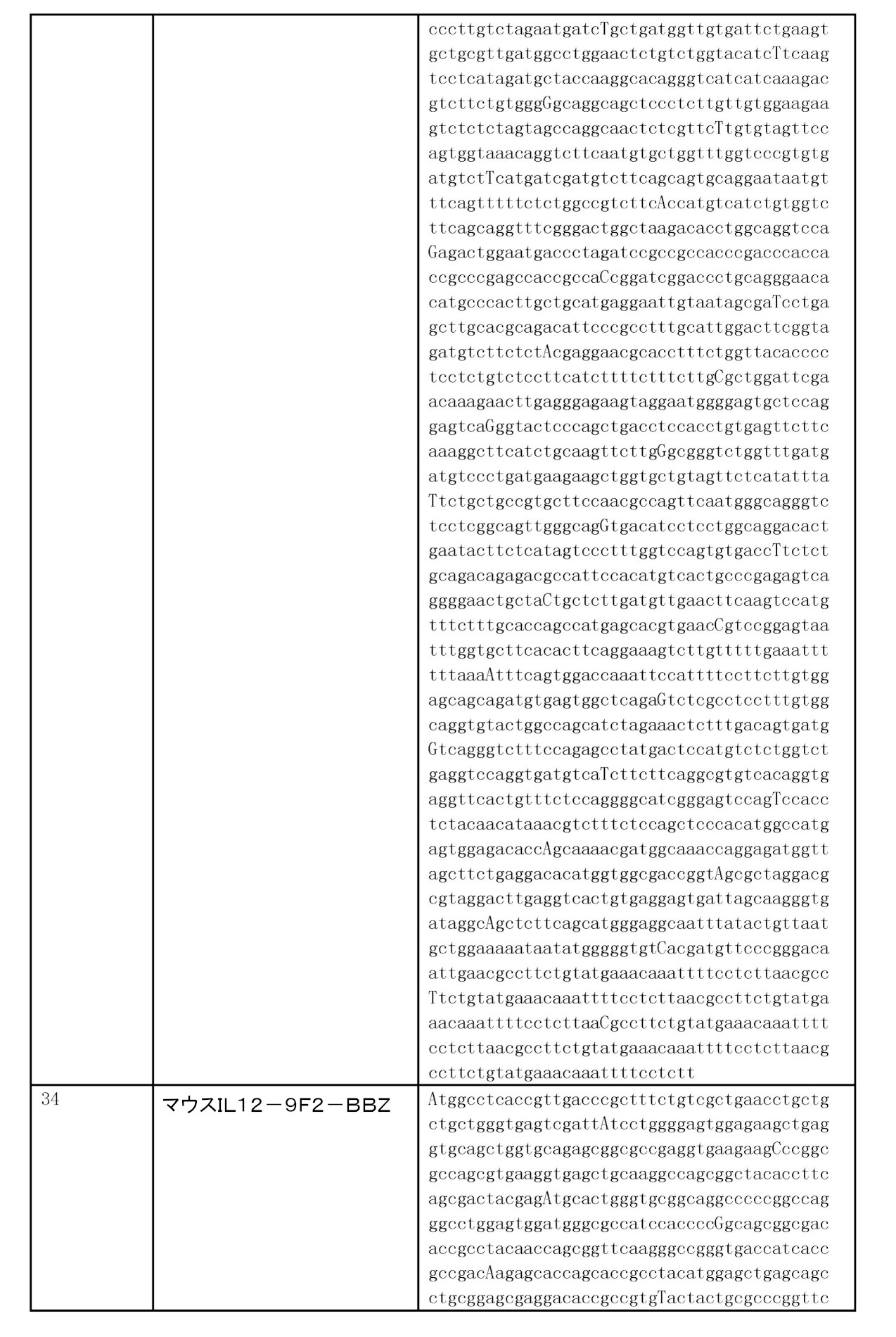


本発明で言及されたすべての文書は、あたかも各文書が個別に参照として引用されたかのように、本出願における参照として引用される。さらに、本発明の上記の教示内容を読んだ後、当業者は本発明に様々な変更または修正を加えることができ、これらの同等の形態も、本出願の添付の請求範囲によって定義される範囲に含まれる。 All documents referred to in the present invention are cited as references in this application as if each document was cited individually as a reference. Further, after reading the above teachings of the invention, one of ordinary skill in the art may make various changes or modifications to the invention, the equivalent of which is also within the scope of the claims of the present application. include.
Claims (22)
当該細胞は、GPC3に特異的に結合する受容体および外因性IL12を発現することを特徴とする、前記免疫応答細胞。 Immune response cells
The immune response cell, characterized in that the cell expresses a receptor that specifically binds to GPC3 and exogenous IL12.
請求項1に記載の免疫応答細胞。 The immune response cell according to claim 1, wherein the receptor is operably linked to the IL12.
請求項1に記載の免疫応答細胞。 The immune response cell according to claim 1, wherein the immune response cell comprises T cells, natural killer cells, cytotoxic T lymphocytes, natural killer T cells, DNT cells, and / or regulatory T cells. ..
好ましくは、前記IL12を発現するために使用されるプロモーターは、免疫細胞誘導型プロモーターを含み、
好ましくは、前記免疫細胞誘導型プロモーターは、NFAT6プロモーターであることを特徴とする
請求項1に記載の免疫応答細胞。 The extrinsic IL12 is constitutive or inducible expression and is
Preferably, the promoter used to express the IL12 comprises an immune cell-induced promoter.
The immune response cell according to claim 1, wherein the immune cell-induced promoter is preferably an NFAT6 promoter.
前記請求項のいずれか1項に記載の免疫応答細胞。 The immune response cell according to any one of the above claims, wherein the receptor has an extracellular domain, a transmembrane domain, and an intracellular signal domain that specifically bind to GPC3.
好ましくは、前記細胞刺激シグナル分子は、CD3ζ、CD3γ、CD3δ、CD3ε、FcεRIγ、FcRβ、CD79a、CD79b、Fc γRIIa、DAP10、またはDAP12タンパク質の機能的シグナル伝達ドメインから選択され、より好ましくは、CD3ζであり、または
好ましくは、前記細胞活性化共刺激分子は、CD27、CD28、CD137、CD134、ICOS、OX40、CD30、CD40、PD-1、リンパ球機能関連抗原-1(LFA-1)、CD2、CD7、LIGHT、NKG2C、B7-H3、CD83に特異的に結合するリガンド、CDS、ICAM-1、GITR、BAFFR、HVEM(LIGHTR)、SLAMF7、NKp80(KLRF1)、CD160、CD19、CD4、CD8α、CD8β、IL2Rβ、IL2Rγ、IL7Rα、ITGA4、VLA1、CD49a、ITGA4、IA4、CD49D、ITGA6、VLA-6、CD49f、ITGAD、CD11d、ITGAE、CD103、ITGAL、CD11a、LFA-1、ITGAM、CD11b、ITGAX、CD11c、ITGB1、CD29、ITGB2、CD18、LFA-1、ITGB7、TNFR2、TRANCE/RANKL、DNAM1(CD226)、SLAMF4(CD244、2B4)、CD84、CD96(Tactile)、CEACAM1、CRTAM、Ly9(CD229)、CD160(BY55)、PSGL1、CD100(SEMA4D)、CD69、SLAMF6(NTB-A、Ly108)、SLAM(SLAMF1、CD150、IPO-3)、BLAME(SLAMF8)、SELPLG(CD162)、LTBR、LAT、GADS、SLP-76、PAG/Cbp、NKp44、NKp30、NKp46、およびNKG2Dのようなタンパク質機能的シグナル伝達ドメインから選択され、より好ましくは、CD27、CD28、CD137、CD134、およびICOSであることを特徴とする
請求項5に記載の免疫応答細胞。 The receptor is a chimeric antigen receptor, wherein the intracellular domain comprises a cell stimulating signal molecule, or a combination of a cell stimulating signal molecule and a cell activating co-stimulating molecule.
Preferably, the cell stimulating signal molecule is selected from the functional signaling domain of the CD3ζ, CD3γ, CD3δ, CD3ε, FcεRIγ, FcRβ, CD79a, CD79b, Fc γRIIa, DAP10, or DAP12 protein, more preferably CD3ζ. Yes, or preferably, the cell activation costimulatory molecule is CD27, CD28, CD137, CD134, ICOS, OX40, CD30, CD40, PD-1, lymphocyte function-related antigen-1 (LFA-1), CD2, Ligands that specifically bind to CD7, LIGHT, NKG2C, B7-H3, CD83, CDS, ICAM-1, GITR, BAFFR, HVEM (LIGHT), SLAMF7, NKp80 (KLRF1), CD160, CD19, CD4, CD8α, CD8β. , IL2Rβ, IL2Rγ, IL7Rα, ITGA4, VLA1, CD49a, ITGA4, IA4, CD49D, ITGA6, VLA-6, CD49f, ITGAD, CD11d, ITGAE, CD103, ITGAL, CD11a, LFA-1, ITGAM, CD11b, ITGAX, CD11 , ITGB1, CD29, ITGB2, CD18, LFA-1, ITGB7, TNFR2, TRANCE / RANKL, DNAM1 (CD226), SLAMF4 (CD244, 2B4), CD84, CD96 (Tactile), CEACAM1, CRTAM, Ly9 (CD229) (BY55), PSGL1, CD100 (SEMA4D), CD69, SLAMF6 (NTB-A, Ly108), SLAM (SLAMF1, CD150, IPO-3), BLAME (SLAMF8), SELPLG (CD162), LTBR, LAT, GADS, SLP Claims selected from protein functional signaling domains such as -76, PAG / Cbp, NKp44, NKp30, NKp46, and NKG2D, more preferably CD27, CD28, CD137, CD134, and ICOS. Item 5. The immune response cell according to Item 5.
請求項5または6に記載の免疫応答細胞。 The extracellular domain of the receptor is characterized by comprising an amino acid sequence having at least 90%, 95%, 96%, 97%, 98% or 99% homology with the amino acid sequence set forth in SEQ ID NO: 25. The immune response cell according to claim 5 or 6.
前記請求項のいずれか1項に記載の免疫応答細胞。 The acceptor comprises the amino acid sequence set forth in SEQ ID NO: 21, 22, 23, or 24, or is at least 90%, 95 with the amino acid sequence set forth in SEQ ID NO: 21, 22, 23, or 24. The immune response cell according to any one of the above claims, which comprises an amino acid sequence having an amino acid sequence having%, 96%, 97%, 98%, or 99% homology.
好ましくは、SEQ ID NO:28、29、30、または31と少なくとも90%、95%、96%、97%、98%、または99%の相同性を有するヌクレオチド配列によってコードされ、
より好ましくは、SEQ ID NO:28、29、30、または31に示されるヌクレオチド配列によってコードされることを特徴とする
請求項8に記載の免疫応答細胞。 The receptor and the exogenous IL12 are at least 90%, 95%, 96%, 97%, 98%, or 99% with SEQ ID NO: 28, 29, 30, 31, 32, 33, 34 or 35. Encoded by a nucleotide sequence with homology,
Preferably, it is encoded by a nucleotide sequence having at least 90%, 95%, 96%, 97%, 98%, or 99% homology with SEQ ID NO: 28, 29, 30, or 31.
More preferably, the immune response cell of claim 8, characterized by being encoded by the nucleotide sequence set forth in SEQ ID NO: 28, 29, 30, or 31.
前記請求項のいずれか1項に記載の免疫応答細胞。 The immune response cell according to any one of the above claims, wherein the immune response cell does not contain an exogenous co-stimulatory ligand.
前記請求項のいずれか1項に記載の免疫応答細胞。 The immune response cell according to any one of the above claims, wherein the receptor and / or the IL12 is constitutively or inducibly expressed on the surface of the immune response cell.
前記請求項のいずれか1項に記載の免疫応答細胞。 The immunity according to any one of the above claims, wherein the immune response cell comprises an expression construct, wherein the expression construct comprises an expression cassette of the antigen-binding receptor and an expression cassette of IL12. Response cells.
前記請求項のいずれか1項に記載の免疫応答細胞。 The receptor and / or IL12 is expressed using a viral vector, preferably any of the above claims, wherein the viral vector comprises a lentiviral vector, a reverse transcriptional viral vector or an adenoviral vector. The immune response cell according to item 1.
請求項1~13のいずれか1項に記載の免疫応答細胞。 After the immune response cells are administered to an individual, the number of CAR-T cells in the peripheral blood of the individual is characterized by an increase of at least 50% compared to the absence of the exogenous IL12. Item 2. The immune response cell according to any one of Items 1 to 13.
請求項1~13のいずれか1項に記載の免疫応答細胞。 Approximately 7 days after the immune response cells were administered to the individual, the total number of CAR-T cells in the peripheral blood of the individual exceeded 6000 cells / μL, and approximately 10 days after the immune response cells were administered. The immune response cell according to any one of claims 1 to 13, wherein the total number of CAR-T cells in the peripheral blood of the individual exceeds 6000 cells / μL after a day.
当該発現構築物は、順次に連結された受容体の発現カセットおよびIL12の発現カセットを含み、ここで、前記抗原結合受容体およびIL12は、前記請求項のいずれか1項に定義されたとおりであることを特徴とする、前記発現構築物。 An expression construct,
The expression construct comprises an expression cassette of sequentially linked receptors and an expression cassette of IL12, wherein the antigen binding receptor and IL12 are as defined in any one of the above claims. The expression construct, characterized in that.
請求項17に記載の用途。 The tumors include liver cancer, stomach cancer, lung cancer, breast cancer, head and neck cancer, bladder cancer, ovarian cancer, cervical cancer, kidney cancer, pancreatic cancer, cervical cancer, liposarcoma, and black color. Claims comprising tumors, adrenal cancers, nerve sheath tumors, malignant fibrous histiocytoma, and esophageal cancers, preferably said tumor characterized by being liver visceral cancer, gastric cancer, lung cancer, or breast cancer. Item 17. The use according to item 17.
請求項17または18に記載の用途。 The use according to claim 17 or 18, wherein the immune effector cells reduce tumors by at least 50%.
請求項19に記載の用途。 19. The use according to claim 19, wherein the immune effector cells reduce the tumor by at least 70%, more preferably the immune effector cells reduce the tumor by at least 80%.
前記医薬組成物は、
請求項1~13のいずれか1項に記載の免疫応答細胞、および
薬学的に許容されるベクターまたは賦形剤を含むことを特徴とする、前記医薬組成物。 It is a pharmaceutical composition
The pharmaceutical composition is
The pharmaceutical composition comprising the immune response cell according to any one of claims 1 to 13 and a pharmaceutically acceptable vector or excipient.
請求項1~13のいずれか1項に記載の免疫応答細胞、および
前記免疫応答細胞を個体に投与する方法を指導する取扱説明書を含むことを特徴とする、前記キット。
It ’s a kit,
The kit comprising the immune response cell according to any one of claims 1 to 13 and an instruction manual for instructing a method for administering the immune response cell to an individual.
Applications Claiming Priority (1)
| Application Number | Priority Date | Filing Date | Title |
|---|---|---|---|
| PCT/CN2018/120938 WO2020118634A1 (en) | 2018-12-13 | 2018-12-13 | Immune effector cell targeting gpc3 and application thereof |
Publications (1)
| Publication Number | Publication Date |
|---|---|
| JP2022512450A true JP2022512450A (en) | 2022-02-03 |
Family
ID=71075860
Family Applications (1)
| Application Number | Title | Priority Date | Filing Date |
|---|---|---|---|
| JP2021534233A Pending JP2022512450A (en) | 2018-12-13 | 2018-12-13 | Immune effector cells targeting GPC3 and their applications |
Country Status (4)
| Country | Link |
|---|---|
| US (1) | US20220056408A1 (en) |
| EP (1) | EP3907280A4 (en) |
| JP (1) | JP2022512450A (en) |
| WO (1) | WO2020118634A1 (en) |
Families Citing this family (6)
| Publication number | Priority date | Publication date | Assignee | Title |
|---|---|---|---|---|
| WO2021259334A1 (en) * | 2020-06-24 | 2021-12-30 | 南京博望医药科技有限公司 | Self-regulating chimeric antigen receptor and application thereof in tumor immunity |
| US20240181055A1 (en) | 2021-04-08 | 2024-06-06 | Crage Medical Co., Limited | Cellular immunotherapy use |
| EP4355341A4 (en) * | 2021-06-16 | 2025-06-04 | Senti Biosciences, Inc. | ARMED CHIMERIC RECEPTORS AND METHODS OF USE THEREOF |
| WO2023246574A1 (en) * | 2022-06-24 | 2023-12-28 | 四川科伦博泰生物医药股份有限公司 | Gpc3-targeting antibody and use thereof |
| CN119968397A (en) * | 2022-11-28 | 2025-05-09 | 四川科伦药物研究院有限公司 | Chimeric antigen receptor specifically binding to GPC3 and its application |
| CN117230174A (en) * | 2023-04-03 | 2023-12-15 | 上海交通大学医学院附属瑞金医院 | Application of GPC3 in diagnosis of idiopathic pulmonary fibrosis |
Citations (3)
| Publication number | Priority date | Publication date | Assignee | Title |
|---|---|---|---|---|
| JP2016523518A (en) * | 2013-05-08 | 2016-08-12 | 科済生物医薬(上海)有限公司 | Nucleic acid encoding GPC3 chimeric antigen receptor protein and T lymphocyte expressing GPC3 chimeric antigen receptor protein |
| US20180201902A1 (en) * | 2014-12-04 | 2018-07-19 | Carsgen Therapeutics Ltd | Gpc3 and asgpr1 double-targeted transgenic immune effector cell and use thereof |
| JP2018522564A (en) * | 2015-08-03 | 2018-08-16 | カースゲン セラピューティクス リミテッドCarsgen Therapeutics Limited | Anti-glypican 3 antibody and use thereof |
Family Cites Families (3)
| Publication number | Priority date | Publication date | Assignee | Title |
|---|---|---|---|---|
| CN118146379B (en) * | 2016-04-26 | 2025-09-09 | 恺兴生命科技(上海)有限公司 | Method for improving immune response cell function |
| CN109468279A (en) * | 2017-09-08 | 2019-03-15 | 科济生物医药(上海)有限公司 | Immune effector cells targeting GPC3 and their applications |
| JP2021512875A (en) * | 2018-02-02 | 2021-05-20 | カースゲン セラピューティクス カンパニー リミテッドCarsgen Therapeutics Co., Ltd. | Combination of cell immunotherapy |
-
2018
- 2018-12-13 JP JP2021534233A patent/JP2022512450A/en active Pending
- 2018-12-13 US US17/413,892 patent/US20220056408A1/en not_active Abandoned
- 2018-12-13 EP EP18943085.3A patent/EP3907280A4/en not_active Withdrawn
- 2018-12-13 WO PCT/CN2018/120938 patent/WO2020118634A1/en not_active Ceased
Patent Citations (3)
| Publication number | Priority date | Publication date | Assignee | Title |
|---|---|---|---|---|
| JP2016523518A (en) * | 2013-05-08 | 2016-08-12 | 科済生物医薬(上海)有限公司 | Nucleic acid encoding GPC3 chimeric antigen receptor protein and T lymphocyte expressing GPC3 chimeric antigen receptor protein |
| US20180201902A1 (en) * | 2014-12-04 | 2018-07-19 | Carsgen Therapeutics Ltd | Gpc3 and asgpr1 double-targeted transgenic immune effector cell and use thereof |
| JP2018522564A (en) * | 2015-08-03 | 2018-08-16 | カースゲン セラピューティクス リミテッドCarsgen Therapeutics Limited | Anti-glypican 3 antibody and use thereof |
Non-Patent Citations (1)
| Title |
|---|
| TUMOR, vol. 38, JPN6022029289, June 2018 (2018-06-01), pages 631 - 642, ISSN: 0004991646 * |
Also Published As
| Publication number | Publication date |
|---|---|
| WO2020118634A1 (en) | 2020-06-18 |
| EP3907280A4 (en) | 2022-06-22 |
| US20220056408A1 (en) | 2022-02-24 |
| EP3907280A1 (en) | 2021-11-10 |
Similar Documents
| Publication | Publication Date | Title |
|---|---|---|
| JP7300763B2 (en) | CAR expression vectors and CAR-expressing T cells | |
| US20240141041A1 (en) | CHIMERIC ANTIGEN RECEPTORS (CARs), COMPOSITIONS AND METHODS THEREOF | |
| CN111247242B (en) | Chimeric Antigen Receptors (CARs), compositions, and methods of use thereof | |
| EP3680338A1 (en) | Genetically engineered t cell and application thereof | |
| JP2022512450A (en) | Immune effector cells targeting GPC3 and their applications | |
| JP2023053328A (en) | Immunocompetent cell for expressing cell surface molecule specifically recognizing human mesothelin, il-7 and ccl19 | |
| JP2024509917A (en) | Method for selective stimulation of T cells in solid tumors using orthogonal IL-2 delivery by oncolytic viruses | |
| JP2025102823A (en) | Compositions and methods comprising high affinity chimeric antigen receptors (CARs) with cross-reactivity with clinically relevant EGFR mutant proteins | |
| KR20250089526A (en) | CAR-T constructs comprising novel CD19 binding agents in combination with IL18 and methods of using the same | |
| WO2022043315A1 (en) | A CHIMERIC ANTIGEN RECEPTOR CONSTRUCT ENCODING A CHECKPOINT INHIBITORY MOLECULE AND AN IMMUNE STIMULATORY CYTOKINE AND CAR-EXPRESSING CELLS RECOGNIZING CD44v6 | |
| JP2023540023A (en) | Chimeric antigen receptor (CAR)-expressing cells that recognize CEA | |
| TW202140790A (en) | Method for transducing cells with viral vectors | |
| CN118510901A (en) | Chimeric adapter polypeptides | |
| CN119912567B (en) | V gamma 9V delta 2T cell expressing chimeric antigen receptor targeting B7-H3 and application thereof | |
| WO2025224123A1 (en) | Chimeric antigen receptors specific for fibroblast activation protein | |
| HK1235426A1 (en) | Car expression vector and car-expressing t cells | |
| HK1235426B (en) | Car expression vector and car-expressing t cells |
Legal Events
| Date | Code | Title | Description |
|---|---|---|---|
| A621 | Written request for application examination |
Free format text: JAPANESE INTERMEDIATE CODE: A621 Effective date: 20210825 |
|
| A711 | Notification of change in applicant |
Free format text: JAPANESE INTERMEDIATE CODE: A711 Effective date: 20211209 |
|
| A521 | Request for written amendment filed |
Free format text: JAPANESE INTERMEDIATE CODE: A821 Effective date: 20211209 |
|
| A711 | Notification of change in applicant |
Free format text: JAPANESE INTERMEDIATE CODE: A711 Effective date: 20220224 |
|
| A131 | Notification of reasons for refusal |
Free format text: JAPANESE INTERMEDIATE CODE: A131 Effective date: 20220713 |
|
| A02 | Decision of refusal |
Free format text: JAPANESE INTERMEDIATE CODE: A02 Effective date: 20230216 |