JP2022509554A - Methods and systems for detecting motivation - Google Patents
Methods and systems for detecting motivation Download PDFInfo
- Publication number
- JP2022509554A JP2022509554A JP2021550678A JP2021550678A JP2022509554A JP 2022509554 A JP2022509554 A JP 2022509554A JP 2021550678 A JP2021550678 A JP 2021550678A JP 2021550678 A JP2021550678 A JP 2021550678A JP 2022509554 A JP2022509554 A JP 2022509554A
- Authority
- JP
- Japan
- Prior art keywords
- user
- question
- consensus
- data
- forecast
- Prior art date
- Legal status (The legal status is an assumption and is not a legal conclusion. Google has not performed a legal analysis and makes no representation as to the accuracy of the status listed.)
- Granted
Links
Images


Classifications
-
- G—PHYSICS
- G06—COMPUTING OR CALCULATING; COUNTING
- G06Q—INFORMATION AND COMMUNICATION TECHNOLOGY [ICT] SPECIALLY ADAPTED FOR ADMINISTRATIVE, COMMERCIAL, FINANCIAL, MANAGERIAL OR SUPERVISORY PURPOSES; SYSTEMS OR METHODS SPECIALLY ADAPTED FOR ADMINISTRATIVE, COMMERCIAL, FINANCIAL, MANAGERIAL OR SUPERVISORY PURPOSES, NOT OTHERWISE PROVIDED FOR
- G06Q30/00—Commerce
- G06Q30/02—Marketing; Price estimation or determination; Fundraising
- G06Q30/0201—Market modelling; Market analysis; Collecting market data
- G06Q30/0203—Market surveys; Market polls
-
- G—PHYSICS
- G06—COMPUTING OR CALCULATING; COUNTING
- G06F—ELECTRIC DIGITAL DATA PROCESSING
- G06F16/00—Information retrieval; Database structures therefor; File system structures therefor
- G06F16/90—Details of database functions independent of the retrieved data types
- G06F16/903—Querying
-
- G—PHYSICS
- G06—COMPUTING OR CALCULATING; COUNTING
- G06F—ELECTRIC DIGITAL DATA PROCESSING
- G06F16/00—Information retrieval; Database structures therefor; File system structures therefor
- G06F16/90—Details of database functions independent of the retrieved data types
- G06F16/907—Retrieval characterised by using metadata, e.g. metadata not derived from the content or metadata generated manually
- G06F16/909—Retrieval characterised by using metadata, e.g. metadata not derived from the content or metadata generated manually using geographical or spatial information, e.g. location
-
- G—PHYSICS
- G06—COMPUTING OR CALCULATING; COUNTING
- G06Q—INFORMATION AND COMMUNICATION TECHNOLOGY [ICT] SPECIALLY ADAPTED FOR ADMINISTRATIVE, COMMERCIAL, FINANCIAL, MANAGERIAL OR SUPERVISORY PURPOSES; SYSTEMS OR METHODS SPECIALLY ADAPTED FOR ADMINISTRATIVE, COMMERCIAL, FINANCIAL, MANAGERIAL OR SUPERVISORY PURPOSES, NOT OTHERWISE PROVIDED FOR
- G06Q30/00—Commerce
- G06Q30/02—Marketing; Price estimation or determination; Fundraising
- G06Q30/0201—Market modelling; Market analysis; Collecting market data
-
- G—PHYSICS
- G06—COMPUTING OR CALCULATING; COUNTING
- G06Q—INFORMATION AND COMMUNICATION TECHNOLOGY [ICT] SPECIALLY ADAPTED FOR ADMINISTRATIVE, COMMERCIAL, FINANCIAL, MANAGERIAL OR SUPERVISORY PURPOSES; SYSTEMS OR METHODS SPECIALLY ADAPTED FOR ADMINISTRATIVE, COMMERCIAL, FINANCIAL, MANAGERIAL OR SUPERVISORY PURPOSES, NOT OTHERWISE PROVIDED FOR
- G06Q30/00—Commerce
- G06Q30/02—Marketing; Price estimation or determination; Fundraising
- G06Q30/0201—Market modelling; Market analysis; Collecting market data
- G06Q30/0204—Market segmentation
- G06Q30/0205—Market segmentation based on location or geographical consideration
Landscapes
- Engineering & Computer Science (AREA)
- Business, Economics & Management (AREA)
- Accounting & Taxation (AREA)
- Development Economics (AREA)
- Finance (AREA)
- Strategic Management (AREA)
- Entrepreneurship & Innovation (AREA)
- Theoretical Computer Science (AREA)
- Physics & Mathematics (AREA)
- Data Mining & Analysis (AREA)
- General Physics & Mathematics (AREA)
- Marketing (AREA)
- General Business, Economics & Management (AREA)
- Economics (AREA)
- Game Theory and Decision Science (AREA)
- Databases & Information Systems (AREA)
- General Engineering & Computer Science (AREA)
- Library & Information Science (AREA)
- Computational Linguistics (AREA)
- Management, Administration, Business Operations System, And Electronic Commerce (AREA)
Abstract

方法及びシステムは、入力の複数のストリームを受信して処理し、入力に基づいてユーザインターフェースを生成する出力のストリームを出力する。ユーザインターフェースは、入力のストリームに応答して生成された1つ又は複数の質問を含み、ユーザに電子的に送信される。ユーザは、生成されたユーザインターフェースを介して方法及びシステムに更なる入力を提供する。
【選択図】 図5
Methods and systems receive and process multiple streams of input and output a stream of output that produces a user interface based on the input. The user interface contains one or more questions generated in response to a stream of inputs and is electronically transmitted to the user. The user provides further input to the method and system via the generated user interface.
[Selection diagram] Fig. 5
Description
本発明は、脅威検出、オンラインメディアへの影響、商業マーケティング、又は広告目的に使用され得る、モチベーションを抽出するための方法及びシステムに関する。 The present invention relates to methods and systems for extracting motivation that can be used for threat detection, impact on online media, commercial marketing, or advertising purposes.
本出願は、いずれも2018年11月19日に出願された米国特許出願第62/769,049号及び米国特許出願第62/769,058号の優先権を主張する。 This application claims the priority of U.S. Patent Application No. 62 / 769,049 and U.S. Patent Application No. 62 / 769,058, both filed on November 19, 2018.
インターネットは、人々の交流の仕方を変えた。この変化は、商品を売買する方法だけでなく、互いにコミュニケーションをとる方法にも重大な影響を与えてきた(https://www.dni.gov/files/images/globalTrends/documents/GT-Full-Report.pdf、第200頁、参照)。人々は、自分のことに集中するためにより多くの時間を費やすようになり、一般に周囲の環境に気を配ることが少なくなっている。人々が内向きに集中するようになるにつれて、人々は自分の既存のバイアスを正当化する理由を探すため、確証バイアスが、意思決定及びニュース選択の支配的な要因になっていく。それが一種のトライバリズムにつながっている。自分達のような人々を探し出した後、確証バイアスと、減少し続ける注意スパンとによって、ユーザは、ますます自己中心的なパターンに陥る。インターネットは、すべてをパーソナライズすることに慣れた世代を生み出した。 The Internet has changed the way people interact. This change has had a significant impact not only on how to buy and sell goods, but also on how to communicate with each other (https://www.dni.gov/files/images/globalTrends/documents/GT-Full- Report.pdf, page 200, see). People are spending more time focusing on themselves and generally less concerned about their surroundings. As people become more inwardly focused, confirmation bias becomes a dominant factor in decision making and news choices as they seek reasons to justify their existing bias. That leads to a kind of tribalism. After finding people like themselves, confirmation bias and a ever-decreasing attention span put users in an increasingly self-centered pattern. The Internet has created a generation accustomed to personalizing everything.
個人及びこれらのよりも小さいトライバルグループを理解することは複雑である。フォーカスグループや世論調査は当てにならない(Phillips及びArtinoによる、Lies, Damned Lies and Surveys,J Grad Med Educ. 2017 Dec; 9(6): 677-679(https://www.ncbi.nlm.nih.gov/pmc/articles/PMC5734316/)参照)。又は、Beau Lottoが著書Deviate: The Science of Seeing Differently(2018)で説明しているように、参加者が「彼らが誰であるか」ではなく「彼らが誰になりたいか」に基づいて質問に回答するため、フォーカスグループは、動的な(不安定な)環境では効果的でない。 Understanding individuals and their smaller tribal groups is complex. Focus groups and polls are unreliable (Phillips and Artino, Lies, Damned Lies and Surveys, J Grad Med Educ. 2017 Dec; 9 (6): 677-679 (https://www.ncbi.nlm.nih) See .gov / pmc / articles / PMC5734316 /)). Or, as Beau Lotto explains in his book Deviate: The Science of Seeing Differently (2018), participants ask questions based on "who they want to be" rather than "who they are". To answer, focus groups are not effective in dynamic (unstable) environments.
マーケティング会社は、複数のプラットフォームにわたって個人を追跡する心理測定プロファイルを利用して、このユーザのハイパーフォーカスに対処しようと試みてきた。データは、プラットフォームにわたって収集される。個人の行動(例えば、訪問したウェブサイト)が捕捉され、個人のプロファイルが作成され、モチベーションになる洞察が特定される。次いで、これらの洞察は、ターゲット広告の形態でユーザのフィードに埋め込まれる。プロファイリングでは、(i)ユーザが過去のパターンを繰り返すこと、及び(ii)人々が個人として扱われても、他の人にも当てはまる教訓がいくつか存在することを想定している。過去の相関データを探すことは、ほとんどの人工知能又はデータマイニング製品の基礎である。 Marketing companies have attempted to address this user's hyperfocus by leveraging psychometric profiles that track individuals across multiple platforms. Data is collected across platforms. Individual behavior (eg, visited websites) is captured, personal profiles are created, and motivational insights are identified. These insights are then embedded in the user's feed in the form of targeted advertising. Profiling envisions that (i) users repeat past patterns, and (ii) there are some lessons that apply to others even if people are treated as individuals. Searching for historical correlation data is the basis of most artificial intelligence or data mining products.
これらのシステムは、バイアスを植え付けるだけでなく、膨大な個人データを必要とする。このデータ収集及びパーソナライゼーションは、予期せぬ結果をもたらす。ユーザが自転車を検索した後、自転車の広告がユーザに殺到する。ニュースのウェブページ上の広告において、統合データセットと、性的ページへの訪問によってトリガされる広告とを見ると、違和感を覚えることがある。EUの一般データ保護規則(GDPR)及びカリフォルニア州のCCPAは、会社が訴えることができるものとできないものについての規則を変更しつつある。個人が個人データの使用を制限すると、心理測定プロファイリングは失敗する。 These systems not only instill bias, but also require vast amounts of personal data. This data acquisition and personalization has unexpected consequences. After the user searches for a bicycle, the user is flooded with bicycle advertisements. In an ad on a news web page, looking at an integrated dataset and an ad triggered by a visit to a sexual page can be uncomfortable. The EU's General Data Protection Regulation (GDPR) and the California Consumer Privacy Act are changing rules about what companies can and cannot sue. Psychological measurement profiling fails when an individual restricts the use of personal data.
従って、匿名性を維持しながら、ハイパーフォーカスされた個人又はトライブのユーザバイアスを特定する方法及びシステムが必要である。特定されると、そのバイアスは、脅威検出を事前に行うために使用されるか、又はマーケティングメッセージの基礎として使用され得る。現在の方法及びシステムは更に、ユーザが依然として好みのニュースソースを受信するが、操作が検出されたときにはシステムがニュースのペースをスローダウンするように、操作プロセスを中断するシステム及び方法を進歩させることによって、2016年及び2018年の米国の選挙中に見られたようなオンラインのソーシャル操作という問題を解決するために使用され得る。これにより、受信者は、より客観的な心理状態でニュースを検討することができる。 Therefore, there is a need for methods and systems to identify hyperfocused individual or tribe user bias while maintaining anonymity. Once identified, the bias can be used to proactively detect threats or as the basis for marketing messages. Current methods and systems further advance systems and methods that interrupt the operation process so that users still receive their favorite news sources, but the system slows down the pace of news when an operation is detected. Can be used by to solve the problem of online social operations as seen during the 2016 and 2018 US elections. This allows the recipient to review the news in a more objective state of mind.
本発明は、この問題の原因が少なくとも部分的にデフォルトモードネットワーク(DMN)に関係していると仮定する。DMNは、以下のように定義されている:
デフォルトモードネットワークは、通常、白日夢及び心の迷走の間など、人が外界に集中しておらず、脳が覚醒状態で休息しているときに活性化していることが分かっている。しかしながら、このネットワークは、個人が、他の人のことを考えているとき、自分のことを考えているとき、過去を思い出しているとき、将来の計画を立てているときも活性化している。このネットワークは、人がタスクに関与していないときに「デフォルトで」活性化する。DMNは、当初、特定の目的志向のタスクでは不活性化されることが知られており、タスクネガティブネットワークと呼ばれることもあるが、ソーシャルワーキングメモリ又は自伝的タスクのような他の目的志向のタスクでは活性化している可能性がある。DMNは、アテンションネットワークのような脳内の他のネットワークと負の相関があることが分かっている。・・・デフォルトモードネットワークは、視覚的注意又は認知的ワーキングメモリタスクのような外部の目的志向のタスク中、不活性化することが分かっているため、一部の研究者は、このネットワークをタスクネガティブネットワークとラベル付けしている(https://en.wikipedia.org/wiki/Default_mode_network#Function(2018年8月27日))。個人が、外界のときとは対照的にその個人のことを考えるとき、個人は、DMN優位な状態にある。読む動作は、個人をDMN優位な状態に推し進め、結果としてユーザは自分の目を通して世界を見ることとなり、社会における自分のより大きな役割を無視する。インターネットは、大部分が読む動作であるため、この影響を激化させてきた。
The present invention assumes that the cause of this problem is at least partially related to the default mode network (DMN). DMN is defined as follows:
It has been found that the default mode network is usually activated when the person is not focused on the outside world and the brain is awake and resting, such as during a daydream and a stray mind. However, this network is also active when individuals are thinking about others, thinking about themselves, remembering the past, and planning for the future. This network is activated "by default" when no one is involved in the task. DMNs are initially known to be inactivated in specific goal-oriented tasks and are sometimes referred to as task-negative networks, but other goal-oriented tasks such as social working memory or autobiographical tasks. Then it may be activated. DMN has been found to be negatively correlated with other networks in the brain, such as attention networks. ... The default mode network has been found to be inactivated during external goal-oriented tasks such as visual attention or cognitive working memory tasks, so some researchers task with this network. It is labeled as a negative network (https://en.wikipedia.org/wiki/Default_mode_network#Function (August 27, 2018)). When an individual thinks of him as opposed to the outside world, he is in a DMN predominant state. The reading action pushes the individual into a DMN-dominated state, resulting in the user seeing the world through his or her own eyes, ignoring his greater role in society. The Internet has exacerbated this effect, as it is largely a reading activity.
理論的には、DMN優位な状態によってもたらされる孤立感は、長時間経つと脳が不快感を覚える孤立感を生むもののはずである。本発明は、人々がインターネット上で自分と似た人々を見つけることによって孤立感を補っていると仮定する(Derek Thompson, Hit Makers: the Science of Popularity in the Age of Distraction(2017年2月7日)参照)。認知的不協和は、フィードバックループとして機能する。人々の性格が内向きになるにつれて、確証バイアスは人々の存在のより大きな部分となり、この結果、個人がより内向きになる。確証バイアスは、終わることのないループとなり、このようにして、フェイクニュースと本当のニュースが混ざり合い、区別できなくなる。 Theoretically, the feeling of isolation brought about by the DMN predominant state should create a feeling of isolation that makes the brain feel uncomfortable over a long period of time. The present invention assumes that people supplement their sense of isolation by finding people similar to them on the Internet (Derek Thompson, Hit Makers: the Science of Popularity in the Age of Distraction (February 7, 2017). )reference). Cognitive dissonance acts as a feedback loop. As people's personality becomes more inward, confirmation bias becomes a larger part of their existence, resulting in an individual becoming more inward. Confirmation bias becomes a never-ending loop, in which fake news and real news are mixed and indistinguishable.
このDMN優位な状態では、ユーザは、ユーザの内部バイアスを確認する情報を、考えなしに、消費し、好み、再投稿する。インターネットがければ、あなたがどんな意見を持っているのか、あなたがアレサフランクリンの死に心を痛めているかどうかなど、実際のところ誰も気にしかったとはいえ、ユーザは、急いで意見を表明し、グループに参加する。個人が亡くなったときによく見られるように投稿スピードは自動化されており、ユーザは、遺族とは対照的に、(再投稿することによって)いち早くニュースを報じるか、又はオンラインで(他の人に)哀悼の意を表明する。これは、「look at me」という現象である。 In this DMN predominant state, the user unthinkingly consumes, prefers, and reposts information confirming the user's internal bias. With the internet, users were in a hurry to express their opinions, even though they were really curious about what they had and whether you were heartbroken by Aretha Franklin's death. , Join the group. Posting speeds are automated, as is often the case when an individual dies, allowing users to report news early (by reposting) or online (to others), as opposed to bereaved families. ) Express your condolences. This is a phenomenon called "look at me".
本発明は、データ収集、データ処理、及びユーザ対話という3つの部分から構成される。データ収集ツールは、完全又は半完全な匿名環境で個人のパネルを使用する。同一のパネルが、毎週、定められた24時間又は48時間の間に、同じ質問、好ましくは10個の質問のセットに回答する。パネルは、数週間(例えば4~6週間)にわたって活動する。データ処理ツールは、週ごとの質問のコンセンサスを計算し、次いで、好ましい回答ゾーン(例えば、コンセンサス+/-5%~20%)を特定する。システムは、所与の週に好ましい回答ゾーンに最も多く現れるユーザを分析し、パワーユーザとして特定する。続いて、システムは、パワーユーザから回答を収集し、比較する。一般に、コメントに現れる共通のテーマを特定するためには、上位3~7人のパワーユーザからの回答だけが必要である。そのテーマは、触媒問題(catalyst issue)であると考えられる。次の週では、テストのためにこの触媒問題が分割グループに提示され得る。触媒問題が週ごとの感情の変化に与える影響は、暗黙のデルタ(Implicit Delta)であると考えられ、より大きな消費者の基盤にわたって有効性の観点で触媒問題をランク付けするために使用される。特定されると、触媒問題はまた、その後の販売活動と比較して、ある地域での触媒問題の異常な使用の過去の発生率を特定するためにバックワードテストされ得る。最後に、情報は、ダッシュボードで消費者に提示され、それによって、エンドユーザは、この情報をユーザのマーケティングプラットフォームに迅速に実装することができる。 The present invention is composed of three parts: data collection, data processing, and user dialogue. Data acquisition tools use personal panels in a fully or semi-completely anonymous environment. The same panel answers the same question, preferably a set of 10 questions, each week during a defined 24-hour or 48-hour period. The panel is active for several weeks (eg 4-6 weeks). The data processing tool calculates the weekly question consensus and then identifies the preferred answer zone (eg, consensus +/- 5% to 20%). The system analyzes the users who appear most often in the preferred response zone for a given week and identifies them as power users. The system then collects and compares responses from power users. In general, only responses from the top 3-7 power users are needed to identify a common theme that appears in comments. The theme is considered to be the catalyst issue. In the next week, this catalytic problem may be presented to the split group for testing. The effect of catalytic problems on weekly emotional changes is considered to be an implicit delta and is used to rank catalytic problems in terms of efficacy across a larger consumer base. .. Once identified, catalytic problems can also be backward tested to identify past incidence of abnormal use of catalytic problems in a region compared to subsequent sales activities. Finally, the information is presented to the consumer on the dashboard, which allows the end user to quickly implement this information on the user's marketing platform.
外国からのソーシャルメディアの操作に対抗するためにツールを使用する場合、異常な使用について触媒問題が監視され、潜在的な操作が検出されると、個人のニュースフィードがスローダウンされるため、確証バイアスの受信に関連する即時の満足感をターゲットから奪う。このスローダウンにより、ユーザが生成した割り込みイベント(ユーザ自ら始めたプロセスの中断)、操作の試みの影響に反作用して、軽減することができる。自動化された考えなしの回答から個人を取り除くことで、操作イベントを再投稿(及び再確認)する回数及び頻度を減らすと考えられる。 Confirmation when using tools to counter foreign social media operations, as catalytic issues are monitored for abnormal use and personal news feeds are slowed down when potential operations are detected. Deprive the target of the immediate satisfaction associated with receiving bias. This slowdown can be mitigated against the effects of user-generated interrupt events (user-initiated process interruptions) and operational attempts. Removing individuals from automated, thoughtless answers would reduce the number and frequency of reposting (and reconfirming) operational events.
本開示は、特に添付の特許請求の範囲において指摘される。本開示の特徴は、本明細書とともに提供される図面を含む本開示全体を検討することにより、より明らかになるであろう。 This disclosure is specifically pointed out in the appended claims. The features of this disclosure will become more apparent by reviewing the entire disclosure, including the drawings provided with this specification.
本明細書におけるいくつかの特徴は、同様の参照番号が同様の要素を指す添付の図面の図において、限定ではなく例として例示されている。 Some features herein are illustrated by way of example, but not by limitation, in the accompanying drawings where similar reference numbers point to similar elements.
本発明は、モチベーションとなる洞察の抽出においてグループダイナミクスが持つ独自の役割を認識する。システムを説明するためには、トピックから逸脱してグループ予想を理解する必要がある。 The present invention recognizes the unique role of group dynamics in extracting motivational insights. In order to explain the system, it is necessary to deviate from the topic and understand the group conjecture.
A.ハードウェア
いくつかの実施形態では、本明細書で開示される技法は、1つ又は複数のコンピューティングデバイス上で実装される。例えば、図1は、ユーザコンピューティングデバイス2a,2b,2cと、データベース6を有するデータ供給元のコンピューティングデバイス5と、ホストコンピューティングデバイス3及び関連データベース4とを例示するブロック図である。図2に示されるように、複数のホストサーバ7及び8が使用されること及びハードウェア構成に含まれることができる。
A. Hardware In some embodiments, the techniques disclosed herein are implemented on one or more computing devices. For example, FIG. 1 is a block diagram illustrating a user computing device 2a, 2b, 2c, a data supply source computing device 5 having a database 6, a
コンピューティングデバイスは、一般に、情報を通信するためのバス又は他の通信機構と、情報を処理するためにバスに結合されたハードウェアプロセッサとを含む。ハードウェアプロセッサは、例えば、汎用マイクロプロセッサ又はシステムオンチップ(SoC)であり得る。 Computing devices generally include a bus or other communication mechanism for communicating information and a hardware processor coupled to the bus for processing information. The hardware processor can be, for example, a general purpose microprocessor or a system on chip (SoC).
コンピューティングデバイスはまた、情報とプロセッサによって実行されるべき命令とを記憶するためにバスに結合された、ランダムアクセスメモリ(RAM)又は他の動的な記憶デバイスのようなメインメモリを含むことができる。メインメモリはまた、プロセッサによって実行されるべき命令の実行中にテンポラリ変数又は他の中間情報を記憶するために使用され得る。そのような命令は、プロセッサがアクセス可能な非一時的記憶媒体に記憶されると、コンピューティングデバイスを、これらの命令に指定されている動作を実行するようにカスタマイズされた専用マシンにする。 Computing devices may also include main memory, such as random access memory (RAM) or other dynamic storage device, coupled to the bus to store information and instructions to be executed by the processor. can. Main memory can also be used to store temporary variables or other intermediate information during the execution of instructions to be executed by the processor. Such instructions, when stored on a non-temporary storage medium accessible to the processor, make the computing device a dedicated machine customized to perform the actions specified in these instructions.
コンピューティングデバイスは、プロセッサのための静的情報及び命令を記憶するための、バスに結合された読取り専用メモリ(ROM)又は他の静的な記憶デバイスを更に含むことができる。 The computing device can further include a bus-coupled read-only memory (ROM) or other static storage device for storing static information and instructions for the processor.
磁気ディスク、光ディスク、又はソリッドステートドライブのような記憶デバイス4が提供され、情報及び命令を記憶するためにバスに結合される。
A
コンピューティングデバイスは、情報をコンピュータユーザに表示するために、液晶ディスプレイ(LCD)又は他の電子視覚ディスプレイのようなディスプレイ3aにバスを介して結合され得る。ディスプレイ3aはまた、タッチジェスチャ(例えば、指又はタッチペン)入力をプロセッサに通信するためのタッチ感知ディスプレイであり得る。英数字キー及び他のキーを含む入力デバイス3aは、情報及びコマンド選択をプロセッサに通信するためにバスに結合される。別のタイプのユーザ入力デバイスは、指示情報及びコマンド選択をプロセッサに通信し、ディスプレイ3a上のカーソル移動を制御するための、マウス、トラックボール、又はカーソル方向キーのようなカーソル制御である。この入力デバイスは、典型的には、2つの軸、すなわち第1の軸(例えばx)及び第2の軸(例えばy)における2つの自由度を有しており、これにより、デバイスは、平面において位置を指定することができる。 The computing device may be coupled via a bus to a display 3a, such as a liquid crystal display (LCD) or other electronic visual display, to display information to a computer user. The display 3a can also be a touch-sensitive display for communicating a touch gesture (eg, finger or stylus) input to the processor. The input device 3a, which includes an alphanumerical key and other keys, is coupled to the bus to communicate information and command selection to the processor. Another type of user input device is a cursor control, such as a mouse, trackball, or cursor direction key, for communicating instructional information and command selection to the processor and controlling cursor movement on the display 3a. The input device typically has two degrees of freedom in two axes, i.e. the first axis (eg x) and the second axis (eg y), whereby the device is planar. The position can be specified in.
ホストコンピューティングデバイス3は、カスタマイズされたハードワイヤードロジック、1つ又は複数の特定用途向け集積回路(ASIC)、1つ又は複数のフィールドプログラマブルゲートアレイ(FPGA)、ファームウェア、又はプログラムロジックを使用して、本明細書で説明する技法を実装し得、これらは、コンピューティングデバイスと組み合わせて、コンピューティングデバイスを専用マシンにするか又は専用マシンにプログラムする。いくつかの実施形態によれば、本明細書の技法は、プロセッサがメインメモリに含まれる1つ又は複数の命令の1つ又は複数のシーケンスを実行することに応答してコンピューティングデバイスによって実行される。そのような命令は、記憶デバイスのような別の記憶媒体からメインメモリに読み込まれ得る。メインメモリに含まれる命令のシーケンスの実行は、プロセッサに本明細書で説明されるプロセスステップを実行させる。代替的な実施形態では、ソフトウェア命令の代わりに、又はソフトウェア命令と組み合わせて、ハードワイヤード回路を使用することができる。
The
本明細書で使用される場合、「記憶媒体」という用語は、マシンを特定の方式で動作させるデータ及び/又は命令を記憶する任意の非一時的媒体を指す。そのような記憶媒体は、不揮発性媒体及び/又は揮発性媒体を含み得る。不揮発性媒体は、例えば、光ディスク、磁気ディスク、又は記憶デバイスのようなソリッドステートドライブを含む。揮発性媒体は、メインメモリのような動的メモリを含む。記憶媒体の一般的な形態には、例えば、フロッピー(登録商標)ディスク、フレキシブルディスク、ハードディスク、ソリッドステートドライブ、磁気テープ、又は任意の他の磁気データ記憶媒体、CD-ROM、任意の他の光学データ記憶媒体、穴のパターンを有する任意の物理媒体、RAM、PROM、及びEPROM、FLASH(登録商標)-EPROM、NVRAM、任意の他のメモリチップ又はカートリッジが含まれる。 As used herein, the term "storage medium" refers to any non-temporary medium that stores data and / or instructions that make a machine operate in a particular manner. Such storage media may include non-volatile media and / or volatile media. Non-volatile media include, for example, solid state drives such as optical discs, magnetic disks, or storage devices. Volatile media include dynamic memory such as main memory. Common forms of storage media include, for example, floppy (registered trademark) disks, flexible disks, hard disks, solid state drives, magnetic tapes, or any other magnetic data storage medium, CD-ROM, any other optical. Includes data storage media, any physical medium with a pattern of holes, RAM, PROM, and EPROM, FLASH®-EPROM, NVRAM, any other memory chip or cartridge.
記憶媒体は、伝送媒体とは異なるが、伝送媒体一緒に使用され得る。伝送媒体は、記憶媒体間での情報の伝達に関与する。例えば、伝送媒体は、バスを構成するワイヤを含めて、同軸ケーブル、銅線、及び光ファイバを含む。伝送媒体は、電波及び赤外線によるデータ通信の際に発生するような音波又は光波の形態をとることもできる。様々な形態の媒体が、実行のために1つ又は複数の命令の1つ又は複数のシーケンスをプロセッサに搬送することに関与し得る。例えば、命令は、最初、リモートコンピュータの磁気ディスク又はソリッドステートドライブ上で搬送され得る。リモートコンピュータは、その動的メモリに命令をロードし、モデムを使用して電話回線を介して命令を送ることができる。コンピューティングデバイスのローカルモデムは、電話回線上でデータを受信し、赤外線送信機を使用してデータを赤外線信号に変換することができる。赤外線検出器は、赤外線信号で搬送されたデータを受信することができ、適切な回路が、データをバスに置くことができる。バスは、データをメインメモリに搬送し、そこから、プロセッサが、命令を検索して実行する。メインメモリによって受信された命令は、オプションで、プロセッサによる実行の前又は後に記憶デバイスに記憶され得る。 The storage medium is different from the transmission medium, but can be used together with the transmission medium. The transmission medium is involved in the transmission of information between storage media. For example, the transmission medium includes coaxial cables, copper wires, and optical fibers, including the wires that make up the bus. The transmission medium can also take the form of sound waves or light waves that are generated during data communication by radio waves and infrared rays. Various forms of media may be involved in delivering one or more sequences of one or more instructions to a processor for execution. For example, instructions may initially be delivered on a remote computer's magnetic disk or solid state drive. The remote computer can load the instruction into its dynamic memory and use a modem to send the instruction over the telephone line. The local modem of the computing device can receive the data over the telephone line and use an infrared transmitter to convert the data into an infrared signal. The infrared detector can receive the data carried by the infrared signal and a suitable circuit can put the data on the bus. The bus carries the data to main memory, from which the processor retrieves and executes the instructions. Instructions received by the main memory can optionally be stored in the storage device before or after execution by the processor.
ホストコンピューティングデバイス3はまた、バスに結合された通信インターフェースを含む。通信インターフェースは、ローカルネットワーク1に接続されたネットワークリンクへの双方向データ通信結合を提供する。例えば、通信インターフェースは、総合デジタル通信網(ISDN)カード、ケーブルモデム、衛星モデム、又は対応するタイプの電話回線へのデータ通信接続を提供するモデムであり得る。別の例として、通信インターフェースは、互換性のあるLANへのデータ通信接続を提供するためのローカルエリアネットワーク(LAN)カードであり得る。ワイヤレスリンクも実装され得る。任意のそのような実装形態では、通信インターフェースは、様々なタイプの情報を表すデジタルデータストリームを搬送する電気信号、電磁信号、又は光信号を送受信する。
The
ネットワークリンクは、典型的には、1つ又は複数のネットワークを介して他のデータデバイスへのデータ通信を提供する。例えば、ネットワークリンクは、ローカルネットワークを介して、インターネットサービスプロバイダ(ISP)によって操作されるデータ機器又はホストコンピュータへの接続を提供し得る。次いで、ISPは、現在一般に「インターネット」と呼ばれているワールドワイドパケットデータ通信ネットワークを介してデータ通信サービスを提供する。ローカルネットワーク及びインターネットは両方とも、デジタルデータストリームを搬送する電気信号、電磁信号、又は光信号を使用する。様々なネットワークを介した信号並びにネットワークリンク上の及び通信インターフェースを介した信号は、コンピューティングデバイスとの間でデジタルデータを搬送するものであり、伝送媒体の例となる形態である。 Network links typically provide data communication to other data devices over one or more networks. For example, a network link may provide a connection to a data device or host computer operated by an Internet Service Provider (ISP) over a local network. The ISP then provides data communication services over a worldwide packet data communication network, now commonly referred to as the "Internet." Both local networks and the Internet use electrical, electromagnetic, or optical signals that carry digital data streams. Signals over various networks as well as signals over network links and over communication interfaces carry digital data to and from computing devices and are examples of transmission media.
コンピューティングデバイスは、ネットワーク(複数可)、ネットワークリンク、及び通信インターフェースを介して、メッセージを送り、プログラムコードを含むデータを受信することができる。インターネットの例では、サーバは、インターネット、ISP、ローカルネットワーク、及び通信インターフェースを介して、アプリケーションプログラムのための要求されたコードを送信し得る。受信されたコードは、受信されるとプロセッサによって実行され得、及び/又は後で実行するために記憶デバイス又は他の不揮発性ストレージに記憶され得る。 Computing devices can send messages and receive data, including program code, over networks (s), network links, and communication interfaces. In the Internet example, the server may send the requested code for an application program over the Internet, ISP, local network, and communication interface. The received code may be executed by the processor when received and / or stored in a storage device or other non-volatile storage for later execution.
ソフトウェアシステムは、典型的には、ホストコンピューティングデバイス3の動作を制御するために提供される。ソフトウェアシステムは、通常メインメモリ及び固定ストレージ(例えば、ハードディスク)に記憶されるものであり、プロセスの実行、メモリ割り当て、ファイル及びネットワーク入出力(I/O)、並びにデバイスI/Oを管理することなど、コンピュータ動作の低レベルのアスペクトを管理するカーネル又はオペレーティングシステム(OS)を含む。OSは、例えば、MICROSOFT WINDOWS(登録商標)、SUN SOLARIS (登録商標)、又はLINUX(登録商標)のような従来のオペレーティングシステムによって提供され得る。
The software system is typically provided to control the operation of the
クライアントソフトウェアすなわち「プログラム」又はプロセッサ実行可能命令のセットのような1つ又は複数のアプリケーション(複数可)もまた、コンピュータによる実行のために提供され得る。アプリケーション(複数可)は、ストレージ4からメインメモリに「ロード」され得るか、ネットワークロケーション(例えば、インターネットウェブサーバ)からダウンロードされ得る。グラフィカルユーザインターフェース(GUI)は、典型的には、ユーザコマンド及びデータをグラフィカル(例えば、「ポイントアンドクリック」又は「タッチジェスチャ」)方式で受信するために提供される。次いで、これらの入力は、OS及び/又はアプリケーション(複数可)からの命令に従ってコンピューティングデバイスの作用を受け得る。グラフィカルユーザインターフェースはまた、OS及びアプリケーション(複数可)からの動作の結果を表示するように機能する。
One or more applications (s) such as client software or "programs" or a set of processor executable instructions may also be provided for execution by a computer. The application (s) can be "loaded" from
B.感情を抽出するためのゲーム化された予想方法
グループ予想の1つの一般的な方法は、デルファイ法である。そのシステムでは、専門家のパネルが使用され、2ラウンド以上、アンケートに回答する。各ラウンドの後、ファシリテータは、前のラウンドの予想の匿名化されたサマリーを提供する。プロセスは、事前に定義された停止基準(例えば、ラウンド数、コンセンサスの達成度、結果の安定性)の後に停止し、最終ラウンドの平均値又は中央値スコアにより結果が決定される。
B. Gamed prediction method for extracting emotions One common method of group prediction is the Delphi method. The system uses a panel of experts to answer questionnaires for at least two rounds. After each round, the facilitator provides an anonymized summary of the expectations of the previous round. The process is stopped after a predefined stop criterion (eg, number of rounds, consensus achievement, stability of result) and the result is determined by the mean or median score of the last round.
その対極には予測市場がある。これらは一般に、イベントの結果に基づいて取引を行うことを目的として作られた取引所市場である。市場価格は、本質的に、イベントが発生する確率に変換される。予測市場は、所与の時点でのユーザの期待値に対する洞察を与えることができるが、その期待値が、なぜ又はどのような状況下で変化するのかについて説明するものではない。 At the other end of the spectrum is the prediction market. These are generally exchange markets created for the purpose of trading based on the outcome of an event. The market price is essentially converted into the probability that an event will occur. Prediction markets can provide insights into a user's expectations at a given point in time, but do not explain why or under what circumstances those expectations change.
これら2つのタイプの間に位置するのが、集約コンセンサス予想である。インテリジェンス高等研究計画活動(IARPA)は、集団的偶発的推定(ACE)プログラムを開始した。その後、ACEは、GodJudgmentOpen(www.gjopen)、Hypermind(www.hypermind.com)のようなプラットフォームで具体化され、同様のシステムがMetaculus(www.metaculus.com)によって使用された。ACEの理論は、バイアスがかかった人々のグループを組み合わせることで、個人のバイアスが相殺され、純粋な予想が残るというものである(https://www.iarpa.gov/index.php/research-programs/ace)。予想は、所与のイベントに対するグループの集合的期待値を定義する。これらのシステムでは、ブライアスコアを使用して予想精度を定義している。ブライアスコアを計算するために、予想が10進数に変換され、次の式が使用される:
(予測)2+(0-(1-予測)2
例えば、イベントが発生し、イベントが発生する予想が75%であった場合、ブライアスコアは、(1-0.75)2+(0-0.25)2=0.125となる。予想が50%であれば、ブライアスコアは0.5となる。精度スコアは、コンセンサスとユーザの予想との比較である。
Located between these two types is the aggregate consensus consensus consensus. The Intelligence Advanced Research Program Activity (IARPA) has launched a Collective Accidental Inference (ACE) program. Later, ACE was embodied on platforms like GodJudgmentOpen (www.gjopen), Hypermind (www.hypermind.com), and a similar system was used by Metaculus (www.metaculus.com). The theory of ACE is that by combining groups of biased people, individual biases are offset and pure expectations remain (https://www.iarpa.gov/index.php/research-). programs / ace). Expectations define the collective expected value of a group for a given event. These systems use the Brier score to define predictive accuracy. To calculate the Brier score, the conjecture is converted to decimal and the following formula is used:
(Prediction) 2 + (0- (1-Prediction) 2
For example, if an event occurs and the expectation that the event will occur is 75%, the Brier score will be (1-0.75) 2 + (0-0.25) 2 = 0.125. If the expectation is 50%, the Brier score will be 0.5. The accuracy score is a comparison of consensus with user expectations.
予想が最終的に正確であるか否かは、膨大な量のデータを必要とし、その場合でも、基礎となる予想の精度が高いかどうかはほとんど関係ない。ハリケーンがマイアミに直撃する確率が80%であったか83%であったかは重要ではなかった。従って、本発明は、イベントの可能性を予測するためには予想を使用しない。むしろ、本発明は、予想を賭け事のような感情の表現として扱い、感情の変化を監視する方法として、事前設定された時間に同じグループの人々が同じ問題に対して行った予想の相対的変化を使用する。本発明は、正しい予想が80%であったか83%であったかではなく、その予想が毎週どのように発展及び変化したかに関係している。 Whether or not the forecast is ultimately accurate requires a huge amount of data, and even then it is largely irrelevant whether or not the underlying forecast is accurate. It didn't matter if the probability that the hurricane would hit Miami was 80% or 83%. Therefore, the present invention does not use predictions to predict the possibility of an event. Rather, the invention treats expectations as a gambling-like expression of emotion and, as a way of monitoring emotional changes, the relative changes in expectations made by the same group of people to the same problem at preset times. To use. The present invention is not related to whether the correct prediction was 80% or 83%, but to how that prediction evolved and changed each week.
本発明は、二分法であろうと多分法であろうと、予想が人間の期待を定義すると仮定する。例えば、「ハリケーンXはマイアミに直撃するでしょうか?」であれば、考えられる回答は、「はい」、「いいえ」、又は「わかりません」となる。これをパーセンテージに換算すると、「はい」は51%~100%であり、「わかりません」は50%であり、「いいえ」は0%~49%である。従来のシステムは、予測と予測の信頼水準とを区別する。例えば、ハリケーンが直撃するとする予測は80%であるが、信頼水準は80%である。平均的な人は、信頼水準が80%である80%の予想が64%の予想と等しいか否かを判断することができない。本発明は、この二分法を無視し、個人のパーセンテージ(例えば、60%対80%)がグループの許容可能な行動のレベルを定義すると仮定する。パーセンテージが60%であるか80%であるかにかかわらず、ハリケーンが直撃する可能性がある。変化するのは、予測を受けて個人がどのように行動するかである。避難は、80%では社会的に受け入れられ得るが、60%では受け入れられないであろう。予想エンティティ(例えば、ウェザーチャネル)によって過大評価が繰り返されると、人々は予想を軽視するようになり、社会的に許容可能な行動のレベルが変化することとなる。 The present invention assumes that conjectures define human expectations, whether dichotomized or perhaps. For example, if "Hurricane X will hit Miami directly?", The possible answers would be "yes", "no", or "don't know". When this is converted into a percentage, "yes" is 51% to 100%, "don't know" is 50%, and "no" is 0% to 49%. Traditional systems distinguish between forecasts and predictive confidence levels. For example, the prediction that a hurricane will hit directly is 80%, but the confidence level is 80%. The average person cannot determine whether an 80% expectation with a confidence level of 80% is equal to a 64% expectation. The present invention ignores this dichotomy and assumes that an individual percentage (eg, 60% vs. 80%) defines an acceptable level of behavior for a group. Hurricanes can hit directly, regardless of whether the percentage is 60% or 80%. What changes is how individuals behave in response to expectations. Evacuation may be socially acceptable at 80%, but not at 60%. Repeated overestimations by anticipatory entities (eg, weather channels) lead to people becoming disrespectful of anticipation and changing the level of socially acceptable behavior.
本発明は、感情の検出を、人間が正確な入力を提供する可能性がより高い状態にキャリブレーションすることができる。一般に、予想は、人間がリスクを認識する仕方において線形関係を想定している。プロのギャンブラーは、一般に、リスクの高い職業に従事していると考えられる。企業の価値を賭けることは悪いことであり、責任を問われる可能性がある。プロのギャンブラーの勝率は、53~54%、時には55%になる。これは予期され得ることであるが、予期されないのは、人々が無責任な行動から責任ある行動に転じるということである。本文書は特許出願であるので、特許請求の範囲のクレーム解釈の破棄についての連邦司法省の統計を見てみると、11年の期間にわたって、地方裁判所が、上訴されたクレーム解釈に対して正しかった確率は61.8%でした(https://patentlyo.com/patent/2008/02/claim-construct-4.html)。この研究から、少なくとも1つの用語が38.2%の確率で間違っていたことが分かった。解釈の70%が正しく、30%の誤りが無効にされたり破棄されたりした。ビジネス全体の基礎となり、良好な企業市民となるのに十分な確実性は、61.8%の確率で正しいことで達成される。これらの数字からすると、一般的にリスクの高い職業として考えられるもの(55%)と固体の信頼できるシステム(70%)との間には差があり、転機は、55%と70%との間のこの15%の差にある。70%を超える予想は、55%~70%の範囲と比較して、許容可能な人間の行動の変化がより小さいことを表す可能性が高い。従って、30%~70%の間に入る予想は、集団行動の変化を正確に反映する可能性がより高い。この範囲は、30%~45%及び55%~70%に更に細かく区別され得る。 The present invention can calibrate emotional detection to a condition in which humans are more likely to provide accurate input. In general, expectations assume linear relationships in the way humans perceive risk. Professional gamblers are generally considered to be engaged in high-risk professions. Betting the value of a company is bad and can be held accountable. The winning percentage of professional gamblers is 53-54%, sometimes 55%. This can be expected, but what is not expected is that people shift from irresponsible behavior to responsible behavior. Since this document is a patent application, looking at the Federal Justice Department's statistics on the abandonment of claims in the claims, the district court was correct for the appealed claims over a period of 11 years. The probability was 61.8% (https://patentlyo.com/patent/2008/02/claim-construct-4.html). The study found that at least one term was wrong with a 38.2% probability. 70% of the interpretations were correct and 30% of the errors were invalidated or discarded. Sufficient certainty to be the basis of the entire business and to be a good corporate citizen is achieved with a 61.8% chance of being right. From these figures, there is a difference between what is generally considered a high-risk profession (55%) and a solid, reliable system (70%), with turning points of 55% and 70%. There is a difference of this 15% between. Expectations above 70% are likely to indicate smaller permissible changes in human behavior compared to the 55% to 70% range. Therefore, expectations between 30% and 70% are more likely to accurately reflect changes in collective behavior. This range can be further subdivided into 30% to 45% and 55% to 70%.
次に、予想と予測との間には、グループ予想では無視され、結果を歪めてしまう差がある。既存のグループ予想サイトは、すべての予想及び予測を等しく扱い、一般に、最新の40%の予想を使用してコンセンサスを計算する(www.gjopen.com参照)。投票率の使用は、プロセスの開始時にボラティリティを生み出し、予想及び予測の数が増加するにつれて、後続の各予想がコンセンサスに与える影響は小さくなる。予想及び予測の数及びタイミングは計算を歪める。ボラティリティの減少は二次的効果を有する。人間の脳は、小さな段階的変化をあまり認識することができない。従って、63%から67%そして71%にゆっくりと上昇する仮想の予想は、重み付けされない場合の仮想のデータがおそらく63%から64%そして74%に上昇すると同じようには人々に影響を与えない。意図的又は非意図的なデータの重み付けによってコンセンサス感度が低下すると、コンセンサスは、人間の行動パターンを変えることにつながる変化を見逃す可能性がある。 Second, there is a difference between forecasts that is ignored by group forecasts and distorts the results. Existing group forecasting sites treat all forecasts and forecasts equally and generally use the latest 40% forecasts to calculate consensus (see www.gjopen.com). The use of turnout creates volatility at the beginning of the process, and as the number of forecasts and forecasts increases, the impact of each subsequent forecast on consensus decreases. The number and timing of forecasts and forecasts distorts the calculation. Decreasing volatility has a secondary effect. The human brain is less able to recognize small gradual changes. Therefore, a hypothetical expectation that slowly rises from 63% to 67% and 71% does not affect people in the same way that unweighted virtual data probably rises from 63% to 64% and 74%. .. When consensus sensitivity is reduced by intentional or unintentional weighting of data, consensus may miss changes that lead to changes in human behavioral patterns.
現在のシステムでは、予測は、新しい情報が出現しても変更されず、時間的にロックされた1回限りの予想である。賭けは、予測の一形態である。賭けのオッズは、賭けが行われた時点で決定されて所定の位置にロックされる。新しい要因を無視すれば、予測は、ブラックスワンイベントの可能性を無視することもでき、0%又は100%として表現され得る。しかしながら、予想は、反復的であり、新しい情報に基づいて更新又は確認される。それらはまた、不測のイベントの発生を考慮する傾向がある。予想は、時間とともに変化する必要はないが、本質的には再確認される。すべての予想が単一のイベントとして開始するため、それらは、更新又は再確認されるまでは一時的な予測である。本発明は、この矛盾を認識し、グループ予想に対する予測の望ましくない影響を除去するために時間ベースでコンセンサスを計算及び再計算する動的なシステムを提供する。そうすることで、集団行動及び許容可能な行動のレベルのより正確な状況を把握することができる。 In current systems, predictions are time-locked, one-time predictions that do not change as new information emerges. Betting is a form of prediction. The odds of betting are determined at the time the bet is placed and locked in place. Ignoring the new factors, the prediction can also ignore the possibility of a Black Swan event and can be expressed as 0% or 100%. However, expectations are repetitive and updated or confirmed based on new information. They also tend to consider the occurrence of unforeseen events. Expectations do not need to change over time, but are essentially reaffirmed. Since all forecasts start as a single event, they are temporary forecasts until updated or reconfirmed. The present invention provides a dynamic system that recognizes this contradiction and calculates and recalculates consensus on a time basis to eliminate the undesired effect of predictions on group expectations. By doing so, it is possible to grasp a more accurate situation of the level of collective action and acceptable behavior.
代替案では、本発明は、パネルの週ごとの感情状態を表すために、質問ごとかつパネルごとである週単位のコンセンサスを使用する。コンセンサスは、週単位で時間依存型であり、感情の変化を決定するために週ごとに比較されるのはその時間依存型のコンセンサスである。パネルメンバーが週単位の予想を1回逃した場合、そのパネルメンバーは、パネルの残りの期間の間、その後の参加から除外され得る。3週間及び6週間のパネルが使用されている。4週間のパネルでは、2週分が抽出週に、2週分がテスト週に割り当てられ、6週間のパネルでは、3週分が抽出週に、3週分がテスト週に割り当てられる。パネルメンバーは、6週間のパネルの終わりには10~20%減少する傾向がある。従って、100人パネルは、120人のメンバーで開始して、6週間の終わりに90~100人まで減少し得る。 In the alternative, the invention uses a weekly consensus, question-by-question and panel-by-panel, to represent the weekly emotional state of the panel. Consensus is time-dependent on a weekly basis, and it is the time-dependent consensus that is compared weekly to determine emotional changes. If a panel member misses a weekly forecast once, that panel member may be excluded from subsequent participation for the rest of the panel. Three-week and six-week panels are used. In the 4-week panel, 2 weeks are assigned to the extraction week and 2 weeks are assigned to the test week, and in the 6-week panel, 3 weeks are assigned to the extraction week and 3 weeks are assigned to the test week. Panel members tend to decrease by 10-20% at the end of the 6-week panel. Thus, a 100-person panel can start with 120 members and decrease to 90-100 at the end of 6 weeks.
仮想のデータを使用して、異なるコンセンサス方法を比較することができる。この例に使用された仮想のデータは以下の通りである:
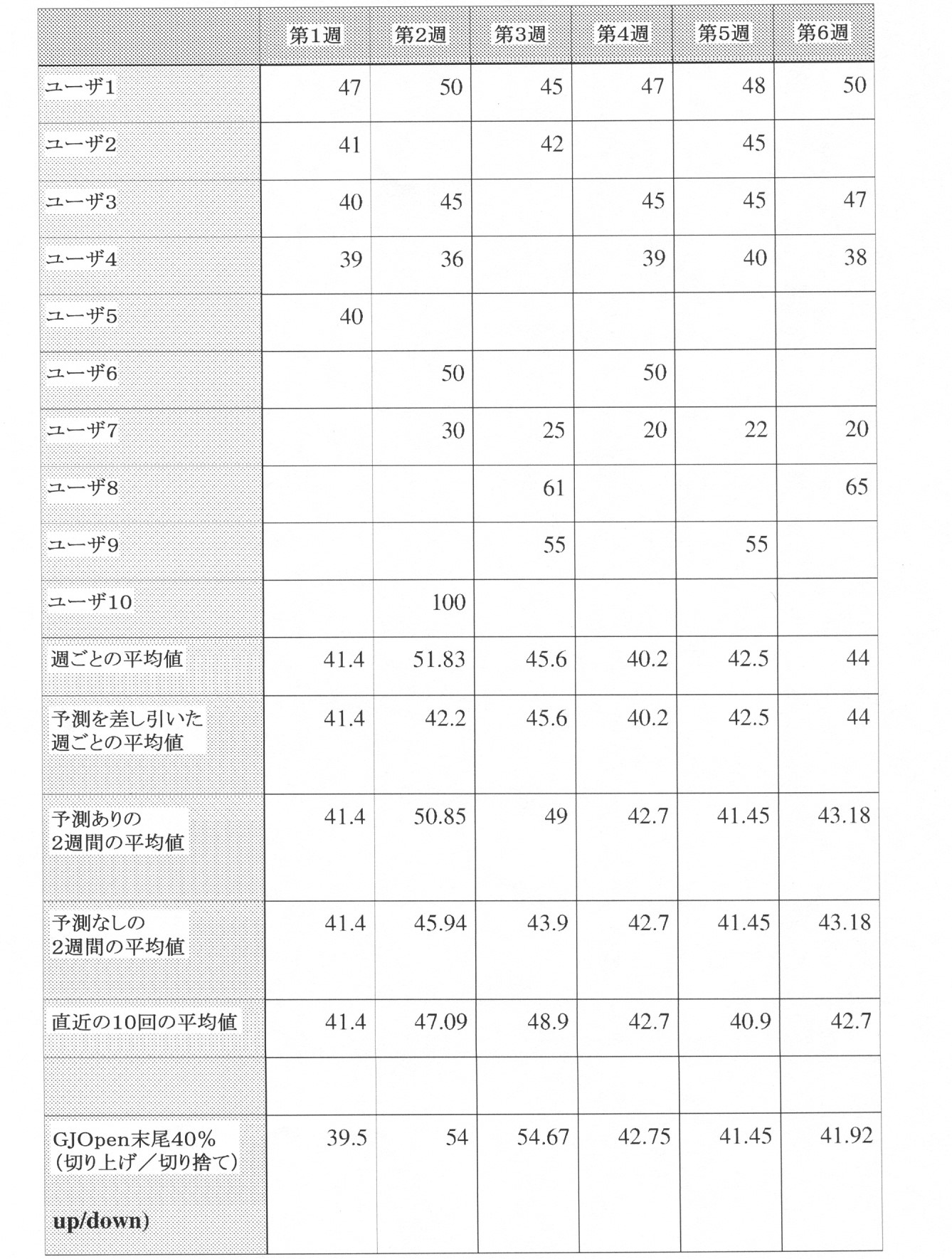
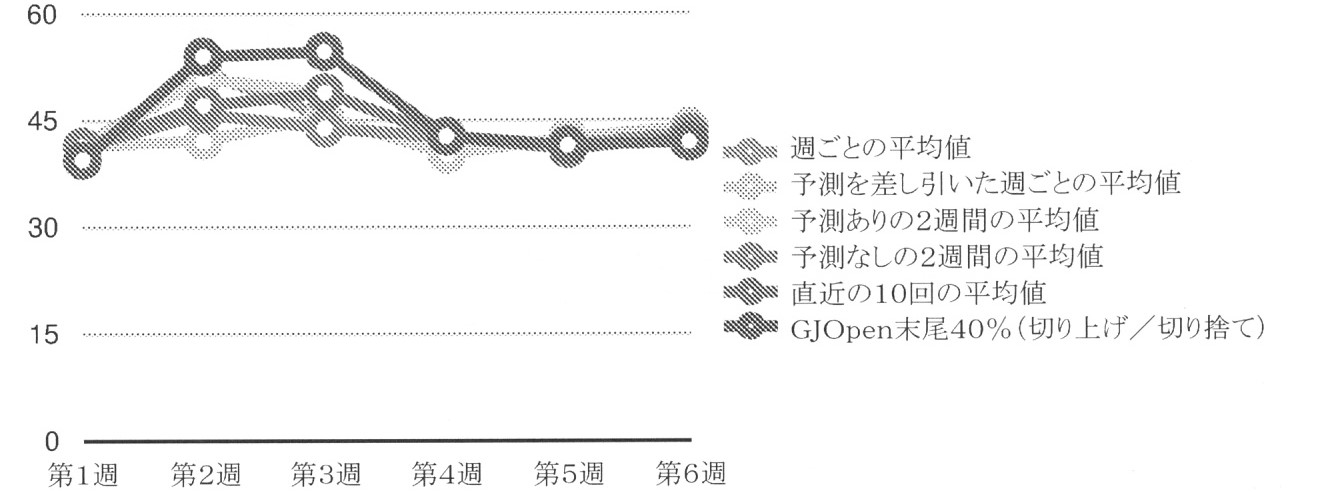
アンカリングとは、脳が、目前の質問に関連していることもしていないこともあるデータの初期値に大きく依存する認知バイアスである。アンカリングフィードバックは、結果を歪めるACEでは無視される。従って、現在のコンセンサス、ユーザプロファイル、精度スコアなどを公開することは、いずれも、ユーザの予想にバイアスをかける。ハリケーンがマイアミに直撃する確率が80%であると予想者に最初に伝えてあった場合、20%が適切であることを予想者のモデルが示していても、予想者は、20%ではなく80%に近い予想を提供する可能性が高い。上の仮想のデータからすると、第4週までのコンセンサス計算を知った上で第5週に行われた最初の予想(例えば予測)は、ユーザが触れたコンセンサス計算によって異なる。ユーザがGJOpenモデルしか見ていない場合、ユーザは、コンセンサスの急激な低下を考慮に入れて、更に低い予想を行う傾向があり得る。予測を取り除いた2週間の平均値だけにユーザが触れた場合、コンセンサスの比較的平坦な性質は、ユーザをより中立的な予想に導き得る。 Anchoring is a cognitive bias in which the brain relies heavily on the initial values of data that may or may not be related to the question at hand. Anchoring feedback is ignored in ACEs that distort the results. Therefore, publishing current consensus, user profile, accuracy score, etc. all biases the user's expectations. If the predictor was initially told that the probability of a hurricane hitting Miami is 80%, the predictor would not be 20%, even though the predictor's model showed that 20% would be appropriate. It is likely to provide a forecast close to 80%. From the above virtual data, the first prediction (eg, prediction) made in the 5th week, knowing the consensus calculation up to the 4th week, depends on the consensus calculation touched by the user. If the user is only looking at the GJOpen model, the user may tend to make even lower predictions, taking into account the sharp drop in consensus. The relatively flat nature of the consensus can lead the user to a more neutral forecast if the user only touches the two-week mean with the forecast removed.
最後に、質問がどのように提示されるかは無視される。これは正しくない。「ハリケーンXはマイアミに直撃するでしょうか?」という質問は、「ハリケーンXはマイアミに直撃しないでしょうか?」とは全く異なる。本発明は、この概念を認めず、質問の構成が、前提ひいては関連するバイアスに影響を与えることを認識する。 Finally, how the question is presented is ignored. This is not correct. The question "Will Hurricane X hit Miami directly?" Is completely different from "Will Hurricane X hit Miami directly?" The present invention does not recognize this concept and recognizes that the composition of the question influences the premise and thus the associated bias.
C.バイアスの抽出方法
本システムは匿名性を保った状態で開始する。ユーザは、匿名であるときに自分の意見を述べる可能性が高い。個人の身元がわかる情報は、システムの動作に必要ない。
C. Bias extraction method This system starts with anonymity. Users are more likely to express their opinions when they are anonymous. Information that identifies an individual is not necessary for the operation of the system.
一般に、100人パネルが使用される。パネルは一定期間(例えば、6週間)設置されている。個人の参加は減少し得るため、パネルは、定員超過した状態であり得るが、期間の終了時には、定員に満たない状態になり得る。純粋な触媒問題の抽出を行う目的では、25人程度の小さいパネルでも機能し得るが、パネルが小さいほど、その後のパネル分割及びA/Bテストができなくなる。パネルは少なくとも50人の参加を維持することが好ましい。平均で100人を維持しようとすることで、パネルテストが可能になり、コンセンサス忠実度が高まる。 Generally, a 100-person panel is used. The panel is installed for a certain period (for example, 6 weeks). The panel can be over-capacity, but at the end of the period, it can be under-capacity, as individual participation can be reduced. For the purpose of extracting pure catalytic problems, a small panel of about 25 people can work, but the smaller the panel, the less the subsequent panel splitting and A / B testing. The panel preferably maintains the participation of at least 50 people. Trying to maintain an average of 100 people will allow panel testing and increase consensus fidelity.
各パネルには、その期間の間、毎週同じ質問セットが与えられる。質問セットは、1年間にわたって所与の問題のセットを監視するために複数のパネルについて維持される。第2週では、パネルメンバーは、パネルメンバーの前週の予想とグループの前週のコンセンサスとが示される。 Each panel is given the same set of questions each week during that period. Question sets are maintained for multiple panels to monitor a given set of questions over the course of a year. In the second week, panel members are presented with the panel members' previous week's expectations and the group's previous week's consensus.
各質問に対して、個人は、確実性(はい/いいえ)を使用して意見を述べるのではなく、パーセンテージ(例えば、イベントが発生する確率が70%)で個人の意見を求められる。 For each question, the individual is asked for a percentage (eg, 70% chance of an event), rather than using certainty (yes / no) to comment.
好ましい実施形態では、ユーザは、毎週同じ時間に質問セットに予想を入力することだけが許されている。24時間及び48時間のウィンドウが好ましい。パネルメンバーは、システムが開くとすぐに毎週回答する人と、システムが閉じる直前に回答する人から構成される傾向がある。ウィンドウが開いている時間が長いほど、途中で入ってくるニュースによって後の回答が歪められる傾向が大きくなる。好ましくは、システムは、毎週同じ24時間(例えば、毎週金曜日)の間だけ、週1回の入力(weekly input)を許可する。これは、グループの週ごとの感情変化を比較するための一貫した時間ベースのコンセンサスを提供する。 In a preferred embodiment, the user is only allowed to enter expectations into the question set at the same time each week. 24-hour and 48-hour windows are preferred. Panel members tend to consist of those who respond weekly as soon as the system opens and those who respond just before the system closes. The longer the window is open, the more likely it is that later answers will be distorted by incoming news. Preferably, the system allows weekly input only for the same 24 hours each week (eg, every Friday). This provides a consistent time-based consensus for comparing weekly emotional changes in groups.
本発明は、群れ理論に基づいており、これは、群れのメンバーを群れのコンセンサスから離れた所定の感情範囲内に存在するものとして定義する。換言すると、週単位で、質問1に対するグループコンセンサスが57%である場合、群れに適合していると見なされる人の境界線は、コンセンサスから+/-20%、つまり37%及び77%のところに現れる人であると定義され得る。37%未満又は77%超の予想を有する個人は、感情的に群れから遠く離れていると考えられ、その推論は単純に却下される。群れの中心にいる個人、例えばコンセンサスから+/-5%は、増幅された場合に群れの感情的な中心を動かすこととなる意見を述べているのではなく、感情的な中心を表していると考えられる。従って、増幅された場合により大きいグループを動かす推論が表現された可能性があるゾーンとして、+/-5%から20%の2つの範囲が特定される。範囲は変化させることができるが、テストは、5%の下限値と25%の上限値が有効であることを示した。
The present invention is based on herd theory, which defines a member of a herd as being within a predetermined emotional range away from the consensus of the herd. In other words, on a weekly basis, if the group consensus for
所与の週に質問ごとに上のゾーンと下のゾーンにおいてユーザを計算した後、システムは、これらのゾーンにおいて最も多くの回答を有するユーザを特定する。これらのユーザは、パワーインフルエンサと呼ばれる。上位のパワーインフルエンサからのコメントは、共通テーマのために分析される。2人のユーザが同一のコメントを提供することはほとんどないが、共通のテーマは現れる。これらの共通のテーマは、触媒問題と呼ばれ、グループ全体に増幅されると、グループの感情的な中心を動かし得る。 After calculating the users in the upper and lower zones for each question in a given week, the system identifies the user with the most answers in these zones. These users are called power influencers. Comments from top power influencers are analyzed for a common theme. Two users rarely provide the same comment, but a common theme emerges. These common themes, called catalytic problems, can move the emotional center of a group when amplified throughout the group.
1.概要例
グループ予想に関するこれら及び他の問題を認識することで、システムを修正して、他の要素と組み合わせ、バイアスを抽出することができる。次いで、この抽出されたバイアスは、マーケティング(バイアスを特定して製品販売に使用する)又は脅威検出(他の人によって使用されているバイアスを特定する)に使用することができる。
1. 1. Summary Example By recognizing these and other issues with group expectations, the system can be modified and combined with other factors to extract bias. This extracted bias can then be used for marketing (identifying the bias and using it for product sales) or threat detection (identifying the bias being used by others).
システムは、理想的には、あるレベルの匿名性を保った状態で開始する。ユーザは、予想がユーザのプロファイル及びユーザがインターネット上でフォローしている先に起因することなく、安心して質問を予想することができなければならない。しかし、このシステムでは、同じユーザがログインして複数の予想を行うことを可能にしないわけにはいかない。本発明は、ログインホストが一連の乱数を生成するログインシステムを提案する。ユーザは、1つの数字を抽出し、この数字が回答に以前に関連付けられたものであるかどうかを確認するために質問をチェックする。そうである場合、2つ目の数字が選択される。そうでない場合、ユーザは、ユーザの質問Xのトラッキング番号として、その数字を自分に割り当てる。次いで、自分で割り当てたトラッキング番号を使用して、予想を構築する。ホストシステムは、トラッキング番号に関連するすべての予想及びコメントを集約する。ローカルに保持されているか、ホストサイトで暗号化されているかにかかわらず、ユーザが請求して使用したトラッキング番号を知っているのはユーザだけである。匿名性により、ユーザは、反響を恐れずに自分の意見を述べることができる。これにより、システムは、州及び国境線を越えて導入されることができ、個人ユーザデータに対する異なる制限に準拠することもできる。質問レベルでの追跡は、それにより、匿名性を保った状態でも予測を選択的に削除し、より正確なコンセンサスを決定することができるという点で追加の利点を有する。匿名性はまた、プロファイルに関連するアンカリングフィードバックを減少させる。 The system ideally starts with a certain level of anonymity. The user must be able to predict the question with confidence, without the prediction being due to the user's profile or the destination the user is following on the Internet. However, this system cannot help allowing the same user to log in and make multiple predictions. The present invention proposes a login system in which a login host generates a series of random numbers. The user extracts one number and checks the question to see if this number was previously associated with the answer. If so, the second number is selected. Otherwise, the user assigns himself that number as the tracking number for the user's question X. Then use the tracking number you assigned to build your forecast. The host system aggregates all expectations and comments related to the tracking number. Only the user knows the tracking number that the user requested and used, whether it is kept locally or encrypted at the host site. Anonymity allows users to express their opinions without fear of repercussions. This allows the system to be deployed across states and borders and also to comply with different restrictions on personal user data. Question-level tracking has the added benefit of being able to selectively remove predictions and determine more accurate consensus, even while maintaining anonymity. Anonymity also reduces anchoring feedback associated with profiles.
次に、(i)イベント、(ii)イベントの経済的側面、(iii)イベントを取り巻く個人の安全、(iv)イベントを取り巻く健康と福祉、及び(v)イベントを取り巻く人口統計に触れた複数の質問を単一の問題に対して行うことが好ましい。理想的には、1つよりも多くの質問が尋ねられ、その質問が複数の方法で言い表されて、集中して所望のバイアスを抽出する。例えば、以下の質問は、すべて単一のイベントに関するものであるが、異なる前提を推論し、選択されたバイアスを抽出するために、異なる言い回しで表現され得る:
(i)今後3か月の間にサンフランシスコで電動スクータをレンタルするのは10,000人以上でしょうか?
(ii)今後3か月の間にサンフランシスコで電動スクータをレンタルするのは10,000人未満でしょうか?
(iii)今後3か月の間にサンフランシスコのERに登録されるスクータ関連の負傷の数はいくつでしょうか?
(iv)今後3か月の間にサンフランシスコで電動スクータの未成年者による使用が40%を超えるでしょうか?
(i)では、10,000台のレンタルの達成が困難なタスクであることが前提である。(ii)では、前提は反対であり、10,000台が達成可能である。同じプラットフォームに質問(i)及び(ii)があると回答に影響を与えるため、システムは、複数のプラットフォームにわたって質問を展開し、次いでデータを集約することができる。次に、これらの質問についての予想コンセンサスは、抽出されるバイアスのタイプ及びそれがどのように使用されるかを定義する。
Next, I touched on (i) the event, (ii) the economic aspects of the event, (iii) the personal safety surrounding the event, (iv) the health and welfare surrounding the event, and (v) the demographics surrounding the event. It is preferable to ask the question in question for a single problem. Ideally, more than one question will be asked, and the questions will be expressed in multiple ways to focus and extract the desired bias. For example, the following questions are all about a single event, but can be expressed in different phrases to infer different assumptions and extract selected biases:
(I) Will more than 10,000 people rent electric scooters in San Francisco over the next three months?
(Ii) Will less than 10,000 people rent electric scooters in San Francisco in the next three months?
(Iii) How many scooter-related injuries will be registered with the San Francisco ER in the next three months?
(Iv) Will the use of electric scooters by minors exceed 40% in San Francisco over the next three months?
In (i), it is premised that it is a difficult task to achieve rental of 10,000 units. In (ii), the premise is the opposite, and 10,000 units can be achieved. Since questions (i) and (ii) on the same platform affect the answer, the system can expand the question across multiple platforms and then aggregate the data. The expected consensus on these questions then defines the type of bias extracted and how it is used.
例えば、質問(i)に対するコンセンサスが70%であり、サンフランシスコで3か月の間に10,000台を超えるスクータのレンタルがあるという比較的高いレベルの楽観性を表す場合、質問(ii)に対するコンセンサスは30%であるべきであると想定され得る。バイアスが明示されていないため、本発明は、これらの質問が相関しないと仮定する。その相違は、予想に影響を与えている明示されていないバイアスが原因の一部である。表されるバイアスは、投稿時の質問とコンセンサスとの関数である。従って、システムは、理想的には、バイアス抽出に対してシードするために(seed)、関連するトピック又は同一のトピックに対して複数の質問を使用するが、要求はしない。 For example, if the consensus on question (i) is 70% and you represent a relatively high level of optimism that you have more than 10,000 scooter rentals in San Francisco in three months, then you have a relatively high level of optimism for question (ii). It can be assumed that the consensus should be 30%. Since the bias is not specified, the present invention assumes that these questions do not correlate. The differences are partly due to unspecified biases affecting expectations. The bias expressed is a function of the question and consensus at the time of posting. Therefore, the system ideally uses multiple questions for related topics or the same topic to seed for bias extraction, but does not require it.
触媒問題は、コンセンサスと比較してより高い又はより低い予想を正当化するために使用される、ユーザによって表される問題である。予想-コンセンサス差(F-Cデルタ)は、極端(例えば、コンセンサスが75%であるときに予想が5%)であってはならない。グループは、極端なものを表す予想を軽視し、無視する傾向がある。F-Cデルタは、コンセンサスから+/-50%であっても、依然として説得力がある。アッカーマンの交渉定理(65%、85%、95%、及び100%の提示)の使用もまた、現在のコンセンサスから+/-65%である予想を特定するために使用されることができる。コンセンサス不変量(consensus invariant)であるF-Cデルタも妥当であり、特定の差分に対する人間の選好を好む傾向がある。コンセンサスに関係なく19%の差は、説得力があるように見えるため、その説明は、触媒問題として捉えられる。 The catalytic problem is a user-represented problem used to justify higher or lower expectations compared to consensus. The expectation-consensus difference (FC delta) should not be extreme (eg, the expectation is 5% when the consensus is 75%). Groups tend to downplay and ignore expectations that represent extremes. The FC Delta is still convincing, even at +/- 50% from consensus. The use of Ackermann's negotiating theorem (presentation of 65%, 85%, 95%, and 100%) can also be used to identify expectations that are +/- 65% from current consensus. The FC delta, which is a consensus invariant, is also valid and tends to favor human preference for a particular difference. The explanation is taken as a catalytic problem, as the 19% difference, regardless of consensus, seems convincing.
質問(i)に対するコンセンサスが75%であり、誰かが60%の確率を予想した場合、これは依然として正の予想であると考えられるが、15%の差は負のバイアス要因であると考えられる。この例では、ユーザが、自分の予想の根拠として、不潔な通り/ホームレスキャンプを特定した場合、この説明は、負の要因として追跡され、これは、本明細書では触媒問題と呼ばれる。 If the consensus to question (i) is 75% and someone expects a 60% probability, this is still considered a positive expectation, but a 15% difference is considered a negative bias factor. .. In this example, if the user identifies a filthy street / homeless camp as the basis for his conjecture, this description is tracked as a negative factor, which is referred to herein as the catalytic problem.
30%~70%の範囲の予想から得られる触媒問題は、人間の行動の変化と相関する可能性がより高い範囲の予測を反映しているため好ましい。 Catalytic problems obtained from predictions in the range of 30% to 70% are preferred as they reflect predictions in the range that are more likely to correlate with changes in human behavior.
D.触媒問題のテスト
触媒問題が抽出された後、次の段階はテストである。
D. Testing the catalyst problem After the catalyst problem is extracted, the next step is testing.
アクティブテストは、参加者を分割し、次いでこの問題がテストされるニュースフィードに触れさせることができるフロントエンドアプリケーションを使用して最良に最適化される。アクティブテストでは、グループは対照グループとテストグループとに分けられる。第X週では、両方のグループにニュースを見せない。第X+1週では、テストされる問題を具体化した記事へのリンクという形でテストグループにニュースを提供する。サブグループについてのコンセンサスは、X週目からX+1週目まで比較され、累積的差分は暗黙のデルタ(Implicit Delta)(ニュースを紹介したことで生じた感情の変化率)と呼ばれる。
暗黙のデルタ=
(第X週の対照コンセンサス-第X+1週の対照コンセンサス)-
(第X週のテストコンセンサス-第X+1週のテストコンセンサス)
Active testing is best optimized with a front-end application that allows participants to be split and then exposed to the news feed where this issue is tested. In the active test, the groups are divided into a control group and a test group. In Week X, we will not show the news to both groups. Week X + 1 provides news to the test group in the form of links to articles that embody the questions being tested. Consensus on subgroups is compared from week X to week X + 1, and the cumulative difference is called the Implicit Delta (the rate of emotional change caused by the introduction of the news).
Implicit delta =
(Week X Control Consensus-Week X + 1 Control Consensus)-
(Week X test consensus-Week X + 1 test consensus)
コンセンサスによる動きは、問題が特定の方向でコンセンサスに影響を与える感情に結び付けられていることを確認する。これにより、影響を与えようとしている製品又は問題に結び付けるためのループが得られる。 Consensus movements confirm that the problem is tied to emotions that influence consensus in a particular direction. This provides a loop to connect to the product or problem that is about to affect.
前向きのパッシブテストでは、ニュース又はオンラインコミュニティで問題が発生していないかが監視される。その問題がニュースでスパイク(通常よりも増加又は減少)したら、それは、コンセンサスに有機的に影響を与えるはずである。その後コンセンサスがスパイクすれば、その問題は、ホットボタンイシュー(触媒問題)であると確定される。負の影響はコールドボタンイシューである。その後の動きを確認する期間は、ユーザエンゲージメント及びニュース周期のようないくつかの要因に左右されるが、一般には、スパイクが検出されてから7日以内に現れる。 Positive passive testing monitors the news or online community for problems. If the problem spikes in the news (more or less than usual), it should have an organic impact on consensus. If the consensus then spikes, the problem is determined to be a hot button issue (catalytic problem). The negative impact is the cold button issue. The duration of subsequent movement confirmation depends on several factors such as user engagement and news cycle, but generally appears within 7 days of the spike being detected.
後向きのパッシブテストでは、ニュース又はオンラインコミュニティで問題が異常に発生していなかが監視され、その後の製品販売又は所望の感情状態に関連する他のイベントと比較される。これにより、触媒問題の影響をより確信するために使用され得る大まかな相関関係を得ることができる。 A retrospective passive test monitors the news or online community for anomalous problems and compares them to subsequent product sales or other events related to the desired emotional state. This allows for a rough correlation that can be used to be more convinced of the effects of catalytic problems.
抽出されたバイアスには時間依存性があり、前向きのパッシブテスト及び後向きのパッシブテストは、触媒問題の適用可能な時間ウィンドウが変化したことが一因で、失敗する可能性がある。 The extracted bias is time-dependent, and forward-looking and backward-looking passive tests can fail, in part due to changes in the applicable time window of the catalytic problem.
E.確認された触媒問題の用途
触媒問題が確認された後、その情報には複数の用途がある。所望の結果が、期待される人間の行動を確認された方向に動かすことである場合、この問題でメディアを飽和させることが有効なツールであり得る。触媒が期待を間違った方向に動かす場合には、カウンターメッセージ最適化のために二次テストを採用することができる。
E. Confirmed Uses of Catalyst Problems After a catalyst problem is confirmed, the information has multiple uses. Saturating the media in this problem can be an effective tool if the desired result is to move the expected human behavior in a confirmed direction. If the catalyst moves expectations in the wrong direction, a secondary test can be adopted for counter message optimization.
F.ログイン及びトラッキング番号
本発明は、匿名の質問トラッキング番号を使用して、質問に対するユーザの回答を追跡するオプションを含む。この特徴は、本発明での使用に限定されるものではなく、他の目的でも使用され得る。本発明の文脈では、個人ユーザデータを収集する必要なく、質問レベルでの予想の追跡を可能にする。これにより、個人ユーザデータの収集及びエクスポートに関して異なる法的必要条件が課せられ得る複数のシステムに本発明を展開することができる。
F. Login and Tracking Number The invention includes an option to track a user's answer to a question using an anonymous question tracking number. This feature is not limited to use in the present invention and may be used for other purposes as well. In the context of the present invention, it is possible to track predictions at the question level without the need to collect personal user data. This allows the invention to be deployed in multiple systems that may be subject to different legal requirements for the collection and export of personal user data.
図3に示されるように、ホストコンピューティングデバイスは、要求を、予想プロセスに関連するサーバ35及びデータベース4か、又はRAM32、コントローラ33、及び乱数発生器(RNG)34に分岐させるインターフェース31を含む。
As shown in FIG. 3, the host computing device includes an
RNGは、RAM32に保持される乱数を循環させる。ユーザがログインして数字を要求すると、RAM32から1つ又は複数の数字が送信される。コントローラ33は、どのユーザが数字を要求したかや、数字が重複しているかどうかを追跡しない。ユーザがログインして投稿しようとすると、システムは、その時点でトラッキング番号が既に使用されているかを決定する。
The RNG circulates a random number held in the
数字をランダムに割り当てることで、予想の順序又は予想者の身元を他の予想者が推定する能力を低下させる。任意の数字がユーザに表示される限り、アンカリングバイアスを発生させる可能性があるため、示される場合には、ランダムな割り当て及び桁の統一によって、バイアスの影響を最小限に抑えようとする。これはまた、既知のユーザをフォローすることに関連するアンカリング及びバイアスの低減に役立つ。 Randomly assigning numbers reduces the ability of other predictors to estimate the order of predictions or the identity of the predictor. As long as any number is visible to the user, it can cause anchoring bias, so if shown, we will try to minimize the effect of the bias by random allocation and unification of digits. It also helps reduce anchoring and bias associated with following known users.
スピードを速めたり回答者の数を増やしたりするために、システムは、必要に応じて拡張設定することができる。例えば、RNG34は、1桁の数字(0、1、2、3、4、5、6、7、8及び9)を生成するように設定され得る。0は廃棄される。コントローラ33は、数字の要求数と質問の投稿数とを比較し、要求数が投稿数の2倍であれば、システムを拡張することができる。次いで、コントローラ34は、2桁の数字に拡張するようにRNG34に指示する。桁数(order)を統一して目立たなくする(obscure)ために、数字1~9を使用した既存の投稿の終わりに末尾の「0」を付加して、すべての投稿がトラッキング番号と同じ桁数を有するようにする。3、6、及び5を有する投稿が存在する場合は、これらの投稿の識別子は、30、60、及び50に変更されるであろう。トラッキング番号が表示されない場合、アンカリングバイアスをしないので、桁数を目立たなくすることはそれほど重要ではない。
The system can be extended as needed to increase speed and increase the number of respondents. For example, the
代替的な実装形態は、各拡張中に「a」のような英数字を付加することと、次いで、潜在的なアンカリングバイアスを最小限に抑えつつすべてのトラッキング番号をパディングするための追加の桁をランダムに割り当てることとを含む。 An alternative implementation is to add an alphanumerical such as "a" during each extension, and then to pad all tracking numbers while minimizing potential anchoring bias. Includes randomly allocating digits.
トラッキング番号を使用している場合のユーザログインプロセスの一例が図4に示されている。ユーザがログイン41し、質問に回答しようとする42と、ユーザのシステムは、そのメモリをチェックして、その質問に対する既存のトラッキング番号が存在するかどうかを確認する43。存在しない場合、ユーザは、44において、1つ又は複数の乱数を要求する。1つ又は複数の乱数を受信すると、ユーザのシステムは、単独で又はホストシステムと組み合わせて、乱数の使用を探すために、既存の投稿、又は投稿に使用されたトラッキング番号のデータベースをサーチする45。乱数が使用されていた場合、44から追加の乱数が要求される。そうでない場合、ユーザは、質問に対して投稿するためにその数字を記憶する47。任意の所与の時間に複数のユーザが投稿している最中である可能性があるため、複数のトラッキング番号を収集してチェックすることが好ましい場合がある。予想の投稿を許可する前に、システムは、複数のユーザが同じトラッキング番号を使用しないことを確実にするために、使用された数字に照らしてトラッキング番号をチェックするであろう。代替的な実施形態では、47において、システムは、請求された数字を記憶し、45でのサーチでロードすることができ、引き出されたが投稿されていないトラッキング番号が新しいユーザに割り当てられないようにする。
An example of the user login process when using a tracking number is shown in FIG. The user logs in 41 and tries to answer the
数字のセットを拡張するプロセスの例を図5に示す。数字を生成51した後、システムは、それが「0」で終わるかどうかをチェックする52。そうである場合、その数字は破棄され、新しい数字が生成される。そうでない場合、その数字は、ユーザによる要求及び受信54のためにテーブルにロードされる53。システムは、新しい投稿の数又はレートを受信し56、それを生成された数字の量と比較する55。新しい投稿がユーザに送られた数字の半分に満たない数である場合57、拒絶率が高く、ベースの数の拡大が必要であると想定される58。次いで、システムは、質問に関連する既存の投稿に「0」を付加し、生成される桁数を変更する59。
Figure 5 shows an example of the process of expanding a set of numbers. After generating the
図6に示されるように、ユーザが投稿しようとするとき、ユーザは、以前の使用されたトラッキング番号を検索する48。次いで、ユーザは、記憶されたトラッキング番号を使用した以前の投稿を特定するために既存の投稿のサーチを要求する48a。「0」が付加されていた場合48b、ユーザは、記憶されている数字を更新する47。そうでない場合、ユーザは、このトラッキング番号を用いて投稿する49。
As shown in FIG. 6, when the user attempts to post, the user searches for a previously used tracking number48. The user then requests a search of existing posts to identify previous posts using the stored tracking
このプロセスを支援するために、ホストシステムは、トラッキング番号の利用可能性、ユーザのトラッキング番号の以前の使用を確かめるか、又はトラッキング番号の競合を特定して予想の分離を要求するためにユーザシステムがアクセス可能なトラッキング番号及び投稿の日付/時刻のデータベースを維持することができる。ユーザのトラッキング番号を用いた投稿が、投稿の日付及び時刻に関するユーザの記録と一致しない場合、ユーザシステムは、ホストシステムに警告することができる。同じトラッキング番号のもとで2人のユーザが偶然に投稿した場合、日付が一致し、時刻が近い可能性があるが、2つ目の投稿では、日付/時刻が相違する可能性が高い。どちらの当事者も2つ目の予想を投稿しなかった場合、元の予想は予測としてマーキングされて破棄され、これにより、システムに影響がないようにする。競合が特定されると、ホストシステムは、疑わしい重複投稿に「b」又は他の識別子を付加することができ、これにより、投稿しようとしていてかつ「b」指定を学習したユーザシステムが、投稿の日付及び時刻をホストと比較し、そのユーザの共通の投稿を特定し、次に、特定された投稿についてユーザからの新しいトラッキング番号を要求する。 To assist in this process, the host system either confirms the availability of the tracking number, the user's previous use of the tracking number, or identifies the tracking number conflict and requests the separation of expectations. Can maintain a database of tracking numbers and post dates / times that can be accessed by. If the post using the user's tracking number does not match the user's record of the date and time of the post, the user system may warn the host system. If two users accidentally post under the same tracking number, the dates may match and the times may be close, but the second post is likely to have a different date / time. If neither party posts a second forecast, the original forecast is marked as a forecast and discarded, thereby leaving the system unaffected. Once a conflict has been identified, the host system may append a "b" or other identifier to the suspicious duplicate post so that the user system that is trying to post and has learned the "b" designation can post. It compares the date and time with the host, identifies the user's common posts, and then requests a new tracking number from the user for the identified posts.
ログイン機能はまた、後述されるユーザインターフェースを定義する。異なるシステム3、7、及び8は、異なるタイプの情報を含むことができる。ユーザインターフェースは、少なくとも最初のログイン中に定義され、これは、プラットフォーム依存、質問シリーズ依存、又はユーザ依存であり得る。
The login function also defines the user interface described below.
上述した匿名化プロセスに加えて又はその代替として、本発明は、ユーザを人口統計学的バケットに割り当てることによっても使用され得る。GDPR及び考えられる米国の同等の要件に準拠するために、現在のシステムは、ユーザデータを取り出し(take)、ユーザを1つ又は複数の人口統計学的バケットに割り当てることができる。これらのバケットには、年齢、性別、人種、世帯収入、自宅所有権、身体障害、教育、雇用状況、子供、位置、配偶者の有無、自動車所有、貯金、性的嗜好、購入履歴、ビデオ、又はソーシャルブログが含まれ得る。このケースでは、年齢層は、12~17歳、18~24歳、25~34歳、35~44歳、45~54歳、55~64歳、及び65歳以上のバケットを含み得る。ユーザがシステムにログインし、アカウントを作成し、28歳の男性であると申告した場合、システムは、その個人を25~34歳の年齢層に割り当てる。116に記録されたデータは、取得された情報が25~34歳の年齢層の人物に関連するものであるという表記を含む。 In addition to or as an alternative to the anonymization process described above, the invention can also be used by assigning users to demographic buckets. To comply with the GDPR and possible US equivalent requirements, current systems can take user data and assign users to one or more demographic buckets. These buckets include age, gender, race, household income, home ownership, disability, education, employment status, children, location, spouse status, car ownership, savings, sexual orientation, purchase history, videos. , Or social blogs may be included. In this case, the age group may include buckets 12-17 years, 18-24 years, 25-34 years, 35-44 years, 45-54 years, 55-64 years, and 65 years and older. If a user logs in to the system, creates an account, and declares that he is a 28 year old male, the system assigns the individual to the 25-34 age group. The data recorded at 116 includes the notation that the information obtained is related to a person in the age group 25-34 years.
位置バケットは、地域を含み、それは、都市、州、又は州の組合せであり得る。例えば、「北東部」には、コネティカット州、マサチューセッツ州、メーン州、ニューハンプシャー州、ニューヨーク州、ロードアイランド州、及びバーモント州が含まれ得る。 The location bucket includes a region, which can be a city, state, or combination of states. For example, "northeast" can include Connecticut, Massachusetts, Maine, New Hampshire, New York, Rhode Island, and Vermont.
収入バケットは、年齢バケットと同様のブラケットを含み、これには、以下のような既知の収入ブラケットが含まれ得る:$25,000未満、$25,000~$34,999、$35,000~$49,999、$50,000~$74,999、$75,000~$99,999、$100,000~$149,999、及び$150,000以上。 Income buckets include brackets similar to age buckets, which may include known income brackets such as: <$ 25,000, $ 25,000- $ 34,999, $ 35,000. ~ $ 49,999, $ 50,000 ~ $ 74,999, $ 75,000 ~ $ 99,999, $ 100,000 ~ $ 149,999, and $ 150,000 or more.
教育バケットは、年齢バケットと同様のブラケットを含み、これには、以下のような既知の教育ブラケットが含まれ得る:高卒未満、高卒(同号の学歴を含む)、大学に一時在籍したが取得学位なし、準学士号、学士号、博士号、又は修士号若しくは専門職学位。 Education buckets include brackets similar to age buckets, which may include known education brackets such as: Under Higher, Higher Bachelor (including Bachelor's Degree), Temporarily Enrolled in College, but Obtained No degree, associate degree, bachelor's degree, doctoral degree, or master's or professional degree.
本発明は、これらの特定のバケット及び内訳に限定されない。バケット内のカテゴリは、特定の問合せの必要性に適合するように修正され得る。 The invention is not limited to these particular buckets and breakdowns. The categories in the bucket can be modified to suit the needs of a particular query.
本発明はまた、自己同定された関連付けを含むことができる。フロントエンドのデータ収集プロセスがゲーム化されている場合、個人は質問に関する入力が求められ得、ここでは、勝者が宣言されて、賞品が与えられる。ユーザの識別情報が取得される場合、例えば正確な予想を行ったことに対して、個人に賞品を与えることができる。しかしながら、個人の匿名性を保つために、ユーザは、教会、スポーツチーム、慈善団体など、組織やグループを代表して賞品を競うことができる。これらのグループは、人口統計学的バケットの方法で捉えられ、使用される。 The invention can also include self-identified associations. If the front-end data collection process is gamed, individuals may be asked to enter questions, where winners are declared and prizes are awarded. When the user's identification information is obtained, for example, a prize can be given to an individual for making an accurate prediction. However, to maintain anonymity for an individual, users may compete for prizes on behalf of an organization or group, such as a church, sports team, or charity. These groups are captured and used in a demographic bucket way.
G.インターフェース
ユーザのシステム上のインターフェースは、ブラウザ、スタンドアロンプログラム、電話、又はタブレットのいずれにあっても、匿名に見えつつ、かつ、コメントを用いた予想を促しながらも、アンカリングバイアスの可能性を制限するように設計されている。図7aに示されるように、インターフェースは、質問71、コンセンサスデータ73、他のユーザからのコメント72a、及び/又はリンク付きの選択されたニュースヘッドライン72bを含むことができる。質問が提示されると、インターフェース上に含まれる情報が取得される。好ましくは、インターフェースが操作された順序(例えば、予想の入力、ストーリー#3の次にストーリー#2をクリックすること、コメントの入力、コンセンサスデータのチェック、予想の編集と送信(submit))も記録される。ユーザが予想を送信すると、インターフェースデータは、この予想の一部としてホストに送信される。次いで、ホストは、そのデータを既知のユーザに対応させるのではなく、匿名化されたトラッキング番号に対応させることで、インターフェース情報を追跡することができる。
G. Interface The interface on the user's system, whether browser, stand-alone program, phone, or tablet, limits the possibility of anchoring bias while appearing anonymous and encouraging commentary predictions. Designed to do. As shown in FIG. 7a, the interface can include
インターフェースデータを取得して、ユーザの予想の一部として送信するため、システム3は、予想に対応するすべての関連するインターフェースデータを有する。データの大量送信を回避するために、インターフェースデータは、ユーザのシステムによって符号化され、次いでホストシステムにおいて復号され得る。符号化により、トラッキング番号及び予想/インターフェースデータは事実上のベース暗号化で送信されることができ、データ送信の必要性を低減する。図7cに示されるように、ユーザによってホストシステムに送られるデータ構造205は、ヘッダAと、トランザクション番号Bと、符号化されたインターフェースデータCとを含むことができる。
In order to acquire the interface data and transmit it as part of the user's expectation, the
質問フィールド71は、好ましくは、理想的には一連の関連する質問のうちの1つである質問を含む。上述したように、同じ質問に対して異なる言い回しを用いることで、異なるバイアスを誘発することができる。適切なペアリング(例えば、「ハリケーンXはマイアミに直撃するでしょうか?」及び「ハリケーンXはマイアミに直撃しないでしょうか?」)が同じユーザに利用可能にされることが好ましい。これは、ペアリングされた質問を図2の7又は8のような異なるシステムにプッシュすることによって達成され得る。代替的に、ユーザは、ログインした後に、所与のペアリングされた質問セットのうちの1つを含む異なる質問セットに割り当てられ得る。従って、ログインすると、「ハリケーンXはマイアミに直撃するでしょうか?」を見ることとなり、別のセットは「ハリケーンXはマイアミに直撃しないでしょうか?」を見ることとなる。フィールド71には、パーセンテージで回答する回答欄や、コメントを追加するための回答欄も含まれる。パーセンテージ及びコメントは、入力を容易にするため又は入力を特定の定められた選択肢に制限するために、ドロップダウンメニュー形式でも提供され得る。
The
コンセンサスデータ73は、ユーザにバイアスをかけたり、予想を妨害したりすることなく、予想を行うのに十分な信頼性をユーザに提供しようとする。既存のシステムは、現在のコンセンサス推定値又はオッズをユーザに示す傾向がある。従って、コンセンサスが20%に傾いていることをシステムが示す場合、ユーザがそれらの推定値に疑念を抱いて、なぜそれほどまでにコンセンサスと異なるのかを見極めようとしなければ、ユーザが80%を予想する可能性は低い。そうした状況にあるユーザは、初期推定値を低くする傾向がある。その結果、コンセンサスが人為的に下げられる。より重要なことには、疑念を抱くことで、ユーザは、暗黙的なバイアスを表すコメントを残す可能性が低くなる。むしろ、コンセンサスデータ73において、現在のシステムは、潜在的なアンカリング効果を制限するいくつかの代替手段を使用する能力を有する。
The
一実施形態では、最後の20~30個の生スコアが示される。理想的には、スコアの数は、ユーザがコンセンサスを推定することができない程度である。20個以上のスコアを使用すると、精神的又は手動で平均値を決定しようする試みを思いとどまらせる程度に複雑に見える。 In one embodiment, the last 20-30 raw scores are shown. Ideally, the number of scores is such that the user cannot estimate consensus. With a score of 20 or more, it looks complicated enough to discourage attempts to determine the mean mentally or manually.
別の実施形態では、コンセンサスグラフが示されるが、このグラフは、コンセンサス範囲を示す。これらの範囲は、本明細書で説明されるように導出され得、1日当たりの、週ごとの、2週間の、予測ありの、予測なしの計算を含む。 In another embodiment, a consensus graph is shown, which graph shows the consensus range. These ranges can be derived as described herein and include daily, weekly, two-week, predictive and unpredictable calculations.
コメント欄72aは、コンセンサスデータ73と同様に、オプションであり、所与の質問に対する以前のコメントの選択を含むことができる。コメントが作成された時点での予測及びコンセンサスを示すのではなく、コメントが、作成された時点でのコンセンサスよりも高い予想に対応するか低い予想に対応するかを表示することが好ましい。矢印は、色付きで、コメントを投稿したユーザによって行われたおおよその予想を示すのに適しているであろう。図7bに示されるように、矢印200は、白/ライトブルーの矢印201から順に、全体がライトブルーの矢印202、ライトブルー/ダークブルーの矢印203、次いで全体がダークブルーの矢印204であり得る。グリーン又は別の中間色を反対方向に使用することもできる。これは、実際の予想を公開してユーザにバイアスをかけることなく、投稿を行うユーザの予想を定義する4つの勾配を提供する。
The comment field 72a, like the
ニュース欄72bもオプションであり、一般的なニュースフィード、問題テスト、又はメッセージテストに使用され得る。フィード内に現れるニュースフィードは追跡される。記事及び提示の順序が把握される。加えて、起こり得る問題、センチメント分析、及びキーワードを決定するために、記事の基本言語分析が実行される。
The
H.代替的な(alternative)質問
システムは、単一の質問で実行することができるが、1つよりも多くの関連する質問の使用が好ましい。質問をセットで実行し、同じ質問セットを同じユーザに対して繰り返すことが好ましい。
H. An alternative question system can be run with a single question, but it is preferable to use more than one related question. It is preferable to execute the questions as a set and repeat the same question set for the same user.
質問は、好ましくは、関心のある特定のトピックの範囲を超えたセットで展開される。(i)経済的、(ii)社会的/信仰に基づく/宗教上の、(iii)犯罪を含む個人の安全、(iv)個人の福祉、及び(v)人種、又は他の既知のバイアスを含む、関連する質問が好ましい。一実施形態では、これらの問題に触れる質問がセットでパッケージ化される。例えば、質問には以下が含まれ得る:
(i)X社は、今後3か月の間にサンフランシスコで10,000台超のスクータを貸し出すでしょうか?
(ii)X社は、今後3か月の間にサンフランシスコで10,000台超のスクータを貸し出すことができないでしょうか?
(iii)サンフランシスコの経済は、今後3か月間で成長目標Xを達成するでしょうか?
(iv)今後3か月の間にサンフランシスコの路上にホームレスキャンプが増加するでしょうか?
(v)今後3か月の間にサンフランシスコで犯罪が増加するでしょうか?
(vi)今後3か月の間にサンフランシスコで歩行者とスクータの事故が増加するでしょうか?
(vii)今後3か月の間にX社のスクータの未成年による使用がX%を超えるでしょうか?
この質問セットにより、セット内のどの質問に関して特定された触媒問題も、質問のいずれかに回答するユーザに対してテストすることができる。
Questions are preferably developed in sets that go beyond the specific topic of interest. (I) economic, (ii) social / faith-based / religious, (iii) personal security, including crime, (iv) personal welfare, and (v) race, or other known bias. Related questions are preferred, including. In one embodiment, questions that touch on these issues are packaged as a set. For example, a question could include:
(I) Will Company X rent more than 10,000 scooters in San Francisco over the next three months?
(Ii) Will Company X be able to rent more than 10,000 scooters in San Francisco over the next three months?
(Iii) Will San Francisco's economy reach growth target X in the next three months?
(Iv) Will there be more homeless camps on the streets of San Francisco over the next three months?
(V) Will crime increase in San Francisco over the next three months?
(Vi) Will there be more pedestrian and scooter accidents in San Francisco over the next three months?
(Vii) Will minors use more than X% of company X scooters in the next three months?
This question set allows the catalytic problem identified for any question in the set to be tested against the user answering any of the questions.
質問は、単一のプラットフォーム上で又は複数のプラットフォームにわたって展開され得る。一実施形態では、1つ又は複数の質問が以下を含むウェブサイトにわたって展開される:(i)ソーシャルメディアプラットフォーム(例えば、フェイスブック(登録商標)、ツイッターなど)、(ii)予測又は予想ウェブサイト、(iii)賭け事を行うプラットフォーム、(iv)人権に焦点を当てたプラットフォーム、(v)リモートデスクトップ展開、及び/又は(vi)インターネットに対応していない場所で使用するための専用の衛星モデムシステムを介したリモート展開。 Questions can be deployed on a single platform or across multiple platforms. In one embodiment, one or more questions are spread across websites including: (i) social media platforms (eg, Facebook®, Twitter, etc.), (ii) forecast or forecast websites. , (Iii) betting platforms, (iv) human rights-focused platforms, (v) remote desktop deployments, and / or (vi) dedicated satellite modem systems for use in non-internet-enabled locations. Remote deployment via.
I.コンセンサス計算
コンセンサス計算は、本発明によって複数の方法で使用される。
I. Consensus calculation Consensus calculation is used in a plurality of ways according to the present invention.
コンセンサスデータは、質問、日付/時刻、予想、インターフェースデータ、及び最終的にユーザに結び付けられる。好ましい方法では、ユーザは、毎週同じ時間に同じプラットフォーム上で同じ質問に回答する。 Consensus data is tied to questions, dates / times, forecasts, interface data, and ultimately to the user. The preferred method is for the user to answer the same question on the same platform at the same time each week.
本発明は、バイアス抽出を最適化するために複数の方法で、及び触媒問題をテストする際に、コンセンサス推定値が計算されることを企図する。方法は、伝統的な平均値を含むことができる、



時間ウィンドウの平均ベース(例えば、7日、14日、21日、及び/又は28日)を使用することもできる。D>x日である場合、Fnは含まれない。時間ベース(time based)は、時間範囲内に入る予想を有する予想(複数の予想ユーザ)だけをカウントするために、予測を取り除くことと組み合わせられ得る。 An average base of time windows (eg, 7 days, 14 days, 21 days, and / or 28 days) can also be used. If D> x days, F n is not included. Time based can be combined with removing predictions to count only those predictions (multiple prediction users) that have predictions that fall within the time range.
コンセンサストレンドの相対的な変化率も計算される。

各ユーザが毎週同じ時間に回答することを要求される場合、Rcは、ある週と次の週との間の差(第X週のコンセンサス-第X+1週のコンセンサス)に簡約される。 If each user is required to respond at the same time each week, Rc is reduced to the difference between one week and the next (week X consensus-week X + 1 consensus).
コンセンサス計算を比較する際、所与の期間にわたるコンセンサスの変化率が比較される。期間は、7日間、14日間、21日間、28日間、2か月間、3か月間、又はそれ以上などに事前に定義され得る。期間はまた、期待されるイベント又は期待されないイベントの前後で変化率が比較されるように、イベント依存型であり得る。触媒問題の抽出のために、入力を毎週受信し、週単位で変化を比較することが好ましい。 When comparing consensus calculations, the rate of change of consensus over a given period is compared. The duration can be predefined to 7 days, 14 days, 21 days, 28 days, 2 months, 3 months, or more. The time period can also be event dependent so that the rate of change is compared before and after the expected or unexpected event. For extraction of catalytic problems, it is preferable to receive inputs weekly and compare changes on a weekly basis.
コンセンサスの個人の変化率及び平均変化率もまた、触媒問題が母集団に対して有する重症度を決定するために使用される。上述したように、人間の行動は、必ずしも直線的ではなく、30%より大きく70%未満では変化がより顕著になり得、ここで、45%から55%の間には両値デッドゾーンの可能性がある。従って、一実施形態では、30%から70%の範囲の変化率は、30%未満及び70%超の範囲の同様の変化率と比較して、より大きい重症度を有すると考えられる。これは、変化率増幅係数と呼ばれる。別の実施形態では、変化率増幅係数は、20%から80%の範囲の変化に適用される。別の実施形態では、変化率増幅係数は、45%から55%の間の両値デッドゾーン以外に適用される。変化率増幅係数は非線形であり得る。 The individual rate of change and the average rate of change of consensus are also used to determine the severity of the catalytic problem with respect to the population. As mentioned above, human behavior is not always linear, and changes can be more pronounced above 30% and less than 70%, where a bivalent dead zone is possible between 45% and 55%. There is sex. Thus, in one embodiment, rates of change in the range of 30% to 70% are considered to have greater severity compared to similar rates of change in the range of less than 30% and greater than 70%. This is called the rate of change amplification factor. In another embodiment, the rate of change amplification factor applies to changes in the range of 20% to 80%. In another embodiment, the rate of change amplification factor is applied outside the bivalent dead zone between 45% and 55%. The rate of change amplification factor can be non-linear.
J.用途
現在のシステムは、メッセージングの最適化又は脅威検出において多くの用途を有する。例えば、賭け会社は、賭けのパターン及びオッズを一時的に歪めることを目的としたニュースの操作を監視することを望み得る。既存の製品の製造業者は、購入者を競合製品にシフトさせることを目的とした競合メッセージングを監視することを望み得る。新製品の製造業者は、その会社が期待した販売を達成する妨げとなっている暗黙的なバイアスを明らかにすることを望み得る。
J. Applications Current systems have many applications in messaging optimization or threat detection. For example, betting companies may wish to monitor betting patterns and manipulation of news aimed at temporarily distorting odds. Manufacturers of existing products may want to monitor competing messaging aimed at shifting buyers to competing products. Manufacturers of new products may wish to reveal implicit biases that are preventing the company from achieving the expected sales.
システムの基本的な例が8aに示される。81において質問が投稿される。その質問から、位置情報が抽出される94。位置情報は、触媒テストの位置を決定するために使用される。ユーザの予想及びコメントが記録され82、コンセンサスを計算するのに十分な予想があるか否かが決定される83。yesである場合、コンセンサスが計算される93。また、ユーザの予想を検討して、コンセンサスからの予想差分(F-Cデルタ)とデルタの方向とを決定する84。日付がエクスポートされ91、予想の方向がエクスポートされる92。F-Cデルタが所与のパーセンテージ、この例では5%、よりも大きい場合85、コメントを検討して触媒問題を抽出する。そうでない場合、予想及びコメントが記録される86。触媒問題の処理88は、シソーラス及び関連概念の捕捉を含む言語分析を用いることを含む。その情報は、90においてエクスポートされる。
A basic example of the system is shown in 8a. A question is posted at 81. Location information is extracted from the
図8bに示されるように、位置情報94、触媒問題90、及び日付情報91が、グーグルトレンドクエリ95に入力される。この例では、触媒のワードの使用を特定するために6か月の時間窓が使用される。ニューストレンドも、全国ニュース及び地域に特化したニュース又はオンラインコミュニティ97のように、クエリされ得る96。トレンド情報は、触媒問題の使用率が基準値よりも高いものとして定義されるスパイクについて分析される。目標は、触媒問題に関連するバックグラウンドノイズとは十分に異なる触媒問題の存在を特定することである。次いで、そのスパイク98が、99においてエクスポートされる。
As shown in FIG. 8b, the
図8cに示されるように、コンセンサストレンド93、触媒スパイク99、及び予測の方向92を入力して、スパイクから7日以内にコンセンサスが期待される方向に移動するかどうかを決定する100。確認されなかった場合、データは記憶される105。コンセンサスが移動する場合、システムは、これが最初のイベントであるかどうか101がクエリされ、そうでなければ、起こり得る操作イベント102が設定される。コンセンサスが移動しない場合で、かつ、これが繰り返しイベントである場合、104において既知の操作イベントがトリガされる。次いで、システムは、操作又は脅威検出について将来のオンラインメディア活動をリアルタイムで監視するために、103においてフィルタを構成することができる。
As shown in FIG. 8c, the
図8dに示されるように、モジュールAは、86及び105から非アクショナブルな(non-actionable)イベントを受信し、情報をコンパイルする。図9に示されるように、情報は、それが以前に失敗したかどうかを決定するために調べられる106。そうである場合、使用されるコンセンサスが変更され、問題が再テストされる107。触媒問題のテスト結果が陽性であれば、101に進む。触媒問題がパスしない場合、システムは、他のコンセンサス計算をチェックし109、107に戻るか、又は失敗したテストとして情報を記憶する110。情報は、失敗すると、5%以外の異なる閾値で前処理され得る。ユーザベース及びコンセンサス計算の感度が十分に正確である場合、0.5%程度の低い閾値を使用することができることが企図される。精度は、偽陽性の関数であり、これは、問題のテスト結果は陽性であるが、その後コンセンサスを動かすのに有用であることを証明しないものである。一般に、システムは、それが検出モードにあるときは、アクショナブルな触媒問題を見逃さないように、偽陽性を優先してバイアスをかけることが好ましい。マーケティングメッセージ開発モードにあるときは、開発されるメッセージがコンセンサスを確実に動かすこととなるように、偽陽性に対してシステムにバイアスをかけることが好ましい。
As shown in FIG. 8d, module A receives non-actionable events from 86 and 105 and compiles the information. As shown in FIG. 9, the information is examined to determine if it has previously failed 106. If so, the consensus used will change and the problem will be retested 107. If the test result of the catalyst problem is positive, the process proceeds to 101. If the catalytic problem does not pass, the system checks other consensus calculations and returns to 109, 107, or stores the information as a failed
図10に示されるように、モジュールBは、88において、システムが問題を潜在的な脅威として確認したかどうかにかかわらず、問題の複数の繰り返される投稿(例えば、触媒問題に対する複数のツイート)についてのリアルタイムのオンラインアクティビティをフィルタリングすることによって、二次監視のために触媒問題を取得する。生触媒データ88は、オンラインメディアデータ111と比較されて、問題が、その問題に関連する同じ又は同様のテキストを含む複数の投稿に存在するかどうかが決定される112。24時間の間に現れた投稿は、以前に検出されなかった操作イベントを表す可能性がより高いと考えられる。イベントが検出された場合、二次スクリーニング警告113が発せられ、その問題もテストの結果と比較される103。操作イベントのテスト結果が以前に陽性でなかった場合、システムは、増加した感度範囲(例えば5%未満)を使用してデータを再処理する。イベントが確認され、かつ、触媒問題のテスト結果が以前に陽性であった場合、115において、検出されたイベントが記憶される。
As shown in FIG. 10, module B in 88, regardless of whether the system identified the problem as a potential threat, for multiple repeated posts of the problem (eg, multiple tweets for the catalytic problem). Get catalytic problems for secondary monitoring by filtering real-time online activity.
現在のシステムは、理想的には、質問単位でユーザを追跡し、インターフェース対話のすべてのアスペクトを追跡する、図11に示すようなデータベース116を含む。収集されるデータには、トラッキング番号、日付、時刻、質問番号、予想、コメント、表示されたコンセンサスデータ、表示されたコメントデータ、表示されたニュースデータ、及びユーザ対話のタイミングが含まれる。
The current system ideally includes a
K.マインドメルトトリビア
マインドメルトトリビアの特徴には以下が含まれる:
1.毎日行われる複数の質問によるトリビア/理解度コンテストであること;
2.予想でポイントが加算され、誤答だったときに次のトリビア質問に進むために使用するライフに変換されること;
3.フォーマットが、イントロ、コンテンツインサート(#4参照)、質問re:コンテンツインサート、解決、及びトリビア質問及び解決であること;
4.ブランドリフトアンケート、掲載ニュース(触媒問題テスト)、又は有料広告を含むことができるコンテンツインサートがあること;
5.ツイッターリスト、スポーツチーム/バー/教会及び地域を含むグループとしてプレイできること;及び/又は
6.賞金の分配が、携帯電話のクレジットやプロモーションセールス(例えば、ギフトカード)で行われること。
K. Mindmelt Trivia Features of Mindmelt Trivia include:
1. 1. Being a daily multi-question trivia / comprehension contest;
2. 2. Points will be added in the prediction, and if the answer is wrong, it will be converted into the life used to proceed to the next trivia question;
3. 3. Formats are intro, content insert (see # 4), question re: content insert, solution, and trivia question and solution;
4. Have content inserts that can include brand lift surveys, posted news (catalyst problem tests), or paid ads;
5. Being able to play as a group that includes a Twitter list, sports team / bar / church and area; and / or 6. The prizes will be distributed through mobile phone credits and promotional sales (eg gift cards).
図12~図28は、本発明の態様の1つの可能なフロントエンドのアプリケーション実装を表す。 12-28 represent one possible front-end application implementation of aspects of the invention.
図12は、ユーザが自分のIDとして自分の電話番号を使用するログイン画面を表す。電話番号により、エリアコードに基づいてユーザの地域をセグメント化ができ、それによって匿名化された地理情報を提供することができる。 FIG. 12 shows a login screen in which a user uses his / her telephone number as his / her ID. Phone numbers can segment a user's region based on an area code, thereby providing anonymized geographic information.
図13は、アカウントページを表す。予想することで、回答の質(自動ではない)及びユーザが最終的なコンセンサスに影響を与えたり予測したりすることができたかどうかに基づいて付与されるライフを獲得する。グループは、ユーザが一緒にプレイすること(共通の利害)又は人々に間違った回答を選ばせることができるように、ソーシャルメディア(例えば、ツイッター)にリンクしている。 FIG. 13 represents an account page. By anticipating, you gain life that is granted based on the quality of the response (not automatic) and whether the user was able to influence or anticipate the final consensus. Groups are linked to social media (eg, Twitter) so that users can play together (common interests) or let people choose the wrong answer.
図14は、質問ページを表す。質問は、問題又は広告の地域的なテストを行うことができるように、電話番号のエリアコードに基づいてグループに選択的に提供される。質問には、一般的な興味のある質問だけでなく、有料の研究トピックも含まれる。 FIG. 14 represents a question page. Questions are selectively provided to the group based on the area code of the phone number so that a regional test of the question or advertisement can be done. Questions include not only questions of general interest, but also paid research topics.
図15は、質問予想ページを表す。このページに示されているコンセンサスは、バイアス抽出を支援するために上述のように変更され得る。ニュース及びチャートは、影響を決定するために、ランダムに表示されるか又はA/Bテストされる。 FIG. 15 represents a question prediction page. The consensus shown on this page can be modified as described above to assist in bias extraction. News and charts are randomly displayed or A / B tested to determine the impact.
図16は、解決済みの質問ページを表す。コンセンサスは変更され得るため、システムでは、バンド状の(banded)精度スコアが使用され、それによって、ブリエスコアが計算され、参加率を考慮した上で、表示される又は一般化されたコンセンサスと比較されることは認識される。その後、バンドが表示されて、ユーザに意味のあるフィードバックが提供されるようにする。システムは参加を促すために、ライフには有効期限がある。 FIG. 16 represents a resolved question page. Because the consensus can change, the system uses a banded accuracy score, which calculates the brie score, takes into account the participation rate, and compares it to the displayed or generalized consensus. It is recognized that it will be done. The band is then displayed to provide meaningful feedback to the user. Life has an expiration date to encourage participation by the system.
図17は、ゲームスタートページを表す。チャリティー賞ポットは、ユーザが慈善活動(cause)に関わりを持ち、その団体への寄付金を集めるためにプレイすることを促す。 FIG. 17 represents a game start page. Charity award pots encourage users to engage in philanthropic activities and play to collect donations to the organization.
図18は、コンテンツ配置ページを表す。ユーザは、ゲームの開始を待ってハイパーフォーカスしているときに、コンテンツが表示される。第1の質問は、一般に、ユーザに見るように促すために、このコンテンツに関連している。厳選されたコンテンツをゲーム性のある環境に配置することで、密着度が高まります。 FIG. 18 represents a content placement page. The content is displayed when the user is waiting for the game to start and is hyperfocusing. The first question is generally related to this content to encourage the user to see it. By arranging carefully selected content in a game-like environment, the degree of adhesion will increase.
図19は、質問ページを表す。グループへのリンクにより、システムは、影響力のあるキャンペーンのためのパブリックユーザネットワークを特定することができる。チャリティー及び慈善活動賞ポットは、パブリックネットワークマッピングを支援する。チャリティー又は慈善活動賞ポットでは、ユーザは、共通の理由で賞金を獲得するためにプレイする。これは、グループの調整及び通信を促す。回答は一般に、ユーザがグループとやり取りする機能を終了するまで示されない。 FIG. 19 represents a question page. Links to groups allow the system to identify public user networks for influential campaigns. Charity and philanthropic award pots support public network mapping. In a charity or philanthropic award pot, users play to win a prize for a common reason. This facilitates group coordination and communication. Answers are generally not shown until the user has finished interacting with the group.
図20は、グループページを表す。グループは、アプリが作成及び管理するプライベートなツイッターリストにリンクする。ユーザは、善人にも悪人にもなり得、他のユーザに影響を与えて、潜在的に正しい回答に導いたりそれから外れるように導いたりすることができる。 FIG. 20 represents a group page. The group links to a private Twitter list created and managed by the app. A user can be a good person or a bad person, and can influence other users to potentially lead to the correct answer or to deviate from it.
図21は、質問回答ページを表す。 FIG. 21 represents a question and answer page.
図22は、回答がユーザに伝えられる正解ページを表す。 FIG. 22 represents a correct answer page where the answer is conveyed to the user.
図23は、回答採点ページを表す。システムが個人を採点し、まだ存在するグループを計算している間、追加のプレミアムコンテンツ又はニューステストをユーザに提示することができる。 FIG. 23 represents an answer scoring page. Additional premium content or news tests can be presented to the user while the system scores individuals and calculates groups that still exist.
図24は、誤答ページを表す。未来を予想することは、生活に役立つだけでなく、未来の質問がニュース及び予想データから得られ得るため、質問に答えるのにも役立つ。 FIG. 24 represents an incorrect answer page. Predicting the future is not only useful for life, but also for answering questions because future questions can be obtained from news and forecast data.
図25は、第2の質問ページを表す。徐々に難しくなる質問は、純粋なトリビアであるか、又は予想を促すために予想トピックに結び付けられ得る。 FIG. 25 represents a second question page. Questions that become increasingly difficult can be pure trivia or tied to anticipation topics to encourage anticipation.
図26は、第2の質問に対するグループページを表す。質問が難しくなるにつれて、チームは一緒にプレイするか、又は自立する必要がでてくる。 FIG. 26 represents a group page for the second question. As questions become more difficult, teams will need to play together or become independent.
図27は、第2の質問回答ページを表す。ユーザが未来を予想し、かつ、ニュース記事に触れる場合、ユーザは、コンテストに深く入り込む可能性が高い。 FIG. 27 represents a second question and answer page. If the user anticipates the future and touches the news article, the user is likely to go deep into the contest.
図28は、送金ページを表す。理想的には、システムは現金を送らない。むしろ、携帯電話に関連する通信事業者にクレジットを送るか、慈善団体に寄付金を送るか、又はプロモーション(例えば、ドミノのクーポン特典)にリンクする。 FIG. 28 represents a remittance page. Ideally, the system will not send cash. Rather, send credits to mobile-related carriers, send donations to charities, or link to promotions (eg, Domino coupon benefits).
L.ソーシャルメディア操作に対抗する方法
米国仮出願第62/769,058号の図3~図10は、図29~図36へと番号が付け直された。項目番号は同じままである。
L. Methods Against Social Media Operations Figures 3-10 of US Provisional Application No. 62 / 769,058 have been renumbered to FIGS. 29-36. The item numbers remain the same.
本明細書で使用される場合、ソーシャルメディア操作には、外国のプロパガンダがソーシャルメディアに挿入されることが含まれるが、エンティティがソーシャルメディアプラットフォーム上に配信し、有料広告の体制及び制限を回避しようとする無料広告も含まれ得る。 As used herein, social media operations include the insertion of foreign propaganda into social media, but the entity will serve on social media platforms to avoid paid advertising regimes and restrictions. Free advertisements may also be included.
図29に示されるように、インターフェース1000は、ツイッター又はフェイスブックのような既存のプラットフォームと一体的に提供され得るか、又はインターフェース1000は、リモートで提供され得る。リモートアプリケーションでは、所与の州又は国へのすべてのツイートが現在のシステムの対象でありながらも、他の地理的エリアに影響を与えないような国別の規則を設定することができる。インターフェース1000は、着信メッセージメモリ1001及び発信メッセージメモリ1005に接続されており、これらはいずれも、コントローラ1002によって制御され、データベース1004及び検疫データベース1003に接続される。メモリは、組み合わされるか、又は個人の投稿を追跡するための追加のログ構造を追加することによって更に分離され得る。
As shown in FIG. 29, the
本発明では、投稿及びニュースについて説明する。これらの用語は交換可能であり、他者からのものであるか自己作成されたものであるかにかかわらず、ユーザの情報フィードを指すことを意図している。 In the present invention, postings and news will be described. These terms are interchangeable and are intended to refer to the user's information feed, whether from others or self-created.
本発明における遅延は、メッセージコンテンツの関数としてシステムによって課される遅延である。遅延は、コンテンツに関係なくすべてのメッセージを遅延させる技術的な問題を指すものではない。打ち切られていないコンテンツをユーザに提供することが目標であるため、遅延は、クリアするユーザアクションを必要としない。ユーザが、電子メールの送信時期を遅らせることを決定すること又はいつメッセージが投稿されるかを決定することは、本発明とは異なる問題に対処する。本発明は、オンラインメディア攻撃の問題を解決するように設計されており、そのため、情報の投稿を遅延させて、ユーザに対するその影響を軽減し、考えなしの再投稿など、情報に基づいた行動を行いたいという欲求を低下させることに関する。 The delay in the present invention is the delay imposed by the system as a function of the message content. Delay does not refer to the technical problem of delaying all messages regardless of content. Delay does not require any user action to clear, as the goal is to provide the user with uncensored content. Determining that the user decides to delay the sending of the e-mail or when the message is posted addresses a problem different from the present invention. The present invention is designed to solve the problem of online media attacks, thus delaying the posting of information, reducing its impact on users, and taking informed actions such as unthinking reposting. It's about reducing the desire to do.
加えて、遅延という用語は、本発明全体を通して使用され、5秒、30秒などの様々な単位で説明されている。遅延は、ストーリー、用語、又は問題が存在する平均的な頻度の減少であり得るか、又はユーザの注意スパンを超える遅延であり得る。各ユーザは異なり得るため、ユーザの注意スパンは共通していると想定している。最新の文献では、注意スパンが12秒であることが示されている(https://internet.psych.wisc.edu/wp-content/uploads/532-Master/532-UnitPages/Unit-09/Attention_Goldfish_Abbreviated.pdf参照)。遅延は、ユーザをユーザの注意スパンの限界に近づけるか、又はそれを超えるようにすることを意図している。5秒は、平均的なユーザの注意スパンの41%に相当する。30秒は、12秒の注意スパンを超えており、これは、個人を強制的にオンラインメディアに再び関与させる。目標は、投稿又はニュースの消費のいずれかに対する自動反応を中断することであるため、40%以上の遅延が有効であると考えられる。特定の実施形態では、遅延は、ユーザのニュース消費の標準的な頻度又はニュースフィードに現れる問題に相関する。これらのケースでは、遅延は、これらの頻度の関数である。 In addition, the term delay is used throughout the invention and is described in various units such as 5 seconds, 30 seconds and so on. The delay can be a decrease in the average frequency with which the story, term, or problem is present, or it can be a delay beyond the user's attention span. Since each user can be different, it is assumed that the user's attention span is common. The latest literature shows that the attention span is 12 seconds (https://internet.psych.wisc.edu/wp-content/uploads/532-Master/532-UnitPages/Unit-09/Attention_Goldfish_Abbreviated). See .pdf). The delay is intended to bring the user closer to or beyond the limit of the user's attention span. 5 seconds corresponds to 41% of the average user's attention span. Thirty seconds exceeds the attention span of twelve seconds, which forces the individual to re-engage the online media. A delay of 40% or more is considered effective, as the goal is to interrupt the automatic response to either posting or news consumption. In certain embodiments, the delay correlates with a standard frequency of user news consumption or problems appearing in the news feed. In these cases, delay is a function of these frequencies.
本発明の基本的な実装形態が図30に示されており、ここでは、投稿を受信する1006。投稿を分析して、触媒問題が存在するかどうかを決定する1007。触媒問題は、潜在的な操作イベント1008に対応する可能性が高いとして以前に特定された用語である。投稿内に触媒問題が存在しない場合、投稿は、通常の処理及び投稿1010にために渡される。投稿が触媒問題を含む場合、投稿は検疫され、投稿が30秒間遅延される1009。投稿時間は、5秒の遅延と同程度の長さであり得る。この例では、投稿を使用するが、この例は、ニュースにも等しく適用可能である。投稿は、着信するものでも発信するものでもあり得る。
A basic implementation of the invention is shown in FIG. 30, where the post is received 1006. Analyze the post to determine if a catalytic problem exists 1007. The catalytic problem is a term previously identified as likely to correspond to a potential
図31に示される別の実施形態では、ユーザのニュースフィード(又は投稿フィード)を受信する1011。システムは、ニュースフィードから存在する用語を抽出し、ニュースをバッファする1012。抽出された用語が、複数の投稿、この例では10個の投稿の間で繰り返される場合1013、システムは、この用語を遅延リストに追加する1015。代名詞、一般的な動詞などのマイナーな用語は、遅延リストに投稿されない。むしろ、抽出された用語は、一般に、問題、人々、及び誘発的な用語を含むが、それらに限定されない。次いで、ユーザのニュースは、遅延リスト上の用語についてフィルタリングされ、これにより、繰り返しの用語を有すると特定されたばかりのニュースを取得することとなる1016。このステップは、前のステップに統合され得るが、説明のために別個のステップとして示されている。その繰り返しが用語の最初の出現である場合、ニュースは、ユーザ消費のためにリリースされる1014。繰り返しが最初の出現でない場合、ニュースは、遅延のためにマーキングされ、遅延される1013。
In another embodiment shown in FIG. 31, 1011 receives a user's news feed (or post feed). The system extracts existing terms from the news feed and buffers the
図32は、投稿のアップロード及び送信を遅延させるためにユーザ側で展開され得る実施形態を示す。ユーザの投稿を受信し1019、その投稿がコピー(例えば、リツイート)であるかどうかが決定される1020。コピーである場合、投稿は遅延のためにマーキングされ1021、バッファされ1022、最終的に投稿のためにリリースされる1023。投稿がコピーでない場合、遅延リストの用語を受信し1024、投稿を分析して、この投稿が一致する用語を含んでいるかどうかを決定する1025。そうである場合、投稿は遅延のためにマーキングされ1021、バッファされた1022後に、最終的に投稿のためにリリースされる1023。
FIG. 32 shows an embodiment that can be deployed on the user side to delay uploading and sending posts. 1019 that receives a user's post and determines if the post is a copy (eg, a retweet). If it is a copy, the post is marked for
図33は、ブロック投稿の作成に関する。同じ主題に対する複数の投稿の影響を軽減するために、本発明は、ブロック投稿の使用も提案する。受信したニュースを、バッファし1026、共通のヘッドラインを抽出する1027。次いで、ブロック投稿が構成され、これは、ソースの全部又は一部を参照した共通のヘッドラインの関数である1028。ソースメディアへのリンクを有するブロック投稿が記憶され、次いで、ブロック投稿がユーザに提供される1030。ヘッドラインがパスされ、ソースマテリアルが利用可能なままであるため、これは遅延の定義内であると考えられる。ソースリンクは、ユーザに直ちに再ブロードキャストすることなく、その後更新され得る。投稿後に十分な新しいリンクが出現した場合、ユーザに再投稿するためにそのメディアが選択され得る。投稿を統合することによって、ユーザは、コンテンツを奪われることなく、個人の投稿にアクセスすることができる。しかしながら、同じ主題についての複数の投稿がユーザに殺到することもない。操作イベントは、単一の問題に対して複数の投稿によって特徴付けられることが多いため、ブロック投稿の使用は、コンテンツへのアクセスをユーザから奪うような検閲を行わずに、操作イベントの影響を最小限に抑える効果的な方法である。
FIG. 33 relates to the creation of a block post. To mitigate the impact of multiple posts on the same subject, the invention also proposes the use of block posts. The received news is buffered at 1026, and a common headline is extracted at 1027. A block post is then constructed, which is a function of a common headline that references all or part of the
図34は、可変遅延の実施形態を有する実施形態を示す。すべての投稿が分析され1031、用語の平均的な使用頻度が決定される1033。投稿が用語を使用しており、その投稿が、過去の使用頻度1032に対して測定されたときに使用頻度の増加を表す場合1034、その投稿は、遅延のためにマーキングされ、頻度率が再テストされる1036。投稿が過去の頻度内である場合、投稿は、標準的な処理のために渡される1037。頻度は、用語及び投稿の数の関数である(例えば、問題Xは、平均で10回の投稿のうち1回に現れる)。一部の用語はあまり頻繁に現れず、そのためレートが20回以上で1回に近くなる可能性があるため、頻度を決定するために使用される投稿の数は、個人の問題に依存し得る。
FIG. 34 shows an embodiment having a variable delay embodiment. All posts are analyzed 1031 and the average frequency of use of the term is determined 1033. If the post uses the term and the post represents an increase in frequency of use when measured against a past frequency of
この可変遅延の実施形態は、その用語を含む最初の投稿を遅延させるものではない。むしろ、頻度が標準を超えると、遅延が実行される。これにより、ユーザは、問題に関する最初のいくつかの投稿を見ることができ、次いで、遅延される投稿が過去の頻度に悪影響を及ぼすことなくフィードに再導入され得るときまで、残りの投稿を遅延させる。ニュースフィード又は投稿に問題が殺到する操作イベント中、この方法により、日常的に問題を読んだり投稿したりするユーザは、通常は問題を読んだり投稿したりしないユーザよりも、問題を含むより多くの投稿に触れることができる。 This variable delay embodiment does not delay the first post containing the term. Rather, if the frequency exceeds the standard, a delay will be performed. This allows the user to see the first few posts about the problem and then delay the rest of the posts until the delayed posts can be reintroduced into the feed without adversely affecting past frequency. Let me. During operational events flooded with issues in news feeds or posts, this method allows more users to read or post issues on a daily basis than users who normally do not read or post issues. You can touch the post.
図35は、遅延がユーザの閲覧率の関数として計算されて、潜在的な操作投稿をユーザの平均閲覧率よりもわずかに長く遅延させる代替的な実施形態である。ユーザフィードに対する投稿1044を分析して、それらが触媒問題(例えば、操作インジケータ)を含んでいるかどうかを確認する1045。「yes」である場合、1043において投稿を遅延させる。1秒あたりに閲覧されるユーザの投稿1038が検索され、平均閲覧率が設定される1039。遅延は、閲覧率の関数であるXに設定される。閲覧率を使用して、ユーザの注意スパンを推定し、推定された注意スパンの40%にXが設定され得るようにする。遅延が前の過去24時間の間に適用されていた場合1041、遅延は、増加され1042、設定される1046。増加の量は、秒単位であるか、又は推定された注意スパンのパーセンテージであり得る。
FIG. 35 is an alternative embodiment in which the delay is calculated as a function of the user's browsing rate, delaying potential operational posts slightly longer than the user's average browsing rate. 1045 to analyze
図36は、すべてのユーザにわたって遅延が計算され、遅延の対象となった投稿がリリースに先だって二次スクリーニング(例えば、発信元決定)のために検疫される実施形態である。この実施形態は、複数のユーザをターゲットとした大規模な攻撃を捕えるように設計されている。これはまた、自然災害及び関連イベントも捕捉するが、そのような状況におけるイベントの妥当性は、投稿が実質的な遅延なしにリリースされ得るように迅速に決定され得る。投稿が受信され1054、システムは、投稿が任意のユーザに対して遅延されたかどうかをチェックする1047。「no」である場合、投稿が投稿される1048。「yes」である場合、遅延に関連するユーザが記録され1049、投稿が検疫される1050。複数のシステムが使用されている場合、ユーザの数及び遅延の数が入力及び/又は受信される1051。投稿がX回を超えて遅延のためにマーキングされた場合1052、この投稿は、二次スクリーニングに送られ、クリアされるまで保持される1053。二次スクリーニングをトリガせずに投稿を遅延させることができる回数は様々であり得る。ほとんどのオンライン攻撃は、多数のユーザの前に現れる再投稿(例えば、リツイート)の数が限られているため、24時間で遅延が6回あったときにより大きな検疫及び二次スクリーニングをトリガするように、Xは6回くらいの少なさであり得る。
FIG. 36 is an embodiment in which delays are calculated across all users and the delayed posts are quarantined for secondary screening (eg, source determination) prior to release. This embodiment is designed to capture large-scale attacks targeting multiple users. It also captures natural disasters and related events, but the validity of the event in such situations can be quickly determined so that the post can be released without substantial delay. When the post is received 1054, the system checks if the post was delayed for any
M.その他
必須ではないが、当業者は、本明細書で説明される様々な態様が、方法、システム、装置、又はコンピュータ実行可能命令を記憶する1つ又は複数のコンピュータ読取可能な媒体として具現化され得ることを認識するであろう。従って、態様は、完全にハードウェアの実施形態、完全にソフトウェアの実施形態、完全にファームウェアの実施形態、又はソフトウェア、ハードウェア、及びファームウェアの態様を任意の組合せで組み合わせた実施形態の形態をとり得る。
M. Other Although not required, one of ordinary skill in the art embodies the various aspects described herein as one or more computer-readable media for storing methods, systems, devices, or computer-executable instructions. You will recognize that you will get. Therefore, the embodiment may be a complete hardware embodiment, a complete software embodiment, a complete firmware embodiment, or an embodiment in which software, hardware, and firmware embodiments are combined in any combination. obtain.
本明細書で説明されるように、様々な方法及び行動は、1つ又は複数のコンピューティングデバイス及びネットワークにわたって動作可能であり得る。機能性は、任意の方法で分散され得るか、又は単一のコンピューティングデバイス(例えば、サーバ、クライアントコンピュータなど)に配置され得る。 As described herein, various methods and actions may be operational across one or more computing devices and networks. Functionality can be distributed in any way or can be located on a single computing device (eg, server, client computer, etc.).
本開示の態様は、その例示的な実施形態に関して説明されている。添付の特許請求の範囲の趣旨及び範囲内の多数の他の実施形態、修正、及び変形が、本開示の検討から当業者に想起されるであろう。例えば、当業者であれば、例示的な図に例示されたステップが、記載された順序以外お順序で実行され得ること、及び1つ又は複数の例示されたステップがオプションであり得ることを認識するであろう。以下の特許請求の範囲におけるありとあらゆる特徴は、可能な任意の方法で組み合わされるか、又は再配置され得る。 Aspects of the present disclosure are described with respect to exemplary embodiments thereof. The intent of the appended claims and numerous other embodiments, modifications, and variations within the scope will be recalled to those of skill in the art from the examination of this disclosure. For example, one of ordinary skill in the art will recognize that the steps illustrated in the exemplary figure may be performed in an order other than those shown, and that one or more illustrated steps may be optional. Will do. Any feature within the scope of the following claims may be combined or rearranged in any possible way.
本開示の態様は、その例示的な実施形態に関して説明されている。添付の特許請求の範囲の趣旨及び範囲内の多数の他の実施形態、修正、及び変形が、本開示の検討から当業者に想起されるであろう。例えば、当業者であれば、例示的な図に例示されたステップが、記載された順序以外お順序で実行され得ること、及び1つ又は複数の例示されたステップがオプションであり得ることを認識するであろう。以下の特許請求の範囲におけるありとあらゆる特徴は、可能な任意の方法で組み合わされるか、又は再配置され得る。
以下に本願発明の当初の特許請求の範囲に記載された発明を付記する。
[C1]
命令を伴う機械実行動作を実行することを備える方法であって、前記命令は、1つ又は複数のプロセッサによって実行されたときに、前記1つ又は複数のプロセッサに、
ログインに応答して、ユーザを質問セットに割り当てることと、
ユーザにインターフェースデータを送ることと、ここにおいて、前記インターフェースデータは、少なくとも1つの質問を含む、
前記ユーザによって提供された場合、結果予想及びコメントの形で前記質問に対するユーザ回答を受信することと、
前記ユーザ回答を記憶することと、
前記質問についてのコンセンサスを計算することと、ここにおいて、前記コンセンサスは、少なくとも2つの公式を用いて計算される、
前記コンセンサス計算とは異なる予想を表すユーザコメントを特定することと、
作成されたときの前記コンセンサスに対する前記ユーザの予想の影響の方向を記憶することと、
前記特定されたユーザコメントから触媒問題を抽出することと、
前記質問に関連する地理情報を抽出することと、
前記地理情報に関連するオンラインソースでの前記触媒問題の使用を要求することと、
前記要求されたオンラインソースでの前記触媒情報の使用における少なくとも1つの孤立したスパイクを特定することと、
前記質問についてのコンセンサスを計算し、前記特定されたスパイクから設定日数の間、前記コンセンサスを監視することと、
前記計算されたコンセンサスが前記影響の方向に動くかどうかを決定し、そうである場合、影響に対して陽性であるとして前記触媒を記録することと
を含む特定のステップを実行させる命令である、方法。
[C2]
前記インターフェースデータは、コンセンサスデータを更に含む、
C1に記載の方法。
[C3]
前記インターフェースデータは、他のユーザコメントデータを更に含む、
C1に記載の方法。
[C4]
前記インターフェースデータは、ニュースデータを更に含む、
C1に記載の方法。
[C5]
質問に関連する1つ又は複数の乱数を生成することと、
乱数の要求に応答して、少なくとも1つの乱数をユーザに送ることと
というステップを更に備え、
前記ユーザの回答は、少なくとも1つの要求された乱数に関連するユーザトラッキング番号を備え、
前記ユーザ回答は、前記トラッキング番号のもとで記憶される、
C1に記載の方法。
[C6]
質問セットを受信することと、ここで、前記質問セットは、共通事項に関連する少なくとも2つの質問を含む、
前記質問セットで質問を送る前に、ユーザがログインした後に、前記ユーザを前記質問セットの前記質問のうちの1つに割り当てることと、
前記ユーザが未送信の質問を受信する資格がないようにするために、前記割り当てられた質問と前記割り当てられていない質問とを記録することと
というステップを更に備える、C1に記載の方法。
[C7]
前記コンセンサスデータは、前記データが送られる前記ユーザ以外のユーザからの予想のセットを含み、
前記ユーザのインターフェースに表示するために前記コンセンサスデータを前記ユーザに送ること
というステップを更に備える、C2に記載の方法。
[C8]
前記予想のセットは、前記データが送られる前記ユーザ以外のユーザが前記質問に対して行った少なくとも直近の10個の予想を含む、
C7に記載の方法。
[C9]
前記予想のセットは、前記データが送られる前記ユーザ以外のユーザが前記質問に対して行った少なくとも直近の20個の予想を含む、
C7に記載の方法。
[C10]
前記コメントが受信された時点で前記コメントが前記計算されたコンセンサスのうちの1つ又は複数にどのように関連付けられたかを示す対応する非数値インジケータとともに他のユーザコメントデータを前記ユーザに送ること
というステップを更に備える、C3に記載の方法。
[C11]
コンセンサスを計算するために使用される前記2つの公式のうちの少なくとも1つは、平均計算から1回限りの予測を削除することを備える、
というステップを更に備える、C1に記載の方法。
[C12]
前記1回限りの予測を削除することは、前記対応するユーザに関連する第2の予想を有さない7日よりも古い予想を除外することを備える、
というステップを更に備える、C11に記載の方法。
[C13]
前記1回限りの予測を削除することは、前記対応するユーザに関連する第2の予想を有さない14日よりも古い予想を除外することを備える、
というステップを更に備える、C11に記載の方法。
[C14]
前記1回限りの予測を削除することは、前記対応するトラッキング番号に関連する第2の予想を有さない7日よりも古い予想を除外することを備える、
というステップを更に備える、C5に記載の方法。
[C15]
前記1回限りの予測を削除することは、前記対応するトラッキング番号に関連する第2の予想を有さない14日よりも古い予想を除外することを備える、
というステップを更に備える、C5に記載の方法。
[C16]
データ記憶システムであって、
1つ又は複数のプロセッサと、
データ記憶装置と
を備え、
前記データ記憶システムは、ログインに応答して、ユーザを質問セットに割り当てることと、ユーザにインターフェースデータを送ることとを行うユーザログインモジュールを備え、ここにおいて、前記インターフェースデータは、少なくとも1つの質問を含み、
前記データ記憶システムは、前記ユーザによって提供された場合、結果予想及びコメントの形で前記質問に対するユーザ回答を受信することと、前記ユーザ回答を記憶することと、前記質問についてのコンセンサスを計算することと、ここにおいて、前記コンセンサスは、少なくとも2つの公式を用いて計算される、前記コンセンサス計算とは異なる予想を表すユーザコメントを特定することと、作成されたときの前記コンセンサスに対する前記ユーザの予想の影響の方向を記憶することとを行う質問モジュールを更に備え、
前記データ記憶システムは、前記特定されたユーザコメントから触媒問題を抽出することと、前記質問に関連する地理情報を抽出することと、前記地理情報に関連するオンラインソースでの前記触媒問題の使用を要求することと、前記要求されたオンラインソースでの前記触媒情報の使用における少なくとも1つの孤立したスパイクを特定することと、前記質問についてのコンセンサスを計算し、前記特定されたスパイクから設定日数の間、前記コンセンサスを監視することと、前記計算されたコンセンサスが前記影響の方向に動くかどうかを決定し、そうである場合、影響に対して陽性であるとして前記触媒を記録することとを行う触媒テストモジュールを更に備える、
システム。
[C17]
前記インターフェースデータは、コンセンサスデータを更に含む、
C16に記載のシステム。
[C18]
前記インターフェースデータは、他のユーザコメントデータを更に含む、
C16に記載のシステム。
[C19]
前記インターフェースデータは、ニュースデータを更に含む、
C16に記載のシステム。
[C20]
質問に関連する1つ又は複数の乱数を生成することと、乱数の要求に応答して、少なくとも1つの乱数をユーザに送ることとを行う乱数トラッキングモジュール
を更に備え、
前記ユーザの回答は、少なくとも1つの要求された乱数に関連するユーザトラッキング番号を備え、
前記ユーザ回答は、前記トラッキング番号のもとで記憶される、
C16に記載のシステム。
Aspects of the present disclosure are described with respect to exemplary embodiments thereof. The intent of the appended claims and numerous other embodiments, modifications, and variations within the scope will be recalled to those of skill in the art from the examination of this disclosure. For example, one of ordinary skill in the art will recognize that the steps illustrated in the exemplary figure may be performed in an order other than those shown, and that one or more illustrated steps may be optional. Will do. Any feature within the scope of the following claims may be combined or rearranged in any possible way.
The inventions described in the original claims of the present invention are described below.
[C1]
A method comprising performing a machine execution operation accompanied by an instruction, wherein the instruction, when executed by one or more processors, to the one or more processors.
Assigning a user to a question set in response to a login,
Sending interface data to the user, wherein the interface data comprises at least one question.
When provided by the user, receiving the user's answer to the question in the form of expected outcomes and comments.
To memorize the user answer and
Calculating a consensus for the question, where the consensus is calculated using at least two formulas.
Identifying user comments that represent expectations that differ from the consensus calculation,
Remembering the direction of the effect of the user's expectations on the consensus when it was created,
Extracting the catalytic problem from the identified user comments and
Extracting geographic information related to the question and
Requesting the use of the catalyst problem in online sources related to the geographic information and
Identifying at least one isolated spike in the use of the catalyst information in the requested online source.
To calculate a consensus on the question and monitor the consensus for a set number of days from the identified spike.
Determining whether the calculated consensus moves in the direction of the effect, and if so, recording the catalyst as positive for the effect.
A method, which is an instruction to perform a specific step, including.
[C2]
The interface data further includes consensus data.
The method according to C1.
[C3]
The interface data further includes other user comment data.
The method according to C1.
[C4]
The interface data further includes news data.
The method according to C1.
[C5]
To generate one or more random numbers related to the question,
Sending at least one random number to the user in response to a random number request
With the step of
The user's answer comprises a user tracking number associated with at least one requested random number.
The user response is stored under the tracking number.
The method according to C1.
[C6]
Receiving a question set, where the question set contains at least two questions related to common ground.
Assigning the user to one of the questions in the question set after the user logs in before sending a question in the question set.
To record the assigned question and the unassigned question so that the user is not eligible to receive unsent questions.
The method according to C1, further comprising the step.
[C7]
The consensus data includes a set of expectations from users other than the user to whom the data is sent.
Sending the consensus data to the user for display on the user's interface.
The method according to C2, further comprising the step.
[C8]
The set of predictions includes at least the last 10 predictions made by a user other than the user to whom the data is sent for the question.
The method according to C7.
[C9]
The set of predictions includes at least the 20 most recent predictions made by a user other than the user to whom the data is sent for the question.
The method according to C7.
[C10]
Sending other user comment data to the user with a corresponding non-numeric indicator indicating how the comment was associated with one or more of the calculated consensus when the comment was received.
The method according to C3, further comprising the step.
[C11]
At least one of the two formulas used to calculate the consensus comprises removing the one-time prediction from the average calculation.
The method according to C1, further comprising the step.
[C12]
Deleting the one-off forecast comprises excluding forecasts older than 7 days that do not have a second forecast associated with the corresponding user.
The method according to C11, further comprising the step.
[C13]
Deleting the one-off forecast comprises excluding forecasts older than 14 days that do not have a second forecast associated with the corresponding user.
The method according to C11, further comprising the step.
[C14]
Deleting the one-off forecast comprises excluding forecasts older than 7 days that do not have a second forecast associated with the corresponding tracking number.
The method according to C5, further comprising the step.
[C15]
Deleting the one-off forecast comprises excluding forecasts older than 14 days that do not have a second forecast associated with the corresponding tracking number.
The method according to C5, further comprising the step.
[C16]
It ’s a data storage system.
With one or more processors
With data storage
Equipped with
The data storage system comprises a user login module that assigns a user to a question set and sends interface data to the user in response to a login, wherein the interface data asks at least one question. Including,
The data storage system, when provided by the user, receives a user answer to the question in the form of expected outcomes and comments, stores the user answer, and calculates a consensus on the question. And here, the consensus identifies a user comment that represents an expectation different from the consensus calculation, which is calculated using at least two formulas, and the user's expectation of the consensus when created. Further equipped with a question module to memorize the direction of influence
The data storage system extracts the catalytic problem from the identified user comment, extracts the geographic information related to the question, and uses the catalytic problem in an online source related to the geographic information. A consensus was calculated for the request, the identification of at least one isolated spike in the use of the catalyst information in the requested online source, and the question, and between the identified spikes for a set number of days. , A catalyst that monitors the consensus and determines if the calculated consensus moves in the direction of the effect, and if so, records the catalyst as positive for the effect. With more test modules,
system.
[C17]
The interface data further includes consensus data.
The system according to C16.
[C18]
The interface data further includes other user comment data.
The system according to C16.
[C19]
The interface data further includes news data.
The system according to C16.
[C20]
A random number tracking module that generates one or more random numbers related to a question and sends at least one random number to the user in response to a random number request.
Further prepare
The user's answer comprises a user tracking number associated with at least one requested random number.
The user response is stored under the tracking number.
The system according to C16.
Claims (20)
ログインに応答して、ユーザを質問セットに割り当てることと、
ユーザにインターフェースデータを送ることと、ここにおいて、前記インターフェースデータは、少なくとも1つの質問を含む、
前記ユーザによって提供された場合、結果予想及びコメントの形で前記質問に対するユーザ回答を受信することと、
前記ユーザ回答を記憶することと、
前記質問についてのコンセンサスを計算することと、ここにおいて、前記コンセンサスは、少なくとも2つの公式を用いて計算される、
前記コンセンサス計算とは異なる予想を表すユーザコメントを特定することと、
作成されたときの前記コンセンサスに対する前記ユーザの予想の影響の方向を記憶することと、
前記特定されたユーザコメントから触媒問題を抽出することと、
前記質問に関連する地理情報を抽出することと、
前記地理情報に関連するオンラインソースでの前記触媒問題の使用を要求することと、
前記要求されたオンラインソースでの前記触媒情報の使用における少なくとも1つの孤立したスパイクを特定することと、
前記質問についてのコンセンサスを計算し、前記特定されたスパイクから設定日数の間、前記コンセンサスを監視することと、
前記計算されたコンセンサスが前記影響の方向に動くかどうかを決定し、そうである場合、影響に対して陽性であるとして前記触媒を記録することと
を含む特定のステップを実行させる命令である、方法。 A method comprising performing a machine execution operation accompanied by an instruction, wherein the instruction, when executed by one or more processors, to the one or more processors.
Assigning a user to a question set in response to a login,
Sending interface data to the user, wherein the interface data comprises at least one question.
Receiving user answers to the question in the form of expected outcomes and comments, provided by the user.
To memorize the user answer and
Calculating a consensus for the question, where the consensus is calculated using at least two formulas.
Identifying user comments that represent expectations that differ from the consensus calculation,
Remembering the direction of the effect of the user's expectations on the consensus when it was created,
Extracting the catalytic problem from the identified user comments and
Extracting geographic information related to the question and
Requesting the use of the catalyst problem in online sources related to the geographic information and
Identifying at least one isolated spike in the use of the catalyst information in the requested online source.
To calculate a consensus on the question and monitor the consensus for a set number of days from the identified spike.
An instruction to determine if the calculated consensus moves in the direction of the effect, and if so, to perform a specific step, including recording the catalyst as positive for the effect. Method.
請求項1に記載の方法。 The interface data further includes consensus data.
The method according to claim 1.
請求項1に記載の方法。 The interface data further includes other user comment data.
The method according to claim 1.
請求項1に記載の方法。 The interface data further includes news data.
The method according to claim 1.
乱数の要求に応答して、少なくとも1つの乱数をユーザに送ることと
というステップを更に備え、
前記ユーザの回答は、少なくとも1つの要求された乱数に関連するユーザトラッキング番号を備え、
前記ユーザ回答は、前記トラッキング番号のもとで記憶される、
請求項1に記載の方法。 To generate one or more random numbers related to the question,
Further provided with the step of sending at least one random number to the user in response to a random number request.
The user's answer comprises a user tracking number associated with at least one requested random number.
The user response is stored under the tracking number.
The method according to claim 1.
前記質問セットで質問を送る前に、ユーザがログインした後に、前記ユーザを前記質問セットの前記質問のうちの1つに割り当てることと、
前記ユーザが未送信の質問を受信する資格がないようにするために、前記割り当てられた質問と前記割り当てられていない質問とを記録することと
というステップを更に備える、請求項1に記載の方法。 Receiving a question set, where the question set contains at least two questions related to common ground.
Assigning the user to one of the questions in the question set after the user logs in before sending a question in the question set.
The method of claim 1, further comprising recording the assigned question and the unassigned question so that the user is not eligible to receive the unsent question. ..
前記ユーザのインターフェースに表示するために前記コンセンサスデータを前記ユーザに送ること
というステップを更に備える、請求項2に記載の方法。 The consensus data includes a set of expectations from users other than the user to whom the data is sent.
The method of claim 2, further comprising the step of sending the consensus data to the user for display on the user's interface.
請求項7に記載の方法。 The set of predictions includes at least the last 10 predictions made by a user other than the user to whom the data is sent for the question.
The method according to claim 7.
請求項7に記載の方法。 The set of predictions includes at least the 20 most recent predictions made by a user other than the user to whom the data is sent for the question.
The method according to claim 7.
というステップを更に備える、請求項3に記載の方法。 Sending other user comment data to the user with a corresponding non-numeric indicator indicating how the comment was associated with one or more of the calculated consensus when the comment was received. The method of claim 3, further comprising a step.
というステップを更に備える、請求項1に記載の方法。 At least one of the two formulas used to calculate the consensus comprises removing the one-time prediction from the average calculation.
The method according to claim 1, further comprising the step.
というステップを更に備える、請求項11に記載の方法。 Deleting the one-time forecast comprises excluding forecasts older than 7 days that do not have a second forecast associated with the corresponding user.
11. The method of claim 11, further comprising the step.
というステップを更に備える、請求項11に記載の方法。 Deleting the one-time forecast comprises excluding forecasts older than 14 days that do not have a second forecast associated with the corresponding user.
11. The method of claim 11, further comprising the step.
というステップを更に備える、請求項5に記載の方法。 Deleting the one-off forecast comprises excluding forecasts older than 7 days that do not have a second forecast associated with the corresponding tracking number.
The method according to claim 5, further comprising the step.
というステップを更に備える、請求項5に記載の方法。 Deleting the one-off forecast comprises excluding forecasts older than 14 days that do not have a second forecast associated with the corresponding tracking number.
The method according to claim 5, further comprising the step.
1つ又は複数のプロセッサと、
データ記憶装置と
を備え、
前記データ記憶システムは、ログインに応答して、ユーザを質問セットに割り当てることと、ユーザにインターフェースデータを送ることとを行うユーザログインモジュールを備え、ここにおいて、前記インターフェースデータは、少なくとも1つの質問を含み、
前記データ記憶システムは、前記ユーザによって提供された場合、結果予想及びコメントの形で前記質問に対するユーザ回答を受信することと、前記ユーザ回答を記憶することと、前記質問についてのコンセンサスを計算することと、ここにおいて、前記コンセンサスは、少なくとも2つの公式を用いて計算される、前記コンセンサス計算とは異なる予想を表すユーザコメントを特定することと、作成されたときの前記コンセンサスに対する前記ユーザの予想の影響の方向を記憶することとを行う質問モジュールを更に備え、
前記データ記憶システムは、前記特定されたユーザコメントから触媒問題を抽出することと、前記質問に関連する地理情報を抽出することと、前記地理情報に関連するオンラインソースでの前記触媒問題の使用を要求することと、前記要求されたオンラインソースでの前記触媒情報の使用における少なくとも1つの孤立したスパイクを特定することと、前記質問についてのコンセンサスを計算し、前記特定されたスパイクから設定日数の間、前記コンセンサスを監視することと、前記計算されたコンセンサスが前記影響の方向に動くかどうかを決定し、そうである場合、影響に対して陽性であるとして前記触媒を記録することとを行う触媒テストモジュールを更に備える、
システム。 It ’s a data storage system.
With one or more processors
Equipped with a data storage device
The data storage system comprises a user login module that assigns a user to a question set and sends interface data to the user in response to a login, wherein the interface data asks at least one question. Including,
The data storage system, when provided by the user, receives a user answer to the question in the form of expected outcomes and comments, stores the user answer, and calculates a consensus on the question. And here, the consensus identifies a user comment representing an expectation different from the consensus calculation, which is calculated using at least two formulas, and the user's expectation of the consensus when created. Further equipped with a question module to memorize the direction of influence
The data storage system extracts the catalytic problem from the identified user comment, extracts the geographic information related to the question, and uses the catalytic problem in an online source related to the geographic information. A consensus was calculated for the request, the identification of at least one isolated spike in the use of the catalyst information in the requested online source, and the question, and between the identified spikes for a set number of days. , A catalyst that monitors the consensus and determines if the calculated consensus moves in the direction of the effect, and if so, records the catalyst as positive for the effect. With more test modules,
system.
請求項16に記載のシステム。 The interface data further includes consensus data.
The system according to claim 16.
請求項16に記載のシステム。 The interface data further includes other user comment data.
The system according to claim 16.
請求項16に記載のシステム。 The interface data further includes news data.
The system according to claim 16.
を更に備え、
前記ユーザの回答は、少なくとも1つの要求された乱数に関連するユーザトラッキング番号を備え、
前記ユーザ回答は、前記トラッキング番号のもとで記憶される、
請求項16に記載のシステム。 Further equipped with a random number tracking module that generates one or more random numbers related to the question and sends at least one random number to the user in response to a random number request.
The user's answer comprises a user tracking number associated with at least one requested random number.
The user response is stored under the tracking number.
The system according to claim 16.
Priority Applications (1)
| Application Number | Priority Date | Filing Date | Title |
|---|---|---|---|
| JP2024066631A JP2024105293A (en) | 2018-11-19 | 2024-04-17 | Method and system for detecting motivation |
Applications Claiming Priority (5)
| Application Number | Priority Date | Filing Date | Title |
|---|---|---|---|
| US201862769058P | 2018-11-19 | 2018-11-19 | |
| US201862769049P | 2018-11-19 | 2018-11-19 | |
| US62/769,049 | 2018-11-19 | ||
| US62/769,058 | 2018-11-19 | ||
| PCT/US2019/061785 WO2020106582A1 (en) | 2018-11-19 | 2019-11-15 | Method and system for detection of motivation |
Related Child Applications (1)
| Application Number | Title | Priority Date | Filing Date |
|---|---|---|---|
| JP2024066631A Division JP2024105293A (en) | 2018-11-19 | 2024-04-17 | Method and system for detecting motivation |
Publications (2)
| Publication Number | Publication Date |
|---|---|
| JP2022509554A true JP2022509554A (en) | 2022-01-20 |
| JP7479712B2 JP7479712B2 (en) | 2024-05-09 |
Family
ID=70774145
Family Applications (2)
| Application Number | Title | Priority Date | Filing Date |
|---|---|---|---|
| JP2021550678A Active JP7479712B2 (en) | 2018-11-19 | 2019-11-15 | Method and system for detecting motivation |
| JP2024066631A Pending JP2024105293A (en) | 2018-11-19 | 2024-04-17 | Method and system for detecting motivation |
Family Applications After (1)
| Application Number | Title | Priority Date | Filing Date |
|---|---|---|---|
| JP2024066631A Pending JP2024105293A (en) | 2018-11-19 | 2024-04-17 | Method and system for detecting motivation |
Country Status (5)
| Country | Link |
|---|---|
| US (1) | US20220092619A1 (en) |
| EP (1) | EP3884454A4 (en) |
| JP (2) | JP7479712B2 (en) |
| CA (1) | CA3119995A1 (en) |
| WO (1) | WO2020106582A1 (en) |
Families Citing this family (1)
| Publication number | Priority date | Publication date | Assignee | Title |
|---|---|---|---|---|
| US11750569B2 (en) * | 2020-12-09 | 2023-09-05 | International Business Machines Corporation | Private cloud user insight privacy |
Citations (4)
| Publication number | Priority date | Publication date | Assignee | Title |
|---|---|---|---|---|
| JP2002007659A (en) * | 2000-06-21 | 2002-01-11 | Noriaki Kanda | Commodity analysis device, method, storage medium and output |
| US20080046317A1 (en) * | 2006-08-21 | 2008-02-21 | The Procter & Gamble Company | Systems and methods for predicting the efficacy of a marketing message |
| US20110238461A1 (en) * | 2010-03-24 | 2011-09-29 | One Network Enterprises, Inc. | Computer program product and method for sales forecasting and adjusting a sales forecast |
| US20150089399A1 (en) * | 2013-09-26 | 2015-03-26 | Polis Technology Inc. | System and methods for real-time formation of groups and decentralized decision making |
Family Cites Families (21)
| Publication number | Priority date | Publication date | Assignee | Title |
|---|---|---|---|---|
| JPH10165593A (en) * | 1996-12-16 | 1998-06-23 | Taiyo Elec Co Ltd | Pachinko game machine |
| JP2003289300A (en) * | 2002-03-28 | 2003-10-10 | Foundation For Nara Institute Of Science & Technology | Answer collection system, answer collection method, server device, program for causing computer to function as server device, and computer-readable recording medium for recording the program |
| US7308418B2 (en) * | 2004-05-24 | 2007-12-11 | Affinova, Inc. | Determining design preferences of a group |
| US7630867B2 (en) * | 2004-09-01 | 2009-12-08 | Behrens Clifford A | System and method for consensus-based knowledge validation, analysis and collaboration |
| US7451213B2 (en) * | 2005-09-30 | 2008-11-11 | Iq Company | Online forecasting system and method |
| US8066184B2 (en) * | 2008-04-30 | 2011-11-29 | Avante International Technology, Inc. | Optically readable marking sheet and reading apparatus and method therefor |
| JP5346876B2 (en) * | 2010-05-24 | 2013-11-20 | 日本電信電話株式会社 | Questionnaire counting method, questionnaire system, server device, client device |
| US9182891B2 (en) * | 2011-10-07 | 2015-11-10 | Appgree Sa | User interfaces for determining the reaction of a group with respect to a set of elements |
| WO2013166073A2 (en) * | 2012-04-30 | 2013-11-07 | Ubervu Ltd. | Methods and systems useful for identifying the most influent social media users in query-based social data streams |
| US10599697B2 (en) * | 2013-03-15 | 2020-03-24 | Uda, Llc | Automatic topic discovery in streams of unstructured data |
| US20140278976A1 (en) * | 2013-03-15 | 2014-09-18 | Comverse Ltd. | Matching social media user to marketing campaign |
| US10817158B2 (en) * | 2014-03-26 | 2020-10-27 | Unanimous A. I., Inc. | Method and system for a parallel distributed hyper-swarm for amplifying human intelligence |
| US10346752B2 (en) * | 2014-04-17 | 2019-07-09 | International Business Machines Corporation | Correcting existing predictive model outputs with social media features over multiple time scales |
| US20150310462A1 (en) * | 2014-04-29 | 2015-10-29 | Alan Garcia | Research Method and System Using a Likert Scale |
| KR101763895B1 (en) * | 2014-11-11 | 2017-08-01 | 주식회사 사이람 | Data convergence analyzing method and apparatus for comprehending user's opinion―propensity in social media |
| US20160314425A1 (en) * | 2015-04-27 | 2016-10-27 | HomeAhead LLC | Crowd sourcing real estate valuation estimates |
| US9949103B2 (en) * | 2016-08-09 | 2018-04-17 | International Business Machines Corporation | Notification of potentially problematic textual messages |
| US10540409B2 (en) * | 2017-05-01 | 2020-01-21 | International Business Machines Corporation | Categorized social opinions as answers to questions |
| CN110019701B (en) * | 2017-09-18 | 2021-12-31 | 京东方科技集团股份有限公司 | Method for question answering service, question answering service system and storage medium |
| EP3480821B1 (en) * | 2017-11-01 | 2022-04-27 | Icon Clinical Research Limited | Clinical trial support network data security |
| EP3935584B1 (en) * | 2019-03-08 | 2024-07-31 | HRL Laboratories, LLC | System of structured argumentation for asynchronous collaboration and machine-based arbitration |
-
2019
- 2019-11-15 EP EP19887770.6A patent/EP3884454A4/en active Pending
- 2019-11-15 US US17/294,974 patent/US20220092619A1/en active Pending
- 2019-11-15 WO PCT/US2019/061785 patent/WO2020106582A1/en not_active Ceased
- 2019-11-15 JP JP2021550678A patent/JP7479712B2/en active Active
- 2019-11-15 CA CA3119995A patent/CA3119995A1/en active Pending
-
2024
- 2024-04-17 JP JP2024066631A patent/JP2024105293A/en active Pending
Patent Citations (5)
| Publication number | Priority date | Publication date | Assignee | Title |
|---|---|---|---|---|
| JP2002007659A (en) * | 2000-06-21 | 2002-01-11 | Noriaki Kanda | Commodity analysis device, method, storage medium and output |
| US20080046317A1 (en) * | 2006-08-21 | 2008-02-21 | The Procter & Gamble Company | Systems and methods for predicting the efficacy of a marketing message |
| JP2014132475A (en) * | 2006-08-21 | 2014-07-17 | Procter & Gamble Co | System and method for predicting efficacy of marketing message |
| US20110238461A1 (en) * | 2010-03-24 | 2011-09-29 | One Network Enterprises, Inc. | Computer program product and method for sales forecasting and adjusting a sales forecast |
| US20150089399A1 (en) * | 2013-09-26 | 2015-03-26 | Polis Technology Inc. | System and methods for real-time formation of groups and decentralized decision making |
Also Published As
| Publication number | Publication date |
|---|---|
| EP3884454A4 (en) | 2022-08-10 |
| CA3119995A1 (en) | 2020-05-28 |
| US20220092619A1 (en) | 2022-03-24 |
| EP3884454A1 (en) | 2021-09-29 |
| WO2020106582A1 (en) | 2020-05-28 |
| JP7479712B2 (en) | 2024-05-09 |
| JP2024105293A (en) | 2024-08-06 |
Similar Documents
| Publication | Publication Date | Title |
|---|---|---|
| E. Miller et al. | The problem with ‘responsible gambling’: impact of government and industry discourses on feelings of felt and enacted stigma in people who experience problems with gambling | |
| Breslau et al. | Impact of the Affordable Care Act Medicaid expansion on utilization of mental health care | |
| Fielder et al. | Predictors of sexual hookups: A theory-based, prospective study of first-year college women | |
| Jiang et al. | Effects of individual differences, awareness-knowledge, and acceptance of Internet addiction as a health risk on willingness to change Internet habits | |
| Olmstead et al. | Hooking up and penetrative hookups: Correlates that differentiate college men | |
| Stanley et al. | Men’s talk: Men’s understandings of violence against women and motivations for change | |
| Forsström et al. | Usage of a responsible gambling tool: A descriptive analysis and latent class analysis of user behavior | |
| Clarke et al. | An overview of help seeking by problem gamblers and their families including barriers to and relevance of services | |
| Potenza et al. | Characteristics of tobacco-smoking problem gamblers calling a gambling helpline | |
| Issahaku | Correlates of intimate partner violence in Ghana | |
| Kumar et al. | Impact of early childhood trauma on retention and phase advancement in an outpatient buprenorphine treatment program | |
| O’Riley et al. | Emphasis on autonomy and propensity for suicidal behavior in younger and older adults | |
| Singh et al. | Determinants of substance abuse in a population of children and adolescents involved with the child welfare system | |
| Mowen et al. | Strain and prescription drug misuse in the United States Military | |
| Morrison | Named and shamed: International advocacy and public support for repressive leaders | |
| Maldeniya et al. | Pulling through together: social media response trajectories in disaster-stricken communities | |
| Varano et al. | The city of Brockton’s “Champion Plan”: The role of police departments in facilitating access to treatment | |
| JP2024105293A (en) | Method and system for detecting motivation | |
| Provenzano et al. | Past bullying victimization experiences and current sexual risk taking among emerging adults | |
| Pearson et al. | An analysis of language as a barrier to receiving influenza vaccinations among an elderly Hispanic population in the United States | |
| Long et al. | Expanding coverage to low‐income childless adults in Massachusetts: implications for national health reform | |
| Day | Antitrust, attention, and the mental health crisis | |
| Alawode et al. | Health literacy and uptake of annual physical checkups among emerging adults in the United States: findings from the Behavioral Risk Factor Surveillance System | |
| Rocheleau et al. | Social class differences in the relationships between problem gambling and deviant behavior | |
| Macey et al. | Using latent class analysis to identify Finnish gambler types and potential risk |
Legal Events
| Date | Code | Title | Description |
|---|---|---|---|
| A521 | Request for written amendment filed |
Free format text: JAPANESE INTERMEDIATE CODE: A523 Effective date: 20210720 |
|
| A621 | Written request for application examination |
Free format text: JAPANESE INTERMEDIATE CODE: A621 Effective date: 20220928 |
|
| RD02 | Notification of acceptance of power of attorney |
Free format text: JAPANESE INTERMEDIATE CODE: A7422 Effective date: 20230106 |
|
| A977 | Report on retrieval |
Free format text: JAPANESE INTERMEDIATE CODE: A971007 Effective date: 20230915 |
|
| A131 | Notification of reasons for refusal |
Free format text: JAPANESE INTERMEDIATE CODE: A131 Effective date: 20230926 |
|
| A521 | Request for written amendment filed |
Free format text: JAPANESE INTERMEDIATE CODE: A523 Effective date: 20231225 |
|
| TRDD | Decision of grant or rejection written | ||
| A01 | Written decision to grant a patent or to grant a registration (utility model) |
Free format text: JAPANESE INTERMEDIATE CODE: A01 Effective date: 20240319 |
|
| A61 | First payment of annual fees (during grant procedure) |
Free format text: JAPANESE INTERMEDIATE CODE: A61 Effective date: 20240417 |
|
| R150 | Certificate of patent or registration of utility model |
Ref document number: 7479712 Country of ref document: JP Free format text: JAPANESE INTERMEDIATE CODE: R150 |