JP2022507283A - RNAI-induced reduction of ataxin-3 for the treatment of spinocerebellar ataxia type 3 - Google Patents
RNAI-induced reduction of ataxin-3 for the treatment of spinocerebellar ataxia type 3 Download PDFInfo
- Publication number
- JP2022507283A JP2022507283A JP2021525772A JP2021525772A JP2022507283A JP 2022507283 A JP2022507283 A JP 2022507283A JP 2021525772 A JP2021525772 A JP 2021525772A JP 2021525772 A JP2021525772 A JP 2021525772A JP 2022507283 A JP2022507283 A JP 2022507283A
- Authority
- JP
- Japan
- Prior art keywords
- rna
- sequence
- rna sequence
- seq
- expression cassette
- Prior art date
- Legal status (The legal status is an assumption and is not a legal conclusion. Google has not performed a legal analysis and makes no representation as to the accuracy of the status listed.)
- Pending
Links
Images




Classifications
-
- C—CHEMISTRY; METALLURGY
- C12—BIOCHEMISTRY; BEER; SPIRITS; WINE; VINEGAR; MICROBIOLOGY; ENZYMOLOGY; MUTATION OR GENETIC ENGINEERING
- C12N—MICROORGANISMS OR ENZYMES; COMPOSITIONS THEREOF; PROPAGATING, PRESERVING, OR MAINTAINING MICROORGANISMS; MUTATION OR GENETIC ENGINEERING; CULTURE MEDIA
- C12N15/00—Mutation or genetic engineering; DNA or RNA concerning genetic engineering, vectors, e.g. plasmids, or their isolation, preparation or purification; Use of hosts therefor
- C12N15/09—Recombinant DNA-technology
- C12N15/63—Introduction of foreign genetic material using vectors; Vectors; Use of hosts therefor; Regulation of expression
- C12N15/79—Vectors or expression systems specially adapted for eukaryotic hosts
- C12N15/85—Vectors or expression systems specially adapted for eukaryotic hosts for animal cells
- C12N15/86—Viral vectors
-
- C—CHEMISTRY; METALLURGY
- C12—BIOCHEMISTRY; BEER; SPIRITS; WINE; VINEGAR; MICROBIOLOGY; ENZYMOLOGY; MUTATION OR GENETIC ENGINEERING
- C12N—MICROORGANISMS OR ENZYMES; COMPOSITIONS THEREOF; PROPAGATING, PRESERVING, OR MAINTAINING MICROORGANISMS; MUTATION OR GENETIC ENGINEERING; CULTURE MEDIA
- C12N15/00—Mutation or genetic engineering; DNA or RNA concerning genetic engineering, vectors, e.g. plasmids, or their isolation, preparation or purification; Use of hosts therefor
- C12N15/09—Recombinant DNA-technology
- C12N15/11—DNA or RNA fragments; Modified forms thereof; Non-coding nucleic acids having a biological activity
- C12N15/113—Non-coding nucleic acids modulating the expression of genes, e.g. antisense oligonucleotides; Antisense DNA or RNA; Triplex- forming oligonucleotides; Catalytic nucleic acids, e.g. ribozymes; Nucleic acids used in co-suppression or gene silencing
-
- A—HUMAN NECESSITIES
- A61—MEDICAL OR VETERINARY SCIENCE; HYGIENE
- A61K—PREPARATIONS FOR MEDICAL, DENTAL OR TOILETRY PURPOSES
- A61K31/00—Medicinal preparations containing organic active ingredients
- A61K31/70—Carbohydrates; Sugars; Derivatives thereof
- A61K31/7088—Compounds having three or more nucleosides or nucleotides
- A61K31/713—Double-stranded nucleic acids or oligonucleotides
-
- A—HUMAN NECESSITIES
- A61—MEDICAL OR VETERINARY SCIENCE; HYGIENE
- A61K—PREPARATIONS FOR MEDICAL, DENTAL OR TOILETRY PURPOSES
- A61K48/00—Medicinal preparations containing genetic material which is inserted into cells of the living body to treat genetic diseases; Gene therapy
- A61K48/005—Medicinal preparations containing genetic material which is inserted into cells of the living body to treat genetic diseases; Gene therapy characterised by an aspect of the 'active' part of the composition delivered, i.e. the nucleic acid delivered
- A61K48/0066—Manipulation of the nucleic acid to modify its expression pattern, e.g. enhance its duration of expression, achieved by the presence of particular introns in the delivered nucleic acid
-
- A—HUMAN NECESSITIES
- A61—MEDICAL OR VETERINARY SCIENCE; HYGIENE
- A61P—SPECIFIC THERAPEUTIC ACTIVITY OF CHEMICAL COMPOUNDS OR MEDICINAL PREPARATIONS
- A61P25/00—Drugs for disorders of the nervous system
- A61P25/28—Drugs for disorders of the nervous system for treating neurodegenerative disorders of the central nervous system, e.g. nootropic agents, cognition enhancers, drugs for treating Alzheimer's disease or other forms of dementia
-
- C—CHEMISTRY; METALLURGY
- C12—BIOCHEMISTRY; BEER; SPIRITS; WINE; VINEGAR; MICROBIOLOGY; ENZYMOLOGY; MUTATION OR GENETIC ENGINEERING
- C12N—MICROORGANISMS OR ENZYMES; COMPOSITIONS THEREOF; PROPAGATING, PRESERVING, OR MAINTAINING MICROORGANISMS; MUTATION OR GENETIC ENGINEERING; CULTURE MEDIA
- C12N15/00—Mutation or genetic engineering; DNA or RNA concerning genetic engineering, vectors, e.g. plasmids, or their isolation, preparation or purification; Use of hosts therefor
- C12N15/09—Recombinant DNA-technology
- C12N15/11—DNA or RNA fragments; Modified forms thereof; Non-coding nucleic acids having a biological activity
-
- C—CHEMISTRY; METALLURGY
- C12—BIOCHEMISTRY; BEER; SPIRITS; WINE; VINEGAR; MICROBIOLOGY; ENZYMOLOGY; MUTATION OR GENETIC ENGINEERING
- C12N—MICROORGANISMS OR ENZYMES; COMPOSITIONS THEREOF; PROPAGATING, PRESERVING, OR MAINTAINING MICROORGANISMS; MUTATION OR GENETIC ENGINEERING; CULTURE MEDIA
- C12N15/00—Mutation or genetic engineering; DNA or RNA concerning genetic engineering, vectors, e.g. plasmids, or their isolation, preparation or purification; Use of hosts therefor
- C12N15/09—Recombinant DNA-technology
- C12N15/11—DNA or RNA fragments; Modified forms thereof; Non-coding nucleic acids having a biological activity
- C12N15/113—Non-coding nucleic acids modulating the expression of genes, e.g. antisense oligonucleotides; Antisense DNA or RNA; Triplex- forming oligonucleotides; Catalytic nucleic acids, e.g. ribozymes; Nucleic acids used in co-suppression or gene silencing
- C12N15/1137—Non-coding nucleic acids modulating the expression of genes, e.g. antisense oligonucleotides; Antisense DNA or RNA; Triplex- forming oligonucleotides; Catalytic nucleic acids, e.g. ribozymes; Nucleic acids used in co-suppression or gene silencing against enzymes
-
- C—CHEMISTRY; METALLURGY
- C12—BIOCHEMISTRY; BEER; SPIRITS; WINE; VINEGAR; MICROBIOLOGY; ENZYMOLOGY; MUTATION OR GENETIC ENGINEERING
- C12N—MICROORGANISMS OR ENZYMES; COMPOSITIONS THEREOF; PROPAGATING, PRESERVING, OR MAINTAINING MICROORGANISMS; MUTATION OR GENETIC ENGINEERING; CULTURE MEDIA
- C12N7/00—Viruses; Bacteriophages; Compositions thereof; Preparation or purification thereof
-
- C—CHEMISTRY; METALLURGY
- C12—BIOCHEMISTRY; BEER; SPIRITS; WINE; VINEGAR; MICROBIOLOGY; ENZYMOLOGY; MUTATION OR GENETIC ENGINEERING
- C12N—MICROORGANISMS OR ENZYMES; COMPOSITIONS THEREOF; PROPAGATING, PRESERVING, OR MAINTAINING MICROORGANISMS; MUTATION OR GENETIC ENGINEERING; CULTURE MEDIA
- C12N2310/00—Structure or type of the nucleic acid
- C12N2310/10—Type of nucleic acid
- C12N2310/14—Type of nucleic acid interfering nucleic acids [NA]
-
- C—CHEMISTRY; METALLURGY
- C12—BIOCHEMISTRY; BEER; SPIRITS; WINE; VINEGAR; MICROBIOLOGY; ENZYMOLOGY; MUTATION OR GENETIC ENGINEERING
- C12N—MICROORGANISMS OR ENZYMES; COMPOSITIONS THEREOF; PROPAGATING, PRESERVING, OR MAINTAINING MICROORGANISMS; MUTATION OR GENETIC ENGINEERING; CULTURE MEDIA
- C12N2310/00—Structure or type of the nucleic acid
- C12N2310/10—Type of nucleic acid
- C12N2310/14—Type of nucleic acid interfering nucleic acids [NA]
- C12N2310/141—MicroRNAs, miRNAs
-
- C—CHEMISTRY; METALLURGY
- C12—BIOCHEMISTRY; BEER; SPIRITS; WINE; VINEGAR; MICROBIOLOGY; ENZYMOLOGY; MUTATION OR GENETIC ENGINEERING
- C12N—MICROORGANISMS OR ENZYMES; COMPOSITIONS THEREOF; PROPAGATING, PRESERVING, OR MAINTAINING MICROORGANISMS; MUTATION OR GENETIC ENGINEERING; CULTURE MEDIA
- C12N2320/00—Applications; Uses
- C12N2320/30—Special therapeutic applications
-
- C—CHEMISTRY; METALLURGY
- C12—BIOCHEMISTRY; BEER; SPIRITS; WINE; VINEGAR; MICROBIOLOGY; ENZYMOLOGY; MUTATION OR GENETIC ENGINEERING
- C12N—MICROORGANISMS OR ENZYMES; COMPOSITIONS THEREOF; PROPAGATING, PRESERVING, OR MAINTAINING MICROORGANISMS; MUTATION OR GENETIC ENGINEERING; CULTURE MEDIA
- C12N2330/00—Production
- C12N2330/50—Biochemical production, i.e. in a transformed host cell
- C12N2330/51—Specially adapted vectors
-
- C—CHEMISTRY; METALLURGY
- C12—BIOCHEMISTRY; BEER; SPIRITS; WINE; VINEGAR; MICROBIOLOGY; ENZYMOLOGY; MUTATION OR GENETIC ENGINEERING
- C12N—MICROORGANISMS OR ENZYMES; COMPOSITIONS THEREOF; PROPAGATING, PRESERVING, OR MAINTAINING MICROORGANISMS; MUTATION OR GENETIC ENGINEERING; CULTURE MEDIA
- C12N2750/00—MICROORGANISMS OR ENZYMES; COMPOSITIONS THEREOF; PROPAGATING, PRESERVING, OR MAINTAINING MICROORGANISMS; MUTATION OR GENETIC ENGINEERING; CULTURE MEDIA ssDNA viruses
- C12N2750/00011—Details
- C12N2750/14011—Parvoviridae
- C12N2750/14111—Dependovirus, e.g. adenoassociated viruses
- C12N2750/14141—Use of virus, viral particle or viral elements as a vector
- C12N2750/14143—Use of virus, viral particle or viral elements as a vector viral genome or elements thereof as genetic vector
Landscapes
- Health & Medical Sciences (AREA)
- Life Sciences & Earth Sciences (AREA)
- Engineering & Computer Science (AREA)
- Genetics & Genomics (AREA)
- Chemical & Material Sciences (AREA)
- Biomedical Technology (AREA)
- Bioinformatics & Cheminformatics (AREA)
- Organic Chemistry (AREA)
- Zoology (AREA)
- Biotechnology (AREA)
- Wood Science & Technology (AREA)
- General Engineering & Computer Science (AREA)
- Molecular Biology (AREA)
- General Health & Medical Sciences (AREA)
- Biochemistry (AREA)
- Microbiology (AREA)
- Plant Pathology (AREA)
- Biophysics (AREA)
- Physics & Mathematics (AREA)
- Medicinal Chemistry (AREA)
- Virology (AREA)
- Public Health (AREA)
- Veterinary Medicine (AREA)
- Animal Behavior & Ethology (AREA)
- Pharmacology & Pharmacy (AREA)
- Neurology (AREA)
- Neurosurgery (AREA)
- Epidemiology (AREA)
- Hospice & Palliative Care (AREA)
- Psychiatry (AREA)
- Chemical Kinetics & Catalysis (AREA)
- General Chemical & Material Sciences (AREA)
- Nuclear Medicine, Radiotherapy & Molecular Imaging (AREA)
- Immunology (AREA)
- Pharmaceuticals Containing Other Organic And Inorganic Compounds (AREA)
- Medicines That Contain Protein Lipid Enzymes And Other Medicines (AREA)
- Medicines Containing Material From Animals Or Micro-Organisms (AREA)
Abstract
本発明は、SCA3の治療のための遺伝子治療アプローチ、特に、トータルノックダウンアプローチを利用するRNAiに基づく遺伝子治療アプローチに関する。本発明者らは、ATXN3遺伝子発現の高効率ノックダウンがヒト神経細胞において及びSCA3に関連するマウスモデルにおいて有利に得られる選択された標的領域及び/又は標的配列を提供する。【選択図】なしThe present invention relates to a gene therapy approach for the treatment of SCA3, in particular an RNAi-based gene therapy approach that utilizes a total knockdown approach. We provide selected target regions and / or target sequences in which highly efficient knockdown of ATXN3 gene expression is advantageously obtained in human neurons and in mouse models associated with SCA3. [Selection diagram] None
Description
脊髄小脳失調症3型(SCA3)、又はマシャド・ジョセフ病(MJD)は、常染色体性顕性一遺伝子性致死性障害である。障害は、ヒトアタキシン-3遺伝子、ATXN3遺伝子(OMIM:607047、第14染色体上の参照配列ヒト(Homo sapiens)アタキシン-3(ATXN3)、NCBI参照配列:NG008198.2(配列番号1)とも称される、におけるCAG伸長によって生じる脳エリアの進行性の変性によって特徴付けられる。図1-1及び1-2に示すとおり、遺伝子及び遺伝子転写物の3’領域中、配列番号2のnts942~1060に対応する配列に対応するエクソン配列中の(すなわち、図1-1及び1-2に示すエクソン10に対応する大部分のATXN3転写バリアント中の)シトシン-アデニン-グアニン(CAG)リピート領域は、1つ若しくは2つのCAAコドン(図1-1及び1-2に示される、配列番号2のnts.943~984に対応する)が組み入れられて又は組み入れられずに存在する。前記CAG領域は、インフレームであり、ポリQ領域、グルタミンの繰り返し配列を含むアタキシン-3タンパク質を生じる。図1-1及び1-2に示されるCAGリピート領域は、疾患に関連しない領域を表す。健康な又は非症候性の個体は、44個までのCAGリピートをATXN3遺伝子中に含み得る。罹患した個体は、伸長を有し、52~86個の間又はそれを超えるCAGリピートを有する場合があることが示されている。45~51個の間のCAGリピートを有する個体は、不完全浸透度の疾患の症状を有する。前記伸長、ポリQ領域及びCAGリピートの長さ、並びにそれによりアタキシン-3内のポリQ領域の拡張を有するアタキシン-3タンパク質を生じ、疾患進行と関連する場合がある、すなわち領域が長いほど通常、疾患は進行性である。
Spinocerebellar ataxia type 3 (SCA3), or Machado-Joseph disease (MJD), is an autosomal overt, monogenic lethal disorder. The disorder is also referred to as human ataxin-3 gene, ATXN3 gene (OMIM: 607047, reference sequence on
伸長したポリQトラクトを有するアタキシン-3タンパク質は、毒性の特性を取得し(毒性の機能の獲得)、脳における神経細胞凝集物の形成は、神経病理学的特徴である。神経病理学研究は、SCA3患者の小脳、視床、中脳、脳橋、延髄及び脊髄を含む種々のエリアにおいて広範な神経細胞の減少を検出した(Riess et al.,Cerebellum 2008)。広範な病態が報告されているが、一致した意見は、主な病態が、小脳及び脳幹においてであることである(Eichler et al.AJNM Am J Neuroradiol,2011)。疾患は、完全な浸透を有し、それはヒトが52個以上のCAGの伸長を有する場合、彼らは必然的に疾患を発症し、彼らの子孫にそれを渡す50%の確率を有することを意味する。 Ataxin-3 proteins with elongated polyQ tracts acquire toxic properties (acquisition of toxic functions), and the formation of neuronal aggregates in the brain is a neuropathological feature. Neuropathological studies have detected extensive neuronal cell depletion in various areas including the cerebellum, thorax, midbrain, pons, medulla oblongata and spinal cord of SCA3 patients (Riess et al., Cerebellum 2008). Although a wide range of pathologies have been reported, the consensus is that the predominant pathology is in the cerebellum and brainstem (Eichler et al. AJNM Am J Neuroradiol, 2011). The disease has full penetration, which means that if a person has 52 or more CAG elongations, they will inevitably develop the disease and have a 50% chance of passing it on to their offspring. do.
RNA干渉(RNAi)は、メッセンジャーRNA(mRNA)の配列特異的下方制御に関与する、天然に存在する機構である。mRNAの下方制御は、発現されるタンパク質の量の低減を生じる。RNA干渉は、2本鎖RNAによって引き起こされる。2本鎖RNAの鎖の一方の鎖は、その標的であるmRNAに実質的に又は完全に相補的である。この鎖はガイド鎖と称される。RNA干渉の機序は、RNA誘導サイレンシング複合体(RISC)中のガイド鎖の組み込みを含む。この複合体は、相補的塩基対合によって標的mRNAに結合する、多重代謝回転複合体である。標的mRNAに結合すると、複合体は、mRNAを切断するか又は翻訳効率を低減するのいずれかであり得る。RNA干渉は、それが発見されてから、特定の標的遺伝子をノックダウンし、それにより続くタンパク質発現を低下させるために広く使用されてきた。RNA干渉を誘導するための方法は、低分子干渉RNA(siRNA)、及び/又は短いヘアピンRNA(shRNA)の使用を含む。追加的に、天然でRNAiをもたらすことができる分子、いわゆるmiRNAは、それらの天然に存在する対応物を模倣する人工miRNAを作製するために使用されている。これらの戦略は、共通して、選択した遺伝子を標的化するように設計されている実質的に2本鎖のRNA分子を提供する。RNAiの配列特異的様式を利用するRNAiに基づく治療アプローチは、開発中であり、いくつかは現在臨床試験中である。 RNA interference (RNAi) is a naturally occurring mechanism involved in sequence-specific downregulation of messenger RNA (mRNA). Downregulation of mRNA results in a reduction in the amount of protein expressed. RNA interference is caused by double-stranded RNA. One strand of the strand of double-stranded RNA is substantially or completely complementary to its target mRNA. This strand is called a guide strand. The mechanism of RNA interference involves the integration of guide strands in RNA-induced silencing complex (RISC). This complex is a multiple turnover complex that binds to target mRNA by complementary base pairing. Upon binding to the target mRNA, the complex can either cleave the mRNA or reduce translation efficiency. RNA interference has been widely used since its discovery to knock down specific target genes and thereby reduce subsequent protein expression. Methods for inducing RNA interference include the use of small interfering RNA (siRNA) and / or short hairpin RNA (SHRNA). In addition, molecules capable of producing RNAi in nature, so-called miRNAs, have been used to make artificial miRNAs that mimic their naturally occurring counterparts. These strategies commonly provide substantially double-stranded RNA molecules designed to target selected genes. RNAi-based therapeutic approaches that utilize the sequence-specific modalities of RNAi are under development and some are currently in clinical trials.
RNAi遺伝子治療アプローチは、SCA3の治療として提案された。このようなアプローチの焦点は、主に、伸長されたリピートを含むヒトATXN3転写物を選択的にノックダウンすることであった(Alves,et al.,Plos One、Vol.3 Iss.10,2008;Fiszer et al.,BMC Mol Biol.13:6、2012;国際公開第2006031267号;及びRodriguez-Lebron et al.Mol Ther.,vol.21,no.10,2013)。この選択的ノックダウンは、健康な、すなわちSCA3を罹患していないヒトに関連する遺伝子では見出されない疾患関連転写物中のSNPの標的化を含む。小脳におけるATXN3の有効な抑制及び使用されたノックダウンアプローチの安全性は実証されたが、運動表現型及び生存期間から見ると、運動障害は回復されず、生存期間は延長されなかったことが観察された(Costa et al.,Mol Ther,vol.21,no.10,2013)。したがって、SCA3の治療としての改善されたRNAi遺伝子治療アプローチが必要とされている。 The RNAi gene therapy approach has been proposed as a treatment for SCA3. The focus of such an approach was primarily to selectively knock down human ATXN3 transcripts containing elongated repeats (Alves, et al., Plos One, Vol. 3 Iss. 10, 2008). Fisher et al., BMC Mol Biol. 13: 6, 2012; International Publication No. 2006031267; and Rodriguez-Lebron et al. Mol Ther., Vol. 21, no. 10, 2013). This selective knockdown involves targeting SNPs in disease-related transcripts not found in genes associated with healthy, ie humans not affected by SCA3. Although the effective suppression of ATXN3 in the cerebellum and the safety of the knockdown approach used were demonstrated, it was observed that movement disorders were not recovered and survival was not prolonged in terms of motor phenotype and survival. (Costa et al., Mol Ther, vol. 21, no. 10, 2013). Therefore, there is a need for an improved RNAi gene therapy approach as a treatment for SCA3.
本発明は、疾患に関連する転写物を選択的に標的化することを目的とするよりも、疾患及び非疾患関連ATXN3転写物(OMIM:607047)の両方のノックダウンを得ることを目的とする新規RNAiアプローチを提供する。特に、疾患及び非疾患関連ATXN3転写物の非常に効率的なノックダウンは、CAGリピートから5’の配列を標的化することによって得ることができる。好ましくは、標的化される配列は、配列番号2のヌクレオチド390~941に対応する領域に見出される。配列番号2は、図1-1及び1-2に示される。図1-1及び1-2に示される配列において、この好ましい標的配列は、エクソン5、6、7、8及び9に対応する。ATXN3転写物がさまざまなエクソンから構成されてよく、それによりエクソンの順番は、図1-1及び1-2に示されるものと異なっている場合があることは理解される(Bettencourt et al.,Neurogenetics,2010)。図1-1及び1-2に示され、配列番号2のヌクレオチド390~456、457~544、545~677、678~844及び845~941にそれぞれ対応するエクソン5、6、7、8及び9に対応する配列は、ATXN3転写物に含まれる。ATXN3転写バリアントが異なるエクソン組成を有し得ることから、異なるエクソン組成を示す標的化配列も、標的配列がスプライスされたATXN3転写物のCAGリピートの3’から直接見出される約550ヌクレオチドに含まれる限り、本発明に包含され、このような標的配列は、本発明により検討され得る。同様に、ATXN3転写バリアントがさまざまなエクソン組成を有し得ることから、さまざまなエクソン組成を示す標的化配列は、標的配列が図1-1及び1-2に示されるエクソン5、6、7、8及び9に対応する、及び配列番号2のヌクレオチド390~456、457~544、545~677、678~844及び845~941にそれぞれ対応する少なくとも1つの配列に含まれる限り本発明により包含され、このような標的配列は、本発明により検討される。これは、実施例において示されるとおり、多数の代替的スプライスバリアントがこの領域中に生成されたが、CAGリピートから5’領域においてATXN3遺伝子発現の非常に効果的なノックダウンが達成され得たためである。疾患及び非疾患関連転写物の両方を低減する、及び/又はCAGリピートからの5’を標的化することによって、アタキシン-3タンパク質の非常に効率的な低下が得られた。CAGリピート領域からの5’を標的化することは、天然で生じるスプライスバリアントの大部分が標的化されることから、伸長されたポリQを含有するアタキシン-3の最も効率的なノックダウンを得ることも可能にした。
The present invention aims to obtain knockdowns of both disease- and non-disease-related ATXN3 transcripts (OMIM: 607047) rather than selectively targeting disease-related transcripts. Provides a novel RNAi approach. In particular, highly efficient knockdown of disease- and non-disease-related ATXN3 transcripts can be obtained by targeting the 5'sequence from the CAG repeat. Preferably, the targeted sequence is found in the region corresponding to nucleotides 390-941 of SEQ ID NO: 2. SEQ ID NO: 2 is shown in FIGS. 1-1 and 1-2. In the sequences shown in FIGS. 1-1 and 1-2, this preferred target sequence corresponds to
本発明は、遺伝子治療に、特にヒトATXN3遺伝子(OMIM:607047)によってコードされるRNAを標的化するための遺伝子治療におけるRNA干渉の使用に関する。ATXN3遺伝子中の伸長されたCAGリピート、(CAGn)は、常染色体性顕性一遺伝子性致死性障害である脊髄小脳失調症3型(SCA3)、マシャド・ジョセフ病(MJD)とも称される、に関連する。このため、RNA発現レベルを低減することは、伸長したCAGリピートを含有するRNA及び/又はそれから翻訳される伸長したポリQを含有するアタキシン-3タンパク質に関連する神経病態(neuropathology)を低減することを目的としている。本明細書において概説される遺伝子治療アプローチを使用する脳幹及び小脳の組合せ標的化は、それによりさらなる神経病態の減速又は完全な停止によって、冒されたヒト患者に非常に利益になる。 The present invention relates to the use of RNA interference in gene therapy, in particular in gene therapy to target RNA encoded by the human ATXN3 gene (OMIM: 607047). The extended CAG repeat in the ATXN3 gene, (CAGn), is also referred to as spinocerebellar ataxia type 3 (SCA3), Machado-Joseph disease (MJD), which is an autosomal overt, monogenic lethal disorder. is connected with. Therefore, reducing RNA expression levels reduces neuropathology associated with RNA containing extended CAG repeats and / or ataxin-3 protein containing extended polyQ translated from it. It is an object. Combined targeting of the brainstem and cerebellum using the gene therapy approach outlined herein will thereby greatly benefit human patients affected by further slowing or complete arrest of neurological conditions.
これにより、本発明は、第1のRNA配列及び第2のRNA配列をコードする発現カセットであって、第1の及び第2のRNA配列が実質的に相補的であり、第1のRNA配列が少なくとも19ヌクレオチドの長さの配列を有し、ヒトATXN3遺伝子(OMIM:607047)によってコードされるRNAに含まれる標的RNA配列に実質的に相補的である、発現カセットをここに提供する。特に、例えば図1-1及び1-2に示される配列番号2に示されるとおり、CAGリピートの5’にあるヒトATXN3遺伝子の配列を標的化することは、有用であることが見出された。このようにヒトATXN3を標的化することによって、本発明者らは、ヒトATXN3遺伝子発現を非常に効率的に低減でき、それによりアタキシン-3タンパク質の形成を低減できた。最終的にはこれは、さらなる神経病態を停止及び/又は止めることができる。 Thereby, the present invention is an expression cassette encoding a first RNA sequence and a second RNA sequence, wherein the first and second RNA sequences are substantially complementary and the first RNA sequence. Provided herein is an expression cassette that has a sequence of at least 19 nucleotides in length and is substantially complementary to the target RNA sequence contained in the RNA encoded by the human ATXN3 gene (OMIM: 607047). In particular, targeting the sequence of the human ATXN3 gene at 5'of the CAG repeat has been found to be particularly useful, as shown, for example, in SEQ ID NO: 2 shown in FIGS. 1-1 and 1-2. .. By targeting human ATXN3 in this way, we were able to reduce human ATXN3 gene expression very efficiently, thereby reducing the formation of the ataxin-3 protein. Ultimately, this can stop and / or stop further neurological conditions.
本発明において発現される第1のRNA配列は、センス標的RNA配列に対して相補的(「アンチ」)であることからアンチセンス鎖とも称されるガイド鎖に、その全体又は実質的な部分が含まれ、センス標的RNA配列は、ヒトATXN3遺伝子によってコードされるRNAに含まれる。「センス鎖」とも称される第2のRNA配列は、標的RNA配列に対して実質的な配列同一性を有し得る、又はそれと同一であり得る。第1の及び第2のRNA配列は2本鎖RNAに含まれ、実質的に相補的である。本発明による前記2本鎖RNAは、RNA干渉を誘導し、それにより転写物を含有するCAGリピートのノックダウン、転写物を含有する疾患に関連する伸長したCAGリピート及びATXN3転写物を含有する非疾患関連CAGリピートの両方の発現のノックダウンを含んで、ATXN3転写物の発現を低減する。標的化され得る転写物は、スプライスバリアントを含むスプライスされた、及び配列番号1によってコードされるなどのスプライスされていないRNA転写物を含み得る。それにより、ヒトATXN3遺伝子によってコードされるRNAは、5’非翻訳領域(UTR)、イントロン及びエクソン配列に続く、3’UTR及びポリAテールを含むスプライスされていないmRNA、並びにそのスプライスバリアントも含むことは理解される。本発明による前記2本鎖RNAは、転写サイレンシングも誘導できる。本発明により、発現カセットを提供する代わりに、本明細書に記載される第1の及び第2のRNA配列が提供されてよく、前記第1の及び第2のRNA配列は、ヒトATXN3遺伝子によってコードされるRNAを標的化することは理解される。 The first RNA sequence expressed in the present invention has a whole or a substantial part thereof in a guide strand, which is also called an antisense strand because it is complementary (“anti”) to the sense target RNA sequence. Included and the sense target RNA sequence is included in the RNA encoded by the human ATXN3 gene. The second RNA sequence, also referred to as the "sense strand," may or may have substantial sequence identity with respect to the target RNA sequence. The first and second RNA sequences are contained in double-stranded RNA and are substantially complementary. The double-stranded RNA according to the invention induces RNA interference, thereby knocking down the CAG repeat containing the transcript, the extended CAG repeat associated with the disease containing the transcript and the non-ATXN3 transcript. It involves knocking down the expression of both disease-related CAG repeats and reduces the expression of the ATXN3 transcript. Transcripts that can be targeted can include spliced and unspliced RNA transcripts, such as those encoded by SEQ ID NO: 1. Thereby, the RNA encoded by the human ATXN3 gene also includes unspliced mRNAs containing the 5'untranslated region (UTR), introns and exon sequences followed by 3'UTR and poly A tail, as well as spliced variants thereof. That is understood. The double-stranded RNA according to the present invention can also induce transcriptional silencing. According to the present invention, instead of providing an expression cassette, the first and second RNA sequences described herein may be provided, wherein the first and second RNA sequences are by the human ATXN3 gene. It is understood to target the encoded RNA.
この文脈における「実質的に相補的」とは、第1の及び第2のRNA配列のすべてのヌクレオチドが塩基対合する、すなわち完全に相補的である、又は第1のRNA配列及び標的RNA配列のすべてのヌクレオチドが塩基対合する必要はないことを意味すると理解される。2本鎖RNAがRNA干渉を誘導して、それによって標的RNA配列を含む配列を配列特異的に標的化することができる限り、本発明においてはこのような実質的な相補性が予期される。 "Substantially complementary" in this context means that all nucleotides of the first and second RNA sequences are base paired, i.e. completely complementary, or the first RNA sequence and the target RNA sequence. It is understood to mean that not all nucleotides of are base paired. Such substantial complementarity is expected in the present invention as long as double-stranded RNA can induce RNA interference, thereby targeting sequences containing the target RNA sequence in a sequence-specific manner.
一実施形態では、本発明による2本鎖RNAは、第1のRNA配列及び第2のRNA配列を含み、第1の及び第2のRNA配列は実質的に相補的であり、第1のRNA配列は少なくとも19ヌクレオチドの長さの配列を有し、ヒトATXN3遺伝子によってコードされるRNAの標的RNA配列に実質的に相補的であり、第1のRNA配列は、RNA干渉を誘導して標的RNA配列を含むRNA転写物の発現を配列特異的に低減することができる。さらなる実施形態では、標的RNA配列を含むRNA転写物の発現を低減するためのRNA干渉の前記誘導は、ヒトATXN3遺伝子発現を低減するためであることを意味する。用語「RNA配列」、「(m)RNA)」、「RNA鎖」又は「RNA分子」は、これらの用語が同じ物理的実体、すなわち、鎖中において共有結合で結合されたヌクレオチドモノマーからなる(バイオ)ポリマーを指して本明細書において使用されることは理解される。用語「二重鎖RNA」は、共有結合で結合されたヌクレオチドモノマーからなる2本鎖に対応し得る、又は1本鎖、例えば、shRNAのようにループ配列を形成した、共有結合で結合したヌクレオチドモノマーにより共有結合で結合した2本鎖に対応し得る、物理的実体も指す場合がある。 In one embodiment, the double-stranded RNA according to the invention comprises a first RNA sequence and a second RNA sequence, the first and second RNA sequences are substantially complementary and the first RNA. The sequence has a sequence of at least 19 nucleotides in length and is substantially complementary to the target RNA sequence of the RNA encoded by the human ATXN3 gene, the first RNA sequence inducing RNA interference and the target RNA. Expression of RNA transcripts containing sequences can be sequence-specifically reduced. In a further embodiment, said induction of RNA interference to reduce expression of an RNA transcript containing a target RNA sequence is meant to reduce expression of the human ATXN3 gene. The terms "RNA sequence", "(m) RNA)", "RNA strand" or "RNA molecule" consist of the same physical entity, i.e., a covalently linked nucleotide monomer in the strand ( It is understood to be used herein to refer to bio) polymers. The term "double-stranded RNA" can correspond to a double strand consisting of a covalently linked nucleotide monomer, or a single-stranded, covalently linked nucleotide that forms a loop sequence, eg, shRNA. It may also refer to a physical entity that may correspond to a double bond covalently bonded by a monomer.
標的RNA配列を含むRNA転写物の発現の低減を容易に決定できることは、実施例に記載される及び当技術分野において周知(例えば、Zhuang et al.2006 Methods Mol Biol.2006;342:181~7)であるように、例えば標準的ルシフェラーゼレポーターアッセイ及び適切な対照を使用することによるものである。例えば、標的RNA配列を含むルシフェラーゼレポーターは、本発明による2本鎖RNAが配列特異的ノックダウンをできることを示すために使用され得る。さらに、とりわけ実施例セクションにおいて示されるとおり、アタキシン-3タンパク質発現、及び/又はATXN3 mRNAのノックダウンは、in vitro神経細胞培養物において及び(トランスジェニック)動物モデルから得た脳組織において容易に測定され得る。 Easily determining the reduction of expression of RNA transcripts containing a target RNA sequence is described in Examples and is well known in the art (eg, Zhunang et al. 2006 Methods Mol Biol. 2006; 342: 181-7). ), For example by using a standard luciferase reporter assay and an appropriate control. For example, a luciferase reporter containing a target RNA sequence can be used to show that double-stranded RNA according to the invention is capable of sequence-specific knockdown. Furthermore, especially as shown in the Examples section, ataxin-3 protein expression and / or knockdown of ATXN3 mRNA is readily measured in in vitro neuronal cultures and in brain tissue obtained from (transgenic) animal models. Can be done.
本発明による2本鎖RNAは、RNA干渉(RNAi)を誘導できる。RNAiを誘導するために好適である2本鎖RNA構造は、当技術分野において周知である。例えば、低分子干渉RNA(siRNA)は、RNAiを誘導できる。siRNAは、2本の別々のRNA鎖、第1のRNA配列を含む一方の鎖及び第2のRNA配列を含む他方の鎖を含み得る。しばしば使用されるsiRNA設計は、3’オーバーハングを含む19個の連続した塩基対を含む。第1の及び/又は第2のRNA配列は、3’オーバーハングを含み得る。好ましくは3’オーバーハングは、siRNAの両鎖上のジヌクレオチドオーバーハングである。このような設計は、これらの特性を有するsiRNAを生じる当技術分野において周知のより長い2本鎖RNAの観察されたエンドリボヌクレアーゼダイサープロセシングに基づく。3’オーバーハングは、第1のRNA配列に含まれ得る。3’オーバーハングは、第1のRNA配列に付加的であってもよい。siRNAが構成される2本の鎖の長さは、19、20、21、22、23、24、25、26若しくは27ヌクレオチド又はこれを超える場合がある。第1のRNA配列を含む鎖は、第1のRNA配列からなってもよい。第1のRNA配列を含む鎖は、第1のRNA配列及びオーバーハング配列からなってもよい。 Double-stranded RNA according to the present invention can induce RNA interference (RNAi). Double-stranded RNA structures suitable for inducing RNAi are well known in the art. For example, small interfering RNA (siRNA) can induce RNAi. The siRNA may include two separate RNA strands, one strand containing the first RNA sequence and the other strand containing the second RNA sequence. The often used siRNA design contains 19 consecutive base pairs, including a 3'overhang. The first and / or second RNA sequence may contain a 3'overhang. Preferably the 3'overhang is a dinucleotide overhang on both strands of the siRNA. Such a design is based on the observed endoribonuclease dicer processing of longer double-stranded RNAs known in the art that yield siRNAs with these properties. The 3'overhang can be included in the first RNA sequence. The 3'overhang may be additive to the first RNA sequence. The length of the two strands that make up the siRNA may be 19, 20, 21, 22, 23, 24, 25, 26 or 27 nucleotides or more. The strand containing the first RNA sequence may consist of the first RNA sequence. The strand containing the first RNA sequence may consist of the first RNA sequence and the overhang sequence.
siRNAは、ダイサー基質としても機能し得る。例えば、ダイサー基質は、27個の連続塩基対を有するRNAの2つの鎖からなる27塩基長(mer)であってもよい。第1のRNA配列は、27塩基長二重鎖の3’末端に位置する。siRNAと同様に、ダイサー基質のそれぞれ又は片方の鎖は、2ヌクレオチドオーバーハングを3’末端に含み得る。3’オーバーハングは、第1のRNA配列中に含まれ得る。3’オーバーハングは、第1のRNA配列に付加的であってもよい。第1のRNA配列から5’に追加的な配列を含んでよく、追加的な配列は、標的RNA配列に隣接する配列に相補的であり、それにより標的配列に相補的な配列の長さを拡張するか、又は相補的でない。siRNAダイサー基質の他の末端は、平滑末端である。このダイサー基質設計は、siRNAが、19連続塩基対及び両方の3’末端に2ヌクレオチドオーバーハングを有する上に記載のsiRNA設計のように形成され得るように、ダイサーによるプロセシングにおいて選択性を生じる場合がある。いずれの場合でも、siRNAなどは、2つの別々のRNA鎖から構成され(Fire et al.1998,Nature.1998 Feb 19;391(6669):806~11)、各RNA鎖は、第1の又は第2のRNA配列を含む又はそれからなる。 siRNA can also function as a dicer substrate. For example, the dicer substrate may be 27 base length (mer) consisting of two strands of RNA having 27 consecutive base pairs. The first RNA sequence is located at the 3'end of the 27-base long double chain. Similar to siRNA, each or one strand of the dicer substrate may contain a 2 nucleotide overhang at the 3'end. The 3'overhang can be included in the first RNA sequence. The 3'overhang may be additive to the first RNA sequence. An additional sequence may be included in 5'from the first RNA sequence, the additional sequence being complementary to the sequence flanking the target RNA sequence, thereby providing the length of the sequence complementary to the target sequence. Not extended or complementary. The other end of the siRNA dicer substrate is a blunt end. This dicer substrate design results in selectivity in processing by the dicer so that the siRNA can be formed as in the siRNA design described above with 19 consecutive base pairs and 2 nucleotide overhangs at both 3'ends. There is. In either case, siRNA and the like are composed of two separate RNA strands (Fire et al. 1998, Nature. 1998 Feb 19; 391 (6669): 806-11), where each RNA strand is the first or Contains or consists of a second RNA sequence.
第1の及び第2のRNA配列は、shRNAにも含まれ得る。shRNAは、5’末端から3’末端まで、次の配列を含む、又はこれらからなる:5’-第2のRNA配列-ループ配列-第1のRNA配列-任意選択で2ntオーバーハング配列-3’。あるいは、shRNAは、5’末端から3’末端まで、次の配列を含み得る:5’-第1のRNA配列-ループ配列-第2のRNA配列-任意選択で2ntオーバーハング配列-3’。このようなRNA分子は、実質的に相補的な第1の及び第2のRNA配列により分子内塩基対を形成する。好適なループ配列は、当技術分野において十分周知である(とりわけ、Dallas et al.2012 Nucleic Acids Res.2012 Oct;40(18):9255~71及びSchopman et al.,Antiviral Res.2010 May;86(2):204~11に示されるとおり)。ループ配列は、ステムループ配列である場合もあり、それによりshRNAの2本鎖領域は拡張される。上に記載されるsiRNAダイサー基質と同様に、shRNAは、例えば19個の連続塩基対及び2ヌクレオチドオーバーハングを両方の3’末端に有する上に記載されるsiRNA設計を有するsiRNAを提供するように例えばダイサーによってプロセシングされ得る。shRNAがダイサーによってプロセシングされる場合、第1の及び第2のRNA配列をshRNAの末端に有する、すなわちsiRNAの推定鎖がステムループ配列を介して連結されることは好ましい、すなわち:5’-第1のRNA配列-ステムループ配列-第2のRNA配列-任意選択2ntオーバーハング配列-3’。又は反対に、5’-第2のRNA配列-ステムループ配列-第1のRNA配列-任意選択で2ntオーバーハング配列-3’。別のshRNA設計は、ダイサープロセシングを必要としない活性化RISC複合体(Liu et al.,Nucleic Acids Res.2013,Apr 1;41(6):3723~33及びHerrera-Carrillo and Berkhout,NAR,2017,Vol.45 No.18 10369~79、両方とも参照により本明細書に組み込まれる)下に記載されるmiR451スキャホールドに非常に類似している構造に基づく、いわゆるAgoshRNA、を提供するようにRNAi機構によってプロセシングされるshRNA構造であり得る。このようなshRNA構造は、第1のRNA配列のループ配列部分に含まれる。このようなshRNA構造も第2のRNA配列が直後に続く第1のRNA配列からなってもよい。
The first and second RNA sequences can also be included in shRNA. The shRNA contains or consists of the following sequences from the 5'end to the 3'end: 5'-second RNA sequence-loop sequence-first RNA sequence-optionally 2nt overhang sequence-3 '. Alternatively, the shRNA may include the following sequences from the 5'end to the 3'end: 5'-first RNA sequence-loop sequence-second RNA sequence-optionally 2nt overhang sequence-3'. Such RNA molecules form intramolecular base pairs by substantially complementary first and second RNA sequences. Suitable loop sequences are well known in the art (especially Dallas et al. 2012 Nucleic Acids Res. 2012 Oct; 40 (18): 9255-71 and Schoolman et al., Antiviral Res. 2010 May; 86). (2): As shown in 204-11). The loop sequence may be a stem-loop sequence, thereby expanding the double-stranded region of the shRNA. Similar to the siRNA dicer substrate described above, shRNA has, for example, 19 consecutive base pairs and a 2 nucleotide overhang at both 3'ends to provide a siRNA with the siRNA design described above. It can be processed, for example, by a dicer. When the shRNA is processed by a dicer, it is preferable to have the first and second RNA sequences at the ends of the shRNA, i.e., the putative strand of siRNA is linked via a stem-loop sequence, ie: 5'-th. RNA sequence of 1-stemloop sequence-second RNA sequence-arbitrary selection 2nt overhang sequence-3'. Or conversely, 5'-second RNA sequence-stemloop sequence-first RNA sequence-optionally 2nt overhang sequence-3'. Another shRNA design is an activated RISC complex that does not require dicer processing (Liu et al., Nucleic Acids Res. 2013,
本発明による2本鎖RNAは、pre-miRNA又はpri-miRNAスキャホールドにも組み込まれ得る。マイクロRNA、すなわちmiRNAは、例えば哺乳動物細胞において内因性に発現される2本鎖RNA分子由来のガイド鎖である。miRNAは、shRNA又は上に記載される拡張されたsiRNAのプロセシングと同様にRNAi機構によってpre-miRNA前駆体分子からプロセシングされ、活性化RNA誘導サイレンシング複合体(RISC)に組み込まれる(Tijsterman M,Plasterk RH. Dicers at RISC;the mechanism of RNAi.Cell.2004 Apr 2;1 17(1):1~3)。pre-miRNAは、ヘアピンRNA分子であり、例えばイントロンに含まれ、pre-miRNAヘアピン分子を形成するようにドローシャによって最初にプロセシングされる、より大きなRNA分子(pri-miRNA)の一部であり得る。pre-miRNA分子は、siRNA様2本鎖RNA二重鎖を生じるようにダイサーによって続いてプロセシングされ得るshRNA様分子である。2本鎖RNA二重鎖の一部であるmiRNA、すなわちガイド鎖は、次にRISCに組み込まれる。天然に存在するようなRNA分子、すなわちpri-miRNA、pre-miRNA又はmiRNA二重鎖は、選択した遺伝子を特異的に標的化する人工miRNAを産生するためのスキャホールドとして使用され得る。例えば、標準設定を使用したm-foldソフトウェアを使用して予測された天然に存在するRNA分子の予測RNA構造に基づいて(Zuker.Nucleic Acids Res.31(13),3406~3415,2003)、RNA構造中に存在する天然のmiRNA配列(すなわち二重鎖、pre-miRNA又はpri-miRNA)及び、それに実質的に相補的である構造中に存在する配列は、除去され、本発明における第1のRNA配列及び第2のRNA配列を用いて置き換えられる。第1のRNA配列及び第2のRNA配列は、形成される予測二次RNA構造、すなわちpre-miRNA、pri-miRNA及び/又はmiRNA二重鎖のものが、天然RNA配列の対応する予測される元の二次構造と似るように好ましくは選択される。天然に存在するpre-miRNA、pri-miRNA及びmiRNA二重鎖(相補的塩基対合を介してハイブリダイズする2本の別々のRNA鎖からなる)は、しばしば完全には塩基対合しない、すなわち、上に定義される第1の及び第2の鎖に対応するヌクレオチドの必ずしもすべてが塩基対合せず、第1の及び第2の鎖は、しばしば同じ長さではない。任意の選択された標的RNA配列及び実質的に相補的な第1のRNA配列のためのスキャホールドとしてmiRNA前駆体分子をどのように使用するかは、例えば、参照により本明細書に組み込まれるLiu YP Nucleic Acids Res.2008 May;36(9):2811~24に記載されている。 Double-stranded RNA according to the invention can also be incorporated into pre-miRNA or pre-miRNA scaffolds. MicroRNAs, or miRNAs, are guide strands derived from double-stranded RNA molecules that are endogenously expressed, for example, in mammalian cells. The miRNA is processed from the pre-miRNA precursor molecule by RNAi mechanism similar to the processing of shRNA or the extended siRNA described above and integrated into activated RNA-induced silencing complex (RISC) (Tijsterman M, Precursor RH. Dicers at RISC; the mechanism of RNAi. Cell. 2004 Apr 2; 117 (1): 1-3). The pre-miRNA is a hairpin RNA molecule and can be part of a larger RNA molecule (pri-miRNA), eg, contained in an intron and first processed by the drawsha to form a pre-miRNA hairpin molecule. .. A pre-miRNA molecule is a shRNA-like molecule that can be subsequently processed by a dicer to yield a siRNA-like double-stranded RNA double chain. The miRNA, or guide strand, that is part of the double-stranded RNA duplex is then incorporated into RISC. Naturally occurring RNA molecules, namely pre-miRNAs, pre-miRNAs or miRNA duplexes, can be used as scaffolds to produce artificial miRNAs that specifically target selected genes. For example, based on the predicted RNA structure of naturally occurring RNA molecules predicted using m-fold software using standard settings (Zuker. Nucleic Acids Res. 31 (13), 3406-3415, 2003). The native miRNA sequences present in the RNA structure (ie, double strands, pre-miRNA or pri-miRNA) and the sequences present in structures that are substantially complementary thereto have been removed and the first in the invention. It is replaced with the RNA sequence of 1 and the second RNA sequence. The first and second RNA sequences are the predicted secondary RNA structures formed, i.e. pre-miRNA, pri-miRNA and / or miRNA duplexes, which are the corresponding predicted native RNA sequences. It is preferably selected to resemble the original secondary structure. Naturally occurring pre-miRNA, pri-miRNA and miRNA duplexes (consisting of two separate RNA strands that hybridize via complementary base pairing) are often not completely base paired, ie. , Not all of the nucleotides corresponding to the first and second strands defined above are base paired, and the first and second strands are often not the same length. How to use the miRNA precursor molecule as a scaffold for any selected target RNA sequence and a substantially complementary first RNA sequence is incorporated herein by reference, eg, Liu. YP Nucleic Acids Res. 2008 May; 36 (9): 2811-24.
pri-miRNAは、細胞のRNAi機構によってプロセシングされ得る。pri-miRNAは、pre-miRNAヘアピンの5’末端の及び3’末端に隣接配列並びに/又はshRNA様分子を含む。このようなpri-miRNAヘアピンは、pre-miRNAを産生するようにドローシャによってプロセシングされ得る。隣接配列の長さは、変動する場合があるが、長さおよそ80nt付近であり得る(Zeng and Cullen,J Biol Chem.2005 Jul 29;280(30):27595~603;Cullen,Mol Cell.2004 Dec 22;16(6):861~5)。一実施形態では、本発明における第1の及び第2のRNA配列を保有するpri-miRNAスキャホールドは、少なくとも5、少なくとも10、少なくとも15、少なくとも20、少なくとも30、少なくとも40又は少なくとも50ヌクレオチドの予測されるpre-miRNA構造に隣接する5’配列及び隣接する3’配列を有する。好ましくは、miRNAスキャホールドに含まれるpri-miRNA由来隣接配列(5’及び3’)は、同じ天然に存在するpri-miRNA配列に由来する。好ましくは、miRNAスキャホールドに含まれるpre-miRNA並びに/又はpri-miRNA由来隣接配列(5’及び3’)並びに/又はループ配列は、同じ天然に存在するpri-miRNA配列に由来する、例えば、miR451由来スキャホールドについての表5に示され、列挙されるとおり。内在性miRNA配列に含まれる(推定)ガイド鎖RNAが第1のRNA配列を含む(又はそれからなる)配列によって置き換えられることから、パッセンジャー鎖配列は、第2のRNA配列を含む(又はそれからなる)配列によって置き換えることができ、内在性配列のpri-miRNA又はpre-miRNA配列の隣接配列及び/又はループ配列が、スキャホールドmiRNA配列の予測構造(例えばM-folf予測構造)が内在性miRNA配列の予測構造と同じであるようなマイナーな配列修飾を含み得ることは理解される。
Pri-miRNAs can be processed by the cellular RNAi mechanism. The PRI-miRNA contains sequences adjacent to the 5'and / 3'ends of the pre-miRNA hairpin and / or shRNA-like molecules. Such pre-miRNA hairpins can be processed by the drawsha to produce pre-miRNA. The length of the flanking sequences can vary, but can be around 80 nt in length (Zeng and Cullen, J Biol Chem. 2005 Jul 29; 280 (30): 27595-603; Cullen, Mol Cell. 2004).
2本鎖RNAを形成できる本発明の第1の及び第2のRNA配列は、発現カセットによって好ましくはコードされる。2本鎖RNAが例えば、2本のRNA鎖からなるsiRNAである場合、2個の発現カセットが必要である場合があることは理解される。1つは第1のRNA配列を含むRNA鎖をコードし、もう1つのカセットは第2のRNA鎖を含むRNA鎖をコードする。2本鎖RNAが、例えばshRNA、pre-miRNA又はpri-miRNAをコードする単一のRNA分子中に含まれる場合、1個の発現カセットで十分である場合がある。pol II発現カセットは、プロモーター配列、発現されるRNAをコードする配列に続いてポリアデニル化配列を含み得る。例えばpri-miRNAスキャホールドに含まれる場合、発現される2本鎖RNAは、イントロン配列及びエクソン配列並びに5’-UTR及び3’-UTRをコードする場合がある。pol III発現カセットは、プロモーター配列に続いて、RNA(例えばshRNA配列、pre-miRNA又は、例えばsiRNA若しくは拡張されたsiRNAに含まれる2本鎖RNAの1本の鎖)をコードする配列及び続いて、例えばポリT配列を一般に含み得る。pol I発現カセットは、pol Iプロモーターに続いて、配列をコードするRNA及び3’-ボックスを含み得る。2本鎖RNAのための発現カセットは、当技術分野において周知であり、いずれの種類の発現カセットも十分であり得、例えば、pol IIIプロモーター、pol IIプロモーター又はpol Iプロモーターを使用できる(とりわけ、ter Brake et al.,Mol Ther.2008 Mar;16(3):557~64,Maczuga et al.,BMC Biotechnol.2012 Jul 24;12:42)。
The first and second RNA sequences of the invention capable of forming double-stranded RNA are preferably encoded by the expression cassette. It is understood that if the double-stranded RNA is, for example, a siRNA consisting of two RNA strands, two expression cassettes may be required. One encodes an RNA strand containing a first RNA sequence and the other cassette encodes an RNA strand containing a second RNA strand. If the double-stranded RNA is contained, for example, in a single RNA molecule encoding shRNA, pre-miRNA or pri-miRNA, one expression cassette may be sufficient. The pol II expression cassette may contain a promoter sequence, a sequence encoding the RNA to be expressed, followed by a polyadenylation sequence. For example, when included in a tri-miRNA scaffold, the expressed double-stranded RNA may encode intron and exon sequences as well as 5'-UTR and 3'-UTR. The pol III expression cassette consists of a promoter sequence followed by a sequence encoding an RNA (eg, a shRNA sequence, a pre-miRNA, or, for example, a single strand of double-stranded RNA contained in a siRNA or an extended siRNA). , For example poly T sequences may generally be included. The pol I expression cassette may include the pol I promoter followed by the sequence-encoding RNA and the 3'-box. Expression cassettes for double-stranded RNA are well known in the art and any type of expression cassette may be sufficient, eg, the pol III promoter, the pol II promoter or the pol I promoter can be used (especially, the pol I promoter). ter Brake et al., Mol The 2008 Mar; 16 (3): 557-64, Maczuga et al., BMC Biotechnol. 2012
上記から明らかであるとおり、2本鎖RNAに含まれる第1の及び第2のRNA配列は、追加的ヌクレオチド及び/又はヌクレオチド配列を含有する場合がある。2本鎖RNAは、単一のRNA配列に含まれてもよい、又は2つの別々のRNA鎖に含まれてもよい。どのような設計が使用されても、第1の及び第2のRNA配列から、本発明の第1のRNA配列の全体又はその実質的な部分を含むアンチセンスRNA分子は、その作用を有するように、すなわち、例えばヒトATXN3遺伝子によってコードされるRNAに含まれるRNA標的配列に対するRNAiを誘導するようにRISC複合体に組み込まれてRNAi機構によってプロセシングされ得るように設計される。第1のRNA配列を、全体又はその実質的な部分を含む又はそれらからなる配列は、ヒトATXN3遺伝子によってコードされるRNAを配列特異的に標的化できる。そのため、2本鎖RNAがRNAiを誘導できる限り、このような2本鎖RNAは、本発明において検討される。一実施形態では、本発明による2本鎖RNAは、pre-miRNAスキャホールド、pri-miRNAスキャホールド、shRNA又はsiRNAに含まれる。好ましくは、発現カセットによってコードされる第1の及び第2のRNA配列は、単一の転写物中に含有されるものである。発現された転写物が、続くプロセシング、すなわち切断において複数の別々のRNA分子にプロセシングされる単一の転写物を生じることは理解される。 As is clear from the above, the first and second RNA sequences contained in the double-stranded RNA may contain additional nucleotides and / or nucleotide sequences. Double-stranded RNA may be contained in a single RNA sequence or in two separate RNA strands. Whatever design is used, from the first and second RNA sequences, antisense RNA molecules containing the whole or a substantial portion of the first RNA sequence of the invention will have that effect. Is designed to be integrated into the RISC complex and processed by the RNAi mechanism, eg, to induce RNAi for RNA target sequences contained in RNA encoded by the human ATXN3 gene. A sequence comprising or consisting of a whole or a substantial portion thereof of the first RNA sequence can specifically target the RNA encoded by the human ATXN3 gene. Therefore, such double-stranded RNA is considered in the present invention as long as the double-stranded RNA can induce RNAi. In one embodiment, the double-stranded RNA according to the invention is included in a pre-miRNA scaffold, a ply-miRNA scaffold, a shRNA or siRNA. Preferably, the first and second RNA sequences encoded by the expression cassette are those contained in a single transcript. It is understood that the expressed transcript yields a single transcript that is processed into multiple separate RNA molecules in subsequent processing, ie cleavage.
実質的に相補的である第1の及び第2のヌクレオチド配列は、2本鎖RNA(dsRNA)-活性化タンパク質キナーゼ経路を介して自然免疫応答を引き起こし得ることから、30個連続する塩基対又はこれより長い2本鎖RNAを好ましくは形成しない。これにより、2本鎖RNAは、30個未満の連続した塩基対を好ましくは有する。好ましくはpre-miRNAスキャホールド、pri-miRNAスキャホールド、shRNA又は本明細書に記載される第1の及び第2のRNA配列を含む本発明により設計されたなどのsiRNAは、30個連続する塩基対を含まない。 Substantially complementary first and second nucleotide sequences can elicit a spontaneous immune response via the double-stranded RNA (dsRNA) -activated protein kinase pathway, thus 30 consecutive base pairs or It does not preferably form double-stranded RNA longer than this. Thereby, the double-stranded RNA preferably has less than 30 consecutive base pairs. Preferred siRNAs such as pre-miRNA scaffolds, tri-miRNA scaffolds, shRNAs or siRNAs designed according to the invention comprising the first and second RNA sequences described herein are 30 consecutive bases. Does not include pairs.
用語「相補的」は、本明細書において、水素結合により別の核酸配列に結合できる核酸配列のヌクレオチド、すなわち、塩基対合できるヌクレオチドと定義される。リボヌクレオチド、RNAの構成要素は、糖、リン酸及び、プリン(グアニン、アデニン)又はピリミジン(ウラシル、シトシン)のいずれかである塩基を含有するモノマー(ヌクレオチド)からなる。相補的RNA鎖は、2本鎖RNAを形成する。2本鎖RNAは、2つの別々の相補的RNA鎖から形成され得る、又は2本の相補的RNA鎖は、1本のRNA鎖に含まれる場合がある。相補的RNA鎖では、ヌクレオチドシトシンとグアニン(CとG)とは塩基対を形成でき、同様にグアニンとウラシル(GとU)及びウラシルとアデニン(UとA)とは、塩基対を形成できる。用語、実質的な相補性は、第1の及び第2のRNA配列が完全に相補的である、又は第1のRNA配列及び標的RNA配列若しくはヒトATXN3遺伝子によってコードされるRNAの配列が完全に相補的である必要がないことを意味する。 The term "complementary" is defined herein as a nucleotide of a nucleic acid sequence that can be attached to another nucleic acid sequence by hydrogen bonding, i.e., a nucleotide that can be base paired. Ribonucleotides, components of RNA consist of sugars, phosphates and monomers (nucleotides) containing bases that are either purines (guanine, adenine) or pyrimidines (uracil, cytosine). Complementary RNA strands form double-stranded RNA. Double-stranded RNA may be formed from two separate complementary RNA strands, or two complementary RNA strands may be contained in one RNA strand. In complementary RNA strands, nucleotide cytosine and guanine (C and G) can form base pairs, and similarly guanine and uracil (G and U) and uracil and adenine (U and A) can form base pairs. .. The term, substantial complementarity, means that the first and second RNA sequences are completely complementary, or that the first RNA sequence and the target RNA sequence or the sequence of RNA encoded by the human ATXN3 gene are completely complementary. It means that it does not have to be complementary.
第1のRNA配列と標的RNA配列との間の実質的な相補性は、好ましくは最大2個のミスマッチヌクレオチドにある、より好ましくは1つのミスマッチヌクレオチドを有する、最も好ましくはミスマッチを有さない。1つのミスマッチヌクレオチドが、標的RNA配列と塩基対合した場合に第1のRNA配列の全長にわたって1個のヌクレオチドが標的RNA配列と塩基対合しないことを意味することは理解される。ミスマッチを有さないことは、第1のRNA配列のすべてのヌクレオチドが標的RNA配列と塩基対合することを意味し、2個のミスマッチを有することは、第1のRNA配列の2個のヌクレオチドが標的RNA配列と塩基対合しないことを意味する。 Substantial complementarity between the first RNA sequence and the target RNA sequence is preferably in up to two mismatched nucleotides, more preferably with one mismatched nucleotide, most preferably without mismatch. It is understood that when one mismatched nucleotide is base paired with the target RNA sequence, it means that one nucleotide is not base paired with the target RNA sequence over the entire length of the first RNA sequence. Having no mismatch means that all nucleotides of the first RNA sequence are base paired with the target RNA sequence, and having two mismatches means that two nucleotides of the first RNA sequence are present. Means that does not base pair with the target RNA sequence.
第1のRNA配列は、標的RNA配列に相補性である必要がない追加的ヌクレオチドを含む場合もあり、例えば22ヌクレオチドより長い場合がある。このようなシナリオでは、実質的な相補性は、標的RNA配列の全長にわたって決定される。言い換えると、第1のRNA配列が、その標的配列(すなわち、選択され、それについて第1のRNA配列が選択された標的配列)を含むRNAと塩基対合する場合、実質的な相補性は、選択された標的RNA配列の全長にわたって決定され得る。実施例セクションに示されるとおり、第1のRNA配列は、特定の標的RNA配列に完全に相補的である22ヌクレオチドの設計であり(表1を参照されたい)、miRNAスキャホールドに組み込まれた。細胞中で発現されたmiRNAスキャホールドのプロセシングにおいて、RNA分子は、第1のRNA配列の一部又はすべて、スキャホールドのいくつかのヌクレオチド(すなわち、第2のRNA配列の一部)を保持しているいくつかのRNA分子を含んで細胞によって生成された。このような生成されたRNA分子の長さは、これにより、設計される第1のRNA配列長さを超えて拡張している。このような追加的ヌクレオチドは、実質的な相補性を決定する場合には、考慮されないことは理解される。マイクロRNA 451a(miRbase参照番号MI0001729並びに、実施例及びとりわけ国際公開第2011133889号に記載されるとおり)に基づくスキャホールドを使用して、実質的な相補性は、設計された第1のRNA配列を表す5’末端から開始して最初の22ヌクレオチドにわたって決定される(例えば、表2を参照されたい)。これは、標的RNA配列が、第1のRNA配列と塩基対合した場合に、その全長にわたってミスマッチを有さないか、1つ又は2つのミスマッチを有するかのいずれかであり得ることを意味する。 The first RNA sequence may contain additional nucleotides that do not need to be complementary to the target RNA sequence, for example longer than 22 nucleotides. In such a scenario, substantial complementarity is determined over the full length of the target RNA sequence. In other words, if the first RNA sequence is base paired with an RNA containing its target sequence (ie, the target sequence selected and for which the first RNA sequence was selected), the substantial complementarity is: It can be determined over the entire length of the selected target RNA sequence. As shown in the Examples section, the first RNA sequence was a 22 nucleotide design that was completely complementary to the particular target RNA sequence (see Table 1) and was incorporated into the miRNA scaffold. In the processing of miRNA scaffolds expressed in cells, the RNA molecule retains some or all of the first RNA sequence, some nucleotides of the scaffold (ie, part of the second RNA sequence). Generated by cells containing several RNA molecules. The length of such generated RNA molecules thus extends beyond the designed first RNA sequence length. It is understood that such additional nucleotides are not considered when determining substantial complementarity. Substantial complementarity is the design of the first RNA sequence using scaffolds based on microRNA 451a (as described in miRbase reference number MI0001729 and, in particular, WO 201113889). Determined over the first 22 nucleotides starting from the 5'end represented (see, eg, Table 2). This means that the target RNA sequence, when base paired with the first RNA sequence, can either have no mismatch or one or two mismatches over its full length. ..
実施例セクションにおいて示されるとおり、長さ22ヌクレオチドの第1のヌクレオチド配列を含むように設計された2本鎖RNAは、検査された。これらの第1のRNA配列は、ミスマッチを有さないように設計され、標的RNA配列と完全に相補的であった。第1のヌクレオチド配列と標的RNA配列との間に少数のミスマッチを有することは、しかし、本発明による2本鎖RNAがルシフェラーゼレポーターなどの標的RNA配列を含む転写物、又は例えば標的RNA配列を含む転写物の発現を低減できる限り、本発明により許容され得る。本実施形態では、第1のRNA配列と標的RNA配列との間の実質的な相補性は、第1のRNA配列又はヒトATXN3遺伝子のRNAによってコードされる標的RNA配列のいずれか短い方の全長にわたってミスマッチを有さない、1つ又は2つのミスマッチを有することにある。 As shown in the Examples section, double-stranded RNA designed to contain a first nucleotide sequence of 22 nucleotides in length was examined. These first RNA sequences were designed to be free of mismatches and were perfectly complementary to the target RNA sequences. Having a small number of mismatches between the first nucleotide sequence and the target RNA sequence, however, means that the double-stranded RNA according to the invention comprises a transcript containing the target RNA sequence, such as a luciferase reporter, or, for example, the target RNA sequence. As long as the expression of the transcript can be reduced, it can be tolerated by the present invention. In this embodiment, the substantial complementarity between the first RNA sequence and the target RNA sequence is the full length of the first RNA sequence or the target RNA sequence encoded by the RNA of the human ATXN3 gene, whichever is shorter. To have one or two mismatches with no mismatches across.
前記のとおり、本発明におけるミスマッチは、第1のRNA配列のヌクレオチドがヒトATXN3遺伝子のRNAによってコードされる標的RNA配列と塩基対合しないことを意味する。塩基対合しないヌクレオチドは、AとA、GとG、CとC、UとU、AとC、CとU又はAとGである。ミスマッチは、ヌクレオチドの欠失又はヌクレオチドの挿入からも生じ得る。ミスマッチが第1のRNA配列中の欠失である場合、これは、第1のRNA配列の全長で比較した場合に、標的RNA配列のヌクレオチドが第1のRNA配列と塩基対合しないことを意味する。塩基対合できるヌクレオチドは、A-U、G-C及びG-Uである。G-U塩基対合は、G-Uゆらぎ又はゆらぎ塩基対とも称される。一実施形態では、第1のRNA配列と標的RNA配列との間のG-U塩基対の数は、0個、1個若しくは2個又はこれより多い。これは、標的RNA配列がある位置にUを含む場合、第1のRNA配列は、G-U又はA-U塩基対を形成するように反対の位置にA又はGのいずれかを含み得ることを意味する。これは、標的RNA配列がある位置にGを含む場合、第1のRNA配列は、G-C又はG-U塩基対を形成するように反対の位置にC又はUのいずれかを含み得ることも意味する。 As mentioned above, the mismatch in the present invention means that the nucleotide of the first RNA sequence does not base pair with the target RNA sequence encoded by the RNA of the human ATXN3 gene. Nucleotides that do not base pair are A and A, G and G, C and C, U and U, A and C, C and U, or A and G. Mismatches can also result from nucleotide deletions or nucleotide insertions. If the mismatch is a deletion in the first RNA sequence, this means that the nucleotides of the target RNA sequence do not base pair with the first RNA sequence when compared over the full length of the first RNA sequence. do. Nucleotides that can be base paired are AU, GC and GU. GU base pairing is also referred to as GU fluctuation or wobble base pair. In one embodiment, the number of GU base pairs between the first RNA sequence and the target RNA sequence is 0, 1, 2 or more. This means that if the target RNA sequence contains U at one position, the first RNA sequence may contain either A or G at opposite positions to form GU or AU base pairs. Means. This means that if the target RNA sequence contains G at one position, the first RNA sequence may contain either C or U at the opposite position to form GC or GU base pairs. Also means.
一実施形態では、第1のRNA配列と標的RNA配列との間にミスマッチはなく、1つ又は複数のG-U塩基対は許容される。第1のRNA配列と標的RNA配列との間にG-U塩基対はない、又は第1のRNA配列及び標的RNA配列はA-U若しくはG-Cである塩基対だけを有する。好ましい実施形態では、第1のRNA配列と標的RNA配列との間にG-U塩基対はなく、ミスマッチはない。本発明による2本鎖RNAの第1のRNA配列は、好ましくは標的RNA配列に完全に相補的であり、かかる相補性は、G-U、G-C及びA-U塩基対からなる。本発明による2本鎖RNAの第1のRNA配列は、より好ましくは標的RNA配列に完全に相補的であってよく、かかる相補性はG-C及びA-U塩基対からなる。 In one embodiment, there is no mismatch between the first RNA sequence and the target RNA sequence, and one or more GU base pairs are acceptable. There is no GU base pair between the first RNA sequence and the target RNA sequence, or the first RNA sequence and the target RNA sequence have only AU or GC base pairs. In a preferred embodiment, there is no GU base pair and no mismatch between the first RNA sequence and the target RNA sequence. The first RNA sequence of the double-stranded RNA according to the invention is preferably completely complementary to the target RNA sequence, which complementation consists of GU, GC and AU base pairs. The first RNA sequence of the double-stranded RNA according to the invention may more preferably be completely complementary to the target RNA sequence, which complementation consists of GC and AU base pairs.
一実施形態では、第1のRNA配列及び標的RNA配列は、塩基対合する少なくとも15、16、17、18又は19ヌクレオチドを有する。好ましくは第1のRNA配列と標的RNA配列とは実質的に相補的であり、かかる相補性は少なくとも19塩基対を含む。別の実施形態では、第1のRNA配列は、標的RNA配列の連続ヌクレオチドと塩基対合する少なくとも8、9、10、11、12、13又は14個の連続するヌクレオチドを有する。別の実施形態では、第1のRNA配列は、標的RNA配列の連続ヌクレオチドと塩基対合する少なくとも19個の連続ヌクレオチドを有する。別の実施形態では、第1のRNA配列は、標的RNA配列の19個の連続するヌクレオチドと塩基対合する少なくとも19個の連続するヌクレオチドを含む。さらに別の実施形態では、第1のRNA配列は、標的RNA配列と塩基対合する少なくとも17個のヌクレオチドを有し、標的RNA配列の連続ヌクレオチドと塩基対合する少なくとも15個の連続するヌクレオチドを有する。第1のヌクレオチドの配列長は、好ましくは最大21、22、23、24、25、26又は27ヌクレオチドである。別の実施形態では、第1のRNA配列は、標的RNA配列の20個の連続するヌクレオチドと塩基対合する少なくとも20個の連続するヌクレオチドを有する。別の実施形態では、第1のRNA配列は、標的RNA配列の21個の連続するヌクレオチドと塩基対合する少なくとも21個の連続するヌクレオチドを含む。 In one embodiment, the first RNA sequence and the target RNA sequence have at least 15, 16, 17, 18 or 19 nucleotides to base pair. Preferably the first RNA sequence and the target RNA sequence are substantially complementary, such complementarity comprising at least 19 base pairs. In another embodiment, the first RNA sequence has at least 8, 9, 10, 11, 12, 13 or 14 contiguous nucleotides to base pair with the contiguous nucleotides of the target RNA sequence. In another embodiment, the first RNA sequence has at least 19 contiguous nucleotides to base pair with the contiguous nucleotides of the target RNA sequence. In another embodiment, the first RNA sequence comprises at least 19 contiguous nucleotides to base pair with the 19 contiguous nucleotides of the target RNA sequence. In yet another embodiment, the first RNA sequence has at least 17 nucleotides base pairing with the target RNA sequence and at least 15 contiguous nucleotides base pairing with the contiguous nucleotides of the target RNA sequence. Have. The sequence length of the first nucleotide is preferably up to 21, 22, 23, 24, 25, 26 or 27 nucleotides. In another embodiment, the first RNA sequence has at least 20 contiguous nucleotides to base pair with the 20 contiguous nucleotides of the target RNA sequence. In another embodiment, the first RNA sequence comprises at least 21 contiguous nucleotides to base pair with the 21 contiguous nucleotides of the target RNA sequence.
前記のとおり、そのため第1のRNA配列は、遺伝子発現の十分な抑制をまだ可能にできるように第1のRNA配列と標的RNA配列との間に完全な相補性(すなわち、完全な塩基対合(ミスマッチなし)及びG-U塩基対を有さない)を有することは必要でない場合がある。同様に、完全な相補性を有さないことは、例えば、標的RNA配列を含む転写物の配列特異的阻害を維持する一方で、オフターゲットRNA配列特異的遺伝子抑制(第1のRNA配列を含むRNA鎖及び/又は第2のRNA配列を含むRNA鎖による)を回避又は低減するために検討され得る。しかし、さらに強力な阻害を生じ得ることから、完全な相補性を有することは好ましい場合がある。第1のRNA配列と標的RNA配列との間に完全な相補性を有することは、その標的RNA配列を切断するための前記第1のRNA配列(又はその実質的な部分)を含む、活性化RISC複合体を可能にでき、一方ミスマッチを有することは、切断を妨害でき、及び翻訳の阻害を主に可能にでき、後者はあまり強力でない阻害をもたらし得る。 As mentioned above, the first RNA sequence is therefore fully complementary (ie, perfect base pairing) between the first RNA sequence and the target RNA sequence so that sufficient suppression of gene expression is still possible. It may not be necessary to have (no mismatch) and no GU base pair. Similarly, the lack of complete complementarity maintains, for example, sequence-specific inhibition of transcripts containing the target RNA sequence, while off-target RNA sequence-specific gene suppression (including the first RNA sequence). It can be considered to avoid or reduce (due to RNA strands and / or RNA strands containing a second RNA sequence). However, it may be preferable to have full complementarity as it can result in even stronger inhibition. Having complete complementarity between a first RNA sequence and a target RNA sequence comprises activation of said first RNA sequence (or a substantial portion thereof) for cleaving the target RNA sequence. The RISC complex can be enabled, while having a mismatch can interfere with cleavage and primarily to inhibit translation, the latter of which can result in less potent inhibition.
第2のRNA配列に関して、この第2のRNA配列は、第1のRNA配列と実質的に相補的である。第1のRNA配列と組み合わされた第2のRNA配列は、2本鎖RNAを形成する。前記のとおり、これは、第1のRNA配列由来のガイド配列が、例えば、ヒトATXN3遺伝子によってコードされるその標的RNAの発現を配列特異的に阻害するようにRISC複合体に含まれるようなRNA干渉機構のために好適な基質を形成する。第2のRNA配列の配列は、標的RNA配列に類似性を有する配列を有する。しかし、第2のRNA配列の第1のRNA配列との実質的な相補性は、第1のRNA配列と標的RNA配列との間の実質的な相補性と比較して、低い実質的な相補性を有するように選択され得る。これにより、第2のRNA配列は、0、1、2、3、4又はこれより多いミスマッチ、0、1、2、3、4又はこれより多いG-Uゆらぎ塩基対を含む場合があり、0、1、2、3、4ヌクレオチドの挿入及び/又は0、1、2、3、4、ヌクレオチドの欠失を含む場合がある。好ましくは、第1のRNA配列及び第2のRNA配列は、実質的に相補的であり、かかる相補性は0、1、2、3若しくは4個のG-U塩基対を含み、かつ/又は、かかる相補性は少なくとも17塩基対を含む。これらのミスマッチ、G-Uゆらぎ塩基対、挿入及び欠失は、第1のRNA配列、すなわち第1のRNA配列と第2のRNA配列との間で形成される2本鎖領域に関する。第1の及び第2のRNA配列が、実質的に塩基対合でき、ヒトATXN3遺伝子によってコードされるRNAの配列特異的阻害を誘導することができる限り、このような実質的な相補性は、本発明により許容される。第1のRNA配列と第2のRNA配列との間の実質的な相補性が選択される2本鎖RNA設計に依存する場合があることは、理解される。これは、例えば2本鎖RNAが組み込まれるように選択されたmiRNAスキャホールドに依存する場合がある。 With respect to the second RNA sequence, this second RNA sequence is substantially complementary to the first RNA sequence. The second RNA sequence combined with the first RNA sequence forms a double-stranded RNA. As mentioned above, this is an RNA such that the guide sequence from the first RNA sequence is included in the RISC complex such that, for example, the expression of the target RNA encoded by the human ATXN3 gene is sequence-specifically inhibited. It forms a suitable substrate for the interference mechanism. The sequence of the second RNA sequence has a sequence having a similarity to the target RNA sequence. However, the substantial complementarity of the second RNA sequence with the first RNA sequence is low compared to the substantial complementarity between the first RNA sequence and the target RNA sequence. It can be selected to have sex. Thus, the second RNA sequence may contain 0, 1, 2, 3, 4 or more mismatches, 0, 1, 2, 3, 4 or more GU wobble base pairs. May include insertion of 0, 1, 2, 3, 4 nucleotides and / or deletion of 0, 1, 2, 3, 4, nucleotides. Preferably, the first RNA sequence and the second RNA sequence are substantially complementary, such complementarity comprising 0, 1, 2, 3 or 4 GU base pairs and / or. , Such complementarity comprises at least 17 base pairs. These mismatches, GU wobble base pairs, insertions and deletions relate to the first RNA sequence, the double-stranded region formed between the first RNA sequence and the second RNA sequence. Such substantial complementarity is as long as the first and second RNA sequences can be substantially base paired and induce sequence-specific inhibition of the RNA encoded by the human ATXN3 gene. Allowed by the present invention. It is understood that the substantial complementarity between the first RNA sequence and the second RNA sequence may depend on the double-stranded RNA design chosen. This may depend, for example, on a miRNA scaffold selected for integration of double-stranded RNA.
上記から明らかであるとおり、第1のRNA配列と第2のRNA配列との間の実質的な相補性は、完全に相補性である(すなわち、完全に塩基対合する)第1の及び第2のRNA配列に対してミスマッチ、欠失及び/又は挿入を含み得る。一実施形態では、第1の及び第2のRNA配列は、少なくとも11個の連続する塩基対を有する。このため、第1のRNA配列の少なくとも11個の連続するヌクレオチドと第2のRNA配列の少なくとも11個の連続するヌクレオチドとは、完全に相補的である。別の実施形態では、第1の及び第2のRNA配列は、塩基対合する少なくとも15ヌクレオチドを有する。第1のRNA配列の少なくとも15ヌクレオチドと、第2のRNA配列の少なくとも15ヌクレオチドとの間の前記塩基対合は、G-U、G-C及びA-U塩基対からなってもよい、又はG-C及びA-U塩基対からなってもよい。別の実施形態では、第1の及び第2のRNA配列は、塩基対合する少なくとも15ヌクレオチドを有し、少なくとも11個の連続する塩基対を有する。別の実施形態では、第1のRNA配列と第2のRNA配列とは、実質的に相補的であり、ここでかかる相補性は、少なくとも17塩基対を含む。前記17塩基対は、好ましくは17個の連続する塩基対であってよく、前記塩基対合は、G-U、G-C及びA-U塩基対からなる、又はG-C及びA-U塩基対からなる。 As is clear from the above, the substantial complementarity between the first RNA sequence and the second RNA sequence is fully complementary (ie, fully base paired) first and first. It may contain mismatches, deletions and / or insertions to the RNA sequence of 2. In one embodiment, the first and second RNA sequences have at least 11 consecutive base pairs. Therefore, at least 11 contiguous nucleotides in the first RNA sequence and at least 11 contiguous nucleotides in the second RNA sequence are completely complementary. In another embodiment, the first and second RNA sequences have at least 15 nucleotides to base pair with. The base pairing between at least 15 nucleotides of the first RNA sequence and at least 15 nucleotides of the second RNA sequence may consist of GU, GC and AU base pairs, or. It may consist of GC and AU base pairs. In another embodiment, the first and second RNA sequences have at least 15 nucleotides to base pair and at least 11 consecutive base pairs. In another embodiment, the first RNA sequence and the second RNA sequence are substantially complementary, where such complementarity comprises at least 17 base pairs. The 17 base pairs may preferably be 17 consecutive base pairs, the base pairs consisting of GU, GC and AU base pairs, or GC and AU. It consists of base pairs.
前記のとおり、本発明は、第1のRNA配列及び第2のRNA配列をコードする発現カセットも提供し、ここで第1の及び第2のRNA配列は実質的に相補的であり、第1のRNA配列は少なくとも19ヌクレオチドの長さの配列を有し、ヒトATXN3遺伝子によってコードされるRNAに含まれる標的RNA配列に実質的に相補的である。好ましくは、前記第1のRNA配列は、CAGリピート領域の5’であるヒトATXN3遺伝子によってコードされるRNAの領域に含まれる標的RNA配列に実質的に相補的である、又は相補的である。好ましくは、前記標的RNA配列は、細胞に存在する両方のヒトATXN3対立遺伝子によって発現される両方のRNA中に存在し、疾患と関連するCAG伸長を含むRNAだけを低減する目的の選択的ノックダウンアプローチとは反対に、トータルノックダウンアプローチと称される。 As mentioned above, the invention also provides an expression cassette encoding a first RNA sequence and a second RNA sequence, wherein the first and second RNA sequences are substantially complementary and first. RNA sequence has a length of at least 19 nucleotides and is substantially complementary to the target RNA sequence contained in the RNA encoded by the human ATXN3 gene. Preferably, the first RNA sequence is substantially complementary or complementary to the target RNA sequence contained in the region of RNA encoded by the human ATXN3 gene, which is the 5'of the CAG repeat region. Preferably, the target RNA sequence is present in both RNAs expressed by both human ATXN3 alleles present in the cell and is selectively knocked down for the purpose of reducing only RNA containing CAG elongation associated with the disease. Contrary to the approach, it is called the total knockdown approach.
好ましくは、標的化される配列は、配列番号2のヌクレオチド1~941に対応する領域中に見出される。配列番号2は、図1-1及び1-2に記されている。図1-1及び1-2に記される配列は、DNA配列を表す。ATXN3遺伝子のスプライスされたmRNAをコードする前記DNA配列、ATXN3遺伝子についての参照遺伝子配列は、配列番号1(すなわちNCBI参照配列:NG_008198.2)によって提供される。この参照配列、すなわち配列番号1は、配列番号2のエクソン1~10配列に対応するエクソン1~10配列を含み、図1-1及び1-2に示されている、すなわち、エクソン1は、nts.5001~5093に対応し;エクソン2はnts.14784~14948に対応し;エクソン3はnts.15485~15529に対応し;エクソン4はnts.17791~17876に対応し;エクソン5はnts.18304~18370に対応し;エクソン6はnts.22805~22892に対応し;エクソン7はnts.28364~28496に対応し;エクソン8はnts.29156~29322に対応し;エクソン9はnts.30561~30657に対応し;エクソン10はnts.40569~40687に対応し、nts.47208~53070に対応するエクソン11の配列も含む。本明細書におけるいずれの箇所でも参照物は、DNA配列に対応する又は含まれる配列を標的化するために作製され、前記標的化は、前記DNA配列によってコードされるRNAのものである、すなわち図1-1及び1-2に列挙される同じ配列及び配列番号2は、同じコードによって表されるが、Tの位置に代わりにUを有することは理解される。
Preferably, the targeted sequence is found in the region corresponding to nucleotides 1-941 of SEQ ID NO: 2. SEQ ID NO: 2 is shown in FIGS. 1-1 and 1-2. The sequences shown in FIGS. 1-1 and 1-2 represent DNA sequences. The DNA sequence encoding the spliced mRNA of the ATXN3 gene, the reference gene sequence for the ATXN3 gene, is provided by SEQ ID NO: 1 (ie, NCBI reference sequence: NG_008198.2). This reference sequence, ie SEQ ID NO: 1, comprises the exon 1-10 sequences corresponding to the exon 1-10 sequences of SEQ ID NO: 2 and is shown in FIGS. 1-1 and 1-2,
図1-1及び1-2に示される配列において、好ましい標的配列は、エクソン5、6、7、8及び9のうちの1つに含まれる標的配列に対応する。より好ましい標的配列は、エクソン6、7、8及び9のうちの1つに、又はさらにより好ましくはエクソン7、8、9のうちの1つに含まれる標的配列に対応する。エクソン5、6、7、6及び9の配列は、配列番号2のヌクレオチド390~456、457~544、545~677、678~844及び845~941にそれぞれ対応する。ATXN3転写物が、代替的スプライシングにより異なるエクソン組成を有し、それによりすべての転写物は、必ずしも同じエクソン組成を有するとは限らない、すなわち図1-1及び1-2に示される1つ又は複数のエクソンが失われている可能性がある、及び/又は代替的スプライス部位が使用される場合があることは理解される。しかし、図1-1及び1-2に示されるエクソン5、6、7、8及び9に対応する及び配列番号2のヌクレオチド390~941に対応する配列は、大部分のATXN3転写物に含まれている。
In the sequences shown in FIGS. 1-1 and 1-2, the preferred target sequence corresponds to the target sequence contained in one of
ATXN3転写バリアントは、わずかに異なるエクソン組成を有する場合があることから、標的配列がスプライスされたATXN3転写物のCAGリピートからの3’に直接見出される550ヌクレオチドに含まれる限り、バリアント転写配列を標的化することも本発明により包含され、このような標的配列は、本発明により検討され得る。ATXN3転写バリアントがわずかに異なるエクソン組成物を有する場合があることから、標的配列が配列番号2のヌクレオチド390~456、457~544、545~677、678~844及び845~941にそれぞれ対応するエクソン5、6、7、6及び9のうちの1つ又は2つの配列に含まれる限り、バリアント転写配列を標的化することも本発明により包含され、このような標的配列も本発明により検討され得る。2つのエクソン配列が標的化される場合、これは、スプライスジャンクション(エクソンが連結される部位)にある標的配列を包含できることは、理解される。これは、実施例において示されるとおり、CAGリピートからの領域5’中にATXN3遺伝子発現を低減するために非常に効果的な標的配列が、見出されるためである。本発明における前記第1の及び第2のRNA配列は、細胞において発現されると、ヒトATXN3遺伝子によってコードされるRNAの発現を細胞核中及び細胞質中の両方で低減できる。標的RNA配列は、ヒトATXN3遺伝子から発現されるスプライスされた及びスプライスされていないRNAに含まれるように選択され得る。これにより、好ましくは、ATXN3転写物は、配列番号1によってコードされるとおり、又は配列番号2によってコードされるとおり、配列番号2の390~456に対応する配列(図1-1及び1-2に示されるエクソン5)から配列番号2の845~941に対応する配列(図1-1及び1-2に示されるエクソン9)の範囲の配列に含まれる標的配列を選択することによって標的化される。この範囲中にエクソン5及びエクソン9配列が含まれることは理解される。ATXN3転写物は、配列番号1によってコードされる又は配列番号2によってコードされるとおり、配列番号2の457~544に対応する配列(図1-1及び1-2に示されるエクソン6)から配列番号2の845~941に対応する配列(図1-1及び1-2に示されるエクソン9)の範囲の配列に含まれる標的配列を選択することによってさらに標的化され得る。この範囲中にエクソン6及びエクソン9配列が含まれることは理解される。
Since the ATXN3 transcription variant may have slightly different exon compositions, it targets the variant transcription sequence as long as the target sequence is contained in the 550 nucleotides found directly in the 3'from the CAG repeat of the spliced ATXN3 transcript. Is also included by the present invention, and such target sequences can be considered by the present invention. Since the ATXN3 transcription variant may have slightly different exon compositions, the exons whose target sequences correspond to nucleotides 390-456, 457-544, 545-677, 678-844 and 845-941 of SEQ ID NO: 2, respectively. Targeting variant transcription sequences is also included in the invention as long as they are included in one or two sequences of 5, 6, 7, 6 and 9, and such target sequences can also be considered by the invention. .. If two exon sequences are targeted, it is understood that this can include the target sequence at the splice junction (the site to which the exons are linked). This is because, as shown in the Examples, a highly effective target sequence for reducing ATXN3 gene expression is found in the region 5'from the CAG repeat. The first and second RNA sequences in the present invention, when expressed in cells, can reduce the expression of RNA encoded by the human ATXN3 gene both in the cell nucleus and in the cytoplasm. The target RNA sequence can be selected to be included in the spliced and unspliced RNA expressed from the human ATXN3 gene. Thus, preferably, the ATXN3 transcript is as encoded by SEQ ID NO: 1 or, as encoded by SEQ ID NO: 2, the sequences corresponding to SEQ ID NOs: 2 390-456 (FIGS. 1-1 and 1-2). Targeted by selecting a target sequence contained in a sequence in the range from exon 5) shown in 1 to the sequence corresponding to 845 to 941 of SEQ ID NO: 2 (
一部の標的RNA配列は、標的配列が近接するエクソン、例えば配列番号10及び配列番号11などに含まれることから、スプライスされたRNAだけを標的化する場合がある。これにより、標的RNA配列は、エクソン8~エクソン9のスプライスジャンクションに対応する配列番号2のヌクレオチド828~862、又はエクソン5~エクソン6のスプライスジャンクションに対応する配列番号2のヌクレオチド439~473に対応する配列を標的化するために選択され得る。好ましくは配列は、図1-1及び1-2に示されるエクソン5、6、8及び9に対応する配列に含まれて標的化される。このような配列は、エクソン5と6との間のスプライスジャンクション、及びエクソン8と9との間のスプライスジャンクションを含み得る。より好ましくは、標的RNA配列は、図1-1及び1-2に示されるエクソン9の配列に含まれる。最も好ましくは、標的RNA配列は、図1-1及び1-2に示される、エクソン8と9との間のスプライスジャンクションに含まれる。
Since some target RNA sequences are contained in adjacent exons such as SEQ ID NO: 10 and SEQ ID NO: 11, only spliced RNA may be targeted. Thereby, the target RNA sequence corresponds to nucleotides 828 to 862 of SEQ ID NO: 2 corresponding to the
したがって、好適である可能性がある標的RNA配列は、下の表1に列挙されている。これにより一実施形態では、発現カセットは、第1のRNA配列及び第2のRNA配列をコードして提供され、ここで第1の及び第2のRNA配列は実質的に相補的であり、第1のRNA配列は少なくとも19ヌクレオチドの長さの配列を有し、ヒトATXN3遺伝子によってコードされるRNA中に含まれ、表1に列挙される群から選択される標的RNA配列に実質的に相補的である。 Therefore, the target RNA sequences that may be suitable are listed in Table 1 below. Thus, in one embodiment, the expression cassette is provided encoding a first RNA sequence and a second RNA sequence, where the first and second RNA sequences are substantially complementary and the first. The RNA sequence of 1 has a sequence of at least 19 nucleotides in length, is contained in the RNA encoded by the human ATXN3 gene, and is substantially complementary to the target RNA sequence selected from the group listed in Table 1. Is.
選択された標的RNA配列は、下の表1に好ましくは列挙されている。

これらの標的RNA配列から、非常に有利で好適な第1の及び第2のRNA配列が、前記第1のRNA配列及び前記第2のRNA配列をコードする発現カセットであって、第1の及び第2のRNA配列が実質的に相補的であり、第1のRNA配列が少なくとも19ヌクレオチドの長さの配列を有し、ATXN3遺伝子発現を低減するためにRNAiを非常に効率的に誘導する前記標的RNA配列のうちの1つに実質的に相補的である、発現カセットを提供するために本発明により作製され得ることが驚くべきことに見出された。 From these target RNA sequences, the very advantageous and preferred first and second RNA sequences are the expression cassettes encoding the first RNA sequence and the second RNA sequence, the first and the second. The second RNA sequence is substantially complementary, the first RNA sequence has a sequence of at least 19 nucleotides in length, and the RNAi is very efficiently induced to reduce ATXN3 gene expression. It has been surprisingly found that it can be made by the present invention to provide an expression cassette that is substantially complementary to one of the target RNA sequences.
実施例に示されるとおり、本発明の第1の及び第2のRNA配列は、マイクロRNA 451a由来のpre-miRNA又はpri-miRNAスキャホールドに好ましくは組み込まれ得る。用語「マイクロRNA451a」、「miR451」、「451スキャホールド」又は単に「451」は、本明細書を通じて互換的に使用される。miR451についてのpri-miRNAスキャホールドは、図2のaに示されている。このスキャホールドは、ガイド鎖誘導RNA干渉だけを生じるRNA干渉を誘導することを可能にする。pri-miR451スキャホールドは、プロセシングが古典的なmiRNAプロセシング経路と異なることから、パッセンジャー鎖を生じない(Cheloufi et al.,2010 Jun 3;465(7298):584~9及びYang et al.,Proc Natl Acad Sci USA.2010 Aug 24;107(34):15163~8)。これにより、このスキャホールドは、パッセンジャー鎖による望ましくない潜在的なオフターゲットが、完全にではないが、大きく回避されることから、遺伝子治療産物を開発するための優秀な候補を示している。miR451スキャホールドへの代替として、同様のダイサー非依存構造は、本明細書の記載及びとりわけ、参照により本明細書に組み込まれるHerrera-Carrillo and Berkhout,NAR、2017、Vol.45 No.18 10369~79に記載されるとおり使用され得る。パッセンジャー鎖がオフターゲット化を生じ得ること、例えば、ATXN3 RNA以外の転写物を標的化することから、このようなスキャホールドを使用することは、このような望ましくない標的化を回避することを可能にする。それにより、いずれのスキャホールドが選択されても、5%未満のパッセンジャー鎖、より好ましくは4%未満、最も好ましくは3%未満のパッセンジャー鎖を産生するスキャホールドが選択されることは好ましい。第2のRNA配列由来の少なくとも16ヌクレオチドの配列を含むRNAスキャホールドから産生される鎖の総量を決定し、それを、例えば実施例セクションにおいて記載されるヒト神経細胞で産生される第2のRNA配列及び第1のRNA配列由来の少なくとも16ヌクレオチドの配列を含む前記RNAスキャホールドから産生される鎖の総量で割ることによってパッセンジャー鎖の百分率は算出される。
As shown in the Examples, the first and second RNA sequences of the invention may preferably be incorporated into a pre-miRNA or pri-miRNA scaffold derived from microRNA 451a. The terms "microRNA451a", "miR451", "451 scaffold" or simply "451" are used interchangeably throughout the specification. The tri-miRNA scaffold for miR451 is shown in FIG. 2a. This scaffold makes it possible to induce RNA interference that results only in guided strand-induced RNA interference. The pri-miR451 scaffold does not give rise to passenger strands because the processing differs from the classical miRNA processing pathway (Chelloufi et al., 2010
実施例に示されるとおり、長さ22ヌクレオチドの第1のRNA配列(例えば、miR451について)は、選択され、miRNAスキャホールドに組み込まれ得る。このようなmiRNAスキャホールド配列は、細胞に存在するRNAi機構によって次にプロセシングされる。miRNAスキャホールドを参照する場合、pri-miRNA構造又はpre-miRNA構造を含むことは理解される。実施例に示されるとおり、神経細胞においてプロセシングされる場合、このようなmiRNAスキャホールドは、第1のRNA配列又はその実質的な部分を451スキャホールドについて長さ21~30ヌクレオチドの範囲で含むガイド配列を生じる。このようなガイド鎖は、選択された標的配列を標的化することによってヒトATXN3遺伝子発現を低減することができる。上記から明らかである及び実施例に示されるとおり、本発明の発現カセットによってコードされる第1のRNA配列は、細胞のRNAi機構によってプロセシングされた場合に一部又は全体がガイド鎖に含まれる。それにより、発現カセットによってコードされるRNAから生成され、第1のRNA配列及び第2のRNA配列を含むガイド鎖は、第1のRNA配列の少なくとも18ヌクレオチドを含む。好ましくは、このようなガイド鎖は、少なくとも19ヌクレオチド、20ヌクレオチド、21ヌクレオチド又は少なくとも22ヌクレオチド含む。ガイド鎖は、第1のRNA配列を全体でも含み得る。例えば、ヒトなどに天然に存在するmiRNAスキャホールドからmiRNAスキャホールドを選択する場合、第1のRNA配列は、元のガイド鎖を置き換えるように選択されてもよい。実施例セクションにおいて示されるとおり、これが必ずしも必要でないことは、このような人工スキャホールドから産生されるガイド鎖が、選択された第1のRNA配列と長さが同一である、又は第1のRNA配列が産生されるガイド鎖にその全体で見出される必要がない場合があることを意味する。 As shown in the examples, a first RNA sequence of 22 nucleotides in length (eg, for miR451) can be selected and integrated into the miRNA scaffold. Such miRNA scaffold sequences are then processed by the RNAi mechanism present in the cell. When referring to a miRNA scaffold, it is understood to include a tri-miRNA structure or a pre-miRNA structure. As shown in the Examples, when processed in neurons, such miRNA scaffolds are guides that include the first RNA sequence or a substantial portion thereof for 451 scaffolds in the range of 21-30 nucleotides in length. Produces an array. Such guide chains can reduce human ATXN3 gene expression by targeting selected target sequences. As is clear from the above and as shown in the Examples, the first RNA sequence encoded by the expression cassette of the present invention is partially or wholly contained in the guide strand when processed by the RNAi mechanism of the cell. Thereby, the guide strand, which is produced from the RNA encoded by the expression cassette and contains the first RNA sequence and the second RNA sequence, comprises at least 18 nucleotides of the first RNA sequence. Preferably, such a guide strand comprises at least 19 nucleotides, 20 nucleotides, 21 nucleotides or at least 22 nucleotides. The guide strand may also contain the first RNA sequence as a whole. For example, when selecting a miRNA scaffold from a naturally occurring miRNA scaffold, such as in humans, the first RNA sequence may be selected to replace the original guide strand. As shown in the Examples section, this is not always necessary because the guide strands produced from such artificial scaffolds are the same length as the selected first RNA sequence, or the first RNA. This means that the guide strand from which the sequence is produced may not need to be found in its entirety.
実施例に示されるとおり、並びに図2のa及び図8に示されるとおり、miRNA451スキャホールドは、好ましくは5’から3’に、最初に5’-CUUGGGAAUGGCAAGG-3’(配列番号50)、続いて第1のRNA配列を含む又はそれからなる22ヌクレオチドの配列、続いて22ヌクレオチドの前記配列のヌクレオチド2~18とその全長にわたって相補的である第2のRNA配列であると考えられ得る17ヌクレオチドの配列、次に続いて配列5’-CUCUUGCUAUACCCAGA-3’(配列番号.51)を含む。好ましくは後者の配列の最初の5’-Cヌクレオチドは、第1のRNA配列の第1のヌクレオチドと塩基対合しない。このようなスキャホールドは、元のpri-miR451スキャホールドに見出される隣接配列をさらに含み得る。代替的に隣接配列、5’-CUUGGGAAUGGCAAGG’-3’及び5’-CUCUUGCUAUACCCAGA-3’は、他のpri-mRNA構造の隣接配列によって置き換えられ得る。miR451スキャホールドがステム配列の長さによってだけガイド鎖を提供できることから、代替的隣接配列が17個の連続塩基対のステム長を拡張しないことは好ましいことは理解される。上記から明らかであるとおり、スキャホールドの配列は、野生型スキャホールド(図2のa)に存在する(推定)ガイド鎖配列及びそれに相補的な配列に関して異なるだけでなく、5’配列、ループ配列及び3’配列に追加的変異も含む場合があり、追加的変異は、野生型スキャホールドの二次構造を模倣するように予測されるRNA構造を提供するために必要である場合がある、及び/又は17個の連続する塩基対を越えて拡張するステムを有さない。このようなスキャホールドは、例えば5’UTR及び3’UTR並びにポリAを含む、さらに大きなRNA転写物、例えばpol II発現転写物を含み得る。隣接構造は、非存在である場合もある。それにより本発明による発現カセットは、22ヌクレオチドの配列を有するshRNA様構造を発現し、第1のRNA配列を含む又はそれからなり、22ヌクレオチドの前記配列のヌクレオチド2~18の全長にわたって相補的である第2のRNA配列であると考えられる17ヌクレオチドの配列が続き、第1のRNA配列と塩基対を形成しないと予測される1個又は複数個の追加的ヌクレオチドをさらに含む。miR451スキャホールド由来の後者のshRNA様構造は、miR451由来のpre-miRNAスキャホールドと称され得る。 As shown in the examples, and as shown in a and 8 of FIG. 2, the miRNA451 scaffold is preferably from 5'to 3', first 5'-CUUGGGAAUGGCAAGG-3'(SEQ ID NO: 50), followed by A 22 nucleotide sequence comprising or consisting of a first RNA sequence, followed by 17 nucleotides which may be considered to be a second RNA sequence complementary to nucleotides 2-18 of the sequence of 22 nucleotides over their entire length. The sequence comprises the sequence 5'-CUCUUGCUAUACCCAGA-3' (SEQ ID NO: 51). Preferably the first 5'-C nucleotide of the latter sequence does not base pair with the first nucleotide of the first RNA sequence. Such a scaffold may further include the flanking sequences found in the original pri-miR451 scaffold. Alternatively, the flanking sequences 5'-CUUGGGAAUGGCAAGG'-3'and 5'-CUCUUGCUAUACCCAGA-3'can be replaced by flanking sequences of other pri-mRNA structures. It is understood that it is preferable that the alternative flanking sequence does not extend the stem length of 17 consecutive base pairs, as the miR451 scaffold can provide a guide strand only by the length of the stem sequence. As is clear from the above, the sequences of the scaffold differ not only with respect to the (estimated) guide chain sequence present in the wild-type scaffold (a in FIG. 2) and the sequences complementary thereto, but also the 5'sequence and the loop sequence. And 3'sequences may also contain additional mutations, which may be necessary to provide RNA structures that are expected to mimic the secondary structure of wild-type scaffolds, and / Or does not have a stem that extends beyond 17 consecutive base pairs. Such scaffolds can include larger RNA transcripts, such as pol II expression transcripts, including, for example, 5'UTRs and 3'UTRs as well as Poly A. Adjacent structures may be non-existent. Thereby, the expression cassette according to the invention expresses a shRNA-like structure having a 22 nucleotide sequence and contains or consists of a first RNA sequence, which is complementary over the entire length of nucleotides 2-18 of the sequence of 22 nucleotides. It is followed by a sequence of 17 nucleotides, which is considered to be the second RNA sequence, and further comprises one or more additional nucleotides which are not expected to base pair with the first RNA sequence. The latter shRNA-like structure from the miR451 scaffold can be referred to as the pre-miRNA scaffold from the miR451.
別の実施形態では、本発明による発現カセットであって、前記第1のRNA配列が、配列番号9、10、11又は配列番号13からなる群から選択される標的RNA配列に実質的に相補的である発現カセットは、提供される。実施例セクションにおいて示されるとおりこれらの特定の標的RNA配列は、神経細胞などのヒト細胞におけるレポーター及び/又はATXN3発現の最も強力な阻害を提供することが見出された。好ましくは前記第1のRNA配列は、19、20、21又は22ヌクレオチドの長さを有する。より好ましくは前記第1のRNA配列は、前記第1のRNA標的配列とその全長にわたって完全に相補的である。最も好ましくは、前記第1のRNA配列は、19、20、21又は22ヌクレオチドの長さを有し、前記第1のRNA配列は、前記第1のRNA標的配列とその全長にわたって完全に相補的である。好ましくは、前記第1のRNA配列は、配列番号14、15、16及び17からなる群から選択される。 In another embodiment, the expression cassette according to the invention, wherein the first RNA sequence is substantially complementary to a target RNA sequence selected from the group consisting of SEQ ID NO: 9, 10, 11 or SEQ ID NO: 13. The expression cassette is provided. As shown in the Examples section, these particular target RNA sequences were found to provide the most potent inhibition of reporter and / or ATXN3 expression in human cells such as neurons. Preferably the first RNA sequence has a length of 19, 20, 21 or 22 nucleotides. More preferably, the first RNA sequence is completely complementary to the first RNA target sequence over its entire length. Most preferably, the first RNA sequence has a length of 19, 20, 21 or 22 nucleotides and the first RNA sequence is completely complementary to the first RNA target sequence over its entire length. Is. Preferably, the first RNA sequence is selected from the group consisting of SEQ ID NOs: 14, 15, 16 and 17.

このような第1のRNA配列は、第2のRNA配列と組み合わされる。本明細書に記載のとおり、当業者は、細胞において発現された場合にRNA干渉を誘導できる第1の及び第2のRNA配列を提供するために好適な第2のRNA配列を設計及び選択することが十分できる。検討され得る好適な第2のRNA配列は、下の表3に列挙され得る。 Such a first RNA sequence is combined with a second RNA sequence. As described herein, one of ordinary skill in the art will design and select a second RNA sequence suitable for providing first and second RNA sequences capable of inducing RNA interference when expressed in cells. Can be done enough. Suitable second RNA sequences that may be considered can be listed in Table 3 below.
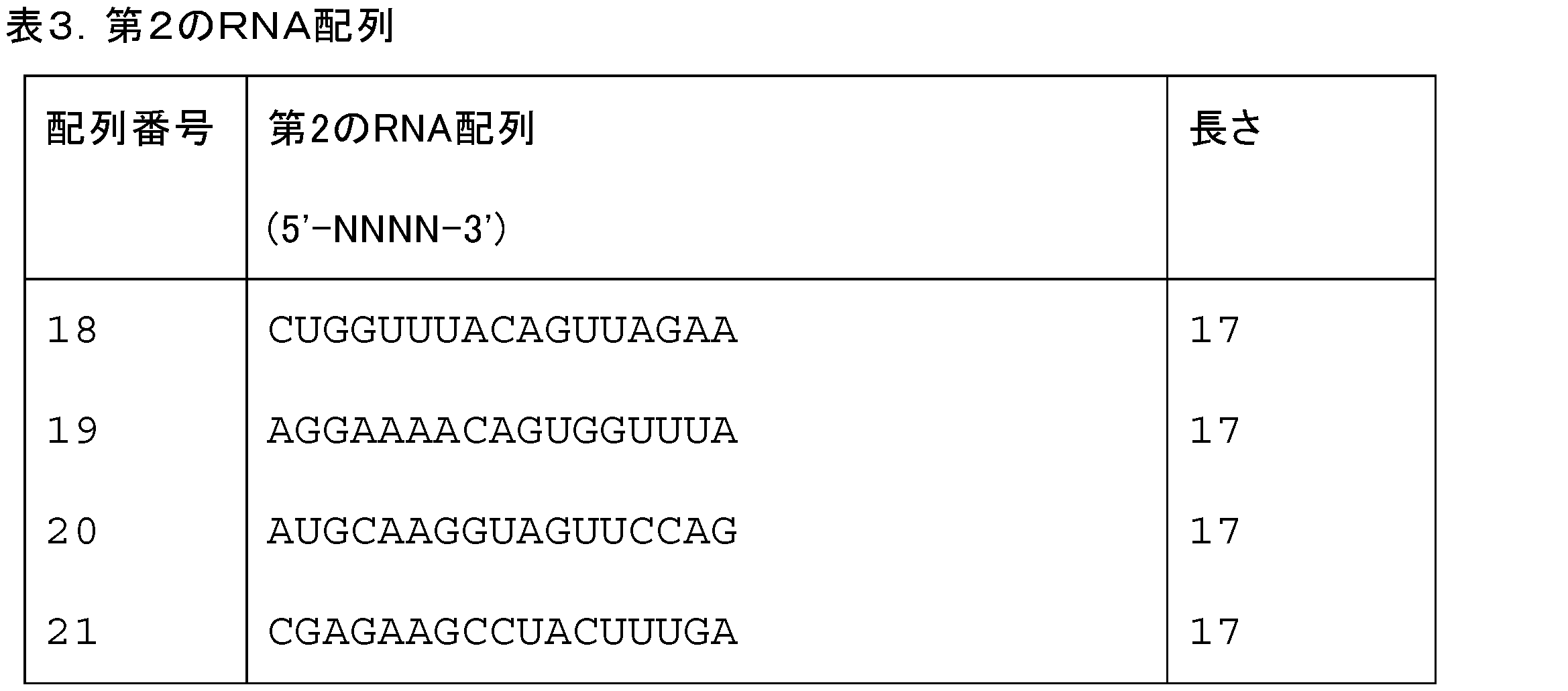
前記第1のRNA配列は、実施例において示されるなどの好ましくはmiRNAスキャホールドに、より好ましくはmiR451スキャホールドに含まれる。本発明における第1の及び第2のRNA配列を含む好適なスキャホールドは、下の表4及び5に列挙されるなどの配列であり得る。表4に列挙される配列は、さらなる配列を含む場合があり、表5に列挙されるなどのpri-miRNAスキャホールドに含まれ得る。 The first RNA sequence is preferably contained in a miRNA scaffold, such as that shown in the examples, more preferably in a miR451 scaffold. Suitable scaffolds comprising the first and second RNA sequences in the present invention can be sequences such as those listed in Tables 4 and 5 below. The sequences listed in Table 4 may contain additional sequences and may be included in the pri-miRNA scaffolds such as those listed in Table 5.

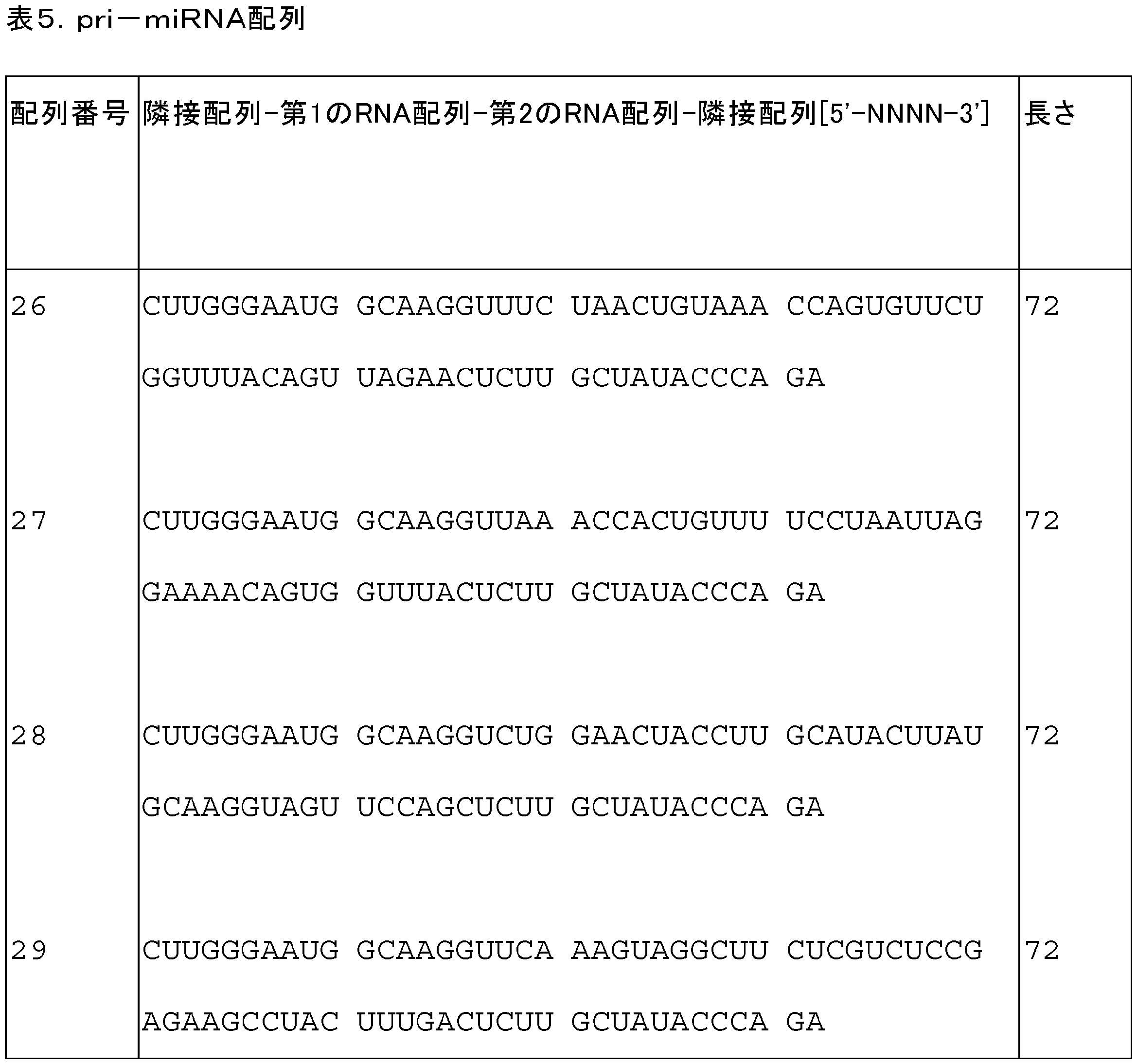
上に記載されるこのような第1のRNA配列は、発現カセットに含まれ得る。このような第1のRNA配列は、発現カセットによってコードされるRNA構造に含まれ得る。上に記載されるこのような第1の及び第2のRNA配列は、発現カセットに含まれ得る。このような第1の及び第2のRNA配列は、発現カセットによってコードされるRNA構造に含まれ得る。 Such a first RNA sequence described above may be included in an expression cassette. Such a first RNA sequence may be included in the RNA structure encoded by the expression cassette. Such first and second RNA sequences described above may be included in an expression cassette. Such first and second RNA sequences can be included in the RNA structure encoded by the expression cassette.
したがって、好ましくはCAG領域から5’の領域にあり、好ましくは表1に列挙されるなどの標的RNA配列、より好ましくは配列番号9、10、11及び配列番号13から選択される標的RNA配列であり、上に記載される第1の及び第2のRNA配列を利用する標的RNA配列を標的化することは、ヒトATXN3遺伝子によってコードされるRNA転写物の発現を低減するために特に有用であることが見出された。 Therefore, it is preferably in the region 5'from the CAG region, preferably with a target RNA sequence such as those listed in Table 1, more preferably with a target RNA sequence selected from SEQ ID NOs: 9, 10, 11 and SEQ ID NO: 13. There, targeting target RNA sequences that utilize the first and second RNA sequences described above is particularly useful for reducing expression of RNA transcripts encoded by the human ATXN3 gene. Was found.
上に記載のとおり及び実施例に示されるとおり、これらの標的配列は、第1のRNA配列及び第2のRNA配列をコードする発現カセットを利用するRNAiアプローチを介してATXN3遺伝子発現を低減するために特に好適であることが見出され、ここで第1の及び第2のRNA配列は実質的に相補的であり、第1のRNA配列は少なくとも19ヌクレオチドの長さの配列を有し、ヒトATXN3遺伝子によってコードされるRNAに含まれる標的RNA配列に実質的に相補的である。 As described above and as shown in the Examples, these target sequences are intended to reduce ATXN3 gene expression via an RNAi approach utilizing an expression cassette encoding a first RNA sequence and a second RNA sequence. The first and second RNA sequences are substantially complementary, where the first RNA sequence has a sequence of at least 19 nucleotides in length and is particularly suitable for humans. It is substantially complementary to the target RNA sequence contained in the RNA encoded by the ATXN3 gene.
さらに、さらなる実施形態では、1つ又は複数の発現カセットは、標的RNA配列の組合せ標的化のために提供される。そのため、ヒトATXN3遺伝子転写物に含まれるRNA標的配列の組合せ標的化は、本発明において検討される。このような組合せ標的化は、さらに標的RNA配列の単一標的と比較して、CAG伸長を含有する転写物及びタンパク質を含む、ヒトATXN3遺伝子転写物及び/又はアタキシン-3タンパク質の発現を低減するためである。RNA標的配列の組合せ標的化は、例えば2つの別々の発現カセットを準備することによって得ることができる。代替的に及び好ましくは、ある発現カセットは、各標的について第2のRNA配列と組み合わせた第1のRNA配列をコードするように提供され、そのためこのような発現カセットは、2つの別々のガイド配列を提供するように細胞によってプロセシングされ得る少なくとも2つの別々の第1のRNA配列を含む単一のRNA転写物を発現し、それぞれ別のガイド配列は少なくとも2つの標的、すなわち第1の標的RNA配列及び第2の標的RNA配列のうちの1つを標的化する。このため一実施形態では、1つ又は複数の発現カセットは、配列番号9及び10;配列番号9及び11;配列番号9及び13;配列番号10及び11;配列番号10及び13;配列番号11及び13の組合せ標的化のために準備される。別の実施形態では、1つ又は複数の発現カセットは、配列番号9、10及び11;配列番号9、10及び13;配列番号9、11及び13;配列番号10、11及び13の組合せ標的化のために準備される。別の実施形態では、1つ又は複数の発現カセットは、配列番号9、10、11及び13の組合せ標的化のために準備される。ヒトATXN3遺伝子転写物に含まれるRNA標的配列の組合せ標的化が、CAG伸長を含有する転写物及びタンパク質を含む、ヒトATXN3遺伝子転写物及び/又はアタキシン-3タンパク質の発現を低減できると予測されることから、標的RNA配列の単一の標的化とさらに比較しても、このような組合せ標的化は、さらなる神経病態を減速する又は完全に停止することによって、冒されたヒト患者に顕著な利益を与え得る。 Further, in a further embodiment, one or more expression cassettes are provided for combinatorial targeting of target RNA sequences. Therefore, combinatorial targeting of RNA target sequences contained in human ATXN3 gene transcripts is investigated in the present invention. Such combinatorial targeting further reduces the expression of human ATXN3 gene transcripts and / or ataxin-3 proteins, including transcripts and proteins containing CAG elongation, as compared to a single target of the target RNA sequence. Because. Combination targeting of RNA target sequences can be obtained, for example, by preparing two separate expression cassettes. Alternatively and preferably, an expression cassette is provided to encode a first RNA sequence combined with a second RNA sequence for each target, so such an expression cassette is provided with two separate guide sequences. Expresses a single RNA transcript containing at least two separate first RNA sequences that can be processed by the cell to provide each separate guide sequence for at least two targets, i.e. the first target RNA sequence. And one of the second target RNA sequences. Thus, in one embodiment, the one or more expression cassettes are SEQ ID NOs: 9 and 10; SEQ ID NOs: 9 and 11; SEQ ID NOs: 9 and 13; SEQ ID NOs: 10 and 11; SEQ ID NOs: 10 and 13; SEQ ID NO: 11 and Prepared for 13 combination targeting. In another embodiment, one or more expression cassettes are a combination targeting of SEQ ID NOs: 9, 10 and 11; SEQ ID NOs: 9, 10 and 13; SEQ ID NOs: 9, 11 and 13; SEQ ID NOs: 10, 11 and 13. Prepared for. In another embodiment, one or more expression cassettes are prepared for combinatorial targeting of SEQ ID NOs: 9, 10, 11 and 13. Combined targeting of RNA target sequences contained in human ATXN3 gene transcripts is expected to reduce expression of human ATXN3 gene transcripts and / or ataxin-3 proteins, including transcripts and proteins containing CAG elongation. Thus, even when compared to single targeting of target RNA sequences, such combined targeting is of significant benefit to affected human patients by slowing down or completely stopping further neuropathology. Can be given.
好ましくは、CAGプロモーターなどのpol IIプロモーター(とりわけ、Miyazaki et al.Gene.79(2):269~77;Niwa、Gene.108(2):193~9)並びに例えば図2のb及び図7に示される、PGKプロモーター又はCMVプロモーター(例えば、本明細書に参照により組み込まれる国際公開第2016102664号の図2に示されているなど)が使用される。神経細胞が疾患において冒されることから、神経細胞特異的な又は汎ニューロン(pan-neuronal)及び星状細胞特異的プロモーターを使用することは特に有用である場合がある。好適な神経細胞特異的プロモーターの例は、神経細胞特異的エノラーゼ(NSE)、ヒトシナプシン1、caMKキナーゼ及びチューブリンである(Hioki et al.Gene Ther.2007 Jun;14(11):872~82)。検討され得る他の好適なプロモーターは、誘導性又は抑制性プロモーター、すなわち宿主細胞がある特定の1つ又は複数の刺激に曝露される場合にだけ転写を開始する又はその逆のプロモーターである。
Preferably, a pol II promoter such as the CAG promoter (especially Miyazaki et al. Gene. 79 (2): 269-77; Niwa, Gene. 108 (2): 193-9) and, for example, FIG. 2b and FIG. 7 The PGK promoter or CMV promoter shown in (eg, as shown in FIG. 2 of International Publication No. 2016102664 incorporated by reference herein) is used. Since nerve cells are affected in the disease, it may be particularly useful to use nerve cell-specific or pan-neuronal and astrocyte-specific promoters. Examples of suitable neuron-specific promoters are neuron-specific enolase (NSE),
本発明による前記発現カセットは、例えばトランスフェクション法を使用して細胞に移行され得る。任意の好適な手段は、本発明による発現カセットを移行するために十分であり得る。好ましくは、上に記載されるヒトATXN3遺伝子の配列特異的阻害を誘導する2本鎖RNAの安定発現が達成され得るように、発現カセットを細胞に安定に移行する遺伝子治療ベクターが使用される。好適なベクターは、レンチウイルスベクター、レトロトランスポゾンベースベクター系又はAAVベクターであり得る。例えばレンチウイルスベクターは、RNAゲノムを保有することから、細胞の形質導入後に、前記DNA配列及び前記発現カセットが形成されるようにRNAゲノムが前記発現カセットをコードすることは理解される。好ましくは、AAVなどのウイルスベクターは、使用される。使用され得る好ましいAAVベクターは、血清型5のAAVベクターである。血清型5のAAV(AAV5とも称される)は、実施例において示されるとおり、ヒト神経細胞及びヒト星状細胞を形質導入するために特に有用である場合がある。したがって、AAV5は、(ヒト誘導多能性幹細胞幹細胞由来)前頭部脳様神経細胞、ドーパミン作動性神経細胞、運動神経細胞及び星状細胞を含むCNSのさまざまなヒト細胞型を効率的に形質導入でき、したがってAAV5は、SCA3を含む神経生成的疾患を治療するためにCNSに治療用遺伝子を送達するための好適なベクター候補である。特にAAV5は、本明細書に記載されるヒトATXN3を標的化するために使用され得る。目的の任意の発現カセットを含むAAVベクターの産生は、例えば、その全体が本明細書に組み込まれる;国際公開第2007/046703号、国際公開第2007/148971号、国際公開第2009/014445号、国際公開第2009/104964号、国際公開第2011/122950号、国際公開第2013/036118号に十分に記載されている。
The expression cassette according to the invention can be transferred to cells using, for example, a transfection method. Any suitable means may be sufficient to transfer the expression cassette according to the invention. Preferably, a gene therapy vector is used that stably transfers the expression cassette to cells so that stable expression of double-stranded RNA that induces sequence-specific inhibition of the human ATXN3 gene described above can be achieved. Suitable vectors can be lentiviral vectors, retrotransposon-based vectors or AAV vectors. For example, since a lentiviral vector carries an RNA genome, it is understood that the RNA genome encodes the expression cassette such that the DNA sequence and the expression cassette are formed after transduction of cells. Preferably, a viral vector such as AAV is used. A preferred AAV vector that can be used is a
例えば、昆虫又は哺乳動物細胞株において産生されるAAVベクターの産生のために本発明において使用され得るAAV配列は、任意のAAV血清型のゲノム由来であってもよい。一般にAAV血清型は、アミノ酸及び核酸レベルで顕著に相同なゲノム配列を有し、遺伝的機能の同一のセットを提供し、本質的に物理的及び機能的に等価であるビリオンを産生し、実際に同一の機構によって複製及びアセンブルされる。種々のAAV血清型のゲノム配列及びゲノム類似性の概要について、例えば、GenBank受託番号U89790;GenBank受託番号J01901;GenBank受託番号AF043303;GenBank受託番号AF085716;Chlorini et al.(1997、J.Vir.71:6823~33);Srivastava et al.(1983,J.Vir.45:555~64);Chlorini et al.(1999,J.Vir.73:1309~1319);Rutledge et al.(1998,J.Vir.72:309~319)及びWu et al.(2000,J.Vir.74:8635~47)を参照されたい。AAV血清型1、2、3、4及び5は、本発明の文脈における使用のためのAAVヌクレオチド配列の好ましい供給源である。好ましくは、本発明の文脈における使用のためのAAV ITR配列は、AAV1、AAV2、及び/又はAAV5由来である。同様にRep52、Rep40、Rep78及び/又はRep68コード配列は、好ましくはAAV1、AAV2及びAAV5由来である。しかし、本発明の文脈における使用のためのVP1、VP2及びVP3カプシドタンパク質をコードする配列は、周知の42の血清型のいずれかから、より好ましくはAAV1、AAV2、AAV3、AAV4、AAV5、AAV6、AAV7、AAV8若しくはAAV9又は例えばカプシドシャッフリング技術によって得られた新たに開発されたAAV-様粒子から、及びAAVカプシドライブラリーから得ることができる。AAVカプシドは、VP1、VP2及びVP3からなり得るが、VP1及びVP3からなってもよい。 For example, the AAV sequences that can be used in the present invention for the production of AAV vectors produced in insect or mammalian cell lines may be derived from the genome of any AAV serotype. In general, AAV serotypes have significantly homologous genomic sequences at the amino acid and nucleic acid levels, provide the same set of genetic functions, and produce virions that are essentially physically and functionally equivalent, in fact. Is duplicated and assembled by the same mechanism. For an overview of the genomic sequences and genomic similarity of various AAV serotypes, see, for example, GenBank Accession No. U89790; GenBank Accession No. J01901; GenBank Accession No. AF043303; GenBank Accession No. AF085716; Chlorini et al. (1997, J. Vir. 71: 6823-33); Srivastava et al. (1983, J. Vir. 45: 555-64); Chlorini et al. (1999, J. Vir. 73: 1309-1319); Rutledge et al. (1998, J. Vir. 72: 309-319) and Wu et al. (2000, J. Vir. 74: 8635-47). AAV serotypes 1, 2, 3, 4, and 5 are preferred sources of AAV nucleotide sequences for use in the context of the present invention. Preferably, the AAV ITR sequence for use in the context of the present invention is derived from AAV1, AAV2, and / or AAV5. Similarly, the Rep52, Rep40, Rep78 and / or Rep68 coding sequences are preferably derived from AAV1, AAV2 and AAV5. However, the sequences encoding the VP1, VP2 and VP3 capsid proteins for use in the context of the present invention are more preferably AAV1, AAV2, AAV3, AAV4, AAV5, AAV6, from any of the well-known 42 serotypes. It can be obtained from AAV7, AAV8 or AAV9 or, for example, newly developed AAV-like particles obtained by capsid shuffling techniques, and from AAV capsid libraries. The AAV capsid can consist of VP1, VP2 and VP3, but may also consist of VP1 and VP3.
別の実施形態では、宿主細胞は、本発明によるDNA配列又は発現カセットを含んで提供される。例えば、前記発現カセット又はDNA配列は、細菌に含有されるプラスミドに含まれ得る。前記発現カセット又はDNA配列は、例えばウイルスベクターを生じる産生細胞にも含まれ得る。前記発現カセットは、バキュロウイルスベクター中でも提供され得る。 In another embodiment, the host cell is provided comprising the DNA sequence or expression cassette according to the invention. For example, the expression cassette or DNA sequence may be included in a plasmid contained in the bacterium. The expression cassette or DNA sequence may also be included, for example, in the producing cells that give rise to the viral vector. The expression cassette may also be provided in a baculovirus vector.
実施例セクションにおいて示される、及び上に説明されるとおり、本発明による2本鎖RNA、本発明によるDNA配列、本発明による発現カセット及び本発明による遺伝子治療ベクターは、医薬としての使用のため、特にSCA3の治療における医薬としての使用のためである。したがって、本発明による2本鎖RNA、本発明によるDNA配列、本発明による発現カセット及び本発明による遺伝子治療ベクターは、医学的治療、特にSCA3の治療における使用のためである。さらに具体的には、SCA3の治療における本発明による2本鎖RNA、本発明によるDNA配列、本発明による発現カセット及び本発明による遺伝子治療ベクターの使用は、神経病態を遅延又は停止することが期待される。 As shown in the Examples section and as described above, the double-stranded RNA according to the invention, the DNA sequence according to the invention, the expression cassette according to the invention and the gene therapy vector according to the invention are for use as pharmaceuticals. Especially for its medicinal use in the treatment of SCA3. Thus, the double-stranded RNA according to the invention, the DNA sequence according to the invention, the expression cassette according to the invention and the gene therapy vector according to the invention are for use in medical treatment, especially in the treatment of SCA3. More specifically, the use of double-stranded RNA according to the invention, DNA sequences according to the invention, expression cassettes according to the invention and gene therapy vectors according to the invention in the treatment of SCA3 is expected to delay or stop neuropathology. Will be done.
一実施形態では、医学的治療における前記使用は、少なくとも50%、より好ましくは、より好ましくは少なくとも60%、より好ましくは少なくとも65%のATXN3 mRNAの発現の低減(低下とも称される)を含む。ATXN3 mRNAの発現の60%低減は、正常なATXN3 mRNA発現の40%であるATXN3 mRNAの発現を表すことは理解される。正常なATXN3 mRNA発現は、本発明における第1の及び第2のRNAを発現していない細胞におけるATXN3 mRNA発現を表す。さらなる実施形態では、本発明による遺伝子治療ベクター(又は発現カセット)の前記使用は、少なくとも50%、より好ましくは、より好ましくは少なくとも60%、より好ましくは少なくとも65%のATXN3 mRNAの発現の低減を含み、ここで前記低減は、ヒトiPSC神経細胞において決定される。さらなる実施形態では、ヒトiPSC神経細胞におけるATXN3 mRNA発現の低減は、実施例に記載されるように決定される。別の実施形態では、ATXN3 mRNAの低減は、実施例において記載されるように293T細胞において決定され、好ましくはATXN3 mRNAの低減は、最高用量で約75%以上で293T細胞において得られる。さらに別の実施形態では、ATXN3 mRNA発現の前記低減は、実施例に示されるF512 SCA3ノックインマウスモデルにおいてなどのin vivoで決定される。ATXN3 mRNA発現の前記低減は、好ましくは、例えばRT-qPCRなどを使用して例えば決定されるATXN3 mRNA発現の低減を含む。ATXN3 mRNA発現の前記低減は、好ましくは、脳幹及び/又は小脳においてである。 In one embodiment, said use in medical treatment comprises reducing (also referred to as reducing) expression of ATXN3 mRNA by at least 50%, more preferably at least 60%, more preferably at least 65%. .. It is understood that a 60% reduction in ATXN3 mRNA expression represents 40% of normal ATXN3 mRNA expression, that is, ATXN3 mRNA expression. Normal ATXN3 mRNA expression represents ATXN3 mRNA expression in cells not expressing the first and second RNAs in the present invention. In a further embodiment, said use of the gene therapy vector (or expression cassette) according to the invention reduces expression of ATXN3 mRNA by at least 50%, more preferably at least 60%, more preferably at least 65%. Including, where the reduction is determined in human iPSC neurons. In a further embodiment, reduction of ATXN3 mRNA expression in human iPSC neurons is determined as described in the Examples. In another embodiment, reduction of ATXN3 mRNA is determined in 293T cells as described in the Examples, preferably reduction of ATXN3 mRNA is obtained in 293T cells at a maximum dose of about 75% or more. In yet another embodiment, the reduction in ATXN3 mRNA expression is determined in vivo, such as in the F512 SCA3 knock-in mouse model shown in the Examples. The reduction in ATXN3 mRNA expression preferably comprises a reduction in ATXN3 mRNA expression, eg determined using, for example, RT-qPCR. The reduction in ATXN3 mRNA expression is preferably in the brain stem and / or cerebellum.
別の実施形態では、実施例セクションにおいて示されるとおり、医学的治療における前記使用は、少なくとも50%、より好ましくは少なくとも60%、より好ましくは少なくとも65%のATXN3タンパク質発現の低減(低下とも称される)を含む。ATXN3タンパク質の発現の60%低減は、正常なATXN3タンパク質発現の40%であるATXN3タンパク質発現を表すことは理解される。前記低減は、可溶性及び不溶性凝集物の低減であり得るATXN3タンパク質凝集物の低減を提供できる。前記低減は、アタキシン-3核封入体の低減を提供できる。正常なATXN3タンパク質発現は、本発明における第1の及び第2のRNAを発現しない細胞におけるATXN3タンパク質発現を表す。別の実施形態では、ATXN3タンパク質の前記低減は、約75%の低減である実施例において記載されるなどの293T細胞において決定されるとおりである。別の実施形態では、ATXN3タンパク質発現の前記低減は、実施例に示されるF512 SCA3ノックインマウスモデルにおいて決定されるとおりである。ATXN3タンパク質発現の前記低減は、好ましくは、時間分解蛍光エネルギー移動(TR-FRET)イムノアッセイを使用して決定されるATXN3タンパク質発現の低減を含む(Nguyen et al.,PLOS ONE,April 2013、Vol.8 Issue 4 e62043)。ATXN-3の前記低減、ATXN-3凝集物及び/又は核封入体の低減は、実施例セクションにおいて記載されるとおり、レンチウイルスベクター(変異体アタキシン-3(atx3-72Q)をコードする)及びAAV5-miATXN3の混合物を注射することを含むマウスモデルにおいて観察される低減でもあり得る。ATXN3タンパク質発現の前記低減は、好ましくは脳幹及び/又は小脳においてである。
In another embodiment, as shown in the Examples section, said use in medical treatment reduces (also referred to as reduced) ATXN3 protein expression by at least 50%, more preferably at least 60%, more preferably at least 65%. ) Including. It is understood that a 60% reduction in ATXN3 protein expression represents ATXN3 protein expression, which is 40% of normal ATXN3 protein expression. The reduction can provide a reduction in ATXN3 protein aggregates, which can be a reduction in soluble and insoluble aggregates. The reduction can provide a reduction in ataxin-3 nuclear inclusion bodies. Normal ATXN3 protein expression represents ATXN3 protein expression in cells that do not express the first and second RNAs in the present invention. In another embodiment, said reduction of ATXN3 protein is as determined in 293T cells, such as those described in the Examples, which is a reduction of about 75%. In another embodiment, the reduction in ATXN3 protein expression is as determined in the F512 SCA3 knock-in mouse model shown in the Examples. The reduction in ATXN3 protein expression preferably comprises a reduction in ATXN3 protein expression as determined using a time-resolved fluorescence energy transfer (TR-FRET) immunoassay (Nguyen et al., PLOS ONE, April 2013, Vol. 8
前記のとおり、本発明における第1のRNA配列が、細胞によって発現され、続いてプロセシングされる場合に全体又はその実質的な部分で、ガイド鎖に含まれるものであることは理解される。別の実施形態では、本発明により、細胞において発現される場合に前記第1のRNA配列及び前記第2のRNA配列は、第1のRNA配列を含むガイド配列を産生するように細胞によってプロセシングされ、ここで前記ガイド配列は、細胞によって産生される総miRNA数の最大15%を占める。より好ましくは、前記ガイド配列は、細胞によって産生される総miRNA含有量の最大10%、より好ましくは最大8%、最も好ましくは最大6%を占める。前記ガイド配列は、例えば決定された配列と第1のRNA配列との配列同一性によって評価されて、第1のRNA配列を全体又はその実質的な部分を含んで細胞によって産生される配列を表している。総miRNA数は、第1のRNA配列を含む配列の数と併せた内在性miRNA配列を表す配列の数を参照する。第1のRNA配列を、全体又はその実質的な部分を含むガイド配列を表すハイスループット配列決定によって決定される配列の例は、下の表に示されている。第1のRNA配列由来ガイド配列の総miRNAでの前記百分率は、iPSC細胞において好ましくは決定される。別の実施形態では、第1のRNA配列由来ガイド配列の総miRNAでの前記百分率は、実施例に示されるとおりiPSC細胞において決定される。CNSへの送達は、実質内注射を含み得る(Samaranch et al.,Gene Ther.2017 Apr;24(4):253~261)。前記実質内送達は、線条体内若しくは視床内(intrathalamic)注射又は例えば深部小脳核への注射を含む小脳内(intracerebellar)注射も含み得る。ベクターが小脳及び/又は脳幹などの疾患における患部に、これらのエリアへの脳脊髄液の拡散を介して達することができることから、前記CNS送達は、冒されたCNS領域が有効に形質導入され得る脳脊髄液(CSF)への送達も含み得る。 As mentioned above, it is understood that the first RNA sequence in the present invention, when expressed by cells and subsequently processed, is contained in the guide strand in whole or in a substantial portion thereof. In another embodiment, according to the invention, the first RNA sequence and the second RNA sequence, when expressed in the cell, are processed by the cell to produce a guide sequence containing the first RNA sequence. Here, the guide sequence accounts for up to 15% of the total number of miRNAs produced by the cells. More preferably, the guide sequence accounts for up to 10%, more preferably up to 8%, most preferably up to 6% of the total miRNA content produced by the cells. The guide sequence represents a sequence produced by a cell containing, for example, the entire or substantial portion of the first RNA sequence, evaluated by sequence identity between the determined sequence and the first RNA sequence. ing. The total number of miRNAs refers to the number of sequences representing the endogenous miRNA sequence combined with the number of sequences containing the first RNA sequence. Examples of sequences determined by high-throughput sequencing representing a guide sequence containing the entire or substantial portion of the first RNA sequence are shown in the table below. The percentage of the total miRNA of the guide sequence derived from the first RNA sequence is preferably determined in iPSC cells. In another embodiment, the percentage of the first RNA sequence-derived guide sequence in total miRNA is determined in iPSC cells as shown in the Examples. Delivery to the CNS may include intraparenchymal injection (Samaranch et al., Gene Ther. 2017 Apr; 24 (4): 253-261). The intraparenchymal delivery may also include intrastellar or intrathalamic injections or intracerebellal injections, including, for example, injections into the deep cerebellar nuclei. The CNS delivery can effectively transfect the affected CNS region, as the vector can reach affected areas in diseases such as the cerebellum and / or brain stem via diffusion of cerebrospinal fluid into these areas. Delivery to cerebrospinal fluid (CSF) may also be included.
このような送達方法は、冒された神経細胞を標的化するように冒された脳幹及び/又は小脳を含むCNSに遺伝子治療ベクターを送達する効率的な方法を表している。このような注射は、MRIガイド下注射(MRI-guided injection)を通じて好ましくは実行される。かかる治療の方法は、SCA3を有するヒト対象に特に有用である。 Such delivery methods represent an efficient method of delivering a gene therapy vector to a CNS containing an affected brain stem and / or cerebellum to target affected nerve cells. Such injections are preferably performed through MRI-guided injections. Such methods of treatment are particularly useful for human subjects with SCA3.
CNSへの送達は、CSF内投与を含み得る。CSF内送達法は、冒された神経細胞を標的化するために、冒された脳幹及び/又は小脳を含むCNSに遺伝子治療ベクターを送達するための効率的な方法を表している。さらなる実施形態ではCNS送達は、ベクターのくも膜下腔内注射(例えば、国際公開第2015060722号;Bailey et al.,Mol Ther Methods Clin Dev.2018 Feb 15;9:160~171;)、大槽内(intra cisterna magna)注射及び/又は軟膜下注射(Miyanohara et al.,Mol Ther Methods Clin Dev.2016 Jul 13;3:16046.)も含み得る。CNS送達は、脳室内(ICV)又は線条体内注射も含み得る。好ましくは送達は、実質内注射を、このような送達経路が障害を誘発するリスクを有する場合があることから含まない。CNS送達は、上に列挙されるCNS送達法のいずれか2つ以上の組合せも含み得る。例えば、くも膜下腔内又は軟膜下注射は、脳室内及び/又は大槽内注射と組み合わされ得る。くも膜下腔内又は軟膜下注射は、実質内注射とも組み合わされ得る。方法の前記組合せは、同時、すなわち同じ時又は連続的、すなわちある一定の時間間隔内であってもよい。かかる治療の方法は、SCA3を有するヒト対象に特に有用である。脳幹が非常に複雑な構造を有することから、高いリスクを伴う場合があるこのエリアへの直接注射を必要とせずに、遺伝子治療ベクターがこのエリアに達することができるように、遺伝子治療ベクターをこの脳エリアの近(物理的に)近接に送達することも検討される。
Delivery to the CNS may include intra-CSF administration. Intra-CSF delivery methods represent an efficient method for delivering a gene therapy vector to a CNS containing the affected brain stem and / or cerebellum to target affected nerve cells. In a further embodiment, CNS delivery is intrathecal injection of the vector (eg, International Publication No. 2015060722; Bailey et al., Mol The Modes Clin Dev. 2018
SCA3の治療は、疾患の兆候をまだ示していないSCA3を発症する遺伝的素因を有するヒト対象を含む、SCA3を有するヒト対象に関することは理解される。これにより、SCA3を用いたヒト対象の治療は、SCA3に関連するCAG伸長を有するATXN3遺伝子を保有する任意のヒト対象の治療を含む。前記治療が伸長されたCAGリピートを含有するRNA及び/又は、それから翻訳された伸長されたポリQを含有するアタキシン-3タンパク質と関連する神経病態を減速及び/又は停止することを含むことが期待される。一実施形態では、前記治療は、SCA3マウスモデルに関連する脳病変のサイズの低減を生じる。別の実施形態では、前記治療は、SCA3に関連するATXN-3タンパク質凝集物の低減を生じる。これにより患者は、本発明による遺伝子治療ベクター及び/又は発現カセットを用いた治療から利益を得ることができ、運動障害の回復及び生存期間の延長を示し得る。 It is understood that treatment of SCA3 relates to human subjects with SCA3, including human subjects with a genetic predisposition to develop SCA3 that have not yet shown signs of disease. Thus, treatment of human subjects with SCA3 includes treatment of any human subject carrying the ATXN3 gene with CAG elongation associated with SCA3. It is expected that the treatment involves slowing and / or arresting neurological conditions associated with RNA containing extended CAG repeats and / or ataxin-3 protein containing extended polyQ translated from it. Will be done. In one embodiment, the treatment results in a reduction in the size of brain lesions associated with the SCA3 mouse model. In another embodiment, the treatment results in a reduction of ATXN-3 protein aggregates associated with SCA3. This allows the patient to benefit from treatment with the gene therapy vector and / or expression cassette according to the invention, which may indicate recovery from movement disorders and prolongation of survival.
ATXN3の5’領域を標的化するmiRNAの設計
本発明者らは、トータルサイレンシングアプローチのための標的部位を選択した(図1-1及び1-2を参照されたい)。選択した標的配列を、上の表1に列挙する。miRNAスキャホールド中の内在性ガイド鎖配列を置き換えるために使用した第1のRNA配列は、標準的ワトソン-クリック塩基対合(G-C及びA-U)を有して、表1の標的配列に完全に相補的であった。配列をヒトpri-miRNA miR-451スキャホールド配列に組み込んだ。200nt 5’及び3’隣接領域は含まれ、mfoldプログラム(http://unafold.rna.albany.edu/?q=mfold)を、図8に示すとおり、候補が二次構造にフォールドされるかどうかを決定するために標準的設定で使用した。予測される二次構造にフォールドされない場合、正しい構造がプログラムによってフォールドされるように、第1のRNA配列を適合することに関与していない配列を適合させた。次に、DNA配列をコードする完全なスキャホールドをGeneArt遺伝子合成(Invitrogen)に発注し、次にニワトリβ-アクチン(CAG)プロモーター(Inovio、Plymouth Meeting、PA)に融合したCMV最初期エンハンサーを含有する発現ベクターにクローニングした、その例は、図7に示されている。
Design of miRNAs that target the 5'region of ATXN3 We have selected target sites for the total silencing approach (see Figures 1-1 and 1-2). The selected target sequences are listed in Table 1 above. The first RNA sequence used to replace the endogenous guide strand sequence in the miRNA scaffold has standard Watson-Crick base pairing (GC and AU) and is the target sequence in Table 1. Was completely complementary to. The sequence was integrated into the human tri-miRNA miR-451 scaffold sequence. 200 nt 5'and 3'adjacent regions are included and the mfold program (http://unafold.RNA.albany.edu/?q=mfold) is included and the candidates are folded into secondary structure as shown in FIG. Used in standard settings to determine if. If not folded to the expected secondary structure, the sequences that were not involved in matching the first RNA sequence were fitted so that the correct structure was folded programmatically. The complete scaffold encoding the DNA sequence was then ordered from GeneArt gene synthesis (Invitrogen) and then contained the CMV earliest enhancer fused to the chicken β-actin (CAG) promoter (Inovio, Plymouth Meeting, PA). An example of cloning into an expression vector is shown in FIG.
レポーター系でのmiR451スキャホールドコンストラクトのin vitro試験
miATXN3候補の有効性を検査するために、本発明者らは、ウミシイタケルシフェラーゼ(RL)遺伝子に融合した相補的ATXN3標的領域を保有するLucレポーターを設計した(図2のc)。標的配列を合成し(GeneArt)、psiCHECK-2ベクター(Promega、Madison、WI)のウミシイタケルシフェラーゼ(RL)遺伝子の3’UTRにクローニングした。ホタルルシフェラーゼ(FL)遺伝子もこのベクターで発現され、内部標準の役割を果たした。0.1、1、10及び100ngと増量したレポーター及びコンストラクトの同時トランスフェクションを、標準的培養及びトランスフェクション条件を使用し、製造者の説明書に従ってリポフェクタミンを使用して293T細胞において実行した。トランスフェクション48時間後、細胞を室温で受動的溶解緩衝液(Promega)において溶解し、FL及びRL活性をデュアル-ルシフェラーゼレポーターアッセイシステム(Promega)を用いて可溶化物中で測定した。相対的ルシフェラーゼ活性をRLとFLとの間の活性の比として算出した。結果(図3)は、5’領域、特にこれを含んでエクソン5を含みエクソン10を含まない、は最も効率的なノックダウンがこの領域(標的配列、配列番号9~13)から得られたことから、ATXN3遺伝子発現の非常に効率的な標的化のための良好な領域であることを示している。
In vitro test of miR451 scaffold construct in a reporter system To test the efficacy of miATXN3 candidates, we presented a Luc reporter carrying a complementary ATXN3 target region fused to the sea shiitake mushroom luciferase (RL) gene. Designed (c in FIG. 2). The target sequence was synthesized (GeneArt) and cloned into the 3'UTR of the sea shiitake luciferase (RL) gene of the psiCHECK-2 vector (Promega, Madison, WI). The firefly luciferase (FL) gene was also expressed in this vector and served as an internal standard. Co-transfection of reporters and constructs increased to 0.1, 1, 10 and 100 ng was performed on 293T cells using lipofectamine according to the manufacturer's instructions using standard culture and transfection conditions. After 48 hours of transfection, cells were lysed in a passive lysis buffer (Promega) at room temperature and FL and RL activity was measured in the solubilized product using a dual-luciferase reporter assay system (Promega). Relative luciferase activity was calculated as the ratio of activity between RL and FL. The results (FIG. 3) show that the 5'region, particularly including
in vitro試験-内在性アタキシン-3タンパク質のノックダウン
内在性に発現されるATXN3 mRNA及びアタキシン-3タンパク質をサイレンシングする能力をHEK293T細胞において検査した。配列番号9、11及び13を標的化するmiATXN3候補を、対照としてのGFP発現カセットと共にトランスフェクトした。タンパク質をトランスフェクション3日後に単離した。次に、ウエスタンブロットを実行した。ブロットされたタンパク質をアタキシン-3について染色し、α-チューブリンをローディング対照として使用した(図4のa)。100%に設定した緑色蛍光タンパク質(GFP)対照と比較してアタキシン-3タンパク質レベルを測定した。一元配置ANOVAは、GFPトランスフェクト細胞の発現と候補の発現との間に75%までの低減を有して有意差を示した、P<0.0001(図4のb)。アタキシン-3については2つのバンドが見られ、両方のバンドは低減しており、異なる長さの対立遺伝子が標的化されたことを示している。
In vitro test-knockdown of endogenous ataxin-3 protein The ability to silence endogenously expressed ATXN3 mRNA and ataxin-3 protein was tested in HEK293T cells. Candidate miATXN3 targeting SEQ ID NOs: 9, 11 and 13 was transfected with a GFP expression cassette as a control. The protein was isolated 3 days after transfection. Next, Western blotting was performed. The blotted protein was stained for ataxin-3 and α-tubulin was used as a loading control (Fig. 4a). Ataxin-3 protein levels were measured compared to a green fluorescent protein (GFP) control set to 100%. One-way ANOVA showed a significant difference with a reduction of up to 75% between GFP-transfected cell expression and candidate expression, P <0.0001 (FIG. 4b). Two bands were found for ataxin-3, both bands were reduced, indicating that alleles of different lengths were targeted.
ATXN3 miRNAを用いて形質導入した神経細胞培養物における用量依存的ATXN3低下
発現カセットをAAVウイルスベクターゲノムに組み込んだ、続いて、AAV5血清型に基づいて組換えウイルスベクターを昆虫細胞バキュロウイルスに基づく製造及び親和性クロマトグラフィー及びろ過法が挙げられるクロマトグラフィー法を利用する標準的下流プロセシングを使用して産生した(Lubelski et al.Bioprocessing Journal,2015,Weihong Qu et al.,Curr Pharm Biotechnol,2014,AVB sepharose high performance,GE Healthcare Life Sciences,ref.28-9207-54 AB)。次に、これらのウイルスベクターは、(Chambers SM、Nat Biotechnol、2009)に記載されるSMADシグナル伝達の二重阻害によってiPSC(人工多能性幹細胞)由来前脳様神経細胞を形質導入するために使用した。投与量を増加させたAAVベクター(10exp11、10exp 12、10exp 13、ゲノムコピーはqPCRを用いて決定)を神経細胞3*105個を含む各ウエルに加えた。明らかな用量応答が、配列番号9、11及び13を標的化した場合に、miRNA発現レベル及びATXN3 mRNAのノックダウンの両方について観察された(それぞれ、図5のa及び5のb)。約65%のATXN3 mRNAの低減が観察された。内在性ATXN3遺伝子発現のノックダウンを評価することに加えて、これらのiPSC由来神経細胞において発現されたmiRNAスキャホールドのプロセシングをハイスループット低分子RNA配列決定を使用して評価した。配列番号9、11及び13を標的化するmiRNAは、形質導入されたiPSC神経細胞において高度に発現された。総miRNA数の内、0.003%から5.7%を成熟配列標的化ATXN3にアラインした。下の表6~8に列挙される配列は、形質導入された神経細胞培養物からの低分子RNA配列決定によって決定された最も多い読み取りデータを示している。表6~8に列挙されている配列はDNA配列を表している一方で、これらの配列は、細胞によってプロセシングされたmiRNAスキャホールド(とりわけ図2のa及び8に示されているなど)由来のRNA配列を表していることに注目されたい(すなわちTがUである)。
A dose-dependent ATXN3 reduction expression cassette in a nerve cell culture transduced with ATXN3 miRNA was incorporated into the AAV virus vector genome, followed by the production of recombinant viral vectors based on the AAV5 serotype based on insect cell baculovirus. And produced using standard downstream processing utilizing chromatographic methods such as affinity chromatography and filtration methods (Lubeski et al. Bioprocessing Journal, 2015, Weihong Qu et al., Curr Pharma Biotechnol, 2014, AVB. sepharose high performance, GE Healthcare Life Sciences, ref. 28-9207-54 AB). These viral vectors are then used to transduce iPSC (induced pluripotent stem cell) -derived forebrain-like neurons by double inhibition of SMAD signaling as described in (Chambers SM, Nat Biotechnol, 2009). used. A dose-increased AAV vector (10exp11, 10exp12, 10exp13, genomic copy determined using qPCR) was added to each well containing 5


細胞のRNAi機構によってプロセシングされたRNA分子が長さ21~30ヌクレオチドの範囲であるRNA分子を産生することは注目される。22ヌクレオチドを越えて拡張されるRNA分子は、第2のRNA配列を表す配列由来である最大8ヌクレオチドを含む。配列番号11を標的化する4個の最も主要な分子種のものであるRNA分子について、3個は標的配列(すなわち、配列番号35、37及び38)に100%相補的である一方で、配列番号36は1個のミスマッチをRNA配列の5’末端に有し、4個の最も主要な分子種は21~24ヌクレオチドの範囲の長さを有し、スキャホールドから産生されるRNA分子種の90%までとなっていることはさらに注目される。プロセシングに基づいて、選択される好ましい標的RNAは、配列番号11であってよく、そのために好ましくはmiR451に基づくmiRNAスキャホールドは、配列番号24若しくは配列番号28など、又は配列番号49によってコードされる配列を有して有用であり得る。
It is noteworthy that RNA molecules processed by the cellular RNAi mechanism produce RNA molecules in the range of 21-30 nucleotides in length. RNA molecules extended beyond 22 nucleotides contain up to 8 nucleotides from the sequence representing the second RNA sequence. For RNA molecules that are of the four most major molecular species targeting SEQ ID NO: 11, three are 100% complementary to the target sequence (ie, SEQ ID NOs: 35, 37 and 38), while the sequence.
SCA3のin vivo低下
最も好ましいRNA標的配列のin vivo活性を検査するために、ノックインマウスモデルにおいて、AAVベース遺伝子送達を検査した。使用したマウスモデルは新規F512 SCA3ノックインマウスモデルであった。このマウスモデルでは、CAG伸長は、内在性マウスAtxn3遺伝子に挿入した。このモデルは、マウス(CAG)6を切断し、次に、断続的なリピートを含む(CAACAGCAG)48ドナーベクターを用いた続く相同組換えによって亜鉛フィンガー技術を使用して生成した。F512 SCA3ノックインマウスモデルは、233グルタミンリピートを含む変異体アタキシン-3タンパク質を発現するように特徴付けた。このモデルは、配列番号9、11及び13のヒト配列を少なくとも表す標的配列を含有する。このモデルで配列番号11に対応する内在性標的配列が、第1のRNA配列、配列番号16にミスマッチを含有し、前記ミスマッチが配列番号11の1位でのAからCを表す、ことは注目される。
Decreased in vivo of SCA3 To test for in vivo activity of the most preferred RNA target sequence, AAV-based gene delivery was tested in a knock-in mouse model. The mouse model used was the new F512 SCA3 knock-in mouse model. In this mouse model, CAG elongation was inserted into the endogenous mouse Atxn3 gene. This model was generated using zinc finger technology by cleaving mouse (CAG) 6 and then by subsequent homologous recombination with a (CAACAGCAG) 48 donor vector containing intermittent repeats. The F512 SCA3 knock-in mouse model was characterized to express a mutant ataxin-3 protein containing 233 glutamine repeats. This model contains at least a target sequence representing the human sequences of SEQ ID NOs: 9, 11 and 13. It is noteworthy that the endogenous target sequence corresponding to SEQ ID NO: 11 in this model contains a mismatch in the first RNA sequence, SEQ ID NO: 16, and the mismatch represents A to C at
ウイルスベクターをF512 SCA3ノックインマウスの深部小脳核、ICV又は大槽内に注射した(図6)。配列番号9、11及び13を標的化するRNA分子あたり動物3匹を使用した。6週間の生存後、動物を屠殺し、脳を精査した。gcコピー数並びに小脳、脳幹及び皮質におけるATXN3 mRNAの量を決定した。一貫して、形質導入レベルは同様であり、ATXN3低下は、異なる群間でも一致した。マウスにおいて産生されるヒト配列、配列番号11を標的化する推定ガイド鎖が、そのマウスATXN3にミスマッチを有し、完全な相補性を有することがアタキシン-3をさらに低下させると予測されることから、観察されたATXN3低下は過小評価される場合があることは記される。このためこれらの結果に基づいて、ヒトにおいて配列番号9、10、11及び13を標的化することは、ATXN3の十分な低下を生じることが予測される一方で、ヒトにおいて配列番号11を標的化することが最も強い低下を生じることが予測される。 The viral vector was injected into the deep cerebellar nuclei, ICV or cisterna magna of F512 SCA3 knock-in mice (FIG. 6). Three animals per RNA molecule targeting SEQ ID NOs: 9, 11 and 13 were used. After 6 weeks of survival, the animals were slaughtered and the brain examined. The number of gc copies and the amount of ATXN3 mRNA in the cerebellum, brain stem and cortex were determined. Consistently, transduction levels were similar and ATXN3 reduction was consistent between different groups. The putative guide strand targeting SEQ ID NO: 11, the human sequence produced in mice, has a mismatch with its mouse ATXN3 and is expected to have full complementarity to further reduce ataxin-3. It is noted that the observed decrease in ATXN3 may be underestimated. Therefore, based on these results, targeting SEQ ID NOs: 9, 10, 11 and 13 in humans is expected to result in a sufficient reduction in ATXN3, while targeting SEQ ID NO: 11 in humans. It is expected that doing will cause the strongest decline.
配列番号9、11及び13を標的化するAAVのin vivo投与のさらなる結果は、図9に示されている。前記のとおり、AAVを3つの異なる注射経路を介してF512 SCA3マウスに注射した:ICV、大槽内又はDCN中(図9のA)。注射は、配列番号9、11又は13を標的化するRNA(すなわち、AAV5-miATXN3_9、AAV5-miATXN3_11、AAV5-miATXN3_13)を含むウイルスベクターを用いて実施し、AAV5-GFPを対照として伴った。ゲノムDNAあたりに検出されたgcの量を各投与経路について皮質、小脳及び脳幹において決定した。ICV投与は、3つすべての分析された脳領域への比較的低いベクターコピー分布を生じた。小脳及び脳幹と比較して、高い形質導入が皮質において観察された(図9のB)。大槽への投与は、皮質の低い形質導入を生じたが、脳幹及び小脳の強い形質導入を生じた(図9のC)。最も高い形質導入は、ゲノムコピー2.9×10⁷個(gc)/μg組織DNAに至って脳幹において検出された。DCNへの直接注射も小脳及び脳幹の比較的高い形質導入を生じた。大槽投与と比較して、DCN注射は、小脳の良好な形質導入及び脳幹の少ない形質導入を生じた(図9のD)。最新の観察に基づいて、3つすべての投与経路は、脳の形質導入を生じたが、大槽への投与がマウスの小脳及び脳幹の両方の最も高い組合せ形質導入をもたらした。患者において小脳及び脳幹は、主に冒される領域である。 Further results of in vivo administration of AAV targeting SEQ ID NOs: 9, 11 and 13 are shown in FIG. As mentioned above, AAV was injected into F512 SCA3 mice via three different injection routes: in ICV, in the cisterna magna or in DCN (A in FIG. 9). Injection was performed using a viral vector containing RNA targeting SEQ ID NO: 9, 11 or 13 (ie, AAV5-miATXN3_9, AAV5-miATXN3_11, AAV5-miATXN3_13), accompanied by AAV5-GFP as a control. The amount of gc detected per genomic DNA was determined in the cortex, cerebellum and brainstem for each route of administration. ICV administration resulted in a relatively low vector copy distribution to all three analyzed brain regions. High transduction was observed in the cortex compared to the cerebellum and brainstem (Fig. 9B). Administration to the cisterna magna resulted in low transduction of the cortex, but strong transduction of the brainstem and cerebellum (C in FIG. 9). The highest transduction was detected in the brainstem leading to genomic copy 2.9 × 10 7 (gc) / μg tissue DNA. Direct injection into the DCN also resulted in relatively high transduction of the cerebellum and brainstem. Compared to cisterna magna administration, DCN injection resulted in good transduction of the cerebellum and less transduction of the brainstem (D in FIG. 9). Based on recent observations, all three routes of administration resulted in brain transduction, but administration to the cisterna magna resulted in the highest combination transduction of both the cerebellum and brain stem of mice. In patients, the cerebellum and brainstem are the predominantly affected areas.
F512マウスにおけるmiATXN3発現及び変異体アタキシン-3のサイレンシングをさらに分析した。DCNへの直接注射は、小脳における成熟miATXN3の最も高い発現を示した(図10のA)。miATXN3_11は、最も高いマイクロRNA発現を示した。マイクロRNA発現は、小脳においてmiATXN3_11及びmiATXN3_13によるATXN3 mRNAの顕著な低減(約15~20%)と良好に相関した(図10のB)。大槽への投与は、DCN注射と比較して小脳における低い成熟マイクロRNA発現を生じた(図10のC)。それにも関わらず、miATXN3_11が最良に発現され、小脳におけるATXN3 mRNAの顕著な低下(約15%)を生じた(図10のD)。3つすべての送達経路から最も高いマイクロ発現及びサイレンシング効果は、大槽での投与後に脳幹において観察された(図10のE~F)。miATXN3候補の発現は、脳幹において高く、すべてが約40%のATXN3 mRNAの強い低減をもたらした。AAV5-miATXN3_11及びAAV5-miATXN3_13の両方は、脳幹において同等の有効性を有した。大槽へのAAV5_miATXN3_11は、SCA3患者において冒される主なエリアである小脳及び脳幹の両方においてATXN3 mRNA低減を生じた。 MiATXN3 expression and silencing of mutant ataxin-3 in F512 mice were further analyzed. Direct injection into DCN showed the highest expression of mature miATXN3 in the cerebellum (A in FIG. 10). miATXN3_11 showed the highest microRNA expression. MicroRNA expression was well correlated with the marked reduction (about 15-20%) of ATXN3 mRNA by miATXN3_11 and miATXN3_13 in the cerebellum (FIG. 10B). Administration to the cisterna magna resulted in lower mature microRNA expression in the cerebellum compared to DCN injection (C in FIG. 10). Nevertheless, miATXN3_11 was best expressed, resulting in a marked reduction (about 15%) in ATXN3 mRNA in the cerebellum (D in FIG. 10). The highest microexpression and silencing effects from all three delivery routes were observed in the brainstem after administration in the cisterna magna (EF in FIGS. 10). Expression of miATXN3 candidates was high in the brainstem, all resulting in a strong reduction in ATXN3 mRNA by about 40%. Both AAV5-miATXN3_11 and AAV5-miATXN3_13 had comparable efficacy in the brainstem. AAV5_miATXN3_11 to the cisterna magna resulted in ATXN3 mRNA reduction in both the cerebellum and brainstem, which are the main areas affected in SCA3 patients.
ヒトSCA3遺伝子座の病理学的対立遺伝子を保有するトランスジェニックマウスにおけるコンストラクトのin vivo試験
ヒトMJD1遺伝子座の病理学的対立遺伝子を保有するトランスジェニック(tg)マウスは記載されている(Cemal et al.,Human Molecular Genetics 2002(11)1075~1094)。これらのtgマウスは、64、67、72、76及び84リピートの長さのポリグルタミントラクトを有する病理学的対立遺伝子を含有している。対照として、野生型15リピートを含有するtgマウスを作製した。これらの伸長された対立遺伝子を有するtgマウスが、軽度及びゆっくり進行する小脳の欠陥を実証することが示された。このモデルにおいて疾患重症度は、伸長されたタンパク質の発現レベル及びリピートのサイズと共に増加した。ヒト疾患の範囲の上限に伸長されたリピートを有するTgマウス、CAG84(Q84、Tg(ATXN3*)84.2Cce/Tg(ATXN3*)84.2Cce)は、SCA3のいくつかの重要な病理学的特徴を再現し、早期の発症、容易に定量化できる運動表現型を示す。対照的に、通常の長さのCAGリピート(野生型CAG15、Q15)を保有するtgマウスは、完全に正常と考えられた(Rodriguez-Lebron et al.,Mol Ther.2013(21)1909~1918;Costa et al.,Mol.Ther.2013(21)1898~1908)。
In vivo test of constructs in transgenic mice carrying the pathological allele of the human SCA3 locus Transgenic (tg) mice carrying the pathological allele of the human MJD1 locus have been described (Cemal et al). ., Human Molecular Genetics 2002 (11) 1075-194). These tg mice contain pathological alleles with polyglutamine tracts of 64, 67, 72, 76 and 84 repeat lengths. As a control, tg mice containing wild-
続く実験では、上に記載されるヒトSCA3疾患についてのトランスジェニックマウスモデルにおいてAAVベース遺伝子送達を使用して、上に記載される最も好ましいRNA標的配列を検査する。本研究では、ホモ接合性Q84/Q84マウスを、ATXN3のCAGリピート領域の5’のmiRNAの標的化領域のAAVベース送達後のヒトATXN3発現の選択的低減、運動機能の改善及び生存期間の延長に注目して研究する。 Subsequent experiments use AAV-based gene delivery in the transgenic mouse model for the human SCA3 disease described above to test for the most preferred RNA target sequences described above. In this study, homozygous Q84 / Q84 mice were subjected to selective reduction of human ATXN3 expression, improved motor function and extended survival after AAV-based delivery of 5'miRNA-targeted regions of the ATXN3 CAG repeat region. Focus on research.
AAV-miATXN3ベクターをおよそ2カ月齢のTg(ATXN3*)84.2Cce/Tg(ATXN3*)84.2Cceホモ接合性トランスジェニックSCA3マウスに注射する。1個のコホートを対照アームとして使用する。注射の経路は大槽中である。生存中は体重をモニターする。ビームウォーク及びオープンフィールド試験を、機能性改善の可能性を調査するために投薬前及び毎月の注射後に実施する。注射4~7カ月後、分子分析をAAV-miATXN3の生体内分布、生物学的活性及び治療有効性を評価するために実施する。重要な予測される発見は、続く変異体アタキシン-3凝集の軽減を伴うヒト変異体アタキシン-3の低下であり、神経変性の停止及び運動機能不全の改善である機能性改善を生じる。 The AAV-miATXN3 vector is injected into approximately 2-month-old Tg (ATXN3 *) 84.2Cce / Tg (ATXN3 *) 84.2Cce homozygous transgenic SCA3 mice. Use one cohort as a control arm. The route of injection is in the cisterna magna. Monitor weight during life. Beamwalk and open field trials will be conducted before dosing and after monthly injections to investigate potential improvements in functionality. 4-7 months after injection, molecular analysis is performed to assess the biodistribution, biological activity and therapeutic efficacy of AAV-miATXN3. An important predicted finding is a decrease in human mutant ataxin-3 with subsequent reduction of mutant ataxin-3 aggregation, resulting in functional improvement, which is the cessation of neurodegeneration and improvement of motor dysfunction.
第2の研究ではTg(ATXN3*)84.2Cce/Tg(ATXN3*)84.2Cceホモ接合性トランスジェニックSCA3マウスに上に記載のとおり注射し、生存期間分析のために使用する。重要な発見は、1回のAAV-miATXN3処置でのホモ接合性SCA3マウスの生存期間中央値の増加が予測されることである。 In the second study, Tg (ATXN3 *) 84.2Cce / Tg (ATXN3 *) 84.2Cce homozygous transgenic SCA3 mice are injected as described above and used for survival analysis. An important finding is that a single treatment with AAV-miATXN3 is expected to increase the median survival time of homozygous SCA3 mice.
全長ヒト変異体アタキシン-3をコードするレンチウイルスベクターの注射で変異体アタキシン-3を過剰発現するマウスにおけるコンストラクトのin vivo試験
さらなる実験では、最も好ましいRNA標的配列を、ヒトSCA3疾患についての別のマウスモデルにおいてAAVベース遺伝子送達を使用して、Nobrega et al.,Cerebellum 2013(12)441~455に記載されるとおり検査する。簡潔には、マウス線条体におけるヒト変異体アタキシン-3のレンチウイルスベクターに基づく発現が限局性神経病理を誘導することが示された。このようなマウスは、本発明者らのRNAiアプローチの治療可能性を評価するための効率的なモデルを提供する。AAV-miATXN3ウイルスは、レンチウイルスベクターを用いておよそ2カ月齢マウスに低、中及び高AAV投与量(合計3コホート)で両側に同時注射する。もう1つのコホートにはレンチウイルスベクター及び対照を注射する。群のサイズは、1群あたりマウス8匹である。注射の経路及び領域は、定位固定両側性の線条体注射である。変異体アタキシン-3レベル及びAAVゲノムコピーを決定する。同様に、変異体アタキシン-3凝集物及び免疫反応性のdarpp-32減少の面積を定量する。重要な予測される発見は、変異体アタキシン-3凝集物軽減及び神経変性の予防である。
In vivo testing of the construct in mice overexpressing mutant ataxin-3 by injection of a lentiviral vector encoding full-length human variant ataxin-3 In a further experiment, the most preferred RNA target sequence was found in another for human SCA3 disease. Using AAV-based gene delivery in a mouse model, Nobrega et al. , Cerebellum 2013 (12) 441-455. Briefly, it has been shown that the lentiviral vector-based expression of the human variant ataxin-3 in the mouse striatum induces localized neuropathology. Such mice provide an efficient model for assessing the therapeutic potential of our RNAi approach. AAV-miATXN3 virus is bilaterally injected bilaterally at low, medium and high AAV doses (3 cohorts total) to approximately 2-month-old mice using a lentiviral vector. The other cohort is injected with lentiviral vector and control. The size of the group is 8 mice per group. The route and area of injection is stereotactic fixed bilateral striatal injection. Mutant Ataxin-3 levels and AAV genomic copies are determined. Similarly, the area of mutant ataxin-3 aggregates and immunoreactive dalpp-32 reduction is quantified. Important predicted findings are mutant ataxin-3 aggregate reduction and prevention of neurodegenerative disease.
マウスにおける線条体ウイルス注射
注射は、以前記載のとおり実施した(Goncalves et al.,(2013)Ann Neurol,73(5),655~666)。簡潔には、2カ月齢のマウスをアバチン(avertin)(12μL/g、i.p.)を用いて麻酔し、レンチウイルスベクター(変異体アタキシン-3(atx3-72Q)をコードする)とAAV5-miATXN3_11との混合物を線条体に定位的に注射した。座標:体軸方向:+0.6mm;外側:±1.8mm;腹側:-3.3mm;トゥースバー(tooth bar):0、これらの座標は、背腹側及び内側-外側構造を分ける線条体の中央を通じて通る内包、大線維トラクト(large fiber tract)に対応している。マウスは、各半球に1μLのレンチウイルス(200’000ngのp24/mL)及び1μL AAV5-miATXN3からなる2μL注射、マウス1匹あたり合計2×10⁹から5×10¹⁰ゲノムコピーを受けた。注射7週間後、マウスを形態学的及び神経化学的変化、並びに線条体でのアタキシン-3レベルの免疫組織化学分析のために殺した。
Striatal virus injection in mice Injection was performed as previously described (Goncalves et al., (2013) Ann Neurol, 73 (5), 655-666). Briefly, 2-month-old mice were anesthetized with avertin (12 μL / g, ip) and lentiviral vector (encoding variant ataxin-3 (atx3-72Q)) and AAV5. -A mixture with miATXN3_11 was stereotactically injected into the striatum. Coordinates: Body axis direction: +0.6 mm; Outside: ± 1.8 mm; Ventral side: -3.3 mm; Tooth bar: 0, these coordinates are the lines that separate the dorsoventral and medial-outer structures. It corresponds to the large fiber tract, which is an internal capsule that passes through the center of the striatum. Mice received 2 μL injections of 1 μL lentivirus (200'000 ng p24 / mL) and 1 μL AAV5-miATXN3 into each hemisphere, for a total of 2 × 10 9 to 5 × 10 10 genomic copies per mouse. Seven weeks after injection, mice were killed for morphological and neurochemical changes, as well as for ataxin-3 level immunohistochemical analysis in the striatum.
組織調製物
ケタミン/キシラジンの過剰投与後、マウスを冷PBS1Xを用いて心臓内灌流した。次に脳を除去し、左及び右半球を分割した。右半球をその後、4%パラホルムアルデヒド中、72時間、4℃で固定し、25%ショ糖/PBS1X中、48時間、4℃でのインキュベーションによって凍結防止した。左半球では、線条体を切断し、RNA/DNA/タンパク質抽出のために-80℃で保存した。各動物について、120個の25μm冠状切片をクリオスタット(LEICA CM3050S、ドイツ)を使用して、-20℃で右脳半球全体を切断した。次に個々の切片を回収し、48ウエルプレートにおいて0.05%アジ化ナトリウムを添加したPBS1X中、4℃で浮遊切片として保存した。
Tissue Preparation After overdose of ketamine / xylazine, mice were intracardiac perfused with cold PBS1X. The brain was then removed and the left and right hemispheres were split. The right hemisphere was then fixed in 4% paraformaldehyde for 72 hours at 4 ° C. and cryoprevented by incubation in 25% sucrose / PBS 1X for 48 hours at 4 ° C. In the left hemisphere, the striatum was cut and stored at −80 ° C. for RNA / DNA / protein extraction. For each animal, 120 25 μm coronal sections were cut from the entire right hemisphere at −20 ° C. using a cryostat (LEICA CM3050S, Germany). Individual sections were then harvested and stored as floating sections at 4 ° C. in PBS 1X supplemented with 0.05% sodium azide in 48-well plates.
マウス線条体由来総RNA及びタンパク質の精製
線条体の左部分をQIAshredder(QIAGEN)カラムを用いてホモジナイズした。ホモジナイズ後、RNA、DNA及びタンパク質をオールプレップDNA/RNA/プロテインキット(All Prep DNA/RNA/Protein Kit)(QIAGEN)を製造者の説明書に従って使用して単離した。線条体に加えた緩衝液RLTの初期体積は350μLであった。RNAの総量をNanodrop 2000分光光度計(Thermo Scientific)を使用して定量し、純度を260及び280nmでのODの比を測定することによって評価した。タンパク質を100mM Tris-HCl pH8 1%SDS中の8M尿素溶液に溶解し、50mAで1パルス3秒間を用いて超音波処理した。総タンパク質抽出物を-80℃で保存した。
Purification of Total RNA and Protein from Mouse Striatum The left portion of the striatum was homogenized using a QIAshredder (QIAGEN) column. After homogenization, RNA, DNA and protein were isolated using All Prep DNA / RNA / Protein Kit (QIAGEN) according to the manufacturer's instructions. The initial volume of buffer RLT added to the striatum was 350 μL. The total amount of RNA was quantified using a Nanodrop 2000 spectrophotometer (Thermo Scientific) and the purity was assessed by measuring the ratio of OD at 260 and 280 nm. The protein was dissolved in an 8M urea solution in 100 mM Tris-
cDNA合成及び定量的リアルタイムPCR(qPCR)
最初に、RNA調製物中のゲノムDNA混入を回避するために、製造者の説明書に従ってQiagen RNaseフリーDNaseセット(Qiagen、ヒルデン、ドイツ)を使用して、DNase処理を先に実施した。次に、cDNAをiScriptセレクトcDNA合成キット(Bio-Rad、Hercules、USA)を製造者の説明書に従って使用して浄化した総RNAの転換によって得た。逆転写反応後、混合物を-20℃で保存した。定量的リアルタイムPCR(qPCR)をSsoAdvanced SYBRグリーンスーパーミックス(BioRad、Hercules、USA)を製造者の説明書に従って使用して実施した。簡潔には、qPCR反応をこの混合物10μL、10ngのDNAテンプレート並びにヒトアタキシン-3、マウスアタキシン-3及びマウスヒポキサンチングアニンホスホリボシルトランスフェラーゼ(HPRT)に対する500nMの検証した特異的プライマーを含有する総体積20μlで実施した。qPCRプロトコールは、変性プログラム(95℃、30秒間)で開始し、40サイクルの2ステップ:95℃、5秒間での変性及び56℃、10秒間でのアニーリング/伸長が続いた。サイクル閾値(Ct)をステップワンプラスソフトウェア(Life technologies、USA)によって自動的に決定した。各遺伝子について、標準曲線を得て、定量的PCR効率をソフトウェアによって決定した。対照サンプルに対するmRNA相対的定量をPfaffl法(Pfaff et al.(2001)NAR、May 1、29(9):e45)によって決定した。
cDNA synthesis and quantitative real-time PCR (qPCR)
First, DNase treatment was first performed using a Qiagen RNase-free DNase set (Qiagen, Hilden, Germany) according to the manufacturer's instructions to avoid genomic DNA contamination in RNA preparations. The cDNA was then obtained by conversion of total RNA purified using the iScript Select cDNA Synthesis Kit (Bio-Rad, Hercules, USA) according to the manufacturer's instructions. After the reverse transcription reaction, the mixture was stored at −20 ° C. Quantitative real-time PCR (qPCR) was performed using SsoAdvanced SYBR Green Supermix (BioRad, Hercules, USA) according to the manufacturer's instructions. Briefly, the qPCR reaction contains 10 μL of this mixture, a 10 ng DNA template and a total volume of 20 μl containing 500 nM validated specific primers for human ataxin-3, mouse ataxin-3 and mouse hypoxanthine-tinine phosphoribosyltransferase (HPRT). It was carried out in. The qPCR protocol was started with a denaturation program (95 ° C., 30 seconds) followed by 2 steps of 40 cycles: denaturation at 95 ° C. for 5 seconds and annealing / elongation at 56 ° C. for 10 seconds. The cycle threshold (Ct) was automatically determined by Step One Plus software (Life technologies, USA). For each gene, a standard curve was obtained and the quantitative PCR efficiency was determined by software. Relative mRNA quantification for control samples was determined by the Pfaff et al. (2001) NAR, May 1, 29 (9): e45).
ウエスタンブロット
BCAタンパク質アッセイキット(Thermo Fisher Scientific)をタンパク質濃度を決定するために使用した。70マイクログラムの線条体タンパク質抽出物をドデシル硫酸ナトリウム-ポリアクリルアミドゲル(4%スタッキング及び10%ランニング)に溶解した。次にタンパク質をフッ化ポリビニリデン膜(Millipore)に移行させ、Tris緩衝生理食塩水中の0.1%Tween 20に溶解した5%脱脂粉乳を用いて1時間、室温でブロックした。次に膜を一晩、4℃で、一次抗体:マウス抗1H9(1:1000、Millipore)及びマウス抗βアクチン(1:5000)とインキュベートした。対応するアルカリホスファターゼ結合ヤギ抗マウス二次抗体と2時間、室温でインキュベートした。結合をインキュベーション後にエンハンストケミフルオレッセンスサブストレイト(GE Healthcare)を用いて検出し、化学発光画像化法で可視化した(ChemiDocTM Touch Imaging System、Bio-Rad Laboratories)。半定量的分析をイメージJ(National Institutes of Health)を使用して走査した膜のバンドに基づいて実行し、同じゲルの対応するレーンにロードしたβ-アクチンの量に関して標準化した。
Western blot BCA protein assay kit (Thermo Fisher Scientific) was used to determine protein concentration. 70 micrograms of striatal protein extract was dissolved in sodium dodecyl sulfate-polyacrylamide gel (4% stacking and 10% running). The protein was then transferred to a fluoropolyvinylidene membrane (Millipore) and blocked with 5% skim milk powder dissolved in 0.1
免疫組織化学
各動物について、切片間距離200μmで16個及び12個の冠状切片をDARPP32及び1H9(アタキシン-3)染色のためにそれぞれ選択した。手順は、0.1%フェニルヒドラジン(Merck、USA)含有PBS中で切片を30分間、37℃でインキュベートすることによる内在性ペルオキシダーゼ阻害で開始した。続いて、組織ブロッキング及び透過処理をPBS中に調製した10%NGS(正常ヤギ血清、Gibco)を含む0.1%Triton X-100中で1時間、室温で実施した。次に切片を一晩、4℃で、適切な希釈率で(1:2000)ブロッキング溶液中に予め調製した一次抗体ウサギ抗DARPP32(Millipore)及びニワトリ抗1H9(HenBiotech)を用いてインキュベートした。3回洗浄後、脳薄片をブロッキング溶液中に希釈(1:250)した抗ウサギ又は抗ニワトリビオチン化二次抗体(Vector Laboratories)と室温で、2時間インキュベートした。続いて、浮遊切片をリンスし、ベクタスタインABCキット(Vector Laboratories)を用いて30分間、室温で処理し、アビジン/ビオチン化ペルオキシダーゼ複合体の形成を誘導した。次いでシグナルを薄片をペルオキシダーゼ基質:3,3’-ジアミノベンジジンテトラヒドロクロリド(DAB基質キット、Vector Laboratories)と共にインキュベートすることによって発色させた。最適な染色を達成した後に切片をPBS中で洗浄することによって反応を停止させた。続いて脳切片をゼラチンコートスライドにマウントし、エタノールを上昇させた系列(75、95及び100%)中で脱水した、キシレンで透徹し、最後にEukittマウンティングメディウム(Sigma-Aldrich)を使用してカバーガラスをかけた。
Immunohistochemistry For each animal, 16 and 12 coronary sections were selected for DARPP32 and 1H9 (ataxin-3) staining, respectively, at an intersection distance of 200 μm. The procedure was initiated with endogenous peroxidase inhibition by incubating the sections in PBS containing 0.1% phenylhydrazine (Merck, USA) for 30 minutes at 37 ° C. Subsequently, tissue blocking and permeation treatments were performed in 0.1% Triton X-100 containing 10% NGS (normal goat serum, Gibco) prepared in PBS for 1 hour at room temperature. Sections were then incubated overnight at 4 ° C. with the primary antibody rabbit anti-DARPP32 (Millipore) and chicken anti-1H9 (HenBiotech) prepared in advance in a blocking solution at an appropriate dilution (1: 2000). After washing three times, the brain flakes were incubated with anti-rabbit or anti-chicken biotinylated secondary antibody (Vector Laboratories) diluted (1:250) in blocking solution at room temperature for 2 hours. Subsequently, the suspended sections were rinsed and treated with a Vectorstein ABC kit (Vector Laboratories) for 30 minutes at room temperature to induce the formation of an avidin / biotinylated peroxidase complex. The signal was then colored by incubating the flakes with a peroxidase substrate: 3,3'-diaminobenzidine tetrahydrochloride (DAB substrate kit, Vector Laboratories). The reaction was stopped by washing the sections in PBS after achieving optimal staining. The brain sections were then mounted on gelatin coated slides, dehydrated in a series (75, 95 and 100%) with elevated ethanol, transparent with xylene and finally using the Eukitt mounting medium (Sigma-Aldrich). I put on the cover glass.
DARPP-32枯渇領域の体積の評価
免疫組織化学に供する冠状脳切片の画像をZeiss Axio Scan.Z1顕微鏡において得た。脳全体の画像をプランアポクロマート20x/0.8対物レンズを用いて取得した。線条体におけるDARPP-32減少の程度を線条体の完全な体軸方向での試料採取を得るために染色した切片(200μm間隔の25μm厚切片)のデジタル化によって分析した。DARPP-32減少を算出するために、切片をZenソフトウェア(Zeiss)のタイルスフューチャー(tiles feature)を使用して画像化した。線条体の枯渇した面積を次の式を使用して概算した:体積=d(a1+a2+a3+...)。式中、dは系列切片間の距離(200μm)であり、a1、a2、a3は個々の系列切片についてのDARPP-32枯渇面積である。
Evaluation of Volume of DARPP-32 Depleted Region Images of coronary brain sections to be subjected to immunohistochemistry are taken from Zeiss Axio Scan. Obtained in a Z1 microscope. Images of the entire brain were acquired using a Plan Apochromat 20x / 0.8 objective lens. The degree of DARPP-32 reduction in the striatum was analyzed by digitization of stained sections (25 μm thick sections at 200 μm intervals) to obtain complete axial sampling of the striatum. Sections were imaged using the tiles feature of Zen software (Zeiss) to calculate the DARPP-32 reduction. The depleted area of the striatum was estimated using the following equation: volume = d (a1 + a2 + a3 + ...). In the formula, d is the distance between the sequence sections (200 μm), and a1, a2, and a3 are the DARPP-32 depleted areas for the individual sequence sections.
アタキシン-3凝集物の定量的分析(1H9染色)
免疫組織化学に供する冠状脳切片の画像をZeiss Axio Scan.Z1顕微鏡において得た(200μm間隔の25μm厚切片)。脳全体の画像をプランアポクロマート20x/0.8対物レンズを用いて取得した。線条体の染色切片をすべての動物について同じ基準に従って選択した:すなわち、対照群において高いDARPP-32枯渇面積を有する切片を最初に同定し、その解剖学的位置をさらなる1H9陽性封入体定量のための10個の切片の選択のための中心とした。自動画像分析ソフトウェア(Qupath)を使用してすべての線条体1H9陽性封入体を選択した切片において計数した。
Quantitative analysis of ataxin-3 aggregates (1H9 staining)
Images of coronary brain sections for immunohistochemistry are taken from Zeiss Axio Scan. Obtained under a Z1 microscope (25 μm thick sections at 200 μm intervals). Images of the entire brain were acquired using a Plan Apochromat 20x / 0.8 objective lens. Stained sections of the striatum were selected according to the same criteria for all animals: that is, sections with a high DARPP-32 depleted area were first identified in the control group and their anatomical positions were further determined for 1H9 positive inclusion body quantification. Centered for selection of 10 sections for. All striatal 1H9 positive inclusions were counted in selected sections using automated image analysis software (Quant).
統計解析
統計解析をPrism GraphPadソフトウェアを使用して実施した。データを平均±標準誤差(SEM)として表し、外れ値をグラッブス検定(アルファ=0.05)に従って除いた。一元配置ANOVA検定を多重比較のために使用した。パラメーター間の相関をピアソン相関係数に従って決定した。有意性を次の基準に従って決定した:p>0.05=有意でない(ns);*p<0.05、**p<0.01 ***p<0.001及び****p<0.0001。
Statistical analysis Statistical analysis was performed using Prism GraphPad software. Data were expressed as mean ± standard error (SEM) and outliers were removed according to the Grabs test (alpha = 0.05). One-way ANOVA test was used for multiple comparisons. The correlation between the parameters was determined according to the Pearson correlation coefficient. Significance was determined according to the following criteria: p> 0.05 = not significant (ns); * p <0.05, ** p <0.01 *** p <0.001 and *** p <0.0001.
結果
AAV5-miATXN3はレンチウイルスSCA3マウスモデルにおいて強いアタキシン-3ノックダウンを誘導する
AAV5送達miATXN3のin vivo作用強度を確認するために、両側線条体注射をマウスで実施した。AAV5-miATXN3_11を変異体アタキシン-3(72Q)をコードするレンチウイルスベクターと同時注射した。このレンチウイルスSCA3マウスモデルは、線条体全体に変異体アタキシン-3(72Q)の強い発現を示し、この脳構造における疾患のいくつかの分子的特徴を生じた(Goncalves et al.,(2013)Ann Neurol,73(5),655~666)。マウスを注射後7週間経過観察し、この期間に体重へのAAVの影響は観察されなかった、図11A。マウスの右線条体を、変異体アタキシン-3タンパク質の発現をPBS処置対照群におけるqPCRを通じて確認した分子分析のために使用した。対照的に、変異体アタキシン-3 mRNAの強いノックダウンをmiATXN3処置動物において観察した。低用量(2×10⁹gc)のAAV5は、およそ50%ATXN3 mRNAノックダウンを生じ、一方中(1×10¹⁰gc)及び高用量(2×10¹⁰gc)は、ATXN3発現をほとんど完全に消失させた(図11B)。注目すべきことに、内在性マウスATNX3 RNAは、標的配列中に1個だけのミスマッチを保有するにもかかわらず、miATXN3処置によって影響を受けなかった(図13)。
Results AAV5-miATXN3 induces strong ataxin-3 knockdown in lentivirus SCA3 mouse models Bilateral striatal injections were performed in mice to confirm the in vivo effect intensity of AAV5 delivery miATXN3. AAV5-miATXN3_11 was co-injected with a lentiviral vector encoding mutant ataxin-3 (72Q). This lentivirus SCA3 mouse model showed strong expression of mutant ataxin-3 (72Q) throughout the striatum, resulting in some molecular features of the disease in this brain structure (Goncalves et al., (2013). ) Ann Neurol, 73 (5), 655-666). Mice were followed up for 7 weeks after injection and no effect of AAV on body weight was observed during this period, FIG. 11A. The right striatum of mice was used for molecular analysis in which expression of the mutant ataxin-3 protein was confirmed through qPCR in the PBS-treated control group. In contrast, strong knockdown of mutant ataxin-3 mRNA was observed in miATXN3-treated animals. Low dose (2 x 10 9 gc) AAV5 yields approximately 50% ATXN3 mRNA knockdown, while medium (1 x 10 10 gc) and high dose (2 x 10 10 gc) almost completely express ATXN3. It disappeared (Fig. 11B). Notably, endogenous mouse ATNX3 RNA was unaffected by miATXN3 treatment, despite having only one mismatch in the target sequence (FIG. 13).
SCA3患者と同様に、本明細書において使用されるマウスモデルは、変異体アタキシン-3タンパク質の可溶性及び不溶性形態の両方を示した。高分子量凝集物が分離ゲル中に移動しないことから、ウエスタンブロット分析を通じて、アタキシン-3タンパク質のこれらの異なる状態は調査できる。mRNA結果によって予測されるとおり、可溶性及び不溶性アタキシン-3タンパク質の両方における用量依存的低減を観察した。注目すべきことに、推定的に毒性のアタキシン-3凝集物は、miATXN3処置によって完全に消失した(図11C及びD)。追加的に、線条体における可溶性アタキシン-3タンパク質レベルは、低用量処置がおよそ50%低減を生じ、高miATXN3用量がアタキシン-3タンパク質レベルを約90%低減して、mRNAレベルを密接に映していた。mRNA結果とは対照的に、内在性マウスアタキシン-3タンパク質のわずかな低減が高用量miATXN3処置後に観察された。併せて、これらの結果は、軽度のオフターゲット有効性だけを伴うmiATXN3のATXN3遺伝子に対する強い作用強度を示唆している。 Similar to SCA3 patients, the mouse model used herein showed both soluble and insoluble forms of the mutant ataxin-3 protein. These different states of the ataxin-3 protein can be investigated through Western blot analysis as the high molecular weight aggregates do not migrate into the separation gel. Dose-dependent reductions in both soluble and insoluble ataxin-3 proteins were observed, as predicted by the mRNA results. Notably, the presumably toxic ataxin-3 aggregate was completely abolished by miATXN3 treatment (FIGS. 11C and D). In addition, soluble ataxin-3 protein levels in the striatum closely reflected mRNA levels, with low-dose treatment resulting in an approximately 50% reduction and high miATXN3 doses reducing ataxin-3 protein levels by approximately 90%. Was there. In contrast to mRNA results, a slight reduction in endogenous mouse ataxin-3 protein was observed after high-dose miATXN3 treatment. Together, these results suggest a strong intensity of action of miATXN3 on the ATXN3 gene with only mild off-target efficacy.
アタキシン-3封入物の低減
本明細書において使用されるレンチウイルスSCA3マウスモデルは、持続的なアタキシン-3 71Q発現の結果としてSCA3のいくつかの組織学的特性を発症する(Goncalves et al.,(2013)Ann Neurol,73(5),655~666)。特に興味深いのは、発現カセットで形質導入されたエリアにおいて形成される特徴的なアタキシン-3封入物である(Paulson et al.,(1997)Neuron,19(2),333~344;Schmidt et al.,(1998)Brain Pathol,8(4),669~679)。これらのタンパク質封入物は、長いリピート長でのみ生じ、これらのマウスにおける疾患進行と相関する。
ウエスタンブロット分析で示されたのと同様に、SCA3マウス脳の組織学的検査は、線条体全体のアタキシン-3封入物負荷の非常に強い低減を明らかにした(図12-1のA及び図12-2のC)。低用量miATXN3処置は、アタキシン-3封入物の数を約50%まで低減した一方で、中及び高用量miATXN3において核封入体はほとんど検出できなかった。興味深いことに、低用量miATXN3を用いて処置されたマウスにおける封入物数は、この処置群では変異体アタキシン-3 mRNA及び総アタキシン-3タンパク質レベルにおける50%低減と直接相関した。このことは、封入物の総数が変異体タンパク質の発現レベルによって密接に影響を受けることを示唆している。本明細書において使用されるレンチウイルスマウスモデルにおけるアタキシン-3発現レベルが、内在性アタキシン-3よりも少なくとも4倍高いことも述べられるべきである(Alves et al.,2008、Hum Mol Genet,17(14),2071~2083;Goncalves et al.,(2013)Ann Neurol,73(5),655~666)。それにより、本明細書において報告されるよりも実質的なノックダウンより少ない内在性発現レベルで、核アタキシン-3封入物の発生を予防するために十分であり得る。
Reduction of Ataxin-3 Encapsulation The lentivirus SCA3 mouse model used herein develops some histological properties of SCA3 as a result of sustained Ataxin-3 71Q expression (Goncalves et al.,. (2013) Ann Neurol, 73 (5), 655-666). Of particular interest are the characteristic ataxin-3 inclusions formed in the area transduced with the expression cassette (Paulson et al., (1997) Neuron, 19 (2), 333-344; Schmidt et al. ., (1998) Brain Pathol, 8 (4), 669-679). These protein inclusions occur only at long repeat lengths and correlate with disease progression in these mice.
Histological examination of the SCA3 mouse brain, similar to that shown by Western blot analysis, revealed a very strong reduction in the ataxin-3 inclusion load across the striatum (A and in Figure 12-1). C) in FIG. 12-2. Low-dose miATXN3 treatment reduced the number of ataxin-3 inclusions to about 50%, while few nuclear inclusions were detected in medium- and high-dose miATXN3. Interestingly, the number of inclusions in mice treated with the low dose miATXN3 directly correlated with a 50% reduction in mutant ataxin-3 mRNA and total ataxin-3 protein levels in this treatment group. This suggests that the total number of inclusions is closely influenced by the expression level of the mutant protein. It should also be stated that the level of ataxin-3 expression in the lentivirus mouse model used herein is at least 4-fold higher than that of endogenous ataxin-3 (Alves et al., 2008, Hum Mol Genet, 17). (14), 2071 to 2083; Goncalves et al., (2013) Ann Neurol, 73 (5), 655 to 666). Thereby, less endogenous expression levels than substantially knockdown reported herein may be sufficient to prevent the development of nuclear ataxin-3 inclusions.
神経機能障害のレスキュー
他のポリグルタミンタンパク質と同様に、変異体アタキシン-3は、経時的に、細胞性ストレス及び神経機能障害を誘発することが周知である(Evers et al.,(2014),Mol Neurobiol,49(3),1513~1531;Weber et al.,(2014)Biomed Res Int,2014,701758)。本発明者らは、SCA3マウスにおいて神経機能障害の程度を評価するために線条体のドーパミンマーカーdarpp-32に免疫染色を実施した。以前の報告と一致して(Alves et al.,2008,Hum Mol Genet,17(14),2071~2083;Goncalves et al.,(2013)Ann Neurol,73(5),655~666)、PBS処置SCA3マウスは、線条体において平均約2*108μm3のdarpp-32枯渇領域を示した(図12-1のB及び図12-2のD)。低用量miATXN3処置は、統計的有意性に達しなかったが(p=0.19)、PBS処置動物の平均の半分のサイズであった平均病変サイズを生じた。対照的に、中及び高用量miATXN3を用いて処置した動物は、1匹を除いてすべての動物がいかなる観察可能なdarpp-32枯渇エリアも表さなかったことからこの表現型において著しい改善を示した。本明細書において報告したようなポリグルタミン疾患の早期では、darpp-32下方制御は、シナプスシグナル伝達欠損などの神経機能障害の発症を表すと考えられる(van Dellen et al.,(2000)Neuroreport,11(17),3751~3757)。さらにdarpp-32は、電気生理学的及び転写応答の制御に関与し(Svenningsson et al.,(2004)Annu Rev Pharmacol Toxicol,44,269~296)、神経細胞の健康を維持するためにこのタンパク質の発現を保持することの重要性をさらに強調している。
Rescue of Neurological Dysfunction Like other polyglutamine proteins, variant ataxin-3 is known to induce cellular stress and neurological dysfunction over time (Evers et al., (2014), Mol Neurobiol, 49 (3), 1513-1531; Weber et al., (2014) Biomed Res Int, 2014, 701758). We performed immunostaining on the striatal dopamine marker darpp-32 to assess the extent of neurological dysfunction in SCA3 mice. Consistent with previous reports (Alves et al., 2008, Hum Mol Genet, 17 (14), 2071-2083; Goncalves et al., (2013) Ann Neurol, 73 (5), 655-2066), PBS. Treated SCA3 mice showed an average of about 2 * 108 μm 3 drapp-32 depleted regions in the striatum (B in FIG. 12-1 and D in FIG. 12-2). Low-dose miATXN3 treatment did not reach statistical significance (p = 0.19), but resulted in an average lesion size that was half the average size of PBS-treated animals. In contrast, animals treated with medium and high dose miATXN3 showed significant improvement in this phenotype as all but one did not represent any observable darpp-32 depletion area. rice field. In the early stages of polyglutamine disease as reported herein, darp-32 downregulation is thought to represent the development of neurological dysfunction such as synaptic signaling deficiencies (van Dellen et al., (2000) Neuroreport, 11 (17), 3751-3757). In addition, darpp-32 is involved in the regulation of electrophysiological and transcriptional responses (Svenningsson et al., (2004) Annu Rev Pharmacol Toxicol, 44, 269-296) to maintain the health of nerve cells. It further emphasizes the importance of preserving expression.
NHPにおけるコンストラクトのin vivo試験
サイノモルガス・マカク(Cynomolgous macaques)に1kgあたりゲノムコピーおよそ1×10¹³~1×10¹⁴個のAAV5-miATXN3_11を大槽及び/又はくも膜下腔内注射した。AAV5-miATXN3_11の用量あたり合計3匹のサイノモルガス・マカクに、SCA3-対照AAV-miRNAについて3匹に注射した。1~2か月後に生存している動物を屠殺し、分子分析を脳パンチ及び末梢器官にベクターゲノムコピー並びにアタキシン-3 RNA及びタンパク質の低下を評価するために実施した。重要な発見は、急性毒性又はmiATXN3関連オフターゲット効果を伴わずに1回のCSF内投与後に40%に至るアタキシン-3の低下であった(図14)。
In vivo test of constructs at NHP Approximately 1 × 10 13 to 1 × 10 14 AAV5-miATXN3_11 genomic copies per kg were injected into cisterna magna and / or subarachnoid space into Cynomolgous macaques. A total of 3 Sinomorgas macaques per dose of AAV5-miATXN3_11 were injected with SCA3-control AAV-miRNA into 3 animals. Surviving animals were sacrificed after 1-2 months and molecular analysis was performed to assess vector genomic copy and ataxin-3 RNA and protein degradation in brain punches and peripheral organs. An important finding was a 40% reduction in ataxin-3 after a single intraCSF administration without acute toxicity or miATXN3-related off-target effects (FIG. 14).
本発明者らのmiATXN3候補を用いて、本発明者らは、SCA3ノックインマウスにおける変異体アタキシン-3の用量依存的低下及びLV-SCA3マウスにおける毒性アタキシン-3凝集の予防を示した。これらの低下は、中及び高用量のmiATXN3の両方でLV-SCA3マウス脳の神経病理の完全な予防を生じた。カニクイザル(cynomolgous)での中用量のAAV5-miATXN3の1回のくも膜下腔内の投与は、順調な形質導入、miATXN3発現及び続く、SCA3によって最も影響を受ける脳エリアである深部小脳核における40%に至る内在性アタキシン-3タンパク質低下を生じた。本発明者らの知る限りでは、これは、大型動物モデルにおけるRNAi媒介アタキシン-3低下の最初の概念の実証である。SCA3げっ歯類及び大型動物におけるこれらの結果は、AAVベースmiATXN3の疾患改変可能性を示している。 Using our miATXN3 candidates, we have shown a dose-dependent reduction in mutant ataxin-3 in SCA3 knock-in mice and prevention of toxic ataxin-3 aggregation in LV-SCA3 mice. These reductions resulted in complete prophylaxis of LV-SCA3 mouse brain neuropathology at both medium and high doses of miATXN3. A single intrasubarachnoid administration of medium dose AAV5-miATXN3 in cynomolgous is 40% in the deep cerebellar nuclei, the brain area most affected by SCA3, followed by successful transduction, miATXN3 expression. It resulted in a decrease in endogenous ataxin-3 protein. To the best of our knowledge, this is a proof of the first concept of RNAi-mediated ataxin-3 reduction in large animal models. These results in SCA3 rodents and large animals indicate the disease-altering potential of AAV-based miATXN3.
[実施形態]
1.第1のRNA配列及び第2のRNA配列を含む2本鎖RNAをコードする発現カセットであって、
前記第1の及び第2のRNA配列は実質的に相補的であり、
前記第1のRNA配列は、少なくとも19ヌクレオチドの長さの配列を有し、ヒトATXN3遺伝子によってコードされるRNAに含まれる標的RNA配列に実質的に相補的である、発現カセット。
2.前記標的RNA配列が、ヒトATXN3遺伝子の配列番号2のヌクレオチド942~1060に対応する配列によってコードされるRNA配列に対して5’の領域に含まれる、実施形態1に記載の発現カセット。
3.前記標的RNA配列が、配列番号2の領域390~456及びそれから3’の配列によってコードされるRNA配列に含まれる、実施形態2に記載の発現カセット。
4.前記標的RNA配列が、配列番号3~13からなる群から、より好ましくは配列番号9~13からなる群から選択される、実施形態2~3のいずれか1つに記載の発現カセット。
5.前記標的RNA配列が配列番号11である、実施形態1に記載の発現カセット。
6.前記第1及び第2のRNA配列がpre-miRNAスキャホールド、pri-miRNAスキャホールド又はshRNAに含まれる、実施形態1~5のいずれか1つに記載の発現カセット。
7.前記pre-miRNAスキャホールド又は前記pri-miRNAスキャホールドがmiR451由来である、実施形態6に記載の発現カセット。
8.前記第1のRNA配列がガイド配列に含まれる、実施形態1~7のいずれか1つに記載の発現カセット。
9.細胞において発現された場合に、前記第1のRNA配列及び前記第2のRNA配列が、第1のRNA配列を含むガイド配列を産生するように細胞によってプロセシングされる、実施形態1~8のいずれか1つに記載の発現カセット。
10.前記第1のRNA配列が、配列番号14~17からなる群から選択される、実施形態1~9のいずれか1つに記載の発現カセット。
11.前記第2のRNA配列が、配列番号18~21からなる群から選択される、実施形態1~10のいずれか1つに記載の発現カセット。
12.前記第1のRNA配列及び第2のRNA配列が、配列番号14及び18;配列番号15及び19;配列番号16及び20;配列番号17及び21の組合せからなる群から選択される、実施形態11に記載の発現カセット。
13.前記コードされるRNAが配列番号22~29からなる群から選択されるRNA配列を含む、実施形態12に記載の発現カセット。
14.前記第1のRNA配列及び前記第2のRNA配列をコードする前記核酸配列に作動可能に連結された、PGKプロモーター、CMVプロモーター、神経細胞特異的プロモーター、星状細胞特異的プロモーター又はCBAプロモーターを含む、実施形態1~13のいずれか1つに記載の発現カセット。
15.前記第1のRNA配列及び前記第2のRNA配列をコードする前記核酸配列に作動可能に連結された誘導性又は抑制性プロモーターを含む、実施形態1~13のいずれか1つに記載の発現カセット。
16.実施形態1~15のいずれか1つに記載の発現カセットを含む遺伝子治療ベクターであって、好ましくはAAVベクターである、遺伝子治療ベクター。
17.医学的治療における使用のための、実施形態16に記載の遺伝子治療ベクター、又は実施形態1~15のいずれか1つに記載の発現カセット。
18.SCA3/MJDの医学的治療における、実施形態17に記載の使用。
19.ATXN3遺伝子発現の少なくとも部分的なノックダウンを含む、好ましくはATXN3遺伝子発現のトータルノックダウンを含む、実施形態17又は実施形態18に記載の使用。
20.ATXN3タンパク質発現の少なくとも50%の低減を含む、実施形態17~19のいずれか1つに記載の使用。
21.細胞において発現された場合に、前記第1のRNA配列及び前記第2のRNA配列が、第1のRNA配列を含むガイド配列を産生するように細胞によってプロセシングされ、
前記ガイド配列が、細胞によって産生される総miRNA数の最大10%を占める、実施形態17~20のいずれか1つに記載の使用。
22.脳幹及び/又は小脳におけるATXN3遺伝子発現のノックダウンを含む、実施形態17~21のいずれか1つに記載の使用。
23.運動機能の改善及び/又は生存期間の延長を含む、実施形態17~22のいずれか1つに記載の使用。
24.ヒト対象の医学的治療を含む、実施形態17~23のいずれか1つに記載の使用。
[Embodiment]
1. 1. An expression cassette encoding a double-stranded RNA containing a first RNA sequence and a second RNA sequence.
The first and second RNA sequences are substantially complementary and are substantially complementary.
The expression cassette, wherein the first RNA sequence has a sequence of at least 19 nucleotides in length and is substantially complementary to the target RNA sequence contained in the RNA encoded by the human ATXN3 gene.
2. 2. The expression cassette according to
3. 3. The expression cassette according to embodiment 2, wherein the target RNA sequence is contained in the RNA sequence encoded by the regions 390 to 456 of SEQ ID NO: 2 and the sequence of 3'from the target RNA sequence.
4. The expression cassette according to any one of embodiments 2 to 3, wherein the target RNA sequence is selected from the group consisting of SEQ ID NOs: 3 to 13, and more preferably from the group consisting of SEQ ID NOs: 9 to 13.
5. The expression cassette according to
6. The expression cassette according to any one of
7. The expression cassette according to
8. The expression cassette according to any one of
9. Any of embodiments 1-8, wherein when expressed in a cell, the first RNA sequence and the second RNA sequence are processed by the cell to produce a guide sequence containing the first RNA sequence. The expression cassette according to one.
10. The expression cassette according to any one of
11. The expression cassette according to any one of
12. 11th embodiment, wherein the first RNA sequence and the second RNA sequence are selected from the group consisting of combinations of SEQ ID NOs: 14 and 18; SEQ ID NOs: 15 and 19; SEQ ID NOs: 16 and 20; SEQ ID NOs: 17 and 21. Expression cassette according to.
13. The expression cassette according to
14. Includes a PGK promoter, CMV promoter, nerve cell-specific promoter, stellate cell-specific promoter or CBA promoter operably linked to the first RNA sequence and the nucleic acid sequence encoding the second RNA sequence. , The expression cassette according to any one of
15. The expression cassette according to any one of
16. A gene therapy vector comprising the expression cassette according to any one of
17. The gene therapy vector according to
18. The use according to embodiment 17 in the medical treatment of SCA3 / MJD.
19. The use according to
20. The use according to any one of embodiments 17-19, comprising at least a 50% reduction in ATXN3 protein expression.
21. When expressed in cells, the first RNA sequence and the second RNA sequence are processed by the cell to produce a guide sequence containing the first RNA sequence.
The use according to any one of embodiments 17-20, wherein the guide sequence accounts for up to 10% of the total number of miRNAs produced by the cell.
22. The use according to any one of embodiments 17-21, comprising knocking down ATXN3 gene expression in the brain stem and / or cerebellum.
23. The use according to any one of embodiments 17-22, comprising improving motor function and / or prolonging survival.
24. Use according to any one of embodiments 17-23, comprising medical treatment of a human subject.
配列番号2
GAGAGGGGCAGGGGGCGGAGCTGGAGGGGGTGGTTCGGCGTGGGGGCCGTTGGCTCCAGACAAATAAACATGGAGTCCATCTTCCACGAGAAACAAGAAGGCTCACTTTGTGCTCAACATTGCCTGAATAACTTATTGCAAGGAGAATATTTTAGCCCTGTGGAATTATCCTCAATTGCACATCAGCTGGATGAGGAGGAGAGGATGAGAATGGCAGAAGGAGGAGTTACTAGTGAAGATTATCGCACGTTTTTACAGCAGCCTTCTGGAAATATGGATGACAGTGGTTTTTTCTCTATTCAGGTTATAAGCAATGCCTTGAAAGTTTGGGGTTTAGAACTAATCCTGTTCAACAGTCCAGAGTATCAGAGGCTCAGGATCGATCCTATAAATGAAAGATCATTTATATGCAATTATAAGGAACACTGGTTTACAGTTAGAAAATTAGGAAAACAGTGGTTTAACTTGAATTCTCTCTTGACGGGTCCAGAATTAATATCAGATACATATCTTGCACTTTTCTTGGCTCAATTACAACAGGAAGGTTATTCTATATTTGTCGTTAAGGGTGATCTGCCAGATTGCGAAGCTGACCAACTCCTGCAGATGATTAGGGTCCAACAGATGCATCGACCAAAACTTATTGGAGAAGAATTAGCACAACTAAAAGAGCAAAGAGTCCATAAAACAGACCTGGAACGAGTGTTAGAAGCAAATGATGGCTCAGGAATGTTAGACGAAGATGAGGAGGATTTGCAGAGGGCTCTGGCACTAAGTCGCCAAGAAATTGACATGGAAGATGAGGAAGCAGATCTCCGCAGGGCTATTCAGCTAAGTATGCAAGGTAGTTCCAGAAACATATCTCAAGATATGACACAGACATCAGGTACAAATCTTACTTCAGAAGAGCTTCGGAAGAGACGAGAAGCCTACTTTGAAAAACAGCAGCAAAAGCAGCAACAGCAGCAGCAGCAGCAGCAGCAGGGGGACCTATCAGGACAGAGTTCACATCCATGTGAAAGGCCAGCCACCAGTTCAGGAGCACTTGGGAGTGATCTAGGTGATGCTATGAGTGAAGAAGACATGCTTCAGGCAGCTGTGACCATGTCTTTAGAAACTGTCAGAAATGATTTGAAAACAGAAGGAAAAAAATAATACCTTTAAAAAATAATTTAGATATTCATACTTTCCAACATTATCCTGTGTGATTACAGCATAGGGTCCACTTTGGTAATGTGTCAAAGAGATGAGGAAATAAGACTTTTAGCGGTTTGCAAACAAAATGATGGGAAAGTGGAACAATGCGTCGGTTGTAGGACTAAATAATGATCTTCCAAATATTAGCCAAAGAGGCATTCAGCAATTAAAGACATTTAAAATAGTTTTCTAAATGTTTCTTTTTCTTTTTTGAGTGTGCAATATGTAACATGTCTAAAGTTAGGGCATTTTTCTTGGATCTTTTTGCAGACTAGCTAATTAGCTCTCGCCTCAGGCTTTTTCCATATAGTTTGTTTTCTTTTTCTGTCTTGTAGGTAAGTTGGCTCACATCATGTAATAGTGGCTTTCATTTCTTATTAACCAAATTAACCTTTCAGGAAAGTATCTCTACTTTCCTGATGTTGATAATAGTAATGGTTCTAGAAGGATGAACAGTTCTCCCTTCAACTGTATACCGTGTGCTCCAGTGTTTTCTTGTGTTGTTTTCTCTGATCACAACTTTTCTGCTACCTGGTTTTCATTATTTTCCCACAATTCTTTTGAAAGATGGTAATCTTTTCTGAGGTTTAGCGTTTTAAGCCCTACGATGGGATCATTATTTCATGACTGGTGCGTTCCTAAACTCTGAAATCAGCCTTGCACAAGTACTTGAGAATAAATGAGCATTTTTTAAAATGTGTGAGCATGTGCTTTCCCAGATGCTTTATGAATGTCTTTTCACTTATATCAAAACCTTACAGCTTTGTTGCAACCCCTTCTTCCTGCGCCTTATTTTTTCCTTTCTTCTCCAATTGAGAAAACTAGGAGAAGCATAGTATGCAGGCAAGTCTCCTTCTGTTAGAAGACTAAACATACGTACCCACCATGAATGTATGATACATGAAATTTGGCCTTCAATTTTAATAGCAGTTTTATTTTATTTTTTCTCCTATGACTGGAGCTTTGTGTTCTCTTTACAGTTGAGTCATGGAATGTAGGTGTCTGCTTCACATCTTTTAGTAGGTATAGCTTGTCAAAGATGGTGATCTGGAACATGAAAATAATTTACTAATGAAAATATGTTTAAATTTATACTGTGATTTGACACTTGCATCATGTTTAGATAGCTTAAGAACAATGGAAGTCACAGTACTTAGTGGATCTATAAATAAGAAAGTCCATAGTTTTGATAAATATTCTCTTTAATTGAGATGTACAGAGAGTTTCTTGCTGGGTCAATAGGATAGTATCATTTTGGTGAAAACCATGTCTCTGAAATTGATGTTTTAGTTTCAGTGTTCCCTATCCCTCATTCTCCATCTCCTTTTGAAGCTCTTTTGAATGTTGAATTGTTCATAAGCTAAAATCCAAGAAATTTCAGCTGACAACTTCGAAAATTATAATATGGTATATTGCCCTCCTGGTGTGTGGCTGCACACATTTTATCAGGGAAAGTTTTTTGATCTAGGATTTATTGCTAACTAACTGAAAAGAGAAGAAAAAATATCTTTTATTTATGATTATAAAATAGCTTTTTCTTCGATATAACAGATTTTTTAAGTCATTATTTTGTGCCAATCAGTTTTCTGAAGTTTCCCTTACACAAAAGGATAGCTTTATTTTAAAATCTAAAGTTTCTTTTAATAGTTAAAAATGTTTCAGAAGAATTATAAAACTTTAAAACTGCAAGGGATGTTGGAGTTTAGTACTACTCCCTCAAGATTTAAAAAGCTAAATATTTTAAGACTGAACATTTATGTTAATTATTACCAGTGTGTTTGTCATATTTTCCATGGATATTTGTTCATTACCTTTTTCCATTGAAAAGTTACATTAAACTTTTCATACACTTGAATTGATGAGCTACCTAATATAAAAATGAGAAAACCAATATGCATTTTAAAGTTTTAACTTTAGAGTTTATAAAGTTCATATATACCCTAGTTAAAGCACTTAAGAAAATATGGCATGTTTGACTTTTAGTTCCTAGAGAGTTTTTGTTTTTGTTTTTGTTTTTTTTTGAGACGGAGTCTTGCTATGTCTCCCAGGCTGGAGGGCAGTGGCATGATCTCGGCTCACTACAACTTCCACCTCCCGGGTTCAAGCAATTCTCCTGCCTCAGCCTCCAGAGTAGCTGGGATTACAGGCGCCCACCACCACACCCGGCAGATTTTTGTATTTTTGGTAGAGACGCGGTTTCATCATGTTTGGCCAGGCTGGTCTCGAACTCCTGACCTCAGGTGATCCGCCTGCCTTGGCCTCCCAAAGTGTTGGGATTACAGGCATGAGCCACTGCGCCTGGCCAGCTAGAGAGTTTTTAAAGCAGAGCTGAGCACACACTGGATGCGTTTGAATGTGTTTGTGTAGTTTGTTGTGAAATTGTTACATTTAGCAGGCAGATCCAGAAGCACTAGTGAACTGTCATCTTGGTGGGGTTGGCTTAAATTTAATTGACTGTTTAGATTCCATTTCTTAATTGATTGGCCAGTATGAAAAGATGCCAGTGCAAGTAACCATAGTATCAAAAAAGTTAAAAATTATTCAAAGCTATAGTTTATACATCAGGTACTGCCATTTACTGTAAACCACCTGCAAGAAAGTCAGGAACAACTAAATTCACAAGAACTGTCCTGCTAAGAAGTGTATTAAAGATTTCCATTTTGTTTTACTAATTGGGAACATCTTAATGTTTAATATTTAAACTATTGGTATCATTTTTCTAATGTATAATTTGTATTACTGGGATCAAGTATGTACAGTGGTGATGCTAGTAGAAGTTTAAGCCTTGGAAATACCACTTTCATATTTTCAGATGTCATGGATTTAATGAGTAATTTATGTTTTTAAAATTCAGAATAGTTAATCTCTGATCTAAAACCATCAATCTATGTTTTTTACGGTAATCATGTAAATATTTCAGTAATATAAACTGTTTGAAAAGGCTGCTGCAGGTAAACTCTATACTAGGATCTTGGCCAAATAATTTACAATTCACAGAATATTTTATTTAAGGTGGTGCTTTTTTTTTTTGTCCTTAAAACTTGATTTTTCTTAACTTTATTCATGATGCCAAAGTAAATGAGGAAAAAAACTCAAAACCAGTTGAGTATCATTGCAGACAAAACTACCAGTAGTCCATATTGTTTAATATTAAGTTGAATAAAATAAATTTTATTTCAGTCAGAGCCTAAATCACATTTTGATTGTCTGAATTTTTGATACTATTTTTAAAATCATGCTAGTGGCGGCTGGGCGTGGTAGCTCACGCCTGTAATCCCAGCATTTTGGGAGGCCGAAGTGGGTGGATCACGAGGTCGGGAGTTCGAGACCAGCTTGGCCAAAATGGTGAAACCCCATCTGTACTAAAAACTACAAAAATTAGCTGGGCGCGGTGGCAGGTGCCTGTAATCCCAGCTACCTGGGAGTCTGAGGCAGGAGAATTGCTTGAACCCTGGCGACAGAGGATGCAGTGAGCCAAGATGGTGCCACTGTACTCCAGACTGGGCGACAGAGTGAGACTCTGTCTCAAAAAAAAAAAAAAAATCATGCTAGTGCCAAGAGCTACTAAATTCTTAAAACCGGCCCATTGGACCTGTACAGATAAAAAATAGATTCAGTGCATAATCAAAATATGATAATTTTAAAATCTTAAGTAGAAAAATAAATCTTGATGTTTTAAATTCTTACGAGGATTCAATAGTTAATATTGATGATCTCCCGGCTGGGTGCAGTGGCTCACGCCTGTAATCCCAGCAGTTCTGGAGGCTGAGGTGGGCGAATCACTTCAGGCCAGGAGTTCAAGACCAGTCTGGGCAACATGGTGAAACCTCGTTTCTACTAAAAATACAAAAATTAGCCGGGCGTGGTTGCACACACTTGTAATCCCAGCTACTCAGGAGGCTAAGAATCGCATGAGCCTAGGAGGCAGAGGTTGCAGAGTGCCAAGGGCTCACCACTGCATTCCAGCCTGCCCAACAGAGTGAGACACTGTTTCTGAAAAAAAAAAATATATATATATATATATATATGTGTGTATATATATATGTATATATATATGACTTCCTATTAAAAACTTTATCCCAGTCGGGGGCAGTGGCTCACGCCTGTAATCCCAACACTTTGGGAGGCTGAGGCAGGTGGATCACCTGAAGTCCGGAGTTTGAGACCAGCCTGGCCAACATGGTGAAACCCCATCTCTACTAAAAATACAAAACTTAAGCCAGGTATGGTGGCGGGCACCTGTAATCCCAGTTACTTGGGAGGCTGAGGCAGGAGAATCGTTTAAACCCAGGAGGTGGAGGTTGCAGTGAGCTGAGATCGTGCCATTGCACTCTAGCCTGGGCAACAAGAGTAAAACTCCATCTTAAAGGTTTGTTTGTTTTTTTTTAATCCGGAAACGAAGAGGCGTTGGGCCGCTATTTTCTTTTTCTTTCTTTCTTTCTTTCTTTTTTTTTTTTTCTGAGACGGAGTCTAGCTCTGCTGCCCAGGCTGGAGTACAATGACACGATGTTGGCTCACTGCAACCTCCACCTCCTGGGTTCAAGCGATTCTCCTGCCTCAGCCTCCCAAGTACCTGGGATTACAGGCACCTGCCACTACACCTGGCGAATATTTGTTTTTTTTAGTAGAGACGGGCTTTTACCATGTTAGGCTGGTCTCAAACTCCTGACCTCAGGTGATCTGCCTGCCTTGGCCTCCCAAAGTGCTGGGATTACAGGTGCAGGCCACCACACCCGGCCTTGGGCCACTGTTTTCAAAGTGAATTGTTTGTTGTATCGAGTCCTTAAGTATGGATATATATGTGACCCTAATTAAGAACTACCAGATTGGATCAACTAATCATGTCAGCAATGTAAATAACTTTATTTTTCATATTCAAAATAAAAACTTTCTTTTATTTCTGGCCCCTTTATAACCAGCATCTTTTTGCTTTAAAAAATGACCTGGCTTTGTATTTTTTTAGTCTTAAACATAATAAAAATATTTTTGTTCTAATTTGCTTTCATGAGTGAAGATTATTGACATCGTTGGTAAATTCTAGAATTTTGATTTTGTTTTTTAATTTGAAGAAAATCTTTGCTATTATTATTTTTTCCAAGTGGTCTGGCATTTTAAGAATTAGTGCTAATAACGTAACTTCTAAATTTGTCGTAATTGGCATGTTTAATAGCATATCAAAAAACATTTTAAGCCTGTGGATTCATAGACAAAGCAATGAGAAACATTAGTAAAATATAAATGGATATTCCTGATGCATTTAGGAAGCTCTCAATTGTCTCTTGCATAGTTCAAGGAATGTTTTCTGAATTTTTTTAATGCTTTTTTTTTTTTTGAAAGAGGAAAACATACATTTTTAAATGTGATTATCTAATTTTTACAACACTGGGCTATTAGGAATAACTTTTTAAAAATTACTGTTCTGTATAAATATTTGAAATTCAAGTACAGAAAATATCTGAAACAAAAAGCATTGTTGTTTGGCCATGATACAAGTGCACTGTGGCAGTGCCGCTTGCTCAGGACCCAGCCCTGCAGCCCTTCTGTGTGTGCTCCCTCGTTAAGTTCATTTGCTGTTATTACACACACAGGCCTTCCTGTCTGGTCGTTAGAAAAGCCGGGCTTCCAAAGCACTGTTGAACACAGGATTCTGTTGTTAGTGTGGATGTTCAATGAGTTGTATTTTAAATATCAAAGATTATTAAATAAAGATAATGTTTGCTTTTCTA
SEQ ID NO: 2
GAGAGGGGCAGGGGGCGGAGCTGGAGGGGGTGGTTCGGCGTGGGGGCCGTTGGCTCCAGACAAATAAACATGGAGTCCATCTTCCACGAGAAACAAGAAGGCTCACTTTGTGCTCAACATTGCCTGAATAACTTATTGCAAGGAGAATATTTTAGCCCTGTGGAATTATCCTCAATTGCACATCAGCTGGATGAGGAGGAGAGGATGAGAATGGCAGAAGGAGGAGTTACTAGTGAAGATTATCGCACGTTTTTACAGCAGCCTTCTGGAAATATGGATGACAGTGGTTTTTTCTCTATTCAGGTTATAAGCAATGCCTTGAAAGTTTGGGGTTTAGAACTAATCCTGTTCAACAGTCCAGAGTATCAGAGGCTCAGGATCGATCCTATAAATGAAAGATCATTTATATGCAATTATAAGGAACACTGGTTTACAGTTAGAAAATTAGGAAAACAGTGGTTTAACTTGAATTCTCTCTTGACGGGTCCAGAATTAATATCAGATACATATCTTGCACTTTTCTTGGCTCAATTACAACAGGAAGGTTATTCTATATTTGTCGTTAAGGGTGATCTGCCAGATTGCGAAGCTGACCAACTCCTGCAGATGATTAGGGTCCAACAGATGCATCGACCAAAACTTATTGGAGAAGAATTAGCACAACTAAAAGAGCAAAGAGTCCATAAAACAGACCTGGAACGAGTGTTAGAAGCAAATGATGGCTCAGGAATGTTAGACGAAGATGAGGAGGATTTGCAGAGGGCTCTGGCACTAAGTCGCCAAGAAATTGACATGGAAGATGAGGAAGCAGATCTCCGCAGGGCTATTCAGCTAAGTATGCAAGGTAGTTCCAGAAACATATCTCAAGATATGACACAGACATCAGGTACAAATCTTACTTCAGAAGAGCTTCGGAAGAGACGAGAAGCCTACTTTGAAAAACAGCAGCAAAAGCAGCAACAGCAGCAGCAGCAGCAGCAGCAGGGGGACCTATCAGGAC AGAGTTCACATCCATGTGAAAGGCCAGCCACCAGTTCAGGAGCACTTGGGAGTGATCTAGGTGATGCTATGAGTGAAGAAGACATGCTTCAGGCAGCTGTGACCATGTCTTTAGAAACTGTCAGAAATGATTTGAAAACAGAAGGAAAAAAATAATACCTTTAAAAAATAATTTAGATATTCATACTTTCCAACATTATCCTGTGTGATTACAGCATAGGGTCCACTTTGGTAATGTGTCAAAGAGATGAGGAAATAAGACTTTTAGCGGTTTGCAAACAAAATGATGGGAAAGTGGAACAATGCGTCGGTTGTAGGACTAAATAATGATCTTCCAAATATTAGCCAAAGAGGCATTCAGCAATTAAAGACATTTAAAATAGTTTTCTAAATGTTTCTTTTTCTTTTTTGAGTGTGCAATATGTAACATGTCTAAAGTTAGGGCATTTTTCTTGGATCTTTTTGCAGACTAGCTAATTAGCTCTCGCCTCAGGCTTTTTCCATATAGTTTGTTTTCTTTTTCTGTCTTGTAGGTAAGTTGGCTCACATCATGTAATAGTGGCTTTCATTTCTTATTAACCAAATTAACCTTTCAGGAAAGTATCTCTACTTTCCTGATGTTGATAATAGTAATGGTTCTAGAAGGATGAACAGTTCTCCCTTCAACTGTATACCGTGTGCTCCAGTGTTTTCTTGTGTTGTTTTCTCTGATCACAACTTTTCTGCTACCTGGTTTTCATTATTTTCCCACAATTCTTTTGAAAGATGGTAATCTTTTCTGAGGTTTAGCGTTTTAAGCCCTACGATGGGATCATTATTTCATGACTGGTGCGTTCCTAAACTCTGAAATCAGCCTTGCACAAGTACTTGAGAATAAATGAGCATTTTTTAAAATGTGTGAGCATGTGCTTTCCCAGATGCTTTATGAATGTCTTTTCACTTATATCAAAACCTTACAGCTTTGTTGCAACCCCTTCTTCCTGCGCCTTATTTTTTCCTTT CTTCTCCAATTGAGAAAACTAGGAGAAGCATAGTATGCAGGCAAGTCTCCTTCTGTTAGAAGACTAAACATACGTACCCACCATGAATGTATGATACATGAAATTTGGCCTTCAATTTTAATAGCAGTTTTATTTTATTTTTTCTCCTATGACTGGAGCTTTGTGTTCTCTTTACAGTTGAGTCATGGAATGTAGGTGTCTGCTTCACATCTTTTAGTAGGTATAGCTTGTCAAAGATGGTGATCTGGAACATGAAAATAATTTACTAATGAAAATATGTTTAAATTTATACTGTGATTTGACACTTGCATCATGTTTAGATAGCTTAAGAACAATGGAAGTCACAGTACTTAGTGGATCTATAAATAAGAAAGTCCATAGTTTTGATAAATATTCTCTTTAATTGAGATGTACAGAGAGTTTCTTGCTGGGTCAATAGGATAGTATCATTTTGGTGAAAACCATGTCTCTGAAATTGATGTTTTAGTTTCAGTGTTCCCTATCCCTCATTCTCCATCTCCTTTTGAAGCTCTTTTGAATGTTGAATTGTTCATAAGCTAAAATCCAAGAAATTTCAGCTGACAACTTCGAAAATTATAATATGGTATATTGCCCTCCTGGTGTGTGGCTGCACACATTTTATCAGGGAAAGTTTTTTGATCTAGGATTTATTGCTAACTAACTGAAAAGAGAAGAAAAAATATCTTTTATTTATGATTATAAAATAGCTTTTTCTTCGATATAACAGATTTTTTAAGTCATTATTTTGTGCCAATCAGTTTTCTGAAGTTTCCCTTACACAAAAGGATAGCTTTATTTTAAAATCTAAAGTTTCTTTTAATAGTTAAAAATGTTTCAGAAGAATTATAAAACTTTAAAACTGCAAGGGATGTTGGAGTTTAGTACTACTCCCTCAAGATTTAAAAAGCTAAATATTTTAAGACTGAACATTTATGTTAATTATTACCAGTGTGTTTGTCATATTTTCCATGGATATTTG TTCATTACCTTTTTCCATTGAAAAGTTACATTAAACTTTTCATACACTTGAATTGATGAGCTACCTAATATAAAAATGAGAAAACCAATATGCATTTTAAAGTTTTAACTTTAGAGTTTATAAAGTTCATATATACCCTAGTTAAAGCACTTAAGAAAATATGGCATGTTTGACTTTTAGTTCCTAGAGAGTTTTTGTTTTTGTTTTTGTTTTTTTTTGAGACGGAGTCTTGCTATGTCTCCCAGGCTGGAGGGCAGTGGCATGATCTCGGCTCACTACAACTTCCACCTCCCGGGTTCAAGCAATTCTCCTGCCTCAGCCTCCAGAGTAGCTGGGATTACAGGCGCCCACCACCACACCCGGCAGATTTTTGTATTTTTGGTAGAGACGCGGTTTCATCATGTTTGGCCAGGCTGGTCTCGAACTCCTGACCTCAGGTGATCCGCCTGCCTTGGCCTCCCAAAGTGTTGGGATTACAGGCATGAGCCACTGCGCCTGGCCAGCTAGAGAGTTTTTAAAGCAGAGCTGAGCACACACTGGATGCGTTTGAATGTGTTTGTGTAGTTTGTTGTGAAATTGTTACATTTAGCAGGCAGATCCAGAAGCACTAGTGAACTGTCATCTTGGTGGGGTTGGCTTAAATTTAATTGACTGTTTAGATTCCATTTCTTAATTGATTGGCCAGTATGAAAAGATGCCAGTGCAAGTAACCATAGTATCAAAAAAGTTAAAAATTATTCAAAGCTATAGTTTATACATCAGGTACTGCCATTTACTGTAAACCACCTGCAAGAAAGTCAGGAACAACTAAATTCACAAGAACTGTCCTGCTAAGAAGTGTATTAAAGATTTCCATTTTGTTTTACTAATTGGGAACATCTTAATGTTTAATATTTAAACTATTGGTATCATTTTTCTAATGTATAATTTGTATTACTGGGATCAAGTATGTACAGTGGTGATGCTAGTAGAAGTTTAAGCCTTGGAAATACCACTTTCA TATTTTCAGATGTCATGGATTTAATGAGTAATTTATGTTTTTAAAATTCAGAATAGTTAATCTCTGATCTAAAACCATCAATCTATGTTTTTTACGGTAATCATGTAAATATTTCAGTAATATAAACTGTTTGAAAAGGCTGCTGCAGGTAAACTCTATACTAGGATCTTGGCCAAATAATTTACAATTCACAGAATATTTTATTTAAGGTGGTGCTTTTTTTTTTTGTCCTTAAAACTTGATTTTTCTTAACTTTATTCATGATGCCAAAGTAAATGAGGAAAAAAACTCAAAACCAGTTGAGTATCATTGCAGACAAAACTACCAGTAGTCCATATTGTTTAATATTAAGTTGAATAAAATAAATTTTATTTCAGTCAGAGCCTAAATCACATTTTGATTGTCTGAATTTTTGATACTATTTTTAAAATCATGCTAGTGGCGGCTGGGCGTGGTAGCTCACGCCTGTAATCCCAGCATTTTGGGAGGCCGAAGTGGGTGGATCACGAGGTCGGGAGTTCGAGACCAGCTTGGCCAAAATGGTGAAACCCCATCTGTACTAAAAACTACAAAAATTAGCTGGGCGCGGTGGCAGGTGCCTGTAATCCCAGCTACCTGGGAGTCTGAGGCAGGAGAATTGCTTGAACCCTGGCGACAGAGGATGCAGTGAGCCAAGATGGTGCCACTGTACTCCAGACTGGGCGACAGAGTGAGACTCTGTCTCAAAAAAAAAAAAAAAATCATGCTAGTGCCAAGAGCTACTAAATTCTTAAAACCGGCCCATTGGACCTGTACAGATAAAAAATAGATTCAGTGCATAATCAAAATATGATAATTTTAAAATCTTAAGTAGAAAAATAAATCTTGATGTTTTAAATTCTTACGAGGATTCAATAGTTAATATTGATGATCTCCCGGCTGGGTGCAGTGGCTCACGCCTGTAATCCCAGCAGTTCTGGAGGCTGAGGTGGGCGAATCACTTCAGGCCAGGAGTTCAAGA CCAGTCTGGGCAACATGGTGAAACCTCGTTTCTACTAAAAATACAAAAATTAGCCGGGCGTGGTTGCACACACTTGTAATCCCAGCTACTCAGGAGGCTAAGAATCGCATGAGCCTAGGAGGCAGAGGTTGCAGAGTGCCAAGGGCTCACCACTGCATTCCAGCCTGCCCAACAGAGTGAGACACTGTTTCTGAAAAAAAAAAATATATATATATATATATATATGTGTGTATATATATATGTATATATATATGACTTCCTATTAAAAACTTTATCCCAGTCGGGGGCAGTGGCTCACGCCTGTAATCCCAACACTTTGGGAGGCTGAGGCAGGTGGATCACCTGAAGTCCGGAGTTTGAGACCAGCCTGGCCAACATGGTGAAACCCCATCTCTACTAAAAATACAAAACTTAAGCCAGGTATGGTGGCGGGCACCTGTAATCCCAGTTACTTGGGAGGCTGAGGCAGGAGAATCGTTTAAACCCAGGAGGTGGAGGTTGCAGTGAGCTGAGATCGTGCCATTGCACTCTAGCCTGGGCAACAAGAGTAAAACTCCATCTTAAAGGTTTGTTTGTTTTTTTTTAATCCGGAAACGAAGAGGCGTTGGGCCGCTATTTTCTTTTTCTTTCTTTCTTTCTTTCTTTTTTTTTTTTTCTGAGACGGAGTCTAGCTCTGCTGCCCAGGCTGGAGTACAATGACACGATGTTGGCTCACTGCAACCTCCACCTCCTGGGTTCAAGCGATTCTCCTGCCTCAGCCTCCCAAGTACCTGGGATTACAGGCACCTGCCACTACACCTGGCGAATATTTGTTTTTTTTAGTAGAGACGGGCTTTTACCATGTTAGGCTGGTCTCAAACTCCTGACCTCAGGTGATCTGCCTGCCTTGGCCTCCCAAAGTGCTGGGATTACAGGTGCAGGCCACCACACCCGGCCTTGGGCCACTGTTTTCAAAGTGAATTGTTTGTTGTATCGAGTCCTTAAGTATGGATATATATGT GACCCTAATTAAGAACTACCAGATTGGATCAACTAATCATGTCAGCAATGTAAATAACTTTATTTTTCATATTCAAAATAAAAACTTTCTTTTATTTCTGGCCCCTTTATAACCAGCATCTTTTTGCTTTAAAAAATGACCTGGCTTTGTATTTTTTTAGTCTTAAACATAATAAAAATATTTTTGTTCTAATTTGCTTTCATGAGTGAAGATTATTGACATCGTTGGTAAATTCTAGAATTTTGATTTTGTTTTTTAATTTGAAGAAAATCTTTGCTATTATTATTTTTTCCAAGTGGTCTGGCATTTTAAGAATTAGTGCTAATAACGTAACTTCTAAATTTGTCGTAATTGGCATGTTTAATAGCATATCAAAAAACATTTTAAGCCTGTGGATTCATAGACAAAGCAATGAGAAACATTAGTAAAATATAAATGGATATTCCTGATGCATTTAGGAAGCTCTCAATTGTCTCTTGCATAGTTCAAGGAATGTTTTCTGAATTTTTTTAATGCTTTTTTTTTTTTTGAAAGAGGAAAACATACATTTTTAAATGTGATTATCTAATTTTTACAACACTGGGCTATTAGGAATAACTTTTTAAAAATTACTGTTCTGTATAAATATTTGAAATTCAAGTACAGAAAATATCTGAAACAAAAAGCATTGTTGTTTGGCCATGATACAAGTGCACTGTGGCAGTGCCGCTTGCTCAGGACCCAGCCCTGCAGCCCTTCTGTGTGTGCTCCCTCGTTAAGTTCATTTGCTGTTATTACACACACAGGCCTTCCTGTCTGGTCGTTAGAAAAGCCGGGCTTCCAAAGCACTGTTGAACACAGGATTCTGTTGTTAGTGTGGATGTTCAATGAGTTGTATTTTAAATATCAAAGATTATTAAATAAAGATAATGTTTGCTTTTCTA
Claims (15)
前記第1の及び第2のRNA配列は実質的に相補的であり、
前記第1のRNA配列は、少なくとも19ヌクレオチドの長さの配列を有し、ヒトATXN3遺伝子によってコードされるRNAに含まれる標的RNA配列に実質的に相補的である、発現カセット。 An expression cassette encoding a double-stranded RNA containing a first RNA sequence and a second RNA sequence.
The first and second RNA sequences are substantially complementary and are substantially complementary.
The expression cassette, wherein the first RNA sequence has a sequence of at least 19 nucleotides in length and is substantially complementary to the target RNA sequence contained in the RNA encoded by the human ATXN3 gene.
好ましくはAAVベクターである、遺伝子治療ベクター。 A gene therapy vector comprising the expression cassette according to any one of claims 1 to 10.
A gene therapy vector, preferably an AAV vector.
Applications Claiming Priority (7)
| Application Number | Priority Date | Filing Date | Title |
|---|---|---|---|
| US201862769092P | 2018-11-19 | 2018-11-19 | |
| EP18206963.3 | 2018-11-19 | ||
| US62/769,092 | 2018-11-19 | ||
| EP18206963 | 2018-11-19 | ||
| EP19172083 | 2019-05-01 | ||
| EP19172083.8 | 2019-05-01 | ||
| PCT/EP2019/081379 WO2020104295A1 (en) | 2018-11-19 | 2019-11-14 | Rnai induced reduction of ataxin-3 for the treatment of spinocerebellar ataxia type 3 |
Publications (1)
| Publication Number | Publication Date |
|---|---|
| JP2022507283A true JP2022507283A (en) | 2022-01-18 |
Family
ID=68581802
Family Applications (1)
| Application Number | Title | Priority Date | Filing Date |
|---|---|---|---|
| JP2021525772A Pending JP2022507283A (en) | 2018-11-19 | 2019-11-14 | RNAI-induced reduction of ataxin-3 for the treatment of spinocerebellar ataxia type 3 |
Country Status (8)
| Country | Link |
|---|---|
| US (2) | US20200199625A1 (en) |
| EP (1) | EP3884050A1 (en) |
| JP (1) | JP2022507283A (en) |
| CN (1) | CN113383077A (en) |
| AU (1) | AU2019385598A1 (en) |
| CA (1) | CA3121010A1 (en) |
| IL (1) | IL283274A (en) |
| WO (1) | WO2020104295A1 (en) |
Families Citing this family (5)
| Publication number | Priority date | Publication date | Assignee | Title |
|---|---|---|---|---|
| WO2021053018A1 (en) * | 2019-09-16 | 2021-03-25 | Uniqure Ip B.V. | Targeting misspliced transcripts in genetic disorders |
| US20250382611A1 (en) * | 2021-06-21 | 2025-12-18 | Uniqure Biopharma B.V. | Gene constructs for silencing alpha-synuclein and uses thereof |
| JP2025531481A (en) * | 2022-09-28 | 2025-09-19 | アタランタ セラピューティクス,インコーポレーテッド | Compositions and methods for the treatment of spinocerebellar degeneration |
| CN116064667B (en) * | 2022-12-09 | 2024-07-02 | 中南大学湘雅医院 | Construction method and application of humanized ATXN3 gene knock-in mouse model based on CRISPR/Cas9 |
| WO2025051805A1 (en) | 2023-09-04 | 2025-03-13 | Uniqure Biopharma B.V. | Novel neurotropic recombinant adeno-associated virus particles |
Family Cites Families (15)
| Publication number | Priority date | Publication date | Assignee | Title |
|---|---|---|---|---|
| US20050255086A1 (en) | 2002-08-05 | 2005-11-17 | Davidson Beverly L | Nucleic acid silencing of Huntington's Disease gene |
| CN101287837B (en) | 2005-10-20 | 2015-03-18 | 尤尼克尔生物制药股份有限公司 | Improved AAV vectors produced in insect cells |
| WO2007148971A2 (en) | 2006-06-21 | 2007-12-27 | Amsterdam Molecular Therapeutics B.V. | Vectors with modified initiation codon for the translation of aav-rep78 useful for production of aav in insect cells |
| DK3093345T3 (en) | 2007-07-26 | 2019-06-24 | Uniqure Ip Bv | BACULOVIRUS VECTORS INCLUDING REPEATED CODING SEQUENCES WITH DIFFERENTIAL PREFERRED CODES |
| EP3257937B1 (en) | 2008-02-19 | 2022-08-03 | uniQure IP B.V. | Optimisation of expression of parvoviral rep and cap proteins in insect cells |
| WO2011122950A1 (en) | 2010-04-01 | 2011-10-06 | Amsterdam Molecular Therapeutics (Amt) Ip B.V. | Monomeric duplex aav vectors |
| SMT201800691T1 (en) | 2010-04-23 | 2019-01-11 | Cold Spring Harbor Laboratory | SHRNA DESIGNED STRUCTURALLY INNOVATIVE |
| EP3031920B1 (en) * | 2010-07-19 | 2019-08-21 | Ionis Pharmaceuticals, Inc. | Modulation of dystrophia myotonica-protein kinase (dmpk) expression |
| HUE026579T2 (en) | 2011-09-08 | 2016-06-28 | Uniqure Ip Bv | Removal of contaminating viruses from aav preparations |
| WO2013138353A2 (en) * | 2012-03-12 | 2013-09-19 | Shire Human Genetic Therapies, Inc. | Compositions and methods for modulation of atxn3 expression |
| PL243776B1 (en) * | 2013-09-02 | 2023-10-09 | Inst Chemii Bioorganicznej Polskiej Akademii Nauk | Nucleic acid molecule, expression cassette, expression vector, eukaryotic host cell and the use of a nucleic acid molecule in the therapy of diseases caused by the expansion of trinucleotide repeats of the CAG type |
| EP3060669B1 (en) | 2013-10-24 | 2024-12-11 | uniQure IP B.V. | Aav-5 pseudotyped vector for gene therapy for neurological diseases |
| EA037696B1 (en) | 2014-12-24 | 2021-05-12 | ЮНИКЕР АйПи Б.В. | Rna interference induced huntingtin gene suppression |
| WO2018002886A1 (en) * | 2016-06-29 | 2018-01-04 | Crispr Therapeutics Ag | Materials and methods for treatment of spinocerebellar ataxia 3 (sca3) and other related disorders |
| JOP20190104A1 (en) * | 2016-11-10 | 2019-05-07 | Ionis Pharmaceuticals Inc | Compounds and methods for reducing atxn3 expression |
-
2019
- 2019-11-14 JP JP2021525772A patent/JP2022507283A/en active Pending
- 2019-11-14 US US16/684,028 patent/US20200199625A1/en not_active Abandoned
- 2019-11-14 WO PCT/EP2019/081379 patent/WO2020104295A1/en not_active Ceased
- 2019-11-14 CA CA3121010A patent/CA3121010A1/en active Pending
- 2019-11-14 AU AU2019385598A patent/AU2019385598A1/en not_active Abandoned
- 2019-11-14 CN CN201980089494.6A patent/CN113383077A/en active Pending
- 2019-11-14 EP EP19804713.6A patent/EP3884050A1/en not_active Withdrawn
-
2021
- 2021-05-13 US US17/319,546 patent/US20220010314A1/en not_active Abandoned
- 2021-05-19 IL IL283274A patent/IL283274A/en unknown
Non-Patent Citations (3)
| Title |
|---|
| HUMAN MOLECULAR GENETICS, vol. VOL:19, NR:12, JPN5022002275, 22 March 2010 (2010-03-22), pages 2380 - 2394, ISSN: 0005304826 * |
| MOLECULAR THERAPY, vol. VOL:21, NR:10, JPN5022002276, October 2013 (2013-10-01), pages 1909 - 1918, ISSN: 0005154151 * |
| PLOS ONE, vol. VOL:9, NR:8, JPN5022002277, 21 August 2014 (2014-08-21), pages 100086 - 1, ISSN: 0005154152 * |
Also Published As
| Publication number | Publication date |
|---|---|
| CN113383077A (en) | 2021-09-10 |
| IL283274A (en) | 2021-07-29 |
| WO2020104295A1 (en) | 2020-05-28 |
| US20220010314A1 (en) | 2022-01-13 |
| CA3121010A1 (en) | 2020-05-28 |
| US20200199625A1 (en) | 2020-06-25 |
| AU2019385598A1 (en) | 2021-06-03 |
| EP3884050A1 (en) | 2021-09-29 |
Similar Documents
| Publication | Publication Date | Title |
|---|---|---|
| US20230119344A1 (en) | Rnai induced huntingtin gene suppression | |
| CN109831916B (en) | Compositions and methods for treating Huntington's disease | |
| TWI804518B (en) | Treatment of amyotrophic lateral sclerosis (als) | |
| US11819478B2 (en) | Selective gene therapy expression system | |
| US20240165270A1 (en) | MeCP2 EXPRESSION CASSETTES | |
| JP2022081546A (en) | Compositions and methods of treating amyotrophic lateral sclerosis (als) | |
| CN110914427A (en) | Regulatory polynucleotides | |
| JP2022507283A (en) | RNAI-induced reduction of ataxin-3 for the treatment of spinocerebellar ataxia type 3 | |
| JP2020518258A (en) | Amyotrophic lateral sclerosis (ALS) treatment composition and method | |
| JP7565218B2 (en) | Treatment of amyotrophic lateral sclerosis and spinal cord related disorders | |
| US20240398988A1 (en) | RNAi induced C9ORF72 suppression for the treatment of ALS/FTD | |
| JP2021534814A (en) | Variant RNAi for alpha-synuclein | |
| JP2024105681A (en) | Recombinant viral products and methods for inhibiting expression of myotonic dystrophy protein kinase and/or interfering with trinucleotide repeat expansions in the 3' untranslated region of the DMPK gene | |
| EP4359525A1 (en) | Gene constructs for silencing alpha-synuclein and uses thereof | |
| US20250297252A1 (en) | Nucleic acid regulation of SNCA | |
| US20250340887A1 (en) | Products and methods for treating diseases or conditions associated with mutant or pathogenic kcnq3 expression | |
| NZ733296B2 (en) | Rnai induced huntingtin gene suppression |
Legal Events
| Date | Code | Title | Description |
|---|---|---|---|
| A621 | Written request for application examination |
Free format text: JAPANESE INTERMEDIATE CODE: A621 Effective date: 20221111 |
|
| A131 | Notification of reasons for refusal |
Free format text: JAPANESE INTERMEDIATE CODE: A131 Effective date: 20230919 |
|
| A02 | Decision of refusal |
Free format text: JAPANESE INTERMEDIATE CODE: A02 Effective date: 20240416 |