JP2022505327A - Composition for treating gastric cancer containing SYT11 inhibitor as an active ingredient - Google Patents
Composition for treating gastric cancer containing SYT11 inhibitor as an active ingredient Download PDFInfo
- Publication number
- JP2022505327A JP2022505327A JP2021521300A JP2021521300A JP2022505327A JP 2022505327 A JP2022505327 A JP 2022505327A JP 2021521300 A JP2021521300 A JP 2021521300A JP 2021521300 A JP2021521300 A JP 2021521300A JP 2022505327 A JP2022505327 A JP 2022505327A
- Authority
- JP
- Japan
- Prior art keywords
- gastric cancer
- syt11
- synaptotagmin
- seq
- stem
- Prior art date
- Legal status (The legal status is an assumption and is not a legal conclusion. Google has not performed a legal analysis and makes no representation as to the accuracy of the status listed.)
- Granted
Links
Images


Classifications
-
- A—HUMAN NECESSITIES
- A61—MEDICAL OR VETERINARY SCIENCE; HYGIENE
- A61K—PREPARATIONS FOR MEDICAL, DENTAL OR TOILETRY PURPOSES
- A61K31/00—Medicinal preparations containing organic active ingredients
- A61K31/70—Carbohydrates; Sugars; Derivatives thereof
- A61K31/7088—Compounds having three or more nucleosides or nucleotides
- A61K31/7105—Natural ribonucleic acids, i.e. containing only riboses attached to adenine, guanine, cytosine or uracil and having 3'-5' phosphodiester links
-
- A—HUMAN NECESSITIES
- A61—MEDICAL OR VETERINARY SCIENCE; HYGIENE
- A61K—PREPARATIONS FOR MEDICAL, DENTAL OR TOILETRY PURPOSES
- A61K31/00—Medicinal preparations containing organic active ingredients
- A61K31/70—Carbohydrates; Sugars; Derivatives thereof
- A61K31/7088—Compounds having three or more nucleosides or nucleotides
-
- A—HUMAN NECESSITIES
- A61—MEDICAL OR VETERINARY SCIENCE; HYGIENE
- A61K—PREPARATIONS FOR MEDICAL, DENTAL OR TOILETRY PURPOSES
- A61K31/00—Medicinal preparations containing organic active ingredients
- A61K31/70—Carbohydrates; Sugars; Derivatives thereof
- A61K31/7088—Compounds having three or more nucleosides or nucleotides
- A61K31/713—Double-stranded nucleic acids or oligonucleotides
-
- A—HUMAN NECESSITIES
- A61—MEDICAL OR VETERINARY SCIENCE; HYGIENE
- A61K—PREPARATIONS FOR MEDICAL, DENTAL OR TOILETRY PURPOSES
- A61K39/00—Medicinal preparations containing antigens or antibodies
- A61K39/395—Antibodies; Immunoglobulins; Immune serum, e.g. antilymphocytic serum
- A61K39/39533—Antibodies; Immunoglobulins; Immune serum, e.g. antilymphocytic serum against materials from animals
- A61K39/3955—Antibodies; Immunoglobulins; Immune serum, e.g. antilymphocytic serum against materials from animals against proteinaceous materials, e.g. enzymes, hormones, lymphokines
-
- A—HUMAN NECESSITIES
- A61—MEDICAL OR VETERINARY SCIENCE; HYGIENE
- A61P—SPECIFIC THERAPEUTIC ACTIVITY OF CHEMICAL COMPOUNDS OR MEDICINAL PREPARATIONS
- A61P35/00—Antineoplastic agents
-
- C—CHEMISTRY; METALLURGY
- C12—BIOCHEMISTRY; BEER; SPIRITS; WINE; VINEGAR; MICROBIOLOGY; ENZYMOLOGY; MUTATION OR GENETIC ENGINEERING
- C12N—MICROORGANISMS OR ENZYMES; COMPOSITIONS THEREOF; PROPAGATING, PRESERVING, OR MAINTAINING MICROORGANISMS; MUTATION OR GENETIC ENGINEERING; CULTURE MEDIA
- C12N15/00—Mutation or genetic engineering; DNA or RNA concerning genetic engineering, vectors, e.g. plasmids, or their isolation, preparation or purification; Use of hosts therefor
- C12N15/09—Recombinant DNA-technology
- C12N15/11—DNA or RNA fragments; Modified forms thereof; Non-coding nucleic acids having a biological activity
- C12N15/113—Non-coding nucleic acids modulating the expression of genes, e.g. antisense oligonucleotides; Antisense DNA or RNA; Triplex- forming oligonucleotides; Catalytic nucleic acids, e.g. ribozymes; Nucleic acids used in co-suppression or gene silencing
-
- C—CHEMISTRY; METALLURGY
- C12—BIOCHEMISTRY; BEER; SPIRITS; WINE; VINEGAR; MICROBIOLOGY; ENZYMOLOGY; MUTATION OR GENETIC ENGINEERING
- C12N—MICROORGANISMS OR ENZYMES; COMPOSITIONS THEREOF; PROPAGATING, PRESERVING, OR MAINTAINING MICROORGANISMS; MUTATION OR GENETIC ENGINEERING; CULTURE MEDIA
- C12N15/00—Mutation or genetic engineering; DNA or RNA concerning genetic engineering, vectors, e.g. plasmids, or their isolation, preparation or purification; Use of hosts therefor
- C12N15/09—Recombinant DNA-technology
- C12N15/11—DNA or RNA fragments; Modified forms thereof; Non-coding nucleic acids having a biological activity
- C12N15/113—Non-coding nucleic acids modulating the expression of genes, e.g. antisense oligonucleotides; Antisense DNA or RNA; Triplex- forming oligonucleotides; Catalytic nucleic acids, e.g. ribozymes; Nucleic acids used in co-suppression or gene silencing
- C12N15/1138—Non-coding nucleic acids modulating the expression of genes, e.g. antisense oligonucleotides; Antisense DNA or RNA; Triplex- forming oligonucleotides; Catalytic nucleic acids, e.g. ribozymes; Nucleic acids used in co-suppression or gene silencing against receptors or cell surface proteins
-
- C—CHEMISTRY; METALLURGY
- C12—BIOCHEMISTRY; BEER; SPIRITS; WINE; VINEGAR; MICROBIOLOGY; ENZYMOLOGY; MUTATION OR GENETIC ENGINEERING
- C12Q—MEASURING OR TESTING PROCESSES INVOLVING ENZYMES, NUCLEIC ACIDS OR MICROORGANISMS; COMPOSITIONS OR TEST PAPERS THEREFOR; PROCESSES OF PREPARING SUCH COMPOSITIONS; CONDITION-RESPONSIVE CONTROL IN MICROBIOLOGICAL OR ENZYMOLOGICAL PROCESSES
- C12Q1/00—Measuring or testing processes involving enzymes, nucleic acids or microorganisms; Compositions therefor; Processes of preparing such compositions
- C12Q1/68—Measuring or testing processes involving enzymes, nucleic acids or microorganisms; Compositions therefor; Processes of preparing such compositions involving nucleic acids
- C12Q1/6876—Nucleic acid products used in the analysis of nucleic acids, e.g. primers or probes
- C12Q1/6883—Nucleic acid products used in the analysis of nucleic acids, e.g. primers or probes for diseases caused by alterations of genetic material
- C12Q1/6886—Nucleic acid products used in the analysis of nucleic acids, e.g. primers or probes for diseases caused by alterations of genetic material for cancer
-
- G01N33/5753—
-
- G01N33/5758—
-
- G01N33/5759—
-
- C—CHEMISTRY; METALLURGY
- C12—BIOCHEMISTRY; BEER; SPIRITS; WINE; VINEGAR; MICROBIOLOGY; ENZYMOLOGY; MUTATION OR GENETIC ENGINEERING
- C12N—MICROORGANISMS OR ENZYMES; COMPOSITIONS THEREOF; PROPAGATING, PRESERVING, OR MAINTAINING MICROORGANISMS; MUTATION OR GENETIC ENGINEERING; CULTURE MEDIA
- C12N2310/00—Structure or type of the nucleic acid
- C12N2310/10—Type of nucleic acid
- C12N2310/11—Antisense
-
- C—CHEMISTRY; METALLURGY
- C12—BIOCHEMISTRY; BEER; SPIRITS; WINE; VINEGAR; MICROBIOLOGY; ENZYMOLOGY; MUTATION OR GENETIC ENGINEERING
- C12N—MICROORGANISMS OR ENZYMES; COMPOSITIONS THEREOF; PROPAGATING, PRESERVING, OR MAINTAINING MICROORGANISMS; MUTATION OR GENETIC ENGINEERING; CULTURE MEDIA
- C12N2310/00—Structure or type of the nucleic acid
- C12N2310/10—Type of nucleic acid
- C12N2310/12—Type of nucleic acid catalytic nucleic acids, e.g. ribozymes
- C12N2310/122—Hairpin
-
- C—CHEMISTRY; METALLURGY
- C12—BIOCHEMISTRY; BEER; SPIRITS; WINE; VINEGAR; MICROBIOLOGY; ENZYMOLOGY; MUTATION OR GENETIC ENGINEERING
- C12N—MICROORGANISMS OR ENZYMES; COMPOSITIONS THEREOF; PROPAGATING, PRESERVING, OR MAINTAINING MICROORGANISMS; MUTATION OR GENETIC ENGINEERING; CULTURE MEDIA
- C12N2310/00—Structure or type of the nucleic acid
- C12N2310/10—Type of nucleic acid
- C12N2310/14—Type of nucleic acid interfering nucleic acids [NA]
-
- C—CHEMISTRY; METALLURGY
- C12—BIOCHEMISTRY; BEER; SPIRITS; WINE; VINEGAR; MICROBIOLOGY; ENZYMOLOGY; MUTATION OR GENETIC ENGINEERING
- C12N—MICROORGANISMS OR ENZYMES; COMPOSITIONS THEREOF; PROPAGATING, PRESERVING, OR MAINTAINING MICROORGANISMS; MUTATION OR GENETIC ENGINEERING; CULTURE MEDIA
- C12N2310/00—Structure or type of the nucleic acid
- C12N2310/30—Chemical structure
- C12N2310/31—Chemical structure of the backbone
- C12N2310/315—Phosphorothioates
-
- C—CHEMISTRY; METALLURGY
- C12—BIOCHEMISTRY; BEER; SPIRITS; WINE; VINEGAR; MICROBIOLOGY; ENZYMOLOGY; MUTATION OR GENETIC ENGINEERING
- C12N—MICROORGANISMS OR ENZYMES; COMPOSITIONS THEREOF; PROPAGATING, PRESERVING, OR MAINTAINING MICROORGANISMS; MUTATION OR GENETIC ENGINEERING; CULTURE MEDIA
- C12N2310/00—Structure or type of the nucleic acid
- C12N2310/30—Chemical structure
- C12N2310/34—Spatial arrangement of the modifications
- C12N2310/341—Gapmers, i.e. of the type ===---===
-
- C—CHEMISTRY; METALLURGY
- C12—BIOCHEMISTRY; BEER; SPIRITS; WINE; VINEGAR; MICROBIOLOGY; ENZYMOLOGY; MUTATION OR GENETIC ENGINEERING
- C12N—MICROORGANISMS OR ENZYMES; COMPOSITIONS THEREOF; PROPAGATING, PRESERVING, OR MAINTAINING MICROORGANISMS; MUTATION OR GENETIC ENGINEERING; CULTURE MEDIA
- C12N2310/00—Structure or type of the nucleic acid
- C12N2310/30—Chemical structure
- C12N2310/34—Spatial arrangement of the modifications
- C12N2310/346—Spatial arrangement of the modifications having a combination of backbone and sugar modifications
-
- C—CHEMISTRY; METALLURGY
- C12—BIOCHEMISTRY; BEER; SPIRITS; WINE; VINEGAR; MICROBIOLOGY; ENZYMOLOGY; MUTATION OR GENETIC ENGINEERING
- C12N—MICROORGANISMS OR ENZYMES; COMPOSITIONS THEREOF; PROPAGATING, PRESERVING, OR MAINTAINING MICROORGANISMS; MUTATION OR GENETIC ENGINEERING; CULTURE MEDIA
- C12N2310/00—Structure or type of the nucleic acid
- C12N2310/50—Physical structure
- C12N2310/53—Physical structure partially self-complementary or closed
- C12N2310/531—Stem-loop; Hairpin
-
- C—CHEMISTRY; METALLURGY
- C12—BIOCHEMISTRY; BEER; SPIRITS; WINE; VINEGAR; MICROBIOLOGY; ENZYMOLOGY; MUTATION OR GENETIC ENGINEERING
- C12N—MICROORGANISMS OR ENZYMES; COMPOSITIONS THEREOF; PROPAGATING, PRESERVING, OR MAINTAINING MICROORGANISMS; MUTATION OR GENETIC ENGINEERING; CULTURE MEDIA
- C12N2320/00—Applications; Uses
- C12N2320/30—Special therapeutic applications
-
- C—CHEMISTRY; METALLURGY
- C12—BIOCHEMISTRY; BEER; SPIRITS; WINE; VINEGAR; MICROBIOLOGY; ENZYMOLOGY; MUTATION OR GENETIC ENGINEERING
- C12Q—MEASURING OR TESTING PROCESSES INVOLVING ENZYMES, NUCLEIC ACIDS OR MICROORGANISMS; COMPOSITIONS OR TEST PAPERS THEREFOR; PROCESSES OF PREPARING SUCH COMPOSITIONS; CONDITION-RESPONSIVE CONTROL IN MICROBIOLOGICAL OR ENZYMOLOGICAL PROCESSES
- C12Q2600/00—Oligonucleotides characterized by their use
- C12Q2600/106—Pharmacogenomics, i.e. genetic variability in individual responses to drugs and drug metabolism
-
- C—CHEMISTRY; METALLURGY
- C12—BIOCHEMISTRY; BEER; SPIRITS; WINE; VINEGAR; MICROBIOLOGY; ENZYMOLOGY; MUTATION OR GENETIC ENGINEERING
- C12Q—MEASURING OR TESTING PROCESSES INVOLVING ENZYMES, NUCLEIC ACIDS OR MICROORGANISMS; COMPOSITIONS OR TEST PAPERS THEREFOR; PROCESSES OF PREPARING SUCH COMPOSITIONS; CONDITION-RESPONSIVE CONTROL IN MICROBIOLOGICAL OR ENZYMOLOGICAL PROCESSES
- C12Q2600/00—Oligonucleotides characterized by their use
- C12Q2600/136—Screening for pharmacological compounds
-
- C—CHEMISTRY; METALLURGY
- C12—BIOCHEMISTRY; BEER; SPIRITS; WINE; VINEGAR; MICROBIOLOGY; ENZYMOLOGY; MUTATION OR GENETIC ENGINEERING
- C12Q—MEASURING OR TESTING PROCESSES INVOLVING ENZYMES, NUCLEIC ACIDS OR MICROORGANISMS; COMPOSITIONS OR TEST PAPERS THEREFOR; PROCESSES OF PREPARING SUCH COMPOSITIONS; CONDITION-RESPONSIVE CONTROL IN MICROBIOLOGICAL OR ENZYMOLOGICAL PROCESSES
- C12Q2600/00—Oligonucleotides characterized by their use
- C12Q2600/158—Expression markers
-
- G—PHYSICS
- G01—MEASURING; TESTING
- G01N—INVESTIGATING OR ANALYSING MATERIALS BY DETERMINING THEIR CHEMICAL OR PHYSICAL PROPERTIES
- G01N2500/00—Screening for compounds of potential therapeutic value
-
- G—PHYSICS
- G01—MEASURING; TESTING
- G01N—INVESTIGATING OR ANALYSING MATERIALS BY DETERMINING THEIR CHEMICAL OR PHYSICAL PROPERTIES
- G01N2500/00—Screening for compounds of potential therapeutic value
- G01N2500/10—Screening for compounds of potential therapeutic value involving cells
-
- G—PHYSICS
- G01—MEASURING; TESTING
- G01N—INVESTIGATING OR ANALYSING MATERIALS BY DETERMINING THEIR CHEMICAL OR PHYSICAL PROPERTIES
- G01N33/00—Investigating or analysing materials by specific methods not covered by groups G01N1/00 - G01N31/00
- G01N33/48—Biological material, e.g. blood, urine; Haemocytometers
- G01N33/50—Chemical analysis of biological material, e.g. blood, urine; Testing involving biospecific ligand binding methods; Immunological testing
- G01N33/5005—Chemical analysis of biological material, e.g. blood, urine; Testing involving biospecific ligand binding methods; Immunological testing involving human or animal cells
- G01N33/5008—Chemical analysis of biological material, e.g. blood, urine; Testing involving biospecific ligand binding methods; Immunological testing involving human or animal cells for testing or evaluating the effect of chemical or biological compounds, e.g. drugs, cosmetics
- G01N33/5011—Chemical analysis of biological material, e.g. blood, urine; Testing involving biospecific ligand binding methods; Immunological testing involving human or animal cells for testing or evaluating the effect of chemical or biological compounds, e.g. drugs, cosmetics for testing antineoplastic activity
Landscapes
- Health & Medical Sciences (AREA)
- Life Sciences & Earth Sciences (AREA)
- Chemical & Material Sciences (AREA)
- Engineering & Computer Science (AREA)
- Organic Chemistry (AREA)
- Genetics & Genomics (AREA)
- General Health & Medical Sciences (AREA)
- Molecular Biology (AREA)
- Wood Science & Technology (AREA)
- Zoology (AREA)
- Proteomics, Peptides & Aminoacids (AREA)
- Immunology (AREA)
- Medicinal Chemistry (AREA)
- Bioinformatics & Cheminformatics (AREA)
- Biotechnology (AREA)
- Biochemistry (AREA)
- Pharmacology & Pharmacy (AREA)
- Veterinary Medicine (AREA)
- Public Health (AREA)
- Animal Behavior & Ethology (AREA)
- Biomedical Technology (AREA)
- General Engineering & Computer Science (AREA)
- Analytical Chemistry (AREA)
- Microbiology (AREA)
- Pathology (AREA)
- Physics & Mathematics (AREA)
- Biophysics (AREA)
- Epidemiology (AREA)
- Oncology (AREA)
- Hospice & Palliative Care (AREA)
- Nuclear Medicine, Radiotherapy & Molecular Imaging (AREA)
- Chemical Kinetics & Catalysis (AREA)
- General Chemical & Material Sciences (AREA)
- Plant Pathology (AREA)
- Hematology (AREA)
- Urology & Nephrology (AREA)
- Mycology (AREA)
- Endocrinology (AREA)
- Cell Biology (AREA)
- Pharmaceuticals Containing Other Organic And Inorganic Compounds (AREA)
Abstract

本発明は、SYT11(Synaptotagmin 11)抑制剤を有効成分として含む胃癌治療用組成物およびSYT11の発現測定を含む幹型胃癌の診断方法に関する。本発明によるSYT11抑制剤を含む組成物は、胃癌胞の移動および浸潤を抑制し、細胞外基質に対する付着能を抑制し、各種癌転移関連サイトカインの分泌を抑制し、胃癌細胞の増殖を抑制することで、胃癌の転移抑制、胃癌の予防または治療用組成物として優れた効果を示す。また、本発明では、SYT11の発現と幹型胃癌との相関関係を確認したところ、SYT11の発現水準を測定することで、幹型胃癌の診断に優れた効果を示す。
The present invention relates to a composition for treating gastric cancer containing a SYT11 (Synaptotagmin 11) inhibitor as an active ingredient, and a method for diagnosing stem-type gastric cancer, which comprises measuring the expression of SYT11. The composition containing the SYT11 inhibitor according to the present invention suppresses the migration and infiltration of gastric cancer follicles, suppresses the ability to adhere to extracellular matrix, suppresses the secretion of various cancer metastasis-related cytokines, and suppresses the growth of gastric cancer cells. As a result, it exhibits excellent effects as a composition for suppressing metastasis of gastric cancer and for preventing or treating gastric cancer. Further, in the present invention, when the correlation between the expression of SYT11 and the stem-type gastric cancer was confirmed, the expression level of SYT11 was measured to show an excellent effect in the diagnosis of the stem-type gastric cancer.
Description
本出願は、2018年10月19日付けで出願された韓国特許出願第10‐2018‐0125073号を優先権として主張し、前記明細書の全体は、本出願の参考文献である。 This application claims the Korean patent application No. 10-2018-0125073 filed on October 19, 2018 as priority, and the entire specification is a reference of this application.
本発明は、SYT11発現抑制剤を有効成分として含む胃癌の予防または治療用薬学組成物、SYT11の発現水準を測定する製剤を含む胃癌診断用組成物、SYT11の発現水準を測定するステップを含む胃癌診断のための情報を提供する方法および胃癌の治療用製剤のスクリーニング方法に関する。 The present invention includes a pharmaceutical composition for preventing or treating gastric cancer containing an SYT11 expression inhibitor as an active ingredient, a gastric cancer diagnostic composition containing a preparation for measuring the expression level of SYT11, and a step for measuring the expression level of SYT11. It relates to a method of providing information for diagnosis and a method of screening a therapeutic agent for gastric cancer.
癌は、世界的に高い死亡率を示しており、西欧社会では、心血管疾患の次に最も一般的な死亡原因である。特に、人口の高齢化、食生活の西欧化による高脂肪食の摂取の一般化、環境汚染物質の急激な増加、飲酒量の増加などによって、大腸癌、乳癌、前立腺癌などが増加し続ける傾向にある。かかる状況で、癌の早期予防および治療を可能とし、ヒトの健康の増進、健康な生活の質の向上および人類保健の増進に寄与することができる抗癌物質の創出が切実に求められている。 Cancer has the highest mortality rate worldwide and is the second most common cause of death in Western society after cardiovascular disease. In particular, colorectal cancer, breast cancer, prostate cancer, etc. tend to continue to increase due to the aging of the population, the generalization of high-fat diet intake due to westernized eating habits, the rapid increase in environmental pollutants, and the increase in drinking volume. It is in. Under these circumstances, there is an urgent need to create anti-cancer substances that enable early prevention and treatment of cancer and contribute to the promotion of human health, the improvement of healthy quality of life, and the promotion of human health. ..
中でも、胃癌は、特に、アジアで高い発生頻度を示し、癌関連死亡の主な原因になっている。韓国では、癌患者の16.2%(男性癌患者の20.3%および女性癌患者の11.2%)が胃癌患者であると推定される。胃癌の症状は、全く症状がない場合から激しい痛みに至るまで様々な様相を示しており、胃癌の症状がある特性を有するのではなく、一般的な消化器症状を示し、胃癌の初期は症状がない場合がほとんどであり、症状があるとしても比較的軽微で、若干の消化不良や上腹部の違和感を感じる程度であり、ほとんどのヒトがこれを見逃しやすく、胃癌の死亡率を高める原因になることがある。 Among them, gastric cancer has a high incidence especially in Asia and is a major cause of cancer-related death. In South Korea, it is estimated that 16.2% of cancer patients (20.3% of male cancer patients and 11.2% of female cancer patients) are gastric cancer patients. Symptoms of gastric cancer vary from asymptomatic to severe pain, showing general gastrointestinal symptoms rather than having the symptoms of gastric cancer, and symptoms in the early stages of gastric cancer. In most cases, the symptoms are relatively minor, with slight indigestion and a feeling of discomfort in the upper abdomen. May become.
胃癌組織の分類には、様々な基準が知られている。例えば、Lauren classificationにより胃癌の種類が分類され得る。Lauren classificationによると、胃癌のほとんどを占める腺癌を腸型(intestinal type)とびまん型(diffuse type)とに分ける。ヘリコバクターピロリ菌の感染が長く進行した萎縮性胃炎がある場合に特に腸型胃癌がよく発生するが、これは潰瘍をよく形成し、粘着力のある腫瘍細胞が集まって特徴的な管状構造をなす。一方、びまん型は、腫瘍細胞の粘着力が低くて明確な腫塊の形成なしに個別細胞が胃壁を浸潤する類型であり、若い層で多く発生し、予後が良くないという問題がある。かかるびまん型胃癌の患者の多数は、成人になってから初めてヘリコバクターに感染し、宿主の強い拒絶反応によってびまん型胃癌に進行した結果現れる患者である。かかる反応は、萎縮性胃炎が少ない若い女性であるほど過剰に現れ、結局、急性感染が治ることができず、胃粘膜の浮腫性および結節性変化が続き、予後が非常に良くないびまん型胃癌に進行する。したがって、同じ胃癌患者であってもびまん型胃癌に診断された若い成人であるほど完治可能性が非常に低く、結局数年内に死亡するようになる。前記のようにびまん型胃癌は、臨床的にその迅速な確認が難しく、これによって実際治療が遅くなるか治療に入っても十分な治療効果を示す治療剤がなく、上記の問題が継続している。 Various criteria are known for the classification of gastric cancer tissue. For example, the type of gastric cancer can be classified by Lauren classification. According to the Lauren classification, adenocarcinoma, which accounts for most of the gastric cancer, is divided into intestinal type and diffuse type. Intestinal gastric cancer is especially common in the presence of atrophic gastritis, which has been infected with Helicobacter pylori for a long time, and it forms ulcers well and forms a characteristic tubular structure in which sticky tumor cells gather. .. On the other hand, the diffuse type is a type in which individual cells infiltrate the stomach wall without the formation of a clear mass due to the low adhesive strength of the tumor cells, and it occurs frequently in the younger layer and has a problem of poor prognosis. The majority of such diffuse gastric cancer patients are those who become infected with Helicobacter only in adulthood and develop as a result of progression to diffuse gastric cancer due to strong host rejection. Such reactions appear more excessively in younger women with less atrophic gastritis, and eventually the acute infection cannot be cured, edematous and nodular changes in the gastric mucosa continue, and the prognosis is very poor. Proceed to. Therefore, even younger adults diagnosed with diffuse gastric cancer, even if they have the same gastric cancer, are much less likely to be completely cured, and will eventually die within a few years. As mentioned above, it is difficult to confirm the diffuse gastric cancer clinically, which delays the actual treatment or there is no therapeutic agent that shows a sufficient therapeutic effect even if the treatment is started, and the above-mentioned problems continue. There is.
最近、胃癌患者組織のマイクロアレイ(Microarray)分析で遺伝子の発現パターンの特徴によって、腸型(intestinal)、幹型(stem-like)、混合型(mixed stromal)、炎症型(inflammatory)に分子亜型を分類することができることが確認され、上記で言及しているように、腸型は、幹型、混合型および炎症型に比べて治療が容易な胃癌として知られており、幹型は、治療が難しく、予後が非常に悪い胃癌群に属すると報告されている[Nature Medicine 2015;21:449‐456 Molecular analysis of gastric cancer identifies subtypes associated with distinct clinical outcomes]。 Recently, in the microarray analysis of gastric cancer patient tissue, depending on the characteristics of the gene expression pattern, the molecular subtypes are intestinal, stem-like, mixed stripe, and influenza. As mentioned above, the intestinal type is known as gastric cancer, which is easier to treat than the stem type, mixed type and inflammatory type, and the stem type is treated. [Nature Medicine 2015; 21: 449-456 Molecular analytics of gastric cancer dentiticies subtypes assisted intestinal metaplasia] has been reported to belong to the gastric cancer group, which is difficult and has a very poor prognosis.
かかる背景の下で、上記のように診断が難しい特定の癌を迅速に診断し、これを治療することができる新たな技術に関する研究開発が至急必要となっている。 Against this background, there is an urgent need for research and development on new technologies that can rapidly diagnose and treat specific cancers that are difficult to diagnose as described above.
したがって、本発明者らは、人体に副作用を引き起こさず胃癌の治療に優れた効果を示すことができる抗癌製剤を開発すべく鋭意努力を重ねた結果、SYT11発現抑制剤が、毒性のない範囲内で胃癌の治療に優れた効果を示し、診断目的としても有用に用いられることを見出し、本発明を完成するに至った。 Therefore, as a result of diligent efforts to develop an anticancer drug capable of exhibiting an excellent effect in the treatment of gastric cancer without causing side effects on the human body, the present inventors have made a range in which the SYT11 expression inhibitor is non-toxic. We have found that it has an excellent effect on the treatment of gastric cancer and is useful for diagnostic purposes, and has completed the present invention.
本発明の一つの目的は、SYT11(Synaptotagmin 11)発現抑制剤を有効成分として含む胃癌の予防または治療用薬学組成物を提供することにある。 One object of the present invention is to provide a pharmaceutical composition for preventing or treating gastric cancer, which comprises a SYNT11 (Synaptotagmin 11) expression inhibitor as an active ingredient.
本発明の他の一つの目的は、SYT11(Synaptotagmin 11)の発現水準を測定する製剤を含む、幹型胃癌の診断用組成物を提供することにある。 Another object of the present invention is to provide a diagnostic composition for stem-type gastric cancer, which comprises a preparation for measuring the expression level of SYNT11 (Synaptotagmin 11).
本発明のさらに他の一つの目的は、(a)分離した生物学的胃組織試料からSYT11(Synaptotagmin 11)発現水準を測定するステップと、(b)前記発現水準を正常対照群試料のSYT11(Synaptotagmin 11)発現水準と比較するステップと、(c)前記生物学的胃組織試料のSYT11(Synaptotagmin 11)発現水準が正常対照群のSYT11(Synaptotagmin 11)発現水準より高い場合、幹型胃癌として判定するステップとを含む、幹型胃癌診断のための情報を提供する方法を提供することにある。 Yet another object of the present invention is (a) a step of measuring the expression level of SYT11 (Synaptotagmin 11) from a separated biological gastric tissue sample, and (b) SYT11 (b) the expression level of a normal control group sample. If the step of comparing with the Synaptotagmin 11) expression level and (c) the Synaptotagmin 11 expression level of the biological gastric tissue sample is higher than the Synaptotagmin 11 expression level of the normal control group, it is determined as stem-type gastric cancer. It is to provide a method of providing information for the diagnosis of stem-type gastric cancer, including steps to be performed.
本発明のさらに他の一つの目的は、(a)SYT11(Synaptotagmin 11)を発現する分離した胃癌細胞に胃癌治療候補物質を処理するステップと、(b)前記候補物質が処理された分離した胃癌細胞でSYT11(Synaptotagmin 11)発現水準を測定するステップと、(c)前記(b)ステップで測定されたSYT11(Synaptotagmin 11)発現水準が候補物質が処理されていない分離した胃癌細胞に比べて低い水準を示す場合、前記候補物質を胃癌治療用製剤として使用可能であると判定するステップとを含む、胃癌の治療用製剤のスクリーニング方法を提供することにある。 Yet another object of the present invention is (a) a step of treating isolated gastric cancer cells expressing SYT11 (Synaptotagmin 11) with a gastric cancer treatment candidate substance, and (b) isolated gastric cancer treated with the candidate substance. The step of measuring the expression level of SYNT11 (Synaptotagmin 11) in the cells and (c) the expression level of SYT11 (Synaptotagmin 11) measured in the step (b) above are lower than those of the isolated gastric cancer cells not treated with the candidate substance. The present invention is to provide a method for screening a therapeutic preparation for gastric cancer, which comprises a step of determining that the candidate substance can be used as a therapeutic preparation for gastric cancer.
本発明のさらに他の目的は、SYT11(Synaptotagmin 11)の発現抑制剤を含む組成物を個体に投与するステップを含む胃癌の予防または治療方法を提供することにある。 Yet another object of the present invention is to provide a method for preventing or treating gastric cancer, which comprises a step of administering a composition containing an expression inhibitor of SYNT11 (Synaptotagmin 11) to an individual.
本発明のさらに他の目的は、SYT11(Synaptotagmin 11)の発現抑制剤を含む組成物を個体に投与するステップを含む胃癌の予防または治療用途を提供することにある。 Yet another object of the present invention is to provide a prophylactic or therapeutic use for gastric cancer, which comprises the step of administering to an individual a composition containing an expression inhibitor of SYNT11 (Synaptotagmin 11).
上記目的を達成するために、本発明の一側面は、SYT11(Synaptotagmin 11)発現抑制剤を有効成分として含む胃癌の予防または治療用薬学組成物を提供する。 In order to achieve the above object, one aspect of the present invention provides a pharmaceutical composition for preventing or treating gastric cancer, which comprises a SYNT11 (Synaptotagmin 11) expression inhibitor as an active ingredient.
また、本発明の他の側面は、SYT11(Synaptotagmin 11)の発現水準を測定する製剤を含む、幹型胃癌の診断用組成物を提供する。 In addition, another aspect of the present invention provides a diagnostic composition for stem-type gastric cancer, which comprises a preparation for measuring the expression level of SYNT11 (Synaptotagmin 11).
また、本発明のさらに他の側面は、(a)分離した生物学的胃組織試料からSYT11(Synaptotagmin 11)発現水準を測定するステップと、(b)前記発現水準を正常対照群試料のSYT11(Synaptotagmin 11)発現水準と比較するステップと、(c)前記生物学的胃組織試料のSYT11(Synaptotagmin 11)発現水準が正常対照群のSYT11(Synaptotagmin 11)発現水準より高い場合、幹型胃癌として判定するステップとを含む、幹型胃癌診断のための情報を提供する方法を提供する。 Further, another aspect of the present invention is (a) a step of measuring the expression level of SYT11 (Synaptotagmin 11) from the separated biological gastric tissue sample, and (b) SYT11 (b) the expression level of the normal control group sample. If the step of comparing with the Synaptotagmin 11) expression level and (c) the Synaptotagmin 11 expression level of the biological gastric tissue sample is higher than the Synaptotagmin 11 expression level of the normal control group, it is determined as stem-type gastric cancer. Provides a method of providing information for the diagnosis of stem-type gastric cancer, including steps to be performed.
また、本発明のさらに他の側面は、(a)SYT11(Synaptotagmin 11)を発現する分離した胃癌細胞に胃癌治療候補物質を処理するステップと、(b)前記候補物質が処理された分離した胃癌細胞でSYT11(Synaptotagmin 11)発現水準を測定するステップと、(c)前記(b)ステップで測定されたSYT11(Synaptotagmin 11)発現水準が候補物質が処理されていない分離した胃癌細胞に比べて低い水準を示す場合、前記候補物質を胃癌治療用製剤として使用可能であると判定するステップとを含む、胃癌の治療用製剤のスクリーニング方法を提供する。 Further, another aspect of the present invention is (a) a step of treating isolated gastric cancer cells expressing SYT11 (Synaptotagmin 11) with a gastric cancer treatment candidate substance, and (b) isolated gastric cancer treated with the candidate substance. The step of measuring the expression level of SYNT11 (Synaptotagmin 11) in the cells and (c) the expression level of SYT11 (Synaptotagmin 11) measured in the step (b) above are lower than those of the isolated gastric cancer cells not treated with the candidate substance. Provided is a method for screening a therapeutic preparation for gastric cancer, which comprises a step of determining that the candidate substance can be used as a therapeutic preparation for gastric cancer when indicating a level.
また、本発明のさらに他の側面は、SYT11(Synaptotagmin 11)の発現抑制剤を含む組成物を個体に投与するステップを含む胃癌の予防または治療方法を提供する。 Yet another aspect of the present invention provides a method for preventing or treating gastric cancer, which comprises the step of administering to an individual a composition containing an expression inhibitor of SYNT11 (Synaptotagmin 11).
また、本発明のさらに他の側面は、SYT11(Synaptotagmin 11)の発現抑制剤を含む組成物を個体に投与するステップを含む胃癌の予防または治療用途を提供する。 Yet another aspect of the invention provides a prophylactic or therapeutic use for gastric cancer comprising the step of administering to an individual a composition comprising an expression inhibitor of SYNT11 (Synaptotagmin 11).
本発明によるSYT11抑制剤を含む組成物は、胃癌細胞の移動および浸潤を抑制し、細胞外基質に対する付着能を抑制し、各種の癌転移関連サイトカインの分泌を抑制し、胃癌細胞の増殖を抑制することで、癌の転移の抑制、癌の予防または治療用組成物として優れた効果を示す。 The composition containing the SYT11 inhibitor according to the present invention suppresses the migration and infiltration of gastric cancer cells, suppresses the ability to adhere to extracellular matrix, suppresses the secretion of various cancer metastasis-related cytokines, and suppresses the growth of gastric cancer cells. By doing so, it exhibits excellent effects as a composition for suppressing cancer metastasis, preventing or treating cancer.
また、本発明では、SYT11の発現と幹型胃癌との相関関係を確認したところ、SYT11の発現水準を測定することで、幹型胃癌の診断に優れた効果を示す。 Further, in the present invention, when the correlation between the expression of SYT11 and the stem-type gastric cancer was confirmed, the expression level of SYT11 was measured to show an excellent effect in the diagnosis of the stem-type gastric cancer.
上記目的を達成するための本発明の一つの様態は、SYT11(Synaptotagmin 11)発現抑制剤を有効成分として含む胃癌の予防または治療用薬学組成物である。 One aspect of the present invention for achieving the above object is a pharmaceutical composition for preventing or treating gastric cancer, which comprises a SYNT11 (Synaptotagmin 11) expression inhibitor as an active ingredient.
本発明において、用語「SYT11(Synaptotagmin 11,NM_152280.4)」は、シナプトタグミン(Synaptotagmin)遺伝子ファミリの一つであり、カルシウムセンサ(calcium sensors)として知られた他のファミリメンバーと類似のタンパク質を暗号化し、シナプス伝達(synaptic transmission)で膜輸送のカルシウム依存的調節を調整する。暗号化したタンパク質は、ubiquitin-E3-ligase parkinの基質として知られている。前記のSYT11は、配列番号1のアミノ酸配列を有する。 In the present invention, the term "SYT11 (Synaptotagmin 11, NM_152280.4)" is one of the Synaptotagmin gene families and encodes a protein similar to other family members known as calcium sensors. Synaptotagmination regulates the calcium-dependent regulation of membrane transport. The encrypted protein is known as a substrate for ubiquitin-E3-ligase parkin. The SYS 11 has the amino acid sequence of SEQ ID NO: 1.
本発明の具体的な一実施形態では、ヒト胃癌細胞株の分析により癌細胞株の分子亜型をintestinal、stem-like、mixed、inflammatoryに分類し、分類したヒト胃癌細胞株のうちstem-like亜型でSYT11の発現が増加することを確認した。 In a specific embodiment of the present invention, the molecular subtypes of cancer cell lines are classified into experimental, stem-like, mixed, and influenza by analysis of human gastric cancer cell lines, and among the classified human gastric cancer cell lines, stem-like. It was confirmed that the expression of SYT11 was increased in the subtype.
本発明の他の具体的な一実施形態では、SYT11発現抑制による細胞の転移変化、すなわち、移動および浸潤能力変化との相関関係を確認するために、胃癌細胞でSYT11を抑制したときに、浸潤能および移動能が著しく減少することを確認した。 In another specific embodiment of the present invention, when SYT11 is suppressed in gastric cancer cells, infiltration is performed in order to confirm the correlation between changes in cell metastasis due to suppression of SYT11 expression, that is, changes in migration and infiltration ability. It was confirmed that the ability and mobility were significantly reduced.
本発明のさらに他の具体的な一実施形態では、SYT11発現抑制による癌細胞の細胞外基質に対する付着能変化との相関関係を確認するために、胃癌細胞でSYT11発現を抑制したときに細胞外基質に対する付着能が著しく減少することを確認した。 In yet another specific embodiment of the present invention, extracellular matrix when SYT11 expression is suppressed in gastric cancer cells is to be confirmed in order to confirm the correlation with the change in the ability of cancer cells to adhere to the extracellular matrix due to suppression of SYT11 expression. It was confirmed that the adhesion to the substrate was significantly reduced.
本発明のさらに他の具体的な一実施形態では、SYT11発現抑制による癌細胞転移と関連する成長因子(Growth factor)またはサイトカイン(cytockine)の変化との相関関係を確認するために、胃癌細胞でSYT11発現を抑制したときに癌細胞転移と関連するPDGF-AA、VEGF、HGF、IGFBP-2、IL-17A、IL-8、angiopoietin-1、angiopoietin-2などが減少することを確認した。 In yet another specific embodiment of the invention, in gastric cancer cells, to confirm the correlation between growth factor (Growth factor) or cytokine (cytokine) changes associated with cancer cell metastasis due to suppression of SYT11 expression. It was confirmed that PDGF-AA, VEGF, HGF, IGFBP-2, IL-17A, IL-8, angiopoietin-1, angiopoietin-2 and the like associated with cancer cell metastasis decrease when SYT11 expression is suppressed.
本発明のさらに他の具体的な実施形態では、マウス動物モデルでSYT11発現抑制による腫瘍の減少を確認した。 In yet another specific embodiment of the present invention, a reduction in tumors due to suppression of SYT11 expression was confirmed in a mouse animal model.
本発明のさらに他の具体的な一実施形態では、SYT11抑制による腫瘍細胞の増殖抑制を確認した。 In yet another specific embodiment of the present invention, suppression of tumor cell growth by suppression of SYT11 was confirmed.
本発明において、用語「SYT11抑制剤」は、SYT11の発現または活性を減少させる製剤をすべて通称する意味として使用され、具体的には、SYT11の発現減少に影響を与えるかSYT11に直接作用するか、そのリガンドに間接作用するなどの方式で、SYT11の発現量を転写(transcription)、mRNA水準、または移行(translation)水準で減少させるか、SYT11活性を邪魔することで、SYT11の活性を減少させるすべての製剤を含むことができる。 In the present invention, the term "SYT11 inhibitor" is used as a general term for all pharmaceutical products that reduce the expression or activity of SYT11, and specifically, whether it affects the expression reduction of SYT11 or acts directly on SYT11. , By acting indirectly on the ligand, etc., the expression level of SYT11 is reduced at the transcription, mRNA level, or transnational level, or the activity of SYT11 is reduced by interfering with the activity of SYT11. All formulations can be included.
前記SYT11の抑制剤は、SYT11の発現またはSYT11を標的にして活性を抑制することができる化合物、核酸、ペプチド、ウイルスまたは前記核酸を含むベクターなどその形態に制限なく使用可能である。前記SYT11抑制剤は、これに制限されないが、SYT11遺伝子のmRNAを分解させるsiRNAまたはshRNA、SYT11タンパク質の発現を減少させるアンチセンスオリゴヌクレオチドがある。また、SYT11タンパク質に結合して機能を抑制するSYT11抑制剤として、アプタマー(aptamer)または低分子化合物であり得る。 The SYT11 inhibitor can be used without limitation in its form, such as a compound, nucleic acid, peptide, virus or a vector containing the nucleic acid, which can suppress the expression of SYT11 or the activity by targeting SYT11. The SYT11 inhibitor includes, but is not limited to, antisense oligonucleotides that reduce the expression of siRNA or shRNA, which degrades the mRNA of the SYT11 gene, and the SYT11 protein. Further, the SYST11 inhibitor that binds to the SYT11 protein and suppresses its function may be an aptamer or a small molecule compound.
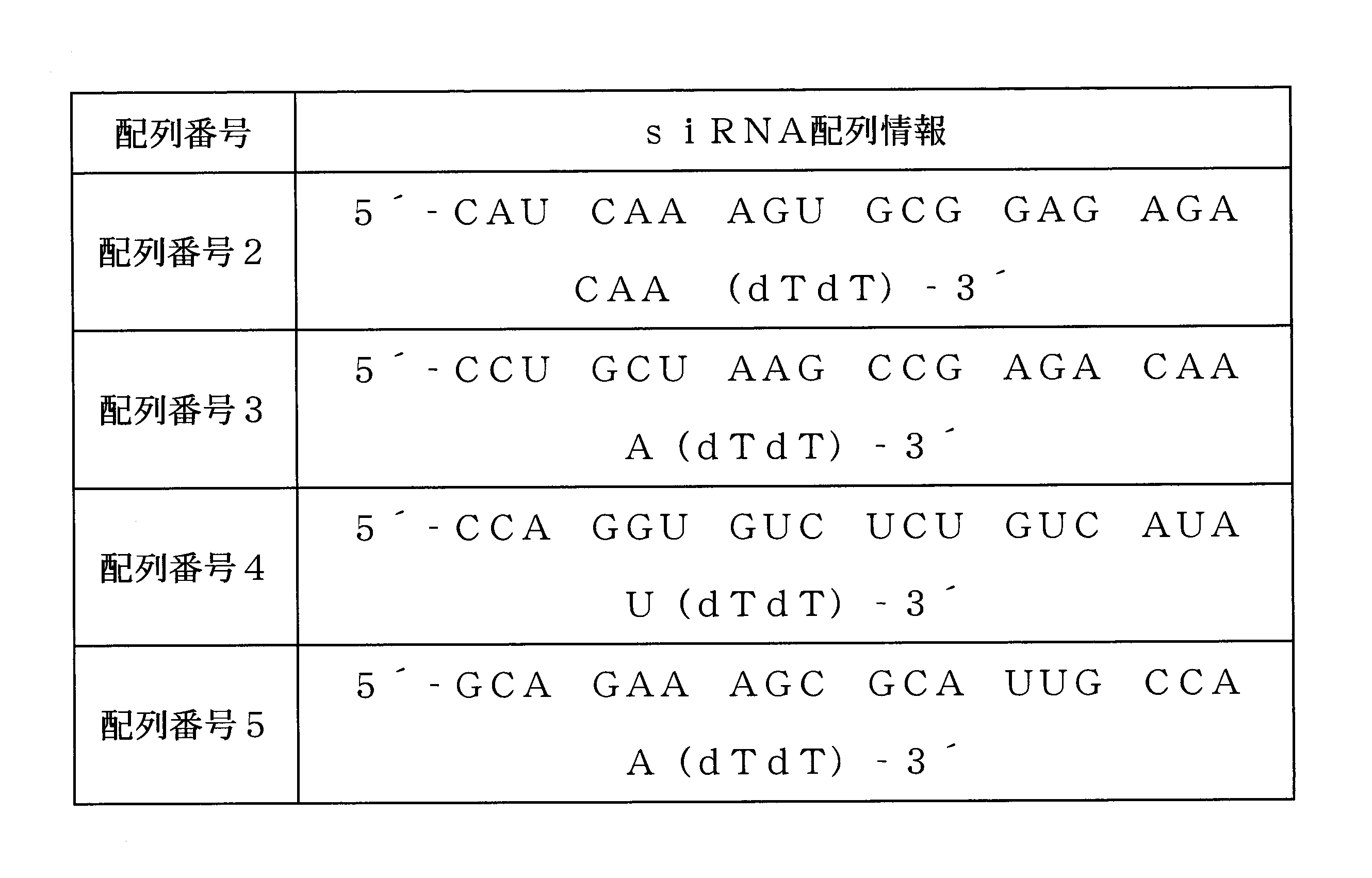
例示的な一具現例において、前記siRNAは、配列番号2、3、4および5から選択される塩基配列を有し得る。 In one exemplary embodiment, the siRNA may have a base sequence selected from SEQ ID NOs: 2, 3, 4 and 5.
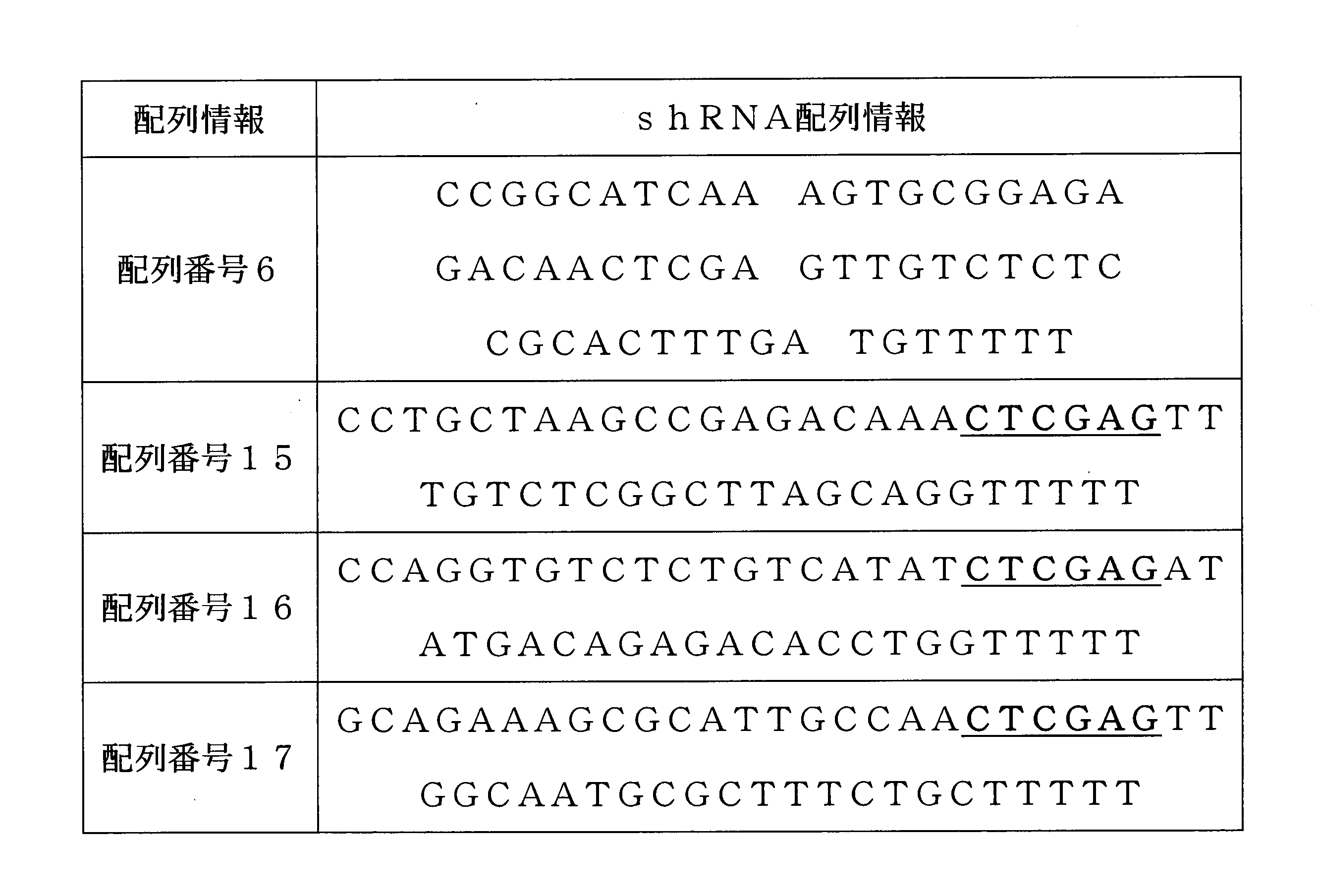
例示的な一具現例において、前記shRNAは、配列番号6、15、16および17から選択される塩基配列を有するshRNAおよびその同族体、同種型、変異体、誘導体、断片などの合成、変形されたものであってもよく、例えば、配列番号6、15~17から選択される塩基配列において中央に存在するloop sequence(下記の表2の下線)が変形されたものであってもよい。 In one exemplary embodiment, the shRNA has a nucleotide sequence selected from SEQ ID NOs: 6, 15, 16 and 17, and is synthesized and modified from shRNA and homologues, homologues, variants, derivatives, fragments and the like. For example, the loop equation (underlined in Table 2 below) existing in the center of the base sequence selected from SEQ ID NOs: 6, 15 to 17 may be modified.
例示的な一具現例において、前記アンチセンスオリゴヌクレオチドは、配列番号18および19から選択されるいずれか一つ以上のアンチセンスオリゴヌクレオチドおよびその誘導体であってもよく、前記誘導体は、配列番号18および19から選択される一つ以上のオリゴヌクレオチドにおいてphosphorothioate修飾および/または2´-O-メチル化修飾を有し得る。 In one exemplary embodiment, the antisense oligonucleotide may be any one or more antisense oligonucleotides selected from SEQ ID NOs: 18 and 19 and derivatives thereof, and the derivative is SEQ ID NO: 18. And one or more oligonucleotides selected from 19 may have a phosphorothioate modification and / or a 2'-O-methylation modification.

本発明において、用語「治療」は、治療しようとする個々人または細胞の天然過程を変更させるために臨床的に介入することを指し、これは、臨床病理状態が進行する間にまたはこれを予防するために行うことができる。目的とする治療効果には、疾病の発生または再発を予防し、症状を緩和させ、疾病によるすべての直接または間接的な病理学的結果を低下させ、転移を予防し、疾病進行速度を減少させ、疾病状態を軽減または一時的に緩和させ、好転させるか予後を改善させることが含まれる。好ましくは、本発明では、SYT11を抑制する物質を含む組成物の投与によって胃癌の経過を好転させるすべての行為を含む。また、「予防」は、本発明によるSYT11を抑制する物質を含む組成物の投与によって前記胃癌の発病を抑制または遅延させるすべての行為を意味する。 In the present invention, the term "treatment" refers to clinical intervention to alter the natural process of an individual or cell to be treated, which may or may not prevent a clinical pathological condition. Can be done for. The desired therapeutic effect is to prevent the onset or recurrence of the disease, alleviate the symptoms, reduce all direct or indirect pathological consequences of the disease, prevent metastasis, reduce the rate of disease progression. Includes reducing or temporarily alleviating the disease state, improving or improving prognosis. Preferably, the present invention includes all actions that improve the course of gastric cancer by administration of a composition containing a substance that suppresses SYT11. Further, "prevention" means all actions of suppressing or delaying the onset of gastric cancer by administration of a composition containing a substance that suppresses SYT11 according to the present invention.
本発明において、用語「アンチセンスオリゴヌクレオチド」は、特定のmRNAの配列に相補的な核酸配列を含んでいるDNA、RNAまたはこれらの誘導体として、mRNA内の相補的な配列に結合し、mRNAのタンパク質への翻訳を阻害する働きをする。アンチセンスオリゴヌクレオチド配列は、前記SYT11 mRNAに相補的で前記mRNAに結合することができるDNAまたはRNA配列を意味する。これは、前記SYT11 mRNAの翻訳、細胞質内への転位(translocation)、成熟(maturation)または他のすべての全体的な生物学的機能に対する必須の活性を阻害することができる。アンチセンスオリゴヌクレオチドの長さは、6~100塩基、好ましくは8~60塩基、より好ましくは10~40塩基であり得る。前記アンチセンスオリゴヌクレオチドは、通常の方法で試験管内で合成されて生体内に投与するか生体内でアンチセンスオリゴヌクレオチドが合成されるようにすることができる。試験管内でアンチセンスオリゴヌクレオチドを合成する一つの例は、RNA重合酵素Iを用いることである。生体内でアンチセンスRNAが合成されるようにする一つの例は、多重クローニング部位(MCS)の起源が逆方向にあるベクターを使用してアンチセンスRNAが転写されるようにすることである。前記アンチセンスRNAは、配列内に翻訳中止コドンが存在するようにして、ペプチド配列に翻訳されないようにすることが好ましい。本発明で利用可能なアンチセンスオリゴヌクレオチドのデザインは、SYT11の塩基配列を参照し、当業界において公知の方法にしたがって作製することができる。 In the present invention, the term "antisense oligonucleotide" is used as a DNA, RNA or a derivative thereof containing a nucleic acid sequence complementary to a specific mRNA sequence, which binds to the complementary sequence in the mRNA and is associated with the mRNA. It works to inhibit translation into proteins. The antisense oligonucleotide sequence means a DNA or RNA sequence that is complementary to the SYT11 mRNA and is capable of binding to the mRNA. It can inhibit the translation of the SYT11 mRNA, translocation into the cytoplasm, saturation or essential activity for all other overall biological functions. The length of the antisense oligonucleotide can be 6-100 bases, preferably 8-60 bases, more preferably 10-40 bases. The antisense oligonucleotide can be synthesized in vitro and administered in vivo by a conventional method, or the antisense oligonucleotide can be synthesized in vivo. One example of synthesizing antisense oligonucleotides in vitro is the use of RNA polymerizing enzyme I. One example of allowing antisense RNA to be synthesized in vivo is to use a vector in which the origin of the multiple cloning site (MCS) is in the opposite direction to allow the antisense RNA to be transcribed. It is preferable that the antisense RNA has a discontinuation codon in the sequence so that it is not translated into the peptide sequence. Designs of antisense oligonucleotides available in the present invention can be made according to methods known in the art with reference to the nucleotide sequence of SYS11.
具体的には、本発明のアンチセンスオリゴヌクレオチドは、配列番号18または19のオリゴヌクレオチドであってもよいが、これに制限されない。 Specifically, the antisense oligonucleotide of the present invention may be, but is not limited to, the oligonucleotide of SEQ ID NO: 18 or 19.
また、前記配列番号18または19のオリゴヌクレオチドは、前記配列番号18または19のオリゴヌクレオチドと実質的に同じ塩基配列を含むオリゴヌクレオチドおよびその誘導体を含む。前記実質的に同じ塩基配列を含むオリゴヌクレオチドとは、前記配列番号18または19の塩基配列と、それぞれ75%以上、80%以上、90%以上、95%以上の配列相同性を有する塩基配列を含むオリゴヌクレオチドを意味する。前記誘導体は、配列番号18および19から選択される一つ以上のオリゴヌクレオチドにおいてphosphorothioate修飾および/または2´‐O‐メチル化修飾を有するものであってもよいが、これに制限されない。 Further, the oligonucleotide of SEQ ID NO: 18 or 19 includes an oligonucleotide having substantially the same base sequence as the oligonucleotide of SEQ ID NO: 18 or 19 and a derivative thereof. The oligonucleotide containing substantially the same base sequence is a base sequence having 75% or more, 80% or more, 90% or more, and 95% or more sequence homology with the base sequence of SEQ ID NO: 18 or 19, respectively. Means the oligonucleotide containing. The derivative may have, but is not limited to, a phosphorothioate modification and / or a 2'-O-methylation modification in one or more oligonucleotides selected from SEQ ID NOs: 18 and 19.
本発明において、用語「アプタマー(aptamer)」は、一本鎖オリゴヌクレオチドとして、20~60ヌクレオチド程度のサイズであり、所定の標的分子に対する結合活性を有する核酸分子を指す。配列によって様々な3次元構造を有し、抗原‐抗体反応のように特定の物質と高い親和力を有することができる。アプタマーは、所定の標的分子に対して結合することで、所定の標的分子の活性を阻害することができる。本発明のアプタマーは、RNA、DNA、修飾された(modified)核酸またはこれらの混合物であってもよく、また、直鎖状または環状の形態であってもよい。好ましくは、前記アプタマーは、SYT11に結合してSYT11の活性を阻害する役割を果たすことができる。かかるアプタマーは、SYT11の配列から当業者が公知の方法にしたがって製造することができる。 In the present invention, the term "aptamer" refers to a nucleic acid molecule having a size of about 20 to 60 nucleotides as a single-stranded oligonucleotide and having a binding activity to a predetermined target molecule. It has various three-dimensional structures depending on the sequence, and can have high affinity with a specific substance such as an antigen-antibody reaction. By binding to a predetermined target molecule, the aptamer can inhibit the activity of the predetermined target molecule. The aptamers of the present invention may be RNA, DNA, modified nucleic acids or mixtures thereof, or may be in linear or cyclic form. Preferably, the aptamer can play a role of binding to SYT11 and inhibiting the activity of SYT11. Such an aptamer can be produced from the sequence of SYT11 according to a method known to those skilled in the art.
本発明において、用語「siRNA」および「shRNA」は、RNA妨害または遺伝子サイレンシング(silencing)を媒介することができる核酸分子として、標的遺伝子の発現を抑制できることから、効率的な遺伝子ノックダウン(knock down)方法または遺伝子治療方法として使用される。shRNAは、一本鎖のオリゴヌクレオチド内で相補的な配列間の結合によってヘアピン(hairpin)構造を形成したものであり、生体内で前記shRNAは、ダイサー(dicer)によって切断されて21~25ヌクレオチドサイズの小さなRNA断片で二本鎖のオリゴヌクレオチドであるsiRNAになり、相補的な配列を有するmRNAに特異的に結合して発現を抑制することができる。したがって、shRNAおよびsiRNAのうちいずれの手段を利用するかは、当業者の選択によって決定され得、これらを標的とするmRNA配列が同じ場合であれば、類似の発現減少の効果を期待することができる。本発明の目的上、SYT11に特異的に作用してSYT11 mRNA分子を切断し、RNA干渉(RNAi、RNA interference)現象を誘導することで、前記SYT11を抑制することができる。siRNAは、化学的にまたは酵素学的に合成され得る。siRNAの製造方法は、特に限定されず、当業界において公知の方法を使用することができる。例えば、siRNAを直接化学的に合成する方法、試験管内(in vitro)転写を用いたsiRNAの合成法、試験管内(in vitro)転写によって合成された長い二本鎖RNAを酵素を用いて切断する方法、shRNA発現プラスミドやウイルス性ベクターの細胞内伝達による発現法およびPCR(polymerase chain reaction)誘導siRNA発現カセット(cassette)の細胞内伝達による発現法などがあるが、これに限定されるものではない。 In the present invention, the terms "siRNA" and "SHRNA" can suppress the expression of a target gene as a nucleic acid molecule capable of mediating RNA interference or gene silencing, and thus efficient gene knockdown (knock). It is used as a method or gene silencing method. The shRNA forms a hairpin structure by binding between complementary sequences within a single-stranded oligonucleotide, and the shRNA is cleaved by a dicer in vivo to 21 to 25 nucleotides. A small RNA fragment becomes siRNA, which is a double-stranded oligonucleotide, and can specifically bind to an mRNA having a complementary sequence to suppress its expression. Therefore, which of shRNA and siRNA to use can be determined by one of ordinary skill in the art, and if the mRNA sequences targeting them are the same, a similar effect of reduced expression can be expected. can. For the purpose of the present invention, the SYT11 can be suppressed by specifically acting on the SYT11 to cleave the SYT11 mRNA molecule and induce an RNA interference (RNAi, RNA interference) phenomenon. siRNA can be synthesized chemically or enzymatically. The method for producing siRNA is not particularly limited, and a method known in the art can be used. For example, a method for directly chemically synthesizing siRNA, a method for synthesizing siRNA using in vitro transcription, and a long double-stranded RNA synthesized by in vitro transcription are cleaved using an enzyme. Methods, expression methods by intracellular transfer of shRNA expression plasmids and viral vectors, and expression methods by intracellular transfer of PCR (polymerase chain reaction) -induced siRNA expression cassette (cassette) are not limited thereto. ..
具体的には、本発明のSYT11に対するsiRNAは、配列番号2、3、4および5から選択される塩基配列を有するsiRNAおよびその相補的な配列を有するsiRNAの二本鎖からなってもよいが、これに制限されない。 Specifically, the siRNA for SYT11 of the present invention may consist of a double strand of a siRNA having a base sequence selected from SEQ ID NOs: 2, 3, 4 and 5 and a siRNA having a complementary sequence thereof. , Not limited to this.
本発明のSYT11に対するshRNAは、配列番号6、15、16および17から選択される塩基配列を有してもよいが、これに制限されない。 The shRNA for SYT11 of the present invention may have a base sequence selected from SEQ ID NOs: 6, 15, 16 and 17, but is not limited thereto.
本発明の目的上、前記抗体は、SYT11またはSYT11のリガンドタンパク質と結合してSYT11の活性を抑制することができる抗体であり得る。 For the purposes of the present invention, the antibody can be an antibody capable of binding to SYT11 or a ligand protein of SYT11 and suppressing the activity of SYT11.
本発明において、用語「リガンド」は、生体分子(biomolecule)と複合体を形成して生物学的反応をもたらす物質を意味し、「SYT11のリガンドタンパク質」または「SYT11に対するリガンドタンパク質」は、SYT11と結合してSYT11を活性化させるか活性を増加させるタンパク質であり得る。 In the present invention, the term "ligand" means a substance that forms a complex with a biomolecule to cause a biological reaction, and "ligand protein of SYT11" or "ligand protein for SYT11" is referred to as SYT11. It can be a protein that binds and activates or increases SYT11.
本発明において、用語「胃癌」は、胃で細胞が過剰増殖することから生じる疾病を称する。かかる非正常的な過剰増殖細胞は、場合によって、周りの組織および臓器に侵入して腫塊を形成し、胃の正常な構造を破壊または変形させるが、かかる状態を胃癌と言う。一般的に腫瘍(tumor)といえば、身体組織の自律的な過剰増殖によって非正常的に成長した塊を胃意味し、良性腫瘍(benign tumor)と悪性腫瘍(malignant tumor)とに区分することができる。悪性腫瘍は、良性腫瘍に比べて増殖速度が非常に速く、周辺組織に浸潤しながら転移(metastasis)が起こり生命を脅威する。本発明において、胃癌は、好ましくは、幹型亜型および/または混合型亜型、より好ましく幹型亜型である。 In the present invention, the term "stomach cancer" refers to a disease resulting from overgrowth of cells in the stomach. Such abnormal overgrowth cells may invade surrounding tissues and organs to form a mass, destroying or deforming the normal structure of the stomach, which is called gastric cancer. Generally speaking, a tumor means a mass that has grown abnormally due to the autonomous overgrowth of body tissue, and can be classified into a benign tumor and a malignant tumor. can. Malignant tumors have a much faster growth rate than benign tumors, and metastasis occurs while infiltrating surrounding tissues, which is life-threatening. In the present invention, gastric cancer is preferably stem-type subtype and / or mixed-type subtype, more preferably stem-type subtype.
本発明において、用語「転移(metastasis)」は、悪性腫瘍が発病した臓器から離れた他の組織に伝播した状態を言う。一つの臓器から始まった悪性腫瘍が進行するに伴い、最初に発生した原発部位である臓器から他の組織に広がって行くが、このように原発部位から他の組織に広がって行くことを転移と言える。転移は、悪性腫瘍の進行に伴われる現象と言えるが、悪性腫瘍細胞が増殖し、癌が進行するにつれて新たな遺伝形質を獲得して転移が起こり得る。新たな遺伝形質を獲得した腫瘍細胞が血管とリンパ腺に侵入し、血液とリンパに沿って循環しながら他の組織に定着、増殖すると、転移が生じ得る。 In the present invention, the term "metastasis" refers to a condition in which a malignant tumor has spread to other tissues distant from the affected organ. As a malignant tumor that started from one organ progresses, it spreads from the organ that was the first primary site to other tissues, and this spread from the primary site to other tissues is called metastasis. I can say. Metastasis can be said to be a phenomenon that accompanies the progression of malignant tumors, but as malignant tumor cells proliferate and the cancer progresses, new genetic traits can be acquired and metastasis can occur. Metastasis can occur when tumor cells that have acquired new genetic traits invade blood vessels and lymph glands, circulate along the blood and lymph, colonize and proliferate in other tissues.
転移が発生する組織によって、肝臓癌、腎臓癌、肺癌、胃癌、大腸癌、直腸癌、膵臓癌など各種の癌疾患が誘発され得る。本発明の組成物は、転移を抑制して癌が広がることを予防および治療することができる。 Various cancer diseases such as liver cancer, kidney cancer, lung cancer, gastric cancer, colon cancer, rectal cancer, and pancreatic cancer can be induced by the tissue in which metastasis occurs. The compositions of the present invention can suppress metastasis and prevent and treat the spread of cancer.
本発明において、用語「抑制」は、本発明による組成物の投与によって前記癌転移を抑制するすべての行為を指す。 In the present invention, the term "suppression" refers to all actions that suppress the cancer metastasis by administration of the composition according to the present invention.
胃癌は、分子亜型によって分類され得る。例えば、胃癌検体で全ゲノム水準のmRNA発現をマイクロアレイ(Microarray)技法で調査し、群集分析により胃癌に内在的な亜型(subtype)を確認した後、各亜型に特異的な遺伝子を統計的検証により選別することができる。このように選別された遺伝子発現量に基づいて上皮細胞特徴的な遺伝子発現が高い亜型を腸型(intestinal subtype)、発生段階シグナル伝達(EMT)および間質(stroma)由来遺伝子発現が高い亜型を幹型(stem-like subtype)、腸型および幹型の特徴をすべて発現する混合型(mixed stromal subtype)、また、免疫調節関連遺伝子発現が高い炎症型(inflammatory subtype)に分類することができる。それぞれの亜型は、既存によく明かされた臨床および病理組織学的所見と関連する差別的な特性を有していることが確認された。 Gastric cancer can be classified by molecular subtype. For example, whole-genome-level mRNA expression in gastric cancer specimens is investigated by microarray technique, and after confirming subtypes endogenous to gastric cancer by community analysis, genes specific to each subtype are statistically identified. It can be sorted by verification. Subtypes with high gene expression characteristic of epithelial cells based on the gene expression levels selected in this way are subtypes with high expression of genes derived from intestinal type (intestinal subtype), developmental stage signaling (EMT) and stromal cells (stroma). The type can be classified into a stem-like subtype, a mixed stem type that expresses all the characteristics of the intestinal type and the stem type, and an influenza type with high expression of immunoregulatory-related genes. can. Each subtype was found to have discriminatory characteristics associated with pre-existing clinical and histopathological findings.
具体的には、腸型の場合、胃の下部に主に位置し、組織学的分化度が良い特徴を示す。Lauren分類上、intestinal typeとindeterminate typeが多く分布している。 Specifically, in the case of the intestinal type, it is mainly located in the lower part of the stomach and exhibits a characteristic of good histological differentiation. In the Lauren classification, many intestinal type and intestinal type are distributed.
一方、幹型の場合、60歳未満の比較的若い年齢層によく発生し、胃の体部と上部に位置し、組織学的分化度が不良である。特に、印環細胞型(Signet ring cell type)が全組織型の20%を占める特徴があり、lauren分類上、diffuse typeの分布が多い。幹型の場合、非常に不良な予後を示す臨床的特徴がある。 On the other hand, in the case of the trunk type, it often occurs in a relatively young age group under 60 years old, is located in the body and upper part of the stomach, and has a poor degree of histological differentiation. In particular, the signet ring cell type is characterized by occupying 20% of the total tissue type, and the distribution of diffuse type is large in the lauren classification. In the case of the stem type, there are clinical features that indicate a very poor prognosis.
混合型は、腸型と幹型の特徴を共有している。 The mixed type shares the characteristics of the intestinal type and the stem type.
炎症型は、他の亜型に比べて、特徴的に胃‐食道接合部を含む噴門部(cardia)に位置する場合が多く、組織学的には分化度が良くない類型である。しかし、lauren分類上、intestinal typeとindeterminate typeが多く、幹型よりは腸型の特徴に近い。予後的観点で、腸型と混合型は、中間程度の予後を示し、炎症型の場合、予後が最も良好である。 The inflammatory type is characterized by being located in the cardia including the gastric-esophageal junction as compared with other subtypes, and is a type in which the degree of histological differentiation is not good. However, in the lauren classification, there are many intestinal type and intestinal type, which are closer to the characteristics of the intestinal type than the stem type. From a prognostic point of view, the intestinal and mixed types show an intermediate prognosis, and the inflammatory type has the best prognosis.
本発明の薬学組成物は、薬学組成物の製造に通常使用する適切な担体、賦形剤または希釈剤をさらに含むことができる。薬学的に許容可能な担体を含む組成物は、経口または非経口の様々な剤形であってもよい。製剤化する場合には、普通使用する充填剤、増量剤、結合剤、湿潤剤、崩壊剤、界面活性剤などの希釈剤または賦形剤を使用して調剤され得る。経口投与のための固形製剤としては、錠剤、丸剤、散剤、顆粒剤、カプセル剤などが含まれ得、かかる固形製剤は、一つ以上の化合物に少なくとも一つ以上の賦形剤、例えば、澱粉、炭酸カルシウム、スクロース(sucrose)またはラクトース(lactose)、ゼラチンなどを混合して調剤され得る。また、単純な賦形剤以外にステアリン酸マグネシウム、タルクなどの潤滑剤も使用され得る。経口投与のための液状製剤としては、懸濁剤、内容液剤、乳剤、シロップ剤などが相当するが、よく使用される単純希釈剤である水、リキッドパラフィン以外に様々な賦形剤、例えば、湿潤剤、甘味剤、芳香剤、保存剤などが含まれ得る。非経口投与のための製剤には、滅菌された水溶液、非水性溶剤、懸濁剤、乳剤、凍結乾燥製剤、坐剤が含まれ得る。非水性溶剤、懸濁溶剤としては、プロピレングリコール(propylene glycol)、ポリエチレングリコール、オリーブオイルのような植物性油、エチルオレエートのような注射可能なエステルなどが使用され得る。坐剤の基剤としてはウィテップゾール(witepsol)、マクロゴール、ツイン(tween)61、カカオ脂、ラウリン脂、グリセロゼラチンなどが使用され得る。 The pharmaceutical compositions of the present invention may further comprise suitable carriers, excipients or diluents commonly used in the production of pharmaceutical compositions. Compositions comprising pharmaceutically acceptable carriers may be in various oral or parenteral dosage forms. When formulated, it can be prepared using a diluent or excipient such as a commonly used filler, bulking agent, binder, wetting agent, disintegrant, or surfactant. Solid formulations for oral administration may include tablets, pills, powders, granules, capsules, etc., such solid formulations may include at least one excipient, eg, one or more excipients per one or more compounds. It can be prepared by mixing starch, calcium carbonate, sucrose or lactose, gelatin and the like. In addition to simple excipients, lubricants such as magnesium stearate and talc can also be used. Liquid preparations for oral administration include suspensions, liquid contents, emulsions, syrups, etc., but various excipients other than water and liquid paraffin, which are commonly used simple diluents, for example. Wetting agents, sweetening agents, fragrances, preservatives, etc. may be included. Formulations for parenteral administration may include sterile aqueous solutions, non-aqueous solvents, suspensions, emulsions, lyophilized preparations, suppositories. As the non-aqueous solvent and the suspending solvent, propylene glycol, polyethylene glycol, vegetable oil such as olive oil, injectable ester such as ethyl oleate and the like can be used. As the base of the suppository, witepsol, macrogol, twin 61, cocoa butter, lauric acid, glycerogelatin and the like can be used.
また、本発明の薬学組成物は、これに制限されないが、錠剤、丸剤、散剤、顆粒剤、カプセル剤、懸濁剤、内容液剤、乳剤、シロップ剤、滅菌された水溶液、非水性溶剤、懸濁剤、乳剤、凍結乾燥製剤および坐剤からなる群から選択されるいずれか一つの剤形を有することができる。 The pharmaceutical composition of the present invention is not limited to this, but is limited to tablets, pills, powders, granules, capsules, suspensions, content liquids, emulsions, syrups, sterilized aqueous solutions, non-aqueous solvents, etc. It can have any one dosage form selected from the group consisting of suspensions, emulsions, lyophilized formulations and suppositories.
前記目的を達成するための本発明の他の様態は、SYT11(Synaptotagmin 11)抑制剤を有効成分として含む薬学組成物を個体に投与するステップを含む胃癌の治療方法を提供することである。 Another aspect of the present invention for achieving the above object is to provide a method for treating gastric cancer, which comprises a step of administering to an individual a pharmaceutical composition containing a SYNT11 (Synaptotagmin 11) inhibitor as an active ingredient.
本発明において、用語「個体」は、本発明の胃癌疾患を有するかまたは発病した、ヒトを含むすべての動物を意味し、ヒト以外の個体であってもよい。本発明の薬学組成物を個体に投与することで、胃癌の治療に優れた効果を示し、また、胃癌の転移を抑制することができる。 In the present invention, the term "individual" means all animals including humans having or developing the gastric cancer disease of the present invention, and may be an individual other than human. By administering the pharmaceutical composition of the present invention to an individual, it is possible to show an excellent effect in the treatment of gastric cancer and suppress metastasis of gastric cancer.
前記本発明の薬学組成物は、薬学的に有効な量で投与する。 The pharmaceutical composition of the present invention is administered in a pharmaceutically effective amount.
本発明において、用語「投与」は、ある適切な方法で対象に本発明の薬学組成物を導入することを意味し、投与経路は、目的組織に逹することができる限り、経口または非経口の様々な経路を介して投与され得る。 In the present invention, the term "administration" means introducing the pharmaceutical composition of the present invention into a subject in a suitable manner, and the route of administration is oral or parenteral as long as it can reach the target tissue. It can be administered via various routes.
前記薬学組成物は目的または必要に応じて、当業界において使用される通常の方法、投与経路、投与量に応じて個体に適宜投与され得る。投与経路の例として、経口、非経口、皮下、腹腔内、肺内、および鼻腔内に投与され得、非経口注入には、筋肉内、静脈内、動脈内、腹腔内または皮下投与が含まれる。また、当業界において公知の方法にしたがって適切な投与量および投与回数が選択され得、実際に投与される本発明の薬学組成物の量および投与回数は、治療しようとする症状の種類、投与経路、性別、健康状態、食餌、個体の年齢および体重、および疾患の重症度のような様々な因子によって適切に決定され得る。 The pharmaceutical composition may be appropriately administered to an individual according to the usual methods, routes of administration, and dosages used in the art, depending on the purpose or need. Examples of routes of administration can be oral, parenteral, subcutaneous, intraperitoneal, intrapulmonary, and intranasal, and parenteral infusions include intramuscular, intravenous, arterial, intraperitoneal, or subcutaneous administration. .. In addition, an appropriate dose and frequency of administration can be selected according to a method known in the art, and the amount and frequency of administration of the pharmaceutical composition of the present invention to be actually administered are determined by the type of symptom to be treated and the route of administration. Can be appropriately determined by various factors such as gender, health status, diet, age and weight of the individual, and severity of the disease.
本発明において、用語「薬学的に有効な量」は、医学的用途に適用可能な合理的な割合で疾患を抑制または緩和するのに十分な量を意味し、有効用量水準は、個体の種類および重症度、年齢、性別、薬物の活性、薬物に対する敏感度、投与時間、投与経路および排出の割合、治療期間、同時使用される薬物を含む要素およびその他の医学分野によく知られている要素によって決定され得る。本発明の組成物は、個別治療剤として投与するか他の治療剤と併用して投与され得、従来の治療剤とは順次または同時に投与され得る。また、単一または多重投与され得る。前記要素をすべて考慮して、副作用なく最小限の量で最大の効果を得ることができる量を投与することが重要であり、当業者によって容易に決定され得る。例えば、薬学的に有効な量は、0.5~1000mg/day/体重kg、好ましくは0.5~500mg/day/体重kgである。 In the present invention, the term "pharmaceutically effective amount" means an amount sufficient to control or alleviate a disease at a reasonable rate applicable for medical use, and the effective dose level is an individual type. And severity, age, gender, drug activity, drug sensitivity, duration of administration, route of administration and rate of excretion, duration of treatment, factors including concomitant drugs and other well-known factors in the medical field. Can be determined by. The composition of the present invention may be administered as an individual therapeutic agent or in combination with other therapeutic agents, and may be administered sequentially or simultaneously with conventional therapeutic agents. It can also be administered single or multiple times. Considering all of the above factors, it is important to administer an amount that gives the maximum effect with the minimum amount without side effects and can be easily determined by those skilled in the art. For example, a pharmaceutically effective amount is 0.5 to 1000 mg / day / kg body weight, preferably 0.5 to 500 mg / day / kg body weight.
前記目的を達成するための本発明のさらに他の様態は、胃癌治療のための薬剤の製造において、SYT11(Synaptotagmin 11)抑制剤を含む組成物の用途を提供することである。 Yet another aspect of the invention to achieve the above object is to provide the use of a composition comprising a SYNT11 (Synaptotagmin 11) inhibitor in the manufacture of a drug for the treatment of gastric cancer.
前記目的を達成するための本発明のさらに他の様態は、胃癌治療に使用するためのSYT11(Synaptotagmin 11)抑制剤を含む組成物を提供することである。 Yet another aspect of the invention to achieve the above object is to provide a composition comprising a SYNT11 (Synaptotagmin 11) inhibitor for use in the treatment of gastric cancer.
前記目的を達成するための本発明のさらに他の様態は、SYT11(Synaptotagmin 11)の発現水準を測定する製剤を含む、幹型胃癌の診断用組成物を提供することである。例えば、配列番号7および配列番号8の塩基配列がSYT11(Synaptotagmin 11)の発現水準を測定する製剤として使用され得る。 Yet another aspect of the present invention for achieving the above object is to provide a diagnostic composition for stem-type gastric cancer, which comprises a preparation for measuring the expression level of SYNT11 (Synaptotagmin 11). For example, the nucleotide sequences of SEQ ID NO: 7 and SEQ ID NO: 8 can be used as a preparation for measuring the expression level of SYNT11 (Synaptotagmin 11).
本発明のさらに他の一つの目的は、(a)分離した生物学的胃組織試料からSYT11(Synaptotagmin 11)発現水準を測定するステップと、(b)前記発現水準を正常対照群試料のSYT11(Synaptotagmin 11)発現水準と比較するステップと、(c)前記生物学的胃組織試料のSYT11(Synaptotagmin 11)発現水準が正常対照群のSYT11(Synaptotagmin 11)発現水準より高い場合、幹型胃癌として判定するステップとを含む、幹型胃癌診断のための情報を提供する方法を提供することにある。 Yet another object of the present invention is (a) a step of measuring the expression level of SYT11 (Synaptotagmin 11) from a separated biological gastric tissue sample, and (b) SYT11 (b) the expression level of a normal control group sample. If the step of comparing with the Synaptotagmin 11) expression level and (c) the Synaptotagmin 11 expression level of the biological gastric tissue sample is higher than the Synaptotagmin 11 expression level of the normal control group, it is determined as stem-type gastric cancer. It is to provide a method of providing information for the diagnosis of stem-type gastric cancer, including steps to be performed.
本発明において、用語「診断」は、生物学的組織試料または組織サンプルにおいて本発明のSYT11の存在または不在を測定することで、幹型胃癌疾患の存在または特徴を確認することを意味する。また、「マーカーまたは診断マーカー(diagnosis marker)」とは、幹型胃癌細胞または幹型胃癌疾患を有する個体を正常細胞または正常個体と区分して診断することができる物質であり、正常細胞に比べて幹型胃癌を有する細胞または個体において増加または減少を示すポリペプチド、タンパク質または核酸(例:mRNAなど)、脂質、糖脂質、糖蛋白質または糖(単糖類、二糖類、オリゴ糖類など)などの有機生体分子を含む。本発明の目的上、本発明の幹型胃癌診断マーカーは、正常細胞または組織の細胞に比べて、幹型胃癌細胞において特異的に高い水準の発現を示すSYT11である。 In the present invention, the term "diagnosis" means confirming the presence or character of a stem-type gastric cancer disease by measuring the presence or absence of SYT11 of the present invention in a biological tissue sample or tissue sample. Further, the "marker or diagnostic marker" is a substance capable of distinguishing a stem-type gastric cancer cell or an individual having a stem-type gastric cancer disease from a normal cell or a normal individual, and is a substance that can be diagnosed as compared with a normal cell. Such as polypeptides, proteins or nucleic acids (eg, mRNA), lipids, glycolipids, glycoproteins or sugars (monosaccharides, disaccharides, oligosaccharides, etc.) that show an increase or decrease in cells or individuals with stem-type gastric cancer. Contains organic biomolecules. For the purposes of the present invention, the stem-type gastric cancer diagnostic marker of the present invention is SYT11, which exhibits a specifically higher level of expression in stem-type gastric cancer cells as compared to normal cells or tissue cells.
本発明において、用語「分離した生物学的胃癌組織試料」は、診断しようとする個体の組織から分離した試料を指し、具体的には、胃の組織である。 In the present invention, the term "separated biological gastric cancer tissue sample" refers to a sample separated from the tissue of an individual to be diagnosed, specifically, gastric tissue.
本発明において、SYT11発現水準を測定することは、SYT11のmRNA発現水準を測定するか、SYT11タンパク質発現水準を測定することであり得る。 In the present invention, measuring the SYT11 expression level can be measuring the mRNA expression level of SYT11 or measuring the SYT11 protein expression level.
前記「mRNA発現水準測定」とは、幹型胃癌を診断するために生物学的組織試料で幹型胃癌マーカー遺伝子のmRNA存在可否と発現程度を確認する過程であり、mRNAの量を測定することで知ることができる。このための分析方法としては、RT-PCR、競合的RT-PCR(competitive RT-PCR)、リアルタイムRT-PCR(real-time RT-PCR)、RNase保護分析法(RPA;RNase protection assay)、ノーザンブロット(Northern blotting)、DNAチップなどがあるがこれに制限されるものではない。 The above-mentioned "measurement of mRNA expression level" is a process of confirming the presence or absence of mRNA and the degree of expression of a stem-type gastric cancer marker gene in a biological tissue sample in order to diagnose stem-type gastric cancer, and measuring the amount of mRNA. You can find out at. Analytical methods for this include RT-PCR, competitive RT-PCR (competitive RT-PCR), real-time RT-PCR (real-time RT-PCR), RNase protection analysis method (RPA; RNase plotion assembly), and Northern blotting. There are, but are not limited to, blotting, DNA chips, and the like.
前記「タンパク質発現水準測定」とは、幹性胃癌を診断するために生物学的胃組織試料での幹性胃癌マーカー遺伝子で発現したタンパク質の存在可否と発現程度を確認する過程であり、前記遺伝子のタンパク質に対して特異的に結合する抗体を用いてタンパク質の量を確認する。このための分析方法としては、ウェスタンブロット、ELISA(enzyme linked immunosorbent assay)、放射線免疫分析(RIA:Radioimmunoassay)、放射免疫拡散法(radioimmunodiffusion)、オークタロニ(Ouchterlony)免疫拡散法、ロケット(rocket)免疫電気泳動、組織免疫染色、免疫沈殿分析法(Immunoprecipitation assay)、補体固定分析法(complement fixation assay)、FACS、タンパク質チップ(protein chip)などがあるが、これに制限されるものではない。 The "protein expression level measurement" is a process of confirming the presence or absence and the degree of expression of a protein expressed by a stem gastric cancer marker gene in a biological gastric tissue sample in order to diagnose stem gastric cancer. Check the amount of protein using an antibody that specifically binds to the protein in. Examples of the analysis method for this include Western blotting, ELISA (enzyme linked immunoassay), radioimmunoassay (RIA), radioimmunoassay, radioimmunoassay, oakterlony, and ocherlone immunoprecipitation. There are, but are not limited to, migration, tissue immunostaining, immunoprecipitation assay, compact fixation assay, FACS, protein chip, and the like.
一例として、前記mRNA水準を測定する製剤は、本発明のSYT11のmRNAに対するプライマー(primer)対、プローブ(probe)、またはアンチセンスヌクレオチド(anti-sense nucleotide)であってもよく、本発明のSYT11のポリヌクレオチド配列によって、当業者が、プライマー、プローブ、またはアンチセンスヌクレオチド配列を容易にデザインすることができる。他の一例として、前記タンパク質水準を測定する製剤は、抗体であってもよい。 As an example, the preparation for measuring the mRNA level may be a primer pair, a probe, or an antisense nucleotide for the mRNA of SYT11 of the present invention, and the SYT11 of the present invention may be used. The polynucleotide sequence of the above allows a person skilled in the art to easily design a primer, probe, or antisense nucleotide sequence. As another example, the pharmaceutical product for measuring the protein level may be an antibody.
本発明においては、SYT11の幹性胃癌診断マーカーとしての可能性を確認することで、SYT11の水準を測定し、幹性胃癌を診断することができる効果を確認した。 In the present invention, by confirming the possibility of SYT11 as a diagnostic marker for trunk gastric cancer, the level of SYT11 was measured and the effect of diagnosing trunk gastric cancer was confirmed.
本発明のさらに他の一つの目的は、(a)SYT11(Synaptotagmin 11)を発現する分離した胃癌細胞に胃癌治療候補物質を処理するステップと、(b)前記候補物質が処理された分離した胃癌細胞でSYT11(Synaptotagmin 11)発現水準を測定するステップと、(c)前記(b)ステップで測定されたSYT11(Synaptotagmin 11)発現水準が候補物質が処理されていない分離した胃癌細胞に比べて低い水準を示す場合、前記候補物質を胃癌治療用製剤として使用可能であると判定するステップとを含む、胃癌の治療用製剤のスクリーニング方法を提供することにある。 Yet another object of the present invention is (a) a step of treating isolated gastric cancer cells expressing SYT11 (Synaptotagmin 11) with a gastric cancer treatment candidate substance, and (b) isolated gastric cancer treated with the candidate substance. The step of measuring the expression level of SYNT11 (Synaptotagmin 11) in the cells and (c) the expression level of SYT11 (Synaptotagmin 11) measured in the step (b) above are lower than those of the isolated gastric cancer cells not treated with the candidate substance. The present invention is to provide a method for screening a therapeutic preparation for gastric cancer, which comprises a step of determining that the candidate substance can be used as a therapeutic preparation for gastric cancer.
胃癌を治療することができる候補物質の不在の下で細胞での本発明の前記遺伝子の発現水準または前記遺伝子がコードするタンパク質の水準を測定し、また、前記候補物質の存在の下で本発明の前記遺伝子の発現水準または前記遺伝子がコードするタンパク質の水準を測定し、両者を比較した後、前記候補物質が存在する時の本発明の前記遺伝子の発現水準または前記遺伝子がコードするタンパク質の水準が前記候補物質の不在の下での水準より減少させる物質を胃癌の治療用製剤として予測することができる。 The expression level of the gene of the present invention in cells or the level of the protein encoded by the gene is measured in the absence of a candidate substance capable of treating gastric cancer, and the present invention is also present in the presence of the candidate substance. After measuring the expression level of the gene or the level of the protein encoded by the gene and comparing the two, the expression level of the gene of the present invention or the level of the protein encoded by the gene when the candidate substance is present. Can be predicted as a therapeutic agent for gastric cancer, a substance that reduces the level of the candidate substance below the level in the absence of the candidate substance.
前記スクリーニング方法は、生体内(in vivo)または試験管内(in vitro)で行われ得、特に制限されない。候補物質は、公知の物質または新規物質であってもよく、例えば、植物抽出物またはケミカルライブラリ(chemical library)を通じて大規模でスクリーニングを行うことができる。これにより、SYT11の発現または活性を抑制し、胃癌、特に幹型亜型胃癌を抑制することができる製剤を見い出すことができる。 The screening method may be performed in vivo or in vitro, and is not particularly limited. The candidate substance may be a known substance or a novel substance and can be screened on a large scale, for example, through a plant extract or a chemical library. Thereby, it is possible to find a preparation capable of suppressing the expression or activity of SYT11 and suppressing gastric cancer, particularly stem type subtype gastric cancer.
以下、本発明の理解を容易にするために、好ましい実施例および製剤例を提示する。しかし、下記の実施例および製剤例は、本発明をより容易に理解するために提供されるものであって、実施例または製剤例によって本発明の内容が限定されるものではない。 Hereinafter, in order to facilitate understanding of the present invention, preferred examples and pharmaceutical examples are presented. However, the following examples and pharmaceutical examples are provided for easier understanding of the present invention, and the content of the present invention is not limited by the examples or pharmaceutical examples.
<実施例1>幹型(Stem-like subtype)胃癌細胞株でSYT11発現変化の確認
25個のヒト胃癌細胞株でマイクロアレイ(Microarray)分析により癌細胞株の分子亜型をintestinal、stem-like、mixed、inflammatoryに分類した。また、代表的な11種の胃癌細胞株を用いて、ウェスタンブロットおよびRT-PCR技法によりSYT11発現の差を確認した。
<Example 1> Confirmation of changes in SYT11 expression in stem-like gastric cancer cell lines In 25 human gastric cancer cell lines, molecular subtypes of cancer cell lines were identified by microarray analysis. It was classified into mixed and influenza. In addition, differences in SYT11 expression were confirmed by Western blotting and RT-PCR techniques using 11 representative gastric cancer cell lines.
ウェスタンブロット(Western blotting)実験のために細胞株からRIPA溶液(RIPA buffer、millipore社製)を用いてタンパク質を抽出し、ポリアクリルアミドゲルから電気泳動で分離した後、ゲルからポリビニリデンフルオライド膜にタンパク質を移動させた。膜に移動されたタンパク質は、SYT11抗体を用いて基質との反応で確認した。 For Western blotting experiments, proteins were extracted from cell lines using a RIPA solution (RIPA buffer, manufactured by millipore), electrophoretically separated from a polyacrylamide gel, and then from the gel to a polyvinylidene fluoride membrane. The protein was transferred. The protein transferred to the membrane was confirmed by reaction with the substrate using SYT11 antibody.
細胞株からRNA抽出溶液(Trizol、Invitrogen社製)を用いてmRNAを分離し、RT-PCRとマイクロアレイ(Microarray)を行った。mRNAからRT transcript(enzynomics社製)を用いて相補的DNAを合成した。相補的DNAから合成されたSYT11プライマーを用いてPCRを行った。また、対照群遺伝子としては、RPL13Aプライマーを使用した。実験に使用されたプライマー配列情報は、表2に示した。PCRが終了した後、サンプルを臭化エチジウム(etidium bromide)が含まれたアガローズゲルに電気泳動し、UVを照射し、バンドを確認した。 MRNA was separated from the cell line using an RNA extraction solution (Trizol, manufactured by Invitrogen), and RT-PCR and microarray were performed. Complementary DNA was synthesized from mRNA using RT transcript (manufactured by enzynomics). PCR was performed using SYT11 primers synthesized from complementary DNA. Moreover, as a control group gene, RPL13A primer was used. The primer sequence information used in the experiment is shown in Table 2. After the PCR was completed, the sample was electrophoresed on an agarose gel containing ethidium bromide, irradiated with UV, and the band was confirmed.

マイクロアレイは、抽出されたRNAから相補的に結合することができるオリゴ塩基が内蔵されたチップ(illumina社製、San Diego、CA、USA)を使用して各遺伝子の発現程度を測定した。 For the microarray, the expression level of each gene was measured using a chip (manufactured by Illumina, San Diego, CA, USA) containing an oligobase capable of complementarily binding from the extracted RNA.
その結果を図1のAおよび図1のBに示した。 The results are shown in A of FIG. 1 and B of FIG.
図1のAは、25個のヒト胃癌細胞株でのマイクロアレイ(Microarray)分析結果を示し、SYT11のmRNA発現が幹型胃癌亜型で著しく増加することが確認された。 A of FIG. 1 shows the results of microarray analysis in 25 human gastric cancer cell lines, and it was confirmed that the mRNA expression of SYT11 was significantly increased in the stem type gastric cancer subtype.
図1のBは、各分子亜型の代表的な細胞株でウェスタンブロットおよびRT-PCRによりSYT11の発現を確認した結果を示す。図1のBから確認されるように、幹型胃癌亜型細胞株として確認されるMKN1、SK4、SNU484およびSNU638細胞株(胃癌の幹型亜型の特性を有する細胞株に相当する)のすべてにおいて、SYT11の発現がウェスタンブロットおよびRT-PCR結果のすべてにおいて大きく増加することが確認された。 FIG. 1B shows the results of confirming the expression of SYT11 by Western blotting and RT-PCR in a representative cell line of each molecular subtype. As confirmed from B in FIG. 1, all of the MKN1, SK4, SNU484 and SNU638 cell lines (corresponding to cell lines having the characteristics of the stem type subtype of gastric cancer) confirmed as stem type gastric cancer subtype cell lines. It was confirmed that the expression of SYT11 was significantly increased in all Western blot and RT-PCR results.
<実施例2>胃癌細胞株でSYT11抑制による移動/浸潤抑制の確認
siSYT11の胃癌細胞移動能抑制を確認するために、胃の細胞株のうちSNU484細胞を使用して実験を行った。具体的には、siSYT11(配列番号2)および対照群としてsiSC(配列番号11)をトランスフェクション(transfection)したSNU484細胞を96 well‐Image Loc plateで接種し、24時間育てた後、wound makerでスクラッチ(scratch)し、リアルタイム細胞分析システム(Incucyte)を用いて細胞の移動を0時間、20時間、および40時間ごとに創傷治癒アッセイ(wound healing assay)で確認した。
<Example 2> Confirmation of migration / infiltration suppression by suppression of SYT11 in gastric cancer cell line In order to confirm suppression of gastric cancer cell migration ability of siSYT11, an experiment was conducted using SNU484 cells among gastric cell lines. Specifically, SNU484 cells transfected with siSYT11 (SEQ ID NO: 2) and siSC (SEQ ID NO: 11) as a control group were inoculated with 96-well-Image Loc plate, grown for 24 hours, and then wounded with a wound maker. The cells were scratched and cell migration was confirmed by wound healing assay every 0 hours, 20 hours, and 40 hours using a real-time cell analysis system (Incute).
上記の実験結果を図2に示した。 The above experimental results are shown in FIG.
図2のAは、SNU484細胞にsiRNA(SYT11)(配列番号3、4または5)またはsiSC(配列番号11)をウェスタンブロットによりSYT11の抑制を確認した結果である。 FIG. 2A shows the results of confirming the suppression of SYT11 by Western blotting of siRNA (SYT11) (SEQ ID NO: 3, 4 or 5) or siSC (SEQ ID NO: 11) in SNU484 cells.
図2のBは、時間経過による創傷治癒アッセイ(wound healing assay)の結果を示す図である。図2から確認されるように、胃癌細胞株にsiSYT11を処理した結果、胃癌細胞の移動能力が著しく減少することが確認された。 FIG. 2B is a diagram showing the results of a wound healing assay over time. As confirmed from FIG. 2, as a result of treating the gastric cancer cell line with siSYS11, it was confirmed that the migration ability of the gastric cancer cells was significantly reduced.
また、siSYT11の胃癌細胞浸潤抑制を確認するために、浸潤アッセイ(Invasion assay)を行った。具体的には、24‐well plate細胞培養用insertを使用して実験を行っており、上記のようにsiSYT11またはsiSCをトランスフェクション(transfection)したSNU484細胞をマトリゲル(matrigel)でコードしたinsertに接種し、24時間後、insertの下に移動した細胞をスルホロダミンB(Sulforhodamine B;SRB)溶液で染色し、吸光度を測定した。 In addition, an infiltration assay was performed to confirm the suppression of gastric cancer cell infiltration by siSYS11. Specifically, experiments are being conducted using a 24-well plate cell culture insert, and SNU484 cells transfected with siSYT11 or siSC as described above are inoculated into a matrigel-encoded insert. Then, 24 hours later, the cells migrated under insert were stained with a sulforhodamine B (SRB) solution, and the absorbance was measured.
その結果を図3に示した。 The results are shown in FIG.
図3から確認されるように、図3のAは、浸潤アッセイ(Invasion assay)による細胞浸潤を確認した結果を示し、図3のBは、これを図式化した結果を示す。図3から確認されるように、SYT11抑制は、対照群(control)に比べて癌細胞浸潤を約40%程度減少させることが確認された。 As can be seen from FIG. 3, A in FIG. 3 shows the result of confirming cell infiltration by the infiltration assay, and B in FIG. 3 shows the result of schematizing this. As confirmed from FIG. 3, it was confirmed that SYT11 suppression reduced cancer cell infiltration by about 40% as compared with the control group (control).
<実施例3>胃癌細胞株でSYT11抑制による細胞外基質に対する付着能の抑制の確認
細胞外基質(extracellular matrix、ECM)は、細胞の外部を囲んでいるタンパク質と多糖類からなる基質として、細胞が正常な機能を果たすことができる環境を提供する。インテグリン(Integrin)は、細胞膜に存在し、cell-cellまたはcell-matrix間の結合により、接着斑(focal adhesion)と関連するシグナル伝達に関与し、癌細胞転移過程においてインテグリン(integrin)は、細胞外基質内のfibronectin、collagen、lamininなどと結合し、cell-matrix間の結合により癌細胞の移動時に細胞付着機能を誘導する働きをする。
<Example 3> Confirmation of suppression of adhesion ability to extracellular matrix by suppressing SYT11 in gastric cancer cell line Extracellular matrix (ECM) is a cell as a substrate composed of proteins and polysaccharides surrounding the outside of the cell. Provides an environment in which cells can perform their normal functions. Integrins are present on the cell membrane and are involved in signal transduction associated with focal adhesion by binding between cell-cell or cellular-matrix, and integrins are involved in the process of cancer cell metastasis. It binds to fibronectin, collagen, laminin, etc. in the extracellular matrix, and acts to induce cell adhesion function during migration of cancer cells by binding between cell and matrix.
これにより、SYT11が癌細胞付着能に及ぼす影響を確認するために、BSA、collagen、fibronectinでコーティングした96 well plateに前記の実施例2と同様、siSYT11またはsiSCをトランスフェクション(transfection)したSNU484細胞を接種してから1時間後、PBSで洗浄し、plateに付いていない細胞を除去した。Plateに付いた細胞をSRB溶液で染色し、吸光度を測定した。また、SNU484細胞をsiSYT11またはsiSCをトランスフェクション(transfection)してから48時間後、タンパク質を抽出し、電気泳動後、ウェスタンブロット(Western blot)を行ってインテグリン(integrin)タンパク質の発現変化を確認した。 Thus, in order to confirm the effect of SYT11 on the ability to adhere to cancer cells, SNU484 cells transfected with siSYS11 or siSC into a 96-well plate coated with BSA, collagen, or fibronectin as in Example 2 above. One hour after inoculation, the cells were washed with PBS to remove cells not attached to the plate. The cells attached to the plate were stained with SRB solution and the absorbance was measured. In addition, 48 hours after transfection of SNU484 cells with siSYS11 or siSC, the protein was extracted, and after electrophoresis, Western blotting was performed to confirm changes in the expression of integrin protein. ..
その結果を図4に示した。 The results are shown in FIG.
図4のAは、接着アッセイ(Adhesion assay)の結果を示す。図4のAから確認されるように、コラーゲン(collagen)やフィブロネクチン(fibronectin)に結合した細胞は、SYT11抑制によってAdhesionが減少することが確認された。 A in FIG. 4 shows the results of an adhesion assay. As confirmed from A in FIG. 4, it was confirmed that the cells bound to collagen and fibronectin had a decrease in adhesion due to SYT11 suppression.
図4のBは、インテグリン(integrin)タンパク質の発現変化を確認した結果を示す。図4のBから確認されるように、SYT11抑制によって様々なインテグリン(integrin)タンパク質発現が阻害されることが確認された。 FIG. 4B shows the results of confirming the change in the expression of the integrin protein. As confirmed from B in FIG. 4, it was confirmed that suppression of SYT11 inhibits the expression of various integrin proteins.
<実施例4>胃癌細胞株でSYT11抑制による癌転移関連サイトカイン分泌抑制の確認
SYT11抑制が癌細胞転移と関連する成長因子(growth factor)やサイトカイン(cytokine)の分泌に影響を及ぼすかを確認するために、cytokine array(R&D system社製、proteome profiler antibody arrays)を行った。具体的には、SNU484細胞を実施例2と同様、siSYT11またはsiSCをトランスフェクション(transfection)して24時間後、血清がない培地に交替し、低酸素(hypoxia)状態(2%O2)で24時間培養後、細胞培養液を用いて、PDGF-AA、VEGF、HGF、IGFBP-2、IL-17A、IL-8、angiopoietin-1、angiopoietin-2のサイトカイン(cytokine)を確認した。
<Example 4> Confirmation of suppression of cancer metastasis-related cytokine secretion by suppression of SYT11 in a gastric cancer cell line Confirmation of whether suppression of SYT11 affects the secretion of growth factors (growth factor) and cytokines (cytokine) associated with cancer cell metastasis. Therefore, a cytokine array (produced by R & D system, growth factor antibody antibody) was performed. Specifically, as in Example 2, SNU484 cells were transfected with siSYS11 or siSC 24 hours later, and then replaced with a serum-free medium in a hypoxia state (2% O 2 ). After culturing for 24 hours, cytokines of PDGF-AA, VEGF, HGF, IGFBP-2, IL-17A, IL-8, angiopoietin-1, and angiopoietin-2 were confirmed using cell culture medium.
また細胞は収去してRNAを抽出し、mRNAからRT transcript(enzynomics社製)を用いて相補的DNAを合成した。次に、real-time PCR pre mix(solgent社製)を用いて、VEGFA、HGF、IL-8、angiopoietin-1のプライマー(bioneer社製)でqPCRを行った。 In addition, the cells were collected and RNA was extracted, and complementary DNA was synthesized from the mRNA using RT transcript (manufactured by enzynomics). Next, using real-time PCR pre mix (manufactured by solident), qPCR was performed with primers of VEGFA, HGF, IL-8, and angiopoietin-1 (manufactured by bioneer).
前記実験結果を図5に示した。 The experimental results are shown in FIG.
図5のAは、Proteome profile-cytokine assayを行った結果を示す。図5から確認されるように、siSYT11処理によって癌細胞転移と関連する成長因子(growth factor)やサイトカイン(cytokine)の分泌が大きく減少した。 FIG. 5A shows the results of performing the Proteome profile-cytokine assay. As can be seen from FIG. 5, siSYS11 treatment significantly reduced the secretion of growth factors and cytokines associated with cancer cell metastasis.
また、5のBは、qPCR結果を図式化した結果を示す。図5から確認されるように、酸素正常状態(Normoxia)および低酸素状態(Hypoxia)条件の両方で癌細胞転移と関連する成長因子(growth factor)やサイトカイン(cytokine)と関連するmRNA発現が大きく減少することが確認された。 Further, B of 5 shows the result of diagramming the qPCR result. As can be seen from FIG. 5, mRNA expression associated with growth factors and cytokines associated with cancer cell metastasis is high in both normal and hypoxic conditions. It was confirmed that it decreased.
<実施例5>動物モデルでSYT11抑制による癌治療効果の確認
胃癌細胞株SNU484にshSYT11‐Lentivirusを感染(infection)させてノックダウン(knockdown)した細胞またはshControl-Lentivirus infectionした細胞をヌードマウスに注射し、2~3日間隔で腫瘍のサイズを測定し、その質量および体積の変化を確認した。
<Example 5> Confirmation of cancer therapeutic effect by suppressing SYT11 in an animal model Nude mice are injected with knockdown cells or shControl-Lentivirus-infected cells by infecting the gastric cancer cell line SNU484 with shSYT11-Lentivirus. Then, the size of the tumor was measured at intervals of 2 to 3 days, and changes in its mass and volume were confirmed.
ここで、shSTY11(sigma社製)で示したshRNAは、配列番号6、shControl(CTRL)(sigma社製)で示したshRNAは、配列番号12の塩基配列を有する。 Here, the shRNA represented by shSTY11 (manufactured by sigma) has the nucleotide sequence of SEQ ID NO: 6, and the shRNA represented by shControl (CTRL) (manufactured by sigma) has the nucleotide sequence of SEQ ID NO: 12.
上記の結果を図6に示した。図6のAは、日付けによる腫瘍サイズの変化を確認した結果であり、図6のBは、16日目にマウスを殺して腫瘍の重量を確認した結果を示し、図6のCは、生成された腫瘍の写真を示すものである。図6の結果から確認されるように、shSYT11が抑制された場合、shControlに比べて腫瘍の形成が抑制されることが確認された。 The above results are shown in FIG. A of FIG. 6 shows the result of confirming the change in tumor size due to the date, B of FIG. 6 shows the result of killing the mouse on the 16th day and confirming the weight of the tumor, and C of FIG. 6 shows the result of confirming the weight of the tumor. It shows a photograph of the tumor generated. As confirmed from the results of FIG. 6, it was confirmed that when shSYS11 was suppressed, tumor formation was suppressed as compared with shControl.
また、上記の動物モデルの組織を取り、qPCRにより癌細胞転移と関連する成長因子(growth factor)やサイトカイン(cytokine)の発現変化、インテグリン(Intergrin)の発現変化、tumor-specific endothelial markerであるANTXR1を実施例4と同じ方法で確認した。 In addition, taking the tissue of the above animal model, qPCR was used to change the expression of growth factors and cytokines associated with cancer cell metastasis, changes in the expression of integrin, and ANTXR1 which is a tumor-specific endothelial marker. Was confirmed by the same method as in Example 4.
これと共に、SNU484細胞でも実施例2と同様、siSYT11またはsiSCをトランスフェクション(transfection)し、RT-PCRにより遺伝子発現変化を確認した。 At the same time, siSYT11 or siSC was transfected in SNU484 cells as in Example 2, and changes in gene expression were confirmed by RT-PCR.
上記の結果を図7に示した。 The above results are shown in FIG.
図7のAのSNU484細胞から確認されるように、siSYT11処理によってangiopoietin-1、angiopoietin-2、Intergrin-β1、ANTXR1のいずれも減少することが確認された。 As confirmed from the SNU484 cells of A in FIG. 7, it was confirmed that siSYT11 treatment reduced all of angiopoietin-1, angiopoietin-2, Intergrin-β1, and ANTXR1.
また、図7のBのin vivoモデルから確認した結果もangiopoietin-1、angiopoietin-2、Intergrin-β1、ANTXR1のいずれもSYT11処理によって減少することが確認された。 In addition, the results confirmed from the in vivo model of B in FIG. 7 also confirmed that all of angiopoietin-1, angiopoietin-2, Intergrin-β1, and ANTXR1 were reduced by SYT11 treatment.
<実施例6>SYT11抑制による癌細胞増殖抑制の確認
<6-1>siRNA配列を用いた癌細胞増殖抑制の確認
SNU484細胞に実施例2と同様、siSYT11またはsiSCをトランスフェクション(transfection)し、リアルタイム細胞分析システム(InCucyte)を用いて4日間細胞増殖を確認した。
<Example 6> Confirmation of suppression of cancer cell proliferation by suppression of SYT11 <6-1> Confirmation of suppression of cancer cell proliferation using siRNA sequence Transfection of siSYS11 or siSC into SNU484 cells in the same manner as in Example 2 was performed. Cell proliferation was confirmed for 4 days using a real-time cell analysis system (InCucyte).
また、これと同様、他のsiRNA配列を有するsiSYT11(配列番号2、3、4または5)で上記の実施例2と同様にsiSYT11またはsiSCをトランスフェクション(transfection)し、72時間後、スルホロダミンB(Sulforhodamine B;SRB)溶液で染色して吸光度を測定し、細胞生存率を確認した。 Similarly, siSYS11 (SEQ ID NO: 2, 3, 4 or 5) having another siRNA sequence is transfected with siSYS11 or siSC in the same manner as in Example 2 above, and 72 hours later, sulforhodamine B is used. (Sulforhodamine B; SRB) was stained with a solution and the absorbance was measured to confirm the cell viability.
その結果を図8に示した。 The results are shown in FIG.
図8のAは、ウェスタンブロットによりSYT11の発現減少を確認した結果を示し、図8のBは、時間変化による癌細胞増殖を確認した結果を示す。 A of FIG. 8 shows the result of confirming the decrease in the expression of SYT11 by Western blotting, and FIG. 8B shows the result of confirming the proliferation of cancer cells with time change.
図8のAおよびBから確認されるように、SYT11の発現減少に伴い癌細胞の増殖が阻害されることが確認された。 As confirmed from A and B in FIG. 8, it was confirmed that the growth of cancer cells was inhibited as the expression of SYS11 decreased.
また、図8のCは、SNU484細胞にsiRNA(SYT11)(配列番号3、4または5)またはsiSC(配列番号11)をウェスタンブロットによりSYT11の抑制を確認した結果であり、図8のDは、細胞増殖率を確認した結果であり、細胞増殖は、配列番号2、3、4または5を有するsiRNAによってすべて抑制されることを確認した。 In addition, C in FIG. 8 is the result of confirming suppression of SYT11 by western blot of siRNA (SYT11) (SEQ ID NO: 3, 4 or 5) or siSC (SEQ ID NO: 11) in SNU484 cells, and D in FIG. 8 is the result. As a result of confirming the cell proliferation rate, it was confirmed that cell proliferation was all suppressed by siRNA having SEQ ID NO: 2, 3, 4 or 5.
<6-2>アンチセンスオリゴヌクレオチドを用いた癌細胞増殖抑制の確認
SNU484細胞に実施例6-1のようにアンチセンスオリゴヌクレオチドAS-SYT11(配列番号18または19)、または陰性対照群AS-NC(配列番号20)をトランスフェクション(transfection)し、リアルタイム細胞分析システム(InCucyte)を用いて3日間細胞増殖を確認した。
<6-2> Confirmation of suppression of cancer cell proliferation using antisense oligonucleotide AS-SYS11 (SEQ ID NO: 18 or 19) of antisense oligonucleotide AS-SYT11 (SEQ ID NO: 18 or 19) as in Example 6-1 in SNU484 cells, or negative control group AS- NC (SEQ ID NO: 20) was transfected and cell proliferation was confirmed for 3 days using a real-time cell analysis system (InCucute).
また、上記の実施例6-1と同様、アンチセンスオリゴヌクレオチドAS-SYT11(配列番号18または19)または陰性対照群AS-NC(配列番号20)をトランスフェクション(transfection)し、72時間後、スルホロダミンB(Sulforhodamine B;SRB)溶液で染色して吸光度を測定し、細胞生存率を確認した。 Also, as in Example 6-1 above, antisense oligonucleotide AS-SYS11 (SEQ ID NO: 18 or 19) or negative control group AS-NC (SEQ ID NO: 20) was transfected, 72 hours later. The cell viability was confirmed by staining with a sulforhodamine B (SLB) solution and measuring the absorbance.
その結果を図9に示した。 The results are shown in FIG.
図9から確認されるように、SYT11の抑制剤としてアンチセンスオリゴヌクレオチドを使用した場合にも、実施例<6-1>のsiRNAを使用した実験と同様、SYT11の抑制に伴い癌細胞の増殖が阻害されることが確認された。一方、陰性対照群(配列番号20)を処理した場合は、細胞増殖に影響を及ぼさなかった。 As can be confirmed from FIG. 9, even when the antisense oligonucleotide is used as the inhibitor of SYT11, the growth of cancer cells accompanies the inhibition of SYT11 as in the experiment using siRNA of Example <6-1>. Was confirmed to be inhibited. On the other hand, when the negative control group (SEQ ID NO: 20) was treated, it did not affect cell proliferation.
前記結果からSYT11が幹型胃癌に対する診断因子として使用可能であることが確認された。また、SYT11に対する抑制剤が胃癌細胞の移動および浸潤を抑制し、細胞外基質に対する付着能を抑制し、各種癌転移関連サイトカインの分泌を抑制し、胃癌細胞の増殖を抑制することを確認することで、胃癌治療用組成物として優れた効果があることを確認した。 From the above results, it was confirmed that SYT11 can be used as a diagnostic factor for stem-type gastric cancer. In addition, it should be confirmed that the inhibitor for SYT11 suppresses the migration and infiltration of gastric cancer cells, suppresses the ability to adhere to extracellular matrix, suppresses the secretion of various cancer metastasis-related cytokines, and suppresses the proliferation of gastric cancer cells. It was confirmed that it has an excellent effect as a composition for treating gastric cancer.
<実施例7>SYT11選択的な癌細胞増殖抑制の確認
SNU484細胞に実施例2と同様、siSC、siSYT11、SYT familyの他の遺伝子でSYT4を抑制するsiSYT4(配列番号13)、またはSYT7を抑制するsiSYT7(配列番号14)をトランスフェクション(transfection)し、72時間後、スルホロダミンB(Sulforhodamine B;SRB)溶液で染色して吸光度を測定し、細胞生存率を確認した。
<Example 7> Confirmation of selective suppression of cancer cell proliferation in SYT11 Similar to Example 2, siSYT4 (SEQ ID NO: 13), which suppresses SYT4 with other genes of siSC, siSYT11, SYT family, or SYT7, is suppressed in SNU484 cells. SiSYS7 (SEQ ID NO: 14) was transfected, and after 72 hours, the cells were stained with a sulforhodamine B (SRB) solution and the absorbance was measured to confirm the cell viability.
前記結果を図10に示した。 The above results are shown in FIG.
図10から確認されたように、S N U484細胞増殖は、SYT11 knockdown選択的に抑制され、他のSYT familyであるSYT4、SYT7などによっては影響を受けないことを確認した。 As confirmed from FIG. 10, it was confirmed that S N U484 cell proliferation was selectively suppressed by SYT11 knockdown and not affected by other SYT family members such as SYT4 and SYT7.
上記の結果から、SYT11のみが、胃癌、特に、幹型亜型胃癌に対して特異的に治療効果があることを確認した。 From the above results, it was confirmed that only SYT11 has a specific therapeutic effect on gastric cancer, particularly stem-type subtype gastric cancer.
Claims (14)
前記SYT11タンパク質水準を測定する製剤は、SYT11タンパク質に特異的な抗体である、請求項7に記載の幹型胃癌の診断用組成物。 Whether the preparation for measuring the SYT11 mRNA level is a primer pair specific for the SYT11 gene, a probe, or an antisense nucleotide.
The diagnostic composition for stem-type gastric cancer according to claim 7, wherein the preparation for measuring the SYT11 protein level is an antibody specific for the SYT11 protein.
(b)前記発現水準を正常対照群試料のSYT11(Synaptotagmin 11)発現水準と比較するステップと、
(c)前記生物学的胃組織試料のSYT11(Synaptotagmin 11)発現水準が正常対照群のSYT11(Synaptotagmin 11)発現水準より高い場合、幹型胃癌として判定するステップとを含む、幹型胃癌診断のための情報を提供する方法。 (A) A step of measuring the expression level of SYNT11 (Synaptotagmin 11) from the separated biological gastric tissue sample, and
(B) A step of comparing the expression level with the expression level of SYNT11 (Synaptotagmin 11) of the normal control group sample.
(C) A step for diagnosing stem-type gastric cancer, which comprises a step of determining as stem-type gastric cancer when the expression level of Synaptotagmin 11 of the biological gastric tissue sample is higher than the expression level of SYNaptotagmin 11 in the normal control group. How to provide information for.
(b)前記候補物質が処理された分離した胃癌細胞でSYT11(Synaptotagmin 11)発現水準を測定するステップと、
(c)前記(b)ステップで測定されたSYT11(Synaptotagmin 11)発現水準が候補物質が処理されていない分離した胃癌細胞に比べて低い水準を示す場合、前記候補物質を胃癌治療用製剤として使用可能であると判定するステップとを含む、胃癌の治療用製剤のスクリーニング方法。 (A) A step of treating isolated gastric cancer cells expressing SYNT11 (Synaptotagmin 11) with a gastric cancer treatment candidate substance, and
(B) A step of measuring the expression level of SYNT11 (Synaptotagmin 11) in the isolated gastric cancer cells treated with the candidate substance, and
(C) When the expression level of SYNT11 (Synaptotagmin 11) measured in the step (b) above is lower than that of the isolated gastric cancer cells treated with the candidate substance, the candidate substance is used as a pharmaceutical product for treating gastric cancer. A method for screening a therapeutic agent for gastric cancer, which comprises a step of determining that it is possible.
Applications Claiming Priority (3)
| Application Number | Priority Date | Filing Date | Title |
|---|---|---|---|
| KR20180125073 | 2018-10-19 | ||
| KR10-2018-0125073 | 2018-10-19 | ||
| PCT/KR2019/013686 WO2020080861A1 (en) | 2018-10-19 | 2019-10-17 | Gastric cancer treatment composition comprising syt11 inhibitor as active ingredient |
Publications (2)
| Publication Number | Publication Date |
|---|---|
| JP2022505327A true JP2022505327A (en) | 2022-01-14 |
| JP7645178B2 JP7645178B2 (en) | 2025-03-13 |
Family
ID=70284063
Family Applications (1)
| Application Number | Title | Priority Date | Filing Date |
|---|---|---|---|
| JP2021521300A Active JP7645178B2 (en) | 2018-10-19 | 2019-10-17 | Composition for treating gastric cancer containing SYT11 inhibitor as an active ingredient |
Country Status (6)
| Country | Link |
|---|---|
| US (1) | US12397011B2 (en) |
| EP (1) | EP3868385B1 (en) |
| JP (1) | JP7645178B2 (en) |
| KR (1) | KR102377702B1 (en) |
| CN (1) | CN112867495B (en) |
| WO (1) | WO2020080861A1 (en) |
Cited By (1)
| Publication number | Priority date | Publication date | Assignee | Title |
|---|---|---|---|---|
| JP2025520370A (en) * | 2022-06-17 | 2025-07-03 | コリア リサーチ インスティテュート オブ バイオサイエンス アンド バイオテクノロジー | Prognostic markers and therapeutic targets for diffuse gastric cancer |
Families Citing this family (5)
| Publication number | Priority date | Publication date | Assignee | Title |
|---|---|---|---|---|
| KR102691995B1 (en) * | 2021-03-17 | 2024-08-05 | 한국생명공학연구원 | Diagnostic Biomarker For Prognosis of Diffuse Type Gastric Cancer |
| US20250002909A1 (en) | 2021-05-14 | 2025-01-02 | Iucf-Hyu (Industry-University Cooperation Foundation Hanyang University) | COMPOSITION FOR PREVENTING OR TREATING NEURODEGENERATIVE DISEASES CONTAINING A miRNA INHIBITOR AND USE THEREOF |
| KR102632530B1 (en) | 2021-05-24 | 2024-02-02 | 가톨릭대학교 산학협력단 | Stomach cancer specific targeting exosome composition as a drug anticancer delivery and use thereof |
| CN115433770A (en) * | 2021-06-01 | 2022-12-06 | 苏州百脉得生物科技有限公司 | Synaptotagmin-11 mRNA as Parkinson's syndrome marker and its application |
| CN115873939A (en) * | 2022-11-30 | 2023-03-31 | 苏州百脉得生物科技有限公司 | Primer sets for Parkinson's disease diagnosis, auxiliary diagnosis or early screening |
Citations (2)
| Publication number | Priority date | Publication date | Assignee | Title |
|---|---|---|---|---|
| WO2016143697A1 (en) * | 2015-03-06 | 2016-09-15 | 国立大学法人名古屋大学 | Method for testing peritoneal dissemination of gastric cancer by syt13, syt8, and anos1 expression levels, test kit, molecularly targeted therapeutic screening method, and therapeutic agent |
| WO2016181979A1 (en) * | 2015-05-13 | 2016-11-17 | 国立大学法人名古屋大学 | Method for using syt7, mfsd4, and etnk2 expression levels to detect metastasis of gastric cancer to liver, detection kit, method for screening molecular targeted therapeutic agent, and pharmaceutical composition |
Family Cites Families (13)
| Publication number | Priority date | Publication date | Assignee | Title |
|---|---|---|---|---|
| CA2639070A1 (en) * | 2006-04-13 | 2007-11-01 | Oncomethylime Sciences S.A. | Novel tumour suppressor |
| EP2118319A4 (en) | 2007-02-12 | 2010-08-04 | Univ Johns Hopkins | PRECIOUS AND PROGNOSTIC DETECTION OF COLON CANCER |
| CA2806726A1 (en) * | 2010-08-02 | 2012-02-09 | The Broad Institute, Inc. | Prediction of and monitoring cancer therapy response based on gene expression profiling |
| US20140031257A1 (en) * | 2011-03-10 | 2014-01-30 | Oslo Universitetssykehus Hf | Methods and biomarkers for detection of gastrointestinal cancers |
| WO2013033609A2 (en) | 2011-08-31 | 2013-03-07 | Oncocyte Corporation | Methods and compositions for the treatment and diagnosis of cancer |
| CA2883671A1 (en) | 2012-08-31 | 2014-03-06 | National Defense Medical Center | Method for screening cancer |
| CN104513851B (en) | 2013-10-08 | 2017-01-11 | 陈永恩 | Novel epigenetic biomarkers and methods for detecting bladder cancer |
| GB201500584D0 (en) | 2015-01-14 | 2015-02-25 | Univ Oslo Hf | Cancer biomarkers |
| CA2988771A1 (en) | 2015-06-09 | 2016-12-15 | The Board Of Regents Of The University Of Texas System | Diagnostic test for early stage cancer |
| SG11201808775PA (en) * | 2016-04-07 | 2018-11-29 | Univ Leland Stanford Junior | Noninvasive diagnostics by sequencing 5-hydroxymethylated cell-free dna |
| KR20180125073A (en) | 2017-05-11 | 2018-11-22 | 주식회사 윈드앰프 | Smart cooling and heating device connected with smartphone |
| CN107893078B (en) * | 2017-11-28 | 2021-01-29 | 西安交通大学 | SiRNA (small interfering ribonucleic acid) of targeted synaptotagmin-11, expression vector and virus particle and pharmaceutical application thereof |
| CN108165631B (en) * | 2017-12-27 | 2020-11-27 | 固安博健生物技术有限公司 | A kind of osteosarcoma biomarker SYT12 and its application |
-
2019
- 2019-10-17 EP EP19873496.4A patent/EP3868385B1/en active Active
- 2019-10-17 KR KR1020190129281A patent/KR102377702B1/en active Active
- 2019-10-17 WO PCT/KR2019/013686 patent/WO2020080861A1/en not_active Ceased
- 2019-10-17 JP JP2021521300A patent/JP7645178B2/en active Active
- 2019-10-17 CN CN201980068374.8A patent/CN112867495B/en active Active
-
2021
- 2021-04-19 US US17/234,455 patent/US12397011B2/en active Active
Patent Citations (2)
| Publication number | Priority date | Publication date | Assignee | Title |
|---|---|---|---|---|
| WO2016143697A1 (en) * | 2015-03-06 | 2016-09-15 | 国立大学法人名古屋大学 | Method for testing peritoneal dissemination of gastric cancer by syt13, syt8, and anos1 expression levels, test kit, molecularly targeted therapeutic screening method, and therapeutic agent |
| WO2016181979A1 (en) * | 2015-05-13 | 2016-11-17 | 国立大学法人名古屋大学 | Method for using syt7, mfsd4, and etnk2 expression levels to detect metastasis of gastric cancer to liver, detection kit, method for screening molecular targeted therapeutic agent, and pharmaceutical composition |
Non-Patent Citations (2)
| Title |
|---|
| BRITISH JOURNAL OF CANCER, vol. 117, JPN6023039798, 2017, pages 775 - 782, ISSN: 0005372982 * |
| 日本胃癌学会総会記事, vol. 89, JPN6023039797, 2017, pages 256, ISSN: 0005372981 * |
Cited By (1)
| Publication number | Priority date | Publication date | Assignee | Title |
|---|---|---|---|---|
| JP2025520370A (en) * | 2022-06-17 | 2025-07-03 | コリア リサーチ インスティテュート オブ バイオサイエンス アンド バイオテクノロジー | Prognostic markers and therapeutic targets for diffuse gastric cancer |
Also Published As
| Publication number | Publication date |
|---|---|
| US20210361694A1 (en) | 2021-11-25 |
| CN112867495B (en) | 2024-08-20 |
| EP3868385A1 (en) | 2021-08-25 |
| JP7645178B2 (en) | 2025-03-13 |
| WO2020080861A1 (en) | 2020-04-23 |
| CN112867495A (en) | 2021-05-28 |
| EP3868385A4 (en) | 2021-12-22 |
| KR20200044695A (en) | 2020-04-29 |
| EP3868385B1 (en) | 2025-12-31 |
| KR102377702B1 (en) | 2022-03-24 |
| US12397011B2 (en) | 2025-08-26 |
| EP3868385C0 (en) | 2025-12-31 |
Similar Documents
| Publication | Publication Date | Title |
|---|---|---|
| Yoshimura et al. | The chemokine monocyte chemoattractant protein-1/CCL2 is a promoter of breast cancer metastasis | |
| JP7645178B2 (en) | Composition for treating gastric cancer containing SYT11 inhibitor as an active ingredient | |
| Wang et al. | C-type lectin-like receptor 2 suppresses AKT signaling and invasive activities of gastric cancer cells by blocking expression of phosphoinositide 3-kinase subunits | |
| KR101133243B1 (en) | Use of eIF3m for the Diagnosis and Treatment of Cancer | |
| CN105435228A (en) | New anti-tumor application and anti-tumor preparation of arsenic trioxide | |
| Yao et al. | Hepatocyte nuclear factor 4α suppresses the aggravation of colon carcinoma | |
| KR101925125B1 (en) | Biomarker composition for diagnosing colon cancer or prognosing metastasis of colon cancer comprising NCKAP1 | |
| JP2022174117A (en) | Cancer treatment composition containing PLRG1 (PLEIOTROPIC REGULATOR 1) inhibitor | |
| JP2019525903A (en) | Methods for diagnosis and treatment of metastatic cancer | |
| WO2013183964A1 (en) | Target protein for diagnosing and treating lung cancer | |
| KR20230127007A (en) | Pharmaceutical composition for preventing or treating colon cancer comprising an inhibitor of EDNRA | |
| JP7510144B2 (en) | Anticancer drugs and their uses | |
| CN116064810A (en) | Application of CD24 as a biomarker of Hippo pathway inactivated subtype of hepatocellular carcinoma | |
| KR101776864B1 (en) | A composition for inhibiting metastasis and treating cancer comprising an inhibitor of NPFFR2 | |
| KR20170052454A (en) | Biomarker composition for predicting sensitivity of sorafenib | |
| CN107723369B (en) | Application of SETD1B protein and coding gene thereof in diagnosis and treatment of liver cancer | |
| WO2014200134A1 (en) | Composition for treating and inhibiting metastasis of pancreatic cancer containing cthrc1 expression and activity inhibiting agent as active ingredient | |
| KR101654526B1 (en) | A pharmaceutical composition for the treatment or prevention of colorectal cancer comprising an expression or activity inhibitor of cardherin-11 protein | |
| CN114908158B (en) | Application of CDK1 in the diagnosis and treatment of advanced gastrointestinal stromal tumors | |
| KR20200022187A (en) | Composition for enhancing radiation sensitivity comprising expression or activity inhibitor of NONO | |
| KR101796091B1 (en) | A biomarker composition for diagnosis of head and neck cancer comprising carboxyl-terminal modulator protein | |
| US20210164982A1 (en) | Pharmaceutical use of actinin-4 involved in induction of cervical cancer | |
| CN113398270A (en) | Method for treating giant cell tumor of bone | |
| WO2017054759A1 (en) | Prevention, diagnosis and treatment of cancer overexpressing gpr160 | |
| CN121041442A (en) | Application of membrane-type GLYR1 molecules as therapeutic targets for pancreatic cancer |
Legal Events
| Date | Code | Title | Description |
|---|---|---|---|
| A621 | Written request for application examination |
Free format text: JAPANESE INTERMEDIATE CODE: A621 Effective date: 20221005 |
|
| A131 | Notification of reasons for refusal |
Free format text: JAPANESE INTERMEDIATE CODE: A131 Effective date: 20231002 |
|
| A601 | Written request for extension of time |
Free format text: JAPANESE INTERMEDIATE CODE: A601 Effective date: 20240104 |
|
| A521 | Request for written amendment filed |
Free format text: JAPANESE INTERMEDIATE CODE: A523 Effective date: 20240402 |
|
| A131 | Notification of reasons for refusal |
Free format text: JAPANESE INTERMEDIATE CODE: A131 Effective date: 20240722 |
|
| A521 | Request for written amendment filed |
Free format text: JAPANESE INTERMEDIATE CODE: A523 Effective date: 20241022 |
|
| TRDD | Decision of grant or rejection written | ||
| A01 | Written decision to grant a patent or to grant a registration (utility model) |
Free format text: JAPANESE INTERMEDIATE CODE: A01 Effective date: 20250204 |
|
| A61 | First payment of annual fees (during grant procedure) |
Free format text: JAPANESE INTERMEDIATE CODE: A61 Effective date: 20250303 |
|
| R150 | Certificate of patent or registration of utility model |
Ref document number: 7645178 Country of ref document: JP Free format text: JAPANESE INTERMEDIATE CODE: R150 |