JP2022128486A - vermin control composition - Google Patents
vermin control composition Download PDFInfo
- Publication number
- JP2022128486A JP2022128486A JP2022103651A JP2022103651A JP2022128486A JP 2022128486 A JP2022128486 A JP 2022128486A JP 2022103651 A JP2022103651 A JP 2022103651A JP 2022103651 A JP2022103651 A JP 2022103651A JP 2022128486 A JP2022128486 A JP 2022128486A
- Authority
- JP
- Japan
- Prior art keywords
- composition
- skin
- cholecalciferol
- toxic
- weight
- Prior art date
- Legal status (The legal status is an assumption and is not a legal conclusion. Google has not performed a legal analysis and makes no representation as to the accuracy of the status listed.)
- Pending
Links
Images






Classifications
-
- A—HUMAN NECESSITIES
- A01—AGRICULTURE; FORESTRY; ANIMAL HUSBANDRY; HUNTING; TRAPPING; FISHING
- A01N—PRESERVATION OF BODIES OF HUMANS OR ANIMALS OR PLANTS OR PARTS THEREOF; BIOCIDES, e.g. AS DISINFECTANTS, AS PESTICIDES OR AS HERBICIDES; PEST REPELLANTS OR ATTRACTANTS; PLANT GROWTH REGULATORS
- A01N31/00—Biocides, pest repellants or attractants, or plant growth regulators containing organic oxygen or sulfur compounds
- A01N31/02—Acyclic compounds
-
- A—HUMAN NECESSITIES
- A01—AGRICULTURE; FORESTRY; ANIMAL HUSBANDRY; HUNTING; TRAPPING; FISHING
- A01N—PRESERVATION OF BODIES OF HUMANS OR ANIMALS OR PLANTS OR PARTS THEREOF; BIOCIDES, e.g. AS DISINFECTANTS, AS PESTICIDES OR AS HERBICIDES; PEST REPELLANTS OR ATTRACTANTS; PLANT GROWTH REGULATORS
- A01N25/00—Biocides, pest repellants or attractants, or plant growth regulators, characterised by their forms, or by their non-active ingredients or by their methods of application, e.g. seed treatment or sequential application; Substances for reducing the noxious effect of the active ingredients to organisms other than pests
- A01N25/02—Biocides, pest repellants or attractants, or plant growth regulators, characterised by their forms, or by their non-active ingredients or by their methods of application, e.g. seed treatment or sequential application; Substances for reducing the noxious effect of the active ingredients to organisms other than pests containing liquids as carriers, diluents or solvents
-
- A—HUMAN NECESSITIES
- A01—AGRICULTURE; FORESTRY; ANIMAL HUSBANDRY; HUNTING; TRAPPING; FISHING
- A01N—PRESERVATION OF BODIES OF HUMANS OR ANIMALS OR PLANTS OR PARTS THEREOF; BIOCIDES, e.g. AS DISINFECTANTS, AS PESTICIDES OR AS HERBICIDES; PEST REPELLANTS OR ATTRACTANTS; PLANT GROWTH REGULATORS
- A01N37/00—Biocides, pest repellants or attractants, or plant growth regulators containing organic compounds containing a carbon atom having three bonds to hetero atoms with at the most two bonds to halogen, e.g. carboxylic acids
- A01N37/06—Unsaturated carboxylic acids or thio analogues thereof; Derivatives thereof
-
- A—HUMAN NECESSITIES
- A01—AGRICULTURE; FORESTRY; ANIMAL HUSBANDRY; HUNTING; TRAPPING; FISHING
- A01N—PRESERVATION OF BODIES OF HUMANS OR ANIMALS OR PLANTS OR PARTS THEREOF; BIOCIDES, e.g. AS DISINFECTANTS, AS PESTICIDES OR AS HERBICIDES; PEST REPELLANTS OR ATTRACTANTS; PLANT GROWTH REGULATORS
- A01N43/00—Biocides, pest repellants or attractants, or plant growth regulators containing heterocyclic compounds
- A01N43/02—Biocides, pest repellants or attractants, or plant growth regulators containing heterocyclic compounds having rings with one or more oxygen or sulfur atoms as the only ring hetero atoms
- A01N43/04—Biocides, pest repellants or attractants, or plant growth regulators containing heterocyclic compounds having rings with one or more oxygen or sulfur atoms as the only ring hetero atoms with one hetero atom
- A01N43/14—Biocides, pest repellants or attractants, or plant growth regulators containing heterocyclic compounds having rings with one or more oxygen or sulfur atoms as the only ring hetero atoms with one hetero atom six-membered rings
- A01N43/16—Biocides, pest repellants or attractants, or plant growth regulators containing heterocyclic compounds having rings with one or more oxygen or sulfur atoms as the only ring hetero atoms with one hetero atom six-membered rings with oxygen as the ring hetero atom
-
- A—HUMAN NECESSITIES
- A01—AGRICULTURE; FORESTRY; ANIMAL HUSBANDRY; HUNTING; TRAPPING; FISHING
- A01N—PRESERVATION OF BODIES OF HUMANS OR ANIMALS OR PLANTS OR PARTS THEREOF; BIOCIDES, e.g. AS DISINFECTANTS, AS PESTICIDES OR AS HERBICIDES; PEST REPELLANTS OR ATTRACTANTS; PLANT GROWTH REGULATORS
- A01N49/00—Biocides, pest repellants or attractants, or plant growth regulators, containing compounds containing the group, wherein m+n>=1, both X together may also mean —Y— or a direct carbon-to-carbon bond, and the carbon atoms marked with an asterisk are not part of any ring system other than that which may be formed by the atoms X, the carbon atoms in square brackets being part of any acyclic or cyclic structure, or the group, wherein A means a carbon atom or Y, n>=0, and not more than one of these carbon atoms being a member of the same ring system, e.g. juvenile insect hormones or mimics thereof
-
- A—HUMAN NECESSITIES
- A01—AGRICULTURE; FORESTRY; ANIMAL HUSBANDRY; HUNTING; TRAPPING; FISHING
- A01M—CATCHING, TRAPPING OR SCARING OF ANIMALS; APPARATUS FOR THE DESTRUCTION OF NOXIOUS ANIMALS OR NOXIOUS PLANTS
- A01M25/00—Devices for dispensing poison for animals
- A01M25/002—Bait holders, i.e. stationary devices for holding poisonous bait at the disposal of the animal
-
- A—HUMAN NECESSITIES
- A01—AGRICULTURE; FORESTRY; ANIMAL HUSBANDRY; HUNTING; TRAPPING; FISHING
- A01M—CATCHING, TRAPPING OR SCARING OF ANIMALS; APPARATUS FOR THE DESTRUCTION OF NOXIOUS ANIMALS OR NOXIOUS PLANTS
- A01M25/00—Devices for dispensing poison for animals
- A01M25/006—Poison applicators, i.e. mobile devices for disposing poison wherever required, e.g. into holes, burrows, walls or ground
Landscapes
- Life Sciences & Earth Sciences (AREA)
- General Health & Medical Sciences (AREA)
- Health & Medical Sciences (AREA)
- Plant Pathology (AREA)
- Zoology (AREA)
- Environmental Sciences (AREA)
- Engineering & Computer Science (AREA)
- Dentistry (AREA)
- Agronomy & Crop Science (AREA)
- Wood Science & Technology (AREA)
- Pest Control & Pesticides (AREA)
- Insects & Arthropods (AREA)
- Toxicology (AREA)
- Agricultural Chemicals And Associated Chemicals (AREA)
- Catching Or Destruction (AREA)
- Medicinal Preparation (AREA)
- Acyclic And Carbocyclic Compounds In Medicinal Compositions (AREA)
- Pharmaceuticals Containing Other Organic And Inorganic Compounds (AREA)
Abstract
【課題】殺害獣剤または他の毒素剤を、その毒素剤を含有する組成物から、経皮的に標的動物へ、特にその血流中に経皮的に送達することができる改善された手段を提供する。【解決手段】動物、例えば齧歯動物を殺傷するための組成物であって、(i)動物に対して毒性のある1つ以上の毒素剤、例えばコレカルシフェロールまたは25-ヒドロキシコレカルシフェロール(ビタミンD3)を含む毒性成分と、(ii)前記毒性成分のための担体系とを含み、ここで前記担体系(ii)は、(a)前記毒性成分のための少なくとも1つの溶媒または分散媒、例えばエタノールなどのアルコールと、(b)少なくとも1つの皮膚撹乱成分、例えば、ジメチルスルホキシド(DMSO)とを含む、組成物。前記組成物は、例えば罠または他の装置内で組成物が噴霧または送達される動物の皮膚内へのまたは皮膚を通じた毒物の皮膚浸透を増強させる。【選択図】なしThe present invention provides an improved means for transdermally delivering a killed animal or other toxin from a composition containing the toxin to a target animal, particularly into its bloodstream. I will provide a. A composition for killing an animal, such as a rodent, comprising: (i) one or more toxic agents toxic to the animal, such as cholecalciferol or 25-hydroxycholecalciferol; (ii) a carrier system for said toxic ingredient, wherein said carrier system (ii) comprises (a) at least one solvent or dispersion medium for said toxic ingredient. (b) at least one skin-disturbing ingredient, such as dimethyl sulfoxide (DMSO). The composition enhances dermal penetration of the toxin into or through the skin of the animal to which the composition is sprayed or delivered, eg, in a trap or other device. [Selection diagram] None
Description
本発明は、害獣(vermin)防除のための組成物に関する。より詳細には、排他的でないが、害獣、例えば齧歯動物や他の動物を殺傷するための組成物に関する。本発明は、さらに、これらの組成物を使用する害獣防除方法に関し、さらに、害獣防除のための、好ましくは害獣を殺傷するための方法において使用するためのこれらの組成物を含む装置に関する。 The present invention relates to compositions for vermin control. More particularly, but not exclusively, it relates to compositions for killing pests such as rodents and other animals. The present invention further relates to methods of pest control using these compositions, and devices comprising these compositions for use in methods for pest control, preferably for killing pests. Regarding.
多くの農業上、社会上および公衆衛生上の分野において、害獣の防除が広く必要とされている。害獣の中には、様々な種類の動物、例えば、齧歯動物および有害生物(pest)として分類される他の様々な哺乳動物または脊椎動物、例えば齧歯動物に加えて様々な有袋動物、ウサギ科動物(leporids)およびイタチ科動物(mustelids)が含まれうる。 There is a widespread need for pest control in many agricultural, social and public health areas. Among the pests are various types of animals, such as rodents and various other mammals or vertebrates classified as pests, such as rodents, as well as various marsupials. , leporids and mustelids.
害獣を捕らえ、不能にし、および/または殺傷するための罠は周知であり、世界中の多くの場所で広範に使用されている。同様に様々な化学的または生物学的薬剤を使用して害獣を毒することによる、害獣防除に使用するための様々な殺有害生物組成物および殺鼠組成物も周知であり、広範に使用されている。殺有害生物剤の誤った標的化ならびにヒトおよび他の動物、例えば家畜への、望まないまたは不注意な曝露による危険性に関する頻繁な懸念から、害獣防除のための無保護な毒物の使用は段々と無くなり、選択的な罠を、多くは選択的な毒物と組み合わせて使用することがますます一般的になっている。 Traps for trapping, disabling and/or killing vermin are well known and widely used in many parts of the world. Similarly, various pesticidal and rodenticidal compositions for use in pest control by poisoning pests using various chemical or biological agents are well known and widely used. in use. Frequent concerns about the mistargeting of pesticides and the dangers of unwanted or inadvertent exposure to humans and other animals, e.g. Fewer and less common is the use of selective traps, often in combination with selective poisons.
公衆衛生および農業的理由により害獣を防除することは認められているが、動物の福祉を考慮することがますます重要な要件となってきており、このことに留意して、近年では、害獣防除に使用するために、より人道的な罠および薬剤、特により効率的で苦痛の少ない罠および薬剤が、様々な進歩を見せている。 Although it is accepted to control pests for public health and agricultural reasons, consideration of animal welfare has become an increasingly important requirement, and with this in mind, in recent years Various advances have been made in more humane traps and agents, particularly more efficient and less painful traps and agents, for use in animal control.
近寄ることが難しい広範囲な地理的領域および場所で害獣防除が望まれる特定の社会的および農業的状況では、例えば、殺傷した動物の除去だけでなく毒物の補充のためにも、罠または他の毒物餌付装置の管理および監視が容易かつ頻繁に行えるように、さらに検討が必要なことも多い。毒剤の使用度は、効率よい害獣防除管理にとって重要な因子であるため、低い取込み量、したがって低い総摂取率でも効率が良く、そのような毒物が必要な時と場所において製造および配備する費用が削減されるように、さらにより効果がある毒物の開発が所望される。 In certain social and agricultural situations where pest control is desired in extensive geographical areas and locations that are difficult to access, for example, traps or other Further consideration is often necessary to facilitate and frequently manage and monitor poison bait devices. Since the rate of toxicant use is an important factor for efficient pest control management, low uptake and therefore low total uptake rates are also efficient, producing and deploying such toxicants when and where they are needed. It would be desirable to develop even more effective toxins so that costs would be reduced.
害獣、例えば齧歯動物を捕らえ、不能にし、および/または殺傷するための1つの既知の罠は、本発明者らの公開された国際特許出願である国際公開第2010/106352号に開示されている。開示された装置は、機械的罠中に、標的動物を殺傷するための毒剤と、標的動物を罠に誘引するためのフェロモン成分とを組み合わせで備える形態であり、ある用量の毒物を、動物に、典型的には外側に、つまり動物の皮膚に適用することで、意図する殺傷目的が達成される。毒剤のその有効な毒性は、毒剤が、動物を殺傷する全身的機能を発揮しうる動物の皮膚に浸透し、それにより動物の血流中に入る能力に依存しており、その機構は、その薬剤ならびに検討対象の動物の化学的および/または生物学的性質に依存しうる。 One known trap for trapping, disabling and/or killing vermin, such as rodents, is disclosed in our published International Patent Application WO2010/106352. ing. The disclosed device is in the form of a combination of a poison for killing a target animal and a pheromone component for attracting the target animal to the trap in a mechanical trap. In addition, it is typically applied externally, ie to the skin of the animal, to achieve the intended killing purpose. The effective toxicity of a toxic agent depends on the ability of the toxic agent to penetrate the animal's skin and thereby enter the animal's bloodstream where it can exert its systemic function of killing the animal, the mechanism being , the drug and the chemical and/or biological properties of the animal under consideration.
別の既知の開示は、ニュージーランド特許第548082号(アグニュー(Agnew))にあり、この文献では、様々な非ヒト有害動物を殺傷するための局所的殺有害生物組成物が提唱されている。この組成物は、特定の毒素剤、つまりコレカルシフェロールまたは25-ヒドロキシコレカルシフェロール(ビタミンD3としても知られる)と、毒素剤を標的動物に経皮的に送達するように作用する少なくとも1つの担体、例えば様々なアルコール(特に無水エタノール)、グリコール、または特定の他の溶媒種との組み合わせを含む。 Another known disclosure is in New Zealand Patent No. 548082 (Agnew), which proposes topical pesticidal compositions for killing various non-human pests. The composition comprises a specific toxic agent, namely cholecalciferol or 25-hydroxycholecalciferol (also known as vitamin D3) , and at least one toxic agent that acts to transdermally deliver the toxic agent to the target animal. carriers such as various alcohols (particularly absolute ethanol), glycols, or in combination with certain other solvent species.
上記開示後の本発明者らの研究において、本発明者らは、動物の皮膚へのまたは皮膚を通じた動物の血流への殺有害生物毒素剤の浸透の程度および効率が、所定の毒素剤または所定の量により意図される標的動物の全身的な殺傷機能を発揮する効率を決定するための重要な因子になると予期しうることを見出した。しかしながら、これまで、所定の毒物または毒素剤が標的動物の皮膚に浸透する程度、さらにはそのような浸透レベルが、動物の外側に適用されうる任意の所定の薬剤またはその投薬量についてどのように改善または最適化されうるのかについてすら、公開された文献または検討はほとんどまたは全くなかった。本発明者らの最近の研究では当該領域に着目して、本発明を為すに至った。 In our studies after the above disclosure, we found that the extent and efficiency of penetration of a pesticidal toxin agent into or through the skin of an animal into the animal's bloodstream was greater than that of a given toxin agent. Or, we have found that a given amount can be expected to be an important factor in determining the efficiency with which it exerts its intended target animal systemic killing function. However, heretofore, the extent to which a given poison or toxic agent penetrates the skin of a target animal, as well as how such penetration level may be determined for any given agent or dosage thereof that may be applied externally to the animal. There was little or no published literature or discussion of what could even be improved or optimized. The inventors of the present invention have focused on this area in recent research, and have completed the present invention.
特に、本発明者らの研究を通じて、本発明者らは、驚くべきことに、上記ニュージーランド特許第548082号で提案されているように従来の製剤で使用されてきたコレカルシフェロール(または25-ヒドロキシコレカルシフェロール)を含め、多くの殺鼠剤または殺害獣剤が、アルコール系組成物中で既知のラット罠または他の動物殺傷装置で使用するとき、特に機能を発揮するように動物の血流中に毒性成分を経皮浸透させる有効性の観点において、理想または最適からはほど遠いことを見出した。 In particular, through our studies we have surprisingly discovered that cholecalciferol (or 25-hydroxy Many rodenticides or veterinarians, including cholecalciferol, are introduced into the bloodstream of animals to be particularly effective when used in known rat traps or other animal killing devices in alcoholic compositions. It has been found to be far from ideal or optimal in terms of efficacy for percutaneous penetration of toxic ingredients.
したがって、本発明の課題は、殺害獣剤または他の毒素剤を、その毒素剤を含有する組成物から、経皮的に標的動物へ、特にその血流中に経皮的に送達することができる改善された手段を提供することであった。本発明者らは、驚くべきことに、毒素剤のための新規担体系を用いることにより、毒素剤の経皮送達レベルが改善または最適化されること、または少なくとも既知の先行技術の毒素剤送達組成物で新たに認識された欠点を改善しうることを見出した。 It is therefore an object of the present invention to transdermally deliver a veterinarian or other toxic agent from a composition containing the toxic agent to a target animal, particularly into its bloodstream. It was to provide an improved means that can be done. The present inventors have surprisingly found that the use of novel carrier systems for toxin agents improves or optimizes transdermal delivery levels of toxin agents, or at least improves the transdermal delivery levels of known prior art toxin agent delivery methods. We have found that the newly recognized drawbacks of the composition can be improved.
したがって、第1の態様において、本発明は、動物を殺傷するための組成物であって、
(i)動物に対して毒性のある1つ以上の作用剤を含む毒性成分であり、組成物の一用量が前記動物の皮膚に適用された場合に動物を殺傷するために十分な量で前記組成物中に存在する毒性成分と、
(ii)毒性成分のための担体系と、
を含み、
ここで担体系(ii)は、
(a)毒性成分のための少なくとも1つの溶媒または分散媒と、
(b)スルホキシド、アミド、炭化水素、ケトン、エーテルからなる群から選択される1つ以上の物質を含む、少なくとも1つの皮膚撹乱成分(dermal disruptant component)と、
を含み、
少なくとも1つの皮膚撹乱成分(b)と、少なくとも1つの溶媒または分散媒(a)とは異なる化学種であり、
少なくとも1つの皮膚撹乱成分(b)は、担体系自体の約20重量%~約90重量%の量で組成物中に存在し、前記量の皮膚撹乱成分(b)は、動物の皮膚内へのおよび/または動物の皮膚を通じた毒性成分の通過を、少なくとも1つの皮膚撹乱成分が存在しない場合と比較して促進または増強させるように動物の皮膚の撹乱を生じさせるために十分である、組成物を提供する。
Accordingly, in a first aspect, the present invention provides a composition for killing animals, comprising:
(i) a toxic component comprising one or more agents that are toxic to animals, said dose being sufficient to kill an animal when a dose of said composition is applied to said animal's skin; toxic components present in the composition; and
(ii) a carrier system for toxic ingredients;
including
wherein the carrier system (ii) is
(a) at least one solvent or dispersion medium for the toxic component;
(b) at least one dermal disruptant component comprising one or more substances selected from the group consisting of sulfoxides, amides, hydrocarbons, ketones, ethers;
including
at least one skin disruptive component (b) and at least one solvent or dispersion medium are different chemical species from (a);
The at least one skin disruptive component (b) is present in the composition in an amount from about 20% to about 90% by weight of the carrier system itself, said amount of skin disruptive component (b) entering the skin of the animal. and/or is sufficient to cause perturbation of the animal's skin so as to facilitate or enhance the passage of the toxic ingredient through the skin of the animal compared to the absence of the at least one skin perturbant ingredient. offer things.
担体系の少なくとも1つの皮膚撹乱成分は、動物の皮膚内へのおよび/または皮膚を通じた、1つ以上の毒素剤の皮膚浸透を促進させる物質であり、そのような量で存在する。本発明のこの態様の組成物の好ましい物質または量について、好ましい実施形態および実施例と関連させて、より詳細に下記で説明する。 At least one skin-disrupting component of the carrier system is a substance that enhances skin penetration of one or more toxin agents into and/or through the skin of the animal, and is present in such amounts. Preferred materials or amounts for the compositions of this aspect of the invention are described in more detail below in connection with preferred embodiments and examples.
第2の態様において、本発明は、本発明の第1の態様による組成物またはその任意の実施形態もしくは実施例による組成物を、動物の皮膚に送達すること、好ましくは、局所的に適用することを含む、動物の殺傷方法を提供する。 In a second aspect, the present invention provides for delivering, preferably topically applying, a composition according to the first aspect of the invention or a composition according to any embodiment or example thereof to the skin of an animal. To provide a method of killing an animal, comprising:
第3の態様において、本発明は、1つ以上の毒素剤を、動物に経皮的に送達する、好ましくは動物の血流に送達する方法であって、本発明の第1の態様による組成物またはその任意の実施形態もしくは実施例による組成物を、動物の皮膚に適用することを含む方法を提供する。 In a third aspect, the invention provides a method of transdermally delivering one or more toxic agents to an animal, preferably into the bloodstream of the animal, comprising a composition according to the first aspect of the invention, comprising: or any embodiment or example thereof to the skin of an animal.
第4の態様において、本発明は、本発明の第1の態様による組成物またはその任意の実施形態もしくは実施例の、殺害獣剤または殺害獣組成物としての使用を提供する。 In a fourth aspect, the present invention provides use of a composition according to the first aspect of the invention, or any embodiment or example thereof, as a veterinarian agent or composition.
第5の態様において、本発明は、本発明の第1の態様による組成物またはその実施形態もしくは実施例の1つ以上の毒素剤を、動物に経皮的に、好ましくは血流中に、送達するための使用を提供する。より詳細には、この態様の使用は、1つ以上の毒素剤を動物に経皮的に、好ましくは動物の血流に送達するための、1つ以上の毒素剤のための担体系の使用であって、1つ以上の毒素剤および担体系が、動物の皮膚に適用するための組成物としてまたは組成物中で提供され、この担体系が、
(a)1つ以上の毒素剤のための少なくとも1つの溶媒または分散媒と、
(b)スルホキシド、アミド、炭化水素、ケトン、エーテルからなる群から選択される1つ以上の物質を含む、少なくとも1つの皮膚撹乱成分と、
を含み、
少なくとも1つの皮膚撹乱成分(b)と、少なくとも1つの溶媒または分散媒(a)とは異なる化学種であり、
少なくとも1つの皮膚撹乱成分(b)は、担体系自体の約20重量%~約90重量%の量で組成物中に存在し、前記量の皮膚撹乱成分(b)は、動物の皮膚内へのおよび/または動物の皮膚を通じた毒性成分の通過を、少なくとも1つの皮膚撹乱成分が存在しない場合と比較して促進または増強させるように動物の皮膚の撹乱を生じさせるために十分である、使用を含む。
In a fifth aspect, the present invention provides a method for administering a composition according to the first aspect of the invention or one or more toxin agents of embodiments or examples thereof to an animal transdermally, preferably into the bloodstream. Provide a use for delivery. More particularly, the use of this aspect is the use of a carrier system for one or more toxin agents to deliver the one or more toxin agents transdermally to an animal, preferably into the animal's bloodstream. wherein one or more toxin agents and a carrier system are provided as or in a composition for application to the skin of an animal, the carrier system comprising:
(a) at least one solvent or dispersion medium for one or more toxin agents;
(b) at least one skin disruptive component comprising one or more substances selected from the group consisting of sulfoxides, amides, hydrocarbons, ketones, ethers;
including
at least one skin disruptive component (b) and at least one solvent or dispersion medium are different chemical species from (a);
The at least one skin disruptive component (b) is present in the composition in an amount from about 20% to about 90% by weight of the carrier system itself, said amount of skin disruptive component (b) entering the skin of the animal. and/or sufficient to cause perturbation of the animal's skin so as to facilitate or enhance passage of the toxic ingredient through the animal's skin compared to the absence of the at least one skin perturbation ingredient. including.
本発明の第6の態様では、1つ以上の毒素剤を動物の皮膚に送達することにより動物を殺傷するための装置が提供され、この装置は、
(i)動物が入ることができる囲いと、
(ii)本発明の第1の態様による組成物またはその実施形態もしくは実施例の組成物の供給物を含有する格納器手段(container means)と、
(ii)ある量の前記組成物を動物の皮膚に送達する送達手段と、
を含む。
In a sixth aspect of the invention, there is provided a device for killing an animal by delivering one or more toxic agents to the skin of the animal, the device comprising:
(i) an enclosure into which animals can enter;
(ii) container means containing a supply of a composition according to the first aspect of the invention or of an embodiment or example thereof;
(ii) a delivery means for delivering an amount of said composition to the skin of an animal;
including.
様々な態様における本発明のさらなる特徴、実施形態および実施例は、下記にさらに示す実施例を含め、以下の本発明の詳細な説明から明らかである。 Further features, embodiments and examples of the invention in its various aspects are apparent from the following detailed description of the invention, including the examples further below.
本発明の組成物、ならびにその組成物を利用する方法および使用は、様々な種類の動物、特に害獣または有害生物として分類される任意の動物を殺傷するために使用しうる。典型的に、動物は脊椎動物、特に哺乳動物、より好ましくは比較的小さな哺乳動物でありうる。本明細書では、用語「殺」または「殺傷」は、動物を完全に(比較的短いまたは比較的長い全身毒性作用を通して)殺すことだけでなく、ヒトの介入によっておそらくは最後に放たれた後に動物が不能、無欲、麻痺、または意識不明になることを包含しうる。 The compositions of the present invention, and methods and uses utilizing the compositions, may be used to kill various types of animals, particularly any animal classified as a vermin or vermin. Typically, animals can be vertebrates, particularly mammals, more preferably relatively small mammals. As used herein, the term "killing" or "killing" refers not only to the killing of an animal completely (through relatively short or relatively long systemic toxic effects), but also to the killing of an animal after possibly being finally released by human intervention. can include being incapacitated, apathetic, paralyzed, or unconscious.
本発明の使用によって殺傷が特に有用に達成されうる動物としては、害獣、例えばラットまたはマウスなどの齧歯動物、ならびに有袋動物、ウサギ科動物およびイタチ科動物に分類される群のメンバーなどの様々な他の害獣種が挙げられる。本発明は、これらのグループ以外の種を、殺傷または不能にするためにも有効に利用しうる。 Animals in which killing may be particularly usefully accomplished by use of the present invention include pests such as rodents, such as rats or mice, and members of the group classified into marsupials, lagomorphs and mustelids. various other pest species. The present invention can also be effectively used to kill or disable species outside of these groups.
[毒性成分]
本発明によれば、組成物は、殺傷される動物、つまり標的動物に毒性のある1つ以上の作用剤(毒素剤)を含む毒性成分を含んでいる。任意の適切な毒素剤または毒物が、毒素剤として使用しうる。
[Toxic component]
In accordance with the present invention, the composition includes a toxic component that includes one or more agents that are toxic to the animal to be killed, ie, the target animal (toxin agent). Any suitable toxin or poison can be used as the toxin.
しかしながら、一定の実施形態において、標的動物に特異的な1つ以上の毒素剤、つまり、標的動物のみに実質的に毒性があり、標的動物以外の動物に対しては実質的に毒性がない毒性物を選択することが好ましくありうる。このようにして、他の種へ損害または被害を与えることなく、標的種の殺傷が達成される。特に所定の標的種を罠にはめて殺傷するための装置に、2種以上の動物が接近可能である場合に、おそらくは不注意に毒性成分に接触しうる他の種への損害または被害を与えることなく、標的種の殺傷が達成される。 However, in certain embodiments, one or more toxic agents that are specific for the target animal, i.e., are substantially toxic only to the target animal and substantially non-toxic to animals other than the target animal. It may be preferable to select an object. In this way, killing of the target species is achieved without harming or harming other species. Damage or injury to other species that may possibly inadvertently come into contact with toxic ingredients, especially when more than one species of animal is accessible to the device for trapping and killing a given target species Killing of the target species is achieved without
様々な既知の毒物または毒素剤が、単独でまたは組合せで、本発明による組成物の毒性成分として使用されうる。本発明で使用するための適切な毒素剤としては、様々な既知の毒物、毒性物、または病原性薬剤が挙げられ、これらは天然物であっても合成物であってもよく、単独で使用してもまたは2種以上のそのような薬剤の組み合わせで使用してもよい。 Various known poisons or toxic agents, alone or in combination, can be used as the toxic component of compositions according to the present invention. Suitable toxin agents for use in the present invention include a variety of known poisons, toxins, or pathogenic agents, which may be natural or synthetic and may be used alone. or a combination of two or more such agents may be used.
本発明で使用するために特に好ましい毒素剤は、脂溶性(つまり、実質的に水に不溶性)の毒素剤でありうる。その理由は、脂溶性であることは、そのような毒素剤が、標的動物に適用される所定の地理的場所でまたはそこから離れた場所で、水中に溶解して環境中に容易に漏れ出すことを防ぐことに役立つためである。 A particularly preferred toxin agent for use in the present invention can be a fat-soluble (ie, substantially water-insoluble) toxin agent. The reason for this is that lipophilicity means that such toxic agents are readily dissolved in water and leaked into the environment at or away from the given geographic location where they are applied to the target animal. This is to help prevent
本発明で使用しうる適切な毒素剤としては、コレカルシフェロール、25-ヒドロキシコレカルシフェロール、カルシフェロール、エルゴカルシフェロール、抗凝血剤、金属リン化物、α-ナフチルチオ尿素、ヒ素化合物、バリウム合成物、タリウム化合物、ブロメタリン、クロラローゼ(例えばα-クロラローゼ)、クリミジン、1,3-ジフルオロ-2-プロパノール、エンドリン、フルオロアセトアミド、ホサセチム、白リン、ピリヌロン、シリロシド、フルオロ酢酸ナトリウム、ストリキニーネ、テトラメチレンジスルホテトラミン、シアン化水素、シアン化ナトリウム、シアン化カリウムの1つ以上が挙げられる。抗凝血剤としては、ワルファリン、クマテトラリル、ブロディファコム、ジフェナコウム、フロクマフェン、クロロファシノン、ピンドン、ダイファシノン、ジフェチアロン、およびクマリンが挙げられうる。金属リン化物は、リン化アルミニウム、リン化カルシウム、リン化マグネシウムおよびリン化亜鉛を含みうる。他の適切な毒素剤としては、1つ以上の生物学的薬剤、例えば、細菌またはウイルスの毒素が挙げられうる。 Suitable toxin agents that may be used in the present invention include cholecalciferol, 25-hydroxycholecalciferol, calciferol, ergocalciferol, anticoagulants, metal phosphides, α-naphthylthiourea, arsenic compounds, barium synthesis. thallium compounds, bromethalin, chloralose (eg α-chloralose), climidine, 1,3-difluoro-2-propanol, endrin, fluoroacetamide, fosacetim, white phosphorus, pyrinuron, silyloside, sodium fluoroacetate, strychnine, tetramethylenediene One or more of sulfotetramine, hydrogen cyanide, sodium cyanide, potassium cyanide. Anticoagulants can include warfarin, coumatetralyl, brodiphacome, difenacoum, furocoumafen, chlorophacinone, pindone, diphacinone, difethialone, and coumarin. Metal phosphides can include aluminum phosphide, calcium phosphide, magnesium phosphide and zinc phosphide. Other suitable toxin agents may include one or more biological agents, such as bacterial or viral toxins.
本発明で使用するために、特にラットなどの齧歯動物を殺傷するために有用でありうる特に好ましい毒素剤は、コレカルシフェロールまたはそのヒドロキシル化誘導体である25-ヒドロキシコレカルシフェロールである(これらの化合物の両方が、ビタミンD3の前駆体であり、しばしばビタミンD3前駆体と称される)。 A particularly preferred toxin agent, which may be particularly useful for killing rodents, such as rats, for use in the present invention is cholecalciferol or its hydroxylated derivative, 25-hydroxycholecalciferol. are precursors of vitamin D3 , often referred to as vitamin D3 precursors).
毒性成分は、本発明の組成物中に任意の適切な量で存在しうる。好ましくは、組成物中の毒性成分の量は、標的動物を殺傷するために、好ましくは動物へ組成物を単回投与または単回適用することにより殺傷するために、十分および有効であるように選択されうる。 Toxic ingredients may be present in any suitable amount in the compositions of the invention. Preferably, the amount of toxic component in the composition is sufficient and effective to kill the target animal, preferably by a single dose or application of the composition to the animal. can be selected.
好ましい実施形態において、組成物中の毒性成分の量は、組成物の約0.001重量%~約90重量%、より好ましくは組成物の約0.01重量%~約75重量%、さらにより好ましくは組成物の約0.1重量%~約70重量%、さらに一層好ましくは組成物の約1重量%~約60重量%である。 In preferred embodiments, the amount of toxic ingredient in the composition is from about 0.001% to about 90%, more preferably from about 0.01% to about 75%, even more preferably from about 0.01% to about 90%, by weight of the composition. Preferably from about 0.1% to about 70% by weight of the composition, even more preferably from about 1% to about 60% by weight of the composition.
多くの実際上の実施形態において、送達される組成物は、本発明による所定の装置の使用において、組成物中の毒性成分の濃度が、組成物の所定の1回用量または適用によって、要求される致死量の毒性成分が所定の標的動物に送達され、好ましくは致死量を大きく超える量は送達されないように選択されるように製剤化されることが好ましくありうる。このように、所定の標的動物に対して動物を殺傷するために十分な毒性成分の一用量のみが送達され、組成物はその中に含まれる毒性成分の濃度が致死的有効性および経済性の両方について最適化されるように製剤化されうる。 In many practical embodiments, the composition to be delivered will be such that the concentration of toxic components in the composition is required by a given dose or application of the composition for a given device use according to the present invention. It may be preferably formulated such that a lethal dose of the toxic component is delivered to a given target animal, and preferably selected to deliver no significantly greater than lethal dose. In this way, only a single dose of the toxic ingredient sufficient to kill the animal is delivered to a given target animal, and the concentration of the toxic ingredient contained therein is considered to be lethally effective and economical. It can be formulated to be optimized for both.
本発明の実施形態において、毒性成分は、いかなる様々な適切な物理的形態で組成物中に組み込まれうる。例えば、
(i)毒性成分は、担体系の溶媒/分散媒成分、もしくは担体系自体の任意の他の成分に、溶液の様式で、例えばその中に解離されたイオン種として、溶解されていてもよく;または
(ii)毒性成分は、分散粒子として、例えば、毒性成分もしくは毒性成分と場合に応じて全組成物中の1つ以上の他の成分との懸濁液、エマルジョンもしくはコロイド混合物もしくは溶液の様式で、担体系に(または単にその溶媒/分散媒成分中に、または担体系自体の任意の他の成分中に)分散されていてもよく;または
(iii)毒性成分は、組成物もしくはその担体系中に、おそらくは、単にその溶媒/分散媒成分中に、もしくは担体系自体の任意の他の成分中に、任意の他の適切な物理的形態で、おそらくは全組成物の1つ以上の他の成分と共に組み込まれていてもよい。適切でありうるそのような他の物理的形態としては、例えば、リポソーム(例えば、1つ以上のリン脂質を含む二重層で形成されている)、ミセル(例えば、1つ以上の界面活性剤またはリン脂質を含む)、複合体(例えば、別の分子との、水素結合またはジスルフィド結合などの物理的相互作用を通じて)、塩類(例えば、毒性成分および/または毒性成分の溶解性または溶解特徴を変える皮膚撹乱成分との会合イオンの変化を含む)、ナノ粒子(例えば、毒性成分または皮膚撹乱成分の一方または両方との、例えば任意の分子量長の乳酸-グリコール酸共重合体-PLGA、ポリビニルアルコール-PVAを使用した沈殿したナノサイズ層を含む)、またはフェロイド(例えば、ビタミンFエチルエステル(2.8%w/v)、Cremophor(登録商標)EL(1%w/v)およびD-α-トコフェロール(0.2%w/v))の性質を有する、粒子または実体が挙げられる。
In embodiments of the present invention, toxic ingredients may be incorporated into the composition in any of a variety of suitable physical forms. for example,
(i) the toxic component may be dissolved in the solvent/dispersion medium component of the carrier system, or any other component of the carrier system itself, in the form of a solution, e.g., as an ionic species dissociated therein; or (ii) the toxic ingredient as dispersed particles, e.g., in a suspension, emulsion or colloidal mixture or solution of the toxic ingredient or the toxic ingredient and, optionally, one or more other ingredients in the total composition. or (iii) the toxic component may be dispersed in the carrier system (or simply in its solvent/dispersion medium component, or in any other component of the carrier system itself); In the carrier system, possibly simply in its solvent/dispersant component, or in any other component of the carrier system itself, in any other suitable physical form, possibly in the overall composition, one or more It may be incorporated with other ingredients. Such other physical forms that may be suitable include, for example, liposomes (e.g., formed of bilayers containing one or more phospholipids), micelles (e.g., one or more surfactants or phospholipids), complexes (e.g., through physical interactions such as hydrogen or disulfide bonds with another molecule), salts (e.g., toxic moieties and/or alter the solubility or dissolution characteristics of toxic moieties) nanoparticles (e.g., lactic acid-glycolic acid copolymers of any molecular weight length - PLGA, polyvinyl alcohol - with either or both toxic or skin-disturbing ingredients) including precipitated nano-sized layers using PVA), or ferroids such as Vitamin F ethyl ester (2.8% w/v), Cremophor® EL (1% w/v) and D-α- Particles or entities having the properties of tocopherol (0.2% w/v)).
[担体系]
本発明によれば、組成物の担体系は、
(a)毒性成分のための少なくとも1つの溶媒または分散媒と、
(b)スルホキシド、アミド、炭化水素、ケトン、エーテルからなる群から選択される1つ以上の物質を含む、少なくとも1つの皮膚撹乱成分と、
を含み、
少なくとも1つの皮膚撹乱成分(b)と、少なくとも1つの溶媒または分散媒(a)とは異なる化学種であり、
少なくとも1つの皮膚撹乱成分(b)は、担体系自体の約20重量%~約90重量%の量で組成物中に存在し、前記量の皮膚撹乱成分(b)は、動物の皮膚内へのおよび/または動物の皮膚を通じた毒性成分の通過を、少なくとも1つの皮膚撹乱成分が存在しない場合と比較して促進または増強させるように動物の皮膚の撹乱を生じさせるために十分である。
[Carrier system]
According to the invention, the carrier system of the composition comprises
(a) at least one solvent or dispersion medium for the toxic component;
(b) at least one skin disruptive component comprising one or more substances selected from the group consisting of sulfoxides, amides, hydrocarbons, ketones, ethers;
including
at least one skin disruptive component (b) and at least one solvent or dispersion medium are different chemical species from (a);
The at least one skin disruptive component (b) is present in the composition in an amount from about 20% to about 90% by weight of the carrier system itself, said amount of skin disruptive component (b) entering the skin of the animal. and/or to cause perturbation of the skin of the animal so as to promote or enhance passage of the toxic component through the skin of the animal as compared to the absence of the at least one skin perturbation component.
したがって、本発明の組成物において、少なくとも1つの溶媒または分散媒と、少なくとも1つの皮膚撹乱成分とは、異なる化学種である。 Thus, in the compositions of the present invention, the at least one solvent or dispersion medium and the at least one skin disruptive component are different chemical species.
[溶媒または分散媒]
毒性成分のための溶媒または分散媒は、毒性成分のための溶媒または分散媒として作用しうる任意の適切な1つ以上の材料から選択しうる。
[Solvent or dispersion medium]
A solvent or carrier for the toxic component may be selected from any suitable material or materials capable of acting as a solvent or carrier for the toxic component.
好ましい実施形態において、溶媒または分散媒は、毒性成分のための1つ以上の液体溶媒および/または分散媒を含み、ここで1つ以上の毒素剤は、それらに溶解および/または分散されている。適切な溶媒の例としては、以下のいずれか1つまたは2種以上の組み合わせのいずれかが挙げられる:
・アルコール、例えば、エタノール、イソプロパノール、メタノール、ベンジルアルコール、
・グリコール、例えば、ジエチレングリコール、プロピレングリコール、ブチルジグリコール、
・グリコールエーテル、例えば、ジエチレングリコールモノメチルエーテル、ジエチレングリコールモノエチルエーテル、ジエチレングリコールモノ-n-ブチルエーテル、
・グリセロールホルマール、
・ポリエチレングリコール、
・液体ポリオキシエチレングリコール、
・ピロリドン、例えば、N-メチルピロリドン、2-ピロリドン、
・アセトン、
・アセトニトリル、
・アミド、例えばジメチルアセトアミド、ジメチルホルムアミド、モノメチルアセトアミド、
・フタル酸エステル、例えばフタル酸ジエチル。
In preferred embodiments, the solvent or dispersion medium comprises one or more liquid solvents and/or dispersion mediums for the toxic component, wherein the one or more toxic agents are dissolved and/or dispersed therein. . Examples of suitable solvents include any one or any combination of two or more of the following:
alcohols such as ethanol, isopropanol, methanol, benzyl alcohol,
- glycols, such as diethylene glycol, propylene glycol, butyl diglycol,
- glycol ethers, such as diethylene glycol monomethyl ether, diethylene glycol monoethyl ether, diethylene glycol mono-n-butyl ether,
・glycerol formal,
・Polyethylene glycol,
- liquid polyoxyethylene glycol,
pyrrolidones, such as N-methylpyrrolidone, 2-pyrrolidone,
·acetone,
- acetonitrile,
amides, such as dimethylacetamide, dimethylformamide, monomethylacetamide,
• Phthalates, such as diethyl phthalate.
特に好ましい溶媒または分散媒は、1つ以上の毒素剤のための溶媒、特に好ましくはエタノールである。 A particularly preferred solvent or dispersion medium is a solvent for the one or more toxin agents, particularly preferably ethanol.
溶媒または分散媒は、任意の適切な量で本発明による組成物の担体系中に存在しえ、その量は好ましくは全体の組成物中に毒性成分を溶解または分散させるために十分な量でありうる。いくつかの実施形態において、溶媒または分散媒の適切な量は、担体系自体の約1重量%~約99重量%、より好ましくは担体系自体の約5重量%~約80または90重量%、さらにより好ましくは担体系自体の約10または25重量%~約60または70重量%である。 The solvent or dispersion medium may be present in the carrier system of the compositions according to the invention in any suitable amount, preferably in an amount sufficient to dissolve or disperse the toxic ingredient throughout the composition. Possible. In some embodiments, a suitable amount of solvent or dispersion medium is from about 1% to about 99% by weight of the carrier system itself, more preferably from about 5% to about 80 or 90% by weight of the carrier system itself; Even more preferably from about 10 or 25% to about 60 or 70% by weight of the carrier system itself.
[皮膚撹乱成分]
本発明の組成物で使用される皮膚撹乱成分は、スルホキシド、アミド、炭化水素、ケトン、エーテルからなる群から選択される1つ以上の物質を含む。そのような物質は、毒性成分の動物の皮膚内へのおよび/または皮膚を通じた通過を、そのような皮膚撹乱成分が存在しない場合と比較して促進または増強させるように、動物、好ましくは標的動物の皮膚の物理的および/または化学的性質を遮断または変更するように作用する量で使用される。そのような皮膚撹乱物質は、好ましくは、皮膚に永久的もしくは不可逆的または皮膚細胞の死を生じさせるような方法で損傷を与える意味において動物の皮膚に損傷を与えるものではない。代わりに、そのような皮膚撹乱物質は、本発明の組成物の成分として使用するために定義されるとき、単に皮膚の挙動を変化させ、特に痛み、炎症、皮膚の腫れまたは皮膚の細胞死は実質的に生じさせず、そのため、単に増加した可逆的な層間細胞交換(cellular exchange between layers)とは区別される皮膚の個々の脂質層間で生じるいくつかの不可逆的な細胞交換を生じる。
[Skin disturbing ingredients]
The skin disruptive ingredients used in the compositions of the present invention comprise one or more substances selected from the group consisting of sulfoxides, amides, hydrocarbons, ketones, ethers. Such substances are used in animals, preferably targeted so as to promote or enhance the passage of toxic components into and/or through the skin of the animal compared to the absence of such skin perturbing components. It is used in an amount that acts to block or modify the physical and/or chemical properties of animal skin. Such skin disruptors preferably do not damage the skin of an animal in the sense that it damages the skin permanently or irreversibly or in such a way as to cause the death of skin cells. Instead, such skin disruptors, when defined for use as components of the compositions of the present invention, simply alter skin behavior, particularly pain, inflammation, skin swelling or skin cell death. It does not substantially cause some irreversible cell exchange that occurs between the individual lipid layers of the skin to be distinguished from simply increased cellular exchange between layers.
本発明者らの研究は、本発明に従って使用される皮膚撹乱成分によって生じる、損傷を生じさせるというよりは単に撹乱的な付随する皮膚の性質の変化が、皮膚の細胞を通じた毒性物の動きまたは移動のレベルの増強または延長を生じさせることを示した。結果として、動物の血流への毒性物取込の速度向上および効率改善が達成され、所定の量の毒性物から、増強された毒性作用を生じさせうる。 The inventors' research suggests that the concomitant changes in skin properties, which are merely disruptive rather than damaging, caused by the skin disruptive ingredients used in accordance with the present invention may be associated with the movement of toxicants through the cells of the skin or It has been shown to produce an enhancement or prolongation of the level of locomotion. As a result, increased rate and efficiency of toxicant uptake into the animal's bloodstream can be achieved, resulting in enhanced toxic effects from a given amount of toxicant.
本発明者らは、皮膚撹乱成分として使用することが適切でありうる物質の好ましい種が、非プロトン性溶媒であることを見出した。したがって、本発明の組成物における皮膚撹乱成分として本発明に従って使用されるそのような非プロトン性溶媒の好ましい例としては、以下の1つまたは以下の2種以上の組み合わせのいずれかが挙げられうる:
・スルホキシド、例えば、ジメチルスルホキシド(DMSO)、デシルメチルスルホキシド、
・アミド、例えば、ジメチルアセトアミド、ジメチルホルムアミド、
・炭化水素、例えば、ヘキサン、トルエン、
・ケトン、例えば、アセトン、
・エーテル、例えば、ジエチルエーテル。
The inventors have found that a preferred class of substances that may be suitable for use as skin disruptive ingredients are aprotic solvents. Accordingly, preferred examples of such aprotic solvents for use in accordance with the present invention as skin disruptive ingredients in compositions of the present invention may include either one or a combination of two or more of the following: :
sulfoxides, such as dimethyl sulfoxide (DMSO), decylmethyl sulfoxide,
amides, such as dimethylacetamide, dimethylformamide,
- hydrocarbons, such as hexane, toluene,
ketones, e.g. acetone,
• Ethers, eg diethyl ether.
特に好ましい皮膚撹乱成分は、ジメチルスルホキシド(DMSO)である。 A particularly preferred skin disruptive component is dimethylsulfoxide (DMSO).
皮膚撹乱成分は、本発明による組成物の担体系中に、上記の皮膚撹乱効果を生じさせるための適切な量で存在しうる。本発明によれば、この量は、担体系自体の約20重量%~約90重量%である。いくつかの実施形態において、皮膚撹乱成分の量は、より好ましくは担体系自体の30または40重量%~約70または80重量%でありうる。 The skin disruptive component may be present in the carrier system of the composition according to the invention in a suitable amount to produce the skin disruptive effect described above. According to the invention, this amount is from about 20% to about 90% by weight of the carrier system itself. In some embodiments, the amount of skin disruptive component may more preferably be from 30 or 40% to about 70 or 80% by weight of the carrier system itself.
本発明者らの研究は、本発明による組成物においてそのような皮膚撹乱成分をそのように比較的高用量で用いることが、毒性物分子の取り込みや通過を妨げると予測されるような皮膚の損傷を実質的に与えずに、毒性成分の標的動物の皮膚を通じた通過を促進または増強させるために特に効果的で有用であることを見出した。 The inventors' studies demonstrate that the use of such relatively high doses of such skin-disturbing ingredients in compositions according to the present invention may cause skin irritation such as would be expected to interfere with the uptake and passage of toxic molecules. It has been found to be particularly effective and useful for promoting or enhancing the passage of toxic ingredients through the skin of a target animal without causing substantial damage.
担体系(ii)の皮膚撹乱成分(b)は、好ましくは他の組成成分、特に、担体系(ii)の溶媒または分散媒成分(a)と(場合により毒性成分(i)とも)同じ相で、本発明の組成物中に存在しうる。例えば、組成物の様々な成分は、実質的に単相の、均質なまたは均一な溶液、分散液、エマルジョンまたはコロイドの組成物中にまたはそれらとして存在しうる。 Skin disruptive component (b) of carrier system (ii) is preferably in the same phase (optionally also toxic component (i)) with other compositional components, in particular solvent or carrier component (a) of carrier system (ii). may be present in the compositions of the present invention. For example, the various components of the composition can be present in or as a substantially single phase, homogeneous or homogenous solution, dispersion, emulsion or colloidal composition.
代替的に、担体系(ii)の皮膚撹乱成分(b)は、本発明の組成物中に組成物の他の成分、特に担体系(ii)の溶媒または分散媒成分の1つ(a)(および場合により毒性成分(i))とは、別個の、異なるまたは違う相としてまたは相中に存在しうる。例えば、担体系(ii)の溶媒または分散媒成分(a)または皮膚撹乱成分(b)は(場合により毒性成分(i)も一緒に)、組成物中に溶液層の成分として存在し、一方で、担体系(ii)の溶媒もしくは分散媒成分(a)または皮膚撹乱成分(b)は(場合により毒性成分(i)も一緒に)は、溶液相の成分とは区別される分散相、エマルジョン相、またはコロイド相成分として提供されうる。 Alternatively, skin disruptive component (b) of carrier system (ii) may be present in the composition of the present invention in combination with other components of the composition, particularly one of the solvent or dispersion medium components of carrier system (ii) (a). (and optionally toxic component (i)) can be present as or in a separate, distinct or distinct phase. For example, the solvent or carrier component (a) or the skin disruptive component (b) of the carrier system (ii) (optionally together with the toxic component (i)) is present in the composition as a component of the solution phase, while wherein the solvent or carrier component (a) or the skin disruptive component (b) (optionally together with the toxic component (i)) of the carrier system (ii) is a dispersed phase distinct from the components of the solution phase; It can be provided as an emulsion phase, or colloidal phase component.
さらに代替的にまたは付加的に、および上述のように、毒性成分のための担体系の様々な成分、例えば場合により皮膚撹乱成分は、本発明の組成物中に、リポソーム、ミセル、複合体、塩類、ナノ粒子またはフェロイドの性質の少なくとも1つの相を含むように存在しうる。 Further alternatively or additionally, and as noted above, various components of the carrier system for toxic components, such as optionally skin disruptive components, may be included in the compositions of the present invention, liposomes, micelles, complexes, It may be present to contain at least one phase of salt, nanoparticulate or ferroid nature.
[組成物の場合に応じた任意選択の付加的成分]
本発明のいくつかの実施形態において、殺害獣組成物は、1つ以上の誘引化合物、例えば1つ以上のフェロモン(例えば、性フェロモン)と組み合わせて、提供されうる。そのようなフェロモンまたは他の誘引物質は、組成物自体の付加的成分として存在してもよく、または代替的に別個で、つまり、例えば本発明自体の殺害獣組成物と同じ装置とは独立におよび/またはそれに近接してもしくはその内部もしくは周辺において送達するために、組成物とは別個で提供されてもよい。
Optional Additional Ingredients Depending on the Composition
In some embodiments of the invention, the kill animal composition may be provided in combination with one or more attractant compounds, such as one or more pheromones (eg, sex pheromones). Such pheromones or other attractants may be present as an additional component of the composition itself, or alternatively may be separate, i.e. independent of, for example, the same device as the kill animal composition of the invention itself. and/or may be provided separately from the composition for delivery in close proximity to or in or around it.
1つ以上のフェロモンまたは他の誘引化合物が、組成物自体の付加的成分として提供され、任意の適切な量、例えば、組成物の重量に対して、約0.0001重量%~約1、2、3、4または5重量%、より好ましくは組成物の重量に対して約0.001重量%~約0.01または0.05、さらには0.1重量%の量で含まれうる。 One or more pheromones or other attractant compounds are provided as additional components of the composition itself, in any suitable amount, for example, from about 0.0001% to about 1,2% by weight of the composition. , 3, 4 or 5% by weight, more preferably from about 0.001% to about 0.01 or 0.05%, or even 0.1% by weight of the composition.
使用されるとき、1つ以上の誘引化合物、例えばフェロモンは、殺害獣組成物の誘因の対象となる所定の標的動物種に特異的であるように、選択されうる。したがって、適切な誘引化合物として、以下のいずれかの1つ以上が挙げられうる。
(i)フェロモン、例えば、比較的高分子量(例えば、約200,000~約300,000)の脂質ベースのフェロモンであり、好ましくは1つ以上の関連する標的哺乳生物または脊椎動物、特に、齧歯動物、例えばラットまたはマウスに特異的なフェロモン;または
(ii)有袋動物、ウサギ科動物およびイタチ科動物からなる群から選択される1つ以上の他の動物に特異的であるようなフェロモン;または
(iii)誘引化合物、例えば比較的低分子量(例えば、数百の桁数、例えば、約500の領域)であり、好ましくは、1つ以上の関連する標的動物、例えば哺乳生物または脊椎動物、特に、齧歯動物に特異的な、誘引化合物。
When used, one or more attractant compounds, such as pheromones, can be selected to be specific to a given target animal species to which the kill animal composition is to be attracted. Accordingly, suitable attractant compounds may include one or more of any of the following.
(i) pheromones, such as lipid-based pheromones of relatively high molecular weight (eg, about 200,000 to about 300,000), preferably one or more relevant target mammals or vertebrates, especially rodents; pheromones that are specific for dental animals such as rats or mice; or (ii) such pheromones that are specific for one or more other animals selected from the group consisting of marsupials, lagomorphs and mustelids. or (iii) an attractant compound, e.g., of relatively low molecular weight (e.g., on the order of hundreds, e.g., about 500 regions), preferably with one or more relevant target animals, e.g., mammals or vertebrates; , particularly rodent-specific, attractant compounds.
適切な誘引化合物またはフェロモンの具体的な例としては、スクアレン、2-ヘプタノン、4-エチルフェノール、E,E-β-ファルネセン、E-α-ファルネセン、R,Rデヒドロ-exo-ブレビコミンおよびS-2-sec-ブチル-ジヒドロチアゾールのいずれかが挙げられうる。 Specific examples of suitable attractant compounds or pheromones include squalene, 2-heptanone, 4-ethylphenol, E,E-β-farnesene, E-α-farnesene, R,R dehydro-exo-brevicomine and S- Any of the 2-sec-butyl-dihydrothiazoles may be mentioned.
本発明による組成物においては、1つ以上の付加的な任意の補助成分を、所望によりまたは必要に応じて、好ましくは少量で、例えば、組成物全体に対して約1、2、5または10重量%以下で組成物中に含めてもよい。 In compositions according to the invention, one or more additional optional adjunct ingredients are optionally or required, preferably in small amounts, e.g. about 1, 2, 5 or 10 It may be included in the composition in weight percent or less.
そのような任意の付加的成分は、以下のいずれかの1つ以上が挙げられうる:
(i)皮膚浸透促進剤:
- 例えば、1つ以上の活性成分の皮膚内へのおよび/または皮膚を通じた通過を促進または容易にするために使用することが既知の1つ以上の物質。そのような皮膚浸透促進剤の適切な例としては、以下の1つ以上またはその2つ以上の組み合わせが挙げられうる:
・脂肪酸、例えば、オレイン酸、リノール酸、リノレン酸、ラウリン酸、
・2-ピロリドン、
・プロピレングリコール、
・アルコール、例えば、エタノール、イソプロピルアルコール、メタノール、ベンジルアルコール、脂肪アルコール(例えば、飽和または不飽和C8~C14アルコール)、
・グリコール、例えば、ジエチレングリコール、プロピレングリコール、ブチルジグリコール、
・グリコールエーテル、例えば、ジエチレングリコールモノメチルエーテル、ジエチレングリコールモノエチルエーテルおよびジエチレングリコールモノ-n-ブチルエーテル、
・グリセロールホルマール、
・ポリエチレングリコール、
・液体ポリオキシエチレングリコール、
・ピロリドン、例えば、N-メチルピロリドン(NMP)、2-ピロリドン(2P)、
・アセトン、
・アセトニトリル,
・アミド、例えば、ジメチルアセトアミド、ジメチルホルムアミド、モノメチルアセトアミド、N,N-ジエチル-メタ-トルアミド(DEET)、
・フタル酸エステル、例えば、フタル酸ジエチル、
・リン脂質、例えば、ホスファチジルコリン、水素化ダイズリン脂質、
・天然油、例えば、エミュー油、
・アゾン(1-ドデシルアザシクロヘプタン-2-オンまたはラウロカプラム)、
・テルペンおよびテルペノイド、
・精油、例えば、ユーカリ油、ケノポジ油、およびイランイラン、
・尿素、
・水。
Such optional additional ingredients may include one or more of any of the following:
(i) skin penetration enhancer:
- one or more substances known to be used, for example, to promote or facilitate the passage of one or more active ingredients into and/or through the skin. Suitable examples of such skin penetration enhancers may include one or more of the following or combinations of two or more thereof:
Fatty acids, such as oleic acid, linoleic acid, linolenic acid, lauric acid,
2-pyrrolidone,
·Propylene glycol,
alcohols such as ethanol, isopropyl alcohol, methanol, benzyl alcohol, fatty alcohols (eg saturated or unsaturated C8 - C14 alcohols),
- glycols, such as diethylene glycol, propylene glycol, butyl diglycol,
- glycol ethers, such as diethylene glycol monomethyl ether, diethylene glycol monoethyl ether and diethylene glycol mono-n-butyl ether,
・glycerol formal,
・Polyethylene glycol,
- liquid polyoxyethylene glycol,
pyrrolidones, such as N-methylpyrrolidone (NMP), 2-pyrrolidone (2P),
·acetone,
・Acetonitrile,
amides, such as dimethylacetamide, dimethylformamide, monomethylacetamide, N,N-diethyl-meta-toluamide (DEET),
phthalates, such as diethyl phthalate,
Phospholipids, such as phosphatidylcholine, hydrogenated soy phospholipids,
- natural oils, e.g. emu oil,
- azone (1-dodecylazacycloheptan-2-one or laurocapram),
- terpenes and terpenoids,
- essential oils, such as eucalyptus oil, chenopodium oil, and ylang ylang,
·urea,
·water.
上記の好ましいリストからの皮膚浸透促進剤が、組成物中に既に存在している好ましい溶媒または分散媒成分(または)毒性成分の担体系のための必須成分と同じ物質である実施形態においては、当該物質は両方の機能を有しうる。 In embodiments where the skin penetration enhancer from the preferred list above is the same material as the essential ingredient for the preferred solvent or carrier component (or) carrier system for the toxic component already present in the composition, The substance can have both functions.
(ii)湿潤剤:
・例えば1つ以上の界面活性剤、例えば、アニオン、カチオン、両性、両性イオンまたは非イオン界面活性剤)。
(iii)粘度調整剤:
・例えば、1つ以上の増粘剤または希薄成分、特に粘度増強剤について、特に1つ以上の物質は、好ましくは主要な有機材料(つまり実質的に水に不溶性の材料)に対して実質的に可溶であって、粘度を増加させることができ(つまり、前記物質を含まない物質の粘度と比較して)、例えばポリエチレングリコール、例えばPEG200である。
(iv)共溶媒;
・例えば、1つ以上のプロトン性または非プロトン性溶媒、例えば水。
(v)他の付加的物質:
・例えば、さらに1つの乳化剤、安定剤、保存料、皮膚軟化剤、香料、着色剤、または色素、pH調整剤、ゲル形成剤、泡形成剤、薬剤。
(vi)送達促進成分:
・例えば、1つ以上のエアロゾル噴射剤。その例は当該技術で周知である。
(ii) wetting agent:
• for example one or more surfactants, such as anionic, cationic, amphoteric, zwitterionic or nonionic surfactants).
(iii) a viscosity modifier:
- For example, one or more thickening agents or diluent components, especially viscosity enhancing agents, in particular one or more substances, are preferably substantially and can increase the viscosity (ie compared to the viscosity of a material without said material), eg polyethylene glycol, eg PEG200.
(iv) a co-solvent;
- For example, one or more protic or aprotic solvents, such as water.
(v) other additional substances:
- For example, one further emulsifier, stabilizer, preservative, emollient, perfume, colorant or pigment, pH adjuster, gel former, foam former, drug.
(vi) a delivery-enhancing component:
- For example, one or more aerosol propellants. Examples are well known in the art.
[組成物の送達のための送達装置]
本発明の一態様によれば、1つ以上の毒素剤を動物の皮膚に送達することにより動物を殺傷するための装置は、
(i)動物が入ることができる囲いと、
(ii)本発明の第1の態様による組成物またはその実施形態もしくは実施例の組成物の供給物を含有する格納器手段と、
(ii)ある量の前記組成物を動物の皮膚に送達する送達手段と、
を含む。
DELIVERY DEVICE FOR DELIVERY OF COMPOSITIONS
According to one aspect of the invention, a device for killing an animal by delivering one or more toxic agents to the animal's skin comprises:
(i) an enclosure into which animals can enter;
(ii) a reservoir means containing a supply of a composition according to the first aspect of the invention or a composition of an embodiment or example thereof;
(ii) a delivery means for delivering an amount of said composition to the skin of an animal;
including.
そのような装置は、任意の既知の型、構造、および操作法のものでありうる。1つのそのような適切な装置は、本発明者らが先に行った国際特許出願である国際公開第2010/106352号に開示され説明されており、その出願の内容は、参照により本明細書に組み込まれる。標的動物に殺害獣剤(vermicide)または殺有害生物剤(pesticide)などの毒性物を送達するための送達装置について、他の様々な構成および設計が、当該技術で既知であり、本発明の組成物と共に使用するために適用可能であって、そのことは、当業者にとって容易に理解され、利用されうる。 Such devices can be of any known type, construction and method of operation. One such suitable device is disclosed and described in our earlier filed international patent application WO 2010/106352, the contents of which are incorporated herein by reference. incorporated into. Various other configurations and designs are known in the art for delivery devices for delivering toxic agents, such as vermicicides or pesticides, to target animals, and the compositions of the present invention are known in the art. applicable for use with objects, which can be readily understood and utilized by those skilled in the art.
したがって、本発明による組成物を送達するために使用する好ましいそのような装置において、囲いは、好ましくは罠の囲いでありえ、場合により、囲いの内部に置かれたまたは送達された餌または誘引可能物またはフェロモンにより誘引が促進されて、その囲いの中に標的動物が入りうる。 Thus, in preferred such devices used to deliver compositions according to the present invention, the enclosure may preferably be a trap enclosure, optionally containing a bait or attractant placed or delivered inside the enclosure. Attraction may be facilitated by an object or pheromone to allow the target animal to enter the enclosure.
送達手段としては、好ましくは、スプレ、エアロゾル、または他の分配手段が挙げられ、これらにより、好ましくは液体組成物の適切な量、例えば、単回用量のみの標的動物を殺傷するために十分な量が、囲いの内部から、囲いの中に一旦入った標的動物上へ、特に局所的に標的動物の皮膚へ、送達される。そのようなスプレ、エアロゾル、または他の分配手段のための適切な構成および操作メカニズムは、例えば国際公開第2010/106352号(その開示は参照により本明細書に組み込まれる)の記載から、または標的動物に毒性物、例えば、殺有害生物剤を送達するための他の既知の害獣防除装置から、当該技術で周知である。 Delivery means preferably include sprays, aerosols, or other dispensing means, which preferably provide a suitable amount of the liquid composition, e.g., only a single dose, sufficient to kill the target animal. A quantity is delivered from inside the enclosure onto the target animal once inside the enclosure, particularly locally onto the target animal's skin. Suitable configurations and operating mechanisms for such sprays, aerosols, or other dispensing means are described, for example, in WO2010/106352, the disclosure of which is incorporated herein by reference, or by targeting It is well known in the art from other known pest control devices for delivering toxic substances, such as pesticides, to animals.
組成物の適切な体積または重量が、前記量または用量に適用されえ、それらの体積または重量は、例えば、組成物中の毒性成分の濃度および/または送達手段の大きさおよび/または性質に基づき選択されうる。非限定的な例として、例えば、約0.1ml(またはg)から約5または10ml(またはg)、より好ましくは約0.5ml(またはg)から約2、3、4または5ml(またはg)程度の用量が、本発明による多くの実施形態組成物において、適切または一般的に配置されうる。 A suitable volume or weight of the composition may be applied for said amount or dosage, which volume or weight is based, for example, on the concentration of toxic ingredients in the composition and/or the size and/or nature of the delivery vehicle. can be selected. As non-limiting examples, for example from about 0.1 ml (or g) to about 5 or 10 ml (or g), more preferably from about 0.5 ml (or g) to about 2, 3, 4 or 5 ml (or g ) doses may be appropriately or generally placed in many embodiment compositions according to this invention.
組成物自体は、液体の形態で、例えばスプレもしくはエアロゾルの形態で、または代替的にゲルもしくは泡形態で送達されうる。後者の目的のために、適切なゲル形成剤または発泡剤を用いることができ、このことは周知であり、当業者の知識の範囲内で容易に利用可能である。 The composition itself may be delivered in liquid form, such as in spray or aerosol form, or alternatively in gel or foam form. For the latter purpose, suitable gel-forming or foaming agents can be used, which are well known and readily available within the knowledge of those skilled in the art.
格納器手段は、好ましくは、必要に応じてまたは必要な時に組成物を送達手段に供給できるように送達手段に連結されており、毒性物を標的動物に送達する既知の害獣防除装置における任意の適切な種類のものでありうる。 The containment means is preferably connected to the delivery means so as to supply the composition to the delivery means as and when required, and any of the known pest control devices for delivering the toxicant to the target animal. can be of any suitable type.
[本発明による組成物の調製]
本発明による組成物は、従来の装置および実験技術を使用して従来の方法で調製しうる。
[Preparation of the composition according to the present invention]
Compositions according to the invention may be prepared in a conventional manner using conventional equipment and laboratory techniques.
特に多くの実施形態で、組成物の様々な成分が当該分野で広く使用されており、当業者に良く理解され使用されている既知の調製化学手法を使用して、単純混合されうる。 Specifically, in many embodiments, the various components of the composition can be simply mixed using known preparative chemistry techniques that are widely used in the art and well understood and used by those skilled in the art.
他の実施形態において、例えば、組成物が溶液、懸濁液、乳液、コロイド混合物もしくは溶液、リポソーム、ミセル、複合体、ナノ粒子またはフェロイドの形態の1つ以上の相を含む場合に、様々な相の様々な成分が、一般に利用可能で当業者に良く理解され使用されている既知の調製化学技術によって、同様に調製され、組み合わされて最終組成物を形成しうる。 In other embodiments, for example when the composition comprises one or more phases in the form of solutions, suspensions, emulsions, colloidal mixtures or solutions, liposomes, micelles, complexes, nanoparticles or ferroids, various The various components of the phase may similarly be prepared and combined to form the final composition by known preparative chemical techniques commonly available and well understood and used by those skilled in the art.
本発明による組成物を作製するために使用される適切な調製技術の詳細な例は、下記の実施例で示される。 Detailed examples of suitable preparation techniques used to make compositions according to the invention are provided in the examples below.
以下の実施例は、本発明の態様およびその好ましい特徴および実施形態をさらに例証するために提示され、添付の特許請求の範囲に定義される本発明の範囲を限定するように解釈されるものではない。 The following examples are presented to further illustrate aspects of the invention and preferred features and embodiments thereof, and are not to be construed as limiting the scope of the invention as defined in the appended claims. do not have.
<実施例1-組成物>
1回の投与体積を1mlとした本発明による殺鼠組成物を、以下の処方を用いて、列挙した成分を単純混合することにより調製した。:
成分 量
ビタミンD3(コレカルシフェロール) 0.09g
エタノール* 0.40ml
DMSO* 0.40ml
PEG200 0.15ml
水** 0.04ml
* 組成物は、50:50比率のエタノール/DMSOで1mlにする。
** 存在する量の水は、組成物の好ましい成分ではない場合があるが、かなりの費用を掛けない限り除去できないため、容認される。
<Example 1 - Composition>
A raticidal composition according to the present invention with a single dose volume of 1 ml was prepared by simple mixing of the listed ingredients using the following formulation. :
Ingredient Amount Vitamin D3 ( cholecalciferol) 0.09 g
Ethanol * 0.40 ml
DMSO * 0.40 ml
PEG200 0.15ml
Water ** 0.04 ml
* The composition is made up to 1 ml with 50:50 ethanol/DMSO.
** Amounts of water present may not be a preferred component of the composition, but are acceptable as they cannot be removed without significant expense.
組成物は、粘度が4.02センチポアズであり、pHが7であった。 The composition had a viscosity of 4.02 centipoise and a pH of 7.
<実施例2-コレカルシフェロール経皮送達のin-vitro最適化>
(A)導入
コレカルシフェロール(ビタミンD3)は、夜行性小哺乳動物には低用量で毒性であるが、ヒトおよび鳥類に対しては比較的に許容限度の上限が高いことから、ヒトおよび多くの非標的脊椎動物および哺乳類に対しては安全な効果的な殺鼠剤となっている。経皮コレカルシフェロール送達を試験および最適化するために、合成膜を利用したin-vitro試験を、皮膚撹乱成分として有用性が見込まれる様々な化学浸透促進剤を使用して、実施した。本発明での使用が適切な効果的かつ機能的な経皮製剤を提案するために、氷点、粘度および安定性などの製剤の物理的パラメータも調べた。
Example 2 - In-vitro optimization of cholecalciferol transdermal delivery
(A) INTRODUCTION Cholecalciferol (vitamin D3 ) is toxic at low doses to small nocturnal mammals, but has relatively high upper limits of tolerance for humans and birds. It is safe and effective rodenticide against many non-target vertebrates and mammals. To test and optimize transdermal cholecalciferol delivery, in-vitro studies utilizing synthetic membranes were conducted using various chemical permeation enhancers with potential utility as skin-disturbing ingredients. Formulation physical parameters such as freezing point, viscosity and stability were also investigated in order to suggest effective and functional transdermal formulations suitable for use in the present invention.
(B)材料と方法
B.1 材料
欧州薬局方等級のコレカルシフェロールおよびジメチルスルホキシド(DMSO)をFagron UK Ltd(UK)から購入した。浸透促進剤であるエタノールおよびオレイン酸は、Fisher Scientific UK Ltd(Loughborough,UK)から購入し、一方で2-ピロリドン(2P)は、Sigma-Aldrich Co(St.Louis,MO,USA)から購入した。これらは全て、実験試薬等級であった。in-vitro試験のためのレシーバ相は、エタノール(Fisher Scientific UK Ltd(Loughborough,UK))、ポリエチレングリコール(mwt200,Sigma-Aldrich Co(St.Louis,MO,USA))および水で構成した。セルロース膜(Visking tubing)は、Fisher Scientific UK Ltd(Loughborough,UK)から購入した。氷点試験のために用いた熱電対はKtype(RS Components Ltd,Northants,UK)であり、一方、温度測定はデータロガー(RS Components Ltd,Northants,UK)を使用して記録した。
(B) Materials and MethodsB. 1 Materials European Pharmacopoeia grade cholecalciferol and dimethylsulfoxide (DMSO) were purchased from Fagron UK Ltd (UK). Penetration enhancers ethanol and oleic acid were purchased from Fisher Scientific UK Ltd (Loughborough, UK), while 2-pyrrolidone (2P) was purchased from Sigma-Aldrich Co (St. Louis, MO, USA). . These were all laboratory reagent grade. The receiver phase for in-vitro testing consisted of ethanol (Fisher Scientific UK Ltd, Loughborough, UK), polyethylene glycol (mwt200, Sigma-Aldrich Co, St. Louis, MO, USA) and water. Cellulose membranes (Visking tubing) were purchased from Fisher Scientific UK Ltd (Loughborough, UK). Thermocouples used for freezing point tests were Ktype (RS Components Ltd, Northants, UK), while temperature measurements were recorded using a data logger (RS Components Ltd, Northants, UK).
B.2 方法
B.2.1 in-vitro最適化試験
再生セルロース透析管(Visking tubing,Fisher Scientific UK Ltd(Loughborough,UK))が合成膜に使用されてきた(コリガン(Corrigan),O.I.,ファーバー(Farvar),M.A.,& ヒグチ(Higuchi),W.I.(1980),“Drug membrane transport enhancement using high energy drug polyvinylpyrrolidone(PVP)co-precipitates”,International Journal of Pharmaceutics,5,229-238;ハイ(Haigh),J.M.,& スミス(Smith),E.W.(1994),“The selection and use of natural and synthetic membranes for in vitro diffusion experiments”,European Journal of Pharmaceutical Sciences,2(5-6),311-330;ワング(Wang),T.,カシチャヤヌラ(Kasichayanula),S.,& グ(Gu),X.(2006),“In vitro permeation of repellent DEET and sunscreen oxybenzone across three artificial membranes”,International Journal of Pharmaceutics,310(1-2),110-7,doi:10.1016/j.ijpharm.2005.11.039);ウィッシング(Wissing),S.a,& ミューラー(Muller),R.H.(2002),“Solid lipid nanoparticles as carrier for sunscreens:in vitro release and in vivo skin penetration”,Journal of Controlled Release:Official Journal of the Controlled Release Society,81(3),225-33)。管を、細片に切断し、一端を閉じた。各製剤1mlを、透析管に分配し、管を、45mlのレシーバ相を含有する50mlの遠心管に入れた。コレカルシフェロールは、疎水性化合物であり、実質的に水に不溶性であり、6%(v/v)PEG200を含有するエタノール水溶液(1:9(v/v))レシーバ相を使用した。レシーバ相の試料採取は、最初の4時間は1時間毎に行い、その後は2時間毎に実施した。各試料採取点で、5mlのレシーバ相を除去し、ストックのレシーバ相と入れ換えた。抽出した5mlのうち、1mlを8回連続希釈(256倍希釈)して、HPLCで分析した。レシーバ相の温度を、遠心管を熱水浴に浸漬することにより、26℃に維持した。各製剤について、3つの複製物を用いた。
B. 2 Method B. 2.1 In-vitro optimization studies Regenerated cellulose dialysis tubing (Visking tubing, Fisher Scientific UK Ltd, Loughborough, UK) has been used for synthetic membranes (Corrigan, O.I., Farvar ,M.A.,& ヒグチ(Higuchi),W.I.(1980),“Drug membrane transport enhancement using high energy drug polyvinylpyrrolidone(PVP)co-precipitates”,International Journal of Pharmaceutics,5,229-238;ハイ(Haigh), J. M., & Smith, E. W. (1994), "The selection and use of natural and synthetic membranes for in vitro diffusion experiments", European Journal of Chemicals 2 (5). 6), 311-330; Wang, T., Kasichayanula, S., & Gu, X. (2006), "In vitro permeation of repellent DEET and sunscreen oxybenzone across three artificial membranes". , International Journal of Pharmaceutics, 310(1-2), 110-7, doi: 10.1016/j.ijpharm.2005.11.039); a, & Muller, R.; H. (2002),“Solid lipid nanoparticles as carrier for sunscreens:in vitro release and in vivo skin penetration”,Journal of Controlled Release:Official Journal of the Controlled Release Society,81(3),225-33)。 The tube was cut into strips and closed at one end. 1 ml of each formulation was dispensed into dialysis tubes and the tubes were placed in 50 ml centrifuge tubes containing 45 ml of receiver phase. Cholecalciferol is a hydrophobic compound, practically insoluble in water, and an aqueous ethanol solution (1:9 (v/v)) containing 6% (v/v) PEG200 was used in the receiver phase. Sampling of the receiver phase was performed every hour for the first 4 hours and every 2 hours thereafter. At each sampling point, 5 ml of receiver phase was removed and replaced with stock receiver phase. Of the 5 ml extracted, 1 ml was serially diluted 8 times (256-fold dilution) and analyzed by HPLC. The temperature of the receiver phase was maintained at 26°C by immersing the centrifuge tube in a hot water bath. Three replicates were used for each formulation.
B.2.1.1 浸透促進剤および製剤調製
全部で5種の浸透促進剤DMSO、オレイン酸、エタノール、2P、および水を、膜を通じたコレカルシフェロールの移動の改善のために選択した。化学浸透促進剤、例えば、DMSO(ストートン(Stoughton),R.B.,& フリッツス(Fritsch),W.(1964),“Influence of Dimethylsulfoxide(DMSO)on Human Percutaneous Absorption”,Arch Dermatol,90(5),512-517)は、抗ウイルス剤、ステロイドおよび抗生物質などの化合物の浸透を増強させることが示されている(ウィリアムス(Williams),A.C.,& バリー(Barry),B.W.(2012),“Penetration enhancers”,Advanced Drug Delivery Reviews,64,128-137;doi:10.1016/j.addr.2012.09.032)。DMSOは、角質層の脂質チャネルを撹乱し、浸透剤の細胞間通過を促進させる。エタノールなどの有機溶媒は、角質層から脂質を抽出しながら同様の手法で浸透を増加させる。オレイン酸などの脂肪酸も、角質層に浸透剤が移動することのできる貯蔵所を作ることにより、皮膚透過を改善することが示されている(ラルセア(Larrucea),E.,アレラノ(Arellano),a,サントヨ(Santoyo),S.,& ヤルツア(Ygartua),P.(2001),“Combined effect of oleic acid and propylene glycol on the percutaneous penetration of tenoxicam and its retention in the skin”,European Journal of Pharmaceutics and Bio pharmaceutics:Official Journal of Arbeitsgemeinschaft fur Pharmazeutische Verfahrenstechnik e.V,52(2),113-9;メシュラム(Meshulam),Y.,カダール(Kadar),T.,ウェニガー(Wengier),A.,ダヒア(Dachir),S.,& レヴィー(Levy),A.(1993),“Transdermal penetration of physostigmine:Effects of oleic acid enhancer”,Drug Development Research,28(4),510-515;モレイラ(Moreira),T.S.,ド・スーザ(de Sousa),V.P.,& ピエレ(Pierre),M.B.R.(2010),“A novel transdermal delivery system for the anti-inflammatory lumiracoxib:influence of oleic acid on in vitro percutaneous absorption and in vivo potential cutaneous irritation”,AAPS PharmSciTech,11(2),621-9;doi:10.1208/s12249-010-9420-1)。
B. 2.1.1 Penetration Enhancers and Formulation Preparation A total of five penetration enhancers DMSO, oleic acid, ethanol, 2P, and water were selected for improved transport of cholecalciferol across membranes. Chemipenetration enhancers, such as DMSO (Stoughton, RB, & Fritsch, W. (1964), "Influence of Dimethylsulfoxide (DMSO) on Human Percutaneous Absorption", Arch Dermatol, 90(5) ), 512-517) have been shown to enhance the penetration of compounds such as antivirals, steroids and antibiotics (Williams, AC, & Barry, BW). (2012), "Penetration enhancers", Advanced Drug Delivery Reviews, 64, 128-137; doi: 10.1016/j.addr.2012.09.032). DMSO perturbs the lipid channels of the stratum corneum and facilitates intercellular passage of penetrants. Organic solvents such as ethanol increase penetration in a similar manner while extracting lipids from the stratum corneum. Fatty acids such as oleic acid have also been shown to improve skin penetration by creating depots into which penetrants can migrate in the stratum corneum (Larrucea, E., Arellano, a,サントヨ(Santoyo),S.,& ヤルツア(Ygartua),P.(2001),“Combined effect of oleic acid and propylene glycol on the percutaneous penetration of tenoxicam and its retention in the skin”,European Journal of Pharmaceutics and Bio pharmaceutics:Official Journal of Arbeitsgemeinschaft fur Pharmazeutische Verfahrenstechnik e.V,52(2),113-9;メシュラム(Meshulam),Y.,カダール(Kadar),T.,ウェニガー(Wengier),A.,ダヒア(Dachir ), S., & Levy, A. (1993), "Transdermal penetration of physostigmine: Effects of oleic acid enhancer", Drug Development Research, 28(4), 510-515; S., de Sousa, VP, & Pierre, M.B.R. (2010), "A novel transdermal delivery system for the anti-inflammatory luminacoxib: influence of oleic acid on in vitro percutaneous absorption and in vivo potential cutaneous irradiation”, AAPS PharmSciTech, 11(2), 621-9; doi: 10.1208/s12249-010-9420-1).
B.2.1.2 膜調製
セルロース膜を、使用前に、2%の重炭酸ナトリウム(Sigma-Aldrich Co(St.Louis,MO,USA))と1mMの蒸留水中エチレンジアミン四酢酸(EDTA)からなる1Lの洗浄液で洗浄した。セルロース膜を、溶液内に入れて温度を80℃に上げ、その後、溶液をその温度で30分(m)維持した。洗浄後、膜を蒸留水で濯ぎ、蒸留水の浴中で最大5日間維持してから使用した。これは製造業者のガイドラインに従ったものである(Medicell International Ltd,2004)。
B. 2.1.2 Membrane Preparation Cellulose membranes were prepared prior to use with 1 L of ethylenediaminetetraacetic acid (EDTA) consisting of 2% sodium bicarbonate (Sigma-Aldrich Co, St. Louis, MO, USA) and 1 mM ethylenediaminetetraacetic acid (EDTA) in distilled water. was washed with a washing solution of A cellulose membrane was placed in the solution and the temperature was raised to 80° C., after which the solution was maintained at that temperature for 30 minutes (m). After washing, the membrane was rinsed with distilled water and kept in a bath of distilled water for up to 5 days before use. This is according to the manufacturer's guidelines (Medicell International Ltd, 2004).
B.2.1.3 データ解析
in-vitro試験で使用した各製剤について、製剤の薬物フラックス(Js)を計算した。この値は、レシーバチャンバの累積的薬物濃度を時間に対してプロットした後、以下の等式を用いて得た(バリー(Barry),B.W.(1983),“Dermatological Formulations”,pp.49-94,New York,NY,Marcel Dekker Inc.;グワァク(Gwak),H.S.,& チュン(Chun),I.K.(2002),“Effect of vehicles and penetration enhancers on the in vitro percutaneous absorption of tenoxicam through hairless mouse skin”,International Journal of Pharmaceutics,236(1-2),57-64):

B.2.1.4 HPLC解析
全てのコレカルシフェロール製剤の定量分析は、ダイオードアレイを使用して、高速液体クロマトグラフィで実施した(Prominence Modular HPLC(Shimadzu Corporation,Japan))。検出波長を265nmに設定した。Luna 3μ NH2 100Aカラム(Phenomenex,Cheshire,UK)、寸法:150×4.6mmを、NH2 3mm IDセキュリティーガードおよびホルダと共に使用した。全流速は2ml/分であり、ランタイムは6分であった。移動相は、99:1(v/v)ヘキサン/イソプロパノールから構成した。ランの最初の3分は、1:99~50:50(v/v)の勾配比率を使用し、その後は、移動相を元の比率に戻した。コレカルシフェロールの濃度を、コレカルシフェロールについて265nmで作成した標準曲線(r2=0.999)の勾配による等式を使用して、各アッセイについて計算した。
B. 2.1.4 HPLC Analysis Quantitative analysis of all cholecalciferol formulations was performed by high-performance liquid chromatography using a diode array (Prominence Modular HPLC (Shimadzu Corporation, Japan)). Detection wavelength was set at 265 nm. A Luna 3[mu] NH2 100A column (Phenomenex, Cheshire, UK), dimensions: 150 x 4.6 mm was used with a NH2 3 mm ID security guard and holder. Total flow rate was 2 ml/min and run time was 6 minutes. The mobile phase consisted of 99:1 (v/v) hexane/isopropanol. A gradient ratio of 1:99 to 50:50 (v/v) was used for the first 3 minutes of the run, after which the mobile phase was returned to its original ratio. The concentration of cholecalciferol was calculated for each assay using the equation by the slope of a standard curve (r 2 =0.999) generated for cholecalciferol at 265 nm.
B.2.2 物理的最適化
適切な浸透促進剤の決定に加えて、有効性および実用性の両立のために製剤の物理的性質を最適化することも必要である。この目的のために、製剤を評価して完全なものにするために、一連の物理的パラメータ、つまり、安定性、氷点、粘度および溶解性についても同定した。これらのパラメータを最適化することにより、選択した化学浸透促進剤が最も効果的に作用すると考えられる。
B. 2.2 Physical Optimization In addition to determining the appropriate penetration enhancer, it is also necessary to optimize the physical properties of the formulation for both efficacy and practicality. For this purpose, a series of physical parameters were also identified to evaluate and complete the formulations: stability, freezing point, viscosity and solubility. Optimizing these parameters is believed to allow the selected chemical penetration enhancer to work most effectively.
B.2.2.2 安定性試験
選択した浸透促進剤におけるコレカルシフェロールの安定性は、製剤の物理的安定性を解析するときに、重要な考慮点である。不安定な製剤は、コレカルシフェロールの分解を生じさせ、致死量未満しか送達されない。コレカルシフェロールは、光、熱および空気に敏感であり、酸化防止剤を含まない溶液では不安定であると報告されている(British Pharmacopoeia.(2012),“Colecalciferol”,英国薬局方)。結晶コレカルシフェロールは、酸化が促進される条件で分解する(フーバー(Huber),W.,& バーロウ(Barlow),O.W.(1943),“Chemical and biological stability of crystalline vitamins D2 and D3 and their derivatives”,Journal of Biological Chemistry,149,125-137);結晶形態の分解を調べたところ、35%および85%の効力の減少が、それぞれ40℃/45%RHおよび40℃/85%RHで7日間維持された場合に示唆される(グラディ(Grady),L.T.,& タッカー(Thakker),K.D.(1980),“Stability of solid drugs:Degradation of ergocalciferol and cholecalciferol at high humidity and elevated temperatures”,Journal of Pharmaceutical Sciences,69(9),1099-1102)。逆に、界面活性剤および油中のコレカルシフェロールは、40℃で長期間安定であるといわれる。選択された浸透促進剤と組み合わせた時のコレカルシフェロールの安定性を評価するために、加速安定性試験を行った。様々な種類および濃度の透過促進剤を用いた合計6種の製剤を、25℃±2℃/60%RH±5%で加速安定キャビネットに保存した。各製剤には、10%(w/v)のコレカルシフェロールを含めた。各製剤は、安定性試験の予定開始日の1日前までに作製し、水浴/シェーカ内に25℃で一晩放置し、コレカルシフェロールを十分に溶解させた。琥珀色ボトルを使用して光分解を防ぎ、パラフィルムを使用してねじ蓋周辺を閉じ、空気による酸化分解を防いだ。各試料採取点で、蓋を取り、200μlを採取し、試料を8回連続希釈(256倍希釈)して、HPLC分析を行った。
B. 2.2.2 Stability Studies The stability of cholecalciferol in the chosen penetration enhancer is an important consideration when analyzing the physical stability of formulations. Unstable formulations result in degradation of cholecalciferol and deliver less than lethal doses. Cholecalciferol is reported to be light, heat and air sensitive and unstable in antioxidant-free solutions (British Pharmacopoeia. (2012), “Colecalciferol”, British Pharmacopoeia). Crystalline cholecalciferol degrades under conditions that promote oxidation (Huber, W., & Barlow, OW (1943), "Chemical and biological stability of crystalline vitamins D2 and D3 and their derivatives", Journal of Biological Chemistry, 149, 125-137); the degradation of the crystalline form was investigated, and a 35% and 85% reduction in potency was observed at 40°C/45%RH and 40°C/85%RH, respectively. (Grady, LT, & Thakker, KD (1980), "Stability of solid drugs: Degradation of ergocalciferol and cholecalciferol at high humidity and elevated temperatures”, Journal of Pharmaceutical Sciences, 69(9), 1099-1102). Conversely, surfactants and cholecalciferol in oils are said to be stable for long periods at 40°C. An accelerated stability study was performed to assess the stability of cholecalciferol when combined with selected penetration enhancers. A total of 6 formulations with different types and concentrations of permeation enhancers were stored in an accelerated stability cabinet at 25° C.±2° C./60% RH±5%. Each formulation contained 10% (w/v) cholecalciferol. Each formulation was made up to 1 day prior to the scheduled start date of the stability study and left in a water bath/shaker at 25° C. overnight to allow the cholecalciferol to fully dissolve. An amber bottle was used to prevent photodegradation and Parafilm was used to close around the screw cap to prevent oxidative degradation by air. At each sampling point, the lid was removed, 200 μl was taken, and the sample was serially diluted 8 times (256-fold dilution) for HPLC analysis.
B.2.2.2.1 氷点試験
コレカルシフェロールを含有する殺鼠剤製剤の実際的使用に関しては、製剤の氷点を決定する必要がある。殺鼠剤は、様々な範囲の温度に曝露され、所望しない相の変化が生じた場合には殺鼠剤が効果を失う可能性がある。浸透促進剤を含有する製剤の最大氷点を決定するために、製剤を-80℃凍結機で凍結した。選択した8つの製剤それぞれを体積1mlで96ウェルプレートの別個のウェルに加えた。凍結曲線および対応する氷点は、K-型熱電対を使用して観測した。このプロセスを3回繰り返し、平均値を計算した。脱イオン水およびDMSOを使用して、熱電対の精度を決定した。
B. 2.2.2.1 Freezing point test For practical use of rodenticide formulations containing cholecalciferol, it is necessary to determine the freezing point of the formulation. Rodenticides are exposed to a wide range of temperatures and can become ineffective if undesired phase changes occur. To determine the maximum freezing point of formulations containing penetration enhancers, formulations were frozen in a −80° C. freezer. Each of the eight selected formulations was added in a volume of 1 ml to separate wells of a 96-well plate. Freezing curves and corresponding freezing points were observed using a K-type thermocouple. This process was repeated three times and the average value was calculated. Deionized water and DMSO were used to determine thermocouple accuracy.
B.2.2.3 粘度試験
局所適用は、液体から粉体まで多くの形態をとりうる。しかしながら、皮膚への活性成分の生物学的利用能を増加させることが適用の目的にあるとき、理論により、薬剤をよく放出するゲル様製剤が指示される(オールトン(Aulton),M.E.(2007),“Aulton’s Pharmaceutics:the design and manufacture of medicines”,Edinburgh;New York:Churchill Livingstone)。これに対して、コレカルシフェロールの場合には、エタノールとの単純混合により、十分な皮膚の透過が可能となった。エタノールは比較的低い密度0.805~0.812g/cm3(British Pharmacopiea,(2013),“Ethanol (96 percent)”、2013年1月29日にhttp://www.pharmacopoeia.co.uk/bp2013/ixbin/bp.cgi?a=display&r=5r9wILbW9es&n=457&id=7614&tab=searchから読出)を有し、「水っぽい」製剤になる。製剤を最適化するために、粘度の増加が必要と思われる。粘度を増加させるためには、増粘剤が必要となる。したがって、最適な浸透促進剤を同定するために、一連の増粘剤について、適性と増粘効果を試験した。粘度測定は、1.6径のキャピラリーカラムを使用して、自動化Micro Viscometer(Anton Paar,St Albans,UK)で行った。測定前に、各製剤の密度を、残部(Sartorius Mechatronics UK Ltd,Surrey,UK)に既知の体積の溶液を加えながら質量を記録することにより計算した。増粘剤の粘度測定に加えて、コレカルシフェロールの増粘効果も定量した。密度と粘度の両方の測定時点での温度を温度計で記録し、20~21℃の範囲にした。
B. 2.2.3 Viscosity Testing Topical applications can take many forms, from liquids to powders. However, when the aim of the application is to increase the bioavailability of the active ingredient to the skin, theory dictates gel-like formulations with good drug release (Aulton, M.E. (2007), "Aulton's Pharmaceutics: the design and manufacture of medicines", Edinburgh; New York: Churchill Livingstone). In contrast, in the case of cholecalciferol, simple mixing with ethanol enabled sufficient skin permeation. Ethanol has a relatively low density of 0.805-0.812 g/cm 3 (British Pharmacopie, (2013), “Ethanol (96 percent)”, 29 January 2013, http://www.pharmacopoeia.co.uk /bp2013/ixbin/bp.cgi?a=display&r=5r9wILbW9es&n=457&id=7614&tab=read from search), resulting in a "watery" formulation. An increase in viscosity seems necessary to optimize the formulation. A thickener is required to increase the viscosity. Therefore, a series of thickeners were tested for suitability and thickening effect in order to identify the optimal penetration enhancer. Viscosity measurements were made on an automated Micro Viscometer (Anton Paar, St Albans, UK) using a 1.6 diameter capillary column. Prior to measurement, the density of each formulation was calculated by adding a known volume of solution to the balance (Sartorius Mechatronics UK Ltd, Surrey, UK) and recording the mass. In addition to viscosity measurements of thickeners, the thickening effect of cholecalciferol was also quantified. The temperature at which both the density and viscosity were measured was recorded with a thermometer and ranged from 20-21°C.
B.2.2.4 溶解性試験
提唱する製剤に対するコレカルシフェロールの溶解性を、英国薬局方を参照しながら試験し、1ml/g未満の溶解性である場合は、極めて溶けやすい、1~10ml/gの溶解性である場合は、溶けやすい(freely soluble)、と分類した。最初に、コレカルシフェロールが関連する製剤によく溶解するかを決定するために、0.99mlの製剤を1gのコレカルシフェロールに添加した。溶液を水浴に入れ、20℃で24時間、維持した。各溶液を目視観察した後、各溶液について3つの試料を、12回連続希釈(4096倍希釈)して、HPLCで分析した。次いで溶液中のコレカルシフェロールの濃度を測定し、記録した。解析または目視検査により、コレカルシフェロールが十分に溶解していないことが示唆される場合には、さらに1mlの製剤を加え、HPLCで行われた3つの測定全てが一致するまで試験工程を繰り返した。
B. 2.2.4 Solubility Studies The solubility of cholecalciferol in the proposed formulations was tested with reference to the British Pharmacopoeia, and if the solubility was less than 1 ml/g, it was very soluble, 1-10 ml/g. It was classified as freely soluble if it had a solubility of .g. First, 0.99 ml of formulation was added to 1 g of cholecalciferol to determine if cholecalciferol was well soluble in relevant formulations. The solution was placed in a water bath and maintained at 20°C for 24 hours. After visual observation of each solution, 3 samples of each solution were serially diluted 12 times (4096 fold dilutions) and analyzed by HPLC. The concentration of cholecalciferol in solution was then measured and recorded. If the analysis or visual inspection suggested that the cholecalciferol was not sufficiently dissolved, an additional 1 ml of formulation was added and the testing process was repeated until all three measurements made by HPLC were consistent. .
(C)結果
C.1 in-vitro最適化
図1は、適切な浸透促進剤、つまりコレカルシフェロールに対する担体系についての.in-vitro研究から得られた結果を示す。全ての製剤で10%(w/v)コレカルシフェロールを使用した;合計で1mlを、下記表1に示されるように各製剤に使用した。拡散面積は、およそ40cm2であった。
(C) ResultsC. 1 In-vitro optimization Figure 1 shows the carrier system for a suitable permeation enhancer, cholecalciferol. Results obtained from in-vitro studies are shown. 10% (w/v) cholecalciferol was used in all formulations; a total of 1 ml was used in each formulation as shown in Table 1 below. The diffusion area was approximately 40 cm 2 .
結果から、DMSO/エタノールの90:10(v/v)混合物で、コレカルシフェロールの膜を通じた最も迅速な拡散が得られることが示唆される。残りの浸透促進剤は、同様の浸透速度を示唆する。興味深いことに、2番目に良好な実施製剤は、90:10(v/v)のDMSO/オレイン酸の組み合わせであり、これもDMSOの割合が高かった。これから、DMSO/エタノールの共溶媒についてさらに調べるべきと思われる。 The results suggest that a 90:10 (v/v) mixture of DMSO/ethanol provides the most rapid diffusion of cholecalciferol through the membrane. The remaining penetration enhancers suggest similar penetration rates. Interestingly, the second best performing formulation was the 90:10 (v/v) DMSO/oleic acid combination, which also had a high proportion of DMSO. From this it appears that DMSO/ethanol co-solvents should be investigated further.
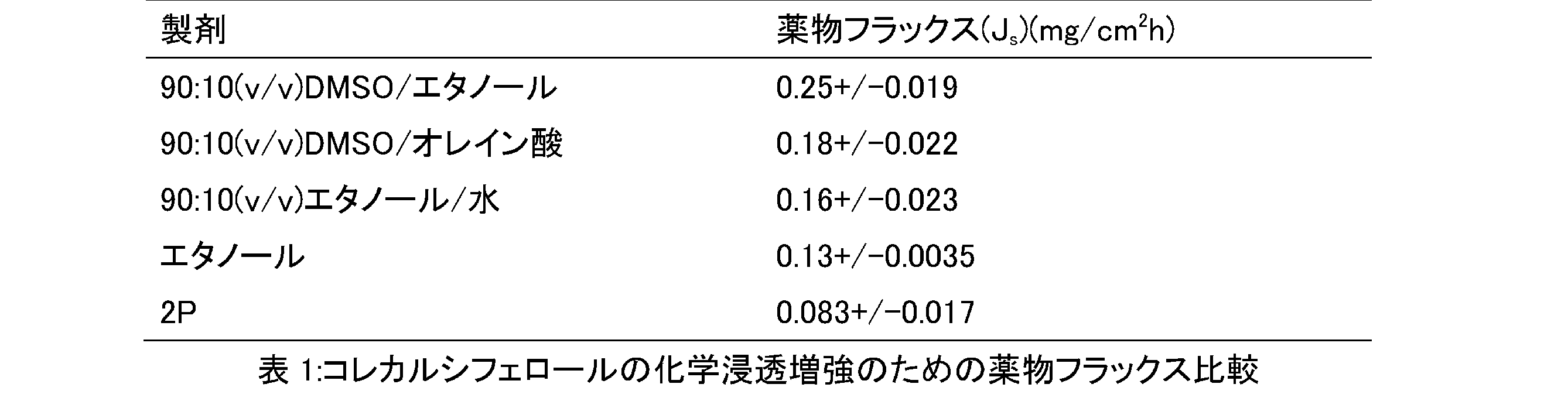
図2は、コレカルシフェロールを異なる比率のDMSOおよびエタノールに溶解したときの測定された浸透速度を示す。先の実験から、DMSOとエタノールとが、コレカルシフェロールの浸透速度を増加させることが考えられた。しかしながら、最適比率は不明であり、そのため、第2の実験は様々な比率のDMSO/エタノールを使用して実施した。 Figure 2 shows the measured permeation rates when cholecalciferol was dissolved in different ratios of DMSO and ethanol. Previous experiments suggested that DMSO and ethanol increased the permeation rate of cholecalciferol. However, the optimal ratio is unknown, so a second experiment was performed using various ratios of DMSO/ethanol.
図2は、異なるDMSOとエタノールの比率を用いたコレカルシフェロールの浸透増強を示す。全ての溶液は10%(w/v)コレカルシフェロールを含有する;合計で1mlを下記表1Aに示される各製剤で使用した。 FIG. 2 shows enhanced permeation of cholecalciferol using different DMSO to ethanol ratios. All solutions contained 10% (w/v) cholecalciferol; a total of 1 ml was used in each formulation shown in Table 1A below.

図2の結果から、DMSOとエタノールとが50:50(v/v)~90:10(v/v)の範囲内の様々な比率で溶解される場合には、コレカルシフェロールの浸透増強に顕著な差異が無いことが示唆される。 From the results in FIG. 2, when DMSO and ethanol are dissolved at various ratios ranging from 50:50 (v/v) to 90:10 (v/v), cholecalciferol permeation enhancement It is suggested that there is no significant difference.
C.2 安定性試験
図3には、様々な比率のDMSOとエタノールとに溶解したときの、コレカルシフェロールの加速安定性試験の結果が示される。全ての製剤が、10%(w/v)コレカルシフェロールを含んだ。図3は、琥珀色ボトル内に密封され、加速安定性キャビネット25℃±2℃/60%RH±5%に配置された場合のコレカルシフェロールの分解を示す。DMSOとエタノールとの様々な比率を使用して、DMSOを含めることにより、コレカルシフェロールの分解増加が生じるかを確かめた。
C. 2 Stability Studies Figure 3 shows the results of accelerated stability studies of cholecalciferol when dissolved in various ratios of DMSO and ethanol. All formulations contained 10% (w/v) cholecalciferol. FIG. 3 shows the degradation of cholecalciferol when sealed in an amber bottle and placed in an accelerated
結果から、50日の期間を超えると、27.11%(+/-1.29%)のコレカルシフェロール分解が全ての製剤にわたって生じ、このうち最初の10日間に16.83%(+/-1.48%)の分解が生じることが示唆される。先に公開されたエタノール製剤(アグニュー(Agnew),W.R.(2011),“Topical Pesticide Formulation”、米国特許)と比べると、DMSOの含有は、分解を速めることはつながらない。 Results show that over the 50-day period, 27.11% (+/-1.29%) of cholecalciferol degradation occurred across all formulations, of which 16.83% (+/-1.29%) occurred during the first 10 days. −1.48%) degradation occurs. Compared to a previously published ethanol formulation (Agnew, WR (2011), “Topical Pesticide Formulation”, US patent), inclusion of DMSO does not lead to accelerated degradation.
C.3 氷点試験
これらのin-vitro試験から、DMSOとエタノールとの混合物が、合成膜を通じてコレカルシフェロールを移動させるための最も効果的な浸透促進剤、つまり担体系であることが示唆された。許容されるエタノールとDMSOの氷点は、それぞれ-114.6℃と18.3℃である。高濃度のDMSOは、浸透促進剤として非常に効果的である一方、高用量で使用することは実際的でない。この製剤の商業的使用は、その屋外での使用のために、この製剤が一連の温度範囲で液相でなければならないことを指示する。他方で、エタノールは氷点が低い。したがって、製剤が実用的になる比率を決定するために、2溶媒の組み合わせの氷点を調べた。
C. 3 Freezing Point Studies These in-vitro studies suggested that a mixture of DMSO and ethanol was the most effective permeation enhancer, ie carrier system, for transporting cholecalciferol through synthetic membranes. The allowed freezing points for ethanol and DMSO are −114.6° C. and 18.3° C., respectively. While high concentrations of DMSO are very effective as penetration enhancers, it is impractical to use high doses. Commercial use of this formulation dictates that it must be in the liquid phase over a range of temperatures for its outdoor use. On the other hand, ethanol has a low freezing point. Therefore, the freezing points of the two solvent combinations were investigated to determine the ratios at which formulations would be practical.
図4は、氷点を調べて得られた結果を示す。これらの結果は、溶質(この場合は活性成分)の添加により氷点が低下するときの最大氷点を示す。これらの測定値に加えて、実験系で、0.32+/-0.11℃の脱イオン水の氷点を測定した。 FIG. 4 shows the results obtained by examining the freezing point. These results indicate the maximum freezing point when addition of a solute (active ingredient in this case) lowers the freezing point. In addition to these measurements, an experimental system measured the freezing point of deionized water at 0.32+/-0.11.degree.
50/50(v/v)および60/40(v/v)DMSO/エタノール混合物を含む製剤で、氷点はそれぞれ-35.45+/-1.26℃および-20.06+/-1.83℃であった。試験した残りの混合物は全て-7℃以上で凍結した。 Formulations containing 50/50 (v/v) and 60/40 (v/v) DMSO/ethanol mixtures with freezing points of -35.45+/-1.26°C and -20.06+/-1.83°C, respectively. Met. All remaining mixtures tested were frozen at -7°C or higher.
C.4 粘度試験
選択した天然ゴムおよび半合成材料を、製剤への添加剤として使用した。一般的には、これらの化合物は、比較的低濃度で粘度への有意な効果を与えることができることから理想的な増粘剤である。しかしながら、コレカルシフェロールは、親油性化合物であるため、使用する溶媒は有機溶媒であり、多くの水溶性増粘剤は適切でない、少なくとも最適または好適でない可能性がある。下記表2に、製剤に対して適切でないまたは比較的好ましくない天然ゴムおよび半合成材料の選択を示す。表2には、増粘剤としての使用がそれほど適切でない試験材料を示す。
C. 4 Viscosity Testing Selected natural gums and semi-synthetic materials were used as additives to the formulations. In general, these compounds are ideal thickeners as they can have a significant effect on viscosity at relatively low concentrations. However, since cholecalciferol is a lipophilic compound, the solvents used are organic solvents and many water-soluble thickeners may not be suitable, or at least optimal or suitable. Table 2 below shows a selection of natural rubber and semi-synthetic materials that are not suitable or less preferred for the formulation. Table 2 shows test materials that are less suitable for use as thickeners.

これらの材料に対するより好ましい代替物はポリエチレングリコールであり、一定範囲の分子量をもたらすことができ、有機溶媒に可溶である。 A more preferred alternative to these materials is polyethylene glycol, which can provide a range of molecular weights and is soluble in organic solvents.
下記図5は、PEG200の浸透促進剤に対する粘度増強効果とコレカルシフェロール自体の増粘効果を示し、コレカルシフェロールと増粘剤の化学浸透促進剤に対する作用を示す。全ての粘度測定は、50:50DMSO/エタノール中の溶質パーセンテージであり、+/-0.003mPa.sのSDを有する。 Figure 5 below shows the viscosity-enhancing effect of PEG200 on the penetration enhancer and the thickening effect of cholecalciferol itself, showing the effect of cholecalciferol and the thickener on the chemical penetration enhancer. All viscosity measurements are solute percentages in 50:50 DMSO/ethanol, +/- 0.003 mPa.s. has an SD of s.
下記表3は、製剤の粘度への、コレカルシフェロールとPEG200の両方を組み合わせた増粘効果を示唆する。PEG200の最大量は、15%(v/v)であり、これにより、50:50DMSO/エタノール浸透促進剤の使用が可能となり、コレカルシフェロールの十分な溶解が促進される。 Table 3 below suggests the thickening effect of both cholecalciferol and PEG200 in combination on the viscosity of the formulation. The maximum amount of PEG200 is 15% (v/v), which allows the use of a 50:50 DMSO/ethanol permeation enhancer and promotes sufficient dissolution of cholecalciferol.

高分子量PEGも使用しうるが、分子量の増加は氷点の増加を引き起こす。したがって、PEG200が好ましい増粘剤として同定された。 Higher molecular weight PEG may also be used, but increasing molecular weight causes an increase in freezing point. Therefore, PEG200 was identified as a preferred thickening agent.
C.5 溶解性試験
下記表4は、浸透促進剤(50:50(v/v)DMSO/エタノール)と、提案される増粘剤(15%(v/v)PEG200)を含む浸透促進剤の両方についてのおよその溶解度と対応する分類を示す。エタノールは、参照物としても表に含まれる。結果から、PEG200を製剤に添加するときに溶解性が低下することが示唆される。
C. 5 Solubility Studies Table 4 below shows both the penetration enhancer (50:50 (v/v) DMSO/ethanol) and the penetration enhancer with the proposed thickening agent (15% (v/v) PEG200). The approximate solubilities and corresponding classifications for are shown. Ethanol is also included in the table as a reference. The results suggest that solubility decreases when PEG200 is added to the formulation.

およその溶解性は、最初に0.99mlの溶媒を1gのコレカルシフェロールに加え、次いで溶液から得られる3つの別個の試料にHPLC分析を行うことによって計算した。
工程はHPLCで分析した3つ試料で同じ濃度が示唆されるまで繰り返し、その点で添加された全体積を、HPLCによって計算されるバイアル中のコレカルシフェロールの量で割った。エタノールについての分類は、英国薬局方から得られる(British Pharmacopiea (2013),“Colecalciferol”,2013年1月30日にhttp://www.pharmacopoeia.co.uk/bp2013/ixbin/bp.cgi?a=display&r=jFUlqg0blYj&n=3&id=7803&tab=searchから読出)。
Approximate solubility was calculated by first adding 0.99 ml of solvent to 1 g of cholecalciferol and then performing HPLC analysis on three separate samples obtained from the solution.
The process was repeated until the three samples analyzed by HPLC indicated the same concentration, at which point the total volume added was divided by the amount of cholecalciferol in the vial calculated by HPLC. The classification for ethanol is obtained from the British Pharmacopoeia (British Pharmacopie (2013), “Colecalciferol”, 30 January 2013 http://www.pharmacopoeia.co.uk/bp2013/ixbin/bp.cgi? a=display&r=jFUlqg0blYj&n=3&id=7803&tab=read from search).
(D)考察
アグニュー(Agnew)(アグニュー(Agnew),W.R.(2010),“Topical pesticide formulation”,国際公開第2010/071450 A1号、世界知的所有権機関)は、エタノール中に20%(w/v)のコレカルシフェロールを含む経皮製剤が、in-vivoで効果を示すことを提唱している。本研究では、コレカルシフェロール薬物フラックスの増加を生じさせる改善された製剤を示すためにin-vitro方法を使用している。
(D) Discussion Agnew (Agnew, W. R. (2010), "Topical pesticide formulation", WO 2010/071450 A1, World Intellectual Property Organization) found that 20 A transdermal formulation containing % (w/v) cholecalciferol is proposed to show efficacy in-vivo. The present study uses an in-vitro method to demonstrate improved formulations that result in increased cholecalciferol drug flux.
結果から、DMSOを高い割合(50~90%)で含む製剤は、人工膜を通じた薬物フラックスの測定値を増加させることが示唆される。初期試験では、エタノール(0.13+/-0.0035mg/cm2h)と比較して、90:10(v/v)DMSO/エタノール(0.25+/-0.019mg/cm2h)または90:10(v/v)DMSO/オレイン酸(0.18+/-0.022mg/cm2h)の場合に薬物フラックスが増加することが示唆された。さらなる試験により、薬物フラックスの増加が、より低いエタノール中DMSO濃度で起こること(50:50(v/v)DMSO/エタノールについて0.19+/-0.011)が示唆される。このように、DMSOとエタノールとの組み合わせが、先に公開されているエタノール製剤と比較して改善されたフラックスを示すことから、好ましい化学浸透促進剤、つまり担体系として選択された。 The results suggest that formulations containing high proportions (50-90%) of DMSO increase the measured drug flux through artificial membranes. In initial studies, 90:10 (v/v) DMSO/ethanol (0.25 +/- 0.019 mg/cm 2 h ) or It was suggested that drug flux increased with 90:10 (v/v) DMSO/oleic acid (0.18+/-0.022 mg/cm 2 h). Further studies suggest that increased drug flux occurs at lower concentrations of DMSO in ethanol (0.19+/-0.011 for 50:50 (v/v) DMSO/ethanol). Thus, the combination of DMSO and ethanol was chosen as the preferred chemical penetration enhancer, ie, carrier system, because it showed improved flux compared to previously published ethanol formulations.
エタノール製剤への水の添加(0.16+/-0.023mg/cm2h)および2Pを含む製剤(0.083+/-0.017mg/cm2h)は、エタノールのみを含む(0.13+/-0.0035mg/cm2h)製剤との間で実質的な差異を示さなかった。これにより、これらの化学浸透促進剤は、残りの試験から排除した。これらの浸透促進剤、特にオレイン酸は、他の試験ではうまく作用しているが(ラルセア(Larrucea),E.,アレラノ(Arellano),a,サントヨ(Santoyo),S.,& ヤルツア(Ygartua),P.(2001),“Combined effect of oleic acid and propylene glycol on the percutaneous penetration of tenoxicam and its retention in the skin”,European Journal of Pharmaceutics and Biopharmaceutics:Official Journal of Arbeitsgemeinschaft fur Pharmazeutische Verfahrenstechnik e.V,52(2),113-9;メシュラム(Meshulam),Y.,カダール(Kadar),T.,ウェニガー(Wengier),A.,ダヒア(Dachir),S.,& レヴィー(Levy),A.(1993),“Transdermal penetration of physostigmine:Effects of oleic acid enhancer”,Drug Development Research,28(4),510-515;モレイラ(Moreira),T.S.,ド・スーザ(de Sousa),V.P.,& ピエレ(Pierre),M.B.R.(2010),“A novel transdermal delivery system for the anti-inflammatory lumiracoxib:influence of oleic acid on in vitro percutaneous absorption and in vivo potential cutaneous irritation”,AAPS PharmSciTech,11(2),621-9,doi:10.1208/s12249-010-9420-1)、結果は、DMSOが、コレカルシフェロールに対してより良好な代替物質であることを示唆する。これらの結果は、部分的に、使用した人工膜の結果でありうる。オレイン酸と2Pは、角質層中に貯蔵所を生じるように作用し、移動する浸透物に対してより大きな経路を与えることが示唆される。一方で、水は、皮膚に水和作用し、親水性化合物の薬物フラックスを増加させることが示唆される。この実験で使用したセルロース膜などの人工膜において、これらの浸透メカニズムは生じない:しかしながら、コレカルシフェロールは疎水性(実質的に水に不溶)であるので角質層の脂質薄膜を通って自由に移動することができる。したがってコレカルシフェロールについての最も有利なメカニズムは、膜が撹乱されうることである。おそらくは、この状況がセルロース膜で再現され、DMSOが膜の孔径を増加させ、コレカルシフェロールのレシーバ相への迅速な拡散を促進させている。 Addition of water to ethanol formulations (0.16+/-0.023 mg/cm 2 h) and formulations containing 2P (0.083+/-0.017 mg/cm 2 h) contained only ethanol (0.13+ /−0.0035 mg/cm 2 h) showed no substantial difference from the formulation. As a result, these chemical penetration enhancers were excluded from the rest of the study. These penetration enhancers, especially oleic acid, have worked well in other studies (Larrucea, E., Arellano, a., Santoyo, S., & Ygartua). ,P.(2001),“Combined effect of oleic acid and propylene glycol on the percutaneous penetration of tenoxicam and its retention in the skin”,European Journal of Pharmaceutics and Biopharmaceutics:Official Journal of Arbeitsgemeinschaft fur Pharmazeutische Verfahrenstechnik e.V,52( Meshulam, Y., Kadar, T., Wengier, A., Dachir, S., & Levy, A. (1993). , "Transdermal penetration of physostigmine: Effects of oleic acid enhancer", Drug Development Research, 28(4), 510-515; & ピエレ(Pierre),M.B.R.(2010),“A novel transdermal delivery system for the anti-inflammatory lumiracoxib:influence of oleic acid on in vitro percutaneous absorption and in vivo potential cutaneous irritation”,AAPS PharmSciTech,11 (2), 621-9, doi: 10.1208/s12249-010-9420-1), the results suggest that DMSO is a better alternative to cholecalciferol. These results may be partially the result of the artificial membranes used. It is suggested that oleic acid and 2P act to create depots in the stratum corneum, providing greater pathways for migrating permeants. On the one hand, water is suggested to hydrate the skin and increase drug flux of hydrophilic compounds. In artificial membranes, such as the cellulose membranes used in this experiment, these permeation mechanisms do not occur: however, cholecalciferol is hydrophobic (virtually insoluble in water) and is therefore free to pass through the lipid membrane of the stratum corneum. can move. The most favorable mechanism for cholecalciferol is therefore that the membrane can be perturbed. Presumably, this situation is replicated in cellulose membranes, with DMSO increasing the membrane pore size and promoting rapid diffusion of cholecalciferol into the receiver phase.
DMSOは、浸透促進剤として広く認められている一方で、医薬品の経皮送達には一般的に使用されていない。DMSOは、皮膚を軽度に刺激し、口内で不快な風味を生じさせる。但し、本製剤の目的は、殺鼠剤としての用途である。したがってこれらの要素は、重要ではあるが、効果と比較して考えるべきものである。代替的な化学浸透促進剤は、コレカルシフェロールの作用を延長させるためのもので、これらの初期的問題を無視しうる。 While DMSO is widely recognized as a penetration enhancer, it is not commonly used for transdermal delivery of pharmaceuticals. DMSO is mildly irritating to the skin and produces an unpleasant taste in the mouth. However, the purpose of this formulation is for use as a rodenticide. These factors, though important, should therefore be weighed against the effect. Alternative chemical permeation enhancers are intended to prolong the action of cholecalciferol, ignoring these initial problems.
DMSOに関連する化学的問題に加えて、物理的問題も存在しうる。DMSOの氷点は18.3℃であり、室温では液体であるが、その温度未満では固体である。所望される使用のために、殺鼠剤は多種多様な環境で使用できなければならず、その1つが低温状態である。意図する標的が夜行性の種である場合、このことは特に問題でありえ、一晩の温度の低下により、高い割合でDMSO製剤の効果が失われうる。製剤の氷点を下げるため、一連の比率のDMSO/エタノールを調べて、浸透増強とエタノールの低い氷点(-114.6℃)の両方を利用しうる比率を決定した。この目的のために、50:50(v/v)DMSO/エタノールの比率に着目し、好ましい製剤の基礎としてさらなる試験を行った。 In addition to the chemical issues associated with DMSO, there can also be physical issues. DMSO has a freezing point of 18.3° C. and is liquid at room temperature but solid below that temperature. For the desired use, rodenticides must be able to be used in a wide variety of environments, one of which is cold conditions. This can be particularly problematic if the intended target is a nocturnal species, where an overnight temperature drop can render a high percentage of DMSO formulations ineffective. To lower the freezing point of the formulation, a series of DMSO/ethanol ratios were investigated to determine a ratio that could take advantage of both penetration enhancement and ethanol's lower freezing point (-114.6°C). For this purpose, a ratio of 50:50 (v/v) DMSO/ethanol was focused and further tested as a basis for a preferred formulation.
薬物浸透理論によれば、ゲル様均質性を有する製剤により、皮膚の輪郭に添うことが可能になり、活性成分の生物学的利用能を増加させることが指示される。したがって、製剤の粘度を増加させることが、薬物フラックスを改善するために望ましいと考えられた。一連の増粘剤について、粘度を上げるために試験した。しかしながら、適切な薬剤の決定は、ほぼ全てが有機溶媒で構成される製剤では困難であった。最終的にPEG200が好ましい増粘剤として際立った。しかしながら、粘度について顕著な効果を得るためには、高い割合の15%(v/v)が必要であった。この量は、天然ガムでは0.1~1%(w/v)の濃度範囲で粘度が顕著に増加されることに対して、特に高い。 Drug permeation theory dictates that formulations with gel-like homogeneity allow them to conform to the contours of the skin, increasing the bioavailability of the active ingredients. Therefore, increasing the viscosity of the formulation was considered desirable to improve drug flux. A series of thickeners were tested to increase viscosity. However, determination of appropriate drugs has been difficult with formulations that consist almost entirely of organic solvents. Finally, PEG200 stood out as the preferred thickening agent. However, a high percentage of 15% (v/v) was required to obtain a noticeable effect on viscosity. This amount is particularly high in contrast to the significant increase in viscosity in the concentration range of 0.1-1% (w/v) for natural gums.
検討した最後の2つのパラメータは、改善の余地のある客観的な実施に役立つ。コレカルシフェロールのエタノールへの溶解性は、溶けやすいとして定義され、1~10ml/gが溶質を完全に溶解させるために使用しうることを意味する。アグニュー(Agnew)(アグニュー(Agnew),W.R.(2010),“Topical pesticide formulation”,国際公開第2010/071450 A1号、世界知的所有権機関)の提唱する製剤は、20%(w/v)の高用量のコレカルシフェロールを必要とし、製剤に変化が生じるときに溶解度の損失が誘発されないことが重要となる。この点に関して、試験した全ての製剤について、コレカルシフェロールはやや溶けやすく、製剤操作により有効量の送達が妨げられないことが示唆される。 The last two parameters considered lend themselves to an objective implementation that has room for improvement. The solubility of cholecalciferol in ethanol is defined as freely soluble, meaning that 1-10 ml/g can be used to completely dissolve the solute. Agnew (Agnew, W.R. (2010), “Topical pesticide formulation”, WO 2010/071450 A1, World Intellectual Property Organization) proposed a formulation of 20% (w /v) high doses of cholecalciferol are required and it is important that no loss of solubility is induced when changes in formulation occur. In this regard, for all formulations tested, cholecalciferol is moderately soluble, suggesting that formulation manipulation does not interfere with delivery of effective doses.
最後に、市販品については、製品の安定性が、定義された時間で確認されなければならない。このパラメータに関して、結果から、25℃±2℃/60%RH±5%で50日後に、27.11%(+/-1.29%)の能力低下があることが示唆される。コレカルシフェロールは光、熱、空気に対して敏感であるが、琥珀色のボトルの使用により、能力低下の原因となる光分解がなくなる。酸化、熱、またはこの2つの組み合わせが、能力低下の要因となることが提案される。これらの問題を無くすための様々な利用可能な選択肢があり、例えば、酸化分解に対向するために窒素またはいくつかの他の不活性ガス下で充填などの製造操作を実施すること、または化学的に酸化防止剤を添加することなどが考えられうる。 Finally, for commercial products, product stability must be confirmed at defined times. For this parameter, the results suggest a 27.11% (+/-1.29%) capacity loss after 50 days at 25°C ± 2°C/60% RH ± 5%. Cholecalciferol is sensitive to light, heat, and air, but the use of an amber bottle eliminates photodegradation, which can cause potency. It is proposed that oxidation, heat, or a combination of the two contribute to the degradation. There are various options available to eliminate these problems, for example, performing manufacturing operations such as filling under nitrogen or some other inert gas to counteract oxidative decomposition, or chemically It can be considered to add an antioxidant to the
(E)結論
コレカルシフェロールの最適化のためのin-vitro試験の結果から、DMSOとエタノールを含む担体系が、人工膜を通じたコレカルシフェロールの薬物フラックスを、先に公開されたエタノール製剤と比較して増加させることが示唆される(エタノールでの0.13+/-0.0035mg/cm2hと比較して、50:50(v/v)DMSO/エタノールでは0.19+/-0.011mg/cm2h)。
(E) Conclusions The results of an in-vitro study for optimization of cholecalciferol show that a carrier system containing DMSO and ethanol improves the drug flux of cholecalciferol through artificial membranes compared to previously published ethanol formulations. 50:50 (v/v) DMSO/ethanol compared to 0.13 +/- 0.0035 mg/cm 2 h for ethanol. 011 mg/cm 2 h).
氷点および粘度などのパラメータも、製剤を効果的かつ機能的にするために調整した。DMSOとエタノールの比率が、溶質無しで-35.45+/-1.26℃の氷点を達成するために操作された(50/50(v/v)DMSO/エタノール)。一方、15%のPEG200の添加により、製剤の粘度が、9%(w/v)のコレカルシフェロールを含有する製剤に対して2.58mPa.sに増加した。溶けやすい(1~10ml/g)という溶解性分類はこの製剤でも維持され、有効量を溶液に溶解させることができた。 Parameters such as freezing point and viscosity were also adjusted to make the formulations effective and functional. The ratio of DMSO and ethanol was manipulated to achieve a freezing point of −35.45+/-1.26° C. without solute (50/50 (v/v) DMSO/ethanol). On the other hand, the addition of 15% PEG200 increased the viscosity of the formulation to 2.58 mPa.s versus the formulation containing 9% (w/v) cholecalciferol. increased to s. The solubility class of easily soluble (1-10 ml/g) was maintained for this formulation and an effective amount could be dissolved in solution.
<実施例3-コレカルシフェロールのラット皮膚取込みのためのin-vitro、in-vivoモデル>
(A)導入
この実施例では、2つのin-vitroモデルと、真皮を通じたコレカルシフェロールの送達を最適化するよう設計した対応するin-vivoデータを提示する。
Example 3 - In-vitro, in-vivo model for rat skin uptake of cholecalciferol
(A) Introduction This example presents two in-vitro models and corresponding in-vivo data designed to optimize the delivery of cholecalciferol through the dermis.
(B)材料と方法
B.1 材料
欧州薬局方等級コレカルシフェロールを、Fagron UK Ltd(Newcastle on Tyne,UK)から購入した。浸透促進剤のエタノール、オレイン酸、およびジメチルスルホキシド(DMSO)は、Fisher Scientific UK Ltd(Loughborough,UK)から購入し、一方、2-ピロリドンは、Sigma-Aldrich Co(St.Louis,MO,USA)から購入し、これらは全て実験試薬等級であった。メチルセルロース(Fisher Scientific UK Ltd(Loughborough,UK))およびポリエチレングリコール(mwt200,PEG200)(Sigma-Aldrich Co(St.Louis,MO,USA))を粘度調整剤として使用した。in-vitro試験のためのレシーバ相は、エタノール(Fisher Scientific UK Ltd(Loughborough,UK))、ポリエチレングリコール(mwt200,Sigma-Aldrich Co(St.Louis,MO,USA))および脱イオン水で構成した。再生セルロース透析膜(Visking tubing,Fisher Scientific UK Ltd(Loughborough,UK))が合成膜に使用されてきた(コリガン(Corrigan),O.I.,ファーバー(Farvar),M.A.,& ヒグチ(Higuchi),W.I.(1980),“Drug membrane transport enhancement using high energy drug polyvinylpyrrolidone(PVP)co-precipitates”,International Journal of Pharmaceutics,5,229-238;ハイ(Haigh),J.M.,& スミス(Smith),E.W.(1994),“The selection and use of natural and synthetic membranes for in vitro diffusion experiments”,European Journal of Pharmaceutical Sciences,2(5-6),311-330;ワング(Wang),T.,カシチャヤヌラ(Kasichayanula),S.,& グ(Gu),X.(2006),“In vitro permeation of repellent DEET and sunscreen oxybenzone across three artificial membranes”,International Journal of Pharmaceutics,310(1-2),110-7,doi:10.1016/j.ijpharm.2005.11.039;ウィッシング(Wissing),S.a,& ミューラー(Muller),R.H.(2002),“Solid lipid nanoparticles as carrier for sunscreens:in vitro release and in vivo skin penetration”,Journal of Controlled Release:Official Journal of the Controlled Release Society,81(3),225-33)。
(B) Materials and MethodsB. 1 Materials European Pharmacopoeia Grade Cholecalciferol was purchased from Fagron UK Ltd (Newcastle on Tyne, UK). The penetration enhancers ethanol, oleic acid, and dimethylsulfoxide (DMSO) were purchased from Fisher Scientific UK Ltd (Loughborough, UK), while 2-pyrrolidone was purchased from Sigma-Aldrich Co (St. Louis, MO, USA). All of these were of laboratory reagent grade. Methylcellulose (Fisher Scientific UK Ltd, Loughborough, UK) and polyethylene glycol (mwt200, PEG200) (Sigma-Aldrich Co, St. Louis, MO, USA) were used as viscosity modifiers. The receiver phase for in-vitro testing consisted of ethanol (Fisher Scientific UK Ltd, Loughborough, UK), polyethylene glycol (mwt200, Sigma-Aldrich Co, St. Louis, MO, USA) and deionized water. . Regenerated cellulose dialysis membranes (Visking tubing, Fisher Scientific UK Ltd, Loughborough, UK) have been used for synthetic membranes (Corrigan, O.I., Farvar, M.A., & Higuchi). Higuchi),W.I.(1980),“Drug membrane transport enhancement using high energy drug polyvinylpyrrolidone(PVP)co-precipitates”,International Journal of Pharmaceutics,5,229-238;ハイ(Haigh),J.M., & Smith, E.W. (1994), "The selection and use of natural and synthetic membranes for in vitro diffusion experiments", European Journal of Pharmaceutical Sciences, 3, 3, 3, 3, 3, 15; Wang),T.,カシチャヤヌラ(Kasichayanula),S.,& グ(Gu),X.(2006),“In vitro permeation of repellent DEET and sunscreen oxybenzone across three artificial membranes”,International Journal of Pharmaceutics,310(1 -2), 110-7, doi: 10.1016/j.ijpharm.2005.11.039; Wissing, S.a, & Muller, R.H. (2002), "Solid lipid "nanoparticles as carriers for sunscreens: in vitro release and in vivo skin penetration", Journal of Controlled Release: Official Journal of the Controlled
B.2 方法
B.2.1 透過試験
B.2.1.1 セルロース管in-vitroモデル
管を、細片に切断し、一端を閉じた。各製剤1mlを、透析管に分配し、管を、45mlのレシーバ相を含有する50mlの遠心管に入れた。コレカルシフェロールは、疎水性化合物であり、実質的に水に不溶性であり、6%(v/v)PEG200を含有するエタノール水溶液(10:90(v/v))レシーバ相を使用した。レシーバ相の試料採取は、最初の4時間は1時間毎に行い、その後は2時間毎に実施した。各試料採取点で、5mlのレシーバ相を除去し、ストックのレシーバ相と入れ換えた。5mlのうち、200μlを抽出し、希釈して、HPLC解析を行った。レシーバ相の温度を、遠心管を熱水浴に浸漬することにより、26℃+/-2℃に維持した。各製剤について、3つの複製物を用いた。
B. 2 Method B. 2.1 Permeation test B. 2.1.1 Cellulose Tubing In-vitro Model The tubing was cut into strips and closed at one end. 1 ml of each formulation was dispensed into dialysis tubes and the tubes were placed in 50 ml centrifuge tubes containing 45 ml of receiver phase. Cholecalciferol is a hydrophobic compound, virtually insoluble in water, and an aqueous ethanol solution (10:90 (v/v)) containing 6% (v/v) PEG200 was used in the receiver phase. Sampling of the receiver phase was performed every hour for the first 4 hours and every 2 hours thereafter. At each sampling point, 5 ml of receiver phase was removed and replaced with stock receiver phase. Of the 5 ml, 200 μl was extracted, diluted and subjected to HPLC analysis. The temperature of the receiver phase was maintained at 26°C +/- 2°C by immersing the centrifuge tube in a hot water bath. Three replicates were used for each formulation.
B.2.1.2 拡散細胞in-vitroモデル
膜を5×5cm四方に切り、固定した拡散細胞のドナーとレシーバチャンバとの間に置いた(Ingham Group,Aston University,UK)。各製剤について、15mlのレシーバ溶液をレシーバチャンバに入れ、一方で5mlのアッセイ物をドナーへ分配させた。6%(v/v)PEG200を含有するエタノール水溶液(10:90(v/v))レシーバ相を使用した。レシーバ相の試料採取は、最初の5時間は1時間毎に行い、その後は2時間毎に実施した。各試料採取点で、5mlのレシーバ相を除去し、ストックのレシーバ相と入れ換えた。5mlのうち、200μlを抽出し、希釈して、HPLC解析を行った。レシーバ相の温度は、加熱撹拌プレートにより、37℃+/-2℃に維持した。
B. 2.1.2 Diffusion cell in-vitro model Membranes were cut into 5 x 5 cm squares and placed between fixed diffusion cell donor and receiver chambers (Ingham Group, Aston University, UK). For each formulation, 15 ml of receiver solution was placed in the receiver chamber while 5 ml of assay was dispensed to the donor. Aqueous ethanol (10:90 (v/v)) receiver phase containing 6% (v/v) PEG200 was used. Sampling of the receiver phase was performed every hour for the first 5 hours and every 2 hours thereafter. At each sampling point, 5 ml of receiver phase was removed and replaced with stock receiver phase. Of the 5 ml, 200 μl was extracted, diluted and subjected to HPLC analysis. The temperature of the receiver phase was maintained at 37°C +/- 2°C by a heated stir plate.
B.2.1.3 製剤
5製剤の2つのバッチを、セルロース管モデルを試験した。5製剤からなる1セットを、様々な濃度の一連の化学浸透促進剤で試験し、最適な化学浸透促進剤を決定した。5製剤からなる2バッチを、一連のDMSO/エタノール共溶媒で試験した。
B. 2.1.3 Formulations Two batches of 5 formulations were tested in a cellulose tube model. A set of 5 formulations was tested with a series of chemical penetration enhancers at varying concentrations to determine the optimal chemical penetration enhancer. Two batches of 5 formulations were tested in a series of DMSO/ethanol co-solvents.
2バッチの製剤を拡散細胞モデルで使用した;最初のセットでは、最適な化学浸透促進剤を決定するために、様々な濃度の一連の浸透促進剤を調べた。第2のバッチでは、コレカルシフェロール濃度を変えた。 Two batches of formulations were used in the diffusion cell model; in the first set, a series of penetration enhancers at varying concentrations were examined to determine the optimal chemical penetration enhancer. In the second batch, the cholecalciferol concentration was varied.
B.2.1.4 化学浸透増強
化学浸透促進剤、例えば、DMSO(ストートン(Stoughton),R.B.,& フリッツス(Fritsch),W.(1964),“Influence of dimethylsulfoxide(DMSO)on human percutaneous absorption”,Arch Dermatol,90(5),512-517)は、抗ウイルス剤、ステロイド、および抗生物質などの化合物の浸透を増強させることが示されている(ウィリアムス(Williams),A.C.,& バリー(Barry),B.W.(2012),“Penetration Enhancers”,Advanced Drug Delivery Reviews,64,128-137)。DMSOおよびスルホキシドファミリーは、角質層を撹乱し、浸透剤の細胞間通過を促進させる。エタノールなどの有機溶媒は角質層から脂質を抽出することにより、浸透を増加させる。オレイン酸などの脂肪酸も、角質層に浸透剤が移動することのできる貯蔵所を作ることにより、皮膚浸透を改善することが示されている(ラルセア(Larrucea),E.,アレラノ(Arellano),A.,サントヨ(Santoyo),S.,& ヤルツア(Ygartua),P.(2001),“Combined effect of oleic acid and propylene glycol on the percutaneous penetration of tenoxicam and its retention in the skin”,European Journal of Pharmaceutics and Biopharmaceutics,52(2),113-9;メシュラム(Meshulam),Y.,カダール(Kadar),T.,ウェニガー(Wengier),A.,ダヒア(Dachir),S.,& レヴィー(Levy),A.(1993),“Transdermal penetration of physostigmine:Effects of oleic acid enhancer”,Drug Development Research,28(4),510-515;モレイラ(Moreira),T.S.,ド・スーザ(de Sousa),V.P.,& ピエレ(Pierre),M.B.R.(2010),“A novel transdermal delivery system for the anti-inflammatory lumiracoxib:influence of oleic acid on in vitro percutaneous absorption and in vivo potential cutaneous irritation”,AAPS PharmSciTech,11(2),621-9)。DMSO、エタノール、水、2-ピロリドンおよびオレイン酸が、有望な浸透促進剤として選択された。
B. 2.1.4 Chemipenetration enhancement Chemipenetration enhancers, such as DMSO (Stoughton, RB, & Fritsch, W. (1964), "Influence of dimethylsulfoxide (DMSO) on human percutaneous absorption , Arch Dermatol, 90(5), 512-517) have been shown to enhance the penetration of compounds such as antivirals, steroids, and antibiotics (Williams, AC, & Barry, BW (2012), "Penetration Enhancers", Advanced Drug Delivery Reviews, 64, 128-137). The DMSO and sulfoxide family perturb the stratum corneum and facilitate intercellular passage of penetrants. Organic solvents such as ethanol increase penetration by extracting lipids from the stratum corneum. Fatty acids, such as oleic acid, have also been shown to improve skin penetration by creating depots into which penetrants can migrate in the stratum corneum (Larrucea, E., Arellano, A.,サントヨ(Santoyo),S.,& ヤルツア(Ygartua),P.(2001),“Combined effect of oleic acid and propylene glycol on the percutaneous penetration of tenoxicam and its retention in the skin”,European Journal of Pharmaceutics and Biopharmaceutics, 52(2), 113-9; Meshulam, Y., Kadar, T., Wengier, A., Dachir, S., & Levy, A. (1993), "Transdermal penetration of physostigmine: Effects of oleic acid enhancer", Drug Development Research, 28(4), 510-515; V.P.,& ピエレ(Pierre),M.B.R.(2010),“A novel transdermal delivery system for the anti-inflammatory lumiracoxib:influence of oleic acid on in vitro percutaneous absorption and in vivo potential cutaneous irritation” , AAPS PharmSciTech, 11(2), 621-9). DMSO, ethanol, water, 2-pyrrolidone and oleic acid were selected as potential penetration enhancers.
B.2.1.5 膜調製
セルロース膜を、使用前に、2%(w/v)の重炭酸ナトリウム(Sigma-Aldrich Co(St.Louis,MO,USA))と1mMの蒸留水中エチレンジアミン四酢酸(EDTA)からなる1Lの洗浄液で洗浄した。セルロース膜を、溶液内に入れて温度を80℃に上げ、その後、溶液をその温度で30m維持した。清浄後、膜を蒸留水で濯ぎ、蒸留水の浴中で最大5日間維持してから使用した。これは製造業者のガイドラインに従ったものである(Medicell International Ltd,2004)。
B. 2.1.5 Membrane Preparation Cellulose membranes were prepared prior to use with 2% (w/v) sodium bicarbonate (Sigma-Aldrich Co, St. Louis, MO, USA) and 1 mM ethylenediaminetetraacetic acid in distilled water. EDTA) was washed with a 1 L washing solution. A cellulose membrane was placed in the solution and the temperature was raised to 80° C., after which the solution was maintained at that temperature for 30 m. After cleaning, the membranes were rinsed with distilled water and kept in a bath of distilled water for up to 5 days before use. This is according to the manufacturer's guidelines (Medicell International Ltd, 2004).
B.2.1.6 データ解析
in-vitro試験で使用した各製剤について、製剤の薬物フラックス(Js)を計算した。この値は、レシーバチャンバの累積的薬物濃度を時間に対してプロットした後、以下の等式を用いて得た(バリー(Barry),B.W.(1983),“Dermatological Formulations”,pp.49-94,New York,NY,Marcel Dekker Inc.;グワァク(Gwak),H.S.,& チュン(Chun),I.K.(2002),“Effect of vehicles and penetration enhancers on the in vitro percutaneous absorption of tenoxicam through hairless mouse skin”,International Journal of Pharmaceutics,236(1-2),57-64):

B.2.1.7 HPLC解析
全てのコレカルシフェロール製剤の定量分析は、UVダイオードアレイを使用して、高速液体クロマトグラフィで実施した(Prominence Modular HPLC(Shimadzu Corporation,Japan))。検出波長を265nmに設定した。Luna 3μ NH2 100Aカラム(Phenomenex,Cheshire,UK)、寸法:150×4.6mmを、NH2 3mm IDセキュリティーガードおよびホルダと共に使用した。全流速は2ml/分であり、ランタイムは6分であった。移動相は、99:1(v/v)ヘキサン/イソプロパノールから構成された(HPLCグレード)。ランの最初の3分は、99:1~50:50(v/v)ヘキサン/イソプロパノールの勾配比率を使用し、その後は、移動相を元の比率99:1(v/v)ヘキサン/イソプロパノールに戻した。コレカルシフェロールの濃度を、コレカルシフェロールの265nmで作成した標準曲線(r2=0.999)の勾配に由来する等式を使用して、各アッセイについて計算した。
B. 2.1.7 HPLC Analysis Quantitative analysis of all cholecalciferol formulations was performed by high performance liquid chromatography using a UV diode array (Prominence Modular HPLC (Shimadzu Corporation, Japan)). Detection wavelength was set at 265 nm. A Luna 3[mu] NH2 100A column (Phenomenex, Cheshire, UK), dimensions: 150 x 4.6 mm was used with a NH2 3 mm ID security guard and holder. Total flow rate was 2 ml/min and run time was 6 minutes. The mobile phase consisted of 99:1 (v/v) hexane/isopropanol (HPLC grade). A gradient ratio of 99:1 to 50:50 (v/v) hexane/isopropanol was used for the first 3 minutes of the run, after which the mobile phase was returned to the original ratio of 99:1 (v/v) hexane/isopropanol. returned to The concentration of cholecalciferol was calculated for each assay using an equation derived from the slope of a standard curve (r 2 =0.999) generated at 265 nm for cholecalciferol.
B.2.2 in-vivo試験
B.2.2.1 動物飼育
全てのin-vivo研究は、Cellvax Pharma(Paris,France)で行った。実験プロトコルは、Ministere de L’enseignement Superieur de la Recherche(ComEth Anses/ENVA/UPEC 16)により承認を受けた。7~10週齢の雄のSprague Dawleyラット(Harlan,France)を、プロトコルで使用した。それぞれのラットは250~350gの間で秤量され、SOPF(特定および日和見病原体無し)状態であった。動物を、周囲条件および光を制御した環境下で、ポリエチレンケージ中に収容した。照明時間は、7:00~19:00であり、温度および湿度をそれぞれ21+/-1℃および70%RHに維持した。動物に周期的に食料と水を供給した。初期化学浸透増強試験(プロトコル1)の場合には、動物を一匹ごとに収容した。用量応答試験(プロトコル2)では、動物を、2匹および3匹のグループで収容し、毛を剃って各動物を識別した。全ての動物は、実験の開始前に少なくとも1週間、実験室に慣れさせた。
B. 2.2 In-vivo studiesB. 2.2.1 Animal Husbandry All in-vivo studies were performed at Cellvax Pharma (Paris, France). The experimental protocol was approved by the Ministere de L'enseignment Superieur de la Recherche (ComEth Anses/ENVA/UPEC 16). Male Sprague Dawley rats (Harlan, France) aged 7-10 weeks were used in the protocol. Each rat was weighed between 250-350 g and was under SOPF (specific and opportunistic pathogen free) conditions. Animals were housed in polyethylene cages under ambient and light controlled conditions. Lighting hours were from 7:00 to 19:00, and temperature and humidity were maintained at 21+/-1°C and 70% RH, respectively. Animals were provided with food and water periodically. For the initial chemiosmotic enhancement study (Protocol 1), animals were housed singly. In dose-response studies (protocol 2), animals were housed in groups of two and three and shaved to identify each animal. All animals were habituated to the experimental room for at least one week prior to the start of experiments.
B.2.2.2 プロトコル1(スクリーニング試験)
スクリーニング試験のプロトコルは、殺鼠剤の有効性評価(PP 1/113(2))(EPPO,1998)に組み入れられたヨーロッパ植物防疫機構(European Plant Protection Organisation、EPPO)により立案されたガイドラインに基づいた。新しい殺鼠剤の試験について、ドブネズミ(Rattus norvegicus)またはハツカネズミ(Mus musculus)の5匹の雄の実験種を使用するスクリーニング試験が提案されている。全部で5種の製剤を、それぞれ5匹の動物に対して試験した。
B. 2.2.2 Protocol 1 (screening test)
The screening test protocol was based on the guidelines developed by the European Plant Protection Organization (EPPO) incorporated in the Effectiveness Evaluation of Rodenticides (
経皮殺鼠剤の適用のための手法では、経済協力開発機構(Organisation for Economic Co-operation and Development、OECD)のガイドライン434(OECD,2004)に基づいて、製剤を、動物の首筋の10cm2の領域に適用した。このプロトコルでは、適用部位の領域の毛を剃り、その部位を保護するよう助言されているが、この手段は「使用しながら」の適用が望ましい本研究では組み込まなかった。 In the procedure for the application of transdermal rodenticides, the formulation was applied to a 10 cm area of the nape of the animal, based on the Organization for Economic Co-operation and Development (OECD) Guideline 434 (OECD, 2004). Applied to The protocol advises shaving the area of the application site and protecting the site, but this measure was not incorporated in this study where application "while in use" is preferred.
B.2.2.3 プロトコル2(用量固定手法(Fixed Dose Procedure))
最適な化学浸透増強組成物を同定するために、活性成分の最適用量を決定する必要がある。動物の数および試験条件も、殺鼠剤の有効性評価(PP 1/113(2))(EPPO,1998)で示唆されているスクリーニング試験に基づいた。OECDは、急性皮膚毒性の計算に関する詳細なガイドライン(OECDガイドライン402)(OECD,1987)を示しており、ここでLD50は、活性成分の用量応答曲線から計算される。しかしながら、指令(Directive)はこのプロトコルを勧めておらず、したがって用量固定手法(OECDガイドライン420、434)(OECD、2001、2004)を使用した。この手法での投与量は、5、50、300および2000mg/kgに相当する。
B. 2.2.3 Protocol 2 (Fixed Dose Procedure)
In order to identify the optimal chemi-penetration enhancing composition, it is necessary to determine the optimal dose of active ingredient. The number of animals and test conditions were also based on the screening test suggested in Rodenticide Efficacy Evaluation (
B.2.2.4 データ解析
指令は、殺鼠剤が、齧歯動物の防除について考慮されるためには、その殺鼠剤が「十分有効である」ことが証明されなければならないと述べている。EPPOガイドラインは、有効性の評価に関して、スクリーニング試験については、100%の死亡率を示す製剤のみ、殺鼠剤として有効となりうることを示している。
B. 2.2.4 Data Analysis The Directive states that a rodenticide must be demonstrated to be "sufficiently effective" in order to be considered for rodent control. Regarding efficacy evaluation, the EPPO guidelines indicate that for screening tests only formulations showing 100% mortality can be effective as rodenticides.
死亡率に加えて、動物の苦痛を、5日間にわたって1日に2~3回、5日間にわたって観察し、次いでさらに9日間、1日に2回観察した。死亡率が100%に満たない製剤は、有効でないとみなした。プロトコル中の動物の苦痛は、ウォルフェンソンら(ウォルフェンソン(Wolfensohn),S.,& ロイド(Lloyd),M.(2003),“Handbook of Laboratory Animal Management and Welfare”(3rd ed.)、Blackwell Publishing Ltd.),により提唱されている苦痛評点表を使用し、将来的な野外実験で重要な観点と思われる誘発応答に関する項目もこのチャートに追加して、観察した。 In addition to mortality, animals were observed for distress 2-3 times a day for 5 days, then twice a day for an additional 9 days. Formulations with less than 100% mortality were considered ineffective. Animal suffering during the protocol is described in Wolfensohn et al. (Wolfensohn, S., & Lloyd, M. (2003), "Handbook of Laboratory Animal Management and Welfare" (3rd ed.), Blackwell Publishing Ltd.), and added an item on the evoked response, which is considered to be an important aspect in future field experiments, to the chart for observation.
用量固定手法では、動物に対する致死量未満の用量の影響を測定するために体重データを集めた。用量固定手法が完了した後に、殺鼠剤に、OECD(OECD、2001、2004)によって指示されたLD50カットオフ値に基づく分類を与えた。 In the fixed dose approach, body weight data were collected to determine the effects of sublethal doses on animals. After the fixed dose procedure was completed, rodenticides were given a classification based on the LD50 cut-off values dictated by the OECD (OECD, 2001, 2004).
(C)結果
C.1 透過結果
ラット真皮を通じたコレカルシフェロールの送達に対する化学浸透促進剤の効果を調べるために、2つのin-vitroモデルを構築した。以下の結果は、時間に対してプロットしたレシーバ相におけるコレカルシフェロールの累積量を示唆する。各図に対応する表は、定常状態の勾配から決定された薬物フラックス計算値である。
(C) ResultsC. A.1 Permeation Results Two in-vitro models were constructed to examine the effect of chemical permeation enhancers on the delivery of cholecalciferol through the rat dermis. The results below suggest the cumulative amount of cholecalciferol in the receiver phase plotted against time. The table corresponding to each figure is the calculated drug flux determined from the steady-state slope.
C.1.1 セルロース管in-vitroモデル
C.1.1.1 化学浸透増強
図6は、時間に対してプロットした、レシーバ相から回収したコレカルシフェロールの累積量を示す。合計で5種の浸透促進化学物質DMSO、エタノール、オレイン酸、2-ピロリドンおよび水を、文献から選択した。結果から、DMSO/エタノールの90:10(v/v)混合物で、コレカルシフェロールの膜を通じた最大拡散速度が得られることが示唆される。残りの浸透促進剤は、同等の浸透速度を示唆する。DMSOを含有する製剤は両方とも、最も高い計算された薬物フラックスを示す。
C. 1.1 Cellulose tube in-vitro model C.I. 1.1.1 Chemiosmosis Enhancement Figure 6 shows the cumulative amount of cholecalciferol recovered from the receiver phase plotted against time. A total of five permeation enhancing chemicals DMSO, ethanol, oleic acid, 2-pyrrolidone and water were selected from the literature. The results suggest that a 90:10 (v/v) mixture of DMSO/ethanol gives the highest rate of diffusion of cholecalciferol through the membrane. The remaining penetration enhancers suggest comparable penetration rates. Both formulations containing DMSO show the highest calculated drug flux.
図6は、合成膜を通じたコレカルシフェロールの送達のための化学浸透増強剤の比較を示す。全ての製剤(下記の表5に示される)で10%(w/v)コレカルシフェロールを使用した;合計で1mlを各製剤に使用した。拡散面積は、およそ40cm2であった。 Figure 6 shows a comparison of chemical permeation enhancers for the delivery of cholecalciferol through synthetic membranes. 10% (w/v) cholecalciferol was used in all formulations (shown in Table 5 below); a total of 1 ml was used for each formulation. The diffusion area was approximately 40 cm 2 .

C.1.1.2 DMSO/エタノール共溶媒浸透増強
図7を参照するに、この図は、様々な比率(下記表6に示すとおり)でDMSOとエタノールを浸透促進剤として使用したときの、コレカルシフェロールの浸透速度の測定値を示す。全ての溶液が10%(w/v)コレカルシフェロールを含有する;合計で1mlを各製剤に使用した。前述の実験から、DMSOおよびエタノール共溶媒が、薬物フラックスを増加させることが見出された。しかしながら、最適比率は不明であり、そのため、第2の実験では、様々な比率のDMSO/エタノールを使用して実験した。
C. 1.1.2 DMSO/Ethanol Co-solvent Penetration Enhancement Referring to FIG. 7, this figure demonstrates the effect of cholecalci on the use of DMSO and ethanol as penetration enhancers in various ratios (as shown in Table 6 below). Measured ferrol permeation rates are shown. All solutions contained 10% (w/v) cholecalciferol; a total of 1 ml was used for each formulation. From the experiments described above, DMSO and ethanol co-solvents were found to increase drug flux. However, the optimal ratio is unknown, so a second experiment was run using different ratios of DMSO/ethanol.

結果から、DMSOとエタノールとが50:50(v/v)~90:10(v/v)の範囲内で様々な比率の浸透促進剤として使用されるとき、コレカルシフェロールの浸透増強の間に有意な差異が無いことが示唆される。 The results show that during penetration enhancement of cholecalciferol when DMSO and ethanol are used as penetration enhancers in various ratios ranging from 50:50 (v/v) to 90:10 (v/v). It is suggested that there is no significant difference in
C.1.2 拡散細胞in-vitroモデル
C.1.2.1 化学浸透増強
図8を参照するに、この図は、拡散細胞配置を使用した、合成膜を通じたコレカルシフェロールの拡散を示す。図8は、合成膜を通じたコレカルシフェロールの送達のための化学浸透増強剤の比較を示す。合計で5mlの製剤をドナー相に分配した。点線は、計算した薬物フラックスからの最良適合直線を示す。下記表7に示すようなコレカルシフェロール濃度と化学浸透促進剤との組み合わせを用いた。セルロース管in-vitroモデルからの結果に基づき、高い割合でDMSOを含有する製剤を、エタノール製剤と比較して検討した。
C. 1.2 Diffusion cell in-vitro model C.I. 1.2.1 Chemiosmotic Enhancement Referring to Figure 8, this figure shows the diffusion of cholecalciferol through a synthetic membrane using a diffuse cell configuration. Figure 8 shows a comparison of chemical permeation enhancers for the delivery of cholecalciferol through synthetic membranes. A total of 5 ml formulation was dispensed into the donor phase. Dotted lines indicate best-fit straight lines from calculated drug fluxes. Combinations of cholecalciferol concentrations and chemical penetration enhancers were used as shown in Table 7 below. Based on the results from the cellulose tubing in-vitro model, formulations containing a high proportion of DMSO were examined in comparison to ethanol formulations.
結果から、両方のコレカルシフェロール濃度(20%および40%(w/v))について、エタノール媒体が、DMSO/エタノール共溶媒と比較して薬物フラックスを増加させたことが示唆される。 The results suggest that for both cholecalciferol concentrations (20% and 40% (w/v)), the ethanol vehicle increased drug flux compared to the DMSO/ethanol co-solvent.
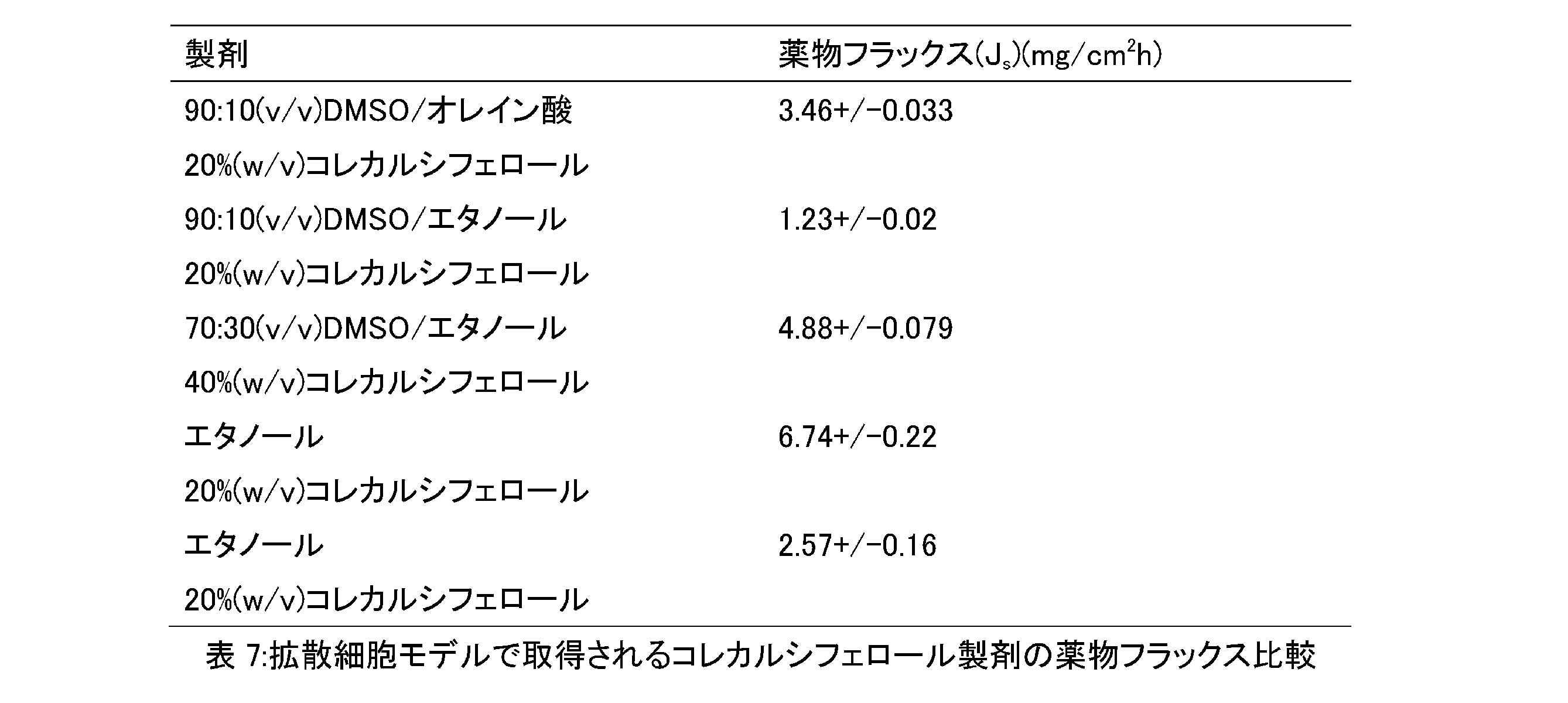
C.1.2.3 用量応答
図9を参照するに、この図は、拡散細胞モデルを使用したコレカルシフェロール濃度と拡散比率を関係づける用量応答相関関係を示す。合計で5mlを各ドナーチャンバに加えた。全ての製剤に、示された量のコレカルシフェロールを含有させ、15%(v/v)PEG200を含みDMSO/エタノールの50/50共溶媒で体積を合わせた媒体を使用した。
C. 1.2.3 Dose Response Referring to FIG. 9, this figure shows the dose response correlation relating cholecalciferol concentration and diffusion rate using a diffusion cell model. A total of 5 ml was added to each donor chamber. All formulations contained the indicated amount of cholecalciferol and used a vehicle containing 15% (v/v) PEG200 made up to volume with a 50/50 co-solvent of DMSO/ethanol.
図9は、拡散細胞in-vitroモデルにより測定される用量応答相関関係を示唆する。20%、9%、1.5%および0.15%(w/v)を含む一連のコレカルシフェロール濃度について調べた(下記表8に示す通り)。濃度を用量固定手法から得て、経口毒性を決定した(OECDガイドライン420)(OECD、2001)。結果から、20%(w/v)コレカルシフェロール濃度が最大の薬物フラックスを生じさせることが示唆される。全ての製剤について、15%(v/v)PEG200を含む50:50(v/v)DMSO/エタノール共溶媒を使用した。 FIG. 9 suggests dose-response relationships measured by the diffuse cell in-vitro model. A range of cholecalciferol concentrations were investigated, including 20%, 9%, 1.5% and 0.15% (w/v) (as shown in Table 8 below). Concentrations were obtained from a fixed dose approach to determine oral toxicity (OECD Guideline 420) (OECD, 2001). Results suggest that a 20% (w/v) cholecalciferol concentration produces the greatest drug flux. A 50:50 (v/v) DMSO/ethanol co-solvent containing 15% (v/v) PEG200 was used for all formulations.

C.2 In-vivo結果
以下は、in-vitroモデルを有効にし、製剤の有効性を計量するための、指令98/8/EC(欧州委員会、1998)を参照したin-vivo研究の結果である。研究では、製剤が「十分に効果的」かどうかを決定するためのスクリーニングプロトコルと、有効量に必要なコレカルシフェロールの量を精査するために設計した用量固定手法とを、実施した。
C. 2 In-vivo results The following are the results of in-vivo studies with reference to Directive 98/8/EC (European Commission, 1998) to validate in-vitro models and quantify efficacy of formulations. . The study conducted a screening protocol to determine if a formulation was "sufficiently effective" and a fixed-dose approach designed to probe the amount of cholecalciferol required for effective dose.
C.2.1 スクリーニング試験
合計5種の製剤に、スクリーニングプロトコルを実施した。これらの製剤は、in-vitro研究において、他の化学浸透促進剤と比較して高い薬物フラックスを示した。それらは、セルロース管モデルで示されたDMOS/エタノール共溶媒を使用した2つの製剤と、拡散細胞モデルで示されたエタノールを使用した2つの製剤と、残りは両方のin-vitroモデルで強調されたDMSOおよびオレイン酸からなる製剤である。2つの異なるコレカルシフェロール濃度で実施し、40%(w/v)を、エタノールと70:30(v/v)DMSO/エタノール共溶媒に、20%(w/v)を、エタノールと、90:10(v/v)DMSO/エタノールと、90:10(v/v)DMSO/オレイン酸とに使用した。増粘剤(メチルセルロース)を、DMSOを含有する全ての製剤に加え、1%(w/v)を、90:10(v/v)DMSO/エタノールおよび70:30(v/v)DMSO/エタノール製剤に加えた。一方で0.75%(w/v)を、90:10(v/v)DMSO/オレイン酸製剤に加えた。死亡率およびエンドポイントまでの時間を、各製剤について記録した。製剤はそれぞれ5匹の動物に投与し、体積1mlを各動物に投与した。
C. 2.1 Screening study A total of 5 formulations were subjected to the screening protocol. These formulations demonstrated high drug flux compared to other chemical penetration enhancers in in-vitro studies. They are highlighted in two formulations using the DMOS/ethanol co-solvent shown in the cellulose tube model, two formulations using ethanol in the diffusion cell model, and the rest in both in-vitro models. A formulation consisting of DMSO and oleic acid. Two different cholecalciferol concentrations were run, 40% (w/v) with ethanol and 70:30 (v/v) DMSO/ethanol co-solvent, 20% (w/v) with ethanol, and 90% (w/v) with ethanol. :10 (v/v) DMSO/ethanol and 90:10 (v/v) DMSO/oleic acid. A thickening agent (methylcellulose) was added to all formulations containing DMSO, 1% (w/v) in 90:10 (v/v) DMSO/ethanol and 70:30 (v/v) DMSO/ethanol. Added to the formulation. while 0.75% (w/v) was added to the 90:10 (v/v) DMSO/oleic acid formulation. Mortality and time to endpoint were recorded for each formulation. Each formulation was administered to 5 animals and a volume of 1 ml was administered to each animal.
図10を参照するに、この図は、化学的に浸透を増加させた経皮コレカルシフェロール製剤についての生存率を示す。(a)90:10DMSO/エタノールにおける20%(w/v)コレカルシフェロールに対する生存グラフ;(b)90:10DMSO/オレイン酸における20%(w/v)コレカルシフェロールに対する生存グラフ;(c)70:30DMSO/エタノールにおける40%(w/v)コレカルシフェロールに対する生存グラフ;(d)100%エタノールにおける20%(w/v)コレカルシフェロールに対する生存グラフ;(e)100%エタノールにおける40%コレカルシフェロールに対する生存グラフ;すべての実験でn=5を使用した、(f)全ての製剤に対する死亡率およびエンドポイントまでの時間の要約。 Referring to FIG. 10, this figure shows survival rates for chemically permeation-enhanced transdermal cholecalciferol formulations. (a) survival graph to 20% (w/v) cholecalciferol in 90:10 DMSO/ethanol; (b) survival graph to 20% (w/v) cholecalciferol in 90:10 DMSO/oleic acid; (c) (d) Survival graph to 40% (w/v) cholecalciferol in 70:30 DMSO/ethanol; (d) Survival graph to 20% (w/v) cholecalciferol in 100% ethanol; (e) 40% in 100% ethanol. Survival graph for cholecalciferol; (f) summary of mortality and time to endpoint for all formulations, using n=5 for all experiments.
図10は、ラット皮膚を通じたコレカルシフェロールの移動を改善するように設計した5つの製剤それぞれについての生存率を示す。結果から、DMSOを含有する製剤のみが100%の死亡率を生じさせることを示唆する。EPPOガイドラインに従って、これらの製剤は、さらなる研究が検討されうる。20%および40%(w/v)コレカルシフェロールを含有するエタノール製剤は、それぞれ20%および60%の死亡率を生じた;したがって、これらの製剤は、殺鼠剤として有効とはされず、さらなる研究は正当化されない。結果から、DMSOの含有により、エタノール製剤と比較してコレカルシフェロールの浸透が改善し、適用から5日以内で100%の死亡率を生じさせることが示唆される。動物に対する製剤の効果を評価するため、ならびにあらゆる苦痛および苦渋を定量するために、苦痛評点表を使用して1日に2~3回、苦痛の評価を行った。評点表では、苦痛が示されうる5つの主要な分野を考慮した。これらの分野は、全身所見、適用部位の所見、自然挙動、刺激された挙動、ならびに食品および水の摂取量である。これらの各分野に3つの点数を与え、最大で15の苦痛を示すことを可能にした。評点0は、製剤に効果がないことを示す。評点1~5は、挙動のわずかな変化を示し、評点5~10は、中程度の変化を示唆し、一方で、10より上の評点は、立毛および意識不明など、挙動の顕著な変化を示唆する。 Figure 10 shows survival rates for each of five formulations designed to improve cholecalciferol transfer through rat skin. Results suggest that only formulations containing DMSO cause 100% mortality. According to EPPO guidelines, these formulations may be considered for further study. Ethanol formulations containing 20% and 40% (w/v) cholecalciferol produced 20% and 60% mortality, respectively; is not justified. The results suggest that the inclusion of DMSO improves the penetration of cholecalciferol compared to the ethanol formulation, resulting in 100% mortality within 5 days of application. Distress ratings were made 2-3 times daily using a distress scoring chart to assess the effects of the formulations on the animals and to quantify any pain and distress. The scorecard considered five major areas in which distress could be indicated. These areas are systemic findings, application site findings, spontaneous behavior, stimulated behavior, and food and water intake. Three scores were given for each of these domains, allowing a maximum of 15 distress indications. A score of 0 indicates that the formulation is ineffective. A score of 1-5 indicates a slight change in behavior, a score of 5-10 suggests a moderate change, while a score above 10 indicates a significant change in behavior, such as piloerection and unconsciousness. Suggest.
図11を参照するに、この図は、各製剤に曝露された各5匹の動物セットの苦痛評点表を示す。図11(a)は、実験セット1についての苦痛評点を示す。図11(b)は、実験セット2についての苦痛評点を示す。図11(c)は、実験セット3についての苦痛評点を示す。図11(d)は、実験セット4についての苦痛評点を示す。および図11(e)は、実験セット5についての苦痛評点を示す。
Referring to Figure 11, this figure shows the distress score table for each set of 5 animals exposed to each formulation. FIG. 11(a) shows the pain scores for
図11は、苦痛評点表から得られた苦痛の定量結果を示す。動物には連続的に投与が行われ、グラフでは、示された投与周期についての各動物および製剤ごとに苦痛を示している。結果は、エンドポイントでの平均苦痛が5~10であることを示し、この結果は、エタノール中20%(w/v)コレカルシフェロールの場合の平均苦痛2とはかなり離れている。しかしながら、この製剤は、20%の死亡率を生じたに過ぎなかった。これらの結果は、齧歯動物における挙動の中程度の変化、例えば、可動性の減少、ならびに食品および水の減少などを示していると示唆される。 FIG. 11 shows the pain quantification results obtained from the pain score table. Animals were dosed sequentially and the graph shows distress for each animal and formulation for the indicated dosing cycle. The results show that the mean pain at the endpoint was 5-10, which is far from the mean pain of 2 for 20% (w/v) cholecalciferol in ethanol. However, this formulation only caused 20% mortality. These results are suggested to indicate moderate changes in behavior in rodents, such as decreased mobility and decreased food and water.
図12は、全ての動物についてのエンドポイントでの平均苦痛を示す。全ての場合において、0は苦痛がないことであり、15は苦痛が最大であること、ここでは動物が立毛、可動度の顕著な減少ならびに食品および水の摂取量の減少を示すことである。エンドポイントは、実験の終点も含んでおり、エタノール中20%(w/v)のコレカルシフェロールの場合には、軽度の苦痛は死亡した動物の20%のみであることが示唆された。 Figure 12 shows the mean pain at endpoint for all animals. In all cases, 0 is no pain and 15 is maximal pain, where the animal exhibits piloerection, markedly reduced mobility and reduced food and water intake. Endpoints also included the endpoint of the experiment, suggesting that for 20% (w/v) cholecalciferol in ethanol, mild distress was only 20% of animals that died.
C.2.2 用量固定手法
全部で5種の製剤を用量固定手法に使用した。ここではコレカルシフェロール濃度をOECDガイドライン420(OECD,2001)に従って変化させ、GHS分類と効果が維持されるために必要な最少用量とを決定した。濃度は20%、9%、1.5%および0.15%(w/v)で構成し、15%(v/v)PEG200を含む50:50(v/v)DMSO/エタノール共溶媒の1ml体積中で投与した。負の対照として、15%(v/v)PEG200を含む50:50DMSO/エタノール共溶媒を用いた。死亡率、死亡までの時間および苦痛を、各動物について記録した。共溶媒浸透促進剤としてDMSO/エタノールを使用したが、その理由は、スクリーニングプロトコルの結果から、この製剤にさらなる研究の根拠があることが示唆されたためである。PEG200を製剤に添加して、製剤を増粘し、動物への付着が促進されるよう設定した。
C. 2.2 Fixed Dose Procedure A total of five formulations were used in the fixed dose procedure. Here, the cholecalciferol concentration was varied according to OECD Guideline 420 (OECD, 2001) to determine the GHS classification and the minimum dose required to maintain efficacy. Concentrations consisted of 20%, 9%, 1.5% and 0.15% (w/v) of 50:50 (v/v) DMSO/ethanol co-solvent with 15% (v/v) PEG200. Dosed in a 1 ml volume. A 50:50 DMSO/ethanol co-solvent containing 15% (v/v) PEG200 was used as a negative control. Mortality, time to death and distress were recorded for each animal. DMSO/ethanol was used as a co-solvent permeation enhancer because the results of the screening protocol suggested that this formulation warrants further study. PEG200 was added to the formulation to thicken the formulation and set it to promote adherence to the animal.
図13を参照するに、この図は用量固定手法での生存分析を示す。図13(a)は、9%および20%(w/v)コレカルシフェロール製剤についての生存グラフを示す。他の製剤は0%の死亡率を示すために含めなかった。図13(b)は、全ての製剤についての、死亡率およびエンドポイントまでの平均時間を示す;製剤0%、0.15%および1.5%の場合は全て死亡の症状を示さなかった。
Referring to Figure 13, this figure shows the survival analysis with fixed dose approach. Figure 13(a) shows survival graphs for 9% and 20% (w/v) cholecalciferol formulations. Other formulations were not included to indicate 0% mortality. Figure 13(b) shows the mortality rate and mean time to endpoint for all formulations;
図13は、用量固定手法で得られた生存分析、死亡率、および死亡までの時間を示す。
検討した5つの製剤のうち、9%および20%(w/v)のコレカルシフェロールのみが100%の死亡率を示し、これらの製剤が、指令に従った殺鼠剤として検討するために十分有効であることが示唆される。これらの製剤は、スクリーニングプロトコルで投与されたDMSO/エタノール共溶媒と比較してエンドポイントまでの時間の減少も示す(90:10DMSO/エタノール中20%(w/v)コレカルシフェロールで5日以内に100%の死亡率、50:50DMSO/エタノール中9%(w/v)コレカルシフェロールで3日以内に100%の死亡率)。負の対照は何ら致死性を示さず、このことからコレカルシフェロールが致死作用を担うと結論しうる。
Figure 13 shows the survival analysis, mortality and time to death obtained with the fixed dose approach.
Of the five formulations tested, only 9% and 20% (w/v) cholecalciferol showed 100% mortality, suggesting that these formulations are sufficiently effective to be considered as rodenticides under the Directive. It is suggested that there is These formulations also show reduced time to endpoint compared to the DMSO/ethanol co-solvent administered in the screening protocol (20% (w/v) cholecalciferol in 90:10 DMSO/ethanol within 5 days). 100% mortality within 3 days with 9% (w/v) cholecalciferol in 50:50 DMSO/ethanol). The negative control showed no lethality, from which it can be concluded that cholecalciferol is responsible for the lethal effect.
図14を参照するに、この図は、一定用量の処理プロトコルで試験した5製剤それぞれについての苦痛評点とラット体重を示す。全てのラットに、示された量のコレカルシフェロールを含む1mlの製剤を投与した。図14(a)は、対照群についての苦痛評点および平均ラット体重を示す。図14(b)は、0.15%(w/v)に曝露された群の苦痛評点と平均ラット体重を示す。軽度の苦痛が示されたがラットの体重増加が示された。図14(c)は、1.5%(w/v)コレカルシフェロールに曝露された群の苦痛評点と平均ラット体重を示す。ラットは苦痛の増加を示し、体重は減少した後でわずかに増加して、回復の兆候が示唆された。図14(d)は、9%(w/v)コレカルシフェロールに曝露された群の苦痛評点と平均ラット体重を示す。結果は、24時間後の苦痛の急激な増加と体重の顕著な低下を示唆する。図14(e)は、20%(w/v)に曝露された群の苦痛評点と平均ラット体重を示す。結果は、苦痛の急激な増加と24時間後の平均ラット体重の低下を示唆する。 Referring to Figure 14, this figure shows pain scores and rat body weights for each of the five formulations tested in the fixed dose treatment protocol. All rats received 1 ml of formulation containing the indicated amount of cholecalciferol. Figure 14(a) shows the pain scores and mean rat body weights for the control group. Figure 14(b) shows the pain scores and mean rat body weights of the groups exposed to 0.15% (w/v). Weight gain in rats was noted although mild distress was noted. Figure 14(c) shows the distress scores and mean rat body weights for the groups exposed to 1.5% (w/v) cholecalciferol. Rats showed increased distress and weight loss followed by a slight increase suggesting signs of recovery. Figure 14(d) shows the distress scores and mean rat body weights for the group exposed to 9% (w/v) cholecalciferol. Results suggest a sharp increase in pain and a marked drop in body weight after 24 hours. Figure 14(e) shows the pain scores and mean rat body weights of the 20% (w/v) exposed group. Results suggest a sharp increase in pain and a decrease in average rat body weight after 24 hours.
苦痛の定量は、スクリーニングプロトコルごとに実施し、さらなる体重データをコレカルシフェロール効果について更に情報を得るために測定した。負の対照および0.15%(w/v)コレカルシフェロール用量では、挙動の変化が無しまたは最少であることが示唆された。このことは、食料と水の摂取健常が示唆される体重の増加と合致する。9%(w/v)および20%(w/v)では、挙動の顕著な変化が示された。但し、最初の1日間にはわずかな変化しか観察されず、その後に急速に悪化した。9%(w/v)のコレカルシフェロール用量では、3日以内に100%の死亡率が示された。1.5%(w/v)のコレカルシフェロール用量では、挙動の中程度の変化が示されたが、平均体重の分析では、5日後に体重の増加が示唆される。このことは、動物が回復し始めていたことを示唆する。この用量範囲で示された明白な毒性により、製剤は、GHSカテゴリ2(OECDガイドライン434-新ガイドライン案434への提案(Proposal for a new draft guideline 434)-急性皮膚毒性-用量固定手法)と分類される。 Distress quantification was performed per screening protocol and additional body weight data were measured to provide further information on cholecalciferol effects. Negative controls and 0.15% (w/v) cholecalciferol doses suggested no or minimal changes in behavior. This is consistent with weight gain suggesting healthy food and water intake. 9% (w/v) and 20% (w/v) showed significant changes in behavior. However, only minor changes were observed during the first day, followed by rapid deterioration. A 9% (w/v) cholecalciferol dose showed 100% mortality within 3 days. Cholecalciferol doses of 1.5% (w/v) showed modest changes in behavior, but mean body weight analysis suggests weight gain after 5 days. This suggests that the animals were beginning to recover. Due to the apparent toxicity exhibited in this dose range, the formulation was classified as GHS Category 2 (OECD Guideline 434 - Proposal for a new draft guideline 434 - Acute dermal toxicity - Fixed dose approach). be done.
(D)考察
コレカルシフェロールのin-vivo送達に関する従前の報告では、エタノールが、効果的な浸透促進剤であり、担体物質であると示唆されている(アグニュー(Agnew),W.R.(2010),“Topical pesticide formulation”,国際公開第2010/071450 A1号、世界知的所有権機関;アグニュー(Agnew),W.R.(2011),“Topical pesticide formulation”,米国特許出願公開第2011/0257135 A1号、米国特許)。エタノールの使用は、コレカルシフェロールが有機溶媒に「溶けやすい」(British Pharmacopoeia.(2012),“Colecalciferol”、英国薬局方)ことから論理的であり、多量のコレカルシフェロールを製剤中で送達しうる。高濃度のコレカルシフェロールは、真皮に跨る高い拡散勾配を生じさせることによって、経皮送達を促進する。しかしながら、これらの報告は、体重が未知のラットへ単独で適用したときの知見に基づくものである。したがって、公開されたデータは、EPPOガイドライン(EPPO、1998)、つまりは指令による有効性を根拠づけるために十分なものではない。
(D) Discussion Previous reports on in-vivo delivery of cholecalciferol suggest that ethanol is an effective penetration enhancer and carrier material (Agnew, W.R. 2010), "Topical pesticide formulation", WO 2010/071450 A1, World Intellectual Property Organization; /0257135 A1, U.S. Patent). The use of ethanol is logical because cholecalciferol is "easily soluble" in organic solvents (British Pharmacopoeia. (2012), "Colecalciferol", British Pharmacopoeia), delivering large amounts of cholecalciferol in the formulation. sell. High concentrations of cholecalciferol facilitate transdermal delivery by creating a high diffusion gradient across the dermis. However, these reports are based on findings when applied alone to rats of unknown body weight. The published data are therefore not sufficient to justify the validity of the EPPO guidelines (EPPO, 1998), ie the Directive.
さらに殺鼠剤としてのコレカルシフェロールの経皮送達を検討するために、製剤をスクリーニングするための2つのin-vitroモデルを開発した。両方のモデルで、先に公開された研究で記載された装置を使用した。セルロース管モデルとして、(オールトン(Aulton),M.E.(2007),“Aulton’s Pharmaceutics: The design and manufacture of medicines”,Edinburgh;New York,Churchill Livingstone;バリー(Barry),B.W.(1983),“Dermatological Formulations”,pp.49-94,New York,NY,Marcel Dekker Inc.)に記載されているものを最初に使用し、次に、いくつかの研究で使用されているように、拡散細胞装置を使用してさらに試験した。セルロース管モデルを使用したとき、DMSO/エタノール共溶媒中のコレカルシフェロール(10%w/v コレカルシフェロール)に対して、0.25+/-0.019mg/cm2hの薬物フラックスが達成された。アグニュー(Agnew)により提唱されたエタノール製剤(アグニュー(Agnew),W.R.(2010),“Topical pesticide formulation”、国際公開第2010/071450 A1号、世界知的所有権機関;アグニュー(Agnew),W.R.(2011),“Topical pesticide formulation”、米国特許出願公開第2011/0257135 A1号、米国特許)もこのモデルを使用して試験した。0.13+/-0.0035mg/cm2h(10%w/v コレカルシフェロール)の低い薬物フラックスとなった。しかしながら、これらの製剤を拡散細胞モデルで試験したときは、反対の結果が観察された(20%(w/v)コレカルシフェロール濃度で、90:10v/vDMSO/エタノールについて3.46+/-0.033mg/cm2hの薬物フラックスおよびエタノールについて2.57+/-0.16mg/cm2hの薬物フラックス)。拡散細胞モデルでは、2つのコレカルシフェロール濃度(20%および40%w/v)について、DMSO/エタノール共溶媒と比較してエタノール製剤の薬物フラックスがより高いことが示唆された。モデル間の差異は、おそらくは拡散面積によるものである。セルロース管モデルは、40cm2の拡散面積を有し、一方で、拡散細胞モデルは、小さい2.54cm2の面積を有する。DMSOは、膜の撹乱と孔径の増加により、拡散を促進させる。セルロースバッグ内の拡散面積の増加は、DMSO製剤を区別するために十分であるが、拡散細胞モデルは十分でない。代替的な駆動メカニズムが拡散細胞モデル内に存在し、モデル間に矛盾する結果を生じさせている可能性もある。 To further investigate the transdermal delivery of cholecalciferol as a rodenticide, two in-vitro models were developed to screen formulations. Both models used the apparatus described in previously published studies. As a cellulose vessel model, (Aulton, ME (2007), "Aulton's Pharmaceutics: The design and manufacture of medicines", Edinburgh; New York, Churchill Livingstone; Barry, B.W. (1983), "Dermatological Formulations", pp. 49-94, New York, NY, Marcel Dekker Inc.) was first used and then used in some studies. was further tested using a diffusion cell apparatus. A drug flux of 0.25+/-0.019 mg/cm 2 h was achieved for cholecalciferol (10% w/v cholecalciferol) in DMSO/ethanol co-solvent when using the cellulose vessel model. rice field. Ethanol formulation proposed by Agnew (Agnew, WR (2010), "Topical pesticide formulation", WO 2010/071450 A1, World Intellectual Property Organization; Agnew , W. R. (2011), "Topical pesticide formulation," US Patent Application Publication No. 2011/0257135 A1, US Patent) was also tested using this model. A low drug flux of 0.13+/-0.0035 mg/cm 2 h (10% w/v cholecalciferol) resulted. However, when these formulations were tested in the diffusion cell model, the opposite result was observed (3.46 +/-0 for 90:10 v/v DMSO/ethanol at 20% (w/v) cholecalciferol concentration) .033 mg/cm 2 h drug flux and 2.57+/-0.16 mg/cm 2 h drug flux for ethanol). The diffusion cell model suggested higher drug flux for the ethanol formulation compared to the DMSO/ethanol co-solvent for two cholecalciferol concentrations (20% and 40% w/v). Differences between models are probably due to diffusion area. The cellulose vessel model has a diffusion area of 40 cm 2 while the diffusion cell model has a smaller area of 2.54 cm 2 . DMSO facilitates diffusion by perturbing the membrane and increasing the pore size. The increased diffusion area within the cellulose bag is sufficient to distinguish DMSO formulations, but not the diffusion cell model. It is also possible that alternative driving mechanisms exist within the diffuse cell model, giving rise to conflicting results between models.
in-vitroデータに加えて、いずれかのモデルを有効にし、指令に応じた必要な実験有効性データを得るために、in-vivo研究も実施した。EPPOガイドライン(P1/113(2))(EPPO(1998),“Efficacy evaluation of rodenticides Laboratory tests for evaluation of the toxicity and acceptability of rodenticides and rodenticide preparations”(PP1/113(2)))は、殺鼠剤が「十分に有効」と考えられるためには、スクリーニングプロトコル中で100%の死亡率が観察されなければならないと述べている。スクリーニングプロトコルは、DMSO共溶媒とエタノール製剤とを比較することと、これらの製剤にさらなる研究のための根拠があるかを判定することとの両方に役立った。20%および40%(w/v)コレカルシフェロールを含むエタノール製剤は、スクリーニングプロトコル中にそれぞれ20%および60%の死亡率を示した。一方で、DMSOを含有するすべての製剤は、100%の死亡率(90:10(v/v)DMSO/エタノール、70:30(v/v)DMSO/エタノールおよび90:10(v/v)DMSO/オレイン酸)を示した。全ての製剤が、適用から5日以内に致死させ、挙動に中程度の変化を生じさせた。EEPOガイドラインによれば、エタノールに基づく製剤は、十分な致死性を生じさせるものでないため、殺鼠剤として使用するものとはみなされないであろう。これらの研究と、アグニュー(Agnew)の研究(アグニュー(Agnew),W.R.(2010),“Topical pesticide formulation”、国際公開第2010/071450 A1号、世界知的所有権機関;アグニュー(Agnew),W.R.(2011),“Topical pesticide formulation”,米国特許出願公開第2011/0257135 A1号、米国特許)との差異は、齧歯動物の種の違いに存在しうる。この試験では、体重が250~350gのSprague Dawley齧歯動物を使用しており、一方、アグニュー(Agnew)の特許では、体重不明のNorwayラット(ドブネズミ(Rattus norvegious))が使用されているが、Norwayラットは一般に実験系統より体重が少ない。その結果は、20%(w/v)のコレカルシフェロール用量は、より体重の少ない齧歯動物に対してはより強力であろうことを意味する。スクリーニングプロトコルからのin-vivo結果も、セルロース管in-vitroモデルがin-vivo結果とより密接に相関することを示唆している。 In addition to the in-vitro data, in-vivo studies were also performed to validate either model and obtain the necessary experimental efficacy data as directed. EPPOガイドライン(P1/113(2))(EPPO(1998),“Efficacy evaluation of rodenticides Laboratory tests for evaluation of the toxicity and acceptability of rodenticides and rodenticide preparations”(PP1/113(2)))は、殺鼠剤が「 100% mortality must be observed in screening protocols to be considered "sufficiently efficacious." The screening protocol served both to compare DMSO co-solvent and ethanol formulations and to determine if these formulations warranted further study. Ethanol formulations containing 20% and 40% (w/v) cholecalciferol showed 20% and 60% mortality, respectively, during the screening protocol. On the other hand, all formulations containing DMSO showed 100% mortality (90:10 (v/v) DMSO/ethanol, 70:30 (v/v) DMSO/ethanol and 90:10 (v/v) DMSO/oleic acid) was shown. All formulations caused lethality and moderate changes in behavior within 5 days of application. According to EEPO guidelines, ethanol-based formulations do not produce sufficient lethality and would not be considered for use as rodenticides. These studies and those of Agnew (Agnew, W. R. (2010), "Topical pesticide formulation", WO 2010/071450 A1, World Intellectual Property Organization; Agnew ), W. R. (2011), "Topical pesticide formulation", US Patent Application Publication No. 2011/0257135 A1, US Patent) may exist in rodent species differences. This study uses Sprague Dawley rodents weighing 250-350 g, whereas the Agnew patent uses Norway rats (Rattus norvegious) of unknown weight. Norway rats generally weigh less than experimental strains. The results imply that a 20% (w/v) cholecalciferol dose would be more potent in rodents with lower body weights. The in-vivo results from the screening protocol also suggest that the cellulose duct in-vitro model correlates more closely with the in-vivo results.
第2のプロトコルは、OECDガイドライン420(OECD(2001)、OECDガイドライン420-急性経口毒性-用量固定手法)で示されている用量固定手法に基づいて実施し、ここでは4つの用量のコレカルシフェロールを投与した。この研究は、殺鼠剤が該当するGHSカテゴリの決定と少ない用量での有効性の決定の両方のために設計した。低用量の0.15%(w/v)コレカルシフェロールは毒性の根拠を示さず、負の対照も同様であることから、実際には、実質的な量のコレカルシフェロールが致死作用を担うことが示唆される。明白な毒性は、15%(v/v)PEG200を50:50(v/v)DMSO/エタノールで1mlにした中で1.5%(w/v)コレカルシフェロールを投与した齧歯動物で示された。これにより、急性皮膚毒性GHSカテゴリ2(OECDガイドライン434)(OECD(2004)、OECDガイドライン434-新ガイドライン案434への提案-急性皮膚毒性-用量固定手法)であることが示唆される。9%(w/v)のコレカルシフェロール用量で、100%の死亡率に至ったことは、この特定の製剤が、商業的殺鼠剤として使用するにあたって十分有効であることを示唆している。この特定の用量で3日以内に100%の死亡率が示されたが、これはスクリーニング試験で示された結果よりも速い。但し、苦痛評点は、投与後24時間で齧歯動物が急速に悪化することを示唆する。 The second protocol was performed based on the fixed dose approach given in OECD Guideline 420 (OECD (2001), OECD Guideline 420—Acute Oral Toxicity—Fixed Dose Approach), where four doses of cholecalciferol was administered. This study was designed both to determine the GHS category to which the rodenticide falls and to determine efficacy at lower doses. Since the low dose of 0.15% (w/v) cholecalciferol showed no evidence of toxicity, as did the negative controls, a substantial amount of cholecalciferol is actually responsible for the lethal effect. is suggested. Apparent toxicity was observed in rodents administered 1.5% (w/v) cholecalciferol in 1 ml of 15% (v/v) PEG200 in 50:50 (v/v) DMSO/ethanol. shown. This suggests acute dermal toxicity GHS Category 2 (OECD Guideline 434) (OECD (2004), OECD Guideline 434-Proposal for New Draft Guideline 434-Acute Dermal Toxicity-Fixed Dose Approach). A cholecalciferol dose of 9% (w/v) resulted in 100% mortality, suggesting that this particular formulation is sufficiently effective for use as a commercial rodenticide. This particular dose showed 100% mortality within 3 days, which is faster than results shown in screening studies. However, pain scores suggest that the rodent deteriorates rapidly 24 hours after dosing.
in-vivo研究から、セルロース管in-vitroモデルが、製剤比較についてより正しい結果を示していることが示唆される。その理由は、このモデルとin-vivo研究が、DMSOが、薬物フラックスがより高く、最も有効であると示唆されることを示しているからである。 In-vivo studies suggest that the cellulosic tubule in-vitro model gives more correct results for formulation comparison. This is because this model and in-vivo studies indicate that DMSO is the most efficacious with higher drug flux.
DMSOおよびオレイン酸は、従前に、コレカルシフェロールと共に試験されていない。しかしながらそれらは、抗炎症薬などの化合物に関して(グワァク(Gwak),H.S.,& チュン(Chun),I.K.(2002),“Effect of vehicles and penetration enhancers on the in vitro percutaneous absorption of tenoxicam through hairless mouse skin”,International Journal of Pharmaceutics,236(1-2),57-64;ラルセア(Larrucea),E.,アレラノ(Arellano),A.,サントヨ(Santoyo),S.,& ヤルツア(Ygartua),P.(2001),“Combined effect of oleic acid and propylene glycol on the percutaneous penetration of tenoxicam and its retention in the skin”,European Journal of Pharmaceutics and Biopharmaceutics,52(2),113-9;メシュラム(Meshulam),Y.,カダール(Kadar),T.,ウェニガー(Wengier),A.,ダヒア(Dachir),S.,& レヴィー(Levy),A.(1993),“Transdermal penetration of physostigmine:Effects of oleic acid enhancer”,Drug Development Research,28(4),510-515;モレイラ(Moreira),T.S.,ド・スーザ(de Sousa),V.P.,& ピエレ(Pierre),M.B.R.(2010),“A novel transdermal delivery system for the anti-inflammatory lumiracoxib:influence of oleic acid on in vitro percutaneous absorption and in vivo potential cutaneous irritation”,AAPS PharmSciTech,11(2),621-9)、浸透を改善することが示されてきた(ウィリアムス(Williams),A.C.,& バリー(Barry),B.W.(2012),“Penetration Enhancers”,Advanced Drug Delivery Reviews,64,128-137)。DMSOは、浸透促進剤として証拠づけられたが、皮膚に浸透する際に口中で不快な味を生じさせて使用を減退させるという付随的な作用により、一般的には使用されていない。このことは多くの経皮送達適用において検討事項となるかもしれないが、殺鼠剤としての使用に関しては、死亡するまでの時間と製剤の人道性が優先事項である。この点に関して、透過試験とin-vivoでの結果の両方が、コレカルシフェロールに対して検討された最も有効な浸透促進剤であることを示唆しており、さらなる検討を行うことを正当化する。 DMSO and oleic acid have not previously been tested with cholecalciferol. However, they have not been published in relation to compounds such as anti-inflammatory drugs (Gwak, HS, & Chun, IK (2002), "Effect of vehicles and penetration enhancers on the in vitro percutaneous absorption of tenoxicam through hairless mouse skin", International Journal of Pharmaceutics, 236(1-2), 57-64; Larrucea, E., Arellano, A., Santoyo, S., & Ygartua),P.(2001),“Combined effect of oleic acid and propylene glycol on the percutaneous penetration of tenoxicam and its retention in the skin”,European Journal of Pharmaceutics and Biopharmaceutics,52(2),113-9;メシュラム( Meshulam, Y., Kadar, T., Wengier, A., Dachir, S., & Levy, A. (1993), "Transdermal penetration of physostigmine: effects of oleic acid enhancer", Drug Development Research, 28(4), 510-515; Moreira, T.S., de Sousa, V.P., & Pierre, M.B. R. (2010), “A novel transdermal delivery system for the anti-inflammatory luminacoxib: influence of oleic acid on in vitro percutaneous absorption and in vivo potential cutaneous irritation", AAPS PharmSciTech, 11(2), 621-9), which has been shown to improve penetration (Williams, A.; C. , & Barry, B.; W. (2012), “Penetration Enhancers,” Advanced Drug Delivery Reviews, 64, 128-137). DMSO has been documented as a penetration enhancer, but is not commonly used due to the concomitant effect of producing an unpleasant taste in the mouth when it penetrates the skin, reducing its use. While this may be a consideration in many transdermal delivery applications, for rodenticide use, time to death and formulation humanity are priorities. In this regard, both permeation studies and in-vivo results suggest that it is the most effective permeation enhancer studied for cholecalciferol, justifying further investigation. .
最後に、この結果は、コレカルシフェロールの経皮送達が、抗凝血剤による餌付方法に対する代替手段を提供しうることを示唆している。餌付方法は、成功裡に使用されてきたが、この方法は齧歯動物が致死量の餌を摂取することに依存する。この餌付は必ずしも行われるとはいえず、抗凝血剤耐性を発生させる原因ともなりうる。1回投与の経皮適用は、毒素を皮膚に送達するより効率的な方法でありうる:最適化された最少用量は、環境への無駄で不必要な曝露を減少させうる。この取組の困難な点は、殺鼠剤の適用にある。しかしながら、皮膚送達に利用しうる装置は提案されている(グーディ(Goode),S.L.(2010),“Vertebrate Trap”、国際公開第2010/106352 A1号、世界知的所有権機関)。したがって、この点を考慮すると、コレカルシフェロールの経皮送達は、抗凝血剤餌付の実現可能な代替手段である。 Finally, the results suggest that transdermal delivery of cholecalciferol may provide an alternative to anticoagulant bait methods. The baiting method has been used successfully, but it relies on the rodent ingesting a lethal dose of food. This feeding is not always carried out, and may be the cause of the development of anticoagulant resistance. Single-dose transdermal application can be a more efficient method of delivering toxins to the skin: optimized minimal doses can reduce wasteful and unnecessary exposure to the environment. The difficulty in this approach lies in the application of rodenticides. However, devices have been proposed that could be used for dermal delivery (Goode, SL (2010), "Vertebrate Trap", WO2010/106352 A1, World Intellectual Property Organization). Therefore, with this in mind, transdermal delivery of cholecalciferol is a viable alternative to anticoagulant bait.
(E)結論
この研究の課題は、殺鼠剤としての使用を目的としたコレカルシフェロールの経皮送達を促進するための、適切な化学浸透促進剤を同定することであった。
(E) Conclusions The challenge of this study was to identify suitable chemical penetration enhancers to enhance the transdermal delivery of cholecalciferol for use as a rodenticide.
in-vitroおよびin-vivoの両方の研究を通して、9%(w/v)のコレカルシフェロールを含む1mlの用量の50:50(v/v)DMSO/エタノール15%(v/v)、PEG200媒体(0.350kgラットに対して257mg/kgの用量に相当)が、指令98/8/ECで示唆されている有効性実験ガイドラインに基づいて十分に有効であることが証明された。この用量は、5匹の動物に適用したときに、3日以内で100%の死亡率を生じさせた。投与は、動物の首筋に1mlの製剤を適用することにより実施され、抗凝血剤を用いた殺鼠剤食餌による汎用の方法に対して代替的方法を提供する。
Throughout both in-vitro and in-vivo studies, a 1 ml dose of 50:50 (v/v) DMSO/
実験的な有効性評価と並行して、用量固定手法も、製剤についてのGHS分類を決定するために行った。明白な毒性が、1.5%(w/v)コレカルシフェロール用量を1mlで適用した5匹の動物で決定され、カテゴリ2の分類となった。
In parallel with the experimental efficacy evaluation, a fixed dose approach was also performed to determine the GHS classification for the formulation. Apparent toxicity was determined in 5 animals to which a 1.5% (w/v) cholecalciferol dose was applied in 1 ml, resulting in
in-vivo研究に先行して、2つのin-vitroモデルを、タンパク質製剤をスクリーニングするために開発した。セルロース管モデルは、DMSO/エタノール共溶媒が、コレカルシフェロールが高いフラックスを促進することを示唆する一方、拡散細胞モデルは、エタノール製剤がフラックスを増加させることを示唆した。セルロース管モデルは、in-vivoデータとより高い相関を示し、より正確な様式であることが示唆される。 Prior to in-vivo studies, two in-vitro models were developed for screening protein formulations. The cellulose tube model suggested that the DMSO/ethanol co-solvent promoted cholecalciferol high flux, while the diffusion cell model suggested that the ethanol formulation increased flux. The cellulose vessel model showed higher correlation with the in-vivo data, suggesting a more accurate modality.
この研究は、コレカルシフェロールの経皮送達が、指令に基づいて十分に有効と分類されることと、活性成分も送達様式も異なる抗凝血剤食餌手法に対して代替手段を提供することとを示唆している。 This study demonstrates that transdermal delivery of cholecalciferol is classified as sufficiently effective under the Directive and provides an alternative to dietary anticoagulant approaches that differ in active ingredient and mode of delivery. It suggests.
<実施例4-代替毒性物>
本発明の組成物の使用による合成膜を通じた送達促進の能力の程度を示すために、様々な代替的毒性物に対して、実施例2に対応するin-vitro実験を実施した。試験した毒性物は、抗凝血剤ワルファリンおよびジフェナコウムであった。
<Example 4 - Alternative Toxic>
In-vitro experiments corresponding to Example 2 were performed for various alternative toxicants to demonstrate the extent of the ability of use of the compositions of the present invention to enhance delivery through synthetic membranes. Toxins tested were the anticoagulants warfarin and difenacoum.
結果を図15および16ならびに下記表9に示す。 The results are shown in Figures 15 and 16 and Table 9 below.
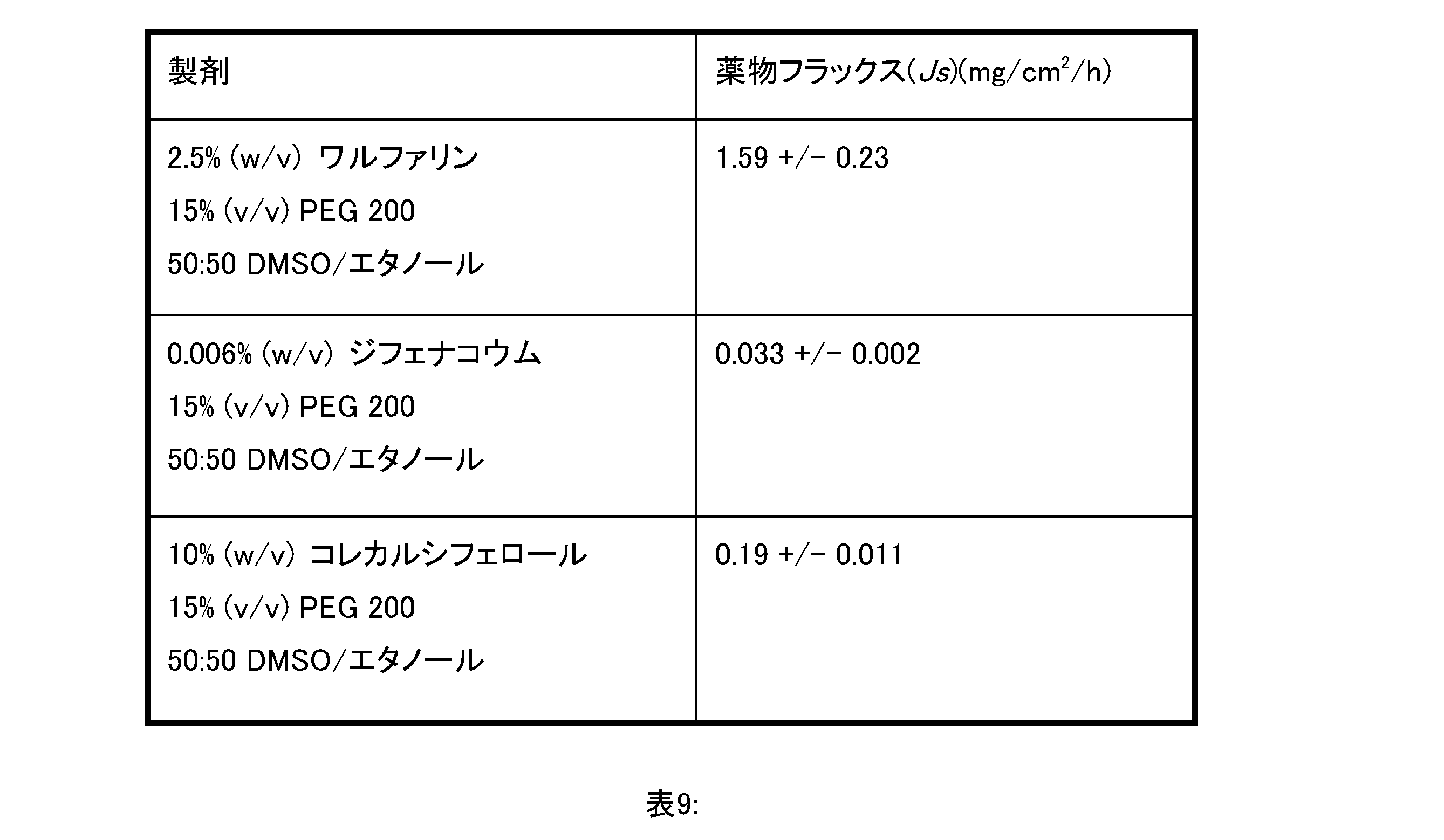
上記結果は、ワルファリンが最も高い薬物フラックスを示すことを示唆する。但し、ワルファリンは、小さい1日用量で、最も効果的である。 The above results suggest that warfarin exhibits the highest drug flux. However, warfarin is most effective at small daily doses.
<実施例5-送達装置の例>
本発明の組成物を標的動物の殺傷のために標的動物に送達する送達装置について、いくつかの実際の例を、添付の図面の図17~22に示した。これらの装置は、本発明者らの先の国際特許出願である国際公開第2010/106352号に開示されている脊椎動物罠の例示的実施形態のいくつかに相当するが、これらは非限定的な例証としてのみ本願に引用して援用する。ある用量または量の殺有害生物または殺害獣組成物(または他の毒物性の薬剤を含有する組成物)を動物に送達することにより作用する任意の既知の送達装置または齧歯動物(もしくは他の動物)罠が、本発明の組成物を送達するために、同様のまたは対応する様式で使用しうることが理解されるべきである。
Example 5 - Example of delivery device
Some practical examples of delivery devices for delivering the composition of the present invention to a target animal for killing of the target animal are shown in Figures 17-22 of the accompanying drawings. These devices represent, but are not limited to, some of the exemplary embodiments of the vertebrate traps disclosed in our earlier International Patent Application WO2010/106352. are incorporated herein by reference only by way of illustration. Any known delivery device or rodent (or other It should be understood that animal) traps can be used in a similar or corresponding manner to deliver the compositions of the present invention.
図17は、脊椎動物罠、つまり、この実施形態においては、囲い2と、加圧推進剤またはキャリアガス格納器3とを含む齧歯動物罠1を示す。格納器3は、さらに、本発明による殺害獣組成物の供給物を含んでおり、囲い2の中に入る動物の表面上に適用するために、囲い2内に送達されるよう準備されている。囲い2は、第1の開放端4と第2の開放端5を有する中空の管状部材を含んでいる。囲い2は、支持体7および8により、ベース6上に据え付けられている。
FIG. 17 shows a vertebrate trap, in this embodiment a
ガス格納器3は、囲い2に固定されたクリップ10により囲い2上に据え付けられている。格納器3は、ノズル11を含んでいる。ノズル11は、接続用素子13によって導管またはチューブ12に接続されている。接続用素子13は、例えば、ねじ接続または他の適切な接続手段により、ノズル11を取り外し可能に接続している。
格納器3は、格納器3内のガス圧を感じることのできる圧力センサ17と、基地、制御局または監視局(図示せず)へ、格納器3のガス圧を示す無線信号を送信することができる無線送信器18とをさらに含んでいる。但し、任意の適切な形態のセンサおよび無線機が使用しうることを理解されたい。
The
囲い2は、さらにGPS受信機19を無線送信機20との組み合わせで含んでおり、ここで送信機20は、基地、制御局または監視局へ、罠の位置を示す無線信号を送信する。繰り返すが、任意の代替的な適切な位置決定手段および関連する発信機が使用しうることを理解されたい。
図18について、この図は、図17の罠の囲い2の部分断面図を示しており、導管12は、囲い2の下に位置する放出チャンバ14に接続されている。放出チャンバ14は、ベント15を介して、囲い2の内部と連通している。ベント15は、加圧された格納器3の内容物を、チャンバ14を介して囲い2に通すことのできる複数の(a plurality or)穴を有する積層部材を含む。チャンバ14は、格納器3の内容物のチャンバ14への流れを制御する放出部16も収容している。放出部16は、活性化装置(図示せず)から受け取る指示に応答して移動する作動装置(図示せず)と連結されている。囲い2は、さらに、齧歯動物などの脊椎動物の存在を検知する動きセンサである検知器21をさらに含む。但し、任意の適切な検知器を使用しうることを理解されたい。
Referring to FIG. 18, this figure shows a partial cross-sectional view of the
上記罠または図17および18の組成物送達装置は、様々な方法で改変しうる。例えば、囲い2の管状部材は、その第1の開放端と第2の開放端との間に位置する湾曲した中央部分を有してもよい。そのような構成の実例は、下記に示し議論する図22に示された実施形態の内容で示されている。別の改変例では、囲い2の管状部材の1つまたは(好ましくは)両方の開放端部分が、端部分の1方の側からその反対側に及んで延びている1つ以上のバリヤバー31、32を含みうる。そのようなバリヤバーは、例えば、管状部材の端部の壁を通って延びる細孔内に据え付けられている。バリヤバーは、好ましくは、齧歯動物よりも大きな動物が囲い2に入ることが実質的に妨げられるように配置されている。そのようなバリヤバーを利用したそのような構成の実例は、下記に示し議論する図19および図22に示された実施形態の内容で示されている。
The trap or composition delivery device of Figures 17 and 18 may be modified in a variety of ways. For example, the tubular member of
図19および20は、齧歯動物罠1の第2の実施形態を示す。同じ参照数字を、両方の実施形態について、同じ特徴のために使用している。第2の実施形態において、加圧されたガス格納器3は、ベース6内に形成されたポート50内で受け取られる。ポート50は、格納器3のねじ型ノズル11を確実に受け取るためのねじ穴を含んでいる。導管またはチューブ12は、ポート50から放出チャンバ14に伸びている(これらの図では隠れている)。さらに、この実施形態において、ベント15は、囲い2の壁内に位置し、オリフィス導管52によって放出チャンバ14と接続された放出オリフィス51によって置き換えられている。バリヤバー31および32は垂直に延び、囲い2の各端で隣接して位置している。
19 and 20 show a second embodiment of the
図21および22の第3の実施形態において、ベース6は、作動筐体70と置き換えられる。筐体は、格納器3のノズル11を受け取るためのポート71を備える。先の実施形態において、ポート71は、格納器3のねじ型ノズル11と相補的に係合するねじ穴を含んでいる。筐体70は、格納器の内容物(本発明による殺害獣組成物を含む)を囲い2の下の放出チャンバに移すためのチャネル(図示せず)を含んでいる。
In a third embodiment of FIGS. 21 and 22 the
使用に際し、本発明の組成物を含有する格納器3は、接続用素子13またはポート50もしくは71のいずれかに接続されている。罠の制御装置は、放出部を定期的に作動させて、組成物の一定用量が、格納器3から囲い2の内部へ、放出チャンバ14およびベント15またはオリフィス51を介して、放出されるように取り付けられている。例えば、誘引物質またはフェロモン成分が組成物に含まれるとき、その成分は好ましくは空気伝達性であるため、齧歯動物を罠へ誘引するために、囲い2から周囲の空気中へ発散されうる。代替的にまたは付加的に、いくつかの他の適切な形態の餌を、齧歯動物を罠に誘い込むために囲いの中に置いてもよい。
In use,
齧歯動物が囲い2に入ったら、第1のセンサを作動させ、信号を制御装置に送る。第1のセンサが作動しつづける場合、第2のセンサが活性化され、制御装置が放出部を動かして、殺害獣組成物が、加圧された格納器3から囲い2の中へ流れるようにする。制御装置は、齧歯動物が致死的に毒されるために十分な用量に相当する所定の時間の間、放出部が作動するように取り付けられる。所定の時間が満了したら、放出部が元の位置に戻り、導管12が閉鎖され、さらなる組成物2が囲い2に入ることが妨げられる。制御装置は、所定の時間が経過してから、再び第1のセンサおよび第2のセンサを受け取る信号に作用するようにプログラム化されている。これにより、齧歯動物が罠から離れる時間ができ、殺傷のために必要な量を上回る組成物の毒性成分が組成物に送達されることが妨げられる。
When a rodent enters
上述のように、上記の送達装置の様々な代替的な種類、構成、および配置が、本発明ならびにその様々な態様における様々な実施形態による組成物の送達または方法もしくは使用の実施のために利用しうる。 As noted above, various alternative types, configurations, and arrangements of the delivery devices described above are utilized to deliver compositions or practice methods or uses according to various embodiments of the present invention and various aspects thereof. I can.
上記本発明の好ましい実施形態、特徴、および態様、ならびにその例証的実施例の説明は、非限定的な例示にすぎず、様々な変形が、詳細に説明され議論されたそれら実施形態、特徴および態様から為されうること、また一方でそれら変形も、添付の特許請求の範囲で定義される本発明の範囲内にあることが理解されるべきである。 The above description of preferred embodiments, features, and aspects of the invention, as well as illustrative examples thereof, are non-limiting examples only, and various variations of those embodiments, features, and aspects have been described and discussed in detail. It should be understood that modifications may be made from the embodiments, while still falling within the scope of the invention as defined in the appended claims.
上記本発明の好ましい実施形態、特徴、および態様、ならびにその例証的実施例の説明は、非限定的な例示にすぎず、様々な変形が、詳細に説明され議論されたそれら実施形態、特徴および態様から為されうること、また一方でそれら変形も、添付の特許請求の範囲で定義される本発明の範囲内にあることが理解されるべきである。
(1)齧歯動物、有袋動物、ウサギ科動物およびイタチ科動物からなる群から選択される標的害獣動物を殺傷するための液体の組成物であって、
(i)前記組成物の重量に対して0.001重量%~90重量%の量の、前記標的害獣動物に対して毒性のある1つ以上の毒素剤を含む毒性成分であって、ある用量の前記組成物が前記標的害獣動物の皮膚に適用されたときに前記標的害獣動物を殺傷するのに十分な量で前記組成物中に存在する毒物成分と、
(ii)前記毒性成分のための担体系と
を含み、
ここで前記担体系(ii)は、
(a)アルコール、グリコール、グリコールエーテル、グリセロールホルマール、ポリエチレングリコール、液体ポリオキシエチレングリコール、ピロリドン、アセトン、アセトニトリル、アミド、フタル酸エステルのうちの1つ以上の化合物から選択される、前記担体系の重量に対して1重量%~99重量%の量の、前記毒性成分のための液体の溶媒または分散媒と、
(b)前記標的害獣動物の皮膚内へのおよび/または皮膚を通じた前記毒性成分の通過を促進または増強するための、前記担体系の重量に対して20重量%~90重量%の量の、スルホキシド、アミド、炭化水素、ケトン、エーテルの群から選択される1つ以上の物質を含む皮膚撹乱成分と、
を含む、組成物。
(2)(1)に記載の組成物であって、前記毒性成分(i)が実質的に水不溶性である、組成物。
(3)(1)または(2)に記載の組成物であって、前記1つ以上の毒素剤が、コレカルシフェロール、25-ヒドロキシコレカルシフェロール、ビタミンD
3
、カルシフェロール、エルゴカルシフェロール、抗凝血剤、金属リン化物、α-ナフチルチオ尿素、ヒ素化合物、バリウム合成物、タリウム化合物、ブロメタリン、クロラローゼ、クリミジン、1,3-ジフルオロ-2-プロパノール、エンドリン、フルオロアセトアミド、ホサセチム、白リン、ピリヌロン、シリロシド、フルオロ酢酸ナトリウム、ストリキニーネ、テトラメチレンジスルホテトラミン、シアン化水素、シアン化ナトリウム、シアン化カリウム、および細菌またはウイルスの毒素の1つ以上から選択される、組成物。
(4)(3)に記載の組成物であって、前記1つ以上の毒素剤が、コレカルシフェロール、25-ヒドロキシコレカルシフェロール、ビタミンD
3
、ワルファリン、ジフェナコウムの1つ以上から選択される、組成物。
(5)(1)~(4)のいずれか1つに記載の組成物であって、前記毒性成分(i)が、前記組成物の0.01重量%~75重量%の量で前記組成物中に存在する、組成物。
(6)(5)に記載の組成物であって、前記毒性成分(i)が、前記組成物の0.1重量%~70重量%の量で前記組成物中に存在する、組成物。
(7)(6)に記載の組成物であって、前記毒性成分(i)が、前記組成物の1重量%~60重量%の量で前記組成物中に存在する、組成物。
(8)(1)~(7)のいずれか1つに記載の組成物であって、
前記組成物中の前記毒物成分(i)の濃度は、前記組成物の単一用量が前記標的害獣動物にとって致死的であるのに十分であるが、その最小致死量を大きく超えない量の前記毒物成分を含むように選択される、組成物。
(9)(1)~(8)のいずれか1つに記載の組成物であって、前記皮膚撹乱成分(b)が、1つ以上のスルホキシドを含む、組成物。
(10)(9)に記載の組成物であって、前記皮膚撹乱成分(b)が、ジメチルスルホキシド(DMSO)を含む、組成物。
(11)(1)~(10)のいずれか1つに記載の組成物であって、前記皮膚撹乱成分(b)が、前記担体系(ii)の重量に対して30重量%~80重量%の量で前記組成物中に存在する、組成物。
(12)(11)に記載の組成物であって、前記皮膚撹乱成分(b)が、前記担体系(ii)の重量に対して40重量%~70重量%の量で存在する、組成物。
(13)(1)~(12)のいずれか1つに記載の組成物であって、前記担体系(ii)の前記溶媒または分散媒(a)が、前記担体系(ii)の重量に対して10または25重量%~60または70重量%の量で存在する、組成物。
(14)(1)~(13)のいずれか1つに記載の組成物であって、1つ以上のフェロモンまたは他の誘引化合物をさらに含む、組成物。
(15)(1)~(14)のいずれか1つに記載の組成物であって、
組成物の総重量に対して10重量%までの、
(i)皮膚浸透促進剤、
(ii)湿潤剤、
(iii)粘度調整剤、
(iv)共溶媒、
(v)1つ以上の乳化剤、安定剤、保存料、皮膚軟化剤、香料、着色剤、または色素、pH調整剤、ゲル形成剤、泡形成剤、薬剤から選択される他の付加的物質、
(vi)1つ以上のエアロゾル噴射剤から選択される送達促進成分、
のいずれかから選択される1つ以上の付加的成分をさらに含む、組成物。
(16)齧歯動物、有袋動物、ウサギ科動物およびイタチ科動物からなる群から選択される標的害獣動物の殺傷方法であって、(1)~(15)のいずれか1つに記載の液体の組成物を、前記標的害獣動物の皮膚に送達することを含む、方法。
(17)1つ以上の毒素剤を齧歯動物、有袋動物、ウサギ科動物およびイタチ科動物からなる群から選択される標的害獣動物の皮膚に送達することによる標的害獣動物の殺傷のための装置であって、
(i)前記標的害獣動物が入ることができる囲いと、
(ii)(1)~(15)のいずれか1つに記載の液体の組成物の供給物を含有する格納器手段と、
(iii)致死用量の前記液体の組成物を前記標的害獣動物の皮膚に送達する送達手段と、
を含む、装置。
The above description of preferred embodiments, features, and aspects of the invention, as well as illustrative examples thereof, are non-limiting examples only, and various variations of those embodiments, features, and aspects have been described and discussed in detail. It should be understood that modifications may be made from the embodiments, while still falling within the scope of the invention as defined in the appended claims.
(1) A liquid composition for killing a target pest selected from the group consisting of rodents, marsupials, lagomorphs and mustelids, comprising:
(i) a toxic component, in an amount of 0.001% to 90% by weight of the composition, comprising one or more toxic agents that are toxic to the target pest animal; a toxic component present in the composition in an amount sufficient to kill the target pest when a dose of the composition is applied to the skin of the target pest;
(ii) a carrier system for said toxic component;
including
wherein said carrier system (ii) is
(a) of said carrier system selected from one or more compounds of alcohols, glycols, glycol ethers, glycerol formals, polyethylene glycols, liquid polyoxyethylene glycols, pyrrolidones, acetone, acetonitrile, amides, phthalates; a liquid solvent or dispersion medium for the toxic component in an amount of 1% to 99% by weight;
(b) in an amount of 20% to 90% by weight, based on the weight of said carrier system, to facilitate or enhance the passage of said toxic ingredient into and/or through the skin of said target pest animal; , sulfoxides, amides, hydrocarbons, ketones, ethers;
A composition comprising:
(2) The composition according to (1), wherein said toxic component (i) is substantially water-insoluble.
(3) The composition of (1) or (2), wherein the one or more toxin agents are cholecalciferol, 25-hydroxycholecalciferol, vitamin D 3 , calciferol, ergocalciferol, Anticoagulants, metal phosphides, α-naphthylthiourea, arsenic compounds, barium compounds, thallium compounds, bromethalin, chloralose, crimidine, 1,3-difluoro-2-propanol, endrin, fluoroacetamide, fosacetim, white phosphorus, A composition selected from one or more of pyrinurone, silyloside, sodium fluoroacetate, strychnine, tetramethylenedisulfotetramine, hydrogen cyanide, sodium cyanide, potassium cyanide, and bacterial or viral toxins.
(4) The composition of (3), wherein the one or more toxin agents are selected from one or more of cholecalciferol, 25-hydroxycholecalciferol, vitamin D3 , warfarin, difenacoum. ,Composition.
(5) The composition according to any one of (1) to (4), wherein the toxic component (i) is present in an amount of 0.01% to 75% by weight of the composition. A composition present in a substance.
(6) The composition according to (5), wherein said toxic component (i) is present in said composition in an amount of 0.1% to 70% by weight of said composition.
(7) The composition according to (6), wherein said toxic component (i) is present in said composition in an amount of 1% to 60% by weight of said composition.
(8) The composition according to any one of (1) to (7),
The concentration of said toxic component (i) in said composition is sufficient for a single dose of said composition to be lethal to said target pest, but not significantly above its minimum lethal dose. A composition selected to include said toxic component.
(9) The composition according to any one of (1) to (8), wherein said skin disruptive component (b) comprises one or more sulfoxides.
(10) The composition according to (9), wherein the skin disruptive component (b) comprises dimethylsulfoxide (DMSO).
(11) The composition according to any one of (1) to (10), wherein the skin disruptive component (b) is 30% to 80% by weight relative to the weight of the carrier system (ii). % present in said composition.
(12) The composition according to (11), wherein said skin disruptive component (b) is present in an amount of 40% to 70% by weight relative to the weight of said carrier system (ii). .
(13) The composition according to any one of (1) to (12), wherein the solvent or dispersion medium (a) of the carrier system (ii) is present in an amount of 10 or 25% to 60 or 70% by weight relative to the composition.
(14) The composition of any one of (1)-(13), further comprising one or more pheromones or other attractant compounds.
(15) The composition according to any one of (1) to (14),
up to 10% by weight relative to the total weight of the composition,
(i) a skin penetration enhancer;
(ii) a wetting agent;
(iii) a viscosity modifier,
(iv) a co-solvent;
(v) one or more emulsifiers, stabilizers, preservatives, emollients, fragrances, colorants or other additional substances selected from pigments, pH modifiers, gel formers, foam formers, drugs;
(vi) a delivery-enhancing component selected from one or more aerosol propellants;
A composition further comprising one or more additional ingredients selected from any of
(16) A method of killing a target pest selected from the group consisting of rodents, marsupials, lagomorphs and mustelids, according to any one of (1) to (15). to the skin of said target pest.
(17) killing the target pest by delivering one or more toxin agents to the skin of the target pest selected from the group consisting of rodents, marsupials, lagomorphs and mustelids; a device for
(i) an enclosure into which the target pest can enter;
(ii) containment means containing a supply of the liquid composition of any one of (1) to (15);
(iii) a delivery means for delivering a lethal dose of said liquid composition to the skin of said target pest;
apparatus, including
Claims (17)
(i)前記組成物の重量に対して0.001重量%~90重量%の量の、前記標的害獣動物に対して毒性のある1つ以上の毒素剤を含む毒性成分であって、ある用量の前記組成物が前記標的害獣動物の皮膚に適用されたときに前記標的害獣動物を殺傷するのに十分な量で前記組成物中に存在する毒物成分と、
(ii)前記毒性成分のための担体系と
を含み、
ここで前記担体系(ii)は、
(a)アルコール、グリコール、グリコールエーテル、グリセロールホルマール、ポリエチレングリコール、液体ポリオキシエチレングリコール、ピロリドン、アセトン、アセトニトリル、アミド、フタル酸エステルのうちの1つ以上の化合物から選択される、前記担体系の重量に対して1重量%~99重量%の量の、前記毒性成分のための液体の溶媒または分散媒と、
(b)前記標的害獣動物の皮膚内へのおよび/または皮膚を通じた前記毒性成分の通過を促進または増強するための、前記担体系の重量に対して20重量%~90重量%の量の、スルホキシド、アミド、炭化水素、ケトン、エーテルの群から選択される1つ以上の物質を含む皮膚撹乱成分と、
を含むことを特徴とする組成物。 A liquid composition for killing a target pest selected from the group consisting of rodents, marsupials, lagomorphs and mustelids, comprising:
(i) a toxic component, in an amount of 0.001% to 90% by weight of the composition, comprising one or more toxic agents that are toxic to the target pest animal; a toxic component present in the composition in an amount sufficient to kill the target pest when a dose of the composition is applied to the skin of the target pest;
(ii) a carrier system for said toxic component;
wherein said carrier system (ii) is
(a) of said carrier system selected from one or more compounds of alcohols, glycols, glycol ethers, glycerol formals, polyethylene glycols, liquid polyoxyethylene glycols, pyrrolidones, acetone, acetonitrile, amides, phthalates; a liquid solvent or dispersion medium for the toxic component in an amount of 1% to 99% by weight;
(b) in an amount of 20% to 90% by weight, based on the weight of said carrier system, to facilitate or enhance the passage of said toxic ingredient into and/or through the skin of said target pest animal; , sulfoxides, amides, hydrocarbons, ketones, ethers;
A composition comprising:
前記組成物中の前記毒物成分(i)の濃度は、前記組成物の単一用量が前記標的害獣動物にとって致死的であるのに十分であるが、その最小致死量を大きく超えない量の前記毒物成分を含むように選択されることを特徴とする組成物。 A composition according to any one of claims 1 to 7,
The concentration of said toxic component (i) in said composition is sufficient for a single dose of said composition to be lethal to said target pest, but not significantly above its minimum lethal dose. A composition selected to contain said toxic component.
組成物の総重量に対して10重量%までの、
(i)皮膚浸透促進剤、
(ii)湿潤剤、
(iii)粘度調整剤、
(iv)共溶媒、
(v)1つ以上の乳化剤、安定剤、保存料、皮膚軟化剤、香料、着色剤、または色素、pH調整剤、ゲル形成剤、泡形成剤、薬剤から選択される他の付加的物質、
(vi)1つ以上のエアロゾル噴射剤から選択される送達促進成分、
のいずれかから選択される1つ以上の付加的成分をさらに含むことを特徴とする組成物。 A composition according to any one of claims 1 to 14,
up to 10% by weight relative to the total weight of the composition,
(i) a skin penetration enhancer;
(ii) a wetting agent;
(iii) a viscosity modifier,
(iv) a co-solvent;
(v) one or more emulsifiers, stabilizers, preservatives, emollients, fragrances, colorants or pigments, pH modifiers, gel formers, foam formers, other additional substances selected from pharmaceutical agents;
(vi) a delivery-enhancing component selected from one or more aerosol propellants;
A composition further comprising one or more additional ingredients selected from any of
(i)前記標的害獣動物が入ることができる囲いと、
(ii)請求項1~15のいずれか1項に記載の液体の組成物の供給物を含有する格納器手段と、
(iii)致死用量の前記液体の組成物を前記標的害獣動物の皮膚に送達する送達手段と、
を含むことを特徴とする装置。
Apparatus for killing a target pest by delivering one or more toxin agents to the skin of the target pest selected from the group consisting of rodents, marsupials, lagomorphs and mustelids. and
(i) an enclosure into which the target pest can enter;
(ii) a containment means containing a supply of a liquid composition according to any one of claims 1-15;
(iii) a delivery means for delivering a lethal dose of said liquid composition to the skin of said target pest;
An apparatus comprising:
Priority Applications (1)
| Application Number | Priority Date | Filing Date | Title |
|---|---|---|---|
| JP2024110747A JP2024133143A (en) | 2013-12-23 | 2024-07-10 | Pest control composition |
Applications Claiming Priority (3)
| Application Number | Priority Date | Filing Date | Title |
|---|---|---|---|
| GB1322967.9A GB2521632B (en) | 2013-12-23 | 2013-12-23 | Vermin control compositions |
| GB1322967.9 | 2013-12-23 | ||
| JP2020167167A JP2021004253A (en) | 2013-12-23 | 2020-10-01 | Vermin control compositions |
Related Parent Applications (1)
| Application Number | Title | Priority Date | Filing Date |
|---|---|---|---|
| JP2020167167A Division JP2021004253A (en) | 2013-12-23 | 2020-10-01 | Vermin control compositions |
Related Child Applications (1)
| Application Number | Title | Priority Date | Filing Date |
|---|---|---|---|
| JP2024110747A Division JP2024133143A (en) | 2013-12-23 | 2024-07-10 | Pest control composition |
Publications (1)
| Publication Number | Publication Date |
|---|---|
| JP2022128486A true JP2022128486A (en) | 2022-09-01 |
Family
ID=50114719
Family Applications (4)
| Application Number | Title | Priority Date | Filing Date |
|---|---|---|---|
| JP2016543117A Pending JP2017502958A (en) | 2013-12-23 | 2014-12-22 | Pest control composition |
| JP2020167167A Pending JP2021004253A (en) | 2013-12-23 | 2020-10-01 | Vermin control compositions |
| JP2022103651A Pending JP2022128486A (en) | 2013-12-23 | 2022-06-28 | vermin control composition |
| JP2024110747A Pending JP2024133143A (en) | 2013-12-23 | 2024-07-10 | Pest control composition |
Family Applications Before (2)
| Application Number | Title | Priority Date | Filing Date |
|---|---|---|---|
| JP2016543117A Pending JP2017502958A (en) | 2013-12-23 | 2014-12-22 | Pest control composition |
| JP2020167167A Pending JP2021004253A (en) | 2013-12-23 | 2020-10-01 | Vermin control compositions |
Family Applications After (1)
| Application Number | Title | Priority Date | Filing Date |
|---|---|---|---|
| JP2024110747A Pending JP2024133143A (en) | 2013-12-23 | 2024-07-10 | Pest control composition |
Country Status (9)
| Country | Link |
|---|---|
| US (1) | US20180027807A1 (en) |
| EP (2) | EP3086643A1 (en) |
| JP (4) | JP2017502958A (en) |
| CN (2) | CN118592452A (en) |
| AU (1) | AU2014372334B2 (en) |
| GB (1) | GB2521632B (en) |
| NZ (1) | NZ721540A (en) |
| SG (1) | SG11201605123TA (en) |
| WO (1) | WO2015097471A1 (en) |
Families Citing this family (1)
| Publication number | Priority date | Publication date | Assignee | Title |
|---|---|---|---|---|
| WO2017020060A1 (en) * | 2015-08-05 | 2017-02-09 | Ecological Horizons Pty Ltd | Automated device for delivering a pharmaceutical to an animal |
Citations (5)
| Publication number | Priority date | Publication date | Assignee | Title |
|---|---|---|---|---|
| WO2010071450A1 (en) * | 2008-12-19 | 2010-06-24 | Warren Roy Agnew | Topical pesticide formulation |
| WO2010106352A2 (en) * | 2009-03-20 | 2010-09-23 | Biotronics Limited | Vertebrate trap |
| JP2010536836A (en) * | 2007-08-24 | 2010-12-02 | インサイト ヘルス リミテッド | Fungicide |
| JP2010540501A (en) * | 2007-10-01 | 2010-12-24 | ビーエーエスエフ ソシエタス・ヨーロピア | Slaughtering mixture |
| JP2013509197A (en) * | 2009-10-30 | 2013-03-14 | バイオジェニック イノベーションズ, リミテッド ライアビリティ カンパニー | Use of methylsulfonylmethane (MSM) to regulate microbial activity |
Family Cites Families (5)
| Publication number | Priority date | Publication date | Assignee | Title |
|---|---|---|---|---|
| MY143382A (en) * | 2005-11-18 | 2011-05-13 | Basf Se | Aqueous rodenticide formulations |
| NZ548082A (en) * | 2006-06-23 | 2009-06-26 | Warren Roy Agnew | Dermal pesticide containing vitamin D3 |
| PH12014501000A1 (en) * | 2011-11-04 | 2014-06-09 | Agile Therapeutics Inc | Dermal delivery compositions and methods |
| KR101846048B1 (en) * | 2012-02-17 | 2018-04-05 | 벨로체 바이오파르마 엘엘씨 | Antifungal compositions for the treatment of skin and nails |
| CN103340198B (en) * | 2013-07-25 | 2015-05-06 | 广东省农业科学院植物保护研究所 | Anticoagulant rodenticide penetrant as well as preparation method and application thereof |
-
2013
- 2013-12-23 GB GB1322967.9A patent/GB2521632B/en active Active
-
2014
- 2014-12-22 CN CN202410681666.1A patent/CN118592452A/en active Pending
- 2014-12-22 EP EP14831050.1A patent/EP3086643A1/en not_active Withdrawn
- 2014-12-22 CN CN201480076169.3A patent/CN107148217A/en active Pending
- 2014-12-22 WO PCT/GB2014/053830 patent/WO2015097471A1/en not_active Ceased
- 2014-12-22 EP EP20157281.5A patent/EP3695723A1/en active Pending
- 2014-12-22 AU AU2014372334A patent/AU2014372334B2/en active Active
- 2014-12-22 JP JP2016543117A patent/JP2017502958A/en active Pending
- 2014-12-22 NZ NZ721540A patent/NZ721540A/en unknown
- 2014-12-22 US US15/107,055 patent/US20180027807A1/en active Pending
- 2014-12-22 SG SG11201605123TA patent/SG11201605123TA/en unknown
-
2020
- 2020-10-01 JP JP2020167167A patent/JP2021004253A/en active Pending
-
2022
- 2022-06-28 JP JP2022103651A patent/JP2022128486A/en active Pending
-
2024
- 2024-07-10 JP JP2024110747A patent/JP2024133143A/en active Pending
Patent Citations (5)
| Publication number | Priority date | Publication date | Assignee | Title |
|---|---|---|---|---|
| JP2010536836A (en) * | 2007-08-24 | 2010-12-02 | インサイト ヘルス リミテッド | Fungicide |
| JP2010540501A (en) * | 2007-10-01 | 2010-12-24 | ビーエーエスエフ ソシエタス・ヨーロピア | Slaughtering mixture |
| WO2010071450A1 (en) * | 2008-12-19 | 2010-06-24 | Warren Roy Agnew | Topical pesticide formulation |
| WO2010106352A2 (en) * | 2009-03-20 | 2010-09-23 | Biotronics Limited | Vertebrate trap |
| JP2013509197A (en) * | 2009-10-30 | 2013-03-14 | バイオジェニック イノベーションズ, リミテッド ライアビリティ カンパニー | Use of methylsulfonylmethane (MSM) to regulate microbial activity |
Non-Patent Citations (4)
| Title |
|---|
| LANE, MAJELLA E., INTERNATIONAL JOURNAL OF PHARMACEUTICS, vol. 447, JPN6019028580, 2013, pages 12 - 21, ISSN: 0005281121 * |
| WILLIAMS A.C. ET AL.: "Penetration enhancers", ADVANCED DRUG DELIVERY REVIEWS, vol. 56, JPN6021016092, 2004, pages 603 - 618, ISSN: 0005281122 * |
| ニュージーランド国特許出願公開第540012号明細書, JPN7018004216, ISSN: 0005099728 * |
| ニュージーランド国特許出願公開第548082号明細書, JPN7018004217, ISSN: 0005099729 * |
Also Published As
| Publication number | Publication date |
|---|---|
| JP2017502958A (en) | 2017-01-26 |
| HK1211796A1 (en) | 2016-06-03 |
| GB2521632A (en) | 2015-07-01 |
| CN107148217A (en) | 2017-09-08 |
| AU2014372334B2 (en) | 2018-04-19 |
| CN118592452A (en) | 2024-09-06 |
| JP2021004253A (en) | 2021-01-14 |
| US20180027807A1 (en) | 2018-02-01 |
| EP3695723A1 (en) | 2020-08-19 |
| JP2024133143A (en) | 2024-10-01 |
| AU2014372334A1 (en) | 2016-07-14 |
| NZ721540A (en) | 2022-04-29 |
| EP3086643A1 (en) | 2016-11-02 |
| GB2521632B (en) | 2020-12-16 |
| SG11201605123TA (en) | 2016-07-28 |
| WO2015097471A1 (en) | 2015-07-02 |
| GB201322967D0 (en) | 2014-02-12 |
Similar Documents
| Publication | Publication Date | Title |
|---|---|---|
| ES2928440T3 (en) | Composition and arthropod control procedure | |
| JP2934889B2 (en) | Method for producing solvent-diluted microcarriers | |
| Chen et al. | Acaricidal activity of plant-derived essential oil components against Psoroptes ovis in vitro and in vivo | |
| ES2923675T3 (en) | calming pheromone for cats | |
| US20240114897A1 (en) | Re-oiled and hyper-oiled lecithin carrier vehicles | |
| EP2470006B1 (en) | Use of a microemulsion for controlling lice | |
| JP2019104830A (en) | Interspatial quantitative injection-type aerosol and pest control method | |
| JP2024133143A (en) | Pest control composition | |
| JP5217029B2 (en) | Termite control agent and termite control method | |
| CN108184908A (en) | A kind of plant source self-emulsifying nanometer insecticide and its preparation method and application | |
| TWI751108B (en) | Medicinal composition for killing animal ectoparasites, preparation method and application thereof | |
| de la Cuadra et al. | Allergic Contact Dermatitis from the Insecticide | |
| JP2000159620A (en) | Ant control agent | |
| Roy et al. | The Insect repellents: A silent environmental chemical | |
| NZ724716B2 (en) | Cat appeasing pheromone | |
| JP2016069322A (en) | Retention agent for peppermint oil, and centipede pesticide using the same |
Legal Events
| Date | Code | Title | Description |
|---|---|---|---|
| A521 | Request for written amendment filed |
Free format text: JAPANESE INTERMEDIATE CODE: A523 Effective date: 20220628 |
|
| A621 | Written request for application examination |
Free format text: JAPANESE INTERMEDIATE CODE: A621 Effective date: 20220628 |
|
| A977 | Report on retrieval |
Free format text: JAPANESE INTERMEDIATE CODE: A971007 Effective date: 20230516 |
|
| A131 | Notification of reasons for refusal |
Free format text: JAPANESE INTERMEDIATE CODE: A131 Effective date: 20230704 |
|
| A601 | Written request for extension of time |
Free format text: JAPANESE INTERMEDIATE CODE: A601 Effective date: 20230920 |
|
| A601 | Written request for extension of time |
Free format text: JAPANESE INTERMEDIATE CODE: A601 Effective date: 20231128 |
|
| A02 | Decision of refusal |
Free format text: JAPANESE INTERMEDIATE CODE: A02 Effective date: 20240312 |