JP2022105720A - Switchable optical collimated layer containing bistable electrophoretic fluid - Google Patents
Switchable optical collimated layer containing bistable electrophoretic fluid Download PDFInfo
- Publication number
- JP2022105720A JP2022105720A JP2022086071A JP2022086071A JP2022105720A JP 2022105720 A JP2022105720 A JP 2022105720A JP 2022086071 A JP2022086071 A JP 2022086071A JP 2022086071 A JP2022086071 A JP 2022086071A JP 2022105720 A JP2022105720 A JP 2022105720A
- Authority
- JP
- Japan
- Prior art keywords
- layer
- film
- light
- electrophoretic
- collimating
- Prior art date
- Legal status (The legal status is an assumption and is not a legal conclusion. Google has not performed a legal analysis and makes no representation as to the accuracy of the status listed.)
- Granted
Links
Images


Classifications
-
- G—PHYSICS
- G02—OPTICS
- G02F—OPTICAL DEVICES OR ARRANGEMENTS FOR THE CONTROL OF LIGHT BY MODIFICATION OF THE OPTICAL PROPERTIES OF THE MEDIA OF THE ELEMENTS INVOLVED THEREIN; NON-LINEAR OPTICS; FREQUENCY-CHANGING OF LIGHT; OPTICAL LOGIC ELEMENTS; OPTICAL ANALOGUE/DIGITAL CONVERTERS
- G02F1/00—Devices or arrangements for the control of the intensity, colour, phase, polarisation or direction of light arriving from an independent light source, e.g. switching, gating or modulating; Non-linear optics
- G02F1/01—Devices or arrangements for the control of the intensity, colour, phase, polarisation or direction of light arriving from an independent light source, e.g. switching, gating or modulating; Non-linear optics for the control of the intensity, phase, polarisation or colour
- G02F1/165—Devices or arrangements for the control of the intensity, colour, phase, polarisation or direction of light arriving from an independent light source, e.g. switching, gating or modulating; Non-linear optics for the control of the intensity, phase, polarisation or colour based on translational movement of particles in a fluid under the influence of an applied field
- G02F1/1675—Constructional details
-
- G—PHYSICS
- G02—OPTICS
- G02B—OPTICAL ELEMENTS, SYSTEMS OR APPARATUS
- G02B27/00—Optical systems or apparatus not provided for by any of the groups G02B1/00 - G02B26/00, G02B30/00
- G02B27/30—Collimators
-
- G—PHYSICS
- G02—OPTICS
- G02F—OPTICAL DEVICES OR ARRANGEMENTS FOR THE CONTROL OF LIGHT BY MODIFICATION OF THE OPTICAL PROPERTIES OF THE MEDIA OF THE ELEMENTS INVOLVED THEREIN; NON-LINEAR OPTICS; FREQUENCY-CHANGING OF LIGHT; OPTICAL LOGIC ELEMENTS; OPTICAL ANALOGUE/DIGITAL CONVERTERS
- G02F1/00—Devices or arrangements for the control of the intensity, colour, phase, polarisation or direction of light arriving from an independent light source, e.g. switching, gating or modulating; Non-linear optics
- G02F1/29—Devices or arrangements for the control of the intensity, colour, phase, polarisation or direction of light arriving from an independent light source, e.g. switching, gating or modulating; Non-linear optics for the control of the position or the direction of light beams, i.e. deflection
-
- G—PHYSICS
- G02—OPTICS
- G02F—OPTICAL DEVICES OR ARRANGEMENTS FOR THE CONTROL OF LIGHT BY MODIFICATION OF THE OPTICAL PROPERTIES OF THE MEDIA OF THE ELEMENTS INVOLVED THEREIN; NON-LINEAR OPTICS; FREQUENCY-CHANGING OF LIGHT; OPTICAL LOGIC ELEMENTS; OPTICAL ANALOGUE/DIGITAL CONVERTERS
- G02F1/00—Devices or arrangements for the control of the intensity, colour, phase, polarisation or direction of light arriving from an independent light source, e.g. switching, gating or modulating; Non-linear optics
- G02F1/01—Devices or arrangements for the control of the intensity, colour, phase, polarisation or direction of light arriving from an independent light source, e.g. switching, gating or modulating; Non-linear optics for the control of the intensity, phase, polarisation or colour
- G02F1/13—Devices or arrangements for the control of the intensity, colour, phase, polarisation or direction of light arriving from an independent light source, e.g. switching, gating or modulating; Non-linear optics for the control of the intensity, phase, polarisation or colour based on liquid crystals, e.g. single liquid crystal display cells
- G02F1/137—Devices or arrangements for the control of the intensity, colour, phase, polarisation or direction of light arriving from an independent light source, e.g. switching, gating or modulating; Non-linear optics for the control of the intensity, phase, polarisation or colour based on liquid crystals, e.g. single liquid crystal display cells characterised by the electro-optical or magneto-optical effect, e.g. field-induced phase transition, orientation effect, guest-host interaction or dynamic scattering
- G02F1/139—Devices or arrangements for the control of the intensity, colour, phase, polarisation or direction of light arriving from an independent light source, e.g. switching, gating or modulating; Non-linear optics for the control of the intensity, phase, polarisation or colour based on liquid crystals, e.g. single liquid crystal display cells characterised by the electro-optical or magneto-optical effect, e.g. field-induced phase transition, orientation effect, guest-host interaction or dynamic scattering based on orientation effects in which the liquid crystal remains transparent
- G02F1/1391—Bistable or multi-stable liquid crystal cells
-
- G—PHYSICS
- G02—OPTICS
- G02F—OPTICAL DEVICES OR ARRANGEMENTS FOR THE CONTROL OF LIGHT BY MODIFICATION OF THE OPTICAL PROPERTIES OF THE MEDIA OF THE ELEMENTS INVOLVED THEREIN; NON-LINEAR OPTICS; FREQUENCY-CHANGING OF LIGHT; OPTICAL LOGIC ELEMENTS; OPTICAL ANALOGUE/DIGITAL CONVERTERS
- G02F1/00—Devices or arrangements for the control of the intensity, colour, phase, polarisation or direction of light arriving from an independent light source, e.g. switching, gating or modulating; Non-linear optics
- G02F1/01—Devices or arrangements for the control of the intensity, colour, phase, polarisation or direction of light arriving from an independent light source, e.g. switching, gating or modulating; Non-linear optics for the control of the intensity, phase, polarisation or colour
- G02F1/165—Devices or arrangements for the control of the intensity, colour, phase, polarisation or direction of light arriving from an independent light source, e.g. switching, gating or modulating; Non-linear optics for the control of the intensity, phase, polarisation or colour based on translational movement of particles in a fluid under the influence of an applied field
- G02F1/1675—Constructional details
- G02F1/1676—Electrodes
-
- G—PHYSICS
- G02—OPTICS
- G02F—OPTICAL DEVICES OR ARRANGEMENTS FOR THE CONTROL OF LIGHT BY MODIFICATION OF THE OPTICAL PROPERTIES OF THE MEDIA OF THE ELEMENTS INVOLVED THEREIN; NON-LINEAR OPTICS; FREQUENCY-CHANGING OF LIGHT; OPTICAL LOGIC ELEMENTS; OPTICAL ANALOGUE/DIGITAL CONVERTERS
- G02F1/00—Devices or arrangements for the control of the intensity, colour, phase, polarisation or direction of light arriving from an independent light source, e.g. switching, gating or modulating; Non-linear optics
- G02F1/01—Devices or arrangements for the control of the intensity, colour, phase, polarisation or direction of light arriving from an independent light source, e.g. switching, gating or modulating; Non-linear optics for the control of the intensity, phase, polarisation or colour
- G02F1/165—Devices or arrangements for the control of the intensity, colour, phase, polarisation or direction of light arriving from an independent light source, e.g. switching, gating or modulating; Non-linear optics for the control of the intensity, phase, polarisation or colour based on translational movement of particles in a fluid under the influence of an applied field
- G02F1/1675—Constructional details
- G02F1/1677—Structural association of cells with optical devices, e.g. reflectors or illuminating devices
-
- G—PHYSICS
- G02—OPTICS
- G02F—OPTICAL DEVICES OR ARRANGEMENTS FOR THE CONTROL OF LIGHT BY MODIFICATION OF THE OPTICAL PROPERTIES OF THE MEDIA OF THE ELEMENTS INVOLVED THEREIN; NON-LINEAR OPTICS; FREQUENCY-CHANGING OF LIGHT; OPTICAL LOGIC ELEMENTS; OPTICAL ANALOGUE/DIGITAL CONVERTERS
- G02F1/00—Devices or arrangements for the control of the intensity, colour, phase, polarisation or direction of light arriving from an independent light source, e.g. switching, gating or modulating; Non-linear optics
- G02F1/01—Devices or arrangements for the control of the intensity, colour, phase, polarisation or direction of light arriving from an independent light source, e.g. switching, gating or modulating; Non-linear optics for the control of the intensity, phase, polarisation or colour
- G02F1/165—Devices or arrangements for the control of the intensity, colour, phase, polarisation or direction of light arriving from an independent light source, e.g. switching, gating or modulating; Non-linear optics for the control of the intensity, phase, polarisation or colour based on translational movement of particles in a fluid under the influence of an applied field
- G02F1/1675—Constructional details
- G02F1/1679—Gaskets; Spacers; Sealing of cells; Filling or closing of cells
-
- G—PHYSICS
- G03—PHOTOGRAPHY; CINEMATOGRAPHY; ANALOGOUS TECHNIQUES USING WAVES OTHER THAN OPTICAL WAVES; ELECTROGRAPHY; HOLOGRAPHY
- G03F—PHOTOMECHANICAL PRODUCTION OF TEXTURED OR PATTERNED SURFACES, e.g. FOR PRINTING, FOR PROCESSING OF SEMICONDUCTOR DEVICES; MATERIALS THEREFOR; ORIGINALS THEREFOR; APPARATUS SPECIALLY ADAPTED THEREFOR
- G03F7/00—Photomechanical, e.g. photolithographic, production of textured or patterned surfaces, e.g. printing surfaces; Materials therefor, e.g. comprising photoresists; Apparatus specially adapted therefor
- G03F7/0002—Lithographic processes using patterning methods other than those involving the exposure to radiation, e.g. by stamping
-
- G—PHYSICS
- G02—OPTICS
- G02F—OPTICAL DEVICES OR ARRANGEMENTS FOR THE CONTROL OF LIGHT BY MODIFICATION OF THE OPTICAL PROPERTIES OF THE MEDIA OF THE ELEMENTS INVOLVED THEREIN; NON-LINEAR OPTICS; FREQUENCY-CHANGING OF LIGHT; OPTICAL LOGIC ELEMENTS; OPTICAL ANALOGUE/DIGITAL CONVERTERS
- G02F1/00—Devices or arrangements for the control of the intensity, colour, phase, polarisation or direction of light arriving from an independent light source, e.g. switching, gating or modulating; Non-linear optics
- G02F1/01—Devices or arrangements for the control of the intensity, colour, phase, polarisation or direction of light arriving from an independent light source, e.g. switching, gating or modulating; Non-linear optics for the control of the intensity, phase, polarisation or colour
- G02F1/165—Devices or arrangements for the control of the intensity, colour, phase, polarisation or direction of light arriving from an independent light source, e.g. switching, gating or modulating; Non-linear optics for the control of the intensity, phase, polarisation or colour based on translational movement of particles in a fluid under the influence of an applied field
- G02F1/1675—Constructional details
- G02F2001/1678—Constructional details characterised by the composition or particle type
Landscapes
- Physics & Mathematics (AREA)
- Nonlinear Science (AREA)
- General Physics & Mathematics (AREA)
- Optics & Photonics (AREA)
- Chemical & Material Sciences (AREA)
- Crystallography & Structural Chemistry (AREA)
- Electrochromic Elements, Electrophoresis, Or Variable Reflection Or Absorption Elements (AREA)
- Liquid Crystal (AREA)
- Eye Examination Apparatus (AREA)
- Non-Silver Salt Photosensitive Materials And Non-Silver Salt Photography (AREA)
Abstract
【課題】双安定電気泳動流体を含む、切替可能な光コリメート層の提供。【解決手段】切替可能な光コリメートフィルムは、コンピュータモニタまたは他のディスプレイデバイスのためのプライバシフィルタとして使用されることができる。本フィルムは、顔料粒子を有する、複数の伸長チャンバを備え、その位置は、印加される電場によって制御されることができる。伸長チャンバ全体を通した顔料粒子の分布は、チャンバの片側上のその濃度とは対照的に、フィルムを通して通過する光に対する視認角度を狭め、視認画像のプライバシをユーザに提供する。【選択図】図2AA switchable light collimating layer that includes a bistable electrophoretic fluid. A switchable light collimating film can be used as a privacy filter for a computer monitor or other display device. The film comprises a plurality of elongated chambers containing pigment particles, the position of which can be controlled by an applied electric field. The distribution of pigment particles throughout the elongation chamber, as opposed to its concentration on one side of the chamber, narrows the viewing angle for light passing through the film, providing privacy of the viewed image to the user. [Selection drawing] Fig. 2A
Description
本願は、参照することによってその全体として組み込まれる、2018年8月10日に出願された、米国仮出願第62/717,124号の優先権を主張する。 This application claims the priority of US Provisional Application No. 62 / 717,124, filed August 10, 2018, which is incorporated by reference in its entirety.
(発明の背景)
本発明は、例えば、透明または半透明基板を通して通過する入射光の指向性を制御するために使用され得る、切替可能な光コリメートフィルムに関する。本能力を有する、受動フィルムは、しばらく前から市販されており、コンピュータモニタのための「プライバシフィルタ」としての使用のために広く販売されている。例えば、3M Corporation(St. Paul, MN)および第US8,213,082号等の種々の米国特許からの提案を参照されたい。典型的には、プライバシフィルタは、ユーザがディスプレイ上の画像を、ユーザによってのみ視認可能である、「プライバシコーン」に限定することを所望するとき、ビデオディスプレイの正面表面に適用される。プライバシフィルムは、典型的には、プラスチック基板からの異なる屈折率を有する、材料で裏込めされる、プラスチックのマイクロ加工されたチャネルを採用する。材料間の界面は、屈折表面を作成し、正しい方向に配向される光のみが、フィルタを通して通過するであろう一方、正しくない方向に配向される他の入射光は、逆反射および/または吸収されるであろう。本同一技術はまた、例えば、外部窓を通して通過する太陽光の指向性を修正するための窓処置としても使用されることができる。
(Background of invention)
The present invention relates to switchable optical collimating films that can be used, for example, to control the directivity of incident light passing through a transparent or translucent substrate. Passive films with this capability have been on the market for some time and are widely marketed for use as "privacy filters" for computer monitors. See, for example, proposals from various US patents such as 3M Corporation (St. Paul, MN) and US8, 213,082. Typically, the privacy filter is applied to the front surface of the video display when the user wants to limit the image on the display to a "privacy cone" that is visible only to the user. The privacy film typically employs a material-backed, microprocessed channel of plastic with a different index of refraction from the plastic substrate. The interface between the materials creates a refracting surface, and only light oriented in the correct direction will pass through the filter, while other incident light oriented in the wrong direction will backreflect and / or absorb. Will be done. The same technique can also be used, for example, as a window treatment to correct the directivity of sunlight passing through an external window.
いくつかのグループが、プライバシと非プライバシ状態との間で切り替えられ得る、活性媒体を作製することを試みている。例えば、米国特許公開第2016/0179231号(第‘231号出願)は、ディスプレイデバイスと併用され得る、電気活性プライバシ層を説明する。第‘231号出願は、誘電ポリマー等の電気的に異方性の材料を使用することを教示する。電場が、印加されると、異方性材料は、場と整合され、光をコリメートし、ユーザのためのゾーンのプライバシを提供する。しかしながら、一定電気電位をプライバシ層に提供し、材料を整合されたまま保ち、プライバシ状態を維持することが必要である。プライバシデバイスは、プライバシ状態を維持するための一定電場を要求するため、デバイスは、モニタのために必要とされる典型的エネルギー以外の付加的エネルギーを消費する。バッテリ給電式デバイス、例えば、ラップトップコンピュータと併用されるとき、プライバシ層に給電するために要求される付加的エネルギーは、バッテリの動作時間を短縮させるであろう。PCT公開第WO2013/048846号もまた、同様に電場を用いて整合された位置に保持される、異方性粒子を採用する、交互切替可能なプライバシフィルムを説明する。第‘231号出願と同様に、第‘846号公開のデバイスもまた、プライバシ状態に供給されるために、一定エネルギーを要求する。 Several groups are trying to create active media that can be switched between privacy and non-privacy states. For example, US Patent Publication No. 2016/0179231 (Application '231) describes an electrically active privacy layer that can be used in conjunction with a display device. Application No. 231 teaches the use of electrically anisotropic materials such as dielectric polymers. When an electric field is applied, the anisotropic material is aligned with the field, collimating the light and providing zone privacy for the user. However, it is necessary to provide a constant electrical potential to the privacy layer to keep the material aligned and maintain the privacy state. Since the privacy device requires a constant electric field to maintain the privacy state, the device consumes additional energy other than the typical energy required for the monitor. When used in conjunction with a battery-powered device, such as a laptop computer, the additional energy required to power the privacy layer will reduce battery operating time. PCT Publication No. WO2013 / 048846 also describes an alternating switchable privacy film that employs anisotropic particles that are similarly held in aligned positions using an electric field. Like the '231 application, the device published in '846 also requires a certain amount of energy to be supplied to the privacy state.
異方性粒子の整合とは対照的に、チャネル内の遮断粒子の移動に依拠する、他の能動的切替プライバシデバイスも、説明されている。例えば、米国特許公開第2016/0011441号(第‘441号出願)は、プライバシ層の長さに延設されるマイクロ構造化されたリブ内に配置される、電気的に切替可能なエレクトロクロミック材料を説明する。第‘441号出願では、エレクトロクロミック材料の吸収スペクトルが、電気電流がエレクトロクロミック材料に供給されると、変化される。実際の切替プロセスは、かなりの量のエネルギー(約5分のDC電流)を要求するが、第‘441号出願のプライバシ層は、いったん変換が完了すると、しばらくの間、その状態を維持することが可能である。別の代替が、米国特許公開第2017/0097554号に説明されており、それによると、長い光制御チャネルが、透明伝導性フィルム間に形成され、チャネルは、透過分散剤と、光遮蔽粒子とを含む、電気泳動部材で充填される。電気泳動部材は、3つの成形電極のセットを使用して、空気間隙内の光遮蔽粒子の分散を制御することによって、狭視認野モードと広視認野モードとの間でトグル切替されることができる。成形電極の製造は、非常に多くの近接して離間された個々にアドレス指定可能な電極を作成する必要性のため、技術的に困難(かつ高価)であり得る。 Other active switching privacy devices that rely on the movement of blocking particles within the channel as opposed to anisotropic particle matching are also described. For example, US Patent Publication No. 2016/0011441 (Application '441) is an electrically switchable electrochromic material placed within microstructured ribs extending to the length of the privacy layer. To explain. In application No. 441, the absorption spectrum of the electrochromic material is changed when an electric current is supplied to the electrochromic material. The actual switching process requires a significant amount of energy (about 5 minutes DC current), but the privacy layer of application '441 should remain in that state for some time once the conversion is complete. Is possible. Another alternative is described in US Patent Publication No. 2017/097554, in which long light control channels are formed between the transparent conductive films, the channels being the transmission dispersant and the light shielding particles. Filled with an electrophoretic member, including. The electrophoretic member can be toggled between narrow and wide visual field modes by controlling the dispersion of light-shielding particles in the air gap using a set of three molded electrodes. can. Manufacture of molded electrodes can be technically difficult (and expensive) due to the need to create a large number of closely spaced, individually addressable electrodes.
(発明の要約)
例えば、異方性粒子整合を使用した切替可能なプライバシフィルタの可用性にもかかわらず、依然として、電力を大量消費しない、安価なプライバシフィルムの必要性が存在する。故に、本発明は、光散乱顔料を含む、双安定電気泳動流体の複数の伸長チャンバを含む、光コリメートフィルムを説明する。伸長チャンバの好適な配列を用いることで、フィルムは、光がフィルムを通して通過するための視認角度の2x(またはそれを上回る)狭化を提供することができる。重要なこととして、光コリメートフィルムは、双安定電気泳動流体を含む場合、光コリメートフィルムは、長時間周期にわたって、広または狭状態において安定し、一方の状態から他方の状態に変化するためだけにエネルギーを要求する。加えて、双安定電気泳動流体は、複数の伸長チャンバにパーティション化されるため、電気泳動材料は、同一光コリメートフィルムが異なる配向に適用されるとき、重力に対して、沈降をあまり受けにくい。加えて、双安定電気泳動流体が多くの伸長チャンバにパーティション化されるとき、広状態と狭状態との間の遷移速度が、改良され、全体的効果が、デバイスを横断してより一貫する。
(Summary of invention)
For example, despite the availability of switchable privacy filters using anisotropic particle matching, there is still a need for inexpensive privacy films that do not consume large amounts of power. Accordingly, the present invention describes an optical collimating film comprising a plurality of extension chambers of a bistable electrophoretic fluid, including a light scattering pigment. By using a suitable arrangement of extension chambers, the film can provide a 2x (or greater) narrowing of the viewing angle for light to pass through the film. Importantly, when the optical collimated film contains a bistable electrophoretic fluid, the optical collimated film is stable in the broad or narrow state over a long period of time, only because it changes from one state to the other. Demand energy. In addition, because the bistable electrophoretic fluid is partitioned into multiple extension chambers, the electrophoretic material is less susceptible to settling against gravity when the same photocolimated film is applied in different orientations. In addition, when the bistable electrophoretic fluid is partitioned into many extension chambers, the transition rate between wide and narrow states is improved and the overall effect is more consistent across the device.
さらに、光コリメートフィルムは、複数の小チャンバを含むため、大量の電気泳動流体を損失せずに、加工後、フィルムを所望の形状/サイズに切断することが容易である。これは、同一機器が、大および小面積光コリメートフィルムの両方を作成するために使用されることを可能にする。例えば、光コリメートフィルムの1平方メートルの裁断シートまたは光コリメートフィルムのロールが、電気泳動流体の有意な損失を伴わずに、望ましいサイズのチップに切断されることができる。いくつかのチャンバは、切断プロセスの間に開放されるであろうが、各チャンバは、少量の流体のみを保持し、したがって、全体的損失は、小さい。ある場合には、数百枚の小シート(例えば、携帯電話のため)が、単一裁断シートまたはロールから切断されることができる。いくつかの実施形態では、伸長チャンバは、シートの切断が電気泳動流体の損失をもたらさないように、所定のパターンで加工されることができる。 Further, since the optical collimated film includes a plurality of small chambers, it is easy to cut the film into a desired shape / size after processing without losing a large amount of electrophoretic fluid. This allows the same equipment to be used to create both large and small area optical collimated films. For example, a 1 square meter cut sheet of optical collimated film or a roll of optical collimated film can be cut into chips of the desired size without significant loss of electrophoretic fluid. Some chambers will be opened during the cutting process, but each chamber will hold only a small amount of fluid and therefore the overall loss will be small. In some cases, hundreds of small sheets (eg, for mobile phones) can be cut from a single cut sheet or roll. In some embodiments, the extension chamber can be machined in a predetermined pattern so that cutting of the sheet does not result in loss of electrophoretic fluid.
したがって、一側面では、本発明は、第1の光透過電極層と、複数の伸長チャンバを備える、少なくとも20μmの厚さを有する、コリメート層と、第2の光透過電極層とを含み、第1および第2の光透過層は、コリメート層の両側上に配置される、切替可能な光コリメートフィルムを含む。各伸長チャンバは、開口部を有し、顔料粒子を備える、双安定電気泳動流体が、各伸長チャンバ内に配置される。伸長チャンバは、伸長チャンバの開口部に跨架することによってその中の双安定電気泳動流体をシールする、シール層でシールされる。切替可能な光コリメートフィルムは、典型的には、500μm未満の厚さを有し、伸長チャンバの高さは、コリメート層の厚さ以下である。典型的には、伸長チャンバは、5μm~150μmの幅および200μm~5mmの長さである。例えば、伸長チャンバは、5μm~50μmの幅および50μm~5mmの長さであることができる。 Therefore, on one aspect, the present invention comprises a first light transmitting electrode layer, a collimating layer having a thickness of at least 20 μm and having a plurality of extension chambers, and a second light transmitting electrode layer. The first and second light transmitting layers include switchable light collimating films arranged on both sides of the collimating layer. Each extension chamber has an opening and a bistable electrophoretic fluid with pigment particles is placed within each extension chamber. The extension chamber is sealed with a seal layer that seals the bistable electrophoretic fluid therein by straddling the opening of the extension chamber. The switchable optical collimated film typically has a thickness of less than 500 μm and the height of the extension chamber is less than or equal to the thickness of the collimating layer. Typically, the extension chamber is 5 μm to 150 μm wide and 200 μm to 5 mm long. For example, the extension chamber can be 5 μm to 50 μm wide and 50 μm to 5 mm long.
切替可能な光コリメートフィルムは、典型的には、ポリマーから作製され、例えば、ポリマーは、アクリレートモノマー、ウレタンモノマー、スチレンモノマー、エポキシドモノマー、シランモノマー、チオ-エンモノマー、チオ-インモノマー、またはビニルエーテルモノマーから作製される。第1または第2の光透過電極層は、酸化インジウムスズから作製されてもよい。 The switchable optical collimated film is typically made from a polymer, for example, the polymer is an acrylate monomer, urethane monomer, styrene monomer, epoxidized monomer, silane monomer, thio-ene monomer, thio-in monomer, or vinyl ether. Made from monomers. The first or second light transmission electrode layer may be made of indium tin oxide.
双安定電気泳動流体は、典型的には、非極性溶媒中に、ポリマー官能化顔料粒子と、遊離ポリマーとを含む。多くの場合、顔料は、ポリアクリレート、ポリスチレン、ポリナフタレン、またはポリジメチルシロキサンを用いて官能化される。遊離ポリマーは、ポリイソブチレン、またはエチレン、プロピレン、またはスチレンモノマーを含む、コポリマーを含んでもよい。シール層は、セルロースまたはゼラチン等の自然発生水溶性ポリマー、またはポリアクリレート、ポリビニルアルコール、ポリエチレン、ポリ(ビニル)酢酸、ポリ(ビニル)ピロリデン、ポリウレタン、またはそのコポリマー等の合成ポリマー等の水溶性ポリマーまたは水分散性ポリマーを含んでもよい。 The bistable electrophoretic fluid typically comprises polymer-functionalized pigment particles and a free polymer in a non-polar solvent. Pigments are often functionalized with polyacrylates, polystyrenes, polynaphthalene, or polydimethylsiloxanes. The free polymer may include polyisobutylene or a copolymer comprising ethylene, propylene, or styrene monomer. The seal layer is a naturally occurring water-soluble polymer such as cellulose or gelatin, or a water-soluble polymer such as a synthetic polymer such as polyacrylate, polyvinyl alcohol, polyethylene, poly (vinyl) acetic acid, poly (vinyl) pyrrolidene, polyurethane, or a copolymer thereof. Alternatively, it may contain a water-dispersible polymer.
ある実施形態では、伸長チャンバは、コリメート層が上方から視認されると、行および列に配列され、伸長チャンバのより長い寸法は、行に沿って延設され、行は、伸長チャンバの幅の少なくとも3倍相互から分離される。多くの場合、伸長チャンバは、コリメート層が上方から視認されると、行および列に配列され、同一行内の隣接する伸長チャンバは、30μm未満の間隙によって分離される。いくつかの実施形態では、第1の行内の隣接する伸長チャンバ間の間隙は、第2の行内の隣接する伸長チャンバ間の間隙から水平にオフセットされる。いくつかの実施形態では、伸長チャンバの対称性は、伸長チャンバの長さ、伸長チャンバの幅、伸長チャンバのピッチ、または伸長チャンバ間の間隙の幅または場所を改変することによって途絶される。 In one embodiment, the extension chambers are arranged in rows and columns when the collimating layer is visible from above, the longer dimensions of the extension chambers are extended along the rows, and the rows are of the width of the extension chamber. At least 3 times separated from each other. Often, the extension chambers are arranged in rows and columns when the collimating layer is visible from above, and adjacent extension chambers within the same row are separated by a gap of less than 30 μm. In some embodiments, the gap between adjacent extension chambers in the first row is offset horizontally from the gap between adjacent extension chambers in the second row. In some embodiments, the symmetry of the extension chambers is disrupted by modifying the length of the extension chambers, the width of the extension chambers, the pitch of the extension chambers, or the width or location of the gaps between the extension chambers.
別の側面では、本発明は、光源と、切替可能な光コリメートフィルムと、薄フィルムトランジスタのアクティブマトリクスと、液晶層と、カラーフィルタアレイとを有する、ディスプレイを含む。切替可能な光コリメートフィルムは、第1の光透過電極層と、複数の伸長チャンバを備える、少なくとも20μmの厚さを有する、コリメート層と、第2の光透過電極層とを含み、第1および第2の光透過層は、コリメート層の両側上に配置される。双安定電気泳動流体を保持する、伸長チャンバは、顔料粒子を備え、伸長チャンバは、伸長チャンバの開口部に跨架する、シール層でシールされる。 In another aspect, the invention includes a display having a light source, a switchable optical collimating film, an active matrix of thin film transistors, a liquid crystal layer, and a color filter array. The switchable optical collimating film includes a first light transmitting electrode layer, a collimating layer having a thickness of at least 20 μm and having a plurality of extension chambers, and a second light transmitting electrode layer, the first and the like. The second light transmitting layer is arranged on both sides of the collimating layer. The extension chamber, which holds the bistable electrophoretic fluid, comprises pigment particles, and the extension chamber is sealed with a sealing layer that straddles the opening of the extension chamber.
いくつかの実施形態では、光コリメートフィルムまたはディスプレイは、加えて、電圧インパルスを第1の光透過電極層と第2の光透過電極層との間に提供するための電圧源およびコントローラを含む。いくつかの実施形態では、ディスプレイは、光源と切替可能な光コリメートフィルムとの間に配置される、プリズムフィルムを含む。いくつかの実施形態では、ディスプレイは、プリズムフィルムと光源との間の拡散層を含む。いくつかの実施形態では、ディスプレイは、タッチスクリーン層を含む。
例えば、本願は以下の項目を提供する。
(項目1)
切替可能な光コリメートフィルムであって、
第1の光透過電極層と、
コリメート層であって、前記コリメート層は、少なくとも20μmの厚さを有し、複数の伸長チャンバを備え、各伸長チャンバは、開口部を有する、コリメート層と、
各伸長チャンバ内に配置される顔料粒子を備える双安定電気泳動流体と、
シール層であって、前記シール層は、前記伸長チャンバの開口部に跨架することによって、前記双安定電気泳動流体を前記複数の伸長チャンバのうちの少なくとも1つ内にシールする、シール層と、
第2の光透過電極層であって、前記第1および第2の光透過層は、前記コリメート層の両側上に配置される、第2の光透過電極層と
を備える、切替可能な光コリメートフィルム。
(項目2)
前記コリメート層は、500μm未満の厚さを有する、項目1に記載の切替可能な光コリメートフィルム。
(項目3)
前記伸長チャンバの高さは、前記コリメート層の厚さ以下であり、前記伸長チャンバの幅は、5μm~150μmであり、前記チャンバの長さは、200μm~5mmである、項目1に記載の切替可能な光コリメートフィルム。
(項目4)
前記コリメート層は、アクリレートモノマー、ウレタンモノマー、スチレンモノマー、エポキシドモノマー、シランモノマー、チオ-エンモノマー、チオ-インモノマー、またはビニルエーテルモノマーを含む、ポリマーを含む、項目1に記載の切替可能な光コリメートフィルム。
(項目5)
前記コリメート層は、ポリアクリレートを含む、項目4に記載の切替可能な光コリメートフィルム。
(項目6)
前記第1または第2の光透過電極層は、酸化インジウムスズを含む、項目1に記載の切替可能な光コリメートフィルム。
(項目7)
前記双安定電気泳動流体は、非極性溶媒中のポリマー官能化顔料粒子および遊離ポリマーを含む、項目1に記載の切替可能な光コリメートフィルム。
(項目8)
前記顔料は、ポリアクリレート、ポリスチレン、ポリナフタレン、またはポリジメチルシロキサンを用いて官能化される、項目7に記載の切替可能な光コリメートフィルム。
(項目9)
前記遊離ポリマーは、ポリイソブチレン、または、エチレン、プロピレン、またはスチレンモノマーを含むコポリマーを含む、項目7に記載の切替可能な光コリメートフィルム。
(項目10)
前記シール層は、セルロース、ゼラチン、ポリアクリレート、ポリビニルアルコール、ポリエチレン、ポリ(ビニル)酢酸、ポリ(ビニル)ピロリデン、ポリウレタン、または前述のポリマーのいずれかのコポリマーを含む、項目1に記載の切替可能な光コリメートフィルム。
(項目11)
前記伸長チャンバは、前記コリメート層が上方から視認されたとき、行および列に配列されており、前記伸長チャンバのより長い寸法は、行に沿って延設されており、前記行は、前記伸長チャンバの幅の少なくとも3倍相互から分離されている、項目1に記載の切替可能な光コリメートフィルム。
(項目12)
前記伸長チャンバは、前記コリメート層が上方から視認されたとき、行および列に配列されており、同一行内の隣接する伸長チャンバは、30μm未満の間隙によって分離されている、項目1に記載の切替可能な光コリメートフィルム。
(項目13)
伸長チャンバの第1および第2の行は、隣接する伸長チャンバ間の間隙を含み、前記第1の行内の隣接する伸長チャンバ間の間隙は、前記第2の行内の隣接する伸長チャンバ間の間隙から水平にオフセットされる、項目12に記載の切替可能な光コリメートフィルム。
(項目14)
光学的にクリアな接着剤層をさらに備える、項目1に記載の切替可能な光コリメートフィルム。
(項目15)
前記光学的にクリアな接着剤層に隣接する剥離層をさらに備える、項目14に記載の切替可能な光コリメートフィルム。
(項目16)
項目1-14のいずれかに記載の切替可能な光コリメートフィルムを備える、ディスプレイ。
(項目17)
ガラス基板と、項目1-14のいずれかに記載の切替可能な光コリメートフィルムとを備える、窓またはドア。
(項目18)
ディスプレイであって、
光源と、
切替可能な光コリメートフィルムであって、
第1の光透過電極層と、
コリメート層であって、前記コリメート層は、少なくとも20μmの厚さを有し、複数の伸長チャンバを備え、各伸長チャンバは、開口部を有する、コリメート層と、
各伸長チャンバ内に配置される顔料粒子を備える双安定電気泳動流体と、
シール層であって、前記シール層は、前記開口部に跨架することによって、伸長チャンバ内に前記双安定電気泳動流体をシールする、シール層と、
第2の光透過電極層であって、前記第1および第2の光透過層は、前記コリメート層の両側上に配置される、第2の光透過電極層と
を備える、切替可能な光コリメートフィルムと、
薄フィルムトランジスタのアクティブマトリクスと、
液晶層と、
カラーフィルタアレイと
を備える、ディスプレイ。
(項目19)
電圧インパルスを前記第1の光透過電極層と第2の光透過電極層との間に提供するための電圧源およびコントローラをさらに備える、項目18に記載のディスプレイ。
(項目20)
前記光源と前記切替可能な光コリメートフィルムとの間に配置されるプリズムフィルムをさらに備える、項目18に記載のディスプレイ。
(項目21)
前記プリズムフィルムと前記光源との間の拡散層をさらに備える、項目20に記載のディスプレイ。
(項目22)
タッチスクリーン層をさらに備える、項目20に記載のディスプレイ。
In some embodiments, the optical collimating film or display additionally includes a voltage source and a controller for providing voltage impulses between the first light transmitting electrode layer and the second light transmitting electrode layer. In some embodiments, the display comprises a prism film that is placed between the light source and the switchable optical collimating film. In some embodiments, the display comprises a diffusion layer between the prism film and the light source. In some embodiments, the display comprises a touch screen layer.
For example, the present application provides the following items.
(Item 1)
A switchable optical collimating film
The first light transmitting electrode layer and
A collimating layer, wherein the collimating layer has a thickness of at least 20 μm and comprises a plurality of extension chambers, each extension chamber having an opening, a collimating layer and a collimating layer.
A bistable electrophoretic fluid with pigment particles placed in each extension chamber,
A seal layer that seals the bistable electrophoretic fluid into at least one of the plurality of extension chambers by straddling the opening of the extension chamber. ,
The second light transmitting electrode layer, the first and second light transmitting layers, is a second light transmitting electrode layer arranged on both sides of the collimating layer.
A switchable optical collimating film.
(Item 2)
The switchable optical collimating film according to item 1, wherein the collimating layer has a thickness of less than 500 μm.
(Item 3)
The switching according to item 1, wherein the height of the extension chamber is equal to or less than the thickness of the collimating layer, the width of the extension chamber is 5 μm to 150 μm, and the length of the chamber is 200 μm to 5 mm. Possible optical collimating film.
(Item 4)
The switchable optical collimating according to item 1, wherein the collimating layer contains a polymer containing an acrylate monomer, a urethane monomer, a styrene monomer, an epoxidized monomer, a silane monomer, a thio-ene monomer, a thio-in monomer, or a vinyl ether monomer. the film.
(Item 5)
The switchable optical collimating film according to item 4, wherein the collimating layer contains a polyacrylate.
(Item 6)
The switchable optical collimating film according to item 1, wherein the first or second light transmission electrode layer contains indium tin oxide.
(Item 7)
The switchable optical collimating film of item 1, wherein the bistable electrophoretic fluid comprises polymer-functionalized pigment particles and a free polymer in a non-polar solvent.
(Item 8)
Item 7. The switchable optical collimating film according to item 7, wherein the pigment is functionalized with polyacrylate, polystyrene, polynaphthalene, or polydimethylsiloxane.
(Item 9)
The switchable optical collimating film of item 7, wherein the free polymer comprises polyisobutylene or a copolymer comprising ethylene, propylene, or styrene monomer.
(Item 10)
The switchable according to item 1, wherein the seal layer comprises a copolymer of cellulose, gelatin, polyacrylate, polyvinyl alcohol, polyethylene, poly (vinyl) acetic acid, poly (vinyl) pyrrolidene, polyurethane, or any of the polymers described above. Optical copolymer film.
(Item 11)
The extension chambers are arranged in rows and columns when the collimating layer is visible from above, the longer dimensions of the extension chambers extend along the rows, and the rows are the extensions. The switchable optical collimating film of item 1, which is separated from each other by at least 3 times the width of the chamber.
(Item 12)
The switch according to item 1, wherein the extension chambers are arranged in rows and columns when the collimating layer is visible from above, and adjacent extension chambers within the same row are separated by a gap of less than 30 μm. Possible optical collimating film.
(Item 13)
The first and second rows of extension chambers include the gaps between adjacent extension chambers, the gaps between adjacent extension chambers within said first row are the gaps between adjacent extension chambers within said second row. 12. The switchable optical collimating film of
(Item 14)
The switchable optical collimating film according to item 1, further comprising an optically clear adhesive layer.
(Item 15)
The switchable optical collimating film of
(Item 16)
A display comprising the switchable optical collimating film according to any one of items 1-14.
(Item 17)
A window or door comprising a glass substrate and a switchable optical collimating film according to any one of items 1-14.
(Item 18)
It ’s a display,
Light source and
A switchable optical collimating film
The first light transmitting electrode layer and
A collimating layer, wherein the collimating layer has a thickness of at least 20 μm and comprises a plurality of extension chambers, each extension chamber having an opening, a collimating layer and a collimating layer.
A bistable electrophoretic fluid with pigment particles placed in each extension chamber,
A seal layer that seals the bistable electrophoretic fluid in an extension chamber by straddling the opening.
The second light transmitting electrode layer, the first and second light transmitting layers, is a second light transmitting electrode layer arranged on both sides of the collimating layer.
With a switchable optical collimating film,
The active matrix of thin film transistors and
Liquid crystal layer and
With color filter array
A display.
(Item 19)
(Item 20)
18. The display of
(Item 21)
20. The display of
(Item 22)
20. The display of
(詳細な説明)
上記に示されるように、本発明は、双安定電気泳動流体の伸長チャンバを含む、光コリメートフィルムを提供する。そのようなフィルムは、それ自体が、透過基板に入射する光の量および/または方向を制御するために使用されることができる。そのようなフィルムはまた、LCDディスプレイ等のデバイスの中に統合され、LCDディスプレイを視認しているユーザのために、プライバシのゾーン等の有用な特徴を提供することができる。光コリメートフィルムは、切替可能であるため、ユーザが、要求に応じて、放出される光のコリメーションを改変することを可能にする。加えて、媒体は、双安定であるため、コリメーション状態は、付加的エネルギーを光コリメートフィルムに提供する必要なく、しばらくの間、例えば、数分、例えば、数時間、例えば、数日、例えば、数ヶ月、安定するであろう。
(Detailed explanation)
As shown above, the present invention provides an optical collimating film comprising an extension chamber for a bistable electrophoretic fluid. Such films themselves can be used to control the amount and / or direction of light incident on the transmissive substrate. Such films can also be integrated into devices such as LCD displays to provide useful features such as privacy zones for users viewing the LCD display. The optical collimating film is switchable, allowing the user to modify the collimation of the emitted light on demand. In addition, because the medium is bi-stable, the collimation state does not need to provide additional energy to the optical collimated film for some time, eg, minutes, eg hours, eg days, eg. It will be stable for several months.
本発明は、ロールツーロール処理を使用して、切替可能な光コリメートフィルムのコスト効果的加工を可能にする。故に、LCDディスプレイの加工等の他の組立プロセスの間、デバイスの中に組み込まれ得る、切替可能な光コリメートフィルムの大判シートを生産するように実行可能である。そのようなフィルムは、補助的光学的にクリアな接着剤層と、剥離シートとを含み、それによって、光コリメートフィルムが仕上げられた製品として出荷および流通されることを可能にし得る。光コリメートフィルムはまた、例えば、会議室の窓、建物内の外窓、およびサンルーフおよび天窓のためのアフターマーケットの光制御のために使用されてもよい。 The present invention enables cost-effective processing of switchable optical collimated films using roll-to-roll processing. Therefore, it is feasible to produce large format sheets of switchable optical collimated film that can be incorporated into the device during other assembly processes such as processing of LCD displays. Such films may include an auxiliary optically clear adhesive layer and a release sheet, whereby the optical collimated film may be shipped and distributed as a finished product. Optical collimated films may also be used, for example, for aftermarket light control for conference room windows, exterior windows in buildings, and sunroofs and skylights.
電気泳動ディスプレイは、通常、電気泳動材料の層と、電気泳動材料の両側に配置される、少なくとも2つの他の層(これらの2つの層のうちの1つは、電極層である)とを備える。大部分のそのようなディスプレイでは、両層が、電極層であって、電極層の一方または両方が、ディスプレイのピクセルを画定するようにパターン化される。例えば、一方の電極層は、伸長行電極に、他方は、行電極に対して直角に延設される、伸長列電極にパターン化されてもよく、ピクセルは、行および列電極の交差によって、画定される。代替として、かつより一般的には、一方の電極層は、単一連続電極の形態を有し、他方の電極層は、ピクセル電極の行列にパターン化され、そのそれぞれが、ディスプレイの1ピクセルを画定する。いくつかの実施形態では、2つの光透過電極層が、使用され、それによって、光が、電気泳動ディスプレイを通して通過することを可能にする。 An electrophoretic display usually has a layer of electrophoretic material and at least two other layers (one of these two layers is an electrode layer) located on either side of the electrophoretic material. Be prepared. In most such displays, both layers are electrode layers, and one or both of the electrode layers are patterned to define the pixels of the display. For example, one electrode layer may be patterned on the extension row electrode and the other on the extension column electrode extending perpendicular to the row electrode, the pixels by the intersection of the row and column electrodes. Demarcated. Alternatively, and more generally, one electrode layer has the form of a single continuous electrode, the other electrode layer is patterned into a matrix of pixel electrodes, each of which is one pixel of the display. Define. In some embodiments, two light-transmitting electrode layers are used, thereby allowing light to pass through the electrophoretic display.
用語「双安定」および「双安定性」は、当技術分野におけるそれらの従来の意味で、少なくとも1つの光学特性が異なる第1および第2の表示状態を有する表示要素を備えるディスプレイであって、第1または第2の表示状態のうちのいずれか一方を呈するように、有限持続時間のアドレス指定パルスを用いて、所与の要素が駆動されてから、アドレス指定パルスが終了した後に、表示要素の状態を変化させるために必要とされるアドレス指定パルスの最小持続時間の少なくとも数倍、例えば、少なくとも4倍、その状態が続くようなディスプレイを指すために、本明細書で使用される。米国特許第7,170,670号では、グレースケール対応のいくつかの粒子ベースの電気泳動ディスプレイが、その極端な黒および白状態においてだけではなく、また、その中間グレー状態においても、安定しており、同じことは、いくつかの他のタイプの電気光学ディスプレイにも当てはまることが示されている。本タイプのディスプレイは、適切には、双安定性ではなく、「多安定性」と呼ばれるが、便宜上、用語「双安定性」が、本明細書では、双安定性および多安定性ディスプレイの両方を網羅するために使用され得る。 The terms "bi-stability" and "bi-stability" are, in their conventional sense in the art, a display comprising a display element having at least one different optical property, a first and a second display state. A display element is driven by a given element with a finite duration addressing pulse to exhibit either the first or second display state, and then after the addressing pulse ends. As used herein to refer to a display such that the state persists at least several times, for example, at least four times the minimum duration of the addressing pulse required to change the state of. In US Pat. No. 7,170,670, some grayscale-capable particle-based electrophoresis displays are stable not only in their extreme black and white states, but also in their intermediate gray states. And the same has been shown to apply to some other types of electro-optical displays. This type of display is appropriately referred to as "multi-stability" rather than bis-stability, but for convenience the term "bis-stability" is used herein for both bis-stability and multi-stability displays. Can be used to cover.
切替可能な光コリメートフィルム(10)の一般的機能が、図1A-1Fに示される。フィルム(10)は、第1の光透過電極層(12)および第2の光透過電極層(14)を含む。典型的には、各電極層は、それぞれ、第1の基板(16)および第2の基板(18)と関連付けられる。第1の(16)および第2の(18)基板は、光透過ポリマー(例えば、フィルムまたは樹脂)またはガラスであってもよい。フィルム(10)が、ロールツーロール処理を用いて生産される事例では、第1の(16)および第2の(18)基板は、可撓性である。光透過電極および基板はまた、伝導性材料(例えば、グラフェン、ナノチューブ、金属薄片、伝導性金属酸化物粒子、または金属ファイバ)でドープされ、および/または伝導性モノマーまたはポリマーでドープされ、および/または塩等のイオン材料でドープされた、単一層、例えば、PET-ITOフィルム、PEDOT、または別の光透過ポリマー中に統合されてもよい。 The general function of the switchable optical collimating film (10) is shown in FIGS. 1A-1F. The film (10) includes a first light transmitting electrode layer (12) and a second light transmitting electrode layer (14). Typically, each electrode layer is associated with a first substrate (16) and a second substrate (18), respectively. The first (16) and second (18) substrates may be a light transmissive polymer (eg, film or resin) or glass. In the case where the film (10) is produced using a roll-to-roll process, the first (16) and second (18) substrates are flexible. Light-transmitting electrodes and substrates are also doped with conductive materials (eg, graphene, nanotubes, metal flakes, conductive metal oxide particles, or metal fibers) and / or doped with conductive monomers or polymers, and / Alternatively, it may be integrated into a single layer, eg, PET-ITO film, PEDOT, or another light-transmitting polymer doped with an ionic material such as a salt.
光コリメート層(21)は、複数の伸長チャンバ(22)を生産し、電気泳動粒子(26)を含む、双安定電気泳動流体(24)を保持するように処理されている、光透過ポリマー(20)を備える。ある実施形態では、双安定電気泳動流体(24)は、炭化水素溶媒を含み、電気泳動粒子(26)は、カーボンブラック(随意に、下記に議論されるように官能化される)を備える。光コリメート層は、少なくとも20μm厚(すなわち、第1の光透過電極層(12)と第2の光透過電極層(14)との間の距離)である。光コリメート層は、20μmより厚い、例えば、30μmより厚い、例えば、50μmより厚い、例えば、70μmより厚い、例えば、100μmより厚い、例えば、150μmより厚い、例えば、200μmより厚くあることができる。例えば、熱可塑性材料をエンボス加工することによる、伸長チャンバの加工が、下記により詳細に説明される。伸長チャンバ(22)を充填するプロセスの後または間、伸長チャンバ(22)は、例えば、双安定電気泳動流体(24)と不親和性である、親水性ポリマーであり得る、シール層(28)でシールされる。 The light collimating layer (21) produces a plurality of extension chambers (22) and is treated to hold a bistable electrophoretic fluid (24) containing electrophoretic particles (26), a light transmissive polymer (21). 20) is provided. In certain embodiments, the bistable electrophoretic fluid (24) comprises a hydrocarbon solvent and the electrophoretic particles (26) are optionally provided with carbon black (optionally functionalized as discussed below). The light collimating layer is at least 20 μm thick (that is, the distance between the first light transmitting electrode layer (12) and the second light transmitting electrode layer (14)). The optical collimating layer can be thicker than 20 μm, eg, thicker than 30 μm, eg thicker than 50 μm, eg thicker than 70 μm, eg thicker than 100 μm, eg thicker than 150 μm, eg thicker than 200 μm. Machining of an extension chamber, for example by embossing a thermoplastic material, is described in more detail below. After or during the process of filling the extension chamber (22), the extension chamber (22) can be, for example, a hydrophilic polymer that is incompatible with the bistable electrophoretic fluid (24), the seal layer (28). It is sealed with.
フィルム(10)のコリメート性質を変化させるために、第1の光透過電極層(12)および第2の光透過電極層(14)は、電気電位の源(30)に結合されてもよい。源は、例えば、バッテリ、電力供給源、光電池、またはある他の電気電位源であってもよい。源は、単純D.C.電位を提供してもよい、または時変電圧、例えば、下記に説明されるように、「波形」を提供するように構成されてもよい。第1の光透過電極層(12)および第2の光透過電極層(14)は、電極、ワイヤ、またはトレース(31)を介して、源(30)に結合されてもよい。いくつかの実施形態では、トレース(31)は、例えば、トランジスタスイッチであり得る、スイッチ(32)で中断されてもよい。第1の光透過電極層(12)と第2の光透過電極層(14)との間の電気電位は、典型的には、少なくとも1ボルト、例えば、少なくとも2ボルト、例えば、少なくとも5ボルト、例えば、少なくとも10のボルト、例えば、少なくとも15ボルト、例えば、少なくとも18ボルト、例えば、少なくとも25ボルト、例えば、少なくとも30ボルト、例えば、少なくとも30ボルト、例えば、少なくとも50ボルトである。 In order to change the collimating property of the film (10), the first light transmitting electrode layer (12) and the second light transmitting electrode layer (14) may be coupled to the electric potential source (30). The source may be, for example, a battery, a power source, a photovoltaic cell, or some other electrical potential source. The source is simple D. C. It may provide an electric potential or may be configured to provide a time-varying voltage, eg, a "waveform" as described below. The first light transmitting electrode layer (12) and the second light transmitting electrode layer (14) may be coupled to the source (30) via an electrode, a wire, or a trace (31). In some embodiments, the trace (31) may be interrupted by a switch (32), which may be, for example, a transistor switch. The electrical potential between the first light transmitting electrode layer (12) and the second light transmitting electrode layer (14) is typically at least 1 volt, for example at least 2 volts, for example at least 5 volts. For example, at least 10 volts, eg, at least 15 volts, eg at least 18 volts, eg at least 25 volts, eg at least 30 volts, eg at least 30 volts, eg at least 50 volts.
双安定電気泳動流体(24)は、双安定であるため、電気泳動粒子(26)は、電場の印加を伴わずに、その分布を維持するであろう。本特徴は、本明細書に列挙されたE Ink Corporation特許に詳しく説明されているが、主に、電気泳動粒子(26)が枯渇凝集を介して安定化されるように、双安定電気泳動流体(24)中に分散型ポリマー(例えば、ポリイソブチレンまたはポリメタクリル酸ラウリル)の具体的混合物を有することから生じる。故に、図1Aに図示される、第1の状態では、電気泳動粒子(26)は、電気電位が第1の光透過電極層(12)と第2の光透過電極層(14)との間に印加されていないにもかかわらず、分散された状態において安定する。例えば、図1Bに図示されるように、好適な電気電位の印加を用いることで、電気泳動粒子(26)は、好適にバイアスされた電極層に向かって移動し、光透過勾配を伸長チャンバ(22)の高さに沿って作成する。いったん電気泳動粒子(26)が、所望の電極層に駆動されると、源(30)は、電極層から結合解除され、電気電位をオフにすることができる。しかしながら、双安定電気泳動流体(24)の双安定性のため、電気泳動粒子(26)は、図1Cに示されるように、長時間周期、例えば、数分、例えば、数時間、例えば、数日、第2の状態のままであるであろう。 Since the bistable electrophoretic fluid (24) is bistable, the electrophoretic particles (26) will maintain their distribution without the application of an electric field. This feature is described in detail in the E Ink Corporation patents listed herein, but primarily bistable electrophoretic fluids such that the electrophoretic particles (26) are stabilized via depletion aggregation. (24) results from having a specific mixture of dispersed polymers (eg, polyisobutylene or polylauryl methacrylate) in it. Therefore, in the first state illustrated in FIG. 1A, the electrophoretic particle (26) has an electrical potential between the first light transmitting electrode layer (12) and the second light transmitting electrode layer (14). Despite not being applied to, it is stable in a dispersed state. For example, as illustrated in FIG. 1B, by using the application of a suitable electrical potential, the electrophoretic particles (26) move towards a suitable biased electrode layer and extend the light transmission gradient in the chamber (26). 22) Create along the height. Once the electrophoretic particles (26) are driven to the desired electrode layer, the source (30) is discoupled from the electrode layer and the electrical potential can be turned off. However, due to the bistability of the bistable electrophoretic fluid (24), the electrophoretic particles (26) have a long period, eg, minutes, eg, hours, eg, numbers, as shown in FIG. 1C. The day will remain in the second state.
光コリメートフィルム(10)の状態は、図1Dを達成するために、収集された電気泳動粒子(26)を逆極性電圧を伴う電極(図示せず)から離れるように駆動することによって、逆転されることができる。初期状態(1Aと同等)に戻ることに応じて、(概ね)コリメートされた光のみが、下記により詳細に説明されるように、光コリメートフィルムを通過することが可能であろう。図1Dの状態もまた、安定する。電気泳動粒子(26)は、図1Eに示されるように、図1Bから、逆極性電圧の印加を用いて、本分散状態を越えて、第2の光透過電極(14)に向かって駆動されることができる。その結果、電気泳動粒子(26)は、第2の光透過電極(14)に隣接して集中し、これはまた、下記に議論されるように、広視認角度をもたらす。図1Fに示される広角透過状態もまた、双安定である、すなわち、電力が、本状態を維持するために要求されない。図1Cおよび図1Fの状態は両方とも、広角透過をもたらすため、全体的DC平衡を駆動電子機器上に維持しながら、図1A、1C、1D、および1Fに示される状態間でトグル切替することが可能である。駆動電子機器をDC平衡することは、電荷蓄積を低減させ、システム構成要素の寿命を延長させる。 The state of the optical collimated film (10) is reversed by driving the collected electrophoretic particles (26) away from an electrode with a reverse polarity voltage (not shown) to achieve FIG. 1D. Can be done. In response to returning to the initial state (equivalent to 1A), only (generally) collimated light will be able to pass through the optical collimating film, as described in more detail below. The state of FIG. 1D is also stable. As shown in FIG. 1E, the electrophoretic particle (26) is driven from FIG. 1B toward the second light transmission electrode (14) beyond the present dispersed state by applying a reverse polarity voltage. Can be. As a result, the electrophoretic particles (26) are concentrated adjacent to the second light transmission electrode (14), which also provides a wide viewing angle, as discussed below. The wide-angle transmission state shown in FIG. 1F is also bistable, i.e., no power is required to maintain this state. Both the states of FIGS. 1C and 1F provide wide-angle transmission, so toggle switching between the states shown in FIGS. 1A, 1C, 1D, and 1F while maintaining overall DC equilibrium on the driving device. Is possible. DC equilibrating the drive electronics reduces charge buildup and prolongs the life of the system components.
電気泳動媒体の内相は、荷電顔料粒子を懸濁流体中に含む。本発明の可変透過率媒体において使用される流体は、典型的には、低誘電定数(好ましくは、10未満、望ましくは、3未満)であろう。特に好ましい溶媒は、ヘプタン、オクタン等の脂肪族炭化水素、およびIsopar(R)(Exxon Mobil)またはIsane(R)(Total)等の石油蒸留物、リモネン、例えば、l-リモネン等のテルペン、およびトルエン等の芳香族炭化水素を含む。特に、好ましい溶媒は、低誘電定数(2.3)と比較的に高屈折率(1.47)を組み合わせるため、リモネンである。内相の屈折率は、Cargille-Sacher Laboratories Inc.(Cedar Grove,
NJ)から利用可能なCargille(R)屈折率整合流体等の屈折率整合剤の添加を用いて修正されてもよい。本発明のカプセル化された媒体では、粒子の分散の屈折率が、カプセル化材料のものと可能な限り近似して整合し、ヘイズを低減させることが好ましい。本屈折率整合は、溶媒の屈折率が封止剤のものと近似するとき、最良に達成される(一般に利用可能なポリマー封止剤を採用するとき)。大部分の事例では、550nmにおいて1.51~1.57、好ましくは、550nmにおいて約1.54の屈折率を伴う内相を有することが有益である。
The internal phase of the electrophoresis medium contains charged pigment particles in the suspended fluid. The fluid used in the variable transmission medium of the present invention will typically have a low dielectric constant (preferably less than 10, preferably less than 3). Particularly preferred solvents are aliphatic hydrocarbons such as heptane, octane, petroleum distillates such as Isopar (R) (ExxonMobil) or Isane (R) (Total), limonene, for example terpenes such as l-limonene, and Contains aromatic hydrocarbons such as toluene. In particular, a preferred solvent is limonene because it combines a low dielectric constant (2.3) with a relatively high refractive index (1.47). The refractive index of the internal phase is determined by Cargile-Sacher Laboratories Inc. (Cedar Grove,
It may be modified with the addition of a refractive index matching agent such as Cargillle (R) refractive index matching fluid available from NJ). In the encapsulated medium of the present invention, it is preferred that the refractive index of the dispersion of the particles matches that of the encapsulating material as closely as possible to reduce haze. This index of refraction matching is best achieved when the index of refraction of the solvent is close to that of the encapsulant (when adopting a commonly available polymer encapsulant). In most cases, it is beneficial to have an internal phase with a refractive index of 1.51 to 1.57 at 550 nm, preferably about 1.54 at 550 nm.
荷電顔料粒子は、種々の色および組成であってもよい。加えて、荷電顔料粒子は、表面ポリマーで官能化され、状態安定性を改良してもよい。そのような顔料は、米国特許公開第2016/0085132号(参照することによってその全体として組み込まれる)に説明される。例えば、荷電粒子が、白色である場合、それらは、TiO2、ZrO2、ZnO、Al2O3、Sb2O3、BaSO4、PbSO4または同等物等の無機顔料から形成されてもよい。それらはまた、高屈折率(>1.5)を伴い、あるサイズ(>100nm)であって、白色を呈する、ポリマー粒子、または所望の屈折率を有するようにエンジニアリングされた複合粒子であってもよい。黒色荷電粒子は、CI顔料黒色26または28または同等物(例えば、マンガンフェライトブラックスピネルまたは銅クロマイトブラックスピネル)またはカーボンブラックから形成されてもよい。他の色(非白色および非黒色)は、CI顔料PR254、PR122、PR149、PG36、PG58、PG7、PB28、PB15:3、PY83、PY138、PY150、PY155、またはPY20等の有機顔料から形成されてもよい。他の実施例は、Clariant Hostaperm Red D3G 70-EDS、Hostaperm Pink E-EDS、PV fast red D3G、Hostaperm red D3G 70、Hostaperm Blue B2G-EDS、Hostaperm Yellow H4G-EDS、Novoperm Yellow HR-70-EDS、Hostaperm Green GNX、BASF Irgazine red L 3630、Cinquasia Red L 4100 HD、およびIrgazin Red L 3660 HD;Sun Chemical phthalocyanine blue、phthalocyanine green、diarylide yellow、またはdiarylide AAOT yellowを含む。色粒子はまた、CI顔料青色28、CI顔料緑色50、CI顔料黄色227、および同等物等の無機顔料から形成されることができる。荷電粒子の表面は、米国特許第6,822,782号、第7,002,728号、第9,366,935号、および第9,372,380号、および米国公開第2014-0011913号(その全ての内容は、参照することによってその全体として本明細書に組み込まれる)に説明されるように、要求される粒子の電荷極性および電荷レベルに基づいて、公知の技法によって修正されてもよい。 The charged pigment particles may be of various colors and compositions. In addition, the charged pigment particles may be functionalized with a surface polymer to improve state stability. Such pigments are described in US Patent Publication No. 2016/805132 (incorporated as a whole by reference). For example, if the charged particles are white, they may be formed from inorganic pigments such as TiO 2 , ZrO 2 , ZnO, Al 2 O 3 , Sb 2 O 3 , BaSO 4 , PbSO 4 or equivalents. .. They are also polymer particles of a size (> 100 nm) with a high index of refraction (> 1.5) and exhibiting a white color, or composite particles engineered to have the desired index of refraction. May be good. Black charged particles may be formed from CI pigment black 26 or 28 or equivalent (eg, manganese ferrite black spinel or copper chromate black spinel) or carbon black. Other colors (non-white and non-black) are formed from organic pigments such as CI pigments PR254, PR122, PR149, PG36, PG58, PG7, PB28, PB15: 3, PY83, PY138, PY150, PY155, or PY20. May be good. Other examples include Clarant Hostaperm Red D3G 70-EDS, Hostaperm Pink E-EDS, PV fast red D3G, Hostaperm red D3G 70, Hostaperm BlueHerm-B2G-EDS, Hostaperm BlueB2G-EDS. Hostaperm Green GNX, BASF Irgazine red L 3630, Cinquasia Red L 4100 HD, and Irgazin Red L 3660 HD; including Sun Chemical phthalocyanine blue, phthalocyanine blue, phthalocyanine. Colored particles can also be formed from inorganic pigments such as CI pigment blue 28, CI pigment green 50, CI pigment yellow 227, and equivalents. The surfaces of charged particles are US Pat. Nos. 6,822,782, 7,002,728, 9,366,935, and 9,372,380, and US Publication No. 2014-0011913 ( All its contents may be modified by known techniques based on the required charge polarity and charge level of the particles, as described herein as a whole by reference). ..
粒子は、本来の電荷を呈し得る、または電界制御剤を使用して明示的に荷電され得る、または溶媒または溶媒混合物中に懸濁されると電荷を獲得し得る。好適な電界制御剤は、当技術分野において周知である。それらは、性質上、ポリマー性または非ポリマー性であり得る、またはイオン性または非イオン性であり得る。電界制御剤の実施例は、限定ではないが、Solsperse 17000(活性ポリマー分散剤)、Solsperse 9000(活性ポリマー分散剤)、OLOA 11000(スクシンイミド無灰分散剤)、Unithox 750(エトキシレート)、Span 85(ソルビタントリオレエート)、Petronate L(スルホン酸ナトリウム)、Alcolec LV30(大豆レシチン)、Petrostep B100(石油スルホン酸塩)またはB70(硫酸バリウム)、Aerosol OT、ポリイソブチレン誘導体またはポリ(エチレン-co-ブチレン)誘導体、および同等物を含み得る。懸濁流体および荷電顔料粒子に加え、内相は、安定化剤、界面活性剤、および電界制御剤を含んでもよい。安定化材料は、溶媒中に分散されると、荷電顔料粒子上に吸着され得る。本安定化材料は、粒子がその分散状態にあるとき、可変透過率媒体が実質的に非透過性であるように、粒子を相互から分離させたまま保つ。当技術分野において公知のように、荷電粒子(典型的には、上記に説明されるように、カーボンブラック)を低誘電定数の溶媒中に分散させることは、界面活性剤の使用によって補助されてもよい。そのような界面活性剤は、典型的には、極性「ヘッドグループ」と、溶媒と相溶性がある、またはその中に可溶性である、非極性「テールグループ」とを含む。本発明では、非極性テールグループは、飽和または不飽和炭化水素部分、または、例えば、ポリ(ジアルキルシロキサン)等の炭化水素溶媒中に可溶性の別の基であることが好ましい。極性基は、アンモニウム、スルホン酸塩またはホスホン酸塩、または酸性または塩基性基等のイオン性材料を含む、任意の極性有機官能性であってもよい。特に、好ましいヘッドグループは、カルボン酸またはカルボキシレート基である。本発明と併用するために好適な安定化剤は、ポリイソブチレンおよびポリスチレンを含む。いくつかの実施形態では、ポリイソブチレンスクシンイミドおよび/またはソルビタントリオレエートおよび/または2-ヘキサデカン酸等の分散剤が、添加される。 The particles can exhibit their original charge, or can be explicitly charged using an electric field control agent, or can acquire charge when suspended in a solvent or solvent mixture. Suitable electric field controllers are well known in the art. They can be polymeric or non-polymeric in nature, or ionic or non-ionic. Examples of the electric field control agent are, but are not limited to, Solsperse 17000 (active polymer dispersant), Solsperse 9000 (active polymer dispersant), OLOA 11000 (succinimide non-ash dispersant), Ethylene 750 (ethoxylate), Span 85 (. Solbitan trioleate), Polymerate L (sodium sulfonate), Alcolec LV30 (soy lecithin), Polymerstep B100 (petroleum sulfonate) or B70 (barium sulfate), Aerosol OT, polyisobutylene derivatives or poly (ethylene-co-butylene) It may contain derivatives and equivalents. In addition to the suspended fluid and charged pigment particles, the internal phase may contain stabilizers, surfactants, and electric field regulators. The stabilizing material can be adsorbed on the charged pigment particles when dispersed in the solvent. The stabilizing material keeps the particles separated from each other so that the variable permeability medium is substantially impermeable when the particles are in their dispersed state. As is known in the art, the dispersion of charged particles (typically carbon black, as described above) in a solvent with a low dielectric constant is assisted by the use of surfactants. May be good. Such surfactants typically include polar "headgroups" and non-polar "tailgroups" that are compatible with or soluble in the solvent. In the present invention, the non-polar tail group is preferably a saturated or unsaturated hydrocarbon moiety, or another group soluble in a hydrocarbon solvent such as, for example, poly (dialkylsiloxane). The polar group may be any polar organic functionality, including ammonium, sulfonates or phosphonates, or ionic materials such as acidic or basic groups. Particularly preferred headgroups are carboxylic acids or carboxylate groups. Suitable stabilizers for use with the present invention include polyisobutylene and polystyrene. In some embodiments, dispersants such as polyisobutylene succinimide and / or sorbitan trioleate and / or 2-hexadecanoic acid are added.
本発明の電気泳動媒体は、典型的には、電荷制御剤(CCA)を含有し、電荷供与剤を含有してもよい。これらの電気泳動媒体成分は、典型的には、低分子量界面活性剤、ポリマー剤、または1つ以上の成分の混成物を備え、電気泳動粒子上の電荷を安定化させる、または別様にその符号および/または大きさを修正する役割を果たす。CCAは、典型的には、以降、ヘッドグループと称される、イオンまたは他の極性基を備える、分子である。正または負のイオンヘッドグループのうちの少なくとも1つは、好ましくは、以降、テールグループと称される、非極性鎖(典型的には、炭化水素鎖)に付着される。CCAは、逆ミセルを内相内に形成し、電気泳動流体として典型的に使用される、非常に非極性の流体中の導電性につながる、荷電逆ミセルの小集団であると考えられる。 The electrophoresis medium of the present invention typically contains a charge control agent (CCA) and may contain a charge donor. These electrophoresis medium components typically include low molecular weight surfactants, polymeric agents, or mixtures of one or more components to stabilize the charge on the electrophoretic particles, or otherwise. It serves to correct the sign and / or size. A CCA is typically a molecule with an ion or other polar group, hereinafter referred to as a headgroup. At least one of the positive or negative ion head groups is preferably attached to a non-polar chain (typically a hydrocarbon chain), which is hereafter referred to as a tail group. CCA is believed to be a small group of charged reverse micelles that form reverse micelles in the internal phase and lead to conductivity in highly non-polar fluids typically used as electrophoretic fluids.
逆ミセルは、CCA分子の非極性テールグループによって囲繞される、サイズが1nmから数十ナノメートルまで変動し得る、(かつ球状、円筒形、または他の幾何学形状を有し得る)、高度に極性のコア(典型的には、水を含有する)を備える。逆ミセルは、特に、油/水/界面活性剤混合物等の三元混合物中において、広範に研究されている。実施例は、例えば、Fayer et al., J. Chem. Phys., 131,14704(2009年)に説明される、イソオクタン/水/AOT混合物である。電気泳動媒体では、3つの相が、典型的には、区別され得る、すなわち、表面を有する、固体粒子、極小液滴(逆ミセル)の形態において分される、高度に極性の相、および流体を備える、連続相である。荷電粒子および荷電逆ミセルは両方とも、電場の印加に応じて、流体を通して移動し、したがって、流体(典型的には、それ自体はほぼゼロに等しい導電性を有する)を通した電気伝導のための2つの平行経路が存在し得る。 Inverted micelles are highly enclosed by non-polar tail groups of CCA molecules, can vary in size from 1 nm to tens of nanometers (and can have spherical, cylindrical, or other geometric shapes). It has a polar core (typically containing water). Inverse micelles have been extensively studied, especially in ternary mixtures such as oil / water / surfactant mixtures. Examples include, for example, Fayer et al. , J. Chem. Phys. , 131, 14704 (2009), an isooctane / water / AOT mixture. In the electrophoretic medium, the three phases are typically distinguishable, namely solid particles with surfaces, highly polar phases separated in the form of microdroplets (reverse micelles), and fluids. It is a continuous phase. Both charged particles and charged reverse micelles move through the fluid in response to the application of an electric field, and thus due to electrical conduction through the fluid (typically itself having near-zero conductivity). There can be two parallel paths.
CCAの極性コアは、表面上への吸着によって、表面上の電荷に影響を及ぼすと考えられる。電気泳動ディスプレイでは、そのような吸着は、電気泳動粒子の表面またはマイクロカプセル(またはマイクロセルの壁等の他の固相)の内壁上で生じ、逆ミセルに類似する構造を形成し得、これらの構造は、以降、半ミセルと称される。イオン対のうちの一方のイオンが、他方より表面に強く付着されると(例えば、共有結合によって)、半ミセルと非結合逆ミセルとの間のイオン交換は、より強く結合されたイオンが粒子と関連付けられたままであって、あまり強く結合されないイオンが遊離逆ミセルのコアの中に組み込まれた状態になる、電荷分離につながり得る。 The polar core of the CCA is believed to affect the charge on the surface by adsorption on the surface. In an electrophoresis display, such adsorption occurs on the surface of the electrophoresis particles or on the inner wall of the microcapsules (or other solid phases such as the walls of the microcells) and can form structures similar to inverted micelles, these. The structure of is hereafter referred to as a semi-micelle. When one of the ion pairs adheres more strongly to the surface than the other (eg, by cobonding), the ion exchange between the half-micelle and the unbound reverse micellar is that the stronger bound ion is a particle. It can lead to charge separation, leaving ions that remain associated with and less strongly bound into the core of the free inverted micelles.
CCAのヘッドグループを形成する、イオン材料は、電気泳動粒子(または他の)表面においてイオン対形成を誘発し得ることもまた、可能性として考えられる。したがって、CCAは、2つの基本機能、すなわち、表面における電荷発生および表面からの電荷-分離を実施し得る。電荷発生は、CCA分子内に存在する、または別様に逆ミセルコアまたは流体の中に組み込まれる、いくつかの部分と粒子表面との間の酸-塩基またはイオン交換反応から生じ得る。したがって、有用なCCA材料は、そのような反応または当技術分野において公知のような任意の他の荷電反応に関わることが可能なものである。CCA分子は、加えて、粒子が光で照射されると電気泳動粒子によって生産される、光励起子の受容体として作用し得る。 It is also possible that the ionic material forming the headgroup of the CCA can induce ion pair formation on the surface of the electrophoretic particles (or other). Therefore, the CCA can perform two basic functions: charge generation on the surface and charge-separation from the surface. Charge generation can result from acid-base or ion exchange reactions between the particle surface and some moieties that are present within the CCA molecule or otherwise incorporated into the inverted micelle core or fluid. Accordingly, useful CCA materials are capable of engaging in such reactions or any other charged reaction as known in the art. In addition, the CCA molecule can act as a receptor for photoexciters produced by the electrophoretic particles when the particles are irradiated with light.
本発明の媒体中で有用な電荷制御剤の非限定的クラスは、有機硫酸塩またはスルホン酸塩、金属石鹸、ブロックまたはコームコポリマー、有機アミド、有機双性イオン、および有機リン酸およびホスホン酸を含む。有用な有機硫酸塩およびスルホン酸塩は、限定ではないが、ビス(2-エチルヘキシル)スルホコハク酸ナトリウム、ドデシルベンゼンスルホン酸カルシウム、石油スルホン酸カルシウム、中性または塩基性ジノニルナフタレンスルホン酸バリウム、中性または塩基性ジノニルナフタレンスルホン酸カルシウム、ドデシルベンゼンスルホン酸ナトリウム塩、およびラウリル硫酸アンモニウムを含む。有用な金属石鹸は、限定ではないが、ナフテン酸、オクタン酸、オレイン酸、パルミチン酸、ステアリン酸、およびミリスチン酸等のカルボン酸の、塩基性または中性バリウムペトロネート、カルシウムペトロネート、コバルト、カルシウム、銅、マンガン、マグネシウム、ニッケル、亜鉛、アルミニウム、および鉄の塩、および同等物を含む。有用なブロックまたはコームコポリマーは、限定ではないが、(A)p-トルエンスルホン酸メチルで4級化された2-(N,N-ジメチルアミノ)エチルメタクリレートのポリマーと(B)ポリ(2-エチルヘキシルメタクリレート)のABジブロックコポリマー、およびポリ(12-ヒドロキシステアリン酸)の油溶性尾部を伴い、ポリ(メチルメタクリレート-メタクリル酸)の油溶性アンカ基上にペンダントした、約1800の分子量を有する、コームグラフトコポリマーを含む。有用な有機アミド/アミンは、限定ではないが、OLOA371または1200(Chevron Oronite Company LLC(Houston, Tex.)から利用可能)またはSolsperse17000(Lubrizol(Wickliffe, OH)から利用可能:Solsperseは、登録商標である)等のポリイソブチレンスクシンイミド、およびN-ビニルピロリデンポリマーを含む。有用な有機両性イオンは、限定ではないが、レシチンを含む。有用な有機リン酸およびホスホン酸は、限定ではないが、飽和および不飽和酸置換基でリン酸化されたモノ-およびジ-グリセリドのナトリウム塩を含む。CCAのための有用なテールグループは、200~10,000の範囲内の分子量のポリ(イソブチレン)等のオレフィンのポリマーを含む。ヘッドグループは、スルホン酸、リン酸、またはカルボン酸またはアミド、または代替として、第1級、第2級、第3級、または第4級アンモニウム基等のアミノ基であってもよい。 Non-limiting classes of charge control agents useful in the medium of the invention include organic sulfates or sulphonates, metal soaps, block or comb copolymers, organic amides, organic dual ions, and organic phosphates and phosphonic acids. include. Useful organic sulfates and sulfonates are, but are not limited to, sodium bis (2-ethylhexyl) sulfosuccinate, calcium dodecylbenzene sulfonate, calcium petroleum sulfonate, neutral or basic dinonylnaphthalene sulfonate barium, medium. Includes calcium or basic dinonylnaphthalene sulfonate, sodium dodecylbenzene sulfonic acid salt, and ammonium lauryl sulphate. Useful metal soaps include, but are not limited to, basic or neutral barium petronates, calcium petronates, cobalt, of carboxylic acids such as naphthenic acid, octanoic acid, oleic acid, palmitic acid, stearic acid, and myristic acid. Includes salts of calcium, copper, manganese, magnesium, nickel, zinc, aluminum, and iron, and equivalents. Useful block or comb copolymers include, but are not limited to, polymers of 2- (N, N-dimethylamino) ethyl methacrylate quaternized with methyl (A) p-toluenesulfonate and (B) poly (2-). AB diblock copolymer of ethylhexyl methacrylate), with an oil-soluble tail of poly (12-hydroxystearic acid), pendant on an oil-soluble anchor group of poly (methyl methacrylate-methacrylic acid), having a molecular weight of about 1800. Includes comb graft copolymer. Useful organic amides / amines are available, but not limited to, from OLOA371 or 1200 (available from Chevron Ownite Company LLC (Houston, Tex.)) Or Solsperse17000 (available from Lubrizol (Wickliffe, OH): Solsperse, registered trademark. Includes polyisobutylene succinimide, such as), and N-vinylpyrroliden polymers. Useful organic zwitterions include, but are not limited to, lecithin. Useful organic and phosphonic acids include, but are not limited to, sodium salts of mono- and di-glycerides phosphorylated with saturated and unsaturated acid substituents. Useful tail groups for CCA include polymers of olefins such as poly (isobutylene) with a molecular weight in the range of 200-10,000. The headgroup may be a sulfonic acid, phosphoric acid, or carboxylic acid or amide, or, as an alternative, an amino group such as a primary, secondary, tertiary, or quaternary ammonium group.
本発明の媒体において使用される電荷補助剤は、下記にさらに詳細に説明されるように、電気泳動粒子表面上の電荷をバイアスし得る。そのような電荷補助剤は、ブレンステッドまたはルイス酸または塩基であり得る。 The charge aids used in the medium of the invention can bias the charge on the surface of the electrophoretic particles, as described in more detail below. Such charge aids can be Bronsted or Lewis acids or bases.
粒子分散安定剤が、カプセルまたは他の壁または表面への粒子凝集または付着を防止するために添加されてもよい。電気泳動ディスプレイ中の流体として使用される典型的高抵抗率液体に関して、非水性界面活性剤が、使用されてもよい。これらは、限定ではないが、グリコールエーテル、アセチレングリコール、アルカノールアミド、ソルビトール誘導体、アルキルアミン、第4級アミン、イミダゾリン、酸化ジアルキル、およびスルホコハク酸塩を含む。 Particle dispersion stabilizers may be added to prevent particle aggregation or adhesion to the capsule or other walls or surfaces. Non-aqueous surfactants may be used for typical high resistivity liquids used as fluids in electrophoretic displays. These include, but are not limited to, glycol ethers, acetylene glycols, alkanolamides, sorbitol derivatives, alkylamines, quaternary amines, imidazolines, dialkyl oxides, and sulfosuccinates.
米国特許第7,170,670号に説明されるように、電気泳動媒体の双安定性は、約20,000超の数平均分子量を有するポリマーを流体中に含むことによって改良されることができ、本ポリマーは、本質的に、電気泳動粒子上で非吸収性であって、ポリ(イソブチレン)は、本目的のための好ましいポリマーである。 As described in US Pat. No. 7,170,670, the bistability of the electrophoretic medium can be improved by including in the fluid a polymer having a number average molecular weight of greater than about 20,000. The polymer is essentially non-absorbable on electrophoretic particles and poly (isobutylene) is the preferred polymer for this purpose.
加えて、例えば、米国特許第6,693,620号に説明されるように、その表面上に不動化された電荷を伴う粒子は、反対電荷の電気二重層を囲繞流体中に構成する。CCAのイオンヘッドグループは、電気泳動粒子表面上の荷電基とイオン対合され、不動化されたまたは部分的に不動化された荷電種の層を形成し得る。本層の外側には、流体中にCCA分子を備える、荷電(逆)ミセルを備える、拡散層が存在する。従来のDC電気泳動では、印加される電場は、滑脱が、拡散層内で生じ、粒子が流体に対して移動するように、力を固定された表面電荷上に付与し、反対力を移動性対電荷上に付与する。滑動平面における電気電位は、ゼータ電位として知られる。 In addition, as described, for example, in US Pat. No. 6,693,620, particles with an immobilized charge on its surface constitute an oppositely charged electric double layer in the surrounding fluid. CCA ion head groups can be ion-paired with charged groups on the surface of electrophoretic particles to form a layer of immobilized or partially immobilized charged species. Outside this layer is a diffusion layer with charged (reverse) micelles containing CCA molecules in the fluid. In conventional DC electrophoresis, the applied electric field applies a force on a fixed surface charge so that slippage occurs in the diffusion layer and the particles move with respect to the fluid, and the opposite force is mobile. It is applied on the countercharge. The electrical potential in the sliding plane is known as the zeta potential.
結果として生じる光コリメートフィルム(10)は、図2A、2B、および2Cに示されるように、光(33)を狭化(コリメート)するために使用されることができる。図2Aに示される、第1の狭化状態では、電気泳動粒子(26)は、伸長チャンバ(22)全体を通して分散され、伸長チャンバ(22)間のピッチ(A)、各伸長チャンバ(22)の幅(W)、光コリメートフィルム(10)の高さ(H)、および光源(33)から出射側基板(図2Aの実施例では、基板(18))までの距離によって画定される、透過角度θ1をもたらす。図2Aから分かるように、角度θ1は、概ね、光線X-X’およびY-Y’によって画定され、これは、光が、源(33)から離れ、電気泳動粒子(26)が全体を通して分散された状態の伸長チャンバ(22)の上部および底部の両方を通り抜け得る、法線からの最大角度を画定する。 The resulting optical collimating film (10) can be used to narrow (collimate) the light (33), as shown in FIGS. 2A, 2B, and 2C. In the first narrowing state shown in FIG. 2A, the electrophoretic particles (26) are dispersed throughout the extension chambers (22), the pitch (A) between the extension chambers (22), each extension chamber (22). Transmission, defined by the width (W) of the Brings the angle θ 1 . As can be seen from FIG. 2A, the angle θ 1 is largely defined by the rays XX'and YY', which allows the light to move away from the source (33) and the electrophoretic particles (26) throughout. It defines the maximum angle from the normal that can pass through both the top and bottom of the delimited extension chamber (22).
上記の図1Cと同等の第1の広角状態では、電気泳動粒子(26)は、より近い基板(16)に駆動され、新しい透過角度θ2が、図2Bに示されるように、光線X-X’およびY-Y’のために確立される。新しい透過角度θ2は、図2Bに示されるように、θ1よりはるかに広い、すなわち、θ2>>θ1となるであろう。再び、透過角度θ2の有効狭化は、伸長チャンバ(22)間のピッチ(A)、各伸長チャンバ(22)の幅(W)、および光コリメートフィルム(10)の高さ(H)の関数であろう。 In the first wide-angle state equivalent to FIG. 1C above, the electrophoretic particle (26) is driven by the closer substrate (16) and a new transmission angle θ 2 is shown in FIG. 2B. Established for X'and YY'. The new transmission angle θ 2 will be much wider than θ 1 , i.e., θ 2 >> θ 1 , as shown in FIG. 2B. Again, the effective narrowing of the transmission angle θ 2 is the pitch (A) between the extension chambers (22), the width (W) of each extension chamber (22), and the height (H) of the optical collimating film (10). It would be a function.
上記の図1Fと同等の第2の広角状態では、電気泳動粒子(26)は、光源(33)から離れた基板(16)に駆動され、新しい透過角度θ3が、図2Cに示されるように、光線X-X’およびY-Y’のために確立される。新しい透過角度θ3は、図2Cに示されるように、θ1よりはるかに広い、すなわち、θ3>>θ1となるであろう。図2Bのように、透過角度θ3の有効狭化は、伸長チャンバ(22)間のピッチ(A)、各伸長チャンバ(22)の幅(W)、および光コリメートフィルム(10)の高さ(H)の関数となるであろう。さらに、陰影が、第2の基板(18)に隣接して蓄積された電気泳動粒子(26)によって投射され得ると考えられるであろうが、これは、観察されない。光コリメートフィルム(10)を通して十分な散乱光が存在し、本効果を相殺すると推測される。 In the second wide-angle state equivalent to FIG. 1F above, the electrophoretic particles (26) are driven by the substrate (16) away from the light source (33) and a new transmission angle θ 3 is shown in FIG. 2C. Established for the rays XX'and YY'. The new transmission angle θ 3 will be much wider than θ 1 , i.e., θ 3 >> θ 1 , as shown in FIG. 2C. As shown in FIG. 2B, the effective narrowing of the transmission angle θ 3 is the pitch (A) between the extension chambers (22), the width (W) of each extension chamber (22), and the height of the optical collimating film (10). It will be a function of (H). Furthermore, it would be believed that shadows could be projected by the electrophoretic particles (26) accumulated adjacent to the second substrate (18), but this is not observed. It is presumed that sufficient scattered light is present through the optical collimating film (10) to offset this effect.
大部分の構成では、本発明の光コリメートフィルム(10)は、広透過角度(図2Bおよび2C)から狭透過角度(図2A)への遷移の際、有効視認面積における少なくとも2分の1の低減を提供するであろう(法線からの角度の関数としての50%パーセント未満の相対的透過によって定義される)ことが予期される。いくつかの実施形態では、視認面積における低減は、2分の1、例えば、3分の1、例えば、4分の1を下回るであろう。本機能性のため、光コリメートフィルム(10)は、単に、ガラス窓、例えば、オフィスの内窓に適用されるとき、有用であり得、それによって、ガラスの透過角度は、大幅に低減され、それによって、依然として、良好な量の光が窓を通して透過することを可能にしながら、オフィスの居住者のためのプライバシを増加させることができる。 In most configurations, the optical collimated film (10) of the present invention is at least half the effective viewing area during the transition from a wide transmission angle (FIGS. 2B and 2C) to a narrow transmission angle (FIG. 2A). It is expected to provide a reduction (defined by less than 50 percent relative transmission as a function of the angle from the normal). In some embodiments, the reduction in visible area will be less than one-half, eg, one-third, eg, one-quarter. Because of this functionality, the optical collimating film (10) can be useful simply when applied to glass windows, eg office interior windows, whereby the transmission angle of the glass is significantly reduced. It can still increase privacy for office occupants while allowing a good amount of light to pass through the window.
光コリメートフィルム(10)は、図3に示されるように、液晶ディスプレイ(LCD)スタックの中に組み込まれてもよい。図3は、例示であって、LCDスタックのためのいくつかの異なる構成が存在する。図3に示されるように、典型的には、1つ以上の発光ダイオード(LED)である、光(33)が、光ガイドプレート(34)と拡散器プレート(35)の組み合わせによる、活性層を含む、ディスプレイスタックを通して指向される。拡散器プレート(35)から離れる光は、視認者(図3の上部における眼)の方向に進行し、次に、上記に説明されるタイプの光コリメートフィルム(10)に遭遇する。図3に示される状態では、光コリメートフィルム(10)は、その光がより狭い透過角度(図2参照)内を進行するとき、光が活性層にのみ通過することを可能にするであろう。光コリメートフィルム(10)を通して通過する、光は、次に、第1の偏光フィルム(36)を通して、複数のピクセル電極(42)を含む、アクティブマトリクス薄フィルムトランジスタ(AM-TFT)アレイ(40)に進むであろう。AM-TFT(40)およびピクセル電極(42)を通して通過する、偏光された光は、次いで、液晶層(44)に遭遇し、それによって、光の偏光は、光が、第2の偏光フィルム(37)を通して透過される、または撥ね付けられるように、液晶によって操作されることができる。具体的には、液晶層(44)の光学状態は、LCDディスプレイの当技術分野において公知のように、ピクセル電極と正面電極(45)との間に電場を提供することによって改変される。光コリメートフィルム(10)、AM-TFT(40)、ピクセル電極(42)、液晶層(44)、および正面電極(45)を通して透過される、光は、次いで、カラーフィルタアレイ(46)を通して透過し、これは、下層ピクセル電極(42)と関連付けられるべき色のスペクトルのみを通過するであろう。最後に、正しい色および正しい偏光(液晶層によって決定される)である、ある量の光が、第2の偏光フィルム(37)を横断し、視認者によって視認されるであろう。光学接着剤(47)の種々の付加的層が、必要とされる場合、スタック内に含まれてもよい。スタックはまた、保護カバー層(49)を含んでもよく、これは、例えば、ガラスまたはプラスチックであってもよい。容量タッチセンサ式層(48)またはデジタイザ層(図示せず)等の付加的要素もまた、タッチスクリーン能力または書込能力等を達成するためにスタックに追加されてもよい。図4は、保護カバー層(49)および容量タッチセンサ式層(48)の含有を図示する。 The optical collimating film (10) may be incorporated into a liquid crystal display (LCD) stack, as shown in FIG. FIG. 3 is an example and there are several different configurations for the LCD stack. As shown in FIG. 3, light (33), typically one or more light emitting diodes (LEDs), is an active layer of a combination of an optical guide plate (34) and a diffuser plate (35). Directed through the display stack, including. Light away from the diffuser plate (35) travels towards the viewer (the eye in the upper part of FIG. 3) and then encounters the type of optical collimating film (10) described above. In the state shown in FIG. 3, the optical collimating film (10) will allow the light to pass only through the active layer as it travels within a narrower transmission angle (see FIG. 2). .. Light passing through the optical collimating film (10) then passes through the first polarizing film (36) and includes an active matrix thin film transistor (AM-TFT) array (40) containing a plurality of pixel electrodes (42). Will proceed to. The polarized light passing through the AM-TFT (40) and the pixel electrode (42) then encounters the liquid crystal layer (44), whereby the polarization of the light is such that the light is a second polarizing film (42). It can be manipulated by the liquid crystal to be transmitted or repelled through 37). Specifically, the optical state of the liquid crystal layer (44) is modified by providing an electric field between the pixel electrode and the front electrode (45), as is known in the art of liquid crystal displays. Light transmitted through the optical collimating film (10), AM-TFT (40), pixel electrode (42), liquid crystal layer (44), and front electrode (45), then light transmitted through the color filter array (46). However, it will only pass through the spectrum of colors to be associated with the underlying pixel electrode (42). Finally, a certain amount of light, of the correct color and correct polarization (determined by the liquid crystal layer), will traverse the second polarizing film (37) and be visible to the viewer. Various additional layers of optical adhesive (47) may be included in the stack if required. The stack may also include a protective cover layer (49), which may be, for example, glass or plastic. Additional elements such as a capacitive touch sensor layer (48) or digitizer layer (not shown) may also be added to the stack to achieve touch screen or write capabilities. FIG. 4 illustrates the inclusion of a protective cover layer (49) and a capacitive touch sensor type layer (48).
図3に図示される光コリメートフィルム(10)を含む、LCDスタックの正味効果は、独立して、LCDディスプレイ、例えば、コンピュータモニタ、スマートフォン、データ端末、または他のLCDディスプレイから発出する光の透過角度を制御することが可能であることである。さらに、切替媒体は、双安定であるため、デバイスは、事実上無限に、「広」または「狭」状態に留まることができる。高度な実施形態では、狭化の量は、伸長チャンバの視認側に向かって駆動される顔料の相対的量を制御することによって、調節されることができる。透過角度は、LCDの状態から完全に独立して調節されることができる。すなわち、プライバシモードと非プライバシモードとの間で切り替えるために、モニタの電源を切る必要はない。 The net effect of the LCD stack, including the optical collimating film (10) illustrated in FIG. 3, is independently the transmission of light emitted from an LCD display, such as a computer monitor, smartphone, data terminal, or other LCD display. It is possible to control the angle. Moreover, because the switching medium is bistable, the device can remain in a "wide" or "narrow" state virtually infinitely. In advanced embodiments, the amount of narrowing can be adjusted by controlling the relative amount of pigment driven towards the visual side of the extension chamber. The transmission angle can be adjusted completely independently of the state of the LCD. That is, it is not necessary to turn off the monitor to switch between privacy mode and non-privacy mode.
他の実施形態では、付加的プリズムフィルム(50)が、光コリメートフィルム(10)を通して通過するための正しい配向を伴って、光コリメートフィルム(10)に向かって指向される入射光の量を増加させるために、図5に示されるように、光学要素のスタックに追加されてもよい。プリズムフィルム(50)を組み込むことは、若干の角度依存性を有する、ディスプレイの強度をもたらすであろうが、しかしながら、ディスプレイスタックの全体的効率は、改良され、より少ない電力消費をもたらす。本特徴は、特に、例えば、ラップトップまたは電話等のモバイルデバイスにおいて望ましくあり得る。 In another embodiment, the additional prism film (50) increases the amount of incident light directed towards the optical collimating film (10) with the correct orientation to pass through the optical collimating film (10). May be added to the stack of optical elements as shown in FIG. Incorporating the prism film (50) will result in display strength with some angle dependence, however, the overall efficiency of the display stack will be improved and will result in less power consumption. This feature may be particularly desirable in mobile devices such as laptops or telephones.
シール層(28)の分解図が、図6に示される。いくつかの実施形態では、シール層(28)は、双安定電気泳動流体(24)を保持するために、分解図に示されるように、伸長チャンバ(22)の上部部分をシールする。これは、伸長チャンバ(22)を双安定電気泳動流体(24)で過少充填し、次いで、ほぼ完全に伸長チャンバ(22)をシール調合物(下記に議論される)でオーバーコーティングすることによって達成されてもよい。他の実施形態では、シール組成物は、充填時に双安定電気泳動流体(24)中に分散されるが、シール調合物を伸長チャンバ(22)の上部まで上昇させるための正しい親水性および密度で設計されてもよく、それによって、例えば、光、熱、または活性化化学剤への暴露を使用して、硬化される。代替実施形態では(図6に示されない)伸長チャンバ(22)は、上部まで充填され、シール層が、光透過ポリマー(20)の上部の全体にわたって拡散され、それによって、双安定電気泳動流体(24)を伸長チャンバ内にシールしてもよい。 An exploded view of the seal layer (28) is shown in FIG. In some embodiments, the seal layer (28) seals the upper portion of the extension chamber (22) to hold the bistable electrophoretic fluid (24), as shown in the exploded view. This is achieved by underfilling the extension chamber (22) with a bistable electrophoretic fluid (24) and then almost completely overcoating the extension chamber (22) with a seal formulation (discussed below). May be done. In another embodiment, the seal composition is dispersed in the bistable electrophoretic fluid (24) upon filling, but with the correct hydrophilicity and density to raise the seal formulation to the top of the extension chamber (22). It may be designed and thereby cured using, for example, light, heat, or exposure to an activating chemical. In an alternative embodiment, the extension chamber (22) (not shown in FIG. 6) is filled to the top and the seal layer is diffused over the entire top of the light transmissive polymer (20), thereby bistable electrophoretic fluid (not shown). 24) may be sealed in the extension chamber.
シール層のためのシール組成物中の不可欠な成分の実施例は、限定ではないが、熱可塑性または熱硬化性物質およびその前駆体を含んでもよい。具体的実施例は、単官能アクリレート、単官能メタクリレート、多官能アクリレート、多官能メタクリレート、ポリビニルアルコール、ポリアクリル酸、セルロース、ゼラチン、または同等物等の材料を含んでもよい。ポリマー結合剤または増粘剤、光開始剤、触媒、加硫剤、充填材、着色剤、または界面活性剤等の添加剤が、物理機械的性質および光コリメートフィルムを改良するために、シール組成物に添加されてもよい。 Examples of essential components in the seal composition for the seal layer may include, but are not limited to, thermoplastic or thermosetting materials and precursors thereof. Specific examples may include materials such as monofunctional acrylates, monofunctional methacrylates, polyfunctional acrylates, polyfunctional methacrylates, polyvinyl alcohol, polyacrylic acid, cellulose, gelatin, or equivalents. Additives such as polymer binders or thickeners, photoinitiators, catalysts, vulcanizers, fillers, colorants, or surfactants can be used to improve the physicomechanical properties and photocollimated films in a sealing composition. It may be added to the product.
シール組成物は、シール溶媒として水を伴う、水溶性ポリマーであってもよい。好適な水溶性ポリマーまたは水溶性ポリマー前駆体の実施例は、限定ではないが、ポリビニルアルコール;ポリエチレングリコール、ポリプロピレングリコールとのそのコポリマー、およびその誘導体、例えば、PEG-PPG-PEG、PPG-PEG、PPG-PEG-PPG;ポリ(ビニルピロリデン)およびそのコポリマー、例えば、ポリ(ビニルピロリデン)/酢酸ビニル(PVP/VA);多糖類、例えば、セルロースおよびその誘導体、ポリ(グルコサミン)、デキストラン、グアーガム、および澱粉;ゼラチン;メラミン-ホルムアルデヒド;ポリ(アクリル酸)、その塩形態、およびそのコポリマー;ポリ(メタクリル酸)、その塩形態、およびそのコポリマー;ポリ(マレイン酸)、その塩形態、およびそのコポリマー;ポリ(2-ジメチルアミノエチルメタクリレート);ポリ(2-エチル-2-オキサゾリン);ポリ(2-ビニルピリジン);ポリ(アリルアミン);ポリアクリルアミド;ポリエチレンイミン;ポリメタクリルアミド;ポリ(スチレンスルホン酸ナトリウム);第4級アンモニウム基で官能化されたカチオン性ポリマー、例えば、ポリ(2-メタクリルオキシエチルトリメチルアンモニウムブロミド)、ポリ(アリルアミン塩酸塩)を含んでもよい。シール材料はまた、調合溶媒として水を伴う、水分散性ポリマーを含んでもよい。好適なポリマー水分散剤の実施例は、ポリウレタン水分散剤およびラテックス水分散剤を含んでもよい。水分散剤中の好適なラテックスは、ポリアクリレート、ポリ酢酸ビニル、およびそのコポリマー、例えば、エチレン酢酸ビニル、およびポリスチレンコポリマー、例えば、ポリスチレンブタジエンおよびポリスチレン/アクリレートを含む。 The sealing composition may be a water-soluble polymer with water as the sealing solvent. Examples of suitable water-soluble polymers or water-soluble polymer precursors are, but are not limited to, polyvinyl alcohol; polyethylene glycol, copolymers thereof with polypropylene glycol, and derivatives thereof, such as PEG-PPG-PEG, PPG-PEG,. PPG-PEG-PPG; poly (vinylpyrrolidene) and its copolymers, eg, poly (vinylpyrrolidene) / vinyl acetate (PVP / VA); polysaccharides, eg, cellulose and derivatives thereof, poly (glucosamine), dextran, Guar gum and starch; gelatin; melamine-formaldehyde; poly (acrylic acid), its salt form, and its copolymer; poly (methacrylic acid), its salt form, and its copolymer; poly (maleic acid), its salt form, and Its copolymer; poly (2-dimethylaminoethyl methacrylate); poly (2-ethyl-2-oxazoline); poly (2-vinylpyridine); poly (allylamine); polyacrylamide; polyethyleneimine; polymethacrylate; poly (styrene). Sodium sulfonate); may contain a cationic polymer functionalized with a quaternary ammonium group, such as poly (2-methacryloxyethyltrimethylammonium bromide), poly (allylamine hydrochloride). The sealing material may also contain a water-dispersible polymer with water as the formulation solvent. Examples of suitable polymer water dispersants may include polyurethane water dispersants and latex water dispersants. Suitable latexes in water dispersants include polyacrylates, polyvinyl acetates and copolymers thereof such as ethylene vinyl acetate and polystyrene copolymers such as polystyrene butadiene and polystyrene / acrylates.
例えば、接着剤組成物中に存在し得る、付加的成分の実施例は、限定ではないが、アクリル、スチレン-ブタジエンコポリマー、スチレン-ブタジエン-スチレンブロックコポリマー、スチレン-イソプレン-スチレンブロックコポリマー、ポリビニルブチラール、酢酸酪酸セルロース、ポリビニルピロリドン、ポリウレタン、ポリアミド、エチレン-酢酸ビニルコポリマー、エポキシド、多官能アクリレート、ビニル、ビニルエーテル、およびそのオリゴマー、ポリマー、およびコポリマーを含んでもよい。接着剤層はまた、ポリウレタン分散剤とポリビニルアルコール;ポリエチレングリコールおよびポリプロピレングリコールとのそのコポリマー;ポリ(ポリビニルピロリドン)およびそのコポリマー;多糖類;ゼラチン;ポリ(アクリル酸)、その塩形態、およびそのコポリマー;ポリ(メタクリル酸)、その塩形態、およびそのコポリマー;ポリ(2-ジメチルアミノエチルメタクリレート);ポリ(2-エチル-2-オキサゾリン);ポリ(2-ビニルピリジン);ポリ(アリルアミン);ポリアクリルアミド;ポリメタクリルアミド、および第4級アンモニウム基で官能化されたカチオン性ポリマーから成る群から選択される、水溶性ポリマーとを含有してもよい。接着剤層は、積層後、例えば、熱またはUV等の放射によって後硬化されてもよい。 For example, examples of additional components that may be present in the adhesive composition are, but are not limited to, acrylics, styrene-butadiene copolymers, styrene-butadiene-styrene block copolymers, styrene-isoprene-styrene block copolymers, polyvinyl butyral. , Styrene acetate butyrate, polyvinylpyrrolidone, polyurethane, polyamide, ethylene-vinyl acetate copolymer, epoxide, polyfunctional acrylate, vinyl, vinyl ether, and oligomers, polymers, and copolymers thereof. The adhesive layer is also a polyurethane dispersant and polyvinyl alcohol; its copolymer with polyethylene glycol and polypropylene glycol; poly (polyvinylpyrrolidone) and its copolymer; polysaccharides; gelatin; poly (acrylic acid), its salt form, and its copolymer. Poly (methacrylic acid), its salt form, and its copolymer; poly (2-dimethylaminoethyl methacrylate); poly (2-ethyl-2-oxazoline); poly (2-vinylpyridine); poly (allylamine); poly It may contain a water-soluble polymer selected from the group consisting of acrylamide; a polymethacrylic amide, and a cationic polymer functionalized with a quaternary ammonium group. The adhesive layer may be post-cured after lamination, for example by heat or radiation such as UV.
例えば、基板(53)を含む、スタックの全体は、図6に示されるように、縁シール(51)でシールされることができる。縁シール(51)は、上記に説明されるシール組成物のいずれかを含んでもよい。縁シール(51)は、光コリメート層(10)および基板(53)の周囲に連続してもよい、または縁シール(51)は、スタックの一部のみ、例えば、光コリメート層(10)の外側縁のみを被覆してもよい。いくつかの実施形態では、縁シール(51)は、付加的保護層、例えば、水に不浸透性の層、例えば、クリアポリエチレンを含んでもよい。保護層は、湿気またはガス障壁性質を提供してもよい。保護層および/または縁シールの縁は、湿気またはガス障壁性質を提供する、熱またはUV硬化性または熱活性化縁シール材料でシールされてもよい。ある実施形態では、縁シールは、2つの保護基板によって狭着される。 For example, the entire stack, including the substrate (53), can be sealed with an edge seal (51), as shown in FIG. The edge seal (51) may include any of the seal compositions described above. The edge seal (51) may be continuous around the optical collimating layer (10) and the substrate (53), or the edge seal (51) may be only part of the stack, eg, of the optical collimating layer (10). Only the outer edge may be covered. In some embodiments, the edge seal (51) may include an additional protective layer, such as a water impermeable layer, such as clear polyethylene. The protective layer may provide moisture or gas barrier properties. The edges of the protective layer and / or edge seal may be sealed with a heat or UV curable or heat activated edge seal material that provides moisture or gas barrier properties. In one embodiment, the edge seal is narrowed by two protective substrates.
いくつかの実施形態では、縁シール(51)は、実際には、スタック全体を内封し、それによって、シールされたアセンブリを作成するであろう。示されないが、1つ以上の電気接続は、縁シール(51)を横断して、電気接続を第1の電極(12)および第2の電極(14)に提供する必要があり得ることを理解されたい。そのような接続は、可撓性リボンコネクタによって提供されてもよい。 In some embodiments, the edge seal (51) will actually enclose the entire stack, thereby creating a sealed assembly. Although not shown, it is understood that one or more electrical connections may need to provide electrical connections to the first electrode (12) and the second electrode (14) across the edge seal (51). I want to be. Such a connection may be provided by a flexible ribbon connector.
シール層(28)の詳細を示すことに加え、図6はまた、光コリメート層(10)がガラスまたは別のクリアな耐久性のある材料等の基板(53)上に積層され得る方法を図示する。図6に示されないが、光コリメート層(10)は、基板を用いて、上部および底部の両方上で保護されてもよいことに留意されたい。2つの基板は、異なる、または同一であり得、例えば、第1の基板は、ガラスであってもよく、第2の基板は、ポリエチレンであってもよい。縁シール(51)は、上部および底部の両方の基板および基板間の光コリメート層(10)の周囲に延在してもよい。典型的には、Delo Adhesiveから利用可能なもの等の光学接着剤(52)が、光コリメート層(10)を基板(53)に接合するために使用される。代替として、光コリメート層(10)は、光学接着剤(52)および剥離シート(54)の組み合わせでコーティングされてもよく、それによって、光コリメート層(10)は、剥離シート(54)とともに巻回され、組立設備に移送されることができ、そこで、定型サイズに切断されるであろう。展開されることに先立って、剥離シート(54)は、図7に図示されるように、除去されることができ、光コリメート層(10)は、直接、基板(53)に取り付けられることができる。基板は、会議室の窓、自動車のガラス、またはLCDスタック内の拡散器等、光コリメーションが所望される、任意のクリアな表面であってもよい。 In addition to showing the details of the sealing layer (28), FIG. 6 also illustrates how the optical collimating layer (10) can be laminated on a substrate (53) such as glass or another clear durable material. do. Although not shown in FIG. 6, it should be noted that the optical collimating layer (10) may be protected on both the top and bottom using a substrate. The two substrates may be different or identical, for example, the first substrate may be glass and the second substrate may be polyethylene. The edge seal (51) may extend around both the top and bottom substrates and the optical collimating layer (10) between the substrates. Typically, an optical adhesive (52), such as that available from Delo Assistant, is used to bond the optical collimating layer (10) to the substrate (53). Alternatively, the optical collimating layer (10) may be coated with a combination of an optical adhesive (52) and a release sheet (54), whereby the optical collimating layer (10) is wound with the release sheet (54). It can be turned and transferred to assembly equipment, where it will be cut to standard size. Prior to unfolding, the release sheet (54) can be removed, as illustrated in FIG. 7, and the optical collimating layer (10) can be attached directly to the substrate (53). can. The substrate may be any clear surface for which optical collimation is desired, such as a conference room window, automobile glass, or a diffuser in an LCD stack.
(光コリメート層の加工)
光コリメートフィルムは、図8に図示され、第US9,081,250号に詳細に説明されるように、ロールツーロールプロセスを使用して生産されることができる。図8に示されるように、プロセスは、いくつかのステップを伴う。第1のステップでは、エンボス加工組成物、例えば、熱可塑性物質、熱硬化性物質、またはその前駆体の層(60)が、随意に、溶媒とともに、インジウムスズ酸化物(PET-ITO)の層を含む、テレフタル酸ポリエチレン(PET)のフィルム等の伝導性透明フィルム(61)上に堆積される。(溶媒は、存在する場合、容易に蒸発する。)プライマ層(すなわち、電極保護層)が、エンボス加工組成物の層と、PETであり得る、支持層との間の接着力を増加させるために使用されてもよい。加えて、接着力助長剤が、支持層への接着力を改良するためにプライマ層において使用されてもよい。第2のステップでは、層(60)は、事前にパターン化されたエンボス加工ツール(62)によって、層材料のガラス遷移温度より高い温度でエンボス加工され、その加工は、下記に説明される。(プライマおよび/または接着力助長剤は、エンボス加工ツール(62)への接着力を減少させるように調節されてもよい。)第3のステップでは、パターン化された層(60)が、好ましくは、例えば、冷却することによって硬化される間またはその後、エンボス加工ツール(62)から剥離される。(上記に説明されるような)伸長チャンバの特性パターンが、ここで確立される。ステップ4では、伸長チャンバ(63)が、上記に説明される、双安定電気泳動流体(64)で充填される。いくつかの実施形態では、双安定電気泳動流体は、電気泳動流体(64)と不親和性であって、電気泳動流体(64)中の溶媒および顔料粒子より低い比重を有する、シール組成物を含むであろう。そのような実施形態では、シール組成物は、伸長チャンバ(63)の上部まで上昇し、それによって、後続ステップにおいて硬化されることができる。代替として(図8に示されない)、シール組成物は、伸長チャンバ(63)が電気泳動流体(64)で充填された後、オーバーコーティングされてもよい。次のステップでは、電気泳動流体(64)で充填される伸長チャンバ(63)が、例えば、UV放射(65)を用いて、または熱または湿気によって、シール組成物を硬化させることによって、シールされる。第6のステップでは、シールされた伸長チャンバが、感圧式接着剤、高温溶融接着剤、熱、湿気、または放射硬化性接着剤であり得る、光学的にクリアな接着剤層(67)で事前にコーティングされ得る、第2の透明伝導性フィルム(66)に積層される。[光学的にクリアな接着剤のための好ましい材料は、アクリル、スチレン-ブタジエンコポリマー、スチレン-ブタジエン-スチレンブロックコポリマー、スチレン-イソプレン-スチレンブロックコポリマー、ポリビニルブチラール、酢酸ラク酸セルロ-ス、ポリビニルピロリドン、ポリウレタン、ポリアミド、エチレン-酢酸ビニルコポリマー、エポキシド、多官能アクリレート、ビニル、ビニルエーテル、およびそのオリゴマー、ポリマー、およびコポリマーを含む。]最終ステップでは、切替可能な光コリメートフィルムの仕上げられたシートが、例えば、ナイフ刃(69)を用いて、またはレーザカッタを用いて、切断されてもよい。いくつかの実施形態では、フィルムが、裁断シートまたはロールで出荷され、例えば、ディスプレイ、窓、または他のデバイス/基板の中への組み込みのために使用されるべきとき、定型サイズに切断され得るように、別の光学的にクリアな接着剤および剥離シートを積層することを含む、第8のステップが、仕上げられた切替可能な光コリメートフィルム上で実施されてもよい。
(Processing of optical collimated layer)
The optical collimated film can be produced using a roll-to-roll process as illustrated in FIG. 8 and described in detail in US 9,081,250. As shown in FIG. 8, the process involves several steps. In the first step, a layer (60) of the embossed composition, eg, a thermoplastic, a thermocurable material, or a precursor thereof, optionally with a solvent, is a layer of indium tin oxide (PET-ITO). Is deposited on a conductive transparent film (61), such as a film of polyethylene terephthalate (PET), comprising. (The solvent easily evaporates, if present.) Because the prime layer (ie, the electrode protection layer) increases the adhesion between the layer of the embossed composition and the support layer, which can be PET. May be used for. In addition, an adhesive force enhancer may be used in the primer layer to improve the adhesive force to the support layer. In the second step, the layer (60) is embossed by a pre-patterned embossing tool (62) at a temperature higher than the glass transition temperature of the layer material, the processing of which is described below. (The primer and / or the adhesive force enhancer may be adjusted to reduce the adhesive force to the embossing tool (62).) In the third step, the patterned layer (60) is preferred. Is stripped from the embossing tool (62), for example, during or after curing by cooling. The characteristic pattern of the extension chamber (as described above) is established here. In step 4, the extension chamber (63) is filled with the bistable electrophoretic fluid (64) described above. In some embodiments, the bistable electrophoretic fluid has a seal composition that is incompatible with the electrophoretic fluid (64) and has a lower specific density than the solvent and pigment particles in the electrophoretic fluid (64). Will include. In such an embodiment, the seal composition rises to the top of the extension chamber (63), which allows it to be cured in subsequent steps. Alternatively (not shown in FIG. 8), the seal composition may be overcoated after the extension chamber (63) has been filled with the electrophoretic fluid (64). In the next step, the extension chamber (63) filled with the electrophoretic fluid (64) is sealed, for example by using UV radiation (65) or by curing the sealing composition with heat or moisture. To. In the sixth step, the sealed extension chamber is preliminarily with an optically clear adhesive layer (67), which can be a pressure sensitive adhesive, a hot melt adhesive, a heat, moisture, or radiocurable adhesive. It is laminated on a second transparent conductive film (66) that can be coated on. [Preferable materials for optically clear adhesives are acrylic, styrene-butadiene copolymer, styrene-butadiene-styrene block copolymer, styrene-isoprene-styrene block copolymer, polyvinyl butyral, cellulosic acetate, polyvinylpyrrolidone. , Polyurethane, polyamide, ethylene-vinyl acetate copolymer, epoxide, polyfunctional acrylate, vinyl, vinyl ether, and oligomers, polymers, and copolymers thereof. In the final step, the finished sheet of switchable optical collimated film may be cut, for example, with a knife blade (69) or with a laser cutter. In some embodiments, the film can be shipped in cut sheets or rolls and cut into stylized sizes when it should be used, for example, for incorporation into displays, windows, or other devices / substrates. As such, an eighth step, including laminating another optically clear adhesive and release sheet, may be performed on the finished switchable optical collimated film.
エンボス加工ツール(62)は、フォトレジストプロセス後、エッチングまたは電鍍のいずれかが続くことによって、調製されてもよい。これは、次いで、フォトレジストの層でコーティングされ、UVに暴露される。マスクが、UVとフォトレジストの層との間に設置される。いくつかの実施形態では、非暴露または暴露面積が、次いで、それらを適切な有機溶媒または水性溶液で洗浄することによって、除去される。残りのフォトレジストは、乾燥され、再び、薄いシード金属の層でスパッタリングされる。マスタが、次いで、電鋳のために準備ができる。電鋳のために使用される典型的材料は、ニッケルコバルトである。代替として、マスタは、スルファミン酸ニッケル電鋳または無電解ニッケル堆積によって、ニッケルから作製されることができる。エンボス加工ツールの床は、典型的には、50および5000ミクロン厚である。マスタはまた、「Replication techniques for mcro-optics」(SPIE Proc. Vol.3099,pp76-82(1997年))に説明されるように、電子ビーム書込、乾燥エッチング、化学エッチング、レーザ書込、またはレーザ干渉を含む、他のマイクロエンジニアリング技法を使用しても作製されることができる。代替として、エンボス加工ツールは、プラスチック、セラミック、または金属を使用して、光機械加工によって作製されることができる。エンボス加工ツール生産のためのいくつかの方法が、下記により詳細に説明される。 The embossing tool (62) may be prepared by either etching or electroplating after the photoresist process. It is then coated with a layer of photoresist and exposed to UV. A mask is placed between the UV and the layer of photoresist. In some embodiments, unexposed or exposed areas are then removed by washing them with a suitable organic solvent or aqueous solution. The remaining photoresist is dried and again sputtered with a thin layer of seed metal. The master is then ready for electroforming. A typical material used for electroforming is nickel cobalt. Alternatively, the master can be made from nickel by electroforming nickel sulfamate or electroless nickel deposition. The floor of the embossing tool is typically 50 and 5000 micron thick. The master also has electron beam writing, dry etching, chemical etching, laser writing, as described in "Replication techniques for interference optics" (SPIE Proc. Vol. 3099, pp76-82 (1997)). Alternatively, it can also be made using other microengineering techniques, including laser interference. Alternatively, the embossing tool can be made by photomachining using plastic, ceramic, or metal. Several methods for the production of embossing tools are described in more detail below.
図9Aおよび9Bは、3次元マイクロ構造(円形部分)をその表面上に伴う、エンボス加工ツール(111)を用いたエンボス加工プロセスを図示する。図9Aおよび9Bに示されるように、エンボス加工ツール(111)が、少なくとも20μm厚、例えば、少なくとも40μm厚、例えば、少なくとも50μm厚、例えば、少なくとも60μm厚、例えば、少なくとも80μm厚、例えば、少なくとも100μm厚、例えば、少なくとも150μm、例えば、少なくとも200μm厚、例えば、少なくとも250μm厚のエンボス加工組成物(112)に適用される。エンボス加工組成物が、硬化された(例えば、放射によって)、または高温エンボス加工可能材料が、熱および圧力によってエンボス加工された状態になった後、エンボス加工された材料は、エンボス加工ツールから剥離され(図9B参照)、必要寸法の伸長チャンバを残し、例えば、伸長チャンバの高さは、コリメート層(エンボス加工組成物)の厚さ以下であって、伸長チャンバの幅は、9μm~150μmであって、チャンバの長さは、200μm~5mmである。 FIGS. 9A and 9B illustrate an embossing process using an embossing tool (111) with a three-dimensional microstructure (circular portion) on its surface. As shown in FIGS. 9A and 9B, the embossing tool (111) is at least 20 μm thick, eg at least 40 μm thick, eg at least 50 μm thick, eg at least 60 μm thick, eg at least 80 μm thick, eg at least 100 μm. It is applied to the embossed composition (112) having a thickness of, for example, at least 150 μm, for example, at least 200 μm, for example, at least 250 μm. After the embossed composition has been hardened (eg, by radiation) or the high temperature embossable material has been embossed by heat and pressure, the embossed material is stripped from the embossing tool. (See FIG. 9B), leaving an extension chamber of the required dimensions, for example, the height of the extension chamber is less than or equal to the thickness of the collimated layer (embossed composition), and the width of the extension chamber is 9 μm to 150 μm. Therefore, the length of the chamber is 200 μm to 5 mm.
従来のエンボス加工ツールを使用すると、硬化または高温エンボス加工された材料は、時として、硬化または高温エンボス加工された材料とエンボス加工ツールの表面との間の望ましくない強接着力のため、ツールから完全に剥離しない。この場合、一部の硬化または高温エンボス加工された材料が、エンボス加工ツールの表面に転移され、またはその上に吸着され、不均一表面をプロセスから形成される物体上に残し得る。 With traditional embossing tools, hardened or hot embossed materials can sometimes be removed from the tool due to the undesired strong adhesion between the hardened or hot embossed material and the surface of the embossed tool. Does not completely peel off. In this case, some cured or high temperature embossed material may be transferred to or adsorbed on the surface of the embossing tool, leaving a non-uniform surface on the object formed from the process.
本問題は、物体が透明伝導性層またはポリマー層等の支持層上に形成される場合、さららにより顕著となる。硬化または高温エンボス加工された材料と支持層との間の接着力が、硬化または高温エンボス加工された材料とエンボス加工ツールの表面との間の接着力より弱い場合、エンボス加工ツールからの硬化または高温エンボス加工された材料の剥離プロセスは、支持層からの物体の分離を生じさせ得る。 This problem becomes even more pronounced when the object is formed on a support layer such as a transparent conductive layer or a polymer layer. If the bond between the cured or hot embossed material and the support layer is weaker than the bond between the hardened or hot embossed material and the surface of the embossed tool, then hardening from the embossed tool or The peeling process of the hot embossed material can result in the separation of the object from the support layer.
ある場合には、物体は、層のスタック上に形成され得る。この場合、隣接する層の任意の2つの間の接着力が、硬化または高温エンボス加工された材料とエンボス加工ツールの表面との間の接着力より弱い場合、エンボス加工ツールからの硬化または高温エンボス加工された材料の剥離プロセスは、2つの層間で破壊を生じさせ得る。 In some cases, objects can be formed on a stack of layers. In this case, if the bond between any two of adjacent layers is weaker than the bond between the cured or hot embossed material and the surface of the embossed tool, then the hardened or hot embossed from the embossed tool. The peeling process of the processed material can cause fracture between the two layers.
上記に説明される問題は、特に、硬化されたエンボス加工組成物または高温エンボス加工された材料がある支持層に良好に接着しないときに懸念される。例えば、支持層が、ポリマー層である場合、ポリマー層と硬化または高温エンボス加工されたエンボス加工組成物との間の接着力は、それらのうちの一方が親水性であって、他方が疎水性である場合には弱くなる。したがって、エンボス加工組成物および支持層の両方が、疎水性であるか、または両方が、親水性であることのいずれかが好ましい。 The problems described above are of particular concern when the cured embossed composition or the hot embossed material does not adhere well to the support layer. For example, if the support layer is a polymer layer, the adhesive strength between the polymer layer and the cured or high temperature embossed embossed composition is that one of them is hydrophilic and the other is hydrophobic. If it is, it becomes weak. Therefore, it is preferred that both the embossed composition and the support layer are hydrophobic or both are hydrophilic.
エンボス加工層または支持層を形成するための好適な親水性組成物は、極性オリゴマーまたはポリマー材料を含んでもよい。米国特許第7,880,958号に説明されるように、そのような極性オリゴマーまたはポリマー材料は、ニトロ(-NO2)、ヒドロキシル(-OH)、カルボキシル(-COO)、アルコキシ(-OR(Rは、アルキル基である))、ハロ(例えば、フルオロ、クロロ、ブロモ、またはイオド)、シアノ(-CN)、スルホン酸塩(-SO3)、および同等物等の基のうちの少なくとも1つを有する、オリゴマーまたはポリマーから成る群から選択されてもよい。極性ポリマー材料のガラス遷移温度は、好ましくは、約100℃を下回り、より好ましくは、約60℃を下回る。好適な極性オリゴマーまたはポリマー材料の具体的実施例は、限定ではないが、ポリビニルアルコール、ポリアクリル酸、ポリ(2-ヒドロキシルエチルメタクリレート)、ポリヒドロキシ官能化ポリエステルアクリレート(BDE1025、Bomar Specialities Co(Winsted, CT)等)またはアルコキシル化アクリレート、例えば、エトキシ化ノニルフェノールアクリレート(例えば、SR504、Sartomer Company)、エトキシ化トリメチロールプロパントリアクリレート(例えば、SR9035、Sartomer Company)、またはエトキシ化ペンタエリトリトールテトラアクリレート(例えば、SR494、Sartomer Company)を含んでもよい。 Suitable hydrophilic compositions for forming the embossed layer or support layer may include polar oligomers or polymeric materials. As described in US Pat. No. 7,880,958, such polar oligomers or polymer materials are nitro (-NO 2 ), hydroxyl (-OH), carboxyl (-COO), alkoxy (-OR (-OR). R is an alkyl group))), halo (eg, fluoro, chloro, bromo, or iod), cyano (-CN), sulfonate (-SO 3 ), and at least one of the equivalent groups. It may be selected from the group consisting of oligomers or polymers having one. The glass transition temperature of the polar polymer material is preferably below about 100 ° C, more preferably below about 60 ° C. Specific examples of suitable polar oligomers or polymer materials are, but are not limited to, polyvinyl alcohol, polyacrylic acid, poly (2-hydroxylethyl methacrylate), polyhydroxy functionalized polyester acrylates (BDE1025, Bomar Specialties Co (Winsted,). CT) etc.) or alkoxylated acrylates such as ethoxylated nonylphenol acrylates (eg SR504, Sartomer Company), ethoxylated trimethylolpropane triacrylates (eg SR9035, Sartomer Company), or ethoxylated pentaerythritol tetraacrylates (eg SR9035). SR494, Sartomer Company) may be included.
エンボス加工ツール(111)は、直接、組成物(112)をエンボス加工するために使用されてもよい。より典型的には、エンボス加工ツール(111)は、プレーンドラム上に搭載され、エンボス加工組成物(112)にわたってエンボス加工スリーブの回転を可能にする。エンボス加工ドラムまたはスリーブ(121)は、通常、金属(例えば、アルミニウム、銅、亜鉛、ニッケル、クロム、鉄、チタン、コバルトまたは同等物)、前述の金属のいずれかから派生される合金、またはステンレス鋼等の伝導性材料から形成される。異なる材料が、ドラムまたはスリーブを形成するために使用されてもよい。例えば、ドラムまたはスリーブの中心は、ステンレス鋼から形成されてもよく、ニッケル層が、ステンレス鋼と、銅層であり得る、最外層との間に狭入される。 The embossing tool (111) may be used to directly emboss the composition (112). More typically, the embossing tool (111) is mounted on a plain drum, allowing rotation of the embossed sleeve across the embossed composition (112). Embossed drums or sleeves (121) are typically metals (eg, aluminum, copper, zinc, nickel, chromium, iron, titanium, cobalt or equivalent), alloys derived from any of the aforementioned metals, or stainless steel. It is formed from a conductive material such as steel. Different materials may be used to form the drum or sleeve. For example, the center of the drum or sleeve may be made of stainless steel, with a nickel layer interposed between the stainless steel and an outermost layer, which can be a copper layer.
方法A:エンボス加工ドラムまたはスリーブ(121)が、図10に示されるように、伝導性コーティングまたは伝導性シード層をその外側表面上に伴う、非伝導性材料から形成され得る。図10のステップBに示されるように、感光性材料(122)をドラムまたはスリーブ(21)の外側表面上にコーティングする前に、精密な研削および研磨が、ドラムまたはスリーブの外側表面の平滑性を確実にするために使用されてもよい。感光性材料(122)、例えば、フォトレジストが、次いで、ドラムまたはスリーブ(121)の外側表面上にコーティングされ得る。感光性材料は、ポジティブトーン、ネガティブトーン、またはデュアルトーンであってもよい。感光性材料はまた、化学的に増幅されたフォトレジストであってもよい。コーティングは、浸漬、噴霧、またはリングコーティングを使用して実施されてもよい。乾燥および/または焼成後、感光性材料は、図10のステップCに示されるように、例えば、感光性材料を光源に暴露させることによって、暴露を受け得る。代替として、感光性材料(122)は、ドラムまたはスリーブ(121)の外側表面上に積層されたドライフィルムフォトレジストであることができる。ドライフィルムが、使用されるとき、また、説明されるように、光源に暴露される。 Method A: The embossed drum or sleeve (121) can be formed from a non-conductive material with a conductive coating or conductive seed layer on its outer surface, as shown in FIG. As shown in step B of FIG. 10, precision grinding and polishing is performed to smooth the outer surface of the drum or sleeve prior to coating the photosensitive material (122) on the outer surface of the drum or sleeve (21). May be used to ensure. A photosensitive material (122), such as a photoresist, may then be coated on the outer surface of the drum or sleeve (121). The photosensitive material may be positive tone, negative tone, or dual tone. The photosensitive material may also be a chemically amplified photoresist. The coating may be carried out using dipping, spraying, or ring coating. After drying and / or firing, the photosensitive material can be exposed, for example, by exposing the photosensitive material to a light source, as shown in step C of FIG. Alternatively, the photosensitive material (122) can be a dry film photoresist laminated on the outer surface of the drum or sleeve (121). When the dry film is used and, as described, it is exposed to a light source.
図10のステップCでは、好適な光源(123)、例えば、IR、UV、電子ビーム、またはレーザが、ドラムまたはスリーブ(121)上に積層された感光性材料コーティングまたはドライフィルムフォトレジスト(122)を暴露させるために使用される。光源は、連続またはパルス状光であることができる。光マスク(124)が、随意に、形成されるべき3次元マイクロ構造を画定するために使用される。マイクロ構造に応じて、暴露は、段階的に、連続して、またはそれらの組み合わせで行われることができる。暴露後、感光性材料(122)は、現像前に、後暴露処置、例えば、焼成を受け得る。感光性材料のトーンに応じて、暴露または非暴露面積のいずれかが、現像液を使用することによって除去されるであろう。現像後、パターン化された感光性材料(125)をその外側表面上に伴う、ドラムまたはスリーブ(図10のステップDに示されるように)は、堆積(例えば、電鍍、無電解鍍着、物理蒸着、化学蒸着、またはスパッタリング堆積)の前に、焼成またはブランケット暴露を受け得る。パターン化された感光性材料の厚さは、好ましくは、形成されるべき3次元マイクロ構造の深度または高さを上回る。 In step C of FIG. 10, a suitable light source (123), such as an IR, UV, electron beam, or laser, is laminated on a drum or sleeve (121) with a photosensitive material coating or dry film photoresist (122). Used to expose. The light source can be continuous or pulsed light. An optical mask (124) is optionally used to define the three-dimensional microstructure to be formed. Depending on the microstructure, the exposure can be stepwise, continuous or in combination thereof. After exposure, the photosensitive material (122) may undergo post-exposure treatment, eg firing, prior to development. Depending on the tone of the photosensitive material, either exposed or unexposed areas will be removed by using a developer. After development, the drum or sleeve (as shown in step D in FIG. 10) with a patterned photosensitive material (125) on its outer surface is deposited (eg, electroplating, electroless plating, physical). Can be electroplated or exposed to blanket prior to vapor deposition, chemical vapor deposition, or sputtering deposition). The thickness of the patterned photosensitive material preferably exceeds the depth or height of the three-dimensional microstructure to be formed.
金属または合金(例えば、ニッケル、コバルト、クロム、銅、亜鉛、または前述の金属のいずれかから派生される合金)が、ドラムまたはスリーブ上に電着および/または無電解鍍着され得る。鍍着材料(126)が、パターン化された感光性材料によって被覆されない面積において、ドラムまたはスリーブの外側表面上に堆積される。堆積物厚は、好ましくは、図10のステップEに示されるように、感光性材料のもの未満である。全体的ドラムまたはスリーブ面積にわたる堆積物の厚さ変動は、鍍着条件、例えば、アノードとカソード(すなわち、ドラムまたはスリーブ)との間の距離、電鍍が使用される場合、ドラムまたはスリーブの回転速度および/または鍍着溶液の循環を調節することによって、1%未満に制御されることができる。 A metal or alloy (eg, an alloy derived from any of nickel, cobalt, chromium, copper, zinc, or the metals described above) can be electrodeposited and / or electrolyzed onto a drum or sleeve. The plating material (126) is deposited on the outer surface of the drum or sleeve in an area that is not covered by the patterned photosensitive material. The deposit thickness is preferably less than that of the photosensitive material, as shown in step E of FIG. Sediment thickness variations over the overall drum or sleeve area are the mounting conditions, eg, the distance between the anode and cathode (ie, the drum or sleeve), the rotational speed of the drum or sleeve if electroplating is used. And / or by regulating the circulation of the electrodeposited solution, it can be controlled to less than 1%.
代替として、電鍍を使用して、鍍着材料(126)を堆積させる場合、ドラムまたはスリーブの表面全体にわたる堆積物の厚さ変動は、米国特許第8,114,262号(その内容は、参照することによってその全体として本明細書に組み込まれる)に説明されるように、非伝導性厚さ均一化装置をカソード(すなわち、ドラムまたはスリーブ)とアノードとの間に挿入することによって制御されてもよい。 If, as an alternative, electroplating is used to deposit the cathode material (126), the thickness variation of the deposit over the entire surface of the drum or sleeve can be found in US Pat. No. 8,114,262. Controlled by inserting a non-conductive thickness uniforming device between the cathode (ie, drum or sleeve) and the anode, as described herein as a whole by. May be good.
鍍着後、パターン化された感光性材料(125)は、剥離剤(例えば、有機溶媒または水溶液)によって剥奪されることができる。精密研磨が、随意に、ドラムまたはスリーブ全体にわたる堆積物(126)の容認可能厚さ変動および粗度を確実にするために採用されてもよい。図10のステップFは、その上に形成される3次元パターンマイクロ構造を伴う、エンボス加工ドラムまたはスリーブの断面図を示す。 After plating, the patterned photosensitive material (125) can be stripped with a stripping agent (eg, an organic solvent or aqueous solution). Precision polishing may optionally be employed to ensure acceptable thickness variation and roughness of the deposit (126) throughout the drum or sleeve. Step F in FIG. 10 shows a cross-sectional view of an embossed drum or sleeve with a three-dimensional pattern microstructure formed on it.
方法B:代替として、3次元マイクロ構造が、図11に示されるように、平坦基板上に形成され得る。図11のステップAでは、感光性材料(142)が、基板層(141)(例えば、ガラス基板)上にコーティングされる。感光性材料(142)は、上記に述べられるように、ポジティブトーン、ネガティブトーン、またはデュアルトーンであってもよい。感光性材料(142)はまた、化学的に増幅されたフォトレジストであってもよい。コーティングは、浸漬、噴霧、スロットダイ、またはスピンコーティングを使用して実施されてもよい。乾燥および/または焼成後、感光性材料は、光マスク(図示せず)を通して好適な光源(図示せず)への暴露を受ける。代替として、感光性材料(142)は、基板(141)上に積層される、ドライフィルムフォトレジスト(通常、市販されている)であることができる。ドライフィルムはまた、上記に説明されるように、光源に暴露される。 Method B: Alternatively, a three-dimensional microstructure can be formed on a flat substrate, as shown in FIG. In step A of FIG. 11, the photosensitive material (142) is coated on the substrate layer (141) (eg, a glass substrate). The photosensitive material (142) may be a positive tone, a negative tone, or a dual tone, as described above. The photosensitive material (142) may also be a chemically amplified photoresist. The coating may be carried out using dipping, spraying, slot dies, or spin coating. After drying and / or firing, the photosensitive material is exposed to a suitable light source (not shown) through a light mask (not shown). Alternatively, the photosensitive material (142) can be a dry film photoresist (usually commercially available) laminated on the substrate (141). The dry film is also exposed to a light source, as described above.
図11のステップBでは、暴露後、感光性材料のトーンに応じて、感光性材料の暴露または非暴露面積のいずれかが、現像液を使用することによって除去されるであろう。現像後、残りの感光性材料(142)を伴う基板層(141)は、ステップC前に、焼成またはブランケット暴露を受け得る。残りの感光性材料の厚さは、形成されるべき3次元マイクロ構造の深度または高さと同一であるべきである。ステップCでは、導電性シード層(143)が、感光性材料によって占有されない面積内において、残りの感光性材料(142)および基板(141)にわたってコーティングされる。導電性シード層は、通常、銀から形成される。しかしながら、金またはニッケル等の他の伝導性材料もまた、使用されてもよい。 In step B of FIG. 11, after exposure, either the exposed or unexposed area of the photosensitive material will be removed by using a developer, depending on the tone of the photosensitive material. After development, the substrate layer (141) with the remaining photosensitive material (142) can be fired or exposed to a blanket prior to step C. The thickness of the remaining photosensitive material should be the same as the depth or height of the three-dimensional microstructure to be formed. In step C, the conductive seed layer (143) is coated over the remaining photosensitive material (142) and substrate (141) within an area not occupied by the photosensitive material. The conductive seed layer is usually formed from silver. However, other conductive materials such as gold or nickel may also be used.
ステップDでは、金属または合金(144)(例えば、ニッケル、コバルト、クロム、銅、亜鉛、または前述の金属のいずれかから派生される合金)が、導電性シード層によって被覆される表面上に電着および/または無電解鍍着され、鍍着プロセスが、パターン化された感光性材料にわたって十分な鍍着された材料厚(h)が存在するまで実施される。図11のステップDにおける厚さ(h)は、好ましくは、25~5,000ミクロン、より好ましくは、25~1,000ミクロンである。 In step D, a metal or alloy (144) (eg, an alloy derived from nickel, cobalt, chromium, copper, zinc, or any of the metals described above) is electrolyzed onto a surface coated by a conductive seed layer. The plating and / or electroless plating is carried out until the plating process is present over the patterned photosensitive material until there is sufficient plated material thickness (h). The thickness (h) in step D in FIG. 11 is preferably 25 to 5,000 microns, more preferably 25 to 1,000 microns.
鍍着後、鍍着された材料(144)は、基板層(141)から分離され、これは、離層される。感光性材料(142)は、導電性シード層(143)とともに、除去される。感光性材料は、剥離剤(例えば、有機溶媒または水溶液)によって除去されてもよい。導電性シード層(143)は、酸性溶液(例えば、硫黄/硝酸混合物)または市販の化学剥離剤によって除去され、片側上に3次元構造を有し、他側が平坦である、金属シート(144)のみを残し得る。精密研磨が、金属シート(144)に適用されてもよく、その後、平坦シムが、直接、エンボス加工のために使用されてもよい、または3次元マイクロ構造を外側表面上に伴うドラム上に搭載され(すなわち、それにわたって巻着され)、エンボス加工ツールを形成してもよい。貴金属またはその合金が、上記に説明されるように、最後に、エンボス加工ツールの表面全体にわたってコーティングされる。上記に述べられるように、金またはその合金は、その反応性の欠如に起因して、他の貴金属および合金より好ましい。 After plating, the plated material (144) is separated from the substrate layer (141), which is delaminated. The photosensitive material (142) is removed together with the conductive seed layer (143). The photosensitive material may be removed with a release agent (eg, an organic solvent or an aqueous solution). The conductive seed layer (143) is removed by an acidic solution (eg, a sulfur / nitric acid mixture) or a commercially available chemical stripper, has a three-dimensional structure on one side and is flat on the other side, a metal sheet (144). Can only leave. Precision polishing may be applied to the metal sheet (144), after which a flat shim may be used directly for embossing, or a three-dimensional microstructure may be mounted on the drum with the outer surface. It may be (ie, wound over it) to form an embossing tool. The precious metal or alloy thereof is finally coated over the entire surface of the embossing tool, as described above. As mentioned above, gold or its alloys are preferred over other precious metals and alloys due to their lack of reactivity.
方法C:さらなる代替方法が、図12に実証される。本方法は、図11のものに類似するが、簡略化される。銀等の導電性シード層の代わりに、貴金属またはその合金の層(153)が、単に、感光性材料(152)にわたってコーティングされる。上記に述べられるように、金またはその合金は、好ましい。その結果、ステップEでは、鍍着された材料(154)が、基板(151)から分離された後、感光性材料(152)のみが、除去され、金または合金コーティング(153)は、3次元構造を片側上に伴い、他側が平坦である、金属シート(154)とともに残る。 Method C: A further alternative method is demonstrated in FIG. The method is similar to that of FIG. 11 but is simplified. Instead of a conductive seed layer such as silver, a layer of precious metal or alloy thereof (153) is simply coated over the photosensitive material (152). As mentioned above, gold or alloys thereof are preferred. As a result, in step E, after the plated material (154) is separated from the substrate (151), only the photosensitive material (152) is removed and the gold or alloy coating (153) is three-dimensional. The structure remains with the metal sheet (154), with one side up and the other side flat.
コリメート層を形成するための組成物中の成分の実施例は、限定ではないが、アクリレート、メタクリレート、アリール、ビニルベンゼン、ビニルエーテル、多官能エポキシド、およびそのオリゴマーまたはポリマー、および同等物を含む、多官能ビニル等の、熱可塑性または熱硬化性材料またはその前駆体を含んでもよい。多官能アクリレートおよびそのオリゴマーが、多くの場合、使用される。多官能エポキシドと多官能アクリレートの組み合わせもまた、コリメート層の望ましい物理機械的性質を達成する際に有用である。ウレタンアクリレートまたはポリエステルアクリレート等の可撓性を付与する、低Tg(ガラス遷移温度)結合剤または架橋結合可能オリゴマーもまた、エンボス加工されたプライバシ層の撓曲抵抗を改良するために添加されてもよい。 Examples of components in the composition for forming the collimating layer include, but are not limited to, acrylates, methacrylates, aryls, vinylbenzenes, vinyl ethers, polyfunctional epoxides, and oligomers or polymers thereof, and the like. It may contain a thermoplastic or thermosetting material such as functional vinyl or a precursor thereof. Polyfunctional acrylates and their oligomers are often used. The combination of polyfunctional epoxides and polyfunctional acrylates is also useful in achieving the desired physico-mechanical properties of the collimated layer. Low Tg (glass transition temperature) binders or crosslinkable oligomers that impart flexibility, such as urethane acrylates or polyester acrylates, may also be added to improve the flexural resistance of the embossed privacy layer. good.
コリメート層のための組成物のさらなる実施例は、極性オリゴマーまたはポリマー材料を含んでもよい。そのような極性オリゴマーまたはポリマー材料は、ニトロ(-NO2)、ヒドロキシル(-OH)、カルボキシル(-COO)、アルコキシ(-OR(Rは、アルキル基である))、ハロ(例えば、フルオロ、クロロ、ブロモ、またはイオド)、シアノ(-CN)、スルホン酸塩(-SO3)、および同等物等の基のうちの少なくとも1つを有する、オリゴマーまたはポリマーから成る群から選択されてもよい。極性ポリマー材料のガラス遷移温度は、好ましくは、約100℃を下回り、より好ましくは、約60℃を下回る。好適な極性オリゴマーまたはポリマー材料の具体的実施例は、限定ではないが、ポリヒドロキシ官能化ポリエステルアクリレート(BDE1025、Bomar Specialities Co(Winsted, Conn.)等)またはアルコキシル化アクリレート、例えば、エトキシ化ノニルフェノールアクリレート(例えば、Sartomer CompanyからのSR504)、エトキシ化トリメチロールプロパントリアクリレート(例えば、Sartomer CompanyからのSR9035)、またはエトキシ化ペンタエリトリトールテトラアクリレート(例えば、Sartomer CompanyからのSR494)を含んでもよい。 Further embodiments of the composition for the collimating layer may include polar oligomers or polymeric materials. Such polar oligomers or polymer materials include nitro (-NO 2 ), hydroxyl (-OH), carboxyl (-COO), alkoxy (-OR (R is an alkyl group)), halo (eg, fluoro, for example). It may be selected from the group consisting of oligomers or polymers having at least one of the groups such as chloro, bromo, or iod), cyano (-CN), sulfonate (-SO3), and equivalents. The glass transition temperature of the polar polymer material is preferably below about 100 ° C, more preferably below about 60 ° C. Specific examples of suitable polar oligomers or polymer materials are, but are not limited to, polyhydroxyfunctionalized polyester acrylates (BDE1025, Bomar Specialties Co (Winsted, Conn.), Etc.) or alkoxylated acrylates, such as ethoxylated nonylphenol acrylates. (Eg, SR504 from the Sartomer Company), ethoxylated trimetyl propanetriacrylate (eg, SR9035 from the Sartomer Company), or ethoxylated pentaerythritol tetraacrylate (eg, SR494 from the Sartomer Company) may be included.
代替として、コリメート層組成物は、(a)少なくとも1つの二官能UV硬化性成分と、(b)少なくとも1つの光開始剤と、(c)少なくとも1つの金型剥離剤とを含んでもよい。好適な二官能成分は、約200より高い分子量を有してもよい。二官能アクリレートが、好ましく、ウレタンまたはエトキシ化バックボーンを有する、二官能アクリレートが、特に、好ましい。より具体的には、好適な二官能成分は、限定ではないが、ジエチレングリコールジアクリレート(例えば、SartomerからのSR230)、トリエチレングリコールジアクリレート(例えば、SartomerからのSR272)、テトラエチレングリコールジアクリレート(例えば、SartomerからのSR268)、ポリエチレングリコールジアクリレート(例えば、SartomerからのSR295、SR344、またはSR610)、ポリエチレングリコールジメタクリレート(例えば、SartomerからのSR603、SR644、SR252、またはSR740)、エトキシ化ビスフェノールAジアクリレート(例えば、SartomerからのCD9038、SR349、SR601、またはSR602)、エトキシ化ビスフェノールAジメタクリレート(例えば、SartomerからのCD540、CD542、SR101、SR150、SR348、SR480、またはSR541)、およびウレタンジアクリレート(例えば、SartomerからのCN959、CN961、CN964、CN965、CN980、またはCN981;CytecからのEbecryl230、Ebecryl270、Ebecryl8402、Ebecryl8804、Ebecryl8807、またはEbecryl8808)を含んでもよい。好適な光開始剤は、限定ではないが、ビス-アシル-ホスフィンオキシド、2-ベンジル-2-(ジメチルアミノ)-1-[4-(4-モルホリニル)フェニル)-1-ブタノン、2,4,6-トリメチルベンゾイルジフェニルホスフィンオキシド、2-イソプロピル-9H-キサンタン-9-オン、4-ベンゾイル-4′-メチルジフェニルスルフィドおよび1-ヒドロキシ-シクロヘキシル-フェニル-ケトン、2-ヒドロキシ-2-メチル-1-フェニル-プロパン-1-オン、1-[4-(2-ヒドロキシエトキシ)-フェニル]-2-ヒドロキシ-2-メチル-1-プロパン-1-オン、2,2-ジメトキシ-1,2-ジフェニルエタン-1-オンまたは2-メチル-1[4-(メチルチオ)フェニル]-2-モルホリノプロパン-1-オンを含んでもよい。好適な金型剥離剤は、限定ではないが、オルガノ修飾シリコーンコポリマー、例えば、シリコーンアクリレート(例えば、CytecからのEbercryl1360またはEbercyl350)、シリコーンポリエーテル(例えば、MormentiveからのSilwet7200、Silwet7210、Silwet7220、Silwet7230、Silwet7500、Silwet7600、またはSilwet7607)を含んでもよい。組成物はさらに、随意に、以下の成分、すなわち、共開始剤、単官能UV硬化性成分、多官能UV硬化性成分、または安定剤のうちの1つ以上のものを含んでもよい。
伸長チャンバの配列
Alternatively, the collimating layer composition may include (a) at least one bifunctional UV curable component, (b) at least one photoinitiator, and (c) at least one mold stripper. Suitable bifunctional components may have a molecular weight greater than about 200. Bifunctional acrylates are preferred, and bifunctional acrylates with a urethane or ethoxylated backbone are particularly preferred. More specifically, suitable bifunctional components are, but are not limited to, diethylene glycol diacrylates (eg, SR230 from Sartomer), triethylene glycol diacrylates (eg, SR272 from Sartomer), tetraethylene glycol diacrylates (eg, SR237 from Sartomer). For example, SR268 from Sartomer), polyethylene glycol diacrylates (eg SR295, SR344, or SR610 from Sartomer), polyethylene glycol dimethacrylates (eg SR603, SR644, SR252, or SR740 from Sartomer), ethoxylated bisphenol A. Diacrylates (eg, CD9038, SR349, SR601, or SR602 from Sartomer), ethoxylated bisphenol A dimethacrylates (eg, CD540, CD542, SR101, SR150, SR348, SR480, or SR541 from Sartomer), and urethane diacrylates. (For example, CN959, CN961, CN964, CN965, CN980, or CN981 from Sartomer; Ebecryl230, Ebecryl270, Ebecryl8402, Ebecryl8804, Ebecryl8807, or Ebecly8807 from Cytec). Suitable photoinitiators are, but are not limited to, bis-acyl-phosphinoxide, 2-benzyl-2- (dimethylamino) -1- [4- (4-morpholinyl) phenyl) -1-butanone, 2,4. , 6-trimethylbenzoyldiphenylphosphine oxide, 2-isopropyl-9H-xanthane-9-one, 4-benzoyl-4'-methyldiphenylsulfide and 1-hydroxy-cyclohexyl-phenyl-ketone, 2-hydroxy-2-methyl- 1-Phenyl-Propane-1-one, 1- [4- (2-Hydroxyethoxy) -phenyl] -2-hydroxy-2-methyl-1-propane-1-one, 2,2-dimethoxy-1,2 -Diphenylethan-1-one or 2-methyl-1 [4- (methylthio) phenyl] -2-morpholinopropane-1-one may be included. Suitable mold release agents are, but are not limited to, organomodified silicone copolymers, such as silicone acrylates (eg, Ebercryl1360 or Ebercil350 from Cytec), silicone polyethers (eg, Silicon7200, Silicon7210, Silvert7220, Silvert7230, Silicon7500, Silicon7600, or Silicon7607) may be included. The composition may further optionally include one or more of the following components: co-initiators, monofunctional UV curable components, polyfunctional UV curable components, or stabilizers.
Arrangement of extension chambers
上記に説明される加工方法(上記の図)から生じる光コリメート層の2つの幾何学形状が、図13および14に示される。これらの幾何学形状は、それらが、1つの方向(L)において、別の方向(W)より長いという点で、伸長チャンバ(22)の縦横比の一般的傾向を示す。すなわち、伸長チャンバの長さ(L)は、典型的には、伸長チャンバの幅(W)の少なくとも2倍、例えば、伸長チャンバの幅の少なくとも3倍、例えば、伸長チャンバの幅の少なくとも4倍、例えば、伸長チャンバの幅の少なくとも5倍、例えば、伸長チャンバの幅の少なくとも10倍である。[上記に議論されるように、伸長チャンバの高さ(H)(図13および14におけるページの平面から外に向かう)は、コリメート層の厚さ以下である。]典型的には、各伸長チャンバの幅は、9μm~150μmである。典型的には、各伸長チャンバの長さは、200μm~5mmである。 Two geometries of the optical collimating layer resulting from the processing method described above (figure above) are shown in FIGS. 13 and 14. These geometries show a general tendency for the aspect ratio of the extension chamber (22) in that they are longer in one direction (L) than in the other direction (W). That is, the length (L) of the extension chamber is typically at least twice the width (W) of the extension chamber, eg, at least three times the width of the extension chamber, eg, at least four times the width of the extension chamber. For example, at least 5 times the width of the extension chamber, for example at least 10 times the width of the extension chamber. [As discussed above, the height (H) of the extension chamber (outward from the plane of the page in FIGS. 13 and 14) is less than or equal to the thickness of the collimating layer. ] Typically, the width of each extension chamber is 9 μm to 150 μm. Typically, the length of each extension chamber is 200 μm to 5 mm.
行間の間隔(A)(「ピッチ」として知られる)は、電気泳動顔料(26)が、前述のように、伸長チャンバ(22)内に完全に分散されるときの、視認角度が低減される量を決定する際に主要な役割を果たす。伸長チャンバ(22)の高さが、一定のままである場合、視認角度は、間隔「A」の減少に伴って狭くなる。しかしながら、「A」の減少は、光が横断するための顔料粒子を伴うより多くの双安定電気泳動流体(24)が存在し、光コリメートフィルムの全体的光透過を減少させることを意味する。同様に、同一行内の隣接する伸長チャンバ間の間隙幅「G」もまた、光源と視認者との間の散乱粒子の量のため、光コリメート層の全体的透過に影響を及ぼす。したがって、図13の全体的透過は、図14の全体的透過を下回る。しかしながら、図13では、入射光が伸長チャンバを越えて進行するためのより少ない軸外経路が存在するため、非コリメート光のより少ない「漏出」が存在する。 The line spacing (A) (known as "pitch") reduces the viewing angle when the electrophoretic pigment (26) is completely dispersed within the extension chamber (22), as described above. It plays a major role in determining the amount. If the height of the extension chamber (22) remains constant, the viewing angle becomes narrower as the spacing "A" decreases. However, the reduction of "A" means that there is more bistable electrophoretic fluid (24) with pigment particles for the light to traverse, reducing the overall light transmission of the photocollabating film. Similarly, the gap width "G" between adjacent extension chambers within the same row also affects the overall transmission of the optical collimating layer due to the amount of scattered particles between the light source and the viewer. Therefore, the overall transmission of FIG. 13 is lower than the overall transmission of FIG. However, in FIG. 13, there is less "leakage" of non-collimated light because there are fewer off-axis paths for the incident light to travel beyond the extension chamber.
いくつかの実施形態では、伸長チャンバが、例えば、上記に説明されるように、圧延エンボス加工ツールを用いて作成されるとき、伸長チャンバは、行および列内に形成される(上方から視認されると)。漏出を最小限にする試みとして、図13および図14の両方において、第1の行内の隣接する伸長チャンバ間の間隙は、第2の行内の隣接する伸長チャンバ間の間隙から水平にオフセットされる。一般に、同一行内の隣接する伸長チャンバ間の間隙幅「G」は、30μm未満、例えば、25μm未満、例えば、20μm未満、例えば、15μm未満、例えば、10μm未満である。連続行内の隣接する伸長チャンバ間の間隙は、少なくとも1μm、例えば、少なくとも2μm、例えば、少なくとも3μm、例えば、少なくとも5μmオフセットされてもよい。いくつかの実施形態では、第1の行の間隙全体が、図14に示されるように、第2の行の伸長チャンバによって跨架される。大部分の実施形態では、L>Gである。多くの実施形態では、L>>Gである。大部分の実施形態では、A>Wである。多くの実施形態では、A>>Wである。 In some embodiments, when the extension chamber is created using, for example, a rolling embossing tool, as described above, the extension chamber is formed in rows and columns (visible from above). Then). In both FIGS. 13 and 14, the gap between adjacent extension chambers in the first row is offset horizontally from the gap between adjacent extension chambers in the second row in an attempt to minimize leakage. .. In general, the gap width "G" between adjacent extension chambers within the same row is less than 30 μm, eg less than 25 μm, eg less than 20 μm, eg less than 15 μm, eg less than 10 μm. The gap between adjacent extension chambers in a continuous row may be offset by at least 1 μm, eg, at least 2 μm, eg, at least 3 μm, eg, at least 5 μm. In some embodiments, the entire gap in the first row is straddled by the extension chamber in the second row, as shown in FIG. In most embodiments, L> G. In many embodiments, L >> G. In most embodiments, A> W. In many embodiments, A >> W.
伸長チャンバ間の間隔は、約可視光の波長であるため、図13および14等の繰り返しパターンは、視認のために望ましくない干渉効果を生産し得、これは、スポット、モアレ、スペックル、または他の可視瑕疵として露見し得る。いくつかの改変が、これらの干渉効果を無効にするために、光コリメート層(10)の設計に行われることができる。例えば、隣接する伸長チャンバ(22)間の間隙の位置は、図15に示されるように、各連続行に伴って側方に「ずらされる」ことができる。代替として、または加えて、間隙幅(G)が、図16に示されるように、異なる行に関して隣接する伸長チャンバ(22)間で改変されてもよい。加えて、間隙幅(G)は、同一行内の伸長チャンバ(22)間でも改変されてもよい。代替として、または加えて、行間のピッチ(A)も、図17に示されるように、光コリメートフィルムを横断して修正されてもよい。代替として、または加えて、各伸長チャンバ(22)の長さ(L)も、単一行内および/または行間で修正されてもよい。さらに、各伸長チャンバ(22)の幅(W)も、図18に示されるように、単一行内および/または行間で修正されてもよい。本明細書に説明されるエンボス加工プロセスは、圧延ツールを用いて行われるという点で、反復的であるが、ロール上の特徴の大部分を非対称にすることによって、対称性を無効にすることも可能である。圧延エンボス加工ツールによって生じる繰り返しパターンは、典型的には、約20cmであって、したがって、干渉効果を生産しない。 Since the spacing between extension chambers is about the wavelength of visible light, repeating patterns such as FIGS. 13 and 14 can produce unwanted interference effects for visual recognition, which can be spots, moire, speckles, or. It can be exposed as another visible defect. Several modifications can be made to the design of the optical collimating layer (10) to negate these interference effects. For example, the location of the gap between adjacent extension chambers (22) can be "shifted" laterally with each continuous row, as shown in FIG. Alternatively, or in addition, the gap width (G) may be modified between adjacent extension chambers (22) with respect to different rows, as shown in FIG. In addition, the gap width (G) may also be modified between extension chambers (22) within the same row. Alternatively, or in addition, the line spacing pitch (A) may also be modified across the optical collimating film, as shown in FIG. Alternatively, or in addition, the length (L) of each extension chamber (22) may also be modified within a single row and / or between rows. In addition, the width (W) of each extension chamber (22) may also be modified within a single row and / or between rows, as shown in FIG. The embossing process described herein is repetitive in that it is performed using rolling tools, but it negates symmetry by making most of the features on the roll asymmetric. Is also possible. The repeating pattern produced by the rolling embossing tool is typically about 20 cm and therefore does not produce an interference effect.
Massachusetts Institute of Technology(MIT)、E Ink Corporation、E Ink California, LLC、および関連企業に譲渡された、またはそれらの名義の多数の特許および出願は、カプセル化されたマイクロセル電気泳動および他の電気光学媒体に使用される種々の技術を説明している。カプセル化された電気泳動媒体は、多数の小型カプセルを含み、そのそれぞれはそれ自体、電気泳動により移動可能な粒子を流体媒体中に含有する内相と、内相を包囲するカプセル壁とを含む。典型的には、カプセルはそれ自体が、ポリマー接着剤内に保持され、2つの電極間に位置付けられる密着した層を形成する。マイクロセル電気泳動ディスプレイでは、帯電粒子および流体は、マイクロカプセル内にカプセル化されないが、代わりに、担体媒体、典型的には、高分子フィルム内に形成される、複数の空洞内に留保される。 Numerous patents and applications transferred to or in the name of Massachusetts Institute of Technology (MIT), E Ink Corporation, E Ink California, LLC, and related companies are encapsulated microcell electrophoresis and other electricity. Describes various techniques used in optical media. The encapsulated electrophoresis medium contains a large number of small capsules, each of which itself contains an internal phase containing electrophoretic movable particles in the fluid medium and a capsule wall surrounding the internal phase. .. Typically, the capsule itself is retained within the polymer adhesive and forms an intimate layer positioned between the two electrodes. In microcell electrophoretic displays, charged particles and fluids are not encapsulated in microcapsules, but instead are retained in multiple cavities formed in carrier media, typically polymer films. ..
これらの特許および出願に説明される技術としては、以下が挙げられる。 Techniques described in these patents and applications include:
(a)電気泳動粒子、流体、および流体添加物(例えば、米国特許第7,002,728号および第7,679,814号および米国特許出願第公開第2016/0170106号参照) (A) Electrophoretic particles, fluids, and fluid additives (see, eg, US Pat. Nos. 7,002,728 and 7,679,814 and US Patent Application Publication No. 2016/0170106).
(b)カプセル、結合剤、およびカプセル化プロセス(例えば、米国特許第6,922,276号および第7,411,719号および米国特許出願第公開第2011/0286081号参照) (B) Capsules, binders, and encapsulation processes (see, eg, US Pat. Nos. 6,922,276 and 7,411,719 and US Patent Application Publication No. 2011/0286081).
(c)マイクロセル構造、壁材料、およびマイクロセルを形成する方法(例えば、

参照)
(C) Microcell structure, wall material, and method of forming microcells (eg,
reference)
(d)マイクロセルを充填およびシールするための方法(例えば、


参照)
(D) Methods for filling and sealing microcells (eg, for example.
reference)
(e)電気光学材料を含有するフィルムおよびサブアセンブリ(例えば、

参照)
(E) Films and subassemblies containing electro-optic materials (eg, for example.
reference)
(f)バックプレーン、接着剤層、および他の補助層、およびディスプレイにおいて使用される方法(例えば、米国特許第7,116,318号、第7,535,624号、および第9,310,661号、および米国特許出願公開第2016/0103380号および第2016/0187759号参照) (F) Methods used in backplanes, adhesive layers, and other auxiliary layers, and displays (eg, US Pat. Nos. 7,116,318, 7,535,624, and 9,310, 661, and US Patent Application Publication Nos. 2016/0103380 and 2016/0187759)
(g)ディスプレイを駆動するための方法(例えば、
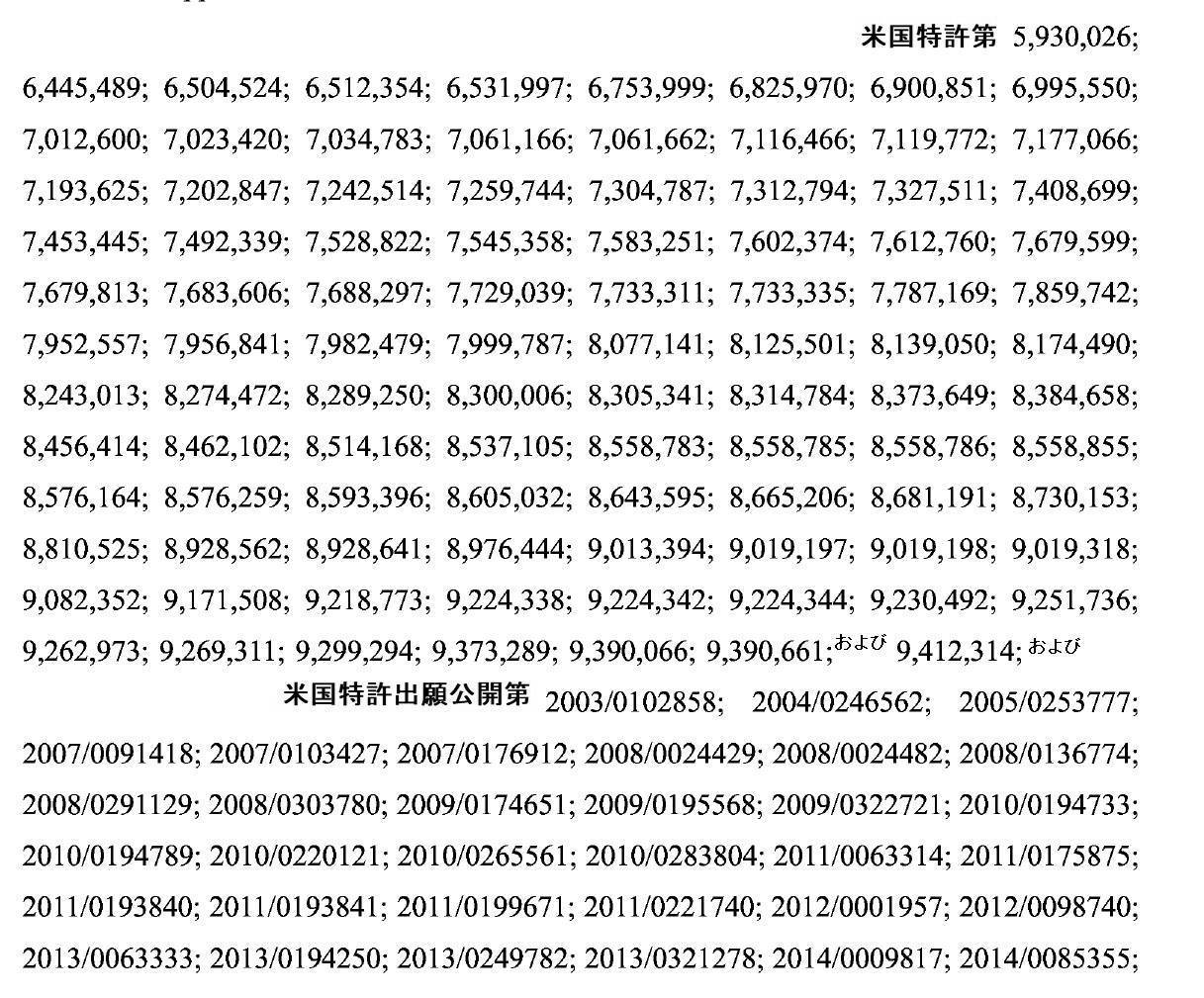

参照)
(G) A method for driving a display (eg,)
reference)
3層電気光学ディスプレイの製造は、通常、少なくとも1つの積層動作を伴う。例えば、前述のMITおよびEINK特許および出願のうちのいくつかでは、カプセル化された電気泳動ディスプレイを製造するためのプロセスが、説明され、結合剤中にカプセルを備える、カプセル化された電気泳動媒体が、酸化インジウムスズ(ITO)を含む可撓性基板上にコーティングされる、または類似伝導性コーティング(最終ディスプレイの1つの電極として作用する)が、プラスチックフィルム上にコーディングされ、カプセル/結合剤コーティングは、基板にしっかりと接着された電気泳動媒体のコヒーレント層を形成するように乾燥される。別個に、ピクセル電極を駆動回路構成に接続するためのピクセル電極のアレイおよび導体の適切な配列を含有する、バックプレーンが、調製される。最終ディスプレイを形成するために、カプセル/結合剤層をその上に有する、基板が、積層接着剤を使用して、バックプレーンに積層される。一実施形態では、バックプレーン自体が、可撓性であって、ピクセル電極および導体をプラスチックフィルムまたは他の可撓性基板上に印刷することによって調製される。他の実施形態では、両電極が、可撓性であって、それによって、構築された電気泳動ディスプレイが可撓性であることを可能にする。本プロセスによるディスプレイの大量生産のための明白な積層技法は、積層接着剤を使用したロール積層である。類似製造技法も、他のタイプの電気光学ディスプレイと併用されることができる。例えば、マイクロセル電気泳動媒体が、カプセル化された電気泳動媒体と実質的に同一様式において、バックプレーンまたは可撓性電極に積層されてもよい。 The manufacture of a three-layer electro-optic display usually involves at least one stacking operation. For example, in some of the aforementioned MIT and EINK patents and applications, the process for producing an encapsulated electrophoresis display is described and an encapsulated electrophoresis medium comprising capsules in a binder. Is coated on a flexible substrate containing indium tin oxide (ITO), or a similar conductive coating (acting as one electrode in the final display) is coated on the plastic film and encapsulated / binder coated. Is dried to form a coherent layer of electrophoretic medium firmly attached to the substrate. Separately, a backplane is prepared that contains an array of pixel electrodes and an appropriate array of conductors for connecting the pixel electrodes to the drive circuit configuration. To form the final display, a substrate with a capsule / binder layer on top of it is laminated to the backplane using a laminated adhesive. In one embodiment, the backplane itself is flexible and is prepared by printing pixel electrodes and conductors on a plastic film or other flexible substrate. In another embodiment, both electrodes are flexible, thereby allowing the constructed electrophoretic display to be flexible. An obvious laminating technique for mass production of displays by this process is roll laminating with laminated adhesives. Similar manufacturing techniques can also be used with other types of electro-optic displays. For example, the microcell electrophoresis medium may be laminated to the backplane or flexible electrode in substantially the same manner as the encapsulated electrophoresis medium.
米国特許第6,982,178号は、大量生成に非常に適した固体電気光学ディスプレイ(カプセル化された電気泳動ディスプレイを含む)を組み立てる方法を説明している。本質的に、この特許は、光透過性導電性層、導電性層と電気接触する固体電気光学媒体の層、接着剤層、および剥離シートを順に備える、いわゆる「フロントプレーンラミネート」(「FPL」)を説明している。典型的には、光透過性導電性層は、光透過性基板上に担持され、好ましくは、基板が永久的な変形を伴わずに、(例えば)直径10インチ(254mm)のドラムの周囲に手で巻き付けられ得るという意味で柔軟性である。この出願および本明細書において、「光透過性」という用語は、そのように指定される層が、その層を通して見ている観察者が、電気光学媒体のディスプレイ状態の変化を観察することを可能にするために十分な光を透過させ、通常、導電性層および隣接する基板(存在する場合)を通して見られることを意味するように使用され、電気光学媒体ディスプレイが非可視波長における反射率において変化する場合、「光透過性」という用語は、当然ながら、関連する非可視波長の透過に関して解釈されるべきである。基板は、典型的には、ポリマーフィルムであって、通常、約1~約25ミル(25~634μm)、好ましくは、約2~約10ミル(51~254μm)の範囲内の厚さを有するであろう。導電性層は、便宜上、例えば、アルミニウムまたはITOの薄金属または金属酸化物層である、または伝導性ポリマーであってもよい。アルミニウムまたはITOでコーティングされたポリ(エチレンテレフタレート)(PET)フィルムは、例えば、E.I. du Pont de Nemours & Company(Wilmington DE)からの「アルミ被覆Mylar」(「Mylar」は、登録商標である)として商業上利用可能であって、そのような商業上の材料は、フロントプレーンラミネートにおける良好な結果と併用され得る。 US Pat. No. 6,982,178 describes how to assemble a solid-state electro-optical display (including an encapsulated electrophoretic display) that is very suitable for mass production. In essence, this patent comprises a light-transmitting conductive layer, a layer of a solid electro-optic medium that is in electrical contact with the conductive layer, an adhesive layer, and a release sheet, the so-called "front plane laminate" ("FPL"). ) Is explained. Typically, the light-transmitting conductive layer is carried on a light-transmitting substrate, preferably around a drum (eg) 10 inches (254 mm) in diameter (eg) without permanent deformation of the substrate. It is flexible in the sense that it can be wrapped by hand. In this application and herein, the term "light transmission" allows an observer looking through a layer so designated to observe changes in the display state of the electro-optical medium. It is used to transmit enough light to mean that it is usually seen through a conductive layer and an adjacent substrate (if any), and the electro-optical medium display changes in reflectance at invisible wavelengths. If so, the term "light transmission" should, of course, be interpreted with respect to the transmission of relevant invisible wavelengths. The substrate is typically a polymer film and typically has a thickness in the range of about 1 to about 25 mils (25 to 634 μm), preferably about 2 to about 10 mils (51 to 254 μm). Will. For convenience, the conductive layer may be, for example, a thin metal or metal oxide layer of aluminum or ITO, or a conductive polymer. Poly (ethylene terephthalate) (PET) films coated with aluminum or ITO can be described, for example, in E. coli. I. Commercially available as "Aluminum Coated Mylar" ("Mylar" is a registered trademark) from duPont de Nemours & Company (Wilmington DE), such commercial materials are in front plane laminates. Can be used in combination with good results.
そのようなフロントプレーンラミネートを使用した電気泳動ディスプレイの組立は、剥離シートをフロントプレーンラミネートから除去し、接着剤層をバックプレーンに接着させるのに効果的な条件下で接着剤層をバックプレーンに接触させ、それによって、接着剤層、電気泳動媒体の層、および導電性層をバックプレーンに固定することによって達成されてもよい。このプロセスは、フロントプレーンラミネートが、典型的にはロールからロールへのコーティング技術を使用して大量生成され、次に、特定のバックプレーンとの使用に必要とされる任意のサイズの片に切断されてもよいため、大量生成に非常に適している。 Assembling an electrophoretic display using such a frontplane laminate removes the release sheet from the frontplane laminate and puts the adhesive layer on the backplane under conditions that are effective in adhering the adhesive layer to the backplane. It may be achieved by contacting and thereby fixing the adhesive layer, the layer of the electrophoresis medium, and the conductive layer to the backplane. In this process, the frontplane laminate is mass-produced, typically using roll-to-roll coating techniques, and then cut into pieces of any size required for use with a particular backplane. It is very suitable for mass production because it may be used.
用語「インパルス」は、本明細書では、時間に対する電圧の積分のその従来の意味において使用される。しかしながら、一部の双安定電気泳動媒体は、電荷変換器として作用し、そのような媒体では、インパルスの代替定義、すなわち、経時的電流の積分(印加される総電荷に等しい)が、使用されてもよい。インパルスの適切な定義は、媒体が電圧-時間インパルス変換器または電荷インパルス変換器として作用するかどうかに応じて、使用されるべきである。 The term "impulse" is used herein in its traditional sense of integrating voltage over time. However, some bistable electrophoresis media act as charge transducers, in which alternative definitions of impulses, namely integrals of current over time (equal to the total charge applied), are used. You may. Appropriate definitions of impulses should be used, depending on whether the medium acts as a voltage-time impulse transducer or a charge impulse transducer.
電気泳動ディスプレイを駆動する際のさらなる複雑性は、いわゆる「DC平衡」に関する必要性である。米国特許第6,531,997号および第6,504,524号は、ディスプレイを駆動するために使用される方法が、電気泳動媒体を横断してゼロまたはほぼゼロの正味時間平均印加電場をもたらさない場合、問題に遭遇し、ディスプレイの作業寿命が低減され得ることを議論している。電気泳動媒体を横断してゼロ正味時間平均印加電場をもたらす、駆動方法は、便宜的に、「直流平衡」または「DC平衡」と称される。 An additional complexity in driving an electrophoretic display is the need for so-called "DC equilibrium". US Pat. Nos. 6,531,997 and 6,504,524 provide a zero or near zero net time average applied electric field across the electrophoretic medium in the method used to drive the display. If not, we run into problems and argue that the working life of the display can be reduced. The driving method that results in a zero net time average applied electric field across the electrophoretic medium is conveniently referred to as "DC equilibrium" or "DC equilibrium".
すでに述べられたように、カプセル化された電気泳動媒体は、典型的には、ポリマー結合剤内に配置される電気泳動カプセルを備え、これは、離散カプセルをコヒーレント層の中に形成する役割を果たす。ポリマー分散電気泳動媒体内の連続相およびマイクロセル媒体のセル壁は、類似機能を果たす。EINK研究者によって、電気泳動媒体内の結合剤として使用される具体的材料が、媒体の電気光学性質に影響を及ぼし得ることが見出されている。中でも、結合剤の選択肢によって影響される電気泳動媒体の電気光学性質は、いわゆる「滞留時間依存性」である。米国特許第7,119,772号(特に、図34および関連説明参照)に議論されるように、ある場合には、双安定電気泳動ディスプレイの2つの具体的光学状態間の遷移のために必要なインパルスは、その初期光学状態におけるピクセルの滞留時間に伴って変動し、本現象は、「滞留時間依存性」または「DTD」と称される。明らかに、DTDが、ディスプレイを駆動する困難度に影響を及ぼし、生産される画像の品質に影響を及ぼし得るため、DTDを可能な限り小さく保つことが望ましい。例えば、DTDは、均一灰色の面積を形成すると仮定されるピクセルをグレーレベルにおいて相互に若干異ならせ得、ヒト眼は、そのような変動に非常に敏感である。結合剤の選択肢がDTDに影響を及ぼすことが、公知であるが、任意の具体的電気泳動媒体のための適切な結合剤を選定することは、本質的に、DTDと結合剤の化学性質との間の関係が理解されておらず、これまで、試行錯誤に基づいている。 As already mentioned, the encapsulated electrophoretic medium typically comprises an electrophoretic capsule placed within a polymer binder, which serves to form discrete capsules in the coherent layer. Fulfill. The cell walls of the continuous phase and microcell media in the polymer dispersed electrophoresis medium perform similar functions. EINK researchers have found that the specific material used as a binder in an electrophoresis medium can affect the electro-optic properties of the medium. Above all, the electro-optic property of the electrophoretic medium influenced by the choice of binder is the so-called “residence time dependence”. As discussed in US Pat. No. 7,119,772 (particularly in FIG. 34 and related description), in some cases it is necessary for the transition between two specific optical states of a bistable electrophoretic display. The impulse fluctuates with the residence time of the pixel in its initial optical state, and this phenomenon is referred to as "retention time dependence" or "DTD". Obviously, it is desirable to keep the DTD as small as possible, as it can affect the difficulty of driving the display and the quality of the images produced. For example, a DTD can cause pixels that are supposed to form a uniform gray area to be slightly different from each other at the gray level, and the human eye is very sensitive to such fluctuations. Although it is known that the choice of binder affects the DTD, selecting a suitable binder for any specific electrophoretic medium is essentially the chemistry of the DTD and the binder. The relationship between them is not understood and has so far been based on trial and error.
米国特許出願第公開第2005/0107564号は、(a)(i)a,a,a,a-テトラメチルキシレンジイソシアネートを含む、少なくとも1つのポリイソシアネート[組織名1.3-ビス(1-イソシアネート-1-メチルエチル)ベンゼン;本材料は、以降、「TMXDI」と呼ばれ得る]、(ii)ポリプロピレングリコールを含む、少なくとも1つの二官能ポリオール、および(iii)酸官能基と、ヒドロキシ、第1級アミノ、第2級アミノ、およびそれらの組み合わせから選択される、少なくとも2つのイソシアネート反応基とを含む、イソシアネート反応化合物の反応生成物を含む、イソシアネート終端プレポリマー、(b)第3級アミノ基を含む、中和剤、(c)単官能鎖停止剤、(d)有機ジアミンを含む、鎖延長剤、および(e)水の反応生成物を含む、ポリウレタンポリマーを含む、水性ポリウレタン分散剤を説明する。以降、「TMXDI/PPO」分散剤と呼ばれ得る、本ポリウレタン分散剤は、電気泳動ディスプレイにおける積層接着剤として有用であることが見出されている。 US Patent Application Publication No. 2005/0107564 describes at least one polyisocyanate [organization name 1.3-bis (1-isocyanate), including (a) (i) a, a, a, a-tetramethylxylylene diisocyanate. -1-Methylethyl) benzene; the material may be hereafter referred to as "TMXDI"], at least one bifunctional polyol containing (ii) polypropylene glycol, and (iii) acid functional groups and hydroxy, No. 1 An isocyanate-terminated prepolymer comprising a reaction product of an isocyanate-reactive compound, comprising at least two isocyanate-reactive groups selected from primary aminos, secondary aminos, and combinations thereof, (b) tertiary aminos. Aqueous polyurethane dispersant, including a group-containing neutralizing agent, (c) a monofunctional chain terminator, (d) a chain extender containing an organic diamine, and (e) a polyurethane polymer containing a reaction product of water. To explain. Hereinafter, the polyurethane dispersant, which may be referred to as a "TMXDI / PPO" dispersant, has been found to be useful as a laminated adhesive in electrophoretic displays.
前述から、本発明は、切替可能な光コリメートフィルムと、切替可能な光コリメートフィルムを組み込む、デバイスとを提供することができることが分かるであろう。特に、本発明は、双安定であって、付加的エネルギー入力を伴わずに、広および狭視認条件を維持することが可能である、光コリメートフィルムを提供する。 From the above, it will be seen that the present invention can provide a switchable optical collimating film and a device incorporating the switchable optical collimating film. In particular, the present invention provides an optical collimating film that is bistable and capable of maintaining wide and narrow visibility conditions without additional energy input.
多数の変更および修正が、本発明の範囲から逸脱することなく、上記に説明される本発明の具体的実施形態に行われることができることが、当業者に明白となるであろう。故に、前述の説明の全体は、限定的意味ではなく、例証的意味で解釈されるべきである。 It will be apparent to those skilled in the art that numerous modifications and modifications can be made to the specific embodiments of the invention described above without departing from the scope of the invention. Therefore, the whole of the above explanation should be construed in an exemplary sense, not in a limiting sense.
Claims (1)
Applications Claiming Priority (4)
| Application Number | Priority Date | Filing Date | Title |
|---|---|---|---|
| US201862717124P | 2018-08-10 | 2018-08-10 | |
| US62/717,124 | 2018-08-10 | ||
| JP2021504792A JP7128952B2 (en) | 2018-08-10 | 2019-07-29 | A switchable light collimating layer containing a bistable electrophoretic fluid |
| PCT/US2019/043888 WO2020033175A1 (en) | 2018-08-10 | 2019-07-29 | Switchable light-collimating layer including bistable electrophoretic fluid |
Related Parent Applications (1)
| Application Number | Title | Priority Date | Filing Date |
|---|---|---|---|
| JP2021504792A Division JP7128952B2 (en) | 2018-08-10 | 2019-07-29 | A switchable light collimating layer containing a bistable electrophoretic fluid |
Publications (3)
| Publication Number | Publication Date |
|---|---|
| JP2022105720A true JP2022105720A (en) | 2022-07-14 |
| JP2022105720A5 JP2022105720A5 (en) | 2022-09-08 |
| JP7236582B2 JP7236582B2 (en) | 2023-03-09 |
Family
ID=69405862
Family Applications (2)
| Application Number | Title | Priority Date | Filing Date |
|---|---|---|---|
| JP2021504792A Active JP7128952B2 (en) | 2018-08-10 | 2019-07-29 | A switchable light collimating layer containing a bistable electrophoretic fluid |
| JP2022086071A Active JP7236582B2 (en) | 2018-08-10 | 2022-05-26 | A switchable light collimating layer containing a bistable electrophoretic fluid |
Family Applications Before (1)
| Application Number | Title | Priority Date | Filing Date |
|---|---|---|---|
| JP2021504792A Active JP7128952B2 (en) | 2018-08-10 | 2019-07-29 | A switchable light collimating layer containing a bistable electrophoretic fluid |
Country Status (7)
| Country | Link |
|---|---|
| US (2) | US11397366B2 (en) |
| EP (1) | EP3834035B1 (en) |
| JP (2) | JP7128952B2 (en) |
| KR (1) | KR102551978B1 (en) |
| CN (2) | CN115453794B (en) |
| TW (3) | TWI773095B (en) |
| WO (1) | WO2020033175A1 (en) |
Families Citing this family (16)
| Publication number | Priority date | Publication date | Assignee | Title |
|---|---|---|---|---|
| KR102521144B1 (en) | 2018-08-10 | 2023-04-12 | 이 잉크 캘리포니아 엘엘씨 | Drive Waveforms for a Switchable Light Collimation Layer Containing a Bistable Electrophoretic Fluid |
| US11397366B2 (en) * | 2018-08-10 | 2022-07-26 | E Ink California, Llc | Switchable light-collimating layer including bistable electrophoretic fluid |
| US11314098B2 (en) | 2018-08-10 | 2022-04-26 | E Ink California, Llc | Switchable light-collimating layer with reflector |
| WO2021071134A1 (en) * | 2019-10-11 | 2021-04-15 | 엘지이노텍 주식회사 | Optical path control member and display device comprising same |
| CN113051965B (en) * | 2019-12-26 | 2025-01-24 | 群创光电股份有限公司 | Electronic Devices |
| TWI746017B (en) | 2020-06-18 | 2021-11-11 | 宏碁股份有限公司 | Pixel structure and display device using the same |
| CN114187846B (en) * | 2020-08-28 | 2024-01-09 | 宏碁股份有限公司 | Pixel structure and display device using same |
| DE102020007974B3 (en) | 2020-12-22 | 2021-10-07 | Sioptica Gmbh | Optical element with variable transmission and screen with such an optical element |
| JP7579162B2 (en) | 2021-01-28 | 2024-11-07 | Tianma Japan株式会社 | Light-direction control element and display device |
| US20220251364A1 (en) * | 2021-02-04 | 2022-08-11 | E Ink California, Llc | Sealing layers for sealing microcells of electro-optic devices |
| CA3210131A1 (en) * | 2021-03-15 | 2022-09-22 | Donal Martin O'keeffe | Switchable light modulator having regions of varying opacity |
| CN115240534A (en) * | 2021-04-25 | 2022-10-25 | 群创光电股份有限公司 | Display device |
| CN113703155B (en) * | 2021-09-08 | 2023-09-26 | 武汉华星光电技术有限公司 | Display device |
| US20240004255A1 (en) * | 2022-07-01 | 2024-01-04 | E Ink Corporation | Sealing Films and Sealing Compositions for Sealing Microcells of Electro-Optic Devices |
| CN117130204A (en) * | 2023-04-19 | 2023-11-28 | 荣耀终端有限公司 | Display module, preparation method and display device thereof |
| US20250116908A1 (en) | 2023-10-06 | 2025-04-10 | E Ink Corporation | Large-area electro-optic light modulator or display |
Citations (7)
| Publication number | Priority date | Publication date | Assignee | Title |
|---|---|---|---|---|
| JP2003502696A (en) * | 1999-06-16 | 2003-01-21 | クレアヴィス ゲゼルシャフト フュア テヒノロギー ウント イノヴェイション ミット ベシュレンクテル ハフツング | Composite sheet comprising light scattering carrier material and having electrically switchable optical properties |
| JP2006518881A (en) * | 2003-02-21 | 2006-08-17 | シピックス・イメージング・インコーポレーテッド | Electrophoretic display and manufacturing method thereof |
| KR20070000551A (en) * | 2005-06-27 | 2007-01-03 | 엘지.필립스 엘시디 주식회사 | Display, driving method thereof and manufacturing method thereof |
| JP2007508588A (en) * | 2003-10-08 | 2007-04-05 | イー インク コーポレイション | Electrophoretic medium |
| US20070139765A1 (en) * | 2005-12-21 | 2007-06-21 | Xerox Corporation | Microfabricated light collimating screen |
| JP2016062092A (en) * | 2014-09-12 | 2016-04-25 | Nltテクノロジー株式会社 | Optical element and display device, electronic equipment and lighting device using the same |
| JP2018507443A (en) * | 2015-06-12 | 2018-03-15 | エルジー・ケム・リミテッド | Display element |
Family Cites Families (301)
| Publication number | Priority date | Publication date | Assignee | Title |
|---|---|---|---|---|
| US3034209A (en) | 1956-07-31 | 1962-05-15 | Bianca Edoardo Giuseppe | Method of making tapered tubular sections |
| FR2666804B1 (en) | 1990-09-14 | 1993-05-28 | Saint Gobain Vitrage Int | ELECTROCHROME GLAZING. |
| US7999787B2 (en) | 1995-07-20 | 2011-08-16 | E Ink Corporation | Methods for driving electrophoretic displays using dielectrophoretic forces |
| US7327511B2 (en) | 2004-03-23 | 2008-02-05 | E Ink Corporation | Light modulators |
| US7259744B2 (en) | 1995-07-20 | 2007-08-21 | E Ink Corporation | Dielectrophoretic displays |
| US7583251B2 (en) | 1995-07-20 | 2009-09-01 | E Ink Corporation | Dielectrophoretic displays |
| US7023420B2 (en) | 2000-11-29 | 2006-04-04 | E Ink Corporation | Electronic display with photo-addressing means |
| US8089453B2 (en) | 1995-07-20 | 2012-01-03 | E Ink Corporation | Stylus-based addressing structures for displays |
| US7956841B2 (en) | 1995-07-20 | 2011-06-07 | E Ink Corporation | Stylus-based addressing structures for displays |
| US7411719B2 (en) | 1995-07-20 | 2008-08-12 | E Ink Corporation | Electrophoretic medium and process for the production thereof |
| WO1998003896A1 (en) | 1996-07-19 | 1998-01-29 | E-Ink Corporation | Electronically addressable microencapsulated ink and display thereof |
| US7193625B2 (en) | 1999-04-30 | 2007-03-20 | E Ink Corporation | Methods for driving electro-optic displays, and apparatus for use therein |
| US8139050B2 (en) | 1995-07-20 | 2012-03-20 | E Ink Corporation | Addressing schemes for electronic displays |
| US5930026A (en) | 1996-10-25 | 1999-07-27 | Massachusetts Institute Of Technology | Nonemissive displays and piezoelectric power supplies therefor |
| US6825829B1 (en) | 1997-08-28 | 2004-11-30 | E Ink Corporation | Adhesive backed displays |
| US7002728B2 (en) | 1997-08-28 | 2006-02-21 | E Ink Corporation | Electrophoretic particles, and processes for the production thereof |
| EP1064584B1 (en) | 1998-03-18 | 2004-05-19 | E Ink Corporation | Electrophoretic display |
| US6753999B2 (en) | 1998-03-18 | 2004-06-22 | E Ink Corporation | Electrophoretic displays in portable devices and systems for addressing such displays |
| AU5094899A (en) | 1998-07-08 | 2000-02-01 | E-Ink Corporation | Method and apparatus for sensing the state of an electrophoretic display |
| US20030102858A1 (en) | 1998-07-08 | 2003-06-05 | E Ink Corporation | Method and apparatus for determining properties of an electrophoretic display |
| US6504524B1 (en) | 2000-03-08 | 2003-01-07 | E Ink Corporation | Addressing methods for displays having zero time-average field |
| US7012600B2 (en) | 1999-04-30 | 2006-03-14 | E Ink Corporation | Methods for driving bistable electro-optic displays, and apparatus for use therein |
| US7119772B2 (en) | 1999-04-30 | 2006-10-10 | E Ink Corporation | Methods for driving bistable electro-optic displays, and apparatus for use therein |
| US6531997B1 (en) | 1999-04-30 | 2003-03-11 | E Ink Corporation | Methods for addressing electrophoretic displays |
| US6693620B1 (en) | 1999-05-03 | 2004-02-17 | E Ink Corporation | Threshold addressing of electrophoretic displays |
| US6672921B1 (en) | 2000-03-03 | 2004-01-06 | Sipix Imaging, Inc. | Manufacturing process for electrophoretic display |
| US6930818B1 (en) | 2000-03-03 | 2005-08-16 | Sipix Imaging, Inc. | Electrophoretic display and novel process for its manufacture |
| US6933098B2 (en) | 2000-01-11 | 2005-08-23 | Sipix Imaging Inc. | Process for roll-to-roll manufacture of a display by synchronized photolithographic exposure on a substrate web |
| US7233429B2 (en) | 2000-03-03 | 2007-06-19 | Sipix Imaging, Inc. | Electrophoretic display |
| US7158282B2 (en) | 2000-03-03 | 2007-01-02 | Sipix Imaging, Inc. | Electrophoretic display and novel process for its manufacture |
| US7715087B2 (en) | 2000-03-03 | 2010-05-11 | Sipix Imaging, Inc. | Segment electrophoretic displays and methods for their manufacture |
| US6947202B2 (en) | 2000-03-03 | 2005-09-20 | Sipix Imaging, Inc. | Electrophoretic display with sub relief structure for high contrast ratio and improved shear and/or compression resistance |
| US7715088B2 (en) | 2000-03-03 | 2010-05-11 | Sipix Imaging, Inc. | Electrophoretic display |
| US7408696B2 (en) | 2000-03-03 | 2008-08-05 | Sipix Imaging, Inc. | Three-dimensional electrophoretic displays |
| US6545797B2 (en) | 2001-06-11 | 2003-04-08 | Sipix Imaging, Inc. | Process for imagewise opening and filling color display components and color displays manufactured thereof |
| US6972893B2 (en) | 2001-06-11 | 2005-12-06 | Sipix Imaging, Inc. | Process for imagewise opening and filling color display components and color displays manufactured thereof |
| US20070237962A1 (en) | 2000-03-03 | 2007-10-11 | Rong-Chang Liang | Semi-finished display panels |
| US6833943B2 (en) | 2000-03-03 | 2004-12-21 | Sipix Imaging, Inc. | Electrophoretic display and novel process for its manufacture |
| US6788449B2 (en) | 2000-03-03 | 2004-09-07 | Sipix Imaging, Inc. | Electrophoretic display and novel process for its manufacture |
| US7557981B2 (en) | 2000-03-03 | 2009-07-07 | Sipix Imaging, Inc. | Electrophoretic display and process for its manufacture |
| US6865012B2 (en) | 2000-03-03 | 2005-03-08 | Sipix Imaging, Inc. | Electrophoretic display and novel process for its manufacture |
| US6831770B2 (en) | 2000-03-03 | 2004-12-14 | Sipix Imaging, Inc. | Electrophoretic display and novel process for its manufacture |
| US6885495B2 (en) | 2000-03-03 | 2005-04-26 | Sipix Imaging Inc. | Electrophoretic display with in-plane switching |
| US7052571B2 (en) | 2000-03-03 | 2006-05-30 | Sipix Imaging, Inc. | Electrophoretic display and process for its manufacture |
| JP4006925B2 (en) | 2000-05-30 | 2007-11-14 | セイコーエプソン株式会社 | Method for manufacturing electrophoretic display device |
| TW556044B (en) | 2001-02-15 | 2003-10-01 | Sipix Imaging Inc | Process for roll-to-roll manufacture of a display by synchronized photolithographic exposure on a substrate web |
| US7230750B2 (en) | 2001-05-15 | 2007-06-12 | E Ink Corporation | Electrophoretic media and processes for the production thereof |
| WO2002079869A1 (en) | 2001-04-02 | 2002-10-10 | E Ink Corporation | Electrophoretic medium with improved image stability |
| US7679814B2 (en) | 2001-04-02 | 2010-03-16 | E Ink Corporation | Materials for use in electrophoretic displays |
| US6753067B2 (en) | 2001-04-23 | 2004-06-22 | Sipix Imaging, Inc. | Microcup compositions having improved flexure resistance and release properties |
| EP1393122B1 (en) | 2001-05-15 | 2018-03-28 | E Ink Corporation | Electrophoretic particles |
| US20020188053A1 (en) | 2001-06-04 | 2002-12-12 | Sipix Imaging, Inc. | Composition and process for the sealing of microcups in roll-to-roll display manufacturing |
| US7205355B2 (en) | 2001-06-04 | 2007-04-17 | Sipix Imaging, Inc. | Composition and process for the manufacture of an improved electrophoretic display |
| US8361356B2 (en) | 2001-06-04 | 2013-01-29 | Sipix Imaging, Inc. | Composition and process for the sealing of microcups in roll-to-roll display manufacturing |
| US7385751B2 (en) | 2001-06-11 | 2008-06-10 | Sipix Imaging, Inc. | Process for imagewise opening and filling color display components and color displays manufactured thereof |
| US6788452B2 (en) | 2001-06-11 | 2004-09-07 | Sipix Imaging, Inc. | Process for manufacture of improved color displays |
| US6982178B2 (en) | 2002-06-10 | 2006-01-03 | E Ink Corporation | Components and methods for use in electro-optic displays |
| US7535624B2 (en) | 2001-07-09 | 2009-05-19 | E Ink Corporation | Electro-optic display and materials for use therein |
| JP3909812B2 (en) | 2001-07-19 | 2007-04-25 | 富士フイルム株式会社 | Display element and exposure element |
| TW527529B (en) | 2001-07-27 | 2003-04-11 | Sipix Imaging Inc | An improved electrophoretic display with color filters |
| US7038670B2 (en) | 2002-08-16 | 2006-05-02 | Sipix Imaging, Inc. | Electrophoretic display with dual mode switching |
| TW550529B (en) | 2001-08-17 | 2003-09-01 | Sipix Imaging Inc | An improved electrophoretic display with dual-mode switching |
| TW539928B (en) | 2001-08-20 | 2003-07-01 | Sipix Imaging Inc | An improved transflective electrophoretic display |
| TWI308231B (en) | 2001-08-28 | 2009-04-01 | Sipix Imaging Inc | Electrophoretic display |
| TW573204B (en) | 2001-09-12 | 2004-01-21 | Sipix Imaging Inc | An improved electrophoretic display with gating electrodes |
| US6825970B2 (en) | 2001-09-14 | 2004-11-30 | E Ink Corporation | Methods for addressing electro-optic materials |
| TWI229763B (en) | 2001-10-29 | 2005-03-21 | Sipix Imaging Inc | An improved electrophoretic display with holding electrodes |
| US8593396B2 (en) | 2001-11-20 | 2013-11-26 | E Ink Corporation | Methods and apparatus for driving electro-optic displays |
| US7952557B2 (en) | 2001-11-20 | 2011-05-31 | E Ink Corporation | Methods and apparatus for driving electro-optic displays |
| US7202847B2 (en) | 2002-06-28 | 2007-04-10 | E Ink Corporation | Voltage modulated driver circuits for electro-optic displays |
| US8125501B2 (en) | 2001-11-20 | 2012-02-28 | E Ink Corporation | Voltage modulated driver circuits for electro-optic displays |
| US8558783B2 (en) | 2001-11-20 | 2013-10-15 | E Ink Corporation | Electro-optic displays with reduced remnant voltage |
| US9412314B2 (en) | 2001-11-20 | 2016-08-09 | E Ink Corporation | Methods for driving electro-optic displays |
| US7528822B2 (en) | 2001-11-20 | 2009-05-05 | E Ink Corporation | Methods for driving electro-optic displays |
| US6900851B2 (en) | 2002-02-08 | 2005-05-31 | E Ink Corporation | Electro-optic displays and optical systems for addressing such displays |
| US6950220B2 (en) | 2002-03-18 | 2005-09-27 | E Ink Corporation | Electro-optic displays, and methods for driving same |
| US7580180B2 (en) | 2002-03-21 | 2009-08-25 | Sipix Imaging, Inc. | Magnetophoretic and electromagnetophoretic displays |
| TWI223729B (en) | 2002-04-23 | 2004-11-11 | Sipix Imaging Inc | Improved segment electrophoretic displays and methods for their manufacture |
| US8002948B2 (en) | 2002-04-24 | 2011-08-23 | Sipix Imaging, Inc. | Process for forming a patterned thin film structure on a substrate |
| TWI268813B (en) | 2002-04-24 | 2006-12-21 | Sipix Imaging Inc | Process for forming a patterned thin film conductive structure on a substrate |
| US7307778B2 (en) | 2002-04-24 | 2007-12-11 | Sipix Imaging, Inc. | Compositions and processes for format-flexible, roll-to-roll manufacturing of electrophoretic displays |
| US7261920B2 (en) | 2002-04-24 | 2007-08-28 | Sipix Imaging, Inc. | Process for forming a patterned thin film structure on a substrate |
| AU2003232018A1 (en) | 2002-04-24 | 2003-11-10 | E Ink Corporation | Electronic displays |
| US7156945B2 (en) | 2002-04-24 | 2007-01-02 | Sipix Imaging, Inc. | Process for forming a patterned thin film structure for in-mold decoration |
| TWI310098B (en) | 2002-05-03 | 2009-05-21 | Sipix Imaging Inc | Methods of surface modification for improving electrophoretic display performance |
| TW583497B (en) | 2002-05-29 | 2004-04-11 | Sipix Imaging Inc | Electrode and connecting designs for roll-to-roll format flexible display manufacturing |
| US7843621B2 (en) | 2002-06-10 | 2010-11-30 | E Ink Corporation | Components and testing methods for use in the production of electro-optic displays |
| US7554712B2 (en) | 2005-06-23 | 2009-06-30 | E Ink Corporation | Edge seals for, and processes for assembly of, electro-optic displays |
| US7649674B2 (en) | 2002-06-10 | 2010-01-19 | E Ink Corporation | Electro-optic display with edge seal |
| US7110164B2 (en) | 2002-06-10 | 2006-09-19 | E Ink Corporation | Electro-optic displays, and processes for the production thereof |
| US20080024482A1 (en) | 2002-06-13 | 2008-01-31 | E Ink Corporation | Methods for driving electro-optic displays |
| US20110199671A1 (en) | 2002-06-13 | 2011-08-18 | E Ink Corporation | Methods for driving electrophoretic displays using dielectrophoretic forces |
| US7347957B2 (en) | 2003-07-10 | 2008-03-25 | Sipix Imaging, Inc. | Methods and compositions for improved electrophoretic display performance |
| US7271947B2 (en) | 2002-08-16 | 2007-09-18 | Sipix Imaging, Inc. | Electrophoretic display with dual-mode switching |
| US7839564B2 (en) | 2002-09-03 | 2010-11-23 | E Ink Corporation | Components and methods for use in electro-optic displays |
| CN100397227C (en) | 2002-09-03 | 2008-06-25 | 伊英克公司 | Electrophoretic medium and method of forming electrophoretic medium |
| US7166182B2 (en) | 2002-09-04 | 2007-01-23 | Sipix Imaging, Inc. | Adhesive and sealing layers for electrophoretic displays |
| TW575646B (en) | 2002-09-04 | 2004-02-11 | Sipix Imaging Inc | Novel adhesive and sealing layers for electrophoretic displays |
| TWI327251B (en) | 2002-09-23 | 2010-07-11 | Sipix Imaging Inc | Electrophoretic displays with improved high temperature performance |
| US7616374B2 (en) | 2002-09-23 | 2009-11-10 | Sipix Imaging, Inc. | Electrophoretic displays with improved high temperature performance |
| US20130063333A1 (en) | 2002-10-16 | 2013-03-14 | E Ink Corporation | Electrophoretic displays |
| TWI229230B (en) | 2002-10-31 | 2005-03-11 | Sipix Imaging Inc | An improved electrophoretic display and novel process for its manufacture |
| TWI297089B (en) | 2002-11-25 | 2008-05-21 | Sipix Imaging Inc | A composition for the preparation of microcups used in a liquid crystal display, a liquid crystal display comprising two or more layers of microcup array and process for its manufacture |
| AU2003299673A1 (en) | 2002-12-16 | 2004-07-22 | E Ink Corporation | Backplanes for electro-optic displays |
| US6922276B2 (en) | 2002-12-23 | 2005-07-26 | E Ink Corporation | Flexible electro-optic displays |
| TWI230832B (en) | 2003-01-24 | 2005-04-11 | Sipix Imaging Inc | Novel adhesive and sealing layers for electrophoretic displays |
| US7572491B2 (en) | 2003-01-24 | 2009-08-11 | Sipix Imaging, Inc. | Adhesive and sealing layers for electrophoretic displays |
| US9346987B2 (en) | 2003-01-24 | 2016-05-24 | E Ink California, Llc | Adhesive and sealing layers for electrophoretic displays |
| WO2004104979A2 (en) | 2003-05-16 | 2004-12-02 | Sipix Imaging, Inc. | Improved passive matrix electrophoretic display driving scheme |
| JP2004356206A (en) | 2003-05-27 | 2004-12-16 | Fuji Photo Film Co Ltd | Laminated structure and its manufacturing method |
| US8174490B2 (en) | 2003-06-30 | 2012-05-08 | E Ink Corporation | Methods for driving electrophoretic displays |
| WO2005004095A2 (en) | 2003-07-03 | 2005-01-13 | Koninklijke Philips Electronics N.V. | Electrophoretic display device |
| US20050122563A1 (en) | 2003-07-24 | 2005-06-09 | E Ink Corporation | Electro-optic displays |
| WO2005020199A2 (en) | 2003-08-19 | 2005-03-03 | E Ink Corporation | Methods for controlling electro-optic displays |
| JP5506137B2 (en) | 2003-09-19 | 2014-05-28 | イー インク コーポレイション | Method for reducing edge effects in electro-optic displays |
| JP2007507737A (en) | 2003-10-03 | 2007-03-29 | コーニンクレッカ フィリップス エレクトロニクス エヌ ヴィ | Electrophoretic display unit |
| US7061662B2 (en) | 2003-10-07 | 2006-06-13 | Sipix Imaging, Inc. | Electrophoretic display with thermal control |
| US8514168B2 (en) | 2003-10-07 | 2013-08-20 | Sipix Imaging, Inc. | Electrophoretic display with thermal control |
| CN100434959C (en) * | 2003-10-08 | 2008-11-19 | 伊英克公司 | Electrophoretic medium |
| US7177066B2 (en) | 2003-10-24 | 2007-02-13 | Sipix Imaging, Inc. | Electrophoretic display driving scheme |
| US20110164301A1 (en) | 2003-11-05 | 2011-07-07 | E Ink Corporation | Electro-optic displays, and materials for use therein |
| US8177942B2 (en) | 2003-11-05 | 2012-05-15 | E Ink Corporation | Electro-optic displays, and materials for use therein |
| US7342068B2 (en) | 2003-11-18 | 2008-03-11 | Air Products And Chemicals, Inc. | Aqueous polyurethane dispersion and method for making and using same |
| CN1886776A (en) | 2003-11-25 | 2006-12-27 | 皇家飞利浦电子股份有限公司 | Display device with display device and cycle orbit stabilization method for driving the display device |
| US8928562B2 (en) | 2003-11-25 | 2015-01-06 | E Ink Corporation | Electro-optic displays, and methods for driving same |
| US7504050B2 (en) | 2004-02-23 | 2009-03-17 | Sipix Imaging, Inc. | Modification of electrical properties of display cells for improving electrophoretic display performance |
| US7492339B2 (en) | 2004-03-26 | 2009-02-17 | E Ink Corporation | Methods for driving bistable electro-optic displays |
| US8289250B2 (en) | 2004-03-31 | 2012-10-16 | E Ink Corporation | Methods for driving electro-optic displays |
| US7470386B2 (en) | 2004-04-26 | 2008-12-30 | Sipix Imaging, Inc. | Roll-to-roll embossing tools and processes |
| US20050253777A1 (en) | 2004-05-12 | 2005-11-17 | E Ink Corporation | Tiled displays and methods for driving same |
| US7374634B2 (en) | 2004-05-12 | 2008-05-20 | Sipix Imaging, Inc. | Process for the manufacture of electrophoretic displays |
| US8625188B2 (en) | 2004-05-12 | 2014-01-07 | Sipix Imaging, Inc. | Process for the manufacture of electrophoretic displays |
| US7564614B2 (en) | 2004-05-20 | 2009-07-21 | Sipix Imaging, Inc. | Electrode protection film for electrophoretic displays |
| WO2006015044A1 (en) | 2004-07-27 | 2006-02-09 | E Ink Corporation | Electro-optic displays |
| US20080136774A1 (en) | 2004-07-27 | 2008-06-12 | E Ink Corporation | Methods for driving electrophoretic displays using dielectrophoretic forces |
| US7453445B2 (en) | 2004-08-13 | 2008-11-18 | E Ink Corproation | Methods for driving electro-optic displays |
| TWI263105B (en) | 2004-10-22 | 2006-10-01 | Ind Tech Res Inst | Transflective electrophoretic displayer device |
| US8643595B2 (en) | 2004-10-25 | 2014-02-04 | Sipix Imaging, Inc. | Electrophoretic display driving approaches |
| US7304780B2 (en) | 2004-12-17 | 2007-12-04 | Sipix Imaging, Inc. | Backplane design for display panels and processes for their manufacture |
| JP4718859B2 (en) | 2005-02-17 | 2011-07-06 | セイコーエプソン株式会社 | Electrophoresis apparatus, driving method thereof, and electronic apparatus |
| JP4690079B2 (en) | 2005-03-04 | 2011-06-01 | セイコーエプソン株式会社 | Electrophoresis apparatus, driving method thereof, and electronic apparatus |
| JP4778261B2 (en) * | 2005-04-26 | 2011-09-21 | 日本電気株式会社 | Display device and terminal device |
| KR101206285B1 (en) * | 2005-06-29 | 2012-11-29 | 엘지디스플레이 주식회사 | Display device capable of adjusting viewing angle and fabrication method the same |
| US7767126B2 (en) | 2005-08-22 | 2010-08-03 | Sipix Imaging, Inc. | Embossing assembly and methods of preparation |
| US8441432B2 (en) | 2005-09-23 | 2013-05-14 | Sipix Imaging, Inc. | Display cell structure and electrode protecting layer compositions |
| US7880958B2 (en) | 2005-09-23 | 2011-02-01 | Sipix Imaging, Inc. | Display cell structure and electrode protecting layer compositions |
| US7408699B2 (en) | 2005-09-28 | 2008-08-05 | Sipix Imaging, Inc. | Electrophoretic display and methods of addressing such display |
| US20070176912A1 (en) | 2005-12-09 | 2007-08-02 | Beames Michael H | Portable memory devices with polymeric displays |
| US8114262B2 (en) | 2006-01-11 | 2012-02-14 | Sipix Imaging, Inc. | Thickness distribution control for electroplating |
| JP4899503B2 (en) | 2006-02-01 | 2012-03-21 | ソニー株式会社 | Display device |
| US7843624B2 (en) | 2006-03-08 | 2010-11-30 | E Ink Corporation | Electro-optic displays, and materials and methods for production thereof |
| US8390301B2 (en) | 2006-03-08 | 2013-03-05 | E Ink Corporation | Electro-optic displays, and materials and methods for production thereof |
| US7982479B2 (en) | 2006-04-07 | 2011-07-19 | Sipix Imaging, Inc. | Inspection methods for defects in electrophoretic display and related devices |
| JP4382791B2 (en) | 2006-05-16 | 2009-12-16 | Nec液晶テクノロジー株式会社 | Manufacturing method of light direction control element |
| US7683606B2 (en) | 2006-05-26 | 2010-03-23 | Sipix Imaging, Inc. | Flexible display testing and inspection |
| US7349147B2 (en) | 2006-06-23 | 2008-03-25 | Xerox Corporation | Electrophoretic display medium containing solvent resistant emulsion aggregation particles |
| US7903319B2 (en) | 2006-07-11 | 2011-03-08 | E Ink Corporation | Electrophoretic medium and display with improved image stability |
| US8830561B2 (en) | 2006-07-18 | 2014-09-09 | E Ink California, Llc | Electrophoretic display |
| US20080020007A1 (en) | 2006-07-18 | 2008-01-24 | Zang Hongmei | Liquid-containing film structure |
| US20080024429A1 (en) | 2006-07-25 | 2008-01-31 | E Ink Corporation | Electrophoretic displays using gaseous fluids |
| JP5200344B2 (en) | 2006-08-02 | 2013-06-05 | 富士ゼロックス株式会社 | Image display medium, image writing apparatus, and image forming apparatus |
| JP5110350B2 (en) * | 2006-09-29 | 2012-12-26 | Nltテクノロジー株式会社 | Optical element and illumination optical device, display device, and electronic apparatus using the same |
| US7649666B2 (en) | 2006-12-07 | 2010-01-19 | E Ink Corporation | Components and methods for use in electro-optic displays |
| JP2008152017A (en) * | 2006-12-18 | 2008-07-03 | Toyo Ink Mfg Co Ltd | Adhesive optical filter, method for producing the same, and use thereof |
| US7826129B2 (en) | 2007-03-06 | 2010-11-02 | E Ink Corporation | Materials for use in electrophoretic displays |
| US8274472B1 (en) | 2007-03-12 | 2012-09-25 | Sipix Imaging, Inc. | Driving methods for bistable displays |
| US8243013B1 (en) | 2007-05-03 | 2012-08-14 | Sipix Imaging, Inc. | Driving bistable displays |
| JP4549363B2 (en) | 2007-05-18 | 2010-09-22 | 株式会社リコー | Electrophoretic particles and image display device using the same |
| US10319313B2 (en) | 2007-05-21 | 2019-06-11 | E Ink Corporation | Methods for driving video electro-optic displays |
| US20080303780A1 (en) | 2007-06-07 | 2008-12-11 | Sipix Imaging, Inc. | Driving methods and circuit for bi-stable displays |
| US8034209B2 (en) | 2007-06-29 | 2011-10-11 | E Ink Corporation | Electro-optic displays, and materials and methods for production thereof |
| US9224342B2 (en) | 2007-10-12 | 2015-12-29 | E Ink California, Llc | Approach to adjust driving waveforms for a display device |
| CN101903809B (en) | 2007-12-21 | 2012-02-29 | 3M创新有限公司 | Light control film |
| WO2009105385A1 (en) | 2008-02-21 | 2009-08-27 | Sipix Imaging, Inc. | Color display devices |
| US8373649B2 (en) | 2008-04-11 | 2013-02-12 | Seiko Epson Corporation | Time-overlapping partial-panel updating of a bistable electro-optic display |
| JP5904791B2 (en) | 2008-04-11 | 2016-04-20 | イー インク コーポレイション | Method for driving an electro-optic display |
| CN102027528B (en) | 2008-04-14 | 2014-08-27 | 伊英克公司 | Method for driving an electro-optic display |
| US8462102B2 (en) | 2008-04-25 | 2013-06-11 | Sipix Imaging, Inc. | Driving methods for bistable displays |
| WO2010014359A2 (en) | 2008-08-01 | 2010-02-04 | Sipix Imaging, Inc. | Gamma adjustment with error diffusion for electrophoretic displays |
| US9019318B2 (en) | 2008-10-24 | 2015-04-28 | E Ink California, Llc | Driving methods for electrophoretic displays employing grey level waveforms |
| US8558855B2 (en) | 2008-10-24 | 2013-10-15 | Sipix Imaging, Inc. | Driving methods for electrophoretic displays |
| US8154790B2 (en) | 2008-10-28 | 2012-04-10 | Sipix Imaging, Inc. | Electrophoretic display structures |
| US9025234B2 (en) | 2009-01-22 | 2015-05-05 | E Ink California, Llc | Luminance enhancement structure with varying pitches |
| US20100194789A1 (en) | 2009-01-30 | 2010-08-05 | Craig Lin | Partial image update for electrophoretic displays |
| US20100194733A1 (en) | 2009-01-30 | 2010-08-05 | Craig Lin | Multiple voltage level driving for electrophoretic displays |
| US9251736B2 (en) | 2009-01-30 | 2016-02-02 | E Ink California, Llc | Multiple voltage level driving for electrophoretic displays |
| US8576259B2 (en) | 2009-04-22 | 2013-11-05 | Sipix Imaging, Inc. | Partial update driving methods for electrophoretic displays |
| US9460666B2 (en) | 2009-05-11 | 2016-10-04 | E Ink California, Llc | Driving methods and waveforms for electrophoretic displays |
| JP2010266539A (en) * | 2009-05-12 | 2010-11-25 | Bridgestone Corp | Manufacturing method of information display panel |
| US20160170106A1 (en) | 2009-08-18 | 2016-06-16 | E Ink California, Llc | Color tuning for electrophoretic display device |
| US20110063314A1 (en) | 2009-09-15 | 2011-03-17 | Wen-Pin Chiu | Display controller system |
| US9390661B2 (en) | 2009-09-15 | 2016-07-12 | E Ink California, Llc | Display controller system |
| US8810525B2 (en) | 2009-10-05 | 2014-08-19 | E Ink California, Llc | Electronic information displays |
| US8576164B2 (en) | 2009-10-26 | 2013-11-05 | Sipix Imaging, Inc. | Spatially combined waveforms for electrophoretic displays |
| US9390066B2 (en) | 2009-11-12 | 2016-07-12 | Digital Harmonic Llc | Precision measurement of waveforms using deconvolution and windowing |
| US8928641B2 (en) | 2009-12-02 | 2015-01-06 | Sipix Technology Inc. | Multiplex electrophoretic display driver circuit |
| US7859742B1 (en) | 2009-12-02 | 2010-12-28 | Sipix Technology, Inc. | Frequency conversion correction circuit for electrophoretic displays |
| US11049463B2 (en) | 2010-01-15 | 2021-06-29 | E Ink California, Llc | Driving methods with variable frame time |
| US8558786B2 (en) | 2010-01-20 | 2013-10-15 | Sipix Imaging, Inc. | Driving methods for electrophoretic displays |
| US9224338B2 (en) | 2010-03-08 | 2015-12-29 | E Ink California, Llc | Driving methods for electrophoretic displays |
| TWI409767B (en) | 2010-03-12 | 2013-09-21 | Sipix Technology Inc | Driving method of electrophoretic display |
| TWI591604B (en) | 2010-04-09 | 2017-07-11 | 電子墨水股份有限公司 | Methods for driving electro-optic displays |
| KR101226226B1 (en) | 2010-04-22 | 2013-01-28 | 주식회사 엘지화학 | Switchable privacy filter using electrochromic material and preparation method thereof |
| US9013394B2 (en) | 2010-06-04 | 2015-04-21 | E Ink California, Llc | Driving method for electrophoretic displays |
| TWI444975B (en) | 2010-06-30 | 2014-07-11 | Sipix Technology Inc | Electrophoretic display and driving method thereof |
| TWI436337B (en) | 2010-06-30 | 2014-05-01 | Sipix Technology Inc | Electrophoretic display and driving method thereof |
| TWI455088B (en) | 2010-07-08 | 2014-10-01 | Sipix Imaging Inc | Three dimensional driving scheme for electrophoretic display devices |
| TWI421576B (en) * | 2010-07-15 | 2014-01-01 | Au Optronics Corp | Liquid crystal display device with switchable viewing angle |
| US8665206B2 (en) | 2010-08-10 | 2014-03-04 | Sipix Imaging, Inc. | Driving method to neutralize grey level shift for electrophoretic displays |
| JP5527129B2 (en) | 2010-09-16 | 2014-06-18 | セイコーエプソン株式会社 | Electrophoretic display device, electrophoretic display device driving method, and electronic apparatus |
| TWI493520B (en) | 2010-10-20 | 2015-07-21 | Sipix Technology Inc | Electro-phoretic display apparatus and driving method thereof |
| TWI518652B (en) | 2010-10-20 | 2016-01-21 | 達意科技股份有限公司 | Electro-phoretic display apparatus |
| TWI409563B (en) | 2010-10-21 | 2013-09-21 | Sipix Technology Inc | Electro-phoretic display apparatus |
| TWI598672B (en) | 2010-11-11 | 2017-09-11 | 希畢克斯幻像有限公司 | Driving method for electrophoretic displays |
| US20160180777A1 (en) | 2010-11-11 | 2016-06-23 | E Ink California, Inc. | Driving method for electrophoretic displays |
| US20130271811A1 (en) | 2010-12-15 | 2013-10-17 | Switch Materials, Inc. | Variable transmittance optical filter with substantially co-planar electrode system |
| US9372380B2 (en) | 2011-02-03 | 2016-06-21 | E Ink California, Llc | Electrophoretic fluid |
| TWI474095B (en) | 2011-02-03 | 2015-02-21 | Sipix Imaging Inc | Electrophoretic fluid |
| US20140011913A1 (en) | 2011-02-03 | 2014-01-09 | Sipix Imaging, Inc. | Electrophoretic fluid |
| US8754845B1 (en) * | 2011-02-15 | 2014-06-17 | Copytele, Inc. | Method of manufacturing an electrophoretic display |
| US8605354B2 (en) | 2011-09-02 | 2013-12-10 | Sipix Imaging, Inc. | Color display devices |
| US9019197B2 (en) | 2011-09-12 | 2015-04-28 | E Ink California, Llc | Driving system for electrophoretic displays |
| US9514667B2 (en) | 2011-09-12 | 2016-12-06 | E Ink California, Llc | Driving system for electrophoretic displays |
| US8611692B2 (en) | 2011-09-26 | 2013-12-17 | Northrop Grumman Systems Corporation | Automated image registration with varied amounts of a priori information using a minimum entropy method |
| EP2761367A4 (en) | 2011-09-30 | 2015-06-10 | 3M Innovative Properties Co | Electronically switchable privacy film and display device having same |
| CN103827726A (en) | 2011-09-30 | 2014-05-28 | 3M创新有限公司 | Electronically switchable privacy film and display device with electronically switchable privacy film |
| EP2810273A4 (en) | 2012-02-01 | 2015-12-23 | E Ink Corp | Methods for driving electro-optic displays |
| US9291872B1 (en) | 2012-02-07 | 2016-03-22 | E Ink California, Llc | Electrophoretic display design |
| WO2013122952A1 (en) | 2012-02-14 | 2013-08-22 | Sipix Imaging, Inc. | Microcup designs for electrophoretic display |
| JP2013190763A (en) | 2012-03-15 | 2013-09-26 | Mitsubishi Electric Corp | Viewing angle control panel and display device |
| TWI537661B (en) | 2012-03-26 | 2016-06-11 | 達意科技股份有限公司 | Electrophoretic display system |
| US9470917B2 (en) | 2012-05-30 | 2016-10-18 | E Ink California, Llc | Display device with watermark area and non-watermark area |
| US9513743B2 (en) | 2012-06-01 | 2016-12-06 | E Ink Corporation | Methods for driving electro-optic displays |
| TWI470606B (en) | 2012-07-05 | 2015-01-21 | Sipix Technology Inc | Driving methof of passive display panel and display apparatus |
| WO2014018745A1 (en) | 2012-07-27 | 2014-01-30 | E Ink Corporation | Processes for the production of electro-optic displays |
| US20140049808A1 (en) | 2012-08-14 | 2014-02-20 | Bo-Ru Yang | Portable projector utilizing electrophoretic displays |
| US20140050814A1 (en) | 2012-08-17 | 2014-02-20 | Gary Yih-Ming Kang | Embossing assembly and methods of preparation |
| US9279906B2 (en) | 2012-08-31 | 2016-03-08 | E Ink California, Llc | Microstructure film |
| TWI550580B (en) | 2012-09-26 | 2016-09-21 | 達意科技股份有限公司 | Electro-phoretic display and driving method thereof |
| US9388307B2 (en) | 2012-11-27 | 2016-07-12 | E Ink California, Llc | Microcup compositions |
| US9218773B2 (en) | 2013-01-17 | 2015-12-22 | Sipix Technology Inc. | Method and driving apparatus for outputting driving signal to drive electro-phoretic display |
| US9792862B2 (en) | 2013-01-17 | 2017-10-17 | E Ink Holdings Inc. | Method and driving apparatus for outputting driving signal to drive electro-phoretic display |
| TWI600959B (en) | 2013-01-24 | 2017-10-01 | 達意科技股份有限公司 | Electrophoretic display and method for driving panel thereof |
| TWI490839B (en) | 2013-02-07 | 2015-07-01 | Sipix Technology Inc | Electrophoretic display and method of operating an electrophoretic display |
| TWI490619B (en) | 2013-02-25 | 2015-07-01 | Sipix Technology Inc | Electrophoretic display |
| US9721495B2 (en) | 2013-02-27 | 2017-08-01 | E Ink Corporation | Methods for driving electro-optic displays |
| WO2014134504A1 (en) | 2013-03-01 | 2014-09-04 | E Ink Corporation | Methods for driving electro-optic displays |
| WO2014138630A1 (en) | 2013-03-07 | 2014-09-12 | E Ink Corporation | Method and apparatus for driving electro-optic displays |
| US9500888B2 (en) | 2013-03-13 | 2016-11-22 | 3M Innovative Properties Company | Electronically switchable privacy device |
| TWI502573B (en) | 2013-03-13 | 2015-10-01 | Sipix Technology Inc | Electrophoretic display capable of reducing passive matrix coupling effect and method thereof |
| KR20130040997A (en) | 2013-03-13 | 2013-04-24 | 주식회사 나노브릭 | Method and apparatus for controlling transmittance and reflectance by usnig particles |
| US20140293398A1 (en) | 2013-03-29 | 2014-10-02 | Sipix Imaging, Inc. | Electrophoretic display device |
| EP2997419B1 (en) | 2013-05-14 | 2020-07-15 | E Ink Corporation | Method of driving a colored electrophoretic display |
| JP6393747B2 (en) | 2013-05-17 | 2018-09-19 | イー・インク・カリフォルニア・リミテッド・ライアビリティ・カンパニーE Ink California,Llc | Driving method of color display device |
| TWI526765B (en) | 2013-06-20 | 2016-03-21 | 達意科技股份有限公司 | Electrophoretic display and method of operating an electrophoretic display |
| US9620048B2 (en) | 2013-07-30 | 2017-04-11 | E Ink Corporation | Methods for driving electro-optic displays |
| US9436058B2 (en) | 2013-09-09 | 2016-09-06 | E Ink California, Llc | Electrophoretic display film for anti-counterfeit application |
| EP3049863B1 (en) | 2013-09-23 | 2019-03-20 | E Ink California, LLC | Display panel with pre-patterned images |
| TWI537642B (en) | 2013-10-04 | 2016-06-11 | 電子墨水加利福尼亞有限責任公司 | Composition and process for sealing microcells |
| TWI550332B (en) | 2013-10-07 | 2016-09-21 | 電子墨水加利福尼亞有限責任公司 | Driving methods for color display device |
| US9874799B2 (en) | 2014-02-17 | 2018-01-23 | Nlt Technologies, Ltd. | Optical device, manufacturing method of optical device, and display device, electronic device and illuminating device including optical device |
| US20150262255A1 (en) | 2014-03-12 | 2015-09-17 | Netseer, Inc. | Search monetization of images embedded in text |
| US9904142B2 (en) | 2014-03-18 | 2018-02-27 | Nlt Technologies, Ltd. | Light-modulating element and smart glass |
| US20160059442A1 (en) | 2014-09-02 | 2016-03-03 | E Ink California, Llc | Embossing tool and methods of preparation |
| US9919553B2 (en) | 2014-09-02 | 2018-03-20 | E Ink California, Llc | Embossing tool and methods of preparation |
| PL3191892T3 (en) | 2014-09-10 | 2020-06-29 | E Ink Corporation | Colored electrophoretic displays |
| US9904080B2 (en) * | 2014-09-12 | 2018-02-27 | Nlt Technologies, Ltd. | Optical element, and display device, electronic apparatus, lighting device using the same |
| CN105425501B (en) | 2014-09-12 | 2019-07-30 | Nlt科技股份有限公司 | Optical element and the display device using the optical element, electronic equipment, lighting device |
| JP6566304B2 (en) * | 2014-09-12 | 2019-08-28 | Tianma Japan株式会社 | OPTICAL ELEMENT AND DISPLAY DEVICE, ELECTRONIC DEVICE, AND LIGHTING DEVICE USING THE SAME |
| WO2016060959A1 (en) | 2014-10-17 | 2016-04-21 | E Ink California, Llc | Composition and process for sealing microcells |
| JP6664193B2 (en) | 2014-12-12 | 2020-03-13 | 三星電子株式会社Samsung Electronics Co.,Ltd. | Backlight unit |
| CN107112364B (en) | 2014-12-16 | 2020-09-08 | 夏普株式会社 | Semiconductor device, method for manufacturing the same, and display device provided with the semiconductor device |
| US10435566B2 (en) * | 2014-12-19 | 2019-10-08 | Merck Patent Gmbh | Particles for electrophoretic displays |
| US9898114B2 (en) | 2014-12-23 | 2018-02-20 | Intel Corporation | Electroactive privacy layer of a display device |
| WO2016111995A1 (en) | 2015-01-05 | 2016-07-14 | E Ink Corporation | Electro-optic displays, and methods for driving same |
| US10013947B2 (en) | 2015-02-02 | 2018-07-03 | Sony Corporation | Switchable privacy display based on striped polarizer |
| WO2017007465A1 (en) | 2015-07-08 | 2017-01-12 | Hewlett-Packard Development Company, L.P. | Electrophoretic privacy devices |
| KR101836841B1 (en) | 2015-07-13 | 2018-03-09 | 신화인터텍 주식회사 | Optical member and display device comprising the same |
| WO2017019082A1 (en) | 2015-07-30 | 2017-02-02 | Hewlett-Packard Development Company, L.P. | Device with polymer dispersed liquid crystals |
| TWI589965B (en) | 2015-08-14 | 2017-07-01 | 矽光學公司 | Switchable lighting device and use thereof |
| JP2018526685A (en) | 2015-10-01 | 2018-09-13 | イー インク コーポレイション | Variable color and permeable coating |
| WO2017074307A1 (en) | 2015-10-27 | 2017-05-04 | Hewlett-Packard Development Company, L.P. | Electrochromic display |
| CN108292062B (en) * | 2015-11-27 | 2019-12-13 | 矽光学有限公司 | Displays for free-running and restricted-running modes |
| US20190005891A1 (en) | 2015-12-04 | 2019-01-03 | Hewlett-Packard Development Company, L.P. | Electrophoretic display device with anti-reflective nanoparticles |
| US10209530B2 (en) | 2015-12-07 | 2019-02-19 | E Ink Corporation | Three-dimensional display |
| US10705358B2 (en) | 2016-02-02 | 2020-07-07 | Apple, Inc. | Display apparatus with adjustable angles-of-view comprising backlight structures having an electrically adjustable lens array that adjusts backlight illumination |
| US11016336B2 (en) | 2016-02-12 | 2021-05-25 | Microsoft Technology Licensing, Llc | Bragg grating-based display filtering |
| US20190011616A1 (en) | 2016-03-01 | 2019-01-10 | Hewlett-Packard Development Company, L.P. | Light absorption privacy film |
| CN105700226A (en) * | 2016-04-25 | 2016-06-22 | 京东方科技集团股份有限公司 | Viewing angle control mechanism, light guide plate, backlight module, array substrate and display panel |
| CN109073952B (en) | 2016-05-23 | 2023-07-28 | 无锡科领显示科技有限公司 | Hybrid reflective-emissive image display |
| WO2018022098A1 (en) | 2016-07-29 | 2018-02-01 | Hewlett-Packard Development Company, L.P. | Display control in display devices |
| CN106154604B (en) | 2016-08-19 | 2020-03-06 | 京东方科技集团股份有限公司 | Privacy film and privacy protection system, display substrate and display device |
| WO2018067147A1 (en) | 2016-10-05 | 2018-04-12 | Hewlett-Packard Development Company, L.P. | Display control films |
| CN110168280A (en) | 2016-12-28 | 2019-08-23 | 镭亚股份有限公司 | Multi-view display with reflective support structure |
| CN106838849B (en) | 2017-02-23 | 2019-11-26 | 京东方科技集团股份有限公司 | Collimated light source component, display device and the method for manufacturing collimated light source component |
| JP7083100B2 (en) | 2017-09-29 | 2022-06-10 | 天馬微電子有限公司 | Ray direction control element, display device using it, lighting device |
| JP7036312B2 (en) | 2017-09-29 | 2022-03-15 | 天馬微電子有限公司 | Ray direction control touch panel device and display device |
| CN109613783B (en) | 2017-10-04 | 2023-07-21 | 天马日本株式会社 | Beam direction control element, method of manufacturing the same, and display device |
| CN108375858A (en) | 2018-04-26 | 2018-08-07 | 京东方科技集团股份有限公司 | Peep-proof structure, display device and its display methods |
| US11314098B2 (en) | 2018-08-10 | 2022-04-26 | E Ink California, Llc | Switchable light-collimating layer with reflector |
| US11397366B2 (en) * | 2018-08-10 | 2022-07-26 | E Ink California, Llc | Switchable light-collimating layer including bistable electrophoretic fluid |
-
2019
- 2019-07-26 US US16/523,470 patent/US11397366B2/en active Active
- 2019-07-29 EP EP19846231.9A patent/EP3834035B1/en active Active
- 2019-07-29 CN CN202211259048.5A patent/CN115453794B/en active Active
- 2019-07-29 KR KR1020217004124A patent/KR102551978B1/en active Active
- 2019-07-29 JP JP2021504792A patent/JP7128952B2/en active Active
- 2019-07-29 CN CN201980048552.0A patent/CN112470062B/en active Active
- 2019-07-29 WO PCT/US2019/043888 patent/WO2020033175A1/en not_active Ceased
- 2019-08-08 TW TW110102099A patent/TWI773095B/en active
- 2019-08-08 TW TW111128137A patent/TWI823498B/en active
- 2019-08-08 TW TW108128268A patent/TWI716961B/en active
-
2022
- 2022-05-26 JP JP2022086071A patent/JP7236582B2/en active Active
- 2022-06-17 US US17/843,460 patent/US11656526B2/en active Active
Patent Citations (7)
| Publication number | Priority date | Publication date | Assignee | Title |
|---|---|---|---|---|
| JP2003502696A (en) * | 1999-06-16 | 2003-01-21 | クレアヴィス ゲゼルシャフト フュア テヒノロギー ウント イノヴェイション ミット ベシュレンクテル ハフツング | Composite sheet comprising light scattering carrier material and having electrically switchable optical properties |
| JP2006518881A (en) * | 2003-02-21 | 2006-08-17 | シピックス・イメージング・インコーポレーテッド | Electrophoretic display and manufacturing method thereof |
| JP2007508588A (en) * | 2003-10-08 | 2007-04-05 | イー インク コーポレイション | Electrophoretic medium |
| KR20070000551A (en) * | 2005-06-27 | 2007-01-03 | 엘지.필립스 엘시디 주식회사 | Display, driving method thereof and manufacturing method thereof |
| US20070139765A1 (en) * | 2005-12-21 | 2007-06-21 | Xerox Corporation | Microfabricated light collimating screen |
| JP2016062092A (en) * | 2014-09-12 | 2016-04-25 | Nltテクノロジー株式会社 | Optical element and display device, electronic equipment and lighting device using the same |
| JP2018507443A (en) * | 2015-06-12 | 2018-03-15 | エルジー・ケム・リミテッド | Display element |
Also Published As
| Publication number | Publication date |
|---|---|
| JP2021532414A (en) | 2021-11-25 |
| TW202305461A (en) | 2023-02-01 |
| KR102551978B1 (en) | 2023-07-05 |
| US20200050075A1 (en) | 2020-02-13 |
| EP3834035A1 (en) | 2021-06-16 |
| EP3834035C0 (en) | 2025-01-22 |
| TW202016610A (en) | 2020-05-01 |
| KR20210019585A (en) | 2021-02-22 |
| CN112470062A (en) | 2021-03-09 |
| US20220317541A1 (en) | 2022-10-06 |
| TWI823498B (en) | 2023-11-21 |
| WO2020033175A1 (en) | 2020-02-13 |
| JP7128952B2 (en) | 2022-08-31 |
| CN115453794B (en) | 2025-08-19 |
| EP3834035B1 (en) | 2025-01-22 |
| CN112470062B (en) | 2022-10-25 |
| TW202131062A (en) | 2021-08-16 |
| US11656526B2 (en) | 2023-05-23 |
| TWI716961B (en) | 2021-01-21 |
| TWI773095B (en) | 2022-08-01 |
| JP7236582B2 (en) | 2023-03-09 |
| CN115453794A (en) | 2022-12-09 |
| EP3834035A4 (en) | 2022-05-25 |
| US11397366B2 (en) | 2022-07-26 |
Similar Documents
| Publication | Publication Date | Title |
|---|---|---|
| JP7236582B2 (en) | A switchable light collimating layer containing a bistable electrophoretic fluid | |
| JP7175379B2 (en) | Driving Waveforms for Switchable Optical Collimating Layers Containing Bistable Electrophoretic Fluids | |
| JP7429335B2 (en) | Switchable light collimating layer with reflector | |
| JP2024536760A (en) | Switchable light collimating layer with improved transmission | |
| HK40079043A (en) | Switchable light-collimating layer including bistable electrophoretic fluid | |
| HK40038567B (en) | Switchable light-collimating layer including bistable electrophoretic fluid | |
| HK40038567A (en) | Switchable light-collimating layer including bistable electrophoretic fluid | |
| HK40079043B (en) | Switchable light-collimating layer including bistable electrophoretic fluid | |
| HK40038565A (en) | Driving waveforms for switchable light-collimating layer including bistable electrophoretic fluid | |
| HK40038570A (en) | Switchable light-collimating layer with reflector |
Legal Events
| Date | Code | Title | Description |
|---|---|---|---|
| A621 | Written request for application examination |
Free format text: JAPANESE INTERMEDIATE CODE: A621 Effective date: 20220526 |
|
| A521 | Request for written amendment filed |
Free format text: JAPANESE INTERMEDIATE CODE: A523 Effective date: 20220831 |
|
| A977 | Report on retrieval |
Free format text: JAPANESE INTERMEDIATE CODE: A971007 Effective date: 20221206 |
|
| A131 | Notification of reasons for refusal |
Free format text: JAPANESE INTERMEDIATE CODE: A131 Effective date: 20221213 |
|
| A521 | Request for written amendment filed |
Free format text: JAPANESE INTERMEDIATE CODE: A523 Effective date: 20230207 |
|
| TRDD | Decision of grant or rejection written | ||
| A01 | Written decision to grant a patent or to grant a registration (utility model) |
Free format text: JAPANESE INTERMEDIATE CODE: A01 Effective date: 20230213 |
|
| A61 | First payment of annual fees (during grant procedure) |
Free format text: JAPANESE INTERMEDIATE CODE: A61 Effective date: 20230227 |
|
| R150 | Certificate of patent or registration of utility model |
Ref document number: 7236582 Country of ref document: JP Free format text: JAPANESE INTERMEDIATE CODE: R150 |
|
| S111 | Request for change of ownership or part of ownership |
Free format text: JAPANESE INTERMEDIATE CODE: R313111 |
|
| R350 | Written notification of registration of transfer |
Free format text: JAPANESE INTERMEDIATE CODE: R350 |