JP2021524835A - AXL Kinase Inhibitors and Their Use - Google Patents
AXL Kinase Inhibitors and Their Use Download PDFInfo
- Publication number
- JP2021524835A JP2021524835A JP2020523746A JP2020523746A JP2021524835A JP 2021524835 A JP2021524835 A JP 2021524835A JP 2020523746 A JP2020523746 A JP 2020523746A JP 2020523746 A JP2020523746 A JP 2020523746A JP 2021524835 A JP2021524835 A JP 2021524835A
- Authority
- JP
- Japan
- Prior art keywords
- subject
- compound
- cancer
- tartrate
- certain embodiments
- Prior art date
- Legal status (The legal status is an assumption and is not a legal conclusion. Google has not performed a legal analysis and makes no representation as to the accuracy of the status listed.)
- Pending
Links
- 0 *c1c(Nc(cccc2)c2S(*)(=O)=O)nc(Nc2ccc(CO)cc2)nc1 Chemical compound *c1c(Nc(cccc2)c2S(*)(=O)=O)nc(Nc2ccc(CO)cc2)nc1 0.000 description 2
- YUAALFPUEOYPNX-UHFFFAOYSA-N CN(C)S(c(cccc1)c1Nc(nc(Nc1ccc(CN2CCN(C)CC2)cc1)nc1)c1Cl)(=O)=O Chemical compound CN(C)S(c(cccc1)c1Nc(nc(Nc1ccc(CN2CCN(C)CC2)cc1)nc1)c1Cl)(=O)=O YUAALFPUEOYPNX-UHFFFAOYSA-N 0.000 description 2
- VVRDWDWYZIHWJT-UHFFFAOYSA-N CN1CCN(Cc(cc2)ccc2Nc(nc2)nc(Nc(cccc3)c3S=O)c2Cl)CC1 Chemical compound CN1CCN(Cc(cc2)ccc2Nc(nc2)nc(Nc(cccc3)c3S=O)c2Cl)CC1 VVRDWDWYZIHWJT-UHFFFAOYSA-N 0.000 description 1
Images










Classifications
-
- C—CHEMISTRY; METALLURGY
- C07—ORGANIC CHEMISTRY
- C07D—HETEROCYCLIC COMPOUNDS
- C07D213/00—Heterocyclic compounds containing six-membered rings, not condensed with other rings, with one nitrogen atom as the only ring hetero atom and three or more double bonds between ring members or between ring members and non-ring members
- C07D213/02—Heterocyclic compounds containing six-membered rings, not condensed with other rings, with one nitrogen atom as the only ring hetero atom and three or more double bonds between ring members or between ring members and non-ring members having three double bonds between ring members or between ring members and non-ring members
- C07D213/04—Heterocyclic compounds containing six-membered rings, not condensed with other rings, with one nitrogen atom as the only ring hetero atom and three or more double bonds between ring members or between ring members and non-ring members having three double bonds between ring members or between ring members and non-ring members having no bond between the ring nitrogen atom and a non-ring member or having only hydrogen or carbon atoms directly attached to the ring nitrogen atom
- C07D213/60—Heterocyclic compounds containing six-membered rings, not condensed with other rings, with one nitrogen atom as the only ring hetero atom and three or more double bonds between ring members or between ring members and non-ring members having three double bonds between ring members or between ring members and non-ring members having no bond between the ring nitrogen atom and a non-ring member or having only hydrogen or carbon atoms directly attached to the ring nitrogen atom with hetero atoms or with carbon atoms having three bonds to hetero atoms with at the most one bond to halogen, e.g. ester or nitrile radicals, directly attached to ring carbon atoms
- C07D213/72—Nitrogen atoms
- C07D213/74—Amino or imino radicals substituted by hydrocarbon or substituted hydrocarbon radicals
-
- A—HUMAN NECESSITIES
- A61—MEDICAL OR VETERINARY SCIENCE; HYGIENE
- A61K—PREPARATIONS FOR MEDICAL, DENTAL OR TOILETRY PURPOSES
- A61K31/00—Medicinal preparations containing organic active ingredients
- A61K31/33—Heterocyclic compounds
- A61K31/395—Heterocyclic compounds having nitrogen as a ring hetero atom, e.g. guanethidine or rifamycins
- A61K31/435—Heterocyclic compounds having nitrogen as a ring hetero atom, e.g. guanethidine or rifamycins having six-membered rings with one nitrogen as the only ring hetero atom
- A61K31/44—Non condensed pyridines; Hydrogenated derivatives thereof
- A61K31/445—Non condensed piperidines, e.g. piperocaine
- A61K31/4523—Non condensed piperidines, e.g. piperocaine containing further heterocyclic ring systems
- A61K31/453—Non condensed piperidines, e.g. piperocaine containing further heterocyclic ring systems containing a six-membered ring with oxygen as a ring hetero atom
-
- A—HUMAN NECESSITIES
- A61—MEDICAL OR VETERINARY SCIENCE; HYGIENE
- A61K—PREPARATIONS FOR MEDICAL, DENTAL OR TOILETRY PURPOSES
- A61K31/00—Medicinal preparations containing organic active ingredients
- A61K31/33—Heterocyclic compounds
- A61K31/395—Heterocyclic compounds having nitrogen as a ring hetero atom, e.g. guanethidine or rifamycins
- A61K31/495—Heterocyclic compounds having nitrogen as a ring hetero atom, e.g. guanethidine or rifamycins having six-membered rings with two or more nitrogen atoms as the only ring heteroatoms, e.g. piperazine or tetrazines
- A61K31/505—Pyrimidines; Hydrogenated pyrimidines, e.g. trimethoprim
- A61K31/506—Pyrimidines; Hydrogenated pyrimidines, e.g. trimethoprim not condensed and containing further heterocyclic rings
-
- A—HUMAN NECESSITIES
- A61—MEDICAL OR VETERINARY SCIENCE; HYGIENE
- A61K—PREPARATIONS FOR MEDICAL, DENTAL OR TOILETRY PURPOSES
- A61K31/00—Medicinal preparations containing organic active ingredients
- A61K31/33—Heterocyclic compounds
- A61K31/395—Heterocyclic compounds having nitrogen as a ring hetero atom, e.g. guanethidine or rifamycins
- A61K31/495—Heterocyclic compounds having nitrogen as a ring hetero atom, e.g. guanethidine or rifamycins having six-membered rings with two or more nitrogen atoms as the only ring heteroatoms, e.g. piperazine or tetrazines
- A61K31/505—Pyrimidines; Hydrogenated pyrimidines, e.g. trimethoprim
- A61K31/519—Pyrimidines; Hydrogenated pyrimidines, e.g. trimethoprim ortho- or peri-condensed with heterocyclic rings
-
- A—HUMAN NECESSITIES
- A61—MEDICAL OR VETERINARY SCIENCE; HYGIENE
- A61K—PREPARATIONS FOR MEDICAL, DENTAL OR TOILETRY PURPOSES
- A61K45/00—Medicinal preparations containing active ingredients not provided for in groups A61K31/00 - A61K41/00
- A61K45/06—Mixtures of active ingredients without chemical characterisation, e.g. antiphlogistics and cardiaca
-
- A—HUMAN NECESSITIES
- A61—MEDICAL OR VETERINARY SCIENCE; HYGIENE
- A61P—SPECIFIC THERAPEUTIC ACTIVITY OF CHEMICAL COMPOUNDS OR MEDICINAL PREPARATIONS
- A61P35/00—Antineoplastic agents
-
- A—HUMAN NECESSITIES
- A61—MEDICAL OR VETERINARY SCIENCE; HYGIENE
- A61P—SPECIFIC THERAPEUTIC ACTIVITY OF CHEMICAL COMPOUNDS OR MEDICINAL PREPARATIONS
- A61P35/00—Antineoplastic agents
- A61P35/02—Antineoplastic agents specific for leukemia
-
- C—CHEMISTRY; METALLURGY
- C07—ORGANIC CHEMISTRY
- C07C—ACYCLIC OR CARBOCYCLIC COMPOUNDS
- C07C59/00—Compounds having carboxyl groups bound to acyclic carbon atoms and containing any of the groups OH, O—metal, —CHO, keto, ether, groups, groups, or groups
- C07C59/235—Saturated compounds containing more than one carboxyl group
- C07C59/245—Saturated compounds containing more than one carboxyl group containing hydroxy or O-metal groups
- C07C59/255—Tartaric acid
-
- C—CHEMISTRY; METALLURGY
- C07—ORGANIC CHEMISTRY
- C07D—HETEROCYCLIC COMPOUNDS
- C07D239/00—Heterocyclic compounds containing 1,3-diazine or hydrogenated 1,3-diazine rings
- C07D239/02—Heterocyclic compounds containing 1,3-diazine or hydrogenated 1,3-diazine rings not condensed with other rings
- C07D239/24—Heterocyclic compounds containing 1,3-diazine or hydrogenated 1,3-diazine rings not condensed with other rings having three or more double bonds between ring members or between ring members and non-ring members
- C07D239/28—Heterocyclic compounds containing 1,3-diazine or hydrogenated 1,3-diazine rings not condensed with other rings having three or more double bonds between ring members or between ring members and non-ring members with hetero atoms or with carbon atoms having three bonds to hetero atoms with at the most one bond to halogen, directly attached to ring carbon atoms
- C07D239/46—Two or more oxygen, sulphur or nitrogen atoms
- C07D239/48—Two nitrogen atoms
-
- C—CHEMISTRY; METALLURGY
- C07—ORGANIC CHEMISTRY
- C07D—HETEROCYCLIC COMPOUNDS
- C07D403/00—Heterocyclic compounds containing two or more hetero rings, having nitrogen atoms as the only ring hetero atoms, not provided for by group C07D401/00
- C07D403/02—Heterocyclic compounds containing two or more hetero rings, having nitrogen atoms as the only ring hetero atoms, not provided for by group C07D401/00 containing two hetero rings
- C07D403/12—Heterocyclic compounds containing two or more hetero rings, having nitrogen atoms as the only ring hetero atoms, not provided for by group C07D401/00 containing two hetero rings linked by a chain containing hetero atoms as chain links
-
- A—HUMAN NECESSITIES
- A61—MEDICAL OR VETERINARY SCIENCE; HYGIENE
- A61K—PREPARATIONS FOR MEDICAL, DENTAL OR TOILETRY PURPOSES
- A61K39/00—Medicinal preparations containing antigens or antibodies
- A61K2039/505—Medicinal preparations containing antigens or antibodies comprising antibodies
-
- C—CHEMISTRY; METALLURGY
- C07—ORGANIC CHEMISTRY
- C07B—GENERAL METHODS OF ORGANIC CHEMISTRY; APPARATUS THEREFOR
- C07B2200/00—Indexing scheme relating to specific properties of organic compounds
- C07B2200/13—Crystalline forms, e.g. polymorphs
Landscapes
- Health & Medical Sciences (AREA)
- Chemical & Material Sciences (AREA)
- Organic Chemistry (AREA)
- Life Sciences & Earth Sciences (AREA)
- Pharmacology & Pharmacy (AREA)
- Animal Behavior & Ethology (AREA)
- General Health & Medical Sciences (AREA)
- Public Health (AREA)
- Veterinary Medicine (AREA)
- Medicinal Chemistry (AREA)
- Epidemiology (AREA)
- General Chemical & Material Sciences (AREA)
- Chemical Kinetics & Catalysis (AREA)
- Nuclear Medicine, Radiotherapy & Molecular Imaging (AREA)
- Hematology (AREA)
- Oncology (AREA)
- Pharmaceuticals Containing Other Organic And Inorganic Compounds (AREA)
- Medicines That Contain Protein Lipid Enzymes And Other Medicines (AREA)
- Organic Low-Molecular-Weight Compounds And Preparation Thereof (AREA)
- Peptides Or Proteins (AREA)
- Investigating Or Analysing Biological Materials (AREA)
- Medicinal Preparation (AREA)
- Medicines Containing Antibodies Or Antigens For Use As Internal Diagnostic Agents (AREA)
Abstract
構造(I)の化合物の酒石酸塩、その結晶形態および固形腫瘍(例えば、進行型固形腫瘍)または造血器癌の処置のためのその治療適用。またここに提供されるのは、酒石酸塩およびその結晶形態の合成方法である。Tartrate salts of compounds of structure (I), their crystalline morphology and their therapeutic application for the treatment of solid tumors (eg, advanced solid tumors) or hematopoietic cancers. Also provided here is a method for synthesizing tartrate and its crystalline form.
Description
相互参照
本出願は、2019年3月4日に出願の米国仮出願U.S.S.N.62/813,705、2018年12月12日に出願の米国仮出願U.S.S.N.62/778,856、2018年11月14日に出願の米国仮出願U.S.S.N.62/767,475、2018年11月13日に出願の米国仮出願U.S.S.N.62/760,882、2018年7月16日に出願の米国仮出願U.S.S.N.62/698,638、2018年7月9日に出願の米国仮出願U.S.S.N.62/695,609、2018年6月21日に出願の米国仮出願U.S.S.N.62/688,161、2018年5月31日に出願の米国仮出願U.S.S.N.62/678,980、2018年4月26日に出願の米国仮出願U.S.S.N.62/663,146および2018年4月5日に出願の米国仮出願U.S.S.N.62/653,394に基づく優先権を35 U.S.C. § 119(e)に従い請求し、これら各々の内容全体を、引用により本明細書に包含させる。
Mutual reference This application is a US provisional application filed on March 4, 2019, US provisional application USS.N.62 / 813,705, and a US provisional application filed on December 12, 2018, USS.S. N.62 / 778,856, US provisional application filed on November 14, 2018 USS.N.62 / 767,475, US provisional application filed on November 13, 2018 US provisional application US. S.N.62 / 760,882, US provisional application filed on July 16, 2018 U.S.S.N.62 / 698,638, US provisional application filed on July 9, 2018 U.S.A. S.S.N.62 / 695,609, US provisional application filed on June 21, 2018 US.S.N.62 / 688,161, US provisional application filed on May 31, 2018 USS.N.62 / 678,980, US provisional filings filed on April 26, 2018 USS.N.62 / 663,146 and US filings on April 5, 2018 Priority under 35 USC § 119 (e) is claimed under the provisional application USS N.62 / 653,394, and the entire contents of each of these are incorporated herein by reference.
発明の背景
AXLは、TAMファミリーの細胞表面受容体チロシンキナーゼである。AXL受容体は、ビタミンK依存性タンパク質成長停止特異的遺伝子6(GAS6)などの増殖因子に結合し、細胞外マトリクスから細胞質にシグナル伝達する。AXLは、自然免疫応答の阻害因子であり、細胞成長および発達に関連する複数の細胞プロセスに役割を有し得ると報告されている。
Background of the Invention AXL is a cell surface receptor tyrosine kinase of the TAM family. The AXL receptor binds to growth factors such as the vitamin K-dependent protein growth arrest-specific gene 6 (GAS6) and signals the cytoplasm from the extracellular matrix. AXL is an inhibitor of the innate immune response and has been reported to have a role in multiple cellular processes involved in cell growth and development.
AXLは、癌細胞増殖、侵襲性および遊走を含む腫瘍成長の種々の態様ならびに幹細胞性、血管形成および免疫調節への関与が判明している。すなわち、AXLは有望な癌処置標的となっている。 AXL has been shown to be involved in various aspects of tumor growth, including cancer cell proliferation, invasiveness and migration, as well as in stem cell proliferation, angiogenesis and immunoregulation. That is, AXL has become a promising cancer treatment target.
発明の要約
一つの態様において、本発明は、構造(I)
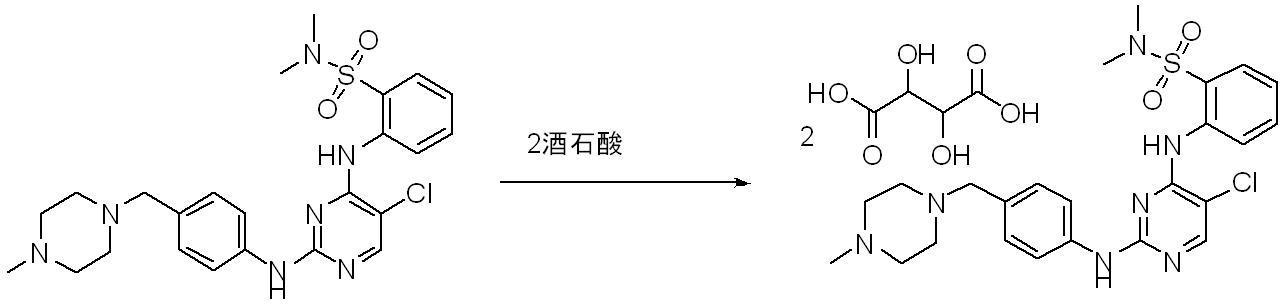
ある実施態様において、ここに開示する酒石酸塩は、約1:1〜約2:1の酒石酸対構造(I)の化合物のモル比を有し得る。例えば、酒石酸塩は、約2:1の酒石酸対構造(I)の化合物のモル比を有し得る。ここに開示する酒石酸塩の何れもL−(+)−酒石酸の塩であり得る。 In certain embodiments, the tartrates disclosed herein can have a molar ratio of compounds of tartrate to structure (I) of about 1: 1 to about 2: 1. For example, tartrate can have a molar ratio of compounds of tartrate to structure (I) of about 2: 1. Any of the tartrates disclosed herein can be a salt of L- (+)-tartaric acid.
他の態様において、本発明は、ここに開示する酒石酸塩の何れかの結晶形態を提供する。ある実施態様において、結晶形態は、約2:1の酒石酸対構造(I)の化合物のモル比を有する結晶形態Aである。幾つかの例において、形態Aは実質的に純粋な形態であり得る。ある実施態様において、結晶形態は形態Aを含む。ある実施態様において、結晶形態は本質的に形態Aからなる。 In another aspect, the invention provides a crystalline form of any of the tartrate salts disclosed herein. In certain embodiments, the crystal form is crystal form A having a molar ratio of the compound of tartaric acid to structure (I) of about 2: 1. In some examples, form A can be a substantially pure form. In certain embodiments, the crystalline form comprises Form A. In certain embodiments, the crystalline form essentially comprises form A.
ここに開示する結晶形態の何れも2θ単位で、11.2±0.2、17.1±0.2および19.9±0.2にピークを含むX線粉末回折(XRPD)パターンにより特徴づけられ得る。所望により、結晶形態は、さらに、2θ単位で、15.4±0.2にピークを含み得る。これとは別にまたはこれに加えて、結晶形態は、さらに2θ単位で、7.0±0.2にピークを含み得る。幾つかの例において、ここに開示する結晶形態は、2θ単位で、7.0±0.2、11.2±0.2、15.4±0.2、16.3±0.2、17.1±0.2、19.9±0.2、21.6±0.2および25.5±0.2から選択される3以上のピークを含むXRPDパターンにより特徴づけられ得る。他の例において、XRPDパターンは、2θ単位で、7.0±0.2、11.2±0.2、15.4±0.2、16.3±0.2、17.1±0.2、19.9±0.2、21.6±0.2および25.5±0.2から選択される4、5、6、7または8ピークを含み得る。ある具体例において、XRPDパターンは、図61に示すXRPDパターンと実質的に同一である。 All of the crystal forms disclosed herein are characterized by an X-ray powder diffraction (XRPD) pattern containing peaks at 11.2 ± 0.2, 17.1 ± 0.2 and 19.9 ± 0.2 in 2θ units. Can be attached. If desired, the crystal morphology may further include a peak at 15.4 ± 0.2 in 2θ units. Separately or in addition to this, the crystal morphology may further include a peak at 7.0 ± 0.2 in 2θ units. In some examples, the crystal forms disclosed herein are, in 2θ units, 7.0 ± 0.2, 11.2 ± 0.2, 15.4 ± 0.2, 16.3 ± 0.2, It can be characterized by an XRPD pattern containing 3 or more peaks selected from 17.1 ± 0.2, 19.9 ± 0.2, 21.6 ± 0.2 and 25.5 ± 0.2. In another example, the XRPD pattern is in 2θ units: 7.0 ± 0.2, 11.2 ± 0.2, 15.4 ± 0.2, 16.3 ± 0.2, 17.1 ± 0. It may contain 4, 5, 6, 7 or 8 peaks selected from .2, 19.9 ± 0.2, 21.6 ± 0.2 and 25.5 ± 0.2. In one embodiment, the XRPD pattern is substantially identical to the XRPD pattern shown in FIG.
これとは別にまたはこれに加えて、ここに開示する結晶形態の何れも℃単位で約185.0〜194.0の吸熱ピークを含む示差走査熱量測定(DSC)サーモグラムにより特徴づけられ得る。ある実施態様において、吸熱ピークは約186.3℃の開始温度を有する。ある実施態様において、ここに開示する結晶形態は、℃単位で約107.8、約152.1および約189.1に吸熱ピークを含むDSCサーモグラムにより特徴づけられ得る。ある具体例において、結晶形態は、図64に示すサーモグラムと実質的に同一であるDSCサーモグラムを有し得る。 Separately or additionally, any of the crystalline forms disclosed herein can be characterized by a differential scanning calorimetry (DSC) thermogram containing an endothermic peak of about 185.5 to 194.0 in ° C. In certain embodiments, the endothermic peak has a starting temperature of about 186.3 ° C. In certain embodiments, the crystalline morphology disclosed herein can be characterized by a DSC thermogram containing endothermic peaks at about 107.8, about 152.1 and about 189.1 in ° C. units. In certain embodiments, the crystal morphology may have a DSC thermogram that is substantially identical to the thermogram shown in FIG.
さらに、ここに開示する結晶形態の何れも160℃で約1.8%の重量喪失を示す熱重量分析(TGA)サーモグラムにより特徴づけられ得る。例えば、TGAサーモグラムは、図64に示すサーモグラムと実質的に同一である。 In addition, any of the crystalline forms disclosed herein can be characterized by a thermogravimetric analysis (TGA) thermogram showing a weight loss of about 1.8% at 160 ° C. For example, the TGA thermogram is substantially identical to the thermogram shown in FIG.
ここに開示する結晶形態の何れも、少なくとも99%の初期純度および約25℃±2℃で、60±5%の相対湿度で約15日まで保管後少なくとも99%のその後の純度を有し得る。ある実施態様において、結晶形態は、少なくとも99%の初期純度および約40℃±2℃で、75±5%の相対湿度で約15日まで保管後少なくとも99%のその後の純度を有し得る。 Any of the crystalline forms disclosed herein may have an initial purity of at least 99% and a subsequent purity of at least 99% after storage at about 25 ° C. ± 2 ° C. and a relative humidity of 60 ± 5% for up to about 15 days. .. In certain embodiments, the crystalline form may have an initial purity of at least 99% and a subsequent purity of at least 99% after storage at about 40 ° C. ± 2 ° C. and 75 ± 5% relative humidity for up to about 15 days.
また本発明の範囲内であるのは、ここに開示する酒石酸塩の何れかまたはここに開示する結晶形態の何れかを含む、組成物である。ある実施態様において、組成物は、純粋な形態の形態Aを含む。ある実施態様において、組成物は、重量で少なくとも90%形態Aを含む。ある実施態様において、組成物は、本質的に結晶形態Aからなる。 Also within the scope of the present invention is a composition comprising any of the tartrate salts disclosed herein or the crystalline form disclosed herein. In certain embodiments, the composition comprises a pure form of Form A. In certain embodiments, the composition comprises at least 90% by weight of Form A. In certain embodiments, the composition essentially comprises crystalline form A.
ここに開示する組成物の何れも医薬組成物であり得て、さらに薬学的に許容される担体または希釈剤を含む。ある実施態様において、医薬組成物は、さらに1以上のさらなる治療剤、例えば、ホルモン療法剤、化学療法剤、免疫療法剤、細胞増殖因子または細胞増殖因子受容体作用を阻害するための薬剤を含み得る。ここに開示する医薬組成物の何れも、経口投与用に製剤され得る。例えば、医薬組成物はカプセル剤または錠剤として製剤され得る。 Any of the compositions disclosed herein can be a pharmaceutical composition and further comprises a pharmaceutically acceptable carrier or diluent. In certain embodiments, the pharmaceutical composition further comprises one or more additional therapeutic agents, such as hormone therapeutic agents, chemotherapeutic agents, immunotherapeutic agents, agents for inhibiting cell growth factor or cell growth factor receptor action. obtain. Any of the pharmaceutical compositions disclosed herein can be formulated for oral administration. For example, the pharmaceutical composition may be formulated as a capsule or tablet.
さらに、本発明は、ここに開示する医薬組成物の何れかを含む単位用量を提供する。単位用量は、約1〜100mgの酒石酸塩を含み得る。ある実施態様において、ここに開示する単位用量は、約1mg、4mg、16mg、25mg、50mg、75mgまたは100mgの酒石酸塩を含み得る。ある実施態様において、単位用量は、経口投与用のゼラチン硬カプセル剤に製剤され得る。 In addition, the present invention provides unit doses comprising any of the pharmaceutical compositions disclosed herein. The unit dose may include about 1-100 mg of tartrate. In certain embodiments, the unit doses disclosed herein may comprise about 1 mg, 4 mg, 16 mg, 25 mg, 50 mg, 75 mg or 100 mg of tartrate. In certain embodiments, the unit dose may be formulated in a gelatin hard capsule for oral administration.
他の態様において、本発明は、癌を処置する方法であって、それを必要とする対象(例えば、ヒト)に、ここに開示する酒石酸塩の何れか、ここに開示する結晶形態の何れか、それを含む医薬組成物の何れかまたは同様にここに開示する単位用量の治療有効量を投与することを含む、方法を提供する。 In another aspect, the invention is a method of treating cancer, to a subject (eg, a human) in need thereof, of any of the tartrate salts disclosed herein, or any of the crystalline forms disclosed herein. , A method comprising administering a therapeutically effective amount of a unit dose of any of the pharmaceutical compositions comprising, or similarly disclosed herein.
ある実施態様において、ここに開示する方法は、対象に約2:1の酒石酸対構造(I)の化合物のモル比を有する酒石酸塩の治療有効量を投与することを含む。幾つかの例において、方法は、対象に、実質的に純粋な形態であり得る結晶形態Aの治療有効量を投与することを含む。 In certain embodiments, the method disclosed herein comprises administering to a subject a therapeutically effective amount of tartrate having a molar ratio of a compound of tartrate to structure (I) of about 2: 1. In some examples, the method comprises administering to the subject a therapeutically effective amount of crystalline form A, which may be in substantially pure form.
さらなる態様において、ここに提供されるのは、対象に構造(I)
ある実施態様において、構造(I)の化合物または薬学的に許容される塩またはその結晶形態は、約1.0mg/m2、約1.5mg/m2、約3.0mg/m2、約6.0mg/m2、約9.0mg/m2、約12.0mg/m2、約16.0mg/m2、約21.0mg/m2、約28.0mg/m2、約37.0mg/m2、約49.0mg/m2または約65.0mg/m2の用量で経口投与され得る。例えば、構造(I)の化合物または薬学的に許容される塩またはその結晶形態は、約25mg、約33mg、約45mg、約50mg、約58mg、約75mgまたは約100mgの1日用量で、単独抗癌剤として対象に投与され得る。具体例において、構造(I)の化合物または薬学的に許容される塩またはその結晶形態は、第二の抗癌剤と同時に対象に経口投与され、構造(I)の化合物または薬学的に許容される塩またはその結晶形態の1日用量は約20mg、約25mg、約30mg、約35mg、約40mg、約45mg、約50mg、約55mg、約60mg、約65mg、約70mg、約75mg、約80mg、約85mg、約90mg、約95mgまたは約100mgである。
In certain embodiments, the compound of structure (I) or the pharmaceutically acceptable salt or crystal form thereof is about 1.0 mg / m 2 , about 1.5 mg / m 2 , about 3.0 mg /
ここに開示する何れの方法においても、癌は固形腫瘍または血液癌であり得る。固形腫瘍の例は、骨、消化器、生殖器、頭部、頸部、肺、心臓、皮膚、神経系、内分泌系、神経内分泌系、泌尿器系、軟組織または脳の腫瘍を含むが、これらに限定されない。造血器癌の例は、多発性骨髄腫、骨髄異形成症候群(MDS)、急性骨髄性白血病(AML)、急性リンパ芽球性白血病(ALL)、急性リンパ球性白血病、慢性リンパ行性白血病、慢性リンパ球性白血病(CLL)、小リンパ球性リンパ腫(SLL)、マントル細胞リンパ腫、汎発性大B細胞リンパ腫、濾胞性リンパ腫または非ホジキンリンパ腫を含むが、これらに限定されない。 In any of the methods disclosed herein, the cancer can be a solid tumor or a hematological malignancies. Examples of solid tumors include, but are limited to, bone, digestive, reproductive, head, neck, lung, heart, skin, nervous system, endocrine system, neuroendocrine system, urinary system, soft tissue or brain tumors. Not done. Examples of hematopoietic cancer include multiple myeloma, myeloid dysplasia syndrome (MDS), acute myeloid leukemia (AML), acute lymphoblastic leukemia (ALL), acute lymphocytic leukemia, chronic lymphocytic leukemia, It includes, but is not limited to, chronic lymphocytic leukemia (CLL), small lymphocytic lymphoma (SLL), mantle cell lymphoma, generalized large B cell lymphoma, follicular lymphoma or non-hodgkin lymphoma.
ある実施態様において、癌は進行型固形腫瘍であるおよび/または1以上の先の癌治療を受けた後疾患進行を示している。例えば、固形腫瘍は、抵抗性、再発性、難治性または再発した固形腫瘍であり得る。幾つかの例において、1以上の先の癌治療は、ホルモン療法剤、化学療法剤(例えば、アルキル化剤、プラチナ製剤、代謝拮抗剤、抗癌抗生物質または植物由来抗癌剤)、免疫療法剤または細胞表面受容体阻害剤を含む。化学療法剤の例は、カルボプラチン、シスプラチン、ミボプラチン、ネダプラチンおよびオキサリプラチンを含むが、これらに限定されない。 In certain embodiments, the cancer is an advanced solid tumor and / or exhibits disease progression after receiving one or more previous cancer treatments. For example, a solid tumor can be a resistant, recurrent, refractory or recurrent solid tumor. In some examples, one or more previous cancer treatments are hormone therapies, chemotherapeutic agents (eg, alkylating agents, platinum preparations, antimetabolites, anticancer antibiotics or plant-derived anticancer agents), immunotherapeutic agents or Contains cell surface receptor inhibitors. Examples of chemotherapeutic agents include, but are not limited to, carboplatin, cisplatin, miboplatin, nedaplatin and oxaliplatin.
ある実施態様において、対象は、免疫療法、化学療法またはこれらの組み合わせを含み得る1以上の先の癌治療を受けている。 In certain embodiments, the subject is receiving one or more prior cancer treatments that may include immunotherapy, chemotherapy or a combination thereof.
ある実施態様において、対象は、非小細胞肺癌(NSCLC)、結腸直腸癌(CRC)、卵巣癌、黒色腫、乳癌、神経内分泌癌、前立腺腺癌、胆管細胞癌、子宮癌および膵臓癌であり得る固形腫瘍を有する。 In certain embodiments, the subjects are non-small cell lung cancer (NSCLC), colorectal cancer (CRC), ovarian cancer, melanoma, breast cancer, neuroendocrine cancer, prostate adenocarcinoma, bile duct cell cancer, uterine cancer and pancreatic cancer. Have a solid tumor to get.
ある実施態様において、対象は、免疫療法を受けた後、少なくとも疾患安定であり得る。例えば、対象は、2サイクルまでの免疫療法を受けていてよい。 In certain embodiments, the subject can be at least disease stable after receiving immunotherapy. For example, the subject may be receiving up to two cycles of immunotherapy.
ある実施態様において、対象はEGFR+NSCLCを有し得る。幾つかの例において、対象は、1以上のチロシンキナーゼ阻害剤(TKI)(EGFR TKIを含み得る)を含む1以上の化学療法を受けた後、疾患進行を示したものであり得る。幾つかの例において、対象は、2種類までのTKIを摂取した後、少なくとも疾患安定に至ったものであり得る。 In certain embodiments, the subject may have EGFR + NSCLC. In some examples, a subject may exhibit disease progression after receiving one or more chemotherapy containing one or more tyrosine kinase inhibitors (TKIs) (which may include EGFR TKIs). In some examples, the subject may be at least disease stable after ingesting up to two TKIs.
ある実施態様において、対象は、BRAF、KRASまたはNRAS変異結腸直腸癌(CRC)を有し得る。 In certain embodiments, the subject may have BRAF, KRAS or NRAS mutant colorectal cancer (CRC).
ある実施態様において、対象は持続性または再発性卵巣癌を有し得る。例えば、対象はプラチナ製剤に対して難治性または抵抗性である、または同剤による先行治療を受けているあるいはその両者である可能性がある。幾つかの例において、プラチナ製剤はカルボプラチン、シスプラチン、ミボプラチン、ネダプラチンまたはオキサリプラチンである。 In certain embodiments, the subject may have persistent or recurrent ovarian cancer. For example, the subject may be refractory or resistant to the platinum product, or may be receiving prior treatment with the drug, or both. In some examples, the platinum product is carboplatin, cisplatin, miboplatin, nedaplatin or oxaliplatin.
ある実施態様において、対象はBRAF変異黒色腫を有し得る。幾つかの例において、対象は、免疫療法、1以上のBRAF/MEK阻害剤を含む化学療法またはこれらの組み合わせの後疾患が進行していてよい。 In certain embodiments, the subject may have BRAF mutant melanoma. In some examples, the subject may have advanced disease after immunotherapy, chemotherapy with one or more BRAF / MEK inhibitors, or a combination thereof.
ある実施態様において、対象は、免疫療法に抵抗性であってよく、ここで、方法はさらに対象に同じ免疫療法を受けさせることを含む。幾つかの例において、免疫療法は、抗PD−1剤または抗PD−L1剤を含む。 In certain embodiments, the subject may be resistant to immunotherapy, where the method further comprises subjecting the subject to the same immunotherapy. In some examples, immunotherapy comprises an anti-PD-1 or anti-PD-L1 agent.
ここに開示する何れの方法においても(例えば、EGFR+NSCLCを処置する方法)、対象は、TKIを含む化学療法に抵抗性であり得る。このような方法は、さらに、対象に同じ免疫療法を受けさせることを含み得る。 In any of the methods disclosed herein (eg, methods of treating EGFR + NSCLC), the subject may be resistant to chemotherapy, including TKIs. Such methods may further include giving the subject the same immunotherapy.
ここに開示する何れの方法においても、対象は、15mg/日のプレドニゾンに相当する量でのステロイドを摂取していない。これとは別にまたはこれに加えて、方法は、対象に併用ステロイドを投与することをさらに含み得る。ある実施態様において、対象は、酒石酸塩の最初の投与前少なくとも1か月以内に抗癌治療を受けていない、酒石酸塩の最初の投与前少なくとも7日以内にCYP2C19代謝群および/またはH2−受容体アンタゴニストを受けていないものであり得る。 In any of the methods disclosed herein, the subject did not take steroids in an amount equivalent to 15 mg / day of prednisone. Alternatively or additionally, the method may further comprise administering to the subject a concomitant steroid. In certain embodiments, the subject has not received anti-cancer treatment within at least 1 month prior to the first dose of tartrate, the CYP2C19 metabolite group and / or H2-receptor within at least 7 days prior to the first dose of tartrate. It can be one that has not received a body antagonist.
ここに開示する何れの方法においても、対象は、酒石酸塩の約1.0mg/m2、1.5mg/m2、3.0mg/m2、6.0mg/m2、9.0mg/m2、12.0mg/m2、16.0mg/m2、21.0mg/m2、28.0mg/m2、37.0mg/m2、49.0mg/m2または65.0mg/m2の1日量で、酒石酸塩、その結晶形態またはそれを含む医薬組成物を経口投与され得る。幾つかの例において、対象は、酒石酸塩の約20〜100mg、所望により約25〜75mg、例えば、約50mgの1日量で、酒石酸塩、その結晶形態または医薬組成物を経口投与され得る。
In any of the methods disclosed herein, the subject is about 1.0 mg / m 2 , 1.5 mg / m 2 , 3.0 mg / m 2 , 6.0 mg / m 2 , 9.0 mg / m of tartrate. 2, 12.0mg / m 2, 16.0mg /
ここに開示する方法の何れも1以上の処置サイクルを含み得て、各々約28日からなり、ここで、各処置サイクルにおいて、酒石酸塩、その結晶形態または医薬組成物は対象に21日間連日投与され、続いて7日間の休薬期間がある。 Each of the methods disclosed herein can comprise one or more treatment cycles, each consisting of about 28 days, wherein in each treatment cycle, tartrate, its crystalline form or pharmaceutical composition is administered daily to the subject for 21 days. Then there is a 7-day washout period.
他の実施態様において、ここに開示する方法の何れかにより処置される対象は、慢性リンパ球性白血病(CLL)または小リンパ球性リンパ腫(SLL)であり得る血液癌を有し得る。ある実施態様において、対象は、CLLまたはSLLの1以上の先の治療を受けている。ある実施態様において、対象は先の治療に不耐性であるかまたは先の治療の後疾患が進行していてよい。幾つかの例において、先の治療は、B細胞受容体アンタゴニスト、BCL−2アンタゴニストまたはこれらの組み合わせを含み得る。他の実施態様において、対象は、他の癌治療と同時に処置され得ない。幾つかの例において、対象は、約20〜100mg、所望により約25mg〜100mgの酒石酸塩、例えば、約25mg、約33mg、約45mg、約50mg、約58mg、約75mgまたは約100mgの1日量で、酒石酸塩、その結晶形態または医薬組成物を経口投与され得る。 In other embodiments, the subject treated by any of the methods disclosed herein may have a hematological malignancies that can be chronic lymphocytic leukemia (CLL) or small lymphocytic lymphoma (SLL). In certain embodiments, the subject is receiving one or more prior treatments for CLL or SLL. In certain embodiments, the subject may be intolerant to the previous treatment or the disease may be advanced after the previous treatment. In some examples, the previous treatment may include B cell receptor antagonists, BCL-2 antagonists or combinations thereof. In other embodiments, the subject cannot be treated at the same time as other cancer treatments. In some examples, the subject is a daily dose of about 20-100 mg, optionally about 25 mg-100 mg of tartrate, eg, about 25 mg, about 33 mg, about 45 mg, about 50 mg, about 58 mg, about 75 mg or about 100 mg. The tartrate salt, its crystalline form or pharmaceutical composition can be orally administered.
幾つかの例において、造血器癌を処置する方法は、対象にイブルチニブ、アカラブルチニブ、ザヌブルチニブおよびLOXO−305であり得るBTK阻害剤を投与することをさらに含み得る。ある具体例において、BTK阻害剤はイブルチニブであり得る。幾つかの例において、対象は、BTK阻害剤での先の処置に付され、BTK阻害剤処置で進行した。幾つかの例において、対象は、約20mg〜100mg(例えば、約25〜75mg)の酒石酸塩、例えば、約20mg、約25mg、約33mg、約45mg、約50mg、約58mg、約75mgまたは約100mgの1日量で、酒石酸塩、その結晶形態またはそれを含む医薬組成物を投与され得る。 In some examples, the method of treating hematopoietic cancer may further comprise administering to the subject a BTK inhibitor, which may be ibrutinib, acalabrutinib, zanubrutinib and LOXO-305. In certain embodiments, the BTK inhibitor can be ibrutinib. In some examples, subjects were subjected to previous treatment with BTK inhibitors and progressed with BTK inhibitor treatment. In some examples, the subject is about 20 mg to 100 mg (eg, about 25 to 75 mg) of tartrate, such as about 20 mg, about 25 mg, about 33 mg, about 45 mg, about 50 mg, about 58 mg, about 75 mg or about 100 mg. A daily dose of tartrate, a crystalline form thereof or a pharmaceutical composition comprising the tartrate salt can be administered.
ある実施態様において、ここに開示する方法の何れも1以上の処置サイクルを含んでよく、各々約28日からなり、ここで、各サイクルにおいて、対象は、28日間酒石酸塩、その結晶形態またはそれを含む医薬組成物を1日1回経口投与される。 In certain embodiments, any of the methods disclosed herein may comprise one or more treatment cycles, each consisting of about 28 days, wherein in each cycle the subject is tartrate, its crystalline form or its crystalline form for 28 days. The pharmaceutical composition containing the above is orally administered once a day.
ここに開示する方法の何れも、さらに(a)腫瘍崩壊症候群(TLS)について対象をモニタリングする;(b)対象に抗生物質、抗ウイルス剤、抗真菌剤またはこれらの組み合わせを投与することを含み得る。 Each of the methods disclosed herein further comprises (a) monitoring the subject for tumor lysis syndrome (TLS); (b) administering to the subject an antibiotic, an antiviral agent, an antifungal agent or a combination thereof. obtain.
ある実施態様において、対象は、可溶性AXL、AXL発現および/またはリン酸化、成長停止特異的遺伝子6(GAS6)、間葉性転写因子またはこれらの組み合わせのレベルが、可溶性AXL、GAS6または間葉性転写因子の対照レベルに比して上昇し得る。幾つかの例において、方法は、さらに、投与ステップ前に、可溶性AXL、AXL発現および/またはリン酸化、成長停止特異的遺伝子6(GAS6)、間葉性転写因子またはこれらの組み合わせのレベルが可溶性AXL、GAS6または間葉性転写因子の対照レベルに比して高い対象を同定することを含み得る。幾つかの例において、同定ステップは、候補対象の末梢血サンプルまたは骨髄サンプルを得て、末梢血サンプルまたは骨髄サンプルにおける可溶性AXLのレベル、GAS6のレベル、間葉性転写因子のレベルまたはこれらの組み合わせを測定することにより実施され得る。 In certain embodiments, the subject is soluble AXL, AXL expression and / or phosphorylation, growth arrest specific gene 6 (GAS6), mesenchymal transcription factor or a combination thereof with soluble AXL, GAS6 or mesenchymal levels. It can be elevated relative to the control level of transcription factors. In some examples, the method further dissolves the levels of soluble AXL, AXL expression and / or phosphorylation, growth arrest specific gene 6 (GAS6), mesenchymal transcription factor or a combination thereof prior to the dosing step. It may include identifying subjects that are higher than the control levels of AXL, GAS6 or mesenchymal transcription factors. In some examples, the identification step takes a candidate peripheral blood or bone marrow sample and the level of soluble AXL, GAS6, mesenchymal transcription factor or a combination thereof in the peripheral blood or bone marrow sample. Can be carried out by measuring.
ここに開示する方法の何れも、さらに、投与ステップ後、下痢、悪心、嘔吐、味覚異常、貧血および血小板減少症の1以上の症状について対象を検査することを含み得る。さらに、方法は、さらにこれら1以上の症状が検出されたら、酒石酸塩の1日用量を減らすかまたは処置を中止することを含み得る。 Any of the methods disclosed herein may further include examining the subject for one or more symptoms of diarrhea, nausea, vomiting, taste disorders, anemia and thrombocytopenia after the dosing step. In addition, the method may further include reducing the daily dose of tartrate or discontinuing treatment once these one or more symptoms are detected.
ある実施態様において、ここに開示する方法は、さらに1以上の治療剤の有効量を対象に投与することを含み得る。1以上の治療剤は1以上のチロシンキナーゼ阻害剤を含み得る。幾つかの例において、1以上のチロシンキナーゼ阻害剤はEGFR阻害剤を含み得る。他の例において、1以上の治療剤は、免疫チェックポイント阻害剤、例えば、PD−1阻害剤またはPD−L1阻害剤を含み得る。PD−1阻害剤の例は、ペンブロリズマブ、ニボルマブまたはこれらの組み合わせを含むが、これらに限定されない。PD−L1阻害剤の例は、アテゾリズマブ、アベルマブ、デュルバルマブまたはこれらの組み合わせを含むが、これらに限定されない。これとは別にまたはこれに加えて、1以上の治療剤は、CDK阻害剤、例えば、CDK9阻害剤を含み得て、これは、幾つかの例では、アルボシジブまたはその薬学的に許容される塩もしくはプロドラッグであり得る。幾つかの例において、CDK9阻害剤は、アルボシジブのプロドラッグであり、これは、次の構造(II’)
幾つかの例において、1以上の治療剤はプラチナベースの化学療法剤を含む。 In some examples, one or more therapeutic agents include platinum-based chemotherapeutic agents.
構造(I)の化合物またはその薬学的に許容される塩(例えば、ここに開示する酒石酸塩の何れか)と組み合わせて使用されるさらなる治療剤の例は、カルボプラチン、ゲムシタビン、ベバシズマブ、トポテカン、ルカパリブ、オラパリブ、ニラパリブ、ニボルマブ、ペンブロリズマブ、アテゾリズマブ、アベルマブ、デュルバルマブ、イピリムマブまたはこれらの組み合わせを含み得る。 Examples of additional therapeutic agents used in combination with the compound of structure (I) or a pharmaceutically acceptable salt thereof (eg, any of the tartrates disclosed herein) include carboplatin, gemcitabine, bevacizumab, topotecan, lucaparib. , Olaparib, niraparib, nivolumab, penbrolizumab, atezolizumab, avelumab, durvalumab, ipilimumab or a combination thereof.
さらに他の態様において、本発明は、構造(I)
さらに、本発明は、癌を処置する方法であって、構造(I)
さらに、ここに提供されるのは、構造(I)
X’は脱離基であり;
Yはハロであり;
Zはハロまたは−NR1(R2)であり;そして
R1およびR2は、各々独立して、水素またはC1−C8アルキルである。〕
を有する化合物またはその薬学的に許容される塩と、N−メチルピペラジンまたはその塩を反応させて、次の構造
X'is a leaving group;
Y is halo;
Z is halo or -NR 1 (R 2 ); and R 1 and R 2 are independently hydrogen or C 1- C 8 alkyl, respectively. ]
The following structure is obtained by reacting a compound having the above or a pharmaceutically acceptable salt thereof with N-methylpiperazine or a salt thereof.
ある実施態様において、方法は、さらに、次の構造
Yはハロであり;
Zはハロまたは−NR1(R2)であり;そして
R1およびR2は、各々独立して、水素またはC1−C8アルキルである。〕
を有する化合物またはその薬学的に許容される塩と、活性化剤を反応させて、構造
Y is halo;
Z is halo or -NR 1 (R 2 ); and R 1 and R 2 are independently hydrogen or C 1- C 8 alkyl, respectively. ]
The structure is obtained by reacting a compound having the above or a pharmaceutically acceptable salt thereof with an activator.
ある実施態様において、活性化剤はスルホニルクロライド官能基を含む。ある実施態様において、X’はハロまたはスルホネート(例えば、クロロ)である。これとは別にまたはこれに加えて、活性化剤は塩化チオニルである。 In certain embodiments, the activator comprises a sulfonyl chloride functional group. In certain embodiments, X'is halo or sulfonate (eg, chloro). Separately or in addition to this, the activator is thionyl chloride.
ある実施態様において、方法は、さらに次の構造
Yはハロであり;
Zはハロまたは−NR1(R2)であり;そして
R1およびR2は、各々独立して、水素またはC1−C8アルキルである。〕
を有する化合物またはその薬学的に許容される塩と、還元剤を反応させて、構造
Y is halo;
Z is halo or -NR 1 (R 2 ); and R 1 and R 2 are independently hydrogen or C 1- C 8 alkyl, respectively. ]
The structure is obtained by reacting a compound having the above or a pharmaceutically acceptable salt thereof with a reducing agent.
幾つかの例において、還元剤は、リチウムアルミニウムハイドライド、ジボラン、水素化ホウ素ナトリウム、ボランまたはこれらの組み合わせである。ある具体例において、還元剤はボランである。 In some examples, the reducing agent is lithium aluminum hydride, diborane, sodium borohydride, borane or a combination thereof. In one embodiment, the reducing agent is borane.
ここに開示する方法の何れも、さらに次の構造
Xは脱離基であり;
Yはハロであり;
Zはハロまたは−NR1(R2)であり;そして
R1およびR2は、各々独立して、水素またはC1−C8アルキルである。〕
を有する化合物またはその薬学的に許容される塩と、次の構造
PはHまたは保護基である。
を有する化合物を反応させて、次の構造
X is a leaving group;
Y is halo;
Z is halo or -NR 1 (R 2 ); and R 1 and R 2 are independently hydrogen or C 1- C 8 alkyl, respectively. ]
Compounds or pharmaceutically acceptable salts thereof and the following structures
P is H or a protecting group.
The following structure is reacted by reacting the compound having
ある実施態様において、Xはハロまたはスルホネート(例えば、クロロ)であり得る。これとは別にまたはこれに加えて、PはHであってよく;Yはクロロであってよく;Zは−NR1(R2)であってよく;R1はC1−C8アルキル(例えば、メチル)であってよく;および/またはR2はC1−C8アルキル(例えば、メチル)であってよい。 In certain embodiments, X can be halo or sulfonate (eg, chloro). Separately or in addition to this, P may be H; Y may be chloro; Z may be -NR 1 (R 2 ); R 1 may be C 1- C 8 alkyl ( for example, it is methyl); and / or R 2 is C 1 -C 8 alkyl (e.g., may be methyl).
さらに他の態様において、本発明は、構造(I)
ある実施態様において、工程(a)の溶媒はアニソールおよびエタノールを約2.5:1(w/w)の比で含むおよび/または約70℃の温度を有してよい。幾つかの例において、工程(b)の(L)−酒石酸と工程(a)の構造(I)の化合物のモル比は約2:1であるおよび/または酒石酸の溶液を約1時間にわたって第一溶液に加える。ここに開示する何れの方法においても、第二溶液を約20℃に冷却するおよび/または約5時間撹拌する。 In certain embodiments, the solvent of step (a) may contain anisole and ethanol in a ratio of about 2.5: 1 (w / w) and / or have a temperature of about 70 ° C. In some examples, the molar ratio of (L) -tartaric acid in step (b) to the compound in structure (I) in step (a) is about 2: 1 and / or a solution of tartaric acid over about 1 hour. Add to one solution. In any of the methods disclosed herein, the second solution is cooled to about 20 ° C. and / or stirred for about 5 hours.
また本発明の範囲内であるのは、次の構造(III)
Yはハロであり;
Zはハロまたは−NR1(R2)であり;
R1およびR2は、各々独立して、水素またはC1−C8アルキルであり;
R3はハロまたはORaであり;
R4は水素またはオキソであり;そして
Raは水素またはC1−C8アルキルである。〕
を有する化合物またはその薬学的に許容される塩、立体異性体もしくは互変異性体である。
Further, the following structure (III) is within the scope of the present invention.
Y is halo;
Z is halo or -NR 1 (R 2 );
R 1 and R 2 are each independently hydrogen or C 1 -C 8 alkyl;
R 3 is halo or OR a ;
R 4 is hydrogen or oxo; and Ra is hydrogen or C 1- C 8 alkyl. ]
A compound having the above or a pharmaceutically acceptable salt, stereoisomer or tautomer thereof.
ある実施態様において、Yはクロロであってよく;Zは−NR1(R2)であってよく、ここで、R1およびR2は、幾つかの例では、C1−C8アルキル(例えば、メチル)であってよく;および/またはR3はORaであってよく、ここで、Raは、幾つかの例ではHであってよい。幾つかの例において、R3はハロ(例えば、クロロ)であってよい。幾つかの例において、R4は水素であってよい。他の例において、R4はオキソであってよい。 In certain embodiments, Y may be chloro; Z may be -NR 1 (R 2 ), where R 1 and R 2 are, in some examples, C 1- C 8 alkyl (. For example, it may be methyl); and / or R 3 may be OR a , where Ra may be H in some examples. In some examples, R 3 may be halo (eg, chloro). In some examples, R 4 may be hydrogen. In another embodiment, R 4 may be oxo.
ある実施態様において、化合物は、次の構造
さらに、本発明は、次の構造(I)
Aは6員芳香環または6員炭素環であり;
R1aおよびR1bは各々独立してH、C1−C6アルキルまたは−OHであり;
R2およびR3は各々独立してH、C1−C6アルキルまたはハロであり;
R4はH、C1−C6アルキルまたは−OHであり;
R5aおよびR5bは各々独立してH、C1−C6アルキルまたはハロであり;
R6a、R6b、R6cおよびR6dは各々独立して存在しないかまたは−O−であり;
R7はH、C1−C6アルキルもしくは−OHであるかまたは存在せず;
R8は存在しないかまたは次の構造
R9は存在しないかまたはアルケニルであるが、ただし、R8またはR9の少なくとも一方は存在し;
R10はHまたはC1−C6アルキルであり;そして
全ての原子価は充足され;
ただし、R1aおよびR1bの両者がメチルであるならば
a. R6a、R6b、R6c、R6dおよびR9の少なくとも一つは−O−である;
b. R7はC1−C6アルキルもしくは−OHであるかまたは存在しない;および/または
c. R10はHである。〕
を有する化合物またはその立体異性体、薬学的に許容される塩、互変異性体もしくはプロドラッグを提供する。
Further, the present invention has the following structure (I).
A is a 6-membered aromatic ring or a 6-membered carbon ring;
R 1a and R 1b are independently H, C 1- C 6 alkyl or -OH;
R 2 and R 3 are independently H, C 1- C 6 alkyl or halo, respectively;
R 4 is H, C 1- C 6 alkyl or -OH;
R 5a and R 5b each independently H, C 1 -C 6 alkyl or halo;
R 6a, R 6b, absent independently each R 6c and R 6d or -O - a and;
R 7 is H, C 1- C 6 alkyl or -OH or absent;
R 8 does not exist or has the following structure
R 9 is absent or alkenyl, but at least one of R 8 or R 9 is present;
R 10 is H or C 1- C 6 alkyl; and
However, if both R 1a and R 1b are methyl a. At least one of R 6a , R 6b , R 6c , R 6d and R 9 is −O − ;
b. R 7 is C 1- C 6 alkyl or -OH or absent; and / or c. R 10 is H. ]
Provided are a compound having the above or a stereoisomer thereof, a pharmaceutically acceptable salt, a tautomer or a prodrug.
ある実施態様において、化合物は次:
さらに、本発明は、ここに開示する化合物またはその立体異性体、薬学的に許容される塩、互変異性体もしくはプロドラッグの何れかおよび薬学的に許容される担体、希釈剤または添加物を含む医薬組成物を提供する。 In addition, the invention comprises any of the compounds disclosed herein or their stereoisomers, pharmaceutically acceptable salts, tautomers or prodrugs and pharmaceutically acceptable carriers, diluents or additives. Provided is a pharmaceutical composition containing.
また本発明の範囲内であるのは、対象における癌を処置する方法であって、有効量のここに開示する化合物またはその立体異性体、薬学的に許容される塩、互変異性体もしくはプロドラッグの何れかまたは同様にここに開示する医薬組成物を投与することを含む、方法である。 Also within the scope of the present invention is a method of treating cancer in a subject, in an effective amount of a compound or stereoisomer thereof disclosed herein, a pharmaceutically acceptable salt, a tautomer or a pro. A method comprising administering any of the drugs or similarly the pharmaceutical compositions disclosed herein.
さらに、ここに提供されるのは、対象の代謝プロファイルを決定する方法であって、対象の細胞集団と治療剤を接触させ;そしてここに開示する化合物の何れかである第一代謝物質の濃度を決定することを含む、方法である。ある実施態様において、治療剤は、次の構造(VI)
ここに開示する方法は、対象に免疫療法剤を投与することをさらに含み得る。ある実施態様において、免疫療法はチェックポイント阻害剤またはCTLA−4阻害剤である。例えば、免疫療法剤はペンブロリズマブである。ある実施態様において、方法は、ここに開示する1以上の条件下で実施し得る。 The methods disclosed herein may further comprise administering to the subject an immunotherapeutic agent. In certain embodiments, the immunotherapy is a checkpoint inhibitor or CTLA-4 inhibitor. For example, the immunotherapeutic agent is pembrolizumab. In certain embodiments, the method can be performed under one or more of the conditions disclosed herein.
本発明の1以上の実施態様の詳細を以下に示す。本発明の他の特性または利点は、次の図面およびいくつかの実施態様の詳細な記載およびまた添付する特許請求の範囲から明らかである。 Details of one or more embodiments of the present invention are shown below. Other properties or advantages of the present invention are evident from the following drawings and the detailed description of some embodiments and also the appended claims.
図面の簡単な説明
図において、同じ引用番号は、類似する要素を特定する。図面の寸法および要素の相対位置は必ずしも実寸どおり描いておらず、これらの要素の一部は、図を読みやすくするために拡大し、配置されている。さらに、記載される要素の特定の形態は、その特定の要素の実際の形態に関する何らかの情報を伝えることを意図せず、図の認識の容易さのためにのみ選択している。
Brief Description of Drawings In figures, the same citation numbers identify similar elements. The dimensions of the drawing and the relative positions of the elements are not necessarily drawn to their actual size, and some of these elements have been enlarged and placed to make the drawing easier to read. Moreover, the particular form of the described element is not intended to convey any information about the actual form of that particular element and is selected solely for the ease of recognition of the figure.
発明の詳細な記載
A. 定義
次の記載において、本発明の種々の実施態様の完全な理解を提供するために、ある特定の詳細が示されている。しかしながら、当業者は、本発明がこれらの詳述を用いずに実施され得ることを理解する。
Detailed Description of the Invention A. Definitions In the following description, certain details are provided to provide a complete understanding of the various embodiments of the invention. However, those skilled in the art will appreciate that the present invention can be practiced without these details.
文脈から他のことが必要でない限り、本明細書および特許請求の範囲を通して、用語「含む」および「含み」および「含んで」のようなその変形は、オープンな、包括的意味(すなわち、「含むが、限定されない」)と解釈されるべきである。 Unless otherwise necessary from the context, throughout the specification and claims, its variations, such as the terms "include" and "include" and "include", have an open, inclusive meaning (ie, "include"). It should be interpreted as "including, but not limited to").
本明細書における「一つの実施態様」または「ある実施態様」の記載は、その実施態様に関連して記載される特定の特性、構造または特徴が、本発明の少なくとも一つの実施態様に含まれることを意味する。それ故に、本明細書の種々の場所における「一つの実施態様において」または「ある実施態様において」なる言い回しの存在は、全てが同じ実施態様を述べるとは限らない。さらに、特定の特性、構造または特徴を、1以上の実施態様において何らかの適当な方法で組み合わせ得る。 The description of "one embodiment" or "some embodiment" herein includes specific properties, structures or features described in connection with that embodiment in at least one embodiment of the invention. Means that. Therefore, the presence of the phrase "in one embodiment" or "in certain embodiments" in various places herein does not necessarily all refer to the same embodiment. In addition, specific properties, structures or features may be combined in any suitable way in one or more embodiments.
他に定義しない限り、ここで使用する全ての技術的および科学的用語は、本発明が属する分野の当業者に一般に理解されているのと同じ意味を有する。本明細書および特許請求の範囲で使用する単数表現は、文脈に明らかに反しない限り、複数を含む。 Unless otherwise defined, all technical and scientific terms used herein have the same meaning as commonly understood by those skilled in the art to which the present invention belongs. As used herein and in the claims, the singular representation includes plural unless it is clearly contrary to the context.
「オキソ」は、=O置換基をいう。 "Oxo" refers to the = O substituent.
「アルキル」は、1〜12炭素原子(C1−C12アルキル)、好ましくは1〜8炭素原子(C1−C8アルキル)または1〜6炭素原子(C1−C6アルキル)を有する、飽和または不飽和(すなわち、1以上の二重および/または三重結合を含む)かつ分子の残りに単結合により結合している、炭素および水素原子のみからなる直線状または分岐炭化水素鎖ラジカル、例えば、メチル、エチル、n−プロピル、1−メチルエチル(イソ−プロピル)、n−ブチル、n−ペンチル、1,1−ジメチルエチル(t−ブチル)、3−メチルヘキシル、2−メチルヘキシル、エテニル、プロプ−1−エニル、ブト−1−エニル、ペント−1−エニル、ペンタ−1,4−ジエニル、エチニル、プロピニル、ブチニル、ペンチニル、ヘキシニルなどをいう。アルキルは、アルケニル(1以上の炭素−炭素二重結合)およびアルキニル(エチニルなどの1以上の炭素−炭素三重結合)を含む。本明細書において特に断らない限り、アルキル基は場合により置換されている。 An "alkyl" has 1 to 12 carbon atoms (C 1- C 12 alkyl), preferably 1 to 8 carbon atoms (C 1 to C 8 alkyl) or 1 to 6 carbon atoms (C 1 to C 6 alkyl). A linear or branched hydrocarbon chain radical consisting only of carbon and hydrogen atoms, saturated or unsaturated (ie containing one or more double and / or triple bonds) and attached to the rest of the molecule by a single bond, For example, methyl, ethyl, n-propyl, 1-methylethyl (iso-propyl), n-butyl, n-pentyl, 1,1-dimethylethyl (t-butyl), 3-methylhexyl, 2-methylhexyl, It refers to ethenyl, prop-1-enyl, butto-1-enyl, pent-1-enyl, penta-1,4-dienyl, ethynyl, propynyl, butynyl, pentynyl, hexynyl and the like. Alkyls include alkenyl (one or more carbon-carbon double bonds) and alkynyl (one or more carbon-carbon triple bonds such as ethynyl). Unless otherwise specified herein, alkyl groups are optionally substituted.
「ハロ」または「ハロゲン」は、ブロモ、クロロ、フルオロまたはヨードをいう。 "Halogen" or "halogen" refers to bromo, chloro, fluoro or iodine.
ここで使用する用語「置換」は、少なくとも一つの水素原子が、F、Cl、BrおよびIなどのハロゲン原子;ヒドロキシル基、アルコキシ基およびエステル基などの基の酸素原子;チオール基、チオアルキル基、スルホン基、スルホニル基およびスルホキシド基などの基における硫黄原子;アミン、アミド、アルキルアミン、ジアルキルアミン、アリールアミン、アルキルアリールアミン、ジアリールアミン、N−オキシド、イミドおよびエナミンなどの基における窒素原子;トリアルキルシリル基、ジアルキルアリールシリル基、アルキルジアリールシリル基およびトリアリールシリル基などの基におけるケイ素原子;および種々の他の基の他のヘテロ原子などの、しかし、これらに限定されない非水素原子への結合に置き換えられることを意味する。「置換」はまた、1以上の水素原子が、オキソ、カルボニル、カルボキシルおよびエステル基における酸素;およびイミン、オキシム、ヒドラゾンおよびニトリルなどの基における窒素などのヘテロ原子への高次結合(例えば、二重または三重結合)に置き換わることも意味する。例えば、ある実施態様において、「置換」は、1以上の水素原子が−NRgRh、−NRgC(=O)Rh、−NRgC(=O)NRgRh、−NRgC(=O)ORh、−NRgSO2Rh、−OC(=O)NRgRh、−ORg、−SRg、−SORg、−SO2Rg、−OSO2Rg、−SO2ORg、=NSO2Rgおよび−SO2NRgRhに置き換わることも意味する。「置換」はまた1以上の水素原子が−C(=O)Rg、−C(=O)ORg、−C(=O)NRgRh、−CH2SO2Rg、−CH2SO2NRgRhに置き換わることも意味する。前記において、RgおよびRhは同一でも異なってもよく、独立して水素、アルキル、アルコキシ、アルキルアミニル、チオアルキル、アリール、アラルキル、シクロアルキル、シクロアルキルアルキル、ハロアルキル、ヘテロシクリル、N−ヘテロシクリル、ヘテロシクリルアルキル、ヘテロアリール、N−ヘテロアリールおよび/またはヘテロアリールアルキルである。「置換」は、さらに1以上の水素原子がアミニル、シアノ、ヒドロキシル、イミノ、ニトロ、オキソ、チオキソ、ハロ、アルキル、アルコキシ、アルキルアミニル、チオアルキル、アリール、アラルキル、シクロアルキル、シクロアルキルアルキル、ハロアルキル、ヘテロシクリル、N−ヘテロシクリル、ヘテロシクリルアルキル、ヘテロアリール、N−ヘテロアリールおよび/またはヘテロアリールアルキル基への結合に置き換わることも意味する。さらに、前記置換基の各々も、上記置換基の1以上で場合により置換されていてよい。 The term "substitution" as used herein means that at least one hydrogen atom is a halogen atom such as F, Cl, Br and I; an oxygen atom of a group such as a hydroxyl group, an alkoxy group and an ester group; a thiol group, a thioalkyl group, Sulfur atoms in groups such as sulfone, sulfonyl and sulfoxide groups; nitrogen atoms in groups such as amines, amides, alkylamines, dialkylamines, arylamines, alkylarylamines, diarylamines, N-oxides, imides and enamines; tri To non-hydrogen atoms such as, but not limited to, silicon atoms in groups such as alkylsilyl groups, dialkylarylsilyl groups, alkyldiarylsilyl groups and triarylsilyl groups; and other heteroatoms of various other groups. Means to be replaced by a join. "Substitution" also means that one or more hydrogen atoms have higher-order bonds (eg, two) to heteroatoms such as oxygen at oxo, carbonyl, carboxyl and ester groups; and nitrogen at groups such as imine, oxime, hydrazone and nitrile. It also means to replace (double or triple bond). For example, in some embodiments, "substitution" means that one or more hydrogen atoms have -NR g R h , -NR g C (= O) R h , -NR g C (= O) NR g R h , -NR. g C (= O) OR h , -NR g SO 2 R h , -OC (= O) NR g R h , -OR g , -SR g , -SOR g , -SO 2 R g , -OSO 2 R It also means replacing g , -SO 2 OR g , = NSO 2 R g and -SO 2 NR g R h. "Substitution" also means that one or more hydrogen atoms are -C (= O) R g , -C (= O) OR g , -C (= O) NR g R h , -CH 2 SO 2 R g , -CH. It also means replacing 2 SO 2 NR g R h. In the above, R g and R h may be the same or different, and independently hydrogen, alkyl, alkoxy, alkylaminyl, thioalkyl, aryl, aralkyl, cycloalkyl, cycloalkylalkyl, haloalkyl, heterocyclyl, N-heterocyclyl, Heterocyclylalkyl, heteroaryl, N-heteroaryl and / or heteroarylalkyl. "Substitution" means that one or more hydrogen atoms are aminyl, cyano, hydroxyl, imino, nitro, oxo, thioxo, halo, alkyl, alkoxy, alkylaminyl, thioalkyl, aryl, aralkyl, cycloalkyl, cycloalkylalkyl, haloalkyl. , Heterocyclyl, N-heterocyclyl, heterocyclylalkyl, heteroaryl, N-heteroaryl and / or also means substituting for a bond to a heteroarylalkyl group. Further, each of the substituents may also be optionally substituted with one or more of the substituents.
用語「有効量」または「治療有効量」は、下に定義する疾患処置を含むが、これに限定されない意図される適用に十分に有効である、ここに記載する化合物(例えば、構造(I)の化合物または構造(I)の化合物の酒石酸塩などの薬学的に許容される塩)の量をいう。治療有効量は、当業者により容易に決定され得る、意図される処置適用(インビボ)または処置される対象および疾患状態、例えば、対象の体重および年齢、疾患状態の重症度、投与方式などにより変わり得る。本用語はまた、標的細胞における特定の応答、例えば、血小板粘着および/または細胞遊走の減少を誘発する量にも適用される。具体的用量は、選択される特定の化合物、従うべき投与レジメン、他の化合物と組み合わせて投与されるか否か、投与のタイミング、投与される組織および運搬される物理的送達系による。 The term "effective amount" or "therapeutically effective amount" includes, but is not limited to, a compound described herein that is sufficiently effective for an intended application, including, but not limited to, the treatment of the disease as defined below. The amount of a pharmaceutically acceptable salt such as tartrate of the compound of the compound or the compound of the structure (I)). The therapeutically effective amount will vary depending on the intended treatment application (in vivo) or the subject and disease condition being treated, such as the weight and age of the subject, the severity of the disease condition, the method of administration, etc., which can be readily determined by one of ordinary skill in the art. obtain. The term also applies to amounts that elicit a particular response in target cells, such as reduced platelet adhesion and / or cell migration. The specific dose depends on the particular compound selected, the dosing regimen to be followed, whether or not it is administered in combination with other compounds, the timing of administration, the tissue administered and the physical delivery system carried.
「腫瘍」を含む「癌」は、身体上の臓器および系の正常機能を妨害する、細胞の制御されない成長および/または細胞生存の異常増加および/またはアポトーシスの阻害をいう。「癌」(例えば、腫瘍)は、固形および非固形癌を含む。癌または腫瘍を有する対象は、対象体内に、客観的に測定可能な数の癌細胞が存在する。「癌」は、良性および悪性癌(例えば、それぞれ良性および悪性腫瘍)ならびに休止状態腫瘍または微小転移を含む。 "Cancer", including "tumor," refers to an abnormal increase in cell growth and / or inhibition of cell survival and / or inhibition of apoptosis that interferes with the normal functioning of organs and systems on the body. "Cancer" (eg, tumor) includes solid and non-solid cancer. A subject with cancer or tumor has an objectively measurable number of cancer cells in the subject. "Cancer" includes benign and malignant cancers (eg, benign and malignant tumors, respectively) and dormant tumors or micrometastases.
特定の治療に「抵抗性」である癌は、持続性疾患を示すまたは治療剤投与後の完全寛解が6か月以内である癌をいう。ある実施態様において、特定の治療に抵抗性である癌を有する対象は、治療に対する統計的に有意な客観的応答がないことを示す。対象は、該対象がCA−125レベル正常(例えば、46U/mL未満)およびCTスキャン正常であるならば、「完全寛解」と見なされる。ある実施態様において、癌は、治療を受けているにも関わらずまたは該治療の最後の投与から6か月以内に癌が進行するならば、その特定の治療に対して抵抗性である。 Cancers that are "resistant" to a particular treatment are cancers that show persistent disease or have a complete remission within 6 months after administration of a therapeutic agent. In certain embodiments, subjects with cancer who are refractory to a particular treatment show no statistically significant objective response to treatment. A subject is considered to be in "complete remission" if the subject has a normal CA-125 level (eg, less than 46 U / mL) and a normal CT scan. In certain embodiments, the cancer is resistant to that particular treatment if it progresses despite being treated or within 6 months of the last dose of the treatment.
再発性癌は、根絶または消失した部位に出現する癌をいう。処置抵抗性癌(例えば、プラチナ抵抗性)は、癌が進行したならば(例えば、造影により確認)、対象が最後の処置を受けて6か月以内に再発したならば、「再発性」である。例えば、プラチナ抵抗性癌は、対象が最後のプラチナベースの化学療法を受けて6か月以内に再発したならば、再発性である。 Recurrent cancer refers to cancer that appears at the site of eradication or disappearance. Treatment-resistant cancer (eg, platinum-resistant) is "recurrent" if the cancer has progressed (eg, confirmed by contrast) and has recurred within 6 months of the subject's last treatment. be. For example, platinum-resistant cancer is recurrent if the subject relapses within 6 months of receiving the last platinum-based chemotherapy.
AMLを有する対象に関してここで使用する用語「難治性」は、当分野で通常の意味を有し、処置後、例えば、処置後1週間以内、2週間以内、4週間以内または2か月以内に骨髄に白血病細胞が残っている対象をいい得る。 The term "refractory" as used herein with respect to subjects with AML has the usual meaning in the art and is post-treatment, eg, within 1 week, within 2 weeks, within 4 weeks or within 2 months after treatment. A subject with leukemia cells remaining in the bone marrow can be referred to.
癌は、無期限に長期に癌が存在するまたは同じ状態のままであるならば、「持続性」である。 Cancer is "persistent" if it exists or remains in the same condition for an indefinite period of time.
ここで使用する用語「再燃」は、当分野で通常の意味を有し、処置による完全寛解(例えば、最初の完全寛解)の期間の後のAMLまたはAMLの徴候および症状の再発をいい得る。ある実施態様において、再燃は、医師が臨床的評価により決定し得る、完全寛解後の疾患の再発をいい得る。 The term "relapse" as used herein has the usual meaning in the art and may refer to the recurrence of AML or symptoms and symptoms of AML after a period of complete remission by treatment (eg, first complete remission). In certain embodiments, relapse may refer to a recurrence of the disease after complete remission, which can be determined by a physician by clinical evaluation.
癌は、癌が治療の最後の投与後6〜12か月に進行したならば、該治療に「部分的感受性」(例えば、部分的プラチナ感受性)である。 The cancer is "partially sensitive" (eg, partially platinum sensitive) to the treatment if the cancer progresses 6-12 months after the last dose of treatment.
癌は、癌が治療の最後の投与後12か月以降に進行したならば、該治療に「感受性」(例えば、プラチナ感受性)である。「転移反応」は、癌のその原発部位からからの他の場所への拡散をいう。「転移」は、元の場所から遊走し、重要な臓器に着床する癌であり、これは、罹患臓器の機能的悪化により最終的に対象を死亡させ得る。転移反応は、癌細胞は原発腫瘍から離脱し、リンパ管および血管に浸透し、血流を介して循環し、体のどこかの正常組織における遠位病巣で増殖する(転移する)連続的過程である。新しい部位で、細胞は血液供給を確立し、命を脅かす細胞塊を形成するよう増殖し得る。転移反応は、近位または遠位であり得る。腫瘍細胞内の刺激性および阻害性両者の分子経路がこの挙動を制御し、新規部位における腫瘍細胞と宿主細胞の相互作用も顕著である。 The cancer is "susceptible" to the treatment (eg, platinum susceptibility) if the cancer progresses after 12 months after the last dose of treatment. A "rearrangement reaction" refers to the spread of cancer from its primary site to another location. A "metastasis" is a cancer that migrates from its original location and implants in an important organ, which can eventually kill the subject due to functional deterioration of the affected organ. The metastatic reaction is a continuous process in which cancer cells withdraw from the primary tumor, penetrate lymph vessels and blood vessels, circulate through the bloodstream, and proliferate (metastasis) in distal lesions in normal tissue somewhere in the body. Is. At new sites, cells can proliferate to establish a blood supply and form life-threatening cell clumps. The rearrangement reaction can be proximal or distal. Both irritating and inhibitory molecular pathways within tumor cells control this behavior, and tumor cell-host cell interactions at new sites are also prominent.
少なくとも「疾患安定」である対象は、iRECISTに従い治療に対して疾患安定、部分的応答または完全応答である対象をいう。 A subject who is at least "disease stable" refers to a subject who is disease stable, partial or complete response to treatment according to iRECIST.
ここで使用する「処置」または「処置する」は、治療的利益および/または予防的利益を含むが、これらに限定されない疾患、障害または医学的状態に関する有利または所望の結果を得るアプローチをいう。治療的利益により、処置される根底の障害の根絶または改善が意味される。また、治療的利益は、対象がまだ根底の障害に罹患しているかもしれないことにかかわらず、対象において改善が観察されるように、根底の障害と関連する生理学的症状の1以上の根絶または改善により達成される。ある実施態様において、予防的利益について、組成物は、特定の疾患を発症するリスクのある対象または、疾患の診断はまだされていない場合でも、疾患の生理学的症状の1以上が報告されている対象に投与される。 As used herein, "treatment" or "treating" refers to an approach that obtains an advantageous or desired outcome for a disease, disorder or medical condition that includes, but is not limited to, therapeutic and / or prophylactic benefits. Therapeutic benefits mean eradication or amelioration of the underlying disorder being treated. Also, the therapeutic benefit is the eradication of one or more of the physiological symptoms associated with the underlying disorder so that improvement is observed in the subject, even though the subject may still be suffering from the underlying disorder. Or achieved by improvement. In certain embodiments, for prophylactic benefits, the composition has been reported to be one or more of the physiological manifestations of the disease, even if the subject is at risk of developing a particular disease or the disease has not yet been diagnosed. Administered to the subject.
ここで使用する用語「処置サイクル」は、当分野で通常の意味を有し、休薬期間を含み、一定スケジュールで繰り返される、1以上の一連の処置をいい得る。 As used herein, the term "treatment cycle" has the usual meaning in the art and may refer to one or more series of treatments that include a drug holiday and are repeated on a fixed schedule.
「治療効果」は、その用語がここで使用される限り、上記治療的利益および/または予防的利益を包含する。予防効果は、疾患または状態の出現の遅延または排除、疾患または状態の症状の開始の遅延または排除、疾患または状態の進行の遅延、停止または逆転または任意のこれらの組み合わせを含む。 "Therapeutic effect" includes the therapeutic and / or prophylactic benefits described above, as long as the term is used herein. Prophylactic effects include delaying or eliminating the appearance of the disease or condition, delaying or eliminating the onset of symptoms of the disease or condition, delaying, stopping or reversing the progression of the disease or condition, or any combination thereof.
ここで使用する用語「共投与」、「と組み合わせて投与」およびその文法上同意義のものは、ヒトを含む動物への2以上の薬剤を、両剤および/またはその代謝物質が対象に同時に存在するように投与することを含む。共投与は、別々の組成物の同時の投与、別々の組成物の異なる時間での投与または両剤が存在する組成物の投与を含む。 The terms "co-administration", "administered in combination" and their grammatically synonymous terms used herein include two or more drugs for animals, including humans, both drugs and / or their metabolites simultaneously present in the subject. Includes administration as such. Co-administration includes simultaneous administration of different compositions, administration of different compositions at different times, or administration of a composition in which both agents are present.
「薬学的に許容される塩」は、酸および塩基両者の付加塩を含む。 "Pharmaceutically acceptable salts" include addition salts of both acids and bases.
「薬学的に許容される酸付加塩」は、遊離塩基の生物学的有効性および性質を保持し、生物学的にまたは他の点で望ましくないものではなく、かつ塩酸、臭化水素酸、硫酸、硝酸、リン酸などのしかしこれらに限定されない無機酸および、酢酸、2,2−ジクロロ酢酸、アジピン酸、アルギン酸、アスコルビン酸、アスパラギン酸、ベンゼンスルホン酸、安息香酸、4−アセトアミド安息香酸、樟脳酸、カンファー−10−スルホン酸、カプリン酸、カプロン酸、カプリル酸、炭酸、ケイ皮酸、クエン酸、シクラミン酸、ドデシル硫酸、エタン−1,2−ジスルホン酸、エタンスルホン酸、2−ヒドロキシエタンスルホン酸、ギ酸、フマル酸、ガラクタル酸、ゲンチジン酸、グルコヘプトン酸、グルコン酸、グルクロン酸、グルタミン酸、グルタル酸、2−オキソ−グルタル酸、グリセロリン酸、グリコール酸、馬尿酸、イソ酪酸、乳酸、ラクトビオン酸、ラウリン酸、マレイン酸、リンゴ酸、マロン酸、マンデル酸、メタンスルホン酸、ムチン酸、ナフタレン−1,5−ジスルホン酸、ナフタレン−2−スルホン酸、1−ヒドロキシ−2−ナフトエ酸、ニコチン酸、オレイン酸、オロト酸、シュウ酸、パルミチン酸、パモ酸、プロピオン酸、ピログルタミン酸、ピルビン酸、サリチル酸、4−アミノサリチル酸、セバシン酸、ステアリン酸、コハク酸、酒石酸(例えば、L−(+)−酒石酸)、チオシアン酸、p−トルエンスルホン酸、トリフルオロ酢酸、ウンデシレン酸などの、しかしこれらに限定されない有機酸と形成された塩をいう。 A "pharmaceutically acceptable acid addition salt" retains the biological effectiveness and properties of the free base, is not biologically or otherwise undesirable, and is hydrochloric acid, hydrobromic acid, Inorganic acids such as, but not limited to, sulfuric acid, nitrate, phosphoric acid, acetic acid, 2,2-dichloroacetic acid, adipic acid, alginic acid, ascorbic acid, aspartic acid, benzenesulfonic acid, benzoic acid, 4-acetamide benzoic acid, Cerebral acid, camphor-10-sulfonic acid, capric acid, caproic acid, capric acid, carbonic acid, silicic acid, citric acid, cyclamic acid, dodecyl sulfate, ethane-1,2-disulfonic acid, ethanesulfonic acid, 2-hydroxy Ethansulfonic acid, formic acid, fumaric acid, galactalic acid, gentidic acid, glucoheptoic acid, gluconic acid, glucuronic acid, glutamic acid, glutaric acid, 2-oxo-glutaric acid, glycerophosphate, glycolic acid, horseuric acid, isobutyric acid, lactic acid, Lactobionic acid, lauric acid, maleic acid, malic acid, malonic acid, mandelic acid, methanesulfonic acid, mucinic acid, naphthalene-1,5-disulfonic acid, naphthalene-2-sulfonic acid, 1-hydroxy-2-naphthoic acid, Nicotinic acid, oleic acid, orotoic acid, oxalic acid, palmitic acid, pamoic acid, propionic acid, pyroglutamic acid, pyruvate, salicylic acid, 4-aminosalicylic acid, sebacic acid, stearic acid, succinic acid, tartrate (eg L-( +)-Tartrate), thiocyan acid, p-toluenesulfonic acid, trifluoroacetic acid, undecyleneic acid, etc., but not limited to organic acids and salts formed.
「薬学的に許容される塩基付加塩」は、遊離酸の生物学的有効性および性質を保持し、生物学的にまたは他の点で望ましくないものではない塩をいう。これらの塩は、遊離酸への無機塩基または有機塩基の付加により調製される。無機塩基由来の塩は、ナトリウム塩、カリウム塩、リチウム塩、アンモニウム塩、カルシウム塩、マグネシウム塩、鉄塩、亜鉛塩、銅塩、マンガン塩、アルミニウム塩などを含むが、これらに限定されない。好ましい無機塩は、アンモニウム塩、ナトリウム塩、カリウム塩、カルシウム塩およびマグネシウム塩である。有機塩基由来の塩は、1級、2級および3級アミン、天然に存在する置換アミンを含む置換アミン、環状アミンおよび塩基性イオン交換樹脂、例えばアンモニア、イソプロピルアミン、トリメチルアミン、ジエチルアミン、トリエチルアミン、トリプロピルアミン、ジエタノールアミン、エタノールアミン、デアノール、2−ジメチルアミノエタノール、2−ジエチルアミノエタノール、ジシクロヘキシルアミン、リシン、アルギニン、ヒスチジン、カフェイン、プロカイン、ヒドラバミン、コリン、ベタイン、ベネタミン、ベンザチン、エチレンジアミン、グルコサミン、メチルグルカミン、テオブロミン、トリエタノールアミン、トロメタミン、プリン、ピペラジン、ピペリジン、N−エチルピペリジン、ポリアミン樹脂などの塩を含むが、これらに限定されない。特に好ましい有機塩基は、イソプロピルアミン、ジエチルアミン、エタノールアミン、トリメチルアミン、ジシクロヘキシルアミン、コリンおよびカフェインである。 "Pharmaceutically acceptable base addition salt" refers to a salt that retains the biological effectiveness and properties of the free acid and is not biologically or otherwise undesirable. These salts are prepared by adding an inorganic or organic base to the free acid. Salts derived from inorganic bases include, but are not limited to, sodium salts, potassium salts, lithium salts, ammonium salts, calcium salts, magnesium salts, iron salts, zinc salts, copper salts, manganese salts, aluminum salts and the like. Preferred inorganic salts are ammonium salts, sodium salts, potassium salts, calcium salts and magnesium salts. Salts derived from organic bases include primary, secondary and tertiary amines, substituted amines including naturally occurring substituted amines, cyclic amines and basic ion exchange resins such as ammonia, isopropylamine, trimethylamine, diethylamine, triethylamine, tri. Propylamine, diethanolamine, ethanolamine, deanol, 2-dimethylaminoethanol, 2-diethylaminoethanol, dicyclohexylamine, lysine, arginine, histidine, caffeine, procaine, hydrabamine, choline, betaine, venetamine, benzatin, ethylenediamine, glucosamine, methyl It includes, but is not limited to, salts such as glucamine, theobromine, triethanolamine, tromethamine, purine, piperazine, piperidine, N-ethylpiperidine, polyamine resins and the like. Particularly preferred organic bases are isopropylamine, diethylamine, ethanolamine, trimethylamine, dicyclohexylamine, choline and caffeine.
ある実施態様において、薬学的に許容される塩は、4級アミンアルキルハライド塩(例えば、メチルブロマイド)などの4級アンモニウム塩を含む。 In certain embodiments, the pharmaceutically acceptable salt comprises a quaternary ammonium salt such as a quaternary amine alkyl halide salt (eg, methyl bromide).
「抗癌剤」、「抗腫瘍剤」または「化学療法剤」は、新生物状態の処置に有用なあらゆる薬剤をいう。抗癌剤の1群は化学療法剤を含む。「化学療法」は、静脈内、経口、筋肉内、腹腔内、膀胱内、皮下、経皮、バッカルまたは吸入または坐薬の形態を含む、種々の方法による癌患者への1以上の化学療法薬物および/または他の薬剤の投与を意味する。 "Anti-cancer agent", "anti-tumor agent" or "chemotherapeutic agent" refers to any agent useful in the treatment of neoplastic conditions. One group of anti-cancer agents includes chemotherapeutic agents. "Chemotherapy" refers to one or more chemotherapeutic agents and one or more chemotherapeutic agents for cancer patients by various methods, including intravenous, oral, intramuscular, intraperitoneal, intravesical, subcutaneous, transdermal, buccal or inhaled or suppository forms. / Or means administration of another drug.
「対象」は、哺乳動物、例えばヒトなどの動物をいう。ここに記載する方法は、ヒト治療および獣医適用の両者で有用であり得る。ある実施態様において、対象は哺乳動物であり、ある実施態様において、対象はヒトである。 "Subject" refers to a mammal, such as an animal such as a human. The methods described herein may be useful in both human therapy and veterinary applications. In some embodiments, the subject is a mammal, and in some embodiments, the subject is a human.
「哺乳動物」は、ヒトおよび実験動物および家庭で飼うペット(例えば、ネコ、イヌ、ブタ、ウシ、ヒツジ、ヤギ、ウマ、ウサギ)などの飼育動物ならびに野生生物などの非飼育動物などを含む。 "Mammals" include domestic and laboratory animals and domestic animals such as domestic pets (eg, cats, dogs, pigs, cows, sheep, goats, horses, rabbits) and non-domestic animals such as wildlife.
「放射線療法」は、対象を、アルファ−粒子放射性核種(例えば、アクチニウムおよびトリウム放射性核種)、低線エネルギー付与(LET)放射線放出体(すなわち、ベータ放射体)、転換電子放射体(例えば、ストロンチウム−89およびサマリウム−153−EDTMPまたはx線、ガンマ線および中性子線を含むが、これらに限定されない高エネルギー放射線などの放射線放出体に、施術者に知られる所定の方法および組成物を使用して曝すことを意味する。 "Radiation therapy" targets subjects with alpha-particle radionuclides (eg, actinium and thorium radionuclides), low-ray energy-giving (LET) radiation emitters (ie, beta radiators), converted electron emitters (eg, strontium). -89 and Samalium-153-EDTMP or radiation emitters such as, but not limited to, high-energy radiation, including, but not limited to x-rays, gamma-rays and neutrons, are exposed to radiation emitters using predetermined methods and compositions known to the practitioner. Means that.
「プロドラッグ」は、ここに記載する生物学的活性塩(例えば、構造(I)の酒石酸塩)に、生理学的条件下または加溶媒分解により変換され得る化合物を意味する。それ故に、用語「プロドラッグ」は、薬学的に許容される生物学的活性化合物の前駆体をいう。ある態様において、プロドラッグは、対象に投与したとき不活性であるが、インビボで、例えば、加水分解により、活性化合物に変換される。プロドラッグ化合物は、しばしば、溶解度、組織適合性または哺乳動物にける遅延放出の利点を提供する(例えば、Bundgard, H., Design of Prodrugs (1985), pp. 7 9, 21 24 (Elsevier, Amsterdam)参照)。プロドラッグの記載は、Higuchi, T., et al., "Pro-drugs as Novel Delivery Systems," A.C.S. Symposium Series, Vol. 14およびBioreversible Carriers in Drug Design, ed. Edward B. Roche, American Pharmaceutical Association and Pergamon Press, 1987に提供され、その両者を、引用により全体を本明細書に包含させる。用語「プロドラッグ」はまた何らかの共有結合担体を含むことを意味し、これは、このようなプロドラッグが哺乳動物対象に投与されたとき、インビボで活性化合物を遊離する。ここに記載する活性化合物のプロドラッグは、一般に、修飾が、所定の操作でまたはインビボで、開裂されて親活性化合物となるような方法で、活性化合物に存在する官能基を修飾することにより製造される。プロドラッグは、ヒドロキシ基、アミノ基またはメルカプト基が、活性化合物のプロドラッグが哺乳動物対象に投与されたとき、それぞれ、遊離ヒドロキシ基、遊離アミノ基または遊離メルカプト基を形成するように任意の基に結合している、化合物を含む。プロドラッグの例は、活性化合物におけるヒドロキシ官能基の酢酸エステル、ギ酸エステルおよび安息香酸エステル誘導体またはアミン官能基のアセトアミド、ホルムアミドおよびベンズアミド誘導体などを含むが、これらに限定されない。 "Prodrug" means a compound that can be converted to the biologically active salts described herein (eg, tartrate of structure (I)) under physiological conditions or by solvolysis. Therefore, the term "prodrug" refers to a precursor of a pharmaceutically acceptable biologically active compound. In some embodiments, the prodrug is inactive when administered to a subject, but is converted to an active compound in vivo, eg, by hydrolysis. Prodrug compounds often offer the benefits of solubility, histocompatibility or delayed release in mammals (eg, Bundgard, H., Design of Prodrugs (1985), pp. 7 9, 21 24 (Elsevier, Amsterdam). )reference). The description of prodrugs is Higuchi, T., et al., "Pro-drugs as Novel Delivery Systems," ACS Symposium Series, Vol. 14 and Bioreversible Carriers in Drug Design, ed. Edward B. Roche, American Pharmaceutical Association and Provided in Pergamon Press, 1987, both of which are incorporated herein by reference in their entirety. The term "prodrug" also means that it comprises some covalent carrier, which releases the active compound in vivo when such a prodrug is administered to a mammalian subject. The prodrugs of the active compounds described herein are generally prepared by modifying the functional groups present in the active compound in such a way that the modification is cleaved to the parent active compound by a predetermined procedure or in vivo. Will be done. A prodrug is an arbitrary group such that a hydroxy group, an amino group or a mercapto group forms a free hydroxy group, a free amino group or a free mercapto group when the active compound prodrug is administered to a mammalian subject, respectively. Contains compounds that are bound to. Examples of prodrugs include, but are not limited to, hydroxyfunctional acetates, formic acid and benzoic acid ester derivatives in active compounds or acetamides, formamides and benzamide derivatives of amine functional groups.
用語「インビボ」は、対象体内で起こる事象をいう。 The term "in vivo" refers to an event that occurs within a subject.
「約」および「凡そ」は、特定の固体形態を述べるために提供される数値または値の範囲、例えば、融解、脱水、脱溶媒和またはガラス転移を述べる、例えば、特定の温度または温度範囲;例えば、温度または湿度の関数としての質量変化などの質量変化;例えば、質量またはパーセンテージでの溶媒または水分含量;または例えば、IRまたはラマンスペクトロスコピーまたはXRPDによる分析におけるピーク位置と組み合わせて使用されるとき、その値または値の範囲が、特定の固体状態形態をなお表しながら、当業者に合理的であると見做される程度に逸脱し得ることを示す。具体的に、用語「約」および「凡そ」は、この文脈で使用されるとき、該数値または値の範囲が、特定の組成物または固体状態形態をなお表しながら、その記載する値または値の範囲の20%、10%、9%、8%、7%、6%、5%、4%、3%、2%、1%、0.9%、0.8%、0.7%、0.6%、0.5%、0.4%、0.3%、0.2%、0.1%または0.01%変わり得ることを示す。 "About" and "approximately" describe a range of numbers or values provided to describe a particular solid form, eg, melting, dehydration, desolvation or glass transition, eg, a particular temperature or temperature range; For example, when used in combination with mass changes such as mass changes as a function of temperature or humidity; eg solvent or water content in mass or percentage; or eg peak positions in analysis by IR or Raman Spectroscopy or XRPD. , Indicates that the value or range of values may deviate to the extent considered reasonable to those skilled in the art, while still representing a particular solid state form. Specifically, the terms "about" and "approximately", when used in this context, are of the value or value described, while the range of the numerical value or value still represents a particular composition or solid state form. Range 20%, 10%, 9%, 8%, 7%, 6%, 5%, 4%, 3%, 2%, 1%, 0.9%, 0.8%, 0.7%, It shows that it can change by 0.6%, 0.5%, 0.4%, 0.3%, 0.2%, 0.1% or 0.01%.
ここで使用する「実質的に同一」は、サンプル位置決めもしくは取り扱いまたは追跡もしくは物理的特徴を得るために用いる装置の同一性と一般に関係する、または実験室環境または分析装置内もしくはそれらの相互間で通常起こる、他の変動または揺らぎによる、変動の範囲内のピーク位置および振幅または強度と同等である値またはデータ追跡が同等である測定された物理的特性をいう。 As used herein, "substantially identical" is generally related to the identity of the equipment used to position or handle or track the sample or obtain physical characteristics, or within a laboratory environment or analyzer or between them. A measured physical property with a value or data tracking that is equivalent to the peak position and amplitude or intensity within the range of the fluctuation due to other fluctuations or fluctuations that normally occur.
ここで使用する「実質的に純粋」は、重量で約3%未満または約2%未満の総不純物またはより好ましくは約1重量%未満の水および/または約0.5重量%未満の分解または合成副産物または残存有機溶媒などの不純物を含む、ここに記載する化合物の固体状態形態をいう。 As used herein, "substantially pure" means total impurities of less than about 3% or less than about 2% by weight or more preferably less than about 1% by weight of water and / or decomposition of less than about 0.5% by weight or Refers to the solid state form of the compounds described herein, including impurities such as synthetic by-products or residual organic solvents.
ここで使用する「本質的に純粋」は、ここに記載する化合物の一つの形態であって、ここで、該形態における不純物または関連物質の合計が、1%未満、好ましくは0.75%未満、より好ましくは0.5%未満であり、かつ残存溶媒および水が1%未満、好ましくは0.75%未満、より好ましくは0.5%未満、さらに好ましくは0.25重量%未満である形態をいう。 As used herein, "essentially pure" is one form of a compound described herein, wherein the sum of impurities or related substances in that form is less than 1%, preferably less than 0.75%. , More preferably less than 0.5% and residual solvent and water less than 1%, preferably less than 0.75%, more preferably less than 0.5%, even more preferably less than 0.25% by weight. Refers to the form.
ここでの用語「結晶形態」および関連用語は、多形、溶媒和物、水和物、混合溶媒和物、共結晶および他の分子複合体を含むが、これらに限定されない、ある物質の種々の結晶状態をいう。結晶形態は、ある物質の種々の結晶状態の混合物、例えば、複数擬多形もしくは多形形態の組み合わせ、1以上の多形形態と1以上の擬多形の組み合わせまたはこのような形態と非晶質もしくは非固体状態形態の物質の組み合わせなどであってもよいが、それらに限らない。典型的組み合わせは、ある多形形態とある擬多形形態の混合物または多形もしくは擬多形形態と非晶質物質の混合物などの2以上の多形または擬多形形態のものである。一般に結晶形態は、XRPDパターンにより互いに区別できる。種々の結晶形態を有するが、XRPDパターンが本質的に同一である固体状態形態は、種々の形態が物理的形態と関連する種々の性質を示し得るため、異なる結晶形態と考えられる。物理的形態と関連する性質は、溶解速度、安定性、吸湿性、機械的性質、例えば硬度、引張強度、適合性(打錠)および取り扱い、例えば、流動させる、濾過する、混合することに関連するものならびに種々の多形についてここに記載する他の物理的または製剤学的性質を含む。 The term "crystal morphology" and related terms herein include, but are not limited to, polymorphs, solvates, hydrates, mixed solvates, co-crystals and other molecular complexes. The crystalline state of. A crystalline form is a mixture of various crystalline states of a substance, eg, a combination of multiple pseudopolymorphs or polymorphic forms, a combination of one or more polymorphs and one or more pseudopolymorphs, or such forms and amorphous. It may be a combination of substances in a quality or non-solid state form, but is not limited thereto. A typical combination is one of two or more polymorphs or pseudopolymorphs, such as a mixture of a polymorph and a pseudopolymorph or a mixture of a polymorph or a pseudopolymorph and an amorphous substance. Generally, the crystal morphologies can be distinguished from each other by the XRPD pattern. Solid-state morphologies, which have various crystalline morphologies but have essentially the same XRPD pattern, are considered to be different crystalline morphologies because the various morphologies can exhibit different properties associated with the physical morphology. Properties related to physical form are related to dissolution rate, stability, hygroscopicity, mechanical properties such as hardness, tensile strength, compatibility (tablet) and handling, such as fluidization, filtration, mixing. And other physical or pharmaceutical properties described herein for various polymorphs.
ここに開示する本発明の実施態様はまた、1以上の原子が異なる原子質量または質量数を有する原子に置き換えられた、同位体標識されている構造(I)の化合物の薬学的に許容される塩も包含する(すなわち、構造(I)の化合物の薬学的に許容される塩の「同位体形態」)。開示する化合物に取り込まれ得る同位体の例は、水素、炭素、窒素、酸素、リン、フッ素、塩素およびヨウ素の同位体、例えば、それぞれ2H、3H、11C、13C、14C、13N、15N、15O、17O、18O、31P、32P、35S、18F、36Cl、123Iおよび125Iを含む。これらの放射標識化合物は、例えば、作用の部位もしくは方式または薬理学的に重要な作用部位への結合親和性の特徴づけにより、化合物の有効性を決定または測定するのに有用である。ある同位体標識した構造(I)の化合物の薬学的に許容される塩、例えば、放射性同位体が組み込まれたものは、薬物および/または基質の組織分布試験に有用である。放射性同位体トリチウム(すなわち3H)および炭素−14(すなわち14C)は、その取り込みの容易さおよび検出手段が用意できる点で、この目的のために特に有用である。 The embodiments of the present invention disclosed herein are also pharmaceutically acceptable for compounds of isotope-labeled structure (I) in which one or more atoms are replaced by atoms having different atomic masses or mass numbers. Also includes salts (ie, the "isotopic form" of the pharmaceutically acceptable salt of the compound of structure (I)). Examples of isotopes that can be incorporated into the disclosed compounds, hydrogen, carbon, nitrogen, oxygen, phosphorus, fluorine, isotopes of chlorine, and iodine, for example, each 2 H, 3 H, 11 C , 13 C, 14 C, Includes 13 N, 15 N, 15 O, 17 O, 18 O, 31 P, 32 P, 35 S, 18 F, 36 Cl, 123 I and 125 I. These radiolabeled compounds are useful for determining or measuring the efficacy of a compound, for example, by characterizing the site or method of action or binding affinity to a pharmacologically important site of action. Pharmaceutically acceptable salts of compounds of an isotope-labeled structure (I), such as those incorporating radioisotopes, are useful for tissue distribution testing of drugs and / or substrates. The radioactive isotopes tritium (i.e. 3 H) and carbon-14 (i.e., 14 C) are points that can be prepared easily and detection means of the incorporation, are particularly useful for this purpose.
重水素(すなわち、2H)などの思い同位体での置換は、大きな代謝安定性に起因するある治療的利点、例えば、インビボ半減期延長または必要投与量減少を提供できるため、ある状況において好ましい。 Deuterium (ie, 2 H) Substitution with thoughts isotopes such as certain therapeutic advantages resulting from greater metabolic stability, for example, it is possible to provide an in vivo half-life or reduced dosage requirements, preferred in some circumstances ..
11C、18F、15Oおよび13Nなどの陽電子放出同位体での置換は、基質受容体占拠を試験する陽電子放射断層撮影(PET)試験に有用であり得る。構造(I)の化合物の同位体標識した塩は、一般に当業者に知られる慣用方法によりまたは下に示す実施例に記載したものに準ずる方法で、予め用いた非標識反応材の代わりに適切な同位体標識した反応材を使用して、製造され得る。 Substitution with positron emitting isotopes such as 11 C, 18 F, 15 O and 13 N may be useful in positron emission tomography (PET) tests to test substrate receptor occupation. Isotope-labeled salts of the compounds of structure (I) are suitable in place of the previously used unlabeled reactants by conventional methods generally known to those of skill in the art or by methods according to those described in the Examples below. It can be manufactured using isotope-labeled reactants.
本明細書に記載する式の置換基および/または可変基の組み合わせは、そのような組み合わせが安定な化合物をもたらすときのみ許容されることは理解される。「安定な化合物」および「安定な構造」は、反応混合物から有用な純度で単離し、かつ有効な治療剤に製剤するのに耐えられる十分な強度を有する化合物を意味する。 It is understood that combinations of substituents and / or variable groups of the formulas described herein are only acceptable if such combinations result in stable compounds. "Stable compound" and "stable structure" mean a compound that is isolated from the reaction mixture to a useful purity and has sufficient strength to withstand formulation into an effective therapeutic agent.
「所望により」または「場合により」は、その前に記載されている状況の事象が起こっても起こらなくてもよく、かつ該記載は該事象もしくは状況が起こる場合および起こらない場合を含むことを意味する。例えば、「場合により置換されているアリール」は、該アリール基が置換されていてもされていなくてもよく、かつ本記載は置換アリール基および置換基を有しないアリール基の両者を含むことを意味する。 "As desired" or "possibly" means that the event of the situation described preceding it may or may not occur, and that the description includes the event or situation with or without the event. means. For example, "optionally substituted aryl" means that the aryl group may or may not be substituted, and the present description includes both a substituted aryl group and an aryl group having no substituent. means.
「医薬組成物」は、本発明の化合物と、生物学的活性化合物の哺乳動物、例えば、ヒトへの送達について当分野で一般に認められる媒体の製剤をいう。このような媒体は、全ての薬学的に許容される担体、希釈剤または添加物を含む。 "Pharmaceutical composition" refers to a preparation of a compound of the present invention and a medium generally accepted in the art for delivery of a biologically active compound to a mammal, such as a human. Such vehicles include all pharmaceutically acceptable carriers, diluents or additives.
「薬学的に許容される担体、希釈剤または添加物」は、制限なく、あらゆるアジュバント、担体、添加物、流動促進剤、甘味剤、希釈剤、防腐剤、色素/着色剤、風味増強剤、界面活性剤、湿潤剤、分散剤、懸濁化剤、安定化剤、等張剤、溶媒または乳化剤を含み、ヒトまたは飼育動物への使用について米国食品医薬品局が許容しているものとして承認されているものである。 "Pharmaceutically acceptable carriers, diluents or additives" include, without limitation, any adjuvants, carriers, additives, flow promoters, sweeteners, diluents, preservatives, pigments / colorants, flavor enhancers, Contains surfactants, wetting agents, dispersants, suspending agents, stabilizers, isotonic agents, solvents or emulsifiers and is approved by the US Food and Drug Administration for use in humans or domestic animals. Is what you are doing.
「双性イオン形」は、少なくとも一つの官能基が正電荷を有し、一つの官能基が負電荷を有し、分子全体の正味の電化が0である、化合物(例えば構造(II’))の形態をいう。例えば、ホスフェート基(−PO3H2)は陰イオン形(例えば、−PO3H−)で存在でき、同分子内の窒素原子はプロトン化(陽イオン)形態で存在し得る。
A "zwitterionic form" is a compound in which at least one functional group has a positive charge, one functional group has a negative charge, and the net electrification of the entire molecule is zero (eg, structure (II'). ) Form. For example, a phosphate group (-
「互変異性体」は、分子のある原子から、同分子の他の原子へのプロトンシフトをいう。本実施態様は、それ故に、開示する化合物の互変異性体を含む。 "Tautomer" refers to the proton shift from one atom of a molecule to another of the same molecule. The present embodiment therefore includes tautomers of the disclosed compounds.
「単位用量」は、予定量の活性成分を含む、医薬組成物の個別の量である。活性成分の量は、一般に対象に投与される活性成分の投与量および/またはこのような投与量の1/2または1/3のようなこのような投与量の便利な分数に相当する。 A "unit dose" is an individual amount of a pharmaceutical composition that comprises a planned amount of the active ingredient. The amount of active ingredient generally corresponds to the dose of active ingredient administered to the subject and / or a convenient fraction of such dose, such as 1/2 or 1/3 of such dose.
ここで使用する化学命名プロトコールおよび構造図式は、ACD/Name Version 9.07ソフトウェアプログラムおよび/またはChemDraw Ultra Version 11.0.1ソフトウェア命名プログラム(CambridgeSoft)を使用する、I.U.P.A.C.命名システムの改変版である。ここで使用する複雑な化学名について、ある置換基は、一般にそれが結合する基の前に名付ける。例えば、シクロプロピルエチルは、エチル主鎖とシクロプロピル置換基を含む。全ての結合はここでの化学構造図式で特定され、一部の炭素原子における全結合を除き、原子価を満たすのに十分な水素原子に結合しているものと仮定される。 The chemical nomenclature protocol and structural diagram used here is the I.U.P.A.C. naming system using the ACD / Name Version 9.07 software program and / or the ChemDraw Ultra Version 11.0.1 software nomenclature program (CambridgeSoft). It is a modified version of. For complex chemical names used here, some substituents are generally named before the group to which they are attached. For example, cyclopropyl ethyl contains an ethyl backbone and a cyclopropyl substituent. All bonds are identified by the chemical structure diagram here and are assumed to be bonded to enough hydrogen atoms to satisfy their valence, except for all bonds at some carbon atoms.
B. 構造(I)の酒石酸塩の化合物
一つの態様において、本発明は、構造(I)
ある実施態様において、酒石酸塩はL−(+)−酒石酸の塩である。ある特定の実施態様において、構造(I)の化合物の酒石酸塩は結晶または部分的結晶固体である。 In certain embodiments, the tartrate is a salt of L- (+)-tartaric acid. In certain embodiments, the tartrate salt of the compound of structure (I) is a crystalline or partially crystalline solid.
構造(I)の化合物の他の塩形態が提供される。塩は薬学的に許容される塩であり得る。構造(I)の化合物の薬学的に許容される塩は、次の構造
により表され得る。ある実施態様において、薬学的に許容される塩はリン酸塩である。ある実施態様において、薬学的に許容される塩はリンゴ塩酸である。ある実施態様において、薬学的に許容される塩はコハク酸塩である。ある実施態様において、薬学的に許容される塩はベンゼンスルホン酸塩である。
Other salt forms of the compound of structure (I) are provided. The salt can be a pharmaceutically acceptable salt. A pharmaceutically acceptable salt of the compound of structure (I) has the following structure:
Can be represented by. In certain embodiments, the pharmaceutically acceptable salt is phosphate. In certain embodiments, the pharmaceutically acceptable salt is apple hydrochloric acid. In certain embodiments, the pharmaceutically acceptable salt is succinate. In certain embodiments, the pharmaceutically acceptable salt is a benzenesulfonate.
構造(I)の化合物の数種の塩を、実施例1に記載のとおりスクリーニングした。酒石酸塩は、実施例2および3に記載のとおり、バイオアベイラビリティなどの好都合な薬物動態性質を示した。 Several salts of the compound of structure (I) were screened as described in Example 1. Tartrate exhibited favorable pharmacokinetic properties such as bioavailability as described in Examples 2 and 3.
1. 化学量論および結晶形態
ある実施態様において、酒石酸対構造(I)の化合物のモル比は、約4:1〜約1:4、約3.5:1〜約1:3.5、約3.2:1〜約1:3.2、約3:1〜約1:3、約2.7:1〜約1:2.7、約2.5:1〜約1:2.5、約2.2:1〜約1:2.2、約2:1〜約1:2.2、約1.8:1〜約1:2.2、約1.5:1〜約1:2.2、約1.2:1〜約1:2.2、約1.1:1〜約1:2.2、約0.8:1〜約1:2.2、約0.5:1〜約1:2.2、約0.2:1〜約1:2.2、約0.1:1〜約1:2.2または約2:1〜約1:2.5の範囲である。
1. Stoichiometry and Crystal Form In certain embodiments, the molar ratio of the compound of tartrate to structure (I) is about 4: 1 to about 1: 4, about 3.5: 1 to about 1: 3.5, About 3.2: 1 to about 1: 3.2, about 3: 1 to about 1: 3, about 2.7: 1 to about 1: 2.7, about 2.5: 1 to about 1: 2. 5, about 2.2: 1 to about 1: 2.2, about 2: 1 to about 1: 2.2, about 1.8: 1 to about 1: 2.2, about 1.5: 1 to about 1: 2.2, about 1.2: 1 to about 1: 2.2, about 1.1: 1 to about 1: 2.2, about 0.8: 1 to about 1: 2.2, about 0 .5: 1 to about 1: 2.2, about 0.2: 1 to about 1: 2.2, about 0.1: 1 to about 1: 2.2 or about 2: 1 to about 1: 2. It is in the range of 5.
ある実施態様において、酒石酸対構造(I)の化合物のモル比は約1:1;例えば、約0.8:1〜約1.2:1である。ある実施態様において、モル比は0.8:1、0.9:1、1:1、1.1:1または1.2:1である。特定の実施態様において、モル比は1:1である。他の特定の実施態様において、モル比は1.2:1である。特定の実施態様は、次の構造(IIa)
ある実施態様において、構造(I)の酒石酸塩の化合物は次の構造(IIb)、(IIc)、(IId)、(IIe)、(IIf)または(IIg)の一つを有する。
a. 形態B
ある実施態様において、約1:1の化学量論を有する酒石酸塩は結晶形態Bのものであり、X線粉末回折(XRPD)、示差走査熱量測定(DSC)および熱重量分析(TGA)の1以上により特徴づけられる。特定の実施態様において、形態Bは、1:1の酒石酸対構造(I)の化合物のモル比を有する。他の特定の実施態様において、形態Bは、1.2:1の酒石酸対構造(I)の化合物のモル比を有する。
a. Form B
In certain embodiments, the tartrate having a stoichiometry of about 1: 1 is of crystal form B and is one of X-ray powder diffraction (XRPD), differential scanning calorimetry (DSC) and thermogravimetric analysis (TGA). It is characterized by the above. In certain embodiments, Form B has a molar ratio of the compound of 1: 1 tartaric acid to structure (I). In another particular embodiment, Form B has a molar ratio of compounds of tartrate to structure (I) of 1.2: 1.
ある実施態様において、形態Bは、約22℃の温度で、2θ単位で、7.5±0.2、10.3±0.2、18.9±0.2および19.0±0.2から選択される2以上のピークを含むXRPDパターンにより特徴づけられる。ある実施態様において、形態BのXRPDパターンは、7.5±0.2、10.3±0.2、18.9±0.2および19.0±0.2から選択される2、3または4ピークを含む。ある実施態様において、XRPDパターンは、図62のものと実質的に同一である。ある実施態様において、XRPDパターンは、図94に挙げられるピークから選択される1以上(例えば、1、2、3、4または5)のさらなるピークを含む。 In certain embodiments, embodiment B is at a temperature of about 22 ° C., in 2θ units, 7.5 ± 0.2, 10.3 ± 0.2, 18.9 ± 0.2 and 19.0 ± 0.0. It is characterized by an XRPD pattern containing two or more peaks selected from two. In certain embodiments, the XRPD pattern of embodiment B is selected from 7.5 ± 0.2, 10.3 ± 0.2, 18.9 ± 0.2 and 19.0 ± 0.2, 2, 3 Or includes 4 peaks. In certain embodiments, the XRPD pattern is substantially identical to that of FIG. 62. In certain embodiments, the XRPD pattern comprises one or more (eg, 1, 2, 3, 4 or 5) additional peaks selected from the peaks listed in FIG. 94.
ある実施態様において、形態Bは、℃単位で、約101.9に吸熱ピークを含むDSCサーモグラムにより特徴づけられる。ある実施態様において、DSCサーモグラムは、℃単位で、約140.1に吸熱ピークを含む。ある実施態様において、DSCサーモグラムは、℃単位で、約101.9および140.1に吸熱ピークを含む。特定の実施態様において、DSCサーモグラムは、図95のものと実質的に同一である。 In certain embodiments, embodiment B is characterized by a DSC thermogram containing an endothermic peak at about 101.9 in ° C. In certain embodiments, the DSC thermogram contains an endothermic peak at about 140.1 in ° C. In certain embodiments, the DSC thermogram contains endothermic peaks at about 101.9 and 140.1 in ° C. In certain embodiments, the DSC thermogram is substantially identical to that of FIG. 95.
ある実施態様において、形態Bは、160℃で約2.3%の重量喪失を示すTGAサーモグラムにより特徴づけられる。特定の実施態様において、TGAサーモグラムは、図95に示すサーモグラムと実質的に同一である。 In certain embodiments, Form B is characterized by a TGA thermogram showing a weight loss of about 2.3% at 160 ° C. In certain embodiments, the TGA thermogram is substantially identical to the thermogram shown in FIG. 95.
形態Bの物理的および化学的性質は、実施例26、表17に記載する。形態Bの毒物動態および毒物プロファイルは、実施例27に記載する。 The physical and chemical properties of Form B are described in Example 26, Table 17. The toxic dynamics and toxic profile of Form B are described in Example 27.
b. 形態D
ある実施態様において、約1:1の化学量論を有する酒石酸塩は結晶形態Dのものであり、XRPD、DSCおよびTGAの1以上により特徴づけられる。特定の実施態様において、形態Dは、1:1の酒石酸対構造(I)の化合物のモル比を有する。
b. Form D
In certain embodiments, the tartrate having a stoichiometry of about 1: 1 is of crystalline form D and is characterized by one or more of XRPD, DSC and TGA. In certain embodiments, Form D has a molar ratio of the compound of 1: 1 tartaric acid to structure (I).
ある実施態様において、形態Dは、約22℃の温度で、2θ単位で、12.8±0.2および18.9±0.2にピークを含むXRPDパターンにより特徴づけられる。ある実施態様において、XRPDパターンは、図63のものと実質的に同一である。ある実施態様において、XRPDパターンは、図96に挙げられるピークから選択される1以上(例えば、1、2、3、4または5)のさらなるピークを含む。 In certain embodiments, embodiment D is characterized by an XRPD pattern containing peaks at 12.8 ± 0.2 and 18.9 ± 0.2 in 2θ units at a temperature of about 22 ° C. In certain embodiments, the XRPD pattern is substantially identical to that of FIG. 63. In certain embodiments, the XRPD pattern comprises one or more (eg, 1, 2, 3, 4 or 5) additional peaks selected from the peaks listed in FIG.
ある実施態様において、形態Dは、℃単位で、約79.4の吸熱ピークにより特徴づけられる。ある実施態様において、DSCサーモグラムは、℃単位で、約140.7に吸熱ピークを含む。ある実施態様において、DSCサーモグラムは、℃単位で、約79.4および140.7に吸熱ピークを含む。DSCサーモグラムは、図97のものと実質的に同一である。 In certain embodiments, embodiment D is characterized by an endothermic peak of about 79.4 in ° C. In certain embodiments, the DSC thermogram contains an endothermic peak at about 140.7 in ° C. In certain embodiments, the DSC thermogram contains endothermic peaks at about 79.4 and 140.7 in ° C. units. The DSC thermogram is substantially identical to that of FIG. 97.
ある実施態様において、形態Dは、160℃で約2.0%の重量喪失を示すTGAサーモグラムにより特徴づけられる。特定の実施態様において、TGAサーモグラムは、図97のものと実質的に同一である。 In certain embodiments, embodiment D is characterized by a TGA thermogram showing a weight loss of about 2.0% at 160 ° C. In certain embodiments, the TGA thermogram is substantially identical to that of FIG. 97.
ある実施態様において、約1:1の化学量論を有する酒石酸塩は形態Dを含む。ある実施態様において、約1:1の化学量論を有する酒石酸塩は本質的に形態Dからなる。ある実施態様において、形態Dは本質的に純粋である。 In certain embodiments, tartrate having a stoichiometry of about 1: 1 comprises form D. In certain embodiments, tartrate with a stoichiometry of about 1: 1 consists essentially of Form D. In certain embodiments, Form D is pure in nature.
形態Bの物理的および化学的性質は、実施例26、表17に記載する。形態Bの毒物動態学および毒物学プロファイルは、実施例27に記載する。 The physical and chemical properties of Form B are described in Example 26, Table 17. The toxicological and toxicological profiles of Form B are described in Example 27.
c. 形態A’
ある実施態様において、約1.5:1の化学量論を有する酒石酸塩は結晶形態A’のものであり、XRPD、DSCおよびTGAの1以上により特徴づけられる。ある実施態様において、酒石酸対構造(I)の化合物のモル比は約1.5:1;例えば、約1.4:1〜約1.6:1である。ある実施態様において、モル比は1.4:1、1.5:1または1.6:1である。特定の実施態様において、モル比は1.5:1である。ある実施態様において、結晶形態Aは、約182.3℃に吸熱ピークを含むDSCサーモグラムにより特徴づけられる。ある実施態様において、吸熱ピークは約170.5℃の開始温度を有する。
c. Form A'
In certain embodiments, the tartrate salt having a stoichiometry of about 1.5: 1 is of crystalline form A'and is characterized by one or more of XRPD, DSC and TGA. In certain embodiments, the molar ratio of the compound of tartaric acid to structure (I) is about 1.5: 1; for example, about 1.4: 1 to about 1.6: 1. In certain embodiments, the molar ratio is 1.4: 1, 1.5: 1 or 1.6: 1. In certain embodiments, the molar ratio is 1.5: 1. In certain embodiments, crystal form A is characterized by a DSC thermogram containing an endothermic peak at about 182.3 ° C. In certain embodiments, the endothermic peak has a starting temperature of about 170.5 ° C.
ある実施態様において、約1.5:1の化学量論を有する酒石酸塩は形態A’を含む。ある実施態様において、約1.5:1の化学量論を有する酒石酸塩は本質的に形態A’からなる。ある実施態様において、形態A’は本質的に純粋である。 In certain embodiments, tartrate having a stoichiometry of about 1.5: 1 comprises form A'. In certain embodiments, tartrate with a stoichiometry of about 1.5: 1 consists essentially of form A'. In certain embodiments, embodiment A'is pure in nature.
d. 形態A
ある実施態様において、約2:1の化学量論を有する酒石酸塩は結晶形態Aのものであり、XRPD、DSCおよびTGAの1以上により特徴づけられる。ある実施態様において、酒石酸対構造(I)の化合物のモル比は約2.2:1〜約1.9:1の範囲である。特定の実施態様において、モル比は2:1である。
d. Form A
In certain embodiments, the tartrate having a stoichiometry of about 2: 1 is of crystalline form A and is characterized by one or more of XRPD, DSC and TGA. In certain embodiments, the molar ratio of compounds of tartaric acid to structure (I) ranges from about 2.2: 1 to about 1.9: 1. In certain embodiments, the molar ratio is 2: 1.
ある実施態様において、形態Aは、約22℃の温度で、2θ単位で、7.0±0.2、11.2±0.2、15.4±0.2、16.3±0.2、17.1±0.2、19.9±0.2、21.6±0.2および25.5±0.2から選択される3以上のピークを含むXRPDパターンにより特徴づけられる。ある実施態様において、形態AのXRPDパターンは、7.0±0.2、11.2±0.2、15.4±0.2、16.3±0.2、17.1±0.2、19.9±0.2、21.6±0.2および25.5±0.2から選択される3、4、5、6、7または8ピークを含む。ある実施態様において、XRPDパターンは、図61のものと実質的に同一である。ある実施態様において、XRPDパターンは、表1に挙げるピークから選択される1以上(例えば、1、2、3、4または5)のさらなるピークを含む。 In certain embodiments, embodiment A is at a temperature of about 22 ° C., in 2θ units, 7.0 ± 0.2, 11.2 ± 0.2, 15.4 ± 0.2, 16.3 ± 0. It is characterized by an XRPD pattern containing 3 or more peaks selected from 2, 17.1 ± 0.2, 19.9 ± 0.2, 21.6 ± 0.2 and 25.5 ± 0.2. In certain embodiments, the XRPD pattern of embodiment A is 7.0 ± 0.2, 11.2 ± 0.2, 15.4 ± 0.2, 16.3 ± 0.2, 17.1 ± 0. Includes 3, 4, 5, 6, 7 or 8 peaks selected from 2, 19.9 ± 0.2, 21.6 ± 0.2 and 25.5 ± 0.2. In certain embodiments, the XRPD pattern is substantially identical to that of FIG. In certain embodiments, the XRPD pattern comprises one or more (eg, 1, 2, 3, 4 or 5) additional peaks selected from the peaks listed in Table 1.
ある実施態様において、形態Aは、約185.0℃〜194.0℃の吸熱ピーク値を含むDSCサーモグラムにより特徴づけられる。ある実施態様において、吸熱ピーク値は、約186.0℃〜193.0℃、約187.0℃〜192.0℃または約188.0℃〜191.0℃の範囲の温度である。一部のより具体的実施態様において、吸熱ピーク値は約189.1℃である。 In certain embodiments, embodiment A is characterized by a DSC thermogram containing an endothermic peak value of about 185.0 ° C to 194.0 ° C. In certain embodiments, the endothermic peak value is a temperature in the range of about 186.0 ° C to 193.0 ° C, about 187.0 ° C to 192.0 ° C or about 188.0 ° C to 191.0 ° C. In some more specific embodiments, the endothermic peak value is about 189.1 ° C.
ある実施態様において、形態Aは、約148.0℃〜155.0℃の吸熱ピーク値を含むDSCサーモグラムにより特徴づけられる。ある実施態様において、吸熱ピーク値は、示差走査熱量測定により決定して、約150.0℃〜154.0℃、約151.0℃〜153.0℃または約151.5℃〜152.5℃の範囲の温度である。一部のより具体的実施態様において、吸熱ピーク値は約152.1℃である。 In certain embodiments, embodiment A is characterized by a DSC thermogram containing an endothermic peak value of about 148.0 ° C to 155.0 ° C. In certain embodiments, the endothermic peak value is determined by differential scanning calorimetry and is about 150.0 ° C to 154.0 ° C, about 151.0 ° C to 153.0 ° C or about 151.5 ° C to 152.5. The temperature is in the range of ° C. In some more specific embodiments, the endothermic peak value is about 152.1 ° C.
ある実施態様において、形態Aは、約185.0℃〜194.0℃および約148.0℃〜155.0℃の吸熱ピーク値を含むDSCサーモグラムにより特徴づけられる。ある実施態様において、吸熱ピーク値は、約186.0℃〜193.0℃、約187.0℃〜192.0℃または約188.0℃〜191.0℃および約150.0℃〜154.0℃、約151.0℃〜153.0℃または約151.5℃〜152.5℃の範囲の温度である。一部のより具体的実施態様において、吸熱ピーク値は約189.1℃および約152.1℃である。 In certain embodiments, embodiment A is characterized by a DSC thermogram comprising endothermic peak values of about 185.0 ° C to 194.0 ° C and about 148.0 ° C to 155.0 ° C. In certain embodiments, the endothermic peak values are from about 186.0 ° C to 193.0 ° C, from about 187.0 ° C to 192.0 ° C or from about 188.0 ° C to 191.0 ° C and from about 150.0 ° C to 154. The temperature is in the range of .0 ° C., about 151.0 ° C. to 153.0 ° C. or about 151.5 ° C. to 152.5 ° C. In some more specific embodiments, the endothermic peak values are about 189.1 ° C and about 152.1 ° C.
ある実施態様において、形態Aは、℃単位で、約107.8に吸熱ピークを含むDSCサーモグラムにより特徴づけられる。ある実施態様において、DSCサーモグラムは、℃単位で、約152.1に吸熱ピークを含む。ある実施態様において、DSCサーモグラムは、℃単位で、約189.1に吸熱ピークを含む。ある実施態様において、DSCサーモグラムは、℃単位で、約107.8、約152.1および約189.1に吸熱ピークを含む。ある実施態様において、DSCサーモグラムは、図64のものと実質的に同一である。 In certain embodiments, embodiment A is characterized by a DSC thermogram containing an endothermic peak at about 107.8 in ° C. In certain embodiments, the DSC thermogram contains an endothermic peak at about 152.1 in ° C. In certain embodiments, the DSC thermogram contains an endothermic peak at about 189.1 in ° C. In certain embodiments, the DSC thermogram comprises endothermic peaks at about 107.8, about 152.1 and about 189.1 in ° C. In certain embodiments, the DSC thermogram is substantially identical to that of FIG.
ある実施態様において、形態Aは、160℃で約1.8%の重量喪失を示すTGAサーモグラムにより特徴づけられる。ある実施態様において、TGAサーモグラムは、図64のものと実質的に同一である。 In certain embodiments, Form A is characterized by a TGA thermogram showing a weight loss of about 1.8% at 160 ° C. In certain embodiments, the TGA thermogram is substantially identical to that of FIG.
ある実施態様において、約2:1の化学量論を有する酒石酸塩は形態Aを含む。ある実施態様において、約2:1の化学量論を有する酒石酸塩は本質的に形態Aからなる。ある実施態様において、形態Aは本質的に純粋である。形態Aの物理的および化学的性質は、実施例26、表7に記載する。形態Aの毒物動態学および毒物学プロファイルは、実施例27に記載する。 In certain embodiments, tartrate having a stoichiometry of about 2: 1 comprises Form A. In certain embodiments, tartrate with a stoichiometry of about 2: 1 consists essentially of Form A. In certain embodiments, Form A is pure in nature. The physical and chemical properties of Form A are described in Example 26, Table 7. The toxicological and toxicological profiles of Form A are described in Example 27.
e. 形態C、E、F、G、HおよびI
構造(I)の化合物の酒石酸塩は、表2に要約する他の結晶形態で存在する。
e. Forms C, E, F, G, H and I
The tartrate salt of the compound of structure (I) is present in the other crystalline form summarized in Table 2.
多形スクリーニング試験から、10結晶形態、形態A(1:2)、A’(1:1.5)、B、C、D、E、F、G、HおよびIは、図98に示すXRPDパターンにより割り当てられた。これらの結晶形態の熱挙動(DSC/TGAチャート)は、図99A〜99Iに示す。 From the polymorphic screening test, 10 crystal forms, forms A (1: 2), A'(1: 1.5), B, C, D, E, F, G, H and I are the XRPDs shown in FIG. 98. Assigned by pattern. The thermal behavior (DSC / TGA chart) of these crystal forms is shown in FIGS. 99A-99I.
下記スラリースクリーニングおよび溶媒スクリーニングを、実施例51の方法に従い実施した。 The following slurry screening and solvent screening were carried out according to the method of Example 51.
表4(上記)に示す溶媒スクリーニングにおいて、形態CはH2Oとメタノールおよび2−プロパノールなどのアルコールの混合物を用いる形態A’の再結晶により形成された。約10%重量喪失およびブロードの吸熱ピークが図99Cに示すとおり熱分析チャートにおいて観察された。これは、形態Cがアルコールとの溶媒和物であり、アルコールが温度上昇により除去されたであることを示唆した。 In Table 4 the solvent screening shown in (above), Form C is formed by recrystallization of form A 'using a mixture of alcohols, such as between H 2 O and methanol and 2-propanol. Approximately 10% weight loss and broad endothermic peaks were observed in the thermal analysis chart as shown in FIG. 99C. This suggested that Form C was a solvate with alcohol and the alcohol was removed by increasing temperature.
形態Eは、表6に示すとおり、メタノール中、室温での形態Dからのスラリースクリーニングでのみ形成された。約4%重量喪失が図99Eに示すとおり熱分析チャートにおいて観察された。 Form E was formed only by slurry screening from Form D in methanol at room temperature, as shown in Table 6. Approximately 4% weight loss was observed in the thermal analysis chart as shown in FIG. 99E.
形態Fは、表6に示すとおり、アルコールとH2Oの混合物中、室温および50℃での形態Dからのスラリースクリーニングで形成された。約6%−重量喪失が図99Fに示すとおり熱分析チャートにおいて観察された。 Form F, as shown in Table 6, in a mixture of alcohol and H 2 O, which is formed by a slurry screening from form D at room temperature and 50 ° C.. Approximately 6% -weight loss was observed on the thermal analysis chart as shown in FIG. 99F.
形態Gは、表6に示すとおり、H2O中、室温および50℃での形態Dからのスラリースクリーニングで形成された。熱分析チャートは図99Gに提供した。
Form G, as shown in Table 6, in
形態Hは、表6に示すとおり、メタノール−H2O(5:1)中、室温での形態Dからのスラリースクリーニングでのみ形成された。熱分析チャートは図99Hに提供する。 Form H was formed only by slurry screening from Form D in methanol-H 2 O (5: 1) at room temperature, as shown in Table 6. The thermal analysis chart is provided in FIG. 99H.
形態Iは、表6に示すとおり、アセトニトリル−H2O(10:1)中、50℃での形態Dからのスラリースクリーニングで形成された。熱分析データは図99Iに提供する。 Form I, as shown in Table 6, acetonitrile -H 2 O (10: 1) in, formed by slurry screening from form D at 50 ° C.. Thermal analysis data are provided in FIG. 99I.
C. 医薬組成物
他の態様において、本発明は、構造(I)の化合物の薬学的に許容される塩(例えば、酒石酸塩)またはその結晶形態(例えば、形態A)または構造(IV)の化合物またはその薬学的に許容される塩などの1以上のここに記載する化合物および薬学的に許容される担体または添加物を含む、医薬組成物を提供する。ここで使用する「構造(I)の化合物」は、特に断らない限り、化合物自体(すなわち、遊離塩基)または構造(I)の化合物の酒石酸塩などの薬学的に許容される塩またはその結晶形態(例えば、形態A)をいうことを意図する。ここで使用する「構造(IV)の化合物」は、その薬学的に許容される塩(例えば、酒石酸塩)を含む、ここに記載する化合物自体またはその実施態様をいうことを意図する。
C. Pharmaceutical Compositions In other embodiments, the present invention relates to a pharmaceutically acceptable salt of a compound of structure (I) (eg, tartrate) or a crystalline form thereof (eg, form A) or structure (IV). Provided are pharmaceutical compositions comprising one or more of the compounds described herein, such as a compound or a pharmaceutically acceptable salt thereof, and a pharmaceutically acceptable carrier or additive. Unless otherwise specified, the "compound of structure (I)" used herein is a pharmaceutically acceptable salt such as tartrate of the compound itself (ie, free base) or the compound of structure (I) or its crystalline form. It is intended to refer to (for example, Form A). As used herein, "compound of structure (IV)" is intended to refer to the compound itself described herein or an embodiment thereof, including its pharmaceutically acceptable salt (eg, tartrate).
ある実施態様において、医薬組成物は、経口投与用に製剤される。例えば、ある実施態様において、医薬組成物は経口カプセル剤を含む。他の実施態様において、医薬組成物は注射用に製剤される。一部のより具体的実施態様において、担体または添加物は、セルロース、ラクトース、カルボキシメチルセルロースおよびステアリン酸マグネシウムからなる群から選択される。 In certain embodiments, the pharmaceutical composition is formulated for oral administration. For example, in certain embodiments, the pharmaceutical composition comprises an oral capsule. In another embodiment, the pharmaceutical composition is formulated for injection. In some more specific embodiments, the carrier or additive is selected from the group consisting of cellulose, lactose, carboxymethyl cellulose and magnesium stearate.
なおさらなる実施態様において、医薬組成物は、構造(I)の化合物またはその薬学的に許容される塩(例えば、酒石酸塩)または構造(IV)の化合物およびさらなる治療剤(例えば、抗癌剤)を含む。このような治療剤の非限定的例は、下に記載する(例えば、イブルチニブまたはアルボシジブ)。 In yet a further embodiment, the pharmaceutical composition comprises a compound of structure (I) or a pharmaceutically acceptable salt thereof (eg, tartrate) or a compound of structure (IV) and an additional therapeutic agent (eg, an anticancer agent). .. Non-limiting examples of such therapeutic agents are described below (eg, ibrutinib or alvocidib).
適当な投与経路は、経口、静脈内、直腸、エアロゾル、非経腸、眼、肺、経粘膜、経皮、膣、耳、経鼻および局所投与を含むが、これらに限定されない。さらに、単なる例として、非経腸送達は筋肉内、皮下、静脈内、脊髄内注射ならびに髄腔内、直接脳室内、腹腔内、リンパ内および鼻腔内注射を含む。 Suitable routes of administration include, but are not limited to, oral, intravenous, rectal, aerosol, non-enteric, eye, lung, transmucosal, transdermal, vaginal, ear, nasal and topical administration. Moreover, as a mere example, non-enteric delivery includes intramuscular, subcutaneous, intravenous, intraspinal and intrathecal, direct intraventricular, intraperitoneal, intralymphatic and intranasal injections.
ある実施態様において、ここに記載する構造(I)の化合物または構造(IV)の化合物の薬学的に許容される塩(例えば、酒石酸塩)は、全身投与より局所で、例えば、しばしばデポ製剤または持続放出製剤で、臓器への直接注射により投与される。特定の実施態様において、長時間作用型製剤が移植(例えば皮下または筋肉内)または筋肉内注射により投与される。さらに、他の実施態様において、薬物は、標的化薬物送達系、例えば、臓器特異的抗体で被覆されたリポソームで送達される。このような実施態様において、リポソームは臓器に標的化され、選択的に取り込まれる。さらに他の実施態様において、ここに記載する構造(I)の化合物またはその薬学的に許容される塩(例えば、酒石酸塩)または構造(IV)の化合物は、即時放出製剤の形、長期放出製剤の形または中間的放出製剤の形で提供される。さらに他の実施態様において、ここに記載する構造(I)の化合物またはその薬学的に許容される塩(例えば、酒石酸塩)または構造(IV)の化合物は局所投与される。 In certain embodiments, the compound of structure (I) or the pharmaceutically acceptable salt of the compound of structure (IV) described herein (eg, tartrate) is more topical than systemic administration, eg, often a depot formulation or It is a continuous release preparation and is administered by direct injection into the organ. In certain embodiments, the long-acting formulation is administered by transplantation (eg, subcutaneous or intramuscular) or intramuscular injection. In addition, in other embodiments, the drug is delivered in a targeted drug delivery system, eg, liposomes coated with an organ-specific antibody. In such embodiments, the liposomes are targeted to the organ and selectively taken up. In still other embodiments, the compounds of structure (I) described herein or pharmaceutically acceptable salts thereof (eg, tartrate) or compounds of structure (IV) are in the form of immediate release formulations, long-term release formulations. It is provided in the form of or in the form of an intermediate release formulation. In yet another embodiment, the compound of structure (I) described herein or a pharmaceutically acceptable salt thereof (eg, tartrate) or compound of structure (IV) is administered topically.
ある実施態様による構造(I)の化合物または構造(I)の化合物の薬学的に許容される塩(例えば、酒石酸塩)または構造(IV)の化合物は、広投与量範囲にわたり有効である。例えば、成人の処置において、投与量0.01〜1000mg、0.5〜100mg、5〜100mg、20〜100mg、25〜75mg、1〜50mg/日および5〜40mg/日は、ある実施態様において使用される投与量の例である。投与量の例は10〜30mg/日である。種々の実施態様において、投与量は3、6、9、12、16、21、28、32、42または50mg/日である。詳細な投与量は、投与経路、構造(I)の化合物またはその薬学的に許容される塩(例えば、酒石酸塩)または構造(IV)の化合物の投与される形態、処置する対象、処置する対象の体重ならびに担当医の選択および経験に依存する。 A compound of structure (I) or a pharmaceutically acceptable salt of a compound of structure (I) according to an embodiment (eg, tartrate) or a compound of structure (IV) is effective over a wide dose range. For example, in the treatment of adults, doses of 0.01 to 1000 mg, 0.5 to 100 mg, 5 to 100 mg, 20 to 100 mg, 25 to 75 mg, 1 to 50 mg / day and 5 to 40 mg / day are in certain embodiments. An example of the dosage used. An example dose is 10-30 mg / day. In various embodiments, the dose is 3, 6, 9, 12, 16, 21, 28, 32, 42 or 50 mg / day. The detailed dosage is the route of administration, the form in which the compound of structure (I) or a pharmaceutically acceptable salt thereof (eg, tartrate) or the compound of structure (IV) is administered, the subject to be treated, the subject to be treated. Depends on the weight of the patient and the choice and experience of the attending physician.
ある実施態様において、構造(I)の化合物またはその薬学的に許容される塩(例えば、酒石酸塩)の投与量は、1日あたり約1〜37mg/m2(例えば、1〜25mg/m2)または約1〜75mg(例えば、1〜50mg)である。 In certain embodiments, the dose of the compound of structure (I) or a pharmaceutically acceptable salt thereof (eg, tartrate) is about 1-37 mg / m 2 per day (eg, 1-25 mg / m 2). ) Or about 1-75 mg (eg, 1-50 mg).
ある実施態様において、構造(I)の化合物(例えば、遊離塩基または酒石酸塩などのその薬学的に許容される塩)または構造(IV)の化合物の1日投与量は、約20mg、約25mg、約30mg、約35mg、約40mg、約45mg、約50mg、約55mg、約60mg、約65mg、約70mg、約75mg、約80mg、約85mg、約90mg、約95mgまたは約100mgであり得る。 In certain embodiments, the daily dose of a compound of structure (I) (eg, a pharmaceutically acceptable salt thereof such as a free base or tartrate) or a compound of structure (IV) is about 20 mg, about 25 mg, It can be about 30 mg, about 35 mg, about 40 mg, about 45 mg, about 50 mg, about 55 mg, about 60 mg, about 65 mg, about 70 mg, about 75 mg, about 80 mg, about 85 mg, about 90 mg, about 95 mg or about 100 mg.
ある実施態様において、構造(I)の化合物またはその薬学的に許容される塩(例えば、酒石酸塩)または構造(IV)の化合物は単回用量で投与される。一般に、このような投与は、薬剤を速く導入するために、注射、例えば、静脈内注射による。しかしながら、適切であれば、他の経路が使用される。構造(I)の化合物またはその薬学的に許容される塩(例えば、酒石酸塩)または構造(IV)の化合物の単回用量は、急性状態の処置にも使用され得る。 In certain embodiments, the compound of structure (I) or a pharmaceutically acceptable salt thereof (eg, tartrate) or compound of structure (IV) is administered in a single dose. Generally, such administration is by injection, eg, intravenous injection, for rapid introduction of the drug. However, if appropriate, other routes are used. A single dose of a compound of structure (I) or a pharmaceutically acceptable salt thereof (eg, tartrate) or a compound of structure (IV) can also be used in the treatment of acute conditions.
ある実施態様において、構造(I)の化合物またはその薬学的に許容される塩(例えば、酒石酸塩)または構造(IV)の化合物は、複数回に分けて投与される。ある実施態様において、投与は、1日あたり約1回、2回、3回、4回、5回、6回または6回を超える。他の実施態様において、投与は、約月1回、2週毎に1回、週1回または隔日に1回である。他の実施態様において、構造(I)の化合物またはその薬学的に許容される塩(例えば、酒石酸塩)または構造(IV)の化合物および他の薬剤(例えば、イブルチニブまたはアルボシジブ)は、1日約1回から1日約6回、同時に投与される。他の実施態様において、構造(I)の化合物またはその薬学的に許容される塩(例えば、酒石酸塩)または構造(IV)の化合物および該薬剤の投与の継続は約7日未満である。さらに他の実施態様において、投与は、約6日、10日、14日、28日、2か月、6か月または1年を超えて継続する。ある場合、連続投与が実施され、必要である限り継続される。 In certain embodiments, the compound of structure (I) or a pharmaceutically acceptable salt thereof (eg, tartrate) or compound of structure (IV) is administered in multiple doses. In certain embodiments, administration exceeds about once, twice, three times, four times, five times, six times or six times per day. In other embodiments, administration is approximately once a month, once every two weeks, once a week or once every other day. In other embodiments, the compound of structure (I) or a pharmaceutically acceptable salt thereof (eg, tartrate) or the compound of structure (IV) and other agents (eg, ibrutinib or alvocidib) are about daily. It is administered at the same time from 1 time to about 6 times a day. In other embodiments, administration of the compound of structure (I) or a pharmaceutically acceptable salt thereof (eg, tartrate) or compound of structure (IV) and the agent is continued for less than about 7 days. In yet another embodiment, administration continues for more than about 6 days, 10 days, 14 days, 28 days, 2 months, 6 months or 1 year. In some cases, continuous administration is performed and continued as long as necessary.
構造(I)の化合物またはその薬学的に許容される塩(例えば、酒石酸塩)または構造(IV)の化合物の投与は、必要である限り、継続され得る。ある実施態様において、構造(I)の化合物またはその薬学的に許容される塩(例えば、酒石酸塩)または構造(IV)の化合物は、1日、2日、3日、4日、5日、6日、7日、14日または28日を超えて投与される。ある実施態様において、構造(I)の化合物またはその薬学的に許容される塩(例えば、酒石酸塩)または構造(IV)の化合物は、28日、14日、7日、6日、5日、4日、3日、2日または1日未満投与される。ある実施態様において、構造(I)の化合物またはその薬学的に許容される塩(例えば、酒石酸塩)または構造(IV)の化合物は、例えば、慢性効果の処置のために、継続的に慢性的に投与される。ある実施態様において、構造(I)の化合物またはその薬学的に許容される塩(例えば、酒石酸塩)または構造(IV)の化合物は、28日サイクルの最初の21日間1日1回投与される。 Administration of a compound of structure (I) or a pharmaceutically acceptable salt thereof (eg, tartrate) or a compound of structure (IV) may be continued as long as necessary. In certain embodiments, the compound of structure (I) or a pharmaceutically acceptable salt thereof (eg, tartrate) or compound of structure (IV) is 1 day, 2 days, 3 days, 4 days, 5 days, It is administered over 6, 7, 14 or 28 days. In certain embodiments, the compound of structure (I) or a pharmaceutically acceptable salt thereof (eg, tartrate) or compound of structure (IV) is 28 days, 14 days, 7 days, 6 days, 5 days, It is administered for 4 days, 3 days, 2 days or less than 1 day. In certain embodiments, the compound of structure (I) or a pharmaceutically acceptable salt thereof (eg, tartrate) or compound of structure (IV) is continuously chronic, eg, for the treatment of chronic effects. Is administered to. In certain embodiments, the compound of structure (I) or a pharmaceutically acceptable salt thereof (eg, tartrate) or compound of structure (IV) is administered once daily for the first 21 days of a 28-day cycle. ..
ある実施態様において、構造(I)の化合物またはその薬学的に許容される塩は、1、2、3、4、5、6またはそれ以上のサイクルで投与される。ある実施態様において、構造(I)の化合物またはその薬学的に許容される塩は、対象が疾患進行を示すかもはや処置に耐えられなくなるまで処置サイクルで投与される。ある実施態様において、構造(I)の化合物またはその薬学的に許容される塩を、対象の疾患が検出されなくなるまで処置サイクルで投与する。ある実施態様において、構造(I)の化合物またはその薬学的に許容される塩は、例えば、慢性効果の処置のために、継続的に、慢性的に投与される。 In certain embodiments, the compound of structure (I) or a pharmaceutically acceptable salt thereof is administered in a cycle of 1, 2, 3, 4, 5, 6 or more. In certain embodiments, the compound of structure (I) or a pharmaceutically acceptable salt thereof is administered in a treatment cycle until the subject exhibits disease progression or is no longer tolerant of treatment. In certain embodiments, the compound of structure (I) or a pharmaceutically acceptable salt thereof is administered in a treatment cycle until the disease of interest is no longer detected. In certain embodiments, the compound of structure (I) or a pharmaceutically acceptable salt thereof is administered continuously, chronically, for example, for the treatment of chronic effects.
投与量および間隔は、所望の薬理効果を維持するのに十分である、活性種の血漿レベルを提供するために、個々に調節し得る。これらの血漿レベルは、最小有効濃度(MEC)と称する。MECを達成するために必要な投与量は、個々の特徴および投与経路による。HPLCアッセイまたはバイオアッセイを、血漿濃度の決定のために使用し得る。 Dosages and intervals can be adjusted individually to provide plasma levels of the active species that are sufficient to maintain the desired pharmacological effect. These plasma levels are referred to as the minimum effective concentration (MEC). The dosage required to achieve MEC depends on the individual characteristics and route of administration. HPLC or bioassay can be used to determine plasma concentration.
投与間隔はまたMEC値を使用しても決定され得る。ある実施態様において、処置方法は、10〜90%の確率でMECを超える血漿レベルを維持することを含む。ある実施態様において、血漿レベルは30〜90%に維持される。ある実施態様において、血漿レベルは50〜90%に維持される。例えば、ある実施態様において、治療剤の有効量は、1日あたり約2.5mg/m2〜1500mg/m2の範囲であり得る。さらなる説明的量は、0.2〜1000mg/qid、2〜500mg/qidおよび20〜250mg/qidの範囲である。 The dosing interval can also be determined using the MEC value. In certain embodiments, the treatment method comprises maintaining plasma levels above MEC with a 10-90% chance. In certain embodiments, plasma levels are maintained at 30-90%. In certain embodiments, plasma levels are maintained at 50-90%. For example, in certain embodiments, the effective amount of the therapeutic agent may range from about 2.5mg / m 2 ~1500mg / m 2 per day. Further explanatory amounts range from 0.2 to 1000 mg / qid, 2 to 500 mg / qid and 20 to 250 mg / qid.
ある実施態様において、構造(I)の化合物またはその薬学的に許容される塩(例えば、酒石酸塩)または構造(IV)の化合物を複数投与量で投与する。化合物薬物動態の対象間変動により、投与レジメンの個別化が最適治療のために必要であることは当分野で知られる。構造(I)の化合物またはその薬学的に許容される塩(例えば、酒石酸塩)または構造(IV)の化合物のための投与は、本開示に鑑み、所定の実験により判明し得る。 In certain embodiments, a compound of structure (I) or a pharmaceutically acceptable salt thereof (eg, tartrate) or a compound of structure (IV) is administered in multiple doses. It is known in the art that individualized dosing regimens are required for optimal treatment due to inter-subject variations in compound pharmacokinetics. Administration for a compound of structure (I) or a pharmaceutically acceptable salt thereof (eg, tartrate) or a compound of structure (IV) can be determined by predetermined experiments in view of the present disclosure.
ある実施態様において、構造(I)の化合物またはその薬学的に許容される塩(例えば、酒石酸塩)または構造(IV)の化合物は、医薬組成物に製剤される。特定の実施態様において、医薬組成物は、薬学的に使用され得る製剤への活性化合物の処理を容易にする、添加物および助剤を含む1以上の生理学的に許容される担体を使用して、慣用手段で製剤される。適切な製剤は、選択される投与経路による。あらゆる薬学的に許容される方法、担体および添加物が、ここに記載する医薬組成物の製剤に適当するとして使用される:Remington: The Science and Practice of Pharmacy, Nineteenth Ed (Easton, Pa.: Mack Publishing Company, 1995); Hoover, John E., Remington’s Pharmaceutical Sciences, Mack Publishing Co., Easton, Pennsylvania 1975; Liberman, H.A. and Lachman, L., Eds., Pharmaceutical Dosage Forms, Marcel Decker, New York, N.Y., 1980; and Pharmaceutical Dosage Forms and Drug Delivery Systems, Seventh Ed. (Lippincott Williams & Wilkins1999)。 In certain embodiments, the compound of structure (I) or a pharmaceutically acceptable salt thereof (eg, tartrate) or compound of structure (IV) is formulated in the pharmaceutical composition. In certain embodiments, the pharmaceutical composition uses one or more physiologically acceptable carriers, including additives and auxiliaries, that facilitate the treatment of the active compound into a pharmaceutically usable formulation. , Formulated by conventional means. The appropriate formulation depends on the route of administration selected. Any pharmaceutically acceptable method, carrier and additive is used as suitable for the formulation of the pharmaceutical compositions described herein: Remington: The Science and Practice of Pharmacy, Nineteenth Ed (Easton, Pa .: Mack). Publishing Company, 1995); Hoover, John E., Remington's Pharmaceutical Sciences, Mack Publishing Co., Easton, Pennsylvania 1975; Liberman, HA and Lachman, L., Eds., Pharmaceutical Dosage Forms, Marcel Decker, New York, NY, 1980; and Pharmaceutical Dosage Forms and Drug Delivery Systems, Seventh Ed. (Lippincott Williams & Wilkins 1999).
ある実施態様において、記載する構造(I)の化合物またはその薬学的に許容される塩(例えば、酒石酸塩)または構造(IV)の化合物は、構造(I)の化合物またはその薬学的に許容される塩(例えば、酒石酸塩)または構造(IV)の化合物が、組み合わせ治療におけるように他の活性成分と混合される、医薬組成物として投与される。ここに包含されるのは、下記組み合わせ治療セクションおよび本明細書とおして示される活性物の全組み合わせである。 In certain embodiments, the compound of structure (I) described or a pharmaceutically acceptable salt thereof (eg, tartrate) or compound of structure (IV) is a compound of structure (I) or pharmaceutically acceptable thereof. The salt (eg, tartrate) or compound of structure (IV) is administered as a pharmaceutical composition to be mixed with other active ingredients as in combination therapy. Included herein are the combination therapy section below and the full combination of actives presented herein.
ここで使用する医薬組成物は、構造(I)の化合物またはその薬学的に許容される塩(例えば、酒石酸塩)または構造(IV)の化合物と、担体、安定化剤、希釈剤、分散剤、懸濁化剤、濃化剤および/または添加物などの他の化学成分の混合物をいう。ある実施態様において、医薬組成物は対象への構造(I)の化合物またはその薬学的に許容される塩(例えば、酒石酸塩)または構造(IV)の化合物の投与を容易にする。ある実施態様において、ここに記載する処置方法または使用の実施に際し、ここに提供する構造(I)の化合物またはその薬学的に許容される塩(例えば、酒石酸塩)または構造(IV)の化合物の治療有効量が、医薬組成物で、処置すべき疾患、障害または医学的状態を有する哺乳動物に投与される。特定の実施態様において、哺乳動物はヒトである。ある実施態様において、治療有効量は、疾患の重症度、対象の年齢および相対的健康状態、使用する化合物の効力および他の因子により変わる。ここに記載する構造(I)の化合物またはその薬学的に許容される塩(例えば、酒石酸塩)または構造(IV)の化合物は、単独でまたは混合物の成分として1以上の治療剤との組み合わせで使用される。 The pharmaceutical composition used here is a compound of structure (I) or a pharmaceutically acceptable salt thereof (for example, tartrate) or a compound of structure (IV), and a carrier, a stabilizer, a diluent and a dispersant. , A mixture of other chemical components such as suspending agents, thickening agents and / or additives. In certain embodiments, the pharmaceutical composition facilitates administration of a compound of structure (I) or a pharmaceutically acceptable salt thereof (eg, tartrate) or compound of structure (IV) to a subject. In certain embodiments, the compounds of structure (I) or pharmaceutically acceptable salts thereof (eg, tartrate) or compounds of structure (IV) provided herein in the practice of the treatment methods or uses described herein. A therapeutically effective amount of the pharmaceutical composition is administered to a mammal having a disease, disorder or medical condition to be treated. In certain embodiments, the mammal is a human. In certain embodiments, the therapeutically effective amount will vary depending on the severity of the disease, the age and relative health of the subject, the efficacy of the compounds used and other factors. The compounds of structure (I) described herein or pharmaceutically acceptable salts thereof (eg, tartrate) or compounds of structure (IV) are used alone or in combination with one or more therapeutic agents as a component of a mixture. used.
ある実施態様において、哺乳動物(例えば、ヒト)は、18歳を超える。ある実施態様において、哺乳動物(例えば、ヒト)の余命は≧3か月である、妊娠していないまたは妊娠し得ない、許容される肝臓機能を有する(例えば、ビリルビン≦1.5×正常上限または免疫療法を受けている患者については<3.0×正常上限、アスパラギン酸アミノトランスフェラーゼ、アラニンアミノトランスフェラーゼおよびアルカリホスファターゼ≦2.5×正常上限)、許容される腎臓機能を有する(例えば、クレアチニン・クリアランス推定値≧30mL/分)、許容される血液学的状態を有する(例えば、顆粒球≧1500細胞/mm3、血小板数≧100,000血小板/mm3またはヘモグロビン≧9g/dL)、尿検査で臨床的に有意な異常がない、許容される凝固数値を有する(例えば、正常限度1.5×内のプロトロンビン時間または正常限度1.5×内の活性化部分的トロンボプラスチン時間)または任意のこれらの組み合わせを有する。 In certain embodiments, mammals (eg, humans) are over 18 years of age. In certain embodiments, the life expectancy of a mammal (eg, human) is ≧ 3 months, is not pregnant or cannot become pregnant, and has acceptable liver function (eg, bilirubin ≦ 1.5 × upper limit of normal). Alternatively, for patients receiving immunotherapy, <3.0 x upper limit of normal, aspartate aminotransferase, alanine aminotransferase and alkaline phosphatase ≤ 2.5 x upper limit of normal), and having acceptable renal function (eg, creatinine. Estimated clearance ≥ 30 mL / min), has acceptable hematological status (eg, granulocytes ≥ 1500 cells / mm 3 , platelet count ≥ 100,000 platelets / mm 3 or hemoglobin ≥ 9 g / dL), urinalysis Have acceptable coagulation values with no clinically significant abnormalities (eg, prothrombin time within the normal limit of 1.5 x or activated partial thromboplastin time within the normal limit of 1.5 x) or any of these. Has a combination of.
ある実施態様において、構造(I)の化合物またはその薬学的に許容される塩(例えば、酒石酸塩)または構造(IV)の化合物の1以上は水溶液で製剤される。特定の実施態様において、水溶液は、単なる例として、ハンクス液、リンゲル液または生理学的食塩水緩衝液などの生理学的に適合性の緩衝液から選択される。他の実施態様において、構造(I)の化合物またはその薬学的に許容される塩(例えば、酒石酸塩)または構造(IV)の化合物は、経粘膜投与用に製剤される。特定の実施態様において、経粘膜製剤は、浸透すべきバリアに適する浸透剤を含む。ここに記載する化合物が他の非経腸注射用に製剤されるさらに他の実施態様において、適切な製剤は、水性または非水溶液を含む。特定の実施態様において、このような溶液は、生理学的に適合性の緩衝液および/または添加物を含む。 In certain embodiments, one or more of the compounds of structure (I) or pharmaceutically acceptable salts thereof (eg, tartrate) or compounds of structure (IV) are formulated in aqueous solution. In certain embodiments, the aqueous solution is selected, by way of example only, from physiologically compatible buffers such as Hanks, Ringer's or saline buffers. In another embodiment, the compound of structure (I) or a pharmaceutically acceptable salt thereof (eg, tartrate) or compound of structure (IV) is formulated for transmucosal administration. In certain embodiments, the transmucosal preparation comprises a penetrant suitable for the barrier to penetrate. In yet other embodiments where the compounds described herein are formulated for other non-enteric injections, suitable formulations include aqueous or non-aqueous solutions. In certain embodiments, such solutions include physiologically compatible buffers and / or additives.
他の実施態様において、ここに記載する構造(I)の化合物またはその薬学的に許容される塩(例えば、酒石酸塩)または構造(IV)の化合物は、経口投与用に製剤される。ここに記載する化合物は、本活性化合物と、例えば、薬学的に許容される担体または添加物の混合により製剤される。種々の実施態様において、ここに記載する構造(I)の化合物またはその薬学的に許容される塩(例えば、酒石酸塩)または構造(IV)の化合物は、単なる例として、錠剤、散剤、丸剤、糖衣錠剤、カプセル剤、液体剤、ゲル剤、シロップ剤、エリキシル剤、スラリー剤、懸濁液剤などを含む、経口投与形態に製剤される。 In another embodiment, the compound of structure (I) described herein or a pharmaceutically acceptable salt thereof (eg, tartrate) or compound of structure (IV) is formulated for oral administration. The compounds described herein are formulated by mixing the active compound with, for example, a pharmaceutically acceptable carrier or additive. In various embodiments, the compounds of structure (I) described herein or pharmaceutically acceptable salts thereof (eg, tartrates) or compounds of structure (IV) are merely examples of tablets, powders, pills. , Sugar-coated tablets, capsules, liquids, gels, syrups, elixirs, slurrys, suspensions and the like.
ある実施態様において、経口使用のための製剤学的製剤は、1以上の固体添加物とここに記載する構造(I)の化合物またはその薬学的に許容される塩(例えば、酒石酸塩)または構造(IV)の化合物を混合し、所望により得られた混合物を粉砕し、顆粒の混合物を、適当な助剤添加後、所望であれば、錠剤または糖衣錠コアを得るために処理する。適当な添加物は、特に、充填剤、例えば、ラクトース、スクロース、マンニトールまたはソルビトールを含む糖;セルロース製剤、例えば、トウモロコシデンプン、小麦デンプン、コメデンプン、ジャガイモデンプン、ゼラチン、トラガカントガム、メチルセルロース、微結晶セルロース、ヒドロキシプロピルメチルセルロース、ナトリウムカルボキシメチルセルロース;またはその他、例えばポリビニルピロリドン(PVPまたはポビドン)またはリン酸カルシウムなどである。特定の実施態様において、崩壊剤が所望により加えられる。崩壊剤は、単なる例として、架橋クロスカルメロースナトリウム、ポリビニルピロリドン、寒天またはアルギン酸またはアルギン酸ナトリウムなどのその塩を含む。 In certain embodiments, the pharmaceutical formulation for oral use is one or more solid additives and a compound of structure (I) described herein or a pharmaceutically acceptable salt thereof (eg, tartrate) or structure. The compound of (IV) is mixed, the mixture obtained if desired is ground, and the mixture of granules is processed to obtain a tablet or sugar-coated tablet core, if desired, after adding an appropriate auxiliary agent. Suitable additives are sugars, especially those containing fillers such as lactose, sucrose, mannitol or sorbitol; cellulose preparations such as corn starch, wheat starch, rice starch, potato starch, gelatin, tragacanto gum, methyl cellulose, microcrystalline cellulose. , Hydroxypropyl methylcellulose, sodium carboxymethylcellulose; or others, such as polyvinylpyrrolidone (PVP or povidone) or calcium phosphate. In certain embodiments, disintegrants are added as desired. Disintegrants include, by way of example only, crosslinked croscarmellose sodium, polyvinylpyrrolidone, agar or its salts such as alginic acid or sodium alginate.
ある実施態様において、糖衣錠コアおよび錠剤などの投与形態は、1以上の適当なコーティングを施される。特定の実施態様において、濃縮糖溶液が投与形態のコーティングに使用される。糖溶液は、所望によりさらなる成分、例えば、単なる例として、アラビアゴム、タルク、ポリビニルピロリドン、カーボポールゲル、ポリエチレングリコールおよび/または二酸化チタン、ラッカー溶液および適当な有機溶媒または溶媒混合物を含む。染料および/または色素も、同定目的のために所望によりコーティングに加える。さらに、染料および/または色素は、活性化合物用量の異なる組み合わせを特徴付けるために所望により利用される。 In certain embodiments, dosage forms such as dragee cores and tablets are coated with one or more suitable coatings. In certain embodiments, concentrated sugar solutions are used to coat dosage forms. The sugar solution optionally comprises additional components such as gum arabic, talc, polyvinylpyrrolidone, carbopole gel, polyethylene glycol and / or titanium dioxide, a lacquer solution and a suitable organic solvent or solvent mixture. Dyes and / or dyes are also added to the coating if desired for identification purposes. In addition, dyes and / or dyes are optionally utilized to characterize different combinations of active compound doses.
ある実施態様において、ここに記載する構造(I)の化合物またはその薬学的に許容される塩(例えば、酒石酸塩)または構造(IV)の化合物の治療有効量は、他の経口投与形態に製剤される。経口投与形態は、ゼラチン製のプッシュフィットカプセルならびにゼラチンおよびグリセロールまたはソルビトールなどの可塑剤から製造される軟、密封カプセルを含む。特定の実施態様において、プッシュフィットカプセル剤は、1以上の増量剤と混合された活性成分を含む。充填剤は、単なる例として、ラクトース、結合剤、例えばデンプンおよび/または滑沢剤、例えばタルクまたはステアリン酸マグネシウムおよび、所望により、安定化剤を含む。他の実施態様において、軟カプセル剤は、適当な液体に溶解または懸濁された、構造(I)の化合物またはその薬学的に許容される塩(例えば、酒石酸塩)または構造(IV)の化合物を含む。適当な液体は、単なる例として、1以上の脂肪油、液体パラフィンまたは液体ポリエチレングリコールを含む。さらに、安定化剤が所望により加えられる。 In certain embodiments, therapeutically effective amounts of the compounds of structure (I) described herein or pharmaceutically acceptable salts thereof (eg, tartrate) or compounds of structure (IV) are formulated in other forms of oral administration. Will be done. Oral forms include push-fit capsules made of gelatin as well as soft, sealed capsules made from gelatin and plasticizers such as glycerol or sorbitol. In certain embodiments, the push-fit capsule comprises an active ingredient mixed with one or more bulking agents. Fillers include, by way of example, lactose, binders such as starch and / or lubricants such as talc or magnesium stearate and, optionally, stabilizers. In other embodiments, the soft capsule is a compound of structure (I) or a pharmaceutically acceptable salt thereof (eg, tartrate) or compound of structure (IV) dissolved or suspended in a suitable liquid. including. Suitable liquids include, by way of example, one or more fatty oils, liquid paraffin or liquid polyethylene glycol. In addition, stabilizers are added as desired.
他の実施態様において、治療有効量のここに記載する構造(I)の化合物またはその薬学的に許容される塩(例えば、酒石酸塩)または構造(IV)の化合物は、バッカルまたは舌下投与用に製剤される。バッカルまたは舌下投与に適する製剤は、単なる例として、錠剤、ロゼンジまたはゲルを含む。さらに他の実施態様において、ここに記載する構造(I)の化合物またはその薬学的に許容される塩(例えば、酒石酸塩)または構造(IV)の化合物は、ボーラス注射または連続点滴に適する製剤を含む、非経腸注射用に製剤される。特定の実施態様において、注射用製剤は、単位投与量形態(例えば、アンプル)または多用量容器に製剤される。防腐剤は、所望により注射製剤に加えられる。さらに他の実施態様において、医薬組成物は、油性または水性媒体中の無菌懸濁液、溶液またはエマルジョンとして、非経腸注射に適する形態で製剤される。非経腸注射製剤は、所望により懸濁、安定化および/または分散剤などの製剤用剤を含む。特定の実施態様において、非経腸投与用製剤は、水可溶性形態での活性化合物の水溶液を含む。さらなる実施態様において、構造(I)の化合物またはその薬学的に許容される塩(例えば、酒石酸塩)または構造(IV)の化合物の懸濁液は、適切な油性注射懸濁液として製造する。ここに記載する医薬組成物に使用するための適当な親油性溶媒または媒体は、単なる例として、脂肪油、例えばゴマ油または合成脂肪酸エステル、例えばオレイン酸エチルまたはトリグリセリドまたはリポソームを含む。ある特定の実施態様において、水性注射懸濁液は、ナトリウムカルボキシメチルセルロース、ソルビトールまたはデキストランなどの懸濁液の粘性を増加させる物質を含む。所望により、懸濁液は、高度に濃縮溶液の調製を可能にするために、適当な安定化剤または化合物の溶解度を増加させる薬剤を含む。あるいは、他の実施態様において、活性成分は、使用前に適当な媒体、例えば、無菌発熱性物質除去水で再構成するための粉末形態である。 In another embodiment, a therapeutically effective amount of the compound of structure (I) described herein or a pharmaceutically acceptable salt thereof (eg, tartrate) or compound of structure (IV) is for buccal or sublingual administration. Is formulated in. Formulations suitable for buccal or sublingual administration include, by way of example, tablets, lozenges or gels. In yet another embodiment, the compound of structure (I) described herein or a pharmaceutically acceptable salt thereof (eg, tartrate) or compound of structure (IV) is a formulation suitable for bolus injection or continuous infusion. Including, formulated for non-enteric injection. In certain embodiments, the injectable formulation is formulated in a unit dose form (eg, ampoule) or in a multidose container. The preservative is added to the injectable formulation if desired. In yet another embodiment, the pharmaceutical composition is formulated as a sterile suspension, solution or emulsion in an oily or aqueous medium in a form suitable for non-enteric injection. The non-enteric injection preparation contains a pharmaceutical agent such as a suspension, a stabilizer and / or a dispersant, if desired. In certain embodiments, the non-enteral formulation comprises an aqueous solution of the active compound in a water-soluble form. In a further embodiment, suspensions of compounds of structure (I) or pharmaceutically acceptable salts thereof (eg, tartrate) or compounds of structure (IV) are made as suitable oily injection suspensions. Suitable lipophilic solvents or vehicles for use in the pharmaceutical compositions described herein include, by way of example only, fatty oils such as sesame oil or synthetic fatty acid esters such as ethyl oleate or triglycerides or liposomes. In certain embodiments, the aqueous injectable suspension comprises a substance that increases the viscosity of the suspension, such as sodium carboxymethyl cellulose, sorbitol or dextran. If desired, the suspension comprises a suitable stabilizer or agent that increases the solubility of the compound to allow the preparation of highly concentrated solutions. Alternatively, in other embodiments, the active ingredient is in powder form for reconstitution with a suitable medium, eg, sterile exothermic material-removed water, prior to use.
さらに他の実施態様において、構造(I)の化合物またはその薬学的に許容される塩(例えば、酒石酸塩)または構造(IV)の化合物は局所投与される。ここに記載する化合物は、溶液、懸濁液、ローション、ゲル、ペースト、薬用スティック、香油、クリームまたは軟膏などの多様な局所投与可能組成物に製剤される。このような医薬組成物は、所望により可溶化剤、安定化剤、張性増加剤、緩衝液および防腐剤を含む。 In yet another embodiment, the compound of structure (I) or a pharmaceutically acceptable salt thereof (eg, tartrate) or compound of structure (IV) is administered topically. The compounds described herein are formulated in a variety of topically administrable compositions such as solutions, suspensions, lotions, gels, pastes, medicated sticks, perfume oils, creams or ointments. Such pharmaceutical compositions include, optionally, solubilizers, stabilizers, tonicity enhancers, buffers and preservatives.
さらに他の実施態様において、構造(I)の化合物またはその薬学的に許容される塩(例えば、酒石酸塩)または構造(IV)の化合物は、経皮投与用に製剤される。特定の実施態様において、経皮製剤は経皮送達デバイスおよび経皮送達パッチを使用し、ポリマーまたは接着剤に溶解および/または分散した、親油性エマルジョンまたは緩衝化、水溶液であり得る。種々の実施態様において、このようなパッチは、薬剤の連続的、拍動性または要時送達のために構築される。さらなる実施態様において、構造(I)の化合物またはその薬学的に許容される塩(例えば、酒石酸塩)または構造(IV)の化合物の経皮送達は、イオン泳動的(iontophoretic)パッチなどの手段により達成される。ある実施態様において、経皮パッチは、構造(I)の化合物またはその薬学的に許容される塩(例えば、酒石酸塩)または構造(IV)の化合物の制御された送達を提供する。特定の実施態様において、吸収速度は、速度制御膜を使用してまたは構造(I)の化合物またはその薬学的に許容される塩(例えば、酒石酸塩)または構造(IV)の化合物をポリマーマトリクスまたはゲル内に取り込むことにより、遅延され得る。別の実施態様において、吸収増強剤が吸収増加のために使用される。吸収増強剤または担体は、皮膚の通過を助ける吸収性の薬学的に許容される溶媒を含む。例えば、ある実施態様において、経皮デバイスは、裏打ち部材、構造(I)の化合物またはその薬学的に許容される塩(例えば、酒石酸塩)または構造(IV)の化合物を、所望により担体と共に含むリザーバー、所望により構造(I)の化合物またはその薬学的に許容される塩(例えば、酒石酸塩)または構造(IV)の化合物を宿主皮膚に制御されかつ予定された速度で長時間にわたり送達するための速度制御バリアおよび該デバイスを皮膚に固定するための手段を含む、バンデージの形である。 In yet another embodiment, the compound of structure (I) or a pharmaceutically acceptable salt thereof (eg, tartrate) or compound of structure (IV) is formulated for transdermal administration. In certain embodiments, the transdermal formulation can be a lipophilic emulsion or buffered, aqueous solution that is dissolved and / or dispersed in a polymer or adhesive using a transdermal delivery device and a transdermal delivery patch. In various embodiments, such patches are constructed for continuous, pulsatile or timely delivery of the drug. In a further embodiment, transdermal delivery of a compound of structure (I) or a pharmaceutically acceptable salt thereof (eg, tartrate) or a compound of structure (IV) is by means such as an iontophoretic patch. Achieved. In certain embodiments, the transdermal patch provides controlled delivery of a compound of structure (I) or a pharmaceutically acceptable salt thereof (eg, tartrate) or a compound of structure (IV). In certain embodiments, the rate of absorption is such that a rate control membrane is used or a compound of structure (I) or a pharmaceutically acceptable salt thereof (eg, tartrate) or a compound of structure (IV) is polymerized in a polymer matrix or It can be delayed by incorporating it into the gel. In another embodiment, an absorption enhancer is used to increase absorption. Absorption enhancers or carriers include absorbent pharmaceutically acceptable solvents that aid in the passage of the skin. For example, in certain embodiments, the transdermal device comprises a backing member, a compound of structure (I) or a pharmaceutically acceptable salt thereof (eg, tartrate) or a compound of structure (IV), optionally with a carrier. To deliver a reservoir, optionally a compound of structure (I) or a pharmaceutically acceptable salt thereof (eg, tartrate) or a compound of structure (IV), to the host skin at a controlled and planned rate over an extended period of time. It is in the form of a bandage, including a speed control barrier for the device and a means for fixing the device to the skin.
他の実施態様において、構造(I)の化合物またはその薬学的に許容される塩(例えば、酒石酸塩)または構造(IV)の化合物は、吸入による投与のために製剤される。吸入による投与に適する種々の形態は、エアロゾル、ミストまたは粉末を含むが、これらに限定されない。構造(I)の化合物またはその薬学的に許容される塩(例えば、酒石酸塩)または構造(IV)の化合物の何れかの医薬組成物は、適当な噴射剤(例えば、ジクロロジフルオロメタン、トリクロロフルオロメタン、ジクロロテトラフルオロエタン、二酸化炭素または他の適当なガス)の使用を伴い、加圧パックまたはネブライザーからのエアロゾルスプレーの形態で、好都合に送達される。特定の実施態様において、加圧エアロゾルの投与量単位は、所定量を送達するようにバルブを提供することにより、決定される。ある実施態様において、単なる例として、構造(I)の化合物またはその薬学的に許容される塩(例えば、酒石酸塩)または構造(IV)の化合物およびラクトースまたはデンプンなどの適当な粉末基剤の粉末混合物を含む、吸入器または吹き入れ器(insufflator)に使用するための、ゼラチンなどのカプセルおよびカートリッジが製剤される。 In another embodiment, the compound of structure (I) or a pharmaceutically acceptable salt thereof (eg, tartrate) or compound of structure (IV) is formulated for administration by inhalation. Various forms suitable for administration by inhalation include, but are not limited to, aerosols, mists or powders. The pharmaceutical composition of either the compound of structure (I) or a pharmaceutically acceptable salt thereof (eg, tartrate) or the compound of structure (IV) is a suitable propellant (eg, dichlorodifluoromethane, trichlorofluoromethane). Conveniently delivered in the form of an aerosol spray from a pressurized pack or nebulizer, with the use of methane, dichlorotetrafluoroethane, carbon dioxide or other suitable gas). In certain embodiments, the dosage unit of the pressurized aerosol is determined by providing a valve to deliver a predetermined amount. In certain embodiments, as a mere example, a powder of a compound of structure (I) or a pharmaceutically acceptable salt thereof (eg, tartrate) or a compound of structure (IV) and a suitable powder base such as lactose or starch. Capsules and cartridges, such as gelatin, are formulated for use in inhalers or inhalers containing the mixture.
さらに他の実施態様において、構造(I)の化合物またはその薬学的に許容される塩(例えば、酒石酸塩)または構造(IV)の化合物は、慣用の坐薬基剤、例えばカカオバターまたは他のグリセリドならびに合成ポリマー、例えばポリビニルピロリドン、PEGなどを含む、直腸組成物、例えば浣腸剤、直腸ゲル、直腸泡沫剤、直腸エアロゾル、坐薬、ゼリー坐薬または停留浣腸剤に製剤される。坐薬形態の組成物において、所望により、カカオバターと組み合わせた脂肪酸グリセリドの混合物などの、しかしこれらに限定されない低融解蝋が最初に溶解する。 In yet another embodiment, the compound of structure (I) or a pharmaceutically acceptable salt thereof (eg, tartrate) or compound of structure (IV) is a conventional suppository base, such as cocoa butter or other glyceride. Also formulated in rectal compositions, including synthetic polymers such as polyvinylpyrrolidone, PEG, etc., such as enemas, rectal gels, rectal foams, rectal aerosols, suppositories, jelly suppositories or retention enemas. In the composition in suppository form, if desired, a low melting wax, such as, but not limited to, a mixture of fatty acid glycerides combined with cocoa butter dissolves first.
ある実施態様において、医薬組成物は、薬学的に使用され得る、活性化合物の製剤への加工を容易にする添加物および助剤を含む、1以上の生理学的に許容される担体を使用して、任意の慣用法により製剤される。適切な製剤は、選択した投与経路による。任意の薬学的に許容される方法、担体および添加物は、適当である限り、所望により使用される。構造(I)の化合物またはその薬学的に許容される塩(例えば、酒石酸塩)または構造(IV)の化合物を含む医薬組成物は、単なる例として、慣用の混合、溶解、造粒、糖衣剤製造、研和、乳化、カプセル化、封入または圧縮手順の手段などの、慣用法により製造される。 In certain embodiments, the pharmaceutical composition uses one or more physiologically acceptable carriers, including additives and auxiliaries that facilitate the processing of the active compound into a pharmaceutical, which can be used pharmaceutically. , Formulated by any conventional method. The appropriate formulation depends on the route of administration selected. Any pharmaceutically acceptable method, carrier and additive will be used as desired, as long as appropriate. A pharmaceutical composition comprising a compound of structure (I) or a pharmaceutically acceptable salt thereof (eg, tartrate) or a compound of structure (IV) is, by way of example, a conventional mixing, dissolving, granulating, encapsulating agent. Manufactured by conventional methods such as manufacturing, trituration, emulsification, encapsulation, encapsulation or compression procedure means.
さらに、ここに記載する構造(I)の化合物またはその薬学的に許容される塩(例えば、酒石酸塩)または構造(IV)の化合物は、溶媒和されていないならびに水、エタノールなどの薬学的に許容される溶媒で溶媒和された形態を含む。溶媒和された形態のここに提供する構造(I)の化合物またはその薬学的に許容される塩(例えば、酒石酸塩)または構造(IV)の化合物も、ここに開示されているとみなされる。さらに、医薬組成物は、所望により他の医薬または薬剤、担体、保存剤、安定化剤、湿潤または乳化剤などのアジュバント、溶解促進剤、浸透圧調整用塩類、緩衝液および/または他の治療上価値ある物質を含む。 In addition, the compounds of structure (I) described herein or pharmaceutically acceptable salts thereof (eg, tartrates) or compounds of structure (IV) are not solvated and pharmaceutically such as water, ethanol. Includes forms solvated with an acceptable solvent. Compounds of structure (I) provided herein in solvated form or pharmaceutically acceptable salts thereof (eg, tartrate) or compounds of structure (IV) are also considered to be disclosed herein. In addition, the pharmaceutical composition can optionally be other pharmaceuticals or agents, carriers, preservatives, stabilizers, adjuvants such as wetting or emulsifying agents, solubilizers, osmoregulatory salts, buffers and / or other therapeutic agents. Contains valuable substances.
ここに記載する構造(I)の化合物またはその薬学的に許容される塩(例えば、酒石酸塩)または構造(IV)の化合物を含む組成物を製造する方法は、構造(I)の化合物またはその薬学的に許容される塩(例えば、酒石酸塩)または構造(IV)の化合物と、1以上の不活性、薬学的に許容される添加物または担体を、固体、半固体または液体に製剤することを含む。固体組成物は、散剤、錠剤、分散性顆粒剤、カプセル剤、カシェ剤および坐薬を含むが、これらに限定されない。液体組成物は、ここに開示する、構造(I)の化合物またはその薬学的に許容される塩(例えば、酒石酸塩)または構造(IV)の化合物が溶解されている溶液、化合物を含むエマルジョンまたは構造(I)の化合物またはその薬学的に許容される塩(例えば、酒石酸塩)または構造(IV)の化合物を含むリポソーム、ミセルまたはナノ粒子を含む溶液を含む。半固体組成物は、ゲル、懸濁液およびクリームを含むが、これらに限定されない。ここに記載する医薬組成物の形態は、液体溶液または懸濁液、使用前に液体中に溶液または懸濁液とするのに適する固体形態またはエマルジョンである。これらの組成物は、所望により微量の無毒の、補助物質、例えば湿潤または乳化剤、pH緩衝剤などを含む。 A method for producing a composition comprising the compound of structure (I) described herein or a pharmaceutically acceptable salt thereof (eg, tartrate) or a compound of structure (IV) is a compound of structure (I) or a method thereof. Formulating a compound of a pharmaceutically acceptable salt (eg, tartrate) or structure (IV) with one or more inert, pharmaceutically acceptable additives or carriers in solid, semi-solid or liquid. including. Solid compositions include, but are not limited to, powders, tablets, dispersible granules, capsules, cashiers and suppositories. The liquid composition is a solution, an emulsion containing the compound, in which the compound of structure (I) or a pharmaceutically acceptable salt thereof (eg, tartrate) or the compound of structure (IV) disclosed herein is dissolved. Includes a solution containing liposomes, micelles or nanoparticles containing a compound of structure (I) or a pharmaceutically acceptable salt thereof (eg, tartrate) or a compound of structure (IV). Semi-solid compositions include, but are not limited to, gels, suspensions and creams. The forms of the pharmaceutical compositions described herein are liquid solutions or suspensions, solid forms or emulsions suitable for solution or suspension in liquid before use. These compositions contain optionally trace amounts of non-toxic, auxiliary substances such as wet or emulsifiers, pH buffers and the like.
ある実施態様において、構造(I)の化合物またはその薬学的に許容される塩(例えば、酒石酸塩)または構造(IV)の化合物を含む医薬組成物は、例示的に薬剤が溶液、懸濁液または両者で存在する、液体形態をとる。一般に、組成物が溶液または懸濁液として投与されるとき、薬剤の最初の部分は溶液に存在し、薬剤の第二の部分は、粒子形態で、液体マトリクスの懸濁液で存在する。ある実施態様において、液体組成物はゲル製剤を含む。他の実施態様において、液体組成物は水性である。 In certain embodiments, a pharmaceutical composition comprising a compound of structure (I) or a pharmaceutically acceptable salt thereof (eg, tartrate) or a compound of structure (IV) is exemplified by a solution, suspension of the agent. Or it takes the form of a liquid that exists in both. Generally, when the composition is administered as a solution or suspension, the first portion of the drug is present in the solution and the second portion of the drug, in particle form, is present in a suspension of the liquid matrix. In certain embodiments, the liquid composition comprises a gel formulation. In other embodiments, the liquid composition is aqueous.
ある実施態様において、有用な水性懸濁液は、懸濁化剤として1以上のポリマーを含む。有用なポリマーは、セルロースポリマー、例えば、ヒドロキシプロピルメチルセルロースなどの水可溶性ポリマーおよび架橋カルボキシル含有ポリマーなどの水不溶性ポリマーを含む。あるここに記載する医薬組成物は、例えばカルボキシメチルセルロース、カルボマー(アクリル酸ポリマー)、ポリ(メタクリル酸メチル)、ポリアクリルアミド、ポリポリカルボフィル、アクリル酸/アクリル酸ブチルコポリマー、アルギン酸ナトリウムおよびデキストランから選択される、粘膜付着性ポリマーを含む。 In certain embodiments, a useful aqueous suspension comprises one or more polymers as suspending agents. Useful polymers include cellulose polymers, such as water-soluble polymers such as hydroxypropyl methylcellulose and water-insoluble polymers such as crosslinked carboxyl-containing polymers. Some of the pharmaceutical compositions described herein are selected from, for example, carboxymethyl cellulose, carbomer (polymer acrylate), poly (methyl methacrylate), polyacrylamide, polypolycarbofyl, acrylate / butyl acrylate copolymers, sodium alginate and dextran. Includes mucoadhesive polymers.
有用な医薬組成物はまた、所望により、構造(I)の化合物またはその薬学的に許容される塩(例えば、酒石酸塩)または構造(IV)の化合物の溶解性を助けるための可溶化剤を含む。用語「可溶化剤」は、一般に薬剤のミセル溶液または真正溶液の形成をもたらす薬剤を含む。ある許容される非イオン性界面活性剤、例えばポリソルベート80は、可溶化剤として有用であり、眼に許容されるグリコール、ポリグリコール、例えば、ポリエチレングリコール400およびグリコールエーテルであり得る。
Useful pharmaceutical compositions also optionally include solubilizers to aid in the solubility of compounds of structure (I) or pharmaceutically acceptable salts thereof (eg, tartrate) or compounds of structure (IV). include. The term "solubilizer" generally includes agents that result in the formation of micelle or authentic solutions of the agent. Certain acceptable nonionic surfactants, such as
さらに、有用な医薬組成物は、所望により、酢酸、ホウ酸、クエン酸、乳酸、リン酸および塩酸などの酸;水酸化ナトリウム、リン酸ナトリウム、ホウ酸ナトリウム、クエン酸ナトリウム、酢酸ナトリウム、乳酸ナトリウムおよびtris−ヒドロキシメチルアミノメタンなどの塩基;およびシトレート/デキストロース、重炭酸ナトリウムおよび塩化アンモニウムなどの緩衝液を含む、1以上のpH調節剤または緩衝剤を含む。このような酸、塩基および緩衝液は、組成物のpHを許容される範囲に維持するのに必要な量で含まれる。 In addition, useful pharmaceutical compositions are optionally acids such as acetic acid, boric acid, citric acid, lactic acid, phosphoric acid and hydrochloric acid; sodium hydroxide, sodium phosphate, sodium borate, sodium citrate, sodium acetate, lactic acid. Includes one or more pH adjusters or buffers, including bases such as sodium and tris-hydroxymethylaminomethane; and buffers such as citrate / dextrose, sodium bicarbonate and ammonium chloride. Such acids, bases and buffers are included in the amounts necessary to maintain the pH of the composition in acceptable ranges.
さらに、有用な組成物はまた、所望により、組成物のオスモル濃度を許容される範囲にするのに必要な量の1以上の塩を含む。このような塩は、ナトリウム、カリウムまたはアンモニウムカチオンおよびクロライド、シトレート、アスコルベート、ボレート、ホスフェート、ビカーボネート、スルフェート、チオスルフェートまたはビスルファイトアニオンを有するものを含み;適当な塩は塩化ナトリウム、塩化カリウム、チオ硫酸ナトリウム、亜硫酸水素ナトリウムおよび硫酸アンモニウムを含む。 In addition, the useful composition also optionally comprises one or more salts in an amount required to bring the osmolal concentration of the composition to an acceptable range. Such salts include those having sodium, potassium or ammonium cations and chloride, citrate, ascorbate, borate, phosphate, bisulfite, sulfate, thiosulfate or bisulfite anions; suitable salts are sodium chloride, chloride. Includes potassium, sodium thiosulfate, sodium bisulfite and ammonium sulphate.
他の有用な医薬組成物は、所望により微生物活性を阻害するための1以上の防腐剤を含む。適当な防腐剤は、水銀含有物質、例えばマーフェンおよびチオメルサール;安定化二酸化塩素;および4級アンモニウム化合物、例えば塩化ベンザルコニウム、セチルトリメチルアンモニウムブロマイドおよびセチルピリジニウムクロライドを含む。 Other useful pharmaceutical compositions include one or more preservatives for optionally inhibiting microbial activity. Suitable preservatives include mercury-containing substances such as marphen and thiomersal; stabilized chlorine dioxide; and quaternary ammonium compounds such as benzalkonium chloride, cetyltrimethylammonium bromide and cetylpyridinium chloride.
さらに他の有用な組成物は、物理的安定性の増強または他の目的のための1以上の界面活性剤を含む。適当な非イオン性界面活性剤は、ポリオキシエチレン脂肪酸グリセリドおよび植物油、例えば、ポリオキシエチレン(60)水添ヒマシ油;およびポリオキシエチレンアルキルエーテルおよびアルキルフェニルエーテル、例えば、オクトキシノール10、オクトキシノール40を含む。
Yet other useful compositions include one or more surfactants for enhanced physical stability or other purposes. Suitable nonionic surfactants are polyoxyethylene fatty acid glycerides and vegetable oils such as polyoxyethylene (60) hydrogenated castor oil; and polyoxyethylene alkyl ethers and alkylphenyl ethers such as
さらに他の有用な組成物は、必要であるとき、化学的安定性を増強するための1以上の抗酸化剤を含む。適当な抗酸化剤は、単なる例として、アスコルビン酸およびピロ亜硫酸ナトリウムを含む。 Yet other useful compositions include one or more antioxidants to enhance chemical stability when needed. Suitable antioxidants include ascorbic acid and sodium metabisulfite, by way of example only.
ある実施態様において、水性懸濁液組成物は、単回用量非再閉鎖可能容器に包装される。あるいは、多回用量再閉鎖可能容器が使用され、この場合典型的には組成物に防腐剤が含まれる。 In certain embodiments, the aqueous suspension composition is packaged in a single dose non-recloseable container. Alternatively, a multi-dose recloseable container is used, in which case the composition typically contains a preservative.
別の実施態様において、疎水性医薬化合物のための他の送達系が用いられる。リポソームおよびエマルジョンは、ここで有用な送達媒体または担体の例である。ある実施態様において、N−メチルピロリドンなどの有機溶媒も用いられる。さらなる実施態様において、ここに記載する化合物は、治療剤を含む固体疎水性ポリマーの半透性マトリクスなどの持続放出系を使用して送達する。種々の持続放出物質が、ここで有用である。ある実施態様において、持続放出カプセルは、化合物を数週間から100日間まで放出する。治療剤の化学的性質および生物学的安定性により、タンパク質安定化のためのさらなる戦略が用いられる。 In another embodiment, other delivery systems for hydrophobic pharmaceutical compounds are used. Liposomes and emulsions are examples of delivery media or carriers useful herein. In certain embodiments, organic solvents such as N-methylpyrrolidone are also used. In a further embodiment, the compounds described herein are delivered using a sustained release system such as a semipermeable matrix of solid hydrophobic polymers containing therapeutic agents. Various sustained release substances are useful here. In certain embodiments, sustained release capsules release the compound for weeks to 100 days. The chemistry and biological stability of the therapeutic agent use additional strategies for protein stabilization.
ある実施態様において、ここに記載する製剤は、1以上の抗酸化剤、金属キレート剤、チオール含有化合物および/または他の一般的安定化剤を含む。このような安定化剤の例は、(a)約0.5%〜約2%w/v グリセロール、(b)約0.1%〜約1%w/v メチオニン、(c)約0.1%〜約2%w/v モノチオグリセロール、(d)約1mM〜約10mM EDTA、(e)約0.01%〜約2%w/vアスコルビン酸、(f)0.003%〜約0.02%w/v ポリソルベート80、(g)0.001%〜約0.05%w/vポリソルベート20、(h)アルギニン、(i)ヘパリン、(j)デキストラン硫酸、(k)シクロデキストリン、(l)ポリ硫酸ペントサンおよび他のヘパリン類似物質、(m)マグネシウムおよび亜鉛などの二価カチオン;または(n)これらの組み合わせを含むが、これらに限定されない。
In certain embodiments, the formulations described herein comprise one or more antioxidants, metal chelating agents, thiol-containing compounds and / or other general stabilizers. Examples of such stabilizers are (a) about 0.5% to about 2% w / v glycerol, (b) about 0.1% to about 1% w / v methionine, and (c) about 0. 1% to about 2% w / v monothioglycerol, (d) about 1 mM to about 10 mM EDTA, (e) about 0.01% to about 2% w / v ascorbic acid, (f) 0.003% to about 0.02% w /
ある実施態様において、医薬組成物において提供される構造(I)の化合物またはその薬学的に許容される塩(例えば、酒石酸塩)または構造(IV)の化合物の濃度は、100%、90%、80%、70%、60%、50%、40%、30%、20%、19%、18%、17%、16%、15%,14%、13%、12%、11%、10%、9%、8%、7%、6%、5%、4%、3%、2%、1%、0.5%、0.4%、0.3%、0.2%、0.1%、0.09%、0.08%、0.07%、0.06%、0.05%、0.04%、0.03%、0.02%、0.01%、0.009%、0.008%、0.007%、0.006%、0.005%、0.004%、0.003%、0.002%、0.001%、0.0009%、0.0008%、0.0007%、0.0006%、0.0005%、0.0004%、0.0003%、0.0002%または0.0001%w/w、w/vまたはv/v未満である。 In certain embodiments, the concentrations of the compound of structure (I) provided in the pharmaceutical composition or a pharmaceutically acceptable salt thereof (eg, tartrate) or compound of structure (IV) are 100%, 90%, 80%, 70%, 60%, 50%, 40%, 30%, 20%, 19%, 18%, 17%, 16%, 15%, 14%, 13%, 12%, 11%, 10% , 9%, 8%, 7%, 6%, 5%, 4%, 3%, 2%, 1%, 0.5%, 0.4%, 0.3%, 0.2%, 0.2%. 1%, 0.09%, 0.08%, 0.07%, 0.06%, 0.05%, 0.04%, 0.03%, 0.02%, 0.01%, 0.02%. 009%, 0.008%, 0.007%, 0.006%, 0.005%, 0.004%, 0.003%, 0.002%, 0.001%, 0.0009%, 0.009%. 0008%, 0.0007%, 0.0006%, 0.0005%, 0.0004%, 0.0003%, 0.0002% or 0.0001% w / w, w / v or less than v / v be.
ある実施態様において、構造(I)の化合物またはその薬学的に許容される塩(例えば、酒石酸塩)または構造(IV)の化合物の濃度は、約0.0001%〜約50%、約0.001%〜約40%、約0.01%〜約30%、約0.02%〜約29%、約0.03%〜約28%、約0.04%〜約27%、約0.05%〜約26%、約0.06%〜約25%、約0.07%〜約24%、約0.08%〜約23%、約0.09%〜約22%、約0.1%〜約21%、約0.2%〜約20%、約0.3%〜約19%、約0.4%〜約18%、約0.5%〜約17%、約0.6%〜約16%、約0.7%〜約15%、約0.8%〜約14%、約0.9%〜約12%、約1%〜約10%w/w、w/vまたはv/vの範囲である。 In certain embodiments, the concentration of the compound of structure (I) or a pharmaceutically acceptable salt thereof (eg, tartrate) or compound of structure (IV) is from about 0.0001% to about 50%, about 0. 001% to about 40%, about 0.01% to about 30%, about 0.02% to about 29%, about 0.03% to about 28%, about 0.04% to about 27%, about 0. 05% to about 26%, about 0.06% to about 25%, about 0.07% to about 24%, about 0.08% to about 23%, about 0.09% to about 22%, about 0. 1% to about 21%, about 0.2% to about 20%, about 0.3% to about 19%, about 0.4% to about 18%, about 0.5% to about 17%, about 0. 6% to about 16%, about 0.7% to about 15%, about 0.8% to about 14%, about 0.9% to about 12%, about 1% to about 10% w / w, w / It is in the range of v or v / v.
ある実施態様において、構造(I)の化合物またはその薬学的に許容される塩(例えば、酒石酸塩)または構造(IV)の化合物の濃度は、約0.001%〜約10%、約0.01%〜約5%、約0.02%〜約4.5%、約0.03%〜約4%、約0.04%〜約3.5%、約0.05%〜約3%、約0.06%〜約2.5%、約0.07%〜約2%、約0.08%〜約1.5%、約0.09%〜約1%、約0.1%〜約0.9%w/w、w/vまたはv/vの範囲である。 In certain embodiments, the concentration of the compound of structure (I) or a pharmaceutically acceptable salt thereof (eg, tartrate) or compound of structure (IV) is from about 0.001% to about 10%, about 0. 01% to about 5%, about 0.02% to about 4.5%, about 0.03% to about 4%, about 0.04% to about 3.5%, about 0.05% to about 3% , About 0.06% to about 2.5%, about 0.07% to about 2%, about 0.08% to about 1.5%, about 0.09% to about 1%, about 0.1% It is in the range of about 0.9% w / w, w / v or v / v.
ある実施態様において、構造(I)の化合物またはその薬学的に許容される塩(例えば、酒石酸塩)または構造(IV)の化合物の量は、10g、9.5g、9.0g、8.5g、8.0g、7.5g、7.0g、6.5g、6.0g、5.5g、5.0g、4.5g、4.0g、3.5g、3.0g、2.5g、2.0g、1.5g、1.0g、0.95g、0.9g、0.85g、0.8g、0.75g、0.7g、0.65g、0.6g、0.55g、0.5g、0.45g、0.4g、0.35g、0.3g、0.25g、0.2g、0.15g、0.1g、0.09g、0.08g、0.07g、0.06g、0.05g、0.04g、0.03g、0.02g、0.01g、0.009g、0.008g、0.007g、0.006g、0.005g、0.004g、0.003g、0.002g、0.001g、0.0009g、0.0008g、0.0007g、0.0006g、0.0005g、0.0004g、0.0003g、0.0002gまたは0.0001g以下である。 In certain embodiments, the amount of the compound of structure (I) or a pharmaceutically acceptable salt thereof (eg, tartrate) or compound of structure (IV) is 10 g, 9.5 g, 9.0 g, 8.5 g. , 8.0g, 7.5g, 7.0g, 6.5g, 6.0g, 5.5g, 5.0g, 4.5g, 4.0g, 3.5g, 3.0g, 2.5g, 2 .0g, 1.5g, 1.0g, 0.95g, 0.9g, 0.85g, 0.8g, 0.75g, 0.7g, 0.65g, 0.6g, 0.55g, 0.5g , 0.45g, 0.4g, 0.35g, 0.3g, 0.25g, 0.2g, 0.15g, 0.1g, 0.09g, 0.08g, 0.07g, 0.06g, 0 .05g, 0.04g, 0.03g, 0.02g, 0.01g, 0.009g, 0.008g, 0.007g, 0.006g, 0.005g, 0.004g, 0.003g, 0.002g , 0.001g, 0.0009g, 0.0008g, 0.0007g, 0.0006g, 0.0005g, 0.0004g, 0.0003g, 0.0002g or 0.0001g or less.
上記の構造(I)の化合物の薬学的に許容される塩(例えば、酒石酸塩)を含む医薬組成物は、ここに記載する結晶形態(例えば、形態A)を含み得る。本発明の多形は、薬物の容易に制御できる投与量を提供するためおよび対象に洗練されかつ人間工学に基づく製品を供与するために、一般に薬物投与形態に製剤される。本発明の多形のための投与レジメンは、当然、特定の薬剤の薬力学的特徴ならびにその投与方式および経路;受け手の種、年齢、性別、健康状態、医学的状態および体重;症状の性質および程度;同時処置の種類;処置の頻度;投与経路、対象の腎機能および肝機能ならびに所望の効果などの既知因子により変わる。本発明の多形は1日1回用量で投与できまたは総1日投与量を、1日2回、3回または4回の分割用量で投与し得る。 A pharmaceutical composition comprising a pharmaceutically acceptable salt (eg, tartrate) of the compound of structure (I) may comprise the crystalline form described herein (eg, form A). Polymorphs of the invention are generally formulated in drug dosage forms to provide easily controlled dosages of the drug and to provide the subject with sophisticated and ergonomic products. The administration regimen for the polymorphs of the invention is, of course, the pharmacodynamic characteristics of the particular drug and the method and route of administration thereof; the recipient's species, age, gender, health status, medical status and weight; nature of symptoms and Degree; Type of co-treatment; Frequency of treatment; Depends on known factors such as route of administration, subject's renal and liver function, and desired effect. The polymorphs of the invention can be administered in once-daily doses or in total daily doses in divided doses of twice, three or four times daily.
ある実施態様において、医薬組成物は、約0.5wt.%〜約5.0wt.%範囲の濃度で多形を含む。他の特定の実施態様において、医薬組成物は、約1.8wt.%〜約2.8wt.%範囲の濃度で多形を含む。 In certain embodiments, the pharmaceutical composition comprises a polymorph at a concentration in the range of about 0.5 wt.% To about 5.0 wt.%. In other particular embodiments, the pharmaceutical composition comprises a polymorph at a concentration in the range of about 1.8 wt.% To about 2.8 wt.%.
ある実施態様において、医薬組成物は、約10.0wt.%〜約20.0wt.%範囲の濃度で多形を含む。他の特定の実施態様において、医薬組成物は、約13.7wt.%〜約15.7wt.%範囲の濃度で多形を含む。 In certain embodiments, the pharmaceutical composition comprises a polymorph at a concentration in the range of about 10.0 wt.% To about 20.0 wt.%. In other particular embodiments, the pharmaceutical composition comprises a polymorph at a concentration in the range of about 13.7 wt.% To about 15.7 wt.%.
ある実施態様において、医薬組成物は、約16.3wt.%〜約36.3wt.%範囲の濃度で多形を含む。他の特定の実施態様において、医薬組成物は、約21.3wt.%〜約31.3wt.%範囲の濃度で多形を含む。 In certain embodiments, the pharmaceutical composition comprises a polymorph at a concentration in the range of about 16.3 wt.% To about 36.3 wt.%. In other particular embodiments, the pharmaceutical composition comprises a polymorph at a concentration in the range of about 21.3 wt.% To about 31.3 wt.%.
より具体的実施態様において、医薬組成物は、約2.35wt.%の多形を含む。他の特定の実施態様において、医薬組成物は、約14.7wt.%の多形を含む。さらに他の特定の実施態様において、医薬組成物は、約26.3wt.%の多形を含む。 In a more specific embodiment, the pharmaceutical composition comprises a polymorph of about 2.35 wt.%. In other particular embodiments, the pharmaceutical composition comprises a polymorph of about 14.7 wt.%. In yet another particular embodiment, the pharmaceutical composition comprises a polymorph of about 26.3 wt.%.
一部のより具体的実施態様において、医薬組成物は、約4ミリグラム(mg)の多形を含む。他の特定の実施態様において、医薬組成物は、約25mgの多形を含む。ある実施態様において、医薬組成物は、約100mgの多形を含む。 In some more specific embodiments, the pharmaceutical composition comprises about 4 milligrams (mg) of polymorphism. In other particular embodiments, the pharmaceutical composition comprises about 25 mg of a polymorph. In certain embodiments, the pharmaceutical composition comprises about 100 mg of a polymorph.
ある実施態様において、添加物は、ラクトース(例えば、ラクトース一水和物)、微結晶セルロース、クロスカルメロースナトリウム、ステアリン酸マグネシウムまたはこれらの組み合わせである。より具体的実施態様において、添加物は、ラクトース一水和物を含む。ある実施態様において、添加物は、微結晶セルロースを含む。ある実施態様において、添加物は、クロスカルメロースナトリウムを含む。ある実施態様において、添加物は、ステアリン酸マグネシウムを含む。ある実施態様において、添加物は、微結晶セルロース、ラクトース一水和物、クロスカルメロースナトリウムおよびステアリン酸マグネシウムを含む。 In certain embodiments, the additive is lactose (eg, lactose monohydrate), microcrystalline cellulose, sodium croscarmellose, magnesium stearate, or a combination thereof. In a more specific embodiment, the additive comprises lactose monohydrate. In certain embodiments, the additive comprises microcrystalline cellulose. In certain embodiments, the additive comprises sodium croscarmellose. In certain embodiments, the additive comprises magnesium stearate. In certain embodiments, the additives include microcrystalline cellulose, lactose monohydrate, croscarmellose sodium and magnesium stearate.
前記実施態様のいくつかにおいて、医薬組成物は、約95.0wt.%〜約99.5wt.%の濃度範囲で添加物を含む。より具体的実施態様において、医薬組成物は、約97.2wt.%〜約98.2wt.%の濃度範囲で添加物を含む。ある実施態様において、医薬組成物は、約97.65wt.%の添加物を含む。 In some of the above embodiments, the pharmaceutical composition comprises an additive in a concentration range of about 95.0 wt.% To about 99.5 wt.%. In a more specific embodiment, the pharmaceutical composition comprises an additive in a concentration range of about 97.2 wt.% To about 98.2 wt.%. In certain embodiments, the pharmaceutical composition comprises about 97.65 wt.% Additives.
前記実施態様のいくつかにおいて、医薬組成物は、約80.0wt.%〜約90.0wt.%の濃度範囲で添加物を含む。より具体的実施態様において、医薬組成物は、約84.3wt.%〜約86.4wt.%の濃度範囲で添加物を含む。ある実施態様において、医薬組成物は、約85.3wt.%の添加物を含む。 In some of the above embodiments, the pharmaceutical composition comprises an additive in a concentration range of about 80.0 wt.% To about 90.0 wt.%. In a more specific embodiment, the pharmaceutical composition comprises an additive in a concentration range of about 84.3 wt.% To about 86.4 wt.%. In certain embodiments, the pharmaceutical composition comprises about 85.3 wt.% Additives.
前記実施態様のいくつかにおいて、医薬組成物は、約63.7wt.%〜約88.7wt.%の濃度範囲で添加物を含む。より具体的実施態様において、医薬組成物は、約68.7wt.%〜約83.7wt.%の濃度範囲で添加物を含む。ある実施態様において、医薬組成物は、約73.7wt.%の添加物を含む。 In some of the above embodiments, the pharmaceutical composition comprises an additive in a concentration range of about 63.7 wt.% To about 88.7 wt.%. In a more specific embodiment, the pharmaceutical composition comprises an additive in a concentration range of about 68.7 wt.% To about 83.7 wt.%. In certain embodiments, the pharmaceutical composition comprises about 73.7 wt.% Additives.
ある実施態様による構造(I)の化合物の酒石酸塩の多形は、広投与量範囲にわたり有効である。例えば、成人の処置において、0.01〜1000mg、0.5〜100mg、1〜50mg/日および5〜40mg/日の投与量は、ある実施態様において使用される投与量の例である。投与量の例は10〜30mg/日である。種々の実施態様において、投与量は3、6、9、12、16、21、28、32、42または50mg/日である。正確な投与量は、投与経路、構造(I)の化合物の酒石酸塩の多形が投与される形態、処置する対象、処置する対象の体重ならびに担当医の選択および経験による。 Polymorphs of tartrate of the compound of structure (I) according to certain embodiments are effective over a wide dose range. For example, in the treatment of adults, doses of 0.01 to 1000 mg, 0.5 to 100 mg, 1 to 50 mg / day and 5 to 40 mg / day are examples of doses used in certain embodiments. An example dose is 10-30 mg / day. In various embodiments, the dose is 3, 6, 9, 12, 16, 21, 28, 32, 42 or 50 mg / day. The exact dose depends on the route of administration, the form in which the polymorph of tartrate of the compound of structure (I) is administered, the subject to be treated, the weight of the subject to be treated and the choice and experience of the attending physician.
ある特定の実施態様は、ここに記載する医薬組成物を含む、単位用量形態を提供する。種々の実施態様において、単位用量形態は、経口投与用に製剤される。ある実施態様において、単位用量形態はカプセル剤である。ある実施態様において、単位用量形態は錠剤である。 Certain embodiments provide unit dose forms that include the pharmaceutical compositions described herein. In various embodiments, the unit dose form is formulated for oral administration. In certain embodiments, the unit dose form is a capsule. In certain embodiments, the unit dose form is a tablet.
ある実施態様において、単位用量形態は、約0.5wt.%〜約5.0wt.%範囲の濃度で多形を含む。他の特定の実施態様において、単位用量形態は、約1.8wt.%〜約2.8wt.%範囲の濃度で多形を含む。 In certain embodiments, the unit dose form comprises a polymorph at a concentration in the range of about 0.5 wt.% To about 5.0 wt.%. In other particular embodiments, the unit dose form comprises a polymorph at a concentration in the range of about 1.8 wt.% To about 2.8 wt.%.
ある実施態様において、単位用量形態は、約10.0wt.%〜約20.0wt.%範囲の濃度で多形を含む。他の特定の実施態様において、単位用量形態は、約13.7wt.%〜約15.7wt.%範囲の濃度で多形を含む。 In certain embodiments, the unit dose form comprises a polymorph at a concentration in the range of about 10.0 wt.% To about 20.0 wt.%. In other particular embodiments, the unit dose form comprises a polymorph at a concentration in the range of about 13.7 wt.% To about 15.7 wt.%.
ある実施態様において、単位用量形態は、約16.3wt.%〜約36.3wt.%範囲の濃度で多形を含む。他の特定の実施態様において、単位用量形態は、約21.3wt.%〜約31.3wt.%範囲の濃度で多形を含む。 In certain embodiments, the unit dose form comprises a polymorph at a concentration in the range of about 16.3 wt.% To about 36.3 wt.%. In other particular embodiments, the unit dose form comprises a polymorph at a concentration in the range of about 21.3 wt.% To about 31.3 wt.%.
より具体的実施態様において、単位用量形態は、約2.35wt.%の多形を含む。他の特定の実施態様において、単位用量形態は、約14.7wt.%の多形を含む。さらに他の特定の実施態様において、単位用量形態は、約26.3wt.%の多形を含む。 In a more specific embodiment, the unit dose form comprises a polymorph of about 2.35 wt.%. In other particular embodiments, the unit dose form comprises a polymorph of about 14.7 wt.%. In yet another particular embodiment, the unit dose form comprises a polymorph of about 26.3 wt.%.
一部のより具体的実施態様において、単位用量形態は、約4ミリグラム(mg)の多形を含む。他の特定の実施態様において、単位用量形態は、約25mgの多形を含む。ある実施態様において、単位用量形態は、約100mgの多形を含む。 In some more specific embodiments, the unit dose form comprises a polymorph of about 4 milligrams (mg). In other particular embodiments, the unit dose form comprises a polymorph of about 25 mg. In certain embodiments, the unit dose form comprises a polymorph of about 100 mg.
前記実施態様のいくつかにおいて、単位用量形態は、約95.0wt.%〜約99.5wt.%の濃度範囲で添加物を含む。より具体的実施態様において、単位用量形態は、約97.2wt.%〜約98.2wt.%の濃度範囲で添加物を含む。他の実施態様において、単位用量形態は、約97.65wt.%の添加物を含む。 In some of the embodiments, the unit dose form comprises additives in a concentration range of about 95.0 wt.% To about 99.5 wt.%. In a more specific embodiment, the unit dose form comprises an additive in a concentration range of about 97.2 wt.% To about 98.2 wt.%. In other embodiments, the unit dose form comprises about 97.65 wt.% Additive.
前記実施態様のいくつかにおいて、単位用量形態は、約80.0wt.%〜約90.0wt.%の濃度範囲で添加物を含む。より具体的実施態様において、単位用量形態は、約84.3wt.%〜約86.4wt.%の濃度範囲で添加物を含む。他の実施態様において、単位用量形態は、約85.3wt.%の添加物を含む。 In some of the embodiments, the unit dose form comprises additives in a concentration range of about 80.0 wt.% To about 90.0 wt.%. In a more specific embodiment, the unit dose form comprises an additive in a concentration range of about 84.3 wt.% To about 86.4 wt.%. In other embodiments, the unit dose form comprises about 85.3 wt.% Additive.
前記実施態様のいくつかにおいて、単位用量形態は、約63.7wt.%〜約88.7wt.%の濃度範囲で添加物を含む。より具体的実施態様において、単位用量形態は、約68.7wt.%〜約83.7wt.%の濃度範囲で添加物を含む。他の実施態様において、単位用量形態は、約73.7wt.%の添加物を含む。 In some of the embodiments, the unit dose form comprises additives in a concentration range of about 63.7 wt.% To about 88.7 wt.%. In a more specific embodiment, the unit dose form comprises an additive in a concentration range of about 68.7 wt.% To about 83.7 wt.%. In other embodiments, the unit dose form comprises about 73.7 wt.% Additive.
本発明の医薬組成物または組み合わせは、約50〜70kgの対象に約1〜1000mgの活性成分の単位投与量または約1〜500mgまたは約1〜250mgまたは約1〜150mgまたは約0.5〜100mgまたは約1〜50mgの活性成分であり得る。化合物(例えば、多形)、医薬組成物またはこれらの組み合わせの治療有効投与量は、対象の種、体重、年齢および処置される個々の状態、障害もしくは疾患またはその重症度による。通常の技術の医師、臨床医または獣医師は、障害または疾患を予防、処置または進行阻止するのに必要な活性成分の各々の治療有効量を容易に決定できる。 The pharmaceutical composition or combination of the present invention comprises a unit dose of about 1 to 1000 mg of the active ingredient or about 1 to 500 mg or about 1 to 250 mg or about 1 to 150 mg or about 0.5 to 100 mg for a subject of about 50 to 70 kg. Alternatively, it can be about 1 to 50 mg of active ingredient. The therapeutically effective dose of a compound (eg, polymorph), pharmaceutical composition or combination thereof depends on the species, weight, age of the subject and the individual condition being treated, the disorder or disease or its severity. A physician, clinician or veterinarian of conventional skill can easily determine the therapeutically effective amount of each of the active ingredients required to prevent, treat or thwart the disorder or disease.
D. 治療的使用および処置方法
1. 癌を処置する方法
ある実施態様は、癌の処置のための方法であって、ここに記載する構造(I)の化合物または構造(I)の化合物の薬学的に許容される塩(例えば、酒石酸塩)を含む医薬組成物の有効量を、それを必要とする対象に投与することを含む、方法を提供する。ある実施態様において、方法は、構造(I)の化合物を含む医薬組成物の有効量を、それを必要とする対象に投与することを含む。ある異なる実施態様において、ここに記載する方法は、構造(I)の化合物の薬学的に許容される塩(例えば、酒石酸塩)を含む医薬組成物の有効量を、それを必要とする対象に投与することを含む。一部のより具体的実施態様において、癌は血液癌である。ある実施態様において、癌は慢性リンパ球性白血病である。
D. Therapeutic Use and
ある特定の実施態様において、癌の処置のための方法が提供され、ここで、方法は、構造(I)の化合物または構造(I)の化合物の薬学的に許容される塩(例えば、酒石酸塩)またはそれを含む医薬組成物を、それを必要とする対象に投与することを含む。一部のより具体的実施態様において、癌は血液癌であり、方法は、対象に構造(I)の化合物の薬学的に許容される塩(例えば、酒石酸塩)を投与することを含む。ある実施態様において、癌は慢性リンパ球性白血病である。 In certain embodiments, methods for the treatment of cancer are provided, wherein the method is a compound of structure (I) or a pharmaceutically acceptable salt of a compound of structure (I) (eg, tartrate). ) Or a pharmaceutical composition containing it, comprising administering to a subject in need thereof. In some more specific embodiments, the cancer is a hematological cancer and the method comprises administering to the subject a pharmaceutically acceptable salt of a compound of structure (I) (eg, tartrate). In certain embodiments, the cancer is chronic lymphocytic leukemia.
ある実施態様において、癌の処置のための方法であって、構造(I)の化合物または構造(I)の化合物の薬学的に許容される塩、例えば構造(I)の酒石酸塩の化合物を含む前記医薬組成物の何れかの有効量を、それを必要とする対象に投与することを含む、方法が提供される。ある実施態様において、癌は、AXLキナーゼが介在する。ある実施態様において、癌は、乳癌(例えば、三種陰性乳癌)、膵臓癌、腎臓癌、結腸癌、甲状腺癌、結腸直腸癌(例えば、BRAF、KRASまたはNRAS変異結腸直腸癌)、卵巣癌、黒色腫(例えば、BRAF変異黒色腫)または肺癌(例えば、EGFR+非小細胞肺癌)である。ある実施態様において、癌は、慢性リンパ球性白血病(CLL)、乳癌および結腸癌からなる群から選択される。具体的実施態様において、癌は、進行型固形腫瘍、三種陰性乳癌、EGFR+非小細胞肺癌、結腸直腸癌、再発性卵巣癌またはBRAF変異黒色腫である。 In certain embodiments, the method for treating cancer comprises a compound of structure (I) or a pharmaceutically acceptable salt of the compound of structure (I), such as a compound of tartrate of structure (I). A method is provided that comprises administering an effective amount of any of the pharmaceutical compositions to a subject in need thereof. In certain embodiments, the cancer is mediated by AXL kinase. In certain embodiments, the cancer is breast cancer (eg, three-type negative breast cancer), pancreatic cancer, kidney cancer, colon cancer, thyroid cancer, colonic rectal cancer (eg, BRAF, KRAS or NRAS mutant colonic rectal cancer), ovarian cancer, black. A tumor (eg, BRAF mutant melanoma) or lung cancer (eg, EGFR + non-small cell lung cancer). In certain embodiments, the cancer is selected from the group consisting of chronic lymphocytic leukemia (CLL), breast cancer and colon cancer. In a specific embodiment, the cancer is an advanced solid tumor, a tri-negative breast cancer, an EGFR + non-small cell lung cancer, a colorectal cancer, a recurrent ovarian cancer or a BRAF mutant melanoma.
ある実施態様において、癌は、進行型固形腫瘍(例えば、免疫療法にかかわらず進行している進行型固形腫瘍)である。ある実施態様において、有効量の構造(I)の化合物またはその薬学的に許容される塩(例えば、酒石酸塩)を投与を投与することを含む、進行型固形腫瘍を処置する方法が提供される。ある実施態様において、進行型固形腫瘍は進行型転移または進行性固形腫瘍である。ある実施態様において、癌(例えば、腫瘍)は免疫療法にかかわらず進行している。 In certain embodiments, the cancer is an advanced solid tumor (eg, an advanced solid tumor that is advanced regardless of immunotherapy). In certain embodiments, there is provided a method of treating an advanced solid tumor comprising administering an effective amount of a compound of structure (I) or a pharmaceutically acceptable salt thereof (eg, tartrate). .. In certain embodiments, the advanced solid tumor is an advanced metastasis or an advanced solid tumor. In certain embodiments, the cancer (eg, tumor) is advanced regardless of immunotherapy.
ある実施態様は、処置を必要とする対象における腫瘍免疫応答を調節する方法を提供し、ここで、方法は、構造(I)の化合物または構造(I)の化合物の薬学的に許容される塩(例えば、酒石酸塩)またはそれを含む医薬組成物をそれを必要とする対象に投与することを含み、それにより腫瘍免疫応答を調節する。ある実施態様において、免疫応答が増加される。ある実施態様において、腫瘍は固形腫瘍である。ある実施態様において、調節は、TAMキナーゼ活性阻害を含む。ある実施態様において、調節は、活性化樹状細胞増加および/または樹状細胞による腫瘍浸潤増加を含む。ある実施態様において、調節は、好中球、制御性T細胞またはこれらの組み合わせの減少を含む。ある実施態様において、調節は、腫瘍微小環境における免疫抑制性サイトカイン(例えば、IL−6、G−CSF)の減少を含む。ある実施態様において、方法は、さらに治療有効量のさらなる薬剤、例えば、ここに記載するまたは当分野で知られる免疫チェックポイント阻害剤の投与を含む。 One embodiment provides a method of regulating a tumor immune response in a subject in need of treatment, wherein the method is a compound of structure (I) or a pharmaceutically acceptable salt of a compound of structure (I). It comprises administering (eg, tartrate) or a pharmaceutical composition comprising it to a subject in need thereof, thereby regulating a tumor immune response. In certain embodiments, the immune response is increased. In certain embodiments, the tumor is a solid tumor. In certain embodiments, the regulation comprises inhibiting TAM kinase activity. In certain embodiments, regulation comprises increased activated dendritic cells and / or increased tumor infiltration by dendritic cells. In certain embodiments, the regulation comprises a decrease in neutrophils, regulatory T cells or a combination thereof. In certain embodiments, the regulation comprises reducing immunosuppressive cytokines (eg, IL-6, G-CSF) in the tumor microenvironment. In certain embodiments, the method further comprises the administration of a therapeutically effective amount of an additional agent, eg, an immune checkpoint inhibitor described herein or known in the art.
ある実施態様は、処置を必要とする対象における免疫応答を調節する方法を提供し、ここで、方法は、構造(I)の化合物または構造(I)の化合物の薬学的に許容される塩(例えば、酒石酸塩)またはそれを含む医薬組成物を、それを必要とする対象に投与することを含む。ある実施態様において、免疫応答の調節は、免疫細胞集団(例えば、腫瘍における好中球、制御性T細胞および樹状細胞)の調節を含む。 One embodiment provides a method of regulating an immune response in a subject in need of treatment, wherein the method is a compound of structure (I) or a pharmaceutically acceptable salt of a compound of structure (I) ( For example, the administration of tartrate) or a pharmaceutical composition containing it to a subject in need thereof. In certain embodiments, regulation of the immune response involves regulation of an immune cell population (eg, neutrophils, regulatory T cells and dendritic cells in tumors).
ある実施態様は、処置を必要とする対象における宿主免疫を増強する方法を提供し、ここで、方法は、構造(I)の化合物または構造(I)の化合物の薬学的に許容される塩(例えば、酒石酸塩)またはそれを含む医薬組成物を、それを必要とする対象に投与することを含む。 One embodiment provides a method of enhancing host immunity in a subject in need of treatment, wherein the method is a compound of structure (I) or a pharmaceutically acceptable salt of a compound of structure (I) ( For example, the administration of tartrate) or a pharmaceutical composition containing it to a subject in need thereof.
ある実施態様は、処置を必要とする対象における間葉性表現型を抑制する方法を提供し、ここで、方法は、構造(I)の化合物または構造(I)の化合物の薬学的に許容される塩(例えば、酒石酸塩)またはそれを含む医薬組成物を、それを必要とする対象に投与することを含む。間葉性表現型抑制は、間葉性表現型の逆転を含み得る。抑制(例えば、間葉性表現型の逆転)は、例えば、転移結腸直腸癌などの間葉性表現型と結びついた多様な癌の処置に有用であり得る。間葉性表現型は、SnailおよびSlugなどの間葉性マーカーの発現により照明され得る。間葉性表現型抑制の方法の具体的実施態様において、構造(I)の化合物は転移結腸直腸癌を有する対象に投与される。間葉性表現型抑制の方法の具体的実施態様において、構造(I)の化合物は非転移結腸直腸癌を有する対象に投与され、それにより結腸直腸癌の転移反応の可能性を阻止または低減する。 One embodiment provides a method of suppressing the mesenchymal phenotype in a subject in need of treatment, wherein the method is pharmaceutically acceptable of a compound of structure (I) or a compound of structure (I). Includes administration of a salt (eg, tartrate) or a pharmaceutical composition containing it to a subject in need thereof. Mesenchymal phenotypic suppression can include reversal of the mesenchymal phenotype. Suppression (eg, reversal of the mesenchymal phenotype) can be useful in treating a variety of cancers associated with the mesenchymal phenotype, such as metastatic colorectal cancer. The mesenchymal phenotype can be illuminated by the expression of mesenchymal markers such as Snail and Slug. In a specific embodiment of the method of mesenchymal phenotypic suppression, the compound of structure (I) is administered to a subject having metastatic colorectal cancer. In a specific embodiment of the method of mesenchymal phenotype suppression, the compound of structure (I) is administered to a subject with non-metastatic colorectal cancer, thereby blocking or reducing the possibility of metastatic reaction of colorectal cancer. ..
ある実施態様は、処置を必要とする対象における免疫応答しやすい腫瘍微小環境を形成する方法を提供し、ここで、方法は、構造(I)の化合物または構造(I)の化合物の薬学的に許容される塩(例えば、酒石酸塩)またはそれを含む医薬組成物を、それを必要とする対象に投与することを含む。ある実施態様において、免疫応答しやすい腫瘍微小環境の作製は、IL−6およびG−CSFなどの免疫抑制性サイトカインおよびケモカインの局所レベル減少を含む。ある実施態様において、免疫応答しやすい腫瘍微小環境の作製は、腫瘍における樹状細胞(DC)の浸潤および活性化増加を含む。 One embodiment provides a method of forming an immune-responsive tumor microenvironment in a subject in need of treatment, wherein the method is pharmaceutically the compound of structure (I) or compound of structure (I). It comprises administering an acceptable salt (eg, tartrate) or a pharmaceutical composition containing it to a subject in need thereof. In certain embodiments, the creation of an immune-responsive tumor microenvironment comprises reducing local levels of immunosuppressive cytokines such as IL-6 and G-CSF and chemokines. In certain embodiments, the creation of an immune-responsive tumor microenvironment comprises increasing infiltration and activation of dendritic cells (DCs) in the tumor.
ある実施態様は、有効量の構造(I)の化合物またはその薬学的に許容される塩(例えば、酒石酸塩)を免疫療法と組み合わせて投与することを含む、癌を処置する方法を提供する。他の実施態様は、有効量の構造(I)の化合物またはその薬学的に許容される塩(例えば、酒石酸塩)をチロシンキナーゼ阻害剤と組み合わせて投与することを含む、癌を処置する方法を提供する。 One embodiment provides a method of treating cancer, comprising administering an effective amount of a compound of structure (I) or a pharmaceutically acceptable salt thereof (eg, tartrate) in combination with immunotherapy. Another embodiment is a method of treating cancer, comprising administering an effective amount of a compound of structure (I) or a pharmaceutically acceptable salt thereof (eg, tartrate) in combination with a tyrosine kinase inhibitor. offer.
ある実施態様において、癌は、乳癌である。乳癌は、4つの主要な分子サブタイプ:(a)ホルモン受容体陽性(エストロゲン受容体陽性および/またはプロゲステロン受容体陽性)、ヒト上皮細胞増殖因子受容体2(HER2)陰性およびKi−67(増殖の細胞マーカー)低発現であるルミナルA;(b)ホルモン受容体陽性、HER2陽性または陰性であり得ておよびKi−67高発現であるルミナルB;(c)ホルモン受容体陰性およびHER2陽性であるHER2富化;および(d)ホルモン受容体陰性およびHER2陰性である三種陰性に分類される。 In certain embodiments, the cancer is breast cancer. Breast cancer has four major molecular subtypes: (a) hormone receptor positive (estrogen receptor positive and / or progesterone receptor positive), human epithelial cell proliferation factor receptor 2 (HER2) negative and Ki-67 (proliferation). Cellular markers) Luminal A with low expression; (b) Can be hormone receptor positive, HER2 positive or negative and Luminal B with high Ki-67 expression; (c) Hormone receptor negative and HER2 positive HER2 enrichment; and (d) are classified into three types of negative, hormone receptor negative and HER2 negative.
ある実施態様において、乳癌は、ホルモン受容体陽性である。ホルモン受容体陽性乳癌は、エストロゲン受容体および/またはプロゲステロン受容体の発現について陽性である乳癌をいう。ある実施態様において、乳癌は、ルミナルAまたはルミナルB乳癌である。具体的実施態様において、ホルモン受容体陽性乳癌(例えば、ルミナルAまたはルミナルB乳癌)を処置する方法は、有効量の構造(I)の化合物またはその薬学的に許容される塩(例えば、酒石酸塩)の投与およびホルモン療法の有効量の投与を含む。乳癌のホルモン療法は、エストロゲン受容体へのエストロゲン結合および/またはプロゲステロン受容体へのプロゲステロン結合を減らす治療であり得る。具体的実施態様において、ホルモン療法は、タモキシフェン、トレミフェン、フルベストラントまたはアロマターゼ阻害剤を含む。ホルモン受容体陽性乳癌の処置に使用するアロマターゼ阻害剤の例は、アナストロゾール、エキセメスタンおよびレトロゾールを含む。 In certain embodiments, breast cancer is hormone receptor positive. Hormone receptor-positive breast cancer refers to breast cancer that is positive for estrogen receptor and / or progesterone receptor expression. In certain embodiments, the breast cancer is Luminal A or Luminal B breast cancer. In a specific embodiment, the method of treating hormone receptor positive breast cancer (eg, Luminal A or Luminal B breast cancer) is an effective amount of a compound of structure (I) or a pharmaceutically acceptable salt thereof (eg, tartrate). ) And effective doses of hormone therapy. Hormone therapy for breast cancer can be a treatment that reduces estrogen binding to the estrogen receptor and / or progesterone binding to the progesterone receptor. In specific embodiments, hormone therapy comprises tamoxifen, toremifene, fulvestrant or an aromatase inhibitor. Examples of aromatase inhibitors used in the treatment of hormone receptor-positive breast cancer include anastrozole, exemestane and letrozole.
ある実施態様において、乳癌は、HER2陽性である。HER2陽性乳癌は、ルミナルBまたはHER2富化乳癌などのHER2発現試験陽性である乳癌である。ある実施態様において、HER2陽性乳癌を処置する方法は、有効量の構造(I)の化合物またはその薬学的に許容される塩(例えば、酒石酸塩)の投与および有効量のHER2阻害剤の投与を含む。ある実施態様において、HER2阻害剤は、トラスツズマブ、ペルツズマブ、トラスツズマブ エムタンシン(すなわち、TDM1)、ラパチニブおよびネラチニブから選択される。具体的実施態様において、HER2阻害剤は、トラスツズマブまたはトラスツズマブ エムタンシンである。 In certain embodiments, breast cancer is HER2-positive. HER2-positive breast cancers are breast cancers that are positive for HER2-expression tests, such as Luminal B or HER2-rich breast cancer. In certain embodiments, the method of treating HER2-positive breast cancer involves administration of an effective amount of the compound of structure (I) or a pharmaceutically acceptable salt thereof (eg, tartrate) and administration of an effective amount of a HER2 inhibitor. include. In certain embodiments, the HER2 inhibitor is selected from trastuzumab, pertuzumab, trastuzumab emtansine (ie, TDM1), lapatinib and neratinib. In a specific embodiment, the HER2 inhibitor is trastuzumab or trastuzumab emtansine.
ある実施態様において、乳癌は、三種陰性乳癌である。三種陰性乳癌は、乳癌の最も攻撃的な分子サブタイプであり、ホルモン療法レジメンまたはHER2阻害剤に応答しない。 In certain embodiments, the breast cancer is a tri-negative breast cancer. Three-negative breast cancer is the most aggressive molecular subtype of breast cancer and does not respond to hormone therapy regimens or HER2 inhibitors.
乳癌は炎症性乳癌または非炎症性乳癌としても分類され得る。炎症性乳癌は、稀な、高度に攻撃的な形態の乳癌であり、紅斑、浮腫、圧痛、温感および/または皮膚凹みを含む、乳房の炎症様症状を伴う臨床症状に基づき診断される。炎症性乳癌は、乳癌の分子サブタイプの何れでも存在し得る(すなわち、ホルモン受容体陽性および/またはHER2陽性または三種陰性であり得る)。 Breast cancer can also be classified as inflammatory or non-inflammatory breast cancer. Inflammatory breast cancer is a rare, highly aggressive form of breast cancer that is diagnosed on the basis of clinical manifestations with inflammatory-like symptoms of the breast, including erythema, edema, tenderness, warmth and / or skin dents. Inflammatory breast cancer can be present in any of the molecular subtypes of breast cancer (ie, can be hormone receptor positive and / or HER2-positive or tri-negative).
ある実施態様において、癌は、炎症性乳癌である。炎症性乳癌はホルモン受容体陽性および/またはHER2陽性または三種陰性であり得る。炎症性乳癌は、ある場合、分子サブタイプによりホルモン療法およびまたはHER2阻害剤に応答し得る。炎症性乳癌が高度に攻撃的であることから、処置は、しばしば根治的乳房切除術と化学療法および/または放射線の組み合わせを含む。 In certain embodiments, the cancer is inflammatory breast cancer. Inflammatory breast cancer can be hormone receptor positive and / or HER2-positive or tri-negative. Inflammatory breast cancer can, in some cases, respond to hormone therapy and / or HER2 inhibitors by molecular subtype. Due to the high degree of aggressiveness of inflammatory breast cancer, treatment often involves a combination of radical mastectomy and chemotherapy and / or radiation.
ある実施態様において、乳癌(例えば、三種陰性乳癌または炎症性乳癌)を処置する方法は、それを必要とする対象に、有効量の構造(I)の化合物またはその薬学的に許容される塩(例えば、酒石酸塩)の投与および有効量のさらなる治療の投与をすることを含む。さらなる治療は、例えば、放射線、外科的(例えば、乳房切除術)または治療剤(例えば、化学療法剤)であり得る。具体的実施態様において、さらなる治療は、免疫チェックポイント阻害剤、PARP阻害剤、WEE1阻害剤、EGFR標的化剤、CDK4/6阻害剤、PI3K阻害剤、TORC1/2阻害剤、アントラサイクリンまたはタキサンの少なくとも一つである。 In certain embodiments, a method of treating breast cancer (eg, tri-negative breast cancer or inflammatory breast cancer) is such that an effective amount of a compound of structure (I) or a pharmaceutically acceptable salt thereof (eg, a pharmaceutically acceptable salt thereof) is used in a subject in need thereof. For example, administration of tartrate) and administration of an effective amount of further treatment. Further treatment can be, for example, radiation, surgery (eg, mastectomy) or therapeutic agent (eg, chemotherapeutic agent). In a specific embodiment, further treatments include immune checkpoint inhibitors, PARP inhibitors, WEE1 inhibitors, EGFR targeting agents, CDK4 / 6 inhibitors, PI3K inhibitors, TORC1 / 2 inhibitors, anthracyclines or taxans. At least one.
ある実施態様において、乳癌(例えば、三種陰性乳癌または炎症性乳癌)を処置する方法は、それを必要とする対象に、有効量の構造(I)の化合物またはその薬学的に許容される塩(例えば、酒石酸塩)の投与および有効量の免疫チェックポイント阻害剤の投与をすることを含む。具体的実施態様において、免疫チェックポイント阻害剤は、PD−L1阻害剤、PD−1阻害剤、CTLA−4阻害剤、LAG−3阻害剤、Tim−3阻害剤またはこれらの組み合わせである。 In certain embodiments, a method of treating breast cancer (eg, tri-negative breast cancer or inflammatory breast cancer) is such that an effective amount of a compound of structure (I) or a pharmaceutically acceptable salt thereof (eg, a pharmaceutically acceptable salt thereof) is used in a subject in need thereof. For example, administration of tartrate) and administration of an effective amount of an immune checkpoint inhibitor. In a specific embodiment, the immune checkpoint inhibitor is a PD-L1 inhibitor, PD-1 inhibitor, CTLA-4 inhibitor, LAG-3 inhibitor, Tim-3 inhibitor or a combination thereof.
ある実施態様において、乳癌(例えば、三種陰性乳癌または炎症性乳癌)を処置する方法は、それを必要とする対象に、有効量の構造(I)の化合物またはその薬学的に許容される塩(例えば、酒石酸塩)の投与および有効量のPARP阻害剤の投与をすることを含む。ある実施態様において、PARP阻害剤は、オラパリブ、ニラパリブ、タラゾパリブおよびベリパリブから選択される。具体的実施態様において、PARP阻害剤は、オラパリブである。 In certain embodiments, a method of treating breast cancer (eg, tri-negative breast cancer or inflammatory breast cancer) is such that an effective amount of a compound of structure (I) or a pharmaceutically acceptable salt thereof (eg, a pharmaceutically acceptable salt thereof) is used in a subject in need thereof. For example, administration of tartrate) and administration of an effective amount of PARP inhibitor. In certain embodiments, the PARP inhibitor is selected from olaparib, niraparib, tarazoparib and veliparib. In a specific embodiment, the PARP inhibitor is olaparib.
ある実施態様において、乳癌(例えば、三種陰性乳癌または炎症性乳癌)を処置する方法は、それを必要とする対象に、有効量の構造(I)の化合物またはその薬学的に許容される塩(例えば、酒石酸塩)の投与および有効量のWEE1阻害剤の投与をすることを含む。WEE1は、細胞周期進行を制御する核キナーゼであり、WEE1阻害は抗癌効果を有し、シスプラチンまたは放射線などの他の処置に癌細胞を感受性とする。具体的実施態様において、WEE1阻害剤は、AZD1775を含む。 In certain embodiments, a method of treating breast cancer (eg, tri-negative breast cancer or inflammatory breast cancer) is such that an effective amount of a compound of structure (I) or a pharmaceutically acceptable salt thereof (eg, a pharmaceutically acceptable salt thereof) is used in a subject in need thereof. For example, administration of tartrate) and administration of an effective amount of WEE1 inhibitor. WEE1 is a nuclear kinase that controls cell cycle progression, WEE1 inhibition has an anticancer effect and sensitizes cancer cells to other treatments such as cisplatin or radiation. In a specific embodiment, the WEE1 inhibitor comprises AZD1775.
ある実施態様において、乳癌(例えば、三種陰性乳癌または炎症性乳癌)を処置する方法は、それを必要とする対象に、有効量の構造(I)の化合物またはその薬学的に許容される塩(例えば、酒石酸塩)の投与および有効量のEGFR標的化剤の投与をすることを含む。具体的実施態様において、EGFR標的化剤は、ラパチニブ、パニツムマブ、セツキシマブまたはエルロチニブ、ゲフィチニブまたはこれらの組み合わせである。 In certain embodiments, the method of treating breast cancer (eg, tri-negative breast cancer or inflammatory breast cancer) is such that an effective amount of a compound of structure (I) or a pharmaceutically acceptable salt thereof (eg, a pharmaceutically acceptable salt thereof) is used in a subject in need thereof. For example, administration of tartrate) and administration of an effective amount of EGFR targeting agent. In a specific embodiment, the EGFR targeting agent is lapatinib, panitumumab, cetuximab or erlotinib, gefitinib or a combination thereof.
ある実施態様において、乳癌(例えば、三種陰性乳癌または炎症性乳癌)を処置する方法は、それを必要とする対象に、有効量の構造(I)の化合物またはその薬学的に許容される塩(例えば、酒石酸塩)の投与および有効量のCDK4またはCDK6阻害剤の投与をすることを含む。ある実施態様において、CDK4またはCDK6阻害剤は、パルボシクリブ、アベマシクリブ、リボシクリブまたはこれらの組み合わせである。具体的実施態様において、CDK4またはCDK6阻害剤は、パルボシクリブである。 In certain embodiments, a method of treating breast cancer (eg, tri-negative breast cancer or inflammatory breast cancer) is such that an effective amount of a compound of structure (I) or a pharmaceutically acceptable salt thereof (eg, a pharmaceutically acceptable salt thereof) is used in a subject in need thereof. For example, administration of tartrate) and administration of an effective amount of a CDK4 or CDK6 inhibitor. In certain embodiments, the CDK4 or CDK6 inhibitor is palbociclib, abemaciclib, ribociclib or a combination thereof. In a specific embodiment, the CDK4 or CDK6 inhibitor is palbociclib.
ある実施態様において、乳癌(例えば、三種陰性乳癌または炎症性乳癌)を処置する方法は、それを必要とする対象に、有効量の構造(I)の化合物またはその薬学的に許容される塩(例えば、酒石酸塩)の投与および有効量のPI3K阻害剤の投与をすることを含む。PI3K−AKT−mTOR経路は、多様な癌で一般に活性化されており、増殖中の癌細胞生存に貢献する。ある実施態様において、PI3K阻害剤は、AZD8186、GDC−0941、GDC−0980、イデラリシブ(CAL−101)、アルペリシブ(BYL719)、ブパルリシブ(BKM120)またはこれらの組み合わせである。具体的実施態様において、PI3K阻害剤は、AZD8186である。 In certain embodiments, a method of treating breast cancer (eg, tri-negative breast cancer or inflammatory breast cancer) is such that an effective amount of a compound of structure (I) or a pharmaceutically acceptable salt thereof (eg, a pharmaceutically acceptable salt thereof) is used in a subject in need thereof. For example, administration of tartrate) and administration of an effective amount of PI3K inhibitor. The PI3K-AKT-mTOR pathway is generally activated in a variety of cancers and contributes to the survival of proliferating cancer cells. In certain embodiments, the PI3K inhibitor is AZD8186, GDC-0941, GDC-0980, idelalisib (CAL-101), alperitic (BYL719), buparlicib (BKM120) or a combination thereof. In a specific embodiment, the PI3K inhibitor is AZD8186.
ある実施態様において、乳癌(例えば、三種陰性乳癌または炎症性乳癌)を処置する方法は、それを必要とする対象に、有効量の構造(I)の化合物またはその薬学的に許容される塩(例えば、酒石酸塩)の投与および有効量のTORC1/2阻害剤の投与をすることを含む。ある実施態様において、TORC1/2阻害剤は、AZD2014(ビスツセルチブ)、TAK228(INK128、MLN0128)または両者である。 In certain embodiments, a method of treating breast cancer (eg, tri-negative breast cancer or inflammatory breast cancer) is such that an effective amount of a compound of structure (I) or a pharmaceutically acceptable salt thereof (eg, a pharmaceutically acceptable salt thereof) is used in a subject in need thereof. For example, administration of tartrate) and administration of an effective amount of TORC1 / 2 inhibitor. In certain embodiments, the TORC1 / 2 inhibitor is AZD2014 (bistusertib), TAK228 (INK128, MLN0128) or both.
ある実施態様において、乳癌(例えば、三種陰性乳癌または炎症性乳癌)を処置する方法は、それを必要とする対象に、有効量の構造(I)の化合物またはその薬学的に許容される塩(例えば、酒石酸塩)の投与および有効量のアントラサイクリンの投与をすることを含む。「アントラサイクリン」は、挿入活性を有する化合物の化学的一群をいい、ダウノルビシン、ドキソルビシン、エピルビシン、イダルビシン、ネモルビシン、ピクサントロン、サバルビシンおよびバルルビシンを含む。具体的実施態様において、アントラサイクリンは、ドキソルビシン、ダウノルビシンまたは両者である。 In certain embodiments, a method of treating breast cancer (eg, tri-negative breast cancer or inflammatory breast cancer) is such that an effective amount of a compound of structure (I) or a pharmaceutically acceptable salt thereof (eg, a pharmaceutically acceptable salt thereof) is used in a subject in need thereof. For example, administration of tartrate) and administration of an effective amount of anthracycline. "Anthracycline" refers to a chemical group of compounds having insert activity, including daunorubicin, doxorubicin, epirubicin, idarubicin, nemorubicin, pixantron, sabalubicin and barrubicin. In a specific embodiment, the anthracycline is doxorubicin, daunorubicin or both.
ある実施態様において、乳癌(例えば、三種陰性乳癌または炎症性乳癌)を処置する方法は、それを必要とする対象に、有効量の構造(I)の化合物またはその薬学的に許容される塩(例えば、酒石酸塩)の投与および有効量のタキサンの投与をすることを含む。癌に使用されるタキサンは、微小管形成を阻害するジテルペン分子である。ある実施態様において、タキサンは、パクリタキセル、ドセタキセルまたは両者を含む。 In certain embodiments, a method of treating breast cancer (eg, taxane or inflammatory breast cancer) is such that an effective amount of a compound of structure (I) or a pharmaceutically acceptable salt thereof (eg, a pharmaceutically acceptable salt thereof) is used in a subject in need thereof. For example, administration of tartrate) and administration of an effective amount of taxane. Taxanes used in cancer are diterpene molecules that inhibit microtubule formation. In certain embodiments, the taxane comprises paclitaxel, docetaxel, or both.
ある実施態様において、癌は、膵臓癌である。ある実施態様において、癌は、腎臓癌である。ある実施態様において、癌は、結腸癌である。ある実施態様において、癌は、甲状腺癌である。ある実施態様において、癌は、肺癌である。 In certain embodiments, the cancer is pancreatic cancer. In certain embodiments, the cancer is kidney cancer. In certain embodiments, the cancer is colon cancer. In certain embodiments, the cancer is thyroid cancer. In certain embodiments, the cancer is lung cancer.
ある実施態様において、癌は、非小細胞肺癌である。ある実施態様において、非小細胞肺癌(例えば、EGRF+非小細胞肺癌)を処置する方法は、有効量の構造(I)の化合物またはその薬学的に許容される塩(例えば、酒石酸塩)を投与することを含む。ある実施態様において、構造(I)の化合物またはその薬学的に許容される塩(例えば、酒石酸塩)は、EGRF阻害剤、免疫療法および/またはチロシンキナーゼ阻害剤(例えば、CDK9阻害剤)と組み合わせて投与される。ある実施態様において、非小細胞肺癌は、免疫療法抵抗性腫瘍を含む。ある実施態様において、非小細胞肺癌(例えば、EGRF+非小細胞肺癌)は、≦2種のチロシンキナーゼ阻害剤(例えば、経口チロシンキナーゼ阻害剤)の投与後進行している。 In certain embodiments, the cancer is non-small cell lung cancer. In certain embodiments, the method of treating non-small cell lung cancer (eg, EGRF + non-small cell lung cancer) administers an effective amount of a compound of structure (I) or a pharmaceutically acceptable salt thereof (eg, tartrate). Including doing. In certain embodiments, the compound of structure (I) or a pharmaceutically acceptable salt thereof (eg, tartrate) is combined with an EGRF inhibitor, immunotherapy and / or a tyrosine kinase inhibitor (eg, CDK9 inhibitor). Is administered. In certain embodiments, non-small cell lung cancer comprises an immunotherapy-resistant tumor. In certain embodiments, non-small cell lung cancer (eg, EGRF + non-small cell lung cancer) is advanced after administration of ≤2 tyrosine kinase inhibitors (eg, oral tyrosine kinase inhibitors).
ある実施態様において、癌は、結腸直腸癌である。ある実施態様において、結腸直腸癌は、変異BRAF、KRASまたはNRASを発現する腫瘍を含む。ある実施態様において、結腸直腸癌を処置する方法は、有効量の構造(I)の化合物またはその薬学的に許容される塩(例えば、酒石酸塩)とEGFR阻害剤を組み合わせて投与することを含む。ある実施態様において、方法は、免疫チェックポイント阻害剤(例えば、PD−L1−、PD−1−、CTLA−4−、LAG−3−またはTim−3標的化剤)を投与することを含む。ある特定の実施態様において、結腸直腸癌は、BRAF、KRASまたはNRAS変異結腸直腸癌である。具体的実施態様において、結腸直腸癌は、KRAS変異結腸直腸癌である。ある実施態様において、投与は、標準治療が投与された後である。 In certain embodiments, the cancer is colorectal cancer. In certain embodiments, colorectal cancer comprises a tumor expressing the mutant BRAF, KRAS or NRAS. In certain embodiments, the method of treating colorectal cancer comprises administering an effective amount of a compound of structure (I) or a pharmaceutically acceptable salt thereof (eg, tartrate) in combination with an EGFR inhibitor. .. In certain embodiments, the method comprises administering an immune checkpoint inhibitor (eg, PD-L1-, PD-1-, CTLA-4-, LAG-3- or Tim-3 targeting agent). In certain embodiments, the colorectal cancer is BRAF, KRAS or NRAS mutant colorectal cancer. In a specific embodiment, the colorectal cancer is a KRAS mutant colorectal cancer. In certain embodiments, administration is after standard treatment has been administered.
ある実施態様において、癌は、卵巣癌である。ある実施態様において、卵巣癌を処置する方法は、有効量の構造(I)の化合物またはその薬学的に許容される塩(例えば、酒石酸塩)を投与することを含む。ある実施態様において、卵巣癌は、持続性または再発性である。ある特定の実施態様において、卵巣癌は、プラチナ難治性/抵抗性である。ある実施態様において、卵巣癌を処置する方法は、プラチナ化合物の投与をさらに含む。ある実施態様において、治療は、任意の数種の先行治療の実施後である。 In certain embodiments, the cancer is ovarian cancer. In certain embodiments, the method of treating ovarian cancer comprises administering an effective amount of a compound of structure (I) or a pharmaceutically acceptable salt thereof (eg, tartrate). In certain embodiments, the ovarian cancer is persistent or recurrent. In certain embodiments, ovarian cancer is platinum refractory / resistant. In certain embodiments, the method of treating ovarian cancer further comprises administration of a platinum compound. In certain embodiments, the treatment is after the implementation of any number of prior treatments.
ある実施態様において、癌は、黒色腫(例えば、BRAF変異黒色腫)である。ある実施態様において、黒色腫(例えば、BRAF変異黒色腫)を処置する方法は、有効量の構造(I)の化合物またはその薬学的に許容される塩(例えば、酒石酸塩)を投与することを含む。ある実施態様において、方法は、さらに、構造(I)の化合物またはその薬学的に許容される塩(例えば、酒石酸塩)を免疫療法または組み合わせBRAFおよびMEK阻害剤と組み合わせて投与することを含む。ある実施態様において、黒色腫(例えば、BRAF変異黒色腫)は、免疫療法またはBRAF/MEK阻害剤の組み合わせに応答していない。 In certain embodiments, the cancer is melanoma (eg, BRAF mutant melanoma). In certain embodiments, the method of treating melanoma (eg, BRAF mutant melanoma) involves administering an effective amount of a compound of structure (I) or a pharmaceutically acceptable salt thereof (eg, tartrate). include. In certain embodiments, the method further comprises administering a compound of structure (I) or a pharmaceutically acceptable salt thereof (eg, tartrate) in combination with immunotherapy or combination BRAF and MEK inhibitors. In certain embodiments, the melanoma (eg, BRAF mutant melanoma) is not responding to immunotherapy or a combination of BRAF / MEK inhibitors.
ある特定の実施態様は、処置を必要とする対象に有効量の構造(I)の化合物またはその薬学的に許容される塩(例えば、酒石酸塩)または構造(I)の化合物またはその薬学的に許容される塩(例えば、酒石酸塩)を含む医薬組成物を投与することを含む、疾患を処置する方法であって、ここで、疾患は、進行型固形腫瘍、EGFR+非小細胞肺癌、結腸直腸癌、再発性卵巣癌およびBRAF変異黒色腫からなる群から選択される。 In certain embodiments, an effective amount of a compound of structure (I) or a pharmaceutically acceptable salt thereof (eg, tartrate) or a compound of structure (I) or a pharmaceutically acceptable amount thereof for a subject in need of treatment. A method of treating a disease, comprising administering a pharmaceutical composition comprising an acceptable salt (eg, tartrate), wherein the disease is an advanced solid tumor, EGFR + non-small cell lung cancer, colorectal cancer. It is selected from the group consisting of cancer, recurrent ovarian cancer and BRAF mutant melanoma.
他の実施態様において、本発明は、腫瘍転移を阻止する方法であって、それを必要とする対象に、有効量の構造(I)の化合物またはその薬学的に許容される塩(例えば、酒石酸塩)または構造(I)の化合物または構造(I)の化合物の薬学的に許容される塩、例えば構造(I)の酒石酸塩の化合物および薬学的に許容される担体を含む医薬組成物を投与することを含む、方法を提供する。 In another embodiment, the invention is a method of inhibiting tumor metastasis, in which an effective amount of a compound of structure (I) or a pharmaceutically acceptable salt thereof (eg, tartaric acid) is given to a subject in need thereof. Administer a pharmaceutical composition comprising a pharmaceutically acceptable salt of a compound of structure (I) or a compound of structure (I), such as a compound of tartrate of structure (I) and a pharmaceutically acceptable carrier. Provide methods, including doing.
ある実施態様は、処置を必要とする対象に有効量の構造(I)の化合物またはその薬学的に許容される塩(例えば、酒石酸塩)または構造(I)の化合物またはその薬学的に許容される塩(例えば、酒石酸塩)を含む医薬組成物を投与することを含む、疾患を処置する方法であって、ここで、疾患が結腸直腸癌、例えば、結腸直腸癌である、方法を提供する。ある実施態様において、結腸直腸癌は、EGFR標的化治療に抵抗性である。 In certain embodiments, an effective amount of a compound of structure (I) or a pharmaceutically acceptable salt thereof (eg, tartrate) or a compound of structure (I) or a pharmaceutically acceptable amount thereof is acceptable to a subject in need of treatment. A method of treating a disease, comprising administering a pharmaceutical composition comprising a salt (eg, tartrate), wherein the disease is colorectal cancer, eg, colorectal cancer. .. In certain embodiments, colorectal cancer is resistant to EGFR-targeted therapy.
構造(I)の化合物またはその薬学的に許容される塩(例えば、酒石酸塩)により処置され得る血液系腫瘍は、白血病およびリンパ腫を含むが、これらに限定されない。例えば、ここで開示する化合物および組成物を、急性リンパ芽球性白血病(ALL)、急性骨髄性白血病(AML)、慢性リンパ球性白血病(CLL)、小リンパ球性リンパ腫(SLL)、慢性骨髄性白血病(CML)、急性単球性白血病(AMoL)および/または他の白血病などの疾患の処置に使用し得る。他の実施態様において、構造(I)の化合物またはその薬学的に許容される塩(例えば、酒石酸塩)は、ホジキンリンパ腫または非ホジキンリンパ腫の全サブタイプなどのリンパ腫の処置に有用である。特定の実施態様において、ここで開示する化合物および組成物は、CLLおよび/またはSLLの処置に使用され得る。ある特定の実施態様において、ここで開示する化合物および組成物は、CLLの処置に使用され得る。ある特定の実施態様において、ここで開示する化合物および組成物は、SLLの処置に使用され得る。 Hematological tumors that can be treated with a compound of structure (I) or a pharmaceutically acceptable salt thereof (eg, tartrate) include, but are not limited to, leukemias and lymphomas. For example, the compounds and compositions disclosed herein can be described as acute lymphoblastic leukemia (ALL), acute myelogenous leukemia (AML), chronic lymphocytic leukemia (CLL), small lymphocytic lymphoma (SLL), chronic myelogenous leukemia. It can be used to treat diseases such as sexual leukemia (CML), acute monocytic leukemia (AMOL) and / or other leukemias. In other embodiments, the compound of structure (I) or a pharmaceutically acceptable salt thereof (eg, tartrate) is useful in the treatment of lymphomas such as Hodgkin lymphoma or all subtypes of non-Hodgkin's lymphoma. In certain embodiments, the compounds and compositions disclosed herein can be used in the treatment of CLL and / or SLL. In certain embodiments, the compounds and compositions disclosed herein can be used in the treatment of CLL. In certain embodiments, the compounds and compositions disclosed herein can be used in the treatment of SLL.
固形腫瘍および白血病(例えば、急性骨髄白血病および慢性リンパ球性白血病)を含む多様な癌は、ここに開示する方法に適している。種々の実施態様において処置し得る癌のタイプは、乳房、前立腺および結腸の腺癌;肺の全形態の気管支原性癌腫;骨髄腫;黒色腫;肝細胞癌;神経芽腫;乳頭腫;アプドーマ;分離腫;鰓腫;悪性カルチノイド症候群;カルチノイド心臓疾患;および癌腫(例えば、ウォーカー、基底細胞、基底扁平細胞、ブラウン・ピアース、腺管、エールリッヒ腫瘍、クレブス2、メルケル細胞、粘液、非小細胞肺、燕麦細胞、乳頭状、スキルス、細気管支、気管支原性、扁平上皮細胞および移行細胞);組織球性障害;白血病;悪性組織球増殖症;ホジキン病;免疫増殖性小;形質細胞腫;細網内皮症;黒色腫;軟骨芽細胞腫;軟骨腫;軟骨肉腫;線維腫;線維肉腫;巨細胞腫瘍;組織球腫;脂肪腫;脂肪肉腫;中皮腫;粘液腫;粘液肉腫;骨腫;骨肉腫;脊索腫;頭蓋咽頭腫;未分化胚細胞腫;過誤腫;間葉腫;中腎腫;筋肉腫;エナメル上皮腫;セメント腫;歯牙腫;奇形腫;胸腺腫;栄養芽細胞腫瘍;腺腫;胆管腫;コレステリン腫;円柱腫;嚢胞腺癌;嚢胞腺腫;顆粒膜細胞腫瘍;男性胚腫;肝細胞癌;汗腺腫;島細胞腫瘍;ライディッヒ細胞腫瘍;乳頭腫;セルトリ細胞腫瘍;莢膜細胞腫瘍;平滑筋腫;平滑筋肉腫;横紋筋芽細胞腫;筋腫;筋肉腫;横紋筋腫;横紋筋肉腫;上衣腫;神経節腫;神経膠腫;髄芽腫;髄膜腫;神経鞘腫;神経芽腫;神経上皮腫;神経線維腫;神経腫;傍神経節腫;非クロム親和性傍神経節腫;被角血管腫;好酸球増多を伴う血管リンパ組織過形成;硬化性血管腫;血管腫症;血管球腫瘍;血管内皮腫;血管腫;血管外皮腫;血管肉腫;リンパ管腫;リンパ管筋腫;リンパ肉腫;松果体腫;癌肉腫;軟骨肉腫;葉状嚢胞肉腫;血管肉腫;平滑筋肉腫;白血肉腫;脂肪肉腫;リンパ肉腫;筋肉腫;粘液肉腫;卵巣癌;横紋筋肉腫;肉腫;新生物;神経線維腫症;および子宮頸部異形成を含むが、これらに限定されない。 A variety of cancers, including solid tumors and leukemias (eg, acute myeloid leukemia and chronic lymphocytic leukemia), are suitable for the methods disclosed herein. The types of cancer that can be treated in various embodiments are adenocarcinoma of the breast, prostate and colon; bronchial carcinoma of all forms of the lung; sarcoma; sarcoma; hepatocellular carcinoma; neuroblastoma; papilloma; apdoma Separation tumors; Gill tumors; Malignant cartinoid syndrome; Cartinoid heart disease; Lung, swallow cells, papillary, sarcomas, bronchial bronchi, bronchial, squamous epithelial cells and translocated cells); histocytic disorders; leukemia; malignant histocytoproliferative disorders; hodgkin's disease; small immunoproliferative; sarcomas; Reticuloendotheliosis; melanoma; chondroblastoma; chondroma; chondrosarcoma; fibroma; fibrosarcoma; giant cell tumor; histocytoma; lipoma; liposarcoma; mesopharia; mucinoma; mucinsarcoma; bone Tumors; osteosarcomas; spinal cord tumors; cranio-pharyngeal tumors; undifferentiated germ cell tumors; erroneous tumors; mesenomas; middle nephromas; myomas; enamel epithelioma; cement tumors; tooth tumors; malformations; chest adenomas; nutrient buds Cellular tumors; adenomas; bile duct tumors; cholesterinomas; columnar tumors; cystal adenocarcinomas; cystal adenomas; granule cell tumors; male embryomas; hepatocellular carcinomas; sweat adenomas; island cell tumors; Leidich cell tumors; papillary tumors; Sertri Cellular tumors; Capsular cell tumors; Smooth myomas; Smooth myomas; Lateral sarcomas; Myomas; Myomas; Lateral myomas; Lateral sarcomas; Sarcoma; sarcoma; neuroblastoma; neuroepitheloma; neurofibroma; neuroma; paraganglioma; non-chromophilic paraganglioma; angled hemanoma; with eosinophilia Hemangiolymphatic tissue hyperplasia; sclerosing hematoma; hemanopathy; hemangiomas; vascular endothelial tumor; hemanoma; hemangiosarcoma; hemangiosarcoma; lymphangioma; Sarcoma; chondrosarcoma; foliar cyst sarcoma; angiosarcoma; smooth muscle tumor; leukosarcoma; liposarcoma; lymphosarcoma; myoma; mucinosarcoma; ovarian cancer; rhizome myoma; sarcoma; neoplasm; neurofibromatosis; Includes, but is not limited to, cervical dysplasia.
なおさらなる態様において、癌は、脳、泌尿生殖器管、内分泌系、消化管、血液、直腸、腎臓、リンパ系、胃および皮膚の癌から選択される。 In yet a further embodiment, the cancer is selected from cancers of the brain, urogenital tract, endocrine system, gastrointestinal tract, blood, rectum, kidney, lymphatic system, stomach and skin.
ある実施態様において、癌は、青年期癌、小児副腎皮質癌、AIDS関連癌(例えば、リンパ腫およびカポジ肉腫)、肛門癌、虫垂癌、星状細胞腫、非定型奇形腫様、基底細胞癌、胆管癌、膀胱癌、骨癌、脳幹神経膠腫、脳腫瘍、乳癌、気管支腫瘍、バーキットリンパ腫、カルチノイド腫瘍、非定型奇形腫様、胚芽腫、胚細胞腫瘍、原発性リンパ腫、青年期癌、子宮頸癌、小児癌、脊索腫、心臓腫瘍、慢性骨髄増殖性障害、結腸癌、結腸直腸癌(例えば、EGFR標的化治療に抵抗性である結腸直腸癌)、頭蓋咽頭腫、皮膚T細胞リンパ腫、肝外胆管上皮内癌(DCIS)、胚芽腫、CNS癌、子宮内膜癌、上衣腫、食道癌、鼻腔神経芽細胞腫、ユーイング肉腫、頭蓋外胚細胞腫瘍、性腺外胚細胞腫瘍、眼癌、骨の線維性組織球腫、胆嚢癌、胃癌、消化器間質腫瘍(GIST)、消化器カルチノイド腫瘍、胚細胞腫瘍、妊娠栄養芽細胞腫瘍、ヘアリー細胞白血病、頭頸部癌、心臓癌、肝臓癌、下咽頭癌、眼内黒色腫、島細胞腫瘍、膵臓神経内分泌腫瘍、腎臓癌、喉頭癌、口唇および口腔癌、肝臓癌、上皮内小葉癌(LCIS)、肺癌、リンパ腫、原発不明転移頸部扁平上皮癌、正中線管癌、口腔癌、多発性内分泌新生物症候群、多発性骨髄腫/形質細胞新生物、菌状息肉症、骨髄異形成症候群、骨髄異形成/骨髄増殖性新生物、例えば骨髄線維症、多発性骨髄腫、メルケル細胞癌、悪性中皮腫、悪性骨の線維性組織球腫および骨肉腫、鼻腔および副鼻腔癌、鼻咽頭癌、神経芽腫、経口癌、口唇および口腔癌、中咽頭癌、卵巣癌、膵臓癌、乳頭腫症、傍神経節腫、副鼻腔および鼻腔癌、副甲状腺癌、陰茎癌、咽頭癌、胸膜肺芽腫、原発中枢神経系(CNS)リンパ腫、前立腺癌、直腸癌、移行細胞癌、網膜芽細胞腫、横紋筋肉腫、唾腺癌、皮膚癌、胃(胃部)癌、小細胞肺癌、小腸癌、軟組織肉腫、T細胞リンパ腫、精巣癌、咽頭癌、胸腺腫および胸腺癌、甲状腺癌、腎盂および輸尿管の移行細胞癌、栄養芽細胞腫瘍、小児特異癌、尿道癌、子宮肉腫、膣癌、外陰癌、ウイルス誘発癌、聴神経腫、神経膠腫、髄膜腫、下垂体腺腫、シュワン腫、CNSリンパ腫、原始神経外胚葉性腫瘍、頭蓋咽頭腫、脊索腫、髄芽腫、脳神経芽腫、中枢性神経細胞腫、松果体細胞腫、松果体芽腫、非定型奇形腫様ラブドイド腫瘍、軟骨肉腫、脈絡集網癌、脈絡叢乳頭腫、頭蓋咽頭腫、胚芽異形成性神経上皮腫瘍、神経節細胞腫、ジャーミノーマ、血管芽腫、血管外皮腫、転移脳腫瘍細胞および神経膠腫(例えば、多形神経膠芽腫、上衣腫、星状細胞腫、乏突起神経膠腫、乏突起星細胞腫、若年性毛様細胞性星状細胞腫、上衣下巨細胞星状細胞腫、神経節膠腫、上衣下腫、多形黄色星細胞腫、未分化星状細胞腫、多形神経膠芽腫、脳幹神経膠腫、乏突起神経膠腫、上衣腫、乏突起星細胞腫、小脳星状細胞腫、線維増生小児星状細胞腫、上衣下巨細胞星状細胞腫、汎発性星状細胞腫、混合神経膠腫、視神経膠腫、大脳神経膠腫症、傍神経節腫または神経節膠腫細胞)から選択される。 In certain embodiments, the cancers are adolescent cancers, pediatric corticolytic cancers, AIDS-related cancers (eg, lymphoma and capsicum sarcoma), anal cancers, pituitary cancers, stellate cell tumors, atypical malformations, basal cell carcinomas, Bile duct cancer, bladder cancer, bone cancer, brain stem glioma, brain tumor, breast cancer, bronchial tumor, Berkit lymphoma, cartinoid tumor, atypical malformation, germoma, germ cell tumor, primary lymphoma, adolescent cancer, offspring Miya cervical cancer, childhood cancer, spinal cord tumor, heart tumor, chronic myeloproliferative disorder, colon cancer, colon rectal cancer (eg, colon rectal cancer refractory to EGFR targeted treatment), cranial pharyngoma, cutaneous T-cell lymphoma, Extrahepatic bile duct intraepithelial carcinoma (DCIS), germoma, CNS cancer, endometrial cancer, epidermoid tumor, esophageal cancer, nasal neuroblastoma, Ewing sarcoma, extracranial embryonic cell tumor, extragonal embryonic cell tumor, eye cancer , Bone fibrous histiocytoma, biliary sac cancer, gastric cancer, gastrointestinal stromal tumor (GIST), gastrointestinal cultinoid tumor, germ cell tumor, fertility blast tumor, hairy cell leukemia, head and neck cancer, heart cancer, liver Cancer, hypopharyngeal cancer, intraocular melanoma, islet cell tumor, pancreatic neuroendocrine tumor, kidney cancer, laryngeal cancer, lip and oral cancer, liver cancer, intraepithelial lobular cancer (LCIS), lung cancer, lymphoma, metastatic neck of unknown primary origin Partial flat epithelial cancer, midline duct cancer, oral cancer, multiple endocrine neoplastic syndrome, multiple myeloma / plasma cell neoplasm, mycorrhizal sarcoma, myelodystrophy syndrome, myelodystrophy / myeloid proliferative neoplasm, For example, myeloid fibrosis, multiple myeloma, Merkel cell carcinoma, malignant mesoderma, fibrous histiocytoma and osteosarcoma of malignant bone, nasal and sinus cancer, nasopharyngeal cancer, neuroblastoma, oral cancer, lips and Oral cancer, mesopharyngeal cancer, ovarian cancer, pancreatic cancer, papillomatosis, paraganglioma, sinus and nasal cancer, parathyroid cancer, penis cancer, pharyngeal cancer, pleural lung blastoma, primary central nervous system (CNS) Lymphoma, prostate cancer, rectal cancer, transitional cell cancer, retinoblastoma, horizontal print myoma, salivary adenocarcinoma, skin cancer, gastric (stomach) cancer, small cell lung cancer, small intestinal cancer, soft tissue sarcoma, T cell lymphoma, Testis cancer, pharyngeal cancer, thoracic adenoma and thoracic adenocarcinoma, thyroid cancer, renal pelvis and urinary tract transition cell carcinoma, vegetative blast tumor, pediatric specific cancer, urinary tract cancer, uterine sarcoma, vaginal cancer, genital cancer, virus-induced cancer, acoustic neuroma , Glygoloma, medullary carcinoma, pituitary adenoma, Schwan tumor, CNS lymphoma, primordial neuroextrablastic tumor, cranial pharyngoma, spondyloma, myeloma, cerebral neuroblastoma, central neurocytoma, pine pulp Celloma, pine pulp blastoma, atypical malformation-like labdoid tumor, chondrosarcoma, choroidal network cancer, choroidal papilloma, cranial pharyngoma, germ dysplastic neuroepithelial tumor, ganglion cell tumor, germanium , Hemangioblastoma, Hemangiocutaneous tumor, Metastatic brain tumor cells and gliomas (eg, polymorphoglioma, lining tumor, astrocytoma, oligodendroglioma, oligoastrocytoma, juvenile hair-like Cells , Hypoglioma, astrocytoma, oligoastrocytoma, cerebral astrocytoma, fibrotic pediatric astrocytoma, subcoat giant cell astrocytoma, generalized astrocytoma, mixed glioma It is selected from tumors, optic gliomas, cerebral gliomas, paraganglioma or glioma cells).
本発明の実施態様はまた、哺乳動物に治療有効量の構造(I)の化合物または構造(I)の化合物の薬学的に許容される塩(例えば、酒石酸塩)を投与することを含む、該哺乳動物における過増殖性障害を処置する方法を含む。ある実施態様において、方法は、皮膚(例えば、乾癬)、再狭窄または前立腺(例えば、良性前立腺肥大(BPH))の良性過形成などの非癌性過増殖性障害の処置に関する。ある実施態様において、方法は、肺線維症(例えば、特発性肺線維症)および肝線維症を含むが、これらに限定されない線維症の処置のための、構造(I)の化合物または構造(I)の化合物の薬学的に許容される塩(例えば、酒石酸塩)の使用に関する。 Embodiments of the invention also include administering to the mammal a therapeutically effective amount of a compound of structure (I) or a pharmaceutically acceptable salt of the compound of structure (I) (eg, tartrate). Includes methods for treating hyperproliferative disorders in mammals. In certain embodiments, the method relates to the treatment of non-cancerous hyperproliferative disorders such as skin (eg, psoriasis), restenosis or benign hyperplasia of the prostate (eg, benign prostatic hyperplasia (BPH)). In certain embodiments, methods include, but are not limited to, pulmonary fibrosis (eg, idiopathic pulmonary fibrosis) and hepatic fibrosis, a compound or structure (I) of structure (I) for the treatment of fibrosis. ) With respect to the use of pharmaceutically acceptable salts (eg, tartrate) of the compound.
ある実施態様において、本発明は、細胞と、AXLキナーゼの活性を阻害するのに十分な量の構造(I)の化合物または構造(I)の化合物の薬学的に許容される塩(例えば、酒石酸塩)を接触させることによる、該細胞におけるキナーゼ活性を阻害する方法を提供する。ある実施態様において、本発明は、組織と、組織におけるAXLキナーゼ活性を阻害するのに十分な量の構造(I)の化合物または構造(I)の化合物の薬学的に許容される塩(例えば、酒石酸塩)を接触させることを含む、該組織におけるAXLキナーゼ活性を阻害する方法を提供する。ある実施態様において、本発明は、生物と、生物におけるAXLキナーゼ活性を阻害するのに十分な量の構造(I)の化合物または構造(I)の化合物の薬学的に許容される塩(例えば、酒石酸塩)を接触させることを含む、該生物におけるAXLキナーゼ活性を阻害する方法を提供する。ある実施態様において、本発明は、動物と、動物におけるAXLキナーゼ活性を阻害するのに十分な量の構造(I)の化合物または構造(I)の化合物の薬学的に許容される塩(例えば、酒石酸塩)を接触させることを含む、該動物におけるAXLキナーゼ活性を阻害する方法を提供する。ある実施態様において、本発明は、哺乳動物と、哺乳動物におけるAXLキナーゼ活性を阻害するのに十分な量の構造(I)の化合物の薬学的に許容される塩または構造(I)の化合物の薬学的に許容される塩(例えば、酒石酸塩)を接触させることを含む、該哺乳動物におけるAXLキナーゼ活性を阻害する方法を提供する。ある実施態様において、本発明は、ヒトと、ヒトにおけるAXLキナーゼ活性を阻害するのに十分な量の構造(I)の化合物または構造(I)の化合物の薬学的に許容される塩(例えば、酒石酸塩)を接触させることを含む、該ヒトにおけるAXLキナーゼ活性を阻害する方法を提供する。他の実施態様において、本発明は、処置を必要とする対象における、AXLキナーゼ活性が介在する疾患を処置する方法を提供する。 In certain embodiments, the present invention relates to cells and a pharmaceutically acceptable salt of a compound of structure (I) or a compound of structure (I) in an amount sufficient to inhibit the activity of AXL kinase (eg, tartaric acid). Provided is a method of inhibiting kinase activity in a cell by contacting with a salt). In certain embodiments, the present invention relates to a tissue and a pharmaceutically acceptable salt of a compound of structure (I) or a compound of structure (I) in an amount sufficient to inhibit AXL kinase activity in the tissue (eg, eg. Provided are methods of inhibiting AXL kinase activity in the tissue, including contacting with tartrate). In certain embodiments, the present invention relates to an organism and a pharmaceutically acceptable salt of a compound of structure (I) or a compound of structure (I) in an amount sufficient to inhibit AXL kinase activity in the organism (eg, eg. Provided are methods of inhibiting AXL kinase activity in the organism, including contacting with tartrate). In certain embodiments, the present invention relates to an animal and a pharmaceutically acceptable salt of a compound of structure (I) or a compound of structure (I) in an amount sufficient to inhibit AXL kinase activity in the animal (eg, for example. Provided are methods of inhibiting AXL kinase activity in the animal, including contacting with tartrate). In certain embodiments, the present invention relates to a mammal and a pharmaceutically acceptable salt or compound of structure (I) in an amount sufficient to inhibit AXL kinase activity in the mammal. Provided are methods of inhibiting AXL kinase activity in the mammal, including contacting with a pharmaceutically acceptable salt (eg, tartrate). In certain embodiments, the present invention relates to humans and pharmaceutically acceptable salts of compounds of structure (I) or compounds of structure (I) in an amount sufficient to inhibit AXL kinase activity in humans (eg,). Provided are methods of inhibiting AXL kinase activity in the human, including contacting with tartrate). In another embodiment, the invention provides a method of treating a disease mediated by AXL kinase activity in a subject in need of treatment.
ある特定の実施態様において、本発明は、構造(I)の化合物またはその薬学的に許容される塩(例えば、酒石酸塩)などのAXLキナーゼ阻害剤を、それを必要とする対象に投与することによる、慢性リンパ球性白血病(CLL)を処置する方法を提供する。ある実施態様において、本発明の方法は、CLLおよび小リンパ球性リンパ腫(SLL)を処置する。ある実施態様において、対象は、CLLの処置を先に受けているが、なお検出可能な最小残存疾患(MRD)の症状を示す。従って、ある実施態様は、対象に有効量のAXLキナーゼ阻害剤を投与することを含む、対象におけるCLLを処置する方法であって、ここで、対象は、CLLに対する先の処置レジメンを受けており、対象は先の処置レジメン後難治性であった、対象先の処置レジメンに応答した後CCLが再発しているまたは対象は検出可能な最小残存疾患(MRD)を有するものである、方法を提供する。 In certain embodiments, the present invention administers an AXL kinase inhibitor, such as a compound of structure (I) or a pharmaceutically acceptable salt thereof (eg, tartrate), to a subject in need thereof. To provide a method for treating chronic lymphocytic leukemia (CLL). In certain embodiments, the methods of the invention treat CLL and small lymphocytic lymphoma (SLL). In certain embodiments, the subject is previously treated with CLL but still exhibits symptoms of detectable minimal residual disease (MRD). Thus, one embodiment is a method of treating CLL in a subject, comprising administering to the subject an effective amount of an AXL kinase inhibitor, wherein the subject has received a previous treatment regimen for CLL. Provided a method, the subject was refractory after the previous treatment regimen, the CCL has recurred after responding to the subject's treatment regimen, or the subject has a detectable minimal residual disease (MRD). do.
改訂版IWCLLガイドラインによると、CLLと診断された対象は、末梢血(循環)リンパ球数が正常である、身体検診で顕著なリンパ節腫大(例えば、直径>1.5cmのリンパ節)を触れない、正常肝臓サイズおよび脾臓サイズ<13cm、全身症状がない、100,000/μL以上の血小板数、11.0g/dL以上のヘモグロビン(輸血なしおよびエリスロポエチンなし)および正形成骨髄(無CLL細胞、無Bリンパ小節)ならば、「完全寛解」と考えられる。CLLと診断された対象は、末梢血(循環)リンパ球数がベースラインから≧50%減少、リンパ節がベースラインから≧50%縮少、肝臓および脾臓サイズがベースラインから≧50%減少、100,000/μL以上の血小板数またはがベースラインから≧50%増加、11.0g/dL以上のヘモグロビンまたはがベースラインから≧50%増加であるが、なお骨髄にCLL細胞またはBリンパ小節が存在しているならば、「部分寛解」の基準を満たす。「部分寛解」について、最初の3つのパラメータの少なくとも一つのパラメータを満たす必要があり、2番目の3つのパラメータの一つのパラメータを満たす必要がある。用語「再燃」は、6か月以上の期間CRまたはPRの上記基準を以前は達成していた患者の疾患進行をいう。具体的実施態様において、対象は先の処置レジメンの後難治性であった。具体的実施態様において、対象先の処置レジメンに応答した後CLLが再発した。具体的実施態様において、対象は検出可能最小残存疾患(MRD)を有する。 According to the revised IWCLL guidelines, subjects diagnosed with CLL have normal peripheral blood (circulatory) lymphocyte counts and marked lymph node swelling on physical examination (eg, lymph nodes> 1.5 cm in diameter). Untouched, normal liver size and spleen size <13 cm, no systemic symptoms, platelet count of 100,000 / μL or more, hemoglobin of 11.0 g / dL or more (no blood transfusion and no erythropoetin) and orthoplastic bone marrow (no CLL cells) , B lymph node), it is considered to be "complete remission". Subjects diagnosed with CLL had a ≥50% reduction in peripheral blood (circulatory) lymphocyte count from baseline, a ≥50% reduction in lymph nodes from baseline, and a ≥50% reduction in liver and spleen size from baseline. Platelet counts above 100,000 / μL or ≥50% increase from baseline, hemoglobin above 11.0 g / dL or ≥50% increase from baseline, but still have CLL cells or B lymph nodes in the bone marrow If present, meet the criteria for "partial remission". For "partial remission", at least one of the first three parameters must be met and one of the second three parameters must be met. The term "relapse" refers to disease progression in a patient who has previously met the above criteria for CR or PR for a period of 6 months or longer. In a specific embodiment, the subject was refractory after the previous treatment regimen. In a specific embodiment, CLL recurred after responding to the subject's treatment regimen. In a specific embodiment, the subject has the least detectable residual disease (MRD).
ある実施態様において、対象は、CLLおよび/またはSLLに対して先に処置されている。ある実施態様において、対象は先の処置レジメンに不耐性である。ここで使用する「不耐性」は、対象が有効量の治療剤の有害作用に耐えることができないまたは耐えることを望まないことを意味する。 In certain embodiments, the subject has been previously treated for CLL and / or SLL. In certain embodiments, the subject is intolerant of the previous treatment regimen. As used herein, "intolerant" means that a subject cannot or does not want to tolerate the adverse effects of an effective amount of therapeutic agent.
検出可能MRDは、対象が、末梢血または骨髄サンプルにおいて、10,000白血球あたり少なくとも1つのCLL細胞を有する疾患状態をいう。パーセントMRDは、末梢血または骨髄サンプル中の白血球に対するCLL細胞のパーセントをいう。例えば、10,000白血球あたり1つのCLL細胞を有する対象は、0.01%MRDを有するとして分類される。MRDは、引用により本明細書に包含させるJAMA Oncology, March 2018, Volume 4, Number 3, P. 394-400およびBlood, March 2018, blood-2017-09-806398に記載のとおり、当分野で知られる方法、例えば免疫表現型解析(例えば、フローサイトメトリー)または分子ベースのアッセイ(例えば、ポリメラーゼ連鎖反応および次世代シーケンシング)を使用して、末梢血および/または骨髄から決定され得る。
Detectable MRD refers to a disease state in which a subject has at least one CLL cell per 10,000 leukocytes in a peripheral blood or bone marrow sample. Percent MRD refers to the percentage of CLL cells relative to leukocytes in peripheral blood or bone marrow samples. For example, a subject having one CLL cell per 10,000 leukocytes is classified as having 0.01% MRD. MRD is known in the art as described in JAMA Oncology, March 2018,
検出可能MRDを伴うCLLなどのCLLおよび/またはSLLおよび他の本発明の実施態様に有用なAXLキナーゼ阻害剤の例は、例えばWO2012/135800およびWO2008/128072に記載のとおり当分野で知られ、これらの完全な開示を、引用により全体として本明細書に包含させる。AXLキナーゼ阻害剤の例は、次の構造(I’)
L1はOおよびNR5から選択され、ここで、R5は水素およびC1−C6アルキルから選択され;
L2はCH2およびNCH3から選択されるが、ただし、YがNであるならば、L2はCH2であり;
YはCHおよびNから選択され;
ZはO、NR6およびCH2から選択され、ここで、R6は水素およびCH3から選択され;
R1aおよびR1bの各々は独立して水素、ハロゲン、OH、CN、SO2CH3、C1−C6アルキル、C1−C6アルコキシ、C1−C6ハロアルコキシ、C1−C6ポリハロアルコキシ、C1−C6ハロアルキル、C1−C6ポリハロアルキル、C1−C6シアノアルキルおよびNH(C=O)R7から選択され、R7は水素およびC1−C6アルキルから選択され;
R2は水素、C1−C6アルキル、SO2R8および(C=O)R8から選択され、ここで、R8は水素、C1−C6アルキル、C3−C6シクロアルキル、C3−C6ヘテロシクロアルキルおよびNR10R11から選択され、ここで、a)R10は水素、C1−C6アルキルおよびC3−C6シクロアルキルから選択され;そしてR11は、存在するとき、水素およびC1−C6アルキルから選択され;またはb)R10およびR11は共有結合しており、中間の窒素と共に、場合により置換されている3〜7員ヘテロシクロアルキル環を構成し;
R3は水素、ハロゲン、OH、CN、C1−C6アルキル、C1−C6ハロアルキル、C1−C6ポリアルキル、C3−C6シクロアルキル、C3−C6ハロアルキル、C3−C6ポリハロアルキルおよびC3−C6ヘテロシクロアルキルから選択され;
R4は水素、ハロゲン、Ar1、C1−C6アルキル、C3−C6シクロアルキルおよびC3−C6ヘテロシクロアルキルから選択され、ここでAr1はシアノ、C1−C6アルキル、C1−C6ハロアルコキシ、C1−C6ハロアルキルおよびC1−C6ポリハロアルキル、C1−C6シアノアルキル、SO2R12、C1−C3アルキル、C1−C3アルキルアミンおよびC1−C3ジアルキルアミノから独立して選択される0〜3置換基で置換されているフェニルであるか;またはAr1はハロ、シアノ、C1−C6アルキル、C1−C6ハロアルコキシ、C1−C6ハロアルキルおよびC1−C6ポリハロアルキル、C1−C6シアノアルキル、SO2R12、C1−C3アルキル、C1−C3アルキルアミンおよびC1−C3ジアルキルアミノから独立して選択される0〜3置換基で置換されている単環式ヘテロアリールであり、ここで、R12はC1−C6アルキルおよびC3−C6シクロアルキルから選択され;そして
nは0または1である。〕
を有するまたはその薬学的に許容される塩、水和物、溶媒和物もしくは多形を含む。
Examples of CLL and / or SLL and other AXL kinase inhibitors useful in embodiments of the invention, such as CLL with detectable MRD, are known in the art as described, for example, in WO 2012/135800 and WO 2008/128072. These full disclosures are incorporated herein by reference in their entirety. An example of an AXL kinase inhibitor has the following structure (I'):
L 1 is selected from O and NR 5, wherein, R 5 is selected from hydrogen and C 1 -C 6 alkyl;
L 2 is selected from CH 2 and NCH 3 , but if Y is N, then L 2 is CH 2 ;
Y is selected from CH and N;
Z is selected from O, NR 6 and CH 2 , where R 6 is selected from hydrogen and CH 3;
Each of R 1a and R 1b is independently hydrogen, halogen, OH, CN, SO 2 CH 3 , C 1- C 6 alkyl, C 1- C 6 alkoxy, C 1- C 6 haloalkoxy, C 1- C. Selected from 6 polyhaloalkoxy, C 1- C 6 haloalkyl, C 1- C 6 polyhaloalkyl, C 1- C 6 cyanoalkyl and NH (C = O) R 7 , where R 7 is hydrogen and C 1- C 6 Selected from alkyl;
R 2 is selected from hydrogen, C 1- C 6 alkyl, SO 2 R 8 and (C = O) R 8 , where R 8 is hydrogen, C 1- C 6 alkyl, C 3- C 6 cycloalkyl. , C 3- C 6 heterocycloalkyl and NR 10 R 11 where a) R 10 is selected from hydrogen, C 1- C 6 alkyl and C 3- C 6 cycloalkyl; and R 11 , when present, hydrogen and C 1 -C 6 are selected from alkyl; or b) R 10 and R 11 are covalently bonded, together with the intermediate nitrogen, when 3-7 membered heterocycloalkyl substituted by Consists of a ring;
R 3 is hydrogen, halogen, OH, CN, C 1- C 6 alkyl, C 1- C 6 haloalkyl, C 1- C 6 polyalkyl, C 3- C 6 cycloalkyl, C 3- C 6 haloalkyl, C 3 Selected from -C 6 polyhaloalkyl and C 3- C 6 heterocycloalkyl;
R 4 is selected from hydrogen, halogen, Ar 1 , C 1- C 6 alkyl, C 3- C 6 cycloalkyl and C 3- C 6 heterocycloalkyl, where Ar 1 is cyano, C 1- C 6 alkyl. , C 1- C 6 haloalkoxy, C 1- C 6 haloalkyl and C 1- C 6 polyhaloalkyl, C 1- C 6 cyanoalkyl, SO 2 R 12 , C 1- C 3 alkyl, C 1- C 3 alkyl Is it a phenyl substituted with 0 to 3 substituents independently selected from amines and C 1- C 3 dialkylaminos; or Ar 1 is halo, cyano, C 1- C 6 alkyl, C 1- C. 6 haloalkoxy, C 1- C 6 haloalkyl and C 1- C 6 polyhaloalkyl, C 1- C 6 cyanoalkyl, SO 2 R 12 , C 1- C 3 alkyl, C 1- C 3 alkylamine and C 1- It is a monocyclic heteroaryl substituted with 0 to 3 substituents independently selected from C 3 dialkylamino, where R 12 is from C 1- C 6 alkyl and C 3 -C 6 cycloalkyl. Selected; and n is 0 or 1. ]
Includes or pharmaceutically acceptable salts, hydrates, solvates or polymorphs thereof.
構造(I’)の化合物の置換基は、WO2012/135800に定義するとおりである。 Substituents of compounds of structure (I') are as defined in WO2012 / 135800.
ある実施態様において、AXLキナーゼ阻害剤の例は下記またはその薬学的に許容される塩から選択される。
ある具体的実施態様において、AXLキナーゼ阻害剤は、構造(I)の化合物またはその薬学的に許容される塩である。ある実施態様において、AXLキナーゼ阻害剤は、ここに開示する構造(I)の化合物の酒石酸塩である。 In certain specific embodiments, the AXL kinase inhibitor is a compound of structure (I) or a pharmaceutically acceptable salt thereof. In certain embodiments, the AXL kinase inhibitor is a tartrate salt of a compound of structure (I) disclosed herein.
前記のある実施態様において、先の処置レジメンは、B細胞受容体シグナル伝達アンタゴニスト(例えば、ブルトン型チロシンキナーゼ(BTK)、SYKまたはPI3K阻害剤)またはBcl−2阻害剤または両者での処置を含む。他の実施態様において、対象は、B細胞受容体シグナル伝達アンタゴニストまたはBcl−2阻害剤または両者での処置に不適格である。異なる実施態様において、対象はB細胞受容体シグナル伝達アンタゴニストまたはBcl−2阻害剤または両者での処置に不耐性である。 In certain embodiments described above, the prior treatment regimen comprises treatment with a B cell receptor signaling antagonist (eg, Bruton's tyrosine kinase (BTK), SYK or PI3K inhibitor) or Bcl-2 inhibitor, or both. .. In other embodiments, the subject is ineligible for treatment with a B cell receptor signaling antagonist or Bcl-2 inhibitor or both. In different embodiments, the subject is intolerant to treatment with B cell receptor signaling antagonists or Bcl-2 inhibitors or both.
ある実施態様において、B細胞受容体シグナル伝達アンタゴニストはBTK阻害剤である。先の処置レジメンのある実施態様に包含され得るBTK阻害剤の例は、PCT公開番号WO2014/052365;WO2015/048689;WO2015/002894;WO2014/168975;WO2014/159745;WO2014/130693;WO2014/078578;WO2014/018567;WO2013/184572;WO2013/173518;WO2013/116382;WO2013/102059;WO2013/059738;WO2013/010136;WO2011/153514;WO2011/046964;WO2010/009342;WO2008/121742;WO2008/054827;WO2008/039218;WO2007/087068;および米国公開番号2015/0018336;2014/0336206;2014/0243355;2014/0212485;2014/0194446/2014/0187564;2014/0135347;2014/0128414;2014/0187565;2014/0171453;2014/0163027;2014/01663046;2014/0142126;2014/0142123;2014/0128413;2014/0079690;2014/0080844;2014/0057907;2014/0039168;2013/0338172;2013/0310402;2013/0273030;2013/0197014;2013/0035334;2013/0012525;2012/0283277;2012/0283276;2012/0277254;2012/0252821;2010/0331350(これらの完全な記載を引用により全体として本明細書に包含させる)に記載される、当分野で知られるものを含む。 In certain embodiments, the B cell receptor signaling antagonist is a BTK inhibitor. Examples of BTK inhibitors that may be included in certain embodiments of the previous treatment regimen are PCT Publication Nos. WO2014 / 052365; WO2015 / 048689; WO2015 / 002894; WO2014 / 168975; WO2014 / 159745; WO2014 / 130693; WO2014 / 078578; WO2014 / 018567; WO2013 / 184572; WO2013 / 173518; WO2013 / 116382; WO2013 / 102059; WO2013 / 059738; WO2013 / 01136; WO2011 / 153514; WO2011 / 046964; WO2010 / 09342; WO2008 / 121742; WO2008 / 054827; 032918; WO2007 / 087068; and US Publication No. 2015/0018336; 2014/0336206; 2014/0243355; 2014/0212485; 2014/0194446/2014/0187564; 2014/0135347; 2014/01288414; 2014/0187565; 2014/0171453; 2014/0163027; 2014/01663046; 2014/014126; 2014/0142123; 2014/0128413; 2014/0079690; 2014/0080844; 2014/0057907; 2014/0039168; 2013/0338172; 2013/0310402; 2013/0273030; 2013/ 0197014; 2013/0035334; 2013/0012525; 2012/0283277; 2012/0283276; 2012/0277254; 2012/0252821; 2010/0331350, which are incorporated herein by reference in their entirety. Including those known in the field.
ある実施態様において、BTK阻害剤は、当分野で知られる化合物であるONO−4059、AVL−292、SNS−062、CNX−774、CGI−1746、RN486またはACP−196である。ある特定の実施態様において、BTK阻害剤は、イブルチニブである。 In certain embodiments, the BTK inhibitor is a compound known in the art, ONO-4059, AVL-292, SNS-062, CNX-774, CGI-1746, RN486 or ACP-196. In certain embodiments, the BTK inhibitor is ibrutinib.
ある実施態様において、B細胞受容体シグナル伝達アンタゴニストは、SYK阻害剤またはPI3Kガンマ/デルタ阻害剤である。ある実施態様において、SYK阻害剤は、ホスタマチニブ、エントスプレチニブ、セルダラチニブまたはTAK−659である。ある実施態様において、PI3Kガンマ/デルタ阻害剤は、イデラリシブ、デュベリシブ、TGR−1202またはACP−319/AMG−319である。 In certain embodiments, the B cell receptor signaling antagonist is a SYK inhibitor or PI3K gamma / delta inhibitor. In certain embodiments, the SYK inhibitor is hostamatinib, entspretinib, serdalatinib or TAK-659. In certain embodiments, the PI3K gamma / delta inhibitor is idelalisib, duvericive, TGR-1202 or ACP-319 / AMG-319.
先の処置レジメンのある実施態様に包含され得るBcl−2阻害剤は、当分野で知られるものを含む。例えば、前記実施態様のいくつかにおいて、BCL−2阻害剤は、ベネトクラックス(すなわち、ABT−199)である。ある他の実施態様において、Bcl−2阻害剤は、アンチセンスオリゴヌクレオチド薬物(例えば、オブリメルセン)、BH3模倣体(例えば、ABT−737、ABT−737−d8またはナビトクラックス/ABT−263またはABT−263−d8)、新規非ペプチド阻害剤(例えば、TW−37)、pan−BCL−2阻害剤(例えば、サブトクラックス、オバトクラックス)、Bcl−2 xl/BH3ドメイン相互作用阻害剤(例えば、BH3I−1)、BCL−xl阻害剤(例えば、A−1331852またはA−1155463)、BCL−2の非ペプチド性リガンド(例えば、HA14−1)、Baxアクティベーター(例えば、BAM7)、小分子BCL−2/BH4ドメインアンタゴニスト(例えば、BDA−366)、フラボノイド(例えば、リコカルコンA)である。ある特定の実施態様において、BCL−2阻害剤は、FX1、AT−101、A−1210477、ガンボグ酸、UMI−77、ゴシポール、(−)−エピガロカテキンガラート、EM20−25、ニロチニブまたはニロチニブ−d3、YC137、AG 1024、3−ブロモピルビン酸、フルバスタチン、ピペルロングミン、2,3−DCPE、2−メトキシ−アンチマイシンA3またはマリノピロールA(すなわち、Maritoclax)である。 Bcl-2 inhibitors that may be included in certain embodiments of the previous treatment regimen include those known in the art. For example, in some of the above embodiments, the BCL-2 inhibitor is Venetocrax (ie, ABT-199). In certain other embodiments, the Bcl-2 inhibitor is an antisense oligonucleotide drug (eg, oblimersen), a BH3 mimetic (eg, ABT-737, ABT-737-d8 or Navitoclax / ABT-263 or ABT). -263-d8), novel non-peptide inhibitors (eg TW-37), pan-BCL-2 inhibitors (eg Subtoclax, Obatoclax), Bcl-2 xl / BH3 domain interaction inhibitors (eg) For example, BH3I-1), BCL-xl inhibitors (eg A-1331852 or A-1155463), non-peptide ligands for BCL-2 (eg HA14-1), Bax activators (eg BAM7), small molecules. BCL-2 / BH4 domain antagonists (eg, BDA-366), flavonoids (eg, lycochalcone A). In certain embodiments, the BCL-2 inhibitor is FX1, AT-101, A-1210477, gambogallocatechin, UMI-77, gossypol, (-)-epigallocatechin gallate, EM20-25, nilotinib or nilotinib. -D3, YC137, AG 1024, 3-bromopyruvic acid, fluvastatin, pipellongmin, 2,3-DCPE, 2-methoxy-antimycin A3 or marinopyrrole A (ie, Maritoclax).
種々の異なる実施態様において、対象は、対象の末梢血または骨髄サンプルの免疫表現型(例えば、フローサイトメトリー)または分子ベースの(例えば、ポリメラーゼ連鎖反応および次世代シーケンシング)分析により決定して、0.01%MRD以上を有する。ある実施態様において、対象は、対象の末梢血または骨髄サンプルの免疫表現型または分子ベースの分析により決定して、0.1%MRD以上を有する。異なる実施態様において、対象は、対象の末梢血または骨髄サンプルの免疫表現型または分子ベースの分析により決定して、1.0%MRD以上を有する。なおさらなる実施態様において、対象は、対象の末梢血または骨髄サンプルの免疫表現型または分子ベースの分析により決定して、0.01%〜1.0%MRDを有する。 In a variety of different embodiments, the subject is determined by immunophenotype (eg, flow cytometry) or molecule-based (eg, polymerase chain reaction and next-generation sequencing) analysis of the subject's peripheral blood or bone marrow sample. Has 0.01% MRD or higher. In certain embodiments, the subject has a 0.1% MRD or greater, as determined by immunophenotypic or molecular-based analysis of the subject's peripheral blood or bone marrow sample. In different embodiments, the subject has a 1.0% MRD or greater, as determined by immunophenotypic or molecular-based analysis of the subject's peripheral blood or bone marrow sample. In yet a further embodiment, the subject has a 0.01% to 1.0% MRD, as determined by immunophenotypic or molecular-based analysis of the subject's peripheral blood or bone marrow sample.
ある実施態様において、MRDは、末梢血の%MRDに基づき決定される。他の実施態様において、MRDは、骨髄の%MRDに基づき決定される。 In certain embodiments, the MRD is determined based on the% MRD of peripheral blood. In other embodiments, the MRD is determined based on the% MRD of the bone marrow.
検出可能MRDを伴うCLLを処置する方法は、対象の末梢血または骨髄サンプルにおけるCLL細胞および白血球数の決定をさらに含み得る。決定工程は、当分野で知られ、かつ上記するインビトロ方法により実施され得る。あるいは、決定は上記インビトロ方法から得たデータのレビューに基づく。 Methods of treating CLL with detectable MRD may further include determination of CLL cell and white blood cell counts in the subject's peripheral blood or bone marrow sample. The determination step can be performed by in vitro methods known in the art and described above. Alternatively, the decision is based on a review of the data obtained from the in vitro method described above.
方法は、さらに10,000白血球あたりのCLL細胞数が1を超えるならば、患者をMRDを有するとして分類するまたは10,000白血球あたりのCLL細胞数が1〜100であるならば、患者をMRDを有するとして分類することを含み得る。 The method further classifies the patient as having MRD if the number of CLL cells per 10,000 leukocytes is greater than 1, or MRD the patient if the number of CLL cells per 10,000 leukocytes is 1-100. May include classifying as having.
2. バイオマーカー
種々の実施態様において、本発明の方法は、1以上のマーカーの発現レベル、組織濃度または存在の決定を含む。ある実施態様において、マーカーは、Snail、Slug、AXL(例えば、AXL、ホスホAXL、ホスホ/総AXL、可溶性AXLなど)、AKT(例えば、ホスホ/総AKT)、MMP、mTOR、PI3K、p38、JAK、STAT、SOCS1、SOCS3、PTEN、ERK、H2AX、CCNE、β−カテニン、P−糖タンパク質1、GAS6、レチノイン酸、プロテインS、sMerTK、インターロイキン(IL)1β、IL2r/CD25、IL2、IL4、IL5、IL6、IL8、IL10、IL12、IL13、IL17、TNF−α、IFNγ、CSF2、CSF3、CCL2、sPD−L1/PD−L1、sPD−1/PD−1、sPD−L1/sPD−1、sCD163/CD163、E−カドヘリン、N−カドヘリン、Twist、FLT3、CDH1、CDH2、ZEB1、ADH1A、APOA2、ALDH1A2、CD38、CYP26A1、CYP26B1、DHRS3、DLX5、LGR1、FOXA1、HNP1B、HSD17B2、ISL1、LHX1、PPARG、RARA、RARB、RBP4、RXRG、SHH、STRA6、TGM2およびUCPIの1以上を含む。ある実施態様において、本発明の方法は、ADH1A、APOA2、ALDH1A2、CD38、CYP26A1、CYP26B1、DHRS3、DLX5、LGR1、FOXA1、HNP1B、HSD17B2、ISL1、LHX1、PPARG、RARA、RARB、RBP4、RXRG、SHH、STRA6、TGM2およびUCPIの1以上の発現レベル、組織濃度または存在の決定を含み得る。具体的実施態様において、1以上のマーカーはAXLおよび/またはGAS6を含む。ある実施態様において、1以上のマーカーはAXLを含む。具体的実施態様において、1以上のマーカーは可溶性AXLを含む。ある実施態様において、1以上のマーカーはGAS6を含む。ある実施態様において、1以上のマーカーは可溶性GAS6を含む。
2. Biomarkers In various embodiments, the methods of the invention include determining the expression level, tissue concentration or presence of one or more markers. In certain embodiments, the markers are Snail, Slug, AXL (eg, AXL, phospho AXL, phospho / total AXL, soluble AXL, etc.), AKT (eg, phospho / total AKT), MMP, mTOR, PI3K, p38, JAK. , STAT, SOCS1, SOCS3, PTEN, ERK, H2AX, CCNE, β-catenin, P-
ある実施態様において、本発明の方法は、活性化細胞のマーカーの発現(例えば、CD86およびCD11cなどの樹状細胞)の決定を含み得る。ある実施態様において、本発明の方法は、CD5、CD19、CD20、CD23、CD38、CD43、CD45、CD79b、CD81、カッパ軽鎖、ラムダ軽鎖および血清β2−ミクログロブリンを含む、CLLの検出に特異的なマーカーの発現の決定を含み得る。ある実施態様において、本発明の方法は、del(17p)、TP53およびIGHVを含む、CLLと関連する遺伝子における変異の決定を含み得る。ある実施態様において、マーカーレベルは、任意の適当な組織サンプルで測定される。例えば、マーカーレベルは、対象の血液製剤(例えば、血漿、血清、末梢血単核細胞、細胞遊離DNA(cfDNA)として循環している腫瘍DNA種、循環腫瘍細胞(CTC)、循環腫瘍DNA(ctDNA)、循環miRNAなど)の1以上で測定し得る。具体的実施態様において、サンプルは、全血サンプル、血清サンプルまたは血漿サンプルである。特定の実施態様において、サンプルは、全血サンプルである。他の実施態様において、サンプルは、血清サンプルである。他の実施態様において、サンプルは、血漿サンプルである。 In certain embodiments, the methods of the invention may include determination of marker expression of activated cells (eg, dendritic cells such as CD86 and CD11c). In certain embodiments, the methods of the invention are specific for the detection of CLL, including CD5, CD19, CD20, CD23, CD38, CD43, CD45, CD79b, CD81, kappa light chain, lambda light chain and serum β2-microglobulin. May include determination of the expression of a typical marker. In certain embodiments, the methods of the invention may include determining mutations in genes associated with CLL, including del (17p), TP53 and IGHV. In certain embodiments, marker levels are measured in any suitable tissue sample. For example, marker levels include blood products of interest (eg, plasma, serum, peripheral blood mononuclear cells, tumor DNA species circulating as cell free DNA (cfDNA), circulating tumor cells (CTC), circulating tumor DNA (ctDNA). ), Circulating miRNA, etc.) can be measured with one or more. In a specific embodiment, the sample is a whole blood sample, a serum sample or a plasma sample. In certain embodiments, the sample is a whole blood sample. In another embodiment, the sample is a serum sample. In another embodiment, the sample is a plasma sample.
マーカーの発現レベル、組織濃度または存在は、酵素結合免疫吸着法(ELISA)、マススペクトロメトリー(MS)、リアルタイム定量的PCR(RT−qPCR)、フローサイトメトリー、核酸(すなわち、DNA、RNAなど)シークエンシング、アミノ酸(すなわち、ペプチド、タンパク質など)シークエンシング、分子細胞遺伝学的蛍光インサイチュー ハイブリダイゼーション(FISH)などの任意の適当な方法を使用して、測定し得る。 Marker expression levels, tissue concentrations or presence can be determined by enzyme-bound immunosequencing (ELISA), mass spectrometry (MS), real-time quantitative PCR (RT-qPCR), flow cytometry, nucleic acids (ie, DNA, RNA, etc.). Measurements can be made using any suitable method such as sequencing, sequencing amino acids (ie, peptides, proteins, etc.), molecular cytogenetic fluorescence in situ hybridization (FISH), and the like.
種々の実施態様において、ここに記載するマーカーの1以上が上方制御され得る。「上方制御」または「上方制御された」は、タンパク質の存在の増加および/またはその遺伝子発現の増加をいう。種々の実施態様において、1以上のマーカーは下方制御され得る。「下方制御」または「下方制御された」は、タンパク質の存在の減少および/またはその遺伝子発現の減少をいう。さらに、タンパク質の機能は、適切な活性アッセイによりアッセイされ得る。活性アッセイの例は、結合アッセイ、例えば、プロテアーゼアッセイ、キナーゼアッセイ、ホスファターゼアッセイ、レダクターゼアッセイを含む酵素活性アッセイなどを含む。 In various embodiments, one or more of the markers described herein may be up-controlled. "Up-regulated" or "up-regulated" refers to an increase in the presence of a protein and / or an increase in its gene expression. In various embodiments, one or more markers can be down-controlled. "Downregulated" or "downregulated" refers to a decrease in the presence of a protein and / or a decrease in its gene expression. In addition, protein function can be assayed by appropriate activity assays. Examples of activity assays include binding assays, such as enzyme activity assays, including protease assays, kinase assays, phosphatase assays, and reductase assays.
マーカーの上方または下方制御は、適切な対照レベルの値との比較により評価され得る。例えば、1以上のマーカーの値を、例えば、実施したアッセイによりサンプルにおけるマーカーのレベルの測定により導かれ得る、値として示し得る。広義で、値は定性的でも定量的でもよい。検出が定性的であるならば、系および方法は、アッセイされるサンプルにマーカーが存在するか否かの読み取り値または評価、例えば、決定を提供する。さらに他の実施態様において、系および方法は、アッセイされるサンプルにマーカーが存在するか否かの定量的検出、すなわち、アッセイされるサンプルにおけるマーカーの実際の量または相対的量の評価または決定を提供する。このような実施態様において、定量的検出は、絶対的であるか、または方法がサンプルのおける2以上の異なるマーカーを検出する方法であるならば、相対的であり得る。従って、用語「定量する」は、サンプル中のマーカーの定量で使用するとき、絶対的または相対的定量化をいい得る。絶対的定量化は、既知濃度の1以上の対照マーカーを組み込み、マーカーの検出レベルを、該既知対照マーカーに対して参照する、例えば、正規化する(例えば、標準曲線の作成により)ことにより、達成され得る。相対的定量化は、マーカーと対照(例えば、GAPDHまたはアクチン)の検出レベルまたは量を比較し、例えば、対照に相対的なマーカーの相対的定量化を提供することにより達成され得る。あるいは、相対的定量化は、2以上の異なるマーカーの間の検出レベルまたは量を比較し、例えば、互いに相対的な、2以上のマーカーの各々の相対的定量化を提供することにより、達成され得る。 Up or down control of the marker can be assessed by comparison with appropriate control level values. For example, the value of one or more markers can be shown as a value that can be derived, for example, by measuring the level of the marker in the sample by the assay performed. In a broad sense, the values may be qualitative or quantitative. If the detection is qualitative, the system and method provide a reading or assessment, eg, determination, of the presence or absence of a marker in the sample being assayed. In yet other embodiments, the system and method perform quantitative detection of the presence or absence of markers in the sample being assayed, i.e. assessing or determining the actual or relative amount of marker in the sample being assayed. offer. In such embodiments, the quantitative detection can be absolute or relative if the method is a method of detecting two or more different markers in a sample. Thus, the term "quantify" can refer to absolute or relative quantification when used in the quantification of markers in a sample. Absolute quantification involves incorporating one or more control markers of known concentration and referencing the detection level of the marker to the known control marker, eg, by normalizing (eg, by creating a standard curve). Can be achieved. Relative quantification can be achieved by comparing the detection level or amount of the marker with the control (eg, GAPDH or actin) and, for example, providing a relative quantification of the marker relative to the control. Alternatively, relative quantification is achieved by comparing the detection levels or quantities between two or more different markers and providing, for example, the relative quantification of each of the two or more markers relative to each other. obtain.
ある実施態様において、ここに開示する方法の何れかにより処置される適当な患者を同定するためのバイオマーカーは、可溶性AXL、GAS6または間葉転写因子であり得る。対照レベルに比してバイオマーカーの1以上のレベルが上昇している患者は、ここに開示する処置に適するとして同定され得る。対照レベルは、対照サンプルの対応するバイオマーカーのレベルであってよく、これは、候補患者のサンプルのバイオマーカーの測定と同じ方法を使用して測定され得る。対照は、1正常対照(または複数正常対照)であり得る(または由来し得る)。ここで使用する正常対照は、見掛けは健康であり、ここに開示する標的癌の徴候または症状を示さない対照をいう。対照集団は、それ故に正常対照集団であり得る。あるいは、対照サンプルは、1以上の先の癌治療、例えば、ここに記載するものに応答しない標的癌を有する1対象または複数対象であり得る(または由来し得る)。ある実施態様において、対照サンプルは、抗癌治療(例えば、ここに開示するもの)に対する応答性が評価されている対象であり得る(または由来し得る)。 In certain embodiments, the biomarker for identifying a suitable patient to be treated by any of the methods disclosed herein can be soluble AXL, GAS6 or mesenchymal transcription factor. Patients with elevated levels of one or more biomarkers relative to control levels can be identified as suitable for the procedures disclosed herein. The control level may be the level of the corresponding biomarker of the control sample, which can be measured using the same method as the measurement of the biomarker of the candidate patient's sample. The control can be (or can be derived from) one normal control (or multiple normal controls). The normal control used herein refers to a control that is apparently healthy and does not show the signs or symptoms of the targeted cancer disclosed herein. The control population can therefore be a normal control population. Alternatively, the control sample can be (or can be derived from) one or more prior cancer treatments, eg, one or more subjects having a target cancer that does not respond to those described herein. In certain embodiments, the control sample can be (or can be derived from) a subject whose responsiveness to anti-cancer treatment (eg, those disclosed herein) has been evaluated.
具体例において、バイオマーカーは可溶性AXLである。参照レベルは、ここに開示する処置レジメンの疾患予後および/または適合性の指標である可溶性AXLの血清濃度のカットオフ値であり得る。幾つかの例において、可溶性AXLのカットオフ値は、疾患進行の高いリスクを示し得る、41,000pg/ml未満であり得る。他の例において、カットオフ値は、疾患安定の可能性を示し得る、約42,000pg/mlを超え得る。カットオフ値は、処置に対する特定の予後特性を有する患者の同定に使用され得る。 In a specific example, the biomarker is soluble AXL. The reference level can be a cut-off value of serum concentration of soluble AXL, which is an indicator of disease prognosis and / or compatibility of the treatment regimen disclosed herein. In some examples, the cutoff value for soluble AXL can be less than 41,000 pg / ml, which can indicate a high risk of disease progression. In another example, the cutoff value can exceed about 42,000 pg / ml, which may indicate potential disease stability. The cutoff value can be used to identify patients with specific prognostic characteristics for treatment.
マーカー(すなわち、マーカーレベル)の測定は、当分野で知られる任意の方法を使用して、タンパク質または核酸レベルで決定され得る。ある実施態様において、測定は、mRNAレベルまたはタンパク質レベルの測定を含む。具体的実施態様において、測定は、mRNAレベルの測定を含む。 Measurement of the marker (ie, marker level) can be determined at the protein or nucleic acid level using any method known in the art. In certain embodiments, the measurement comprises measuring mRNA or protein levels. In a specific embodiment, the measurement comprises measuring mRNA levels.
ある実施態様において、マーカーは、サンプルと試薬(例えば、抗体または核酸プライマー)を接触させ、試薬とマーカーの複合体を形成させ、該複合体を検出することにより検出される。抗体は、受動的結合などの既知方法により、診断アッセイに適する固体支持体にコンジュゲートされ得る。抗体は、多色フローサイトメトリーを含むフローサイトメトリーなどの既知方法による診断アッセイのために、細胞表面抗原にコンジュゲートされ得る。抗体または核酸プライマーは、既知方法により、放射標識、酵素標識および蛍光標識などの検出可能標識または基にコンジュゲートされ得る。 In certain embodiments, the marker is detected by contacting the sample with a reagent (eg, an antibody or nucleic acid primer) to form a complex of the reagent with the marker and detecting the complex. Antibodies can be conjugated to solid supports suitable for diagnostic assays by known methods such as passive binding. Antibodies can be conjugated to cell surface antigens for diagnostic assays by known methods such as flow cytometry, including multicolor flow cytometry. Antibodies or nucleic acid primers can be conjugated to detectable labels or groups such as radiolabels, enzyme labels and fluorescent labels by known methods.
適当な免疫アッセイの例は、免疫ブロット、免疫沈降、免疫蛍光、化学発光法、電気化学発光法(ECL)およびELISAを含む。マーカーの上方または下方制御は、例えば、cDNAアレイ、クローンハイブリダイゼーション、示差表示、示差スクリーニング、FRET検出、液体マイクロアレイ、PCR、RT−PCR、サンガーシークエンシング、マス・パラレル(次世代)シークエンシング、分子ビーコン、微小電気アレイ、オリゴヌクレオチドアレイ、ポリヌクレオチドアレイ、遺伝子発現の連続分析(SAGE)および/または差引きハイブリダイゼーションを使用しても、検出され得る。 Examples of suitable immunoassays include immunoblots, immunoprecipitation, immunofluorescence, chemiluminescence, electrochemical luminescence (ECL) and ELISA. Up or down control of markers includes, for example, cDNA arrays, clone hybridization, differential display, differential screening, FRET detection, liquid microarrays, PCR, RT-PCR, Sanger sequencing, mass parallel (next generation) sequencing, molecules. It can also be detected using beacons, microelectric arrays, oligonucleotide arrays, polynucleotide arrays, continuous analysis of gene expression (SAGE) and / or subtraction hybridization.
抗AXL抗体の例は、AF154(R&D SYSTEMS(登録商標)から入手可能)およびMM0098−2N33(ABCAM(登録商標)から入手可能)を含む。抗GAS6抗体の例は、A−9(SANTA CRUZ BIOTECHNOLOGY(登録商標)から入手可能)およびAF986(R&D SYSTEMS(登録商標)から入手可能)を含む。核酸プライマーは、AXL(NCBI遺伝子ID:558)またはGAS6(NCBI遺伝子ID:2621)の遺伝子配列に基づき、既知方法を使用して設計され得る。 Examples of anti-AXL antibodies include AF154 (R & D SYSTEMS (TM) available from) (available from ABCAM (R)) and MM0098-2N33. Examples of anti GAS6 antibody comprises A-9 (SANTA CRUZ available from BIOTECHNOLOGY (R)) and (available from R & D SYSTEMS (R)) AF986. Nucleic acid primers can be designed using known methods based on the gene sequence of AXL (NCBI gene ID: 558) or GAS6 (NCBI gene ID: 2621).
マーカーレベルは、処置前の対象から採取したサンプルで決定し得る。このような実施態様において、マーカーレベルは、特定の処置に対する応答性の予測に使用され得る。ある実施態様において、対象のマーカーレベルは、適切な処置レジメンの選択に使用され得る。ある実施態様において、レベルは、少なくとも一部、対象に投与する処置の決定に使用され得る。ある実施態様において、処置前サンプルを、処置の第一サイクルの1日目、投与前に採取する。ある実施態様において、処置前サンプルを、処置レジメンの初回投与1か月、3週間、2週間、1週間、6日、5日、4日、3日、2日または1日前に採取し得る。
Marker levels can be determined on samples taken from the subject before treatment. In such embodiments, marker levels can be used to predict responsiveness to a particular treatment. In certain embodiments, the marker level of interest can be used to select an appropriate treatment regimen. In certain embodiments, the level can be used, at least in part, to determine the treatment to be administered to the subject. In certain embodiments, pretreatment samples are taken on
ある実施態様において、サンプルは、全血サンプル、血清サンプルまたは血漿サンプルである。ある実施態様において、発現レベルはmRNAレベルまたはタンパク質レベルである。具体的実施態様において、発現レベルはmRNAレベルである。 In certain embodiments, the sample is a whole blood sample, a serum sample or a plasma sample. In certain embodiments, the expression level is mRNA or protein level. In a specific embodiment, the expression level is mRNA level.
ある実施態様において、サンプルは、対象に1用量の処置投与後に採取され得る。特定の実施態様において、サンプルは、処置の第一サイクルの1日目、投与前、投与2時間後、投与6時間後および投与24時間後に採取される。他の特定の実施態様において、サンプルは、処置の第一サイクルの8日目、投与前にも採取される。他の特定の実施態様において、サンプルは、処置の第二サイクルの1日目、投与前にも採取される。さらに特定の実施態様において、サンプルは、任意のさらなる処置サイクル(例えば、第三、第四、第五など)の1日目、投与前にも採取される。他の特定の実施態様において、サンプルは、処置完了後にも採取される。
In certain embodiments, the sample can be taken after one dose of treatment administration to the subject. In certain embodiments, samples are taken on
予め決定されたマーカーレベルは、処置前の対象から採取したサンプルから測定され得る。このような実施態様において、マーカーレベルは、処置レジメンの選択および/または特定の処置に対する応答性予測の情報提供のために使用し得る。ある実施態様において、マーカーレベルは、少なくとも一部、対象に対する処置レジメンの決定のために使用し得る。 Predetermined marker levels can be measured from samples taken from the subject before treatment. In such embodiments, marker levels can be used to inform the selection of treatment regimens and / or the prediction of responsiveness to a particular treatment. In certain embodiments, the marker level can be used, at least in part, to determine a treatment regimen for the subject.
従って、本発明の実施態様は、処置を必要とする対象に対する処置レジメンを選択する方法であって、対象由来の処置前サンプルを得て;サンプル中のマーカーを測定し;マーカーレベルを閾値マーカーレベルと比較し;そして、それに基づき処置レジメンを選択することを含む、方法を含む。 Therefore, an embodiment of the present invention is a method of selecting a treatment regimen for a subject in need of treatment, in which a pretreatment sample from the subject is obtained; markers in the sample are measured; marker levels are threshold marker levels. Includes methods, including selecting treatment regimens based on.
本出願の実施態様は、処置を必要とする対象に対する処置レジメンを選択する方法であって、対象由来の処置前サンプルを得て;サンプル中のマーカーレベルを測定し;マーカーレベルを閾値マーカーレベルと比較し;そして、該比較に基づき有効量の構造(I)の化合物またはその薬学的に許容される塩を含む処置レジメンを選択することを含む、方法を含む。 An embodiment of the present application is a method of selecting a treatment regimen for a subject in need of treatment, in which a pretreatment sample from the subject is obtained; the marker level in the sample is measured; the marker level is defined as the threshold marker level. Comparison; and comprising a method comprising selecting a treatment regimen comprising an effective amount of the compound of structure (I) or a pharmaceutically acceptable salt thereof based on the comparison.
さらに本出願の実施態様は、処置を必要とする対象に対する処置レジメンを選択する方法であって、対象由来の処置前サンプルを得て;サンプル中のあるマーカーのマーカーレベルを測定し;そして、該マーカーレベルが閾値マーカーレベルを超えるならば、有効量の構造(I)の化合物またはその薬学的に許容される塩を含む処置レジメンを選択することを含む、方法を含む。 Further, an embodiment of the present application is a method of selecting a treatment regimen for a subject in need of treatment to obtain a pretreatment sample from the subject; measuring the marker level of a marker in the sample; and said. If the marker level exceeds the threshold marker level, the method comprises selecting a treatment regimen comprising an effective amount of the compound of structure (I) or a pharmaceutically acceptable salt thereof.
特定の本発明の実施態様は、処置を必要とする対象に対する処置レジメンを選択する方法であって、対象由来の処置前サンプルを得て;サンプル中のAXLまたはGAS6タンパク質を含むマーカー測定し;該マーカーのマーカーレベルと閾値マーカーレベルを比較し;そして、該比較に基づき処置レジメンを選択することを含む、方法を含む。ある実施態様において、処置レジメンは、構造(I)の化合物または構造(I)の化合物の薬学的に許容される塩(例えば、酒石酸塩)を含む医薬組成物の投与を含む。 A particular embodiment of the invention is a method of selecting a treatment regimen for a subject in need of treatment to obtain a pretreatment sample from the subject; measuring markers containing AXL or GAS6 protein in the sample; Includes methods that include comparing marker levels of markers with threshold marker levels; and selecting treatment regimens based on the comparison. In certain embodiments, the treatment regimen comprises administration of a pharmaceutical composition comprising a compound of structure (I) or a pharmaceutically acceptable salt of the compound of structure (I) (eg, tartrate).
さらに実施態様は、マーカーの予め決定されたレベルに基づき、対象に処置レジメンを投与することを含む。従って、本発明の実施態様は、対象における癌を処置する方法であって、閾値マーカーレベルを超えるものであるマーカーの予め決定されたレベルを有する対象に有効量の構造(I)の化合物またはその薬学的に許容される塩を投与することを含む、方法を含む。 Further embodiments include administering to the subject a treatment regimen based on a predetermined level of marker. Accordingly, an embodiment of the present invention is a method of treating cancer in a subject, which is an effective amount of a compound of structure (I) or a compound thereof in a subject having a predetermined level of a marker that is above a threshold marker level. Includes methods, including administration of pharmaceutically acceptable salts.
本発明のさらなる実施態様は、対象における癌を処置する方法であって、AXLまたはGAS6タンパク質を含むマーカーの予め決定されたレベルを有する対象に有効量の構造(I)の化合物またはその薬学的に許容される塩を投与することを含み、ここで、予め決定されたレベルが閾値マーカーレベルを超えるものである、方法を含む。 A further embodiment of the invention is a method of treating cancer in a subject, wherein an effective amount of a compound of structure (I) or a pharmaceutically effective amount thereof for the subject having a predetermined level of a marker containing an AXL or GAS6 protein. Includes methods that include administering an acceptable salt, wherein the predetermined level is above the threshold marker level.
ある実施態様において、閾値マーカーレベルは疾患転帰と相関する。さらに、閾値マーカーレベルは、疾患転帰に従い集団化された集団から決定され得る。ある実施態様において、集団は癌の処置をされた。ある実施態様において、癌は固形腫瘍であった。ある実施態様において、癌は血液学的癌であった。具体的実施態様において、集団は、対象と同じタイプの疾患(例えば、同じタイプの癌)について処置された。 In certain embodiments, threshold marker levels correlate with disease outcome. In addition, threshold marker levels can be determined from the population grouped according to disease outcome. In certain embodiments, the population has been treated for cancer. In certain embodiments, the cancer was a solid tumor. In certain embodiments, the cancer was a hematological cancer. In a specific embodiment, the population was treated for the same type of disease as the subject (eg, the same type of cancer).
ある実施態様において、集団は、対象と同じタイプの疾患(例えば、同じタイプの癌)を有する。具体的実施態様において、集団は、対象と同じタイプの癌を有する。 In certain embodiments, the population has the same type of disease as the subject (eg, the same type of cancer). In a specific embodiment, the population has the same type of cancer as the subject.
前記実施態様のいくつかにおいて、集団は、構造(I)の化合物またはその薬学的に許容される塩での処置後、疾患進行している。進行性疾患は、処置開始後重症度が進行している疾患をいい得る。従って、特定の実施態様において、閾値マーカーレベルは疾患進行転帰と相関する。 In some of the above embodiments, the population is disease-progressing after treatment with a compound of structure (I) or a pharmaceutically acceptable salt thereof. A progressive disease can be a disease whose severity has progressed after the start of treatment. Therefore, in certain embodiments, threshold marker levels correlate with disease progression outcome.
ある実施態様において、集団は、構造(I)の化合物またはその薬学的に許容される塩での処置後非進行(例えば、疾患安定)である。非進行は、改善(例えば、寛解)した疾患または処置経過中に進行していない(例えば、腫瘍はサイズが顕著に大きくまたは小さくなっていない;および/または癌ステージ分類が増えていないまたは減っていない)疾患をいい得る。具体的実施態様において、非進行は疾患安定である。疾患安定は、処置経過中に改善していないが進行していない疾患をいい得る。従って、他の実施態様において、閾値マーカーレベルは非進行と相関する。 In certain embodiments, the population is non-progressive (eg, disease stable) after treatment with a compound of structure (I) or a pharmaceutically acceptable salt thereof. Non-progression has not progressed during the course of the disease or treatment that has improved (eg, remission) (eg, the tumor has not significantly increased or decreased in size; and / or the cancer staging has not increased or decreased. No) get sick. In a specific embodiment, non-progression is disease stable. Disease stability may refer to a disease that has not improved but has not progressed during the course of treatment. Therefore, in other embodiments, the threshold marker level correlates with non-progression.
ある実施態様において、集団は、約2、約5、約10、約25、約50、約75または約100対象を含むグループである。ある実施態様において、集団は、約200、約300、約500、約1,000、約1,500、約2,000、約3,000、約5,000または約10,000対象を含むグループである。ある実施態様において、集団は、約10,000未満の対象を含むグループである。他の実施態様において、集団は、約10,000を超える対象を含むグループである。 In certain embodiments, the population is a group comprising about 2, about 5, about 10, about 25, about 50, about 75 or about 100 subjects. In certain embodiments, the population is a group comprising about 200, about 300, about 500, about 1,000, about 1,500, about 2,000, about 3,000, about 5,000 or about 10,000 subjects. Is. In certain embodiments, the population is a group containing less than about 10,000 subjects. In another embodiment, the population is a group containing more than about 10,000 subjects.
ある実施態様において、対象のマーカーレベルは、疾患進行と相関する閾値マーカーレベルより高い。ある実施態様において、対象のマーカーレベルは、非進行と相関する閾値マーカーレベル以上である。 In certain embodiments, the marker level of interest is higher than the threshold marker level that correlates with disease progression. In certain embodiments, the marker level of interest is greater than or equal to the threshold marker level that correlates with non-progression.
ある実施態様において、AXLタンパク質の閾値マーカーレベルは、約35,000ピコグラム/ミリリットル(pg/mL)である。ある実施態様において、AXLタンパク質の閾値マーカーレベルは、約36,000pg/mLである。ある実施態様において、AXLタンパク質の閾値マーカーレベルは、約37,000pg/mLである。ある実施態様において、AXLタンパク質の閾値マーカーレベルは、約37,500pg/mLである。ある実施態様において、AXLタンパク質の閾値マーカーレベルは、約38,000pg/mLである。ある実施態様において、AXLタンパク質の閾値マーカーレベルは、約38,500pg/mLである。ある実施態様において、AXLタンパク質の閾値マーカーレベルは、約39,000pg/mLである。ある実施態様において、AXLタンパク質の閾値マーカーレベルは、約39,500pg/mLである。ある実施態様において、AXLタンパク質の閾値マーカーレベルは、約40,000pg/mLである。ある実施態様において、AXLタンパク質の閾値マーカーレベルは、約40,500pg/mLである。ある実施態様において、AXLタンパク質の閾値マーカーレベルは、約41,000pg/mLである。ある実施態様において、AXLタンパク質の閾値マーカーレベルは、約41,500pg/mLである。ある実施態様において、AXLタンパク質の閾値マーカーレベルは、約42,000pg/mLである。具体的実施態様において、AXLタンパク質の閾値マーカーレベルは、約43,000pg/mLである。ある実施態様において、AXLタンパク質の閾値マーカーレベルは、約44,000pg/mLである。ある実施態様において、AXLタンパク質の閾値マーカーレベルは、約45,000pg/mLである。ある実施態様において、AXLタンパク質の閾値マーカーレベルは、約46,000pg/mLである。ある実施態様において、AXLタンパク質の閾値マーカーレベルは、約47,000pg/mLである。 In certain embodiments, the threshold marker level for AXL protein is approximately 35,000 picograms / milliliter (pg / mL). In certain embodiments, the threshold marker level for the AXL protein is approximately 36,000 pg / mL. In certain embodiments, the threshold marker level for AXL protein is approximately 37,000 pg / mL. In certain embodiments, the threshold marker level for AXL protein is approximately 37,500 pg / mL. In certain embodiments, the threshold marker level for the AXL protein is approximately 38,000 pg / mL. In certain embodiments, the threshold marker level for AXL protein is approximately 38,500 pg / mL. In certain embodiments, the threshold marker level for AXL protein is approximately 39,000 pg / mL. In certain embodiments, the threshold marker level for AXL protein is approximately 39,500 pg / mL. In certain embodiments, the threshold marker level for AXL protein is approximately 40,000 pg / mL. In certain embodiments, the threshold marker level for AXL protein is approximately 40,500 pg / mL. In certain embodiments, the threshold marker level for the AXL protein is approximately 41,000 pg / mL. In certain embodiments, the threshold marker level for AXL protein is approximately 41,500 pg / mL. In certain embodiments, the threshold marker level for AXL protein is approximately 42,000 pg / mL. In a specific embodiment, the threshold marker level for the AXL protein is about 43,000 pg / mL. In certain embodiments, the threshold marker level for AXL protein is approximately 44,000 pg / mL. In certain embodiments, the threshold marker level for AXL protein is approximately 45,000 pg / mL. In certain embodiments, the threshold marker level for AXL protein is approximately 46,000 pg / mL. In certain embodiments, the threshold marker level for AXL protein is approximately 47,000 pg / mL.
ある実施態様において、GAS6タンパク質の閾値マーカーレベルは、約8,000pg/mLである。ある実施態様において、GAS6タンパク質の閾値マーカーレベルは、約9,000pg/mLである。ある実施態様において、GAS6タンパク質の閾値マーカーレベルは、約10,000pg/mLである。具体的実施態様において、GAS6タンパク質の閾値マーカーレベルは、約10,500pg/mLである。ある実施態様において、GAS6タンパク質の閾値マーカーレベルは、約11,000pg/mLである。具体的実施態様において、GAS6タンパク質の閾値マーカーレベルは、約11,500pg/mLである。ある実施態様において、GAS6タンパク質の閾値マーカーレベルは、約12,000pg/mLである。ある実施態様において、GAS6タンパク質の閾値マーカーレベルは、約12,500pg/mLである。具体的実施態様において、GAS6タンパク質の閾値マーカーレベルは、約13,000pg/mLである。ある実施態様において、GAS6タンパク質の閾値マーカーレベルは、約13,500pg/mLである。ある実施態様において、GAS6タンパク質の閾値マーカーレベルは、約14,000pg/mLである。ある実施態様において、GAS6タンパク質の閾値マーカーレベルは、約14,500pg/mLである。具体的実施態様において、GAS6タンパク質の閾値マーカーレベルは、約15,000pg/mLである。具体的実施態様において、GAS6タンパク質の閾値マーカーレベルは、約15,500pg/mLである。具体的実施態様において、GAS6タンパク質の閾値マーカーレベルは、約16,000pg/mLである。ある実施態様において、GAS6タンパク質の閾値マーカーレベルは、約16,500pg/mLである。 In certain embodiments, the threshold marker level for the GAS6 protein is approximately 8,000 pg / mL. In certain embodiments, the threshold marker level for the GAS6 protein is approximately 9,000 pg / mL. In certain embodiments, the threshold marker level for the GAS6 protein is approximately 10,000 pg / mL. In a specific embodiment, the threshold marker level for the GAS6 protein is about 10,500 pg / mL. In certain embodiments, the threshold marker level for the GAS6 protein is approximately 11,000 pg / mL. In a specific embodiment, the threshold marker level for the GAS6 protein is about 11,500 pg / mL. In certain embodiments, the threshold marker level for the GAS6 protein is approximately 12,000 pg / mL. In certain embodiments, the threshold marker level for the GAS6 protein is approximately 12,500 pg / mL. In a specific embodiment, the threshold marker level for the GAS6 protein is about 13,000 pg / mL. In certain embodiments, the threshold marker level for the GAS6 protein is approximately 13,500 pg / mL. In certain embodiments, the threshold marker level for the GAS6 protein is approximately 14,000 pg / mL. In certain embodiments, the threshold marker level for the GAS6 protein is approximately 14,500 pg / mL. In a specific embodiment, the threshold marker level for the GAS6 protein is about 15,000 pg / mL. In a specific embodiment, the threshold marker level for the GAS6 protein is about 15,500 pg / mL. In a specific embodiment, the threshold marker level for the GAS6 protein is about 16,000 pg / mL. In certain embodiments, the threshold marker level for the GAS6 protein is approximately 16,500 pg / mL.
従って、本発明の実施態様は、対象における癌の処置レジメンを選択する方法であって、対象由来の処置前サンプルを得て;サンプル中のAXLまたはGAS6を含むマーカーのレベルを測定し;そして、(A)AXLタンパク質のレベルが少なくとも約35,000ピコグラム/ミリリットル(pg/mL)である;(B)GAS6タンパク質のレベルが少なくとも約8,000pg/mLである;または(C)両者を満たすならば、有効量のAXL阻害剤を含む処置レジメンを選択することを含む、方法を含む。 Thus, an embodiment of the invention is a method of selecting a treatment regimen for cancer in a subject, obtaining a pretreatment sample from the subject; measuring the level of a marker containing AXL or GAS6 in the sample; and (A) AXL protein levels are at least about 35,000 picograms / milliliter (pg / mL); (B) GAS6 protein levels are at least about 8,000 pg / mL; or (C) if both are met. For example, a method comprising selecting a treatment regimen containing an effective amount of AXL inhibitor.
従って、本発明の実施態様は、対象における癌の処置レジメンを選択する方法であって、対象由来の処置前サンプルを得て;サンプル中のAXLまたはGAS6を含むマーカーのレベルを測定し;そして、(A)AXLタンパク質のレベルが少なくとも約45,000ピコグラム/ミリリットル(pg/mL)である;(B)GAS6タンパク質のレベルが少なくとも約13,500pg/mLである;または(C)両者を満たすならば、有効量のAXL阻害剤を含む処置レジメンを選択することを含む、方法を含む。 Thus, an embodiment of the invention is a method of selecting a treatment regimen for cancer in a subject, obtaining a pretreatment sample from the subject; measuring the level of a marker containing AXL or GAS6 in the sample; and (A) AXL protein levels are at least about 45,000 picograms / milliliter (pg / mL); (B) GAS6 protein levels are at least about 13,500 pg / mL; or (C) if both are met. For example, a method comprising selecting a treatment regimen containing an effective amount of AXL inhibitor.
特定の本発明の実施態様は、対象における癌の処置レジメンを選択する方法であって、対象由来の処置前サンプルを得て;サンプル中のAXLまたはGAS6を含むマーカーのレベルを測定し;そして、(A)AXLタンパク質が少なくとも約45,000pg/mLのレベルで存在する;(B)GAS6タンパク質が少なくとも約13,500pg/mLのレベルで存在する;または(C)両者を満たすならば、有効量の構造(I)
ある実施態様において、対象のマーカーレベルは予め決定されている。 In certain embodiments, the marker level of interest is predetermined.
従って、本発明の実施態様は、対象における癌を処置する方法であって、AXLまたはGAS6を含むマーカーが予め決定されたレベルである対象に有効量のAXL阻害剤を投与することを含み、ここで、(A)予め決定されたAXLタンパク質のレベルが少なくとも45,000pg/mLである;(B)予め決定されたGAS6タンパク質のレベルが少なくとも13,500pg/mLである;または(C)両者を満たす、方法を含む。 Accordingly, embodiments of the present invention comprise a method of treating cancer in a subject comprising administering to the subject an effective amount of an AXL inhibitor at a predetermined level of markers containing AXL or GAS6. And (A) the pre-determined level of AXL protein is at least 45,000 pg / mL; (B) the pre-determined level of GAS6 protein is at least 13,500 pg / mL; or (C) both. Meet, including methods.
本発明のさらなる実施態様は、対象における癌を処置する方法であって、AXLまたはGAS6を含むマーカーが予め決定されたレベルである対象に有効量の構造(I)
本発明のなおさらなる実施態様は、対象における癌を処置する方法であって、AXLまたはGAS6を含むマーカーが予め決定されたレベルである対象に有効量の構造(I)
3. 組み合わせ治療
さらに他の実施態様において、構造(I)の化合物または構造(I)の化合物の薬学的に許容される塩(例えば、酒石酸塩)などのAXLキナーゼ阻害剤は、それを必要とする対象に、B細胞受容体シグナル伝達アンタゴニスト(例えば、イブルチニブなどのブルトン型チロシンキナーゼ(BTK)阻害剤)と組み合わせて投与される。従って、本発明の方法は、は、それを必要とする対象に、有効量のAXLキナーゼ阻害剤およびブルトン型チロシンキナーゼ(BTK)阻害剤を投与することを含む、癌を処置する方法を含む。投与は、B細胞受容体シグナル伝達アンタゴニスト(例えば、BTK阻害剤)の投与の前、同時または後でよい。
3. Combination Therapy In yet other embodiments, an AXL kinase inhibitor such as a compound of structure (I) or a pharmaceutically acceptable salt of a compound of structure (I) (eg, tartrate) requires it. The subject is administered in combination with a B cell receptor signaling antagonist (eg, a Bruton's tyrosine kinase (BTK) inhibitor such as ibrutinib). Accordingly, the methods of the invention include methods of treating cancer, comprising administering to a subject in need thereof an effective amount of an AXL kinase inhibitor and a Bruton's tyrosine kinase (BTK) inhibitor. Administration may be prior, simultaneous or post-administration of a B cell receptor signaling antagonist (eg, BTK inhibitor).
ある実施態様において、AXLキナーゼ阻害剤およびBTK阻害剤は共投与される。他の実施態様において、AXLキナーゼ阻害剤は、BTK阻害剤の後に投与される。さらに異なる実施態様において、AXLキナーゼ阻害剤は、BTK阻害剤の前に投与される。 In certain embodiments, the AXL kinase inhibitor and the BTK inhibitor are co-administered. In other embodiments, the AXL kinase inhibitor is administered after the BTK inhibitor. In a further different embodiment, the AXL kinase inhibitor is administered prior to the BTK inhibitor.
種々の実施態様において、BTK阻害剤は、イブルチニブである。ある特定の実施態様において、癌は、慢性リンパ球性白血病(CLL)、小リンパ球性リンパ腫(SLL)または両者である。ある実施態様において、対象は、CLL、SLLまたは両者に対する先の処置レジメンを受けている。ある実施態様において、対象は先の処置レジメンの後難治性であった、対象は先の処置レジメンに応答後再発したCLL、SLLまたは両者を有するまたは対象は検出可能最小残存疾患(MRD)を有する。 In various embodiments, the BTK inhibitor is ibrutinib. In certain embodiments, the cancer is chronic lymphocytic leukemia (CLL), small lymphocytic lymphoma (SLL), or both. In certain embodiments, the subject has received a previous treatment regimen for CLL, SLL, or both. In certain embodiments, the subject was refractory after the previous treatment regimen, the subject has recurrent CLL, SLL or both after responding to the previous treatment regimen, or the subject has minimal detectable residual disease (MRD). ..
ある実施態様において対象は、B細胞受容体シグナル伝達アンタゴニスト(例えば、BTK阻害剤)での処置に非感受性である、B細胞受容体シグナル伝達アンタゴニスト(例えば、BTK阻害剤)での処置に不適格であるまたはB細胞受容体シグナル伝達アンタゴニスト(例えば、BTK阻害剤)での処置後再発している。ある特定の実施態様において、構造(I)の化合物または構造(I)の化合物の薬学的に許容される塩(例えば、酒石酸塩)は、白血病(例えば、CLL、SLLまたは両者)の処置のために、それを必要とする対象に、イブルチニブなどのBTK阻害剤組み合わせて投与される。 In certain embodiments, the subject is ineligible for treatment with a B cell receptor signaling antagonist (eg, BTK inhibitor), which is insensitive to treatment with a B cell receptor signaling antagonist (eg, BTK inhibitor). Or has recurred after treatment with a B cell receptor signaling antagonist (eg, a BTK inhibitor). In certain embodiments, the compound of structure (I) or the pharmaceutically acceptable salt of the compound of structure (I) (eg, tartrate) is for the treatment of leukemia (eg, CLL, SLL or both). In addition, it is administered to subjects in need of it in combination with a BTK inhibitor such as ibrutinib.
他の実施態様において、構造(I)の化合物または構造(I)の化合物の薬学的に許容される塩(例えば、酒石酸塩)などのAXLキナーゼ阻害剤は、それを必要とする対象に、ベネトクラックスなどのBcl−2阻害剤と組み合わせて投与される。投与は、Bcl−2阻害剤の投与の前、同時または後でよい。ある実施態様において対象は、Bcl−2阻害剤での処置に非感受性である、Bcl−2阻害剤での処置に不適格であるまたはBcl−2阻害剤での処置後再発している。ある特定の実施態様において、構造(I)の化合物または構造(I)の化合物の薬学的に許容される塩(例えば、酒石酸塩)は、白血病(例えば、CLL、SLLまたは両者)の処置のために、それを必要とする対象に、ベネトクラックスなどのBcl−2阻害剤と組み合わせて投与される。 In other embodiments, an AXL kinase inhibitor, such as a compound of structure (I) or a pharmaceutically acceptable salt of a compound of structure (I) (eg, tartrate), is used in a subject in need thereof. It is administered in combination with a Bcl-2 inhibitor such as Cracks. Administration may be prior, simultaneous or post-administration of the Bcl-2 inhibitor. In certain embodiments, the subject is insensitive to treatment with a Bcl-2 inhibitor, is ineligible for treatment with a Bcl-2 inhibitor, or has relapsed after treatment with a Bcl-2 inhibitor. In certain embodiments, the compound of structure (I) or the pharmaceutically acceptable salt of the compound of structure (I) (eg, tartrate) is for the treatment of leukemia (eg, CLL, SLL or both). In addition, it is administered to subjects in need of it in combination with a Bcl-2 inhibitor such as VENCLEXTA.
さらに他の実施態様において、構造(I)の化合物または構造(I)の化合物の薬学的に許容される塩(例えば、酒石酸塩)などのAXLキナーゼ阻害剤は、免疫チェックポイント阻害剤(例えば、PD−1阻害剤(例えばペンブロリズマブまたはニボルマブ)、PD−L1阻害剤(例えばアテゾリズマブ、アベルマブまたはデュルバルマブ)、CTLA−4阻害剤、LAG−3阻害剤またはTim−3阻害剤)と組み合わせて、それを必要とする対象に投与される。従って、本発明の方法は、それを必要とする対象に、有効量のAXLキナーゼ阻害剤および免疫チェックポイント阻害剤を投与することを含む、癌を処置する方法を含む。AXLキナーゼ阻害剤の投与は、免疫チェックポイント阻害剤(例えば、PD−1阻害剤(例えばペンブロリズマブまたはニボルマブ)、PD−L1阻害剤(例えばアテゾリズマブ、アベルマブまたはデュルバルマブ)、CTLA−4阻害剤、LAG−3阻害剤またはTim−3阻害剤)の投与の前、同時または後でよい。 In yet another embodiment, the AXL kinase inhibitor, such as the compound of structure (I) or a pharmaceutically acceptable salt of the compound of structure (I) (eg, tartrate), is an immune checkpoint inhibitor (eg, eg, tartrate). Combine it with a PD-1 inhibitor (eg pembrolizumab or nivolumab), a PD-L1 inhibitor (eg atezolizumab, avelumab or durvalumab), a CTLA-4 inhibitor, a LAG-3 inhibitor or a Tim-3 inhibitor). Administered to the subject in need. Accordingly, the methods of the invention include methods of treating cancer, comprising administering to subjects in need thereof an effective amount of an AXL kinase inhibitor and an immune checkpoint inhibitor. Administration of AXL kinase inhibitors includes immune checkpoint inhibitors (eg, PD-1 inhibitors (eg, pembrolizumab or nivolumab), PD-L1 inhibitors (eg, atezolizumab, avelumab or durvalumab), CTLA-4 inhibitors, LAG- It may be before, at the same time or after the administration of 3 inhibitors or Tim-3 inhibitors).
ある実施態様において、AXLキナーゼ阻害剤および免疫チェックポイント阻害剤は共投与される。他の実施態様において、AXLキナーゼ阻害剤は、免疫チェックポイント阻害剤の後に投与される。さらに異なる実施態様において、AXLキナーゼ阻害剤は、免疫チェックポイント阻害剤の前に投与される。 In certain embodiments, the AXL kinase inhibitor and the immune checkpoint inhibitor are co-administered. In other embodiments, the AXL kinase inhibitor is administered after the immune checkpoint inhibitor. In a further different embodiment, the AXL kinase inhibitor is administered prior to the immune checkpoint inhibitor.
種々の実施態様において、免疫チェックポイント阻害剤は、PD−1阻害剤である。特定の実施態様において、PD−1阻害剤は、ペンブロリズマブ、ニボルマブまたはこれらの組み合わせである。具体的実施態様において、PD−1阻害剤はペンブロリズマブである。具体的実施態様において、PD−1阻害剤は、ニボルマブである。ある他の実施態様において、PD−1阻害剤は、CBT−501(CBT Pharmaceuticals)、CBT−502(CBT Pharmaceuticals)、JS001(Junshi Biosciences)、IBI308(Innovent Biologics)、SHR−1210(Hengrui Medicine)、BGB−A317(Beigene)、BAT−I306(Bio-Thera Solutions)、GLS−010(Gloria Pharmaceuticals; WuXi Biologics)、AK103、AK104、AK105(Akesio Biopharma; Hangzhou Hansi Biologics; Hanzhong Biologics)、LZM009(Livzon)、HLX−10(Henlius Biotech)またはCS1003(CStone Pharmaceuticals)である。ある実施態様において、PD−1阻害剤は(例えば、Genor Biopharmaにより製造され、本出願日時点で臨床治験フェーズIである;Shenzhou Gongchengにより製造され、本出願日時点で臨床治験申請中である;Lunan Hope Pharmaceuticalsにより製造され、本出願日時点で臨床治験申請中である)モノクローナル抗体である。 In various embodiments, the immune checkpoint inhibitor is a PD-1 inhibitor. In certain embodiments, the PD-1 inhibitor is pembrolizumab, nivolumab or a combination thereof. In a specific embodiment, the PD-1 inhibitor is pembrolizumab. In a specific embodiment, the PD-1 inhibitor is nivolumab. In certain other embodiments, PD-1 inhibitors are CBT-501 (CBT Pharmaceuticals), CBT-502 (CBT Pharmaceuticals), JS001 (Junshi Biosciences), IBI308 (Innovent Biologics), SHR-1210 (Hengrui Medicine), BGB-A317 (Beigene), BAT-I306 (Bio-Thera Solutions), GLS-010 (Gloria Pharmaceuticals; WuXi Biologics), AK103, AK104, AK105 (Akesio Biopharma; Hangzhou Hansi Biologics; Hanzhong Biologics), LZM009 (Livzon), HLX-10 (Henlius Biotech) or CS1003 (CStone Pharmaceuticals). In certain embodiments, the PD-1 inhibitor (eg, manufactured by Genor Biopharma and is in clinical trial phase I as of filing date; is manufactured by Shenzhen Gongcheng and is pending clinical trial as of filing date; A monoclonal antibody manufactured by Lunan Hope Pharmaceuticals and pending clinical trials as of the filing date of this filing.
ある実施態様において、免疫チェックポイント阻害剤は、PD−L1阻害剤である。このような実施態様のいくつかにおいて、PD−L1阻害剤は、アテゾリズマブ、アベルマブ、デュルバルマブまたはこれらの組み合わせである。具体的実施態様において、PD−L1阻害剤は、アテゾリズマブである。具体的実施態様において、PD−L1阻害剤は、アベルマブである。具体的実施態様において、PD−L1阻害剤はデュルバルマブである。ある実施態様において、PD−L1阻害剤は、KN035(Alphamab; 3DMed)、CS1001(CStone Pharmaceuticals)、SHR−1316(Hengrui Medicine)、TQB2450(Chiatai Tianqing)、STI−A1014(Zhaoke Pharm; Lee's Pharm)、BGB−A333(Beigene)、MSB2311(Mabspace Biosciences)またはHLX−20(Henlius Biotech)である。ある実施態様において、PD−L1阻害剤は、モノクローナル抗体(例えば、Hisun Pharmにより製造され、本出願日時点で臨床治験申請中である)である。 In certain embodiments, the immune checkpoint inhibitor is a PD-L1 inhibitor. In some of these embodiments, the PD-L1 inhibitor is atezolizumab, avelumab, durvalumab or a combination thereof. In a specific embodiment, the PD-L1 inhibitor is atezolizumab. In a specific embodiment, the PD-L1 inhibitor is avelumab. In a specific embodiment, the PD-L1 inhibitor is durvalumab. In certain embodiments, PD-L1 inhibitors are KN035 (Alphamab; 3DMed), CS1001 (CStone Pharmaceuticals), SHR-1316 (Hengrui Medicine), TQB2450 (Chiatai Tianqing), STI-A1014 (Zhaoke Pharm; Lee's Pharm), BGB-A333 (Beigene), MSB2311 (Mabspace Biosciences) or HLX-20 (Henlius Biotech). In certain embodiments, the PD-L1 inhibitor is a monoclonal antibody (eg, manufactured by Hisun Pharm and pending clinical trial as of filing date).
ある実施態様において、免疫チェックポイント阻害剤は、CTLA−4阻害剤である。ある実施態様において、CTLA−4阻害剤は、イピリムマブである。他の実施態様において、CTLA−4阻害剤は、トレメリムマブである。 In certain embodiments, the immune checkpoint inhibitor is a CTLA-4 inhibitor. In certain embodiments, the CTLA-4 inhibitor is ipilimumab. In another embodiment, the CTLA-4 inhibitor is tremelimumab.
ある実施態様において、構造(I)の化合物または構造(I)の化合物の薬学的に許容される塩(例えば、酒石酸塩)などのAXLキナーゼ阻害剤は、それを必要とする対象に、ブロモドメイン阻害剤、ヒストンデアセチラーゼ(HDAC)または両者と組み合わせて投与される。 In certain embodiments, AXL kinase inhibitors, such as compounds of structure (I) or pharmaceutically acceptable salts of compounds of structure (I) (eg, tartrate), are subject to bromodomains in need thereof. It is administered in combination with an inhibitor, histone deacetylase (HDAC) or both.
ブロモドメイン阻害剤は、Brd2、Brd3、Brd4および/またはBrdT、例えばBrd4などの少なくとも一つのブロモドメインタンパク質を阻害する。これらの実施態様のいくつかにおいて、ブロモドメイン阻害剤はJQ−1(Nature 2010 Dec 23;468(7327):1067-73)、BI2536(ACS Chem. Biol. 2014 May 16;9(5):1160-71; Boehringer Ingelheim)、TG101209(ACS Chem. Biol. 2014 May 16;9(5):1160-71)、OTX015(Mol. Cancer Ther. November 201312; C244; Oncoethix)、IBET762(J Med Chem. 2013 Oct 10;56(19):7498-500; GlaxoSmithKline)、IBET151(Bioorg. Med. Chem. Lett. 2012 Apr 15;22(8):2968-72; GlaxoSmithKline)、PFI−1(J. Med. Chem. 2012 Nov 26;55(22):9831-7; Cancer Res. 2013 Jun 1;73(11):3336-46; Structural Genomics Consortium)またはCPI−0610(Constellation Pharmaceuticals)である。ある実施態様において、ブロモドメイン阻害剤は、TG101209、BI2536、OTX015、C244、IBET762、IBET151またはPFI−1である。
Bromodomain inhibitors inhibit at least one bromodomain protein such as Brd2, Brd3, Brd4 and / or BrdT, such as Brd4. In some of these embodiments, the bromodomain inhibitor is JQ-1 (Nature 2010
HDAC阻害剤は、少なくとも一つのHDACタンパク質を阻害する。HDACタンパク質は、酵母HDACタンパク質との相同性に基づきクラスに分類され、クラスIはHDAC1、HDAC2、HDAC3およびHDAC8からなり;クラスIIaはHDAC4、HDAC5、HDAC7およびHDAC9からなり;クラスIIbはHDAC6およびHDAC10からなり;そしてクラスIVはHDAC11からなる。これらの実施態様のいくつかにおいて、HDAC阻害剤は、トリコスタチンA、ボリノスタット(Proc. Natl. Acad. Sci. U.S.A. 1998 Mar 17;95(6):3003-7)、ジビノスタット、アベキシノスタット(Mol. Cancer Ther. 2006 May;5(5):1309-17)、ベリノスタット(Mol. Cancer Ther. 2003 Aug;2(8):721-8)、パノビノスタット(Clin. Cancer Res. 2006 Aug 1;12(15):4628-35)、レスミノスタット(Clin. Cancer Res. 2013 Oct 1;19(19):5494-504)、キシノスタット(Clin. Cancer Res. 2013 Aug 1;19(15):4262-72)、デプシペプチド(Blood. 2001 Nov 1;98(9):2865-8)、エンチノスタット(Proc. Natl. Acad. Sci. U.S.A. 1999 Apr 13;96(8):4592-7)、モセチノスタット(Bioorg. Med. Chem. Lett. 2008 Feb 1;18(3):1067-71)またはバルプロ酸(EMBO J. 2001 Dec 17;20(24):6969-78)である。例えば、ある実施態様において、HDAC阻害剤は、パノビノスタット、ボリノスタット、MS275、ベリノスタットまたはLBH589である。ある実施態様において、HDAC阻害剤はパノビノスタットまたはSAHAである。
HDAC inhibitors inhibit at least one HDAC protein. HDAC proteins are classified into classes based on their homology with yeast HDAC proteins, class I consisting of HDAC1, HDAC2, HDAC3 and HDAC8; class IIa consisting of HDAC4, HDAC5, HDAC7 and HDAC9; class IIb consisting of HDAC6 and HDAC10. Consists of; and Class IV consists of HDAC11. In some of these embodiments, the HDAC inhibitors are tricostatin A, vorinostat (Proc. Natl. Acad. Sci. USA 1998
ある実施態様において、本発明の方法は、対象に放射線療法を適用することをさらに含む。 In certain embodiments, the methods of the invention further include applying radiation therapy to a subject.
前記実施態様のいくつかにおいて、方法は、肝臓癌、難治性癌(例えば、非小細胞肺癌)、肺癌、食道癌、ホジキンリンパ腫、NK/T細胞リンパ腫または黒色腫の処置のためである。ある特定の実施態様において、方法は、食道扁平上皮細胞癌、胃癌、肺癌、鼻咽頭癌、膀胱癌、軟組織肉腫、汎発性大B細胞リンパ腫、頭頸部扁平上皮細胞癌、腎臓癌、尿路上皮癌、卵巣癌、子宮癌または膵臓癌の処置のためである。 In some of the above embodiments, the method is for the treatment of liver cancer, refractory cancer (eg, non-small cell lung cancer), lung cancer, esophageal cancer, Hodgkin lymphoma, NK / T cell lymphoma or melanoma. In certain embodiments, the method is esophageal squamous cell carcinoma, gastric cancer, lung cancer, nasopharyngeal carcinoma, bladder cancer, soft tissue sarcoma, generalized large B-cell lymphoma, head and neck squamous cell carcinoma, kidney cancer, urinary tract. For the treatment of skin cancer, ovarian cancer, uterine cancer or pancreatic cancer.
他の実施態様は、他の経路もしくは同じ経路の他の成分または標的酵素の重複するセットを調節することが知られる薬剤が構造(I)の化合物または構造(I)の化合物の薬学的に許容される塩(例えば、酒石酸塩)と組み合わせて使用される、組み合わせ治療のための方法が提供される。一つの態様において、このような治療は、相乗的または相加的治療効果を提供するための、構造(I)の化合物または構造(I)の化合物の薬学的に許容される塩(例えば、酒石酸塩)と化学療法剤、治療抗体および放射線処置の組み合わせを含むが、これらに限定されない。 In other embodiments, agents known to regulate overlapping sets of other pathways or other components or target enzymes of the same pathway are pharmaceutically acceptable for compounds of structure (I) or compounds of structure (I). A method for combination therapy is provided that is used in combination with the salt to be added (eg, tartrate). In one embodiment, such treatment is a compound of structure (I) or a pharmaceutically acceptable salt of the compound of structure (I) to provide a synergistic or additive therapeutic effect (eg, tartrate acid). Contains, but is not limited to, combinations of salts) with chemotherapeutic agents, therapeutic antibodies and radiation treatments.
多くの化学療法剤が現在当分野で知られ、構造(I)の化合物または構造(I)の化合物の薬学的に許容される塩(例えば、酒石酸塩)と組み合わせて使用され得る。ある実施態様において、化学療法剤は、有糸分裂阻害剤、アルキル化剤、代謝拮抗剤、挿入抗生物質、増殖因子阻害剤、細胞周期阻害剤、酵素、トポイソメラーゼ阻害剤、生物学的応答モディファイヤー、抗ホルモン、血管形成阻害剤および抗アンドロゲンからなる群から選択される。 Many chemotherapeutic agents are currently known in the art and can be used in combination with compounds of structure (I) or pharmaceutically acceptable salts of compounds of structure (I) (eg, tartrate). In certain embodiments, the chemotherapeutic agent is a mitotic agent, an alkylating agent, an antimetabolite, an insertion antibiotic, a growth factor inhibitor, a cell cycle inhibitor, an enzyme, a topoisomerase inhibitor, a biological response modifier. , Antihormones, angiogenesis inhibitors and antiandrogens.
構造(I)の化合物または構造(I)の化合物の薬学的に許容される塩(例えば、酒石酸塩)と組み合わせて使用され得る治療剤の非限定的例は、化学療法剤、細胞毒性剤および非ペプチド小分子、例えばグリベック(登録商標)(イマチニブメシレート)、ベルケイド(登録商標)(ボルテゾミブ)、カソデックス(ビカルタミド)、イレッサ(登録商標)(ゲフィチニブ)およびアドリアマイシンならびに化学療法剤の宿主である。化学療法剤の非限定的例はアルキル化剤、例えばチオテパおよびシクロスホスファミド(シトキサン(登録商標));アルキルスルホネート、例えばブスルファン、インプロスルファンおよびピポスルファン;アジリジン、例えばベンゾドーパ、カルボコン、メツレドーパおよびウレドーパ;アルトレタミン、トリエチレンメラミン、トリエチレンホスホロアミド、トリエチレンチオホスファオラミドおよびトリメチロロメラミンを含むエチレンイミンおよびメチラメラミン;窒素マスタード、例えばクロラムブシル、クロルナファジン、コロホスファミド、エストラムスチン、イホスファミド、メクロレタミン、メクロレタミンオキシドヒドロクロライド、メルファラン、ノベンビチン、フェネステリン、プレドニムスチン、トロホスファミド、ウラシルマスタード;ニトロソ尿素、例えばカルムスチン、クロロゾトシン、ホテムスチン、ロムスチン、ニムスチン、ラニムスチン;抗生物質、例えばアクラシノマイシン、アクチノマイシン、アントラマイシン、アザセリン、ブレオマイシン、カクチノマイシン、カリケアミシン、カラビシン、カルミノマイシン、カルジノフィリン、カソデックス(登録商標)、クロモマイシン、ダクチノマイシン、ダウノルビシン、デトルビシン、6−ジアゾ−5−オキソ−L−ノルロイシン、ドキソルビシン、エピルビシン、エソルビシン、イダルビシン、マルセロマイシン、マイトマイシン、ミコフェノール酸、ノガラマイシン、オリボマイシン、ペプロマイシン、ポトフィロマイシン、ピューロマイシン、クエラマイシン、ロドルビシン、ストレプトニグリン、ストレプトゾシン、ツベルシジン、ウベニメクス、ジノスタチン、ゾルビシン;代謝拮抗剤、例えばメトトレキサートおよび5−フルオロウラシル(5−FU);葉酸アナログ、例えばデノプテリン、メトトレキサート、プテロプテリン、トリメトレキサート;プリンアナログ、例えばフルダラビン、6−メルカプトプリン、チアミプリン、チオグアニン;ピリミジンアナログ、例えばアンシタビン、アザシチジン、6−アザウリジン、カルモフール、シタラビン、ジデオキシウリジン、ドキシフルリジン、エノシタビン、フロクスウリジン、アンドロゲン、例えばカルステロン、プロピオン酸ドロモスタノロン、エピチオスタノール、メピチオスタン、テストラクトン;抗副腎、例えばアミノグルテチミド、ミトタン、トリロスタン;葉酸補充剤、例えばフォリン酸;アセグラトン;アルドホスファミドグリコシド;アミノレブリン酸;アムサクリン;ベストラブシル;ビスアントレン;エダトラキサート;デフォファミン;デメコルチン;ジアジクオン;エルフォミシン;酢酸エリプチニウム;エトグルシド;硝酸ガリウム;ヒドロキシ尿素;レンチナン;ロニダミン;ミトグアゾン;ミトキサントロン;モピダモール;ニトラクリン;ペントスタチン;フェナメット;ピラルビシン;ポドフィリン酸;2−エチルヒドラジド;プロカルバジン;PSK.RTM.;ラゾキサン;シゾフィラン;スピロゲルマニウム;テヌアゾン酸;トリアジコン;2,2’,2’’−トリクロロトリエチルアミン;ウレタン;ビンデシン;ダカルバジン;マンノムスチン;ミトブロニトール;ミトラクトール;ピポブロマン;ガシトシン;アラビノシド(「Ara−C」);シクロホスファミド;チオテパ;タキサン類、例えば、パクリタキセル(タキソールTM、Bristol-Myers Squibb Oncology, Princeton, N.J.)およびドセタキセル(タキソテールTM, Rhone-Poulenc Rorer, Antony, France);レチノイン酸;エスペラミシン;カペシタビン;および上記の何れかの薬学的に許容される塩、酸または誘導体を含む。 Non-limiting examples of therapeutic agents that can be used in combination with a compound of structure (I) or a pharmaceutically acceptable salt of a compound of structure (I) (eg, tartrate) include chemotherapeutic agents, cytotoxic agents and Hosts for non-peptide small molecules such as Gleevec® (imatinib mesylate), Velcade® (bortezomib), Casodex (bicartamide), Iressa® (gefitinib) and adriamycin and chemotherapeutic agents. Non-limiting examples of chemotherapeutic agents include alkylating agents such as thiotepa and cyclosphosphamide ( Citoxan®); alkyl sulfonates such as busulfan, improsulfan and piposulfan; aziridines such as benzodopa, carbocon, methotrexate and Uredopa; ethyleneimine and methirameramine, including altretamine, triethylenemelamine, triethylenephosphoroamide, triethylenethiophosphaolamide and trimetyrolomelamine; nitrogen mustards such as chlorambucil, chlornafazine, colophosphamide, estramustin, ifosphamide, mechroletamine. , Mechroletamine oxide hydrochloride, melfaran, nobenbitin, phenesterin, prednimustin, trophosphamide, uracil mustard; nitrosourea, eg carmustin, chlorozotocin, hotemstin, romustin, nimustin, lanimustin; antibiotics, eg acrasinomycin, actinomycin mycin, azaserine, bleomycin, local actinomycin, calicheamicin, Karabishin, carminomycin, Karujinofirin, Casodex (TM), chromomycin, dactinomycin, daunorubicin, Detorubishin, 6-diazo-5-oxo -L- norleucine, Doxorubicin, epirubicin, esorbicin, idarubicin, marcelomycin, mitomycin, mycophenolic acid, nogalamycin, olibomycin, pepromycin, potophilomycin, puromycin, queramicin, rodorubicin, streptnigrin, streptozocin, tubersidin, ubenimex, dinostatin Antimetabolites such as methotrexate and 5-fluorouracil (5-FU); folic acid analogs such as denopterin, methotrexate, pteropterin, trimetrexate; purine analogs such as fludalabine, 6-mercaptopurine, thiamipulin, thioguanine; pyrimidine analogs such as ancitabine. , Azacitidine, 6-azauridine, carmofur, citarabin, dideoxyuridine, doxiflulysin, enocitabine, floxuridine, androgen such as carsterone, dromostanolone propionate, epithiostanol, methotrexate, test lactone; anti-adrenal, eg aminoglutetimid, mito Tan, trilostane; folic acid supplements such as phoric acid; acegraton; aldphosphamide glycoside; aminolevulinic acid; amsacrine; bestlabsyl; bisantren; edatluxate; defofamine; demecortin; diaziquone; elfomicin; elliptinium acetate; etoglucid; gallium nitrate Hydroxyurea; Lentinan; Ronidamine; Mitoxanrone; Mitoxantrone; Mopidamole; Nitraclin; Pentostatin; Phenamet; Pirarubicin; Podophilic acid; 2-Ethylhydrazide; Procarbazine; PSK.RTM; Triadicon; 2,2', 2''-trichlorotriethylamine;urethane;bindesin;dacarbazine;mannomustin;mitobronitol;mitoxantrone;pipobroman;gasitocin; arabinoside ("Ara-C");cyclophosphamide;thiotepa; taxans, for example , Paclitaxel (Taxol TM , Bristol-Myers Squibb Oncology, Princeton, NJ) and docetaxel (Taxotere TM , Rhone-Poulenc Rorer, Antony, France); Contains salts, acids or derivatives.
適当な化学療法的細胞コンディショナーとして含まれるのは、腫瘍上のホルモン作用を制御または阻害するように作用する抗ホルモン剤、例えば、タモキシフェン(ノルバデックスTM)、ラロキシフェン、4(5)−イミダゾールを阻害するアロマターゼ、4−ヒドロキシタモキシフェン、トリオキシフェン、ケオキシフェン、LY 117018、オナプリストンおよびトレミフェン(フェアストン)などの抗エストロゲン;およびフルタミド、ニルタミド、ビカルタミド、リュープロリドおよびゴセレリンなどの抗アンドロゲン;クロラムブシル;ゲムシタビン;6−チオグアニン;メルカプトプリン;メトトレキサート;プラチナアナログ、例えばシスプラチンおよびカルボプラチン;ビンブラスチン;プラチナ;エトポシド(VP−16);イホスファミド;マイトマイシンC;ミトキサントロン;ビンクリスチン;ビノレルビン;ナベルビン;ノバントロン;テニポシド;ダウノマイシン;アミノプテリン;ゼローダ;イバンドロネート;カンプトテシン−11(CPT−11);トポイソメラーゼ阻害剤RFS 2000;ジフルオロメチルオルニチン(DMFO)である。所望の場合、構造(I)の化合物または構造(I)の化合物の薬学的に許容される塩(例えば、酒石酸塩)またはその医薬組成物は、ハーセプチン(登録商標)、アバスチン(登録商標)、アービタックス(登録商標)、リツキサン(登録商標)、タキソール(登録商標)、アリミデックス(登録商標)、タキソテール(登録商標)、ABVD、アビシン、アバゴボマブ、アクリジンカルボキサミド、アデカツムマブ、17−N−アリルアミノ−17−デメトキシゲルダナマイシン、アルファラジン、アルボシジブ、3−アミノピリジン−2−カルボキシアルデヒドチオセミカルバゾン、アモナフィド、アントラセンジオン、抗CD22免疫毒素、抗新生物、抗腫瘍性薬草、アパジコン、アチプリモド、アザチオプリン、ベロテカン、ベンダムスチン、BIBW 2992、ビリコダル、ブロスタリシン、ブリオスタチン、ブチオニンスルホキシミン、CBV(化学療法)、カリクリン、細胞サイクル非特異的抗新生物剤、ジクロロ酢酸、ディスコデルモライド、エルサミツルシン、エノシタビン、エポチロン、エリブリン、エベロリムス、エキサテカン、エクシスリンド、フェルギノール、フォロデシン、ホスフェストロール、ICE化学療法レジメン、IT−101、イメキソン、イミキモド、インドロカルバゾール、イロフルベン、ラニキダール、ラロタキセル、レナリドマイド、ルカンテオン、ルルトテカン、マフォスファミド、ミトゾロミド、ナフォキシジン、ネダプラチン、オラパリブ、オラタキセル、PAC−1、ポーポー、ピクサントロン、プロテアソーム阻害剤、レベッカマイシン、レシキモド、ルビテカン、SN−38、サリノスフォラミドA、サパシタビン、スタンフォードV、スワインソニン、タラポルフィン、タリキダール、テガフール−ウラシル、テモダール、テセタキセル、トリプラチンテトラニトレート、トリス(2−クロロエチル)アミン、トロキサシタビン、ウラムスチン、バジメザン、ビンフルニン、ZD6126またはゾスキダールなどの一般に処方される抗癌薬物と組み合わせて使用され得る。
Suitable chemotherapeutic cell conditioners include antihormonal agents that act to control or inhibit hormonal action on tumors, such as tamoxifen (Nolvadex TM ), laroxyfen, 4 (5) -imidazole. Anti-etoposide such as aromatase, 4-hydroxytamoxifen, trioxyfen, keoxyfen, LY 117018, onapriston and tremiphen (fairstone); and anti-androgen such as flutamide, niltamide, vinorelbine, leuprolide and gocerelin; chlorambusyl; gemcitabine; 6- Thioguanine; mercaptopurine; methotrexate; platinum analogs such as cisplatin and carboplatin; vinblastin; platinum; etoposide (VP-16); iphosphamide; mitomycin C; mitoxanthrone; vincristine; vinorelbine; navelbine; novantron; teniposide; daunomycin; aminopterin; Xeloda; ibandronate; camptothecin-11 (CPT-11);
ある実施態様において、構造(I)の化合物は、それを必要とする対象に、アルボシジブなどのCDK9阻害剤と組み合わせて投与される。関連する実施態様において、構造(I)の化合物の薬学的に許容される塩(例えば、酒石酸塩)は、それを必要とする対象に、アルボシジブなどのCDK9阻害剤と組み合わせて投与される。投与は、CDK9阻害剤の投与の前、同時または後でよい。ある特定の実施態様において、構造(I)の化合物は、それを必要とする対象に、膵臓癌の処置のために、アルボシジブなどのCDK9阻害剤と組み合わせて投与される。関連する特定の実施態様において、構造(I)の化合物の薬学的に許容される塩(例えば、酒石酸塩)は、膵臓癌の処置のために、それを必要とする対象に、アルボシジブなどのCDK9阻害剤と組み合わせて投与される。前記実施態様のいくつかにおいて、塩は酒石酸塩である。前記実施態様のいくつかにおいて、CDK9阻害剤は、アルボシジブである。ある実施態様において、塩は酒石酸塩であり、CDK9阻害剤は、アルボシジブである。 In certain embodiments, the compound of structure (I) is administered to a subject in need thereof in combination with a CDK9 inhibitor such as alvocidib. In a related embodiment, a pharmaceutically acceptable salt of the compound of structure (I) (eg, tartrate) is administered to a subject in need thereof in combination with a CDK9 inhibitor such as alvocidib. Administration may be prior, simultaneous or post-administration of the CDK9 inhibitor. In certain embodiments, the compound of structure (I) is administered to a subject in need thereof in combination with a CDK9 inhibitor such as alvocidib for the treatment of pancreatic cancer. In a particular embodiment concerned, a pharmaceutically acceptable salt of a compound of structure (I) (eg, tartrate) is a CDK9, such as arvocidib, in a subject requiring it for the treatment of pancreatic cancer. Administered in combination with an inhibitor. In some of the above embodiments, the salt is tartrate. In some of the above embodiments, the CDK9 inhibitor is arvocidib. In certain embodiments, the salt is tartrate and the CDK9 inhibitor is arvocidib.
ある他の実施態様においてにおいて、癌を処置する方法であって、それを必要とする対象に、有効量のAXLキナーゼ阻害剤およびCDK阻害剤を投与することを含む、方法が提供される。AXLキナーゼ阻害剤およびCDK阻害剤は、当分野で知られるAXLキナーゼまたはCDK阻害剤の何れでもよい。 In certain other embodiments, a method of treating cancer is provided that comprises administering to a subject in need thereof an effective amount of an AXL kinase inhibitor and a CDK inhibitor. The AXL kinase inhibitor and CDK inhibitor may be either an AXL kinase or a CDK inhibitor known in the art.
ある実施態様において、AXLキナーゼ阻害剤は、構造(I)の化合物またはその薬学的に許容される塩である。例えば、ある特定の実施態様において、AXLキナーゼ阻害剤は、ここに開示する構造(I)の化合物の酒石酸塩である。 In certain embodiments, the AXL kinase inhibitor is a compound of structure (I) or a pharmaceutically acceptable salt thereof. For example, in certain embodiments, the AXL kinase inhibitor is a tartrate salt of a compound of structure (I) disclosed herein.
ある実施態様において、CDK阻害剤は、CDK2、CDK4、CDK6、CDK7、CDK8、CDK9、CDK10および/またはCDK11阻害剤である。ある実施態様において、CDK阻害剤は、CDK7、CDK9阻害剤または両者である。ある実施態様において、CDK阻害剤はディナシクリブ(ACS Med. Chem. Lett. 2010 May 17;1(5):204-8; Mol. Cancer Ther. 2010 Aug;9(8):2344-53;Merck, SharpおよびDohme), AT7519 (J. Med. Chem. 2008 Aug 28;51(16):4986-99;Astex Pharmaceutical)またはパルボシクリブ(J. Med. Chem. 2005 Apr 7;48(7):2388-406;Pfizer)である。ある実施態様において、CDK阻害剤は、アルボシジブなどのCDK9阻害剤である。アルボシジブは遊離塩基、薬学的に許容される塩またはプロドラッグとして投与され得る。ある実施態様において、CDK9阻害剤は、アルボシジブである。他の実施態様において、CDK9阻害剤は、アルボシジブの薬学的に許容される塩である。他の実施態様において、CDK9阻害剤は、アルボシジブのプロドラッグである。アルボシジブのプロドラッグは、引用によりその全開示を全体として本明細書に包含させる、WO2016/187316に開示されるものを含む。例えば、ある実施態様において、アルボシジブのプロドラッグは、次の構造(II)
R1、R2またはR3の一つは−P(=O)(OH)2であり、R1、R2およびR3の他の二つは各Hである。〕
の構造を有するかまたは立体異性体、互変異性体またはその薬学的に許容される塩である。
In certain embodiments, the CDK inhibitors are CDK2, CDK4, CDK6, CDK7, CDK8, CDK9, CDK10 and / or CDK11 inhibitors. In certain embodiments, the CDK inhibitor is a CDK7, CDK9 inhibitor, or both. In certain embodiments, the CDK inhibitor is dynasicrib (ACS Med. Chem. Lett. 2010 May 17; 1 (5): 204-8; Mol. Cancer Ther. 2010 Aug; 9 (8): 2344-53; Merck, Sharp and Dohme), AT7519 (J. Med. Chem. 2008
One of R 1 , R 2 or R 3 is -P (= O) (OH) 2 , and the other two of R 1 , R 2 and R 3 are each H. ]
Or a stereoisomer, tautomer or pharmaceutically acceptable salt thereof.
ある特定の実施態様において、アルボシジブのプロドラッグは次の構造
ある実施態様において、AXLキナーゼ阻害剤およびCDK阻害剤は共投与される。他の実施態様において、AXLキナーゼ阻害剤は、CDK阻害剤の後に投与される。さらに異なる実施態様において、AXLキナーゼ阻害剤は、CDK阻害剤の前に投与される。 In certain embodiments, the AXL kinase inhibitor and the CDK inhibitor are co-administered. In other embodiments, the AXL kinase inhibitor is administered after the CDK inhibitor. In a further different embodiment, the AXL kinase inhibitor is administered prior to the CDK inhibitor.
種々の異なる癌が、AXLキナーゼ阻害剤とCDK阻害剤の組み合わせで処置され得る。ある実施態様において、癌は血液学的癌または固形腫瘍、例えばここに開示する血液学的癌または固形腫瘍または当分野で知られる何れかである。 A variety of different cancers can be treated with a combination of AXL kinase inhibitors and CDK inhibitors. In certain embodiments, the cancer is a hematological cancer or solid tumor, eg, a hematological cancer or solid tumor disclosed herein or any known in the art.
ある特定の実施態様において、癌は、血液学的癌、例えば多発性骨髄腫、骨髄異形成症候群(MDS)、急性骨髄性白血病(AML)、急性リンパ芽球性白血病(ALL)、急性リンパ球性白血病、慢性リンパ行性白血病、慢性リンパ球性白血病(CLL)、マントル細胞リンパ腫、汎発性大B細胞リンパ腫、濾胞性リンパ腫または非ホジキンリンパ腫である。ある特定の実施態様において、血液学的癌は、CLL、SLLまたは両者である。ある特定の実施態様において、血液学的癌は、CLLである。ある特定の実施態様において、血液学的癌は、SLLである。 In certain embodiments, the cancer is a hematological cancer, such as multiple myeloma, myeloid dysplasia syndrome (MDS), acute myeloid leukemia (AML), acute lymphoblastic leukemia (ALL), acute lymphocytes. Sexual leukemia, chronic lymphocytic leukemia, chronic lymphocytic leukemia (CLL), mantle cell lymphoma, generalized large B cell lymphoma, follicular lymphoma or non-hodgkin lymphoma. In certain embodiments, the hematological cancer is CLL, SLL, or both. In certain embodiments, the hematological cancer is CLL. In certain embodiments, the hematological cancer is SLL.
ある他の特定の実施態様において、AXLキナーゼ阻害剤とCDK阻害剤の組み合わせで処置される癌は、固形腫瘍、例えば膵臓、結腸または肺癌である。 In certain other specific embodiments, the cancer treated with a combination of AXL kinase inhibitor and CDK inhibitor is a solid tumor, such as pancreatic, colon or lung cancer.
実施態様は、さらに哺乳動物における異常細胞成長阻止または過増殖性障害処置のために、それを必要とする対象に、構造(I)の化合物または構造(I)の化合物の薬学的に許容される塩(例えば、酒石酸塩)をここに提供されるBTK阻害剤(例えば、イブルチニブ)またはCDK9阻害剤(例えば、アルボシジブ)と組み合わせて、放射線療法と組み合わせて投与することを含む。放射線療法を適用する方法は当分野で知られ、これらの方法は、ここに記載する組み合わせ治療において使用され得る。この組み合わせ治療における構造(I)の化合物の薬学的に許容される塩、例えば構造(I)の化合物の酒石酸塩の投与は、ここに記載するとおり決定され得る。 The embodiment is further pharmaceutically acceptable of the compound of structure (I) or the compound of structure (I) in a subject in need thereof for the treatment of abnormal cell growth inhibition or hyperproliferative disorders in mammals. It comprises administering a salt (eg, tartrate) in combination with a BTK inhibitor (eg, ibrutinib) or a CDK9 inhibitor (eg, alvocidib) provided herein, in combination with radiation therapy. Methods of applying radiation therapy are known in the art and these methods can be used in the combination therapies described herein. Administration of a pharmaceutically acceptable salt of the compound of structure (I) in this combination therapy, eg, tartrate of the compound of structure (I), can be determined as described herein.
ある実施態様において、構造(I)の化合物は、AZD6738またはVX−970などのATR阻害剤と組み合わせて、それを必要とする対象に投与される。関連する実施態様において、構造(I)の化合物の薬学的に許容される塩(例えば、酒石酸塩)を、それを必要とする対象に、AZD6738またはVX−970などのATR阻害剤と組み合わせて投与する。投与は、ATR阻害剤の投与の前、同時または後でよい。ある特定の実施態様において、構造(I)の化合物を、非小細胞肺癌の処置のために、AZD6738またはVX−970などのATR阻害剤と組み合わせて投与する。関連する特定の実施態様において、構造(I)の化合物の薬学的に許容される塩(例えば、酒石酸塩)を、非小細胞肺癌の処置のために、それを必要とする対象に、AZD6738またはVX−970などのATR阻害剤と組み合わせて投与する。前記実施態様のいくつかにおいて、塩は酒石酸塩である。前記実施態様のいくつかにおいて、ATR阻害剤は、AZD6738である。前記実施態様のいくつかにおいて、ATR阻害剤は、VX−970である。ある実施態様において、塩は酒石酸塩であり、ATR阻害剤は、AZD6738である。ある実施態様において、塩は酒石酸塩であり、ATR阻害剤は、VX−970である。前記実施態様のいくつかにおいて、ATR阻害剤は、AZD6738とVX−970の組み合わせである。 In certain embodiments, the compound of structure (I) is administered to a subject in need thereof in combination with an ATR inhibitor such as AZD6738 or VX-970. In a related embodiment, a pharmaceutically acceptable salt of the compound of structure (I) (eg, tartrate) is administered to a subject in need thereof in combination with an ATR inhibitor such as AZD6738 or VX-970. do. Administration may be prior, simultaneous or post-administration of the ATR inhibitor. In certain embodiments, the compound of structure (I) is administered in combination with an ATR inhibitor such as AZD6738 or VX-970 for the treatment of non-small cell lung cancer. In a particular embodiment concerned, a pharmaceutically acceptable salt of the compound of structure (I) (eg, tartrate) is applied to a subject in need thereof for the treatment of non-small cell lung cancer, AZD6738 or Administer in combination with an ATR inhibitor such as VX-970. In some of the above embodiments, the salt is tartrate. In some of the above embodiments, the ATR inhibitor is AZD6738. In some of the above embodiments, the ATR inhibitor is VX-970. In certain embodiments, the salt is tartrate and the ATR inhibitor is AZD6738. In certain embodiments, the salt is tartrate and the ATR inhibitor is VX-970. In some of the above embodiments, the ATR inhibitor is a combination of AZD6738 and VX-970.
前記実施態様のいくつかにおいて、非小細胞肺癌は、TCGA肺腺癌、1以上のLUAD腫瘍、TCGA肺扁平上皮細胞癌、1以上のLUSC腫瘍、1以上のMDACC PROSPECT腫瘍、1以上のMDACC BATTLE1腫瘍、1以上のBATTLE2腫瘍またはこれらの組み合わせを含む。ある実施態様において、非小細胞肺癌は、TCGA LUAD腫瘍、例えば、ALK転座で富化された腫瘍を含む。ある実施態様において、非小細胞肺癌は、TCGA LUAD腫瘍、例えば、1以上のEGFR変異を含む腫瘍を含む。 In some of the embodiments, the non-small cell lung cancer is TCGA lung adenocarcinoma, 1 or more LUAD tumors, TCGA lung squamous cell carcinoma, 1 or more LUSC tumors, 1 or more MDACC PROSPECT tumors, 1 or more MDACC BATTLE1. Tumors include one or more BATTLE2 tumors or combinations thereof. In certain embodiments, non-small cell lung cancer comprises TCGA LUAD tumors, such as tumors enriched with ALK translocations. In certain embodiments, non-small cell lung cancer comprises a TCGA LUAD tumor, eg, a tumor containing one or more EGFR mutations.
ある実施態様において、構造(I)の化合物を、それを必要とする対象に投与し、それによりAZD6738またはVX−970などのATR阻害剤の投与に対して対象を感作する。関連する実施態様において、構造(I)の化合物の薬学的に許容される塩(例えば、酒石酸塩)を、それを必要とする対象に投与し、それによりAZD6738またはVX−970などのATR阻害剤の投与に対して対象を感作する。ある特定の実施態様において、構造(I)の化合物を、それを必要とする対象に投与し、それにより非小細胞肺癌の処置のためにAZD6738またはVX−970などのATR阻害剤の投与に対して対象を感作する。関連する特定の実施態様において、構造(I)の化合物の薬学的に許容される塩(例えば、酒石酸塩)を、それを必要とする対象に投与し、それにより非小細胞肺癌の処置のためにAZD6738またはVX−970などのATR阻害剤の投与に対して対象を感作する。前記実施態様のいくつかにおいて、塩は酒石酸塩である。前記実施態様のいくつかにおいて、ATR阻害剤は、AZD6738である。前記実施態様のいくつかにおいて、ATR阻害剤は、VX−970である。ある実施態様において、塩は酒石酸塩であり、ATR阻害剤は、AZD6738である。ある実施態様において、塩は酒石酸塩であり、ATR阻害剤は、VX−970である。前記実施態様のいくつかにおいて、ATR阻害剤は、AZD6738とVX−970の組み合わせである。 In certain embodiments, a compound of structure (I) is administered to a subject in need thereof, thereby sensitizing the subject to administration of an ATR inhibitor such as AZD6738 or VX-970. In a related embodiment, a pharmaceutically acceptable salt of the compound of structure (I) (eg, tartrate) is administered to the subject in need thereof, thereby an ATR inhibitor such as AZD6738 or VX-970. Sensitize the subject to administration of. In certain embodiments, a compound of structure (I) is administered to a subject in need thereof, thereby for administration of an ATR inhibitor such as AZD6738 or VX-970 for the treatment of non-small cell lung cancer. Sensitize the subject. In a particular embodiment concerned, a pharmaceutically acceptable salt of the compound of structure (I) (eg, tartrate) is administered to a subject in need thereof, thereby for the treatment of non-small cell lung cancer. Sensitize the subject to administration of an ATR inhibitor such as AZD6738 or VX-970. In some of the above embodiments, the salt is tartrate. In some of the above embodiments, the ATR inhibitor is AZD6738. In some of the above embodiments, the ATR inhibitor is VX-970. In certain embodiments, the salt is tartrate and the ATR inhibitor is AZD6738. In certain embodiments, the salt is tartrate and the ATR inhibitor is VX-970. In some of the above embodiments, the ATR inhibitor is a combination of AZD6738 and VX-970.
ある実施態様において、放射線療法は、構造(I)の化合物または構造(I)の化合物の薬学的に許容される塩(例えば、酒石酸塩)と組み合わせて適用され得る。放射線治療の例は、外部ビーム治療、内部放射線療法、インプラント放射線、定位放射線手術、全身性放射線療法、放射線療法および持続性または一過性間質性短治療を含む。ここで使用する用語「短治療」は、腫瘍または他の増殖性組織疾患部位にまたはその近辺の体内に挿入された、空間的に拘束された放射性物質により送達される放射線療法をいう。本用語は、放射性同位体(例えば、At211、I131、I125、Y90、Re186、Re188、Sm153、Bi212、P32およびLuの放射性同位体)への暴露を含むが、これらに限定されないことを意図する。本発明の細胞コンディショナーとして使用するための適当な放射線源は、固体および液体両者を含む。非限定的例として、放射線源は、放射性核種、例えば、固体源としてのI125、I131、Yb169、Ir192、I125または光子、ベータ粒子、ガンマ放射線または他の治療光線を発する他の放射性核種を含む。放射性物質はまた放射性核種の任意の溶液から製造された流体、例えば、I125もしくはI131の溶液であってよくまたは放射性流体は、Au198、Y90などの固体放射性核種の小粒子を含む適当な流体のスラリーを使用して産生され得る。さらに、放射性核種は、ゲルまたは放射性マイクロスフェアに封入される。 In certain embodiments, radiation therapy can be applied in combination with a compound of structure (I) or a pharmaceutically acceptable salt of the compound of structure (I) (eg, tartrate). Examples of radiation therapy include external beam therapy, internal radiation therapy, implant radiation, stereotactic radiotherapy, systemic radiation therapy, radiation therapy and continuous or transient short-term interstitial radiation therapy. As used herein, the term "short-term treatment" refers to radiation therapy delivered by a spatially constrained radioactive material inserted into or near a tumor or other proliferative tissue disease site. The term includes exposure to radioactive isotopes such as At 211 , I 131 , I 125 , Y 90 , Re 186 , Re 188 , Sm 153 , Bi 212 , P 32 and Lu radioisotopes. It is intended not to be limited to these. Suitable sources of radiation for use as the cell conditioners of the present invention include both solids and liquids. As a non-limiting example, the radiation source is a radionuclide, eg, I 125 , I 131 , Yb 169 , Ir 192 , I 125 or other photons, beta particles, gamma radiation or other therapeutic rays as a solid source. Contains radionuclides. The radioactive material may also be a fluid made from any solution of the radionuclide, eg, a solution of I 125 or I 131 , or the radioactive fluid may be suitable containing small particles of a solid radionuclide such as Au 198 , Y 90. Can be produced using a fluid slurry. In addition, radionuclides are encapsulated in gels or radiomicrospheres.
如何なる理論にも拘束されることを意図しないが、構造(I)の化合物または構造(I)の化合物の薬学的に許容される塩(例えば、酒石酸塩)は、異常細胞を、このような細胞を殺すおよび/または成長を阻害する目的での放射線処置に対してより感受性とし得る。従って、ある実施態様は、放射線での処置に対して哺乳動物における異常細胞を感作する方法であって、放射線での処置に異常細胞を感作するのに有効である量の構造(I)の化合物または構造(I)の化合物の薬学的に許容される塩(例えば、酒石酸塩)を、哺乳動物に投与することを含む方法を含む。この方法における構造(I)の化合物または構造(I)の化合物の薬学的に許容される塩(例えば、酒石酸塩)の量は、ここに記載するこのような化合物および塩の有効量を確認する手段により決定され得る。 Although not intended to be bound by any theory, compounds of structure (I) or pharmaceutically acceptable salts of compounds of structure (I) (eg, tartrate) can cause abnormal cells, such cells. Can be more sensitive to radiation treatment for the purpose of killing and / or inhibiting growth. Thus, one embodiment is a method of sensitizing abnormal cells in a mammal to treatment with radiation, an amount of structure (I) that is effective in sensitizing abnormal cells to treatment with radiation. A method comprising administering to a mammal a pharmaceutically acceptable salt of a compound of or a compound of structure (I) (eg, tartrate). The amount of the compound of structure (I) or the pharmaceutically acceptable salt of the compound of structure (I) in this method (eg, tartrate) confirms the effective amounts of such compounds and salts described herein. It can be determined by means.
構造(I)の化合物または構造(I)の化合物の薬学的に許容される塩(例えば、酒石酸塩)は、抗血管形成剤、シグナル伝達阻害剤、抗増殖剤、解糖阻害剤またはオートファジー阻害剤から選択される1以上の物質の一定量と組み合わせても使用し得る。 A compound of structure (I) or a pharmaceutically acceptable salt of a compound of structure (I) (eg, tartrate) is an anti-angiogenic agent, signal transduction inhibitor, antiproliferative agent, glycolytic inhibitor or autophagy. It can also be used in combination with a fixed amount of one or more substances selected from the inhibitors.
抗血管形成剤は、例えば、MMP−2(マトリクス−メタロプロテイナーゼ2)阻害剤、ラパマイシン、テムシロリムス(CCI−779)、エベロリムス(RAD001)、ソラフェニブ、スニチニブおよびベバシズマブを含む。有用なCOX−II阻害剤の例は、CELEBREXTM(アレコキシブ)、バルデコキシブおよびロフェコキシブを含む。有用なマトリクスメタロプロテイナーゼ阻害剤の例は、WO96/33172(公開1996年10月24日)、WO96/27583(公開1996年3月7日)、欧州特許出願97304971.1(出願1997年7月8日)、欧州特許出願99308617.2(出願1999年10月29日)、WO98/07697(公開1998年2月26日)、WO98/03516(公開1998年1月29日)、WO98/34918(公開1998年8月13日)、WO98/34915(公開1998年8月13日)、WO98/33768(公開1998年8月6日)、WO98/30566(公開1998年7月16日)、欧州特許公開606,046(公開1994年7月13日)、欧州特許公開931、788(公開1999年7月28日)、WO90/05719(公開1990年5月31日)、WO99/52910(公開1999年10月21日)、WO99/52889(公開1999年10月21日)、WO99/29667(公開1999年6月17日)、PCT国際出願PCT/IB98/01113(出願1998年7月21日)、欧州特許出願99302232.1(出願1999年3月25日)、英国特許出願9912961.1(出願1999年6月3日)、米国仮出願60/148,464(出願1999年8月12日)、米国特許5,863、949(発行1999年1月26日)、米国特許5,861、510(発行1999年1月19日)および欧州特許公開780,386(公開1997年6月25日)に記載されており、これら全てを、引用により全体として本明細書に包含させる。MMP−2およびMMP−9阻害剤の実施態様は、MMP−1阻害活性が僅かであるまたはないものを含む。他の実施態様は、他のマトリクス−メタロプロテイナーゼ(すなわち、MAP−1、MMP−3、MMP−4、MMP−5、MMP−6、MMP−7、MMP−8、MMP−10、MMP−ll、MMP−12およびMMP−13)に比して、MMP−2および/またはAMP−9を選択的に阻害するものを含む。ある実施態様において有用なMMP阻害剤の幾つかの具体例は、AG−3340、RO 32−3555およびRS 13−0830である。
Antiangiogenic agents include, for example, MMP-2 (matrix-metalloproteinase 2) inhibitors, rapamycin, temsirolimus (CCI-779), everolimus (RAD001), sorafenib, sunitinib and bevacizumab. Examples of useful COX-II inhibitors include CELEBREX TM (alecoxib), valdecoxib, and rofecoxib. Examples of useful matrix metalloproteinase inhibitors are WO96 / 33172 (published October 24, 1996), WO96 / 27583 (published March 7, 1996), European patent application 97304971.1 (filed July 8, 1997). Japan), European patent application 99308617.2 (application October 29, 1999), WO98 / 07679 (publication February 26, 1998), WO98 / 03516 (publication January 29, 1998), WO98 / 34918 (publication) August 13, 1998), WO98 / 34915 (published August 13, 1998), WO98 / 33768 (published August 6, 1998), WO98 / 30566 (published July 16, 1998), European patent publication 606,046 (published July 13, 1994), European patent publications 931, 788 (published July 28, 1999), WO90 / 05719 (published May 31, 1990), WO99 / 52910 (published October 1999) 21st March), WO99 / 52889 (21st October 1999), WO99 / 29667 (17th June 1999), PCT International Application PCT / IB98 / 01113 (21st July 1998), Europe Patent application 99302232.1 (application March 25, 1999), UK patent application 991296.1 (application June 3, 1999), US
オートファジー阻害剤は、クロロキン、3−メチルアデニン、ヒドロキシクロロキン(プラケニルTM)、バフィロマイシンA1、5−アミノ−4−イミダゾールカルボキサミドリボシド(AICAR)、オカダ酸、タイプ2Aまたはタイプ1のタンパク質ホスファターゼを阻害するオートファジー抑制藻類毒素、cAMPのアナログならびにアデノシン、LY204002、N6−メルカプトプリンリボシドおよびビンブラスチンなどのcAMPレベルを上昇させる薬物を含むが、これらに限定されない。さらに、ATG5(オートファジーと関連づけられている)を含むタンパク質発現を阻害するアンチセンスまたはsiRNAも使用され得る。
Autophagy inhibitors, chloroquine, 3-methyl adenine, hydroxychloroquine (Purakeniru TM), bafilomycin A1,5- amino-4-imidazole carboxamide green Bo Sid (AICAR), okadaic acid, type 2A or
他の実施態様において、構造(I)の化合物または構造(I)の化合物の薬学的に許容される塩(例えば、酒石酸塩)との組み合わせ治療の方法に有用な薬剤は、エルロチニブ、アファチニブ、イレッサ、GDC0941、MLN1117、BYL719(アルペリシブ)、BKM120(ブパルリシブ)、CYT387、GLPG0634、バリシチニブ、レスタウルチニブ、モメロチニブ、パクリチニブ、ルキソリチニブ、TG101348、クリゾチニブ、チバンチニブ、AMG337、カボザンチニブ、フォレチニブ、オナルツズマブ、NVP−AEW541、ダサチニブ、ポナチニブ、サラカチニブ、ボスチニブ、トラメチニブ、セルメチニブ、コビメチニブ、PD0325901、RO5126766、アクシチニブ、ベバシズマブ、ボスチニブ、セツキシマブ、クリゾチニブ、ホスタマチニブ、ゲフィチニブ、イマチニブ、ラパチニブ、レンバチニブ、イブルチニブ、ニロチニブ、パニツムマブ、パゾパニブ、ペガプタニブ、ラニビズマブ、ルキソリチニブ、ソラフェニブ、スニチニブ、SU6656、トラスツズマブ、トファシチニブ、バンデタニブ、ベムラフェニブ、イリノテカン、タキソール、ドセタキセル、ラパマイシンまたはMLN0128を含むが、これらに限定されない。 In other embodiments, agents useful for methods of combined treatment with compounds of structure (I) or pharmaceutically acceptable salts of compounds of structure (I) (eg, tartrate) are errotinib, afatinib, iressa. , GDC0941, MLN1117, BYL719 (Aruperishibu), BKM120 (Buparurishibu), CYT387, GLPG0634, Barishichinibu, lestaurtinib, Momerochinibu, Pakurichinibu, RUXOLITINIB, TG101348, crizotinib, Chibanchinibu, AMG337, Kabozanchinibu, Forechinibu, Onarutsuzumabu, NVP-AEW541, dasatinib, Ponachinibu , Sarakachinibu, bosutinib, Trametinib, Serumechinibu, cobimetinib, PD0325901, RO5126766, axitinib, bevacizumab, bosutinib, cetuximab, crizotinib, Hosutamachinibu, gefitinib, imatinib, lapatinib, lenvatinib, Iburuchinibu, nilotinib, panitumumab, pazopanib, pegaptanib, ranibizumab, RUXOLITINIB, sorafenib , Sunitinib, SU6656, trussumab, tofacitinib, bandetanib, bevacizumab, irinotecan, taxol, docetaxel, rapamycin or MLN0128.
ある実施態様において、構造(I)の化合物または構造(I)の化合物の薬学的に許容される塩(例えば、酒石酸塩)は、上皮細胞増殖因子受容体チロシンキナーゼ(EGFR)阻害剤と組み合わせて投与される。EGFR阻害剤の例は、エルロチニブ、オシメルチニブ、セツキシマブ、ゲフィチニブ、ネシツムマブ、ラパチニブ、ネラチニブ、パニツムマブ、バンデタニブおよびネシツムマブを含む。構造(I)の化合物とEGFR阻害剤の組み合わせは、例えば、非小細胞肺癌(NSCLC)、膵臓癌、乳癌および結腸癌などのEGFR調節不全と関連する癌の処置に、有用であり得る。EGFRは、例えば、エクソン18、19、20または21における活性化変異により、調節不全となり得る。実施例9、10および19に示すとおり、構造(I)の化合物とEGFR阻害剤の組み合わせは、EGFR変異癌の前臨床モデルで相乗効果を示す。具体的実施態様において、EGFR阻害剤は、エルロチニブまたはオシメルチニブである。具体的実施態様において、構造(I)の化合物とEGFR阻害剤の組み合わせは、EGFR変異NSCLCの処置に使用される。具体的実施態様において、構造(I)の化合物とEGFR阻害剤の組み合わせはEGFR阻害剤抵抗性癌の処置に使用され、構造(I)の化合は、EGFR阻害剤に対して癌を感作した。
In certain embodiments, a compound of structure (I) or a pharmaceutically acceptable salt of the compound of structure (I) (eg, tartrate) is combined with an epidermal growth factor receptor tyrosine kinase (EGFR) inhibitor. Be administered. Examples of EGFR inhibitors include erlotinib, osimertinib, cetuximab, gefitinib, neratinib, lapatinib, neratinib, panitumumab, vandetanib and necitumumab. The combination of the compound of structure (I) and the EGFR inhibitor may be useful in the treatment of cancers associated with EGFR dysregulation such as, for example, non-small cell lung cancer (NSCLC), pancreatic cancer, breast cancer and colon cancer. EGFR can become dysregulated, for example, by activating mutations in
ある実施態様において、構造(I)の化合物または構造(I)の化合物の薬学的に許容される塩(例えば、酒石酸塩)は、エルロチニブと組み合わせて投与される。ある実施態様において、このような組み合わせは、膵臓癌の処置に使用される。他の実施態様において、このような組み合わせは、肺癌の処置に使用される。さらなる実施態様において、肺癌は、非小細胞肺癌である。 In certain embodiments, the compound of structure (I) or a pharmaceutically acceptable salt of the compound of structure (I) (eg, tartrate) is administered in combination with erlotinib. In certain embodiments, such combinations are used in the treatment of pancreatic cancer. In other embodiments, such combinations are used in the treatment of lung cancer. In a further embodiment, the lung cancer is non-small cell lung cancer.
ある実施態様において、構造(I)の化合物または構造(I)の化合物の薬学的に許容される塩(例えば、酒石酸塩)は、オシメルチニブと組み合わせて投与される。ある実施態様において、このような組み合わせは、肺癌の処置に使用される。さらなる実施態様において、肺癌はEGFR変異を有する。 In certain embodiments, a compound of structure (I) or a pharmaceutically acceptable salt of the compound of structure (I) (eg, tartrate) is administered in combination with osimertinib. In certain embodiments, such combinations are used in the treatment of lung cancer. In a further embodiment, lung cancer has an EGFR mutation.
組み合わせ治療に使用されるとき、構造(I)の化合物または構造(I)の化合物の薬学的に許容される塩(例えば、酒石酸塩)は、第二剤と同時にまたは別々に投与される。組み合わせにおけるこの投与は、同じ投与量形態での2剤の同時の投与、別々の投与形態での同時の投与および別々の投与を含み得る。すなわち、構造(I)の化合物または構造(I)の化合物の薬学的に許容される塩(例えば、酒石酸塩)および上記薬剤の何れか(例えば、イブルチニブまたはアルボシジブ)を、一緒に同じ投与量形態に製剤し、同時に投与してよい。あるいは、構造(I)の化合物または構造(I)の化合物の薬学的に許容される塩(例えば、酒石酸塩)および上記薬剤の何れか(例えば、イブルチニブまたはアルボシジブ)を、両薬剤が、別々の製剤に存在するものである、同時投与してよい。さらに他の別法において、構造(I)の化合物または構造(I)の化合物の薬学的に許容される塩(例えば、酒石酸塩)を上記薬剤の何れかの直後に投与してよくまたは逆でよい。別々の投与プロトコールのある実施態様において、構造(I)の化合物または構造(I)の化合物の薬学的に許容される塩(例えば、酒石酸塩)および上記薬剤の何れかは、数分離れてまたは数時間離れてまたは数日離れて投与される。 When used in combination therapy, the compound of structure (I) or the pharmaceutically acceptable salt of the compound of structure (I) (eg, tartrate) is administered simultaneously with or separately from the second agent. This administration in combination may include simultaneous administration of two agents in the same dosage form, simultaneous administration in separate dosage forms and separate administration. That is, a compound of structure (I) or a pharmaceutically acceptable salt of the compound of structure (I) (eg, tartrate) and any of the above agents (eg, ibrutinib or arbocidib), together in the same dosage form. May be formulated and administered at the same time. Alternatively, the compound of structure (I) or the pharmaceutically acceptable salt of the compound of structure (I) (eg, tartrate) and any of the above agents (eg, ibrutinib or arvocidib), both agents are separate. It may be co-administered as it is present in the formulation. In yet another alternative, a compound of structure (I) or a pharmaceutically acceptable salt of the compound of structure (I) (eg, tartrate) may be administered immediately after any of the above agents or vice versa. good. In certain embodiments of separate dosing protocols, the compound of structure (I) or the pharmaceutically acceptable salt of the compound of structure (I) (eg, tartrate) and any of the above agents may be separated by number or Administered hours or days apart.
本発明の実施態様で使用される構造(I)の化合物またはその薬学的に許容される塩(例えば、酒石酸塩)を、1以上の他の治療剤の投与と同時に、先にまたは後に投与し得る。例えば、構造(I)の化合物またはその薬学的に許容される塩(例えば、酒石酸塩)を投与して、十分な時間後、第二治療剤を投与し得る。このような実施態様において、構造(I)の化合物またはその薬学的に許容される塩(例えば、酒石酸塩)と第二治療剤の投与の間の時間を、「処置中断」と称し得る。ある実施態様において、このような処置中断は、約12時間〜約48時間の範囲である。ある実施態様において、このような処置中断は、約18〜約40時間の範囲である。ある実施態様において、このような処置中断は、約18〜約36時間の範囲である。ある実施態様において、このような処置中断は、約24〜約48時間の範囲である。当業者は、公知技術および知識に基づき、適切な投与スケジュールを導き得る。 The compound of structure (I) used in embodiments of the present invention or a pharmaceutically acceptable salt thereof (eg, tartrate) is administered prior to or after administration of one or more other therapeutic agents. obtain. For example, a compound of structure (I) or a pharmaceutically acceptable salt thereof (eg, tartrate) may be administered, and after a sufficient time, a second therapeutic agent may be administered. In such embodiments, the time between administration of the compound of structure (I) or a pharmaceutically acceptable salt thereof (eg, tartrate) and the second therapeutic agent may be referred to as "treatment interruption". In certain embodiments, such treatment interruptions range from about 12 hours to about 48 hours. In certain embodiments, such treatment interruptions range from about 18 to about 40 hours. In certain embodiments, such treatment interruptions range from about 18 to about 36 hours. In certain embodiments, such treatment interruptions range from about 24 to about 48 hours. One of ordinary skill in the art can derive an appropriate dosing schedule based on known techniques and knowledge.
ある実施態様において、構造(I)の化合物またはその薬学的に許容される塩(例えば、酒石酸塩)および第二治療剤は連続的に投与される。ある実施態様において、構造(I)の化合物またはその薬学的に許容される塩(例えば、酒石酸塩)の投与と第二治療剤投与の間に処置中断がある。より具体的実施態様において、処置中段は少なくとも約24〜約48時間である。具体的実施態様において、処置中段は約48時間である。ある実施態様において、処置中段は少なくとも約120時間である。 In certain embodiments, the compound of structure (I) or a pharmaceutically acceptable salt thereof (eg, tartrate) and a second therapeutic agent are administered sequentially. In certain embodiments, there is a discontinuation of treatment between administration of the compound of structure (I) or a pharmaceutically acceptable salt thereof (eg, tartrate) and administration of a second therapeutic agent. In a more specific embodiment, the middle stage of treatment is at least about 24-about 48 hours. In a specific embodiment, the middle stage of treatment is about 48 hours. In some embodiments, the middle stage of treatment is at least about 120 hours.
4. 卵巣癌の処置
ある実施態様において、本発明の方法は、対象における癌の処置に有用である。このような癌を処置する方法(例えば、(i)癌の発達を停止させる;(ii)癌の退縮を引き起こす;または(iii)癌に起因する症状を軽減する)は、ここに記載する構造(I)の化合物の酒石酸塩の投与を含む。ある実施態様において、癌は、卵巣明細胞癌である。
4. Treatment of Ovarian Cancer In certain embodiments, the methods of the invention are useful in treating cancer in a subject. Methods of treating such cancers (eg, (i) stopping the development of the cancer; (ii) causing regression of the cancer; or (iii) reducing the symptoms caused by the cancer) are described herein. Includes administration of tartrate of the compound of (I). In certain embodiments, the cancer is clear cell ovarian cancer.
さらに、種々の実施態様において、本発明の方法は、対象における癌に起因する腹水の処置に有用である。従って、ここに開示する処置方法の実施態様は、処置を必要とする対象における腹水を処置する方法であって、構造(I)の化合物またはその薬学的に許容される塩(例えば、酒石酸塩)を投与することを含み、ここで、腹水は癌が原因である、方法を含む。ある実施態様において、癌は、卵巣癌である。 Moreover, in various embodiments, the methods of the invention are useful in treating ascites due to cancer in a subject. Accordingly, an embodiment of the treatment method disclosed herein is a method of treating ascites in a subject in need of treatment, the compound of structure (I) or a pharmaceutically acceptable salt thereof (eg, tartrate). Including methods, where ascites is caused by cancer. In certain embodiments, the cancer is ovarian cancer.
ある実施態様において、癌は、処置に感受性である。ある実施態様において、癌は、処置に部分的感受性である。ある実施態様において、癌は、処置に関して難治性である。ある実施態様において、癌は、再発性である。ある実施態様において、癌は、処置に抵抗性である。ある実施態様において、癌は、処置抵抗性卵巣癌である。 In certain embodiments, the cancer is treatment sensitive. In certain embodiments, the cancer is partially susceptible to treatment. In certain embodiments, the cancer is refractory to treatment. In certain embodiments, the cancer is recurrent. In certain embodiments, the cancer is resistant to treatment. In certain embodiments, the cancer is treatment-resistant ovarian cancer.
ある実施態様において、処置抵抗性卵巣癌は、再発性処置抵抗性卵巣癌である。ある実施態様において、卵巣癌は、薬物抵抗性卵巣癌である。ある実施態様において、卵巣癌は、ホルモン療法剤、化学療法剤、免疫療法剤または細胞増殖因子およびその受容体作用を阻害する薬剤から選択される薬物に抵抗性である。 In certain embodiments, the treatment-resistant ovarian cancer is a recurrent treatment-resistant ovarian cancer. In certain embodiments, the ovarian cancer is drug-resistant ovarian cancer. In certain embodiments, ovarian cancer is resistant to drugs selected from hormonal and chemotherapeutic agents, immunotherapeutic agents or agents that inhibit cell growth factors and their receptor action.
種々の実施態様において、薬物は、ホルモン療法剤である。ホルモン療法剤の例は、ホスフェストロール、ジエチルスチルベストロール、クロロトリアニセン、メドロキシプロゲステロンアセテート、酢酸メゲストロール、酢酸クロルマジノン、酢酸シプロテロン、ダナゾール、ジエノゲスト、アソプリスニル、アリルエストレノール、ゲストリノン、ノメゲストロール、タデナン、メプラトリシン、ラロキシフェン、オルメロキシフェン、レボルメロキシフェン、抗エストロゲン(例えば、タモキシフェンシトレート、トレミフェンシトレートなど)、ピル製剤、メピチオスタン、テストロラクトン、アミノグルテチミド、LH−RH誘導体(LH−RHアゴニスト(例えば、ゴセレリンアセテート、ブセレリン、ロイプロレリンなど)、LH−RHアンタゴニスト)、ドロロキシフェン、エピチオスタノール、エチニルエストラジオールスルホネート、アロマターゼ阻害剤(例えば、塩酸ファドロゾール、アナストロゾール、レトロゾール、エキセメスタン、ボロゾール、フォルメスタンなど)、抗アンドロゲン(例えば、フルタミド、ビカルタミド、ニルタミドなど)、副腎皮質ホルモンベースの薬剤(例えば、デキサメサゾン、プレドニゾロン、ベタメタゾン、トリアムシノロンなど)、アンドロゲン合成阻害剤(例えば、アビラテロンなど)、レチノイドおよびレチノイド代謝を遅らせる薬剤(例えば、リアロゾールなど)などを含む。 In various embodiments, the drug is a hormonal therapeutic agent. Examples of hormonal therapies are phosfestol, diethylstilbestrol, chlorotrianisene, medroxyprogesterone acetate, megestrol acetate, chlormaginone acetate, ciproterone acetate, danazole, dienogest, asoprisnil, allylestradiol, guestlinone, nome. Guest Roll, Tadenan, Mepratricin, Laroxyphene, Olmeroxyphene, Levormeroxyphene, Anti-estrogen (eg, Tamoxifen Citrate, Tremifencitrate, etc.), Pills, Mepitiostane, Testrolactone, Aminoglutetimide, LH-RH Derivatives (LH-RH agonists (eg, gocerelin acetate, busererin, leuprorelin, etc.), LH-RH antagonists), droxyfen, epithiostanol, ethinyl estradiol sulfonate, aromatase inhibitors (eg, fadrosole hydrochloride, anastrozole, retro) Zol, exemethan, borozole, formestan, etc.), antiandrogens (eg, flutamide, bicalutamide, niltamide, etc.), corticohormone-based drugs (eg, dexamesazone, prednisolone, betamethasone, triamsinolone, etc.), androgen synthesis inhibitors (eg, eg Includes agents that slow the metabolism of retinoids and retinoids (such as avilateron), and agents that slow down retinoid metabolism (such as riarozole).
種々の実施態様において、薬物は、化学療法剤である。種々の実施態様において、化学療法剤は、アルキル化剤、代謝拮抗剤、抗癌抗生物質または植物由来抗癌剤である。具体的実施態様において、化学療法剤は、アルキル化剤である。アルキル化剤の例は、窒素マスタード、窒素マスタードN−オキシドヒドロクロライド、クロラムブシル、シクロホスファミド、イホスファミド、チオテパ、カルボコン、トシル酸インプロスルファン、ブスルファン、塩酸ニムスチン、ミトブロニトール、メルファラン、ダカルバジン、ラニムスチン、エストラムスチンリン酸ナトリウム、トリエチレンメラミン、カルムスチン、ロムスチン、ストレプトゾシン、ピポブロマン、エトグルシド、カルボプラチン、シスプラチン、ミボプラチン、ネダプラチン、オキサリプラチン、アルトレタミン、アンバムスチン、ジブロスピヂウムヒドロクロライド、ホテムスチン、プレドニムスチン、プミテパ、リボムスチン、テモゾロミド、トレオスルファン、トロホスファミド、ジノスタチンスチマラマー、アドゼレシン、システムスチン、ビゼレシンおよびそのDDS製剤などを含む。特定の実施態様において、アルキル化剤は、カルボプラチン、シスプラチン、ミボプラチン、ネダプラチンおよびオキサリプラチンからなる群から選択される。ある実施態様において、アルキル化剤は、シスプラチンである。 In various embodiments, the drug is a chemotherapeutic agent. In various embodiments, the chemotherapeutic agent is an alkylating agent, an antimetabolite, an anti-cancer antibiotic or a plant-derived anti-cancer agent. In a specific embodiment, the chemotherapeutic agent is an alkylating agent. Examples of alkylating agents are nitrogen mustard, nitrogen mustard N-oxide hydrochloride, chlorambucil, cyclophosphamide, ifosfamide, thiotepa, carbocon, improsulfan tosylate, busulfan, nimustine hydrochloride, mitobronitol, melphalan, dacarbazine, lanimustine. , Estramstine Sodium Phosphate, Triethylenemelamine, Carmustine, Lomustine, Streptozocin, Pipobroman, Etogluside, Carboplatin, Cisplatin, Mivoplatin, Nedaplatin, Oxaliplatin, Altretamine, Ambumstin, Dibrospidium Hydrochloride, Hotemstin, Predonimstin Includes pumitepa, ribomustine, temozolomide, treosfamide, trophosphamide, dinostatin stimalamer, adzelesin, cisplatin, biselesin and DDS preparations thereof. In certain embodiments, the alkylating agent is selected from the group consisting of carboplatin, cisplatin, miboplatin, nedaplatin and oxaliplatin. In certain embodiments, the alkylating agent is cisplatin.
ある実施態様において、化学療法剤は、代謝拮抗剤である。代謝拮抗剤の例は、メルカプトプリン、6−メルカプトプリンリボシド、チオイノシン、メトトレキサート、ペメトレキセド、エノシタビン、シタラビン、シタラビン オクホスファート、アンシタビンヒドロクロライド、5−FUベースの薬剤(例えば、フルオロウラシル、テガフール、UFT、ドキシフルリジン、カルモフール、ガロシタビン、エミテフール、カペシタビンなど)、アミノプテリン、ネルザラビン、ロイコボリンカルシウム、タブロイド、ブトシン、ホリナートカルシウム、レボホリナートカルシウム、クラドリビン、エミテフール、フルダラビン、ゲムシタビン、ヒドロキシカルボアミド、ペントスタチン、ピリトレキシム、イドクスウリジン、ミトグアゾン、チアゾフリン、アンバムスチン、ベンダムスチンおよびそのDDS製剤などを含む。 In certain embodiments, the chemotherapeutic agent is an antimetabolite. Examples of antimetabolites are mercaptopurine, 6-mercaptopurine riboside, thioinosin, methotrexate, pemetrexed, enocitabine, cytarabine, cytarabine ocphosphat, ancitabine hydrochloride, 5-FU-based agents (eg, fluorouracil, tegafur, UFT, Doxyflulysine, carmofur, galositabin, emitefur, capecitarabine, etc.), aminopterin, nersarabin, leucovorin calcium, tabloid, butosine, holinate calcium, levofolinate calcium, cladribine, emitefur, fludarabin, gemcitabine, hydroxycarbamide , Mitoguazone, cytarabine, ambamustin, bendamustine and its DDS preparations and the like.
ある実施態様において、化学療法剤は、抗癌抗生物質である。抗癌抗生物質の例は、アクチノマイシンD、アクチノマイシンC、マイトマイシンC、クロモマイシンA3、ブレオマイシンヒドロクロライド、ブレオマイシンスルフェート、ペプロマイシンスルフェート、ダウノルビシンヒドロクロライド、ドキソルビシンヒドロクロライド、アクラルビシンヒドロクロライド、ピラルビシンヒドロクロライド、エピルビシンヒドロクロライド、ネオカルジノスタチン、ミトラマイシン、ザルコマイシン、カルジノフィリン、ミトタン、ゾルビシンヒドロクロライド、ミトキサントロンヒドロクロライド、イダルビシンヒドロクロライドおよびそのDDS製剤などを含む。 In certain embodiments, the chemotherapeutic agent is an anti-cancer antibiotic. Examples of anti-cancer antibiotics are actinomycin D, actinomycin C, mitomycin C, chromomycin A3, bleomycin hydrochloride, bleomycin sulfate, pepromycin sulfate, daunorubicin hydrochloride, doxorubicin hydrochloride, acralubicin hydrochloride. , Pirarubicin hydrochloride, epirubicin hydrochloride, neocardinomycin, mitramycin, zarkomycin, cardinophyllin, mitotane, sorbicin hydrochloride, mitoxantrone hydrochloride, idurubicin hydrochloride and DDS preparations thereof.
ある実施態様において、化学療法剤は、植物由来抗癌剤である。植物由来抗癌剤の例は、エトポシド、エトポシドホスフェート、ビンブラスチンスルフェート、ビンクリスチンスルフェート、ビンデシンスルフェート、テニポシド、パクリタキセル、ドセタキセル、DJ−927、ビノレルビン、イリノテカン、トポテカンおよびそのDDS製剤などを含む。化学療法剤は、ソブゾキサンも含む。 In certain embodiments, the chemotherapeutic agent is a plant-derived anticancer agent. Examples of plant-derived anticancer agents include etoposide, etoposide phosphate, vinblastine sulfate, vincristine sulfate, vincristine sulfate, teniposide, paclitaxel, docetaxel, DJ-927, vinorelbine, irinotecan, topotecan and DDS preparations thereof. Chemotherapeutic agents also include sobzoxane.
種々の実施態様において、薬物は、免疫療法剤である。免疫療法剤の例は、ピシバニール、クレスチン、シゾフィラン、レンチナン、ウベニメクス、インターフェロン、インターロイキン、マクロファージコロニー刺激因子、顆粒球コロニー刺激因子、エリスロポエチン、リンフォトキシン、BCGワクチン、コリネバクテリウム・パルバム、レバミソール、多糖K、プロコダゾール、抗CTLA4抗体、PD−1抗体およびトール様受容体アゴニスト(例えば、TLR7アゴニスト、TLR8アゴニスト、TLR9アゴニストなど)を含む。 In various embodiments, the drug is an immunotherapeutic agent. Examples of immunotherapeutic agents include pisibanil, krestin, cizophyllan, lentinan, ubenimex, interferon, interleukin, macrophage colony stimulating factor, granulocyte colony stimulating factor, erythropoetin, phosphorus photoxin, BCG vaccine, corinebacterium parvum, levamisole, Includes polysaccharide K, procodazole, anti-CTLA4 antibody, PD-1 antibody and tall-like receptor agonists (eg, TLR7 agonist, TLR8 agonist, TLR9 agonist, etc.).
種々の実施態様において、薬物は、細胞増殖因子である。細胞増殖因子は、細胞成長を促進する物質である限り、あらゆる物質であり得る。一般に、20,000以下の分子量を有し、低濃度で受容体との結合により効果を発揮するペプチドである因子を含む。具体的に、上皮細胞増殖因子(EGF)または実質的に同じ活性を有する物質(例えば、TGF−アルファなど)、インスリンまたは実質的に同じ活性を有する物質(例えば、インスリン、インシュリン様増殖因子(IGF)−1、IGF−2など)、線維芽細胞増殖因子(FGF)または実質的に同じ活性を有する物質(例えば、酸性FGF、塩基性FGF、ケラチン生成細胞増殖因子(KGK)、FGF−10など)および他の細胞増殖因子(例えば、コロニー刺激因子(CSF)、エリスロポエチン(EPO)、インターロイキン−2(IL−2)、神経増殖因子(NGF)、血小板由来増殖因子(PDGF)、トランスフォーミング増殖因子ベータ(TGF−ベータ)、肝細胞増殖因子(HGF)、血管内皮細胞増殖因子(VEGF)、ヘレグリン、アンギオポエチンなど)。 In various embodiments, the drug is a cell growth factor. Cell growth factor can be any substance as long as it is a substance that promotes cell growth. Generally, it contains a factor which is a peptide having a molecular weight of 20,000 or less and exerting an effect by binding to a receptor at a low concentration. Specifically, epithelial cell growth factor (EGF) or substances with substantially the same activity (eg, TGF-alpha), insulin or substances with substantially the same activity (eg, insulin, insulin-like growth factor (IGF)). ) -1, IGF-2, etc.), fibroblast growth factor (FGF) or substances with substantially the same activity (eg, acidic FGF, basic FGF, keratin-producing cell growth factor (KGK), FGF-10, etc.) ) And other cell growth factors (eg, colony stimulator (CSF), erythropoetin (EPO), interleukin-2 (IL-2), nerve growth factor (NGF), platelet-derived growth factor (PDGF), transforming growth Factor beta (TGF-beta), hepatocellular growth factor (HGF), vascular endothelial cell growth factor (VEGF), heregrine, angiopoetin, etc.).
種々の実施態様において、処置される対象は、卵巣癌が抵抗性である処置で先に処置を受けている。ある実施態様において、卵巣癌は、処置に関して難治性である。 In various embodiments, the subject to be treated is previously treated with a procedure for which ovarian cancer is resistant. In certain embodiments, ovarian cancer is refractory to treatment.
ある実施態様において、処置される対象は、例えば、第一選択治療で先に処置されている。ある実施態様において、対象の癌は、第一選択治療(例えば、外科的切除、プラチナベースの治療など)に抵抗性である。ある実施態様において、第一選択治療は、プラチナベースの治療である。ある実施態様において、プラチナベースの治療は、対象へのシスプラチンの投与を含む。種々の実施態様において、癌は、第一選択治療に関して難治性である。 In certain embodiments, the subject to be treated is treated first, for example, with first-line therapy. In certain embodiments, the cancer of interest is resistant to first-line treatment (eg, surgical resection, platinum-based treatment, etc.). In certain embodiments, the first-line treatment is platinum-based treatment. In certain embodiments, platinum-based treatment comprises administering cisplatin to a subject. In various embodiments, the cancer is refractory with respect to first-line treatment.
種々の実施態様において、構造(I)の化合物またはその薬学的に許容される塩(例えば、酒石酸塩)の有効量は、腫瘍細胞数減少、転移数減少、腫瘍体積減少、癌細胞アポトーシス誘導、癌細胞死誘導、癌細胞における放射線感受性誘導、癌細胞付近の血管形成阻害、癌細胞増殖阻害、腫瘍成長阻害、転移反応阻止、転移数減少、余命延長、対象の寿命延長、癌関連疼痛減少および/または処置後の癌再燃または再発減少ができる。 In various embodiments, the effective amount of the compound of structure (I) or a pharmaceutically acceptable salt thereof (eg, tartrate) is reduced tumor cell number, reduced metastasis, reduced tumor volume, induced cancer cell apoptosis, etc. Induction of cancer cell death, induction of radiosensitivity in cancer cells, inhibition of angiogenesis near cancer cells, inhibition of cancer cell growth, inhibition of tumor growth, inhibition of metastasis reaction, reduction of metastasis number, extension of life expectancy, extension of life span of subjects, reduction of cancer-related pain and / Or can reduce recurrence or recurrence of cancer after treatment.
ある実施態様において、構造(I)の化合物またはその薬学的に許容される塩(例えば、酒石酸塩)の有効量は、処置後の体重増加遅延または逆転、腹部腫脹軽減、呼吸困難軽減、穿刺術または類似方法による腹水量低減の必要性排除または頻度減少、食欲増進、腹痛減少、腹部膨満減少、悪心減少、嘔吐減少および/または胸やけ減少ができる。 In certain embodiments, the effective amount of the compound of structure (I) or a pharmaceutically acceptable salt thereof (eg, tartrate) is post-treatment weight gain delay or reversal, abdominal distension reduction, dyspnea reduction, puncture. Or similar methods can eliminate or reduce the frequency of ascites, increase appetite, reduce abdominal pain, reduce abdominal distension, reduce nausea, reduce vomiting and / or reduce heartburn.
ある実施態様において、対象への構造(I)の化合物またはその薬学的に許容される塩(例えば、酒石酸塩)の投与は、完全寛解をもたらす。ある実施態様において、対象への構造(I)の化合物またはその薬学的に許容される塩(例えば、酒石酸塩)の投与は、最小残存疾患(MRD;残存腫瘍の沈着<1cm)をもたらす。ある実施態様において、対象への構造(I)の化合物またはその薬学的に許容される塩(例えば、酒石酸塩)の投与は、無残存疾患(NRD;無検出可能残存沈着物)をもたらす。ある実施態様において、対象への構造(I)の化合物またはその薬学的に許容される塩(例えば、酒石酸塩)の投与は、巨視的残存疾患(GRD;残存腫瘍の沈着>1cm)があるが、先の測定と比較して統計学的に有意な全体的腫瘍体積の減少をもたらす。具体的実施態様において、複数の対象への構造(I)の化合物またはその薬学的に許容される塩(例えば、酒石酸塩)の投与は、未処置の複数対象と比較して、無進行生存、完全寛解率、無事象生存および/または全体的生存の1以上の増加をもたらす。ある実施態様において、対象への構造(I)の化合物またはその薬学的に許容される塩(例えば、酒石酸塩)の投与は、上皮間葉転換(EMT)の逆転をもたらす。 In certain embodiments, administration of a compound of structure (I) or a pharmaceutically acceptable salt thereof (eg, tartrate) to a subject results in complete remission. In certain embodiments, administration of a compound of structure (I) or a pharmaceutically acceptable salt thereof (eg, tartrate) to a subject results in minimal residual disease (MRD; residual tumor deposition <1 cm). In certain embodiments, administration of a compound of structure (I) or a pharmaceutically acceptable salt thereof (eg, tartrate) to a subject results in a non-residual disease (NRD; undetectable residual deposit). In certain embodiments, administration of a compound of structure (I) or a pharmaceutically acceptable salt thereof (eg, tartrate) to a subject has macroscopic residual disease (GRD; residual tumor deposition> 1 cm). , Produces a statistically significant reduction in overall tumor volume compared to previous measurements. In a specific embodiment, administration of a compound of structure (I) or a pharmaceutically acceptable salt thereof (eg, tartrate) to a plurality of subjects will result in progression-free survival as compared to the untreated plurality of subjects. It results in a complete remission rate, event-free survival and / or one or more increases in overall survival. In certain embodiments, administration of a compound of structure (I) or a pharmaceutically acceptable salt thereof (eg, tartrate) to a subject results in a reversal of epithelial-mesenchymal transition (EMT).
構造(I)の化合物は、遊離酸または遊離塩基形態または薬学的に許容される塩形態であり得る。ここに開示する処置方法の実施態様は、構造(I)の化合物の酒石酸塩(例えば、二酒石酸塩)の投与を含む。ある実施態様において、酒石酸塩は二酒石酸塩である。ある実施態様において、構造(I)の化合物はプロドラッグとして存在する。 The compound of structure (I) can be in free acid or free base form or in pharmaceutically acceptable salt form. Embodiments of the treatment methods disclosed herein include administration of tartrate (eg, ditartrate) of a compound of structure (I). In certain embodiments, the tartrate is ditartrate. In certain embodiments, the compound of structure (I) exists as a prodrug.
5. 固形癌を処置するさらなる方法
ここに提供されるのは、対象における固形腫瘍を処置する方法であって、ここで、固形腫瘍は、免疫療法で進行している。ある実施態様において、腫瘍は、免疫療法後少なくとも疾患安定(すなわち、SD、PRまたはCR)の最良実証応答を達成した後、進行している。ある実施態様において、腫瘍は、少なくとも2サイクル(例えば、8週間)の免疫療法後少なくとも疾患安定(すなわち、SD、PRまたはCR)の最良実証応答を達成した後、進行している。ある実施態様において、方法は、対象に構造(I)の化合物(例えば、酒石酸塩、例えば、形態A)を投与することを含む。ある実施態様において、方法は、対象に形態Aの構造(I)の化合物を投与することを含む。ある実施態様において、対象は、構造(I)の化合物(例えば、酒石酸塩、例えば、形態A)と組み合わせて、先の免疫療法での処置が継続される。
5. Further Methods of Treating Solid Cancers Provided here are methods of treating solid tumors in a subject, where the solid tumors are progressing with immunotherapy. In certain embodiments, the tumor progresses after achieving at least the best demonstrative response of disease stability (ie, SD, PR or CR) after immunotherapy. In certain embodiments, the tumor progresses after achieving at least a best demonstrative response of disease stability (ie, SD, PR or CR) after at least 2 cycles (eg, 8 weeks) of immunotherapy. In certain embodiments, the method comprises administering to the subject a compound of structure (I) (eg, tartrate, eg, form A). In certain embodiments, the method comprises administering to the subject a compound of structure (I) of Form A. In certain embodiments, the subject is combined with a compound of structure (I) (eg, tartrate, eg, form A) to continue treatment with the previous immunotherapy.
またここに提供されるのは、対象における、EGFR+非小細胞肺癌(NSCLC)を処置する方法である。ある実施態様において、対象は、TKI処置の後進行が示されている。ある実施態様において、対象は、≦2種の経口TKIでの少なくとも疾患安定(すなわち、SD、PRまたはCR)の最良実証応答の後進行が示されている。ある実施態様において、対象は、構造(I)の化合物(例えば、酒石酸塩、例えば、形態A)と組み合わせてTKIレジメンでの処置が継続される。ある実施態様において、方法は、対象に構造(I)の化合物(例えば、酒石酸塩)を投与することを含む。ある実施態様において、方法は、対象に形態Aの構造(I)の化合物を投与することを含む。 Also provided herein is a method of treating EGFR + non-small cell lung cancer (NSCLC) in a subject. In certain embodiments, the subject has been shown to progress after TKI treatment. In certain embodiments, the subject has been shown to follow the best demonstrative response of at least disease stability (ie, SD, PR or CR) with ≦ 2 oral TKIs. In certain embodiments, the subject is continued to be treated with a TKI regimen in combination with a compound of structure (I) (eg, tartrate, eg, form A). In certain embodiments, the method comprises administering to the subject a compound of structure (I) (eg, tartrate). In certain embodiments, the method comprises administering to the subject a compound of structure (I) of Form A.
またここに提供されるのは、対象における、BRAF、KRASまたはNRAS変異結腸直腸癌(CRC)を処置する方法である。ある実施態様において、対象は、標準治療が残っていない患者である。ある実施態様において、方法は、対象に構造(I)の化合物(例えば、酒石酸塩)を投与することを含む。ある実施態様において、方法は、対象に形態Aの構造(I)の化合物を投与することを含む。 Also provided herein is a method of treating BRAF, KRAS or NRAS mutant colorectal cancer (CRC) in a subject. In certain embodiments, the subject is a patient for whom standard treatment remains. In certain embodiments, the method comprises administering to the subject a compound of structure (I) (eg, tartrate). In certain embodiments, the method comprises administering to the subject a compound of structure (I) of Form A.
またここに提供されるのは、対象における、持続性および/または再発性卵巣癌を処置する方法である。ある実施態様において、癌は、プラチナ難治性および/またはプラチナ抵抗性である。ある実施態様において、癌は、プラチナ難治性および/またはプラチナ抵抗性であり、対象は任意の数の先の治療を投与されている。ある実施態様において、方法は、対象に構造(I)の化合物(例えば、酒石酸塩)を投与することを含む。ある実施態様において、方法は、対象に形態Aの構造(I)の化合物を投与することを含む。 Also provided herein is a method of treating persistent and / or recurrent ovarian cancer in a subject. In certain embodiments, the cancer is platinum refractory and / or platinum resistant. In certain embodiments, the cancer is platinum refractory and / or platinum resistant and the subject has been administered any number of prior therapies. In certain embodiments, the method comprises administering to the subject a compound of structure (I) (eg, tartrate). In certain embodiments, the method comprises administering to the subject a compound of structure (I) of Form A.
またここに提供されるのは、対象における、BRAF変異黒色腫を処置する方法である。ある実施態様において、対象は、免疫療法で進行している。ある実施態様において、対象は、組み合わせBRAF/MEK阻害剤で進行している。ある実施態様において、方法は、対象に構造(I)の化合物(例えば、酒石酸塩)を投与することを含む。ある実施態様において、方法は、対象に形態Aの構造(I)の化合物を投与することを含む。 Also provided herein is a method of treating BRAF mutant melanoma in a subject. In certain embodiments, the subject is progressing with immunotherapy. In certain embodiments, the subject is proceeding with a combination BRAF / MEK inhibitor. In certain embodiments, the method comprises administering to the subject a compound of structure (I) (eg, tartrate). In certain embodiments, the method comprises administering to the subject a compound of structure (I) of Form A.
次の実施態様は、ここに提供する処置方法の何れかに関する。ある実施態様において、構造(I)の化合物(例えば、酒石酸塩、例えば、形態A)は、経口投与される。ある実施態様において、構造(I)の化合物(例えば、酒石酸塩、例えば、形態A)は、1日1回経口投与される。ある実施態様において、構造(I)の化合物(例えば、酒石酸塩、例えば、形態A)は、21日間1日1回経口投与され、その後7日間休薬日がある(すなわち、28日サイクル)。ある実施態様において、28日サイクルは反復される。ある実施態様において、構造(I)の化合物(例えば、酒石酸塩、例えば、形態A)の用量を、先のサイクル中に生じ得る体表面関(BSA)の変化を反映するように、各新処置サイクルの開始時に再計算する。ある実施態様において、用量体重のベースラインと比較して≧10%増加または減少のときのみ、調節する。ある実施態様において、投与を、疾患進行または許容されない毒性がない限り、全サイクルで繰り返す。ある実施態様において、構造(I)の化合物(例えば、酒石酸塩、例えば、形態A)を、一晩の絶食後、200mLまたは7液量オンスまでの水と共に、何らかの食事または医薬の摂取少なくとも1時間前に摂取する。 The following embodiments relate to any of the treatment methods provided herein. In certain embodiments, the compound of structure (I) (eg, tartrate, eg, form A) is orally administered. In certain embodiments, the compound of structure (I) (eg, tartrate, eg, form A) is orally administered once daily. In certain embodiments, the compound of structure (I) (eg, tartrate, eg, Form A) is orally administered once daily for 21 days, followed by a 7-day washout (ie, 28-day cycle). In certain embodiments, the 28-day cycle is repeated. In certain embodiments, each new treatment is such that the dose of a compound of structure (I) (eg, tartrate, eg, Form A) reflects changes in body surface (BSA) that may occur during the previous cycle. Recalculate at the beginning of the cycle. In certain embodiments, the dose is adjusted only when there is a ≥10% increase or decrease relative to the baseline of body weight. In certain embodiments, administration is repeated throughout the cycle unless there is disease progression or unacceptable toxicity. In certain embodiments, the compound of structure (I) (eg, tartrate, eg, Form A) is ingested in any diet or drug for at least 1 hour after an overnight fast with water up to 200 mL or 7 fluid ounces. Take before.
ある実施態様において、構造(I)の化合物(例えば、酒石酸塩、例えば、形態A)は、1mg/m2〜65mg/m2(両端を含む)の用量で連日投与される。ある実施態様において、構造(I)の化合物(例えば、酒石酸塩、例えば、形態A)は、約1.5mg/m2、3.0mg/m2、6.0mg/m2、9.0mg/m2、12.0mg/m2、16.0mg/m2、21.0mg/m2、28.0mg/m2、37.0mg/m2、49.0mg/m2または65.0mg/m2の用量で連日投与される。ある実施態様において、構造(I)の化合物(例えば、酒石酸塩、例えば、形態A)は、65.0mg/m2を超える用量で連日投与される。
In certain embodiments, the compound of structure (I) (eg, tartrate, eg, form A) is administered daily at a dose of 1 mg / m 2 to 65 mg / m 2 (including both ends). In certain embodiments, the compound of structure (I) (eg, tartrate, eg, form A) is about 1.5 mg / m 2 , 3.0 mg / m 2 , 6.0 mg / m 2 , 9.0 mg /. m 2, 12.0mg / m 2, 16.0mg /
ある実施態様において、構造(I)の化合物(例えば、酒石酸塩、例えば、形態A)を、1.5mg/m2の出発用量で投与する。ある実施態様において、構造(I)の化合物(例えば、酒石酸塩、例えば、形態A)を、1.5mg/m2の出発用量で、28日投与サイクルの28日中21日投与する。ある実施態様において、構造(I)の化合物(例えば、酒石酸塩、例えば、形態A)の用量は、投与サイクルの間に増加される。ある実施態様において、構造(I)の化合物(例えば、酒石酸塩、例えば、形態A)の用量は、サイクル間で30〜100%増加される。 In certain embodiments, the compound of structure (I) (eg, tartrate, eg, form A) is administered at a starting dose of 1.5 mg / m 2. In certain embodiments, the compound of structure (I) (eg, tartrate, eg, Form A) is administered at a starting dose of 1.5 mg / m 2 for 21 of 28 days in a 28-day dosing cycle. In certain embodiments, the dose of the compound of structure (I) (eg, tartrate, eg, form A) is increased during the dosing cycle. In certain embodiments, the dose of the compound of structure (I) (eg, tartrate, eg, form A) is increased by 30-100% between cycles.
ある実施態様において、構造(I)の化合物(例えば、酒石酸塩、例えば、形態A)は、標準3+3デザインを使用する3対象コホートにおいて、28日中21日、1.5mg/m2の出発用量で投与する。例えば、ある実施態様において、各コホートの第一対象が、DLTなく14日間の投与を完了したら、第二および第三対象が同時に同用量で登録される。ある実施態様において、登録した最後の対象がDLTの観察なく28目を完了し、次に高い構造(I)の化合物用量レベルがまだ試験されていないならば、表20に示す用量レベルに従い、新規3対象コホートで改変フィボナッチ用量漸増スキームに従い用量を増加する。 In certain embodiments, the compound of structure (I) (eg, tartrate, eg, Form A) has a starting dose of 1.5 mg / m 2 for 21 days out of 28 days in a 3 subject cohort using a standard 3 + 3 design. Administer at. For example, in one embodiment, once the first subject in each cohort completes 14 days of administration without DLT, the second and third subjects are simultaneously enrolled at the same dose. In certain embodiments, if the last enrolled subject completes the 28th eye without observation of DLT and the compound dose level of the next higher structure (I) has not yet been tested, the dose level shown in Table 20 will be followed. 3 Increase the dose according to the modified Fibonacci dose escalation scheme in the target cohort.
ある実施態様において、ある用量レベルで3対象中1対象でDLTが観察されたならば、3までのさらなる対象が登録され、その用量レベルで処置される。ある実施態様において、ある用量レベルに3までのさらなる対象が追加されたとき、これら6対象中1対象のみがDLTを経験したならば、用量を次用量レベルに増加させる。ある実施態様において、ある用量レベルで3〜6対象中≧2対象がDLTを経験したならば、用量先の(低)用量レベルおよびに減少させ、さらなる3対象をその用量レベルで登録する。ある実施態様において、6対象の何れかのうち0または1対象がDLTを経験するが、次に高い用量レベルが既に試験されているならば、現在の用量をMTDと宣言する。ある実施態様において、MTDは、6対象中≦1対象がサイクル1中にDLTを経験し、次に高い用量で3〜6対象中少なくとも2対象がサイクル1中DLTを経験している用量と定義される。
In certain embodiments, if DLT is observed in 1 of 3 subjects at a given dose level, up to 3 additional subjects are enrolled and treated at that dose level. In certain embodiments, when additional subjects up to 3 are added to a dose level, if only 1 of these 6 subjects experiences DLT, the dose is increased to the next dose level. In certain embodiments, if ≥2 of 3-6 subjects experience DLT at a given dose level, the dose is reduced to the (low) dose level and the additional 3 subjects are enrolled at that dose level. In certain embodiments, if 0 or 1 of the 6 subjects experiences DLT, but the next higher dose level has already been tested, the current dose is declared MTD. In certain embodiments, MTD is defined as the dose at which ≤1 of 6 subjects experiences DLT during
ある実施態様において、構造(I)の化合物(例えば、酒石酸塩、例えば、形態A)は一定用量で投与される(すなわち、BSAに従う代わり)。ある実施態様において、一定用量はMTDである。 In certain embodiments, the compound of structure (I) (eg, tartrate, eg, form A) is administered in a fixed dose (ie, instead of following BSA). In certain embodiments, the constant dose is MTD.
ある実施態様において、構造(I)の化合物またはその薬学的に許容される塩(例えば、酒石酸塩、例えば、形態A)の投与量は、1日あたり約1〜37mg/m2(例えば、1〜25mg/m2)または約1〜75mg(例えば、1〜50mg)である。 In certain embodiments, the dose of the compound of structure (I) or a pharmaceutically acceptable salt thereof (eg, tartrate, eg, form A) is about 1-37 mg / m 2 per day (eg, 1). ~ 25 mg / m 2 ) or about 1-75 mg (eg, 1-50 mg).
ある実施態様において、構造(I)の化合物(例えば、酒石酸塩、例えば、形態A)は、硬ゼラチンカプセル中の粉末として経口形態で提供される。ある実施態様において、構造(I)の化合物(例えば、酒石酸塩、例えば、形態A)カプセルは、1mg、4mg、16mg、25mgまたは100mg量で製剤される。ある実施態様において、構造(I)の化合物(例えば、酒石酸塩、例えば、形態A)は、ヘッドスペース充填剤としてポリエステルコイルを含む円形高密度ポリエチレンビンに包装される。ある実施態様において、次いで、ビンはヒートシールされ、チャイルドレジスタンスキャップを施し、二次包装として低密度ポリエチレンバッグに入れられる。 In certain embodiments, the compound of structure (I) (eg, tartrate, eg, form A) is provided in oral form as a powder in a hard gelatin capsule. In certain embodiments, the compound (eg, tartrate, eg, form A) capsule of structure (I) is formulated in an amount of 1 mg, 4 mg, 16 mg, 25 mg or 100 mg. In certain embodiments, the compound of structure (I) (eg, tartrate, eg, embodiment A) is packaged in a circular high density polyethylene bottle containing a polyester coil as a headspace filler. In certain embodiments, the bottles are then heat-sealed, child-resistant capped and placed in a low-density polyethylene bag as secondary packaging.
6. CLL/SLLを処置するさらなる方法
ここに提供されるのは、対象における、慢性リンパ球性白血病(CLL)および/または小リンパ球性リンパ腫(SLL)を処置する方法である。ある実施態様において、対象は、B細胞受容体アンタゴニストおよび/またはBCL−2アンタゴニストに不耐性であるかまたは疾患進行を示している。ある実施態様において、対象は、CLL/SLLの他の治験処置剤に不耐性であるかまたは疾患進行を示している。ある実施態様において、対象は、イブルチニブで疾患進行を示している。ある実施態様において、方法は、対象に構造(I)の化合物(例えば、酒石酸塩、例えば、形態A)を投与することを含む。ある実施態様において、方法は、対象に形態Aの構造(I)の化合物を投与することを含む。
6. Further Methods of Treating CLL / SLL Provided herein are methods of treating chronic lymphocytic leukemia (CLL) and / or small lymphocytic lymphoma (SLL) in a subject. In certain embodiments, the subject is intolerant to B cell receptor antagonists and / or BCL-2 antagonists or exhibits disease progression. In certain embodiments, the subject is intolerant to other CLL / SLL investigational agents or exhibits disease progression. In certain embodiments, the subject has shown disease progression with ibrutinib. In certain embodiments, the method comprises administering to the subject a compound of structure (I) (eg, tartrate, eg, form A). In certain embodiments, the method comprises administering to the subject a compound of structure (I) of Form A.
次の実施態様は、ここに提供する処置方法の何れかに関する。ある実施態様において、構造(I)の化合物(例えば、酒石酸塩、例えば、形態A)は、経口投与される。ある実施態様において、構造(I)の化合物(例えば、酒石酸塩、例えば、形態A)は、1日1回経口投与される。ある実施態様において、構造(I)の化合物(例えば、酒石酸塩、例えば、形態A)は、28日サイクルで1日1回経口投与される。ある実施態様において、投与は、1以上の28日サイクルで反復される(例えば、疾患進行または許容されない毒性の不在下)。ある実施態様において、構造(I)の化合物(例えば、酒石酸塩、例えば、形態A)を、一晩の絶食後、200mLまたは7液量オンスまでの水と共に、何らかの食事または医薬の摂取の少なくとも1時間前に摂取する。ある実施態様において、イブルチニブを、構造(I)の化合物(例えば、酒石酸塩、例えば、形態A)と組み合わせて1日1回経口投与する。 The following embodiments relate to any of the treatment methods provided herein. In certain embodiments, the compound of structure (I) (eg, tartrate, eg, form A) is orally administered. In certain embodiments, the compound of structure (I) (eg, tartrate, eg, form A) is orally administered once daily. In certain embodiments, the compound of structure (I) (eg, tartrate, eg, form A) is orally administered once daily in a 28-day cycle. In certain embodiments, administration is repeated in one or more 28-day cycles (eg, in the absence of disease progression or unacceptable toxicity). In certain embodiments, the compound of structure (I) (eg, tartrate, eg, Form A), after an overnight fast, with 200 mL or up to 7 ounces of water, at least one of any dietary or pharmaceutical intakes. Take before hours. In certain embodiments, ibrutinib is orally administered once daily in combination with a compound of structure (I) (eg, tartrate, eg, form A).
ある実施態様において、構造(I)の化合物(例えば、酒石酸塩、例えば、形態A)は、20mg〜100mg(両端を含む)の一定用量で連日投与される。ある実施態様において、構造(I)の化合物(例えば、酒石酸塩、例えば、形態A)は、約20mg、25mg、33mg、45mg、50mg、58mg、75mgまたは100mgの一定用量で連日投与される。ある実施態様において、構造(I)の化合物(例えば、酒石酸塩、例えば、形態A)は、100mgを超える一定用量で連日投与される。 In certain embodiments, the compound of structure (I) (eg, tartrate, eg, Form A) is administered daily at a fixed dose of 20 mg to 100 mg (including both ends). In certain embodiments, the compound of structure (I) (eg, tartrate, eg, Form A) is administered daily at a fixed dose of about 20 mg, 25 mg, 33 mg, 45 mg, 50 mg, 58 mg, 75 mg or 100 mg. In certain embodiments, the compound of structure (I) (eg, tartrate, eg, form A) is administered daily in constant doses greater than 100 mg.
ある実施態様において、構造(I)の化合物(例えば、酒石酸塩、例えば、形態A)は単剤療法として投与される。ある実施態様において、構造(I)の化合物(例えば、酒石酸塩、例えば、形態A)は、単剤療法として25mg一定用量で投与される。ある実施態様において、構造(I)の化合物(例えば、酒石酸塩、例えば、形態A)は、28日間、25mg一定用量で1日1回経口投与される。ある実施態様において、28日サイクルを1回以上反復する。ある実施態様において、対象は、許容されない毒性または明白な疾患進行を経験するまで構造(I)の化合物(例えば、酒石酸塩、例えば、形態A)の、28日サイクルで同用量で受け続ける。ある実施態様において、構造(I)の化合物(例えば、酒石酸塩、例えば、形態A)の用量は、投与サイクルの間に増加される。ある実施態様において、用量は、投与サイクルの間に約25〜36%増加される。ある実施態様において、用量は、表22の用量漸増レベルに基づき増加される。 In certain embodiments, the compound of structure (I) (eg, tartrate, eg, form A) is administered as monotherapy. In certain embodiments, the compound of structure (I) (eg, tartrate, eg, form A) is administered as a monotherapy at a constant dose of 25 mg. In certain embodiments, the compound of structure (I) (eg, tartrate, eg, Form A) is orally administered at a constant dose of 25 mg once daily for 28 days. In certain embodiments, the 28-day cycle is repeated one or more times. In certain embodiments, the subject continues to receive the same dose of a compound of structure (I) (eg, tartrate, eg, form A) in a 28-day cycle until it experiences unacceptable toxicity or overt disease progression. In certain embodiments, the dose of the compound of structure (I) (eg, tartrate, eg, form A) is increased during the dosing cycle. In certain embodiments, the dose is increased by about 25-36% during the dosing cycle. In certain embodiments, the dose is increased based on the dose escalation level in Table 22.
ある実施態様において、構造(I)の化合物(例えば、酒石酸塩、例えば、形態A)は、イブルチニブと組み合わせて投与される。ある実施態様において、構造(I)の化合物(例えば、酒石酸塩、例えば、形態A)は、イブルチニブと組み合わせて、20mg一定用量の用量で連日投与される。ある実施態様において、構造(I)の化合物(例えば、酒石酸塩、例えば、形態A)は、イブルチニブと組み合わせて、20mg一定用量で28日間1日1回経口投与される。ある実施態様において、イブルチニブは、構造(I)の化合物(例えば、酒石酸塩、例えば、形態A)での処置開始直前に受けていたのと同じ用量で投与される。ある実施態様において、対象は、構造(I)の化合物(例えば、酒石酸塩、例えば、形態A)での処置開始後少なくとも3か月、イブルチニブと構造(I)の化合物(例えば、酒石酸塩、例えば、形態A)の組み合わせを継続する。ある実施態様において、その期間後、対象は組み合わせ治療を続けるかまたはイブルチニブを止め、構造(I)の化合物(例えば、酒石酸塩、例えば、形態A)単剤療法を続ける。ある実施態様において、イブルチニブ投与は、中止および再開される。ある実施態様において、対象は、許容されない毒性または明白な疾患進行を経験するまで構造(I)の化合物(例えば、酒石酸塩、例えば、形態A)の、28日サイクルで同用量を受け続ける。ある実施態様において、28日サイクルを1回以上反復する。ある実施態様において、対象は、許容されない毒性または明白な疾患進行を経験するまで構造(I)の化合物(例えば、酒石酸塩、例えば、形態A)の、28日サイクルで同用量で受け続ける。 In certain embodiments, the compound of structure (I) (eg, tartrate, eg, form A) is administered in combination with ibrutinib. In certain embodiments, the compound of structure (I) (eg, tartrate, eg, form A) is administered daily in a fixed dose of 20 mg in combination with ibrutinib. In certain embodiments, the compound of structure (I) (eg, tartrate, eg, form A) is orally administered in combination with ibrutinib at a constant dose of 20 mg once daily for 28 days. In certain embodiments, ibrutinib is administered at the same dose received immediately prior to initiation of treatment with a compound of structure (I) (eg, tartrate, eg, form A). In certain embodiments, the subject is at least 3 months after initiation of treatment with a compound of structure (I) (eg, tartrate, eg, form A), with ibrutinib and a compound of structure (I) (eg, tartrate, eg, tartrate). , Form A) is continued. In certain embodiments, after that period, the subject continues combination therapy or discontinues ibrutinib and continues monotherapy with a compound of structure (I) (eg, tartrate, eg, form A). In certain embodiments, ibrutinib administration is discontinued and resumed. In certain embodiments, the subject continues to receive the same dose of a compound of structure (I) (eg, tartrate, eg, form A) in a 28-day cycle until it experiences unacceptable toxicity or overt disease progression. In certain embodiments, the 28-day cycle is repeated one or more times. In certain embodiments, the subject continues to receive the same dose of a compound of structure (I) (eg, tartrate, eg, form A) in a 28-day cycle until it experiences unacceptable toxicity or overt disease progression.
ある実施態様において、構造(I)の化合物(例えば、酒石酸塩、例えば、形態A)の用量は28日サイクル間に増加される。ある実施態様において、用量は、投与サイクルの間に約25〜36%増加される。ある実施態様において、用量は、表22の用量漸増レベルに基づき増加される。 In certain embodiments, the dose of the compound of structure (I) (eg, tartrate, eg, form A) is increased during the 28-day cycle. In certain embodiments, the dose is increased by about 25-36% during the dosing cycle. In certain embodiments, the dose is increased based on the dose escalation level in Table 22.
ある実施態様において、上記のとおり、構造(I)の化合物(例えば、酒石酸塩、例えば、形態A)の用量は、投与サイクルの間に増加される。ある実施態様において、構造(I)の化合物(例えば、酒石酸塩、例えば、形態A)の用量漸増は、DLTが観察され、MTDが確立されるまで、構造(I)の化合物(例えば、酒石酸塩、例えば、形態A)の高用量へ漸増しながら処置された3対象の連続的なコホートがある標準3+3デザインに従う。ある実施態様において、ある用量レベルで第一対象が登録されたら、第二および第三対象は、最初の対象がDLTまたは何らかの許容されない毒性を経験しないならば、3週間後に登録される。 In certain embodiments, as described above, the dose of the compound of structure (I) (eg, tartrate, eg, form A) is increased during the dosing cycle. In certain embodiments, dose escalation of compound of structure (I) (eg, tartrate, eg, form A) is performed until DLT is observed and MTD is established, compound of structure (I) (eg, tartrate). Follow a standard 3 + 3 design with a continuous cohort of 3 subjects treated, eg, increasing to higher doses of Form A). In certain embodiments, once the first subject is enrolled at a certain dose level, the second and third subjects are enrolled after 3 weeks if the first subject does not experience DLT or any unacceptable toxicity.
ある実施態様において、コホートの3対象中1対象がDLTを経験するならば、3までのさらなる対象がその用量レベルで処置される。ある実施態様において、拡大3〜6対象コホートにおいて最後の対象が最初に投与された後28日以内にさらなるDLTが観察されないならば、用量を、3対象の新コホートで漸増する。ある実施態様において、第一サイクルである用量レベルで3〜6対象中2以上の対象がDLTを経験するならば、MTDを超え、計6対象までが先の低用量レベルで処置される。ある実施態様において、この先の低用量レベルで6対象中0または1対象がDLTを経験するならば、この用量をMTDに減少させる。MTDは、6対象中≦1対象がサイクル1中にDLTを経験し、次に高い用量で3〜6対象中少なくとも2対象がサイクル1中DLTを経験している用量と定義される。ある実施態様において、MTDまたは予備的に推奨されるフェーズ2用量(RP2D)が同定されたら、6対象までの拡大コホートを、各対象群で登録する。ある実施態様において、MTDはRP2Dである。
In certain embodiments, if one of the three subjects in the cohort experiences DLT, up to three additional subjects are treated at that dose level. In certain embodiments, if no additional DLT is observed within 28 days after the first subject is first administered in the expanded 3-6 subject cohorts, the dose is tapered in the new 3 subjects cohort. In certain embodiments, if 2 or more of the 3-6 subjects experience DLT at the dose level of the first cycle, then MTD is exceeded and a total of 6 subjects are treated at the previous low dose level. In certain embodiments, if 0 or 1 of the 6 subjects experience DLT at future low dose levels, this dose is reduced to MTD. MTD is defined as the dose at which ≤1 of the 6 subjects experienced DLT during
ある実施態様において、構造(I)の化合物(例えば、酒石酸塩、例えば、形態A)は、28日間、RP2Dで1日1回経口投与される。ある実施態様において、構造(I)の化合物(例えば、酒石酸塩、例えば、形態A)と投与は、対象が許容されない毒性または明白な疾患進行を経験するまで継続し得る。 In certain embodiments, the compound of structure (I) (eg, tartrate, eg, form A) is orally administered in RP2D once daily for 28 days. In certain embodiments, administration with a compound of structure (I) (eg, tartrate, eg, Form A) can be continued until the subject experiences unacceptable toxicity or overt disease progression.
ある実施態様において、構造(I)の化合物(例えば、酒石酸塩、例えば、形態A)は、イブルチニブと組み合わせて28日間、RP2Dで1日1回経口投与される。ある実施態様において、対象は、構造(I)の化合物(例えば、酒石酸塩、例えば、形態A)での処置開始直前に受けていたのと同じ用量でイブルチニブを投与される。 In certain embodiments, the compound of structure (I) (eg, tartrate, eg, form A) is orally administered in RP2D once daily for 28 days in combination with ibrutinib. In certain embodiments, the subject is administered ibrutinib at the same dose received immediately prior to initiation of treatment with a compound of structure (I) (eg, tartrate, eg, form A).
ある実施態様において、構造(I)の化合物またはその薬学的に許容される塩(例えば、酒石酸塩、例えば、形態A)の投与量は、1日あたり約1〜37mg/m2(例えば、1〜25mg/m2)または約1〜75mg(例えば、1〜50mg)である。ある実施態様において、構造(I)の化合物またはその薬学的に許容される塩(例えば、酒石酸塩、例えば、形態A)の投与量は、イブルチニブと組み合わせて1日あたり約1〜37mg/m2(例えば、1〜25mg/m2)または約1〜75mg(例えば、1〜50mg)である。 In certain embodiments, the dose of the compound of structure (I) or a pharmaceutically acceptable salt thereof (eg, tartrate, eg, form A) is about 1-37 mg / m 2 per day (eg, 1). ~ 25 mg / m 2 ) or about 1-75 mg (eg, 1-50 mg). In certain embodiments, the dose of the compound of structure (I) or a pharmaceutically acceptable salt thereof (eg, tartrate, eg, form A) is about 1-37 mg / m 2 per day in combination with ibrutinib. (For example, 1 to 25 mg / m 2 ) or about 1 to 75 mg (for example, 1 to 50 mg).
ある実施態様において、構造(I)の化合物(例えば、酒石酸塩、例えば、形態A)は、硬ゼラチンカプセル中の粉末として経口形態で供給される。ある実施態様において、構造(I)の化合物(例えば、酒石酸塩、例えば、形態A)カプセルは、1mg、4mg、16mg、25mgおよび100mg量で製剤される。ある実施態様において、構造(I)の化合物(例えば、酒石酸塩、例えば、形態A)は、ヘッドスペース充填剤としてポリエステルコイルを含む円形高密度ポリエチレンビンに包装される。ある実施態様において、次いで、ビンはヒートシールされ、チャイルドレジスタンスキャップを施し、二次包装として低密度ポリエチレンバッグに入れられる。 In certain embodiments, the compound of structure (I) (eg, tartrate, eg, form A) is supplied in oral form as a powder in a hard gelatin capsule. In certain embodiments, capsules of the compound of structure (I) (eg, tartrate, eg, Form A) are formulated in 1 mg, 4 mg, 16 mg, 25 mg and 100 mg amounts. In certain embodiments, the compound of structure (I) (eg, tartrate, eg, embodiment A) is packaged in a circular high density polyethylene bottle containing a polyester coil as a headspace filler. In certain embodiments, the bottles are then heat-sealed, child-resistant capped and placed in a low-density polyethylene bag as secondary packaging.
7. 構造(I)の化合物(例えば、遊離塩基またはその酒石酸塩などの薬学的に許容される塩、例えば、形態A)のさらなる治療的使用は、単独でまたは1以上のチェックポイント阻害剤、例えば、PD−1、PD−L1またはCTLA−4のチェックポイント阻害剤と組み合わせた、黒色腫(例えば、BRAF−黒色腫および/または転移黒色腫)の処置を含む。任意のこのようなチェックポイント阻害剤を、黒色腫処置に構造(I)の化合物と共使用し得る。幾つかの例において、チェックポイント阻害剤はPD−1阻害剤、例えばペンブロリズマブであり得る。ここに開示する処置条件の何れか(例えば、投与量、投与スケジュール、投与経路など)を、ここに開示する黒色腫処置に適用し得る。 7. Further therapeutic use of a compound of structure (I) (eg, a pharmaceutically acceptable salt such as a free base or tartrate thereof, eg, Form A), alone or with one or more checkpoint inhibitors, For example, it includes treatment of melanoma (eg, BRAF-melanoma and / or metastatic melanoma) in combination with a checkpoint inhibitor of PD-1, PD-L1 or CTLA-4. Any such checkpoint inhibitor can be used in combination with the compound of structure (I) for the treatment of melanoma. In some examples, the checkpoint inhibitor can be a PD-1 inhibitor, such as pembrolizumab. Any of the treatment conditions disclosed herein (eg, dose, administration schedule, route of administration, etc.) may be applied to the treatment of melanoma disclosed herein.
8. 構造(I)の化合物(例えば、遊離塩基またはその酒石酸塩などの薬学的に許容される塩、例えば、形態A)のさらなる治療的使用はまた、単独でまたは1以上のチェックポイント阻害剤、例えば、PD−1、PD−L1またはCTLA−4のチェックポイント阻害剤)と組み合わせた、脳腫瘍(例えば、GBM)の処置も含む。任意のこのようなチェックポイント阻害剤を、黒色腫処置に構造(I)の化合物と共使用し得る。幾つかの例において、チェックポイント阻害剤はPD−1阻害剤、例えばペンブロリズマブであり得る。ここに開示する処置条件の何れか(例えば、投与量、投与スケジュール、投与経路など)を、ここに開示する黒色腫処置に適用し得る。 8. Further therapeutic use of a compound of structure (I) (eg, a pharmaceutically acceptable salt such as a free base or tartrate thereof, eg, form A) may also be used alone or with one or more checkpoint inhibitors. Also includes treatment of brain tumors (eg, GBM) in combination with, for example, PD-1, PD-L1 or CTLA-4 checkpoint inhibitors). Any such checkpoint inhibitor can be used in combination with the compound of structure (I) for the treatment of melanoma. In some examples, the checkpoint inhibitor can be a PD-1 inhibitor, such as pembrolizumab. Any of the treatment conditions disclosed herein (eg, dose, administration schedule, route of administration, etc.) may be applied to the treatment of melanoma disclosed herein.
E. 合成の方法
1. 構造(I)の化合物の酒石酸塩の合成
ここに記載する化合物(構造(I)の化合物の塩を含む)を製造するための工程および反応は、別の反応材および/または反応条件を含むように、標準的技術により修飾できることは当業者には認識される。例えば、ハロ置換基(すなわち、F、Cl、Br、I)を有する反応中間体を、スルホネートの代わりに用い得る。スルホネートの例は、「シュードハライド」とも称され、p−トルエンスルホネート(OTs)、メタンスルホネート(OMs)またはペルフルオロアルキルスルホネート(例えば、トリフラート)を含むが、これらに限定されない。
E.
還元剤は、リチウムアルミニウムハイドライド、新生(原子)水素、適当な触媒、例えば、リンドラー触媒を伴わないまたは伴う水素、ナトリウムまたは亜鉛アマルガム(Na(Hg)またはZn(Hg))、ナトリウム−鉛合金(Na+Pb)、ジボラン、水素化ホウ素ナトリウム、ボランテトラヒドロフラン、鉄ベースの還元剤(例えば、硫酸鉄(II)、スズベースの還元剤(例えば、塩化スズ(II))、二酸化硫黄、亜硫酸化合物、ジチオナート(例えば、Na2S2O6)、チオスルフェート(例えば、Na2S2O3)、ヒドラジン、ジイソブチルアルミニウムハイドライド、シュウ酸、ギ酸、アスコルビン酸、還元糖、ホスファイト、ヒポホスファイト、ジチオトレイトール(DTT)、トリス−2−カルボキシエチルホスフィンヒドロクロライド(TCEP)を含む。 Reducing agents are lithium aluminum hydride, nascent (atomic) hydrogen, suitable catalysts such as hydrogen with or without Lindler catalyst, sodium or zinc amalgam (Na (Hg) or Zn (Hg)), sodium-lead alloys ( Na + Pb), diborane, sodium borohydride, borane tetrahydrofuran, iron-based reducing agent (eg iron (II) sulfate, tin-based reducing agent (eg tin (II) chloride), sulfur dioxide, sulfite compound, dithionate (eg) , Na 2 S 2 O 6 ), thiosulfate (eg Na 2 S 2 O 3 ), hydrazine, diisobutylaluminum hydride, oxalic acid, formic acid, ascorbic acid, reducing sugar, phosphite, hypophosphite, dithiotreitol (DTT), Tris-2-carboxyethyl phosphine hydrochloride (TCEP) is included.
従って、ある実施態様(以後「工程A」)は、構造(I)
Yはハロであり;
Zはハロまたは−NR1(R2)であり;そして
R1およびR2は、各々独立して、水素またはC1−C8アルキルである。〕
の構造を有する化合物またはその薬学的に許容される塩と、次
PはHまたは保護基である。〕
の構造を有する化合物を反応させて、次
Y is halo;
Z is halo or -NR 1 (R 2 ); and R 1 and R 2 are independently hydrogen or C 1- C 8 alkyl, respectively. ]
A compound having the structure of, or a pharmaceutically acceptable salt thereof, and the following
P is H or a protecting group. ]
By reacting the compound having the structure of
ある実施態様において、Xはハロまたはスルホネートである。ある特定の実施態様において、Xはフルオロ、クロロ、ブロモまたはヨードである。一部のより具体的実施態様において、Xはクロロである。 In certain embodiments, X is halo or sulfonate. In certain embodiments, X is fluoro, chloro, bromo or iodine. In some more specific embodiments, X is chloro.
前記実施態様のいくつかにおいて、PはHである。ある実施態様において、Pはメチルエステル、ベンジルエステル、tert−ブチルエステル、シリルエステル、オルト−エステルまたはオキサゾリンを形成する。 In some of the embodiments, P is H. In certain embodiments, P forms a methyl ester, benzyl ester, tert-butyl ester, silyl ester, orthoester or oxazoline.
他の実施態様(以後「工程B」)は、構造(I)
Yはハロであり;
Zはハロまたは−NR1(R2)であり;そして
R1およびR2は、各々独立して、水素またはC1−C8アルキルである。〕
を有する化合物またはその薬学的に許容される塩と、還元剤を反応させて、次
Y is halo;
Z is halo or -NR 1 (R 2 ); and R 1 and R 2 are independently hydrogen or C 1- C 8 alkyl, respectively. ]
The reducing agent is reacted with the compound having the above or a pharmaceutically acceptable salt thereof, and then
ある実施態様において、還元剤は、リチウムアルミニウムハイドライド、ジボラン、水素化ホウ素ナトリウム、ボランまたはこれらの組み合わせである。一部のより具体的実施態様において、還元剤はボランである。 In certain embodiments, the reducing agent is lithium aluminum hydride, diborane, sodium borohydride, borane or a combination thereof. In some more specific embodiments, the reducing agent is borane.
さらに他の実施態様(以後「工程C」)は、構造(I)
Yはハロであり;
Zはハロまたは−NR1(R2)であり;そして
R1およびR2は、各々独立して、水素またはC1−C8アルキルである。〕
の構造を有する化合物またはその薬学的に許容される塩と、活性化剤を反応させて、次
X’は脱離基である。〕
の構造を有する化合物またはその薬学的に許容される塩を得る方法を提供する。
Yet another embodiment (hereinafter "step C") is the structure (I).
Y is halo;
Z is halo or -NR 1 (R 2 ); and R 1 and R 2 are independently hydrogen or C 1- C 8 alkyl, respectively. ]
The activator is reacted with a compound having the structure of the above or a pharmaceutically acceptable salt thereof, and then
X'is a leaving group. ]
Provided is a method for obtaining a compound having the structure of the above or a pharmaceutically acceptable salt thereof.
ある実施態様において、活性化剤はスルホニルクロライド官能基を含む。例えば、ある実施態様において、活性化化合物は塩化チオニルである。 In certain embodiments, the activator comprises a sulfonyl chloride functional group. For example, in certain embodiments, the activating compound is thionyl chloride.
なお他の実施態様(以後「工程D」)は、構造(I)
X’は脱離基であり;
Yはハロであり;
Zはハロまたは−NR1(R2)であり;そして
R1およびR2は、各々独立して、水素またはC1−C8アルキルである。〕
を有する化合物またはその薬学的に許容される塩と、N−メチルピペラジンまたはその塩を反応させて、次
X'is a leaving group;
Y is halo;
Z is halo or -NR 1 (R 2 ); and R 1 and R 2 are independently hydrogen or C 1- C 8 alkyl, respectively. ]
The compound having the above or a pharmaceutically acceptable salt thereof is reacted with N-methylpiperazine or a salt thereof, and the following is carried out.
前記実施態様のいくつかにおいて、X’はハロまたはスルホネートである。ある実施態様において、X’はフルオロ、クロロ、ブロモまたはヨードである。ある実施態様において、X’はクロロである。 In some of the above embodiments, X'is halo or sulfonate. In certain embodiments, X'is fluoro, chloro, bromo or iodine. In certain embodiments, X'is chloro.
ある実施態様において、Yはフルオロ、クロロ、ブロモまたはヨードである。例えば、ある特定の実施態様において、Yはクロロである。 In certain embodiments, Y is fluoro, chloro, bromo or iodine. For example, in certain embodiments, Y is chloro.
ある特定の実施態様において、Zは−NR1(R2)である。一部のより具体的実施態様において、R1はC1−C8アルキルである。他の関連実施態様において、R2はC1−C8アルキルである。より具体的実施態様において、R1はメチル、エチル、プロピルまたはイソプロピルである。例えば、ある実施態様において、R1はメチルである。同様に、ある実施態様において、R2はメチル、エチル、プロピルまたはイソプロピルである。例えば、ある実施態様において、R2はメチルである。 In certain embodiments, Z is -NR 1 (R 2 ). In some more specific embodiments, R 1 is C 1 -C 8 alkyl. In another related embodiment, R 2 is C 1 -C 8 alkyl. In a more specific embodiment, R 1 is methyl, ethyl, propyl or isopropyl. For example, in certain embodiments, R 1 is methyl. Similarly, in certain embodiments, R 2 is methyl, ethyl, propyl or isopropyl. For example, in certain embodiments, R 2 is methyl.
他の実施態様(以後「工程E」)は、構造(I)
ある実施態様において、方法は、酒石酸を構造(I)の化合物に加えることを含む。例えば、ある実施態様において、方法は、L−(+)−酒石酸を構造(I)の化合物に加えることを含む。ある実施態様において、酒石酸は、約1:1〜約2:1、例えば、1:1または2:1の比で構造(I)の化合物に加えられる。ある実施態様において、酒石酸塩は、上記のとおり化学量論を有するとして特徴づけられる。 In certain embodiments, the method comprises adding tartaric acid to the compound of structure (I). For example, in certain embodiments, the method comprises adding L- (+)-tartaric acid to the compound of structure (I). In certain embodiments, tartaric acid is added to the compound of structure (I) in a ratio of about 1: 1 to about 2: 1, for example 1: 1 or 2: 1. In certain embodiments, tartrate is characterized as having stoichiometry as described above.
ある実施態様は、工程AおよびB、工程A、BおよびC、工程A、B、CおよびD、工程A、B、C、DおよびE、工程BおよびC、工程B、CおよびD、工程B、C、DおよびE、工程CおよびD、工程C、DおよびEまたは工程DおよびEを含む、構造(I)の化合物またはその薬学的に許容される塩(例えば、酒石酸その塩)を製造する方法を提供する。ある実施態様において、方法は、工程AおよびC、工程A、CおよびD、工程A、C、DおよびE、工程A、BおよびD、工程A、B、DおよびE、工程A、B、CおよびE、工程BおよびD、工程B、DおよびE、工程AおよびC、工程AおよびD、工程AおよびE、工程BおよびEまたは工程CおよびEを含む。 Certain embodiments include steps A and B, steps A, B and C, steps A, B, C and D, steps A, B, C, D and E, steps B and C, steps B, C and D, steps. Compounds of structure (I) or pharmaceutically acceptable salts thereof (eg, salts of tartrate thereof) comprising B, C, D and E, steps C and D, steps C, D and E or steps D and E. Provide a method of manufacturing. In certain embodiments, the methods include steps A and C, steps A, C and D, steps A, C, D and E, steps A, B and D, steps A, B, D and E, steps A, B, Includes C and E, Steps B and D, Steps B, D and E, Steps A and C, Steps A and D, Steps A and E, Steps B and E or Steps C and E.
ここに記載する化合物を製造する方法において中間体化合物の官能基を適当な保護基により保護する必要があり得ることも当業者には認識される。このような官能基は、ヒドロキシ、アミノ、メルカプトおよびカルボン酸を含むが、これらに限定されない。ヒドロキシの適当な保護基は、トリアルキルシリルまたはジアリールアルキルシリル(例えば、t−ブチルジメチルシリル、t−ブチルジフェニルシリルまたはトリメチルシリル)、テトラヒドロピラニル、ベンジルなどを含む。アミノ、アミジノおよびグアニジノの適当な保護基は、t−ブトキシカルボニル、ベンジルオキシカルボニルなどを含む。メルカプトの適当な保護基は、−C(O)−R”(ここで、R”はアルキル、アリールまたはアリールアルキルである)、p−メトキシベンジル、トリチルなどを含む。カルボン酸の適当な保護基は、アルキル、アリールまたはアリールアルキルエステルを含む。保護基は、所望により、当業者に知られ、ここに記載する標準的技術により付加または除去される。保護基の使用は、Green, T.W. and P.G.M. Wutz, Protective Groups in Organic Synthesis (1999), 3rd Ed., Wileyに記載される。当業者が認識するとおり、保護基は、Wang樹脂、Rink樹脂または2−クロロトリチル−クロライド樹脂などのポリマー樹脂でもよい。 It will also be appreciated by those skilled in the art that the functional groups of the intermediate compounds may need to be protected by suitable protecting groups in the methods of making the compounds described herein. Such functional groups include, but are not limited to, hydroxy, amino, mercapto and carboxylic acids. Suitable protecting groups for hydroxy include trialkylsilyl or diarylalkylsilyl (eg, t-butyldimethylsilyl, t-butyldiphenylsilyl or trimethylsilyl), tetrahydropyranyl, benzyl and the like. Suitable protecting groups for amino, amidino and guanidino include t-butoxycarbonyl, benzyloxycarbonyl and the like. Suitable protecting groups for mercapto include -C (O) -R "(where R" is alkyl, aryl or arylalkyl), p-methoxybenzyl, trityl and the like. Suitable protecting groups for carboxylic acids include alkyl, aryl or arylalkyl esters. Protecting groups are optionally added or removed by those skilled in the art and standard techniques described herein. The use of protecting groups is described in Green, T.W. and P.G.M. Wutz, Protective Groups in Organic Synthesis (1999), 3rd Ed., Wiley. As will be appreciated by those skilled in the art, the protecting group may be a polymeric resin such as Wang resin, Link resin or 2-chlorotrityl-chloride resin.
このような保護された本発明化合物の誘導体は、それ自体薬理学的活性を有しないかもしれないが、哺乳動物に投与し、その後体内で薬理学的に活性である本発明の化合物を形成するように代謝され得ることも当業者には認識される。このような誘導体は、それ故に「プロドラッグ」と称しする。全てのここに開示する化合物のプロドラッグは、本発明の実施態様の範囲内に包含される。 Derivatives of such protected compounds of the invention may not have pharmacological activity in their own right, but are administered to mammals and subsequently form the compounds of the invention that are pharmacologically active in the body. It is also recognized by those skilled in the art that it can be metabolized in this way. Such derivatives are therefore referred to as "prodrugs". All prodrugs of the compounds disclosed herein are included within the scope of the embodiments of the present invention.
次の一般的反応スキームは、構造(I)
当業者は、これらの塩を類似方法によりまたは当業者に知られる他の方法を組み合わせることにより製造できるであることは理解される。当業者は、下記のものに類似する方法で、適切な出発成分を使用し、必要に応じて合成パラメータを改変して、具体的に下に記載していない構造(I)の化合物の他の塩を製造できることもまた理解される。一般に、出発成分を、Sigma Aldrich、Lancaster Synthesis、Inc.、Maybridge、Matrix Scientific、TCIおよびFluorochem USAなどの供給源から得ることができまたは当業者に知られる源に従い合成される(例えば、Advanced Organic Chemistry: Reactions, Mechanisms, and Structure, 5th edition (Wiley, December 2000)参照)または本明細書に記載のとおり製造されることができる。 It will be appreciated by those skilled in the art that these salts can be produced by similar methods or in combination with other methods known to those of skill in the art. One of ordinary skill in the art will use appropriate starting components and modify synthetic parameters as necessary in a manner similar to that described below to other compounds of structure (I) not specifically described below. It is also understood that salt can be produced. In general, the starting components can be obtained from sources such as Sigma Aldrich, Lancaster Synthesis, Inc., Maybridge, Matrix Scientific, TCI and Fluorochem USA or synthesized according to sources known to those of skill in the art (eg, Advanced Organic Chemistry). : Reactions, Mechanisms, and Structure, 5th edition (Wiley, December 2000)) or can be manufactured as described herein.
化合物および塩を、当分野で知られる方法、例えば、X線粉末回折(XRPD)、動的水蒸気吸着測定(DVS)、熱重量分析(TGA)、示差走査熱量測定(DSC)、マススペクトロメトリーおよび/または1H NMRにより分析した。合成方法は、下にさらに詳述する。 Compounds and salts can be subjected to methods known in the art such as X-ray powder diffraction (XRPD), dynamic steam adsorption measurement (DVS), thermogravimetric analysis (TGA), differential scanning calorimetry (DSC), mass spectrometry and / Or 1 H NMR analysis. The synthesis method will be described in more detail below.
2. 結晶形態の合成
構造(I)の化合物の酒石酸塩およびその多形(例えば、形態A)の実施態様は、下記一般的反応スキームに従い製造でき、ここで、各場合のXはハライドまたはシュードハライド(例えば、トリフラート、ノナフラート、メシレート、トシレートなど)である。構造(I)の化合物の酒石酸塩の製造に有用なある中間体は、引用により全体として本明細書に包含させるWO2012/135800に記載の方法により製造され得る。一般的反応スキームに示すとおり、構造A1の化合物は、商業的供給源から購入するか、実施例に提供するものを含む当業者が周知の方法により製造することができる(例えば、実施例6参照)。A1とアミン反応材A’(既知方法により製造するかまたは商業的供給源から購入)の反応により、A2を得る。次いで、フェニルニトロ化合物A2をアニリンA3に変換し、これをA4とカップリングさせて、ピリミジン含有生成物A5を得ることができる。次いで、ピリミジン含有A5をアニリン化合物A6とカップリングさせて、A7を得る。次いで、A7を必要に応じて還元(例えば、BH3・THF)および活性化(例えば、塩化チオニル、Comins試薬を使用)して、化合物A8(すなわち、構造(I))を得る。次いで、化合物A8を精製し、適切な条件下、適切な酸(例えば、酒石)を加えて所望の多形/塩に変換する(例えば、2再スラリー精製工程に続く加熱冷却)。
2. Embodiments of tartrate and polymorphs thereof (eg, Form A) of the compound of synthetic structure (I) in crystalline form can be prepared according to the following general reaction scheme, where X in each case is a halide or pseudo. Halides (eg, triflate, nonaflate, mesylate, tosylate, etc.). Certain intermediates useful for the preparation of tartrate of the compound of structure (I) can be prepared by the method described in WO 2012/135800, which is incorporated herein by reference in its entirety. As shown in the general reaction scheme, compounds of structure A1 can be purchased from commercial sources or prepared by methods well known to those skilled in the art, including those provided in the Examples (see, eg, Example 6). ). A2 is obtained by the reaction of A1 with the amine reactant A'(manufactured by a known method or purchased from a commercial source). The phenylnitro compound A2 can then be converted to aniline A3 and coupled with A4 to give the pyrimidine-containing product A5. The pyrimidine-containing A5 is then coupled with the aniline compound A6 to give A7. Then, optionally reduced to A7 (e.g.,
他の特定の実施態様は、構造(I)の化合物から多形を製造する方法を提供する。例えば、ある実施態様は、多形を製造する方法であって、
a)次の構造(I)
b)精製済遊離塩基を含む形態A再結晶溶液に精製済遊離塩基を溶解し;そして
c)再結晶溶液を酒石酸で処理し、それにより多形を形成する
ことを含む、方法を提供する。
Another particular embodiment provides a method of making a polymorph from a compound of structure (I). For example, one embodiment is a method of producing a polymorph.
a) The following structure (I)
A method is provided that comprises b) dissolving the purified free base in a Form A recrystallized solution containing the purified free base; and c) treating the recrystallized solution with tartrate, thereby forming a polymorph.
ある実施態様において、精製済遊離塩基は、約25mol%未満トリエチルアミン、約20mol%未満トリエチルアミン、約15mol%未満トリエチルアミン、約10mol%未満トリエチルアミン、約5mol%未満トリエチルアミン、約4mol%未満トリエチルアミン、約3mol%未満トリエチルアミン、約2mol%未満トリエチルアミン、約1mol%未満トリエチルアミンまたは約0.5mol%未満トリエチルアミンを含む。 In certain embodiments, the purified free base is less than about 25 mol% triethylamine, less than about 20 mol% triethylamine, less than about 15 mol% triethylamine, less than about 10 mol% triethylamine, less than about 5 mol% triethylamine, less than about 4 mol% triethylamine, about 3 mol%. Includes less than less than triethylamine, less than about 2 mol% triethylamine, less than about 1 mol% triethylamine or less than about 0.5 mol% triethylamine.
ある特定の実施態様において、酒石酸はL−(+)−酒石酸である。 In certain embodiments, the tartaric acid is L- (+)-tartaric acid.
ある特定の実施態様において、酒石酸を、遊離塩基に対して約2.5:1〜約0.75:1の範囲のモル比で加える。より具体的実施態様において、酒石酸を、遊離塩基に対して約2.3:1〜約0.9:1の範囲のモル比で加える。より具体的実施態様において、酒石酸を、遊離塩基に対して約2.2:1〜約1.5:1の範囲のモル比で加える。ある実施態様において、酒石酸を、遊離塩基に対して約2:1のモル比で加える。 In certain embodiments, tartaric acid is added to the free base in a molar ratio in the range of about 2.5: 1 to about 0.75: 1. In a more specific embodiment, tartaric acid is added to the free base in a molar ratio in the range of about 2.3: 1 to about 0.9: 1. In a more specific embodiment, tartaric acid is added to the free base in a molar ratio in the range of about 2.2: 1 to about 1.5: 1. In certain embodiments, tartaric acid is added in a molar ratio of about 2: 1 to the free base.
ある実施態様において、精製は、遊離塩基と第一溶媒を接触させ、それにより第一懸濁液を形成する、第一精製を含む。ある実施態様において、第一溶媒は有機溶媒である。ある実施態様において、第一溶媒はアルコール(例えば、メタノール、エタノール、イソプロピルアルコール、n−プロピルアルコール、ブタノールなど)である。ある特定の実施態様において、第一溶媒はエタノールである。 In certain embodiments, purification comprises contacting the free base with a first solvent, thereby forming a first suspension. In certain embodiments, the first solvent is an organic solvent. In certain embodiments, the first solvent is an alcohol (eg, methanol, ethanol, isopropyl alcohol, n-propyl alcohol, butanol, etc.). In certain embodiments, the first solvent is ethanol.
ある実施態様において、第一精製は、さらに、少なくとも約50℃の温度で第一懸濁液を加熱することをさらに含む。一部のより具体的実施態様において、第一精製は、さらに、少なくとも約65℃の温度で第一懸濁液を加熱することをさらに含む。一部のより具体的実施態様において、第一精製は、さらに、少なくとも約45℃、55℃、57℃、60℃、62℃、67℃、70℃、72℃または75℃の温度で第一懸濁液を加熱することをさらに含む。 In certain embodiments, the first purification further comprises heating the first suspension at a temperature of at least about 50 ° C. In some more specific embodiments, the first purification further comprises heating the first suspension at a temperature of at least about 65 ° C. In some more specific embodiments, the first purification is further performed at a temperature of at least about 45 ° C., 55 ° C., 57 ° C., 60 ° C., 62 ° C., 67 ° C., 70 ° C., 72 ° C. or 75 ° C. It further comprises heating the suspension.
ある実施態様において、第一精製は、第一溶媒を除去し、それにより固体生成物を形成させることをさらに含む。 In certain embodiments, the first purification further comprises removing the first solvent, thereby forming a solid product.
ある実施態様において、方法は、さらに、固体生成物と精製混合物を接触させ、それにより第二懸濁液を形成させることを含む、第二精製を含む。ある実施態様において、精製混合物は、第二溶媒、第三溶媒および精製剤を含む。一部のより具体的実施態様において、第二溶媒は有機溶媒である。ある実施態様において、第二溶媒はアルコールである。ある実施態様において、第二溶媒はエタノールである。ある実施態様において、第三溶媒は有機溶媒である。より具体的実施態様において、第三溶媒はクロロホルムである。ある実施態様において、精製反応材は活性化炭である。 In certain embodiments, the method further comprises a second purification comprising contacting the solid product with the purification mixture, thereby forming a second suspension. In certain embodiments, the purified mixture comprises a second solvent, a third solvent and a purifying agent. In some more specific embodiments, the second solvent is an organic solvent. In certain embodiments, the second solvent is alcohol. In certain embodiments, the second solvent is ethanol. In certain embodiments, the third solvent is an organic solvent. In a more specific embodiment, the third solvent is chloroform. In certain embodiments, the purified reactant is activated charcoal.
一部のより具体的実施態様において、再結晶溶液は、さらに再結晶溶媒を含む。より具体的実施態様において、再結晶溶媒は有機溶媒を含む。ある実施態様において、再結晶溶媒はアルコールを含む。ある実施態様において、再結晶溶媒はエタノールを含む。ある実施態様において、再結晶溶媒は、さらにアニソールを含む。 In some more specific embodiments, the recrystallization solution further comprises a recrystallization solvent. In a more specific embodiment, the recrystallization solvent comprises an organic solvent. In certain embodiments, the recrystallization solvent comprises alcohol. In certain embodiments, the recrystallization solvent comprises ethanol. In certain embodiments, the recrystallization solvent further comprises anisole.
ある実施態様において、溶解は、さらに、少なくとも約50℃の温度で再結晶溶液を加熱することをさらに含む。より具体的実施態様において、加熱は、少なくとも約60℃の温度である。よりさらに特定の実施態様において、加熱は、少なくとも約65℃の温度である。よりさらに特定の実施態様において、加熱は、少なくとも約55℃、57℃、62℃、67℃、70℃、72℃または75℃の温度である。 In certain embodiments, dissolution further comprises heating the recrystallized solution at a temperature of at least about 50 ° C. In a more specific embodiment, the heating is at a temperature of at least about 60 ° C. In a much more specific embodiment, the heating is at a temperature of at least about 65 ° C. In a still more specific embodiment, the heating is at a temperature of at least about 55 ° C, 57 ° C, 62 ° C, 67 ° C, 70 ° C, 72 ° C or 75 ° C.
ある実施態様において、方法は、さらに再結晶溶液を約25℃未満(例えば、約20℃、15℃、10℃または0℃未満)の温度に冷却することを含む。一部のより具体的実施態様において、方法は、さらに再結晶溶液を約20℃未満の温度に冷却することを含む。一部のより具体的実施態様において、方法は、さらに固体(例えば、結晶固体)として多形を単離することを含む。 In certain embodiments, the method further comprises cooling the recrystallized solution to a temperature below about 25 ° C (eg, about 20 ° C, 15 ° C, 10 ° C or less than 0 ° C). In some more specific embodiments, the method further comprises cooling the recrystallized solution to a temperature below about 20 ° C. In some more specific embodiments, the method further comprises isolating the polymorph as a solid (eg, a crystalline solid).
より具体的実施態様において、結晶形態は、酒石酸対構造(I)の化合物の約2.25:1〜約1.75:1範囲の比を有する。ある実施態様において、結晶形態は、酒石酸対構造(I)の化合物の約2.1:1〜約1.9:1範囲の比を有する。ある実施態様において、多形は、酒石酸対構造(I)の化合物の約2:1の比を有する。ある実施態様において、多形はL−(+)−酒石酸塩である。ある実施態様は、前記実施態様の何れかの方法により製造された多形を提供する。 In a more specific embodiment, the crystalline form has a ratio in the range of about 2.25: 1 to about 1.75: 1 of the compound of tartaric acid to structure (I). In certain embodiments, the crystalline form has a ratio in the range of about 2.1: 1 to about 1.9: 1 of the compound of tartaric acid vs. structure (I). In certain embodiments, the polymorph has a ratio of about 2: 1 of the compound of tartaric acid to structure (I). In certain embodiments, the polymorph is L- (+)-tartrate. One embodiment provides a polymorph produced by any of the above embodiments.
3. 中間体
他の態様において、本発明は構造(III)
Yはハロであり;
Zはハロまたは−NR1(R2)であり;
R1およびR2は、各々独立して、水素またはC1−C8アルキルであり;
R3はハロまたはORaであり;
R4は水素またはオキソであり;そして
Raは水素またはC1−C8アルキルである。〕
の化合物またはその薬学的に許容される塩もしくは互変異性体を提供する。
3. Intermediate In other embodiments, the present invention is structured (III).
Y is halo;
Z is halo or -NR 1 (R 2 );
R 1 and R 2 are each independently hydrogen or C 1 -C 8 alkyl;
R 3 is halo or OR a ;
R 4 is hydrogen or oxo; and Ra is hydrogen or C 1- C 8 alkyl. ]
To provide a compound of the above or a pharmaceutically acceptable salt or tautomer thereof.
ある実施態様において、Yはクロロである。 In certain embodiments, Y is chloro.
ある実施態様において、Zは−NR1(R2)である。ある特定の実施態様において、R1はC1−C8アルキルである。ある特定の実施態様において、R2はC1−C8アルキルである。ある実施態様において、R1およびR2はC1−C8アルキルである。例えば、ある実施態様において、R1はメチルである。他の実施態様において、R2はメチルである。さらに他の実施態様において、R1およびR2はメチルである。 In certain embodiments, Z is −NR 1 (R 2 ). In certain embodiments, R 1 is C 1 -C 8 alkyl. In certain embodiments, R 2 is C 1 -C 8 alkyl. In certain embodiments, R 1 and R 2 is C 1 -C 8 alkyl. For example, in certain embodiments, R 1 is methyl. In other embodiments, R 2 is methyl. In yet another embodiment, R 1 and R 2 are methyl.
ある関連実施態様において、R3はORaである。ある実施態様において、RaはHである。ある実施態様において、Raはメチル、エチルまたはイソプロピルである。ある実施態様において、R3はハロである。ある実施態様において、R3はクロロである。 In certain related embodiments, R 3 is OR a . In certain embodiments, Ra is H. In certain embodiments, Ra is methyl, ethyl or isopropyl. In certain embodiments, R 3 is halo. In certain embodiments, R 3 is chloro.
ある実施態様において、R4は水素である。ある他の実施態様において、R4はオキソである。 In some embodiments, R 4 is hydrogen. In certain other embodiments, R 4 is oxo.
ある特定の実施態様において、化合物は次の構造を有する。
F. 代謝物質
1. 化合物
構造(I)の化合物は、多数の種に代謝変換を受ける。例えば、図100参照。このような化合物の種々の実施態様は、下記構造(IV)として提供される。また提供されるのは、それを製造する方法である。ある実施態様は、少なくとも構造(IV)の化合物の製造に有用な化合物中間体を含み、その全ては、本発明の一部として包含されると考えられる。。ある実施態様は、次の構造(IV)
Aは6員芳香環または6員炭素環であり;
R1aおよびR1bは各々独立してH、C1−C6アルキルまたは−OHであり;
R2およびR3は各々独立してH、C1−C6アルキルまたはハロであり;
R4はH、C1−C6アルキルまたは−OHであり;
R5aおよびR5bは各々独立してH、C1−C6アルキルまたはハロであり;
R6a、R6b、R6cおよびR6dは各々独立して存在しないかまたは−O−であり;
R7はH、C1−C6アルキルもしくは−OHであるかまたは存在せず;
R8は存在しないかまたは次
R9は存在しないかまたはアルケニルであるが、ただし、R8またはR9の少なくとも一方は存在し;
R10はHまたはC1−C6アルキルであり;そして
全ての原子価は充足され;
ただし、R1aおよびR1bの両者がメチルであるならば
a. R6a、R6b、R6c、R6dおよびR9の少なくとも一つは−O−である;
b. R7はC1−C6アルキルもしくは−OHであるかまたは存在しない;および/または
c. R10はHである。〕
を有する化合物またはその立体異性体、薬学的に許容される塩、互変異性体もしくはプロドラッグを提供する。
A is a 6-membered aromatic ring or a 6-membered carbon ring;
R 1a and R 1b are independently H, C 1- C 6 alkyl or -OH;
R 2 and R 3 are independently H, C 1- C 6 alkyl or halo, respectively;
R 4 is H, C 1- C 6 alkyl or -OH;
R 5a and R 5b each independently H, C 1 -C 6 alkyl or halo;
R 6a, R 6b, absent independently each R 6c and R 6d or -O - a and;
R 7 is H, C 1- C 6 alkyl or -OH or absent;
R 8 does not exist or is next
R 9 is absent or alkenyl, but at least one of R 8 or R 9 is present;
R 10 is H or C 1- C 6 alkyl; and
However, if both R 1a and R 1b are methyl, then at least one of a. R 6a , R 6b , R 6c , R 6d and R 9 is −O − ;
b. R 7 is C 1- C 6 alkyl or -OH or absent; and / or c. R 10 is H. ]
Provided are a compound having the above or a stereoisomer thereof, a pharmaceutically acceptable salt, a tautomer or a prodrug.
ある実施態様において、化合物は、次の構造(V)または(VI)の一方を有する。
一部のより具体的実施態様において、化合物は、次の構造(IIa)または(IIIa)の一方を有する。
より具体的実施態様において、R1aまたはR1bの少なくとも一つはHである。ある実施態様において、R1aまたはR1bの少なくとも一つはC1−C6アルキルである。より具体的実施態様において、R1aまたはR1bの少なくとも一つはメチルである。 In a more specific embodiment, at least one of R 1a or R 1b is H. In certain embodiments, at least one of R 1a or R 1b is C 1 -C 6 alkyl. In a more specific embodiment, at least one of R 1a or R 1b is methyl.
他の実施態様において、R1aおよびR1bはいずれもHである。さらに他の実施態様において、R1aおよびR1bはいずれもC1−C6アルキル、例えば、R1aおよびR1bはいずれもメチルである。 In another embodiment, both R 1a and R 1b are H. In yet another embodiment, R 1a and R 1b are both C 1- C 6 alkyl, eg, R 1a and R 1b are both methyl.
ある実施態様において、R2はHである。関連実施態様において、R3はHである。他の実施態様において、R4はHである。他の実施態様において、R4は存在しない。 In certain embodiments, R 2 is H. In a related embodiment, R 3 is H. In another embodiment, R 4 is H. In another embodiment, R 4 is absent.
ある実施態様において、R5aはハロ、例えば、F、Cl、BrまたはIである。ある実施態様において、R5aはClである。ある関連実施態様において、R5bはHである。 In certain embodiments, R5a is a halo, eg, F, Cl, Br or I. In certain embodiments, R 5a is Cl. In certain related embodiments, R 5b is H.
他の特定の実施態様において、R6a、R6b、R6cおよびR6dの少なくとも一つは−O−、例えば、R6aは−O−、R6bは−O−、R6cは−O−またはR6dは−O−である。ある実施態様において、R6dは−O−である。 In another particular embodiment, R 6a, R 6b, at least one of R 6c and R 6d are -O -, for example, R 6a is -O -, R 6b is -O -, R 6c is -O - or R 6d is -O - a. In certain embodiments, R 6d is -O - a.
他の特定の実施態様において、R7はHである。他の実施態様において、R7は存在しない。 In another particular embodiment, R 7 is H. In other embodiments, R 7 is absent.
ある実施態様において、R10はHである。他の実施態様において、R10はC1−C6アルキル、例えば、R10はメチル、エチルまたはプロピルである。ある実施態様において、R10はメチルである。 In certain embodiments, R 10 is H. In another embodiment, R 10 is C 1 -C 6 alkyl, e.g., R 10 is methyl, ethyl or propyl. In certain embodiments, R 10 is methyl.
ある特定の実施態様において、R8は次の構造の一つを有する。
ある特定の実施態様において、R8は次の構造を有する。
ある特定の実施態様において、R8は次の構造を有する。
ある特定の実施態様において、R8は次の構造を有する。
ある実施態様において、R9は存在しない。 In certain embodiments, R 9 is absent.
構造(IV)の他の実施態様において、化合物は、次の構造(VII)または(VIII)の一つを有する。
構造(IV)のさらに他の実施態様において、化合物は次の構造(VIIIa)、(VIIIb)または(VIIIc)の一つを有する。
他の実施態様は、次
異なる実施態様は、次
さらに他の実施態様は、次
さらなる実施態様は、次
さらに他の実施態様は、次
構造(IV)の化合物のある実施態様において、化合物を、化学分野で知られる方法(例えば、カラム精製、蒸留、再結晶など)を使用して、単離する。従って、ある実施態様において、構造(IV)の化合物は単離される。ある実施態様において、構造(IV)の化合物は精製される。ある実施態様において、構造(IV)の化合物は単離かつ精製される。 In certain embodiments of the compound of structure (IV), the compound is isolated using methods known in the field of chemistry (eg, column purification, distillation, recrystallization, etc.). Thus, in certain embodiments, the compound of structure (IV) is isolated. In certain embodiments, the compound of structure (IV) is purified. In certain embodiments, the compound of structure (IV) is isolated and purified.
ある実施態様は、構造(IV)の化合物から本質的になる組成物、すなわち、インビトロアッセイを使用して決定して、キナーゼ活性阻害に関連する限り、組成物に有害作用を有する、不純物を実質的に含まない組成物を提供する。 One embodiment comprises a composition consisting essentially of a compound of structure (IV), i.e., an impurity that has an adverse effect on the composition as long as it is related to inhibition of kinase activity, as determined using an in vitro assay. Provided is a composition that does not contain a specific substance.
ある実施態様において、化合物は、表7およびその薬学的に許容される塩から選択される。
表7Aは、構造(IV)の代表的代謝物質についてAXL阻害およびAUCデータを要約する。
さらに、前記実施態様は、薬学的に許容される塩、例えば、酸付加塩または塩基付加塩としての構造(IV)の化合物を含む。より具体的実施態様において、酸付加塩は塩酸塩、フマル酸塩または酒石酸塩である。ある実施態様において、酸付加塩は酒石酸塩である。 Further, the embodiment comprises a pharmaceutically acceptable salt, eg, a compound of structure (IV) as an acid or base addition salt. In a more specific embodiment, the acid addition salt is hydrochloride, fumarate or tartrate. In certain embodiments, the acid addition salt is tartrate.
2. 方法
ここに開示するある方法は、処置を必要とする対象のための処置レジメンを選択するために役立つ。すなわち、本発明は、処置レジメンの選択のための方法ならびに処置方法それ自体を提供する。さらに、ある実施態様は、代謝プロファイルに基づき処置レジメンおよび処置方法を選択する方法を提供する。他の実施態様は、予め決定された遺伝子プロファイルを有する対象に基づき、処置レジメンを選択するおよび対象における癌を処置する方法を提供する。
2. Methods One of the methods disclosed here helps to select a treatment regimen for the subject in need of treatment. That is, the present invention provides a method for selecting a treatment regimen as well as the treatment method itself. In addition, certain embodiments provide a method of selecting a treatment regimen and treatment method based on a metabolic profile. Other embodiments provide a method of selecting a treatment regimen and treating cancer in a subject based on a subject having a predetermined genetic profile.
ここに提供する実施態様は、対象の遺伝子プロファイルに基づき、対象の処置レジメンを選択する方法を含む。このような遺伝子プロファイルは、任意の適当な方法により作製され得る(例えば、マイクロアレイ、逆転写ポリメラーゼ連鎖反応(RT−PCR)など)。 The embodiments provided herein include a method of selecting a subject's treatment regimen based on the subject's genetic profile. Such gene profiles can be made by any suitable method (eg, microarray, reverse transcription polymerase chain reaction (RT-PCR), etc.).
ある実施態様において、遺伝子プロファイルは、シトクロムP450酵素をコードする遺伝子に多型を含む。用語「遺伝子」は、コード配列だけでなく、プロモーター、エンハンサーおよび停止領域などの制御領域も含み得る。本用語は、さらにmRNAトランスクリプトからスプライシングされる全イントロンおよび他のDNA配列を、選択的スプライシング部位に起因するバリアントと共に含み得る。特定のタンパク質をコードする遺伝子配列は、特定のタンパク質の発現を指示するDNAまたはRNAであり得る。これらの核酸配列は、RNAに転写されるDNA鎖配列または特定のタンパク質に翻訳されるRNA配列であり得る。核酸配列は、完全長核酸配列および完全長タンパク質由来の非完全長配列両者を含む。 In certain embodiments, the gene profile comprises a polymorphism in the gene encoding the cytochrome P450 enzyme. The term "gene" can include not only coding sequences, but also regulatory regions such as promoters, enhancers and arrest regions. The term may further include all introns and other DNA sequences spliced from the mRNA transcript, along with variants due to alternative splicing sites. The gene sequence encoding a particular protein can be DNA or RNA that directs the expression of the particular protein. These nucleic acid sequences can be DNA strand sequences transcribed into RNA or RNA sequences translated into specific proteins. Nucleic acid sequences include both full-length nucleic acid sequences and non-full-length sequences derived from full-length proteins.
ある実施態様において、特定のタンパク質は酵素、例えばシトクロムP450酵素である。シトクロムP450(CYP)酵素は、薬物動態および応答変動の主要な原因である。ある実施態様において、シトクロムP450酵素はCYP1、CYP2またはCYP3ファミリーにある。ある実施態様において、シトクロムP450酵素は、CYP1A2、CYP2A6、CYP2C8、CYP2C9、CYP3A43、CYP3A5、CYP4A11、CYP4A22、CYP4B1、CYP4F2、CYP5A1、CYP11A1、CYP11B1、CYP11B2、CYP1A1、CYP1A2、CYP1B1、CYP2A6、CYP2A7、CYP2B6、CYP2C18、CYP2C19、CYP2C19、CYP2C9、CYP2D6、CYP2D6、CYP2E1、CYP2F1、CYP2J2、CYP2R1、CYP2S1、CYP2U1、CYP2W1、CYP3A4、CYP3A5、CYP3A7、CYP3A7、CYP4F11、CYP4F12、CYP4F22、CYP4F3、CYP4F8、CYP4V2、CYP4X1、CYP7A1、CYP7B1、CYP8B1またはCYPF22である。ある実施態様において、シトクロムP450酵素は、CYP1A1、CYP1A2、CYP2C9、CYP2C19、CYP2D6、CYP2A6、CYP3A5またはCYP3A7である。ある実施態様において、シトクロムP450酵素は、CYP3A4、CYP2C9、CYP2C8、CYP2E1、CYP1A2、CYP2A6、CYP2D6、CYP2B6、CYP2C19、CYP3A5、CYP2J2、CYP1A1またはCYP1B1である。ある実施態様において、シトクロムP450酵素は、CYP2D6、CYP2C19、CYP2C9、CYP2B6、CYP3A5またはCYP2A6を含む。ある実施態様において、シトクロムP450酵素は、CYP1A1、CYP1A2、CYP2C8、CYP2E1、CYP2J2またはCYP3A4である。ある特定の実施態様において、シトクロムP450酵素は、CYP2C19である。種々の実施態様において、遺伝子プロファイルは、複数のシトクロムP450酵素に関する情報を含む。ある実施態様において、多型は、一塩基多型である。 In certain embodiments, the particular protein is an enzyme, such as a cytochrome P450 enzyme. Cytochrome P450 (CYP) enzymes are a major cause of pharmacokinetic and response variability. In certain embodiments, the cytochrome P450 enzyme is in the CYP1, CYP2 or CYP3 family. In certain embodiments, the cytochrome P450 enzyme, CYP1A2, CYP2A6, CYP2C8, CYP2C9, CYP3A43, CYP3A5, CYP4A11, CYP4A22, CYP4B1, CYP4F2, CYP5A1, CYP11A1, CYP11B1, CYP11B2, CYP1A1, CYP1A2, CYP1B1, CYP2A6, CYP2A7, CYP2B6, CYP2C18, CYP2C19, CYP2C19, CYP2C9, CYP2D6, CYP2D6, CYP2E1, CYP2F1, CYP2J2, CYP2R1, CYP2S1, CYP2U1, CYP2W1, CYP3A4, CYP3A5, CYP3A7, CYP3A7, CYP4F11, CYP4F12, CYP4F22, CYP4F3, CYP4F8, CYP4V2, CYP4X1, CYP7A1, CYP7B1, CYP8B1 or CYPF22. In certain embodiments, the cytochrome P450 enzyme is CYP1A1, CYP1A2, CYP2C9, CYP2C19, CYP2D6, CYP2A6, CYP3A5 or CYP3A7. In certain embodiments, the cytochrome P450 enzymes are CYP3A4, CYP2C9, CYP2C8, CYP2E1, CYP1A2, CYP2A6, CYP2D6, CYP2B6, CYP2C19, CYP3A5, CYP2J2, CYP1A. In certain embodiments, the cytochrome P450 enzyme comprises CYP2D6, CYP2C19, CYP2C9, CYP2B6, CYP3A5 or CYP2A6. In certain embodiments, the cytochrome P450 enzyme is CYP1A1, CYP1A2, CYP2C8, CYP2E1, CYP2J2 or CYP3A4. In certain embodiments, the cytochrome P450 enzyme is CYP2C19. In various embodiments, the gene profile contains information about multiple cytochrome P450 enzymes. In certain embodiments, the polymorphism is a single nucleotide polymorphism.
ある実施態様において、多型は
i. ベースライン発現レベルと少なくとも10%異なるシトクロムP450酵素の発現レベル;および/または
ii. ベースライン発現レベルと10%異なるシトクロムP450酵素の活性
をもたらす。
In certain embodiments, the polymorphism is i. Expression levels of cytochrome P450 enzymes that differ by at least 10% from baseline expression levels; and / or
ii. Provides 10% different cytochrome P450 enzyme activity from baseline expression levels.
発現レベルは、酵素結合免疫吸着法(ELISA)、マススペクトロメトリー(MS)、リアルタイム定量的PCR(RT−qPCR)、フローサイトメトリー、核酸(すなわち、DNA、RNAなど)シークエンシング、アミノ酸(すなわち、ペプチド、タンパク質など)シークエンシング、分子細胞遺伝学的蛍光インサイチュー ハイブリダイゼーション(FISH)などなどの任意の適当な方法を使用して、測定し得る。 Expression levels include enzyme-bound immunoadsorption (ELISA), mass spectrometry (MS), real-time quantitative PCR (RT-qPCR), flow cytometry, nucleic acid (ie DNA, RNA, etc.) sequencing, amino acids (ie, DNA, RNA, etc.) sequencing. It can be measured using any suitable method such as sequencing (peptides, proteins, etc.), molecular cytogenetic fluorescence in situ hybridization (FISH), and the like.
ベースラインレベルは集団から導き得る。「集団」は、類似する特定の特徴の対象またはサンプルの任意のグループ分けである。グループ分けは、、例えば、臨床的パラメータ、臨床評価、治療レジメン、疾患状態、状態の重症度などによる。 Baseline levels can be derived from the population. A "population" is any grouping of objects or samples of similar particular features. Grouping is based on, for example, clinical parameters, clinical evaluation, treatment regimen, disease status, severity of condition, and the like.
ある実施態様において、集団は無作為に選択される。ある実施態様において、集団は、約2、約5、約10、約25、約50、約75または約100対象を含むグループである。ある実施態様において、集団は、約200、約300、約500、約1,000、約1,500、約2,000、約3,000、約5,000または約10,000対象を含むグループである。ある実施態様において、集団は、約10,000未満の対象を含むグループである。他の実施態様において、集団は、約10,000を超える対象を含むグループである。 In certain embodiments, populations are randomly selected. In certain embodiments, the population is a group comprising about 2, about 5, about 10, about 25, about 50, about 75 or about 100 subjects. In certain embodiments, the population is a group comprising about 200, about 300, about 500, about 1,000, about 1,500, about 2,000, about 3,000, about 5,000 or about 10,000 subjects. Is. In certain embodiments, the population is a group containing less than about 10,000 subjects. In another embodiment, the population is a group containing more than about 10,000 subjects.
ある実施態様において、集団は、癌を有しない群である。ある実施態様において、集団は、血液癌を有しない。ある実施態様において、集団は、固形腫瘍癌を有しない。ある実施態様において、集団は、肝臓癌を有しない。 In certain embodiments, the population is a group without cancer. In certain embodiments, the population does not have hematological malignancies. In certain embodiments, the population does not have solid tumor cancer. In certain embodiments, the population does not have liver cancer.
ある実施態様において、集団は、癌を有する群である。ある実施態様において、集団は、血液癌を有する。ある実施態様において、集団は、固形腫瘍癌を有する。ある実施態様において、集団は、肝臓癌を有する。ある実施態様において、集団は、同じタイプの癌を有する。 In certain embodiments, the population is a group with cancer. In certain embodiments, the population has a hematological malignancies. In certain embodiments, the population has a solid tumor cancer. In certain embodiments, the population has liver cancer. In certain embodiments, the population has the same type of cancer.
前記実施態様のいくつかにおいて、集団は、AXLキナーゼ阻害剤に非応答性である。ある実施態様において、集団は、AXLキナーゼ阻害剤で処置後、難治性である。ある実施態様において、集団は、AXLキナーゼ阻害剤での処置に不耐性である。ある実施態様において、AXLキナーゼ阻害剤は、構造(I)の化合物またはその薬学的に許容される塩(例えば、酒石酸塩)である。ある実施態様において、AXLキナーゼ阻害剤は、構造(IV)の化合物またはその薬学的に許容される塩である。 In some of the above embodiments, the population is non-responsive to AXL kinase inhibitors. In certain embodiments, the population is refractory after treatment with an AXL kinase inhibitor. In certain embodiments, the population is intolerant to treatment with an AXL kinase inhibitor. In certain embodiments, the AXL kinase inhibitor is a compound of structure (I) or a pharmaceutically acceptable salt thereof (eg, tartrate). In certain embodiments, the AXL kinase inhibitor is a compound of structure (IV) or a pharmaceutically acceptable salt thereof.
種々の実施態様において、シトクロムP450酵素の発現レベルはベースライン発現レベルより高い。ある実施態様において、シトクロムP450酵素の発現レベルは、ベースライン発現レベルより少なくとも約10%高い。ある実施態様において、発現レベルは少なくとも約1%高い、少なくとも約2%高い、少なくとも約3%高い、少なくとも約4%高い、少なくとも約5%高い、少なくとも約7%高い、少なくとも約12%高い、少なくとも約15%高い、少なくとも約17%高い、少なくとも約20%高い、少なくとも約22%高い、少なくとも約25%高い、少なくとも約27%高い、少なくとも約30%高い、少なくとも約32%高い、少なくとも約35%高い、少なくとも約37%高い、少なくとも約40%高い、少なくとも約45%高い、少なくとも約50%高い、少なくとも約75%高いまたは少なくとも約90%高い。ある実施態様において、シトクロムP450遺伝子は上方制御される。「上方制御」または「上方制御された」は、タンパク質の存在の増加および/またはその遺伝子発現の増加をいう。 In various embodiments, the expression level of the cytochrome P450 enzyme is higher than the baseline expression level. In certain embodiments, the expression level of the cytochrome P450 enzyme is at least about 10% higher than the baseline expression level. In certain embodiments, expression levels are at least about 1% higher, at least about 2% higher, at least about 3% higher, at least about 4% higher, at least about 5% higher, at least about 7% higher, at least about 12% higher, At least about 15% higher, at least about 17% higher, at least about 20% higher, at least about 22% higher, at least about 25% higher, at least about 27% higher, at least about 30% higher, at least about 32% higher, at least about about 35% higher, at least about 37% higher, at least about 40% higher, at least about 45% higher, at least about 50% higher, at least about 75% higher or at least about 90% higher. In certain embodiments, the cytochrome P450 gene is upregulated. "Up-regulated" or "up-regulated" refers to an increase in the presence of a protein and / or an increase in its gene expression.
ある実施態様において、シトクロムP450酵素の発現レベルはベースライン発現レベルより低い。ある実施態様において、シトクロムP450酵素の発現レベルはベースライン発現レベルより少なくとも10%低い。ある実施態様において、発現レベルは少なくとも約1%低い、少なくとも約2%低い、少なくとも約3%低い、少なくとも約4%低い、少なくとも約5%低い、少なくとも約10%低い、少なくとも約12%低い、少なくとも約15%低い、少なくとも約17%低い、少なくとも約20%低い、少なくとも約22%低い、少なくとも約25%低い、少なくとも約27%低い、少なくとも約30%低い、少なくとも約32%低い、少なくとも約35%低い、少なくとも約37%低い、少なくとも約40%低い、少なくとも約45%低い、少なくとも約50%低い、少なくとも約75%低いまたは少なくとも約90%低い。ある実施態様において、シトクロムP450遺伝子は下方制御される。「下方制御」または「下方制御された」は、タンパク質の存在の減少および/またはその遺伝子発現の減少をいう。 In certain embodiments, the expression level of the cytochrome P450 enzyme is lower than the baseline expression level. In certain embodiments, the expression level of the cytochrome P450 enzyme is at least 10% lower than the baseline expression level. In certain embodiments, expression levels are at least about 1% lower, at least about 2% lower, at least about 3% lower, at least about 4% lower, at least about 5% lower, at least about 10% lower, at least about 12% lower, At least about 15% lower, at least about 17% lower, at least about 20% lower, at least about 22% lower, at least about 25% lower, at least about 27% lower, at least about 30% lower, at least about 32% lower, at least about about 35% lower, at least about 37% lower, at least about 40% lower, at least about 45% lower, at least about 50% lower, at least about 75% lower or at least about 90% lower. In certain embodiments, the cytochrome P450 gene is downregulated. "Downregulated" or "downregulated" refers to a decrease in the presence of a protein and / or a decrease in its gene expression.
マーカーの発現の測定値は、タンパク質または核酸レベルで、当分野で知られる任意の方法を使用して決定され得る。ある実施態様において、マーカーは、サンプルと試薬(例えば、抗体または核酸プライマー)を接触させ、試薬とマーカーの複合体を形成させ、該複合体を検出することにより検出される。抗体は、受動的結合などの既知方法により、診断アッセイに適する固体支持体にコンジュゲートされ得る。抗体は、多色フローサイトメトリーを含むフローサイトメトリーなどの既知方法による診断アッセイのために、細胞表面抗原にコンジュゲートされ得る。抗体は、既知方法により、放射標識、酵素標識および蛍光標識などの検出可能標識または基にコンジュゲートされ得る Measures of marker expression can be determined at the protein or nucleic acid level using any method known in the art. In certain embodiments, the marker is detected by contacting the sample with a reagent (eg, an antibody or nucleic acid primer) to form a complex of the reagent with the marker and detecting the complex. Antibodies can be conjugated to solid supports suitable for diagnostic assays by known methods such as passive binding. Antibodies can be conjugated to cell surface antigens for diagnostic assays by known methods such as flow cytometry, including multicolor flow cytometry. Antibodies can be conjugated to detectable labels or groups such as radiolabels, enzyme labels and fluorescent labels by known methods.
適当な免疫アッセイの例は、免疫ブロット、免疫沈降、免疫蛍光、化学発光法、電気化学発光法(ECL)およびELISAを含む。マーカーの上方または下方制御は、例えば、cDNAアレイ、クローンハイブリダイゼーション、示差表示、示差スクリーニング、FRET検出、液体マイクロアレイ、PCR、RT−PCR、サンガーシークエンシング、マス・パラレル(次世代)シークエンシング、分子ビーコン、微小電気アレイ、オリゴヌクレオチドアレイ、ポリヌクレオチドアレイ、遺伝子発現の連続分析(SAGE)および/または差引きハイブリダイゼーションを使用しても、検出され得る。 Examples of suitable immunoassays include immunoblots, immunoprecipitation, immunofluorescence, chemiluminescence, electrochemical luminescence (ECL) and ELISA. Up or down control of markers includes, for example, cDNA arrays, clone hybridization, differential display, differential screening, FRET detection, liquid microarrays, PCR, RT-PCR, Sanger sequencing, mass parallel (next generation) sequencing, molecules. It can also be detected using beacons, microelectric arrays, oligonucleotide arrays, polynucleotide arrays, continuous analysis of gene expression (SAGE) and / or subtraction hybridization.
発現は、処置前の対象から採取したサンプルで決定し得る。このような実施態様において、発現レベルは、特定の処置に対する応答性の予測に使用され得る。ある実施態様において、発現レベルは、少なくとも一部、対象に投与される処置の決定に使用され得る。ある実施態様において、サンプルは、対象に1用量の処置投与後に採取され得る。特定の実施態様において、サンプルは、処置の第一サイクルの1日目、投与前、投与2時間後、投与6時間後および投与24時間後に採取される。他の特定の実施態様において、サンプルは、処置の第一サイクルの8日目、投与前にも採取される。他の特定の実施態様において、サンプルは、処置の第二サイクルの1日目、投与前にも採取される。さらに特定の実施態様において、サンプルは、任意のさらなる処置サイクル(例えば、第三、第四、第五など)の1日目、投与前にも採取される。他の特定の実施態様において、サンプルは、処置完了後にも採取される。
Expression can be determined in samples taken from the subject before treatment. In such embodiments, expression levels can be used to predict responsiveness to a particular treatment. In certain embodiments, expression levels can be used, at least in part, to determine the treatment to be administered to a subject. In certain embodiments, the sample can be taken after one dose of treatment administration to the subject. In certain embodiments, samples are taken on
上方または下方制御は、適切な対照レベルの値との比較により評価され得る。例えば、1以上のマーカーの値を、例えば、実施したアッセイによりサンプルにおけるマーカーのレベルの測定により導かれ得る、値として示し得る。広義で、値は定性的でも定量的でもよい。検出が定性的であるならば、系および方法は、アッセイされるサンプルにマーカーが存在するか否かの読み取り値または査定、例えば、評価を提供する。さらに他の実施態様において、系および方法は、アッセイされるサンプルにマーカーが存在するか否かの定量的検出、すなわち、アッセイされるサンプルにおけるマーカーの実際の量または相対的量の査定または評価を提供する。このような実施態様において、定量的検出は、絶対的であるか、または方法がサンプルのおける2以上の異なるマーカーを検出する方法であるならば、相対的であり得る。従って、用語「定量する」は、サンプル中のマーカーの定量の文脈で使用するとき、絶対的または相対的定量化をいい得る。絶対的定量化は、既知濃度の1以上の対照マーカーを組み込み、マーカーの検出レベルを、該既知対照マーカーに対して参照する、例えば、正規化する(例えば、標準曲線の作成により)ことにより、達成され得る。あるいは、相対的定量化は、2以上の異なるマーカーの間の検出レベルまたは量を比較し、例えば、互いに相対的な、2以上のマーカーの各々の相対的定量化を提供することにより、達成され得る。 Upward or downward control can be assessed by comparison with appropriate control level values. For example, the value of one or more markers can be shown as a value that can be derived, for example, by measuring the level of the marker in the sample by the assay performed. In a broad sense, the values may be qualitative or quantitative. If the detection is qualitative, the system and method provide a reading or assessment of the presence of the marker in the sample being assayed, eg, an assessment. In yet other embodiments, the system and method perform quantitative detection of the presence of markers in the sample being assayed, i.e. assessing or assessing the actual or relative amount of marker in the sample being assayed. offer. In such embodiments, the quantitative detection can be absolute or relative if the method is a method of detecting two or more different markers in a sample. Thus, the term "quantify" can refer to absolute or relative quantification when used in the context of quantification of markers in a sample. Absolute quantification involves incorporating one or more control markers of known concentration and referencing the detection level of the marker to the known control marker, eg, by normalizing (eg, by creating a standard curve). Can be achieved. Alternatively, relative quantification is achieved by comparing the detection levels or quantities between two or more different markers and providing, for example, the relative quantification of each of the two or more markers relative to each other. obtain.
種々の実施態様において、シトクロムP450酵素の活性はベースライン活性より高い。タンパク質の機能は、適切な活性アッセイによりアッセイされ得る。活性アッセイの例は、結合アッセイ、例えば、プロテアーゼアッセイ、キナーゼアッセイ、ホスファターゼアッセイ、レダクターゼアッセイを含む酵素活性アッセイなどを含む。 In various embodiments, the activity of the cytochrome P450 enzyme is higher than the baseline activity. Protein function can be assayed by an appropriate activity assay. Examples of activity assays include binding assays, such as enzyme activity assays, including protease assays, kinase assays, phosphatase assays, and reductase assays.
ある実施態様において、1以上のシトクロムP450酵素の活性は、ベースライン活性より少なくとも約10%高い。ある実施態様において、活性は少なくとも約1%高い、少なくとも約2%高い、少なくとも約3%高い、少なくとも約4%高い、少なくとも約5%高い、少なくとも約7%高い、少なくとも約12%高い、少なくとも約15%高い、少なくとも約17%高い、少なくとも約20%高い、少なくとも約22%高い、少なくとも約25%高い、少なくとも約27%高い、少なくとも約30%高い、少なくとも約32%高い、少なくとも約35%高い、少なくとも約37%高い、少なくとも約40%高い、少なくとも約45%高い、少なくとも約50%高い、少なくとも約75%高いまたは少なくとも約90%高い。 In certain embodiments, the activity of one or more cytochrome P450 enzymes is at least about 10% higher than the baseline activity. In certain embodiments, the activity is at least about 1% higher, at least about 2% higher, at least about 3% higher, at least about 4% higher, at least about 5% higher, at least about 7% higher, at least about 12% higher, at least About 15% higher, at least about 17% higher, at least about 20% higher, at least about 22% higher, at least about 25% higher, at least about 27% higher, at least about 30% higher, at least about 32% higher, at least about 35 % High, at least about 37% higher, at least about 40% higher, at least about 45% higher, at least about 50% higher, at least about 75% higher or at least about 90% higher.
ある実施態様において、シトクロムP450酵素の活性はベースライン活性より低い。ある実施態様において、シトクロムP450酵素の活性はベースライン活性より少なくとも約10%低い。ある実施態様において、活性は少なくとも約1%低い、少なくとも約2%低い、少なくとも約3%低い、少なくとも約4%高い、少なくとも約5%高い、少なくとも約7%低い、少なくとも約12%低い、少なくとも約15%低い、少なくとも約17%低い、少なくとも約20%低い、少なくとも約22%低い、少なくとも約25%低い、少なくとも約27%低い、少なくとも約30%低い、少なくとも約32%低い、少なくとも約35%低い、少なくとも約37%低い、少なくとも約40%低い、少なくとも約45%低い、少なくとも約50%低い、少なくとも約75%低いまたは少なくとも約90%低い。 In certain embodiments, the activity of the cytochrome P450 enzyme is lower than the baseline activity. In certain embodiments, the activity of the cytochrome P450 enzyme is at least about 10% lower than the baseline activity. In certain embodiments, the activity is at least about 1% lower, at least about 2% lower, at least about 3% lower, at least about 4% higher, at least about 5% higher, at least about 7% lower, at least about 12% lower, at least. About 15% lower, at least about 17% lower, at least about 20% lower, at least about 22% lower, at least about 25% lower, at least about 27% lower, at least about 30% lower, at least about 32% lower, at least about 35 % Low, at least about 37% lower, at least about 40% lower, at least about 45% lower, at least about 50% lower, at least about 75% lower or at least about 90% lower.
従って、本発明の実施態様は、処置を必要とする対象における処置レジメンを選択する方法であって、対象の、シトクロムP450酵素をコードする遺伝子の多型を含む遺伝子プロファイルを受領し;そして該遺伝子プロファイルに基づき処置レジメンを選択することを含む。ある実施態様において、処置レジメンは、有効量の治療剤の投与を含む。ある実施態様において、処置レジメンは、治療剤の保留を含む。 Accordingly, an embodiment of the invention is a method of selecting a treatment regimen in a subject in need of treatment, receiving a gene profile comprising a polymorphism of the gene encoding the cytochrome P450 enzyme of the subject; and said gene. Includes selecting treatment regimens based on profile. In certain embodiments, the treatment regimen comprises the administration of an effective amount of therapeutic agent. In certain embodiments, the treatment regimen comprises withholding a therapeutic agent.
ある実施態様において、治療剤は、AXLキナーゼ阻害剤である。前記のある実施態様において、治療剤は構造(I)
関連実施態様において、治療剤は、構造(I)の酸付加塩である。 In a related embodiment, the therapeutic agent is an acid addition salt of structure (I).
より具体的実施態様において、塩は酒石酸塩である。 In a more specific embodiment, the salt is tartrate.
ある実施態様において、治療剤は、上記のとおり、構造(IV)の化合物またはプロドラッグまたはその薬学的に許容される塩である。 In certain embodiments, the therapeutic agent is a compound of structure (IV) or a prodrug or a pharmaceutically acceptable salt thereof, as described above.
本発明の実施態様さらには、対象における癌を処置する方法であって、有効量の治療剤を、シトクロムP450酵素をコードする遺伝子の多型を含む予め決定された遺伝子プロファイルを有する対象に投与することを含む。ある実施態様において、多型は
i. ベースライン発現レベルと少なくとも10%異なるシトクロムP450酵素の発現レベル;および/または
ii. ベースライン発現レベルと10%異なるシトクロムP450酵素の活性
をもたらす。
Embodiments of the present invention Further, a method for treating cancer in a subject, an effective amount of a therapeutic agent is administered to a subject having a predetermined gene profile including a polymorphism of a gene encoding a cytochrome P450 enzyme. Including that. In certain embodiments, the polymorphism is i. Expression levels of cytochrome P450 enzymes that differ by at least 10% from baseline expression levels; and / or
ii. Provides 10% different cytochrome P450 enzyme activity from baseline expression levels.
ある実施態様において、シトクロムP450酵素の発現レベルはベースライン発現レベルより少なくとも10%高い。ある実施態様において、シトクロムP450酵素の活性はベースライン活性より少なくとも10%高い。ある実施態様において、シトクロムP450酵素の発現レベルはベースライン発現レベルより少なくとも10%低い。ある実施態様において、シトクロムP450酵素の活性はベースライン活性より少なくとも10%低い。ある実施態様において、治療剤は、AXLキナーゼ阻害剤である。 In certain embodiments, the expression level of the cytochrome P450 enzyme is at least 10% higher than the baseline expression level. In certain embodiments, the activity of the cytochrome P450 enzyme is at least 10% higher than the baseline activity. In certain embodiments, the expression level of the cytochrome P450 enzyme is at least 10% lower than the baseline expression level. In certain embodiments, the activity of the cytochrome P450 enzyme is at least 10% lower than the baseline activity. In certain embodiments, the therapeutic agent is an AXL kinase inhibitor.
ある実施態様において、治療剤は、構造(I)の化合物またはその薬学的に許容される塩である。ある実施態様において、治療剤は、構造(I)の化合物の薬学的に許容される塩である。ある実施態様において、構造(I)の化合物の薬学的に許容される塩は酒石酸塩である。ある実施態様において、治療剤は、上記のとおり、構造(IV)の化合物またはプロドラッグまたはその薬学的に許容される塩またはこのような化合物を含む組成物である。 In certain embodiments, the therapeutic agent is a compound of structure (I) or a pharmaceutically acceptable salt thereof. In certain embodiments, the therapeutic agent is a pharmaceutically acceptable salt of the compound of structure (I). In certain embodiments, the pharmaceutically acceptable salt of the compound of structure (I) is tartrate. In certain embodiments, the therapeutic agent is a composition comprising a compound of structure (IV) or a prodrug or a pharmaceutically acceptable salt thereof or such compound, as described above.
ある実施態様において、処置レジメンは、予め決定された遺伝子プロファイルに基づき、対象の第二治療剤を保留する。ある実施態様において、第二治療剤は、構造(I)の化合物またはその薬学的に許容される塩である。ある実施態様において、構造(I)の化合物の薬学的に許容される塩は酒石酸塩である。ある実施態様において、第二治療剤は、構造(IV)の化合物またはプロドラッグまたはその薬学的に許容される塩またはこのような化合物を含む組成物、上記のとおりである。 In certain embodiments, the treatment regimen withholds a second therapeutic agent of interest based on a predetermined genetic profile. In certain embodiments, the second therapeutic agent is a compound of structure (I) or a pharmaceutically acceptable salt thereof. In certain embodiments, the pharmaceutically acceptable salt of the compound of structure (I) is tartrate. In certain embodiments, the second therapeutic agent is a composition comprising a compound of structure (IV) or a prodrug or a pharmaceutically acceptable salt thereof or such a compound, as described above.
ある実施態様において、1以上のシトクロムP450酵素の発現レベルは、ベースライン発現レベルより少なくとも約10%高い。ある実施態様において、発現レベルは少なくとも約1%高い、少なくとも約2%高い、少なくとも約3%高い、少なくとも約4%高い、少なくとも約5%高い、少なくとも約7%高い、少なくとも約12%高い、少なくとも約15%高い、少なくとも約17%高い、少なくとも約20%高い、少なくとも約22%高い、少なくとも約25%高い、少なくとも約27%高い、少なくとも約30%高い、少なくとも約32%高い、少なくとも約35%高い、少なくとも約37%高い、少なくとも約40%高い、少なくとも約45%高い、少なくとも約50%高い、少なくとも約75%高いまたは少なくとも約90%高い。 In certain embodiments, the expression level of one or more cytochrome P450 enzymes is at least about 10% higher than the baseline expression level. In certain embodiments, expression levels are at least about 1% higher, at least about 2% higher, at least about 3% higher, at least about 4% higher, at least about 5% higher, at least about 7% higher, at least about 12% higher, At least about 15% higher, at least about 17% higher, at least about 20% higher, at least about 22% higher, at least about 25% higher, at least about 27% higher, at least about 30% higher, at least about 32% higher, at least about about 35% higher, at least about 37% higher, at least about 40% higher, at least about 45% higher, at least about 50% higher, at least about 75% higher or at least about 90% higher.
ある実施態様において、1以上のシトクロムP450酵素の活性は、ベースライン濃度より少なくとも約10%高い。ある実施態様において、活性は少なくとも約1%高い、少なくとも約2%高い、少なくとも約3%高い、少なくとも約4%高い、少なくとも約5%高い、少なくとも約7%高い、少なくとも約12%高い、少なくとも約15%高い、少なくとも約17%高い、少なくとも約20%高い、少なくとも約22%高い、少なくとも約25%高い、少なくとも約27%高い、少なくとも約30%高い、少なくとも約32%高い、少なくとも約35%高い、少なくとも約37%高い、少なくとも約40%高い、少なくとも約45%高い、少なくとも約50%高い、少なくとも約75%高いまたは少なくとも約90%高い。 In certain embodiments, the activity of one or more cytochrome P450 enzymes is at least about 10% higher than the baseline concentration. In certain embodiments, the activity is at least about 1% higher, at least about 2% higher, at least about 3% higher, at least about 4% higher, at least about 5% higher, at least about 7% higher, at least about 12% higher, at least About 15% higher, at least about 17% higher, at least about 20% higher, at least about 22% higher, at least about 25% higher, at least about 27% higher, at least about 30% higher, at least about 32% higher, at least about 35 % High, at least about 37% higher, at least about 40% higher, at least about 45% higher, at least about 50% higher, at least about 75% higher or at least about 90% higher.
ベースラインレベルは集団から導かれ得る。「集団」は、類似する特定の特徴の対象またはサンプルの任意のグループ分けである。グループ分けは、、例えば、臨床的パラメータ、臨床評価、治療レジメン、疾患状態、状態の重症度などによる。 Baseline levels can be derived from the population. A "population" is any grouping of objects or samples of similar particular features. Grouping is based on, for example, clinical parameters, clinical evaluation, treatment regimen, disease status, severity of condition, and the like.
ある実施態様において、集団は無作為に選択される。ある実施態様において、集団は、約2、約5、約10、約25、約50、約75または約100対象を含むグループである。ある実施態様において、集団は、約200、約300、約500、約1,000、約1,500、約2,000、約3,000、約5,000または約10,000対象を含むグループである。ある実施態様において、集団は、約10,000未満の対象を含むグループである。他の実施態様において、集団は、約10,000を超える対象を含むグループである。 In certain embodiments, populations are randomly selected. In certain embodiments, the population is a group comprising about 2, about 5, about 10, about 25, about 50, about 75 or about 100 subjects. In certain embodiments, the population is a group comprising about 200, about 300, about 500, about 1,000, about 1,500, about 2,000, about 3,000, about 5,000 or about 10,000 subjects. Is. In certain embodiments, the population is a group containing less than about 10,000 subjects. In another embodiment, the population is a group containing more than about 10,000 subjects.
ある実施態様において、集団は、癌を有しない群である。ある実施態様において、集団は、血液癌を有しない。ある実施態様において、集団は、固形腫瘍癌を有しない。ある実施態様において、集団は、肝臓癌を有しない。 In certain embodiments, the population is a group without cancer. In certain embodiments, the population does not have hematological malignancies. In certain embodiments, the population does not have solid tumor cancer. In certain embodiments, the population does not have liver cancer.
ある実施態様において、集団は、癌を有する群である。ある実施態様において、集団は、血液学的癌を有する。ある実施態様において、集団は固形腫瘍癌を有する。ある実施態様において、集団は、肝臓癌を有する。ある実施態様において、集団は、同じタイプの癌を有する。 In certain embodiments, the population is a group with cancer. In certain embodiments, the population has a hematological cancer. In certain embodiments, the population has a solid tumor cancer. In certain embodiments, the population has liver cancer. In certain embodiments, the population has the same type of cancer.
前記実施態様のいくつかにおいて、集団は、AXLキナーゼ阻害剤に非応答性である。ある実施態様において、集団は、AXLキナーゼ阻害剤で処置後、難治性である。ある実施態様において、集団は、AXLキナーゼ阻害剤での処置に不耐性である。ある実施態様において、AXLキナーゼ阻害剤は、構造(I)の化合物またはその薬学的に許容される塩(例えば、酒石酸塩)である。ある実施態様において、AXLキナーゼ阻害剤は、構造(IV)の化合物またはその薬学的に許容される塩である。 In some of the above embodiments, the population is non-responsive to AXL kinase inhibitors. In certain embodiments, the population is refractory after treatment with an AXL kinase inhibitor. In certain embodiments, the population is intolerant to treatment with an AXL kinase inhibitor. In certain embodiments, the AXL kinase inhibitor is a compound of structure (I) or a pharmaceutically acceptable salt thereof (eg, tartrate). In certain embodiments, the AXL kinase inhibitor is a compound of structure (IV) or a pharmaceutically acceptable salt thereof.
他の実施態様pは、対象の代謝プロファイルを決定する方法、対象の細胞(例えば、肝細胞)の集団と治療剤を接触させ、そして前記実施態様の何れかの化合物または前記実施態様の何れかの薬学的に許容される塩である第一代謝物質の濃度を決定することを含む、方法を提供する。 Another embodiment p is a method of determining a metabolic profile of a subject, contacting a population of cells of interest (eg, hepatocytes) with a therapeutic agent, and any compound of said embodiment or any of said embodiments. Provided are methods comprising determining the concentration of a primary metabolite, which is a pharmaceutically acceptable salt of.
より具体的実施態様において、方法は、さらに第二代謝物質の濃度の決定を含む。ある実施態様において、方法は、さらに細胞(例えば、肝細胞)の集団における1以上のシトクロムP450酵素の発現レベルの決定を含む。他の実施態様において、方法は、さらに細胞(例えば、肝細胞)の集団における1以上のシトクロムP450酵素の活性の決定を含む。 In a more specific embodiment, the method further comprises determining the concentration of the second metabolite. In certain embodiments, the method further comprises determining the expression level of one or more cytochrome P450 enzymes in a population of cells (eg, hepatocytes). In other embodiments, the method further comprises determining the activity of one or more cytochrome P450 enzymes in a population of cells (eg, hepatocytes).
前記実施態様のいくつかにおいて、1以上のシトクロムP450酵素の発現レベルの決定または活性決定は第一代謝物質の濃度に基づく。 In some of the above embodiments, the determination of the expression level or activity of one or more cytochrome P450 enzymes is based on the concentration of the primary metabolite.
他の関連実施態様において、方法は、さらに細胞(例えば、肝細胞)の集団と治療剤をインキュベーションすることを含む。ある実施態様において、インキュベーションは、約1.5〜約2.5時間の範囲である。例えば、ある実施態様において、インキュベーションは約2時間である。ある特定の実施態様において、インキュベーションは、約0.5〜約20時間、約0.25〜約10時間、約0.15〜約5時間、約0.5〜約10時間、約0.5〜約5時間、約0.5〜約3時間、約0.25〜約20時間、約0.25〜約5時間、約0.25〜約3時間、約0.15〜約10時間または約0.15〜約3時間の範囲である。 In other related embodiments, the method further comprises incubating a population of cells (eg, hepatocytes) with a therapeutic agent. In certain embodiments, the incubation ranges from about 1.5 to about 2.5 hours. For example, in some embodiments, the incubation is about 2 hours. In certain embodiments, the incubation is about 0.5 to about 20 hours, about 0.25 to about 10 hours, about 0.15 to about 5 hours, about 0.5 to about 10 hours, about 0.5. ~ About 5 hours, about 0.5 to about 3 hours, about 0.25 to about 20 hours, about 0.25 to about 5 hours, about 0.25 to about 3 hours, about 0.15 to about 10 hours or It ranges from about 0.15 to about 3 hours.
ある実施態様において、細胞の集団は肝細胞、例えば、ヒト肝細胞を含む。 In certain embodiments, the cell population comprises hepatocytes, such as human hepatocytes.
ある実施態様において、第一代謝物質の濃度の決定は、マススペクトロメトリーアッセイ(例えば、MS、MS/MS、LC−MS、LC−MS/MS)の実施を含む。より具体的実施態様において、マススペクトロメトリーアッセイは衝突誘起解離(CID)を含む。ある関連実施態様において、第一代謝物質の濃度の決定は、さらに液体クロマトグラフィーアッセイ(LC)の実施を含む。 In certain embodiments, determining the concentration of the primary metabolite involves performing a mass spectrometry assay (eg, MS, MS / MS, LC-MS, LC-MS / MS). In a more specific embodiment, the mass spectrometry assay comprises collision-induced dissociation (CID). In certain related embodiments, determining the concentration of the primary metabolite further comprises performing a liquid chromatography assay (LC).
下に提供する実施例および製剤は、構造(I)の化合物または構造(I)の化合物の薬学的に許容される塩および塩を製造する方法をさらに説明かつ例示する。本発明の範囲は、次の実施例および製剤の範囲に決して限定されないことは理解されるべきである。次の実施例ならびに本明細書および特許請求の範囲をとおして、特に断らない限り、一立体中心を有する分子はラセミ混合物として存在する。2以上の立体中心を有する分子は、特に断らない限り、ジアステレオマーのラセミ混合物として存在する。単一エナンチオマー/ジアステレオマーは、当業者に知られる方法により得ることができる。 The examples and formulations provided below further illustrate and illustrate the compounds of structure (I) or the pharmaceutically acceptable salts and salts of the compounds of structure (I). It should be understood that the scope of the invention is by no means limited to the scope of the following examples and formulations. Through the following examples and the present specification and claims, unless otherwise specified, a molecule having a monostereocenter exists as a racemic mixture. Molecules with two or more stereocenters exist as a racemic mixture of diastereomers unless otherwise noted. Single enantiomers / diastereomers can be obtained by methods known to those of skill in the art.
G. 実施例
さらに詳述するまでもなく、上記記載に基づき、当業者は本発明をその最大限利用できると考える。従って、以下の特定の実施態様は、単に説明的であり、如何なる意味においても、本発明の残余の部分を限定するものではないと解釈されるべきである。ここに引用する全ての刊行物は、ここで引用する目的または手段について引用することにより本明細書に包含される。
G. Examples It is considered that those skilled in the art can make the best use of the present invention based on the above description without further detailing. Therefore, the following specific embodiments should be construed as merely descriptive and in no way limiting the rest of the invention. All publications cited herein are incorporated herein by reference to the purpose or means cited herein.
下記実施例および製剤は、さらに構造(I)の化合物または構造(I)の化合物の薬学的に許容される塩(例えば、構造(I)の化合物の酒石酸塩)およびこのような塩を製造する方法を説明かつ例示する。本発明の範囲は次の実施例および製剤の範囲に決して限定されないと理解される。次の実施例ならびに本明細書および特許請求の範囲をとおして、1個の立体中心を有する分子は、特に断らない限りはラセミ混合物として存在する。2以上の立体中心を有する分子は、特に断らない限り、ジアステレオマーのラセミ混合物として存在する。単一エナンチオマー/ジアステレオマーは、当業者に知られる方法により得ることができる。 The following examples and formulations further produce compounds of structure (I) or pharmaceutically acceptable salts of compounds of structure (I) (eg, tartrate salts of compounds of structure (I)) and such salts. The method will be described and illustrated. It is understood that the scope of the invention is by no means limited to the scope of the following examples and formulations. Throughout the following examples and the present specification and claims, a molecule having one stereocenter exists as a racemic mixture unless otherwise specified. Molecules with two or more stereocenters exist as a racemic mixture of diastereomers unless otherwise noted. Single enantiomers / diastereomers can be obtained by methods known to those of skill in the art.
実施例1:塩スクリーニング
1mLの溶媒を、25μgの構造(I)の化合物および1当量の所望の酸に加えた。使用した溶媒は水およびN−メチル−2−ピロリドン(NMP)であった。塩スクリーニングを、Crystal16装置を使用して実施した。プログラムは、60℃までの加熱と、続く1分あたり0.1℃で5℃までの制御冷却を可能とする。2シリーズのスラリー実験を、溶媒として水およびジクロロメタンを使用して開始した。これらの実験物質を、3日間、20℃で攪拌した。妥当な場合、溶媒を真空オーブンで蒸発させて固体として単離し、下に提供するXRPDおよびさらなる分析のために提供した。
Example 1 :
X線粉末回折(XRPD)
X線粉末回折試験を、Bragg-Brentano配置、装置#1549のBruker AXS D2 PHASERを使用して実施した。Cuアノードを30kVで使用して、10mA;サンプル台標準回転;Κβフィルター(0.5%Ni)により単色化。スリット:固定発散スリット1.0mm(=0.61°)、一次軸ソーラースリット2.5°、二次軸ソーラースリット2.5°。検出器:線型検出器LYNXEYEと受容スリット5°検出器開口。標準サンプルホルダー((510)ケイ素ウェーハにおける0.1mm空洞)は、バックグラウンドシグナルへの貢献が最小である。
測定条件:走査範囲5〜45° 2θ、サンプル回転5rpm、0.5s/ステップ、0.010°/ステップ、3.0mm検出器スリット;および全測定条件装置制御ファイルに記録される。系適合性として、コランダムサンプルA26−B26−S(NIST標準)を毎日測定する。
データ収集に使用するソフトウエアは、Diffrac.Commander v3.3.35である。データ分析をDiffrac.Eva V3.0を使用して実施する。バックグラウンド補正または平滑化は、本パターンに適応しない。Cu−Kα2の貢献は、Diffrac.Evaソフトウエアを使用して外される。
X-ray powder diffraction (XRPD)
X-ray powder diffraction tests were performed using the Bragg-Brentano arrangement, Bruker AXS D2 PHASER of device # 1549. Using a Cu anode at 30 kV, 10 mA; sample table standard rotation; monochromatic with a Κβ filter (0.5% Ni). Slit: Fixed divergence slit 1.0 mm (= 0.61 °), primary axis solar slit 2.5 °, secondary axis solar slit 2.5 °. Detector: Linear detector LYNX EYE and receiving slit 5 ° detector opening. The standard sample holder (0.1 mm cavity in (510) silicon wafer) has the least contribution to the background signal.
Measurement conditions:
The software used for data collection is Diffrac.Commander v3.3.35. Perform data analysis using Diffrac.Eva V3.0. Background correction or smoothing does not apply to this pattern. The contribution of Cu-Kα2 is removed using Diffrac.Eva software.
熱重力分析/示差走査熱量測定(TGA/DSC)
TGA/DSC試験を、Mettler Toledo TGA/DSC1 STARe系で34−位置オートサンプラー、装置#1547と共に使用して実施する。
サンプルを、アルミニウムるつぼ(40μl;穿刺)を使用して調製した。一般に、5〜10mgのサンプルを、予め秤量したアルミニウムるつぼに入れ、30℃で5分間維持し、その後10℃/分で30℃から300℃まで加熱した。40ml/分の窒素パージを、サンプル上で維持した。系適合性確認としてインジウムおよび亜鉛が標準として使用される。
データ収集および評価に使用するソフトウエアは、STARe Software v10.00 build 2480である。サーモグラムに補正は適用しない。
Thermogravimetric analysis / differential scanning calorimetry (TGA / DSC)
The TGA / DSC test is performed on the Mettler Toledo TGA / DSC1 STARe system with a 34-position autosampler, device # 1547.
Samples were prepared using an aluminum crucible (40 μl; puncture). Generally, 5-10 mg of a sample was placed in a pre-weighed aluminum crucible, maintained at 30 ° C. for 5 minutes and then heated at 10 ° C./min from 30 ° C. to 300 ° C. A 40 ml / min nitrogen purge was maintained on the sample. Indium and zinc are used as standards to confirm system compatibility.
The software used for data collection and evaluation is STARE Software v10.00 build 2480. No correction is applied to the thermogram.
示差走査熱量測定(DSC)
DSC試験を、Mettler Toledo DSC1 STARe系、装置#1564を使用して実施した。
サンプルを、アルミニウムるつぼ(40μl;穿刺)を使用して調製した。一般に1〜8mgのサンプルを予め秤量したアルミニウムるつぼに入れ、30℃で5分間維持し、その後10℃/分で30℃から350℃に加熱し、再び350℃に維持した。40ml/分の窒素パージを、サンプル上で維持した。系適合性確認としてインジウムおよび亜鉛が参照として使用される。
データ収集および評価に使用するソフトウエアはSTARe Software v10.00 build 2480である。サーモグラムに補正は適用しない。
Differential scanning calorimetry (DSC)
The DSC test was performed using the Mettler Toledo DSC1 STARe system, device # 1564.
Samples were prepared using an aluminum crucible (40 μl; puncture). Generally, 1-8 mg of a sample was placed in a pre-weighed aluminum crucible and maintained at 30 ° C. for 5 minutes, then heated at 10 ° C./min from 30 ° C. to 350 ° C. and maintained at 350 ° C. again. A 40 ml / min nitrogen purge was maintained on the sample. Indium and zinc are used as references to confirm system compatibility.
The software used for data collection and evaluation is STARe Software v10.00 build 2480. No correction is applied to the thermogram.
顕微鏡法
顕微鏡法試験を、AxioCamERc 5s、装置#1612を備えたAxioVert 35Mを使用して実施した。顕微鏡は4枚のレンズを備え、Zeiss A-Plan 5x/0.12、Zeiss A-Plan 10x/0.25、LD A-Plan 20x/0.30およびAchros TIGMAT 32x/0.40である。データ収集および評価を、Carl Zeiss Zen AxioVision Blue Edition Lite 2011 v1.0.0.0ソフトウエアを使用して実施する。
小量のサンプルを対物ガラスに乗せ、薄層となるまで広げる。
Microscopy Microscopy tests were performed using AxioCamERc 5s, AxioVert 35M equipped with device # 1612. The microscope has four lenses and is Zeiss A-Plan 5x / 0.12, Zeiss A-Plan 10x / 0.25, LD A-Plan 20x / 0.30 and Achros TIGMAT 32x / 0.40. Data collection and evaluation will be performed using Carl Zeiss Zen AxioVision Blue Edition Lite 2011 v1.0.0.0 software.
Place a small amount of sample on the objective glass and spread it until it becomes a thin layer.
動的水蒸気吸脱着測定(DVS)
動的水蒸気吸脱着測定試験を、Surface Measurement Systems Ltd. DVS-1 No Video、装置#2126を使用して実施した。サンプルを、一般に20〜30mgの天秤皿に乗せ、0%RHで平衡化した。物質が乾燥した後、RHを、1時間でステップあたり1%で増加させ、95%RHで終了する。収着サイクル終了後、サンプルを同じ方法を使用して乾燥させた。データ収集に使用するソフトウエアはDVSWin v3.01 No Videoである。データ分析をDVS Standard Analysis Suite v6.3.0(標準)を使用して実施する。
Dynamic water vapor adsorption / desorption measurement (DVS)
A dynamic water vapor adsorption / desorption measurement test was performed using Surface Measurement Systems Ltd. DVS-1 No Video, apparatus # 2126. Samples were generally placed on a 20-30 mg balance plate and equilibrated at 0% Rhes. After the material has dried, the Rhes is increased by 1% per step in 1 hour and finished at 95% Rhes. After the sorption cycle was completed, the samples were dried using the same method. The software used for data collection is DVSWin v3.01 No Video. Perform data analysis using DVS Standard Analysis Suite v6.3.0 (standard).
これらの実験から、計16の特有のXRPDパターンまたは形態が得られた。溶媒としての水およびCrystal16での制御冷却を用いる塩スクリーニングから、11の特有の形態が得られ、それぞれリン酸、酒石酸(すなわち、(+)−L−酒石酸)、フマル酸、リンゴ酸(すなわち、(−)−L−リンゴ酸)、コハク酸、エタン−1,5−ジスルホン酸、p−トルエンスルホン酸、メタンスルホン酸、ベンゼンスルホン酸、エタンスルホン酸および安息香酸からの塩形態を含んだ。さらなる酸を試験して、構造(I)の化合物の対応する塩を産生した。これらのさらなる酸は塩酸、硫酸、L−アスパラギン酸、マレイン酸、グルタミン酸、クエン酸、D−グルクロン酸、グリコール酸、D−グルコン酸、L−アスコルビン酸、アジピン酸、ナフタレン−1,5−ジスルホン酸およびナフタレン−2−スルホン酸を含んだ。
From these experiments, a total of 16 unique XRPD patterns or morphologies were obtained. Salt screening using water as a solvent and controlled cooling with
溶媒としてのNMPおよびCrystal16での制御冷却を用いる塩スクリーニングは、硫酸からの特有の形態を低収率で、もたらし、さらなる分析に十分な物質は得られなかった。
Salt screening using NMP as a solvent and controlled cooling with
溶媒としてジクロロメタンを用いるスラリー実験は、4個の新規形態を、それぞれマレイン酸、リンゴ酸、コハク酸およびエタン−1,5−ジスルホン酸からもたらした。塩スクリーニングからの固体をXRPD分析のために単離し、各特有の新規パターンをDSC−TGA、顕微鏡法、FT−IR、1H NMRおよびHPLCを使用して分析した。この試験で、一部塩形態はDVS後再現性がないことが判明し、その他は、結晶度の低下を示した。 Slurry experiments using dichloromethane as the solvent resulted in four novel forms from maleic acid, malic acid, succinic acid and ethane-1,5-disulfonic acid, respectively. Solids from salt screening were isolated for XRPD analysis and each unique novel pattern was analyzed using DSC-TGA, microscopy, FT-IR, 1 H NMR and HPLC. In this test, some salt forms were found to be non-reproducible after DVS, others showed reduced crystallinity.
リン酸、酒石酸、リンゴ酸、コハク酸およびベンゼンスルホン酸から形成された5形態を、さらなる分析のための500mgまでのスケールアップ実験のために選択した。 Five forms formed from phosphoric acid, tartaric acid, malic acid, succinic acid and benzenesulfonic acid were selected for scale-up experiments up to 500 mg for further analysis.
多数の構造(I)の化合物の塩形態のスクリーニングにより、構造(I)の化合物の酒石酸塩が製剤用の本化合物の適当な塩形態として同定された。驚くべきことに、PK試験は、酒石酸塩のバイオアベイラビリティ改善を示し、測定したPhysChem性質により、酒石酸塩が良好な安定性を含む望ましい物理的性質を有することが示された。下記実施例参照。 Screening of the salt forms of the compounds of structure (I) identified the tartrate salts of the compounds of structure (I) as suitable salt forms of the compound for pharmaceutical use. Surprisingly, the PK test showed improved bioavailability of tartrate, and the measured PhysChem properties showed that tartrate had desirable physical properties, including good stability. See examples below.
実施例2:塩形態の薬物動態試験
実施例1に記載の5つの塩形態の構造(I)(すなわち、リン酸、酒石酸、リンゴ酸、コハク酸およびベンゼンスルホン酸から形成)を試験して、薬物動態(PK)プロファイルを決定した。絶食雄Sprague-Dawleyラットに、各塩形態および遊離塩基形態の経口製剤を投与した。血漿濃度を、投与後5分、0.25時間、0.5時間、1時間、2時間、4時間、8時間、12時間および24時間に測定した。PO投与後の平均血漿濃度を、図1に記載する。5つの異なる塩形態および遊離塩基のデータ(平均値)を、下記表8に含める。
表8のデータが示すとおり、酒石酸塩は、予想外に最良の全体的PKプロファイルを有する一つであり、最高Cmax、0〜24時間について最高AUCおよび二番目に高いバイオアベイラビリティを有した。リン酸から得た塩は望ましくない安定性特徴を示したため、酒石酸塩は、薬物物質として最良の全体的プロファイルを有することが分かる。
Example 2 : Pharmacokinetic test of salt form The structure (I) of the five salt forms described in Example 1 (that is, formed from phosphoric acid, tartaric acid, malic acid, succinic acid and benzenesulfonic acid) was tested. The pharmacokinetics (PK) profile was determined. Fasting male Sprague-Dawley rats were administered an oral preparation in each salt form and free base form. Plasma concentrations were measured 5 minutes, 0.25 hours, 0.5 hours, 1 hour, 2 hours, 4 hours, 8 hours, 12 hours and 24 hours after administration. The average plasma concentration after PO administration is shown in FIG. Data (mean values) for the five different salt forms and free bases are included in Table 8 below.
As the data in Table 8 show, tartrate was one with the unexpectedly best overall PK profile, with the highest C max , the highest AUC for 0 to 24 hours, and the second highest bioavailability. The salt obtained from phosphoric acid exhibited undesired stability characteristics, indicating that tartrate has the best overall profile as a drug substance.
実施例3:薬物動態試験 − 遊離塩基対酒石酸塩
絶食雄Sprague-Dawleyラットに、20%ソルトール中の遊離塩基および酒石酸塩形態の構造(I)を投与した。遊離塩基は5.0mg/mL(PO)で製剤し、強制経口投与(18.2mg/kg)により投与した。構造(I)の酒石酸塩は、塩の酒石酸成分の追加重量を考慮して6.5mg/mLで製剤し、強制経口投与(14.5mg/kg)により投与した。
血漿サンプルを注射後0.25時間、0.5時間、1時間、2時間、4時間、8時間、12時間および24時間に採り、先に決定した標準曲線を対照にして、LC−MS/MSにより構造(I)の濃度を分析した。薬物動態パラメータを、Phoenix WinNonlin 6.3(Pharsight, Mountain View CA)で、非コンパートメントアプローチを使用して計算した。
酒石酸塩が、遊離塩基製剤より高いバイオアベイラビリティピークを有し、遊離塩基より優れることが観察された(図2)。これらのデータは、構造(I)の酒石酸塩は、遊離塩基形態よりインビボで有用である可能性を示唆する。さらに、酒石酸塩形態は、等しい用量で優れたCmaxおよびAUCパラメータ(図2)を有し、同時に遊離塩基形態と同等な毒性プロファイルを維持することを示す。すなわち、構造(I)の酒石酸塩は、さらなる毒性なく、高い薬物血漿レベルを可能とする。酒石酸塩対遊離塩基の薬物動態データは、下記表9に含まれる(20mg/kgの名目用量)。
Plasma samples were taken at 0.25 hours, 0.5 hours, 1 hour, 2 hours, 4 hours, 8 hours, 12 hours and 24 hours after injection and LC-MS / The concentration of structure (I) was analyzed by MS. Pharmacokinetic parameters were calculated in Phoenix WinNonlin 6.3 (Pharsight, Mountain View CA) using a non-compartmental approach.
It was observed that tartrate has a higher bioavailability peak than the free base preparation and is superior to the free base (Fig. 2). These data suggest that tartrate of structure (I) may be more useful in vivo than the free base form. Furthermore, it is shown that the tartrate form has excellent C max and AUC parameters (FIG. 2) at equal doses and at the same time maintains a toxicity profile comparable to the free base form. That is, tartrate of structure (I) allows for high drug plasma levels without further toxicity. Pharmacokinetic data for tartrate vs. free base are included in Table 9 below (nominal dose of 20 mg / kg).
実施例4:構造(I)の酒石酸塩の合成
実施例5:投与量決定および処置転帰
複数の患者(例えば、3)の群を、最大耐容量(MTD)が確立されるまで、漸増用量を使用して構造(I)の化合物またはその薬学的に許容される塩(例えば、酒石酸塩)で処置する(「MTD拡大安全性コホート」)。一般に、用量制限毒性(DLT)非存在下、用量を改変フィボナッチ用量漸増スキームを使用して増加させる。
MTDが確立されたら、投与量を、MTD拡大安全性コホートで投与された平均用量に調節する。特定の腫瘍タイプを有する患者のさらなるコホート(例えば、5)を構造(I)の化合物またはその薬学的に許容される塩(例えば、酒石酸塩)で処置して、安全性を確認し、バイオマーカーを探索し、活性の潜在的シグナルを評価し得て、構造(I)の化合物またはその薬学的に許容される塩(例えば、酒石酸塩)が、以前に大量に処置されている患者(例えば、免疫療法にかかわらず進行している腫瘍患者、≦2種のチロシンキナーゼ阻害剤で進行しているEGFR+NSCLC患者、標準治療が残っていないBRAF、KRASまたはNRAS変異結腸直腸癌患者、プラチナ難治性/抵抗性であるまたはそうであると考えられる持続性/再発性卵巣癌患者および免疫療法またはBRAF/MEK阻害剤の組み合わせに応答していないBRAF変異黒色腫患者)または特定の群に免疫療法またはチロシンキナーゼ阻害剤との組み合わせで与えられる。
特に、MTDを確認するとき、構造(I)の化合物またはその薬学的に許容される塩(例えば、酒石酸塩)の単回1日用量は、MTD拡大安全性コホートで投与される用量の平均に基づき、28日サイクルの1〜21日目に経口投与される。
処置転帰を、用量制限毒性および処置下発現有害事象により評価し得る。用量制限毒性および処置下発現有害事象は、グレード3以上の熱性好中球減少症、連続7日以上のグレード4のANC、グレード4の血小板減少症またはグレード3の臨床的に顕著な出血を伴うまたは血小板輸血を必要とする血小板減少症、最適医学的管理にも関わらず48時間を超えて持続するグレード3または4の悪心、嘔吐、下痢および電解質平衡障害を含む非血液学的有害事象を含み得る。
処置転帰はまた投与前、1日目および21日目に対象から採った血液からの血漿濃度によっても評価し得る(非コンパートメント分析により導かれるPKパラメータ)。例えば、血液を、1日目の投与後0.5時間、1時間、2時間、4時間、8時間、24時間および21日目の投与後48時間に採ることができる。経時的に計算された血漿濃度を使用して、0時〜無限大、0時〜最終測定時点の曲線下面積およびピーク血漿濃度を決定し得る。腫瘍組織、PBMC、血漿および血清のバイオマーカーも評価し得る(例えば、スピアマンの順位相関係統計を使用)。PBMCおよび血清は、1日目の最初の投与前および投与2時間、6時間および24時間後および再び8日目に得る。ベースライン腫瘍評価も実施し、28日サイクル後も繰り返す(すなわち、サイクル2およびその後のサイクルでさえ)。
Example 5 : Dosage Determination and Treatment Outcomes Multiple patients (eg, 3) groups, using increasing doses until a maximum tolerated dose (MTD) is established, the compound of structure (I) or pharmaceutically thereof. Treat with an acceptable salt (eg, tartrate) (“MTD Extended Safety Cohort”). Generally, doses are increased using a modified Fibonacci dose escalation scheme in the absence of dose limiting toxicity (DLT).
Once MTD is established, the dose is adjusted to the average dose administered in the MTD Extended Safety Cohort. A further cohort of patients with a particular tumor type (eg, 5) is treated with a compound of structure (I) or a pharmaceutically acceptable salt thereof (eg, tartrate) to confirm safety and biomarkers. Patients (eg, tartrate) who have previously been treated with high doses of a compound of structure (I) or a pharmaceutically acceptable salt thereof (eg, tartrate), which can be explored and evaluated for potential signals of activity. Patients with tumors progressing regardless of immunotherapy, patients with EGFR + NSCLC progressing with ≤2 tyrosine kinase inhibitors, patients with BRAF, KRAS or NRAS mutant colonic rectal cancer without standard treatment, platinum refractory Patients with persistent / recurrent ovarian cancer who are or are likely to be resistant and patients with BRAF mutant melanoma who are not responding to immunotherapy or a combination of BRAF / MEK inhibitors) or immunotherapy or to a specific group It is given in combination with a tyrosine kinase inhibitor.
In particular, when confirming MTD, a single daily dose of a compound of structure (I) or a pharmaceutically acceptable salt thereof (eg, tartrate) should be the average of the doses administered in the MTD Extended Safety Cohort. Based on this, it is orally administered on
Treatment outcomes can be assessed by dose-limiting toxicity and treated adverse events. Dose-limiting toxicity and treated adverse events are associated with
Treatment outcomes can also be assessed by plasma concentrations from blood taken from subjects on
実施例6:癌処置のためのCDK阻害剤とAXLキナーゼ阻害剤の組み合わせ
DOHH2細胞(B細胞リンパ腫細胞株)を、アルボシジブ単独または1nMまたは3nM固定濃度の構造(I)の化合物の酒石酸塩と組み合わせで、アルボシジブは1〜1000nM範囲の濃度で72時間、図3に示すとおり処置した。構造(I)の化合物の酒石酸塩の単一用量濃度を、種々のアルボシジブ希釈に加えた。生存能を、CellTiter-Gloを製造業者のプロトコールに従い使用して、評価した。
HCT−116細胞(KRAS変異体結腸直腸癌細胞株)を、アルボシジブ単独または1nMまたは3nM固定濃度の構造(I)の化合物の酒石酸塩との組み合わせで、アルボシジブは、0.01〜100nMの濃度で72時間、図4に示すとおり処置した。構造(I)の化合物の酒石酸塩の単一用量濃度を、種々のアルボシジブ希釈に加えた。生存能を、CellTiter-Gloを製造業者のプロトコールに従い使用して、評価した。
図3および4のデータは、アルボシジブなどのCDK阻害剤が、構造(I)の化合物の酒石酸塩などのAXLキナーゼ阻害剤と相乗作用して、癌細胞の細胞生存能を強力に低下させることを示す。
Example 6 : Combination of CDK Inhibitor and AXL Kinase Inhibitor for Cancer Treatment DOHH2 cells (B cell lymphoma cell line) are combined with alvocidib alone or tartrate of a compound of structure (I) at a fixed concentration of 1 nM or 3 nM. Alvocidib was treated at concentrations in the 1-1000 nM range for 72 hours as shown in FIG. A single dose concentration of tartrate of the compound of structure (I) was added to various alvocidib dilutions. Viability was assessed using CellTiter-Glo according to the manufacturer's protocol.
HCT-116 cells (KRAS colorectal cancer cell line) in combination with alvocidib alone or tartrate of a compound of structure (I) at a fixed concentration of 1 nM or 3 nM, alvocidib at a concentration of 0.01-100 nM. Treatment was performed for 72 hours as shown in FIG. A single dose concentration of tartrate of the compound of structure (I) was added to various alvocidib dilutions. Viability was assessed using CellTiter-Glo according to the manufacturer's protocol.
The data in FIGS. 3 and 4 show that CDK inhibitors such as arvocidib synergize with AXL kinase inhibitors such as tartrate, a compound of structure (I), to strongly reduce the cell viability of cancer cells. show.
実施例7:AXLキナーゼ阻害剤投与後の腫瘍における活性DC増加
マウスを、60mg/kg濃度の構造(I)の化合物の酒石酸塩で処置した。腫瘍を、CD86抗体およびCD11c抗体を使用する活性DCの存在を測定するために、フローサイトメトリーによりアッセイした。図5は、腫瘍細胞における活性化DCのパーセントは、陰性対照(媒体)での処置と比較して、AXLキナーゼ阻害剤での処置後増加することを示す。
Example 7 : Mice with increased active DC in tumors after administration of AXL kinase inhibitor were treated with tartrate of compound of structure (I) at a concentration of 60 mg / kg. Tumors were assayed by flow cytometry to measure the presence of active DCs using CD86 and CD11c antibodies. FIG. 5 shows that the percentage of activated DC in tumor cells increases after treatment with an AXL kinase inhibitor compared to treatment with a negative control (medium).
実施例8:癌処置のためのAXLキナーゼ阻害剤とPD1/PD−L1チェックポイント阻害剤の組み合わせ
マウスを、構造(I)の化合物の酒石酸塩単独(60mg/kg)、PD−L1抗体単独(200μg)または両者の組み合わせで処置した。腫瘍体積を、接種後15日測定した。
図6Aおよび6Bは、構造(I)の化合物の酒石酸塩での処置の、マウスにおける4T1乳癌同系移植片における効果を示す。(図6A)腫瘍体積は、60mg/kg濃度の構造(I)の化合物の酒石酸塩および/または抗PD−L1抗体(200μg/マウス/用量)での処置後に示される。組み合わせ処置は、このモデルで最大抗腫瘍効果を有するように見える。(図6B)同等な体重減少が構造(I)の化合物の酒石酸塩を使用する単剤および抗PD−L1抗体との組み合わせ処置で観察された。
構造(I)の化合物の酒石酸塩は、このモデルで、単剤として67.1%の腫瘍成長阻害(%TGI)を達成し、一方抗PD−L1は、41.5%の%TGIを達成した。組み合わせは、16日処置スケジュールをとおして、87.3%の%TGIを誘導した。
%TGIは、媒体対照群と比較したある処置群の腫瘍体積であり、すなわち、(1−(TV処置/TV媒体))*100である。腫瘍体積をカリパスを使用して、2次元で測定し、体積を、次の式を使用してmm3で表した:V=(L×W×W)/2、ここでVは腫瘍体積であり、Lは腫瘍長さ(最長腫瘍寸法)であり、Wは腫瘍幅(Lに垂直な最長腫瘍寸法)である。
Example 8 : Combination of AXL kinase inhibitor and PD1 / PD-L1 checkpoint inhibitor for cancer treatment Mice were subjected to tartrate alone (60 mg / kg) of the compound of structure (I), PD-L1 antibody alone ( Treatment was performed with 200 μg) or a combination of both. Tumor volume was measured 15 days after inoculation.
6A and 6B show the effect of treatment of the compound of structure (I) with tartrate in a 4T1 breast cancer isograft in mice. (FIG. 6A) Tumor volume is shown after treatment with tartrate and / or anti-PD-L1 antibody (200 μg / mouse / dose) of compound of structure (I) at a concentration of 60 mg / kg. The combination treatment appears to have the greatest antitumor effect in this model. (FIG. 6B) Equivalent weight loss was observed with monotherapy using tartrate of the compound of structure (I) and combination treatment with anti-PD-L1 antibody.
Tartrate, a compound of structure (I), achieved 67.1% tumor growth inhibition (% TGI) as a single agent in this model, while anti-PD-L1 achieved 41.5%% TGI. bottom. The combination induced 87.3%% TGI through a 16-day treatment schedule.
% TGI is the tumor volume of a treatment group compared to the vehicle control group, i.e. (1- (TV treatment / TV medium)) * 100. Tumor volume was measured in two dimensions using Calipas and the volume was expressed in mm 3 using the following equation: V = (L × W × W) / 2, where V is the tumor volume Yes, L is the tumor length (longest tumor size) and W is the tumor width (longest tumor size perpendicular to L).
第二セットの実験、マウスを、構造(I)の化合物の酒石酸塩単独(「低用量」として25mg/kgおよび「高」用量として40mg/kg)、抗PD−1抗体単独(10mg/kg)または両者の組み合わせで、12GY/動物での単回線量放射線療法を用いてまたは用いずに処置した。腫瘍体積を数日測定した。図7は、組み合わせ処置の乳癌(4T1)のマウス同種移植モデルにおける有効性を示す。図8は、組み合わせ処置の黒色腫(B16)のマウスモデルにおける有効性を示す。図9は、組み合わせ処置の結腸直腸癌(CT26)のマウスモデルにおける有効性を示す。図10は、組み合わせ処置の肺癌(ルイス肺)のマウスモデルにおける有効性を示す。 In the second set of experiments, mice were subjected to tartrate alone (25 mg / kg as "low dose" and 40 mg / kg as "high" dose) of compound of structure (I), anti-PD-1 antibody alone (10 mg / kg). Or in combination of both, treated with or without single-line dose radiotherapy in 12 GY / animal. Tumor volume was measured for several days. FIG. 7 shows the efficacy of combination treatment in a mouse allograft model of breast cancer (4T1). FIG. 8 shows the effectiveness of the combination treatment in a mouse model of melanoma (B16). FIG. 9 shows the efficacy of combination treatment in a mouse model of colorectal cancer (CT26). FIG. 10 shows the efficacy of combination treatment in a mouse model of lung cancer (Lewis lung).
第三実験において、単剤としての構造(I)の化合物の酒石酸塩および免疫チェックポイント遮断(抗PD−1)および放射線療法(RT)との組み合わせのインビボ活性を、乳癌の4T1同一遺伝子(同種移植)マウスモデルで評価した。構造(I)の化合物の酒石酸塩を、25mg/kgで強制経口投与によりqdで投与した。抗PD−1抗体を、10mg/kg、biw、腹腔内で投与した。放射線を適用したマウスは、12GYの単回線量を施した。図11Aは、本試験での腫瘍体積を示し、図11Bは動物の体重を示す。 In the third experiment, the in vivo activity of the compound of structure (I) as a single agent in combination with tartrate and immune checkpoint blockade (anti-PD-1) and radiation therapy (RT) was determined by the 4T1 allogeneic gene for breast cancer. Transplantation) Evaluated in a mouse model. The tartrate salt of the compound of structure (I) was administered at 25 mg / kg by gavage at qd. Anti-PD-1 antibody was administered intraperitoneally at 10 mg / kg biw. Mice to which radiation was applied received a single line dose of 12 GY. FIG. 11A shows the tumor volume in this study and FIG. 11B shows the body weight of the animal.
構造(I)の化合物の酒石酸塩は、単剤として28.4%の腫瘍成長阻害(%TGI)を達成し、一方抗PD−1およびRTは各々単独でそれぞれ10.2%および43.7%の%TGIを達成した。しかしながら、全3つの組み合わせは、18日処置スケジュールにより57.7%の%TGIを誘導した。 Tartrate, a compound of structure (I), achieved 28.4% tumor growth inhibition (% TGI) as a single agent, while anti-PD-1 and RT alone were 10.2% and 43.7, respectively. %% TGI was achieved. However, all three combinations induced 57.7%% TGI with an 18-day treatment schedule.
4T1モデルにおける構造(I)の化合物の酒石酸塩の薬物動態プロファイルも評価した。図114は、4T1モデルにおける構造(I)の化合物の酒石酸塩の薬物動態プロファイルを示す。4T1担持マウスを、60mpkの構造(I)の化合物の酒石酸塩のp.o.で処置した。腫瘍および血液を、示す時点で取得した。
4T1モデルにおける血清におけるサイトカインの構造(I)の化合物の酒石酸塩の効果も評価した(図115)。Balb/cマウスに、4T1細胞を同所性に移植した。移植7日後、構造(I)の化合物酒石酸塩を投与した(60mg/kg、p.o.、Q.D.)。全血 を、12日目の最終投与2時間、6時間および24時間後に取得した。血清におけるサイトカインをMilliplexアッセイで測定した。正常は、腫瘍がない健常マウスを示す。n=6(媒体:n=5、正常:n=3)。エラーバーはSDを示す。N.Dは「データ無し」を示す。
The pharmacokinetic profile of tartrate of the compound of structure (I) in the 4T1 model was also evaluated. FIG. 114 shows the pharmacokinetic profile of tartrate of the compound of structure (I) in the 4T1 model. 4T1-supported mice were treated with tartrate p.o. Of the compound of structure (I) at 60 mpk. Tumors and blood were obtained at the time indicated.
The effect of tartrate on the compound of cytokine structure (I) in serum in the 4T1 model was also evaluated (Fig. 115). 4T1 cells were orthotopically transplanted into Balb / c mice. Seven days after transplantation, compound tartrate of structure (I) was administered (60 mg / kg, po, QD). Whole blood was taken 2 hours, 6 hours and 24 hours after the last dose on
実施例9:癌処置のためのAXLキナーゼ阻害剤とEGFR阻害剤の組み合わせ
EGFR変異肺癌モデルであるH1650異種移植片モデルを使用して、マウスを、構造(I)の化合物の酒石酸塩単独(12.5mg/kgまたは25mg/kg)、EGFR阻害剤(エルロチニブ)単独(75mg/kg)または両者の組み合わせで処置した。腫瘍体積を数日測定した。図12は、構造(I)の化合物の酒石酸塩およびEGFR阻害剤が、EGFR変異肺癌モデルに相乗効果を有することを示す。
H1650異種移植片モデルを使用して、マウスを、構造(I)の化合物の酒石酸塩単独(40mg/kg)、EGFR阻害剤単独(エルロチニブ−HClを20mg/kgまたはオシメルチニブを10mg/kg、20mg/kgまたは40mg/kg)または構造(I)の化合物の酒石酸塩とEGFR阻害剤の組み合わせで処置した。腫瘍体積を数日測定した。図13は、構造(I)の化合物の酒石酸塩とEGFR阻害剤の組み合わせの有効性を示す。
Example 9 : Combination of AXL Kinase Inhibitor and EGFR Inhibitor for Cancer Treatment Using the H1650 heterologous transplant model, which is an EGFR mutant lung cancer model, mice were subjected to tartrate alone (12) of the compound of structure (I). .5 mg / kg or 25 mg / kg), EGFR inhibitor (erlotinib) alone (75 mg / kg) or a combination of both. Tumor volume was measured for several days. FIG. 12 shows that tartrate and EGFR inhibitors of the compound of structure (I) have a synergistic effect on the EGFR mutant lung cancer model.
Using the H1650 heterologous implant model, mice were subjected to tartrate alone (40 mg / kg) of the compound of structure (I), EGFR inhibitor alone (erlotinib-
実施例10:AXL阻害は、間葉性表現型の逆転をもたらし、癌細胞を標的化剤および癌免疫療法に対して感作する
間葉性性質および上皮間葉転換(EMT)は、多くの腫瘍タイプの開始および進行に貢献し、最終的に薬物耐性および高度に攻撃的疾患に至り得る。強力なAXL阻害剤である構造(I)の化合物の酒石酸塩が、複数の癌モデルで間葉性表現型を逆転させることが判明した。構造(I)の化合物の酒石酸塩での処置後、mRNA発現の変化をRT−qPCRを使用して、タンパク質発現の変化を標準免疫ブロットを使用して観察して、これは間葉性表現型の逆転と一致する(例えば、図14および15参照)。
Example 10 : AXL inhibition results in reversal of mesenchymal phenotype, and mesenchymal properties and epithelial-mesenchymal conversion (EMT) that sensitize cancer cells to targeting agents and cancer immunotherapy are numerous. It contributes to the initiation and progression of tumor types and can eventually lead to drug resistance and highly aggressive disease. Tartrate, a compound of structure (I) that is a potent AXL inhibitor, was found to reverse the mesenchymal phenotype in multiple cancer models. After treatment of the compound of structure (I) with tartrate, changes in mRNA expression were observed using RT-qPCR and changes in protein expression using standard immunoblots, which were mesenchymal phenotypes. Consistent with the reversal of (see, eg, FIGS. 14 and 15).
図14は、pAXLおよび総AXLのタンパク質レベルを示す。Panc−1細胞を0.1〜1μMの構造(I)の化合物の酒石酸塩で1時間前処置し、次いでAXLリン酸化を、アポトーシス細胞溶解物およびGAS6の10分処置により誘発した。溶解物およびGAS6処置は、AXLのリン酸化に至る。構造(I)の化合物の酒石酸塩は、AXLのリン酸化を用量依存的方法で阻害する。 FIG. 14 shows protein levels for pAXL and total AXL. Panc-1 cells were pretreated with tartrate of a compound of structure (I) of 0.1-1 μM for 1 hour, then AXL phosphorylation was induced by 10-minute treatment with apoptotic cytolysis and GAS6. Dissolves and GAS6 treatment lead to phosphorylation of AXL. The tartrate of the compound of structure (I) inhibits the phosphorylation of AXL in a dose-dependent manner.
図15Aおよび図15Bは、構造(I)の化合物の酒石酸塩で処置2時間後のEMTマーカー発現の変化を示す。細胞を、単回用量の構造(I)の化合物の酒石酸塩で処置した。Snail(SNAI1)およびSlug(SNAI2)レベルを、2時間後RT−qPCRで測定した。発現レベルの濃度依存性阻害は(図15A)MV4−11および(図15B)A549細胞で観察された。
15A and 15B show changes in
構造(I)の化合物の酒石酸塩での処置により、いずれも間葉性細胞のホールマークである癌細胞の運動性は低下し、足場非依存性成長は減少した(例えば、図16Aおよび図16B参照)。 Treatment of the compound of structure (I) with tartrate reduced the motility of cancer cells, both hallmarks of mesenchymal cells, and reduced scaffold-independent growth (eg, FIGS. 16A and 16B). reference).
図16Aおよび図16Bは、Panc−1またはAspc−1細胞の遊走に対する構造(I)の化合物の酒石酸塩での処置の効果を示す。(図16A)Panc−1細胞の遊走に対する構造(I)の化合物の酒石酸塩での処置のをスクラッチアッセイで評価した。コンフルエント細胞を引っ掻き、次いでGAS6、0.5μMの構造(I)の化合物の酒石酸塩またはR428で24時間処置した。構造(I)の化合物の酒石酸塩での処置は、処置の遊走を減少させる。(図16B)Aspc−1細胞の足場非依存性遊走能に対する構造(I)の化合物の酒石酸塩処置の効果を軟寒天アッセイで評価した。構造(I)の化合物での処置は、またこのアッセイで遊走を減少させる。 16A and 16B show the effect of treatment of the compound of structure (I) with tartrate on the migration of Panc-1 or Aspc-1 cells. (FIG. 16A) Treatment of the compound of structure (I) with tartrate for migration of Panc-1 cells was evaluated by a scratch assay. Confluent cells were scratched and then treated with GAS6, a compound of structure (I) of 0.5 μM, tartrate or R428 for 24 hours. Treatment of the compound of structure (I) with tartrate reduces the migration of the treatment. (Fig. 16B) The effect of tartrate treatment of the compound of structure (I) on the scaffold-independent migration ability of Aspc-1 cells was evaluated by a soft agar assay. Treatment with the compound of structure (I) also reduces migration in this assay.
エルロチニブ抵抗性非小細胞肺癌(NSCLC)のインビボモデルを、高度に間葉性モデルにおける構造(I)の化合物の酒石酸塩の単剤活性を示すために利用した。さらに、構造(I)の化合物の酒石酸塩での処置は、この高度に難治性モデルでエルロチニブに感作できた(例えば図17および18参照)。 An in vivo model of erlotinib-resistant non-small cell lung cancer (NSCLC) was utilized to demonstrate the monopoly activity of tartrate of the compound of structure (I) in a highly mesenchymal model. In addition, treatment of the compound of structure (I) with tartrate was sensitized to erlotinib in this highly refractory model (see, eg, FIGS. 17 and 18).
図17Aおよび図17Bは、肺癌のインビボ異種移植片モデルにおけるエルロチニブと組み合わせた構造(I)の化合物の酒石酸塩の処置効果を示す。A549細胞を、無胸腺ヌードマウスの後側腹部に1×10⁷細胞/マウスで皮下注射した。腫瘍体積が100mm3に達したら、マウスを試験アームに無作為化した。マウスを、「2日投薬、2日休薬」投与で、構造(I)の化合物の酒石酸塩(75mg/kg)および/またはエルロチニブ(25mg/kg)で処置した。この投与レベルおよびスケジュールは動物で十分に耐容性であった(図17B)。組み合わせ処置は腫瘍体積維持をもたらし(図17A)、単剤としてのいずれかの薬物の処置と比較して相乗的であった。 17A and 17B show the therapeutic effect of tartrate of the compound of structure (I) in combination with erlotinib in an in vivo xenograft model of lung cancer. A549 cells were injected subcutaneously with 1 × 10 7 cells / mouse in the flank after the athymic nude mice. When the tumor volume reached 100 mm 3 , mice were randomized to the test arm. Mice were treated with tartrate (75 mg / kg) and / or erlotinib (25 mg / kg) of the compound of structure (I) on a "2-day dosing, 2-day rest" administration. This dosing level and schedule were well tolerated in animals (Fig. 17B). The combination treatment resulted in tumor volume maintenance (Fig. 17A) and was synergistic compared to treatment with either drug as a single agent.
図18Aおよび18Bは、肺癌のインビボ異種移植片モデルにおける、エルロチニブと組み合わせた構造(I)の化合物の酒石酸塩の処置効果を示す。H1650細胞を、無胸腺ヌードマウスの後側腹部に1×10⁷細胞/マウスで皮下注射した。腫瘍体積が100mm3を超えたら、マウスを試験アームに無作為化した。マウスを、「3日投薬、3日休薬」投与で、12.5mg/kgまたは25mg/kg濃度の構造(I)の化合物の酒石酸塩および/またはエルロチニブ(75mg/kg)で処置した。この投与レベルおよびスケジュールは動物で十分に耐容性であった(図18B)。組み合わせ処置は腫瘍体積の顕著な退縮をもたらし(図18A)、単剤としてのいずれかの薬物の処置と比較して相乗的であった。 18A and 18B show the therapeutic effect of tartrate of the compound of structure (I) in combination with erlotinib in an in vivo xenograft model of lung cancer. The H1650 cells were injected subcutaneously with 1 × 10 7 cells / mouse in the flank after the athymic nude mice. When the tumor volume exceeded 100 mm 3 , mice were randomized to the test arm. Mice were treated with tartrate and / or erlotinib (75 mg / kg) of compound of structure (I) at a concentration of 12.5 mg / kg or 25 mg / kg at a "3-day dosing, 3-day rest" administration. This dosing level and schedule were well tolerated in animals (Fig. 18B). The combination treatment resulted in a marked regression of tumor volume (Fig. 18A) and was synergistic compared to treatment with either drug as a single agent.
AXLの阻害は、腫瘍に対する強力な免疫原性応答をもたらす、腫瘍関連エフェロサイトーシスを阻害できる。図19Aおよび図19Bに示すとおり、構造(I)の化合物の酒石酸塩での処置は、アポトーシス小体のAXL介在食作用を障害する。ホルボールエステル(PMA)処置THP−1細胞(マクロファージ誘導)での構造(I)の化合物の酒石酸塩処置効果を探索するエフェロサイトーシスアッセイを実施した。(図19A)THP−1細胞を構造(I)の化合物の酒石酸塩およびGAS6で前処置し、続いて蛍光標識アポトーシス溶解物(スタウロスポリン処置A549細胞溶解物)で処置した。24時間インキュベーション後、フローサイトメトリーを実施して、THP−1細胞がアポトーシス小体を貪食する能力を評価した。(図19B)類似する実験を、THP−1細胞で蛍光顕微鏡法を使用して実施する。蛍光標識アポトーシス小体を、共焦点顕微鏡法画像(Olympus FV1000)でImageJソフトウエアを使用して接着THP−1細胞で計数した。 Inhibition of AXL can inhibit tumor-related efferocytosis, which results in a strong immunogenic response to the tumor. As shown in FIGS. 19A and 19B, treatment of the compound of structure (I) with tartrate impairs the AXL-mediated phagocytosis of apoptotic bodies. An efferocytosis assay was performed to explore the tartrate treatment effect of the compound of structure (I) on phorbol ester (PMA) treated THP-1 cells (macrophage induction). (FIG. 19A) THP-1 cells were pretreated with tartrate and GAS6 of the compound of structure (I), followed by a fluorescently labeled apoptotic lysate (staurosporine-treated A549 cell lysate). After 24-hour incubation, flow cytometry was performed to assess the ability of THP-1 cells to phagocytose apoptotic bodies. (FIG. 19B) Similar experiments are performed on THP-1 cells using fluorescence microscopy. Fluorescently labeled apoptosis bodies were counted on adherent THP-1 cells using confocal microscopy images (Olympus FV1000) using ImageJ software.
さらに、構造(I)の化合物の酒石酸塩は、同一遺伝子三種陰性乳癌マウスモデルで、免疫チェックポイント阻害剤である抗PD−L1剤と組み合わせたとき、相乗効果を示した(例えば、実施例8および図6Aおよび6B参照)。 Furthermore, tartrate of the compound of structure (I) showed a synergistic effect when combined with an anti-PD-L1 agent, which is an immune checkpoint inhibitor, in a mouse model of a three-type negative breast cancer of the same gene (for example, Example 8). And see FIGS. 6A and 6B).
興味深いことに、EMTモデルで構造(I)の化合物の酒石酸塩を評価中、レチノイン酸(RA)代謝タンパク質CYP26A1発現の劇的変化が観察され(例えば図20〜22参照)、AXL阻害はRA代謝を変化させることを示唆する。 Interestingly, during the evaluation of tartrate of the compound of structure (I) with the EMT model, dramatic changes in the expression of the retinoic acid (RA) metabolic protein CYP26A1 were observed (see, eg, FIGS. 20-22), and AXL inhibition was RA metabolism. Suggests to change.
図20は、RAおよび構造(I)の化合物の酒石酸塩で処置された細胞におけるCYP26A1 mRNAレベルを示す。細胞を、1μM 酢酸レチノール(RA)および/または0.5μMの構造(I)の化合物の酒石酸塩で処置した。RAおよび構造(I)の化合物の酒石酸塩での処置は、CYP26A1のRA依存性発現を誘発した。 FIG. 20 shows CYP26A1 mRNA levels in cells treated with tartrate of RA and compound of structure (I). Cells were treated with tartrate of a compound of 1 μM retinyl acetate (RA) and / or 0.5 μM structure (I). Treatment of RA and compound of structure (I) with tartrate induced RA-dependent expression of CYP26A1.
図21Aおよび21Bは、MV4−11細胞におけるCYP26A1 mRNA発現を示す。(図21A)細胞を非標的化またはAXL特異的siRNAで処置した。細胞をその後1μM 酢酸レチノール(RA)および構造(I)の化合物の酒石酸塩で処置した。AXL siRNAでの処置は、全サンプルでCYP26A1発現の強い増加を誘発し、最強増加はRA処置サンプルであった。(図21B)AXL siRNAによるタンパク質ノックダウンの免疫ブロット確認。 21A and 21B show CYP26A1 mRNA expression in MV4-11 cells. (FIG. 21A) Cells were untargeted or treated with AXL-specific siRNA. Cells were then treated with 1 μM retinyl acetate (RA) and tartrate of the compound of structure (I). Treatment with AXL siRNA induced a strong increase in CYP26A1 expression in all samples, with the strongest increase being in RA-treated samples. (Fig. 21B) Confirmation of immunoblot of protein knockdown by AXL siRNA.
図22Aおよび22Bは、RA移入関連遺伝子、Stra6とのAXL共免疫沈降を示す。(図22A)小細胞パネルから、AXLがHCT116またはPanc−1などの細胞で高度に発現されることが見られ得る。(図22B)HCT116細胞株を使用して、Stra6およびAXLの共免疫沈降を見ることができる。Stra6は、RAの初代細胞インポーターである。 22A and 22B show AXL co-immunoprecipitation with the RA transfer-related gene, Stra6. (FIG. 22A) From the small cell panel, it can be seen that AXL is highly expressed in cells such as HCT116 or Panc-1. (FIG. 22B) The HCT116 cell line can be used to see co-immunoprecipitation of Stra6 and AXL. Stra6 is the primary cell importer of RA.
これらのデータは、AXLがRAシグナル伝達抑制により癌細胞による間葉性表現型への転移を誘発し、構造(I)の化合物の酒石酸塩が細胞をより分化された状態に復帰させることにより、この表現型を迅速に逆転することを示唆する。それ故に、構造(I)の化合物の酒石酸塩は単剤活性および標的化抗癌剤および免疫治療と複合相乗効果を有する。 These data show that AXL induces metastasis to the mesenchymal phenotype by cancer cells by suppressing RA signaling, and tartrate of the compound of structure (I) restores the cells to a more differentiated state. It suggests a rapid reversal of this phenotype. Therefore, tartrate of the compound of structure (I) has a combined synergistic effect with monotherapy and targeted anti-cancer agents and immunotherapy.
まとめると、構造(I)の化合物は、AXLリン酸化のアポトーシス細胞/GAS6介在誘導を阻害する;間葉性遺伝子、SnailおよびSlugの発現を阻害する;膵臓癌細胞の遊走を阻害する;構造(I)の化合物とエルロチニブの組み合わせは複数の肺癌異種移植モデルの活性レジメンである;構造(I)の化合物は、アポトーシス小体のAXL介在エンドサイトーシス(エフェロサイトーシス)を阻害する;構造(I)の化合物と抗PD−L1の組み合わせは4T1乳癌同系移植片モデルにおける活性レジメンである;および構造(I)の化合物はRA介在CYP26A1誘導を増加させる。 In summary, the compound of structure (I) inhibits the apoptotic cell / GAS6-mediated induction of AXL phosphorylation; inhibits the expression of the mesenchymal genes, Snail and Slug; inhibits the migration of pancreatic cancer cells; the structure ( The combination of the compound of I) and erlotinib is an active regimen of multiple lung cancer heterologous transplant models; the compound of structure (I) inhibits AXL-mediated endocytosis (efferocytosis) of apoptotic bodies; The combination of the compound of) and anti-PD-L1 is an active regimen in a 4T1 cancer syngeneic transplant model; and the compound of structure (I) increases RA-mediated CYP26A1 induction.
実施例11:AXLキナーゼの阻害はレチノイン酸代謝を抑制する
ビタミンA(レチノール)代謝物質であるレチノイン酸(RA)は、急性前骨髄球性白血病(APL)を有する患者の単剤処置として使用されており、患者の凡そ90%が完全寛解を達成している。しかしながら、寛解は一時的であり得て、処置後数か月内に耐性が生じる。
この実施例は、RA処置に対する感受性の回復の手段としてのAXL阻害の役割の決定を目的とする。AXL阻害剤、構造(I)の化合物での処置はRA代謝を妨害するとの仮説が立てられた。
Example 11 : Inhibition of AXL kinase suppresses retinoic acid metabolism Retinoic acid (RA), a vitamin A (retinol) metabolite, is used as a single agent treatment in patients with acute promyelocytic leukemia (APL). Approximately 90% of patients have achieved complete remission. However, remission can be temporary and resistance develops within a few months after treatment.
This example aims to determine the role of AXL inhibition as a means of regaining susceptibility to RA treatment. It was hypothesized that treatment with an AXL inhibitor, a compound of structure (I), would interfere with RA metabolism.
構造(I)の化合物の酒石酸塩での処置後、mRNA発現の変化をRT−PCRを使用して、タンパク質発現を標準免疫ブロットを使用して、そして内因性RAレベルを競合的ELISAを使用して分析した(例えば図23参照)。図23は、pAXLおよび総AXLのタンパク質レベルを示す。A549細胞を0.5μMの構造(I)の化合物の酒石酸塩で1時間前処置し、次いでAXLリン酸化をアポトーシス細胞溶解物およびGAS6の30分処置により誘導した。溶解物およびGAS6処置は、AXLのリン酸化をもたらす。この結果は、構造(I)の化合物がAXLのリン酸化を阻害することを示す。 After treatment of the compound of structure (I) with tartrate, changes in mRNA expression using RT-PCR, protein expression using standard immunoblots, and endogenous RA levels using competitive ELISA. (See, for example, FIG. 23). FIG. 23 shows protein levels for pAXL and total AXL. A549 cells were pretreated with tartrate of a compound of structure (I) of 0.5 μM for 1 hour, followed by induction of AXL phosphorylation by 30-minute treatment with apoptotic cytolysis and GAS6. Dissolves and GAS6 treatment result in phosphorylation of AXL. This result indicates that the compound of structure (I) inhibits the phosphorylation of AXL.
RT−PCRを使用して、RAおよび構造(I)の化合物の酒石酸塩での処置により誘導した細胞におけるCYP26のmRNA発現を測定した。処置後、CYP26発現の変化を、タンパク質レベルで、標準ウェスタンブロッティングを使用して評価した。内因性RAレベルを競合的ELISAを使用して測定した。インビボモデルで腫瘍成長に対する構造(I)の化合物の酒石酸塩の効果を決定するために、構造(I)の化合物の酒石酸塩での処置をMV4−11異種移植片マウスモデルで試験した。 RT-PCR was used to measure CYP26 mRNA expression in cells induced by treatment of RA and structure (I) compounds with tartrate. After treatment, changes in CYP26 expression were evaluated at the protein level using standard Western blotting. Endogenous RA levels were measured using competitive Elisa. Treatment of the compound of structure (I) with tartrate was tested in the MV4-11 xenograft mouse model to determine the effect of the compound of structure (I) on tartrate on tumor growth in an in vivo model.
CYP26のmRNA発現レベルの強い誘導が、MV4−11白血病細胞で1μM RA処置後に観察され、処置6時間後約4.3倍に達した(図30A)。しかしながら、100nMほど低レベルでの構造(I)の化合物の酒石酸塩での細胞の処置は、CYP26 mRNAレベルのRA介在誘導を、MV4−11細胞で6時間で88.9%阻害した(例えば、図3参照)。興味深いことに、構造(I)の化合物の酒石酸塩の投与は、6時間でCYP26の基底mRNAレベルも94.1%阻害した(例えば、図24および25参照)。 Strong induction of CYP26 mRNA expression levels was observed in MV4-11 leukemia cells after 1 μM RA treatment, reaching about 4.3-fold 6 hours after treatment (FIG. 30A). However, treatment of cells with tartrate of compound of structure (I) at levels as low as 100 nM inhibited RA-mediated induction of CYP26 mRNA levels in MV4-11 cells by 88.9% in 6 hours (eg, for example. (See Fig. 3). Interestingly, administration of tartrate of the compound of structure (I) also inhibited CYP26 basal mRNA levels by 94.1% in 6 hours (see, eg, FIGS. 24 and 25).
構造(I)の化合物の酒石酸塩での処置後の神経堤EMT変化は、RA依存性遺伝子発現(CYP26A1)を死さする。単回用量の構造(I)の化合物の酒石酸塩で処置したMV4−11細胞は、構造(I)の化合物の酒石酸塩がEMTをRAシグナル伝達依存性形式で阻害することを示唆する。 Neural crest EMT changes after treatment of the compound of structure (I) with tartrate kill RA-dependent gene expression (CYP26A1). MV4-11 cells treated with tartrate of compound of structure (I) in a single dose suggest that tartrate of compound of structure (I) inhibits EMT in an RA signaling-dependent manner.
CYP26A1発現の類似する傾向がさらなる細胞株(HL60、A549およびH1650;例えば、図25および図30B参照)および別のAXL阻害剤、R428でも観察されたが、高濃度でのみであった(例えば、図26および33参照)。 Similar trends in CYP26A1 expression were also observed in additional cell lines (HL60, A549 and H1650; see, eg, FIGS. 25 and 30B) and another AXL inhibitor, R428, but only at high concentrations (eg, eg). 26 and 33).
図24は、単回用量の構造(I)の化合物の酒石酸塩で処置した(上部パネル)MV4−11およびHL−60細胞(下部パネル)のCYP26A1発現の変化を示す。CYP26A1 mRNAレベルを、いくつかの時点でRT−qPCRにより測定した。CYP26A1発現の最初の抑制の後、約24時間に開始するCYP26A1発現の反跳増加がある。図25は、A549細胞で観察された同じ効果を示す。 FIG. 24 shows changes in CYP26A1 expression in MV4-11 (upper panel) and HL-60 cells (lower panel) treated with tartrate of a single dose structure (I) compound. CYP26A1 mRNA levels were measured by RT-qPCR at several time points. There is a recoil increase in CYP26A1 expression that begins approximately 24 hours after the initial suppression of CYP26A1 expression. FIG. 25 shows the same effect observed on A549 cells.
図26は、R428処置細胞におけるCYP26A1発現を示す。MV4−11細胞を、単回用量のR428で処置した。CYP26A1 mRNAレベルを、24時間にRT−qPCRで測定した。CYP26A1の誘導はR428処置で見られたが、強度は構造(I)の化合物の酒石酸塩で見られたほど大きくなかった。 FIG. 26 shows CYP26A1 expression in R428-treated cells. MV4-11 cells were treated with a single dose of R428. CYP26A1 mRNA levels were measured by RT-qPCR for 24 hours. Induction of CYP26A1 was seen with R428 treatment, but the intensity was not as great as with tartrate of the compound of structure (I).
図27に示すとおり、CYP26A1発現および細胞内RAレベルの変化を分析した。細胞を単回用量の構造(I)の化合物の酒石酸塩および酢酸レチノール(RA)で処置し、細胞を6時間で採取した。CYP26A1レベルをRT−qPCRで測定し、RAの内因性レベルを競合的ELISAで測定した(mybiosource.com)。CYP26 mRNAが0.1μM濃度の構造(I)の化合物の酒石酸塩での処置で抑制されたとき、RAレベルを再利用した。 As shown in FIG. 27, CYP26A1 expression and changes in intracellular RA levels were analyzed. The cells were treated with a single dose of the compound of structure (I) tartrate and retinyl acetate (RA) and the cells were harvested in 6 hours. CYP26A1 levels were measured by RT-qPCR and endogenous levels of RA were measured by competitive ELISA (mybiosource.com). RA levels were reused when CYP26 mRNA was suppressed by treatment with tartrate of a compound of structure (I) at a concentration of 0.1 μM.
24時間を超える時点でかつ構造(I)の化合物の酒石酸塩での再処置なく、CYP26発現は、誘導サンプルで観察されたレベルを超えた。構造(I)の化合物の酒石酸塩で処置された細胞で、RAレベルは、CYP26発現が抑制される時点で維持されたことが観察された。構造(I)の化合物の酒石酸塩は、複数の用量レベルおよび処置スケジュールで、腫瘍体積を100%まで強力に阻害した(例えば図34A〜34D参照)。 CYP26 expression exceeded the levels observed in the inducible sample at more than 24 hours and without retreatment of the compound of structure (I) with tartrate. It was observed that RA levels were maintained at the time when CYP26 expression was suppressed in cells treated with tartrate of the compound of structure (I). Tartrate of the compound of structure (I) strongly inhibited tumor volume up to 100% at multiple dose levels and treatment schedules (see, eg, FIGS. 34A-34D).
図34Aおよび図34Bは、MV4−11異種移植試験を示す;および図34Cおよび図34DはA549異種移植試験を示す。異種移植試験を、構造(I)の化合物の酒石酸塩の上記用量およびスケジュールで無胸腺ヌードマウスで実施した。マウスは餌および水を自由に摂取した。示す用量は、処置動物の有意な体重減少を引き起こさなかった。有意な腫瘍成長阻害が試験した両腫瘍モデルで観察された 34A and 34B show the MV4-11 xenograft test; and FIGS. 34C and 34D show the A549 xenograft test. Xenograft studies were performed in athymic nude mice at the above doses and schedules of tartrate of the compound of structure (I). Mice were free to feed and water. The doses shown did not cause significant weight loss in treated animals. Significant tumor growth inhibition was observed in both tumor models tested
インビボでのCYP26A1発現変化を図35に示す。皮下に異種移植されたMV4−11腫瘍を担持する胸腺ヌードマウスに、単回用量の180mg/kgの構造(I)の化合物の酒石酸塩を与えた。腫瘍を処置6時間および24時間後に摘出した。腫瘍および肝臓におけるCYP26タンパク質発現を、FFPE組織で、ファスト・レッド・クロモゲンを使用する標準IHC染色により示す(A)。CYP26のmRNAレベルを腫瘍(B)および肝臓(C)両者で示す。 Changes in CYP26A1 expression in vivo are shown in FIG. Thymic nude mice carrying xenograft MV4-11 tumors under the skin were given a single dose of 180 mg / kg tartrate of the compound of structure (I). Tumors were removed 6 and 24 hours after treatment. CYP26 protein expression in tumors and liver is shown in FFPE tissue by standard IHC staining with fast red chromagen (A). The mRNA level of CYP26 is shown in both tumor (B) and liver (C).
固定組織におけるCYP26発現および血漿におけるRAレベルの分析を、CYP26およびRAの生理学的レベルに対する構造(I)の化合物の酒石酸塩の効果の決定のために評価する。 Analysis of CYP26 expression in fixatives and RA levels in plasma is evaluated to determine the effect of tartrate of the compound of structure (I) on physiological levels of CYP26 and RA.
これらの観察は、構造(I)の化合物の酒石酸塩によるAXLキナーゼの阻害がCYP26を抑制し、RA代謝を中断することを示す。合わせて、これらのデータは、AXLが、RA抵抗性に介在する細胞応答に対処する適当な治療的標的として働く可能性を示す。 These observations indicate that inhibition of AXL kinase by tartrate of the compound of structure (I) suppresses CYP26 and disrupts RA metabolism. Together, these data indicate that AXL may act as a suitable therapeutic target to address the cellular response mediated by RA resistance.
まとめると、構造(I)の化合物はAXLリン酸化のアポトーシス細胞/GAS6介在誘導を阻害する;構造(I)の化合物間葉性遺伝子、SnailおよびSlugの発現を阻害する;構造(I)の化合物は、複数の細胞株におけるCYP26A1発現誘発を含む、レチノイン酸効果をRA依存的形式で表現型模写する;AXL阻害剤、R428も、程度は低いながら、CYP26A1発現を誘導する;CYP26A1レベルの構造(I)の化合物介在調節は、細胞内RAレベルの改変と相関する;構造(I)の化合物はRA介在CYP26A1誘導を増加させる;AXL siRNAもCYP26A1増加を誘導する;AXLはStra6と共沈し、Stra6の負の制御因子として働き得る;および構造(I)の化合物は複数の異種移植腫瘍モデルで活性化合物である。 In summary, compounds of structure (I) inhibit AXL phosphorylation apoptotic cell / GAS6-mediated induction; compounds of structure (I) inhibit expression of mesenchymal genes, Snail and Slug; compounds of structure (I). Represents retinoic acid effects in an RA-dependent manner, including induction of CYP26A1 expression in multiple cell lines; AXL inhibitor, R428, also induces, to a lesser extent, CYP26A1 expression; structures at CYP26A1 levels ( Compound-mediated regulation of I) correlates with alteration of intracellular RA levels; compounds of structure (I) increase RA-mediated CYP26A1 induction; AXL siRNA also induces CYP26A1 increase; AXL co-sinks with Stra6. It can act as a negative regulator of Stra6; and the compound of structure (I) is an active compound in multiple heterologous transplant tumor models.
実施例12:AXLキナーゼの阻害は白血病細胞における間葉性表現型を逆転する
構造(I)の化合物の酒石酸塩での処置後、mRNA発現の変化をRT−PCRを使用して探索し、タンパク質発現を標準免疫ブロットを使用して測定し、内因性RAレベルを競合的ELISAを使用して測定した(例えば、図28および29参照)。
Example 12 : Inhibition of AXL kinase reverses the mesenchymal phenotype in leukemic cells After treatment with tartrate of the compound of structure (I), changes in mRNA expression were searched for using RT-PCR and proteins. Expression was measured using standard immunoblots and endogenous RA levels were measured using competitive ELISA (see, eg, FIGS. 28 and 29).
図28は、構造(I)の化合物の酒石酸塩がRA合成および代謝に関与する複数の遺伝子の発現に影響することを示す。RT2 Profiler PCRアレイ(Qiagen)を、RAおよび/または0.1μM構造(I)の化合物の酒石酸塩での処置による発現変化プロファイルに使用した。RA分解に関与する主CYPであるCYP26A1を含む複数の遺伝子が影響を受ける。 FIG. 28 shows that tartrate of the compound of structure (I) affects the expression of multiple genes involved in RA synthesis and metabolism. The RT2 Profiler PCR array (Qiagen) was used for expression change profiles of RA and / or compounds of 0.1 μM structure (I) by treatment with tartrate. Multiple genes are affected, including CYP26A1, the main CYP involved in RA degradation.
図29は、RAおよび構造(I)の化合物の酒石酸塩に応答する遺伝子の選抜した一覧を示す。 FIG. 29 shows a selected list of genes that respond to tartrate of compounds of RA and structure (I).
また、腫瘍成長に対する構造(I)の化合物の酒石酸塩の効果を、MV4−11異種移植片マウスモデルにおける構造(I)の化合物の酒石酸塩の有効性を評価するインビボモデルで評価した(例えば、図30参照)。 The effect of tartrate of compound of structure (I) on tumor growth was also evaluated in an in vivo model evaluating the efficacy of tartrate of compound of structure (I) in the MV4-11 xenograft mouse model (eg,). (See FIG. 30).
図30Aおよび30Bは、(図30A)MV4−11および(図30B)A549細胞におけるCYP26A1 mRNA発現を示す。細胞を、1μM 酢酸レチノール(RA)および0.1μMまたは0.5μMの構造(I)の化合物の酒石酸塩で6時間処置した。RAおよび構造(I)の化合物の酒石酸塩での処置は、CYP26のRA誘発発現を抑制した。 30A and 30B show CYP26A1 mRNA expression in (FIG. 30A) MV4-11 and (FIG. 30B) A549 cells. Cells were treated with 1 μM retinyl acetate (RA) and tartrate of a compound of 0.1 μM or 0.5 μM structure (I) for 6 hours. Treatment of RA and compound of structure (I) with tartrate suppressed RA-induced expression of CYP26.
構造(I)の化合物の酒石酸塩での処置で劇的に変化するとして検出された遺伝子の一つはRA代謝タンパク質CYP26A1(例えば、図31および32参照)であり、AXL阻害が、実際RA代謝を変化させることを示唆する。 One of the genes detected to be dramatically altered by treatment of the compound of structure (I) with tartrate is the RA metabolic protein CYP26A1 (see, eg, FIGS. 31 and 32), where AXL inhibition is in fact RA metabolism. Suggests to change.
図31は、A549細胞におけるCYP26A1タンパク質発現を示す。細胞を、1μM 酢酸レチノール(RA)および0.1μMまたは0.5μMの構造(I)の化合物の酒石酸塩で24時間処置した。RAおよび構造(I)の化合物の酒石酸塩での処置は、CYP26A1発現を用量依存的形式で阻害する。 FIG. 31 shows CYP26A1 protein expression in A549 cells. Cells were treated with 1 μM retinyl acetate (RA) and tartrate of a compound of 0.1 μM or 0.5 μM structure (I) for 24 hours. Treatment of RA and compound of structure (I) with tartrate inhibits CYP26A1 expression in a dose-dependent manner.
図32は、低用量構造(I)の化合物の酒石酸塩での処置72時間にわたるCYP26A1発現の変化を示す。細胞を、レチノイン酸(RA)で、0時間、24時間および48時間に与える構造(I)の化合物の酒石酸塩の複数の用量を併用して/併用せずに処置した。CYP26A1レベルをRT−PCRで測定した。CYP26A1発現はRAにより迅速に誘導されたが、構造(I)の化合物の酒石酸塩により、0.1μMおよび0.5μM両者で阻害された。反復投与は、先の実験で見られたCYP26A1 mRNAの反跳発現を阻止する。 FIG. 32 shows the change in CYP26A1 expression over 72 hours of treatment of the low dose structure (I) compound with tartrate. Cells were treated with retinoic acid (RA) with or without multiple doses of tartrate of the compound of structure (I) given at 0, 24 and 48 hours. CYP26A1 levels were measured by RT-PCR. CYP26A1 expression was rapidly induced by RA, but was inhibited by tartrate of the compound of structure (I) at both 0.1 μM and 0.5 μM. Repeated administration blocks the recoil expression of CYP26A1 mRNA seen in previous experiments.
MV4−11白血病細胞におけるRA処置後のCYP26 mRNA発現の強い誘導が観察され、この効果はまた100nMほど低レベルのAXL阻害剤、構造(I)の化合物の酒石酸塩での処置でも観察された。さらなる細胞株(HL60、A549およびH1650、例えば、図24参照)における構造(I)の化合物の酒石酸塩の活性および別のAXL阻害剤、R428(例えば、図33参照)も評価した。図33は、単回用量のR428で処置したMV4−11細胞の24時間にわたるCYP26A1発現の変化を示す。CYP26A1 mRNAレベルを、24時間でRTPCRにより測定した。CYP26A1発現の最初の抑制の後、約24時間に開始するCYP26A1発現の反跳増加がある。R428で見られる抑制は、構造(I)の化合物の酒石酸塩ほど大きくなかった。 Strong induction of CYP26 mRNA expression after RA treatment in MV4-11 leukemia cells was observed, and this effect was also observed with treatment with tartrate, a compound of structure (I), an AXL inhibitor at levels as low as 100 nM. The activity of tartrate of the compound of structure (I) in additional cell lines (HL60, A549 and H1650, eg, see FIG. 24) and another AXL inhibitor, R428 (see, eg, FIG. 33), were also evaluated. FIG. 33 shows changes in CYP26A1 expression over 24 hours in MV4-11 cells treated with a single dose of R428. CYP26A1 mRNA levels were measured by RTPCR over 24 hours. There is a recoil increase in CYP26A1 expression that begins approximately 24 hours after the initial suppression of CYP26A1 expression. The inhibition seen in R428 was not as great as the tartrate salt of the compound of structure (I).
構造(I)の化合物の酒石酸塩での処置は、CYP26発現増加および内因性RAレベルの減少と相関した。インビボで、構造(I)の化合物の酒石酸塩は、複数の用量レベルおよび処置スケジュールで、異種移植片腫瘍体積を100%まで強力に阻害した(例えば、図34A〜34D参照)。固定組織におけるCYP26発現は、処置後異種移植片腫瘍で観察されるmRNAレベルと十分相関した(例えば、図35〜37参照)。 Treatment of the compound of structure (I) with tartrate correlated with increased CYP26 expression and decreased endogenous RA levels. In vivo, tartrate of the compound of structure (I) potently inhibited xenograft tumor volume to 100% at multiple dose levels and treatment schedules (see, eg, FIGS. 34A-34D). CYP26 expression in fixative was well correlated with mRNA levels observed in post-treatment xenograft tumors (see, eg, FIGS. 35-37).
図35〜37は、CYP26A1発現の変化インビボを示す。皮下に異種移植されたMV4−11腫瘍を担持する胸腺ヌードマウスに、単回用量の180mg/kgの構造(I)の化合物の酒石酸塩を与えた。腫瘍を処置6時間および24時間後に摘出した。腫瘍および肝臓におけるCYP26タンパク質発現を、FFPE組織で、ファスト・レッド・クロモゲンを使用する標準IHC染色により示す(図35)。CYP26のmRNAレベルを腫瘍(図36)および肝臓(図37)両者で示す。 Figures 35-37 show changes in CYP26A1 expression in vivo. Thymic nude mice carrying xenograft MV4-11 tumors under the skin were given a single dose of 180 mg / kg tartrate of the compound of structure (I). Tumors were removed 6 and 24 hours after treatment. CYP26 protein expression in tumors and liver is shown in FFPE tissue by standard IHC staining with fast red chromagen (FIG. 35). The mRNA levels of CYP26 are shown in both the tumor (FIG. 36) and the liver (FIG. 37).
合わせて、これらの観察は、構造(I)の化合物の酒石酸塩によるAXLキナーゼの阻害がCYP26発現によりRA代謝を中断でき、このRA代謝の中断が白血病細胞における間葉性表現型の逆転をもたらすことを示す。 Together, these observations indicate that inhibition of AXL kinase by tartrate of the compound of structure (I) can disrupt RA metabolism by CYP26 expression, and this disruption of RA metabolism results in a reversal of the mesenchymal phenotype in leukemic cells. Show that.
まとめると、構造(I)の化合物は、RA合成、分解およびシグナル伝達に関与する複数の遺伝子の遺伝子発現を変える;構造(I)の化合物は、複数の細胞株におけるRA分解CYPタンパク質、CYP26発現の酢酸レチノールおよびレチノイン酸誘発発現を強力に阻害する;構造(I)の化合物は反復投与でCYP26発現を継続的に抑制できる;CYP26の構造(I)の化合物介在減少は、高細胞内RAレベルと相関する;AXL特異的阻害剤、R428は、複数の異種移植腫瘍モデルで、構造(I)の化合物が活性化合物であるより程度は低いが、類似する効果を誘発する;構造(I)の化合物はATRAを含むレチノイド治療と相乗作用を有し得る。 Taken together, compounds of structure (I) alter gene expression of multiple genes involved in RA synthesis, degradation and signaling; compounds of structure (I) express RA-degraded CYP protein, CYP26, in multiple cell lines. Strongly inhibits retinol acetate and retinoic acid-induced expression of CYP26; compounds of structure (I) can continuously suppress CYP26 expression with repeated doses; Correlate with; AXL-specific inhibitor, R428, induces similar effects in multiple heterologous transplant tumor models, to a lesser extent than compounds of structure (I) are active compounds; The compound may have a synergistic effect with retinoid treatment including ATRA.
実施例13:AXLキナーゼ阻害剤での癌処置の予測的および薬力学的バイオマーカー
図38に示すとおり、GAS6の血清レベルを、試験対象A〜Gで構造(I)の化合物の酒石酸塩での処置中および処置後の種々の時点で測定した。GAS6の血清レベルを次の時点で測定した:サイクル1/1日目投与前(「C1D1 PRE」)ならびに投与後2時間および24時間(それぞれ「C1D1 2」および「C1D1 24」)およびサイクル1/8日目投与前(「C1D8 PRE」)。図40に見られるとおり、AXLおよびGAS6の血清レベルを、試験対象B、D、EおよびGで構造(I)の化合物の酒石酸塩での処置中および処置後の種々の時点で測定した。AXLおよびGAS6の血清レベルを次の時点で測定した:サイクル1/1日目投与前(「C1D1 PRE」)ならびに投与後2時間および24時間(それぞれ「C1D1 2」および「C1D1 24」)およびサイクル1/8日目投与前(「C1D8 PRE」)。各対象に投与した投与量は、図の右下に示す。
Example 13 : Predictive and Pharmacodynamic Biomarkers for Cancer Treatment with AXL Kinase Inhibitors Serum levels of GAS6 at test subjects A to G at tartrate of the compound of structure (I), as shown in FIG. 38. Measured at various time points during and after treatment. Serum levels of GAS6 were measured at the following time points:
図37〜40は、疾患進行中の種々の時点で測定した上皮間葉転換(EMT)マーカーを評価するためのヒト患者原発および二次(転移)腫瘍サンプルに対する種々の免疫組織化学染色の結果を示す。図37は、乳癌患者XおよびYからの原発(左)および二次(右)腫瘍サンプルにおけるAXLの免疫染色を示す。図38は、乳癌患者XおよびYからの原発(左)および二次(右)腫瘍サンプルにおけるE−カドヘリンの免疫染色を示す。図39は、乳癌患者XおよびYからの原発(左)および二次(右)腫瘍サンプルにおけるN−カドヘリンの免疫染色を示す。図40は、乳癌患者XおよびYからの原発(左)および二次(右)腫瘍サンプルにおけるリン酸化AXL(「pAXL」)の免疫染色を示す。 Figures 37-40 show the results of various immunohistochemical stains on human patient primary and secondary (metastatic) tumor samples to evaluate epithelial-mesenchymal transition (EMT) markers measured at various time points during disease progression. show. FIG. 37 shows immunostaining of AXL in primary (left) and secondary (right) tumor samples from breast cancer patients X and Y. FIG. 38 shows immunostaining of E-cadherin in primary (left) and secondary (right) tumor samples from breast cancer patients X and Y. FIG. 39 shows immunostaining of N-cadherin in primary (left) and secondary (right) tumor samples from breast cancer patients X and Y. FIG. 40 shows immunostaining of phosphorylated AXL (“pAXL”) in primary (left) and secondary (right) tumor samples from breast cancer patients X and Y.
図41は、結腸直腸癌の患者由来異種移植片モデルにおける、構造(I)の化合物の酒石酸塩での処置20日目(投与4時間後に取得)のAXLおよびGAS6の血漿レベルを示す。血漿AXLおよびGAS6レベルは、80mg/kg濃度での構造(I)の化合物の酒石酸塩の投与後減少した。 FIG. 41 shows plasma levels of AXL and GAS6 on day 20 (obtained 4 hours after dosing) of treatment of the compound of structure (I) with tartrate in a xenograft model derived from a patient with colorectal cancer. Plasma AXL and GAS6 levels were reduced after administration of tartrate of compound of structure (I) at a concentration of 80 mg / kg.
上皮間葉転換マーカーのmRNAの発現レベルを、結腸直腸癌の患者由来異種移植片モデルにおける、構造(I)の化合物の酒石酸塩での処置20日目(図42参照)および27日目(最後の投与1週間後、図43参照)に測定した。20日目、Snail発現は80mg/kg濃度での構造(I)の化合物の酒石酸塩の投与後有意に減少した(p値≦.05、対応のあるt検定)。27日目、40mg/kgまたは80mg/kgの構造(I)の化合物の酒石酸塩での処置後GAS6発現は有意に増加した(p値≦.05、対応のあるt検定)。
The expression level of the mRNA of the epithelial-mesenchymal conversion marker was treated with tartrate of the compound of structure (I) in a xenograft model derived from a patient with colorectal cancer on days 20 (see FIG. 42) and 27 (last). 1 week after administration of the above (see FIG. 43). On
図44は、結腸直腸癌の患者由来異種移植片モデルにおける、構造(I)の化合物の酒石酸塩での処置20日目(上部パネル)および27日目(最後の投与1週間後、下部パネル)の活性化樹状細胞のマーカー(CD86およびCD11c)のmRNA発現レベル差異を示す。 FIG. 44 shows the treatment of the compound of structure (I) with tartrate in a xenograft model derived from a patient with colorectal cancer on days 20 (upper panel) and 27 (1 week after the last dose, lower panel). It shows the difference in the mRNA expression level of the markers (CD86 and CD11c) of activated dendritic cells.
実施例14:先に処置されたCLLを有する対象における構造(I)の化合物の酒石酸塩のフェーズI/II治験
これは、構造(I)の化合物の酒石酸塩の複合フェーズ1/2治験であり、先に処置されたCLL/SLLを有する対象に経口投与される。フェーズ1およびフェーズ2両者で、治験編入者は、2つの定義された患者群の一方に割り当てられる:
・ 群1(構造(I)の化合物の酒石酸塩単剤療法):B細胞受容体アンタゴニストおよび/またはBCL−2アンタゴニストに不耐性または進行しているCLL/SLLを有する患者
・ 群2(構造(I)の化合物の酒石酸塩およびイブルチニブ組み合わせ治療):イブルチニブで進行したが、なお処置提供者がイブルチニブ治療継続が患者にとって最善であると考えているCLL/SLLを有する患者。
両群の患者を構造(I)の化合物の酒石酸塩で等しく処置し、同じ治験評価を受ける。患者編入基準は、≦2の米国東海岸癌臨床試験グループ(ECOG)パフォーマンス ステータスを含む。
Example 14 : Phase I / II trial of tartrate of compound of structure (I) in subjects with previously treated CLL This is a
Group 1 (tartrate monotherapy for compounds of structure (I)): Patients with CLL / SLL intolerant or advanced to B-cell receptor antagonists and / or BCL-2 antagonists-Group 2 (Structure (Structure (I)) I) Compound tartrate and ibrutinib combination therapy): Patients with CLL / SLL who have progressed with ibrutinib but who still believe that continued ibrutinib treatment is best for the patient.
Patients in both groups are treated equally with tartrate of the compound of structure (I) and undergo the same clinical trial evaluation. Patient transfer criteria include ≤2 Eastern Cooperative Oncology Group (ECOG) performance status.
フェーズ1
患者は、同時に3〜6患者のコホートの群1および群2に登録される。群2は、群1出発用量より1用量低レベルで開始する。各群で、構造(I)の化合物の酒石酸塩の用量漸増は、用量制限毒性(DLT)が観察され、最大耐容量(MTD)が確立されるまで、上昇性高用量の構造(I)の化合物の酒石酸塩で処置する3患者の連続的なコホートの標準3+3デザインに従う。DLT非存在下、用量を改変フィボナッチ用量漸増スキームを使用して増加させる。
MTDまたは予備的RP2Dが同定されたら、6患者までの拡大コホートを、予備的RP2Dの安全性/適合性、さらなるバイオマーカーデータ獲得およびさらに有効性を探索するために、各患者群に登録する。
最大27患者が各患者群に、合計54患者(構造(I)の化合物の酒石酸塩単剤療法およびイブルチニブとの組み合わせ治療)のために登録されることが期待される。
構造(I)の化合物の酒石酸塩のさらなる用量レベル、スケジュールまたは疾患適応症が、適切である限り、重要なバイオマーカーの調節ならびに安全性プロファイルおよび活性の臨床的シグナルに基づき探索され得る。
Patients are enrolled in
Once the MTD or preliminary RP2D has been identified, an expanded cohort of up to 6 patients will be enrolled in each patient group to explore the safety / suitability of the preliminary RP2D, further biomarker data acquisition and further efficacy.
A maximum of 27 patients are expected to be enrolled in each patient group for a total of 54 patients (tartrate monotherapy of the compound of structure (I) and combination therapy with ibrutinib).
Further dose levels, schedules or disease indications of the tartrate of the compound of structure (I) can be explored based on the regulation and safety profile of important biomarkers and clinical signals of activity, as long as appropriate.
単剤療法 − 群1:構造(I)の化合物の酒石酸塩を、本治験開始時の固形腫瘍治験の現在のフェーズ1の用量に基づき、一定用量で投与する。用量は33mg〜45mgであると思われる。治験薬物を28日間1日1回経口投与する(各サイクルは28日;無投薬期間なし)。患者は、許容されない毒性または明白な疾患進行を経験するまで、サイクル1中、28日サイクルで、同用量で構造(I)の化合物の酒石酸塩を受け続け得る。構造(I)の化合物の酒石酸塩用量の患者内漸増は認められない。
Monotherapy-Group 1: Tartrate of the compound of structure (I) is administered at a constant dose based on the
組み合わせ治療− 群2:構造(I)の化合物の酒石酸塩およびイブルチニブ組み合わせ治療:構造(I)の化合物の酒石酸塩の出発用量は群1出発用量より1用量レベル低く、28日間1日1回経口投与される(各サイクルは28日;無薬物期間なし)。患者は、治験登録直前に受けていたのと同じ用量でイブルチニブも受ける。患者は、治験開始後少なくとも3か月、イブルチニブと構造(I)の化合物の酒石酸塩の組み合わせを継続しなければならない。
Combination Treatment-Group 2: Tartrate of Compound of Structure (I) and Ibrutinib Combination Treatment: The starting dose of tartrate of the compound of Structure (I) is one dose level lower than the starting dose of
フェーズ2
フェーズ2で、患者は、サイモン二段階デザインに基づき群1(構造(I)の化合物の酒石酸塩単剤療法)および群2(構造(I)の化合物の酒石酸塩イブルチニブとの組み合わせ治療)に登録される。ステージ1で、最大13患者が各患者群に登録される(計26患者)。これら各群の13患者で応答がなければ、治験を止める。そうでなければ、ステージ2を、群あたり計27患者のために各群でさらに14患者を登録して開始する。27患者で4以上の応答が観察されたら、結論は、治験処置をさらに継続する価値があるということである。
両患者群がステージ2に登録されたら、フェーズ2の総登録数は54患者と予測される。
In
If both patient groups are enrolled in
単剤療法 − 群1:構造(I)の化合物の酒石酸塩の出発用量はフェーズ1中に決定されるRP2Dである。構造(I)の化合物の酒石酸塩を28日間固定用量で1日1回経口投与し(各サイクルは28日;無投薬期間なし)、患者が許容されない毒性または明白な疾患進行を経験するまで反復サイクルが許可される。
Monotherapy-Group 1: The starting dose of tartrate for the compound of structure (I) is RP2D determined during
組み合わせ治療− 群2:構造(I)の化合物の酒石酸塩の出発用量はフェーズ1中に決定されるRP2Dである。患者は、治験登録直前に受けていたのと同じ用量でイブルチニブも受ける。構造(I)の化合物の酒石酸塩およびイブルチニブ両者を28日間固定用量で1日1回経口投与する(各サイクルは28日;無投薬期間なし)。
Combination Therapy-Group 2: The starting dose of tartrate for the compound of structure (I) is RP2D determined during
実施例15:疾患進行予測因子としての処置前AXLおよびGAS6レベル
フェーズ1a/1b、ファースト・イン・ヒューマン、オープンラベル、用量漸増、安全性、薬物動態および薬力学的治験は、進行型固形腫瘍を使用する構造(I)の化合物の酒石酸塩の処置について進行中である。化合物を28日中最初の21日間1日1回投与する。フェーズ1a(用量漸増)について、三(3)患者の連続的なコホートを、MTDが確立するまで用量を増やしながら処置する。用量制限毒性(DLT)非存在下、用量を改変フィボナッチ用量漸増スキームを使用して増加させる。
Example 15 : Pretreatment AXL and GAS6 levels as predictors of disease progression Phase 1a / 1b, first-in-human, open-label, dose escalation, safety, pharmacokinetics and pharmacodynamic trials of advanced solid tumors Treatment of tartrate of the compound of structure (I) to be used is underway. Compounds are administered once daily for the first 21 days of 28 days. For Phase 1a (dose escalation), a continuous cohort of three (3) patients is treated with increasing doses until MTD is established. In the absence of dose limiting toxicity (DLT), the dose is increased using a modified Fibonacci dose escalation scheme.
血液サンプルを薬物処置(ベースライン)前に取得し、血清を得た。ベースライン血清サンプルを、可溶性AXLおよびGAS6を使用して可溶性AXLおよびGAS6について分析した。対象を1.5〜28mg/m2の構造(I)の化合物の酒石酸塩で連続21日処置し、7日休薬が続いた。記録された疾患評価(進行性疾患(PD)または疾患安定(SD))を有する対象を、分析のベースラインレベルの比較のために使用した。ウィルコクソンの順位和検定を、AXLおよびGAS6両者の対立仮説(PD<SD)の試験に使用した。 Blood samples were taken prior to drug treatment (baseline) to obtain serum. Baseline serum samples were analyzed for soluble AXL and GAS6 using soluble AXL and GAS6. Subjects were treated with tartrate of a compound of structure (I) of 1.5-28 mg / m 2 for 21 consecutive days, followed by a 7-day washout. Subjects with a recorded disease assessment (progressive disease (PD) or disease stability (SD)) were used for comparison of baseline levels of analysis. The Wilcoxon rank sum test was used to test the alternative hypothesis (PD <SD) of both AXL and GAS6.
図45Aおよび45Bは、治験中PDを有した対SDを有した患者で測定したsAXLタンパク質のグラフを示す。図45Aは17患者(9PDおよび8SD患者)からのデータを含み、図45Bはさらに2PD患者およびさらに1SD患者(計20患者)からのデータを含む。この結果は、構造(I)の化合物の酒石酸塩での処置中疾患進行した患者は、処置中SDとなった患者と比較して、処置前sAXLタンパク質が有意に低いレベルであったことを示す。図46Aおよび46Bは、治験中PDを有した対SDを有した患者で測定したsGAS6タンパク質のグラフを示す。図46Aは17患者(9PDおよび8SD患者)からのデータを含み、図45Bはさらに2PD患者およびさらに1SD患者(計20患者)からのデータを含む。この結果は、構造(I)の化合物の酒石酸塩での処置中疾患進行した患者が、平均して、処置中疾患安定となった患者と比較して、処置前sGAS6タンパク質が低かったことを示す。まとめると、可溶性AXLおよびGAS6両者は、PDに対SDの応答を示した対象においてベースラインが高かったこと示す。
フェーズ1b拡大治験について、5群を一定投与スケジュールで登録する。各群は20患者を含み、10生検サンプルが取得される。治験群は(1)免疫療法で進行(免疫療法と組み合わせ):(2)EGFR+非小細胞肺癌、<2チロシンキナーゼ阻害剤(TKI)後進行(TKI阻害剤と組み合わせ);(3) 結腸直腸癌、BRAF/KRAS/NRAS変異;(4)卵巣癌、持続性/再発性(プラチナ抵抗性/難治性);および(5)黒色腫、BRAF変異を含む。
Figures 45A and 45B show graphs of sAXL protein measured in patients with SD vs. PD during the study. FIG. 45A contains data from 17 patients (9PD and 8SD patients), and FIG. 45B further contains data from 2PD patients and an additional 1SD patient (20 patients in total). This result indicates that patients with advanced disease during treatment with tartrate of the compound of structure (I) had significantly lower levels of pretreatment sAXL protein compared to patients with treated SD. .. Figures 46A and 46B show graphs of sGAS6 protein measured in patients with SD vs. PD during the study. FIG. 46A contains data from 17 patients (9PD and 8SD patients), and FIG. 45B further contains data from 2PD patients and an additional 1SD patient (20 patients in total). This result indicates that, on average, patients with advanced disease during treatment with tartrate of the compound of structure (I) had lower pretreatment sGAS6 protein compared to patients with stable disease during treatment. .. Taken together, both soluble AXL and GAS6 show higher baselines in subjects who responded to SD to SD.
For
実施例16:AXLキナーゼ阻害剤による免疫応答調節
免疫抑制性制御性T細胞(Treg)に対するAXL阻害の効果を評価するために、誘導Tregを構造(I)の化合物の酒石酸塩で処置し、処置後細胞生存能およびサイトカイン放出の両者をアッセイした。Treg分化を、製造業者のプロトコールに従いCellXVivo Human Treg cell differentiation kit (R&D Systems)を使用して貯留末梢血単核細胞(PBMC)サンプルから誘導し、FoxP3についてのqPCRを使用して分化を確認した(図47A)。次いで、iTregを、記載する濃度の構造(I)の化合物の酒石酸塩で処置した(図47B)。iTregは、構造(I)の化合物の酒石酸塩での処置で245nMの細胞生存能EC50を示した。Luminexアッセイプラットフォームを使用して、複数のTregマーカーを構造(I)の化合物の酒石酸塩での処置後評価した(図47C)。複数のマーカーは、最大25μMの濃度での処置後増加したことが観察された。腫瘍免疫細胞浸潤に対する構造(I)の化合物の酒石酸塩での処置の効果を評価するために、複数の免疫細胞型を表す遺伝子発現シグネチャーの存在を、4T1同系乳癌モデル腫瘍で測定した。浸潤免疫細胞のマーカーを、ホルマリン固定および新鮮組織両者で、標準免疫組織化学およびリアルタイムPCRを使用して測定した。図48〜54に示すのは、媒体または25mg/kgの構造(I)の化合物の酒石酸塩処置サンプルで見られた免疫細胞型の図表での評価である。図48は総腫瘍浸潤リンパ球(TIL)を示し、図49は樹状細胞を示し、図50はマクロファージを示し、図51は好中球を示し、図52はナチュラルキラー(NK)細胞を示し、図53は制御性T細胞(Treg)を示し、図54は疲弊CD8 T細胞を示す。
腫瘍サンプルを治験終了時に取得した。総腫瘍浸潤リンパ球(TIL)の減少が観察されたが、樹状細胞浸潤増加および同時の免疫抑制性Treg減少も観察された。これらの結果は、構造(I)の化合物の酒石酸塩により影響を受ける免疫応答が腫瘍−浸潤エフェクターCD4+およびCD8+T細胞のパーセントの用量関連増加および免疫チェックポイント阻害剤に対する治療応答増強と関連することを示す。さらに、構造(I)の化合物での処置は、活性化樹状細胞増加ならびに免疫抑制浸潤好中球および制御性T細胞減少をもたらす。合わせて、これらの前臨床データは、単剤としておよび治療標的化免疫チェックポイントと組み合わせたとき腫瘍免疫応答を増強できる免疫調節剤としての構造(I)の化合物の治療活性の可能性を支持する。
Example 16 : Regulation of immune response by AXL kinase inhibitor In order to evaluate the effect of AXL inhibition on immunosuppressive regulatory T cells (Treg), the induced Treg is treated with tartrate of the compound of structure (I) and treated. Both post-cell viability and cytokine release were assayed. Treg differentiation was induced from stored peripheral blood mononuclear cell (PBMC) samples using the CellXVivo Human Treg cell differentiation kit (R & D Systems) according to the manufacturer's protocol, and differentiation was confirmed using qPCR for FoxP3 ( FIG. 47A). The iTreg was then treated with tartrate of the compound of structure (I) at the described concentration (FIG. 47B). iTreg showed cell viability EC 50 for 245nM in treatment with tartaric acid salt of the compound of Structure (I). Using the Luminex assay platform, multiple Treg markers were evaluated post-treatment of the compound of structure (I) with tartrate (Fig. 47C). Multiple markers were observed to increase after treatment at concentrations up to 25 μM. To assess the effect of treatment of compound of structure (I) on tumor immune cell infiltration with tartrate, the presence of gene expression signatures representing multiple immune cell types was measured in 4T1 syngeneic breast cancer model tumors. Markers of infiltrating immune cells were measured in both formalin-fixed and fresh tissue using standard immunohistochemistry and real-time PCR. Shown in FIGS. 48-54 are a chartal assessment of immune cell types seen in tartrate-treated samples of vehicles or compounds of structure (I) at 25 mg / kg. FIG. 48 shows total tumor infiltrating lymphocytes (TILs), FIG. 49 shows dendritic cells, FIG. 50 shows macrophages, FIG. 51 shows neutrophils, and FIG. 52 shows natural killer (NK) cells. , FIG. 53 shows regulatory T cells (Tregs) and FIG. 54 shows exhausted CD8 T cells.
Tumor samples were taken at the end of the trial. A decrease in total tumor infiltrating lymphocytes (TIL) was observed, but an increase in dendritic cell infiltration and a concomitant decrease in immunosuppressive Tregs were also observed. These results indicate that the immune response affected by tartrate of the compound of structure (I) is associated with a dose-related increase in the percentage of tumor-infiltration effectors CD4 + and CD8 + T cells and an enhanced therapeutic response to immune checkpoint inhibitors. show. In addition, treatment with the compound of structure (I) results in an increase in activated dendritic cells and a decrease in immunosuppressive infiltrating neutrophils and regulatory T cells. Together, these preclinical data support the potential therapeutic activity of compounds of structure (I) as immunomodulators that can enhance the tumor immune response as a single agent and when combined with therapeutically targeted immune checkpoints. ..
実施例17:構造(I)の化合物の抗腫瘍効果
構造(I)の化合物の酒石酸塩の抗腫瘍効果を、固形腫瘍の幾つかのマウスモデルで試験している。下記表10は、単独または他の治療との組み合わせでの幾つかのマウス異種移植モデルにおける構造(I)の化合物の酒石酸塩の%TGIを示す。
実施例18:同系乳癌モデルにおける構造(I)の化合物の癌免疫療法効果
この試験において、構造(I)の化合物の酒石酸塩を、ICB抵抗性三種陰性乳癌マウスモデル(4T1)で免疫チェックポイント阻害剤(ICB)と組み合わせて評価した。4T1同一遺伝子モデルで、図55に示すとおり、抗PD−1単剤療法は腫瘍成長を阻害せず、この腫瘍が抗PD−1処置に抵抗性であることを示す。他方で、構造(I)の化合物の酒石酸塩と抗PD−1の組み合わせは、構造(I)の化合物の酒石酸塩での単剤療法に対して統計的に有意な腫瘍成長阻害をもたらした(p<0.05)。組み合わせ効果は、潜在的CD8+T細胞枯渇に影響された(図56Aおよび図56B参照)。しかしながら、構造(I)の化合物の酒石酸塩の効果を脾臓および腫瘍における免疫細胞でさらに試験し、腫瘍成長阻害が脾臓における骨髄由来サプレッサー細胞(MDSC)の顕著な減少(図57参照)および腫瘍における樹状細胞(DC)の浸潤および活性化増加と関連したことを示した(図58Aおよび58B参照)。遺伝子発現分析は、構造(I)の化合物の酒石酸塩での処置は、インビボでIL−6およびG−CSFを含む複数の免疫抑制性サイトカインおよびケモカインを減少させることを確認した(図59および図60参照)。これらの結果は、構造(I)の化合物は、抗PD−1抵抗性4T1腫瘍におけるT細胞免疫を再活性化するように免疫抑制腫瘍微小環境(TME)を調節することを示す。結論として、構造(I)の化合物でのAXL阻害は、抗PD−1抵抗性マウス腫瘍モデルでTMEを調節し、ICBの効果を増強する。
Example 18 : Cancer immunotherapeutic effect of the compound of structure (I) in a syngeneic breast cancer model In this test, tartrate of the compound of structure (I) was immunocheckpoint-inhibited in an ICB-resistant three-kind negative breast cancer mouse model (4T1). Evaluated in combination with agent (ICB). In a 4T1 identical gene model, as shown in FIG. 55, anti-PD-1 monotherapy does not inhibit tumor growth, indicating that the tumor is resistant to anti-PD-1 treatment. On the other hand, the combination of tartrate of the compound of structure (I) and anti-PD-1 resulted in statistically significant inhibition of tumor growth for monotherapy with tartrate of the compound of structure (I) ( p <0.05). The combined effect was affected by potential CD8 + T cell depletion (see Figures 56A and 56B). However, the effect of tartrate of the compound of structure (I) was further tested on immune cells in the spleen and tumor, and tumor growth inhibition markedly reduced bone marrow-derived suppressor cells (MDSCs) in the spleen (see Figure 57) and in tumors. It was shown to be associated with increased dendritic cell (DC) infiltration and activation (see Figures 58A and 58B). Gene expression analysis confirmed that treatment of compounds of structure (I) with tartrate reduced multiple immunosuppressive cytokines and chemokines, including IL-6 and G-CSF, in vivo (FIGS. 59 and FIG. See 60). These results indicate that the compound of structure (I) regulates the immunosuppressive tumor microenvironment (TME) to reactivate T cell immunity in anti-PD-1 resistant 4T1 tumors. In conclusion, AXL inhibition with compound of structure (I) regulates TME in anti-PD-1 resistant mouse tumor models and enhances the effect of ICB.
実施例19:構造(I)の化合物は、EGFR陽性非小細胞肺癌の前臨床モデルで活性である
構造(I)の化合物の酒石酸塩での処置は、癌および特にEGFR変異体NSCLCでのEGFRi処置を増強し得るとの仮説が立てられた。この仮説を調べるために、細胞を構造(I)の化合物の酒石酸塩で処置し、細胞生存能をCellTiter-Gloアッセイで評価し、mRNA発現の変化をRT−qPCRを使用してアッセイし、タンパク質発現変化を標準免疫ブロットを使用してアッセイした。
Example 19 : Compound of Structure (I) is active in a preclinical model of EGFR-positive non-small cell lung cancer Treatment of compound of Structure (I) with tartrate is EGFRi in cancer and especially in the EGFR variant NSCLC. It was hypothesized that treatment could be enhanced. To test this hypothesis, cells are treated with tartrate, a compound of structure (I), cell viability is assessed by the CellTiter-Glo assay, changes in mRNA expression are assayed using RT-qPCR, and proteins. Expression changes were assayed using standard immunoblots.
図110A〜110Bは、構造(I)の化合物処置NSCLC細胞におけるEMTマーカー発現を示す。H1650(図110A)およびA549細胞(図110B)を、最大2μM濃度の構造(I)の化合物の酒石酸塩で2時間処置し、その後snailおよびslug mRNA発現を標準qPCRを使用して評価した。 Figures 110A-110B show EMT marker expression in compound-treated NSCLC cells of structure (I). H1650 (FIG. 110A) and A549 cells (FIG. 110B) were treated with tartrate of the compound of structure (I) at a maximum concentration of 2 μM for 2 hours, after which nail and slug mRNA expression was evaluated using standard qPCR.
図111A〜111Bは、AXL阻害剤処置H1650およびA549細胞におけるEMTマーカータンパク質発現を示す。H1650細胞を0.1μM、0.5μMまたは1.0μMの構造(I)の化合物の酒石酸塩またはR428で24時間処置し、その後細胞を収集し、E−カドヘリンおよびsnailタンパク質発現を、標準ウェスタン免疫ブロットを使用して評価した(図111A)。A549細胞を0.1μM、0.5μMまたは1.0μMの構造(I)の化合物の酒石酸塩またはR428で24時間処置し、その後細胞を収集し、E−カドヘリンおよびSnailタンパク質発現を、標準ウェスタン免疫ブロットを使用して評価した(図111B)。 Figures 111A-111B show EMT marker protein expression in AXL inhibitor-treated H1650 and A549 cells. H1650 cells are treated with tartrate or R428 of a compound of structure (I) of 0.1 μM, 0.5 μM or 1.0 μM for 24 hours, after which the cells are collected and E-cadherin and snail protein expression is subjected to standard western immunization. Evaluated using blots (Fig. 111A). A549 cells are treated with tartrate or R428 of a compound of structure (I) of 0.1 μM, 0.5 μM or 1.0 μM for 24 hours, after which the cells are collected and E-cadherin and Snail protein expression is subjected to standard western immunization. Evaluated using blots (Fig. 111B).
mRNAおよびタンパク質アッセイにおいて、間葉性表現型の逆転と一致する変化が観察された。処置後、Slug mRNA発現は3.8倍も阻害された。しかしながら、E−カドヘリン発現は1.6倍増加した。 Changes consistent with the reversal of the mesenchymal phenotype were observed in the mRNA and protein assays. After treatment, Slug mRNA expression was inhibited by a factor of 3.8. However, E-cadherin expression increased 1.6-fold.
インビボで組み合わせを評価するために、NSCLCのH1650異種移植片モデルを利用した。インビボでのEMTマーカーの薬力学的評価で、Snailタンパク質発現の56%もの減少が単回用量の構造(I)の化合物の酒石酸塩(40mpk、24時間で)での処置後に観察された。図112は、構造(I)の化合物の酒石酸塩で処置したH1650異種移植マウスのslug mRNA発現を示す。H1650異種移植片腫瘍担持マウスを、強制経口投与により構造(I)の化合物の酒石酸塩(40mg/kg)で処置し、その後腫瘍を、投与後種々の時点で採取した。SlugおよびE−カドヘリンmRNA発現を標準qPCRにより評価した。図113は、構造(I)の化合物処置H1650異種移植マウスにおけるsnailタンパク質発現を示す。H1650異種移植片腫瘍担持マウスを、強制経口投与により構造(I)の化合物の酒石酸塩(40mg/kg)で処置し、その後腫瘍を、投与後種々の時点で取得した。SlugおよびE−カドヘリンタンパク質発現を標準免疫ブロットにより評価した。 NSCLC's H1650 xenograft model was utilized to evaluate combinations in vivo. In a pharmacodynamic assessment of EMT markers in vivo, a 56% reduction in Snail protein expression was observed after treatment with a single dose of the compound of structure (I) at tartrate (40 mpk, at 24 hours). FIG. 112 shows slug mRNA expression in H1650 xenograft mice treated with tartrate of the compound of structure (I). H1650 xenograft tumor-bearing mice were treated by gavage with tartrate (40 mg / kg) of compound of structure (I), after which tumors were harvested at various time points after dosing. Slug and E-cadherin mRNA expression was evaluated by standard qPCR. FIG. 113 shows snail protein expression in compound-treated H1650 xenograft mice of structure (I). H1650 xenograft tumor-bearing mice were treated by gavage with tartrate (40 mg / kg) of compound of structure (I), after which tumors were obtained at various time points after dosing. Slug and E-cadherin protein expression was evaluated by standard immunoblot.
H1650 NSCLC細胞株の細胞生存能アッセイにおいて、構造(I)の化合物の酒石酸塩は39nMのEC50を示し、一方オシメルチニブは2.2nMのEC50を示した。図18Cおよび図18Dは、化合物の酒石酸塩H1650 NSCLC細胞株における構造(I)の化合物およびEGFRi活性を示す。H1650細胞を、記載する薬物存在下で72時間インキュベートし、その後細胞生存能を、CellTiter-Glo試薬を、製造業者のプロトコルに従い使用して評価した。H1650細胞を単剤(IC50):構造(I)の化合物の酒石酸塩(35.9nM)、エルロチニブ(9.9μM)またはオシメルチニブ(2.2μM)(図18C)で処置した。H1650細胞を構造(I)の化合物の酒石酸塩とエルロチニブの組み合わせでも処置した(図18D)。 In H1650 NSCLC cell lines cell viability assays, tartrate salts of the compounds of structure (I) showed an EC 50 of 39 nM, whereas Oshimeruchinibu showed an EC 50 of 2.2 nM. 18C and 18D show the compound and EGFRi activity of structure (I) in the tartrate H1650 NSCLC cell line of the compound. H1650 cells were incubated for 72 hours in the presence of the described drug, after which cell viability was assessed using the CellTiter-Glo reagent using the manufacturer's protocol. H1650 cells were treated with monotherapy (IC 50 ): compound of structure (I) tartrate (35.9 nM), erlotinib (9.9 μM) or osimertinib (2.2 μM) (FIG. 18C). H1650 cells were also treated with a combination of tartrate and erlotinib, a compound of structure (I) (FIG. 18D).
インビボでのおよび構造(I)の化合物の酒石酸塩(40mpk、qd)での処置での処置有効性評価において、60%腫瘍成長阻害(%TGI)が21日処置レジメンにおいて観察された。図18Eおよび図18Fは、H1650異種移植片モデルにおける構造(I)の化合物の酒石酸塩とエルロチニブの組み合わせの活性も示す。H1650異種移植片腫瘍担持マウスを、構造(I)の化合物の酒石酸塩(40mg/kg)、エルロチニブ(20mpk)または組み合わせの強制経口投与により連日処置した。腫瘍体積および体重を週2回評価した。 In an evaluation of treatment efficacy in vivo and in treatment of compounds of structure (I) with tartrate (40 mpk, qd), 60% tumor growth inhibition (% TGI) was observed in the 21-day treatment regimen. 18E and 18F also show the activity of the combination of tartrate and erlotinib of the compound of structure (I) in the H1650 xenograft model. H1650 xenograft tumor-bearing mice were treated daily with gavage of the compound of structure (I) tartrate (40 mg / kg), erlotinib (20 mpk) or a combination. Tumor volume and body weight were evaluated twice weekly.
オシメルチニブ処置(20mpk、qd)で、121%TGIが観察された。しかしながら、組み合わせで、140%TGIが観察された。図18Gおよび図18Hは、H1650異種移植片モデルにおける構造(I)の化合物の酒石酸塩とオシメルチニブの組み合わせの活性を示す。H1650異種移植片腫瘍担持マウスを、構造(I)の化合物の酒石酸塩(40mg/kg)、オシメルチニブ(20mpk)または組み合わせの強制経口投与により連日処置した。腫瘍体積および体重を週2回評価した。癌細胞の攻撃的間葉性表現型を逆転させる能力により、構造(I)の化合物は、単剤活性および標的化抗癌剤と複合相乗効果を有する可能性のある有望な薬物である。 With osimertinib treatment (20 mpk, qd), 121% TGI was observed. However, in combination, 140% TGI was observed. 18G and 18H show the activity of the combination of tartrate and osimertinib of the compound of structure (I) in the H1650 xenograft model. H1650 xenograft tumor-bearing mice were treated daily with gavage of the compound of structure (I) tartrate (40 mg / kg), osimertinib (20 mpk) or a combination. Tumor volume and body weight were evaluated twice weekly. Due to its ability to reverse the aggressive mesenchymal phenotype of cancer cells, compounds of structure (I) are promising drugs that may have combined synergistic effects with single agent activity and targeted anticancer agents.
実施例20:構造(I)の化合物は、KRAS変異状態と無関係に結腸直腸癌の前臨床モデルで有効性を示す
構造(I)の化合物の酒石酸塩を、結腸直腸癌(CRC)に対する活性について評価する。CRC系統の細胞生存能アッセイで、構造(I)の化合物の酒石酸塩での処置は、4.5〜123nM範囲のIC50値をもたらした。注目すべきことに、構造(I)の化合物の酒石酸塩での処置後の細胞成長阻害はKRAS変異状態と無関係であり、KRAS変異体HCT−116系統は試験したCRC細胞株で最も感受性であった。図104Aは、構造(I)の化合物の酒石酸塩での処置72時間後の選択したCRC細胞株のKRAS変異状態を示す。図104Bは、CRC細胞生存能決定およびCellTiter-Gloによる評価を示す。
Example 20 : The compound of structure (I) shows the efficacy of the compound of structure (I) in a preclinical model of colorectal cancer regardless of the KRAS mutation state. evaluate. In CRC lineage cell viability assay, treatment with tartaric acid salt of the compound of structure (I) resulted in an IC 50 value of 4.5~123nM range. Notably, inhibition of cell growth after treatment of compound of structure (I) with tartrate was independent of KRAS mutation status, and the KRAS mutant HCT-116 strain was the most sensitive of the CRC cell lines tested. rice field. FIG. 104A shows the KRAS mutation state of the selected
Snailを含む間葉性マーカーは、500nMでHCT−116系統で7.6倍(mRNA)および4.9倍(タンパク質)抑制された。例えば、図105Aおよび図105Bは、構造(I)の化合物の酒石酸塩が上皮性マーカーを調節することなく間葉性マーカーを抑制することを示す。HCT−116細胞を、記載する濃度のAXL阻害剤:R428、RXDX−106および構造(I)の化合物の酒石酸塩で24時間処置した。図105Aは、RT−qPCRで定量したmRNA発現レベルを示す。図105Bは、ウェスタンブロットで分析したタンパク質発現レベルを示す。Snail発現は、500nMの構造(I)の化合物の酒石酸塩で7.6倍(m−RNA)および4.9倍(タンパク質)抑制された。 Mesenchymal markers, including Snail, were suppressed 7.6-fold (mRNA) and 4.9-fold (protein) in the HCT-116 strain at 500 nM. For example, FIGS. 105A and 105B show that tartrate of the compound of structure (I) suppresses mesenchymal markers without regulating epithelial markers. HCT-116 cells were treated with tartrate of the compound of AXL inhibitor: R428, RXDX-106 and structure (I) at the stated concentrations for 24 hours. FIG. 105A shows the mRNA expression level quantified by RT-qPCR. FIG. 105B shows protein expression levels analyzed by Western blot. Snail expression was suppressed 7.6-fold (m-RNA) and 4.9-fold (protein) with tartrate of the compound of structure (I) of 500 nM.
インビボでの構造(I)の化合物の酒石酸塩の活性も、2つのKRAS変異体CRCモデル:HCT−116および患者由来異種移植片(PDX)モデルを使用して評価した。HCT−116異種移植片モデルで、構造(I)の化合物の酒石酸塩単剤での処置は、40mg/kgの経口投与スケジュールで69%腫瘍成長阻害(%TGI)を達成した。胸腺ヌードマウスに、1000万細胞を背部側腹部に注射し、10マウスのコホートに層別化した。化合物を5%(w/v)TPGSおよび1%(v/v)PS80のH2O溶液に調製し、強制経口投与した。腫瘍体積(図106A)および体重を週2回測定した(図106B)。腫瘍内GAS6発現をRT−qPCRで定量した。40mg/kgの構造(I)の化合物の酒石酸塩コホートは、有害事象を伴わず69%TGIを達成した(図106C)。 The activity of tartrate of the compound of structure (I) in vivo was also evaluated using two KRAS variant CRC models: HCT-116 and a patient-derived xenograft (PDX) model. In the HCT-116 xenograft model, treatment of the compound of structure (I) with tartrate alone achieved 69% tumor growth inhibition (% TGI) on an oral 40 mg / kg schedule. Thymic nude mice were injected with 10 million cells into the dorsal abdomen and stratified into a cohort of 10 mice. The compound was prepared in 5% (w / v) TPGS and 1% (v / v) PS80 of H 2 O solution was administered by gavage. Tumor volume (Fig. 106A) and body weight were measured twice weekly (Fig. 106B). Intratumoral GAS6 expression was quantified by RT-qPCR. A tartrate cohort of the compound of structure (I) at 40 mg / kg achieved 69% TGI without adverse events (Fig. 106C).
KRAS変異体PDXモデルで、構造(I)の化合物の酒石酸塩は、マウスに40mg/kgで投与したとき、44%TGIを達成した。Balb/cヌードマウスに原発ヒトCRC腫瘍の2〜3mm断片を移植し、次いで10マウスのコホートに層別化した。構造(I)の化合物の酒石酸塩を、5%(w/v)TPGSおよび1%(v/v)PS80のH2O溶液に調製し、強制経口投与により投与した。腫瘍体積(図107A)および体重(図107B)を週2回測定した。40mg/kgの構造(I)の化合物の酒石酸塩コホートは、有害事象を伴わず、44%TGIを達成した。 In the KRAS mutant PDX model, tartrate of the compound of structure (I) achieved 44% TGI when administered to mice at 40 mg / kg. A 2-3 mm fragment of the primary human CRC tumor was transplanted into Balb / c nude mice and then stratified into a cohort of 10 mice. Tartrate of compound of structure (I), was prepared in 5% (w / v) TPGS and 1% (v / v) PS80 of H 2 O solution was administered by oral gavage. Tumor volume (Fig. 107A) and body weight (Fig. 107B) were measured twice weekly. A tartrate cohort of the compound of structure (I) at 40 mg / kg achieved 44% TGI with no adverse events.
薬力学的分析を、HCT−116およびPDXモデルからの組織で実施した。AXLのリガンドであるGAS6は、両CRCインビボモデルで構造(I)の化合物の酒石酸塩での処置後組織で有意に上方制御されており、一方可溶性AXLおよびGAS6は、PDXモデルの血漿で有意に下方制御されていた。さらに、Wnt/βカテニン制御遺伝子であるAxin2は、PDXモデルからの腫瘍組織で構造(I)の化合物により有意に下方制御されており、Wnt/βカテニン経路の阻害が示唆される。これらのデータは、CRCにおける間葉性表現型の促進におけるAXLの潜在的役割を支持し、構造(I)の化合物の酒石酸塩によるAXL阻害が間葉性表現型を抑制し、KRAS変異状態と無関係にCRC細胞に対して有効であることを示す。 Pharmacodynamic analysis was performed on tissues from HCT-116 and PDX models. GAS6, a ligand for AXL, is significantly upregulated in tissues after treatment with tartrate of compound of structure (I) in both CRC in vivo models, while soluble AXL and GAS6 are significantly upregulated in plasma in PDX models. It was controlled downward. Furthermore, the Wnt / β-catenin regulatory gene, Axin2, is significantly downregulated by the compound of structure (I) in the tumor tissue from the PDX model, suggesting inhibition of the Wnt / β-catenin pathway. These data support the potential role of AXL in promoting the mesenchymal phenotype in CRC, and AXL inhibition by tartrate of the compound of structure (I) suppresses the mesenchymal phenotype, resulting in a KRAS mutant state. It is shown to be effective against CRC cells regardless.
図108A〜108Eは、構造(I)の化合物の酒石酸塩は、KRAS変異体PDX CRCモデルにおいてWnt/β−カテニン制御遺伝子Axin2/CCND1を下方制御しながら、sAXL/sGAS6濃度を抑制することを示す。sAXL(図108A)およびsGAS6(図108B)を、ELISAにより血清において定量した。腫瘍内GAS6(図108C)、Axin2(図108D)およびCCND1(図108E)をRT−qPCRで定量した。分析を27日処置したマウスで実施した(Axin2以外;21日)。sAXLおよびsGAS6の抑制は、EMTの逆転を示す。Wnt/β−カテニン関連遺伝子の構造(I)の化合物介在下方制御は、β−カテニン安定化におけるAXLの先に報告されていた役割をさらに支持する。 FIGS. 108A-108E show that tartrate of the compound of structure (I) suppresses sAXL / sGAS6 concentration while down-regulating the Wnt / β-catenin regulatory gene Axin2 / CCND1 in the KRAS mutant PDX CRC model. .. sAXL (Fig. 108A) and sGAS6 (Fig. 108B) were quantified in serum by ELISA. Intratumoral GAS6 (FIG. 108C), Axin2 (FIG. 108D) and CCND1 (FIG. 108E) were quantified by RT-qPCR. Analysis was performed on mice treated for 27 days (other than Axin2; 21 days). Suppression of sAXL and sGAS6 indicates a reversal of EMT. Compound-mediated downregulation of the structure (I) of Wnt / β-catenin-related genes further supports the previously reported role of AXL in β-catenin stabilization.
図109は、KRAS変異体PDX CRCモデルにおけるsAXL/sGAS6と腫瘍体積の正の相関により、それらが疾患進行のバイオマーカーである可能性が特定されることを示す。可溶性濃度を、各マウス血清で、ELISAと続く線形回帰分析により定量した。各相関の統計的有意:sAXLおよび腫瘍体積(P<.005);およびsGAS6および腫瘍体積(P<.0005)。 FIG. 109 shows that the positive correlation between sAXL / sGAS6 and tumor volume in the KRAS mutant PDX CRC model identifies their potential biomarkers of disease progression. Soluble concentrations were quantified in each mouse serum by ELISA followed by linear regression analysis. Statistical significance of each correlation: sAXL and tumor volume (P <.005); and sGAS6 and tumor volume (P <.0005).
実施例21:炎症性乳癌に対する構造(I)の化合物の抗腫瘍効果
構造(I)の化合物の酒石酸塩を、細胞培養および異種移植片モデルにおける炎症性乳癌に対する活性について評価する。
構造(I)の化合物の酒石酸塩の活性を炎症性乳癌細胞株で評価する。細胞生存能を、一定範囲の用量で(例えば、CellTiter Gloアッセイ)を使用して評価し、IC50値が決定される。使用し得る炎症性乳癌細胞株の例は、SUM149、KPL−4およびSUM190を含む。
構造(I)の化合物の酒石酸塩の効果を、炎症性乳癌異種移植モデルで評価する。炎症性乳癌異種移植モデルの例は、Wang et al., 2013 Cancer Research 73(21): 6516-6525に記載される。無胸腺BALB/c nu/nuマウスに、乳房脂肪体にSUM149細胞(2×106細胞と50%マトリゲル)を注射し、腫瘍を確立させる。マウスを構造(I)の化合物の酒石酸塩でまたは媒体対照で少なくとも2週間処置する。腫瘍体積および体重を、処置の経過中モニターする。
Example 21 : Antitumor effect of compound of structure (I) on inflammatory breast cancer Tartrate of compound of structure (I) is evaluated for activity against inflammatory breast cancer in cell culture and xenograft models.
The activity of tartrate of the compound of structure (I) is evaluated in an inflammatory breast cancer cell line. Cell viability in a dose of a range (e.g., CellTiter Glo assay) was assessed using, IC 50 values are determined. Examples of inflammatory breast cancer cell lines that can be used include SUM149, KPL-4 and SUM190.
The effect of tartrate on the compound of structure (I) is evaluated in an inflammatory breast cancer xenograft model. An example of an inflammatory breast cancer xenograft model is described in Wang et al., 2013 Cancer Research 73 (21): 6516-6525. Athymic BALB / c nu / nu mice, the mammary fat injected with SUM149 cells (2 × 10 6 cells and 50% Matrigel), to establish a tumor. Mice are treated with tartrate of the compound of structure (I) or with vehicle control for at least 2 weeks. Tumor volume and body weight are monitored during the course of the procedure.
実施例22:構造(I)の化合物の酒石酸塩の多形
本発明の多形を、ここに提供する新規方法、反応スキームおよび実施例(例えば、実施例23参照)の観点から、当分野で知られる合成方法と共に、または当業者に認識されるその変法により、製造できる。反応は、用いる反応材および物質に適し、かつ行う変換に適する溶媒または溶媒混合物中で実施する。分子に存在する官能基は、提案される変換と一致すべきであることは、有機合成分野の当業者に理解される。これは、所望の本発明の化合物または多形を得るために、合成工程の順番の修飾または他からある特定の方スキームを選択する判断を必要とすることがある。
Example 22 : Polymorphs of tartrate salts of compounds of structure (I) In the art in view of the novel methods, reaction schemes and examples (see, eg, Example 23) provided herein by polymorphs of the invention. It can be produced with known synthetic methods or by modifications thereof known to those of skill in the art. The reaction is carried out in a solvent or solvent mixture suitable for the reactants and substances used and for the conversions to be carried out. It will be understood by those skilled in the art of organic synthesis that the functional groups present in the molecule should be consistent with the proposed conversion. This may require modification of the order of the synthetic steps or the decision to select a particular scheme from others in order to obtain the desired compound or polymorph of the invention.
出発物質は、一般にSigma Aldrichなどの商業的供給源からまたは他の業者から入手可能であるかまたは本明細書に記載のとおり製造するかまたは当業者に周知の方法を使用して容易に製造できる(例えば、Louis F. Fieser and Mary Fieser, Reagents for Organic Synthesis, v. 1-19, Wiley, New York (1967-1999 ed.), Larock, R.C., Comprehensive Organic Transformations, 2nd-ed., Wiley-VCH Weinheim, Germany (1999)または補遺を含むBeilsteins Handbuch der organischen Chemie, 4, Aufl. ed. Springer-Verlag, Berlin(Beilsteinオンラインデータベースからも入手可能)に一般的に記載の方法を使用して製造)。 Starting materials are generally available from commercial sources such as Sigma Aldrich or from other vendors, are manufactured as described herein, or can be readily manufactured using methods well known to those of skill in the art. (for example, Louis F. Fieser and Mary Fieser, Reagents for Organic Synthesis, v. 1-19, Wiley, New York (1967-1999 ed.), Larock, RC, Comprehensive Organic Transformations, 2 nd -ed., Wiley- Manufactured using methods commonly described in VCH Weinheim, Germany (1999) or Beilsteins Handbuch der organischen Chemie, 4, Aufl. Ed. Springer-Verlag, Berlin (also available from Beilstein online database), including an addendum) ..
多形の構造(I)の化合物の製造で、中間体の遠位官能基の保護が必要であり得る。このような保護の必要性は、遠位官能基の性質および製造方法の条件による。このような保護の必要性は当業者により容易に決定される。保護基およびその使用の一般的記載について、Greene, T.W. et al., Protecting Groups in Organic Synthesis, 4th Ed., Wiley (2007)参照。 In the production of compounds of polymorphic structure (I), protection of the distal functional groups of the intermediate may be required. The need for such protection depends on the nature of the distal functional groups and the conditions of the manufacturing method. The need for such protection is readily determined by those skilled in the art. See Greene, T.W. et al., Protecting Groups in Organic Synthesis, 4th Ed., Wiley (2007) for a general description of protecting groups and their use.
さらに、本発明の多形は、価値ある薬理学的性質を示し、これは、次の試験法の少なくとも一つの使用により、決定され得る。従って、本発明の多形を、下記生化学アッセイでアッセイした。データを、下に挙げるパラメータに従い取得した:
X線粉末回折(XRPD)
PANalytical XRPD装置。固体サンプルを、ゼロ−バックグラウンドSiサンプルホルダーに広げた。使用するXRPDパラメータを下記表11に挙げる。
X-ray powder diffraction (XRPD)
PANalytical XRPD device. The solid sample was spread on a zero-background Si sample holder. The XRPD parameters used are listed in Table 11 below.
TGAおよびDSC:
TGAデータをTA InstrumentsからのTA 5500 TGAを使用して集め、DSCをTA InstrumentsからのTA 2500 DSCを使用して実施した。使用した詳細なパラメータを下記表12に挙げる。
TGA data were collected using a TA 5500 TGA from TA Instruments and DSCs were performed using a
HPLC:
Agilent 1260 HPLCを利用し、純度および溶解度測定のための詳細なクロマトグラフィー条件を下記表13に挙げる。
Detailed chromatographic conditions for purity and solubility measurements using Agilent 1260 HPLC are listed in Table 13 below.
実施例23:結晶形態Aの製造
化合物1Aを当分野で知られる方法により得て、純度仕様を満たしたが、1H−NMR分析は、本物質が先の合成段階で使用した約30%のトリエチルアミンを含むことを示した。熱エタノールからの再スラリーでトリエチルアミンが十分除去されることを発見した。再スラリー工程を次のとおり実施する。
1Aとエタノールの混合物を70℃で2時間加熱し、次いで20℃に5時間かけてゆっくり冷却した。スラリーを濾過し、減圧下乾燥させて、精製1Bを得た。この単離結晶を再処理工程に付して、1Cを得た。
Compound 1A was obtained by methods known in the art and met the purity specifications, but 1 1 H-NMR analysis showed that the material contained about 30% triethylamine used in the previous synthetic step. It was discovered that reslurry from hot ethanol was sufficient to remove triethylamine. The reslurry step is carried out as follows.
The mixture of 1A and ethanol was heated at 70 ° C. for 2 hours and then slowly cooled to 20 ° C. over 5 hours. The slurry was filtered and dried under reduced pressure to give purified 1B. The isolated crystals were subjected to a reprocessing step to obtain 1C.
再処理工程は、1Cをクロロホルムおよびエタノール混合物に溶解し、活性化炭を加えることを含んだ。得られたスラリーを、室温で1時間撹拌し、濾過した。濾過固体を洗浄し、濾液と合わせ、溶媒を蒸留により除去した。次いでエタノールを加え、蒸留を繰り返して、クロロホルムを除去した。蒸留後、得られたスラリーを冷却し、濾過して、精製1Cを得た。得られた物質をアニソールとエタノールの混合物に70℃で溶解した。次いで、酒石酸のエタノール溶液をこの溶液に加え、続いて形態Aの種晶添加した。得られたスラリーを20℃に冷却し、濾過し、エタノールで洗浄し、乾燥させて、構造(I)の化合物の酒石酸塩の多形を得る。所望の生成物の純度は、HPLCで99.5%と評価された。
1H NMR (400 MHz, DMSO-d6) δ = 9.56 (s, 1H), 9.33 (s, 1H), 8.58 (s, J = 8.0 Hz, 1H), 8.29 (s, 1H), 7.83 (dd, J = 8.0, 1.6 Hz, 1H), 7.71 (td, J = 7.2, 1.4 Hz), 7.57 (d, J = 8.4 Hz, 2H), 7.38 (td, J = 7.2 Hz, J = 1.0 Hz), 7.18 (d, J = 8.4 Hz, 2H), 4.19 (s, 4H), 3.51 (s, 2H), 2.86 (bs, 3H), 2.65 (s, 6H), 2.60-2.50 (m, 8H)
4.19および3.51ppmのプロトンシグナルは酒石酸に相当する。これらのピークの積分によれば、酒石酸対構造(I)の化合物は一貫して2:1であった。
The reprocessing step involved dissolving 1C in a mixture of chloroform and ethanol and adding activated charcoal. The resulting slurry was stirred at room temperature for 1 hour and filtered. The filtered solid was washed, combined with the filtrate and the solvent removed by distillation. Ethanol was then added and distillation was repeated to remove chloroform. After distillation, the resulting slurry was cooled and filtered to give purified 1C. The resulting material was dissolved in a mixture of anisole and ethanol at 70 ° C. An ethanol solution of tartaric acid was then added to this solution, followed by the addition of form A seed crystals. The resulting slurry is cooled to 20 ° C., filtered, washed with ethanol and dried to give a polymorph of tartrate of the compound of structure (I). The desired product purity was assessed by HPLC to be 99.5%.
1 1 H NMR (400 MHz, DMSO-d6) δ = 9.56 (s, 1H), 9.33 (s, 1H), 8.58 (s, J = 8.0 Hz, 1H), 8.29 (s, 1H), 7.83 (dd, J = 8.0, 1.6 Hz, 1H), 7.71 (td, J = 7.2, 1.4 Hz), 7.57 (d, J = 8.4 Hz, 2H), 7.38 (td, J = 7.2 Hz, J = 1.0 Hz), 7.18 (d, J = 8.4 Hz, 2H), 4.19 (s, 4H), 3.51 (s, 2H), 2.86 (bs, 3H), 2.65 (s, 6H), 2.60-2.50 (m, 8H)
The 4.19 and 3.51 ppm proton signals correspond to tartaric acid. Integral of these peaks showed that the compound of tartaric acid pair structure (I) was consistently 2: 1.
実施例23A:結晶形態Aの製造
所望の生成物の純度は、HPLCで99.5%と評価された。
1H NMR (400 MHz, DMSO-d6) δ = 9.56 (s, 1H), 9.33 (s, 1H), 8.58 (s, J = 8.0 Hz, 1H), 8.29 (s, 1H), 7.83 (dd, J = 8.0, 1.6 Hz, 1H), 7.71 (td, J = 7.2, 1.4 Hz), 7.57 (d, J = 8.4 Hz, 2H), 7.38 (td, J = 7.2 Hz, J = 1.0 Hz), 7.18 (d, J = 8.4 Hz, 2H), 4.19 (s, 4H), 3.51 (s, 2H), 2.86 (bs, 3H), 2.65 (s, 6H), 2.60-2.50 (m, 8H)
4.19および3.51ppmのプロトンシグナルは酒石酸に相当する。これらのピークの積分によれば、酒石酸対構造(I)の化合物は一貫して2:1であった。
Example 23A : Production of crystal form A
The desired product purity was assessed by HPLC to be 99.5%.
1 1 H NMR (400 MHz, DMSO-d6) δ = 9.56 (s, 1H), 9.33 (s, 1H), 8.58 (s, J = 8.0 Hz, 1H), 8.29 (s, 1H), 7.83 (dd, J = 8.0, 1.6 Hz, 1H), 7.71 (td, J = 7.2, 1.4 Hz), 7.57 (d, J = 8.4 Hz, 2H), 7.38 (td, J = 7.2 Hz, J = 1.0 Hz), 7.18 (d, J = 8.4 Hz, 2H), 4.19 (s, 4H), 3.51 (s, 2H), 2.86 (bs, 3H), 2.65 (s, 6H), 2.60-2.50 (m, 8H)
The 4.19 and 3.51 ppm proton signals correspond to tartaric acid. Integral of these peaks showed that the compound of tartaric acid pair structure (I) was consistently 2: 1.
*注:形態Aの種晶は、2−((5−クロロ−2−((4−((4−メチルピペラジン−1−イル)メチル)フェニル)アミノ)ピリミジン−4−イル)アミノ)−N,N−ジメチルベンゼンスルホンアミドおよび酒石酸をアニソール/エタノール中で、上に特記した条件下合わせ、続いて(1)(例えば、室温へのまたは冷凍庫での)溶液の冷却、(2)(例えば、ゆっくりした蒸発またはロータリーエバポレーターでの)溶液の濃縮および/または(3)溶液と接触するフラスコ内壁のスクラッチなどの1以上の方法を使用して結晶形成を開始させることにより得た。この方法で得られた結晶は、1HNMRおよびXRPD分析により形態Aであると確認された。 * Note: The seed crystal of Form A is 2-((5-chloro-2-((4-((4-methylpiperazin-1-yl) methyl) phenyl) amino) pyrimidin-4-yl) amino)-. N, N-dimethylbenzenesulfonamide and tartrate are combined in anisole / ethanol under the conditions specified above, followed by (1) cooling of the solution (eg, to room temperature or in a freezer), (2) (eg, eg). Obtained by initiating crystal formation using one or more methods, such as slow evaporation or concentration of the solution (with a rotary evaporator) and / or (3) scratching the inner wall of the flask in contact with the solution. The crystals obtained by this method were confirmed to be Form A by 1 1 HNMR and XRPD analysis.
実施例23B:結晶形態Bの製造
2−((5−クロロ−2−((4−((4−メチルピペラジン−1−イル)メチル)フェニル)アミノ)ピリミジン−4−イル)アミノ)−N,N−ジメチルベンゼンスルホンアミド一酒石酸塩(1.75kg、2.62mol)を5.25LのEtOHに加え、4.0Lの溶媒を減圧下蒸留した。カール・フィッシャー滴定による水含量が0.1%を下回るまで、これを2回繰り返した。次いで52.5Lのエタノールを加え、加熱還流した。次いで0.513kgのL−(+)−酒石酸の17.5Lのエタノール溶液を2時間かけてゆっくり加え、70℃で種晶添加した。次いで12時間、70℃で撹拌を維持し、80℃に再加熱し、2時間維持した。スラリーを6時間かけて20℃に冷却し、次いでさらに12時間撹拌し続けた。結晶を濾過し、次いで3.5Lのエタノールで2回洗浄した。結晶を減圧下乾燥させて、1.8kgの結晶を得た。次いで1.6kgのこの物質を16.0Lのメチルt−ブチルエーテルに懸濁し、0.30kgのビス(ピナコラート)ジボロンを30℃で加えた。次いで、混合物を40〜45℃で12時間加熱し、30℃に冷却し、濾過した。濾過固体を8.2Lのメチルt−ブチルエーテルで洗浄し、減圧下乾燥させて、2−((5−クロロ−2−((4−((4−メチルピペラジン−1−イル)メチル)フェニル)アミノ)ピリミジン−4−イル)アミノ)−N,N−ジメチルベンゼンスルホンアミド一酒石酸塩(1.38kg、2.07mol)を得た。
Example 23B : Production of Crystal Form B 2-((5-chloro-2-((4-((4-Methylpiperazin-1-yl) methyl) phenyl) amino) pyrimidine-4-yl) amino) -N , N-Dimethylbenzenesulfonamide monotartrate (1.75 kg, 2.62 mol) was added to 5.25 L of EtOH, and 4.0 L of solvent was distilled under reduced pressure. This was repeated twice until the water content by Karl Fischer titration fell below 0.1%. Then, 52.5 L of ethanol was added, and the mixture was heated under reflux. Then, 0.513 kg of L- (+)-tartaric acid in 17.5 L of ethanol was slowly added over 2 hours, and seed crystals were added at 70 ° C. Stirring was then maintained at 70 ° C. for 12 hours, reheated to 80 ° C. and maintained for 2 hours. The slurry was cooled to 20 ° C. over 6 hours and then continued to stir for an additional 12 hours. The crystals were filtered and then washed twice with 3.5 L of ethanol. The crystals were dried under reduced pressure to obtain 1.8 kg of crystals. 1.6 kg of this material was then suspended in 16.0 L of methyl t-butyl ether and 0.30 kg of bis (pinacolat) diboron was added at 30 ° C. The mixture was then heated at 40-45 ° C. for 12 hours, cooled to 30 ° C. and filtered. The filtered solid was washed with 8.2 L of methyl t-butyl ether and dried under reduced pressure to 2-((5-chloro-2-((4-((4-methylpiperazin-1-yl) methyl) phenyl)). Amino) pyrimidin-4-yl) amino) -N, N-dimethylbenzenesulfonamide monotartrate (1.38 kg, 2.07 mol) was obtained.
実施例23C:結晶形態Dの製造
*注:形態Dの結晶は、2−((5−クロロ−2−((4−((4−メチルピペラジン−1−イル)メチル)フェニル)アミノ)ピリミジン−4−イル)アミノ)−N,N−ジメチルベンゼンスルホンアミドおよび酒石酸をアニソール/エタノール中、上に特記した条件下で合わせ、続いて(1)(例えば、室温へのまたは冷凍庫での)溶液の冷却、(2)(例えば、ゆっくりした蒸発またはロータリーエバポレーターでの)溶液の濃縮および/または(3)溶液と接触するフラスコ内壁のスクラッチなどの1以上の方法を使用して結晶形成を開始させることにより得た。この方法で得られた結晶は、1HNMRおよびXRPD分析により形態Dであると確認された。 * Note: The crystals of Form D are 2-((5-chloro-2-((4-((4-methylpiperazin-1-yl) methyl) phenyl) amino) pyrimidin-4-yl) amino) -N. , N-Dimethylbenzenesulfonamide and tartrate are combined in anisole / ethanol under the conditions specified above, followed by (1) cooling of the solution (eg, to room temperature or in a freezer), (2) (eg, eg). Obtained by initiating crystal formation using one or more methods such as slow evaporation or concentration of the solution (with a rotary evaporator) and / or (3) scratching the inner wall of the flask in contact with the solution. The crystals obtained by this method were confirmed to be morphological D by 1 1 HNMR and XRPD analysis.
実施例24:構造(I)の化合物の酒石酸塩の種々の多形形態の特徴づけ
(i) 安定性および再現性
他の多形形態の構造(I)の化合物を、種々の保管条件下、相対的安定性について比較した。他の多形形態は、遊離塩基形態の構造(I)の化合物、形態Bおよび形態Dを含む。形態BおよびDのXRPDディフラクトグラムをそれぞれ図62および63に示す。
形態Aは二酒石酸塩形態であることが判明し、一つのみの結晶形態(形態A)を有するとして同定された。比較のために、形態A(下部)および形態B(上部)の重なりを示すXPRDパターンは、類似のパターンといくつかのさらなるピークを示す。
Example 24 : Characterizing various polymorphic forms of tartrate of the compound of structure (I)
(i) Stability and Reproducibility Compounds of other polymorphic structures (I) were compared for relative stability under various storage conditions. Other polymorphic forms include compounds of structure (I) in free base form, form B and form D. The XRPD differential grams of forms B and D are shown in FIGS. 62 and 63, respectively.
Form A was found to be a ditartrate form and was identified as having only one crystalline form (form A). For comparison, the XPRD pattern showing the overlap of Form A (bottom) and Form B (top) shows a similar pattern and some additional peaks.
(ii) 安定性プロファイル
異なる形態の構造(I)の化合物(すなわち、FB、形態A、形態Bおよび形態D)を、各々40℃および75%の相対湿度で保存した。3週間後、全サンプルは良好な化学的安定性を示し、顕著なHPLC純度低下はなかった。形態変化は形態Bでのみ観察された。さらに、形態Aおよび形態Bを比較する図65に示すとおり、形態Bのピーク強度は弱いように見える。弱いピーク強度は、おそらく低結晶度に起因する可能性がある。
(ii) Stability Profiles Compounds of different forms of structure (I) (ie, FB, Form A, Form B and Form D) were stored at 40 ° C. and 75% relative humidity, respectively. After 3 weeks, all samples showed good chemical stability with no significant reduction in HPLC purity. Morphological changes were observed only in morphology B. Further, as shown in FIG. 65 comparing Form A and Form B, the peak intensity of Form B appears to be weak. The weak peak intensity is probably due to low crystallinity.
(iii) 物理的および化学的性質
下記表は、FBおよび形態A、BおよびDで得られた特徴づけおよび固体状態安定性試験結果を要約する。特に断らない限り、上に挙げた方法および手順により、サンプルを調製し、データを得た。さらなる方法、手順および結果は下記表14に挙げる。
*溶解度は24時間で集めた
#40℃/75%RH下
FC:形態変化
NA:透明溶液形成のため固体状態結果は得られず
NA*:油サンプルが得られたため固体状態結果は得られず。
(iii) Physical and Chemical Properties The table below summarizes the characterization and solid state stability test results obtained in FB and forms A, B and D. Unless otherwise noted, samples were prepared and data were obtained by the methods and procedures listed above. Further methods, procedures and results are listed in Table 14 below.
* Solubility was collected in 24 hours
# Under 40 ° C./75% RH FC: Morphological change NA: No solid state result was obtained due to the formation of a transparent solution NA *: No solid state result was obtained because an oil sample was obtained.
(a) 力学的水蒸気吸着測定(DVS)
DVS結果は、25℃で最大80%相対湿度で、水取り込みが形態A、BおよびDで4.6〜7.5%の範囲であり、形態Dについて形態変化が観察されたことを示した。すなわち、形態Dは、全4つの既知結晶形態と一致しない新規形態に変化し、遊離塩基は非吸湿性(水取り込み0.2%未満)であり、試験終了時形態変化はなかった。
(a) Mechanical water vapor adsorption measurement (DVS)
DVS results showed that at 25 ° C. and up to 80% relative humidity, water uptake ranged from 4.6 to 7.5% for morphology A, B and D, and morphological changes were observed for morphology D. .. That is, morphology D changed to a novel morphology that did not match all four known crystal morphologies, the free base was non-hygroscopic (less than 0.2% water uptake), and there was no morphological change at the end of the test.
(b) 動態溶解度
動態溶解度を、生体関連緩衝液(FaSSIF、FeSSIFおよびSGF)で37℃で測定した。遊離塩基サンプルと比較して、有意に高い溶解度(>5mg/mL)が、全生体関連緩衝液で形態A、BおよびDで観察された。類似する溶解度観察が、SGFおよびFeSSIFで全3形態で観察されたが、形態DはFaSSIFで他の形態AおよびBより低溶解度を示した。
(b) Dynamic solubility The dynamic solubility was measured at 37 ° C. with bio-related buffers (FasSIF, FeSSIF and SGF). Significantly higher solubility (> 5 mg / mL) was observed in forms A, B and D with whole body-related buffers compared to the free base sample. Similar solubility observations were observed in all three forms with SGF and FeSSIF, but form D showed lower solubility in FaSSIF than the other forms A and B.
(c) pH溶解度
pH溶解度をpH2、4、6、8および10緩衝液で、37℃で測定した。結果は:i)各サンプルでpH2で他のpH緩衝液より高い溶解度および高pH緩衝液、特にアルカリ媒体で低溶解度であって、残存固体の固体形態は、形態A、BおよびDについて試験終了時変化した;ii)形態Aは、pH2、4および6緩衝液で他の多形より高溶解度を示した。
(c) pH solubility The pH solubility was measured in
実施例25:構造(I)の化合物の酒石酸塩の毒物動態および毒物プロファイル
構造(I)の酒石酸塩の形態Aを、薬物製剤の安定性および再現性改善のために開発した。先の安定性問題は多形形態Bで遭遇した。新規薬物製剤が許容される毒物動態および毒物プロファイルを有することを確認するため、3製剤:
(1)多形形態A
(2)多形形態B
(3)多形形態D
を比較する試験をマウスおよびラットで実施した。
各試験で、遊離塩基(FB)形態の構造(I)の化合物と比較した。単回用量試験をラットでおよび7日間反復投与試験をマウスで実施した。
Example 25 : Toxic dynamics and toxic profile of tartrate of the compound of structure (I) Form A of tartrate of structure (I) was developed to improve the stability and reproducibility of the drug formulation. The previous stability problem was encountered in polymorph B. To confirm that the new drug formulation has acceptable toxic dynamics and toxic profile, 3 formulations:
(1) Polymorphic form A
(2) Polymorphic form B
(3) Polymorphic form D
Tests were performed in mice and rats.
In each test, it was compared to a compound of structure (I) in the free base (FB) form. A single dose test was performed in rats and a 7-day repeated dose test was performed in mice.
単回投与毒性試験
この試験において、遊離塩基(FB)および酒石酸塩多形形態(形態A、BおよびD)の構造(I)の化合物の臨床効果および薬物動態を、雄性SDラットで単回経口投与後比較評価した。評価したFB用量レベルは20mg/kg、50mg/kgおよび150mg/kgであった。試験品を、1%Tween 80/5%TPGS/注射用滅菌水(v/v/v)で製剤し、下記表15に示すとおり試験デザインした。
1用量レベルおよび投与溶液濃度を、FBの当量として、形態A、形態Bおよび形態Dの酒石酸含量をそれぞれ1.58、1.35および1.29の用量増加計数で補正して計算した。
Single Oral Toxicity Test In this study, the clinical effects and pharmacokinetics of compounds of free base (FB) and tartrate polymorphic form (forms A, B and D) structure (I) were measured orally in single oral doses in male SD rats. Comparative evaluation was performed after administration. The FB dose levels evaluated were 20 mg / kg, 50 mg / kg and 150 mg / kg. The test product was formulated with 1
One dose level and dose solution concentration were calculated as FB equivalents, with tartaric acid content in Form A, Form B and Form D corrected by dose increase counts of 1.58, 1.35 and 1.29, respectively.
試験のエンドポイントは、生死観察、臨床的観察、体重測定および毒物動態からなる。投与後7日間の観察期間後、動物を屠殺し、解剖し、巨視的観察を記録した。 The endpoint of the study consists of life-and-death observation, clinical observation, weight measurement and toxicology. After a 7-day observation period after administration, animals were sacrificed, dissected and macroscopic observations were recorded.
投与の日、媒体および構造(I)の化合物処置≦50mg/kgは高い忍容性を示したが、形態Bの中用量投与動物の1匹が例外であり、投与7.5時間後致死が確認された。対照的に、高用量群で投与の日に致死がしばしば観察された。150mg/kg FBおよび形態A、BおよびD群で投与4.5時間後に致死が観察され始め、100%致死率が回復期の最後までに観察された。投与後7日間の観察期間中、致死または瀕死も中用量(50mg/kg)群で記されたが、低用量または媒体群ではなかった。致死の発生は、異なる処置群間で類似した。
On the day of administration, compound treatment of vehicle and structure (I) ≤ 50 mg / kg was highly tolerated, with the exception of one of the medium-dose dosed animals of Form B, which was lethal 7.5 hours after administration. confirmed. In contrast, lethality was often observed on the day of administration in the high dose group. Fatality began to be observed 4.5 hours after dosing in
臨床的徴候は、中および高用量レベルのラットの大部分で存在し、低用量レベルでは数ラットのみが臨床的観察を示した。高用量群で示された臨床的観察は、不活動、軟便および下痢、円背姿勢、立毛、「触ると冷たい」状態、体重減少、摂食障害および発作を含んだ。遊離塩基および形態A、BおよびDを投与された中用量動物で、一次臨床的徴候は、摂食障害、衰弱および体重減少。さらなる臨床的徴候は、軟便、下痢、円背姿勢、不活動、立毛、「触ると冷たい」状態および貧祖な毛並みを含んだ。低用量群で示された臨床的徴候は、一部動物の軟便および体重減少のみであった。臨床的徴候は媒体投与動物では観察されなかった。臨床的徴候の種類および発生率は、異なる処置群間で類似した。 Clinical signs were present in the majority of rats at medium and high dose levels, and only a few rats showed clinical observation at low dose levels. Clinical observations shown in the high dose group included inactivity, loose stools and diarrhea, hunched posture, naps, "cold to the touch" condition, weight loss, eating disorders and seizures. In medium-dose animals treated with free base and forms A, B and D, the primary clinical signs are eating disorders, weakness and weight loss. Further clinical signs included loose stools, diarrhea, hunched posture, inactivity, naps, "cold to the touch" and poor fur. The only clinical signs shown in the low dose group were loose stools and weight loss in some animals. No clinical signs were observed in vehicle-treated animals. The types and incidence of clinical signs were similar between different treatment groups.
用量関連体重減少/体重増加は、全試験品群で見られた。低用量群の動物は、投与後7日間の観察期間で体重増加したが媒体対照程ではなく、中および/または高用量群では体重減少が見られた。 Dose-related weight loss / weight gain was seen in all study groups. Animals in the low dose group gained weight during the 7-day observation period after dosing, but not as much as vehicle control, and weight loss was seen in the medium and / or high dose group.
高用量群からの全ラットの解剖での頻繁な所見は、消化器起源であり、小腸の濃い帯黄色体液、未消化食物で満たされた胃、体液で満たされた盲腸および形成された糞便の欠如であり;1ラットで脾臓および肝臓の蒼白および胸腺のサイズ減少が診られた。中用量群ラットで、異常所見の観察は低頻度であった。所見は、高用量群でなされた消化器観察に類似した。中用量群ラットの数匹での非消化器所見は、数ラットでの腎臓蒼白、脾臓および肝臓蒼白、副腎肥大および胸腺サイズ減少を含んだ。 Frequent findings in dissection of all rats from the high-dose group are of gastrointestinal origin, with dark yellowish fluid in the small intestine, stomach filled with undigested food, fluid-filled cecum and formed feces. Deficiency; 1 rat was diagnosed with spleen and liver paleness and reduced cecum size. Abnormal findings were infrequently observed in mid-dose group rats. Findings were similar to gastrointestinal observations made in the high dose group. Non-digestive findings in some of the mid-dose group rats included renal bleaching, spleen and hepatic bleaching, adrenal hypertrophy and thymic size reduction in several rats.
FBおよび形態A、BおよびDの経口投与後、化合物の血漿濃度は、用量依存的方式で増加した。比較的、構造(I)の化合物の全3種の酒石酸塩多形形態は類似血漿濃度プロファイルを示した。CmaxおよびAUC0−4時間に基づき、FBへの血漿暴露について用量比例または近似用量比例がFBおよび形態Bで観察され、一方用量比例より幾分高い血漿暴露が形態Aおよび形態Dで観察された。 After oral administration of FB and forms A, B and D, the plasma concentration of the compound increased in a dose-dependent manner. Relatively, all three polymorphic forms of tartrate of the compound of structure (I) showed similar plasma concentration profiles. Based on C max and AUC 0-4 hours, dose-proportional or approximate dose-proportional dose-proportional or approximate dose-proportional to FB was observed in FB and form B, while plasma exposure somewhat higher than dose-proportional was observed in form A and form D. rice field.
結論として、50mg/kgおよび150mg/kgの単回遊離塩基相当用量レベルでのFBおよび形態A、BおよびDの経口投与は、雄性ラットで用量依存性有害作用、高用量での致死ならびに摂食障害、衰弱、体重減少、軟便、下痢、円背姿勢および貧祖な毛並みにより特徴づけられる中および高用量レベルでの類似するおよび顕著な臨床所見を提供した。20mg/kgの用量レベルは一般に雄性ラットで忍容性が良好であり、わずかな臨床的観察および体重増加の減少を伴った。FBおよび形態A、BおよびDを投与したラットの解剖所見は類似していたが、中用量群と比較して高用量群でより頻繁であり、異常消化器所見が最も一般的観であった。一部高投与動物は、肝臓および脾臓蒼白、副腎肥大および胸腺のサイズ減少も示した。FBおよび遊離塩基等量の酒石酸塩多形形態A、BおよびDの経口投与は、類似FB血漿プロファイルをもたらした。全体として、類似暴露および用量関連有害作用が、形態A、BおよびDの経口投与後ラットで観察された。 In conclusion, oral administration of FB and forms A, B and D at single free base equivalent dose levels of 50 mg / kg and 150 mg / kg has dose-dependent adverse effects, high dose lethality and feeding in male rats. It provided similar and prominent clinical findings at medium and high dose levels characterized by disability, weakness, weight loss, loose stools, diarrhea, hunched posture and poor fur. Dose levels of 20 mg / kg were generally well tolerated in male rats, with slight clinical observation and reduced weight gain. Anatomical findings in rats treated with FB and morphology A, B and D were similar, but more frequent in the high dose group compared to the medium dose group, with abnormal gastrointestinal findings being the most common view. .. Some high-dose animals also showed liver and spleen paleness, adrenal hypertrophy and reduced thymus size. Oral administration of FB and free base equal amounts of tartrate polymorph forms A, B and D resulted in similar FB plasma profiles. Overall, similar exposure and dose-related adverse effects were observed in rats after oral administration of forms A, B and D.
反復投与毒性および毒物動態
この試験において、CD−1マウスで20mg/kg、50mg/kgおよび80mg/kgの遊離塩基等量用量レベルの単回および7日反復経口投与後の構造(I)の化合物遊離塩基(FB)および形態A、BおよびDを含む3種の酒石酸塩多形形態の臨床効果および薬物動態を評価した。試験品を1%Tween 80/5%TPGS/注射用滅菌水(v/v/v)で製剤し、試験は下記表16に示すとおりデザインした。
M=雄性
a対照動物は7日間媒体を投与した
*1日目のPK(末端出血は、各時点で3Mに心臓穿刺によった、5時点)。
**7日間反復投与後の7日目のPK(末端出血は、各時点で3Mに心臓穿刺によった、5時点)。
Repeated Dosing Toxicity and Toxic Dynamics In this study, compounds of structure (I) after single and 7-day repeated oral dose levels of free base equal dose levels of 20 mg / kg, 50 mg / kg and 80 mg / kg in CD-1 mice. The clinical efficacy and pharmacokinetics of three tartrate polymorphic forms, including free base (FB) and forms A, B and D, were evaluated. The test product was formulated with 1
M = male
a Control animal was administered the vehicle for 7 days * PK on the 1st day (terminal bleeding was performed by cardiac puncture at 3M at each time point, 5 time points).
** PK on the 7th day after repeated administration for 7 days (terminal bleeding was performed by cardiac puncture at 3M at each time point, 5 time points).
試験のエンドポイントは臨床的観察、体重および毒物動態からなった。毒性指定群で過度の体重減少により死に至った動物および屠殺した動物を解剖し、巨視的観察を記録した。 The endpoint of the study consisted of clinical observations, body weight and toxic kinetics. Animals that died from excessive weight loss and slaughtered animals in the designated toxicity group were dissected and macroscopic observations were recorded.
低、中および高用量レベルでの媒体および構造(I)の化合物(遊離塩基および多形形態)の単回用量投与および低および中用量レベルの7日間の7日連日投与は高い忍容性を示した。高用量レベルでのみ、1マウスが形態D群で死亡した。最高用量(80mg/kg)は、全群で7日間観察期間をとおして平均体重の類似の減少をもたらした。用量≦50mg/kg/日で体重への効果は見られなかった。 Single-dose doses of the vehicle and structure (I) compounds (free base and polymorphic forms) at low, medium and high dose levels and 7-day 7-day daily doses at low and medium dose levels are highly tolerated. Indicated. Only at high dose levels, one mouse died in morphology D group. The highest dose (80 mg / kg) resulted in a similar reduction in mean body weight over a 7-day observation period in all groups. No effect on body weight was observed at a dose of ≤50 mg / kg / day.
臨床的徴候は、高用量群のマウスで存在し、処置6日目または7日目に開始した。示された臨床的徴候は、不活動、無気力、立毛、蒼白、呼吸困難、円背姿勢、眼瞼下垂、蒼白、平伏、触ると冷たいおよび体重減少を含んだ。臨床的徴候は、FB投与マウスの11/15(73%)、形態A、形態Bおよび形態D投与マウスのそれぞれ10/15(67%)、10/15(67%)および15/15(100%)で観察された。7日目までに、屠殺に至る重度の体重減少(出発体重の>25%)は、FB投与マウスの3/15(20%)、ならびに形態A、形態Bおよび形態D投与マウスのそれぞれ4/15(27%)、3/15(20%)および4/15(27%)であった。
Clinical signs were present in the high dose group of mice and started on
重度の体重減少により屠殺した動物で実施した早期屠殺解剖の所見は、大部分消化器起源であった。一次所見は、小腸における帯黄色体液の存在およびある場合、小腸の出血であった。盲腸の膨張および流体の存在は、解剖に付した7動物で観察された。他の臓器所見は、食物で満たされた胃の膨張および胸腺のサイズ減少を含んだ。所見は、一般に処置群間で均一に分布した。 Findings of early slaughter dissection performed on animals slaughtered due to severe weight loss were mostly of gastrointestinal origin. The primary findings were the presence of yellowish fluid in the small intestine and, in some cases, bleeding of the small intestine. Cecal swelling and the presence of fluid were observed in 7 dissected animals. Other organ findings included food-filled gastric swelling and thymus size reduction. Findings were generally evenly distributed among the treatment groups.
比較的、全3種の多形形態は類似毒物動態プロファイルを示した。各多型形態で暴露は用量レベルの増加に従い増加した。 Relatively, all three polymorphic forms showed similar toxicological profiles. In each polymorphic form, exposure increased with increasing dose level.
結論として、20mg/kg、50mg/kgおよび80mg/kgの遊離塩基等量用量レベルのFBおよび形態A、BおよびDの単回および20mg/kg/日および50mg/kg/日での7日連日投与は高い忍容性を示した。7日間のFBおよび形態A、形態Bおよび形態Dの連日投与は、最高用量で、数動物で投与6日目または7日目の早すぎる屠殺に至る臨床的徴候および重度の体重減少を生じた。死亡したまたは重度の体重減少のため屠殺した投与マウスの解剖所見は、主に消化管に限られた;胸腺サイズの減少も示された。種々の多形製剤の毒物動態プロファイルは類似した。全体として、マウスで高用量で観察された効果の性質および発生率は、7日のFBおよび形態A、BおよびD経口投与後類似した。
In conclusion, 20 mg / kg, 50 mg / kg and 80 mg / kg free base equal dose levels of FB and forms A, B and D single doses and 7 days daily at 20 mg / kg / day and 50 mg / kg / day. Administration was highly tolerated. Daily administration of FB and Form A, Form B and Form D for 7 days at the highest dose resulted in clinical signs and severe weight loss leading to premature sacrifice on
実施例26:卵巣癌細胞株は構造(I)の化合物に感受性である
卵巣癌細胞株を、一定範囲の用量の構造(I)の化合物の酒石酸塩で処置し、細胞生存能をアッセイした。各用量での細胞生存能をプロットして用量応答曲線を作成し、各細胞株でIC50値を決定した。IC50値を表17に示す。
IC50活性:++=<1μM;+=1〜10μM
Example 26 : Ovarian Cancer Cell Lines Sensitive to Compounds of Structure (I) Ovarian cancer cell lines were treated with tartrate salts of compounds of structure (I) in a range of doses and assayed for cell viability. To generate a dose response curve by plotting the cell viability in each dose, to determine IC 50 values for each cell line. IC 50 values are shown in Table 17.
IC 50 activity: ++ = <1 μM; ++ = 1-10 μM
実施例27:卵巣癌細胞株ES−2は構造(I)の化合物に感受性である
明細胞組織型卵巣癌細胞株であるES−2細胞を、構造(I)の化合物の酒石酸塩存在下、生存能についてアッセイした。細胞生存能を、一定範囲の用量の構造(I)の化合物の酒石酸塩で測定して用量応答曲線を作成し、それを図66に示す。図66に示すとおり、構造(I)の化合物の酒石酸塩でES−2細胞を処置するIC50値は20nMである。
Example 27 : Ovarian cancer cell line ES-2 is sensitive to the compound of structure (I) ES-2 cells, which are clear cell tissue type ovarian cancer cell lines, are subjected to tartrate of the compound of structure (I). The viability was assayed. Cell viability was measured with tartrate of a compound of structure (I) in a range of doses to create a dose response curve, which is shown in FIG. As shown in FIG. 66, IC 50 values of treating ES-2 cells tartrate salt of the compound of structure (I) is 20 nM.
実施例28:構造(I)の化合物は、インビトロで化学療法抵抗性卵巣腫瘍細胞および明細胞卵巣腫瘍細胞の成長を強力に阻害する
構造(I)の化合物の酒石酸塩が化学療法抵抗性卵巣細胞株に対する有効性を有するか否かを試験するために、シスプラチン(CDDP)感受性を種々の卵巣細胞株で測定した。PA−1、A2780、OVISEおよびOVTOKOは、CDDP感受性(IC50=<1μM)を示し、一方他の細胞株はCDDP抵抗性(IC50>2.5μM)を示した。構造(I)の化合物の酒石酸塩は、数化学療法抵抗性卵巣癌細胞株を低用量で死滅させた(図67、上部左および右パネル)。
さらに、構造(I)の化合物の酒石酸塩は、CDDP抵抗性Kuramochi細胞株で他のAXL標的化化合物(カボザンチニブ、フォレチニブ)より効率的に卵巣腫瘍細胞の成長を抑制する(図67、下部パネル)。Kuramochi細胞を、種々の用量の構造(I)の化合物の酒石酸塩、カボザンチニブおよびフォレチニブで96時間処置した。続いて、細胞生存能をAlamar Blueアッセイにより決定し、それからCDDPおよび構造(I)の化合物の酒石酸塩のIC50値を決定した。グラフは、Kuramochi細胞の各化合物への用量応答を示す。Kuramochi細胞を、記載する濃度の構造(I)の化合物の酒石酸塩またはカボザンチニブで8時間処理し、溶解し、チューブリンおよびY779またはY702部位でリン酸化されたAXLについてウェスタンブロットした。ホスホ−AXL(Y702)は構造(I)の化合物の酒石酸塩(100nM)および、c−Met、VEGFR2およびAXL阻害剤であるカボザンチニブ(1μM)で減少した(図68)。AXLキナーゼ活性を最もよく表すAXL Y702部位でのリン酸化の用量依存的減少が、構造(I)の化合物での処置で見られた。
Example 28 : The compound of structure (I) is a chemotherapy-resistant ovarian cell in vitro in which tartrate of the compound of structure (I) strongly inhibits the growth of chemotherapy-resistant ovarian tumor cells and clear cell ovarian tumor cells. Cisplatin (CDDP) susceptibility was measured in various ovarian cell lines to test for efficacy against the strain. PA-1, A2780, OVISE and OVTOKO showed CDDP sensitivity (IC 50 = <1 μM), while other cell lines showed CDDP resistance (IC 50 > 2.5 μM). Tartrate, a compound of structure (I), killed a few chemotherapy-resistant ovarian cancer cell lines at low doses (Fig. 67, top left and right panels).
In addition, tartrate of the compound of structure (I) suppresses ovarian tumor cell growth more efficiently in CDDP-resistant Kuramochi cell lines than other AXL-targeted compounds (cabozantinib, foretinib) (FIG. 67, lower panel). .. Kuramochi cells were treated with tartrate, cabozantinib and foretinib of compounds of structure (I) at various doses for 96 hours. Subsequently, the cell viability was determined by Alamar Blue assay, then IC 50 values were determined tartrate salt of the compound of CDDP and structure (I). The graph shows the dose response of Kuramochi cells to each compound. Kuramochi cells were treated with tartrate or cabozantinib of the compound of structure (I) at the stated concentration for 8 hours, lysed and Western blotted for tubulin and AXL phosphorylated at the Y779 or Y702 site. Phospho-AXL (Y702) was reduced with tartrate (100 nM), a compound of structure (I), and c-Met, VEGFR2 and the AXL inhibitor cabozantinib (1 μM) (FIG. 68). A dose-dependent reduction in phosphorylation at the AXL Y702 site, which best represents AXL kinase activity, was seen with treatment with the compound of structure (I).
実施例29:EMTマーカーは、構造(I)の化合物での処置により卵巣癌細胞で抑制される
上皮間葉(EMT)マーカーを、構造(I)の化合物の酒石酸塩での処置後、mRNA発現分析(RT−qPCRを使用)で定量した。図69に示すとおり、構造(I)の化合物の酒石酸塩での処置2時間後、EMTマーカーは、高用量の構造(I)の化合物で抑制される。
しかしながら、図70に示すとおり、EMTマーカーは、構造(I)の化合物の酒石酸塩での処置24時間後もはや抑制されない。図71に示すとおり、タンパク質発現レベルは、構造(I)の化合物の酒石酸塩での処置後、EMTマーカーSnailおよびSlugで測定し、タンパク質発現レベルはmRNA発現レベルと一致した。
Example 29 : The EMT marker is suppressed in ovarian cancer cells by treatment with the compound of structure (I). The epithelial-mesenchymal (EMT) marker is expressed in mRNA after treatment with the compound of structure (I) with tartrate. Quantified by analysis (using RT-qPCR). As shown in FIG. 69, after 2 hours of treatment of the compound of structure (I) with tartrate, the EMT marker is suppressed by a high dose of the compound of structure (I).
However, as shown in FIG. 70, the EMT marker is no longer suppressed 24 hours after treatment of the compound of structure (I) with tartrate. As shown in FIG. 71, protein expression levels were measured with the EMT markers Snail and Slug after treatment of the compound of structure (I) with tartrate, and the protein expression levels were consistent with mRNA expression levels.
実施例30:構造(I)の化合物は、卵巣腫瘍細胞の遊走を強力に阻害する
図72は、スクラッチアッセイにおける卵巣腫瘍細胞の遊走に対するAXLキナーゼ阻害剤(構造(I)の化合物の酒石酸塩およびBMS−777607)の効果を示す。卵巣腫瘍細胞ES−2を種々の用量の構造(I)の化合物の酒石酸塩または他のAXL阻害剤、BMS−777607で6時間前処置し、その後incucyte wound makerによりスクラッチした。スクラッチ18時間後、画像を撮った。構造(I)の化合物の酒石酸塩は、卵巣明細胞癌細胞株であるES−2細胞の遊走の強力な阻害を示し、他のAXL阻害剤、BMS−777607は、10μMでさえ遊走を阻害しなかった。
Example 30 : Compound of structure (I) strongly inhibits migration of ovarian tumor cells FIG. 72 shows an AXL kinase inhibitor for migration of ovarian tumor cells in a scratch assay (tartrate of compound of structure (I) and tartrate and The effect of BMS-777607) is shown. Ovarian tumor cell ES-2 was pretreated with various doses of tartrate of a compound of structure (I) or another AXL inhibitor, BMS-777607, for 6 hours and then scratched by an incucyte wound maker. After 18 hours of scratching, an image was taken. The tartrate of the compound of structure (I) showed a strong inhibition of migration of the clear ovarian cell line ES-2 cells, and another AXL inhibitor, BMS-777607, inhibited migration even at 10 μM. There wasn't.
実施例31:マウス卵巣癌異種移植モデルにおける構造(I)の化合物のインビボ有効性
構造(I)の化合物の酒石酸塩の有効性を、マウスES−2腹腔内異種移植片モデルを使用して測定した。マウスにES−2細胞を腹腔内接種し、次いで媒体(n=6)、25mg/kgの構造(I)の化合物の酒石酸塩(n=6)または50mg/kgの構造(I)の化合物の酒石酸塩(n=5)のいずれかで処置した。
処置は、腹水発生を顕著に抑制した(腹水量、媒体:3.34mL、構造(I)の化合物の酒石酸塩:0.28mL;腹囲、媒体:7.96cm(15日目)、構造(I)の化合物の酒石酸塩:6.82cm(15日目)、p<0.05)。図73は、処置後のマウスの外周(移植後5日〜19日目)および移植後20日目の各処置群のマウスの代表的写真を示す。図74は、マウスの処置後、植後5日〜19日目の体重のグラフを示す。図73および図74に見られ得るとおり、構造(I)の化合物の酒石酸塩は、ES−2腹腔内播種モデルで25mg/kgおよび50mg/kgで有効性を示す。
Example 31 : In vivo Efficacy of Compound of Structure (I) in Mouse Ovarian Cancer Xenograft Model Efficacy of tartrate of compound of structure (I) was measured using a mouse ES-2 intraperitoneal xenograft model. bottom. Mice are intraperitoneally inoculated with ES-2 cells, followed by a vehicle (n = 6), a tartrate salt (n = 6) of a compound of 25 mg / kg structure (I) or a compound of 50 mg / kg structure (I). Treated with any of tartrate (n = 5).
Treatment markedly suppressed the development of ascites (ascites volume, medium: 3.34 mL, tartrate of compound of structure (I): 0.28 mL; abdominal circumference, medium: 7.96 cm (day 15), structure (I). ) Tartrate: 6.82 cm (15th day), p <0.05). FIG. 73 shows representative photographs of the outer circumference of the treated mice (5 to 19 days after transplantation) and the mice in each
実施例32:インビボでの構造(I)の化合物での処置後の腹水のサイトカインおよびケモカインプロファイル
一部のケモカインおよびサイトカインを、ES−2異種移植マウスで構造(I)の化合物の酒石酸塩処置2時間、24時間および2週間後測定した。図75は、Proteome Profiler Human Chemokine Array Kitの造影結果(左パネル)および媒体対照と比較したサイトカイン/ケモカインの相対的定量化を示す。図75に見られ得るとおり、CXCL12およびG−CSFは、構造(I)の化合物の酒石酸塩での処置後減少した。
Example 32 : Cytokines and chemokine profiles of ascites after treatment with the compound of structure (I) in vivo Treatment of some chemokines and cytokines with tartrate of the compound of structure (I) in ES-2
実施例33:構造(I)の化合物での処置後の腹水におけるEMTマーカー
図76は、構造(I)の化合物の酒石酸塩での処置後アッセイした腹水からのEMTマーカーのmRNA発現レベルを示す。図76に見られるとおり、EMTマーカーは、処置後腹水で抑制されなかった。事実、例えば、GAS6は、構造(I)の化合物の酒石酸塩での処置後僅か2時間で増加した。
Example 33 : EMT Marker in Ascites After Treatment with Compound of Structure (I) FIG. 76 shows the mRNA expression level of EMT marker from ascites assayed after treatment with compound of structure (I) with tartrate. As seen in FIG. 76, the EMT marker was not suppressed by post-treatment ascites. In fact, for example, GAS6 increased only 2 hours after treatment of the compound of structure (I) with tartrate.
実施例34:インビボで構造(I)の化合物での処置後可溶性因子AXL、GAS6およびPD−L1は抑制される
図77は、25mg/kgまたは50mg/kgの構造(I)の化合物の酒石酸塩で処置後のAXL、GAS6およびPD−L1タンパク質レベルを示す。タンパク質レベルをELISAアッセイにより測定した。
図77に見られるとおり、AXL、GAS6およびPD−L1は構造(I)の化合物の酒石酸塩での処置後抑制された。AXL、GAS6およびPD−L1のレベル抑制が、腫瘍細胞からのこれら因子の抑制によるものかどうかを調べるために、各因子のマウス対ヒト発現レベルを測定した。図78に見られるとおり、AXLは主にES−2細胞(ヒト細胞)から遊離され、GAS6は主に非癌細胞(マウス細胞)から遊離された。PD−L1はES−2細胞および非癌細胞から等しく遊離された。
Example 34 : Soluble factors AXL, GAS6 and PD-L1 are suppressed after treatment with compound of structure (I) in vivo. Figure 77 shows tartrate of compound of structure (I) at 25 mg / kg or 50 mg / kg. Shows the post-treatment AXL, GAS6 and PD-L1 protein levels in. Protein levels were measured by ELISA assay.
As seen in FIG. 77, AXL, GAS6 and PD-L1 were suppressed after treatment of the compound of structure (I) with tartrate. Mouse-to-human expression levels of each factor were measured to determine if the suppression of AXL, GAS6 and PD-L1 levels was due to suppression of these factors from tumor cells. As seen in FIG. 78, AXL was released primarily from ES-2 cells (human cells) and GAS6 was released primarily from non-cancer cells (mouse cells). PD-L1 was equally released from ES-2 cells and non-cancer cells.
実施例35:マウス卵巣癌異種移植モデルでの60mg/kg用量の構造(I)の化合物のインビボ有効性
60mg/kgの構造(I)の化合物の酒石酸塩インビボ有効性を、ES−2卵巣明細胞癌細胞株の腹腔内移植モデルで試験した。腫瘍細胞による腹腔内膜の転移コロニー形成による血管透過性が、卵巣癌患者の腹水発生の主原因である。この異種移植片モデルは、腹水発生ならびに腫瘍細胞の腹腔および腸間膜拡散の評価を可能とする。
卵巣明細胞癌ES−2細胞をルシフェラーゼ発現ベクターpGL4.1(1×10^6細胞)でトランスフェクトし、BALB/cAnNCrj−nu/nuマウスに腹腔内注射した。注射5日後、腹腔内で癌細胞が増殖していることを示す、ルシフェラーゼ発現を測定した。続いて、12マウスを、媒体および60mg/kgの構造(I)の化合物の酒石酸塩の2群に無作為化した。構造(I)の化合物をTPGS緩衝液の媒体で調製し、強制経口投与により与えた。薬物は、2サイクルで‘5日投薬、2日休薬’スケジュールで与えた。マウスの代表的画像を14日目に撮った(図79、上部左パネル)。両処置群のマウスで(60mg/kgの構造(I)の化合物の酒石酸塩、対媒体対照)、体重を図79、上部右パネルに示し;腹囲を図79、下部左パネルに示し;採取腹水量を図79、下部中央パネルに示し;そしてパーセント生存を図79、下部右パネルに示す(これは、さらに2.5mg/kg、iv、1/wkシスプラチン、「CDDP」で処置したマウスを含む)。構造(I)の化合物の酒石酸塩での処置(60mg/kg、PO、qd)では、体重は減少なく、腹水発生を有意に抑制した(腹水量、媒体3.34mL、構造(I)の化合物の酒石酸塩 − 0.28mL、腹囲、媒体 − 6.48cm(0日目)から7.96cm(15日目)、構造(I)の化合物の酒石酸塩6.55cm(0日目)から6.82cm(15日目)、p<0.05)。構造(I)の化合物は、媒体またはシスプラチン、「CDDP」と比較して全体的生存も有意に延長した。
Example 35 : In vivo Efficacy of Compound of Structure (I) at 60 mg / kg Dose in Mouse Ovarian Cancer Xenograft Model Tartrate In vivo Efficacy of Compound of Structure (I) at 60 mg / kg, ES-2 Ovarian Ming It was tested in an intraperitoneal transplant model of a cell cancer cell line. Vascular permeability due to metastatic colonization of the abdominal cavity by tumor cells is a major cause of ascites in ovarian cancer patients. This xenograft model enables assessment of ascites development and peritoneal and mesenteric diffusion of tumor cells.
Clear-cell ovarian cancer ES-2 cells were transfected with the luciferase expression vector pGL4.1 (1 × 10 ^ 6 cells) and injected intraperitoneally into BALB / cAnNCrj-nu / nu mice. Five days after injection, luciferase expression was measured, indicating that cancer cells were growing in the abdominal cavity. Subsequently, 12 mice were randomized into two groups of vehicle and tartrate of the compound of structure (I) at 60 mg / kg. Compounds of structure (I) were prepared in TPGS buffer medium and given by gavage. The drug was given on a 2-cycle,'5-day dosing, 2-day rest' schedule. A representative image of the mouse was taken on day 14 (Fig. 79, upper left panel). In mice in both treatment groups (tartrate of compound of structure (I) at 60 mg / kg, anti-medium control), body weight is shown in Figure 79, upper right panel; abdominal circumference is shown in Figure 79, lower left panel; collected ascites. Amounts are shown in Figure 79, lower center panel; and percent survival is shown in Figure 79, lower right panel (which further includes mice treated with 2.5 mg / kg, iv, 1 / wk cisplatin, "CDDP". ). Treatment of the compound of structure (I) with tartrate (60 mg / kg, PO, qd) did not reduce body weight and significantly suppressed the development of ascites (ascites volume, medium 3.34 mL, compound of structure (I)). Tartrate −0.28 mL, abdominal circumference, medium − 6.48 cm (day 0) to 7.96 cm (day 15), tartrate of the compound of structure (I) 6.55 cm (day 0) to 6. 82 cm (15th day), p <0.05). Compounds of structure (I) also significantly prolonged overall survival compared to vehicle or cisplatin, "CDDP".
実施例36:マウス卵巣癌異種移植モデルにおける60mg/kg用量の構造(I)の化合物のインビボ有効性
実施例10に記載するES−2細胞の注射24時間後、腫瘍細胞を腹部から採取し、次いで溶解し、チューブリン、総およびY702部位リン酸化AXLについてウェスタンブロットした(図80、左パネル)。プロットは、媒体処置群と比較した処置群の相対的AXLリン酸化を示す(図80、右パネル)。図80に示すとおり、60mg/kg用量の構造(I)の化合物の酒石酸塩は、24時間で、腹部から採取した腫瘍細胞のp−AXL(Y702)/AXL比を減少させた。これらの結果は、構造(I)の化合物の酒石酸塩が転移卵巣癌細胞の成長を直接遮断することを示す。
Example 36 : In vivo Efficacy of 60 mg / kg Dose Structure (I) Compound in Mouse Ovarian Cancer Xenograft
実施例37:OVCAR3腫瘍腹水モデル開発
この試験において用いた卵巣癌誘発腹水のOVCAR−3モデルは、次の参考文献から適合させた:Hamilton et al. 1984. Can Res.; Hu et al. 2002. Am J Pathol。簡潔には、マウスに1×10⁷ OVCAR3細胞/マウスを注射した。皮下腫瘍が注射部位で発達し始めたら、腹囲を定期的にモニターした。図81は、腫瘍担持対非腫瘍担持マウスの腹囲(左パネル)および体重(右パネル)を示す。図82は、試験で処置したマウスの腹水体積および代表的写真を示し、非腫瘍担持マウスを左に、腫瘍担持マウスを右に示す。OVCAR3細胞の腹腔内注射で、マウスの腹囲は増加し、腹水体積は増加した。
Example 37 : Development of OVCAR3 tumor ascites model The OVCAR-3 model of ovarian cancer-induced ascites used in this study was adapted from the following references: Hamilton et al. 1984. Can Res .; Hu et al. 2002. Am J Pathol. Briefly, were injected with 1 × 10 7 OVCAR3 cells / mouse into mice. The abdominal circumference was regularly monitored as the subcutaneous tumor began to develop at the injection site. FIG. 81 shows the abdominal circumference (left panel) and body weight (right panel) of tumor-supported vs. non-tumor-supported mice. FIG. 82 shows the ascites volume and representative photographs of the mice treated in the test, with the non-tumor-bearing mice on the left and the tumor-supporting mice on the right. Intraperitoneal injection of OVCAR3 cells increased the abdominal circumference and ascites volume of mice.
実施例38:腹腔内異種移植片モデルにおける構造(I)の化合物のインビトロ細胞毒性およびインビボ有効性
インビトロ細胞毒性を、A2780cis細胞の増殖アッセイで試験した。細胞生存能をCellTiter-Gloアッセイにより評価した。種々の用量の構造(I)の化合物の酒石酸塩で3日処置後の細胞処置の結果を図83に示す。
インビボ有効性を、A2780cis卵巣癌細胞株の腹腔内移植モデルで媒体(n=8)、15mg/kg(n=8)および30mg/kg(n=8)の構造(I)の化合物の酒石酸塩およびCDDP 5mg/kg(n=8)について試験した。卵巣癌A2780cis細胞(1×10^7/マウス)をマウスに腹腔内注射した。移植5日後、CDDP以外の薬物を1日1回経口投与し、CDDPを週1回腹腔内投与した。図84は移植5〜25日後のマウスの外周を示し、図85は体重を示す。図86は、処置後25日目の試験におけるマウスの代表的写真を示し、媒体処置マウスは左に、30mg/kgの構造(I)の化合物の酒石酸塩で処置したマウスは右に示す。
構造(I)の化合物の酒石酸塩の最終投与4時間後腫瘍を溶解し、mRNAおよびタンパク質を抽出した。腫瘍の遺伝子発現レベルをRT−qPCR(n=7〜8)で分析した。GAPDHに対して標準化したCYP26A1、Snail、Slug、Twist、Axl、GAS6、CDH1、CDH2およびZEB1の発現を図87に示す。
図88に示すとおり、タンパク質発現レベルを、構造(I)の化合物の酒石酸塩での処置後Snailおよびローディング・コントロールとしてのβ−アクチンについてウェスタンブロット分析により測定した。サンプルを、各群(n=7〜8)あたりでプールした。
構造(I)の化合物の酒石酸塩の最終投与4時間後血清を採取した。図89に示すとおり血清におけるヒトAxl発現をELISAにより測定する。
Example 38 : In vitro cytotoxicity and in vivo efficacy of compound of structure (I) in an intraperitoneal xenograft model In vitro cytotoxicity was tested in an A2780cis cell proliferation assay. Cell viability was evaluated by the CellTiter-Glo assay. The results of cell treatment after 3 days of treatment with tartrate of compounds of various doses of structure (I) are shown in FIG. 83.
In vivo efficacy, tartrate of compounds of structure (I) of medium (n = 8), 15 mg / kg (n = 8) and 30 mg / kg (n = 8) in an intraperitoneal transplant model of the A2780cis ovarian cancer cell line. And
Tumors were lysed 4 hours after the final administration of tartrate of the compound of structure (I) and mRNA and protein were extracted. Tumor gene expression levels were analyzed by RT-qPCR (n = 7-8). The expression of CYP26A1, Snail, Slug, Twist, Axl, GAS6, CDH1, CDH2 and ZEB1 standardized for GAPDH is shown in FIG. 87.
As shown in FIG. 88, protein expression levels were measured by Western blot analysis for post-treatment Snail of the compound of structure (I) with tartrate and β-actin as a loading control. Samples were pooled per group (n = 7-8).
Serum was collected 4 hours after the final administration of tartrate of the compound of structure (I). As shown in FIG. 89, human AXL expression in serum is measured by ELISA.
実施例39:OVCAR3腫瘍腹水モデルにおける構造(I)の化合物の有効性の試験
OVCAR3細胞の腹腔内接種後、マウスを構造(I)の化合物の酒石酸塩(例えば、n=6)または媒体対照(例えば、n=6)で処置し、各マウスの腹囲および体重を測定して、構造(I)の化合物の酒石酸塩の有効性を決定する。可溶性AXL、GAS6およびPD−L1レベルaも、両処置群のマウスで測定する。
Example 39 : Examination of efficacy of compound of structure (I) in OVCAR3 tumor ascites model After intraperitoneal inoculation of OVCAR3 cells, mice were subjected to tartrate (eg, n = 6) or vehicle control of compound of structure (I) (eg, n = 6). For example, treatment with n = 6), the abdominal circumference and body weight of each mouse are measured to determine the efficacy of tartrate for the compound of structure (I). Soluble AXL, GAS6 and PD-L1 levels a are also measured in mice in both treatment groups.
実施例40:化合物1の合成
実施例41:化合物2の合成
実施例42:化合物3の合成
実施例43:化合物5の合成
並行して、化合物4−Fを、上に示す条件を使用して4−Gと反応させる。化合物4−Hを次いで上記のとおり製造した化合物4−Iと反応させて、所望の生成物、化合物5を得る。必要に応じて、標準的方法(例えば、シリカゲルクロマトグラフィーまたは分取HPLC)を使用して精製する。
Example 43 : Synthesis of
In parallel, compound 4-F is reacted with 4-G using the conditions shown above. Compound 4-H is then reacted with compound 4-I prepared as described above to give the desired product,
実施例44:化合物IV代謝物質PKデータ
構造(IV)の化合物を投与された対象からの代表例を図90〜92(16mg/m2)に示す。データは、構造(VI)の化合物および2種の代謝物質化合物(すなわち、化合物2および3)の濃度を示す。データを、投与1日目(D1)および21日目(D21)に獲得した。
図90に示すとおり、化合物2および化合物3は、この対象でそれぞれ構造(IV)の化合物と約1:1および1:10の相対的濃度レベルで観察された。図91に示すとおり、化合物2および化合物3、この対象でそれぞれ構造(IV)の化合物と約1:2および1:4の相対的濃度レベルで観察され。図92に示すとおり、化合物2および化合物3は、この対象でそれぞれ構造(IV)の化合物と約1:1および1:3の相対的濃度レベルで観察された。
さらに、化合物2および化合物3の全体的薬物動態プロファイルは、Tmax蓄積およびクリアランスの観点で構造(VI)の化合物と並行である。
最初の時点から最後の時点までの平均曲線下面積(AUC)を図93に示す。代謝物質(化合物2および3)を伴うAUC値は、化合物VI単独より2〜3倍高い。21日目まで、AUC値は比例的に高い(約4倍高い)。
Example 44 : Representative examples from subjects receiving the compound of Compound IV metabolite PK data structure (IV) are shown in FIGS. 90-92 (16 mg / m 2 ). The data show the concentrations of the compound of structure (VI) and the two metabolite compounds (ie, compounds 2 and 3). Data were acquired on days 1 (D1) and 21 (D21) of administration.
As shown in FIG. 90,
In addition, the overall pharmacokinetic profile of
The area under the average curve (AUC) from the first time point to the last time point is shown in FIG. 93. AUC values with metabolites (
実施例46:イヌにおける構造(I)の化合物の心血管安全性評価
この実施例は、連続28日イヌに経口投与したときの構造(I)の化合物の酒石酸塩の潜在的毒性および毒物動態学の試験ならびに14日無処置回復期間後の何らかの効果の進行または回帰を報告する。
心電図(6肢誘導)を、全動物から処置前期間に1回および投与27日目の投与約1.5時間後に得た;Tmax(2時間±30分)に近い。心電図異常の指標である巨視的変化について、トレースした。心拍数(HR)(導出II)、リズムまたは伝導異常も評価した。各ECGをHR、リズム、P波持続時間、QRS持続時間、PR間隔およびQT持続時間について評価した。QRS群の形態を、巨視的異常について前面誘導で評価した。心電図は、委員会認定獣医学心臓専門医が評価した。
非侵襲的手段を使用する血圧(BP)をECGとほぼ同時に記録し、HRおよび収縮期/拡張期BPを含めた。
心拍数、PR間隔、P波持続時間およびQRS持続時間は全群で正常限度内であり、種々の時点で群間の有意な差は示さなかった。QT間隔は全群かつ全時点で正常限度内であった。試験前HRは、他の全群と比較して高用量群で有意に低く、偶然の所見であるとみなされた。各群で不整脈は検出されなかった。
Example 46 : Cardiovascular safety assessment of compound of structure (I) in dogs This example is the potential toxicity and toxic kinetics of tartrate of compound of structure (I) when orally administered to dogs for 28 consecutive days. And report the progression or regression of any effect after a 14-day untreated recovery period.
Electrocardiograms (6 limb leads) were obtained from all animals once during the pretreatment period and approximately 1.5 hours after dosing on day 27; close to Tmax (2 hours ± 30 minutes). We traced macroscopic changes, which are indicators of electrocardiographic abnormalities. Heart rate (HR) (derivative II), rhythm or conduction abnormalities were also evaluated. Each ECG was evaluated for HR, rhythm, P wave duration, QRS duration, PR interval and QT duration. The morphology of the QRS complex was evaluated by anterior guidance for macroscopic abnormalities. The electrocardiogram was evaluated by a committee-certified veterinary cardiologist.
Blood pressure (BP) using non-invasive means was recorded approximately simultaneously with ECG and included HR and systolic / diastolic BP.
Heart rate, PR interval, P wave duration and QRS duration were within normal limits in all groups and showed no significant differences between groups at various time points. The QT interval was within normal limits for all groups and all time points. Pre-test HR was significantly lower in the high dose group compared to all other groups and was considered a coincidental finding. No arrhythmia was detected in each group.
実施例47:さらなる前臨床試験;構造(I)の化合物の安全性薬理および動物毒性/薬物動態
インビボ薬力学およびバイオマーカー試験
インビボでのバイオマーカーの動きを試験するために、CYP26A1レベルを、構造(I)の化合物の酒石酸塩で処置したマウスの腫瘍で計測した。皮下異種移植MV4−11腫瘍を担持する無胸腺ヌードマウスからの腫瘍組織を、化合物(180mg/kg)単回経口投与6時間または24時間後摘出した。CYP26A1レベルを免疫組織化学(IHC)およびRT−qPCR評価により測定した。結果は、構造(I)の化合物がインビボでAXL関連バイオマーカーを減弱させることを示す。
Example 47 : Further preclinical studies; safety of compounds of structure (I) Pharmacology and animal toxicity / pharmacokinetics In vivo pharmacodynamics and biomarker studies CYP26A1 levels, structures, to test biomarker movement in vivo. It was measured in tumors of mice treated with tartrate of the compound (I). Tumor tissue from athymic nude mice carrying a subcutaneous xenograft MV4-11 tumor was excised 6 or 24 hours after a single oral administration of compound (180 mg / kg). CYP26A1 levels were measured by immunohistochemistry (IHC) and RT-qPCR evaluation. The results show that the compound of structure (I) attenuates AXL-related biomarkers in vivo.
安全性薬理
hERG活性に対する潜在的構造(I)の化合物の酒石酸塩の効果を評価するために、多数のアッセイを実施した。
Safety Pharmacology A number of assays were performed to assess the effect of tartrate of the compound of potential structure (I) on the pharmacological hERG activity.
(i) hERGチャネル機能に対する効果
hERGチャネルへの生化学的結合を、PredictorTM hERG Fluorescence Polarization Assay(Invitrogen)を使用して評価した。結果は、構造(I)の化合物の酒石酸塩がhERG活性の弱い生化学阻害剤であり、1μMを超えるIC50を示すことを示す。さらに、3つの別々のhERGパッチ・クランプ実験も実施し、2つはHEK−293細胞を使用し、1つはCHO細胞を使用した。細胞ベースの試験番号191081からのデータは、構造(I)の化合物の酒石酸塩が、hERG活性をトランスフェクトHEK−293細胞で1μMで50%を超えて抑制することを示唆する。しかしながら、両HEK−293およびCHO細胞で実施した2つの他のパッチ・クランプアッセイからのデータは、無細胞生化学的スクリーニングのデータとより一致し、hERG阻害が1μM未満の構造(I)の化合物の酒石酸塩では顕著ではない(>50%)と結論される。
(i) Effect on hERG channel function Biochemical binding to the hERG channel was evaluated using the Predictor TM hERG Fluorescence Polarization Assay (Invitrogen). Results, tartrate salts of the compounds of Structure (I) is a weak biochemical inhibitors of hERG activity, indicating that shows an IC 50 of greater than 1 [mu] M. In addition, three separate hERG patch clamp experiments were also performed, two using HEK-293 cells and one using CHO cells. Data from cell-based test number 191081 suggests that tartrate of the compound of structure (I) suppresses hERG activity by more than 50% at 1 μM in transfected HEK-293 cells. However, the data from both HEK-293 and two other patch clamp assays performed on CHO cells are more consistent with the data from cell-free biochemical screening, with compounds of structure (I) with hERG inhibition of less than 1 μM. It is concluded that this is not significant (> 50%) with tartrate.
(ii) 受容体パネルスクリーニング
構造(I)の化合物の酒石酸塩を、Cerepにより提供された安全性関連受容体および酵素の「安全性44パネル」でスクリーニングした。構造(I)の化合物は、10μMの試験最高用量でスクリーニングして、これらのアッセイで15のみ阻害した。動物薬物動態データ、動物有効性モデルおよび毒性データに基づき、10μM濃度は動物では試験域に達しておらず、さらなるヒト試験での達成は考えられない。それ故に、標的外受容体阻害は、構造(I)の化合物の試験で、将来顕著な毒性懸念に達することはないと予測される。
(ii) Receptor Panel Screening Tartrate salts of compounds of structure (I) were screened on a "
(iii) イヌにおける心血管安全性評価
連続28日イヌに経口投与試験を実施して、構造(I)の化合物の酒石酸塩の潜在的毒性および毒性動態ならびに14日無処置回復期間後の何らかの効果の進行または回帰を試験した。
心電図(ECG)(6肢誘導)を、を、全動物から処置前期間に1回および投与27日目の投与約1.5時間後に得た;Cmax(ピーク時間)(Tmax)(2時間±30分)に近い。心電図異常の指標である巨視的変化について、トレースを評価した。心拍数(HR)(導出II)、リズムまたは伝導異常も評価した。各ECGをHR、リズム、P波持続時間、QRS持続時間、PR間隔およびQT持続時間について評価した。QRS群の形態を、巨視的異常について前面誘導で評価した。ECGは、委員会認定獣医学心臓専門医が評価した。
非侵襲的方法を使用した血圧(BP)をECGとほぼ同時に記録し、HRおよび収縮期/拡張期BPを含めた。
HR、PR間隔、P波持続時間およびQRS持続時間は全群で正常限度内であり、種々の時点で群間の有意な差は示さなかった。QT間隔は全群かつ全時点で正常限度内であった。試験前HRは、他の全群と比較して高用量群で有意に低く、偶然の所見であるとみなされた。各群で不整脈は検出示されなかった。
(iii) Assessment of cardiovascular safety in dogs Potential toxicity and toxic kinetics of tartrate of the compound of structure (I) and any effect after a 14-day untreated recovery period were performed in dogs for 28 consecutive days. Progression or regression was tested.
Electrocardiograms (ECGs) (six limb leads) were obtained from all animals once during the pretreatment period and approximately 1.5 hours after dosing on day 27; C max (peak time) (T max ) (2). Time ± 30 minutes) is close. Traces were evaluated for macroscopic changes, which are indicators of electrocardiographic abnormalities. Heart rate (HR) (derivative II), rhythm or conduction abnormalities were also evaluated. Each ECG was evaluated for HR, rhythm, P wave duration, QRS duration, PR interval and QT duration. The morphology of the QRS complex was evaluated by anterior guidance for macroscopic abnormalities. The ECG was evaluated by a committee-certified veterinary cardiologist.
Blood pressure (BP) using a non-invasive method was recorded approximately simultaneously with ECG and included HR and systolic / diastolic BP.
The HR, PR interval, P wave duration, and QRS duration were within normal limits in all groups, showing no significant differences between groups at various time points. The QT interval was within normal limits for all groups and all time points. Pre-test HR was significantly lower in the high dose group compared to all other groups and was considered a coincidental finding. No arrhythmia was detected and indicated in each group.
非臨床吸収、分布、代謝および排泄試験
(i) 薬物トランスポーター効果
構造(I)の化合物の酒石酸塩を、96ウェルベースの形式を使用して、Caco−2細胞のコンフルエント単層を使用する双方向的細胞透過性アッセイで試験した。フェノテロール、プロプラノロールおよびジゴキシンを対照として使用した。構造(I)の化合物の酒石酸塩の排出比(平均見かけの透過性[Papp]AからB/平均PappBからA)は、1.49であると測定された。質量回復は低かったが、このデータは、構造(I)の化合物がP−糖タンパク質の基質ではなく、中程度の透過性の化合物であることを示唆する。
Nonclinical absorption, distribution, metabolism and excretion studies
(i) Drug transporter effect Tartrate salts of the compound of structure (I) were tested in a bidirectional cell permeability assay using a confluent monolayer of Caco-2 cells using a 96-well based format. Fenoterol, propranolol and digoxin were used as controls. The emission ratio of tartrate of the compound of structure (I) (mean apparent permeability [Papp] A to B / average Papp B to A) was measured to be 1.49. Although the mass recovery was low, this data suggests that the compound of structure (I) is a moderately permeable compound rather than a substrate for P-glycoprotein.
(ii) CYP450効果
構造(I)の化合物の酒石酸塩を、NADPH存在下、ヒト肝臓ミクロソームを使用するヒトシトクロムP450(CYP)アイソザイムの阻害について評価した。10μMで、構造(I)の化合物の酒石酸塩は、試験に選択したアイソザイムのうちアイソフォーム2C19の活性のみ50%を超えて阻害した。IC50値を、パネルに使用した全CYPアイソザイムに対して決定し、パーセント阻害データに一致し、2C19のみ10μMより低濃度で阻害された(IC50 4.4μM)。
(ii) Effect of CYP450 Tartrate of the compound of structure (I) was evaluated for inhibition of human cytochrome P450 (CYP) isozymes using human liver microsomes in the presence of NADPH. At 10 μM, tartrate of the compound of structure (I) inhibited only the activity of isoform 2C19 of the isozymes selected for the study by more than 50%. IC 50 values were determined for all CYP isozymes used in the panel and were consistent with percentage inhibition data, with only 2C19 being inhibited at concentrations below 10 μM (IC 50 4.4 μM).
(iii) 肝臓ミクロソーム安定性試験
3種(ヒト、ラットおよびイヌ)からの単離ミクロソーム存在下、構造(I)の化合物の酒石酸塩の安定性を決定した。構造(I)の化合物の酒石酸塩の濃度を液体クロマトグラフィータンデムマススペクトロメトリー(LC−MS/MS)で、標準曲線を参照して測定した。構造(I)の化合物の酒石酸塩のt1/2は、ヒトの4.3分からイヌの4.9分の範囲であった。
(iii) Liver Microsome Stability Test The stability of tartrate of the compound of structure (I) was determined in the presence of isolated microsomes from three species (human, rat and dog). The concentration of tartrate of the compound of structure (I) was measured by liquid chromatography tandem mass spectrometry (LC-MS / MS) with reference to a standard curve. The t 1/2 of tartrate of the compound of structure (I) ranged from 4.3 minutes in humans to 4.9 minutes in dogs.
(iv) 血清アルブミン結合
構造(I)の化合物の酒石酸塩の化合物に対する血清アルブミン結合レベルを、透析プレートベースのアッセイでヒト血漿を使用して決定した。構造(I)の化合物の酒石酸塩の遊離フラクションを、標準曲線を使用してLC−MS/MSにより測定し、ワルファリンを対照として使用した。データは、構造(I)の化合物は中程度のヒト血清アルブミン結合(7%未結合)であることを示した。タンパク質結合薬物の回収(80.3%)は、結合が可逆性であったことを示した。
(iv) Serum albumin binding levels of compounds of serum albumin binding structure (I) to tartrate compounds were determined using human plasma in a dialysis plate-based assay. The free fraction of tartrate of the compound of structure (I) was measured by LC-MS / MS using a standard curve and warfarin was used as a control. The data showed that the compound of structure (I) had moderate human serum albumin binding (7% unbound). Recovery of protein-binding drugs (80.3%) showed that binding was reversible.
(v) 構造(I)の化合物のpKa
構造(I)の化合物の酒石酸塩のpKa値を、紫外線検出による滴定で測定した。pKaを、水性緩衝液中および別々に2種の共溶媒(80%メタノールおよび60%DMSO)存在下で決定した。最終pKa値を、DMSO中で決定したpKa値を除外したpKa3以外で、異なる溶媒条件下で得られた3値の平均として算出した。pKa1、pKa2およびpKa3の最終pKa値は、それぞれ3.02、3.96および7.81であった。
(v) pKa of the compound of structure (I)
The pKa value of tartrate of the compound of structure (I) was measured by titration by UV detection. pKa was determined in aqueous buffer and separately in the presence of two co-solvents (80% methanol and 60% DMSO). The final pKa value was calculated as the average of the three values obtained under different solvent conditions other than pKa3 excluding the pKa value determined in DMSO. The final pKa values for pKa1, pKa2 and pKa3 were 3.02, 3.96 and 7.81, respectively.
(vi) 構造(I)の化合物のpH依存性溶解度
構造(I)の化合物酒石酸塩の平衡溶解度を、次の媒体中で決定した:pH3.5、4.5、5.5、6.5 USP緩衝液、0.1N HCl、SGF、絶食時模擬腸液および満腹時模擬腸液。予想通り、決定されたpKaに基づき、構造(I)の化合物の酒石酸塩は酸性媒体で最大溶解度を示した。
(vi) pH-Dependent Solubility of Compound of Structure (I) The equilibrium solubility of compound tartrate of Structure (I) was determined in the following medium: pH 3.5, 4.5, 5.5, 6.5. USP buffer, 0.1N HCl, SGF, fasting simulated intestinal juice and satiety simulated intestinal juice. As expected, based on the determined pKa, the tartrate salt of the compound of structure (I) showed maximum solubility in acidic media.
動物毒性および薬物動態
(i) ラットにおける単回および反復投与PKを用いる構造(I)の化合物の7日間反復経口用量範囲設定試験
単回および反復投与薬物動態(PK)を、構造(I)の化合物の酒石酸塩を用いて7日間反復経口用量範囲設定試験をラットで実施した。4匹の雄および4匹の雌ラットの群は、1%Tween 80/5%D−α−トコフェロールポリエチレングリコール1000スクシネート(TPGS)/水(v/v/v)に溶解された2mg/kg、4mg/kgまたは8mg/kgの構造(I)の化合物の酒石酸塩を、強制経口投与により1日1回連続7日間投与され、続いて7日間間観察期間を置いた。
全ての作成されたデータ、臨床的観察、体重、体重変化、食餌消費、臨床的病理評価、巨視的解剖および臓器重量の分析は、7日間間1日1回経口投与される2mg/kg/日および4mg/kg/日の構造(I)の化合物の酒石酸塩の用量レベルは、雄および雌ラット両者で高い忍容性を示すことを確認した。血漿レベルおよび暴露(0時〜12時間の血漿濃度曲線下面積[AUC]に基づく(AUC0−12))は、2mg/kg/日および4mg/kg/日での単回、3日および7日の投与後の用量の直線的増加を示し、雄と比較して雌で高い暴露であり、血漿レベルは処置中変化しなかった。
8mg/kgの用量で、雄ラットは構造(I)の化合物の酒石酸塩の7日間反復投与に十分に忍容性があり、構造(I)の化合物の酒石酸塩の血漿濃度は処置中変化しなかった。対照的に、8mg/kg/日の構造(I)の化合物の酒石酸塩で経口的に処置した雌ラットは、食餌消費減少、体重減少、蒼白、下痢および下血を含む処置関連毒性を示した。処置最後の最も顕著な血液学的所見は、重度の好中球減少症を伴う白血球減少であった。瀕死で8日目に屠殺した雌ラットの巨視的解剖における主所見は、脾臓肥大、腎臓蒼白および骨髄ならびに腹部脂肪および筋肉量減少(カヘキシー)であった。8mg/kgの用量の雌ラットの構造(I)の化合物の酒石酸塩の血漿濃度は、雄ラットと比較して高く、3日目と比較して7日目ではるかに高く、用量蓄積効果を示す。
構造(I)の化合物の酒石酸塩の薬物動態試験は、全投与量および投与日にわたる、雄および雌ラットで類似する0.5〜2.0時間範囲のTmax値の迅速な吸収を確認した。0時〜最後の濃度の時間の血漿AUC(AUC0−Tlast)の強度は性差による偏向を示し、雄と比較して雌で約1.5〜2倍高く、唯一の例外は、AUC0−Tlastが5.8倍高い7日間の投与後の高用量雌であった。最高観察血漿濃度(Cmax)およびAUC0−Tlastは、わずかに減少し、投与日に増加し、例外は、AUC0−Tlastが1日目から3日目で変化せず、3日から7日目で約2倍に増加した高用量雌であった。単回投与および3日の投与後、AUC0−12は、両雄および雌ラットで投与間、直線的に増加した。投与7日目、増加用量とAUC0−12の相関は、高用量AUC0−12の予想より高い増加により雌ラットで直線性を逸脱し、構造(I)の化合物の用量蓄積の存在を示唆した。
Animal toxicity and pharmacokinetics
(i) 7-day repeated oral dose range setting test of compound of structure (I) using single and repeated dose PK in rats Single and repeated dose pharmacokinetics (PK), tartrate of compound of structure (I) A 7-day repeated oral dose range setting test was performed in rats using the drug. The group of 4 males and 4 female rats had 2 mg / kg dissolved in 1
All prepared data, clinical observations, body weight, body weight changes, dietary consumption, clinical pathological assessment, macroanatomy and analysis of organ weight were taken orally once daily for 7 days at 2 mg / kg / day. And dose levels of tartrate of the compound of structure (I) at 4 mg / kg / day were confirmed to be highly tolerated in both male and female rats. Plasma levels and exposure (based on area under the plasma concentration curve [AUC] from 0:00 to 12 hours (AUC 0-12 )) are single doses at 2 mg / kg / day and 4 mg / kg / day, 3 days and 7 days. It showed a linear increase in dose after daily administration, with higher exposure in females compared to males, and plasma levels did not change during treatment.
At a dose of 8 mg / kg, male rats were well tolerated for 7-day repeated doses of tartrate of compound of structure (I), and plasma concentrations of tartrate of compound of structure (I) changed during treatment. There wasn't. In contrast, female rats orally treated with tartrate of the compound of structure (I) at 8 mg / kg / day showed treatment-related toxicities including reduced food consumption, weight loss, pallor, diarrhea and melena. .. The most prominent hematological finding at the end of the procedure was leukopenia with severe neutropenia. The main findings on microscopic dissection of moribund slaughtered female rats were spleen hypertrophy, renal bleaching and bone marrow and abdominal fat and muscle loss (cachexia). The plasma concentration of tartrate of the compound of structure (I) in female rats at a dose of 8 mg / kg was higher than that in male rats and much higher on
Pharmacokinetic studies of tartrate of the compound of structure (I) confirmed rapid absorption of T max values in a similar 0.5-2.0 hour range in male and female rats over the entire dose and day of administration. .. The intensity of plasma AUC (AUC 0-Tlast ) from 0 o'clock to the last concentration time showed a bias due to gender difference, about 1.5 to 2 times higher in females compared to males, with the only exception being AUC 0-. Tlast was high-dose females after administration of 5.8 times higher for 7 days. The highest observed plasma concentration (C max ) and AUC 0-Tlast decreased slightly and increased on the day of administration, with the exception that AUC 0-Tlast did not change from
(ii) ラットにおける構造(I)の化合物の28日反復経口用量毒性および毒性動態試験
28日間ラットに連日経口投与したときの構造(I)の化合物の酒石酸塩の潜在的毒性および毒性動態を評価した。10匹の雄および10匹の雌ラットの群は、1%Tween 80/5%TPGS/水(v/v/v)に溶解した0.5mg/kg/日、2mg/kg/日または4mg/kg/日の構造(I)の化合物の酒石酸塩を、強制経口投与により1日1回連続28日受けた。対照群(10雄/10雌)は媒体のみを投与した。何らかの効果の進行または回帰を、さらなる14日間無処置期間に対照群および2mg/kg/日および4mg/kg/日を投与されたラットで評価した。
対照群で28日の投与または14日無処置期間中処置関連観察は記録されなかった。高用量群の雄ラットの平均体重および平均体重増加は、処置の最後に有意に低かった;しかしながら、これは、この群の雌では観察されなかった。
血液学評価における毒性関連の主所見は、高用量群の網状赤血球数のわずかな減少であり、これは、赤血球新生減少を反映し得る。この所見は、高用量回復群の網状赤血球数が対照群と同等であったため、一過性と考えられる。凝固、血清化学および尿検査評価は、何ら試験品処置関連所見を示さなかった。
構造(I)の化合物は経口投与後迅速に吸収され、雄および雌両者で大多数のTmax値は1〜2時間であった。投与1日目、15日目および28日目に用量蓄積の証拠は観察されなかった。雌は、全用量および全投与日で雄より高いCmax値を有したが、Tmax値に差異はなく、雌での高いCmax値は臨床的、臨床的病理および解剖組織病理学的所見の差異と関連しなかった。2mg/kgおよび4mg/kg用量群の利用可能なデータから決定した消失半減期(t1/2(e))は2.3〜8.9時間の範囲であり、両性別で類似した。構造(I)の化合物は、高体積の分布を示し、大きい組織分布を示唆する。
処置および回復期間の最後に実施した巨視的解剖試験の観察で、毒性関連の巨視的所見はなかった。臓器重量評価における毒性関連の可能性のある唯一の所見は、試験品を投与された雄ラットにおける甲状腺と副甲状腺の低重量であった。しかしながら、甲状腺および副甲状腺の組織病理的異常所見はなかった。
高用量ラットの組織病理試験で見られた異常は、5匹の動物の腸間膜リンパ節における小さな急性出血および3匹の対照および7匹の高用量動物の膵臓における限局性炎症性浸潤および/または限局性小葉萎縮を含んだ。これらの所見は多義的であり、試験品での処置と関連するか否かの決定はできなかった。試験品への暴露が高用量群の雄ラットの体重と用量関連効果を有し、雄および雌で赤血球新生の一過性の軽度の減少と関連したが、根底の作用機序は組織病理的評価から明らかではなかった。脾臓および骨髄組織で評価した造血機能は、高用量と対照群で類似した。
臨床的観察、体重、食餌消費、眼底検査、臨床的病理、毒性動態、巨視的病理および組織病理を含む作成された全データに基づき、ラットの28日の反復経口投与後の構造(I)の化合物の酒石酸塩の無有害作用量(NOAEL)は2mg/kg/日と決定された。
(ii) 28-day repeated oral dose toxicity and toxic kinetics test of the compound of structure (I) in rats To evaluate the potential toxicity and toxic kinetics of tartrate of the compound of structure (I) after daily oral administration to rats for 28 days. bottom. A group of 10 males and 10 female rats was dissolved in 1
No treatment-related observations were recorded during the 28-day dosing or 14-day untreated period in the control group. Mean and mean body weight gains in male rats in the high dose group were significantly lower at the end of treatment; however, this was not observed in females in this group.
The main toxicity-related finding in the hematological assessment is a slight decrease in the reticulocyte count in the high-dose group, which may reflect a decrease in erythropoiesis. This finding is considered transient because the reticulocyte count in the high-dose recovery group was similar to that in the control group. Coagulation, serum chemistry and urinalysis evaluations showed no test treatment-related findings.
The compound of structure (I) was rapidly absorbed after oral administration, and the majority of Tmax values in both males and females were 1-2 hours. No evidence of dose accumulation was observed on
Observations of the macroscopic anatomical study performed at the end of the treatment and recovery period showed no toxicity-related macroscopic findings. The only potentially toxicity-related finding in organ weight assessment was low thyroid and parathyroid weight in male rats treated with the test product. However, there were no histopathological abnormalities of the thyroid gland and parathyroid gland.
Abnormalities seen in histopathological studies of high-dose rats were small acute bleeding in the mesenteric lymph nodes of 5 animals and localized inflammatory infiltration in the pancreas of 3 controls and 7 high-dose animals and / Or included localized lobular atrophy. These findings were ambiguous and it was not possible to determine whether they were associated with treatment with the test product. Specimen exposure had a weight-dose-related effect on male rats in the high-dose group and was associated with a transient mild reduction in erythropoiesis in males and females, but the underlying mechanism of action was histopathological. It was not clear from the evaluation. Hematopoietic function assessed in spleen and myeloid tissue was similar in the high dose and control groups.
Based on all the prepared data including clinical observation, body weight, food consumption, fundus examination, clinical pathology, toxic dynamics, macroscopic pathology and histopathology, the structure (I) of rats after 28 days of repeated oral administration. The NOAEL of the compound tartrate was determined to be 2 mg / kg / day.
(iii) イヌにおける構造(I)の化合物の単回経口投与および7日間反復経口用量毒性および薬物動態試験
この試験は、ビーグル犬に7日間の反復経口投与した後の1%Tween 80および5%ビタミン−E TPGS水溶液に溶解した構造(I)の化合物の酒石酸塩の単回経口投与(パートA)により用量レベルを確立し、毒性およびPKを決定した(パートB)。一用量を、一夜絶食後、2mL/kgの用量体積で胃チューブから投与した。食餌を投与約1時間後に与えた。
各々1匹の雄および1匹の雌からなる3群のイヌに、0.25mg/kg、0.5mg/kgまたは1mg/kgの単回構造(I)の化合物(酒石酸塩)投与をし、14日間観察した(パートA)。流涎が高用量(1mg/kg)雄イヌで投与約30分後観察された。嘔吐が高用量雌イヌで投与約60分後に観察された。全てのイヌは処置期間を完了し、計画された観察期間の間生存した。血液学および血清生化学評価で毒性関連の他の所見は見られなかった。
パートBの試験において、2匹の雄および2匹の雌からなる3群のイヌに、構造(I)の化合物の酒石酸塩を、連続7日間、0.25mg/kg/日、0.75mg/kg/日または1.25mg/kg/日の用量で投与し、続いて7日間観察期間とした。対照群は1匹の雄および1匹の雌からなり、媒体のみ投与した。
全てのイヌは処置および観察期間を完了し、計画された解剖まで生存した。臨床的観察、体重、食餌消費、臨床的病理、巨視的解剖および臓器重量を含む全ての作成されたデータの解析は、構造(I)の化合物の酒石酸塩最大1.25mg/kg/日を7日間経口処置されたイヌで、試験品処置と関連する顕著な毒性はなかったことを確認した。臨床的に、構造(I)の化合物の酒石酸塩は、0.25mg/kg/日および最大1.25mg/kg/日の最初の用量レベルで嘔吐を引き起こした。
構造(I)の化合物の酒石酸塩の薬物動態試験は、全投与量および投与日にわたる、雄および雌イヌで類似する0.5〜6.0時間範囲のTmax値の迅速な吸収を確認した。血漿AUC0−Tlastの強度は性差による偏向を示さなかった。経口t(1/2)eおよび平均滞留時間(MRT)値は、7日間の投与後僅かに長かった。AUC0−Tlastは、性別をまたぎ、単回および7日間の投与後、投与により直線的に増加した。用いた用量で、7日間の反復投与後、ビーグル犬で構造(I)の化合物の用量蓄積の証拠はわずかであった。
(iii) Single oral administration and 7-day repeated oral dose toxicity and pharmacokinetics study of the compound of structure (I) in dogs This study was conducted in 1
Three groups of dogs, each consisting of one male and one female, were administered 0.25 mg / kg, 0.5 mg / kg or 1 mg / kg of the compound of single structure (I) (tartrate). Observed for 14 days (Part A). Hypersalivation was observed in high dose (1 mg / kg) male dogs approximately 30 minutes after administration. Vomiting was observed in high dose female dogs approximately 60 minutes after dosing. All dogs completed the treatment period and survived during the planned observation period. No other toxicity-related findings were found in hematology and serum biochemical assessments.
In the Part B study, three groups of dogs consisting of two males and two females were given tartrate salt of the compound of structure (I) for 7 consecutive days at 0.25 mg / kg / day, 0.75 mg / day. It was administered at a dose of kg / day or 1.25 mg / kg / day, followed by a 7-day observation period. The control group consisted of one male and one female, and administered only the vehicle.
All dogs completed the treatment and observation period and survived to the planned dissection. Analysis of all generated data, including clinical observations, body weight, food consumption, clinical pathology, microscopic anatomy and organ weight, was performed with tartrate salt of the compound of structure (I) up to 1.25 mg / kg /
Pharmacokinetic studies of tartrate of the compound of structure (I) confirmed rapid absorption of T max values in the similar 0.5-6.0 hour range in males and female dogs over the entire dose and day of administration. .. The intensity of plasma AUC 0-Tlast showed no bias due to gender differences. Oral t (1/2) e and mean residence time (MRT) values were slightly longer after 7 days of administration. AUC 0-Tlast increased linearly with administration after a single dose and 7 days of administration across genders. At the dose used, there was little evidence of dose accumulation of the compound of structure (I) in beagle dogs after repeated doses for 7 days.
(iv) イヌにおける構造(I)の化合物の7日間、1日3回、反復経口用量毒性および薬物動態試験
この試験は、イヌにおける7日間の1日3回、反復経口投与後の構造(I)の化合物の酒石酸塩の毒性および薬物動態を評価した。この試験を、7日間反復投与、1日1回反復投与試験に従い実施し、イヌにおける構造(I)の化合物の酒石酸塩のMTDの決定を支持した。
高用量レベルでの十分な全身暴露を達成するために、2匹の雌の2群に、ゼラチンカプセルに入れた構造(I)の化合物の酒石酸塩を、3mg/kg/日または6mg/kg/日(1mg/kg/用量または2mg/kg/用量)の用量レベルで投与した。
3mg/kg/日用量群で、両方のイヌは、ほとんどの投与日に嘔吐し、嘔吐時間は、投与後約15分〜2時間または6時間の範囲であった。軟便または下痢が3日目または7日目から14日目まで観察された。一匹のイヌは、7日処置期間で1.1kg体重減少し、7日回復期間中体重が再増加し始め、400g増えた。他方のイヌは、それぞれ7日および14日期間で300および600グラム体重が増加した。
6mg/kg/日(2mg/kg/用量×3日)用量群の両方のイヌは、処置相の早期から種々の毒性徴候を示した。各継続投与の後、臨床的徴候の重症度は増加し、イヌの健康状態は悪化した。臨床的徴候は、大部分嘔吐、下痢、衰弱、摂食障害、脱水、無気力および体重減少からなった。健康悪化により、この群の2匹のイヌは、4日目1日2回しか投与せず、5日目および6日目は投与しなかったが、7日目はPK評価のためにこのイヌに投与した。処置終了後、動物の状態は悪化し続け、9日目に施した輸液療法での支持にも関わらず、状態は改善しなかった。10日目の朝に1匹のイヌの死亡が発見され、2匹目のイヌは、同日、瀕死状態で屠殺した。
8日目、6mg/kg/日を投与したイヌの臨床的病理試験結果は、1匹のイヌでの白血球(WBC)、赤血球(RBC)および好中球のわずかな増加;ヘマトクリットおよびヘモグロビン値増加;および網状赤血球数減少を示した。他方のイヌで、WBC、RBC、好中球、単球および好塩基球増加;ヘマトクリットおよびヘモグロビン値増加;および網状赤血球数および血小板減少があった。
8日目、3mg/kg/日を投与されたイヌで、全血液パラメータは、イヌにおける正常範囲内であった。2匹目のイヌでRBC数のわずかな増加;ヘマトクリットおよびヘモグロビン値増加;および網赤血球数の正常範囲内であるが、処置前値と比較して減少があった。
14日目、血液試験結果は、この群のイヌの1匹の網状赤血球数のわずかな増加以外、正常参照範囲内であった。3mg/kg/日を投与されたイヌで影響した唯一の血清生化学パラメータは、1匹のイヌでのALT増加(正常上限のほぼ2倍)および両方のイヌでのトリグリセリド増加であった。
薬物動態分析は、0時〜無限大のAUC(AUC0−inf)で試験した構造(I)の化合物の酒石酸塩への血漿暴露は、用量比例的ではなく、1日目の3回目の投与と比較して7日目で高く、3mg/kg/日用量と比較して、6mg/kg/日用量ではさらに高かったことを確認した。これらの観察は、6mg/kg/日用量で嘔吐が生じ、投与を一部中断したにも関わらず継続され、連続数日投与により用量−蓄積の傾向の可能性を示唆した。Cmax値はほとんど影響されなかったが、Tmax値は6mg/kg/日用量で長く影響された。t(1/2)eおよびMRT値の両者は、投与の日が増えるとわずかに長く、連続数日投与での構造(I)の化合物のクリアランス機構の変化を示唆する。
解剖を、10日目に計画外に屠殺したイヌおよび死亡が確認されたイヌで実施した。解剖で、カヘキシーおよび暗帯黄色で水っぽい下部腸管内容物が1匹のイヌで観察された。他方のイヌで、カヘキシー、胃の腺部分の充血;下部腸管および直腸出血;暗帯赤色黒色下部腸管内容物;および腎臓皮質および髄質の充血が観察された。
構造(I)の化合物の酒石酸塩のMTDは、1mg/kg/用量を1日3回(3mg/kg/日)投与後到達し、イヌは1週間の処置中止期間に十分回復した。
(iv) Structure (I) compound in
To achieve adequate systemic exposure at high dose levels, two groups of two females were given tartrate of the compound of structure (I) in gelatin capsules at 3 mg / kg / day or 6 mg / kg / kg / day. It was administered at a daily (1 mg / kg / dose or 2 mg / kg / dose) dose level.
In the 3 mg / kg / day dose group, both dogs vomited on most dosing days, with vomiting times ranging from about 15 minutes to 2 hours or 6 hours after dosing. Loose stools or diarrhea were observed on
Both dogs in the 6 mg / kg / day (2 mg / kg /
On
On
On
Pharmacokinetic analysis was performed at 0 o'clock to infinity AUC (AUC 0-inf ). Plasma exposure of the compound of structure (I) to tartrate was not dose-proportional and was administered a third time on
Dissection was performed on dogs that were unplanned to be sacrificed on
The MTD of tartrate of the compound of structure (I) was reached after administration of 1 mg / kg / dose three times daily (3 mg / kg / day), and the dogs fully recovered during the one-week discontinuation period.
(v) ビーグル犬における構造(I)の化合物の28日反復経口用量毒性試験と続く14日回復期間
この試験では、連続28日間イヌに経口投与したときの、構造(I)の化合物の酒石酸塩の潜在的毒性および毒性動態を試験した。14日無処置回復期間後の何らかの効果の進行または回帰も評価した。2群のイヌ(3雄/3雌)に、ゼラチンカプセルに入れた構造(I)の化合物の酒石酸塩を次の用量レベルで投与した:0.1、0.5mg/kg/日を28日間および他の群は、1mg/kg/日を最初の14日間、続いて2mg/kg/日を処置期間の残りの14日間投与した。対照群のイヌを試験に包含させ、空のゼラチンカプセルを投与した。
全てのイヌは28日処置期間を完了し、解剖のために計画された試験終了まで生存した。処置期間中高用量群で示された臨床的徴候は、嘔吐、流涎、下痢および/または軟便を含んだ。嘔吐は高用量群の全てのイヌで生じ、中用量群の一部イヌで観察された。食餌消費の減少が1匹の雄および1匹の雌で観察された;一方体重減少は、高用量群で処置3週目および/または4週目の間、および1mg/kgから2mg/kgへの用量増加後に5匹の雄中1匹および5匹の雌中2匹で観察された。これらの徴候は回復期間の終了時には観察されなかった。
いずれの動物でも、処置終了時眼底所見はなかった。
臨床的病理データ(血液学、凝固、血清生化学および尿検査)の評価は、試験品に明確に起因する所見を何ら確認しなかった。構造(I)の化合物は、血漿濃度の用量依存的増加をもたらした。構造(I)の化合物は、0.1mg/kgの投与後一部血漿サンプルで定量されたが、大部分の血漿濃度は定量下限未満であった(0.2ng/mL)。経口投与後の構造(I)の化合物の血漿濃度の用量比例性および直線性は、最低用量で低血漿レベルのため、十分特徴づけれなかった。しかしながら、中および高用量の比較は、雄および雌イヌでの血漿濃度が、ほぼ用量比例方式で増加することを示唆する。中および高用量両者で、構造(I)の化合物の全投与前レベルは定量限度未満であり、高用量で、消失半減期は、全投与日で類似し、用量蓄積の欠如が示唆される。毒性動態データの分析は、大量の分布が原因である血漿の構造(I)の化合物の高いクリアランスを確認し、構造(I)の化合物の酒石酸塩が組織に良好に分布されたことを示唆する。
高用量群の数動物で観察された巨視的病理所見は、3匹の動物で結腸および1匹の動物で盲腸の出血ならびに1匹のイヌの幽門の充血および他方のイヌの直腸の充血であった。出血は瀕死期であった可能性があるが、直近の粘膜への傷害を示す。高および中用量群の回復動物で巨視的所見はなかった。
絶対的および相対的臓器重量は、対照群および試験品群(両方の性別)で明らかな差異はなかったが、いくつかの同一の顕著な差異を例外とする:低用量雄の甲状腺と副甲状腺の高い平均重量および群4の雌での子宮内膜肥大を伴う生理学的黄体期による子宮サイズについての平均重量増加。
毒性上の意味の可能性のある組織病理学的所見は、胸腺および下部消化管組織の変化を含んだ:
・ 胸腺萎縮は処置期間終了時、6匹の高用量動物中3匹、6匹の中用量動物3匹、6匹の低用量動物中1匹および6匹の対照動物中1匹で見られた。この所見は、回復期間終了時、高および中用量群両者の4匹のイヌ中2匹でも示された。胸腺萎縮はストレスに対する生理学的応答であり、性的成熟の開始前後の若いイヌで予測される所見であり、従って、これらの所見は非特異的であり、処置関連消化器効果と間接的に関連する。
・ 小腸の最小または軽度の粘膜傷害および炎症が、処置期間終了時1匹の中用量イヌ、4匹の高用量イヌおよび対照群の1匹のイヌで観察された。回復期間終了時、1匹の対照イヌ、1匹の中用量イヌおよび2匹の高用量イヌは、類似する軽度の残存変化を有した。高用量レジメンと関連する小腸粘膜傷害は、14日回復期間後バックグラウンドレベルに戻ったと考えられた。
・ 処置期間終了時、結腸粘膜の最小または軽度の粘膜傷害および炎症が、高用量群の4匹の動物で組織学的に観察された。これらの応答は、粘膜固有層の斑状好中球浸潤または限局領域の出血と関連して、数個の腺で細胞デブリスの量の増加により特徴づけられた。1匹の対照動物も炎症または出血を伴わず、結腸腺に最小傷害を有した。類似する所見は中用量群の動物の何れでも大腸で観察されなかった。結腸粘膜腺の最小変性は、1匹の高用量イヌで回復期間終了時に観察された。
臨床的観察、体重評価、食餌消費、眼科的、ECG、臨床的病理、巨視的解剖および臓器重量の評価は、0.1mg/kg/日を投与されたイヌで臨床的または毒性関連の所見を何ら確認しなかった。嘔吐以外、毒性的意味の他の有害所見は、0.5mg/kg/日で構造(I)の化合物の酒石酸塩を投与されたイヌで見られなかった。催嘔吐効果は、キナーゼ阻害剤薬物を投与されたイヌで観察される一般的所見であり、一部、この種がこの群の薬物に高感受性であることに起因し得る。
14日間1mg/kg/日、続いて14日間2mg/kg/日の用量での構造(I)の化合物の酒石酸塩の投与は、大部分、この試験において使用した若い雄および雌ビーグル犬で忍容性が良好であった。この用量群で起きた最も明らかな有害作用は嘔吐であり、2mg/kgに用量を増やすと、より顕著であった。流涎、下痢または軟便および体重増加減少を含む他の臨床的徴候は、処置3週目および/または4週目で観察された。処置中断により、回復動物で臨床的徴候は観察されなかった。組織病理所見は、毒性の潜在的標的臓器が下部消化器および胸腺であることが示された。処置期間完了により、ストレス関連非特定応答であり、処置相中に生じ得ると考えられた胸腺萎縮以外、回復動物で臨床的徴候または組織病理所見は観察されなかった。
(v) 28-day repeated oral dose toxicity study of compound of structure (I) in beagle dogs followed by 14-day recovery period In this study, tartrate of compound of structure (I) when orally administered to dogs for 28 consecutive days. The potential toxicity and toxic kinetics of the dog were tested. Progression or regression of any effect after a 14-day untreated recovery period was also evaluated. Two groups of dogs (3 males / 3 females) were administered tartrate of the compound of structure (I) in gelatin capsules at the following dose levels: 0.1, 0.5 mg / kg / day for 28 days. And other groups received 1 mg / kg / day for the first 14 days, followed by 2 mg / kg / day for the remaining 14 days of the treatment period. Control dogs were included in the study and administered empty gelatin capsules.
All dogs completed the 28-day treatment period and survived to the end of the study planned for dissection. The clinical signs shown in the high dose group during the treatment period included vomiting, salivation, diarrhea and / or loose stools. Vomiting occurred in all dogs in the high dose group and was observed in some dogs in the medium dose group. A decrease in food consumption was observed in one male and one female; while weight loss was observed during the 3rd and / or 4th week of treatment in the high dose group, and from 1 mg / kg to 2 mg / kg. Was observed in 1 of 5 males and 2 of 5 females after increasing the dose. These signs were not observed at the end of the recovery period.
There were no fundus findings at the end of the procedure in any of the animals.
Evaluation of clinical pathological data (hematology, coagulation, serum biochemistry and urinalysis) did not confirm any findings clearly attributed to the specimen. The compound of structure (I) resulted in a dose-dependent increase in plasma concentration. The compound of structure (I) was quantified in some plasma samples after administration of 0.1 mg / kg, but most plasma concentrations were below the lower limit of quantification (0.2 ng / mL). The dose proportionality and linearity of the plasma concentration of the compound of structure (I) after oral administration was not well characterized due to the low plasma levels at the lowest dose. However, medium and high dose comparisons suggest that plasma concentrations in males and female dogs increase in a nearly dose-proportional manner. At both medium and high doses, the pre-dose level of the compound of structure (I) was below the quantification limit, and at high doses, the elimination half-life was similar on all days of administration, suggesting a lack of dose accumulation. Analysis of toxic kinetics data confirms high clearance of compounds of structure (I) in plasma due to large distributions, suggesting that tartrate salts of compounds of structure (I) were well distributed in tissues. ..
The macroscopic pathological findings observed in several animals in the high-dose group were colonic bleeding in 3 animals and cecal bleeding in 1 animal and pyloric hyperemia in one dog and rectal hyperemia in the other dog. rice field. Bleeding may have been moribund, but indicates immediate mucosal damage. There were no macroscopic findings in the high and medium dose recovery animals.
Absolute and relative organ weights were not apparently different between the control and test groups (both genders), with the exception of several identical significant differences: low-dose male thyroid and parathyroid glands. High average weight and increase in average weight for uterine size due to the physiological luteal phase with endometrial hypertrophy in
Histopathological findings of possible toxic implications included changes in the thymus and lower gastrointestinal tissues:
Thymic atrophy was seen at the end of the treatment period in 3 of 6 high-dose animals, 3 of 6 medium-dose animals, 1 of 6 low-dose animals, and 1 of 6 control animals. .. This finding was also shown in 2 of 4 dogs in both the high and medium dose groups at the end of the recovery period. Thymic atrophy is a physiological response to stress and is a predicted finding in young dogs before and after the onset of sexual maturity, so these findings are nonspecific and indirectly associated with treatment-related gastrointestinal effects. do.
Minimal or mild mucosal damage and inflammation of the small intestine was observed at the end of the treatment period in 1 medium-dose dog, 4 high-dose dogs and 1 dog in the control group. At the end of the recovery period, one control dog, one medium-dose dog and two high-dose dogs had similar mild residual changes. Small intestinal mucosal injury associated with the high-dose regimen was considered to have returned to background levels after a 14-day recovery period.
-At the end of the treatment period, minimal or mild mucosal damage and inflammation of the colonic mucosa was histologically observed in 4 animals in the high dose group. These responses were characterized by increased amounts of cellular debris in several glands in association with lamina propria patchy neutrophil infiltration or localized area hemorrhage. One control animal also had minimal injury to the colon glands without inflammation or bleeding. No similar findings were observed in the large intestine in any of the animals in the medium dose group. Minimal degeneration of the colonic mucosal glands was observed at the end of the recovery period in one high-dose dog.
Clinical observation, weight assessment, food consumption, ophthalmology, ECG, clinical pathology, macroscopic anatomy and organ weight assessment showed clinical or toxicity-related findings in dogs administered 0.1 mg / kg / day. I didn't confirm anything. Other than vomiting, no other harmful findings in a toxic sense were found in dogs treated with tartrate of the compound of structure (I) at 0.5 mg / kg / day. The emetic effect is a common finding observed in dogs treated with kinase inhibitor drugs, which may be due in part to the high sensitivity of this species to this group of drugs.
Administration of tartrate of the compound of structure (I) at a dose of 1 mg / kg / day for 14 days followed by 2 mg / kg / day for 14 days was predominantly shinobi in the young male and female beagle dogs used in this study. The tolerability was good. The most obvious adverse effect that occurred in this dose group was vomiting, which was more pronounced when the dose was increased to 2 mg / kg. Other clinical signs, including salivation, diarrhea or loose stools and weight gain loss, were observed at 3 and / or 4 weeks of treatment. No clinical signs were observed in the recovered animals due to discontinuation of treatment. Histopathological findings showed that the potential target organs for toxicity were the lower gastrointestinal tract and the thymus. Upon completion of the treatment period, no clinical signs or histopathological findings were observed in the recovered animals, except for thymic atrophy, which was a stress-related non-specific response and could occur during the treatment phase.
実施例48:進行型固形腫瘍を有する患者におけるフェーズ1a/1b用量漸増、安全性、薬力学試験
この治験は、構造(I)の化合物の酒石酸塩の最大耐用量(MTD)の確率に十分な数の患者(約40患者)を治験のフェーズ1aパートで、次いで最大100名のさらなる患者をフェーズ1bパート(MTDで拡大および生検コホート)で登録する。登録患者は、ここに開示する治験薬物28日間中最初の21日に1日1回投与される。顕著な処置関連毒性または進行性疾患の証拠なく4週処置サイクルの完了を成功した患者は、同用量および投与スケジュールで処置を受け続ける。
この治験は、一定範囲にわたる用量での進行型固形腫瘍を有する患者への治験薬物の4週間毎の最初の21日の経口、連日投与のMTDおよびDLTを決定し、経口投与の薬物動態の確立および/または客観的放射線評価による治験薬物の抗腫瘍活性について患者の観察である。例えば、治療の薬力学は、腫瘍組織、末梢血単核細胞(PBMC)、血漿および血清でのバイオマーカー評価および容易に接近可能な、低リスク腫瘍(局所侵襲性放射線により定義)を有する患者の腫瘍生検および/または免疫機能および/または免疫組織化学(IHC)、フローサイトメトリーまたは他の分子方法を使用する応答評価による、AXL脱制御のインビボマーカー決定(MTDでの処置の患者における)を含む。
Example 48 : Phase 1a / 1b dose escalation, safety, pharmacodynamic study in patients with advanced solid tumors This trial is sufficient for the probability of maximum tolerated dose (MTD) of tartrate of the compound of structure (I). A number of patients (approximately 40 patients) will be enrolled in the Phase 1a part of the trial, followed by up to 100 additional patients in the
This trial determined the first 21 days of oral and daily administration of the study drug to patients with advanced solid tumors at doses over a range of 4 weeks, MTD and DLT, and established the pharmacokinetics of oral administration. And / or patient observation of the antitumor activity of the study drug by objective radiological assessment. For example, therapeutic pharmacokinetics include biomarker assessment in tumor tissue, peripheral blood mononuclear cells (PBMC), plasma and serum and easily accessible, low-risk tumors (defined by locally invasive radiation) in patients. In vivo marker determination of AXL deregulation (in patients treated with MTD) by tumor biopsy and / or immune function and / or response assessment using immunohistochemistry (IHC), flow cytometry or other molecular methods. include.
治験薬物
構造(I)の化合物は、AXLキナーゼを標的とする新規経口阻害剤であり、進行型癌と関連する間葉性表現型を逆転させる。前臨床試験は、インビトロおよびインビボ両者の治験で、多様な腫瘍タイプに対する単剤としての構造(I)の化合物の有望な抗腫瘍活性を示している。この構造(I)の化合物でのファースト・イン・ヒューマンフェーズ1a/1b治験は、難治性固形腫瘍を有する患者で実施される。フェーズ1a治験は、構造(I)の化合物の最大耐用量(MTD)の同定ならびに安全性プロファイルおよび推奨フェーズ2用量(RP2D)同定のために設計される。MTDが確立されたら、特定の腫瘍タイプの各最大20患者の5つのさらなるコホート(計最大100名のさらなる患者)がフェーズ1b治験でMTDで登録される。これらのさらなるコホートの各々に登録された患者から獲得したデータを、構造(I)の化合物を以前に大量に処置されている患者の特定の群に投与したときまたは免疫療法もしくはチロシンキナーゼ阻害剤(TKI)との組み合わせで与えたときの安全性確認、探索潜在的バイオマーカー探索および活性の潜在的シグナル評価に使用する。構造(I)の化合物を21日間1日1回、経口投与し、続いて7日間休薬期間がある。幾つかの例では、28日サイクルを、患者が利益を示し続けるならば、そして構造(I)の化合物が合理的に忍容性が良好であるならば、繰り返す。
構造(I)の化合物の一酒石酸塩および構造(I)の化合物の二酒石酸塩(形態A;「治験薬物」)の2つの薬物をこの臨床治験で試験する。溶解度、安定性、調製時の再現性および他の物理的性状ならびに毒性および薬物動態について複数の酒石酸塩多形形態の試験を含む構造(I)の化合物を薬物とするさらなる開発研究の結果(実施例23〜27参照)、薬物の二酒石酸塩形態、形態Aが、さらなる臨床使用(「治験薬物」)のために選択された。試験した多形形態は、先の構造(I)の化合物の臨床形態(形態B)で使用した薬物と比較して、全て類似する溶解度、毒性および薬物動態特徴を示した。選択した二酒石酸塩形態の構造(I)の化合物は、現在の臨床形態と比較した再現性に基づいた。
The compound of study drug structure (I) is a novel oral inhibitor that targets AXL kinase and reverses the mesenchymal phenotype associated with advanced cancer. Preclinical studies have demonstrated promising antitumor activity of compounds of structure (I) as monotherapy against a variety of tumor types in both in vitro and in vivo clinical trials. First-in-human phase 1a / 1b clinical trials with compounds of this structure (I) will be conducted in patients with refractory solid tumors. Phase 1a clinical trials are designed to identify the maximum tolerated dose (MTD) and safety profile of the compound of structure (I) and to identify the recommended
Two drugs, a monotartrate of the compound of structure (I) and a ditartate of the compound of structure (I) (form A; "investigative drug"), will be tested in this clinical trial. Results of further development studies using compounds of structure (I) as drugs, including testing of multiple tartrate polymorphic forms for solubility, stability, reproducibility at preparation and other physical properties as well as toxicity and pharmacokinetics. (See Examples 23-27), ditartrate form of the drug, Form A was selected for further clinical use (“investigative drug”). The polymorphic forms tested showed all similar solubility, toxicity and pharmacokinetic characteristics compared to the drugs used in the clinical form (form B) of the compound of structure (I) above. The compounds of structure (I) in the ditartrate form of choice were based on reproducibility compared to current clinical forms.
両薬物形態の重要な化学的特徴の概要を表18に示す。
治験薬物カプセルを1mg、4mg、16mg、25mgおよび100mg量で製剤し、ヘッドスペース充填剤としてのポリエステルコイルと共に円形高密度ポリエチレンビンに包装する。ボトルを次いでヒートシールし、チャイルドレジスタンスキャップを施し、二次包装として低密度ポリエチレンバッグに入れる。
A summary of the important chemical features of both drug forms is shown in Table 18.
The investigational drug capsules are formulated in 1 mg, 4 mg, 16 mg, 25 mg and 100 mg amounts and packaged in a circular high density polyethylene bottle with a polyester coil as a headspace filler. The bottles are then heat-sealed, child-resistant capped and placed in a low-density polyethylene bag for secondary packaging.
臨床治験結果
形態Bの構造(I)の化合物を使用する最初の3用量レベルで処置した9患者からの薬物動態データは、サイクル1中の1日目に比して21日目の構造(I)の化合物の高CmaxおよびAUCを示し、治験薬物蓄積を示唆した。さらに、構造(I)の化合物は、9患者中8患者で21日目投与前に検出可能であった。構造(I)の化合物の投与前レベルをさらに特徴づけるため、さらなるPKサンプルを、サイクル1の8日目および15日目;サイクル2の1日目、8日目、15日目および21日目;およびサイクル3の1日目の投与前に集める。
データを、構造(I)の化合物の標的レベルを支持するために集める。現在、投与は標準mg/m2アプローチに基づく。あるいは、一定投与が使用され得る。BSA依存性投与に対して一定投与を利用したとき、薬物暴露の患者間変動は小さいであろう。一定投与はMTDで開始する。平均用量はMTD拡大安全性コホートで投与された用量に基づき計算する。
前臨床試験は、骨髄、消化管および胸腺が毒性の潜在的標的臓器である可能性を示唆する。ラットで、網状赤血球数が減少した;しかしながら、これらの所見はイヌでは観察されなかった。イヌで、粘膜裏層への最小ないし軽度傷害ならびに炎症が小腸および結腸粘膜で示された。胸腺萎縮もイヌで示された。嘔吐以外、他の顕著な有害作用はイヌで観察されなかった。前臨床GLP毒性試験は、観察された毒性は、胸腺萎縮以外、14日の回復期間後可逆性であったことを示唆する。
7つの異なる用量コホート(例えば、下記表19参照)の患者を、この治験において構造(I)の化合物の酒石酸塩で処置した(形態B)。用量制限毒性(DLT)は報告されなかった。各1患者で生じた米国国立がん研究所有害事象共通用語規準(CTCAE)グレード3および4事象は、貧血、低カルシウム血症、低カリウム血症、低ナトリウム血症、胸膜滲出液、尿路感染、腹水、高カリウム血症、高血圧、細菌腹膜炎、坐骨神経痛および卒倒を含んだ。これらの事象の何れも試験薬物関連とは考えられなかった。最も一般的なグレード1および2AE(すなわち、各≧3患者[13%]で生じたもの)は、悪心、嘔吐、疲労、貧血、下痢、低アルブミン血症、食欲減退、低マグネシウム血、頻脈および血小板減少症を含んだ。各≧3患者[13%]で生じ、構造(I)の化合物と少なくとも多分に関連すると判断されたグレード1および2AEは、下痢、悪心、嘔吐、味覚異常および血小板減少症を含んだ。試験薬物と関連すると考えられた重度AEまたは死亡はなかった。
Clinical Trial Results Pharmacokinetic data from 9 patients treated at the first 3 dose levels using compounds of structure (I) of form B show structure at day 21 (I) compared to
Data are collected to support the target level of the compound of structure (I). Currently, administration is based on the standard mg / m 2 approach. Alternatively, constant administration may be used. Patient variability in drug exposure will be small when constant doses are used as opposed to BSA-dependent doses. Constant administration begins with MTD. The average dose is calculated based on the dose administered in the MTD Extended Safety Cohort.
Preclinical studies suggest that the bone marrow, gastrointestinal tract and thymus may be potential target organs for toxicity. Reticulocyte counts were reduced in rats; however, these findings were not observed in dogs. In dogs, minimal to mild injury to the mucosal lining and inflammation were noted in the small intestinal and colonic mucosa. Thymic atrophy was also shown in dogs. No other significant adverse effects were observed in dogs other than vomiting. Preclinical GLP toxicity studies suggest that the observed toxicity was reversible after a 14-day recovery period, except for thymic atrophy.
Patients in seven different dose cohorts (eg, see Table 19 below) were treated with tartrate of the compound of structure (I) in this trial (form B). No dose limiting toxicity (DLT) was reported. The National Cancer Institute Adverse Events Common Terminology Criteria (CTCAE)
用量制限毒性(DLT)は報告されなかった。各1患者で生じた米国国立がん研究所有害事象共通用語規準(CTCAE)グレード3および4事象は、貧血、低カルシウム血症、低カリウム血症、低ナトリウム血症、胸膜滲出液、尿路感染、腹水、高カリウム血症、高血圧、細菌腹膜炎、坐骨神経痛および卒倒を含んだ。これらの事象の何れも治験薬物関連とは考えられなかった。最も一般的なグレード1および2AE(すなわち、各≧3患者[13%]で生じたもの)は、悪心、嘔吐、疲労、貧血、下痢、低アルブミン血症、食欲減退、低マグネシウム血、頻脈および血小板減少症を含んだ。各≧3患者[13%]で生じ、構造(I)の化合物と少なくとも関連するかもしれないと判断されたグレード1および2AEは、下痢、悪心、嘔吐、味覚異常および血小板減少症。治験薬物と関連すると考えられた重度AEまたは死亡はなかった。
No dose limiting toxicity (DLT) was reported. The National Cancer Institute Adverse Events Common Terminology Criteria (CTCAE)
試験デザイン
これは、フェーズ1a/1b、オープンラベル、用量漸増、安全性、薬物動態および薬力学試験である。
Study Design This is a Phase 1a / 1b, open label, dose escalation, safety, pharmacokinetic and pharmacodynamic study.
(i) フェーズ1a − 用量漸増
出発薬物用量は、標準3+3デザインを使用して28日中21日間1.5mg/m2である。三(3)患者の連続的なコホートを、MTDが確立するまで用量を増やしながら処置する。用量制限毒性(DLT)非存在下、用量を改変フィボナッチ用量漸増スキームを使用して増加させる。
患者がDLTを経験した、最大3名のさらなる患者がその用量レベルで処置される。拡大6患者コホートでさらなるDLTが観察されなければ、用量を3患者の新コホートで漸増する。第一サイクル中、2以上の患者がある用量レベルでDLTを経験したら、次いでMTDを超えており、計6患者までが先の低用量レベルで処置される。この先の低用量レベルで6患者中0または1患者がDLTを経験するならば、この用量をMTDに減少させる。
(i) Phase 1a-Dose Increasing Starting drug dose is 1.5 mg / m 2 for 21 days out of 28 days using a
Up to 3 additional patients who have experienced DLT will be treated at that dose level. If no additional DLT is observed in the expanded 6-patient cohort, the dose is tapered in a new cohort of 3 patients. During the first cycle, if two or more patients experience DLT at a dose level, then MTD is exceeded, and up to a total of 6 patients are treated at the previous low dose level. If 0 or 1 of 6 patients experience DLT at future low dose levels, this dose is reduced to MTD.
(ii) フェーズ1b − MTDで拡大および生検コホート
MTDが確立されたら、特定の腫瘍タイプの各最大20患者の5つのさらなるコホート(計最大100名のさらなる患者)がMTDで登録される。これらのさらなるコホートの各々に登録された患者から獲得したデータを、構造(I)の化合物を以前に大量に処置されている患者の特定の群に投与したときまたは免疫療法もしくはチロシンキナーゼ阻害剤(TKI)との組み合わせで与えたときの安全性確認、探索潜在的バイオマーカー探索および活性の潜在的シグナル評価に使用する。これら5拡大コホートの各々の10患者投与前および後生検を受けることに同意することを必要とする。これらの生検を受ける全患者は‘生検コホート’を構成する。
患者は、許容されない毒性または明白な疾患進行を経験するまでサイクル1と同用量で28日サイクルで治験薬物を受け続ける。治験薬物用量の患者内漸増は許可されない。MTDが確立されたら、投与を、BSA依存からMTD拡大安全性コホートでの平均投与量に基づく一定用量に変える。
(ii)
Patients continue to receive the study drug in a 28-day cycle at the same dose as
患者集団
(i) フェーズ1a −用量漸増
標準/承認化学療法を受けた後疾患進行を示したまたは治癒的治療がない組織学的に確認された固形腫瘍を有する患者。
Patient population
(i) Phase 1a -Patients with histologically confirmed solid tumors who have shown disease progression or no curative treatment after receiving standard / approved chemotherapy.
(ii) フェーズ1b − MTDで拡大および生検コホート
AXLが多様な固形悪性腫瘍で分散している事実に鑑み、MTDでのこの治験の用量拡大フェーズは、5コホートの特定の患者腫瘍タイプを含み、治験薬物を以前に大量に処置されている免疫療法抵抗性腫瘍またはEGFR+NSCLCを有する患者の群に単剤でまたは組み合わせレジメンで投与したときの安全性をさらに評価し、有効性の可能性があるシグナルを明らかにした。
a. 少なくとも2サイクル(8週間)の免疫療法後、少なくとも疾患安定の最良記録応答(すなわち、IRECISTによる記録されたSD、PRまたはCR)を達成した後進行しており、このタイプの処置に適すると考えられる、腫瘍を有する患者。*
b. ≦2種の経口TKIで少なくとも疾患安定の最良記録応答(すなわち、RECIST v1.1による記録されたSD、PRまたはCR)を達成した後最近進行が示され、このタイプの処置に適すると考えられる、EGFR+非小細胞肺癌(NSCLC)を有する患者。*先の化学療法±免疫療法は、患者がEGFR TKIで現在の進行を明確に示す限り、許容される。
c. 標準治療が残っていないBRAF、KRASまたはNRAS変異結腸直腸癌(CRC)を有する患者。
d. プラチナ難治性/抵抗性であり、任意の数種の先の治療を受けている、持続性/再発性卵巣癌を有する患者。
e. 免疫療法または組み合わせBRAF/MEK阻害剤で進行しているBRAF変異黒色腫を有する患者。
* これらの拡大コホートに登録された免疫療法抵抗性腫瘍またはEGFR+NSCLCを有する患者は、それぞれ先の免疫療法またはTKIレジメンでの処置が継続され、治験薬物が追加される。理論的根拠は、組み合わせが先の免疫療法またはTKIで進行している患者で優れることを示す前臨床データに基づく。
(ii)
After at least 2 cycles (8 weeks) of immunotherapy, progress is made after achieving at least the best record response for disease stability (ie, SD, PR or CR recorded by IRECIST) and is suitable for this type of treatment. Patients with tumors who are thought to be. *
b. ≤ Two oral TKIs have recently shown progression after achieving at least the best record response for disease stability (ie, SD, PR or CR recorded by RECIST v1.1) and are suitable for this type of treatment. Possible patients with EGFR + non-small cell lung cancer (NSCLC). * Previous chemotherapy ± immunotherapy is acceptable as long as the patient clearly indicates current progression on the EGFR TKI.
c. Patients with BRAF, KRAS or NRAS mutant colorectal cancer (CRC) who do not have standard treatment left.
d. Platinum refractory / resistant patients with persistent / recurrent ovarian cancer who are receiving any number of prior treatments.
e. Patients with BRAF mutant melanoma progressing with immunotherapy or combination BRAF / MEK inhibitors.
* Patients with immunotherapy-resistant tumors or EGFR + NSCLC enrolled in these expanded cohorts will continue to be treated with the previous immunotherapy or TKI regimen, respectively, with additional study drug. The rationale is based on preclinical data showing that the combination is superior in patients progressing with previous immunotherapy or TKI.
編入基準:
本治験での参加に適格であるために、患者は次の編入基準を満たさなければならない。
1. フェーズ1a治験登録は:
a. 進行型転移または進行性固形腫瘍と組織学的に確認された診断されている。
b.患者の状態について臨床的利益を提供することが知られる確立された治療に難治性であるまたは不耐性である。
2. フェーズ1b治験登録患者は、次の腫瘍タイプの人について基準を満たさなければならない。
a. 少なくとも2サイクル(8週間)の免疫療法後、少なくとも疾患安定の最良記録応答(すなわち、IRECISTによる記録されたSD、PRまたはCR)を達成した後進行しており、このタイプの処置に適すると考えられる、腫瘍を有する。
b. ≦2種の経口TKI少なくとも疾患安定の最良記録応答(すなわち、RECIST v1.1による記録されたSD、PRまたはCR)を達成した後最近進行が示され、このタイプの処置に適すると考えられる、EGFR+NSCLCを有する。先の化学療法±免疫療法は、患者がEGFR TKIで現在の進行を明確に示す限り、許容される。
c. 標準治療が残っていないBRAF、KRASまたはNRAS変異CRCを有する。
d. プラチナ難治性/抵抗性であり、任意の数種の先の治療を受けている、持続性/再発性卵巣癌を有する。
e. 免疫療法または組み合わせBRAF/MEK阻害剤に応答しないBRAF変異黒色腫を有する。
3. 修飾RECIST v1.1またはiRECISTにより概説される測定可能なまたは評価可能な1以上の腫瘍を有する
4. ≦1の米国東海岸癌臨床試験グループ(ECOG)(世界保健機関[WHO])パフォーマンスを有する
5. ≧3か月の余命を有する
6. ≧18歳である
7. 妊娠検査陰性(妊娠可能な女性ならば)
8. 許容される肝臓機能を有する:
a. ビリルビン≦1.5×正常上限(ULN)。免疫療法を受けている患者はビリルビンレベル<3.0×ULNを有しなければならない。
b. アスパラギン酸アミノトランスフェラーゼ(AST/SGOT)、アラニンアミノトランスフェラーゼ(ALT/SGPT)およびアルカリホスファターゼ≦2.5×正常上限(ULN)。肝転移があるならば、≦5×ULNが認められる。免疫療法を受けている患者はASTおよびALTレベル<5.0×ULNを有しなければならない。
9. 許容される腎臓機能を有する:
a. 計算クレアチニンクリアランス≧30mL/分
10. 許容される血液学的状態を有する:
a. 顆粒球≧1500細胞/mm3
b. 血小板数≧100,000(plt/mm3)
c. ヘモグロビン≧9g/dL
11. 尿検査で臨床的に有意な異常がない
12. 許容される凝固状態を有する:
a. 1.5×正常限界内のプロトロンビン時間(PT)
b. 1.5×正常限界内の活性化部分的トロンボプラスチン時間(aPTT)
13. 妊娠できないか適切な避妊法の使用に同意する。性的に活発な患者およびパートナーは、治験前および試験参加中ならびに最後の治験薬物投与後少なくとも30日間、有効な避妊方法(バースコントロールのためのホルモンまたはバリア方法;または節制)を使用しなければならない(セクション4.6.3参照)。この治験参加中女性が妊娠するか妊娠が疑われるならば、直ぐに処置医に連絡しなければならない。
14. あらゆる治験関連手続前にIRB承認インフォームドコンセントを読み、署名しなければならない。(患者が治験参加に関して再スクリーニングされるか、プロトコール補正が現在の患者のケアを変えるならば、新しいインフォームドコンセント書類に署名しなければならない。)
15. 5拡大コホートの各々における登録患者は局所侵襲性放射線学により決定して、安全かつ医学的に実行可能であるならば、治験前および治験中生検を積極的に考慮しなければならない(各生検時点で3〜5コアサンプルが必要)。
Transfer criteria:
To qualify for participation in this trial, patients must meet the following transfer criteria:
1. Phase 1a clinical trial registration is:
A histologically confirmed diagnosis of advanced metastasis or advanced solid tumor.
b. Refractory or intolerant to established treatments known to provide clinical benefit for the patient's condition.
2.
After at least 2 cycles (8 weeks) of immunotherapy, progress is made after achieving at least the best record response for disease stability (ie, SD, PR or CR recorded by IRECIST) and is suitable for this type of treatment. It has a tumor, which is considered to be.
b. ≤ Two oral TKIs have recently shown progression after achieving at least the best record response for disease stability (ie, SD, PR or CR recorded by RECIST v1.1) and are considered suitable for this type of treatment. Has EGFR + NSCLC. Previous chemotherapy ± immunotherapy is acceptable as long as the patient clearly indicates current progression on the EGFR TKI.
c. Have a BRAF, KRAS or NRAS mutant CRC for which no standard treatment remains.
d. Platinum with persistent / recurrent ovarian cancer who is refractory / resistant and has received any number of prior treatments.
e. Have BRAF mutant melanoma that does not respond to immunotherapy or combination BRAF / MEK inhibitors.
3. Performance of the Eastern Cooperative Oncology Group (ECOG) (World Health Organization [WHO]) of ≤1 with one or more measurable or evaluable tumors outlined by modified RECIST v1.1 or iRECIST. 5. ≧ 3
8. Has acceptable liver function:
a. Bilirubin ≤ 1.5 x upper limit of normal (ULN). Patients receiving immunotherapy must have bilirubin levels <3.0 x ULN.
b. Aspartate aminotransferase (AST / SGOT), alanine aminotransferase (ALT / SGPT) and alkaline phosphatase ≤2.5 x upper limit of normal (ULN). If there is liver metastasis, ≦ 5 × ULN is observed. Patients receiving immunotherapy must have AST and ALT levels <5.0 x ULN.
9. Have acceptable renal function:
Calculated creatinine clearance ≥ 30 mL /
a. Granulocytes ≥ 1500 cells / mm 3
b. Platelet count ≥ 100,000 (plt / mm 3 )
c. Hemoglobin ≥ 9 g / dL
11. No clinically significant abnormalities on
a. 1.5 x prothrombin time within normal limits (PT)
b. 1.5 × Activation within normal limits Partial thromboplastin time (aPTT)
13. Can't get pregnant or agree to use appropriate contraceptives. Sexually active patients and partners must use effective contraceptive methods (hormonal or barrier methods for birth control; or abstinence) before and during study participation and for at least 30 days after the last study drug administration. No (see section 4.6.3). If a woman during this trial becomes pregnant or suspected of becoming pregnant, she should immediately contact the treating physician.
14. The IRB-approved informed consent must be read and signed prior to any clinical trial-related proceedings. (If a patient is rescreened for trial participation or protocol amendment changes current patient care, a new informed consent document must be signed.)
15.5 Registered patients in each of the expanded cohorts should be determined by locally invasive radiology and positively consider pre-trial and intra-trial biopsies if safe and medically feasible ( 3-5 core samples required at each biopsy).
除外基準:
これらの除外基準の何れか一に適合する患者は、この治験の参加を禁じられる:
1. ニューヨーク心臓協会(NYHA)クラスIIIまたはIV、心臓疾患、1日目の前6か月以内の心筋梗塞、不安定不整脈または心電図(ECG)もしくは1日目の前14日以内の心臓負荷試験中の虚血の証拠がある。
2. 男性>450msecおよび女性>470msecの補正QT間隔(QTcF、フリデリシア法)を有する
3. 抗痙攣治療を必要とする発作障害を有する
4. 症候性中枢神経系転移疾患または1日目の前2週間以内の放射線療法、手術またはステロイド用量増加などの局所治療を必要とする疾患の存在
5. 低酸素血症(部屋の空気中で呼吸したとき≦88%の休息時O2飽和と定義される)を有する重度の慢性閉塞性肺疾患を有する
6. 1日目の前2週間以内に診断的手術以外の大手術を受けている
7. 全身治療を必要とする、活動性の未制御である細菌、ウイルスまたは真菌感染がある
8. 妊娠または授乳中である
9. 治験エントリーの前、28日または5半減期以内の何れか早い方の期間以内に放射線療法、手術、化学療法または治験治療で処置を受けている(ニトロソウレアまたはマイトマイシンCについては6週間)
a. MTDで拡大コホートに登録したEGFR+NSCLCまたは免疫療法抵抗性腫瘍の患者には適用されない。
10. このプロトコールで必要とする方法に従う意思がないまたは能力がない
11. ヒト免疫不全ウイルス(HIV)、B型肝炎またはC型肝炎での感染が知られる。現在活動性ではない慢性肝炎の病歴を有する患者は適格である
12.治験医および/またはスポンサーの意見でプロトコール目標を損ないかねない重度の非悪性疾患(例えば、水腎、肝障害または他の状態)を有する
13. 現在何らかの他の治験剤を受けている
14. 構造類似化合物、生物学的剤または製剤にアレルギー性反応を示したことがある
15. 吸収障害または吸収不良により下痢を伴う短腸症候群をもたらす可能性のある消化管の重大な手術を受けている
16. スルホンアミドに重度有害反応(例えば、過敏症反応、アナフィラキシー)の病歴がある
17. 免疫療法またはTKIレジメンに加えて治験薬物投与が計画された患者は現在高用量ステロイドを摂取していてはならない(すなわち、15mg/日のプレドニゾンにほぼ等しい生理的用量)
Exclusion criteria:
Patients who meet any of these exclusion criteria are prohibited from participating in this trial:
1. New York Heart Association (NYHA) Class III or IV, heart disease, myocardial infarction within 6 months before
2. Male> 450 msec and female> 470 msec corrected QT interval (QTcF, Fridelicia method) 3. With seizure disorder requiring
It does not apply to patients with EGFR + NSCLC or immunotherapy-resistant tumors enrolled in the expanded cohort with MTD.
10. Not willing or incapable of following the methods required by this
治験評価(投与前)
スクリーニング/ベースライン期間(最初の投与前14日以内)
次の活動および評価を治験薬物の最初の投与前14日以内に実施する:
・ インフォームドコンセント署名
・ 進行型転移または進行性固形腫瘍の組織学的に確認された診断ならびに腫瘍負荷の程度、放射線評価、すなわち、胸部、腹部、骨盤のコンピュータ断層撮影(CT)走査;適切な腫瘍マーカー(例えば、PSA、CA19−9)を含む疾患および疾患症状の全ての全測定値を含む完全病歴の収集および記録。
・ 身長(cm)および体重(kg)を含む全身々体検査の実施
・ バイタルサイン(体温、心拍数、収縮期および拡張期血圧)記録
・ 米国東海岸癌臨床試験グループ(ECOG)パフォーマンスステート(PS)評価
・ QTcF間隔評価を含む12誘導心電図(ECG)実施
・ 検査値評価のための採血:
〇 血液学:百分率および血小板数を伴う全血算(CBC)
〇 血清生化学
〇 凝固状態:プロトロンビン時間(PT)および活性化部分的トロンボプラスチン時間(aPTT)
・ 完全尿検査用の尿サンプル採取
・ 妊娠可能な女性のベータ−ヒト柔毛膜性ゴナドトロピン(β−hCG)妊娠検査用尿または血清サンプル採取
・ 生検コホートに登録した患者の投与前腫瘍生検実施
〇 「生検コホート」は、必要な投与前および投与後腫瘍生検(各生検時点で3〜5コアサンプルが必要)を受けることに同意したMTDでの5拡大コホートに登録した患者を含む。
・ 過去14日以内の全処方薬物、非処方薬物および栄養補助食品を含む全併用薬記録
Clinical trial evaluation (before administration)
Screening / baseline period (within 14 days prior to first dose)
Perform the following activities and evaluations within 14 days prior to the first dose of study drug:
Informed outlet signature-Histologically confirmed diagnosis of advanced metastases or advanced solid tumors and degree of tumor loading, radiological assessment, ie computed tomography (CT) scanning of the chest, abdomen, and pelvis; appropriate Collection and recording of a complete history including all measurements of the disease and disease symptoms, including tumor markers (eg, PSA, CA19-9).
-Perform whole-body physical examination including height (cm) and weight (kg) -Vital signs (body temperature, heart rate, systolic and diastolic blood pressure) records-Eastern Cooperative Oncology Group (ECOG) Performance State (PS) ) Evaluation ・ Implementation of 12-lead ECG (ECG) including QTcF interval evaluation ・ Blood collection for test value evaluation:
〇 Hematology: Complete blood count (CBC) with percentage and platelet count
〇 Serum biochemistry 〇 Coagulation state: Prothrombin time (PT) and activated partial thromboplastin time (aPTT)
Pre-dose tumor biopsy of patients enrolled in the biopsy cohort Implementation 〇 The "biopsy cohort" enrolls patients in a 5-enlarged cohort with MTDs who have agreed to undergo the required pre- and post-administration tumor biopsies (3-5 core samples required at each biopsy). include.
• All combination drug records, including all prescription, non-prescription and dietary supplements within the last 14 days
サイクル1の最初の投与前72時間以内
次の活動および評価を、治験薬物の1回目の投与(1日目)前72時間以内のどこかで行う:
・ 体重(kg)を含む完全身体検査の実施およびBSAの計算
・ 検査値評価のための採血:血液学および血清化学
・ 妊娠可能な女性のβ−hCG妊娠検査のための尿または血清サンプル採取
・ バイオマーカー評価のためのPBMC、血漿および血清のための採血
・ 腫瘍組織記録の取得
・ 全処方薬物、非処方薬物および栄養補助食品を含む全併用薬記録
全ての組み入れ/除外基準をレビューし、患者が治験への組み入れのための全適格基準を満たしているか決定する。患者登録についてのメディカルモニター(またはデザイニー)の承認を得る。
Within 72 hours prior to the first dose of
・ Performing a complete physical examination including body weight (kg) and calculating BSA ・ Blood sampling for test value evaluation: hematology and serum chemistry ・ Collection of urine or serum for β-hCG pregnancy test of fertile women ・PBMC for biomarker evaluation, blood sampling for plasma and serum-Obtaining tumor tissue records-All concomitant drug records including all prescription drugs, non-prescription drugs and dietary supplements Review all inclusion / exclusion criteria and patients Determine if all eligibility criteria for inclusion in the trial are met. Obtain medical monitor (or designy) approval for patient enrollment.
治験処置
治験薬物(酒石酸塩)の投与量を、体表面関(BSA)の変化を反映するように各新処置サイクルの開始時に計算し、この変化は処置サイクル内でも生じ得るが、同サイクル内の全処置についてそのまま維持する。用量を、計算した数値が<0.5であるならば、カプセルの治験薬物の量に基づき、最も近い達成可能な用量に切り捨てる。用量を、計算した数値が≧0.5であるならば、利用可能なカプセル量に基づき、最も近い達成可能な用量に、次のレベルまで切り上げる。患者用量体重のベースラインと比較して≧10%増加または減少のときのみ、調節する。
拡大安全性コホートでMTDが決定されたら、治験薬物(二酒石酸塩)を、BSA基準ではなく、一定用量で投与する。
治験薬物を、21日間1日1回経口投与し、続いて7日休薬日がある(各サイクル=28日)。投与を、疾患進行または許容されない毒性非存在下、全サイクルを反復し得る。治験薬物は、すべての食事または他の薬物の摂取の少なくとも1時間前に、最大200mLまたは7液量オンスの水で、一夜絶食後の朝に摂取しなければならない。
PKおよびPDサンプリングが処置の最初の2サイクルで行われるため、サイクル1からサイクル2への適時の移行を確実にするために努力を尽くす(すなわち、サイクル間に延長遅延はない)。
この治験の治験薬物の安全性および有効性評価は2相で行う:フェーズ1a:用量漸増およびフェーズ1b:MTDで拡大および生検コホート
Study Treatment The dose of study drug (tartrate) was calculated at the beginning of each new treatment cycle to reflect changes in body surface (BSA), and this change can occur within the treatment cycle, but within the same cycle. Keep as is for all treatments. If the calculated number is <0.5, the dose is truncated to the closest achievable dose based on the amount of study drug in the capsule. If the calculated number is ≥0.5, the dose is rounded up to the next level to the closest achievable dose based on the amount of capsules available. Patient dose Adjust only when there is a ≥10% increase or decrease compared to baseline in body weight.
Once the MTD is determined in the extended safety cohort, the study drug (ditartarate) is administered at a fixed dose rather than the BSA standard.
The study drug is orally administered once daily for 21 days, followed by 7 days off (each cycle = 28 days). Administration can be repeated for the entire cycle in the absence of disease progression or unacceptable toxicity. The study drug should be taken in the morning after an overnight fast, with a maximum of 200 mL or 7 ounces of water, at least 1 hour before ingestion of all meals or other drugs.
Since PK and PD sampling takes place in the first two cycles of treatment, efforts are made to ensure a timely transition from
The study drug safety and efficacy assessment of this trial will be conducted in two phases: Phase 1: Dose escalation and
フェーズ1a(用量漸増):3患者コホート
出発薬物用量は、標準3+3デザインを使用して28日中21日間1.5mg/m2である。各コホートの第一患者がDLTなく14日間の投与を完了したら、第二および第三患者は、同用量で同時に登録される。最後の登録患者がDLTの観察なく28日目を完了し、次に高い構造(I)の化合物用量レベルがまだ治験されていないならば、用量を、表20に提供する用量レベルに従い、新3患者コホートで改変フィボナッチ用量漸増スキームに従い増加させる。
a治験の経過中、さらなるおよび/または中間用量レベルを加えることは可能である。
b用量レベル−1は、開始用量レベルからの用量減少が必要であった患者の処置用量を表す。開始用量レベルが予期されないまたは許容されない毒性と最初に関連するならば、低用量レベルとしての意義を有する。
c臨床的に示されるならば、65mg/m2より高い用量レベルも試験し得る。
ある用量レベルで3患者中1患者でDLTが観察されたら、3名までのさらなる患者が登録され、その用量レベルで処置される。3名までのさらなる患者がある用量レベルに追加されとき、これら6患者中1患者のみがDLTを経験するならば、用量を次用量レベルに増加させる。その用量レベルで3〜6患者中≧2患者がDLTを経験するならば、用量先の(低)用量レベルおよびに減少させ、さらに3名の患者をその用量レベルで登録する。
6患者の何れかのうち0または1患者がDLTを経験するが、次に高い用量レベルを既に試験しているならば、現在の用量をMTDと宣言し、治験をフェーズ1bに進める。MTDは、6患者中≦1患者がサイクル1中にDLTを経験し、次に高い用量で3〜6患者中少なくとも2患者がサイクル1中DLTを経験している用量と定義される。
Phase 1a (dose escalation): 3-patient cohort The starting drug dose is 1.5 mg / m 2 for 21 days out of 28 days using the
During the course of a trial, it is possible to add additional and / or intermediate dose level.
b Dose level-1 represents the treatment dose for patients who required a dose reduction from the starting dose level. If the starting dose level is initially associated with unexpected or unacceptable toxicity, it has significance as a low dose level.
c Dose levels higher than 65 mg / m 2 can also be tested if clinically indicated.
If DLT is observed in 1 of 3 patients at a given dose level, up to 3 additional patients will be enrolled and treated at that dose level. When up to 3 additional patients are added to a dose level, the dose is increased to the next dose level if only 1 of these 6 patients experiences DLT. If ≥2 of 3-6 patients at that dose level experience DLT, reduce to (low) dose level and to enroll 3 more patients at that dose level.
If 0 or 1 of the 6 patients experience DLT, but have already tested the next highest dose level, declare the current dose as MTD and proceed with the trial to Phase 1b. MTD is defined as the dose at which ≤1 of 6 patients experiences DLT during
フェーズ1b:MTDで拡大および生検コホート
MTDが確立されたら、下記の種々の疾患特徴を有する各最大20患者の5つのさらなるコホート(計最大100名のさらなる患者)が登録され、フェーズ1b治験で処置される。治験薬物は、BSAに従う代わりに一定用量で投与される。これらのさらなるコホートの各々に登録された患者から獲得したデータを、治験薬物を以前に大量に処置されている患者の特定の群または免疫療法またはTKIとの組み合わせで与えたときの安全性確認、探索潜在的バイオマーカー探索および活性の潜在的シグナル評価に使用する。これら5拡大コホートの各々の10患者投与前および後生検を受けることに同意することを必要とする。これらの生検を受ける全患者は‘生検コホート’を構成する。5つの別々の拡大コホート登録およびMTDでの処置は上の患者集団セクションに記載される。
毒性の管理および投与量修飾
毒性の管理
有害事象は、治験責任医により臨床的に適用されると判断されたときは、併用薬により処置し得る。全併用薬を適切なソースおよび適切なCRFに記録する。
強度が中程度〜重度であり、関連するかもしれない、多分関連するまたは確実に関連すると考えられる有害事象は、罹患治験患者の処置停止をもたらし得る。このような停止は、できるだけ早い時期にスポンサーのメディカルモニターによりレビューされる。スポンサーのメディカルモニターのレビューに従い、治験患者は、事象の性質および重症度により、治験から永久に撤退し得る。
Toxicity Control and Dosage Modification Adverse events may be treated with concomitant medications when determined by the investigator to be clinically applicable. Record all combination drugs in the appropriate source and appropriate CRF.
Adverse events of moderate to severe intensity that may be associated, perhaps associated or certainly associated, can result in discontinuation of treatment in affected study patients. Such outages will be reviewed by the sponsor's medical monitor as soon as possible. According to the sponsor's medical monitor review, the study patient may withdraw permanently from the study, depending on the nature and severity of the event.
用量制限毒性(DLT)
DLTは、基礎疾患または外的原因(例えば疾患進行)に明らかにまたは証明可能に関連付けられない限り、属性と無関係にサイクル1内で観察された次の事象の何れか一つとして定義される
・グレード3以上の発熱性好中球減少症
・連続≧7日間グレード4絶対的好中球数(ANC)
・グレード4血小板減少症またはグレード3臨床的に顕著な出血を伴うまたは血小板輸血を必要とする血小板減少症
・最適医療管理にかかわらず48時間を超えて継続する悪心、嘔吐、下痢および電解質平衡障害を含むグレード3または4非血液学的AE
・ 処置下発現有害事象または関連重度の検査値による≧2週間の投与遅延
Dose limiting toxicity (DLT)
DLT is defined as any one of the following events observed within
-
≧ 2 weeks delay due to treated adverse events or associated severe laboratory values
用量修飾
治験薬物の用量はサイクル1の間減少しない。治験薬物の用量は、治験薬物を複数サイクル受けた患者で調節し得る。1用量レベルの用量減少は、前のサイクル中に生じた毒性の観察に基づき、許容される。毒性または回復遅延により先に用量減少したすべての患者で用量再増加は許可されない。全用量修飾は、メディカルモニターと検討し、承認される必要がある。
患者が毒性を経験したら、患者は、表21に定義のとおり治験薬物を受け続け得る。
* 最適以下の管理で若干の(治験医判断に基づく)グレード3嘔吐または下痢は除外。先ず試験した次に低い用量レベルへの用量減少を行う。新しく減らした用量レベルで1以上のサイクルの間さらなる毒性が生じるならば、さらなる減少は許可されず、患者は治験を終了しなければならない。
DLTを経験した患者は治験医およびメディカルモニターが患者にとって減らした用量で継続するのが最善であると決定し、かつ毒性がグレード2以上に回復したときのみ以外は、治験参加を中止する必要がある。
用量減少は、DLT基準を満たさなくても、何らかの血液学的または非血液学的毒性の回復がないために2週間を超えて処置が遅れている患者で必要である。2週遅延後処置できないおよび最終的に回復した患者のその後の再処置は、個々の患者の潜在的ベネフィット/リスクを考慮して決定される。さらに、用量減少は、DLTの基準を満たしていない毒性を有する患者で許可される。
組み合わせ治療(すなわち、先の免疫療法またはTKIレジメンと治験薬物)を受けているフェーズ1b治験登録患者で、免疫療法またはTKIレジメンの修飾は、各承認薬物の完全な処方情報に従う。
Dose Modification The dose of study drug does not decrease during
If the patient experiences toxicity, the patient may continue to receive the study drug as defined in Table 21.
* Suboptimal management excludes some
Patients who have experienced DLT should be discontinued unless the investigator and medical monitor have determined that it is best for the patient to continue at the reduced dose and the toxicity has recovered to
Dose reduction is required in patients who are delayed for more than 2 weeks due to lack of recovery of any hematological or non-hematological toxicity, even if they do not meet the DLT criteria. Subsequent retreatment of patients who cannot be treated after a 2-week delay and who have finally recovered will be determined taking into account the potential benefits / risks of the individual patient. In addition, dose reduction is allowed in toxic patients who do not meet DLT criteria.
In
併用薬および治療
先の治療
本処置の対象となる患者は、1以上の先の治療を受けていてよい。
Combination Drugs and Treatment Prior Treatment Patients eligible for this treatment may receive one or more prior treatments.
併用治療
併用治療は、患者が使用する新規または既存の薬物または治療であり:
・ 処方薬、市販薬、避妊ピル/パッチ/ホルモンデバイスおよびホメオパシー製剤を含むが、これらに限定されない薬物
・ 熱/レーザー/放射線処置、ビタミン、生薬/サプリメントを含むが、これらに限定されない非薬物治療
を含む。
スクリーニング過程中(予期される最初の治験薬物投与の14日前まで)、全併用治療、投薬および処置の情報は、診断または使用理由と共に、ソースドキュメントおよび適切なCRFに記録される。
患者が最初の治験薬物を投与されたら、併用治療の記録は、有害事象(AE)の処置のためにとられた何らかの新薬または既存の投薬の変更に限定される。これらの治療は、診断または使用理由と共にソースドキュメントおよび適切なCRFに記録される。有害事象の処置に使用されたこれらの治療は、AEとリンクさせ、AEの記録も完全でなければならない。
Combination therapy A combination therapy is a new or existing drug or treatment used by a patient:
Drugs including, but not limited to, prescription and over-the-counter drugs, contraceptive pills / patches / hormone devices and homeopathic preparations-Non-drug therapies including, but not limited to, fever / laser / radiotherapy, vitamins, herbal medicines / supplements including.
During the screening process (up to 14 days prior to the expected first study drug administration), information on all combination therapies, medications and treatments will be recorded in the source document and appropriate CRF, along with the diagnosis or reason for use.
Once the patient is given the first study drug, the record of concomitant therapy is limited to any new drug or changes to existing medications taken to treat adverse events (AEs). These treatments are recorded in the source document and appropriate CRF along with the diagnosis or reason for use. These therapies used to treat adverse events must be linked to AEs and the AE records must be complete.
許可される治療
患者の健康および福利に必要であり、治験評価を妨害しない併用薬は、治験医の裁量で治験中許可される。これは、治験責任医の指示の下、AEおよび/または併発疾患の処置のための適切な薬物の使用を含む。このような治療は全て起源および適切なCRFを記録しなければならない。
顆粒球コロニー刺激因子または顆粒球−マクロファージコロニー刺激因子などの造血コロニー刺激増殖因子での処置は、患者がDLTを経験しない限り、サイクル1では適用されない。赤血球刺激剤での処置は、治療の第一サイクルの間は開始できない。患者が赤血球刺激剤の定用量で処置されているならば、サイクル1中およびその後のサイクルで同じ用量でその薬物の使用を継続し得る。
免疫療法と治験薬物を受けている患者は、治験医の裁量で、免疫応答AEの処置に併用ステロイドを受け得る。
Permitted Treatment Concomitant medications that are necessary for the health and well-being of the patient and do not interfere with the trial evaluation are permitted during the trial at the discretion of the investigator. This includes the use of appropriate drugs for the treatment of AE and / or comorbidities under the direction of the investigator. All such treatments must record the origin and appropriate CRF.
Treatment with hematopoietic colony-stimulating growth factors such as granulocyte colony-stimulating factor or granulocyte-macrophage colony-stimulating factor is not applied in
Patients receiving immunotherapy and study drugs may, at the discretion of the investigator, receive concomitant steroids to treat the immune response AE.
禁止治療
次の薬物は全患者で併用から除外される。
・ 最初の治験薬物投与前1か月およびその後の治験処置のサイクルの間の抗癌治療(化学療法、放射線療法、免疫療法)。フェーズ1b治験に登録されているEGFR+NSCLCまたは免疫療法抵抗性腫瘍を有する患者は、それぞれ先の免疫療法またはTKIレジメンでの処置が継続され、治験薬物が追加される。
・ CYP2C19代謝群:治験処置前にCYP2C19代謝群を受けている患者は、注意深くモニターされるべきである。可能であるならば、治験医は最初の投与前にCYP2C19基質での患者の処置を止めるかまたは最低でも、CYP2C19代謝群ではない別の、しかし同等な処置に切り替えるべきである。患者のCYP2C19代謝群を続けなければならないならば、治験薬物での処置を注意深く続け、患者を治験期間中注意深く観察しなければならない。
・ 患者は、シメチジン、ラニチジンおよびファモチジンなどのH2−受容体アンタゴニストまたは何らかのプロトンポンプ阻害剤、例えばオメプラゾール、ランソプラゾール、エソメプラゾールおよびパントプラゾールを摂取してはならない。患者は、これらの薬物を処置開始前7日以内に中止しなければならない。
Banned treatments The following drugs are excluded from concomitant use in all patients.
-Anti-cancer treatment (chemotherapy, radiation therapy, immunotherapy) 1 month before the first study drug administration and during the subsequent cycle of study treatment. Patients with EGFR + NSCLC or immunotherapy-resistant tumors enrolled in the
CYP2C19 Metabolism Group: Patients undergoing the CYP2C19 Metabolism Group prior to clinical trial treatment should be carefully monitored. If possible, the investigator should stop treatment of the patient with the CYP2C19 substrate prior to the first dose or, at a minimum, switch to another but equivalent treatment that is not in the CYP2C19 metabolism group. If the patient's CYP2C19 metabolism group must be continued, treatment with the study drug should be continued carefully and the patient should be carefully monitored during the study.
Patients should not take H2-receptor antagonists such as cimetidine, ranitidine and famotidine or any proton pump inhibitor such as omeprazole, lansoprazole, esomeprazole and pantoprazole. Patients must discontinue these drugs within 7 days prior to the start of treatment.
女性患者の避妊要求
性的に活発な患者およびパートナーは、治験エントリー前および治験参加中および最後の治験薬物投与後30日、失敗の少ない有効な避妊方法を使用しなければならない。次は有効と考えられる避妊である:(1)経口避妊ピル;(2)コンドーム+殺精子剤;(3)ペッサリー+殺精子剤;(4)節制;(5)患者またはパートナーの外科的不妊;(6)患者またはパートナー閉経後2年超;または(7)注射可能またはインプラント剤/デバイス。
Contraceptive Demand for Female Patients Sexually active patients and partners must use effective contraceptive methods with few failures prior to study entry, during study participation, and 30 days after the last study drug administration. Next are contraceptives that may be effective: (1) oral contraceptive pills; (2) condoms + spermicides; (3) pessaries + spermicides; (4) moderation; (5) surgical infertility of patients or partners (6) Patients or partners over 2 years after menopause; or (7) Injectable or implants / devices.
処置評価
(i) サイクル1
1日目(およびその他記載するとおり)
・ 最初の投与前のバイタルサイン(体温、心拍数、収縮期および拡張期血圧)記録
・ 最初の投与前のベースライン徴候および症状記録
・ QTcF間隔評価を含む12誘導ECGの実施:
フェーズ1a患者について:含むべきECG時点は、最初の投与直前、投与後0.5時間、1時間、2時間(各時点±10分ウィンドウ)および4時間(±20分ウィンドウ)
フェーズ1b患者について:免疫療法抵抗性およびEGFR+NSCLCコホートへの最初の3患者登録についてのECG時点は、最初の投与直前;投与後0.5時間、1時間、2時間(各時点±10分ウィンドウ)および4時間(±20分ウィンドウ)を含む。
他の全フェーズ1b患者について:QTcF間隔評価を含む12誘導ECGは投与前のみ実施投与
・ セクション7.4のスケジュールに従う評価のためのPBMC、血漿および血清試験のための採血
・ PKパラメータ分析のための採血
1〜21日目毎日
・ 患者に治験薬物を1〜21日目毎日経口摂取するよう指示
・ 服用日誌に服用した日付および時間を記録するよう患者に指示
毎週(8日目、15日目、22日目[±3日])
次の活動および評価を、サイクル1中、毎週(またはその他記載するとおり)実施する:
・ 8日目および22日目、セクション7.4に従うバイオマーカー評価のためのPBMC、血漿および血清試験のための採血
・ 簡易身体検査の実施
・ バイタルサイン(体温、心拍数、収縮期および拡張期血圧)記録
・ 検査値評価のための採血:血液学;血清生化学
・ 8日目、15日目および21日目、PKパラメータ分析のための採血
・ 有害事象(AE)評価
・ 全処方薬物、非処方薬物および栄養補助食品を含む全併用薬記録
Treatment evaluation
(i)
Day 1 (and others as described)
-Recording vital signs (body temperature, heart rate, systolic and diastolic blood pressure) before the first dose-Recording baseline signs and symptoms before the first dose-Performing a 12-lead ECG including QTcF interval assessment:
For Phase 1a patients: ECG time points to be included are immediately before the first dose, 0.5 hours, 1 hour, 2 hours (± 10 minute window at each time point) and 4 hours (± 20 minute window) after the first dose.
For
For all
Daily 1-21 days・ Instruct the patient to take the study drug orally daily on the 1st to 21st days ・ Instruct the patient to record the date and time of administration in the dosing diary
Weekly (8th, 15th, 22nd [± 3th])
Perform the following activities and assessments weekly (or otherwise) during Cycle 1:
•
(ii)サイクル2
1〜21日目毎日
・ 患者に治験薬物を1〜21日目毎日経口服用するよう指示
・ 服用日誌に服用した日付および時間を記録するよう患者に指示
1日目
次の活動および評価をサイクル2の1日目に実施する:
・ 体重(kg)を含む全身々体検査の実施およびBSAの計算
・ ECOG PS評価
・ 妊娠可能な女性のβ−hCG妊娠検査のための尿または血清サンプル採取
・ 投与直前のQTcF間隔の評価を含む12誘導ECGの実施
・ バイオマーカー評価のためのPBMC、血漿および血清試験のための採血
・ PKパラメータ分析のための採血
毎週(8日目、15日目、22日目[±3日])
次の活動および評価を、サイクル2の間毎週行う:
・ 簡易身体検査(8日目、15日目、22日目)
・ バイタルサイン(体温、心拍数、収縮期および拡張期血圧)記録
・ 検査値評価のための採血:血液学;血清生化学
・ 8日目、15日目および21日目、セクション7.3のスケジュールに従うPKパラメータ分析のための採血
・ 有害事象(AE)評価
・ 全処方薬物、非処方薬物および栄養補助食品を含む全併用薬記録
28日目(−4日)
・ ベースライン取得時と同じ方法を使用する適切な腫瘍マーカーを含むRECIST v1.1およびiRECISTを使用する応答および腫瘍負荷評価
・ 生検コホート登録患者の投与後腫瘍生検実施。理想的には、生検は、実行可能であり、完全であるならば投与前生検と同じ一般的な場所からおよび原発ではなく転移病変から得る。三乃至五(3〜5)コアサンプルが各生検時点で必要である。
(ii)
Daily 1-21 days・ Instruct the patient to take the study drug orally daily on the 1st to 21st days ・ Instruct the patient to record the date and time of administration in the dosing diary
-Perform whole-body physical examination including body weight (kg) and calculation of BSA-ECOG PS evaluation-Includes urine or serum sample collection for β-hCG pregnancy test of pregnant women-Evaluation of QTcF interval immediately before administration Implementation of 12-lead ECG ・ PBMC for biomarker evaluation ・ Blood sampling for plasma and serum tests ・ Blood sampling for PK parameter analysis
Weekly (8th, 15th, 22nd [± 3th])
Perform the following activities and assessments weekly during Cycle 2:
・ Simple physical examination (8th, 15th, 22nd)
-Vital signs (body temperature, heart rate, systolic and diastolic blood pressure) recording-Blood sampling for test value evaluation: hematology; serum biochemistry-
Response and tumor load assessment using RECIST v1.1 and iRECIST containing appropriate tumor markers using the same method as at baseline acquisition • Post-administration tumor biopsy of patients enrolled in the biopsy cohort. Ideally, the biopsy is feasible and, if complete, obtained from the same general location as the pre-dose biopsy and from metastatic lesions rather than the primary. Three to five (3 to 5) core samples are required at each biopsy time.
(iii)サイクル≧3
患者は、許容されない毒性または明白な疾患進行を経験するまでサイクル1の間与えたのと同じ用量で28日サイクルで治験薬物を受け続け得る。次の奇数サイクル前に、応答および腫瘍負荷を評価し、応答/臨床的利益の継続を確認しなければならない。
1〜21日目毎日
・ 患者に治験薬物を1〜21日目毎日経口服用するよう指示
・ 服用日誌に服用した日付および時間を記録するよう患者に指示
1日目
次の活動および評価を、処置のサイクル3および全てのその後のサイクルの1日目に実施する:
・ 体重(kg)を含む全身々体検査の実施およびBSAの計算
・ ECOG PS評価
・ 妊娠可能な女性のβ−hCG妊娠検査のための尿または血清サンプル採取
・ 投与直前のQTcF間隔の評価を含む12誘導ECGの実施(サイクル3のみ)
・ バイオマーカー評価のためのPBMC、血漿および血清試験のための採血
・ PKパラメータ分析のための採血(サイクル3のみ)
1日目および15日目日目(±3日)
次の活動および評価を、処置のサイクル3およびその後の全サイクルで2週毎に実施する:
・ 簡易身体検査(15日目)
・ バイタルサイン(体温、心拍数、収縮期および拡張期血圧)記録
・ 検査値評価のための採血:血液学;血清生化学
・ 有害事象(AE)評価
・ 全処方薬物、非処方薬物および栄養補助食品を含む全併用薬記録
28日目(−4日)
次の活動および評価を、全偶数サイクル(すなわち、サイクル4、サイクル6など)で28日目(−4日)に行う:ベースライン取得時と同じ方法を使用する適切な腫瘍マーカーを含むRECIST v1.1およびiRECISTを使用する応答および腫瘍負荷評価。
(iii) Cycle ≧ 3
Patients may continue to receive the study drug in a 28-day cycle at the same dose given during
Daily 1-21 days・ Instruct the patient to take the study drug orally daily on the 1st to 21st days ・ Instruct the patient to record the date and time of administration in the dosing diary
・ Performing whole body examination including body weight (kg) and calculation of BSA ・ ECOG PS evaluation ・ Collection of urine or serum sample for β-hCG pregnancy test of pregnant women ・ Evaluation of QTcF interval immediately before administration Implementation of 12-lead ECG (
-PBMC for biomarker evaluation, blood sampling for plasma and serum tests-Blood sampling for PK parameter analysis (
The following activities and assessments are performed every 2 weeks in
・ Simple physical examination (15th day)
・ Vital signs (body temperature, heart rate, systolic and diastolic blood pressure) recording ・ Blood sampling for test value evaluation: hematology; serum biochemistry ・ Adverse event (AE) evaluation ・ All prescription drugs, non-prescription drugs and nutritional supplements Record of all concomitant medications including food
Day 28 (-4 days)
The following activities and assessments are performed on day 28 (-4 days) in all even cycles (ie,
評価基準
安全性エンドポイント
経口治験薬物の耐容性および毒性を、身体検査、バイタルサイン、臨床検査、DLTおよび全死亡原因を含む承諾および未承諾有害事象の評価により評価する。
処置により発生した有害事象の発生率を、治験薬物用量レベル内でMedDRA基本語および器官別大分類レベルで要約する。同様の要約を、(1)医師が治験処置に関連すると判断したものおよび(2)重度有害事象(SAE)などのAEのサブセットについて行う。
他の所定の安全性評価(例えば、臨床検査パラメータおよびバイタルサイン)を、平均、標準逸脱、メジアン、ベースライン値からの最小および最大変化を使用して、治験薬物用量レベルにより要約する。
Evaluation Criteria Safety Endpoints Tolerability and toxicity of oral study drugs are assessed by physical examination, vital signs, laboratory tests, DLT and assessment of consenting and unaccepted adverse events including all causes of death.
The incidence of treatment-induced adverse events is summarized within the study drug dose level at the MedDRA basic term and organ-specific major classification level. Similar summaries are made for (1) what physicians determine to be relevant to the study procedure and (2) a subset of AEs such as severe adverse events (SAEs).
Other prescribed safety assessments (eg, laboratory parameters and vital signs) are summarized by study drug dose level using mean, standard deviation, median, and minimum and maximum changes from baseline values.
有効性エンドポイント
治験薬物での処置に対するあらゆる客観的応答を、フェーズ1b治験で併用免疫療法を受けている患者についてRECIST v1.1を使用して記す(Eisenhauer et al. “New response evaluation criteria in solid tumours: revised RECIST guideline (version 1.1)” Eur J Cancer 2009, 45, 228-247) definitions of response or the iRECIST guidelines (see, e.g., Seymour et al. “RECIST working group. iRECIST: guidelines for response criteria for use in trials testing immunotherapeutics.” Lancet Oncol 2017, 18, e143-e152参照)。以下に要約を記載する。
Efficacy Endpoints All objective responses to treatment with the study drug are described using RECIST v1.1 for patients receiving combination immunotherapy in the
(i) 固形腫瘍の応答評価基準(RECIST)、v1.1
応答基準 − 標的病変の評価は以下を含む。
・ 完全応答(CR):全標的病変の消失。あらゆる病的リンパ節(標的であれ非標的であれ)は短軸が<10mmまで減少していなければならない。
・ 部分的応答(PR):参照ベースライン径和(sum of diameters)を参照ベースラインとしてとって、標的病変の径和の少なくとも30%減少。
・ 進行性疾患(PD):治験での最小和を参照ベースラインとしてとって、標的病変の径和の少なくとも20%増加(それが治験の最小であるならば、ベースライン和を含む)。20%の相対的増加に加えて、少なくとも5mmの絶対的増加を示さなければならない。(注:1以上の新規病変の出現も進行と見なす)。
・ 疾患安定(SD):治験中の最小径和を参照としてとって、PRとするのに十分な退縮も、PDとするのに十分な増加もない。
応答基準 − 非標的病変の評価は以下を含む。
・ 完全応答(CR):全非標的病変の消失および腫瘍マーカーレベルの正常化。全リンパ節は、非病的サイズでなければならない(<10mm短軸)。
・ 非CR/非PD:1以上の非標的病変持続および/または正常上限を超える腫瘍マーカーレベルの維持。
・ 進行性疾患(PD):存在する非標的病変の非多義的進行*(注:1以上の新規病変の出現も進行と見なす)
「非標的」病変のみの明らかな進行は例外的であるが、このような状況で、処置医の意見が優先し、進行状態はレビューパネルにより後に確認されるべきである(または試験議長)。
(i) Response Evaluation Criteria for Solid Tumors (RECIST), v1.1
Response Criteria-Evaluation of target lesions includes:
-Complete response (CR): disappearance of all target lesions. All pathological lymph nodes (targeted or non-targeted) must have their minor axis reduced to <10 mm.
Partial response (PR): At least a 30% reduction in the sum of diameters of the target lesion, with the sum of diameters as the reference baseline.
Progressive disease (PD): At least a 20% increase in the sum of the diameters of the target lesions, taking the minimum sum in the trial as a reference baseline (including the baseline sum if it is the smallest in the trial). In addition to a 20% relative increase, an absolute increase of at least 5 mm must be shown. (Note: The appearance of one or more new lesions is also considered progressive).
Disease Stability (SD): With reference to the minimum sum of diameters in clinical trials, there is neither sufficient regression to be PR nor sufficient increase to be PD.
Response Criteria-Evaluation of non-target lesions includes:
-Complete response (CR): disappearance of all non-target lesions and normalization of tumor marker levels. All lymph nodes should be non-pathological in size (<10 mm minor axis).
Non-CR / non-PD: 1 or higher non-target lesion persistence and / or maintenance of tumor marker levels above normal upper bound.
-Progressive disease (PD): Non-ambiguous progression of existing non-target lesions * (Note: Appearance of one or more new lesions is also considered progressive)
Obvious progression of only "non-target" lesions is exceptional, but in these situations the practitioner's opinion should take precedence and progression should be later confirmed by the review panel (or study chair).
(ii) 免疫療法を使用する治験の固形腫瘍の応答評価基準(iRECIST)
‘偽進行’として知られる現象が免疫療法(すなわち、チェックポイント阻害剤および他の免疫調節剤)を受けている固形腫瘍を有する患者で生じ得る。偽進行では、腫瘍体積は、真の疾患進行ではなく、免疫細胞浸潤の結果として一時的に増加し得る。RECIST作業部会のメンバーは、米国および欧州の数製薬会社および規制当局からのインプットと共に、これらの患者における腫瘍負荷変化を評価するiRECISTガイドラインの草案を作った。伝統的RECISTガイドラインに類似するものの、iRECISTは、疾患が進行したと見なすには、腫瘍負荷の上昇の最初の証拠後、4〜8週間腫瘍成長継続を示すためのさらなる造影を必要とする(疾患安定は疾患進行に入れられない)。
(ii) Response Criteria for Solid Tumors in Clinical Trials Using Immunotherapy (iRECIST)
A phenomenon known as'pseudoprogression'can occur in patients with solid tumors receiving immunotherapy (ie, checkpoint inhibitors and other immunomodulators). In sham progression, tumor volume may increase temporarily as a result of immune cell infiltration rather than true disease progression. Members of the RECIST Working Group, along with input from several US and European pharmaceutical companies and regulators, drafted iRECIST guidelines to assess changes in tumor loading in these patients. Although similar to traditional RECIST guidelines, iRECIST requires additional imaging to indicate continued tumor growth for 4-8 weeks after initial evidence of increased tumor loading in order to consider disease progression (disease). Stability cannot be included in disease progression).
薬物動態エンドポイント
経口治験薬物の血漿濃度は、平均、n、標準逸脱、変動係数、最小、最大およびメジアンを含む記述統計により要約する。治験サンプルの分析前に、アッセイ感受性、特異性、直線性および再現性が記録される。
経口治験薬物およびもしあれば既知代謝物質の血漿PK分析および用量比例は、フェーズ1a治験の全患者登録ならびにフェーズ1b治験の選択コホートに登録された患者でサイクル1の1日目および21日目に決定される。
PKスケジュールは、フェーズ1a治験における全患者登録で行う。
フェーズ1b治験で、このPKサンプリングスケジュールは、MTDで拡大コホートに登録され、先の抗癌治療と組み合わせて治験薬物を受けているEGFR+NSCLCまたは免疫療法抵抗性腫瘍を有する患者にのみ適用される。
Pharmacokinetic Endpoints Plasma concentrations of oral study drugs are summarized by descriptive statistics including mean, n, standard deviation, coefficient of variation, minimum, maximum and median. Assay sensitivity, specificity, linearity and reproducibility are recorded prior to analysis of the study sample.
Plasma PK analysis and dose proportionation of oral study drugs and known metabolites, if any, were performed on
The PK schedule is for all patient enrollment in the Phase 1a trial.
In Phase 1b trials, this PK sampling schedule applies only to patients with EGFR + NSCLC or immunotherapy-resistant tumors enrolled in the expanded cohort with MTD and receiving the study drug in combination with previous anti-cancer treatments. ..
薬力学エンドポイント
PBMC、血漿および血清を集めて、GAS6およびAXLを含むが、これらに限定されない予測バイオマーカーに対する治験薬物の効果を評価する。
投与前腫瘍生検(最初の投与前14日以内)および投与後腫瘍生検(サイクル2、28日目[−4]日)を、5フェーズ1b拡大コホート(生検コホート)各々の10患者登録で実施し、予測バイオマーカーに対する治験薬物の効果を評価する。投与前生検が不可能であるならば、記録保存組織(4週間のスクリーニング内で集めた3〜5個の個々のコアサンプル)が、スポンサーの承認のもと代わりに提供され得る。理想的には、投与後生検は、実行可能であり、完全であるならば投与前生検と同じ一般的な場所からおよび原発ではなく転移病変から得る。三乃至五(3〜5)の個々のコアサンプルが各生検時点で必要である。腫瘍組織を多様な方法を使用して試験して、治験薬物暴露後の潜在的バイオマーカーの変化を評価する。これらPD分析は本来探索的であり、薬物動態パラメータならびに有効性および安全性の何らかのシグナルと組み合わせて評価され、潜在的バイオマーカーの変化と何らかの相関があるか見る。
記録腫瘍組織(入手可能であるならば)、原発および転移部位)が潜在的予測バイオマーカーの評価のために全患者から要請される。
Pharmacodynamic Endpoints PBMCs, plasma and sera are collected to assess the effect of investigational drugs on predictive biomarkers, including but not limited to GAS6 and AXL.
Pre-dose tumor biopsy (within 14 days before the first dose) and post-dose tumor biopsy (
Recorded tumor tissue (if available, primary and metastatic sites) is requested by all patients for evaluation of potential predictive biomarkers.
有害事象
有害事象(AE)は、薬物と関連すると見なされと否とに関わらず、ヒトにおける薬物の使用と関連して生じる何らかの不都合な医学的事象であると定義される。それ故に、AEは、医薬品との関連に関わらず、薬物の使用と一過性 に関連するあらゆる望ましくないおよび意図しない徴候(異常検査値所見を含む)、症状または疾患であり得る。
疑わしい有害反応は、薬物が有害事象を引き起こす合理的可能性がある、何らかの有害事象を意味する。治験新薬(IND)安全性報告の目的で、‘合理的可能性’は、薬物と有害事象の間の因果関係を示唆する証拠があることを意味する。
予期しない有害事象または予期しない疑わしい有害反応:有害事象または疑わしい有害反応は、現時点での治験医への資料(Invesigator’s Brochure)に挙げられていないかまたは観察された特異性または重症度で載っていないか、または、一般的治験計画(臨床治験プロトコール)に記載されるリスク情報と一致しないものと見なされる。
Adverse Events An Adverse Event (AE) is defined as any adverse medical event that occurs in connection with the use of a drug in humans, whether or not it is considered to be associated with the drug. Therefore, AEs can be any unwanted and unintended sign (including abnormal laboratory findings), symptoms or illness associated with drug use and transients, regardless of their association with the drug.
Suspicious adverse reaction means any adverse event in which the drug may reasonably cause the adverse event. For the purposes of investigational new drug (IND) safety reporting,'reasonable potential' means that there is evidence to suggest a causal relationship between the drug and adverse events.
Unexpected adverse events or unexpected suspicious adverse reactions: Adverse events or suspicious adverse reactions are not listed in the current Invesigator's Brochure or listed in the specificity or severity observed. Or, it is considered to be inconsistent with the risk information provided in the general clinical trial plan (clinical trial protocol).
毒性は、NCI CTCAE, version 4.03により評価される。NCI CTCAEグレードが利用不可能であるならば、治験医は次の毒性等級付けを使用する:軽度、中程度、重度、生命に関わるまたは致命的。
有害事象(AE)の治験薬物との関係は次のとおり定義されるべきである。
The relationship of adverse events (AEs) with the study drug should be defined as follows.
重度有害事象(SAE)は、重大な危険、禁忌、副作用または使用上の注意を指示するあらゆる体験と定義される。SAEは次のものを含む。
・ あらゆる死または
・ あらゆる生命を脅かす事象(すなわち、患者は、発生した事象により死の差し迫った危険に直面している)、または
・ 持続的に、重篤に、重度にまたは永久に障害を与えるまたはそのような障害を阻止する介入を必要とするあらゆる事象、または
・ 患者の入院または入院延長を必要とするあらゆる事象、または
・ あらゆる先天性異常/出生時損傷、または
・ 患者を危険にさらし得るまたは上記の他の転帰の一つを阻止するために介入を必要とし得るあらゆる医学的に重大な事象。
Severe adverse events (SAEs) are defined as any experience that dictates serious danger, contraindications, side effects or precautions for use. SAE includes:
• Any death or • Any life-threatening event (ie, the patient faces an imminent danger of death due to the event that occurred), or • Persistently, severely, severely or permanently impaired Or any event that requires intervention to prevent such a disorder, or any event that requires hospitalization or extension of hospitalization of the patient, or any congenital anomaly / birth injury, or may endanger the patient Or any medically significant event that may require intervention to prevent one of the other outcomes described above.
実施例49:先に処置された慢性リンパ球性白血病(CLL)/小リンパ球性リンパ腫(SLL)を有する患者における安全性、薬物動態、薬力学および臨床活性を試験するための複合フェーズ1/2治験
構造(I)の化合物(実施例48に記載)は、AXLキナーゼを標的とする新規経口阻害剤であり、進行型癌と関連する間葉性表現型を逆転させる。化合物は、患者が高リスク因子(すなわち、17p/P53欠失)を有しても、他の薬剤(すなわち、イブルチニブ)で進行していても、患者から直接採取したCLL B細胞で目覚ましい単剤活性を示すことが示されている。この治験は、先に処置されたCLLの患者で28日サイクルで28日間1日1回経口投与される治験薬物(実施例48に記載)の最大耐用量(MTD)、安全性プロファイルおよび推奨フェーズ2用量(RP2D)を決定するために設計される。幾つかの例では、処置サイクルは、患者が利益を示し続け、治験薬物が合理的に良好な忍容性を示すならば、反復される。
治験薬物は、経口形態で、硬ゼラチンカプセル中の粉末(1mg、4mg、16mgおよび25mg用量はサイズ#3;100mg用量はサイズ#0)として提供され、研究用の現行適正製造規範(cGMP)下に製造する。
治験薬物カプセルを1mg、4mg、16mg、25mgおよび100mg量で製剤し、ヘッドスペース充填剤としてのポリエステルコイルと共に円形高密度ポリエチレンビンに包装する。ボトルを次いでヒートシールし、チャイルドレジスタンスキャップを施し、二次包装として低密度ポリエチレンバッグに入れられる。
承認医薬品であるイブルチニブは、商業的に入手可能な供給源から得る。経口投与用イブルチニブカプセルは、活性成分として140mgイブルチニブを含む白色不透明カプセルとして提供される。各白色不透明カプセルに黒色インクで「ibr 140mg」と印をつける。
Example 49 :
The study drug is provided in oral form as a powder in hard gelatin capsules (1 mg, 4 mg, 16 mg and 25 mg doses are
The investigational drug capsules are formulated in 1 mg, 4 mg, 16 mg, 25 mg and 100 mg amounts and packaged in a circular high density polyethylene bottle with a polyester coil as a headspace filler. The bottles are then heat-sealed, child-resistant capped and placed in a low-density polyethylene bag as secondary packaging.
The approved drug, ibrutinib, is obtained from commercially available sources. Ibrutinib capsules for oral administration are provided as white opaque capsules containing 140 mg ibrutinib as the active ingredient. Mark each white opaque capsule with black ink as "ibr 140 mg".
フェーズI治験の目標は次のものを含む
・ 次の患者群で28日間1日1回経口投与される(各サイクルは28日;無薬物期間なし)ときの治験薬物の安全性および毒性プロファイルの特徴づけ:
− 群1(治験薬物単剤療法):B細胞受容体アンタゴニスト、BCL−2アンタゴニストまたはCLL/SLLの他の治験処置剤に不耐性であるまたは疾患進行したCLL/SLLを有するもの
− 群2(治験薬物およびイブルチニブ組み合わせ治療):イブルチニブで進行したが、なお処置提供者がイブルチニブ治療継続が患者にとって最善であると考えているCLL/SLLを有するもの
・ 定義した患者群にこのスケジュールで経口投与したときの治験薬物のRP2D決定
・ 客観的応答率([ORR]、すなわち、2018 International Workshop on CLL (IWCLL)が設定したガイドラインに従い定義した患者群の完全応答率[CR]と部分応答率[PR]の和)の決定による経口治験薬物の抗白血病活性の何らかの証拠についての患者の観察
・ 定義した患者群における経口治験薬物の薬物動態(PK)評価
・ 末梢血サンプルおよび骨髄の可溶性AXL、AXL発現およびリン酸化、成長停止特異的遺伝子6(GAS6)および間葉性転写因子を含むが、これらに限定されない検体の評価により定義した患者群の経口治験薬物の疾患および薬力学(PD)と関連する潜在的バイオマーカーの試験
Phase I study goals include: • Of the study drug safety and toxicity profile when orally administered once daily for 28 days in the following patient groups (28 days for each cycle; no drug-free period) Characterizing:
-Group 1 (study drug monotherapy): B cell receptor antagonists, BCL-2 antagonists or those with CLL / SLL who are intolerant to other CLL / SLL study treatment agents or have advanced disease-Group 2 ( Study drug and ibrutinib combination therapy): Patients with CLL / SLL who progressed with ibrutinib but still believe that continued ibrutinib treatment is best for the patient-orally administered to a defined group of patients on this schedule RP2D determination and objective response rate of the study drug at the time ([ORR], ie, complete response rate [CR] and partial response rate [PR] of the patient group defined according to the guidelines set by the 2018 International Workshop on CLL (IWCLL). Patient observation for any evidence of anti-leukemia activity of the oral study drug based on the determination of Potential associated with disease and pharmacokinetics (PD) of oral study drugs in a group of patients as defined by the evaluation of specimens containing, but not limited to, phosphorylation, growth arrest specific gene 6 (GAS6) and mesenchymal transcription factors. Biomarker test
フェーズII治験の目標は次のものを含む
・ 2018 IWCLLにより示されるガイドラインによる2つの定義された患者群のORRの決定
・ 応答持続時間(DoR、すなわち、腫瘍応答から疾患進行までの時間)の決定
・ 無進行生存(PFS、すなわち、最初の投与から客観的腫瘍進行または死までの時間)の決定
・ 全生存率(OS、すなわち、最初の投与から何らかの原因の死までの時間)の決定
・ 末梢血サンプルおよび骨髄の可溶性AXL、AXL発現およびリン酸化、成長停止特異的遺伝子6(GAS6)および間葉性転写因子を含むが、これらに限定されない検体の評価により定義した患者群の経口治験薬物の疾患および薬力学(PD)と関連する潜在的バイオマーカーの試験
Objectives for Phase II clinical trials include: -Determining the ORR of two defined patient groups according to the guidelines set out by the 2018 IWCLL-Determining response duration (DoR, ie, time from tumor response to disease progression) -Determining progression-free survival (PFS, i.e., time from first administration to objective tumor progression or death) -Determining overall survival (OS, i.e., time from first administration to death of any cause) -Peripheral Patients defined by evaluation of specimens containing, but not limited to, soluble AXL, AXL expression and phosphorylation of blood samples and bone marrow, growth arrest specific gene 6 (GAS6) and mesenchymal transcription factors. Testing of potential biomarkers associated with disease and drug dynamics (PD)
処置計画の判断
開始用量は、ラットおよびイヌGLP毒性試験ならびに進行型転移または進行性固形腫瘍を有する患者のフェーズ1治験の予備的結果(実施例48参照)両者の完全なレビューに基づく。構造(I)の化合物を、GLP毒性試験で28日間各日に1回経口投与した。ラットで、全所見は可逆性であるかまたは臨床的に重大とは考えられず、NOAELを2mg/kgまたは12mg/m2と決定した。動物毒性および安全性試験に基づき、構造(I)の化合物の開始用量は1.5mg/m2/日であった。
この固形腫瘍治験で得た臨床経験および最初の6コホートで用量制限毒性(DLT)が観察されなかったことに鑑みて、群1の構造(I)の化合物の酒石酸塩の開始用量(単剤療法)は25mg一定用量である。開始用量は、現在のフェーズ1a固形腫瘍治験より約1用量レベル低い(上記実施例48)。群2患者(組み合わせ治療)は、群1より1用量レベル低くまたは20mg一定用量で開始し、特にイブルチニブと構造(I)の化合物の酒石酸塩の組み合わせの安全性を確実とした。特に経口投与薬物で体格に基づく用量の代わりに一定用量の使用は、患者および医師による薬物の使用を容易にし、必要な投与量強度の数を減らし、コンプライアンスを改善するため、好ましい。
構造(I)の化合物の酒石酸塩が固形腫瘍治験の日まで忍容性が良好であったため、単剤療法アームの25mgの開始用量は700mgに相当する(25mg×28日または固形腫瘍治験の現在の用量の80%)。組み合わせアーム(すなわち、構造(I)の化合物の酒石酸塩とイブルチニブ)の開始用量は20mgであり、これは、単剤療法アームの25mg開始用量からさらに20%減である。固形腫瘍治験からの安全性情報は、本治験で示唆される低開始用量と共に、提案される連続的、28日投与スケジュールを支持する。
Treatment planning decisions The starting dose is based on a complete review of both rat and canine GLP toxicity studies and preliminary results of
Given the clinical experience gained in this solid tumor trial and no dose-limiting toxicity (DLT) observed in the first 6 cohorts, the starting dose of tartrate for the compound of structure (I) in group 1 (monotherapy). ) Is a constant dose of 25 mg. The starting dose is about one dose level lower than the current Phase 1a solid tumor trial (Example 48 above). Patients in Group 2 (combination therapy) were started at one dose level lower than
Since tartrate of the compound of structure (I) was well tolerated until the day of the solid tumor trial, the starting dose of 25 mg for the monotherapy arm corresponds to 700 mg (25 mg x 28 days or as of the solid tumor trial). 80% of the dose). The starting dose of the combination arm (ie, tartrate and ibrutinib of the compound of structure (I)) is 20 mg, which is an additional 20% reduction from the 25 mg starting dose of the monotherapy arm. Safety information from the solid tumor trial supports the proposed continuous, 28-day dosing schedule, along with the low starting dose suggested in this trial.
患者集団
慢性リンパ球性白血病(CLL)および/または小リンパ球性リンパ腫(SLL)の成人患者であって:
1. B細胞受容体アンタゴニスト、BCL−2アンタゴニストまたはCLL/SLLの他の治験処置剤に不耐性であるかまたは疾患進行している(群1;単剤療法);または
2. イブルチニブで疾患進行しているが、なお処置提供者がイブルチニブ治療継続が患者にとって最善であると考えている(群2;イブルチニブとの組み合わせ治療)
者である。
Patient population Adult patients with chronic lymphocytic leukemia (CLL) and / or small lymphocytic lymphoma (SLL):
1. Tolerant to or advanced disease to B cell receptor antagonists, BCL-2 antagonists or other investigational agents of CLL / SLL (
Is a person.
さらなる編入基準
編入に適格であるために、患者は次の編入基準を満たさなければならない。
1. ≧18歳である
2. 2018 IWCLLガイドラインにより治療が必要なCLL/SLLの確立された、病理学的に確定された診断
3. CLL/SLLの少なくとも一つの先の治療を受けており、2患者群の一つに分類され得る:
・群1(単剤療法):B細胞受容体アンタゴニストおよび/またはBCL−2アンタゴニストに不耐性であるまたは疾患進行したCLL/SLLを有する患者
または
・群2(イブルチニブ組み合わせ治療):イブルチニブで疾患進行したが、なお処置提供者がイブルチニブ治療継続が最善であると考えているCLL/SLLを有する患者
4. 米国東海岸癌臨床試験グループ(ECOG)パフォーマンスステート≦2を有する
5. 適切な血液学的機能を有する:(a)絶対的好中球数(ANC)≧500/μL;(b)血小板数≧30,000/μL;(c)先の2週間輸血無しでヘモグロビン≧8g/dL
6. 適切な臓器機能を有する:(a)クレアチニンクリアランス≧30mL/分;(b)アラニンアミノトランスフェラーゼ(ALT)/アスパラギン酸アミノトランスフェラーゼ(AST)レベル≦2.5×正常上限(ULN);(c)総ビリルビンレベル≦1.5×ULNを有する(ジルベール症候群、溶血または白血病に二次性でない限り)
7. 許容される凝固状態を有する:活性化部分的トロンボプラスチン(aPTT)およびプロトロンビン時間(PT)≦1.5×ULN
8. 妊娠検査陰性(妊娠可能な女性ならば)
9. 妊娠できないか適切な避妊法の使用に同意する。性的に活発な患者およびパートナーは、治験エントリー前および試験参加中ならびに最後の治験薬物投与後少なくとも30日間、有効な避妊方法(バースコントロールのためのホルモンまたはバリア法または節制)を使用しなければならない。この治験参加中女性が妊娠するか妊娠が疑われるならば、直ぐに処置医に連絡しなければならない。
10. あらゆる治験関連方法の前に施設内治験審査委員会(IRB)が承認したインフォームドコンセントを読み、署名しなければならない。(患者が治験参加に関して再スクリーニングされるか、プロトコール補正が現在の患者のケアを変えるならば、新しいICFに署名しなければならない。)
11. 治験全体の要求に応じることが可能である
Further Transfer Criteria To be eligible for transfer, the patient must meet the following transfer criteria:
1. ≥ 18 years of
-Group 1 (monotherapy): patients with CLL / SLL who are intolerant to B-cell receptor antagonists and / or BCL-2 antagonists or have advanced disease-Group 2 (ibrutinib combination therapy): disease progression with ibrutinib However, patients with CLL / SLL who the treatment provider still considers best to continue
6. Has proper organ function: (a) creatinine clearance ≥ 30 mL / min; (b) alanine aminotransferase (ALT) / aspartate aminotransferase (AST) level ≤ 2.5 x upper limit of normal (ULN); (c) ) Has total bilirubin level ≤ 1.5 x ULN (unless secondary to Gilbert's syndrome, hemolysis or leukemia)
7. Has acceptable coagulation status: activated partial thromboplastin (aPTT) and prothrombin time (PT) ≤ 1.5 x ULN
8. Negative pregnancy test (if pregnant)
9. Can't get pregnant or agree to use appropriate contraceptives. Sexually active patients and partners must use effective contraceptive methods (hormones or barriers or abstinence for birth control) prior to study entry, during study participation, and for at least 30 days after the last study drug administration. It doesn't become. If a woman during this trial becomes pregnant or suspected of becoming pregnant, she should immediately contact the treating physician.
10. Informed consent approved by the Institutional Review Board (IRB) must be read and signed prior to any clinical trial-related method. (If a patient is rescreened for trial participation or protocol amendment changes current patient care, a new ICF must be signed.)
11. It is possible to meet the requirements of the entire clinical trial
除外基準
これらの除外基準の何れか一つに適合する患者は、この治験への参加を禁じられる。
1. ≦3か月に先の自己または同種幹細胞移植を受けており、移植関連毒性から回復していないまたは移植片対宿主免疫抑制性治療が必要である
2. 既知中枢神経系(CNS)合併症を有する
3. CLLのリヒター形質転換を有する
4. 予測される最初の投与前2週間以内に患者の悪性腫瘍の処置を目的とする何らかのモノクローナル抗体治療を受けている
5. 化学療法、放射線療法または治験抗癌薬物を含む何らかの抗癌治療を、その処置の最後の投与を5半減期以内に受けている。この除外基準は、イブルチニブの継続を必要とする患者には適用されない。(注:イブルチニブで急激に白血球数が増加するある患者は、医学的理由によりその薬物の維持が必要であり得る。これらの患者は、メディカルモニターによる承認が必要であり、プロトコールに従い処置される。)
6. 予測される最初の投与の前7日以内に>20mg/日のプレドニゾンおよび0.1mg/日のミネラルコイドを受けている
7. フリデリシア補正式を使用して、>450msec(男性)および>470msec(女性)の補正QT間隔
8. 腎臓、神経性、精神、内分泌学的、代謝、免疫学的、肝臓または心血管疾患または治験医の意見で治験参加に悪影響ある何らかの他の医学的状態の病歴を有する
9. 妊娠および/または授乳中であるまたは治験の経過中および最後の治験薬物の投与後少なくとも30日の適切な避妊の使用を拒否する
10. 次の適切に処置されたもの以外の他の悪性腫瘍の最近5年の病歴:(a)皮膚の局所基底細胞または扁平上皮細胞癌;(b)子宮頸または乳房の上皮内癌;(c)乳頭状、非侵襲性膀胱癌;(d)観察が臨床的に示される早期前立腺癌;(e)現在完全寛解の他のステージ1または2の癌(f)2年間完全寛解しているまたは外科的に治癒した何れかの他の癌。許容される先の癌病歴のさらなる決定のために、メディカルモニターに接触し得る
11. 既知消化器障害(例えば、吸収不良症候群)、合併症(例えば、嚥下障害)または経口投薬の服用または吸収に問題となり得る手術
12. 予測される最初の投与前7日以内に制御されない全身感染(ウイルス、細菌または真菌)または発熱および好中球減少症を有する
13. 自己免疫性溶血性貧血または特発性血小板減少性紫斑病(ITP)を含む活動性および非制御の自己免疫性血球減少症を2週間以上有する
14. AXL阻害剤で先の治療を受けている
15. 構造類似化合物、生物学的薬剤または製剤にアレルギー性反応を示したことがある
16. このプロトコールで必要とする方法に従う意思がないまたは能力がない
17. スルホンアミドに重度有害反応(例えば、過敏症反応、アナフィラキシー)の病歴がある
Exclusion Criteria Patients who meet any of these exclusion criteria are prohibited from participating in this trial.
1. ≤ 3 months prior autologous or allogeneic stem cell transplant, not recovering from transplant-related toxicity or requiring graft-versus-
6. Received> 20 mg / day of prednisone and 0.1 mg / day of mineral coded within 7 days prior to the expected
処置スケジュールおよび投与
これは、先に処置されたCLL/SLLを有する患者における経口治験薬物の複合フェーズ1/2治験である。フェーズ1およびフェーズ2両者で、治験参加者は2群の一つの割り当てられる:
・群1(治験薬物単剤療法):B細胞受容体アンタゴニストおよび/またはBCL−2アンタゴニストまたは他の治験処置に不耐性であるか疾患進行している患者。
・群2(治験薬物およびイブルチニブ組み合わせ治療):イブルチニブで疾患進行しており、処置提供者がイブルチニブ治療継続が患者にとって最善であると考える患者。
両群の患者は治験薬物で等しく処置し、同じ治験評価を受ける。治験は、フェーズ1(n=54)およびフェーズ2(n=54)両者で、各群(群1および群2)最大108患者(最大27患者)登録に最大36か月かかり得る。
治験薬物は28日間1日1回経口投与される(各サイクルは28日;無投薬期間なし)。投与を、疾患進行または許容されない毒性非存在下、全サイクル繰り返し得る。治験薬物は、あらゆる食事または他の薬の摂取少なくとも1時間前に、最大200mLまたは7液量オンスの水で一夜絶食後、朝に摂取しなければならない。イブルチニブは各日にほぼ同じ時間に1日1回経口投与する。カプセル全体を水で嚥下する。カプセルを開けたり、壊したり、噛んだりしてはならない。
Treatment Schedule and Administration This is a
Group 1 (Trial Drug Combination Therapy): Patients who are intolerant to B-cell receptor antagonists and / or BCL-2 antagonists or other clinical trial treatments or have advanced disease.
Group 2 (study drug and ibrutinib combination therapy): Patients who have advanced disease with ibrutinib and the treatment provider considers ibrutinib continuation to be the best for the patient.
Patients in both groups will be treated equally with the study drug and will receive the same study evaluation. The trial can take up to 36 months to enroll up to 108 patients (up to 27 patients) in each group (
The study drug is orally administered once daily for 28 days (28 days for each cycle; no dosing period). Administration can be repeated for the entire cycle in the absence of disease progression or unacceptable toxicity. The study drug should be taken in the morning after an overnight fast with up to 200 mL or 7 ounces of water at least 1 hour before ingestion of any meal or other drug. Ibrutinib is orally administered once daily at approximately the same time each day. Swallow the entire capsule with water. Do not open, break or chew the capsule.
フェーズ1
患者は、3〜6患者のコホートの群1および群2に同時に登録される。群2は、群1開始用量より1用量低いレベルで開始される。各群で、治験薬物用量漸増は、増加性に高い治験薬物の用量で処置された3患者の連続的なコホートでDLTが観察され、MTDが確立されるまで、標準3+3デザインに従う。その用量レベルで最初の患者が登録されたら、第二および第三患者を、最初の患者がDLTまたは何らかの許容されない毒性を経験していないならば、3週間後登録する。
コホートの3患者中1患者がDLTを経験するならば、3名までのさらなる患者がその用量レベルで処置される。さらなるDLTが拡大3〜6患者コホートで最後の患者が最初に投与された後28日以内に観察されなかったら、用量を3患者の新規コホートに漸増する。ある用量レベルで3〜6患者の2以上が第一サイクル中にDLTを経験するならば、MTDを超えており、最大計6患者を先の低用量レベルで処置する。この先の低用量レベルで6患者中0または1患者がDLTを経験するならば、この用量をMTDに減少させる。
MTDは、6患者中≦1患者がサイクル1中にDLTを経験し、次に高い用量で3〜6患者中少なくとも2患者がサイクル1中DLTを経験している用量と定義される。MTDまたは予備的RP2Dが同定されたら、最大6患者の拡大コホートを各患者群で登録し、さらなるバイオマーカーデータを集め、さらに有効性を探索安するために、全性を確認する/予備的RP2Dの適合性を確認する。最大27患者がフェーズ1で計最大54患者の各患者群に登録され得る。
治験薬物のさらなる用量レベル、スケジュールまたは疾患徴候は、適切である限り、重要なバイオマーカー、安全性プロファイルおよび活性の臨床シグナルの調節に基づき探索され得る。
Patients are enrolled simultaneously in
If 1 in 3 patients in the cohort experiences DLT, up to 3 additional patients will be treated at that dose level. If additional DLT is not observed within the expanded 3-6 patient cohort within 28 days after the last patient was first administered, the dose is tapered to a new cohort of 3 patients. If 2 or more of 3-6 patients at a given dose level experience DLT during the first cycle, then MTD is exceeded and up to a total of 6 patients are treated at the previous low dose level. If 0 or 1 of 6 patients experience DLT at future low dose levels, this dose is reduced to MTD.
MTD is defined as the dose at which ≤1 of 6 patients experiences DLT during
Further dose levels, schedules or disease signs of the study drug can be explored based on the regulation of critical biomarkers, safety profiles and clinical signals of activity, as appropriate.
群1(治験薬物単剤療法):群1(単剤療法)の治験薬物の開始用量は25mg一定用量である。治験薬物は28日間1日1回経口投与される(各サイクルは28日;無薬物期間なし)。患者は、許容されない毒性または明白な疾患進行を経験するまでサイクル1の間与えたのと同じ用量で28日サイクルで治験薬物を受け続け得る。治験薬物用量の患者内漸増は許可されない。
Group 1 (study drug monotherapy) : The starting dose of the study drug in group 1 (monotherapy) is a constant dose of 25 mg. The study drug is orally administered once daily for 28 days (28 days for each cycle; no drug-free period). Patients may continue to receive the study drug in a 28-day cycle at the same dose given during
群2(治験薬物イブルチニブと組み合わせて):治験薬物の開始用量は20mg一定用量である。治験薬物は28日間1日1回経口投与される(各サイクルは28日;無薬物期間なし)。患者はまた治験登録直前に受けていたのと同じ用量でイブルチニブも受ける。患者は、治験開始後少なくとも3か月イブルチニブと治験薬物の組み合わせを続ける。その期間の後、患者は治験医の判断およびメディカルモニターとの協議により、組み合わせ治療を続けるかまたはイブルチニブを中止し、治験薬物単剤療法を続ける。患者は、許容されない毒性または明白な疾患進行を経験するまでサイクル1の間与えたのと同じ用量で28日サイクルで治験薬物を受け続け得る。
イブルチニブは、治験医の判断およびメディカルモニターとの協議により、中止し、再開し得る;しかしながら、患者がイブルチニブで処置され得る総期間は2年間である。
フェーズI治験での治験薬物の漸増用量を下記表22に提供する。
a治験の経過中、さらなるおよび/または中間用量レベルを加えることは可能である。
b臨床的に示されるならば、100mgより高い用量レベルを試験し得る。
Group 2 (in combination with the study drug ibrutinib) : The starting dose of the study drug is a constant dose of 20 mg. The study drug is orally administered once daily for 28 days (28 days for each cycle; no drug-free period). Patients also receive ibrutinib at the same dose they received just before enrollment. Patients will continue to combine ibrutinib with the study drug for at least 3 months after the start of the study. After that period, the patient will continue combination therapy or discontinue ibrutinib and continue study drug monotherapy, at the discretion of the investigator and in consultation with the medical monitor. Patients may continue to receive the study drug in a 28-day cycle at the same dose given during
Ibrutinib may be discontinued and resumed at the discretion of the investigator and in consultation with the medical monitor; however, the total duration for which a patient can be treated with ibrutinib is 2 years.
The escalating doses of study drug in Phase I trials are provided in Table 22 below.
During the course of a trial, it is possible to add additional and / or intermediate dose level.
b Dose levels higher than 100 mg can be tested if clinically indicated.
フェーズ2
フェーズ2で、患者は、サイモン二段階デザインに基づき、群1および群2に登録する。ステージ1で、最大13患者が各患者群(計26患者)に登録される。これらの各群の13患者で応答が0であるならば、治験は中止する。そうでなければ、ステージ2は、群あたり計27患者で各群にさらに14患者を登録する。27患者で4以上の応答が観察されたら、結論は、治験処置がさらなる治験に値するということである。20%(対立仮説)の真正応答率が5%の帰無仮説応答率に対して試験されたとき、このデザインは0.05のタイプI誤差率および80%の検出力を生じる。
In
群1(治験薬物単剤療法):開始用量はフェーズ1中に決定されたRP2Dである。治験薬物は28日間1日1回経口投与される(各サイクルは28日;無投薬期間なし)。治験薬物は、患者が許容されない毒性または明白な疾患進行を経験するまで継続し得る。
Group 1 (Trial Drug Monotherapy): The starting dose is RP2D determined during
群2(治験薬物イブルチニブと組み合わせて):開始用量はフェーズ1中に決定されたRP2Dである。治験薬物は28日間1日1回経口投与される(各サイクルは28日;無投薬期間なし)。患者は、治験登録直前に受けていたのと同じ用量でイブルチニブも受ける。
患者は、治験開始後少なくとも3か月、イブルチニブと治験薬物の組み合わせを継続しなければならない。その期間の後、患者は治験医の判断およびメディカルモニターとの協議により、組み合わせ治療を続けるかまたはイブルチニブを中止し、治験薬物単剤療法を続ける。患者は、許容されない毒性または明白な疾患進行を経験するまでサイクル1の間与えたのと同じ用量で28日サイクルで治験薬物を受け続け得る。
イブルチニブは、治験医の判断およびメディカルモニターとの協議により、中止し、再開し得る;しかしながら、患者がイブルチニブで処置され得る総期間は2年間である。
Group 2 (in combination with study drug ibrutinib): The starting dose is RP2D determined during
Patients must continue the combination of ibrutinib and the study drug for at least 3 months after the start of the trial. After that period, the patient will continue combination therapy or discontinue ibrutinib and continue study drug monotherapy, at the discretion of the investigator and in consultation with the medical monitor. Patients may continue to receive the study drug in a 28-day cycle at the same dose given during
Ibrutinib may be discontinued and resumed at the discretion of the investigator and in consultation with the medical monitor; however, the total duration for which a patient can be treated with ibrutinib is 2 years.
毒性の管理および投与量修飾
毒性の管理
AEは、治験責任医により臨床的に適用されると判断されたときは、併用薬により処置し得る。全併用薬を適切な供給源および適切な電子症例報告書(eCRF)に記録する。
NCI CTCAE毒性等級付け)で強度が中程度〜重度であり、治験薬物処置と関連するかもしれない、多分関連するまたは確実に関連するAEは、罹患治験患者の処置停止をもたらし得る。患者は、事象の性質および重症度により、治験からの永久撤退もあり得る。
Toxicity Control and Dosage Modification Toxicity Control AEs may be treated with concomitant medications when determined clinically by the investigator. Record all combination drugs in the appropriate source and in the appropriate electronic case report (eCRF).
AEs that are moderate to severe in intensity (NCI CTCAE toxicity rating) and may be associated with study drug treatment, perhaps associated or certainly associated, can result in treatment discontinuation in affected study patients. Patients may also be permanently withdrawn from the trial, depending on the nature and severity of the event.
用量制限毒性(DLT)
DLTは、根底の疾患または外的原因(例えば疾患進行;白血球数または循環顆粒球の他の減少は、白血球数減少が所望の治療エンドポイントであるため、考慮されない)に明らかにまたは証明可能に関連付けられない限り、属性と無関係にサイクル1内で観察された次の事象の何れか一つとして定義される。
・ すべてのグレード≧3非血液学的毒性
・ 支持療法の使用で72時間以内に≦グレード1まで解消しないすべてのグレード3 AE
・ 血清ビリルビンレベル>2×ULNを伴うすべてのASTおよびALT上昇≧5×ULN
・ <72時間に解消しないすべてのグレード≧3電解質異常(例えば、高カリウム血症、低リン酸血症、高尿酸血症)
・ クレアチニンのすべてのグレード≧3上昇
・ すべてのグレード5毒性
・ 熱性好中球減少症のすべての事例
Dose limiting toxicity (DLT)
DLT makes clear or demonstrable to the underlying disease or external cause (eg, disease progression; other reductions in white blood cell count or circulating granulocytes are not considered because white blood cell count reduction is the desired therapeutic endpoint). Unless associated, it is defined as one of the following events observed in
-All grades ≥ 3 non-hematological toxicity-
• All AST and ALT elevations with serum bilirubin levels> 2 x ULN ≥ 5 x ULN
<All grades that do not resolve in 72 hours ≥ 3 Electrolyte imbalances (eg, hyperkalemia, hypophosphatemia, hyperuricemia)
-All grades of creatinine ≥ 3 elevations-All
治験薬物用量修飾
治験薬物の用量はサイクル1の間減少しない。治験薬物の用量は、治験薬物を複数サイクル受けた患者で調節し得る。1用量レベルの用量減少は、前のサイクル中に生じた毒性の観察に基づき、許容される。毒性または回復遅延により先に用量減少したあらゆる患者で用量再増加は許可されない。
患者が毒性を経験したら、患者は、血液学的毒性について2018 IWCLLにより示されるガイドライン等級付けスケールと関連して表23に定義するとおり、治験薬物を受け続け得る。
a 最適に満たない管理で軽度(治験医判断に基づく)のグレード3嘔吐または下痢は除外。
試験した次に低い用量レベルへの用量減少がまず実施される。新しく減らした用量レベルで1以上のサイクルの間さらなる毒性が生じるならば、さらなる減少は許可されず、患者は治験を中止しなければならない。
DLTを経験した患者は、治験医およびメディカルモニターが患者にとって減らした用量で継続するのが最善であると決定し、かつ毒性がグレード2以上に回復したときのみ以外は、治験参加を中止する必要がある。
用量減少は、DLT基準を満たさなくても、何らかの血液学的または非血液学的毒性の回復がないために2週間を超えて処置が遅れている患者で必要である。さらに、用量減少は、DLTの基準を満たしていない毒性を有する患者で許可される。これらの毒性は、患者にとって、直前の用量レベルで構造(I)の化合物を受け続けるのが最善であるかを決定するために協議される。
Study drug dose modification The study drug dose does not decrease during
Once the patient experiences toxicity, the patient may continue to receive the investigational drug as defined in Table 23 in relation to the guideline grading scale set forth by the 2018 IWCLL for hematological toxicity.
Dose reduction to the next lowest dose level tested is first performed. If additional toxicity occurs for one or more cycles at the newly reduced dose level, further reduction is not allowed and the patient must discontinue the trial.
Patients who have experienced DLT should be discontinued unless the investigator and medical monitor have determined that it is best for the patient to continue at the reduced dose and the toxicity has recovered to
Dose reduction is required in patients who are delayed for more than 2 weeks due to lack of recovery of any hematological or non-hematological toxicity, even if they do not meet the DLT criteria. In addition, dose reduction is allowed in toxic patients who do not meet DLT criteria. These toxicities are discussed to determine if it is best for the patient to continue receiving the compound of structure (I) at the immediately preceding dose level.
イブルチニブ用量修飾
処置医はイブルチニブでの治療は添付文書に従わねばならない。イブルチニブのラベルによれば、何らかのグレード3以上の非血液学的、グレード3以上の感染または発熱を伴う好中球減少症またはグレード4血液学的毒性でイブルチニブ治療を中止する。毒性の症状がグレード1またはベースライン(回復)まで解消したら、イブルチニブ治療を開始用量で開始し得る。毒性が生じたら、用量を1カプセル(140mg/日)減少する。140mgの1回の用量減少は必要であれば考える。2回の用量減少後これらの毒性が持続するか再発したら、イブルチニブを中止する。推奨用量修飾を下記表24に示す。
イブルチニブが毒性以外の理由(例えば、非関連疾病)で中断されたら、最初の中断は、42日以内に再開しなければならない。その後の治験薬中断が42日を超えて継続するなら、イブルチニブは永久に中止しなければならない。
Ibrutinib Dose Modification Therapists should follow the package insert for treatment with ibrutinib. According to the ibrutinib label, treatment with ibrutinib is discontinued due to any
If ibrutinib is discontinued for reasons other than toxicity (eg, unrelated illness), the initial discontinuation must be resumed within 42 days. If subsequent investigational drug discontinuation continues for more than 42 days, ibrutinib must be discontinued permanently.
併用薬および治療
この実施例に開示する処置対象患者は、対応する癌の先の治療を受けていてよい。
本処置の対象患者は、患者により取られる、あらゆる新規のまたは既存の薬または治療があってよい。例は:
・ 処方薬、市販薬、避妊ピル/パッチ/ホルモンデバイスおよびホメオパシー製剤を含むが、これらに限定されない薬物
・ 熱/レーザー/放射線手技、ビタミン、生薬/サプリメントを含むが、これらに限定されない非薬物治療
を含む。
患者が最初の治験薬物を投与されたら、併用治療の記録は、AEの処置のためにとられた何らかの新薬または既存の投薬の変更に限られる。これらの治療は、診断または使用理由と共に期限記録および適切なeCRFに記録される。AEの処置に使用されたこれらの治療は、AEとリンクさせ、AEの記録も完全でなければならない。
患者の健康および福利に必要であり、治験評価を妨害しない併用薬は、治験中許可される。これは、AEおよび/または併発疾患の処置のための適切な薬の使用を含む。
顆粒球コロニー刺激因子または顆粒球−マクロファージコロニー刺激因子などの造血コロニー刺激増殖因子での処置は、患者がDLTを経験しない限り、サイクル1で開始され得ない。赤血球刺激剤での処置開始は、治療の第一サイクルの間行い得ない。患者が赤血球刺激剤の定用量で処置されているならば、サイクル1中およびその後のサイクルで同じ用量でその薬剤の使用を継続し得る。
Combinations and Treatments The treated patients disclosed in this example may be treated prior to the corresponding cancer.
Patients targeted for this procedure may have any new or existing medications or treatments taken by the patient. For example:
Drugs including, but not limited to, prescription and over-the-counter drugs, contraceptive pills / patches / hormone devices and homeopathic preparations-Non-drug therapies including, but not limited to, fever / laser / radiation procedures, vitamins, herbal medicines / supplements including.
Once the patient is given the first study drug, the record of concomitant therapy is limited to any new drug or changes to existing medications taken to treat AE. These treatments are recorded in the time limit record and appropriate eCRF along with the diagnosis or reason for use. These treatments used to treat AEs should be linked to AEs and the AE records should also be complete.
Combination drugs that are necessary for the health and well-being of patients and do not interfere with clinical trial evaluation are permitted during the trial. This includes the use of appropriate drugs for the treatment of AE and / or comorbidities.
Treatment with hematopoietic colony-stimulating growth factors such as granulocyte colony-stimulating factor or granulocyte-macrophage colony-stimulating factor cannot be initiated in
支持療法は下記のものを含む。
・ ベースラインのサイクル1の1日目(投与前)および投与6時間および24時間後、採血およびTLS検査値パラメータ(すなわち、尿酸、カリウム、ホスフェート、カルシウムおよびクレアチニン)のリアルタイム(STAT)レビューによる、腫瘍崩壊症候群(TLS)(すなわち、いずれかのリンパ節[LN]≧10cmまたは絶対的リンパ球数[ALC]≧25×109/Lおよび何れかLN≧5cmの患者)の高リスク患者の注意深いモニタリング。
・各施設標準プロトコールに従い開始される感染予防(すなわち、予防抗生物質、抗ウイルスおよび/または抗真菌治療)。
Supportive care includes:
• By real-time (STAT) review of blood sampling and TLS test value parameters (ie, uric acid, potassium, phosphate, calcium and creatinine) on
• Infection prevention (ie, prophylactic antibiotics, antiviral and / or antifungal treatment) initiated according to each institutional standard protocol.
次の医薬は併用使用から除外される。
・ その処置の最後の投与の5半減期未満内の抗癌治療(化学療法、放射線療法、免疫療法)。群2(治験薬物とイブルチニブの組み合わせ)の登録患者は、組み合わせ処置を少なくとも3か月続ける。イブルチニブは中止および再開し得る;しかしながら、患者がイブルチニブ処置を受け得る総期間は2年間である。
・ CYP2C19代謝群:治験処置前にCYP2C19異常代謝群(すなわち、広範または狭小)であることが知られる患者は入念にモニターしなければならない。可能であるならば、最初の投与前にCYP2C19基質での患者の処置を止めるかまたは最低でも、CYP2C19代謝群ではない別の、しかし同等な処置(阻害剤または誘発剤)に切り替えるべきである。患者がCYP2C19基質での処置を続けなければならないならば、治験薬物での処置を注意深く続け、患者を治験期間中入念に観察する。
・群2患者(すなわち、治験薬物とイブルチニブの組み合わせ)は、強または中程度のCYP3A阻害剤(例えば、カルバマゼピン、リファンピン、フェニトインおよびセイヨウオトギリソウ)の共投与を、これら物質がイブルチニブ血漿濃度を増加させ得るため、避けなければならない。
・群2患者は強CYP3A誘発剤の共投与を、これら物質がイブルチニブ濃度を減少させ得るため、避けなければならない。
・ 患者は、シメチジン、ラニチジンおよびファモチジンなどのH2−受容体アンタゴニストまたは何らかのプロトンポンプ阻害剤、例えばオメプラゾール、ランソプラゾール、エソメプラゾールおよびパントプラゾールを摂取してはならない。患者は、これらの薬物処置開始前7日以内に中止しなければならない。
性的に活発な患者およびパートナーは、治験エントリー前および治験参加中および最後の治験薬物投与後30日、失敗の少ない有効な避妊方法を使用しなければならない。次は有効と考えられる避妊である:(1)経口避妊ピル;(2)コンドーム+殺精子剤;(3)ペッサリー+殺精子剤;(4)節制;(5)患者またはパートナーの外科的不妊;(6)患者またはパートナー閉経後2年超;または(7)注射可能またはインプラント可能薬剤/デバイス。
The following drugs are excluded from concomitant use.
-Anti-cancer treatment (chemotherapy, radiation therapy, immunotherapy) within 5 half-life of the last dose of the treatment. Enrolled patients in group 2 (combination of study drug and ibrutinib) will continue the combination treatment for at least 3 months. Ibrutinib can be discontinued and resumed; however, the total length of time a patient can receive ibrutinib treatment is two years.
CYP2C19 Metabolism Group: Patients known to be in the CYP2C19 Abnormal Metabolism Group (ie, broad or narrow) should be carefully monitored prior to clinical trial treatment. If possible, treatment of the patient with the CYP2C19 substrate should be stopped prior to the first dose, or at a minimum, switched to another but equivalent treatment (inhibitor or inducer) that is not in the CYP2C19 metabolism group. If the patient must continue treatment with the CYP2C19 substrate, continue treatment with the study drug carefully and observe the patient closely during the trial.
-Patients in
Patients should not take H2-receptor antagonists such as cimetidine, ranitidine and famotidine or any proton pump inhibitor such as omeprazole, lansoprazole, esomeprazole and pantoprazole. Patients must discontinue within 7 days prior to the start of these medications.
Sexually active patients and partners must use effective contraceptive methods with less failure before and during study entry and 30 days after the last study drug administration. Next are contraceptives that may be effective: (1) oral contraceptive pills; (2) condoms + spermicides; (3) pessaries + spermicides; (4) moderation; (5) surgical infertility of patients or partners (6) Patients or partners over 2 years after menopause; or (7) Injectable or implantable agents / devices.
安全性および有効性評価
投与前評価
次の処置および評価を、特に断らない限り、治験薬物の最初の投与前14日以内に、ICF署名後実施しなければならない:
・ CLL/SLLの組織学的に確認された診断を含む完全病歴の収集および記録。例えば:
− 身長(cm)および体重(kg)ならびに活動性疾患を示唆する次の全身症状のレビューを含む全身々体検査実施
− 先の6か月以内の意図しない≧10%の体重減少
− 顕著な疲労
− 感染の証拠がなく≧2週間の≧100.5°Fまたは(38.0℃)の発熱
− 感染の証拠がなく≧1か月の寝汗
・ バイタルサイン(体温、呼吸、心拍数、血圧)
・ ECOGパフォーマンスステート評価
・ 完全血清生化学、血液学(分画および血小板計数を含む全血球算定検査[CBC])、凝固パラメータ(PTおよびaPTT)、尿検査、血清免疫グロブリン、直接抗グロブリンおよび血清β2−ミクログロブリンを含む検査値パラメータ評価
・ 補正QT間隔(フリデリシア補正式使用)(QTcF)の評価を含む12誘導ECG実施
・ 妊娠検査(妊娠可能な女性の尿または血清ベータ−ヒト柔毛膜性ゴナドトロピン妊娠検査)
・ 過去14日以内の全処方薬物、非処方薬物および栄養サプリメントを含む全併用薬記録
・ 2018 IWCLLガイドラインによるベースライン疾患状態評価(サイクル1の1日目の28日以内)
− リンパ節腫大、肝肥大および巨脾評価のための首部、胸部、腹部および骨盤のコンピュータ断層撮影(CT)走査実施;
− 骨髄生検および適合末梢血サンプル吸引
− 次を得るべきである(サイクル1の1日目の28日以内):del(13q)、del(11q)、del(17p)、add(12)の分子細胞遺伝学的(FISH)[末梢血];CpG(または施設標準)刺激での核型分類[骨髄];TP53変異分析[末梢血];および/または免疫グロブリン重鎖可変(IGHV)変異分析[末梢血]
・ リヒター形質転換の可能性評価のための陽電子放出断層撮影(PET)走査(最初の投与14日以内)
Safety and Efficacy Assessment Pre-Dose Assessment The following treatments and assessments must be performed within 14 days prior to the first dose of the study drug, post-ICF signature, unless otherwise noted:
-Collecting and recording a complete medical history, including histologically confirmed diagnosis of CLL / SLL. for example:
-Whole body examination including review of height (cm) and weight (kg) and the following systemic symptoms suggestive of active disease-Unintentional ≥ 10% weight loss within the last 6 months-Significant fatigue − No evidence of infection ≧ 2 weeks ≧ 100.5 ° F or (38.0 ° C) fever − No evidence of infection ≧ 1 month night sweats / vital signs (body temperature, breathing, heart rate, blood pressure)
-ECOG Performance State Assessment-Complete serum biochemistry, hematology (whole blood cell count test including fractionation and platelet count [CBC]), coagulation parameters (PT and aPTT), urine test, serum immunoglobulin, direct antiglobulin and serum Test value parameter evaluation including β2-microglobulin ・ 12-lead ECG including evaluation of corrected QT interval (using Fridelicia correction formula) (QTcF) ・ Pregnancy test (urine or serum beta-human hematology of fertile women) Gonadotropin Pregnancy Test)
-Record of all combination drugs including all prescription drugs, non-prescription drugs and nutritional supplements within the last 14 days-Baseline disease status assessment according to the 2018 IWCLL guidelines (within 28 days on the first day of cycle 1)
-Computed tomography (CT) scanning of the neck, chest, abdomen and pelvis for evaluation of lymphadenopathy, liver hypertrophy and splenomegaly;
-Bone marrow biopsy and compatible peripheral blood sample aspiration-The following should be obtained (within 28 days of the first day of cycle 1): of del (13q), del (11q), del (17p), addd (12). Molecular Cytogenetics (FISH) [Peripheral Blood]; Nuclear Classification with CpG (or Institutional Standard) Stimulation [Bone Marrow]; TP53 Mutation Analysis [Peripheral Blood]; and / or Immunoglobulin Heavy Chain Variable (IGHV) Mutation Analysis [Peripheral blood]
Proto-electron emission tomography (PET) scanning to assess the likelihood of Richter transformation (within 14 days of initial administration)
次のベースライン試験および評価を、治験薬物の最初の投与前3日(72時間)以内の任意の時点で実施する(スクリーニング試験が最初の投与前3日以内であるならば、サイクル1の1日目に繰り返す必要はない)
・ 体重(kg)を含む身体検査
・ バイタルサイン(体温、呼吸、心拍数、血圧)記録
・ 検査値パラメータ評価:全血清生化学;血液学(分画および血小板数を伴うCBC);妊娠検査(妊娠可能な女性について尿または血清ベータ−ヒト柔毛膜性ゴナドトロピン妊娠検査)
・ 全処方薬物、非処方薬物および栄養補助食品を含む全併用薬記録
・ 全ての編入/除外基準をレビューし、患者が治験への編入のための全適格基準を満たしているか決定する。患者登録についてのメディカルモニター(または企画者)の承認を得る。
The next baseline study and evaluation will be performed at any time within 3 days (72 hours) prior to the first dose of study drug (1 in
・ Physical examination including body weight (kg) ・ Vital sign (body temperature, breathing, heart rate, blood pressure) recording ・ Test value parameter evaluation: Total serum biochemistry; Hematology (CBC with fraction and platelet count); Pregnancy test ( Urine or Serum Beta-Human Filical Gonadotropin Pregnancy Test for Fertility Women)
• All concomitant drug records, including all prescription, non-prescription and dietary supplements • Review all transfer / exclusion criteria to determine if the patient meets all eligibility criteria for enrollment in the clinical trial. Obtain medical monitor (or planner) approval for patient enrollment.
処置評価
(i)サイクル1
1日目
・ 体重(kg)を含む身体検査
・ 最初の投与前バイタルサイン(体温、呼吸、心拍数、血圧)記録
・ 最初の投与前ベースライン徴候および症状獲得
・ ECOGパフォーマンスステート評価
・ 検査値パラメータ評価:全血清生化学;血液学(分画および血小板数を伴うCBC);TLS高リスク患者(すなわち、すべてのLN≧10cmまたはALC≧25×109/LおよびすべてのLN≧5cmの患者)のベースライン(投与前)および投与6時間および24時間後(リアルタイム[STAT]レビュー)で評価すべきTLS検査値;および/または妊娠検査(妊娠可能な女性について尿または血清ベータ−ヒト柔毛膜性ゴナドトロピン妊娠検査)
・ 最初の投与直前QTcFの評価を含む12誘導ECG再実施
・ フェーズ1のみPKパラメータ分析のための採血
・ 探索的バイオマーカー評価のための採血
・ AE評価
・ 全処方薬物、非処方薬物および栄養サプリメントを含む全併用薬記録
1〜28日目毎日
・ 患者に治験薬物およびイブルチニブ(群2患者について)を1〜28日目毎日経口摂取するよう指示
・ 服用日誌に服用した日付および時間を記録するよう患者に指示
毎週(8日目、15日目、22日目[±3日])
次の動作および評価び評価を、サイクル1中、毎週(またはその他指示により)実施する:
・ 簡易身体検査の実施(AEまたは症状関連)
・ バイタルサイン(体温、呼吸、心拍数、血圧)記録
・ 検査値パラメータ評価:全血清生化学;血液学(分画および血小板数を伴うCBC)
・ 8日目、探索的バイオマーカーのため採血
・ AE評価
・ 全処方薬物、非処方薬物および栄養補助食品を含む全併用薬記録
28日目
28日目、フェーズ1のみセクション7.3のスケジュールに従うPKパラメータ分析のための採血
Treatment evaluation
(i)
Day 1- Physical examination including body weight (kg) -Record of first pre-dose vital signs (body temperature, breathing, heart rate, blood pressure) -First pre-dose baseline sign and symptom acquisition-ECOG performance state assessment-Test value parameters Rating: Total serum biochemistry; Hematology (CBC with fractionation and platelet count); TLS high-risk patients (ie, all LN ≥ 10 cm or ALC ≥ 25 x 109 / L and all LN ≥ 5 cm) TLS test values to be evaluated at baseline (before administration) and 6 and 24 hours after administration (real-time [STAT] review); and / or pregnancy test (urine or serum beta-human fluffy for fertile women) Gonadotropin Pregnancy Test)
・ Re-execution of 12-lead ECG including evaluation of QTcF immediately before the first administration ・ Blood collection for PK parameter analysis only in
Days 1-28 daily -Patients were instructed to take the study drug and ibrutinib (for patients in Group 2) daily on days 1-28-Instructed patients to record the date and time of administration in the dosing diary
Weekly (8th, 15th, 22nd [± 3th])
Perform the following actions, evaluations and evaluations weekly (or otherwise) during Cycle 1:
・ Implementation of simple physical examination (AE or symptom related)
・ Vital signs (body temperature, respiration, heart rate, blood pressure) recording ・ Test value parameter evaluation: Total serum biochemistry; Hematology (CBC with fraction and platelet count)
・ Day 8: Blood sampling for exploratory biomarkers ・ AE evaluation ・ Records of all combination drugs including all prescription drugs, non-prescription drugs and dietary supplements
(ii)サイクル2
1日目
・ 体重(kg)を含む身体検査
・ バイタルサイン(体温、呼吸、心拍数、血圧)記録
・ 検査値パラメータ評価:全血清生化学;血液学(分画および血小板数を伴うCBC);妊娠検査(妊娠可能な女性について尿または血清ベータ−ヒト柔毛膜性ゴナドトロピン妊娠検査)
・ ECOGパフォーマンスステート評価
・ 投与直前QTcFの評価を含む12誘導ECG実施
・ 探索的バイオマーカー評価のための採血
・ AE評価
・ 全処方薬物、非処方薬物および栄養補助食品を含む全併用薬記録
1〜28日目毎日
・ 患者に治験薬物およびイブルチニブ(群2患者について)を1〜28日目毎日経口摂取するよう指示
・ 服用日誌に服用した日付および時間を記録するよう患者に指示
15日目[±3日]
・ 簡易身体検査の実施(AEまたは症状関連)
・ バイタルサイン(体温、呼吸、心拍数、血圧)記録
・ 検査値パラメータ評価:全血清生化学;血液学(分画および血小板数を伴うCBC)
・ AE評価
・ 全処方薬物、非処方薬物および栄養サプリメントを含む全併用薬記録
28日目(−4日)
・ 疾患評価 − 活動性疾患を示唆する次の全身症状のレビューを含む、2018 IWCLLガイドラインによる応答評価:先の6か月以内の意図しない≧10%の体重減少、顕著な疲労;感染の証拠がなく≧2週間の≧100.5°Fまたは(38.0℃)の発熱および/または感染の証拠がなく≧1か月の寝汗;および/または頸部、胸部、腹部および骨盤のCTスキャンおよびリンパ節腫大、肝肥大および巨脾の評価
・ 臨床評価および検査値がCRの可能性を示したら:CBCが適合した末梢血について骨髄を集め、吸引し、MRDを決定(中央検査室評価)
(ii)
Day 1- Physical examination including body weight (kg) -Vital sign (body temperature, breathing, heart rate, blood pressure) recording-Test value Parameter evaluation: Total serum biochemistry; Hematology (CBC with fraction and platelet count); Pregnancy test (urine or serum beta-human fluffy gonadotropin pregnancy test for fertile women)
・ ECOG performance state evaluation ・ 12-lead ECG including evaluation of QTcF immediately before administration ・ Blood sampling for exploratory biomarker evaluation ・ AE evaluation ・ All combination drug records including all prescription drugs, non-prescription drugs and dietary supplements
Days 1-28 daily -Patients were instructed to take the study drug and ibrutinib (for patients in Group 2) daily on days 1-28-Instructed patients to record the date and time of administration in the dosing diary
Day 15 [± 3 days]
・ Implementation of simple physical examination (AE or symptom related)
・ Vital signs (body temperature, respiration, heart rate, blood pressure) recording ・ Test value parameter evaluation: Total serum biochemistry; Hematology (CBC with fraction and platelet count)
· AE assessment · All combination drug records including all prescription drugs, non-prescription drugs and nutritional supplements
Day 28 (-4 days)
Disease assessment-Response assessment according to the 2018 IWCLL guidelines, including a review of the following systemic symptoms suggestive of active disease: unintentional ≥10% weight loss within the last 6 months, significant fatigue; evidence of infection No ≧ 100.5 ° F or (38.0 ° C) fever for 2 weeks and / or no evidence of infection ≧ 1 month night sweats; and / or CT scans of the neck, chest, abdomen and pelvis and If lymphadenopathy, hepatic hypertrophy and splenomegaly evaluation / clinical evaluation and test values indicate possible CR: Bone marrow is collected, aspirated, and MRD determined for CBC-matched peripheral blood (central laboratory evaluation)
(iii)サイクル≧3
患者は、許容されない毒性または明白な疾患進行を経験するまでサイクル1の間服用したのと同じ用量で28日サイクルで治験薬物の服用を続け得る。
1日目
次の動作および評価を、処置のサイクル3および全てのその後のサイクルの1日目に実施:
・ 体重(kg)を含む身体検査
・ バイタルサイン(体温、呼吸、心拍数、血圧)記録
・ 検査値パラメータ評価:全血清生化学;血液学(分画および血小板数を伴うCBC);および/または妊娠検査(妊娠可能な女性について尿または血清ベータ−ヒト柔毛膜性ゴナドトロピン妊娠検査)
・ ECOGパフォーマンスステート評価
・ 投与直前QTcFの評価を含む12誘導ECG実施
・ PKパラメータ分析のための採血
・ 探索的バイオマーカーのため採血
・ AE評価
・ 全処方薬物、非処方薬物および栄養補助食品を含む全併用薬記録
1〜28日目毎日
・ 患者に治験薬物およびイブルチニブ(群3患者について)を1〜28日目毎日経口服用するよう指示
・ 服用日誌に服用した日付および時間を記録するよう患者に指示
15日目(±3日)
次の動作および評価を、処置のサイクル3およびその後の全サイクル中実施する:
・ 簡易身体検査の実施(AEまたは症状関連)
・ バイタルサイン(体温、呼吸、心拍数、血圧)記録
・ 検査値パラメータ評価:全血清生化学;および/または血液学(分画および血小板数を伴うCBC)
・ AE評価
・ 全処方薬物、非処方薬物および栄養補助食品を含む全併用薬記録
28日目(−4日)
次の動作および評価を、全偶数サイクル(すなわち、サイクル4、サイクル6など)で28日目(−4日)に行う
・ 疾患評価− 活動性疾患を示唆する次の全身症状のレビューを含む、2018 IWCLLガイドラインによる応答評価:先の6か月以内の意図しない≧10%の体重減少、顕著な疲労;感染の証拠がなく≧2週間の≧100.5°Fまたは(38.0℃)の発熱および/または感染の証拠がなく≧1か月の寝汗;および/または頸部、胸部、腹部および骨盤のCTスキャンおよびリンパ節腫大、肝肥大および巨脾の評価
・ 臨床評価および検査結果がCRの可能性を示したら:CBCが適合した末梢血について骨髄を集め、吸引し、MRDを決定(中央検査室評価)
(iii) Cycle ≧ 3
Patients may continue to take the study drug in a 28-day cycle at the same dose that they took during
-Physical examination including body weight (kg) -Vital sign (body temperature, breathing, heart rate, blood pressure) recording-Test value parameter evaluation: Total serum biochemistry; Hematology (CBC with fraction and platelet count); and / or Pregnancy test (urine or serum beta-human fluffy gonadotropin pregnancy test for fertile women)
・ ECOG performance state evaluation ・ 12-lead ECG including evaluation of QTcF immediately before administration ・ Blood collection for PK parameter analysis ・ Blood collection for exploratory biomarkers ・ AE evaluation ・ Includes all prescription drugs, non-prescription drugs and dietary supplements Record of all combination drugs
Daily 1-28 days-Instruct patients to take the study drug and ibrutinib (for patients in group 3) daily oral 1-28 days-Instruct patients to record the date and time of administration in the dosing diary
Day 15 (± 3 days)
The following actions and evaluations are performed during
・ Implementation of simple physical examination (AE or symptom related)
Vital signs (body temperature, respiration, heart rate, blood pressure) recording-Test value parameter evaluation: total serum biochemistry; and / or hematology (CBC with fraction and platelet count)
· AE assessment · All combination drug records including all prescription drugs, non-prescription drugs and dietary supplements
Day 28 (-4 days)
Perform the following actions and assessments on day 28 (-4 days) in all even cycles (ie,
処置終了評価
あらゆる時点で、患者が治験処置を中止したら、可及的速やかに、最後の治験薬物の投与14日以内または治験処置中止決定14日以内に来院するように予定を定める。患者の離脱の決定が定期的来院時に行われたならば、患者にさらに再来院を求めることなく、それが治験終了時来院となり得る。
・ 体重(kg)を含む完全身体検査
・ バイタルサイン(体温、呼吸、心拍数、血圧)記録
・ 検査値パラメータ評価:全血清生化学;血液学(分画および血小板数を伴うCBC);および/または妊娠検査(妊娠可能な女性について尿または血清ベータ−ヒト柔毛膜性ゴナドトロピン妊娠検査)
・ ECOGパフォーマンスステート評価
・ QTcF評価を含む12誘導ECG実施
・ 疾患評価− 活動性疾患を示唆する次の全身症状のレビューを含む、2018 IWCLLガイドラインによる応答評価:先の6か月以内の意図しない≧10%の体重減少、顕著な疲労;感染の証拠がなく≧2週間の≧100.5°Fまたは(38.0℃)の発熱および/または感染の証拠がなく≧1か月の寝汗;および/または頚部、胸部、腹部および骨盤価のCTスキャンおよびリンパ節腫大、肝肥大および巨脾の評価
・ 臨床評価および検査値がCRの可能性を示したら:CBCが適合した末梢血について骨髄を集め、吸引し、MRDを決定(中央検査室評価)
・ 探索的バイオマーカー評価のための採血
・ AE評価
・ 全処方薬物、非処方薬物および栄養補助食品を含む全併用薬記録
End-of-treatment assessment At any time, if a patient discontinues a study procedure, schedule a visit as soon as possible within 14 days of administration of the last study drug or within 14 days of the decision to discontinue study. If a patient withdrawal decision is made at a regular visit, it can be a visit at the end of the trial without requiring the patient to return.
-Complete physical examination including body weight (kg) -Vital sign (body temperature, breathing, heart rate, blood pressure) recording-Test value parameter evaluation: Total serum biochemistry; Hematology (CBC with fraction and platelet count); and / Or Pregnancy Test (Urine or Serum Beta-Human Filiform Gonadotropin Pregnancy Test for Pregnant Women)
12-lead ECG implementation including ECOG performance state assessment and QTcF assessment-Disease assessment-Response assessment according to the 2018 IWCLL guidelines, including a review of the following systemic symptoms suggestive of active disease: unintended within the last 6 months ≧ 10% weight loss, marked fatigue; no evidence of infection ≥ 2 weeks ≥ 100.5 ° F or (38.0 ° C) fever and / or no evidence of infection ≥ 1 month night sweats; and / Or if CT scans of neck, chest, abdomen and pelvic titers and evaluation / clinical evaluation and test values of lymphadenopathy, liver enlargement and splenomegaly indicate possible CR: bone marrow for CBC-matched peripheral blood Collect, aspirate, determine MRD (central laboratory evaluation)
・ Blood sampling for exploratory biomarker evaluation ・ AE evaluation ・ All combination drug records including all prescription drugs, non-prescription drugs and dietary supplements
評価基準
安全性エンドポイント
フェーズ1
安全性を、治験薬物の最初の投与から最後の投与後30日間モニターする。フェーズ1中、安全性エンドポイントをサイクル1後に評価する。治験医、スポンサーおよびCRO代表からなる用量漸増委員会は、決定ができるように、治験薬物を受けた全患者の完全安全性プロファイルを評価する。
主要安全性エンドポイントは、治験の両フェーズにおける、最後の投与から最大30日の身体検査、バイタルサイン、検査値パラメータ、DLTを含む承諾および未承諾AEおよび全死亡原因の評価による連続経口投与された治験薬物の耐容性および毒性が評価されさる。フェーズ2で、全死亡原因は最後の投与から60日目にも評価する。
全体的安全性プロファイルは、AEおよび検査値異常のタイプ、頻度、重症度、重度、タイミング、持続時間および治験薬物との関連を含む。
処置発現AE(TEAE)、すなわち、治験薬物の最初の投与後最初に始まったまたは重症度が悪化したAEは、Medical Dictionary for Regulatory Activities (MedDRA) v20.0またはそれ以上を使用して分類し、NCI CTCAE v5.0により等級付けする。
全DLTは報告され、MTDおよびRP2Dが決定される。
Evaluation Criteria <br /> Safety Endpoint
Safety is monitored for 30 days from the first dose of the study drug to the last dose. During
The primary safety endpoint is continuous oral administration by physical examination, vital signs, test value parameters, consented and unaccepted AEs including DLT, and assessment of all causes of death in both phases of the trial, up to 30 days after the last dose. The tolerability and toxicity of the investigational drug will be evaluated. In
The overall safety profile includes AE and laboratory abnormalities type, frequency, severity, severity, timing, duration and association with study drug.
Treatment-expressing AEs (TEAEs), that is, AEs that first started or became more severe after the first administration of the study drug, were classified using the Medical Dictionary for Regulatory Activities (MedDRA) v20.0 or higher. Grade according to NCI CTCAE v5.0.
All DLTs are reported and MTD and RP2D are determined.
有効性エンドポイント
フェーズ2
治験のフェーズ2部分の主要有効性エンドポイントは、IWCLLガイドライン 2018による、先に処置されたCLL/SLLを有する患者のORR(CRまたはPR率)決定である(例えば、Hallek et al. “Guidelines for Diagnosis, Indications for Treatment, Response Assessment and Supportive Management of Chronic Lymphocytic Leukemia” (an ppdate of the NCI-sponsored guidelines from the International Workshop on Chronic Lymphocytic Leukemia)参照)。
二次有効性エンドポイントは:
・ 腫瘍応答から疾患進行の記録までの時間として定義されるDoR
・ 治験登録から客観的腫瘍進行または死亡までの時間として定義されるPFS
・ 治験登録から何らかの原因での死亡までの時間として定義されるOS
を含む。
有効性評価はサイクル2/28日目、次いで全偶数サイクル(サイクル4/28日目、サイクル6/28日目など)で実施する。応答率は、サイモン二段階デザインによりステージ1およびステージ2で計算する。
DSMBは、治験のフェーズ2部分中、治験の重要な転帰としてモニターする。
疾患応答を2018 IWCLLガイドラインにより2サイクル毎に評価する。
Effective endpoint
The primary efficacy endpoint for the
The secondary effectiveness endpoint is:
DoR defined as the time from tumor response to recording of disease progression
PFS defined as the time from study enrollment to objective tumor progression or death
・ OS defined as the time from clinical trial registration to death for some reason
including.
Efficacy assessment is performed on
The DSMB will be monitored as an important outcome of the clinical trial during
Disease response is assessed every two cycles according to the 2018 IWCLL guidelines.
薬物動態エンドポイント
経口治験薬物の血漿PK分析を、この治験のフェーズ1部分に登録される全患者で、
サイクル1の1日目および28日目に実施する。治験薬物の代謝物質が、もし知られているものがあるならば、また評価し得る。標準血漿PKパラメータをノンコンパートメント方法(CL)を使用して計算し、Cmax、Tmax、0時〜24時間AUC(AUC0−24)、AUC0 inf、0時〜時間tAUC(AUCt)、半減期(t1/2)およびクリアランスを含む。データから可能であるならば、用量比例および蓄積比をフェーズ1サイクル1で推定する。PKサンプルは、プロトコール特定日に採らなければならない。
経口治験薬物の血漿濃度を平均、n、標準逸脱、変動係数、最小、最大およびメジアンを含む記述統計で要約する。ヒト血漿中の治験薬物の検出のための検証済み生物分析方法は、アッセイ感受性、特異性、直線性および再現性を確立するために、この治験に先立ち開発されている。
Pharmacokinetic Endpoints Plasma PK analysis of oral study drugs in all patients enrolled in
It is carried out on the 1st and 28th days of
Plasma concentrations of the oral study drug are summarized with descriptive statistics including mean, n, deviation from standard, coefficient of variation, minimum, maximum and median. Validated bioanalytical methods for the detection of study drugs in human plasma have been developed prior to this study to establish assay sensitivity, specificity, linearity and reproducibility.
薬力学エンドポイント
バイオマーカー評価を含むPDエンドポイントを、治験中次のとおり評価する:
・ 可溶性AXL、AXL発現およびリン酸化、GAS6および間葉性転写因子を含むが、これらに限定されない潜在的バイオマーカーについて血液
サンプルの分析は、治験薬物の活性に相対的であるまたは根底の疾患のバイオマーカーである評価に限定される。
Pharmacodynamic endpoints PD endpoints, including biomarker assessment, are evaluated during clinical trials as follows:
Analysis of blood samples for potential biomarkers including, but not limited to soluble AXL, AXL expression and phosphorylation, GAS6 and mesenchymal transcription factors, is relative to the activity of the investigational drug or of the underlying disease. Limited to evaluations that are biomarkers.
有害作用および用量修飾
有害事象(AE)は、薬物と関連すると見なされるかどうかに関わりなく、ヒトにおける薬物の使用と関連して生じる何らかの不都合な医学的事象であると定義される。それ故に、AEは、医薬品との関連に関わりなく、薬物の使用と一時的に関連するすべての望ましくないおよび意図しない徴候(異常検査値所見を含む)であり得る。
疑わしい有害反応は、薬物が有害事象を引き起こす合理的可能性がある、何らかの有害事象である。合理的可能性は、薬物とAEの間の因果関係を示唆する証拠があることを意味する。
予期しないAEまたは予期しない疑わしい有害反応は、当業者に知られていない、観察された特異性または重症度に記載されていないまたはプロトコールに記載されるリスク情報と一致しないAEまたは疑わしい有害反応である。
毒性は、NCI CTCAE, v5.0により評価される。NCI CTCAEグレードが得らないならば、次の軽度、中程度、重度、生命に関わるまたは致命的毒性等級付けが使用され得る。
a 手段的日常生活動作(ADL)は、食事の準備、日用品または衣料品の買い物、電話の使用、金銭管理などをいう。
b 自己管理ADLは、入浴、着衣・脱衣、自分での食餌、トイレの使用、医薬の服用および寝たきりではないことをいう。
Adverse effects and dose-modified adverse events (AEs) are defined as any adverse medical events that occur in connection with the use of a drug in humans, whether or not they are considered to be associated with the drug. Therefore, AE can be any unwanted and unintended sign (including abnormal laboratory findings) that is temporarily associated with drug use, regardless of its association with the drug.
A suspicious adverse reaction is any adverse event in which the drug may reasonably cause the adverse event. Reasonable possibility means that there is evidence to suggest a causal relationship between the drug and the AE.
An unexpected AE or suspicious adverse reaction is an AE or suspicious adverse reaction that is not known to those of skill in the art and is not stated in the observed specificity or severity or is inconsistent with the risk information stated in the protocol. ..
Toxicity is assessed by NCI CTCAE, v5.0. If the NCI CTCAE grade is not available, the following mild, moderate, severe, life-threatening or fatal toxicity grading may be used.
a Means activities of daily living (ADL) refer to food preparation, daily necessities or clothing shopping, telephone use, money management, and the like.
b Self-managed ADL means not bathing, dressing / undressing, eating by yourself, using the toilet, taking medicine and not being sleepy.
AEと治験薬物の関係は、次のとおり定義されるべきである:
重度有害事象(SAE)は、顕著な危険、禁忌、副作用または予防措置を示唆する、あらゆる用量でのあらゆる疑わしい有害反応であり、次の転帰をもたらす:
・ 死亡;
・ 生命を脅かす事象(すなわち、患者は、事象が生じたら直ぐに死の危険がある);
・ 持続的に、顕著に、重度にまたは永久に障害が残るまたはそのような障害を阻止するために介入が必要である事象;
・ 患者の入院または入院延長が必要である事象;
・ 先天性異常/先天性欠損;または
・ 患者を危険にさらし得るまたは上記の他の転帰の一つを予防するために介入を必要とし得る医学的に重要な事象。
Severe adverse events (SAEs) are any suspicious adverse reactions at any dose that suggest significant risks, contraindications, side effects or precautions, with the following outcome:
・ Death;
• Life-threatening events (ie, patients are at risk of death as soon as an event occurs);
• Events that persist, prominently, severely or permanently, or require intervention to prevent such disability;
・ Events that require hospitalization or extension of hospitalization of patients;
Birth defects / birth defects; or • Medically significant events that may endanger the patient or require intervention to prevent one of the other outcomes described above.
実施例50:M3(SULF−1)およびM4(SULF−2)の合成経路
代謝物質M3およびM4を次のスキームを使用して調製した。
実施例51:結晶形態の溶媒およびスラリースクリーニング
溶媒スクリーニングおよびスラリースクリーニングの実験条件および得られた簡単な結果を表3〜6に挙げる。種々の有機溶媒およびこれらと水の混合物を溶媒系として使用した。これらのスクリーニング試験から、10結晶形態、形態A’、A、B、C、D、E、F、G、HおよびIは、図98に示すXRPDパターンにより割り当てられた。これらの結晶の熱挙動(DSC/TGAチャート)も図99A〜99Iに示す。形態A’、A、B、CおよびDの水分収着等温線は図116に示す。
Example 51 : Solvent and Slurry Screening in Crystal Form The experimental conditions and brief results obtained for solvent screening and slurry screening are listed in Tables 3-6. Various organic solvents and mixtures of these with water were used as solvent systems. From these screening tests, 10 crystal forms, forms A', A, B, C, D, E, F, G, H and I were assigned by the XRPD pattern shown in FIG. 98. The thermal behavior (DSC / TGA chart) of these crystals is also shown in FIGS. 99A-99I. The moisture adsorption isotherms of forms A', A, B, C and D are shown in FIG.
形態A
溶媒スクリーニングを表4に示すとおり実施した。形態Aは、H2O非存在下では、ほどんどの有機溶媒系で変形せず、再結晶した。最初の試験で同定された2タイプの化学量論結晶を、それぞれ、表3および5に示すスラリースクリーニングに使用した。それらは、スクリーニング中、H2O以外のほとんどの溶媒系で維持された。これは、形態Aが基本的に安定であり、優勢な形態であることを示した。形態Aは溶媒スクリーニングで観察されたのと同様、H2Oで形態Bに変換された。形態Aの2タイプの熱分析チャートを図99Aに示した。これらのバッチで顕著な重量喪失が観察され、予想より高い融点であった。水分収着等温線は、これらの形態Aが図116に示すとおり吸湿性であり、図117に示すさらなるXRPD分析は、形態Aが湿気吸収/脱着サイクル後維持されたことを示した。顕著な変化は、表26に示すとおり安定性試験中見られなかった。
構造(I)の化合物の酒石酸塩の2バッチのXRPDパターンが同一であるが、イオンクロマトグラフィーによる定量分析は異なるため、2タイプの化学量論結晶の形態Aが同定された。これら2タイプの化学量論結晶の遊離塩基対酒石酸は1:1.5(形態A’)および1:2(形態A)であった。形態Aのラマンスペクトルは、図118に示すのと一致する。
Form A
Solvent screening was performed as shown in Table 4. Form A in
Form A of two types of stoichiometric crystals was identified because the XRPD patterns of the two batches of tartrate of the compound of structure (I) are the same, but the quantitative analysis by ion chromatography is different. The free base pair tartaric acid of these two types of stoichiometric crystals was 1: 1.5 (form A') and 1: 2 (form A). The Raman spectrum of Form A is consistent with that shown in FIG. 118.
形態B
溶媒およびスラリースクリーニングで、形態Aは表4および表5に示すとおり、H2Oへの再結晶/懸濁により形態Bに変換した。形態BのXRPDパターンは、図98に示すとおり形態Aに類似したが、他の結晶形態で汚染されていた。付着水/溶媒由来の約4%重量喪失およびブロードの吸熱ピークが観察され、図99Bに示すとおり融点は130℃を超えた。水分収着等温線は、図116に示すとおり形態Bが吸湿性であったことを示した。イオンクロマトグラフィーによる定量的分析は、遊離塩基および酒石酸の化学量論が1:1.2であったことを示した。代表的ラマンスペクトルは図118に示したが、ラマンスペクトルは物質の測定領域により変わった。この結果は、形態Bが形態Aと他形態の混合物であることを強く示唆した。
Form B
With solvents and slurries screening, Form A as shown in Table 4 and Table 5, was converted to Form B by recrystallization / suspension in
形態C
溶媒スクリーニングで、表4に示すとおり、形態CがH2Oとメタノールおよび2−プロパノールなどのアルコールの混合物での形態Aの再結晶により形成された。約10%重量喪失およびブロードの吸熱ピークが図99Cに示すとおり熱分析チャートにおいて観察された。これは、形態Cがアルコールとの溶媒和物であり、アルコールが温度上昇により除去されたことを示唆した。図116に示す水分収着等温線は、形態Cが吸湿性であることを示した。
Form C
In solvent screening, as shown in Table 4, Form C is formed by recrystallization of Form A with a mixture of alcohols, such as between H 2 O and methanol and 2-propanol. Approximately 10% weight loss and broad endothermic peaks were observed in the thermal analysis chart as shown in FIG. 99C. This suggested that Form C was a solvate with alcohol and the alcohol was removed by increasing temperature. The moisture adsorption isotherm shown in FIG. 116 indicates that Form C is hygroscopic.
形態D
形態Dは、形態Aからの溶媒スクリーニングで形成されなかった。スラリースクリーニングで使用した形態Dは、表6に示すとおり、エタノールおよび2−プロパノールで変換しなかったが、他の溶媒で種々の形態、E、F、G、HおよびIに変換した。このデータは、形態Dが製造工程で制御するのが困難であろうことを示した。図99Dに示すとおり付着水/溶媒による約3%重量喪失およびブロードの吸熱ピークが熱分析チャートにおいて観察された。図116に示す水分収着等温線は、形態Dが吸湿性であったことを示した。図117に示すさらなるXRPD分析は、形態Dが湿気吸収/脱着サイクル後他の形態に変換したことを示した。表26に示すとおり、安定性試験中、顕著な変化は観察されなかった。遊離塩基および酒石酸の化学量論は1:1である。
Form D
Form D was not formed by solvent screening from Form A. Form D used in the slurry screening was not converted with ethanol and 2-propanol, as shown in Table 6, but was converted to various forms, E, F, G, H and I with other solvents. This data showed that Form D would be difficult to control in the manufacturing process. As shown in FIG. 99D, about 3% weight loss due to adhering water / solvent and an endothermic peak of broad were observed in the thermal analysis chart. The moisture adsorption isotherm shown in FIG. 116 showed that Form D was hygroscopic. Further XRPD analysis shown in FIG. 117 showed that morphology D was transformed into another morphology after the moisture absorption / desorption cycle. As shown in Table 26, no significant changes were observed during the stability test. The stoichiometry of free base and tartaric acid is 1: 1.
形態E
形態Eは、表6に示すとおり、メタノールでの室温からのスラリースクリーニングでのみ形態Dから形成された。約4%重量喪失が図99Eに示すとおり熱分析チャートにおいて観察された。
Form E
Form E was formed from Form D only by slurry screening from room temperature with methanol, as shown in Table 6. Approximately 4% weight loss was observed in the thermal analysis chart as shown in FIG. 99E.
形態F
形態Fは、表6に示すとおり、室温および50℃のアルコールとH2Oの混合物での形態Dからのスラリースクリーニングで形成された。約6%重量喪失が図99Fに示すとおり熱分析チャートにおいて観察された。
Form F
Form F, as shown in Table 6 was formed by slurry screening from form D in a mixture of alcohol and of H 2 O at room temperature and 50 ° C.. Approximately 6% weight loss was observed in the thermal analysis chart as shown in FIG. 99F.
形態G
形態Gは、表6に示すとおり、室温および50℃のH2Oでの形態Dからのスラリースクリーニングで形成された。熱分析チャートは図99Gに提供した。サンプル量が不十分であったため、さらなる試験は実施できなかった。
Form G
Form G, as shown in Table 6 was formed by slurry screening from form D with H 2 O at room temperature and at 50 ° C.. The thermal analysis chart is provided in FIG. 99G. Further testing could not be performed due to insufficient sample volume.
形態H
形態Hは、表6に示すとおり、室温でのメタノール−H2O(5:1)での形態Dからのスラリースクリーニングでのみで形成された。熱分析チャートは図99Hに提供する。
Form H
Form H was formed only by slurry screening from Form D with methanol-H 2 O (5: 1) at room temperature, as shown in Table 6. The thermal analysis chart is provided in FIG. 99H.
形態I
形態Iは、表6に示すとおり、50℃でのアセトニトリル−H2O(10:1)での形態Dからのスラリースクリーニングでのみ形成された。熱分析データは図99Iに提供する。
Form I
Form I, as shown in Table 6, acetonitrile -
結論
多形スクリーニングは、構造(I)の化合物酒石酸塩が溶媒和物を含む9結晶形態であることを確認した。その中で、形態Aは、スクリーニング中の優勢さおよび許容される固体形態性質の観点から、その化学量論が製造工程で十分に制御されるとき、酒石酸塩の最も適当な形態である。
Conclusion Polymorphic screening confirmed that the compound tartrate of structure (I) was in 9 crystalline form containing a solvate. Among them, Form A is the most suitable form of tartrate when its stoichiometry is well controlled in the manufacturing process in terms of predominance during screening and acceptable solid morphological properties.
本明細書または添付する出願データシートで引用する米国特許、米国特許出願公開、米国特許出願、外国特許、外国特許出願および非特許文献は、本記載と矛盾しない限り、その全体を引用により本明細書に包含させる。 U.S. patents, U.S. patent application publications, U.S. patent applications, foreign patents, foreign patent applications and non-patent documents cited in this specification or the accompanying application datasheet are hereby cited in their entirety, unless inconsistent with this description. Include in the book.
前記から、特定の本発明の実施態様が説明の目的でここに記載sれているが、本発明の精神および範囲から逸脱することなく種々の修飾を成し得ることは認められる。従って、本発明は添付する特許請求の範囲以外に限定されない。 From the above, although specific embodiments of the present invention are described herein for purposes of explanation, it is acknowledged that various modifications can be made without departing from the spirit and scope of the present invention. Therefore, the present invention is not limited to the scope of the appended claims.
本明細書に開示する特性の全ては、任意の組み合わせで組み合わせ得る。本明細書に開示する各特性は、同じ、等しいまたは類似の目的で働く別の特性と置き換え得る。それ故に、異なることが明記されない限り、ここに開示する各特性は、等価または類似特性の一般的シリーズの単なる一例である。 All of the properties disclosed herein can be combined in any combination. Each property disclosed herein can be replaced with another property that serves the same, equal or similar purposes. Therefore, unless otherwise stated, each property disclosed herein is merely an example of a general series of equivalent or similar properties.
上記から、当業者は本発明の必須の特徴を容易に確認でき、その精神および範囲から逸脱することなく、種々の用途および状態に合わせるために、本発明の種々の変化および修飾をなし得る。それ故に、他の実施態様も特許請求の範囲の範囲内である。 From the above, one of ordinary skill in the art can readily identify the essential features of the invention and make various modifications and modifications of the invention to suit different uses and conditions without departing from its spirit and scope. Therefore, other embodiments are also within the scope of the claims.
均等物
いくつかの本願発明の実施態様がここに記載され、説明されているが、当業者はここに記載する機能を果たすおよび/または結果および/または1以上の利益を得る多様な他の手段および/または構造を容易に想起し、このような変換および/または修飾はここに記載する本発明の実施態様の範囲内であると考えられる。より一般に、当業者はここに記載する全パラメータ、寸法、物質および配置が例示の手段のためであり、実際のパラメータ、寸法、物質および/または配置は本願発明の教示が使用される特定の1以上の適用によることを認識する。当業者は、日常的な実験を超えるものを使用せずとも、ここに記載する特定の本願発明実施態様の多くの均等物を認識しまたは確認できる。それ故に、前記実施態様は単なる例として提供され、添付する特許請求の範囲およびその均等物の範囲内で、本願発明実施態様は、具体的に記載し、請求する以外にも実施化され得ることを理解する。本明細書の本願発明実施態様は、個々に記載する各個々の特性、システム、物品、物質、キットおよび/または方法に向けられている。さらに、このような特性、システム、物品、物質、キットおよび/または方法が、相互に矛盾しないならば、2以上のこのような特性、システム、物品、物質、キットおよび/または方法の任意の組み合わせが本発明の範囲内に包含される。
Equivalents Although some embodiments of the present invention are described and described herein, those skilled in the art will perform and / or result and / or obtain one or more other means of performing the functions described herein. And / or the structure is readily recalled, and such conversions and / or modifications are considered to be within the scope of the embodiments of the invention described herein. More generally, one of ordinary skill in the art will appreciate that all parameters, dimensions, materials and arrangements described herein are for exemplary means, and that the actual parameters, dimensions, materials and / or arrangements are specific 1 in which the teachings of the present invention are used. Recognize that the above application is applied. One of ordinary skill in the art can recognize or confirm many equivalents of the particular embodiments of the present invention described herein without using anything beyond routine experimentation. Therefore, the embodiments are provided merely as an example, and within the scope of the appended claims and their equivalents, the embodiments of the present invention may be implemented in addition to being specifically described and claimed. To understand the. Embodiments of the present invention herein are directed to each individual property, system, article, substance, kit and / or method described individually. Moreover, any combination of two or more such properties, systems, articles, substances, kits and / or methods, provided that such properties, systems, articles, substances, kits and / or methods are consistent with each other. Is included within the scope of the present invention.
ここで定義され、使用する全ての定義は、辞書上の定義、引用により包含した文献における定義および/または定義した用語の通常の意味を支配すると理解されるべきである。 It should be understood that all definitions defined and used herein govern the definitions in the dictionary, the definitions in the literature contained by citation and / or the usual meanings of the defined terms.
ここに開示する全ての引用文献、特許および特許出願は、各々が引用された主題に関して引用により此処に包含され、ある場合文献全体が包含され得る。 All cited references, patents and patent applications disclosed herein are here by citation with respect to the subject matter cited, and in some cases the entire document may be included.
明細書および特許請求の範囲で使用する単数表現は、文脈に明らかに反しない限り、「少なくとも1」を意味すると理解される。 The singular representation used in the specification and claims is understood to mean "at least one" unless it is clearly contrary to the context.
明細書および特許請求の範囲で使用する用語「および/または」は、そのように繋がっている要素の「いずれかまたは両者」、すなわち、ある場合接続的に存在し、他の場合離接的に存在する要素を意味すると理解される。「および/または」を用いて列記される複数の要素は、同じように、すなわち、そのように繋がっている要素の「1以上」と解釈される。具体的に「および/または」句により特定されている要素以外の他の要素は、具体的に特定された要素と関係していてもいなくても、所望により存在し得る。それ故に、非限定的例として、「Aおよび/またはB」の記載は、「含む」などのオープンエンドの用語と共に使用するとき、ある実施態様において、Aのみ(所望によりB以外の要素を含む);他の実施態様において、Bのみ(所望によりA以外の要素を含む);さらに他の実施態様において、AおよびB(所望により他の要素を含む);などを意味する。 As used in the specification and claims, the terms "and / or" are "either or both" of such connected elements, i.e., in some cases connected and otherwise detached. It is understood to mean an element that exists. Multiple elements listed using "and / or" are interpreted in the same way, i.e., "one or more" of such connected elements. Other elements other than those specifically identified by the "and / or" clause may optionally be present, whether or not they are related to the specifically identified elements. Therefore, as a non-limiting example, the description "A and / or B", when used with open-ended terms such as "contains", in some embodiments, contains only A (including elements other than B, if desired). ); In other embodiments, it means only B (including elements other than A if desired); and in still other embodiments, A and B (including other elements if desired); etc.
明細書および特許請求の範囲で使用する「または」は、上に定義した「および/または」と同じ意味を有すると解釈されるべきである。例えば、一覧で項目が離されているとき、「または」または「および/または」は包括であると解釈され、すなわち、数字または要素の一覧の少なくとも1だけでなく、1以上含み、所望により、さらなる列記されない項目も含む。「一方のみ」または「正確に一方」または特許請求の範囲で使用されるとき、「からなる」などの明らかに反することを意味する用語のみ、数字または要素の一覧の1つのみの包含をいう。一般に、ここで使用する用語「または」は、「いずれか」、「一方」、「1つのみ」または「正確に1個の」などの排他的用語が付随するときのみ、排他的選択肢(すなわち「一方または他方であるが、両方ではない」)を示すと解釈される。「から本質的になる」は、特許請求の範囲で使用されるとき、特許法の分野で使用されるその通常の意味を有する。 As used in the specification and claims, "or" should be construed as having the same meaning as "and / or" as defined above. For example, when items are separated in a list, "or" or "and / or" is interpreted as inclusive, i.e., including at least one, and optionally one or more, of the list of numbers or elements. Includes further items not listed. When used as "one-sided" or "exactly one-sided" or in the claims, it refers to the inclusion of only one of the numbers or a list of elements, such as "consisting of", which means clearly contrary. .. In general, the term "or" used herein is an exclusive choice (ie, only when accompanied by an exclusive term such as "any", "one", "only one" or "exactly one". "One or the other, but not both"). "Becomes essential" has its usual meaning as used in the field of patent law when used in the claims.
1以上の要素の一覧を参照して、明細書および特許請求の範囲で使用する用語「少なくとも一つ」は、要素の一覧の要素の任意の1以上から選択される少なくとも一つの要素を意味するが、要素の一覧に具体的に挙げられた各および全ての要素の少なくとも一つを必ずしも含まず、要素の一覧の要素の任意の組み合わせを除外しない。本定義は、具体的に特定された要素と関係していてもいなくても、用語「少なくとも一つ」という要素の一覧に具体的にに特定された要素以外の要素が所望により存在し得ることも可能とする。それ故に、非限定的例として、「AおよびBの少なくとも一つ」(または、同等に、「AまたはBの少なくとも一つ」または、同等に「Aおよび/またはBの少なくとも一つ」)は、ある実施態様において、少なくとも一つ、所望により1を超えるAを含み、Bが存在しない(そして所望によりB以外の要素を含む);他の実施態様において、少なくとも一つ、所望により1を超えるBを含み、Aが存在しない(そして所望によりA以外の要素を含む);さらに他の実施態様において、少なくとも一つ、所望により1を超えるAおよび少なくとも一つ、所望により1を超えるB(そして所望により他の要素を含む);などをいう。 With reference to a list of one or more elements, the term "at least one" as used in the specification and claims means at least one element selected from any one or more of the elements in the list of elements. Does not necessarily include at least one of each and all of the elements specifically listed in the list of elements, and does not exclude any combination of elements in the list of elements. This definition states that, if desired, elements other than the specifically specified element may be present in the list of elements of the term "at least one", whether or not they are related to the specifically specified element. Is also possible. Therefore, as a non-limiting example, "at least one of A and B" (or equivalently "at least one of A or B" or equivalently "at least one of A and / or B") , In some embodiments, at least one, optionally greater than one A, and B is absent (and optionally includes elements other than B); in other embodiments, at least one, optionally greater than one. Includes B, A is absent (and optionally includes elements other than A); in yet other embodiments, at least one, preferably greater than one A and at least one, optionally greater than one B (and optionally). (Including other elements if desired); etc.
文脈から明らかに反しない限り、1以上の段階または行為を含むここに請求する何れかの方法において、工程また行為の順番は、方法の工程または行為が記載される順番に必ずしも限定されないことも理解されるべきである。 It is also understood that in any method claimed herein, including one or more steps or actions, the order of steps or actions is not necessarily limited to the order in which the steps or actions of the method are described, unless clearly contrary to the context. It should be.
Claims (237)
の化合物または薬学的に許容される塩またはその結晶形態を投与することを含み、
該化合物または薬学的に許容される塩またはその結晶形態が対象に1日1回約1.5mg/m2〜約65mg/m2の用量または約20mg〜約100mgの用量、所望により約25mg〜約75mgで経口投与される、癌を処置する方法。 Structure (I) on the object
Contains administration of a compound or pharmaceutically acceptable salt thereof or a crystalline form thereof.
The compound or pharmaceutically acceptable salt or crystalline form thereof is subject to a dose of about 1.5 mg / m 2 to about 65 mg / m 2 or a dose of about 20 mg to about 100 mg once daily, preferably from about 25 mg to. A method of treating cancer, which is orally administered at about 75 mg.
の化合物またはその薬学的に許容される塩を投与することを含み、ここで、癌がEGFR+非小細胞肺癌;BRAF、KRASまたはNRAS変異結腸直腸癌;持続性または再発性卵巣癌;BRAF変異黒色腫、炎症性乳癌および三種陰性乳癌からなる群から選択される、方法。 An effective amount of structure (I) for a subject who is a method of treating cancer and needs it.
Contains administration of a compound of or a pharmaceutically acceptable salt thereof, wherein the cancer is EGFR + non-small cell lung cancer; BRAF, KRAS or NRAS mutant colonic rectal cancer; persistent or recurrent ovarian cancer; BRAF mutant black A method selected from the group consisting of tumors, inflammatory breast cancers and three-negative breast cancers.
の化合物またはその薬学的に許容される塩を投与することを含み、ここで、対象が進行型固形癌または造血器癌を有し、対象が先の化学療法、免疫療法またはこれらの組み合わせ後疾患進行を示している、方法。 An effective amount of structure (I) for a subject who is a method of treating cancer and needs it.
Contains administration of a compound of, or a pharmaceutically acceptable salt thereof, wherein the subject has advanced solid tumor or hematopoietic cancer and the subject has prior chemotherapy, immunotherapy or a post-combination disease thereof. A method that shows progress.
X’は脱離基であり;
Yはハロであり;
Zはハロまたは−NR1(R2)であり;そして
R1およびR2が各々独立して、水素またはC1−C8アルキルである。〕
の化合物またはその薬学的に許容される塩とN−メチルピペラジンまたはその塩を反応させて、次の構造
X'is a leaving group;
Y is halo;
Z is halo or -NR 1 (R 2 ); and R 1 and R 2 are independently hydrogen or C 1- C 8 alkyl, respectively. ]
The compound of the above or a pharmaceutically acceptable salt thereof is reacted with N-methylpiperazine or a salt thereof to form the following structure.
Yはハロであり;
Zはハロまたは−NR1(R2)であり;そして
R1およびR2が各々独立して、水素またはC1−C8アルキルである。〕
を有する化合物またはその薬学的に許容される塩と活性化剤を反応させて、構造
Y is halo;
Z is halo or -NR 1 (R 2 ); and R 1 and R 2 are independently hydrogen or C 1- C 8 alkyl, respectively. ]
The structure is obtained by reacting a compound having the above or a pharmaceutically acceptable salt thereof with an activator.
Yはハロであり;
Zはハロまたは−NR1(R2)であり;そして
R1およびR2が各々独立して、水素またはC1−C8アルキルである。〕
を有する化合物またはその薬学的に許容される塩と還元剤を反応させて、構造
Y is halo;
Z is halo or -NR 1 (R 2 ); and R 1 and R 2 are independently hydrogen or C 1- C 8 alkyl, respectively. ]
The structure is obtained by reacting a compound having the above or a pharmaceutically acceptable salt thereof with a reducing agent.
Xは脱離基であり;
Yはハロであり;
Zはハロまたは−NR1(R2)であり;そして
R1およびR2が各々独立して、水素またはC1−C8アルキルである。〕
を有する化合物またはその薬学的に許容される塩と、次の構造
を有する化合物を反応させて、次の構造
X is a leaving group;
Y is halo;
Z is halo or -NR 1 (R 2 ); and R 1 and R 2 are independently hydrogen or C 1- C 8 alkyl, respectively. ]
Compounds or pharmaceutically acceptable salts thereof and the following structures
The following structure is reacted by reacting the compound having
(a) 構造(I)の化合物をアニソールおよびエタノールを含む溶媒に溶解して第一溶液を得て;
(b) (L)−酒石酸のエタノール溶液を第一溶液に加えて第二溶液を得て;そして
(c) 構造(I)の酒石酸塩を第二溶液から結晶化させる
ことを含む、請求項205または請求項206に記載の方法。 The tartrate is of crystalline form A and the method is
(a) The compound of structure (I) is dissolved in a solvent containing anisole and ethanol to obtain a first solution;
(b) Add an ethanol solution of (L) -tartaric acid to the first solution to obtain a second solution;
(c) The method of claim 205 or 206, comprising crystallizing the tartrate of structure (I) from a second solution.
Yはハロであり;
Zはハロまたは−NR1(R2)であり;
R1およびR2が各々独立して、水素またはC1−C8アルキルであり;
R3はハロまたはORaであり;
R4は水素またはオキソであり;そして
Raは水素またはC1−C8アルキルである。〕
を有する化合物またはその薬学的に許容される塩、立体異性体もしくは互変異性体。 The following structure (III)
Y is halo;
Z is halo or -NR 1 (R 2 );
R 1 and R 2 are independently hydrogen or C 1- C 8 alkyl;
R 3 is halo or OR a ;
R 4 is hydrogen or oxo; and Ra is hydrogen or C 1- C 8 alkyl. ]
A compound or a pharmaceutically acceptable salt, stereoisomer or tautomer thereof.
Aは6員芳香環または6員炭素環であり;
R1aおよびR1bは各々独立してH、C1−C6アルキルまたは−OHであり;
R2およびR3は各々独立してH、C1−C6アルキルまたはハロであり;
R4はH、C1−C6アルキルまたは−OHであり;
R5aおよびR5bは各々独立してH、C1−C6アルキルまたはハロであり;
R6a、R6b、R6cおよびR6dは各々独立して存在しないかまたは−O−であり;
R7はH、C1−C6アルキルもしくは−OHであるかまたは存在せず;
R8は存在しないかまたは次の構造を有し
R9は存在しないかまたはアルケニルであるが、ただし、R8またはR9の少なくとも一方は存在し;
R10はHまたはC1−C6アルキルであり;そして
全ての原子価は充足され;
ただし、R1aおよびR1bの両者がメチルであるならば
a. R6a、R6b、R6c、R6dおよびR9の少なくとも一つは−O−である;
b. R7はC1−C6アルキルもしくは−OHであるかまたは存在しない;および/または
c. R10はHである。〕
を有する化合物またはその立体異性体、薬学的に許容される塩、互変異性体もしくはプロドラッグ。 The following structure (I)
A is a 6-membered aromatic ring or a 6-membered carbon ring;
R 1a and R 1b are independently H, C 1- C 6 alkyl or -OH;
R 2 and R 3 are independently H, C 1- C 6 alkyl or halo, respectively;
R 4 is H, C 1- C 6 alkyl or -OH;
R 5a and R 5b each independently H, C 1 -C 6 alkyl or halo;
R 6a, R 6b, absent independently each R 6c and R 6d or -O - a and;
R 7 is H, C 1- C 6 alkyl or -OH or absent;
R 8 does not exist or has the following structure
R 9 is absent or alkenyl, but at least one of R 8 or R 9 is present;
R 10 is H or C 1- C 6 alkyl; and
However, if both R 1a and R 1b are methyl, then at least one of a. R 6a , R 6b , R 6c , R 6d and R 9 is −O − ;
b. R 7 is C 1- C 6 alkyl or -OH or absent; and / or c. R 10 is H. ]
Compounds or stereoisomers thereof, pharmaceutically acceptable salts, tautomers or prodrugs.
Applications Claiming Priority (21)
| Application Number | Priority Date | Filing Date | Title |
|---|---|---|---|
| US201862653394P | 2018-04-05 | 2018-04-05 | |
| US62/653,394 | 2018-04-05 | ||
| US201862663146P | 2018-04-26 | 2018-04-26 | |
| US62/663,146 | 2018-04-26 | ||
| US201862678980P | 2018-05-31 | 2018-05-31 | |
| US62/678,980 | 2018-05-31 | ||
| US201862688161P | 2018-06-21 | 2018-06-21 | |
| US62/688,161 | 2018-06-21 | ||
| US201862695609P | 2018-07-09 | 2018-07-09 | |
| US62/695,609 | 2018-07-09 | ||
| US201862698638P | 2018-07-16 | 2018-07-16 | |
| US62/698,638 | 2018-07-16 | ||
| US201862760882P | 2018-11-13 | 2018-11-13 | |
| US62/760,882 | 2018-11-13 | ||
| US201862767475P | 2018-11-14 | 2018-11-14 | |
| US62/767,475 | 2018-11-14 | ||
| US201862778856P | 2018-12-12 | 2018-12-12 | |
| US62/778,856 | 2018-12-12 | ||
| US201962813705P | 2019-03-04 | 2019-03-04 | |
| US62/813,705 | 2019-03-04 | ||
| PCT/US2019/026094 WO2019195753A1 (en) | 2018-04-05 | 2019-04-05 | Axl kinase inhibitors and use of the same |
Publications (2)
| Publication Number | Publication Date |
|---|---|
| JP2021524835A true JP2021524835A (en) | 2021-09-16 |
| JPWO2019195753A5 JPWO2019195753A5 (en) | 2022-04-13 |
Family
ID=68101236
Family Applications (1)
| Application Number | Title | Priority Date | Filing Date |
|---|---|---|---|
| JP2020523746A Pending JP2021524835A (en) | 2018-04-05 | 2019-04-05 | AXL Kinase Inhibitors and Their Use |
Country Status (13)
| Country | Link |
|---|---|
| US (3) | US11013741B1 (en) |
| EP (1) | EP3773591A4 (en) |
| JP (1) | JP2021524835A (en) |
| KR (1) | KR20210003780A (en) |
| CN (1) | CN112533602A (en) |
| AU (1) | AU2019247498A1 (en) |
| BR (1) | BR112020020246A8 (en) |
| CA (1) | CA3096984A1 (en) |
| IL (1) | IL277600A (en) |
| MX (1) | MX2020010437A (en) |
| PH (1) | PH12020551853A1 (en) |
| SG (1) | SG11202009443RA (en) |
| WO (1) | WO2019195753A1 (en) |
Cited By (1)
| Publication number | Priority date | Publication date | Assignee | Title |
|---|---|---|---|---|
| US12398176B2 (en) | 2018-08-27 | 2025-08-26 | Regeneron Pharmaceuticals, Inc. | Use of Raman spectroscopy in downstream purification |
Families Citing this family (8)
| Publication number | Priority date | Publication date | Assignee | Title |
|---|---|---|---|---|
| ES2738493T3 (en) | 2013-03-14 | 2020-01-23 | Tolero Pharmaceuticals Inc | JAK2 and ALK2 inhibitors and methods for their use |
| JP2021524835A (en) | 2018-04-05 | 2021-09-16 | スミトモ ダイニッポン ファーマ オンコロジー, インコーポレイテッド | AXL Kinase Inhibitors and Their Use |
| US11040038B2 (en) | 2018-07-26 | 2021-06-22 | Sumitomo Dainippon Pharma Oncology, Inc. | Methods for treating diseases associated with abnormal ACVR1 expression and ACVR1 inhibitors for use in the same |
| JP2022551439A (en) * | 2019-10-04 | 2022-12-09 | スミトモ ファーマ オンコロジー, インコーポレイテッド | AXL inhibitor formulation |
| CA3184151A1 (en) * | 2020-06-29 | 2022-01-06 | Chris Murphy | Probenecid compounds for the treatment of inflammasome-mediated lung disease |
| CA3185356A1 (en) * | 2020-07-19 | 2022-01-27 | Gail Mcintyre | Diagnostic methods for cancer using axl decoy receptors |
| EP4464699A1 (en) * | 2022-01-14 | 2024-11-20 | Lisen Therapeutics, Inc. | Pyrimidine-2,4-diamine derivatives as well as preparation method therefor and use thereof |
| EP4611734A1 (en) * | 2022-11-04 | 2025-09-10 | Bacainn Biotherapeutics, Ltd. | Probenecid compounds for the treatment of inflammasome-mediated dermatological conditions |
Citations (3)
| Publication number | Priority date | Publication date | Assignee | Title |
|---|---|---|---|---|
| JP2003506329A (en) * | 1999-07-30 | 2003-02-18 | ランバクシー ラボラトリーズ リミテッド | Improved amorphous morphology of cefpodoximeproxetil |
| JP2014509661A (en) * | 2011-04-01 | 2014-04-21 | ユニバーシティ・オブ・ユタ・リサーチ・ファウンデイション | Substituted N-phenylpyrimidin-2-amine analogs as inhibitors of AXL kinase |
| JP2015528516A (en) * | 2012-09-18 | 2015-09-28 | オースペックス・ファーマシューティカルズ・インコーポレイテッドAuspex Pharmaceuticals, Inc. | Formulation pharmacokinetics of deuterated benzoquinoline inhibitors of vesicular monoamine transporter 2 |
Family Cites Families (125)
| Publication number | Priority date | Publication date | Assignee | Title |
|---|---|---|---|---|
| GB8827305D0 (en) | 1988-11-23 | 1988-12-29 | British Bio Technology | Compounds |
| US5455258A (en) | 1993-01-06 | 1995-10-03 | Ciba-Geigy Corporation | Arylsulfonamido-substituted hydroxamic acids |
| US5863949A (en) | 1995-03-08 | 1999-01-26 | Pfizer Inc | Arylsulfonylamino hydroxamic acid derivatives |
| US5861510A (en) | 1995-04-20 | 1999-01-19 | Pfizer Inc | Arylsulfonyl hydroxamic acid derivatives as MMP and TNF inhibitors |
| GB9508538D0 (en) | 1995-04-27 | 1995-06-14 | Zeneca Ltd | Quinazoline derivatives |
| GB9523675D0 (en) | 1995-11-20 | 1996-01-24 | Celltech Therapeutics Ltd | Chemical compounds |
| DE69624081T2 (en) | 1995-12-20 | 2003-06-12 | Agouron Pharmaceuticals, Inc. | Matrix metalloprotease inhibitors |
| EP0818442A3 (en) | 1996-07-12 | 1998-12-30 | Pfizer Inc. | Cyclic sulphone derivatives as inhibitors of metalloproteinases and of the production of tumour necrosis factor |
| EA199900036A1 (en) | 1996-07-18 | 1999-06-24 | Пфайзер Инк | METALLIC PROTEASIS INHIBITORS OF MATRIX ON THE BASIS OF PHOSPHINATES, PHARMACEUTICAL COMPOSITION, METHOD OF TREATMENT |
| PL331895A1 (en) | 1996-08-23 | 1999-08-16 | Pfizer | Arylosulphonylamino derivatives of hydroxamic acid |
| DK0882717T3 (en) | 1996-10-01 | 2010-12-13 | Kyowa Hakko Kirin Co Ltd | Nitrogen-containing heterocyclic compounds |
| DK0950059T3 (en) | 1997-01-06 | 2004-11-01 | Pfizer | Cyclic sulfone derivatives |
| ATE248812T1 (en) | 1997-02-03 | 2003-09-15 | Pfizer Prod Inc | ARYLSULFONYLHYDROXAMIC ACID DERIVATIVES |
| JP2000507975A (en) | 1997-02-07 | 2000-06-27 | ファイザー・インク | N-hydroxy-β-sulfonylpropionamide derivatives and their use as matrix metalloproteinase inhibitors |
| PL334997A1 (en) | 1997-02-11 | 2000-03-27 | Pfizer | Derivatives or arylosulphonyl-hydroxamic acid |
| BR9811868A (en) | 1997-08-08 | 2000-08-15 | Pfizer Prod Inc | Hydroxyl aryloxyarylsulfonylamino derivatives |
| GB9725782D0 (en) | 1997-12-05 | 1998-02-04 | Pfizer Ltd | Therapeutic agents |
| GB9801690D0 (en) | 1998-01-27 | 1998-03-25 | Pfizer Ltd | Therapeutic agents |
| JP4462654B2 (en) | 1998-03-26 | 2010-05-12 | ソニー株式会社 | Video material selection device and video material selection method |
| PA8469501A1 (en) | 1998-04-10 | 2000-09-29 | Pfizer Prod Inc | HYDROXAMIDES OF THE ACID (4-ARILSULFONILAMINO) -TETRAHIDROPIRAN-4-CARBOXILICO |
| PA8469401A1 (en) | 1998-04-10 | 2000-05-24 | Pfizer Prod Inc | BICYCLE DERIVATIVES OF HYDROXAMIC ACID |
| ES2213985T3 (en) | 1998-11-05 | 2004-09-01 | Pfizer Products Inc. | 5-OXO-PIRROLIDIN-2-CARBOXYLIC ACID HYDROXYAMIDE DERIVATIVES. |
| KR100609800B1 (en) | 1998-12-16 | 2006-08-09 | 워너-램버트 캄파니 엘엘씨 | How to treat arthritis with MEV inhibitor |
| US6511993B1 (en) | 1999-06-03 | 2003-01-28 | Kevin Neil Dack | Metalloprotease inhibitors |
| EP1081137A1 (en) | 1999-08-12 | 2001-03-07 | Pfizer Products Inc. | Selective inhibitors of aggrecanase in osteoarthritis treatment |
| GB9924862D0 (en) | 1999-10-20 | 1999-12-22 | Celltech Therapeutics Ltd | Chemical compounds |
| US20030004174A9 (en) | 2000-02-17 | 2003-01-02 | Armistead David M. | Kinase inhibitors |
| MXPA02012045A (en) | 2000-06-05 | 2003-10-15 | Dong A Pharm Co Ltd | Novel oxazolidinone derivatives and a process for the preparation thereof. |
| HU230251B1 (en) | 2000-07-19 | 2015-11-30 | Warner-Lambert Co. | Ester derivatives of 4-iodo phenylamino benzhydroxamic acids and pharmaceutical compositions containing them |
| PT1315715E (en) | 2000-08-18 | 2008-10-30 | Millennium Pharm Inc | Quinazoline derivatives as kinase inhibitors |
| US6995162B2 (en) | 2001-01-12 | 2006-02-07 | Amgen Inc. | Substituted alkylamine derivatives and methods of use |
| US6939874B2 (en) | 2001-08-22 | 2005-09-06 | Amgen Inc. | Substituted pyrimidinyl derivatives and methods of use |
| TWI329105B (en) | 2002-02-01 | 2010-08-21 | Rigel Pharmaceuticals Inc | 2,4-pyrimidinediamine compounds and their uses |
| RU2343148C2 (en) | 2002-02-01 | 2009-01-10 | Райджел Фармасьютикалз, Инк | Compounds of 2,4-pyrimidindiamines and their application |
| IL163711A0 (en) | 2002-03-08 | 2005-12-18 | Eisai Co Ltd | Macrocyclic compounds useful as pharmaceuticals |
| SI2275102T1 (en) | 2002-03-13 | 2015-12-31 | Array Biopharma, Inc. | N3 alkylated benzimidazole derivatives as MEK inhibitors |
| GB0206215D0 (en) | 2002-03-15 | 2002-05-01 | Novartis Ag | Organic compounds |
| WO2003095448A1 (en) | 2002-05-06 | 2003-11-20 | Bayer Pharmaceuticals Corporation | Pyridinyl amino pyrimidine derivatives useful for treating hyper-proliferative disorders |
| JP4608852B2 (en) | 2002-10-15 | 2011-01-12 | チッソ株式会社 | Liquid crystalline vinyl ketone derivatives and polymers thereof |
| JP2006151810A (en) | 2002-12-26 | 2006-06-15 | Daiichi Asubio Pharma Co Ltd | Dihydrothienoquinoline derivative and cell adhesion inhibitor containing the same |
| US7514446B2 (en) | 2003-02-20 | 2009-04-07 | Smithkline Beecham Corporation | Pyrimidine compounds |
| GB0305929D0 (en) | 2003-03-14 | 2003-04-23 | Novartis Ag | Organic compounds |
| EP2287156B1 (en) | 2003-08-15 | 2013-05-29 | Novartis AG | 2,4-Di(phenylamino)-pyrimidines useful in the treatment of neoplastic diseases, inflammatory and immune system disorders |
| WO2005026130A1 (en) | 2003-09-18 | 2005-03-24 | Novartis Ag | 2,4-di (phenylamino) pyrimidines useful in the treatment of proliferative disorders |
| WO2005037825A2 (en) | 2003-10-14 | 2005-04-28 | Arizona Board Of Regents On Behalf Of The University Of Arizona | Protein kinase inhibitors |
| WO2005082892A2 (en) | 2004-02-17 | 2005-09-09 | Dr. Reddy's Laboratories Ltd. | Triazole compounds as antibacterial agents and pharmaceutical compositions containing them |
| DE602005026509D1 (en) | 2004-04-09 | 2011-04-07 | Merck Sharp & Dohme | HEMMER OF ACT ACTIVITY |
| TW200633990A (en) | 2004-11-18 | 2006-10-01 | Takeda Pharmaceuticals Co | Amide compound |
| KR20080020602A (en) | 2005-04-28 | 2008-03-05 | 수퍼젠, 인크. | Protein kinase inhibitors |
| CA2604551A1 (en) | 2005-05-03 | 2007-03-08 | Rigel Pharmaceuticals, Inc. | Jak kinase inhibitors and their uses |
| WO2006124874A2 (en) | 2005-05-12 | 2006-11-23 | Kalypsys, Inc. | Inhibitors of b-raf kinase |
| US20070032514A1 (en) | 2005-07-01 | 2007-02-08 | Zahn Stephan K | 2,4-diamino-pyrimidines as aurora inhibitors |
| CA2618218C (en) | 2005-07-21 | 2015-06-30 | Ardea Biosciences, Inc. | N-(arylamino)-sulfonamide inhibitors of mek |
| US7812025B2 (en) | 2005-08-12 | 2010-10-12 | Takeda Pharmaceutical Company Limited | Brain/neuronal cell-protecting agent and therapeutic agent for sleep disorder |
| US8133900B2 (en) | 2005-11-01 | 2012-03-13 | Targegen, Inc. | Use of bi-aryl meta-pyrimidine inhibitors of kinases |
| US8604042B2 (en) * | 2005-11-01 | 2013-12-10 | Targegen, Inc. | Bi-aryl meta-pyrimidine inhibitors of kinases |
| HUE028987T2 (en) | 2005-11-01 | 2017-01-30 | Targegen Inc | BI-aryl-meta-pyrimidine inhibitors of kinases |
| EP1981888A4 (en) | 2006-01-13 | 2010-10-13 | Pharmacyclics Inc | Inhibitors of tyrosine kinases and uses thereof |
| JO2660B1 (en) | 2006-01-20 | 2012-06-17 | نوفارتيس ايه جي | PI-3 Kinase inhibitors and methods of their use |
| AU2007209928B2 (en) | 2006-01-30 | 2013-03-28 | Exelixis, Inc. | 4-aryl-2-amino-pyrimidines or 4-aryl-2-aminoalkyl-pyrimidines as JAK-2 modulators and pharmaceutical compositions containing them |
| JP2009528295A (en) | 2006-02-24 | 2009-08-06 | ライジェル ファーマシューティカルズ, インコーポレイテッド | Compositions and methods for inhibition of the JAK pathway |
| WO2007146981A2 (en) | 2006-06-15 | 2007-12-21 | Boehringer Ingelheim International Gmbh | 2-anilino-4-(heterocyclic)amino-pyrimidines as inhibitors of protein kinase c-alpha |
| ES2585902T3 (en) | 2006-09-22 | 2016-10-10 | Pharmacyclics Llc | Bruton tyrosine kinase inhibitors |
| WO2008055233A1 (en) | 2006-10-31 | 2008-05-08 | Supergen, Inc. | Protein kinase inhibitors |
| WO2008054827A2 (en) | 2006-11-03 | 2008-05-08 | Pharmacyclics, Inc. | Bruton's tyrosine kinase activity probe and method of using |
| HRP20141260T1 (en) | 2006-12-08 | 2015-03-13 | Irm Llc | COMPOUNDS AND COMPOSITIONS AS PROTEIN KINASE INHIBITORS |
| TW200902010A (en) | 2007-01-26 | 2009-01-16 | Smithkline Beecham Corp | Anthranilamide inhibitors of aurora kinase |
| PT2114900T (en) | 2007-01-31 | 2019-01-17 | Ym Biosciences Australia Pty | Thiopyrimidine-based compounds and uses thereof |
| CN101657431A (en) | 2007-03-01 | 2010-02-24 | 休普基因公司 | Pyrimidine-2,4-diamine derivatives and their use as JAK2 kinase inhibitors |
| US20080214558A1 (en) | 2007-03-01 | 2008-09-04 | Supergen, Inc. | Pyrimidine-2,4-diamine derivatives and their use as jak2 kinase inhibitors |
| WO2008118823A2 (en) | 2007-03-26 | 2008-10-02 | Rigel Pharmaceuticals, Inc. | Compositions and methods for inhibition of the jak pathway |
| BRPI0810086B1 (en) | 2007-03-28 | 2021-11-09 | Pharmacyclics Llc | BRUTON'S TYROSINE KINASE INHIBITOR COMPOUND, USE OF SUCH COMPOUND AND PHARMACEUTICAL COMPOSITION |
| US20120101114A1 (en) | 2007-03-28 | 2012-04-26 | Pharmacyclics, Inc. | Inhibitors of bruton's tyrosine kinase |
| WO2008124085A2 (en) | 2007-04-03 | 2008-10-16 | Exelixis, Inc. | Methods of using combinations of mek and jak-2 inhibitors |
| KR20090130065A (en) | 2007-04-13 | 2009-12-17 | 수퍼젠, 인크. | Akinase kinase inhibitors useful for treating cancer or hyperproliferative disorders |
| US8268850B2 (en) | 2007-05-04 | 2012-09-18 | Irm Llc | Pyrimidine derivatives and compositions as C-kit and PDGFR kinase inhibitors |
| WO2009010794A1 (en) | 2007-07-19 | 2009-01-22 | Astrazeneca Ab | 2,4-diamino-pyrimidine derivatives |
| PE20090678A1 (en) | 2007-09-12 | 2009-06-27 | Genentech Inc | COMBINATIONS OF INHIBITING COMPOUNDS OF PHOSPHOINOSITIDE 3-KINASE AND CHEMOTHERAPEUTIC AGENTS AND THE METHODS OF USE |
| JP5348725B2 (en) | 2007-10-25 | 2013-11-20 | ジェネンテック, インコーポレイテッド | Method for producing thienopyrimidine compound |
| CA2710118A1 (en) | 2007-12-20 | 2009-07-02 | Cellzome Limited | Sulfamides as zap-70 inhibitors |
| US8338439B2 (en) | 2008-06-27 | 2012-12-25 | Celgene Avilomics Research, Inc. | 2,4-disubstituted pyrimidines useful as kinase inhibitors |
| DK2361248T3 (en) | 2008-06-27 | 2019-01-14 | Celgene Car Llc | Heteroberl compounds and uses thereof |
| CN102159214A (en) | 2008-07-16 | 2011-08-17 | 药品循环公司 | Inhibitors of Bruton's tyrosine kinase for the treatment of solid tumors |
| US20100029675A1 (en) | 2008-07-25 | 2010-02-04 | Hwang Soo-In | Pyrimidine-2, 4-diamine JAK2 Kinase inhibiting anti-inflammation use |
| AU2009279825A1 (en) | 2008-08-05 | 2010-02-11 | Targegen, Inc. | Methods of treating thalassemia |
| PE20110924A1 (en) | 2009-01-23 | 2011-12-24 | Rigel Pharmaceuticals Inc | DERIVATIVES OF 2,4-DIAMINE-PYRIMIDINE N2, N4-DISUSTITUTED AS JAK3 INHIBITORS |
| WO2010090764A1 (en) | 2009-02-09 | 2010-08-12 | Supergen, Inc. | Pyrrolopyrimidinyl axl kinase inhibitors |
| CA2758614A1 (en) | 2009-04-14 | 2010-10-21 | Cellzome Limited | Fluoro substituted pyrimidine compounds as jak3 inhibitors |
| WO2011031896A2 (en) | 2009-09-09 | 2011-03-17 | Avila Therapeutics, Inc. | Pi3 kinase inhibitors and uses thereof |
| US7718662B1 (en) | 2009-10-12 | 2010-05-18 | Pharmacyclics, Inc. | Pyrazolo-pyrimidine inhibitors of bruton's tyrosine kinase |
| WO2011046970A1 (en) | 2009-10-12 | 2011-04-21 | Myrexis, Inc. | Amino - pyrimidine compounds as inhibitors of tbkl and/or ikk epsilon |
| PT2528897E (en) | 2010-01-29 | 2014-11-12 | Otsuka Pharma Co Ltd | PYRIDINE DERIVATIVES DISSUBSTITUTED AS ANTICANCERYGENES |
| NZ702485A (en) | 2010-06-03 | 2016-04-29 | Pharmacyclics Llc | The use of inhibitors of bruton’s tyrosine kinase (btk) |
| BR112012027995A2 (en) | 2010-06-18 | 2017-01-10 | Genentech Inc | antibody and isolated nucleic acid, host cell, method of producing an antibody, immunoconjugate, pharmaceutical formulation, use of the antibody, method of treating an individual with cancer, an individual having an immune disorder, inhibiting angiogenesis and inhibiting the constitutive activation of axl |
| US9249124B2 (en) | 2011-03-30 | 2016-02-02 | H. Lee Moffitt Cancer Center And Research Institute, Inc. | Aurora kinase inhibitors and methods of making and using thereof |
| CN103889962B (en) | 2011-04-01 | 2017-05-03 | 犹他大学研究基金会 | Substituted n-(3-(pyrimidin-4-yl)phenyl)acrylamide analogs as tyrosine receptor kinase BTK inhibitors |
| KR20140048968A (en) | 2011-07-13 | 2014-04-24 | 파마시클릭스, 인코포레이티드 | Inhibitors of bruton's tyrosine kinase |
| MX391121B (en) | 2011-10-19 | 2025-03-19 | Pharmacyclics Llc | USE OF BRUTON TYROSINE KINASE (BTK) INHIBITORS. |
| CN103087077B (en) | 2011-11-03 | 2016-05-18 | 上海希迈医药科技有限公司 | Thienopyrimidine and furans miazines derivative, its preparation method and in application pharmaceutically |
| US8377946B1 (en) | 2011-12-30 | 2013-02-19 | Pharmacyclics, Inc. | Pyrazolo[3,4-d]pyrimidine and pyrrolo[2,3-d]pyrimidine compounds as kinase inhibitors |
| US8501724B1 (en) | 2012-01-31 | 2013-08-06 | Pharmacyclics, Inc. | Purinone compounds as kinase inhibitors |
| US9133134B2 (en) | 2012-05-16 | 2015-09-15 | Pharmacyclics Llc | Inhibitors of bruton's tyrosine kinase |
| BR112014030424A8 (en) | 2012-06-04 | 2017-07-11 | Pharmacyclics Inc | CRYSTALLINE FORMS OF A BRUTON TYROSINE KINASE INHIBITOR |
| MX2015001081A (en) | 2012-07-24 | 2015-10-14 | Pharmacyclics Inc | Mutations associated with resistance to inhibitors of bruton's tyrosine kinase (btk). |
| US8703981B2 (en) | 2012-08-03 | 2014-04-22 | Xerox Corporation | Lignosulfonate compounds for solid ink applications |
| PT2880035T (en) | 2012-08-06 | 2017-03-10 | Acea Biosciences Inc | Novel pyrrolopyrimidine compounds as inhibitors of protein kinases |
| KR101446742B1 (en) | 2012-08-10 | 2014-10-01 | 한국화학연구원 | N2,N4-bis(4-(piperazin-1-yl)phenyl)pyrimidine-2,4-diamine derivatives or pharmaceutically acceptable salt thereof, and pharmaceutical composition for the prevention or treatment of cancer containing the same as an active ingredient |
| US9493454B2 (en) | 2012-09-26 | 2016-11-15 | Tolero Pharmaceuticals, Inc. | Multiple kinase pathway inhibitors |
| EA201590855A1 (en) | 2012-11-15 | 2015-11-30 | Фармасайкликс, Инк. | COMPOUNDS OF PYRROPOLYMIDININE AS KINAZ INHIBITORS |
| MX2015009952A (en) | 2013-02-08 | 2015-10-05 | Celgene Avilomics Res Inc | Erk inhibitors and uses thereof. |
| WO2014130411A1 (en) | 2013-02-22 | 2014-08-28 | Emory University | Tgf-beta enhancing compositions for cartilage repair and methods related thereto |
| WO2014130693A1 (en) | 2013-02-25 | 2014-08-28 | Pharmacyclics, Inc. | Inhibitors of bruton's tyrosine kinase |
| AU2014244518A1 (en) | 2013-03-14 | 2015-09-17 | Pharmacyclics Llc | Combinations of Bruton's tyrosine kinase inhibitors and CYP3A4 inhibitors |
| ES2738493T3 (en) | 2013-03-14 | 2020-01-23 | Tolero Pharmaceuticals Inc | JAK2 and ALK2 inhibitors and methods for their use |
| AU2014239542A1 (en) | 2013-03-15 | 2015-10-01 | Araxes Pharma Llc | Covalent inhibitors of KRas G12C |
| WO2014143659A1 (en) | 2013-03-15 | 2014-09-18 | Araxes Pharma Llc | Irreversible covalent inhibitors of the gtpase k-ras g12c |
| MX369503B (en) | 2013-04-08 | 2019-11-11 | Pharmacyclics Llc | Ibrutinib combination therapy. |
| EP3016953A4 (en) | 2013-07-02 | 2017-03-01 | Pharmacyclics, LLC | Purinone compounds as kinase inhibitors |
| JP2016531941A (en) | 2013-09-30 | 2016-10-13 | ファーマサイクリックス エルエルシー | Inhibitor of breton-type tyrosine kinase |
| KR20160076519A (en) | 2013-10-10 | 2016-06-30 | 아락세스 파마 엘엘씨 | Inhibitors of kras g12c |
| JP2016540042A (en) | 2013-11-05 | 2016-12-22 | コグネート バイオサービシズ, インコーポレイテッド | Combinations of checkpoint inhibitors and therapeutics to treat cancer |
| US10259794B2 (en) * | 2014-12-23 | 2019-04-16 | Cephalon, Inc. | Methods for preparing fused bicyclic 2, 4-diaminopyrimidine derivatives |
| EP4086264B1 (en) | 2015-05-18 | 2023-10-25 | Sumitomo Pharma Oncology, Inc. | Alvocidib prodrugs having increased bioavailability |
| WO2017091546A1 (en) | 2015-11-23 | 2017-06-01 | Trustees Of Boston University | Methods and compositions relating to chimeric antigen receptors |
| JP2021524835A (en) | 2018-04-05 | 2021-09-16 | スミトモ ダイニッポン ファーマ オンコロジー, インコーポレイテッド | AXL Kinase Inhibitors and Their Use |
-
2019
- 2019-04-05 JP JP2020523746A patent/JP2021524835A/en active Pending
- 2019-04-05 WO PCT/US2019/026094 patent/WO2019195753A1/en not_active Ceased
- 2019-04-05 CN CN201980033174.9A patent/CN112533602A/en active Pending
- 2019-04-05 SG SG11202009443RA patent/SG11202009443RA/en unknown
- 2019-04-05 AU AU2019247498A patent/AU2019247498A1/en not_active Abandoned
- 2019-04-05 KR KR1020207031834A patent/KR20210003780A/en not_active Withdrawn
- 2019-04-05 EP EP19780739.9A patent/EP3773591A4/en not_active Withdrawn
- 2019-04-05 US US16/376,452 patent/US11013741B1/en not_active Expired - Fee Related
- 2019-04-05 MX MX2020010437A patent/MX2020010437A/en unknown
- 2019-04-05 CA CA3096984A patent/CA3096984A1/en active Pending
- 2019-04-05 BR BR112020020246A patent/BR112020020246A8/en not_active IP Right Cessation
-
2020
- 2020-09-24 IL IL277600A patent/IL277600A/en unknown
- 2020-11-03 PH PH12020551853A patent/PH12020551853A1/en unknown
- 2020-11-09 US US17/092,521 patent/US11400091B2/en active Active
-
2022
- 2022-06-09 US US17/836,698 patent/US20230165857A1/en not_active Abandoned
Patent Citations (3)
| Publication number | Priority date | Publication date | Assignee | Title |
|---|---|---|---|---|
| JP2003506329A (en) * | 1999-07-30 | 2003-02-18 | ランバクシー ラボラトリーズ リミテッド | Improved amorphous morphology of cefpodoximeproxetil |
| JP2014509661A (en) * | 2011-04-01 | 2014-04-21 | ユニバーシティ・オブ・ユタ・リサーチ・ファウンデイション | Substituted N-phenylpyrimidin-2-amine analogs as inhibitors of AXL kinase |
| JP2015528516A (en) * | 2012-09-18 | 2015-09-28 | オースペックス・ファーマシューティカルズ・インコーポレイテッドAuspex Pharmaceuticals, Inc. | Formulation pharmacokinetics of deuterated benzoquinoline inhibitors of vesicular monoamine transporter 2 |
Non-Patent Citations (3)
| Title |
|---|
| 平山令明, 有機化合物結晶作製ハンドブック, JPN6014035600, 2008, pages 17 - 23, ISSN: 0005027784 * |
| 長瀬博監訳, C.G.WERMUTH編, 最新 創薬化学 下巻, JPN6008054607, 25 September 1999 (1999-09-25), pages 347 - 365, ISSN: 0005027782 * |
| 高田則幸: "創薬段階における原薬Formスクリーニングと選択", PHARM STAGE, vol. 6, no. 10, JPN6009053755, 15 January 2007 (2007-01-15), pages 20 - 25, ISSN: 0005027783 * |
Cited By (1)
| Publication number | Priority date | Publication date | Assignee | Title |
|---|---|---|---|---|
| US12398176B2 (en) | 2018-08-27 | 2025-08-26 | Regeneron Pharmaceuticals, Inc. | Use of Raman spectroscopy in downstream purification |
Also Published As
| Publication number | Publication date |
|---|---|
| MX2020010437A (en) | 2021-01-29 |
| US20230165857A1 (en) | 2023-06-01 |
| US11013741B1 (en) | 2021-05-25 |
| AU2019247498A1 (en) | 2020-11-26 |
| KR20210003780A (en) | 2021-01-12 |
| SG11202009443RA (en) | 2020-10-29 |
| US11400091B2 (en) | 2022-08-02 |
| IL277600A (en) | 2020-11-30 |
| WO2019195753A1 (en) | 2019-10-10 |
| US20210205304A1 (en) | 2021-07-08 |
| CA3096984A1 (en) | 2019-10-10 |
| EP3773591A1 (en) | 2021-02-17 |
| BR112020020246A2 (en) | 2021-01-12 |
| EP3773591A4 (en) | 2021-12-22 |
| PH12020551853A1 (en) | 2021-07-19 |
| BR112020020246A8 (en) | 2022-10-18 |
| CN112533602A (en) | 2021-03-19 |
Similar Documents
| Publication | Publication Date | Title |
|---|---|---|
| JP2021524835A (en) | AXL Kinase Inhibitors and Their Use | |
| AU2020270917B2 (en) | Methods of treating non-hodgkin lymphoma using 2-(2,6-dioxopiperidin-3-yl)-4-((2-fluoro-4-((3-morpholinoazetidin-1-yl)methyl)benzyl)amino)isoindoline-1,3-dione | |
| CN105873440B (en) | Use of the composition inhibiting TIE2 kinase in the preparation of medicines for treating cancer | |
| JP7408396B2 (en) | combination therapy | |
| CN109819649B (en) | Solid forms of aminopurine compounds and methods of use thereof | |
| JP2020517652A5 (en) | ||
| JP2023022190A (en) | cancer treatment | |
| JP2019048850A (en) | Pharmaceutical combination comprising metformin and dihydroquercetin and its use for the treatment of cancer | |
| AU2020369497B2 (en) | Methods of treating chronic lymphocytic leukemia using 2-(2,6-dioxopiperidin-3yl)-4-((2-fluoro-4-((3-morpholinoazetidin-1-yl)methyl)benzyl)amino)isoindoline-1. 3-dione | |
| CN113301896A (en) | EP4 inhibitors and synthesis thereof | |
| CN107683139A (en) | Sadutinib for the treatment of B-cell malignancies | |
| KR20230118593A (en) | ALK-5 Inhibitors and Uses Thereof | |
| JP2025061387A (en) | Formulations containing heterocyclic protein kinase inhibitors | |
| US20240197729A1 (en) | ALK-5 Inhibitors and Uses Thereof | |
| US20100226917A1 (en) | Methods for the treatment of hematologic malignancies | |
| US20250186446A1 (en) | Organic compounds | |
| TWI829329B (en) | Dual inhibitor of histone deacetylase 6 and heat shock protein 90 | |
| JP2023531414A (en) | TLR7/8 antagonists and uses thereof | |
| CN112218627A (en) | Prodrugs and their use in medicine | |
| US20240360135A1 (en) | Imidazo[1,2-b]pyridazinyl compounds and uses thereof | |
| US20250042918A1 (en) | Compounds | |
| US20230090742A1 (en) | Aminopyrimidinylaminobenzonitrile derivatives as nek2 inhibitors | |
| WO2025217209A2 (en) | Crystalline forms of hdac inhibitor and uses thereof | |
| JP2024502130A (en) | Forms and formulations of tyrosine kinase non-receptor 1 (TNK1) inhibitors | |
| WO2019183385A1 (en) | Mapk/erk inhibition for ovarian and other cancers |
Legal Events
| Date | Code | Title | Description |
|---|---|---|---|
| A521 | Request for written amendment filed |
Free format text: JAPANESE INTERMEDIATE CODE: A821 Effective date: 20201203 |
|
| A711 | Notification of change in applicant |
Free format text: JAPANESE INTERMEDIATE CODE: A712 Effective date: 20201203 |
|
| A521 | Request for written amendment filed |
Free format text: JAPANESE INTERMEDIATE CODE: A523 Effective date: 20220405 |
|
| A621 | Written request for application examination |
Free format text: JAPANESE INTERMEDIATE CODE: A621 Effective date: 20220405 |
|
| A977 | Report on retrieval |
Free format text: JAPANESE INTERMEDIATE CODE: A971007 Effective date: 20230316 |
|
| A131 | Notification of reasons for refusal |
Free format text: JAPANESE INTERMEDIATE CODE: A131 Effective date: 20230404 |
|
| A601 | Written request for extension of time |
Free format text: JAPANESE INTERMEDIATE CODE: A601 Effective date: 20230525 |
|
| A521 | Request for written amendment filed |
Free format text: JAPANESE INTERMEDIATE CODE: A523 Effective date: 20231003 |
|
| A02 | Decision of refusal |
Free format text: JAPANESE INTERMEDIATE CODE: A02 Effective date: 20231212 |