JP2021521314A - Conductive ink - Google Patents
Conductive ink Download PDFInfo
- Publication number
- JP2021521314A JP2021521314A JP2020562574A JP2020562574A JP2021521314A JP 2021521314 A JP2021521314 A JP 2021521314A JP 2020562574 A JP2020562574 A JP 2020562574A JP 2020562574 A JP2020562574 A JP 2020562574A JP 2021521314 A JP2021521314 A JP 2021521314A
- Authority
- JP
- Japan
- Prior art keywords
- conductive ink
- weight
- binder
- printing
- group
- Prior art date
- Legal status (The legal status is an assumption and is not a legal conclusion. Google has not performed a legal analysis and makes no representation as to the accuracy of the status listed.)
- Pending
Links
Images

Classifications
-
- C—CHEMISTRY; METALLURGY
- C09—DYES; PAINTS; POLISHES; NATURAL RESINS; ADHESIVES; COMPOSITIONS NOT OTHERWISE PROVIDED FOR; APPLICATIONS OF MATERIALS NOT OTHERWISE PROVIDED FOR
- C09D—COATING COMPOSITIONS, e.g. PAINTS, VARNISHES OR LACQUERS; FILLING PASTES; CHEMICAL PAINT OR INK REMOVERS; INKS; CORRECTING FLUIDS; WOODSTAINS; PASTES OR SOLIDS FOR COLOURING OR PRINTING; USE OF MATERIALS THEREFOR
- C09D11/00—Inks
-
- B—PERFORMING OPERATIONS; TRANSPORTING
- B41—PRINTING; LINING MACHINES; TYPEWRITERS; STAMPS
- B41M—PRINTING, DUPLICATING, MARKING, OR COPYING PROCESSES; COLOUR PRINTING
- B41M5/00—Duplicating or marking methods; Sheet materials for use therein
- B41M5/0023—Digital printing methods characterised by the inks used
-
- C—CHEMISTRY; METALLURGY
- C09—DYES; PAINTS; POLISHES; NATURAL RESINS; ADHESIVES; COMPOSITIONS NOT OTHERWISE PROVIDED FOR; APPLICATIONS OF MATERIALS NOT OTHERWISE PROVIDED FOR
- C09D—COATING COMPOSITIONS, e.g. PAINTS, VARNISHES OR LACQUERS; FILLING PASTES; CHEMICAL PAINT OR INK REMOVERS; INKS; CORRECTING FLUIDS; WOODSTAINS; PASTES OR SOLIDS FOR COLOURING OR PRINTING; USE OF MATERIALS THEREFOR
- C09D11/00—Inks
- C09D11/02—Printing inks
- C09D11/03—Printing inks characterised by features other than the chemical nature of the binder
- C09D11/033—Printing inks characterised by features other than the chemical nature of the binder characterised by the solvent
-
- C—CHEMISTRY; METALLURGY
- C09—DYES; PAINTS; POLISHES; NATURAL RESINS; ADHESIVES; COMPOSITIONS NOT OTHERWISE PROVIDED FOR; APPLICATIONS OF MATERIALS NOT OTHERWISE PROVIDED FOR
- C09D—COATING COMPOSITIONS, e.g. PAINTS, VARNISHES OR LACQUERS; FILLING PASTES; CHEMICAL PAINT OR INK REMOVERS; INKS; CORRECTING FLUIDS; WOODSTAINS; PASTES OR SOLIDS FOR COLOURING OR PRINTING; USE OF MATERIALS THEREFOR
- C09D11/00—Inks
- C09D11/02—Printing inks
- C09D11/03—Printing inks characterised by features other than the chemical nature of the binder
- C09D11/037—Printing inks characterised by features other than the chemical nature of the binder characterised by the pigment
-
- C—CHEMISTRY; METALLURGY
- C09—DYES; PAINTS; POLISHES; NATURAL RESINS; ADHESIVES; COMPOSITIONS NOT OTHERWISE PROVIDED FOR; APPLICATIONS OF MATERIALS NOT OTHERWISE PROVIDED FOR
- C09D—COATING COMPOSITIONS, e.g. PAINTS, VARNISHES OR LACQUERS; FILLING PASTES; CHEMICAL PAINT OR INK REMOVERS; INKS; CORRECTING FLUIDS; WOODSTAINS; PASTES OR SOLIDS FOR COLOURING OR PRINTING; USE OF MATERIALS THEREFOR
- C09D11/00—Inks
- C09D11/02—Printing inks
- C09D11/10—Printing inks based on artificial resins
- C09D11/106—Printing inks based on artificial resins containing macromolecular compounds obtained by reactions only involving carbon-to-carbon unsaturated bonds
-
- C—CHEMISTRY; METALLURGY
- C09—DYES; PAINTS; POLISHES; NATURAL RESINS; ADHESIVES; COMPOSITIONS NOT OTHERWISE PROVIDED FOR; APPLICATIONS OF MATERIALS NOT OTHERWISE PROVIDED FOR
- C09D—COATING COMPOSITIONS, e.g. PAINTS, VARNISHES OR LACQUERS; FILLING PASTES; CHEMICAL PAINT OR INK REMOVERS; INKS; CORRECTING FLUIDS; WOODSTAINS; PASTES OR SOLIDS FOR COLOURING OR PRINTING; USE OF MATERIALS THEREFOR
- C09D11/00—Inks
- C09D11/30—Inkjet printing inks
- C09D11/32—Inkjet printing inks characterised by colouring agents
- C09D11/322—Pigment inks
-
- C—CHEMISTRY; METALLURGY
- C09—DYES; PAINTS; POLISHES; NATURAL RESINS; ADHESIVES; COMPOSITIONS NOT OTHERWISE PROVIDED FOR; APPLICATIONS OF MATERIALS NOT OTHERWISE PROVIDED FOR
- C09D—COATING COMPOSITIONS, e.g. PAINTS, VARNISHES OR LACQUERS; FILLING PASTES; CHEMICAL PAINT OR INK REMOVERS; INKS; CORRECTING FLUIDS; WOODSTAINS; PASTES OR SOLIDS FOR COLOURING OR PRINTING; USE OF MATERIALS THEREFOR
- C09D11/00—Inks
- C09D11/52—Electrically conductive inks
Landscapes
- Chemical & Material Sciences (AREA)
- Life Sciences & Earth Sciences (AREA)
- Engineering & Computer Science (AREA)
- Materials Engineering (AREA)
- Wood Science & Technology (AREA)
- Organic Chemistry (AREA)
- Chemical Kinetics & Catalysis (AREA)
- General Chemical & Material Sciences (AREA)
- Inks, Pencil-Leads, Or Crayons (AREA)
- Conductive Materials (AREA)
- Printing Methods (AREA)
- Manufacturing Of Electric Cables (AREA)
Abstract
金属ナノ粒子、液体キャリアおよび任意の結合剤を含んでなり、液体キャリアが水および少なくとも2個のヒドロキシル基を含んでなる化合物から選択される0.5重量%から7.5重量%の間の溶媒を含むことを特徴とする導電性インク。Between 0.5% and 7.5% by weight selected from compounds comprising metal nanoparticles, liquid carriers and any binder, the liquid carriers containing water and at least two hydroxyl groups. A conductive ink characterized by containing a solvent.
Description
本発明は導電性インク、例えばナノシルバー導電性インクに関する。また本発明は導電性インクの調製法、および好ましくは穏和な硬化条件で導電性インクから形成される導電性層またはパターンに関する。 The present invention relates to conductive inks, such as nanosilver conductive inks. The present invention also relates to a method for preparing a conductive ink, and preferably a conductive layer or pattern formed from the conductive ink under mild curing conditions.
金属ナノ粒子を含んでなるメタリック印刷(metallic printing)またはコーティング液(fluids)における興味は、所定の金属のバルク特性と比べた場合にそれらの独自な特性により過去数十年の間に増大した。例えば金属ナノ粒子の融点は、粒子サイズの低下と共に下がり、金属ナノ粒子が印刷された電子機器、電気化学的、光学的、磁気的および生物学的応用への関心をもたらす。 Interest in metallic printing or fluids containing metal nanoparticles has increased over the last few decades due to their unique properties when compared to the bulk properties of a given metal. For example, the melting point of metal nanoparticles decreases with decreasing particle size, creating interest in electronic devices, electrochemical, optical, magnetic and biological applications on which metal nanoparticles are printed.
高速で印刷またはコーティングされ得る安定かつ濃縮されたメタリック印刷またはコーティング液の生産は、電子装置の調製を低コストで可能にできるので大変興味深い。 The production of stable and concentrated metallic prints or coatings that can be printed or coated at high speeds is of great interest as it allows the preparation of electronic devices at low cost.
メタリック印刷またはコーティング液は、一般に金属ナノ粒子および分散媒を含んでなる導電性インク(dconductive ink)である。そのような導電性インクは、印刷またはコーティング液として直接用いることができる。しかしながら生じるメタリック印刷またはコーティング液の特性を最適化するために、追加の成分を導電性インクに加えることが多い。 The metallic printing or coating liquid is a conductive ink generally containing metal nanoparticles and a dispersion medium. Such conductive inks can be used directly as a printing or coating liquid. However, additional components are often added to the conductive ink to optimize the properties of the resulting metallic print or coating.
金属ナノ粒子の調製は、例えば非特許文献1に開示されているいわゆるポリオール合成により、ポリオール合成法の派生法により、または様々な還元剤の存在下で金属塩のその場での還元により、水または有機溶媒中で行われ得る。そのような方法は、例えば特許文献1,2,3,4,5,6,7,8,9,10,11,12,13,14,15,16、17に開示されている。 The preparation of metal nanoparticles is carried out, for example, by so-called polyol synthesis disclosed in Non-Patent Document 1, by a derivative method of a polyol synthesis method, or by in-situ reduction of a metal salt in the presence of various reducing agents, water. Alternatively, it can be carried out in an organic solvent. Such methods are disclosed, for example, in Patent Documents 1, 2, 3, 4, 5, 6, 7, 8, 9, 10, 11, 12, 13, 14, 15, 16, 17.
導電性インクは一般に、インクジェット印刷、スクリーン印刷またはフレキソ印刷(flexographic printing)のような印刷技法により基板(substrate)に適用される。 Conductive inks are generally applied to substrates by printing techniques such as inkjet printing, screen printing or flexographic printing.
スクリーン印刷は経済的効果のある方法と考えられ、ここでは高粘度の導電性インクを様々な基板に印刷できる。 Screen printing is considered to be an economically effective method, in which highly viscous conductive inks can be printed on various substrates.
スクリーン印刷法で使用され得る導電性インクは、例えば特許文献18,19,20および21に開示されている。 Conductive inks that can be used in screen printing methods are disclosed, for example, in Patent Documents 18, 19, 20 and 21.
銀インクのスクリーン印刷には、様々な工程が関与する:
・スクリーンまたはメッシュを浸し(flooding)、ここで銀インクがスクリーンまたはメッシュ全体に広がり、
・印刷し、ここで銀インクがスクリーン開口を通って基板に押し出され、そして
・スクリーンが基板から除かれた後、基板上に印刷された銀インクを平らにし、インクを基板上に残す。
Various processes are involved in screen printing of silver ink:
-Floating the screen or mesh, where the silver ink spreads across the screen or mesh,
-Print, where the silver ink is extruded into the substrate through the screen opening, and-after the screen is removed from the substrate, flatten the silver ink printed on the substrate and leave the ink on the substrate.
スクリーン印刷されたシルバーパターンの解像度(resolution)は、十分でないことが多い。一般にいわゆる線の幅広化(line widening)およびスミア(smearing)がスクリーン印刷法で生じることがあり、現実には印刷されたパタ
ーンの解像度の全体的低下をもたらす可能性がある。
The resolution of screen-printed silver patterns is often not sufficient. In general, so-called line widening and smearing can occur in screen printing methods, which in reality can result in an overall reduction in the resolution of the printed pattern.
本発明の目的は、改善された解像度を有する導電性パターンを得ることができる導電性インクを提供することである。 An object of the present invention is to provide a conductive ink capable of obtaining a conductive pattern having an improved resolution.
この目的は、請求項1に記載の導電性インクにより実現される。 This object is realized by the conductive ink according to claim 1.
本発明のさらなる利点および態様は、以下の記載および従属請求項から明らかになるであろう。 Further advantages and aspects of the invention will become apparent from the following description and dependent claims.
発明の詳細な説明
定義
本明細書で使用する場合、高分子支持体(support)および箔という用語は、自立性のポリマーに基づくシートを意味し、それは1層または2層以上の接着層、例えば下塗り層を伴う場合がある。支持体および箔は通常、押出法で製造される。
Detailed description of the invention
Definitions As used herein, the terms polymer support and foil mean a self-supporting polymer-based sheet, which is accompanied by one or more adhesive layers, such as an undercoat layer. There is. Supports and foils are usually manufactured by extrusion.
本明細書で使用する場合、層という用語は自立性ではないと考えられ、(高分子)支持体または箔の上にそれをコーティングまたは噴霧することにより製造される。 As used herein, the term layer is not considered to be self-supporting and is manufactured by coating or spraying it onto a (polymer) support or foil.
PETはポリエチレンテレフタレートの略語である。 PET is an abbreviation for polyethylene terephthalate.
アルキルという用語は、アルキル基中の炭素原子のそれぞれの数に可能なすべての変形、すなわちメチル、エチル、3個の炭素原子に関して:n−プロピルおよびイソプロピル;4個の炭素原子に関して:n−ブチル、イソブチルおよび第3級−ブチル;5個の炭素原子に関して:n−ペンチル、1,1−ジメチル−プロピル、2,2−ジメチルプロピルおよび2−メチル−ブチル等を意味する。 The term alkyl refers to all possible variants of each number of carbon atoms in an alkyl group: methyl, ethyl, with respect to 3 carbon atoms: n-propyl and isopropyl; with respect to 4 carbon atoms: n-butyl. , Isobutyl and tertiary-butyl; with respect to 5 carbon atoms: means n-pentyl, 1,1-dimethyl-propyl, 2,2-dimethylpropyl and 2-methyl-butyl and the like.
特段の定めがない場合、置換または非置換アルキル基は、好ましくはC1〜C6−アルキル基である Unless otherwise specified, the substituted or unsubstituted alkyl group is preferably a C 1 to C 6 -alkyl group.
特段の定めがない場合、置換または非置換アルケニル基は、好ましくはC2〜C6−アルケニル基である。 Unless otherwise specified, the substituted or unsubstituted alkenyl group is preferably a C 2 to C 6 -alkenyl group.
特段の定めがない場合、置換または非置換アルキニル基は、好ましくはC2〜C6−アルキニル基である。 Unless otherwise specified, the substituted or unsubstituted alkynyl group is preferably a C 2 to C 6 -alkynyl group.
特段の定めがない場合、置換または非置換アラルキル基は、好ましくは1、2、3個またはそれより多いC1〜C6−アルキル基を含むフェニルまたはナフチル基である。 Unless otherwise specified, the substituted or unsubstituted aralkyl group is preferably a phenyl or naphthyl group containing 1, 2, 3 or more C 1 to C 6-alkyl groups.
特段の定めがない場合、置換または非置換アルカリール基は、好ましくはアリール基、好ましくはフェニル基またはナフチル基を含むC1〜C6−アルキル基である。 Unless otherwise specified, the substituted or unsubstituted alkalinel group is preferably an aryl group, preferably a C 1 to C 6 -alkyl group containing a phenyl group or a naphthyl group.
特段の定めがない場合、置換または非置換アリール基は、好ましくは置換または非置換フェニル基またはナフチル基である。 Unless otherwise specified, the substituted or unsubstituted aryl group is preferably a substituted or unsubstituted phenyl group or a naphthyl group.
環式基は少なくとも1個の環構造を含み、そして単環式または1個以上の一緒に融合した環を意味する多環式基の場合がある。 A cyclic group comprises at least one ring structure and may be a monocyclic group or a polycyclic group meaning one or more fused rings together.
複素環式基は、その環(1もしくは複数)の員として少なくとも2種類の元素の原子を有する環式基である。複素環式基の対立概念は同素環式基であり、その環構造は炭素のみから作られている。特段の定めがない場合、置換または非置換複素環式基は、好ましくは酸素原子、窒素原子、硫黄原子、セレン原子またはそれらの組み合わせから選択される1、2、3または4個のヘテロ原子により置換された好ましくは5員環または6員環である。 A heterocyclic group is a cyclic group having atoms of at least two kinds of elements as members of the ring (s). The opposite concept of heterocyclic groups is homocyclic groups, the ring structure of which is made entirely of carbon. Unless otherwise specified, the substituted or unsubstituted heterocyclic group is preferably composed of 1, 2, 3 or 4 heteroatoms selected from an oxygen atom, a nitrogen atom, a sulfur atom, a selenium atom or a combination thereof. Substituted preferably a 5- or 6-membered ring.
脂環式基は、環原子が炭素原子からなる非芳香族同素環式基である。 The alicyclic group is a non-aromatic homocyclic group in which the ring atom consists of a carbon atom.
ヘテロアリール基という用語は、環構造中に炭素原子ならびに窒素、酸素、セレンおよび硫黄から独立して選択される1個以上のヘテロ原子、好ましくは1〜4個のヘテロ原子を含んでなる単環式または多環式芳香環を意味する。ヘテロアリール基の好適な例にはピリジニル、ピリダジニル、ピリミジル、ピラジル、トリアジニル、ピロリル、ピラゾリル
、イミダゾリル、(1,2,3,)−および(1,2,4)−トリアゾリル、ピラジニル、ピリミジニル、テトラゾリル、フリル、チエニル、イソキサゾリル、チアゾリル、イソキサゾリルおよびオキサゾリルが含まれるが、これらに限られない。ヘテロアリール基は非置換であるか、または1、2個もしくはそれより多い適した置換基で置換されることができる。好ましくはヘテロアリール基は単環式環であり、ここで環は1〜5個の炭素原子および1〜4個のヘテロ原子を含んでなる。
The term heteroaryl group is a monocycle containing a carbon atom and one or more heteroatoms, preferably 1 to 4 heteroatoms, independently selected from nitrogen, oxygen, selenium and sulfur in the ring structure. It means a formula or a polycyclic aromatic ring. Suitable examples of heteroaryl groups are pyridinyl, pyridadinyl, pyrimidyl, pyrazil, triazinyl, pyrrolyl, pyrazolyl, imidazolyl, (1,2,3)-and (1,2,4) -triazolyl, pyrazinyl, pyrimidinyl, tetrazolyl. , Frill, thienyl, isoxazolyl, thiazolyl, isoxazolyl and oxazolyl, but not limited to these. Heteroaryl groups can be unsubstituted or substituted with one, two or more suitable substituents. Preferably the heteroaryl group is a monocyclic ring, wherein the ring comprises 1 to 5 carbon atoms and 1 to 4 heteroatoms.
例えば置換されたアルキル基における置換されたという用語は、アルキル基が通常そのような基中に存在する原子、すなわち炭素および水素以外の他の原子により置換され得ることを意味する。例えば置換されたアルキル基はハロゲン原子またはチオール基を含むことができる。非置換アルキル基は炭素および水素原子のみを含む。 For example, the term substituted in a substituted alkyl group means that the alkyl group can be substituted by an atom normally present in such a group, ie, an atom other than carbon and hydrogen. For example, the substituted alkyl group can contain a halogen atom or a thiol group. Unsubstituted alkyl groups contain only carbon and hydrogen atoms.
特段の定めがない場合、置換されたアルキル基、置換されたアルケニル基、置換されたアルキニル基、置換されたアラルキル基、置換されたアルカリール基、置換されたアリール基、置換されたヘテロアリール基および置換された複素環式基は、好ましくはメチル、エチル、n−プロピル、イソプロピル、n−ブチル、1−イソブチル、2−イソブチルおよび第3級−ブチル、エステル、アミド、エーテル、チオエーテル、ケトン、アルデヒド、スルホキシド、スルホン、スルホネートエステル、スルホンアミド、−Cl、−Br、−I、−OH、−SH、−CNおよびNO2からなる群から選択される1個以上の置換基により置換される。 Unless otherwise specified, a substituted alkyl group, a substituted alkenyl group, a substituted alkynyl group, a substituted aralkyl group, a substituted alkalinel group, a substituted aryl group, a substituted heteroaryl group. And substituted heterocyclic groups are preferably methyl, ethyl, n-propyl, isopropyl, n-butyl, 1-isobutyl, 2-isobutyl and tertiary-butyl, esters, amides, ethers, thioethers, ketones, It is substituted with one or more substituents selected from the group consisting of aldehydes, sulfoxides, sulfones, sulfonate esters, sulfonamides, -Cl, -Br, -I, -OH, -SH, -CN and NO 2.
導電性インク
本発明による導電性インクは、金属ナノ粒子、液体キャリアおよび任意の結合剤を含んでなり、液体キャリアが水およびポリオールからなる群から選択される0.5重量%から7.5重量%の間の、好ましくは0.75重量%から5重量%の間の、より好ましくは1重量%から4重量%の間の溶媒を含むことを特徴とする。
Conductive Ink The conductive ink according to the present invention comprises metal nanoparticles, a liquid carrier and any binder, the liquid carrier being selected from the group consisting of water and polyols from 0.5% to 7.5% by weight. It is characterized by containing a solvent between%, preferably between 0.75% by weight and 5% by weight, more preferably between 1% by weight and 4% by weight.
導電性インクは、さらにその特性を至適化するために界面活性剤および他の添加剤をさらに含むことができる。 Conductive inks can further contain surfactants and other additives to further optimize their properties.
金属ナノ粒子
本発明の導電性インクは、金属ナノ粒子を含んでなる。
Metal nanoparticles The conductive ink of the present invention comprises metal nanoparticles.
金属ナノ粒子は、1もしくは複数の金属を元素または合金の状態で含んでなる。金属は好ましくは、銀、金、銅、ニッケル、コバルト、モリブデン、パラジウム、白金、錫、亜鉛、チタン、クロム、タンタル、タングステン、鉄、ロジウム、イリジウム、ルテニウム、オスミウム、アルミニウムおよび鉛からなる群から選択される。 Metal nanoparticles contain one or more metals in the form of elements or alloys. The metal preferably consists of a group consisting of silver, gold, copper, nickel, cobalt, molybdenum, palladium, platinum, tin, zinc, titanium, chromium, tantalum, tungsten, iron, rhodium, iridium, ruthenium, osmium, aluminum and lead. Be selected.
銀、銅、モリブデン、アルミニウム、金、銅またはそれらの組み合わせに基づく金属ナノ粒子は、特に好適である。 Metal nanoparticles based on silver, copper, molybdenum, aluminum, gold, copper or a combination thereof are particularly suitable.
最も好適であるのは銀ナノ粒子である。 The most suitable are silver nanoparticles.
「ナノ粒子」という用語は、150nm未満、好ましくは100nm未満、より好ましくは50nm未満、最も好ましくは30nm未満の平均粒度または平均粒径を有する分散された粒子を指す。平均粒径と言うのは、透過型電子顕微鏡(TEM)を用いて測定される。 The term "nanoparticle" refers to dispersed particles having an average particle size or average particle size of less than 150 nm, preferably less than 100 nm, more preferably less than 50 nm, most preferably less than 30 nm. The average particle size is measured using a transmission electron microscope (TEM).
例えば銀インクのような導電性インクは、第一粒子および第二粒子を含んでなることができる。後者は凝集した第一粒子である。前記の粒径は第一粒子の粒径である。 Conductive inks, such as silver inks, can include first and second particles. The latter are aggregated first particles. The particle size is the particle size of the first particle.
導電性インクは、分散物の総重量に対して好ましくは少なくとも5重量%、より好ましくは少なくとも10重量%、最も好ましくは少なくとも15重量%、特に好ましくは少なくとも20重量%の金属ナノ粒子を含んでなる。 The conductive ink contains preferably at least 5% by weight, more preferably at least 10% by weight, most preferably at least 15% by weight, and particularly preferably at least 20% by weight of metal nanoparticles based on the total weight of the dispersion. Become.
液体キャリア
導電性インクは、水およびポリオールから選択される0.5重量%から7.5重量%の間の、好ましくは0.75重量%から5重量%の間の、より好ましくは1重量%から4重量%の間の溶媒を含む液体キャリアを含んでなる。
The liquid carrier conductive ink is selected from water and polyols between 0.5% by weight and 7.5% by weight, preferably between 0.75% by weight and 5% by weight, more preferably 1% by weight. Contains a liquid carrier containing a solvent between 1 and 4% by weight.
ポリオールは、少なくとも2個のヒドロキシル基を含んでなる化合物である。 A polyol is a compound containing at least two hydroxyl groups.
ポリオールは、好ましくはエチレングリコール、プロピレングリコール、ブチレングリコール、ペンチレングリコール、グリセロールおよびソルビトールからなる群から選択される。 The polyol is preferably selected from the group consisting of ethylene glycol, propylene glycol, butylene glycol, pentylene glycol, glycerol and sorbitol.
ポリオールは、好ましくはグリセロールである。 The polyol is preferably glycerol.
液体キャリアは他の有機溶媒を含むことができる。有機溶媒は、アルコール、芳香族炭化水素、ケトン、エステル、脂肪族炭化水素、ジメチルスルホキシド(DMSO)、より高次の脂肪酸、カルビトール、セルロソルブ、およびより高次の脂肪酸エステルから選択することができる。 The liquid carrier can contain other organic solvents. The organic solvent can be selected from alcohols, aromatic hydrocarbons, ketones, esters, aliphatic hydrocarbons, dimethyl sulfoxide (DMSO), higher fatty acids, carbitol, cellulosolve, and higher fatty acid esters. ..
適したアルコールにはメタノール、エタノール、プロパノール、1−ブタノール、1−ペンタノール、2−ブタノール、t−ブタノールを含む。 Suitable alcohols include methanol, ethanol, propanol, 1-butanol, 1-pentanol, 2-butanol, t-butanol.
適切な芳香族炭化水素にはトルエンおよびキシレンを含む。 Suitable aromatic hydrocarbons include toluene and xylene.
適したケトンにはメチルエチルケトン、メチルイソブチルケトン、2,4−ペンタンジオンおよびヘキサ−フルオロアセトンを含む。 Suitable ketones include methyl ethyl ketone, methyl isobutyl ketone, 2,4-pentandione and hexa-fluoroacetone.
またグリコールエーテル、N,N−ジメチル−アセトアミド、N,N−ジメチルホルムアミドも使用することができる。 Glycol ether, N, N-dimethyl-acetamide, N, N-dimethylformamide can also be used.
導電性インクの性質を至適化するために有機溶媒の混合物を使用することできる。 A mixture of organic solvents can be used to optimize the properties of the conductive ink.
好適な有機溶媒は高沸点溶媒である。本明細書で言及する高沸点有機溶媒は、水の沸点より高い沸点(>100℃)を有する溶媒である。 A suitable organic solvent is a high boiling point solvent. The high boiling point organic solvent referred to herein is a solvent having a boiling point (> 100 ° C.) higher than the boiling point of water.
好適な高沸点溶媒を表1に示す。
導電性インクに使用される特に好ましい高沸点溶媒は、2−フェノキシ−エタノール、プロピレンカーボネート、n−ブタノール、ガンマ―ブチロ―ラクトンおよびそれらの混合物である。 Particularly preferred high boiling point solvents used in conductive inks are 2-phenoxy-ethanol, propylene carbonate, n-butanol, gamma-butyro-lactone and mixtures thereof.
特に好適な高沸点溶媒は、ジメチルスルホキシド、2−ブトキシ−エタノール、ジプロピレングリコールメチルエーテルアセテート、メチル5−(ジメチルアミノ)−2−メチル−5−オキソペンタノエートおよびそれらの混合物である。 Particularly suitable high boiling point solvents are dimethyl sulfoxide, 2-butoxy-ethanol, dipropylene glycol methyl ether acetate, methyl 5- (dimethylamino) -2-methyl-5-oxopentanoate and mixtures thereof.
導電性フレキソおよびグラビア印刷インクに使用される特に好適な高沸点溶媒は、
メチルイソブチルケトン、2−ブトキシ−エタノール、プロピレングリコールモノメチルエーテルアセテートおよびそれらの混合物である。
Particularly suitable high boiling point solvents used in conductive flexo and gravure printing inks are
Methyl isobutyl ketone, 2-butoxy-ethanol, propylene glycol monomethyl ether acetate and mixtures thereof.
また液体キャリアは、欧州特許出願公開第2671927(A)号および同第2781562(A)号明細書に開示されている方法で使用されているもののようなナノ粒子の調製法に使用される溶媒、例えば2−ピロリドンを含むことができる。 Liquid carriers are also solvents used in the preparation of nanoparticles, such as those used in the methods disclosed in European Patent Application Publication Nos. 2671927 (A) and 2781562 (A). For example, 2-pyrrolidone can be included.
液体キャリアがメチル−5−(ジメチルアミノ)−2−メチル−5−オキソペンタノエートまたはメチルブチロラクトンを含んでなる銀インクは、改善された接着挙動および改善されたワニス安定性を有することが観察された。 Silver inks in which the liquid carrier contains methyl-5- (dimethylamino) -2-methyl-5-oxopentanoate or methylbutyrolactone have been observed to have improved adhesion behavior and improved varnish stability. Was done.
液体キャリアの量は、印刷またはコーティング液に望む粘度に依存する。液体キャリアの量は、導電性インクの総重量に対して好ましくは95重量%未満、より好ましくは90重量%未満、最も好ましくは85重量%未満である。 The amount of liquid carrier depends on the desired viscosity of the printing or coating liquid. The amount of liquid carrier is preferably less than 95% by weight, more preferably less than 90% by weight, and most preferably less than 85% by weight, based on the total weight of the conductive ink.
結合剤
導電性インクは結合剤を含んでなることができる。インクの結合剤は、好ましくは前記水またはポリオールと適合性があると同時に、金属ナノ粒子とも適合する。
Binder Conductive ink can consist of a binder. The ink binder is preferably compatible with the water or polyol as well as with the metal nanoparticles.
前記結合剤と適合する水またはポリオールは、本発明による導電性インクの溶媒混合物に可溶性である。水またはポリオールと適合性ではない結合剤を使用すると、たとえ結合剤が低濃度でも、または溶液を撹拌および/または加熱した後でも導電性インクの溶媒混合物中で結合剤の曇った溶液を生じる可能性がある。 The water or polyol compatible with the binder is soluble in the solvent mixture of the conductive inks according to the invention. The use of binders that are not compatible with water or polyols can result in a cloudy solution of the binder in the solvent mixture of the conductive ink, even at low concentrations of the binder, or even after stirring and / or heating the solution. There is sex.
金属ナノ粒子と適合性がない結合剤は、インクに剪断がかけられた場合に、導電性インクから溶媒の一部の分離を生じる可能性がある。 Binders that are incompatible with metal nanoparticles can cause some separation of the solvent from the conductive ink when the ink is sheared.
結合剤が水またはポリオールに適合性であるかどうか、および/または金属ナノ粒子に適合性であるかどうかを決定する試験は以下の通りである:
―少量の導電性インクを2つの透明な箔の間に適用し;
―インクを、例えばローラーまたはスキージを用いて箔の間に押してインクの広がりを生じ、透明な箔間にインクの薄層を生じる。
The tests to determine if the binder is compatible with water or polyol and / or metal nanoparticles are as follows:
-Apply a small amount of conductive ink between the two transparent foils;
-Pushing the ink between the foils, for example using a roller or squeegee, causes the ink to spread, creating a thin layer of ink between the transparent foils.
結合剤が水またはポリオールおよび/または金属ナノ粒子に十分に適合しない場合、透明箔間の薄いインク層の目視により、本質的に溶媒からなる領域、すなわち金属ナノ粒子が存在しないか、または少量の領域が明らかに分かる。そのような領域は、それらのより低密度、つまりより低濃度の金属ナノ粒子の結果により見えるものである。 If the binder is not well compatible with water or polyol and / or metal nanoparticles, then the visual inspection of the thin ink layer between the clear foils will result in the absence or small amount of essentially solvent regions, i.e. metal nanoparticles. The area is clearly visible. Such regions are visible as a result of their lower density, i.e., lower concentrations of metal nanoparticles.
理論的に1つの種類の結合剤を選択することができ、これは水またはポリオールおよび金属ナノ粒子の両方に適合する。しかし導電性、接着性などのような他の特性を至適化できるように、少なくとも2つの異なる結合剤、すなわち水またはポリオールに適合する結合剤、および金属ナノ粒子に適合する結合剤を使用することが好ましい。 Theoretically one type of binder can be selected, which is compatible with both water or polyols and metal nanoparticles. However, at least two different binders, namely water or polyol compatible binders, and metal nanoparticles compatible binders are used so that other properties such as conductivity, adhesion, etc. can be optimized. Is preferable.
水またはポリオールに適合する結合剤の金属ナノ粒子に適合する結合剤に対する比は、好ましくは7以上、より好ましくは9以上である。 The ratio of the binder compatible with water or polyol to the binder compatible with metal nanoparticles is preferably 7 or more, more preferably 9 or more.
水またはポリオールに適合する結合剤は、好ましくは水またはポリオールに可溶性の結合剤である。 The binder compatible with water or polyol is preferably a binder soluble in water or polyol.
そのような水またはポリオールに可溶性の結合剤は、ポリビニルアルコール、ポリビニルピロリドン、ポリビニルアセテート、ナトリウムポリ(スチレンスルホネート)、ポリアクリル酸、ゼラチンおよびそれらの混合物からなる群から選択されることが好ましい。 Such a water- or polyol-soluble binder is preferably selected from the group consisting of polyvinyl alcohol, polyvinylpyrrolidone, polyvinylacetate, sodium poly (styrene sulfonate), polyacrylic acid, gelatin and mixtures thereof.
金属ナノ粒子に可溶性の結合剤は、インク中のナノ粒子を安定化し、同時に印刷されたナノ粒子の迅速かつ/または低温での焼結も可能である。また結合剤は様々な基板に対して適用され、そして焼結される金属パターンの接着に良い効果を有することが好ましい。さらに結合剤は、印刷またはコーティングしながらインクの十分なポットライフおよびインクの均一層を確実にする。 Binders soluble in metal nanoparticles stabilize the nanoparticles in the ink and at the same time allow rapid and / or low temperature sintering of the printed nanoparticles. Binders are also preferably applied to a variety of substrates and have a positive effect on the adhesion of sintered metal patterns. In addition, the binder ensures a sufficient pot life of the ink and a uniform layer of ink while printing or coating.
金属ナノ粒子に適合する結合剤は、好ましくはポリビニルクロライドコポリマーである。 Binders compatible with metal nanoparticles are preferably polyvinyl chloride copolymers.
特に好適なポリビニルクロライドコポリマーは、塩化ビニルとヒドロキシ官能性モノマーのコポリマーである。 A particularly suitable polyvinyl chloride copolymer is a copolymer of vinyl chloride and a hydroxy functional monomer.
ヒドロキシル官能性モノマーは、好ましくは2−ヒドロキシプロピルアクリレート、1−ヒドロキシ−2−プロピルアクリレート、3−メチル−3−ブテン−1−オール、2−メチル−2−プロペン酸2−ヒドロキシプロピルエステル、2−ヒドロキシ−3−クロロプロピルメタクリレート、N−メチロールメタクリルアミド、2−ヒドロキシエチルメタクリレート、ポリ(エチレンオキシド)モノメタクリレート、グリセリンモノメタクリレート、1,2−プロピレングリコールメタクリレート、2,3−ヒドロキシプロピルメタクリレート、2−ヒドロキシエチルアクリレート、ビニルアルコール、N−メチロールアクリルアミド、2−プロペン酸5−ヒドロキシペンチルエステル、2−メチル−2−プロペン酸、3−クロロ−2−ヒドロキシプロピルエステル、1−ヒドロキシ−2−プロペン酸、1−メチルエチルエステル、2−ヒドロキシエチルアリルエーテル、4−ヒドロキシブチルアクリレート、1,4−ブタンジオールモノビニルエーテル、ポリ(ε−カプロラクトン)ヒドロキシエチルメタクリレートエステル、ポリ(エチレンオキシド)モノメタクリレート、2−メチル−2−プロペン酸、2,5−ジヒドロキシペンチルエステル、2−メチル−2−プロペン酸、5,6−ジヒドロキシヘキシルエステル、1,6−ヘキサン
ジオールモノメタクリレート、1,4−ジデオキシ−ペンチトール、5−(2−メチル−2−プロペノエート)、2−プロペン酸、2,4−ジヒドロキシブチルエステル、2−プロペン酸、3,4−ジヒドロキシブチルエステル、2−メチル−2−プロペン酸、2−ヒドロキシブチルエステル、3−ヒドロキシプロピルメタクリレート、2−プロペン酸、2,4−ジヒドロキシブチルエステル、およびイソプロペニルアルコールからなる群から選択される。
The hydroxyl functional monomer is preferably 2-hydroxypropyl acrylate, 1-hydroxy-2-propyl acrylate, 3-methyl-3-buten-1-ol, 2-methyl-2-propenoic acid 2-hydroxypropyl ester, 2 -Hydroxy-3-chloropropyl methacrylate, N-methylol methacrylate, 2-hydroxyethyl methacrylate, poly (ethylene oxide) monomethacrylate, glycerin monomethacrylate, 1,2-propylene glycol methacrylate, 2,3-hydroxypropyl methacrylate, 2- Hydroxyethyl acrylate, vinyl alcohol, N-methylolacrylamide, 2-propenic acid 5-hydroxypentyl ester, 2-methyl-2-propenic acid, 3-chloro-2-hydroxypropyl ester, 1-hydroxy-2-propenic acid, 1-Methyl ethyl ester, 2-Hydroxyethyl allyl ether, 4-Hydroxybutyl acrylate, 1,4-butanediol monovinyl ether, Poly (ε-caprolactone) hydroxyethyl methacrylate ester, Poly (ethylene oxide) monomethacrylate, 2-Methyl- 2-propenic acid, 2,5-dihydroxypentyl ester, 2-methyl-2-propenic acid, 5,6-dihydroxyhexyl ester, 1,6-hexanediol monomethacrylate, 1,4-dideoxy-pentitol, 5- (2-Methyl-2-propenoate), 2-propenoic acid, 2,4-dihydroxybutyl ester, 2-propenoic acid, 3,4-dihydroxybutyl ester, 2-methyl-2-propenoic acid, 2-hydroxybutyl ester , 3-Hydroxypropyl methacrylate, 2-propenic acid, 2,4-dihydroxybutyl ester, and isopropenyl alcohol.
ヒドロキシル官能性モノマーは、最も好ましくはビニルアルコール、2−ヒドロキシプロピルアクリレート、1−ヒドロキシ−2−プロピルアクリレート、4−ヒドロキシブチルアクリレート、2−ヒドロキシエチルメタクリレート、2−ヒドロキシエチルアクリレートである。 The hydroxyl functional monomer is most preferably vinyl alcohol, 2-hydroxypropyl acrylate, 1-hydroxy-2-propyl acrylate, 4-hydroxybutyl acrylate, 2-hydroxyethyl methacrylate and 2-hydroxyethyl acrylate.
塩化ビニルとヒドロキシ官能性モノマーのコポリマーの例はクロロエチレン−酢酸ビニル−ビニルアルコールコポリマー、ビニルアルコール−塩化ビニルコポリマー、2−ヒドロキシプロピルアクリレート−塩化ビニルポリマー、プロパンジオールモノアクリレート−塩化ビニルコポリマー、酢酸ビニル−塩化ビニル−2−ヒドロキシプロピルアクリレートコポリマー、ヒドロキシエチルアクリレート−塩化ビニルコポリマー、2−ヒドロキシエチルメタクリレート−塩化ビニルコポリマーである。 Examples of copolymers of vinyl chloride and hydroxyfunctional monomers are chloroethylene-vinyl acetate-vinyl alcohol copolymer, vinyl alcohol-vinyl chloride copolymer, 2-hydroxypropyl acrylate-vinyl chloride polymer, propanediol monoacrylate-vinyl chloride copolymer, vinyl acetate. -Vinyl chloride-2-hydroxypropyl acrylate copolymer, hydroxyethyl acrylate-vinyl chloride copolymer, 2-hydroxyethyl methacrylate-vinyl chloride copolymer.
特定の好ましいコポリマーは、塩化ビニル、酢酸ビニルおよびヒドロキシ官能性モノマーのコポリマーである。 Certain preferred copolymers are copolymers of vinyl chloride, vinyl acetate and hydroxy-functional monomers.
塩化ビニルの量は、好ましくはコポリマーの総重量に対して90重量%以上である。 The amount of vinyl chloride is preferably 90% by weight or more based on the total weight of the copolymer.
ポリスチレン標準および溶出剤としてTHFを用いるゲル浸透クロマトグラフィー(GPC)を用いて測定される塩化ビニルとヒドロキシ官能性モノマーのコポリマーの分子量(MW)は、好ましくは15000以上、より好ましくは20,000以上である。 The molecular weight (MW) of a copolymer of vinyl chloride and a hydroxyfunctional monomer as measured using a polystyrene standard and gel permeation chromatography (GPC) using THF as an eluent is preferably 15,000 or more, more preferably 20,000 or more. Is.
ISO1628−2(1998)に従って測定される塩化ビニルとヒドロキシ官能性モノマーのコポリマーのK値は、好ましくは40以上、より好ましくは45以上である。 The K value of the copolymer of vinyl chloride and hydroxyfunctional monomer measured according to ISO1628-2 (1998) is preferably 40 or more, more preferably 45 or more.
適したコポリマーは例えばすべてShin Etsuから市販されている92重量%塩化ビニル−3重量%酢酸ビニル−5重量%ビニルアルコールのコポリマーであるSolbin(登録商標)A、93重量%塩化ビニル−2重量%酢酸ビニル−5重量%ビニルアルコールのコポリマーであるSolbin(登録商標)AL、83重量%塩化ビニル−4重量%酢酸ビニル−13重量%ヒドロキシアルキルアクリレートのコポリマーであるSolbin(登録商標)TA2、83重量%塩化ビニル−4重量%酢酸ビニル−13重量%ヒドロキシアルキルアクリレートのコポリマーであるSolbin(登録商標)TA3、91重量%塩化ビニル−2重量%酢酸ビニル−7重量%ビニルアルコールのコポリマーであるSolbin(登録商標)TAO;すべてWacker Chemieから市販されているVinnol(登録商標)E15/40A、Vinnol(登録商標)E15/45A、Vinnol(登録商標)E15/48A、Vinnol(登録商標)E22/48AおよびVinnol(登録商標)H5/50A;すべてYantai Suny Chem Internationalから市販されている90重量%塩化ビニル−4重量%酢酸ビニル−6重量%ビニルアルコールのコポリマーであるSunvac(登録商標)GH、81重量%塩化ビニル−4重量%酢酸ビニル−15重量%ヒドロキシアルキルアクリレートのコポリマーであるSunvac(登録商標)GFおよび81重量%塩化ビニル−4重量%酢酸ビニル−15重量%ヒドロキシルアルキルアクリレートのコポリマーであるSunvac(登録商標)OH;Sekisuiから市販されているS−LecE4−HA;ならびにWuxi Honghui Chemicalから市販されているVROH
、LPOHおよびUMOHである。
Suitable copolymers are, for example, Solbin® A, a copolymer of 92 wt% vinyl chloride-3 wt% vinyl acetate-5 wt% vinyl alcohol, all commercially available from Shin Etsu, 93 wt% vinyl chloride-2 wt%. Solbin® AL, a copolymer of vinyl acetate-5 wt% vinyl alcohol, Solbin® TA2, 83 wt%, a copolymer of 83 wt% vinyl chloride-4 wt% vinyl acetate-13 wt% hydroxyalkyl acrylate. Solbin® TA3, a copolymer of% vinyl chloride-4 wt% vinyl acetate-13 wt% hydroxyalkyl acrylate, Solbin (registered trademark) TA3, a copolymer of 91 wt% vinyl chloride-2 wt% vinyl acetate-7 wt% vinyl alcohol. TAO; all commercially available from Wacker Chemie Vinyl® E15 / 40A, Vinyl® E15 / 45A, Vinyl® E15 / 48A, Vinyl® E22 / 48A and Vinyl H5 / 50A; Sunvac® GH, 81 wt% Chloride, a copolymer of 90 wt% vinyl chloride-4 wt% vinyl acetate-6 wt% vinyl alcohol, all commercially available from Yantai Sunny Chem International. Sunvac® GF, a copolymer of vinyl-4 wt% vinyl acetate-15 wt% hydroxyalkyl acrylate, and Sunvac®, a copolymer of 81 wt% vinyl chloride-4 wt% vinyl acetate-15 wt% hydroxylalkyl acrylate. Trademarks) OH; S-LecE4-HA commercially available from Sekisui; and VROH commercially available from Wuxi Honghui Chemical.
, LPOH and UMOH.
別の好適な結合剤は、結合剤の総重量に基づき90重量%以下のビニリデンクロライドを含むビニリデンクロライドコポリマーである。ビニリデンクロライドの量が結合剤の総重量に基づき90重量%を超える時は、結合剤の結晶化度(crystallinity)が高くなり過ぎ、液体キャリア中での低い溶解度をもたらす。更なるモノマーとのビニリデンクロライドの共重合が、コポリマーを、より非晶質にさせ、従って液体キャリアに更に可溶性にさせる。 Another suitable binder is a vinylidene chloride copolymer containing 90% by weight or less of vinylidene chloride based on the total weight of the binder. When the amount of vinylidene chloride exceeds 90% by weight based on the total weight of the binder, the crystallinity of the binder becomes too high, resulting in low solubility in the liquid carrier. Copolymerization of vinylidene chloride with additional monomers makes the copolymer more amorphous and thus more soluble in the liquid carrier.
ビニリデンクロライドコポリマーは好ましくは、ビニルクロライド、アルキルアクリレート、アルキルメタクリレート、ビニルエーテル、ビニルアセテート、ビニルアルコール、アクリロニトリル、メタクリロニトリル、マレイン酸、無水マレイン酸、イタコン酸、無水イタコン酸およびクロトン酸からなる群から選択される更なるモノマーを含んでなる。 Vinylidene chloride copolymers preferably consist of the group consisting of vinyl chloride, alkyl acrylates, alkyl methacrylates, vinyl ethers, vinyl acetates, vinyl alcohols, acrylonitrile, methaconiclonitrile, maleic acid, maleic anhydride, itaconic acid, itaconic anhydride and crotonic acid. Consists of additional monomers selected.
適切なビニリデンクロライドコポリマーは以下を含む:ビニリデンクロライド、N−tert.−ブチルアクリルアミド、n−ブチルアクリレートおよびN−ビニルピロリドンのコポリマー(例えば70:23:3:4)、ビニリデンクロライド、N−tert.−ブチルアクリルアミド、n−ブチルアクリレートおよびイタコン酸のコポリマー(例えば70:21:5:2)、ビニリデンクロライド、N−tert.−ブチルアクリルアミドおよびイタコン酸のコポリマー(例えば88:10:2)、ビニリデンクロライド、n−ブチルマレイミドおよびイタコン酸のコポリマー(例えば90:8:2)、ビニルクロライド、ビニリデンクロライドおよびメタクリル酸のコポリマー(例えば65:30:5)、ビニリデンクロライド、ビニルクロライド、およびイタコン酸のコポリマー(例えば70:26:4)、ビニルクロライド、n−ブチルアクリレートおよびイタコン酸のコポリマー(例えば66:30:4)、ビニリデンクロライド、n−ブチルアクリレートおよびイタコン酸のコポリマー(例えば80:18:2)、ビニリデンクロライド、メチルアクリレートおよびイタコン酸のコポリマー(例えば90:8:2)、ビニルクロライド、ビニリデンクロライド、N−tert.−ブチルアクリルアミドおよびイタコン酸のコポリマー(例えば50:30:18:2):を含む。前記コポリマー中の括弧間に与えられたすべての比率は重量比である。 Suitable vinylidene chloride copolymers include: vinylidene chloride, N-tert. Copolymers of -butyl acrylamide, n-butyl acrylate and N-vinylpyrrolidone (eg 70: 23: 3: 4), vinylidene chloride, N-tert. Copolymers of -butyl acrylamide, n-butyl acrylate and itaconic acid (eg 70: 21: 5: 2), vinylidene chloride, N-tert. Copolymers of-butylacrylamide and itaconic acid (eg 88:10: 2), vinylidene chloride, copolymers of n-butylmaleimide and itaconic acid (eg 90: 8: 2), vinyl chloride, vinylidene chloride and methacrylate (eg 90: 8: 2). 65:30: 5), vinylidene chloride, vinyl chloride, and copolymer of itaconic acid (eg 70:26: 4), vinyl chloride, n-butyl acrylate and copolymer of itaconic acid (eg 66:30: 4), vinylidene chloride , N-Butyl acrylate and itaconic acid copolymer (eg 80:18: 2), vinylidene chloride, methyl acrylate and itaconic acid copolymer (eg 90: 8: 2), vinyl chloride, vinylidene chloride, N-tert. -Contains a copolymer of butylacrylamide and itaconic acid (eg 50:30:18: 2) :. All ratios given between parentheses in the copolymer are weight ratios.
例えば式aおよびb
てもよいアルキル基、または1〜5個の炭素原子を含む、場合により置換されてい
てもよいアルケニル基を表わす
に従うモノマーのようなマレイン酸または無水マレイン酸の誘導体もまた、ビニリデンクロライドコポリマーの更なるモノマーとして使用することができる。
For example, equations a and b
例えば式III〜VI、
いてもよいアルキル基、または1〜5個の炭素原子を含む、場合により置換されて
いてもよいアルケニル基を表わし;
Lは1〜5個の炭素原子を含むアルキレン基、5個までのエチレングリコール単位
を含むポリエチレングリコール、または5個までのプロピレングリコール単位を含
むポリプロピレングリコールからなる群から選択される連結基を表わす、
に従うモノマーのようなコハク酸または無水コハク酸の誘導体もまた、ビニリデンクロライドコポリマーの更なるモノマーとして使用することができる。
For example, formulas III-VI,
L represents a linking group selected from the group consisting of an alkylene group containing 1 to 5 carbon atoms, polyethylene glycol containing up to 5 ethylene glycol units, or polypropylene glycol containing up to 5 propylene glycol units. ,
Derivatives of succinic acid or succinic anhydride, such as the monomers according to, can also be used as additional monomers of the vinylidene chloride copolymer.
式cに従う好適なモノマーは3−エテニルオキソラン−2,5−ジオンであり、式dに従う好適なモノマーは2−エテニルブタンジオン酸および1,4−ジメチル2−エテニルブタンジオエートである。 Suitable monomers according to formula c are 3-ethenyloxolan-2,5-dione, and suitable monomers according to formula d are 2-ethenylbutandioic acid and 1,4-dimethyl2-ethenylbutandioate.
ビニリデンクロライドコポリマーはより好適には、ビニルクロライド、アクリロニトリル、マレイン酸、無水マレイン酸およびアルキルアクリレートよりなる群から選択される更なるモノマーを含んでなる。 The vinylidene chloride copolymer more preferably comprises an additional monomer selected from the group consisting of vinyl chloride, acrylonitrile, maleic acid, maleic anhydride and alkyl acrylates.
ビニリデンクロライドコポリマーは、最も好ましくは40重量%〜90重量%のビニリデンクロライド、0.5重量%〜50重量%のビニルクロライドおよび0.5重量%〜5重量%のアクリロニトリルを含む。 The vinylidene chloride copolymer most preferably comprises 40% to 90% by weight vinylidene chloride, 0.5% to 50% by weight vinyl chloride and 0.5% to 5% by weight acrylonitrile.
前に言及されたアルキルアクリレートおよびアルキルメタクリレートは、好ましくは、C1〜C10アルキルアクリレートまたはメタクリレートである。特に好適なアルキルアクリレートまたはアルキルメタクリレートはメチルおよびブチルアクリレートまたはメチルおよびブチルメタクリレートである。 The alkyl acrylates and alkyl methacrylates mentioned above are preferably C1-C10 alkyl acrylates or methacrylates. Particularly suitable alkyl acrylates or alkyl methacrylates are methyl and butyl acrylates or methyl and butyl methacrylate.
本発明に従う導電性インクに使用することができるビニリデンクロライドコポリマーの好適な例は、Solvayから市販されているIXAN(登録商標)SGA−1である。 A suitable example of a vinylidene chloride copolymer that can be used in conductive inks according to the present invention is IXAN® SGA-1 commercially available from Solvay.
使用することができる他のビニリデンコポリマーは、すべてSolvayから市販されているIXAN(登録商標)PNE613、IXAN(登録商標)PV910、IXAN(登録商標)PV919、IXAN(登録商標)PVS801、IXAN(登録商標)PVS815、IXAN(登録商標)PVS100またはIXAN(登録商標)PV708;すべてAsahi Kasei Chemicalsから市販されているF310、F216、R222BまたはR204である。 All other vinylidene copolymers that can be used are IXAN® PNE613, IXAN® PV910, IXAN® PV919, IXAN® PVS801, IXAN® commercially available from Solvay. ) PVS815, IXAN® PVS100 or IXAN® PV708; all F310, F216, R222B or R204 commercially available from Asahi Kasei Chemicals.
本発明では水性のビニリデンコポリマーも使用することができる。このようなコポリマーの例は、すべてOwensboro Specialty Polymersから市販されているDaran(登録商標)8730、Daran(登録商標)8550、Daran(登録商標)SL112、Daran(登録商標)SL143、Daran(登録商標)SL159またはDaran(登録商標)8100;すべてSolvayから市販さ
れているDiofan(登録商標)193D、Diofan(登録商標)P520、Diofan(登録商標)P530である。
Aqueous vinylidene copolymers can also be used in the present invention. Examples of such copolymers are all Daran® 8730, Daran® 8550, Daran® SL112, Daran® SL143, Daran® commercially available from Ownsboro Specialty Polymers. SL159 or Daran® 8100; Diofan® 193D, Diofan® P520, Diofan® P530, all commercially available from Solvay.
2以上の異なる結合剤を使用することができる。例えば前記のビニリデンクロライドコポリマーを、前記のビニルクロライドコポリマーと組み合わせてもよい。 Two or more different binders can be used. For example, the vinylidene chloride copolymer may be combined with the vinyl chloride copolymer.
導電性インク中の結合剤の総量は好ましくは、分散物の総重量に対して0.1重量%から15重量%の間、より好ましくは0.2重量%から7.5重量%の間、最も好ましくは0.25重量%から5重量%の間、特に好ましくは0.5重量%から3.0重量%の間である。結合剤の量が高すぎる、例えば分散物の総重量に対して15重量%を超える時は、導電性インクの導電率が低下する傾向がある。結合剤の量が低すぎる、例えば分散物の総重量に対して0.1重量%未満である場合は、接着性の改善を認めることができない。
界面活性剤
The total amount of binder in the conductive ink is preferably between 0.1% and 15% by weight, more preferably between 0.2% and 7.5% by weight, based on the total weight of the dispersion. Most preferably, it is between 0.25% by weight and 5% by weight, and particularly preferably between 0.5% by weight and 3.0% by weight. When the amount of the binder is too high, for example, exceeding 15% by weight based on the total weight of the dispersion, the conductivity of the conductive ink tends to decrease. If the amount of binder is too low, for example less than 0.1% by weight based on the total weight of the dispersion, no improvement in adhesion can be observed.
Surfactant
導電性インクは好ましくは界面活性剤を含んでなる。様々な界面活性剤を使用することができる。しかし、Disperbyk2151、Disperbyk2025およびDiserbyk2155よりなる群から選択される界面活性剤の導電性インクへの添加が、特にITO(インジウム錫酸化物)基板上への分散物の接着性の更なる改善をもたらすことが確認された。特に優れた結果はDisperbyk−2151を使用して得られる。 The conductive ink preferably contains a surfactant. Various surfactants can be used. However, the addition of a surfactant selected from the group consisting of Disperbyk2151, Disperbyk2025 and Diserbyk2155 to the conductive ink results in a further improvement in the adhesion of the dispersion, especially on an ITO (indium tin oxide) substrate. Was confirmed. Particularly good results are obtained using Disperbyk-2151.
界面活性剤の量は、導電性インクの総量に対して、好ましくは0.01重量%から10重量%の間、より好ましくは0.05重量%から5重量%の間、最も好ましくは0.1重量%から1.0重量%の間である。 The amount of the surfactant is preferably between 0.01% by weight and 10% by weight, more preferably between 0.05% by weight and 5% by weight, and most preferably 0.% by weight, based on the total amount of the conductive ink. It is between 1% by weight and 1.0% by weight.
接着促進剤化合物(Adhesion promoting compound)
接着促進化合物の添加は様々な基板に対する接着性を更に改善することができることが観察された。
Adhesion promoting compound
It was observed that the addition of the adhesion promoting compound could further improve the adhesiveness to various substrates.
例えば、市販の接着促進化合物Byk−4511は、特にITO(インジウム錫酸化物)基板に対する接着性を改善することができる。 For example, the commercially available adhesion promoting compound Byk-4511 can particularly improve the adhesiveness to an ITO (indium tin oxide) substrate.
特に好適な接着促進化合物は酸性ポリエステルである。酸性ポリエステルを含んでなる導電性インクはITO(インジウム錫酸化物)基板上への実質的に改善された接着性を特徴として示すことが確認された。 A particularly suitable adhesion promoting compound is an acidic polyester. It has been confirmed that conductive inks containing acidic polyesters are characterized by substantially improved adhesion to ITO (indium tin oxide) substrates.
酸性ポリエステルの量は好ましくは、導電性インクの総量に対して0.01重量%から10重量%の間、より好ましくは0.05重量%から5重量%の間、最も好ましくは0.1重量%から1.0重量%の間である。 The amount of acidic polyester is preferably between 0.01% by weight and 10% by weight, more preferably between 0.05% by weight and 5% by weight, most preferably 0.1% by weight, based on the total amount of conductive ink. It is between% and 1.0% by weight.
酸性ポリエステルは典型的には15から100mg KOH/gまでの酸価(acid
value)をもつ酸性基を含むコポリマーである。市販の酸性ポリエステルの例はBYK−4510(Byk Altanaから市販されてる)、PLUSOLIT H−PD(Mae derから市販されてる)またはBORCHI GEN HMP−F(OMG Borchersから市販されている)を含む。
Acidic polyesters typically have an acid value of 15 to 100 mg KOH / g.
It is a copolymer containing an acidic group having a value). Examples of commercially available acidic polyesters include BYK-4510 (commercially available from Byk Altana), PLUSOLIT H-PD (commercially available from Maeder) or BORCHI GEN HMP-F (commercially available from OMG Borchers).
酸性ポリエステルは典型的にはポリオールとポリカルボン酸との重縮合物(polycondensate)である。ポリオールおよびポリカルボン酸は所望の割合で合わされ、標準のエステル化(縮合)法を使用して化学反応させて、ポリエステル樹脂中にヒドロキシル基およびカルボン酸基の両方をもつポリエステルを提供する。トリオールは典型的
に分枝状ポリエステルを提供するために使用される。
Acidic polyesters are typically polycondensates of polyols and polycarboxylic acids. The polyols and polycarboxylic acids are combined in the desired proportions and chemically reacted using standard esterification (condensation) methods to provide polyesters with both hydroxyl and carboxylic acid groups in the polyester resin. Triol is typically used to provide branched polyester.
適切なポリカルボン酸または無水物の例は、限定するわけではないが、無水マレイン酸、マレイン酸、フマル酸、イタコン酸、フタル酸、無水フタル酸、イソフタル酸、無水トリメリット酸、テレフタル酸、ナフタレンジカルボン酸、アジピン酸、アゼライン酸、コハク酸、セバシン酸およびそれらの様々な混合物を含む。 Examples of suitable polycarboxylic acids or anhydrides are, but are not limited to, maleic anhydride, maleic acid, fumaric acid, itaconic acid, phthalic acid, phthalic anhydride, isophthalic acid, trimellitic anhydride, terephthalic acid, Includes naphthalenedicarboxylic acid, adipic acid, azelaic acid, succinic acid, sebacic acid and various mixtures thereof.
適切なジオール、トリオールおよびポリオールの例は、限定するわけではないが、エチレングリコール、プロピレングリコール、1,3−プロパンジオール、グリセロール、ジエチレングリコール、ジプロピレングリコール、トリエチレングリコール、トリメチロールプロパン、トリメチロールエタン、トリプロピレングリコール、ネオペンチルグリコール、ペンタエリスリトール、1,4−ブタンジオール、トリメチロールプロパン、ヘキシレングリコール、シクロヘキサンジメタノールおよびポリエチレンまたはポリプロピレングリコールを含む。 Examples of suitable diols, triols and polyols are, but are not limited to, ethylene glycol, propylene glycol, 1,3-propanediol, glycerol, diethylene glycol, dipropylene glycol, triethylene glycol, trimethylolpropane, trimethylolethane. , Tripropylene glycol, neopentyl glycol, pentaerythritol, 1,4-butanediol, trimethylolpropane, hexylene glycol, cyclohexanedimethanol and polyethylene or polypropylene glycol.
好適なポリオールはトリメチロールプロパンであり、好適なポリカルボン酸はアジピン酸である。 A suitable polyol is trimethylolpropane and a suitable polycarboxylic acid is adipic acid.
他の好適な酸性ポリエステルは、
(a)2000〜10,000の分子量(Mn)、20〜75のヒドロキシル価(hydroxyl number)および15〜25の酸価(acid value)をもつポリエステル、このポリエステルは
(i)ジオールとトリオールの混合物を含んでなるポリオール成分、
(ii)アルファ−、ベータ−エチレン状不飽和ポリカルボン酸を含んでなる多酸(polyacid)成分:
の縮合物である、ならびに
(b)亜リン酸、
の反応生成物である。
Other suitable acidic polyesters
(A) A polyester having a molecular weight (Mn) of 2000 to 10,000, a hydroxyl value of 20 to 75 (hydroxyl number) and an acid value of 15 to 25 (acid value), and this polyester is (i) a mixture of diol and triol. Containing a polyol component,
(Ii) Polyacid component comprising alpha- and beta-ethyleney unsaturated polycarboxylic acids:
Is a condensate of, as well as (b) phosphorous acid,
Reaction product of.
リン酸化(phosphatized)ポリエステルの更なる例は、国際公開第2012/162301号パンフレットに開示されている。 Further examples of phosphorylated polyesters are disclosed in WO 2012/162301.
分散物―安定化化合物(DSC)
本発明による導電性インクは、式VII、VIII、IXまたはX
Qは、置換または非置換5または6員複素芳香族環の形成に必要な原子を示し;
Mは、プロトン、一価カチオン性基、アルキル基、ヘテロアルキル基、およびアシ
ル基からなる群から選択され;
R9およびR10は、水素、置換または非置換アルキル基、置換または非置換アル
ケニル基、置換または非置換アルキニル基、置換または非置換アルカリール基、置
換または非置換アラルキル基、置換または非置換アリールまたはヘテロアリール基、
ヒドロキシル基、チオエーテル、エーテル、エステル、アミド、アミン、ハロゲン、
ケトンおよびアルデヒドからなる群から独立して選択され;
R9およびR10は、5〜7員環の形成に必要な原子を示すことができる;
R11〜R13は、水素、置換または非置換アルキル基、置換または非置換アルケ
ニル基、置換または非置換アルキニル基、置換または非置換アルカリール基、置換
または非置換アラルキル基、置換または非置換アリールまたはヘテロアリール基、
ヒドロキシル基、チオール、チオエーテル、スルホン、スルホキシド、エーテル、
エステル、アミド、アミン、ハロゲン、ケトン、アルデヒド、ニトリルおよびニト
ロ基からなる群から独立して選択され;
R12およびR13は5〜7員環の形成に必要な原子を示すことができる
に従う分散物−安定化化合物(DSC)を含んでなることができる。
Dispersion-Stabilizing Compound (DSC)
The conductive ink according to the present invention is of formula VII, VIII, IX or X.
Q indicates the atoms required to form a substituted or unsubstituted 5- or 6-membered complex aromatic ring;
M is selected from the group consisting of protons, monovalent cationic groups, alkyl groups, heteroalkyl groups, and acyl groups;
R9 and R10 are hydrogen, substituted or unsubstituted alkyl groups, substituted or unsubstituted alkenyl groups, substituted or unsubstituted alkynyl groups, substituted or unsubstituted alkalinel groups, substituted or unsubstituted aralkyl groups, substituted or unsubstituted aryls. Or heteroaryl group,
Hydroxy group, thioether, ether, ester, amide, amine, halogen,
Selected independently from the group consisting of ketones and aldehydes;
R9 and R10 can represent the atoms required to form a 5-7 membered ring;
R11 to R13 are hydrogen, substituted or unsubstituted alkyl group, substituted or unsubstituted alkenyl group, substituted or unsubstituted alkynyl group, substituted or unsubstituted alkalinel group, substituted or unsubstituted aralkyl group, substituted or unsubstituted aryl or Heteroaryl group,
Hydroxy group, thiol, thioether, sulfone, sulfoxide, ether,
Selected independently from the group consisting of esters, amides, amines, halogens, ketones, aldehydes, nitriles and nitro groups;
R12 and R13 can consist of dispersion-stabilizing compounds (DSCs) according to which atoms required for the formation of 5-7 membered rings can be shown.
分散物−安定化化合物は好ましくは式VIIに従う化合物である。 The dispersion-stabilizing compound is preferably a compound according to formula VII.
分散物−安定化化合物は、より好ましくはQが5員の複素芳香環の形成に必要な原子を示す式VIIに従う化合物である。 The dispersion-stabilized compound is more preferably a compound according to Formula VII, which represents the atoms required to form a 5-membered heteroaromatic ring.
特に好ましい分散物−安定化化合物は、Qがイミダゾール、ベンズイミダゾール、チアゾール、ベンゾチアゾール、オキサゾール、ベンズオキサゾール、1,2,3−トリアゾール、1,2,4−トリアゾール、オキサジアゾール、チアジアゾールおよびテトラゾールからなる群から選択される5員の複素芳香環である式VIIに従う化合物である。 Particularly preferred dispersion-stabilizing compounds are Q imidazole, benzimidazole, thiazole, benzthiazole, oxazole, benzoxazole, 1,2,3-triazole, 1,2,4-triazole, oxadiazole, thiadiazole and tetrazole. A compound according to formula VII, which is a 5-membered heteroaromatic ring selected from the group consisting of.
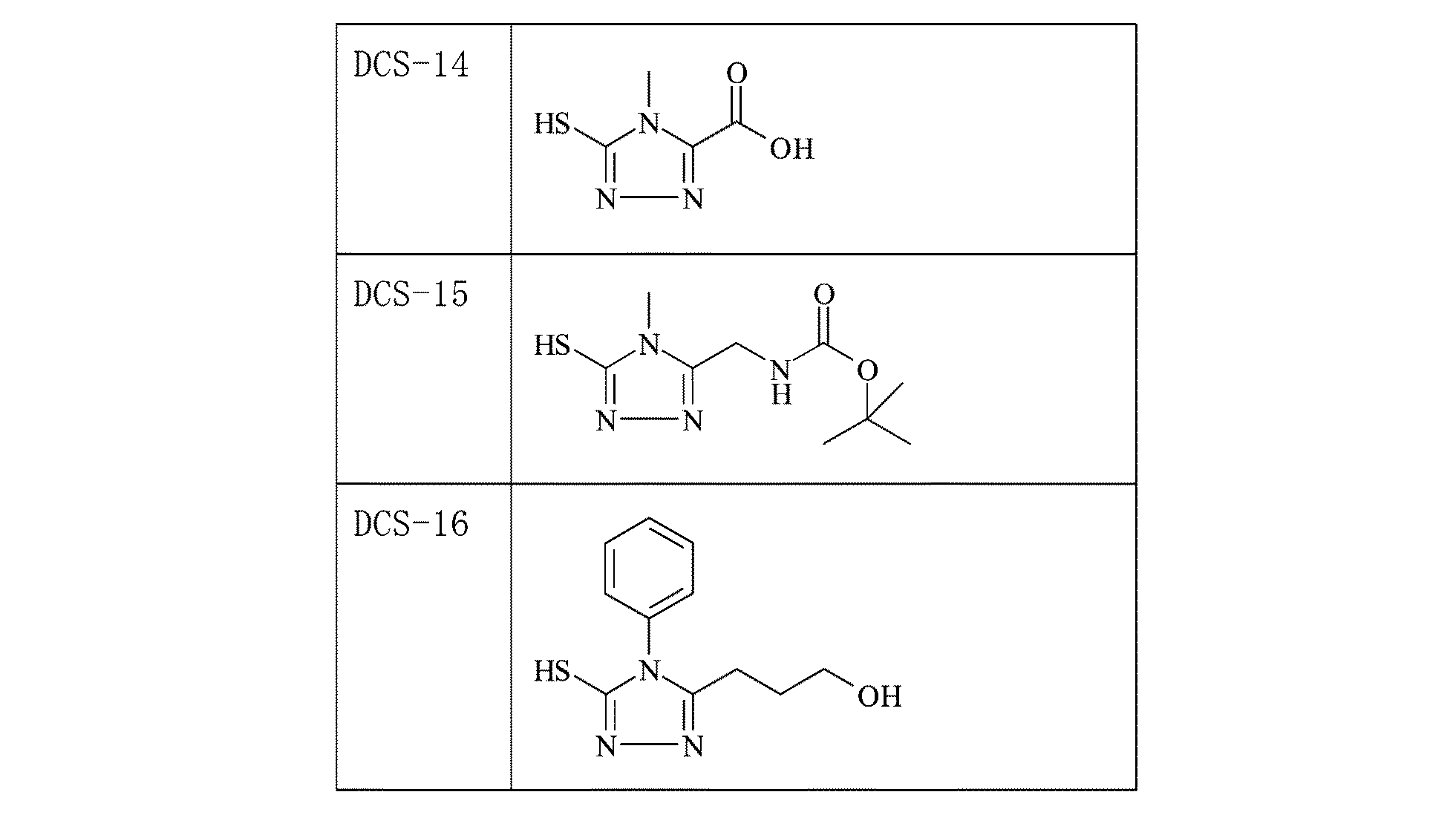
本発明に従う分散物−安定化化合物の幾つかの例を以下の表2に示す。
分散物−安定化化合物は、好ましくはN,N−ジブチル−(2,5−ジヒドロ−5−チオキソ−1H−テトラゾール−1−イル−アセトアミド、5−ヘプチル−2−メルカプト−1,3,4−オキサジアゾール、1−フェニル−5−メルカプトテトラゾール、5−メチル−1,2,4−トリアゾロ−(1,5−a)ピリミジン−7−オールおよびS−[5−[(エトキシカルボニル)アミノ]−1,3,4−チアジアゾール−2−イル]O−エチルチオカーボネートからなる群から選択される。 The dispersion-stabilizing compound is preferably N, N-dibutyl- (2,5-dihydro-5-thioxo-1H-tetrazole-1-yl-acetamide, 5-heptyl-2-mercapto-1,3,4. -Oxadiazole, 1-phenyl-5-mercaptotetrazole, 5-methyl-1,2,4-triazolo- (1,5-a) pyrimidin-7-ol and S- [5-[(ethoxycarbonyl) amino ] -1,3,4-Thiadiazole-2-yl] O-ethylthiocarbonate is selected from the group.
式VII〜Xに従う分散物−安定化化合物は、好ましくは非高分子化合物である。本明細書で用いられる非高分子化合物は、好ましくは1000未満、より好ましくは500未満、最も好ましくは350未満の分子量を有する化合物を意味する。 Dispersion-stabilizing compounds according to formulas VII-X are preferably non-polymeric compounds. The non-polymeric compound used herein means a compound having a molecular weight of preferably less than 1000, more preferably less than 500, and most preferably less than 350.
金属ナノ粒子中の銀(Ag)の総重量に対する重量%として表される分散物安定化化合物(DSC)の量は、好ましくは0.005から10.0の間、より好ましくは0.0075〜から5.0の間、最も好ましくは0.01から2.5の間である。金属ナノ粒子中の銀の総重量に対して分散物−安定化化合物の量が少なすぎると、安定化効果は低すぎる場合があり、一方、分散物−安定化化合物の量が多すぎると導電性インクを用いて得られるコーティングまたはパターンの導電率に不利に影響する場合がある。 The amount of dispersion stabilizing compound (DSC) expressed as% by weight of silver (Ag) in the metal nanoparticles is preferably between 0.005 and 10.0, more preferably 0.0075 and up. To 5.0, most preferably between 0.01 and 2.5. If the amount of dispersion-stabilizing compound is too small relative to the total weight of silver in the metal nanoparticles, the stabilizing effect may be too low, while too much dispersion-stabilizing compound is conductive. It may adversely affect the conductivity of the coating or pattern obtained with the sexual ink.
添加剤
コーティングまたは印刷特性を最適化するために、ならびにまたそれが用いられる用途に依存して、還元剤、湿潤剤/均染剤、ディウェッティング剤(dewetting agent)、レオロジー改質剤、接着剤、粘着剤、保湿剤、噴射剤、硬化剤、殺生物剤または酸化防止剤のような添加剤を前記の導電性インクに加えることができる。
Additives To optimize coating or printing properties, and also depending on the application in which it is used, reducing agents, wetting / leveling agents, dewetting agents, rheology modifiers, adhesives. Additives such as agents, adhesives, moisturizers, propellants, hardeners, rheologists or antioxidants can be added to the conductive ink.
欧州特許出願公開第2821164号(A)明細書に開示されているように、少量の無機酸、または導電性インクから形成される金属層またはパターンの硬化の間にそのような酸を生成することができる化合物を導電性インクに加えることが有利となり得る。より高い導電性および/またはより低い硬化温度が、そのような導電性インクから形成される層またはパターンで観察された。 Producing such an acid during curing of a metal layer or pattern formed from a small amount of inorganic acid, or conductive ink, as disclosed in European Patent Application Publication No. 2821164 (A). It can be advantageous to add a compound that can be added to the conductive ink. Higher conductivity and / or lower cure temperatures were observed with layers or patterns formed from such conductive inks.
より高い導電性および/またはより低い硬化温度は、国際出願公開第2015/000937号パンフレットに開示されているように式XI
Xは置換または非置換の環の形成に必要な原子を示す
に従う化合物を含有する金属ナノ粒子分散物を用いる場合にも得ることができる。
Higher conductivity and / or lower cure temperatures are described in Formula XI as disclosed in WO 2015/000937.
X can also be obtained when using a metal nanoparticle dispersion containing a compound according to the atoms required to form a substituted or unsubstituted ring.
式XIに従う特に好適な化合物は、アスコルビン酸またはエリソルビン酸誘導体化合物である。 Particularly suitable compounds according to formula XI are ascorbic acid or erythorbic acid derivative compounds.
増粘剤を加えて印刷またはコーティング液の粘度を上げることができる。好適な増粘剤は、非晶質シリカ、様々な分子量を有するポリビニルピロリドン、およびセルロース系増粘剤から選択することができる。特に好適な増粘剤はヒドロキシプロピルセルロースである。 Thickeners can be added to increase the viscosity of the printing or coating solution. Suitable thickeners can be selected from amorphous silica, polyvinylpyrrolidone having various molecular weights, and cellulosic thickeners. A particularly suitable thickener is hydroxypropyl cellulose.
導電性インクの調製
本発明に従う導電性インクの調製は典型的には、撹拌、高剪断混合、超音速処理またはそれらの組み合わせのような均質化技法(homogenization technique)を使用することによる金属ナノ粒子への、液体キャリア、結合剤および任意の添加剤の添加を含んでなる。
Preparation of Conductive Inks The preparation of conductive inks according to the present invention is typically made of metal nanoparticles by using homogenization techniques such as agitation, high shear mixing, supersonic treatment or a combination thereof. Includes the addition of liquid carriers, binders and any additives to.
導電性インクが作成される金属ナノ粒子は典型的には、金属ナノ粒子のペーストまたは高度に濃縮された分散物である。金属ナノ粒子の好適な製法を以下に説明する。 The metal nanoparticles from which the conductive ink is made are typically a paste or highly concentrated dispersion of the metal nanoparticles. A suitable method for producing metal nanoparticles will be described below.
均質化工程は100℃までの高温で実施することができる。好適な態様において、均質化工程は60℃以下の温度で実施される。 The homogenization step can be carried out at high temperatures up to 100 ° C. In a preferred embodiment, the homogenization step is performed at a temperature of 60 ° C. or lower.
好適な態様において、導電性インクはインクジェット印刷法に使用される。金属インクジェット液(fluid)もしくはインク、または導電インクジェット液もしくはインクとも呼ばれるこのような導電性インクは好ましくは、25℃において90s-1の剪断速度で測定されて35mPa.sより低い、より好ましくは28mPa.sより低い、そして最も好ましくは2から25mPa.sの間の粘度を有する。 In a preferred embodiment, the conductive ink is used in an inkjet printing process. Such conductive inks, also referred to as metal inkjet fluids or inks, or conductive inkjet liquids or inks, are preferably measured at a shear rate of 90s-1 at 25 ° C. and 35 mPa. Lower than s, more preferably 28 mPa. Lower than s, and most preferably 2 to 25 mPa. It has a viscosity between s.
いわゆる貫流(throughflow)プリントヘッドを使用する場合は、金属インクジェット液の粘度は比較的高く、好ましくは25℃において、90s-1の剪断速度で60mPa.s未満であることができる。金属インクジェット液に関して比較的高い粘度限界は、より濃縮され、かつ/またはより安定な金属インクジェット液に対して有利となり得る流体の、より多数の組成変動を利用可能にする(open up)。 When using a so-called throughflow printhead, the viscosity of the metal inkjet solution is relatively high, preferably at 25 ° C., at a shear rate of 90s -1 at 60 mPa. Can be less than s. The relatively high viscosity limit for metal inkjet liquids allows for more composition variations of the fluid, which may be advantageous for more concentrated and / or more stable metal inkjet liquids (open up).
別の好適な態様において、導電性インクはフレキソ印刷法に使用される。金属フレキソインクまたは導電性フレキソインクとも呼ばれるそのような導電性インクは、好ましくは25℃および90s-1の剪断速度で測定されて、10から200mPa.sの間、より好ましくは25から150mPa.sの間、最も好ましくは50から100mPa.sの間
の粘度を有する。
In another preferred embodiment, the conductive ink is used in a flexographic printing process. Such conductive inks, also referred to as metallic flexo inks or conductive flexo inks, are preferably measured at 25 ° C. and a shear rate of 90s -1 and have a shear rate of 10 to 200 mPa. During s, more preferably 25 to 150 mPa. During s, most preferably 50 to 100 mPa. It has a viscosity between s.
他の好適な態様において導電性インクはスクリーン印刷法に使用される。金属スクリーンインクまたは導電性スクリーンインクとも呼ばれるこのような導電性インクは好ましくは25℃および1s-1の剪断速度で測定されて、3000〜1000000mPa.sの間、最も好ましくは5000〜750000mPa.sの間、最も好ましくは10000〜500000mPa.sの間の粘度を有する。 In another preferred embodiment, the conductive ink is used in a screen printing method. Such conductive inks, also called metallic screen inks or conductive screen inks, are preferably measured at 25 ° C. and a shear rate of 1s-1 to 3000-1000000 mPa. During s, most preferably 5000 to 750000 mPa. During s, most preferably 1000-500,000 mPa. It has a viscosity between s.
金属層またはパターン
導電性インクから印刷または塗布される薄層またはパターンは、従来の金属の印刷液またはコーティング液を使用して得られるものに比較して、より低い焼結温度において導電性にすることができる。従って、本発明の金属の印刷液またはコーティング液から作られる導電性薄層またはパターンは、例えばPETのような高温における熱処理に耐えることができない柔軟な支持体上に塗布または印刷されることができる。
Metal Layers or Patterns Thin layers or patterns printed or applied from conductive inks are made conductive at lower sintering temperatures compared to those obtained using conventional metal printing or coating liquids. be able to. Thus, a conductive thin layer or pattern made from a metal printing solution or coating solution of the present invention can be applied or printed on a flexible support that cannot withstand heat treatment at high temperatures, such as PET. ..
金属層またはパターンは、支持体上に前記に定めた通りに導電性インクを適用する工程およびそれに続く焼結工程を含む方法により調製される。 The metal layer or pattern is prepared by a method comprising applying a conductive ink onto the support as defined above followed by a sintering step.
支持体はガラス、紙またはポリマー性支持体であることができる。 The support can be glass, paper or a polymeric support.
好適なポリマーサポートは、ポリカーボネート、ポリエチレンテレフタレート(PET)またはポリビニルクロライド(PVC)系の支持体である。好適なPET支持体は例えばMacDermidからのAUTOSTAT(商標)熱安定化ポリエステルである。 Suitable polymer supports are polycarbonate, polyethylene terephthalate (PET) or polyvinyl chloride (PVC) -based supports. A suitable PET support is, for example, AUTOSTAT ™ heat-stabilized polyester from MacDermid.
前記支持体は、適用される導電性インクジェット、スクリーンまたはフレキソインクの接着性、吸収性または塗布性(spreading)を改善するために1または複数の層を提供されることができる。 The support may be provided with one or more layers to improve the adhesiveness, absorbability or spreading of the conductive inkjet, screen or flexo ink applied.
ポリマー性支持体には、適用される導電性インクジェット、スクリーンまたはフレキソインクの接着性を改善するために、好適にはいわゆる下塗り層(subbing layer)が提供される。このような下塗り層は典型的には、ビニリデンコポリマー、ポリエステルまたは(メタ)アクリレートである。 The polymeric support is preferably provided with a so-called subcoating layer in order to improve the adhesion of the applied conductive inkjet, screen or flexo ink. Such an undercoat layer is typically a vinylidene copolymer, polyester or (meth) acrylate.
この目的のために有用な下塗り層は当該技術分野で周知であり、例えば、ビニリデンクロライド/アクリロニトリル/アクリル酸ターポリマーまたはビニリデンクロライド/メチルアクリレート/イタコン酸ターポリマーのようなビニリデンクロライドのポリマーを含む。 Undercoat layers useful for this purpose are well known in the art and include, for example, vinylidene chloride polymers such as vinylidene chloride / acrylonitrile / acrylic acid terpolymer or vinylidene chloride / methyl acrylate / itaconic acid terpolymer.
他の好適な下塗り層は、ポリエステル−ウレタンコポリマー系の結合剤を含む。より好適な態様においては、ポリエステル−ウレタンコポリマーはアイオノマー型ポリエステルウレタンであり、それは好ましくはテレフタル酸とエチレングリコールに基づくポリエステルセグメントとヘキサメチレンジイソシアネートを使用する。適切なポリエステル−ウレタンコポリマーはDIC Europe GmbHからのHydran(商標)APX101 Hである。 Other suitable undercoat layers include polyester-urethane copolymer-based binders. In a more preferred embodiment, the polyester-urethane copolymer is an ionomer type polyester urethane, which preferably uses a polyester segment based on terephthalic acid and ethylene glycol and hexamethylene diisocyanate. A suitable polyester-urethane copolymer is Hydran ™ APX101 H from DIC Europe GmbH.
下塗り層の適用は、ハロゲン化銀の写真フィルム用のポリエステル支持体製造の技術分野で周知である。例えばこのような下塗り層の調製は、米国特許第3649336号明細書および英国特許第1441591号明細書に開示されている。 The application of undercoat layers is well known in the art of manufacturing polyester supports for silver halide photographic films. For example, the preparation of such an undercoat layer is disclosed in US Pat. No. 3,649,336 and UK Pat. No. 1441591.
酸生成化合物は、国際公開第2015/000932号パンフレットに開示されている
ように支持体のプライマー(primer)層に包含することができる。好適なプライマーは、ビニリデンクロライド、アクリル酸エステルおよびイタコン酸のコポリマーを含んでなる。
The acid-producing compound can be included in the primer layer of the support as disclosed in WO 2015/000932. Suitable primers consist of copolymers of vinylidene chloride, acrylic acid ester and itaconic acid.
好適な態様において、下塗り層は0.2μm以下、または好適には200mg/m2以下の乾燥厚を有する。 In a preferred embodiment, the undercoat layer has a dry thickness of 0.2 μm or less, or preferably 200 mg / m 2 or less.
他の好適なサポートは透過性導電酸化物(transparent conductive oxides)基材の支持体である。このような支持体は典型的には、その上に透過性導電酸化物(TCO)の層またはパターンが提供されるガラスまたはポリマー支持体である。このような導電性酸化物の例はITO((Indium Tin Oxide)インジウム錫酸化物)、ZnO、SnO2または、ZnO:Alのようなドープ酸化物である。特に好適なTCOはITOである。 Another suitable support is a support for a transparent conductive oxide substrate. Such a support is typically a glass or polymer support on which a layer or pattern of permeable conductive oxide (TCO) is provided. Examples of such conductive oxides are dope oxides such as ITO ((Indium Tin Oxide) indium tin oxide), ZnO, SnO 2 or ZnO: Al. A particularly suitable TCO is ITO.
好適な紙基材の支持体はArjowiggins Creative Papersによる、印刷電子機器のために設計された基板のPowercoat(登録商標)紙基板である。 A suitable paper substrate support is Powercoat® paper substrate, a substrate designed for printing electronics by Arjowigins Creative Papers.
複数の金属層またはパターン、すなわちパターンをもつ、もしくはパターンをもたない層の積み重ね(stack)を基板上に適用することができる。従って、金属層またはパターンの調製法において言及される支持体はまた、既に適用された金属層またはパターンをも包含する。 A stack of multiple metal layers or patterns, i.e. layers with or without patterns, can be applied on the substrate. Thus, the supports referred to in the method of preparing a metal layer or pattern also include metal layers or patterns already applied.
金属層は、同時押し出し処理、または浸漬コーティング、ナイフコーティング、押し出しコーティング、スピンコーティング、噴霧コーティング、ブレードコーティング、スロットダイコーティング、スライドホッパーコーティングおよびカーテンコーティングのような任意の従来のコーティング技法により支持体上に提供されることができる。 The metal layer is extruded simultaneously or on the support by any conventional coating technique such as immersion coating, knife coating, extruding coating, spin coating, spray coating, blade coating, slot die coating, slide hopper coating and curtain coating. Can be provided to.
金属層、および特に金属パターンは、凹版印刷、スクリーン印刷、フレキソ印刷、オフセット印刷、インクジェット印刷、グラビアオフセット印刷等のような印刷法により支持体上に提供されることができる。 The metal layer, and in particular the metal pattern, can be provided on the support by printing methods such as indentation printing, screen printing, flexographic printing, offset printing, inkjet printing, gravure offset printing and the like.
好適な印刷法はインクジェット、スクリーン印刷およびフレキソ印刷法である。 Suitable printing methods are inkjet, screen printing and flexographic printing.
支持体上に金属層またはパターンを提供する他の方法はエアゾールジェット印刷である。Optomecにより開発されてきたAerosol Jet Printing(エアゾールジェット印刷)はインクジェット印刷の大部分の利点を保持しながら、多くの限界を減らしている。この技術は印刷電子機器の分野で使用するために開発されている。その技術は例えば、米国特許第2003/0048314号、同第2003/0020768号、同第2003/0228124号明細書および国際公開第2009/049072号パンフレットに開示されている。Aerosol Je Print Engine、例えばAerosol Jet Printer OPOTOMEC AJ 300 CEはOptomecから市販されている。 Another method of providing a metal layer or pattern on the support is aerosol jet printing. Aerosol Jet Printing, developed by Optimec, reduces many limitations while retaining most of the advantages of inkjet printing. This technology has been developed for use in the field of printing electronics. The technique is disclosed, for example, in US Pat. Nos. 2003/0048314, 2003/0020768, 2003/0228124 and International Publication No. 2009/049072 Pamphlet. Aerosol Je Print Engine, such as Aerosol Jet Printer OPTOMEC AJ 300 CE, is commercially available from Optomec.
5000mPa.s未満の粘度を有する実質的にあらゆる液体は、Aerosol
Jet Print技法を使用して付着させることができる。より高い粘性の流体を使用することが金属インクの安定性に関して有益である可能性がある。
5000mPa. Virtually any liquid with a viscosity less than s is an aerosol
It can be adhered using the Jet Print technique. The use of higher viscous fluids may be beneficial with respect to the stability of the metal ink.
硬化工程
層またはパターンが支持体上に適用された後に、硬化工程(curing step)
とも呼ばれる焼結工程(sintering step)が実施される。この焼結工程期間中に、溶媒は蒸発し、金属粒子は一緒に焼結する。いったん金属の粒子間に連続的な浸透性(percolating)の網目が形成されると、層またはパターンが導電性になる。従来の焼結は一般には熱を適用することにより実施される。焼結温度および時間は、使用する支持体および金属層またはパターンの組成に依存する。金属層を硬化するための焼結工程は250℃未満、好適には200℃未満、より好適には180℃未満、最も好適には160℃未満の温度で行うことができる。
Curing step After the layer or pattern has been applied onto the support, the curing step
A sintering step, also known as, is performed. During this sintering process, the solvent evaporates and the metal particles are sintered together. Once a continuous percolating network is formed between the metal particles, the layer or pattern becomes conductive. Conventional sintering is generally carried out by applying heat. The sintering temperature and time depend on the support used and the composition of the metal layer or pattern. The sintering step for curing the metal layer can be carried out at a temperature of less than 250 ° C., preferably less than 200 ° C., more preferably less than 180 ° C., and most preferably less than 160 ° C.
焼結時間は、選択する温度、支持体および金属層の組成に応じて60分未満、好適には2から30分の間、そしてより好適には3から20分の間であることができる。 The sintering time can be less than 60 minutes, preferably between 2 and 30 minutes, and more preferably between 3 and 20 minutes, depending on the temperature selected and the composition of the support and metal layer.
しかし熱を適用することによる従来の焼結の代わりに、またはそれに加えて、アルゴンレーザー、マイクロウェーブ照射、IR照射、UV照射または低圧アルゴンプラズマに対する暴露、光硬化、プラズマもしくはプラズマ強化(plasma enhanced)、電子ビーム、レーザービームまたはパルス電流焼結のような代わりの焼結法を使用することができる。パルス電流焼結を使用する場合は、電流は導電性インクに直接適用するかまたは誘導(induction)により間接的に適用することができる。 However, instead of or in addition to conventional sintering by applying heat, argon laser, microwave irradiation, IR irradiation, UV irradiation or exposure to low pressure argon plasma, photocuring, plasma or plasma enhanced. Alternative sintering methods such as electron beam, laser beam or pulse current sintering can be used. When pulsed current sintering is used, the current can be applied directly to the conductive ink or indirectly by induction.
他の硬化法はいわゆる近赤外線(NIR)硬化技法を使用する。コーティングまたはパターンの金属、例えば銀はNIR照射の吸収体として作用することができる。 Other curing methods use the so-called Near Infrared (NIR) curing technique. The coating or pattern metal, such as silver, can act as an absorber for NIR irradiation.
さらに別の硬化法は、高温の空気硬化の代わりに加熱蒸気を使用し、これもまたコーティングまたはパターンの金属を効果的に加熱し、そして焼結する。 Yet another curing method uses heated steam instead of hot air curing, which also effectively heats and sinters the metal in the coating or pattern.
本発明の金属層は先行技術の方法より低い硬化温度の使用を可能にする。その結果、例えばPETのような、高温下の熱処理に耐えることができないポリマー基板を使用することが可能である。硬化時間もまた、実質的に短縮されて、先行技術の方法より、1時間当りに、より高い生産量をもつ可能性をもたらすことができる。金属層の導電率は維持されるかまたは、特定の場合には改善されることすらある。 The metal layer of the present invention allows the use of lower curing temperatures than prior art methods. As a result, it is possible to use a polymer substrate that cannot withstand heat treatment at high temperatures, such as PET. The curing time is also substantially reduced, which can provide the possibility of having a higher production per hour than the prior art method. The conductivity of the metal layer is maintained or even improved in certain cases.
導電性を更に高める、または硬化温度を低下するために、国際公開第2015/000932号パンフレットに開示されたように、金属層またはパターンの硬化期間中に、酸または、その酸を放出することができる酸前駆体を含む溶液と、金属層またはパターンを接触させることが好都合である可能性がある。 To further increase conductivity or lower the curing temperature, the acid or its acid can be released during the curing period of the metal layer or pattern, as disclosed in WO 2015/000932. It may be convenient to contact the metal layer or pattern with a solution containing the resulting acid precursor.
金属層またはパターンは、例えば有機光電池(photo−voltaics)(OPV)、無機光電池(c−Si、a−Si、CdTe、CIGS)、OLEDディスプレイ、OLED照明、無機照明、RFID、有機トランジスター、薄膜電池、タッチスクリーン、e−ペーパー、LCD、プラズマ、センサー、膜スイッチまたは電磁シールドのような、様々な電子装置またはそのような電子装置の部品に使用することができる。 Metal layers or patterns include, for example, organic photocells (photo-voltaics) (OPV), inorganic photocells (c-Si, a-Si, CdTe, CIGS), OLED displays, OLED lighting, inorganic lighting, RFID, organic transistors, thin film batteries. Can be used in various electronic devices or components of such electronic devices, such as touch screens, e-papers, LCDs, plasmas, sensors, membrane switches or electromagnetic shields.
金属ナノ粒子の調製
本発明に従う金属ナノ粒子はあらゆる既知の調製法により調製されることができる。
Preparation of Metal Nanoparticles Metal nanoparticles according to the present invention can be prepared by any known preparation method.
金属ナノ粒子を調製する特に好適な方法は、欧州特許出願第2781562(A)号明細書に開示されている。 A particularly preferred method for preparing metal nanoparticles is disclosed in European Patent Application No. 2781562 (A).
欧州特許出願第2781562(A)号明細書に開示された方法により得られる導電性インクは一般には、分散物の総重量に対して少なくとも15重量%、より好適には少なくとも30重量%、最も好適には少なくとも50重量%の金属ナノ粒子を含む。次にこの高
度濃縮化分散物を使用して、前記の本発明に従う導電性インクを調製する。
Conductive inks obtained by the methods disclosed in European Patent Application No. 2781562 (A) are generally at least 15% by weight, more preferably at least 30% by weight, most preferred, based on the total weight of the dispersion. Contains at least 50% by weight of metal nanoparticles. The highly concentrated dispersion is then used to prepare a conductive ink according to the invention described above.
材料
以下の実施例で用いられるすべての材料は、他に特定しなければALDRICH CHEMICAL Co.(ベルギー)およびACROS(ベルギー)のような標準的な供給元から容易に入手可能であった。用いた水は脱イオン水であった。
Materials All materials used in the examples below are described in ALDRICH CHEMICAL Co., Ltd., unless otherwise specified. It was readily available from standard sources such as (Belgium) and ACROS (Belgium). The water used was deionized water.
酸化銀(Ag2O)は、水酸化ナトリウムのアルカリ性水溶液(33重量%)中での硝酸銀の沈殿、続いて濾過、そして乾燥により調製した。 Silver oxide (Ag 2 O) was prepared by precipitation of silver nitrate in an alkaline aqueous solution (33% by weight) of sodium hydroxide, followed by filtration and drying.
Solbin(登録商標)Aは、SHINETSUから市販されている92重量%のビニルクロライド、3重量%のビニルアセテートおよび5重量%のビニルアルコールのコポリマーである。 Solbin® A is a copolymer of 92% by weight vinyl chloride, 3% by weight vinyl acetate and 5% by weight vinyl alcohol commercially available from SHINETSU.
Aquatreat Ar7Hは、高分子ポリアクリル酸の15重量%水溶液である。 Aquatreat Ar7H is a 15% by weight aqueous solution of high molecular weight polyacrylic acid.
NaPSSは、Versa TL130の水中30重量%分散物である。 NaPSS is a 30 wt% dispersion of Versa TL130 in water.
Versa TL130は、ALCO CHELICALSから入手可能なポリスチレンスルホネートのナトリウム塩である。 Versa TL130 is a sodium salt of polystyrene sulfonate available from ALCO CHELICALS.
Butyl Cellosolve(CASRN 111−76−2)は、MERCKから市販されているエチレングリコールモノブチルエーテルである。 Butyl Cellosolve (CASRN 111-76-2) is an ethylene glycol monobutyl ether commercially available from MERCK.
Efka FL3277(CASRN 849624−75−5)は、BASFから市販されている湿潤剤である。 Efka FL3277 (CASRN 894624-75-5) is a wetting agent commercially available from BASF.
Disperbyk2151は、BYK(ALTANA)から市販されている湿潤剤である。 Disperbyk2151 is a wetting agent commercially available from BYK (ALTANA).
Byk4510は、BYK(ALTANA)から市販されている接着促進剤化合物である。 Byk4510 is an adhesion accelerator compound commercially available from BYK (ALTANA).
Rhodiasolv(登録商標)PolarCleanは、SOLVAYから市販されている5−(ジメチルアミノ)2−メチル5−オキソペンタノエートである。 Rhodiasolv® PolarClean is a 5- (dimethylamino) 2-methyl 5-oxopentanoate commercially available from SOLVAY.
Rhodiasolv(登録商標)RPDEは、SOLVAYから市販されているC4−6脂肪族二酸のジメチルエステルの混合物である:CH3−O−C−(CH2)n−C−O−CH3 ジメチルスクシネート20−28% ジメチルグルタレート59−67%
ジメチルアジペート9−17%。
Rhodiasolv® RPDE is a mixture of dimethyl esters of C4-6 aliphatic diacids commercially available from SOLVAY: CH3-OC- (CH2) n-C-O-CH3 dimethylsuccinate 20. -28% Dimethylglutarate 59-67%
Dimethyl adipate 9-17%.
Rhodiasolv(登録商標)IRISは、SOLVAYから市販されているメチルグルタル酸ジメチルエステルである。 Rhodiasolv® IRIS is a methylglutaric acid dimethyl ester commercially available from SOLVAY.
PETは、AGFA GEVAERTからのポリエチレンテレフタレート支持体(163μm)である。 PET is a polyethylene terephthalate support (163 μm) from AGFA GEVAERT.
Subbed PETは、両側にプライマーを有するPETである。水性コーティング溶液から塗布されたプライマーは、以下の表3による組成を有する。
Copol(ViCl2−MA−IA)は、AGFA GEVAERTからのビニリデンクロライド―メタクリル酸とイタコン酸のコポリマーである。 Copol (ViCl 2- MA-IA) is a copolymer of vinylidene chloride-methacrylic acid and itaconic acid from AGFA Gevaert.
Mersolat H40は、LANXESSからの界面活性剤である。 Mersolat H40 is a surfactant from LANXESS.
Kieselsol 100Fは、BAYERからのシリカである。 Kieselsol 100F is silica from BAYER.
Autostat CT7は、MACDERMIDからの175μmの熱安定化ポリエステル支持体である。 Autostat CT7 is a 175 μm heat-stabilized polyester support from MACDERMID.
ポリカーボネートは、TEKRAから入手可能な250μmのポリカーボネートシート(Lexan 8A73)である。 The polycarbonate is a 250 μm polycarbonate sheet (Lexan 8A73) available from TEKRA.
Geniosil GF96は、WACKERから市販されている3−アミノプロピルトリメトキシシランである。 Geniosil GF96 is a 3-aminopropyltrimethoxysilane commercially available from WACKER.
Silquest A−1524は、MOMENTIVEから市販されているガンマ−ウレイド−プロピルトリメトキシシランである。 Silkgest A-1524 is a gamma-ureido-propyltrimethoxysilane commercially available from MOMENTIVE.
Dynasylan Glymoは、EVONIKから市販されている3−グリシジルオキシプロピルトリメトキシシランである。 Dynasylan Glymo is a 3-glycidyloxypropyltrimethoxysilane commercially available from EVONIK.
Geniosil GF9は、WACKERから市販されているN−(2−アミノエチル)−3−アミノプロピルトリメトキシシランである。 Geniosil GF9 is an N- (2-aminoethyl) -3-aminopropyltrimethoxysilane commercially available from WACKER.
測定法
スクリーン印刷
銀インクのAutostat CT7基板へのスクリーン印刷は、実施例で特定したスクリーンメッシュおよびCapillex CPステンシルフィルム(MACDERMID AUTOTYPEから入手可能)を用いてRokuPrint RP2.2スクリーン印刷機で行った。
Measurement method
Screen Printing Screen printing of silver ink onto an Autostat CT7 substrate was performed on a RokuPrint RP2.2 screen printer using the screen mesh and Capilex CP stencil film (available from MACDERMID AUTOTYPE) identified in the Examples.
スクリーンメッシュの張力は27N/cm、印刷速度は300mm/sであった。Unitex 80°ShoreAスキージをスクリーンメッシュに対して75°の角度で使用した。金属性のフロッドバー(flood bar)をスクリーンメッシュに対して90°の角度、および約175μmの距離で使用した。基板とスクリーンメッシュとの距離は2.5mmであった。スキージ圧を最小にしたが、それでもインクが十分に基板に印刷される最小レベルを維持した。 The tension of the screen mesh was 27 N / cm, and the printing speed was 300 mm / s. The Unitex 80 ° ShoreA squeegee was used at an angle of 75 ° with respect to the screen mesh. A metallic flood bar was used at an angle of 90 ° with respect to the screen mesh and at a distance of approximately 175 μm. The distance between the substrate and the screen mesh was 2.5 mm. The squeegee pressure was minimized, but still maintained the minimum level at which the ink was sufficiently printed on the substrate.
印刷される層の完全な表面導電率を測定するために、約6.0x4.5cmの寸法のパターンを印刷した。 A pattern with dimensions of about 6.0x4.5 cm was printed to measure the complete surface conductivity of the layer to be printed.
公称印刷幅100,200および500μmで5cmの長さの線のパターンを印刷方向に対して平行および垂直に印刷して、印刷された線の性質を測定した。 Line patterns with nominal print widths of 100, 200 and 500 μm and a length of 5 cm were printed parallel and perpendicular to the printing direction and the properties of the printed lines were measured.
印刷した基板を、ボックスオーブン中で130℃の温度で3分間、乾燥した。 The printed substrate was dried in a box oven at a temperature of 130 ° C. for 3 minutes.
乾燥した印刷の硬化は、ボックスオーブン中で150℃の温度で15分間行った。 The dry prints were cured in a box oven at a temperature of 150 ° C. for 15 minutes.
銀コーティングの導電率
4点コリニアプローブ(four−point collinear probe)を用いて銀コーティングの表面抵抗(SER)を測定した。表面もしくはシート抵抗を次式:
SER=(π/ln2)*(V/I)
式中、
SERはΩ/平方で表される層の表面抵抗であり;
πは約3.14に等しい数学定数であり;
ln2は2の自然対数に等しい数学定数であり;
Vは4点プローブ測定機器を使用して測定される電圧であり;
Iは4点プローブ測定機器により測定されるソース電流である
により算出した。
It was measured surface resistance of the silver coating (SER) with a silver coating conductivity four-point collinear probe (four-point collinear probe). The surface or sheet resistance is expressed by the following equation:
SER = (π / ln2) * (V / I)
During the ceremony
SER is the surface resistance of the layer represented by Ω / square;
π is a mathematical constant equal to about 3.14;
ln2 is a mathematical constant equal to the natural logarithm of 2;
V is the voltage measured using a 4-point probe measuring device;
I was calculated by the source current measured by the 4-point probe measuring device.
各サンプルに関し、コーティングの異なる位置で6回の測定を行い、そして平均値を算出した。 For each sample, 6 measurements were made at different locations on the coating and the average value was calculated.
コーティングの銀含有率MAg(g/m2)をWD−XRFにより決定した。 The silver content of the coating, Mag (g / m 2 ), was determined by WD-XRF.
次いで次式:
σAgは銀の比導電率(6.3x10⁷S/mに等しい)であり、σcoatはAgコーテ
ィングの比導電率であり、そしてρAgは銀の密度(1.049gx107/m3)
である、
を用いて銀のバルク導電率(bulk conductivity)の割合として導電率を計算することにより、コーティングされた層の導電率を決定した。
Then the following equation:
sigma Ag is the specific conductivity of the silver (equivalent to 6.3x10 7 S / m), σ coat is the specific conductivity of the Ag Cote Ingu, and [rho Ag silver density (1.049gx10 7 / m 3 )
Is,
The conductivity of the coated layer was determined by calculating the conductivity as a percentage of the bulk conductivity of silver using.
解像度
印刷された銀線の幅は、USBデジタル顕微鏡(CONRADから入手可能なeScope Mirazoom MS902)を用いて評価する。
The width of the resolution- printed silver wire is evaluated using a USB digital microscope (eScope Mirazoo MS902 available from CONRAD).
スクリーンステンシル上の線の開き(opening)の公称幅(N)は、100μm
、200μmおよび500μmであった。
The nominal width (N) of the opening of the line on the screen stencil is 100 μm.
, 200 μm and 500 μm.
印刷された銀線のいわゆる幅広化およびスミアは、図1に図解して示すように測定した。 The so-called widening and smear of the printed silver wire was measured as illustrated graphically in FIG.
印刷方向(10)に対して平行(b)および垂直(a)の印刷された銀線の幅は、上記のUSBデジタル顕微鏡を使用して測定した。 The widths of the printed silver wires parallel (b) and perpendicular (a) to the print direction (10) were measured using the USB digital microscope described above.
幅広化(W)およびスミア(S)は以下のように算出した:
幅広化(W)=b−N
スミア(S)=a−b−W
Widening (W) and smear (S) were calculated as follows:
Widening (W) = b-N
Smear (S) = ab-W
W,S,aおよびbは、すべてμmである。 W, S, a and b are all μm.
接着
異なる基板への銀コーティングの接着は、ASTM D3359によるテープ試験により評価した。評価は0(大変よい接着)から5(大変悪い接着)の採点をもたらす。
Adhesion Adhesion of the silver coating to different substrates was evaluated by a tape test with ASTM D3359. Ratings give a score of 0 (very good adhesion) to 5 (very bad adhesion).
動力学粘度
動力学粘度は、Thermo Fisher Scientificから市販されているHAAKE(商標)RotoVisco(商標)Rotational Reometerを用いて25℃で測定した。
Dynamic Viscosity The kinetic viscosity was measured at 25 ° C. using a HAAKE ™ RotoVisco ™ Rotational Rheometer commercially available from Thermo Fisher Scientific.
銀ナノ粒子分散物NDP−01の調製
78.0gの酸化銀を、275.0gのペンタン酸および401.0gの2−ピロリドンを含む1リットルの反応槽に撹拌しながらゆっくりと加えた。混合物の温度を25℃に維持した。
Preparation of Silver Nanoparticle Dispersion NDP-01 78.0 g of silver oxide was slowly added to a 1 liter reaction vessel containing 275.0 g of pentanoic acid and 401.0 g of 2-pyrrolidone with stirring. The temperature of the mixture was maintained at 25 ° C.
酸化銀を完全に添加した後、懸濁液を一晩、25℃で撹拌した。 After the silver oxide was completely added, the suspension was stirred overnight at 25 ° C.
次いで300.0gのN,N−ジエチルヒドロキシルアミンを1.5時間のタイムスパンで懸濁液に加えた。反応混合物の温度を25℃に維持した。全ての還元剤を加えた時、反応混合物を25℃に維持しながらさらに1時間撹拌した。 300.0 g of N, N-diethylhydroxylamine was then added to the suspension over a time span of 1.5 hours. The temperature of the reaction mixture was maintained at 25 ° C. When all reducing agents were added, the reaction mixture was stirred for an additional hour while maintaining at 25 ° C.
次いで反応混合物を沈降容器に供給し、ここで一晩、撹拌せずに維持した。上清を沈殿物から慎重に除去した。 The reaction mixture was then fed to a settling vessel, where it was maintained overnight without agitation. The supernatant was carefully removed from the precipitate.
得られた沈殿物を、Dowanol PM(商標)(547g)で2回、そしてbutylcellosolve(商標)(547g)で2回、計4回洗浄した。各洗浄工程で、溶媒を沈殿に加え、そして生じた懸濁液を0.5時間、300rpmで撹拌した。次いで非撹拌懸濁液をさらに1時間維持し、そして上清を慎重に除去した。 The resulting precipitate was washed twice with Dowanol PM ™ (547g) and twice with butylcellosolve ™ (547g), for a total of four times. In each washing step, a solvent was added to the precipitate and the resulting suspension was stirred for 0.5 hours at 300 rpm. The unstirred suspension was then maintained for an additional hour and the supernatant was carefully removed.
butylcellosolve(商標)での最終洗浄工程後、沈殿物をRousselet Robatel(フランス)からの遠心デカンターで3000rpmにて0.5時間遠心した。 After the final washing step with butylcellosolve ™, the precipitate was centrifuged at 3000 rpm for 0.5 hours in a centrifugal decanter from Rousselet Robotel (France).
得られた銀ナノ粒子分散物NPD−01は、分散物の総重量に対して±75重量%の銀を有した。 The obtained silver nanoparticle dispersion NPD-01 contained ± 75% by weight of silver with respect to the total weight of the dispersion.
銀インクSI−01からSI−06の調製
銀インクSI−01からSI−06は、透明溶液が得られるまで表4の非銀成分を撹拌しながら一緒に混合することにより調製した。次いで銀ナノ粒子分散物NPD−01を透明溶液に加え、続いて高剪断均一化に供した。
銀インクSI−01からSI−06の評価
銀インクSI−01からSI−06を、前記のようにP180−27スクリーンメッシュ(ベルギーのPUBLIVENORから入手可能、そしてMacDermidから入手可能なCapillex CPステンシルフィルムでコーティングされた)を使用してスクリーン印刷した。
Evaluation of Silver Inks SI-01 to SI-06 Silver inks SI-01 to SI-06 with Capilex CP stencil film available from P180-27 screen mesh (available from PUBLEVENOR, Belgium, and MacDermid) as described above. Screen printed using (coated).
印刷された銀インクSI−01からSI−06の導電率および解像度を前記のように測定した。結果を表5に示す。
表5の結果から、印刷された銀線の幅広化およびスミアの両方が、比較の銀インクSI−01およびSI−06にもの比べて、銀インクの総重量に対して0.5重量%から7.5重量%の間の量の水を溶媒として含んでなる本発明の銀インク(SI−02からSI−05)で少ないことが明らかである。 From the results in Table 5, both the widening and smear of the printed silver wire are from 0.5% by weight relative to the total weight of the silver ink compared to those of the comparative silver inks SI-01 and SI-06. It is clear that the silver inks of the present invention (SI-02 to SI-05), which contain an amount of water between 7.5% by weight as a solvent, are low.
銀インクSI−07からSI−15の調製
銀インクSI−07からSI−15は、透明溶液が得られるまで表6の非銀成分を撹拌しながら一緒に混合することにより調製した。次いで銀ナノ粒子分散物NPD−01を透明溶液に加え、続いて高剪断均一化に供した。
銀インクSI−07から−15の評価
銀インクSI−07からSI−15を、前記のようにV380−23/EOM5μスクリーンメッシュ(ドイツのPVF GmbHから入手可能、そしてドイツのPVF GmbHから入手可能な5μm厚のエマルジョンGBF444でコーティングされた)を使用してスクリーン印刷した。
Evaluation of Silver Inks SI-07 to -15 Silver inks SI-07 to SI-15 are available from V380-23 / EOM5μ screen mesh as described above (available from PVF GmbH in Germany and from PVF GmbH in Germany). Screen-printed using a 5 μm thick emulsion (coated with GBF444).
印刷された銀インクSI−07からSI−15の導電率および解像度を前記のように測定した。結果を表7に示す。
表7の結果から、印刷された銀線の幅広化およびスミアの和は、比較の銀インクのものに比べて、銀インクの総重量に対して0.5重量%から7.5重量%の間の量のグリセロールを溶媒として含んでなる本発明の銀で少ないことが明らかである。 From the results in Table 7, the widening of the printed silver wire and the sum of smear are 0.5% to 7.5% by weight based on the total weight of the silver ink, as compared with those of the comparative silver ink. It is clear that the silver of the present invention, which contains an intervening amount of glycerol as a solvent, is low.
銀インクSI−16からSI−24の調製
銀インクSI−016からSI−24は、透明溶液が得られるまで表8の非銀成分を撹拌しながら一緒に混合することにより調製した。次いで銀ナノ粒子分散物NPD−01を透明溶液に加え、続いて高剪断均一化に供した。
銀インクSI−16からSI−24の評価
銀インクSI−16からSI−24を、前記のようにP180−27スクリーンメッシュ(ベルギーのPublivenorから入手可能、そしてMacDermidから入手可能なCapillex CPステンシルフィルムでコーティングされた)を使用してスクリーン印刷した。
Evaluation of Silver Inks SI-16 to SI-24 Silver inks SI-16 to SI-24 with Capilex CP stencil film available from P180-27 screen mesh (available from Publicor, Belgium, and MacDermid) as described above. Screen printed using (coated).
印刷された銀インクSI−16からSI−24の導電率および解像度を前記のように測定した。結果を表9に示す。
表9の結果から、印刷された銀線の幅広化およびスミアの両方が、比較の銀インクのものに比べて、銀インクの総重量に対して0.5重量%から7.5重量%の間の量の水、グリセロールまたは少なくとも2個のヒドロキシル基を含んでなるアルコールから選択される溶媒を含んでなる本発明の銀インク(SI−18、SI−19およびSI−23)で少ないことが明らかである。 From the results in Table 9, both the widening and smear of the printed silver wire are 0.5% to 7.5% by weight of the total weight of the silver ink compared to those of the comparative silver ink. Less with the silver inks of the invention (SI-18, SI-19 and SI-23) comprising a solvent selected from an amount of water, glycerol or an alcohol containing at least two hydroxyl groups. it is obvious.
銀インクSI−25からSI−33の調製
銀インクSI−25からSI−33は、透明溶液が得られるまで表10の非銀成分を撹拌しながら一緒に混合することにより調製した。次いで銀ナノ粒子分散物NPD−01を透明溶液に加え、続いて高剪断均一化に供した。
SI−25からSI−33の評価
銀インクSI−25からSI−33を、前記のようにP180−27スクリーンメッシ
ュ(ベルギーのPublivenorから入手可能、そしてMacDermidから入手可能なCapillex CPステンシルフィルムでコーティングされた)を使用してスクリーン印刷した。
Evaluation of SI-25 to SI-33 Silver inks SI-25 to SI-33 are coated with Capilex CP stencil film available from P180-27 screen mesh (available from Publivenor, Belgium, and available from MacDermid) as described above. Screen printed using.
印刷された銀インクSI−25からSI−33の導電率および解像度を前記のように測定した。結果を表11に示す。
表11の結果から、印刷された銀線の幅広化およびスミアの両方が、比較の銀インクのものに比べて、銀インクの総重量に対して0.5重量%から7.5重量%の間の量の水または少なくとも2個のヒドロキシル基を含んでなるアルコールから選択される溶媒を含んでなる本発明の銀インク(SI−26からSI−33)で少ないことが明らかである。 From the results in Table 11, both the widening and smear of the printed silver wire are 0.5% to 7.5% by weight relative to the total weight of the silver ink compared to those of the comparative silver ink. It is clear that the silver inks of the present invention (SI-26 to SI-33) containing an amount of water in between or a solvent selected from alcohols containing at least two hydroxyl groups are low.
Claims (15)
Applications Claiming Priority (3)
| Application Number | Priority Date | Filing Date | Title |
|---|---|---|---|
| EP18171221 | 2018-05-08 | ||
| EP18171221.7 | 2018-05-08 | ||
| PCT/EP2019/061517 WO2019215068A1 (en) | 2018-05-08 | 2019-05-06 | Conductive inks |
Publications (1)
| Publication Number | Publication Date |
|---|---|
| JP2021521314A true JP2021521314A (en) | 2021-08-26 |
Family
ID=62142990
Family Applications (1)
| Application Number | Title | Priority Date | Filing Date |
|---|---|---|---|
| JP2020562574A Pending JP2021521314A (en) | 2018-05-08 | 2019-05-06 | Conductive ink |
Country Status (6)
| Country | Link |
|---|---|
| US (1) | US20210253887A1 (en) |
| EP (1) | EP3790934A1 (en) |
| JP (1) | JP2021521314A (en) |
| KR (1) | KR20200140359A (en) |
| CN (1) | CN112088193A (en) |
| WO (1) | WO2019215068A1 (en) |
Families Citing this family (4)
| Publication number | Priority date | Publication date | Assignee | Title |
|---|---|---|---|---|
| US12227902B2 (en) * | 2020-04-15 | 2025-02-18 | Kohpa Gmbh | Electrically conductive paper |
| KR102481121B1 (en) * | 2021-04-08 | 2022-12-26 | (주)세경하이테크 | Decoration sheet with shadow hidden effect and preparation method thereof |
| CN114550974A (en) * | 2021-12-24 | 2022-05-27 | 北京印刷学院 | Slurry, preparation method thereof and inorganic electroluminescent device |
| JP2024084994A (en) * | 2022-12-14 | 2024-06-26 | トヨタ自動車株式会社 | Conductive ink or conductive paste, and method for producing same |
Citations (8)
| Publication number | Priority date | Publication date | Assignee | Title |
|---|---|---|---|---|
| CN101089058A (en) * | 2006-06-14 | 2007-12-19 | 三星电机株式会社 | Conductive ink composition for inkjet printing |
| CN101560349A (en) * | 2009-04-22 | 2009-10-21 | 北京印刷学院 | Jet conductive ink |
| CN101805538A (en) * | 2010-04-08 | 2010-08-18 | 中国科学院宁波材料技术与工程研究所 | Lower-temperature sintered conductive ink |
| CN103415580A (en) * | 2011-03-08 | 2013-11-27 | Dic株式会社 | Conductive water-based ink for inkjet recording |
| US20140048749A1 (en) * | 2012-08-16 | 2014-02-20 | Nthdegree Technologies Worldwide Inc. | Conductive Ink Composition |
| CN104893424A (en) * | 2014-12-30 | 2015-09-09 | 昆明贵金属研究所 | Preparation method for nanometer silver-based electrically conductive ink for electronic printing |
| CN105482554A (en) * | 2014-09-30 | 2016-04-13 | 广州光宝移动电子部件有限公司 | Conductive printing ink |
| EP3287499A1 (en) * | 2016-08-26 | 2018-02-28 | Agfa-Gevaert | A metallic nanoparticle dispersion |
Family Cites Families (34)
| Publication number | Priority date | Publication date | Assignee | Title |
|---|---|---|---|---|
| GB1234755A (en) | 1967-09-28 | 1971-06-09 | Agfa Gevaert Nv | Photographic film |
| GB1441591A (en) | 1972-07-17 | 1976-07-07 | Agfa Gevaert | Process for adhering hydrophilic layers to dimensionally stable polyester film support |
| US4546544A (en) | 1984-06-28 | 1985-10-15 | Warner-Lambert Company | One-piece disposable razor with blade protector latched releasably to razor |
| JPH09286936A (en) | 1996-04-22 | 1997-11-04 | Sumitomo Metal Mining Co Ltd | Coating liquid for forming transparent conductive film, transparent conductive film using the same, and method for forming the same |
| US7045015B2 (en) | 1998-09-30 | 2006-05-16 | Optomec Design Company | Apparatuses and method for maskless mesoscale material deposition |
| US20030020768A1 (en) | 1998-09-30 | 2003-01-30 | Renn Michael J. | Direct write TM system |
| US7108894B2 (en) | 1998-09-30 | 2006-09-19 | Optomec Design Company | Direct Write™ System |
| CN1780707B (en) | 2003-04-28 | 2010-07-14 | 住友金属矿山株式会社 | Method for preparing colloidal dispersion of silver microparticles, colloidal dispersion of silver microparticles, and conductive silver film |
| TWI289488B (en) | 2003-10-20 | 2007-11-11 | Harima Chemicals Inc | Fine metal particles, fine metal oxide particles in the form of dried-up powder, and use of the same |
| US7824466B2 (en) | 2005-01-14 | 2010-11-02 | Cabot Corporation | Production of metal nanoparticles |
| US20060163744A1 (en) | 2005-01-14 | 2006-07-27 | Cabot Corporation | Printable electrical conductors |
| EP2012952A2 (en) | 2006-04-12 | 2009-01-14 | Nanomas Technologies, INC. | Nanoparticles, methods of making, and applications using same |
| DE102006017696A1 (en) | 2006-04-15 | 2007-10-18 | Bayer Technology Services Gmbh | Process for the production of metal particles, metal particles produced therefrom and their use |
| DE102007037079A1 (en) | 2006-10-25 | 2008-04-30 | Bayer Materialscience Ag | Silver-containing aqueous formulation and its use for the production of electrically conductive or reflective coatings |
| WO2008111484A1 (en) | 2007-03-15 | 2008-09-18 | Dic Corporation | Conductive ink for letterpress reverse printing |
| KR101041880B1 (en) | 2007-05-16 | 2011-06-16 | 디아이씨 가부시끼가이샤 | Method for producing silver-containing nanostructures and silver-containing nanostructures |
| PL2030706T3 (en) | 2007-08-31 | 2011-04-29 | Metalor Tech International S A | Method of preparing nanoparticles of silver |
| US8887658B2 (en) | 2007-10-09 | 2014-11-18 | Optomec, Inc. | Multiple sheath multiple capillary aerosol jet |
| US20090142482A1 (en) | 2007-11-30 | 2009-06-04 | Xerox Corporation | Methods of Printing Conductive Silver Features |
| DE102008023882A1 (en) | 2008-05-16 | 2009-11-19 | Bayer Materialscience Ag | Printable composition based on silver particles for the production of electrically conductive coatings |
| US20100009153A1 (en) | 2008-06-12 | 2010-01-14 | Nanomas Technologies, Inc. | Conductive inks and pastes |
| WO2009157393A1 (en) | 2008-06-23 | 2009-12-30 | Dic株式会社 | Electrically conductive ink for reverse printing |
| US8361350B2 (en) | 2008-12-10 | 2013-01-29 | Xerox Corporation | Silver nanoparticle ink composition |
| CN102120265B (en) * | 2010-01-07 | 2013-04-10 | 中国科学院化学研究所 | Preparation method of colloid of mono-dispersed silver nano particles and nano silver powder and conductive ink thereof |
| US20120301647A1 (en) | 2011-05-23 | 2012-11-29 | Ppg Industries Ohio, Inc. | Phosphatized polyesters and coating compositions containing the same |
| ES2485308T3 (en) * | 2011-12-21 | 2014-08-13 | Agfa-Gevaert | Dispersion containing metal nanoparticles, metal oxide or metal precursor, a polymeric dispersant and a sintering additive |
| EP2671927B1 (en) | 2012-06-05 | 2021-06-02 | Agfa-Gevaert Nv | A metallic nanoparticle dispersion |
| EP2781562B1 (en) | 2013-03-20 | 2016-01-20 | Agfa-Gevaert | A method to prepare a metallic nanoparticle dispersion |
| JP6190053B2 (en) | 2013-07-04 | 2017-08-30 | アグフア−ゲヴエルト | Method for producing conductive metal layer or pattern |
| JP6176809B2 (en) | 2013-07-04 | 2017-08-09 | アグフア−ゲヴエルト | Metal nanoparticle dispersion |
| EP2821164A1 (en) | 2013-07-04 | 2015-01-07 | Agfa-Gevaert | A metallic nanoparticle dispersion |
| EP3099146B1 (en) | 2015-05-27 | 2020-11-04 | Agfa-Gevaert | Method of preparing a silver layer or pattern comprising a step of applying a silver nanoparticle dispersion |
| EP3099145B1 (en) * | 2015-05-27 | 2020-11-18 | Agfa-Gevaert | Method of preparing a silver layer or pattern comprising a step of applying a silver nanoparticle dispersion |
| EP3389896B1 (en) | 2015-12-18 | 2023-02-22 | Agfa-Gevaert Nv | A metallic nanoparticle dispersion |
-
2019
- 2019-05-06 JP JP2020562574A patent/JP2021521314A/en active Pending
- 2019-05-06 KR KR1020207032106A patent/KR20200140359A/en not_active Ceased
- 2019-05-06 WO PCT/EP2019/061517 patent/WO2019215068A1/en not_active Ceased
- 2019-05-06 CN CN201980030926.6A patent/CN112088193A/en active Pending
- 2019-05-06 EP EP19720134.6A patent/EP3790934A1/en not_active Withdrawn
- 2019-05-06 US US17/053,887 patent/US20210253887A1/en not_active Abandoned
Patent Citations (8)
| Publication number | Priority date | Publication date | Assignee | Title |
|---|---|---|---|---|
| CN101089058A (en) * | 2006-06-14 | 2007-12-19 | 三星电机株式会社 | Conductive ink composition for inkjet printing |
| CN101560349A (en) * | 2009-04-22 | 2009-10-21 | 北京印刷学院 | Jet conductive ink |
| CN101805538A (en) * | 2010-04-08 | 2010-08-18 | 中国科学院宁波材料技术与工程研究所 | Lower-temperature sintered conductive ink |
| CN103415580A (en) * | 2011-03-08 | 2013-11-27 | Dic株式会社 | Conductive water-based ink for inkjet recording |
| US20140048749A1 (en) * | 2012-08-16 | 2014-02-20 | Nthdegree Technologies Worldwide Inc. | Conductive Ink Composition |
| CN105482554A (en) * | 2014-09-30 | 2016-04-13 | 广州光宝移动电子部件有限公司 | Conductive printing ink |
| CN104893424A (en) * | 2014-12-30 | 2015-09-09 | 昆明贵金属研究所 | Preparation method for nanometer silver-based electrically conductive ink for electronic printing |
| EP3287499A1 (en) * | 2016-08-26 | 2018-02-28 | Agfa-Gevaert | A metallic nanoparticle dispersion |
Also Published As
| Publication number | Publication date |
|---|---|
| CN112088193A (en) | 2020-12-15 |
| EP3790934A1 (en) | 2021-03-17 |
| WO2019215068A1 (en) | 2019-11-14 |
| US20210253887A1 (en) | 2021-08-19 |
| KR20200140359A (en) | 2020-12-15 |
Similar Documents
| Publication | Publication Date | Title |
|---|---|---|
| CN109642101B (en) | Metal Nanoparticle Dispersion | |
| JP2021521314A (en) | Conductive ink | |
| JP5631506B2 (en) | Dispersion containing nanoparticles of metal, metal oxide or metal precursor | |
| CN103998535B (en) | Dispersions containing metal, metal oxide or metal precursor nanoparticles, polymeric dispersants and sintering additives | |
| JP6703110B2 (en) | Metal nanoparticle dispersion system | |
| CN107636055B (en) | Metal nanoparticle dispersions | |
| CN107636083B (en) | Metal Nanoparticle Dispersions | |
| WO2023057419A1 (en) | Conductive inks | |
| JP2019524908A (en) | Inkjet ink set for the production of conductive layers or patterns | |
| JP2022533024A (en) | Manufacturing method of conductive pattern |
Legal Events
| Date | Code | Title | Description |
|---|---|---|---|
| A521 | Request for written amendment filed |
Free format text: JAPANESE INTERMEDIATE CODE: A523 Effective date: 20201106 |
|
| A621 | Written request for application examination |
Free format text: JAPANESE INTERMEDIATE CODE: A621 Effective date: 20201106 |
|
| A131 | Notification of reasons for refusal |
Free format text: JAPANESE INTERMEDIATE CODE: A131 Effective date: 20211215 |
|
| A02 | Decision of refusal |
Free format text: JAPANESE INTERMEDIATE CODE: A02 Effective date: 20220706 |