JP2021510701A - Protocol and validation imaging agents to minimize the toxicity of concomitant doses - Google Patents
Protocol and validation imaging agents to minimize the toxicity of concomitant doses Download PDFInfo
- Publication number
- JP2021510701A JP2021510701A JP2020538819A JP2020538819A JP2021510701A JP 2021510701 A JP2021510701 A JP 2021510701A JP 2020538819 A JP2020538819 A JP 2020538819A JP 2020538819 A JP2020538819 A JP 2020538819A JP 2021510701 A JP2021510701 A JP 2021510701A
- Authority
- JP
- Japan
- Prior art keywords
- agent
- conjugate
- tumor
- drug
- peg
- Prior art date
- Legal status (The legal status is an assumption and is not a legal conclusion. Google has not performed a legal analysis and makes no representation as to the accuracy of the status listed.)
- Pending
Links
Images


Classifications
-
- A—HUMAN NECESSITIES
- A61—MEDICAL OR VETERINARY SCIENCE; HYGIENE
- A61K—PREPARATIONS FOR MEDICAL, DENTAL OR TOILETRY PURPOSES
- A61K51/00—Preparations containing radioactive substances for use in therapy or testing in vivo
- A61K51/02—Preparations containing radioactive substances for use in therapy or testing in vivo characterised by the carrier, i.e. characterised by the agent or material covalently linked or complexing the radioactive nucleus
- A61K51/04—Organic compounds
- A61K51/06—Macromolecular compounds, carriers being organic macromolecular compounds, i.e. organic oligomeric, polymeric, dendrimeric molecules
- A61K51/065—Macromolecular compounds, carriers being organic macromolecular compounds, i.e. organic oligomeric, polymeric, dendrimeric molecules conjugates with carriers being macromolecules
-
- A—HUMAN NECESSITIES
- A61—MEDICAL OR VETERINARY SCIENCE; HYGIENE
- A61K—PREPARATIONS FOR MEDICAL, DENTAL OR TOILETRY PURPOSES
- A61K9/00—Medicinal preparations characterised by special physical form
- A61K9/0012—Galenical forms characterised by the site of application
- A61K9/0019—Injectable compositions; Intramuscular, intravenous, arterial, subcutaneous administration; Compositions to be administered through the skin in an invasive manner
-
- A—HUMAN NECESSITIES
- A61—MEDICAL OR VETERINARY SCIENCE; HYGIENE
- A61K—PREPARATIONS FOR MEDICAL, DENTAL OR TOILETRY PURPOSES
- A61K31/00—Medicinal preparations containing organic active ingredients
- A61K31/33—Heterocyclic compounds
- A61K31/395—Heterocyclic compounds having nitrogen as a ring hetero atom, e.g. guanethidine or rifamycins
- A61K31/435—Heterocyclic compounds having nitrogen as a ring hetero atom, e.g. guanethidine or rifamycins having six-membered rings with one nitrogen as the only ring hetero atom
- A61K31/47—Quinolines; Isoquinolines
- A61K31/4738—Quinolines; Isoquinolines ortho- or peri-condensed with heterocyclic ring systems
- A61K31/4745—Quinolines; Isoquinolines ortho- or peri-condensed with heterocyclic ring systems condensed with ring systems having nitrogen as a ring hetero atom, e.g. phenantrolines
-
- A—HUMAN NECESSITIES
- A61—MEDICAL OR VETERINARY SCIENCE; HYGIENE
- A61K—PREPARATIONS FOR MEDICAL, DENTAL OR TOILETRY PURPOSES
- A61K31/00—Medicinal preparations containing organic active ingredients
- A61K31/33—Heterocyclic compounds
- A61K31/395—Heterocyclic compounds having nitrogen as a ring hetero atom, e.g. guanethidine or rifamycins
- A61K31/435—Heterocyclic compounds having nitrogen as a ring hetero atom, e.g. guanethidine or rifamycins having six-membered rings with one nitrogen as the only ring hetero atom
- A61K31/47—Quinolines; Isoquinolines
- A61K31/475—Quinolines; Isoquinolines having an indole ring, e.g. yohimbine, reserpine, strychnine, vinblastine
-
- A—HUMAN NECESSITIES
- A61—MEDICAL OR VETERINARY SCIENCE; HYGIENE
- A61K—PREPARATIONS FOR MEDICAL, DENTAL OR TOILETRY PURPOSES
- A61K31/00—Medicinal preparations containing organic active ingredients
- A61K31/33—Heterocyclic compounds
- A61K31/395—Heterocyclic compounds having nitrogen as a ring hetero atom, e.g. guanethidine or rifamycins
- A61K31/495—Heterocyclic compounds having nitrogen as a ring hetero atom, e.g. guanethidine or rifamycins having six-membered rings with two or more nitrogen atoms as the only ring heteroatoms, e.g. piperazine or tetrazines
-
- A—HUMAN NECESSITIES
- A61—MEDICAL OR VETERINARY SCIENCE; HYGIENE
- A61K—PREPARATIONS FOR MEDICAL, DENTAL OR TOILETRY PURPOSES
- A61K31/00—Medicinal preparations containing organic active ingredients
- A61K31/33—Heterocyclic compounds
- A61K31/395—Heterocyclic compounds having nitrogen as a ring hetero atom, e.g. guanethidine or rifamycins
- A61K31/495—Heterocyclic compounds having nitrogen as a ring hetero atom, e.g. guanethidine or rifamycins having six-membered rings with two or more nitrogen atoms as the only ring heteroatoms, e.g. piperazine or tetrazines
- A61K31/4995—Pyrazines or piperazines forming part of bridged ring systems
-
- A—HUMAN NECESSITIES
- A61—MEDICAL OR VETERINARY SCIENCE; HYGIENE
- A61K—PREPARATIONS FOR MEDICAL, DENTAL OR TOILETRY PURPOSES
- A61K31/00—Medicinal preparations containing organic active ingredients
- A61K31/33—Heterocyclic compounds
- A61K31/395—Heterocyclic compounds having nitrogen as a ring hetero atom, e.g. guanethidine or rifamycins
- A61K31/495—Heterocyclic compounds having nitrogen as a ring hetero atom, e.g. guanethidine or rifamycins having six-membered rings with two or more nitrogen atoms as the only ring heteroatoms, e.g. piperazine or tetrazines
- A61K31/50—Pyridazines; Hydrogenated pyridazines
- A61K31/5025—Pyridazines; Hydrogenated pyridazines ortho- or peri-condensed with heterocyclic ring systems
-
- A—HUMAN NECESSITIES
- A61—MEDICAL OR VETERINARY SCIENCE; HYGIENE
- A61K—PREPARATIONS FOR MEDICAL, DENTAL OR TOILETRY PURPOSES
- A61K31/00—Medicinal preparations containing organic active ingredients
- A61K31/33—Heterocyclic compounds
- A61K31/395—Heterocyclic compounds having nitrogen as a ring hetero atom, e.g. guanethidine or rifamycins
- A61K31/495—Heterocyclic compounds having nitrogen as a ring hetero atom, e.g. guanethidine or rifamycins having six-membered rings with two or more nitrogen atoms as the only ring heteroatoms, e.g. piperazine or tetrazines
- A61K31/505—Pyrimidines; Hydrogenated pyrimidines, e.g. trimethoprim
- A61K31/513—Pyrimidines; Hydrogenated pyrimidines, e.g. trimethoprim having oxo groups directly attached to the heterocyclic ring, e.g. cytosine
-
- A—HUMAN NECESSITIES
- A61—MEDICAL OR VETERINARY SCIENCE; HYGIENE
- A61K—PREPARATIONS FOR MEDICAL, DENTAL OR TOILETRY PURPOSES
- A61K31/00—Medicinal preparations containing organic active ingredients
- A61K31/33—Heterocyclic compounds
- A61K31/555—Heterocyclic compounds containing heavy metals, e.g. hemin, hematin, melarsoprol
-
- A—HUMAN NECESSITIES
- A61—MEDICAL OR VETERINARY SCIENCE; HYGIENE
- A61K—PREPARATIONS FOR MEDICAL, DENTAL OR TOILETRY PURPOSES
- A61K33/00—Medicinal preparations containing inorganic active ingredients
- A61K33/24—Heavy metals; Compounds thereof
- A61K33/243—Platinum; Compounds thereof
-
- A—HUMAN NECESSITIES
- A61—MEDICAL OR VETERINARY SCIENCE; HYGIENE
- A61K—PREPARATIONS FOR MEDICAL, DENTAL OR TOILETRY PURPOSES
- A61K45/00—Medicinal preparations containing active ingredients not provided for in groups A61K31/00 - A61K41/00
- A61K45/06—Mixtures of active ingredients without chemical characterisation, e.g. antiphlogistics and cardiaca
-
- A—HUMAN NECESSITIES
- A61—MEDICAL OR VETERINARY SCIENCE; HYGIENE
- A61K—PREPARATIONS FOR MEDICAL, DENTAL OR TOILETRY PURPOSES
- A61K47/00—Medicinal preparations characterised by the non-active ingredients used, e.g. carriers or inert additives; Targeting or modifying agents chemically bound to the active ingredient
- A61K47/50—Medicinal preparations characterised by the non-active ingredients used, e.g. carriers or inert additives; Targeting or modifying agents chemically bound to the active ingredient the non-active ingredient being chemically bound to the active ingredient, e.g. polymer-drug conjugates
- A61K47/51—Medicinal preparations characterised by the non-active ingredients used, e.g. carriers or inert additives; Targeting or modifying agents chemically bound to the active ingredient the non-active ingredient being chemically bound to the active ingredient, e.g. polymer-drug conjugates the non-active ingredient being a modifying agent
- A61K47/56—Medicinal preparations characterised by the non-active ingredients used, e.g. carriers or inert additives; Targeting or modifying agents chemically bound to the active ingredient the non-active ingredient being chemically bound to the active ingredient, e.g. polymer-drug conjugates the non-active ingredient being a modifying agent the modifying agent being an organic macromolecular compound, e.g. an oligomeric, polymeric or dendrimeric molecule
- A61K47/59—Medicinal preparations characterised by the non-active ingredients used, e.g. carriers or inert additives; Targeting or modifying agents chemically bound to the active ingredient the non-active ingredient being chemically bound to the active ingredient, e.g. polymer-drug conjugates the non-active ingredient being a modifying agent the modifying agent being an organic macromolecular compound, e.g. an oligomeric, polymeric or dendrimeric molecule obtained otherwise than by reactions only involving carbon-to-carbon unsaturated bonds, e.g. polyureas or polyurethanes
- A61K47/60—Medicinal preparations characterised by the non-active ingredients used, e.g. carriers or inert additives; Targeting or modifying agents chemically bound to the active ingredient the non-active ingredient being chemically bound to the active ingredient, e.g. polymer-drug conjugates the non-active ingredient being a modifying agent the modifying agent being an organic macromolecular compound, e.g. an oligomeric, polymeric or dendrimeric molecule obtained otherwise than by reactions only involving carbon-to-carbon unsaturated bonds, e.g. polyureas or polyurethanes the organic macromolecular compound being a polyoxyalkylene oligomer, polymer or dendrimer, e.g. PEG, PPG, PEO or polyglycerol
-
- A—HUMAN NECESSITIES
- A61—MEDICAL OR VETERINARY SCIENCE; HYGIENE
- A61K—PREPARATIONS FOR MEDICAL, DENTAL OR TOILETRY PURPOSES
- A61K47/00—Medicinal preparations characterised by the non-active ingredients used, e.g. carriers or inert additives; Targeting or modifying agents chemically bound to the active ingredient
- A61K47/50—Medicinal preparations characterised by the non-active ingredients used, e.g. carriers or inert additives; Targeting or modifying agents chemically bound to the active ingredient the non-active ingredient being chemically bound to the active ingredient, e.g. polymer-drug conjugates
- A61K47/69—Medicinal preparations characterised by the non-active ingredients used, e.g. carriers or inert additives; Targeting or modifying agents chemically bound to the active ingredient the non-active ingredient being chemically bound to the active ingredient, e.g. polymer-drug conjugates the conjugate being characterised by physical or galenical forms, e.g. emulsion, particle, inclusion complex, stent or kit
- A61K47/6921—Medicinal preparations characterised by the non-active ingredients used, e.g. carriers or inert additives; Targeting or modifying agents chemically bound to the active ingredient the non-active ingredient being chemically bound to the active ingredient, e.g. polymer-drug conjugates the conjugate being characterised by physical or galenical forms, e.g. emulsion, particle, inclusion complex, stent or kit the form being a particulate, a powder, an adsorbate, a bead or a sphere
- A61K47/6927—Medicinal preparations characterised by the non-active ingredients used, e.g. carriers or inert additives; Targeting or modifying agents chemically bound to the active ingredient the non-active ingredient being chemically bound to the active ingredient, e.g. polymer-drug conjugates the conjugate being characterised by physical or galenical forms, e.g. emulsion, particle, inclusion complex, stent or kit the form being a particulate, a powder, an adsorbate, a bead or a sphere the form being a solid microparticle having no hollow or gas-filled cores
- A61K47/6929—Medicinal preparations characterised by the non-active ingredients used, e.g. carriers or inert additives; Targeting or modifying agents chemically bound to the active ingredient the non-active ingredient being chemically bound to the active ingredient, e.g. polymer-drug conjugates the conjugate being characterised by physical or galenical forms, e.g. emulsion, particle, inclusion complex, stent or kit the form being a particulate, a powder, an adsorbate, a bead or a sphere the form being a solid microparticle having no hollow or gas-filled cores the form being a nanoparticle, e.g. an immuno-nanoparticle
- A61K47/6931—Medicinal preparations characterised by the non-active ingredients used, e.g. carriers or inert additives; Targeting or modifying agents chemically bound to the active ingredient the non-active ingredient being chemically bound to the active ingredient, e.g. polymer-drug conjugates the conjugate being characterised by physical or galenical forms, e.g. emulsion, particle, inclusion complex, stent or kit the form being a particulate, a powder, an adsorbate, a bead or a sphere the form being a solid microparticle having no hollow or gas-filled cores the form being a nanoparticle, e.g. an immuno-nanoparticle the material constituting the nanoparticle being a polymer
- A61K47/6935—Medicinal preparations characterised by the non-active ingredients used, e.g. carriers or inert additives; Targeting or modifying agents chemically bound to the active ingredient the non-active ingredient being chemically bound to the active ingredient, e.g. polymer-drug conjugates the conjugate being characterised by physical or galenical forms, e.g. emulsion, particle, inclusion complex, stent or kit the form being a particulate, a powder, an adsorbate, a bead or a sphere the form being a solid microparticle having no hollow or gas-filled cores the form being a nanoparticle, e.g. an immuno-nanoparticle the material constituting the nanoparticle being a polymer the polymer being obtained otherwise than by reactions involving carbon to carbon unsaturated bonds, e.g. polyesters, polyamides or polyglycerol
-
- A—HUMAN NECESSITIES
- A61—MEDICAL OR VETERINARY SCIENCE; HYGIENE
- A61K—PREPARATIONS FOR MEDICAL, DENTAL OR TOILETRY PURPOSES
- A61K9/00—Medicinal preparations characterised by special physical form
- A61K9/48—Preparations in capsules, e.g. of gelatin, of chocolate
- A61K9/50—Microcapsules having a gas, liquid or semi-solid filling; Solid microparticles or pellets surrounded by a distinct coating layer, e.g. coated microspheres, coated drug crystals
- A61K9/51—Nanocapsules; Nanoparticles
-
- A—HUMAN NECESSITIES
- A61—MEDICAL OR VETERINARY SCIENCE; HYGIENE
- A61P—SPECIFIC THERAPEUTIC ACTIVITY OF CHEMICAL COMPOUNDS OR MEDICINAL PREPARATIONS
- A61P35/00—Antineoplastic agents
-
- A—HUMAN NECESSITIES
- A61—MEDICAL OR VETERINARY SCIENCE; HYGIENE
- A61K—PREPARATIONS FOR MEDICAL, DENTAL OR TOILETRY PURPOSES
- A61K2300/00—Mixtures or combinations of active ingredients, wherein at least one active ingredient is fully defined in groups A61K31/00 - A61K41/00
-
- B—PERFORMING OPERATIONS; TRANSPORTING
- B82—NANOTECHNOLOGY
- B82Y—SPECIFIC USES OR APPLICATIONS OF NANOSTRUCTURES; MEASUREMENT OR ANALYSIS OF NANOSTRUCTURES; MANUFACTURE OR TREATMENT OF NANOSTRUCTURES
- B82Y5/00—Nanobiotechnology or nanomedicine, e.g. protein engineering or drug delivery
Landscapes
- Health & Medical Sciences (AREA)
- Chemical & Material Sciences (AREA)
- Life Sciences & Earth Sciences (AREA)
- Medicinal Chemistry (AREA)
- Pharmacology & Pharmacy (AREA)
- Animal Behavior & Ethology (AREA)
- General Health & Medical Sciences (AREA)
- Public Health (AREA)
- Veterinary Medicine (AREA)
- Epidemiology (AREA)
- Engineering & Computer Science (AREA)
- Bioinformatics & Cheminformatics (AREA)
- Physics & Mathematics (AREA)
- Optics & Photonics (AREA)
- Nanotechnology (AREA)
- Proteomics, Peptides & Aminoacids (AREA)
- General Chemical & Material Sciences (AREA)
- Chemical Kinetics & Catalysis (AREA)
- Nuclear Medicine, Radiotherapy & Molecular Imaging (AREA)
- Organic Chemistry (AREA)
- Inorganic Chemistry (AREA)
- Biomedical Technology (AREA)
- Immunology (AREA)
- Dermatology (AREA)
- Pharmaceuticals Containing Other Organic And Inorganic Compounds (AREA)
- Medicines That Contain Protein Lipid Enzymes And Other Medicines (AREA)
- Medicinal Preparation (AREA)
- Medicines Containing Antibodies Or Antigens For Use As Internal Diagnostic Agents (AREA)
- Acyclic And Carbocyclic Compounds In Medicinal Compositions (AREA)
- Polyethers (AREA)
Abstract
化学療法剤の組み合わせへの曝露から正常組織を保護するために、血管透過性・滞留性亢進効果(EPR効果)が利用される。固形腫瘍において血管透過性・滞留性亢進(EPR)効果を示すイメージング剤は、該イメージング剤の担体と同様のサイズおよび形状の担体にコンジュゲート化された腫瘍治療用の化学療法剤または他の薬物の挙動を模倣するのに有用である。
【選択図】図8Vascular permeability / retention enhancement effect (EPR effect) is utilized to protect normal tissue from exposure to a combination of chemotherapeutic agents. Imaging agents that exhibit vascular hyperpermeability and retention (EPR) effects in solid tumors are tumor therapeutic chemotherapeutic agents or other drugs conjugated to a carrier of the same size and shape as the carrier of the imaging agent. It is useful for mimicking the behavior of.
[Selection diagram] FIG. 8
Description
関連出願の相互参照
この出願は、2018年1月12日出願の米国仮出願第62/617,095号、2018年5月21日出願の米国仮出願第62/674,483号、2018年7月27日出願の米国仮出願62/711,421号、2018年8月9日出願の米国仮出願第62/716,788号、2018年8月9日出願の米国仮出願第62/716,796号、2018年7月18日出願の米国仮出願第62/700,147号、および2018年7月27日出願の米国仮出願第62/711,423号からの優先権を主張するものであり、これらの開示内容はその全体が参照により本明細書に組み込まれる。
Mutual reference to related applications This application is filed on January 12, 2018, US Provisional Application No. 62 / 617,095, May 21, 2018, US Provisional Application No. 62 / 674,483, July 27, 2018. US provisional application No. 62 / 711,421, US provisional application No. 62 / 716,788 filed on August 9, 2018, US provisional application No. 62 / 716,796 filed on August 9, 2018, filed on July 18, 2018. Claims priority from US Provisional Application No. 62 / 700,147 and US Provisional Application No. 62 / 711,423 filed on July 27, 2018, the disclosure of which is hereby incorporated by reference in its entirety. Incorporated into the book.
技術分野
本発明は、固形腫瘍の併用療法の分野に関し、また、特にナノメートル寸法のエンティティ(entity)を固形腫瘍の対象者に投与したときに示される透過性・滞留性亢進(enhanced permeability and retention:EPR)効果に関して、投与されたエンティティの薬物動態を評価する診断方法の分野に関する。より具体的には、本発明は、ナノメートル寸法のコンジュゲートを固形腫瘍の対象者に投与したときに示されるEPR効果を利用することに関する。
Technical Fields The present invention relates to the field of combination therapy for solid tumors and is particularly exhibited when nanometer-sized entities are administered to subjects with solid tumors. : EPR) In terms of efficacy, in the area of diagnostic methods to assess the pharmacokinetics of administered entities. More specifically, the present invention relates to utilizing the EPR effect exhibited when nanometer-sized conjugates are administered to subjects with solid tumors.
固形腫瘍の治療に使用される化学療法剤は、正常組織にも毒性がある。投与されるそのような薬剤のレベルは、それらの最大耐量(maximum tolerated dose:MTD)によって制限される。そうした薬剤を併用する場合には、正常組織が両方の薬剤の毒性を被り、このことが有効な投与量レベルをさらに制限する。この問題は、2種以上の薬剤の同時投与を回避するプロトコルを、本質的に試行錯誤しながら設計することで対処されてきたが、これらは最適な結果につながっていない。別のアプローチは、米国特許第7,850,990号および同第9,271,931号に記載された適切な送達ビヒクルを用いて薬物動態を制御することにより2種以上の薬剤の相乗的比率が維持される、薬剤の相乗的組み合わせを利用することであった。これらの薬物は相乗的に作用するため、より低い投与量レベルでも有効であり、それによりこれらの薬物の固有の毒性も改善される。 Chemotherapeutic agents used to treat solid tumors are also toxic to normal tissue. The level of such drugs administered is limited by their maximum tolerated dose (MTD). When used in combination with such drugs, normal tissue suffers from the toxicity of both drugs, which further limits effective dose levels. This problem has been addressed by essentially trial-and-error designing protocols that avoid co-administration of two or more drugs, but these have not led to optimal results. Another approach is drug synergies, in which the synergistic ratio of two or more drugs is maintained by controlling pharmacokinetics with the appropriate delivery vehicles described in US Pat. Nos. 7,850,990 and 9,271,931. It was to use a combination of patents. Because these drugs act synergistically, they are effective even at lower dose levels, which also improves the inherent toxicity of these drugs.
当技術分野でのこれらのアプローチにもかかわらず、薬物の組み合わせの正常組織への毒作用を最小限に抑えるプロトコルの設計を成功させることが依然として必要である。本発明は、正常組織の毒性薬物への曝露を制御するための担体(キャリア)として使用できる大きな分子の透過性・滞留性亢進(EPR)効果を利用することでこの問題を解決するこのであり、本発明によって、これらのコンジュゲートがそのEPR効果を示すことを確実となる。 Despite these approaches in the art, it remains necessary to successfully design protocols that minimize the toxic effects of drug combinations on normal tissues. The present invention solves this problem by utilizing the enhanced permeability and retention (EPR) effect of large molecules that can be used as carriers to control exposure of normal tissues to toxic drugs. The present invention ensures that these conjugates exhibit their EPR effect.
早くも1986年には、Maedaと共同研究者らは、固形腫瘍におけるEPR効果を証明している(Matsumura, Y., and Maeda, H., Cancer Res. (1986) 46:6387−6392)。この同じグループによるその後の研究で、このEPR効果が確認されている(Maeda, H., et al., J. Controlled Release (2001) 74:47−61; Maeda, H., et al., Eur. J. Pharm. Biopharm. (2009) 71:409−419)。本質的に、これらの著者らは、直径が数ミリメートルのサイズを超えて成長する固形腫瘍が、そのアーキテクチャ(組織構造)における正常な血管系とは異なる新生血管系(neovasculature)に依存していることを明らかにした。正常な血管系のカットオフ細孔径は2〜6nmの範囲であるが、固形腫瘍の新生血管系は100〜700nmの細孔カットオフ範囲を有する(Dreher, M. R., et al., J. Natl. Cancer Inst. (2006) 98:335−344; Singh, Y., et al., Molecular Pharmaceutics (2012) 9:144−155)。腫瘍の新生血管系のより大きな細孔は、高分子とナノ粒子を腫瘍内に侵入および溢出させる漏出をもたらし、これは、不十分なリンパ排液と相まって、EPR効果をもたらし、結果として、高分子、コンジュゲート、またはナノ粒子の蓄積(一般的には、ナノ粒子または高分子のサイズと柔軟性、ならびに曝露時間(すなわち、t1/2)に関連している)をもたらす。これは、例えば、Allen, T., et al., Science (2004) 303:1818−1822に示されるように、リポソーム送達について特に実証されている。この効果を説明している文献の有用なレビューには、Danhier, F., et al., J. Control Rel. (2010) 148:135−146およびEshun, F. K., et al., Gene Ther. (2010) 17:922−929が含まれる。様々なサイズのデキストランに関しては、EPR効果により最大の蓄積をもたらす最適サイズ約40〜60kDaおよびt1/2(曝露時間)が存在することが示されている(Dreher, M. R., et al. J Natl Cancer Inst (2006) 前出)。 As early as 1986, Maeda and co-workers demonstrated an EPR effect on solid tumors (Matsumura, Y., and Maeda, H., Cancer Res. (1986) 46: 6387-6392). Subsequent studies by this same group confirmed this EPR effect (Maeda, H., et al., J. Controlled Release (2001) 74: 47-61; Maeda, H., et al., Eur. . J. Pharm. Biopharm. (2009) 71: 409-419). In essence, these authors rely on neovascularization, which is a solid tumor that grows beyond a few millimeters in diameter, that differs from the normal vasculature in its architecture. It revealed that. The cut-off pore size of the normal vasculature ranges from 2 to 6 nm, whereas the neovascular system of solid tumors has a pore cut-off range of 100 to 700 nm (Dreher, MR, et al., J. Natl. Cancer Inst. (2006) 98: 335-344; Singh, Y., et al., Molecular Pharmaceutics (2012) 9: 144-155). The larger pores of the tumor's neovascular system result in leaks that allow macromolecules and nanoparticles to enter and spill into the tumor, which, combined with inadequate lymphatic drainage, results in an EPR effect, resulting in high It results in the accumulation of molecules, conjugates, or nanoparticles (generally related to the size and flexibility of the nanoparticles or macromolecules, as well as the exposure time (ie, t 1/2 )). This has been particularly demonstrated for liposome delivery, for example, as shown in Allen, T., et al., Science (2004) 303: 1818-1822. A useful review of the literature describing this effect includes Danhier, F., et al., J. Control Rel. (2010) 148: 135-146 and Eshun, FK, et al., Gene Ther. ( 2010) 17: 922-929 is included. For dextran of various sizes, it has been shown that there are optimal sizes of about 40-60 kDa and t 1/2 (exposure time) that result in maximum accumulation by EPR effect (Dreher, MR, et al. J Natl). Cancer Inst (2006), supra).
一態様において、本発明は、ナノ分子担体(特に柔軟性の担体)とのコンジュゲートによって、さらに、ナノ分子担体(特に柔軟性の担体)とのコンジュゲートとして投与される小分子の送達に使用される担体と同様の寸法の担体に結合したイメージング剤によりEPR効果に関する薬物動態を決定可能とすることによって、小分子であってもEPR効果を利用することに基づいている。 In one aspect, the invention is used for the delivery of small molecules administered by conjugates with nanomolecular carriers (particularly flexible carriers) and further as conjugates with nanomolecular carriers (particularly flexible carriers). It is based on utilizing the EPR effect even for small molecules by making it possible to determine the pharmacokinetics regarding the EPR effect by an imaging agent bound to a carrier of the same size as the carrier to be used.
Jainらは、ナノメディシン(nanomedicine)設計に関連するEPR効果の特徴を記載している(Chauhan, V. P., and Jain, R. K., Nat. Mater. (2013) 12:958−962; Chauhan, V. P., et al., Angew. Chem. Int. Ed. Engl. (2011) 50:11417−11420; Chauhan, V. P., et al., Nat. Nanotechnol. (2012) 7:383−388)。腫瘍血管壁および組織マトリックスは、様々な断面をもつ一連の相互接続された細孔として存在している。カットオフサイズは、透過する最大粒子を示しているにすぎず、大きな粒子は一般に、小さな粒子と比較して、不均一かつ準最適に腫瘍に侵入する。単一の腫瘍内の血管の細孔サイズ分布は、桁違いに変化することがあり、細孔の大部分は実際には細孔カットオフサイズよりもはるかに小さい。したがって、小さな粒子の有効血管透過性は、カットオフサイズと必ずしも相関しない。より小さな粒子はより大きな粒子よりも迅速かつ均一に腫瘍に侵入し、薬物を運ぶ小さな粒子は、大きな粒子よりも固形腫瘍に対して一般的に効果的であると予想される。 Jain et al. Describe the characteristics of EPR effects associated with nanomedicine design (Chauhan, VP, and Jain, RK, Nat. Mater. (2013) 12: 958-962; Chauhan, VP, et al. ., Angew. Chem. Int. Ed. Engl. (2011) 50: 11417–11420; Chauhan, VP, et al., Nat. Nanotechnol. (2012) 7: 383–388). The tumor vessel wall and tissue matrix exist as a series of interconnected pores with various cross sections. The cut-off size only indicates the largest particles that permeate, and large particles generally penetrate the tumor non-uniformly and suboptimally compared to small particles. The pore size distribution of blood vessels within a single tumor can vary by orders of magnitude, with most of the pores actually being much smaller than the pore cutoff size. Therefore, the effective vascular permeability of small particles does not necessarily correlate with cutoff size. Smaller particles penetrate the tumor more quickly and uniformly than larger particles, and small particles that carry the drug are generally expected to be more effective against solid tumors than larger particles.
ナノ粒子の形状もまた、EPR効果を変更する(Chauhan, V. P., (2011) 前出)。非球形のナノ粒子は、より迅速に腫瘍に侵入し、サイズの一致した球よりも高いレベルで蓄積する可能性がある。これは、細孔からの侵入の増加が粒子の最短寸法に関係しているためである。非球形粒子は、より小さい血管細孔サイズには利点があるが、大きい細孔サイズに関しては利点はない。 The shape of the nanoparticles also alters the EPR effect (Chauhan, V.P., (2011) supra). Non-spherical nanoparticles can invade tumors more quickly and accumulate at higher levels than size-matched spheres. This is because the increased penetration from the pores is related to the shortest dimensions of the particles. Non-spherical particles have advantages for smaller vessel pore sizes, but not for larger pore sizes.
EPR薬物送達およびイメージングのためのナノ粒子の多くのまたはほとんどの研究は、適切な薬物またはアイソトープを含有する、より大きな約100nmのリポソーム/粒子を利用している。上述したように、カットオフ細孔サイズに関係なく、こうした大きなナノ粒子は、大抵の腫瘍が不均一な細孔サイズの新生血管系を含むため、多くの腫瘍内への蓄積にとって最適なサイズではない可能性がある。したがって、本発明は、流体力学半径が50nm未満の担体に焦点を当てている。 Many or most studies of nanoparticles for EPR drug delivery and imaging utilize larger liposomes / particles of about 100 nm containing suitable drugs or isotopes. As mentioned above, regardless of the cutoff pore size, these large nanoparticles are not optimally sized for accumulation in many tumors, as most tumors contain a neovascular system with non-uniform pore size. May not be. Therefore, the present invention focuses on carriers with hydrodynamic radii less than 50 nm.
本発明は、ある実施形態では、EPR効果を利用するように設計されたコンジュゲートの調製に特に有益な連結(linking)技術を採用する。特に、小分子化学療法剤(薬物)をβ脱離(beta elimination)により放出する結合(linkage)が開示されている。例えば、米国特許第8,680,315号;同第9,387,254号;同第8,754,190号;同第8,946,405号;同第8,703,907号、およびWO 2015/051307を参照されたい。これらは全てが参照により本明細書に組み込まれる。このようなリンカーは、適切な脱離基に対してβに配置された炭素-水素結合の酸性度を調整することによって、結合された薬物の放出時間の調整を可能にする。 The present invention employs, in certain embodiments, a linking technique that is particularly useful for the preparation of conjugates designed to take advantage of the EPR effect. In particular, a linkage that releases a small molecule chemotherapeutic agent (drug) by beta elimination has been disclosed. See, for example, U.S. Pat. Nos. 8,680,315; 9,387,254; 8,754,190; 8,946,405; 8,703,907, and WO 2015/051307. All of these are incorporated herein by reference. Such a linker allows adjustment of the release time of the bound drug by adjusting the acidity of the carbon-hydrogen bond located at β with respect to the appropriate leaving group.
ナノ粒子に結合された検出可能なマーカーを使用することによって、この効果を試験することも可能になっている。Wilks, M. Q.ら(Bioconjug. Chem. (2015) 26:1061−1069)は、30kDa PEG-DFB−89Zrコンジュゲート(蛍光Cy5.5をも含む)を報告した。マウスにおいて、それは13.5時間の消失t1/2および注入後48時間での移植HT-29腫瘍内への高い滞留(約4〜5%ID/g)を示した。腫瘍への蓄積、クリアランスまたは分布容積(capacity)の動態は測定されなかった。これらのナノ粒子はたった10nmほどであって柔軟性を有するため、これらのナノ粒子の生物学的分布は腫瘍組織において強いEPR効果を示さない。しかし、この研究は、標識されたコンジュゲートをそのように使用すると、これらのパラメータを解明できることを示している。
It is also possible to test this effect by using detectable markers bound to nanoparticles. Wilks, MQ et al. (Bioconjug. Chem. (2015) 26: 1061-1069) reported a 30 kDa PEG-DFB- 89 Zr conjugate (including fluorescent Cy5.5). In mice, it showed a 13.5 hour disappearance t 1/2 and a high retention (about 4-5% ID / g) in the transplanted HT-29
本発明の方法において有用な別の技術は、陽電子放出断層撮影法(positron emission tomography:PET)であり、この方法は、そのような研究のために蛍光標識の使用を上回るいくつかの利点を提供する。ヒト腫瘍におけるEPR効果に関する現在の知識は、主に、放射性標識リポソームの低解像度単一光子イメージング技術の研究に基づいており(Harrington, K. J., et al., Clin. Cancer Res. (2001) 7:243−254; Khalifa, A. et al., Nucl. Med. Commun. (1997) 18:17−23を参照)、この技術は腫瘍を可視化することができたものの、EPR効果を定量化することはできなかった。PETの高い検出感度/定量および空間分解能により、この技術はナノ粒子の体内分布の定量的研究には優れている。例えば、Lee H, et al., Clin Cancer Res 23(15):4190-4202は、64Cu標識HER2標的化リポソーム封入ドキソルビシン−約100nm/100nm超の直径−がヒト腫瘍内に蓄積し、PETで定量化され得ることを示した。測定された患者内および患者間の腫瘍薬物濃度の範囲は、治療部分と診断(PET標識化)部分の両方を含むこれらのリポソーム(本明細書ではセラノスティック・ナノ粒子(theranostic nanoparticles:TNP)と呼ばれる)の可変的な抗腫瘍活性をもたらすと提案された。腫瘍への沈着を階層化したところ、取り込みレベルは治療結果と遡及的に関連していた。高取り込み腫瘍はTNPの影響を受けやすかった(75%の部分寛解/安定)のに対し、低取り込み腫瘍はそうではなかった(43%の安定)。脳転移も画像化され、それらの血管系は増大した細孔サイズを有し、そのような転移がTNPの影響を受けやすくなり得ることを示唆している。これらの結果は、NPイメージングアプローチがナノメディシンを個別化するための予測戦略として適用できることを示している。これにより、診断法を実施した後、感受性の高い腫瘍を持つ患者のみがTNPを用いて治療される。要約すると、これらのデータは、密接に関連するTNPを用いた治療から利益を受ける可能性が最も高い患者を特定するために、腫瘍内のNP沈着の治療前イメージングを使用することが可能性である、ことを示唆している。 Another technique useful in the methods of the invention is positron emission tomography (PET), which offers several advantages over the use of fluorescent labels for such studies. To do. Current knowledge of EPR effects in human tumors is primarily based on the study of low-resolution single photon imaging techniques for radiolabeled liposomes (Harrington, KJ, et al., Clin. Cancer Res. (2001) 7: 243-254; Khalifa, A. et al., Nucl. Med. Commun. (1997) 18: 17-23), although this technique was able to visualize tumors, it was able to quantify the EPR effect. I couldn't. The high detection sensitivity / quantification and spatial resolution of PET make this technique excellent for quantitative studies of the biodistribution of nanoparticles. For example, Lee H, et al., Clin Cancer Res 23 (15): 4190-4202, 64Cu-labeled HER2-targeted liposome-encapsulated doxorubicin-diameters> about 100 nm / 100 nm-accumulate in human tumors and are quantified by PET. It was shown that it can be converted. The measured range of intra-patient and inter-patient tumor drug concentrations includes these liposomes, which include both therapeutic and diagnostic (PET-labeled) moieties (theranostic nanoparticles: TNP herein). It has been proposed to result in variable antitumor activity (called). When the deposition on the tumor was stratified, the level of uptake was retroactively associated with the outcome of treatment. Highly uptake tumors were more susceptible to TNP (75% partial remission / stable), whereas low uptake tumors were not (43% stable). Brain metastases have also been imaged, suggesting that their vascular system has increased pore size, making such metastases susceptible to TNP. These results indicate that the NP imaging approach can be applied as a predictive strategy for individualizing nanomedicines. This allows only patients with sensitive tumors to be treated with TNP after performing the diagnostic method. In summary, these data suggest that pretreatment imaging of intratumoral NP deposits could be used to identify patients who are most likely to benefit from treatment with closely related TNPs. It suggests that there is.
当技術分野で利用可能なこれらのツールを使用して、正常組織に対する併用療法の毒作用を改善するプロトコルが構築される。 Using these tools available in the art, protocols are constructed to improve the toxic effects of combination therapies on normal tissues.
発明の開示
本発明の1つの目的は、併用投与された薬物類の細胞傷害効果を腫瘍組織に閉じ込める一方で、可能な限り正常組織を温存することである。1つのアプローチでは、これは用量・投与プロトコルを以下のように調整することによって行うことができる。第1の化学療法剤が固形腫瘍内に隔離されて、正常組織に影響を及ぼすようには全身で利用できなくなっている間に、第2の治療剤が投与される。このため、第2の薬物の毒性効果のみが、第1の薬物による補充なしに、効果的に全身で発揮されるようになり、その間に併用効果が腫瘍にもたらされる。2番目のアプローチでは、両方の薬剤が固形腫瘍内にコンジュゲートとして隔離され、そのため腫瘍細胞において両方の薬剤の濃度が正常組織よりも高くなり、両薬剤は腫瘍内に留まっている間に正常組織からクリアされる。
Disclosure of the Invention One object of the present invention is to confine the cytotoxic effects of concomitantly administered drugs to tumor tissue while preserving normal tissue as much as possible. In one approach, this can be done by adjusting the dose / administration protocol as follows: The second therapeutic agent is administered while the first chemotherapeutic agent is sequestered within the solid tumor and is not systemically available to affect normal tissue. Therefore, only the toxic effect of the second drug is effectively exerted systemically without supplementation with the first drug, while the concomitant effect is brought to the tumor. In the second approach, both drugs are isolated as conjugates within the solid tumor, which results in higher concentrations of both drugs in the tumor cells than in normal tissue, and both drugs stay in normal tissue while remaining in the tumor. It is cleared from.
したがって、一態様では、本発明は、第1および第2の化学療法剤を使用する固形腫瘍に対する併用療法のプロトコルにおいて、第1および第2の薬剤を対象者に投与することに起因する、対象者の正常組織に対する毒性を改善する方法に関し、この方法は、以下のステップ:
第1の薬剤を、担体への薬剤放出コンジュゲートとして投与するステップ、ここで、該担体は、それぞれ5〜50nmの流体力学半径(すなわち、10〜100nmの直径)を有するナノ粒子または高分子であり、該コンジュゲートは、固形腫瘍内に該コンジュゲートを集積するように腫瘍において血管透過性・滞留性亢進(EPR)を示し、その際、該コンジュゲートおよび該コンジュゲートから放出された第1の薬剤の腫瘍からの放出速度は、該対象者の体循環からの該コンジュゲートおよび該放出された薬剤のクリアランス速度よりも実質的に遅いこと;
該対象者の体循環からの該コンジュゲートおよび該放出された薬剤がクリアランスされる期間をおくステップ;および
前記期間の後、第2の薬剤を該対象者に投与するステップ;
を含む。
Thus, in one aspect, the invention results from the administration of first and second agents to a subject in a protocol for combination therapy for solid tumors using first and second chemotherapeutic agents. With respect to how to improve the toxicity of a person to normal tissue, this method follows the steps:
The step of administering the first agent as a drug release conjugate to a carrier, where the carrier is a nanoparticle or polymer having a hydrodynamic radius of 5-50 nm (ie, a diameter of 10-100 nm), respectively. Yes, the conjugate exhibits vascular hyperpermeability (EPR) in the tumor to accumulate the conjugate in a solid tumor, with the conjugate and the first released from the conjugate. The rate of release of the drug from the tumor is substantially slower than the rate of clearance of the conjugate and the released drug from the subject's systemic circulation;
A step of allowing a period of clearance of the conjugate and the released drug from the subject's systemic circulation; and a step of administering a second drug to the subject after the period;
including.
ある実施形態では、毒性が第2の薬剤と重複しない追加の薬剤もまた、投与することができる。 In certain embodiments, additional agents whose toxicity does not overlap with the second agent can also be administered.
2番目の態様では、本発明は、対象者の固形腫瘍を治療するために併用される第1および第2の化学療法剤の対象者の正常組織への毒作用を最小限に抑える方法に関し、この方法は、第1の薬剤と第2の薬剤の両方を、放出可能となるように担体に結合されたコンジュゲートとして投与するステップを含み、ここで、該担体は、それぞれ5〜50nmの流体力学半径(10〜100nmの直径)を有するナノ粒子または高分子であり、該コンジュゲートは透過性・滞留性亢進(EPR)を示して、該腫瘍における両方の該コンジュゲートの集積をもたらす。 In a second aspect, the invention relates to a method of minimizing the toxic effects of first and second chemotherapeutic agents used in combination to treat a subject's solid tumors on the subject's normal tissues. The method comprises administering both the first agent and the second agent as a conjugate bound to a carrier so that it can be released, where the carrier is a fluid of 5-50 nm, respectively. Nanoparticles or macromolecules with a dynamic radius (diameter of 10-100 nm), the conjugate exhibits increased permeability and retention (EPR), resulting in the accumulation of both of the conjugates in the tumor.
同時投与のある実施形態では、第1の薬剤のみがコンジュゲート化されていて、第2の薬剤はコンジュゲート化されていない形態である。 In some embodiments of co-administration, only the first agent is conjugated and the second agent is unconjugated.
場合によっては、同様にコンジュゲート化されたまたはコンジュゲートされていない第3の治療剤もまた、使用することができる。 In some cases, a third therapeutic agent that is similarly conjugated or unconjugated can also be used.
前述の方法に関連して、第2または第3の薬剤がコンジュゲート化される場合、その担体は第1の薬剤のものに似ている。いずれの場合にも、薬物をコンジュゲート化する際に使用されるのと同じ特性を備えた担体を含む、標識された非放出性コンジュゲートは、固形腫瘍による該コンジュゲートの取り込みをモニタリングするために使用できる。担体が標識に放出不能に連結された、そのようなコンジュゲートを投与することで、薬物の対応するコンジュゲートがEPR効果を示す(または示さない)ことの検証が可能である。そのようなモニタリングで使用される標識は、優先的には、陽電子放出断層撮影法(PET)で検出可能なものである。 In connection with the aforementioned method, if the second or third drug is conjugated, the carrier is similar to that of the first drug. In each case, labeled non-releasing conjugates, including carriers with the same properties used in conjugating the drug, are intended to monitor the uptake of the conjugate by solid tumors. Can be used for. By administering such a conjugate in which the carrier is non-releasably linked to the label, it is possible to verify that the corresponding conjugate of the drug exhibits (or does not) EPR effect. The labels used in such monitoring are preferentially detectable by positron emission tomography (PET).
したがって、本発明はまた、固形腫瘍におけるEPR効果との関係でその挙動に関して、薬物のコンジュゲートの薬物動態を模倣する方法を提供する。薬物とコンジュゲート化された担体に対してサイズおよび形状が類似する担体を含む適切なイメージング剤を提供することによって、該薬物の薬物動態は、該イメージング剤の薬物動態をモニタリングすることで予測され得る。そのような診断剤は、治療剤のコンジュゲートで患者を治療することの適合性を判断する際にも有用である。 Therefore, the present invention also provides a method of mimicking the pharmacokinetics of a drug conjugate in relation to its behavior in relation to its EPR effect in solid tumors. The pharmacokinetics of a drug is predicted by monitoring the pharmacokinetics of the imaging agent by providing a suitable imaging agent containing a carrier that is similar in size and shape to the carrier conjugated to the drug. obtain. Such diagnostic agents are also useful in determining the suitability of treating a patient with a therapeutic agent conjugate.
したがって、一態様では、本発明は、式(1)のイメージング剤に関し、
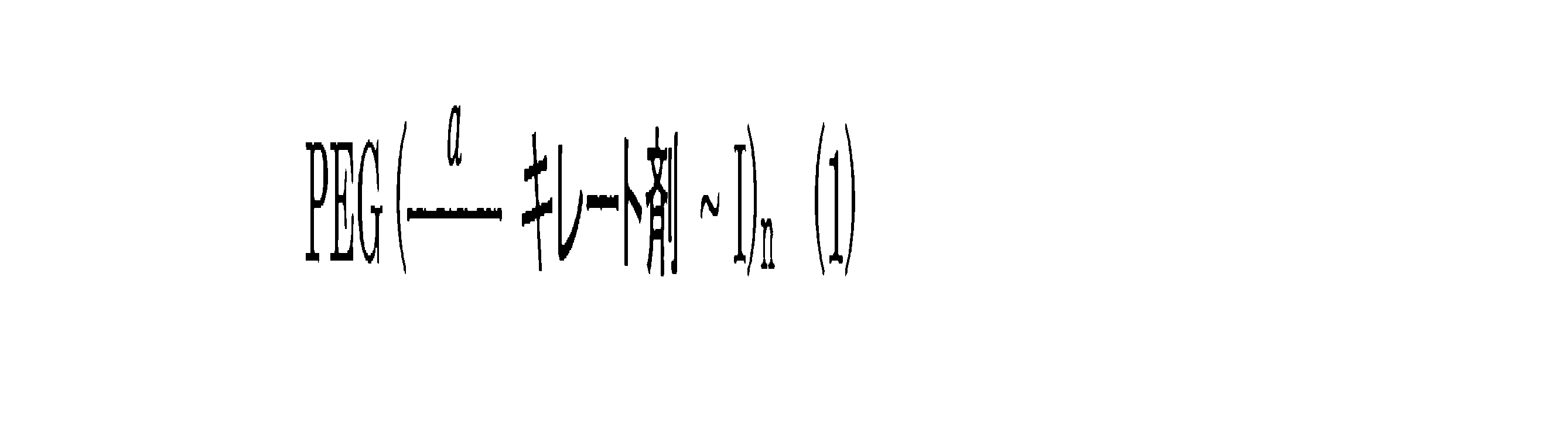
PEGは、複数の2〜6アームを含む40〜60kDのポリエチレングリコールを表す;
キレート剤は、デスフェリオキサミンまたはplur-ヒドロキシピリジノン多座配位子を表す;
Iは、陽電子放出断層撮影法(PET)に適したラジオアイソトープである;
〜は、キレート剤中のIの封鎖(sequestration)を示す;および
nは、1から上記PEGのアーム数までの整数である。
Therefore, in one aspect, the present invention relates to the imaging agent of formula (1).
PEG represents 40-60 kD polyethylene glycol containing multiple 2-6 arms;
The chelating agent represents desferrioxamine or plur-hydroxypyridinone polydentate ligand;
I is a radioisotope suitable for positron emission tomography (PET);
~ Indicates the sequestration of I in the chelating agent; and
n is an integer from 1 to the number of arms of the PEG.
本発明はまた、式(2)のハイブリッドコンジュゲートをも含み、
PEGは、複数の2〜6アームを含む40〜60kDのポリエチレングリコールを表す;
キレート剤は、デスフェリオキサミンまたはplur-ヒドロキシピリジノン多座配位子を表す;
Iは、陽電子放出断層撮影法(PET)に適したラジオアイソトープである;
〜は、キレート剤中のIの封鎖を示す;
Lは、リンカーである;
Dは、治療剤である;
nは、1から上記PEGのアーム数マイナスxまでの整数である;および
xは、上記PEGのアーム数マイナスnまでの整数である。
The present invention also includes a hybrid conjugate of formula (2).
PEG represents 40-60 kD polyethylene glycol containing multiple 2-6 arms;
The chelating agent represents desferrioxamine or plur-hydroxypyridinone polydentate ligand;
I is a radioisotope suitable for positron emission tomography (PET);
~ Indicates the blockade of I in the chelating agent;
L is a linker;
D is a therapeutic agent;
n is an integer from 1 to the number of arms of the PEG minus x;
x is an integer up to the number of arms of the PEG minus n.
マルチアーム型のPEGの使用は、得られるナノ粒子が柔軟性に乏しく、そのため腫瘍内に選択的に保持されるという点で有利である。イメージング剤は、最適には約20nmの直径(約10nmの流体力学半径)を有する。その直径は10〜100nm、または10〜50nm、または10〜25nm(5〜50、5〜25、または5〜12.5nmの流体力学半径に対応する)の範囲であり得る。 The use of multi-armed PEG is advantageous in that the nanoparticles obtained are inflexible and therefore selectively retained in the tumor. The imaging agent optimally has a diameter of about 20 nm (a hydrodynamic radius of about 10 nm). Its diameter can range from 10 to 100 nm, or 10 to 50 nm, or 10 to 25 nm (corresponding to a hydrodynamic radius of 5 to 50, 5 to 25, or 5 to 12.5 nm).
別の態様では、本発明は、腫瘍におけるイメージング剤の蓄積をモニタリングする方法に関し、この方法は、該イメージング剤を投与するステップ、および該イメージング剤の位置をPETによって検出するステップを含む。 In another aspect, the invention relates to a method of monitoring the accumulation of an imaging agent in a tumor, the method comprising administering the imaging agent and detecting the location of the imaging agent by PET.
さらに別の態様では、本発明は、薬物コンジュゲートの薬物動態および腫瘍におけるその蓄積を評価する方法に関し、この方法は、該薬物のコンジュゲートのサイズをイメージング剤のサイズに一致させるステップ、該イメージング剤を投与するステップ、および該薬物コンジュゲートの挙動の診断として、PETにより腫瘍内の該イメージング剤の蓄積をモニタリングするステップを含む。 In yet another aspect, the invention relates to a method of assessing the pharmacokinetics of a drug conjugate and its accumulation in a tumor, wherein the method matches the size of the conjugate of the drug to the size of the imaging agent, said imaging. The step of administering the drug and the step of monitoring the accumulation of the imaging agent in the tumor by PET are included as a diagnosis of the behavior of the drug conjugate.
したがって、本発明はさらに、診断剤に基づいてコンジュゲート化薬物により患者を治療することの適合性を評価する方法を含む。診断剤の寸法は、患者の治療を目的とした薬物コンジュゲートの寸法に一致する。さらに広く見れば、診断剤は、EPR効果を利用して治療できる患者を簡単に特定することができる。 Therefore, the invention further includes a method of assessing the suitability of treating a patient with a conjugated drug based on a diagnostic agent. The dimensions of the diagnostic agent match the dimensions of the drug conjugate intended to treat the patient. More broadly, diagnostic agents can easily identify patients who can be treated using the EPR effect.
本発明にはまた、本発明のイメージング剤ならびに該イメージング剤と同様のサイズおよび形状の薬物のコンジュゲートを含むキットが含む。 The present invention also includes a kit comprising the imaging agent of the present invention and a conjugate of a drug of the same size and shape as the imaging agent.
別の態様では、本発明は、EPR効果を示すように改変された薬物による治療から利益を得る可能性が高い対象者を特定する方法に関し、この方法は、本発明のイメージング剤を候補となる対象者に投与するステップ、および該対象者におけるイメージング剤の分布をモニタリングし、それにより、望ましくない組織塊にイメージング剤を蓄積する対象者を、そのような治療から利益を受ける対象者として特定するステップを含む。例えば、Lee, H., et al., Clin. Canc. Res., (2017) 23:4190-4202 (前出)を参照されたい。 In another aspect, the invention relates to a method of identifying a subject who is likely to benefit from treatment with a drug modified to exhibit EPR effect, the method of which is a candidate for the imaging agent of the invention. The steps of administration to the subject and the distribution of the imaging agent in the subject are monitored, thereby identifying the subject who accumulates the imaging agent in an undesired tissue mass as a subject who will benefit from such treatment. Including steps. See, for example, Lee, H., et al., Clin. Canc. Res., (2017) 23: 4190-4202 (above).
治療のプロトコルに関連して、薬物をコンジュゲート化する際に使用される担体と同じ特性を備えた担体を含む本発明のイメージング剤は、固形腫瘍による該コンジュゲートの取り込みをモニタリングするために使用される。これにより、薬物の対応するコンジュゲートがEPR効果を示す(または示さない)ことの検証が可能である。 In connection with the therapeutic protocol, the imaging agents of the invention containing carriers with the same properties as the carriers used in conjugating the drug are used to monitor the uptake of the conjugate by solid tumors. Will be done. This allows verification that the corresponding conjugate of the drug exhibits (or does not) EPR effect.
さらなる態様では、本発明は、DNA修復の阻害剤による治療に応答する腫瘍を持つ対象者を特定する方法を含み、この方法は、DNA修復を行うことに関与するタンパク質をコードする遺伝子に変異が存在するかどうかを判定するステップを含み、この場合、該対象者に該変異が存在すると、該対象者はそのような腫瘍があると特定される。 In a further aspect, the invention includes a method of identifying a subject with a tumor that responds to treatment with an inhibitor of DNA repair, in which the method is mutated in a gene encoding a protein involved in performing DNA repair. It comprises the step of determining if it is present, in which case the presence of the mutation in the subject identifies the subject as having such a tumor.
さらに別の態様では、本発明は、固形腫瘍の治療およびイメージングのためのハイブリッドコンジュゲートに関し、このコンジュゲートは柔軟な担体を含み、該担体は、それぞれ5〜50nmの流体力学半径を有するナノ粒子または高分子であり、該コンジュゲートは、該コンジュゲートを固形腫瘍内に集積するように腫瘍において血管透過性・滞留性亢進(EPR)を示し、ここで、該担体は治療剤におよびイメージング剤にも放出可能に結合されている。また、本発明は、前記ハイブリッドコンジュゲートを使用して固形腫瘍のイメージングと治療を関連付ける方法に関する。任意の薬物のそのようなハイブリッド(「セラノスティックス」と呼ばれる)の代表的な一般構造を図12に示す。 In yet another aspect, the invention relates to hybrid conjugates for the treatment and imaging of solid tumors, the conjugate comprising a flexible carrier, each of which is a nanoparticle having a hydrodynamic radius of 5-50 nm. Alternatively, it is a polymer and the conjugate exhibits vascular hyperpermeability (EPR) in the tumor such that the conjugate accumulates in a solid tumor, where the carrier is a therapeutic and imaging agent. Is also leasable and bound. The present invention also relates to a method of associating solid tumor imaging with treatment using the hybrid conjugate. A typical general structure of such a hybrid of any drug (called "ceranostics") is shown in FIG.
基本的に、併用療法の毒作用を最小限に抑えるプロトコルの設計には2つのアプローチが存在する。第1のアプローチは、第1の治療剤または薬物が、該薬物を担体に結合させることによって、治療すべき固形腫瘍内に確実に捕捉されるようにすることであり、結果的に、EPR効果によって、該コンジュゲートと放出された薬物が実質的に固形腫瘍内に保持されるが、腫瘍に捕捉されなかった投与されたコンジュゲートと放出された薬物は、体循環からより迅速にクリアされるようになる。ここで、該担体は、それぞれ5〜50nm、好ましくは約10nmの流体力学半径(10〜100nm、好ましくは約20nmの直径)を有するナノ粒子または高分子である。したがって、投与されたコンジュゲートのかなりの部分が腫瘍に保持されるだけでなく、該コンジュゲートが腫瘍内に存在する間に該コンジュゲートから放出された薬物も保持される。体循環からのクリアランス速度は、腫瘍からの該コンジュゲートと放出された薬物のクリアランス速度よりもはるかに大きい。このため、コンジュゲート化形態と遊離形態の両方の薬物の有効量が、腫瘍細胞に対して細胞傷害効果を及ぼし続けるが、体循環中のそれらの濃度は望ましいレベルに減少している。体循環中の2半減期の後、例えば、体循環中のおよび正常組織と接触している該コンジュゲートおよび遊離薬物のレベルは、初期濃度の25%にまで減少し、これは毒性を改善するのに十分に低い濃度であり得る。該コンジュゲートは腫瘍内に留まって薬剤を放出するので、薬剤は腫瘍に対してその細胞傷害効果を発揮することができるが、身体領域におけるその濃度はかなり低く、それゆえに正常組織の薬物への曝露も非常に少ない。 Basically, there are two approaches to designing protocols that minimize the toxic effects of combination therapies. The first approach is to ensure that the first therapeutic agent or drug is trapped in the solid tumor to be treated by binding the drug to a carrier, resulting in an EPR effect. The conjugate and released drug are substantially retained in the solid tumor, but the administered conjugate and released drug that were not captured by the tumor are cleared more quickly from the body circulation. Will be. Here, the carrier is a nanoparticle or polymer having a hydrodynamic radius (10-100 nm, preferably about 20 nm diameter) of 5 to 50 nm, preferably about 10 nm, respectively. Thus, not only is a significant portion of the administered conjugate retained in the tumor, but also the drug released from the conjugate while it is present in the tumor. The clearance rate from the systemic circulation is much higher than the clearance rate of the conjugate and released drug from the tumor. Thus, effective amounts of both conjugated and free forms of the drug continue to exert cytotoxic effects on tumor cells, but their concentration in the systemic circulation is reduced to desirable levels. After two half-lives in the systemic circulation, for example, the levels of the conjugate and free drug in the systemic circulation and in contact with normal tissue are reduced to 25% of the initial concentration, which improves toxicity. It can be low enough to be. Since the conjugate stays in the tumor and releases the drug, the drug can exert its cytotoxic effect on the tumor, but its concentration in the body area is quite low and therefore to the drug in normal tissue. The exposure is also very low.
この時点で、第2の薬物が全身投与される;したがって、正常組織は第2の薬物の毒作用にのみ曝され、一方、第1の薬物は腫瘍内に留まったままである。これにより、正常組織への併用薬物の毒作用が最小限に抑えられる一方で、腫瘍においては複合毒性が保持される。第2の薬物は、遊離形態で投与されてもよいし、同様の担体とのコンジュゲートとして、または他の任意の適切な形態で、例えば、リポソーム、ナノ粒子、ミセルなどの送達ビヒクルに含めて、投与されてもよい。 At this point, the second drug is administered systemically; therefore, normal tissue is only exposed to the toxic effects of the second drug, while the first drug remains in the tumor. This minimizes the toxic effects of the concomitant drug on normal tissues while preserving combined toxicity in tumors. The second drug may be administered in free form, as a conjugate with a similar carrier, or in any other suitable form, such as in a delivery vehicle such as liposomes, nanoparticles, micelles, etc. , May be administered.
さらに、毒性が第2の薬物と重複しない第3の薬物を、第2の薬物と同時にまたは連続的に共投与することができる。 In addition, a third drug whose toxicity does not overlap with the second drug can be co-administered simultaneously or continuously with the second drug.
あるいは、第1の薬物と第2の薬物の両方は、EPRによって腫瘍に保持されるコンジュゲートの形態で、同時または異なる時間に投与され得る。この保持(滞留)によって、各薬物の主な集積が腫瘍において発生し、正常組織と接触することはない。かくして、これらの薬物のより高い投与量レベルが主に腫瘍で達成され、投与されたコンジュゲートは、放出された薬物と共に、体循環から迅速にクリアされる。 Alternatively, both the first drug and the second drug can be administered simultaneously or at different times in the form of a conjugate retained in the tumor by EPR. Due to this retention (retention), the main accumulation of each drug occurs in the tumor and does not come into contact with normal tissue. Thus, higher dose levels of these drugs are achieved primarily in the tumor, and the administered conjugate is rapidly cleared from the systemic circulation along with the released drug.
場合によっては、さらに追加のコンジュゲート化形態の薬剤を共投与することが可能である。 In some cases, additional conjugated forms of the drug can be co-administered.
上記の第1の方法で少なくとも第1の薬剤を投与するために、そして上記の第2の方法で第1の薬剤と第2の薬剤の両方を放出させるために、本発明の方法で使用される担体は、性質が柔軟であって、約10nmの流体力学半径を有する担体である。適切な高分子担体には、直鎖状またはマルチアーム型の分子量10〜50kDのポリエチレングリコール(PEG)が含まれる。好ましくは、担体は、少なくとも20kDの分子量を有するマルチアーム型PEGである。担体のこれらの特性により、EPR効果を最大限に利用することができる。ナノ粒子担体も含まれる。 Used in the method of the invention to administer at least the first agent in the first method described above, and to release both the first agent and the second agent in the second method described above. The carrier is a carrier that is flexible in nature and has a hydrodynamic radius of about 10 nm. Suitable polymeric carriers include linear or multi-armed polyethylene glycol (PEG) with a molecular weight of 10-50 kD. Preferably, the carrier is a multi-armed PEG having a molecular weight of at least 20 kD. These properties of the carrier allow the EPR effect to be maximized. Nanoparticle carriers are also included.
ナノ分子担体への化学療法剤のコンジュゲートの放出可能な形態を提供するために特に有用なのは、β脱離反応によって薬剤を放出するリンカー、例えば、上記の米国特許第8,680,315号;同第9,387,254号;同第8,754,190号;同第8,946,405号;および同第8,703,907号に詳細に記載されるものである;これらの特許文献は、β脱離によって薬剤を放出する有用なリンカーの構造のそれらの開示についてだけでなく、本発明において有用なナノ分子担体のそれらの開示に関しても、すべて参照により本明細書に組み込まれる。 Particularly useful for providing an releaseable form of a conjugate of a chemotherapeutic agent on a nanomolecular carrier is a linker that releases the agent by a β elimination reaction, eg, US Pat. No. 8,680,315; 9,387,254, supra. It is described in detail in No. 8,754,190; No. 8,946,405; and No. 8,703,907; these patent documents describe their disclosure of the structure of a useful linker that releases a drug by β-elimination. Not only those disclosures of nanomolecular carriers useful in the present invention are all incorporated herein by reference.
その他のリンカーには、エステル、カーボネート、もしくはカルバメートの加水分解により、アミドのタンパク質分解により、またはニトロレダクターゼによる芳香族ニトロ基の還元により切断可能なリンカーが含まれる。 Other linkers include linkers that can be cleaved by hydrolysis of esters, carbonates, or carbamate, by proteolysis of amides, or by reduction of aromatic nitro groups with nitroreductase.
本発明の方法の対象者は、一般的にはヒト対象者であるが、本発明の方法は、家畜およびペットを含む獣医学的背景においても適用可能である。本発明の方法はまた、ラット、マウス、ウサギなどの実験室で有用な動物モデル、またはヒトへの使用のプロトコルを設計する準備段階としての他のモデルシステムにも適している。 The subject of the method of the invention is generally a human subject, but the method of the invention is also applicable in veterinary contexts including livestock and pets. The methods of the invention are also suitable for laboratory-useful animal models such as rats, mice, rabbits, or other model systems as a preparatory step in designing protocols for use in humans.
併用療法で使用できる薬物に関しては、多種多様な化学療法剤が知られており、これらの任意の組み合わせを第1および第2の薬物として選択することができる。相加的または相乗的に作用する薬剤、例えばそれぞれがDNA修復を阻害する薬物の組み合わせ、が好適である。 A wide variety of chemotherapeutic agents are known for drugs that can be used in combination therapies, and any combination of these can be selected as the first and second drugs. Drugs that act additively or synergistically, such as a combination of drugs, each of which inhibits DNA repair, are preferred.
Topo 1阻害剤などの、DNA損傷を引き起こす薬物は、腫瘍(そのゲノムがDNA修復に通常役立つ遺伝子に変異を含む)を治療するのに特に有用である。中でも、これらの遺伝子として、BRCA1、BRCA2、毛細血管拡張性運動失調症変異(ataxia telangiectasia mutated:ATM)キナーゼをコードするATM、およびRad-3関連(ATR)キナーゼをコードするATRが挙げられる。本発明は、Topo 1阻害剤を用いた治療に対して増強された感受性を示す腫瘍を同定することを含み、この場合、該腫瘍を担持する対象者のゲノムは、BRCA1、BRCA2、ATMもしくはATRまたは他の遺伝子(変異により、DNA修復を増強する遺伝子の能力が妨げられるかまたは低下している)に変異がある少なくとも1つの遺伝子を有する。その応答は、PARP阻害剤のように、DNA修復に関与する第2の酵素を阻害することによってさらに増強される可能性があり、その後、Topo阻害剤によって引き起こされる高レベルのDNA切断のために増幅される合成致死性(synthetic lethality)が生じる。したがって、受動的に標的化されたPEG_SN38を使用する場合、腫瘍の遺伝的状態を知ること、およびDNA損傷応答システムの阻害剤の組み合わせを選択することが有用である。
Drugs that cause DNA damage, such as
薬剤の例には、以下が含まれる:
「シグナル伝達阻害剤」、これらは、がん細胞の成長または分裂を引き起こすシグナルを妨害または防止する;
「細胞傷害性薬剤」;
「細胞周期阻害剤」または「細胞周期制御阻害剤」−これらは、娘細胞に分裂させる有糸分裂後の事象の発端となる有糸分裂からの正常な細胞周期を経る細胞の進行、細胞の寿命を妨げる;
「チェックポイント阻害剤」−これらは、細胞周期チェックポイント、例えば、S/G2チェックポイント、G2/MチェックポイントおよびG1/Sチェックポイントの正常な機能を妨害する。
「トポイソメラーゼ阻害剤」、例えばカンプトテシン類、これらは、DNAの複製と転写に必要な酵素であるトポイソメラーゼIまたはII活性を妨げる;
「受容体チロシンキナーゼ阻害剤」−これらは、チロシンキナーゼ活性を有する成長因子受容体の活性を妨げる;
「アポトーシス誘導剤」−これらは、プログラムされた細胞死を促進する;
「代謝拮抗物質」、例えばゲムシタビンまたはヒドロキシウレアであり、これらは、必須代謝産物に非常に似ているため、それが関与する生理学的反応を妨げる;
「テロメラーゼ阻害剤」−これらは、テロメアの長さを伸長させて、細胞の寿命とその複製能力を引き延ばす酵素であるテロメラーゼの活性を妨げる;
「サイクリン依存性キナーゼ阻害剤」−これらは、ヒストン、細胞骨格タンパク質、転写因子、腫瘍抑制遺伝子などの細胞タンパク質のリン酸化を介して、細胞周期の異なる期と期の間の主要なステップを調節する、サイクリン依存性キナーゼを妨げる;
「DNA損傷剤」;
「DNA修復阻害剤」;
「抗血管新生薬」、これらは、腫瘍の成長中に発生する新しい血管の形成または既存の血管の成長を妨げる;および
「ミトコンドリア毒」、これらは、ミトコンドリア呼吸鎖機能を直接的または間接的に妨害する。
Examples of drugs include:
"Signal transduction inhibitors", which interfere with or prevent signals that cause the growth or division of cancer cells;
"Cytotoxic drugs";
"Cell Cycle Inhibitors" or "Cell Cycle Control Inhibitors" -These are the progression of cells through the normal cell cycle from mitosis, which initiates post-mitotic events that cause daughter cells to divide, of the cell. Interfere with lifespan;
"Checkpoint Inhibitors" -These interfere with the normal functioning of cell cycle checkpoints, such as S / G2 checkpoints, G2 / M checkpoints and G1 / S checkpoints.
"Topoisomerase inhibitors", such as camptothecins, interfere with the activity of topoisomerase I or II, the enzymes required for DNA replication and transcription;
"Receptor tyrosine kinase inhibitors" -these interfere with the activity of growth factor receptors with tyrosine kinase activity;
"Apoptotic inducers" -these promote programmed cell death;
"Metabolite antagonists" such as gemcitabine or hydroxyurea, which are so similar to essential metabolites that they interfere with the physiological reactions involved;
"Telomerase inhibitors" -these interfere with the activity of telomerase, an enzyme that extends telomere length and prolongs cell lifespan and its ability to replicate;
"Cyclin-dependent kinase inhibitors" -these regulate key steps between different phases of the cell cycle through phosphorylation of cellular proteins such as histones, cytoskeletal proteins, transcription factors, and tumor suppressors. Interfere with cyclin-dependent kinases;
"DNA damage agent";
"DNA repair inhibitor";
"Anti-angiogenic drugs", which interfere with the formation of new blood vessels or the growth of existing blood vessels that occur during tumor growth; and "mitochondrial toxins", which directly or indirectly impair mitochondrial respiratory chain function. to disturb.
腫瘍を治療するためのこれらの多くの組み合わせが臨床的に承認されている。 Many of these combinations for treating tumors have been clinically approved.
併用することができる好ましい薬剤には、以下が含まれる:DNA損傷剤、例えば、カルボプラチン、シスプラチン、シクロホスファミド、ドキソルビシン、ダウノルビシン、エピルビシン、マイトマイシンC、ミトキサントロン;DNA修復阻害剤、例えば、5-フルオロウラシル(5-FU)またはFUDR、ゲムシタビン、メトトレキサート;トポイソメラーゼI阻害剤、例えば、カンプトテシン、イリノテカン、トポテカン;S/G2またはG2/Mチェックポイント阻害剤、例えば、ブレオマイシン、ドセタキセル、ドキソルビシン、エトポシド、パクリタキセル、ビンブラスチン、ビンクリスチン、ビンデシン、ビノレルビン;G1/初期Sチェックポイント阻害剤;G2/Mチェックポイント阻害剤;受容体チロシンキナーゼ阻害剤、例えば、ゲニステイン、トラスツズマブ、ZD1839;細胞傷害性薬剤;アポトーシス誘導剤および細胞周期制御阻害剤。 Preferred agents that can be used in combination include: DNA damaging agents such as carboplatin, cisplatin, cyclophosphamide, doxorubicin, daunorubicin, epirubicin, mitomycin C, mitoxantrone; DNA repair inhibitors such as 5-Fluorouracil (5-FU) or FUDR, gemcitabine, methotrexate; topoisomerase I inhibitors such as camptothecin, irinotecan, topotecan; S / G2 or G2 / M checkpoint inhibitors such as bleomycin, docetaxel, doxorubicin, etoposide, Paclitaxel, vinblastin, vincristin, bindecin, binorerbin; G1 / early S checkpoint inhibitor; G2 / M checkpoint inhibitor; receptor tyrosine kinase inhibitor, eg, genistein, trastuzumab, ZD1839; cytotoxic drug; apoptosis inducer And cell cycle control inhibitors.
代表的な組み合わせは、以下の組み合わせである:DNA修復阻害剤と組み合わせたDNA損傷剤、トポイソメラーゼIまたはトポイソメラーゼII阻害剤と組み合わせたDNA損傷剤、S/G2またはG2/Mチェックポイント阻害剤と組み合わせたトポイソメラーゼI阻害剤、G2/Mチェックポイント阻害剤と組み合わせたG1/Sチェックポイント阻害剤またはCDK阻害剤、細胞傷害性薬剤と組み合わせた受容体チロシンキナーゼ阻害剤、細胞傷害性薬剤と組み合わせたアポトーシス誘導剤、細胞周期制御阻害剤と組み合わせたアポトーシス誘導剤、細胞傷害性薬剤と組み合わせたG1/SまたはG2/Mチェックポイント阻害剤、DNA修復阻害剤と組み合わせたトポイソメラーゼIまたはII阻害剤、細胞周期制御阻害剤と組み合わせたトポイソメラーゼIまたはII阻害剤、トポイソメラーゼII阻害剤と組み合わせたトポイソメラーゼI阻害剤、および2つの細胞傷害性薬剤の組み合わせ。 Typical combinations are: DNA damage agents in combination with DNA repair inhibitors, DNA damage agents in combination with topoisomerase I or topoisomerase II inhibitors, combinations with S / G2 or G2 / M checkpoint inhibitors Topoisomerase I inhibitor, G1 / S checkpoint inhibitor or CDK inhibitor combined with G2 / M checkpoint inhibitor, receptor tyrosine kinase inhibitor combined with cytotoxic drug, apoptosis combined with cytotoxic drug Inducers, apoptosis-inducing agents in combination with cell cycle control inhibitors, G1 / S or G2 / M checkpoint inhibitors in combination with cytotoxic agents, topoisomerase I or II inhibitors in combination with DNA repair inhibitors, cell cycle A topoisomerase I or II inhibitor in combination with a control inhibitor, a topoisomerase I inhibitor in combination with a topoisomerase II inhibitor, and a combination of two cytotoxic agents.
代表的な特定の薬剤として、以下が挙げられる:シスプラチン(またはカルボプラチン)と5-FU(またはFUDR)、シスプラチン(またはカルボプラチン)とイリノテカン、イリノテカンと5-FU(またはFUDR)、ビノレルビンとシスプラチン(またはカルボプラチン)、メトトレキサートと5-FU(またはFUDR)、イダルビシンとAraC、シスプラチン(またはカルボプラチン)とタキソール、シスプラチン(またはカルボプラチン)とエトポシド、シスプラチン(またはカルボプラチン)とトポテカン、シスプラチン(またはカルボプラチン)とダウノルビシン、シスプラチン(またはカルボプラチン)とドキソルビシン、シスプラチン(またはカルボプラチン)とゲムシタビン、オキサリプラチンと5-FU(またはFUDR)、ゲムシタビンと5-FU(またはFUDR)、アドリアマイシンとビノレルビン、タキソールとドキソルビシン、フラボピリドールとドキソルビシン、UCN−01とドキソルビシン、ブレオマイシンとトリクロルペラジン、ビノレルビンとエデルホシン、ビノレルビンとスフィンゴシン(およびスフィンゴシン類似体)、ビノレルビンとホスファチジルセリン、ビノレルビンとカンプトテシン、シスプラチン(またはカルボプラチン)とスフィンゴシン(およびスフィンゴシン類似体)、スフィンゴシン(およびスフィンゴシン類似体)とダウノルビシン、およびスフィンゴシン(およびスフィンゴシン類似体)とドキソルビシン。 Typical specific agents include: cisplatin (or carboplatin) and 5-FU (or FUDR), cisplatin (or carboplatin) and irinotecan, irinotecan and 5-FU (or FUDR), vinorelbine and cisplatin (or). Carboplatin), methotrexate and 5-FU (or FUDR), idarubicin and AraC, cisplatin (or carboplatin) and taxol, cisplatin (or carboplatin) and etopocid, cisplatin (or carboplatin) and topotecan, cisplatin (or carboplatin) and daunorubicin, cisplatin (Or carboplatin) and doxorubicin, cisplatin (or carboplatin) and gemcitabine, oxaliplatin and 5-FU (or FUDR), gemcitabine and 5-FU (or FUDR), adriamycin and vinorelbine, taxol and doxorubicin, flavopyridol and doxorubicin, UCN-01 and doxorubicin, bleomycin and trichlorperazine, vinorelbine and edelhosin, vinorelbine and spingosin (and spingosin analogs), vinorelbine and phosphatidylserine, binorelbine and camptothecin, cisplatin (or carboplatin) and sphingosin (and spingosin analogs) (And spingosin analogs) and dounorubicin, and spingosin (and spingosin analogs) and doxorubicin.
一実施形態において、第1の薬物は、トポイソメラーゼ阻害剤であるSN-38の本発明の放出可能なコンジュゲートであり、代表的な第2の薬物には、PARP阻害剤、mTOR阻害剤、トラベクテジン(trabectedin)、シスプラチナム(cis-platinum)、オキサリプラチン、フルオロウラシル、テモゾロミドおよびビンクリスチンが含まれる。これらの全てはSN-38と相乗的に作用すると報告されている。 In one embodiment, the first drug is the releaseable conjugate of the topoisomerase inhibitor SN-38 of the present invention, and the representative second drug is a PARP inhibitor, mTOR inhibitor, trabectedin. Includes (trabectedin), cis-platinum, oxaliplatin, fluorouracil, temozolomide and vincristine. All of these have been reported to act synergistically with SN-38.
ある種の腫瘍はPARP阻害剤による治療の影響を特に受けやすく、これらの腫瘍では、PARP阻害剤が併用薬物として好まれる。これらは、DNA修復を助けるタンパク質の提供に通常役立つ遺伝子の変異により、この遺伝子の特性が失われている腫瘍である。そのような腫瘍はSN38などのトポイソメラーゼ阻害剤にも反応する。それは、トポイソメラーゼの阻害が、これらの腫瘍に欠けるDNA修復を必要とする過度のDNA損傷を引き起こすためである。これらの遺伝子には、とりわけ、BRCA1、BRCA2、毛細血管拡張性運動失調症変異(ATM)キナーゼをコードするATM、およびRad-3関連(ATR)キナーゼをコードするATRが含まれる。本発明は、BRCA1、BRCA2、ATMもしくはATRまたは他の遺伝子(変異により、DNA修復を増強する遺伝子の能力が妨げられるかまたは低下している)に変異を有する腫瘍を同定するステップ、および本発明のSN38コンジュゲートによる治療を、例えばPARP阻害剤またはDNA修復の他の阻害剤による追跡治療(follow up treatment)と組み合わせるステップを含む。薬物は、体の他の部分から排除された後、腫瘍内に蓄積して留まるため、SN38の毒性は腫瘍に限定され、体は全体としてPARP阻害剤の毒性にのみ対処することになる。 Certain tumors are particularly susceptible to treatment with PARP inhibitors, where PARP inhibitors are preferred as concomitant medications. These are tumors that have lost the properties of this gene due to mutations in the gene that normally help provide proteins that help DNA repair. Such tumors also respond to topoisomerase inhibitors such as SN38. This is because inhibition of topoisomerase causes excessive DNA damage that requires DNA repair that is lacking in these tumors. These genes include, among other things, BRCA1, BRCA2, ATMs encoding ataxia-telangiectasia mutation (ATM) kinases, and ATRs encoding Rad-3 associated (ATR) kinases. The present invention identifies tumors with mutations in BRCA1, BRCA2, ATM or ATR or other genes (mutations interfere with or reduce the ability of genes to enhance DNA repair), and the present invention. Includes the step of combining treatment with the SN38 conjugate of SN38 with, for example, follow up treatment with a PARP inhibitor or other inhibitor of DNA repair. Since the drug is eliminated from other parts of the body and then accumulates and remains in the tumor, the toxicity of SN38 is limited to the tumor and the body as a whole only deals with the toxicity of PARP inhibitors.
第2の薬物として投与される上記の薬物のいくつかは、互いの毒性が重複しないことを条件として、連続的にまたは同時に組み合わせて投与することができる。 Some of the above drugs administered as the second drug can be administered continuously or in combination, provided that their toxicities do not overlap with each other.
イメージング
本発明の方法は、上記の第1のアプローチでは第1の薬剤について、第2のアプローチでは第1の薬剤と第2の薬剤の両方について、投与されたコンジュゲートがEPR効果を受ける能力に依存するため、これが実際に起こり得ることを確認することが重要である。というのは、腫瘍は不均一であり、また、選択された特定の担体は、EPR効果が存在すると言えるためには、対象者の固形腫瘍における血管系の細孔構造と適合しなければならないからである。したがって、本発明の方法のある実施形態では、これは、薬物(複数可)に連結されたものと同じ担体または同じ特性を有する担体に放出不能となるように結合された標識のコンジュゲートを同時にまたは別々に投与することによって確認される。任意の検出可能な標識、例えば蛍光標識、を使用することができるが、陽電子放出断層撮影(PET)スキャニングによって検出可能なアイソトープを使用することが最も便利である。次に、アイソトープの非放出性コンジュゲートをモニタリングして、腫瘍による優先的取り込みと滞留が示されるかどうかを検出する。腫瘍による優先的取り込みと滞留が示される場合には、本発明の方法が採用される。腫瘍が標識された非放出性コンジュゲートでEPR効果を示さない場合には、本発明の方法は避けるべきである。このように検出可能なアイソトープは当技術分野でよく知られており、そのようなアイソトープを高分子担体に結合させるための手段も同様に知られている。
Imaging The method of the present invention determines the ability of administered conjugates to receive EPR effects for both the first and second agents in the first approach described above and in the second approach. It is important to make sure that this can actually happen, as it depends. This is because the tumor is heterogeneous and the particular carrier selected must be compatible with the pore structure of the vascular system in the subject's solid tumor in order for the EPR effect to be present. Is. Thus, in certain embodiments of the method of the invention, it simultaneously comprises a labeled conjugate that is non-releasably bound to the same carrier or carrier having the same properties as linked to the drug (s). Or confirmed by administration separately. Any detectable label, such as a fluorescent label, can be used, but it is most convenient to use an isotope detectable by positron emission tomography (PET) scanning. Next, the non-releasing conjugate of the isotope is monitored to detect whether it indicates preferential uptake and retention by the tumor. If preferential uptake and retention by the tumor is indicated, the method of the invention is adopted. The method of the invention should be avoided if the tumor does not show EPR effect with labeled non-releasing conjugates. Such detectable isotopes are well known in the art, as are means for binding such isotopes to polymeric carriers.
イメージングには、同様のコンジュゲートが使用される。上述したように、本発明のイメージング剤は、直径が約20ナノメートルになるように、かつ過度の柔軟性を回避するように設計することが有利である。これは、40〜60kDの範囲のマルチアーム型PEGポリマーを使用することで達成され得る。このポリマーに関連するアームの数は1〜6の範囲とすることができるが、本明細書では3〜5アーム、より好ましくは4アームのマルチアームPEGに焦点を合わせている。 Similar conjugates are used for imaging. As mentioned above, it is advantageous that the imaging agents of the present invention be designed to have a diameter of about 20 nanometers and avoid excessive flexibility. This can be achieved by using multi-armed PEG polymers in the range of 40-60 kD. The number of arms associated with this polymer can range from 1 to 6, but the focus herein is on multi-arm PEG with 3 to 5 arms, more preferably 4 arms.
式(1)中のnの値は、1からポリマーに関連するアームの数まで変化してよく、本発明の組成物では、nの値は、組成物中の個々のイメージング部分の全てについて同じでなくてもよいことが理解されよう。したがって、例えば、nが4である4アームPEGの場合、またはnが1である単鎖PEGの場合、所与の組成物中の個々の「分子」のほとんどは、nの値として、それぞれ4または1を含む。しかし、例えば4アームPEGの場合、n=3またはn=2は平均を表し、個々のエンティティの一部は、n値の例として、4を含み、一部は3を含み、一部は2を含み、そして一部は1を含む。 The value of n in formula (1) may vary from 1 to the number of arms associated with the polymer, and in the compositions of the invention, the value of n is the same for all individual imaging moieties in the composition. It will be understood that it does not have to be. So, for example, in the case of 4-arm PEG where n is 4, or in the case of single-chain PEG where n is 1, most of the individual "molecules" in a given composition will each have a value of n of 4. Or include 1. However, in the case of 4-arm PEG, for example, n = 3 or n = 2 represents the mean, some of the individual entities contain 4, some contain 3, and some 2 as examples of n values. Includes, and some contain 1.
さらに、上記の式(1)のイメージング剤の構造に関して、キレート剤は、デスフェリオキサミンまたは多数のヒドロキシピリジノンからなる多座キレート剤(本明細書では「plur-ヒドロキシピリジノン多座配位子」と略す)を表す。様々なそのようなキレート剤は当技術分野でよく知られており、例えば、Ma, M. T. et al., Dalton Trans (2015) 44:4884-4900およびDeri, M. A., J Med Chem (2014) 57:4849-4860に詳しく説明されている。これらの文書中のこれらのリガンドの説明は、参照により本明細書に具体的に組み込まれる。 Further, regarding the structure of the imaging agent of the above formula (1), the chelating agent is a polydentate chelating agent consisting of desferrioxamine or a large number of hydroxypyridinones (in the present specification, "plur-hydroxypyridinone polydentate coordination". Abbreviated as "child"). Various such chelators are well known in the art, such as Ma, MT et al., Dalton Trans (2015) 44: 4884-4900 and Deri, MA, J Med Chem (2014) 57: It is explained in detail in 4849-4860. The description of these ligands in these documents is specifically incorporated herein by reference.
式(1)の共有結合コネクターは、キレート剤への直接結合であってもよいし、または1〜20個の連結原子を含むジペプチドまたは2官能性リンカーなどの中間リンカーが存在してもよい。本発明との関連でPETに有用なラジオアイソトープ(I)は、当技術分野で知られており、特に、Radioisotopes - Applications in Bio-Medical Science, Nirmal Singh編, 第10章, InTech (Rijeka, クロアチア), 2011中のSmith, S. V.らの「Production and Selection of Metal PET Radioisotopes for Molecular Imaging」の表3に示されるものの中で好ましいサブセットは、89Zr、94Tc、101In、81Rb、66Ga、64Cu、62Zn、61Cuまたは52Feなどの適切な半減期を持つものである。
The covalent connector of formula (1) may be a direct bond to a chelating agent, or an intermediate linker such as a dipeptide containing 1 to 20 linking atoms or a bifunctional linker may be present. Radioisotopes (I) useful for PET in the context of the present invention are known in the art, and in particular, Radioisotopes-Applications in Bio-Medical Science , edited by Nirmal Singh,
本発明のイメージング剤を活性剤(すなわち、薬物)の送達の代用物として使用するために、イメージング剤は、薬物をコンジュゲート化する際に使用される担体と同じ特性を有する担体を含む。これらは、その後、固形腫瘍によるコンジュゲートの取り込みをモニタリングするために使用される。これにより、薬物の対応するコンジュゲートがEPR効果を示す(または示さない)ことの検証が可能である。 In order to use the imaging agent of the present invention as a substitute for delivery of an activator (ie, drug), the imaging agent comprises a carrier having the same properties as the carrier used in conjugating the drug. These are then used to monitor the uptake of conjugates by solid tumors. This allows verification that the corresponding conjugate of the drug exhibits (or does not) EPR effect.
個別の治療用コンジュゲートとイメージング用コンジュゲートを使用する代わりに、固形腫瘍の治療とイメージング用に式(2)のハイブリッドコンジュゲートが使用される;このコンジュゲートは柔軟な担体を含み、該担体は、それぞれ5〜50nmの流体力学半径を有するナノ粒子または高分子である;該コンジュゲートは、固形腫瘍内に該コンジュゲートを集積するように、該腫瘍において血管透過性・滞留性亢進(EPR)を示す;前記担体は、治療剤に放出可能に結合され、かつイメージング剤にも結合される。したがって、式(2)では、式(1)と同様に、
上記に示されるように、PEGのアームの少なくとも1つはイメージング剤と結合し、少なくとも1つは治療剤と結合している。PEGポリマーのアームの総数までの様々な組み合わせが考えられる。治療剤は、SN38または他のトポイソメラーゼ阻害剤、または腫瘍内への蓄積に利点がある腫瘍治療に適した他の薬剤、例えばPARPまたはキナーゼ阻害剤であり得る。 As shown above, at least one of the arms of the PEG is bound to the imaging agent and at least one is bound to the therapeutic agent. Various combinations up to the total number of PEG polymer arms are possible. Therapeutic agents can be SN38 or other topoisomerase inhibitors, or other agents suitable for treating tumors that have an advantage in their accumulation in the tumor, such as PARPs or kinase inhibitors.
本発明のイメージング剤はまた、EPR効果を示す治療剤による治療の影響を受けやすい腫瘍または他の組織塊を担持する対象者を特定するのにも有用である。したがって、イメージング剤を対象者に投与して、腫瘍が、例えば、実際に同様のサイズのエンティティを優先的に取り込んで保持するかどうか、を調べるためにモニタリングすることができる。 The imaging agents of the present invention are also useful in identifying subjects carrying tumors or other tissue masses that are susceptible to treatment with therapeutic agents that exhibit EPR effect. Thus, imaging agents can be administered to the subject and monitored to see if the tumor actually preferentially uptakes and retains similarly sized entities, for example.
本出願では、「a」、「an」などは、他の意味を意図していることが文脈から明らかでない限り、1つまたは複数を意味するものとする。さらに、「化学療法剤」、「薬剤」および「薬物」という用語は交換可能に使用される。特定の数値特性が示される場合、記載された数値は一般に、プラスマイナス10%、好ましくはプラスマイナス5%、より好ましくはプラスマイナス1%のエラーバーを有する。したがって、10〜50nmの範囲は9〜55nmの範囲を含み得る。「流体力学半径」(hydrodynamic radius)とは、見かけのストークス半径(Stokes radius)を意味し、これは、例えばゲル浸透クロマトグラフィーで測定したとき、問題の分子と同じ速度で溶液を通して拡散する剛体球の半径である。 In this application, "a", "an", etc. shall mean one or more unless it is clear from the context that they are intended for another meaning. In addition, the terms "chemotherapeutic agent", "drug" and "drug" are used interchangeably. If certain numerical characteristics are indicated, the numbers listed generally have plus or minus 10%, preferably plus or minus 5%, more preferably plus or minus 1% error bars. Therefore, the range of 10-50 nm can include the range of 9-55 nm. "Hydrodynamic radius" means the apparent Stokes radius, which is a rigid sphere that diffuses through solution at the same rate as the molecule in question, for example when measured by gel permeation chromatography. Is the radius of.
本発明の対象者は、一般的にはヒトであるが、実験室モデルおよび獣医対象などの非ヒト動物をも含む。 Subjects of the present invention are generally humans, but also include non-human animals such as laboratory models and veterinary subjects.
本明細書で引用された全ての文書は、参照により本明細書に組み込まれる。 All documents cited herein are incorporated herein by reference.
以下の実施例は、本発明を説明するために提供されるが、本発明を限定するものではない。 The following examples are provided to illustrate the invention, but are not intended to limit the invention.
実施例1
コンジュゲート型SN-38の投与
SN-38は、トポイソメラーゼI阻害剤であり、プロドラッグであるイリノテカンから放出される活性薬物である。SN-38のコンジュゲートはWO 2015/051307に記載されている。SN-38の2つの異なるコンジュゲートPLX038およびPLX038Aが調製された。これらのコンジュゲートでは、β脱離による放出をもたらすリンカーを介して、40kDの4アームPEGに薬物が放出可能に連結されている。PLX038およびPLX038Aの構造を以下に示す;ここで、「Mod」はPLX038では-CN、PLX038Aではメチルスルホニルである。
Administration of conjugated SN-38
SN-38 is a topoisomerase I inhibitor, an active drug released from the prodrug irinotecan. The SN-38 conjugate is described in WO 2015/051307. Two different conjugates of SN-38, PLX038 and PLX038A, were prepared. In these conjugates, the drug is leasablely linked to 40 kD 4-arm PEG via a linker that results in release by β-elimination. The structures of PLX038 and PLX038A are shown below; where "Mod" is -CN for PLX038 and methylsulfonyl for PLX038A.
HT29腫瘍異種移植片を担持するラット6匹に、約200mg/kgのPLX038を注入し、該コンジュゲートおよび放出された薬物、ならびにそのグルクロニド(SN-38G)の血漿中および腫瘍内の濃度を、蛍光モニタリングによりHPLCで追跡した。図1に示すように、体循環中のPLX038の半減期は約50時間である。コンジュゲートおよび遊離薬物、ならびにSN-38Gは同様の半減期を示す。 Six rats carrying HT29 tumor xenografts were infused with approximately 200 mg / kg of PLX038 to determine the plasma and intratumor concentrations of the conjugate and released drug and its glucuronide (SN-38G). Followed by HPLC by fluorescence monitoring. As shown in FIG. 1, the half-life of PLX038 during systemic circulation is about 50 hours. Conjugates and free drugs, as well as SN-38G, show similar half-lives.
図2に示すように、PLX038の形態のSN-38の20nmol/kgの非毒性用量の有効性は、イリノテカン対照の毒性胃腸用量の有効性を超えている。 As shown in FIG. 2, the efficacy of a 20 nmol / kg non-toxic dose of SN-38 in the form of PLX038 exceeds the efficacy of a toxic gastrointestinal dose of irinotecan control.
これは、図3Aおよび3Bに示される結果によって説明され、これらの図は、様々な投与量レベルでの腫瘍内のコンジュゲートPLX038のレベル、および該コンジュゲートから放出されたSN-38のレベルのグラフである。図3Aに見られるように、200mg/kgの投与量では、腫瘍内のPLX038のレベル(左のバー)は約8nmol/gであるが、血漿中の濃度(右のバーとして表示)はほとんど検出されない。同様に、放出されたSN-38に関する図3Bでは、同じ投与量で、左のバーは腫瘍内の濃度を約80pm/gとして示すが、この場合も、右のバーは循環中ではそれがほとんど検出されないことを示す。実際、示されるように、より低い投与量では、コンジュゲートと遊離薬物は血漿中で検出されないが、腫瘍はこれらの成分のかなりの濃度を示す。 This is explained by the results shown in Figures 3A and 3B, which show the levels of conjugate PLX038 in the tumor at various dose levels and the levels of SN-38 released from the conjugate. It is a graph. As can be seen in Figure 3A, at a dose of 200 mg / kg, the level of PLX038 in the tumor (left bar) is about 8 nmol / g, but the plasma concentration (shown as the right bar) is mostly detected. Not done. Similarly, in Figure 3B for released SN-38, at the same dose, the left bar shows the intratumoral concentration as about 80 pm / g, but again, the right bar is mostly in circulation. Indicates that it is not detected. In fact, as shown, at lower doses, conjugates and free drugs are not detected in plasma, but tumors show significant concentrations of these components.
実施例2
ヒトプロトコルの提案
全身投与されるPLX038と第2の薬物(例えば、PARP阻害剤)との組み合わせについてのヒトでの投与スケジュールが提案され、この場合には、PLX038が1日目に投与され、それにより該コンジュゲートが腫瘍内に蓄積して、遊離薬物を放出する。該コンジュゲートと遊離薬物は全身から同時にクリアされる。全身クリアランスの2半減期、つまり10日後、全身PLX038は元の濃度の約25%に減少する。これは、その最小有効レベルおよび毒性レベルを下回る。この時点で、SN-38との相乗効果がある第2の薬物を20日間経口投与する。
Example 2
Human Protocol Proposal A human dosing schedule for a combination of systemically administered PLX038 with a second drug (eg, a PARP inhibitor) has been proposed, in which case PLX038 is administered on
図4に示すように、EPR効果は腫瘍内にPLX038(点線)を集積するが、全身PLX038(実線)は十分に低く、あらゆる毒作用は、示されるように10日に投与された第2の薬物にのみある。その時点で、腫瘍内の該コンジュゲートの濃度は、依然として最小有効レベルを上回っているが、毒性レベル以下である。
As shown in FIG. 4, the EPR effect accumulates PLX038 (dotted line) in the tumor, but systemic PLX038 (solid line) is low enough and all toxic effects are a second dose administered on
実施例3
マウスモデルの設計
ほとんどの異種移植腫瘍モデルはマウスを宿主として使用するため、本発明のプロトコルをマウスでの試験に適合させることが望ましい。適合が必要な理由は、PLX038コンジュゲートの半減期がマウスでは約24時間にすぎないのに対し、ラットでは約48時間、ヒトでは約6時間であるからである。マウスでは、相当量のSN-38が放出される前にPLX038のより迅速な排出が起こるので、SN-38の異なるコンジュゲート、つまりより高い開裂速度を有するPLX038A、がマウス実験で使用される。
Example 3
Mouse Model Design Since most xenograft tumor models use mice as hosts, it is desirable to adapt the protocol of the invention to testing in mice. The reason for the need for adaptation is that the half-life of the PLX038 conjugate is only about 24 hours in mice, compared to about 48 hours in rats and about 6 hours in humans. In mice, a different conjugate of SN-38, PLX038A, which has a higher cleavage rate, is used in mouse experiments because the faster excretion of PLX038 occurs before a significant amount of SN-38 is released.
リンカーの開裂は種に無関係である。ヒトではPLX038の32%が該コンジュゲートの1半減期でSN-38に変換されるが、ラットでは12%、マウスでは6%のみが変換される。PLX038Aの場合、開裂半減期は70時間であり、マウスでは該コンジュゲートの1半減期でSN-38への26%変換が起こる。このコンジュゲートは、100%のバイオアベイラビリティでマウスに腹腔内(IP)投与することもできる。 Linker cleavage is species-independent. In humans, 32% of PLX038 is converted to SN-38 with one half-life of the conjugate, whereas in rats only 12% and in mice only 6%. In the case of PLX038A, the cleavage half-life is 70 hours, and in mice, one half-life of the conjugate results in 26% conversion to SN-38. The conjugate can also be administered intraperitoneally (IP) to mice with 100% bioavailability.
しかし、マウスではPLX038Aは腎排泄のt1/2がまだ短いため、単回投与では高い腫瘍蓄積が生じない可能性があり、これを達成するためにより長時間の曝露が必要になるかもしれない。したがって、ラットで高い腫瘍蓄積をもたらす該コンジュゲートの1回有効用量をシミュレートする、マウスでのPLX038Aの複数回投与スケジュールが使用される。 However, in mice, PLX038A may not result in high tumor accumulation with a single dose because t 1/2 of renal excretion is still short, and longer exposure may be required to achieve this. .. Therefore, a multiple dose schedule of PLX038A in mice is used that simulates a single effective dose of the conjugate that results in high tumor accumulation in rats.
比較のために、結腸がん(HT-29)のラット異種移植モデルでは、1回の200mg/kgのPLX038が腫瘍増殖の61%抑制をもたらし、胃腸(GI)毒性は見られなかったが、ほぼ同等の腫瘍抑制を示したイリノテカン対照は重大なGI毒性を示した。投与後14日で、血清レベルが検出不能であったときに、腫瘍内のPLX038とSN-38の高い蓄積が見られた。ラットでのPLX038の薬物動態(PK)をシミュレートする、マウスでのPLX038Aの投与スケジュールを図5に示す。152、60、および54mmol/kgの1日3回の漸減用量は、PLX038から放出されたSN-38のラットPKプロファイルを効果的にシミュレートする。このスケジュールでのSN-38の「有効」半減期は2日を上回るが、マウスでのイリノテカンからのSN-38は約2時間である。図5をサポートするデータを表1に示す。 For comparison, in a rat xenograft model of colon cancer (HT-29), a single 200 mg / kg PLX038 resulted in 61% suppression of tumor growth and no gastrointestinal (GI) toxicity. The irinotecan control, which showed nearly comparable tumor suppression, showed significant GI toxicity. At 14 days post-dose, high accumulation of PLX038 and SN-38 was seen in the tumor when serum levels were undetectable. The administration schedule of PLX038A in mice, which simulates the pharmacokinetics (PK) of PLX038 in rats, is shown in FIG. Three-daily tapering doses of 152, 60, and 54 mmol / kg effectively simulate the rat PK profile of SN-38 released from PLX038. The "effective" half-life of SN-38 on this schedule is greater than 2 days, while SN-38 from irinotecan in mice is about 2 hours. Table 1 shows the data that supports Figure 5.
実施例4
マウス試験
EPR効果を使用してコンジュゲートを蓄積するHT29異種移植片の能力を試験するために、マウスに100gあたり50nmolの40kD 4アームPEGフルオレセイン(15nmol/マウス)を1回腹腔内(IP)注入して、血清中約10μMを得る。血液と腫瘍を様々な時点(6、24、48、および96時間)でサンプリングし、フルオレセインのレベルを測定する。(腫瘍を切除して、測定のために水酸化ナトリウムで分解する。)
Example 4
Mouse test
To test the ability of HT29 xenografts to accumulate conjugates using the EPR effect, mice were injected with a single intraperitoneal (IP) injection of 50 nmol of 40 kD 4-arm PEG fluorescein (15 nmol / mouse) per 100 g. , Obtain about 10 μM in serum. Blood and tumors are sampled at various time points (6, 24, 48, and 96 hours) to measure fluorescein levels. (Tumor is resected and degraded with sodium hydroxide for measurement.)
実施例3で開発された3回投与スケジュールを使用して、ヌードマウスHT29腫瘍異種移植片における腫瘍増殖阻止についてPLX038Aを試験する。 Using the triple-dose schedule developed in Example 3, PLX038A will be tested for tumor growth inhibition in nude mouse HT29 tumor xenografts.
HT29異種移植片を担持するヌードマウスモデルを、実施例3で開発されたPLX038Aの3回投与スケジュールで治療し、14日目にマウスをPARP阻害剤の経口投与により毎日治療した。 A nude mouse model carrying an HT29 xenograft was treated on a 3-dose schedule of PLX038A developed in Example 3, and on day 14 mice were treated daily with oral PARP inhibitors.
PLX038Aに類似するPARP阻害剤のコンジュゲートを、HT29腫瘍を担持するヌードマウスに毎日投与し、遊離阻害剤の毎日投与に対して試験する。 A PARP inhibitor conjugate similar to PLX038A is administered daily to nude mice carrying HT29 tumors and tested against daily administration of the release inhibitor.
コンジュゲートPLX038Aと、PARP阻害剤の関連するコンジュゲートとの組み合わせも、このモデルで同時期に試験される。 The combination of the conjugate PLX038A with the associated conjugate of the PARP inhibitor will also be tested in this model at the same time.
実施例5
PEG 40kDa -PETアイソトープの合成
PEG-デスフェリオキサミンコンジュゲートの合成
DFBに結合された4分岐PEG 40kDa :
Synthesis of PEG 40kDa -PET isotope
Synthesis of PEG-desferioxamine conjugate
4-branch PEG 40kDa coupled to DFB:
2mLのDMSO中の4分岐40kDa PEG-アミン(GL4-400PA, NOF社; 150mg, 3,75μmol)とp-イソチオシアナトベンジル-デスフェリオキサミンB(Macrocyclics社; 4mg, 5.3μmol)との溶液を周囲温度で16時間保持し、その後水に対して透析して(SpectraPor 2メンブレン, 12〜14kDaカットオフ)、非コンジュゲート化物質を除去した。この溶液を蒸発乾固し、残留物を2mLのTHFに溶解し、50mLのMTBEに撹拌しながら徐々に加えた。沈殿したコンジュゲートを回収し、乾燥させて、生成物(140mg)を得た。2.4mgのサンプルを58μLの水に溶解して、1mM溶液を得た。20μLアリコートを100μLの1mM過塩素酸Fe(III)に加えて、OD42snm=0.459を示す溶液を得た。2,300M-1cm-1の吸光係数に基づくと、これは1.1mMのDFB濃度を示し、予想とよく一致した。
Solution of 4-branched 40 kDa PEG-amine (GL4-400PA, NOF; 150 mg, 3,75 μmol) in 2 mL DMSO with p-isothiocyanatobenzyl-desferioxamine B (Macrocyclics; 4 mg, 5.3 μmol) Was kept at ambient temperature for 16 hours and then dialyzed against water (
[DFB=デスフェリオキサミンB](DFB)に結合された(PEG) 40 :
PEG40kDa-(DFB)4は、以下のように、PEG40kDa(NH2)4をp-イソチオシアナトベンジル-DFB(Perk, L. R., et al. Eur. J. Nucl. Med. Mol. I. (2010) 37:250−259; Fischer, G., et al., Molecules (2013) 18:6469−6490; およびvan de Watering, F. C., et al. Biomed. Res. Int. (2014) 2014:203601)(macrocyclics社)と反応させることにより製造した。
[DFB = desferioxamine B] (DFB) bound (PEG) 40 :
PEG 40kDa- (DFB) 4 is PEG 40kDa (NH 2 ) 4 p-isothiocyanatobenzyl-DFB (Perk, LR, et al. Eur. J. Nucl. Med. Mol. I. (2010) 37: 250-259; Fischer, G., et al., Molecules (2013) 18: 6469-6490; and van de Watering, FC, et al. Biomed. Res. Int. (2014) 2014: 203601 ) (Macrocyclics).
DFBに結合された4アームPEG 40kDa [(PEG 40kDa -(DFB)4]:
4-arm PEG 40kDa coupled to DFB [(PEG 40kDa- (DFB) 4] :
2mLのDMSO中の40kDa 4アームPEG-テトラ(スクシンイミジルエステル)(JenKem Technologies社; 100mg, 10μmolのスクシンイミジルエステル)、デフェロキサミンメシル酸塩(Sigma社; 10mg, 15μmol)、N,N-ジイソプロピルエチルアミン(35μL, 200μmol)、およびHATU(1-[ビス(ジメチルアミノ)メチレン]-lH-1,2,3-トリアゾロ[4,5-b]ピリジニウム 3-オキシドヘキサフルオロホスフェート)(7mg, 18μmol)の溶液を周囲温度で16時間保持し、その後水とメタノールに対して透析して(SpectraPor 2メンブレン, 12〜14kDaカットオフ)、非コンジュゲート化物質を除去した。この溶液を蒸発乾固し、残留物を2mLのTHFに溶解し、50mLのMTBEに撹拌しながら徐々に加えてコンジュゲート(84mg)を得た。5.0mgアリコートを500μLの水に溶解して、0.21mMのコンジュゲートの溶液を得た。上記のような1mM過塩素酸Fe(III)への添加によるDFB含有量のアッセイは、0.84μMのDFBを与え、コンジュゲートあたり4 DFBを示した。
40 kDa 4-arm PEG-tetra (succinimidyl ester) in 2 mL DMSO (JenKem Technologies; 100 mg, 10 μmol succinimidyl ester), deferoxamine mesylate (Sigma; 10 mg, 15 μmol), N, N-diisopropyl Ethylamine (35 μL, 200 μmol), and HATU (1- [bis (dimethylamino) methylene] -lH-1,2,3-triazolo [4,5-b] pyridinium 3-oxide hexafluorophosphate) (7 mg, 18 μmol) The solution was kept at ambient temperature for 16 hours and then dialyzed against water and methanol (
代替方法
コンジュゲート形成用の代替DFB試薬を製造するために、DFBをN3−(CH2)nCO-HSEでアシル化する;そのN3−(CH2)nCO-DFBをシクロオクチン誘導体化PEG40kDa(NH2)4とSPAACによって反応させる。
PETアイソトープへの結合:
PETアイソトープへの結合は、PEG化DFBを89Zrシュウ酸塩で処理し、続いてサイズ排除クロマトグラフィーを用いて精製することにより行った(Perk, L. R., 前出; およびvan de Watering, F. C., 前出)。
Binding to PET isotopes :
Binding to the PET isotope was performed by treating the PEGylated DFB with 89 Zr oxalate, followed by purification using size exclusion chromatography (Perk, LR, supra; and van de Watering, FC, Above).
PEG40kDa-(BzI125I)4を製造するために、以下に示す125I-アジドをシクロオクチン誘導体化PEG40kDa(NH2)4(MFCO-HSE+PEG40kDa(NH2)4から製造)と反応させる;これは、クリーンで高収率の歪み促進型アジド-アルキン付加環化(SPAAC)反応をもたらす。[125I]ヨードベンゾイル-PEG-アジドの製造と放射性ヨウ素化を、SPAACを用いた高分子の安定ヨウ素化について以下に示す。
実施例6
ハイブリッドSN38/DFBコンジュゲート
1×安定DFBおよび3×放出可能SN-38に結合された4アームPEG 40kDA (PEG 40kDA -(sDFB) 1 (rSN38) 3 ):
A. ハイブリッドSN38/DFBコンジュゲートの製造
Hybrid SN38 / DFB conjugate
4-arm PEG 40kDA coupled to 1 x stable DFB and 3 x releaseable SN-38 (PEG 40kDA- (sDFB) 1 (rSN38) 3 ) :
A. Manufacture of hybrid SN38 / DFB conjugates
N-((6-アジドヘキシルオキシ)カルボニル)デスフェリオキサミンB:
2mLのアセトニトリル中の6-アジドヘキシルスクシンイミジルカーボネート(35mg, 120μmol)の溶液を、2mLの0.5M NaHCO3中のデフェロキサミンメシル酸塩(65mg, 100μmol)の溶液に添加した。16時間撹拌した後、得られた白色沈殿物を回収し、水とアセトニトリルで洗浄した後、真空下で乾燥させて生成物(45mg, 62%)を得た。MS:[M+H]+=730.46(計算値C32H60N9O10=730.44)。
N-((6-azidohexyloxy) carbonyl) desferrioxamine B:
A solution of 6-azidohexyl succinimidyl carbonate (35 mg, 120 μmol) in 2 mL of acetonitrile was added to a solution of deferoxamine mesylate (65 mg, 100 μmol) in 2 mL of 0.5 M LVDS 3. After stirring for 16 hours, the obtained white precipitate was collected, washed with water and acetonitrile, and dried under vacuum to give the product (45 mg, 62%). MS: [M + H] + = 730.46 (calculated value C 32 H 60 N 9 O 10 = 730.44).
シアノモジュレーターを有するアジド-リンカー-SN38:
PCT公開W02015/051307に記載されるとおりに製造した。
Azide with cyanomodulator-linker-SN38:
Manufactured as described in PCT Publication W0 2015/051307.
PEG40kDa-(DBCO)4:
1mLのアセトニトリル中の40kDa 4アームPEG-テトラアミン(PTE400-PA, NOF社; 10μmolアミン)、ジベンゾシクロオクチン-N-ヒドロキシスクシンイミジルエステル(DBCO-NHS, ClickChemistryTools社; 5mg, 12μmol)、およびN,N-ジイソプロピルエチルアミン(2μL, 12μmol)の溶液を周囲温度で1時間撹拌した。この混合物を蒸発乾固し、次いで1mLのTHFに再溶解し、10mLのMTBEの添加により沈殿させた。得られた固体を回収し、MTBEで洗浄し、乾燥させて生成物を得た。
PEG 40kDa - (DBCO) 4:
40 kDa 4-arm PEG-tetraamine (PTE400-PA, NOF; 10 μmol amine) in 1 mL of acetonitrile, dibenzocyclooctyne-N-hydroxysuccinimidyl ester (DBCO-NHS, ClickChemistryTools; 5 mg, 12 μmol), and N, A solution of N-diisopropylethylamine (2 μL, 12 μmol) was stirred at ambient temperature for 1 hour. The mixture was evaporated to dryness, then redissolved in 1 mL of THF and precipitated by the addition of 10 mL of MTBE. The resulting solid was recovered, washed with MTBE and dried to give the product.
PEG40kDa-(sDFB)1(rSN38)3:
安定したリンカー-DFBと放出可能なリンカー-SN38の1:3混合物をPEG40kDa(DBCO)4に結合させて、HPLC分析で主にPEG40kDa(sDFB)1(rSN38)3とPEG40kDa(rSN38)4である混合物を得た。これらを、Phenomenex 300A 5μm Jupiter C18カラム、21.2×150mmを用いた分取HPLCにより、水+0.1%TFA中のアセトニトリルの30〜60%勾配を用いて15mL/minで分離した。360nmでのUVによるSN38含有量(e360=22,400M-1cm-1)と、上記の過塩素酸Fe(III)を用いたアッセイによるDFB含有量を測定して、SN38対DFBの含有比:2.7:1比を得た。
PEG 40kDa - (sDFB) 1 ( rSN38) 3:
A 1: 3 mixture of stable linker-DFB and releasable linker-SN38 was bonded to PEG 40kDa (DBCO) 4 and analyzed primarily by HPLC analysis with PEG 40kDa (sDFB) 1 (rSN38) 3 and PEG 40kDa (rSN38). A mixture of 4 was obtained. These were separated by preparative HPLC using a
B. 追加のハイブリッド薬物/DFBコンジュゲートの製造
i. (5HCO) 3 -PEG 40kDa -DFB中間体の代替製造
i. (5HCO) 3- PEG 40kDa -DFB Intermediate Manufacture Alternative
工程1: (H2N)3-PEG40kDa-NHFmoc
MeCN中のFmoc-OSu(0.48mL, 12μmol)の25mM溶液を、激しく撹拌した3.5mLのMeCN中のPEG40kDa-(NH2)4(406mg, 10.0μmol, 最終濃度5mM)の溶液に滴下した。この反応混合物を周囲温度で撹拌し、5分後、C18 HPLC(ELSD)で判定して、該混合物は44%の標題化合物を含んでいた。回転蒸発により反応溶液を約1mLに濃縮した。この濃縮物をH2O(0.1%TFA)で6mLに希釈した後、分取C18 HPLCで精製し、2回のインジェクションをH2O(0.1%TFA)中のMeCNの直線勾配(35%-60%)により溶出した。最初に溶出するFmoc含有ピークからの画分をC18 HPLCで分析し、生成物を含むクリーンな画分を合わせて、濃縮乾固した。揮発性物質を高真空下で30分間除去した後、残留物を最小限のTHF(約1mL)に溶解し、風袋計量済みの50mL Falconチューブ内の40mLの0℃ MTBEに滴下した。この懸濁液をボルテックスし、氷上で15分間保持し、遠心分離(3500×g、1分)して、デカントした。沈殿物をMTBE(2×40mL)で洗浄し、上記のように分離し、高真空下で乾燥させて、標題化合物(96mg, 3 TFAを入れると2.2μmol, 収率22%)を白色粉末として得た。C18 HPLC、純度をELSDで測定した:99.6%(RV=9.39mL)。
Step 1 : (H 2 N) 3- PEG 40kDa -NHFmoc
A 25 mM solution of Fmoc-OSu (0.48 mL, 12 μmol) in MeCN was added dropwise to a vigorously stirred 3.5 mL solution of PEG 40 kDa-(NH 2 ) 4 (406 mg, 10.0 μmol,
工程2: (シクロオクタ-4-イン-1-イルオキシカルボニル-NH)3-PEG40kDa-NHFmoc
MeCN中のO-(シクロオクタ-4-イン-1-イル)- O'-スクシンイミジルカーボネート(63μL, 9.5μmol)の0.15M溶液を、1.9mLのMeCN中の(H2N)3-PEG40kDa-NHFmoc(96mg, 2.2μmol, 最終濃度50mg/mL;6.7μmol NH2)とDIPEA (2.8μL, 16μmol)の撹拌溶液に滴下した。この反応混合物を周囲温度で撹拌し、C18 HPLCでモニタリングした。出発物質は、2つの遅く溶出する中間体ピークを経て単一の生成物ピークに変換された。2時間後、反応混合物を回転蒸発により約0.3mLに濃縮した。この濃縮物を1mLのTHFで希釈し、その溶液を風袋計量済みの50mL Falconチューブ内の40mLの氷冷MTBEに滴下した。この混合物を氷上で15分間保持した後、遠心分離(3500×g、1分)して、デカントした。湿った固体を氷冷MTBE(2×40mL)で洗浄し、遠心分離(3500×g、1分)して、デカントした。残留する揮発性物質を高真空下で20分間除去して、標題化合物(40mg, 0.93μmol, 収率66%)を白色粉末として得た。分解を防ぐために、この固体を0.78mLのアミン不含DMFで直ちに希釈した。C18 HPLC、純度をELSDで測定した:93.5%(RV=9.96mL)および不純物6.5%(RV=9.78mL)。
Step 2 : (Cycloocta-4-in-1-yloxycarbonyl-NH) 3- PEG 40kDa -NHFmoc
A 0.15M solution of O- (cycloocta-4-in-1-yl) -O'-succinimidyl carbonate (63 μL, 9.5 μmol) in MeCN was added to (H 2 N) 3 − in 1.9 mL of MeCN. It was added dropwise to a stirred solution of PEG 40 kDa- NHFmoc (96 mg, 2.2 μmol,
工程3: (シクロオクタ-4-イン-1-イルオキシカルボニル-NH)3-PEG40kDa-NH2
4-メチルピペリジン(39μL, 最終濃度5%v/v)をDMF中の(シクロオクタ-4-イン-1-イルオキシカルボニル-NH)3-PEG40kDa-NHFmoc(0.78mL, 78mg, 1.8μmol)の100mg/mL溶液に添加した。反応チューブを周囲温度に保ち、C18 HPLCでモニタリングした。30分後、風袋計量済みの50mL Falconチューブ内の40mLの氷冷MTBEに反応溶液を滴下することにより、PEGを沈殿させた。この混合物を氷上に15分間保持した後、遠心分離(3500×g、1分)して、デカントした。湿った固体をMTBE(2×40mL)で洗浄し、遠心分離(3500×g、1分)して、デカントした。残留する揮発性物質を高真空下で15分間除去して、標題化合物(68mg, 1.6μmol, 収率89%)を白色粉末として得た。分解を防ぐために、この固体を0.68mLのアミン不含DMFで直ちに希釈した。C18 HPLC、純度をELSDで測定した:87.0%(RV=9.59mL)および不純物13.0%(RV=9.43mL)。
Step 3 : (Cycloocta-4-in-1-yloxycarbonyl-NH) 3- PEG 40kDa -NH 2
4-Methylpiperidin (39 μL,
工程4: (シクロオクタ-4-イン-1-イルオキシカルボニル-NH)3-PEG40kDa-NHCSNH-フェニル-4-(NHCSNHDFB)
p-イソチオシアナトベンジル-デスフェリオキサミンB(1.8mg, 2.4μmol; Macrocyclics社)をDMF中の(シクロオクタ-4-イン-1-イルオキシカルボニル-NH)3-PEG40kDa-NH2(1.36mL, 1.6μmol)の50mg/mL溶液に添加した。この反応混合物を37℃の水浴に入れて、C18 HPLCでモニタリングした。4時間後、風袋計量済みの50mL Falconチューブ内の40mLの氷冷MTBEに反応溶液を滴下することにより、PEGを沈殿させた。この混合物を氷上に15分間保持した後、遠心分離(3500×g、2分)して、デカントした。湿った固体をMTBE(2×40mL)で洗浄し、遠心分離(3500×g、2分)して、デカントした。残留する揮発性物質を高真空下で15分間除去して、標題化合物(67mg, 1.5μmol, 収率94%)を白色個体として得た。分解を防ぐために、固体をMeCN(2.61mL MeCN, 25mg/mL)で直ちに希釈して総容量2.68mLにした。不溶性DFB-NCSをペレット化し(3500×g、2分)、生成物を含むMeCN上清を分離した。C18 HPLC、純度をELSDで測定した:80.3%(RV=9.59mL)およびショルダー19.7%(RV=9.43mL)。
Step 4 : (Cycloocta-4-in-1-yloxycarbonyl-NH) 3- PEG 40kDa -NHCSNH-Phenyl-4- (NHCSNHDFB)
p-isothiocyanatobenzyl-desferioxamine B (1.8 mg, 2.4 μmol; Macrocyclics) in DMF (cycloocta-4-in-1-yloxycarbonyl-NH) 3- PEG 40kDa -NH 2 (1.36) It was added to a 50 mg / mL solution of mL, 1.6 μmol). The reaction mixture was placed in a 37 ° C. water bath and monitored by C18 HPLC. After 4 hours, PEG was precipitated by dropping the reaction solution onto 40 mL ice-cold MTBE in a tare weighed 50 mL Falcon tube. The mixture was held on ice for 15 minutes, then centrifuged (3500 xg, 2 minutes) and decanted. The moist solid was washed with MTBE (2 x 40 mL), centrifuged (3500 x g, 2 minutes) and decanted. The residual volatiles were removed under high vacuum for 15 minutes to give the title compound (67 mg, 1.5 μmol, 94% yield) as a white solid. To prevent degradation, the solid was immediately diluted with MeCN (2.61 mL MeCN, 25 mg / mL) to a total volume of 2.68 mL. Insoluble DFB-NCS was pelleted (3500 x g, 2 minutes) and the MeCN supernatant containing the product was separated. C18 HPLC, purity measured by ELSD: 80.3% (RV = 9.59 mL) and shoulder 19.7% (RV = 9.43 mL).
ii. (薬物) 3 -PEG 40kDa -DFBの製造
a. 薬物=SN38
(SN38-L)3-PEG40kDa-NHCSNH-フェニル-4-(NHCSNH-DFB)
安定したアジド-SN38(4.0mg, 5.2μmol, 最終濃度4mM; Santi et al., J. Med. Chem. 57: 2303-14 (2014))をMeCN中の(シクロオクタ-4-イン-1-イルオキシカルボニル-NH)3-PEG40kDa-NHCSNH-フェニル-4-(NHCSNHDFB)(1.3mL, 0.75μmol PEG, 2.3μmolシクロオクチン, 1.8mMシクロオクチン最終濃度)の25mg/mL溶液に添加した。この反応混合物を37℃の水浴に入れて、C18 HPLCでモニタリングした。44時間後、反応溶液をMeOHに対して透析した(12〜14k MWCO)。透析物を濃縮乾固し、残留揮発性物質を高真空下で除去して標題化合物(24mg, 0.52μmol, 質量収率69%)を白色フィルムとして得た。この白色フィルムには、A383で測定して1.4μmolのSN38と、Fe3+-DFBのA490で測定して0.50μmolのDFBが含まれていた。SN38:DFB比は、SN38 ε383=29,100M-1cm-1およびFe3+-DFB ε490=3,000M-1cm-1を使用して2.8:1であることが分かった。C18 HPLC、純度をELSDで測定した:83.0%(RV=9.67mL)およびショルダー14.6%(RV=9.52mL)。
ii. (Drug) 3- PEG 40kDa -DFB production
a. Drug = SN38
(SN38-L) 3- PEG 40kDa -NHCSNH-Phenyl-4- (NHCSNH-DFB)
Stable azide-SN38 (4.0 mg, 5.2 μmol, final concentration 4 mM; Santi et al., J. Med. Chem. 57: 2303-14 (2014)) in MeCN (cycloocta-4-in-1-yl) Oxycarbonyl-NH) 3- PEG 40kDa -NHCS NH-phenyl-4- (NHCSNHDFB) (1.3 mL, 0.75 μmol PEG, 2.3 μmol cyclooctyne, 1.8 mM cyclooctyne final concentration) was added to a 25 mg / mL solution. The reaction mixture was placed in a 37 ° C. water bath and monitored by C18 HPLC. After 44 hours, the reaction solution was dialyzed against MeOH (12-14 k MWCO). The dialysate was concentrated to dryness and residual volatiles were removed under high vacuum to give the title compound (24 mg, 0.52 μmol, mass yield 69%) as a white film. The white film contained 1.4 μmol of
b. 薬物=ルカパリブ - PARP阻害剤
(ルカパリブ-L)3-PEG40kDa-NHCSNH-フェニル-4-(NHCSNH-DFB):
安定したアジド-ルカパリブ(0.11mL, 1.1μmol, 最終濃度1.8mM;Santi et al., Proc. Natl. Acad. Sci. 109: 6211-16 (2012)の手順に従ってルカパリブを6-アジドヘキシルスクシンイミジルカーボネートと反応させることにより製造)の10mM溶液を、MeCN中の(シクロオクタ-4-イン-1-イルオキシカルボニル-NH)3-PEG40kDa-NHCSNH-フェニル-4-(NHCSNHDFB)(0.50mL, 0.29μmol PEG, 0.86μmolシクロオクチン, 1.4mMシクロオクチン最終濃度)の25mg/mL溶液に添加した。この反応混合物を37℃の水浴に入れて、C18 HPLCでモニタリングした。68時間後、反応溶液は未修飾:PEG修飾薬物-リンカーの約35:65混合物を含んでいた。一連の(薬物)n-PEG-DFBの個々の種は観察されなかった。この反応溶液をSpeedVacで0.1mLに濃縮し、H2Oで1.0mLに希釈して、PD-Midiカラムにロードした。H2Oで溶出すると、未修飾の薬物-リンカーとPEG化された薬物-リンカーの両方を含む排除された物質の濁った画分が得られた。この混合物をMeOHに対して透析した(12〜14k MWCO)。透析物を濃縮乾固し、残留揮発性物質を高真空下で除去して標題化合物(8.7mg, 0.19μmol, 収率66%)を白色フィルムとして得た。この白色フィルムには、A355で測定して0.51μmolのルカパリブと、Fe3+-DFBのA490で測定して0.19μmolのDFBが含まれていた。ルカパリブ:DFB比は、ルカパリブε355=13,260M-1cm-1(125SF68)およびFe3+-DFB ε490=3,000M-1cm-1を使用して2.7:1であることが分かった。C18 HPLC、純度をELSDで測定した:78.5%(RV=9.41mL)およびショルダー21.5%(RV=9.27mL)。
b. Drug = Lucaparib-PARP inhibitor
(Lukaparib-L) 3- PEG 40kDa -NHCSNH-Phenyl-4- (NHCSNH-DFB):
Stable azide-lucaparib (0.11 mL, 1.1 μmol, final concentration 1.8 mM; Santi et al., Proc. Natl. Acad. Sci. 109: 6211-16 (2012)) A 10 mM solution of (produced by reacting with zyl carbonate) in MeCN (cycloocta-4-in-1-yloxycarbonyl-NH) 3- PEG 40 kDa -NHCS NH-phenyl-4- (NHCSNHDFB) (0.50 mL, It was added to a 25 mg / mL solution of 0.29 μmol PEG, 0.86 μmol cyclooctin, 1.4 mM cyclooctin final concentration). The reaction mixture was placed in a 37 ° C. water bath and monitored by C18 HPLC. After 68 hours, the reaction solution contained an unmodified: PEG-modified drug-linker approximately 35:65 mixture. No individual species of the series (drug) n-PEG-DFB was observed. The reaction solution was concentrated to 0.1 mL with Speed Vac, diluted to 1.0 mL with H 2 O and loaded onto a PD-Midi column. Elution with H 2 O gave a turbid fraction of the excluded material containing both the unmodified drug-linker and the PEGylated drug-linker. The mixture was dialyzed against MeOH (12-14 k MWCO). The dialysate was concentrated to dryness and residual volatiles were removed under high vacuum to give the title compound (8.7 mg, 0.19 μmol, 66% yield) as a white film. The white film contained 0.51 μmol of lucaparib as measured by A 355 and 0.19 μmol of DFB as measured by Fe 3+ -DFB of A 490. The Lucaparib: DFB ratio was found to be 2.7: 1 using Lucaparib ε 355 = 13,260M -1 cm -1 (125SF68) and Fe 3+ -DFB ε 490 = 3,000M -1 cm -1. C18 HPLC, purity measured by ELSD: 78.5% (RV = 9.41 mL) and shoulder 21.5% (RV = 9.27 mL).
c. 薬物=VX-970 - ATRキナーゼ阻害剤
(VX970-L)3-PEG40kDa-NHCSNH-フェニル-4-(NHCSNH-DFB):
ルカパリブについて上述したように、安定したアジド-VX970(0.11mL, 1.1μmol, 最終濃度1.8mM;Santi et al., Proc. Natl. Acad. Sci. 109: 6211-16 (2012)の手順に従ってVX970を6-アジドヘキシルスクシンイミジルカーボネートと反応させることにより製造)を、MeCN中の(シクロオクタ-4-イン-1-イルオキシカルボニル-NH)3-PEG40kDa-NHCSNH-フェニル-4-(NHCSNHDFB)(0.50mL, 0.29μmol PEG, 0.86μmolシクロオクチン, 1.4mMシクロオクチン最終濃度)の25mg/mL溶液で処理して、標題化合物(10mg, 0.22μmol, 質量収率76%)を白色フィルムとして得た。この白色フィルムには、A383で測定して0.55μmolのVX970と、Fe3+-DFBのA490で測定して0.24μmolのDFBとが含まれていた。VX970 ε383=17,200M-1cm-1(127BH52)およびFe3+-DFB ε490=3,000M-1cm-1を使用してVX970:DFB比が2.3:1であることが分かった。C18 HPLC、純度をELSDで測定した:59.2%(RV=9.98mL)およびショルダー38.4%(RV=9.73mL)。
c. Drug = VX-970 --ATR Kinase Inhibitor
(VX970-L) 3- PEG 40kDa -NHCSNH-Phenyl-4- (NHCSNH-DFB):
For Lucaparib, as described above, follow the procedure of stable azide-VX970 (0.11 mL, 1.1 μmol, final concentration 1.8 mM; Santi et al., Proc. Natl. Acad. Sci. 109: 6211-16 (2012)). (Produced by reacting with 6-azidohexyl succinimidyl carbonate) in MeCN (cycloocta-4-in-1-yloxycarbonyl-NH) 3- PEG 40kDa -NHCS NH-phenyl-4- (NHCSNHDFB) Treatment with a 25 mg / mL solution (0.50 mL, 0.29 μmol PEG, 0.86 μmol cyclooctin, 1.4 mM cyclooctin final concentration) gave the title compound (10 mg, 0.22 μmol, mass yield 76%) as a white film. .. The white film contained 0.55 μmol of VX970 as measured by A 383 and 0.24 μmol of DFB as measured by Fe 3+ -DFB of A 490. Using VX970 ε 383 = 17,200M -1 cm -1 (127BH52) and Fe 3+ -DFB ε 490 = 3,000M -1 cm -1 , the VX970: DFB ratio was found to be 2.3: 1. C18 HPLC, purity measured by ELSD: 59.2% (RV = 9.98 mL) and shoulder 38.4% (RV = 9.73 mL).
d. 薬物=BMN673 - PARP阻害剤
(BMN673-L)3-PEG40kDa-NHCSNH-フェニル-4-(NHCSNH-DFB):
ルカパリブについて上述したように、安定したアジド-BMN673(0.11mL, 1.1μmol, 最終濃度1.8mM;Santi et al., Proc. Natl. Acad. Sci. 109: 6211-16 (2012)の手順に従ってBMN673を6-アジドヘキシルスクシンイミジルカーボネートと反応させることにより製造)を、MeCN中の(シクロオクタ-4-イン-1-イルオキシカルボニル-NH)3-PEG40kDa-NHCSNH-フェニル-4-(NHCSNHDFB)(0.50mL, 0.29μmol PEG, 0.86μmolシクロオクチン, 1.4mMシクロオクチン最終濃度)の25mg/mL溶液で処理して、標題化合物(12mg, 0.26μmol, 質量収率91%)を白色フィルムとして得た。この白色フィルムには、A310で測定して0.65μmolのBMN673と、Fe3+-DFBのA490で測定して0.20μmolのDFBとが含まれていた。BMN673 ε310=9872M-1cm-1(125SF39)およびFe3+-DFB ε490=3,000M-1cm-1を使用してBMN673:DFB比は3.3:1であることが分かった。C18 HPLC、純度をELSDで測定した:69.7%(RV=9.47mL)およびショルダー30.3%(RV=9.32mL)。
d. Drug = BMN673-PARP inhibitor
(BMN673-L) 3- PEG 40kDa -NHCSNH-Phenyl-4- (NHCSNH-DFB):
For Lucaparib, as described above, follow the procedure for stable azide-BMN673 (0.11 mL, 1.1 μmol, final concentration 1.8 mM; Santi et al., Proc. Natl. Acad. Sci. 109: 6211-16 (2012)). (Produced by reacting with 6-azidohexyl succinimidyl carbonate) in MeCN (cycloocta-4-in-1-yloxycarbonyl-NH) 3- PEG 40kDa -NHCS NH-phenyl-4- (NHCSNHDFB) Treatment with a 25 mg / mL solution (0.50 mL, 0.29 μmol PEG, 0.86 μmol cyclooctin, 1.4 mM cyclooctin final concentration) gave the title compound (12 mg, 0.26 μmol, mass yield 91%) as a white film. .. The white film contained 0.65 μmol of BMN673 as measured by A 310 and 0.20 μmol of DFB as measured by A 490 of Fe 3+ -DFB. Using BMN673 ε 310 = 9872M -1 cm -1 (125SF39) and Fe 3+ -DFB ε 490 = 3,000M -1 cm -1 , the BMN673: DFB ratio was found to be 3.3: 1. C18 HPLC, purity measured by ELSD: 69.7% (RV = 9.47 mL) and shoulder 30.3% (RV = 9.32 mL).
C. PETアイソトープへの結合
実施例5に記載の方法により、ハイブリッドSN38/DFBおよび代替ハイブリッド薬物/DFBコンジュゲートを89Zrに結合させる。
C. Binding to PET Isotope The hybrid SN38 / DFB and alternative hybrid drug / DFB conjugate are bound to 89 Zr by the method described in Example 5.
実施例7
動物実験でEPRを検出するためのPETの使用
HT-29ヒト異種移植片を担持するマウスおよび正常なマウスを、実施例1〜4の薬物コンジュゲートとサイズおよび形状が類似するコンジュゲートPEG-PETアイソトープで処置する。腫瘍のラベリング強度の蓄積をt=0、12、24、48および96時間で測定するためのPETイメージングを行い、がん担持マウスでPEG40kDa-フルオレセインを使用した同様の実験の結果と比較する(Singh, Y., 前出)。これらの時点で血清をカウントして、PEG-アイソトープの消失のt1/2(マウスでのPEG40kDaの消失t1/2は通常約24時間である)を測定し、同様に全身放射能測定を行う。
Example 7
Use of PET to detect EPR in animal studies
Mice carrying HT-29 human xenografts and normal mice are treated with conjugated PEG-PET isotopes that are similar in size and shape to the drug conjugates of Examples 1-4. PET imaging to measure tumor labeling intensity accumulation at t = 0, 12, 24, 48 and 96 hours is performed and compared with the results of similar experiments using PEG 40 kDa-fluorescein in cancer-bearing mice ( Singh, Y., supra). By counting the serum these time points, PEG-t 1/2 isotopes loss (loss t 1/2 of PEG 40 kDa in mouse usually about 24 hours) was measured similarly systemically radioactivity measurement I do.
HT-29腫瘍担持マウスおよび正常な対照マウスを約200μCi/マウスで処置し、様々な時点でPETイメージングを行って蓄積量と蓄積率を測定する。約1μCi/ccでシグナルを観測できるため、バックグラウンド組織がトレーサーを蓄積しない限り、腫瘍は簡単に可視化される。同じ実験で、該試薬が体内からクリアされるので、アイソトープの損失を追跡する。したがって、a)PEG-アイソトープの腫瘍蓄積(定量的PETイメージング)、b)血管消失(血清放射能)、c)全身消失(全身放射能)およびd)腫瘍消失(定量的PETイメージング)の比率が測定される。 HT-29 tumor-carrying mice and normal control mice are treated with approximately 200 μCi / mouse, and PET imaging is performed at various time points to measure the accumulation amount and accumulation rate. Since the signal can be observed at about 1 μCi / cc, the tumor is easily visualized unless the background tissue accumulates tracers. In the same experiment, the isotope loss is tracked as the reagent is cleared from the body. Therefore, the ratios of a) PEG-isotope tumor accumulation (quantitative PET imaging), b) vascular disappearance (serum radioactivity), c) systemic disappearance (systemic radioactivity) and d) tumor disappearance (quantitative PET imaging) Be measured.
腫瘍蓄積が完了する時点で、腫瘍担持マウスを様々な量のPEG40kDa-アイソトープで処置して、蓄積できるナノ粒子の最大量を決定する。 Upon completion of tumor accumulation, tumor-bearing mice are treated with varying amounts of PEG 40 kDa -isotope to determine the maximum amount of nanoparticles that can accumulate.
したがって、この実施例では、薬物投与プロトコルに適切なパラメータを評価するために、PETスキャニングを使用して、同じまたは類似の担体に結合された薬剤の挙動をシミュレートする。 Therefore, in this example, PET scanning is used to simulate the behavior of the drug bound to the same or similar carrier in order to evaluate the appropriate parameters for the drug administration protocol.
実施例8
PEG 40kDa -DFB- 89 ZrのPETイメージング/体内分布
異種移植片担持マウス(n=5)に約300μCi(8.4nmol)のPEG40kDa-DFB-89Zrを注入し、24時間(n=2)および48時間(n=2)でmicroPET/CT画像を取得した。腫瘍内の%ID/g取り込み(PEG40kDa-DFB-89Zrの取り込み)は、24時間と48時間でそれぞれ15%と20%であったが、肝臓以外の臓器は3%以下の取り込みであった。microPET/CT解析では、MX-1腫瘍内の89Zr-DFB-PEG40の高い蓄積が24時間という早い時間に示されたが、健康な組織への蓄積はほぼバックグラウンドレベルであった。イメージングデータは、24時間から48時間までの腫瘍への蓄積の増加を裏付けていた。しかしながら、腫瘍への不均一な取り込みが認められ、これは、おそらく、この急速に成長する腫瘍の壊死を示唆している。
Example 8
PET imaging of PEG 40 kDa -DFB- 89 Zr / biodistribution Xenograft-bearing mice (n = 5) were injected with approximately 300 μCi (8.4 nmole) of PEG 40 kDa -DFB- 89 Zr for 24 hours (n = 2) and MicroPET / CT images were acquired in 48 hours (n = 2). Intratumoral% ID / g uptake (PEG 40 kDa -DFB- 89 Zr uptake) was 15% and 20% at 24 and 48 hours, respectively, but less than 3% uptake in organs other than the liver. It was. MicroPET / CT analysis showed high accumulation of 89 Zr-DFB-PEG 40 in MX-1 tumors as early as 24 hours, but accumulation in healthy tissues was near background level. Imaging data supported increased tumor accumulation from 24 hours to 48 hours. However, heterogeneous uptake into the tumor was observed, presumably suggesting necrosis of this rapidly growing tumor.
この実験を、より遅く成長するHT-29腫瘍で繰り返した。MX-1腫瘍における早い時点でのより低い腫瘍対血液比および限られたクリアランス(1.1±0.2[24時間]〜1.2±0.1[48時間])を考慮して、HT-29腫瘍への取り込みは72時間と120時間で調べた。マウス(n=8)に約160μCi(8.4nmol)の89Zr-DFB-PEG40を注入し、72時間および120時間でmicroPET/CT画像を取得した。ex-vivo体内分布解析のためにマウスを72時間および120時間で安楽死させた。HT-29腫瘍はmicroPET/CTで72時間と120時間にはっきりと可視化され(図6A)、体内分布解析は、72時間と120時間でそれぞれ20.6±2.4と14.4±4.5%ID/gの高い取り込み(図6B)、および72時間と120時間でそれぞれ2.8±0.4と5.1±1.3の腫瘍/血液比(図6C)を明らかにした。図6Dは、片脇腹に腫瘍を担持するマウスにおけるPEG-(SN-38)3-DFB-89ZrのMIP画像である。図6Eは、72時間でのPEG-(SN-38)3-DFB-89Zr(黒)とPEG-DFB-89Zr(灰色)の体内分布を示す。 This experiment was repeated with slower growing HT-29 tumors. Incorporation into HT-29 tumors is due to the lower tumor-to-blood ratio and limited clearance (1.1 ± 0.2 [24 hours] to 1.2 ± 0.1 [48 hours]) at an early stage in MX-1 tumors. It was examined in 72 hours and 120 hours. Approximately 160 μCi (8.4 nmol) of 89 Zr-DFB-PEG 40 was injected into mice (n = 8), and microPET / CT images were acquired at 72 hours and 120 hours. Mice were euthanized at 72 and 120 hours for ex-vivo biodistribution analysis. HT-29 tumors were clearly visible on microPET / CT at 72 and 120 hours (Fig. 6A), and biodistribution analysis showed high uptake of 20.6 ± 2.4 and 14.4 ± 4.5% ID / g at 72 and 120 hours, respectively. (Fig. 6B) and 2.8 ± 0.4 and 5.1 ± 1.3 tumor / blood ratios (Fig. 6C) at 72 and 120 hours, respectively. FIG. 6D is a MIP image of PEG- (SN-38) 3- DFB- 89 Zr in a mouse carrying a tumor on one flank. FIG. 6E shows the biodistribution of PEG- (SN-38) 3- DFB- 89 Zr (black) and PEG-DFB- 89 Zr (gray) at 72 hours.
さらなる試験では、実施例5のPEG40kDa-(DFB-89Zr)4をHT29腫瘍担持マウスに注入した。この試験では5匹のマウスを使用し、それぞれに100μlの生理食塩水中の250〜290μCiのコンジュゲートを注入した。これらのマウスのうち2匹を注入後1時間で画像化した。24時間後、2匹のマウス(1時間で画像化したマウス1匹と追加のマウス1匹)を画像化し、その後、分布解析を行うために犠牲にした。48時間で、2匹のマウス(1時間で画像化したマウス1匹と追加のマウス1匹)を画像化し、これらもまた、残りのマウスと一緒に犠牲にして、分布解析を行った。 In a further study, Example 5 PEG 40 kDa-(DFB- 89 Zr) 4 was injected into HT29 tumor-bearing mice. Five mice were used in this study and each was infused with 250-290 μCi conjugates in 100 μl saline. Two of these mice were imaged 1 hour after injection. Twenty-four hours later, two mice (one mouse imaged in one hour and one additional mouse) were imaged and then sacrificed for distribution analysis. At 48 hours, two mice (one mouse imaged in one hour and one additional mouse) were imaged, and these were also sacrificed with the rest of the mice for distribution analysis.
これらの試験の結果を図7A〜7Cに示す。図7Aに示すように、標識は、測定された全ての時間で腫瘍に存在した。図7Bに示すように、個々の臓器のグラムあたりの注入量(injected dose:ID)の%はほとんどの臓器で有意であったが、骨、脾臓および腫瘍が最高レベルであった。図7Cに示すように、臓器のグラムあたりではなく、臓器あたりの注入量のパーセンテージとして計算すると、腫瘍への蓄積は、他の臓器と比較して、特に48時間で劇的に高まった。肝臓のみが顕著な蓄積を示したが、この蓄積は24〜48時間の間に低下した。したがって、イメージング剤は、コンジュゲートが他の臓器と比較して腫瘍に選択的に蓄積されることを裏付けている。 The results of these tests are shown in Figures 7A-7C. As shown in FIG. 7A, the label was present in the tumor at all time measured. As shown in Figure 7B, the percentage of injected dose (ID) per gram of individual organs was significant in most organs, but the highest levels in bone, spleen and tumors. As shown in Figure 7C, when calculated as a percentage of injection volume per organ rather than per gram of organ, tumor accumulation increased dramatically, especially at 48 hours, compared to other organs. Only the liver showed significant accumulation, but this accumulation decreased between 24-48 hours. Therefore, imaging agents support the selective accumulation of conjugates in tumors compared to other organs.
実施例9
さらなる分布解析
実施例8の実験を、MX-1とHT-29の両方の異種移植片で4分岐PEG40kDa-DFB-89Zr(実施例5)、4アームPEG40kDa-(DFB-89Zr)4(実施例5)、および4アームPEG40kDa-(DFB-89Zr)1(SN38)3(実施例6)を用いて繰り返した。PETイメージングを使用して、投与後1時間、24時間、48時間、72時間、96時間、および216時間で腫瘍、心臓、肝臓および腎臓内の89Zrの蓄積を測定した。得られたデータ(総線量の減衰補正パーセントとして表される)は、Li et al., Intl. J. Nanomedicine (2012) 7: 1345-56の方法に従って、膜限定組織分布モデルを用いて解析した。より具体的な組織解析の不在下で測定された血液レベルに一致させるために、残りの組織のコンパートメント(compartment)を含めた。血液データは、血液から臓器への拡散係数(k,表2)の合計に等しい総クリアランスと、20時間の血漿半減期から計算された消失速度定数とを用いて、フィッティングをした。
Example 9
Experiments further distribution analysis Example 8, 4 branched PEG 40 kDa in xenografts both MX-1 and HT-29 -DFB- 89 Zr (Example 5), 4-arm PEG 40kDa - (DFB- 89 Zr) 4 (Example 5) and 4-arm PEG 40 kDa-(DFB- 89 Zr) 1 (SN38) 3 (Example 6) were used repeatedly. PET imaging was used to measure 89 Zr accumulation in tumors, heart, liver and kidney at 1, 24, 48, 72, 96, and 216 hours post-dose. The data obtained (expressed as the attenuation correction percentage of total dose) were analyzed using a membrane-limited tissue distribution model according to the method of Li et al., Intl. J. Nanomedicine (2012) 7: 1345-56. .. The remaining tissue compartments were included to match blood levels measured in the absence of more specific tissue analysis. Blood data were fitted using total clearance equal to the sum of blood-to-organ diffusion coefficients (k, Table 2) and elimination rate constants calculated from a 20-hour plasma half-life.
実験誤差の範囲内で、3つ全ての化合物が特定の腫瘍異種移植片において同じ組織分布を示した。図8は、HT-29異種移植片における89Zrの分布を示し、図9は、MX-1異種移植片における89Zrの分布を示す。モデルパラメータを表2に示す;ここで、R=組織-血液分配係数、k=拡散係数、V=組織体積、およびVVF=組織の血管フラクション。 Within the experimental error, all three compounds showed the same tissue distribution in a particular tumor xenograft. Figure 8 shows the distribution of 89 Zr in HT-29 xenografts, Figure 9 shows the distribution of 89 Zr in MX-1 xenografts. The model parameters are shown in Table 2; where R = tissue-blood partition coefficient, k = diffusion coefficient, V = tissue volume, and VVF = tissue vascular fraction.
両方の異種移植モデルで、89Zr-コンジュゲートは腫瘍組織に選択的に蓄積し、他の組織よりも腫瘍内にはるかに長い時間滞留することが観察された。 In both xenograft models, 89 Zr-conjugates were observed to selectively accumulate in tumor tissue and stay in the tumor for much longer than other tissues.
実施例10
イメージング剤と活性薬剤の体内分布の相関
この実施例では、イメージング剤PEG40kDa-DFB-89Zrの薬物動態/体内分布をPEG-SN-38のそれと比較する。
Example 10
Correlation of biodistribution of imaging agent and active agent In this example, the pharmacokinetics / biodistribution of imaging agent PEG 40 kDa -DFB-89 Zr is compared with that of PEG-SN-38.
SN-38は、広く使用されている抗がん剤イリノテカン(CPT-11)の活性代謝産物である。(PEG〜SN-38)は、4アームPEG40kDaと4当量のSN-38とのコンジュゲートで、PEG40kDa(SN-38)4をもたらす(Santi DV, et al., J. of Med. Chem. (2014) 57(6):2303-2314)。(PEG〜SN-38は第1相試験で用量漸増中であり、6日間の長いt1/2,βを示す。)
SN-38 is an active metabolite of the widely used anticancer drug irinotecan (CPT-11). (PEG to SN-38) is a conjugate of 4-arm PEG 40 kDa and 4 equivalents of SN-38, resulting in PEG 40 kDa (SN-38) 4 (Santi DV, et al., J. of Med. Chem). (2014) 57 (6): 2303-2314). (PEG to SN-38 are in dose escalation in
106〜107個のHT29細胞をNSGマウスの脇腹に移植して異種移植マウスを作製し、腫瘍が約200mm3になるまで維持した。microPET/CT画像、血液、腫瘍および主要臓器からの時間対活性曲線を使用して、腫瘍内のPEG40kDa-DFB-89Zrの蓄積/消失率、血液および身体からの消失速度、およびマウスの残りの部分における時間的活性分布を調べる。PEG40kDa-DFB-89Zrの濃度を上げると、蓄積率が上がるが、腫瘍からの一次消失には影響しない。 Xenograft mice were prepared by transplanting 10 6 to 10 7 HT29 cells into the flanks of NSG mice and maintained until the tumor was about 200 mm 3. Using microPET / CT images, time-to-activity curves from blood, tumors and major organs , the accumulation / elimination rate of PEG 40 kDa -DFB- 89 Zr in tumors, the rate of elimination from blood and body, and the rest of the mouse Examine the temporal activity distribution in the part of. Increasing the concentration of PEG 40kDa -DFB- 89 Zr increases the accumulation rate but does not affect the primary disappearance from the tumor.
非標識PEG〜(SN-38)4コンジュゲートの様々な用量を動物に注入する。PEG〜(SN-38)の前臨床毒性試験から、HT-29腫瘍/ヌードラットで50%腫瘍増殖阻止(TGI)をもたらす用量は150mg/kgであった。アロメトリックスケーリング(allometric scaling)から、マウスでの50%TGIは約280mg/kgになる。測定可能な増殖阻止(例えば、約50%TGI)の目標用量を検証する。 Animals are injected with various doses of unlabeled PEG ~ (SN-38) 4 conjugates. From preclinical toxicity studies of PEG to (SN-38), the dose that resulted in 50% tumor growth inhibition (TGI) in HT-29 tumor / nude rats was 150 mg / kg. From allometric scaling, the 50% TGI in mice is about 280 mg / kg. Validate a target dose of measurable growth inhibition (eg, about 50% TGI).
PEG〜(SN-38)4とPEG-(DFB-89Zr)の混合物を調製する;この混合物は、上記のように、a)治療目標用量を達成すること、およびb)PEG-(DFB-89Zr)の腫瘍取り込み/排出動態をPETで10日間測定してモニタリングすること、の両方に適している。体内分布を定量化するために組織を摘出し、血液をサンプリングする。腫瘍の総SN-38含有量をNaOH消化腫瘍のHPLCにより測定し、血液を様々な時点でサンプリングする(Santi, et al. (前出))。PEG〜(SN-38)4/PEG-(DFB-89Zr)の比を様々な時点で測定して、時間に対する該比の薬物/アイソトープの同一性(identity)または2つの成分の腫瘍取り込みの他の関係性を検証する。 Prepare a mixture of PEG ~ (SN-38) 4 and PEG- (DFB- 89 Zr); this mixture, as described above, a) achieves the therapeutic target dose, and b) PEG- (DFB- Suitable for both measuring and monitoring tumor uptake / excretion kinetics of 89 Zr) with PET for 10 days. Tissue is removed and blood is sampled to quantify its distribution in the body. The total SN-38 content of the tumor is measured by HPLC on the NaOH digested tumor and blood is sampled at various time points (Santi, et al. (Supra)). The ratio of PEG to (SN-38) 4 / PEG- (DFB- 89 Zr) was measured at various time points to determine the identity of the drug / isotope over time or tumor uptake of the two components. Verify other relationships.
PEG〜(SN-38)4の治療用量に対応するPEG-(DFB-89Zr)の%ID/g腫瘍が確立される。治療用量を達成するのに十分なPEG〜(SN-38)4を蓄積する高取り込み腫瘍が同定される。 A% ID / g tumor of PEG- (DFB-89 Zr) corresponding to the therapeutic dose of PEG- (SN-38) 4 is established. Highly uptake tumors that accumulate sufficient PEG to (SN-38) 4 to achieve therapeutic doses are identified.
したがって、コンジュゲート化SN-38のEPR効果を受ける対象者は、本発明のイメージング剤の初期投与によって特定される。 Therefore, subjects undergoing the EPR effect of conjugated SN-38 are identified by the initial administration of the imaging agent of the invention.
実施例11
PLX038Aの有効性
実施例1ではPLX038Aと呼ばれ、ここではPEG-SN38と略記されるSN38コンジュゲートがこの実施例で使用される。
Example 11
Effectiveness of PLX038A In Example 1, the SN38 conjugate, referred to as PLX038A and here abbreviated as PEG-SN38, is used in this example.
MX-1腫瘍異種移植片を担持するマウスの4グループ(各グループに5匹)にビヒクル、または1回量のビヒクル、137μmole/kgのイリノテカン(0.137/gまたは約4μmole/マウス)、もしくは120μmole/kgのPEG-SN38 qdx×1d(1回量)のいずれかを注入した。腫瘍体積を時間の関数として測定した。42日目に、ビヒクルを受け取ったグループを120μmole/kgのPEG-SN28で処置した。結果を図10に示す。 Vehicles or single doses of vehicle, 137 μmole / kg irinotecan (0.137 / g or approximately 4 μmole / mouse), or 120 μmole / in 4 groups of mice carrying MX-1 tumor xenografts (5 in each group) One of kg of PEG-SN38 qdx × 1d (single dose) was injected. Tumor volume was measured as a function of time. On day 42, the group receiving the vehicle was treated with 120 μmole / kg PEG-SN28. The results are shown in Fig. 10.
示されるように、ビヒクルを注入されたマウスのMX-1腫瘍は、4週間後には1200mm3に達して、PEG-SN38が注入されるまで最初の42日間、急速に増殖し続けた;PEG-SN38が注入された時点で、腫瘍体積は劇的に減少した。PEG-SN38を用いた0時点での投薬は、腫瘍を直ちに消失させた。イリノテカンは、ある程度の効果があったものの、ビヒクルよりやや優れていたにすぎない;4週間後、これらの腫瘍は600mm3に達した。 As shown, vehicle-injected mouse MX-1 tumors reached 1200 mm 3 after 4 weeks and continued to grow rapidly for the first 42 days until PEG-SN38 was injected; PEG- Tumor volume decreased dramatically when SN38 was injected. Dosing at 0 point with PEG-SN38 caused the tumor to disappear immediately. Irinotecan had some effect, but only slightly better than the vehicle; after 4 weeks, these tumors reached 600 mm 3.
さらに、1.7cm3もの大きさの腫瘍増殖を示した未治療の腫瘍を有するマウスでは、PEG-SN38の1回のMTD用量がこれらの腫瘍を縮小させた。 In addition, in mice with untreated tumors showing tumor growth as large as 1.7 cm 3 , a single MTD dose of PEG-SN38 reduced these tumors.
これらの結果は、PEG-SN38が固形腫瘍の治療に非常に効果的であり、実施例8でのイメージング剤による知見がこの結果と一致することを実証している。 These results demonstrate that PEG-SN38 is very effective in treating solid tumors and that the imaging agent findings in Example 8 are consistent with this result.
実施例12
PLX038AとPARP阻害剤タラゾパリブ(別名BMN673またはTLZ)の相乗効果
マウスMX-1異種移植の準備:
MX-1細胞株をCharles River Labs(Frederick, メリーランド州)から入手した。Ovejera AA et al. Ann Clin Lab Sci (1978) 8:50-6。細胞をRPMI-1640、10%FBS、および1%2mM L-グルタミン中37℃で95%空気/5%CO2の雰囲気にて培養した。
Example 12
Synergistic effect of PLX038A and PARP inhibitor tarazoparib (also known as BMN673 or TLZ) Mouse MX-1 xenograft preparation:
The MX-1 cell line was obtained from Charles River Labs, Frederick, Maryland. Ovejera AA et al. Ann Clin Lab Sci (1978) 8: 50-6. Cells were cultured in RPMI-1640, 10% FBS, and 1% 2 mM L-glutamine at 37 ° C. in an atmosphere of 95% air / 5% CO 2.
Taconic Bioscience社(Cambridge City, インディアナ州)からの雌NCrヌードマウス(N CrTac:NCr-Foxn1nu;約6〜7週齢)をUCSF Preclinical Therapeutics Coreビバリウム(San Francisco, カリフォルニア州)で飼育した。全ての動物実験は、UCSF動物実験委員会(UCSF Institutional Animal Care and Use Committee)に従って実施された。腫瘍異種移植は、MX-1腫瘍細胞(マトリゲル(Matrigel)と1:1で混合した無血清培地100μl中の2×10⁶個の細胞)を雌NCrヌードマウスの右脇腹に皮下注入することによって確立した。腫瘍異種移植片がドナーマウスで1000〜1500mm3に達したとき、それらを切除し、等サイズの断片(約2.5×2.5×2.5mmサイズ)に切断し、マトリゲルに埋め込み、レシーバーマウスに皮下トロカール(trocar)移植により再移植した。Morton CL, Houghton PJ. Nat Protoc. (2007) 2:247-50。 Female NCr nude mice (N CrTac: NCr-Foxn1 nu ; about 6-7 weeks old) from Taconic Bioscience (Cambridge City, Indiana) were bred in UCSF Preclinical Therapeutics Core Vivalium (San Francisco, California). All animal studies were conducted in accordance with the UCSF Institutional Animal Care and Use Committee. Tumor xenotransplantation is performed by subcutaneously injecting MX-1 tumor cells (2 x 10 6 cells in 100 μl of serum-free medium mixed 1: 1 with Matrigel) into the right flank of a female NCr nude mouse. Established. When tumor xenografts reach 1000-1500 mm 3 in donor mice, they are excised, cut into equal-sized fragments (approximately 2.5 x 2.5 x 2.5 mm in size), implanted in Matrigel, and subcutaneously trocared in receiver mice. trocar) Re-implanted by transplantation. Morton CL, Houghton PJ. Nat Protoc. (2007) 2: 247-50.
投与および腫瘍体積の測定:
PLX038A(1.02mM SN38;0.26mM PLX038Aコンジュゲート)の溶液をpH5の等張酢酸中に調製し、使用前に滅菌ろ過(0.2μm)した。BMN673(52μM)の溶液を10%ジメチルアセトアミド/5%Solutol HS15/85%1X PBS中に調製し、使用前に滅菌ろ過(0.2μm)した。
Administration and measurement of tumor volume:
A solution of PLX038A (1.02 mM SN38; 0.26 mM PLX038A conjugate) was prepared in isotonic acetic acid at
グループ(N=4〜5/グループ)の平均サイズが100〜200mm3に達したとき、グループに投薬した。マウスには、ビヒクル、1回量のPLX038A(14.7mL/kg腹腔内、15μmol/kg)、1日量のBMN673(7.72mL/kg経口、0.4μmol/kg)、または同じ用量のPLX038AとBMN673の組み合わせを投与した。該組み合わせを受け取ったグループでは、毎日のBMN673投与をPLX038Aの投与と同日に(図11A)、またはPLX038Aを投与してから4日遅れて(図11B)開始した。腫瘍体積(キャリパー測定:0.5×(長さ×幅2))および体重を週2回測定した。ビヒクル対照腫瘍のサイズが約3000mm3に達したとき、1回量のPLX038A(15μmol/kg)と毎日のBMN673(0.4μmol/kg)の組み合わせを用いて、投与間の遅れなしに、マウスを治療した(図11A)。 When the average size of the group (N = 4-5 / group) reached 100-200 mm 3 , the group was dosed. For mice, vehicle, single dose PLX038A (14.7 mL / kg intraperitoneal, 15 μmol / kg), daily dose BMN673 (7.72 mL / kg oral, 0.4 μmol / kg), or the same dose of PLX038A and BMN673 The combination was administered. In the group receiving the combination, daily BMN673 administration was started on the same day as PLX038A administration (Fig. 11A) or 4 days after PLX038A administration (Fig. 11B). Tumor volume (caliper measurement: 0.5 x (length x width 2 )) and body weight were measured twice weekly. When vehicle control tumor size reaches approximately 3000 mm 3 , mice are treated with a single dose of PLX038A (15 μmol / kg) in combination with daily BMN673 (0.4 μmol / kg) without delay between doses. (Fig. 11A).
図11Aおよび11Bに示すように、MX-1腫瘍を担持するマウスに15μmol/kgのPLX038Aを0.4μmol/kgのタラゾパリブの1日量と組み合わせて投与すると、これらの薬剤のいずれか単独と比較して相乗効果が得られる。このことは、TLZによる毎日の投与をPLX038Aと同時に開始した場合でも、4日遅れて開始した場合でも同じであった。対照に投与された単一の組み合わせは、腫瘍体積を即座に縮小させた(図11A)。 As shown in FIGS. 11A and 11B, mice carrying MX-1 tumors were administered 15 μmol / kg PLX038A in combination with a daily dose of 0.4 μmol / kg tarazoparib compared to any of these agents alone. A synergistic effect can be obtained. This was true whether daily administration of TLZ was started at the same time as PLX038A or 4 days later. A single combination administered to the control immediately reduced the tumor volume (Fig. 11A).
図11Cに示すように、イベントフリー生存率は、PLX038AとTLZの個別の投与に対して組み合わせを用いて相乗的に向上した。 As shown in Figure 11C, event-free survival was synergistically improved with the combination for individual doses of PLX038A and TLZ.
Claims (33)
第1の薬剤を、柔軟な担体への薬剤放出コンジュゲートとして投与するステップ、ここで、該担体は、それぞれ5〜50nmの流体力学半径を有するナノ粒子または高分子であり、該コンジュゲートは、固形腫瘍内に該コンジュゲートを集積するように腫瘍において血管透過性・滞留性亢進(EPR)を示し、その際、該コンジュゲートおよび該コンジュゲートから放出された第1の薬剤の腫瘍からの放出速度は、該対象者の体循環からの該コンジュゲートおよび該放出された薬剤のクリアランス速度よりも実質的に遅いこと;
該対象者の体循環からの該コンジュゲートおよび該放出された薬剤のクリアランスのための期間を可能にするステップ;および
該期間の後、第2の薬剤を該対象者に投与するステップ;
を含む方法。 In a protocol for combination therapy for solid tumors using first and second chemotherapeutic agents, it improves the toxicity of the subject to normal tissue due to the administration of the first and second agents to the subject. The method, the following steps:
The step of administering the first agent as a drug release conjugate to a flexible carrier, where the carrier is a nanoparticle or polymer having a hydrodynamic radius of 5-50 nm, respectively, the conjugate. It exhibits vascular hyperpermeability (EPR) in the tumor so that the conjugate accumulates in the solid tumor, and at that time, the conjugate and the release of the first drug released from the conjugate from the tumor. The rate is substantially slower than the clearance rate of the conjugate and the released drug from the subject's systemic circulation;
A step that allows a period for clearance of the conjugate and the released drug from the subject's systemic circulation; and a step of administering a second drug to the subject after the period;
How to include.
第2の薬剤が担体への薬剤放出コンジュゲートとして投与され、該担体がそれぞれ5〜50nmの流体力学半径を有するナノ粒子または高分子である、
請求項1に記載の方法。 The second agent is administered in free form, or the second agent is administered as a drug release conjugate to a carrier, each of which is a nanoparticle or macromolecule with a hydrodynamic radius of 5-50 nm. ,
The method according to claim 1.
該期間の後、再び前記コンジュゲート化された第1の薬剤を該対象者に投与するステップ;
をさらに含む、請求項1に記載の方法。 A step of elapse of a period for clearance of the second drug; and after that period, the step of administering the conjugated first drug to the subject again;
The method of claim 1, further comprising.
ここで、該担体は5〜50nmの流体力学半径を有するナノ粒子または高分子である、方法。 A method of minimizing the toxic effects of the first and second chemotherapeutic agents used in combination to treat a subject's solid tumors on the subject's normal tissues, the second at the same time as the first agent. The first agent is in the form of a conjugate to a flexible carrier, which exhibits increased vascular permeability and retention (EPR) and is intratumoral. Brings the accumulation of said conjugates
Here, the method, wherein the carrier is a nanoparticle or macromolecule with a hydrodynamic radius of 5-50 nm.
[式中、
PEGは、複数の2〜6アームを含む40〜60kDのポリエチレングリコールを表す;
キレート剤は、デスフェリオキサミンまたはplur-ヒドロキシピリジノン多座配位子を表す;
Iは、陽電子放出断層撮影法(PET)に適したラジオアイソトープである;
〜は、キレート剤中のIの封鎖を示す;および
nは、1から上記PEGのアーム数までの整数である]。 Imaging agent represented by formula (1):
[During the ceremony,
PEG represents 40-60 kD polyethylene glycol containing multiple 2-6 arms;
The chelating agent represents desferrioxamine or plur-hydroxypyridinone polydentate ligand;
I is a radioisotope suitable for positron emission tomography (PET);
~ Indicates the blockade of I in the chelating agent; and
n is an integer from 1 to the number of arms of the above PEG].
PEGが約40kDの4アーム型ポリエチレングリコールであり、nが1〜4である;および/または
キレート剤がデスフェリオキサミンBである;および/または
請求項22に記載のイメージング剤。 I is 89 Zr, 94 Tc, 101 In, 81 Rb, 66 Ga, 64 Cu, 62 Zn, 61 Cu or 52 Fe; and / or
PEG is about 40 kD 4-arm polyethylene glycol, n is 1-4; and / or the chelating agent is desferrioxamine B; and / or
The imaging agent according to claim 22.
PEGは、複数の2〜6アームを含む40〜60kDのポリエチレングリコールを表す;
キレート剤は、デスフェリオキサミンまたはplur-ヒドロキシピリジノン多座配位子を表す;
Iは、陽電子放出断層撮影法(PET)に適したラジオアイソトープである;
〜は、キレート剤中のIの封鎖を示す;
Lは、リンカーである;
Dは、治療剤である;
nは、1から上記PEGのアーム数マイナスxまでの整数である;および
xは、上記PEGのアーム数マイナスnまでの整数である]。 The hybrid conjugate according to claim 30, which is represented by the formula (2):
PEG represents 40-60 kD polyethylene glycol containing multiple 2-6 arms;
The chelating agent represents desferrioxamine or plur-hydroxypyridinone polydentate ligand;
I is a radioisotope suitable for positron emission tomography (PET);
~ Indicates the blockade of I in the chelating agent;
L is a linker;
D is a therapeutic agent;
n is an integer from 1 to the number of arms of the PEG minus x;
x is an integer up to the number of arms of the above PEG minus n].
PEGが約40kDの4アーム型ポリエチレングリコールであり、nが1〜4である;および/または
キレート剤がデスフェリオキサミンBである;および/または
DがSN38、BMN673、VX-970またはルカパリブである;
請求項31に記載のイメージング剤。 I is 89 Zr, 94 Tc, 101 In, 81 Rb, 66 Ga, 64 Cu, 62 Zn, 61 Cu or 52 Fe; and / or
PEG is about 40 kD 4-arm polyethylene glycol, n is 1-4; and / or the chelating agent is desferrioxamine B; and / or
D is SN38, BMN673, VX-970 or Lucaparib;
The imaging agent according to claim 31.
Applications Claiming Priority (15)
| Application Number | Priority Date | Filing Date | Title |
|---|---|---|---|
| US201862617095P | 2018-01-12 | 2018-01-12 | |
| US62/617,095 | 2018-01-12 | ||
| US201862674483P | 2018-05-21 | 2018-05-21 | |
| US62/674,483 | 2018-05-21 | ||
| US201862700147P | 2018-07-18 | 2018-07-18 | |
| US62/700,147 | 2018-07-18 | ||
| US201862711421P | 2018-07-27 | 2018-07-27 | |
| US201862711423P | 2018-07-27 | 2018-07-27 | |
| US62/711,423 | 2018-07-27 | ||
| US62/711,421 | 2018-07-27 | ||
| US201862716796P | 2018-08-09 | 2018-08-09 | |
| US201862716788P | 2018-08-09 | 2018-08-09 | |
| US62/716,796 | 2018-08-09 | ||
| US62/716,788 | 2018-08-09 | ||
| PCT/US2019/013306 WO2019140266A1 (en) | 2018-01-12 | 2019-01-11 | Protocol for minimizing toxicity of combination dosages and imaging agent for verification |
Publications (2)
| Publication Number | Publication Date |
|---|---|
| JP2021510701A true JP2021510701A (en) | 2021-04-30 |
| JPWO2019140266A5 JPWO2019140266A5 (en) | 2022-03-16 |
Family
ID=67218383
Family Applications (3)
| Application Number | Title | Priority Date | Filing Date |
|---|---|---|---|
| JP2020538819A Pending JP2021510701A (en) | 2018-01-12 | 2019-01-11 | Protocol and validation imaging agents to minimize the toxicity of concomitant doses |
| JP2020538844A Pending JP2021510702A (en) | 2018-01-12 | 2019-01-11 | Synergistic cancer treatment |
| JP2023186470A Active JP7703001B2 (en) | 2018-01-12 | 2023-10-31 | Synergistic Cancer Therapy |
Family Applications After (2)
| Application Number | Title | Priority Date | Filing Date |
|---|---|---|---|
| JP2020538844A Pending JP2021510702A (en) | 2018-01-12 | 2019-01-11 | Synergistic cancer treatment |
| JP2023186470A Active JP7703001B2 (en) | 2018-01-12 | 2023-10-31 | Synergistic Cancer Therapy |
Country Status (10)
| Country | Link |
|---|---|
| US (4) | US20200360545A1 (en) |
| EP (2) | EP3737416A4 (en) |
| JP (3) | JP2021510701A (en) |
| KR (2) | KR20200110377A (en) |
| CN (2) | CN111587115A (en) |
| AU (2) | AU2019208024A1 (en) |
| CA (2) | CA3087628A1 (en) |
| MX (3) | MX2020007442A (en) |
| RU (1) | RU2020126774A (en) |
| WO (2) | WO2019140266A1 (en) |
Families Citing this family (6)
| Publication number | Priority date | Publication date | Assignee | Title |
|---|---|---|---|---|
| CA3146560A1 (en) | 2019-07-10 | 2021-01-14 | Cybrexa 2, Inc. | Peptide conjugates of cytotoxins as therapeutics |
| CR20220057A (en) | 2019-07-10 | 2022-07-19 | Cybrexa 3 Inc | PEPTIDE CONJUGATES OF MICROTUBULE-TARGETING AGENTS AS THERAPEUTICS |
| MX2022002340A (en) * | 2019-08-28 | 2022-04-06 | Prolynx Llc | CONJUGATED INHIBITORS OF THE RESPONSE TO DNA DAMAGE. |
| CN119213060A (en) * | 2022-04-14 | 2024-12-27 | 国立研究开发法人量子科学技术研究开发机构 | Single polymer particle, active molecule complex, method for producing single polymer particle, method for measuring tumor size, method for measuring microstructure in tumor, method for imaging biological tissue, drug delivery system, contrast agent kit |
| WO2024030998A2 (en) * | 2022-08-04 | 2024-02-08 | Prolynx Llc | Methods of treating cancer with long-acting topoisomerase i inhibitor |
| WO2024031005A2 (en) * | 2022-08-04 | 2024-02-08 | Prolynx Llc | Treating cancer with long-acting topoisomerase i inhibitor |
Citations (7)
| Publication number | Priority date | Publication date | Assignee | Title |
|---|---|---|---|---|
| US20110286923A1 (en) * | 2008-05-22 | 2011-11-24 | Fundacion de la Communidad Valenciana Centro de Investigacion principe felipe | Novel conjugates of polymers having a therapeutically active agent and an angiogenesis targeting moiety attached thereto and uses thereof in the treatment of angiogenesis related diseases |
| JP2013528593A (en) * | 2010-05-05 | 2013-07-11 | プロリンクス リミテッド ライアビリティ カンパニー | Sustained release from macromolecular conjugates |
| JP2013542997A (en) * | 2010-11-16 | 2013-11-28 | アレイ バイオファーマ、インコーポレイテッド | Combination of checkpoint kinase 1 inhibitor and WEE1 kinase inhibitor |
| WO2015051307A1 (en) * | 2013-10-04 | 2015-04-09 | Prolynx Llc | Slow-release conjugates of sn-38 |
| WO2016164578A1 (en) * | 2015-04-07 | 2016-10-13 | Memorial Sloan Kettering Cancer Center | Nanoparticle immunoconjugates |
| US20170049767A1 (en) * | 2015-08-20 | 2017-02-23 | Merrimack Pharmaceuticals, Inc. | Combination therapy for cancer treatment |
| JP2017524714A (en) * | 2014-08-13 | 2017-08-31 | ザ・ジョンズ・ホプキンス・ユニバーシティー | Selective dendrimer delivery to brain tumors |
Family Cites Families (37)
| Publication number | Priority date | Publication date | Assignee | Title |
|---|---|---|---|---|
| US6737236B1 (en) | 1997-01-08 | 2004-05-18 | Proligo, Llc | Bioconjugation of macromolecules |
| US7850990B2 (en) | 2001-10-03 | 2010-12-14 | Celator Pharmaceuticals, Inc. | Compositions for delivery of drug combinations |
| EP1534823A4 (en) | 2002-07-12 | 2008-12-31 | Biomarin Pharm Inc | USE OF ISOCYANATE BINDING AGENTS FOR PRODUCING BIOPOLYMER-HYDRAULIC ACTIVE SUBSTANCE CONJUGATES |
| AU2003280592B2 (en) | 2002-10-31 | 2008-12-18 | Nippon Kayaku Kabushiki Kaisha | High-molecular weight derivatives of camptothecins |
| US20040247624A1 (en) | 2003-06-05 | 2004-12-09 | Unger Evan Charles | Methods of making pharmaceutical formulations for the delivery of drugs having low aqueous solubility |
| JP5632119B2 (en) | 2003-09-17 | 2014-11-26 | ウェルズ ファーゴ バンク ナショナル アソシエイション | Prodrugs of hyperbranched polymers |
| US7462627B2 (en) | 2006-02-09 | 2008-12-09 | Enzon Pharmaceuticals, Inc. | Multi-arm polymeric conjugates of 7-ethyl-10-hydroxycamptothecin for treatment of breast, colorectal, pancreatic, ovarian and lung cancers |
| KR20090057383A (en) | 2006-09-15 | 2009-06-05 | 엔존 파마슈티컬즈, 인코포레이티드 | Targeted Polymeric Prodrugs Containing Multifunctional Linkers |
| JP6084770B2 (en) | 2008-06-26 | 2017-02-22 | プロリンクス エルエルシー | Prodrugs and drug-polymer conjugates with controlled drug release rates |
| CA2738807A1 (en) | 2008-10-21 | 2010-04-29 | Enzon Pharmaceuticals, Inc. | Treatment of neuroblastoma with multi-arm polymeric conjugates of 7-ethyl-10-hydroxycamptothecin |
| US20100126866A1 (en) | 2008-11-18 | 2010-05-27 | Baxter Healthcare S.A. | Methods of determining polydispersity and/or molecular weight distribution of a polyethylene glycol sample |
| JP2012528240A (en) | 2009-05-28 | 2012-11-12 | メルサナ セラピューティックス, インコーポレイテッド | Polyal-drug conjugates containing variable rate release linkers |
| CA2780645C (en) | 2009-11-18 | 2018-01-16 | Nektar Therapeutics | Salt form of a multi-arm polymer-drug conjugate |
| CN103025164B (en) | 2010-05-05 | 2017-03-08 | 普罗林科斯有限责任公司 | The control release of medicine from solid support |
| WO2011140376A1 (en) | 2010-05-05 | 2011-11-10 | Prolynx Llc | Controlled drug release from dendrimers |
| WO2012029076A2 (en) | 2010-08-30 | 2012-03-08 | Sun Pharma Advanced Research Company Ltd. | Stable pharmaceutical composition |
| JP5899241B2 (en) | 2010-12-21 | 2016-04-06 | ネクター セラピューティクス | Multi-arm polymer prodrug conjugates of pemetrexed-based compounds |
| US8765751B2 (en) | 2011-09-30 | 2014-07-01 | Vertex Pharmaceuticals Incorporated | Compounds useful as inhibitors of ATR kinase |
| WO2013132485A1 (en) * | 2012-03-05 | 2013-09-12 | Ramot At Tel-Aviv University Ltd. | Polymers having therapeutically active agents conjugated thereto, processes of preparing same and uses thereof |
| TWI486341B (en) | 2012-05-18 | 2015-06-01 | Univ Kaohsiung Medical | Composition and method for inhibiting activation of ATR and FANCD2 |
| US9863949B2 (en) * | 2013-05-31 | 2018-01-09 | Nektar Therapeutics | Method for predicting and evaluating responsiveness to cancer treatment with DNA-damaging chemotherapeutic agents |
| WO2015066053A2 (en) * | 2013-10-28 | 2015-05-07 | Synta Pharmaceuticals Corp. | Targeted therapeutics |
| WO2015118338A1 (en) | 2014-02-07 | 2015-08-13 | Mission Therapeutics Limited | Methods for exploiting synthetic lethality and chemo-sensitisation in dna damage response (ddr) pathways |
| US20150343100A1 (en) * | 2014-05-28 | 2015-12-03 | Memorial Sloan Kettering Cancer Center | Bimodal fluorophore-labeled liposomes and associated methods and systems |
| US20160067362A1 (en) | 2014-08-16 | 2016-03-10 | Memorial Sloan Kettering Cancer Center | Helical polycarbodiimide polymers and associated imaging, diagnostic, and therapeutic methods |
| JP6378584B2 (en) | 2014-08-29 | 2018-08-22 | キヤノン株式会社 | Communication system, image processing apparatus, image processing apparatus control method, and program |
| US10196412B2 (en) * | 2014-12-24 | 2019-02-05 | The Board Of Trustees Of The Leland Stanford Junior University | Probe for imaging PARP-1 activity |
| RU2743343C2 (en) | 2015-04-02 | 2021-02-17 | Мерк Патент Гмбх | Imidazolonyl quinolines and use thereof as kinase atm inhibitors |
| US10973925B2 (en) * | 2015-04-28 | 2021-04-13 | University Of Central Florida Research Foundation Inc. | Methods and compositions for theranostic nanoparticles |
| US10821195B2 (en) | 2015-09-10 | 2020-11-03 | Memorial Sloan Kettering Cancer Center | Compositions for therapeutics, targeted PET imaging and methods of their use |
| EP4218833A1 (en) | 2015-10-01 | 2023-08-02 | Whitehead Institute for Biomedical Research | Labeling of antibodies |
| CA3014680A1 (en) | 2016-02-29 | 2017-09-08 | Synta Pharmaceuticals Corp | Combination therapy for treatment of ovarian cancer |
| WO2017172678A1 (en) * | 2016-03-30 | 2017-10-05 | Merrimack Pharmaceuticals, Inc. | Methods for treating cancer using combination therapies comprising an oligoclonal anti-egfr antibody preparation and lipsomal irinotecan |
| EP3448260A4 (en) * | 2016-04-27 | 2019-10-09 | Immunomedics, Inc. | EFFICACY OF ANTI-TROP-2-SN-38 MEDICINAL-ANTIBODY CONJUGATES FOR THE TREATMENT OF RECYCLANT / REFRACTORY TUMORS TO CONTROL POINT INHIBITORS |
| EP3448436A1 (en) | 2016-04-29 | 2019-03-06 | Memorial Sloan Kettering Cancer Center | Compositions and methods for targeted particle penetration, distribution, and response in malignant brain tumors |
| CN106084005B (en) * | 2016-06-15 | 2020-02-14 | 广州军区广州总医院 | Somatostatin receptor-targeted Al18F-NOTA-PEG6-TATE and preparation method and application thereof |
| CN107050471A (en) * | 2016-12-27 | 2017-08-18 | 中国药科大学 | Targeting based on fullerene and imaging nano-probe with quick removing feature and its preparation method and application |
-
2019
- 2019-01-11 RU RU2020126774A patent/RU2020126774A/en unknown
- 2019-01-11 MX MX2020007442A patent/MX2020007442A/en unknown
- 2019-01-11 US US16/961,633 patent/US20200360545A1/en not_active Abandoned
- 2019-01-11 EP EP19738881.2A patent/EP3737416A4/en not_active Withdrawn
- 2019-01-11 US US16/961,640 patent/US11730836B2/en active Active
- 2019-01-11 CN CN201980008227.1A patent/CN111587115A/en active Pending
- 2019-01-11 WO PCT/US2019/013306 patent/WO2019140266A1/en not_active Ceased
- 2019-01-11 KR KR1020207023337A patent/KR20200110377A/en not_active Ceased
- 2019-01-11 WO PCT/US2019/013314 patent/WO2019140271A2/en not_active Ceased
- 2019-01-11 JP JP2020538819A patent/JP2021510701A/en active Pending
- 2019-01-11 EP EP19738883.8A patent/EP3737383A4/en not_active Withdrawn
- 2019-01-11 KR KR1020207023338A patent/KR20200109345A/en not_active Ceased
- 2019-01-11 AU AU2019208024A patent/AU2019208024A1/en not_active Abandoned
- 2019-01-11 CN CN201980008252.XA patent/CN111587126A/en active Pending
- 2019-01-11 CA CA3087628A patent/CA3087628A1/en active Pending
- 2019-01-11 AU AU2019206623A patent/AU2019206623A1/en not_active Abandoned
- 2019-01-11 JP JP2020538844A patent/JP2021510702A/en active Pending
- 2019-01-11 CA CA3087967A patent/CA3087967A1/en active Pending
- 2019-01-11 MX MX2020007306A patent/MX2020007306A/en unknown
-
2020
- 2020-07-13 MX MX2023005786A patent/MX2023005786A/en unknown
-
2023
- 2023-03-07 US US18/118,650 patent/US20230321286A1/en not_active Abandoned
- 2023-07-11 US US18/220,742 patent/US20240082436A1/en not_active Abandoned
- 2023-10-31 JP JP2023186470A patent/JP7703001B2/en active Active
Patent Citations (8)
| Publication number | Priority date | Publication date | Assignee | Title |
|---|---|---|---|---|
| US20110286923A1 (en) * | 2008-05-22 | 2011-11-24 | Fundacion de la Communidad Valenciana Centro de Investigacion principe felipe | Novel conjugates of polymers having a therapeutically active agent and an angiogenesis targeting moiety attached thereto and uses thereof in the treatment of angiogenesis related diseases |
| JP2013528593A (en) * | 2010-05-05 | 2013-07-11 | プロリンクス リミテッド ライアビリティ カンパニー | Sustained release from macromolecular conjugates |
| JP2013542997A (en) * | 2010-11-16 | 2013-11-28 | アレイ バイオファーマ、インコーポレイテッド | Combination of checkpoint kinase 1 inhibitor and WEE1 kinase inhibitor |
| WO2015051307A1 (en) * | 2013-10-04 | 2015-04-09 | Prolynx Llc | Slow-release conjugates of sn-38 |
| JP2016531895A (en) * | 2013-10-04 | 2016-10-13 | プロリンクス エルエルシー | SN-38 sustained release conjugate |
| JP2017524714A (en) * | 2014-08-13 | 2017-08-31 | ザ・ジョンズ・ホプキンス・ユニバーシティー | Selective dendrimer delivery to brain tumors |
| WO2016164578A1 (en) * | 2015-04-07 | 2016-10-13 | Memorial Sloan Kettering Cancer Center | Nanoparticle immunoconjugates |
| US20170049767A1 (en) * | 2015-08-20 | 2017-02-23 | Merrimack Pharmaceuticals, Inc. | Combination therapy for cancer treatment |
Non-Patent Citations (4)
| Title |
|---|
| CLINICAL CANCER RESEARCH, vol. Vol.19, N0.18, JPN6022055465, 2013, pages 5003 - 5015, ISSN: 0005379643 * |
| EXPERT OPINION ON INVESTIGATIONAL DRUGS, vol. 26, no. 12, JPN6022055467, 2017, pages 1341 - 1355, ISSN: 0005183950 * |
| MOLECULAR CANCER THERAPEUTICS, vol. Vol.14, No.12, Suppl.2, JPN6022055466, 2015, pages 54, ISSN: 0005379641 * |
| PLOS ONE, vol. 7, no. 9, JPN6022055464, 2012, pages 45248 - 1, ISSN: 0005379642 * |
Also Published As
| Publication number | Publication date |
|---|---|
| US20240082436A1 (en) | 2024-03-14 |
| EP3737416A1 (en) | 2020-11-18 |
| US20230321286A1 (en) | 2023-10-12 |
| KR20200110377A (en) | 2020-09-23 |
| JP2024012442A (en) | 2024-01-30 |
| WO2019140271A2 (en) | 2019-07-18 |
| MX2020007306A (en) | 2020-09-25 |
| CN111587115A (en) | 2020-08-25 |
| US20200397778A1 (en) | 2020-12-24 |
| JP2021510702A (en) | 2021-04-30 |
| WO2019140266A1 (en) | 2019-07-18 |
| CN111587126A (en) | 2020-08-25 |
| AU2019208024A1 (en) | 2020-08-13 |
| AU2019206623A1 (en) | 2020-07-16 |
| RU2020126853A3 (en) | 2022-02-14 |
| EP3737383A4 (en) | 2021-12-15 |
| EP3737416A4 (en) | 2022-03-30 |
| MX2023005786A (en) | 2023-05-29 |
| CA3087628A1 (en) | 2019-07-18 |
| US11730836B2 (en) | 2023-08-22 |
| US20200360545A1 (en) | 2020-11-19 |
| RU2020126853A (en) | 2022-02-14 |
| WO2019140271A3 (en) | 2019-08-22 |
| KR20200109345A (en) | 2020-09-22 |
| CA3087967A1 (en) | 2019-07-18 |
| JP7703001B2 (en) | 2025-07-04 |
| MX2020007442A (en) | 2020-09-14 |
| EP3737383A2 (en) | 2020-11-18 |
| RU2020126774A (en) | 2022-02-14 |
Similar Documents
| Publication | Publication Date | Title |
|---|---|---|
| JP2021510701A (en) | Protocol and validation imaging agents to minimize the toxicity of concomitant doses | |
| JP7455510B2 (en) | Compositions and methods for targeted particle penetration, distribution and response in malignant brain tumors | |
| Huang et al. | Integrin α2β1-targeting ferritin nanocarrier traverses the blood–brain barrier for effective glioma chemotherapy | |
| JP7784142B2 (en) | FAP-Targeted Radiopharmaceuticals and Imaging Agents and Related Uses | |
| Stephen et al. | Redox-responsive magnetic nanoparticle for targeted convection-enhanced delivery of O 6-benzylguanine to brain tumors | |
| Kumar et al. | Folate/N-acetyl glucosamine conjugated mesoporous silica nanoparticles for targeting breast cancer cells: A comparative study | |
| Fani et al. | In vivo imaging of folate receptor positive tumor xenografts using novel 68Ga-NODAGA-folate conjugates | |
| JP2023504286A (en) | Dendrimer compositions and methods for drug delivery | |
| CN111954529A (en) | Alpha polyglutamated methotrexate and uses thereof | |
| CN111936146A (en) | Alpha polyglutamate tetrahydrofolate and its use | |
| JP7793205B2 (en) | Highly efficient peptide and tunable nanoparticles for cancer immunotherapy | |
| WO2017031084A1 (en) | Poly(vinyl alcohol) nanocarriers | |
| Song et al. | LyP-1-modified multifunctional dendrimers for targeted antitumor and antimetastasis therapy | |
| Meher et al. | Prostate-specific membrane antigen targeted deep tumor penetration of polymer nanocarriers | |
| Meher et al. | Synthesis and preliminary biological assessment of carborane-loaded theranostic nanoparticles to target prostate-specific membrane antigen | |
| Zhong et al. | Advancements in nanotechnology for the diagnosis and treatment of multiple myeloma | |
| WO2013106824A1 (en) | Epherin receptor targeting agents | |
| Kong et al. | Multifunctional Probe Based on “Chemical Antibody–Aptamer” for Noninvasive Detection of PD-L1 Expression in Cancer | |
| US20250312498A1 (en) | Protocol for minimizing toxicity of combination dosages and imaging agent for verification | |
| Akif et al. | Contrast media research symposium 2022 | |
| Dutta et al. | pH-responsive Targeted nanoparticles release ERK-inhibitor in the hypoxic zone Sensitizes Gemcitabine in Mutant K-Ras-addicted Pancreatic Cancer | |
| US20220118116A1 (en) | Adhesive/adsorption switch on nanoparticles to increase tumor uptake and delay tumor clearance | |
| Cassioli | Encapsulation of metal complex into apoferritin for drug delivery and prodrug activation | |
| Yang et al. | Fibrin-targeted photosensitizer aggregates significantly enhance the delivery of chemotherapeutic drugs to tumor vasculature | |
| Verma et al. | Bioconjugated Materials Part 1: Preparation, Characterization and Applications in Therapeutics, Environmental monitoring and Point-of-care diagnostics |
Legal Events
| Date | Code | Title | Description |
|---|---|---|---|
| A521 | Request for written amendment filed |
Free format text: JAPANESE INTERMEDIATE CODE: A821 Effective date: 20200915 Free format text: JAPANESE INTERMEDIATE CODE: A821 Effective date: 20200714 |
|
| RD03 | Notification of appointment of power of attorney |
Free format text: JAPANESE INTERMEDIATE CODE: A7423 Effective date: 20210316 |
|
| RD04 | Notification of resignation of power of attorney |
Free format text: JAPANESE INTERMEDIATE CODE: A7424 Effective date: 20210317 |
|
| A521 | Request for written amendment filed |
Free format text: JAPANESE INTERMEDIATE CODE: A821 Effective date: 20210318 |
|
| A621 | Written request for application examination |
Free format text: JAPANESE INTERMEDIATE CODE: A621 Effective date: 20220111 |
|
| A521 | Request for written amendment filed |
Free format text: JAPANESE INTERMEDIATE CODE: A523 Effective date: 20220307 |
|
| A131 | Notification of reasons for refusal |
Free format text: JAPANESE INTERMEDIATE CODE: A131 Effective date: 20230301 |
|
| A601 | Written request for extension of time |
Free format text: JAPANESE INTERMEDIATE CODE: A601 Effective date: 20230531 |
|
| A521 | Request for written amendment filed |
Free format text: JAPANESE INTERMEDIATE CODE: A523 Effective date: 20230801 |
|
| A131 | Notification of reasons for refusal |
Free format text: JAPANESE INTERMEDIATE CODE: A131 Effective date: 20231027 |
|
| A601 | Written request for extension of time |
Free format text: JAPANESE INTERMEDIATE CODE: A601 Effective date: 20240126 |
|
| A601 | Written request for extension of time |
Free format text: JAPANESE INTERMEDIATE CODE: A601 Effective date: 20240326 |
|
| A02 | Decision of refusal |
Free format text: JAPANESE INTERMEDIATE CODE: A02 Effective date: 20240730 |