JP2021510697A - Combination therapy with anti-IL-8 antibody and anti-PD-1 antibody for cancer treatment - Google Patents
Combination therapy with anti-IL-8 antibody and anti-PD-1 antibody for cancer treatment Download PDFInfo
- Publication number
- JP2021510697A JP2021510697A JP2020538637A JP2020538637A JP2021510697A JP 2021510697 A JP2021510697 A JP 2021510697A JP 2020538637 A JP2020538637 A JP 2020538637A JP 2020538637 A JP2020538637 A JP 2020538637A JP 2021510697 A JP2021510697 A JP 2021510697A
- Authority
- JP
- Japan
- Prior art keywords
- antibody
- seq
- variable region
- chain variable
- set forth
- Prior art date
- Legal status (The legal status is an assumption and is not a legal conclusion. Google has not performed a legal analysis and makes no representation as to the accuracy of the status listed.)
- Pending
Links
Images




Classifications
-
- C—CHEMISTRY; METALLURGY
- C07—ORGANIC CHEMISTRY
- C07K—PEPTIDES
- C07K16/00—Immunoglobulins [IGs], e.g. monoclonal or polyclonal antibodies
- C07K16/18—Immunoglobulins [IGs], e.g. monoclonal or polyclonal antibodies against material from animals or humans
- C07K16/24—Immunoglobulins [IGs], e.g. monoclonal or polyclonal antibodies against material from animals or humans against cytokines, lymphokines or interferons
- C07K16/244—Interleukins [IL]
-
- A—HUMAN NECESSITIES
- A61—MEDICAL OR VETERINARY SCIENCE; HYGIENE
- A61K—PREPARATIONS FOR MEDICAL, DENTAL OR TOILETRY PURPOSES
- A61K39/00—Medicinal preparations containing antigens or antibodies
- A61K39/395—Antibodies; Immunoglobulins; Immune serum, e.g. antilymphocytic serum
- A61K39/39533—Antibodies; Immunoglobulins; Immune serum, e.g. antilymphocytic serum against materials from animals
- A61K39/3955—Antibodies; Immunoglobulins; Immune serum, e.g. antilymphocytic serum against materials from animals against proteinaceous materials, e.g. enzymes, hormones, lymphokines
-
- A—HUMAN NECESSITIES
- A61—MEDICAL OR VETERINARY SCIENCE; HYGIENE
- A61P—SPECIFIC THERAPEUTIC ACTIVITY OF CHEMICAL COMPOUNDS OR MEDICINAL PREPARATIONS
- A61P35/00—Antineoplastic agents
-
- A—HUMAN NECESSITIES
- A61—MEDICAL OR VETERINARY SCIENCE; HYGIENE
- A61P—SPECIFIC THERAPEUTIC ACTIVITY OF CHEMICAL COMPOUNDS OR MEDICINAL PREPARATIONS
- A61P35/00—Antineoplastic agents
- A61P35/04—Antineoplastic agents specific for metastasis
-
- C—CHEMISTRY; METALLURGY
- C07—ORGANIC CHEMISTRY
- C07K—PEPTIDES
- C07K16/00—Immunoglobulins [IGs], e.g. monoclonal or polyclonal antibodies
- C07K16/18—Immunoglobulins [IGs], e.g. monoclonal or polyclonal antibodies against material from animals or humans
- C07K16/28—Immunoglobulins [IGs], e.g. monoclonal or polyclonal antibodies against material from animals or humans against receptors, cell surface antigens or cell surface determinants
- C07K16/2803—Immunoglobulins [IGs], e.g. monoclonal or polyclonal antibodies against material from animals or humans against receptors, cell surface antigens or cell surface determinants against the immunoglobulin superfamily
- C07K16/2818—Immunoglobulins [IGs], e.g. monoclonal or polyclonal antibodies against material from animals or humans against receptors, cell surface antigens or cell surface determinants against the immunoglobulin superfamily against CD28 or CD152
-
- G—PHYSICS
- G01—MEASURING; TESTING
- G01N—INVESTIGATING OR ANALYSING MATERIALS BY DETERMINING THEIR CHEMICAL OR PHYSICAL PROPERTIES
- G01N33/00—Investigating or analysing materials by specific methods not covered by groups G01N1/00 - G01N31/00
- G01N33/48—Biological material, e.g. blood, urine; Haemocytometers
- G01N33/50—Chemical analysis of biological material, e.g. blood, urine; Testing involving biospecific ligand binding methods; Immunological testing
- G01N33/68—Chemical analysis of biological material, e.g. blood, urine; Testing involving biospecific ligand binding methods; Immunological testing involving proteins, peptides or amino acids
- G01N33/6863—Cytokines, i.e. immune system proteins modifying a biological response such as cell growth proliferation or differentiation, e.g. TNF, CNF, GM-CSF, lymphotoxin, MIF or their receptors
- G01N33/6869—Interleukin
-
- A—HUMAN NECESSITIES
- A61—MEDICAL OR VETERINARY SCIENCE; HYGIENE
- A61K—PREPARATIONS FOR MEDICAL, DENTAL OR TOILETRY PURPOSES
- A61K39/00—Medicinal preparations containing antigens or antibodies
- A61K2039/505—Medicinal preparations containing antigens or antibodies comprising antibodies
- A61K2039/507—Comprising a combination of two or more separate antibodies
-
- A—HUMAN NECESSITIES
- A61—MEDICAL OR VETERINARY SCIENCE; HYGIENE
- A61K—PREPARATIONS FOR MEDICAL, DENTAL OR TOILETRY PURPOSES
- A61K39/00—Medicinal preparations containing antigens or antibodies
- A61K2039/54—Medicinal preparations containing antigens or antibodies characterised by the route of administration
-
- A—HUMAN NECESSITIES
- A61—MEDICAL OR VETERINARY SCIENCE; HYGIENE
- A61K—PREPARATIONS FOR MEDICAL, DENTAL OR TOILETRY PURPOSES
- A61K39/00—Medicinal preparations containing antigens or antibodies
- A61K2039/545—Medicinal preparations containing antigens or antibodies characterised by the dose, timing or administration schedule
-
- C—CHEMISTRY; METALLURGY
- C07—ORGANIC CHEMISTRY
- C07K—PEPTIDES
- C07K2317/00—Immunoglobulins specific features
- C07K2317/20—Immunoglobulins specific features characterized by taxonomic origin
- C07K2317/21—Immunoglobulins specific features characterized by taxonomic origin from primates, e.g. man
-
- C—CHEMISTRY; METALLURGY
- C07—ORGANIC CHEMISTRY
- C07K—PEPTIDES
- C07K2317/00—Immunoglobulins specific features
- C07K2317/50—Immunoglobulins specific features characterized by immunoglobulin fragments
- C07K2317/56—Immunoglobulins specific features characterized by immunoglobulin fragments variable (Fv) region, i.e. VH and/or VL
-
- C—CHEMISTRY; METALLURGY
- C07—ORGANIC CHEMISTRY
- C07K—PEPTIDES
- C07K2317/00—Immunoglobulins specific features
- C07K2317/50—Immunoglobulins specific features characterized by immunoglobulin fragments
- C07K2317/56—Immunoglobulins specific features characterized by immunoglobulin fragments variable (Fv) region, i.e. VH and/or VL
- C07K2317/565—Complementarity determining region [CDR]
-
- C—CHEMISTRY; METALLURGY
- C07—ORGANIC CHEMISTRY
- C07K—PEPTIDES
- C07K2317/00—Immunoglobulins specific features
- C07K2317/70—Immunoglobulins specific features characterized by effect upon binding to a cell or to an antigen
- C07K2317/76—Antagonist effect on antigen, e.g. neutralization or inhibition of binding
-
- G—PHYSICS
- G01—MEASURING; TESTING
- G01N—INVESTIGATING OR ANALYSING MATERIALS BY DETERMINING THEIR CHEMICAL OR PHYSICAL PROPERTIES
- G01N2333/00—Assays involving biological materials from specific organisms or of a specific nature
- G01N2333/435—Assays involving biological materials from specific organisms or of a specific nature from animals; from humans
- G01N2333/52—Assays involving cytokines
- G01N2333/54—Interleukins [IL]
- G01N2333/5421—IL-8
-
- G—PHYSICS
- G01—MEASURING; TESTING
- G01N—INVESTIGATING OR ANALYSING MATERIALS BY DETERMINING THEIR CHEMICAL OR PHYSICAL PROPERTIES
- G01N2800/00—Detection or diagnosis of diseases
- G01N2800/52—Predicting or monitoring the response to treatment, e.g. for selection of therapy based on assay results in personalised medicine; Prognosis
Landscapes
- Health & Medical Sciences (AREA)
- Life Sciences & Earth Sciences (AREA)
- Chemical & Material Sciences (AREA)
- Immunology (AREA)
- Medicinal Chemistry (AREA)
- Organic Chemistry (AREA)
- General Health & Medical Sciences (AREA)
- Molecular Biology (AREA)
- Engineering & Computer Science (AREA)
- Proteomics, Peptides & Aminoacids (AREA)
- Biochemistry (AREA)
- Public Health (AREA)
- Animal Behavior & Ethology (AREA)
- Pharmacology & Pharmacy (AREA)
- Veterinary Medicine (AREA)
- Hematology (AREA)
- Cell Biology (AREA)
- Biomedical Technology (AREA)
- Urology & Nephrology (AREA)
- Genetics & Genomics (AREA)
- Biophysics (AREA)
- Microbiology (AREA)
- Chemical Kinetics & Catalysis (AREA)
- Nuclear Medicine, Radiotherapy & Molecular Imaging (AREA)
- General Chemical & Material Sciences (AREA)
- Biotechnology (AREA)
- Analytical Chemistry (AREA)
- Food Science & Technology (AREA)
- General Physics & Mathematics (AREA)
- Pathology (AREA)
- Physics & Mathematics (AREA)
- Endocrinology (AREA)
- Bioinformatics & Cheminformatics (AREA)
- Mycology (AREA)
- Epidemiology (AREA)
- Oncology (AREA)
- Medicines Containing Antibodies Or Antigens For Use As Internal Diagnostic Agents (AREA)
- Peptides Or Proteins (AREA)
- Medicines That Contain Protein Lipid Enzymes And Other Medicines (AREA)
Abstract
【解決手段】抗PD−1抗体と組合せて抗IL−8抗体を使用して、特定のレベルの血清IL−8を有する患者における腫瘍(例えば、進行固形腫瘍)の臨床処置のための方法が、本明細書で提供される。【選択図】 なしA method for clinical treatment of tumors (eg, advanced solid tumors) in patients with specific levels of serum IL-8 using anti-IL-8 antibodies in combination with anti-PD-1 antibodies. , Provided herein. [Selection diagram] None
Description
いくつかの免疫チェックポイント経路阻害剤の開発における最近の進歩は、がんを処置するための新しい免疫療法アプローチを提供する。これらの新しい部類の阻害剤である抗体には、例えば、細胞毒性Tリンパ球抗原4(CTLA−4)に結合して阻害するイピリムマブ(ipilimumab、YERVOY(登録商標))、及びProgrammed Death−1(PD−1)受容体に特異的に結合し、阻害性PD−1/PD−1リガンド経路をブロックするニボルマブ及びペンブロリズマブ(以前はラムブロリズマブ、USAN Council Statement、2013)が含まれる。しかしながら、これらの薬剤の驚くべき成功にもかかわらず、がん患者の特定の集団では、これらの抗体による処置に不応性であるか、又は再発する。したがって、この患者集団を標的とする新規治療が望まれる。 Recent advances in the development of several immune checkpoint pathway inhibitors provide new immunotherapeutic approaches for treating cancer. Antibodies, which are these new classes of inhibitors, include, for example, ipilimumab (YERVOY®), which binds to and inhibits cytotoxic T lymphocyte antigen 4 (CTLA-4), and Programmed Death-1 (). PD-1) Includes nivolumab and pembrolizumab (formerly rambrolizumab, USAN Council Station, 2013), which specifically bind to receptors and block the inhibitory PD-1 / PD-1 ligand pathway. However, despite the surprising success of these drugs, certain populations of cancer patients are refractory to or relapse with treatment with these antibodies. Therefore, new therapies targeting this patient population are desired.
本明細書では、抗IL−8抗体を抗PD−1抗体と組合せて投与することにより、がん、例えば進行固形腫瘍を有する対象を処置する方法が提供される。
一態様では、ヒト対象における固形腫瘍を処置する方法が本明細書において提供され、前記方法は、前記対象に、
(a)配列番号7に記載の配列を有する重鎖可変領域のCDR1、CDR2及びCDR3ドメイン、及び配列番号8に記載の配列を有する軽鎖可変領域のCDR1、CDR2及びCDR3ドメインを含む、抗IL−8抗体、及び
(b)配列番号17に記載の配列を有する重鎖可変領域のCDR1、CDR2及びCDR3ドメイン、及び配列番号18に記載の配列を有する軽鎖可変領域のCDR1、CDR2及びCDR3ドメインを含む、抗PD−1抗体
のそれぞれの有効量を投与することを含む。
Provided herein are methods of treating a subject with cancer, eg, an advanced solid tumor, by administering an anti-IL-8 antibody in combination with an anti-PD-1 antibody.
In one aspect, a method of treating a solid tumor in a human subject is provided herein, wherein the method comprises the subject.
(A) Anti-IL comprising the CDR1, CDR2 and CDR3 domains of the heavy chain variable region having the sequence set forth in SEQ ID NO: 7 and the CDR1, CDR2 and CDR3 domains of the light chain variable region having the sequence set forth in SEQ ID NO: 8. -8 antibody, and (b) CDR1, CDR2 and CDR3 domains of the heavy chain variable region having the sequence set forth in SEQ ID NO: 17, and CDR1, CDR2 and CDR3 domains of the light chain variable region having the sequence set forth in SEQ ID NO: 18. Includes administration of each effective amount of anti-PD-1 antibody, including.
いくつかの実施形態において、前記方法は、少なくとも1つの投与サイクルを含み、ここで、前記サイクルは4週間又は28日の期間であり、ここで、前記少なくとも1つのサイクルのそれぞれについて、抗IL−8抗体の1つの用量は、2400mg、1200mg又は600mgの固定量で、又は約2400mg、約1200mg又は約600mgの固定量で投与され、及び抗PD−1抗体の1つの用量は、240mg、360mg又は480mgの用量で、又は約240mg、約360mg又は約480mgの用量で投与される。いくつかの実施形態において、抗IL−8抗体及び抗PD−1抗体は、以下の用量で投与される:(a)2400mgの抗IL−8抗体、及び240mg、360mg又は480mgの抗PD−1抗体;(b)1200mgの抗IL−8抗体、及び240mg、360mg又は480mgの抗PD−1抗体;又は(c)600mgの抗IL−8抗体、及び240mg、360mg又は480mgの抗PD−1抗体。いくつかの実施形態において、処置は、最大26のサイクルからなる。いくつかの実施形態において、抗IL−8抗体、又は抗IL−8抗体及び抗PD−1抗体は、各サイクルの1日目に投与される。 In some embodiments, the method comprises at least one dosing cycle, wherein the cycle is for a period of 4 weeks or 28 days, wherein for each of the at least one cycle, anti-IL-. One dose of 8 antibodies is administered in a fixed dose of 2400 mg, 1200 mg or 600 mg, or a fixed dose of about 2400 mg, about 1200 mg or about 600 mg, and one dose of anti-PD-1 antibody is 240 mg, 360 mg or It is administered at a dose of 480 mg or at a dose of about 240 mg, about 360 mg or about 480 mg. In some embodiments, the anti-IL-8 and anti-PD-1 antibodies are administered at the following doses: (a) 2400 mg of anti-IL-8 antibody and 240 mg, 360 mg or 480 mg of anti-PD-1. Antibodies; (b) 1200 mg anti-IL-8 antibody and 240 mg, 360 mg or 480 mg anti-PD-1 antibody; or (c) 600 mg anti-IL-8 antibody and 240 mg, 360 mg or 480 mg anti-PD-1 antibody. .. In some embodiments, the procedure consists of up to 26 cycles. In some embodiments, the anti-IL-8 antibody, or anti-IL-8 antibody and anti-PD-1 antibody, is administered on the first day of each cycle.
いくつかの実施形態において、対象のベースラインの血清ILー8レベルは、定量下限を上回り、例えばELISA(たとえばサンドイッチELISA)で評価して、例えば少なくとも10pg/mL、9pg/mL、8pg/mL、7pg/mL、6pg/mL、5pg/mL、4pg/mL、3pg/mL、2pg/mL又は1pg/mLである。いくつかの実施形態において、対象のベースラインの血清ILー8レベルは、>10pg/mLである。いくつかの実施形態において、対象のベースラインの血清ILー8レベルは、>5pg/mLである。いくつかの実施形態において、がんは、抗PD−1又は抗PD−L1治療後に進行又は再発したものである。 In some embodiments, the serum IL-8 level at the baseline of interest is above the lower limit of quantification and is assessed by, for example, ELISA (eg, sandwich ELISA), eg, at least 10 pg / mL, 9 pg / mL, 8 pg / mL, 7 pg / mL, 6 pg / mL, 5 pg / mL, 4 pg / mL, 3 pg / mL, 2 pg / mL or 1 pg / mL. In some embodiments, the baseline serum IL-8 level of the subject is> 10 pg / mL. In some embodiments, the baseline serum IL-8 level of the subject is> 5 pg / mL. In some embodiments, the cancer has progressed or recurred after anti-PD-1 or anti-PD-L1 treatment.
いくつかの実施形態において、抗IL−8抗体、又は抗IL8抗体及び抗PD−1抗体は、静脈内投与用に(一緒に又は別々に)処方される。いくつかの実施形態において、抗IL−8抗体は、抗PD−1抗体の投与前に、例えば、抗PD−1抗体の投与前の約30分以内に投与される。 In some embodiments, the anti-IL-8 antibody, or anti-IL8 antibody and anti-PD-1 antibody, are formulated for intravenous administration (together or separately). In some embodiments, the anti-IL-8 antibody is administered prior to administration of the anti-PD-1 antibody, eg, within about 30 minutes prior to administration of the anti-PD-1 antibody.
いくつかの実施形態において、本明細書に記載の方法は、腫瘍サイズの減少、経時的な転移病変数の減少、完全寛解、部分応答及び安定した疾患から選択される少なくとも1つの治療効果をもたらす。いくつかの実施形態において、本明細書に記載の方法は、場合により別の治療又はプラセボと比較して、長期生存、例えば増悪無しの生存又は全生存期間から選択される少なくとも1つの治療効果をもたらす。 In some embodiments, the methods described herein provide at least one therapeutic effect selected from reduced tumor size, reduced number of metastatic lesions over time, complete remission, partial response and stable disease. .. In some embodiments, the methods described herein provide at least one therapeutic effect selected from long-term survival, eg, survival without exacerbations or overall survival, as optionally compared to another treatment or placebo. Bring.
いくつかの実施形態において、本明細書に記載の方法は、固形腫瘍(例えば、転移性、再発性、及び/又は切除不能な腫瘍)を処置するために用いられ、それは、黒色腫、非小細胞肺がん、腎細胞がん、トリプルネガティブ乳がん、結腸直腸がん、膵管腺がん及び肝細胞がんからなる群より選択されるがんと関連する。 In some embodiments, the methods described herein are used to treat solid tumors (eg, metastatic, recurrent, and / or unresectable tumors), which are melanoma, non-small. It is associated with cancers selected from the group consisting of cell lung cancer, renal cell carcinoma, triple negative breast cancer, colorectal cancer, pancreatic adenocarcinoma and hepatocellular carcinoma.
いくつかの実施形態において、抗IL−8抗体は、配列番号1〜3及び4〜6に記載のアミノ酸配列を含む重鎖及び軽鎖可変領域CDRをそれぞれ含み;配列番号7及び8に記載の重鎖及び軽鎖可変領域配列をそれぞれ含み;又は配列番号9及び10に記載の重鎖及び軽鎖配列をそれぞれ含む。いくつかの実施形態において、抗PD−1抗体は、配列番号11〜13及び14〜16に記載のアミノ酸配列を含む重鎖及び軽鎖可変領域CDRをそれぞれ含み;配列番号17及び18に記載の重鎖及び軽鎖可変領域配列をそれぞれ含み;又は配列番号19及び20に記載の重鎖及び軽鎖配列をそれぞれ含む。 In some embodiments, the anti-IL-8 antibody comprises heavy and light chain variable region CDRs comprising the amino acid sequences set forth in SEQ ID NOs: 1-3 and 4-6, respectively; set forth in SEQ ID NOs: 7 and 8. Includes heavy and light chain variable region sequences, respectively; or contains the heavy and light chain sequences set forth in SEQ ID NOs: 9 and 10, respectively. In some embodiments, the anti-PD-1 antibody comprises heavy and light chain variable region CDRs comprising the amino acid sequences set forth in SEQ ID NOs: 11-13 and 14-16, respectively; set forth in SEQ ID NOs: 17 and 18. Includes heavy and light chain variable region sequences, respectively; or comprises the heavy and light chain sequences set forth in SEQ ID NOs: 19 and 20, respectively.
別の態様では、ヒト対象における固形腫瘍を処置する方法が本明細書で提供される。前記方法は、(i)ヒト対象におけるベースラインの血清ILー8レベルを決定すること;(ii)前記ヒト対象が少なくとも5pg/mLのベースラインの血清ILー8レベルを有する場合、前記対象に、配列番号7に記載の配列を有する重鎖可変領域のCDR1、CDR2及びCDR3ドメイン、及び配列番号8に記載の配列を有する軽鎖可変領域のCDR1、CDR2及びCDR3ドメイン含む抗IL−8抗体、並びに(b)配列番号17に記載の配列を有する重鎖可変領域のCDR1、CDR2及びCDR3ドメイン、及び配列番号18に記載の配列を有する軽鎖可変領域のCDR1、CDR2及びCDR3ドメインを含む抗PD−1抗体のそれぞれの有効量を投与することを含む。いくつかの実施形態において、ヒト対象は少なくとも10pg/mLのベースラインの血清ILー8レベルを有する。いくつかの実施形態において、ヒト対象は10pg/mL〜50pg/mL、10pg/mL〜25pg/mL、又は23pg/mL若しくはそれ未満のベースラインの血清ILー8レベルを有する。別の態様では、抗PD−1抗体を含有する治療に対する固形腫瘍を有するヒト対象の応答の可能性を特定する方法が、本明細書で提供される。前記方法は、前記ヒト対象のベースラインの血清ILー8レベルを決定することを含み、ここで、ベースラインの血清IL−9レベルが10pg/mL〜50pg/mLである場合、前記ヒト対象は前記治療に対して応答する可能性が高い。いくつかの実施形態において、ベースラインの血清IL−9レベルが10pg/mL〜25pg/mLである場合、ヒト対象は前記治療に対して応答する可能性が高い。いくつかの実施形態において、ベースラインの血清IL−9レベルが23pg/mL又はそれ未満である場合、ヒト対象は前記治療に対して応答する可能性が高い。 In another aspect, methods of treating solid tumors in human subjects are provided herein. The method is to: (i) determine the baseline serum IL-8 level in a human subject; (ii) if the human subject has a baseline serum IL-8 level of at least 5 pg / mL, the subject. , An anti-IL-8 antibody comprising the CDR1, CDR2 and CDR3 domains of the heavy chain variable region having the sequence set forth in SEQ ID NO: 7 and the CDR1, CDR2 and CDR3 domains of the light chain variable region having the sequence set forth in SEQ ID NO: 8. And (b) an anti-PD comprising the CDR1, CDR2 and CDR3 domains of the heavy chain variable region having the sequence set forth in SEQ ID NO: 17 and the CDR1, CDR2 and CDR3 domains of the light chain variable region having the sequence set forth in SEQ ID NO: 18. -1 involves administering the respective effective amount of antibody. In some embodiments, the human subject has a baseline serum IL-8 level of at least 10 pg / mL. In some embodiments, the human subject has baseline serum IL-8 levels of 10 pg / mL to 50 pg / mL, 10 pg / mL to 25 pg / mL, or 23 pg / mL or less. In another aspect, a method of identifying the potential response of a human subject with a solid tumor to treatment containing an anti-PD-1 antibody is provided herein. The method comprises determining the baseline serum IL-8 level of the human subject, wherein if the baseline serum IL-9 level is 10 pg / mL to 50 pg / mL, the human subject It is likely to respond to the treatment. In some embodiments, if the baseline serum IL-9 level is between 10 pg / mL and 25 pg / mL, the human subject is likely to respond to the treatment. In some embodiments, if the baseline serum IL-9 level is 23 pg / mL or less, the human subject is likely to respond to the treatment.
別の態様では、ヒト対象の固形腫瘍を処置するためのキットが本明細書で提供される。前記キットは、配列番号7に記載の配列を有する重鎖可変領域のCDR1、CDR2及びCDR3ドメイン、及び配列番号8に記載の配列を有する軽鎖可変領域のCDR1、CDR2及びCDR3ドメインを含む抗IL−8抗体の用量、並びに配列番号17に記載の配列を有する重鎖可変領域のCDR1、CDR2及びCDR3ドメイン、及び配列番号18に記載の配列を有する軽鎖可変領域のCDR1、CDR2及びCDR3ドメインを含む抗PD−1抗体の用量、並びに使用説明書を含む。いくつかの実施形態において、キット中の抗IL−8抗体は、配列番号1〜3及び4〜6に記載のアミノ酸配列を含む重鎖及び軽鎖可変領域CDRをそれぞれ含み、及びキット内の抗PD−1抗体は、配列番号11〜13及び14〜16に記載のアミノ酸配列を含む重鎖及び軽鎖可変領域CDRをそれぞれ含む。 In another aspect, kits for treating solid tumors in human subjects are provided herein. The kit comprises an anti-IL containing the CDR1, CDR2 and CDR3 domains of the heavy chain variable region having the sequence set forth in SEQ ID NO: 7 and the CDR1, CDR2 and CDR3 domains of the light chain variable region having the sequence set forth in SEQ ID NO: 8. The dose of -8 antibody, and the CDR1, CDR2 and CDR3 domains of the heavy chain variable region having the sequence set forth in SEQ ID NO: 17, and the CDR1, CDR2 and CDR3 domains of the light chain variable region having the sequence set forth in SEQ ID NO: 18. Includes dose of anti-PD-1 antibody, as well as instructions for use. In some embodiments, the anti-IL-8 antibody in the kit comprises heavy and light chain variable region CDRs comprising the amino acid sequences set forth in SEQ ID NOs: 1-3 and 4-6, respectively, and the anti-IL-8 antibody in the kit. The PD-1 antibody comprises heavy and light chain variable region CDRs comprising the amino acid sequences set forth in SEQ ID NOs: 11-13 and 14-16, respectively.
(詳しい説明)
血清IL−8の特定のベースラインレベルを有する患者において抗IL−8抗体(例えばHuMax−IL8)及び抗PD−1抗体(例えばニボルマブ)を用いてがんを治療する方法が、本明細書で提供される。
(detailed explanation)
A method of treating cancer with an anti-IL-8 antibody (eg, HuMax-IL8) and an anti-PD-1 antibody (eg, nivolumab) in a patient with a particular baseline level of serum IL-8 is described herein. Provided.
(定義)
本説明をより容易に理解できるようにするために、特定の用語をまず定義する。更なる定義を詳細な説明全体を通じて記載する。
(Definition)
To make this description easier to understand, we first define specific terms. Further definitions are given throughout the detailed description.
本明細書で使用される用語「IL−8」はインターロイキン−8を示し、それは当技術分野で好中球活性化タンパク質、好中球走化性因子及びT細胞走化性因子とも称される。当該用語はまた、細胞によって天然に発現されるか又はIL−8遺伝子を用いてトランスフェクトされた細胞によって発現される任意の変異体又はアイソフォームを示し、それらを含む。 As used herein, the term "IL-8" refers to interleukin-8, which is also referred to in the art as a neutrophil-activating protein, a neutrophil chemotaxis factor and a T cell chemotaxis factor. To. The term also refers to and includes any variant or isoform that is naturally expressed by a cell or expressed by a cell transfected with the IL-8 gene.
本明細書で使用される用語「抗体」は、抗体全体及びその任意の抗原結合断片(即ち「抗原結合部分」)又は一本鎖を含む。「抗体」は、1つの実施形態において、ジスルフィド結合によって相互に接続された少なくとも2つの重(H)鎖及び2つの軽(L)鎖を含む糖タンパク質又はその抗原結合部分を示す。各重鎖は重鎖可変領域(本明細書ではVHと略す)及び重鎖定常領域で構成される。特定の天然抗体では、重鎖定常領域は3つのドメイン、CH1、CH2及びCH3で構成される。天然に存在する特定の抗体では、各軽鎖は軽鎖可変領域(本明細書ではVLと略す)及び軽鎖定常領域から構成される。軽鎖定常領域は、1つのドメインCLで構成される。VH領域及びVL領域は相補性決定領域(CDR)と称される超可変性の領域にさらに細分化され、それらはフレームワーク領域(FR)と称されるより保存された領域によって散在されている。各VH及びVLは、3つのCDR及び4つのFRで構成され、以下の順序でアミノ末端からカルボキシ末端に配置されている:FR1、CDR1、FR2、CDR2、FR3、CDR3、FR4。重鎖及び軽鎖の可変領域は、抗原と相互作用する結合ドメインを含む。抗体の定常領域は、免疫グロブリンが宿主組織又は因子、例えば免疫系のさまざまな細胞(例えばエフェクター細胞)及び古典的補体システムの第一成分(Clq)などに結合することを媒介し得る。 As used herein, the term "antibody" includes the entire antibody and any antigen-binding fragment thereof (ie, "antigen-binding portion") or single strand. An "antibody", in one embodiment, refers to a glycoprotein or antigen-binding portion thereof comprising at least two heavy (H) chains and two light (L) chains interconnected by disulfide bonds. Each heavy chain is composed of a heavy chain variable region ( abbreviated as VH in the present specification) and a heavy chain constant region. For certain native antibodies, the heavy chain constant region is composed of three domains, CH1, CH2 and CH3. For certain naturally occurring antibodies, each light chain is composed of a light chain variable region ( abbreviated herein as VL ) and a light chain constant region. The light chain constant region is composed of one domain CL. The VH and VL regions are further subdivided into hypervariable regions called complementarity determining regions (CDRs), which are interspersed by more conserved regions called framework regions (FRs). ing. Each VN and VL is composed of 3 CDRs and 4 FRs and is arranged from the amino terminus to the carboxy terminus in the following order: FR1, CDR1, FR2, CDR2, FR3, CDR3, FR4. The variable regions of the heavy and light chains contain binding domains that interact with the antigen. The constant region of the antibody can mediate the binding of immunoglobulins to host tissues or factors, such as various cells of the immune system (eg, effector cells) and the first component of the classical complement system (Clq).
抗体は典型的には10−5〜10−11M又はそれ未満の解離定数(KD)で反映される高い親和性でもって、その同族の抗原に特異的に結合する。約10−4Mを超えるいずれかのKDは一般に非特異的結合を示すと見做される。本明細書中で用いられるように、抗原に「特異的に結合する」抗体は、その抗原及び実質的に同一の抗原に高い親和性でもって結合するが、無関係の抗原には高い親和性でもって結合しない抗体を示し、該高い親和性は、10−7M又はそれ未満のKD、好ましくは10−8M又はそれ未満のKD、さらにより好ましくは5×10⁻⁹M又はそれ未満のKD、最も好ましくは10−8M〜10−10M又はそれ未満のKDを有することを意味する。抗原が所定の抗原と高度の配列同一性を示す場合、例えば所定の抗原の配列に対して少なくとも80%、少なくとも90%、好ましくは少なくとも95%、より好ましくは少なくとも97%又は更により好ましくは少なくとも99%の配列同一性を示す場合、抗原は所定の抗原と「実質的に同一」である。 Antibody typically with a 10 -5 to 10 -11 high affinity as reflected in M or less dissociation constant (K D), specifically binds to an antigen of its cognate. Either a K D of greater than about 10 -4 M is generally considered to indicate nonspecific binding. As used herein, an antibody that "specifically binds" to an antigen binds to that antigen with high affinity to substantially the same antigen, but to unrelated antigens with high affinity. shows the antibody which does not bind with, the high affinity, 10 -7 M or less K D, preferably 10 -8 M or less K D, even more preferably 5 × 10 -9 M or less the K D, and most preferably means having a 10 -8 M to -10 M or less K D. When an antigen exhibits a high degree of sequence identity with a given antigen, for example, at least 80%, at least 90%, preferably at least 95%, more preferably at least 97%, or even more preferably at least the sequence of a given antigen. An antigen is "substantially identical" to a given antigen if it exhibits 99% sequence identity.
免疫グロブリンは、広く知られているアイソタイプのいずれに由来してもよく、該アイソタイプにはIgA、分泌型IgA、IgG及びIgMが含まれるが、これらに限定されない。IgGアイソタイプは、特定の種ではサブクラスに分けられる:ヒトではIgG1、IgG2、IgG3及びIgG4、並びにマウスではIgG1、IgG2a、IgG2b及びIgG3。免疫グロブリン、例えばIgG1がいくつかのアロタイプに存在し、それらは最大で数個のアミノ酸が互いに異なる。「抗体」は例として天然に存在する抗体及び天然に存在しない抗体の両方;モノクローナル抗体及びポリクローナル抗体;キメラ抗体及びヒト化抗体;ヒト抗体及び非ヒト抗体;完全合成抗体;並びに一本鎖抗体を含む。抗体は、抗体多量体(又は多量体抗体)、例えば二量体、三量体、四量体、五量体及び六量体の一部であってよい。 Immunoglobulins may be derived from any of the widely known isotypes, including, but not limited to, IgA, secretory IgA, IgG and IgM. IgG isotypes are subclassed in certain species: IgG1, IgG2, IgG3 and IgG4 in humans, and IgG1, IgG2a, IgG2b and IgG3 in mice. Immunoglobulins, such as IgG1, are present in several allotypes, and they differ from each other in up to several amino acids. "Antibodies" include, for example, both naturally occurring and non-naturally occurring antibodies; monoclonal and polyclonal antibodies; chimeric and humanized antibodies; human and non-human antibodies; fully synthetic antibodies; and single-stranded antibodies. Including. The antibody may be part of an antibody multimer (or multimeric antibody), such as a dimer, a trimer, a tetramer, a pentamer and a hexamer.
本明細書で使用される用語「モノクローナル抗体」は、特定のエピトープに対して単一の結合特異性及び親和性を示す抗体、又はすべての抗体が特定のエピトープに対して単一の結合特異性及び親和性を示す抗体の組成物を示す。従って、用語「ヒトモノクローナル抗体」は、単一の結合特異性を示し、ヒト生殖系列免疫グロブリン配列に由来する可変領域及び任意の定常領域を有する抗体又は抗体組成物を示す。1つの実施形態において、ヒトモノクローナル抗体は、ヒト重鎖導入遺伝子及び軽鎖導入遺伝子を含むゲノムを有するトランスジェニック非ヒト動物から、例えばトランスジェニックマウスから得られ、不死化細胞に融合されるB細胞を含むハイブリドーマによって産生される。 As used herein, the term "monoclonal antibody" refers to an antibody that exhibits a single binding specificity and affinity for a particular epitope, or that all antibodies have a single binding specificity for a particular epitope. And the composition of the antibody showing affinity. Thus, the term "human monoclonal antibody" refers to an antibody or antibody composition that exhibits a single binding specificity and has a variable region derived from a human germline immunoglobulin sequence and any constant region. In one embodiment, the human monoclonal antibody is a B cell obtained from a transgenic non-human animal having a genome comprising a human heavy chain transgene and a light chain transgene, eg, from a transgenic mouse, and fused to an immortalized cell. Produced by a hybridoma containing.
「ヒト」抗体(HuMAb)は、フレームワーク及びCDR領域の両方がヒト生殖系列免疫グロブリン配列に由来する可変領域を有する抗体を示す。さらに、抗体が定常領域を含む場合、その定常領域もまたヒト生殖系列免疫グロブリン配列に由来する。本明細書に記載する抗体は、ヒト生殖系列免疫グロブリン配列によってコードされないアミノ酸残基(例えばインビトロにてランダム若しくは部位特異的変異誘発によって、又はインビボでの体細胞変異によって導入される変異)を含んでよい。しかしながら、本明細書で使用される用語「ヒト抗体」は、別の哺乳動物種、例えばマウスの生殖系列に由来するCDR配列がヒトフレームワーク配列に移植された抗体を含むことを意図しない。用語「ヒト」抗体及び「完全ヒト」抗体は同義語として用いられる。 A "human" antibody (HuMAb) represents an antibody in which both the framework and CDR regions have variable regions derived from the human germline immunoglobulin sequence. In addition, if the antibody contains a constant region, that constant region is also derived from the human germline immunoglobulin sequence. The antibodies described herein contain amino acid residues that are not encoded by the human germline immunoglobulin sequence, such as mutations introduced by random or site-directed mutagenesis in vitro or by somatic mutations in vivo. It's fine. However, the term "human antibody" as used herein is not intended to include an antibody in which a CDR sequence derived from another mammalian species, eg, mouse germline, has been transplanted into a human framework sequence. The terms "human" antibody and "fully human" antibody are used as synonyms.
「ヒト化」抗体は、非ヒト抗体のCDRドメインの外側のアミノ酸の幾つか、ほとんど又はすべてがヒト免疫グロブリンに由来する対応するアミノ酸で置換されている抗体を示す。抗体のヒト化型に関する1つの実施形態において、CDRドメインの外側のアミノ酸の幾つか、ほとんど又はすべてがヒト免疫グロブリン由来のアミノ酸で置換されているが、1つ又は複数のCDR領域内の幾つか、ほとんど又はすべてのアミノ酸は変化していない。特定の抗原に結合する抗体の能力を無効にしない限り、アミノ酸の少ない付加、欠失、挿入、置換又は変更は許容される。「ヒト化」抗体はオリジナル抗体の抗原特異性と類似する抗原特異性を保持する。 A "humanized" antibody refers to an antibody in which some, most or all of the amino acids outside the CDR domain of a non-human antibody are replaced with the corresponding amino acids derived from human immunoglobulin. In one embodiment relating to the humanized form of an antibody, some, most or all of the amino acids outside the CDR domains are replaced with amino acids derived from human immunoglobulins, but some within one or more CDR regions. , Almost or all amino acids have not changed. Additions, deletions, insertions, substitutions or alterations with few amino acids are permissible as long as the ability of the antibody to bind to a particular antigen is not negated. The "humanized" antibody retains antigen specificity similar to that of the original antibody.
「キメラ抗体」は、可変領域がある種に由来し、その定常領域が他の種に由来する抗体を示し、例えば、可変領域がマウス抗体に由来し、その定常領域がヒト抗体に由来する抗体を示す。 A "chimeric antibody" refers to an antibody in which the variable region is derived from one species and the constant region is derived from another species, for example, an antibody in which the variable region is derived from a mouse antibody and the constant region is derived from a human antibody. Is shown.
本明細書で使用される「アイソタイプ」は、重鎖定常領域遺伝子によってコードされる抗体クラス(例えばIgG1、IgG2、IgG3、IgG4、IgM、IgA1、IgA2、IgD及びIgE抗体)を示す。 As used herein, "isotype" refers to an antibody class encoded by a heavy chain constant region gene (eg, IgG1, IgG2, IgG3, IgG4, IgM, IgA1, IgA2, IgD and IgE antibodies).
本明細書で使用される「単離された抗体」は、異なる抗原特異性を有する他の抗体を実質的に含まない抗体を示すことを意図する。 As used herein, "isolated antibody" is intended to indicate an antibody that is substantially free of other antibodies with different antigen specificities.
「Programmed Death−1(PD−1)」は、CD28ファミリーに属する免疫抑制受容体を示す。PD−1は、in vivoにて以前に活性化されたT細胞上に主として発現され、2つのリガンドであるPD−L1及びPD−L2に結合する。
本明細書で使用される用語「PD−1」は、ヒトPD−1(hPD−1)、hPD−1の変異体、アイソフォーム及び種ホモログ、並びにhPD−1と共通する少なくとも1つのエピトープを有するアナログを含む。完全なhPD−1配列はGenBankアクセッション番号U64863のもとで見出すことができる。
"Programmed Death-1 (PD-1)" represents an immunosuppressive receptor belonging to the CD28 family. PD-1 is predominantly expressed on previously activated T cells in vivo and binds to two ligands, PD-L1 and PD-L2.
As used herein, the term "PD-1" refers to human PD-1 (hPD-1), variants of hPD-1, isoforms and species homologues, and at least one epitope in common with hPD-1. Including analogs that have. The complete hPD-1 sequence can be found under GenBank accession number U64863.
「Programmed Deathリガンド−1(PD−L1)」は、PD−1に結合するとT細胞の活性化及びサイトカイン分泌を下方制御するPD−1の2つの細胞表面糖タンパク質リガンドの1つ(もう1つはPD−L2)である。本明細書で使用される用語「PD−L1」は、ヒトPD−L1(hPD−L1)、hPD−L1の変異体、アイソフォーム及び種ホモログ、並びにhPD−L1と共通する少なくとも1つのエピトープを有するアナログを含む。完全なhPD−L1配列はGenBankアクセッション番号Q9NZQ7のもとで見出すことができる。 "Programmed Death ligand-1 (PD-L1)" is one of two cell surface glycoprotein ligands of PD-1, which down-regulates T cell activation and cytokine secretion when bound to PD-1 (the other). Is PD-L2). As used herein, the term "PD-L1" refers to human PD-L1 (hPD-L1), variants of hPD-L1, isoforms and species homologues, and at least one epitope in common with hPD-L1. Including analogs that have. The complete hPD-L1 sequence can be found under GenBank accession number Q9NZQ7.
本明細書で使用される用語「特異的な結合」、「選択的な結合」、「選択的に結合する」及び「特異的に結合する」は所定の抗原上のエピトープに結合する抗体を示す。典型的には、抗体は(i)例えば所定の抗原をアナライトとして及び抗体をリガンドとして用いるBIACORE2000装置における表面プラズモン共鳴(SPR)技術又は抗体の抗原陽性細胞への結合に関するスキャッチャード分析によって決定される場合に、およそ10−7M未満、例えばおよそ10−8M未満、10−9M未満若しくは10−10M未満又はさらに低い平衡解離定数(KD)でもって結合し、且つ(ii)所定の抗原又は密接に関連する抗原以外の非特異的抗原(例えばBSA、カゼイン)への結合に関する親和性よりも少なくとも2倍大きい親和性でもって所定の抗原に結合する。 As used herein, the terms "specific binding,""selectivebinding,""selectivelybinding," and "specifically binding" refer to an antibody that binds to an epitope on a given antigen. .. Typically, the antibody is determined by (i) surface plasmon resonance (SPR) technology in a BIACORE 2000 apparatus using, for example, a given antigen as an analyst and an antibody as a ligand, or a catchard analysis of the antibody's binding to antigen-positive cells. If it is less than approximately 10 -7 M, such as less than approximately 10 -8 M, bonded with a 10 -9 M or less than 10 -10 M, or less than a lower equilibrium dissociation constant (K D), and (ii) It binds to a given antigen with an affinity that is at least 2-fold greater than its affinity for binding to a given antigen or a non-specific antigen other than a closely related antigen (eg, BSA, casein).
本明細書に記載される配列の「保存的配列修飾」、即ちヌクレオチド配列によってコードされる又はアミノ酸配列を含む抗体の抗原への結合を無効にしない配列修飾もまた提供される。そのような保存的配列修飾は、保存的ヌクレオチド及びアミノ酸置換、並びにヌクレオチド及びアミノ酸の付加及び欠失を含む。例えば、修飾は、当技術分野で公知の標準的な技術、例えば部位特異的変異誘発及びPCR媒介型の変異誘発によって配列に導入することができる。保存的アミノ酸置換は、アミノ酸残基が類似の側鎖を有するアミノ酸残基で置換されているものを含む。類似の側鎖を有するアミノ酸残基のファミリーは当技術分野で定義されている。これらのファミリーには、塩基性側鎖を有するアミノ酸(例えばリジン、アルギニン、ヒスチジン)、酸性側鎖を有するアミノ酸(例えばアスパラギン酸、グルタミン酸など)、非荷電極性側鎖を有するアミノ酸(例えばグリシン、アスパラギン、グルタミン、セリン、スレオニン、チロシン、システイン、トリプトファン)、非極性側鎖を有するアミノ酸(例えばアラニン、バリン、ロイシン、イソロイシン、プロリン、フェニルアラニン、メチオニン)、β分岐側鎖を有するアミノ酸(例えばスレオニン、バリン、イソロイシン)及び芳香族側鎖を有するアミノ酸(例:チロシン、フェニルアラニン、トリプトファン、ヒスチジン)が含まれる。抗原結合を消失させないヌクレオチド及びアミノ酸の保存的置換を同定する方法は、当技術分野で周知である(例えばBrummell et al., Biochem. 32:1180-1187 (1993); Kobayashi et al. Protein Eng. 12(10):879-884 (1999); and Burks et al. Proc. Natl. Acad. Sci. USA 94:412-417 (1997)を参照)。 Also provided are "conservative sequence modifications" of the sequences described herein, i.e., sequence modifications that do not invalidate the binding of an antibody encoded by a nucleotide sequence or containing an amino acid sequence to an antigen. Such conservative sequence modifications include conservative nucleotide and amino acid substitutions, as well as additions and deletions of nucleotides and amino acids. For example, modifications can be introduced into the sequence by standard techniques known in the art, such as site-directed mutagenesis and PCR-mediated mutagenesis. Conservative amino acid substitutions include those in which amino acid residues are replaced with amino acid residues having similar side chains. A family of amino acid residues with similar side chains is defined in the art. These families include amino acids with basic side chains (eg lysine, arginine, histidine), amino acids with acidic side chains (eg aspartic acid, glutamic acid, etc.), amino acids with uncharged polar side chains (eg glycine, asparagine). , Glutamine, serine, threonine, tyrosine, cysteine, tryptophan), amino acids with non-polar side chains (eg alanine, valine, leucine, isoleucine, proline, phenylalanine, methionine), amino acids with β-branched side chains (eg threonine, valine) , Isoleucine) and amino acids with aromatic side chains (eg, tyrosine, phenylalanine, tryptophan, histidine). Methods for identifying conservative substitutions of nucleotides and amino acids that do not abolish antigen binding are well known in the art (eg, Brummell et al., Biochem. 32: 1180-1187 (1993); Kobayashi et al. Protein Eng. 12 (10): 879-884 (1999); and Burks et al. Proc. Natl. Acad. Sci. USA 94: 412-417 (1997)).
ポリペプチドに関し、用語「実質的な相同性」は、2つのポリペプチド又はその指定された配列が最適に整列され及び比較された場合に、適切なアミノ酸の挿入又は削除を含め、アミノ酸の少なくとも約80%にて、通常はアミノ酸の少なくとも約90%〜95%にて及びより好ましくは少なくとも約98%〜99.5%にて同一であることを指す。 With respect to a polypeptide, the term "substantial homology" refers to at least about an amino acid, including the insertion or deletion of the appropriate amino acid, when the two polypeptides or their designated sequences are optimally aligned and compared. It refers to being identical at 80%, usually at least about 90% to 95% of amino acids, and more preferably at least about 98% to 99.5%.
2つの配列間の同一性パーセントは、2つのシーケンスの最適なアラインメントのために導入する必要があるギャップの数及び各ギャップの長さを考慮する、前記配列で共有される同一の位置の数の関数である(即ち、相同性%=同一の位置の数/位置の総数×100)。配列の比較及び2つの配列間の同一性パーセントの決定は、以下の非限定的な実施例に記載されるように、数学的アルゴリズムを用いて達成することができる。 The percent identity between the two sequences is the number of identical positions shared by the sequences, taking into account the number of gaps that need to be introduced for optimal alignment of the two sequences and the length of each gap. It is a function (ie,% homology = number of identical positions / total number of positions x 100). Sequence comparisons and determination of percent identity between two sequences can be accomplished using mathematical algorithms, as described in the non-limiting examples below.
2つのヌクレオチド間又はアミノ酸配列間の同一性パーセントはまた、PAM120ウェイト残基表、ギャップ長ペナルティ12及びギャップペナルティ4を用い、ALIGNプログラム(バージョン2.0)に組込まれたE.Meyers及びW.Miller(CABIOS、4:11−17(1989))のアルゴリズムを使用して決定することができる。更に2つのアミノ酸配列間の同一性パーセントは、Blossum62マトリックス又はPAM250マトリックスのいずれか、及びギャップウェイト16、14、12、10、8、6又は4、及び鎖長ウェイト1、2、3、4、5又は6を用い、GCGソフトウェアパッケージ(http://www.gcg.comにて入手可能)中のGAPプログラムに組み込まれたNeedleman及びWunsch(J. Mol. Biol. (48):444-453 (1970))アルゴリズムを使用して決定することができる。
The percent identity between two nucleotides or amino acid sequences was also incorporated into the ALIGN program (version 2.0) using the PAM120 weight residue table,
本明細書に記載する核酸配列及びタンパク質配列はさらに、例えば関連する配列を同定するために、公共のデータベースに対して検索を行うための「クエリ配列」として用いることができる。このような検索は、Altschul, et al. (1990) J. Mol. Biol. 215:403-10のNBLAST及びXBLASTプログラム(バージョン2.0)を使用して実行することができる。BLASTヌクレオチド検索は、NBLASTプログラム、スコア=100、ワードレングス=12を用いて実行して、本明細書に記載の核酸分子に相同なヌクレオチド配列を得ることができる。BLASTタンパク質検索は、XBLASTプログラム、スコア=50、ワードレングス=3を用いてで実行して、本明細書に記載のタンパク質分子に相同なアミノ酸配列を得ることができる。比較目的でギャップのあるアラインメントを取得するために、Altschul et al., (1997) Nucleic Acids Res. 25(17):3389-3402に記載のギャップドBLASTを利用することができる。BLASTプログラム及びギャップドBLASTプログラムを利用する場合、それぞれのプログラム(例えばXBLAST及びNBLAST)の既定のパラメータを用いることができる。www.ncbi.nlm.nih.govを参照のこと。 The nucleic acid and protein sequences described herein can also be used, for example, as "query sequences" for searching public databases to identify related sequences. Such searches can be performed using the NBLAST and XBLAST programs (version 2.0) of Altschul, et al. (1990) J. Mol. Biol. 215: 403-10. BLAST nucleotide searches can be performed using the NBLAST program, score = 100, word length = 12, to obtain nucleotide sequences that are homologous to the nucleic acid molecules described herein. The BLAST protein search can be performed using the XBLAST program, score = 50, word length = 3 to obtain amino acid sequences homologous to the protein molecules described herein. Gaped BLAST described in Altschul et al., (1997) Nucleic Acids Res. 25 (17): 3389-3402 can be used to obtain gapped alignments for comparative purposes. When using the BLAST program and the gaped BLAST program, the default parameters of each program (for example, XBLAST and NBLAST) can be used. See www.ncbi.nlm.nih.gov.
本明細書で使用される「投与する」は当業者に公知の様々な方法及び送達システムのいずれかを用いて、治療薬を含む組成物を対象に物理的に、例えば静脈内に導入することを指す。本明細書に記載の抗体の投与経路には、静脈内、腹腔内、筋肉内、皮下、脊髄又は他の非経口投与経路、例えば注射又は注入による投与経路が含まれる。本明細書で使用される語句「非経口投与」は、経腸投与及び局所投与以外の、通常は注射による投与方法を意味し、限定するものではないが、静脈内、腹腔内、筋肉内、動脈内、クモ膜下腔内、リンパ内、病巣内、間接内、眼窩内、心臓内、皮内、経気管、皮下、表皮下、関節内、被膜下、クモ膜下、脊髄内、硬膜外及び胸骨内への注入及び注入、並びにin vivoエレクトロポレーションが含まれる。或いは本明細書に記載の抗体は、局所、表皮又は粘膜投与経路などの非腸管外経路を介して、例えば鼻腔内、経口、経膣、直腸、舌下又は局所に投与することができる。投与はまた、例えば1回、複数回、及び/又は1つ又は複数の長期間にわたって実施することができる。 As used herein, "administer" is to be physically, eg, intravenously, introduced into a composition comprising a therapeutic agent using any of a variety of methods and delivery systems known to those of skill in the art. Point to. Routes of administration of the antibodies described herein include intravenous, intraperitoneal, intramuscular, subcutaneous, spinal cord or other parenteral routes of administration, such as by injection or infusion. As used herein, the term "parenteral administration" means, but is not limited to, intravenous, intraperitoneal, intramuscular, methods of administration other than enteral and topical administration, usually by injection. Intramuscular, intrathecal, intralymphatic, intralesional, indirect, intraocular, intracardiac, intradermal, transtracheal, subcutaneous, subepithelial, intraarticular, subcapsular, subspider, intraspinal, epidural Includes external and intrathoracic injections and injections, as well as in vivo electroporation. Alternatively, the antibodies described herein can be administered, for example, intranasally, orally, transvaginally, rectum, sublingually or locally via non-intestinal routes such as topical, epidermal or mucosal routes of administration. Administration can also be performed, for example, once, multiple times, and / or over one or more long periods of time.
本明細書で使用される「がん」は、体内での異常な細胞の制御されない増殖により特徴付けられる広範の疾患群を指す。制御されていない細胞分裂は、隣接する組織に侵入する悪性腫瘍又は細胞の形成をもたらす可能性があり、リンパ系又は血流を通じて身体の離れた部分に転移する可能性がある。 As used herein, "cancer" refers to a wide range of diseases characterized by the uncontrolled proliferation of abnormal cells in the body. Uncontrolled cell division can result in the formation of malignant tumors or cells that invade adjacent tissues and can metastasize to distant parts of the body through the lymphatic system or bloodstream.
本明細書で使用される用語「処置する」、「処置すること」及び「処置」は、疾患に関連する症状、合併症、状態又は生化学的兆候の進行、発症、重症度又は再発を逆転させ、緩和し、改善し、阻害し又は減速させ或いは又は防止することを目的として対象に対して行われる又は対象に活性剤を投与する任意のタイプの介入又はプロセスを指す。処置は、疾患を有する対象又は疾患を有さない対象(例えば予防のため)であり得る。 As used herein, the terms "treat," "treat," and "treat" reverse the progression, onset, severity, or recurrence of disease-related symptoms, complications, conditions, or biochemical signs. Refers to any type of intervention or process performed on a subject or administered to a subject with the aim of causing, alleviating, ameliorating, inhibiting or slowing down, or preventing. The treatment can be a diseased subject or a diseaseless subject (eg, for prophylaxis).
用語「有効用量」又は「有効投与量」は、所望の効果を達成する又は少なくとも部分的に達成するのに十分な量として定義される。薬物又は治療剤の「治療上の有効量」又は「治療上の有効投与量」は、単独で又は他の治療剤と組合せて用いた場合に、病徴の重症度の低下、疾患の無い期間の頻度及び期間の増加、又は疾患の苦痛による欠陥又は障害の防止によって明示される疾患の退行を促進する薬物の任意の量である。薬物の治療上の有効量又は投薬量には「予防上の有効量」又は「予防上の有効投薬量」が含まれ、それは、単独で又は他の治療剤と組合せて疾患を発症するリスクのある又は疾患の再発を被るリスクのある対象に投与した場合に、疾患の発症又は再発を阻害する任意の量である。疾患の退縮を促進し又は疾患の発症若しくは再発を阻害する治療薬の能力は、当業者には公知のさまざまな方法を用いて、例えば臨床試験中のヒト対象において、ヒトにおける有効性を予測する動物モデル系において、又はインビトロアッセイにおいて薬剤の活性をアッセイすることによって、評価することができる。 The term "effective dose" or "effective dose" is defined as an amount sufficient to achieve or at least partially achieve the desired effect. The "therapeutically effective dose" or "therapeutically effective dose" of a drug or therapeutic agent, when used alone or in combination with other therapeutic agents, reduces the severity of symptoms and is disease-free. Any amount of drug that promotes disease regression, manifested by increased frequency and duration of the disease, or prevention of defects or disorders due to the pain of the disease. A therapeutically effective or dosage of a drug includes a "preventive effective dose" or a "preventive effective dosage", which is the risk of developing the disease alone or in combination with other therapeutic agents. Any amount that inhibits the onset or recurrence of a disease when administered to a subject or subject at risk of recurrence of the disease. The ability of therapeutic agents to promote disease regression or inhibit disease onset or recurrence predicts efficacy in humans using a variety of methods known to those of skill in the art, eg, in human subjects undergoing clinical trials. It can be evaluated by assaying the activity of the drug in an animal model system or in an in vitro assay.
例として、抗がん剤は、対象においてがん退縮を促進する薬物である。好ましい実施形態において、薬物の治療上の有効量はがんが消失するまでがん退縮を促進する。「がん退縮を促進する」は、薬物の有効量を、単独で又は抗腫瘍剤と組合せて投与することが、結果として、腫瘍の成長又はサイズの減少を、腫瘍の壊死を、少なくとも1つの病徴の重症度の低下を、病徴の無い期間の頻度及び期間の増加を、疾患の苦痛による欠陥又は障害の防止を、或いはそうでなければ患者における病徴の改善をもたらすことを意味する。更に、処置に関する用語「有効」及び「有効性」は薬理学上の有効性及び生理学上の安全性の両方を含む。薬理学上の有効性は、患者においてがん退縮を促進する、及び/又は患者の生存、例えば増悪無しの生存期間又は全生存期間を延長する、薬物の能力を指す。生理学上の安全性は、毒性のレベル又は薬物の投与に起因する細胞、臓器及び/又は生物レベルでの他の生理学的悪影響(悪影響)を指す。 As an example, an anti-cancer drug is a drug that promotes cancer regression in a subject. In a preferred embodiment, a therapeutically effective amount of the drug promotes cancer regression until the cancer disappears. "Promoting cancer regression" means that administration of an effective amount of the drug alone or in combination with an antitumor agent results in a reduction in tumor growth or size, tumor necrosis, at least one. It means reducing the severity of the symptom, increasing the frequency and duration of the symptom-free period, preventing defects or disorders due to the pain of the disease, or otherwise improving the symptom in the patient. .. In addition, the treatment terms "effective" and "effectiveness" include both pharmacological efficacy and physiological safety. Pharmacological efficacy refers to the ability of a drug to promote cancer regression in a patient and / or prolong patient survival, such as survival without exacerbations or overall survival. Physiological safety refers to other physiological adverse effects (adverse effects) at the cellular, organ and / or biological level resulting from the level of toxicity or administration of the drug.
腫瘍の処置の例として、薬物の治療上の有効量又は投与量は、好ましくは細胞増殖又は腫瘍増殖を、未治療の対象と比較して少なくとも約20%、より好ましくは少なくとも約40%、更により好ましくは少なくとも約60%、及び更により好ましくは少なくとも約80%阻害する。最も好ましい実施形態において、薬物の治療上の有効量又は投薬量は、細胞増殖又は腫瘍増殖を完全に阻害する、即ち好ましくは細胞増殖又は腫瘍増殖を100%阻害する。腫瘍増殖を阻害する化合物の能力は、以下に記載されるアッセイを用いて評価することができる。或いは、組成物のこの特性は細胞増殖を阻害する化合物の能力を調べることによって評価することができ、そのような阻害は当業者には公知のアッセイによってインビトロにて測定することができる。本明細書に記載の他の好ましい実施形態において、腫瘍の退縮が観察され、少なくとも約20日間、より好ましくは少なくとも約40日間又は更により好ましくは少なくとも約60日間続き得る。 As an example of tumor treatment, therapeutically effective amounts or doses of the drug preferably increase cell proliferation or tumor proliferation by at least about 20%, more preferably at least about 40%, compared to untreated subjects. More preferably at least about 60%, and even more preferably at least about 80%. In the most preferred embodiment, the therapeutically effective or dosage of the drug completely inhibits cell proliferation or tumor proliferation, i.e. preferably 100% inhibition of cell proliferation or tumor proliferation. The ability of a compound to inhibit tumor growth can be assessed using the assays described below. Alternatively, this property of the composition can be assessed by examining the ability of the compound to inhibit cell proliferation, and such inhibition can be measured in vitro by assays known to those of skill in the art. In other preferred embodiments described herein, tumor regression is observed and can last at least about 20 days, more preferably at least about 40 days, or even more preferably at least about 60 days.
用語「患者」は、予防上又は治療上の処置を受けるヒト及び他の哺乳動物対象を含む。 The term "patient" includes human and other mammalian subjects undergoing prophylactic or therapeutic treatment.
本明細書で使用される用語「対象」は、任意のヒト又は非ヒト動物を含む。例えば本明細書に記載の方法及び組成物は、がんを有する対象を処置するために用いることができる。 As used herein, the term "subject" includes any human or non-human animal. For example, the methods and compositions described herein can be used to treat subjects with cancer.
本明細書で使用される用語「約」は値の±10%までの数で定義される範囲内にある任意の値を指す。 As used herein, the term "about" refers to any value within the range defined by numbers up to ± 10% of the value.
坑IL−8抗体
本明細書に記載の方法での使用に好適な抗IL−8抗体はモノクローナル抗体であってよい。そのような抗体の抗原結合断片もまた使用することができる。本明細書に記載の方法で使用できる例示的な抗IL−8抗体又はその抗原結合断片は、米国特許第7,282,568号(その内容は参照により本明細書に組込まれる)に開示されたものを含むが、これらに限定されない。他の技術的に認識されている抗IL−8抗体もまた、例えば特許出願公開に開示されている抗IL8抗体、例えば国際公開第2009026117号、国際公開第2013166099号、国際公開第2014149733号、国際公開第2015017146号、国際公開第2015010100号、国際公開第2013106489号、国際公開第2013106485号、米国特許第5831032号、国際公開第2006113643号、米国特許第20050142136号、国際公開第2002077172号、国際公開第199858671号、国際公開第2003080117号、国際公開第200009560号、国際公開第199602576号、国際公開第1996022785号、国際公開第1997001354号、国際公開第199837200号、及び国際公開第199937779号(参照により本明細書に組込まれる)に開示されている抗IL8抗体も用いることができる。また、IL−8への結合について、当技術分野で認識されている抗IL−8抗体のいずれかと競合する抗体も本明細書に記載の方法での使用に関して考慮される。
Anti-IL-8 antibody A suitable anti-IL-8 antibody for use in the methods described herein may be a monoclonal antibody. Antigen-binding fragments of such antibodies can also be used. An exemplary anti-IL-8 antibody or antigen-binding fragment thereof that can be used in the methods described herein is disclosed in US Pat. No. 7,282,568, the contents of which are incorporated herein by reference. Including, but not limited to. Other technically recognized anti-IL-8 antibodies are also, for example, anti-IL8 antibodies disclosed in the publication of a patent application, such as International Publication No. 200902617, International Publication No. 20131660099, International Publication No. 2014149733, International. Publication No. 2015017146, International Publication No. 2015010100, International Publication No. 2013106489, International Publication No. 2013106485, US Pat. No. 5831032, International Publication No. 2006113643, US Pat. No. 200501142136, International Publication No. 20020717172, International Publication No. 199858671, International Publication No. 2003080117, International Publication No. 200009560, International Publication No. 199602576, International Publication No. 1996022785, International Publication No. 19970013554, International Publication No. 1998737200, and International Publication No. 1999737779 (see the present specification by reference). The anti-IL8 antibody disclosed in the book) can also be used. Antibodies that compete with any of the anti-IL-8 antibodies recognized in the art for binding to IL-8 are also considered for use in the methods described herein.
1つの実施形態において、抗IL−8抗体又はその抗原結合部分は、米国特許第7,282,568号に開示される10F8(HuMax−IL8とも称される)であってよい。従って、1つ実施形態において、抗IL−8抗体又はその抗原結合断片は、配列番号7に記載の配列を有する重鎖可変領域のCDR1、CDR2及びCDR3ドメイン、並びに配列番号8に記載の配列を有する軽鎖可変領域のCDR1、CDR2及びCDR3ドメインを含む。 In one embodiment, the anti-IL-8 antibody or antigen-binding portion thereof may be 10F8 (also referred to as HuMax-IL8) disclosed in US Pat. No. 7,282,568. Therefore, in one embodiment, the anti-IL-8 antibody or antigen-binding fragment thereof comprises the CDR1, CDR2 and CDR3 domains of the heavy chain variable region having the sequence set forth in SEQ ID NO: 7, and the sequence set forth in SEQ ID NO: 8. It contains the CDR1, CDR2 and CDR3 domains of the light chain variable region having.
別の実施形態において、抗IL−8抗体又はその抗原結合断片は、配列番号1〜3に記載の重鎖CDR1、CDR2及びCDR3配列、並びに配列番号4〜6に記載の軽鎖CDR1、CDR2及びCDR3配列を含む。 In another embodiment, the anti-IL-8 antibody or antigen-binding fragment thereof is the heavy chain CDR1, CDR2 and CDR3 sequences set forth in SEQ ID NOs: 1-3, and the light chain CDR1, CDR2 and of SEQ ID NOs: 4-6. Contains the CDR3 sequence.
特定の実施形態において、抗IL−8抗体は、以下の特徴の1つ又は複数を有する:
(a)IL−8のその受容体(CXCR1及びCXCR2)への結合を阻害する;
(b)IL−8誘発性の炎症促進効果を阻害する;
(c)IL−8誘発性の好中球に関する走化活性を阻害する;
(d)IL−8誘発性のカルシウム流入を阻害する;
(e)IL−8誘発性の好中球上の接着分子の発現レベルの変化を阻害する;
(f)IL−8誘導性のCD11b(Mac−1)の発現増加を阻害し、IL−8誘発性の好中球上のL−セレクチンの発現減少を阻害する;
(g)ヒトGRO−アルファ、ヒトGRO−ベータ、ヒトIP−10及びヒトNAP−2からなる群より選択される関連するケモカインと交差反応しない;
(h)IL−8を含む複数の走化因子を含有する生物体液によって誘発される走化性を有意に阻害する。
In certain embodiments, the anti-IL-8 antibody has one or more of the following characteristics:
(A) Inhibits the binding of IL-8 to its receptors (CXCR1 and CXCR2);
(B) Inhibits IL-8-induced pro-inflammatory effects;
(C) Inhibits the chemotactic activity of IL-8-induced neutrophils;
(D) Inhibits IL-8-induced calcium influx;
(E) Inhibits changes in the expression level of adhesion molecules on IL-8-induced neutrophils;
(F) Inhibits the increased expression of IL-8-induced CD11b (Mac-1) and the decreased expression of L-selectin on IL-8-induced neutrophils;
(G) Does not cross-react with related chemokines selected from the group consisting of human GRO-alpha, human GRO-beta, human IP-10 and human NAP-2;
(H) Significantly inhibits chemotaxis induced by biological fluids containing a plurality of chemotaxis factors including IL-8.
別の実施形態では、抗IL−8抗体又はその抗原結合断片は、配列番号7に記載の配列を含む重鎖可変領域、及び配列番号8に記載の配列を含む軽鎖可変領域を含む。 In another embodiment, the anti-IL-8 antibody or antigen-binding fragment thereof comprises a heavy chain variable region comprising the sequence set forth in SEQ ID NO: 7 and a light chain variable region comprising the sequence set forth in SEQ ID NO: 8.
別の実施形態では、抗IL−8抗体又はその抗原結合断片は、配列番号9に示される配列を含む重鎖、及び配列番号10に示される配列を含む軽鎖を含む。 In another embodiment, the anti-IL-8 antibody or antigen-binding fragment thereof comprises a heavy chain comprising the sequence set forth in SEQ ID NO: 9 and a light chain comprising the sequence set forth in SEQ ID NO: 10.
特定の実施形態では、抗IL−8抗体は、配列番号7及び8に記載の重鎖及び軽鎖可変領域配列それぞれと少なくとも85%、90%、95%、98%又は99%同一である重鎖及び軽鎖可変領域配列を含む。 In certain embodiments, the anti-IL-8 antibody is at least 85%, 90%, 95%, 98% or 99% identical to the heavy and light chain variable region sequences set forth in SEQ ID NOs: 7 and 8, respectively. Includes chain and light chain variable region sequences.
特定の実施形態では、抗IL−8抗体は、配列番号9及び10に記載の重鎖及び軽鎖配列それぞれと少なくとも85%、90%、95%、98%又は99%同一である重鎖及び軽鎖配列を含む。 In certain embodiments, the anti-IL-8 antibody is at least 85%, 90%, 95%, 98% or 99% identical to the heavy and light chain sequences set forth in SEQ ID NOs: 9 and 10, respectively. Includes light chain sequence.
特定の実施形態では、抗IL−8抗体はIgG1、IgG2、IgG3、IgG4、IgM、IgA1、IgA2、分泌型IgA、IgD及びIgEから選択されるアイソタイプである。 In certain embodiments, the anti-IL-8 antibody is an isotype selected from IgG1, IgG2, IgG3, IgG4, IgM, IgA1, IgA2, secretory IgA, IgD and IgE.
特定の実施形態では、抗IL−8抗体は、抗体の機能的又は薬物動態学的特性(例えば、減少又は増加したC1q結合性、補体依存性毒性(CDC)、FcγR結合、抗体依存性細胞毒性(ADCC)及びFcRn結合)を変更するための1つ又は複数の当技術分野で認識される改変を含むFc領域を有する。 In certain embodiments, the anti-IL-8 antibody comprises the functional or pharmacokinetic properties of the antibody (eg, decreased or increased C1q binding, complement-dependent toxicity (CDC), FcγR binding, antibody-dependent cells). It has one or more Fc regions containing modifications recognized in the art to alter toxicity (ADCC) and FcRn binding).
抗体及びその抗原結合断片は、当技術分野で周知のハイブリドーマ及び組換え手順、例えば米国特許第4,376,110号;第5,427,098号;第5,508,717号;第5,780,279号;第5,571,698号;第6,040,136号;第7,427,665号;第7,435,412号;第7,408,041号、Kohler and Milstein (1975) Nature 256:495-497;Harlow and Lane, Antibodies: a Laboratory Manual (1988) Cold Spring Harbor;Smith et al., Science 1985;225:1315-7;Parmley and Smith Gene 1988;73:305-18;De La Cruz et al., JBC 1988;263:4318-22;David et al., Cancer Metastasis Rev 1999;18:421-5;Taylor et al., Nucleic Acids research 1992;20:6287-95;Tomizuka et al., PNAS 2000;97:722-7(上記それぞれの内容は参照により本明細書に組込まれる)に記載されているものを使用して得ることができる。例えば、本明細書に記載の抗体は、抗体タンパク質をコードする第2のDNA配列に適切なリーディングフレームにて連結されたシグナルペプチドをコードする第1のDNA配列に作動可能に連結されたプロモーターを含む1つ又は複数の発現カセットを含有する発現ベクターを用いて形質転換された、宿主細胞(例えば大腸菌、又はCHO細胞、NS/0細胞、HEK293細胞、植物細胞、真菌、酵母細胞などの真核細胞)を培養することにより産生することができる。その後、抗体タンパク質を収集し、分離することができる。HuMAbマウスなどのトランスジェニックマウスを使用してヒトIL−8抗体(例えば10F8)を産生する詳細な方法は、米国特許第7,282,568号に広く記載されており、その全内容は参照により本明細書に組込まれる。 Antibodies and antigen-binding fragments thereof can be used in hybridomas and recombinant procedures well known in the art, such as US Pat. Nos. 4,376,110; 5,427,098; 5,508,717; 5, 780,279; 5,571,698; 6,040,136; 7,427,665; 7,435,412; 7,408,041, Kohler and Milstein (1975) ) Nature 256: 495-497; Harlow and Lane, Antibodies: a Laboratory Manual (1988) Cold Spring Harbor; Smith et al., Science 1985; 225: 1315-7; Parmley and Smith Gene 1988; 73: 305-18; De La Cruz et al., JBC 1988; 263: 4318-22; David et al., Cancer Metastasis Rev 1999; 18: 421-5; Taylor et al., Nucleic Acids research 1992; 20: 6287-95; Tomizuka et It can be obtained using those described in al., PNAS 2000; 97: 722-7 (each of the above is incorporated herein by reference). For example, the antibodies described herein have promoters operably linked to a first DNA sequence encoding a signal peptide linked to a second DNA sequence encoding an antibody protein in an appropriate reading frame. Eukaryon of host cells (eg, Escherichia coli, or CHO cells, NS / 0 cells, HEK293 cells, plant cells, fungi, yeast cells, etc.) transformed with an expression vector containing one or more expression cassettes containing. It can be produced by culturing (cells). The antibody protein can then be collected and separated. A detailed method for producing a human IL-8 antibody (eg, 10F8) using a transgenic mouse such as HuMAb mouse is widely described in US Pat. No. 7,282,568, the entire contents of which is by reference. Incorporated herein.
坑PD−1及びPD−L1抗体
抗IL−8抗体は、抗PD−1抗体又は抗PD−L1抗体とともに投与され得る。PD−1は、活性型T及びB細胞によって発現される重要な免疫チェックポイント受容体であり、免疫抑制を媒介する。PD−1は、CD28、CTLA−4、ICOS、PD−1、BTLAを含む受容体のCD28ファミリーのメンバーである。PD−1に関する2つの細胞表面糖タンパク質リガンドとして、Programmed Deathリガンド−1(PD−L1)及びProgrammed Deathリガンド−2(PD−L2)が特定され、それらは抗原提示細胞及び多くのヒトのがんにて発現され、PD−1に結合するとT細胞活性化及びサイトカイン分泌を下方調節することが示されている。PD−1/PD−L1相互作用の阻害は、前臨床モデルにおいて強力な抗腫瘍活性を媒介する。
Anti-PD-1 and PD-L1 Antibodies Anti-IL-8 antibodies can be administered with anti-PD-1 or anti-PD-L1 antibodies. PD-1 is an important immune checkpoint receptor expressed by active T and B cells and mediates immunosuppression. PD-1 is a member of the CD28 family of receptors including CD28, CTLA-4, ICOS, PD-1, BTLA. Two cell surface glycoprotein ligands for PD-1 have been identified: Programmed Death Ligand-1 (PD-L1) and Programmed Death Ligand-2 (PD-L2), which are antigen-presenting cells and many human cancers. It is expressed in and has been shown to downregulate T cell activation and cytokine secretion when bound to PD-1. Inhibition of PD-1 / PD-L1 interactions mediates potent antitumor activity in preclinical models.
高い親和性でもってPD−1に特異的に結合するHuMAbは米国特許第8,008,449号及び第8,779,105号に開示されている。他の抗PD−1モノクローナル抗体は、例えば米国特許第6,808,710号、第7,488,802号、第8,168,757号及び第8,354,509号、並びにPCT公開番号第2012/145493号に記載されている。米国特許第8,008,449号に開示された抗PD−1 HuMAbのそれぞれは、下記特徴の1つ又は複数を示すことが実証されている:(a)Biacoreバイオセンサーシステムを使用した表面プラズモン共鳴により決定されるように、1×10⁻⁷M又はそれ未満のKDでもってヒトPD−1に結合する;(b)ヒトCD28、CTLA−4又はICOSに実質的に結合しない;(c)混合リンパ球反応(MLR)アッセイにおいてT細胞の増殖を増加させる;(d)MLRアッセイにおいてインターフェロンγ産生を増加させる;(e)MLRアッセイにおいてIL−2分泌を増加させる;(f)ヒトPD−1及びカニクイザルPD−1に結合する;(g)PD−L1及び/又はPD−L2のPD−1への結合を阻害する;(h)抗原特異的記憶応答を刺激する;(i)抗体応答を刺激する;及び(j)in vivoでの腫瘍細胞の成長を阻害する。本発明に有用な抗PD−1抗体は、ヒトPD−1に特異的に結合し、上記特徴の少なくとも1つ、好ましくは少なくとも5つを示す抗体を含む。 HuMAbs that specifically bind to PD-1 with high affinity are disclosed in US Pat. Nos. 8,008,449 and 8,779,105. Other anti-PD-1 monoclonal antibodies include, for example, US Pat. Nos. 6,808,710, 7,488,802, 8,168,757 and 8,354,509, and PCT Publication No. It is described in 2012/145493. Each of the anti-PD-1 HuMAbs disclosed in US Pat. No. 8,008,449 has been demonstrated to exhibit one or more of the following features: (a) Surface plasmons using the Biacore biosensor system: as determined by resonance, 1 × 10 with at -7 M or K D of less than binds to human PD-1; does not substantially bind to (b) human CD28, CTLA-4 or ICOS; (c ) Increase T cell proliferation in mixed lymphocyte reaction (MLR) assay; (d) increase interferon γ production in MLR assay; (e) increase IL-2 secretion in MLR assay; (f) human PD -1 and kanikuisaru PD-1 binds; (g) inhibits PD-L1 and / or PD-L2 binding to PD-1; (h) stimulates antigen-specific memory response; (i) antibody Stimulates response; and (j) inhibits tumor cell growth in vivo. Anti-PD-1 antibodies useful in the present invention include antibodies that specifically bind to human PD-1 and exhibit at least one, preferably at least five of the above characteristics.
1つの実施形態では、抗PD−1抗体はニボルマブである。ニボルマブ(「オプディボ(登録商標)」としても知られている;以前は5C4、BMS−936558、MDX−1106又はONO−4538と称されていた)は、完全ヒトIgG4(S228P)PD−1免疫チェックポイント阻害剤又はPD−1リガンド(PD−L1及びPD−L2)との相互作用を選択的に防止し、それにより抗腫瘍T細胞機能の下方制御をブロックする抗体である(米国特許第8,008,449号;Wang et al., 2014 Cancer Immunol Res. 2(9):846-56)。ニボルマブは、BMS−936558、MDX−1106ONO−4538又はそのCAS登録番号946414−94−4とも称され、国際公開第2006/121168号(参照により全体として及びあらゆる目的のために本明細書に組込まれる)において抗体5C4として開示されている。ニボルマブは、PD−1に特異的に結合するヒトモノクローナル抗体であり、配列番号17として提供される重鎖可変領域及び配列番号18として提供される軽鎖可変領域を含む。ニボルマブはまた、配列番号17のアミノ酸24〜34を有する重鎖CDR1、配列番号17のアミノ酸50〜56を有する重鎖CDR2、及び配列番号17のアミノ酸89〜97を有する重鎖CDR3を含み;並びに配列番号18のアミノ酸31〜35を有する軽鎖CDR1;配列番号18のアミノ酸50〜66を有する軽鎖CDR2、及び配列番号18のアミノ酸99〜102を有する軽鎖CDR3を含む抗体として記載され得る。ニボルマブの重鎖及び軽鎖配列は、配列番号19及び20に記載されている。また、配列番号17及び18で示される重鎖及び軽鎖可変領域配列とそれぞれ少なくとも85%、90%、95%、98%又は99%同一である重鎖及び軽鎖可変領域配列を含む抗PD−1抗体が考えられる。特定の実施形態では、抗PD−1抗体は、配列番号19及び20で示される重鎖及び軽鎖配列とそれぞれ少なくとも85%、90%、95%、98%又は99%同一である重鎖及び軽鎖配列を含む。ニボルマブの医薬組成物は、ニボルマブ及び1つ又は複数の希釈剤、ビヒクル及び/又は賦形剤を含むすべての医薬上許容される組成物を含む。ニボルマブはI.V.により投与することができる。 In one embodiment, the anti-PD-1 antibody is nivolumab. Nivolumab (also known as "Opdivo®"; formerly referred to as 5C4, BMS-936558, MDX-1106 or ONO-4538) is a fully human IgG4 (S228P) PD-1 immune check. An antibody that selectively prevents interaction with point inhibitors or PD-1 ligands (PD-L1 and PD-L2), thereby blocking the down-regulation of antitumor T cell function (US Pat. No. 8, 008, 449; Wang et al., 2014 Cancer Immunol Res. 2 (9): 846-56). Nivolumab, also referred to as BMS-936558, MDX-1106ONO-4538 or its CAS Registry Number 946414-94-4, is incorporated herein by reference in WO 2006/121168 (as a whole and for all purposes by reference). ) Is disclosed as antibody 5C4. Nivolumab is a human monoclonal antibody that specifically binds to PD-1 and comprises a heavy chain variable region provided as SEQ ID NO: 17 and a light chain variable region provided as SEQ ID NO: 18. Nivorumab also comprises heavy chain CDR1 with amino acids 24-34 of SEQ ID NO: 17, heavy chain CDR2 with amino acids 50-56 of SEQ ID NO: 17, and heavy chain CDR3 with amino acids 89-97 of SEQ ID NO: 17; Can be described as an antibody comprising light chain CDR1 having amino acids 31-35 of SEQ ID NO: 18, light chain CDR2 having amino acids 50-66 of SEQ ID NO: 18, and light chain CDR3 having amino acids 99-102 of SEQ ID NO: 18. The heavy and light chain sequences of nivolumab are set forth in SEQ ID NOs: 19 and 20. Anti-PD comprising heavy and light chain variable region sequences that are at least 85%, 90%, 95%, 98% or 99% identical to the heavy and light chain variable region sequences set forth in SEQ ID NOs: 17 and 18, respectively. -1 antibody is conceivable. In certain embodiments, the anti-PD-1 antibody is at least 85%, 90%, 95%, 98% or 99% identical to the heavy and light chain sequences set forth in SEQ ID NOs: 19 and 20, respectively. Includes light chain sequence. Nivolumab pharmaceutical compositions include all pharmaceutically acceptable compositions containing nivolumab and one or more diluents, vehicles and / or excipients. Nivolumab is described in I.I. V. Can be administered by.
1つの実施形態では、抗PD−1抗体はペンブロリズマブ(pembrolizumab)である。ペンブロリズマブ(「KEYTRUDA(登録商標)」としても知られている、ラムブロリズマブ(lambrolizumab)及びMK−3475)は、ヒト細胞表面受容体PD−1(programmed death−1又はprogrammed cell death−1)に対するヒト化モノクローナルIgG4抗体である。ペンブロリズマブは、例えば米国特許第8,354,509号及び第8,900,587号に記載され;またhttp://www.cancer.gov/drugdictionary?cdrid=695789(最終アクセス日:2014年12月14日)も参照のこと。ペンブロリズマブは、再発又は難治性黒色腫の処置に関してFDAにより承認されている。 In one embodiment, the anti-PD-1 antibody is pembrolizumab. Pembrolizumab (also known as "KEYTRUDA®", lambrolizumab and MK-3475) is a humanization of the human cell surface receptor PD-1 (programmed death-1 or programmed cell death-1). It is a monoclonal IgG4 antibody. Pembrolizumab is described, for example, in US Pat. Nos. 8,354,509 and 8,900,587; also http://www.cancer.gov/drugdictionary?cdrid=695789 (Last access date: December 2014). See also 14th). Pembrolizumab has been approved by the FDA for the treatment of relapsed or refractory melanoma.
他の実施形態では、抗PD−1抗体は、モノクローナル抗体であるMEDI0608(以前はAMP−514)である。MEDI0608は、例えば米国特許第8,609,089B2号又はhttp://www.cancer.gov/drugdictionary?cdrid=756047(最終アクセス日:2014年12月14日)に記載されている。 In another embodiment, the anti-PD-1 antibody is the monoclonal antibody MEDI0608 (formerly AMP-514). MEDI0608 is described, for example, in US Pat. No. 8,609,089B2 or http://www.cancer.gov/drugdictionary?cdrid=756047 (last access date: December 14, 2014).
幾つかの実施形態では、抗PD−1抗体は、ヒト化モノクローナル抗体であるピジリズマブ(Pidilizumab、CT−011)であり、それは米国特許第8,686,119B2号又は国際公開第2013/014668A1号に記載されている。PD−01結合に関するCT−011の特異性には疑問がある。 In some embodiments, the anti-PD-1 antibody is a humanized monoclonal antibody, Pidilizumab (CT-011), which is in US Pat. No. 8,686,119B2 or WO 2013/014668A1. Are listed. The specificity of CT-011 with respect to PD-01 binding is questionable.
開示された組成物に有用な抗PD−1抗体はまた、ヒトPD−1に特異的に結合し、且つヒトPD−1への結合に関してニボルマブと競合又は交差競合する単離された抗体(例えば米国特許第8,008,449号及び第8,779,105号;国際公開第2013/173223号を参照のこと)又は他の抗PD−1抗体も含む。 Anti-PD-1 antibodies useful in the disclosed compositions are also isolated antibodies that specifically bind to human PD-1 and compete or cross-competition with nivolumab for binding to human PD-1. Also includes US Pat. Nos. 8,008,449 and 8,779,105; see WO 2013/173223) or other anti-PD-1 antibodies.
開示された組成物における使用に好適な抗PD−1抗体は、PD−1に高い特異性と親和性でもって結合し、PD−L1及び/又はPD−L2の結合をブロックし、且つPD−1シグナル伝達経路の免疫抑制効果を阻害する抗体である。本明細書に開示した組成物又は方法のいずれにおいても、抗PD−1「抗体」はPD−1受容体に結合し、リガンド結合を阻害するにあたって及び免疫系を上方制御するにあたって抗体全体のものと同様の機能特性を示す抗原結合部分又は断片を含む。特定の実施形態では、抗PD−1抗体又はその抗原結合部分はヒトPD−1への結合についてニボルマブと交差競合する。他の実施形態では、抗PD−1抗体又はその抗原結合部分は、キメラ抗体、ヒト化抗体又はヒトモノクローナル抗体、若しくはその一部である。特定の実施形態では、抗体はヒト化抗体である。他の実施形態では、抗体はヒト抗体である。IgG1、IgG2、IgG3又はIgG4アイソタイプの抗体を用いることができる。 Suitable anti-PD-1 antibodies for use in the disclosed compositions bind PD-1 with high specificity and affinity, block PD-L1 and / or PD-L2 binding, and PD- 1 An antibody that inhibits the immunosuppressive effect of the signaling pathway. In any of the compositions or methods disclosed herein, an anti-PD-1 "antibody" is an entire antibody that binds to a PD-1 receptor and inhibits ligand binding and upregulates the immune system. Includes antigen binding moieties or fragments exhibiting similar functional properties as In certain embodiments, the anti-PD-1 antibody or antigen-binding portion thereof cross-competites with nivolumab for binding to human PD-1. In other embodiments, the anti-PD-1 antibody or antigen-binding portion thereof is a chimeric antibody, a humanized antibody or a human monoclonal antibody, or a portion thereof. In certain embodiments, the antibody is a humanized antibody. In other embodiments, the antibody is a human antibody. Antibodies of IgG1, IgG2, IgG3 or IgG4 isotypes can be used.
特定の実施形態では、抗PD−1抗体又はその抗原結合部分は、ヒトIgG1又はIgG4アイソタイプである重鎖定常領域を含む。特定の他の実施形態では、抗PD−1抗体のIgG4重鎖定常領域又はその抗原結合部分の配列は、ヒンジ領域のセリン残基をIgG1アイソタイプ抗体の対応する位置で通常見られるプロリン残基で置き換えるS228P変異を含む。ニボルマブに存在するこの変異は、内因性IgG4抗体とのFabアーム交換を防止し、他方で野生型IgG4抗体に関連するFc受容体の活性化に対する低い親和性を維持する(Wang et al., 2014)。さらに他の実施形態では、抗体はヒトカッパ又はラムダ定常領域である軽鎖定常領域を含む。他の実施形態では、抗PD−1抗体又はその抗原結合部分はモノクローナル抗体又はその抗原結合部分である。抗PD−1抗体の投与を含む、本明細書に記載したいずれかの治療方法の特定の実施形態では、抗PD−1抗体はニボルマブである。他の実施形態では、抗PD−1Abはペンブロリズマブである。他の実施形態では、抗PD−1抗体は米国特許第8,008,449号に記載のヒト抗体17D8、2D3、4H1、4A11、7D3及び5F4から選択される。さらに他の実施形態では、抗PD−1Abは、MEDI0608(以前はAMP−514)、AMP−224又はピジリズマブ(CT−011)である。 In certain embodiments, the anti-PD-1 antibody or antigen-binding portion thereof comprises a heavy chain constant region that is a human IgG1 or IgG4 isotype. In certain other embodiments, the sequence of the IgG4 heavy chain constant region or antigen-binding portion thereof of an anti-PD-1 antibody is such that the serine residue in the hinge region is a proline residue commonly found at the corresponding position of the IgG1 isotype antibody. Includes a replacement S228P mutation. This mutation, present in nivolumab, prevents Fab arm exchange with endogenous IgG4 antibody, while maintaining a low affinity for Fc receptor activation associated with wild-type IgG4 antibody (Wang et al., 2014). ). In yet another embodiment, the antibody comprises a light chain constant region, which is a human kappa or lambda constant region. In other embodiments, the anti-PD-1 antibody or antigen-binding portion thereof is a monoclonal antibody or antigen-binding portion thereof. In certain embodiments of any of the therapeutic methods described herein, including administration of an anti-PD-1 antibody, the anti-PD-1 antibody is nivolumab. In other embodiments, the anti-PD-1Ab is pembrolizumab. In other embodiments, the anti-PD-1 antibody is selected from the human antibodies 17D8, 2D3, 4H1, 4A11, 7D3 and 5F4 described in US Pat. No. 8,008,449. In yet another embodiment, the anti-PD-1Ab is MEDI0608 (formerly AMP-514), AMP-224 or pidirisumab (CT-011).
特定の実施形態では、抗IL−8抗体と共に投与される抗体は抗PD−L1抗体である。抗PD−1及び抗PD−L1は同じシグナル伝達経路を標的とし、臨床試験で種々のがんに同様のレベルの有効性を奏することが示されているため、抗PD−L1抗体を、本明細書に開示したいずれかの治療方法又は組成物におけるPD−1抗体に置き換えることができる。1つの実施形態では、抗PD−L1抗体は、BMS−936559(以前は12A4又はMDX−1105)(例えば米国特許第7,943,743号;国際公開第2013/173223号を参照)、又はPCT公開第07/005874号及び米国特許第7,943,743号に記載されている3G10、12A4、10A5、5F8、10H10、1B12、7H1、11E6、12B7及び13G4のCDR又は可変領域を含む抗体である。特定の実施形態では、抗PD−L1抗体は、MEDI4736(抗B7−H1としても知られている)、MPDL3280A(RG7446、アテゾリズマブ(atezolizumab)及びTECENTRIQとしても知られる)、MSB0010718C(国際公開第2013/79174号)、又はrHigM12B7である。国際公開第2013/173223号、国際公開第2011/066389号、国際公開第2012/145493号、米国特許第7,635,757号及び第8,217,149号、ならびに米国特許公開第2009/145493号に開示されているいずれの抗PD−L1抗体も使用することができる。これらの抗体のいずれかと同じエピトープと競合する及び/又は結合する抗PD−L1抗体も、本明細書に記載した処置に用いることができる。 In certain embodiments, the antibody administered with the anti-IL-8 antibody is an anti-PD-L1 antibody. Since anti-PD-1 and anti-PD-L1 target the same signaling pathway and have been shown in clinical trials to have similar levels of efficacy in a variety of cancers, anti-PD-L1 antibodies have been introduced. It can be replaced with the PD-1 antibody in any of the therapeutic methods or compositions disclosed herein. In one embodiment, the anti-PD-L1 antibody is BMS-936559 (formerly 12A4 or MDX-1105) (see, eg, US Pat. No. 7,943,743; WO 2013/173223), or PCT. An antibody comprising the CDRs or variable regions of 3G10, 12A4, 10A5, 5F8, 10H10, 1B12, 7H1, 11E6, 12B7 and 13G4 described in Publication No. 07/005874 and US Pat. No. 7,943,743. .. In certain embodiments, the anti-PD-L1 antibodies are MEDI4736 (also known as anti-B7-H1), MPDL3280A (RG7446, also known as atezolizumab and TECENTRIQ), MSB0010718C (International Publication 2013 /). 79174), or rHigM12B7. International Publication No. 2013/173223, International Publication No. 2011/066389, International Publication No. 2012/145493, US Pat. Nos. 7,635,757 and 8,217,149, and US Patent Publication No. 2009/145493. Any anti-PD-L1 antibody disclosed in the issue can be used. Anti-PD-L1 antibodies that compete with and / or bind to the same epitope as any of these antibodies can also be used in the procedures described herein.
したがって、一般的に、本明細書に記載した方法に使用することができるPD−1/PD−L1アンタゴニスト剤は、以下の刊行物、国際公開第2009/014708号、国際公開第03/099196号、国際公開第2009/114335号及び国際公開第2011/161699号のいずれかに記載されている、ニボルマブ、ペンブロリズマブ、アテロジルマブ(atelozilumab)、デュルバルマブ(durvalumab)、REGN2810、PDR001、AMP−514(MEDI0608)、AMP−224、BGB−A317又はPD−1又はPD−L1アンタゴニストを含む。 Therefore, in general, PD-1 / PD-L1 antagonists that can be used in the methods described herein are described in the following publications, WO 2009/014708, WO 03/099196. , Nivolumab, Pembrolizumab, atelozilumab, durvalumab, REGN2810, PDR001, AMP-514 (MEDI0608), described in any of WO 2009/114335 and WO 2011/1616999. Includes AMP-224, BGB-A317 or PD-1 or PD-L1 antagonists.
医薬組成物
薬学上許容される担体と一緒に又は別々に製剤化された、抗PD−1抗体(例えばニボルマブ)と組合せた抗IL−8抗体を含む組成物、例えば医薬組成物が、さらに提供される。本明細書で使用するように「医薬上許容される担体」には、生理学上適合性のあるいずれか及び全ての溶媒、分散媒、コーティング、抗菌剤及び抗真菌剤、等張剤及び吸収遅延剤、及びその他が含まれる。好ましくは、担体は、静脈内、筋肉内、皮下、非経口、脊髄又は表皮投与(例えば注射又は注入による)に好適である。
Pharmaceutical Compositions Further provided are compositions comprising anti-IL-8 antibodies in combination with anti-PD-1 antibodies (eg nivolumab), formulated with or separately from a pharmaceutically acceptable carrier, eg, pharmaceutical compositions. Will be done. As used herein, "pharmaceutically acceptable carriers" include any and all physiologically compatible solvents, dispersion media, coatings, antibacterial and antifungal agents, isotonic agents and delayed absorption. Agents, and others are included. Preferably, the carrier is suitable for intravenous, intramuscular, subcutaneous, parenteral, spinal or epidermal administration (eg by injection or infusion).
本明細書に記載の医薬化合物は、1つ又は複数の医薬上許容される塩を含み得る。「医薬上許容される塩」は、親化合物の所望の生物活性を保持し、且つ望ましくない毒物学上の影響を与えない塩を示す(例えば、Berge, S.M., et al. (1977) J. Pharm. Sci. 66:1-19を参照)。そのような塩の例は酸付加塩及び塩基付加塩を含む。酸付加塩は、無毒な無機酸、例えば塩酸、硝酸、リン酸、硫酸、臭化水素酸、ヨウ化水素酸、亜リン酸及びその他に由来するもの、並びに無毒な有機酸、例えば脂肪族モノ−及びジカルボン酸、フェニル置換アルカン酸、ヒドロキシアルカン酸、芳香族酸、脂肪族及び芳香族スルホン酸及びその他に由来するものを含む。塩基付加塩は、アルカリ土類金属、例えばナトリウム、カリウム、マグネシウム、カルシウム及びその他に由来するもの、並びに無毒な有機アミン、例えばN、N’−ジベンジルエチレンジアミン、N−メチルグルカミン、クロロプロカイン、コリン、ジエタノールアミン、エチレンジアミン、プロカイン及びその他に由来するものを含む。 The pharmaceutical compounds described herein may comprise one or more pharmaceutically acceptable salts. "Pharmaceutically acceptable salt" refers to a salt that retains the desired biological activity of the parent compound and does not have an undesired toxicological effect (eg, Berge, SM, et al. (1977) J. et al. See Pharm. Sci. 66 : 1-19). Examples of such salts include acid addition salts and base addition salts. Acid addition salts are derived from non-toxic inorganic acids such as hydrochloric acid, nitrate, phosphoric acid, sulfuric acid, hydrobromic acid, hydroiodic acid, phobic acid and others, as well as non-toxic organic acids such as aliphatic mono. -And those derived from dicarboxylic acids, phenyl-substituted alkanoic acids, hydroxyalkanoic acids, aromatic acids, aliphatic and aromatic sulfonic acids and others. Base addition salts are derived from alkaline earth metals such as sodium, potassium, magnesium, calcium and others, as well as non-toxic organic amines such as N, N'-dibenzylethylenediamine, N-methylglucamine, chloroprocine, etc. Includes those derived from choline, diethanolamine, ethylenediamine, benzyl and others.
本明細書に記載の医薬組成物はまた、医薬上許容される抗酸化剤を含んでよい。医薬上許容される抗酸化剤の例には、(1)水溶性抗酸化剤、例えばアスコルビン酸、塩酸システイン、重硫酸ナトリウム、メタ重亜硫酸ナトリウム、亜硫酸ナトリウム及びその他;(2)油溶性抗酸化剤、パルミチン酸アスコルビル、ブチル化ヒドロキシアニソール(BHA)、ブチル化ヒドロキシトルエン(BHT)、レシチン、没食子酸プロピル、α−トコフェロール及びその他;及び(3)金属キレート剤、例えばクエン酸、エチレンジアミン四酢酸(EDTA)、ソルビトール、酒石酸、リン酸及びその他。 The pharmaceutical compositions described herein may also contain pharmaceutically acceptable antioxidants. Examples of pharmaceutically acceptable antioxidants include (1) water-soluble antioxidants such as ascorbic acid, cysteine hydrochloride, sodium bicarbonate, sodium metabisulfite, sodium sulfite and others; (2) oil-soluble antioxidants. Agents, ascorbic palmitate, butylated hydroxyanisole (BHA), butylated hydroxytoluene (BHT), lecithin, propyl gallate, α-tocopherol and others; and (3) metal chelating agents such as citric acid, ethylenediamine tetraacetic acid ( EDTA), sorbitol, tartrate acid, phosphoric acid and others.
本明細書に記載の医薬組成物に使用できる好適な水性及び非水性担体の例には、水、エタノール、ポリオール(例えばグリセロール、プロピレングリコール、ポリエチレングリコール)、及びそれらの好適な混合物、オリーブ油などの植物油、オレイン酸エチルなどの注射可能な有機エステルが含まれる。適切な流動性は、例えば、レシチンなどのコーティング材料の使用により、分散液の場合には必要な粒子サイズの維持により、及び界面活性剤の使用により維持することができる。 Examples of suitable aqueous and non-aqueous carriers that can be used in the pharmaceutical compositions described herein include water, ethanol, polyols (eg, glycerol, propylene glycol, polyethylene glycol), and suitable mixtures thereof, olive oil and the like. Includes injectable organic esters such as vegetable oils and ethyl oleate. Appropriate fluidity can be maintained, for example, by the use of coating materials such as lecithin, by maintaining the required particle size in the case of dispersions, and by the use of surfactants.
これらの組成物はまた、アジュバント、例えば保存剤、湿潤剤、乳化剤及び分散剤を含んでよい。微生物の存在の防止は、上記の滅菌手順により、及び様々な抗菌剤及び抗真菌剤、例えばパラベン、クロロブタノール、フェノール、ソルビン酸及びその他を含めることの両方により確実にすることができる。等張剤、例えば糖、塩化ナトリウム及びその他を組成物に含めることも望ましい場合がある。さらに、吸収を遅延させる薬剤、例えばモノステアリン酸アルミニウム及びゼラチンを含めることにより、注射可能な医薬形態の吸収を長引かせることができる。 These compositions may also include adjuvants such as preservatives, wetting agents, emulsifying agents and dispersants. Prevention of the presence of microorganisms can be ensured by both the sterilization procedure described above and by including various antibacterial and antifungal agents such as parabens, chlorobutanols, phenols, sorbic acid and others. It may also be desirable to include isotonic agents such as sugars, sodium chloride and others in the composition. In addition, the inclusion of agents that delay absorption, such as aluminum monostearate and gelatin, can prolong the absorption of injectable pharmaceutical forms.
医薬上許容される担体は、無菌注射溶液又は分散液の即時調製のための無菌水溶液又は分散液及び無菌粉末を含む。医薬上活性な物質に関するそのような媒体及び薬剤の使用は、当技術分野において公知である。従来の媒体又は薬剤が活性化合物と適合しない場合を除いて、それらの使用が本明細書に記載の医薬組成物において考えられる。医薬組成物は防腐剤を含んでもよく、又は防腐剤を欠いてもよい。補助的な活性化合物を組成物に組み込むことができる。 Pharmaceutically acceptable carriers include sterile aqueous solutions or dispersions and sterile powders for the immediate preparation of sterile injectable solutions or dispersions. The use of such media and agents for pharmaceutically active substances is known in the art. Unless conventional media or agents are incompatible with the active compounds, their use is conceivable in the pharmaceutical compositions described herein. The pharmaceutical composition may contain preservatives or may lack preservatives. Auxiliary active compounds can be incorporated into the composition.
治療用組成物は、典型的には製造及び保管の条件下で無菌且つ安定でなければならない。組成物は、溶液、マイクロエマルジョン、リポソーム、又は高濃度の薬物に好適な規則的な構造体として処方することができる。担体は、例えば、水、エタノール、ポリオール(例えばグリセロール、プロピレングリコール及び液体ポリエチレングリコール及びその他)、及びそれらの好適な混合物を含む溶媒又は分散媒であってよい。適切な流動性は、例えば、レシチンなどのコーティングの使用により、分散液の場合には必要な粒子サイズの維持により、及び界面活性剤の使用により維持することができる。多くの場合、組成物中に等張剤、例えば糖、マンニトール、ソルビトールなどの多価アルコール、又は塩化ナトリウムを含めることが好ましいであろう。注射可能な組成物の持続的吸収は、組成物中に、吸収を遅延させる薬剤、例えばモノステアリン酸塩及びゼラチンを含めることによってもたらすことができる。 Therapeutic compositions should typically be sterile and stable under manufacturing and storage conditions. The composition can be formulated as a solution, microemulsion, liposome, or regular structure suitable for high concentrations of the drug. The carrier may be, for example, a solvent or dispersion medium containing water, ethanol, polyols (eg, glycerol, propylene glycol and liquid polyethylene glycol and others), and suitable mixtures thereof. Appropriate fluidity can be maintained, for example, by the use of a coating such as lecithin, by the maintenance of the required particle size in the case of dispersion and by the use of surfactants. In many cases, it will be preferable to include an isotonic agent, such as a sugar, a polyhydric alcohol such as mannitol, sorbitol, or sodium chloride in the composition. Sustained absorption of the injectable composition can be achieved by including in the composition an agent that delays absorption, such as monostearate and gelatin.
無菌注射溶液は、必要量の活性化合物を適切な溶媒に、以上に列挙した成分の1つ又は組合せとともに組み込むことによって、必要に応じて滅菌精密濾過によって調製することができる。一般に、分散液は、基本的な分散媒及び本明細書に列挙されたものからの必要な他の成分を含む無菌ビヒクルに活性化合物を組み込むことによって調製される。無菌注射溶液の調製のための無菌粉末の場合、好ましい調製方法は、真空乾燥及び凍結乾燥(凍結乾燥)であり、これにより、以前に無菌濾過された溶液から活性成分及び任意の追加の所望の成分の粉末が得られる。 The sterile injectable solution can be prepared by sterile microfiltration, if required, by incorporating the required amount of active compound into a suitable solvent with one or a combination of the components listed above. Generally, dispersions are prepared by incorporating the active compound into a sterile vehicle containing a basic dispersion medium and other components required from those listed herein. For sterile powders for the preparation of sterile injectable solutions, the preferred preparation methods are vacuum drying and lyophilization (lyophilization), which allows the active ingredient and any additional desired from the previously sterile filtered solution. A powder of the ingredients is obtained.
がんの処置方法/処置プロトコル
本明細書で提供されるのは、抗IL−8抗体及び抗PD−1抗体を含む併用療法を用いてがん(例えば進行固形腫瘍)を有する対象を処置する方法であって、ここで、前記対象におけるベースラインの血清ILー8レベルが定量下限(LLOQ)を上回る、方法である。血清IL−8レベルは、当技術分野で公知の標準的なアッセイ、例えばIL−8の単量体及び二量体型の両方を検出する市販のELISA(例えば、ヒトIL−8 ELISAセット;BD Bioescience Pharmingen)を使用して検出できる。幾つかの実施形態では、対象は例えばELISA(例えば、サンドイッチELISA)により評価されるように、少なくとも10pg/ml、9pg/mL、8pg/mL、7pg/mL、6pg/mL、5pg/mL、4pg、3pg/mL、2pg/mL若しくは1pg/mLの又はそれらを超えるベースラインの血清ILー8レベルを有する。幾つかの実施形態では、対象はベースラインの血清ILー8レベルが>10pg/mlである。
Cancer Treatment Methods / Treatment Protocols Provided herein are subjects with cancer (eg, advanced solid tumors) treated with a combination therapy that includes anti-IL-8 and anti-PD-1 antibodies. A method, wherein the baseline serum IL-8 levels in the subject are above the lower limit of quantification (LLOQ). Serum IL-8 levels are standard assays known in the art, such as commercially available ELISAs that detect both monomeric and dimeric forms of IL-8 (eg, human IL-8 ELISA set; BD Bioescience). It can be detected using a Pharmingen). In some embodiments, the subject is at least 10 pg / ml, 9 pg / mL, 8 pg / mL, 7 pg / mL, 6 pg / mL, 5 pg / mL, 4 pg, as assessed by, for example, an ELISA (eg, sandwich ELISA). It has a baseline serum IL-8 level of 3, 3 pg / mL, 2 pg / mL or 1 pg / mL or higher. In some embodiments, the subject has a baseline serum IL-8 level of> 10 pg / ml.
特定の実施形態では、抗IL−8抗体は、がん、例えば進行性固形腫瘍を有する被験体に、抗PD−1抗体との併用療法として、600mg、700mg、800mg、900mg、1000mg、1100mg、1200mg、1300mg、1400mg、1500mg、1600mg、1700mg、1800mg、1900mg、2000mg、2100mg、2200mg、2300mg、2400mg、2500mg、2600mg、2700mg、2800mg、2900mg、又は3000mgの抗IL−8抗体の均一用量にて毎週1回、2週間に1回、3週間に1回、4週間に1回、5週間に1回、6週間に1回、7週間に1回、又は8週間に1回、投与することができる。処置は、例えば2週間サイクル又は4週間サイクル、例えば4週間サイクル1回、4週間サイクル2回、4週間サイクル3回、4週間サイクル4回、4週間サイクル5回、4週間サイクル6回又はそれを越えて、例えば4週間サイクルを最大26回にて投与することができる。特定の実施形態では、1サイクルは28日長である。 In certain embodiments, the anti-IL-8 antibody is used in combination therapy with the anti-PD-1 antibody for subjects with cancer, eg, advanced solid tumors, 600 mg, 700 mg, 800 mg, 900 mg, 1000 mg, 1100 mg, Weekly at uniform doses of 1200 mg, 1300 mg, 1400 mg, 1500 mg, 1600 mg, 1700 mg, 1800 mg, 1900 mg, 2000 mg, 2100 mg, 2200 mg, 2300 mg, 2400 mg, 2500 mg, 2600 mg, 2700 mg, 2800 mg, 2900 mg, or 3000 mg. It can be administered once every two weeks, once every three weeks, once every four weeks, once every five weeks, once every six weeks, once every seven weeks, or once every eight weeks. it can. The treatment is, for example, a 2-week cycle or a 4-week cycle, for example, 1 4-week cycle, 2 4-week cycles, 3 4-week cycles, 4 4-week cycles, 5 4-week cycles, or 6 4-week cycles or the like. For example, a 4-week cycle can be administered up to 26 times. In certain embodiments, one cycle is 28 days long.
特定の実施形態では、坑IL−8抗体及び坑PD−1抗体は各サイクルの第1日目に投与することができる。 In certain embodiments, anti-IL-8 and anti-PD-1 antibodies can be administered on the first day of each cycle.
幾つかの実施形態では、抗PD−1抗体は、例えば100−500mg、200mg−500mg、300−500mg、400−500mg、450−500mg、460−490mg、470−490mg、240mg、360mg、又は480mgの均一用量にて投与することができる。 In some embodiments, the anti-PD-1 antibody is, for example, 100-500 mg, 200 mg-500 mg, 300-500 mg, 400-500 mg, 450-500 mg, 460-490 mg, 470-490 mg, 240 mg, 360 mg, or 480 mg. It can be administered in a uniform dose.
例示的な併用療法は抗IL−8抗体及び抗PD−1抗体を含む。特定の実施形態では、抗IL−8抗体を最初に投与し、その後にPD−1抗体を投与することができる。例えば、抗IL−8抗体を60〜120分の期間注入し、その後に抗PD−1抗体を30〜60分の期間にわたって注入することによって投与することができる。特定の実施形態では、抗PD−1抗体を30〜60分の期間の注入し、その後に抗IL−8抗体を60〜120分の期間にわたって注入することによって投与することができる。 Exemplary combination therapies include anti-IL-8 and anti-PD-1 antibodies. In certain embodiments, the anti-IL-8 antibody can be administered first, followed by the PD-1 antibody. For example, it can be administered by injecting the anti-IL-8 antibody for a period of 60-120 minutes followed by the anti-PD-1 antibody for a period of 30-60 minutes. In certain embodiments, the anti-PD-1 antibody can be administered by injecting for a period of 30-60 minutes followed by an anti-IL-8 antibody for a period of 60-120 minutes.
1つの実施形態では、抗IL−8抗体は、120分間の注入によって2400mg又は約2400mgの均一用量にて投与することができる。他の実施形態では、抗IL−8抗体は、60分間の注入によって1200mg又は約1200mgの均一用量にて投与することができる。他の実施形態では、抗IL−8抗体は、60分間の注入によって600mg又は約600mgの均一用量にて投与することができる。幾つかの実施形態では、抗PD−1抗体は、30分間の注入によって480mg又は約480mgの均一用量にて投与することができる。 In one embodiment, the anti-IL-8 antibody can be administered in a uniform dose of 2400 mg or about 2400 mg by injection for 120 minutes. In other embodiments, the anti-IL-8 antibody can be administered in a uniform dose of 1200 mg or about 1200 mg by injection for 60 minutes. In other embodiments, the anti-IL-8 antibody can be administered in a uniform dose of 600 mg or about 600 mg by injection for 60 minutes. In some embodiments, the anti-PD-1 antibody can be administered in a uniform dose of 480 mg or about 480 mg by injecting for 30 minutes.
1つの実施形態では、抗IL−8抗体(例えば10F8又はHuMax−IL8)を120分間の注入によって2400mg又は約2400mgの均一用量にて投与し、その後に30分の観察期間が続き、次で抗PD−1抗体(例えばニボルマブ)を480mgの均一用量にて30分間の点滴によって投与することができる。 In one embodiment, an anti-IL-8 antibody (eg, 10F8 or HuMax-IL8) is administered by infusion for 120 minutes at a uniform dose of 2400 mg or about 2400 mg, followed by a 30-minute observation period, followed by anti-IL. PD-1 antibody (eg nivolumab) can be administered by infusion for 30 minutes at a uniform dose of 480 mg.
1つの実施形態では、抗IL−8抗体(例えば10F8又はHuMax−IL8)を60分間の注入によって1200mg又は約1200mgの均一用量にて投与し、その後に30分の観察期間が続き、次いで抗PD−1抗体(例えばニボルマブ)を480mgの均一用量にて30分間の点滴によって投与することができる。 In one embodiment, an anti-IL-8 antibody (eg, 10F8 or HuMax-IL8) is administered at a uniform dose of 1200 mg or about 1200 mg by 60 minute injection, followed by a 30 minute observation period, followed by anti-PD. -1 antibody (eg nivolumab) can be administered by infusion for 30 minutes at a uniform dose of 480 mg.
1つの実施形態では、抗IL−8抗体(例えば10F8又はHuMax−IL8)を60分間の注入によって600mg又は約600mgの均一用量にて投与し、その後に30分の観察期間が続き、次いで抗PD−1抗体(例えばニボルマブ)を480mgの均一用量にて30分間の点滴によって投与することができる。 In one embodiment, an anti-IL-8 antibody (eg, 10F8 or HuMax-IL8) is administered at a uniform dose of 600 mg or about 600 mg by 60 minute injection, followed by a 30 minute observation period, followed by anti-PD. -1 antibody (eg nivolumab) can be administered by infusion for 30 minutes at a uniform dose of 480 mg.
特定の実施形態では、抗IL−8抗体及び抗PD−1抗体は同時に投与されてよく、及び一緒に処方されてよい。 In certain embodiments, the anti-IL-8 antibody and the anti-PD-1 antibody may be administered simultaneously and may be prescribed together.
例示的な併用療法は、ニボルマブと組合せて抗IL−8抗体を投与することを含む。ニボルマブは、2〜4週間ごとに240mg、360mg、又は480mgの均一用量にて投与することができる。 An exemplary combination therapy involves administering an anti-IL-8 antibody in combination with nivolumab. Nivolumab can be administered in a uniform dose of 240 mg, 360 mg, or 480 mg every 2-4 weeks.
注入による投与のための抗IL−8抗体(例えば10F8又はHuMax−IL8)は、1mg/ml、2mg/ml、3mg/ml、4mg/ml、5mg/ml、6mg/ml、7mg/ml、8mg/ml、9mg/ml、10mg/ml、20mg/ml、30mg/ml以上の製剤として提供されてもよい。特定の実施形態では、抗IL−8抗体は20mg/mlの製剤として提供されてもよい。 Anti-IL-8 antibodies for administration by infusion (eg 10F8 or HuMax-IL8) are 1 mg / ml, 2 mg / ml, 3 mg / ml, 4 mg / ml, 5 mg / ml, 6 mg / ml, 7 mg / ml, 8 mg. It may be provided as a preparation of / ml, 9 mg / ml, 10 mg / ml, 20 mg / ml, 30 mg / ml or more. In certain embodiments, the anti-IL-8 antibody may be provided as a 20 mg / ml formulation.
注入による投与のための抗PD−1抗体(例えばニボルマブ)は、1mg/ml、2mg/ml、3mg/ml、4mg/ml、5mg/ml、6mg/ml、7mg/ml、8mg/ml、9mg/ml、10mg/ml、20mg/ml、30mg/ml又はそれを超える製剤として提供されてもよい。特定の実施形態では、抗PD−1抗体は10mg/mlの製剤として提供されてもよい。 Anti-PD-1 antibodies for administration by infusion (eg nivolumab) are 1 mg / ml, 2 mg / ml, 3 mg / ml, 4 mg / ml, 5 mg / ml, 6 mg / ml, 7 mg / ml, 8 mg / ml, 9 mg. It may be provided as a preparation of / ml, 10 mg / ml, 20 mg / ml, 30 mg / ml or more. In certain embodiments, the anti-PD-1 antibody may be provided as a 10 mg / ml formulation.
例示的な併用治療は、進行性固形腫瘍を有する対象に、600mgの均一用量の抗IL−8抗体及び抗PD−1抗体(例えばニボルマブ)を480mgの均一用量にて投与することを含み、それらは例えば30〜60分にわたる1回又は2回のIV注入としてそれぞれ2週間又は4週間ごとに一緒に又は別々に投与される。 Exemplary combination therapies include administering 600 mg uniform doses of anti-IL-8 antibody and anti-PD-1 antibody (eg, nivolumab) to subjects with advanced solid tumors at a uniform dose of 480 mg. Are administered together or separately, for example every 2 or 4 weeks, as one or two IV infusions over 30-60 minutes.
処置は、進行性固形腫瘍を有する対象に、1200mgの均一用量の抗IL−8抗体及び抗PD−1抗体を480mgの均一用量にて投与することを含み、それらは例えば30〜60分にわたる1回又は2回のIV注入としてそれぞれ2週間又は4週間ごとに一緒に又は別々に投与される。
Treatment involves administering to subjects with advanced solid tumors a uniform dose of 1200 mg of anti-IL-8 antibody and anti-PD-1 antibody at a uniform dose of 480 mg, for example over 30-60
処置は、進行性固形腫瘍を有する対象に、2400mgの均一用量の抗IL−8抗体及び抗PD−1抗体を480mgの均一用量にて投与することを含み、それらは例えば30〜120分にわたる1回又は2回のIV注入としてそれぞれ2週間又は4週間ごとに一緒に又は別々に投与される。
Treatment involves administering 2400 mg uniform doses of anti-IL-8 antibody and anti-PD-1 antibody to subjects with advanced solid tumors at a uniform dose of 480 mg, for example over 30-120
検出可能なレベルの血清IL−8を有するヒト対象における固形腫瘍(例えば進行性固形腫瘍)を処置するための適切なプロトコルは、例えば、以下のそれぞれの有効量を対象に投与することを含む:
(a)配列番号7に記載の配列を有する重鎖可変領域のCDR1、CDR2及びCDR3ドメイン、及び配列番号8に記載の配列を有する軽鎖可変領域のCDR1、CDR2及びCDR3ドメインを含む抗IL−8抗体、並びに
(b)配列番号17に記載の配列を有する重鎖可変領域のCDR1、CDR2及びCDR3ドメイン、及び配列番号18に記載の配列を有する軽鎖可変領域のCDR1、CDR2及びCDR3ドメインを含む抗PD−1抗体。
Appropriate protocols for treating solid tumors (eg, advanced solid tumors) in human subjects with detectable levels of serum IL-8 include, for example, administering to the subject the respective effective amounts of:
(A) Anti-IL-containing the CDR1, CDR2 and CDR3 domains of the heavy chain variable region having the sequence set forth in SEQ ID NO: 7 and the CDR1, CDR2 and CDR3 domains of the light chain variable region having the sequence set forth in SEQ ID NO: 8. 8 antibodies, and (b) the CDR1, CDR2 and CDR3 domains of the heavy chain variable region having the sequence set forth in SEQ ID NO: 17, and the CDR1, CDR2 and CDR3 domains of the light chain variable region having the sequence set forth in SEQ ID NO: 18. Anti-PD-1 antibody, including.
幾つかの実施形態では、本方法は、少なくとも1つの投与サイクルを含んでよい。幾つかの実施形態では、少なくとも1回の投与サイクルは、1週間又は7日、2週間又は14日、3週間又は21日、4週間又は28日、5週間又は35日、或いは6週間又は42日の期間であってよい。幾つかの実施形態では、少なくとも1サイクルのそれぞれについて、抗IL−8抗体の1回の用量は、100mg〜10,000mg、200mg〜400mg、400mg〜600mg、600mg〜800mg、800mg〜1000mg、1000mg〜1200mg、1200mg〜1400mg、1400mg〜1600mg、1600mg〜1800mg、1800mg〜2000mg、2000mg〜2200mg、2200mg〜2400mg、2400mg〜3000mg、3000mg〜3600mg、又は3600mg〜5000mgの範囲の固定用量にて投与されてよい。幾つかの実施形態では、抗IL−8抗体の1回の用量は600mg、1200mg又は2400mgの固定用量にて、或いは約600mg、1200mg又は2400mgの固定用量にて投与されてよい。幾つかの実施形態では、抗PD−1抗体の1回の用量は120mg〜600mg、240mg〜360mg、又は360〜480mgの範囲の用量にて投与されてよい。幾つかの実施形態では、抗PD−1抗体の1回の用量は120mg、240mg、360mg又は480mgの均一用量にて、或いは約120mg、240mg、360mg又は480mgの均一用量にて投与されてよい。 In some embodiments, the method may include at least one dosing cycle. In some embodiments, at least one dosing cycle is 1 week or 7 days, 2 weeks or 14 days, 3 weeks or 21 days, 4 weeks or 28 days, 5 weeks or 35 days, or 6 weeks or 42. It can be a period of days. In some embodiments, for each at least one cycle, a single dose of anti-IL-8 antibody is 100 mg to 10,000 mg, 200 mg to 400 mg, 400 mg to 600 mg, 600 mg to 800 mg, 800 mg to 1000 mg, 1000 mg to. It may be administered at a fixed dose in the range of 1200 mg, 1200 mg to 1400 mg, 1400 mg to 1600 mg, 1600 mg to 1800 mg, 1800 mg to 2000 mg, 2000 mg to 2200 mg, 2200 mg to 2400 mg, 2400 mg to 3000 mg, 3000 mg to 3600 mg, or 3600 mg to 5000 mg. In some embodiments, a single dose of anti-IL-8 antibody may be administered at a fixed dose of 600 mg, 1200 mg or 2400 mg, or at a fixed dose of about 600 mg, 1200 mg or 2400 mg. In some embodiments, a single dose of anti-PD-1 antibody may be administered in a dose range of 120 mg to 600 mg, 240 mg to 360 mg, or 360-480 mg. In some embodiments, a single dose of anti-PD-1 antibody may be administered at a uniform dose of 120 mg, 240 mg, 360 mg or 480 mg, or at a uniform dose of about 120 mg, 240 mg, 360 mg or 480 mg.
幾つかの実施形態では、処置は最大13サイクルからなる。幾つかの実施形態では、処置は最大26サイクルからなる。幾つかの実施形態では、処置は最大52サイクルからなる。 In some embodiments, the procedure consists of up to 13 cycles. In some embodiments, the procedure consists of up to 26 cycles. In some embodiments, the procedure consists of up to 52 cycles.
特定の実施形態では、患者におけるがんは、抗PD−1又は抗PD−L1治療後に進行し又は再発したものである。従って、幾つかの実施形態では、抗IL−8抗体及び抗PD−1抗体は、処置の第2選択(例えば、最初の若しくは第一の治療後、例えば再発後及び/又は第一の処置が失敗した後、例えば第一選択のPD−(L)1処置後)として登用してもよい。 In certain embodiments, the cancer in the patient has progressed or recurred after anti-PD-1 or anti-PD-L1 treatment. Thus, in some embodiments, anti-IL-8 and anti-PD-1 antibodies are the second choice of treatment (eg, after the first or first treatment, eg, after recurrence and / or the first treatment. After failure, it may be promoted as, for example, after the first-choice PD- (L) 1 treatment).
幾つかの実施形態では、抗IL−8抗体及び抗PD−1抗体は、以下の用量にて投与することができる:
(a)2400mgの抗IL−8抗体及び240 mg、360 mg又は480 mgの抗PD−1抗体;
(b)1200 mgの抗IL−8抗体及び240 mg、360 mg又は480 mgの抗PD−1抗体;或いは
(c)600mgの抗IL−8抗体及び240 mg、360 mg、又は480 mgの抗PD−1抗体。
In some embodiments, the anti-IL-8 antibody and the anti-PD-1 antibody can be administered at the following doses:
(A) 2400 mg of anti-IL-8 antibody and 240 mg, 360 mg or 480 mg of anti-PD-1 antibody;
(B) 1200 mg anti-IL-8 antibody and 240 mg, 360 mg or 480 mg anti-PD-1 antibody; or (c) 600 mg anti-IL-8 antibody and 240 mg, 360 mg, or 480 mg anti. PD-1 antibody.
幾つかの実施形態では、抗IL−8及び/又は抗PD−1抗体の用量は、時間とともに変化してもよい。例えば、抗IL−8及び/又は抗PD−1抗体は、最初に高用量で投与され、時間とともに低減されてもよい。他の実施形態では、抗IL−8及び/又は抗PD−1抗体は、最初は低用量で投与され、時間とともに増加されてもよい。 In some embodiments, the dose of anti-IL-8 and / or anti-PD-1 antibody may vary over time. For example, anti-IL-8 and / or anti-PD-1 antibody may be initially administered in high doses and reduced over time. In other embodiments, the anti-IL-8 and / or anti-PD-1 antibody may be initially administered at low doses and may increase over time.
他の態様では、本発明は、抗PD−1抗体を抗PD−L1又は抗PD−L2抗体によって置き換えられた又はと組合せた前記実施形態のいずれかを特徴とする。 In another aspect, the invention features any of the aforementioned embodiments in which an anti-PD-1 antibody has been replaced or combined with an anti-PD-L1 or anti-PD-L2 antibody.
特定の実施形態では、抗IL−8抗体は、配列番号1に記載の配列を含む重鎖可変領域CDR1、配列番号2に記載の配列を含む重鎖可変領域CDR2、配列番号3に記載の配列を含む重鎖可変領域CDR3、配列番号4に記載の配列を含む軽鎖可変領域CDR1、配列番号5に記載の配列を含む軽鎖可変領域CDR2、及び配列番号6に記載の配列を含む軽鎖可変領域CDR3を含む。特定の実施形態では、抗IL−8抗体は、配列番号7及び8に記載の配列をそれぞれ含む重鎖及び軽鎖可変領域を含む。特定の実施形態では、抗IL−8抗体は、配列番号9及び10に記載の配列をそれぞれ含む重鎖及び軽鎖配列を含む。特定の実施形態では、抗IL−8抗体は、配列番号7及び8に記載の重鎖及び軽鎖可変領域配列それぞれと少なくとも85%、90%、95%、98%又は99%同一である重鎖及び軽鎖可変領域配列を含む。特定の実施形態では、抗IL−8抗体は、配列番号9及び10に記載の重鎖及び軽鎖配列それぞれと少なくとも85%、90%、95%、98%又は99%同一である重鎖及び軽鎖配列を含む。 In certain embodiments, the anti-IL-8 antibody comprises a heavy chain variable region CDR1 comprising the sequence set forth in SEQ ID NO: 1, a heavy chain variable region CDR2 containing the sequence set forth in SEQ ID NO: 2, and a sequence set forth in SEQ ID NO: 3. Heavy chain variable region CDR3 containing, light chain variable region CDR1 containing the sequence set forth in SEQ ID NO: 4, light chain variable region CDR2 containing the sequence set forth in SEQ ID NO: 5, and light chain containing the sequence set forth in SEQ ID NO: 6. Includes variable region CDR3. In certain embodiments, the anti-IL-8 antibody comprises heavy and light chain variable regions containing the sequences set forth in SEQ ID NOs: 7 and 8, respectively. In certain embodiments, the anti-IL-8 antibody comprises heavy and light chain sequences comprising the sequences set forth in SEQ ID NOs: 9 and 10, respectively. In certain embodiments, the anti-IL-8 antibody is at least 85%, 90%, 95%, 98% or 99% identical to the heavy and light chain variable region sequences set forth in SEQ ID NOs: 7 and 8, respectively. Includes chain and light chain variable region sequences. In certain embodiments, the anti-IL-8 antibody is at least 85%, 90%, 95%, 98% or 99% identical to the heavy and light chain sequences set forth in SEQ ID NOs: 9 and 10, respectively. Includes light chain sequence.
特定の実施形態では、抗PD−1抗体は、配列番号11〜13に記載の配列をそれぞれ含む重鎖可変領域CDR1、CDR2及びCDR3、並びに配列番号14〜16に記載の配列をそれぞれ含む軽鎖可変領域CDR1、CDR2及びCDR3を含む。特定の実施形態では、抗PD−1抗体は、配列番号17及び18に記載の重鎖及び軽鎖可変領域配列をそれぞれ含む。特定の実施形態では、抗PD−1抗体は、配列番号19及び20に記載の重鎖及び軽鎖配列をそれぞれ含む。特定の実施形態では、抗PD−1抗体は、配列番号17及び18に記載の重鎖及び軽鎖可変領域配列それぞれと少なくとも85%、90%、95%、98%又は99%同一である重鎖及び軽鎖可変領域配列を含む。特定の実施形態では、抗PD−1抗体は、配列番号19及び20に記載の重鎖及び軽鎖配列それぞれと少なくとも85%、90%、95%、98%又は99%同一である重鎖及び軽鎖配列を含む。 In certain embodiments, the anti-PD-1 antibody comprises heavy chain variable regions CDR1, CDR2 and CDR3, respectively, comprising the sequences set forth in SEQ ID NOs: 11-13, and a light chain comprising the sequences set forth in SEQ ID NOs: 14-16, respectively. Includes variable regions CDR1, CDR2 and CDR3. In certain embodiments, the anti-PD-1 antibody comprises the heavy and light chain variable region sequences set forth in SEQ ID NOs: 17 and 18, respectively. In certain embodiments, the anti-PD-1 antibody comprises the heavy and light chain sequences set forth in SEQ ID NOs: 19 and 20, respectively. In certain embodiments, the anti-PD-1 antibody is at least 85%, 90%, 95%, 98% or 99% identical to the heavy and light chain variable region sequences set forth in SEQ ID NOs: 17 and 18, respectively. Includes chain and light chain variable region sequences. In certain embodiments, the anti-PD-1 antibody is at least 85%, 90%, 95%, 98% or 99% identical to the heavy and light chain sequences set forth in SEQ ID NOs: 19 and 20, respectively. Includes light chain sequence.
特定の実施形態では、抗IL−8抗体は、黒色腫、非小細胞肺がん(NSCLC)、腎細胞がん(RCC)、トリプルネガティブ乳がん(TNBC)、結腸直腸がん(CRC)、膵管腺がん(PDA)及び肝細胞がん(HCC)からなる群より選択されるがんに関連する固形腫瘍を有する対象に投与することができる。 In certain embodiments, anti-IL-8 antibodies include melanoma, non-small cell lung cancer (NSCLC), renal cell carcinoma (RCC), triple negative breast cancer (TNBC), colorectal cancer (CRC), and pancreatic adenocarcinoma. It can be administered to subjects with cancer-related solid tumors selected from the group consisting of cancer (PDA) and hepatocellular carcinoma (HCC).
幾つかの実施形態では、固形腫瘍は、黒色腫、非小細胞肺がん(NSCLC)、扁平上皮NSCLC、扁平上皮以外のNSCLC、腎細胞がん、トリプルネガティブ乳がん、結腸直腸がん、膵管腺がん、及び肝細胞がん、食道がん、胃がん(gastric cancer)、直腸がん、頭頸部の扁平上皮細胞がん(SCCHN)、小細胞肺がん(SCLC)、前立腺がん、例えば転移性去勢抵抗性前立腺がん(mCRPC)又は去勢感受性前立腺がん(CSPC)、多形神経膠芽腫(GBM)、膀胱がん、中枢神経系(CNS)の新生物、原発性CNSリンパ腫、脊髄腫瘍、脳がん、脳幹神経膠腫、頭頸部がん、膵臓がん(PAC)、肝臓がん、ヘパトーマ、胃がん(stomach cancer)、腎臓がん、大腸がん、胚細胞腫瘍、小児肉腫、副鼻腔ナチュラルキラー(sinonasal natural killer)、皮膚がん、骨がん、乳がん、子宮頸がん、頸部の癌腫(carcinoma of the cervix)、子宮がん、輸卵管の癌腫(carcinoma of the fallopian tubes)、卵巣がん、子宮内膜がん、子宮内膜の癌腫、膣の癌腫、外陰の癌腫、肛門部の癌腫、精巣がん、胃腸がん、食道のがん、小腸のがん、内分泌系のがん、甲状腺がん、副甲状腺のがん、副腎のがん、軟組織の肉腫、尿道のがん、尿管のがん、陰茎のがん、腎盤のがん腫、下垂体腺腫、横紋筋肉腫、カポジ肉腫、類表皮がん、扁平上皮細胞がん、小児の固形腫瘍、環境に起因するがん、ウイルス関連のがん、ウイルス起源のがん、及びこれらのがんのいずれかの組合せから選択され得る。特定の実施形態では、がんは、進行性のがん、切除不能のがん、転移性のがん、難治性のがん及び/又は再発性のがんである。 In some embodiments, the solid tumors are melanoma, non-small cell lung cancer (NSCLC), squamous cell lung cancer (NSCLC), non-squamous NSCLC, renal cell carcinoma, triple negative breast cancer, colonic rectal cancer, pancreatic ductal adenocarcinoma. , And hepatocellular carcinoma, esophageal cancer, gastric cancer, rectal cancer, squamous cell carcinoma of the head and neck (SCCHN), small cell lung cancer (SCLC), prostate cancer, eg metastatic castration resistance Prostatic cancer (mCRPC) or castration-sensitive prostate cancer (CSPC), polymorphic glioblastoma (GBM), bladder cancer, central nervous system (CNS) neoplasms, primary CNS lymphoma, spinal cord tumors, brain , Brain stem glioma, head and neck cancer, pancreatic cancer (PAC), liver cancer, hepatoma, gastric cancer (stomach cancer), kidney cancer, colon cancer, embryonic cell tumor, pediatric sarcoma, sinus natural killer (Sinonasal natural killer), skin cancer, bone cancer, breast cancer, cervical cancer, carcinoma of the cervix, uterine cancer, carcinoma of the fallopian tubes, ovarian cancer , Endometrial cancer, Endometrial cancer, Vaginal cancer, Ecary cancer, Anal cancer, Testis cancer, Gastrointestinal cancer, Esophageal cancer, Small intestine cancer, Endocrine cancer, Cancer of the thyroid gland, cancer of the parathyroid gland, cancer of the adrenal gland, sarcoma of soft tissue, cancer of the urinary tract, cancer of the urinary tract, cancer of the penis, cancer of the renal pelvis, pituitary adenoma, thyroid myoma , Kaposi sarcoma, epidermoid cancer, squamous cell carcinoma, solid tumor in children, environment-induced cancer, virus-related cancer, virus-derived cancer, and any combination of these cancers Can be selected. In certain embodiments, the cancer is an advanced cancer, an unresectable cancer, a metastatic cancer, a refractory cancer and / or a recurrent cancer.
幾つかの実施形態では、本明細書に記載の方法を、血液悪性腫瘍であるがんを処置するために用いることができる。血液悪性腫瘍は、2つの主要な血球系統、即ち骨髄細胞株(顆粒球、赤血球、血小板、マクロファージ及びマスト細胞を生成する)又はリンパ球細胞株(B、T、NK及びプラズマ細胞)から派生した液体腫瘍、例えばすべてのタイプの白血病、リンパ腫及び骨髄腫を含む。本併用療法を用いて処置され得る血液悪性腫瘍は、例えば、急性リンパ芽球性白血病(ALL)、急性骨髄性白血病(AML)、慢性リンパ性白血病(CLL)、慢性骨髄性白血病(CML)、ホジキンリンパ腫(HL)、非ホジキンリンパ腫(NHL)、多発性骨髄腫、くすぶり型骨髄腫、意義不明のモノクローナルガンマグロブリン血症(MGUS)、進行性の血液悪性腫瘍、転移性の血液悪性腫瘍、難治性の血液悪性腫瘍及び/又は再発性の血液悪性腫瘍、並びに前記血液悪性腫瘍のいずれかの組合せから選択されるがんを含む。幾つかの実施形態では、血液悪性腫瘍は、急性白血病、慢性白血病、リンパ球性(リンパ芽球性)白血病及び/又は骨髄性白血病、例えばALL、AML、CLL及びCML;リンパ腫、例えばHL、NHL、そのうち約85%がB細胞リンパ腫であるリンパ腫、例えばびまん性大細胞型B細胞リンパ腫(DLBCL)、濾胞性リンパ腫(FL)、慢性リンパ性白血病(CLL)/小リンパ球性リンパ腫(SLL)、マントル細胞リンパ腫、辺縁帯B細胞リンパ腫(粘膜関連リンパ組織(MALT)リンパ腫、結節辺縁帯B細胞リンパ腫及び脾臓辺縁帯B細胞リンパ腫)、バーキットリンパ腫、リンパ形質細胞性リンパ腫(LPL;Waldenstromのマクログロブリン血症(WM)としても知られている)、有毛細胞リンパ腫及び原発性中枢神経系(CNS)リンパ腫、T細胞リンパ腫であるNHL、例えば前駆Tリンパ芽球性リンパ腫/白血病、Tリンパ芽球性リンパ腫/白血病(T−Lbly/T−ALL)、末梢T細胞リンパ腫、例えば皮膚T細胞リンパ腫(CTLC、即ち菌状息肉腫、セザリー症候群及びその他)、成人T細胞リンパ腫/白血病、血管免疫芽球性T細胞リンパ腫、節外性ナチュラルキラー/T細胞リンパ腫鼻腔型、腸症関連腸T細胞リンパ腫(EATL)、未分化大細胞リンパ腫(ALCL)及び詳細不明の末梢T細胞リンパ腫、急性骨髄性リンパ腫、リンパ形質細胞様リンパ腫、単球様B細胞リンパ腫、血管中心性リンパ腫、腸管T細胞リンパ腫、原発性縦隔B細胞リンパ腫、移植後リンパ増殖性疾患、真の組織球性リンパ腫、原発性滲出性リンパ腫、びまん性組織球性リンパ腫(DHL)、免疫芽細胞性大細胞リンパ腫及び前駆Bリンパ芽球性リンパ腫;骨髄腫、例えば多発性骨髄腫、くすぶり型骨髄腫(無痛性骨髄腫としても知られている)、意義不明のモノクローナルガンマグロブリン血症(MGUS)、孤立性形質細胞腫、IgG骨髄腫、軽鎖骨髄腫、非分泌型骨髄腫及びアミロイドーシス;並びに前記血液悪性腫瘍のいずれかの組合せから選択されるがんである。本方法はまた、進行性の血液悪性腫瘍、転移性の血液悪性腫瘍、難治性の血液悪性腫瘍、及び/又は再発性の血液悪性腫瘍の処置にも適用可能である。 In some embodiments, the methods described herein can be used to treat cancer, which is a hematological malignancies. Hematological malignancies are derived from two major blood cell lines: bone marrow cell lines (producing granulocytes, erythrocytes, platelets, macrophages and mast cells) or lymphocyte cell lines (B, T, NK and plasma cells). Includes liquid tumors such as all types of leukemia, lymphoma and myeloma. Hematological malignancies that can be treated with this combination therapy include, for example, acute lymphoblastic leukemia (ALL), acute myelogenous leukemia (AML), chronic myelogenous leukemia (CLL), chronic myelogenous leukemia (CML), etc. Hodgkin lymphoma (HL), non-Hodgkin lymphoma (NHL), multiple myelogenous tumors, smoldering myelogenous tumors, unclear monoclonal gamma globulinemia (MGUS), advanced hematological malignancies, metastatic hematological malignancies, refractory Includes sex hematological malignancies and / or recurrent hematological malignancies, and cancers selected from any combination of said hematological malignancies. In some embodiments, the hematological malignancies are acute leukemia, chronic leukemia, lymphocytic (lymphocytic) leukemia and / or myeloid leukemia, eg ALL, AML, CLL and CML; lymphomas such as HL, NHL. , Of which about 85% are B-cell lymphomas, such as diffuse large-cell B-cell lymphoma (DLBCL), follicular lymphoma (FL), chronic lymphocytic leukemia (CLL) / small lymphocytic lymphoma (SLL), Mantle cell lymphoma, marginal zone B cell lymphoma (mucosal-related lymphoid tissue (MALT) lymphoma, nodular marginal zone B cell lymphoma and splenic marginal zone B cell lymphoma), Berkit lymphoma, lymphocytic cell lymphoma (LPL; Waldenstrom) (Also known as macroglobulinemia (WM)), hairy cell lymphoma and primary central nervous system (CNS) lymphoma, NHL, which is a T cell lymphoma, such as prodromal T lymphoblastic lymphoma / leukemia, T. Lymphoblastic lymphoma / leukemia (T-Lbly / T-ALL), peripheral T-cell lymphoma, such as cutaneous T-cell lymphoma (CTLC, i.e. mycobacterial sarcoma, cesarly syndrome and others), adult T-cell lymphoma / leukemia, blood vessels Immunoblastic T-cell lymphoma, extranodal natural killer / T-cell lymphoma nasal type, enteropathy-related intestinal T-cell lymphoma (EATL), undifferentiated large-cell lymphoma (ALCL) and unspecified peripheral T-cell lymphoma, acute bone marrow Sexual lymphoma, lymphocytic cell-like lymphoma, monocytic B-cell lymphoma, vascular central lymphoma, intestinal T-cell lymphoma, primary mediastinal B-cell lymphoma, post-transplant lymphoproliferative disorder, true histocytic lymphoma, primary Exudative lymphoma, diffuse histocytic lymphoma (DHL), immunoblastic large cell lymphoma and precursor B lymphoblastic lymphoma; myeloma, such as multiple myeloma, smoldering myeloma (also as painless myeloma) (Known), unclear monoclonal gamma globulinemia (MGUS), solitary plasmacytoma, IgG myeloma, light chain myeloma, non-secretory myeloma and amyloidosis; and any of the hematological malignancies mentioned above. Cancer selected from combinations. The method is also applicable for the treatment of advanced hematological malignancies, metastatic hematological malignancies, refractory hematological malignancies, and / or recurrent hematological malignancies.
幾つかの実施形態では、腫瘍は転移性である。幾つかの実施形態では、腫瘍は再発性である。幾つかの実施形態では、腫瘍は切除不能である。幾つかの実施形態では、腫瘍は転移性、再発性及び/又は切除不能である。 In some embodiments, the tumor is metastatic. In some embodiments, the tumor is recurrent. In some embodiments, the tumor is unresectable. In some embodiments, the tumor is metastatic, recurrent and / or unresectable.
幾つかの実施形態では、対象は非小細胞肺がん(NSCLC)、頭頸部扁平上皮細胞がん(HNSCC)、黒色腫、膀胱がん、膵臓がん、胃がん、結腸がん、腎細胞がん(RCC)、小細胞肺がん(SCLC)、トリプルネガティブ乳がん(TNBC)、結腸大腸がん(CRC)、肝細胞がん(HCC)、中皮腫、前立腺がん、例えば転移性去勢抵抗性前立腺がん(mCRPC)又は去勢感受性前立腺がん(CSPC)、多発性骨髄腫及び前記がんの組合せから選択されるがんを有する。幾つかの実施形態では、対象はNSCLC、黒色腫、RCC、TNBC、CRC、HCC、膵臓がん及び前記がんの組合せから選択されるがんを有する。幾つかの実施形態では、対象はNSCLC、黒色腫、RCC及び前記がんの組合せから選択されるがんを有する。幾つかの実施形態では、対象は前立腺がん、例えば転移性去勢抵抗性前立腺がん(mCRPC)又は去勢感受性前立腺がん(CSPC)を有する。 In some embodiments, the subject is non-small cell lung cancer (NSCLC), head and neck squamous cell carcinoma (HNSCC), melanoma, bladder cancer, pancreatic cancer, gastric cancer, colon cancer, renal cell carcinoma ( RCC), Small Cell Lung Cancer (SCLC), Triple Negative Breast Cancer (TNBC), Colon Colon Cancer (CRC), Hepatocyte Cancer (HCC), Messiah, Prostate Cancer, For example Metastatic Castration Resistant Prostate Cancer (MCRPC) or castration-sensitive prostate cancer (CSPC), multiple myeloma and cancers selected from the combination of the cancers. In some embodiments, the subject has cancer selected from NSCLC, melanoma, RCC, TNBC, CRC, HCC, pancreatic cancer and combinations of said cancers. In some embodiments, the subject has cancer selected from a combination of NSCLC, melanoma, RCC and said cancer. In some embodiments, the subject has prostate cancer, such as metastatic castration-resistant prostate cancer (mCRPC) or castration-sensitive prostate cancer (CSPC).
幾つかの実施形態では、抗IL−8抗体は、抗PD−1抗体(例えばニボルマブ)と組合せて投与することができる。幾つかの実施形態では、抗IL−8抗体は、RECIST v1.1に従って測定可能な疾患及び0又は1のEastern Cooperative Oncology Group Performance Statusを用いた進行性(転移性、再発性及び/又は切除不能)である固形腫瘍の組織学的又は細胞学的な確認と共に、対象において抗PD−1抗体(例えばニボルマブ)と組合せて投与することができる。 In some embodiments, the anti-IL-8 antibody can be administered in combination with an anti-PD-1 antibody (eg, nivolumab). In some embodiments, the anti-IL-8 antibody is a disease measurable according to RECIST v1.1 and progressive (metastatic, recurrent and / or unresectable) using 0 or 1 Eastern Cooperative Oncology Group Performance Status. ) Can be administered in combination with an anti-PD-1 antibody (eg, nivolumab) in the subject, with histological or cytological confirmation of the solid tumor.
固形腫瘍、例えばNSCLCなどの進行性固形腫瘍を有する対象が抗PD−1抗体(例えばニボルマブ)との併用療法としての抗IL−8抗体を用いて処置される特定の実施形態では、対象は組織学的又は細胞学的に確認された、扁平上皮又は扁平上皮以外のいずれかの組織学である進行性(即ち切除不能又は転移性)NSCLCを有している;対象は抗PD−(L)1治療(単剤療法又は併用療法の一部として投与される)中又は治療後3か月以内のいずれかにおいて、放射線学上文書化された進行性又は再発性疾患を有する;対象は抗PD−(L)1処置と併用処置との間に全身療法が介入されなかった;対象はPD−(L)1ステータスが文書化されている;対象は再発又は転移性の背景でプラチナベースの化学療法を受けている;対象は既知のEGFR及びALKステータスを有している;及び/又は、対象は遺伝的変化を有する場合、対象は承認された治療に対して以前に進行性又は不耐性を有する。 In certain embodiments in which a subject with a solid tumor, eg, advanced solid tumor such as NSCLC, is treated with an anti-IL-8 antibody as a combination therapy with an anti-PD-1 antibody (eg, nivolumab), the subject is a tissue. Has progressive (ie, unresectable or metastatic) NSCLC that is either physiologically or cytologically confirmed histology, either squamous or non-flat epithelium; subject is anti-PD- (L) Have radiologically documented progressive or recurrent disease either during one treatment (administered as part of monotherapy or combination therapy) or within 3 months after treatment; subject is anti-PD -No systemic therapy was intervened between (L) 1 and combination treatments; subjects have documented PD- (L) 1 status; subjects have platinum-based chemistry in a recurrent or metastatic background. Receiving therapy; subject has known EGFR and ALK status; and / or if subject has genetic alterations, subject has previously been progressive or intolerant to approved treatment Have.
固形腫瘍、例えばRCC(例えば澄明細胞成分を有する)などの進行固形腫瘍を有する対象が、抗PD−1(例えばニボルマブ)との併用療法として抗IL−8抗体を用いて処置される特定の実施形態では、対象は抗PD−(L)1治療(単独療法又は併用療法の一部として投与される)中又は治療後3か月以内のいずれかにおいて放射線学上文書化された進行性又は再発性疾患を有する;対象は抗PD−(L)1処置と併用処置との間に全身療法が介入されなかった;及び/又は、対象は進行性又は転移性の背景において、少なくとも1つであるが2つを超えない以前の抗血管新生治療レジメン(ベバシズマブ、アキシチニブ、カボザンチニブ、パゾパニブ、ソラフェニブ、スニチニブ及びチボザニブを含むが、これらに限定されない)を受けたことがある。 Specific practices in which subjects with solid tumors, such as advanced solid tumors such as RCC (eg with clear cell components), are treated with anti-IL-8 antibodies in combination therapy with anti-PD-1 (eg nibolumab). In morphology, the subject is radiologically documented progressive or recurrent either during anti-PD- (L) 1 treatment (administered as part of monotherapy or combination therapy) or within 3 months after treatment. Having sexual illness; subject was not intervened in systemic therapy between anti-PD- (L) 1 treatment and combination treatment; and / or subject is at least one in a progressive or metastatic background Have received no more than two previous anti-angiogenic treatment regimens, including but not limited to bevacizumab, axitinib, cabozantinib, pazopanib, sorafenib, sunitinib and tibozanib.
固形腫瘍、例えば黒色腫などの進行固形腫瘍を有する対象が、抗PD−1又は抗PD−L1抗体、例えばニボルマブとの併用療法として抗IL−8抗体を用いて処置される特定の実施形態では、対象は米国がん合同委員会(American Joint Committee on Cancer)の病期分類システム(staging system)で指定されるように、切除不能なステージIII又はステージIVの黒色腫を有する;対象は文書化されたPD−L1ステータスを有する;対象は抗PD−(L)1単剤療法中又は療法後3カ月以内或いは抗PD−(L)1成分の坑CTLA−4を含むがこれに限定されない他の薬剤との併用療法後のいずれかにおいて放射線学上文書化された進行性又は再発性疾患を有する;及び/又は、対象は既知のBRAF(V600)突然変異ステータスを有する。 In certain embodiments, a subject having a solid tumor, eg, an advanced solid tumor such as melanoma, is treated with an anti-PD-1 or anti-PD-L1 antibody, eg, an anti-IL-8 antibody in combination with nivolumab. The subject has unresectable stage III or stage IV melanoma as specified by the American Joint Committee on Cancer staging system; the subject is documented. Has PD-L1 status; subjects include, but are not limited to, anti-PD- (L) 1 monotherapy or within 3 months after therapy or anti-PD- (L) 1 component anti-CTLA-4. Have a radiologically documented progressive or recurrent disease either after concomitant therapy with the drug; and / or the subject has a known BRAF (V600) mutation status.
固形腫瘍、例えばトリプルネガティブ乳がん(TNBC)などの進行性固形腫瘍を有する対象が抗PD−1又は抗PD−1、例えばニボルマブとの併用療法として抗IL−8抗体を用いて処置される特定の実施形態では、対象は組織学上文書化され、局所的に進行性であり、切除不能又は転移性のTNBCを有する;対象はエストロゲン受容体/プロゲステロン受容体及びHER2のネガティブなステータスを有する、及び/又は対象は少なくとも1ラインの標準的な治療時に又は治療後に、放射線療法上文書化された進行を有するか、又は該治療に不耐性である(若しくはその候補ではない)。 Specific subjects with solid tumors, such as advanced solid tumors such as triple-negative breast cancer (TNBC), are treated with anti-PD-1 or anti-PD-1, such as nivolumab, in combination with anti-IL-8 antibodies. In embodiments, the subject is histologically documented, locally progressive, has unresectable or metastatic TNBC; the subject has negative status of estrogen / progesterone and HER2, and / Or the subject has or is intolerant to (or is not a candidate for) radiotherapy-documented progression during or after at least one line of standard treatment.
固形腫瘍、例えば結腸直腸がん(CRC)などの進行固形腫瘍を有する対象が抗PD−1又は抗PD−、例えばニボルマブとの併用療法として抗IL−8抗体を用いて処置される特定の実施形態では、対象は組織学上文書化され、局所的に進行性であり、切除不能又は転移性のCRCを有する:対象は既知のマイクロサテライト不安定性ステータス(MSS)(例えば免疫組織化学(IHC)によるMLH1、MSH2、MSH6及びPMS2の発現、又はポリメラーゼ連鎖反応(PCR)によるマイクロサテライトマーカーの不安定性の欠如)を有する;対象は少なくとも1ラインの標準的な治療時に又は治療後に、放射線療法上文書化された進行を有するか、又は該治療に不耐性である(若しくはその候補ではない)。 Specific practices in which subjects with solid tumors, such as advanced solid tumors such as colorectal cancer (CRC), are treated with anti-PD-1 or anti-PD-, such as anti-IL-8 antibody in combination therapy with nivolumab. In morphology, the subject is histologically documented, locally progressive, and has an unresectable or metastatic CRC: the subject has a known microsatellite instability status (MSS) (eg, immunohistochemistry (IHC)). Has expression of MLH1, MSH2, MSH6 and PMS2 by, or lack of instability of microsatellite markers by polymerase chain reaction (PCR); subjects have at least one line of radiotherapy document during or after standard treatment. Has an immunohistochemical progression or is intolerant to the treatment (or is not a candidate).
固形腫瘍、例えば膵管がん(PDC)などの進行固形腫瘍を有する対象が抗PD−1又は抗PD、例えばニボルマブとの併用療法として抗IL−8抗体を用いて処置される特定の実施形態では、対象は組織学的上文書化され、局所的に進行性であり、切除不能又は転移性のPDCを有する;及び/又は、対象は少なくとも1ラインの標準的な治療時に又は治療後に、放射線療法上文書化された進行を有するか、又は該治療に不耐性である(若しくはその候補ではない)。 In certain embodiments, subjects with solid tumors, such as advanced solid tumors such as pancreatic tube cancer (PDC), are treated with anti-PD-1 or anti-PD, eg, anti-IL-8 antibody in combination therapy with nivolumab. , Subject is histologically documented, locally progressive, has unresectable or metastatic PDC; and / or subject is radiation therapy during or after at least one line of standard treatment. Has a documented progression or is intolerant to the treatment (or is not a candidate).
固形腫瘍、例えば肝細胞がん(HCC)などの進行固形腫瘍を有する対象が抗PD−1又は抗PD、例えばニボルマブとの併用療法として抗IL−8抗体を用いて処置される特定の実施形態では、対象は切除術又は肝移植に不適格な組織学上文書化されたHCCを有する;HCCの局所領域の治療後に進行した対象は、ベースラインスキャンの少なくとも4週間前に、HCCの局所領域の治療を終えている;対象は、以前の局所治療のすべての急性毒性作用が米国国立がん研究所(NCI)のCommon Terminology Criteria for Adverse Events(CTCAE)v4.03グレード>1と決められるか、又は不可逆的であると見做される;対象は以前に進行性疾患に罹患していたか、又は少なくとも1ラインの治療法に不耐性であったか若しくはソラフェニブを用いた処置を拒絶した;対象はチャイルドピュークラスA(6ポイント又はそれ未満)を有する;対象はB型肝炎表面抗原、B型肝炎表面抗体、B型肝炎コア抗体、B型肝炎デオキシリボ核酸(DNA)PCR、C型肝炎抗体、及びC型肝炎リボ核酸(RNA)PCRの既知のステータスを有する;B型肝炎を有する対象は、<100IU/mLのB型肝炎のDNAウイルス量を有し、且つ抗ウイルス治療中である;B型肝炎を有する対象はC型肝炎又はD型肝炎に同時に感染していない;HCV感染を有する対象は抗ウイルス治療中である。 Certain embodiments in which a subject with a solid tumor, eg, advanced solid tumor such as hepatocellular carcinoma (HCC), is treated with anti-PD-1 or anti-PD, eg, anti-IL-8 antibody in combination therapy with nivolumab. In, the subject has histologically documented HCC that is ineligible for resection or liver transplantation; subjects that have progressed after treatment of the local region of HCC have a local region of HCC at least 4 weeks prior to baseline scan. The subject has completed treatment for; subjects have all acute toxic effects of previous topical treatment determined to be COMMON Terminology Criteria for Advance Events (CTCAE) v4.03 grade> 1 of the National Cancer Institute (NCI). , Or considered irreversible; subject had previously suffered from progressive disease, was intolerant to at least one line of treatment, or refused treatment with sorafenib; subject was child Has Pew Class A (6 points or less); subjects are hepatitis B surface antigen, hepatitis B surface antibody, hepatitis B core antibody, hepatitis B deoxyribonucleic acid (DNA) PCR, hepatitis C antibody, and C Has a known status of hepatitis ribonucleic acid (RNA) PCR; subjects with hepatitis B have a hepatitis B DNA virus level of <100 IU / mL and are undergoing antiviral treatment; hepatitis B Subjects with hepatitis C or hepatitis D are not co-infected with hepatitis C; subjects with HCV infection are on antiviral therapy.
本明細書に記載の方法の特定の実施形態では、対象は、抗PD−1又は抗PD−L1抗体、例えばニボルマブ及び抗CTLA−4抗体、例えばイピリムマブとの併用療法として、抗IL−8抗体を用いて処置されてよい。 In certain embodiments of the methods described herein, the subject is an anti-IL-8 antibody as a combination therapy with an anti-PD-1 or anti-PD-L1 antibody such as nivolumab and an anti-CTLA-4 antibody such as ipilimumab. May be treated with.
本明細書に記載の方法の特定の実施形態では、対象は、LLOQを上回る血清IL−8レベルを有する。幾つかの実施形態では、対象は、例えばサンドイッチELISAによって評価されるように、ベースラインの血清ILー8レベル>10pg/mlを有する。幾つかの実施形態では、対象は、>0.1pg/mL、>1pg/mL、>2pg/mL、>3pg/mL、>4pg/mL、>5pg/ml、>6pg/ml、>7pg/ml、>8pg/ml、>9pg/ml、>10pg/ml、>11pg/ml、>12pg/ml、>13pg/ml、>14pg/ml、>15pg/ml、>16pg/ml、>17pg/ml、>18pg/ml、>19pg/ml、>20pg/ml、>21pg/ml、>22pg/ml、>23pg/ml、>24pg/ml、>25pg/ml、>26pg/ml、>27pg/ml、>28pg/ml、>29pg/ml、>30pg/ml、>31pg/ml、>32pg/ml、>33pg/ml、>34pg/ml、>35pg/ml、>40pg/ml、>45pg/ml又は>50pg/mlのベースラインの血清ILー8レベルを有する。幾つかの実施形態では、対象は、少なくとも1pg/ml、2pg/ml、3pg/ml、4pg/ml、5pg/ml、6pg/ml、7pg/ml、8pg/ml、9pg/ml、10pg/ml、11pg/ml、12pg/ml、13pg/ml、14pg/ml、15pg/ml、16pg/ml、17pg/ml、18pg/ml、19pg/ml、20pg/ml、21pg/ml、22pg/ml、23pg/ml、24pg/ml、25pg/ml、26pg/ml、27pg/ml、28pg/ml、29pg/ml、30pg/ml、31pg/ml、32pg/ml、33pg/ml、34pg/ml、35pg/ml、40pg/ml、45pg/ml、50pg/ml、55pg/ml、60pg/ml、65pg/ml、70pg/ml、75pg/ml又は80pg/mlのベースラインの血清ILー8レベルを有する。幾つかの実施形態では、対象は、少なくとも10pg/ml、11pg/ml、12pg/ml、13pg/ml、14pg/ml、15pg/ml、16pg/ml、17pg/ml、18pg/ml、19pg/ml、20pg/ml、21pg/ml、22pg/ml、23pg/ml、24pg/ml、25pg/ml、26pg/ml、27pg/ml、28pg/ml、29pg/ml又は30pg/mlのベースラインの血清ILー8レベルを有する。幾つかの実施形態では、対象は、少なくとも20pg/ml、21pg/ml、22pg/ml、23pg/ml、24pg/ml又は25pg/mlのベースラインの血清ILー8レベルを有する。幾つかの実施形態では、対象は、少なくとも26pg/ml、27pg/ml、28pg/ml、29pg/ml又は30pg/mlのベースラインの血清ILー8レベルを有する。幾つかの実施形態では、対象は、15pg/ml、16pg/ml、17pg/ml、18pg/ml、19pg/ml、20pg/ml、21pg/ml、22pg/ml、23pg/ml、24pg/ml、25pg/ml、26pg/ml、27pg/ml、28pg/ml、29pg/ml、30pg/ml、32pg/ml、34pg/ml、36pg/ml、38pg/ml、40pg/ml、42pg/ml、44pg/ml、46pg/ml、48pg/ml又は50pg/mlのベースラインの血清ILー8レベル若しくはそれ未満のベースラインの血清ILー8レベルを有する。幾つかの実施形態では、対象は、23pg/ml、24pg/ml、25pg/ml、26pg/ml、27pg/ml、28pg/ml、29pg/ml又は30pg/mlのベースラインの血清ILー8レベル若しくはそれ未満のベースラインの血清ILー8レベルを有する。幾つかの実施形態では、対象は、23pg/mlのベースラインの血清ILー8レベル若しくはそれ未満のベースラインの血清ILー8レベルを有する。幾つかの実施形態では、対象は、1−300pg/ml、5−300pg/ml、5−150pg/ml、10〜150pg/ml、10〜120pg/ml、10〜100pg/ml、10〜80pg/ml、10〜60pg/ml、10〜40pg/ml、10〜30pg/ml又は10〜20pg/mlのベースラインの血清ILー8レベルを有する。幾つかの実施形態では、対象は、10〜30pg/ml、10〜25pg/ml、10〜23pg/ml、10〜20pg/ml、10〜15pg/ml、12〜30pg/ml、12〜25pg/ml、12〜23pg/ml、12〜20pg/ml、12〜15pg/ml、15〜30pg/ml、15〜25pg/ml、15〜23pg/ml、20〜30pg/ml、25〜35pg/ml、30〜40pg/ml、35〜45pg/ml、15〜20pg/ml、20〜25pg/ml、25〜30pg/ml、30〜35pg/ml又は35〜50pg/mlのベースラインの血清ILー8レベルを有する。幾つかの実施形態では、対象は、10〜15pg/ml、10〜16pg/ml、10〜17pg/ml、10〜18pg/ml、10〜19pg/ml、10〜20pg/ml、10〜21pg/ml、10〜22pg/ml、10〜23pg/ml、10〜24pg/ml、10〜25pg/ml、15〜18pg/ml、15〜20pg/ml、15〜23,pg/ml、15〜25pg/ml、18〜20pg/ml、18〜23pg/ml、18〜25pg/ml、20〜22pg/ml、22〜24pg/ml、24〜26pg/ml、26〜28pg/ml又は28〜30pg/mlのベースラインの血清ILー8レベル若しくはそれ未満のベースラインの血清ILー8レベルを有する。幾つかの実施形態では、対象は、10〜50pg/ml、10〜40pg/ml、10〜30pg/ml、10〜25pg/ml、10〜23pg/ml又は10〜20pg/mlのベースラインの血清ILー8レベルを有する。 In certain embodiments of the methods described herein, the subject has serum IL-8 levels above LLOQ. In some embodiments, the subject has a baseline serum IL-8 level> 10 pg / ml, as assessed, for example, by sandwich ELISA. In some embodiments, the subject is> 0.1 pg / mL,> 1 pg / mL,> 2 pg / mL,> 3 pg / mL,> 4 pg / mL,> 5 pg / ml,> 6 pg / ml,> 7 pg /. ml,> 8 pg / ml,> 9 pg / ml,> 10 pg / ml,> 11 pg / ml,> 12 pg / ml,> 13 pg / ml,> 14 pg / ml,> 15 pg / ml,> 16 pg / ml,> 17 pg / ml,> 18 pg / ml,> 19 pg / ml,> 20 pg / ml,> 21 pg / ml,> 22 pg / ml,> 23 pg / ml,> 24 pg / ml,> 25 pg / ml,> 26 pg / ml,> 27 pg / ml,> 28 pg / ml,> 29 pg / ml,> 30 pg / ml,> 31 pg / ml,> 32 pg / ml,> 33 pg / ml,> 34 pg / ml,> 35 pg / ml,> 40 pg / ml,> 45 pg / It has a baseline serum IL-8 level of ml or> 50 pg / ml. In some embodiments, the subject is at least 1 pg / ml, 2 pg / ml, 3 pg / ml, 4 pg / ml, 5 pg / ml, 6 pg / ml, 7 pg / ml, 8 pg / ml, 9 pg / ml, 10 pg / ml. , 11 pg / ml, 12 pg / ml, 13 pg / ml, 14 pg / ml, 15 pg / ml, 16 pg / ml, 17 pg / ml, 18 pg / ml, 19 pg / ml, 20 pg / ml, 21 pg / ml, 22 pg / ml, 23 pg / Ml, 24 pg / ml, 25 pg / ml, 26 pg / ml, 27 pg / ml, 28 pg / ml, 29 pg / ml, 30 pg / ml, 31 pg / ml, 32 pg / ml, 33 pg / ml, 34 pg / ml, 35 pg / ml , 40 pg / ml, 45 pg / ml, 50 pg / ml, 55 pg / ml, 60 pg / ml, 65 pg / ml, 70 pg / ml, 75 pg / ml or 80 pg / ml with baseline serum IL-8 levels. In some embodiments, the subject is at least 10 pg / ml, 11 pg / ml, 12 pg / ml, 13 pg / ml, 14 pg / ml, 15 pg / ml, 16 pg / ml, 17 pg / ml, 18 pg / ml, 19 pg / ml. , 20 pg / ml, 21 pg / ml, 22 pg / ml, 23 pg / ml, 24 pg / ml, 25 pg / ml, 26 pg / ml, 27 pg / ml, 28 pg / ml, 29 pg / ml or 30 pg / ml baseline serum IL Has -8 levels. In some embodiments, the subject has a baseline serum IL-8 level of at least 20 pg / ml, 21 pg / ml, 22 pg / ml, 23 pg / ml, 24 pg / ml or 25 pg / ml. In some embodiments, the subject has a baseline serum IL-8 level of at least 26 pg / ml, 27 pg / ml, 28 pg / ml, 29 pg / ml or 30 pg / ml. In some embodiments, the subject is 15 pg / ml, 16 pg / ml, 17 pg / ml, 18 pg / ml, 19 pg / ml, 20 pg / ml, 21 pg / ml, 22 pg / ml, 23 pg / ml, 24 pg / ml, 25 pg / ml, 26 pg / ml, 27 pg / ml, 28 pg / ml, 29 pg / ml, 30 pg / ml, 32 pg / ml, 34 pg / ml, 36 pg / ml, 38 pg / ml, 40 pg / ml, 42 pg / ml, 44 pg / It has a baseline serum IL-8 level of ml, 46 pg / ml, 48 pg / ml or 50 pg / ml or less. In some embodiments, the subject has baseline serum IL-8 levels of 23 pg / ml, 24 pg / ml, 25 pg / ml, 26 pg / ml, 27 pg / ml, 28 pg / ml, 29 pg / ml or 30 pg / ml. It has a baseline serum IL-8 level of or less than that. In some embodiments, the subject has a baseline serum IL-8 level of 23 pg / ml or less. In some embodiments, the subject is 1-300 pg / ml, 5-300 pg / ml, 5-150 pg / ml, 10-150 pg / ml, 10-120 pg / ml, 10-100 pg / ml, 10-80 pg /. It has baseline serum IL-8 levels of ml, 10-60 pg / ml, 10-40 pg / ml, 10-30 pg / ml or 10-20 pg / ml. In some embodiments, the subject is 10-30 pg / ml, 10-25 pg / ml, 10-23 pg / ml, 10-20 pg / ml, 10-15 pg / ml, 12-30 pg / ml, 12-25 pg /. ml, 12-23 pg / ml, 12-20 pg / ml, 12-15 pg / ml, 15-30 pg / ml, 15-25 pg / ml, 15-23 pg / ml, 20-30 pg / ml, 25-35 pg / ml, Baseline serum IL-8 levels of 30-40 pg / ml, 35-45 pg / ml, 15-20 pg / ml, 20-25 pg / ml, 25-30 pg / ml, 30-35 pg / ml or 35-50 pg / ml. Has. In some embodiments, the subject is 10 to 15 pg / ml, 10 to 16 pg / ml, 10 to 17 pg / ml, 10 to 18 pg / ml, 10 to 19 pg / ml, 10 to 20 pg / ml, 10 to 21 pg /. ml, 10-22 pg / ml, 10-23 pg / ml, 10-24 pg / ml, 10-25 pg / ml, 15-18 pg / ml, 15-20 pg / ml, 15-23, pg / ml, 15-25 pg / ml, 18-20 pg / ml, 18-23 pg / ml, 18-25 pg / ml, 20-22 pg / ml, 22-24 pg / ml, 24-26 pg / ml, 26-28 pg / ml or 28-30 pg / ml It has a baseline serum IL-8 level or less than a baseline serum IL-8 level. In some embodiments, the subject is a baseline serum of 10-50 pg / ml, 10-40 pg / ml, 10-30 pg / ml, 10-25 pg / ml, 10-23 pg / ml or 10-20 pg / ml. It has an IL-8 level.
特定の実施態様において、対象は、>10pg/mLのベースラインの血清ILー8レベルを有する;1)好中球≧1,500μ/L、2)血小板≧80×103/μL、及び3)ヘモグロビン≧8g/dLとして定義される適当な血液学的機能を有する;
1)ALT及びAST≦3×正常なULN限界(ULN)、2)総ビリルビン≦1.5×ULN(正常な直接ビリルビンを有しており、ギルバート症候群を有する対象を除く)、3)プロトロンビン時間−国際標準化比(time-international normalized ratio)≦2.3又はHCCを有する対象のコントロールを上回るプロトロンビン時間≦6秒、4)(a)血清アルブミン≧2.8g/dL、(b)総ビリルビン≦3mg/dL、(c)AST及びALT≦5×HCCを有する対象についての協会のULNによって文書化された適切な肝機能、として定義される適切な肝機能を有する;正常な甲状腺機能を有する又はホルモン補充にて安定している;及び/又は血清クレアチニン≦1.5×ULN又はクレアチニンクリアランス(CrCl)≧40ml/分(以下のCockcroft−Gault式を使用して測定)を有する:女性のCrCl=(140−年齢)×重量(kg)×0.85 72×血清クレアチニン(mg/dL)男性のCrCl=(140−年齢)×重量(kg)×1.00 72×血清クレアチニン(mg/dL)。
In certain embodiments, the subject has a baseline serum IL-8 level of> 10 pg / mL; 1) neutrophils ≥ 1,500 μ / L, 2) platelets ≥ 80 × 10 3 / μL, and 3 ) Has appropriate hematological function defined as hemoglobin ≥ 8 g / dL;
1) ALT and AST ≤ 3 x normal ULN limit (ULN), 2) total bilirubin ≤ 1.5 x ULN (excluding subjects with normal direct bilirubin and Gilbert syndrome), 3) prothrombin time -Prothrombin time ≤ 6 seconds, which exceeds the control of subjects with time-international normalized ratio ≤ 2.3 or HCC, 4) (a) serum albumin ≥ 2.8 g / dL, (b) total bilirubin ≤ Have proper liver function as defined by the Association's ULN for subjects with 3 mg / dL, (c) AST and ALT ≤ 5 × HCC; have normal liver function or Stable with hormone supplementation; and / or having serum creatinine ≤ 1.5 x ULN or creatinine clearance (CrCl) ≥ 40 ml / min (measured using the Cockcroft-Gault equation below): Female CrCl = (140-age) x weight (kg) x 0.85 72 x serum creatinine (mg / dL) Male CrCl = (140-age) x weight (kg) x 1.00 72 x serum creatinine (mg / dL) ..
本明細書に記載の処置を受ける患者は、実施例1に記載の1つ又は複数の包含的な基準を有する患者であるか、実施例1に記載の1つ又は複数の排他的な基準を有さない患者であってもよい。 Patients undergoing the procedures described herein are patients with one or more inclusive criteria as described in Example 1 or with one or more exclusive criteria as described in Example 1. It may be a patient who does not have it.
固形腫瘍、例えば進行性固形腫瘍、例えば黒色腫、非小細胞肺がん(NSCLC)、腎細胞がん(RCC)、トリプルネガティブ乳がん(TNBC)、結腸直腸がん(CRC)、膵管腺がん(PDA)及び肝細胞がん(HCC)を有する対象が、抗PD−1抗体(例えばニボルマブ)との併用療法として抗IL−8抗体を用いて処置される特定の実施形態では、対象が脳転移を制御している可能性がある(即ち放射線及び/又は外科的処置後少なくとも4週間(又は臨床的に介入が示されていない場合は4週間の観察)にX線撮影上の進行がなく、及び少なくとも2週間ステロイドがなく、並びに新たな若しくは進行性の神経学的兆候及び症状がない)ことを除いて、対象は、未知又は疑わしい原発性CNS悪性腫瘍を有するか又は唯一の疾患部位としてCNS転移を伴った腫瘍を有する。 Solid tumors such as advanced solid tumors such as melanoma, non-small cell lung cancer (NSCLC), renal cell carcinoma (RCC), triple negative breast cancer (TNBC), colorectal cancer (CRC), pancreatic ductal adenocarcinoma (PDA) ) And subjects with hepatocyte cancer (HCC) are treated with anti-IL-8 antibodies in combination with anti-PD-1 antibodies (eg, nivorumab), in certain embodiments where the subjects have brain metastases. There is no X-ray progression at least 4 weeks after radiation and / or surgical procedure (or 4 weeks of observation if clinical intervention is not indicated) and there may be control. Except for the absence of steroids for at least 2 weeks and no new or progressive neurological signs and symptoms), subjects have unknown or suspected primary CNS malignancies or have CNS metastases as the only disease site. Has a tumor with.
抗PD−1抗体(例えばニボルマブ)、及び場合により抗CTLA−4抗体(例えばイピリムマブ)と組合せた抗IL−8抗体(例えば10F8又はHuMax−IL8)の抗腫瘍活性は、プラセボを用いて処置された対象に対し、全生存期間の増加によって証明され得る。処置の有効性は、客観的奏効率(ORR)を測定することによって決定することができる。ORR及び対応するクロッパー及びピアソン法による両側の正確な95%信頼区間を決定することができる。応答の中間持続時間及び対応する両側の95%信頼区間を決定することができる。応答期間は、カプラン−マイヤー法を使用して分析することができ、対応する両側95%CIはブルックマイヤー及びクロウリー法を使用して分析することができる。 The antitumor activity of anti-PD-1 antibody (eg nivolumab) and optionally anti-IL-8 antibody (eg 10F8 or HuMax-IL8) in combination with anti-CTLA-4 antibody (eg ipilimumab) is treated with placebo. This can be demonstrated by an increase in overall survival for the subject. The effectiveness of the procedure can be determined by measuring the objective response rate (ORR). The exact 95% confidence intervals on both sides by the ORR and the corresponding cropper and Pearson methods can be determined. The intermediate duration of the response and the corresponding 95% confidence intervals on both sides can be determined. The response period can be analyzed using the Kaplan-Meier method and the corresponding bilateral 95% CI can be analyzed using the Brookmeyer and Crowley methods.
結果
標的病変に関し、治療に対する応答には以下が含まれ得る:
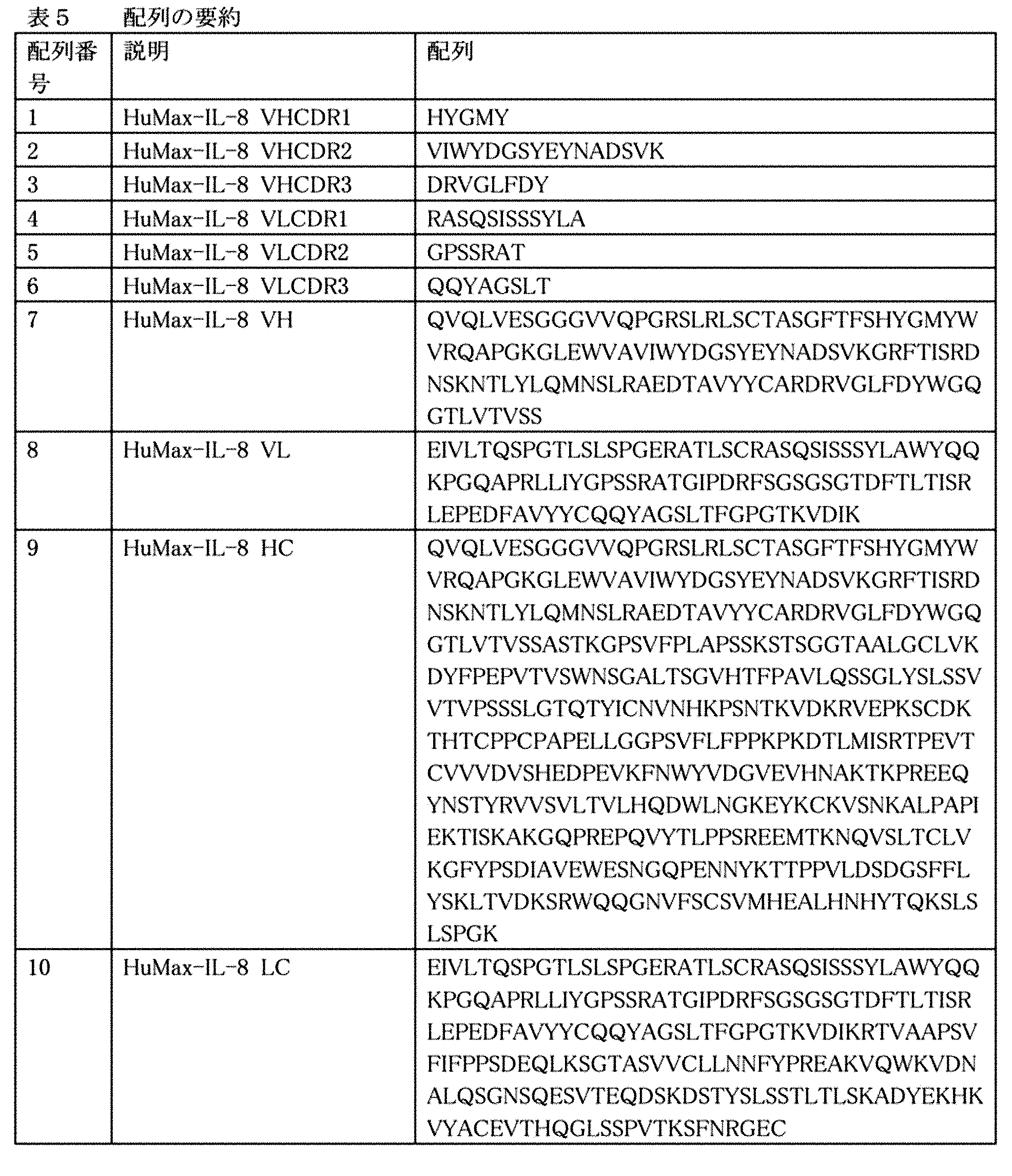
Results For target lesions, the response to treatment may include:
非標的病変に関し、治療に対する応答には以下が含まれ得る:
For non-target lesions, the response to treatment may include:
本明細書に開示した方法に従って処置される対象は、好ましくは、がんの少なくとも1つの兆候において改善を経験している。1つの実施形態では、改善は、測定可能な腫瘍病変の量及び/又はサイズの減少によって測定される。他の実施形態では、病変は、胸部X線又はCT若しくはMRIフィルム上で測定することができる。他の実施形態では、細胞学又は組織学を用いて、治療に対する応答性を評価することができる。 Subjects treated according to the methods disclosed herein preferably experience improvement in at least one sign of cancer. In one embodiment, improvement is measured by a reduction in the amount and / or size of measurable tumor lesions. In other embodiments, the lesion can be measured on a chest x-ray or CT or MRI film. In other embodiments, cytology or histology can be used to assess responsiveness to treatment.
1つの実施形態では、処置される対象は、完全寛解(CR)、部分応答(PR)、安定した疾患(SD)、免疫関連の完全寛解(irCR)、免疫関連の部分応答(irPR)、又は免疫関連の安定した疾患(irSD)を示す。他の実施形態では、処置される患者は、腫瘍の縮小及び/又は成長速度の低下、即ち腫瘍成長の抑制を経験している。他の実施形態では、望ましくない細胞増殖が低減又は阻害されている。さらに他の実施形態では、以下のうちの1つ又は複数が生じ得る:がん細胞の数が減少し得る;腫瘍のサイズが小さくなり得る;末梢臓器へのがん細胞の浸潤が、阻害され、妨害され、遅延され、又は停止され得る;腫瘍の転移が遅延され、又は阻害され得る;腫瘍の成長が阻害され得る;腫瘍の再発が防止され又は遅延され得る;がんに関連する症状の1つ又は複数がある程度緩和され得る。幾つかの実施形態では、本明細書に記載の方法は、場合により他の治療又はプラセボと比較して、延長された生存、例えば増悪無しの生存又は全生存期間から選択される少なくとも1つの治療効果をもたらす。 In one embodiment, the subject to be treated is complete remission (CR), partial response (PR), stable disease (SD), immune-related complete remission (irCR), immune-related partial response (irPR), or. Shows stable immune-related disease (irSD). In other embodiments, the treated patient experiences tumor shrinkage and / or slower growth rate, i.e. suppression of tumor growth. In other embodiments, unwanted cell proliferation is reduced or inhibited. In yet other embodiments, one or more of the following can occur: the number of cancer cells can be reduced; the size of the tumor can be reduced; the infiltration of cancer cells into peripheral organs is inhibited. Can be disturbed, delayed, or stopped; tumor metastasis can be delayed or inhibited; tumor growth can be inhibited; tumor recurrence can be prevented or delayed; cancer-related symptoms One or more may be relaxed to some extent. In some embodiments, the methods described herein are at least one treatment selected from extended survival, eg, survival without exacerbations or overall survival, as optionally compared to other treatments or placebo. Bring the effect.
他の実施形態では、本明細書に提供された方法のいずれか従う、有効量の抗IL−8抗体及び抗PD−1抗体、ならびに場合により抗CTLA−4抗体の投与は、腫瘍サイズの減少、時間の経過とともに現れる転移性病変の数の減少、完全寛解、部分寛解、又は安定した病変からなる群より選択される少なくとも1つの治療効果をもたらす。さらに他の実施形態では、処置方法は、抗IL−8抗体又は抗PD−1抗体単独によって達成される利益よりも優れた相当する臨床的利益率(CBR=CR+PR+SD≧6ヶ月)をもたらす。さらに他の実施形態では、臨床的有益率の改善は、抗IL−8抗体又は抗PD−1抗体単独と比較して、約20%、20%、30%、40%、50%、60%、70%、80%又はそれを超える。 In other embodiments, administration of effective amounts of anti-IL-8 and anti-PD-1 antibodies, and optionally anti-CTLA-4 antibodies, according to any of the methods provided herein reduces tumor size. Provides at least one therapeutic effect selected from the group consisting of reduced number of metastatic lesions appearing over time, complete remission, partial remission, or stable lesions. In yet another embodiment, the treatment method results in a corresponding clinical benefit margin (CBR = CR + PR + SD ≥ 6 months) that is superior to the benefits achieved by the anti-IL-8 antibody or anti-PD-1 antibody alone. In yet other embodiments, the improvement in clinical benefit rate is about 20%, 20%, 30%, 40%, 50%, 60% compared to anti-IL-8 antibody or anti-PD-1 antibody alone. , 70%, 80% or more.
キット
本明細書に記載の方法での使用に適した治療上の有効量にて、抗IL−8抗体、例えば10F8又はHuMax−IL8、及び抗PD−1抗体、並びに薬学上許容される担体を含有する医薬組成物を含むキットもまた、本明細書にて提供される。幾つかの実施形態では、キットは、抗CTLA−4抗体、例えばイピリムマブをさらに含む。キットは、場合により、例えば、医療関係者(例えば、医師、看護師又は患者)がキットに含められた組成物を、がん(例えば固形腫瘍)を有する患者に投与することを可能にする、投与スケジュールを含む説明書を含んでよい。キットは注射器を含んでもよい。
Kits Anti-IL-8 antibodies, such as 10F8 or HuMax-IL8, and anti-PD-1 antibodies, and pharmaceutically acceptable carriers in therapeutically effective amounts suitable for use in the methods described herein. Kits containing the pharmaceutical compositions contained are also provided herein. In some embodiments, the kit further comprises an anti-CTLA-4 antibody, such as ipilimumab. The kit optionally allows, for example, a healthcare professional (eg, a doctor, nurse or patient) to administer the composition contained in the kit to a patient with cancer (eg, a solid tumor). Instructions including the dosing schedule may be included. The kit may include a syringe.
場合により、キットは、上記の方法に従って単回投与するための有効量の抗IL−8抗体又は抗PD−1抗体をそれぞれが含む単回投与医薬組成物の複数のパッケージを含む。医薬組成物を投与するために必要な装置又は器具もキットに含まれ得る。例えば、キットは、ある量の抗IL−8又は抗PD−1抗体を含有する1つ又は複数のプレフィルド注射器を提供し得る。 Optionally, the kit comprises multiple packages of a single dose pharmaceutical composition, each comprising an effective amount of an anti-IL-8 antibody or anti-PD-1 antibody for a single dose according to the method described above. The device or instrument required to administer the pharmaceutical composition may also be included in the kit. For example, the kit may provide one or more prefilled syringes containing an amount of anti-IL-8 or anti-PD-1 antibody.
1つの実施形態では、本明細書で提供されるのは、ヒト対象における固形腫瘍を処置するためのキットであり、前記キットは以下を含む:
(a)ある用量の、配列番号7に記載の配列を有する重鎖可変領域のCDR1、CDR2及びCDR3ドメイン、ならびに配列番号8に記載の配列を有する軽鎖可変領域のCDR1、CDR2及びCDR3ドメインを含む抗IL−8抗体;
(b)ある用量の、配列番号9に記載の配列を有する重鎖可変領域のCDR1、CDR2及びCDR3ドメイン、ならびに配列番号10に記載の配列を有する軽鎖可変領域のCDR1、CDR2及びCDR3ドメインを含む抗PD−1抗体;及び
(c)本明細書に記載の方法において抗IL−8抗体及び抗PD−1抗体を使用することに関する説明書。
In one embodiment, provided herein is a kit for treating solid tumors in a human subject, said kit including:
(A) A dose of the CDR1, CDR2 and CDR3 domains of the heavy chain variable region having the sequence set forth in SEQ ID NO: 7 and the CDR1, CDR2 and CDR3 domains of the light chain variable region having the sequence set forth in SEQ ID NO: 8. Contains anti-IL-8 antibody;
(B) A dose of the CDR1, CDR2 and CDR3 domains of the heavy chain variable region having the sequence set forth in SEQ ID NO: 9 and the CDR1, CDR2 and CDR3 domains of the light chain variable region having the sequence set forth in SEQ ID NO: 10. Anti-PD-1 antibody, including; and (c) Instructions relating to the use of anti-IL-8 and anti-PD-1 antibodies in the methods described herein.
本開示は、以下の実施例によってさらに説明され、それらはさらなる限定と解釈されるべきではない。本出願を通じて引用されるすべての図及びすべての参考文献、Genbank配列、特許及び公開特許出願の内容は、参照により本明細書に明示的に組込まれる。 The present disclosure is further explained by the following examples, which should not be construed as a further limitation. The contents of all figures and references, Genbank sequences, patents and published patent applications cited throughout this application are expressly incorporated herein by reference.
[実施例]
実施例1: 進行性固形腫瘍を有する患者における第1b/2相試験
進行性固形腫瘍を有する患者において、抗IL−8抗体(HuMax−IL8)及び抗PD−1抗体(ニボルマブ)の第1b/2相試験を実施し、2つの治療薬を併用処置として投与することの有効性を実証する。
[Example]
Example 1: Phase 1b / 2 study in patients with advanced solid tumors First b / of anti-IL-8 antibody (HuMax-IL8) and anti-PD-1 antibody (nivolumab) in patients with advanced solid tumors A two-phase study will be conducted to demonstrate the effectiveness of administering the two therapeutic agents as a combination treatment.
試験対象集団
対象は、少なくとも年齢が18歳以上であり、且つ固形腫瘍における応答評価基準(RECIST)v1.1に従って組織学的又は細胞学的に確認された進行性(即ち転移性、再発性、及び/又は切除不能)の固形腫瘍を測定可能な疾患とともに有する必要があり、並びに生検のためにアクセス可能な少なくとも1つの病変を有する必要がある。対象は、ベースラインに検出可能な血清レベルのIL−8を有する必要がある。
The study population subjects are at least 18 years of age and are histologically or cytologically confirmed progressive (ie metastatic, recurrent) according to Response Evaluation Criteria (RECIST) v1.1 in solid tumors. And / or unresectable solid tumors must be present with measurable disease, and at least one lesion accessible for biopsy. The subject must have a detectable serum level of IL-8 at baseline.
目的
主たる目的は、進行性固形腫瘍を有する対象において、ニボルマブと組合せて投与されるHuMax−IL8の安全性、忍容性及びDLTを特徴付けること、及びRP2Dを決定することである。
Objectives The primary objective is to characterize the safety, tolerability and DLT of HuMax-IL8 administered in combination with nivolumab in subjects with advanced solid tumors, and to determine RP2D.
二次的な目的は、進行性固形腫瘍を有する対象におけるニボルマブと組合せたHuMax−IL8の予備的な有効性を評価すること、進行性固形腫瘍を有する対象におけるニボルマブと組合せて投与されたHuMax−IL8のPK及び免疫原性を特徴付けること、及びベースラインでの血清IL−8レベル(即ちスクリーニング)及び処置時のIL−8レベルの変化を評価することを含む。 The secondary objective is to assess the preliminary efficacy of HuMax-IL8 in combination with nivolumab in subjects with advanced solid tumors, and HuMax-administered in combination with nivolumab in subjects with advanced solid tumors. It involves characterizing the PK and immunogenicity of IL8, and assessing changes in serum IL-8 levels at baseline (ie, screening) and IL-8 levels during treatment.
探索の目的は、MDSCを測定すること、MDSCの経時的変化及び応答と関連する変化を評価すること、腫瘍及び末梢血における選択されたバイオマーカー測定を特徴付けることを含み、並びに、ニボルマブと組合せたHuMax−IL8を投与する処置前と処置後の抗腫瘍活性との潜在的な関連性を探索すること、HuMax−IL8血清PK、安全性、有効性及び臨床バイオマーカー間の関連性を探索すること、ニボルマブと組合せたHuMax−IL8を用いて処置された対象におけるPFS及びOSを評価すること、HuMax−IL8と組合せて投与した場合のニボルマブのPK及び免疫原性を特徴づけること、及びQTc間隔におけるHuMax−IL8の潜在的な影響を評価することを含む。 Objectives of the exploration included measuring MDSC, assessing changes in MDSC over time and associated changes in response, characterizing selected biomarker measurements in tumors and peripheral blood, and in combination with nivolumab. Exploring potential associations between pre- and post-treatment antitumor activity with HuMax-IL8, and exploring associations between HuMax-IL8 serum PK, safety, efficacy and clinical biomarkers. To evaluate PFS and OS in subjects treated with HuMax-IL8 in combination with nivolumab, to characterize the PK and immunogenicity of nivolumab when administered in combination with HuMax-IL8, and at QTc intervals. Includes assessing the potential effects of HuMax-IL8.
試験デザイン
これは、検出可能なレベルの血清IL−8を有する進行性固形腫瘍(即ち転移性、再発性及び/又は切除不能)を有する対象における、ニボルマブと組合せて投与されるHuMax−IL8の第1b/2相の非盲検試験である。本試験は2つパートで構成さる。第一のパートは、安全性評価の導入、その後に無作為化用量発見フェーズ(randomized dose-finding phase)を含む。第二のパートは、用量展開フェーズ(dose expansion phase)を含む。
Study Design This is the first HuMax-IL8 administered in combination with nivolumab in subjects with advanced solid tumors (ie metastatic, recurrent and / or unresectable) with detectable levels of serum IL-8. This is a 1b / 2 phase open-label study. This test consists of two parts. The first part involves the introduction of a safety assessment followed by a randomized dose-finding phase. The second part includes the dose expansion phase.
パート1:安全性評価の導入及び無作為化用量発見フェーズ
ニボルマブと組合せたHuMax−IL8の安全性を、抗PD−(L)1治療時に進行した又は治療後に再発した難治性黒色腫非小細胞肺がん(NSCLC)又は腎細胞癌(RCC)を有する対象において評価する。安全性評価の導入(パート1A)は、4週ごと(Q4W)に均一用量480mgのニボルマブを組合せた均一用量2,400mgのHuMax−IL8を受ける対象のコホートから始める。わずかに高用量(2週間ごと[Q2W]に32mg/kg又は2,560mgを投与される;一月当たり総用量64mg/kg又は5,120mg)のHuMax−IL8単剤療法は、安全であり忍容性が高いことを示した。安全性は、ベイジアンロジスティック回帰モデル−コピュラ法(Bayesian Logistic Regression Model-Copula method)の使用及び最初の4名の参加者に関する利用可能な安全性データの評価に基づいて確認する。最初の4名の参加者の臨床安全性評価、用量制限毒性(DLT)及び利用可能なデータの全体を概観した後に、無作為化用量発見フェーズ(パート1B)を開始する。最大56名までの追加対象をパート1Bに登録し、HuMax−IL8の推奨フェーズ2用量(RP2D)を決定する。対象をコホートB1、B2及びB3にそれぞれ1:1:1の比率で割り当てることで、約20名の対象が各コホートにて並行して処置される。各コホートの投与量は以下のとおりである:
・コホートB1: 2,400 mgのBMS−986253及び480 mgのニボルマブ、Q4W
・コホートB2: 1,200 mgのBMS-986253及び480 mgのニボルマブ、Q4W
・コホートB3: 600 mgのBMS-986253及び480 mgのニボルマブ、Q4W
Part 1: Introducing a safety assessment and randomized dose discovery Phase Refractory melanoma non-small cells that progressed or recurred after treatment with HuMax-IL8 safety in combination with nivolumab Evaluate in subjects with lung cancer (NSCLC) or renal cell carcinoma (RCC). Introducing a safety assessment (Part 1A) begins with a cohort of subjects receiving a uniform dose of 2,400 mg of HuMax-IL8 combined with a uniform dose of 480 mg of nivolumab every 4 weeks (Q4W). HuMax-IL8 monotherapy at slightly higher doses (32 mg / kg or 2,560 mg every 2 weeks [Q2W]; total dose 64 mg / kg or 5,120 mg per month) is safe and shinobi. It was shown to be highly tolerant. Safety is confirmed based on the use of the Bayesian Logistic Regression Model-Copula method and the evaluation of available safety data for the first four participants. A randomized dose detection phase (Part 1B) begins after an overview of the clinical safety assessment, dose limiting toxicity (DLT) and available data of the first four participants. Up to 56 additional subjects will be enrolled in Part 1B to determine the recommended
Cohort B1: 2,400 mg BMS-986253 and 480 mg nivolumab, Q4W
Cohort B2: 1,200 mg BMS-986253 and 480 mg nivolumab, Q4W
Cohort B3: 600 mg BMS-986253 and 480 mg nivolumab, Q4W
パート1Aの安全導入コホートが、無作為化用量発見フェーズを開始する前にBMS−986253の低用量(1,200mg)の評価を推奨する場合、4名の対象のコホートを480mgのニボルマブと組合せたBMS−986253(1,200mg)Q4Wにて処置する。臨床的安全性評価後に安全性の懸念がない場合、対象をコホートB2及びB3にそれぞれ1:1の比率で無作為に割り付けることで、約20名の対象がコホートB2及びB3にて結局は処置される。RP2Dは、安全且つ最も生物学的に活性な用量を定義するために、パート1A及び1Bで評価された用量範囲から利用可能なデータの全体に基づいて決定される。 If the safety induction cohort of Part 1A recommends a low dose (1,200 mg) evaluation of BMS-986253 before initiating the randomized dose detection phase, a cohort of 4 subjects was combined with 480 mg nivolumab. Treat with BMS-986253 (1,200 mg) Q4W. If there are no safety concerns after the clinical safety assessment, approximately 20 subjects will eventually be treated in cohorts B2 and B3 by randomly assigning subjects to cohorts B2 and B3 at a ratio of 1: 1 respectively. Will be done. RP2D is determined based on the overall data available from the dose range assessed in Parts 1A and 1B to define the safest and most biologically active dose.
パート2:用量展開フェーズ
パート1からRP2Dを決定した後に、用量展開フェーズ(パート2)を開始して、特定の患者集団における追加の安全性、忍容性、予備的有効性、薬物動態(PK)及び薬力学(PD)情報を収集する。抗PD−(L)1難治性黒色腫、RCC又はNSCLCを有する対象、並びに以前の治療が失敗した進行性トリプルネガティブ乳がん、結腸直腸がん、膵管腺がん又はHCCを有する対象を最大7名まで独立したコホートに登録する。各抗PD−(L)1難治性コホートは、ニボルマブと組合せたHuMax−IL8のRP2Dにて処置された最大40名の対象で構成され、各シグナル探求コホート(signal seeking cohort)は、ニボルマブと組合せたHuMax−IL8のRP2Dにて処置された最大20名の対象で構成される。定量下限を超える血清Il−8を有する対象は、腫瘍タイプに基づいて各コホートの1つに登録される。
Part 2: Dose development phase After determining RP2D from
処置
HuMax−IL8を、ニボルマブと組合せて、1サイクルの処置期間として定義されるQ4W(又は28日)に1回投与する。すべての対象は、最長104週(2年間)(それぞれ28日間の26サイクルに対応する)又は疾患の進行性、処置に対する不耐性、中止基準を満たす又は同意の取消しまで処置される。
Treatment HuMax-IL8 is administered once in Q4W (or 28 days), which is defined as one cycle of treatment period, in combination with nivolumab. All subjects are treated for up to 104 weeks (2 years) or until disease progression, treatment intolerance, discontinuation criteria or withdrawal of consent.
以下のように用量を投与する:安全性評価導入フェーズ(パート1A)では、開始用量2,400mgのHuMax−IL8を、480mgのニボルマブと組合せてQ4Wにて投与する。用量2,400mgが不耐性である場合は、より低用量のHuMax−IL8(1,200mg)が480mgのニボルマブと組合せて投与される。試験の無作為化用量発見フェーズ(パート1B)では、HuMax−IL8を480mgのニボルマブと組合せた最大3つの用量レベル(2,400mg、1,200mg又は600mg)を並行して評価する。パート1Bで評価されたより最高用量は、安全性評価フェーズ(パート1A)で決定された認容される用量を超えないであろう。用量展開フェーズ(パート2)では、用量はパート1で決定されたRP2Dになるであろう。試験処置を表1に示し、用量及びスケジュールを表2及び3に要約する。
Administer the doses as follows: In the safety assessment induction phase (Part 1A), the starting dose of 2,400 mg of HuMax-IL8 is administered in Q4W in combination with 480 mg of nivolumab. If a dose of 2,400 mg is intolerant, a lower dose of HuMax-IL8 (1,200 mg) is administered in combination with 480 mg of nivolumab. In the randomized dose discovery phase of the study (Part 1B), up to three dose levels (2,400 mg, 1,200 mg or 600 mg) of HuMax-IL8 combined with 480 mg nivolumab are evaluated in parallel. The higher dose assessed in Part 1B will not exceed the tolerated dose determined in the safety assessment phase (Part 1A). In the dose development phase (Part 2), the dose will be the RP2D determined in
*1200mgのための注入時間は、体重が<35kgの対象を除いて60分であろう;体重が<35kgの場合、注入時間は120分であろう。
* The injection time for 1200 mg would be 60 minutes except for subjects weighing <35 kg; if the body weight was <35 kg, the injection time would be 120 minutes.
対象が基準を満す限り、前記対象は進行性を超えて処置されてよい。HuMax−IL8は、無作為化スケジュールに基づいて、推奨時間かけて最初に静脈内(IV)注入される。30分の観察期間が、HuMax−IL8注入の後に続く。次いで、ニボルマブを30分かけて注入する。60分の観察期間が、ニボルマブ注入の後に続く。 As long as the subject meets the criteria, the subject may be treated beyond progression. HuMax-IL8 is first injected intravenously (IV) over the recommended time based on a randomized schedule. A 30-minute observation period follows the HuMax-IL8 infusion. Nivolumab is then infused over 30 minutes. A 60-minute observation period follows the nivolumab infusion.
追跡
・ 安全性追跡期間: 試験処置の完了時に又は処置を中止する決定がされた際に、すべての対象は安全追跡期間に入る。処置終了(EOT)訪問の後に、すべての対象は、試験処置の最後の投与から少なくとも100日間、何らかの新たな有害事象(AE)について評価される。追跡訪問は、最終投与後30日、60日及び100日(各訪問について±7日)に又は中止日(±7日)に行う。すべての対象は新たな抗がん治療が開始されたか否かにかかわらず、3回の臨床安全性追跡訪問を完了することが要求される。
・ 応答追跡期間: EOT訪問の時に又は試験処置中止の時に、すべての対象は、その後の腫瘍に対する治療が開始されるまで、12週間ごと(Q12W)に放射線学上及び臨床上の腫瘍評価を受ける。その後の治療を受けていない対象は、試験処置の中止/EOT訪問後の最初の1年間、腫瘍評価スキャンをQ12Wにて受け続ける。追跡の最初の年の後、訪問は、標準治療ガイドラインに従って最低6か月ごとに最長2年間、試験処置の最後の投与後までである。継続的な臨床的利益があり、且つその後の治療を受けない対象についての放射線学上の評価は、前記対象が生存追跡期間を終了した後も、収集され続けることができる。
・ 生存追跡期間: 安全追跡期間と並行して、すべての対象は生存追跡期間を開始する。対象は、Q12W(EOTから)にて2年間、或いは死亡、追跡の喪失、同意の撤回、又は試験の結論のいずれか早い方まで追跡される。応答追跡期間及び生存追跡期間は、2年の追跡期間中に同時に生じる。
Follow -up / safety follow-up period: All subjects enter the safety follow-up period upon completion of the study procedure or when a decision is made to discontinue the procedure. After the end-of-transmission (EOT) visit, all subjects will be evaluated for any new adverse event (AE) for at least 100 days after the last dose of the study procedure. Follow-up visits are performed 30 days, 60 days and 100 days (± 7 days for each visit) or on the discontinuation date (± 7 days) after the last dose. All subjects are required to complete three clinical safety follow-up visits, whether or not new anticancer treatment has been initiated.
Response follow-up period: At the time of EOT visit or discontinuation of study treatment, all subjects undergo radiological and clinical tumor assessment every 12 weeks (Q12W) until treatment for subsequent tumors is initiated. .. Subjects who have not received subsequent treatment will continue to undergo tumor evaluation scans at Q12W for the first year after discontinuation of study treatment / visit to EOT. After the first year of follow-up, visits are at least every 6 months for up to 2 years, up to after the last dose of study procedure, according to standard treatment guidelines. Radiological assessments of subjects with ongoing clinical benefit and who do not receive subsequent treatment can continue to be collected after the subject has completed the survival follow-up period.
• Survival follow-up period: In parallel with the safety follow-up period, all subjects begin a survival follow-up period. Subjects will be followed in Q12W (from EOT) for 2 years or until death, loss of follow-up, withdrawal of consent, or study conclusions, whichever comes first. Response follow-up and survival follow-up occur simultaneously during the 2-year follow-up period.
試験処置
対象は、選択されたIV用量のHuMax−IL8をニボルマブと組合せてQ4Wにて投与される。用量は以下のように決定する:
・ 安全性評価導入フェーズ(パート1A)では、開始用量である2,400mgのHuMax−IL8を、480mgのニボルマブと組合せてQ4Wにて投与する。用量2,400mg不耐性であると判断されると、次に、より低用量のHuMax−IL8(1,200mg)と480mgのニボルマブを組合せて評価されるであろう。
・ 試験の無作為化用量発見フェーズ(パート1B)では、最大3つの用量レベルのHuMax−IL8(2,400mg、1,200mg又は600mg)と480mgのニボルマブを組合せて並行して評価する。パート1Bで評価された最用量は、安全性評価フェーズ(パート1A)で決定された認容用量を超えない。
・ 用量展開フェーズ(パート2)では、用量はパート1で決定されたRP2Dとするであろう。試験中の任意の時点で、必要に応じて、中程度の用量又はより短い投与スケジュールが評価され得る。
The test-treated subject is administered at Q4W in combination with the selected IV dose of HuMax-IL8 in combination with nivolumab. The dose is determined as follows:
-In the safety assessment induction phase (Part 1A), the starting dose of 2,400 mg of HuMax-IL8 is administered in Q4W in combination with 480 mg of nivolumab. If a dose of 2,400 mg is determined to be intolerant, then a lower dose of HuMax-IL8 (1,200 mg) and 480 mg of nivolumab will be evaluated in combination.
• In the randomized dose discovery phase of the study (Part 1B), up to three dose levels of HuMax-IL8 (2,400 mg, 1,200 mg or 600 mg) and 480 mg of nivolumab are combined and evaluated in parallel. The maximum dose assessed in Part 1B does not exceed the tolerated dose determined in the safety assessment phase (Part 1A).
• In the dose development phase (Part 2), the dose will be the RP2D determined in
組入れ基準
1.標的集団
対象は、RECIST v1.1に従って測定可能な疾患を伴う進行性(転移性、再発性及び/又は切除不能)固形腫瘍の組織学的又は細胞学的確認が必要である。対象は、Eastern Cooperative Oncology Group Performance Statusが0又は1であることが必要である。原発性CNS腫瘍を有する対象又はCNS転移を唯一の活性疾患部位として有する対象を除き、以下の腫瘍組織像が許可される:
i)非小細胞肺がん
1. 扁平上皮又は扁平上以外の皮組織のいずれかの組織学的又は細胞学的に確認された進行性(切除不能又は転移性)NSCLC
2. (単剤療法として又は併用療法の一部として投与される)抗PD−(L)1治療中又は治療後3か月以内のいずれかにおいて放射線学上文書化された進行性又は再発性疾患を有していた必要がある。抗PD−(L)1処置と登録との間に、全身療法を介在させることは許可されない。
3. PD−(L)1ステータスは、可能であれば文書化されている必要がある。PD−(L)1ステータスも、必須の前処理生検から取得された組織を用いて再テストされる。
4. 対象は、再発性又は転移性の状況でプラチナベースの化学療法を受けている必要がある。
5. 上皮成長因子受容体及び未分化リンパ腫キナーゼのステータスがわかっている必要がある。ROS及びKRASの変異ステータスは、可能であれば文書化されているべきである。遺伝的改変であって、それに特異的な認可された治療法がある該遺伝的改変を有する対象について、事前の進行又はその治療へ不耐性が必要である。
i) Non-small
2. Anti-PD- (L) 1 (administered as monotherapy or as part of combination therapy) Radiologically documented progressive or recurrent disease either during or within 3 months after treatment Must have had. Intervention of systemic therapy between anti-PD- (L) 1 treatment and enrollment is not permitted.
3. 3. The PD- (L) 1 status should be documented if possible. PD- (L) 1 status is also retested with tissue obtained from a mandatory pretreatment biopsy.
4. Subjects should be receiving platinum-based chemotherapy in recurrent or metastatic situations.
5. The status of epidermal growth factor receptor and anaplastic lymphoma kinase needs to be known. Mutation status of ROS and KRAS should be documented if possible. Subjects with the genetic modification that have an approved treatment specific to it require prior progression or intolerance to the treatment thereof.
ii)澄明細胞成分を含む腎細胞がん。
1. (単剤療法として又は併用療法の一部として投与される)抗PD−(L)1治療中又は治療後3か月以内のいずれかにおいて放射線学上文書化された進行性又は再発性疾患を有していた必要がある。この試験では、抗PD−(L)1処置と登録との間に、全身療法を介在させることは許可されない。
2. 高度又は転移性の設定で、少なくとも1つか2つを超えない抗血管新生療法レジメン(ベバシズマブ、アキシチニブ、カボザンチニブ、パゾパニブ、ソラフェニブ、スニチニブ及びチボザニブを含むが、これらに限定されない)を以前に受けていた必要がある。
ii) Renal cell carcinoma containing clear cell components.
1. 1. Anti-PD- (L) 1 (administered as monotherapy or as part of combination therapy) Radiologically documented progressive or recurrent disease either during or within 3 months after treatment Must have had. In this study, no systemic therapy is allowed between anti-PD- (L) 1 treatment and enrollment.
2. Previously received at least one or more anti-angiogenic therapy regimens in a highly or metastatic setting, including but not limited to bevacizumab, axitinib, cabozantinib, pazopanib, sorafenib, sunitinib and tibozanib. There is a need.
iii)黒色腫
1. 米国がん合同委員会の病期分類システムで指定されている、組織学的に確認された切除不能なステージIII又はステージIVの黒色腫。
2. PD−L1ステータスは、可能であれば文書化されている必要がある。PD−L1ステータスも、必須の前処理生検から取得された組織を用いて再テストされる。
3. 抗PD−(L)1単剤療法中又は治療後3か月以内のいずれか或いは抗PD−(L)1コンポーネントと限定するものではないが坑CTLA−4を含む他の薬剤との併用療法後に、放射線学上文書化された進行性又は再発性疾患を有していた必要がある。対象はそれらの疾患のために他の全身療法を受けていてもよいが、単独又は併用療法での抗PD−(L)1が、投与された最新の治療である必要がある。(4)BRAF(V600)変異のステータスは分かっている必要がある。このコホートでは、BRAF変異の対象及び野生型の対象の両方が許容される。
iii)
2. The PD-L1 status should be documented if possible. PD-L1 status is also retested with tissue obtained from a mandatory pretreatment biopsy.
3. 3. Anti-PD- (L) 1 monotherapy, within 3 months after treatment, or in combination with other agents, including, but not limited to, anti-PD- (L) 1 component. Later, it was necessary to have a radiologically documented progressive or recurrent disease. Subjects may be receiving other systemic therapies for their disease, but anti-PD- (L) 1 in monotherapy or in combination therapy needs to be the latest treatment administered. (4) The status of the BRAF (V600) mutation needs to be known. In this cohort, both BRAF mutant subjects and wild-type subjects are tolerated.
iv)展開コホートのみ:
1. 対象は、以下の組織学の組織学上文書化された局所進行性、切除不能又は転移性のがんであり、標準的な治療が存在する場合には少なくとも1ラインの標準的な治療中又は治療後に進行している、又は前記治療に不耐性である(若しくは候補とならない)がんを有する必要がある。対象はまた、他のすべての潜在的に有効な治療が考慮される必要がある。
iv) Deployment cohort only:
1. 1. Subjects are histologically documented locally progressive, unresectable or metastatic cancers of the following histology, with at least one line of standard treatment or treatment if standard treatment is available. You need to have cancer that is later advanced or intolerant to (or is not a candidate for) the treatment. Subjects also need to consider all other potentially effective treatments.
v)トリプルネガティブ乳がん
1. 組織学上文書化された局所進行性、切除不能又は転移性のTNBC。
2. エストロゲン受容体/プロゲステロン受容体及びHER2のステータスが、ネガティブと文書化され、確認されている必要がある。
3. 放射線治療上文書化された、少なくとも1ラインの標準的な治療中又は治療後に進行している、又は前記治療に不耐性である(若しくは候補とならない)必要がある。
4. 対象はまた、他のすべての潜在的に有効な治療が考慮される必要がある。
v) Triple
2. Estrogen receptor / progesterone receptor and HER2 status need to be documented and confirmed as negative.
3. 3. Radiotherapy documented, at least one line of standard treatment progressing during or after treatment, or need to be intolerant (or not a candidate) for said treatment.
4. Subjects also need to consider all other potentially effective treatments.
vi)結腸直腸がん
1. 組織学上文書化された局所進行性、切除不能又は転移性のCRC
2. マイクロサテライト不安定性ステータス(MSS)を文書化する必要がある。MSI対象だけがこのコホートで許可される。注:MSSは免疫組織化学(IHC)によるMLH1、MSH2、MSH6及びPMS2の発現、又はポリメラーゼ連鎖反応(PCR)によるマイクロサテライトマーカーの不安定性の欠如として定義される。
3. 放射線学上文書化された、少なくとも1ラインの標準的な治療中又は治療後に進行している、又は前記治療後に不耐性である(若しくは候補とならない)必要がある。
4. 対象はまた、他のすべての潜在的に有効な治療が考慮される必要がある。
vi)
2. The microsatellite instability status (MSS) needs to be documented. Only MSI subjects are allowed in this cohort. Note: MSS is defined as the expression of MLH1, MSH2, MSH6 and PMS2 by immunohistochemistry (IHC), or the lack of instability of microsatellite markers by polymerase chain reaction (PCR).
3. 3. It must be radiologically documented, progressing during or after standard treatment of at least one line, or intolerant (or not a candidate) after said treatment.
4. Subjects also need to consider all other potentially effective treatments.
vii)膵管腺がん
1. 組織学上文書化された局所進行性、切除不能又は転移性
2. 放射線学上文書化された、少なくとも1ラインの標準的な治療中又は治療後に進行している、又は前記治療後に不耐性である(若しくは候補とならない)必要がある。
3. 対象はまた、他のすべての潜在的に有効な治療が考慮される必要がある。
vii)
3. 3. Subjects also need to consider all other potentially effective treatments.
viii)肝細胞がん
1. 切除技術又は肝移植に不適格な、組織学上文書化されたHCCを有する対象の場合。局所領域治療後に進行した対象の場合、HCCのための局所領域治療は、ベースラインスキャンの少なくとも4週間前に完了している必要がある。以前の局所治療のすべての急性毒性作用は、米国国立がん研究所(NCI)のCommon Terminology Criteria for Adverse Events(CTCAE)v4.03グレード>1と決められるか、又は不可逆であると見做される。
2. 放射線診断を受けた対象はスクリーニングに登録されてよいが、試験治療の開始前に組織学的確認が必須である。
3. 以前の進行性疾患、又は少なくとも1ラインの治療法に不耐性であったか若しくはソラフェニブを用いた処置を拒否した
4. チャイルドピュークラスA(6ポイント又はそれ未満)
5. B型肝炎表面抗原、B型肝炎表面抗体、B型肝炎コア抗体、B型肝炎デオキシリボ核酸(DNA)PCR、C型肝炎抗体及びC型肝炎リボ核酸(RNA)PCRのテスト結果が必要である。
6. B型肝炎に感染している対象の場合、B型肝炎のDNAウイルス量は<100IU/ mLで、対象は抗ウイルス治療中である必要がある。
7. B型肝炎に感染している対象の場合、C型肝炎又はD型肝炎との同時感染はない(D型肝炎抗体テストが必要である)
8. C型肝炎ウイルス(HCV)を有する対象の場合、検出可能なHCV RNA及び陽性抗体タイターによって定義される活動性のHCV感染は、抗ウイルス治療中であれば登録され得る。検出不能なHCV RNA及び陽性抗体タイターによって証明される、解決されたHCV感染を登録され得る。HCVの抗ウイルス治療中の対象は、許可され、及び試験中も処置が継続される必要がある。スクリーニング時に抗ウイルス治療を受けていない活動性のHCVを有する対象は、試験に登録できない。
9. 他の腫瘍タイプは、科学的根拠に基づいて展開時に検討され、その後の修正によって試験に追加できる。
viii)
2. Subjects who have undergone radiodiagnosis may be enrolled in screening, but histological confirmation is essential prior to the start of study treatment.
3. 3. 4. Rejected treatment with sorafenib or was intolerant of previous progressive disease or at least one line of treatment. Child Pew Class A (6 points or less)
5. Test results of hepatitis B surface antigen, hepatitis B surface antibody, hepatitis B core antibody, hepatitis B deoxyribonucleic acid (DNA) PCR, hepatitis C antibody and hepatitis C ribonucleic acid (RNA) PCR are required.
6. For subjects infected with hepatitis B, the amount of DNA virus in hepatitis B should be <100 IU / mL and the subject should be on antiviral treatment.
7. For subjects infected with hepatitis B, there is no co-infection with hepatitis C or hepatitis D (hepatitis D antibody test required)
8. For subjects with hepatitis C virus (HCV), active HCV infections defined by detectable HCV RNA and positive antibody titers can be registered during antiviral treatment. Resolved HCV infections, demonstrated by undetectable HCV RNA and positive antibody titers, can be registered. Subjects undergoing antiviral treatment of HCV should be allowed and treatment should be continued during the study. Subjects with active HCV who have not received antiviral treatment at the time of screening cannot be enrolled in the study.
9. Other tumor types are scientifically considered at deployment time and can be added to the study with subsequent modifications.
2.物理的及び研究室テストの所見
対象は、以下を有する必要がある:
i)ベースラインの血清ILー8レベル>10pg/mL
ii)以下で定義される十分な血液学的機能:
1. 好中球≧1,500μ/L
2. 血小板≧80×103/μL(このレベルを達成するための輸血は、最初の試験処置投与から2週間以内は許可されない)
3. ヘモグロビン≧8g/dL(このレベルを達成するための輸血は、最初の試験処置投与から2週間以内は許可されない)
iii)適切な肝機能
1. アラニンアミノトランスフェラーゼ(ALT)及びアスパラギン酸アミノトランスフェラーゼ(AST)≦3×正常値の上限(ULN)
2.総ビリルビン≦1.5×ULN(ギルバート症候群に罹患し、正常な直接ビリルビンを有する対象を除く)
3.特にHCCを有する参加者の場合:
・ プロトロンビンの時間−国際標準化比≦2.3又はプロトロンビン時間≦6秒(コントロールを上回る時間)
・ (a)血清アルブミン≧2.8g/dL;(b)総ビリルビン≦3mg/dL;(c)AST及びALT≦5×協会のULN、によって示される適切な肝機能。
2. Physical and laboratory test findings The subject must have:
i) Baseline serum IL-8 level> 10 pg / mL
ii) Sufficient hematological function as defined below:
1. 1. Neutrophils ≥ 1,500 μ / L
2. Platelets ≥ 80 × 10 3 / μL (Transfusions to achieve this level are not allowed within 2 weeks of administration of the first study procedure)
3. 3. Hemoglobin ≥ 8 g / dL (Transfusions to achieve this level are not allowed within 2 weeks of administration of the first study procedure)
iii)
2. Total bilirubin ≤ 1.5 x ULN (excluding subjects with Gilbert syndrome and normal direct bilirubin)
3. 3. Especially for participants with HCC:
Prothrombin time-international standardization ratio ≤ 2.3 or prothrombin time ≤ 6 seconds (time beyond control)
Appropriate liver function as indicated by (a) serum albumin ≥ 2.8 g / dL; (b) total bilirubin ≤ 3 mg / dL; (c) AST and ALT ≤ 5 x Association ULN.
試験評価
安全性評価: 安全性評価は、AEレポートと、酸素飽和度、心電図、身体検査及び研究室テストを含むバイタルサインとの結果に基づく。AEは、最新バージョンのMedical Dictionary for Regulatory Activitiesを用いて暗号化され、観察されたAEの発生率を表にし、潜在的な意義及び臨床的重要性についてレビューされる。AEは、試験中及びニボルマブと組合せたHuMax−IL8の最後の投薬後100日の間、継続的に評価される。AE及び研究室テストは両方とも、米国国立がん研究所のCommon Terminology Criteria for Adverse Events v4.03を用いて等級付けされる。
Test Evaluation Safety Evaluation: The safety evaluation is based on the results of the AE report and vital signs including oxygen saturation, electrocardiogram, physical examination and laboratory tests. AEs are encrypted using the latest version of the Medical Dictionary for Regulatory Activities, tabulating the observed incidence of AEs and reviewing their potential significance and clinical significance. AE is continuously evaluated during the study and for 100 days after the last dose of HuMax-IL8 in combination with nivolumab. Both AEs and laboratory tests are graded using the National Cancer Institute's Common Terminology Criteria for Advance Events v4.03.
PK評価: HuMax−IL8及びニボルマブのPKは、単回及び複数回用量の投与にわたる血清濃度、対、時間のデータから得られる。評価されるPKパラメータには、観察された最大血漿中濃度(Cmax)、観察された最大血清中濃度の時間(Tmax)、血清濃度−時間曲線下面積(AUC)であって、時間0から最後の定量可能な濃度の時間までの該面積(AUC(0−T))、1回投与間隔のAUC(AUC(TAU))、投与間隔の最後に観察された血清濃度(Ctau)、観察されたトラフ血清濃度(これには投与前濃度[C0]及びCtauが含まれる)(Ctroough)、全身クリアランス(CLT)、安定状態での投与間隔にわたる平均血清濃度(Css−avg)、AUC及びCmaxの累積インデックス(AI)及び終末排出半減期(T−HALF)が含まれる。各対象のPKパラメータ値は、検証済みPK分析プログラムによる非コンパートメント法によって導出される。実際の時間が最終分析に用いられる。
PK Ratings: PKs for HuMax-IL8 and nivolumab are obtained from serum concentration, pair, and time data over single and multiple dose doses. The PK parameters to be evaluated are the observed maximum plasma concentration (Cmax), the time of the observed maximum serum concentration (Tmax), and the area under the serum concentration-time curve (AUC), from
免疫原性評価: HuMax−IL8又はニボルマブ抗薬物抗体についての血清サンプルを、指定された時点ですべての対象から収集する。各処置群の対象から収集したサンプルを、検証済みイムノアッセイによってHuMax−IL8/ニボルマブのADAの展開(development)について評価するであろう。サンプルはまた、HuMax−IL8/ニボルマブに対するADA応答を中和するために分析される。PK又はバイオマーカー評価用に指定された血清サンプルはまた、必要に応じて(例えば、完全な免疫原性評価又は疑わしい免疫原性関連AEの追跡のために不十分な容量)免疫原性分析に用いてもよい。 Immunogenicity assessment: Serum samples for HuMax-IL8 or nivolumab anti-drug antibody are collected from all subjects at designated time points. Samples collected from subjects in each treatment group will be evaluated for ADA development of HuMax-IL8 / nivolumab by a validated immunoassay. Samples are also analyzed to neutralize the ADA response to HuMax-IL8 / nivolumab. Serum samples designated for PK or biomarker evaluation are also available for immunogenicity analysis as needed (eg, insufficient volume for complete immunogenicity evaluation or tracking of suspicious immunogenicity-related AEs). You may use it.
バイオマーカー評価: ベースラインのバイオマーカー測定値、及び処置時の末梢血、血清及び腫瘍サンプルのバイオマーカー測定値を用いて、処置と関連したPDマーカーを特定する。作用機序に関連する追加のバイオマーカー、安全バイオマーカー、及びニボルマブと組合せたHuMax−IL8への応答との関連性を探索する。
・血清ベースのバイオマーカー: HuMax−IL8は循環IL−8に結合して中和し、及びin vivoでの血清IL−8レベルを大幅に低下させる。従って、血清IL−8の定量は、参加者を選択する目的だけでなく、処置中に、HuMax−IL8による循環IL−8への結合及び中和を確認するためのPDマーカーとしても使用できる。加えて、処置中の血清サンプルを用い、炎症性サイトカイン/ケモカインの変化を定量化して、参加者の免疫応答に対する処置の影響を確認し、及び細胞毒性T細胞応答を評価することができる。全血を用い、MDSCの絶対数及び循環T細胞の活性化状態に対する治療の影響を検証済みのフローサイトメトリーに基づくアッセイを使用して評価することができる。
Biomarker assessment: Baseline biomarker measurements and biomarker measurements of peripheral blood, serum and tumor samples at the time of treatment are used to identify PD markers associated with treatment. Investigate additional biomarkers associated with the mechanism of action, safety biomarkers, and association with response to HuMax-IL8 in combination with nivolumab.
Serum-based biomarkers: HuMax-IL8 binds to and neutralizes circulating IL-8 and significantly reduces serum IL-8 levels in vivo. Therefore, quantification of serum IL-8 can be used not only for the purpose of selecting participants, but also as a PD marker to confirm the binding and neutralization of HuMax-IL8 to circulating IL-8 during treatment. In addition, treated serum samples can be used to quantify changes in inflammatory cytokines / chemokines to confirm the effect of treatment on a participant's immune response and to assess cytotoxic T cell response. Whole blood can be used to assess the effect of treatment on the absolute number of MDSCs and the activation status of circulating T cells using a validated flow cytometry-based assay.
・腫瘍ベースのバイオマーカー: PD目的で探索される腫瘍ベースのバイオマーカーには、限定するものではないが、腫瘍内の好中球及び多形核MDSC集団に対する処置の影響を確認するためのIHCによるCD15の発現が含まれる。加えて、腫瘍は、腫瘍内の一般的な免疫応答に対する処置の影響を評価するために用いることができる。これに対処するためのバイオマーカーには、限定するものではないが、処置中のCD8、PD−1、PD−(L)1及びFoxP3細胞集団の変化(IHC経由のすべて)が含まれる。腫瘍組織における遺伝子発現プロファイリング及びT細胞受容体シーケンシングもまた、免疫細胞の活性化に対する処置の影響を評価するために用いることができる。IL−8は、がん細胞におけるEMT表現型を誘導して維持することができ、及び内皮細胞の成長を刺激することができ、かくして、血管新生を促進する。従って、腫瘍サンプル中のEMT及び内皮細胞に対する処置の影響を評価する。これを評価するためのバイオマーカーには、限定するものではないが、E−カドヘリン、ビメンチン、及びCD31(それぞれ上皮細胞、間葉細胞、及び内皮細胞のマーカー)の発現における変化が含まれる。 Tumor-based biomarkers: Tumor-based biomarkers sought for PD purposes include, but are not limited to, IHC to confirm the effects of treatment on neutrophil and polymorphonuclear MDSC populations within tumors. Includes expression of CD15 by. In addition, tumors can be used to assess the effect of treatment on the general immune response within the tumor. Biomarkers to address this include, but are not limited to, changes in the CD8, PD-1, PD- (L) 1 and FoxP3 cell populations during treatment (all via IHC). Gene expression profiling and T cell receptor sequencing in tumor tissue can also be used to assess the effect of treatment on immune cell activation. IL-8 can induce and maintain the EMT phenotype in cancer cells and stimulate the growth of endothelial cells, thus promoting angiogenesis. Therefore, the effect of treatment on EMT and endothelial cells in tumor samples will be evaluated. Biomarkers for assessing this include, but are not limited to, changes in the expression of E-cadherin, vimentin, and CD31 (markers of epithelial cells, mesenchymal cells, and endothelial cells, respectively).
・予測バイオマーカー: IL−8の血清レベルに加えて、分子ベースのバイオマーカー(スクリーニングで得られた腫瘍サンプルにおける腫瘍変異負荷及び遺伝子発現プロファイリングを含むが、これらに限定されない)を遡及的に探索して、参加者の応答との関連性を評価する。スクリーニングで得られた腫瘍サンプルにおける免疫細胞マーカーの発現の遡及的分析を実施して、処置に対する応答との関連性を評価することもできる。これらのマーカーには、限定するものではないが、CD15、CD8、PD−1、PD−(L)1及びFoxP3が含まれる。 Predictive biomarkers: Retrospective search for molecular-based biomarkers, including, but not limited to, tumor mutation loading and gene expression profiling in screened tumor samples, in addition to IL-8 serum levels. Then, evaluate the relevance to the response of the participants. A retrospective analysis of the expression of immune cell markers in screened tumor samples can also be performed to assess their association with treatment response. These markers include, but are not limited to, CD15, CD8, PD-1, PD- (L) 1 and FoxP3.
有効性評価: ニボルマブと組合せたHuMax−IL8の抗腫瘍活性の有効性評価は、ベースライン及び8週間(±1週)ごとに、コンピューター断層撮影及び/又は磁気共鳴画像法を適宜使用するRECIST v1.1を用いた、腫瘍測定に基づく。 Evaluation of efficacy: Evaluation of the antitumor activity of HuMax-IL8 in combination with nivolumab is performed at baseline and every 8 weeks (± 1 week) using computed tomography and / or magnetic resonance imaging as appropriate. Based on tumor measurements using 1.
実施例2. 血清IL−8とがん免疫療法に対する応答との関連
ベースラインIL−8と、全奏効率(ORR)、全生存期間(OS)、増悪無しの生存期間(PFS)含む臨床的有効性エンドポイントとの関係を探索するために、以下の4つの臨床試験のデータを用いた探索的分析を実施した:
(1) 試験CA209−067、これは、未治療の切除不能な黒色腫又は転移性黒色腫を有する成人対象における、ニボルマブ単剤療法(NIVO)又はニボルマブとイピリムマブとの併用(NIVO+IPI)とイピリムマブ単剤療法(IPI)の第3相の無作為二重盲検試験である。Larkin et al., New England Journal of Medicine. 2015 Jul 2;373(1):23-34を参照のこと。約900名の対象を、3つの処置アーム、即ちイピリムマブ単剤療法、ニボルマブ単剤療法及びニボルマブとイピリムマブとの組合せに対して比率1:1:1にて無作為に割り付けた。
Example 2. Association of Serum IL-8 with Response to Cancer Immunotherapy Baseline IL-8 and clinical efficacy endpoints including overall response rate (ORR), overall survival (OS), and survival without exacerbations (PFS) An exploratory analysis using data from the following four clinical trials was performed to explore the relationship with:
(1) Study CA209-067, which is nivolumab monotherapy (NIVO) or nivolumab plus ipilimumab (NIVO + IPI) and ipilimumab monotherapy in adult subjects with untreated unresectable melanoma or metastatic melanoma. This is a
(2) 試験CA209−025、これは、以前に処置を受けた腎細胞がんを有する患者においてニボルマブとエベロリムスとを比較した、無作為非盲検第3相試験である。Motzer et al., New England Journal of Medicine. 2015 Nov 5;373(19):1803-13を参照のこと。1つ又は2つの抗血管新生治療レジメンを伴う処置を以前に受けていた進行性澄明細胞がんを有する総数821名の患者を、ニボルマブを体重1キログラムあたり3mgにて2週間ごとに静脈内投与する、又はエベロリムス錠剤10mgを1日1回経口投与するに、無作為に(1:1の比率で)割当てる。
(2) Study CA209-025, a randomized, open-label,
(3) CA209−017試験、これは、非小細胞肺がんの扁平上皮サブタイプを有する患者においてドセタキセルと比較したニボルマブの有効性及び安全性を評価する、無作為非盲検国際第3相試験である。Brahmer et al., New England Journal of Medicine. 2015 Jul 9;373(2):123-35を参照のこと。約272人の患者を、ニボルマブを体重1kgあたり3mgの用量にて2週間ごとに受ける、又はドセタキセルを体表面積1平方メートルあたり75mgの用量にて3週間ごとに受ける、に無作為に割当てた。
(3) Study CA209-017, a randomized, open-label,
(4) CA209−057試験、これは、プラチナベースのダブレット化学療法中又は療法後に進行した非扁平上皮の非小細胞肺がん(NSCLC)を有する患者を、ニボルマブを体重1kgあたり3mgの用量にて2週間ごとに投与する、又はドセタキセルを体表面積1平方メートルあたり75mgの用量にて3週間ごとに投与するに割当てた、無作為非盲検国際第3相試験である。Borghaei et al., New England Journal of Medicine. 2015 Oct 22;373(17):1627-39を参照のこと。
(4) Study CA209-057, which presents patients with non-small cell lung cancer (NSCLC) with non-squamous epithelium that has progressed during or after platinum-based doublet chemotherapy, with nivolumab at a dose of 3 mg / kg body surface 2 A randomized, open-label,
血清IL−8をイムノアッセイによって測定した。ベースラインIL−8の四分位数による全生存期間のカプラン・マイヤー曲線分析を、各研究について及び4つの試験全体で組合せたニボルマブベースの治療すべてについて実施した。時間依存的な受信者動作特性(ROC)曲線分析(Heagerty and Saha, Biometrics. 2000;56(2):337-44)は、各試験について及び4つの試験全体で組合せたNIVO−ベースの治療すべてについて実施した。ROC曲線を用いて、応答に関連するIL−8カットオフを決定した。追加の腫瘍及び末梢相関マーカーを評価した。 Serum IL-8 was measured by immunoassay. Overall survival Kaplan-Meier curve analysis with baseline IL-8 quartiles was performed for each study and for all nivolumab-based therapies combined across the four trials. Time-dependent receiver operating characteristic (ROC) curve analysis (Heagerty and Saha, Biometrics. 2000; 56 (2): 337-44) is a combination of all NIVO-based therapies for each trial and for all four trials. Was carried out. The ROC curve was used to determine the IL-8 cutoff associated with the response. Additional tumor and peripheral correlation markers were evaluated.
CA209−067について、上記のカプラン・マイヤー曲線及びROC曲線に加えて以下の分析を実施した:
(a) ベースライン腫瘍負荷(標的病変直径のベースライン合計によって測定)及びベースラインIL−8の散布図。
(b) ORRに関するROC曲線分析。
(c) OS(12か月)に加えてPFS(6か月)の時間依存的ROC曲線分析。
(d) ベースラインの腫瘍、ベースラインのIL−8、及び他のベースラインの共変量(ベースラインのPD−L1ステータスを含む)について調節するOSのCox比例ハザードモデル。回帰分析に関して、適切な場合はいつでもベースラインのIL−8値及び腫瘍負荷を対数変換した。
For CA209-067, the following analysis was performed in addition to the Kaplan-Meier and ROC curves described above:
(A) Scatter plot of baseline tumor loading (measured by total baseline of target lesion diameter) and baseline IL-8.
(B) ROC curve analysis for ORR.
(C) Time-dependent ROC curve analysis of PFS (6 months) in addition to OS (12 months).
(D) A Cox-proportional hazard model of the OS that regulates baseline tumors, baseline IL-8, and other baseline covariates, including baseline PD-L1 status. For regression analysis, baseline IL-8 values and tumor loading were logarithmically transformed whenever appropriate.
さらに、CA209−067については、ベースラインのIL−8情報に加えて、ベースライン後のIL−8、IL−8のベースラインからの変化(対数スケールでの)及び抗腫瘍活性の関連性もまた、ROC曲線及びKM曲線を用いて調査した。 Furthermore, for CA209-067, in addition to baseline IL-8 information, there is also an association of post-baseline IL-8, IL-8 changes from baseline (on a logarithmic scale) and antitumor activity. Moreover, the investigation was carried out using the ROC curve and the KM curve.
血清IL−8レベルの四分位階級化(quartile stratification)は、ベースラインでのIL−8の上昇が短いOSと関連することを示した(図1〜5:Q1が血清IL−8ベースラインレベルによる最も低い四分位数である)。プールされた試験データからのニボルマブベースの治療に関するROC分析は、23pg/mLをがん免疫療法から利益を得る可能性がより高い患者を増やすのに用いることができるIL−8閾値として特定した(図6)。黒色腫を有する患者における詳細な分析は、ベースラインIL−8とOSとの相関が、ベースライン腫瘍負荷又はPD−L1腫瘍発現とは無関係であることを示した。絶対的ベースライン及びベースライン後のIL−8レベルは、ベースラインからの変化よりも、OS、PFS及びORRとより強く関連していた。 Quartile stratification of serum IL-8 levels showed that the elevation of IL-8 at baseline was associated with short OS (FIGS. 1-5: Q1 is serum IL-8 baseline). The lowest quartile by level). ROC analysis of nivolumab-based therapies from pooled study data identified 23 pg / mL as an IL-8 threshold that could be used to increase the number of patients who are more likely to benefit from cancer immunotherapy (Figure). 6). Detailed analysis in patients with melanoma showed that the correlation between baseline IL-8 and OS was independent of baseline tumor loading or PD-L1 tumor expression. Absolute baseline and post-baseline IL-8 levels were more strongly associated with OS, PFS and ORR than changes from baseline.
血清IL−8とニボルマブベースの治療に対する応答との関連性は、IL−8が、がん免疫療法から利益を享受できる患者を選択するのに臨床上有用なバイオマーカーとして機能し得ること;ベースラインでのIL−8が上昇した患者のIL−8中和が、抗PD−1治療に対する感受性を回復させ得ることを示唆する。 The association between serum IL-8 and the response to nivolumab-based therapy is that IL-8 can serve as a clinically useful biomarker in selecting patients who can benefit from cancer immunotherapy; baseline. It is suggested that IL-8 neutralization in patients with elevated IL-8 may restore susceptibility to anti-PD-1 therapy.
実施例3. 血清IL−8はがん免疫療法に対する応答性に関するバイオマーカーとして機能し得る
ニボルマブ(NIVO)ベースの治療を受けた患者における臨床効果及びバイオマーカーを用いた血清IL−8レベルの全腫瘍(pan-tumor)のマルチ試験の遡及的関連分析(retrospective association analysis)を以下のように実施した。
Example 3. Serum IL-8 may serve as a biomarker for responsiveness to cancer immunotherapy Clinical effects in patients treated with nivolumab (NIVO) -based treatment and total tumors at serum IL-8 levels using biomarkers (pan-) A retrospective association analysis of the tumor) multi-study was performed as follows.
9つの試験及び複数の腫瘍タイプにわたる2,140名の患者由来の末梢血及び腫瘍サンプルを分析した(表4)。血清IL−8レベルは、ベースライン時及び治療時に、ヒト多検体プロファイル(MAP)イムノアッセイプラットフォーム(ミリアドRBM)を用いて測定した。血清IL−8に関するベースラインからベースライン後の測定までの変化を算出した。検証を実施し、血清IL−8に関するすべての値(ベースライン、7週目、ベースラインからの変化、対数値、四分位グループ)が正しく導出されており、及び分析が再現可能であることを確認した。ベースラインの血清IL−8値は、複数の試験からプールされ、三分位値(検証されていないデータ)又は四分位値(検証されたデータ)範囲に階層化された。
Peripheral blood and tumor samples from 2,140 patients across 9 trials and multiple tumor types were analyzed (Table 4). Serum IL-8 levels were measured at baseline and at treatment using the Human Multi-Sample Profile (MAP) Immunoassay Platform (Milliad RBM). Changes from baseline to post-baseline measurements for serum IL-8 were calculated. Verification has been performed and all values for serum IL-8 (baseline,
1L = 第1ライン; 2L = 第2ライン; 3L = 第3ライン; 4L = 第4ライン; IPI = イピリムマブ; OS = 全生存期間; PD = 薬物動力学; RCC = 腎細胞がん; ROC = 受信者動作特性
1L = 1st line; 2L = 2nd line; 3L = 3rd line; 4L = 4th line; IPI = ipilimumab; OS = overall survival; PD = drug dynamics; RCC = renal cell carcinoma; ROC = receiver Person operating characteristics
ROC分析: Youdenインデックス(感度+特異度−1)を用いて、12ヶ月のOSに基づいて、NIVOベースの治療に対する応答者を非応答者から分けるための血清IL−8閾値レベルを決定した。 ROC analysis: The Youden index (sensitivity + specificity -1) was used to determine serum IL-8 threshold levels to separate responders to non-responders for NIVO-based therapy based on 12 months of OS.
腫瘍負荷及び腫瘍PD−L1発現を説明するIL−8/OS相関のモデリング分析: OSについてのコックス比例ハザードモデルが、ベースラインIL−8レベル、ベースライン腫瘍負荷、及び調節されたベースライン腫瘍PD−L1発現を用いて、個々の試験のために、並びにNIVOベースの治療を受けた患者からのプールされたデータのために開発された。 Modeling Analysis of IL-8 / OS Correlation Explaining Tumor Load and Tumor PD-L1 Expression: A Cox Proportional Hazard Model for OS at Baseline IL-8 Levels, Baseline Tumor Load, and Adjusted Baseline Tumor PD -L1 expression was developed for individual trials and for pooled data from patients who received NIVO-based treatment.
遺伝子発現分析: 遺伝子発現データ(HTG EdgeSeq [HTG Molecular Diagnostics, Inc又はRNAシーケンシング)を、ベースラインの血清サンプル取得前のスクリーニング時に得られたアーカイブ生検又は生検から生成した。患者データを最適なIL−8閾値に基づいて二分した。 Gene expression analysis: Gene expression data (HTG EdgeSeq [HTG Molecular Diagnostics, Inc or RNA sequencing) was generated from archive biopsies or biopsies obtained during screening prior to baseline serum sample acquisition. Patient data was bisected based on the optimal IL-8 threshold.
統計分析: カプラン・マイヤー分析は図7〜9のデータに対して行った。ピアソン相関係数は、図12について表示されたベースラインの血清IL−8レベルと他のベースラインバイオマーカー測定値との間で計算した。シグネチャー・スコアは、各サンプルについて全遺伝子に関して標準化した値の中央値zスコアを用いて遺伝子のリストに基づいて計算した。図13におけるP値は、ウェルチt検定を用いてIL−8を二分された変数として処理することによって計算した。P値<0.05を有意であると見做した。 Statistical analysis: Kaplan-Meier analysis was performed on the data in Figures 7-9. The Pearson correlation coefficient was calculated between the baseline serum IL-8 levels displayed for FIG. 12 and other baseline biomarker measurements. Signature scores were calculated based on a list of genes using a median z-score of standardized values for all genes for each sample. The P-value in FIG. 13 was calculated by treating IL-8 as a dichotomized variable using Welch's t-test. A P-value <0.05 was considered significant.
結果:
予備的な全腫瘍分析は、ベースラインでの血清IL−8が上昇した患者がより不良な結果となることを示した。1,551名の患者由来のプールされた未検証のベースラインの血清IL−8レベルの最初のクロストライアル分析は、ベースラインでのIL−8レベルがより高い患者では、NIVO含有治療による利益の低下を示した(図7)。血清IL−8の三分位範囲への階級化(stratification)は、ベースラインの血清IL−8とOSとの間に逆相関があることを示した。検証済みの全腫瘍分析は、ベースラインでの血清IL−8レベルが上昇した患者において低下した生存率を確認した。RCC、黒色腫及び扁平上皮及び扁平上皮以外のNSCLCに及ぶ4つの第3相試験(CheckMate試験−017、−057、−067、−025)において、NIVOベースの治療を受けた1,344名の患者からプールされたデータの分析により、ベースラインでの上昇したIL−8レベルがOSの低下と関連することが確認された(図8)。図8のプールされたNIVOの各第3相試験内での腫瘍タイプによる分析は、ベースラインでの血清IL−8レベルが上昇した患者における低下した生存率を示した(図9)。図8のプールされたNIVOの各第3相試験内でのベースラインの血清IL−8レベルの分析は、低下したOSとの強い関連性を示し、及びこのOSとベースラインの血清IL−8レベルとの関連性が、腫瘍負荷及び腫瘍PD−L1発現と無関係であることを示した;P<0.001(図9)。
result:
Preliminary total tumor analysis showed that patients with elevated serum IL-8 at baseline had worse results. The first cross-trial analysis of pooled, unverified baseline serum IL-8 levels from 1,551 patients found that patients with higher baseline IL-8 levels benefited from NIVO-containing therapy. It showed a decrease (Fig. 7). Stratification of serum IL-8 into the tertile range showed an inverse correlation between baseline serum IL-8 and OS. Validated overall tumor analysis confirmed reduced survival in patients with elevated baseline serum IL-8 levels. 1,344 patients treated with NIVO in four
ROC曲線分析は、4つの第3相試験(CheckMate試験−017、−057、−067、−025)からの検証済みのプールされたベースラインの血清IL−8データに加えて、OS、PFS又はORRを用いて実行した(図10)。OS ROC分析は、ベースラインの血清IL−8レベル23pg/mLがNIVOベースの治療に応答する可能性が高い患者(≦23pg/mL)を応答する可能性が低い患者(>23pg/mL)から分けるための閾値として特定した。CheckMate−067データのOS ROC分析を適用し、ベースライン、7週目及びベースラインからの変化でのOSと血清IL−8レベルとの相対的な関連性を評価した(図11)。ベースライン時のIL−8レベル又は7週目の治療中のIL−8レベルは、黒色腫を有する患者においてベースラインのIL−8からの変化よりもOSとでより関連が強かった。
ROC curve analysis is performed in addition to validated pooled baseline serum IL-8 data from four
末梢免疫細胞サブセット及び確立された免疫遺伝子シグネチャーを、6つのNIVO試験全体での進行性がんを有する患者におけるベースラインの血清IL−8レベルと比較した(図12)。腫瘍タイプにわたり、腫瘍性CXCL8 mRNAと血清IL−8レベルとの間に正の相関が観察された。黒色腫を有する患者における相関分析を、IL−8レベル(≦23pg/mL又は>23pg/mL)で二分されたベースラインの血清IL−8データを用いて実施した。腫瘍性CXCL8 mRNAとベースラインの血清IL−8レベルとの間に正の相関が観察された(図13、パネルA)。血清IL−8レベルは、T細胞及びIFN−γ炎症性遺伝子シグネチャーと負の相関を示した(図13、パネルB)。NIVOベースの治療に対する臨床応答は、ベースラインの血清IL−8が≦23pg/mLの患者で高まっていた(図13)。 Peripheral immune cell subsets and established immune gene signatures were compared to baseline serum IL-8 levels in patients with advanced cancer across six NIVO trials (FIG. 12). A positive correlation was observed between neoplastic CXCL8 mRNA and serum IL-8 levels across tumor types. Correlation analysis in patients with melanoma was performed using baseline serum IL-8 data bisected at IL-8 levels (≤23 pg / mL or> 23 pg / mL). A positive correlation was observed between neoplastic CXCL8 mRNA and baseline serum IL-8 levels (FIG. 13, panel A). Serum IL-8 levels were negatively correlated with T cell and IFN-γ inflammatory gene signatures (FIG. 13, panel B). The clinical response to NIVO-based therapy was enhanced in patients with baseline serum IL-8 of ≤23 pg / mL (FIG. 13).
この試験は、ベースラインの血清IL−8が免疫抑制性腫瘍微小環境(tumor microenvironment)の代用マーカーとして機能し得ることを示し、及び抗IL8抗体と抗PD−1抗体との組合せが、ベースラインでのIL−8が上昇したがん患者において有効であり得ることを示した。
This study showed that baseline serum IL-8 could serve as a substitute marker for immunosuppressive tumor microenvironment, and the combination of anti-IL8 antibody and anti-PD-1 antibody was baseline. It has been shown that it may be effective in cancer patients with elevated IL-8.
均等物
当業者は、本明細書に開示された特定の実施形態の多くの均等物を認識し、又は通常を越えない実験を用いて確認することができるであろう。そのような均等物は、添付した特許請求の範囲に包含されることが意図される。
Equivalents One of ordinary skill in the art will recognize many of the equivalents of the particular embodiments disclosed herein, or will be able to confirm using experiments that do not exceed normal. Such equivalents are intended to be included in the appended claims.
Claims (52)
(a)配列番号7に記載の配列を有する重鎖可変領域のCDR1、CDR2及びCDR3ドメイン、及び配列番号8に記載の配列を有する軽鎖可変領域のCDR1、CDR2及びCDR3ドメインを含む、抗IL−8抗体、及び
(b)配列番号17に記載の配列を有する重鎖可変領域のCDR1、CDR2及びCDR3ドメイン、及び配列番号18に記載の配列を有する軽鎖可変領域のCDR1、CDR2及びCDR3ドメインを含む、抗PD−1抗体
の各々の有効量を投与することを含む、方法。 A method of treating a solid tumor in a human subject, wherein the method is described in (a) the CDR1, CDR2 and CDR3 domains of a heavy chain variable region having the sequence set forth in SEQ ID NO: 7 and SEQ ID NO: 8. Anti-IL-8 antibody comprising the CDR1, CDR2 and CDR3 domains of the light chain variable region having the sequence of, and (b) the CDR1, CDR2 and CDR3 domains of the heavy chain variable region having the sequence set forth in SEQ ID NO: 17 and. A method comprising administering an effective amount of each of an anti-PD-1 antibody comprising the CDR1, CDR2 and CDR3 domains of the light chain variable region having the sequence of SEQ ID NO: 18.
(a)2400mgの抗IL−8抗体、及び240mg、360mg又は480mgの抗PD−1抗体;
(b)1200mgの抗IL−8抗体、及び240mg、360mg又は480mgの抗PD−1抗体;又は
(c)600mgの抗IL−8抗体、及び240mg、360mg又は480mgの抗PD−1抗体。 The method according to any one of claims 1 to 13, wherein the anti-IL-8 antibody and the anti-PD-1 antibody are administered at the following doses:
(A) 2400 mg of anti-IL-8 antibody and 240 mg, 360 mg or 480 mg of anti-PD-1 antibody;
(B) 1200 mg of anti-IL-8 antibody and 240 mg, 360 mg or 480 mg of anti-PD-1 antibody; or (c) 600 mg of anti-IL-8 antibody and 240 mg, 360 mg or 480 mg of anti-PD-1 antibody.
(a)配列番号7に記載の配列を有する重鎖可変領域のCDR1、CDR2及びCDR3ドメイン、及び配列番号8に記載の配列を有する軽鎖可変領域のCDR1、CDR2及びCDR3ドメインを含む、抗IL−8抗体、
(b)配列番号17に記載の配列を有する重鎖可変領域のCDR1、CDR2及びCDR3ドメイン、及び配列番号18に記載の配列を有する軽鎖可変領域のCDR1、CDR2及びCDR3ドメインを含む、抗PD−1抗体
の各々の有効量を投与することを含み、
ここで、前記ヒト対象は、少なくとも10pg/mLのベースラインの血清ILー8レベルを有する、方法。 A method of treating a solid tumor in a human subject, wherein the method is described in (a) the CDR1, CDR2 and CDR3 domains of the heavy chain variable region having the sequence set forth in SEQ ID NO: 7 and SEQ ID NO: 8. Anti-IL-8 antibody, which comprises the CDR1, CDR2 and CDR3 domains of the light chain variable region having the sequence of.
(B) Anti-PD comprising the CDR1, CDR2 and CDR3 domains of the heavy chain variable region having the sequence set forth in SEQ ID NO: 17 and the CDR1, CDR2 and CDR3 domains of the light chain variable region having the sequence set forth in SEQ ID NO: 18. -1 Including administering the effective amount of each of the antibodies
Here, the method, wherein the human subject has a baseline serum IL-8 level of at least 10 pg / mL.
(i) 前記ヒト対象におけるベースラインの血清ILー8レベルを決定すること;
(ii) 前記ヒト対象が少なくとも5pg/mLのベースラインの血清ILー8レベルを有する場合、前記対象に
(a)配列番号7に記載の配列を有する重鎖可変領域のCDR1、CDR2及びCDR3ドメイン、及び配列番号8に記載の配列を有する軽鎖可変領域のCDR1、CDR2及びCDR3ドメインを含む、抗IL−8抗体、並びに
(b)配列番号17に記載の配列を有する重鎖可変領域のCDR1、CDR2及びCDR3ドメイン、及び配列番号18に記載の配列を有する軽鎖可変領域のCDR1、CDR2及びCDR3ドメインを含む、抗PD−1抗体
の各々の有効量を投与することを含む、方法。 A method of treating a solid tumor in a human subject, said method.
(I) To determine baseline serum IL-8 levels in said human subjects;
(Ii) If the human subject has a baseline serum IL-8 level of at least 5 pg / mL, then the subject has the CDR1, CDR2 and CDR3 domains of the heavy chain variable region having the sequence set forth in (a) SEQ ID NO: 7. , And an anti-IL-8 antibody comprising the CDR1, CDR2 and CDR3 domains of the light chain variable region having the sequence set forth in SEQ ID NO: 8, and (b) CDR1 of the heavy chain variable region having the sequence set forth in SEQ ID NO: 17. , CDR2 and CDR3 domains, and an effective amount of each of the anti-PD-1 antibodies comprising the CDR1, CDR2 and CDR3 domains of the light chain variable region having the sequence set forth in SEQ ID NO: 18.
前記ヒト対象のベースラインの血清ILー8レベルを決定することを含み、
ここで、前記ベースラインの血清IL−9レベルが10pg/mL〜50pg/mLである場合、前記ヒト対象は前記治療に対して応答する可能性が高い、方法。 A method of identifying the potential response of a human subject with a solid tumor to treatment containing an anti-PD-1 antibody.
Includes determining baseline serum IL-8 levels in the human subject.
Here, the method, wherein the human subject is likely to respond to the treatment if the baseline serum IL-9 level is between 10 pg / mL and 50 pg / mL.
Priority Applications (1)
| Application Number | Priority Date | Filing Date | Title |
|---|---|---|---|
| JP2023202998A JP2024028805A (en) | 2018-01-12 | 2023-11-30 | Combination therapy using anti-IL-8 and anti-PD-1 antibodies for cancer treatment |
Applications Claiming Priority (7)
| Application Number | Priority Date | Filing Date | Title |
|---|---|---|---|
| US201862616716P | 2018-01-12 | 2018-01-12 | |
| US62/616,716 | 2018-01-12 | ||
| US201862650047P | 2018-03-29 | 2018-03-29 | |
| US62/650,047 | 2018-03-29 | ||
| US201862679412P | 2018-06-01 | 2018-06-01 | |
| US62/679,412 | 2018-06-01 | ||
| PCT/US2019/013134 WO2019140150A1 (en) | 2018-01-12 | 2019-01-11 | Combination therapy with anti-il-8 antibodies and anti-pd-1 antibodies for treating cancer |
Related Child Applications (1)
| Application Number | Title | Priority Date | Filing Date |
|---|---|---|---|
| JP2023202998A Division JP2024028805A (en) | 2018-01-12 | 2023-11-30 | Combination therapy using anti-IL-8 and anti-PD-1 antibodies for cancer treatment |
Publications (2)
| Publication Number | Publication Date |
|---|---|
| JP2021510697A true JP2021510697A (en) | 2021-04-30 |
| JPWO2019140150A5 JPWO2019140150A5 (en) | 2022-02-07 |
Family
ID=65279657
Family Applications (2)
| Application Number | Title | Priority Date | Filing Date |
|---|---|---|---|
| JP2020538637A Pending JP2021510697A (en) | 2018-01-12 | 2019-01-11 | Combination therapy with anti-IL-8 antibody and anti-PD-1 antibody for cancer treatment |
| JP2023202998A Withdrawn JP2024028805A (en) | 2018-01-12 | 2023-11-30 | Combination therapy using anti-IL-8 and anti-PD-1 antibodies for cancer treatment |
Family Applications After (1)
| Application Number | Title | Priority Date | Filing Date |
|---|---|---|---|
| JP2023202998A Withdrawn JP2024028805A (en) | 2018-01-12 | 2023-11-30 | Combination therapy using anti-IL-8 and anti-PD-1 antibodies for cancer treatment |
Country Status (12)
| Country | Link |
|---|---|
| US (2) | US11572405B2 (en) |
| EP (1) | EP3737696A1 (en) |
| JP (2) | JP2021510697A (en) |
| KR (1) | KR20200108868A (en) |
| CN (1) | CN111770936A (en) |
| AU (1) | AU2019207812A1 (en) |
| BR (1) | BR112020013144A2 (en) |
| CA (1) | CA3084370A1 (en) |
| IL (1) | IL275940A (en) |
| MX (1) | MX2020006171A (en) |
| SG (1) | SG11202005323SA (en) |
| WO (1) | WO2019140150A1 (en) |
Families Citing this family (7)
| Publication number | Priority date | Publication date | Assignee | Title |
|---|---|---|---|---|
| CN108602892A (en) * | 2016-01-27 | 2018-09-28 | 百时美施贵宝公司 | Lung cancer treated with a combination of an anti-PD-1 antibody and another anticancer agent |
| JP2021510697A (en) | 2018-01-12 | 2021-04-30 | ブリストル−マイヤーズ スクイブ カンパニーBristol−Myers Squibb Company | Combination therapy with anti-IL-8 antibody and anti-PD-1 antibody for cancer treatment |
| JP2023520515A (en) * | 2020-04-03 | 2023-05-17 | ジェネンテック, インコーポレイテッド | Therapeutic and diagnostic methods for cancer |
| EP4216943A1 (en) * | 2020-09-24 | 2023-08-02 | Vib Vzw | Combination of p2y6 inhibitors and immune checkpoint inhibitors |
| WO2022122026A1 (en) * | 2020-12-11 | 2022-06-16 | Genesail (Shanghai) Co., Ltd. | A modified oncolytic virus, composition and use thereof |
| WO2023192478A1 (en) * | 2022-04-01 | 2023-10-05 | Bristol-Myers Squibb Company | Combination therapy with anti-il-8 antibodies and anti-pd-1 antibodies for treating cancer |
| WO2024021059A1 (en) * | 2022-07-29 | 2024-02-01 | Jinfeng Laboratory | Non-human mammalian model expressing il-8 and use thereof |
Citations (4)
| Publication number | Priority date | Publication date | Assignee | Title |
|---|---|---|---|---|
| JP2006523088A (en) * | 2002-12-16 | 2006-10-12 | メダレックス, インク. | Human monoclonal antibody against interleukin 8 (IL-8) |
| WO2016196228A1 (en) * | 2015-05-29 | 2016-12-08 | Bristol-Myers Squibb Company | Antibodies against ox40 and uses thereof |
| WO2017152085A1 (en) * | 2016-03-04 | 2017-09-08 | Bristol-Myers Squibb Company | Combination therapy with anti-cd73 antibodies |
| WO2017210637A1 (en) * | 2016-06-03 | 2017-12-07 | Bristol-Myers Squibb Company | Use of anti-pd-1 antibody in the treatment of patients with colorectal cancer |
Family Cites Families (97)
| Publication number | Priority date | Publication date | Assignee | Title |
|---|---|---|---|---|
| US4376110A (en) | 1980-08-04 | 1983-03-08 | Hybritech, Incorporated | Immunometric assays using monoclonal antibodies |
| US5204244A (en) | 1987-10-27 | 1993-04-20 | Oncogen | Production of chimeric antibodies by homologous recombination |
| US5652338A (en) | 1988-03-16 | 1997-07-29 | The United States Of America As Represented By The Department Of Health And Human Services | Neutrophil chemotactic factor |
| EP0413818B1 (en) | 1988-05-02 | 1994-12-28 | THE GOVERNMENT OF THE UNITED STATES OF AMERICA as represented by THE SECRETARY of the DEPARTMENT OF HEALTH AND HUMAN SERVICES | Process for producing a human neutrophil chemotactic factor polypeptide |
| JP3053631B2 (en) | 1988-08-29 | 2000-06-19 | アメリカ合衆国 | Method for producing activated human neutrophil chemotactic polypeptide |
| US5223409A (en) | 1988-09-02 | 1993-06-29 | Protein Engineering Corp. | Directed evolution of novel binding proteins |
| GB8823869D0 (en) | 1988-10-12 | 1988-11-16 | Medical Res Council | Production of antibodies |
| US5175384A (en) | 1988-12-05 | 1992-12-29 | Genpharm International | Transgenic mice depleted in mature t-cells and methods for making transgenic mice |
| US5427098A (en) | 1988-12-22 | 1995-06-27 | Biofield Corp. | Noninvasive method for determining treatment based upon lesion cell proliferation measurements |
| GB8909218D0 (en) | 1989-04-22 | 1989-06-07 | Medical Res Council | Improvements in or relating to enhancers |
| WO1991000906A1 (en) | 1989-07-12 | 1991-01-24 | Genetics Institute, Inc. | Chimeric and transgenic animals capable of producing human antibodies |
| US6075181A (en) | 1990-01-12 | 2000-06-13 | Abgenix, Inc. | Human antibodies derived from immunized xenomice |
| US6673986B1 (en) | 1990-01-12 | 2004-01-06 | Abgenix, Inc. | Generation of xenogeneic antibodies |
| US6150584A (en) | 1990-01-12 | 2000-11-21 | Abgenix, Inc. | Human antibodies derived from immunized xenomice |
| DK0463151T3 (en) | 1990-01-12 | 1996-07-01 | Cell Genesys Inc | Generation of xenogenic antibodies |
| JP2938569B2 (en) | 1990-08-29 | 1999-08-23 | ジェンファーム インターナショナル,インコーポレイティド | Method for producing xenogeneic immunoglobulin and transgenic mouse |
| US5770429A (en) | 1990-08-29 | 1998-06-23 | Genpharm International, Inc. | Transgenic non-human animals capable of producing heterologous antibodies |
| US6300129B1 (en) | 1990-08-29 | 2001-10-09 | Genpharm International | Transgenic non-human animals for producing heterologous antibodies |
| IE913192A1 (en) | 1990-09-12 | 1992-02-25 | Scripps Research Inst | Active site of interleukin-8: polypeptide analogs and¹antibodies |
| DE69129154T2 (en) | 1990-12-03 | 1998-08-20 | Genentech, Inc., South San Francisco, Calif. | METHOD FOR ENRICHING PROTEIN VARIANTS WITH CHANGED BINDING PROPERTIES |
| US5780279A (en) | 1990-12-03 | 1998-07-14 | Genentech, Inc. | Method of selection of proteolytic cleavage sites by directed evolution and phagemid display |
| US5440021A (en) | 1991-03-29 | 1995-08-08 | Chuntharapai; Anan | Antibodies to human IL-8 type B receptor |
| US5783415A (en) | 1991-03-29 | 1998-07-21 | Genentech, Inc. | Method of producing an IL-8 receptor polypeptide |
| WO1992017497A1 (en) | 1991-03-29 | 1992-10-15 | Genentech, Inc. | Human pf4a receptors and their use |
| US5919896A (en) | 1991-03-29 | 1999-07-06 | Genentech, Inc. | PF4A receptor |
| US5840856A (en) | 1991-03-29 | 1998-11-24 | Genentech, Inc. | Antibodies to a human PF4 superfamily receptor |
| US5776457A (en) | 1991-03-29 | 1998-07-07 | Genentech, Inc. | Antibodies to human PF4A receptor and compositions thereof |
| US5543503A (en) | 1991-03-29 | 1996-08-06 | Genentech Inc. | Antibodies to human IL-8 type A receptor |
| US6087475A (en) | 1991-12-19 | 2000-07-11 | Genentech, Inc. | PF4A receptor |
| EP0652950B1 (en) | 1992-07-24 | 2007-12-19 | Amgen Fremont Inc. | Generation of xenogeneic antibodies |
| US5508717A (en) | 1992-07-28 | 1996-04-16 | Sony Corporation | Computer pointing device with dynamic sensitivity |
| US6200558B1 (en) | 1993-09-14 | 2001-03-13 | The United States Of America As Represented By The Department Of Health And Human Services | Biopolymer-bound nitric oxide-releasing compositions, pharmaceutical compositions incorporating same and methods of treating biological disorders using same |
| CA2161351C (en) | 1993-04-26 | 2010-12-21 | Nils Lonberg | Transgenic non-human animals capable of producing heterologous antibodies |
| US6448379B1 (en) | 1993-09-14 | 2002-09-10 | Chiron Corporation | IL8 inhibitors |
| CA2181787A1 (en) | 1994-03-03 | 1995-09-08 | Claire M. Doerschuk | Anti-il-8 monoclonal antibodies for treatment of inflammatory disorders |
| US5874080A (en) | 1994-03-03 | 1999-02-23 | Genentech, Inc. | Anti-IL-8 monoclonal antibodies for treatment of asthma |
| GB2303238B (en) | 1994-04-28 | 1998-02-18 | Music Vending Inc | Vending system |
| KR100261941B1 (en) | 1994-07-13 | 2000-07-15 | 나가야마 오사무 | Reconstituted human antibody against human interleukin-8 |
| US5707621A (en) | 1994-08-31 | 1998-01-13 | Chugai Pharmaceutical Co., Ltd. | Supression of nephritis-induced protein excretion by anti-IL-8 |
| AU4771696A (en) | 1995-01-23 | 1996-08-14 | Regents Of The University Of California, The | Methods for the treatment of acid aspiration-induced acute lung injury |
| DE69637481T2 (en) | 1995-04-27 | 2009-04-09 | Amgen Fremont Inc. | Human antibodies to IL-8 derived from immunized Xenomae |
| US20010006637A1 (en) | 1996-04-19 | 2001-07-05 | Tohru Akahoshi | Rheumatoid arthritis remedy containing anti-il-8 antibody as active ingredient |
| US6497878B1 (en) | 1996-04-23 | 2002-12-24 | Chugai Seiyaku Kabushiki Kaisha | Treatment of cerebral disorders by inhibition of IL-8 binding to receptor |
| AU709108B2 (en) | 1996-06-26 | 1999-08-19 | Chugai Seiyaku Kabushiki Kaisha | Therapeutic agent for acute lung injury resulting from indirect causes comprising anti-IL-8 antibody as active ingredient |
| US20020006405A1 (en) | 1996-10-22 | 2002-01-17 | Masaki Kitajima | Sepsis remedy comprising anti-il-8 antibody as active ingredient |
| JP4108760B2 (en) | 1997-02-21 | 2008-06-25 | ジェネンテック,インコーポレーテッド | Antibody fragment-polymer conjugate and humanized anti-IL-8 monoclonal antibody |
| CN1068524C (en) | 1997-06-23 | 2001-07-18 | 叶庆炜 | Process for preparing medicine for curing intractable psoriasis |
| AU2559799A (en) | 1998-01-22 | 1999-08-09 | Genentech Inc. | Antibody fragment-polymer conjugates and humanized anti-il-8 monoclonal antibodies and uses of same |
| AU770555B2 (en) | 1998-08-17 | 2004-02-26 | Abgenix, Inc. | Generation of modified molecules with increased serum half-lives |
| US6682736B1 (en) | 1998-12-23 | 2004-01-27 | Abgenix, Inc. | Human monoclonal antibodies to CTLA-4 |
| US6423321B2 (en) | 1999-02-24 | 2002-07-23 | Edward L. Tobinick | Cytokine antagonists for the treatment of sensorineural hearing loss |
| US6177077B1 (en) | 1999-02-24 | 2001-01-23 | Edward L. Tobinick | TNT inhibitors for the treatment of neurological disorders |
| US6015557A (en) | 1999-02-24 | 2000-01-18 | Tobinick; Edward L. | Tumor necrosis factor antagonists for the treatment of neurological disorders |
| US6419944B2 (en) | 1999-02-24 | 2002-07-16 | Edward L. Tobinick | Cytokine antagonists for the treatment of localized disorders |
| US6419934B1 (en) | 1999-02-24 | 2002-07-16 | Edward L. Tobinick | TNF modulators for treating neurological disorders associated with viral infection |
| IL129180A0 (en) | 1999-03-25 | 2000-02-17 | Technion Res & Dev Foundation | Method and pharmaceutical composition for wound healing |
| WO2001014556A1 (en) | 1999-08-23 | 2001-03-01 | Dana-Farber Cancer Institute, Inc. | Novel b7-4 molecules and uses therefor |
| US6808710B1 (en) | 1999-08-23 | 2004-10-26 | Genetics Institute, Inc. | Downmodulating an immune response with multivalent antibodies to PD-1 |
| ATE354655T1 (en) | 1999-08-24 | 2007-03-15 | Medarex Inc | HUMAN ANTIBODIES TO CTLA-4 AND THEIR USES |
| US6794132B2 (en) | 1999-10-02 | 2004-09-21 | Biosite, Inc. | Human antibodies |
| DE19952622A1 (en) | 1999-11-02 | 2001-05-10 | Bayer Ag | Process for the production of recombinant interleukin-8 and interleukin-8 muteins |
| US6680209B1 (en) | 1999-12-06 | 2004-01-20 | Biosite, Incorporated | Human antibodies as diagnostic reagents |
| US6420346B1 (en) | 2000-02-07 | 2002-07-16 | Rappaport Family Institute For Research In The Medical Sciences | Polynucleotides encoding MIP-1α, MCP-1, MIP-1β, Rantes and TNF-α, and methods for treating rheumatoid arthritis |
| AR030753A1 (en) | 2000-09-25 | 2003-09-03 | Smithkline Beecham Corp | USE OF MODULATORS-PROTEIN OF IL-8, GROALFA, GROBETA, GROGAMMA, NAP-2, AND ENA-78, TO TREAT VIRIC INFECTIONS |
| AU2002246632B2 (en) | 2000-12-08 | 2007-04-05 | Alexion Pharmaceuticals, Inc. | Chronic lymphocytic leukemia cell line and its use for producing an antibody |
| US7408041B2 (en) | 2000-12-08 | 2008-08-05 | Alexion Pharmaceuticals, Inc. | Polypeptides and antibodies derived from chronic lymphocytic leukemia cells and uses thereof |
| CA2441953A1 (en) | 2001-03-23 | 2002-10-03 | The Board Of Regents Of The University Of Texas System | Methods for inhibition of angiogenesis, tumor growth and metastasis by fully human anti-il8 and anti-muc18 in diverse types of tumors |
| US20030232048A1 (en) | 2002-03-19 | 2003-12-18 | Xiao-Dong Yang | Methods for treating chronic obstructive pulmonary disease (COPD) |
| IL149820A0 (en) | 2002-05-23 | 2002-11-10 | Curetech Ltd | Humanized immunomodulatory monoclonal antibodies for the treatment of neoplastic disease or immunodeficiency |
| JP4511943B2 (en) | 2002-12-23 | 2010-07-28 | ワイス エルエルシー | Antibody against PD-1 and use thereof |
| US20050142136A1 (en) | 2003-10-23 | 2005-06-30 | Lary Suva | Anti-interleukin 8 therapy for tumor osteolysis |
| EA010654B1 (en) | 2004-11-23 | 2008-10-30 | Пи Ай Пи Ко., Лтд. | Built-in wall water service box |
| MX2007013058A (en) | 2005-04-20 | 2008-02-22 | Amgen Fremont Inc | High affinity fully human monoclonal antibodies to interleukin-8 and epitopes for such antibodies. |
| PL2161336T5 (en) | 2005-05-09 | 2017-10-31 | Ono Pharmaceutical Co | Human monoclonal antibodies to programmed death 1(PD-1) and methods for treating cancer using anti-PD-1 antibodies alone or in combination with other immunotherapeutics |
| CN104356236B (en) | 2005-07-01 | 2020-07-03 | E.R.施贵宝&圣斯有限责任公司 | Human monoclonal antibody against programmed death ligand 1 (PD-L1) |
| CA2691357C (en) | 2007-06-18 | 2014-09-23 | N.V. Organon | Antibodies to human programmed death receptor pd-1 |
| US20090028857A1 (en) | 2007-07-23 | 2009-01-29 | Cell Genesys, Inc. | Pd-1 antibodies in combination with a cytokine-secreting cell and methods of use thereof |
| WO2009026117A2 (en) | 2007-08-16 | 2009-02-26 | Glaxo Group Limited | Novel compounds |
| US8168757B2 (en) | 2008-03-12 | 2012-05-01 | Merck Sharp & Dohme Corp. | PD-1 binding proteins |
| PL2350129T3 (en) | 2008-08-25 | 2015-12-31 | Amplimmune Inc | Compositions of pd-1 antagonists and methods of use |
| EP4331604B9 (en) | 2008-12-09 | 2025-07-23 | F. Hoffmann-La Roche AG | Anti-pd-l1 antibodies and their use to enhance t-cell function |
| CA2778714C (en) | 2009-11-24 | 2018-02-27 | Medimmune Limited | Targeted binding agents against b7-h1 |
| US8907053B2 (en) | 2010-06-25 | 2014-12-09 | Aurigene Discovery Technologies Limited | Immunosuppression modulating compounds |
| PT2699264T (en) | 2011-04-20 | 2018-05-23 | Medimmune Llc | ANTIBODIES AND OTHER MOLECULES CONNECTING B7-H1 AND PD-1 |
| RU2604814C2 (en) | 2011-07-24 | 2016-12-10 | Кьюртек Лтд. | Versions of humanized immunomodulatory monoclonal antibodies |
| ES2808152T3 (en) | 2011-11-28 | 2021-02-25 | Merck Patent Gmbh | Anti-PD-L1 antibodies and their uses |
| CA2862979A1 (en) | 2012-01-09 | 2013-07-18 | The Scripps Research Institute | Humanized antibodies with ultralong cdr3s |
| US20140050720A1 (en) | 2012-01-09 | 2014-02-20 | The Scripps Research Institute | Ultralong complementarity determining regions and uses thereof |
| EP2844290A4 (en) | 2012-05-01 | 2015-12-16 | Glaxosmithkline Llc | NEW ANTIBODIES |
| SG10201700698WA (en) | 2012-05-15 | 2017-02-27 | Bristol Myers Squibb Co | Cancer immunotherapy by disrupting pd-1/pd-l1 signaling |
| JO3580B1 (en) | 2013-03-15 | 2020-07-05 | Lilly Co Eli | Pan-ELR+ CXC CHEMOKINE ANTIBODIES |
| WO2015017146A2 (en) | 2013-07-18 | 2015-02-05 | Fabrus, Inc. | Antibodies with ultralong complementarity determining regions |
| CN111518199A (en) | 2013-07-18 | 2020-08-11 | 图鲁斯生物科学有限责任公司 | Humanized antibodies with ultralong complementarity determining regions |
| JP2017534577A (en) * | 2014-09-15 | 2017-11-24 | ジェネンテック, インコーポレイテッド | Method for treating cancer using PD-1 axis binding antagonist and IL-17 binding antagonist |
| RS64388B1 (en) | 2016-06-02 | 2023-08-31 | Bristol Myers Squibb Co | Pd-1 blockade with nivolumab in refractory hodgkin's lymphoma |
| EP3464368B1 (en) * | 2016-06-02 | 2023-06-28 | Bristol-Myers Squibb Company | Use of an anti-pd-1 antibody in combination with an anti-cd30 antibody in lymphoma treatment |
| JP2021510697A (en) | 2018-01-12 | 2021-04-30 | ブリストル−マイヤーズ スクイブ カンパニーBristol−Myers Squibb Company | Combination therapy with anti-IL-8 antibody and anti-PD-1 antibody for cancer treatment |
-
2019
- 2019-01-11 JP JP2020538637A patent/JP2021510697A/en active Pending
- 2019-01-11 EP EP19703442.4A patent/EP3737696A1/en not_active Withdrawn
- 2019-01-11 AU AU2019207812A patent/AU2019207812A1/en not_active Abandoned
- 2019-01-11 WO PCT/US2019/013134 patent/WO2019140150A1/en not_active Ceased
- 2019-01-11 MX MX2020006171A patent/MX2020006171A/en unknown
- 2019-01-11 CN CN201980007986.6A patent/CN111770936A/en active Pending
- 2019-01-11 CA CA3084370A patent/CA3084370A1/en active Pending
- 2019-01-11 KR KR1020207022931A patent/KR20200108868A/en not_active Ceased
- 2019-01-11 US US16/768,838 patent/US11572405B2/en active Active
- 2019-01-11 BR BR112020013144-0A patent/BR112020013144A2/en unknown
- 2019-01-11 SG SG11202005323SA patent/SG11202005323SA/en unknown
-
2020
- 2020-07-09 IL IL275940A patent/IL275940A/en unknown
-
2022
- 2022-12-29 US US18/090,570 patent/US20230279096A1/en not_active Abandoned
-
2023
- 2023-11-30 JP JP2023202998A patent/JP2024028805A/en not_active Withdrawn
Patent Citations (4)
| Publication number | Priority date | Publication date | Assignee | Title |
|---|---|---|---|---|
| JP2006523088A (en) * | 2002-12-16 | 2006-10-12 | メダレックス, インク. | Human monoclonal antibody against interleukin 8 (IL-8) |
| WO2016196228A1 (en) * | 2015-05-29 | 2016-12-08 | Bristol-Myers Squibb Company | Antibodies against ox40 and uses thereof |
| WO2017152085A1 (en) * | 2016-03-04 | 2017-09-08 | Bristol-Myers Squibb Company | Combination therapy with anti-cd73 antibodies |
| WO2017210637A1 (en) * | 2016-06-03 | 2017-12-07 | Bristol-Myers Squibb Company | Use of anti-pd-1 antibody in the treatment of patients with colorectal cancer |
Non-Patent Citations (1)
| Title |
|---|
| CLINICAL CANCER RESEARCH, vol. vol.10,pp.7157-7162, JPN6022049957, 2004, ISSN: 0005118932 * |
Also Published As
| Publication number | Publication date |
|---|---|
| EP3737696A1 (en) | 2020-11-18 |
| JP2024028805A (en) | 2024-03-05 |
| US11572405B2 (en) | 2023-02-07 |
| AU2019207812A1 (en) | 2020-07-23 |
| US20210054063A1 (en) | 2021-02-25 |
| MX2020006171A (en) | 2020-09-03 |
| SG11202005323SA (en) | 2020-07-29 |
| KR20200108868A (en) | 2020-09-21 |
| WO2019140150A1 (en) | 2019-07-18 |
| IL275940A (en) | 2020-08-31 |
| CN111770936A (en) | 2020-10-13 |
| CA3084370A1 (en) | 2019-07-18 |
| BR112020013144A2 (en) | 2020-12-08 |
| US20230279096A1 (en) | 2023-09-07 |
Similar Documents
| Publication | Publication Date | Title |
|---|---|---|
| JP6783312B2 (en) | Combination of OX40 agonist and 4-1BB agonist monoclonal antibody to treat cancer | |
| US20230279096A1 (en) | Combination therapy with anti-il-8 antibodies and anti-pd-1 antibodies for treating cancer | |
| TWI795347B (en) | Treatment of lung cancer using a combination of an anti-pd-1 antibody and an anti-ctla-4 antibody | |
| CN115023227B (en) | Combination of a PD-1 antagonist, a VEGFR/FGFR/RET tyrosine kinase inhibitor, and a CBP/β-catenin inhibitor for the treatment of cancer | |
| KR20190015407A (en) | Anti-PD-1 antibody for use in the treatment of recurrent small cell lung cancer | |
| US20230131598A1 (en) | Combination treatment for cancer | |
| JP2024038034A (en) | Anti-PD-L1 antibody treatment for bladder cancer | |
| TW202039555A (en) | USE OF IL-1β BINDING ANTIBODIES | |
| US20230212292A1 (en) | Use of anti-pd-1 antibody in treating neuroendocrine tumors | |
| US20240218066A1 (en) | Use of anti-pd-1 antibody in combination with first-line chemotherapy in treatment of advanced non-small cell lung cancer | |
| JP2022512866A (en) | Anti-LAG3 antibody dosing regimen for treating cancer and combination therapy with anti-PD-1 antibody | |
| JP2024511977A (en) | Cancer treatment method using anti-ILT3 antibody | |
| CN115364209A (en) | Use of anti-PD-1 antibody combined with chemotherapy in the treatment of esophageal cancer | |
| CN116209468A (en) | Methods of treatment using anti-CD 73 and anti-PD-L1 antibodies and chemotherapy | |
| WO2023192478A1 (en) | Combination therapy with anti-il-8 antibodies and anti-pd-1 antibodies for treating cancer | |
| US20240092934A1 (en) | Assessment of ceacam1 expression on tumor infiltrating lymphocytes | |
| TWI912619B (en) | Treatment of lung cancer using a combination of an anti-pd-1 antibody and an anti-ctla-4 antibody | |
| CN120303300A (en) | Methods of treating cancers expressing DLL3 |
Legal Events
| Date | Code | Title | Description |
|---|---|---|---|
| A521 | Request for written amendment filed |
Free format text: JAPANESE INTERMEDIATE CODE: A523 Effective date: 20220111 |
|
| A621 | Written request for application examination |
Free format text: JAPANESE INTERMEDIATE CODE: A621 Effective date: 20220111 |
|
| A977 | Report on retrieval |
Free format text: JAPANESE INTERMEDIATE CODE: A971007 Effective date: 20221019 |
|
| A131 | Notification of reasons for refusal |
Free format text: JAPANESE INTERMEDIATE CODE: A131 Effective date: 20221129 |
|
| A601 | Written request for extension of time |
Free format text: JAPANESE INTERMEDIATE CODE: A601 Effective date: 20230227 |
|
| A521 | Request for written amendment filed |
Free format text: JAPANESE INTERMEDIATE CODE: A523 Effective date: 20230426 |
|
| A02 | Decision of refusal |
Free format text: JAPANESE INTERMEDIATE CODE: A02 Effective date: 20230801 |
|
| RD04 | Notification of resignation of power of attorney |
Free format text: JAPANESE INTERMEDIATE CODE: A7424 Effective date: 20240502 |
|
| RD04 | Notification of resignation of power of attorney |
Free format text: JAPANESE INTERMEDIATE CODE: A7424 Effective date: 20250217 |