JP2021181405A - Peptide purification method - Google Patents
Peptide purification method Download PDFInfo
- Publication number
- JP2021181405A JP2021181405A JP2018160313A JP2018160313A JP2021181405A JP 2021181405 A JP2021181405 A JP 2021181405A JP 2018160313 A JP2018160313 A JP 2018160313A JP 2018160313 A JP2018160313 A JP 2018160313A JP 2021181405 A JP2021181405 A JP 2021181405A
- Authority
- JP
- Japan
- Prior art keywords
- target polypeptide
- group
- polypeptide
- reducing agent
- separating
- Prior art date
- Legal status (The legal status is an assumption and is not a legal conclusion. Google has not performed a legal analysis and makes no representation as to the accuracy of the status listed.)
- Pending
Links
Classifications
-
- C—CHEMISTRY; METALLURGY
- C07—ORGANIC CHEMISTRY
- C07K—PEPTIDES
- C07K1/00—General methods for the preparation of peptides, i.e. processes for the organic chemical preparation of peptides or proteins of any length
- C07K1/14—Extraction; Separation; Purification
- C07K1/16—Extraction; Separation; Purification by chromatography
- C07K1/22—Affinity chromatography or related techniques based upon selective absorption processes
-
- C—CHEMISTRY; METALLURGY
- C07—ORGANIC CHEMISTRY
- C07K—PEPTIDES
- C07K16/00—Immunoglobulins [IGs], e.g. monoclonal or polyclonal antibodies
-
- C—CHEMISTRY; METALLURGY
- C07—ORGANIC CHEMISTRY
- C07K—PEPTIDES
- C07K17/00—Carrier-bound or immobilised peptides; Preparation thereof
-
- C—CHEMISTRY; METALLURGY
- C07—ORGANIC CHEMISTRY
- C07K—PEPTIDES
- C07K19/00—Hybrid peptides, i.e. peptides covalently bound to nucleic acids, or non-covalently bound protein-protein complexes
Landscapes
- Chemical & Material Sciences (AREA)
- Organic Chemistry (AREA)
- General Health & Medical Sciences (AREA)
- Life Sciences & Earth Sciences (AREA)
- Biochemistry (AREA)
- Biophysics (AREA)
- Health & Medical Sciences (AREA)
- Genetics & Genomics (AREA)
- Medicinal Chemistry (AREA)
- Molecular Biology (AREA)
- Proteomics, Peptides & Aminoacids (AREA)
- Analytical Chemistry (AREA)
- Peptides Or Proteins (AREA)
Abstract
【課題】目的外ポリペプチドを効率的に分離除去することができるポリペプチド精製方法を提供すること。【解決手段】アフィニティークロマトグラフィーによって、目的ポリペプチド及び目的外ポリペプチドを含む試料から目的ポリペプチドを精製する方法であって、還元剤を含有する処理用剤で目的外ポリペプチドを処理する工程を含む、方法。【選択図】なしPROBLEM TO BE SOLVED: To provide a polypeptide purification method capable of efficiently separating and removing a polypeptide which is not intended. SOLUTION: This is a method for purifying a target polypeptide from a sample containing a target polypeptide and a non-target polypeptide by affinity chromatography, and a step of treating the non-target polypeptide with a treatment agent containing a reducing agent. Including, method. [Selection diagram] None
Description
本発明は、ポリペプチドの精製方法に関する。より詳細には、ポリペプチドの精製方法、及び当該方法に用いられる目的外ポリペプチド処理用剤に関する。 The present invention relates to a method for purifying a polypeptide. More specifically, the present invention relates to a method for purifying a polypeptide and an unintended polypeptide treatment agent used in the method.
抗体は、多くの動物、特にヒトの免疫系にとって重要な要素である。近年では、組換技術の進歩により、癌細胞、細菌及びウイルスに対する抗体の産生が可能になっている。例えば、抗体は、高レベルに発現するように設計されている細胞株を用いて産生される。また、設計された細胞株は、抗体以外のポリペプチドやタンパク質の他、糖類、アミノ酸、成長因子の複合混合物などを含む培養物中で培養される。 Antibodies are an important factor for the immune system of many animals, especially the human. In recent years, advances in recombinant technology have made it possible to produce antibodies against cancer cells, bacteria and viruses. For example, antibodies are produced using cell lines that are designed to be expressed at high levels. In addition, the designed cell line is cultured in a culture containing a complex mixture of saccharides, amino acids, growth factors, and the like, as well as polypeptides and proteins other than antibodies.
抗体をはじめとする目的ポリペプチドを細胞副産物や培養液成分から分離して、研究用途にまたは治療薬・診断薬として使用するためには、純度を十分に高めることが必要となる。薬剤として抗体をヒトに投与するような場合、抗体分子の純度は特に重要である。
代表的な抗体精製方法のひとつとして、アフィニティークロマトグラフィーによる精製がある。この方法は、培養液等の試料中の抗体を、固相上に固定されたリガンドに結合させ、洗浄液を使用して目的外ポリペプチドを固相から分離除去した後に、抗体を溶出させるという手法である(例えば、特許文献1〜4)。
固相から目的外ポリペプチドを分離除去する処理に使用される上記洗浄液として、塩化ベンザルコニウムを含む液剤やアルギニンを含む液剤が提案されている(特許文献5、6)。
しかしながら、これら液剤を用いた抗体精製では、目的外ポリペプチドを充分には分離除去することができなかった。
In order to separate target polypeptides such as antibodies from cell by-products and culture medium components and use them for research purposes or as therapeutic / diagnostic agents, it is necessary to sufficiently increase their purity. The purity of the antibody molecule is particularly important when the antibody is administered to humans as a drug.
Purification by affinity chromatography is one of the typical antibody purification methods. In this method, an antibody in a sample such as a culture solution is bound to a ligand immobilized on a solid phase, and an unintended polypeptide is separated and removed from the solid phase using a washing solution, and then the antibody is eluted. (For example, Patent Documents 1 to 4).
As the cleaning solution used for the treatment of separating and removing an unintended polypeptide from the solid phase, a solution containing benzalkonium chloride and a solution containing arginine have been proposed (Patent Documents 5 and 6).
However, antibody purification using these solutions could not sufficiently separate and remove unintended polypeptides.
本発明が解決しようとする課題は、目的外ポリペプチドを効率的に分離除去することができるポリペプチド精製方法を提供することにある。 An object to be solved by the present invention is to provide a polypeptide purification method capable of efficiently separating and removing an unintended polypeptide.
上記の課題は下記の手段により解決された。
<1> アフィニティークロマトグラフィーによって、目的ポリペプチド及び目的外ポリペプチドを含む試料から目的ポリペプチドを精製する方法であって、還元剤を含有する処理用剤で目的外ポリペプチドを処理する工程を含む、方法。
<2> 前記処理用剤の酸化還元電位(ORP)が、−500〜50mVである、<1>に記載の方法。
<3> 前記処理用剤の酸化還元電位(ORP)が、−500〜−250mVである、<1>又は<2>に記載の方法。
<4> 前記還元剤が、ジスルフィド結合を切断し得る還元剤である、<1>〜<3>のいずれかに記載の方法。
<5> 前記還元剤が、スルファニル基及びリン原子から選ばれる1種又は2種を分子内に有する還元剤である、<1>〜<4>のいずれかに記載の方法。
<6> 前記還元剤が、非アミノ酸系還元剤である、<1>〜<5>のいずれかに記載の方法。
<7> 前記目的外ポリペプチドが、HCPである、<1>〜<6>のいずれかに記載の方法。
<8> 前記目的ポリペプチドが、抗体、抗体断片、Fc融合タンパク質又はその断片である、<1>〜<7>のいずれかに記載の方法。
<9> 前記処理工程が、前記試料中の目的ポリペプチドが結合したリガンドが固定された固相から前記目的外ポリペプチドを分離処理する工程である、<1>〜<8>のいずれかに記載の方法。
<10> 前記分離処理工程の前に、固相上に固定されたリガンドと、目的ポリペプチド及び目的外ポリペプチドを含む試料とを接触させ、前記目的ポリペプチドと前記リガンドとを結合させる工程を含む、<9>に記載の方法。
<11> さらに、溶出バッファーを用いて前記固相から目的ポリペプチドを回収する工程を含む、<9>又は<10>に記載の方法。
<12> 前記リガンドが、イムノグロブリン結合性タンパク質である、<9>〜<11>のいずれかに記載の方法。
<13> 前記イムノグロブリン結合性タンパク質が、プロテインA、プロテインG、プロテインL、VHH抗体、Fc結合タンパク及びその機能性変異体から選ばれる1種又は2種以上である、<12>に記載の方法。
<14> アフィニティークロマトグラフィーによって、目的ポリペプチド及び目的外ポリペプチドを含む試料から目的ポリペプチドを精製する方法に用いられる、目的外ポリペプチド処理用剤であって、還元剤を含有する処理用剤。
<15> 前記試料中の目的ポリペプチドが結合したリガンドが固定された固相から前記目的外ポリペプチドを分離処理するための処理用剤である、<14>に記載の処理用剤。
The above problems have been solved by the following means.
<1> A method for purifying a target polypeptide from a sample containing a target polypeptide and a non-target polypeptide by affinity chromatography, which comprises a step of treating the non-target polypeptide with a treatment agent containing a reducing agent. ,Method.
<2> The method according to <1>, wherein the redox potential (ORP) of the treatment agent is −500 to 50 mV.
<3> The method according to <1> or <2>, wherein the redox potential (ORP) of the treatment agent is −500 to −250 mV.
<4> The method according to any one of <1> to <3>, wherein the reducing agent is a reducing agent capable of cleaving a disulfide bond.
<5> The method according to any one of <1> to <4>, wherein the reducing agent is a reducing agent having one or two selected from a sulfanyl group and a phosphorus atom in the molecule.
<6> The method according to any one of <1> to <5>, wherein the reducing agent is a non-amino acid-based reducing agent.
<7> The method according to any one of <1> to <6>, wherein the non-target polypeptide is HCP.
<8> The method according to any one of <1> to <7>, wherein the target polypeptide is an antibody, an antibody fragment, an Fc fusion protein or a fragment thereof.
<9> The treatment step is any of <1> to <8>, which is a step of separating the non-target polypeptide from the solid phase to which the ligand to which the target polypeptide is bound in the sample is immobilized. The method described.
<10> Prior to the separation treatment step, a step of contacting a ligand immobilized on a solid phase with a sample containing a target polypeptide and a non-target polypeptide to bind the target polypeptide and the ligand is performed. The method according to <9>, which includes.
<11> The method according to <9> or <10>, further comprising a step of recovering the target polypeptide from the solid phase using an elution buffer.
<12> The method according to any one of <9> to <11>, wherein the ligand is an immunoglobulin-binding protein.
<13> The immunoglobulin-binding protein is one or more selected from protein A, protein G, protein L, VHH antibody, Fc-binding protein and functional variants thereof, according to <12>. Method.
<14> A treatment agent for treating a non-target polypeptide and containing a reducing agent, which is used in a method for purifying a target polypeptide from a sample containing the target polypeptide and the non-target polypeptide by affinity chromatography. ..
<15> The treatment agent according to <14>, which is a treatment agent for separating and treating the non-target polypeptide from the solid phase to which the ligand to which the target polypeptide is bound in the sample is immobilized.
本発明のポリペプチド精製方法によれば、目的外ポリペプチドを効率的に分離除去することができ、目的外ポリペプチドの混入が少ない目的ポリペプチドを得ることができる。 According to the polypeptide purification method of the present invention, the untargeted polypeptide can be efficiently separated and removed, and the target polypeptide with less contamination of the untargeted polypeptide can be obtained.
以下、本発明について詳細に説明する。なお、数値範囲等を表す「a〜b」等の表記は、特に断りのない限りa及びbをその数値範囲に含むものであり、「a以上、b以下」と同義である。 Hereinafter, the present invention will be described in detail. The notation such as "a to b" indicating a numerical range or the like includes a and b in the numerical range unless otherwise specified, and is synonymous with "a or more and b or less".
[処理用剤]
本発明で用いる処理用剤は、アフィニティークロマトグラフィーによって、目的ポリペプチド及び目的外ポリペプチドを含む試料から目的ポリペプチドを精製する方法に用いられる、目的外ポリペプチド処理用剤であって、還元剤を含有する処理用剤である。
[Treatment agent]
The treatment agent used in the present invention is a non-target polypeptide treatment agent used in a method for purifying a target polypeptide from a sample containing the target polypeptide and the non-target polypeptide by affinity chromatography, and is a reducing agent. Is a treatment agent containing.
(還元剤)
還元剤としては、目的外ポリペプチドを分離除去する効果や目的ポリペプチドの回収率を高めるために、ジスルフィド結合を切断し得る還元剤が好ましい。
なお、上記「ジスルフィド結合を切断し得る還元剤」は、目的外ポリペプチドを処理する条件下で、ジスルフィド結合を分子内に有する目的外ポリペプチドのジスルフィド結合を切断できるものであればよい。
(Reducing agent)
As the reducing agent, a reducing agent capable of cleaving a disulfide bond is preferable in order to increase the effect of separating and removing the untargeted polypeptide and the recovery rate of the target polypeptide.
The above-mentioned "reducing agent capable of cleaving a disulfide bond" may be any as long as it can cleave the disulfide bond of the unintended polypeptide having a disulfide bond in the molecule under the condition of treating the untargeted polypeptide.
また、還元剤は水溶性でも非水溶性でもよいが、有機溶媒による目的ポリペプチドの凝集や変性を防止するために、水溶性還元剤が好ましい。なお、本明細書においては、23℃で純水100gに対して1g以上溶解する還元剤を、水溶性還元剤というものとする。
また、還元剤は、重合体(ペプチド系還元剤のような重合型還元剤)でも非重合体(非重合型還元剤)でもよいが、目的外ポリペプチドを分離除去する効果を高めるために、非重合体であることが好ましい。また、還元剤は、非アミノ酸系還元剤、アミノ酸系還元剤に大別することもできるが、目的外ポリペプチドを分離除去する効果や目的ポリペプチドの回収率を高めるために、非アミノ酸系還元剤が好ましい。このような還元剤の中では、非アミノ酸系非重合型還元剤が好ましい。
The reducing agent may be water-soluble or water-insoluble, but a water-soluble reducing agent is preferable in order to prevent aggregation and denaturation of the target polypeptide by an organic solvent. In the present specification, a reducing agent that dissolves 1 g or more in 100 g of pure water at 23 ° C. is referred to as a water-soluble reducing agent.
Further, the reducing agent may be a polymer (polymerized reducing agent such as a peptide-based reducing agent) or a non-polymer (non-polymerized reducing agent), but in order to enhance the effect of separating and removing an unintended polypeptide, in order to enhance the effect. It is preferably a non-polymer. Reducing agents can be roughly classified into non-amino acid-based reducing agents and amino acid-based reducing agents, but non-amino acid-based reducing agents are used to enhance the effect of separating and removing untargeted polypeptides and the recovery rate of target polypeptides. Agents are preferred. Among such reducing agents, non-amino acid-based non-polymerizable reducing agents are preferable.
また、還元剤としては、目的外ポリペプチドを分離除去する効果や目的ポリペプチドの回収率を高めるために、スルファニル基(−SH)及びリン原子から選ばれる1種又は2種を分子内に有する還元剤が好ましく、スルファニル基を分子内に有する還元剤がより好ましい。
スルファニル基を分子内に有する還元剤は、目的外ポリペプチドを分離除去する効果や目的ポリペプチドの回収率を高めるために、好ましくは1〜5個、より好ましくは1又は2個、特に好ましくは2個のスルファニル基を分子内に有する。
リン原子を分子内に有する還元剤は、目的外ポリペプチドを分離除去する効果や目的ポリペプチドの回収率を高めるために、好ましくは1〜3個、より好ましくは1個のリン原子を分子内に有する。なお、このようなリン原子を分子内に有する還元剤は、有機リン化合物であることが好ましい。
還元剤は、上記した以外の置換基や連結基を分子内に有していてもよい。スルファニル基以外の置換基としては、ヒドロキシ基、アミノ基、カルボキシ基、シアノ基、スルホ基、ニトロ基等が挙げられ、また、リン原子以外の連結基としては、エーテル結合、エステル結合、アミド結合等が挙げられる。なお、これら置換基や連結基のうち1種のみを有していても2種以上を有していてもよい。
スルファニル基以外の置換基の個数は、目的外ポリペプチドを分離除去する効果や目的ポリペプチドの回収率を高めるために、好ましくは0〜10個、より好ましくは1〜5個、特に好ましくは2〜4個である。スルファニル基以外の置換基の中では、目的外ポリペプチドを分離除去する効果や目的ポリペプチドの回収率を高めるために、ヒドロキシ基、アミノ基、カルボキシ基が好ましく、ヒドロキシ基がより好ましい。また、リン原子以外の連結基の個数は、好ましくは0〜10個、より好ましくは0〜5個、特に好ましくは0〜2個である。
In addition, the reducing agent has one or two selected from a sulfanyl group (-SH) and a phosphorus atom in the molecule in order to enhance the effect of separating and removing an unintended polypeptide and the recovery rate of the target polypeptide. A reducing agent is preferable, and a reducing agent having a sulfanyl group in the molecule is more preferable.
The reducing agent having a sulfanyl group in the molecule is preferably 1 to 5, more preferably 1 or 2, particularly preferably 1 or 2, in order to enhance the effect of separating and removing the untargeted polypeptide and the recovery rate of the target polypeptide. It has two sulfanyl groups in the molecule.
A reducing agent having a phosphorus atom in the molecule preferably contains 1 to 3 phosphorus atoms, more preferably 1 phosphorus atom in the molecule in order to enhance the effect of separating and removing an untargeted polypeptide and the recovery rate of the target polypeptide. Have in. The reducing agent having such a phosphorus atom in the molecule is preferably an organic phosphorus compound.
The reducing agent may have a substituent or a linking group other than the above in the molecule. Examples of the substituent other than the sulfanyl group include a hydroxy group, an amino group, a carboxy group, a cyano group, a sulfo group, a nitro group and the like, and examples of the linking group other than the phosphorus atom include an ether bond, an ester bond and an amide bond. And so on. It should be noted that it may have only one kind of these substituents and linking groups, or may have two or more kinds.
The number of substituents other than the sulfanil group is preferably 0 to 10, more preferably 1 to 5, and particularly preferably 2 in order to enhance the effect of separating and removing the untargeted polypeptide and the recovery rate of the target polypeptide. ~ 4 pieces. Among the substituents other than the sulfanyl group, a hydroxy group, an amino group and a carboxy group are preferable, and a hydroxy group is more preferable, in order to increase the effect of separating and removing the untargeted polypeptide and the recovery rate of the target polypeptide. The number of linking groups other than the phosphorus atom is preferably 0 to 10, more preferably 0 to 5, and particularly preferably 0 to 2.
還元剤の分子内に含まれる総炭素数は、目的外ポリペプチドを分離除去する効果や目的ポリペプチドの回収率を高めるために、好ましくは1〜50、より好ましくは1〜30、更に好ましくは1〜20、更に好ましくは2〜10、更に好ましくは3〜8、特に好ましくは4〜6である。 The total number of carbon atoms contained in the molecule of the reducing agent is preferably 1 to 50, more preferably 1 to 30, and even more preferably 1 to 50 in order to enhance the effect of separating and removing the untargeted polypeptide and the recovery rate of the target polypeptide. It is 1 to 20, more preferably 2 to 10, still more preferably 3 to 8, and particularly preferably 4 to 6.
また、還元剤としては、目的外ポリペプチドを分離除去する効果や目的ポリペプチドの回収率を高めるために、下記式(1)、(2)若しくは(3)で表わされる化合物又はそれらの誘導塩が好ましく、式(1)若しくは(2)で表わされる化合物又はそれらの誘導塩がより好ましく、式(2)で表わされる化合物が特に好ましい。なお、式(1)で表わされる化合物は、スルファニル基を分子内に1個有するものである。 Further, as the reducing agent, in order to enhance the effect of separating and removing the untargeted polypeptide and the recovery rate of the target polypeptide, the compound represented by the following formula (1), (2) or (3) or an inductive salt thereof is used. Is preferable, the compound represented by the formula (1) or (2) or an inductive salt thereof is more preferable, and the compound represented by the formula (2) is particularly preferable. The compound represented by the formula (1) has one sulfanil group in the molecule.
〔式(1)中、R1は、1価の有機基を示す。〕 [In formula (1), R 1 represents a monovalent organic group. ]
〔式(2)中、R2は、2価の有機基を示す。〕 [In formula (2), R 2 represents a divalent organic group. ]
〔式(3)中、R3、R4及びR5は、それぞれ独立して、1価の有機基を示す。〕 [In formula (3), R 3 , R 4 and R 5 each independently represent a monovalent organic group. ]
式(1)、(3)中のR1、R3、R4及びR5で示される1価の有機基の炭素数は、目的外ポリペプチドを分離除去する効果や目的ポリペプチドの回収率を高めるために、好ましくは1〜30、より好ましくは1〜20、更に好ましくは1〜10、特に好ましくは1〜8である。 The carbon number of the monovalent organic group represented by R 1 , R 3 , R 4 and R 5 in the formulas (1) and (3) is the effect of separating and removing the untargeted polypeptide and the recovery rate of the target polypeptide. It is preferably 1 to 30, more preferably 1 to 20, still more preferably 1 to 10, and particularly preferably 1 to 8.
1価の有機基としては、炭素数1以上の炭化水素基、炭素数2以上の炭化水素基の炭素−炭素原子間にエーテル結合、エステル結合及びアミド結合から選ばれる1種以上の連結基を有する基が挙げられる。この連結基の個数は、好ましくは0〜10個、より好ましくは0〜5個、特に好ましくは0〜2個である。なお、炭素−炭素原子間にエーテル結合を複数有する場合の一例として、アルコキシポリオキシアルキレン基が挙げられる。
上記「炭素数1以上の炭化水素基」の炭素数は、目的外ポリペプチドを分離除去する効果や目的ポリペプチドの回収率を高めるために、好ましくは1〜30、より好ましくは1〜20、更に好ましくは1〜10、特に好ましくは1〜8である。また、「炭素数2以上の炭化水素基」は、炭素数が2以上であること以外は「炭素数1以上の炭化水素基」と同様であり、その炭素数は、好ましくは2〜30、より好ましくは2〜20、更に好ましくは2〜10、特に好ましくは2〜8である。
As the monovalent organic group, one or more linking groups selected from an ether bond, an ester bond and an amide bond between carbon-carbon atoms of a hydrocarbon group having 1 or more carbon atoms and a hydrocarbon group having 2 or more carbon atoms can be used. The group having is mentioned. The number of the linking groups is preferably 0 to 10, more preferably 0 to 5, and particularly preferably 0 to 2. An alkoxypolyoxyalkylene group can be mentioned as an example of the case where a plurality of ether bonds are formed between carbon atoms.
The carbon number of the above-mentioned "hydrocarbon group having 1 or more carbon atoms" is preferably 1 to 30, more preferably 1 to 20, in order to enhance the effect of separating and removing the untargeted polypeptide and the recovery rate of the target polypeptide. It is more preferably 1 to 10, and particularly preferably 1 to 8. Further, the "hydrocarbon group having 2 or more carbon atoms" is the same as the "hydrocarbon group having 1 or more carbon atoms" except that the number of carbon atoms is 2 or more, and the number of carbon atoms is preferably 2 to 30. It is more preferably 2 to 20, still more preferably 2 to 10, and particularly preferably 2 to 8.
R1、R3、R4及びR5における「炭化水素基」としては、アルキル基、アルケニル基、シクロアルキル基、橋かけ環炭化水素基、アリール基、アラルキル基が挙げられる。
アルキル基の炭素数は、目的外ポリペプチドを分離除去する効果や目的ポリペプチドの回収率を高めるために、好ましくは1〜30、より好ましくは1〜20、更に好ましくは1〜10、更に好ましくは1〜8、特に好ましくは2〜4である。アルキル基は、直鎖状でも分岐鎖状でもよい。アルキル基としては、具体的には、メチル基、エチル基、n−プロピル基、イソプロピル基、n−ブチル基、イソブチル基、sec−ブチル基、tert−ブチル基、ペンチル基、ヘキシル基、ヘプチル基、オクチル基、2−エチルヘキシル基、ノニル基、デシル基、ウンデシル基、ドデシル基等が挙げられる。
アルケニル基の炭素数は、好ましくは2〜30、より好ましくは2〜20、更に好ましくは2〜10、更に好ましくは2〜8、特に好ましくは2〜4である。アルケニル基は、直鎖状でも分岐鎖状でもよい。アルケニル基としては、具体的には、ビニル基、プロペニル基、ブテニル基等が挙げられる。
Examples of the "hydrocarbon group" in R 1 , R 3 , R 4 and R 5 include an alkyl group, an alkenyl group, a cycloalkyl group, a bridged ring hydrocarbon group, an aryl group and an aralkyl group.
The carbon number of the alkyl group is preferably 1 to 30, more preferably 1 to 20, still more preferably 1 to 10, and even more preferably 1 to 30, in order to enhance the effect of separating and removing the untargeted polypeptide and the recovery rate of the target polypeptide. Is 1 to 8, particularly preferably 2 to 4. The alkyl group may be linear or branched. Specific examples of the alkyl group include a methyl group, an ethyl group, an n-propyl group, an isopropyl group, an n-butyl group, an isobutyl group, a sec-butyl group, a tert-butyl group, a pentyl group, a hexyl group and a heptyl group. , Octyl group, 2-ethylhexyl group, nonyl group, decyl group, undecyl group, dodecyl group and the like.
The carbon number of the alkenyl group is preferably 2 to 30, more preferably 2 to 20, still more preferably 2 to 10, still more preferably 2 to 8, and particularly preferably 2 to 4. The alkenyl group may be linear or branched. Specific examples of the alkenyl group include a vinyl group, a propenyl group, a butenyl group and the like.
シクロアルキル基、橋かけ環炭化水素基の炭素数は、好ましくは3〜30、より好ましくは3〜12である。シクロアルキル基としては、具体的には、シクロプロピル基、シクロヘキシル基等が挙げられる。橋かけ環炭化水素基としては、イソボルニル基等が挙げられる。 The cycloalkyl group and the bridging ring hydrocarbon group preferably have 3 to 30 carbon atoms, and more preferably 3 to 12 carbon atoms. Specific examples of the cycloalkyl group include a cyclopropyl group and a cyclohexyl group. Examples of the bridging ring hydrocarbon group include an isobornyl group.
アリール基の炭素数は、好ましくは6〜30、より好ましくは6〜12である。例えば、フェニル基等が挙げられる。アラルキル基の炭素数は、好ましくは7〜30、より好ましくは7〜13である。例えば、ベンジル基、フェネチル基等が挙げられる。 The aryl group preferably has 6 to 30 carbon atoms, more preferably 6 to 12 carbon atoms. For example, a phenyl group and the like can be mentioned. The carbon number of the aralkyl group is preferably 7 to 30, more preferably 7 to 13. For example, a benzyl group, a phenethyl group and the like can be mentioned.
また、R1、R3、R4及びR5における「炭化水素基」は、置換基を有していてもよい。置換基としては、ヘテロ原子を含む置換基が好ましく、例えば、ヒドロキシ基、アミノ基、カルボキシ基、シアノ基、スルホ基、ニトロ基等が挙げられる。置換基の個数は、目的外ポリペプチドを分離除去する効果や目的ポリペプチドの回収率を高めるために、好ましくは0〜10個、より好ましくは1〜5個、更に好ましくは1〜4個、特に好ましくは1又は2個である。これら置換基の中では、目的外ポリペプチドを分離除去する効果や目的ポリペプチドの回収率を高めるために、ヒドロキシ基、アミノ基、カルボキシ基が好ましく、ヒドロキシ基がより好ましい。 Further, the "hydrocarbon group" in R 1 , R 3 , R 4 and R 5 may have a substituent. As the substituent, a substituent containing a heteroatom is preferable, and examples thereof include a hydroxy group, an amino group, a carboxy group, a cyano group, a sulfo group, a nitro group and the like. The number of substituents is preferably 0 to 10, more preferably 1 to 5, still more preferably 1 to 4, in order to enhance the effect of separating and removing the untargeted polypeptide and the recovery rate of the target polypeptide. Particularly preferably, it is one or two. Among these substituents, a hydroxy group, an amino group, and a carboxy group are preferable, and a hydroxy group is more preferable, in order to enhance the effect of separating and removing the untargeted polypeptide and the recovery rate of the target polypeptide.
式(2)中のR2で示される2価の有機基の炭素数は、目的外ポリペプチドを分離除去する効果や目的ポリペプチドの回収率を高めるために、好ましくは1〜30、より好ましくは1〜20、更に好ましくは2〜10、更に好ましくは3〜8、特に好ましくは4〜6である。
2価の有機基としては、炭素数1以上の2価の炭化水素基、炭素数2以上の2価の炭化水素基の炭素−炭素原子間にエーテル結合、エステル結合及びアミド結合から選ばれる1種以上の連結基を有する基が挙げられる。この連結基の個数は、好ましくは0〜10個、より好ましくは0〜5個、特に好ましくは0〜2個である。なお、炭素−炭素原子間にエーテル結合を複数有する場合の一例として、ポリオキシアルキレン基が挙げられる。
上記「炭素数1以上の2価の炭化水素基」の炭素数は、目的外ポリペプチドを分離除去する効果や目的ポリペプチドの回収率を高めるために、好ましくは1〜30、より好ましくは1〜20、更に好ましくは2〜10、更に好ましくは3〜8、特に好ましくは4〜6である。また、「炭素数2以上の2価の炭化水素基」は、炭素数が2以上であること以外は「炭素数1以上の2価の炭化水素基」と同様であり、その炭素数は、好ましくは2〜30、より好ましくは2〜20、更に好ましくは2〜10、更に好ましくは3〜8、特に好ましくは4〜6である。
The carbon number of the divalent organic group represented by R 2 in the formula (2) is preferably 1 to 30, and more preferably 1 to 30 in order to enhance the effect of separating and removing the untargeted polypeptide and the recovery rate of the target polypeptide. Is 1 to 20, more preferably 2 to 10, still more preferably 3 to 8, and particularly preferably 4 to 6.
The divalent organic group is selected from a divalent hydrocarbon group having 1 or more carbon atoms and an ether bond, an ester bond and an amide bond between carbon-carbon atoms of a divalent hydrocarbon group having 2 or more carbon atoms1. Examples include groups having more than one species of linking group. The number of the linking groups is preferably 0 to 10, more preferably 0 to 5, and particularly preferably 0 to 2. An example of a case where a plurality of ether bonds are formed between carbon atoms includes a polyoxyalkylene group.
The carbon number of the above-mentioned "divalent hydrocarbon group having 1 or more carbon atoms" is preferably 1 to 30, more preferably 1 in order to enhance the effect of separating and removing the untargeted polypeptide and the recovery rate of the target polypeptide. It is ~ 20, more preferably 2 to 10, still more preferably 3 to 8, and particularly preferably 4 to 6. Further, the "divalent hydrocarbon group having 2 or more carbon atoms" is the same as the "divalent hydrocarbon group having 1 or more carbon atoms" except that the carbon number is 2 or more, and the carbon number thereof is the same. It is preferably 2 to 30, more preferably 2 to 20, still more preferably 2 to 10, still more preferably 3 to 8, and particularly preferably 4 to 6.
R2における「2価の炭化水素基」としては、アルカンジイル基の他、ビニレン基等のアルケンジイル基;シクロヘキサンジイル基等のシクロアルカンジイル基;2価の橋かけ環炭化水素基;フェニレン基等のアリーレン基が挙げられる。なお、アルカンジイル基、アルケンジイル基は、直鎖状でも分岐鎖状でもよい。
これらの中では、目的外ポリペプチドを分離除去する効果や目的ポリペプチドの回収率を高めるために、アルカンジイル基、アルケンジイル基が好ましく、アルカンジイル基がより好ましい。
アルカンジイル基の炭素数は、目的外ポリペプチドを分離除去する効果や目的ポリペプチドの回収率を高めるために、好ましくは1〜30、より好ましくは1〜20、更に好ましくは2〜10、更に好ましくは3〜8、特に好ましくは4〜6である。アルカンジイル基としては、具体的には、メタン−1,1−ジイル基、エタン−1,1−ジイル基、エタン−1,2−ジイル基、プロパン−1,1−ジイル基、プロパン−1,2−ジイル基、プロパン−1,3−ジイル基、プロパン−2,2−ジイル基、ブタン−1,2−ジイル基、ブタン−1,3−ジイル基、ブタン−1,4−ジイル基、ペンタン−1,5−ジイル基、ヘキサン−1,6−ジイル基等が挙げられる。
Examples of the "divalent hydrocarbon group" in R 2 include an alkenyl group such as a vinylene group; a cycloalkandyl group such as a cyclohexanediyl group; a divalent crosslinked hydrocarbon group; a phenylene group and the like. Alkane group of. The alkanediyl group and the alkanediyl group may be linear or branched.
Among these, an alkanediyl group and an alkendyl group are preferable, and an alkanediyl group is more preferable, in order to enhance the effect of separating and removing the untargeted polypeptide and the recovery rate of the target polypeptide.
The carbon number of the alkanediyl group is preferably 1 to 30, more preferably 1 to 20, still more preferably 2 to 10, and further, in order to enhance the effect of separating and removing the untargeted polypeptide and the recovery rate of the target polypeptide. It is preferably 3 to 8, and particularly preferably 4 to 6. Specific examples of the alkanediyl group include methane-1,1-diyl group, ethane-1,1-diyl group, ethane-1,2-diyl group, propane-1,1-diyl group, and propane-1. , 2-diyl group, propane-1,3-diyl group, propane-2,2-diyl group, butane-1,2-diyl group, butane-1,3-diyl group, butane-1,4-diyl group , Pentan-1,5-diyl group, hexane-1,6-diyl group and the like.
また、R2における「2価の炭化水素基」は、置換基を有していてもよい。置換基としては、ヘテロ原子を含む置換基が好ましく、例えば、ヒドロキシ基、アミノ基、カルボキシ基、シアノ基、スルホ基、ニトロ基等が挙げられる。置換基の個数は、目的外ポリペプチドを分離除去する効果や目的ポリペプチドの回収率を高めるために、好ましくは0〜10個、より好ましくは1〜5個、更に好ましくは1〜4個、特に好ましくは1又は2個である。これら置換基の中では、目的外ポリペプチドを分離除去する効果や目的ポリペプチドの回収率を高めるために、ヒドロキシ基、アミノ基、カルボキシ基が好ましく、ヒドロキシ基がより好ましい。
なお、式(1)、(2)又は(3)で表わされる化合物の誘導塩としては、例えば、塩酸塩が挙げられる。
Further, the "divalent hydrocarbon group" in R 2 may have a substituent. As the substituent, a substituent containing a heteroatom is preferable, and examples thereof include a hydroxy group, an amino group, a carboxy group, a cyano group, a sulfo group, a nitro group and the like. The number of substituents is preferably 0 to 10, more preferably 1 to 5, still more preferably 1 to 4, in order to enhance the effect of separating and removing the untargeted polypeptide and the recovery rate of the target polypeptide. Particularly preferably, it is one or two. Among these substituents, a hydroxy group, an amino group, and a carboxy group are preferable, and a hydroxy group is more preferable, in order to enhance the effect of separating and removing the untargeted polypeptide and the recovery rate of the target polypeptide.
Examples of the inducing salt of the compound represented by the formula (1), (2) or (3) include hydrochloride.
還元剤の具体例としては、例えば、システイン(L−システイン、D−システイン)、システイン塩酸塩、システアミン、ジチオトレイトール、ジチオエリトリトール、グルタチオン、1−チオグリセロール、2−メルカプトエタノール、2−メルカプト酢酸、3−メルカプトプロピオン酸、2−メルカプトエタンスルホン酸、2−メルカプトエチルアミン塩酸塩、トリス(2−シアノエチル)ホスフィン、トリス(2−カルボキシルエチル)ホスフィン、トリス(3−ヒドロキシプロピル)ホスフィン、トリス(2−カルボキシエチル)ホスフィン塩酸塩、トリブチルホスフィン等が挙げられる。これらのうち1種を単独で用いても2種以上を組み合わせて用いてもよい。
これらの中では、目的外ポリペプチドを分離除去する効果や目的ポリペプチドの回収率を高めるために、システイン、ジチオトレイトール、1−チオグリセロール、トリス(3−ヒドロキシプロピル)ホスフィンが好ましく、ジチオトレイトールが特に好ましい。なお、1−チオグリセロールについては、安全性が特に高いという利点もある。
Specific examples of the reducing agent include, for example, cysteine (L-cysteine, D-cysteine), cysteine hydrochloride, systemamine, dithiothreitol, dithioerythreitol, glutathione, 1-thioglycerol, 2-mercaptoethanol, 2-mercaptoacetic acid. , 3-Mercaptopropionic acid, 2-Mercaptoethanol sulfonic acid, 2-Mercaptoethylamine hydrochloride, Tris (2-cyanoethyl) phosphin, Tris (2-carboxyethyl) phosphin, Tris (3-hydroxypropyl) phosphin, Tris (2) -Carboxyethyl) phosphine hydrochloride, tributylphosphine and the like can be mentioned. One of these may be used alone or two or more thereof may be used in combination.
Among these, cysteine, dithiothreitol, 1-thioglycerol, and tris (3-hydroxypropyl) phosphine are preferable, and dithiothreitol is preferable in order to enhance the effect of separating and removing the untargeted polypeptide and the recovery rate of the target polypeptide. Thor is particularly preferred. It should be noted that 1-thioglycerol also has the advantage of being particularly safe.
還元剤の濃度は、目的外ポリペプチドを分離除去する効果や目的ポリペプチドの回収率を高めるために、本発明で用いる処理用剤中、好ましくは0.1mM以上、より好ましくは0.5mM以上、更に好ましくは1mM以上、更に好ましくは5mM以上、更に好ましくは10mM以上、更に好ましくは50mM以上であり、また、精製する際の圧力上昇を抑えるために、本発明で用いる処理用剤中、好ましくは10000mM以下、より好ましくは5000mM以下、更に好ましくは2500mM以下、更に好ましくは1500mM以下である。
特に、ジチオトレイトールのようなスルファニル基を分子内に2個以上有する還元剤を用いる場合、スルファニル基を分子内に2個以上有する還元剤の濃度は、目的外ポリペプチドを分離除去する効果や目的ポリペプチドの回収率を高めるために、本発明で用いる処理用剤中、特に好ましくは100mM以上であり、また、目的外ポリペプチドを分離除去する効果や目的ポリペプチドの回収率を高めるために、本発明で用いる処理用剤中、特に好ましくは500mM以下である。一方、スルファニル基を分子内に1個有する還元剤を用いる場合は、スルファニル基を分子内に1個有する還元剤の濃度は、目的外ポリペプチドを分離除去する効果や目的ポリペプチドの回収率を高めるために、本発明で用いる処理用剤中、特に好ましくは500mM以上であり、また、目的外ポリペプチドを分離除去する効果や目的ポリペプチドの回収率を高めるために、本発明で用いる処理用剤中、特に好ましくは1000mM以下である。
The concentration of the reducing agent is preferably 0.1 mM or more, more preferably 0.5 mM or more in the treatment agent used in the present invention in order to enhance the effect of separating and removing the untargeted polypeptide and the recovery rate of the target polypeptide. It is more preferably 1 mM or more, further preferably 5 mM or more, further preferably 10 mM or more, still more preferably 50 mM or more, and is preferably among the treatment agents used in the present invention in order to suppress an increase in pressure during purification. Is 10000 mM or less, more preferably 5000 mM or less, still more preferably 2500 mM or less, still more preferably 1500 mM or less.
In particular, when a reducing agent having two or more sulfanyl groups in the molecule such as dithiothreitol is used, the concentration of the reducing agent having two or more sulfanyl groups in the molecule has an effect of separating and removing an unintended polypeptide. In order to increase the recovery rate of the target polypeptide, the treatment agent used in the present invention is particularly preferably 100 mM or more, and in order to increase the effect of separating and removing the untargeted polypeptide and the recovery rate of the target polypeptide. Among the treatment agents used in the present invention, the content is particularly preferably 500 mM or less. On the other hand, when a reducing agent having one sulfanyl group in the molecule is used, the concentration of the reducing agent having one sulfanyl group in the molecule determines the effect of separating and removing the untargeted polypeptide and the recovery rate of the target polypeptide. Among the treatment agents used in the present invention for enhancing, particularly preferably 500 mM or more, and for the treatment used in the present invention in order to enhance the effect of separating and removing an untargeted polypeptide and the recovery rate of the target polypeptide. In the agent, it is particularly preferably 1000 mM or less.
(その他の成分)
本発明の処理用剤は、上記成分の他に、水;りん酸ナトリウム、塩化ナトリウム、硫酸ナトリウム等の無機塩;界面活性剤;アミノ酸;糖等を含んでいてもよい。なお、これらその他の成分は、1種を単独で用いても2種以上を組み合わせて用いてもよい。
(Other ingredients)
In addition to the above components, the treatment agent of the present invention may contain water; an inorganic salt such as sodium phosphate, sodium chloride, sodium sulfate; a surfactant; an amino acid; a sugar or the like. As for these other components, one type may be used alone or two or more types may be used in combination.
また、上記無機塩の濃度としては、目的外ポリペプチドを分離除去する効果を高めるために、本発明で用いる処理用剤中、1〜1500mMが好ましく、5〜1000mMがより好ましく、10〜750mMが更に好ましく、200〜750mMが特に好ましい。
また、水の含有量は、本発明で用いる処理用剤中、好ましくは70質量%以上、より好ましくは80質量%以上、特に好ましくは90質量%以上である。
The concentration of the inorganic salt is preferably 1 to 1500 mM, more preferably 5 to 1000 mM, and 10 to 750 mM in the treatment agent used in the present invention in order to enhance the effect of separating and removing an unintended polypeptide. More preferably, 200 to 750 mM is particularly preferable.
The water content is preferably 70% by mass or more, more preferably 80% by mass or more, and particularly preferably 90% by mass or more in the treatment agent used in the present invention.
(酸化還元電位等)
本発明で用いる処理用剤の酸化還元電位(ORP)は、目的外ポリペプチドを分離除去する効果や目的ポリペプチドの回収率を高めるために、好ましくは−500mV以上、より好ましくは−450mV以上、更に好ましくは−400mV以上、更に好ましくは−350mV以上、特に好ましくは−300mV以上であり、また、目的外ポリペプチドを分離除去する効果や目的ポリペプチドの回収率を高めるために、好ましくは50mV以下、より好ましくは30mV以下、更に好ましくは0mV以下、更に好ましくは−25mV以下、更に好ましくは−100mV以下、更に好ましくは−150mV以下、更に好ましくは−200mV以下、特に好ましくは−250mV以下である。特に、酸化還元電位(ORP)を−250mV以下とした場合に、目的外ポリペプチドを分離除去する効果や目的ポリペプチドの回収率が大幅に改善される。
本明細書において、酸化還元電位(ORP)は、pH7.5のときの酸化還元電位(ORP)を意味し、ORP電極を用いて測定すればよい。具体的には、実施例に記載の方法に準じて測定することができる。
(Redox potential, etc.)
The oxidation-reduction potential (ORP) of the treatment agent used in the present invention is preferably −500 mV or higher, more preferably −450 mV or higher, in order to enhance the effect of separating and removing the untargeted polypeptide and the recovery rate of the target polypeptide. It is more preferably -400 mV or more, further preferably -350 mV or more, particularly preferably -300 mV or more, and preferably 50 mV or less in order to enhance the effect of separating and removing the untargeted polypeptide and the recovery rate of the target polypeptide. , More preferably 30 mV or less, still more preferably 0 mV or less, still more preferably -25 mV or less, still more preferably -100 mV or less, still more preferably −150 mV or less, still more preferably −200 mV or less, and particularly preferably −250 mV or less. In particular, when the redox potential (ORP) is set to −250 mV or less, the effect of separating and removing the untargeted polypeptide and the recovery rate of the target polypeptide are significantly improved.
In the present specification, the redox potential (ORP) means the redox potential (ORP) at pH 7.5, and may be measured using an ORP electrode. Specifically, the measurement can be performed according to the method described in the examples.
本発明で用いる処理用剤の23℃におけるpHは、目的ポリペプチドの回収率を高めるために、好ましくは5以上、より好ましくは6以上、特に好ましくは7以上であり、また、好ましくは9以下、より好ましくは8以下である。
本発明で用いる処理用剤は、処理用液剤であるのが好ましい。また、本発明で用いる処理用剤の23℃における粘度としては、0.8〜2.0mPa・sが好ましく、0.8〜1.6mPa・sがより好ましい。
The pH of the treatment agent used in the present invention at 23 ° C. is preferably 5 or more, more preferably 6 or more, particularly preferably 7 or more, and preferably 9 or less in order to increase the recovery rate of the target polypeptide. , More preferably 8 or less.
The treatment agent used in the present invention is preferably a treatment liquid. The viscosity of the treatment agent used in the present invention at 23 ° C. is preferably 0.8 to 2.0 mPa · s, more preferably 0.8 to 1.6 mPa · s.
本発明において、処理用剤は、アフィニティークロマトグラフィーによって、目的ポリペプチド及び目的外ポリペプチドを含む試料から目的ポリペプチドを精製する方法に用いられ、目的外ポリペプチドの処理に使用される。
(試料)
目的ポリペプチド及び目的外ポリペプチドを含む試料としては、細胞培養液、細胞破砕液のような試料液が挙げられる。より具体的には、目的外ポリペプチドを含むCHO細胞(チャイニーズハムスター卵巣タンパク質)の培養液、目的外ポリペプチドを含むハイブリドーマの培養液、遺伝子組換え大腸菌の細胞破砕液が挙げられる。なお、CHO細胞の培養液には、目的外ポリペプチドの他に、CHO細胞が産生したFc領域を含むIgG型の抗体が通常含まれる。
In the present invention, the treatment agent is used in a method for purifying a target polypeptide from a sample containing a target polypeptide and a non-target polypeptide by affinity chromatography, and is used for treating the non-target polypeptide.
(sample)
Examples of the sample containing the target polypeptide and the non-target polypeptide include sample solutions such as cell culture medium and cell disruption solution. More specifically, a culture solution of CHO cells (Chinese hamster ovary protein) containing a non-target polypeptide, a culture solution of a hybridoma containing a non-target polypeptide, and a cell disruption solution of recombinant Escherichia coli can be mentioned. The culture medium of CHO cells usually contains an IgG-type antibody containing an Fc region produced by CHO cells, in addition to an unintended polypeptide.
(目的ポリペプチド)
目的ポリペプチドとしては、抗体、抗体断片、Fc融合タンパク質、その断片が挙げられる。この中でも、抗体が好ましく、Fc領域(CH2/CH3領域(CH2領域及びCH3領域))を含むIgG型の抗体がより好ましい。なお、抗体には、動物細胞で産生された抗体、キメラ抗体、ヒト化抗体が含まれる。
(目的外ポリペプチド)
目的外ポリペプチドとしては、HCP(Host Cell Protein)、培地由来成分等が挙げられる。HCPには、CHO細胞等の抗体産生細胞の細胞片由来のタンパク質が含まれる。
本発明の処理用剤は、HCPの分離除去に特に適する。
(Target polypeptide)
Examples of the target polypeptide include antibodies, antibody fragments, Fc fusion proteins, and fragments thereof. Among these, an antibody is preferable, and an IgG type antibody containing an Fc region (CH2 / CH3 region (CH2 region and CH3 region)) is more preferable. The antibody includes an antibody produced in an animal cell, a chimeric antibody, and a humanized antibody.
(Unintended polypeptide)
Examples of the non-target polypeptide include HCP (Host Cell Protein), a culture medium-derived component, and the like. HCP contains proteins derived from cell debris of antibody-producing cells such as CHO cells.
The treatment agent of the present invention is particularly suitable for separating and removing HCP.
[ポリペプチド精製方法]
目的ポリペプチドの精製は、還元剤を含有する処理用剤で目的外ポリペプチドを処理すること以外は公知のポリペプチド精製と同様にして行えばよい。
目的外ポリペプチドの処理は、目的外ポリペプチドを分離する処理であればよい。例えば、本発明の処理用剤を試料に予め添加しておき、これをアフィニティーカラムに通液するといった手法で試料から目的外ポリペプチドを分離してよく、また、固相上に固定されたリガンドに試料中の目的ポリペプチドを結合させ、この固相が充填されたアフィニティーカラムに本発明の処理用剤を通液するといった手法で、固相から目的外ポリペプチドを分離してもよい。なお、これら両方を行ってもよい。
本発明の処理用剤で目的外ポリペプチドを処理する工程としては、目的外ポリペプチドを分離除去する効果や目的ポリペプチドの回収率を高めるために、試料中の目的ポリペプチドが結合したリガンドが固定された固相から目的外ポリペプチドを分離処理する工程が好ましい。このようにして固相から目的外ポリペプチドを分離除去する工程は、中間洗浄と称されることがあるが、本発明においては、このような中間洗浄を行う場合に、プロテインAをリガンドとして用いたアフィニティークロマトグラフィーによる抗体精製に特に適したものとなる。中間洗浄は、例えば、試料中の目的ポリペプチドが結合したリガンドが固定された固相がカラム容器に充填された状態を常法に従い作出し、これに本発明の処理用剤を通液するなどして行えばよい。
[Polypeptide purification method]
Purification of the target polypeptide may be carried out in the same manner as known polypeptide purification except that the non-target polypeptide is treated with a treatment agent containing a reducing agent.
The treatment of the non-target polypeptide may be any treatment as long as it is a treatment for separating the non-target polypeptide. For example, the treatment agent of the present invention may be added to the sample in advance, and the polypeptide may be separated from the sample by a method such as passing the liquid through an affinity column, and the ligand immobilized on the solid phase may be separated. The target polypeptide in the sample may be bound to the sample, and the treatment agent of the present invention may be passed through the affinity column filled with the solid phase to separate the non-target polypeptide from the solid phase. In addition, you may do both of these.
In the step of treating the untargeted polypeptide with the treatment agent of the present invention, a ligand to which the target polypeptide in the sample is bound is used in order to increase the effect of separating and removing the untargeted polypeptide and the recovery rate of the target polypeptide. The step of separating and treating the untargeted polypeptide from the immobilized solid phase is preferable. The step of separating and removing an unintended polypeptide from the solid phase in this manner is sometimes referred to as intermediate washing, but in the present invention, protein A is used as a ligand when performing such intermediate washing. It is particularly suitable for antibody purification by affinity chromatography. In the intermediate washing, for example, a solid phase in which a ligand bound to the target polypeptide in the sample is immobilized is filled in a column container according to a conventional method, and the treatment agent of the present invention is passed therethrough. You can do it.
固相は、アフィニティークロマトグラフィーに使用されるものであれば特に限定されない。固相の材質は、例えば、合成高分子、天然高分子の他、シリカ、ガラスなどが挙げられるが、合成高分子、天然高分子が好ましい。合成高分子としては、ポリスチレン樹脂、メタクリレート樹脂が挙げられ、天然高分子としては、アガロース、デキストラン、セルロース等の多糖類で構成されるものが挙げられる。この中でも、アガロース、メタクリレート樹脂が好ましく、カラム容器への充填やスケールアップが容易であるため、メタクリレート樹脂がより好ましい。
固相の形状としては、粒子、中空繊維、不織布、フィルター、モノリスが挙げられるが、粒子が好ましい。
The solid phase is not particularly limited as long as it is used for affinity chromatography. Examples of the material of the solid phase include synthetic polymer, natural polymer, silica, glass and the like, but synthetic polymer and natural polymer are preferable. Examples of the synthetic polymer include polystyrene resin and methacrylate resin, and examples of the natural polymer include those composed of polysaccharides such as agarose, dextran, and cellulose. Of these, agarose and methacrylate resins are preferable, and methacrylate resins are more preferable because they can be easily filled in a column container and scaled up.
Examples of the shape of the solid phase include particles, hollow fibers, non-woven fabric, filters, and monoliths, but particles are preferable.
リガンドは、目的ポリペプチドとの親和性を考慮して選択すればよいが、イムノグロブリン結合性タンパク質が好ましく、プロテインA、プロテインG、プロテインL、VHH抗体、Fc結合タンパク及びその機能性変異体から選ばれる1種又は2種以上がより好ましい。これらの中でも、抗体医薬の製造において用いることが可能であるため、プロテインAが特に好ましい。本発明の処理用剤は、プロテインAから抗体を解離させにくいため、プロテインAをリガンドとする抗体精製に適する。 The ligand may be selected in consideration of the affinity with the target polypeptide, but an immunoglobulin-binding protein is preferable, and protein A, protein G, protein L, VHH antibody, Fc-binding protein and functional variants thereof are used. One or more selected species are more preferred. Among these, protein A is particularly preferable because it can be used in the production of antibody drugs. Since the treatment agent of the present invention does not easily dissociate an antibody from protein A, it is suitable for antibody purification using protein A as a ligand.
ここで、本発明における目的ポリペプチドの精製方法の手順等について、一例を挙げてより具体的に説明する。
本発明のポリペプチド精製方法としては、固相上に固定されたリガンドと、目的ポリペプチド及び目的外ポリペプチドを含む試料とを接触させ、目的ポリペプチドとリガンドとを結合させる工程(結合工程)を含む方法が好ましい。当該結合工程は、試料中の目的ポリペプチドが結合したリガンドが固定された固相から目的外ポリペプチドを分離処理する前、或いは本発明の処理用剤を試料に添加した後に通常行われる。なお、結合工程に先立ち、カラムを平衡化してもよい。
リガンドと試料中の目的ポリペプチドとを結合させる方法は特に限定されないが、例えば、リガンドが固定された粒子状の固相をカラム容器に充填し、試料をカラムに添加し、目的ポリペプチドとリガンドとを接触させることで結合させる方法が挙げられる。
Here, the procedure and the like of the method for purifying the target polypeptide in the present invention will be described more specifically by giving an example.
The polypeptide purification method of the present invention is a step of contacting a ligand immobilized on a solid phase with a sample containing a target polypeptide and a non-target polypeptide to bind the target polypeptide and the ligand (binding step). The method including is preferable. The binding step is usually performed before separating the untargeted polypeptide from the solid phase to which the ligand to which the target polypeptide is bound in the sample is immobilized, or after adding the treatment agent of the present invention to the sample. The column may be equilibrated prior to the bonding step.
The method for binding the ligand to the target polypeptide in the sample is not particularly limited, but for example, a solid phase in the form of particles on which the ligand is fixed is filled in a column container, the sample is added to the column, and the target polypeptide and the ligand are added. There is a method of binding by contacting with.
上記結合工程の後に行われる、試料中の目的ポリペプチドが結合したリガンドが固定された固相から目的外ポリペプチドを分離処理する工程については、上記したとおりである。
本発明の処理用剤の使用量は、カラムを用いる場合は、通常1〜10カラム容量であるが、2〜5カラム容量が好ましい。分離処理する温度は、通常0〜50℃であるが、5〜35℃が好ましく、常温がより好ましい。なお、本工程の前後に、りん酸ナトリウムやトリス塩酸緩衝液などの中性緩衝液に必要に応じて塩化ナトリウムや硫酸ナトリウムなどの無機塩を添加した洗浄液などを用いて、更に固相を洗浄してもよい。
The step of separating the non-target polypeptide from the solid phase to which the ligand to which the target polypeptide is bound in the sample, which is performed after the above-mentioned binding step, is as described above.
When a column is used, the amount of the treatment agent used in the present invention is usually 1 to 10 column volumes, but 2 to 5 column volumes are preferable. The temperature for the separation treatment is usually 0 to 50 ° C., but is preferably 5 to 35 ° C., more preferably room temperature. Before and after this step, the solid phase is further washed with a neutral buffer solution such as sodium phosphate or Tris-hydrochloric acid buffer solution to which an inorganic salt such as sodium chloride or sodium sulfate is added as needed. You may.
そして、溶出バッファーを用いることによって、目的外ポリペプチドが除去された固相から目的ポリペプチドを回収することができる。このような回収工程としては、例えば、溶出バッファーで目的ポリペプチドを溶出させ、クロマトグラフィーシステムのフラクションコレクターを用いて目的ポリペプチドを回収する方法が挙げられる。溶出バッファーとしては、リガンドがプロテインA等の場合は酸性緩衝液などが挙げられる。
なお、精製した目的ポリペプチドを含む溶液中に還元剤が含まれる場合、回収工程の後、還元剤を除去してもよい。
Then, by using the elution buffer, the target polypeptide can be recovered from the solid phase from which the untargeted polypeptide has been removed. Examples of such a recovery step include a method of eluting the target polypeptide with an elution buffer and recovering the target polypeptide using a fraction collector of a chromatography system. Examples of the elution buffer include an acidic buffer solution when the ligand is protein A or the like.
If the reducing agent is contained in the purified solution containing the target polypeptide, the reducing agent may be removed after the recovery step.
以下、実施例を挙げて本発明を詳細に説明するが、本発明はこれら実施例に限定されるものではない。 Hereinafter, the present invention will be described in detail with reference to examples, but the present invention is not limited to these examples.
(実施例1〜6、比較例1〜4)
カラム容器(GE Healthcare社製Tricorn5/200 column)に、Ampshere A3(JSRライフサイエンス社製)を充填高さ約20cmで充填してカラムを作製した。得られたカラムをAKTAprime plus(GE Healthcare社製)に接続し、20mMりん酸ナトリウム緩衝液(pH7.5)を5カラム容量(カラム容積の5倍)、流速1mL/分にて通液し、平衡化した。
次いで、モノクローナル抗体Trastuzumabのバイオシミラーを含有するCHO細胞培養上清を、約40g抗体/mL担体の負荷量で、流速1mL/分にてカラムに通液した。
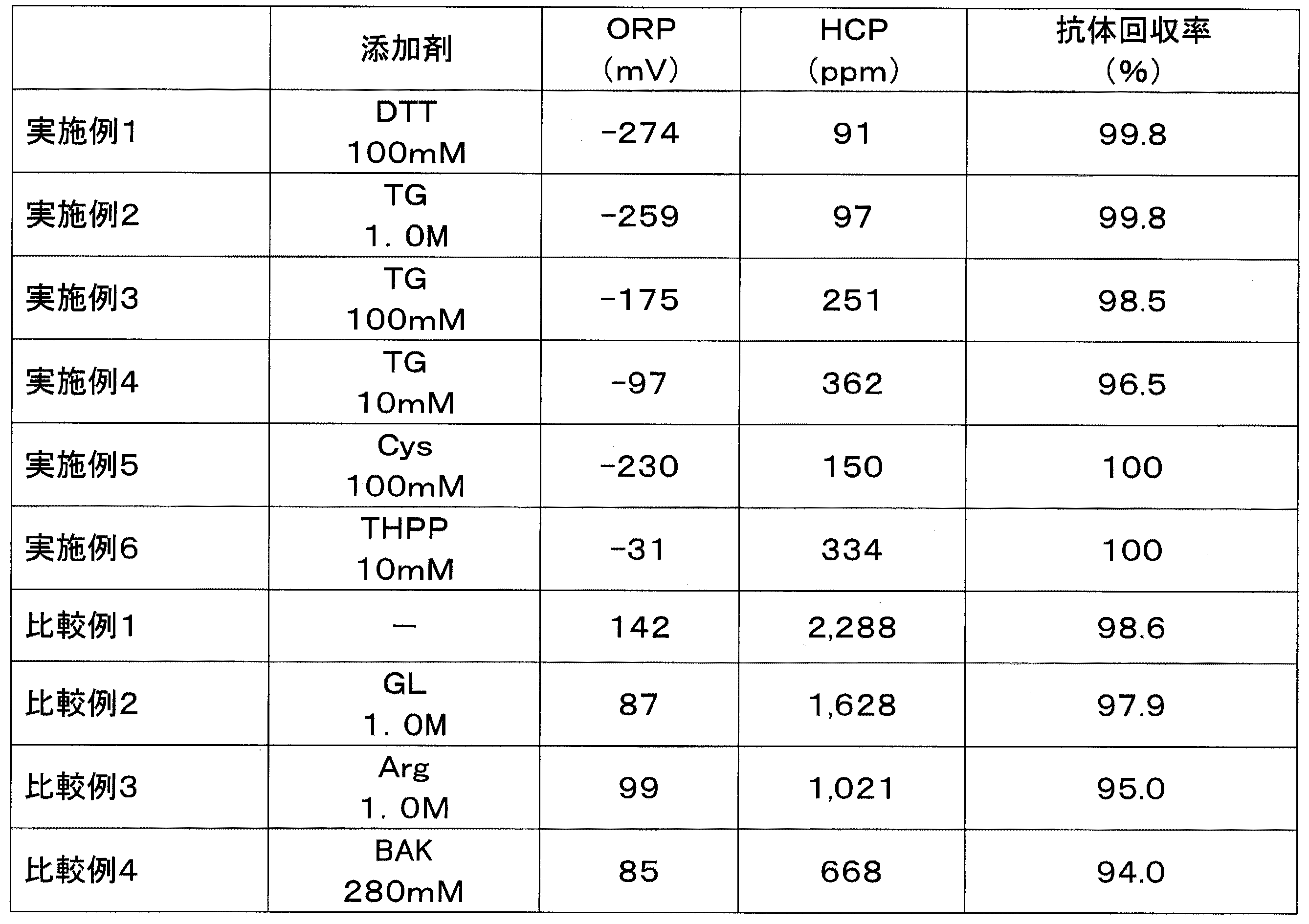
次いで、洗浄液1として、20mMりん酸ナトリウム、500mM塩化ナトリウム及び表1に記載の添加剤を含む緩衝液(pH7.5)を3カラム容量、流速1mL/分にてカラムに通液した。なお、洗浄液1の酸化還元電位(ORP)は、堀場製作所社製pHメータD−51、ORP電極9300−10D、及び比較電極内部液として塩化カリウム溶液(3.33mol/L)を使用して測定した。結果を表1に示した。
次いで、洗浄液2として、20mMりん酸ナトリウム緩衝液(pH7.5)を5カラム容量、流速1mL/分にてカラムに通液した。
その後、100mM酢酸ナトリウム緩衝液(pH3.3)を5カラム容量、流速1mL/分にてカラムに通液し、カラム内に捕捉されていたモノクローナル抗体を溶出させ、波長280nmにおける光路長1mm当たりの吸光度が50mAu以上のフラクションを回収した。
そして、Cygnus Technologies社製 CHO HCP ELISA kit,3Gを用い、回収したフラクション中に含有されるHost Cell Protein(HCP)濃度を測定した。結果を表1に示した。
また、分光光度計(バイオ・ラッド社製SmartSpec Plus)を用い、回収したフラクション中に含有される抗体濃度を測定し、回収液量を乗ずることで抗体回収量を算出し、さらに添加抗体量で除することにより、抗体回収率を求めた。結果を表1に示した。
(Examples 1 to 6, Comparative Examples 1 to 4)
A column container (Tricorn 5/200 volume manufactured by GE Healthcare) was filled with Ampshere A3 (manufactured by JSR Life Science Co., Ltd.) at a filling height of about 20 cm to prepare a column. The obtained column was connected to AKTA prime plus (manufactured by GE Healthcare), and 20 mM sodium phosphate buffer (pH 7.5) was passed through at 5 column volumes (5 times the column volume) and a flow rate of 1 mL / min. Equilibrated.
The CHO cell culture supernatant containing the biosimilar of the monoclonal antibody Trastuzumab was then passed through the column at a flow rate of 1 mL / min at a loading of about 40 g antibody / mL carrier.
Then, as the washing liquid 1, a buffer solution (pH 7.5) containing 20 mM sodium phosphate, 500 mM sodium chloride and the additives shown in Table 1 was passed through the column at a volume of 3 columns and a flow rate of 1 mL / min. The redox potential (ORP) of the cleaning liquid 1 was measured using a pH meter D-51 manufactured by HORIBA, Ltd., an ORP electrode 9300-10D, and a potassium chloride solution (3.33 mol / L) as the internal liquid of the comparative electrode. bottom. The results are shown in Table 1.
Then, as the washing liquid 2, 20 mM sodium phosphate buffer (pH 7.5) was passed through the column at a volume of 5 columns and a flow rate of 1 mL / min.
Then, 100 mM sodium acetate buffer (pH 3.3) was passed through the column at a volume of 5 columns and a flow rate of 1 mL / min to elute the monoclonal antibody captured in the column, and the optical path length per 1 mm at a wavelength of 280 nm was discharged. Fractions with an absorbance of 50 mAu or more were collected.
Then, using a CHO HCP ELISA kit, 3G manufactured by Cygnus Technologies, the concentration of Host Cell Protein (HCP) contained in the recovered fraction was measured. The results are shown in Table 1.
In addition, the antibody concentration contained in the recovered fraction was measured using a spectrophotometer (SmartSpec Plus manufactured by Bio-Rad), and the antibody recovery amount was calculated by multiplying the recovery liquid amount, and further, the added antibody amount was used. By removing the antibody, the antibody recovery rate was determined. The results are shown in Table 1.
表1中の各記号の定義は、以下に示すとおりである。
DTT:ジチオトレイトール
TG:1−チオグリセロール
Cys:L−システイン
THPP:トリス(3−ヒドロキシプロピル)ホスフィン
GL:グリセリン
Arg:L−アルギニン
BAK:塩化ベンザルコニウム
The definitions of each symbol in Table 1 are as shown below.
DTT: Dithiothreitol TG: 1-thioglycerol Cys: L-Cysteine THPP: Tris (3-hydroxypropyl) phosphine GL: Glycerin Arg: L-arginine BAK: Benzalkonium chloride
表1に示すとおり、還元剤であるジチオトレイトール、1−チオグリセロール、L−システイン又はトリス(3−ヒドロキシプロピル)ホスフィンを含有する液剤で処理した場合(実施例1〜6)は、固相からHCPを効率的に分離除去することができた。 As shown in Table 1, when treated with a liquid agent containing the reducing agents dithiothreitol, 1-thioglycerol, L-cysteine or tris (3-hydroxypropyl) phosphine (Examples 1 to 6), the solid phase is used. HCP could be efficiently separated and removed from.
Claims (15)
Priority Applications (3)
| Application Number | Priority Date | Filing Date | Title |
|---|---|---|---|
| JP2018160313A JP2021181405A (en) | 2018-08-29 | 2018-08-29 | Peptide purification method |
| PCT/JP2019/033649 WO2020045477A1 (en) | 2018-08-29 | 2019-08-28 | Method for purifying polypeptide |
| TW108131037A TW202012426A (en) | 2018-08-29 | 2019-08-29 | Method for purifying polypeptide |
Applications Claiming Priority (1)
| Application Number | Priority Date | Filing Date | Title |
|---|---|---|---|
| JP2018160313A JP2021181405A (en) | 2018-08-29 | 2018-08-29 | Peptide purification method |
Publications (1)
| Publication Number | Publication Date |
|---|---|
| JP2021181405A true JP2021181405A (en) | 2021-11-25 |
Family
ID=69643239
Family Applications (1)
| Application Number | Title | Priority Date | Filing Date |
|---|---|---|---|
| JP2018160313A Pending JP2021181405A (en) | 2018-08-29 | 2018-08-29 | Peptide purification method |
Country Status (3)
| Country | Link |
|---|---|
| JP (1) | JP2021181405A (en) |
| TW (1) | TW202012426A (en) |
| WO (1) | WO2020045477A1 (en) |
Family Cites Families (4)
| Publication number | Priority date | Publication date | Assignee | Title |
|---|---|---|---|---|
| EP2440574B1 (en) * | 2009-06-09 | 2021-05-26 | Bharat Biotech International Limited | Stable immunogenic protein having multiple cysteines molecules process therefor and composition thereof |
| US20140171626A1 (en) * | 2012-12-19 | 2014-06-19 | Glaxosmithkline Llc | Protein purification |
| CN106459141B (en) * | 2014-06-27 | 2019-09-13 | Jsr株式会社 | Carriers for Affinity Chromatography |
| WO2016008112A1 (en) * | 2014-07-16 | 2016-01-21 | Medshine Discovery Inc. | Linkers and application towards adc thereof |
-
2018
- 2018-08-29 JP JP2018160313A patent/JP2021181405A/en active Pending
-
2019
- 2019-08-28 WO PCT/JP2019/033649 patent/WO2020045477A1/en not_active Ceased
- 2019-08-29 TW TW108131037A patent/TW202012426A/en unknown
Also Published As
| Publication number | Publication date |
|---|---|
| WO2020045477A1 (en) | 2020-03-05 |
| TW202012426A (en) | 2020-04-01 |
Similar Documents
| Publication | Publication Date | Title |
|---|---|---|
| JP6913066B2 (en) | Precisely folded etanercept with high purity and excellent yield | |
| CN102712673B (en) | Chromatographic method for purifying FC-containing proteins | |
| KR101683415B1 (en) | Purification process for monoclonal antibodies | |
| KR101921767B1 (en) | Protein purification | |
| US10556942B2 (en) | Process for the purification of TNFR:Fc fusion protein | |
| CN105899235B (en) | Method for purifying CYS-linked antibody-drug conjugates | |
| US20120141497A1 (en) | Methods of purifying small modular immunopharmaceutical proteins | |
| TW201249999A (en) | An integrated approach to the isolation and purification of antibodies | |
| EA017733B1 (en) | PROCESS FOR THE PURIFICATION OF Fc-FUSION PROTEINS | |
| JP2010516651A (en) | Methods for purification of Fc-containing proteins | |
| EA017152B1 (en) | PROCESS FOR THE PURIFICATION OF Fc-CONTAINING PROTEINS | |
| US20140128577A1 (en) | Purification of chimeric protein | |
| ES2674697T3 (en) | Filtration affinity purification ligand removal | |
| JP5091127B2 (en) | Method for purification of IL-18 binding protein | |
| EP4323396A1 (en) | Fc-derived polypeptides | |
| Reese et al. | Novel peptoid-based adsorbents for purifying IgM and IgG from polyclonal and recombinant sources | |
| JP2021181405A (en) | Peptide purification method | |
| JP2024539136A (en) | Method for purifying a fusion protein having an IgG Fc domain | |
| WO2020066270A1 (en) | METHOD FOR PRODUCING κ CHAIN VARIABLE REGION-CONTAINING ANTIBODY AND/OR ANTIBODY FRAGMENT | |
| JP2014529330A (en) | Single unit chromatography antibody purification | |
| WO2016103139A1 (en) | Method for reduction of aggregates | |
| JP2025524380A (en) | Systems and methods for end-to-end continuous downstream processing | |
| KR20240154657A (en) | Affinity chromatography production of clinical human IGG products | |
| TW202547851A (en) | Methods for enhanced removal of impurities during protein a chromatography |