JP2018514213A - Thin film culture device with carbon dioxide generator - Google Patents
Thin film culture device with carbon dioxide generator Download PDFInfo
- Publication number
- JP2018514213A JP2018514213A JP2017556570A JP2017556570A JP2018514213A JP 2018514213 A JP2018514213 A JP 2018514213A JP 2017556570 A JP2017556570 A JP 2017556570A JP 2017556570 A JP2017556570 A JP 2017556570A JP 2018514213 A JP2018514213 A JP 2018514213A
- Authority
- JP
- Japan
- Prior art keywords
- culture device
- growth
- cover sheet
- base material
- compartment
- Prior art date
- Legal status (The legal status is an assumption and is not a legal conclusion. Google has not performed a legal analysis and makes no representation as to the accuracy of the status listed.)
- Granted
Links
Images


Classifications
-
- C—CHEMISTRY; METALLURGY
- C12—BIOCHEMISTRY; BEER; SPIRITS; WINE; VINEGAR; MICROBIOLOGY; ENZYMOLOGY; MUTATION OR GENETIC ENGINEERING
- C12M—APPARATUS FOR ENZYMOLOGY OR MICROBIOLOGY; APPARATUS FOR CULTURING MICROORGANISMS FOR PRODUCING BIOMASS, FOR GROWING CELLS OR FOR OBTAINING FERMENTATION OR METABOLIC PRODUCTS, i.e. BIOREACTORS OR FERMENTERS
- C12M23/00—Constructional details, e.g. recesses, hinges
- C12M23/02—Form or structure of the vessel
- C12M23/04—Flat or tray type, drawers
-
- C—CHEMISTRY; METALLURGY
- C12—BIOCHEMISTRY; BEER; SPIRITS; WINE; VINEGAR; MICROBIOLOGY; ENZYMOLOGY; MUTATION OR GENETIC ENGINEERING
- C12M—APPARATUS FOR ENZYMOLOGY OR MICROBIOLOGY; APPARATUS FOR CULTURING MICROORGANISMS FOR PRODUCING BIOMASS, FOR GROWING CELLS OR FOR OBTAINING FERMENTATION OR METABOLIC PRODUCTS, i.e. BIOREACTORS OR FERMENTERS
- C12M23/00—Constructional details, e.g. recesses, hinges
- C12M23/20—Material Coatings
-
- C—CHEMISTRY; METALLURGY
- C12—BIOCHEMISTRY; BEER; SPIRITS; WINE; VINEGAR; MICROBIOLOGY; ENZYMOLOGY; MUTATION OR GENETIC ENGINEERING
- C12M—APPARATUS FOR ENZYMOLOGY OR MICROBIOLOGY; APPARATUS FOR CULTURING MICROORGANISMS FOR PRODUCING BIOMASS, FOR GROWING CELLS OR FOR OBTAINING FERMENTATION OR METABOLIC PRODUCTS, i.e. BIOREACTORS OR FERMENTERS
- C12M23/00—Constructional details, e.g. recesses, hinges
- C12M23/34—Internal compartments or partitions
-
- C—CHEMISTRY; METALLURGY
- C12—BIOCHEMISTRY; BEER; SPIRITS; WINE; VINEGAR; MICROBIOLOGY; ENZYMOLOGY; MUTATION OR GENETIC ENGINEERING
- C12M—APPARATUS FOR ENZYMOLOGY OR MICROBIOLOGY; APPARATUS FOR CULTURING MICROORGANISMS FOR PRODUCING BIOMASS, FOR GROWING CELLS OR FOR OBTAINING FERMENTATION OR METABOLIC PRODUCTS, i.e. BIOREACTORS OR FERMENTERS
- C12M25/00—Means for supporting, enclosing or fixing the microorganisms, e.g. immunocoatings
- C12M25/06—Plates; Walls; Drawers; Multilayer plates
-
- C—CHEMISTRY; METALLURGY
- C12—BIOCHEMISTRY; BEER; SPIRITS; WINE; VINEGAR; MICROBIOLOGY; ENZYMOLOGY; MUTATION OR GENETIC ENGINEERING
- C12M—APPARATUS FOR ENZYMOLOGY OR MICROBIOLOGY; APPARATUS FOR CULTURING MICROORGANISMS FOR PRODUCING BIOMASS, FOR GROWING CELLS OR FOR OBTAINING FERMENTATION OR METABOLIC PRODUCTS, i.e. BIOREACTORS OR FERMENTERS
- C12M41/00—Means for regulation, monitoring, measurement or control, e.g. flow regulation
- C12M41/30—Means for regulation, monitoring, measurement or control, e.g. flow regulation of concentration
- C12M41/34—Means for regulation, monitoring, measurement or control, e.g. flow regulation of concentration of gas
-
- C—CHEMISTRY; METALLURGY
- C12—BIOCHEMISTRY; BEER; SPIRITS; WINE; VINEGAR; MICROBIOLOGY; ENZYMOLOGY; MUTATION OR GENETIC ENGINEERING
- C12M—APPARATUS FOR ENZYMOLOGY OR MICROBIOLOGY; APPARATUS FOR CULTURING MICROORGANISMS FOR PRODUCING BIOMASS, FOR GROWING CELLS OR FOR OBTAINING FERMENTATION OR METABOLIC PRODUCTS, i.e. BIOREACTORS OR FERMENTERS
- C12M41/00—Means for regulation, monitoring, measurement or control, e.g. flow regulation
- C12M41/30—Means for regulation, monitoring, measurement or control, e.g. flow regulation of concentration
- C12M41/36—Means for regulation, monitoring, measurement or control, e.g. flow regulation of concentration of biomass, e.g. colony counters or by turbidity measurements
Landscapes
- Health & Medical Sciences (AREA)
- Chemical & Material Sciences (AREA)
- Wood Science & Technology (AREA)
- Organic Chemistry (AREA)
- Life Sciences & Earth Sciences (AREA)
- Engineering & Computer Science (AREA)
- Bioinformatics & Cheminformatics (AREA)
- Zoology (AREA)
- Biomedical Technology (AREA)
- Genetics & Genomics (AREA)
- Microbiology (AREA)
- Biotechnology (AREA)
- Biochemistry (AREA)
- General Engineering & Computer Science (AREA)
- General Health & Medical Sciences (AREA)
- Sustainable Development (AREA)
- Clinical Laboratory Science (AREA)
- Immunology (AREA)
- Analytical Chemistry (AREA)
- Apparatus Associated With Microorganisms And Enzymes (AREA)
- Measuring Or Testing Involving Enzymes Or Micro-Organisms (AREA)
- Micro-Organisms Or Cultivation Processes Thereof (AREA)
Abstract
本開示は、微生物コロニーを計数するための培養デバイスを提供する。デバイスは、ベース材、カバーシート、及びそれらの間に配置された非多孔性スペーサー部材を含み得る。スペーサー部材は、生育区画を画定する開口部を含む。少なくとも1つの接着剤層は、生育区画においてベース材又はカバーシートに接着されている。冷水溶解性ゲル化剤、及び有効量の乾燥状態の二酸化炭素発生剤は、少なくとも1つの接着剤層に付着される。二酸化炭素発生剤は、本質的に106マイクロメートル未満の直径を有する粒子から構成される。【選択図】 図3The present disclosure provides a culture device for counting microbial colonies. The device can include a base material, a cover sheet, and a non-porous spacer member disposed therebetween. The spacer member includes an opening that defines a growth compartment. At least one adhesive layer is adhered to the base material or cover sheet in the growth compartment. A cold water soluble gelling agent and an effective amount of a dry carbon dioxide generator are attached to at least one adhesive layer. The carbon dioxide generator consists essentially of particles having a diameter of less than 106 micrometers. [Selection] Figure 3
Description
「関連出願の相互参照」
本出願は、その開示が参照によってその全体が本明細書に援用される、2015年4月29日出願の米国仮特許出願第62/154,303号の優先権を主張するものである。
"Cross-reference of related applications"
This application claims priority from US Provisional Patent Application No. 62 / 154,303, filed Apr. 29, 2015, the disclosure of which is incorporated herein by reference in its entirety.
(背景)
カプノフィル(capnophilic)菌の生育は、高濃度二酸化炭素により促進される。これらの微生物は、種々の微生物を含む試料を高濃度CO2環境下で培養することにより選択的に集積され得る。
(background)
The growth of capnophilic bacteria is promoted by high concentrations of carbon dioxide. These microorganisms can be selectively accumulated by culturing a sample containing various microorganisms in a high-concentration CO 2 environment.
カンピロバクター(Campylobacter)は、カプノフィル菌の一属である。ある種のカンピロバクターは、食品媒介性の病気に関連する。これらの微生物は、現在では世界的に、細菌性胃腸炎を引き起こす原因として認識されている。従来のカンピロバクター(Campylobacter)培養法は、微好気的環境下でのインキュベートを必要とする。i)細菌が長期間大気酸素に曝露されること、及びii)キットが最終的にはすべての酸素を除去し、微好気性のカンピロバクター菌の生育を阻害することから、ガス発生キットは、カンピロバクターの培養方法としては適さない場合がある。 Campylobacter is a genus of capnophilus. Certain types of Campylobacter are associated with foodborne diseases. These microorganisms are now recognized worldwide as the cause of bacterial gastroenteritis. Conventional Campylobacter culture methods require incubation in a microaerobic environment. Gas generation kits are used for Campylobacter because i) bacteria are exposed to atmospheric oxygen for long periods of time, and ii) the kit eventually removes all oxygen and inhibits the growth of microaerobic Campylobacter In some cases, the culture method is not suitable.
概してカプノフィル菌を培養するための、特にカンピロバクター種を培養するための、改良された培養デバイス及び培養方法が今も尚必要とされている。 There is still a need for improved culture devices and methods for culturing capnophilus generally, especially for culturing Campylobacter species.
(概要)
概して、本開示は、試料中の微生物の検出及び任意選択的な計数に関する。特に、本開示は、カプノフィル菌の生育及び検出に関する。カプノフィル菌であることに加え、かかる微生物は酸素要求性に関し、微耐気性(microaerotolerant)、微好気性、又は偏性嫌気性なものであってもよい。現在では、これらの微生物の生育及び検出は、内蔵型調整環境生成培養デバイスを使用して実施できることが知られている。改良された環境生成デバイスは、水性液体(例えば、試料を水性液体に希釈したもの)の接種により活性化されて、溶存二酸化炭素濃度が上昇しており、かつ所望により溶存酸素濃度が低減している水性の生育培地を生じる。
(Overview)
In general, the present disclosure relates to the detection and optional enumeration of microorganisms in a sample. In particular, the present disclosure relates to the growth and detection of capnophilus. In addition to being capnophilus, such microorganisms may be microaerotolerant, microaerobic, or obligately anaerobic with respect to oxygen demand. It is now known that the growth and detection of these microorganisms can be performed using a built-in conditioned environment producing culture device. The improved environmentally-generated device is activated by inoculation with an aqueous liquid (eg, a sample diluted in an aqueous liquid) to increase the dissolved carbon dioxide concentration and optionally reduce the dissolved oxygen concentration. Produces an aqueous growth medium.
本明細書に開示される本発明の培養デバイス及び方法は、酸素を含有する(例えば、通常の大気中酸素を含有する)環境で微生物をインキュベートする場合であっても、カプノフィル菌の生育、検出、及び鑑別を提供する。このデバイスでは、カプノフィル菌の培養に典型的に必要とされる、特別なインキュベート設備及び試薬(例えば、キャンドルジャー、嫌気ジャー、使い捨てケミカルサシェ、パラジウム触媒、調整雰囲気(例えば、嫌気性)グローブボックス)を不要とする点で有利である。更に、本開示は、微好気性微生物、微耐気性微生物、又は偏性嫌気性微生物でもある、カプノフィル菌の計数に関する。微好気性及び偏性嫌気性微生物は、生育及び増殖時に低酸素環境を要するという共通の性質を有する。 The culture devices and methods of the present invention disclosed herein allow for the growth and detection of capnophilus even when the microorganisms are incubated in an environment containing oxygen (eg, containing normal atmospheric oxygen). , And provide differentiation. In this device, special incubation equipment and reagents typically required for cultivation of capnophilus (eg candle jar, anaerobic jar, disposable chemical sachet, palladium catalyst, conditioned atmosphere (eg anaerobic) glove box) This is advantageous in that it is unnecessary. Furthermore, the present disclosure relates to enumeration of capnophilus which is also a microaerobic microorganism, a microaerobic microorganism, or an obligate anaerobic microorganism. Microaerobic and obligate anaerobic microorganisms have the common property of requiring a hypoxic environment during growth and proliferation.
一態様では、本開示は、微生物コロニーを計数するための培養デバイスを提供する。デバイスは、反対面となる内側表面及び外側表面を有するベース材と、反対面となる内側表面及び外側表面を有するカバーシートと、ベース材とカバーシートとの間に配置されたスペーサー部材と、有効量の乾燥状態の二酸化炭素発生剤と、並びに乾燥状態の冷水溶解性ゲル化剤と、を含み得る。カバーシートは、ベース部材又はスペーサー部材に結合され得る。スペーサー部材は、ベース材及び/又はカバーシートに結合され得る。スペーサー部材は、生育区画の形状及び深さを画定する開口部を含む。生育区画は、ベース材の内側表面とカバーシートの内側表面との間に配置される。第1の接着剤層を、生育区画においてベース材に接着させることができ、あるいは第2の接着剤層を、生育区画においてカバーシートに接着させることができる。二酸化炭素発生剤を、第1の接着剤層又は第2の接着剤層に接着した生育区画に配置することができる。ゲル化剤を、生育区画においてベース材又はカバーシートに付着し得る。 In one aspect, the present disclosure provides a culture device for counting microbial colonies. The device comprises: a base material having inner and outer surfaces on opposite sides; a cover sheet having inner and outer surfaces on opposite sides; a spacer member disposed between the base material and the cover sheet; An amount of dry carbon dioxide generator, as well as a dry cold water soluble gelling agent. The cover sheet can be coupled to the base member or the spacer member. The spacer member can be coupled to the base material and / or the cover sheet. The spacer member includes an opening that defines the shape and depth of the growth compartment. The growth compartment is disposed between the inner surface of the base material and the inner surface of the cover sheet. The first adhesive layer can be adhered to the base material in the growing compartment, or the second adhesive layer can be adhered to the cover sheet in the growing compartment. A carbon dioxide generator can be placed in the growth compartment adhered to the first adhesive layer or the second adhesive layer. The gelling agent can be attached to the base material or cover sheet in the growth compartment.
上記の実施形態のうち任意のものでは、二酸化炭素発生剤は、本質的に106マイクロメートル未満の直径を有する粒子から構成され得る。上記の実施形態のうち任意のものでは、デバイスは、生育区画において、第1の接着剤層又は第2の接着剤層に付着した有効量の乾燥状態の脱酸素剤を更に含み、脱酸素剤は本質的に106マイクロメートル未満の直径を有する粒子から構成される。上記の実施形態のうち任意のものでは、スペーサー部材は非多孔性であり得る。上記の実施形態のうち任意のものでは、デバイスは、第1の接着剤層又は第2の接着剤層に付着した、乾燥状態の緩衝剤、乾燥状態の栄養成分、指示薬、選択剤、又は還元剤を更に含み得る。上記の実施形態のうち任意のものでは、二酸化炭素発生剤は、金属炭酸塩を含み得る。上記の任意の実施形態において、脱酸素剤は、生育区画におけるベース材又はカバーシートの表面積10cm2あたり約1.5マイクロモル〜約15マイクロモルの量で生育区画に配置され得る。 In any of the above embodiments, the carbon dioxide generator can consist essentially of particles having a diameter of less than 106 micrometers. In any of the above embodiments, the device further comprises an effective amount of a dry oxygen scavenger attached to the first adhesive layer or the second adhesive layer in the growth compartment, wherein the oxygen scavenger Is essentially composed of particles having a diameter of less than 106 micrometers. In any of the above embodiments, the spacer member can be non-porous. In any of the above embodiments, the device may be a dry buffer, a dry nutrient, an indicator, a selective agent, or a reduction attached to the first adhesive layer or the second adhesive layer. An agent may further be included. In any of the above embodiments, the carbon dioxide generator may include a metal carbonate. In any of the above embodiments, the oxygen scavenger may be placed in the growth compartment in an amount of about 1.5 micromoles to about 15 micromoles per 10 cm < 2 > surface area of the base material or cover sheet in the growth compartment.
別の態様において、本開示は、試料中のカプノフィル菌を検出する方法を提供する。かかる方法は、上記の実施形態のいずれか1つに記載の培養デバイスを、その内部の生育区画へのアクセスを提供する開いた構成で配置することと、所定量の水性液体を生育区画に配置することと、試料を生育区画に配置することと、培養デバイスを閉じることと、培養培地において微生物にコロニーを形成させるのに十分な一定時間にわたり培養デバイスをインキュベートすることと、並びに、微生物コロニーを検出することと、を含み得る。水性液体と試料を生育区画に配置すること、及び培養デバイスを閉じることは、ベース材と、カバーシートと、及び培養デバイスのスペーサー部材により生育区画に取り囲まれた半固体の微生物培養培地を形成することと、を含み得る。 In another aspect, the present disclosure provides a method of detecting capnophilus in a sample. Such a method includes placing the culture device according to any one of the above embodiments in an open configuration that provides access to a growth compartment therein, and placing a predetermined amount of aqueous liquid in the growth compartment. Placing the sample in the growth compartment, closing the culture device, incubating the culture device for a period of time sufficient to allow the microorganism to form a colony in the culture medium, and Detecting. Placing the aqueous liquid and sample in the growth compartment and closing the culture device forms a semi-solid microbial culture medium surrounded by the growth compartment by the base material, the cover sheet, and the spacer member of the culture device. Can be included.
方法についての上記実施形態のいずれかにおいて、培養デバイスを閉じることは、開放流体経路を培養デバイス外部の気体環境から、生育区画において取り囲まれた半固体の微生物培養培地まで隔離することを含み得る。方法についての上記実施形態のいずれかにおいて、培養デバイスのインキュベート後、微生物コロニーを検出することは、培養デバイスにおいて光学的に検出可能な1つ以上のコロニーを計数することを更に含み得る。 In any of the above embodiments of the method, closing the culture device may include isolating the open fluid pathway from the gaseous environment outside the culture device to a semi-solid microbial culture medium surrounded by the growth compartment. In any of the above embodiments of the method, detecting the microbial colony after incubation of the culture device may further comprise counting one or more colonies that are optically detectable in the culture device.
「好ましい」及び「好ましくは」という語は、特定の状況下で特定の利益をもたらすことができる本発明の実施形態を指す。しかしながら、同じ又は他の状況下で他の実施形態が好ましい場合もある。更に、1つ以上の好ましい実施形態の記載は、他の実施形態が有用でないことを含意するものではなく、他の実施形態を本発明の範囲内から排除することを意図するものではない。 The terms “preferred” and “preferably” refer to embodiments of the invention that can provide certain benefits under certain circumstances. However, other embodiments may be preferred under the same or other circumstances. Furthermore, the description of one or more preferred embodiments does not imply that other embodiments are not useful, and is not intended to exclude other embodiments from the scope of the invention.
用語「備える」及びその変化形は、これらの用語が本説明及び請求項内で現れる場合に、限定的な意味を有するものではない。 The terms “comprising” and variations thereof do not have a limiting meaning where these terms appear in the description and claims.
本明細書において使用するとき、「1つ(a、an)」、「その(the)」、「少なくとも1つ(at least one)」及び「1つ以上(one or more)」は、互換的に使用される。したがって、例えば、栄養成分は、「1つ又は2つ以上の」栄養成分を意味するように、解釈され得る。 As used herein, “a”, “the”, “at least one”, and “one or more” are interchangeable. Used for. Thus, for example, a nutritional component can be interpreted to mean "one or more" nutritional components.
「及び/又は」という用語は、列挙される要素のうちの1つ若しくはすべて、又は列挙される要素のうちの任意の2つ以上の組み合わせを意味する。 The term “and / or” means one or all of the listed elements or a combination of any two or more of the listed elements.
また本明細書において、端点による数値範囲の記載は、その範囲内に含まれるすべての数が含まれる(例えば、1〜5は、1、1.5、2、2.75、3、3.80、4、5等を含む)。 In this specification, the description of a numerical range by endpoints includes all numbers included in the range (for example, 1 to 5 is 1, 1.5, 2, 2.75, 3, 3,. 80, 4, 5, etc.).
本発明の上記の概要は、本発明のそれぞれの開示される実施形態又はすべての実施を説明することを目的とするものではない。以下の説明は、例示的な実施形態をより具体的に例示する。本出願を通していくつかの箇所において、例のリストによって指針が示されるが、それらの例は様々な組み合わせで使用することができる。いずれの場合にも、記載された列挙は、代表的な群としての役割のみを果たすものであり、排他的な列挙として解釈されるべきではない。 The above summary of the present invention is not intended to describe each disclosed embodiment or every implementation of the present invention. The following description more specifically illustrates exemplary embodiments. In several places throughout the application, guidance is provided through lists of examples, which examples can be used in various combinations. In any case, the recited list serves only as a representative group and should not be construed as an exclusive list.
これらの実施形態及び他の実施形態の更なる詳細を、添付の図面及び以下の説明文に記載する。他の特徴、目的及び利点は、説明及び図面、並びに特許請求の範囲から明らかになるであろう。 Further details of these and other embodiments are set forth in the accompanying drawings and the description below. Other features, objects, and advantages will be apparent from the description and drawings, and from the claims.
(詳細な説明)
本開示のいずれかの実施形態について詳細に説明する前に、本発明は、以下の説明に記載し又は以下の図面に図示する構成要素の構造及び配置の詳細にその用途が限定されないことを理解されたい。本発明は、他の実施形態が可能であり、様々な方法で実施又は実行することができる。更に、本明細書で使用される専門用語及び用語は、説明目的のためであり、制限とみなされるべきではないと理解されている。本明細書における「含む(including)」、「備える(comprising)」又は「有する(having)」、及びこれらの変形の使用は、以下に挙げる品目及びその等価物、並びに付加的な品目を包含するものである。別段の指定又は制限のない限り、用語「接続される」及び「連結される」並びにその変化形は、幅広く使用され、直接的及び間接的な接続と連結の双方を包含する。更に、「連結された」及び「結合された」とは、物理的又は機械的な連結又は結合に限定されない。本開示の範囲から逸脱することなく、他の実施形態を利用することができ、構造上又は論理上の変更を加えることもできることを理解されたい。更に、「前」、「後」、「上」、及び「下」といった用語は、各要素の互いに対する関係を説明するためにのみ用いられるものであり、装置の特定の向きを説明すること、装置に必要とされる若しくは求められる向きを指示又は示唆すること、あるいは本明細書に記載される発明が、使用時にどのように使用、装着、表示、又は配置されるかを特定することを目的とするものでは決してない。
(Detailed explanation)
Before describing in detail any embodiment of the present disclosure, it is understood that the present invention is not limited in its application to the details of the structure and arrangement of components set forth in the following description or illustrated in the following drawings. I want to be. The invention is capable of other embodiments and of being practiced or carried out in various ways. Further, it is understood that the terminology and terms used herein are for illustrative purposes and should not be considered limiting. The use of “including”, “comprising” or “having” and variations thereof herein includes the items listed below and their equivalents, as well as additional items. Is. Unless otherwise specified or restricted, the terms “connected” and “coupled” and variations thereof are widely used and encompass both direct and indirect connections and couplings. Further, “connected” and “coupled” are not limited to physical or mechanical connections or couplings. It should be understood that other embodiments may be utilized and structural or logical changes may be made without departing from the scope of the present disclosure. Furthermore, the terms “front”, “rear”, “upper”, and “lower” are used only to describe the relationship of each element to each other, describing a particular orientation of the device, The purpose is to indicate or suggest the orientation required or required of the device, or to identify how the invention described herein is used, mounted, displayed, or placed in use It is never something to do.
本明細書で使用するとき、用語「微生物(microorganism又はmicrobe)」は、任意の微生物を指し、単細胞生物又は多細胞生物であり得る。かかる用語は、概して、好適な培養培地において生育及び増殖が可能な任意の原核微生物又は真核微生物を指すために使用され、限定するものではないが1種以上の細菌が含まれる。本発明の範囲の包含される微生物としては、原核生物、すなわち、細菌及び古細菌、及び原生生物、真菌、酵母(例えば、嫌気性酵母)、藻類などを含む様々な形態の真核生物が挙げられる。用語「対象とする微生物」は、検出が望まれるなんらかの微生物を指す。 As used herein, the term “microorganism” or “microbe” refers to any microorganism and can be a unicellular organism or a multicellular organism. Such terms are generally used to refer to any prokaryotic or eukaryotic microorganism capable of growing and growing in a suitable culture medium, including but not limited to one or more bacteria. Microorganisms encompassed by the scope of the present invention include prokaryotes, ie, bacteria and archaea, and various forms of eukaryotes, including protists, fungi, yeasts (eg, anaerobic yeast), algae, and the like. It is done. The term “microorganism of interest” refers to any microorganism that is desired to be detected.
用語「高濃度CO2」及び「高濃度二酸化炭素」などは、それらが、二酸化炭素発生剤を含む特定の水性環境(例えば、ヒドロゲル)に関するものである場合、周囲温度及び周囲圧力下で、水性環境の有する溶存酸素濃度が、二酸化炭素発生剤を含まないこと以外は同一の水性環境よりも実質的に高濃度(例えば、2倍超、3倍超、4倍超、5倍超、又は10倍超)である状況を指す。 The terms “high CO 2 ” and “high carbon dioxide” and the like are aqueous at ambient temperature and pressure if they relate to a particular aqueous environment (eg, hydrogel) that contains a carbon dioxide generator. The dissolved oxygen concentration of the environment is substantially higher than the same aqueous environment except that it does not contain a carbon dioxide generator (eg, more than 2 times, more than 3 times, more than 4 times, more than 5 times, or 10 Is more than double).
本明細書では、「嫌気性微生物(anaerobic微生物)」又は「嫌気性生物(anaerobe)」という用語は、酸素に感受性があり、酸素の存在下では生育しない微生物を指す。嫌気性微生物又は嫌気性生物は、生育のために酸素を必要としないあらゆる微生物である。嫌気性微生物は、偏性嫌気性生物と通性嫌気性生物の両方を含む。偏性嫌気性生物は、大気レベルの酸素に露出されると死滅する微生物である。通性嫌気性生物は、酸素が存在する場合は好気呼吸を行うことができるが、酸素がない場合は発酵又は嫌気呼吸に切り替えることが可能な微生物である。本発明の方法及びシステムは、偏性嫌気性生物と通性嫌気性生物の両方の集積及び検出に使用することができる。 As used herein, the term "anaerobic microorganism" or "anaerobe" refers to a microorganism that is sensitive to oxygen and does not grow in the presence of oxygen. An anaerobic microorganism or an anaerobic organism is any microorganism that does not require oxygen for growth. Anaerobic microorganisms include both obligate and facultative anaerobes. Obligate anaerobes are microorganisms that die when exposed to atmospheric oxygen. A facultative anaerobe is a microorganism that can perform aerobic respiration in the presence of oxygen, but can switch to fermentation or anaerobic respiration in the absence of oxygen. The methods and systems of the present invention can be used for the accumulation and detection of both obligate and facultative anaerobes.
用語「微好気性微生物」又は「微好気性菌」は、本明細書において、微量の酸素存在下でのみ生育するなんらかの微生物を指すために使用される。微好気性菌は酸素を使用するものの、極低濃度(低マイクロモル濃度範囲)、典型的には、5〜15%の酸素濃度レベルで使用し、通常の酸素濃度又は約15%を超過する酸素濃度により生育が阻害される。 The term “microaerobic microorganism” or “microaerobic bacterium” is used herein to refer to any microorganism that grows only in the presence of trace amounts of oxygen. Although microaerobic bacteria use oxygen, they are used at very low concentrations (low micromolar concentration range), typically at 5-15% oxygen concentration levels, exceeding normal oxygen concentrations or about 15% Growth is inhibited by oxygen concentration.
本明細書では、微生物の「培養(culture)」又は「生育(growth)」という用語は、微生物の生育を促す条件下にある所定の培地内で微生物を増殖させることによって微生物を増加させる方法を指す。より具体的には、これは、微生物の少なくとも1回の細胞分裂を促進するのに好適な培養培地及び条件を提供する方法である。培養培地は固体、半固体、又は液体の培地であり、微生物の生育にとって重要な栄養成分及び必要な物理的生育パラメータをすべて含有する。 As used herein, the term “culture” or “growth” of a microorganism refers to a method of increasing microorganisms by growing the microorganisms in a predetermined medium under conditions that promote the growth of the microorganisms. Point to. More specifically, this is a method that provides suitable culture media and conditions to promote at least one cell division of a microorganism. The culture medium is a solid, semi-solid, or liquid medium that contains all the nutrients important for microbial growth and the necessary physical growth parameters.
本明細書で使用するとき、用語「集積」は、特定の微生物の生育に望ましい特異的態様及び既知の態様(attributes)を有する、培地及び条件を提供することによって、特定の微生物の生育を選択的に集積する培養法を指す。集積培養環境は、選択された微生物の生育には正に影響し、及び/又は他の微生物の生育には負に影響する。 As used herein, the term “aggregation” selects the growth of a particular microorganism by providing media and conditions that have specific aspects and known attributes that are desirable for the growth of that particular microorganism. Refers to a culture method that accumulates automatically. The enrichment culture environment positively affects the growth of selected microorganisms and / or negatively affects the growth of other microorganisms.
「脱酸素剤」及び「酸素スカベンジャー」は、所与の環境から酸素を消費、枯渇又は反応させることができる、化合物を指すために本明細書において広く使用される。好ましくは、脱酸素剤は、嫌気性微生物の生育を遅らせず、又は阻害しない。 “Oxygen scavengers” and “oxygen scavengers” are used broadly herein to refer to compounds that can consume, deplete or react oxygen from a given environment. Preferably, the oxygen scavenger does not slow or inhibit the growth of anaerobic microorganisms.
用語「還元剤」は、本開示のデバイスの生育区画における乾燥状態の構成成分の水和により形成される半固体培養培地のEh電位(potential)を低減することができる物質を指す。 The term “reducing agent” refers to a substance that can reduce the E h potential of a semi-solid culture medium formed by hydration of dry components in the growth compartment of the device of the present disclosure.
本開示は、概して、カプノフィル菌を生育させるための物品及び方法に関する。所望により、カプノフィル菌は、嫌気性であっても微好気性であってもよい。特に、本開示は、生育に高濃度の二酸化炭素を要求する又は高濃度の二酸化炭素により生育が増強される微生物(例えば、カンピロバクター属の微生物)を培養するデバイスを提供する。デバイスは、有効量の二酸化炭素発生剤を含む。有利に、本発明のデバイスは高度に安定であり(例えば、周囲温度)、カプノフィル菌の培養のため高濃度CO2環境を達成及び維持することを目的とした特殊な装置及び/又は圧縮気体が必要とされない。更に、デバイスは、デバイスの水和(例えば、水性試料による水和)後、嫌気性微生物又は微好気性微生物の生育を促進する液体環境を生成することができる。 The present disclosure generally relates to articles and methods for growing capnophilus. If desired, the capnophilus may be anaerobic or microaerobic. In particular, the present disclosure provides a device for culturing microorganisms that require high concentrations of carbon dioxide for growth or whose growth is enhanced by high concentrations of carbon dioxide (eg, microorganisms of the genus Campylobacter). The device includes an effective amount of a carbon dioxide generator. Advantageously, the device of the present invention is highly stable (eg, ambient temperature) and special equipment and / or compressed gas intended to achieve and maintain a high concentration CO 2 environment for cultivation of capnophilus. Not needed. Further, the device can generate a liquid environment that promotes the growth of anaerobic or microaerobic microorganisms after hydration of the device (eg, hydration with an aqueous sample).
本開示は、一般に、試料中の微生物の検出及び所望により計数に関する。特に、本開示は、多様なカプノフィル菌群の生育及び検出に関する。多様な群としては、例えば、カンピロバクター属、ヘモフィルス属、及びナイセリア属の種が挙げられる。現在では、カプノフィル菌の生育及び検出は、内蔵型高濃度CO2環境生成培養デバイスを使用して実施できることが知られている。 The present disclosure relates generally to the detection and optionally counting of microorganisms in a sample. In particular, the present disclosure relates to the growth and detection of diverse capnophilus groups. Various groups include, for example, Campylobacter, Haemophilus, and Neisseria species. At present, it is known that the growth and detection of capnophilus can be carried out using a built-in high-concentration CO 2 environmental production culture device.
任意選択的に、本開示のデバイスは、in situで低酸素環境を更に生成することができる。したがって、嫌気性微生物及び通性嫌気性微生物は、本開示のデバイスにおける、低酸素環境又は嫌気性環境下での培養により、絶対好気性微生物よりも選択的に集積され得る。本開示のデバイスは、有利に、絶対好気性微生物も含有する試料中に存在するカプノフィル菌並びに通性嫌気性微生物及び偏性嫌気性微生物を、選択的に集積するのに使用できる。 Optionally, the device of the present disclosure can further generate a hypoxic environment in situ. Therefore, anaerobic microorganisms and facultative anaerobic microorganisms can be selectively accumulated over absolute aerobic microorganisms by culturing in a hypoxic or anaerobic environment in the device of the present disclosure. The devices of the present disclosure can advantageously be used to selectively accumulate capnophilus and facultative and obligate anaerobic microorganisms present in samples that also contain absolute aerobic microorganisms.
現在では、乾燥状態の再水和可能な内蔵型高濃度CO2環境生成培養デバイスを作製できることが知られている。培養デバイスは、培養デバイスの生育区画に配置された有効量の実質的に乾燥状態の二酸化炭素発生剤を含む。デバイスは、所定量の水性溶液により再水和可能であり、一旦再水和すると、二酸化炭素発生剤が、デバイスにおける水性培地中のCO2濃度を上昇させる反応に関わるようにできるようになる。更に、培養デバイスは、水性環境を保持でき、カプノフィル菌の生育を促進するのに十分な期間にわたって高濃度CO2環境を保持できる。 At present, it is known that a built-in high-concentration CO 2 environment generation culture device capable of rehydration in a dry state can be produced. The culture device includes an effective amount of a substantially dry carbon dioxide generator disposed in the growth compartment of the culture device. The device can be rehydrated with a predetermined amount of aqueous solution, and once rehydrated, the carbon dioxide generator can be involved in a reaction that increases the CO 2 concentration in the aqueous medium at the device. Furthermore, the culture device can maintain an aqueous environment and can maintain a high concentration CO 2 environment for a period of time sufficient to promote the growth of capnophilus.
対象となる細菌種を、例えば、血液、唾液、接眼レンズ液、滑液、脳脊髄液、膿汁、汗、浸出液、尿、粘液、粘膜組織(例えば、頬、歯肉、鼻、眼球、気管、気管支、胃腸、直腸、尿道、尿管、膣、子宮頸管(cervical)、及び子宮粘膜)、母乳、又は糞便等の生体液のような任意の源に由来することができる検査試料において分析することができる。更に、検査試料は、例えば、傷、皮膚、前鼻孔、鼻咽頭腔、鼻腔、前鼻前庭、頭皮、爪、外耳、中耳、口、直腸、膣、腋窩、会陰、肛門、又は他の同様の身体部位に由来するものであってよい。 Target bacterial species include, for example, blood, saliva, ocular fluid, synovial fluid, cerebrospinal fluid, pus, sweat, exudate, urine, mucus, mucosal tissue (eg, cheeks, gums, nose, eyeballs, trachea, bronchia) Analysis in test samples that can be derived from any source, such as biological fluids, such as gastrointestinal, rectal, urethra, ureter, vagina, cervical, and uterine mucosa), breast milk, or feces it can. In addition, the test sample can be, for example, a wound, skin, anterior nostril, nasopharyngeal cavity, nasal cavity, vestibule, scalp, nail, outer ear, middle ear, mouth, rectum, vagina, axilla, perineum, anus, or other It may originate from a similar body part.
生体液に加えて、他の検査試料には、他の液体並びに液体媒体中に溶解又は懸濁した固体が含まれてもよい。対象となる試料としては、プロセス流、水、食品、食材、飲料、土壌、植物又はその他の植生、空気、及び表面(例えば、製造工場、病院、診療所、又は家庭内の壁、床、設備、器具)などが挙げられ得る。 In addition to biological fluids, other test samples may include other liquids as well as solids dissolved or suspended in a liquid medium. Samples of interest include process streams, water, food, foodstuffs, beverages, soil, plants or other vegetation, air, and surfaces (eg, manufacturing plants, hospitals, clinics, or household walls, floors, equipment) , Instruments) and the like.
生育にあたり酸素分圧が低い環境を必要とする細菌(すなわち微好気性菌)及び/又は許容する細菌(すなわち、耐気性細菌)の非限定的例としては、ヘリコバクター・ピロリ、カンピロバクター種(例えば、カンピロバクター・ジェジュニ、カンピロバクター・コリ、カンピロバクター・フェタス)、ストレプトコッカス・インターメディウス、ストレプトコッカス・サンギス、ストレプトコッカス・コンステラータス、ゲメラ・モルビロルム、ラクトバシラス種、及びストレプトコッカス−ピオゲネスが挙げられる。 Non-limiting examples of bacteria that require an environment with low oxygen partial pressure for growth (i.e., microaerobic bacteria) and / or permissive bacteria (i.e., aerobic bacteria) include Helicobacter pylori, Campylobacter species (e.g., Campylobacter jejuni, Campylobacter coli, Campylobacter fetus), Streptococcus intermedius, Streptococcus sangis, Streptococcus constitutus, Gemma morbirrum, Lactobacillus species, and Streptococcus pyogenes.
嫌気性菌は本質的に偏在である。嫌気性菌は、偏性嫌気性であり得、あるいは通性嫌気性でもあり得る。偏性嫌気性細菌の非限定例としては、硫酸塩還元(sulfate−reducing)細菌(SRB;例えば、デスルホビブリオ種及びデスルホトマキュラム種など)、酸生成細菌(APB;例えば、アセトバクテリウム、ペディオコッカス、プロテイニフィラム(Proteiniphilum)、ラクトバシラス、スタフィロコッカス、サーモコッコイド(Thermococcoides)、及びアシネトバクターなど)、アクチノミセス種、クロストリジウム種(例えば、ウェルシュ菌、破傷風菌、クロストリジウム・スポロゲネス、ボツリヌス菌、クロストリジウム・ディフィシル、クロストリジウム・ブチリカム、クロストリジウム・アセトブチリクム)、乳酸菌(例えば、ラクトバシラス種、ロイコノストック種、ペディオコッカス種、ラクトコッカス種)、バクテロイデス種(例えば、バクテロイデス・フラジリス)、及びペプトストレプトコッカス種(例えば、ペプトストレプトコッカス・ミクロス、ペプトストレプトコッカス・マグヌス、ペプトストレプトコッカス・アサッカロリチカス、ペプトストレプトコッカス・アネロビウス、及びペプトストレプトコッカス・テトラディウス)が挙げられる。通性嫌気性菌の非限定的例としては、腸内細菌(例えば、大腸菌)、サルモネラ種、シトロバクター・フロインデイ、黄色ブドウ球菌、及びリステリア種(例えばリステリア・モノサイトゲネス)が挙げられる。 Anaerobic bacteria are inherently ubiquitous. Anaerobic bacteria can be obligate anaerobic or can be facultative anaerobic. Non-limiting examples of obligate anaerobic bacteria include sulfate-reducing bacteria (SRB; for example, desulfobibrio and desulfotomacrum species), acid-producing bacteria (APB; for example, acetobacterium) , Pediococcus, Proteiniphilum, Lactobacillus, Staphylococcus, Thermococcoides, Acinetobacter, etc., Actinomyces spp., Clostridium spp. (Eg, Clostridium spp., Clostridium sporogenes, Botulinum) Fungi, Clostridium difficile, Clostridium butyricum, Clostridium acetobutylicum), lactic acid bacteria (eg, Lactobacillus species, Leuconostoc species, Pediococcus species, Lactococcus species), Bacteroides species (eg, Cpteroides fragilis), and Peptostreptococcus species (eg, Peptostreptococcus micros, Peptostreptococcus magnus, Peptostreptococcus asaccharolyticus, Peptostreptococcus anerobius, and Peptostreptococcus tetradius) Can be mentioned. Non-limiting examples of facultative anaerobes include enterobacteria (eg, E. coli), Salmonella species, Citrobacter fraudinii, Staphylococcus aureus, and Listeria species (eg, Listeria monocytogenes).
酵母菌種の多くが通性嫌気性であり、酵母種の一部が偏性嫌気性であるため、本開示の内蔵型嫌気性環境生成培養デバイスは、酵母菌微生物の生育及び検出にも有用であることが考えられる。 Since many yeast species are facultative anaerobic and some yeast species are obligately anaerobic, the built-in anaerobic environment-generating culture device of the present disclosure is also useful for the growth and detection of yeast microorganisms It is thought that it is.
一態様では、本開示は、高濃度CO2環境で生育する微生物を培養及び検出するための培養デバイスを提供する。図1〜3に関して、本開示の培養デバイス100は、耐水性のベース材10、耐水性のカバーシート20、及びベース材10とカバーシート20との間に配置されるスペーサー部材30を含む。ベース材10は、内側表面10b及び内側表面の反対面となる外側表面10aを有する。カバーシート20は、内側表面20b及び内側表面の反対面となる外側表面20aを有する。任意の実施形態において、ベース材10の内側表面10aは、カバーシート20の内側表面20bと向かい合わせの関係となるよう配置される。
In one aspect, the present disclosure provides a culture device for culturing and detecting microorganisms that grow in a high concentration CO 2 environment. 1-3, the
ベース材10は、好ましくは、水を吸収しない又は水による悪影響を受けない材料(例えば、ポリエステル、ポリプロピレン、又はポリスチレン)製の比較的剛性の耐水性フィルムである。ベース材10は、実質的に気体状酸素を透過しない材料を使用して作製されることが好ましい。ベース材10の好適な材料の非限定的例は、少なくとも厚さ約15μm〜少なくとも約180μmのポリエステルフィルム、少なくとも厚さ約100μm〜少なくとも約200μmのポリプロピレンフィルム、及び、少なくとも厚さ約300μm〜約380μmのポリスチレンフィルムが挙げられる。その他の好適なベース材としては、エチレンビニルアルコール共重合フィルム、ポリビニルアルコールフィルム、及びポリ塩化ビニリデンフィルムが挙げられる。ベース材10は、ベース材を通してコロニーを観察することが望ましい場合には透明とすることができる。
The
カバーシート20は、ベース材10の内側表面10bを覆い、生育区画60の範囲を限定し、所望により輸送、保管、インキュベート、及び/又はコロニー計数中に生育区画を観察するために使用される。カバーシート20は、好ましくは、水を吸収しない又は水による悪影響を受けない材料(例えば、ポリエステル、ポリプロピレン、又はポリスチレン)製の比較的剛性の耐水性フィルムである。カバーシート20は、培養デバイス10を開口しなくても容易にコロニーを計数するために透明であることが好ましく、微生物及び水蒸気を実質的に浸透させないことが好ましい。
The
概して、カバーシートは、ベース材10の作製に使用される材料から作製することができる。カバーシート20は、実質的に気体状酸素を透過しない材料を使用して作製されることが好ましい。ベース材10の好適な材料の非限定的例は、少なくとも厚さ約15μm〜少なくとも約180μmのポリエステルフィルム、少なくとも厚さ約100μm〜少なくとも約200μmのポリプロピレンフィルム、及び、少なくとも厚さ約300μm〜約380μmのポリスチレンフィルムが挙げられる。その他の好適なベース材としては、エチレンビニルアルコール共重合フィルム、ポリビニルアルコールフィルム、及びポリ塩化ビニリデンフィルムが挙げられる。図1に示すように、カバーシート20は、ベース材10及びカバーシート20のそれぞれの内側表面の片端部に沿ってヒンジ様式で(例えば、両面接着テープを使用して)接着してヒンジ領域70を形成し得る。所望により、任意の実施形態において、カバーシート20は、ベース材10を越えて延びるタブ領域75を含み得る。タブ領域75は、生育区画60に試料を接種するためにデバイス100を開けるときに都合よくつかむことができるものである。
In general, the cover sheet can be made from the material used to make the
当業者であれば、所定の種類のポリマーフィルムを通る気体(例えば、二酸化炭素、酸素)の透過性を、典型的にはポリマーフィルムの厚さを増加させることにより低減させ得ることが理解されよう。任意の実施形態において、本開示のベース材及びカバーシートは、気体状酸素を実質的に透過しない好適な厚さを有するポリマーフィルムである。 One skilled in the art will appreciate that the permeability of gases (eg, carbon dioxide, oxygen) through a given type of polymer film can be reduced, typically by increasing the thickness of the polymer film. . In any embodiment, the base material and cover sheet of the present disclosure are polymer films having a suitable thickness that is substantially impermeable to gaseous oxygen.
スペーサー部材30は、開口部36を含む。開口部36は、培養デバイス100の生育区画60の位置と厚みの両方を画定する役目をするウェルを形成する。スペーサー部材30は、ベース材10及びカバーシート20とともに生育区画60の境界を画定する。スペーサー部材30は、培養デバイス100の接種中に、水性試料(図示せず)を生育区画60内に閉じ込めるよう機能する。
The
図1に示すとおり、開口部36は、円形状を画定する。しかしながら、開口部36は、他の形状(例えば、正方形、長方形、楕円形)を画定してもよいことが想到される。開口部36の壁は、所定の大きさ及び形状のウェルを提供し、培養デバイス100の生育区画60の厚みを画定する。
As shown in FIG. 1, the
スペーサー部材30は、生育区画60の大きさ及び培養デバイスに配置される試料の大きさに応じ、所定の容量、例えば、1mL、2mL、3mL、5mL、又は10mLを有するウェルを形成するのに十分な厚みでなければならない。任意の実施形態において、スペーサー部材30は、疎水性(非湿潤性)であり、微生物に対し不活性であり、場合により滅菌可能ななんらかの多孔性又は非多孔性材料から作製される。任意の実施形態において、スペーサー部材30を、(例えば、感圧接着剤を介して)ベース材10又はカバーシート20に直接結合することができる。付加的に又は代替的に、スペーサー部材30を、(例えば、接着テープ50により)ベース材又はカバーシートに間接的に結合することができる(例えば、ベース材又はカバーシート上に各々コーティングされる第1又は第2のドライコーティングにスペーサー部材を結合できる)。
The
生育区画60は、培養デバイス100内の、ベース材10とカバーシート20との間の任意のアクセス可能な位置に存在し得る。好ましくは、生育区画60は、デバイス100の周辺端部80から離れた位置にあることが好ましい。
The
好ましくは、スペーサー部材30は、微生物の生育を実質的に阻害せず、スペーサー部材に接触しているヒドロゲルから水又は肉眼で観察可能な二酸化炭素の気泡を実質的に吸収しない、非多孔性材料(例えば、金属、ガラス、ポリマー樹脂)から構成される。スペーサー部材30を作製することのできる好適な材料の非限定例としては、例えば、ポリオレフィン(例えば、ポリエチレン、及びポリプロピレンなど)、ポリエチレンテレフタレート、ポリウレタン、ポリスチレン、ポリ塩化ビニリデン、ポリメチルメタクリレート、フッ化ポリビニリデン又は他のポリマーフィルムが挙げられる。
Preferably, the
本開示のデバイスは、生育区画に配置された乾燥状態の冷水溶解性ゲル化剤を含む。好ましくは、ゲル化剤は、デバイス100のベース材10及び/又はカバーシート20に対し直接的に又は間接的に付着される。ゲル化剤の間接的な付着の非限定例には、ゲル化剤が、本明細書において説明するとおり、ベース材又はカバーシートに接着している接着剤層に付着しているという状態のものがある。任意の実施形態において、ゲル化剤は、デバイス100の生育区画60において、ベース材10の内側表面10b及び/又はカバーシート20の内側表面20bに対し均一に分配され得る。
The device of the present disclosure includes a dry cold water soluble gelling agent disposed in the growth compartment. Preferably, the gelling agent is attached directly or indirectly to the
第1のドライコーティング24に使用するのに好適なゲル化剤としては、冷水溶解性の天然及び合成ゲル化剤が挙げられる。アルギン、カルボキシメチルセルロース、タラガム、ヒドロキシエチルセルロース、グアーガム、ローカストビーンガム、キサンタンガムなどの天然ゲル化剤、並びにポリアクリルアミド、ポリウレタン、ポリエチレンオキシド、及びこれらの組み合わせなどの合成ゲル化剤が概して好適である。適切なゲル化剤は、本開示並びに米国特許第4,565,783号、第5,089,413号、及び第5,232,838号の開示で教示される内容に従って選択することができる。好ましいゲル化剤としては、グアーガム、ローカストビーンガム、及びキサンタンガムが挙げられ、これらのゲル化剤は、それぞれ単独で有用であり、又は好ましくは互いの組み合わせが有用である。
Suitable gelling agents for use in the first
したがって、任意の実施形態において、本開示のデバイス100は、所望により、生育区画60のベース材10の内側表面10bの少なくとも一部又は全部に付着した第1のドライコーティング14を含み得る。存在する場合、第1のドライコーティング14は、乾燥状態の冷水溶解性ゲル化剤を含み得る。所望により、第1の接着剤層12をベース材10に接着し、第1のドライコーティングの少なくとも一部を生育区画60の第1の接着剤層に付着させる。
Accordingly, in any embodiment, the
カバーシート20は、コーティングを何ら含まなくてもよい(図示せず)。あるいは、デバイス100が、生育区画60において、ベース材10の内側表面10bに付着した第1のドライコーティング14を有しない場合、カバーシート20は、生育区画において、カバーシート20に付着した第2のドライコーティング24を含み得る。存在する場合、第2のドライコーティング24は、乾燥状態の冷水溶解性ゲル化剤を含み得る。所望により、第2の接着剤層22をカバーシート20に接着し、第2のドライコーティング24の少なくとも一部を生育区画60において第2の接着剤層に接着する。任意の実施形態において、第2の接着剤層22の層の一部を使用して、カバーシート20をスペーサー部材30の少なくとも一部に対し容易に密着させることができる。
The
第1及び第2のドライコーティングに関しては、冷水復元性があり、脱酸素剤(以下に記載)又はゲル化剤の冷水ゲル化特性を実質的に妨害せず、嫌気性微生物の生育をサポートする任意の栄養成分又は栄養培地を所望によりコーティングに含むことができる。培養デバイスに使用するのに好適な具体的な栄養成分(複数可)は、デバイス内で生育させる微生物によって異なるが、当業者であれば選択は容易である。概して、このような栄養成分は冷水溶解性である。細菌の生育をサポートする好適な栄養成分は当業者に既知であり、酵母エキス、ペプトン、糖類、及び好適な塩などが挙げられるが、これらに限定されない。任意の実施形態において、第1の及び/又は第2のドライコーティングは、別の微生物又は微生物群よりも、特定の嫌気性微生物又は微生物群の生育を促進する選択剤(例えば、栄養成分、抗生物質、及びこれらの組み合わせ)を更に含み得る。当業者は、それ以外の種々の配合物が使用可能であり、それによって本発明の範囲が損なわれないことを理解されるであろう。 The first and second dry coatings are cold water reversible, do not substantially interfere with the cold water gelling properties of the oxygen scavenger (described below) or gelling agent, and support the growth of anaerobic microorganisms. Any nutritional component or nutrient medium can optionally be included in the coating. The specific nutrient component (s) suitable for use in the culture device will vary depending on the microorganisms grown in the device, but can be easily selected by those skilled in the art. Generally, such nutritional components are cold water soluble. Suitable nutritional ingredients that support bacterial growth are known to those skilled in the art and include, but are not limited to, yeast extract, peptone, sugars, and suitable salts. In any embodiment, the first and / or second dry coating is a selective agent that promotes the growth of a particular anaerobic microorganism or group of microorganisms over another microorganism or group of microorganisms (eg, a nutritional component, antibiotics). Substances, and combinations thereof). Those skilled in the art will appreciate that various other formulations can be used, without thereby compromising the scope of the present invention.
任意の実施形態において、栄養成分又は栄養培地は、特定の嫌気性微生物又は嫌気性微生物集団の生育を促進する。例えば、任意の実施形態において、本開示のデバイスを使用して、硫酸塩還元細菌を生育、同定、及び/又は計数することができる。これらの実施形態では、デバイスに使用される栄養培地は、例えば、ボルトンブロス培地又は改変チャコールセフォペラゾンデオキシコール酸(modified charcoal cefoperazone dexoycholate)(mCCD)培地の原料を含み得る。任意の実施形態において、接種時には、その開示が参照によってその全体が本願に援用される国際公開公報第WO2010/077619号に記載のとおり、血液が培養デバイスに添加され得る。 In any embodiment, the nutritional component or nutrient medium promotes the growth of certain anaerobic microorganisms or anaerobic microbial populations. For example, in any embodiment, the devices of the present disclosure can be used to grow, identify, and / or count sulfate-reducing bacteria. In these embodiments, the nutrient medium used in the device can comprise, for example, a source of Bolton broth medium or modified charcoal cefoperazone dexoycholate (mCCD) medium. In any embodiment, upon inoculation, blood may be added to the culture device as described in WO 2010/077619, the disclosure of which is incorporated herein by reference in its entirety.
好ましくは、第1のドライコーティング14が乾燥粉体及び乾燥粉体凝集体を主成分とする場合、第1のドライコーティング14は、ベース材10の内側表面10bの少なくとも一部分上に配置される第1の接着剤層12上に配置される。第1のドライコーティング14は、例えば参照によりその全体が本願に援用される米国特許第4,565,783号、同第5,089,413号、及び同第5,232,838号で説明される配合プロセス、接着剤コーティングプロセス、及び液体コーティングプロセス、並びに/あるいは、ドライコーティングプロセスを使用して、ベース材10上に、又は任意選択的な第1の接着剤層12上に堆積させることができる。
Preferably, when the first
好ましくは、第2のドライコーティング24が乾燥粉体又は乾燥粉体凝集体を主成分とする場合、第2のコーティング24は、カバーシート20の内側表面20bの少なくとも一部分上に配置される第2の接着剤層22上に配置される。第2のドライコーティング24は、例えば参照によりその全体が本願に援用される米国特許第4,565,783号、同第5,089,413号、及び同第5,232,838号で説明される配合プロセス、接着剤コーティングプロセス、及び液体コーティングプロセス、並びに/あるいは、液体コーティングプロセス及び/又はドライコーティングプロセスを使用して、カバーシート20上に、又は任意選択的な第2の接着剤層22上に堆積させることができる。
Preferably, when the second
生育区画60は、ベース材10の内側表面とカバーシート20の内側表面と(それぞれ内側表面10b及び20b)の間に配置される体積として画定され、体積は、第1のドライコーティング14及び/又は第2のドライコーティング24の少なくとも一部分を含む。したがって、水性液体が生育区画に分布するとき、水性液体は、存在する場合第1のドライコーティング14の少なくとも一部、及び/又は存在する場合第2のドライコーティング24の少なくとも一部と流体接触する。生育区画60の厚さは、例えば、培養デバイスに付着した水性液体(図示せず)の体積、試料(図示せず)に付随する固体(例えば、浮遊微粒子及び/若しくはメンブレンフィルタ)の有無、並びに/又は培養デバイス10内のスペーサー部材30に応じ変更してよい。
The growing
本開示の培養デバイスは、生育区画に配置された有効量の乾燥状態の二酸化炭素発生剤を含む。本明細書で使用するとき、「乾燥状態/乾燥」は、試薬が実質的に水を含まないことを意味する。「実質的に水を含まない」という表現は、試薬を周囲環境と平衡することを可能にした後、材料(例えば、粉末として、又は脱水された水性コーティングとして提供された材料)のおよその含水量を超えない含水量を有する試薬を意味する。 The culture device of the present disclosure includes an effective amount of a dry carbon dioxide generator disposed in the growth compartment. As used herein, “dry / dry” means that the reagent is substantially free of water. The expression “substantially free of water” means the approximate inclusion of the material (eg, material provided as a powder or as a dehydrated aqueous coating) after allowing the reagent to equilibrate with the surrounding environment. It means a reagent having a water content not exceeding the amount of water.
理論に束縛されるものではないが、二酸化炭素発生剤は、生育区画において水性液体と接触させて活性化したとき、次の溶存種:炭酸、炭酸、及び二酸化炭素の1種以上の塩の平衡を確立する。有利に、有効量の二酸化炭素発生剤は、溶存二酸化炭素濃度を、多様な微生物の生育を促進させるような濃度に上昇させるのに十分である。 Without being bound by theory, the carbon dioxide generator, when activated in contact with an aqueous liquid in the growing compartment, equilibrates one or more salts of the following dissolved species: carbonic acid, carbonic acid, and carbon dioxide. Establish. Advantageously, an effective amount of carbon dioxide generator is sufficient to increase the dissolved carbon dioxide concentration to a concentration that promotes the growth of various microorganisms.
好ましくは、任意の実施形態において、二酸化炭素発生剤は、乾燥粉体の形態で提供される。より好ましくは、任意の実施形態において、二酸化炭素発生剤は、粉砕及び分級されて、本質的に106マイクロメートル未満の直径を有する粒子から構成する粒度分布を有する粒子集団を形成する乾燥粉体として提供される。有利に、106マイクロメートル未満の直径を有する粒子は、デバイスに規定量の水性液体を接種し、閉じた後、数日間のインキュベート期間中に生育区画において高濃度CO2環境を生成及び維持するのに有効な量で、ベース材又はカバーシートに付着(例えば、ベース材又はカバーシート上にコーティングされた接着剤層に付着)して得る。 Preferably, in any embodiment, the carbon dioxide generator is provided in the form of a dry powder. More preferably, in any embodiment, the carbon dioxide generator is as a dry powder that is ground and classified to form a particle population having a particle size distribution composed essentially of particles having a diameter of less than 106 micrometers. Provided. Advantageously, particles having a diameter of less than 106 micrometers will inoculate the device with a defined amount of aqueous liquid and close and then create and maintain a high concentration CO 2 environment in the growth compartment during the incubation period of several days. In an amount effective to adhere to the base material or cover sheet (eg, adhere to an adhesive layer coated on the base material or cover sheet).
有利に、二酸化炭素の発生は培養デバイス中でin situで生じ、これにより、培養デバイス中のCO2濃度を周囲よりも高くする目的で、水性培地を外部気体環境(例えば、従来の手順において見られるもの)と平衡させる必要が長期にわたって回避される。更に、任意の実施形態において、水和した(接種した)培養デバイスにおける最高二酸化炭素濃度は、二酸化炭素発生剤の量及び水和した構成要素のpHにより調節され得る。 Advantageously, the evolution of carbon dioxide occurs in situ in the culture device, which allows the aqueous medium to be viewed in an external gaseous environment (eg, in conventional procedures) for the purpose of raising the CO 2 concentration in the culture device above ambient. The need to equilibrate with) is avoided over time. Further, in any embodiment, the maximum carbon dioxide concentration in a hydrated (inoculated) culture device can be adjusted by the amount of carbon dioxide generator and the pH of the hydrated component.
少なくとも1つの乾燥状態の成分(例えば、ゲル化剤)は、試料材料の、本明細書で記載の培養デバイスの生育区画への導入(例えば、接種)の前、間、又は後に水性液体で水和される。通常、試料材料及び/又は水性液体は、周囲条件(すなわち好気性気体環境)にて培養デバイスの生育区画に導入される。よって、好気的条件下で生育区画に試料が接種された後、培養デバイスの生育区画内の水性液体は、第1の溶存二酸化炭素濃度を含む。培養デバイスにおいて、二酸化炭素発生剤は、生育区画内の水性液体中の第1の溶存二酸化炭素濃度を、第1の溶存二酸化炭素濃度よりも高い第2の溶存二酸化炭素濃度へと上昇させるように機能する。このように接種後の培養デバイスの生育区画内の溶存二酸化炭素濃度が上昇することで、培養デバイス中のカプノフィル菌の生育が促進される。 At least one dry component (eg, gelling agent) is water-based in an aqueous liquid before, during, or after introduction (eg, inoculation) of the sample material into the growth compartment of the culture device described herein. To be summed. Typically, the sample material and / or aqueous liquid is introduced into the growth compartment of the culture device at ambient conditions (ie an aerobic gaseous environment). Thus, after the sample is inoculated into the growth compartment under aerobic conditions, the aqueous liquid in the growth compartment of the culture device contains a first dissolved carbon dioxide concentration. In the culture device, the carbon dioxide generator increases the first dissolved carbon dioxide concentration in the aqueous liquid in the growth compartment to a second dissolved carbon dioxide concentration that is higher than the first dissolved carbon dioxide concentration. Function. Thus, the growth of capnophilus in the culture device is promoted by increasing the dissolved carbon dioxide concentration in the growth compartment of the culture device after inoculation.
任意の実施形態において、第1の溶存二酸化炭素濃度から第2の溶存二酸化炭素濃度への上昇は、周囲温度(例えば約23℃)〜約42℃までの温度で生じる。したがって、本開示による方法の任意の実施形態において、培養デバイスの生育区画において、二酸化炭素発生剤を所定量の水性液体と流体接触させた後、第1の溶存二酸化炭素濃度を第2の溶存二酸化炭素濃度に上昇させることを目的として、培養デバイスを高温(すなわち周囲温度以上)でインキュベートする必要がない。 In any embodiment, the increase from the first dissolved carbon dioxide concentration to the second dissolved carbon dioxide concentration occurs at a temperature from ambient temperature (eg, about 23 ° C.) to about 42 ° C. Thus, in any embodiment of the method according to the present disclosure, after the carbon dioxide generator is in fluid contact with a predetermined amount of aqueous liquid in the growth compartment of the culture device, the first dissolved carbon dioxide concentration is set to the second dissolved carbon dioxide. There is no need to incubate the culture device at high temperature (ie above ambient temperature) in order to increase the carbon concentration.
当業者であれば、微生物を培養するのに好適な一定時間内に、本開示の培養デバイスの生育区画において発生する二酸化炭素量は、特に、培養デバイスの生育区画における二酸化炭素発生剤の量に依存すると認識されるであろう。本明細書において、実験結果により、生育区画における二酸化炭素発生剤の量と、CO2濃度の上昇速度及び上昇程度との関係を示す。したがって、本開示による生育区画内の二酸化炭素発生剤の量を調節することにより、高濃度CO2環境についての要求が様々であるカプノフィル菌の培養に適した培養デバイスを構成することができる。 A person skilled in the art will recognize that the amount of carbon dioxide generated in the growth compartment of the culture device of the present disclosure within a certain period of time suitable for culturing microorganisms is, in particular, the amount of carbon dioxide generator in the growth compartment of the culture device. It will be recognized as dependent. In this specification, the experimental results show the relationship between the amount of carbon dioxide generating agent in the growing compartment and the rate and degree of increase in the CO 2 concentration. Therefore, by adjusting the amount of the carbon dioxide generating agent in the growth compartment according to the present disclosure, it is possible to configure a culture device suitable for culturing capnophilus having various requirements for a high concentration CO 2 environment.
所望により、本開示の培養デバイスは、緩衝剤、及び/又は有効量の脱酸素剤などといった、その他の、再水和可能な乾燥状態の成分を更に含み得る。 If desired, the culture devices of the present disclosure may further include other rehydratable, dry ingredients, such as buffers and / or effective amounts of oxygen scavengers.
任意の実施形態において、有効量の脱酸素剤及びその濃度は、培養デバイスの生育区画において、脱酸素剤を所定量の水性液体と流体接触させてから約120分以内に、第1の溶存酸素濃度が第2の溶存酸素濃度に低減するよう選択される。任意の実施形態において、有効量の脱酸素剤及びその濃度は、培養デバイスの生育区画において、脱酸素剤を所定量の水性液体と流体接触させてから約60分以内に、第1の溶存酸素濃度が第2の溶存酸素濃度に低減するよう選択される。任意の実施形態において、有効量の脱酸素剤及びその濃度は、培養デバイスの生育区画において、脱酸素剤を所定量の水性液体と流体接触させてから約30分以内に、第1の溶存酸素濃度が第2の溶存酸素濃度に低減するよう選択される。 In any embodiment, the effective amount of the oxygen scavenger and its concentration are determined within about 120 minutes after the oxygen scavenger is in fluid contact with the predetermined amount of aqueous liquid in the growth compartment of the culture device. The concentration is selected to reduce to a second dissolved oxygen concentration. In any embodiment, the effective amount of the oxygen scavenger and its concentration are determined within about 60 minutes after the oxygen scavenger is in fluid contact with the predetermined amount of aqueous liquid in the growth compartment of the culture device. The concentration is selected to reduce to a second dissolved oxygen concentration. In any embodiment, the effective amount of the oxygen scavenger and its concentration are the first dissolved oxygen within about 30 minutes after the oxygen scavenger is in fluid contact with the predetermined amount of aqueous liquid in the growth compartment of the culture device. The concentration is selected to reduce to a second dissolved oxygen concentration.
例えば、アスコルビン酸(例えば、L−アスコルビン酸)及びそれらの塩、二価鉄の塩、亜硫酸金属塩、亜硫酸水素塩、及びメタ重亜硫酸塩などの数多くの脱酸素剤が知られている。本開示による好適な脱酸素剤は、培養デバイスにおいて局所的な低酸素環境又は嫌気性環境を生成するのに十分に酸素を消費し、これらの微生物の生育を実質的に阻害せずにデバイスにおいて培養される微生物と流体連通し得る量及び種類の反応生成物を生成する。任意の実施形態において、脱酸素剤は、生育区画におけるベース材又はカバーシートの表面積10cm2あたり約1.5マイクロモル〜約15マイクロモルの量で生育区画に配置される。 A number of oxygen scavengers are known, such as, for example, ascorbic acid (eg, L-ascorbic acid) and salts thereof, divalent iron salts, metal sulfites, hydrogen sulfites, and metabisulfites. A suitable oxygen scavenger according to the present disclosure consumes enough oxygen to produce a local hypoxic or anaerobic environment in the culture device and does not substantially inhibit the growth of these microorganisms in the device. An amount and type of reaction product is produced that can be in fluid communication with the microorganism being cultured. In any embodiment, the oxygen scavenger is disposed in the growth compartment in an amount of about 1.5 micromoles to about 15 micromoles per 10 cm < 2 > surface area of the base material or cover sheet in the growth compartment.
任意の実施形態において、任意選択的な脱酸素剤は、酸素分子と協調的に作用する複数の試薬を含み得る。このような複数の試薬の例としては、例えば、酸素分子を低減するよう協調的に作用する酵素及び対応する酵素基質が挙げられる。このような脱酸素剤の非限定例は、参照によりその全体が本明細書に援用される、国際公開第WO2015/061213号に見ることができる。 In any embodiment, the optional oxygen scavenger may include a plurality of reagents that act in concert with oxygen molecules. Examples of such multiple reagents include, for example, enzymes that act cooperatively to reduce oxygen molecules and corresponding enzyme substrates. Non-limiting examples of such oxygen scavengers can be found in International Publication No. WO2015 / 061213, which is hereby incorporated by reference in its entirety.
好ましくは、任意の実施形態において、脱酸素剤は、乾燥粉体の形態で提供される。より好ましくは、任意の実施形態において、脱酸素剤は、粉砕及び分級されて、本質的に106マイクロメートル未満の直径を有する粒子から構成する粒度分布を有する粒子集団を形成する乾燥粉体として提供される。有利に、デバイスに所定量の水性液体を接種し、閉じたときに、生育区画において嫌気性環境を生成し、維持する(例えば、最長約24時間のインキュベート、最長約48時間のインキュベート、最長約72時間のインキュベート、最長4日間のインキュベート、最長5日間のインキュベート、最長7日間のインキュベート、少なくとも24時間のインキュベート、少なくとも48時間のインキュベート、少なくとも72時間のインキュベート、少なくとも4日間のインキュベート、少なくとも5日間のインキュベート、少なくとも7日間のインキュベート)のに有効な量で、106マイクロメートル未満の直径を有する粒子として提供される脱酸素剤をベース材又はカバーシートに付着(例えば、ベース材又はカバーシート上にコーティングされた接着剤層に付着)させることができる。 Preferably, in any embodiment, the oxygen scavenger is provided in the form of a dry powder. More preferably, in any embodiment, the oxygen scavenger is provided as a dry powder that is ground and classified to form a particle population having a particle size distribution composed essentially of particles having a diameter of less than 106 micrometers. Is done. Advantageously, when the device is inoculated with a volume of aqueous liquid and closed, it creates and maintains an anaerobic environment in the growth compartment (eg, up to about 24 hours of incubation, up to about 48 hours of incubation, up to about 72 hours incubation, up to 4 days incubation, up to 5 days incubation, up to 7 days incubation, at least 24 hours incubation, at least 48 hours incubation, at least 72 hours incubation, at least 4 days incubation, at least 5 days An oxygen scavenger provided as particles having a diameter of less than 106 micrometers in an amount effective to incubate for at least 7 days) (eg, on the base material or cover sheet) Cotin Has been attached to the adhesive layer) is to be able.
カバーシート20上に配置される任意選択的な接着剤層22に使用される接着剤は、ベース材10上に配置される任意選択的な接着剤層12に使用される接着剤と同じもの又は異なるものであってよい。加えて、カバーシート20上に配置される第2のドライコーティング24は、ベース材10上に配置された第1のドライコーティング14と同一であっても異なっていてもよい。カバーシート20上のコーティングは、ベース材と対面する表面全体を覆うことができるが、培養デバイス100の生育区画60のうち少なくとも一部分を画定する、内側表面20aの少なくとも一部を覆うことが好ましい。
The adhesive used for the
任意の実施形態において、選択剤は、デバイスのドライコーティング中に配置されてよく、又は所望により、生育区画内の接着剤層に溶解され得る。 In any embodiment, the selective agent may be placed in the dry coating of the device or optionally dissolved in an adhesive layer in the growth compartment.
所望により、本開示の培養デバイスは、培養デバイス中の酸素を示す手段を更に含む。好ましくは、この手段は、デバイス中に存在する酸素の量(例えば、所定の閾値量又は相対量のどちらか)を示すことができる。有利に、この手段は、培養デバイスの生育区画において脱酸素剤が、微好気性微生物、微耐気性微生物又は偏性嫌気性微生物の生育を促進する濃度まで酸素を好適に枯渇したか否か、又は枯渇したときを示し得る。培養デバイス内の酸素検出手段は、当技術分野において既知であり、例えば、酸化還元色素(例えば、メチレンブルー)及び酸素消光性蛍光色素が挙げられる。 Optionally, the culture device of the present disclosure further includes means for indicating oxygen in the culture device. Preferably, the means can indicate the amount of oxygen present in the device (eg, either a predetermined threshold amount or a relative amount). Advantageously, this means is whether or not the oxygen scavenger in the growth compartment of the culture device is suitably depleted of oxygen to a concentration that promotes the growth of microaerobic microorganisms, microaerobic microorganisms or obligate anaerobic microorganisms, Or it may indicate when it is depleted. Means for detecting oxygen in the culture device are known in the art and include, for example, redox dyes (eg, methylene blue) and oxygen quenching fluorescent dyes.
この手段は、デバイス内部の酸素の不存在を示す発光化合物であり得る。好適な酸素指示薬は、参照によりその全体が本明細書に組み込まれる米国特許第6,689,438号(Kennedy et al.)に開示されている。本開示の培養デバイス用の指示薬として適切な発光化合物は、酸素によって消光される発光を呈する。より正確には、指示薬は、酸素濃度と反比例する放出によって、励起周波数(excitation frequency)に晒されると発光する。指示薬はコーティング、ラミネート加工、又はデバイス内の別の層若しくは別の層の一部分と押出成形されていてよい。このような層は、生育区画内に配置されてよく、所望により、1つ以上の他の酸素透過層によって生育区画と分離される。酸素を示す好適な化合物としては、オクタエチルポルフィリン、テトラフェニルポルフィリン、テトラベンゾポルフィリン、クロリン、又はバクテリオクロリンの金属誘導体が挙げられる。その他の好適な化合物としては、パラジウムコプロポルフィリン(PdCPP)、白金及びパラジウムのオクタエチルポルフィリン(PtOEP、PdOEP)、白金及びパラジウムのテトラフェニルポルフィリン(PtTPP、PdTPP)、カンファーキノン(CQ)、並びにエリトロシンB(EB)などのキサンテン系色素が挙げられる。その他の好適な化合物としては、2,2′−ビピリジン、1,10−フェナントロリン、及び4,7−ジフェニル−1,10−フェナントロリンなどの配位子を有するルテニウム、オスミウム、及びイリジウム錯体が挙げられる。これらの好適な例としては、トリ(4,7,−ジフェニル−1,10−フェナントロリン)ルテニウム(II)パークロレート、トリ(2,2′−ビピリジン)ルテニウム(II)パークロレート、及びトリ(1,10−フェナントロリン)ルテニウム(II)パークロレートなどが挙げられる。 This means may be a luminescent compound that indicates the absence of oxygen inside the device. Suitable oxygen indicators are disclosed in US Pat. No. 6,689,438 (Kennedy et al.), Which is incorporated herein by reference in its entirety. Luminescent compounds suitable as indicators for the culture devices of the present disclosure exhibit luminescence that is quenched by oxygen. More precisely, the indicator emits light when exposed to the excitation frequency by a release that is inversely proportional to the oxygen concentration. The indicator may be coated, laminated, or extruded with another layer or part of another layer in the device. Such a layer may be disposed within the growth compartment and optionally separated from the growth compartment by one or more other oxygen permeable layers. Suitable compounds exhibiting oxygen include octaethylporphyrin, tetraphenylporphyrin, tetrabenzoporphyrin, chlorin, or metal derivatives of bacteriochlorin. Other suitable compounds include palladium coproporphyrin (PdCPP), platinum and palladium octaethylporphyrin (PtOEP, PdOEP), platinum and palladium tetraphenylporphyrin (PtTPP, PdTPP), camphorquinone (CQ), and erythrosine B And xanthene dyes such as (EB). Other suitable compounds include ruthenium, osmium, and iridium complexes having ligands such as 2,2'-bipyridine, 1,10-phenanthroline, and 4,7-diphenyl-1,10-phenanthroline. . Preferred examples of these include tri (4,7, -diphenyl-1,10-phenanthroline) ruthenium (II) perchlorate, tri (2,2'-bipyridine) ruthenium (II) perchlorate, and tri (1 , 10-phenanthroline) ruthenium (II) perchlorate.
本開示の培養デバイスは、所望により、脱イオン水で水和されたときに、かかる水を、培養に好適でありかつ所望によりある種の微生物群を選択的に集積する所定のpHにする、生育区画に配置された乾燥状態の緩衝剤を含む。例えば、任意の実施形態において、所定のpHは、約7.0〜約8.0であり得る。任意の実施形態において、所定のpHは、6.35以下(例えば、約4.5〜約6.35)であり得る。このわずかに酸性のpHは、i)かかる酸性環境の選択性は、試料中に存在し得るその他の微生物よりも耐酸性微生物を生育させるのに望ましい、及びii)酸性環境は炭素生成剤(carbon generating reagent)の平衡をシフトし、溶存CO2の割合を高くすることができる、といういくつかの利点を提供する。これらの利点の両方が、培養デバイスにおいてある種の微生物(例えば、乳酸菌(LAB))の生育を促進し得る。 The culture device of the present disclosure optionally has a predetermined pH that when hydrated with deionized water is suitable for culturing and optionally selectively accumulates certain microbial groups, Contains a dry buffer placed in the growth compartment. For example, in any embodiment, the predetermined pH can be about 7.0 to about 8.0. In any embodiment, the predetermined pH may be 6.35 or less (eg, about 4.5 to about 6.35). This slightly acidic pH is i) the selectivity of such an acidic environment is desirable for growing acid-resistant microorganisms over other microorganisms that may be present in the sample, and ii) the acidic environment is a carbon generating agent. providing the advantage of being able to shift the equilibrium of the generating reagent and increase the proportion of dissolved CO 2 . Both of these advantages can promote the growth of certain microorganisms (eg, lactic acid bacteria (LAB)) in the culture device.
本開示のデバイスにおいて使用される緩衝剤は、pKaが約8.0以下である任意の微生物学的に適した緩衝剤を含む。緩衝剤の酸性部分及び塩基性部分は、培養デバイスにおいて、所定量の脱イオン水を緩衝剤と接触させたときに、生育区画のpHが特定の微生物又は微生物群の生育及び検出に好適なものになるような比で存在する。好適な緩衝剤としては、例えば、リン酸金属塩、酢酸金属塩、2−(N−モルホリノ)エタンスルホン酸及び2−(N−モルホリノ)エタンスルホン酸ナトリウム、コハク酸、並びにコハク酸ナトリウムが挙げられる。当業者であれば、所定量の水性液体(例えば、試料を含む)を生育区画内に配置し、デバイスを閉じたときに、形成される水性混合物の所望されるpHを達成する目的で、酸及び塩基緩衝剤の比を調整できることを認識するであろう。 The buffer used in the devices of the present disclosure includes any microbiologically suitable buffer having a pKa of about 8.0 or less. The acidic part and basic part of the buffer are those in which the pH of the growth compartment is suitable for the growth and detection of a specific microorganism or group of microorganisms when a predetermined amount of deionized water is brought into contact with the buffer in the culture device. Exists in such a ratio. Suitable buffering agents include, for example, metal phosphates, metal acetates, 2- (N-morpholino) ethanesulfonic acid and sodium 2- (N-morpholino) ethanesulfonate, succinic acid, and sodium succinate. It is done. A person skilled in the art will place an acid in a predetermined amount of an aqueous liquid (eg, containing a sample) in order to achieve the desired pH of the aqueous mixture formed when the device is closed. It will be appreciated that the ratio of the base buffer can be adjusted.
本開示の培養デバイスは、所望により指示薬を含む。好適な指示薬(例えば、トリフェニルテトラゾリウムクロリド(TTC))は、培養デバイス中に存在する実質的にすべての微生物を検出し得る。所望により、指示薬は鑑別試薬(differential indicator)としてよく、すなわち、指示薬はある種の微生物を他の微生物から鑑別する。好適な指示薬としては、例えば、pH指示薬、酸化還元指示薬、発色性酵素基質、及び微生物の存在を検出するための蛍光性酵素基質が挙げられる。指示薬は、脱酸素剤を実質的に妨害するものであってはならない。任意の実施形態において、指示薬は、デバイスのドライコーティング中に配置されてよく、又は所望により生育区画内の接着剤層に溶解され得る。 The culture device of the present disclosure optionally includes an indicator. A suitable indicator (eg, triphenyltetrazolium chloride (TTC)) can detect substantially all microorganisms present in the culture device. If desired, the indicator may be a differential indicator, i.e., the indicator distinguishes certain microorganisms from other microorganisms. Suitable indicators include, for example, pH indicators, redox indicators, chromogenic enzyme substrates, and fluorescent enzyme substrates for detecting the presence of microorganisms. The indicator should not substantially interfere with the oxygen scavenger. In any embodiment, the indicator may be placed in the dry coating of the device or optionally dissolved in an adhesive layer in the growth compartment.
本開示の培養デバイスは、所望により還元剤を含む。好適な指示薬は、生育培地の酸化還元電位を低減させて、これにより嫌気性微生物の生育を促進するのに有用である。好適な還元剤としては、例えば、チオグリコール酸ナトリウム、L−システイン、ジチオスレイトール、ジチオエリトリトール、及びこれらの組み合わせが挙げられる。 The culture device of the present disclosure optionally includes a reducing agent. Suitable indicators are useful for reducing the redox potential of the growth medium and thereby promoting the growth of anaerobic microorganisms. Suitable reducing agents include, for example, sodium thioglycolate, L-cysteine, dithiothreitol, dithioerythritol, and combinations thereof.
任意の実施形態において、生育区画を、水性液体量1mLで水和されるように寸法設定することができる。二酸化炭素は大気中に約330ppmの濃度で存在し、表面水(surface water)は遊離CO2をわずか約10ppmしか含有しない。カーボネートイオン(例えば、金屬塩の形態)を水性組成物に添加することにより平衡反応が駆動され、結果として、水性組成物中の溶存CO2量を増大させることができる。 In any embodiment, the growth compartment can be sized to be hydrated with 1 mL of aqueous liquid. Carbon dioxide is present at a concentration of about 330ppm in the atmosphere, surface water (Surface water) does not contain only about 10ppm of free CO 2. The addition of carbonate ions (eg, in the form of gold salt) to the aqueous composition drives the equilibrium reaction and can consequently increase the amount of dissolved CO 2 in the aqueous composition.
水は、1ミリリットルあたり約0.54マイクロモルの溶存酸素を含む。μしたがって、第1のドライコーティング及び/又は第2のドライコーティングは、存在する場合好ましくは、約22℃〜約42℃、120分間で少なくとも0.54マイクロモルの酸素を消費するのに十分な脱酸素剤を含む。より好ましくは、第1のドライコーティング及び/又は第2のドライコーティングは、存在する場合、好ましくは約22℃〜約42℃、120分間で少なくとも0.54マイクロモルの酸素を消費するのに十分な脱酸素剤を含む。 Water contains about 0.54 micromoles of dissolved oxygen per milliliter. Thus, the first dry coating and / or the second dry coating, if present, is preferably sufficient to consume at least 0.54 micromole oxygen in about 22 ° C. to about 42 ° C. for 120 minutes. Contains oxygen scavenger. More preferably, the first dry coating and / or the second dry coating, when present, is preferably sufficient to consume at least 0.54 micromole oxygen in about 22 ° C to about 42 ° C for 120 minutes. Contains a suitable oxygen scavenger.
任意の実施形態において、第1のドライコーティング及び/又は第2のドライコーティングは、任意の数の他の成分、例えば、色素(例えば、pH指示薬)、架橋剤、試薬(例えば、発色性若しくは蛍光性の酵素基質などの選択的試薬若しくは指示薬)、又は上述の成分の2種以上の組み合わせを含み得る。例えば、一部の用途では、微生物の生育についての指示薬(例えば、pH指示薬、発色性酵素基質、酸化還元色素)を第1の及び/若しくは第2のドライコーティング中、又は第1の及び/若しくは第2のドライコーティングに付着させる接着剤中に組み込むことが望ましい。好適な色素には、微生物の生育により代謝され又は微生物の生育により反応して、コロニーを着色し又は蛍光させて可視化を容易にするものが挙げられる。このような色素として、トリフェニルテトラゾリウムクロライド、p−トリルテトラゾリウムレッド、テトラゾリウムバイオレット、ベラトリルテトラゾリウムブルー及び関連する色素、並びに5−ブロモ−4−クロロインドリルホスフェート二ナトリウム塩が挙げられる。その他の好適な色素としては、微生物の生育中にpHの変化を感知するもの、例えばニュートラルレッドが挙げられる。 In any embodiment, the first dry coating and / or the second dry coating may comprise any number of other components, such as a dye (eg, pH indicator), a cross-linking agent, a reagent (eg, chromogenic or fluorescent). Selective reagents or indicators such as sex enzyme substrates), or combinations of two or more of the above components. For example, in some applications, an indicator for microbial growth (eg, a pH indicator, a chromogenic enzyme substrate, a redox dye) is applied in the first and / or second dry coating, or the first and / or It is desirable to incorporate it into an adhesive that adheres to the second dry coating. Suitable dyes include those that are metabolized by or react with the growth of microorganisms to color or fluorescent colonies to facilitate visualization. Such dyes include triphenyltetrazolium chloride, p-tolyltetrazolium red, tetrazolium violet, veratryl tetrazolium blue and related dyes, and 5-bromo-4-chloroindolyl phosphate disodium salt. Other suitable pigments include those that sense pH changes during microbial growth, such as neutral red.
一部の用途では、水性液体を用いて再溶解したとき画線接種が可能な硬さのヒドロゲルが生じるように、ドライコーティングを形成することが好ましい。画線接種可能な培地を形成させるため、ゲル化剤を含有する1種以上のドライコーティングに有効量の好適な架橋剤を組み込むことができる。好適な架橋剤は、意図される微生物の生育に実質的な影響を与えない。架橋剤の好適な種類及び量は、当業者により容易に選択される。例えば、グアーガムについては、四ホウ酸カリウム、アルミニウム塩、又はカルシウム塩などの架橋剤が好適であり、有効量、例えば、ドライコーティングの約1.0重量%未満を添加することができる。 For some applications, it is preferable to form a dry coating so that when re-dissolved with an aqueous liquid, a stiff hydrogel is obtained that can be streaked. An effective amount of a suitable cross-linking agent can be incorporated into one or more dry coatings containing a gelling agent to form a streakable medium. Suitable cross-linking agents do not have a substantial effect on the intended microbial growth. Suitable types and amounts of cross-linking agents are readily selected by those skilled in the art. For example, for guar gum, a crosslinker such as potassium tetraborate, aluminum salt, or calcium salt is suitable, and an effective amount, for example, less than about 1.0% by weight of the dry coating can be added.
少なくとも1つのドライコーティングは、ある種の微生物学的検査を行うために必要な試薬を所望により含み得る。例えば、抗生物質感受性検査を実施するため、抗生物質を含有させることができる。微生物を同定するため、特定の種の微生物が存在すると色が変化する鑑別試薬を含有させることができる。 The at least one dry coating may optionally include reagents necessary to perform certain microbiological tests. For example, antibiotics can be included to perform an antibiotic susceptibility test. In order to identify microorganisms, a discrimination reagent that changes color when a specific species of microorganisms is present can be included.
任意の実施形態において、乾燥状態の緩衝剤、還元剤、二酸化炭素発生剤、及び/又は指示薬は、第1又は第2の接着剤層に付着していない乾燥粉体(例えば、図2及び3の乾燥粉体40)として生育区画に配置され得る。あるいは、乾燥状態の緩衝系、還元剤、二酸化炭素発生剤、及び/又は指示薬は、本明細書に記載のとおり、第1及び/又は第2のコーティングに含まれ得る。 In any embodiment, the dry buffer, reducing agent, carbon dioxide generator, and / or indicator may be a dry powder that is not attached to the first or second adhesive layer (eg, FIGS. 2 and 3). As a dry powder 40). Alternatively, a dry buffer system, a reducing agent, a carbon dioxide generating agent, and / or an indicator may be included in the first and / or second coating as described herein.
本発明の培養デバイスは、種々の技術を使用して作製することができる。一般的に、デバイスは、手作業によって、あるいは、例えば本明細書並びに米国特許第4,565,783号、同第5,089,413号、及び同第5,232,838号で説明されるように、通常の実験室設備を使用して、作製することができる。 The culture device of the present invention can be produced using various techniques. In general, the devices are described manually or in, for example, this specification and U.S. Pat. Nos. 4,565,783, 5,089,413, and 5,232,838. As such, it can be made using normal laboratory equipment.
第1の接着剤層及び/又は第2の接着剤層に使用できる好適な感圧接着剤の非限定例は、モル比90/10の2−メチルブチルアクリレート/アクリル酸のコポリマーである。使用することができる他の好ましい感圧接着剤としては、モル比95/5又は94/6のイソオクチルアクリレート/アクリル酸、及びシリコーンゴムが挙げられる。水への暴露時に白化(例えば、不透明化)する接着剤はあまり好ましくないが、不透明なベース材と組み合わせて使用してもよく、又はコロニーの視認が必要とされない場合には使用することができる。高溶融性基剤上に低溶融性基剤がコーティングされた熱活性接着剤、及び/又は粘着液などの水活性接着剤も知られており、本発明で使用することができる。コロニーの視認を容易にする目的で上記のとおり指示薬を組み込むとき、概して、粉体よりも接着剤又はブロスコーティング混合物内に指示薬を組み込むことが好ましい。 A non-limiting example of a suitable pressure sensitive adhesive that can be used in the first adhesive layer and / or the second adhesive layer is a 2-methylbutyl acrylate / acrylic acid copolymer in a molar ratio of 90/10. Other preferred pressure sensitive adhesives that can be used include isooctyl acrylate / acrylic acid in a molar ratio of 95/5 or 94/6, and silicone rubber. Adhesives that whiten (eg, opacify) upon exposure to water are less preferred, but may be used in combination with an opaque base material or can be used when colony visibility is not required. . Thermally active adhesives in which a low melt base is coated on a high melt base and / or water active adhesives such as tacky liquids are also known and can be used in the present invention. When incorporating an indicator as described above for ease of colony visibility, it is generally preferred to incorporate the indicator in the adhesive or broth coating mixture rather than the powder.
第1の接着剤層又は第2の接着剤層を(例えば、ナイフコータを使用して)ベース材又はカバーシートの上面にコーティングして接着剤層を形成する。その厚みは、接着剤に付着した乾燥粉体又は乾燥凝集粉体の平均粒径未満であることが好ましい。概して、粒子を基材(例えば、本明細書に記載する第1又はカバーシート)に付着させるのに十分な接着剤をコーティングするのだが、粒子が接着剤に完全に埋没しない程度の接着剤をコーティングする。概して、厚さ約5μm〜約12μmの接着剤層が好適である。 The first adhesive layer or the second adhesive layer is coated on the top surface of the base material or cover sheet (eg, using a knife coater) to form the adhesive layer. The thickness is preferably less than the average particle size of the dry powder or dry agglomerated powder adhered to the adhesive. Generally, sufficient adhesive is applied to attach the particles to the substrate (eg, the first or cover sheet described herein), but the adhesive is such that the particles are not fully embedded in the adhesive. Coating. In general, an adhesive layer having a thickness of about 5 μm to about 12 μm is preferred.
好ましくは、第1のドライコーティング及び/又は第2のドライコーティング内にゲル化剤を含有させるとき、ゲル化剤は、所定量の、例えば1〜3mL以上の水又は水性試料が生育区画に配置されると、好適な粘度、例えば、ブルックフィールドモデルのL VF粘度計を使用して25℃にて60rpmで測定したときに約1500cps以上を有する、ヒドロゲルを形成するような量で含まれる。この粘度のヒドロゲルは、インキュベート中の培養デバイスの簡便な取り扱い及び積み重ねを可能にし、その培地に鑑別可能なコロニー形成をもたらす。例えば、0.025g〜0.050gの粉末グアーガムを、20.3cm2の表面領域上に実質的に均一に広げることで、1〜3mLの水性試料により溶解させたときに、十分な粘性の培地がもたらされる。単位面積当たりのコーティング重量を制御するために、粉末の粒子径を使用できる。例えば、100メッシュのグアーガムが使用される条件下では、重量が約0.05g/20.3cm2になるようコーティングされ、400メッシュのグアーガムが使用される条件下では、重量が約0.025g/20.3cm2になるようコーティングされる。 Preferably, when the gelling agent is contained in the first dry coating and / or the second dry coating, the gelling agent is placed in a growth compartment with a predetermined amount, for example, 1 to 3 mL or more of water or an aqueous sample. When included, it is included in an amount to form a hydrogel having a suitable viscosity, eg, about 1500 cps or greater when measured at 60 rpm at 25 ° C. using a Brookfield model LVF viscometer. This viscosity hydrogel allows for easy handling and stacking of the culture device during incubation, resulting in distinguishable colony formation in the medium. For example, a sufficiently viscous medium when 0.025 g to 0.050 g of powdered guar gum is dissolved by a 1 to 3 mL aqueous sample by spreading it substantially uniformly over a 20.3 cm 2 surface area. Is brought about. The particle size of the powder can be used to control the coating weight per unit area. For example, under conditions where 100 mesh guar gum is used, it is coated to a weight of about 0.05 g / 20.3 cm 2, and under conditions where 400 mesh guar gum is used, the weight is about 0.025 g / Coated to 20.3 cm 2 .
任意の実施形態において、第1のドライコーティング又は第2のドライコーティングは、微生物の生育を促進する1種以上の栄養成分を含み得る。コーティングが粉末又は粉末凝集体から本質的に構成されるとき、ゲル化剤と、付着した粉末培地中の栄養成分との好ましい比は、デバイスで生育させる具体的な微生物により決定される。しかしながら、汎用目的では、約4:1〜約5:1(重量を基準とした合計栄養成分に対する合計ゲル化剤)の比率が好ましい。付着した粉末培地における粉末を、実質的に均一な層の適用に好適な任意の手段によって、接着剤層(例えば、第1の接着剤層12及び/又は第2の接着剤層22)に適用することができる。粉末の層を適用するための好適な方法として、シェーカー型デバイスの使用、又は粉末コーターの使用が挙げられる。
In any embodiment, the first dry coating or the second dry coating may include one or more nutrients that promote microbial growth. When the coating consists essentially of powder or powder agglomerates, the preferred ratio of gelling agent to nutrients in the attached powder medium is determined by the specific microorganisms grown on the device. However, for general purposes, a ratio of about 4: 1 to about 5: 1 (total gelling agent to total nutritional component on a weight basis) is preferred. Apply the powder in the attached powder medium to the adhesive layer (eg, first
当業者であれば、特定の微好気性微生物、微耐気性微生物、又は偏性嫌気性微生物の生育及び検出のため、本開示のデバイスに使用するのに好適な栄養成分を認識するであろう。好適な栄養成分の非限定例としては、ペプトン供給源(例えば、肉エキス、肉ペプトン)、酵母エキス、カゼインの酵素消化物、並びに炭水化物(例えば、マルトース、グルコース、トレハロース、スクロース)が挙げられる。任意の実施形態において、炭水化物は、特定の微生物によるグルコースへと発酵される栄養成分であり得る。 Those skilled in the art will recognize suitable nutritional components for use in the devices of the present disclosure for the growth and detection of specific microaerobic, microaerophilic, or obligate anaerobic microorganisms. . Non-limiting examples of suitable nutritional components include peptone sources (eg, meat extract, meat peptone), yeast extracts, casein enzyme digests, and carbohydrates (eg, maltose, glucose, trehalose, sucrose). In any embodiment, the carbohydrate may be a nutritional component that is fermented to glucose by a particular microorganism.
本開示の培養デバイスを使用する場合、存在する微生物コロニーの正確な計数が望まれる場合がある。したがって、任意の実施形態において、本開示の培養デバイスは、ベース材上、又は代わりにカバーシート上にグリッドパターンを含んでよい。グリッドパターンは正方形のグリッドパターン、例えば米国特許第4,565,783号に開示されるような正方形のグリッドパターンを含んでよい。例えば印刷手段のような任意の好適な処理によって、第1又はカバーシート上にグリッドパターンを形成してもよい。 When using the culture devices of the present disclosure, accurate counting of microbial colonies present may be desired. Thus, in any embodiment, the culture device of the present disclosure may include a grid pattern on the base material, or alternatively on the cover sheet. The grid pattern may include a square grid pattern, such as a square grid pattern as disclosed in US Pat. No. 4,565,783. The grid pattern may be formed on the first or cover sheet by any suitable process such as printing means.
別の態様において、本開示は、上記実施形態のいずれかの内蔵型嫌気性環境生成培養デバイスを作製する方法を提供する。方法は、冷水溶解性ゲル化剤をベース材の一部上に付着させることを含む。ゲル化剤は、ベース材に付着させるときに乾燥状態であってよく(例えば、実質的に水を含まない粒子の形態)、あるいはゲル化剤は、液体コーティング(例えば、水性液体コーティング)としてベース材に付着させた後、実質的に水を含まない状態にまで乾燥させることができる。方法は、ベース材をカバーシートと隣接させて配置することと、それらの間にスペーサー部材を配置することと、を更に含み、スペーサー部材は、本明細書に記載のとおりの生育区画を画定する開口部を含む。任意の実施形態において、スペーサー部材は、ベース材又はカバーシートに付着され得る(例えば、接着剤により)。 In another aspect, the present disclosure provides a method of making a built-in anaerobic environment producing culture device of any of the above embodiments. The method includes depositing a cold water soluble gelling agent on a portion of the base material. The gelling agent may be dry when attached to the base material (eg, in the form of particles that are substantially free of water) or the gelling agent may be based as a liquid coating (eg, an aqueous liquid coating). After adhering to the material, it can be dried to a state substantially free of water. The method further includes disposing the base material adjacent to the cover sheet and disposing a spacer member therebetween, the spacer member defining a growth compartment as described herein. Including openings. In any embodiment, the spacer member can be attached to the base material or cover sheet (eg, with an adhesive).
ベース材は、付着したゲル化剤の少なくとも一部が、ベース材とカバーシートとの間に配置された生育区画に面するよう、カバーシートに隣接させて配置される。所望により、任意の実施形態において、第1の接着剤層をベース材に適用してよく(例えば、当該技術分野で既知のコーティングプロセスを使用して)、冷水溶解性ゲル化剤を第1の接着剤層に付着させてよい。 The base material is disposed adjacent to the cover sheet such that at least a portion of the attached gelling agent faces a growth compartment disposed between the base material and the cover sheet. If desired, in any embodiment, the first adhesive layer may be applied to the base material (eg, using a coating process known in the art) and the cold water soluble gelling agent is applied to the first material. It may be adhered to the adhesive layer.
代替的な実施形態では、ゲル化剤のベース材への付着について記載したプロセスのいずかにより冷水溶解性ゲル化剤をカバーシートに付着させてよい。ゲル化剤が液体コーティングされる場合、付着したゲル化剤の乾燥は、当該技術分野で既知の数多くのプロセスにより実施できる。コーティングは、例えば、その全体が参照により本明細書に組み込まれる米国特許第5,601,998号に記載のプロセスに従って、オーブン(例えば、重力式オーブン、対流式オーブン)で乾燥させることができる。好ましくは、付着したゲル化剤を、実質的に水を含まなくなるまで乾燥させる。本明細書で使用される「実質的に乾燥」、及び「実質的に水を含まない」などのフレーズは、周囲環境との平衡が可能になった時点で、およそ、乾燥したコーティングの含水量以下の含水量を有するコーティングを指す。 In an alternative embodiment, the cold water soluble gelling agent may be applied to the cover sheet by any of the processes described for attaching the gelling agent to the base material. When the gelling agent is liquid coated, drying of the attached gelling agent can be performed by a number of processes known in the art. The coating can be dried in an oven (eg, gravity oven, convection oven), for example, according to the process described in US Pat. No. 5,601,998, which is incorporated herein by reference in its entirety. Preferably, the attached gelling agent is dried until it is substantially free of water. As used herein, phrases such as “substantially dry” and “substantially free of water” are used to approximate the moisture content of the dried coating once equilibrium with the surrounding environment is possible. Refers to a coating having the following moisture content:
方法は、二酸化炭素発生剤、脱酸素剤(存在する場合)、及び緩衝剤(存在する場合)を培養デバイスの生育区画に配置することを更に含む。任意の実施形態において、脱酸素剤のいずれか1種又はすべて、緩衝剤、及び二酸化炭素発生剤は、乾燥粉体として生育区画に配置され得る。所望により、脱酸素剤のいずれか1種又はすべて、緩衝剤、及び二酸化炭素発生剤は、生育区画において、接着剤(例えば、本明細書に記載のとおりの第1の接着剤層又は第2の接着剤層)に付着させることができる。その他の任意選択的な成分(例えば、指示薬、選択剤、栄養成分)も生育区画に配置され、所望により、接着剤層に付着される。 The method further includes placing a carbon dioxide generator, an oxygen scavenger (if present), and a buffer (if present) in the growth compartment of the culture device. In any embodiment, any one or all of the oxygen scavenger, buffer, and carbon dioxide generator can be placed in the growth compartment as a dry powder. Optionally, any one or all of the oxygen scavengers, buffering agents, and carbon dioxide generators are used in the growing compartment in an adhesive (eg, a first adhesive layer or a second as described herein). Adhesive layer). Other optional ingredients (eg, indicators, selective agents, nutritional ingredients) are also placed in the growth compartment and optionally attached to the adhesive layer.
付着したゲル化剤がベース材とカバーシートとの間の生育区画に面するようベース材をカバーシートに隣接させて配置することは、様々な方法により実施することができる。ゲル化剤の部分が生育区画に重なり合うようにベース材及びカバーシートを互いに隣接させて配置する代表例を図1〜3に示す。この重なり合った配置では、操作者がベース材とカバーシート間に水性液体を載せると、生育区画に存在するゲル化剤、脱酸素剤及び他の乾燥状態の成分が流体連通下に置かれることがわかる。 Arranging the base material adjacent to the cover sheet so that the attached gelling agent faces the growth compartment between the base material and the cover sheet can be carried out by various methods. A representative example in which the base material and the cover sheet are arranged adjacent to each other so that the gelling agent part overlaps the growth compartment is shown in FIGS. In this overlapping arrangement, when the operator places an aqueous liquid between the base material and the cover sheet, the gelling agent, oxygen scavenger and other dry components present in the growth compartment may be placed in fluid communication. Recognize.
更に別の態様では、本開示は、微生物を検出する方法を提供する。方法は、上記の実施形態のいずれか1つに培養デバイスの任意の実施形態を使用する。培養デバイスは、ベース材と、カバーシートと、ベース材の内側表面とカバーシートの内側表面との間に配置されたスペーサー部材であって、生育区画の形状及び深さを画定する開口部を含む、スペーサー部材と、生育区画においてベース材又はカバーシートに付着した乾燥状態の冷水溶解性ゲル化剤と、並びに本明細書で記載のとおりの生育区画に配置された有効量の乾燥状態の脱酸素剤と、を含む。 In yet another aspect, the present disclosure provides a method of detecting a microorganism. The method uses any embodiment of the culture device for any one of the above embodiments. The culture device includes a base material, a cover sheet, and a spacer member disposed between the inner surface of the base material and the inner surface of the cover sheet, the opening defining the shape and depth of the growth compartment , A spacer member, a dry cold water soluble gelling agent attached to the base material or cover sheet in the growth compartment, and an effective amount of dry oxygen removal disposed in the growth compartment as described herein An agent.
任意の実施形態において、方法は、本開示の任意の実施形態の培養デバイスを、その内部の生育区画へのアクセスを提供する開いた構成で配置することと、所定量の水性液体を生育区画に配置することと、試料を生育区画に配置することと、培養デバイスを閉じることと、培養培地において微生物にコロニーを形成させるのに十分な一定時間にわたり培養デバイスをインキュベートすることと、微生物コロニーを検出することと、を含み、水性液体及び試料を生育区画に配置することと、並びに、培養デバイスを閉じることが、培養デバイスのベース材、カバーシート、及びスペーサーにより取り囲まれた半固体微生物培養培地を形成することを含む。 In any embodiment, the method includes placing the culture device of any embodiment of the present disclosure in an open configuration that provides access to a growth compartment therein, and applying a predetermined amount of aqueous liquid to the growth compartment. Locating, placing the sample in the growth compartment, closing the culture device, incubating the culture device for a period of time sufficient to allow the microorganism to form a colony in the culture medium, and detecting microbial colonies Placing the aqueous liquid and the sample in the growth compartment, and closing the culture device comprises a semi-solid microbial culture medium surrounded by a base material, a cover sheet, and a spacer of the culture device. Forming.
任意の実施形態において、培養デバイスの水和及び/又は接種に使用される所定量の水性液体は、約0.1ミリリットル〜約10ミリリットルである。任意の実施形態において、培養デバイスでの水和及び/又は接種に使用される所定量の水性液体は、約1ミリリットルである。任意の実施形態において、培養デバイスでの水和及び/又は接種に使用される所定量の水性液体は、約2ミリリットルである。任意の実施形態において、培養デバイスでの水和及び/又は接種に使用される所定量の水性液体は、約3ミリリットルである。任意の実施形態において、培養デバイスでの水和及び/又は接種に使用される所定量の水性液体は、約4ミリリットルである。任意の実施形態において、培養デバイスでの水和及び/又は接種に使用される所定量の水性液体は、約5ミリリットルである。任意の実施形態において、培養デバイスでの水和及び/又は接種に使用される所定量の水性液体は、約10ミリリットルである。任意の実施形態において、培養デバイスの生育領域の水和に使用される水性液体は領域全体に分布し、結果的に生育領域の20.3cm2あたり約1ミリリットルの液体となる。 In any embodiment, the predetermined amount of aqueous liquid used for hydration and / or inoculation of the culture device is from about 0.1 milliliters to about 10 milliliters. In any embodiment, the predetermined amount of aqueous liquid used for hydration and / or inoculation with the culture device is about 1 milliliter. In any embodiment, the predetermined amount of aqueous liquid used for hydration and / or inoculation with the culture device is about 2 milliliters. In any embodiment, the predetermined amount of aqueous liquid used for hydration and / or inoculation with the culture device is about 3 milliliters. In any embodiment, the predetermined amount of aqueous liquid used for hydration and / or inoculation with the culture device is about 4 milliliters. In any embodiment, the predetermined amount of aqueous liquid used for hydration and / or inoculation with the culture device is about 5 milliliters. In any embodiment, the predetermined amount of aqueous liquid used for hydration and / or inoculation with the culture device is about 10 milliliters. In any embodiment, the aqueous liquid used to hydrate the growth area of the culture device is distributed throughout the area, resulting in about 1 milliliter of liquid per 20.3 cm 2 of the growth area.
方法のいずれかの実施形態では、所定量を生育区画に配置することは、同時に試料を生育区画に配置することを含む。例えば、試料は液体(例えば、微生物による汚染について検査される水試料又は飲料試料)であってよく、あるいは試料は液体担体又は希釈剤に懸濁された固体又は半固体試料であってよい。 In any embodiment of the method, placing the predetermined amount in the growth compartment includes simultaneously placing the sample in the growth compartment. For example, the sample can be a liquid (eg, a water sample or beverage sample that is tested for contamination by microorganisms), or the sample can be a solid or semi-solid sample suspended in a liquid carrier or diluent.
あるいは、任意の実施形態において、所定量を生育区画に配置することは、同時に試料を生育区画に配置することを含まない。例えば、試料は、所定量の(好ましくは無菌)液体担体又は希釈剤を培養デバイスの生育区画に配置する前又は後に生育区画に配置された液体、固体、又は半固体の材料を含み得る。 Alternatively, in any embodiment, placing the predetermined amount in the growth compartment does not include placing the sample in the growth compartment at the same time. For example, the sample may comprise a liquid, solid, or semi-solid material placed in the growth compartment before or after placing a predetermined amount (preferably sterile) liquid carrier or diluent in the growth compartment of the culture device.
通常、培養デバイスは、略水平面(generally−level surface)に配置され、かつベース材及びカバーシートを分離する(例えば、カバーシートを引き上げる)ことにより、培養デバイスの生育区画へのアクセスを提供することが可能となり、その間に、生育区画は水和及び/又は接種される。本培養デバイスは、好気性環境(すなわち、空気中)で水和及び/接種が可能である点で有利である。通常、デバイスの水和に使用される水性液体(検査する試料材料を含む場合がある)は、ベース材とカバーシートとの間の生育区画上にピペットにより接種される。所定量の水性液体の生育区画への配置後、培養デバイスを閉じる(例えば、カバーシートをスペーサー部材に接触するまで下げることにより)。所望により、PETRIFILM培養デバイスの接種に使用されるものと類似した、平坦な又は凹状のスプレッダを使用して、培養デバイス内の所定領域全体に水性液体を分布させることができる。 Typically, the culture device is placed in a generally-level surface and provides access to the growth compartment of the culture device by separating the base material and the cover sheet (eg, pulling up the cover sheet). In the meantime, the growing compartment is hydrated and / or inoculated. This culture device is advantageous in that it can be hydrated and / or inoculated in an aerobic environment (ie in the air). Typically, the aqueous liquid used to hydrate the device (which may contain sample material to be tested) is inoculated by pipette onto the growth compartment between the base material and the cover sheet. After placement of a predetermined amount of aqueous liquid in the growth compartment, the culture device is closed (eg, by lowering the cover sheet until it contacts the spacer member). If desired, a flat or concave spreader similar to that used for inoculation of a PETRIFILM culture device can be used to distribute the aqueous liquid throughout a predetermined area within the culture device.
任意の実施形態では、培養デバイスを閉じたときに、生育区画を外部環境から完全に隔離する密封は形成されない。したがって、方法についてのこれらの実施形態において、開放流体経路が、培養デバイス外部の気体環境から、生育区画において取り囲まれた半固体の微生物培養培地までに存在する。驚くべきことに、前述の開放経路があったとしても、カプノフィル菌を培養するのに十分な期間にわたって高濃度CO2環境がデバイスにおいて維持される。 In any embodiment, when the culture device is closed, no seal is formed that completely isolates the growth compartment from the external environment. Thus, in these embodiments of the method, an open fluid pathway exists from the gaseous environment outside the culture device to the semi-solid microbial culture medium enclosed in the growth compartment. Surprisingly, even with the aforementioned open pathway, a high concentration CO 2 environment is maintained in the device for a period of time sufficient to culture capnophilus.
方法のいずれかの実施形態では、所定量を生育区画に配置することは、同時に試料を生育区画に配置することを含んでもよい。これらの実施形態では、試料は、水性液体を含んでよく、及び/又は試料は、水性液体に希釈又は懸濁され得る。 In any embodiment of the method, placing the predetermined amount in the growth compartment may include placing the sample in the growth compartment at the same time. In these embodiments, the sample may include an aqueous liquid and / or the sample may be diluted or suspended in the aqueous liquid.
あるいは、任意の実施形態において、所定量を生育区画に配置することは、同時に試料を生育区画に配置することを含まない。これらの実施形態では、所定量の水性液体は、試料を生育区画に配置する前又は後に(例えば、ピペットにより)生育区画に配置され得る。例えば、試料は、ゲル化剤を水性液体で水和する前又は後に生育区画に配置されるメンブレンフィルタ上に捕捉できる。 Alternatively, in any embodiment, placing the predetermined amount in the growth compartment does not include placing the sample in the growth compartment at the same time. In these embodiments, the predetermined amount of aqueous liquid may be placed in the growth compartment before or after placing the sample in the growth compartment (eg, by pipette). For example, the sample can be captured on a membrane filter that is placed in the growth compartment before or after the gelling agent is hydrated with an aqueous liquid.
方法のいずれかの実施形態では、試料を生育区画に配置することは、1種以上の添加剤を生育区画に配置することを含む。1種以上の添加剤は、試料と一緒に、又は別個に生育区画に配置され得る。1種以上の添加剤は、本方法の種々の機能を実現することができる。例えば、任意の実施形態において、1種以上の添加剤が、デバイスにおいて対象とする微生物の生育を促進する栄養成分又は栄養培地を含んでよい。このような栄養成分及び栄養培地は当該技術分野で周知されており、培養する具体的な微生物に応じて選択してよい。栄養成分及び栄養培地は、存在する場合、二酸化炭素発生剤又は脱酸素剤を実質的に妨害するものであってはならない。脱酸素剤への妨害については、参照によりその全体が本明細書に援用される国際出願PCT/WO2015/061213号の実施例2〜3に記載のとおりの酸素センサを使用して容易に試験できる。 In any embodiment of the method, placing the sample in the growth compartment includes placing one or more additives in the growth compartment. One or more additives may be placed in the growth compartment together with the sample or separately. One or more additives can realize various functions of the method. For example, in any embodiment, one or more additives may include a nutritional component or nutrient medium that promotes the growth of the microorganism of interest in the device. Such nutrient components and nutrient media are well known in the art and may be selected according to the specific microorganism being cultured. Nutrient components and nutrient media, if present, must not substantially interfere with the carbon dioxide generator or oxygen scavenger. Oxygen scavenger interference can be easily tested using an oxygen sensor as described in Examples 2-3 of International Application PCT / WO2015 / 061213, which is hereby incorporated by reference in its entirety. .
代替的に又は付加的に、任意の実施形態において、添加剤は、少なくとも1種の他の微生物よりも1種の微生物の生育に有利となる1種以上の選択剤(例えば、抗生物質、塩)を含む。一実施形態では、選択剤は、試料中に存在する他の微生物の生育よりも、ある種の微生物の生育に好ましい。代替的に又は付加的に、任意の実施形態において、添加剤は、微生物の存在を検出するための指示薬(例えば、pH指示薬、酸化還元指示薬、発色性酵素基質、蛍光性酵素基質)を含む。ある種の微生物の検出に有用である選択剤及び指示薬を当業者は理解されるであろう。選択剤及び/又は指示薬は、二酸化炭素発生剤に実質的に妨害するものであってはならない。 Alternatively or additionally, in any embodiment, the additive is one or more selective agents (eg, antibiotics, salts) that favor the growth of one microorganism over at least one other microorganism. )including. In one embodiment, the selection agent is preferred for the growth of certain microorganisms over the growth of other microorganisms present in the sample. Alternatively or additionally, in any embodiment, the additive comprises an indicator (eg, pH indicator, redox indicator, chromogenic enzyme substrate, fluorescent enzyme substrate) for detecting the presence of a microorganism. One skilled in the art will understand selection agents and indicators that are useful in the detection of certain microorganisms. The selective agent and / or indicator should not substantially interfere with the carbon dioxide generator.
任意の実施形態では、有効量の選択剤が、培養デバイスにおいて乳酸菌を実質的に発芽及び生育させ、かつ有効量の選択剤が、大腸菌、黄色ブドウ球菌、クロストリジウム・スポロゲネス、ウェルシュ菌、バクテロイデス・フラジリス、プレボテラ・メラニノゲニカ、及び/又はフソバクテリウムの種の生育を実質的に阻害する。 In any embodiment, the effective amount of the selective agent substantially germinates and grows the lactic acid bacteria in the culture device, and the effective amount of the selective agent is E. coli, Staphylococcus aureus, Clostridium sporogenes, Clostridium perfringens, Bacteroides fragilis. Substantially inhibit the growth of Prevotella melaninogenica and / or Fusobacterium species.
生育区画において水性液体と接触したとき、乾燥状態の成分(例えば、二酸化炭素発生剤、緩衝剤、脱酸素剤、栄養成分、指示薬、還元剤、及び/又は選択剤)と、水性液体とは、第1の溶存二酸化炭素濃度と、第1の溶存酸素濃度とを含む混合物を形成する。 When in contact with an aqueous liquid in the growing compartment, a dry component (e.g., carbon dioxide generator, buffer, oxygen scavenger, nutrient, indicator, reducing agent, and / or selective agent) and aqueous liquid are: A mixture including a first dissolved carbon dioxide concentration and a first dissolved oxygen concentration is formed.
任意の実施形態において、生育区画における水性混合物中の第1の溶存二酸化炭素濃度は、微生物の生育を補助する濃度であってよい。しかしながら、試料中の微生物の一部又は全部は、高濃度CO2環境においてバイオマスを急速に堆積し得る。したがって、これらの実施形態では、任意選択的な二酸化炭素発生剤と水性流体連通させて構成成分を配置して、二酸化炭素生成反応を開始することにより、生育区画における水性混合物中の第1の利用可能な二酸化炭素濃度を、第1の濃度よりも高濃度の第2の濃度に上昇させる。本開示の培養デバイスが接種を受けインキュベートされたとき、追加の利用可能な二酸化炭素は、生育区画で形成されたヒドロゲル中で視認され得る程度(すなわち、直径1mm以上の気泡)に形成される。したがって、二酸化炭素発生剤を含む培養デバイスは、発酵性炭水化物のCO2ガス(コロニーに隣接する気泡として蓄積する)への発酵の検出を含む方法に使用され得る。 In any embodiment, the first dissolved carbon dioxide concentration in the aqueous mixture in the growth compartment may be a concentration that assists microbial growth. However, some or all of the microorganisms in the sample can rapidly deposit biomass in a high concentration CO 2 environment. Thus, in these embodiments, the first utilization in the aqueous mixture in the growing compartment is by placing the component in aqueous fluid communication with an optional carbon dioxide generator to initiate the carbon dioxide production reaction. The possible carbon dioxide concentration is increased to a second concentration that is higher than the first concentration. When the culture device of the present disclosure is inoculated and incubated, additional available carbon dioxide is formed to the extent that it can be seen in the hydrogel formed in the growth compartment (ie, bubbles of 1 mm diameter or more). Thus, a culture device comprising a carbon dioxide generator can be used in a method that includes detection of fermentation of fermentable carbohydrates to CO 2 gas (which accumulates as bubbles adjacent to the colony).
任意の実施形態において、生育区画における水性混合物中の第1の溶存酸素濃度は、偏性嫌気性微生物、微好気性微生物、及び/又は微耐気性微生物の生育を実質的に阻害する濃度であってよい。これらの実施形態では、それらの成分を脱酸素剤(存在する場合)と水性流体連通させると酸素消去反応が開始され、これにより、生育区画内の水性液体中での第1の溶存酸素の濃度は、その第1の濃度よりも低い(例えば、第1の濃度よりも、少なくとも約25%低い、少なくとも約50%低い、少なくとも約60%低い、少なくとも約70%低い、少なくとも約80%低い、少なくとも約90%低い、少なくとも約95%低い、少なくとも約98%低い、少なくとも約99%低い、又は99%超で低い)第2の濃度にまで低減される。 In any embodiment, the first dissolved oxygen concentration in the aqueous mixture in the growth compartment is a concentration that substantially inhibits the growth of obligate anaerobic microorganisms, microaerobic microorganisms, and / or microaerobic microorganisms. It's okay. In these embodiments, the oxygen scavenging reaction is initiated when the components are in aqueous fluid communication with an oxygen scavenger (if present), thereby causing the concentration of the first dissolved oxygen in the aqueous liquid in the growth compartment. Is lower than its first concentration (e.g., at least about 25% lower, at least about 50% lower, at least about 60% lower, at least about 70% lower, at least about 80% lower than the first concentration, Reduced to a second concentration (at least about 90% lower, at least about 95% lower, at least about 98% lower, at least about 99% lower, or higher than 99% lower).
任意の実施形態において、第1の溶存酸素濃度を第2の溶存酸素濃度まで低減させることは、生育区画における水性混合物中の溶存酸素を、LAB(例えば、耐気性LAB又は偏性嫌気性LAB)の生育を補助するのに十分な低さの第2の濃度にまで低減させることを含み得る。 In any embodiment, reducing the first dissolved oxygen concentration to the second dissolved oxygen concentration may cause the dissolved oxygen in the aqueous mixture in the growing compartment to be LAB (eg, anaerobic LAB or obligate anaerobic LAB). Reducing to a second concentration that is low enough to assist in growth.
任意の実施形態において、第1の溶存酸素濃度を第2の溶存酸素濃度まで低減させることは、生育区画における水性混合物中の溶存酸素を、混合物の形成後、約120分以内に第2の濃度まで低減させることを含み得る。任意の実施形態において、第1の溶存酸素濃度を第2の溶存酸素濃度まで低減させることは、生育区画における水性混合物中の溶存酸素を、混合物の形成後、約90分以内に第2の濃度まで低減させることを含み得る。任意の実施形態において、第1の溶存酸素濃度を第2の溶存酸素濃度まで低減させることは、生育区画における水性混合物中の溶存酸素を、混合物の形成後、約60分以内に第2の濃度まで低減させることを含み得る。任意の実施形態において、第1の溶存酸素濃度を第2の溶存酸素濃度まで低減させることは、生育区画中の水性混合物において、溶存酸素を、混合物の形成後、約30分以内に第2の濃度まで低減させることを含み得る。任意の実施形態において、第1の溶存酸素濃度を第2の溶存酸素濃度まで低減させることは、生育区画における水性混合物中の溶存酸素を、混合物の形成後、約60分以内に第2の濃度まで低減させることを含み得る。任意の実施形態において、第1の溶存酸素濃度を第2の溶存酸素濃度まで低減させることは、生育区画における水性混合物中の溶存酸素を、混合物の形成後、約45分以内に第2の濃度まで低減させることを含み得る。任意の実施形態において、第1の溶存酸素濃度を第2の溶存酸素濃度まで低減させることは、生育区画における水性混合物中の溶存酸素を、混合物の形成後、約30分以内に第2の濃度まで低減させることを含み得る。 In any embodiment, reducing the first dissolved oxygen concentration to the second dissolved oxygen concentration may cause the dissolved oxygen in the aqueous mixture in the growing compartment to have a second concentration within about 120 minutes after the formation of the mixture. Can be included. In any embodiment, reducing the first dissolved oxygen concentration to the second dissolved oxygen concentration may cause the dissolved oxygen in the aqueous mixture in the growing compartment to have a second concentration within about 90 minutes after the formation of the mixture. Can be included. In any embodiment, reducing the first dissolved oxygen concentration to the second dissolved oxygen concentration may cause the dissolved oxygen in the aqueous mixture in the growing compartment to have a second concentration within about 60 minutes after the formation of the mixture. Can be included. In any embodiment, reducing the first dissolved oxygen concentration to the second dissolved oxygen concentration may cause the dissolved oxygen to be dissolved in the aqueous mixture in the growth compartment within about 30 minutes after the formation of the mixture. Reducing to a concentration may be included. In any embodiment, reducing the first dissolved oxygen concentration to the second dissolved oxygen concentration may cause the dissolved oxygen in the aqueous mixture in the growing compartment to have a second concentration within about 60 minutes after the formation of the mixture. Can be included. In any embodiment, reducing the first dissolved oxygen concentration to the second dissolved oxygen concentration may cause the dissolved oxygen in the aqueous mixture in the growing compartment to have a second concentration within about 45 minutes after formation of the mixture. Can be included. In any embodiment, reducing the first dissolved oxygen concentration to the second dissolved oxygen concentration may cause the dissolved oxygen in the aqueous mixture in the growing compartment to have a second concentration within about 30 minutes after formation of the mixture. Can be included.
試料材料をデバイス内に配置する前に培養デバイスを水和させる場合は、デバイスを再度開いて培養材料を接種する前に、所望により冷水溶解性ゲル化剤を水和させ、数分間〜約30分以上かけて(例えば、室温で)ゲルを形成することができる。ゲル化剤が水和されゲルを形成するまでの期間、脱酸素剤は、本明細書に記載したように、水和されたゲル化剤中の溶存酸素の濃度を、第1の濃度から微耐気性微生物又は偏性嫌気性微生物の生育を促進する第2の濃度へと低減する。 If the culture device is hydrated prior to placing the sample material in the device, the cold water soluble gelling agent is optionally hydrated for several minutes to about 30 before reopening the device and inoculating the culture material. Gels can be formed over minutes (eg, at room temperature). During the period until the gelling agent is hydrated to form a gel, the oxygen scavenger reduces the concentration of dissolved oxygen in the hydrated gelling agent from a first concentration to a minute, as described herein. Reduce to a second concentration that promotes the growth of aerobic or obligate anaerobic microorganisms.
培養デバイスの生育区画の水和の前又は後に、当該技術分野で知られる様々な方法で、生育区画において、試料材料を乾燥状態の成分と接触させることができる。任意の実施形態において、試料材料は、試料材料を生育区画中に配置することにより乾燥状態の成分と接触する。例えば、これは、ピペットによる操作、生育区画への試料材料の採取に用いたスワブの接触(例えば、スワブによる表面塗抹)、生育区画への白金耳又はニードルの接触(例えば、画線平板法の使用)、あるいは生育区画への試料採取具(例えば、スワブ、スポンジ、又はメンブレンフィルタ)の直接配置と、培養デバイスの閉め直しにより行うことができる。試料を載せ、(培養デバイス中に目視可能な気泡が混入しないように注意して)培養デバイスを再び閉じた後、二酸化炭素発生剤が生育区画における溶存二酸化炭素濃度を上昇させる。 Before or after hydration of the growth compartment of the culture device, the sample material can be contacted with the dry components in the growth compartment in a variety of ways known in the art. In any embodiment, the sample material is contacted with the dry component by placing the sample material in the growth compartment. For example, this may include pipetting, swab contact (eg, surface smearing with a swab) used to collect sample material into the growth compartment, platinum ear or needle contact with the growth compartment (e.g. Use), or by directly placing a sample collection tool (eg, swab, sponge, or membrane filter) in the growth compartment and reclosing the culture device. After placing the sample and closing the culture device again (carefully avoiding visible bubbles in the culture device), the carbon dioxide generator increases the dissolved carbon dioxide concentration in the growth compartment.
任意の実施形態において、培養デバイスの生育区画における乾燥状態の成分が水和され、ゲル化剤がゲルを形成した後は、培養デバイスをコンタクトプレート(例えば、ロダックプレート)として使用することができる。このようにしてゲルが形成された後、培養デバイスのベース材とカバーシートとを分離して、水和ゲルを露出させる。水和ゲルを試料となる表面と接触させ、培養デバイス中に目視可能な気泡が混入しないように注意して培養デバイスを再度閉じる。デバイスを再度閉じ、水和ゲルを培養デバイス内側の生育区画に戻す。コンタクトプレート操作を周囲空気下で実施することができ、かつ培養デバイスを再度閉じた後は二酸化炭素発生剤によって培養デバイス中に高濃度二酸化炭素環境を構築できる点は有利である。 In any embodiment, after the dry components in the growth compartment of the culture device are hydrated and the gelling agent has formed a gel, the culture device can be used as a contact plate (eg, a Rodac plate). . After the gel is formed in this way, the base material of the culture device and the cover sheet are separated to expose the hydrated gel. The hydrated gel is brought into contact with the sample surface and the culture device is closed again, taking care not to introduce visible air bubbles into the culture device. The device is closed again and the hydrated gel is returned to the growth compartment inside the culture device. Advantageously, the contact plate operation can be performed under ambient air and a high concentration carbon dioxide environment can be established in the culture device by the carbon dioxide generator after the culture device is closed again.
本方法の任意の実施形態において、試料を生育区画に配置して閉じた後、培養デバイスを一定時間(例えば、所定の期間)インキュベートする。当業者により知られるとおり、インキュベート条件(例えば、インキュベート温度)は、微生物の生育速度に作用し得る。例えば、低温でのインキュベート(例えば、約25℃未満)では、耐冷性細菌が検出されやすくなる。高温でのインキュベート(例えば、約30℃、約32℃、約35℃、約37℃)では、ある種の中温性微生物の急速な生育を促す場合がある。 In any embodiment of the method, the culture device is incubated for a period of time (eg, a predetermined period) after the sample is placed in the growth compartment and closed. As known by those skilled in the art, incubation conditions (eg, incubation temperature) can affect the growth rate of the microorganism. For example, incubation at low temperatures (eg, less than about 25 ° C.) facilitates detection of cold tolerant bacteria. Incubation at elevated temperatures (eg, about 30 ° C., about 32 ° C., about 35 ° C., about 37 ° C.) may promote the rapid growth of certain mesophilic microorganisms.
いくつかの実施形態では、接種後、培養デバイスは、少なくとも約16時間、少なくとも約18時間、少なくとも約24時間、又は少なくとも約48時間の間インキュベートされ得る。いくつかの実施形態では、培養デバイスは、約24時間以下、約48時間以下、又は約72時間以下の間培養され得る。ある種の実施形態では、培養デバイスは、約24時間〜約48時間培養される。任意の実施形態において、培養デバイスは、生育区画内で生育する微生物コロニーを検出又は計数する前に、約72時間、約96時間、又は約120時間以上の間インキュベートでき、その間、内部の高濃度CO2環境を維持することができる。任意の実施形態において、微生物にコロニーを形成させるのに十分な一定時間にわたり培養デバイスをインキュベートすることは、好気性雰囲気下で一定時間にわたり培養デバイスをインキュベートすることを含む(すなわち、インキュベートの際に、培養デバイスが高濃度CO2容器及び/又は嫌気性容器又はグローブボックス内に配置されることはない)。 In some embodiments, after inoculation, the culture device can be incubated for at least about 16 hours, at least about 18 hours, at least about 24 hours, or at least about 48 hours. In some embodiments, the culture device can be cultured for about 24 hours or less, about 48 hours or less, or about 72 hours or less. In certain embodiments, the culture device is cultured for about 24 hours to about 48 hours. In any embodiment, the culture device can be incubated for about 72 hours, about 96 hours, or about 120 hours or more before detecting or counting microbial colonies growing in the growth compartment, during which time high internal concentrations A CO 2 environment can be maintained. In any embodiment, incubating the culture device for a period of time sufficient to cause the microorganism to form a colony comprises incubating the culture device for a period of time in an aerobic atmosphere (ie, during incubation). , Culture devices are not placed in high concentration CO 2 containers and / or anaerobic containers or glove boxes).
本方法では、接種後の培養デバイスをインキュベートした後、微生物コロニーを検出することを更に含む。微生物コロニーは、当技術分野において既知である種々の手法によって培養デバイス内で検出することができる。好適なインキュベート期間後、観察可能なコロニーの不在、生育指示薬(例えば、pH指示薬、発色性酵素基質、TTCなどの酸化還元指示薬、蛍光性酵素基質)の変化がないことによって、培養デバイスにおいて微生物の不在を検出できる。 The method further comprises detecting microbial colonies after incubating the culture device after inoculation. Microbial colonies can be detected in the culture device by a variety of techniques known in the art. After a suitable incubation period, the absence of observable colonies, the absence of changes in growth indicators (eg, pH indicators, chromogenic enzyme substrates, redox indicators such as TTC, fluorescent enzyme substrates) can result in microbial activity in the culture device. Can detect absence.
微生物コロニー近傍の酸性域は、目視及び/又は撮像装置の使用により検出することができる。例えば、培養培地がpH指示薬としてブロムクレゾールパープルを含む方法では、培地はほぼ中性pH時には紫色又は灰色の外観を示す。微生物が生育して、培養培地内の炭水化物(例えば、グルコース)を発酵させるにつれ、ブロムクレゾールパープル指示薬は、生育している細菌コロニー近傍で黄変する。例えば、培養培地がpH指示薬としてクロロフェノールレッドを含む方法では、培養培地はほぼ中性pH時には赤色又は紫色の外観を示す。微生物が培養培地内の炭水化物を発酵させるにつれ、クロロフェノールレッド指示薬は、生育している微生物コロニー近傍で黄変する。 The acidic region in the vicinity of the microbial colony can be detected visually and / or by using an imaging device. For example, in a method in which the culture medium contains bromcresol purple as a pH indicator, the medium shows a purple or gray appearance at approximately neutral pH. As the microorganisms grow and ferment carbohydrates (eg, glucose) in the culture medium, the bromcresol purple indicator turns yellow near the growing bacterial colonies. For example, in a method in which the culture medium contains chlorophenol red as a pH indicator, the culture medium shows a red or purple appearance at approximately neutral pH. As the microorganism ferments the carbohydrates in the culture medium, the chlorophenol red indicator turns yellow near the growing microbial colony.
上記実施形態のいずれにおいても、本方法は、培養デバイスの画像を得ることを更に含み得る。これらの実施形態では、LABの存在を検出することは、培養デバイスの画像を表示する、印刷する、又は分析することを含む。撮像システムは撮像装置を含み、また、プロセッサを含んでもよい。いくつかの実施形態において、撮像装置は、ラインスキャナ又はエリアスキャナ(例えば、カメラ)を含み得る。撮像装置は、単色の(例えば、白黒)又は多色の(例えば、色付き)スキャナを含み得る。有利には、単色の撮像システムは、より解像度の高い画像を準備することができ、結果の精度を向上させる及び/又は培養デバイスの微生物の存在を検出するのに必要な時間を低減することが可能である。 In any of the above embodiments, the method may further comprise obtaining an image of the culture device. In these embodiments, detecting the presence of LAB includes displaying, printing, or analyzing an image of the culture device. The imaging system includes an imaging device and may include a processor. In some embodiments, the imaging device may include a line scanner or an area scanner (eg, a camera). The imaging device may include a monochromatic (eg, black and white) or multicolor (eg, colored) scanner. Advantageously, the monochromatic imaging system can prepare a higher resolution image, improve the accuracy of the results and / or reduce the time required to detect the presence of microorganisms in the culture device. Is possible.
いくつかの実施形態において、撮像システムは、照明システムを更に含む。照明システムは、少なくとも1つの広域スペクトル可視光(例えば、「白色」光)源を含み得る。いくつかの実施形態において、照明システムは、少なくとも1つの狭スペクトル可視光源(例えば、例えば、赤色光、緑色光、又は青色光といった比較的狭帯域幅の可視光を放射する発光ダイオード)を含み得る。特定の実施形態において、照明システムは、発光ピークが事前選択された波長(例えば、約525nm)である狭スペクトル可視光源(例えば、発光ダイオード)を含み得る。 In some embodiments, the imaging system further includes an illumination system. The illumination system may include at least one broad spectrum visible light (eg, “white” light) source. In some embodiments, the illumination system may include at least one narrow-spectrum visible light source (eg, a light emitting diode that emits relatively narrow bandwidth visible light such as red light, green light, or blue light). . In certain embodiments, the illumination system may include a narrow spectrum visible light source (eg, a light emitting diode) whose emission peak is at a preselected wavelength (eg, about 525 nm).
画像は、培養デバイスの生育区画内の成分(例えば、微生物コロニー、生育培地、及び指示薬)によって反射された光から得ることができ、あるいは画像は培養デバイスの生育区画内の成分を透過した光から得ることができる。好適な撮像システム、及び対応する照明システムは、例えば、国際公開第2005/024047号、並びに米国特許出願公開第2004/0101954号及び同第2004/0102903号で説明されており、これらの文献のそれぞれは、その全体が参照により本明細書に組み込まれる。好適な画像システムの非限定例としては、3M Company(St.Paul,MN)から入手可能なPETRIFILM Plate Reader(PPR)、Spiral Biotech(Norwood,MA)から入手可能なPETRISCAN Colony Counter、並びに、Synbiosis(Cambridge,U.K.)から入手可能なPROTOCOL及びACOLYTEプレートスキャナーが挙げられる。 Images can be obtained from light reflected by components within the growth compartment of the culture device (eg, microbial colonies, growth media, and indicators), or images can be obtained from light transmitted through the components within the growth compartment of the culture device. Can be obtained. Suitable imaging systems and corresponding illumination systems are described, for example, in WO 2005/024047, and U.S. Patent Application Publication Nos. 2004/0101954 and 2004/0102903, each of which Is incorporated herein by reference in its entirety. Non-limiting examples of suitable imaging systems include PETRIFILM Plate Reader (PPR) available from 3M Company (St. Paul, MN), PETRISCAN Colony Counter available from Spiral Biotech (Norwood, Mass.), And Synbiosis ( PROTOCOL and ACOLYTE plate scanners available from Cambridge, UK).
いくつかの実施形態において、画像を得ることは、波長バイアス画像(wavelength−biased image)を得ることを含む。例えば、撮像システムは、撮像装置が収集した光にバイアスをかけるバイアス・フィルタを含み得る。フィルタエレメントは当該技術分野において既知であり、「カットオフ」フィルタ(即ち、ある特定の波長より大きい又は小さい光波長のいずれかを通すことができるフィルタ)及び「バンドパス」フィルタ(即ち、ある特定の上限値と下限値との間の光波長を通すことができるフィルタ)の両方を包含する。バイアス・フィルタは、照明光源と培養デバイスとの間に位置付けることができる。代替的に又は付加的に、バイアス・フィルタは、培養デバイスと撮像装置との間に配置することができる。
例示的な実施形態
In some embodiments, obtaining an image includes obtaining a wavelength-biased image. For example, the imaging system may include a bias filter that biases the light collected by the imaging device. Filter elements are known in the art and include “cut-off” filters (ie, filters that can pass either light wavelengths that are larger or smaller than a certain wavelength) and “band-pass” filters (ie, certain And a filter capable of passing a light wavelength between the upper limit value and the lower limit value. A bias filter can be positioned between the illumination source and the culture device. Alternatively or additionally, the bias filter can be placed between the culture device and the imaging device.
Exemplary Embodiment
実施形態Aは、微生物コロニーを計数するための培養デバイスであって、
反対面となる内側表面及び外側表面を有する第1のベース材と、
反対面となる内側表面及び外側表面を有するカバーシートと、
ベース材とカバーシートとの間に配置されたスペーサー部材であって、ベース材又はカバーシートに結合されており、生育区画の形状及び深さを画定する開口部を含み、スペーサー部材及び生育区画が、ベース材の内側表面とカバーシートの内側表面との間に配置されている、スペーサー部材と、
生育区画においてベース材に接着された第1の接着剤層、又は生育区画においてカバーシートに接着された第2の接着剤層と、
生育区画において第1の接着剤層又は第2の接着剤層に付着した有効量の乾燥状態の二酸化炭素発生剤と、
本質的に106マイクロメートル未満の直径を有する粒子から構成される、二酸化炭素発生剤と、
生育区画において、ベース材又はカバーシートに付着した乾燥状態の冷水溶解性ゲル化剤と、を含み、
カバーシートは、ベース材又はスペーサー部材に結合されている、培養デバイスである。
Embodiment A is a culture device for counting microbial colonies comprising:
A first base material having inner and outer surfaces that are opposite surfaces;
A cover sheet having an inner surface and an outer surface that are opposite surfaces;
A spacer member disposed between the base material and the cover sheet, wherein the spacer member is coupled to the base material or the cover sheet and includes an opening that defines the shape and depth of the growth compartment. A spacer member disposed between the inner surface of the base material and the inner surface of the cover sheet;
A first adhesive layer adhered to the base material in the growing compartment, or a second adhesive layer adhered to the cover sheet in the growing compartment;
An effective amount of a dry carbon dioxide generator attached to the first adhesive layer or the second adhesive layer in the growing compartment;
A carbon dioxide generator consisting essentially of particles having a diameter of less than 106 micrometers;
In the growth compartment, including a dry cold water soluble gelling agent attached to the base material or the cover sheet,
The cover sheet is a culture device that is bonded to a base material or a spacer member.
実施形態Bは、二酸化炭素発生剤が、本質的に106マイクロメートル未満の直径を有する粒子から構成される、実施形態Aに記載の培養デバイスである。 Embodiment B is the culture device of embodiment A, wherein the carbon dioxide generator is composed essentially of particles having a diameter of less than 106 micrometers.
実施形態Cは、生育区画において、第1の接着剤層又は第2の接着剤層に接着された有効量の乾燥状態の脱酸素剤を更に含み、脱酸素剤は本質的に106マイクロメートル未満の直径を有する粒子から構成される、実施形態A又は実施形態Bに記載の培養デバイスである。 Embodiment C further comprises an effective amount of a dry oxygen scavenger adhered to the first adhesive layer or the second adhesive layer in the growing compartment, wherein the oxygen scavenger is essentially less than 106 micrometers. The culture device according to embodiment A or embodiment B, which is composed of particles having a diameter of
実施形態Dは、スペーサー部材が非多孔性である、実施形態A〜Cのいずれか1つに記載の培養デバイスである。 Embodiment D is the culture device according to any one of embodiments A to C, wherein the spacer member is non-porous.
実施形態Eは、生育区画内に配置された、有効量の乾燥状態の緩衝剤を更に備える、実施形態A〜Dのいずれか1つに記載の培養デバイスである。 Embodiment E is the culture device according to any one of embodiments AD, further comprising an effective amount of a dry buffer disposed within the growth compartment.
実施形態Fは、緩衝剤が、生育区画において、ベース材又はカバーシートに付着している、実施形態Eに記載の培養デバイスである。 Embodiment F is the culture device of embodiment E, wherein the buffer is attached to the base material or cover sheet in the growth compartment.
実施形態Gは、緩衝剤が第1の接着剤層又は第2の接着剤層に付着している、実施形態Fに記載の培養デバイスである。 Embodiment G is the culture device of embodiment F, wherein the buffer is attached to the first adhesive layer or the second adhesive layer.
実施形態Hは、対象とする微生物の生育を促進する乾燥状態の栄養成分を更に備える、実施形態A〜Gのいずれか1つに記載の培養デバイスである。 Embodiment H is the culture device according to any one of Embodiments A to G, further comprising a dry nutrient component that promotes the growth of the target microorganism.
実施形態Iは、栄養成分が発酵性炭水化物を含む、実施形態Hに記載の培養デバイスである。 Embodiment I is the culture device of embodiment H, wherein the nutritional component comprises a fermentable carbohydrate.
実施形態Jは、炭水化物がグルコース、マルトース、スクロース、及びトレハロースからなる群から選択される、実施形態Iに記載の培養デバイスである。 Embodiment J is the culture device of embodiment I, wherein the carbohydrate is selected from the group consisting of glucose, maltose, sucrose, and trehalose.
実施形態Kは、栄養成分が、生育区画において、ベース材又はカバーシートに付着している、実施形態H〜Jのいずれか1つに記載の培養デバイスである。 Embodiment K is the culture device according to any one of embodiments H to J, wherein the nutrient component is attached to the base material or the cover sheet in the growth compartment.
実施形態Lは、栄養成分が第1の接着剤層又は第2の接着剤層に付着している、実施形態Kに記載の培養デバイスである。 Embodiment L is the culture device of embodiment K, wherein the nutrient component is attached to the first adhesive layer or the second adhesive layer.
実施形態Mは、対象とする嫌気性微生物の生育を検出するための第1の指示薬を更に備える、実施形態A〜Lのいずれか1つに記載の培養デバイスである。 Embodiment M is the culture device according to any one of Embodiments A to L, further comprising a first indicator for detecting the growth of the anaerobic microorganisms of interest.
実施形態Nは、第1の指示薬が、生育区画において、ベース材又はカバーシートに付着している、実施形態Mに記載の培養デバイスである。 Embodiment N is the culture device of embodiment M, wherein the first indicator is attached to the base material or cover sheet in the growth compartment.
実施形態Oは、栄養成分が第1の接着剤層又は第2の接着剤層に付着している、実施形態Nに記載の培養デバイスである。 Embodiment O is the culture device of embodiment N, wherein the nutrient component is attached to the first adhesive layer or the second adhesive layer.
実施形態Pは、対象としない微生物の生育を阻害する有効量の選択剤を更に含む、実施形態A〜Oのいずれか1つに記載の培養デバイスである。 Embodiment P is the culture device according to any one of embodiments A to O, further comprising an effective amount of a selective agent that inhibits the growth of non-target microorganisms.
実施形態Qは、選択剤が、シクロヘキシミド、ポリエンマクロライド、アンホテリシンB、ナタマイシン、及びフィリピンからなる群から選択される、実施形態Pに記載の培養デバイスである。 Embodiment Q is the culture device of embodiment P wherein the selection agent is selected from the group consisting of cycloheximide, polyene macrolide, amphotericin B, natamycin, and the Philippines.
実施形態Rは、選択剤が、生育区画において、ベース材又はカバーシートに付着している、実施形態P又は実施形態Qに記載の培養デバイスである。 Embodiment R is the culture device of embodiment P or embodiment Q, wherein the selection agent is attached to the base material or cover sheet in the growth compartment.
実施形態Sは、選択剤が第1の接着剤層又は第2の接着剤層に付着している、実施形態Rに記載の培養デバイスである。 Embodiment S is the culture device of embodiment R, wherein the selection agent is attached to the first adhesive layer or the second adhesive layer.
実施形態Tは、有効量の還元剤を更に含む、実施形態A〜Sのいずれか1つに記載の培養デバイスである。 Embodiment T is the culture device of any one of embodiments A-S, further comprising an effective amount of a reducing agent.
実施形態Uは、還元剤が、チオグリコール酸ナトリウム、ジチオスレイトール、及びジチオエリトリトールからなる群から選択される、実施形態Tに記載の培養デバイスである。 Embodiment U is the culture device of embodiment T, wherein the reducing agent is selected from the group consisting of sodium thioglycolate, dithiothreitol, and dithioerythritol.
実施形態Vは、還元剤が、生育区画において、ベース材又はカバーシートに付着している、実施形態T又は実施形態Uに記載の培養デバイスである。 Embodiment V is the culture device of embodiment T or embodiment U, wherein the reducing agent is attached to the base material or cover sheet in the growth compartment.
実施形態Wは、還元剤が第1の接着剤層又は第2の接着剤層に付着している、実施形態Vに記載の培養デバイスである。 Embodiment W is the culture device of embodiment V, wherein the reducing agent is attached to the first adhesive layer or the second adhesive layer.
実施形態Xは、二酸化炭素発生剤が金属炭酸塩を含む、実施形態C〜Wのいずれか1つに記載の培養デバイスである。 Embodiment X is the culture device according to any one of embodiments C-W, wherein the carbon dioxide generator comprises a metal carbonate.
実施形態Yは、金属炭酸塩が、炭酸水素ナトリウム及び炭酸ナトリウムからなる群から選択される、実施形態Xに記載の培養デバイスである。 Embodiment Y is the culture device of embodiment X, wherein the metal carbonate is selected from the group consisting of sodium bicarbonate and sodium carbonate.
実施形態Zは、
ベース材の内側表面が、該内側表面に接着している第1の接着剤を有しており、
生育区画に配置された1つ以上の第1の成分が、第1の接着剤に付着しており、
第1の成分が、ゲル化剤、脱酸素剤、緩衝剤、栄養成分、指示薬、選択剤、還元剤、及び前述の第1の成分のいずれか2つ以上の組み合わせからなる群から選択される、実施形態A〜Yのいずれか1つに記載の培養デバイスである。
Embodiment Z is
The inner surface of the base material has a first adhesive adhered to the inner surface;
One or more first components disposed in the growth compartment are attached to the first adhesive;
The first component is selected from the group consisting of a gelling agent, an oxygen scavenger, a buffer, a nutritional component, an indicator, a selective agent, a reducing agent, and a combination of any two or more of the first components described above. The culture device according to any one of Embodiments A to Y.
実施形態AAは、
第2の成分が、第1の接着剤に配置され、
第2の成分が、指示薬、選択剤、及びこれらの組み合わせからなる群から選択される、実施形態Zに記載の培養デバイスである。
Embodiment AA
A second component is disposed on the first adhesive;
The culture device of embodiment Z, wherein the second component is selected from the group consisting of an indicator, a selective agent, and combinations thereof.
実施形態ABは、
カバーシートの内側表面が、該内側表面に接着している第2の接着剤を有しており、
生育区画に配置された1つ以上の第3の成分が、第2の接着剤に付着しており、
第3の成分が、ゲル化剤、脱酸素剤、緩衝剤、栄養成分、指示薬、選択剤、還元剤、及び前述の第3の成分のいずれか2つ以上の組み合わせからなる群から選択される、実施形態A〜AAのいずれか1つに記載の培養デバイスである。
Embodiment AB
The inner surface of the cover sheet has a second adhesive adhered to the inner surface;
One or more third components placed in the growth compartment are attached to the second adhesive;
The third component is selected from the group consisting of a gelling agent, an oxygen scavenger, a buffering agent, a nutritional component, an indicator, a selective agent, a reducing agent, and a combination of any two or more of the aforementioned third components. The culture device according to any one of Embodiments A to AA.
実施形態ACは、
第4の成分が、第2の接着剤に配置され、
第4の成分が、指示薬、選択剤、及びこれらの組み合わせからなる群から選択される、実施形態ABに記載の培養デバイスである。
Embodiment AC
A fourth component is disposed on the second adhesive;
The culture device of embodiment AB, wherein the fourth component is selected from the group consisting of an indicator, a selective agent, and combinations thereof.
実施形態ADは、脱酸素剤が、二価鉄イオン若しくはその塩、又はアスコルビン酸若しくはアスコルビン酸塩、又は酸素を消費する反応を触媒する酵素を含む、実施形態A〜ACのいずれか1つに記載の培養デバイスである。 Embodiment AD is to any one of Embodiments A-AC, wherein the oxygen scavenger comprises divalent iron ions or salts thereof, or ascorbic acid or ascorbate, or an enzyme that catalyzes a reaction that consumes oxygen. The culture device described.
実施形態AEは、生育区画に配置された第2の乾燥状態の指示薬を更に含み、第2の指示薬は、対象としない微生物及び対象とする微生物の存在を示す、実施形態A〜ADのいずれか1つに記載の培養デバイスである。 Embodiment AE further includes a second dry indicator disposed in the growth compartment, wherein the second indicator indicates the presence of the non-target microorganism and the target microorganism. It is a culture | cultivation device as described in one.
実施形態AFは、脱酸素剤が、生育区画におけるベース材又はカバーシートの表面積10cm2あたり約1マイクロモル〜約15マイクロモルの量で生育区画に配置されている、実施形態A〜AEのいずれか1つに記載の培養デバイスである。 Embodiment AF is any of Embodiments A-AE in which the oxygen scavenger is disposed in the growth compartment in an amount from about 1 micromole to about 15 micromole per 10 cm 2 of surface area of the base material or cover sheet in the growth compartment. The culture device according to any one of the above.
実施形態AGは、二酸化炭素発生剤が、生育区画におけるベース材又はカバーシートの表面積10cm2あたり約1マイクロモル〜約35マイクロモルの量で生育区画に配置されている、実施形態A〜AFのいずれか1つに記載の培養デバイスである。
Embodiment AG is carbon dioxide generating agent, is disposed in growing compartments in base member or the amount of from about 1 micromolar to about 35 micromolar per
実施形態AHは、試料中の微生物を検出する方法であって、
実施形態A〜AGに記載の培養デバイスを、その内部の生育区画へのアクセスを提供する開いた構成で配置することと、
所定量の水性液体を生育区画に配置することと、
試料を生育区画に配置することと、
培養デバイスを閉じることと、
培養培地において微生物にコロニーを形成させるのに十分な一定時間にわたり培養デバイスをインキュベートすることと、
微生物コロニーを検出することと、を含み、
水性液体と試料を生育区画に配置すること、並びに、培養デバイスを閉じることが、培養デバイスのベース材、カバーシート、及びスペーサーにより取り囲まれた半固体の微生物培養培地を形成することを含む、方法である。
Embodiment AH is a method for detecting microorganisms in a sample comprising:
Disposing the culture device of embodiments A-AG in an open configuration that provides access to a growth compartment therein;
Placing a predetermined amount of aqueous liquid in the growth compartment;
Placing the sample in the growth compartment;
Closing the culture device;
Incubating the culture device for a period of time sufficient to allow the microorganisms to form colonies in the culture medium;
Detecting microbial colonies,
Placing the aqueous liquid and the sample in the growth compartment, and closing the culture device comprises forming a semi-solid microbial culture medium surrounded by the base material, cover sheet, and spacer of the culture device It is.
実施形態AIは、所定量を生育区画に配置することが、同時に試料を生育区画に配置することを含む、実施形態AHに記載の方法である。 Embodiment AI is the method of embodiment AH, wherein placing the predetermined amount in the growth compartment comprises simultaneously placing the sample in the growth compartment.
実施形態AJは、所定量を生育区画に配置することが、同時に試料を生育区画に配置することを含まない、実施形態AHに記載の方法である。 Embodiment AJ is the method of embodiment AH, wherein placing the predetermined amount in the growth compartment does not involve placing the sample in the growth compartment at the same time.
実施形態AKは、試料を生育区画に配置することが、所定量を生育区画に配置することの後に生じる、実施形態AJに記載の方法である。 Embodiment AK is the method of embodiment AJ, wherein placing the sample in the growth compartment occurs after placing a predetermined amount in the growth compartment.
実施形態ALは、試料を生育区画に配置することが、所定量を生育区画に配置することの前に生じる、実施形態AJに記載の方法である。 Embodiment AL is the method of embodiment AJ, wherein placing the sample in the growth compartment occurs before placing a predetermined amount in the growth compartment.
実施形態AMは、試料を生育区画に配置することが、添加剤を生育区画に配置することを含む、実施形態AH〜ALのいずれか1つに記載の方法である。 Embodiment AM is the method of any one of embodiments AH-AL, wherein placing the sample in the growth compartment includes placing an additive in the growth compartment.
実施形態ANは、添加剤を生育区画に配置することが、有効量の選択剤又は指示薬を配置することを含む、実施形態AH〜AMのいずれか1つに記載の方法である。 Embodiment AN is the method of any one of Embodiments AH-AM, wherein placing the additive in the growing compartment comprises placing an effective amount of a selective agent or indicator.
実施形態AOは、有効量の選択剤が、培養デバイスにおいて乳酸菌を実質的に生育させ、かつ有効量の選択剤が、大腸菌、黄色ブドウ球菌、クロストリジウム・スポロゲネス、ウェルシュ菌、バクテロイデス・フラジリス、プレボテラ・メラニノゲニカ、及び/又はフソバクテリウムの種の生育を実質的に阻害する、実施形態ANに記載の方法である。 Embodiment AO includes an effective amount of a selective agent that substantially grows lactic acid bacteria in the culture device, and an effective amount of the selective agent is Escherichia coli, Staphylococcus aureus, Clostridium sporogenes, Clostridium perfringens, Bacteroides fragilis, Prevotella The method of embodiment AN, wherein the method substantially inhibits the growth of Melaninogenica and / or Fusobacterium species.
実施形態APは、一定時間にわたり培養デバイスをインキュベートすることが、好気性雰囲気下で一定時間にわたり培養デバイスをインキュベートすることを含む、実施形態AH〜AOのいずれか1つに記載の方法である。 Embodiment AP is the method of any one of embodiments AH to AO, wherein incubating the culture device for a period of time comprises incubating the culture device for a period of time in an aerobic atmosphere.
実施形態AQは、培養デバイスのインキュベート後、微生物コロニーを検出することが、培養デバイスにおいて光学的に検出可能な1つ以上のコロニーを計数することを更に含む、実施形態AH〜APのいずれか1つに記載の方法である。 Embodiment AQ any one of Embodiments AH-AP wherein detecting the microbial colony after incubation of the culture device further comprises counting one or more colonies that are optically detectable in the culture device. It is the method described in one.
実施形態ARは、培養デバイスが、生育区画に配置された指示薬を含み、微生物コロニーを検出することが、指示薬に関連付けられる光学的変化を検出することを含み、光学的変化が、微生物コロニー近傍に検出される、実施形態AH〜AQのいずれか1つに記載の方法である。 Embodiment AR includes that the culture device includes an indicator disposed in the growth compartment, and detecting the microbial colony includes detecting an optical change associated with the indicator, wherein the optical change is proximate to the microbial colony. The method of any one of embodiments AH to AQ that is detected.
実施形態ASは、光学的変化が色変化を含む、実施形態ARに記載の方法である。 Embodiment AS is the method of embodiment AR wherein the optical change includes a color change.
実施形態ATは、1つ以上の微生物コロニーを計数することが、二酸化炭素産生コロニーを非二酸化炭素産生コロニーから鑑別することを更に含む、実施形態AQ〜ASのいずれか1つに記載の方法である。 Embodiment AT is the method of any one of embodiments AQ-AS, wherein counting one or more microbial colonies further comprises differentiating carbon dioxide producing colonies from non-carbon dioxide producing colonies. is there.
本発明の目的及び利点を以下の実施例によって更に示すが、これらの実施例に示す特定の材料及び量並びに他の条件及び詳細は、本発明を不当に限定すると解釈されるべきでない。 Objects and advantages of the present invention will be further illustrated by the following examples, but the specific materials and amounts and other conditions and details shown in these examples should not be construed to unduly limit the present invention.
実施例1.内蔵型嫌気性環境生成培養デバイスの作製 Example 1. Built-in anaerobic environment-generating culture device
図1の培養デバイスに従う内蔵型嫌気性環境生成培養デバイスを作製した。第1の基材は、厚さ5mil(0.127mm)のポリエステルフィルム(MELINEX等級377二軸延伸ポリエステル(PET)フィルム、DuPont Teijin(Chester,VA)から入手)から構成された。粉末栄養成分配合物(表1に掲載)及びグアーガム(16g/L)を脱イオン水中で撹拌し、実質的に均一な混合物とした。混合物のpHは、5.8+/−0.5を目標とし、目標値に合わせる必要がある場合には、酸又は塩基により調整した。本混合物を米国特許第4,565,783号に記載されているように第1の基材上にナイフコーティングし、対流式オーブン内で210°F(98.9℃)で8分間、乾燥させた。栄養成分層を、0.56g/24in2(3.6mg/cm2)の目標コーティング重量(乾燥後)が得られる厚さにコーティングした。乾燥後、厚さ約20mil((0.508mm)のポリエチレンフィルムのスペーサー(Optimum Plastics(Bloomer,WI))を、第1の基材上の乾燥したコーティングに、感圧接着剤(98重量%のイソオクチルアクリレートと2重量%のアクリル酸との共重合体)の薄層を介して接着させた。スペーサーは、図1に示すスペーサーにおいて孔部を画定する直径2 3/8インチ(6.03cm)の円型の開口部を備える。円形開口部は、デバイスの生育区画の境界を確定した。 A built-in anaerobic environment-generating culture device according to the culture device of FIG. 1 was prepared. The first substrate consisted of a 5 mil (0.127 mm) thick polyester film (MELINEX grade 377 biaxially oriented polyester (PET) film, obtained from DuPont Teijin (Chester, VA)). Powdered nutritional ingredients blend (listed in Table 1) and guar gum (16 g / L) were stirred in deionized water to make a substantially uniform mixture. The pH of the mixture was targeted at 5.8 +/− 0.5, and was adjusted with acid or base when necessary to meet the target value. The mixture is knife coated onto a first substrate as described in US Pat. No. 4,565,783 and dried in a convection oven at 210 ° F. (98.9 ° C.) for 8 minutes. It was. The nutrient layer was coated to a thickness that yielded a target coating weight (after drying) of 0.56 g / 24 in 2 (3.6 mg / cm 2 ). After drying, a polyethylene film spacer (Optimum Plastics (Bloomer, Wis.)) About 20 mils thick ((0.508 mm)) was applied to the dried coating on the first substrate with a pressure sensitive adhesive (98 wt% The spacers were bonded through a thin layer of isooctyl acrylate and 2% by weight acrylic acid, which was 23/8 inches (6.03 cm) in diameter defining the pores in the spacer shown in FIG. The circular opening defined the boundary of the growth compartment of the device.
アスコルビン酸ナトリウム(Sigma−Aldrich Corporation(St.Louis,Mo))及び炭酸水素ナトリウム(Sigma−Aldrich Corporation)をそれぞれ粉砕した後、140番のメッシュシーブでふるいにかけた(106マイクロメートル未満の粒径が得られる)。グアーガム(89.75重量%、DuPont Danisco(Copenhagen,Denmark)から入手可能)、ふるいにかけたアスコルビン酸ナトリウム(10重量%)、及びふるいにかけた炭酸水素ナトリウム(0.25重量%)の均質な混合物を調製した。第2の基材は、コーティング量が0.2g/24in2(1.3mg/cm2)になるよう第2の感圧接着剤(4%のアクリルアミドと共重合させた96重量%のイソオクチルアクリレート)を片面にコーティングした透明なポリエステル(PET)(厚さ0.073mm)フィルムから構成された。グアーガム、ふるいにかけたアスコルビン酸ナトリウム、及びふるいにかけた炭酸水素ナトリウムの均質な混合物を、次に第2の基材の接着剤上にパウダーコーティング(powder coat)した。両面接着テープを使用して、片端部に沿って第2の基材を第1の基材に貼り合わせ、このデバイスを図1に示すものと同様の約3”(7.6cm)×4”(10.1cm)の長方形に切り取った。第2の基材のコーティング面をスペーサー及び生育区画に向けた。 Sodium ascorbate (Sigma-Aldrich Corporation (St. Louis, Mo)) and sodium hydrogen carbonate (Sigma-Aldrich Corporation) were each crushed and sieved through a No. 140 mesh sieve (particle size less than 106 micrometers). can get). A homogeneous mixture of guar gum (89.75% by weight, available from DuPont Danisco (Copenhagen, Denmark), screened sodium ascorbate (10% by weight), and screened sodium bicarbonate (0.25% by weight) Was prepared. The second substrate was a second pressure sensitive adhesive (96% by weight isooctyl copolymerized with 4% acrylamide) so that the coating amount was 0.2 g / 24 in 2 (1.3 mg / cm 2 ). It was composed of a transparent polyester (PET) (thickness 0.073 mm) film coated on one side with (acrylate). A homogeneous mixture of guar gum, sieved sodium ascorbate, and sieved sodium bicarbonate was then powder coated onto the second substrate adhesive. Using a double-sided adhesive tape, the second substrate is laminated to the first substrate along one end and the device is approximately 3 "(7.6 cm) x 4" similar to that shown in FIG. Cut into a (10.1 cm) rectangle. The coated surface of the second substrate was directed to the spacer and the growth compartment.
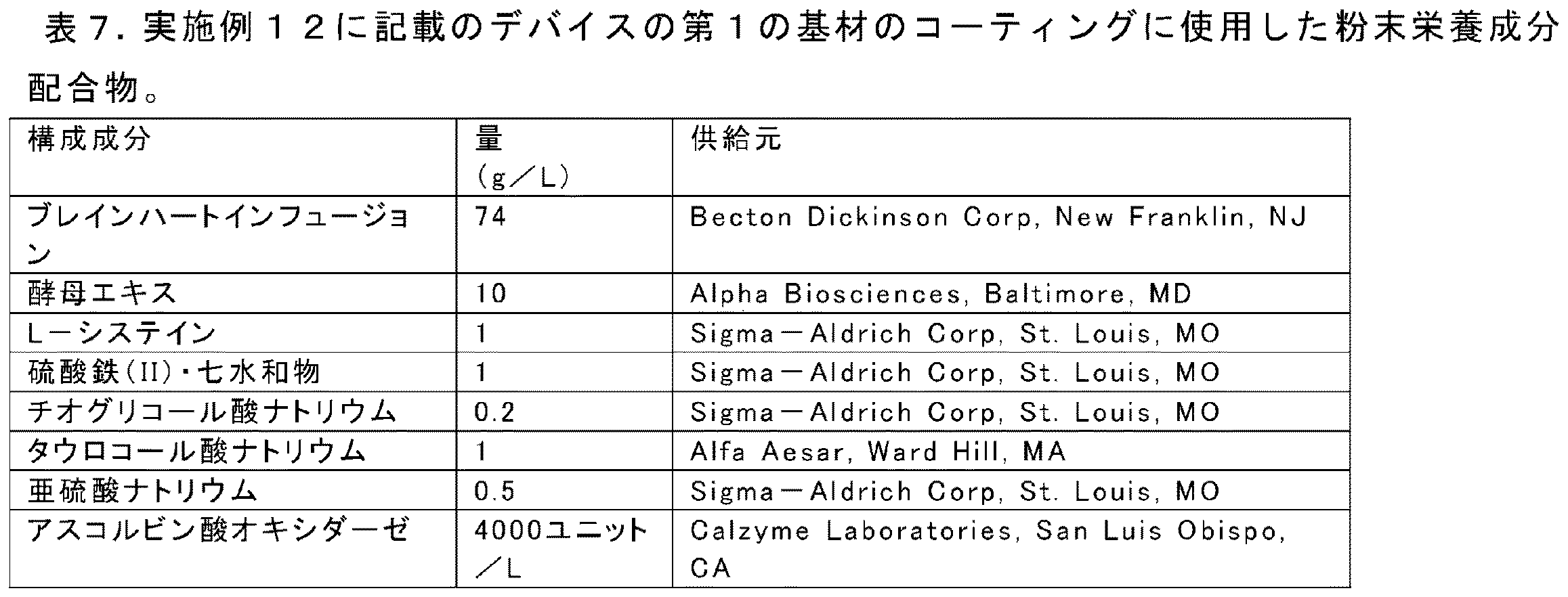
実施例2 Example 2
実施例1に記載の粉体混合物によりコーティングする代わりに、第2の基材の接着剤をグアーガム(89.7重量%)、アスコルビン酸ナトリウム(10重量%)、及び炭酸水素ナトリウム(0.3重量%)の粉体混合物でコーティングしたことを除き、実施例1の記載に従って内蔵型嫌気性環境生成培養デバイスが作製された。 Instead of coating with the powder mixture described in Example 1, the second substrate adhesive was guar gum (89.7 wt%), sodium ascorbate (10 wt%), and sodium bicarbonate (0.3 wt%). A built-in anaerobic environment-generating culture device was made as described in Example 1 except that it was coated with a weight percent powder mixture.
実施例3 Example 3
実施例1に記載の粉体混合物によりコーティングする代わりに、第2の基材の接着剤をグアーガム(89.5重量%)、アスコルビン酸ナトリウム(10重量%)、及び炭酸水素ナトリウム(0.5重量%)の粉体混合物でコーティングしたことを除き、実施例1の記載に従って内蔵型嫌気性環境生成培養デバイスが作製された。 Instead of coating with the powder mixture described in Example 1, the second substrate adhesive was guar gum (89.5 wt%), sodium ascorbate (10 wt%), and sodium bicarbonate (0.5 wt%). A built-in anaerobic environment-generating culture device was made as described in Example 1 except that it was coated with a weight percent powder mixture.
実施例4 Example 4
実施例1に記載の粉体混合物によりコーティングする代わりに、第2の基材の接着剤をグアーガム(89.0重量%)、アスコルビン酸ナトリウム(10重量%)、及び炭酸水素ナトリウム(1.0重量%)の粉体混合物でコーティングしたことを除き、実施例1の記載に従って内蔵型嫌気性環境生成培養デバイスが作製された。 Instead of coating with the powder mixture described in Example 1, the second substrate adhesive was guar gum (89.0 wt%), sodium ascorbate (10 wt%), and sodium bicarbonate (1.0 wt%). A built-in anaerobic environment-generating culture device was made as described in Example 1 except that it was coated with a weight percent powder mixture.
実施例5 Example 5
実施例1に記載の粉体混合物によりコーティングする代わりに、第2の基材の接着剤をグアーガム(88.0重量%)、アスコルビン酸ナトリウム(10重量%)、及び炭酸水素ナトリウム(2.0重量%)の粉体混合物でコーティングしたことを除き、実施例1の記載に従って内蔵型嫌気性環境生成培養デバイスが作製された。 Instead of coating with the powder mixture described in Example 1, the second substrate adhesive was guar gum (88.0 wt%), sodium ascorbate (10 wt%), and sodium bicarbonate (2.0%). A built-in anaerobic environment-generating culture device was made as described in Example 1 except that it was coated with a weight percent powder mixture.
実施例6.実施例1〜5に記載のデバイスにおけるCO2濃度測定 Example 6 Measurement of CO 2 concentration in the devices described in Examples 1-5
実施例1〜5に記載の内蔵型嫌気性環境生成培養デバイスを、pCO2 mini v2 fiber optic transmitter(PreSens Precision Sensing GmbH,Regensburg,DE cat# 200001207)を使用し、供給元より提供されたCO2分圧を測定するソフトウェアを用い、CO2生成についてモニターした。カバーシートを持ちあげ、各デバイスを開き、生育区画の生育領域を露出させた。1ミリリットルの無菌のバターフィールド緩衝液を各プレートの生育区画に配置した。薄型CO2センサ(直径5mm及び厚さ200マイクロメートル)(Planar pCO2 Minisensor Spot,PreSens Precision Sensing GmbH,cat# 200001178)を、水和した生育区画に直接配置し、カバーシートを、水和した生育領域及びスペーサーと接触するまで静かに下ろした。閉じたデバイスに対し平らなプラスチック製スプレッダを押し付け、生育区画全体に液体を広げた。デバイスを閉じた後、ポリマー光ファイバーを使用して、センサからの蛍光をモニターした。デバイスを閉じた直後及び90分後に、水和した生育区画におけるCO2濃度の測定値を記録した。表2では、90分後に測定されたCO2濃度の平均な上昇倍率を報告する(n=5)。 The built-in anaerobic environment generation culture device according to Example 1~5, pCO 2 mini v2 fiber optic transmitter (PreSens Precision Sensing GmbH, Regensburg, DE cat # 200001207) using, CO 2, which was provided by the supplier Software for measuring partial pressure was used to monitor for CO 2 production. The cover sheet was lifted, each device was opened, and the growing area of the growing section was exposed. One milliliter of sterile butterfield buffer was placed in the growth compartment of each plate. A thin CO 2 sensor (diameter 5 mm and thickness 200 micrometers) (Planar pCO 2 Minisensor Spot, PreSens Precision Sensing GmbH, cat # 200001178) was placed directly in the hydrated growth compartment and the cover sheet was hydrated. Gently lowered until contact with area and spacer. A flat plastic spreader was pressed against the closed device to spread the liquid throughout the growth compartment. After closing the device, polymer optical fiber was used to monitor fluorescence from the sensor. Immediately after closing the device and 90 minutes later, measurements of CO 2 concentration in the hydrated growth compartment were recorded. Table 2 reports the average rate of increase in CO 2 concentration measured after 90 minutes (n = 5).
実施例7.内蔵型嫌気性環境生成培養デバイスの作製及び使用 Example 7 Production and use of built-in anaerobic environment-generating culture device
図1の培養デバイスに従う内蔵型嫌気性環境生成培養デバイスを作製した。グアーガム(14g/L)を表1の配合物の代わりに表3の栄養成分配合物と組み合わせたことのみを除き、実施例1に記載の手順に従って第1の基材をコーティングし、作製した。 A built-in anaerobic environment-generating culture device according to the culture device of FIG. 1 was prepared. A first substrate was coated and made according to the procedure described in Example 1 except that guar gum (14 g / L) was only combined with the nutritional ingredient formulation of Table 3 instead of the formulation of Table 1.
アスコルビン酸ナトリウム(Sigma−Aldrich Corporation(St.Louis,Mo))及び炭酸水素ナトリウム(Sigma−Aldrich Corporation)をそれぞれ粉砕した後、140番のメッシュシーブでふるいにかけた(106マイクロメートル未満の粒径が得られる)。グアーガム(89.7重量%、DuPont Danisco(Copenhagen,Denmark)から入手可能)、ふるいにかけたアスコルビン酸ナトリウム(10重量%)、及びふるいにかけた炭酸水素ナトリウム(0.3重量%)の均質な混合物を調製した。第2の基材は、コーティング量が0.2g/24in2(1.3mg/cm2)になるよう第2の感圧接着剤(4%のアクリルアミドと共重合させた96重量%のイソオクチルアクリレート)を片面にコーティングした透明なポリエステル(PET)(厚さ0.073mm)フィルムから構成された。微量のトリフェニルトリフェニルテトラゾリウムクロリド(約0.48mg/24in2(0.003mg/cm2))を接着剤に組み入れた。グアーガム、ふるいにかけたアスコルビン酸ナトリウム、及びふるいにかけた炭酸水素ナトリウムの均質な混合物を、次に第2の基材の接着剤上にパウダーコーティングした。両面接着テープを使用して、片端部に沿って第2の基材を第1の基材に貼り合わせ、このデバイスを図1に示すものと同様の約3”(7.6cm)×4”(10.1cm)の長方形に切り取った。第2の基材のコーティング面をスペーサー及び生育区画に向けた。 Sodium ascorbate (Sigma-Aldrich Corporation (St. Louis, Mo)) and sodium hydrogen carbonate (Sigma-Aldrich Corporation) were each crushed and sieved through a No. 140 mesh sieve (particle size less than 106 micrometers). can get). A homogeneous mixture of guar gum (89.7 wt%, available from DuPont Danisco (Copenhagen, Denmark), screened sodium ascorbate (10 wt%), and screened sodium bicarbonate (0.3 wt%) Was prepared. The second substrate was a second pressure sensitive adhesive (96% by weight isooctyl copolymerized with 4% acrylamide) so that the coating amount was 0.2 g / 24 in 2 (1.3 mg / cm 2 ). It was composed of a transparent polyester (PET) (thickness 0.073 mm) film coated on one side with (acrylate). A small amount of triphenyltriphenyltetrazolium chloride (approximately 0.48 mg / 24 in 2 (0.003 mg / cm 2 )) was incorporated into the adhesive. A homogeneous mixture of guar gum, sieved sodium ascorbate, and sieved sodium bicarbonate was then powder coated onto the second substrate adhesive. Using a double-sided adhesive tape, the second substrate is laminated to the first substrate along one end and the device is approximately 3 "(7.6 cm) x 4" similar to that shown in FIG. Cut into a (10.1 cm) rectangle. The coated surface of the second substrate was directed to the spacer and the growth compartment.
細菌株の、ラクトバシラス種、ロイコノストック・メセンテロイデス亜種メセンテロイデス、ロイコノストック・メセンテロイデス亜種デキストラニクム(dextranicum)、ラクトバシラス・ブレビス、ラクトバシラス・プランタルム、ラクトバシラス・デルブリュッキ(Lactobacillus delbruekii)、ストレプトコッカス・アラクトリチクス(Streptococcus alactolyticus)、ラクトコッカス・ガルビエ、及びペディオコッカス・アシディラクティシの各試料を食品試料から天然単離物として得た。バターフィールド緩衝液で各懸濁物を調製し、段階希釈して、約100のCFU数となる(各微生物)濃度を有する最終懸濁物を得た。1ミリリットルの各懸濁液を使用して、本実施例に従って作製された個々の培養デバイスに接種した。培養デバイスは、カバーシートを持ち上げて生育区画の生育領域を露出させ、生育領域に1ミリリットルの懸濁液を滴下し、カバーシートを懸濁液及びスペーサーと接触するまで静かに下ろし、閉じたデバイス上で平坦なプラスチック製スプレッダを静かに押して生育区画全体に懸濁液を広げることにより接種した。 Lactobacillus delbruekii, Lactobacillus delbruekii, Streptococcus, Lactobacillus delbruekii, Lactobacillus delbruekii, Lactobacillus delbruekii, Streptococcus, Lactobacillus delbruekii, Streptococcus ), Lactococcus garbier, and Pediococcus acidilactici samples were obtained as natural isolates from food samples. Each suspension was prepared with butterfield buffer and serially diluted to obtain a final suspension having a concentration (each microorganism) of about 100 CFU numbers. One milliliter of each suspension was used to inoculate individual culture devices made according to this example. The culture device lifts the cover sheet to expose the growth area of the growth compartment, drops 1 ml of suspension onto the growth area, gently lowers the cover sheet until it comes into contact with the suspension and the spacer, and then closes the device. The seed was inoculated by gently pushing the flat plastic spreader above to spread the suspension throughout the growth compartment.
接種後、培養デバイスを32℃の好気性インキュベータで48時間インキュベートした。インキュベート後、各培養デバイスの赤色のコロニーを目視検査により計数した。各細菌の平均のコロニー数(n=2)を求めた。 After inoculation, the culture device was incubated for 48 hours in an aerobic incubator at 32 ° C. After incubation, red colonies on each culture device were counted by visual inspection. The average number of colonies (n = 2) for each bacterium was determined.
比較対照として、寒天プレートには、本実施例の培養デバイスについて上記で使用したものと同じ希釈度及び用量で各懸濁物も接種した。Lactobacilli MRS Agar(Becton Dickinson Corporation(New Franklin,NJ))を使用して寒天プレートを作製した。寒天(70g)を1Lの純水に段階的に懸濁し、1分間沸騰させて粉末を溶解させ、121℃で15分間オートクレーブ処理し、45〜50℃に冷却した。次に、放冷した培地(ディッシュあたり15〜20mL)を、1mLの各試料懸濁物を入れた無菌ペトリ皿に注ぎ入れた。プレートを一方向に旋回させ、次に逆方向に旋回させて接種菌液を培地全体に広げさせた。接種したディッシュを、インキュベート期間を通じて嫌気性雰囲気を与えるガス生成サシェ(GASPAK EZ Anaerobe Sachet,Becton Dickinson Corp.)と共に嫌気性チャンバ内に置いた。寒天プレートを32℃で48時間インキュベートした。インキュベート後、プレート上のコロニーを目視検査により計数した。各細菌の平均のコロニー数(n=2)を求めた。 As a comparative control, agar plates were also inoculated with each suspension at the same dilution and dose as used above for the culture device of this example. Agar plates were made using Lactobacilli MRS Agar (Becton Dickinson Corporation (New Franklin, NJ)). Agar (70 g) was suspended stepwise in 1 L of pure water, boiled for 1 minute to dissolve the powder, autoclaved at 121 ° C. for 15 minutes, and cooled to 45-50 ° C. Next, the cooled medium (15-20 mL per dish) was poured into a sterile petri dish containing 1 mL of each sample suspension. The plate was swung in one direction and then swung in the opposite direction to spread the inoculum solution throughout the medium. The inoculated dishes were placed in an anaerobic chamber with a gas generating sachet (GASPAK EZ Anaerobe Sachet, Becton Dickinson Corp.) that provided an anaerobic atmosphere throughout the incubation period. Agar plates were incubated at 32 ° C. for 48 hours. After incubation, colonies on the plate were counted by visual inspection. The average number of colonies (n = 2) for each bacterium was determined.
表4では、実施例の培養デバイスを使用して求められた平均のコロニー数と、対照寒天プレートを使用して求められた平均のコロニー数とを比較した比を、検査した微生物ごとに示す[すなわち、比=(実施例の培養デバイスを使用した平均のコロニー数)/(対照寒天プレートを使用した平均のコロニー数)]。 In Table 4, the ratio of the average number of colonies determined using the culture device of the example to the average number of colonies determined using the control agar plate is shown for each microorganism examined [ That is, ratio = (average number of colonies using culture device of example) / (average number of colonies using control agar plate)].
実施例8.内蔵型嫌気性環境生成培養デバイスの作製。 Example 8 FIG. Built-in anaerobic environment-generating culture device.
図1の培養デバイスに従う内蔵型嫌気性環境生成培養デバイスを作製した。ベース材は、厚さ5mil(0.127mm)のポリエステルフィルム(MELINEX等級377二軸延伸ポリエステル(PET)フィルム、DuPont Teijinから入手)から構成された。粉末栄養成分配合物(表5に掲載)及びグアーガム(13g/L)を脱イオン水中で撹拌し、実質的に均一な混合物とした。混合物のpHは、7.2+/−0.5を目標とし、目標値に合わせる必要がある場合には、酸又は塩基により調整した。本混合物を米国特許第4,565,783号に記載されているようにベース材上にナイフコーティングし、対流式オーブン内で210°F(98.9℃)で9分間、乾燥させた。栄養成分層を、0.325g/24in2(2.1mg/cm2)の目標コーティング重量(乾燥後)が得られる厚さにコーティングした。乾燥後、厚さ約20mil(0.508mm)のポリエチレンフィルムのスペーサー部材(Optimum Plastics)を、第1の基材上の乾燥したコーティングに、感圧接着剤(98重量%のイソオクチルアクリレートと2重量%のアクリル酸との共重合体)の薄層を介して接着させた。スペーサー部材は、デバイスの生育区画の位置を画定する直径2インチ(5.1cm)の円型の開口部を含んだ。 A built-in anaerobic environment-generating culture device according to the culture device of FIG. 1 was prepared. The base material consisted of a 5 mil (0.127 mm) thick polyester film (MELINEX grade 377 biaxially oriented polyester (PET) film, obtained from DuPont Teijin). A powdered nutritional ingredient formulation (listed in Table 5) and guar gum (13 g / L) were stirred in deionized water to form a substantially uniform mixture. The pH of the mixture was adjusted to 7.2 +/− 0.5, and adjusted with acid or base when it was necessary to adjust to the target value. The mixture was knife coated onto the base material as described in US Pat. No. 4,565,783 and dried in a convection oven at 210 ° F. (98.9 ° C.) for 9 minutes. The nutrient layer was coated to a thickness that yielded a target coating weight (after drying) of 0.325 g / 24 in 2 (2.1 mg / cm 2 ). After drying, a polyethylene film spacer member (Optimum Plastics) about 20 mil (0.508 mm) thick is applied to the dried coating on the first substrate with a pressure sensitive adhesive (98 wt% isooctyl acrylate and 2%). A thin layer of (copolymer with weight percent acrylic acid) was adhered through. The spacer member included a 2 inch (5.1 cm) diameter circular opening that defined the location of the growth compartment of the device.
アスコルビン酸ナトリウム(Sigma−Aldrich)及び炭酸水素ナトリウム(Sigma−Aldrich)をそれぞれ粉砕した後、140番のメッシュシーブでふるいにかけた(106マイクロメートル未満の粒径が得られる)。グアーガム(99.15重量%、DuPont Danisco(Copenhagen,Denmark)から入手可能)、ふるいにかけたアスコルビン酸ナトリウム(0.25重量%)、及びふるいにかけた炭酸水素ナトリウム(0.6重量%)の均質な混合物を調製した。カバーシートは、コーティング量が0.2g/24in2(1.3mg/cm2)になるよう第2の感圧接着剤(4%のアクリルアミドと共重合させた96重量%のイソオクチルアクリレート)を片面にコーティングした透明なポリエステル(PET)フィルム(厚さ0.073mm)から構成された。グアーガム、ふるいにかけたアスコルビン酸ナトリウム、及びふるいにかけた炭酸水素ナトリウムの均質な混合物を、次にカバーシートの接着剤上にパウダーコーティングした。両面接着テープを使用して、片端部に沿ってカバーシートを第1の基材に貼り合わせ、このデバイスを図1に示すものと同様の約3”(7.6cm)×4”(10.1cm)の長方形に切り取った。カバーシートのコーティング面をスペーサー部材及び生育区画に向けた。 Sodium ascorbate (Sigma-Aldrich) and sodium bicarbonate (Sigma-Aldrich) were each crushed and then sieved through a # 140 mesh sieve (resulting in a particle size of less than 106 micrometers). Homogeneity of guar gum (99.15 wt%, available from DuPont Danisco (Copenhagen, Denmark), screened sodium ascorbate (0.25 wt%), and screened sodium bicarbonate (0.6 wt%) A mixture was prepared. The cover sheet was coated with a second pressure sensitive adhesive (96% by weight isooctyl acrylate copolymerized with 4% acrylamide) so that the coating amount was 0.2 g / 24 in 2 (1.3 mg / cm 2 ). It was composed of a transparent polyester (PET) film (thickness 0.073 mm) coated on one side. A homogenous mixture of guar gum, sieved sodium ascorbate, and sieved sodium bicarbonate was then powder coated onto the cover sheet adhesive. A double-sided adhesive tape was used to bond the cover sheet to the first substrate along one end, and the device was approximately 3 "(7.6 cm) x 4" (10. 1 cm). The coating surface of the cover sheet was directed to the spacer member and the growth compartment.
実施例9.内蔵型嫌気性環境生成培養デバイスの作製。 Example 9 Built-in anaerobic environment-generating culture device.
実施例8に記載の粉体混合物によりコーティングする代わりに、カバーシートの接着剤をグアーガム(97.25重量%)、アスコルビン酸ナトリウム(0.25重量%)、及び炭酸水素ナトリウム(2.5重量%)の粉体混合物でコーティングしたことを除き、実施例8に記載の手順に従って内蔵型嫌気性環境生成培養デバイスが作製された。 Instead of coating with the powder mixture described in Example 8, the cover sheet adhesive was guar gum (97.25 wt%), sodium ascorbate (0.25 wt%), and sodium bicarbonate (2.5 wt%). %)). A self-contained anaerobic environment-generating culture device was made according to the procedure described in Example 8 except that it was coated with the powder mixture.
実施例10.内蔵型嫌気性環境生成培養デバイスの作製。 Example 10 Built-in anaerobic environment-generating culture device.
実施例8に記載の粉体混合物によりコーティングする代わりに、カバーシートの接着剤をグアーガム(95.75重量%)、アスコルビン酸ナトリウム(0.25重量%)、及び炭酸水素ナトリウム(4重量%)の粉体混合物でコーティングしたことを除き、実施例8に記載の手順に従って内蔵型嫌気性環境生成培養デバイスが作製された。 Instead of coating with the powder mixture described in Example 8, the adhesive of the cover sheet was guar gum (95.75% by weight), sodium ascorbate (0.25% by weight), and sodium bicarbonate (4% by weight). A built-in anaerobic environment-generating culture device was made according to the procedure described in Example 8 except that it was coated with the powder mixture.
実施例11.実施例8〜10に記載のデバイスにおけるCO2濃度測定 Example 11 Measurement of CO 2 concentration in the devices described in Examples 8-10
実施例6に記載の手順を使用して、CO2生成について、実施例8〜10に記載の内蔵型嫌気性環境生成培養デバイスをモニターした。表6では、90分後に測定されたCO2濃度の平均な上昇倍率を報告する(n=5)。 The built-in anaerobic environment producing culture device described in Examples 8-10 was monitored for CO 2 production using the procedure described in Example 6. Table 6 reports the average rate of increase in CO 2 concentration measured after 90 minutes (n = 5).
実施例12.内蔵型嫌気性環境生成培養デバイスの作製。 Example 12 Built-in anaerobic environment-generating culture device.
図1の培養デバイスに従う内蔵型嫌気性環境生成培養デバイスを作製した。ベース材は、厚さ5mil(0.127mm)のポリエステルフィルム(MELINEX等級377二軸延伸ポリエステル(PET)フィルム、DuPont Teijinから入手)から構成された。粉末栄養成分配合物(表7に掲載)及びグアーガム(13g/L)を脱イオン水中で撹拌し、実質的に均一な混合物とした。混合物のpHは、7.2+/−0.5を目標とし、目標値に合わせる必要がある場合には、酸又は塩基により調整した。本混合物を米国特許第4,565,783号に記載されているようにベース材上にナイフコーティングし、対流式オーブン内で210°F(98.9℃)で8分間、乾燥させた。栄養成分層を、0.348g/24in2(2.25mg/cm2)の目標コーティング重量(乾燥後)が得られる厚さにコーティングした。乾燥後、厚さ約20mil(0.508mm)のポリエチレンフィルムのスペーサー部材(Optimum Plastics)を、ベース材上の乾燥したコーティングに、感圧接着剤(98重量%のイソオクチルアクリレートと2重量%のアクリル酸との共重合体)の薄層を介して接着させた。スペーサー部材は、デバイスの生育区画の境界を画定する直径2 3/8インチ(6.0cm)の円型の開口部を含む。 A built-in anaerobic environment-generating culture device according to the culture device of FIG. 1 was prepared. The base material consisted of a 5 mil (0.127 mm) thick polyester film (MELINEX grade 377 biaxially oriented polyester (PET) film, obtained from DuPont Teijin). Powdered nutritional ingredient blends (listed in Table 7) and guar gum (13 g / L) were stirred in deionized water to form a substantially uniform mixture. The pH of the mixture was adjusted to 7.2 +/− 0.5, and adjusted with acid or base when it was necessary to adjust to the target value. The mixture was knife coated onto the base material as described in US Pat. No. 4,565,783 and dried in a convection oven at 210 ° F. (98.9 ° C.) for 8 minutes. The nutrient layer was coated to a thickness that yielded a target coating weight (after drying) of 0.348 g / 24 in 2 (2.25 mg / cm 2 ). After drying, a polyethylene film spacer member (Optimum Plastics) about 20 mil (0.508 mm) thick is applied to the dried coating on the base material with a pressure sensitive adhesive (98 wt% isooctyl acrylate and 2 wt%). It was bonded via a thin layer of a copolymer with acrylic acid. The spacer member includes a 23/8 inch (6.0 cm) diameter circular opening that delimits the growth compartment of the device.
アスコルビン酸ナトリウム(Sigma−Aldrich Corporation)及び炭酸水素ナトリウム(Sigma−Aldrich)をそれぞれ粉砕した後、140番のメッシュシーブでふるいにかけた(106マイクロメートル未満の粒径が得られる)。グアーガム(89重量%、DuPont Danisco(Copenhagen,Denmark)から入手可能)、ふるいにかけたアスコルビン酸ナトリウム(10重量%)、及びふるいにかけた炭酸水素ナトリウム(1重量%)の均質な混合物を調製した。カバーシートは、コーティング量が0.2g/24in2(1.3mg/cm2)になるよう第2の感圧接着剤(4%のアクリルアミドと共重合させた96重量%のイソオクチルアクリレート)を片面にコーティングした透明なポリエステル(PET)フィルム(厚さ0.073mm)から構成された。グアーガム、ふるいにかけたアスコルビン酸ナトリウム、及びふるいにかけた炭酸水素ナトリウムの均質な混合物を、次にカバーシートの接着剤上にパウダーコーティングした。両面接着テープを使用して、片端部に沿ってカバーシートをベース材に貼り合わせ、このデバイスを図1に示すものと同様の約3”(7.6cm)×4”(10.1cm)の長方形に切り取った。カバーシートのコーティング面をスペーサー部材及び生育区画に向けた。 Sodium ascorbate (Sigma-Aldrich Corporation) and sodium bicarbonate (Sigma-Aldrich) were each crushed and then screened with a # 140 mesh sieve (particle sizes less than 106 micrometers were obtained). A homogeneous mixture of guar gum (89% by weight, available from DuPont Danisco (Copenhagen, Denmark)), screened sodium ascorbate (10% by weight), and screened sodium bicarbonate (1% by weight) was prepared. The cover sheet was coated with a second pressure sensitive adhesive (96% by weight isooctyl acrylate copolymerized with 4% acrylamide) so that the coating amount was 0.2 g / 24 in 2 (1.3 mg / cm 2 ). It was composed of a transparent polyester (PET) film (thickness 0.073 mm) coated on one side. A homogenous mixture of guar gum, sieved sodium ascorbate, and sieved sodium bicarbonate was then powder coated onto the cover sheet adhesive. A double-sided adhesive tape was used to attach the cover sheet to the base material along one end, and the device was approximately 3 "(7.6 cm) x 4" (10.1 cm) as shown in FIG. Cut into a rectangle. The coating surface of the cover sheet was directed to the spacer member and the growth compartment.
実施例13.内蔵型嫌気性環境生成培養デバイスの作製。 Example 13 Built-in anaerobic environment-generating culture device.
実施例12に記載の粉体混合物でコーティングする代わりに、カバーシートの接着剤をグアーガム(87.5重量%)、アスコルビン酸ナトリウム(10重量%)、及び炭酸水素ナトリウム(2.5重量%)の粉体混合物でコーティングしたことを除き、実施例12の記載に従って内蔵型嫌気性環境生成培養デバイスが作製された。 Instead of coating with the powder mixture described in Example 12, the adhesive of the cover sheet was guar gum (87.5 wt%), sodium ascorbate (10 wt%), and sodium bicarbonate (2.5 wt%). A built-in anaerobic environment-generating culture device was made as described in Example 12, except that it was coated with the powder mixture.
実施例14.内蔵型嫌気性環境生成培養デバイスの作製。 Example 14 Built-in anaerobic environment-generating culture device.
実施例12に記載の粉体混合物によりコーティングする代わりに、カバーシートの接着剤をグアーガム(85重量%)、アスコルビン酸ナトリウム(10重量%)、及び炭酸水素ナトリウム(5重量%)の粉体混合物でコーティングしたことを除き、実施例12の記載に従って内蔵型嫌気性環境生成培養デバイスが作製された。 Instead of coating with the powder mixture described in Example 12, the cover sheet adhesive was a powder mixture of guar gum (85 wt%), sodium ascorbate (10 wt%), and sodium bicarbonate (5 wt%). A built-in anaerobic environment-generating culture device was made as described in Example 12, except that it was coated with.
実施例15.内蔵型嫌気性環境生成培養デバイスの作製。 Example 15. Built-in anaerobic environment-generating culture device.
実施例12に記載の粉体混合物によりコーティングする代わりに、カバーシートの接着剤をグアーガム(80重量%)、アスコルビン酸ナトリウム(10重量%)、及び炭酸水素ナトリウム(10重量%)の粉体混合物でコーティングしたことを除き、実施例12の記載に従って内蔵型嫌気性環境生成培養デバイスが作製された。 Instead of coating with the powder mixture described in Example 12, the cover sheet adhesive was a powder mixture of guar gum (80 wt%), sodium ascorbate (10 wt%), and sodium bicarbonate (10 wt%). A built-in anaerobic environment-generating culture device was made as described in Example 12, except that it was coated with.
実施例16.実施例12〜15に記載のデバイスにおけるCO2濃度測定。 Example 16 CO 2 concentration measurement in the device according to Example 12-15.
実施例6に記載の手順を使用して、CO2生成について、実施例12〜15に記載のの内蔵型嫌気性環境生成培養デバイスをモニターした。表8では、90分後に測定されたCO2濃度の平均な上昇倍率を報告する(n=5)。 Using the procedure described in Example 6, the CO 2 produced was monitored internal anaerobic environment generation culture device of described in Example 12-15. Table 8 reports the average rate of increase in CO 2 concentration measured after 90 minutes (n = 5).
本明細書に引用するすべての特許、特許出願及び公開公報、並びに電子的に入手可能な資料の開示内容の全体を、参照により援用する。本出願の開示内容と本明細書に援用されたいずれかの文書の開示内容との間になんらかの矛盾が存在する場合には、本出願の開示内容が優先するものとする。上記の詳細な説明及び実施例は、理解しやすいように示したものにすぎない。それによって不要な限定がなされるものではない。本発明は図示及び記載された細部そのものに限定されず、当業者に明白な変形形態は、特許請求の範囲によって定義される本発明の範囲内に含まれる。 The entire disclosure of all patents, patent applications and publications, and electronically available materials cited herein are hereby incorporated by reference. In the event of any inconsistency between the disclosure content of this application and the disclosure content of any document incorporated herein, the disclosure content of this application shall prevail. The foregoing detailed description and examples have been given for clarity of understanding only. This does not make unnecessary limitations. The invention is not limited to the exact details shown and described, but variations obvious to one skilled in the art are included within the scope of the invention as defined by the claims.
すべての見出しは読者の便宜のためのものであり、明記しない限り、見出しに続く文の意味を限定するために使用されるものではない。 All headings are for the convenience of the reader and are not used to limit the meaning of the text following the heading, unless otherwise specified.
本発明の趣旨及び範囲から逸脱することなく様々な修正を行うことが可能である。これらの実施形態及び他の実施形態は、以下の特許請求の範囲に含まれるものである。 Various modifications can be made without departing from the spirit and scope of the invention. These and other embodiments are within the scope of the following claims.
Claims (20)
反対面となる内側表面及び外側表面を有するベース材と、
反対面となる内側表面及び外側表面を有するカバーシートと、
前記ベース材と前記カバーシートとの間に配置されたスペーサー部材であって、前記ベース材又は前記カバーシートに結合されており、生育区画の形状及び深さを画定する開口部を含み、前記スペーサー部材及び前記生育区画が、前記ベース材の前記内側表面と前記カバーシートの前記内側表面との間に配置されている、スペーサー部材と、
前記生育区画において前記ベース材に接着された第1の接着剤層、又は前記生育区画において前記カバーシートに接着された第2の接着剤層と、
前記生育区画において前記第1の接着剤層又は前記第2の接着剤層に付着した有効量の乾燥状態の二酸化炭素発生剤と、
前記生育区画において、前記ベース材又は前記カバーシートに付着した乾燥状態の冷水溶解性ゲル化剤と、を含み、
前記カバーシートが、前記ベース材又は前記スペーサー部材に結合されている、培養デバイス。 A culture device for counting microbial colonies,
A base material having inner and outer surfaces that are opposite surfaces;
A cover sheet having an inner surface and an outer surface that are opposite surfaces;
A spacer member disposed between the base material and the cover sheet, the spacer member being coupled to the base material or the cover sheet, and including an opening that defines the shape and depth of a growth compartment, and the spacer A spacer member, wherein the member and the growth compartment are disposed between the inner surface of the base material and the inner surface of the cover sheet;
A first adhesive layer bonded to the base material in the growing section, or a second adhesive layer bonded to the cover sheet in the growing section;
An effective amount of a dry carbon dioxide generator attached to the first adhesive layer or the second adhesive layer in the growing compartment;
In the growing compartment, including a dry cold water soluble gelling agent attached to the base material or the cover sheet,
The culture device, wherein the cover sheet is bonded to the base material or the spacer member.
前記生育区画に配置された1つ以上の第1の成分が、前記第1の接着剤に付着しており、
前記第1の成分が、ゲル化剤、脱酸素剤、緩衝剤、栄養成分、指示薬、選択剤、還元剤、及び前述の第1の成分のうちのいずれか2つ以上の組み合わせ、からなる群から選択される、請求項1〜10のいずれか一項に記載の培養デバイス。 The inner surface of the base material has the first adhesive bonded to the inner surface;
One or more first components disposed in the growing compartment are attached to the first adhesive;
The first component is a group consisting of a gelling agent, an oxygen scavenger, a buffer, a nutritional component, an indicator, a selective agent, a reducing agent, and a combination of any two or more of the first components. The culture device according to any one of claims 1 to 10, which is selected from the following.
請求項1〜13のいずれか一項に記載の培養デバイスを、その内部の前記生育区画へのアクセスを提供する開いた構成で配置することと、
所定量の水性液体を前記生育区画に配置することと、
試料を前記生育区画に配置することと、
前記培養デバイスを閉じることと、
培養培地において微生物コロニーを形成させるのに十分な一定時間にわたり前記培養デバイスをインキュベートすることと、
前記微生物コロニーを検出することと、を含み、
前記水性液体及び前記試料を前記生育区画に配置すること、並びに、前記培養デバイスを閉じることが、前記培養デバイスの前記ベース材、前記カバーシート及びスペーサーにより取り囲まれた半固体の微生物培養培地を形成することを含む、方法。 A method for detecting microorganisms in a sample, comprising:
Arranging the culture device according to any one of claims 1 to 13 in an open configuration providing access to the growth compartment therein;
Placing a predetermined amount of aqueous liquid in the growth compartment;
Placing a sample in the growth compartment;
Closing the culture device;
Incubating the culture device for a period of time sufficient to form microbial colonies in the culture medium;
Detecting the microbial colony,
Placing the aqueous liquid and the sample in the growth compartment and closing the culture device forms a semi-solid microbial culture medium surrounded by the base material, the cover sheet and the spacer of the culture device. A method comprising:
Applications Claiming Priority (3)
| Application Number | Priority Date | Filing Date | Title |
|---|---|---|---|
| US201562154303P | 2015-04-29 | 2015-04-29 | |
| US62/154,303 | 2015-04-29 | ||
| PCT/US2016/029309 WO2016176178A1 (en) | 2015-04-29 | 2016-04-26 | Thin film culture device with carbon dioxide generant |
Publications (2)
| Publication Number | Publication Date |
|---|---|
| JP2018514213A true JP2018514213A (en) | 2018-06-07 |
| JP6452853B2 JP6452853B2 (en) | 2019-01-16 |
Family
ID=56027162
Family Applications (1)
| Application Number | Title | Priority Date | Filing Date |
|---|---|---|---|
| JP2017556570A Active JP6452853B2 (en) | 2015-04-29 | 2016-04-26 | Thin film culture device with carbon dioxide generator |
Country Status (7)
| Country | Link |
|---|---|
| US (1) | US10723992B2 (en) |
| EP (1) | EP3289061B1 (en) |
| JP (1) | JP6452853B2 (en) |
| KR (1) | KR101961238B1 (en) |
| CN (2) | CN107532126A (en) |
| BR (1) | BR112017023140B1 (en) |
| WO (1) | WO2016176178A1 (en) |
Cited By (2)
| Publication number | Priority date | Publication date | Assignee | Title |
|---|---|---|---|---|
| JP2018518158A (en) * | 2015-04-29 | 2018-07-12 | スリーエム イノベイティブ プロパティズ カンパニー | Anaerobic microorganism culture device |
| WO2020261951A1 (en) * | 2019-06-24 | 2020-12-30 | 三菱瓦斯化学株式会社 | Agent for regulating concentration of gas for anaerobic bacterium culture and method for culturing anaerobic bacterium using same |
Families Citing this family (4)
| Publication number | Priority date | Publication date | Assignee | Title |
|---|---|---|---|---|
| EP3724314A1 (en) | 2017-12-13 | 2020-10-21 | 3M Innovative Properties Company | Water-reconstitutable culture medium resistant to liquefaction by microorganisms |
| DE102018114206A1 (en) * | 2018-06-14 | 2019-12-19 | RUHR-UNIVERSITäT BOCHUM | Biosensor and method for producing one |
| WO2021170606A1 (en) * | 2020-02-26 | 2021-09-02 | Merck Patent Gmbh | Device and method for testing differential growth of microorganisms |
| US20230138304A1 (en) * | 2020-03-31 | 2023-05-04 | 3M Innovative Properties Company | Diagnostic Device |
Citations (5)
| Publication number | Priority date | Publication date | Assignee | Title |
|---|---|---|---|---|
| JPS5739776A (en) * | 1980-08-20 | 1982-03-05 | Mitsubishi Gas Chem Co Inc | Cultivation of anaerobic bacteria |
| JPS5856679A (en) * | 1981-09-30 | 1983-04-04 | Meito Kk | Method for culturing anaerobic bacteria and agent for controlling cultivation atmosphere |
| JPS61166391A (en) * | 1984-11-21 | 1986-07-28 | バイオタ,インコ−ポレイテツド | Anaerobic culture apparatus |
| JPH11506910A (en) * | 1995-06-02 | 1999-06-22 | ミネソタ マイニング アンド マニュファクチャリング カンパニー | Surface colony counting device and method of use |
| WO2005108545A2 (en) * | 2004-04-23 | 2005-11-17 | Cryovac, Inc. | Devices for culturing anaerobic microorganisms and methods of using the same |
Family Cites Families (18)
| Publication number | Priority date | Publication date | Assignee | Title |
|---|---|---|---|---|
| US4565783A (en) | 1981-01-27 | 1986-01-21 | Minnesota Mining And Manufacturing Company | Dry culture media |
| US4377554A (en) * | 1981-08-26 | 1983-03-22 | Becton, Dickinson And Company | Generation of microaerophilic atmosphere |
| US5089413A (en) | 1989-05-19 | 1992-02-18 | Minnesota Mining And Manufacturing Company | Method and apparatus for culturing with microbiological dry culture medium |
| US5232838A (en) | 1991-12-09 | 1993-08-03 | Minnesota Mining And Manufacturing Company | Culture media device and method of use |
| US5601998A (en) | 1994-08-18 | 1997-02-11 | Minnesota Mining & Mfg | Culture medium and device for detection and enumeration of enterobacteriaceae |
| US5958675A (en) * | 1997-04-18 | 1999-09-28 | 3M Innovative Properties Company | Method for detecting bacteria using bacteriophage, contrast-coloring dye and precipitable dye |
| US6689438B2 (en) | 2001-06-06 | 2004-02-10 | Cryovac, Inc. | Oxygen detection system for a solid article |
| US20040101954A1 (en) | 2002-11-27 | 2004-05-27 | Graessle Josef A. | Back side plate illumination for biological growth plate scanner |
| US20040102903A1 (en) | 2002-11-27 | 2004-05-27 | Graessle Josef A. | Biological growth plate scanner |
| US7496225B2 (en) | 2003-09-04 | 2009-02-24 | 3M Innovative Properties Company | Biological growth plate scanner with automated intake |
| US20110045470A1 (en) * | 2007-08-01 | 2011-02-24 | Hitachi Chemical Co., Ltd. | Pathogen detection in large-volume particulate samples |
| WO2010077619A1 (en) | 2008-12-09 | 2010-07-08 | 3M Innovative Properties Company | Methods and articles for detecting hemolytic microorganisms |
| KR20120039629A (en) * | 2009-06-15 | 2012-04-25 | 쓰리엠 이노베이티브 프로퍼티즈 컴파니 | Detection of acid-producing bacteria |
| WO2012092242A2 (en) * | 2010-12-29 | 2012-07-05 | 3M Innovative Properties Company | Microbial detection article having a water-absorbent filter assembly |
| BR112014002496A2 (en) * | 2011-08-02 | 2017-02-21 | 3M Innovative Properties Co | tool for use in handling a plurality of separate, linearly oriented caps, method of handling a plurality of capped tubes, tool for use in handling a cap having an upper surface with a depression, method of handling of a capped tube and method of handling a plurality of tubes |
| US8921067B2 (en) | 2013-02-04 | 2014-12-30 | 3M Innovative Properties Company | Method and culture device for detecting yeasts and molds |
| CN105683388A (en) | 2013-10-24 | 2016-06-15 | 3M创新有限公司 | Culture device and method for autonomously generating anaerobic environment |
| WO2016176176A1 (en) | 2015-04-29 | 2016-11-03 | 3M Innovative Properties Company | Culture device for anaerobic microorganisms |
-
2016
- 2016-04-26 BR BR112017023140-9A patent/BR112017023140B1/en active IP Right Grant
- 2016-04-26 CN CN201680024208.4A patent/CN107532126A/en active Pending
- 2016-04-26 KR KR1020177033171A patent/KR101961238B1/en active Active
- 2016-04-26 CN CN202110295388.2A patent/CN113174321A/en active Pending
- 2016-04-26 WO PCT/US2016/029309 patent/WO2016176178A1/en not_active Ceased
- 2016-04-26 JP JP2017556570A patent/JP6452853B2/en active Active
- 2016-04-26 US US15/569,451 patent/US10723992B2/en active Active
- 2016-04-26 EP EP16724158.7A patent/EP3289061B1/en active Active
Patent Citations (5)
| Publication number | Priority date | Publication date | Assignee | Title |
|---|---|---|---|---|
| JPS5739776A (en) * | 1980-08-20 | 1982-03-05 | Mitsubishi Gas Chem Co Inc | Cultivation of anaerobic bacteria |
| JPS5856679A (en) * | 1981-09-30 | 1983-04-04 | Meito Kk | Method for culturing anaerobic bacteria and agent for controlling cultivation atmosphere |
| JPS61166391A (en) * | 1984-11-21 | 1986-07-28 | バイオタ,インコ−ポレイテツド | Anaerobic culture apparatus |
| JPH11506910A (en) * | 1995-06-02 | 1999-06-22 | ミネソタ マイニング アンド マニュファクチャリング カンパニー | Surface colony counting device and method of use |
| WO2005108545A2 (en) * | 2004-04-23 | 2005-11-17 | Cryovac, Inc. | Devices for culturing anaerobic microorganisms and methods of using the same |
Cited By (3)
| Publication number | Priority date | Publication date | Assignee | Title |
|---|---|---|---|---|
| JP2018518158A (en) * | 2015-04-29 | 2018-07-12 | スリーエム イノベイティブ プロパティズ カンパニー | Anaerobic microorganism culture device |
| WO2020261951A1 (en) * | 2019-06-24 | 2020-12-30 | 三菱瓦斯化学株式会社 | Agent for regulating concentration of gas for anaerobic bacterium culture and method for culturing anaerobic bacterium using same |
| US12297420B2 (en) | 2019-06-24 | 2025-05-13 | Mitsubishi Gas Chemical Company, Inc. | Agent for regulating concentration of gas for anaerobic bacterium culture and method for culturing anaerobic bacterium using same |
Also Published As
| Publication number | Publication date |
|---|---|
| CN107532126A (en) | 2018-01-02 |
| BR112017023140A2 (en) | 2018-07-10 |
| US10723992B2 (en) | 2020-07-28 |
| KR20170134756A (en) | 2017-12-06 |
| WO2016176178A1 (en) | 2016-11-03 |
| EP3289061A1 (en) | 2018-03-07 |
| KR101961238B1 (en) | 2019-03-22 |
| CN113174321A (en) | 2021-07-27 |
| BR112017023140B1 (en) | 2021-10-19 |
| EP3289061B1 (en) | 2019-05-22 |
| JP6452853B2 (en) | 2019-01-16 |
| US20180298322A1 (en) | 2018-10-18 |
Similar Documents
| Publication | Publication Date | Title |
|---|---|---|
| JP7506986B2 (en) | Self-contained anaerobic environment generating culture device and method of use | |
| JP6920212B2 (en) | Culture device for anaerobic microorganisms | |
| JP6452853B2 (en) | Thin film culture device with carbon dioxide generator | |
| US20200140916A1 (en) | Culture device for lactic acid bacteria | |
| JP2021106588A (en) | Built-in anaerobic environment-generating culture apparatus |
Legal Events
| Date | Code | Title | Description |
|---|---|---|---|
| A521 | Request for written amendment filed |
Free format text: JAPANESE INTERMEDIATE CODE: A523 Effective date: 20171030 |
|
| A621 | Written request for application examination |
Free format text: JAPANESE INTERMEDIATE CODE: A621 Effective date: 20171030 |
|
| A871 | Explanation of circumstances concerning accelerated examination |
Free format text: JAPANESE INTERMEDIATE CODE: A871 Effective date: 20171030 |
|
| A975 | Report on accelerated examination |
Free format text: JAPANESE INTERMEDIATE CODE: A971005 Effective date: 20180307 |
|
| A131 | Notification of reasons for refusal |
Free format text: JAPANESE INTERMEDIATE CODE: A131 Effective date: 20180313 |
|
| RD03 | Notification of appointment of power of attorney |
Free format text: JAPANESE INTERMEDIATE CODE: A7423 Effective date: 20180528 |
|
| A601 | Written request for extension of time |
Free format text: JAPANESE INTERMEDIATE CODE: A601 Effective date: 20180612 |
|
| RD04 | Notification of resignation of power of attorney |
Free format text: JAPANESE INTERMEDIATE CODE: A7424 Effective date: 20180530 |
|
| A521 | Request for written amendment filed |
Free format text: JAPANESE INTERMEDIATE CODE: A523 Effective date: 20180904 |
|
| TRDD | Decision of grant or rejection written | ||
| A01 | Written decision to grant a patent or to grant a registration (utility model) |
Free format text: JAPANESE INTERMEDIATE CODE: A01 Effective date: 20181113 |
|
| A61 | First payment of annual fees (during grant procedure) |
Free format text: JAPANESE INTERMEDIATE CODE: A61 Effective date: 20181211 |
|
| R150 | Certificate of patent or registration of utility model |
Ref document number: 6452853 Country of ref document: JP Free format text: JAPANESE INTERMEDIATE CODE: R150 |
|
| R250 | Receipt of annual fees |
Free format text: JAPANESE INTERMEDIATE CODE: R250 |
|
| S111 | Request for change of ownership or part of ownership |
Free format text: JAPANESE INTERMEDIATE CODE: R313113 |
|
| R360 | Written notification for declining of transfer of rights |
Free format text: JAPANESE INTERMEDIATE CODE: R360 |
|
| R360 | Written notification for declining of transfer of rights |
Free format text: JAPANESE INTERMEDIATE CODE: R360 |
|
| R371 | Transfer withdrawn |
Free format text: JAPANESE INTERMEDIATE CODE: R371 |
|
| S111 | Request for change of ownership or part of ownership |
Free format text: JAPANESE INTERMEDIATE CODE: R313113 |
|
| R250 | Receipt of annual fees |
Free format text: JAPANESE INTERMEDIATE CODE: R250 |
|
| R350 | Written notification of registration of transfer |
Free format text: JAPANESE INTERMEDIATE CODE: R350 |
|
| R250 | Receipt of annual fees |
Free format text: JAPANESE INTERMEDIATE CODE: R250 |
|
| R250 | Receipt of annual fees |
Free format text: JAPANESE INTERMEDIATE CODE: R250 |
|
| R250 | Receipt of annual fees |
Free format text: JAPANESE INTERMEDIATE CODE: R250 |