JP2018500353A - Ileum-jejunum drug delivery composition - Google Patents
Ileum-jejunum drug delivery composition Download PDFInfo
- Publication number
- JP2018500353A JP2018500353A JP2017533932A JP2017533932A JP2018500353A JP 2018500353 A JP2018500353 A JP 2018500353A JP 2017533932 A JP2017533932 A JP 2017533932A JP 2017533932 A JP2017533932 A JP 2017533932A JP 2018500353 A JP2018500353 A JP 2018500353A
- Authority
- JP
- Japan
- Prior art keywords
- solid oral
- amino
- pharmaceutically acceptable
- compound
- acceptable salt
- Prior art date
- Legal status (The legal status is an assumption and is not a legal conclusion. Google has not performed a legal analysis and makes no representation as to the accuracy of the status listed.)
- Granted
Links
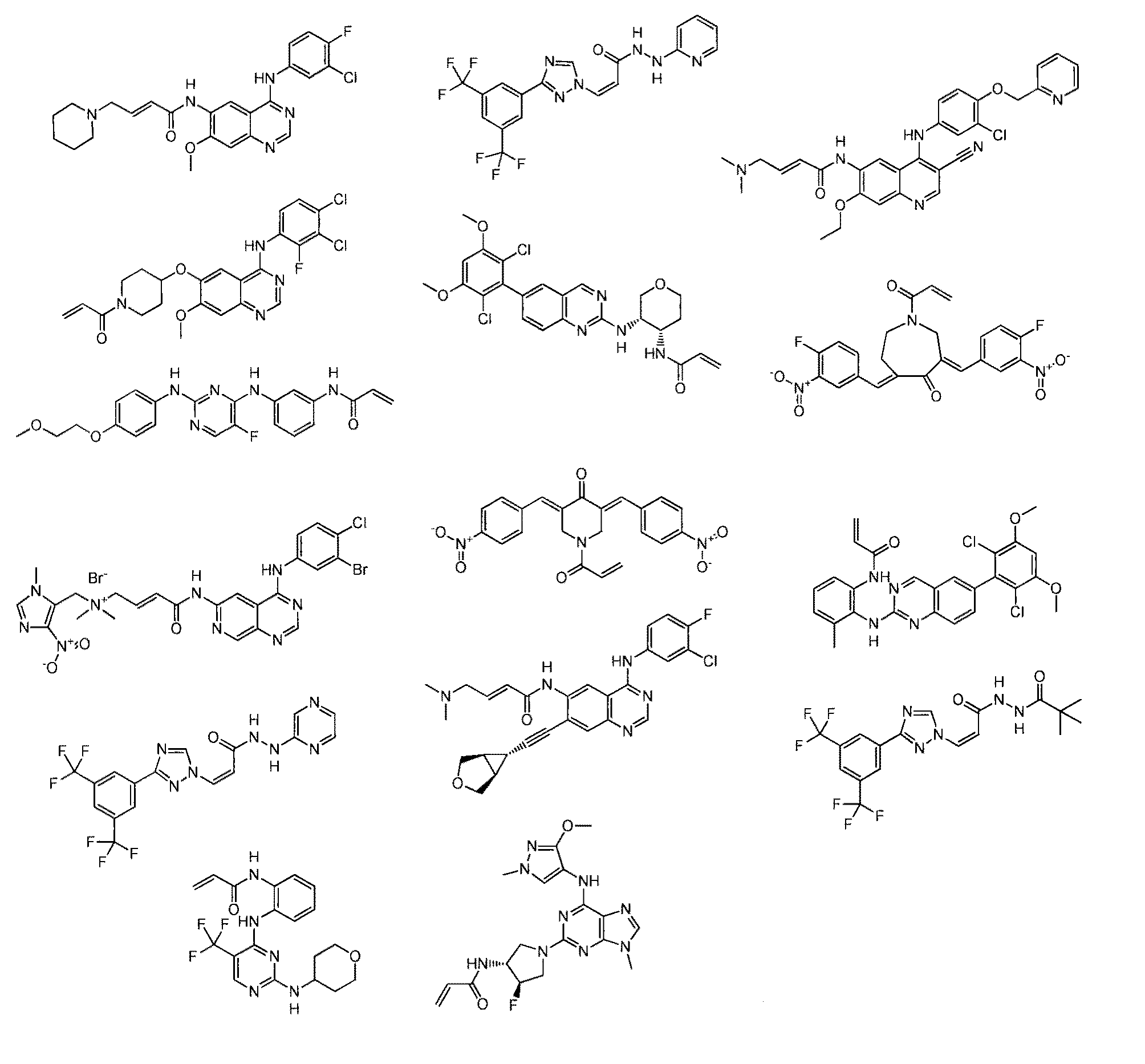
- 0 CCCC*(CC*N)N*(C)C Chemical compound CCCC*(CC*N)N*(C)C 0.000 description 2
- NDBSVXAAQHMFRW-UHFFFAOYSA-O C=CC(N(CC(C1=O)=CC2C=CC([NH2+][O-])=CC2)CC1=Cc(cc1)ccc1[NH+](O)O)=O Chemical compound C=CC(N(CC(C1=O)=CC2C=CC([NH2+][O-])=CC2)CC1=Cc(cc1)ccc1[NH+](O)O)=O NDBSVXAAQHMFRW-UHFFFAOYSA-O 0.000 description 1
- MHLNDQHMXNUDKJ-UHFFFAOYSA-O C=CC(N(CCC(C1=O)=Cc(cc2)cc([N+](O)=O)c2F)CC1=Cc(cc1)cc([NH2+]O)c1F)=O Chemical compound C=CC(N(CCC(C1=O)=Cc(cc2)cc([N+](O)=O)c2F)CC1=Cc(cc1)cc([NH2+]O)c1F)=O MHLNDQHMXNUDKJ-UHFFFAOYSA-O 0.000 description 1
- XCGSUINTUUVPCK-PLNGDYQASA-N CC(C)(C)C(NNC(/C=C\[n]1nc(C(C2)C=C(C(F)(F)F)C=C2C(F)(F)F)nc1)=O)=O Chemical compound CC(C)(C)C(NNC(/C=C\[n]1nc(C(C2)C=C(C(F)(F)F)C=C2C(F)(F)F)nc1)=O)=O XCGSUINTUUVPCK-PLNGDYQASA-N 0.000 description 1
- JWNPDZNEKVCWMY-VQHVLOKHSA-N CCOc(c(NC(/C=C/CN(C)C)=O)cc1c2Nc(cc3Cl)ccc3OCc3ccccn3)cc1ncc2C#N Chemical compound CCOc(c(NC(/C=C/CN(C)C)=O)cc1c2Nc(cc3Cl)ccc3OCc3ccccn3)cc1ncc2C#N JWNPDZNEKVCWMY-VQHVLOKHSA-N 0.000 description 1
- MGZKYOAQVGSSGC-DLBZAZTESA-N COc(cc(c(Cl)c1-c2ccc3nc(N[C@H](COCC4)[C@H]4NC(C=C)=O)ncc3c2)OC)c1Cl Chemical compound COc(cc(c(Cl)c1-c2ccc3nc(N[C@H](COCC4)[C@H]4NC(C=C)=O)ncc3c2)OC)c1Cl MGZKYOAQVGSSGC-DLBZAZTESA-N 0.000 description 1
- LVXJQMNHJWSHET-AATRIKPKSA-N COc(cc(c1c2)ncnc1Nc(cc1Cl)ccc1F)c2NC(/C=C/CN1CCCCC1)=O Chemical compound COc(cc(c1c2)ncnc1Nc(cc1Cl)ccc1F)c2NC(/C=C/CN1CCCCC1)=O LVXJQMNHJWSHET-AATRIKPKSA-N 0.000 description 1
- LPFWVDIFUFFKJU-UHFFFAOYSA-N COc1cc2ncnc(Nc(ccc(Cl)c3Cl)c3F)c2cc1OC(CC1)CCN1C(C=C)=O Chemical compound COc1cc2ncnc(Nc(ccc(Cl)c3Cl)c3F)c2cc1OC(CC1)CCN1C(C=C)=O LPFWVDIFUFFKJU-UHFFFAOYSA-N 0.000 description 1
- OPAKEJZFFCECPN-XQRVVYSFSA-N O=C(/C=C\[n]1nc(-c2cc(C(F)(F)F)cc(C(F)(F)F)c2)nc1)NNc1ccccn1 Chemical compound O=C(/C=C\[n]1nc(-c2cc(C(F)(F)F)cc(C(F)(F)F)c2)nc1)NNc1ccccn1 OPAKEJZFFCECPN-XQRVVYSFSA-N 0.000 description 1
- DEVSOMFAQLZNKR-RJRFIUFISA-N O=C(/C=C\[n]1nc(-c2cc(C(F)(F)F)cc(C(F)(F)F)c2)nc1)NNc1cnccn1 Chemical compound O=C(/C=C\[n]1nc(-c2cc(C(F)(F)F)cc(C(F)(F)F)c2)nc1)NNc1cnccn1 DEVSOMFAQLZNKR-RJRFIUFISA-N 0.000 description 1
Images


Classifications
-
- A—HUMAN NECESSITIES
- A61—MEDICAL OR VETERINARY SCIENCE; HYGIENE
- A61K—PREPARATIONS FOR MEDICAL, DENTAL OR TOILETRY PURPOSES
- A61K9/00—Medicinal preparations characterised by special physical form
- A61K9/0002—Galenical forms characterised by the drug release technique; Application systems commanded by energy
- A61K9/0004—Osmotic delivery systems; Sustained release driven by osmosis, thermal energy or gas
-
- A—HUMAN NECESSITIES
- A61—MEDICAL OR VETERINARY SCIENCE; HYGIENE
- A61K—PREPARATIONS FOR MEDICAL, DENTAL OR TOILETRY PURPOSES
- A61K9/00—Medicinal preparations characterised by special physical form
- A61K9/20—Pills, tablets, discs, rods
- A61K9/28—Dragees; Coated pills or tablets, e.g. with film or compression coating
- A61K9/2886—Dragees; Coated pills or tablets, e.g. with film or compression coating having two or more different drug-free coatings; Tablets of the type inert core-drug layer-inactive layer
-
- A—HUMAN NECESSITIES
- A61—MEDICAL OR VETERINARY SCIENCE; HYGIENE
- A61K—PREPARATIONS FOR MEDICAL, DENTAL OR TOILETRY PURPOSES
- A61K31/00—Medicinal preparations containing organic active ingredients
- A61K31/33—Heterocyclic compounds
- A61K31/395—Heterocyclic compounds having nitrogen as a ring hetero atom, e.g. guanethidine or rifamycins
- A61K31/495—Heterocyclic compounds having nitrogen as a ring hetero atom, e.g. guanethidine or rifamycins having six-membered rings with two or more nitrogen atoms as the only ring heteroatoms, e.g. piperazine or tetrazines
- A61K31/505—Pyrimidines; Hydrogenated pyrimidines, e.g. trimethoprim
- A61K31/519—Pyrimidines; Hydrogenated pyrimidines, e.g. trimethoprim ortho- or peri-condensed with heterocyclic rings
-
- A—HUMAN NECESSITIES
- A61—MEDICAL OR VETERINARY SCIENCE; HYGIENE
- A61K—PREPARATIONS FOR MEDICAL, DENTAL OR TOILETRY PURPOSES
- A61K47/00—Medicinal preparations characterised by the non-active ingredients used, e.g. carriers or inert additives; Targeting or modifying agents chemically bound to the active ingredient
- A61K47/06—Organic compounds, e.g. natural or synthetic hydrocarbons, polyolefins, mineral oil, petrolatum or ozokerite
- A61K47/08—Organic compounds, e.g. natural or synthetic hydrocarbons, polyolefins, mineral oil, petrolatum or ozokerite containing oxygen, e.g. ethers, acetals, ketones, quinones, aldehydes, peroxides
- A61K47/12—Carboxylic acids; Salts or anhydrides thereof
-
- A—HUMAN NECESSITIES
- A61—MEDICAL OR VETERINARY SCIENCE; HYGIENE
- A61K—PREPARATIONS FOR MEDICAL, DENTAL OR TOILETRY PURPOSES
- A61K47/00—Medicinal preparations characterised by the non-active ingredients used, e.g. carriers or inert additives; Targeting or modifying agents chemically bound to the active ingredient
- A61K47/06—Organic compounds, e.g. natural or synthetic hydrocarbons, polyolefins, mineral oil, petrolatum or ozokerite
- A61K47/26—Carbohydrates, e.g. sugar alcohols, amino sugars, nucleic acids, mono-, di- or oligo-saccharides; Derivatives thereof, e.g. polysorbates, sorbitan fatty acid esters or glycyrrhizin
-
- A—HUMAN NECESSITIES
- A61—MEDICAL OR VETERINARY SCIENCE; HYGIENE
- A61K—PREPARATIONS FOR MEDICAL, DENTAL OR TOILETRY PURPOSES
- A61K47/00—Medicinal preparations characterised by the non-active ingredients used, e.g. carriers or inert additives; Targeting or modifying agents chemically bound to the active ingredient
- A61K47/30—Macromolecular organic or inorganic compounds, e.g. inorganic polyphosphates
- A61K47/32—Macromolecular compounds obtained by reactions only involving carbon-to-carbon unsaturated bonds, e.g. carbomers, poly(meth)acrylates, or polyvinyl pyrrolidone
-
- A—HUMAN NECESSITIES
- A61—MEDICAL OR VETERINARY SCIENCE; HYGIENE
- A61K—PREPARATIONS FOR MEDICAL, DENTAL OR TOILETRY PURPOSES
- A61K47/00—Medicinal preparations characterised by the non-active ingredients used, e.g. carriers or inert additives; Targeting or modifying agents chemically bound to the active ingredient
- A61K47/30—Macromolecular organic or inorganic compounds, e.g. inorganic polyphosphates
- A61K47/36—Polysaccharides; Derivatives thereof, e.g. gums, starch, alginate, dextrin, hyaluronic acid, chitosan, inulin, agar or pectin
- A61K47/38—Cellulose; Derivatives thereof
-
- A—HUMAN NECESSITIES
- A61—MEDICAL OR VETERINARY SCIENCE; HYGIENE
- A61K—PREPARATIONS FOR MEDICAL, DENTAL OR TOILETRY PURPOSES
- A61K9/00—Medicinal preparations characterised by special physical form
- A61K9/20—Pills, tablets, discs, rods
- A61K9/28—Dragees; Coated pills or tablets, e.g. with film or compression coating
- A61K9/2806—Coating materials
- A61K9/2813—Inorganic compounds
-
- A—HUMAN NECESSITIES
- A61—MEDICAL OR VETERINARY SCIENCE; HYGIENE
- A61K—PREPARATIONS FOR MEDICAL, DENTAL OR TOILETRY PURPOSES
- A61K9/00—Medicinal preparations characterised by special physical form
- A61K9/20—Pills, tablets, discs, rods
- A61K9/28—Dragees; Coated pills or tablets, e.g. with film or compression coating
- A61K9/2806—Coating materials
- A61K9/282—Organic compounds, e.g. fats
-
- A—HUMAN NECESSITIES
- A61—MEDICAL OR VETERINARY SCIENCE; HYGIENE
- A61K—PREPARATIONS FOR MEDICAL, DENTAL OR TOILETRY PURPOSES
- A61K9/00—Medicinal preparations characterised by special physical form
- A61K9/20—Pills, tablets, discs, rods
- A61K9/28—Dragees; Coated pills or tablets, e.g. with film or compression coating
- A61K9/2806—Coating materials
- A61K9/2833—Organic macromolecular compounds
- A61K9/284—Organic macromolecular compounds obtained by reactions only involving carbon-to-carbon unsaturated bonds, e.g. polyvinyl pyrrolidone
- A61K9/2846—Poly(meth)acrylates
-
- A—HUMAN NECESSITIES
- A61—MEDICAL OR VETERINARY SCIENCE; HYGIENE
- A61K—PREPARATIONS FOR MEDICAL, DENTAL OR TOILETRY PURPOSES
- A61K9/00—Medicinal preparations characterised by special physical form
- A61K9/20—Pills, tablets, discs, rods
- A61K9/28—Dragees; Coated pills or tablets, e.g. with film or compression coating
- A61K9/2806—Coating materials
- A61K9/2833—Organic macromolecular compounds
- A61K9/2853—Organic macromolecular compounds obtained otherwise than by reactions only involving carbon-to-carbon unsaturated bonds, e.g. polyethylene glycol, polyethylene oxide, poloxamers, poly(lactide-co-glycolide)
-
- A—HUMAN NECESSITIES
- A61—MEDICAL OR VETERINARY SCIENCE; HYGIENE
- A61K—PREPARATIONS FOR MEDICAL, DENTAL OR TOILETRY PURPOSES
- A61K9/00—Medicinal preparations characterised by special physical form
- A61K9/20—Pills, tablets, discs, rods
- A61K9/28—Dragees; Coated pills or tablets, e.g. with film or compression coating
- A61K9/2806—Coating materials
- A61K9/2833—Organic macromolecular compounds
- A61K9/286—Polysaccharides, e.g. gums; Cyclodextrin
- A61K9/2866—Cellulose; Cellulose derivatives, e.g. hydroxypropyl methylcellulose
-
- A—HUMAN NECESSITIES
- A61—MEDICAL OR VETERINARY SCIENCE; HYGIENE
- A61K—PREPARATIONS FOR MEDICAL, DENTAL OR TOILETRY PURPOSES
- A61K9/00—Medicinal preparations characterised by special physical form
- A61K9/48—Preparations in capsules, e.g. of gelatin, of chocolate
- A61K9/50—Microcapsules having a gas, liquid or semi-solid filling; Solid microparticles or pellets surrounded by a distinct coating layer, e.g. coated microspheres, coated drug crystals
- A61K9/5005—Wall or coating material
- A61K9/5021—Organic macromolecular compounds
- A61K9/5026—Organic macromolecular compounds obtained by reactions only involving carbon-to-carbon unsaturated bonds, e.g. polyvinyl pyrrolidone, poly(meth)acrylates
-
- A—HUMAN NECESSITIES
- A61—MEDICAL OR VETERINARY SCIENCE; HYGIENE
- A61K—PREPARATIONS FOR MEDICAL, DENTAL OR TOILETRY PURPOSES
- A61K9/00—Medicinal preparations characterised by special physical form
- A61K9/48—Preparations in capsules, e.g. of gelatin, of chocolate
- A61K9/50—Microcapsules having a gas, liquid or semi-solid filling; Solid microparticles or pellets surrounded by a distinct coating layer, e.g. coated microspheres, coated drug crystals
- A61K9/5073—Microcapsules having a gas, liquid or semi-solid filling; Solid microparticles or pellets surrounded by a distinct coating layer, e.g. coated microspheres, coated drug crystals having two or more different coatings optionally including drug-containing subcoatings
-
- A—HUMAN NECESSITIES
- A61—MEDICAL OR VETERINARY SCIENCE; HYGIENE
- A61P—SPECIFIC THERAPEUTIC ACTIVITY OF CHEMICAL COMPOUNDS OR MEDICINAL PREPARATIONS
- A61P35/00—Antineoplastic agents
-
- A—HUMAN NECESSITIES
- A61—MEDICAL OR VETERINARY SCIENCE; HYGIENE
- A61P—SPECIFIC THERAPEUTIC ACTIVITY OF CHEMICAL COMPOUNDS OR MEDICINAL PREPARATIONS
- A61P35/00—Antineoplastic agents
- A61P35/02—Antineoplastic agents specific for leukemia
Landscapes
- Health & Medical Sciences (AREA)
- Chemical & Material Sciences (AREA)
- Life Sciences & Earth Sciences (AREA)
- Animal Behavior & Ethology (AREA)
- Veterinary Medicine (AREA)
- Pharmacology & Pharmacy (AREA)
- Medicinal Chemistry (AREA)
- General Health & Medical Sciences (AREA)
- Public Health (AREA)
- Epidemiology (AREA)
- Engineering & Computer Science (AREA)
- Bioinformatics & Cheminformatics (AREA)
- Chemical Kinetics & Catalysis (AREA)
- General Chemical & Material Sciences (AREA)
- Organic Chemistry (AREA)
- Nuclear Medicine, Radiotherapy & Molecular Imaging (AREA)
- Inorganic Chemistry (AREA)
- Oil, Petroleum & Natural Gas (AREA)
- Oncology (AREA)
- Hematology (AREA)
- Biochemistry (AREA)
- Molecular Biology (AREA)
- Pharmaceuticals Containing Other Organic And Inorganic Compounds (AREA)
- Medicinal Preparation (AREA)
- Medicines That Contain Protein Lipid Enzymes And Other Medicines (AREA)
- Nitrogen Condensed Heterocyclic Rings (AREA)
- Plural Heterocyclic Compounds (AREA)
- Heterocyclic Carbon Compounds Containing A Hetero Ring Having Oxygen Or Sulfur (AREA)
- Pyridine Compounds (AREA)
- Acyclic And Carbocyclic Compounds In Medicinal Compositions (AREA)
Abstract
本発明は、可逆的及び不可逆的な共有結合性キナーゼ阻害剤、特にBTK阻害剤を、小腸、具体的には小腸の回腸及び空腸に送達する新規製剤を提供するものである。The present invention provides novel formulations that deliver reversible and irreversible covalent kinase inhibitors, particularly BTK inhibitors, to the small intestine, specifically the ileum and jejunum of the small intestine.
Description
相互参照
本出願は、参照によりその内容が本明細書に援用される2014年12月24日に出願された米国仮特許出願第62/096,812号明細書に対する優先権の利益を主張するものである。
This application claims the benefit of priority over US Provisional Patent Application No. 62 / 096,812, filed December 24, 2014, the contents of which are incorporated herein by reference. It is.
技術分野
本開示は、胃では活性成分を放出せず、小腸の回腸及び空腸で薬物分子を実質的に放出する、可逆的又は非可逆的な共有結合性薬物分子を含有する経口医薬製剤、ならびに例えば癌及び自己免疫疾患などの、かかる化合物での治療が可能な疾患の治療のためのこれら製剤の使用を提供する。
TECHNICAL FIELD The present disclosure relates to an oral pharmaceutical formulation containing a reversible or irreversible covalent drug molecule that does not release the active ingredient in the stomach and substantially releases the drug molecule in the ileum and jejunum of the small intestine, and There is provided the use of these formulations for the treatment of diseases that can be treated with such compounds, such as cancer and autoimmune diseases.
標的療法は、キナーゼ阻害剤の抗癌剤としての臨床的効果を理由として、特に癌領域において高い注目を集めている。標的療法の開発に関し現在進行中の試みとしては、一次標的に対する高選択性の達成、及びその治療効果を最大化するための阻害時間の延長が挙げられる。共有結合性薬剤は、薬剤の全身曝露を大幅に低下させつつ高い選択性を達成させ、ならびに阻害時間を延長させる向上された能力を理由として、次世代標的療法の設計にとって非常に魅力的な手法となっている。共有結合性薬剤は、薬剤分子が結合するタンパク質の活性部位中の特定のシステイン残基との共有結合相互作用によって、高い選択性と非常に優れた効力を得ている。この共有結合によって、薬剤の全身曝露を凌ぐ、向上した作用持続時間を持つ長期効能がさらに提供される。マイケル受容体(Michael acceptor)としてアクリルアミド部分を含有する薬剤は一般的に、グルタチオンのようなチオールと不可逆的に反応し、また所望の標的以外のタンパク質、特に高反応性システインを有するタンパク質とも不可逆的に反応する場合がある。 Targeted therapies are attracting a great deal of attention especially in the oncology field because of the clinical effects of kinase inhibitors as anticancer agents. Attempts currently underway for the development of targeted therapies include achieving high selectivity for the primary target and extending the inhibition time to maximize its therapeutic effect. Covalent drugs are a very attractive approach for the design of next-generation targeted therapies because of their improved ability to achieve high selectivity while significantly reducing systemic exposure of the drug, as well as prolong inhibition time It has become. Covalent drugs have high selectivity and very good potency due to covalent interactions with specific cysteine residues in the active site of the protein to which the drug molecule binds. This covalent bond further provides long-term efficacy with improved duration of action that surpasses systemic exposure of the drug. Drugs that contain an acrylamide moiety as a Michael acceptor generally react irreversibly with thiols such as glutathione, and are also irreversible with proteins other than the desired target, particularly those with highly reactive cysteines. May react.
可逆的な共有結合性薬剤分子、すなわち第2の電子求引基を伴うマイケル受容体を含有する薬剤は、その薬剤が経口投与された場合、低い血漿AUC及び/又はCmaxの値として現れ得る、不十分な生体利用効率、又は体内吸収の遅延を示し得、結果としてin vivoでは最適でない有効性となる。この新種の薬剤の不十分な生体利用効率は、部分的にはこれら薬剤中の可逆的共有結合性マイケル受容体部分の反応性が原因であり得る。したがって、低pHと消化性酵素又は代謝酵素の組み合わせ、及び他のチオール源が生じる胃への可逆的共有結合性薬剤の曝露を制限することにより、この薬剤の全身曝露を大幅に上昇させることができる。 A reversible covalent drug molecule, ie a drug containing a Michael acceptor with a second electron withdrawing group, can appear as a low plasma AUC and / or C max value when the drug is administered orally Inadequate bioavailability, or delayed absorption in the body, resulting in suboptimal efficacy in vivo. The poor bioavailability of this new class of drugs may be due in part to the reactivity of the reversible covalent Michael receptor moiety in these drugs. Thus, by limiting the exposure of reversible covalent drugs to the stomach where low pH and digestive or metabolic enzyme combinations and other thiol sources occur, the systemic exposure of this drug can be significantly increased. it can.
さらに、不可逆的共有結合性薬剤分子の胃への曝露を制限することにより、この薬剤の全身曝露の大幅な上昇と、例えば下痢、悪心又は嘔吐、及び眩暈などの有害な副作用が発生する可能性の低下がもたらされ得る。たとえば、不可逆的共有結合された薬剤分子であるイブルチニブ(ibrutinib)が十二指腸内に投与された場合、AUCにより測定したところ、直接的な経口投与と比較し、21%から100%へと予想外に生体利用効率が上昇した。(D. M. Goldstein, Formulations Comprising Ibrutinib, WO 2014/004707 published 3 January 2014)。イブルチニブの胃バイパスによって、生体利用効率が上昇し、及び/又は例えば下痢、悪心もしくは嘔吐及び眩暈などのこの薬剤の有害な副作用の可能性が低下、もしくは完全に排除されるはずである。 In addition, limiting the exposure of the irreversible covalent drug molecule to the stomach can result in significant increases in systemic exposure to the drug and adverse side effects such as diarrhea, nausea or vomiting, and dizziness. Can be reduced. For example, when ibrutinib, an irreversible covalently bound drug molecule, was administered intraduodenum, it was unexpectedly 21% to 100% compared to direct oral administration as measured by AUC The bioavailability increased. (D. M. Goldstein, Formulations Comprising Ibrutinib, WO 2014/004707 published 3 January 2014). Ibrutinib gastric bypass should increase bioavailability and / or reduce or completely eliminate the potential adverse side effects of this drug such as diarrhea, nausea or vomiting and dizziness.
さらに、例えばシステインプロテアーゼなどの代謝酵素、ムチン、輸送体、及び例えばグルタチオンなどの胃中の反応性チオール含有分子の発現が、可逆的及び不可逆的な共有
結合性マイケル受容体含有薬剤の低い経口生体利用効率の原因となっている可能性もある(例えば、Johnson D. S., et. al., Future Med Chem. 2010 June 1; 2(6):949-964、及び Potashman M. H. et al. J. Med. Chem., Vol 52, No. 5. Pgs. 1231-1246を参照のこと)。 例えば、システインプロテアーゼ、ペプシンなどの消化酵素、輸送体、及び例えば胃粘膜中のCYP酵素などの代謝酵素の組み合わせによって、低いpHでの可逆的及び不可逆的な共有結合性マイケル受容体の化学的及び/又は代謝的な高い転換が生じる場合がある。したがって、低pH、及び消化酵素又は代謝酵素の組み合わせ、ならびに他のチオール源が生じる胃に対する可逆的及び不可逆的な共有結合性薬剤の曝露を回避することにより、これら薬剤の全身曝露の大幅な上昇を獲得し得る。したがって、胃に対する曝露の回避は、例えば下痢、及び俗に嘔吐と言われる悪心などのこれら薬剤の有害な副作用の可能性が低下又は完全に排除され得る。
In addition, the expression of metabolic enzymes such as cysteine proteases, mucins, transporters, and reactive thiol-containing molecules in the stomach such as glutathione is reversible and irreversible for low oral oral biopharmaceutical Michael receptor-containing drugs. It may also contribute to utilization efficiency (eg, Johnson DS, et. Al., Future Med Chem. 2010 June 1; 2 (6): 949-964, and Potashman MH et al. J. Med. Chem., Vol 52, No. 5. Pgs. 1231-1246). For example, the chemical and chemical properties of reversible and irreversible covalent Michael receptors at low pH by a combination of digestive enzymes such as cysteine protease, pepsin, transporters, and metabolic enzymes such as CYP enzymes in the gastric mucosa. A high metabolic conversion may occur. Thus, a significant increase in systemic exposure to these drugs by lowering the pH and avoiding exposure to reversible and irreversible covalent drugs to the stomach, where combinations of digestive or metabolic enzymes and other thiol sources occur You can win. Thus, avoiding exposure to the stomach can reduce or completely eliminate the potential for adverse side effects of these drugs, such as diarrhea and nausea commonly referred to as vomiting.
十二指腸と比較し、空腸及び回腸における本明細書に開示される薬剤分子の吸収が予想外に上昇したこと、及び主に十二指腸の遠位側、そして最適に空腸及び回腸において薬剤分子を放出する剤型で、生体利用効率がさらに改善され得ることを示す。胃腸管の中で薬剤を放出することによって薬剤吸収の路長が減少し、生体利用効率が低下することが予測されていたことから、このことは意外な結果である。 Agents that have unexpectedly increased absorption of drug molecules disclosed herein in the jejunum and ileum compared to the duodenum, and that release drug molecules primarily in the distal side of the duodenum and optimally in the jejunum and ileum The mold shows that the bioavailability can be further improved. This is an unexpected result because it was predicted that releasing the drug in the gastrointestinal tract would reduce the length of drug absorption and reduce bioavailability.
1つの態様において、哺乳動物による製剤の経口摂取後、腸管の所定の位置で薬剤分子を放出する、固形経口製剤が提供される。 In one aspect, a solid oral formulation is provided that releases drug molecules at a predetermined location in the intestinal tract after oral ingestion of the formulation by a mammal.
他の態様において、哺乳動物の小腸の回腸−空腸に薬剤分子を送達する固形経口製剤が提供される。 In another aspect, a solid oral formulation is provided that delivers drug molecules to the ileum-jejunum of the small intestine of a mammal.
その他において、製剤が、哺乳動物の胃腸管中の特定のpHに直面したときに、薬剤分子を放出する、遅延放出型の固形経口製剤が提供される。 In others, delayed release solid oral formulations are provided that release drug molecules when the formulation encounters a specific pH in the mammalian gastrointestinal tract.
他の態様において、(i)コア、及び(ii)哺乳動物の胃において腸溶コーティングが損なわれない、当該コアを覆う少なくとも1つの腸溶コーティング、を含有する経口固形製剤が提供される。 In another aspect, there is provided an oral solid formulation comprising (i) a core, and (ii) at least one enteric coating covering the core, wherein the enteric coating is not impaired in the mammalian stomach.
他の態様において、哺乳動物の回腸及び/又は空腸中で薬剤を放出し、そのことにより摂取後ただちに放出される薬剤分子と比較し、薬剤分子の生体利用効率が向上する、薬剤分子を含有する固形製剤が提供される。 In other embodiments, containing a drug molecule that releases the drug in the ileum and / or jejunum of a mammal, thereby improving the bioavailability of the drug molecule compared to a drug molecule that is released immediately after ingestion. A solid formulation is provided.
他の態様において、哺乳動物の小腸の回腸及び/又は空腸中でボーラスとして薬剤分子を放出し、そのことにより、摂取後ただちに放出される薬剤分子と比較し、薬剤分子の生体利用効率が向上する、固形経口製剤が提供される。 In other embodiments, the drug molecule is released as a bolus in the ileum and / or jejunum of the small intestine of a mammal, thereby improving the bioavailability of the drug molecule as compared to the drug molecule released immediately after ingestion. A solid oral formulation is provided.
他の態様において、哺乳動物の小腸の回腸及び/又は空腸中で薬剤分子を実質的に放出するよう設計された、任意選択で追加のサブコーティング(複数含む)、希釈剤又は賦形剤と組み合わされた薬剤分子を含むコアを含有する、固形経口製剤が提供される。 In other embodiments, optionally in combination with additional subcoating (s), diluents or excipients designed to substantially release drug molecules in the ileum and / or jejunum of the mammalian small intestine A solid oral dosage form is provided that contains a core comprising a modified drug molecule.
他の態様において、本発明の詳細な説明において定義される薬剤分子、又はその薬学的に受容可能な塩を送達する固形経口製剤が提供される。 In another aspect, a solid oral formulation is provided that delivers a drug molecule as defined in the detailed description of the invention, or a pharmaceutically acceptable salt thereof.
他の態様において、腸管においてボーラスとして、膨張することができ、またはコアへの水の流入が可能となるチャンネルを形成することによりコアを膨張させることができ、サブコーティングを破裂させ、及びコアの内容物を放出させる、水不溶性のサブコーティ
ングにより覆われたコアを含有する固形経口製剤が提供される。
In other embodiments, the core can be inflated as a bolus in the intestinal tract, or the core can be inflated by forming a channel that allows inflow of water into the core, rupturing the sub-coating, and A solid oral formulation is provided containing a core covered by a water-insoluble subcoating that releases the contents.
他の態様において、コアが腸管を通過するときに、コアへの水の流入と、次いでチャンネルを介した薬剤分子の流出を引き起こすチャンネルを形成することができるサブコーティングにより覆われたコアを含有する経口製剤が提供される。 In other embodiments, the core is covered by a subcoating that can form a channel that causes the inflow of water into the core and then the outflow of drug molecules through the channel as it passes through the intestinal tract. An oral formulation is provided.
他の態様において、腸管において所定のpHで溶解する水溶性ポリマーで覆われたコアを含有する固形経口製剤が提供される。 In another aspect, a solid oral formulation is provided that includes a core covered with a water soluble polymer that dissolves at a predetermined pH in the intestinal tract.
他の態様において、摂取後、薬剤の即時放出を生じさせる製剤と比較して生体利用効率が改善された固形製剤を用いた、BTK阻害剤で治療可能な疾患を治療する方法が提供される。 In another aspect, a method of treating a disease treatable with a BTK inhibitor using a solid formulation with improved bioavailability compared to a formulation that produces immediate release of the drug after ingestion is provided.
本明細書において使用される場合、不定冠詞の「1つの」(「a」又は「an」)の実体とは、1つ以上のその実体を指し、例えば、1つの化合物(a compound)とは、別段の記載がない限り、1つ以上の化合物又は少なくとも1つの化合物を指す。したがって、「1つの」(「a」又は「an」)、「1つ以上の」、及び「少なくとも1つの」という用語は、本明細書において相互交換可能に使用することができる。 As used herein, an indefinite article “one” (“a” or “an”) entity refers to one or more of that entity, eg, one compound (a compound) Unless otherwise stated, refers to one or more compounds or at least one compound. Thus, the terms “one” (“a” or “an”), “one or more”, and “at least one” can be used interchangeably herein.
「独立して」という用語は、本明細書において、同一化合物内で、その同一の又は異なる定義を有する変数の有無にかかわらず、いずれか1つの例において変数が適用されることを示すために使用される。したがって、R”が二度出現し、「独立して炭素又は窒素」と定義されている化合物において、R”は両方とも炭素であってもよく、R”は両方とも窒素であってもよく、又は1つのR”が炭素で、他方は窒素であってもよい。 The term “independently” is used herein to indicate that a variable applies in any one instance, with or without a variable having the same or different definition within the same compound. used. Thus, in compounds where R ″ appears twice and is defined as “independently carbon or nitrogen”, both R ″ may be carbon and R ″ may both be nitrogen; Alternatively, one R ″ may be carbon and the other may be nitrogen.
任意の変数(例えば、R1、R4a、Ar、X1又はHet)が、本発明に使用される、又は本発明で請求される化合物を表し、及び記載するいずれか部分又は式において2回以上出現するとき、各出現でのその定義は、他のすべての出現でのその定義と無関係である。 また、置換基及び/又は変数の組み合わせは、かかる化合物が安定化合物を生じさせる場合に限り、許容される。
結合を通り引かれた直線「
A straight line drawn through the bond
「任意選択」又は「任意選択的に」という用語は、本明細書において用いられる場合、引き続き記載される事象又は環境が、必ずではないが、出現し得ること、ならびにその記載が、その事象又は環境が出現する例、及び出現しない例を含むことを意味する。例えば、「任意選択的に置換された」とは、任意選択的に置換された部分が、水素又は置換基を含みうることを意味する。 The terms “optional” or “optionally”, as used herein, indicate that the event or environment to be described subsequently may, but need not, appear as well as that event or environment. It is meant to include examples where the environment appears and examples where it does not appear. For example, “optionally substituted” means that the optionally substituted moiety can include hydrogen or a substituent.
「約」という用語は、本明細書において、およそ、〜の辺り、大体で、又はおおよそを意味するために使用される。「約」という用語が数的な範囲と併せて使用される場合、記載される数値の上下に境界を広げることにより、その範囲が改変される。概して、「約」という用語は本明細書において、5%の分散で記述される値の上下に数値を改変するために使用される。 The term “about” is used herein to mean approximately, in the region of, roughly, or approximately. When the term “about” is used in conjunction with a numerical range, it modifies that range by extending the boundaries above and below the numerical values set forth. In general, the term “about” is used herein to modify a numerical value above and below the value described at 5% variance.
本明細書において使用される場合、変数の数値範囲の記述は、本発明が、その範囲内の値のいずれかと等しい変数で実施され得ることを提示することが意図される。したがって、本質的に離散的である変数に関し、その変数は、その範囲の端点を含む、数値範囲の整数値のいずれかと等しくてもよい。同様に、本質的に連続的である変数に関し、その変数は、その範囲の端点を含む、数値範囲の実数値のいずれかと等しくてもよい。例として、0〜2の値を有するとして記載される変数は、本質的に離散的である変数に関しては、0、1又は2であってもよく、本質的に連続的である変数に関しては、0.0、0.1、0.01、0.001、又は任意の他の実数値であってもよい。 As used herein, the description of a numerical range for a variable is intended to suggest that the present invention may be practiced with a variable equal to any of the values within that range. Thus, for a variable that is discrete in nature, the variable may be equal to any integer value in the numerical range, including the endpoints of the range. Similarly, for a variable that is essentially continuous, the variable may be equal to any real value in the numerical range, including the endpoints of the range. By way of example, a variable described as having a value between 0 and 2 may be 0, 1 or 2 for a variable that is essentially discrete, and for a variable that is essentially continuous, It may be 0.0, 0.1, 0.01, 0.001, or any other real value.
1つの態様として、本開示は、患者において、例えばBLK、BMX、EGFR、HER2、HER4、ITK、TEC、BTK、及びTXKなどのチロシンキナーゼの阻害により治療可能な疾患を治療する方法を目的としており、当該方法は、その必要があると認
識される患者に本明細書に開示される固形経口医薬製剤を投与することを含む。1つの実施形態において、チロシンキナーゼはBTKである。
In one aspect, the present disclosure is directed to a method of treating a disease treatable in a patient by inhibiting tyrosine kinases such as BLK, BMX, EGFR, HER2, HER4, ITK, TEC, BTK, and TXK. The method comprises administering a solid oral pharmaceutical formulation disclosed herein to a patient recognized as in need thereof. In one embodiment, the tyrosine kinase is BTK.
BTK(UniProtアクセッション番号Q06187)は、チロシンキナーゼのTecファミリーの1つであり、初期B細胞発生及び成熟B細胞活性化及び生存の重要な制御因子であることが示されている(Khan et al. Immunity1995 3:283; Ellmeier et al.
J. Exp. Med. 2000 192:1611)。
BTK (UniProt accession number Q06187) is one of the Tec family of tyrosine kinases and has been shown to be an important regulator of early B cell development and mature B cell activation and survival (Khan et al Immunity1995 3: 283; Ellmeier et al.
J. Exp. Med. 2000 192: 1611).
本明細書において用いられる「薬剤分子」又は「活性成分」の非限定的な例としては、以下の式Ia又はIbに従う化合物、及び/又はその薬学的に受容可能な塩が挙げられる:
Ar1は、置換アリール又は置換ヘテロアリールであり、
Zは、結合、アルキレン、シクロアルキレン、O、−アルキレン−O−、NRa、−(アルキレン)−NRa−(各Raは水素、アルキル、又はシクロアルキルである)、又は式IIに相当する断片であり、
Rbは、シアノ、ニトロ、ハロ、ハロアルキル、ハロアルコキシ、アルキルチオ、又はアルキルスルホニルであり、
Rcは、アルキル、ハロアルコキシ、置換アルキル、シクロアルキル、シクロアルキレンNRdReもしくはシクロアルキレン(アルキレン)NRdRe(Rd及びReは独立して水素、アルキル、又はシクロアルキルである)、又はN、O及びSから選択される1つまたは2つのヘテロ原子を含有する3〜6員の飽和単環ヘテロシクリルであり、任意選択的にヒドロキシ、アルキル及びフルオロから独立して選択される1つまたは2つの置換基で置換されている。
Non-limiting examples of “drug molecules” or “active ingredients” as used herein include compounds according to the following formulas Ia or Ib, and / or pharmaceutically acceptable salts thereof:
Ar 1 is substituted aryl or substituted heteroaryl;
Z is a bond, alkylene, cycloalkylene, O, - alkylene -O-, NR a, - (alkylene) -NR a - (each R a is hydrogen, alkyl, or cycloalkyl), or corresponds to the formula II Fragment to
R b is cyano, nitro, halo, haloalkyl, haloalkoxy, alkylthio, or alkylsulfonyl;
R c is alkyl, haloalkoxy, substituted alkyl, cycloalkyl, cycloalkylene NR d R e or cycloalkylene (alkylene) NR d R e (R d and R e are independently hydrogen, alkyl, or cycloalkyl Or a 3-6 membered saturated monocyclic heterocyclyl containing one or two heteroatoms selected from N, O and S, optionally independently selected from hydroxy, alkyl and fluoro Substituted with one or two substituents.
疑念を回避するため、本明細書において用いられる場合、「薬剤分子」又は「BTK阻害剤」という用語は、遊離塩基又は塩の形態に明示的に限定されていない限り、化合物の遊離塩基のいずれかを指す(例えば、式IaもしくはIbに従う化合物、及び/又は式IaもしくはIbに従う化合物の薬学的に受容可能な塩)。 For the avoidance of doubt, as used herein, the term “drug molecule” or “BTK inhibitor” is used to refer to any free base of a compound, unless explicitly limited to the free base or salt form. (Eg, a compound according to Formula Ia or Ib, and / or a pharmaceutically acceptable salt of a compound according to Formula Ia or Ib).
1つの実施形態において、Ar1は、キノリニル、キナゾリニル、ピロロ[2,3,−d]ピリミジニル、5H−ピロロ[2,3−b]ピラジニル、プリニル、インドリル、チアゾリル、2−ヒドロキシキノリニル、もしくはその互変異性体、インダゾリル、ピリミジニル、ピラゾロ[1.5−a]ピリミジニル、ピロロ[2,1−f][1,2,4]トリアジニル、8−アミノ−[1,2,4]トリアゾロ[1,5−a]ピラジニル、8−ア
ミノイミダゾ[1,2−a]ピラジニル、8−アミノイミダゾ[1,2−a]ピリジニル、8−アミノ−[1,2,4]トリアゾロ[1,5−a]ピリジニル、又は本明細書に定義されるように置換されたベンズイミダゾリルである。
In one embodiment, Ar 1 is quinolinyl, quinazolinyl, pyrrolo [2,3, -d] pyrimidinyl, 5H-pyrrolo [2,3-b] pyrazinyl, purinyl, indolyl, thiazolyl, 2-hydroxyquinolinyl, Or tautomers thereof, indazolyl, pyrimidinyl, pyrazolo [1.5-a] pyrimidinyl, pyrrolo [2,1-f] [1,2,4] triazinyl, 8-amino- [1,2,4] triazolo [1,5-a] pyrazinyl, 8-aminoimidazo [1,2-a] pyrazinyl, 8-aminoimidazo [1,2-a] pyridinyl, 8-amino- [1,2,4] triazolo [1, 5-a] pyridinyl, or benzimidazolyl substituted as defined herein.
他の実施形態において、薬剤分子は、可逆的又は不可逆的な共有結合性キナーゼ阻害剤である。例えば、1つの非限定的な実施形態において、可逆的又は不可逆的な共有結合性キナーゼ阻害剤は、BTK阻害剤である。 In other embodiments, the drug molecule is a reversible or irreversible covalent kinase inhibitor. For example, in one non-limiting embodiment, the reversible or irreversible covalent kinase inhibitor is a BTK inhibitor.
他の実施形態において、薬剤分子は、可逆的な共有結合性BTK阻害剤である。薬剤標的を調節するための共有結合修飾の使用は概説されている。(I. M. Serfimova et al., Nature Chem. Biol. 2012 8:471; R. Mah et al. Bioorg. Med. Chem. Lett. 201424:33-39; J. Sing, et al., Nat. Rev. Drug Discov. 2011 10:307) In other embodiments, the drug molecule is a reversible covalent BTK inhibitor. The use of covalent modifications to modulate drug targets has been outlined. (IM Serfimova et al., Nature Chem. Biol. 2012 8: 471; R. Mah et al. Bioorg. Med. Chem. Lett. 201424: 33-39; J. Sing, et al., Nat. Rev. Drug Discov. 2011 10: 307)
さらに他の実施形態において、薬剤分子は、(R)−2−(3−(4−アミノ−3−(2−フルオロ−4−フェノキシフェニル)−1H−ピラゾロ[3,4−d]ピリミジン−1−イル)ピペリジン−1−カルボニル)−4−メチル−4−(4−(オキセタン−3−イル)ピペラジン−1−イル)ペンタ−2−エンニトリルである。 In yet other embodiments, the drug molecule is (R) -2- (3- (4-amino-3- (2-fluoro-4-phenoxyphenyl) -1H-pyrazolo [3,4-d] pyrimidine- 1-yl) piperidin-1-carbonyl) -4-methyl-4- (4- (oxetan-3-yl) piperazin-1-yl) pent-2-enenitrile.
さらに他の実施形態において、薬剤分子は、不可逆的な共有結合性BTK阻害剤である。 In yet other embodiments, the drug molecule is an irreversible covalent BTK inhibitor.
他の実施形態において、薬剤分子は、イブルチニブ(ibrutinib)、ACP196、アカラブルチニブ(acalabrutinib)、BGB3111、HM71224、ONO−4059、RG7625、RG7880、MSC−2364447、CC−292、PF−06250112、PF−303、X−022、ABT−105、AC0025、EBI−1266、TP−4207、アファチニブ(afatinib)、メレレチニブ(mereletinib)、オシメルチニブ(osimertinib)、ロシレチニブ(rociletinib)、ネラチニブ(neratinib)、ダコミチニブ(dacomitinib)、ポジオチニブ(poziotinib)、スペブルチニブ(spebrutinib)、タルロキソチニブ(tarloxotinib)、セリネキソール(selinexor)、ベルジネキソール(verdinexor)、PF−06747775、BLU−554、NSC−687852、VLX−1500、KU−113、NT−113、BLU−9931、KPT−350、及びAZ−13767370から選択される可逆的又は不可逆的な共有結合性キナーゼ阻害剤である。 In other embodiments, the drug molecule is ibrutinib, ACP196, acalabrutinib, BGB3111, HM71224, ONO-4059, RG7625, RG7880, MSC-2364447, CC-292, PF-06250112, PF-303 X-022, ABT-105, AC0025, EBI-1266, TP-4207, afatinib (afatinib), meleletinib, osmertinib, rosiretinib, neratinib (b), neratinib poziotinib), speblutinib (spebrutini) ), Tarloxotinib, serinexor, verdinexol, PF-0674775, BLU-554, NSC-687852, VLX-1500, KU-113, NT-113, KLU-3501, KPT-350, A reversible or irreversible covalent kinase inhibitor selected from AZ-13767370.
他の実施形態において、薬剤分子は、以下から選択される可逆的又は不可逆的な共有結合性キナーゼ阻害剤である: In other embodiments, the drug molecule is a reversible or irreversible covalent kinase inhibitor selected from:
(R)−1−(3−(4−アミノ−3−(4−フェノキシフェニル)−1H−ピラゾロ[3,4−d]ピリミジン−1−イル)ピペリジン−1−イル)プロパ−2−エン−1−オン、
(R)−4−(8−アミノ−3−(1−(ブタ−2−イノイル)ピロリジン−2−イル)イミダゾ[1,5−a]ピラジン−1−イル)−N−(ピリジン−2−イル)ベンズアミド、
(S)−7−(1−アクリロイルピペリジン−4−イル)−2−(4−フェノキシフェニル)−4,5,6,7−テトラヒドロピラゾロ[1,5−a]ピリミジン−3−カルボキサミド、
(S)−7−(1−(ブタ−2−イノイル)ピペリジン−4−イル)−2−(4−フェノキシフェニル)−4,5,6,7−テトラヒドロピラゾロ[1,5−a]ピリミジン−3−カルボキサミド、
N−(3−((2−((2−メトキシ−4−(4−メチルピペラジン−1−イル)フェニル)アミノ)チエノ[3,2−d]ピリミジン−4−イル)オキシ)フェニル)アクリルアミド、
1−(3−((2−((4−(4−メチルピペラジン−1−イル)フェニル)アミノ)−[1,2,4]トリアゾロ[1,5−a]ピリジン−8−イル)オキシ)フェニル)プロパ−2−エン−1−オン、
(R)−6−アミノ−9−(1−(ブタ−2−イノイル)ピロリジン−3−イル)−7−(4−フェノキシフェニル)−7H−プリン−8(9H)−オン、
N−(2−((6−((5−(5−フルオロ−2−(ヒドロキシメチル)−3−(4−オキソ−6,7,8,9−テトラヒドロベンゾ[4,5]チエノ[2,3−d]ピリダジン−3(4H)−イル)フェニル)−1−メチル−2−オキソ−1,2−ジヒドロピリジン−3−イル)アミノ)ピリジン−2−イル)アミノ)エチル)アクリルアミド、
N−(3−((5−フルオロ−2−((4−(2−メトキシエトキシ)フェニル)アミノ)ピリミジン−4−イル)アミノ)フェニル)アクリルアミド、
(S)−5−アミノ−1−(1−シアノピペリジン−3−イル)−3−(4−(2,4−ジフルオロフェノキシ)フェニル)−1H−ピラゾール−4−カルボキサミド、
6−(1−アクリロイルピペリジン−4−イル)−2−(4−フェノキシフェニル)ニコチンアミド、
(R)−1−(1−アクリロイルピペリジン−3−イル)−4−アミノ−N−(5−クロロベンゾ[d]オキサゾール−2−イル)−1H−ピラゾロ[3,4−d]ピリミジン−3−カルボキサミド、
(S,E)−N−(4−((3−クロロ−4−フルオロフェニル)アミノ)−7−((テトラヒドロフラン−3−イル)オキシ)キナゾリン−6−イル)−4−(ジメチルアミノ)ブタ−2−エナミド、
(R)−1−(3−(4−アミノ−3−(4−フェノキシフェニル)−1H−ピラゾロ[3,4−d]ピリミジン−1−イル)ピペリジン−1−イル)プロパ−2−エン−1−オン、
N−(2−((2−(ジメチルアミノ)エチル)(メチル)アミノ)−4−メトキシ−5−((4−(1−メチル−1H−インドール−3−イル)ピリミジン−2−イル)アミノ)フェニル)アクリルアミド、
N−(3−((2−((4−(4−アセチルピペラジン−1−イル)−2−メトキシフェニル)アミノ)−5−(トリフルオロメチル)ピリミジン−4−イル)アミノ)フェニル)アクリルアミド、
(E)−N−(4−((3−クロロ−4−(ピリジン−2−イルメトキシ)フェニル)アミノ)−3−シアノ−7−エトキシキノリン−6−イル)−4−(ジメチルアミノ)ブタ−2−エナミド、
(E)−N−(4−((3−クロロ−4−フルオロフェニル)アミノ)−7−メトキシキナゾリン−6−イル)−4−(ピペリジン−1−イル)ブタ−2−エナミド、
1−(4−((4−((3,4−ジクロロ−2−フルオロフェニル)アミノ)−7−メトキシキナゾリン−6−イル)オキシ)ピペリジン−1−イル)プロパ−2−エン−1−オン、
N−(3−((5−フルオロ−2−((4−(2−メトキシエトキシ)フェニル)アミノ)ピリミジン−4−イル)アミノ)フェニル)アクリルアミド、
(E)−4−((4−((3−ブロモ−4−クロロフェニル)アミノ)ピリド[3,4−d]ピリミジン−6−イル)アミノ)−N,N−ジメチル−N−((1−メチル−4−ニトロ−1H−イミダゾール−5−イル)メチル)−4−オキソブタ−2−エン−1−アミニウムブロミド、
(Z)−3−(3−(3,5−ビス(トリフルオロメチル)フェニル)−1H−1,2,4−トリアゾール−1−イル)−N’−(ピラジン−2−イル)アクリロヒドラジド、
(Z)−3−(3−(3,5−ビス(トリフルオロメチル)フェニル)−1H−1,2,
4−トリアゾール−1−イル)−N’−(ピリジン−2−イル)アクリロヒドラジド、
N−((3R,4R)−4−フルオロ−1−(6−((3−メトキシ−1−メチル−1H−ピラゾール−4−イル)アミノ)−9−メチル−9H−プリン−2−イル)ピロリジン−3−イル)アクリルアミド、
N−((3S,4S)−3−((6−(2,6−ジクロロ−3,5−ジメトキシフェニル)キナゾリン−2−イル)アミノ)テトラヒドロ−2H−ピラン−4−イル)アクリルアミド、
(3E,5E)−1−アクリロイル−3,5−ビス(4−ニトロベンジリデン)ピペリジン−4−オン、
(E)−N−(7−((1R,5S,6s)−3−オキサビシクロ[3.1.0]ヘキサン−6−イルエチニル)−4−((3−クロロ−4−フルオロフェニル)アミノ)キナゾリン−6−イル)−4−(ジメチルアミノ)ブタ−2−エナミド、
(3E,5E)−1−アクリロイル−3,5−ビス(4−フルオロ−3−ニトロベンジリデン)アゼパン−4−オン、
N−(2−((6−(2,6−ジクロロ−3,5−ジメトキシフェニル)キナゾリン−2−イル)アミノ)−3−メチルフェニル)アクリルアミド、
(Z)−3−(3−(3,5−ビス(トリフルオロメチル)フェニル)−1H−1,2,4−トリアゾール−1−イル)−N’−ピバロイルアクリロヒドラジド、及び
N−(2−((2−((テトラヒドロ−2H−ピラン−4−イル)アミノ)−5−(トリフルオロメチル)ピリミジン−4−イル)アミノ)フェニル)アクリルアミド。
(R) -1- (3- (4-Amino-3- (4-phenoxyphenyl) -1H-pyrazolo [3,4-d] pyrimidin-1-yl) piperidin-1-yl) prop-2-ene -1-one,
(R) -4- (8-amino-3- (1- (but-2-inoyl) pyrrolidin-2-yl) imidazo [1,5-a] pyrazin-1-yl) -N- (pyridine-2 -Yl) benzamide,
(S) -7- (1-acryloylpiperidin-4-yl) -2- (4-phenoxyphenyl) -4,5,6,7-tetrahydropyrazolo [1,5-a] pyrimidine-3-carboxamide;
(S) -7- (1- (But-2-inoyl) piperidin-4-yl) -2- (4-phenoxyphenyl) -4,5,6,7-tetrahydropyrazolo [1,5-a] Pyrimidine-3-carboxamide,
N- (3-((2-((2-methoxy-4- (4-methylpiperazin-1-yl) phenyl) amino) thieno [3,2-d] pyrimidin-4-yl) oxy) phenyl) acrylamide ,
1- (3-((2-((4- (4-Methylpiperazin-1-yl) phenyl) amino)-[1,2,4] triazolo [1,5-a] pyridin-8-yl) oxy ) Phenyl) prop-2-en-1-one,
(R) -6-amino-9- (1- (but-2-inoyl) pyrrolidin-3-yl) -7- (4-phenoxyphenyl) -7H-purin-8 (9H) -one,
N- (2-((6-((5- (5-Fluoro-2- (hydroxymethyl) -3- (4-oxo-6,7,8,9-tetrahydrobenzo [4,5] thieno [2 , 3-d] pyridazin-3 (4H) -yl) phenyl) -1-methyl-2-oxo-1,2-dihydropyridin-3-yl) amino) pyridin-2-yl) amino) ethyl) acrylamide,
N- (3-((5-fluoro-2-((4- (2-methoxyethoxy) phenyl) amino) pyrimidin-4-yl) amino) phenyl) acrylamide,
(S) -5-amino-1- (1-cyanopiperidin-3-yl) -3- (4- (2,4-difluorophenoxy) phenyl) -1H-pyrazole-4-carboxamide;
6- (1-acryloylpiperidin-4-yl) -2- (4-phenoxyphenyl) nicotinamide,
(R) -1- (1-acryloylpiperidin-3-yl) -4-amino-N- (5-chlorobenzo [d] oxazol-2-yl) -1H-pyrazolo [3,4-d] pyrimidine-3 -Carboxamide,
(S, E) -N- (4-((3-chloro-4-fluorophenyl) amino) -7-((tetrahydrofuran-3-yl) oxy) quinazolin-6-yl) -4- (dimethylamino) But-2-enamide,
(R) -1- (3- (4-Amino-3- (4-phenoxyphenyl) -1H-pyrazolo [3,4-d] pyrimidin-1-yl) piperidin-1-yl) prop-2-ene -1-one,
N- (2-((2- (dimethylamino) ethyl) (methyl) amino) -4-methoxy-5-((4- (1-methyl-1H-indol-3-yl) pyrimidin-2-yl) Amino) phenyl) acrylamide,
N- (3-((2-((4- (4-acetylpiperazin-1-yl) -2-methoxyphenyl) amino) -5- (trifluoromethyl) pyrimidin-4-yl) amino) phenyl) acrylamide ,
(E) -N- (4-((3-chloro-4- (pyridin-2-ylmethoxy) phenyl) amino) -3-cyano-7-ethoxyquinolin-6-yl) -4- (dimethylamino) buta 2-enamide,
(E) -N- (4-((3-chloro-4-fluorophenyl) amino) -7-methoxyquinazolin-6-yl) -4- (piperidin-1-yl) but-2-enamide,
1- (4-((4-((3,4-dichloro-2-fluorophenyl) amino) -7-methoxyquinazolin-6-yl) oxy) piperidin-1-yl) prop-2-en-1- on,
N- (3-((5-fluoro-2-((4- (2-methoxyethoxy) phenyl) amino) pyrimidin-4-yl) amino) phenyl) acrylamide,
(E) -4-((4-((3-Bromo-4-chlorophenyl) amino) pyrido [3,4-d] pyrimidin-6-yl) amino) -N, N-dimethyl-N-((1 -Methyl-4-nitro-1H-imidazol-5-yl) methyl) -4-oxobut-2-ene-1-aminium bromide,
(Z) -3- (3- (3,5-bis (trifluoromethyl) phenyl) -1H-1,2,4-triazol-1-yl) -N ′-(pyrazin-2-yl) acrylo Hydrazide,
(Z) -3- (3- (3,5-bis (trifluoromethyl) phenyl) -1H-1,2,
4-triazol-1-yl) -N ′-(pyridin-2-yl) acrylohydrazide,
N-((3R, 4R) -4-fluoro-1- (6-((3-methoxy-1-methyl-1H-pyrazol-4-yl) amino) -9-methyl-9H-purin-2-yl ) Pyrrolidin-3-yl) acrylamide,
N-((3S, 4S) -3-((6- (2,6-dichloro-3,5-dimethoxyphenyl) quinazolin-2-yl) amino) tetrahydro-2H-pyran-4-yl) acrylamide,
(3E, 5E) -1-acryloyl-3,5-bis (4-nitrobenzylidene) piperidin-4-one,
(E) -N- (7-((1R, 5S, 6s) -3-oxabicyclo [3.1.0] hexane-6-ylethynyl) -4-((3-chloro-4-fluorophenyl) amino ) Quinazolin-6-yl) -4- (dimethylamino) but-2-enamide,
(3E, 5E) -1-acryloyl-3,5-bis (4-fluoro-3-nitrobenzylidene) azepan-4-one,
N- (2-((6- (2,6-dichloro-3,5-dimethoxyphenyl) quinazolin-2-yl) amino) -3-methylphenyl) acrylamide,
(Z) -3- (3- (3,5-bis (trifluoromethyl) phenyl) -1H-1,2,4-triazol-1-yl) -N′-pivaloylacrylohydrazide, and N— (2-((2-((Tetrahydro-2H-pyran-4-yl) amino) -5- (trifluoromethyl) pyrimidin-4-yl) amino) phenyl) acrylamide.
他の実施形態において、薬剤分子は、以下から選択される可逆的又は不可逆的な共有結合性キナーゼ阻害剤である。
別段の記載がない限り、本明細書および特許請求の範囲において使用される以下の用語は、本出願の目的に対して定義されており、以下の意味を有する: Unless otherwise stated, the following terms used in the specification and claims are defined for the purposes of this application and have the following meanings:
本明細書において用いられる場合、「アルキル」とは、1〜6個の炭素原子の直鎖状飽和一価炭化水素基、又は3〜6個の炭素原子の分枝状飽和一価炭化水素基を意味し、例えば、メチル、エチル、プロピル、2−プロピル、ブチル(すべての異性体を含む)、ペンチル(すべての異性体を含む)などがある。 As used herein, “alkyl” refers to a linear saturated monovalent hydrocarbon group of 1 to 6 carbon atoms, or a branched saturated monovalent hydrocarbon group of 3 to 6 carbon atoms. For example, methyl, ethyl, propyl, 2-propyl, butyl (including all isomers), pentyl (including all isomers), and the like.
「置換アルキル」とは、ヒドロキシル、アルコキシ、カルボキシ、シアノ、カルボキシ、アルコキシカルボニル、アルキルチオ、アルキルスルホニル、ハロ、−CONRR’もしくは−NRR’(各Rは水素、アルキル、シクロアルキル、ヒドロキシアルキル又はアルコキシアルキルであり、各R’は水素、アルキル、又はシクロアルキルである)、又はアルキル、ヒドロキシル、アルコキシ、アルキルチオ、アルキルスルホニル、ハロ、若し
くはR及びR’が上述に定義される−CONRR’から独立して選択される1つ又は2つの基で任意選択的に置換されたヘテロシクリル(例えばヘテロシクロアミノ)から独立して選択される1つ、2つ、又は3つの置換基で置換された、本明細書に定義されるアルキル基を意味する。
“Substituted alkyl” refers to hydroxyl, alkoxy, carboxy, cyano, carboxy, alkoxycarbonyl, alkylthio, alkylsulfonyl, halo, —CONRR ′ or —NRR ′ (where each R is hydrogen, alkyl, cycloalkyl, hydroxyalkyl or alkoxyalkyl). Each R ′ is hydrogen, alkyl, or cycloalkyl), or alkyl, hydroxyl, alkoxy, alkylthio, alkylsulfonyl, halo, or R and R ′ independently of —CONRR ′ as defined above. The present specification substituted with one, two or three substituents independently selected from heterocyclyl (eg heterocycloamino) optionally substituted with one or two selected groups Means an alkyl group as defined in
本明細書において用いられる場合、「アルキニル」とは、3重結合を含有する、2〜6個の炭素原子の直鎖状飽和一価炭化水素基、又は3〜6個の炭素原子の分枝状飽和一価炭化水素基を意味し、例えば、エチニル、プロピニル、2−プロピニル、ブチニル(すべての異性体を含む)、ペンチニル(すべての異性体を含む)などがある。 As used herein, “alkynyl” refers to a straight chain saturated monovalent hydrocarbon group of 2 to 6 carbon atoms or a branch of 3 to 6 carbon atoms containing a triple bond. Mean saturated monovalent hydrocarbon group, for example, ethynyl, propynyl, 2-propynyl, butynyl (including all isomers), pentynyl (including all isomers), and the like.
本明細書において用いられる場合、「アルキレン」とは、別段の記載がない限り、1〜6個の炭素原子の直鎖状飽和二価炭化水素基、又は3〜6個の炭素原子の分枝状飽和二価炭化水素基を意味し、例えば、メチレン、エチレン、プロピレン、1−メチルプロピレン、2−メチルプロピレン、ブチレン、ペンチレンなどがある。 As used herein, “alkylene”, unless otherwise stated, is a straight chain saturated divalent hydrocarbon group of 1 to 6 carbon atoms, or a branch of 3 to 6 carbon atoms. Mean saturated divalent hydrocarbon group such as methylene, ethylene, propylene, 1-methylpropylene, 2-methylpropylene, butylene, pentylene and the like.
本明細書において用いられる場合、「アルキルチオ」とは、−SR基を意味し、Rは上記に定義されるアルキルであり、例えばメチルチオ、エチルチオなどがある。 As used herein, “alkylthio” means a —SR group, where R is alkyl as defined above, eg, methylthio, ethylthio, and the like.
本明細書において用いられる場合、「アルキルスルホニル」とは、−SO2R基を意味し、Rは上記に定義されるアルキルであり、例えばメチルスルホニル、エチルスルホニルなどがある。 As used herein, “alkylsulfonyl” means a —SO 2 R group, where R is alkyl as defined above, eg, methylsulfonyl, ethylsulfonyl, and the like.
「アミノ」とは、−NH2を意味する。
本明細書において用いられる場合、「アルキルアミノ」とは、−NHR基を意味し、Rは上記に定義されるアルキルであり、例えばメチルアミノ、エチルアミノ、プロピルアミノ、又は2−プロピルアミノなどがある。
“Amino” means —NH 2 .
As used herein, “alkylamino” means a —NHR group, where R is alkyl as defined above, eg, methylamino, ethylamino, propylamino, or 2-propylamino. is there.
本明細書において用いられる場合、「アルコキシ」とは、−OR基を意味し、Rは上記に定義されるアルキルであり、例えばメトキシ、エトキシ、プロポキシ、又は2−プロポキシ、n−、イソ−、もしくはtert−ブトキシなどがある。 As used herein, “alkoxy” means an —OR group, where R is alkyl as defined above, eg, methoxy, ethoxy, propoxy, or 2-propoxy, n-, iso-, Or there is tert-butoxy.
本明細書において用いられる場合、「アルコキシアルキル」とは、上記に定義される、例えば1つ又は2つのアルコキシ基などの少なくとも1つのアルコキシ基で置換されている、1〜6個の炭素原子の直鎖状一価炭化水素基、又は3〜6個の炭素の分枝状一価炭化水素基を意味し、例えば、2−メトキシエチル、1−、2−又は3−メトキシプロピル、2−エトキシエチルなどがある。 As used herein, an “alkoxyalkyl” is a 1-6 carbon atom substituted with at least one alkoxy group, eg, one or two alkoxy groups, as defined above. Means a straight-chain monovalent hydrocarbon group or a branched monovalent hydrocarbon group of 3 to 6 carbons, such as 2-methoxyethyl, 1-, 2- or 3-methoxypropyl, 2-ethoxy There are ethyl and the like.
本明細書において用いられる場合、「アルコキシカルボニル」とは、−C(O)OR基を意味し、Rは上記に定義されるアルキルであり、例えばメトキシカルボニル、エトキシカルボニルなどがある。 As used herein, “alkoxycarbonyl” means a —C (O) OR group where R is alkyl as defined above, eg, methoxycarbonyl, ethoxycarbonyl, and the like.
本明細書において用いられる場合、「アミノカルボニル」とは、−CONRR’基を意味し、Rは、独立して、各々本明細書に定義される水素、アルキル、又は置換アルキルであり、R’は、各々本明細書に定義される水素、アルキル、シクロアルキル、シクロアルキルアルキル、アリール、アラルキル、ヘテロアリール、ヘテロアラルキル、ヘテロシクリル、ヘテロシクリルアルキル、又は置換アルキルであり、この場合において、単独、又は例えばアラルキルなどの他の基の一部のいずれかのアリール、ヘテロアリール又はヘテロシクリルの環は、任意選択的に、アルキル、ヒドロキシ、アルコキシ、ハロ、ハロアルキル、ハロアルコキシ、カルボキシ、アルコキシカルボニル、アルキルカルボニル、シアノ、−CONH2、アルキルアミノカルボニル、ジアルキルアミノカルボニル、又は置換
アルキルアミノカルボニルから独立して選択される1つ、2つ、又は3つの置換基で置換されており、例えば−CONH2、メチルアミノカルボニル、2−ジメチルアミノカルボニルなどがある。−CONRR’において、Rが水素であり、R’がアルキルである場合、この基は本明細書においてアルキルアミノカルボニルとも呼称され、−CONRR’においてR及びR’の両方がアルキルである場合、この基は本明細書においてジアルキルアミノカルボニルとも呼称される。−CONRR’において、Rが水素であり、R’が置換アルキルである場合、この基は本明細書において置換アルキルアミノカルボニルとも呼称される。
As used herein, “aminocarbonyl” refers to a —CONRR ′ group, where R is independently hydrogen, alkyl, or substituted alkyl, each as defined herein; Are hydrogen, alkyl, cycloalkyl, cycloalkylalkyl, aryl, aralkyl, heteroaryl, heteroaralkyl, heterocyclyl, heterocyclylalkyl, or substituted alkyl, respectively, as defined herein, in which case either alone or, for example, Any aryl, heteroaryl or heterocyclyl ring of some of the other groups such as aralkyl is optionally alkyl, hydroxy, alkoxy, halo, haloalkyl, haloalkoxy, carboxy, alkoxycarbonyl, alkylcarbonyl, cyano , -CONH 2, alkylamino Bruno carbonyl, one selected independently dialkylaminocarbonyl, or substituted alkyl aminocarbonyl, two, or is substituted with three substituents, e.g. -CONH 2, methylaminocarbonyl, 2-dimethylaminocarbonyl and so on. In -CONRR ', when R is hydrogen and R' is alkyl, this group is also referred to herein as alkylaminocarbonyl, and in -CONRR 'where both R and R' are alkyl, The group is also referred to herein as dialkylaminocarbonyl. In —CONRR ′, when R is hydrogen and R ′ is substituted alkyl, the group is also referred to herein as substituted alkylaminocarbonyl.
本明細書において用いられる場合、「アミノスルホニル」とは、−SO2NRR’基を意味し、Rは、独立して、各々本明細書に定義される水素、アルキル、又は置換アルキルであり、R’は、各々本明細書に定義される水素、アルキル、シクロアルキル、シクロアルキルアルキル、アリール、アラルキル、ヘテロアリール、ヘテロアラルキル、ヘテロシクリル、ヘテロシクリルアルキル、又は置換アルキルであり、この場合において、単独、又は例えばアラルキルなどの他の基の一部のいずれかのアリール、ヘテロアリール又はヘテロシクリルの環は、任意選択的に、アルキル、ヒドロキシ、アルコキシ、ハロ、ハロアルキル、ハロアルコキシ、カルボキシ、アルコキシカルボニル、アルキルカルボニル、シアノ、−CONH2、アルキルアミノカルボニル、ジアルキルアミノカルボニル、又は置換アルキルアミノカルボニルから独立して選択される1つ、2つ、又は3つの置換基で置換されており、例えば−SO2NH2、メチルアミノスルホニル、ジメチルアミノスルホニルなどがある。−SO2NRR’において、Rが水素であり、R’がアルキルである場合、この基は本明細書においてアルキルアミノスルホニルとも呼称され、−SO2NRR’においてR及びR’の両方がアルキルである場合、この基は本明細書においてジアルキルアミノスルホニルとも呼称される。 As used herein, “aminosulfonyl” refers to a —SO 2 NRR ′ group, where R is independently hydrogen, alkyl, or substituted alkyl, each as defined herein; R ′ is hydrogen, alkyl, cycloalkyl, cycloalkylalkyl, aryl, aralkyl, heteroaryl, heteroaralkyl, heterocyclyl, heterocyclylalkyl, or substituted alkyl, respectively, as defined herein, wherein Or any aryl, heteroaryl or heterocyclyl ring of some of the other groups such as aralkyl is optionally alkyl, hydroxy, alkoxy, halo, haloalkyl, haloalkoxy, carboxy, alkoxycarbonyl, alkylcarbonyl , cyano, -CONH 2, alkyl Iminocarbonyl, one selected independently dialkylaminocarbonyl, or substituted alkyl aminocarbonyl, two, or three have been substituted by a substituent, for example -SO 2 NH 2, methylaminosulfonyl, dimethylaminosulfonyl and so on. In —SO 2 NRR ′, when R is hydrogen and R ′ is alkyl, this group is also referred to herein as alkylaminosulfonyl, and in —SO 2 NRR ′ both R and R ′ are alkyl. In certain instances, this group is also referred to herein as dialkylaminosulfonyl.
本明細書において用いられる場合、「アシル」とは、−COR基を意味し、Rは、各々本明細書に定義されるアルキル、ハロアルキル、シクロアルキル、シクロアルキルアルキル、アリール、アラルキル、ヘテロアリール、ヘテロアラルキル、ヘテロシクリル、又はヘテロシクリルアルキルであり、及びこの場合において、単独、又は例えばアラルキルなどの他の基の一部のいずれかのアリール、ヘテロアリール又はヘテロシクリルの環は、任意選択的に、アルキル、ヒドロキシ、アルコキシ、ハロ、ハロアルキル、ハロアルコキシ、カルボキシ、アルコキシカルボニル、アルキルカルボニル、シアノ、−CONH2、アルキルアミノカルボニル、ジアルキルアミノカルボニル、又は置換アルキルアミノカルボニルから独立して選択される1つ、2つ、又は3つの置換基で置換されており、例えばアセチル、プロピオニル、ベンゾイル、ピリジニルカルボニルなどがある。Rがアルキルの場合、この基は本明細書においてアルキルカルボニルとも呼称される。 As used herein, “acyl” means a —COR group, where R is alkyl, haloalkyl, cycloalkyl, cycloalkylalkyl, aryl, aralkyl, heteroaryl, respectively, as defined herein. A heteroaralkyl, heterocyclyl, or heterocyclylalkyl, and in this case, any aryl, heteroaryl or heterocyclyl ring, either alone or part of another group such as aralkyl, is optionally alkyl, hydroxy, alkoxy, halo, haloalkyl, haloalkoxy, carboxy, alkoxycarbonyl, alkylcarbonyl, cyano, -CONH 2, alkylaminocarbonyl, is dialkylaminocarbonyl, or independently substituted alkylaminocarbonyl selected One, two, or is substituted with three substituents, for example acetyl, propionyl, benzoyl, and the like pyridinylcarbonyl. When R is alkyl, this group is also referred to herein as alkylcarbonyl.
本明細書において用いられる場合、「アリール」とは、6〜10個の環原子の一価の単環又は二環の芳香族炭化水素基を意味し、例えばフェニル又はナフチルなどがある。 As used herein, “aryl” refers to a monovalent monocyclic or bicyclic aromatic hydrocarbon group of 6 to 10 ring atoms, such as phenyl or naphthyl.
本明細書において用いられる場合、「アラルキル」とは、−(アルキレン)−R基を意味し、Rは上記に定義されるアリールである。
本明細書において用いられる場合、「シクロアルキル」とは、3〜10個の炭素原子の環状飽和一価炭化水素基を意味し、この場合において1個又は2個の炭素原子がオキソ基により置換されていてもよく、例えばシクロプロピル、シクロブチル、シクロペンチル、又はシクロヘキシルなどがある。
As used herein, “aralkyl” refers to the group-(alkylene) -R, where R is aryl as defined above.
As used herein, “cycloalkyl” means a cyclic saturated monovalent hydrocarbon group of 3 to 10 carbon atoms, where 1 or 2 carbon atoms are replaced by oxo groups. For example, cyclopropyl, cyclobutyl, cyclopentyl, or cyclohexyl.
本明細書において用いられる場合、「シクロアルキルアルキル」とは、−(アルキレン)−R基を意味し、Rは上記に定義されるシクロアルキルであり、例えばシクロプロピルメチル、シクロブチルメチル、シクロペンチルエチル、又はシクロヘキシルメチルなどが
ある。
As used herein, “ cycloalkylalkyl” means a — (alkylene) -R group, where R is cycloalkyl as defined above, eg, cyclopropylmethyl, cyclobutylmethyl, cyclopentylethyl. Or cyclohexylmethyl.
本明細書において用いられる場合、「シクロアルキレン」とは、3〜10個の炭素原子の環状飽和二価炭化水素基を意味し、この場合において1個又は2個の炭素原子はオキソ基により置換されていてもよく、例えばシクロプロピレン、シクロブチレン、シクロペンチレン、又はシクロへキシレンなどがある。 As used herein, “cycloalkylene” means a cyclic saturated divalent hydrocarbon group of 3 to 10 carbon atoms, where 1 or 2 carbon atoms are replaced by oxo groups. For example, cyclopropylene, cyclobutylene, cyclopentylene, or cyclohexylene.
本明細書において用いられる場合、シクロアルキレン(アルキレン)とは、−(アルキレン)−R基を意味し、Rは上記に定義されるシクロアルキレンであり、二価シクロアルキル基の1つの付着点は、アルキレン部分へと向かっている。 As used herein, cycloalkylene (alkylene) refers to a-(alkylene) -R group, where R is cycloalkylene as defined above, and one point of attachment of a divalent cycloalkyl group is To the alkylene part.
「カルボキシ」とは−COOHを意味する。
「二置換アミノ」とは、−NRR’基を意味し、R及びR’は独立して、各々本明細書に定義されるアルキル、シクロアルキル、シクロアルキルアルキル、アシル、アリール、アラルキル、ヘテロアリール、ヘテロアラルキル、ヘテロシクリル、ヘテロシクリルアルキル、又は置換アルキルであり、この場合において、単独、又は例えばアラルキルなどの他の基の一部のいずれかのアリール、ヘテロアリール又はヘテロシクリルの環は、任意選択的に、アルキル、ヒドロキシ、アルコキシ、ハロ、ハロアルキル、ハロアルコキシ、カルボキシ、アルコキシカルボニル、アルキルカルボニル、シアノ、−CONH2、アルキルアミノカルボニル、ジアルキルアミノカルボニル、又は置換アルキルアミノカルボニルから独立して選択される1つ、2つ、又は3つの置換基で置換されており、例えばジメチルアミノ、フェニルメチルアミノなどがある。R基及びR’基がアルキルである場合、二置換アミノ基は本明細書においてジアルキルアミノとも呼称され得る。
“Carboxy” means —COOH.
“Disubstituted amino” refers to the group —NRR ′ where R and R ′ are each independently alkyl, cycloalkyl, cycloalkylalkyl, acyl, aryl, aralkyl, heteroaryl, as defined herein. , Heteroaralkyl, heterocyclyl, heterocyclylalkyl, or substituted alkyl, where an aryl, heteroaryl or heterocyclyl ring, either alone or part of another group such as aralkyl, is optionally one of alkyl, hydroxy, alkoxy, halo, haloalkyl, haloalkoxy, carboxy, alkoxycarbonyl, alkylcarbonyl, cyano, -CONH 2, alkylaminocarbonyl, is dialkylaminocarbonyl, or independently substituted alkylaminocarbonyl selected 2 Substituted with one or three substituents, such as dimethylamino, phenylmethylamino and the like. When the R and R ′ groups are alkyl, the disubstituted amino group may also be referred to herein as dialkylamino.
本明細書において用いられる場合、「ハロ」とは、フルオロ、クロロ、ブロモ、又はヨードを意味し、例えばフルオロ又はクロロである。 As used herein, “halo” means fluoro, chloro, bromo, or iodo, for example fluoro or chloro.
本明細書において用いられる場合、「ハロアルキル」とは、1個以上のハロゲン原子、例えば1〜5個のフッ素又は塩素などのハロゲン原子で置換されている上記に定義されるアルキル基を意味し、異なるハロゲンで置換されたものを含み、例えば−CH2Cl、−CF3、−CHF2、−CH2CF3、−CF2CF3、−CF(CH3)2などがある。アルキルがフルオロのみで置換されている場合、本出願においてはフルオロアルキルと呼称される。 As used herein, “haloalkyl” means an alkyl group as defined above that is substituted with one or more halogen atoms, for example 1 to 5 halogen atoms such as fluorine or chlorine, Examples include those substituted with different halogens, such as —CH 2 Cl, —CF 3 , —CHF 2 , —CH 2 CF 3 , —CF 2 CF 3 , —CF (CH 3 ) 2 . If alkyl is substituted only with fluoro, it is referred to in this application as fluoroalkyl.
本明細書において用いられる場合、「ハロアルコキシ」とは、−OR基を意味し、Rは上記に定義されるハロアルキルであり、例えば−OCF3、−OCHF2などがある。Rが、アルキルがフルオロのみで置換されているハロアルキルである場合、本出願においてはフルオロアルコキシと呼称される。 As used herein, “haloalkoxy” refers to an —OR group, where R is a haloalkyl as defined above, eg, —OCF 3 , —OCHF 2 and the like. When R is haloalkyl where alkyl is substituted only with fluoro, it is referred to in this application as fluoroalkoxy.
本明細書において用いられる場合、「ヒドロキシアルキル」とは、1個又は2個のヒドロキシ基で置換されている、1〜6個の炭素原子の直鎖状一価炭化水素基、又は3〜6個の炭素原子の分枝状一価炭化水素基を意味し、2つのヒドロキシ基が存在する条件下では、それら両方とも同じ炭素原子上には無い。代表的な例としては、限定されないが、ヒドロキシメチル、2−ヒドロキシエチル、2−ヒドロキシプロピル、3−ヒドロキシプロピル、1−(ヒドロキシメチル)−2−メチルプロピル、2−ヒドロキシブチル、3−ヒドロキシブチル、4−ヒドロキシブチル、2,3−ジヒドロキシプロピル、1−(ヒドロキシメチル)−2−ヒドロキシエチル、2,3−ジヒドロキシブチル、3,4−ジヒドロキシブチル及び2−(ヒドロキシメチル)−3−ヒドロキシプロピルが挙げられ、例えば、2−ヒドロキシエチル、2,3−ジヒドロキシプロピル、及び1−(ヒドロキシメチル)−2−ヒドロキシエチルである。 As used herein, “hydroxyalkyl” is a linear monovalent hydrocarbon group of 1 to 6 carbon atoms, substituted with 1 or 2 hydroxy groups, or 3-6. Means a branched monovalent hydrocarbon group of carbon atoms, both of which are not on the same carbon atom under conditions where two hydroxy groups are present. Representative examples include, but are not limited to, hydroxymethyl, 2-hydroxyethyl, 2-hydroxypropyl, 3-hydroxypropyl, 1- (hydroxymethyl) -2-methylpropyl, 2-hydroxybutyl, 3-hydroxybutyl 4-hydroxybutyl, 2,3-dihydroxypropyl, 1- (hydroxymethyl) -2-hydroxyethyl, 2,3-dihydroxybutyl, 3,4-dihydroxybutyl and 2- (hydroxymethyl) -3-hydroxypropyl For example, 2-hydroxyethyl, 2,3-dihydroxypropyl, and 1- (hydroxymethyl) -2-hydroxyethyl.
本明細書において用いられる場合、「ヘテロシクリル」とは、1個又は2個の環原子が、N、O又はS(O)nから選択されるヘテロ原子である4〜8個の環原子の飽和又は不飽和の一価単環基を意味し、nは0〜2の整数であり、残りの環原子はCである。アリール及びヘテロアリールの環が単環であるときには、ヘテロシクリル環は任意選択的に本明細書に定義される(1つの)アリール又はヘテロアリール環に縮合される。単環アリール環又は単環ヘテロアリール環に縮合されたヘテロシクリル環は、本出願において「二環式ヘテロシクリル」環とも呼称される。さらに、このヘテロシクリル環中の1個又は2個の環炭素原子は任意選択的に−CO−基により置換されてもよい。より具体的には、ヘテロシクリルという用語には、限定されないが、ピロリジノ、ピペリジノ、ホモピペリジノ、2−オキソピロリジニル、2−オキソピペリジニル、モルホリノ、ピペラジノ、テトラヒドロピラニル、チオモルホリノなどが含まれる。このヘテロシクリル環が不飽和であるとき、環が芳香族でなければ、環は1個又は2個の環二重結合を含有してもよい。ヘテロシクリル基が少なくとも1つの窒素原子を含有する場合、本明細書において、ヘテロシクロアミノとも呼称され、ヘテロシクリル基のサブセットである。ヘテロシクリル基が飽和した環であり、上述のようにはアリール又はヘテロアリールの環に縮合されていない場合、本明細書において飽和単環ヘテロシクリルとも呼称される。 As used herein, “heterocyclyl” is a saturation of 4 to 8 ring atoms in which one or two ring atoms are heteroatoms selected from N, O or S (O) n. Or an unsaturated monovalent monocyclic group, n is an integer of 0 to 2, and the remaining ring atoms are C. When the aryl and heteroaryl rings are monocyclic, the heterocyclyl ring is optionally fused to a (single) aryl or heteroaryl ring as defined herein. A heterocyclyl ring fused to a monocyclic aryl ring or monocyclic heteroaryl ring is also referred to in this application as a “bicyclic heterocyclyl” ring. Furthermore, one or two ring carbon atoms in the heterocyclyl ring may be optionally substituted with a —CO— group. More specifically, the term heterocyclyl includes, but is not limited to, pyrrolidino, piperidino, homopiperidino, 2-oxopyrrolidinyl, 2-oxopiperidinyl, morpholino, piperazino, tetrahydropyranyl, thiomorpholino and the like. . When the heterocyclyl ring is unsaturated, the ring may contain one or two ring double bonds if the ring is not aromatic. If the heterocyclyl group contains at least one nitrogen atom, it is also referred to herein as heterocycloamino and is a subset of the heterocyclyl group. If the heterocyclyl group is a saturated ring and is not fused to an aryl or heteroaryl ring as described above, it is also referred to herein as a saturated monocyclic heterocyclyl.
本明細書において用いられる場合、「ヘテロシクリルアルキル」とは、−(アルキレン)−R基を意味し、Rは上記に定義されるヘテロシクリル環であり、例えばテトライドロフラニルメチル、ピペラジニルメチル、モルホリニルエチルなどがある。
本明細書において用いられる場合、「ヘテロシクロアミノ」とは、1個又は2個の環原子が、N、O又はS(O)nから選択されるヘテロ原子である4〜8個の環原子の飽和又は不飽和の一価単環基を意味し、nは0〜2の整数であり、残りの環原子は、この環原子のうちの少なくとも1つがNである場合には、Cである。さらに、このヘテロシクロアミノ環中の1個又は2個の環炭素原子は、任意選択的に−CO−基により置換されていてもよい。このヘテロシクロアミノ環が不飽和であるとき、環が芳香族でなければ、環は1個又は2個の環二重結合を含有してもよい。
As used herein, “heterocyclylalkyl” means a — (alkylene) -R group, where R is a heterocyclyl ring as defined above, eg, tetraidrofuranylmethyl, piperazinylmethyl, Such as morpholinylethyl.
As used herein, “heterocycloamino” refers to 4 to 8 ring atoms in which one or two ring atoms are heteroatoms selected from N, O or S (O) n. A saturated or unsaturated monovalent monocyclic group, n is an integer from 0 to 2, and the remaining ring atoms are C when at least one of the ring atoms is N. . Furthermore, one or two ring carbon atoms in the heterocycloamino ring may be optionally substituted with a —CO— group. When the heterocycloamino ring is unsaturated, the ring may contain one or two ring double bonds if the ring is not aromatic.
本明細書において用いられる場合、「ヘテロアリール」とは、5〜10個の環原子の一価の単環式又は二環式の芳香族基を意味し、1個以上、例えば1個、2個又は3個の環原子は、N、O、又はSから選択されるヘテロ原子であり、残りの環原子は炭素である。代表的な例としては、限定されないが、ピロリル、チエニル、チアゾリル、イミダゾリル、フラニル、インドリル、イソインドリル、オキサゾリル、イソキサゾリル、ベンゾチアゾリル、ベンゾキサゾリル、キノリニル、イソキノリニル、ピリジニル、ピリミジニル、ピラジニル、ピリダジニル、トリアゾリル、テトラゾリルなどが挙げられる。 As used herein, “heteroaryl” refers to a monovalent monocyclic or bicyclic aromatic group of 5 to 10 ring atoms, one or more, such as one, two, The one or three ring atoms are heteroatoms selected from N, O, or S, and the remaining ring atoms are carbon. Representative examples include, but are not limited to, pyrrolyl, thienyl, thiazolyl, imidazolyl, furanyl, indolyl, isoindolyl, oxazolyl, isoxazolyl, benzothiazolyl, benzoxazolyl, quinolinyl, isoquinolinyl, pyridinyl, pyrimidinyl, pyrazinyl, pyridazinyl, triazolyl, tetrazolyl, and the like. Can be mentioned.
本明細書において用いられる場合、「ヘテロアラルキル」とは、−(アルキレン)−R基を意味し、Rは上記に定義されるヘテロアリールである。「置換アリール又は置換ヘテロアリール」とは、水素、アルキル、置換アルキル、シクロアルキル、シクロアルキルアルキル、ハロアルキル、ハロアルコキシ、ハロゲン、アミノ、一置換アミノ、二置換アミノ、アシル、アミノカルボニル、アミノスルホニル、−OR’、−SR’、−OC(O)R’、−CO2R’、−NR”C(O)R’、−NR”C(O)NR’R”、−NR”C(O)2R’、−SO2R’、−NR”SO2R’、−CN、−NO2、アリール、アラルキル、ヘテロアリール、ヘテロアラルキル、ヘテロシクリル、及びヘテロシクリルアルキルから独立して選択される1個、2個、又は3個の置換基で置換されている上記に定義されるアリール又はヘテロアリールを意味し、R’は水素、アルキル、ハロアルキル、置換アルキル、シクロアルキル、シクロアルキルアルキル、アリール、アラルキル、ヘテロアリール、ヘテロアラルキル、ヘテロシクリルもしくはヘテロシクリルアルキルであり、R”は水素、アルキルもしくは置換アルキルであり;又はR’及びR”は、それらがヘテ
ロシクロアミノから付着されている窒素原子と共にあり;3つの置換基のうちの少なくとも1つが水素ではなく、さらには式中、上述の基のいずれかのアリール(「置換アリール」の場合を除き)、ヘテロアリール(「置換アリール」の場合を除き)、シクロアルキル、ヘテロシクロアミノ、及びヘテロシクリルの環の各々は、任意選択的に以下で置換されている:
As used herein, “heteroaralkyl” refers to a — (alkylene) -R group, where R is heteroaryl as defined above. “Substituted aryl or substituted heteroaryl” refers to hydrogen, alkyl, substituted alkyl, cycloalkyl, cycloalkylalkyl, haloalkyl, haloalkoxy, halogen, amino, monosubstituted amino, disubstituted amino, acyl, aminocarbonyl, aminosulfonyl, -OR ', - SR', - OC (O) R ', - CO 2 R', - NR "C (O) R ', - NR" C (O) NR'R ", - NR" C (O ) 2 R ′, —SO 2 R ′, —NR ″ SO 2 R ′, —CN, —NO 2 , one independently selected from aryl, aralkyl, heteroaryl, heteroaralkyl, heterocyclyl, and heterocyclylalkyl Means aryl or heteroaryl as defined above substituted with 2 or 3 substituents, wherein R ′ is hydrogen, alkyl, haloalkyl, substituted alkyl R, cycloalkyl, cycloalkylalkyl, aryl, aralkyl, heteroaryl, heteroaralkyl, heterocyclyl or heterocyclylalkyl, R "is hydrogen, alkyl or substituted alkyl; or R 'and R" are heterocyclo With a nitrogen atom attached from amino; at least one of the three substituents is not hydrogen, and also in the aryl of any of the above groups (except in the case of “substituted aryl”), hetero Each of the aryl (except in the case of “substituted aryl”), cycloalkyl, heterocycloamino, and heterocyclyl rings is optionally substituted with:
(i)水素、アルキル、置換アルキル、シクロアルキル、シクロアルキルアルキル、ハロアルキル、ハロアルコキシ、ハロゲン、アミノ、一置換アミノ、二置換アミノ、アシル、アミノカルボニル、アミノスルホニル、−OR’、−SR’、−OC(O)R’、−CO2R’、−NR”C(O)R’、−NR”C(O)NR’R”、−NR”C(O)2R’、−SO2R’、−NR”SO2R’、−CN、−NO2、アリール、アラルキル、ヘテロアリール、ヘテロアラルキル、ヘテロシクリル、又はヘテロシクリルアルキルから独立して選択される1個、2個、又は3個の置換基であり、R’は、水素、アルキル、ハロアルキル、置換アルキル、シクロアルキル、シクロアルキルアルキル、アリール、アラルキル、ヘテロアリール、ヘテロアラルキル、もしくはヘテロシクリルアルキルであり、R”は水素、アルキル、もしくは置換アルキルであり;又はR’及びR”は、それらがヘテロシクロアミノから付着されている窒素原子と共にあり;及びさらに式中、(i)の上述の基のいずれかのアリール、ヘテロアリール、シクロアルキル、ヘテロシクロアミノ又はヘテロシクリルの環は、水素、アルキル、ヒドロキシ、アルコキシ、ハロ、ハロアルキル、ハロアルコキシ、カルボキシ、アルコキシカルボニル、アルキルカルボニル、シアノ、−CONH2、アルキルアミノカルボニル、ジアルキルアミノカルボニル、置換アルキルアミノカルボニル、アミノ、又は一置換アミノもしくは二置換アミノから独立して選択される1個、2個又は3個の置換基で置換されている。 (I) hydrogen, alkyl, substituted alkyl, cycloalkyl, cycloalkylalkyl, haloalkyl, haloalkoxy, halogen, amino, monosubstituted amino, disubstituted amino, acyl, aminocarbonyl, aminosulfonyl, -OR ', -SR', -OC (O) R ', - CO 2 R', - NR "C (O) R ', - NR" C (O) NR'R ", - NR" C (O) 2 R', - SO 2 1, 2 or 3 independently selected from R ′, —NR ″ SO 2 R ′, —CN, —NO 2 , aryl, aralkyl, heteroaryl, heteroaralkyl, heterocyclyl, or heterocyclylalkyl. R ′ is hydrogen, alkyl, haloalkyl, substituted alkyl, cycloalkyl, cycloalkylalkyl, aryl, aralkyl, heteroaryl, heteroarral Or R ″ is hydrogen, alkyl, or substituted alkyl; or R ′ and R ″ are with a nitrogen atom attached from a heterocycloamino; and The aryl, heteroaryl, cycloalkyl, heterocycloamino or heterocyclyl ring of any of the above groups of i) is hydrogen, alkyl, hydroxy, alkoxy, halo, haloalkyl, haloalkoxy, carboxy, alkoxycarbonyl, alkylcarbonyl, Substituted with 1, 2, or 3 substituents independently selected from cyano, —CONH 2 , alkylaminocarbonyl, dialkylaminocarbonyl, substituted alkylaminocarbonyl, amino, or mono- or disubstituted amino ing.
本明細書において用いられる場合、「ヘテロアルキレン」とは、−(アルキレン)−基を意味し、このアルキレン鎖の1個、2個又は3個の炭素は、−O−、N(H、アルキル、又は置換アルキル)、S、SO、SO2又はCOにより置換されている。 As used herein, “heteroalkylene” refers to a — (alkylene) -group wherein one, two, or three carbons of the alkylene chain are —O—, N (H, alkyl Or substituted alkyl), S, SO, SO 2 or CO.
本明細書において用いられる場合、「一置換アミノ」とは、−NHRを意味し、Rは、各々本明細書に定義されるアルキル、シクロアルキル、シクロアルキルアルキル、アシル、アリール、アラルキル、ヘテロアリール、ヘテロアラルキル、ヘテロシクリル、ヘテロシクリルアルキル、又は置換アルキルであり、この場合において、単独、又は例えばアラルキルなどの他の基の一部のいずれかのアリール、ヘテロアリール又はヘテロシクリルの環は、任意選択的に、アルキル、ヒドロキシ、アルコキシ、ハロ、ハロアルキル、ハロアルコキシ、カルボキシ、アルコキシカルボニル、アルキルカルボニル、シアノ、−CONH2、アルキルアミノカルボニル、ジアルキルアミノカルボニル、又は置換アルキルアミノカルボニルから独立して選択される1つ、2つ、又は3つの置換基で置換されており、例えばメチルアミノ、フェニルアミノ、ヒドロキシエチルアミノなどがある。Rがアルキルである場合、一置換アミノ基は本明細書においてアルキルアミノと呼称される場合もある。 As used herein, “monosubstituted amino” refers to —NHR, where R is alkyl, cycloalkyl, cycloalkylalkyl, acyl, aryl, aralkyl, heteroaryl, respectively, as defined herein. , Heteroaralkyl, heterocyclyl, heterocyclylalkyl, or substituted alkyl, where an aryl, heteroaryl or heterocyclyl ring, either alone or part of another group such as aralkyl, is optionally , alkyl, hydroxy, alkoxy, halo, haloalkyl, haloalkoxy, carboxy, alkoxycarbonyl, alkylcarbonyl, cyano, -CONH 2, alkylaminocarbonyl, dialkylaminocarbonyl, or independently substituted alkylaminocarbonyl selected One member, two, or is substituted with three substituents, such as methyl amino, phenylamino, and the like hydroxyethylamino. When R is alkyl, the monosubstituted amino group is sometimes referred to herein as alkylamino.
「固形経口製剤」という用語は、薬剤分子を含有するコアを囲む腸溶コーティングを含有する、患者に投与される経口製剤を指し、そのコアは任意選択的に賦形剤、希釈剤、担体及びコーティングを含有している。 The term “solid oral formulation” refers to an oral formulation administered to a patient that contains an enteric coating surrounding a core containing drug molecules, the core optionally comprising excipients, diluents, carriers and Contains a coating.
本明細書において用いられる場合、「遅延型放出」という用語は、所定の時間、又はGI管の所定の部位のいずれかに製剤が到達するまでの製剤からの薬剤分子の放出を意味する。 As used herein, the term “delayed release” means the release of drug molecules from a formulation until the formulation reaches either a predetermined time or a predetermined site in the GI tract.
「セルロース誘導体」又は「多糖誘導体」という用語は、セルロースポリマー又は多糖
を指し、この場合において単糖反復単位上のヒドロキシルの少なくとも一部が反応し、エーテル結合又はエステル結合を形成している。例としては、限定されないが、ヒドロキシアルキルセルロース、ヒドロキシアルキルアルキルセルロース、及びカルボキシアルキルセルロースのエステルが挙げられ、例えばヒドロキシプロピルメチルセルロース(ヒプロメロース又はHPMC)、ヒドロキシプロピルセルロース(HPC)などがある。
The term “cellulose derivative” or “polysaccharide derivative” refers to a cellulose polymer or polysaccharide in which at least a portion of the hydroxyls on the monosaccharide repeat units have reacted to form an ether bond or an ester bond. Examples include, but are not limited to, hydroxyalkylcellulose, hydroxyalkylalkylcellulose, and esters of carboxyalkylcellulose, such as hydroxypropylmethylcellulose (hypromellose or HPMC), hydroxypropylcellulose (HPC), and the like.
本開示の目的に対し、「親水性」という用語は、水に対する親和性を有する物質に関連している。 For the purposes of this disclosure, the term “hydrophilic” relates to a substance having an affinity for water.
本開示の目的に対し、「水溶性」という用語は、必要とされる程度まで、約1〜約8のpHで、水性媒体中に溶解する物質に関するものであり、特に限定はされない。 For the purposes of this disclosure, the term “water-soluble” relates to substances that are soluble in an aqueous medium at a pH of about 1 to about 8 to the extent required, and are not particularly limited.
本開示の目的に対し、「水膨潤性」という用語は、水に比較的不溶性であるが、水を吸収することができる物質に関連している。 For the purposes of this disclosure, the term “water swellable” relates to a material that is relatively insoluble in water but can absorb water.
適切な親水性物質は、水溶性の物質又は水膨潤性の物質を備えている。かかる物質の例としては、塩類、糖類、及びポリマー類が挙げられ、例えばヒドロキシアルキルセルロース、ヒドロキシアルキルアルキルセルロース、及びカルボキシアルキルセルロースのエステル類などであり、例えばヒドロキシプロピルメチルセルロース(ヒプロメロース又はHPMC)、ヒドロキシプロピルセルロース(HPC)、及び前述の物質の1つ以上を含む組み合わせがある。親水性の性質であり、本開示に使用し得るヒドロキシプロピルメチルセルロースは、異なる粘性グレードで販売されており、例えばDow Chemical
Co.から入手可能な商標名Methocel(商標)で販売されているものがある。低粘性グレードのヒドロキシプロピルメチルセルロースの例としては、Methocel
E5、Methocel E−15 LV、Methocel E50 LV、Methocel K100 LV、及びMethocel F50 LVの商標名で市販されているものが挙げられ、その2重量%の水溶液はそれぞれ5cP、15cP、50cP、100cP、及び50cPの粘度を有している。中粘性を有するヒドロキシプロピルメチルセルロースの例としては、Methocel E4M及びMethocel K4Mの商標名で市販されているものが挙げられ、その2重量%の水溶液は両方とも4000cpの粘度を有している。高粘性を有するヒドロキシプロピルメチルセルロースポリマーの例としては、Methocel K15M及びMethocel K100Mの商標名で販売されているものが挙げられ、その2重量%の水溶液はそれぞれ15,000cP、及び100,000cPの粘度を有している。ヒドロキシプロピルメチルセルロースポリマーは、約0.1重量%〜50重量%の量で本開示の医薬組成物中に存在していてもよい。
Suitable hydrophilic materials include water soluble materials or water swellable materials. Examples of such materials include salts, saccharides, and polymers, such as hydroxyalkylcellulose, hydroxyalkylalkylcellulose, and esters of carboxyalkylcellulose, such as hydroxypropylmethylcellulose (hypromellose or HPMC), hydroxy There are combinations comprising propylcellulose (HPC) and one or more of the aforementioned substances. Hydroxypropyl methylcellulose, which is hydrophilic in nature and can be used in the present disclosure, is sold in different viscous grades, for example Dow Chemical.
Co. There are those sold under the trade name Methocel (TM) available from. Examples of low viscosity grade hydroxypropyl methylcellulose include Methocel
E5, Methocel E-15 LV, Methocel E50 LV, Methocel K100 LV, and those sold under the trademark Methocel F50 LV, the 2 wt% aqueous solutions being 5 cP, 15 cP, 50 cP, 100 cP, and It has a viscosity of 50 cP. Examples of medium viscosity hydroxypropyl methylcellulose include those marketed under the trade names of Methocel E4M and Methocel K4M, both of which 2 wt% aqueous solutions have a viscosity of 4000 cp. Examples of hydroxypropyl methylcellulose polymers having a high viscosity include those sold under the trade names Methocel K15M and Methocel K100M, the 2% by weight aqueous solutions having viscosities of 15,000 cP and 100,000 cP, respectively. Have. The hydroxypropyl methylcellulose polymer may be present in the pharmaceutical composition of the present disclosure in an amount of about 0.1% to 50% by weight.
また本開示に使用し得るヒドロキシプロピルセルロースポリマーとしては例えばNippon Soda Co.から入手可能なKlucel(商標)の商標名で販売されているポリマーが挙げられる。Klucel EF、Klucel LF、Klucel JF、及びKlucel GFの商標名で販売されているヒドロキシプロピルセルロースポリマーが低粘性親水性ポリマーの例であり、その2重量%水溶液は1000cp未満の粘度を有している。Klucel MEの商標名で販売されているヒドロキシプロピルセルロースポリマーは中粘性親水性ポリマーであり、その2重量%水溶液は4,000〜6,500cpの範囲の粘度を有している。HPC−SL、HPC−L、及びHPC−Mとして販売されているヒドロキシプロピルセルロースポリマーは低粘性親水性ポリマーの例であり、その2重量%水溶液はそれぞれ3〜6cP、6〜10cP、及び150〜400cPの粘度を有している一方で、HPC−Hは中粘性親水性ポリマーの例であり、1,000〜4000cPの粘度を有している。ヒドロキシプロピルセルロースポリマーは約0.1重量%〜50重量%の量で存在していてもよい。 Examples of the hydroxypropyl cellulose polymer that can be used in the present disclosure include Nippon Soda Co. And polymers sold under the trade name Klucel ™ available from Hydroxypropylcellulose polymers sold under the trade names Klucel EF, Klucel LF, Klucel JF, and Klucel GF are examples of low viscosity hydrophilic polymers, whose 2 wt% aqueous solution has a viscosity of less than 1000 cp . Hydroxypropyl cellulose polymer sold under the trade name Klucel ME is a medium viscosity hydrophilic polymer, and its 2% by weight aqueous solution has a viscosity in the range of 4,000 to 6,500 cp. Hydroxypropyl cellulose polymers sold as HPC-SL, HPC-L, and HPC-M are examples of low viscosity hydrophilic polymers whose 2 wt% aqueous solutions are 3-6 cP, 6-10 cP, and 150- While having a viscosity of 400 cP, HPC-H is an example of a medium viscosity hydrophilic polymer, having a viscosity of 1,000 to 4000 cP. The hydroxypropyl cellulose polymer may be present in an amount from about 0.1% to 50% by weight.
遅延放出型製剤の作製に適した水膨潤性の物質は、例えば胃−腸管の液体等の水性の液体に曝露された際に膨張することができる化合物である。1つ以上の水膨潤性の化合物、及び任意選択的に1つ以上の薬学的に受容可能な賦形剤がコーティング中に存在していてもよい。 Water swellable substances suitable for making delayed release formulations are compounds that can swell when exposed to aqueous liquids such as, for example, gastrointestinal liquids. One or more water swellable compounds, and optionally one or more pharmaceutically acceptable excipients may be present in the coating.
水膨潤性物質として使用することができる適切な化合物としては例えばL−HPCなどの低置換ヒドロキシプロピルセルロース、例えばPVP−XL、Kollidone(商標)CL及びPolyplasdone(商標)XLなどの架橋ポリビニルピロリドン、カルボキシメチルセルロースナトリウム、例えばAc−di−sol(商標)及びPrimellose(商標)などの架橋カルボキシメチルセルロースナトリウム、例えばPrimojel(商標)などのデンプングリコール酸ナトリウム、例えばNymcel(商標)ZSB10などのカルボキシメチルセルロースナトリウム、例えばExplotab(商標)などのカルボキシメチルデンプンナトリウム、例えばDowex(商標)又はAmberlite(商標)製品などのイオン交換樹脂、例えばAvicel(商標)製品などの微晶質セルロース、例えばStarch1500(商標)及びSepistabST200(商標)などのデンプン及びアルファデンプン、例えばPlas−Vita(商標)などのホルマリン−カゼイン、及び上述の水膨潤性物質の1つ以上を含む組み合わせが挙げられる。 Suitable compounds that can be used as water swellable materials include, for example, low substituted hydroxypropylcelluloses such as L-HPC, such as cross-linked polyvinyl pyrrolidone such as PVP-XL, Kollidone ™ CL and Polyplastone ™ XL, carboxy Sodium methylcellulose, eg, sodium carboxymethylcellulose such as Ac-di-sol ™ and Primerose ™, sodium starch glycolate such as Primojel ™, eg sodium carboxymethylcellulose such as Nymcel ™ ZSB10, eg Explotab Sodium carboxymethyl starch, such as Dowex ™ or Amberlite ™ products Any ion exchange resin, eg microcrystalline cellulose such as Avicel ™ product, starch and alpha starch such as Starch 1500 ™ and SepistabST200 ™, formalin-casein such as Plas-Vita ™, and the above And a combination containing one or more of the water-swellable substances.
一部の実施形態では、親水性物質として、ポリアルキレンオキシド、多糖類ガム、及び架橋ポリアクリル酸が挙げられる。例えば非置換エチレンオキシドの直線状ポリマーなどの、適切なポリアルキレンオキシドとしては、約100,000〜7,000,000の分子量を有するThe Dow Chemical Company(米国)のPolyox(商標)製品が挙げられる。他の有用なポリアルキレンオキシドポリマーは、プロピレンオキシド、又はエチレンオキシドとプロピレンオキシドの混合物から作成される。 In some embodiments, hydrophilic materials include polyalkylene oxides, polysaccharide gums, and cross-linked polyacrylic acid. Suitable polyalkylene oxides, for example, linear polymers of unsubstituted ethylene oxide, include The Dow Chemical Company (USA) Polyox ™ product having a molecular weight of about 100,000 to 7,000,000. Other useful polyalkylene oxide polymers are made from propylene oxide or a mixture of ethylene oxide and propylene oxide.
天然及び改変(半合成)の両方の多糖類ガムを使用することができる。デキストラン、キサンタンガム、ゼラチンガム、ウェランガム、及びラムザンガムがその例である。 Both natural and modified (semi-synthetic) polysaccharide gums can be used. Examples are dextran, xanthan gum, gelatin gum, welan gum, and rhamzan gum.
使用可能な架橋ポリアクリル酸としては、アルキル置換セルロース及びポリアルキレンオキシドポリマーに関し上述されたものと類似した性質を有するものが挙げられる。有用な架橋ポリアクリル酸としては、(25℃の1%水溶液に対し)約4,000〜約40,000cpの粘度を有するものが挙げられる。3つの具体的な例は、CARBOPOL(商標)のグレード971P、974P、及び934P(The Lubrizol Corporation、クリーブランド、オハイオ州、米国、より販売)である。さらなる例は、Grain Processing Corporation、マスカティーン、アイオワ州、米国から市販されているデンプン/アクリル酸/アクリルアミドのコポリマーである、WATER LOCK(商標)として公知のポリマーである。 Cross-linked polyacrylic acids that can be used include those having properties similar to those described above for alkyl-substituted cellulose and polyalkylene oxide polymers. Useful crosslinked polyacrylic acids include those having a viscosity of about 4,000 to about 40,000 cp (relative to a 1% aqueous solution at 25 ° C.). Three specific examples are CARBOPOL ™ grades 971P, 974P, and 934P (sold by The Lubrizol Corporation, Cleveland, Ohio, USA). A further example is a polymer known as WATER LOCK ™, which is a starch / acrylic acid / acrylamide copolymer commercially available from Grain Processing Corporation, Muscatine, Iowa, USA.
これらポリマーの親水性及び水膨潤性によって、経口投与後に水が浸入することにより大きさが膨張するサブコーティングが生じる。サブコーティングからの活性剤の放出速度は、主に水阻害速度、及び活性剤が溶解し膨潤したポリマーから拡散する速度に依存しており、それらは同様に活性剤の溶解性と溶解速度、活性剤の粒子サイズ、及び/又は製剤中の活性剤濃度に関連している。 The hydrophilicity and water swellability of these polymers results in a subcoating that expands in size as water enters after oral administration. The release rate of the active agent from the sub-coating is mainly dependent on the water inhibition rate and the rate at which the active agent dissolves and diffuses from the swollen polymer, which are also the active agent solubility and dissolution rate, activity It relates to the particle size of the agent and / or the active agent concentration in the formulation.
適切な「疎水性」物質は、水不溶性中性ワックスもしくは合成ワックス、例えばラウリルアルコール、ミリスチルアルコール、ステアリルアルコール、セチルアルコール、もしくはセトステアリルアルコールなどの脂肪アルコール、脂肪酸、及び脂肪酸エステルをはじめとするその誘導体であり、例えばモノステアリン酸グリセリン、モノオレイン酸グリセロール、アセチル化モノグリセリド、ステアリン、パルミチン、ラウリン、ミリスチン
、セチルエステルワックス、パルミトステアリン酸グリセリン、ベヘン酸グリセリン、水素添加ヒマシ油、綿実油、脂肪酸グリセリド(モノ−、ジ−、及びトリ−グリセリド)、水素化脂肪、炭化水素、通常のワックス、ステアリン酸、ステアリルアルコール、炭化水素主鎖を有する物質、及び上述の物質の1つ以上を含有する組み合わせである。適切なワックスとしては、限定されないが、蜜ろう、Glycowax(登録商標)(N,N’−ジステアロイルエチレンジアミン、Lonza社)、キャスターワックス、カルナバワックス、及びワックス様物質が挙げられる。
Suitable “hydrophobic” materials include water-insoluble neutral waxes or synthetic waxes such as fatty alcohols such as lauryl alcohol, myristyl alcohol, stearyl alcohol, cetyl alcohol, or cetostearyl alcohol, fatty acids, and fatty acid esters. Derivatives such as glyceryl monostearate, glycerol monooleate, acetylated monoglyceride, stearin, palmitic, laurin, myristic, cetyl ester wax, glyceryl palmitostearate, glyceryl behenate, hydrogenated castor oil, cottonseed oil, fatty acid glycerides (Mono-, di-, and tri-glycerides), hydrogenated fats, hydrocarbons, normal waxes, stearic acid, stearyl alcohol, substances having a hydrocarbon backbone, and above A combination containing one or more substances. Suitable waxes include, but are not limited to beeswax, Glycowax® (N, N′-distearoylethylenediamine, Lonza), castor wax, carnauba wax, and wax-like materials.
本明細書において用いられる場合、「即時放出型製剤」という用語は、胃で薬剤を放出するが、腸管粘膜と薬剤の接触を遅延させるための保護コーティングを有していない、液体又は固体の製剤を指す。審美的又は味覚的なマスキングコーティングが「即時放出型製剤」に含まれる場合もある。 As used herein, the term “immediate release formulation” refers to a liquid or solid formulation that releases a drug in the stomach but does not have a protective coating to delay contact of the drug with the intestinal mucosa. Point to. In some cases, an “immediate release formulation” includes an aesthetic or taste masking coating.
本明細書において用いられる場合、「コア」という用語は、胃の酸性pHで安定で、薬剤分子を含有するコアの胃への曝露を最小化させる働きを持つ外側腸溶コーティングにより囲まれている固形経口製剤のすべての構成要素を指す。コアは薬剤分子、及び任意選択的に他の賦形剤、希釈剤及び担体を含有する。またコアは任意選択的に、本明細書において「サブコーと」又は「サブコーティング」とも呼称される追加のコーティング(複数含む)を含有してもよい。 As used herein, the term “core” is surrounded by an outer enteric coating that is stable at the acidic pH of the stomach and serves to minimize exposure of the core containing the drug molecule to the stomach. Refers to all components of a solid oral formulation. The core contains drug molecules and optionally other excipients, diluents and carriers. The core may also optionally contain additional coating (s), also referred to herein as “subcoating” or “subcoating”.
本明細書において用いられる場合、「腸溶コーティング」という用語は、胃での薬剤分子の放出もしくは溶解を防ぐ又は最小化するが、小腸では放出させる、pH感受性のポリマーコーティングを指す。腸溶コーティングを用いて、胃の酸性環境中での完全分解又は部分的分解から薬剤分子を防御する。 As used herein, the term “enteric coating” refers to a pH sensitive polymer coating that prevents or minimizes the release or dissolution of drug molecules in the stomach but releases in the small intestine. Enteric coatings are used to protect drug molecules from complete or partial degradation in the acidic environment of the stomach.
本明細書において用いられる場合、「擬似腸管液」という用語は、United States Pharmacopeia33-28NF (2010) and European Pharmacopeia 7.0 (2010)に記載される溶解媒体を指す。 As used herein, the term “pseudo-intestinal fluid” refers to the dissolution medium described in United States Pharmacopeia 33-28NF (2010) and European Pharmacopeia 7.0 (2010).
「コート」、「サブコート」、「コーティング」、「フィルム」、「層」、「覆い」、「膜」などの用語は相互交換可能である。 The terms “coat”, “subcoat”, “coating”, “film”, “layer”, “cover”, “membrane” and the like are interchangeable.
本明細書において用いられる場合、「チャンネル」という用語は、コアへの水の取り込み、及び/又はコートもしくはサブコートを通過する薬剤分子の流出を許容するコーティング又はサブコーティング中の経路を指す。一部の実施形態において、水の取り込みによってコアの膨潤が生じてもよく、それにより水の流入又は薬剤分子の流出が可能となる。サブコートが水不溶性ポリマーである実施形態において、水の流入を許容し、コアを覆うサブコートを破裂させるために十分なコアの膨潤を生じさせることによってボーラスとして薬剤分子阻害剤を放出させる。 As used herein, the term “channel” refers to a pathway in a coating or sub-coating that allows water uptake into the core and / or outflow of drug molecules through the coat or sub-coat. In some embodiments, water uptake may cause the core to swell, thereby allowing water inflow or drug molecule outflow. In embodiments where the subcoat is a water-insoluble polymer, the drug molecule inhibitor is released as a bolus by allowing the inflow of water and causing sufficient swelling of the core to rupture the subcoat covering the core.
Cmax及びAUCは、薬剤分子の生体利用効率を評価するために使用されるパラメーターである。本明細書において用いられる場合、Cmaxという用語は、その製剤の単回投与後に得られる薬剤分子の最大血漿濃度を意味する。本明細書において用いられる場合、「曲線下面積(AUC)」という文言は、時間に対する血漿中の、薬剤濃度のプロットの曲線下の面積(すなわち積分)を指す。AUC(ゼロから無限)は、継時的な総薬剤曝露を表し、線形薬物動態と仮定し身体に吸収された薬剤の総量(すなわち血液循環に達した薬剤の総量)に比例する。 C max and AUC are parameters used to evaluate the bioavailability of a drug molecule. As used herein, the term C max means the maximum plasma concentration of a drug molecule obtained after a single administration of the formulation. As used herein, the term “Area Under the Curve (AUC)” refers to the area under the curve (ie, the integral) of a plot of drug concentration in plasma over time. AUC (zero to infinity) represents total drug exposure over time and is proportional to the total amount of drug absorbed by the body (ie, the total amount of drug reaching the blood circulation) assuming linear pharmacokinetics.
「薬学的に受容可能な」という表現は、その物質又は組成物が、製剤を構成する他の成分、及び/又はそれを用いて治療される哺乳動物と、化学的及び/又は毒性的に適合可能
であることを示す。
The expression “pharmaceutically acceptable” means that the substance or composition is chemically and / or toxic compatible with the other ingredients that make up the formulation and / or with the mammal to be treated therewith. Indicates that it is possible.
本明細書において使用される場合、「哺乳動物」は、例えばイヌ、ネコ、およびウマなどの家畜、およびヒトを意味する。好ましくはヒト患者である。 As used herein, “mammal” means domestic animals such as dogs, cats, and horses, and humans. Preferably it is a human patient.
化合物の「薬学的に受容可能な塩」という用語は、薬学的に受容可能であり、及び元の化合物の所望される薬理活性を保有している塩を意味する。かかる塩としては以下が挙げられる:(1)例えば塩酸、臭化水素酸、硫酸、シュウ酸、リン酸などの無機酸で形成される酸付加塩;又は例えば酢酸、プロピオン酸、ヘキサン酸、シクロペンタンプロピオン酸、グリコール酸、ピルビン酸、乳酸、マロン酸、コハク酸、リンゴ酸、マレイン酸、フマル酸、酒石酸、クエン酸、安息香酸、3−(4−ヒドロキシベンゾイル)安息香酸、桂皮酸、マンデル酸、メタンスルホン酸、エタンスルホン酸、1,2−エタン−ジスルホン酸、2−ヒドロキシエタンスルホン酸、ベンゼンスルホン酸、4−クロロベンゼンスルホン酸、2−ナフタレンスルホン酸、4−トルエンスルホン酸、カンファースルホン酸、4−メチルビシクロ[2,2,2]−オクタ−2−エン−1−カルボン酸]、グルコヘプトン酸、3−フェニルプロピオン酸、トリメチル酢酸、三級ブチル酢酸、ラウリル硫酸、グルコン酸、グルタミン酸、ヒドロキシナフトエ酸、サリチル酸、ステアリン酸、ムコン酸などの有機酸で形成される酸付加塩;又は(2)元の化合物中に存在していた酸性プロトンが、例えばアルカリ金属イオン、アルカリ土類イオン、又はアルミニウムイオンなどの金属イオンにより置換されているか、又は例えばエタノールアミン、ジエタノールアミン、トリエタノールアミン、トロメタミン、N−メチルグルカミンなどの有機塩基と配位結合しているかのいずれかであるときに形成される塩。 The term “pharmaceutically acceptable salt” of a compound means a salt that is pharmaceutically acceptable and that possesses the desired pharmacological activity of the original compound. Such salts include: (1) acid addition salts formed with inorganic acids such as hydrochloric acid, hydrobromic acid, sulfuric acid, oxalic acid, phosphoric acid; or, for example, acetic acid, propionic acid, hexanoic acid, cyclo Pentanepropionic acid, glycolic acid, pyruvic acid, lactic acid, malonic acid, succinic acid, malic acid, maleic acid, fumaric acid, tartaric acid, citric acid, benzoic acid, 3- (4-hydroxybenzoyl) benzoic acid, cinnamic acid, mandel Acid, methanesulfonic acid, ethanesulfonic acid, 1,2-ethane-disulfonic acid, 2-hydroxyethanesulfonic acid, benzenesulfonic acid, 4-chlorobenzenesulfonic acid, 2-naphthalenesulfonic acid, 4-toluenesulfonic acid, camphorsulfone Acid, 4-methylbicyclo [2,2,2] -oct-2-ene-1-carboxylic acid], glucohept Acid, 3-phenylpropionic acid, trimethylacetic acid, tertiary butylacetic acid, laurylsulfuric acid, gluconic acid, glutamic acid, hydroxynaphthoic acid, salicylic acid, stearic acid, acid addition salts formed with organic acids such as muconic acid; or (2 ) Acidic protons present in the original compound are replaced by metal ions such as alkali metal ions, alkaline earth ions or aluminum ions, or for example ethanolamine, diethanolamine, triethanolamine, tromethamine, A salt formed when it is either coordinated with an organic base such as N-methylglucamine.
本明細書において用いられる場合、「腸溶コーティング」という用語は、胃での薬剤分子の放出もしくは溶解を防ぐ又は最小化するが、小腸では放出させる、pH感受性のポリマーコーティングを指し、限定されないが、アクリル酸、メタクリル酸及びエタクリル酸のポリマー、及びコポリマー、セルロース誘導体、ならびにポリ酢酸ビニルが挙げられる。アクリル酸、メタクリル酸、及びエタクリル酸のポリマーの性質(主には生物液体への溶解性)は、置換の程度及びタイプによって変化し得る。適切なアクリルポリマーの例としては、メタクリル酸コポリマー、及びアンモニウムメタクリル酸コポリマーが挙げられる。The EudragitシリーズのL、S、及びRS(Rohm Pharmaにより製造され、Evonik(登録商標)としても知られる)は、有機溶媒に溶解して、水分散液として、又は乾燥粉末として入手可能である。EudragitシリーズのRL、NE、及びRSは、消化管に不溶性であるが、浸透性であり、主に大腸標的化に使用される。EudragitシリーズのL、L−30D、及びSは、胃に不溶性であり、腸管で溶解する。ポリ(メタ)アクリル酸という用語は、ポリアクリル酸ポリマー、ポリメタクリル酸ポリマー、又は両方のアクリル酸及びメタクリル酸を含有するコポリマーを意味する。 As used herein, the term “enteric coating” refers to, but is not limited to, a pH sensitive polymer coating that prevents or minimizes the release or dissolution of drug molecules in the stomach but releases in the small intestine. , Polymers and copolymers of acrylic acid, methacrylic acid and ethacrylic acid, cellulose derivatives, and polyvinyl acetate. The polymer properties of acrylic acid, methacrylic acid, and ethacrylic acid (mainly solubility in biological fluids) can vary depending on the degree and type of substitution. Examples of suitable acrylic polymers include methacrylic acid copolymers and ammonium methacrylic acid copolymers. The Eudragit series L, S, and RS (manufactured by Rohm Pharma, also known as Evonik®) are available in aqueous dispersions or as dry powders, dissolved in organic solvents. The Eudragit series of RL, NE, and RS are insoluble in the gastrointestinal tract but are permeable and are mainly used for colon targeting. Eudragit series L, L-30D, and S are insoluble in the stomach and dissolve in the intestinal tract. The term poly (meth) acrylic acid means a polyacrylic acid polymer, a polymethacrylic acid polymer, or a copolymer containing both acrylic acid and methacrylic acid.
適切なセルロース誘導体の例としては、エチルセルロース、及びセルロースの部分的酢酸エステルと無水フタル酸の反応混合物が挙げられる。性能は、置換の程度及びタイプによって変化し得る。酢酸フタル酸セルロース(CAP)はpH>6で溶解する。Aquateric(FMC社)は、水性システムであり、<1μmの粒子を用いたスプレー乾燥CAP偽ラテックスである。Aquateric中の他の構成要素としては、Pluronics(登録商標)、Tweens(登録商標)、及びアセチル化モノグリセリドが含まれる。他の適切なセルロース誘導体としては、酢酸トリメリト酸セルロース(CAT、Eastman社)、酢酸コハク酸セルロース(CAS)、メチルセルロース(Pharmacoat、Methocel(商標))、フタル酸ヒドロキシプロピルメチルセルロース(HPMCP)、コハク酸ヒドロキシプロピルメチルセルロース(HPMCS)、及び酢酸コハク酸ヒドロキシプロピルメチルセルロース(HPMCAS、例えばAQOAT
(Shin Etsu社))が挙げられる。 性能は、置換の程度及びタイプによって変化し得る。例えばHP−50、HP−55、HP−55S、HP−55FグレードのHPMCPなどが適切である。適切なグレードの酢酸コハク酸ヒドロキシプロピルメチルセルロースとしては、限定されないが、pH5で溶解するAS−LG(LF)、pH5.5で溶解するAS−MG(MF)、及び高いpHで溶解するAS−HG(HF)が挙げられる。これらのポリマーは顆粒として、又は水分散液用の微粉末として販売されている。
Examples of suitable cellulose derivatives include ethyl cellulose and a reaction mixture of cellulose partial acetate and phthalic anhydride. Performance can vary with the degree and type of replacement. Cellulose acetate phthalate (CAP) dissolves at pH> 6. Aquateric (FMC) is an aqueous system and is a spray-dried CAP pseudolatex with <1 μm particles. Other components in Aquateric include Pluronics (R), Tweens (R), and acetylated monoglycerides. Other suitable cellulose derivatives include cellulose acetate trimellitic acid (CAT, Eastman), cellulose acetate succinate (CAS), methylcellulose (Pharmacacoat, Methocel ™), hydroxypropyl methylcellulose phthalate (HPMCP), hydroxy succinate Propylmethylcellulose (HPMCS), and hydroxypropylmethylcellulose succinate (HPMCAS, eg AQOAT
(Shin Etsu Company)). Performance can vary with the degree and type of replacement. For example, HP-50, HP-55, HP-55S, HP-55F grade HPMCP, etc. are suitable. Suitable grades of hydroxypropylmethylcellulose succinate include, but are not limited to, AS-LG (LF) that dissolves at pH 5, AS-MG (MF) that dissolves at pH 5.5, and AS-HG that dissolves at high pH. (HF). These polymers are sold as granules or as fine powders for aqueous dispersions.
フタル酸ポリ酢酸ビニル(PVAP)は5よりも高いpHで溶解し、水蒸気及び胃液に対してほとんど透過性が無い。上述のポリマー及びそれらのpH依存性の溶解性に関する詳細な記載は、http://pop.www.capsugel.com/media/library/enteric-coated-hard-gelatin-capsules.pdf で、Karl Thoma教授及び Karoline Bechtoldによる“Enteric coated hard gelatin capsules”という題名の記事に見出される。 Polyvinyl phthalate (PVAP) dissolves at a pH higher than 5 and is hardly permeable to water vapor and gastric juice. A detailed description of the above-mentioned polymers and their pH-dependent solubility can be found at http://pop.www.capsugel.com/media/library/enteric-coated-hard-gelatin-capsules.pdf, Professor Karl Thoma And an article titled “Enteric coated hard gelatin capsules” by Karoline Bechtold.
精製ラックとも呼ばれるシェラック(shellac)は、昆虫の樹脂状分泌物から得られる精製品である。このコーティングはpH>7の媒体中に溶解する。ゼイン(zein)は、トウモロコシ中に存在するプロラミンタンパク質類である。ゼインは透明、無臭、無味で硬く、水に不溶性で、食用であり、医薬組成物のコーティングとして使用されている。 Shellac, also called purification rack, is a refined product obtained from insect resinous secretions. This coating dissolves in a medium of pH> 7. Zein is a prolamin protein present in corn. Zein is clear, odorless, tasteless, hard, insoluble in water, edible, and used as a coating for pharmaceutical compositions.
1つの実施形態において、腸溶コーティングは、アクリル酸、メタクリル酸、もしくはエタクリル酸のポリマー又はコポリマー、酢酸セルロース(及びそのコハク酸塩誘導体及びフタル酸塩誘導体)、フタル酸ヒドロキシプロピルメチルセルロース、フタル酸ポリ酢酸ビニル、フタル酸ヒドロキシエチルエチルセルロース、酢酸テトラヒドロフタル酸セルロース、アクリル酸樹脂、又はシェラックから作製される。他の実施形態において、ポリマーは、酢酸フタル酸セルロース(CAP、pH6超で溶解)、フタル酸ポリ酢酸ビニル(PVAP、pH5で分解)、フタル酸ヒドロキシプロピルメチルセルロース(HPMCP、グレードHP50はpH5で分解し、HP50は5.5で分解する)、メチルアクリル酸コポリマー(Eudragit L 100及びL12.5は、約6〜約7で分解し、Eudragit L−30及びL100−55は5.5超のpHで分解し、ならびにEudragit S100、S12.5及びFS 30Dは7超のpHで分解する)から選択される。 In one embodiment, the enteric coating comprises an acrylic acid, methacrylic acid, or ethacrylic acid polymer or copolymer, cellulose acetate (and its succinate and phthalate derivatives), hydroxypropyl methylcellulose phthalate, polyphthalate poly Made from vinyl acetate, hydroxyethyl ethyl cellulose phthalate, cellulose tetrahydrophthalate, acrylic resin, or shellac. In other embodiments, the polymer is cellulose acetate phthalate (CAP, dissolved above pH 6), polyvinyl phthalate (PVAP, degraded at pH 5), hydroxypropyl methylcellulose phthalate (HPMCP, grade HP50 degraded at pH 5). , HP50 degrades at 5.5), methylacrylic acid copolymer (Eudragit L 100 and L12.5 degrades from about 6 to about 7, and Eudragit L-30 and L100-55 at pH above 5.5. And Eudragit S100, S12.5 and FS 30D degrade at pH above 7).
腸溶コーティングは、可塑剤を含有してもよく、及び通常は含有する。適切な可塑剤としては、クエン酸トリエチル(Citroflex 2)、トリアセチン(三酢酸グリセリン)、クエン酸アセチルトリエチル(Citroflec A2)、カーボワックス400(ポリエチレングリコール400)、フタル酸ジエチル、クエン酸トリブチル、アセチル化モノグリセリド、グリセロース、脂肪酸エステル、プロピレングリコール、及びフタル酸ジブチルが挙げられる。特に、アニオン性カルボン酸アクリル酸ポリマーは通常、10〜25重量%の可塑剤、とりわけフタル酸ジブチル、ポリエチレングリコール(PEG)、クエン酸トリエチル、及びトリアセチンを含有する。可塑剤の量は、選択された腸溶コーティング層のポリマー(複数含む)、選択された可塑剤(複数含む)、及び適用される当該ポリマー(複数含む)の量に関連して、各腸溶コーティング層の調合に対して、機械的特性、すなわち腸溶コーティング層(複数含む)の可塑性、及び例えばVickers硬度として例示される硬度を、もし錠剤が所望される場合には腸溶コーティング層(複数含む)で覆われているペレットの酸耐性が、ペレットから錠剤へと圧縮されている間に大幅に低下することが無いよう調節するといった方法で、最適化される。可塑剤の量は一般的に腸溶コーティング層ポリマー(複数含む)の5重量%超である(1つの実施形態では、可塑剤の量は15〜50%である。他の実施形態では可塑剤の量は20〜50%である)。適用される腸溶コーティングの最大の厚さは、通常、処理条件及び所望される溶解プロファイルによってのみ限定される。 The enteric coating may and usually contains a plasticizer. Suitable plasticizers include triethyl citrate (Citroflex 2), triacetin (glyceryl triacetate), acetyl triethyl citrate (Citroflex A2), carbowax 400 (polyethylene glycol 400), diethyl phthalate, tributyl citrate, acetylated Examples include monoglycerides, glycerose, fatty acid esters, propylene glycol, and dibutyl phthalate. In particular, anionic carboxylic acrylic polymers usually contain 10-25% by weight of plasticizers, especially dibutyl phthalate, polyethylene glycol (PEG), triethyl citrate, and triacetin. The amount of plasticizer depends on the enteric coating layer polymer (s) selected, the plasticizer (s) selected, and the amount of the polymer (s) applied. For the formulation of the coating layer, the mechanical properties, i.e. the plasticity of the enteric coating layer (s), and the hardness exemplified as Vickers hardness, for example, enteric coating layer (s) if tablets are desired. The acid resistance of the pellets covered by the process is optimized in such a way that it does not drop significantly during compression from pellets to tablets. The amount of plasticizer is generally greater than 5% by weight of the enteric coating layer polymer (s) (in one embodiment, the amount of plasticizer is 15-50%. In other embodiments, the plasticizer Is 20 to 50%). The maximum thickness of enteric coating applied is usually limited only by the processing conditions and the desired dissolution profile.
本明細書に開示される製剤は、別段の記載がない限り、例えば結合剤、界面活性剤、希釈剤、緩衝剤、抗付着剤、流動促進剤、親水性もしくは疎水性のポリマー、遅延剤、分解防止剤もしくは安定剤、崩壊剤もしくはスーパー崩壊剤、分散剤、抗酸化剤、消泡剤、充てん剤、香味剤、着色剤、潤滑剤、吸着剤、保存剤、可塑剤、又は甘味料、又はそれらの組み合わせなどの1つ以上の薬学的に受容可能な賦形剤(複数含む)を含有し、それらは薬剤分子(又は本明細書に開示されるその実施形態)、又はその薬学的に受容可能な塩の、薬学的に使用され得る調製物質への処理を補助する。薬学的に受容可能な賦形剤が、コーティング中、及び/又はコア中にあってもよい。適切であるとして、及び当分野に理解されているとして公知の技術及び賦形剤のいずれかを使用してもよく、例えば、Remington: The Science and Practice of Pharmacy, Twenty-first Ed., (Pharmaceutical Press, 2005); Liberman, H. A., Lachman, L., and Schwartz, J.B. Eds., Pharmaceutical Dosage Forms, Vol. 1-2 Taylor & Francis 1990;及びR.I. Mahato, Ansel’s Pharmaceutical Dosage Forms and Drug Delivery Systems, Second Ed. (Taylor & Francis, 2012)を参照のこと。 The formulations disclosed herein are, for example, binders, surfactants, diluents, buffers, anti-adhesive agents, glidants, hydrophilic or hydrophobic polymers, retarders, unless otherwise stated. Decomposition inhibitor or stabilizer, disintegrant or super disintegrant, dispersant, antioxidant, antifoaming agent, filler, flavoring agent, coloring agent, lubricant, adsorbent, preservative, plasticizer, or sweetener, Or one or more pharmaceutically acceptable excipient (s), such as combinations thereof, which are drug molecules (or embodiments thereof disclosed herein), or pharmaceutically It aids in the processing of acceptable salts into preparations that can be used pharmaceutically. Pharmaceutically acceptable excipients may be in the coating and / or in the core. Any of the techniques and excipients known as appropriate and understood in the art may be used, for example, Remington: The Science and Practice of Pharmacy, Twenty-first Ed., (Pharmaceutical Press, 2005); Liberman, HA, Lachman, L., and Schwartz, JB Eds., Pharmaceutical Dosage Forms, Vol. 1-2 Taylor & Francis 1990; and RI Mahato, Ansel's Pharmaceutical Dosage Forms and Drug Delivery Systems, Second Ed (Taylor & Francis, 2012).
例えば分散剤、着色剤、色素ポリマー類(例えば、ポリ(アクリル酸エチル、メタクリル酸メチル)、固化防止剤及び消泡剤などの添加剤もまた、腸溶コーティング層(複数含む)内に含まれていてもよい。 他の化合物を加え、フィルムの厚さを増加させてもよく、及び酸感受性物質への酸性胃液の拡散を低下させてもよい。 Additives such as dispersants, colorants, dye polymers (eg, poly (ethyl acrylate, methyl methacrylate), anti-caking agents and antifoaming agents are also included in the enteric coating layer (s). Other compounds may be added to increase the thickness of the film and reduce the diffusion of acidic gastric juice to acid sensitive substances.
一部の実施形態では、製剤は、例えば酢酸、ホウ酸、クエン酸、乳酸、リン酸及び塩酸などの酸、例えば水酸化ナトリウム、リン酸ナトリウム、ホウ酸ナトリウム、クエン酸ナトリウム、酢酸ナトリウム、乳酸ナトリウム、及びトリス−ヒドロキシメチルアミノメタンなどの塩基、及びクエン酸/デキストロース、重炭酸ナトリウム、塩化アンモニウムなどの緩衝剤など、pH調節剤又は緩衝剤を1つ以上含有してもよい。かかる酸、塩基、及び緩衝剤は、受容可能な範囲で、組成物のpHを維持するために必要とされる量で含有される。 In some embodiments, the formulation is an acid such as, for example, acetic acid, boric acid, citric acid, lactic acid, phosphoric acid and hydrochloric acid, such as sodium hydroxide, sodium phosphate, sodium borate, sodium citrate, sodium acetate, lactic acid. Sodium and bases such as tris-hydroxymethylaminomethane and one or more pH adjusters or buffers such as buffers such as citric acid / dextrose, sodium bicarbonate, ammonium chloride may be included. Such acids, bases, and buffering agents are included in amounts required to maintain the pH of the composition to an acceptable extent.
一部の実施形態では、製剤はまた、組成物の浸透圧を受容可能な範囲にするために必要される量で、1つ以上の塩を含んでもよい。かかる塩としては、ナトリウム、カリウム、又はアンモニウムのカチオン、及び塩化物、クエン酸塩、アスコルビン酸塩、ホウ酸塩、リン酸塩、重炭酸塩、硫酸塩、チオ硫酸塩、亜硫酸水素塩のアニオンを有する塩が挙げられ、適切な塩としては、塩化ナトリウム、塩化カリウム、チオ硫酸ナトリウム、亜硫酸水素ナトリウム、及び硫酸アンモニウムが挙げられる。 In some embodiments, the formulation may also include one or more salts in an amount required to bring the osmotic pressure of the composition into an acceptable range. Such salts include sodium, potassium or ammonium cations and chloride, citrate, ascorbate, borate, phosphate, bicarbonate, sulfate, thiosulfate, bisulfite anions. Suitable salts include sodium chloride, potassium chloride, sodium thiosulfate, sodium bisulfite, and ammonium sulfate.
一部の実施形態では、製剤はまた、水分散液の凝固、最終フィルム中の泡を生じさせる処理の間の発泡を低下させるための1つ以上の消泡剤を含有してもよく、さもなければ通常、処理が損なわれ得る。例示的な消泡剤としては、シリコンエマルション、又はセスキオレイン酸ソルビタンが挙げられる。 In some embodiments, the formulation may also contain one or more antifoaming agents to reduce foaming during the process of coagulation of the aqueous dispersion, foam in the final film. Otherwise, processing can usually be compromised. Exemplary antifoaming agents include silicon emulsions or sorbitan sesquioleate.
一部の実施形態では、製剤はまた、例えばブチル化ヒドロキシトルエン(BHT)、アスコルビン酸ナトリウム、アスコルビン酸、及びトコフェノールなどの、非チオール系抗酸化剤などの抗酸化剤を1つ以上含有してもよい。特定の実施形態では、抗酸化剤は、必要とされる場合、化学的安定性を高める。 In some embodiments, the formulation also contains one or more antioxidants, such as non-thiol antioxidants, such as butylated hydroxytoluene (BHT), sodium ascorbate, ascorbic acid, and tocophenol. May be. In certain embodiments, antioxidants enhance chemical stability when needed.
一部の実施形態では、製剤はまた、微生物の活動を阻害するための保存剤を1つ以上含有してもよい。適切な保存剤としては、例えばメルフェン及びチオメルサールなどの水銀含有物質、安定化二酸化塩素、及び例えば塩化ベンザルコニウム、臭化セチルトリメチルアンモニウム、及び塩化セチルピリジニウムなどの四級アンモニウム化合物が挙げられる
。
In some embodiments, the formulation may also contain one or more preservatives to inhibit microbial activity. Suitable preservatives include mercury containing materials such as melphen and thiomersal, stabilized chlorine dioxide, and quaternary ammonium compounds such as benzalkonium chloride, cetyltrimethylammonium bromide, and cetylpyridinium chloride.
一部の実施形態では、製剤はまた、1つ以上の結合剤を含有してもよい。結合剤は粘着性を与え、例えば、アルギン酸及びその塩、例えば、カルボキシメチルセルロース、メチルセルロース(例えば、Methocel(登録商標))、ヒドロキシプロピルメチルセルロース、ヒドロキシエチルセルロース、ヒドロキシプロピルセルロース(例えば、Klucel(登録商標))、エチルセルロース(例えば、Ethocel(登録商標))、及び微晶質セルロース(例えば、Avicel(登録商標))などのセルロース誘導体、微晶質デキストロース、アミロース、ケイ酸アルミニウムマグネシウム、多糖酸、ベントナイト、ゼラチン、ポリビニル−ピロリドン/酢酸ビニルコポリマー、クロスポビドン、ポビドン、デンプン、アルファデンプン、トラガカント、デキストリン、例えばスクロース(例えば、Dipac(登録商標))、グルコース、デキストロース、糖蜜、マンニトール、ソルビトール、キシリトール(例えば、Xylitab(登録商標))及びラクトースなどの糖、例えばアカシア、トラガカント、イサポール皮のガッチゴムのりなどの天然ゴム又は合成ゴム、ポリビニルピロリドン(例えば、Polyvidone(登録商標)CL、Kollidon(登録商標)CL、Polyplasdone(登録商標)XL−10)、カラマツアラボガラクタン、Veegum(登録商標)、ポリエチレングリコール、ポリエチレンオキシド、ワックス、アルギン酸ナトリウムなどが挙げられる。 In some embodiments, the formulation may also contain one or more binders. The binder provides tackiness, for example, alginic acid and its salts, such as carboxymethylcellulose, methylcellulose (eg, Methocel®), hydroxypropylmethylcellulose, hydroxyethylcellulose, hydroxypropylcellulose (eg, Klucel®) , Cellulose derivatives such as ethyl cellulose (eg Ethocel®) and microcrystalline cellulose (eg Avicel®), microcrystalline dextrose, amylose, magnesium aluminum silicate, polysaccharide acid, bentonite, gelatin, Polyvinyl-pyrrolidone / vinyl acetate copolymer, crospovidone, povidone, starch, alpha starch, tragacanth, dextrin such as sucrose (eg D natural rubber or synthetic rubber such as sugar (eg, acacia, tragacanth, isapol skin) such as pac (registered trademark)), glucose, dextrose, molasses, mannitol, sorbitol, xylitol (eg, Xylitab (registered trademark)) and lactose , Polyvinylpyrrolidone (eg, Polyvidone (registered trademark) CL, Kollidon (registered trademark) CL, Polyplasmone (registered trademark) XL-10), larch lab galactan, Veegum (registered trademark), polyethylene glycol, polyethylene oxide, wax, alginic acid Sodium etc. are mentioned.
一般的に、約10〜約70%のレベルの結合剤を、粉末充填ゼラチンカプセル製剤に使用する。錠剤製剤中の結合剤の使用レベルは、直接圧縮、湿式造粒法、ローラー圧縮、又は例えばそれ自身が穏やかな結合剤として作用し得る充填剤などの他の賦形剤の使用の有無で変化する。当分野の当業者であれば、製剤に対する結合剤のレベルを決定することができるが、錠剤製剤中、結合剤の使用レベルは70%以下が通常である。 Generally, a level of about 10 to about 70% binder is used in a powder-filled gelatin capsule formulation. The level of binder used in tablet formulations varies with or without direct compression, wet granulation, roller compression, or other excipients such as fillers that can themselves act as mild binders. To do. One skilled in the art can determine the level of binder for the formulation, but in tablet formulations, the level of binder used is usually 70% or less.
一部の実施形態では、製剤はまた、分散剤、及び/又は粘度調節剤を含有してもよい。分散剤、及び/又は粘度調節剤としては、液体媒体を介して、又は造粒法を介して、又は混合法を介して分散及び均質性を制御する物質が挙げられる。一部の実施形態では、これらの剤はコーティングマトリクス又は浸食マトリクスの有効性を助長する。例示的な拡散促進剤/分散剤としては、例えば親水性ポリマー、電解質、Tween(登録商標)20、60又は80、PEG、ポリビニルピロリドン(PVP、Plasdone(登録商標)として市販)、及び例えばヒドロキシプロピルセルロース(例えば、HPC、HPC−SL及びHPC−L)、ヒドロキシプロピルメチルセルロース(例えば、HPMC K100、RPMC K4M、HPMC K15M、及びHPMC K100M)、カルボキシメチルセルロースナトリウム、メチルセルロース、トリエチルセルロース、ヒドロキシエチル−セルロース、ヒドロキシプロピル−セルロース、フタル酸ヒドロキシプロピルメチルセルロース、酢酸ステアリン酸ヒドロキシプロピル−メチルセルロース(HPMCAS)、非結晶質セルロース、ケイ酸アルミニウムマグネシウム、トリエタノールアミン、ポリビニルアルコール(PVA)、ビニルピロリドン/酢酸ビニルコポリマー(S630)、エチレンオキシド及びホルムアルデヒドを用いた4−(1,1,3,3−テトラメチルブチル)−フェノールポリマー(チロキサポールとしても知られている)、ポロキサマ(例えば、エチレンオキシドとプロピレンオキシドのブロックコポリマーであるPluronics(登録商標)F68、F88、及びF108など)、及びポロキサミン(例えば、プロピレンオキシドとエチレンオキシドをエチレンジアミンに連続添加して得られる四官能性ブロックコポリマーである、Tetronic(登録商標)908.Poloxamine(登録商標)908としても知られる(BASF Corporation、Parsippany, N.J.))、ポリビニルピロリドンK12、ポリビニルピロリドンK17、ポリビニルピロリドンK25、又はポリビニルピロリドンK30、ポリビニルピロリドン/酢酸ビニルコポリマー(S−630)、ポリエチレングリコール(例えば、ポリエチレングリコールは、約300〜約6000、又は約3350〜約4000、
又は約7000〜5400の分子量を有していてもよい)、カルボキシメチルセルロースナトリウム、メチルセルロース、ポリソルベート−80、アルギン酸ナトリウム、例えばトラガカントゴム及びアカシアゴムなどのゴム、グアーガム、キサンタンガムをはじめとするキサンタン、糖類、例えばカルボキシメチルセルロースナトリウム、メチルセルロース、カルボキシメチルセルロースナトリウムなどのセルロース誘導体、ポリソルベート−80、アルギン酸ナトリウム、ポリエトキシ化ソルビタンモノラウレート、ポリエトキシ化ソルビタンモノラウレート、ポビドン、カルボマー、ポリビニルアルコール(PVA)、アルギン酸塩、キトサン類、及びそれらの組み合わせなどの、例えば親水性ポリマー、電解質、Tween(登録商標)20、60又は80、PEG、ポリビニルピロリドン(PVP、Plasdone(登録商標)として市販)、及び炭水化物ベースの分散剤が挙げられる。
In some embodiments, the formulation may also contain a dispersant and / or a viscosity modifier. Dispersants and / or viscosity modifiers include substances that control dispersion and homogeneity via a liquid medium, via a granulation method, or via a mixing method. In some embodiments, these agents facilitate the effectiveness of the coating matrix or erosion matrix. Exemplary diffusion promoters / dispersants include, for example, hydrophilic polymers, electrolytes, Tween® 20, 60 or 80, PEG, polyvinyl pyrrolidone (PVP, commercially available as Plasdone®), and, for example, hydroxypropyl Cellulose (eg, HPC, HPC-SL and HPC-L), hydroxypropyl methylcellulose (eg, HPMC K100, RPMC K4M, HPMC K15M, and HPMC K100M), sodium carboxymethylcellulose, methylcellulose, triethylcellulose, hydroxyethyl-cellulose, hydroxy Propyl-cellulose, hydroxypropyl methylcellulose phthalate, hydroxypropyl-methylcellulose stearate acetate (HPMCAS), amorphous cellulose 4-, (1,1,3,3-tetramethylbutyl)-, using ethylene oxide and formaldehyde, glycerol, aluminum magnesium silicate, triethanolamine, polyvinyl alcohol (PVA), vinylpyrrolidone / vinyl acetate copolymer (S630) Phenol polymers (also known as tyloxapol), poloxamers (such as Pluronics® F68, F88, and F108, which are block copolymers of ethylene oxide and propylene oxide), and poloxamines (such as propylene oxide and ethylene oxide with ethylenediamine) Is also known as Tetronic® 908. Poloxamine® 908, which is a tetrafunctional block copolymer obtained by continuous addition to ( ASF Corporation, Parsippany, NJ)), polyvinylpyrrolidone K12, polyvinylpyrrolidone K17, polyvinylpyrrolidone K25, or polyvinylpyrrolidone K30, polyvinylpyrrolidone / vinyl acetate copolymer (S-630), polyethylene glycol (eg, polyethylene glycol is About 300 to about 6000, or about 3350 to about 4000,
Or may have a molecular weight of about 7000-5400), sodium carboxymethylcellulose, methylcellulose, polysorbate-80, sodium alginate, eg gums such as gum tragacanth and acacia, xanthan, including guar gum, xanthan gum, sugars, eg Cellulose derivatives such as sodium carboxymethylcellulose, methylcellulose, sodium carboxymethylcellulose, polysorbate-80, sodium alginate, polyethoxylated sorbitan monolaurate, polyethoxylated sorbitan monolaurate, povidone, carbomer, polyvinyl alcohol (PVA), alginate, chitosans , And combinations thereof, such as hydrophilic polymers, electrolytes, Tween (registered traders) ) 20, 60 or 80, PEG, polyvinylpyrrolidone, commercially available as (PVP, Plasdone (R)), and carbohydrate-based dispersing agents.
一部の実施形態では、製剤はまた、送達の前に対象の化合物を希釈するために使用される化学化合物を指す、「希釈剤」を1つ以上含有してもよい。希釈剤はより安定な環境をもたらすことができるため、化合物を安定化させるために使用することもできる。緩衝溶液(pH制御又は維持を提供することもできる)に溶解した塩を、当分野では希釈剤として使用し、リン酸緩衝生理食塩水溶液が挙げられるがこれに限定されない。特定の実施形態では、希釈剤は組成物の体積を増加させて、カプセル充てんのための圧縮を促進させ、又は均質な混合のための十分な体積を生じさせる。かかる化合物としては、例えばラクトース、デンプン、マンニトール、ソルビトール、デキストロース、例えばAvicel(登録商標)などの微晶質セルロース;第2リン酸カルシウム、リン酸二カルシウム二水和物;リン酸三カルシウム、リン酸カルシウム;無水ラクトース、スプレー乾燥ラクトース;アルファデンプン;例えばDi−Pac(登録商標)(Amstar社)などの圧縮用糖;ヒドロキシプロピル−メチルセルロース、酢酸ステアリン酸ヒドロキシプロピルメチルセルロース、スクロースベースの希釈剤、粉砂糖;一塩基性硫酸カルシウム一水和物、硫酸カルシウム二水和物;乳酸カルシウム三水和物、デキストレート;加水分解穀物固形物質、アミロース;粉末化セルロース、炭酸カルシウム;グリシン、カオリン;マンニトール、塩化ナトリウム;イノシトール、ベントナイトなどが挙げられる。 In some embodiments, the formulation may also contain one or more “diluents” that refer to chemical compounds that are used to dilute the compound of interest prior to delivery. Diluents can also be used to stabilize compounds because they can provide a more stable environment. Salts dissolved in buffered solutions (which can also provide pH control or maintenance) are used in the art as diluents, including but not limited to phosphate buffered saline solutions. In certain embodiments, the diluent increases the volume of the composition to facilitate compression for capsule filling or to provide sufficient volume for intimate mixing. Such compounds include, for example, microcrystalline cellulose such as lactose, starch, mannitol, sorbitol, dextrose, eg Avicel®; dicalcium phosphate, dicalcium phosphate dihydrate; tricalcium phosphate, calcium phosphate; anhydrous Lactose, spray-dried lactose; alpha starch; sugar for compression such as Di-Pac® (Amstar); hydroxypropyl-methylcellulose, hydroxypropylmethylcellulose stearate acetate, sucrose-based diluent, powdered sugar; single base Calcium sulfate monohydrate, calcium sulfate dihydrate; calcium lactate trihydrate, dextrate; hydrolyzed grain solid material, amylose; powdered cellulose, calcium carbonate; glycine, kaolin; N'nitoru, sodium chloride; inositol, bentonite and the like.
一部の実施形態では、製剤は、親水性/疎水性(水/油)のインターフェースで蓄積することができ、及びそのインターフェースでの表面張力を低下することができる長鎖分子である表面活性剤又は界面活性剤を含有してもよい。結果として、それらによりエマルションを安定化させることができる。一部の実施形態では、界面活性剤は以下を含有してもよい:界面活性剤のTween(登録商標)(ポリオキシエチレンソルベート)ファミリー、界面活性剤のSpan(登録商標)(ソルビタン長鎖カルボン酸エステル)ファミリー、界面活性剤のPluronic(登録商標)(エチレンオキシド又はプロピレンオキシドのブロックコポリマー)ファミリー、界面活性剤のLabrasol(登録商標)、Labrafil(登録商標)、及びLabrafac(登録商標)(それぞれ、ポリグリコール化グリセリド)ファミリー、オレイン酸、ステアリン酸、ラウリン酸、又は他の長鎖カルボン酸のソルビタンエステル、ポロキサマ(ポリエチレン−ポリプロピレングリコールブロックコポリマー、又はPluronic(登録商標))、他のソルビタン又はスクロースの長鎖カルボン酸エステル、モノグリセリド及びジグリセリド、カプリル酸/カプリン酸トリグリセリドのPEG誘導体、ならびにそれらの混合物又は上述のうちの2つ以上の混合物。一部の実施形態では、界面活性剤の相は、ポリオキシエチレン(20)ソルビタンモノオレエート(Tween80(登録商標))及びソルビタンモノオレエート(Span80(登録商標))の混合物を含有してもよい。 In some embodiments, the formulation is a surfactant that is a long chain molecule that can accumulate at a hydrophilic / hydrophobic (water / oil) interface and can reduce surface tension at that interface. Or you may contain surfactant. As a result, they can stabilize the emulsion. In some embodiments, the surfactant may contain: Tween® (polyoxyethylene sorbate) family of surfactants, Span® (surfactant long chain of surfactants) Carboxylic acid ester) family, surfactant Pluronic® (block copolymer of ethylene oxide or propylene oxide) family, surfactant Labrasol®, Labrafil®, and Labrafac® (respectively) , Polyglycolized glycerides) family, oleic acid, stearic acid, lauric acid, or sorbitan esters of other long chain carboxylic acids, poloxamers (polyethylene-polypropylene glycol block copolymers, or Pluronic®) , Long chain carboxylic acid esters of other sorbitan or sucrose, monoglycerides and diglycerides, PEG derivatives of caprylic / capric triglyceride, and mixtures or mixtures of two or more of the above-mentioned them. In some embodiments, the surfactant phase may also contain a mixture of polyoxyethylene (20) sorbitan monooleate (Tween 80®) and sorbitan monooleate (Span 80®). Good.
一部の実施形態では、製剤はまた、消化管液と接触した際に、製剤の溶解及び分散の両方を含む「崩壊剤」を1つ以上含有してもよい。「崩壊用剤又は崩壊剤」は、物質の分解又は崩壊を促進する。崩壊剤の例としては、例えばトウモロコシデンプンもしくはジャガ
イモデンプンなどの天然デンプン、例えばNational1551などのアルファデンプン、又は例えばPromogel(登録商標)もしくはExplotab(登録商標)などのデンプングリコール酸ナトリウムなどのデンプン、例えば木製品などのセルロース、例えばAvicel(登録商標)、Avicel(登録商標)PH101、Avicel(登録商標)PH 102、Avicel(登録商標)PH105、Elceme(登録商標)P100、Emcocel(登録商標)、Vivacel(登録商標)、及びSolka−Floc(登録商標)などの微晶質セルロースメチル、メチルセルロース、クロスカルメロース、又は例えば架橋カルボキシメチルセルロースナトリウム(Ac−di−sol(登録商標))などの架橋セルロース、架橋カルボキシメチルセルロース、又は架橋クロスカルメロース、例えばデンプングリコール酸ナトリウムなどの架橋デンプン、例えばクロスポビドンなどの架橋ポリマー、架橋ポリビニルピロリドン、例えばアルギン酸などのアルギン酸塩、例えばアルギン酸ナトリウムなどのアルギン酸の塩、例えばVeegum(登録商標)HVなどの粘土(ケイ酸アルミニウムマグネシウム)、例えばアガー、グアー、イナゴマメ、Karaya、ペクチンもしくはトラガカントなどのゴム、デンプングリコール酸ナトリウム、ベントナイト、海綿、界面活性剤、例えばカチオン交換樹脂などの樹脂、柑橘ジュース粕、ラウリル硫酸ナトリウム、デンプンと組み合わせたラウリル硫酸ナトリウムなどが挙げられる。
In some embodiments, the formulation may also contain one or more “disintegrants” that include both dissolution and dispersion of the formulation when contacted with the gastrointestinal fluid. A “disintegrant or disintegrant” promotes the decomposition or disintegration of a substance. Examples of disintegrants include natural starch such as corn starch or potato starch, alpha starch such as National 1551, or starch such as sodium starch glycolate such as Promogel® or Explotab®, eg wood products Cellulose such as Avicel (R), Avicel (R) PH101, Avicel (R) PH102, Avicel (R) PH105, Elceme (R) P100, Emcocel (R), Vivacel (R) ), And microcrystalline cellulose methyl such as Solka-Floc®, methylcellulose, croscarmellose, or, for example, crosslinked carboxymethyl Crosslinked cellulose such as sodium cellulose (Ac-di-sol®), crosslinked carboxymethylcellulose, or crosslinked croscarmellose, crosslinked starch such as sodium starch glycolate, crosslinked polymer such as crospovidone, crosslinked polyvinylpyrrolidone, Alginates such as alginic acid, salts of alginic acid such as sodium alginate, clays such as Veegum® HV (magnesium aluminum silicate), gums such as agar, guar, carob, Karaya, pectin or tragacanth, starch Combined with sodium glycolate, bentonite, sponge, surfactant, resin such as cation exchange resin, citrus juice lees, sodium lauryl sulfate, starch Such as lauryl sodium sulfate.
一部の実施形態では、製剤は、浸食促進剤を含有してもよい。「浸食促進剤」とは、消化管中の特定の物質の浸食を制御する物質を含む。浸食促進剤は当分野の当業者に一般的に知られている。例示的な浸食促進剤としては、例えば親水性ポリマー、電解質、タンパク質、ペプチド、及びアミノ酸が挙げられる。 In some embodiments, the formulation may contain an erosion enhancer. “Erosion promoter” includes substances that control the erosion of specific substances in the gastrointestinal tract. Erosion promoters are generally known to those skilled in the art. Exemplary erosion promoters include, for example, hydrophilic polymers, electrolytes, proteins, peptides, and amino acids.
一部の実施形態では、製剤は、例えばラクトース、炭酸カルシウム、リン酸カルシウム、第二リン酸カルシウム、硫酸カルシウム、微晶質セルロース、セルロース粉末、デキストロース、デキストレート、デキストラン、デンプン、アルファデンプン、スクロース、キシリトール、ラクチトール、マンニトール、ソルビトール、塩化ナトリウム、ポリエチレングリコールなどの化合物を含有する充てん剤を1つ以上含有してもよい。 In some embodiments, the formulation is, for example, lactose, calcium carbonate, calcium phosphate, dicalcium phosphate, calcium sulfate, microcrystalline cellulose, cellulose powder, dextrose, dextrate, dextran, starch, alpha starch, sucrose, xylitol, lactitol. One or more fillers containing compounds such as mannitol, sorbitol, sodium chloride and polyethylene glycol may be contained.
一部の実施形態では、製剤は、1つ以上の香味剤及び/又は「甘味料」を含んでもよく、例えば、アカシア蜜、アセサルファームK、アリテーム、アニス、リンゴ、アスパルテーム、バナナ、ババロアベリー、クロフサスグリ、バタースコッチ、クエン酸カルシウム、樟脳、カラメル、チェリー、チェリークリームチョコレート、シナモン、バブルガム、柑橘類、シトラスパンチ、シトラスクリーム、綿菓子、ココア、コーラ、クールチェリー、クールシトラス、チクロ、シラメート、デキストロース、ユーカリノキ、オイゲノール、フルクトース、フルーツパンチ、ショウガ、グリチルレチン酸、甘草(リコリス)蜜、ブドウ、グレープフルーツ、ハチミツ、イソマルト、レモン、ライム、レモンクリーム、グリチルリチン酸一アンモニウム、マルトール、マンニトール、メープル、マシュマロ、メントール、ミントクリーム、ミックスベリー、ネオヘスペリジンDC、ネオテーム、オレンジ、洋ナシ、モモ、ペパーミント、ペパーミントクリーム、パウダー、ラズベリー、ルートビール、ラム、サッカリン、サフロール、ソルビトール、スペアミント、スペアミントクリーム、イチゴ、イチゴクリーム、ステビア、スクラロース、スクロース、サッカリンナトリウム、サッカリン、アスパルテーム、アセスルファムカリウム、マンニトール、タリン、シリトール、スクラロース、ソルビトール、Swissクリーム、タガトース、タンジェリン、タウマチン、トゥッティフルッティ、バニラ、クルミ、スイカ、ワイルドチェリー、ウィンターグリーン、キシリトール、又はこれら香味成分のいずれかの組み合わせがあり、例えば、アニス−メントール、チェリー−アニス、シナモン−オレンジ、チェリー−シナモン、チョコレート−ミント、ハチミツ−レモン、レモン−ライム、レモン−ミント、メントール−ユーカリノキ、オレンジ−クリーム、バニラ−ミント、及びこれらの組み合わせなどがある。 In some embodiments, the formulation may include one or more flavoring agents and / or “sweeteners”, such as acacia honey, acesar farm K, alitame, anise, apple, aspartame, banana, bavaroaberry , Black currant, butterscotch, calcium citrate, camphor, caramel, cherry, cherry cream chocolate, cinnamon, bubble gum, citrus, citrus punch, citrus cream, cotton candy, cocoa, cola, cool cherry, cool citrus, chiclo, silamate, dextrose Eucalyptus, eugenol, fructose, fruit punch, ginger, glycyrrhetinic acid, licorice (licorice) nectar, grape, grapefruit, honey, isomalt, lemon, lime, lemon cream, glycyrrhizic acid monomonium , Maltol, mannitol, maple, marshmallow, menthol, mint cream, mixed berry, neohesperidin DC, neotame, orange, pear, peach, peppermint, peppermint cream, powder, raspberry, root beer, rum, saccharin, safrole, sorbitol, Spearmint, Spearmint Cream, Strawberry, Strawberry Cream, Stevia, Sucralose, Sucrose, Sodium Saccharin, Saccharin, Aspartame, Acesulfame Potassium, Mannitol, Tallinn, Sylitol, Sucralose, Sorbitol, Swiss Cream, Tagatose, Tangerine, Taumatine, Tutti Frutti, Vanilla Curry , Watermelon, wild cherry, winter green, xylitol, or this There are any combinations of flavor ingredients, such as anise-menthol, cherry-anis, cinnamon-orange, cherry-cinnamon, chocolate-mint, honey-lemon, lemon-lime, lemon-mint, menthol-eucalyptus, orange- Such as cream, vanilla mint, and combinations thereof.
一部の実施形態では、製剤はまた、物質の付着又は摩擦を予防、低下又は阻害する化合物である潤滑剤及び流動促進剤を1つ以上含んでもよい。例示的な潤滑剤としては、例えば、ステアリン酸、水酸化カルシウム、滑石、ステアリルフマル酸ナトリウム、炭化水素が挙げられ、例えば鉱物油、又は例えば水素添加大豆油などの水素添加植物油、高級脂肪酸、ならびにそれらのアルカリ金属塩及びアルカリ土類金属塩、例えばアルミニウム、カルシウム、マグネシウム、亜鉛、ステアリン酸、ステアリン酸ナトリウム、グリセロール、滑石、ワックス、ホウ酸、安息香酸ナトリウム、酢酸ナトリウム、塩化ナトリウム、ロイシン、ポリエチレングリコール(例えばPEG4000)、又は例えばCarbowax(登録商標)などのメトキシポリエチレングリコール、オレイン酸ナトリウム、安息香酸ナトリウム、ベヘン酸グリセリン、ポリエチレングリコール、ラウリル硫酸マグネシウムもしくはナトリウム、例えばSyloid(登録商標)、Cab−O−Sil(登録商標)などのコロイド状シリカ、例えばトウモロコシデンプンなどのデンプン、シリコンオイル、界面活性剤などである。 In some embodiments, the formulation may also include one or more lubricants and glidants that are compounds that prevent, reduce or inhibit material adhesion or friction. Exemplary lubricants include, for example, stearic acid, calcium hydroxide, talc, sodium stearyl fumarate, hydrocarbons such as mineral oil or hydrogenated vegetable oils such as hydrogenated soybean oil, higher fatty acids, and Alkali metal salts and alkaline earth metal salts such as aluminum, calcium, magnesium, zinc, stearic acid, sodium stearate, glycerol, talc, wax, boric acid, sodium benzoate, sodium acetate, sodium chloride, leucine, polyethylene Glycols (eg PEG 4000) or methoxypolyethylene glycols such as Carbowax®, sodium oleate, sodium benzoate, glyceryl behenate, polyethylene glycol, lauryl sulfate magnesium Arm or sodium, for example Syloid (TM), Cab-O-Sil (TM) colloidal silica such, as for example starches such as corn starch, silicone oil, surfactants such as.
一部の実施形態では、製剤は、たとえばトリアセチン、クエン酸トリエチル、オレイン酸エチル、カプリル酸エチル、ラウリル硫酸ナトリウム、ナトリウムドキュセート、ビタミンE TPGS、ジメチルアセトアミド、N−メチルピロリドン、N−ヒドロキシエチルピロリドン、ポリビニルピロリドン、ヒドロキシプロピルメチルセルロース、ヒドロキシプロピルシクロデキストリンなどの化合物を含む可溶化剤を1つ以上含んでもよく、例えば、Captisol(登録商標)、エタノール、n−ブタノール、イソプロピルアルコール、コレステロール、胆汁酸塩、ポリエチレングリコール200〜600、グリコフロール、トランスクトール、プロピレングリコール、及びジメチルイソソルビドなどがある。1つの実施形態では、可溶化剤はビタミンE TPGS及び/又はCaptisol(登録商標)である。 In some embodiments, the formulation is, for example, triacetin, triethyl citrate, ethyl oleate, ethyl caprylate, sodium lauryl sulfate, sodium docusate, vitamin E TPGS, dimethylacetamide, N-methylpyrrolidone, N-hydroxyethylpyrrolidone. , Polyvinylpyrrolidone, hydroxypropylmethylcellulose, hydroxypropylcyclodextrin, and other solubilizers may be included, such as Captisol®, ethanol, n-butanol, isopropyl alcohol, cholesterol, bile salts Polyethylene glycol 200-600, glycofurol, transcutol, propylene glycol, and dimethyl isosorbide. In one embodiment, the solubilizing agent is vitamin E TPGS and / or Captisol®.
一部の実施形態では、製剤は、1つ以上の懸濁化剤を含有してもよく、この剤は、例えばポリビニルピロリドンK112、ポリビニルピロリドンK17、ポリビニルピロリドンK25、又はポリビニルピロリドンK30などのポリビニルピロリドン、ビニルピロリドン/酢酸ビニルコポリマー(S630)、ポリエチレングリコール(例えばこのポリエチレングリコールは、約300〜6000、又は約3350〜約4000、又は約7000〜約5400の分子量を有していてもよい)、カルボキシメチルセルロースナトリウム、メチルセルロース、ヒドロキシプロピルメチルセルロース、酢酸ステアリン酸ヒドロキシメチルセルロース、ポリソルベート−80、ヒドロキシエチルセルロース、アルギン酸ナトリウム、例えばトラガカントゴム及びアカシアゴムなどのゴム、グアーガム、キサンタンゴムをはじめとするキサンタン類、糖類、例えばカルボキシメチルセルロースナトリウム、メチルセルロース、カルボキシメチルセルロースナトリウム、ヒドロキシプロピルメチルセルロース、ヒドロキシエチルセルロースなどのセルロース誘導体、ポリソルベート−80、アルギン酸ナトリウム、ポリエトキシ化ソルビン酸モノラウレート、ポリエトキシ化ソルビタンモノラウレート、ポビドンなどの化合物を含んでいる。 In some embodiments, the formulation may contain one or more suspending agents, such as polyvinylpyrrolidone, such as polyvinylpyrrolidone K112, polyvinylpyrrolidone K17, polyvinylpyrrolidone K25, or polyvinylpyrrolidone K30. , Vinyl pyrrolidone / vinyl acetate copolymer (S630), polyethylene glycol (eg, the polyethylene glycol may have a molecular weight of about 300 to 6000, or about 3350 to about 4000, or about 7000 to about 5400), carboxy Sodium methylcellulose, methylcellulose, hydroxypropyl methylcellulose, hydroxymethylcellulose acetate stearate, polysorbate-80, hydroxyethylcellulose, sodium alginate, eg tragacanth Gums such as gum and acacia gum, xanthans including guar gum, xanthan gum, saccharides, cellulose derivatives such as sodium carboxymethylcellulose, methylcellulose, sodium carboxymethylcellulose, hydroxypropylmethylcellulose, hydroxyethylcellulose, polysorbate-80, sodium alginate, It includes compounds such as polyethoxylated sorbic acid monolaurate, polyethoxylated sorbitan monolaurate, and povidone.
一部の実施形態では、製剤はまた、1つ以上の湿潤剤を含有してもよく、この剤は例えばオレイン酸、モノステアリン酸グリセリン、モノオレイン酸ソルビタン、モノラウリン酸ソルビタン、オレイン酸トリエタノールアミン、ポリオキシエチレンモノオレイン酸ソルビタン、ポリオキシエチレンモノラウリン酸ソルビタン、ナトリウムドキュセート、オレイン酸ナトリウム、ラウリル硫酸ナトリウム、ナトリウムドクセート(sodium doccusate)、トリアセチン、Tween80、ビタミンE TPGS、アンモニウム塩などの化合物を含有する。 In some embodiments, the formulation may also contain one or more wetting agents, such as oleic acid, glyceryl monostearate, sorbitan monooleate, sorbitan monolaurate, triethanolamine oleate. Sorbitan polyoxyethylene monooleate, sorbitan polyoxyethylene monolaurate, sodium docusate, sodium oleate, sodium lauryl sulfate, sodium docusate, triacetin, Tween 80, vitamin E TPGS, ammonium salt, etc. contains.
本開示の第1の実施形態において、(a)可逆的もしくは不可逆的な共有結合性キナー
ゼ阻害剤、及び/又はその薬学的に受容可能な塩、(b)空腸及び回腸から選択される1つ以上の哺乳動物の腸管部位における、この化合物及び/又はその薬学的に受容可能な塩の放出のための手段、及び(c)薬学的に受容可能な賦形剤、を含有する固形経口製剤が提供される。
In a first embodiment of the present disclosure, (a) a reversible or irreversible covalent kinase inhibitor, and / or a pharmaceutically acceptable salt thereof, (b) one selected from jejunum and ileum A solid oral preparation comprising a means for releasing the compound and / or a pharmaceutically acceptable salt thereof at the intestinal site of a mammal as described above, and (c) a pharmaceutically acceptable excipient. Provided.
第1の従属実施形態において、前記可逆的又は不可逆的な共有結合性キナーゼ阻害剤は、式Ia又はIbの化合物から選択される。 In a first dependent embodiment, the reversible or irreversible covalent kinase inhibitor is selected from compounds of formula Ia or Ib.
第2の従属実施形態において、前記可逆的又は不可逆的な共有結合性キナーゼ阻害剤は、イブルチニブ、ACP196、アカラブルチニブ、BGB3111、HM71224、ONO−4059、RG7625、RG7880、MSC−2364447、CC−292、PF−06250112、PF−303、X−022、ABT−105、AC0025、EBI−1266、TP−4207、アファチニブ、メレレチニブ、オシメルチニブ、ロシレチニブ、ネラチニブ、ダコミチニブ、ポジオチニブ、スペブルチニブ、タルロキソチニブ、セリネキソール、ベルジネキソール、PF−06747775、BLU−554、NSC−687852、VLX−1500、KU−113、NT−113、BLU−9931、KPT−350、及びAZ−13767370から選択される。 In a second dependent embodiment, the reversible or irreversible covalent kinase inhibitor is ibrutinib, ACP196, acalabrutinib, BGB3111, HM71224, ONO-4059, RG7625, RG7808, MSC-2364447, CC-292, PF -06250112, PF-303, X-022, ABT-105, AC0025, EBI-1266, TP-4207, afatinib, melretinib, osmeltinib, rositinib, neratinib, dacomitinib, podiotinib, pebrutinib, talroxonexol P, 75 BLU-554, NSC-687852, VLX-1500, KU-113, NT-113, BLU-9993, KPT-350, and It is selected from the AZ-13767370.
第3の従属実施形態において、前記可逆的又は不可逆的な共有結合性キナーゼ阻害剤は、以下から選択される:
(R)−1−(3−(4−アミノ−3−(4−フェノキシフェニル)−1H−ピラゾロ[3,4−d]ピリミジン−1−イル)ピペリジン−1−イル)プロパ−2−エン−1−オン、
(R)−4−(8−アミノ−3−(1−(ブタ−2−イノイル)ピロリジン−2−イル)イミダゾ[1,5−a]ピラジン−1−イル)−N−(ピリジン−2−イル)ベンズアミド、
(S)−7−(1−アクリロイルピペリジン−4−イル)−2−(4−フェノキシフェニル)−4,5,6,7−テトラヒドロピラゾロ[1,5−a]ピリミジン−3−カルボキサミド、
(S)−7−(1−(ブタ−2−イノイル)ピペリジン−4−イル)−2−(4−フェノキシフェニル)−4,5,6,7−テトラヒドロピラゾロ[1,5−a]ピリミジン−3−カルボキサミド、
N−(3−((2−((2−メトキシ−4−(4−メチルピペラジン−1−イル)フェニル)アミノ)チエノ[3,2−d]ピリミジン−4−イル)オキシ)フェニル)アクリルアミド、
1−(3−((2−((4−(4−メチルピペラジン−1−イル)フェニル)アミノ)−[1,2,4]トリアゾロ[1,5−a]ピリジン−8−イル)オキシ)フェニル)プロパ−2−エン−1−オン、
(R)−6−アミノ−9−(1−(ブタ−2−イノイル)ピロリジン−3−イル)−7−(4−フェノキシフェニル)−7H−プリン−8(9H)−オン、
N−(2−((6−((5−(5−フルオロ−2−(ヒドロキシメチル)−3−(4−オキソ−6,7,8,9−テトラヒドロベンゾ[4,5]チエノ[2,3−d]ピリダジン−3(4H)−イル)フェニル)−1−メチル−2−オキソ−1,2−ジヒドロピリジン−3−イル)アミノ)ピリジン−2−イル)アミノ)エチル)アクリルアミド、
N−(3−((5−フルオロ−2−((4−(2−メトキシエトキシ)フェニル)アミノ)ピリミジン−4−イル)アミノ)フェニル)アクリルアミド、
(S)−5−アミノ−1−(1−シアノピペリジン−3−イル)−3−(4−(2,4−ジフルオロフェノキシ)フェニル)−1H−ピラゾール−4−カルボキサミド、
6−(1−アクリロイルピペリジン−4−イル)−2−(4−フェノキシフェニル)ニコチンアミド、
(R)−1−(1−アクリロイルピペリジン−3−イル)−4−アミノ−N−(5−クロロベンゾ[d]オキサゾール−2−イル)−1H−ピラゾロ[3,4−d]ピリミジン−3−カルボキサミド、
(S,E)−N−(4−((3−クロロ−4−フルオロフェニル)アミノ)−7−((テトラヒドロフラン−3−イル)オキシ)キナゾリン−6−イル)−4−(ジメチルアミノ)ブタ−2−エナミド、
(R)−1−(3−(4−アミノ−3−(4−フェノキシフェニル)−1H−ピラゾロ[3,4−d]ピリミジン−1−イル)ピペリジン−1−イル)プロパ−2−エン−1−オン、
N−(2−((2−(ジメチルアミノ)エチル)(メチル)アミノ)−4−メトキシ−5−((4−(1−メチル−1H−インドール−3−イル)ピリミジン−2−イル)アミノ)フェニル)アクリルアミド、
N−(3−((2−((4−(4−アセチルピペラジン−1−イル)−2−メトキシフェニル)アミノ)−5−(トリフルオロメチル)ピリミジン−4−イル)アミノ)フェニル)アクリルアミド、
(E)−N−(4−((3−クロロ−4−(ピリジン−2−イルメトキシ)フェニル)アミノ)−3−シアノ−7−エトキシキノリン−6−イル)−4−(ジメチルアミノ)ブタ−2−エナミド、
(E)−N−(4−((3−クロロ−4−フルオロフェニル)アミノ)−7−メトキシキナゾリン−6−イル)−4−(ピペリジン−1−イル)ブタ−2−エナミド、
1−(4−((4−((3,4−ジクロロ−2−フルオロフェニル)アミノ)−7−メトキシキナゾリン−6−イル)オキシ)ピペリジン−1−イル)プロパ−2−エン−1−オン、
N−(3−((5−フルオロ−2−((4−(2−メトキシエトキシ)フェニル)アミノ)ピリミジン−4−イル)アミノ)フェニル)アクリルアミド、
(E)−4−((4−((3−ブロモ−4−クロロフェニル)アミノ)ピリド[3,4−d]ピリミジン−6−イル)アミノ)−N,N−ジメチル−N−((1−メチル−4−ニトロ−1H−イミダゾール−5−イル)メチル)−4−オキソブタ−2−エン−1−アミニウムブロミド、
(Z)−3−(3−(3,5−ビス(トリフルオロメチル)フェニル)−1H−1,2,4−トリアゾール−1−イル)−N’−(ピラジン−2−イル)アクリロヒドラジド、
(Z)−3−(3−(3,5−ビス(トリフルオロメチル)フェニル)−1H−1,2,4−トリアゾール−1−イル)−N’−(ピリジン−2−イル)アクリロヒドラジド、
N−((3R,4R)−4−フルオロ−1−(6−((3−メトキシ−1−メチル−1H−ピラゾール−4−イル)アミノ)−9−メチル−9H−プリン−2−イル)ピロリジン−3−イル)アクリルアミド、
N−((3S,4S)−3−((6−(2,6−ジクロロ−3,5−ジメトキシフェニル)キナゾリン−2−イル)アミノ)テトラヒドロ−2H−ピラン−4−イル)アクリルアミド、
(3E,5E)−1−アクリロイル−3,5−ビス(4−ニトロベンジリデン)ピペリジン−4−オン、
(E)−N−(7−((1R,5S,6s)−3−オキサビシクロ[3.1.0]ヘキサン−6−イルエチニル)−4−((3−クロロ−4−フルオロフェニル)アミノ)キナゾリン−6−イル)−4−(ジメチルアミノ)ブタ−2−エナミド、
(3E,5E)−1−アクリロイル−3,5−ビス(4−フルオロ−3−ニトロベンジリデン)アゼパン−4−オン、
N−(2−((6−(2,6−ジクロロ−3,5−ジメトキシフェニル)キナゾリン−2−イル)アミノ)−3−メチルフェニル)アクリルアミド、
(Z)−3−(3−(3,5−ビス(トリフルオロメチル)フェニル)−1H−1,2,4−トリアゾール−1−イル)−N’−ピバロイルアクリロヒドラジド、及び
N−(2−((2−((テトラヒドロ−2H−ピラン−4−イル)アミノ)−5−(トリフルオロメチル)ピリミジン−4−イル)アミノ)フェニル)アクリルアミド。
In a third dependent embodiment, the reversible or irreversible covalent kinase inhibitor is selected from:
(R) -1- (3- (4-Amino-3- (4-phenoxyphenyl) -1H-pyrazolo [3,4-d] pyrimidin-1-yl) piperidin-1-yl) prop-2-ene -1-one,
(R) -4- (8-amino-3- (1- (but-2-inoyl) pyrrolidin-2-yl) imidazo [1,5-a] pyrazin-1-yl) -N- (pyridine-2 -Yl) benzamide,
(S) -7- (1-acryloylpiperidin-4-yl) -2- (4-phenoxyphenyl) -4,5,6,7-tetrahydropyrazolo [1,5-a] pyrimidine-3-carboxamide;
(S) -7- (1- (But-2-inoyl) piperidin-4-yl) -2- (4-phenoxyphenyl) -4,5,6,7-tetrahydropyrazolo [1,5-a] Pyrimidine-3-carboxamide,
N- (3-((2-((2-methoxy-4- (4-methylpiperazin-1-yl) phenyl) amino) thieno [3,2-d] pyrimidin-4-yl) oxy) phenyl) acrylamide ,
1- (3-((2-((4- (4-Methylpiperazin-1-yl) phenyl) amino)-[1,2,4] triazolo [1,5-a] pyridin-8-yl) oxy ) Phenyl) prop-2-en-1-one,
(R) -6-amino-9- (1- (but-2-inoyl) pyrrolidin-3-yl) -7- (4-phenoxyphenyl) -7H-purin-8 (9H) -one,
N- (2-((6-((5- (5-Fluoro-2- (hydroxymethyl) -3- (4-oxo-6,7,8,9-tetrahydrobenzo [4,5] thieno [2 , 3-d] pyridazin-3 (4H) -yl) phenyl) -1-methyl-2-oxo-1,2-dihydropyridin-3-yl) amino) pyridin-2-yl) amino) ethyl) acrylamide,
N- (3-((5-fluoro-2-((4- (2-methoxyethoxy) phenyl) amino) pyrimidin-4-yl) amino) phenyl) acrylamide,
(S) -5-amino-1- (1-cyanopiperidin-3-yl) -3- (4- (2,4-difluorophenoxy) phenyl) -1H-pyrazole-4-carboxamide;
6- (1-acryloylpiperidin-4-yl) -2- (4-phenoxyphenyl) nicotinamide,
(R) -1- (1-acryloylpiperidin-3-yl) -4-amino-N- (5-chlorobenzo [d] oxazol-2-yl) -1H-pyrazolo [3,4-d] pyrimidine-3 -Carboxamide,
(S, E) -N- (4-((3-chloro-4-fluorophenyl) amino) -7-((tetrahydrofuran-3-yl) oxy) quinazolin-6-yl) -4- (dimethylamino) But-2-enamide,
(R) -1- (3- (4-Amino-3- (4-phenoxyphenyl) -1H-pyrazolo [3,4-d] pyrimidin-1-yl) piperidin-1-yl) prop-2-ene -1-one,
N- (2-((2- (dimethylamino) ethyl) (methyl) amino) -4-methoxy-5-((4- (1-methyl-1H-indol-3-yl) pyrimidin-2-yl) Amino) phenyl) acrylamide,
N- (3-((2-((4- (4-acetylpiperazin-1-yl) -2-methoxyphenyl) amino) -5- (trifluoromethyl) pyrimidin-4-yl) amino) phenyl) acrylamide ,
(E) -N- (4-((3-chloro-4- (pyridin-2-ylmethoxy) phenyl) amino) -3-cyano-7-ethoxyquinolin-6-yl) -4- (dimethylamino) buta 2-enamide,
(E) -N- (4-((3-chloro-4-fluorophenyl) amino) -7-methoxyquinazolin-6-yl) -4- (piperidin-1-yl) but-2-enamide,
1- (4-((4-((3,4-dichloro-2-fluorophenyl) amino) -7-methoxyquinazolin-6-yl) oxy) piperidin-1-yl) prop-2-en-1- on,
N- (3-((5-fluoro-2-((4- (2-methoxyethoxy) phenyl) amino) pyrimidin-4-yl) amino) phenyl) acrylamide,
(E) -4-((4-((3-Bromo-4-chlorophenyl) amino) pyrido [3,4-d] pyrimidin-6-yl) amino) -N, N-dimethyl-N-((1 -Methyl-4-nitro-1H-imidazol-5-yl) methyl) -4-oxobut-2-ene-1-aminium bromide,
(Z) -3- (3- (3,5-bis (trifluoromethyl) phenyl) -1H-1,2,4-triazol-1-yl) -N ′-(pyrazin-2-yl) acrylo Hydrazide,
(Z) -3- (3- (3,5-bis (trifluoromethyl) phenyl) -1H-1,2,4-triazol-1-yl) -N ′-(pyridin-2-yl) acrylo Hydrazide,
N-((3R, 4R) -4-fluoro-1- (6-((3-methoxy-1-methyl-1H-pyrazol-4-yl) amino) -9-methyl-9H-purin-2-yl ) Pyrrolidin-3-yl) acrylamide,
N-((3S, 4S) -3-((6- (2,6-dichloro-3,5-dimethoxyphenyl) quinazolin-2-yl) amino) tetrahydro-2H-pyran-4-yl) acrylamide,
(3E, 5E) -1-acryloyl-3,5-bis (4-nitrobenzylidene) piperidin-4-one,
(E) -N- (7-((1R, 5S, 6s) -3-oxabicyclo [3.1.0] hexane-6-ylethynyl) -4-((3-chloro-4-fluorophenyl) amino ) Quinazolin-6-yl) -4- (dimethylamino) but-2-enamide,
(3E, 5E) -1-acryloyl-3,5-bis (4-fluoro-3-nitrobenzylidene) azepan-4-one,
N- (2-((6- (2,6-dichloro-3,5-dimethoxyphenyl) quinazolin-2-yl) amino) -3-methylphenyl) acrylamide,
(Z) -3- (3- (3,5-bis (trifluoromethyl) phenyl) -1H-1,2,4-triazol-1-yl) -N′-pivaloylacrylohydrazide, and N— (2-((2-((Tetrahydro-2H-pyran-4-yl) amino) -5- (trifluoromethyl) pyrimidin-4-yl) amino) phenyl) acrylamide.
第4の従属実施形態において、前記可逆的又は不可逆的な共有結合性キナーゼ阻害剤は、以下から選択される:
本開示の第2の実施形態において、(a)可逆的又は不可逆的な共有結合性キナーゼ阻害剤、及び/又はその薬学的に受容可能な塩を含有するコア、及び(b)前記コアを覆う腸溶コーティング、を含有する固形経口製剤が提供され、この場合において、前記固形経口製剤は、前記化合物及び/又は前記その薬学的に受容可能な塩の約10重量%未満を、約3未満のpHで水性溶液を含有する溶解容器において約1.5時間で放出し、前記化合物及び/又は前記その薬学的に受容可能な塩の約10重量%未満を、約4.5〜約5.5のpHで水性溶液を含有する溶解容器において約1.5時間で放出し、及び前記固形経口製剤は、前記化合物及び/又は前記その薬学的に受容可能な塩の約80重量%以上を、約6.4〜約7.4のpHで水性溶液を含有する溶解容器において、20分〜約2時間、放出する、前記固形経口製剤。 In a second embodiment of the present disclosure, (a) a core containing a reversible or irreversible covalent kinase inhibitor, and / or a pharmaceutically acceptable salt thereof, and (b) covering the core An enteric coating is provided, wherein the solid oral formulation comprises less than about 10% by weight of the compound and / or the pharmaceutically acceptable salt thereof, less than about 3; release in about 1.5 hours in a dissolution vessel containing an aqueous solution at a pH of less than about 10% by weight of the compound and / or the pharmaceutically acceptable salt thereof from about 4.5 to about 5.5. Release in a dissolution vessel containing an aqueous solution at a pH of about 1.5 hours, and the solid oral formulation comprises about 80% by weight or more of the compound and / or the pharmaceutically acceptable salt thereof, Aqueous at a pH of 6.4 to about 7.4 In the dissolution vessel containing liquid, 20 minutes to about 2 hours, release, the solid oral formulation.
第1の従属実施形態において、前記コアは、式Iaの化合物を含有する。 In a first subembodiment, the core contains a compound of formula Ia.
第2の従属実施形態において、前記コアは、イブルチニブ、ACP196、アカラブルチニブ、BGB3111、HM71224、ONO−4059、RG7625、RG7880、MSC−2364447、CC−292、PF−06250112、PF−303、X−022、ABT−105、AC0025、EBI−1266、TP−4207、ア
ファチニブ、メレレチニブ、オシメルチニブ、ロシレチニブ、ネラチニブ、ダコミチニブ、ポジオチニブ、スペブルチニブ、タルロキソチニブ、セリネキソール、ベルジネキソール、PF−06747775、BLU−554、NSC−687852、VLX−1500、KU−113、NT−113、BLU−9931、KPT−350、及びAZ−13767370から選択される化合物を備えている。
In a second sub-embodiment, the core is ibrutinib, ACP196, acalabrutinib, BGB3111, HM71224, ONO-4059, RG7625, RG7880, MSC-2364447, CC-292, PF-06250112, PF-303, X-022, ABT-105, AC0025, EBI-1266, TP-4207, afatinib, meretinib, osmeltinib, rosiretinib, neratinib, dacomitinib, podiotinib, speblutinib, talloxotinib, celinexol, PF-067-75V A selection selected from 1500, KU-113, NT-113, BLU-9931, KPT-350, and AZ-13767370 It has a thing.
第3の従属実施形態において、前記コアは、以下から選択される化合物を含有する:
(R)−1−(3−(4−アミノ−3−(4−フェノキシフェニル)−1H−ピラゾロ[3,4−d]ピリミジン−1−イル)ピペリジン−1−イル)プロパ−2−エン−1−オン、
(R)−4−(8−アミノ−3−(1−(ブタ−2−イノイル)ピロリジン−2−イル)イミダゾ[1,5−a]ピラジン−1−イル)−N−(ピリジン−2−イル)ベンズアミド、
(S)−7−(1−アクリロイルピペリジン−4−イル)−2−(4−フェノキシフェニル)−4,5,6,7−テトラヒドロピラゾロ[1,5−a]ピリミジン−3−カルボキサミド、
(S)−7−(1−(ブタ−2−イノイル)ピペリジン−4−イル)−2−(4−フェノキシフェニル)−4,5,6,7−テトラヒドロピラゾロ[1,5−a]ピリミジン−3−カルボキサミド、
N−(3−((2−((2−メトキシ−4−(4−メチルピペラジン−1−イル)フェニル)アミノ)チエノ[3,2−d]ピリミジン−4−イル)オキシ)フェニル)アクリルアミド、
1−(3−((2−((4−(4−メチルピペラジン−1−イル)フェニル)アミノ)−[1,2,4]トリアゾロ[1,5−a]ピリジン−8−イル)オキシ)フェニル)プロパ−2−エン−1−オン、
(R)−6−アミノ−9−(1−(ブタ−2−イノイル)ピロリジン−3−イル)−7−(4−フェノキシフェニル)−7H−プリン−8(9H)−オン、
N−(2−((6−((5−(5−フルオロ−2−(ヒドロキシメチル)−3−(4−オキソ−6,7,8,9−テトラヒドロベンゾ[4,5]チエノ[2,3−d]ピリダジン−3(4H)−イル)フェニル)−1−メチル−2−オキソ−1,2−ジヒドロピリジン−3−イル)アミノ)ピリジン−2−イル)アミノ)エチル)アクリルアミド、
N−(3−((5−フルオロ−2−((4−(2−メトキシエトキシ)フェニル)アミノ)ピリミジン−4−イル)アミノ)フェニル)アクリルアミド、
(S)−5−アミノ−1−(1−シアノピペリジン−3−イル)−3−(4−(2,4−ジフルオロフェノキシ)フェニル)−1H−ピラゾール−4−カルボキサミド、
6−(1−アクリロイルピペリジン−4−イル)−2−(4−フェノキシフェニル)ニコチンアミド、
(R)−1−(1−アクリロイルピペリジン−3−イル)−4−アミノ−N−(5−クロロベンゾ[d]オキサゾール−2−イル)−1H−ピラゾロ[3,4−d]ピリミジン−3−カルボキサミド、
(S,E)−N−(4−((3−クロロ−4−フルオロフェニル)アミノ)−7−((テトラヒドロフラン−3−イル)オキシ)キナゾリン−6−イル)−4−(ジメチルアミノ)ブタ−2−エナミド、
(R)−1−(3−(4−アミノ−3−(4−フェノキシフェニル)−1H−ピラゾロ[3,4−d]ピリミジン−1−イル)ピペリジン−1−イル)プロパ−2−エン−1−オン、
N−(2−((2−(ジメチルアミノ)エチル)(メチル)アミノ)−4−メトキシ−5−((4−(1−メチル−1H−インドール−3−イル)ピリミジン−2−イル)アミノ)フェニル)アクリルアミド、
N−(3−((2−((4−(4−アセチルピペラジン−1−イル)−2−メトキシフェ
ニル)アミノ)−5−(トリフルオロメチル)ピリミジン−4−イル)アミノ)フェニル)アクリルアミド、
(E)−N−(4−((3−クロロ−4−(ピリジン−2−イルメトキシ)フェニル)アミノ)−3−シアノ−7−エトキシキノリン−6−イル)−4−(ジメチルアミノ)ブタ−2−エナミド、
(E)−N−(4−((3−クロロ−4−フルオロフェニル)アミノ)−7−メトキシキナゾリン−6−イル)−4−(ピペリジン−1−イル)ブタ−2−エナミド、
1−(4−((4−((3,4−ジクロロ−2−フルオロフェニル)アミノ)−7−メトキシキナゾリン−6−イル)オキシ)ピペリジン−1−イル)プロパ−2−エン−1−オン、
N−(3−((5−フルオロ−2−((4−(2−メトキシエトキシ)フェニル)アミノ)ピリミジン−4−イル)アミノ)フェニル)アクリルアミド、
(E)−4−((4−((3−ブロモ−4−クロロフェニル)アミノ)ピリド[3,4−d]ピリミジン−6−イル)アミノ)−N,N−ジメチル−N−((1−メチル−4−ニトロ−1H−イミダゾール−5−イル)メチル)−4−オキソブタ−2−エン−1−アミニウムブロミド、
(Z)−3−(3−(3,5−ビス(トリフルオロメチル)フェニル)−1H−1,2,4−トリアゾール−1−イル)−N’−(ピラジン−2−イル)アクリロヒドラジド、
(Z)−3−(3−(3,5−ビス(トリフルオロメチル)フェニル)−1H−1,2,4−トリアゾール−1−イル)−N’−(ピリジン−2−イル)アクリロヒドラジド、
N−((3R,4R)−4−フルオロ−1−(6−((3−メトキシ−1−メチル−1H−ピラゾール−4−イル)アミノ)−9−メチル−9H−プリン−2−イル)ピロリジン−3−イル)アクリルアミド、
N−((3S,4S)−3−((6−(2,6−ジクロロ−3,5−ジメトキシフェニル)キナゾリン−2−イル)アミノ)テトラヒドロ−2H−ピラン−4−イル)アクリルアミド、
(3E,5E)−1−アクリロイル−3,5−ビス(4−ニトロベンジリデン)ピペリジン−4−オン、
(E)−N−(7−((1R,5S,6s)−3−オキサビシクロ[3.1.0]ヘキサン−6−イルエチニル)−4−((3−クロロ−4−フルオロフェニル)アミノ)キナゾリン−6−イル)−4−(ジメチルアミノ)ブタ−2−エナミド、
(3E,5E)−1−アクリロイル−3,5−ビス(4−フルオロ−3−ニトロベンジリデン)アゼパン−4−オン、
N−(2−((6−(2,6−ジクロロ−3,5−ジメトキシフェニル)キナゾリン−2−イル)アミノ)−3−メチルフェニル)アクリルアミド、
(Z)−3−(3−(3,5−ビス(トリフルオロメチル)フェニル)−1H−1,2,4−トリアゾール−1−イル)−N’−ピバロイルアクリロヒドラジド、及び
N−(2−((2−((テトラヒドロ−2H−ピラン−4−イル)アミノ)−5−(トリフルオロメチル)ピリミジン−4−イル)アミノ)フェニル)アクリルアミド。
In a third subordinate embodiment, the core contains a compound selected from:
(R) -1- (3- (4-Amino-3- (4-phenoxyphenyl) -1H-pyrazolo [3,4-d] pyrimidin-1-yl) piperidin-1-yl) prop-2-ene -1-one,
(R) -4- (8-amino-3- (1- (but-2-inoyl) pyrrolidin-2-yl) imidazo [1,5-a] pyrazin-1-yl) -N- (pyridine-2 -Yl) benzamide,
(S) -7- (1-acryloylpiperidin-4-yl) -2- (4-phenoxyphenyl) -4,5,6,7-tetrahydropyrazolo [1,5-a] pyrimidine-3-carboxamide;
(S) -7- (1- (But-2-inoyl) piperidin-4-yl) -2- (4-phenoxyphenyl) -4,5,6,7-tetrahydropyrazolo [1,5-a] Pyrimidine-3-carboxamide,
N- (3-((2-((2-methoxy-4- (4-methylpiperazin-1-yl) phenyl) amino) thieno [3,2-d] pyrimidin-4-yl) oxy) phenyl) acrylamide ,
1- (3-((2-((4- (4-Methylpiperazin-1-yl) phenyl) amino)-[1,2,4] triazolo [1,5-a] pyridin-8-yl) oxy ) Phenyl) prop-2-en-1-one,
(R) -6-amino-9- (1- (but-2-inoyl) pyrrolidin-3-yl) -7- (4-phenoxyphenyl) -7H-purin-8 (9H) -one,
N- (2-((6-((5- (5-Fluoro-2- (hydroxymethyl) -3- (4-oxo-6,7,8,9-tetrahydrobenzo [4,5] thieno [2 , 3-d] pyridazin-3 (4H) -yl) phenyl) -1-methyl-2-oxo-1,2-dihydropyridin-3-yl) amino) pyridin-2-yl) amino) ethyl) acrylamide,
N- (3-((5-fluoro-2-((4- (2-methoxyethoxy) phenyl) amino) pyrimidin-4-yl) amino) phenyl) acrylamide,
(S) -5-amino-1- (1-cyanopiperidin-3-yl) -3- (4- (2,4-difluorophenoxy) phenyl) -1H-pyrazole-4-carboxamide;
6- (1-acryloylpiperidin-4-yl) -2- (4-phenoxyphenyl) nicotinamide,
(R) -1- (1-acryloylpiperidin-3-yl) -4-amino-N- (5-chlorobenzo [d] oxazol-2-yl) -1H-pyrazolo [3,4-d] pyrimidine-3 -Carboxamide,
(S, E) -N- (4-((3-chloro-4-fluorophenyl) amino) -7-((tetrahydrofuran-3-yl) oxy) quinazolin-6-yl) -4- (dimethylamino) But-2-enamide,
(R) -1- (3- (4-Amino-3- (4-phenoxyphenyl) -1H-pyrazolo [3,4-d] pyrimidin-1-yl) piperidin-1-yl) prop-2-ene -1-one,
N- (2-((2- (dimethylamino) ethyl) (methyl) amino) -4-methoxy-5-((4- (1-methyl-1H-indol-3-yl) pyrimidin-2-yl) Amino) phenyl) acrylamide,
N- (3-((2-((4- (4-acetylpiperazin-1-yl) -2-methoxyphenyl) amino) -5- (trifluoromethyl) pyrimidin-4-yl) amino) phenyl) acrylamide ,
(E) -N- (4-((3-chloro-4- (pyridin-2-ylmethoxy) phenyl) amino) -3-cyano-7-ethoxyquinolin-6-yl) -4- (dimethylamino) buta -2-enamide,
(E) -N- (4-((3-chloro-4-fluorophenyl) amino) -7-methoxyquinazolin-6-yl) -4- (piperidin-1-yl) but-2-enamide,
1- (4-((4-((3,4-dichloro-2-fluorophenyl) amino) -7-methoxyquinazolin-6-yl) oxy) piperidin-1-yl) prop-2-en-1- on,
N- (3-((5-fluoro-2-((4- (2-methoxyethoxy) phenyl) amino) pyrimidin-4-yl) amino) phenyl) acrylamide,
(E) -4-((4-((3-Bromo-4-chlorophenyl) amino) pyrido [3,4-d] pyrimidin-6-yl) amino) -N, N-dimethyl-N-((1 -Methyl-4-nitro-1H-imidazol-5-yl) methyl) -4-oxobut-2-ene-1-aminium bromide,
(Z) -3- (3- (3,5-bis (trifluoromethyl) phenyl) -1H-1,2,4-triazol-1-yl) -N ′-(pyrazin-2-yl) acrylo Hydrazide,
(Z) -3- (3- (3,5-bis (trifluoromethyl) phenyl) -1H-1,2,4-triazol-1-yl) -N ′-(pyridin-2-yl) acrylo Hydrazide,
N-((3R, 4R) -4-fluoro-1- (6-((3-methoxy-1-methyl-1H-pyrazol-4-yl) amino) -9-methyl-9H-purin-2-yl ) Pyrrolidin-3-yl) acrylamide,
N-((3S, 4S) -3-((6- (2,6-dichloro-3,5-dimethoxyphenyl) quinazolin-2-yl) amino) tetrahydro-2H-pyran-4-yl) acrylamide,
(3E, 5E) -1-acryloyl-3,5-bis (4-nitrobenzylidene) piperidin-4-one,
(E) -N- (7-((1R, 5S, 6s) -3-oxabicyclo [3.1.0] hexane-6-ylethynyl) -4-((3-chloro-4-fluorophenyl) amino ) Quinazolin-6-yl) -4- (dimethylamino) but-2-enamide,
(3E, 5E) -1-acryloyl-3,5-bis (4-fluoro-3-nitrobenzylidene) azepan-4-one,
N- (2-((6- (2,6-dichloro-3,5-dimethoxyphenyl) quinazolin-2-yl) amino) -3-methylphenyl) acrylamide,
(Z) -3- (3- (3,5-bis (trifluoromethyl) phenyl) -1H-1,2,4-triazol-1-yl) -N′-pivaloylacrylohydrazide, and N— (2-((2-((Tetrahydro-2H-pyran-4-yl) amino) -5- (trifluoromethyl) pyrimidin-4-yl) amino) phenyl) acrylamide.
第4の従属実施形態において、前記コアは以下から選択される化合物を含有する:
第5の従属実施形態において、前記コアは、式Iaの化合物を含有しており、及びZは式IIの断片である。第6の従属実施形態において、前記コアは、前記化合物及び/又は前記その薬学的に受容可能な塩の約80重量%以上を、約6.4〜約7のpHで水性溶液を含有する溶解容器において、約20分〜約2時間、放出する。第7の従属実施形態において、前記コアは、前記化合物及び/又は前記その薬学的に受容可能な塩の約80重量%以上を、約6−4〜約7のpHで水性溶液を含有する溶解容器において、約20分〜約2時間、放出する。 In a fifth dependent embodiment, the core contains a compound of formula Ia and Z is a fragment of formula II. In a sixth sub-embodiment, the core dissolves at least about 80% by weight of the compound and / or the pharmaceutically acceptable salt thereof with an aqueous solution at a pH of about 6.4 to about 7. Release in the container for about 20 minutes to about 2 hours. In a seventh subembodiment, the core dissolves at least about 80% by weight of the compound and / or the pharmaceutically acceptable salt thereof in an aqueous solution at a pH of about 6-4 to about 7. Release in the container for about 20 minutes to about 2 hours.
本開示の第3の実施形態において、第2の実施形態に記載される固形経口製剤が提供され、この場合において、前記固形経口製剤は、前記化合物及び/又は前記その薬学的に受容可能な塩の約10重量%未満を、約5.1〜約5.5のpHで水性溶液を含有する溶解容器において、約1.5時間で、放出する。第1の従属実施形態において、前記固形経口製剤は、約20%未満を、約5.1〜約5.5のpHで水性溶液を含有する溶解容器において、約1.5時間で、放出する。第2の従属実施形態において、前記固形経口製剤は、約25%未満を、約5.1〜約5.5のpHで水性溶液を含有する溶解容器において、約1.5時間で、放出する。第3の従属実施形態において、前記固形経口製剤は、約10%未満を、約5.1未満のpHで水性容器を含有する溶解容器において、約1.5時間で、放出する。 In a third embodiment of the present disclosure, the solid oral formulation described in the second embodiment is provided, wherein the solid oral formulation comprises the compound and / or the pharmaceutically acceptable salt thereof. Less than about 10% by weight is released in about 1.5 hours in a dissolution vessel containing an aqueous solution at a pH of about 5.1 to about 5.5. In a first dependent embodiment, the solid oral formulation releases less than about 20% in about 1.5 hours in a dissolution vessel containing an aqueous solution at a pH of about 5.1 to about 5.5. . In a second dependent embodiment, the solid oral formulation releases less than about 25% in about 1.5 hours in a dissolution vessel containing an aqueous solution at a pH of about 5.1 to about 5.5. . In a third dependent embodiment, the solid oral formulation releases less than about 10% in about 1.5 hours in a dissolution vessel containing an aqueous container at a pH of less than about 5.1.
第4の実施形態において、第2の実施形態に記載される固形経口製剤が提供され、この場合において、前記固形経口製剤は、前記化合物及び/又は前記その薬学的に受容可能な塩の約10重量%未満を、約5.1〜約5.5のpHで水性溶液を含有する溶解容器において、約1.5時間で、放出する。第1の従属実施形態において、前記固形経口製剤は、前記化合物及び/又は前記その薬学的に受容可能な塩 の約25重量%未満を、約6.4〜約7.4のpHで水性溶液を含有する溶解容器において、約15分で、放出する。第2の従属実施形態において、前記固形経口製剤は、前記化合物及び/又は前記その薬学的に受容可能な塩の約25%未満を、約6.4〜約7.4のpHで水性溶液を含有する溶解容器において、約15分で、放出する。第3の従属実施形態において、前記固形経口製剤は、前記化合物及び/又は前記その薬学的に受容可能な塩の約35%未満を、約6.4〜約7.4のpHで水性溶液を含有する溶解容器において、約15分で、放出する。 In a fourth embodiment, a solid oral formulation described in the second embodiment is provided, wherein the solid oral formulation comprises about 10 of the compound and / or the pharmaceutically acceptable salt thereof. Less than wt% is released in about 1.5 hours in a dissolution vessel containing an aqueous solution at a pH of about 5.1 to about 5.5. In a first subembodiment, the solid oral formulation comprises an aqueous solution of less than about 25% by weight of the compound and / or the pharmaceutically acceptable salt thereof at a pH of about 6.4 to about 7.4. Release in about 15 minutes in a dissolution vessel containing In a second sub-embodiment, the solid oral dosage form comprises less than about 25% of the compound and / or the pharmaceutically acceptable salt thereof as an aqueous solution at a pH of about 6.4 to about 7.4. Release in about 15 minutes in the containing dissolution vessel. In a third dependent embodiment, the solid oral formulation comprises less than about 35% of the compound and / or the pharmaceutically acceptable salt thereof as an aqueous solution at a pH of about 6.4 to about 7.4. Release in about 15 minutes in the containing dissolution vessel.
第5の実施形態において、第2の実施形態に記載される固形経口製剤が提供され、この場合において、前記固形経口製剤は、前記化合物及び/又は前記その薬学的に受容可能な塩の約80重量%未満を、約6.4〜約7.4のpHで水性溶液を含有する溶解容器において、約30分で、放出する。第1の従属実施形態において、前記固形経口製剤は、前記化合物及び/又は前記その薬学的に受容可能な塩の約80%未満を、約6.4〜約7.4のpHで水性溶液を含有する溶解容器において、約30分で、放出する。第2の従属実施形態において、前記固形経口製剤は、前記化合物及び/又は前記その薬学的に受容可能な塩の約85%未満を、約6.4〜約7.4のpHで水性溶液を含有する溶解容器において、約30分で、放出する。 In a fifth embodiment, a solid oral formulation as described in the second embodiment is provided, wherein the solid oral formulation comprises about 80 of the compound and / or the pharmaceutically acceptable salt thereof. Less than wt% is released in about 30 minutes in a dissolution vessel containing an aqueous solution at a pH of about 6.4 to about 7.4. In a first subembodiment, the solid oral dosage form comprises less than about 80% of the compound and / or the pharmaceutically acceptable salt thereof as an aqueous solution at a pH of about 6.4 to about 7.4. Release in about 30 minutes in the containing dissolution vessel. In a second dependent embodiment, the solid oral formulation comprises less than about 85% of the compound and / or the pharmaceutically acceptable salt thereof as an aqueous solution at a pH of about 6.4 to about 7.4. Release in about 30 minutes in the containing dissolution vessel.
第6の実施形態において、第2の実施形態に記載される固形経口製剤が提供され、この場合において、前記固形経口製剤は、前記化合物及び/又は前記その薬学的に受容可能な塩の約80重量%未満を、約6.4〜約7.4のpHで水性溶液を含有する溶解容器において、約45分で、放出する。第1の従属実施形態において、前記固形経口製剤は、前記化合物及び/又は前記その薬学的に受容可能な塩の約80%未満を、約6.4〜約7.4のpHで水性溶液を含有する溶解容器において、約45分で、放出する。 In a sixth embodiment, a solid oral formulation as described in the second embodiment is provided, wherein the solid oral formulation comprises about 80 of the compound and / or the pharmaceutically acceptable salt thereof. Less than wt% is released in about 45 minutes in a dissolution vessel containing an aqueous solution at a pH of about 6.4 to about 7.4. In a first subembodiment, the solid oral dosage form comprises less than about 80% of the compound and / or the pharmaceutically acceptable salt thereof as an aqueous solution at a pH of about 6.4 to about 7.4. Release in about 45 minutes in the containing dissolution vessel.
第7の実施形態において、第2の実施形態に記載される固形経口製剤が提供され、この場合において、前記固形経口製剤は、前記化合物及び/又は前記その薬学的に受容可能な塩の約80%未満を、約6.4〜約7.4のpHで水性溶液を含有する溶解容器において、約60分で、放出する。従属実施形態において、前記固形経口製剤は、前記化合物及び/又は前記その薬学的に受容可能な塩の約80%未満を、約6.4〜約7.4のpHで水性溶液を含有する溶解容器において、約60分で、放出する。 In a seventh embodiment, a solid oral formulation as described in the second embodiment is provided, wherein the solid oral formulation comprises about 80 of the compound and / or the pharmaceutically acceptable salt thereof. % Is released in about 60 minutes in a dissolution vessel containing an aqueous solution at a pH of about 6.4 to about 7.4. In a dependent embodiment, the solid oral dosage form contains less than about 80% of the compound and / or the pharmaceutically acceptable salt thereof in an aqueous solution at a pH of about 6.4 to about 7.4. Release in about 60 minutes in the container.
第8の実施形態において、第2の実施形態に記載される固形経口製剤が提供され、この場合において、前記固形経口製剤は、前記化合物及び/又は前記その薬学的に受容可能な塩の少なくとも約80%を、約6.4〜約7.4のpHで水性溶液を含有する溶解容器において、約120分で、放出する。第1の従属実施形態において、前記固形経口製剤は、前記化合物及び/又は前記その薬学的に受容可能な塩の少なくとも約80%を、約6.4〜約7.4のpHで水性溶液を含有する溶解容器において、約60分で、放出する。 In an eighth embodiment, a solid oral formulation as described in the second embodiment is provided, wherein the solid oral formulation comprises at least about the compound and / or the pharmaceutically acceptable salt thereof. 80% is released in about 120 minutes in a dissolution vessel containing an aqueous solution at a pH of about 6.4 to about 7.4. In a first sub-embodiment, the solid oral dosage form comprises at least about 80% of the compound and / or the pharmaceutically acceptable salt thereof as an aqueous solution at a pH of about 6.4 to about 7.4. Release in about 60 minutes in the containing dissolution vessel.
第9の実施形態の、固形経口製剤が提供される第3〜第8の実施形態の各検証で、前記水性溶液は、約6.4〜約7.4のpHの擬似腸管液である。 In each verification of the third to eighth embodiments, wherein the solid oral formulation of the ninth embodiment is provided, the aqueous solution is a simulated intestinal fluid having a pH of about 6.4 to about 7.4.
第10の実施形態において、第1の実施形態に記載される化合物の薬学的に受容可能な塩を含有する、前述の第2〜第8の実施形態に記載される固形経口製剤が提供される。他の従属実施形態において、前記固形経口製剤は、第1の実施形態に記載される前記化合物の遊離塩基を含有する。 In a tenth embodiment, there is provided a solid oral formulation as described in the second to eighth embodiments above, containing a pharmaceutically acceptable salt of the compound described in the first embodiment. . In another dependent embodiment, the solid oral dosage form contains the free base of the compound described in the first embodiment.
第11の実施形態において、固形経口製剤が提供され、この場合において前述の第2〜第10の実施形態のいずれかに記載されるコアは、第1の実施形態に記載される化合物の薬学的に受容可能な塩、ならびに前記化合物及び/又は前記その薬学的に受容可能な塩の溶解を増強させるために十分な追加の薬学的に受容可能な酸を含有する。 In an eleventh embodiment, a solid oral formulation is provided, in which the core described in any of the second to tenth embodiments described above is a pharmaceutical product of the compound described in the first embodiment. And an additional pharmaceutically acceptable acid sufficient to enhance the dissolution of the compound and / or the pharmaceutically acceptable salt thereof.
第12の実施形態において、固形経口製剤が提供され、この場合において前述の第2〜第12の実施形態のいずれかに記載の前記コアは、前記化合物の薬学的に受容可能な塩、ならびに前記化合物及び/又は前記その薬学的に受容可能な塩の放出の前に前記固形経口製剤内に酸性水溶液を生じさせるために十分な量の薬学的に受容可能な酸を含有する。 In a twelfth embodiment, a solid oral formulation is provided, wherein the core according to any of the second to twelfth embodiments described above is a pharmaceutically acceptable salt of the compound, and the A sufficient amount of a pharmaceutically acceptable acid is included to form an acidic aqueous solution in the solid oral dosage form prior to release of the compound and / or the pharmaceutically acceptable salt thereof.
第13の実施形態において、固形経口製剤が提供され、この場合において前述の第3〜第12の実施形態のいずれかに記載の前記コアは、第1の実施形態に記載される化合物の薬学的に受容可能な塩、ならびに50mlの水性媒体中での分解時、その臨界ミセル濃度を超える濃度で存在する界面活性剤を含有する。 In a thirteenth embodiment, a solid oral formulation is provided, wherein the core according to any of the third to twelfth embodiments described above is a pharmaceutical product of the compound described in the first embodiment. As well as surfactants present at concentrations above their critical micelle concentration when decomposed in 50 ml of aqueous medium.
第14の実施形態において、前記界面活性剤は、約20mlの水性媒体中での分解時、その臨界ミセル濃度を超える濃度で存在する。 In a fourteenth embodiment, the surfactant is present at a concentration above its critical micelle concentration upon degradation in about 20 ml of aqueous medium.
第15の実施形態において、前述の第2〜第14の実施形態のいずれかに記載の固形経口製剤が提供され、この場合において前記化合物及び/又は前記その薬学的に受容可能な塩は、固体であり、この場合において、その平均粒子サイズは、約0.3ミクロン〜約100ミクロンである。 In a fifteenth embodiment, there is provided the solid oral preparation according to any of the aforementioned second to fourteenth embodiments, wherein the compound and / or the pharmaceutically acceptable salt thereof is a solid Where the average particle size is from about 0.3 microns to about 100 microns.
第16の実施形態において、前述の第2〜第14の実施形態のいずれかに記載の固形経口製剤が提供され、この場合において前記化合物及び/又は前記その薬学的に受容可能な塩は、固体であり、この場合において、その平均粒子サイズは、約1ミクロン〜約50ミクロンである。 In a sixteenth embodiment, there is provided a solid oral preparation according to any of the aforementioned second to fourteenth embodiments, wherein said compound and / or said pharmaceutically acceptable salt is a solid In this case, the average particle size is from about 1 micron to about 50 microns.
第17の実施形態において、前述の第2〜第14の実施形態のいずれかに記載の固形経口製剤が提供され、この場合において前記化合物及び/又は前記その薬学的に受容可能な塩は、固体であり、この場合において、その平均粒子サイズは、約15ミクロン以下である。 In a seventeenth embodiment, there is provided a solid oral formulation according to any of the aforementioned second to fourteenth embodiments, wherein said compound and / or said pharmaceutically acceptable salt thereof is a solid In this case, the average particle size is about 15 microns or less.
第18の実施形態において、前述の第2〜第15の実施形態のいずれかに記載の固形経口製剤が提供され、この場合において前記腸溶コーティングは、前記コアの重量の約10%〜約150%である。 In an eighteenth embodiment, there is provided a solid oral formulation according to any of the previous second through fifteenth embodiments, wherein the enteric coating is about 10% to about 150% by weight of the core. %.
第19の実施形態において、前記化合物を含有する前述の第2〜第15の実施形態のいずれかに記載の固形経口製剤が提供され、この場合において前記腸溶コーティングが、前記コアの重量の約20%〜約100%である。 In a nineteenth embodiment, there is provided a solid oral dosage form according to any of the previous second to fifteenth embodiments containing the compound, wherein the enteric coating is about about the weight of the core. 20% to about 100%.
第20の実施形態において、前述の第2〜第15の実施形態のいずれかに記載の固形経口製剤が提供され、この場合において前記腸溶コーティングは、前記コアの重量の約30%〜約60%である。 In a twentieth embodiment, the solid oral dosage form according to any of the second to fifteenth embodiments described above is provided, wherein the enteric coating is about 30% to about 60% by weight of the core. %.
第21の実施形態において、前述の第2〜第20の実施形態のいずれかに記載の固形経口製剤が提供され、この場合において前記腸溶コーティングは、約5〜約500ミクロンの厚さである。 In a twenty-first embodiment, there is provided a solid oral formulation according to any of the foregoing second to twentieth embodiments, wherein the enteric coating is about 5 to about 500 microns thick. .
第22の実施形態において、前述の第2〜第20の実施形態のいずれかに記載の固形経口製剤が提供され、この場合において前記腸溶コーティングは、約8〜約150ミクロンの厚さである。 In a twenty-second embodiment, there is provided a solid oral formulation according to any of the previous second to twentieth embodiments, wherein the enteric coating is about 8 to about 150 microns thick. .
第23の実施形態において、前述の第2〜第20の実施形態のいずれかに記載の固形経口製剤が提供され、この場合において前記腸溶コーティングは、約50〜約100ミクロンの厚さである。 In a twenty-third embodiment, there is provided a solid oral formulation according to any of the preceding second to twentieth embodiments, wherein the enteric coating is about 50 to about 100 microns thick. .
第24の実施形態において、前述の第2〜第23の実施形態のいずれかに記載の固形経口製剤が提供され、この場合において前記コアは、重合ゼラチン、シェラック、メタクリル酸コポリマー型CNF、ブチル化フタル酸セルロース、フタル酸水素セルロース、フタル酸プロプリオネートセルロース、フタル酸ポリ酢酸ビニル(PVAP)、酢酸フタル酸セルロース(CAP)、酢酸トリメリット酸セルロース(CAT)、フタル酸ヒドロキシプロピルメチルセルロース、酢酸ヒドロキシプロピルメチルセルロース、コハク酸ジオキシプロピルメチルセルロース、カルボキシメチルエチルセルロース(CMEC)、酢酸コハク酸ヒドロキシプロピルメチルセルロース(HPMCAS)、及び(メタ)アクリル酸ポリマー、ならびにポリマーが1種から作られており、コポリマーがアクリル酸メチル、アクリル酸エチル、メタクリル酸メチル、及びメタクリル酸エチルのいずれかから選択される2種以上のモノマーから作られているコポリマー、から選択される腸溶コーティングで覆われている。 In a twenty-fourth embodiment, there is provided the solid oral preparation according to any one of the aforementioned second to twenty-third embodiments, wherein the core comprises polymerized gelatin, shellac, methacrylic acid copolymer type CNF, butylated Cellulose phthalate, cellulose hydrogen phthalate, cellulose phthalate propionate, polyvinyl acetate phthalate (PVAP), cellulose acetate phthalate (CAP), cellulose acetate trimellitic acid (CAT), hydroxypropyl methylcellulose phthalate, hydroxy acetate Propylmethylcellulose, dioxypropylmethylcellulose succinate, carboxymethylethylcellulose (CMEC), hydroxypropylmethylcellulose succinate acetate (HPMCAS), and (meth) acrylic acid polymers, and polymers Enteric selected from a copolymer made from a seed and made from two or more monomers selected from any of methyl acrylate, ethyl acrylate, methyl methacrylate, and ethyl methacrylate Covered with a coating.
第25の実施形態において、前述の第2〜第24の実施形態のいずれかに記載の固形経口製剤が提供され、この場合において前記腸溶コーティングはポリ(メタ)アクリル酸ポリマーを含有する。 In a twenty-fifth embodiment, the solid oral preparation according to any of the second to twenty-fourth embodiments described above is provided, wherein the enteric coating contains a poly (meth) acrylic acid polymer.
第26の実施形態において、前述の第2〜第25の実施形態のいずれかに記載の固形経口製剤が提供され、この場合において前記腸溶コーティングはEudragit(登録商標)L又はSのシリーズのポリマーを含有する。 In a twenty-sixth embodiment, there is provided a solid oral formulation according to any of the second to twenty-fifth embodiments, wherein the enteric coating is a polymer of the Eudragit® L or S series. Containing.
第27の実施形態において、前述の第2〜第26の実施形態のいずれかに記載の固形経口製剤が提供され、この場合において前記腸溶コーティングはEudragit(登録商標)L100、L12.5、S100、S12.5、又はFS30Dを含有する。 In a twenty-seventh embodiment, there is provided a solid oral formulation according to any of the second to twenty-sixth embodiments described above, wherein the enteric coating is Eudragit® L100, L12.5, S100. , S12.5, or FS30D.
第28の実施形態において、前述の第2〜第24の実施形態のいずれかに記載の固形経口製剤が提供され、この場合において腸溶コーティングはセルロース誘導体を含有する。 In a twenty-eighth embodiment, there is provided a solid oral preparation according to any of the aforementioned second to twenty-fourth embodiments, wherein the enteric coating contains a cellulose derivative.
第29の実施形態において、前述の第2〜第24、又は第28の実施形態のいずれかに記載の固形経口製剤が提供され、この場合において腸溶コーティングは、メチルセルロース、酢酸フタル酸セルロース、フタル酸ヒドロキシメチルセルロース(HPMCP)、コハク酸ヒドロキシプロピルメチルセルロース(HPMCS)、及び酢酸コハク酸ヒドロキシメチルセルロース(HPMCAS)から選択されるセルロース誘導体を含有する。 In a twenty-ninth embodiment, there is provided a solid oral preparation according to any of the second to twenty-fourth or twenty-eighth embodiments, wherein the enteric coating comprises methylcellulose, cellulose acetate phthalate, phthalate Contains a cellulose derivative selected from hydroxymethylcellulose acid (HPMCP), hydroxypropylmethylcellulose succinate (HPMCS), and hydroxymethylcellulose succinate acetate (HPMCAS).
第30の実施形態において、前述の第2〜第24の実施形態のいずれかに記載の固形経口製剤が提供され、この場合において腸溶コーティングは、フタル酸ポリ酢酸ビニル(PVAP)ポリマーを含有する。 In a thirtieth embodiment, there is provided a solid oral dosage form according to any of the foregoing second to twenty-fourth embodiments, wherein the enteric coating contains a polyvinyl phthalate (PVAP) polymer. .
第31の実施形態において、前述の第2〜第30の実施形態のいずれかに記載の固形経口製剤が提供され、この場合において前記コアは、前記腸溶コーティングと前記コアの間にサブコーティングをさらに含有する。 In a thirty-first embodiment, the solid oral preparation according to any of the second to thirty-first embodiments is provided, wherein the core has a sub-coating between the enteric coating and the core. Furthermore, it contains.
第32の実施形態において、前述の第31の実施形態に記載の固形経口製剤が提供され、この場合において前記サブコーティングは水溶性又は親水性浸食可能ポリマーである。 In a thirty-second embodiment, there is provided a solid oral formulation as described in the thirty-first embodiment, wherein the sub-coating is a water soluble or hydrophilic erodible polymer.
第33の実施形態において、前述の第31及び第32の実施形態に記載の固形経口製剤が提供され、この場合において前記サブコーティングは、ヒドロキシメチルセルロース(HPMC)、ヒドロキシエチルセルロース、ヒドロキシメチルセルロース、ヒドロキシプロピルセルロース、微晶質セルロース、ポリビニルピロリドン、多糖(又は多糖誘導体)、ポリビニルアルコール、ポリエチレングリコール(PEG)、ポリプロピレングリコール(PPG)、及びPEG−PPGブロックコポリマーから選択される低分子量ポリマーである。 In a thirty-third embodiment, the solid oral preparation described in the thirty-first and thirty-second embodiments is provided, wherein the sub-coating comprises hydroxymethylcellulose (HPMC), hydroxyethylcellulose, hydroxymethylcellulose, hydroxypropylcellulose. , A low molecular weight polymer selected from microcrystalline cellulose, polyvinylpyrrolidone, polysaccharides (or polysaccharide derivatives), polyvinyl alcohol, polyethylene glycol (PEG), polypropylene glycol (PPG), and PEG-PPG block copolymers.
第34の実施形態において、前述の第31の実施形態に記載の固形経口製剤が提供され、この場合において前記サブコーティングは、例えばポリマーなどの水不溶性の組成物であり、(i)水不溶性組成物中にチャンネルを形成することができる水溶性化合物の粒子、又は(ii)水性媒体と接触した際に前記サブコーティングに膨潤を生じさせる水不溶性の親水性粒子、を含有する。 In a thirty-fourth embodiment, there is provided the solid oral dosage form described in the thirty-first embodiment, wherein the sub-coating is a water-insoluble composition such as a polymer, and (i) a water-insoluble composition. Contains water-soluble compound particles capable of forming channels in the product, or (ii) water-insoluble hydrophilic particles that cause the sub-coating to swell when contacted with an aqueous medium.
第35の実施形態において、前述の第31又は第33のいずれかの実施形態に記載の固形経口製剤が提供され、この場合において前記サブコーティングは、チャンネルを形成することができる水溶性化合物の粒子を含有する。 In a thirty-fifth embodiment, there is provided a solid oral formulation according to any of the thirty-first or thirty-third embodiments, wherein the sub-coating is a particle of a water-soluble compound capable of forming a channel. Containing.
「水不溶性の親水性粒子」という用語は、本明細書において用いられる場合、限定されないが、ペクチン酸カルシウム、アルギン酸カルシウム、カルシウムキサンテートの粒子をはじめとする多糖、塩によって多糖が水不溶性となる酸性基を含有する多糖の任意の金属塩、微晶質デンプン、不溶性デンプン、任意の水不溶性多糖(例えば、セルロース、又は微晶質セルロース)、架橋により多糖が水不溶性となる任意の共有結合性架橋多糖を含む。 かかる架橋剤としては、限定されないが、グルタルアルデヒド、ホルムアルデヒド、エピクロルヒドリン、二酸クロリド、ジイソシアナナート、二酸無水物、及びジアミンが挙げられる。 The term “water-insoluble hydrophilic particles” as used herein includes, but is not limited to, polysaccharides, including calcium pectate, calcium alginate, calcium xanthate particles, and salts that render the polysaccharide water insoluble. Any metal salt of a polysaccharide containing acidic groups, microcrystalline starch, insoluble starch, any water-insoluble polysaccharide (eg cellulose, or microcrystalline cellulose), any covalent bond that renders the polysaccharide water-insoluble by crosslinking Contains cross-linked polysaccharides. Such cross-linking agents include, but are not limited to, glutaraldehyde, formaldehyde, epichlorohydrin, diacid chloride, diisocyanate, dianhydride, and diamine.
第36の実施形態において、前述の第31又は第33の実施形態のいずれかに記載の固形経口製剤が提供され、この場合において前記サブコーティングは、水性媒体と接触した際に前記サブコーティングに膨潤を生じさせる水不溶性親水性粒子を含有する。 In a thirty-sixth embodiment, a solid oral formulation according to any of the thirty-first or thirty-third embodiments is provided, wherein the subcoating swells into the subcoating when contacted with an aqueous medium. Contains water-insoluble hydrophilic particles that give rise to
第37の実施形態において、前述の第31〜第36の実施形態に記載の固形経口製剤が提供され、この場合において前記サブコーティングは、水不溶性の組成物であり、前記固形経口製剤への水の流入と、前記化合物及び/又はその薬学的に受容可能な塩の腸管への拡散を可能とするチャンネルを形成する水溶性化合物の粒子を含有する。 In a thirty-seventh embodiment, there is provided the solid oral preparation described in the above thirty-first to thirty-sixth embodiments, wherein the sub-coating is a water-insoluble composition, and water to the solid oral preparation is provided. And particles of water-soluble compounds that form channels that allow the compound and / or pharmaceutically acceptable salts thereof to diffuse into the intestinal tract.
第38の実施形態において、前述の第31又は第34〜第37の実施形態のいずれかに記載の固形経口製剤が提供され、この場合において前記サブコーティングは、例えば前記化合物及び/又はその薬学的に受容可能な塩に対して不浸透性であるが、水の流入は許容するチャンネルを形成することができ、前記サブコーティングを膨潤及び破裂させることができ、前記化合物及び/又はその薬学的に受容可能な塩の放出を生じさせることができる水溶性化合物の粒子を含有するポリマーなどの水不溶性組成物である。 In a thirty-eighth embodiment, there is provided a solid oral formulation according to any of the thirty-first or thirty-fourth to thirty-seventh embodiments, wherein the sub-coating comprises, for example, the compound and / or its pharmaceutical Is impermeable to acceptable salts, but the inflow of water can form acceptable channels, swell and rupture the sub-coating, and the compound and / or its pharmaceutically Water insoluble compositions such as polymers containing particles of water soluble compounds that can cause acceptable salt release.
第39の実施形態において、前述の第38の実施形態のいずれかに記載の固形経口製剤が提供され、この場合において前記固形経口製剤は、錠剤であるか、又はカプセル内にある。 In a thirty-ninth embodiment, there is provided a solid oral formulation according to any of the previous thirty-eighth embodiments, wherein the solid oral formulation is a tablet or in a capsule.
第40の実施形態において、前述の第39の実施形態のいずれかに記載の固形経口製剤が提供され、この場合において前記薬学的に受容可能な賦形剤は、結合剤、界面活性剤、希釈剤、緩衝剤、抗付着剤、流動促進剤、崩壊剤、抗酸化剤、消泡剤、充てん剤、香味剤、着色剤、潤滑剤、吸着剤、保存剤、可塑剤、及び甘味料から選択される。 In a forty embodiment, a solid oral formulation according to any of the previous thirty ninth embodiments is provided, wherein the pharmaceutically acceptable excipient comprises a binder, a surfactant, a diluent Select from agents, buffers, anti-adhesives, glidants, disintegrants, antioxidants, defoamers, fillers, flavoring agents, colorants, lubricants, adsorbents, preservatives, plasticizers, and sweeteners Is done.
第41の実施形態において、前述の40の実施形態のいずれかに記載の固形経口製剤が提供され、この場合において前記固形経口製剤の投与から生じるAUCは、等量の前記化合物及び/又はその薬学的に受容可能な塩を有する即時放出型製剤の投与から生じるAUCよりも少なくとも約500%高い。 In a forty-first embodiment, there is provided a solid oral dosage form according to any of the preceding forty embodiments, wherein AUC resulting from administration of said solid oral dosage form is equivalent to said compound and / or pharmacology thereof. At least about 500% higher than the AUC resulting from the administration of an immediate release formulation with a chemically acceptable salt.
第42の実施形態において、前述の第2〜第40の実施形態のいずれかに記載の固形経口製剤が提供され、この場合において前記固形経口製剤の投与から生じるAUCは、等量の前記化合物及び/又はその薬学的に受容可能な塩を有する即時放出型製剤の投与から生じるAUCよりも少なくとも約100%高い。 In a forty-second embodiment, there is provided a solid oral formulation according to any of the second to forty embodiments described above, wherein the AUC resulting from administration of the solid oral formulation is an equal amount of the compound and At least about 100% higher than the AUC resulting from administration of an immediate release formulation having a pharmaceutically acceptable salt thereof.
第43の実施形態において、前述の第2〜第40の実施形態のいずれかに記載の固形経口製剤が提供され、この場合において前記固形経口製剤の投与から生じるAUCは、等量の前記化合物及び/又はその薬学的に受容可能な塩を有する即時放出型製剤の投与から生じるAUCよりも少なくとも約50%高い。 In a forty third embodiment, there is provided a solid oral formulation according to any of the second to forty embodiments described above, wherein the AUC resulting from administration of the solid oral formulation is an equivalent amount of the compound and At least about 50% higher than the AUC resulting from administration of an immediate release formulation having a pharmaceutically acceptable salt thereof.
第44の実施形態において、前述の43の実施形態のいずれかに記載の固形経口製剤が提供され、この場合において前記固形経口製剤は、小腸の空腸又は回腸において、前記化合物及び/又はその薬学的に受容可能な塩の放出を発現する。 In a forty-fourth embodiment, there is provided a solid oral formulation according to any of the previous 43 embodiments, wherein said solid oral formulation is said compound and / or pharmaceutical thereof in the jejunum or ileum of the small intestine. Develops acceptable salt release.
第45の実施形態において、その必要があると認識されている患者において、BTKの阻害により治療可能な疾患を治療する方法が提供され、前記方法は、前記患者に対し、前述の実施形態のいずれかに記載の固形経口製剤に含有される、前記化合物及び/又はその薬学的に受容可能な塩の治療有効量を、単回投与又は複数回投与にて投与することを含む。 In a forty-fifth embodiment, there is provided a method of treating a disease treatable by inhibition of BTK in a patient recognized as being in need thereof, said method comprising any of the previous embodiments for said patient. Administering a therapeutically effective amount of the compound and / or a pharmaceutically acceptable salt thereof contained in the solid oral preparation according to claim 1 in a single dose or multiple doses.
第46の実施形態において、実施形態45に記載の方法が提供され、この場合において前記疾患は自己免疫疾患、癌、及び炎症性疾患から選択される。 In a forty-sixth embodiment, the method of embodiment 45 is provided, wherein the disease is selected from autoimmune disease, cancer, and inflammatory disease.
第47の実施形態において、実施形態45に記載の方法が提供され、この場合において前記疾患は白血病又はリンパ腫である。 In a 47th embodiment, the method of embodiment 45 is provided, wherein the disease is leukemia or lymphoma.
第48の実施形態において、実施形態47に記載の方法が提供され、この場合において前記疾患は、慢性リンパ球性白血病(CLL)、小リンパ球性白血病(SLL)、多発性骨髄腫、マントル細胞リンパ腫、及びB細胞非ホジキンリンパ腫から選択される。 In a 48th embodiment, the method of embodiment 47 is provided, wherein said disease is chronic lymphocytic leukemia (CLL), small lymphocytic leukemia (SLL), multiple myeloma, mantle cells Selected from lymphoma and B-cell non-Hodgkin lymphoma.
その必要があると認識されている患者において、BTKの阻害により治療可能な疾患を治療する方法であって、前記方法は、前記患者に対し薬剤分子を投与すること、及び前記患者の空腸又は回腸において前記BTKの放出が発現されることを含み、この場合において前記医薬製剤の投与から生じる血漿AUCにより測定される前記薬剤分子の平均全身生体利用効率は、前記薬剤分子又はその薬学的に受容可能な塩の等量を有する即時放出型製剤の平均全身生体利用効率よりも約10%、20%、30%、40%、50%、60%、又は70%高い。 A method of treating a disease treatable by inhibition of BTK in a patient recognized as being in need thereof, comprising administering a drug molecule to the patient and the jejunum or ileum of the patient. Wherein the release of the BTK is expressed, wherein the mean systemic bioavailability of the drug molecule as measured by plasma AUC resulting from administration of the pharmaceutical formulation is the drug molecule or pharmaceutically acceptable thereof About 10%, 20%, 30%, 40%, 50%, 60%, or 70% higher than the average systemic bioavailability of an immediate release formulation with an equivalent amount of salt.
本明細書において用いられる場合、「即時放出型製剤」という用語は、それが投与されてすぐに生体利用可能であり、及び腸管粘膜との接触を遅延させるための防御コーティン
グを何も有していない製剤を指す。
As used herein, the term “immediate release formulation” is bioavailable as soon as it is administered and has no protective coating to delay contact with the intestinal mucosa. Refers to no formulation.
その必要があると認識されている患者において、BTKの阻害により治療可能な疾患を治療する方法であって、前記方法は、前記患者に対し薬剤分子を投与すること、及び前記患者の空腸又は回腸において前記BTKの放出が発現されることを含み、この場合において前記医薬製剤の投与から生じる血漿AUCにより測定される前記薬剤分子の平均全身生体利用効率は、4時間の絶食後に患者に投与された前記薬剤分子又はその薬学的に受容可能な塩の当量を有する即時放出型製剤の平均全身生体利用効率よりも約10%、20%、30%、40%、50%、60%、又は70%高い。 A method of treating a disease treatable by inhibition of BTK in a patient recognized as being in need thereof, comprising administering a drug molecule to the patient and the jejunum or ileum of the patient. Wherein the release of the BTK is expressed, wherein the mean systemic bioavailability of the drug molecule as measured by plasma AUC resulting from administration of the pharmaceutical formulation was administered to the patient after 4 hours of fasting About 10%, 20%, 30%, 40%, 50%, 60%, or 70% than the average systemic bioavailability of an immediate release formulation having an equivalent weight of the drug molecule or pharmaceutically acceptable salt thereof high.
1つの実施形態では、任意選択でアルカリ性物質又は緩衝剤と混合された、活性剤で層状化されたシーズ又はビーズ(例えば、SODAS(登録商標))を、さらなる処理のためのコア材料として使用してもよい。 活性剤で層状化されるシーズは、単独もしくは混合物として異なるオキシド、セルロース、有機ポリマー、及び他の物質を含有する水不溶性シーズであってもよく、又は単独もしくは混合物として、異なる無機塩、糖類、ノン−パレイユ、及び他の物質を含有する水溶性シーズであってもよい。さらにこのシーズは、結晶、凝集体、圧密体などの形態で活性剤を含有してもよい。シーズのサイズは本開示にとって本質的ではないが、およそ0.1〜4mmの間で変化し得、例えば2mm未満であり得る。活性剤で層状化されたシーズは、例えば造粒法又はスプレーコーティング層状化装置を用いた、粉末又は溶液/懸濁液の層状化のいずれかにより作製される。シーズは腸溶コーティング又は他のサブコーティングにより覆われていてもよい。 In one embodiment, seeds or beads layered with an active agent (eg, SODAS®), optionally mixed with an alkaline substance or buffer, are used as the core material for further processing. May be. Seeds layered with an activator may be water-insoluble seeds containing different oxides, celluloses, organic polymers, and other materials, alone or as a mixture, or as different inorganic salts, sugars, Water-soluble seeds containing non-pareils and other substances may be used. Further, the seed may contain an active agent in the form of crystals, aggregates, compacts, and the like. The size of the seeds is not essential to the present disclosure, but can vary between approximately 0.1-4 mm, for example, less than 2 mm. Seeds layered with an active agent are made either by granulation or by layering of powder / solution / suspension using a spray coating layering device. The seeds may be covered with an enteric coating or other subcoating.
シーズが層状化される前に、活性成分は、さらなる成分と混合されてもよい。かかる成分は、単独又は混合物として、結合剤、界面活性剤、充てん剤、崩壊剤、アルカリ性添加剤、又は他の及び/もしくは薬学的に受容可能な成分であり得る。 The active ingredient may be mixed with further ingredients before the seeds are layered. Such ingredients may be binders, surfactants, fillers, disintegrants, alkaline additives, or other and / or pharmaceutically acceptable ingredients, alone or as a mixture.
他の実施形態において、薬剤分子は、任意選択的に、適切な希釈剤、担体、及び賦形剤と混合され、好ましい操作性能及び処理性能及び適切な濃度の活性剤を得て、次いで標準的な処理装置を利用した押出/球形化、球状化、又は圧縮により作製されたコアを得てもよい。製剤化されたコア物質のサイズはおよそ0.1〜4mmであり、例えば0.1〜2mmである。製造されたコア物質は、活性剤を含有する追加の成分でさらに層状化されてもよく、及び/又はこれをさらなる処理に使用してもよい。あるいは、前述のコア物質は、スプレー乾燥法又はスプレー凝固法を用いることにより調製されてもよい。 In other embodiments, the drug molecules are optionally mixed with suitable diluents, carriers, and excipients to obtain preferred operational and processing performance and appropriate concentrations of active agent, then standard Cores made by extrusion / spheronization, spheronization, or compression using a simple processing device may be obtained. The size of the formulated core material is approximately 0.1-4 mm, for example 0.1-2 mm. The manufactured core material may be further layered with additional ingredients containing the active agent and / or used for further processing. Alternatively, the aforementioned core material may be prepared by using a spray drying method or a spray coagulation method.
コアは、任意選択的に、医薬賦形剤を含有する1つ以上の分離層(複数含む)で覆われ、その後に個別のペレットの形態で、コア物質上に腸溶コーティング層(複数含む)が塗布されてもよい。この/これらの分離層(複数含む)は、固形製剤に対し特定の所望される特性を与えるよう、及び例えば単独又は混合物として使用される糖、PEG、ポリビニルピロリドン、ポリビニルアルコール、ポリ酢酸ビニル、ヒドロキシプロピルセルロース、メチルセルロース、エチルセルロース、ヒドロキシプロピルメチルセルロース、カルボキシメチルセルロースナトリウム、腸溶コーティングの水溶性の塩、及びその他を含有するよう処方される。例えば、ステアリン酸マグネシウム、二酸化チタニウム、滑石及び他の添加剤などの、可塑剤、着色剤、色素、充てん剤、固化防止剤、及び帯電防止剤などの添加剤がこの分離層(複数含む)に含まれていてもよい。 The core is optionally covered with one or more separation layers (s) containing pharmaceutical excipients, followed by an enteric coating layer (s) on the core material in the form of individual pellets. May be applied. This / separate layer (s) can be used to give certain desired properties to the solid formulation and for example sugar, PEG, polyvinylpyrrolidone, polyvinyl alcohol, polyvinyl acetate, hydroxy, used alone or as a mixture Formulated to contain propylcellulose, methylcellulose, ethylcellulose, hydroxypropylmethylcellulose, sodium carboxymethylcellulose, enteric coating water soluble salts, and others. For example, additives such as plasticizers, colorants, pigments, fillers, anti-caking agents, and antistatic agents such as magnesium stearate, titanium dioxide, talc and other additives are present in this separating layer (s). It may be included.
任意の分離層がコア物質に塗布される場合、様々な厚さを構成してもよい。多くの場合、分離層(複数含む)の最大の厚さは、処理条件によってのみ限定される。分離層は拡散バリアとして役に立つ場合もあり、及びpH緩衝域として作用する場合もある。任意選択的に塗布される分離層(複数含む)は、必要不可欠ではない。しかしながら、分離層(複数含む)は活性物質の化学的安定性を改善し、及び/又は新規の複合単位の錠剤化製剤の
物理的性質を改善する場合がある。
If an optional separating layer is applied to the core material, various thicknesses may be configured. In many cases, the maximum thickness of the separation layer (s) is limited only by the processing conditions. The separation layer may serve as a diffusion barrier and may act as a pH buffer zone. The optionally applied separation layer (s) is not essential. However, the separation layer (s) may improve the chemical stability of the active agent and / or improve the physical properties of the novel composite unit tableting formulation.
あるいは、分離層は、コア物質上に塗布された腸溶コーティングポリマー層と、コア物質中のアルカリ反応化合物の間の反応によって、in situで形成されてもよい。したがって、形成された分離層は、腸溶コーティング層ポリマー(複数含む)と、塩を形成する位置にあるアルカリ反応化合物の間に形成された水溶性の塩を含有する。 Alternatively, the separation layer may be formed in situ by a reaction between an enteric coating polymer layer applied on the core material and an alkali reactive compound in the core material. Accordingly, the formed separation layer contains a water-soluble salt formed between the enteric coating layer polymer (s) and the alkali reactive compound in the position to form the salt.
コーティング層及び又は分離層は、任意の適切なコーティング技術を用いることにより、コア物質上に塗布され、又は分離層(複数含む)で覆われたコア物質上に塗布される。コーティング層(複数含む)は任意選択的に1つ以上のオーバーコーティング層(複数含む)でさらに覆われていてもよい。オーバーコーティング層(複数含む)は、例えばコーティングパン、コーティング造粒機などの適切な機器で、又はコーティングもしくは層状化プロセスのための水及び/又は有機溶媒を用いた流動床装置で、コーティング又は層状化の手順により腸溶コーティング層状化ペレットに塗布することができる。別の方法としては、分離層(複数含む)を、粉末塗布技術を用いることによりコア物質に塗布することができる。オーバーコーティング層はさらに、腸溶コーティングペレットが凝固する可能性を予防することができ、さらに圧縮プロセスの間に腸溶コーティング層がひび割れることを予防し、錠剤化プロセスを強化させることができる。塗布されるオーバーコーティング層(複数含む)の最大の厚さは通常、処理条件及び所望される溶解プロファイルにより限定される。オーバーコーティング層はまた、錠剤フィルムコーティング層として使用されてもよい。 The coating layer and / or the separation layer is applied on the core material or on the core material covered with the separation layer (s) by using any suitable coating technique. The coating layer (s) may optionally be further covered with one or more overcoating layer (s). The overcoating layer (s) is coated or layered with suitable equipment such as, for example, a coating pan, a coating granulator, or a fluidized bed apparatus using water and / or organic solvents for the coating or layering process It can be applied to the enteric-coated layered pellets by the conversion procedure. Alternatively, the separation layer (s) can be applied to the core material by using a powder application technique. The overcoating layer can further prevent the possibility of the enteric coating pellets from solidifying, and can further prevent the enteric coating layer from cracking during the compression process and enhance the tableting process. The maximum thickness of the overcoating layer (s) applied is usually limited by the processing conditions and the desired dissolution profile. The overcoating layer may also be used as a tablet film coating layer.
本明細書に開示される医薬調製物はまた、ゼラチンから作製されたカプセル、ならびにゼラチン及び例えばグリセロール又はソルビトールなどの可塑剤から作製された密封軟カプセルを含む。カプセルはまた、例えばヒプロメロースなどのポリマーから作製されてもよい。カプセルは、上述のされるように、コートされたコアに活性成分を含有することができる。カプセルはさらに、ラクトース、例えばデンプンなどの結合剤、及び/又は例えば滑石もしくはステアリン酸マグネシウムなどの潤滑剤、任意選択的に安定剤を含有してもよい。軟カプセルにおいて、活性化合物は、例えば脂肪油、液状パラフィン、脂質、可溶化剤、又は液体ポリエチレングリコールなどの適切な液体中に溶解又は懸濁されてもよい。さらに安定剤が添加されてもよい。経口投与用のすべての製剤は、かかる投与に適切な用量でなければならない。 The pharmaceutical preparations disclosed herein also include capsules made from gelatin, as well as soft, sealed capsules made from gelatin and a plasticizer such as glycerol or sorbitol. Capsules may also be made from polymers such as hypromellose. Capsules can contain the active ingredients in a coated core, as described above. The capsule may further contain a binder such as lactose, eg starch, and / or a lubricant, eg talc or magnesium stearate, optionally a stabilizer. In soft capsules, the active compounds may be dissolved or suspended in suitable liquids, such as fatty oils, liquid paraffin, lipids, solubilizers, or liquid polyethylene glycols. Further stabilizers may be added. All formulations for oral administration should be in dosages suitable for such administration.
薬剤はエマルションの水層に含まれることが望ましい場合がある。かかる「油中水」エマルションは、薬剤にとって適切な生物物理的環境を提供し、薬剤を分解し得るpH又は酵素の有害な作用から薬剤を防御することができる油−水のインターフェースを提供することができる。さらには、かかる油中水製剤は、身体細胞の脂質と優先的に相互作用することができ、及び細胞膜内への製剤の分配を増大させることができる脂質層を提供することができる。かかる分配により、かかる製剤中の薬剤の循環中への吸収が増大され、それにより薬剤の生体利用効率を上昇させることができる。水層は任意選択的に水及び緩衝液中に懸濁された活性剤を含有してもよい。 It may be desirable for the drug to be included in the aqueous layer of the emulsion. Such “water-in-oil” emulsions provide an appropriate biophysical environment for the drug and provide an oil-water interface that can protect the drug from the detrimental effects of pH or enzymes that can degrade the drug. Can do. Furthermore, such water-in-oil formulations can provide a lipid layer that can preferentially interact with body cell lipids and increase the distribution of the formulation into the cell membrane. Such distribution can increase the absorption of the drug in the formulation into the circulation, thereby increasing the bioavailability of the drug. The aqueous layer may optionally contain active agent suspended in water and buffer.
一部の実施形態では、油中水エマルションは、C8−22飽和カルボン酸、もしくは不飽和カルボン酸、又は最大で3つの不飽和結合(又は分枝)を有するエステル、又はそのエステルもしくはアルコール、界面活性剤もしくは表面活性剤、から構成される油層を含有し、水層は主に水と活性剤を含有する。 In some embodiments, the water-in-oil emulsion is a C 8-22 saturated carboxylic acid, or an unsaturated carboxylic acid, or an ester having up to three unsaturated bonds (or branches), or an ester or alcohol thereof. An oil layer composed of a surfactant or a surfactant is contained, and the water layer mainly contains water and an activator.
一部の実施形態では、本明細書に記載される固形製剤は、非腸溶性時間遅延型放出製剤である。「非腸溶性時間遅延型放出」という用語は、本明細書で使用される場合、薬剤の放出が、遅延放出改変が無い場合に達成される位置よりも遠位の、消化管内の一般的に何
らかの予想がされる位置で薬剤の放出が達成される送達を指す。一部の実施形態では、放出遅延の方法は、設定された期間の後に、透過性となる、溶解する、破壊される、及び/又は元の形を保たなくなるコーティングを行うことである。
In some embodiments, the solid formulation described herein is a non-enteric time delayed release formulation. The term “non-enteric time-delayed release” as used herein generally refers to the gastrointestinal tract, distal to the location where drug release is achieved in the absence of a delayed release modification. Refers to delivery in which drug release is achieved at some anticipated location. In some embodiments, the method of delayed release is to provide a coating that becomes permeable, dissolves, breaks down and / or retains its original shape after a set period of time.
時間遅延型放出製剤のコーティングは、一定時間浸食され、その後に薬剤が放出される(適切なコーティングとしては、例えばHPMCなどのポリマーコーティングが挙げられる)ものであってもよく、又は崩壊剤(複数含む)、又は膜を介して水を引き込む、例えば塩、親水性ポリマー、典型的にはポリエチレンオキシドもしくはアルキルセルロース、糖などの浸透圧性剤(複数含む)、又はクエン酸及び重炭酸ナトリウムなどのガス生成剤から構成されるコアを有している。膜は、所望される遅延時間後に膨潤圧力が特定の閾値を超えた後、破壊されてもよい。あるいは、膜は、所望される遅延時間後に水性抽出物を浸出させることにより多孔質となってもよい。時間遅延型製剤は、摂食状態での胃内容物排出の変動を回避するために絶食状態で投与される場合もある。 The coating of the time delayed release formulation may be one that erodes for a period of time, after which the drug is released (suitable coatings include, for example, polymer coatings such as HPMC) or disintegrant (s) Or draws water through the membrane, eg salts, hydrophilic polymers, typically polyethylene oxide or alkyl cellulose, osmotic agent (s) such as sugar, or gases such as citric acid and sodium bicarbonate It has a core composed of a generating agent. The membrane may be broken after the swelling pressure exceeds a certain threshold after a desired lag time. Alternatively, the membrane may be made porous by leaching the aqueous extract after the desired lag time. Time delayed formulations may also be administered in a fasted state to avoid fluctuations in gastric emptying in the fed state.
本発明の1つの態様は、薬剤含有膨潤コアの周囲に水不溶性又は比較的水不溶性の硬いコーティングを伴うコアを含有する送達システム又は送達デバイスである。コーティングは、錠剤へ水を進入させない疎水性ポリマーからなる。コーティングは、膨潤することができる、またはチャンネルを形成することができ、それを介して水溶液が錠剤に侵入する、水溶性又は水不溶性の親水性粒子を用いて埋め込まれている。設計は、コーティングがコアの膨潤中の水取り込み速度を決定するようになっており、水の取り込み速度と、コア自身の膨潤特性に依存し、コーティングの破壊時間を決定する。 One aspect of the present invention is a delivery system or device that includes a core with a hard coating that is water insoluble or relatively water insoluble around the drug-containing swollen core. The coating consists of a hydrophobic polymer that does not allow water to enter the tablet. The coating is embedded with water-soluble or water-insoluble hydrophilic particles that can swell or form channels through which the aqueous solution enters the tablet. The design is such that the coating determines the water uptake rate during the swelling of the core and depends on the water uptake rate and the swelling properties of the core itself, and determines the breaking time of the coating.
さらにコアの特性によって、コーティングが破壊された後に崩壊する特徴が与えられ、それにより消化管の所定の部位で一気に薬剤が放出される。薬剤はコア物質に埋め込まれ、又は例えば乾燥混合又は湿式造粒によりコア物質と関連付けられる。腸溶コーティングされたコアは、薬剤を含有するマトリクス錠又はカプセルの形態であってもよい。コアは、精製薬剤のペレットの形態であってもよい。あるいはコアは、別のコア物質上に層状化された薬剤のペレットを含有してもよい。あるいはコアは、薬剤物質を含有するマイクロカプセルを含有してもよい。これらの形態のうちの2つ以上が存在してもよく、及び2つ以上の薬剤が同じ送達システムで送達されてもよい。これらの形態のすべてにおいて、コアからの薬剤の放出が有効である。コアは、大きく膨潤し、及びコーティングが破壊された後、速やかに崩壊するための十分な量の液体を吸収することができる必須の特徴を有している。「大きく膨潤する」とは、崩壊を開始させる、及び/又は崩壊を促進する圧力をもたらし、及び生じさせるために十分な膨潤が発生することが意図されている。「速やかに崩壊する」とは、基本的に崩壊が破裂で生じ、この破裂が、送達デバイス又は送達システムから有効量の薬剤が放出されるのに十分であることが意図されている。 In addition, the properties of the core give it the ability to disintegrate after the coating breaks, thereby releasing the drug at a stretch in a predetermined area of the gastrointestinal tract. The drug is embedded in the core material or associated with the core material, for example by dry mixing or wet granulation. The enteric coated core may be in the form of a matrix tablet or capsule containing the drug. The core may be in the form of a pellet of purified drug. Alternatively, the core may contain pellets of drug layered on another core material. Alternatively, the core may contain microcapsules containing a drug substance. Two or more of these forms may exist and two or more agents may be delivered in the same delivery system. In all of these forms, drug release from the core is effective. The core swells greatly and has the essential features that can absorb a sufficient amount of liquid to quickly disintegrate after the coating is broken. By “swells greatly” is intended that sufficient swelling occurs to cause and / or cause pressure to initiate and / or promote disintegration. By “rapidly disintegrate” it is intended that essentially disintegration occurs at a rupture, which is sufficient to release an effective amount of the drug from the delivery device or delivery system.
様々な実施形態で、可逆的な共有結合性薬剤分子の回腸−空腸送達を目的とした方法及び組成物が、時限放出製剤の形態で提供され、単位製剤中で即時放出型成分と組み合わされることができる。即時放出型の構成要素は、例えば時限放出型の構成要素などを包む層などの、任意の公知の方法により処方することができる。 In various embodiments, methods and compositions intended for ileal-jejunal delivery of reversible covalent drug molecules are provided in the form of a timed release formulation and combined with an immediate release component in a unit dosage form. Can do. Immediate release components can be formulated by any known method, such as, for example, a layer surrounding a time release component or the like.
一部の実施形態では、本明細書に記載される組成物は、可逆的又は不可逆的な共有結合性キナーゼ阻害剤の忍容性を改善する。例えば、1つの非限定的な実施形態において、本明細書に記載される組成物は、例えば下痢、及び一般的には嘔吐と呼ばれる悪心などの、可逆的又は不可逆的な共有結合性キナーゼ阻害剤の有害な副作用の可能性を低下させる、又は消去する。 In some embodiments, the compositions described herein improve the tolerability of reversible or irreversible covalent kinase inhibitors. For example, in one non-limiting embodiment, the compositions described herein are reversible or irreversible covalent kinase inhibitors, such as nausea, commonly referred to as diarrhea and vomiting. Reduce or eliminate the possibility of adverse side effects.
以下の例において、本発明範囲内にある組成物の調製を解説する。これらの組成物は、当分野の当業者が本発明をより明快に理解し、及び実施することができるよう提示される
ものである。それらは本発明の範囲を限定するものとみなされるべきではなく、本発明の単なる解説及び代表例である。
The following examples illustrate the preparation of compositions that are within the scope of the present invention. These compositions are presented to enable those skilled in the art to more clearly understand and to practice the present invention. They should not be considered as limiting the scope of the invention, but are merely illustrative and representative of the invention.
実施例1
回腸−空腸の浸透活性化製剤
以下の成分を用いて、BTK阻害剤、(R)−2−(3−(4−アミノ−3−(2−フルオロ−4−フェノキシフェニル)−1H−ピラゾロ[3,4−d]ピリミジン−1−イル)ピペリジン−1−カルボニル)−4−メチル−4−(4−(オキセタン−3−イル)ピペラジン−1−イル)ペンタ−2−エンニトリルの回腸−空腸製剤を調製する。
Ileum-jejunum osmotic activation formulation BTK inhibitor, (R) -2- (3- (4-amino-3- (2-fluoro-4-phenoxyphenyl) -1H-pyrazolo [ 3,4-d] pyrimidin-1-yl) piperidin-1-carbonyl) -4-methyl-4- (4- (oxetan-3-yl) piperazin-1-yl) pent-2-enenitrile ileum-jejunum Prepare the formulation.
各コア層の混合物が計測され、及びさらなる混合を行いながら最後に添加された潤滑剤と共に乾式混合される。2つの混合物を、回転式二層打錠機上で標準的な錠剤化技術により錠剤化させる。また、ヒプロメロース溶液のプレコートを、任意選択的に未コートコアに塗布してもよい。錠剤用混合物を打錠機内で層状化させ、1回の圧縮で錠剤へと圧縮する。 The mixture of each core layer is measured and dry mixed with the last added lubricant with further mixing. The two mixtures are tableted by standard tableting techniques on a rotary bilayer tablet press. Also, a precoat of hypromellose solution may optionally be applied to the uncoated core. The tablet mixture is layered in a tablet press and compressed into tablets with a single compression.
半透過性膜の成分を、プロペラミキサーを用いて塩化メチレン:メタノール(4:1 w/w)の溶液に加える。未コート錠剤をスプレーコーティングし、乾燥させる。 The semi-permeable membrane components are added to a methylene chloride: methanol (4: 1 w / w) solution using a propeller mixer. Spray coat uncoated tablets and dry.
次いで、これらのコート化錠剤を、錠剤が酸性媒体中で2時間、放出しなくなるまで、異なる範囲の水溶液で腸溶コート化し、典型的には6〜15%の重量増加を伴い、コーティングの厚さは約50〜約150ミクロンの範囲である。 These coated tablets were then enteric coated with a different range of aqueous solutions until the tablets no longer released in acidic medium for 2 hours, typically with a 6-15% weight increase, and the coating thickness The thickness ranges from about 50 to about 150 microns.
実施例2
回腸−空腸送達用の腸溶コート化錠剤
各コート化錠剤に対し、200mgの活性成分を最初に計測し、次いで7mgのクロスカルメロースナトリウム(Ac−Disol(登録商標))及び143mgの微晶質セルロース(Avicel(登録商標)PH101)と共にV−ブレンダー中で20〜30分間、乾式混合する。このフマル酸ステアリルナトリウム5mgを潤滑剤として加えた後、4〜5分間、混合する。この混合物は、回転式打錠機上で、5/16”の標準的な凹穴を用
いて錠剤化される。コーティング混合物は、250mgのEudragit(登録商標)L−30 D−55、7.5gのクエン酸トリエチル、37.5gの滑石、及び205gの脱イオン水から調製される。錠剤のコアは、40℃、15rpmで回転する穴の開いたパン塗工機内に置かれる。この混合物は、44〜48℃の流入空気温度、29〜32℃の排気温度、26℃の製造温度、30〜32rpmの回転、20psiのスプレー圧、及び30〜32CFMの気流でスプレーされる。60℃の流入空気温度、及び15rpmの回転で30分間硬化させた後、加熱器を止め、回転させながら錠剤を室温まで冷却する。コーティング後の重量増加量は、約5〜15%、典型的には約10%である。pH6.8での腸溶コーティングの溶解時間は、1時間で80%超を目的とした。
Example 2
Enteric coated tablets for ileal-jejunal delivery For each coated tablet, 200 mg of active ingredient is first measured, then 7 mg croscarmellose sodium (Ac-Disol®) and 143 mg microcrystalline. Dry blend with cellulose (Avicel® PH101) in a V-blender for 20-30 minutes. After adding 5 mg of this sodium stearyl fumarate as a lubricant, it is mixed for 4 to 5 minutes. This mixture is tableted on a rotary tableting machine using 5/16 ″ standard wells. The coating mixture is 250 mg Eudragit® L-30 D-55,7. Prepared from 5 g triethyl citrate, 37.5 g talc, and 205 g deionized water The tablet cores are placed in a perforated pan coater rotating at 40 ° C., 15 rpm. , 44-48 ° C. inflow air temperature, 29-32 ° C. exhaust temperature, 26 ° C. production temperature, 30-32 rpm rotation, 20 psi spray pressure, and 30-32 CFM airflow. After curing for 30 minutes at air temperature and 15 rpm rotation, turn off the heater and allow the tablet to cool to room temperature while rotating, weight increase after coating is about 5-15%, typical The dissolution time of the enteric coating at pH 6.8 was intended to exceed 80% in 1 hour.
実施例3
腸溶コーティング顆粒
300〜500ミクロンのサイズ範囲の腸溶コーティング顆粒を、ゼラチンカプセルもしくはヒプロメロースカプセル、サッシェもしくはスティックパック、又は経口懸濁液のいずれかの含有物に組み込む。活性成分及び低粘性ヒプロメロース(約2%)を計測し、Vブレンダー中で混合し、次いで流動床造粒機に加える。希釈ポリビニルピロリドン水溶液を粉末にスプレーするし、次いで45℃の流動床で顆粒を乾燥させることにより顆粒を形成する。次いで流動床でこれら乾燥顆粒をOpadry(登録商標)clear水溶液でコートし、密封コーティングし、乾燥させる。30%ポリマー、0.7%ラウリル硫酸ナトリウム、及び2.3%Tween(登録商標)20の水性分散液としてEudragit(登録商標)L−30 D−55を、可塑剤、クエン酸トリエチル、及びモノステアリン酸グリセリンと混合し、流動層において粉末にコーティングする。乾燥後、腸溶コーティング顆粒の最終組成は、約81.8%の活性成分、約1.5%のヒプロメロース、約0.5%のOpadryClear、約14.5%のメタクリル酸コポリマー、1.45%のクエン酸トリエチル、及び0.25%のモノステアリン酸グリセリンである。乾燥させた顆粒をサイズ0のヒプロメロースカプセル内に充てんする。pH2でのカプセルの溶解は、2時間で2%未満の放出を示し、このカプセルは理論上の薬剤量の80%超を約45分で放出する。
Example 3
Enteric coated granules Enteric coated granules in the size range of 300-500 microns are incorporated into the contents of either gelatin capsules or hypromellose capsules, sachets or stick packs, or oral suspensions. The active ingredient and low viscosity hypromellose (about 2%) are measured and mixed in a V blender and then added to the fluid bed granulator. The granules are formed by spraying the diluted polyvinylpyrrolidone aqueous solution onto the powder and then drying the granules in a fluidized bed at 45 ° C. These dry granules are then coated with an aqueous solution of Opadry® clear in a fluidized bed, hermetically coated and dried. Eudragit® L-30 D-55 as an aqueous dispersion of 30% polymer, 0.7% sodium lauryl sulfate, and 2.3% Tween® 20, a plasticizer, triethyl citrate, and mono Mix with glyceryl stearate and coat to powder in fluidized bed. After drying, the final composition of the enteric coated granules is about 81.8% active ingredient, about 1.5% hypromellose, about 0.5% OpadryClear, about 14.5% methacrylic acid copolymer, 1.45. % Triethyl citrate and 0.25% glyceryl monostearate. Fill the dried granules into
実施例4
ラットにおける(R)−2−(3−(4−アミノ−3−(2−フルオロ−4−フェノキシフェニル)−1H−ピラゾロ[3,4−d]ピリミジン−1−イル)ピペリジン−1−カルボニル)−4−メチル−4−(4−(オキセタン−3−イル)ピペラジン−1−イル)ペンタ−2−エンニトリルの回腸−空腸投与
Example 4
(R) -2- (3- (4-Amino-3- (2-fluoro-4-phenoxyphenyl) -1H-pyrazolo [3,4-d] pyrimidin-1-yl) piperidine-1-carbonyl in rats ) -Methyl-4- (4- (oxetane-3-yl) piperazin-1-yl) pent-2-enenitrile administration in ileum-jejunum
(R)−2−(3−(4−アミノ−3−(2−フルオロ−4−フェノキシフェニル)−1H−ピラゾロ[3,4−d]ピリミジン−1−イル)ピペリジン−1−カルボニル)−4−メチル−4−(4−(オキセタン−3−イル)ピペラジン−1−イル)ペンタ−2−エンニトリルを、10mg/mLのクエン酸水溶液にて、Wister−Hansラットに20mg/kgで投与した。無水クエン酸(0.5当量)を、(R)−2−(3−(4−アミノ−3−(2−フルオロ−4−フェノキシフェニル)−1H−ピラゾロ[3,4−d]ピリミジン−1−イル)ピペリジン−1−カルボニル)−4−メチル−4−(4−(オキセタン−3−イル)ピペラジン−1−イル)ペンタ−2−エンニトリルの遊離塩基に加えた。異なる2群を用いて実験を各3回繰り返し、強制経口投与群を1つ、各実験に含めた。空腸内投与(IJ)及び十二指腸内投与は、カニューレ挿管されたラットにおいて行われた。最初の実験において、PO群と比較し、IJ投与群に対するAUCは40倍の増加があり、IJ群中に存在する代謝産物は10倍低下した。3つの実験を図1に要約する。PO投与と比較し、ID投与によって、(R)−2−(3−(4−アミノ−3−(2−フルオロ−4−フェノキシフェニル)−1H−ピラゾロ[3,4−d]ピリミジン−1−イル)ピペリジン−1−カルボニル)−4−メチル−4−(4−(オキセタン−3−イル
)ピペラジン−1−イル)ペンタ−2−エンニトリルのAUC及びCmaxが増加したこと、及び両実験においてIJ投与は、PO投与と比較し、AUC及びCmaxを大幅に増加させたことが示されている。
(R) -2- (3- (4-Amino-3- (2-fluoro-4-phenoxyphenyl) -1H-pyrazolo [3,4-d] pyrimidin-1-yl) piperidine-1-carbonyl)- 4-Methyl-4- (4- (oxetane-3-yl) piperazin-1-yl) pent-2-enenitrile was administered at 20 mg / kg to Wister-Hans rats in 10 mg / mL aqueous citric acid solution. . Citric anhydride (0.5 eq) was added to (R) -2- (3- (4-amino-3- (2-fluoro-4-phenoxyphenyl) -1H-pyrazolo [3,4-d] pyrimidine- 1-yl) piperidin-1-carbonyl) -4-methyl-4- (4- (oxetan-3-yl) piperazin-1-yl) pent-2-enenitrile was added to the free base. The experiment was repeated three times each using two different groups, and one gavage group was included in each experiment. Intrajejunal administration (IJ) and intraduodenal administration were performed in cannulated rats. In the first experiment, compared to the PO group, the AUC for the IJ-administered group had a 40-fold increase, and the metabolites present in the IJ group were reduced 10-fold. Three experiments are summarized in FIG. Compared with PO administration, (R) -2- (3- (4-amino-3- (2-fluoro-4-phenoxyphenyl) -1H-pyrazolo [3,4-d] pyrimidine-1 -Yl) piperidine-1-carbonyl) -4-methyl-4- (4- (oxetan-3-yl) piperazin-1-yl) pent-2-enenitrile increased AUC and Cmax , and both experiments IJ administration has been shown to significantly increase AUC and C max compared to PO administration.
実施例5
Ussingチャンバーにおける、ラットの異なる腸管領域を介したIn vitro透過
試薬:10X Krebs−Ringer緩衝液(KRB)は、結晶化を防ぐために個々に調製及び保存された1.26M NaCl(Promega社、マジソン、WI)、25mM KCl、250mM NaHCO3、12mM NaH2PO4、12mM MgCl2、25mM CaCl2、及び18g/L D−Glucose(すべてSigma Aldrich社、セントルイス、MOから購入)で構成された。使用前に1Xのワーキング濃度に希釈し、20分間、カルボゲンかん流でpH7.4(酸素化KRB)、又は1M HCl(Alfar Aesar社、Ward Hill、MA)でpH3.5、6.5もしくは7.4のいずれかにpH調整を行った。0.1%のフェノールレッド、アンチピリン、及びアテノロールは、Sigma Aldrich社、セントルイス、MOから購入した。
Example 5
In vitro permeation reagent through different intestinal regions of rats in Ussing chamber: 10X Krebs-Ringer buffer (KRB) was prepared and stored individually to prevent crystallization 1.26M NaCl (Promega, Madison, WI), 25 mM KCl, 250 mM NaHCO 3 , 12 mM NaH 2 PO 4 , 12 mM MgCl 2 , 25 mM CaCl 2 , and 18 g / L D-Glucose (all purchased from Sigma Aldrich, St. Louis, MO). Dilute to 1X working concentration before use, pH 7.4 (oxygenated KRB) with carbogen perfusion for 20 minutes, or pH 3.5, 6.5 or 7 with 1M HCl (Alfar Aesar, Ward Hill, Mass.) The pH was adjusted to any one of .4. 0.1% phenol red, antipyrine, and atenolol were purchased from Sigma Aldrich, St. Louis, MO.
腸管組織の採取及び調製:4〜9か月齢のメス成獣の未出産Sprague−Drawleyラット(Harlan Laboratories、Livermore,CA)は、実験前に最短で3日間、所内で馴化させた。若い動物及び高齢の動物は、胃−腸管の形態及び機能に関する加齢関連の差異が生じるのを防ぐために回避するものとする。動物はIACUCの承認を受けた畜産プロトコルの下で飼育され、12時間の明暗サイクルを含み、標準的な飼料と水を不断給餌した。組織採取は、組織の活性を維持するため、1匹ごとに行うものとする。1匹ずつ、ラットを、10%(v/v)/分の二酸化炭素をゆっくりとかん流させた密閉ガスチャンバー内で、およそ3〜5分間、又はつま先をつねっても反応せず、呼吸が浅くなることで判明する鎮静状態となるまで麻酔し、鼻粘膜に対する損傷を最小化した。次いでラットを頸椎脱臼により安楽死させる。 Intestinal Tissue Collection and Preparation: 4-9 month old adult female Sprague-Drawley rats (Harlan Laboratories, Livermore, CA) were acclimated in-house for a minimum of 3 days prior to the experiment. Young and elderly animals should be avoided to prevent age-related differences in gastric-intestinal morphology and function. The animals were housed under a livestock protocol approved by IACUC, included a 12 hour light / dark cycle and were fed standard food and water ad libitum. Tissue collection should be performed on each animal in order to maintain tissue activity. Each rat, in a closed gas chamber slowly perfused with 10% (v / v) / min carbon dioxide, does not react for about 3-5 minutes, or toes, and breathing Anesthesia was performed until the sedation was revealed by shallowing to minimize damage to the nasal mucosa. Rats are then euthanized by cervical dislocation.
改変された文献プロトコルを使用した(D. I. Kosik-Bogacka, et al., (2011) “The effect of L-ascorbic acid and/or tocopherol supplementation on electrophysiological parameters of the colon of rats chronically exposed to lead” Med. Sci .Monit. 2011 17(1):BR16-26)。正中切開を行い、腹腔を開いた。胃から上行結腸への胃−腸管組織の長さを一片として切断し、pH7.4の氷冷した酸素化KRBで満たした、前もって冷却した解剖パン中に置いた。素早く組織をpH7.4の氷冷KRBで満たされた新しい解剖パンへと移し、カルボゲンガスで継続的に通気した(95% O2、5% CO2)(CryoSpec社、サウスサンフランシスコ、CA)。次いで腸管の異なるセグメントを、概略図に従って外科用メスを用いて分離させた。胃は約1.5インチ、十二指腸は約2インチ、空腸は約8〜10インチ、回腸は約1インチ、及び上行結腸は約1インチを構成していた。 A modified literature protocol was used (DI Kosik-Bogacka, et al., (2011) “The effect of L-ascorbic acid and / or tocopherol supplementation on electrophysiological parameters of the colon of rats chronically exposed to lead” Med. Sci .Monit. 2011 17 (1): BR16-26). A midline incision was made and the abdominal cavity was opened. The length of stomach-intestinal tissue from the stomach to the ascending colon was cut as a piece and placed in a pre-cooled dissection pan filled with ice-cold oxygenated KRB at pH 7.4. Quickly organization was transferred to a new dissection pan filled with ice-cold KRB of pH7.4, it was continuously aerated with Karubogengasu (95% O 2, 5% CO 2) (CryoSpec , Inc., South San Francisco, CA). The different segments of the intestine were then separated using a scalpel according to the schematic. The stomach comprised about 1.5 inches, the duodenum about 2 inches, the jejunum about 8-10 inches, the ileum about 1 inch, and the ascending colon about 1 inch.
次いで各管切片を腸管膜境界に沿って縦方向に切断し、内腔表面を曝した。内腔上皮をかく乱しないよう注意して、腸管内容物を穏やかに洗い流した。各切片をさらにおよそ8mmx10mmの大きさの小片に切断し、そっと伸ばして、有効表面積0.49cm2で、鉛直拡散Ussingチャンバー(Navicyte(登録商標)、Harvard Apparatus Inc.、Holliston、MA)の半分の上のピンに乗せた。チャンバーのもう半分と結合させる前に、乗せた切片は、破れを目視で検査された。ただちに生理学的pHに合わせた5mlのKRBでチャンバーを満たした(粘膜チャンバー:胃はpH3.5、十二指腸はpH6.5、空腸はpH6.5、回腸はpH7.4、大腸はpH6.5;漿膜チャンバー:すべての切片がpH7.4)。完了したUssingチ
ャンバーアセンブリの各々を、37℃に維持されたサーモサーキュレートヒートブロック上に連続して載せ、3〜5泡/秒の速度でカルボゲンガスを連続して通気させたガス連結管に取り付けた。フェノールレッド(10μL 0.1%)を各粘膜チャンバーに加え、pH平衡を確認し、組織中の微細な破れ形跡を確認した。
Each tube section was then cut longitudinally along the mesenteric border to expose the luminal surface. The intestinal contents were gently washed away, taking care not to disturb the luminal epithelium. Each section was further cut into small pieces approximately 8 mm × 10 mm in size, gently stretched, with an effective surface area of 0.49 cm 2 , half of a vertical diffusion Ussing chamber (Navicyte®, Harvard Apparatus Inc., Holliston, Mass.). I put it on the top pin. Prior to joining with the other half of the chamber, the mounted section was visually inspected for tears. Immediately filled the chamber with 5 ml KRB adjusted to physiological pH (mucosal chamber: pH 3.5 for stomach, pH 6.5 for duodenum, pH 6.5 for jejunum, pH 7.4 for ileum, pH 6.5 for large intestine; serosa Chamber: all sections pH 7.4). Each completed Ussing chamber assembly was continuously mounted on a thermocirculating heat block maintained at 37 ° C. and attached to a gas connection tube which was continuously aerated with carbogen gas at a rate of 3-5 bubbles / second. . Phenol red (10 μL 0.1%) was added to each mucosal chamber, pH equilibrium was confirmed, and traces of fine tears in the tissue were confirmed.
実験プロトコル:100%DMSO中、10mMストックとして全ての化合物(実験サンプル及び対照サンプル)を最初に調製した。実験の大筋は、(S. Haslam, et al.,“Intestinal Ciprofloxacin Efflux: The Role of Breast Cancer Resistance Protein (ABCG2)” Drug Met. Disp. 201139(12):2321-28)に従って行われた。簡潔に述べると、同量のKRBを除去して、各化合物量で置き換え、100uMの開始濃度を得た。各実験において最大で総数5つの化合物(基準対照を含む)を用いて、内部基準対照としてアンチピリンとアテノロールを各実験に含めた。t=0及びt=150分で粘膜チャンバーからサンプル(100uL)を取り出し、一方でt=30分、60分、90分及び150分で漿膜チャンバーから100ulのサンプルを取り出した。サンプルを96ウェルプレートに置き、RapidFire−LC−MS/MSによる解析のために−80℃で凍結した。装置の透過性、Pappは、Papp=(dQ/dt).(1/(A.C0))として表され、dQ/dtは粘膜チャンバーから漿膜チャンバーへの輸送速度であり、Aは組織の有効表面積であり、C0は最初の粘膜濃度である(A. Sjoberg, et al., “Comprehensive study on regional human intestinal permeability and prediction of fraction absorbed of drugs using the Ussing chamber technique” Eur. J Pharm. Sci. 2013 48: 166-180)。 Experimental protocol: All compounds (experimental samples and control samples) were initially prepared as 10 mM stocks in 100% DMSO. The experimental outline was performed according to (S. Haslam, et al., “Intestinal Ciprofloxacin Efflux: The Role of Breast Cancer Resistance Protein (ABCG2)” Drug Met. Disp. 201139 (12): 2321-28). Briefly, the same amount of KRB was removed and replaced with the amount of each compound to give a starting concentration of 100 uM. Antipyrine and atenolol were included in each experiment as internal reference controls, with a total of up to five compounds (including the reference control) in each experiment. Samples (100 uL) were removed from the mucosal chamber at t = 0 and t = 150 minutes, while 100 ul samples were removed from the serosa chamber at t = 30, 60, 90 and 150 minutes. Samples were placed in 96-well plates and frozen at −80 ° C. for analysis by RapidFire-LC-MS / MS. The permeability of the device, P app, is P app = (dQ / dt). Expressed as (1 / (A.C 0 )), dQ / dt is the transport rate from the mucosal chamber to the serosa chamber, A is the effective surface area of the tissue, and C 0 is the initial mucosal concentration (A Sjoberg, et al., “Comprehensive study on regional human intestinal permeability and prediction of fraction absorbed of drugs using the Ussing chamber technique” Eur. J Pharm. Sci. 2013 48: 166-180).
一連の可逆的共有結合性キナーゼ阻害剤に対する結果を図2に示す。多くの場合、胃又は十二指腸のいずれかと比較し、GI管の遠位領域は透過性が上昇しており、特に、空腸、回腸及び大腸の領域において、これらBTK阻害剤及び一部のアナログは統計的に透過性が上昇している。 The results for a series of reversible covalent kinase inhibitors are shown in FIG. In many cases, the distal region of the GI tract is more permeable compared to either the stomach or duodenum, especially in the jejunum, ileum and large intestine regions where these BTK inhibitors and some analogs are statistically Permeability has increased.
実施例6
溶解度の検証
溶解度の検証は、シンカー代替2Aを備えた装置2(75rpmでの混合)を用いたUnited States Pharmacopeia(http://www.pharmacopeia.cn/v29240/usp29nf24s0_c711h.html) のセクション711に従い行われる。両方の酸(pH2及び3)及びpH6.8に対し、900mLを含有する槽を37℃(±0.5℃)の温度で検証する。
Example 6
Solubility Verification Solubility verification was performed according to Section 711 of United States Pharmacopeia (http://www.pharmacopeia.cn/v29240/usp29nf24s0_c711h.html) using the apparatus 2 (mixing at 75 rpm) equipped with the sinker alternative 2A. Is called. The tank containing 900 mL is verified at a temperature of 37 ° C. (± 0.5 ° C.) for both acids (pH 2 and 3) and pH 6.8.
上記、及び以下の請求項において開示される、その具体的な形態で、又は開示される機能を実施する手段又は開示される結果を得るための方法もしくはプロセスに関して表された特性は必要に応じて別々に、又はかかる特性のいずれかの組み合わせで、その様々な形態で本発明を認識するために使用することができる。 Features expressed in the specific form disclosed above and in the following claims, or in terms of means for performing the disclosed function or method or process for obtaining the disclosed results are It can be used to recognize the present invention in its various forms, either separately or in any combination of such properties.
上述の発明は、明確性及び理解を目的として、解説及び例示を用いてある程度詳細に記載されている。当分野の当業者には、添付される請求項の範囲内で変更及び改良が実施され得ることが明らかである。したがって、上記は解説であり、制限は意図されていないことを理解されたい。したがって本発明の範囲は、上記の記載を基準として決定されるものではなく、以下に添付される請求項を基準として、かかる請求項に権利付与される均等のすべての範囲とともに決定されるものである。 The foregoing invention has been described in some detail using explanations and examples for purposes of clarity and understanding. It will be apparent to those skilled in the art that changes and modifications may be practiced within the scope of the appended claims. Therefore, it should be understood that the above is illustrative and not restrictive. Accordingly, the scope of the present invention should not be determined on the basis of the above description, but should be determined on the basis of the claims attached below, along with all equivalent scopes entitled to such claims. is there.
本明細書に言及される特許、特許出願、及び科学文献は、当分野の当業者の知識を立証するものであり、各々が具体的に及び個々に参照により援用されると示されているのと同程度に、その全体において参照により本明細書に援用される。本明細書に引用されるいず
れかの参照文献と、本明細書の具体的な教示の間に何らかの矛盾がある場合、後者を基準として解決されるものとする。同様に、当分野に理解される文言又は表現の定義と、本明細書に具体的に教示される文言又は表現の定義の間に何らかの矛盾がある場合、後者を基準として解決されるものとする。
The patents, patent applications, and scientific literature referred to herein are proof of the knowledge of those skilled in the art and are each specifically and individually indicated to be incorporated by reference. And is hereby incorporated by reference in its entirety. In the event of any conflict between any reference cited herein and the specific teachings of this specification, the latter shall be resolved on the basis of the latter. Similarly, if there is any conflict between the definition of a word or expression understood in the art and the definition of a word or expression specifically taught herein, the latter shall be resolved on the basis of the latter .
Claims (53)
Ar1は、置換アリール又は置換ヘテロアリールであり、
Zは、結合、アルキレン、シクロアルキレン、O、−アルキレン−O−、NRa、もしくは−(アルキレン)−NRa−(各Raは水素、アルキル、又はシクロアルキルである)、又は式IIに相当する断片であり、
Rbは、シアノ、ニトロ、ハロ、ハロアルキル、ハロアルコキシ、アルキルチオ、又はアルキルスルホニルであり、
Rcは、アルキル、ハロアルコキシ、置換アルキル、シクロアルキル、シクロアルキレンNRdReもしくはシクロアルキレン(アルキレン)NRdRe(Rd及びReは独立して水素、アルキル、又はシクロアルキルである)、又はN、O及びSから選択される1つまたは2つのヘテロ原子を含有する3〜6員の飽和単環ヘテロシクリルであり、任意選択的にヒドロキシ、アルキル及びフルオロから独立して選択される1つまたは2つの置換基で置換されている、
(b)空腸及び回腸から選択される1つ以上の哺乳動物の腸管部位における、前記化合物及び/又はその薬学的に受容可能な塩の放出のための手段、及び
(c)薬学的に受容可能な賦形剤、を含有する固形経口製剤。 (A) a compound according to formula Ia or Ib, and / or a pharmaceutically acceptable salt thereof,
Ar 1 is substituted aryl or substituted heteroaryl;
Z is a bond, alkylene, cycloalkylene, O, - alkylene -O-, NR a, or - (alkylene) -NR a - (each R a is hydrogen, alkyl, or cycloalkyl), or the formula II Corresponding fragment,
R b is cyano, nitro, halo, haloalkyl, haloalkoxy, alkylthio, or alkylsulfonyl;
R c is alkyl, haloalkoxy, substituted alkyl, cycloalkyl, cycloalkylene NR d R e or cycloalkylene (alkylene) NR d R e (R d and R e are independently hydrogen, alkyl, or cycloalkyl Or a 3-6 membered saturated monocyclic heterocyclyl containing one or two heteroatoms selected from N, O and S, optionally independently selected from hydroxy, alkyl and fluoro Substituted with one or two substituents,
(B) means for release of said compound and / or pharmaceutically acceptable salt thereof at one or more mammalian intestinal sites selected from jejunum and ileum, and (c) pharmaceutically acceptable. Solid oral preparations containing various excipients.
(b)前記コアを覆う腸溶コーティング、を含有する固形経口製剤であって、
前記固形経口製剤は、前記化合物及び/又は前記その薬学的に受容可能な塩の約10重量%未満を、約3未満のpHで水性溶液を含有する溶解容器において約1.5時間で放出し、前記化合物及び/又は前記その薬学的に受容可能な塩の約10重量%未満を、約4.5〜約5.5のpHで水性溶液を含有する溶解容器において約1.5時間で放出し、及び前記固形経口製剤は、前記化合物及び/又は前記その薬学的に受容可能な塩の約80重量%以上を、約6.4〜約7.4のpHで水性溶液を含有する溶解容器において、約20分〜
約2時間、放出する、前記固形経口製剤。 A solid oral formulation comprising a core comprising (a) a compound according to Ia or Ib of claim 1 or a pharmaceutically acceptable salt thereof, and (b) an enteric coating covering said core. ,
The solid oral formulation releases less than about 10% by weight of the compound and / or the pharmaceutically acceptable salt thereof in a dissolution vessel containing an aqueous solution at a pH of less than about 3 in about 1.5 hours. Less than about 10% by weight of the compound and / or the pharmaceutically acceptable salt thereof in a dissolution vessel containing an aqueous solution at a pH of about 4.5 to about 5.5 in about 1.5 hours. And the solid oral preparation comprises a dissolution container containing an aqueous solution of about 80% by weight or more of the compound and / or the pharmaceutically acceptable salt thereof at a pH of about 6.4 to about 7.4. In about 20 minutes
The solid oral formulation that releases for about 2 hours.
(b)空腸及び回腸から選択される1つ以上の哺乳動物の腸管部位における、前記化合物及び/又はその薬学的に受容可能な塩の放出のための手段、及び
(c)薬学的に受容可能な賦形剤、を含有する固形経口製剤。 (A) a compound that is an irreversible covalent kinase inhibitor, and / or a pharmaceutically acceptable salt thereof,
(B) means for release of said compound and / or pharmaceutically acceptable salt thereof at one or more mammalian intestinal sites selected from jejunum and ileum, and (c) pharmaceutically acceptable. Solid oral preparations containing various excipients.
(b)前記コアを覆う腸溶コーティング、を含有する固形経口製剤であって、
前記固形経口製剤は、前記化合物及び/又は前記その薬学的に受容可能な塩の約10重量%未満を、約3未満のpHで水性溶液を含有する溶解容器において約1.5時間で放出し、前記化合物及び/又は前記その薬学的に受容可能な塩の約10重量%未満を、約4.5〜約5.5のpHで水性溶液を含有する溶解容器において約1.5時間で放出し、及び前記固形経口製剤は、前記化合物及び/又は前記その薬学的に受容可能な塩の約80重量%以上を、約6.4〜約7.4のpHで水性溶液を含有する溶解容器において、約20分〜約2時間、放出する、前記固形経口製剤。 A solid oral dosage form comprising (a) a compound that is an irreversible covalent kinase inhibitor, and / or a pharmaceutically acceptable salt thereof, and (b) an enteric coating covering the core,
The solid oral formulation releases less than about 10% by weight of the compound and / or the pharmaceutically acceptable salt thereof in a dissolution vessel containing an aqueous solution at a pH of less than about 3 in about 1.5 hours. Less than about 10% by weight of the compound and / or the pharmaceutically acceptable salt thereof in a dissolution vessel containing an aqueous solution at a pH of about 4.5 to about 5.5 in about 1.5 hours. And the solid oral preparation comprises a dissolution container containing an aqueous solution of about 80% by weight or more of the compound and / or the pharmaceutically acceptable salt thereof at a pH of about 6.4 to about 7.4. Wherein the solid oral formulation releases from about 20 minutes to about 2 hours.
ために十分な薬学的に受容可能な酸を前記コア内にさらに含有する、請求項2、4〜12のいずれか1項に記載の固形経口製剤。 13. The core further comprises sufficient pharmaceutically acceptable acid in the core to enhance dissolution of the compound and / or the pharmaceutically acceptable salt thereof. The solid oral preparation of any one of these.
ピルメチルセルロース(HPMCAS)、及び(メタ)アクリル酸ポリマー、ならびにポリマーが1種から作られており、コポリマーがアクリル酸メチル、アクリル酸エチル、メタクリル酸メチル、及びメタクリル酸エチルから選択される2種以上のモノマーから作られているコポリマー、から選択される、請求項2、4〜25のいずれか1項に記載の固形経口製剤。 The enteric coating is polymerized gelatin, shellac, methacrylic acid copolymer type CNF, butylated cellulose phthalate, hydrogen phthalate cellulose, phthalic acid proprionate cellulose, polyvinyl phthalate (PVAP), cellulose acetate phthalate (CAP) ), Cellulose acetate trimellitic acid (CAT), hydroxypropylmethylcellulose phthalate, hydroxypropylmethylcellulose acetate, dioxypropylmethylcellulose succinate, carboxymethylethylcellulose (CMEC), hydroxypropylmethylcellulose succinate (HPMCAS), and (meth) Acrylic acid polymer, and the polymer is made from one type, and the copolymer is methyl acrylate, ethyl acrylate, methyl methacrylate, and Copolymers made from two or more monomers selected from the Le ethyl, is selected from a solid oral formulation according to any one of claims 2,4~25.
(R)−1−(3−(4−アミノ−3−(4−フェノキシフェニル)−1H−ピラゾロ[3,4−d]ピリミジン−1−イル)ピペリジン−1−イル)プロパ−2−エン−1−オン、
(R)−4−(8−アミノ−3−(1−(ブタ−2−イノイル)ピロリジン−2−イル)
イミダゾ[1,5−a]ピラジン−1−イル)−N−(ピリジン−2−イル)ベンズアミド、
(S)−7−(1−アクリロイルピペリジン−4−イル)−2−(4−フェノキシフェニル)−4,5,6,7−テトラヒドロピラゾロ[1,5−a]ピリミジン−3−カルボキサミド、
(S)−7−(1−(ブタ−2−イノイル)ピペリジン−4−イル)−2−(4−フェノキシフェニル)−4,5,6,7−テトラヒドロピラゾロ[1,5−a]ピリミジン−3−カルボキサミド、
N−(3−((2−((2−メトキシ−4−(4−メチルピペラジン−1−イル)フェニル)アミノ)チエノ[3,2−d]ピリミジン−4−イル)オキシ)フェニル)アクリルアミド、
1−(3−((2−((4−(4−メチルピペラジン−1−イル)フェニル)アミノ)−[1,2,4]トリアゾロ[1,5−a]ピリジン−8−イル)オキシ)フェニル)プロパ−2−エン−1−オン、
(R)−6−アミノ−9−(1−(ブタ−2−イノイル)ピロリジン−3−イル)−7−(4−フェノキシフェニル)−7H−プリン−8(9H)−オン、
N−(2−((6−((5−(5−フルオロ−2−(ヒドロキシメチル)−3−(4−オキソ−6,7,8,9−テトラヒドロベンゾ[4,5]チエノ[2,3−d]ピリダジン−3(4H)−イル)フェニル)−1−メチル−2−オキソ−1,2−ジヒドロピリジン−3−イル)アミノ)ピリジン−2−イル)アミノ)エチル)アクリルアミド、
N−(3−((5−フルオロ−2−((4−(2−メトキシエトキシ)フェニル)アミノ)ピリミジン−4−イル)アミノ)フェニル)アクリルアミド、
6−(1−アクリロイルピペリジン−4−イル)−2−(4−フェノキシフェニル)ニコチンアミド、
(R)−1−(1−アクリロイルピペリジン−3−イル)−4−アミノ−N−(5−クロロベンゾ[d]オキサゾール−2−イル)−1H−ピラゾロ[3,4−d]ピリミジン−3−カルボキサミド、
(S,E)−N−(4−((3−クロロ−4−フルオロフェニル)アミノ)−7−((テトラヒドロフラン−3−イル)オキシ)キナゾリン−6−イル)−4−(ジメチルアミノ)ブタ−2−エナミド、
(R)−1−(3−(4−アミノ−3−(4−フェノキシフェニル)−1H−ピラゾロ[3,4−d]ピリミジン−1−イル)ピペリジン−1−イル)プロパ−2−エン−1−オン、
N−(2−((2−(ジメチルアミノ)エチル)(メチル)アミノ)−4−メトキシ−5−((4−(1−メチル−1H−インドール−3−イル)ピリミジン−2−イル)アミノ)フェニル)アクリルアミド、
N−(3−((2−((4−(4−アセチルピペラジン−1−イル)−2−メトキシフェニル)アミノ)−5−(トリフルオロメチル)ピリミジン−4−イル)アミノ)フェニル)アクリルアミド、
(E)−N−(4−((3−クロロ−4−(ピリジン−2−イルメトキシ)フェニル)アミノ)−3−シアノ−7−エトキシキノリン−6−イル)−4−(ジメチルアミノ)ブタ−2−エナミド、
(E)−N−(4−((3−クロロ−4−フルオロフェニル)アミノ)−7−メトキシキナゾリン−6−イル)−4−(ピペリジン−1−イル)ブタ−2−エナミド、
1−(4−((4−((3,4−ジクロロ−2−フルオロフェニル)アミノ)−7−メトキシキナゾリン−6−イル)オキシ)ピペリジン−1−イル)プロパ−2−エン−1−オン、
N−(3−((5−フルオロ−2−((4−(2−メトキシエトキシ)フェニル)アミノ)ピリミジン−4−イル)アミノ)フェニル)アクリルアミド、
(E)−4−((4−((3−ブロモ−4−クロロフェニル)アミノ)ピリド[3,4−
d]ピリミジン−6−イル)アミノ)−N,N−ジメチル−N−((1−メチル−4−ニトロ−1H−イミダゾール−5−イル)メチル)−4−オキソブタ−2−エン−1−アミニウムブロミド、
(Z)−3−(3−(3,5−ビス(トリフルオロメチル)フェニル)−1H−1,2,4−トリアゾール−1−イル)−N’−(ピラジン−2−イル)アクリロヒドラジド、
(Z)−3−(3−(3,5−ビス(トリフルオロメチル)フェニル)−1H−1,2,4−トリアゾール−1−イル)−N’−(ピリジン−2−イル)アクリロヒドラジド、
N−((3R,4R)−4−フルオロ−1−(6−((3−メトキシ−1−メチル−1H−ピラゾール−4−イル)アミノ)−9−メチル−9H−プリン−2−イル)ピロリジン−3−イル)アクリルアミド、
N−((3S,4S)−3−((6−(2,6−ジクロロ−3,5−ジメトキシフェニル)キナゾリン−2−イル)アミノ)テトラヒドロ−2H−ピラン−4−イル)アクリルアミド、
(3E,5E)−1−アクリロイル−3,5−ビス(4−ニトロベンジリデン)ピペリジン−4−オン、
(E)−N−(7−((1R,5S,6s)−3−オキサビシクロ[3.1.0]ヘキサン−6−イルエチニル)−4−((3−クロロ−4−フルオロフェニル)アミノ)キナゾリン−6−イル)−4−(ジメチルアミノ)ブタ−2−エナミド、
(3E,5E)−1−アクリロイル−3,5−ビス(4−フルオロ−3−ニトロベンジリデン)アゼパン−4−オン、
N−(2−((6−(2,6−ジクロロ−3,5−ジメトキシフェニル)キナゾリン−2−イル)アミノ)−3−メチルフェニル)アクリルアミド、
(Z)−3−(3−(3,5−ビス(トリフルオロメチル)フェニル)−1H−1,2,4−トリアゾール−1−イル)−N’−ピバロイルアクリロヒドラジド、及び
N−(2−((2−((テトラヒドロ−2H−ピラン−4−イル)アミノ)−5−(トリフルオロメチル)ピリミジン−4−イル)アミノ)フェニル)アクリルアミド、から選択される、請求項3〜45のいずれか1項に記載の固形経口製剤。 Said irreversible covalent kinase inhibitor comprises:
(R) -1- (3- (4-Amino-3- (4-phenoxyphenyl) -1H-pyrazolo [3,4-d] pyrimidin-1-yl) piperidin-1-yl) prop-2-ene -1-one,
(R) -4- (8-amino-3- (1- (but-2-inoyl) pyrrolidin-2-yl)
Imidazo [1,5-a] pyrazin-1-yl) -N- (pyridin-2-yl) benzamide,
(S) -7- (1-acryloylpiperidin-4-yl) -2- (4-phenoxyphenyl) -4,5,6,7-tetrahydropyrazolo [1,5-a] pyrimidine-3-carboxamide;
(S) -7- (1- (But-2-inoyl) piperidin-4-yl) -2- (4-phenoxyphenyl) -4,5,6,7-tetrahydropyrazolo [1,5-a] Pyrimidine-3-carboxamide,
N- (3-((2-((2-methoxy-4- (4-methylpiperazin-1-yl) phenyl) amino) thieno [3,2-d] pyrimidin-4-yl) oxy) phenyl) acrylamide ,
1- (3-((2-((4- (4-Methylpiperazin-1-yl) phenyl) amino)-[1,2,4] triazolo [1,5-a] pyridin-8-yl) oxy ) Phenyl) prop-2-en-1-one,
(R) -6-amino-9- (1- (but-2-inoyl) pyrrolidin-3-yl) -7- (4-phenoxyphenyl) -7H-purin-8 (9H) -one,
N- (2-((6-((5- (5-Fluoro-2- (hydroxymethyl) -3- (4-oxo-6,7,8,9-tetrahydrobenzo [4,5] thieno [2 , 3-d] pyridazin-3 (4H) -yl) phenyl) -1-methyl-2-oxo-1,2-dihydropyridin-3-yl) amino) pyridin-2-yl) amino) ethyl) acrylamide,
N- (3-((5-fluoro-2-((4- (2-methoxyethoxy) phenyl) amino) pyrimidin-4-yl) amino) phenyl) acrylamide,
6- (1-acryloylpiperidin-4-yl) -2- (4-phenoxyphenyl) nicotinamide,
(R) -1- (1-acryloylpiperidin-3-yl) -4-amino-N- (5-chlorobenzo [d] oxazol-2-yl) -1H-pyrazolo [3,4-d] pyrimidine-3 -Carboxamide,
(S, E) -N- (4-((3-chloro-4-fluorophenyl) amino) -7-((tetrahydrofuran-3-yl) oxy) quinazolin-6-yl) -4- (dimethylamino) But-2-enamide,
(R) -1- (3- (4-Amino-3- (4-phenoxyphenyl) -1H-pyrazolo [3,4-d] pyrimidin-1-yl) piperidin-1-yl) prop-2-ene -1-one,
N- (2-((2- (dimethylamino) ethyl) (methyl) amino) -4-methoxy-5-((4- (1-methyl-1H-indol-3-yl) pyrimidin-2-yl) Amino) phenyl) acrylamide,
N- (3-((2-((4- (4-acetylpiperazin-1-yl) -2-methoxyphenyl) amino) -5- (trifluoromethyl) pyrimidin-4-yl) amino) phenyl) acrylamide ,
(E) -N- (4-((3-chloro-4- (pyridin-2-ylmethoxy) phenyl) amino) -3-cyano-7-ethoxyquinolin-6-yl) -4- (dimethylamino) buta 2-enamide,
(E) -N- (4-((3-chloro-4-fluorophenyl) amino) -7-methoxyquinazolin-6-yl) -4- (piperidin-1-yl) but-2-enamide,
1- (4-((4-((3,4-dichloro-2-fluorophenyl) amino) -7-methoxyquinazolin-6-yl) oxy) piperidin-1-yl) prop-2-en-1- on,
N- (3-((5-fluoro-2-((4- (2-methoxyethoxy) phenyl) amino) pyrimidin-4-yl) amino) phenyl) acrylamide,
(E) -4-((4-((3-Bromo-4-chlorophenyl) amino) pyrido [3,4-
d] pyrimidin-6-yl) amino) -N, N-dimethyl-N-((1-methyl-4-nitro-1H-imidazol-5-yl) methyl) -4-oxobut-2-en-1- Aminium bromide,
(Z) -3- (3- (3,5-bis (trifluoromethyl) phenyl) -1H-1,2,4-triazol-1-yl) -N ′-(pyrazin-2-yl) acrylo Hydrazide,
(Z) -3- (3- (3,5-bis (trifluoromethyl) phenyl) -1H-1,2,4-triazol-1-yl) -N ′-(pyridin-2-yl) acrylo Hydrazide,
N-((3R, 4R) -4-fluoro-1- (6-((3-methoxy-1-methyl-1H-pyrazol-4-yl) amino) -9-methyl-9H-purin-2-yl ) Pyrrolidin-3-yl) acrylamide,
N-((3S, 4S) -3-((6- (2,6-dichloro-3,5-dimethoxyphenyl) quinazolin-2-yl) amino) tetrahydro-2H-pyran-4-yl) acrylamide,
(3E, 5E) -1-acryloyl-3,5-bis (4-nitrobenzylidene) piperidin-4-one,
(E) -N- (7-((1R, 5S, 6s) -3-oxabicyclo [3.1.0] hexane-6-ylethynyl) -4-((3-chloro-4-fluorophenyl) amino ) Quinazolin-6-yl) -4- (dimethylamino) but-2-enamide,
(3E, 5E) -1-acryloyl-3,5-bis (4-fluoro-3-nitrobenzylidene) azepan-4-one,
N- (2-((6- (2,6-dichloro-3,5-dimethoxyphenyl) quinazolin-2-yl) amino) -3-methylphenyl) acrylamide,
(Z) -3- (3- (3,5-bis (trifluoromethyl) phenyl) -1H-1,2,4-triazol-1-yl) -N′-pivaloylacrylohydrazide, and N— 3. (2-((2-((Tetrahydro-2H-pyran-4-yl) amino) -5- (trifluoromethyl) pyrimidin-4-yl) amino) phenyl) acrylamide) 46. The solid oral preparation according to any one of 45.
Applications Claiming Priority (3)
| Application Number | Priority Date | Filing Date | Title |
|---|---|---|---|
| US201462096812P | 2014-12-24 | 2014-12-24 | |
| US62/096,812 | 2014-12-24 | ||
| PCT/US2015/000515 WO2016105582A1 (en) | 2014-12-24 | 2015-12-23 | Compositions for ileo-jejunal drug delivery |
Publications (3)
| Publication Number | Publication Date |
|---|---|
| JP2018500353A true JP2018500353A (en) | 2018-01-11 |
| JP2018500353A5 JP2018500353A5 (en) | 2019-02-07 |
| JP6687248B2 JP6687248B2 (en) | 2020-04-22 |
Family
ID=55361929
Family Applications (1)
| Application Number | Title | Priority Date | Filing Date |
|---|---|---|---|
| JP2017533932A Active JP6687248B2 (en) | 2014-12-24 | 2015-12-23 | Ileum-jejunum drug delivery composition |
Country Status (15)
| Country | Link |
|---|---|
| US (1) | US20180193274A1 (en) |
| EP (1) | EP3236943B1 (en) |
| JP (1) | JP6687248B2 (en) |
| DK (1) | DK3236943T3 (en) |
| ES (1) | ES2942642T3 (en) |
| FI (1) | FI3236943T3 (en) |
| HR (1) | HRP20230305T1 (en) |
| HU (1) | HUE061809T2 (en) |
| LT (1) | LT3236943T (en) |
| MA (1) | MA41265B1 (en) |
| PL (1) | PL3236943T3 (en) |
| PT (1) | PT3236943T (en) |
| RS (1) | RS64139B1 (en) |
| SI (1) | SI3236943T1 (en) |
| WO (1) | WO2016105582A1 (en) |
Families Citing this family (36)
| Publication number | Priority date | Publication date | Assignee | Title |
|---|---|---|---|---|
| EP3181567B9 (en) | 2012-09-10 | 2025-09-24 | Principia Biopharma Inc. | Pyrazolopyrimidine compounds as kinase inhibitors |
| DK2989106T3 (en) | 2013-04-25 | 2017-03-20 | Beigene Ltd | CONDENSED HETEROCYCLIC COMPOUNDS AS PROTEINKINASE INHIBITORS |
| PT3702373T (en) | 2013-09-13 | 2022-09-27 | Beigene Switzerland Gmbh | Anti-pd1 antibodies and their use as therapeutics and diagnostics |
| KR20160117614A (en) | 2014-02-21 | 2016-10-10 | 프린시피아 바이오파마, 인코퍼레이티드 | Salts and solid form of a btk inhibitor |
| CN110156892B (en) | 2014-07-03 | 2023-05-16 | 百济神州有限公司 | anti-PD-L1 antibodies and their use as therapeutic and diagnostic agents |
| CA2970723C (en) | 2014-12-18 | 2023-09-05 | Principia Biopharma Inc. | Treatment of pemphigus |
| EP3313839A1 (en) | 2015-06-24 | 2018-05-02 | Principia Biopharma Inc. | Tyrosine kinase inhibitors |
| MX383920B (en) | 2016-05-26 | 2025-03-14 | Recurium Ip Holdings Llc | Egfr inhibitor compounds |
| US20190231784A1 (en) | 2016-06-29 | 2019-08-01 | Principia Biopharma Inc. | Modified release formulations of 2-[3-[4-amino-3-(2-fluoro-4-phenoxy-phenyl)pyrazolo[3,4-d]pyrimidin-1-yl]piperidine-1-carbonyl]-4-methyl-4-[4-(oxetan-3-yl)piperazin-1-yl]pent-2-enenitrile |
| US10864203B2 (en) | 2016-07-05 | 2020-12-15 | Beigene, Ltd. | Combination of a PD-1 antagonist and a RAF inhibitor for treating cancer |
| KR102793825B1 (en) | 2016-08-16 | 2025-04-11 | 베이진 스위찰랜드 게엠베하 | (S)-7-(1-Acryloylpiperidin-4-yl)-2-(4-Phenoxyphenyl)-4,5,6,7-tetra-Hydrazolo[1,5-a]Pyrimidine-3-Carboxamide, Preparation, and Uses Thereof |
| CN110087680B (en) | 2016-08-19 | 2024-03-19 | 百济神州有限公司 | Treating cancer with combination products containing BTK inhibitors |
| CN106588937B (en) * | 2017-01-16 | 2018-09-21 | 东莞市真兴贝特医药技术有限公司 | Imidazopyrazines and its preparation method and application |
| TWI774726B (en) | 2017-01-25 | 2022-08-21 | 英屬開曼群島商百濟神州有限公司 | Crystalline forms of (s)-7-(1-(but-2-ynoyl)piperidin-4-yl)-2-(4-phenoxyphenyl)-4,5,6,7-tetrahydropyrazolo[1,5-a]pyrimidine-3-carboxamide, preparation, and uses thereof |
| KR102757960B1 (en) | 2017-06-26 | 2025-01-22 | 베이진 엘티디 | Immunotherapy for hepatocellular carcinoma (HCC) |
| US11377449B2 (en) | 2017-08-12 | 2022-07-05 | Beigene, Ltd. | BTK inhibitors with improved dual selectivity |
| SG11202002767RA (en) * | 2017-09-28 | 2020-04-29 | Shanghai Haiyan Pharmaceutical Technology Co Ltd | 4,6,7-trisubstituted 1,2-dihydropyrrolo[3,4-c]pyridin/pyrimidin-3-one derivatives and uses thereof |
| WO2019108795A1 (en) | 2017-11-29 | 2019-06-06 | Beigene Switzerland Gmbh | Treatment of indolent or aggressive b-cell lymphomas using a combination comprising btk inhibitors |
| WO2019142207A1 (en) | 2018-01-20 | 2019-07-25 | Natco Pharma Limited | Pharmaceutical compositions comprising ibrutinib |
| KR102328682B1 (en) | 2018-08-27 | 2021-11-18 | 주식회사 대웅제약 | Novel heterocyclicamine derivatives and pharmaceutical composition comprising the same |
| CN112654607B (en) * | 2018-09-18 | 2023-01-13 | 北京诺诚健华医药科技有限公司 | Crystalline forms of 6- (1-acryloylpiperidin-4-yl) -2- (4-phenoxyphenyl) nicotinamide |
| SG11202103861YA (en) | 2018-11-06 | 2021-05-28 | Beijing Innocare Pharma Tech Co Ltd | Amorphous solid dispersion comprising 6- (1-acryloylpiperidin-4-yl) -2- (4-phenoxyphenyl) nicotinamide |
| WO2020102304A1 (en) * | 2018-11-13 | 2020-05-22 | Rain Therapeutics Inc. | Combination of a kinase inhibitor and an electrolyte, compositions and methods comprising the same |
| DK3666262T3 (en) * | 2018-12-10 | 2022-01-31 | Aphaia Ip Ag | PHARMACEUTICAL ORAL DOSAGE FORMS FOR THE TREATMENT OF METABOLIC DISORDERS AND SIMILAR DISEASES BY ORCHESTRATED RELEASE OF ENTEROKINS |
| CN109851725A (en) * | 2018-12-29 | 2019-06-07 | 华南理工大学 | Nanocellulose-polyacrylamide-gelatin composite hydrogel, its preparation method and application |
| TW202446397A (en) | 2019-06-10 | 2024-12-01 | 瑞士商百濟神州瑞士有限責任公司 | An oral solid tablet containing Brutton's tyrosine kinase inhibitor and a preparation method thereof |
| AU2020328598A1 (en) | 2019-08-15 | 2022-03-03 | Black Diamond Therapeutics, Inc. | Alkynyl quinazoline compounds |
| TW202543647A (en) | 2019-10-14 | 2025-11-16 | 美商普林斯匹亞生物製藥公司 | Methods for treating immune thrombocytopenia by administering (r)-2-[3-[4-amino-3-(2-fluoro-4-phenoxy-phenyl) pyrazolo[3,4-d]pyrimidin-1-yl]piperidine-1-carbonyl]-4-methyl-4-[4-(oxetan-3-yl)piperazin-1-yl]pent-2-enenitrile |
| EP4048234A4 (en) * | 2019-10-24 | 2023-11-29 | Hanmi Pharm. Co., Ltd. | A pharmaceutical preparation comprising an amide derivative inhibiting the growth of cancer cell and a pharmaceutical product containing the same |
| AU2021209884A1 (en) | 2020-01-22 | 2022-09-15 | Principia Biopharma Inc. | Crystalline forms of 2-[3-[4-amino-3-(2-fluoro-4-phenoxy-phenyl)-1h-pyrazolo[3,4-d]pyrimidin-1-yl]piperidine-1-carbonyl]-4-methyl-4-[4-(oxetan-3-yl)piperazin-1-yl]pent-2-enenitrile |
| AU2021368798A1 (en) * | 2020-11-02 | 2023-05-18 | Black Diamond Therapeutics, Inc. | Method of treating cancers with alkyne substituted quinazoline derivatives |
| TN2023000295A1 (en) * | 2021-06-10 | 2025-07-02 | Hikma Pharmaceuticals Usa Inc | Oral dosage forms of ibrutinib |
| CN113855695B (en) * | 2021-11-01 | 2023-06-06 | 上海理工大学 | A colonic drug release oral compound pharmaceutical composition and preparation method thereof |
| CN114181159B (en) * | 2021-12-28 | 2024-02-20 | 南通大学 | 2,4, 5-trisubstituted pyrimidine hydrazide derivative and preparation method and application thereof |
| US11786531B1 (en) | 2022-06-08 | 2023-10-17 | Beigene Switzerland Gmbh | Methods of treating B-cell proliferative disorder |
| CN116473923B (en) * | 2023-05-29 | 2024-05-14 | 杭州剂泰医药科技有限责任公司 | A neratinib solid dispersion composition and its preparation method and application |
Citations (4)
| Publication number | Priority date | Publication date | Assignee | Title |
|---|---|---|---|---|
| WO2013059738A2 (en) * | 2011-10-19 | 2013-04-25 | Pharmacyclics, Inc. | Use of inhibitors of bruton's tyrosine kinase (btk) |
| WO2013191965A1 (en) * | 2012-06-18 | 2013-12-27 | Principia Biopharma Inc. | Reversible covalent pyrrolo- or pyrazolopyrimidines useful for the treatment cancer and autoimmune diseases |
| WO2014004707A1 (en) * | 2012-06-29 | 2014-01-03 | Principia Biopharma Inc. | Formulations comprising ibrutinib |
| WO2014107617A1 (en) * | 2013-01-05 | 2014-07-10 | Elcelyx Therapeutics, Inc. | Delayed-release composition comprising biguanide |
Family Cites Families (1)
| Publication number | Priority date | Publication date | Assignee | Title |
|---|---|---|---|---|
| EP3181567B9 (en) * | 2012-09-10 | 2025-09-24 | Principia Biopharma Inc. | Pyrazolopyrimidine compounds as kinase inhibitors |
-
2015
- 2015-12-23 US US15/539,100 patent/US20180193274A1/en not_active Abandoned
- 2015-12-23 ES ES15834774T patent/ES2942642T3/en active Active
- 2015-12-23 JP JP2017533932A patent/JP6687248B2/en active Active
- 2015-12-23 HU HUE15834774A patent/HUE061809T2/en unknown
- 2015-12-23 PT PT158347740T patent/PT3236943T/en unknown
- 2015-12-23 PL PL15834774.0T patent/PL3236943T3/en unknown
- 2015-12-23 FI FIEP15834774.0T patent/FI3236943T3/en active
- 2015-12-23 EP EP15834774.0A patent/EP3236943B1/en active Active
- 2015-12-23 DK DK15834774.0T patent/DK3236943T3/en active
- 2015-12-23 WO PCT/US2015/000515 patent/WO2016105582A1/en not_active Ceased
- 2015-12-23 RS RS20230281A patent/RS64139B1/en unknown
- 2015-12-23 SI SI201531939T patent/SI3236943T1/en unknown
- 2015-12-23 HR HRP20230305TT patent/HRP20230305T1/en unknown
- 2015-12-23 MA MA41265A patent/MA41265B1/en unknown
- 2015-12-23 LT LTEPPCT/US2015/000515T patent/LT3236943T/en unknown
Patent Citations (4)
| Publication number | Priority date | Publication date | Assignee | Title |
|---|---|---|---|---|
| WO2013059738A2 (en) * | 2011-10-19 | 2013-04-25 | Pharmacyclics, Inc. | Use of inhibitors of bruton's tyrosine kinase (btk) |
| WO2013191965A1 (en) * | 2012-06-18 | 2013-12-27 | Principia Biopharma Inc. | Reversible covalent pyrrolo- or pyrazolopyrimidines useful for the treatment cancer and autoimmune diseases |
| WO2014004707A1 (en) * | 2012-06-29 | 2014-01-03 | Principia Biopharma Inc. | Formulations comprising ibrutinib |
| WO2014107617A1 (en) * | 2013-01-05 | 2014-07-10 | Elcelyx Therapeutics, Inc. | Delayed-release composition comprising biguanide |
Also Published As
| Publication number | Publication date |
|---|---|
| EP3236943A1 (en) | 2017-11-01 |
| EP3236943B1 (en) | 2023-01-25 |
| HK1245071A1 (en) | 2018-08-24 |
| HRP20230305T1 (en) | 2023-05-26 |
| PL3236943T3 (en) | 2023-05-29 |
| ES2942642T3 (en) | 2023-06-05 |
| FI3236943T3 (en) | 2023-04-27 |
| JP6687248B2 (en) | 2020-04-22 |
| PT3236943T (en) | 2023-04-20 |
| SI3236943T1 (en) | 2023-06-30 |
| HUE061809T2 (en) | 2023-08-28 |
| LT3236943T (en) | 2023-04-11 |
| RS64139B1 (en) | 2023-05-31 |
| US20180193274A1 (en) | 2018-07-12 |
| WO2016105582A1 (en) | 2016-06-30 |
| MA41265B1 (en) | 2023-05-31 |
| MA41265A (en) | 2017-10-31 |
| DK3236943T3 (en) | 2023-04-11 |
Similar Documents
| Publication | Publication Date | Title |
|---|---|---|
| JP6687248B2 (en) | Ileum-jejunum drug delivery composition | |
| ES2754573T3 (en) | Coated tablet formulation and method | |
| AU2012320563B2 (en) | Pharmaceutical compositions comprising 40 - O - ( 2 - hydroxy) ethyl - rapamycin | |
| JP6976946B2 (en) | A pharmaceutical composition containing an inhibitor of URAT1 having strong bioactivity. | |
| EP2200591A2 (en) | Controlled release pharmaceutical dosage forms of trimetazidine | |
| CN101969931A (en) | Modified release pharmaceutical compositions comprising mycophenolate and processes thereof | |
| JP2010519201A (en) | Controlled release formulation containing cilostazol and method for producing the same | |
| WO2018108152A1 (en) | Olaparib oral sustained and controlled release pharmaceutical composition and uses thereof | |
| US10946003B2 (en) | Formulation having improved pH-dependent drug-release characteristics, containing esomeprazole or pharmaceutically acceptable salt thereof | |
| JP2023181218A (en) | Extended release midodrine hydrochloride composition and method of use | |
| WO2016189481A1 (en) | Once daily oral pharmaceutical composition of isotretinoin | |
| BRPI0615014A2 (en) | solid pharmaceutical composition comprising 1- (4-chloroanilino) -4- (4-pyridylmethyl) phthalazine and a ph modifier and use thereof | |
| JP2019532960A (en) | Esomeprazole-containing composite capsule and method for producing the same | |
| RU2651460C2 (en) | COMBINED COMPOSITION CONTAINING METFORMIN OF SUSTAINED RELEASE AND INHIBITOR HMG-CoA-REDUCTASE OF IMMEDIATE RELEASE | |
| KR101925590B1 (en) | Formulation of fenofibric acid with improved bioavailability | |
| EP2386302A1 (en) | A controlled release pharmaceutical dosage form of trimetazidine and processes for the preparation thereof | |
| EP3331502B1 (en) | Controlled release propiverine formulations | |
| EP3796908B1 (en) | Controlled release propiverine formulations | |
| KR101093781B1 (en) | Moxifloxacin solid composition containing pH inhibitor | |
| CN101756981B (en) | Brufen loratadine pseudoephedrine release preparation and preparation method thereof | |
| KR20090107959A (en) | Pharmaceutical preparations | |
| KR20200080180A (en) | Controlled release high-dose tamsulosin hydrochloride tablet and its preparing method | |
| HK1245071B (en) | Compositions for ileo-jejunal drug delivery | |
| EP3331505B1 (en) | Pharmaceutical composition comprising an atypical antipsychotic agent and method for the preparation thereof | |
| US20080206338A1 (en) | Controlled release formulations of an alpha-adrenergic receptor antagonist |
Legal Events
| Date | Code | Title | Description |
|---|---|---|---|
| A521 | Request for written amendment filed |
Free format text: JAPANESE INTERMEDIATE CODE: A523 Effective date: 20181220 |
|
| A621 | Written request for application examination |
Free format text: JAPANESE INTERMEDIATE CODE: A621 Effective date: 20181220 |
|
| A131 | Notification of reasons for refusal |
Free format text: JAPANESE INTERMEDIATE CODE: A131 Effective date: 20191119 |
|
| A521 | Request for written amendment filed |
Free format text: JAPANESE INTERMEDIATE CODE: A523 Effective date: 20200218 |
|
| TRDD | Decision of grant or rejection written | ||
| A01 | Written decision to grant a patent or to grant a registration (utility model) |
Free format text: JAPANESE INTERMEDIATE CODE: A01 Effective date: 20200303 |
|
| A61 | First payment of annual fees (during grant procedure) |
Free format text: JAPANESE INTERMEDIATE CODE: A61 Effective date: 20200326 |
|
| R150 | Certificate of patent or registration of utility model |
Ref document number: 6687248 Country of ref document: JP Free format text: JAPANESE INTERMEDIATE CODE: R150 |
|
| R250 | Receipt of annual fees |
Free format text: JAPANESE INTERMEDIATE CODE: R250 |
|
| R250 | Receipt of annual fees |
Free format text: JAPANESE INTERMEDIATE CODE: R250 |
|
| R250 | Receipt of annual fees |
Free format text: JAPANESE INTERMEDIATE CODE: R250 |