JP2018111728A - Compositions and methods for increasing serum half-life of therapeutic agents targeting complement C5 - Google Patents
Compositions and methods for increasing serum half-life of therapeutic agents targeting complement C5 Download PDFInfo
- Publication number
- JP2018111728A JP2018111728A JP2018080510A JP2018080510A JP2018111728A JP 2018111728 A JP2018111728 A JP 2018111728A JP 2018080510 A JP2018080510 A JP 2018080510A JP 2018080510 A JP2018080510 A JP 2018080510A JP 2018111728 A JP2018111728 A JP 2018111728A
- Authority
- JP
- Japan
- Prior art keywords
- human
- item
- antagonist
- antibody
- serum
- Prior art date
- Legal status (The legal status is an assumption and is not a legal conclusion. Google has not performed a legal analysis and makes no representation as to the accuracy of the status listed.)
- Granted
Links
Images


Classifications
-
- A—HUMAN NECESSITIES
- A61—MEDICAL OR VETERINARY SCIENCE; HYGIENE
- A61K—PREPARATIONS FOR MEDICAL, DENTAL OR TOILETRY PURPOSES
- A61K39/00—Medicinal preparations containing antigens or antibodies
- A61K39/395—Antibodies; Immunoglobulins; Immune serum, e.g. antilymphocytic serum
- A61K39/39533—Antibodies; Immunoglobulins; Immune serum, e.g. antilymphocytic serum against materials from animals
- A61K39/3955—Antibodies; Immunoglobulins; Immune serum, e.g. antilymphocytic serum against materials from animals against proteinaceous materials, e.g. enzymes, hormones, lymphokines
-
- A—HUMAN NECESSITIES
- A61—MEDICAL OR VETERINARY SCIENCE; HYGIENE
- A61K—PREPARATIONS FOR MEDICAL, DENTAL OR TOILETRY PURPOSES
- A61K31/00—Medicinal preparations containing organic active ingredients
- A61K31/70—Carbohydrates; Sugars; Derivatives thereof
- A61K31/7088—Compounds having three or more nucleosides or nucleotides
- A61K31/7105—Natural ribonucleic acids, i.e. containing only riboses attached to adenine, guanine, cytosine or uracil and having 3'-5' phosphodiester links
-
- A—HUMAN NECESSITIES
- A61—MEDICAL OR VETERINARY SCIENCE; HYGIENE
- A61P—SPECIFIC THERAPEUTIC ACTIVITY OF CHEMICAL COMPOUNDS OR MEDICINAL PREPARATIONS
- A61P11/00—Drugs for disorders of the respiratory system
- A61P11/06—Antiasthmatics
-
- A—HUMAN NECESSITIES
- A61—MEDICAL OR VETERINARY SCIENCE; HYGIENE
- A61P—SPECIFIC THERAPEUTIC ACTIVITY OF CHEMICAL COMPOUNDS OR MEDICINAL PREPARATIONS
- A61P13/00—Drugs for disorders of the urinary system
- A61P13/12—Drugs for disorders of the urinary system of the kidneys
-
- A—HUMAN NECESSITIES
- A61—MEDICAL OR VETERINARY SCIENCE; HYGIENE
- A61P—SPECIFIC THERAPEUTIC ACTIVITY OF CHEMICAL COMPOUNDS OR MEDICINAL PREPARATIONS
- A61P15/00—Drugs for genital or sexual disorders; Contraceptives
- A61P15/06—Antiabortive agents; Labour repressants
-
- A—HUMAN NECESSITIES
- A61—MEDICAL OR VETERINARY SCIENCE; HYGIENE
- A61P—SPECIFIC THERAPEUTIC ACTIVITY OF CHEMICAL COMPOUNDS OR MEDICINAL PREPARATIONS
- A61P17/00—Drugs for dermatological disorders
-
- A—HUMAN NECESSITIES
- A61—MEDICAL OR VETERINARY SCIENCE; HYGIENE
- A61P—SPECIFIC THERAPEUTIC ACTIVITY OF CHEMICAL COMPOUNDS OR MEDICINAL PREPARATIONS
- A61P17/00—Drugs for dermatological disorders
- A61P17/02—Drugs for dermatological disorders for treating wounds, ulcers, burns, scars, keloids, or the like
-
- A—HUMAN NECESSITIES
- A61—MEDICAL OR VETERINARY SCIENCE; HYGIENE
- A61P—SPECIFIC THERAPEUTIC ACTIVITY OF CHEMICAL COMPOUNDS OR MEDICINAL PREPARATIONS
- A61P17/00—Drugs for dermatological disorders
- A61P17/06—Antipsoriatics
-
- A—HUMAN NECESSITIES
- A61—MEDICAL OR VETERINARY SCIENCE; HYGIENE
- A61P—SPECIFIC THERAPEUTIC ACTIVITY OF CHEMICAL COMPOUNDS OR MEDICINAL PREPARATIONS
- A61P19/00—Drugs for skeletal disorders
- A61P19/02—Drugs for skeletal disorders for joint disorders, e.g. arthritis, arthrosis
-
- A—HUMAN NECESSITIES
- A61—MEDICAL OR VETERINARY SCIENCE; HYGIENE
- A61P—SPECIFIC THERAPEUTIC ACTIVITY OF CHEMICAL COMPOUNDS OR MEDICINAL PREPARATIONS
- A61P21/00—Drugs for disorders of the muscular or neuromuscular system
- A61P21/04—Drugs for disorders of the muscular or neuromuscular system for myasthenia gravis
-
- A—HUMAN NECESSITIES
- A61—MEDICAL OR VETERINARY SCIENCE; HYGIENE
- A61P—SPECIFIC THERAPEUTIC ACTIVITY OF CHEMICAL COMPOUNDS OR MEDICINAL PREPARATIONS
- A61P25/00—Drugs for disorders of the nervous system
-
- A—HUMAN NECESSITIES
- A61—MEDICAL OR VETERINARY SCIENCE; HYGIENE
- A61P—SPECIFIC THERAPEUTIC ACTIVITY OF CHEMICAL COMPOUNDS OR MEDICINAL PREPARATIONS
- A61P27/00—Drugs for disorders of the senses
- A61P27/02—Ophthalmic agents
-
- A—HUMAN NECESSITIES
- A61—MEDICAL OR VETERINARY SCIENCE; HYGIENE
- A61P—SPECIFIC THERAPEUTIC ACTIVITY OF CHEMICAL COMPOUNDS OR MEDICINAL PREPARATIONS
- A61P29/00—Non-central analgesic, antipyretic or antiinflammatory agents, e.g. antirheumatic agents; Non-steroidal antiinflammatory drugs [NSAID]
-
- A—HUMAN NECESSITIES
- A61—MEDICAL OR VETERINARY SCIENCE; HYGIENE
- A61P—SPECIFIC THERAPEUTIC ACTIVITY OF CHEMICAL COMPOUNDS OR MEDICINAL PREPARATIONS
- A61P3/00—Drugs for disorders of the metabolism
- A61P3/08—Drugs for disorders of the metabolism for glucose homeostasis
- A61P3/10—Drugs for disorders of the metabolism for glucose homeostasis for hyperglycaemia, e.g. antidiabetics
-
- A—HUMAN NECESSITIES
- A61—MEDICAL OR VETERINARY SCIENCE; HYGIENE
- A61P—SPECIFIC THERAPEUTIC ACTIVITY OF CHEMICAL COMPOUNDS OR MEDICINAL PREPARATIONS
- A61P37/00—Drugs for immunological or allergic disorders
- A61P37/02—Immunomodulators
-
- A—HUMAN NECESSITIES
- A61—MEDICAL OR VETERINARY SCIENCE; HYGIENE
- A61P—SPECIFIC THERAPEUTIC ACTIVITY OF CHEMICAL COMPOUNDS OR MEDICINAL PREPARATIONS
- A61P37/00—Drugs for immunological or allergic disorders
- A61P37/02—Immunomodulators
- A61P37/06—Immunosuppressants, e.g. drugs for graft rejection
-
- A—HUMAN NECESSITIES
- A61—MEDICAL OR VETERINARY SCIENCE; HYGIENE
- A61P—SPECIFIC THERAPEUTIC ACTIVITY OF CHEMICAL COMPOUNDS OR MEDICINAL PREPARATIONS
- A61P7/00—Drugs for disorders of the blood or the extracellular fluid
-
- A—HUMAN NECESSITIES
- A61—MEDICAL OR VETERINARY SCIENCE; HYGIENE
- A61P—SPECIFIC THERAPEUTIC ACTIVITY OF CHEMICAL COMPOUNDS OR MEDICINAL PREPARATIONS
- A61P7/00—Drugs for disorders of the blood or the extracellular fluid
- A61P7/04—Antihaemorrhagics; Procoagulants; Haemostatic agents; Antifibrinolytic agents
-
- A—HUMAN NECESSITIES
- A61—MEDICAL OR VETERINARY SCIENCE; HYGIENE
- A61P—SPECIFIC THERAPEUTIC ACTIVITY OF CHEMICAL COMPOUNDS OR MEDICINAL PREPARATIONS
- A61P7/00—Drugs for disorders of the blood or the extracellular fluid
- A61P7/06—Antianaemics
-
- A—HUMAN NECESSITIES
- A61—MEDICAL OR VETERINARY SCIENCE; HYGIENE
- A61P—SPECIFIC THERAPEUTIC ACTIVITY OF CHEMICAL COMPOUNDS OR MEDICINAL PREPARATIONS
- A61P9/00—Drugs for disorders of the cardiovascular system
-
- A—HUMAN NECESSITIES
- A61—MEDICAL OR VETERINARY SCIENCE; HYGIENE
- A61P—SPECIFIC THERAPEUTIC ACTIVITY OF CHEMICAL COMPOUNDS OR MEDICINAL PREPARATIONS
- A61P9/00—Drugs for disorders of the cardiovascular system
- A61P9/10—Drugs for disorders of the cardiovascular system for treating ischaemic or atherosclerotic diseases, e.g. antianginal drugs, coronary vasodilators, drugs for myocardial infarction, retinopathy, cerebrovascula insufficiency, renal arteriosclerosis
-
- C—CHEMISTRY; METALLURGY
- C07—ORGANIC CHEMISTRY
- C07K—PEPTIDES
- C07K16/00—Immunoglobulins [IGs], e.g. monoclonal or polyclonal antibodies
- C07K16/18—Immunoglobulins [IGs], e.g. monoclonal or polyclonal antibodies against material from animals or humans
-
- C—CHEMISTRY; METALLURGY
- C12—BIOCHEMISTRY; BEER; SPIRITS; WINE; VINEGAR; MICROBIOLOGY; ENZYMOLOGY; MUTATION OR GENETIC ENGINEERING
- C12N—MICROORGANISMS OR ENZYMES; COMPOSITIONS THEREOF; PROPAGATING, PRESERVING, OR MAINTAINING MICROORGANISMS; MUTATION OR GENETIC ENGINEERING; CULTURE MEDIA
- C12N15/00—Mutation or genetic engineering; DNA or RNA concerning genetic engineering, vectors, e.g. plasmids, or their isolation, preparation or purification; Use of hosts therefor
- C12N15/09—Recombinant DNA-technology
- C12N15/11—DNA or RNA fragments; Modified forms thereof; Non-coding nucleic acids having a biological activity
- C12N15/113—Non-coding nucleic acids modulating the expression of genes, e.g. antisense oligonucleotides; Antisense DNA or RNA; Triplex- forming oligonucleotides; Catalytic nucleic acids, e.g. ribozymes; Nucleic acids used in co-suppression or gene silencing
-
- A—HUMAN NECESSITIES
- A61—MEDICAL OR VETERINARY SCIENCE; HYGIENE
- A61K—PREPARATIONS FOR MEDICAL, DENTAL OR TOILETRY PURPOSES
- A61K39/00—Medicinal preparations containing antigens or antibodies
- A61K2039/505—Medicinal preparations containing antigens or antibodies comprising antibodies
-
- A—HUMAN NECESSITIES
- A61—MEDICAL OR VETERINARY SCIENCE; HYGIENE
- A61K—PREPARATIONS FOR MEDICAL, DENTAL OR TOILETRY PURPOSES
- A61K39/00—Medicinal preparations containing antigens or antibodies
- A61K2039/545—Medicinal preparations containing antigens or antibodies characterised by the dose, timing or administration schedule
-
- C—CHEMISTRY; METALLURGY
- C07—ORGANIC CHEMISTRY
- C07K—PEPTIDES
- C07K2317/00—Immunoglobulins specific features
- C07K2317/90—Immunoglobulins specific features characterized by (pharmaco)kinetic aspects or by stability of the immunoglobulin
- C07K2317/94—Stability, e.g. half-life, pH, temperature or enzyme-resistance
Landscapes
- Health & Medical Sciences (AREA)
- Life Sciences & Earth Sciences (AREA)
- Chemical & Material Sciences (AREA)
- Medicinal Chemistry (AREA)
- Engineering & Computer Science (AREA)
- General Health & Medical Sciences (AREA)
- Organic Chemistry (AREA)
- Bioinformatics & Cheminformatics (AREA)
- Veterinary Medicine (AREA)
- Public Health (AREA)
- Animal Behavior & Ethology (AREA)
- Pharmacology & Pharmacy (AREA)
- Nuclear Medicine, Radiotherapy & Molecular Imaging (AREA)
- Chemical Kinetics & Catalysis (AREA)
- General Chemical & Material Sciences (AREA)
- Immunology (AREA)
- Genetics & Genomics (AREA)
- Molecular Biology (AREA)
- Diabetes (AREA)
- Biochemistry (AREA)
- Biomedical Technology (AREA)
- Epidemiology (AREA)
- Endocrinology (AREA)
- Hematology (AREA)
- Microbiology (AREA)
- Biophysics (AREA)
- Dermatology (AREA)
- Wood Science & Technology (AREA)
- General Engineering & Computer Science (AREA)
- Biotechnology (AREA)
- Zoology (AREA)
- Mycology (AREA)
- Proteomics, Peptides & Aminoacids (AREA)
- Neurology (AREA)
- Urology & Nephrology (AREA)
- Pulmonology (AREA)
- Cardiology (AREA)
- Heart & Thoracic Surgery (AREA)
- Physical Education & Sports Medicine (AREA)
- Rheumatology (AREA)
Abstract
【課題】補体C5を標的とする治療薬の血清半減期を増加させるための組成物及び方法を提供すること。【解決手段】本開示は、対象(例えば、ヒト)の血清中の治療薬(例えば、C5アンタゴニスト)の半減期を増加させるための組成物及び方法を特徴とする。(i)治療上有効な量の治療薬が、その治療薬が有効である病状を有する、有すると疑われる、または発症する危険性があるヒトに投与されなければならない頻度を減少させ、かつ(ii)その治療薬が有効である病状を有する、有すると疑われる、または発症する危険性があるヒトにおける治療効果に必要とされる治療薬の投薬量を減少させるための組成物及び方法も特徴とする。これらの方法は、治療薬が結合する抗原の血清濃度を低下させることを含む。【選択図】なしDisclosed are compositions and methods for increasing the serum half-life of therapeutic agents targeting complement C5. The present disclosure features compositions and methods for increasing the half-life of a therapeutic agent (eg, a C5 antagonist) in the serum of a subject (eg, a human). (I) reducing the frequency with which a therapeutically effective amount of a therapeutic agent must be administered to a human having, suspected of having, or at risk of developing a medical condition for which the therapeutic agent is effective, and ( ii) Compositions and methods for reducing the dosage of a therapeutic agent required for a therapeutic effect in a human having, suspected of having, or at risk of developing a medical condition for which the therapeutic agent is effective And These methods include reducing the serum concentration of the antigen to which the therapeutic agent binds. [Selection figure] None
Description
関連出願の相互参照
本出願は、2013年3月29日に出願された米国仮特許出願第61/806,687号に対する優先権及びその利益を主張するものであり、その全内容は、参照により本明細書に組み込まれる。
This application claims priority and benefit to US Provisional Patent Application No. 61 / 806,687, filed March 29, 2013, the entire contents of which are hereby incorporated by reference. Incorporated herein.
本発明の分野は、医学、免疫学、分子生物学、及びタンパク質化学である。 The field of the invention is medicine, immunology, molecular biology, and protein chemistry.
補体系は、身体の他の免疫系とともに作用し、細胞性及びウイルス性病原体が侵入するのを防ぐ。少なくとも25個の補体タンパク質が存在し、これらは、血漿タンパク質と膜補因子との複合集合物として見出されている。血漿タンパク質は、脊椎動物の血清中のグロブリンの約10%を構成する。補体成分は、一連の複雑だが正確な酵素切断及び膜結合事象で相互作用することによって、それらの免疫防御機能を実現する。結果として得られた補体カスケードは、オプソニン、免疫調節及び溶解性機能を有する産物の産生をもたらす。補体活性化に関連した生物活性の簡潔な要約は、例えば、The Merck Manual、第16版に提供される。 The complement system works with the body's other immune systems to prevent the entry of cellular and viral pathogens. There are at least 25 complement proteins, which are found as a complex collection of plasma proteins and membrane cofactors. Plasma proteins make up about 10% of the globulins in vertebrate serum. Complement components achieve their immune defense function by interacting with a series of complex but precise enzymatic cleavage and membrane binding events. The resulting complement cascade results in the production of products with opsonins, immunoregulatory and lytic functions. A brief summary of biological activities associated with complement activation is provided, for example, in The Merck Manual, 16th edition.
補体カスケードは、古典的経路(CP)、レクチン経路、または代替経路(AP)を介して進行し得る。レクチン経路は典型的に、高マンノース基質に対するマンノース結合レクチン(MBL)の結合で開始される。APは、抗体非依存性であり得、かつ病原体表面上のある特定の分子によって開始され得る。CPは典型的に、標的細胞上の抗原性部位の抗体認識及びそれへの結合によって開始される。これらの経路は、補体成分C3が活性プロテアーゼによって切断されてC3a及びC3bを生み出す点であるC3転換酵素で合流する。 The complement cascade can proceed via the classical pathway (CP), the lectin pathway, or the alternative pathway (AP). The lectin pathway is typically initiated by the binding of mannose-binding lectin (MBL) to high mannose substrates. AP can be antibody independent and can be initiated by certain molecules on the pathogen surface. CP is typically initiated by antibody recognition and binding to an antigenic site on the target cell. These pathways join at the C3 convertase, the point at which complement component C3 is cleaved by active proteases to produce C3a and C3b.
AP C3転換酵素は、血液の血漿画分中に豊富に含まれている補体成分C3の自然加水分解によって開始される。「チックオーバー(tickover)」としても知られるこのプロセスは、C3中のチオエステル結合の自然な切断によって生じ、C3iまたはC3(H2O)を形成する。チックオーバーは、活性化C3の結合を支持し、かつ/または中性もしくは陽性の電荷特徴を有する表面(例えば、細菌細胞表面)の存在によって容易になる。このC3(H2O)の形成は、血漿タンパク質B因子の結合を可能にし、次いで、D因子がB因子をBa及びBbに切断することを可能にする。Bbフラグメントは、C3に結合されたままの状態で、C3(H2O)Bb(「液相」または「初期」C3転換酵素)を含む複合体を形成する。少量しか産生されないが、液相C3転換酵素は、多数のC3タンパク質をC3a及びC3bに切断し、C3bの生成及びその後の表面(例えば、細菌表面)への共有結合をもたらし得る。表面結合したC3bに結合したB因子は、D因子によって切断され、それ故にC3b、Bbを含む表面結合したAP C3転換酵素複合体を形成する(例えば、Mueller−Eberhard(1988)Ann Rev Biochem 57:321−347を参照)。 AP C3 convertase is initiated by spontaneous hydrolysis of complement component C3, which is abundant in the blood plasma fraction. This process, also known as “tickover”, occurs by the natural cleavage of the thioester bond in C3 to form C3i or C3 (H 2 O). Tickover is facilitated by the presence of a surface (eg, a bacterial cell surface) that supports binding of activated C3 and / or has neutral or positive charge characteristics. This formation of C3 (H 2 O) allows the binding of plasma protein factor B, which in turn allows factor D to cleave factor B into Ba and Bb. The Bb fragment remains complexed to C3 to form a complex containing C3 (H 2 O) Bb (“liquid phase” or “early” C3 convertase). Although produced in small quantities, liquid phase C3 convertase can cleave a large number of C3 proteins into C3a and C3b, resulting in production of C3b and subsequent covalent attachment to a surface (eg, a bacterial surface). Factor B bound to surface bound C3b is cleaved by factor D, thus forming a surface bound APC3 convertase complex containing C3b, Bb (eg Mueller-Eberhard (1988) Ann Rev Biochem 57: 321-347).
AP C5転換酵素((C3b)2、Bb)は、AP C3転換酵素に対する第2のC3b単量体の付加の際に形成される(例えば、Medicus et al.(1976)J Exp Med 144:1076−1093及びFearon et al.(1975)J Exp Med 142:856−863を参照)。第2のC3b分子の役割は、C5に結合し、かつそれをBbによる切断のために提示することである(例えば、Isenman et al.(1980)J Immunol 124:326−331を参照)。AP C3及びC5転換酵素は、例えば、Medicus et al.(1976)(上記参照)に記載される三量体タンパク質プロペルジンの添加によって安定化される。しかしながら、プロペルジン結合は、代替機能的経路C3またはC5転換酵素の形成には必要とされない(例えば、Schreiber et al.(1978)Proc Natl Acad Sci USA 75:3948−3952及びSissons et al.(1980)Proc Natl Acad Sci USA 77:559−562を参照)。 AP C5 convertase ((C3b) 2 , Bb) is formed upon the addition of a second C3b monomer to the AP C3 convertase (eg, Medicus et al. (1976) J Exp Med 144: 1076). -1093 and Fearon et al. (1975) J Exp Med 142: 856-863). The role of the second C3b molecule is to bind to C5 and present it for cleavage by Bb (see, eg, Isenman et al. (1980) J Immunol 124: 326-331). AP C3 and C5 convertases are described, for example, in Medicus et al. (1976) (see above) stabilized by the addition of the trimeric protein properdin. However, properdin binding is not required for the formation of alternative functional pathways C3 or C5 convertase (see, for example, Schreiber et al. (1978) Proc Natl Acad Sci USA 75: 3948-3952 and Sissons et al. (1980). Proc Natl Acad Sci USA 77: 559-562).
CP C3転換酵素は、標的抗原(例えば、微生物抗原)に結合される抗体とのC1q、C1r、及びC1sの複合体である補体成分C1の相互作用の際に形成される。抗体−抗原複合体に対するC1のC1q部分の結合は、C1における立体配座変化を引き起こし、これがC1rを活性化する。次いで、活性なC1rは、C1会合C1sを切断し、それによって活性なセリンプロテアーゼを生成する。活性なC1sは、補体成分C4をC4b及びC4aに切断する。C3bと同様に、新たに生成されたC4bフラグメントは、高反応性チオールを含み、これが標的表面(例えば、微生物細胞表面)上で適切な分子とアミドまたはエステル結合を容易に形成する。C1sはまた、補体成分C2をC2b及びC2aに切断する。C4b及びC2aによって形成される複合体は、CP C3転換酵素であり、これがC3をC3a及びC3bにプロセッシングすることができる。CP C5転換酵素(C4b、C2a、C3b)は、CP C3転換酵素へのC3b単量体の付加の際に形成される(例えば、Muller−Eberhard(1988)(上記)及びCoo
per et al.(1970)J Exp Med 132:775−793を参照)。
CP C3 convertase is formed upon the interaction of complement component C1, which is a complex of C1q, C1r, and C1s, with an antibody that is bound to a target antigen (eg, a microbial antigen). Binding of the C1q portion of C1 to the antibody-antigen complex causes a conformational change in C1, which activates C1r. Active C1r then cleaves C1-associated C1s, thereby producing an active serine protease. Active C1s cleaves complement component C4 into C4b and C4a. Similar to C3b, the newly generated C4b fragment contains a highly reactive thiol that readily forms an amide or ester bond with the appropriate molecule on the target surface (eg, microbial cell surface). C1s also cleaves complement component C2 into C2b and C2a. The complex formed by C4b and C2a is a CP C3 convertase, which can process C3 into C3a and C3b. CP C5 convertases (C4b, C2a, C3b) are formed upon addition of C3b monomers to CP C3 convertases (eg, Muller-Eberhard (1988) (supra) and Coo.
per et al. (1970) J Exp Med 132: 775-793).
C3及びC5転換酵素におけるその役割に加えて、C3bはまた、オプソニンとして、マクロファージ及び樹状細胞等の抗原提示細胞の表面上に存在する補体レセプターとのその相互作用を通じて機能する。C3bのオプソニン機能は一般に、補体系の最も重要な抗感染機能の1つであるとみなされる。C3b機能を遮断する遺伝子病変を有する患者は、広範な種々の病原性生物による感染を受けやすいが、補体カスケードシーケンスで後の病変を有する患者、すなわち、C5機能を遮断する病変を有する患者は、ナイセリア属感染にのみさらに易感染性であり、次に若干さらに易感染性であることが見出される。 In addition to its role in C3 and C5 convertases, C3b also functions as an opsonin through its interaction with complement receptors present on the surface of antigen presenting cells such as macrophages and dendritic cells. The opsonic function of C3b is generally considered to be one of the most important anti-infective functions of the complement system. Patients with genetic lesions that block C3b function are susceptible to infection by a wide variety of pathogenic organisms, but patients with subsequent lesions in the complement cascade sequence, ie patients with lesions that block C5 function, It is found that it is only more susceptible to Neisseria infection and then slightly more susceptible.
AP及びCP C5転換酵素は、C5をC5a及びC5bに切断する。C5の切断は、C5a、強力なアナフィラトキシン及び走化性因子、ならびにC5bを放出し、これが溶解末端補体複合体C5b−9の形成を可能にする。C5bとC6、C7、及びC8とを組み合わせて、標的細胞の表面上にC5b−8複合体を形成する。いくつかのC9分子が結合すると、膜攻撃複合体(MAC、C5b−9、末端補体複合体(TCC))が形成される。十分な数のMACが標的細胞膜内に挿入されると、それらが作成する開口部(MAC細孔)は、標的細胞の急速浸透圧溶解を媒介する。
適切に機能する補体系は、微生物の感染に対して堅強な防御を提供するが、補体経路の不適切な調節または活性化は、例えば、関節リウマチ(RA)、ループス腎炎、喘息、虚血再灌流損傷、非定型溶血性尿毒症症候群(aHUS)、密沈積症(DDD)、発作性夜間ヘモグロビン尿症(PNH)、黄斑変性症(例えば、加齢性黄斑変性症(AMD))、溶血、肝酵素上昇、及び低血小板(HELLP)症候群、血栓性血小板減少性紫斑病(TTP)、自然流産、寡免疫性血管炎、表皮水疱症、反復流産、多発性硬化症(MS)、外傷性脳損傷、ならびに心筋梗塞、心肺バイパス、及び血液透析に起因する損傷を含む、様々な障害の病因に関与している(例えば、Holers et al.(2008)Immunological Reviews 223:300−316を参照)。補体活性の下方調節は、様々な動物モデルにおいて、いくつかの疾患症状を処置する際に有効であることが実証された。例えば、Rother et al.(2007)Nature Biotechnology 25(11):1256−1264、Wang et al.(1996)Proc.Natl.Acad.Sci.USA 93:8563−8568、Wang et al.(1995)Proc.Natl.Acad.Sci.USA 92:8955−8959、Rinder et al.(1995)J.Clin.Invest.96:1564−1572、Kroshus et al.(1995)Transplantation 60:1194−1202、Homeister et al.(1993)J.Immunol.150:1055−1064、Weisman et al.(1990)Science 249:146−151、Amsterdam et al.(1995)Am.J.Physiol.268:H448−H457、及びRabinovici et al.(1992)J Immunol 149:1744 1750を参照されたい。
AP and CP C5 convertases cleave C5 into C5a and C5b. C5 cleavage releases C5a, a potent anaphylatoxin and chemotactic factor, and C5b, which allows the formation of the soluble end complement complex C5b-9. C5b and C6, C7, and C8 combine to form a C5b-8 complex on the surface of the target cell. When several C9 molecules bind, a membrane attack complex (MAC, C5b-9, terminal complement complex (TCC)) is formed. When a sufficient number of MACs are inserted into the target cell membrane, the openings they create (MAC pores) mediate rapid osmotic lysis of the target cells.
A properly functioning complement system provides robust protection against microbial infections, but inappropriate regulation or activation of the complement pathway includes, for example, rheumatoid arthritis (RA), lupus nephritis, asthma, ischemia Reperfusion injury, atypical hemolytic uremic syndrome (aHUS), dense deposition disease (DDD), paroxysmal nocturnal hemoglobinuria (PNH), macular degeneration (eg, age-related macular degeneration (AMD)), hemolysis , Liver enzyme elevation, and low platelet (HELLP) syndrome, thrombotic thrombocytopenic purpura (TTP), spontaneous abortion, vaginal immune vasculitis, epidermolysis bullosa, recurrent miscarriage, multiple sclerosis (MS), traumatic It has been implicated in the pathogenesis of a variety of disorders, including brain injury and damage resulting from myocardial infarction, cardiopulmonary bypass, and hemodialysis (see, eg, Hollers et al. (2008) Immunological Rev. See 300-316): ws 223. Downregulation of complement activity has been demonstrated to be effective in treating several disease symptoms in various animal models. For example, Rother et al. (2007) Nature Biotechnology 25 (11): 1256-1264, Wang et al. (1996) Proc. Natl. Acad. Sci. USA 93: 8563-8568, Wang et al. (1995) Proc. Natl. Acad. Sci. USA 92: 8955-8959, Rinder et al. (1995) J. MoI. Clin. Invest. 96: 1564-1572, Kroshus et al. (1995) Transplantation 60: 1194-1202, Homeister et al. (1993) J. Am. Immunol. 150: 1055-1064, Weisman et al. (1990) Science 249: 146-151, Amsterdam et al. (1995) Am. J. et al. Physiol. 268: H448-H457, and Rabinobici et al. (1992) J Immunol 149: 1744 1750.
本開示は、対象(例えば、ヒト)の血清中の治療薬(例えば、抗C5抗体等のC5アンタゴニスト)の半減期を延長するための組成物及び方法に関する。発明者らは、抗原媒介性クリアランス(すなわち、C5駆動クリアランス)は、エクリズマブ等のアンタゴニスト抗C5抗体の血清半減期の低下に大きく貢献することを理解した。抗C5抗体は、補体をインビトロ及びインビボで阻害することにおいて非常に有効であるが(例えば、Hillmen et al.(2004)N Engl J Med 350(6):552を参照)、これらの抗体は、血中の高濃度C5に起因して、標的媒介性クリアランスの影響を特に受けやすい(国際出願公開第2010/151526号を参照)。ヒト血清中のC5タンパク質濃度は、約75μg/mL(0.4μM)であり(Rawal and Pangburn(2001)J Immunol 166(4):2635−2642)、タンパク質は急速に代謝回転される。実際には、血中のヒトC5の半減期は約63時間である。Sissons et al.(1977)Clin Invest 59:704−715を参照されたい。血清中の豊富なC5は、ヒト、例えば、発作性夜間ヘモグロビン尿症(PNH)等の補体関連障害に罹患したヒトにおいてC5を効果的に阻害するために、対応する高濃度のC5アンタゴニスト(例えば、エクリズマブ等の抗C5抗体)を必要とする。しかし、C5結合した抗C5抗体は、抗原媒介性クリアランスの非存在下で予想される抗体のより遅いクリアランス速度と比較して、C5とほぼ同じ速度で排除されるため、C5及び補体活性の持続的阻害は、それを必要とする患者において、より高頻度の抗体投与も必要とする。 The present disclosure relates to compositions and methods for extending the half-life of a therapeutic agent (eg, a C5 antagonist such as an anti-C5 antibody) in the serum of a subject (eg, a human). The inventors have realized that antigen-mediated clearance (ie, C5-driven clearance) contributes significantly to reducing the serum half-life of antagonist anti-C5 antibodies such as eculizumab. While anti-C5 antibodies are very effective at inhibiting complement in vitro and in vivo (see, eg, Hillmen et al. (2004) N Engl J Med 350 (6): 552), these antibodies are Due to the high concentration of C5 in the blood, it is particularly susceptible to target-mediated clearance (see WO 2010/151526). The C5 protein concentration in human serum is approximately 75 μg / mL (0.4 μM) (Rawal and Pangburn (2001) J Immunol 166 (4): 2635-2642) and the protein is rapidly turned over. In practice, the half-life of human C5 in the blood is about 63 hours. Sissons et al. (1977) Clin Invest 59: 704-715. The abundance of C5 in the serum is associated with a corresponding high concentration of C5 antagonist (in order to effectively inhibit C5 in humans, such as those suffering from complement-related disorders such as paroxysmal nocturnal hemoglobinuria (PNH)). For example, an anti-C5 antibody such as eculizumab is required. However, because C5-bound anti-C5 antibodies are eliminated at approximately the same rate as C5 compared to the slower clearance rate of antibodies expected in the absence of antigen-mediated clearance, C5 and complement activity Sustained inhibition also requires higher frequency of antibody administration in patients in need thereof.
発明者らは、血清中のC5濃度を低下させ、かつ特に、C5濃度が低下したヒトにC5アンタゴニストを投与することが、少なくとも2つの利点(a)C5アンタゴニストの必要投薬量を低下させること、及び/または(b)C5アンタゴニストの必要投薬頻度を低下させることを提供することをさらに理解した。C5アンタゴニストは、一般に、C5アンタゴニストの非存在下、血清補体活性を正常血清中の補体活性の20%以下に維持するために必要な量で、溶血性疾患に罹患した患者に投与される。エクリズマブの場合、血清補体活性をこのレベル以下に維持するために必要な抗体の濃度は、約35〜50μg/mL以上である(すなわち、2モルのC5当たり約1モルのエクリズマブ)。例えば、国際特許出願公開第2005/074607号及び同第2010/054403号を参照されたい。20%閾値以下で、補体活性は、とりわけ、患者におけるC5b媒介性溶血を制御するのに十分に低下する。しかしながら、一般に、そのような患者における補体活性がその20%閾値を超える場合、患者は、破過事象を経験するであろう。PNHを罹患する患者の場合、この破過事象は、血色素尿、嚥下障害、及び血栓症の危険性増加を特徴とする。例えば、国際特許出願公開第2005/074607号を参照されたい。非定型溶血性尿毒症症候群(aHUS)を罹患する患者の場合、破過はさらにより重篤であり得る(血栓症及び腎不全)。国際特許出願公開第2010/054403号を参照されたい。 The inventors have reduced C5 concentrations in serum, and in particular, administering C5 antagonists to humans with reduced C5 concentrations has at least two advantages (a) reducing the required dosage of C5 antagonists, It was further understood that and / or (b) provided that the required dosage frequency of the C5 antagonist was reduced. C5 antagonists are generally administered to patients suffering from hemolytic disease in the absence of C5 antagonists in the amount necessary to maintain serum complement activity below 20% of complement activity in normal serum. . In the case of eculizumab, the concentration of antibody required to maintain serum complement activity below this level is about 35-50 μg / mL or more (ie, about 1 mol eculizumab per 2 mol C5). For example, see International Patent Application Publication Nos. 2005/074607 and 2010054403. Below the 20% threshold, complement activity is reduced sufficiently to control, among other things, C5b-mediated hemolysis in patients. However, in general, if complement activity in such a patient exceeds its 20% threshold, the patient will experience a breakthrough event. In patients with PNH, this breakthrough event is characterized by increased risk of hemoglobinuria, dysphagia, and thrombosis. For example, see International Patent Application Publication No. 2005/074607. For patients suffering from atypical hemolytic uremic syndrome (aHUS), breakthrough can be even more severe (thrombosis and renal failure). See International Patent Application Publication No. 2010054403.
血清中のC5濃度を低下させることは、血清補体活性を20%以下に維持するために必要なC5アンタゴニストの濃度を効果的に低下させる。したがって、C5の血清濃度が低下するとき、C5アンタゴニスト(例えば、エクリズマブ等の抗C5抗体)の用量は、血清C5濃度が低下しない場合、血清補体活性を20%以下に維持するために必要なアンタゴニストの用量未満であり得る。 Reducing serum C5 concentration effectively lowers the concentration of C5 antagonist required to maintain serum complement activity below 20%. Thus, when the serum concentration of C5 decreases, the dose of a C5 antagonist (eg, an anti-C5 antibody such as eculizumab) is necessary to maintain serum complement activity below 20% if the serum C5 concentration does not decrease. It may be less than the antagonist dose.
追加または代替として、より低レベルの血清中のC5は、ヒトに投与されたアンタゴニスト抗C5抗体に対するC5抗原媒介性クリアランスの影響を著しく低下させることができる。C5の合成速度は、エクリズマブ等のC5アンタゴニストがクリアされる速度を推進し、例えば、C5の発現を阻害するsiRNAによるその合成速度の低下は、対応して、C5アンタゴニストの血清滞在期間を延長する。それ故に補体関連障害を罹患した患者を処置する医療実践者は、より低頻度及び/または低用量で患者にC5アンタゴニストを投与し、依然として等しいか、またはより長い期間、臨床有効性を実現することができる。より低用量のC5アンタゴニストを投与する能力、またはより低頻度でC5アンタゴニストを投与する能力は、例えば、皮下投与または筋肉内投与等の追加の送達経路、及び患者による自宅での自己投与の機会を可能にする。 Additionally or alternatively, lower levels of serum C5 can significantly reduce the effects of C5 antigen-mediated clearance on antagonist anti-C5 antibodies administered to humans. The rate of C5 synthesis drives the rate at which C5 antagonists such as eculizumab are cleared, for example, a decrease in its rate of synthesis by siRNA that inhibits expression of C5 correspondingly increases the duration of serum residence of the C5 antagonist. . Medical practitioners who treat patients suffering from complement-related disorders therefore administer C5 antagonists to patients less frequently and / or at lower doses and still achieve clinical efficacy for equal or longer periods be able to. The ability to administer lower doses of C5 antagonists, or less frequently C5 antagonists, provides additional delivery routes, such as subcutaneous or intramuscular administration, and opportunities for patients to self-administer at home. to enable.
したがって、本開示は、対象(例えば、ヒト)の血清中の治療薬の半減期を増加させるための方法を提供する。この方法は、(i)対象に、該対象において治療薬が結合する抗原(例えば、可溶性抗原)の血清濃度を低下させる化合物を投与することによって、ヒトの血清中の抗原濃度を低下させることと、(ii)対象に治療薬を投与することであって、対象の血清中の低下した抗原濃度が、対象に投与される治療薬の血清半減期を増加させる、投与することと、を含む。治療薬は、例えば、抗体もしくはその抗原結合フラグメント、小分子、アプタマー、または非抗体、足場タンパク質であり得る。 Accordingly, the present disclosure provides a method for increasing the half-life of a therapeutic agent in the serum of a subject (eg, a human). The method comprises (i) reducing a concentration of an antigen in human serum by administering to the subject a compound that reduces the serum concentration of an antigen (eg, a soluble antigen) to which the therapeutic agent binds in the subject. (Ii) administering a therapeutic agent to the subject, wherein the reduced antigen concentration in the subject's serum increases the serum half-life of the therapeutic agent administered to the subject. The therapeutic agent can be, for example, an antibody or antigen-binding fragment thereof, a small molecule, an aptamer, or a non-antibody, scaffold protein.
いくつかの実施形態において、治療薬が結合する抗原は、補体タンパク質(例えば、ヒトタンパク質)、例えば、C1、C4、C3、C2、C5、C6、C7、C8、C9、プロペルジン、補体B因子、補体D因子、MBL、MASP1、MASP2、またはMASP3等である。 In some embodiments, the antigen to which the therapeutic agent binds is a complement protein (eg, a human protein), eg, C1, C4, C3, C2, C5, C6, C7, C8, C9, properdin, complement B. Factor, complement factor D, MBL, MASP1, MASP2, or MASP3.
ヒトの血清中のC5アンタゴニスト(例えば、抗C5抗体)の半減期を増加させるための方法も特徴とし、この方法は、(i)ヒトに該ヒトの血清中の補体成分C5の濃度を低下させる化合物を投与することによって、ヒトの血清中のC5濃度を低下させることと、(ii)ヒトにC5アンタゴニストを投与することであって、ヒトの血清中の低下したC5濃度が、ヒトに投与されるC5アンタゴニストの血清半減期を増加させる、投与することと、を含む。 Also featured is a method for increasing the half-life of a C5 antagonist (eg, anti-C5 antibody) in human serum, the method comprising (i) reducing the concentration of complement component C5 in the human serum to (i) the human serum (Ii) administering a C5 antagonist to a human, wherein the reduced C5 concentration in the human serum is administered to the human. Increasing the serum half-life of the C5 antagonist to be administered.
本明細書中で使用されるとき、「C5アンタゴニスト」という用語または同類語は、補体成分C5タンパク質を結合し、かつC5転換酵素(例えば、代替経路または古典的経路C5転換酵素)によるC5のフラグメントC5a及びC5bへの切断を阻害する任意の薬剤を意味する。本明細書中で使用されるとき、「C5転換酵素」という用語は、古典的経路C5転換酵素C4bC2aC3bまたは代替経路転換酵素(C3b)2Bbのいずれかを指し得る。 As used herein, the term “C5 antagonist” or the like refers to the binding of complement component C5 protein and C5 by a C5 convertase (eg, alternative pathway or classical pathway C5 convertase). By any agent that inhibits cleavage into fragments C5a and C5b. As used herein, the term “C5 convertase” may refer to either the classical pathway C5 convertase C4bC2aC3b or the alternative pathway convertase (C3b) 2 Bb.
上記の通り、ヒトへのC5アンタゴニスト(例えば、アンタゴニスト抗C5抗体)の投与は、C5の血清濃度が正常レベル以下に低下する文脈において、例えば、補体関連状態を有する、有すると疑われる、または発症する危険性があるヒトに対していくつかの有利な効果を有する。例えば、より少ないC5抗原がヒトの血清中に存在するため、低下したC5濃度を有するヒトに投与されるC5アンタゴニストの量は、C5濃度の低下なしに(つまり、正常血清C5濃度の文脈において)必要とされるC5アンタゴニストの治療上有効な量未満であり得る。追加または代替として、低下したC5濃度を有するヒトへの治療上有効な量のC5アンタゴニストの投与頻度は、C5濃度の低下なしに必要とされるヒトへの治療上有効な量の投与頻度よりも低いことがある。例えば、2週間に1回の投薬の代わりに、必要な投薬頻度は、例えば、月に1回、2ヶ月に1回、またはさらに3ヶ月に1回まで延長され得る。それ故に血清C5濃度を低下させることは、(a)必要とされるC5アンタゴニストの用量及び(b)C5アンタゴニストの投薬頻度の一方または両方を低下させることができるが、依然としてヒトが正常血清C5濃度を有する場合に必要とされる、より高用量及び/またはより頻繁なC5アンタゴニストの投与と同じ治療効果を実現する。 As described above, administration of a C5 antagonist (eg, an antagonist anti-C5 antibody) to a human is suspected of having, for example, having a complement-related condition in a context where the serum concentration of C5 falls below normal levels, or Has several beneficial effects on people at risk of developing. For example, because less C5 antigen is present in human serum, the amount of C5 antagonist administered to a human having a reduced C5 concentration will not decrease C5 concentration (ie, in the context of normal serum C5 concentration). There may be less than the therapeutically effective amount of the required C5 antagonist. Additionally or alternatively, the frequency of administration of a therapeutically effective amount of a C5 antagonist to a human having a reduced C5 concentration is greater than the frequency of administration of a therapeutically effective amount to a human that is required without a decrease in C5 concentration. May be low. For example, instead of dosing once every two weeks, the required dosing frequency can be extended, for example, once a month, once every two months, or even once every three months. Therefore, reducing serum C5 concentration can reduce one or both of (a) the required dose of C5 antagonist and (b) the dosage frequency of C5 antagonist, but humans still have normal serum C5 concentration. Achieves the same therapeutic effect as higher doses and / or more frequent administration of C5 antagonists required when having
それ故に別の態様において、本開示は、治療上有効な量のC5アンタゴニストが、補体関連障害を有する、有すると疑われる、または発症する危険性があるヒトに投与されなければならない頻度を減少させるための方法を特徴とする。この方法は、(i)ヒトに該ヒトの血清中の補体成分C5の濃度を低下させる化合物を投与することによって、ヒトの血清中のC5濃度を低下させることと、(ii)ヒトに治療上有効な量のC5アンタゴニストを投与することであって、ヒトの血清中の低下したC5濃度が、治療上有効な量のC5アンタゴニストがヒトに投与されなければならない頻度を減少させる、投与することと、を含む。 Thus, in another aspect, the present disclosure reduces the frequency with which a therapeutically effective amount of a C5 antagonist must be administered to a human having, suspected of having, or at risk of developing a complement-related disorder Features a method for making it happen. The method comprises (i) reducing a C5 concentration in human serum by administering to the human a compound that decreases the concentration of complement component C5 in the human serum; and (ii) treating the human Administering a top effective amount of a C5 antagonist, wherein a reduced C5 concentration in human serum reduces the frequency with which a therapeutically effective amount of a C5 antagonist must be administered to a human And including.
さらに、別の態様において、本開示は、補体関連障害を有する、有すると疑われる、または発症する危険性があるヒトにおける治療効果に必要とされるC5アンタゴニストの投薬量を減少させるための方法を特徴とする。この方法は、(i)ヒトに該ヒトの血清中の補体成分C5の濃度を低下させる化合物を投与することによって、ヒトの血清中のC5濃度を低下させることと、(ii)ヒトに治療上有効な量のC5アンタゴニストを投与することであって、ヒトの血清中の低下したC5濃度が、ヒトにおける治療効果に必要とされるC5アンタゴニストの投薬量を減少させる、投与することと、を含む。 In yet another aspect, the present disclosure provides a method for reducing the dosage of a C5 antagonist required for a therapeutic effect in a human having, suspected of having, or at risk of developing a complement-related disorder. It is characterized by. The method comprises (i) reducing a C5 concentration in human serum by administering to the human a compound that decreases the concentration of complement component C5 in the human serum; and (ii) treating the human Administering a top effective amount of a C5 antagonist, wherein reduced C5 concentration in human serum reduces the dosage of C5 antagonist required for therapeutic effect in humans. Including.
補体関連障害を罹患した対象(例えば、ヒト)を処置するための方法も特徴とする。この方法は、対象に治療上有効な量の補体成分C5のアンタゴニストを投与することを含み、C5の血清濃度を低下させる化合物の患者への事前投与の結果として、対象が、C5の正常血清濃度と比較して低下したC5の血清濃度を有する。いくつかの実施形態において、C5の正常血清濃度は、同種の同様に健康な対象の平均C5濃度である。いくつかの実施形態において、C5の正常血清濃度は、化合物の投与及びその後のC5濃度の低下前の対象(例えば、ヒト)における血清C5濃度である。 Also featured is a method for treating a subject (eg, a human) suffering from a complement-related disorder. The method comprises administering to the subject a therapeutically effective amount of an antagonist of complement component C5, and as a result of prior administration to the patient of a compound that lowers the serum concentration of C5, the subject is treated with normal serum of C5. Has a reduced serum concentration of C5 compared to the concentration. In some embodiments, the normal serum concentration of C5 is the average C5 concentration of similar, similarly healthy subjects. In some embodiments, the normal serum concentration of C5 is the serum C5 concentration in a subject (eg, a human) prior to administration of the compound and subsequent reduction in C5 concentration.
本開示は、補体関連障害に罹患した対象を処置するための方法も提供し、この方法は、対象に該対象におけるC5の血清濃度を低下させる化合物を、対象におけるC5の血清濃度を低下させるのに有効な量で投与することを含む。この化合物は、C5の阻害剤とともに治療的に使用されることもあり、化合物の投与の結果として、C5の阻害剤は、対象(例えば、ヒト)に該対象が正常血清濃度のC5を有する場合に投与される投与頻度及び/または用量よりも低頻度及び/または低用量で投与され得る。それ故に対象は、該対象の補体関連障害を処置するための治療戦略の一部として、C5阻害剤で処置される、及び/またはC5阻害剤での処置を必要とする対象である。 The present disclosure also provides a method for treating a subject afflicted with a complement-related disorder, wherein the method reduces a serum concentration of C5 in a subject with a compound that decreases the serum concentration of C5 in the subject. Administration in an effective amount. The compound may also be used therapeutically with an inhibitor of C5, and as a result of administration of the compound, the inhibitor of C5 is present in a subject (eg, a human) when the subject has a normal serum concentration of C5. May be administered at a lower frequency and / or lower dose than the frequency and / or dose administered. Thus, a subject is a subject that is treated with and / or in need of treatment with a C5 inhibitor as part of a therapeutic strategy to treat the subject's complement related disorders.
補体関連障害に罹患した対象(例えば、ヒト)を処置するための方法がさらに開示され、この方法は、対象に補体成分C5の血清濃度を低下させる化合物を投与することを含み、対象はまた、C5アンタゴニストで処置される。 Further disclosed is a method for treating a subject (eg, a human) suffering from a complement-related disorder, the method comprising administering to the subject a compound that reduces the serum concentration of complement component C5, wherein the subject It is also treated with a C5 antagonist.
別の態様において、本開示は、対象(例えば、ヒト)におけるC5の血清濃度を低下させる化合物を含む組成物(例えば、薬学的組成物)であって、補体関連状態に罹患した対象を処置する際に使用するための組成物を提供する。対象は、例えば、C5アンタゴニスト(例えば、抗C5抗体)を投与される対象であり得る。 In another aspect, the disclosure treats a subject (eg, a pharmaceutical composition) comprising a compound that reduces serum levels of C5 in a subject (eg, a human), the subject suffering from a complement-related condition. A composition for use in providing is provided. The subject can be, for example, a subject that is administered a C5 antagonist (eg, an anti-C5 antibody).
別の態様において、本開示は、補体関連障害に罹患した対象を処置する際に使用するためのC5アンタゴニスト(例えば、抗C5抗体)を含む組成物(例えば、薬学的組成物)を特徴とする。対象は、該対象に投与される化合物(C5の発現を低下させる)の作用の結果として、低下したレベルのC5発現を有する対象であり得る。 In another aspect, the disclosure features a composition (eg, a pharmaceutical composition) comprising a C5 antagonist (eg, an anti-C5 antibody) for use in treating a subject afflicted with a complement-related disorder. To do. A subject can be a subject that has a reduced level of C5 expression as a result of the action of a compound (reducing C5 expression) administered to the subject.
本明細書に記載される方法のうちのいずれかのいくつかの実施形態において、化合物は、対象(例えば、ヒト)における1つ以上の細胞によって、治療薬が結合する抗原の発現レベルを低下させる。それ故に本明細書に記載される方法のうちのいずれかのいくつかの実施形態において、化合物は、ヒトにおける1つ以上の細胞によって、ヒト補体成分C5の発現レベルを低下させる。 In some embodiments of any of the methods described herein, the compound reduces the expression level of the antigen to which the therapeutic agent binds by one or more cells in the subject (eg, a human). . Thus, in some embodiments of any of the methods described herein, the compound reduces the expression level of human complement component C5 by one or more cells in a human.
本明細書に記載される方法のうちのいずれかのいくつかの実施形態において、化合物は、治療薬(例えば、抗C5抗体等のC5アンタゴニスト)が結合する抗原(例えば、ヒト補体成分C5遺伝子)をコードする遺伝子の転写を阻害する。本明細書に記載される方法のうちのいずれかのいくつかの実施形態において、化合物は、治療薬が結合する抗原をコードするmRNAの翻訳を阻害する。本明細書に記載される方法のうちのいずれかのいくつかの実施形態において、化合物は、治療薬が結合する抗原をコードするmRNAの安定性を低下させる。それ故にいくつかの実施形態において、例えば、治療薬が抗C5抗体等のC5アンタゴニストである実施形態において、化合物は、ヒト補体成分C5遺伝子の転写を阻害する。いくつかの実施形態において、化合物は、ヒト補体成分C5をコードするmRNAの翻訳を阻害する。いくつかの実施形態において、化合物は、ヒト補体成分C5をコードするmRNAの安定性を低下させる。いくつかの実施形態において、化合物は、治療薬が結合する抗原をコードするmRNAに特異的なsiRNA(例えば、ヒト補体成分C5に特異的なsiRNA)である。いくつかの実施形態において、化合物は、治療薬が結合する抗原をコードするmRNAに相補的なアンチセンス核酸(例えば、ヒト補体成分C5をコードするmRNAに相補的なアンチセンス核酸)である。 In some embodiments of any of the methods described herein, the compound is an antigen (eg, a human complement component C5 gene) to which a therapeutic agent (eg, a C5 antagonist such as an anti-C5 antibody) binds. ) Inhibits transcription of the gene encoding. In some embodiments of any of the methods described herein, the compound inhibits translation of mRNA encoding an antigen to which the therapeutic agent binds. In some embodiments of any of the methods described herein, the compound decreases the stability of the mRNA encoding the antigen to which the therapeutic agent binds. Thus, in some embodiments, for example, in embodiments where the therapeutic agent is a C5 antagonist, such as an anti-C5 antibody, the compound inhibits transcription of the human complement component C5 gene. In some embodiments, the compound inhibits translation of mRNA encoding human complement component C5. In some embodiments, the compound decreases the stability of mRNA encoding human complement component C5. In some embodiments, the compound is an siRNA specific for an mRNA encoding an antigen to which the therapeutic agent binds (eg, an siRNA specific for human complement component C5). In some embodiments, the compound is an antisense nucleic acid complementary to an mRNA encoding an antigen to which the therapeutic agent binds (eg, an antisense nucleic acid complementary to an mRNA encoding human complement component C5).
本明細書に記載される方法のうちのいずれかのいくつかの実施形態において、C5アンタゴニストは、MB12/22、MB12/22−RGD、ARC187、ARC1905、SSL7、及びOmCIからなる群から選択される。 In some embodiments of any of the methods described herein, the C5 antagonist is selected from the group consisting of MB12 / 22, MB12 / 22-RGD, ARC187, ARC1905, SSL7, and OmCI. .
本明細書に記載される方法のうちのいずれかのいくつかの実施形態において、C5アンタゴニストは、補体成分C5に結合し、かつC5転換酵素によるC5のフラグメントC5a及びC5bへの切断を阻害する抗体またはその抗原結合フラグメントである。抗体またはその抗原結合フラグメントは、例えば、ポリクローナル抗体、組み換え抗体、ダイアボディ、キメラ化もしくはキメラ抗体、脱免疫化抗体、完全ヒト抗体、一本鎖抗体、ドメイン抗体、Fvフラグメント、Fdフラグメント、Fabフラグメント、Fab’フラグメント、またはF(ab’)2フラグメントであり得る。いくつかの実施形態において、抗体またはその抗原結合フラグメントは、二重特異性抗体または二重特異性抗原結合フラグメントである。いくつかの実施形態において、抗体またはその抗原結合フラグメントは、DVD−Ig抗体であり得る。 In some embodiments of any of the methods described herein, the C5 antagonist binds to complement component C5 and inhibits cleavage of C5 into fragments C5a and C5b by C5 convertase. An antibody or antigen-binding fragment thereof. The antibody or antigen-binding fragment thereof can be, for example, polyclonal antibody, recombinant antibody, diabody, chimerized or chimeric antibody, deimmunized antibody, fully human antibody, single chain antibody, domain antibody, Fv fragment, Fd fragment, Fab fragment , Fab ′ fragment, or F (ab ′) 2 fragment. In some embodiments, the antibody or antigen-binding fragment thereof is a bispecific antibody or bispecific antigen-binding fragment. In some embodiments, the antibody or antigen-binding fragment thereof can be a DVD-Ig antibody.
本明細書に記載される方法のうちのいずれかのいくつかの実施形態において、抗体は、エクリズマブである。本明細書に記載される方法のうちのいずれかのいくつかの実施形態において、抗C5抗体の抗原結合フラグメントは、ペキセリズマブである。 In some embodiments of any of the methods described herein, the antibody is eculizumab. In some embodiments of any of the methods described herein, the antigen-binding fragment of the anti-C5 antibody is pexelizumab.
本明細書に記載される方法のうちのいずれかのいくつかの実施形態において、化合物は、治療薬が結合する抗原(例えば、ヒトC5)の血清濃度を、少なくとも2(例えば、少なくとも3、4、5、6、7、8、9、10、15、20、25、30、35、40、45、50、55、60、65、70、75、80、85、90、95、または100)%低下させる。例えば、本明細書に記載される方法のうちのいずれかのいくつかの実施形態において、化合物は、C5の血清濃度を少なくとも5%、10%、20%、30%、40%、50%、60%、または70%低下させる。 In some embodiments of any of the methods described herein, the compound has a serum concentration of an antigen (eg, human C5) to which the therapeutic agent binds at least 2 (eg, at least 3, 4, 5, 6, 7, 8, 9, 10, 15, 20, 25, 30, 35, 40, 45, 50, 55, 60, 65, 70, 75, 80, 85, 90, 95, or 100) % Decrease. For example, in some embodiments of any of the methods described herein, the compound has a serum concentration of C5 of at least 5%, 10%, 20%, 30%, 40%, 50%, Reduce by 60% or 70%.
いくつかの実施形態において、C5の血清濃度は、C5の正常血清濃度(例えば、個体間のC5の平均血清濃度または化合物での処置前の患者の血清中の血清C5濃度)の40%以下(例えば、39%、38%、37%、36%、35%、34%、33%、32%、31%、30%、29%、28%、27%、26%、25%、24%、23%、22%、21%、20%、19%、18%、17%、16%、15%、14%、13%、12%、11%、10%、9%、8%、7%、6%、または5%)に低下する。 In some embodiments, the serum concentration of C5 is 40% or less of the normal serum concentration of C5 (eg, the average serum concentration of C5 between individuals or the serum C5 concentration in the patient's serum prior to treatment with the compound) ( For example, 39%, 38%, 37%, 36%, 35%, 34%, 33%, 32%, 31%, 30%, 29%, 28%, 27%, 26%, 25%, 24%, 23%, 22%, 21%, 20%, 19%, 18%, 17%, 16%, 15%, 14%, 13%, 12%, 11%, 10%, 9%, 8%, 7% , 6%, or 5%).
いくつかの実施形態において、化合物は、肝細胞によるC5タンパク質及び/またはmRNAの発現を少なくとも20(例えば、少なくとも25、30、35、40、45、50、55、60、65、70、75、80、85、90、または95)%低下させるのに有効な量で患者に投与される。 In some embodiments, the compound exhibits at least 20 (eg, at least 25, 30, 35, 40, 45, 50, 55, 60, 65, 70, 75, C5 protein and / or mRNA expression by hepatocytes. 80, 85, 90, or 95) administered to the patient in an amount effective to reduce.
本明細書に記載される方法のうちのいずれかのいくつかの実施形態において、化合物は、対象(例えば、ヒト)に長期的に投与され得る。本明細書に記載される方法のうちのいずれかのいくつかの実施形態において、治療薬(例えば、C5アンタゴニスト)は、対象(例えば、ヒト)に長期的に投与され得る。本明細書に記載される方法のうちのいずれかのいくつかの実施形態において、化合物(例えば、C5の発現を低下させる核酸化合物)及び治療薬(例えば、C5アンタゴニスト)の両方が、対象(例えば、ヒト)に長期的に投与され得る。本明細書中で使用されるとき、「長期的に投与される」、「長期処置」、「長期的に処置する」という用語、またはそれらの同様の文法的変異型は、長期間にわたって患者における活性に必要な患者の血液、血清、または血漿中の化合物または治療薬のある特定の閾値濃度を維持するために用いられる処置計画を指す。したがって、化合物で長期的に処置される患者は、2週間以上の期間(例えば、3、4、5、6、7、8、9、10、11、12、13、14、15、16、17、18、19、20、21、22、23、24、25、26、27、28、29、30、31、32、33、34、35、36、37、38、39、40、41、42、43、44、45、46、47、48、49、50、51、もしくは52週間、1、2、3、4、5、6、7、8、9、10、11、もしくは12ヶ月、または1、1.5、2、2.5、3、3.5、4、4.5、5、5.5、6、6.5、7、7.5、8、8.5、9、9.5、10、10.5、もしくは12年間、あるいは患者の人生の残りの期間)に、治療薬が結合する抗原の濃度の低下を、患者の血中で維持するのに十分な量の化合物及び投薬頻度で処置され得る。同様に、抗C5抗体等のC5アンタゴニストで長期的に処置される患者は、2週間以上の期間(例えば、3、4、5、6、7、8、9、10、11、12、13、14、15、16、17、18、19、20、21、22、23、24、25、26、27、28、29、30、31、32、33、34、35、36、37、38、39、40、41、42、43、44、45、46、47、48、49、50、51、もしくは52週間、1、2、3、4、5、6、7、8、9、10、11、もしくは12ヶ月、または1、1.5、2、2.5、3、3.5、4、4.5、5、5.5、6、6.5、7、7.5、8、8.5、9、9.5、10、10.5、もしくは12年間、あるいは患者の人生の残りの期間)に、患者における全身補体活性の阻害または実質的阻害(C5アンタゴニストの不在下でヒトに存在する補体活性の20%未満)を維持するのに十分な量の治療薬及び投薬頻度で処置され得る。いくつかの実施形態において、補体阻害剤は、それを必要とする患者に、血清溶血活性を20%以下(例えば、19、18、17、16、15、14、13、12、11、10、9、8、7、6、またはさらに5%以下)に維持するのに有効な量及び頻度で長期的に投与され得る。例えば、Hill et al.(2005)Blood 106(7):2559を参照されたい。いくつかの実施形態において、補体阻害剤は、患者に、血清乳酸脱水素酵素(LDH)レベルをLDHの正常範囲の少なくとも20%以内(例えば、19、18、17、16、15、14、13、12、11、10、9、8、7、6、またはさらに5%以下)に維持するのに有効な量及び頻度で投与され得る。Hill et al.(2005)(上記)を参照されたい。いくつかの実施形態において、補体阻害剤は、患者に、血清LDHレベルを550IU/L未満(例えば、540、530、520、510、500、490、480、470、460、450、440、430、420、410、400、390、380、370、360、350、340、330、320、310、300、290、280未満、または270未満)に維持するのに有効な量及び頻度で投与される。上記の通り、C5アンタゴニスト(例えば、エクリズマブ等の抗C5抗体)を投与することは、低下した血清C5レベルの文脈において、治療効果に必要なC5アンタゴニストの量(用量)を低下させることができ、かつ/または同じ用量もしくは低下した用量が患者に投与されなければならない頻度を低下させ、依然として治療的補体阻害を維持することができる。 In some embodiments of any of the methods described herein, the compound can be administered chronically to a subject (eg, a human). In some embodiments of any of the methods described herein, a therapeutic agent (eg, a C5 antagonist) can be administered chronically to a subject (eg, a human). In some embodiments of any of the methods described herein, both a compound (eg, a nucleic acid compound that decreases C5 expression) and a therapeutic agent (eg, a C5 antagonist) , Human) for a long time. As used herein, the terms “long-term administration”, “long-term treatment”, “long-term treatment”, or similar grammatical variants thereof, have been Refers to a treatment regimen used to maintain a certain threshold concentration of a compound or therapeutic agent in a patient's blood, serum, or plasma required for activity. Thus, patients who are treated long term with a compound may have a period of 2 weeks or longer (eg, 3, 4, 5, 6, 7, 8, 9, 10, 11, 12, 13, 14, 15, 16, 17 , 18, 19, 20, 21, 22, 23, 24, 25, 26, 27, 28, 29, 30, 31, 32, 33, 34, 35, 36, 37, 38, 39, 40, 41, 42 43, 44, 45, 46, 47, 48, 49, 50, 51, or 52 weeks, 1, 2, 3, 4, 5, 6, 7, 8, 9, 10, 11, or 12 months, or 1, 1.5, 2, 2.5, 3, 3.5, 4, 4.5, 5, 5.5, 6, 6.5, 7, 7.5, 8, 8.5, 9, 9.5, 10, 10.5, or 12 years, or the rest of the patient's life) It can be treated with the compounds and the frequency of dosage of a sufficient amount to maintain. Similarly, patients treated chronically with a C5 antagonist such as an anti-C5 antibody may have a duration of 2 weeks or longer (eg, 3, 4, 5, 6, 7, 8, 9, 10, 11, 12, 13, 14, 15, 16, 17, 18, 19, 20, 21, 22, 23, 24, 25, 26, 27, 28, 29, 30, 31, 32, 33, 34, 35, 36, 37, 38, 39, 40, 41, 42, 43, 44, 45, 46, 47, 48, 49, 50, 51, or 52 weeks, 1, 2, 3, 4, 5, 6, 7, 8, 9, 10, 11 or 12 months, or 1, 1.5, 2, 2.5, 3, 3.5, 4, 4.5, 5, 5.5, 6, 6.5, 7, 7.5, 8 , 8.5, 9, 9.5, 10, 10.5, or 12 years, or the rest of the patient's life) Inhibition or substantial inhibition may be treated with a sufficient amount of a therapeutic agent and dosage frequency to maintain (in the absence of C5 antagonist less than 20% of complement activity present in human). In some embodiments, the complement inhibitor has a serum hemolytic activity of 20% or less (eg, 19, 18, 17, 16, 15, 14, 13, 12, 11, 10) in patients in need thereof. , 9, 8, 7, 6, or even 5% or less) and can be administered chronically in an amount and frequency effective to maintain. For example, Hill et al. (2005) Blood 106 (7): 2559. In some embodiments, the complement inhibitor causes the patient to have serum lactate dehydrogenase (LDH) levels within at least 20% of the normal range of LDH (eg, 19, 18, 17, 16, 15, 14, 13, 12, 11, 10, 9, 8, 7, 6, or even 5% or less) and can be administered in an amount and frequency effective to maintain. Hill et al. (2005) (above). In some embodiments, the complement inhibitor gives the patient a serum LDH level of less than 550 IU / L (eg, 540, 530, 520, 510, 500, 490, 480, 470, 460, 450, 440, 430). , 420, 410, 400, 390, 380, 370, 360, 350, 340, 330, 320, 310, 300, 290, less than 280, or less than 270). . As noted above, administering a C5 antagonist (eg, an anti-C5 antibody such as eculizumab) can reduce the amount (dose) of C5 antagonist required for therapeutic effect in the context of reduced serum C5 levels; And / or can reduce the frequency with which the same or reduced dose must be administered to the patient and still maintain therapeutic complement inhibition.
本明細書に記載される方法のうちのいずれかのいくつかの実施形態において、化合物は、少なくとも週1回、少なくとも3週間ヒトに投与される。本明細書に記載される方法のうちのいずれかのいくつかの実施形態において、化合物は、少なくとも週1回、少なくとも6週間ヒトに投与される。本明細書に記載される方法のうちのいずれかのいくつかの実施形態において、化合物は、少なくとも週1回、少なくとも6ヶ月間ヒトに投与される。 In some embodiments of any of the methods described herein, the compound is administered to the human at least once a week for at least 3 weeks. In some embodiments of any of the methods described herein, the compound is administered to the human at least once a week for at least 6 weeks. In some embodiments of any of the methods described herein, the compound is administered to the human at least once a week for at least 6 months.
本明細書に記載される方法のうちのいずれかのいくつかの実施形態において、化合物は、ヒトに皮下投与される。本明細書に記載される方法のうちのいずれかのいくつかの実施形態において、治療薬(例えば、C5アンタゴニスト)及び化合物は、異なる投与経路を使用してヒトに投与される。本明細書に記載される方法のうちのいずれかのいくつかの実施形態において、治療薬(例えば、C5アンタゴニスト)及び化合物は、異なる投薬スケジュールでヒトに投与される。 In some embodiments of any of the methods described herein, the compound is administered subcutaneously to a human. In some embodiments of any of the methods described herein, the therapeutic agent (eg, C5 antagonist) and the compound are administered to a human using different routes of administration. In some embodiments of any of the methods described herein, the therapeutic agent (eg, C5 antagonist) and the compound are administered to a human on different dosing schedules.
いくつかの実施形態において、患者に投与される化合物の各用量は、患者の体重1kg当たり0.01mg〜30mgである。いくつかの実施形態において、用量は、0.01mg/kg〜35mg/kg(例えば、0.1mg/kg〜10mg/kg、1mg/kg〜15mg/kg、0.1mg/kg〜5mg/kg、3mg/kg〜5mg/kg、10mg/kg〜30mg/kg、15mg/kg〜35mg/kg、1mg/kg〜3mg/kg、10mg/kg〜20mg/kg、0.01mg/kg〜1mg/kg、5mg/kg〜20mg/kg、5mg/kg〜15mg/kg、または2mg/kg〜15mg/kg)である。いくつかの実施形態において、化合物の用量は、少なくとも0.01(例えば、0.1、0.5、1、2、3、4、5、6、7、8、9、10、11、12、13、14、15、16、17、18、19、20、21、22、23、24、25、26、27、28、29、30、31、32、33、34、35、または36)mg/kgである。いくつかの実施形態において、化合物の用量は、少なくとも0.01mg/kg(例えば、少なくとも0.1、0.5、1、2、3、4、5、6、7、8、9、または10)mg/kgであるが、50mg/kg以下(例えば、49、48、47、46、45、44、43、42、41、40、39、38、37、36、35、34、33、32、31、30、29、28、27、26、25、24、23、22、21、20、19、18、17、16、15、14、13、12、または11)mg/kgである。 In some embodiments, each dose of compound administered to a patient is between 0.01 mg / kg and 30 mg / kg of the patient's body weight. In some embodiments, the dosage is 0.01 mg / kg to 35 mg / kg (eg, 0.1 mg / kg to 10 mg / kg, 1 mg / kg to 15 mg / kg, 0.1 mg / kg to 5 mg / kg, 3 mg / kg to 5 mg / kg, 10 mg / kg to 30 mg / kg, 15 mg / kg to 35 mg / kg, 1 mg / kg to 3 mg / kg, 10 mg / kg to 20 mg / kg, 0.01 mg / kg to 1 mg / kg, 5 mg / kg to 20 mg / kg, 5 mg / kg to 15 mg / kg, or 2 mg / kg to 15 mg / kg). In some embodiments, the dose of the compound is at least 0.01 (eg, 0.1, 0.5, 1, 2, 3, 4, 5, 6, 7, 8, 9, 10, 11, 12). , 13, 14, 15, 16, 17, 18, 19, 20, 21, 22, 23, 24, 25, 26, 27, 28, 29, 30, 31, 32, 33, 34, 35, or 36) mg / kg. In some embodiments, the dose of the compound is at least 0.01 mg / kg (eg, at least 0.1, 0.5, 1, 2, 3, 4, 5, 6, 7, 8, 9, or 10 ) Mg / kg but not more than 50 mg / kg (eg, 49, 48, 47, 46, 45, 44, 43, 42, 41, 40, 39, 38, 37, 36, 35, 34, 33, 32) 31, 30, 29, 28, 27, 26, 25, 24, 23, 22, 21, 20, 19, 18, 17, 16, 15, 14, 13, 12, or 11) mg / kg.
いくつかの実施形態において、治療薬(例えば、抗C5抗体等のC5アンタゴニスト)の血清半減期は、治療薬が結合する抗原の低下した血清濃度の文脈において、少なくとも2(例えば、少なくとも3、4、5、6、7、8、9、10、20、50、または100)倍増加する。つまり、本明細書に記載される方法のうちのいずれかのいくつかの実施形態において、抗C5抗体等のC5アンタゴニストの血清半減期は、C5の低下した血清濃度の文脈において、少なくとも2(例えば、少なくとも3、4、5、6、7、8、9、10、20、50、または100)倍増加する。例えば、本明細書に記載される方法のうちのいずれかのいくつかの実施形態において、治療薬の血清半減期は、例えば、3日から14日、2.5日から10日、2日から15日、5日から15日、10日から20日等に増加し得る。 In some embodiments, the serum half-life of a therapeutic agent (eg, a C5 antagonist such as an anti-C5 antibody) is at least 2 (eg, at least 3, 4 in the context of reduced serum concentration of antigen to which the therapeutic agent binds). 5, 6, 7, 8, 9, 10, 20, 50, or 100) times. That is, in some embodiments of any of the methods described herein, the serum half-life of a C5 antagonist, such as an anti-C5 antibody, is at least 2 (eg, in the context of a C5 reduced serum concentration). , At least 3, 4, 5, 6, 7, 8, 9, 10, 20, 50, or 100). For example, in some embodiments of any of the methods described herein, the serum half-life of the therapeutic agent is, for example, 3 to 14 days, 2.5 to 10 days, 2 to It can be increased from 15th, 5th to 15th, 10th to 20th, etc.
上記の通り、本明細書に記載される方法のうちのいずれかのいくつかの実施形態において、低下したC5濃度を有するヒトに投与されるC5アンタゴニストの治療上有効な量は、C5濃度の低下なしに必要とされるC5アンタゴニストの治療上有効な量未満である。本明細書中で使用される「治療上有効な量」もしくは「治療上有効な用量」という用語、または同類語は、所望の生物学的または医学的反応(例えば、補体関連障害の1つ以上の症状の改善及び/または補体活性の阻害)を引き出す薬剤(例えば、C5アンタゴニスト等の治療薬)の量を意味するように意図される。 As noted above, in some embodiments of any of the methods described herein, a therapeutically effective amount of a C5 antagonist administered to a human having a reduced C5 concentration is a decrease in C5 concentration. Less than the therapeutically effective amount of C5 antagonist required. As used herein, the term “therapeutically effective amount” or “therapeutically effective dose”, or the like, refers to the desired biological or medical response (eg, one of the complement related disorders). It is intended to mean the amount of an agent (eg, a therapeutic agent such as a C5 antagonist) that elicits the above amelioration of symptoms and / or inhibition of complement activity).
本明細書に記載される方法のうちのいずれかのいくつかの実施形態において、低下したC5濃度を有するヒトへのC5アンタゴニストの投与頻度は、C5濃度の低下なしに必要とされるヒトへのC5アンタゴニストの投与頻度よりも低い。例えば、C5アンタゴニストが抗C5抗体である実施形態において、低下したC5濃度を有するヒトへのC5アンタゴニストの投与頻度は、月に1回以下である。別の例において、C5アンタゴニストが抗C5抗体である実施形態において、低下したC5濃度を有するヒトへのC5アンタゴニストの投与頻度は、2ヶ月に1回以下である。 In some embodiments of any of the methods described herein, the frequency of administration of a C5 antagonist to a human having a reduced C5 concentration is such that the human is required without a reduction in C5 concentration. Less than the frequency of C5 antagonist administration. For example, in embodiments where the C5 antagonist is an anti-C5 antibody, the frequency of administration of the C5 antagonist to a human having a reduced C5 concentration is no more than once a month. In another example, in embodiments where the C5 antagonist is an anti-C5 antibody, the frequency of administration of the C5 antagonist to a human having a reduced C5 concentration is no more than once every two months.
本明細書に記載される方法のうちのいずれかのいくつかの実施形態において、補体関連障害は、発作性夜間ヘモグロビン尿症(PNH)、非定型溶血性尿毒症症候群(aHUS)、志賀毒素大腸菌関連溶血性尿毒症症候群(STEC−HUS)、密沈積症(DDD)、C3腎症、重症筋無力症、視神経脊髄炎、寒冷凝集素症(CAD)、抗好中球細胞質抗体(ANCA)関連血管炎(AAV)、喘息、加齢性黄斑変性症(AMD)、移植片拒絶反応、グッドパスチャー症候群、糸球体腎炎、血管炎、関節リウマチ、皮膚炎、全身性ループスエリテマトーデス(SLE)、ギラン−バレー症候群(GBS)、皮膚筋炎、乾癬、グレーブス病、橋本甲状腺炎、I型糖尿病、天疱瘡、自己免疫性溶血性貧血(AIHA)、特発性血小板減少性紫斑病(ITP)、ループス腎炎、虚血再灌流損傷、血栓性血小板減少性紫斑病(TTP)、寡免疫性血管炎、表皮水疱症、多発性硬化症、自然流産、反復流産、外傷性脳損傷、心筋梗塞、心肺バイパス、及び血液透析に起因する損傷、ならびに溶血、肝酵素上昇、及び低血小板(HELLP)症候群からなる群から選択される。 In some embodiments of any of the methods described herein, the complement-related disorder is paroxysmal nocturnal hemoglobinuria (PNH), atypical hemolytic uremic syndrome (aHUS), Shiga toxin Escherichia coli-related hemolytic uremic syndrome (STEC-HUS), dense deposition disease (DDD), C3 nephropathy, myasthenia gravis, optic neuromyelitis, cold agglutinin disease (CAD), antineutrophil cytoplasmic antibody (ANCA) Associated vasculitis (AAV), asthma, age-related macular degeneration (AMD), graft rejection, Goodpasture syndrome, glomerulonephritis, vasculitis, rheumatoid arthritis, dermatitis, systemic lupus lupus erythematosus (SLE), Guillain -Valley syndrome (GBS), dermatomyositis, psoriasis, Graves' disease, Hashimoto's thyroiditis, type I diabetes, pemphigus, autoimmune hemolytic anemia (AIHA), idiopathic thrombocytopenic purpura ITP), lupus nephritis, ischemia reperfusion injury, thrombotic thrombocytopenic purpura (TTP), sputum immune vasculitis, epidermolysis bullosa, multiple sclerosis, spontaneous abortion, recurrent miscarriage, traumatic brain injury, myocardium Selected from the group consisting of infarction, cardiopulmonary bypass, and hemodialysis-induced damage, as well as hemolysis, elevated liver enzymes, and low platelet (HELLP) syndrome.
「ポリペプチド」、「ペプチド」、及び「タンパク質」は、同義に使用され、長さまたは翻訳後修飾にかかわらず、アミノ酸の任意のペプチド結合鎖を意味する。下記の通り、本明細書に記載されるポリペプチドは、例えば、野生型タンパク質、該野生型タンパク質の機能的フラグメント、または野生型タンパク質もしくはフラグメントの変異型であり得る。本開示に従って、変異型は、アミノ酸置換、欠失、または挿入を含み得る。置換は、保存的または非保存的であり得る。保存的置換は、典型的に、以下の群:グリシン及びアラニン;バリン、イソロイシン、及びロイシン;アスパラギン酸及びグルタミン酸;アスパラギン、グルタミン、セリン、及びトレオニン;リシン、ヒスチジン、及びアルギニン;ならびにフェニルアラニン及びチロシン内の置換基を含む。 “Polypeptide”, “peptide”, and “protein” are used interchangeably and mean any peptide-linked chain of amino acids, regardless of length or post-translational modification. As described below, the polypeptides described herein can be, for example, a wild-type protein, a functional fragment of the wild-type protein, or a variant of the wild-type protein or fragment. In accordance with the present disclosure, variants may include amino acid substitutions, deletions, or insertions. Substitutions can be conservative or non-conservative. Conservative substitutions typically include the following groups: glycine and alanine; valine, isoleucine, and leucine; aspartic acid and glutamic acid; asparagine, glutamine, serine, and threonine; lysine, histidine, and arginine; and phenylalanine and tyrosine; Including substituents.
本明細書中で使用されるとき、アミノ酸配列同一性のパーセント(%)は、最大の配列同一性のパーセントを実現するように配列を整列し、必要に応じて間隙を導入した後の、参照配列内のアミノ酸と同一の候補配列内のアミノ酸のパーセンテージとして定義される。配列同一性のパーセントを決定することを目的とする整列は、当該技術分野における技術の範囲内の様々な方法で、例えば、BLASTソフトウェア等の市販のコンピュータソフトウェアを使用して実現され得る。比較される配列の全長にわたって最大整列を実現するために必要な任意のアルゴリズムを含む整列を測定するための適切なパラメータは、既知の方法によって決定され得る。 As used herein, the percent amino acid sequence identity is the reference after aligning the sequences to achieve the maximum percent sequence identity and introducing gaps as necessary. Defined as the percentage of amino acids in the candidate sequence that are identical to amino acids in the sequence. Alignments aimed at determining percent sequence identity can be achieved in various ways within the skill in the art, for example using commercially available computer software such as BLAST software. Appropriate parameters for measuring alignment, including any algorithms needed to achieve maximal alignment over the entire length of the compared sequences, can be determined by known methods.
別途定義されない限り、本明細書中で使用される全ての技術的及び科学的用語は、本開示が属する技術分野の当業者によって一般に理解されるものと同じ意味を有する。対立する場合は、定義を含む本文書が優先する。好ましい方法及び材料が下に記載されるが、ここで開示される方法及び組成物の実施または試験において、本明細書に記載されるものと同様または等価の方法及び材料を使用することもできる。本明細書中で言及される全ての刊行物、特許出願、特許、及び他の参照文献は、参照によりそれら全体が組み込まれる。 Unless defined otherwise, all technical and scientific terms used herein have the same meaning as commonly understood by one of ordinary skill in the art to which this disclosure belongs. In case of conflict, the present document, including definitions, will prevail. Although preferred methods and materials are described below, methods and materials similar or equivalent to those described herein can also be used in the practice or testing of the methods and compositions disclosed herein. All publications, patent applications, patents, and other references mentioned herein are incorporated by reference in their entirety.
本開示の他の特徴及び利点、例えば、治療薬(例えば、C5アンタゴニスト)の半減期を増加させるための方法は、以下の説明、実施例、及び特許請求の範囲から明らかとなるであろう。
特定の実施形態では、例えば以下が提供される:
(項目1)
ヒトの血清中のC5アンタゴニストの半減期を増加させるための方法であって、
(i)前記ヒトに前記ヒトの血清中の補体成分C5の濃度を低下させる化合物を投与することによって、前記ヒトの血清中の前記C5濃度を低下させることと、
(ii)前記ヒトに前記C5アンタゴニストを投与することであって、前記ヒトの血清中の低下したC5濃度が、前記ヒトに投与された前記C5アンタゴニストの血清半減期を増加させる、投与することと、を含む、方法。
(項目2)
前記ヒトが、補体関連障害を有する、有すると疑われる、または発症する危険性がある、項目1に記載の方法。
(項目3)
治療上有効な量のC5アンタゴニストが、補体関連障害を有する、有すると疑われる、または発症する危険性があるヒトに投与されなければならない頻度を減少させるための方法であって、
(i)前記ヒトに前記ヒトの血清中の補体成分C5の濃度を低下させる化合物を投与することによって、前記ヒトの血清中の前記C5濃度を低下させることと、
(ii)前記ヒトに治療上有効な量の前記C5アンタゴニストを投与することであって、前記ヒトの血清中の低下したC5濃度が、治療上有効な量のC5アンタゴニストが前記ヒトに投与されなければならない頻度を減少させる、投与することと、を含む、方法。
(項目4)
補体関連障害を有する、有すると疑われる、または発症する危険性があるヒトにおける治療効果に必要とされるC5アンタゴニストの投薬量を減少させるための方法であって、
(i)前記ヒトに前記ヒトの血清中の補体成分C5の濃度を低下させる化合物を投与することによって、前記ヒトの血清中の前記C5濃度を低下させることと、
(ii)前記ヒトに治療上有効な量の前記C5アンタゴニストを投与することであって、前記ヒトの血清中の低下したC5濃度が、前記ヒトにおける治療効果に必要とされるC5アンタゴニストの投薬量を減少させる、投与することと、を含む、方法。
(項目5)
前記化合物が、前記ヒトにおける1つ以上の細胞による補体成分C5の発現レベルを低下させる、項目1〜4のいずれか1項に記載の方法。
(項目6)
前記化合物が、ヒト補体成分C5遺伝子の転写を阻害する、項目5に記載の方法。
(項目7)
前記化合物が、ヒト補体成分C5をコードするmRNAの翻訳を阻害する、項目5に記載の方法。
(項目8)
前記化合物が、ヒト補体成分C5をコードするmRNAの安定性を低下させる、項目5に記載の方法。
(項目9)
前記化合物が、ヒト補体成分C5をコードするmRNAに特異的なsiRNAである、項目5に記載の方法。
(項目10)
前記化合物が、ヒト補体成分C5をコードするmRNAに相補的なアンチセンス核酸である、項目5に記載の方法。
(項目11)
前記C5アンタゴニストが、MB12/22、MB12/22−RGD、ARC187、ARC1905、SSL7、及びOmCIからなる群から選択される、項目1〜10のいずれか1項に記載の方法。
(項目12)
前記C5アンタゴニストが、補体成分C5に結合し、かつC5のフラグメントC5a及びC5bへの切断を阻害する抗体またはその抗原結合フラグメントである、項目1〜10のいずれか1項に記載の方法。
(項目13)
前記抗体またはその抗原結合フラグメントが、ポリクローナル抗体、組み換え抗体、ダイアボディ、キメラ化またはキメラ抗体、脱免疫化抗体、完全ヒト抗体、一本鎖抗体、ドメイン抗体、Fvフラグメント、Fdフラグメント、Fabフラグメント、Fab’フラグメント、及びF(ab’)2フラグメントからなる群から選択される、項目12に記載の方法。
(項目14)
前記抗体またはその抗原結合フラグメントが、二重特異性抗体である、項目12または13に記載の方法。
(項目15)
前記抗体またはその抗原結合フラグメントが、DVD−Ig抗体である、項目14に記載の方法。
(項目16)
前記抗体が、エクリズマブである、項目12に記載の方法。
(項目17)
前記抗原結合フラグメントが、ペキセリズマブである、項目12に記載の方法。
(項目18)
前記化合物が、C5の血清濃度を少なくとも10%低下させる、項目1〜17のいずれか1項に記載の方法。
(項目19)
前記化合物が、C5の血清濃度を少なくとも20%低下させる、項目1〜18のいずれか1項に記載の方法。
(項目20)
前記化合物が、C5の血清濃度を少なくとも40%低下させる、項目1〜19のいずれか1項に記載の方法。
(項目21)
前記化合物が、前記ヒトに長期的に投与される、項目1〜20のいずれか1項に記載の方法。
(項目22)
前記化合物が、少なくとも週1回、少なくとも3週間、前記ヒトに投与される、項目21に記載の方法。
(項目23)
前記化合物が、少なくとも週1回、少なくとも6週間、前記ヒトに投与される、項目21に記載の方法。
(項目24)
前記化合物が、少なくとも週1回、少なくとも6ヶ月間、前記ヒトに投与される、項目21に記載の方法。
(項目25)
前記化合物が、前記ヒトに皮下投与される、項目1〜24のいずれか1項に記載の方法。
(項目26)
前記C5アンタゴニストが、前記ヒトに長期的に投与される、項目1〜25のいずれか1項に記載の方法。
(項目27)
前記C5アンタゴニスト及び前記化合物の両方が、前記ヒトに長期的に投与される、項目1〜26のいずれか1項に記載の方法。
(項目28)
前記C5アンタゴニスト及び前記化合物が、異なる投与経路を使用して前記ヒトに投与される、項目1〜27のいずれか1項に記載の方法。
(項目29)
前記C5アンタゴニスト及び前記化合物が、異なる投薬スケジュールで前記ヒトに投与される、項目1〜28のいずれか1項に記載の方法。
(項目30)
前記C5アンタゴニストの血清半減期が、前記化合物を投与しない場合の半減期と比較して2倍増加する、項目1〜29のいずれか1項に記載の方法。
(項目31)
前記C5アンタゴニストの血清半減期が、前記化合物を投与しない場合の半減期と比較して5倍増加する、項目1〜29のいずれか1項に記載の方法。
(項目32)
前記C5アンタゴニストの血清半減期が、前記化合物を投与しない場合の半減期と比較して10倍増加する、項目1〜29のいずれか1項に記載の方法。
(項目33)
低下したC5濃度を有する前記ヒトに投与される前記C5アンタゴニストの治療上有効な量が、前記C5濃度の低下なしに必要とされる前記C5アンタゴニストの治療上有効な量未満である、項目1〜32のいずれか1項に記載の方法。
(項目34)
低下したC5濃度を有する前記ヒトへの前記C5アンタゴニストの投与頻度が、前記C5濃度の低下なしに必要とされる前記ヒトへの前記C5アンタゴニストの投与頻度よりも低い、項目1〜33のいずれか1項に記載の方法。
(項目35)
前記C5アンタゴニストが、抗C5抗体であり、低下したC5濃度を有する前記ヒトへの前記C5アンタゴニストの投与頻度が、月に1回以下である、項目34に記載の方法。
(項目36)
前記C5アンタゴニストが、抗C5抗体であり、低下したC5濃度を有する前記ヒトへの前記C5アンタゴニストの投与頻度が、2ヶ月に1回以下である、項目34に記載の方法。
(項目37)
前記補体関連障害が、発作性夜間ヘモグロビン尿症(PNH)、非定型溶血性尿毒症症候群(aHUS)、志賀毒素大腸菌関連溶血性尿毒症症候群(STEC−HUS)、密沈積症(DDD)、C3腎症、重症筋無力症、視神経脊髄炎、寒冷凝集素症(CAD)、抗好中球細胞質抗体(ANCA)関連血管炎(AAV)、喘息、加齢性黄斑変性症(AMD)、移植片拒絶反応、グッドパスチャー症候群、糸球体腎炎、血管炎、関節リウマチ、皮膚炎、全身性エリテマトーデス(SLE)、ギラン・バレー症候群(GBS)、皮膚筋炎、乾癬、グレーブス病、橋本甲状腺炎、I型糖尿病、天疱瘡、自己免疫性溶血性貧血(AIHA)、特発性血小板減少性紫斑病(ITP)、ループス腎炎、虚血再灌流損傷、血栓性血小板減少性紫斑病(TTP)、寡免疫性血管炎、表皮水疱症、多発性硬化症、自然流産、反復流産、外傷性脳損傷、心筋梗塞、心肺バイパス、及び血液透析に起因する損傷、ならびに溶血、肝酵素上昇、及び低血小板(HELLP)症候群からなる群から選択される、項目2〜36のいずれか1項に記載の方法。
(項目38)
前記C5アンタゴニストが、抗原媒介性クリアランスによって少なくとも部分的に枯渇する、項目1〜37のいずれか1項に記載の方法。
(項目39)
補体関連障害に罹患したヒトを処置するための方法であって、前記ヒトに治療上有効な量の補体成分C5のアンタゴニストを投与することを含み、前記ヒトが、C5の血清濃度を低下させる化合物の前記患者への事前投与の結果として、C5の正常血清濃度と比較して低下したC5の血清濃度を有する、方法。
(項目40)
前記化合物が、ヒト補体成分C5遺伝子の転写を阻害する、項目39に記載の方法。
(項目41)
前記化合物が、ヒト補体成分C5をコードするmRNAの翻訳を阻害する、項目39に記載の方法。
(項目42)
前記化合物が、ヒト補体成分C5をコードするmRNAの安定性を低下させる、項目39に記載の方法。
(項目43)
前記化合物が、ヒト補体成分C5をコードするmRNAに特異的なsiRNAである、項目39に記載の方法。
(項目44)
前記化合物が、ヒト補体成分C5をコードするmRNAに相補的なアンチセンス核酸である、項目39に記載の方法。
(項目45)
前記C5アンタゴニストが、MB12/22、MB12/22−RGD、ARC187、ARC1905、SSL7、及びOmCIからなる群から選択される、項目39〜44のいずれか1項に記載の方法。
(項目46)
前記C5アンタゴニストが、補体成分C5に結合し、かつC5のフラグメントC5a及びC5bへの切断を阻害する抗体またはその抗原結合フラグメントである、項目39〜44のいずれか1項に記載の方法。
(項目47)
前記抗体またはその抗原結合フラグメントが、ポリクローナル抗体、組み換え抗体、ダイアボディ、キメラ化またはキメラ抗体、脱免疫化抗体、完全ヒト抗体、一本鎖抗体、ドメイン抗体、Fvフラグメント、Fdフラグメント、Fabフラグメント、Fab’フラグメント、及びF(ab’)2フラグメントからなる群から選択される、項目46に記載の方法。
(項目48)
前記抗体が、エクリズマブである、項目46に記載の方法。
(項目49)
前記抗原結合フラグメントが、ペキセリズマブである、項目46に記載の方法。
(項目50)
前記化合物が、C5の血清濃度を少なくとも10%低下させる、項目39〜49のいずれか1項に記載の方法。
(項目51)
前記化合物が、C5の血清濃度を少なくとも20%低下させる、項目39〜49のいずれか1項に記載の方法。
(項目52)
前記化合物が、C5の血清濃度を少なくとも40%低下させる、項目39〜49のいずれか1項に記載の方法。
(項目53)
前記化合物が、前記ヒトに長期的に投与される、項目39〜52のいずれか1項に記載の方法。
(項目54)
前記化合物が、少なくとも週1回、少なくとも3週間、前記ヒトに投与される、項目53に記載の方法。
(項目55)
前記化合物が、少なくとも週1回、少なくとも6週間、前記ヒトに投与される、項目53に記載の方法。
(項目56)
前記化合物が、少なくとも週1回、少なくとも6ヶ月間、前記ヒトに投与される、項目53に記載の方法。
(項目57)
前記化合物が、前記ヒトに皮下投与される、項目39〜56のいずれか1項に記載の方法。
(項目58)
前記C5アンタゴニストが、前記ヒトに長期的に投与される、項目39〜57のいずれか1項に記載の方法。
(項目59)
前記C5アンタゴニスト及び前記化合物の両方が、前記ヒトに長期的に投与される、項目39〜58のいずれか1項に記載の方法。
(項目60)
前記C5アンタゴニスト及び前記化合物が、異なる投与経路を使用して前記ヒトに投与される、項目39〜59のいずれか1項に記載の方法。
(項目61)
前記C5アンタゴニスト及び前記化合物が、異なる投薬スケジュールで前記ヒトに投与される、項目39〜60のいずれか1項に記載の方法。
(項目62)
前記C5アンタゴニストの血清半減期が、前記化合物を投与しない場合の半減期と比較して少なくとも2倍増加する、項目39〜61のいずれか1項に記載の方法。
(項目63)
前記C5アンタゴニストの血清半減期が、前記化合物を投与しない場合の半減期と比較して少なくとも5倍増加する、項目39〜61のいずれか1項に記載の方法。
(項目64)
前記C5アンタゴニストの血清半減期が、前記化合物を投与しない場合の半減期と比較して少なくとも10倍増加する、項目39〜61のいずれか1項に記載の方法。
(項目65)
低下したC5濃度を有する前記ヒトに投与される前記C5アンタゴニストの治療上有効な量が、前記C5濃度の低下なしに必要とされる前記C5アンタゴニストの治療上有効な量未満である、項目39〜64のいずれか1項に記載の方法。
(項目66)
低下したC5濃度を有する前記ヒトへの前記C5アンタゴニストの投与頻度が、前記C5濃度の低下なしに必要とされる前記ヒトへの前記C5アンタゴニストの投与頻度よりも低い、項目39〜64のいずれか1項に記載の方法。
(項目67)
前記C5アンタゴニストが、抗C5抗体であり、低下したC5濃度を有する前記ヒトへの前記C5アンタゴニストの投与頻度が、月に1回以下である、項目66に記載の方法。
(項目68)
前記C5アンタゴニストが、抗C5抗体であり、低下したC5濃度を有する前記ヒトへの前記C5アンタゴニストの投与頻度が、2ヶ月に1回以下である、項目66に記載の方法。
(項目69)
前記補体関連障害が、発作性夜間ヘモグロビン尿症(PNH)、非定型溶血性尿毒症症候群(aHUS)、志賀毒素大腸菌関連溶血性尿毒症症候群(STEC−HUS)、密沈積症(DDD)、C3腎症、重症筋無力症、視神経脊髄炎、寒冷凝集素症(CAD)、抗好中球細胞質抗体(ANCA)関連血管炎(AAV)、喘息、加齢性黄斑変性症(AMD)、移植片拒絶反応、グッドパスチャー症候群、糸球体腎炎、血管炎、関節リウマチ、皮膚炎、全身性エリテマトーデス(SLE)、ギラン・バレー症候群(GBS)、皮膚筋炎、乾癬、グレーブス病、橋本甲状腺炎、I型糖尿病、天疱瘡、自己免疫性溶血性貧血(AIHA)、特発性血小板減少性紫斑病(ITP)、ループス腎炎、虚血再灌流損傷、血栓性血小板減少性紫斑病(TTP)、寡免疫性血管炎、表皮水疱症、多発性硬化症、自然流産、反復流産、外傷性脳損傷、心筋梗塞、心肺バイパス、及び血液透析に起因する損傷、ならびに溶血、肝酵素上昇、及び低血小板(HELLP)症候群からなる群から選択される、項目39〜68のいずれか1項に記載の方法。
(項目70)
前記C5アンタゴニストが、抗原媒介性クリアランスによって少なくとも部分的に枯渇する、項目39〜69のいずれか1項に記載の方法。
(項目71)
補体関連障害に罹患したヒトを処置するための方法であって、前記ヒトに補体成分C5の血清濃度を低下させる化合物を投与することを含み、前記ヒトが、C5アンタゴニストでも治療される、方法。
(項目72)
前記化合物が、ヒト補体成分C5遺伝子の転写を阻害する、項目71に記載の方法。
(項目73)
前記化合物が、ヒト補体成分C5をコードするmRNAの翻訳を阻害する、項目71に記載の方法。
(項目74)
前記化合物が、ヒト補体成分C5をコードするmRNAの安定性を低下させる、項目71に記載の方法。
(項目75)
前記化合物が、ヒト補体成分C5をコードするmRNAに特異的なsiRNAである、項目71に記載の方法。
(項目76)
前記化合物が、ヒト補体成分C5をコードするmRNAに相補的なアンチセンス核酸である、項目71に記載の方法。
(項目77)
前記C5アンタゴニストが、MB12/22、MB12/22−RGD、ARC187、ARC1905、SSL7、及びOmCIからなる群から選択される、項目71〜76のいずれか1項に記載の方法。
(項目78)
前記C5アンタゴニストが、補体成分C5に結合し、かつC5のフラグメントC5a及びC5bへの切断を阻害する抗体またはその抗原結合フラグメントである、項目71〜76のいずれか1項に記載の方法。
(項目79)
前記抗体またはその抗原結合フラグメントが、ポリクローナル抗体、組み換え抗体、ダイアボディ、キメラ化またはキメラ抗体、脱免疫化抗体、完全ヒト抗体、一本鎖抗体、ドメイン抗体、Fvフラグメント、Fdフラグメント、Fabフラグメント、Fab’フラグメント、及びF(ab’)2フラグメントからなる群から選択される、項目78に記載の方法。
(項目80)
前記抗体が、エクリズマブである、項目78に記載の方法。
(項目81)
前記抗原結合フラグメントが、ペキセリズマブである、項目78に記載の方法。
(項目82)
前記化合物が、C5の血清濃度を少なくとも10%低下させる、項目71〜81のいずれか1項に記載の方法。
(項目83)
前記化合物が、C5の血清濃度を少なくとも20%低下させる、項目71〜81のいずれか1項に記載の方法。
(項目84)
前記化合物が、C5の血清濃度を少なくとも40%低下させる、項目71〜81のいずれか1項に記載の方法。
(項目85)
前記化合物が、前記ヒトに長期的に投与される、項目71〜84のいずれか1項に記載の方法。
(項目86)
前記化合物が、少なくとも週1回、少なくとも3週間、前記ヒトに投与される、項目85に記載の方法。
(項目87)
前記化合物が、少なくとも週1回、少なくとも6週間、前記ヒトに投与される、項目85に記載の方法。
(項目88)
前記化合物が、少なくとも週1回、少なくとも6ヶ月間、前記ヒトに投与される、項目85に記載の方法。
(項目89)
前記化合物が、前記ヒトに皮下投与される、項目71〜88のいずれか1項に記載の方法。
(項目90)
前記C5アンタゴニストが、前記ヒトに長期的に投与される、項目71〜89のいずれか1項に記載の方法。
(項目91)
前記C5アンタゴニスト及び前記化合物の両方が、前記ヒトに長期的に投与される、項目71〜90のいずれか1項に記載の方法。
(項目92)
前記C5アンタゴニスト及び前記化合物が、異なる投与経路を使用して前記ヒトに投与される、項目71〜91のいずれか1項に記載の方法。
(項目93)
前記C5アンタゴニスト及び前記化合物が、前記ヒトに異なる投薬スケジュールで投与される、項目71〜92のいずれか1項に記載の方法。
(項目94)
前記C5アンタゴニストの血清半減期が、前記化合物を投与しない場合の半減期と比較して少なくとも2倍増加する、項目71〜93のいずれか1項に記載の方法。
(項目95)
前記C5アンタゴニストの血清半減期が、前記化合物を投与しない場合の半減期と比較して少なくとも5倍増加する、項目71〜93のいずれか1項に記載の方法。
(項目96)
前記C5アンタゴニストの血清半減期が、前記化合物を投与しない場合の半減期と比較して少なくとも10倍増加する、項目71〜93のいずれか1項に記載の方法。
(項目97)
低下したC5濃度を有する前記ヒトに投与される前記C5アンタゴニストの治療上有効な量が、前記C5濃度の低下なしに必要とされる前記C5アンタゴニストの治療上有効な量未満である、項目71〜93のいずれか1項に記載の方法。
(項目98)
低下したC5濃度を有する前記ヒトへの前記C5アンタゴニストの投与頻度が、前記C5濃度の低下なしに必要とされる前記ヒトへの前記C5アンタゴニストの投与頻度よりも低い、項目71〜93のいずれか1項に記載の方法。
(項目99)
前記C5アンタゴニストが、抗C5抗体であり、低下したC5濃度を有する前記ヒトへの前記C5アンタゴニストの投与頻度が、月に1回以下である、項目98に記載の方法。
(項目100)
前記C5アンタゴニストが、抗C5抗体であり、低下したC5濃度を有する前記ヒトへの前記C5アンタゴニストの投与頻度が、2ヶ月に1回以下である、項目98に記載の方法。
(項目101)
前記補体関連障害が、発作性夜間ヘモグロビン尿症(PNH)、非定型溶血性尿毒症症候群(aHUS)、志賀毒素大腸菌関連溶血性尿毒症症候群(STEC−HUS)、密沈積症(DDD)、C3腎症、重症筋無力症、視神経脊髄炎、寒冷凝集素症(CAD)、抗好中球細胞質抗体(ANCA)関連血管炎(AAV)、喘息、加齢性黄斑変性症(AMD)、移植片拒絶反応、グッドパスチャー症候群、糸球体腎炎、血管炎、関節リウマチ、皮膚炎、全身性エリテマトーデス(SLE)、ギラン・バレー症候群(GBS)、皮膚筋炎、乾癬、グレーブス病、橋本甲状腺炎、I型糖尿病、天疱瘡、自己免疫性溶血性貧血(AIHA)、特発性血小板減少性紫斑病(ITP)、ループス腎炎、虚血再灌流損傷、血栓性血小板減少性紫斑病(TTP)、寡免疫性血管炎、表皮水疱症、多発性硬化症、自然流産、反復流産、外傷性脳損傷、心筋梗塞、心肺バイパス、及び血液透析に起因する損傷、ならびに溶血、肝酵素上昇、及び低血小板(HELLP)症候群からなる群から選択される、項目71〜100のいずれか1項に記載の方法。
(項目102)
前記C5アンタゴニストが、抗原媒介性クリアランスによって少なくとも部分的に枯渇する、項目71〜101のいずれか1項に記載の方法。
Other features and advantages of the present disclosure, such as methods for increasing the half-life of a therapeutic agent (eg, a C5 antagonist) will be apparent from the following description, examples, and claims.
In certain embodiments, for example, the following are provided:
(Item 1)
A method for increasing the half-life of a C5 antagonist in human serum comprising:
(I) reducing the C5 concentration in the human serum by administering to the human a compound that reduces the concentration of complement component C5 in the human serum;
(Ii) administering the C5 antagonist to the human, wherein a reduced C5 concentration in the human serum increases the serum half-life of the C5 antagonist administered to the human; Including a method.
(Item 2)
The method of
(Item 3)
A method for reducing the frequency with which a therapeutically effective amount of a C5 antagonist must be administered to a human having, suspected of having, or at risk of developing a complement-related disorder comprising:
(I) reducing the C5 concentration in the human serum by administering to the human a compound that reduces the concentration of complement component C5 in the human serum;
(Ii) administering to said human a therapeutically effective amount of said C5 antagonist, wherein the reduced C5 concentration in said human serum is such that a therapeutically effective amount of C5 antagonist must be administered to said human; Reducing the frequency that must be administered.
(Item 4)
A method for reducing the dosage of a C5 antagonist required for a therapeutic effect in a human having, suspected of having, or at risk of developing a complement-related disorder comprising:
(I) reducing the C5 concentration in the human serum by administering to the human a compound that reduces the concentration of complement component C5 in the human serum;
(Ii) administering a therapeutically effective amount of the C5 antagonist to the human, wherein a reduced C5 concentration in the human serum is required for a therapeutic effect in the human dosage of the C5 antagonist And administering.
(Item 5)
5. The method of any one of items 1-4, wherein the compound reduces the level of complement component C5 expression by one or more cells in the human.
(Item 6)
6. The method of item 5, wherein the compound inhibits transcription of human complement component C5 gene.
(Item 7)
6. A method according to item 5, wherein the compound inhibits translation of mRNA encoding human complement component C5.
(Item 8)
6. The method of item 5, wherein the compound decreases the stability of mRNA encoding human complement component C5.
(Item 9)
6. The method according to item 5, wherein the compound is a siRNA specific for mRNA encoding human complement component C5.
(Item 10)
6. The method according to item 5, wherein the compound is an antisense nucleic acid complementary to mRNA encoding human complement component C5.
(Item 11)
Item 11. The method according to any one of Items 1-10, wherein the C5 antagonist is selected from the group consisting of MB12 / 22, MB12 / 22-RGD, ARC187, ARC1905, SSL7, and OmCI.
(Item 12)
11. The method of any one of items 1-10, wherein the C5 antagonist is an antibody or antigen-binding fragment thereof that binds to complement component C5 and inhibits cleavage of C5 into fragments C5a and C5b.
(Item 13)
The antibody or antigen-binding fragment thereof is polyclonal antibody, recombinant antibody, diabody, chimerized or chimeric antibody, deimmunized antibody, fully human antibody, single chain antibody, domain antibody, Fv fragment, Fd fragment, Fab fragment, 13. The method of item 12, wherein the method is selected from the group consisting of a Fab ′ fragment and a F (ab ′) 2 fragment.
(Item 14)
14. The method of item 12 or 13, wherein the antibody or antigen-binding fragment thereof is a bispecific antibody.
(Item 15)
Item 15. The method according to Item 14, wherein the antibody or antigen-binding fragment thereof is a DVD-Ig antibody.
(Item 16)
Item 13. The method according to Item 12, wherein the antibody is eculizumab.
(Item 17)
13. A method according to item 12, wherein the antigen-binding fragment is pexelizumab.
(Item 18)
18. The method of any one of items 1-17, wherein the compound reduces the serum concentration of C5 by at least 10%.
(Item 19)
19. The method of any one of items 1-18, wherein the compound reduces the serum concentration of C5 by at least 20%.
(Item 20)
20. The method of any one of items 1-19, wherein the compound reduces the serum concentration of C5 by at least 40%.
(Item 21)
21. A method according to any one of
(Item 22)
24. The method of item 21, wherein the compound is administered to the human at least once a week for at least 3 weeks.
(Item 23)
24. The method of item 21, wherein the compound is administered to the human at least once a week for at least 6 weeks.
(Item 24)
24. The method of item 21, wherein the compound is administered to the human at least once a week for at least 6 months.
(Item 25)
25. A method according to any one of
(Item 26)
26. The method of any one of
(Item 27)
27. A method according to any one of
(Item 28)
28. The method of any one of items 1-27, wherein the C5 antagonist and the compound are administered to the human using different routes of administration.
(Item 29)
29. The method of any one of items 1-28, wherein the C5 antagonist and the compound are administered to the human on different dosing schedules.
(Item 30)
30. A method according to any one of
(Item 31)
30. A method according to any one of
(Item 32)
30. A method according to any one of
(Item 33)
(Item 34)
Any of paragraphs 1-33, wherein the frequency of administration of the C5 antagonist to the human having a reduced C5 concentration is lower than the frequency of administration of the C5 antagonist to the human required without a decrease in the C5 concentration. 2. The method according to
(Item 35)
35. The method of item 34, wherein the C5 antagonist is an anti-C5 antibody, and the frequency of administration of the C5 antagonist to the human having a reduced C5 concentration is no more than once a month.
(Item 36)
35. The method of item 34, wherein the C5 antagonist is an anti-C5 antibody, and the frequency of administration of the C5 antagonist to the human having a reduced C5 concentration is no more than once every two months.
(Item 37)
Said complement-related disorders are paroxysmal nocturnal hemoglobinuria (PNH), atypical hemolytic uremic syndrome (aHUS), Shiga toxin E. coli-related hemolytic uremic syndrome (STEC-HUS), dense deposition disease (DDD), C3 nephropathy, myasthenia gravis, optic neuromyelitis, cold agglutinin disease (CAD), anti-neutrophil cytoplasmic antibody (ANCA) -related vasculitis (AAV), asthma, age-related macular degeneration (AMD), transplantation Hemirejection, Goodpasture syndrome, glomerulonephritis, vasculitis, rheumatoid arthritis, dermatitis, systemic lupus erythematosus (SLE), Guillain-Barre syndrome (GBS), dermatomyositis, psoriasis, Graves' disease, Hashimoto's thyroiditis, type I Diabetes, pemphigus, autoimmune hemolytic anemia (AIHA), idiopathic thrombocytopenic purpura (ITP), lupus nephritis, ischemia reperfusion injury, thrombotic thrombocytopenic purpura (TTP) , Sputum immune vasculitis, epidermolysis bullosa, multiple sclerosis, spontaneous abortion, repeated miscarriage, traumatic brain injury, myocardial infarction, cardiopulmonary bypass, and hemodialysis damage, and hemolysis, elevated liver enzymes, and low 37. The method of any one of items 2-36, selected from the group consisting of platelet (HELLP) syndrome.
(Item 38)
38. The method of any one of items 1-37, wherein the C5 antagonist is at least partially depleted by antigen-mediated clearance.
(Item 39)
A method for treating a human suffering from a complement-related disorder comprising administering to said human a therapeutically effective amount of an antagonist of complement component C5, said human reducing the serum concentration of C5 Having a reduced serum concentration of C5 compared to the normal serum concentration of C5 as a result of prior administration of said compound to said patient.
(Item 40)
40. The method of item 39, wherein the compound inhibits transcription of the human complement component C5 gene.
(Item 41)
40. The method of item 39, wherein the compound inhibits translation of mRNA encoding human complement component C5.
(Item 42)
40. The method of item 39, wherein the compound decreases the stability of mRNA encoding human complement component C5.
(Item 43)
40. The method of item 39, wherein the compound is an siRNA specific for mRNA encoding human complement component C5.
(Item 44)
40. The method of item 39, wherein the compound is an antisense nucleic acid complementary to mRNA encoding human complement component C5.
(Item 45)
45. The method of any one of items 39-44, wherein the C5 antagonist is selected from the group consisting of MB12 / 22, MB12 / 22-RGD, ARC187, ARC1905, SSL7, and OmCI.
(Item 46)
45. The method of any one of items 39-44, wherein the C5 antagonist is an antibody or antigen-binding fragment thereof that binds to complement component C5 and inhibits cleavage of C5 into fragments C5a and C5b.
(Item 47)
The antibody or antigen-binding fragment thereof is polyclonal antibody, recombinant antibody, diabody, chimerized or chimeric antibody, deimmunized antibody, fully human antibody, single chain antibody, domain antibody, Fv fragment, Fd fragment, Fab fragment, 47. The method of item 46, selected from the group consisting of Fab ′ fragments and F (ab ′) 2 fragments.
(Item 48)
49. The method of item 46, wherein the antibody is eculizumab.
(Item 49)
49. The method of item 46, wherein the antigen-binding fragment is pexelizumab.
(Item 50)
50. The method of any one of items 39-49, wherein the compound reduces the serum concentration of C5 by at least 10%.
(Item 51)
50. The method of any one of items 39-49, wherein the compound reduces the serum concentration of C5 by at least 20%.
(Item 52)
50. The method of any one of items 39-49, wherein the compound reduces the serum concentration of C5 by at least 40%.
(Item 53)
53. The method of any one of items 39-52, wherein the compound is administered to the human over the long term.
(Item 54)
54. The method of item 53, wherein the compound is administered to the human at least once a week for at least 3 weeks.
(Item 55)
54. The method of item 53, wherein the compound is administered to the human at least once a week for at least 6 weeks.
(Item 56)
54. The method of item 53, wherein the compound is administered to the human at least once a week for at least 6 months.
(Item 57)
57. A method according to any one of items 39 to 56, wherein the compound is administered subcutaneously to the human.
(Item 58)
58. The method of any one of items 39-57, wherein the C5 antagonist is administered to the human over the long term.
(Item 59)
59. The method of any one of items 39-58, wherein both the C5 antagonist and the compound are administered chronically to the human.
(Item 60)
60. The method of any one of items 39-59, wherein the C5 antagonist and the compound are administered to the human using different routes of administration.
(Item 61)
61. The method of any one of items 39-60, wherein the C5 antagonist and the compound are administered to the human on different dosing schedules.
(Item 62)
62. The method of any one of items 39-61, wherein the serum half-life of the C5 antagonist is increased at least 2-fold compared to the half-life without administration of the compound.
(Item 63)
62. The method of any one of items 39-61, wherein the serum half-life of the C5 antagonist is increased by at least 5-fold compared to the half-life without administration of the compound.
(Item 64)
62. The method of any one of items 39-61, wherein the serum half-life of the C5 antagonist is increased by at least 10-fold compared to the half-life without administration of the compound.
(Item 65)
Items 39- wherein the therapeutically effective amount of the C5 antagonist administered to the human having a reduced C5 concentration is less than the therapeutically effective amount of the C5 antagonist required without a decrease in the C5 concentration. 64. The method according to any one of 64.
(Item 66)
Any of paragraphs 39-64, wherein the frequency of administration of the C5 antagonist to the human having a reduced C5 concentration is lower than the frequency of administration of the C5 antagonist to the human required without a decrease in the C5 concentration. 2. The method according to
(Item 67)
70. The method of item 66, wherein the C5 antagonist is an anti-C5 antibody, and the frequency of administration of the C5 antagonist to the human having a reduced C5 concentration is not more than once a month.
(Item 68)
70. The method of item 66, wherein the C5 antagonist is an anti-C5 antibody, and the frequency of administration of the C5 antagonist to the human having a reduced C5 concentration is no more than once every two months.
(Item 69)
Said complement-related disorders are paroxysmal nocturnal hemoglobinuria (PNH), atypical hemolytic uremic syndrome (aHUS), Shiga toxin E. coli-related hemolytic uremic syndrome (STEC-HUS), dense deposition disease (DDD), C3 nephropathy, myasthenia gravis, optic neuromyelitis, cold agglutinin disease (CAD), anti-neutrophil cytoplasmic antibody (ANCA) -related vasculitis (AAV), asthma, age-related macular degeneration (AMD), transplantation Hemirejection, Goodpasture syndrome, glomerulonephritis, vasculitis, rheumatoid arthritis, dermatitis, systemic lupus erythematosus (SLE), Guillain-Barre syndrome (GBS), dermatomyositis, psoriasis, Graves' disease, Hashimoto's thyroiditis, type I Diabetes, pemphigus, autoimmune hemolytic anemia (AIHA), idiopathic thrombocytopenic purpura (ITP), lupus nephritis, ischemia reperfusion injury, thrombotic thrombocytopenic purpura (TTP) , Sputum immune vasculitis, epidermolysis bullosa, multiple sclerosis, spontaneous abortion, repeated miscarriage, traumatic brain injury, myocardial infarction, cardiopulmonary bypass, and hemodialysis damage, and hemolysis, elevated liver enzymes, and low 69. The method of any one of items 39-68, selected from the group consisting of platelet (HELLP) syndrome.
(Item 70)
70. The method of any one of items 39-69, wherein the C5 antagonist is at least partially depleted by antigen-mediated clearance.
(Item 71)
A method for treating a human suffering from a complement-related disorder comprising administering to said human a compound that reduces the serum concentration of complement component C5, said human being also treated with a C5 antagonist. Method.
(Item 72)
72. The method of item 71, wherein the compound inhibits transcription of human complement component C5 gene.
(Item 73)
72. The method of item 71, wherein the compound inhibits translation of mRNA encoding human complement component C5.
(Item 74)
72. The method of item 71, wherein the compound decreases the stability of mRNA encoding human complement component C5.
(Item 75)
72. The method of item 71, wherein the compound is a siRNA specific for mRNA encoding human complement component C5.
(Item 76)
72. The method of item 71, wherein the compound is an antisense nucleic acid complementary to mRNA encoding human complement component C5.
(Item 77)
77. The method of any one of items 71-76, wherein the C5 antagonist is selected from the group consisting of MB12 / 22, MB12 / 22-RGD, ARC187, ARC1905, SSL7, and OmCI.
(Item 78)
77. The method of any one of items 71-76, wherein the C5 antagonist is an antibody or antigen-binding fragment thereof that binds to complement component C5 and inhibits cleavage of C5 into fragments C5a and C5b.
(Item 79)
The antibody or antigen-binding fragment thereof is polyclonal antibody, recombinant antibody, diabody, chimerized or chimeric antibody, deimmunized antibody, fully human antibody, single chain antibody, domain antibody, Fv fragment, Fd fragment, Fab fragment, 79. The method of item 78, selected from the group consisting of Fab ′ fragments and F (ab ′) 2 fragments.
(Item 80)
79. The method of item 78, wherein the antibody is eculizumab.
(Item 81)
79. A method according to item 78, wherein the antigen-binding fragment is pexelizumab.
(Item 82)
84. The method of any one of items 71-81, wherein the compound reduces the serum concentration of C5 by at least 10%.
(Item 83)
84. The method of any one of items 71-81, wherein the compound reduces the serum concentration of C5 by at least 20%.
(Item 84)
82. The method of any one of items 71-81, wherein the compound reduces the serum concentration of C5 by at least 40%.
(Item 85)
85. The method of any one of items 71-84, wherein the compound is administered to the human over the long term.
(Item 86)
86. The method of item 85, wherein the compound is administered to the human at least once a week for at least 3 weeks.
(Item 87)
86. The method of item 85, wherein the compound is administered to the human at least once a week for at least 6 weeks.
(Item 88)
86. The method of item 85, wherein the compound is administered to the human at least once a week for at least 6 months.
(Item 89)
90. The method of any one of items 71-88, wherein the compound is administered subcutaneously to the human.
(Item 90)
90. The method of any one of items 71-89, wherein the C5 antagonist is administered chronically to the human.
(Item 91)
91. The method of any one of items 71-90, wherein both the C5 antagonist and the compound are administered chronically to the human.
(Item 92)
92. The method of any one of items 71-91, wherein the C5 antagonist and the compound are administered to the human using different routes of administration.
(Item 93)
94. The method of any one of items 71-92, wherein the C5 antagonist and the compound are administered to the human on different dosing schedules.
(Item 94)
94. The method of any one of items 71-93, wherein the serum half-life of the C5 antagonist is increased by at least 2-fold compared to the half-life without administration of the compound.
(Item 95)
94. The method of any one of items 71-93, wherein the serum half-life of the C5 antagonist is increased by at least 5-fold compared to the half-life without administration of the compound.
(Item 96)
94. The method of any one of items 71-93, wherein the serum half-life of the C5 antagonist is increased by at least 10-fold compared to the half-life without administration of the compound.
(Item 97)
Items 71-71, wherein the therapeutically effective amount of the C5 antagonist administered to the human having a reduced C5 concentration is less than the therapeutically effective amount of the C5 antagonist required without a decrease in the C5 concentration. 94. The method according to any one of 93.
(Item 98)
Any of items 71-93, wherein the frequency of administration of the C5 antagonist to the human having a reduced C5 concentration is lower than the frequency of administration of the C5 antagonist to the human required without a decrease in the C5 concentration. 2. The method according to
(Item 99)
99. The method of item 98, wherein the C5 antagonist is an anti-C5 antibody, and the frequency of administration of the C5 antagonist to the human having a reduced C5 concentration is not more than once a month.
(Item 100)
99. The method of item 98, wherein the C5 antagonist is an anti-C5 antibody, and the frequency of administration of the C5 antagonist to the human having a reduced C5 concentration is not more than once every two months.
(Item 101)
Said complement-related disorders are paroxysmal nocturnal hemoglobinuria (PNH), atypical hemolytic uremic syndrome (aHUS), Shiga toxin E. coli-related hemolytic uremic syndrome (STEC-HUS), dense deposition disease (DDD), C3 nephropathy, myasthenia gravis, optic neuromyelitis, cold agglutinin disease (CAD), anti-neutrophil cytoplasmic antibody (ANCA) -related vasculitis (AAV), asthma, age-related macular degeneration (AMD), transplantation Hemirejection, Goodpasture syndrome, glomerulonephritis, vasculitis, rheumatoid arthritis, dermatitis, systemic lupus erythematosus (SLE), Guillain-Barre syndrome (GBS), dermatomyositis, psoriasis, Graves' disease, Hashimoto's thyroiditis, type I Diabetes, pemphigus, autoimmune hemolytic anemia (AIHA), idiopathic thrombocytopenic purpura (ITP), lupus nephritis, ischemia reperfusion injury, thrombotic thrombocytopenic purpura (TTP) , Sputum immune vasculitis, epidermolysis bullosa, multiple sclerosis, spontaneous abortion, repeated miscarriage, traumatic brain injury, myocardial infarction, cardiopulmonary bypass, and hemodialysis damage, and hemolysis, elevated liver enzymes, and low 101. The method according to any one of items 71 to 100, selected from the group consisting of platelet (HELLP) syndrome.
(Item 102)
102. The method of any one of items 71-101, wherein the C5 antagonist is at least partially depleted by antigen-mediated clearance.
本開示は、ヒトの血清中の治療薬の半減期を延長するための組成物(例えば、C5アンタゴニスト等の化合物及び治療薬)ならびに方法を特徴とする。例えば、本開示は、ヒトの血清中のC5濃度を低下させることによって、ヒトにおけるC5アンタゴニスト(例えば、抗C5抗体)の血清半減期を延長するための方法を提供する。決して限定することを意味しないが、例示的な組成物、結合物、薬学的組成物及び配合物、そのような組成物を生成するための方法、ならびに組成物を使用するための方法が下で説明される。 The present disclosure features compositions (eg, compounds such as C5 antagonists and therapeutic agents) and methods for extending the half-life of therapeutic agents in human serum. For example, the present disclosure provides a method for extending the serum half-life of a C5 antagonist (eg, an anti-C5 antibody) in a human by reducing the C5 concentration in the human serum. Without intending to be limiting in any way, exemplary compositions, conjugates, pharmaceutical compositions and formulations, methods for producing such compositions, and methods for using the compositions are described below. Explained.
補体成分C5の血清濃度を低下させる化合物
本明細書中で使用されるとき、「血清中の補体成分C5の濃度を低下させる化合物」は、(i)補体成分C5タンパク質の発現、(ii)補体成分C5タンパク質の適切な細胞内輸送、翻訳後修飾、もしくは細胞による分泌、または(iii)対象の血清中のC5タンパク質の安定性を阻害する任意の薬剤であり、最終的に対象(例えば、ヒト)の血清中のC5濃度を低下させるという影響を有する。補体成分C5タンパク質発現の阻害は、ヒトC5タンパク質をコードする遺伝子の転写の阻害、ヒトC5タンパク質をコードするmRNAの分解増加、及び/またはヒトC5タンパク質をコードするmRNAの翻訳の阻害を含む。したがって、化合物は、とりわけヒトC5タンパク質の分解増加、プレ−プロヒトC5タンパク質の適切なプロセッシングの阻害、またはヒトC5タンパク質の適切な輸送もしくは細胞による分泌の阻害を通して、血清C5濃度を低下させることができる。いくつかの実施形態において、化合物は、C5に結合する抗体を含まない。化合物は、例えば、小分子、核酸(例えば、siRNAもしくはアンチセンスオリゴヌクレオチド)、タンパク質、またはアプタマーであり得る。
Compound that decreases serum concentration of complement component C5 As used herein, “compound that decreases the concentration of complement component C5 in serum” refers to (i) expression of complement component C5 protein, ( ii) Appropriate intracellular transport of complement component C5 protein, post-translational modification, or secretion by the cell, or (iii) any agent that inhibits the stability of C5 protein in the serum of the subject and ultimately the subject It has the effect of reducing the C5 concentration in the serum of (eg human). Inhibition of complement component C5 protein expression includes inhibition of transcription of the gene encoding human C5 protein, increased degradation of mRNA encoding human C5 protein, and / or inhibition of translation of mRNA encoding human C5 protein. Thus, compounds can reduce serum C5 concentrations through, inter alia, increased degradation of human C5 protein, inhibition of proper processing of pre-prohuman C5 protein, or inhibition of proper transport or secretion of human C5 protein. . In some embodiments, the compound does not comprise an antibody that binds C5. The compound can be, for example, a small molecule, nucleic acid (eg, siRNA or antisense oligonucleotide), protein, or aptamer.
いくつかの実施形態において、化合物は、C5タンパク質の発現を阻害するものである。例えば、核酸阻害剤を使用して、ヒト補体成分C5をコードする内因性遺伝子の発現を減少させることができる。核酸アンタゴニストは、例えば、siRNA、dsRNA、リボザイム、三重らせん形成体、アプタマー、またはアンチセンス核酸であり得る。siRNAは、任意に突出部を含む小二本鎖RNA(dsRNA)である。例えば、siRNAの二本鎖領域は、約18〜25ヌクレオチド長、例えば、約19、20、21、22、23、または24ヌクレオチド長であり得る。siRNA配列は、いくつかの実施形態において、標的mRNAに完全に相補的であり得る。特にdsRNA及びsiRNAを使用して、哺乳類細胞(例えば、ヒト細胞)中の遺伝子発現を静止させることができる。当業者は、ヒトC5コード配列(例えば、配列番号1)を考慮して、そのような阻害核酸を設計する方法を理解するであろう。例えば、Clemens et al.(2000)Proc.Natl.Acad.Sci.USA 97:6499−6503、Billy et al.(2001)Proc.Natl.Acad.Sci.USA 98:14428−14433、Elbashir et al.(2001)Nature 411:494−8、Yang et al.(2002)Proc.Natl.Acad.Sci.USA 99:9942−9947、及び米国特許出願公開第20030166282号、同第20030143204号、同第20040038278号、及び同第20030224432号を参照されたい。アンチセンス剤は、例えば、約8〜約80核酸塩基(すなわち、約8〜約80ヌクレオチド)、例えば、約8〜約50核酸塩基、または約12〜約30核酸塩基を含み得る。アンチセンス化合物としては、リボザイム、外部ガイド配列(EGS)オリゴヌクレオチド(オリゴザイム)、及び標的核酸にハイブリダイズし、かつその発現を調節する他の短触媒RNAまたは触媒オリゴヌクレオチドが挙げられる。アンチセンス化合物は、標的遺伝子内の配列に相補的な少なくとも8個の連続核酸塩基の範囲を含み得る。オリゴヌクレオチドは、特異的にハイブリダイズ可能なその標的核酸配列に100%相補的である必要はない。オリゴヌクレオチドは、標的へのオリゴヌクレオチドの結合が、標的分子の正常機能を干渉するとき、特異的にハイブリダイズ可能であって有用性の喪失をもたらし、特異的結合が所望される条件下、すなわち、インビボアッセイもしくは治療的処置の場合は生理学的条件下、またはインビトロアッセイの場合はアッセイが行われる条件下で、非標的配列へのオリゴヌクレオチドの非特異的結合を回避するのに十分な程度の相補性がある。アンチセンスオリゴヌクレオチドのmRNA(例えば、ヒトC5タンパク質をコードするmRNA)とのハイブリダイゼーションは、mRNAの正常機能の1つ以上を干渉し得る。干渉されるmRNAの機能は、例えば、タンパク質翻訳部位へのRNAの転座、RNAからのタンパク質の翻訳、1つ以上のmRNA種を生み出すRNAのスプライシング、及びRNAによって関与され得る触媒活性等の全ての主要機能を含む。RNAへの特異的タンパク質(複数可)の結合もまた、RNAへのアンチセンスオリゴヌクレオチドによって干渉され得る。例示的なアンチセンス化合物は、標的核酸、例えば、ヒト補体成分C5タンパク質をコードするmRNAに特異的にハイブリダイズするDNAまたはRNA配列を含む。相補領域は、約8〜約80核酸塩基に拡大し得る。これらの化合物は、1つ以上の修飾核酸塩基を含み得る。 In some embodiments, the compound is one that inhibits expression of a C5 protein. For example, a nucleic acid inhibitor can be used to reduce the expression of an endogenous gene encoding human complement component C5. The nucleic acid antagonist can be, for example, an siRNA, dsRNA, ribozyme, triple helix former, aptamer, or antisense nucleic acid. siRNA is small double-stranded RNA (dsRNA) that optionally includes a protrusion. For example, the double-stranded region of the siRNA can be about 18-25 nucleotides in length, eg, about 19, 20, 21, 22, 23, or 24 nucleotides in length. The siRNA sequence may be completely complementary to the target mRNA in some embodiments. In particular, dsRNA and siRNA can be used to quiesce gene expression in mammalian cells (eg, human cells). One skilled in the art will understand how to design such inhibitory nucleic acids in view of the human C5 coding sequence (eg, SEQ ID NO: 1). See, for example, Clemens et al. (2000) Proc. Natl. Acad. Sci. USA 97: 6499-6503, Billy et al. (2001) Proc. Natl. Acad. Sci. USA 98: 14428-14433, Elbashir et al. (2001) Nature 411: 494-8, Yang et al. (2002) Proc. Natl. Acad. Sci. USA 99: 9942-9947 and U.S. Patent Application Publication Nos. 20030166282, 20030143204, 20040038278, and 20030224432. Antisense agents can include, for example, from about 8 to about 80 nucleobases (ie, from about 8 to about 80 nucleotides), such as from about 8 to about 50 nucleobases, or from about 12 to about 30 nucleobases. Antisense compounds include ribozymes, external guide sequence (EGS) oligonucleotides (oligozymes), and other short catalytic RNAs or catalytic oligonucleotides that hybridize to the target nucleic acid and modulate its expression. Antisense compounds can comprise a range of at least 8 contiguous nucleobases that are complementary to a sequence within the target gene. An oligonucleotide need not be 100% complementary to its target nucleic acid sequence that can specifically hybridize. Oligonucleotides are specifically hybridizable and result in a loss of usefulness when binding of the oligonucleotide to the target interferes with the normal function of the target molecule, under conditions where specific binding is desired, i.e. A degree sufficient to avoid non-specific binding of the oligonucleotide to the non-target sequence under physiological conditions in the case of in vivo assays or therapeutic treatments, or in the case of in vitro assays under the conditions under which the assay is performed. There is complementarity. Hybridization of an antisense oligonucleotide with mRNA (eg, mRNA encoding a human C5 protein) can interfere with one or more of the normal functions of the mRNA. Interfering mRNA functions include, for example, RNA translocation to protein translation sites, protein translation from RNA, RNA splicing to produce one or more mRNA species, and catalytic activity that can be involved by RNA. Including the main functions. Binding of specific protein (s) to RNA can also be interfered with by antisense oligonucleotides to RNA. Exemplary antisense compounds include a DNA or RNA sequence that specifically hybridizes to a target nucleic acid, eg, mRNA encoding human complement component C5 protein. The complementary region can extend from about 8 to about 80 nucleobases. These compounds can contain one or more modified nucleobases.
修飾核酸塩基としては、例えば、5−ヨードウラシル、5−ヨードシトシン等の5−置換ピリミジン、ならびにC5−プロピニルシトシン及びC5−プロピニルウラシル等のC5−プロピニルピリミジンを挙げることができる。他の適切な修飾核酸塩基としては、例えば、7−置換−8−アザ−7−デアザプリン及び7−置換−7−デアザプリン、例えば、7−ヨード−7−デアザプリン、7−シアノ−7−デアザプリン、及び7−アミノカルボニル−7−デアザプリン等が挙げられる。これらの例としては、6−アミノ−7−ヨード−7−デアザプリン、6−アミノ−7−シアノ−7−デアザプリン、6−アミノ−7−アミノカルボニル−7−デアザプリン、2−アミノ−6−ヒドロキシ−7−ヨード−7−デアザプリン、2−アミノ−6−ヒドロキシ−7−シアノ−7−デアザプリン、及び2−アミノ−6−ヒドロキシ−7−アミノカルボニル−7−デアザプリンが挙げられる。例えば、米国特許第4,987,071号、同第5,116,742号、及び同第5,093,246号、“Antisense RNA and DNA,”D.A.Melton,Ed.,Cold Spring Harbor Laboratory,Cold Spring Harbor,N.Y.(1988)、Haselhoff and Gerlach(1988)Nature 334:585−59、Helene(1991)Anticancer Drug D 6:569−84、Helene(1992)Ann.NY.Acad.Sci.660:27−36、及びMaher(1992)Bioassays 14:807−15を参照されたい。 The modified nucleic acid bases, e.g., 5-iodo uracil, 5-iodo cytosine, etc. 5-substituted pyrimidines, as well as C 5 - propynyl cytosine and C 5 - can be exemplified propynyl pyrimidine - C 5 such as propynyl uracil. Other suitable modified nucleobases include, for example, 7-substituted-8-aza-7-deazapurine and 7-substituted-7-deazapurine, such as 7-iodo-7-deazapurine, 7-cyano-7-deazapurine, And 7-aminocarbonyl-7-deazapurine and the like. Examples of these are 6-amino-7-iodo-7-deazapurine, 6-amino-7-cyano-7-deazapurine, 6-amino-7-aminocarbonyl-7-deazapurine, 2-amino-6-hydroxy. -7-iodo-7-deazapurine, 2-amino-6-hydroxy-7-cyano-7-deazapurine, and 2-amino-6-hydroxy-7-aminocarbonyl-7-deazapurine. For example, U.S. Pat. Nos. 4,987,071, 5,116,742, and 5,093,246, "Antisense RNA and DNA," D. A. Melton, Ed. , Cold Spring Harbor Laboratory, Cold Spring Harbor, N .; Y. (1988), Haselhoff and Gerlach (1988) Nature 334: 585-59, Helene (1991) Anticancer Drug D 6: 569-84, Helene (1992) Ann. NY. Acad. Sci. 660: 27-36, and Maher (1992) Bioassays 14: 807-15.
化合物が抗原(例えば、C5タンパク質)の発現を阻害したかどうかを決定するための方法は、当該技術分野において周知である。タンパク質発現を検出するためのそのような方法としては、限定されないが、ウェスタンブロット法、ドットブロット法、酵素結合免疫吸着アッセイ(ELISA)、「サンドイッチ」免疫測定法、免疫沈降アッセイ、AlphaScreen(登録商標)もしくはAlphaLISA(登録商標)アッセイ、または質量分析に基づく方法が挙げられる。 Methods for determining whether a compound inhibited the expression of an antigen (eg, a C5 protein) are well known in the art. Such methods for detecting protein expression include, but are not limited to, Western blot, dot blot, enzyme-linked immunosorbent assay (ELISA), “sandwich” immunoassay, immunoprecipitation assay, AlphaScreen®. ) Or Alpha LISA® assay, or mass spectrometry based methods.
「免疫測定法」という用語は、限定されないが、フローサイトメトリー、FACS、酵素免疫測定法(EIA)、例えば、酵素増幅免疫測定技法(EMIT)、酵素結合免疫吸着アッセイ(ELISA)、IgM抗体捕捉ELISA(MAC ELISA)、及び微粒子酵素免疫測定法(MEIA)、さらにキャピラリー電気泳動免疫測定法(CEIA)、放射免疫測定法(RIA)、免疫放射定量アッセイ(IRMA)、蛍光偏光免疫測定法(FPIA)、及び化学蛍光アッセイ(CL)を含む技法を包含する。所望される場合、そのような免疫測定法は、自動化され得る。免疫測定法は、レーザー誘起蛍光とともに使用することもできる。フローインジェクションリポソーム免疫測定法及びリポソーム免疫センサー等のリポソーム免疫測定法も、本発明における使用に適している。さらに、例えば、タンパク質/抗体複合体の形成が、マーカー濃度の関数としてピーク速度シグナルに変換される光散乱の増加をもたらす比濁アッセイは、本発明の方法における使用に適している。本発明の好ましい実施形態において、インキュベーション産物は、ELISA、RIA、蛍光免疫測定法(FIA)、または可溶性粒子免疫アッセイ(SPIA)によって検出される。 The term “immunoassay” includes, but is not limited to, flow cytometry, FACS, enzyme immunoassay (EIA), eg, enzyme amplified immunoassay technique (EMIT), enzyme-linked immunosorbent assay (ELISA), IgM antibody capture ELISA (MAC ELISA), microparticle enzyme immunoassay (MEIA), capillary electrophoresis immunoassay (CEIA), radioimmunoassay (RIA), immunoradiometric assay (IRMA), fluorescence polarization immunoassay (FPIA) ), And techniques including chemifluorescence assays (CL). If desired, such immunoassays can be automated. Immunoassays can also be used with laser-induced fluorescence. Liposome immunoassays such as flow injection liposome immunoassays and liposome immunosensors are also suitable for use in the present invention. Further, for example, turbidimetric assays in which the formation of protein / antibody complexes results in an increase in light scatter that is converted to a peak velocity signal as a function of marker concentration are suitable for use in the methods of the invention. In a preferred embodiment of the invention, the incubation product is detected by ELISA, RIA, fluorescence immunoassay (FIA), or soluble particle immunoassay (SPIA).
一般に、化合物の投与前に採取された患者由来の血清試料中のC5量は、患者への化合物の投与後(例えば、化合物の投与後6時間、12時間、1日、36時間、2日、3日、1週間、または2週間)の同じ患者由来の血清試料中のC5量と比較される。化合物の投与後に得られた血清試料中のC5量の低下は、化合物の投与前に患者から得られた等価の血清試料中のC5量と比較して、その化合物が患者の血清中のC5濃度を低下させるものであることを示す。 In general, the amount of C5 in a serum sample from a patient collected prior to administration of the compound is determined after administration of the compound to the patient (eg, 6 hours, 12 hours, 1 day, 36 hours, 2 days, Compared to the amount of C5 in serum samples from the same patient (3 days, 1 week, or 2 weeks). The decrease in the amount of C5 in the serum sample obtained after administration of the compound is equivalent to the concentration of C5 in the patient's serum compared to the amount of C5 in the equivalent serum sample obtained from the patient before administration of the compound. It shows that it is something that lowers.
C5アンタゴニスト
C5アンタゴニストは、例えば、小分子、ポリペプチド、ポリペプチド類似体、核酸、または核酸類似体であり得る。本明細書中で使用されるとき、「小分子」は、好ましくは約6kDa未満、及び最も好ましくは約2.5kDa未満の分子量を有する薬剤を指すことを意味する。多くの製薬会社は、数々の小分子、多くの場合、真菌、細菌、もしくは藻類抽出物を含む化学的及び/または生物学的混合物の広範なライブラリを有し、本出願のアッセイのうちのいずれかでスクリーニングされ得る。本出願は、とりわけ小化学ライブラリ、ペプチドライブラリ、または天然産物の集合物を使用することを企図する。Tanらは、小型細胞に基づくアッセイに適合する200万超の合成化合物を有するライブラリについて説明した(J Am Chem Soc(1998)120:8565−8566)。そのようなライブラリを使用してヒト補体成分C5の阻害剤についてスクリーニングできるということは、本出願の範囲内である。Chembridge DIVERSet等の多数の市販の化合物ライブラリがある。NCI開発途上治療プログラムからのDiversityセット等のライブラリは、学術調査者からも入手可能である。合理的薬物設計を用いることもできる。例えば、合理的薬物設計は、ヒト補体成分C5タンパク質に関する結晶または溶液構造情報の使用を用いることができる。例えば、Hagemann
et al.(2008)J Biol Chem 283(12):7763−75及びZuiderweg et al.(1989)Biochemistry 28(1):172−85に記載される構造を参照されたい。Fredslund et al.(2008)Nat.Immunol.9:753−760及びLaursen et
al.(2011)EMBO J.30:606−616も参照されたい。合理的薬物設計は、既知の化合物、例えば、既知のC5阻害剤(例えば、ヒト補体成分C5タンパク質に結合する抗体またはその抗原結合フラグメント)に基づいて実現することもできる。ヒトC5のアミノ酸配列は既知であり(Haviland et al.(1991)J.Immunol.146:362−368を参照)、図2に配列番号2として示される。ヒトC5は、18アミノ酸シグナルペプチドに加えてアミノ酸655〜656及び659〜660の切断によってプロセッシングされる1658アミノ酸タンパク質を含む、プロC5分子として合成される。一旦完全にプロセッシングされると、このプロセッシングは、シグナルペプチドに対応する18アミノ酸ペプチド、β鎖と呼ばれる655アミノ酸ペプチド(アミノ酸1〜655)、欠失するアミノ酸656〜659に対応する4アミノ酸ペプチド、及びアミノ酸660〜1658に対応する999アミノ酸ペプチド(これはα鎖と呼ばれる)をもたらす。α鎖及びβ鎖は、ジスルフィド結合を介して互いに結合される。α鎖及びβ鎖のこの最終構造は、完全なC5分子である。このC5は、アミノ酸733〜734間の切断によってC5転換酵素により切断され、それによってα鎖から(アミノ酸660〜733に対応する)74アミノ酸フラグメントを切り離すことができる。この74アミノ酸フラグメントは、C5aである。
C5 antagonist A C5 antagonist can be, for example, a small molecule, polypeptide, polypeptide analog, nucleic acid, or nucleic acid analog. As used herein, “small molecule” is meant to refer to an agent having a molecular weight that is preferably less than about 6 kDa, and most preferably less than about 2.5 kDa. Many pharmaceutical companies have extensive libraries of chemical and / or biological mixtures containing numerous small molecules, often fungal, bacterial, or algal extracts, and any of the assays in this application. Can be screened. This application contemplates the use of small chemical libraries, peptide libraries, or collections of natural products, among others. Tan et al. Described a library with over 2 million synthetic compounds compatible with small cell-based assays (J Am Chem Soc (1998) 120: 8565-8666). It is within the scope of this application that such libraries can be used to screen for inhibitors of human complement component C5. There are a number of commercially available compound libraries, such as Chemidge DiverSet. Libraries such as Diversity sets from NCI developing treatment programs are also available from academic investigators. Rational drug design can also be used. For example, rational drug design can employ the use of crystal or solution structure information for human complement component C5 protein. For example, Hagemann
et al. (2008) J Biol Chem 283 (12): 7763-75 and Zuiderweg et al. (1989) Biochemistry 28 (1): 172-85. Fredslund et al. (2008) Nat. Immunol. 9: 753-760 and Laursen et
al. (2011) EMBO J. et al. See also 30: 606-616. Rational drug design can also be achieved based on known compounds, such as known C5 inhibitors (eg, antibodies or antigen-binding fragments thereof that bind to human complement component C5 protein). The amino acid sequence of human C5 is known (see Haviland et al. (1991) J. Immunol. 146: 362-368) and is shown in FIG. Human C5 is synthesized as a pro C5 molecule that includes a 1658 amino acid protein that is processed by cleavage of amino acids 655-656 and 659-660 in addition to an 18 amino acid signal peptide. Once fully processed, this processing consists of an 18 amino acid peptide corresponding to the signal peptide, a 655 amino acid peptide called the β chain (
ペプチド模倣体は、対象ポリペプチドの少なくとも一部分が修飾される化合物であり得、ペプチド模倣体の3次元構造は、対象ポリペプチドのそれと実質的に同じままの状態である。ペプチド模倣体は、それ自体が1つ以上の置換または他の修飾を対象ポリペプチド配列内に含むポリペプチドである、本開示の対象ポリペプチドの類似体であり得る。代替として、対象ポリペプチド配列の少なくとも一部分を、対象ポリペプチドの3次元構造が実質的に保持されるように、非ペプチド構造と置き換えることができる。言い換えれば、対象ポリペプチド配列内の1個、2個、または3個のアミノ酸残基を、非ペプチド構造と置換することができる。さらに、対象ポリペプチドの他のペプチド部分は、必要ではないが、非ペプチド構造と置換されてもよい。ペプチド模倣体(ペプチド及び非ペプチジル類似体の両方)は、改善された特性(例えば、減少したタンパク質分解、増加した貯留、または増加した生物学的利用能)を有し得る。ペプチド模倣体は、一般に改善した経口利用能を有し、それらをヒトまたは動物における障害の処置に対して特に適切にする。ペプチド模倣体は、同様の2次元化学構造を有しても有しなくてもよいが、共通の3次元構造的特徴及び形状を共有することに留意されたい。各ペプチド模倣体は、1つ以上の固有の追加結合要素をさらに有し得る。 A peptidomimetic can be a compound in which at least a portion of a subject polypeptide is modified, and the three-dimensional structure of the peptidomimetic remains substantially the same as that of the subject polypeptide. A peptidomimetic can be an analog of a subject polypeptide of the present disclosure, which itself is a polypeptide that includes one or more substitutions or other modifications within the subject polypeptide sequence. Alternatively, at least a portion of the subject polypeptide sequence can be replaced with a non-peptide structure such that the three-dimensional structure of the subject polypeptide is substantially retained. In other words, one, two, or three amino acid residues in the subject polypeptide sequence can be replaced with a non-peptide structure. Furthermore, other peptide portions of the subject polypeptide may be substituted with non-peptide structures, although this is not necessary. Peptidomimetics (both peptide and non-peptidyl analogs) can have improved properties (eg, decreased proteolysis, increased retention, or increased bioavailability). Peptidomimetics generally have improved oral availability, making them particularly suitable for the treatment of disorders in humans or animals. Note that peptidomimetics may or may not have similar two-dimensional chemical structures, but share common three-dimensional structural features and shapes. Each peptidomimetic can further have one or more unique additional binding elements.
アプタマーは、細胞表面タンパク質を含むほぼ全ての分子を認識し、かつ特異的に結合するために使用され得る短いオリゴヌクレオチド配列である。指数関数的富化によるリガンドの組織的進化(試験管内進化法(SELEX))プロセスは強力であり、そのようなアプタマーを容易に特定するために使用することができる。アプタマーは、成長因子及び細胞表面抗原等の治療及び診断に重要な広範なタンパク質のために作製され得る。これらのオリゴヌクレオチドは、抗体が行うように、同様の親和性及び特異性を有するそれらの標的に結合する(例えば、Ulrich(2006)Handb Exp Pharmacol.173:305−326を参照)。 Aptamers are short oligonucleotide sequences that can be used to recognize and specifically bind almost any molecule, including cell surface proteins. The systematic evolution of ligands by exponential enrichment (in vitro evolution (SELEX)) process is powerful and can be used to easily identify such aptamers. Aptamers can be made for a wide range of proteins important for therapy and diagnosis, such as growth factors and cell surface antigens. These oligonucleotides bind to their targets with similar affinity and specificity, as do antibodies (see, eg, Ulrich (2006) Handb Exp Pharmacol. 173: 305-326).
いくつかの実施形態において、ヒトC5の阻害剤は、ヒト補体成分C5タンパク質に結合する抗体またはその抗原結合フラグメントである(以下、抗体は時に「抗C5抗体」と呼ばれ得る)。 In some embodiments, the inhibitor of human C5 is an antibody or antigen-binding fragment thereof that binds to human complement component C5 protein (hereinafter, an antibody may sometimes be referred to as an “anti-C5 antibody”).
いくつかの実施形態において、C5アンタゴニストは、エクリズマブ(Soliris(登録商標)、Alexion Pharmaceuticals,Inc.,Cheshire,CT)を含む、及び/またはエクリズマブである。例えば、Kaplan(2002)Curr Opin Investig Drugs 3(7):1017−23、Hill(2005)Clin Adv Hematol Oncol 3(11):849−50、及びRother et al.(2007)Nature Biotechnology 25(11):1256−1488を参照されたい。いくつかの実施形態において、C5アンタゴニストは、ペキセリズマブ(Alexion Pharmaceuticals,Inc.,Cheshire,CT)を含む、及び/またはペキセリズマブである。例えば、Whiss(2002)Curr Opin Investig Drugs 3(6):870−7、Patel et al.(2005)Drugs Today(Barc)41(3):165−70、及びThomas et al.(1996)Mol Immunol.33(17−18):1389−401を参照されたい。いくつかの実施形態において、抗C5抗体またはその抗原結合フラグメントは、C5に対して、エクリズマブまたはペキセリズマブと同じか、またはより優れた親和性を有することができる。 In some embodiments, the C5 antagonist comprises and / or is eculizumab (Soiris®, Alexion Pharmaceuticals, Inc., Cheshire, CT). See, for example, Kaplan (2002) Curr Opin Investig Drugs 3 (7): 1017-23, Hill (2005) Clin Adv Hematol Oncol 3 (11): 849-50, and Rother et al. (2007) Nature Biotechnology 25 (11): 1256-1488. In some embodiments, the C5 antagonist comprises pexelizumab (Alexion Pharmaceuticals, Inc., Chesire, CT) and / or is pexelizumab. See, for example, Whiss (2002) Curr Opin Investig Drugs 3 (6): 870-7, Patel et al. (2005) Drugs Today (Barc) 41 (3): 165-70, and Thomas et al. (1996) Mol Immunol. 33 (17-18): 1389-401. In some embodiments, the anti-C5 antibody or antigen-binding fragment thereof can have the same or better affinity for C5 than eculizumab or pexelizumab.
いくつかの実施形態において、抗C5抗体またはその抗原結合フラグメントは、ヒト補体成分C5タンパク質のα鎖内のエピトープに結合することができる。C5のα鎖に結合する抗体は、例えば、国際特許出願公開第2010/136311号及び米国特許第6,355,245号に記載されている。いくつかの実施形態において、抗C5抗体は、ヒト補体成分C5タンパク質のβ鎖内のエピトープに結合することができる。C5β鎖に結合する抗体は、例えば、Moongkarndi et al.(1982)Immunobiol 162:397、Moongkarndi et al.(1983)Immunobiol 165:323、及びMollnes et al.(1988)Scand J Immunol 28:307−312に記載されている。国際特許出願公開第2010/136311号も参照されたい。 In some embodiments, the anti-C5 antibody or antigen-binding fragment thereof can bind to an epitope within the alpha chain of human complement component C5 protein. Antibodies that bind to the C5 alpha chain are described, for example, in International Patent Application Publication No. 2010/136311 and US Pat. No. 6,355,245. In some embodiments, the anti-C5 antibody can bind to an epitope within the beta chain of the human complement component C5 protein. Antibodies that bind to the C5β chain are described, for example, in Moonkarndi et al. (1982) Immunobiol 162: 397, Moonkarndi et al. (1983) Immunobiol 165: 323, and Molnes et al. (1988) Scand J Immunol 28: 307-312. See also International Patent Application Publication No. 2010/136311.
いくつかの実施形態において、C5アンタゴニストは、非抗体足場タンパク質であり得る。これらのタンパク質は、一般に、既存の抗原結合タンパク質の組み合わせ化学に基づく適合によって得られる。例えば、ヒトトランスフェリンレセプターに対するヒトトランスフェリンの結合部位を、組み合わせ化学を使用して修飾し、一部が異なる抗原に対する親和性を獲得したトランスフェリン変異体の多様なライブラリを作成することができる。Ali et al.(1999)J Biol Chem 274:24066−24073。レセプターへの結合に関与しないヒトトランスフェリンの部分は、未変化のままの状態で、抗体のフレームワーク領域のような足場として機能して変異体結合部位を提示する。次にこれらのライブラリは、抗体ライブラリと同様に、関心対象の標的抗原に対してスクリーニングされ、標的抗原に対して最適な選択性及び親和性を有するそれらの変異体を特定する。非抗体足場タンパク質は、抗体に対する機能は類似しているが、抗体と比較して多くの利点を有すると言われ、それらの利点としては、とりわけ強化された可溶性及び組織透過性、低い製造コスト、及び関心対象の他の分子への容易な結合が挙げられる。Hey et al.(2005)TRENDS Biotechnol 23(10):514−522。 In some embodiments, the C5 antagonist can be a non-antibody scaffold protein. These proteins are generally obtained by adaptation based on combinatorial chemistry of existing antigen binding proteins. For example, the binding site of human transferrin to the human transferrin receptor can be modified using combinatorial chemistry to create a diverse library of transferrin variants that have acquired some affinity for different antigens. Ali et al. (1999) J Biol Chem 274: 24066-24073. The portion of human transferrin not involved in receptor binding remains intact and functions as a scaffold, such as an antibody framework region, to present a mutant binding site. These libraries are then screened against the target antigen of interest, as are antibody libraries, to identify those variants with optimal selectivity and affinity for the target antigen. Non-antibody scaffold proteins are said to have similar advantages to antibodies but have many advantages compared to antibodies, including among others enhanced solubility and tissue permeability, low manufacturing costs, And easy binding to other molecules of interest. Hey et al. (2005) TRENDS Biotechnol 23 (10): 514-522.
当業者であれば、非抗体足場タンパク質の足場部分が、例えば、黄色ブドウ球菌タンパク質AのZドメイン、ヒトトランスフェリン、ヒト第10フィブロネクチンIII型ドメイン、ヒトトリプシン阻害剤のクニッツドメイン、ヒトCTLA−4、アンキリン反復タンパク質、ヒトリポカリン、ヒトクリスタリン、ヒトユビキチン、またはエクバリウム・エラテリウム種由来のトリプシン阻害剤の全てまたは一部を含み得ることを理解するであろう。 Those skilled in the art will recognize that the scaffold portion of the non-antibody scaffold protein is, for example, the S domain of S. aureus protein A, human transferrin, human 10th fibronectin type III domain, Kunitz domain of human trypsin inhibitor, human CTLA-4, It will be appreciated that an ankyrin repeat protein, human lipocalin, human crystallin, human ubiquitin, or all or part of a trypsin inhibitor from the equvalium ellaterium species may be included.
他の例示的なC5アンタゴニストとしては、抗C5低分子化抗体MB12/22(Mubodina(登録商標)、Adienne Pharma & Biotech,Bergamo,Italy)及びRGDペプチドと融合された低分子化抗体の変異型、MB12/22−RGD(Ergidina(登録商標)、Adienne Pharma & Biotech,Bergamo,Italy)が挙げられる。MB12/22及びMB12/22−RGDは、抗C5 scFv、Ts−a12/22から誘導され、国際特許出願公開第2004/007553号に記載されている。MB−12/22及びMB−12/22−RGDは、C5ポリペプチド(配列番号2)のアミノ酸733〜734の間に位置するC5転換酵素切断部位を含むエピトープを認識する。C5分子のα鎖上またはβ鎖上のいずれかのエピトープを様々に認識し、かつ補体媒介性溶血活性を阻害する他の抗C5抗体は、国際特許出願公開第2010/015608号に記載されている。C5結合アプタマー、ARC187及びARC1905(Archemix/Ophthotech Corp.,Princeton,NJから市販されている)は、米国特許出願公開第20070048248号に記載されている。OmCI、軟ダニオルニトドロス・モウバタによって分泌されるタンパク質は、C5活性の天然に存在する阻害剤である。OmCIの組み換え変異体、rev576も説明されている(Hepburn et al.(2007)J Biol Chem 282:8292−8299及びSoltys
et al.(2009)Ann Neurol 65:67−75)。C5活性の別の天然に存在する阻害剤は、黄色ブドウ球菌が分泌したタンパク質SSL7である(Laursen et al.(2010)Proc.Natl.Acad.Sci.107:3681−3686)。
Other exemplary C5 antagonists include anti-C5 small molecule antibody MB12 / 22 (Mubodina®, Adiene Pharma & Biotech, Bergamo, Italy) and variants of small molecule antibodies fused to RGD peptides, MB12 / 22-RGD (Ergidina (R), Adiene Pharma & Biotech, Bergamo, Italy). MB12 / 22 and MB12 / 22-RGD are derived from the anti-C5 scFv, Ts-a12 / 22, and are described in International Patent Application Publication No. 2004/007553. MB-12 / 22 and MB-12 / 22-RGD recognize an epitope containing a C5 convertase cleavage site located between amino acids 733-734 of the C5 polypeptide (SEQ ID NO: 2). Other anti-C5 antibodies that variously recognize epitopes on either the α chain or β chain of the C5 molecule and inhibit complement-mediated hemolytic activity are described in International Patent Application Publication No. 2010/015608. ing. C5-binding aptamers, ARC187 and ARC1905 (commercially available from Archemix / Ophthotech Corp., Princeton, NJ) are described in US Patent Application Publication No. 20070048248. OmCI, a protein secreted by the soft mite Ornithodros moubata, is a naturally occurring inhibitor of C5 activity. A recombinant variant of OmCI, rev576, has also been described (Hepburn et al. (2007) J Biol Chem 282: 8292-8299 and Soltys.
et al. (2009) Ann Neurol 65: 67-75). Another naturally occurring inhibitor of C5 activity is the protein SSL7 secreted by S. aureus (Laursen et al. (2010) Proc. Natl. Acad. Sci. 107: 3681-3686).
薬剤がC5アンタゴニストであるかどうかを決定するための方法は、当該技術分野において周知である。本明細書に記載されるC5アンタゴニストは、補体成分C5タンパク質(例えば、ヒトC5タンパク質)のC5a及び/もしくはC5b活性フラグメントの生成または活性を遮断することにおいて活性を有する。この遮断効果によって、C5アンタゴニストは、例えば、C5aの炎症誘発効果及び細胞表面におけるC5b−9膜攻撃複合体(MAC)の生成を阻害する。 Methods for determining whether an agent is a C5 antagonist are well known in the art. The C5 antagonists described herein have activity in blocking the generation or activity of C5a and / or C5b active fragments of complement component C5 protein (eg, human C5 protein). Due to this blocking effect, C5 antagonists inhibit, for example, the pro-inflammatory effects of C5a and the formation of C5b-9 membrane attack complex (MAC) on the cell surface.
ヒト補体成分C5の阻害は、対象の体液中の補体の細胞溶解能力を低下させることもできる。体液(複数可)中に存在する補体の細胞溶解能力のそのような低下は、当該技術分野において周知の方法によって、例えば、従来の溶血アッセイ、例えば、Kabat and Mayer(eds.),“Experimental Immunochemistry,2nd Edition,”135−240,Springfield,IL,CC Thomas(1961),pages 135−139に記載される溶血アッセイ、または例えば、Hillmen et al.(2004)N Engl J Med 350(6):552に記載されるニワトリ赤血球溶血方法等のそのアッセイの従来の変型等によって測定され得る。薬剤がヒトC5の形態C5a及びC5bへの切断を阻害するかどうかを決定するための方法は、当該技術分野において既知であり、例えば、Moongkarndi et al.(1982)Immunobiol.162:397、Moongkarndi et al.(1983)Immunobiol.165:323、Isenman et al.(1980)J Immunol.124(1):326−31、Thomas et al.(1996)Mol.Immunol.33(17−18):1389−401、及びEvans et al.(1995)Mol.Immunol.32(16):1183−95に記載されている。例えば、体液中のC5a及びC5bの濃度及び/または生理活性は、当該技術分野において周知の方法によって測定され得る。C5a濃度または活性を測定するための方法としては、例えば、走化性アッセイ、RIA、またはELISAが挙げられる(例えば、Ward and Zvaifler(1971)J Clin Invest.50(3):606−16及びWurzner et al.(1991)Complement Inflamm.8:328−340を参照)。C5bの場合、本明細書で論じられる溶血アッセイまたは可溶性C5b−9のアッセイを使用することができる。当該技術分野において既知の他のアッセイを使用することもできる。これらまたは他の適切な種類のアッセイを使用して、ヒト補体成分C5を阻害することができる薬剤をスクリーニングすることができる。 Inhibition of human complement component C5 can also reduce the cytolytic ability of complement in the subject's body fluids. Such a decrease in the cytolytic ability of complement present in bodily fluid (s) can be achieved by methods well known in the art, eg, by conventional hemolysis assays such as Kabat and Mayer (eds.), “Experimental”. Immunochemistry, 2 nd Edition, "135-240 , Springfield, IL, CC Thomas (1961), hemolytic assays described in pages 135-139, or such, Hillmen et al,. (2004) N Engl J Med 350 (6): 552, which can be measured by conventional variations of the assay, such as the chicken erythrocyte hemolysis method described in 552. Methods for determining whether an agent inhibits cleavage of human C5 into forms C5a and C5b are known in the art and are described, for example, in Kongangdidi et al. (1982) Immunobiol. 162: 397, Moonkarndi et al. (1983) Immunobiol. 165: 323, Isenman et al. (1980) J Immunol. 124 (1): 326-31, Thomas et al. (1996) Mol. Immunol. 33 (17-18): 1389-401, and Evans et al. (1995) Mol. Immunol. 32 (16): 1183-95. For example, the concentration and / or physiological activity of C5a and C5b in body fluids can be measured by methods well known in the art. Methods for measuring C5a concentration or activity include, for example, chemotaxis assays, RIA, or ELISA (eg, Ward and Zvaifler (1971) J Clin Invest. 50 (3): 606-16 and Wurzner). et al. (1991) Complement Inflamm. 8: 328-340). In the case of C5b, the hemolysis assay or soluble C5b-9 assay discussed herein can be used. Other assays known in the art can also be used. These or other suitable types of assays can be used to screen for agents that can inhibit human complement component C5.
限定されないが、ELISA等の免疫学的技法を使用して、C5及び/またはその分割産物のタンパク質濃度を測定し、試験化合物が生物活性産物へのC5の変換を阻害する能力を決定することができる。いくつかの実施形態において、C5aの生成が測定される。いくつかの実施形態において、C5b−9ネオエピトープ特異的抗体を使用して末端補体の形成を検出する。 Without limitation, immunological techniques such as ELISA may be used to measure the protein concentration of C5 and / or its split products to determine the ability of the test compound to inhibit the conversion of C5 into a biologically active product. it can. In some embodiments, the production of C5a is measured. In some embodiments, C5b-9 neoepitope specific antibodies are used to detect terminal complement formation.
溶血アッセイを使用して、補体活性化に対する推定C5アンタゴニストの阻害活性を決定することができる。インビトロで血清試験溶液中の古典的補体経路媒介性溶血に対するC5アンタゴニストの効果を決定するために、例えば、ヘモリシンでコーティングされたヒツジ赤血球または抗ニワトリ赤血球抗体で感作されたニワトリ赤血球が標的細胞として使用される。溶解のパーセンテージは、阻害剤の非存在下で生じる溶解に等しい溶解が100%であることを考慮して正規化される。いくつかの実施形態において、古典的補体経路は、例えば、Wieslab(登録商標)古典的経路補体キット(Wieslab(登録商標)COMPL CP310、Euro−Diagnostica,Sweden)において利用される、ヒトIgM抗体によって活性化される。つまり、試験血清は、ヒトIgM抗体の存在下、試験化合物とともにインキュベートされる。生成されたC5b−9の量は、混合物を酵素結合した抗C5b−9抗体及び蛍光発生基質と接触させ、かつ適切な波長での吸光度を測定することによって測定される。対照として、試験血清は、推定C5アンタゴニストの非存在下でインキュベートされる。いくつかの実施形態において、試験血清は、C5ポリペプチドで再構成されたC5欠乏血清である。 A hemolysis assay can be used to determine the inhibitory activity of putative C5 antagonists on complement activation. To determine the effect of C5 antagonists on classical complement pathway-mediated hemolysis in serum test solutions in vitro, for example, sheep erythrocytes coated with hemolysin or chicken erythrocytes sensitized with anti-chicken erythrocyte antibody are targeted cells Used as. The percentage of lysis is normalized to account for 100% lysis equal to the lysis that occurs in the absence of inhibitor. In some embodiments, the classical complement pathway is a human IgM antibody utilized in, for example, the Wieslab® classical pathway complement kit (Wieslab® COMPL CP310, Euro-Diagnostics, Sweden). Activated by. That is, the test serum is incubated with the test compound in the presence of human IgM antibody. The amount of C5b-9 produced is measured by contacting the mixture with enzyme-conjugated anti-C5b-9 antibody and fluorogenic substrate and measuring the absorbance at the appropriate wavelength. As a control, test sera are incubated in the absence of a putative C5 antagonist. In some embodiments, the test serum is a C5-deficient serum reconstituted with a C5 polypeptide.
代替経路媒介性溶血に対する推定C5アンタゴニストの効果を決定するために、非感作ウサギまたはモルモット赤血球が標的細胞として使用される。いくつかの実施形態において、血清試験溶液は、C5ポリペプチドで再構成されたC5欠乏血清である。溶血のパーセンテージは、阻害剤の非存在下で生じる溶解に等しい溶解が100%であることを考慮して正規化される。いくつかの実施形態において、代替補体経路は、例えば、Wieslab(登録商標)代替経路補体キット(Wieslab(登録商標)COMPL AP330、Euro−Diagnostica,Sweden)において利用される、リポ多糖体分子によって活性化される。つまり、試験血清は、リポ多糖体の存在下、試験化合物とともにインキュベートされる。生成されたC5b−9の量は、混合物を酵素結合した抗C5b−9抗体及び蛍光発生基質と接触させ、かつ適切な波長での発光を測定することによって測定される。対照として、試験血清は、試験化合物の非存在下でインキュベートされる。 Non-sensitized rabbits or guinea pig erythrocytes are used as target cells to determine the effect of putative C5 antagonists on alternative pathway-mediated hemolysis. In some embodiments, the serum test solution is C5-deficient serum reconstituted with a C5 polypeptide. The percentage of hemolysis is normalized taking into account 100% lysis equal to the lysis occurring in the absence of inhibitor. In some embodiments, the alternative complement pathway is, for example, by a lipopolysaccharide molecule utilized in the Wieslab® alternative pathway complement kit (Wieslab® COMPL AP330, Euro-Diagnostica, Sweden). Activated. That is, the test serum is incubated with the test compound in the presence of lipopolysaccharide. The amount of C5b-9 produced is measured by contacting the mixture with enzyme-conjugated anti-C5b-9 antibody and a fluorogenic substrate and measuring luminescence at the appropriate wavelength. As a control, test sera are incubated in the absence of test compound.
いくつかの実施形態において、C5活性またはその阻害は、CH50eqアッセイを使用して定量化される。CH50eqアッセイは、血清中の総古典的補体活性を測定するための方法である。この試験は、古典的補体経路の活性剤として抗体感作赤血球、及び様々な希釈の試験血清を使用して、50%溶解(CH50)を得るために必要な量を決定する溶解アッセイである。溶血パーセントは、例えば、分光光度計を使用して決定され得る。CH50eqアッセイは、末端補体複合体(TCC)自体が、測定される溶血に直接関与するため、TCC形成の間接的測定を提供する。 In some embodiments, C5 activity or inhibition thereof is quantified using a CH50 eq assay. The CH50eq assay is a method for measuring total classical complement activity in serum. This test is a lysis assay that uses antibody-sensitized red blood cells as activators of the classical complement pathway, and various dilutions of test serum to determine the amount required to obtain 50% lysis (CH50). . The percent hemolysis can be determined, for example, using a spectrophotometer. The CH50eq assay provides an indirect measure of TCC formation because the terminal complement complex (TCC) itself is directly involved in the measured hemolysis.
このアッセイは周知であり、当業者によって一般に実践されている。つまり、古典的補体経路を活性化するために、未希釈の血清試料(例えば、再構成されたヒト血清試料)を、抗体感作された赤血球を含むマイクロアッセイウェルに添加し、それによってTCCを生成する。次に、活性化された血清を、捕捉試薬(例えば、TCCの1つ以上の成分に結合する抗体)でコーティングされたマイクロアッセイウェル内で希釈する。活性化試料中に存在するTCCは、マイクロアッセイウェルの表面をコーティングするモノクローナル抗体に結合する。ウェルを洗浄し、各ウェルに、検出可能に標識化され、かつ結合したTCCを認識する検出試薬を添加する。検出可能な標識は、例えば、蛍光標識または酵素標識であり得る。アッセイ結果は、1ミリリットル当たりCH50単位当量(CH50U Eq/mL)で表される。 This assay is well known and commonly practiced by those skilled in the art. That is, to activate the classical complement pathway, an undiluted serum sample (eg, a reconstituted human serum sample) is added to a microassay well containing antibody-sensitized red blood cells, thereby producing a TCC. Is generated. The activated serum is then diluted in microassay wells coated with a capture reagent (eg, an antibody that binds to one or more components of TCC). TCC present in the activated sample binds to the monoclonal antibody that coats the surface of the microassay well. The wells are washed and a detection reagent that recognizes the detectably labeled and bound TCC is added to each well. The detectable label can be, for example, a fluorescent label or an enzyme label. The assay results are expressed as CH50 unit equivalents per milliliter (CH50U Eq / mL).
治療薬(例えば、抗C5抗体等のC5アンタゴニスト)の半減期を決定するための方法、ならびに半減期の変化(例えば、半減期の増加)は、当該技術分野において周知である。例えば、国際特許出願公開第2010/151526号、国際特許出願公開第98/23289号、国際特許出願公開第97/34631号、米国特許第6,277,375号、国際特許出願公開第93/15199号、同第93/15200号、及び同第01/77137号、欧州特許第413622号、ならびに米国特許出願公開第20110111406号を参照されたい。Hinton et al.(2006)J Immunol 176:346−356も参照されたい。 Methods for determining the half-life of therapeutic agents (eg, C5 antagonists such as anti-C5 antibodies), as well as changes in half-life (eg, increased half-life) are well known in the art. For example, International Patent Application Publication No. 2010/151526, International Patent Application Publication No. 98/23289, International Patent Application Publication No. 97/34631, US Pat. No. 6,277,375, International Patent Application Publication No. 93/15199. No., 93/15200, and 01/77137, European Patent No. 413622, and US Patent Application Publication No. 20110111406. Hinton et al. (2006) J Immunol 176: 346-356.
治療方法
本明細書に記載される方法は、対象(例えば、ヒト)に、治療薬が結合する抗原(例えば、ヒト補体成分C5)の濃度を低下させる化合物を投与することと、低下した濃度の抗原(例えば、C5)の文脈において、ヒトに治療薬(例えば、抗C5抗体等のC5アンタゴニスト)を投与することを含む。
Methods of Treatment The method described herein comprises administering to a subject (eg, a human) a compound that reduces the concentration of an antigen (eg, human complement component C5) to which the therapeutic agent binds, and reducing the concentration. Administration of a therapeutic agent (eg, a C5 antagonist such as an anti-C5 antibody) to a human.
本明細書に記載される化合物及び薬剤(例えば、C5アンタゴニスト)は、投与経路に部分的に依存する様々な方法を使用して、対象(例えば、ヒト対象)に投与され得る。この経路は、例えば、静脈内注入または輸液(IV)、皮下注入(SC)、腹腔内(IP)注入、または筋肉内注入(IM)であり得る。 The compounds and agents (eg, C5 antagonists) described herein can be administered to a subject (eg, a human subject) using a variety of methods that depend in part on the route of administration. This route can be, for example, intravenous or infusion (IV), subcutaneous (SC), intraperitoneal (IP), or intramuscular (IM).
投与は、例えば、局所輸液、注入、またはインプラントによって実現され得る。インプラントは、シラスティック膜等の膜または繊維を含む、多孔質、非多孔質、またはゼラチン材料であり得る。インプラントは、対象への組成物の持続的または定期的放出のために構成され得る。例えば、米国特許出願公開第20080241223号、米国特許第5,501,856号、同第4,863,457号、及び同第3,710,795号、欧州特許第488401号、ならびに欧州特許第430539号を参照されたい(それぞれの開示は、参照によりそれら全体が本明細書に組み込まれる)。本明細書に記載される組成物(例えば、化合物及び/またはC5アンタゴニスト)は、例えば、拡散、浸食、または対流システム、例えば、浸透圧ポンプ、生分解性インプラント、電気拡散システム、電気浸透システム、蒸気圧ポンプ、電解ポンプ、発泡ポンプ、圧電ポンプ、浸食系システム、または電気機械システムに基づく埋め込み可能なデバイスによって対象に送達され得る。 Administration can be accomplished, for example, by topical infusion, infusion, or implant. The implant can be a porous, non-porous, or gelatin material that includes a film or fiber, such as a silastic film. The implant can be configured for sustained or periodic release of the composition to the subject. For example, U.S. Patent Application Publication No. 20080241223, U.S. Pat. Nos. 5,501,856, 4,863,457, and 3,710,795, EP 488401, and EP 430539. (The disclosures of each are hereby incorporated by reference in their entirety). The compositions (eg, compounds and / or C5 antagonists) described herein can be, for example, diffusion, erosion, or convection systems, such as osmotic pumps, biodegradable implants, electrodiffusion systems, electroosmotic systems, It can be delivered to the subject by an implantable device based on a vapor pressure pump, electrolytic pump, foam pump, piezoelectric pump, erosion system, or electromechanical system.
いくつかの実施形態において、本明細書に記載される組成物は、対象に局所投与によって治療的に送達される。本明細書中で使用されるとき、「局所投与」または「局所送達」は、血管系を経由するその意図された標的組織または部位への組成物または薬剤の輸送に依存しない送達を指す。例えば、組成物は、その組成物または薬剤の注入もしくは埋込みによって、またはその組成物もしくは薬剤を含有するデバイスの注入もしくは埋込みによって送達され得る。標的組織または部位の近くに局所投与した後、例えば、C5アンタゴニストは、意図された標的組織または部位に拡散し得る。 In some embodiments, the compositions described herein are therapeutically delivered to a subject by topical administration. As used herein, “local administration” or “local delivery” refers to delivery that does not depend on transport of the composition or agent through the vasculature to its intended target tissue or site. For example, the composition can be delivered by injection or implantation of the composition or drug, or by injection or implantation of a device containing the composition or drug. After local administration near the target tissue or site, for example, the C5 antagonist can diffuse to the intended target tissue or site.
いくつかの実施形態において、本明細書に記載される組成物は、接合部(例えば、関節接合部)に局所投与され得る。例えば、障害が関節炎である実施形態において、治療上適切な組成物は、接合部(例えば、接合腔の中)、または接合部の近くに直接投与され得る。本明細書に記載される組成物が局所投与される関節内接合部の例としては、例えば、臀部、膝、肘、手首、胸鎖、側頭下顎、手根骨、足根骨、足首、及び関節炎状態の対象となる任意の他の接合部が挙げられる。本明細書に記載される組成物は、嚢、例えば、肩峰、二頭筋橈骨嚢、二頭筋橈骨、肘橈骨(cubitoradial)、三角筋、膝蓋下、坐骨、及び医学の分野において知られている他の嚢等に投与することもできる。 In some embodiments, the compositions described herein can be administered locally to a joint (eg, an articulation joint). For example, in embodiments where the disorder is arthritis, a therapeutically suitable composition can be administered directly at or near the junction (eg, in the junction cavity). Examples of intra-articular joints to which the compositions described herein are administered locally include, for example, the buttocks, knees, elbows, wrists, sternum, temporal mandible, carpal bones, tarsal bones, ankles, And any other joint that is subject to arthritic conditions. The compositions described herein are known in the fields of sac, eg acromion, biceps calcaneus, biceps calcaneus, cubitaladia, deltoid, subpatellar, sciatica, and medicine. It can also be administered to other sac.
いくつかの実施形態において、本明細書に記載される組成物は、眼に局所投与され得る。本明細書中で使用されるとき、「眼」という用語は、眼に関連した任意及び全ての解剖学的組織及び構造を指す。眼は、3つの別個の層、外強膜、中脈絡膜層、及び内網膜で構成された壁を有する。レンズの後ろにある房は、硝子体液と呼ばれるゼラチン状流体で満たされている。眼の後部には、光を検出する網膜がある。角膜は、眼の後部に画像を運ぶ光学的に透明な組織である。角膜は、眼への薬物透過のための1つの経路を含む。眼に関連した他の解剖学的組織構造は、分泌系、配分系、及び排出系を含む涙液排水系を含む。分泌系は、涙の蒸発に起因する瞬き及び温度変化によって刺激される分泌腺、及び身体的または感情的刺激に応答して涙を供給及び分泌する遠心性副交感神経を有する反射分泌腺を含む。配分系は、瞼及び開いた眼の瞼縁の周りの涙メニスカスを含み、瞬きによって涙を眼球表面全体に広げ、それ故に乾燥領域が進行するのを低減する。 In some embodiments, the compositions described herein can be administered topically to the eye. As used herein, the term “eye” refers to any and all anatomical structures and structures associated with the eye. The eye has a wall composed of three distinct layers, the outer sclera, the mesochoroid layer, and the inner retina. The tuft behind the lens is filled with a gelatinous fluid called vitreous humor. At the back of the eye is a retina that detects light. The cornea is an optically transparent tissue that carries an image to the back of the eye. The cornea contains one pathway for drug penetration into the eye. Other anatomical structures associated with the eye include the tear drainage system, including the secretion system, distribution system, and drainage system. The secretory system includes secretory glands stimulated by blinking and temperature changes due to tear evaporation and reflex secretory glands with efferent parasympathetic nerves that supply and secrete tears in response to physical or emotional stimuli. The distribution system includes the eyelids and a tear meniscus around the eyelid margin of the open eye, spreading the tears across the surface of the eyeball by blinking, thus reducing the progression of the dry area.
いくつかの実施形態において、本明細書に記載される組成物(例えば、化合物及びC5アンタゴニストの一方または両方)は、眼の後房に投与される。いくつかの実施形態において、本明細書に記載される組成物は、硝子体内に投与される。いくつかの実施形態において、本明細書に記載される組成物は、経強膜的に投与される。 In some embodiments, a composition described herein (eg, one or both of a compound and a C5 antagonist) is administered to the posterior chamber of the eye. In some embodiments, the compositions described herein are administered intravitreally. In some embodiments, the compositions described herein are administered transsclerally.
いくつかの実施形態において、例えば、COPDまたは喘息等の障害の処置または予防のための実施形態において、本明細書に記載される組成物(例えば、C5アンタゴニスト)は、肺によって対象に投与され得る。肺薬物送達は、吸入によって実現されることができ、ここで吸入による投与は、経口及び/または経鼻であり得る。肺送達のための薬学的デバイスの例としては、定量吸入器、乾燥粉末吸入器(DPI)、及び噴霧器が挙げられる。例えば、本明細書に記載される組成物は、乾燥粉末吸入器によって対象の肺に投与され得る。これらの吸入器は、分散性かつ安定した乾燥粉末製剤を肺に送達する推進剤を含まないデバイスである。乾燥粉末吸入器は、医学の分野において周知であり、制限なしに、TurboHaler(登録商標)(AstraZeneca、London,England)、AIR(登録商標)吸入器(Alkermes(登録商標)、Cambridge,Massachusetts)、Rotahaler(登録商標)(GlaxoSmithKline、London,England)、及びEclipse(商標)(Sanofi−Aventis、Paris,France)が挙げられる。例えば、PCT公開第04/026380号、同第04/024156号、及び同第01/78693号も参照されたい。DPIデバイスは、インスリン等のポリペプチド及び成長ホルモンの肺投与に使用されている。いくつかの実施形態において、本明細書に記載される組成物は、定量吸入器によって肺内に投与され得る。これらの吸入器は、推進剤に依存して別個用量の化合物を肺に送達する。 In some embodiments, for example, in embodiments for the treatment or prevention of disorders such as COPD or asthma, the compositions (eg, C5 antagonists) described herein can be administered to a subject by the lungs. . Pulmonary drug delivery can be achieved by inhalation, where administration by inhalation can be oral and / or nasal. Examples of pharmaceutical devices for pulmonary delivery include metered dose inhalers, dry powder inhalers (DPI), and nebulizers. For example, the compositions described herein can be administered to a subject's lungs by a dry powder inhaler. These inhalers are propellant-free devices that deliver a dispersible and stable dry powder formulation to the lungs. Dry powder inhalers are well known in the medical field and include, without limitation, TurboHaler® (AstraZeneca, London, England), AIR® inhaler (Alkermes®, Cambridge, Massachusetts), Rotahaler® (GlaxoSmithKline, London, England), and Eclipse ™ (Sanofi-Aventis, Paris, France). See also, for example, PCT Publication Nos. 04/026380, 04/024156, and 01/78693. DPI devices are used for pulmonary administration of polypeptides such as insulin and growth hormone. In some embodiments, the compositions described herein can be administered intrapulmonary by a metered dose inhaler. These inhalers deliver discrete doses of compound to the lung, depending on the propellant.
いくつかの実施形態において、本明細書に記載される組成物(例えば、C5アンタゴニスト)は、噴霧器によって対象の肺に投与され得る。噴霧器は、圧縮した空気を使用して、化合物を液化エアロゾルまたはミストとして送達する。噴霧器は、例えば、ジェット噴霧器(例えば、空気もしくは液体ジェット噴霧器)または超音波噴霧器であり得る。追加のデバイス及び肺内投与方法は、例えば、米国特許出願公開第20050271660号及び同第20090110679号に記載されている(それぞれの開示は、参照によりそれら全体が本明細書に組み込まれる)。 In some embodiments, a composition (eg, a C5 antagonist) described herein can be administered to a subject's lungs by a nebulizer. The nebulizer uses compressed air to deliver the compound as a liquefied aerosol or mist. The nebulizer can be, for example, a jet nebulizer (eg, an air or liquid jet nebulizer) or an ultrasonic nebulizer. Additional devices and pulmonary administration methods are described, for example, in US Patent Publication Nos. 20050271660 and 20090110679, the disclosures of each of which are hereby incorporated by reference in their entirety.
いくつかの実施形態において、本明細書において提供される組成物は、単位投薬形態で存在し、特に自己投与に適切であり得る。例えば、いくつかの実施形態において、抗原(例えば、ヒトC5)の血清濃度を低下させる化合物は、自己投与(例えば、自己皮下投与)のために配合され得る。本開示の配合産物は、容器、典型的に、例えばバイアル、カートリッジ、充填済シリンジ、または使い捨てペン内に含まれ得る。米国特許第6,302,855号に記載される投与デバイス等の投与器は、例えば、本開示の注入システムとともに使用することもできる。 In some embodiments, the compositions provided herein exist in unit dosage forms and may be particularly suitable for self-administration. For example, in some embodiments, a compound that reduces the serum concentration of an antigen (eg, human C5) can be formulated for self-administration (eg, self-subcutaneous administration). The product of the present disclosure can be contained in a container, typically, for example, a vial, cartridge, prefilled syringe, or disposable pen. An administration device such as the administration device described in US Pat. No. 6,302,855 can also be used with the infusion system of the present disclosure, for example.
本開示の注入システムは、米国特許第5,308,341号に記載される送達ペンを用いることがある。糖尿病患者へのインスリンの自己送達のために最も一般的に使用されるペンデバイスは、当該技術分野において周知である。そのようなデバイスは、少なくとも1つの注入針(例えば、長さ約5〜8mmの31ゲージ針)を備えることができ、典型的に1以上の治療単位用量の治療溶液で充填済みであり、可能な限り少ない痛みで対象に溶液を急速送達するために有用である。 The injection system of the present disclosure may use the delivery pen described in US Pat. No. 5,308,341. The most commonly used pen devices for self-delivery of insulin to diabetics are well known in the art. Such a device can comprise at least one infusion needle (eg, a 31 gauge needle about 5-8 mm in length) and is typically filled with one or more therapeutic unit doses of therapeutic solution Useful for rapid delivery of solutions to a subject with as little pain as possible.
1つの薬物送達ペンは、インスリンまたは他の薬剤のバイアルが受容され得るバイアル保持具を含む。バイアル保持具は、細長い略管状構造であり、近位端及び遠位端を有する。バイアル保持具の遠位端は、両端針カニューレを係合するための取り付け手段を含む。近位端もまた、ドライバー及び用量設定装置を含むペン本体を係合するための取り付け手段を含む。先行技術のバイアル保持具とともに使用するための使い捨て薬物(例えば、本明細書に記載される組成物の高濃度溶液)を含有するバイアルは、両端針カニューレの一端によって穿孔され得る穿孔可能な弾性隔壁を有する遠位端を含む。このバイアルの近位端は、バイアルの円筒壁との流体密封係合で摺動可能に配設されたストッパーを含む。この薬物送達ペンは、薬物のバイアルをバイアル保持具に挿入することによって使用される。次に、ペン本体は、バイアル保持具の近位端に接続される。ペン本体は、ペンによって送達される薬物の用量を指定するための用量設定装置と、選択した用量に対応する距離だけ遠位にバイアルのストッパーを推し進めるための駆動装置と、を含む。ペンの使用者は、針カニューレの近位点がバイアルの隔壁を穿孔するように、両端針カニューレをバイアル保持具の遠位端に取り付ける。次に、患者は用量を選択し、ペンを操作してストッパーを遠位に押し進め、選択した用量を送達する。選択した用量を注入する際に、用量選択装置はゼロに戻る。次に、患者は針カニューレを除去し、廃棄して、薬物送達ペンを次の必要な薬物投与に便利な場所に保持する。バイアル中の薬物は、数回のそのような薬物投与後に使い果たされる。次に、患者はバイアル保持具をペン本体から分離する。次に、空のバイアルを除去し、廃棄してよい。新たなバイアルをバイアル保持具に挿入することができ、バイアル保持具及びペン本体を、上で説明されるように再度組み立てて使用することができる。したがって、薬物送達ペンは、一般に正確な投薬及び容易な使用のための駆動機序を有する。 One drug delivery pen includes a vial holder that can receive a vial of insulin or other medication. The vial holder is an elongated generally tubular structure and has a proximal end and a distal end. The distal end of the vial holder includes attachment means for engaging a double-ended needle cannula. The proximal end also includes attachment means for engaging a pen body including a driver and a dose setting device. A pierceable elastic septum that can be pierced by one end of a double-ended needle cannula, a vial containing a disposable drug (eg, a highly concentrated solution of the compositions described herein) for use with prior art vial holders A distal end having a. The proximal end of the vial includes a stopper slidably disposed in fluid-tight engagement with the cylindrical wall of the vial. The drug delivery pen is used by inserting a drug vial into a vial holder. The pen body is then connected to the proximal end of the vial holder. The pen body includes a dose setting device for specifying the dose of drug delivered by the pen and a drive device for pushing the stopper of the vial distally by a distance corresponding to the selected dose. The pen user attaches a double-ended needle cannula to the distal end of the vial holder so that the proximal point of the needle cannula pierces the vial septum. The patient then selects a dose and manipulates the pen to push the stopper distally to deliver the selected dose. Upon injecting the selected dose, the dose selector returns to zero. The patient then removes and discards the needle cannula, holding the drug delivery pen in a convenient location for the next required drug administration. The drug in the vial is used up after several such drug administrations. The patient then separates the vial holder from the pen body. The empty vial may then be removed and discarded. A new vial can be inserted into the vial holder, and the vial holder and pen body can be reassembled and used as described above. Thus, drug delivery pens generally have a drive mechanism for accurate dosing and easy use.
回転可能なノブ等の投薬機序によって、使用者は、薬物の事前包装されたバイアルからペンによって注入される薬物の量を正確に調整することができる。その用量の薬物を注入するために、使用者は、針を皮下に挿入し、ノブを、それが押し下がる限り1回押す。ペンは、全体的に機械デバイスであり得るか、または使用者に注入される薬物の投薬量を正確に設定及び/または表示するように電子回路と組み合わされ得る。例えば、米国特許第6,192,891号を参照されたい。 A dosing mechanism, such as a rotatable knob, allows the user to accurately adjust the amount of drug that is injected by the pen from a prepackaged vial of drug. To inject that dose of drug, the user inserts the needle subcutaneously and pushes the knob once as long as it is depressed. The pen can be a mechanical device as a whole, or it can be combined with electronic circuitry to accurately set and / or display the dosage of the drug to be injected into the user. See, for example, US Pat. No. 6,192,891.
いくつかの実施形態において、ペンデバイスの針は使い捨てであり、キットは、1本以上の使い捨て交換針を含む。ここで取り上げられている組成物のうちのいずれか1つの送達に適したペンデバイスは、例えば、米国特許第6,277,099号、同第6,200,296号、及び同第6,146,361号にも記載されている(それぞれの開示は、参照によりそれら全体が本明細書に組み込まれる)。極微針ベースのペンデバイスは、例えば、米国特許第7,556,615号に記載されている(その開示は、参照によりその全体が本明細書に組み込まれる)。Scandinavian Health Ltd.によって製造された精密ペン注入器(PPI)デバイス、Molly(商標)も参照されたい。 In some embodiments, the pen device needle is disposable and the kit includes one or more disposable replacement needles. Pen devices suitable for delivery of any one of the compositions featured herein are, for example, US Pat. Nos. 6,277,099, 6,200,296, and 6,146. , 361 (the disclosures of each of which are hereby incorporated by reference in their entirety). A microneedle based pen device is described, for example, in US Pat. No. 7,556,615 (the disclosure of which is incorporated herein by reference in its entirety). Scandinavian Health Ltd. See also the precision pen injector (PPI) device, Molly (TM), manufactured by
本開示は、本明細書に記載される組成物(例えば、化合物またはC5アンタゴニスト)等の薬物の長期的及び/または自己投与に適した制御放出または徐放配合物も提示する。様々な配合物を、薬物による治療を必要とする患者に、ボーラスとして、または一定期間の連続注入によって投与することができる。 The present disclosure also presents controlled release or sustained release formulations suitable for long-term and / or self-administration of drugs such as the compositions (eg, compounds or C5 antagonists) described herein. Various formulations can be administered to patients in need of treatment with drugs as a bolus or by continuous infusion over a period of time.
いくつかの実施形態において、本明細書に記載される高濃度組成物(例えば、高濃度化合物またはC5アンタゴニスト)は、持続放出、徐放、時限放出、制御放出、または連続放出投与のために配合される。いくつかの実施形態において、デポー配合物を使用して、組成物を、それを必要とする対象に投与する。この方法において、組成物は、数時間から数日間にわたって、活性薬剤の段階的放出を提供する1つ以上の担体とともに配合される。そのような配合物は、多くの場合、活性薬剤を放出するように体内で段階的に分散する分解性マトリックスに基づく。 In some embodiments, a high concentration composition (eg, high concentration compound or C5 antagonist) described herein is formulated for sustained release, sustained release, timed release, controlled release, or continuous release administration. Is done. In some embodiments, a depot formulation is used to administer the composition to a subject in need thereof. In this method, the composition is formulated with one or more carriers that provide a gradual release of the active agent over a period of hours to days. Such formulations are often based on degradable matrices that are gradually dispersed in the body to release the active agent.
上記の通り、いくつかの実施形態において、化合物及び治療薬(例えば、C5アンタゴニスト)は、異なる経路によってヒトに投与され得る。例えば、C5を標的とするsiRNA等の化合物は、皮下投与されることができ(例えば、週1回)、C5アンタゴニスト(例えば、エクリズマブ等の抗C5抗体)は、静脈内投与され得る(例えば、月に1回または2ヶ月に1回)。 As described above, in some embodiments, the compound and therapeutic agent (eg, a C5 antagonist) can be administered to a human by different routes. For example, compounds such as siRNA targeting C5 can be administered subcutaneously (eg, once a week) and C5 antagonists (eg, anti-C5 antibodies such as eculizumab) can be administered intravenously (eg, Once a month or once every two months).
本明細書に記載される所与の組成物の適切な用量(この用量は、対象における障害を処置または予防することができる)は、例えば、処置される対象の年齢、性別、及び体重を含む様々な要素、及び使用される特定の阻害剤化合物に依存し得る。他の要素としては、例えば、同時または以前に対象に影響を及ぼす他の医学的障害、対象の全般的健康、対象の遺伝的素因、食事、投与時間、分泌速度、薬物の組み合わせ、及び対象に投与される任意の他の追加治療薬を挙げることができる。任意の特定対象に特異的な投薬及び処置計画も、処置する医療実践者(例えば、医師または看護師)の判断に依存することも理解されたい。 Appropriate doses of a given composition described herein (this dose can treat or prevent a disorder in a subject) include, for example, the age, sex, and weight of the subject to be treated. It can depend on various factors and the particular inhibitor compound used. Other factors include, for example, other medical disorders that affect the subject simultaneously or previously, the subject's general health, the subject's genetic predisposition, diet, administration time, secretion rate, drug combination, and subject Mention may be made of any other additional therapeutic agent that is administered. It should also be understood that medications and treatment plans specific to any particular subject will also depend on the judgment of the medical practitioner (eg, a physician or nurse) to treat.
本明細書に記載される組成物は、固定用量として、または1キログラム当たりのミリグラム(mg/kg)用量で投与され得る。いくつかの実施形態において、用量は、抗体の産生または化合物もしくは治療薬(例えば、C5アンタゴニスト)に対する他の宿主免疫応答を低下または回避するように選択することもできる。決して限定することを意図しないが、本明細書に記載される組成物等の抗体の例示的な投薬量としては、例えば、1〜1000mg/kg、1〜100mg/kg、0.5〜50mg/kg、0.1〜100mg/kg、0.5〜25mg/kg、1〜20mg/kg、及び1〜10mg/kgが挙げられる。本明細書に記載される組成物の例示的な投薬量としては、制限なしに、0.1mg/kg、0.5mg/kg、1.0mg/kg、2.0mg/kg、4mg/kg、8mg/kg、または20mg/kgが挙げられる。 The compositions described herein can be administered as a fixed dose or in milligram (mg / kg) dose per kilogram. In some embodiments, doses can also be selected to reduce or avoid production of antibodies or other host immune responses to the compound or therapeutic agent (eg, C5 antagonist). Although not intended to be limiting in any way, exemplary dosages of antibodies such as the compositions described herein include, for example, 1-1000 mg / kg, 1-100 mg / kg, 0.5-50 mg / kg kg, 0.1-100 mg / kg, 0.5-25 mg / kg, 1-20 mg / kg, and 1-10 mg / kg. Exemplary dosages for the compositions described herein include, without limitation, 0.1 mg / kg, 0.5 mg / kg, 1.0 mg / kg, 2.0 mg / kg, 4 mg / kg, Examples include 8 mg / kg or 20 mg / kg.
薬学的組成物は、治療上有効な量の本明細書に記載される組成物を含み得る。そのような有効量は、投与される組成物の効果、または複数の薬剤が使用される場合は組成物と1つ以上の追加の活性薬剤との組み合わせ効果に部分的に基づいて、当業者によって容易に決定され得る。治療上有効な量の本明細書に記載される組成物は、個体の疾患状態、年齢、性別、及び体重等の要素、ならびに組成物(及び1つ以上の追加の活性薬剤)がその個体において所望の反応、例えば、少なくとも1つの状態パラメータの改善(例えば、補体媒介性障害の少なくとも1つの症状の改善)を引き出す能力によって変化し得る。例えば、治療上有効な量の本明細書に記載される組成物は、当該技術分野において既知の、または本明細書に記載される特定障害、及び/またはその特定障害の症状のうちのいずれか1つを阻害し(その重症度を軽減するか、またはその発生を排除し)、かつ/または予防することができる。治療上有効な量は、治療上有益な効果が組成物の任意の毒性または有害作用を上回る量でもある。 The pharmaceutical composition may comprise a therapeutically effective amount of a composition described herein. Such effective amounts are determined by those skilled in the art based in part on the effect of the composition being administered, or the combined effect of the composition and one or more additional active agents if multiple agents are used. It can be easily determined. A therapeutically effective amount of a composition described herein comprises factors such as an individual's disease state, age, sex, and weight, and the composition (and one or more additional active agents) in that individual. It can vary depending on the ability to elicit a desired response, eg, an improvement in at least one condition parameter (eg, an improvement in at least one symptom of a complement-mediated disorder). For example, a therapeutically effective amount of a composition described herein can be any of the specific disorders known in the art or described herein, and / or symptoms of that particular disorder. One can be inhibited (reduces its severity or eliminates its occurrence) and / or can be prevented. A therapeutically effective amount is also an amount where the therapeutically beneficial effect exceeds any toxic or adverse effects of the composition.
本明細書に記載される組成物(例えば、化合物またはC5アンタゴニスト)のうちのいずれかの適切なヒト用量は、例えば、第I相用量増加研究においてさらに評価され得る。例えば、van Gurp et al.(2008)Am J Transplantation 8(8):1711−1718、Hanouska et al.(2007)Clin Cancer Res 13(2,part 1):523−531、及びHetherington et al.(2006)Antimicrobial Agents and Chemotherapy 50(10):3499−3500を参照されたい。例えば、血清C5濃度を低下させるために必要な化合物の適切な投薬量及び/または投薬頻度は、そのような方法を使用して決定され得る。 Appropriate human doses of any of the compositions (eg, compounds or C5 antagonists) described herein can be further evaluated, for example, in a phase I dose escalation study. For example, van Gurp et al. (2008) Am J Transplantation 8 (8): 1711-1718, Hanouska et al. (2007) Clin Cancer Res 13 (2, part 1): 523-531, and Heterington et al. (2006) Antimicrobial Agents and Chemotherapy 50 (10): 3499-3500. For example, an appropriate dosage and / or dosage frequency of a compound required to reduce serum C5 concentration can be determined using such methods.
そのような組成物(例えば、化合物またはC5アンタゴニスト)の毒性及び治療効果は、細胞培養物または実験動物(例えば、本明細書に記載される補体媒介性障害のうちのいずれかの動物モデル)において、既知の薬学的手順によって決定され得る。これらの手順は、例えば、LD50(集団の50%に致死的な用量)及びED50(集団の50%において治療上有効な用量)を決定するために使用され得る。毒性効果と治療効果との間の用量比は、治療指数であり、LD50/ED50の比として表現され得る。高い治療指数を呈する本明細書に記載される組成物が好ましい。毒性副作用を呈する組成物が使用され得るが、そのような化合物を罹患組織の部位に標的する送達系を設計し、かつ正常細胞に対する可能性のある損傷を最小限に抑えることによって、副作用を低下させることに注意を払う必要がある。 Toxicity and therapeutic effects of such compositions (eg, compounds or C5 antagonists) are determined by cell cultures or experimental animals (eg, animal models of any of the complement-mediated disorders described herein). In can be determined by known pharmaceutical procedures. These procedures can be used, for example, to determine LD 50 (dose that is lethal to 50% of the population) and ED 50 (dose that is therapeutically effective in 50% of the population). The dose ratio between toxic and therapeutic effects is the therapeutic index and it can be expressed as the ratio LD 50 / ED 50 . Compositions described herein that exhibit high therapeutic indices are preferred. Compositions that exhibit toxic side effects can be used, but reduce side effects by designing delivery systems that target such compounds to the site of diseased tissue and minimizing possible damage to normal cells It is necessary to pay attention to making it happen.
細胞培養アッセイ及び動物研究から得られたデータは、ヒトにおける使用のためのある範囲の投薬量を配合する際に使用され得る。本明細書に記載される組成物の投薬量は、一般に毒性がほとんどないか、または毒性がないED50を含む組成物の循環濃度の範囲内である。投薬量は、用いられる投薬形態及び利用される投与経路に応じて、この範囲内で変化し得る。本明細書に記載される組成物の場合、治療上有効な用量は、細胞培養アッセイから最初に推定され得る。用量は、細胞培養において決定されるIC50(すなわち、症状の最大半量阻害を実現する抗体の濃度)を含む循環血漿濃度範囲を実現するように、動物モデルにおいて配合され得る。そのような情報を使用して、ヒトにおいて有用な用量をより正確に決定することができる。血漿中のレベルは、例えば、高性能液体クロマトグラフィーによって測定することができる。いくつかの実施形態において、例えば、局所投与(例えば、眼または関節)が所望される場合、細胞培養または動物モデル化を使用して、局所部位内の治療上有効な濃度を実現するために必要な用量を決定することができる。 Data obtained from cell culture assays and animal studies can be used in formulating a range of dosages for use in humans. The dosage of the compositions described herein is generally within the range of circulating concentrations of the composition comprising the ED 50 with little or no toxicity. The dosage can vary within this range depending upon the dosage form employed and the route of administration utilized. For the compositions described herein, the therapeutically effective dose can be estimated initially from cell culture assays. The dose can be formulated in animal models to achieve a circulating plasma concentration range that includes the IC 50 (ie, the concentration of antibody that achieves half-maximal inhibition of symptoms) as determined in cell culture. Such information can be used to more accurately determine useful doses in humans. Levels in plasma can be measured, for example, by high performance liquid chromatography. In some embodiments, eg, where local administration (eg, eye or joint) is desired, cell culture or animal modeling is used to achieve a therapeutically effective concentration within the local site The appropriate dose can be determined.
いくつかの実施形態において、これらの方法は、補体関連障害のための他の治療法とともに行うことができる。例えば、組成物は、プラスマフェレーシス、IVIG治療、または血漿交換と同時、その前または後に対象に投与され得る。例えば、Appel et al.(2005)J Am Soc Nephrol 16:1392−1404を参照されたい。いくつかの実施形態において、組成物は、腎臓移植と同時、その前、または後に対象に投与され得る。 In some embodiments, these methods can be performed in conjunction with other therapies for complement related disorders. For example, the composition can be administered to a subject at the same time, before or after plasmapheresis, IVIG therapy, or plasma exchange. For example, Appel et al. (2005) J Am Soc Nephrol 16: 1392-1404. In some embodiments, the composition can be administered to the subject simultaneously with, before, or after kidney transplantation.
本明細書中で使用されるとき、「対象」は、任意の哺乳類であり得る。例えば、対象は、ヒト、非ヒト霊長類(例えば、オランウータン、ゴリラ、マカク、ヒヒ、またはチンパンジー)、ウマ、ウシ、ブタ、ヒツジ、ヤギ、イヌ、ネコ、ウサギ、モルモット、アレチネズミ、ハムスター、ラット、またはマウスであり得る。いくつかの実施形態において、対象は、幼児(例えば、ヒト幼児)である。 As used herein, a “subject” can be any mammal. For example, the subject can be a human, non-human primate (eg, orangutan, gorilla, macaque, baboon, or chimpanzee), horse, cow, pig, sheep, goat, dog, cat, rabbit, guinea pig, gerbil, hamster, rat, Or it can be a mouse. In some embodiments, the subject is an infant (eg, a human infant).
本明細書中で使用されるとき、「予防を必要とする」、「処置を必要とする」、または「それを必要とする」対象は、適切な医療実践者(例えば、ヒトの場合は医師、看護師、または看護実践者、非ヒト哺乳類の場合は獣医)の判断によって、所与の治療から適度に利益を享受するであろう対象を指す。 As used herein, a subject “in need of prevention”, “in need of treatment”, or “in need of” is a suitable medical practitioner (eg, a physician in the case of humans). , Nurse, or nursing practitioner, or a veterinarian in the case of non-human mammals) refers to subjects who will reasonably benefit from a given treatment.
「予防する」という用語は、当該技術分野において認識されており、状態と関連して使用されるとき、当該技術分野において十分に理解され、本明細書に記載される組成物を受けない対象と比較して、対象における医学的状態の症状の頻度を低下させる、または発症を遅延させる組成物の投与を含む。それ故に喘息等の補体関連障害の予防は、例えば、未処置の対照集団と比較して、予防的処置を受ける患者の集団において、咳、喘鳴、または胸部痛の程度または頻度を低下させ、かつ/または例えば、統計的及び/もしくは臨床的に有意な量によって、未処置の対照集団に対し、治療集団において咳または喘鳴の発生を遅延させることを含む。 The term “prevent” is recognized in the art and, when used in connection with a condition, is intended to be understood by a subject who is well understood in the art and does not receive the compositions described herein. In comparison, administration of a composition that reduces or delays the onset of symptoms of a medical condition in a subject. Therefore, prevention of complement related disorders such as asthma, for example, reduces the degree or frequency of cough, wheezing, or chest pain in a population of patients undergoing prophylactic treatment compared to an untreated control population, And / or including delaying the occurrence of cough or wheezing in the treated population relative to the untreated control population, eg, by a statistically and / or clinically significant amount.
上記の通り、本明細書に記載される組成物(例えば、抗C5抗体等のC5アンタゴニスト)を使用して、限定されないが、関節リウマチ(RA)、ループス腎炎、虚血再灌流損傷、非定型溶血性尿毒症症候群(aHUS)、典型または感染溶血性尿毒症症候群(tHUS)、密沈積症(DDD)、発作性夜間ヘモグロビン尿症(PNH)、多発性硬化症(MS)、黄斑変性症(例えば、加齢性黄斑変性症(AMD))、溶血、肝酵素上昇、及び低血小板(HELLP)症候群、敗血症、皮膚筋炎、糖尿病性網膜症、血栓性血小板減少性紫斑病(TTP)、自然流産、寡免疫性血管炎、表皮水疱症、反復流産、及び外傷性脳損傷等の様々な補体関連障害を処置することができる。例えば、Holers(2008)Immunological Reviews 223:300−316及びHolers and Thurman(2004)Molecular Immunology
41:147−152を参照されたい。いくつかの実施形態において、補体関連障害は、限定されないが、心血管障害、心筋炎、脳血管障害、末梢(例えば、筋骨格)血管障害、腎血管障害、腸間膜/腸血管障害、移植片及び/または再移植片への血行再建、血管炎、ヘノッホ−シェーンライン紫斑腎炎、全身性ループスエリテマトーデス関連血管炎、関節リウマチに関連した血管炎、免疫複合体血管炎、臓器または組織移植、高安病、毛細血管漏出症候群、拡張型心筋症、糖尿病性血管症、胸部−腹部大動脈瘤、川崎病(動脈炎)、静脈ガス塞栓(VGE)、及びステント留置術後の再狭窄、回転式粥腫切除術、及び経皮経管冠動脈形成術(PTCA)等の補体媒介性血管障害である(例えば、米国特許出願公開第20070172483号を参照されたい)。いくつかの実施形態において、補体関連障害は、重症筋無力症、寒冷凝集素症(CAD)、発作性寒冷ヘモグロビン尿症(PCH)、皮膚筋炎、強皮症、温式自己免疫性溶血性貧血、グレーブス病、橋本甲状腺炎、I型糖尿病、乾癬、天疱瘡、自己免疫溶血性貧血(AIHA)、特発性血小板減少性紫斑病(ITP)、グッドパスチャー症候群、抗リン脂質症候群(APS)、ドゴー病、及び破局的APS(CAPS)である。
As described above, the compositions described herein (eg, C5 antagonists such as anti-C5 antibodies) are used, including but not limited to rheumatoid arthritis (RA), lupus nephritis, ischemia reperfusion injury, atypical Hemolytic uremic syndrome (aHUS), typical or infectious hemolytic uremic syndrome (tHUS), dense deposition disease (DDD), paroxysmal nocturnal hemoglobinuria (PNH), multiple sclerosis (MS), macular degeneration ( For example, age-related macular degeneration (AMD)), hemolysis, elevated liver enzymes, and low platelet (HELLP) syndrome, sepsis, dermatomyositis, diabetic retinopathy, thrombotic thrombocytopenic purpura (TTP), spontaneous abortion A variety of complement related disorders can be treated, such as sputum immune vasculitis, epidermolysis bullosa, recurrent miscarriage, and traumatic brain injury. For example, Hollers (2008) Immunological Reviews 223: 300-316 and Hollers and Thurman (2004) Molecular Immunology.
41: 147-152. In some embodiments, complement-related disorders include but are not limited to cardiovascular disorders, myocarditis, cerebrovascular disorders, peripheral (eg, musculoskeletal) vascular disorders, renal vascular disorders, mesenteric / intestinal vascular disorders, Revascularization to graft and / or regraft, vasculitis, Henoch-Schönlein purpura nephritis, systemic lupus lupus erythematosus related vasculitis, vasculitis associated with rheumatoid arthritis, immune complex vasculitis, organ or tissue transplant Takayasu disease, capillary leak syndrome, dilated cardiomyopathy, diabetic angiopathy, thoracic-abdominal aortic aneurysm, Kawasaki disease (arteritis), venous gas embolization (VGE), restenosis after stenting, rotary sputum Complement-mediated vascular disorders such as tumor resection and percutaneous transluminal coronary angioplasty (PTCA) (see, for example, US Patent Publication No. 20070172483). In some embodiments, the complement related disorder is myasthenia gravis, cold agglutinin disease (CAD), paroxysmal cold hemoglobinuria (PCH), dermatomyositis, scleroderma, warm autoimmune hemolytic Anemia, Graves' disease, Hashimoto's thyroiditis, type I diabetes, psoriasis, pemphigus, autoimmune hemolytic anemia (AIHA), idiopathic thrombocytopenic purpura (ITP), Goodpasture syndrome, antiphospholipid syndrome (APS), Dogo disease and catastrophic APS (CAPS).
いくつかの実施形態において、本明細書に記載される組成物を使用して、限定されないが、RA(上記)、炎症性腸疾患、敗血症(上記)、敗血症性ショック、急性肺損傷、播種性血管内凝固(DIC)、またはクローン病等の炎症性障害を処置することができる。いくつかの実施形態において、第2の抗炎症薬は、NSAID、コルチコステロイド、メトトレキセート、ヒドロキシクロロキン、抗TNF薬(例えば、エタネルセプト及びインフリキシマブ)、B細胞枯渇剤(例えば、リツキシマブ)、インターロイキン−1アンタゴニスト、またはT細胞共刺激遮断薬(例えば、アバタセプト)からなる群から選択されるものであり得る。 In some embodiments, the compositions described herein are used, but are not limited to, RA (above), inflammatory bowel disease, sepsis (above), septic shock, acute lung injury, dissemination Inflammatory disorders such as intravascular coagulation (DIC) or Crohn's disease can be treated. In some embodiments, the second anti-inflammatory drug is an NSAID, corticosteroid, methotrexate, hydroxychloroquine, anti-TNF drugs (eg, etanercept and infliximab), B cell depleting agents (eg, rituximab), interleukin- 1 antagonist, or a T cell costimulatory blocker (eg, abatacept) may be selected.
いくつかの実施形態において、補体関連障害は、限定されないが、筋萎縮性側索硬化症(ALS)、脳損傷、アルツハイマー病、及び慢性炎症性脱髄性神経障害等の補体関連神経学的障害である。 In some embodiments, complement-related disorders include, but are not limited to, complement-related neurology such as amyotrophic lateral sclerosis (ALS), brain injury, Alzheimer's disease, and chronic inflammatory demyelinating neuropathy. Is an obstacle.
補体関連障害は、限定されないが、喘息、気管支炎、慢性閉塞性肺疾患(COPD)、間質性肺疾患、α−1抗トリプシン欠乏症、気腫、気管支拡張症、閉塞性細気管支炎、肺胞炎、サルコイドーシス、肺線維症、及びコラーゲン血管障害等の補体関連肺障害も含む。 Complement-related disorders include but are not limited to asthma, bronchitis, chronic obstructive pulmonary disease (COPD), interstitial lung disease, alpha-1 antitrypsin deficiency, emphysema, bronchiectasis, obstructive bronchiolitis, Also included are complement-related lung disorders such as alveolitis, sarcoidosis, pulmonary fibrosis, and collagen angiopathy.
いくつかの実施形態において、本明細書に記載される組成物は、対象における補体関連炎症性反応(例えば、補体関連障害の補体関連炎症性反応の様相)少なくとも1つの症状を処置、予防、または改善するために対象に投与される。例えば、組成物を使用して、移植片拒絶反応/移植片対宿主病(GVHD)、再灌流損傷(例えば、心肺バイパス術または組織移植の後)、及び火傷(例えば、重度火傷)、鈍的外傷、脊髄損傷、または凍傷等の他の形態の外傷性損傷後の組織損傷等の補体関連炎症性反応に関連した1つ以上の症状を治療、予防、及び/または改善することができる。例えば、Park et al.(1999)Anesth Analg 99(1):42−48、Tofukuji et al.(1998)J Thorac Cardiovasc Surg 116(6):1060−1068、Schmid et al.(1997)Shock 8(2):119−124、及びBless et al.(1999)Am J Physiol 276(1):L57−L63を参照されたい。 In some embodiments, the compositions described herein treat at least one symptom of a complement-related inflammatory response (eg, a complement-related inflammatory response aspect of a complement-related disorder) in a subject; Administered to a subject to prevent or ameliorate. For example, using the composition, graft rejection / graft versus host disease (GVHD), reperfusion injury (eg, after cardiopulmonary bypass or tissue transplantation), and burns (eg, severe burns), blunt One or more symptoms associated with a complement-related inflammatory response, such as tissue damage after other forms of traumatic injury such as trauma, spinal cord injury, or frostbite can be treated, prevented, and / or ameliorated. For example, Park et al. (1999) Anesth Anal 99 (1): 42-48, Tofukuji et al. (1998) J Thorac Cardiovas Surg 116 (6): 1060-1068, Schmid et al. (1997) Shock 8 (2): 119-124, and Bless et al. (1999) Am J Physiol 276 (1): L57-L63.
対象(例えば、ヒト患者)を、本明細書に定義される障害(例えば、敗血症、重度火傷、RA、ループス腎炎、グッドパスチャー症候群、または喘息)の改善について監視することは、疾患パラメータの変化、例えば、所与の障害の1つ以上の症状の改善について対象を評価することを意味する。上記障害(例えば、補体関連障害)の多くの症状は、医学の分野において周知である。いくつかの実施形態において、この評価は、本明細書に記載される組成物の投与後、少なくとも1時間、例えば、少なくとも2、4、6、8、12、24、もしくは48時間、または少なくとも1日、2日、4日、10日、13日、20日以上、または少なくとも1週間、2週間、4週間、10週間、13週間、20週間以上で行われる。対象は、以下の期間の1つ以上:処置の開始前、処置中、または処置の1つ以上の要素が投与された後に評価され得る。評価は、さらなる処置の必要性を評価すること、例えば、投薬量、投与頻度、または処置期間を変更すべきかどうかを評価することを含み得る。選択した治療方法を追加または除外する必要性を評価すること、例えば、本明細書に記載される補体関連障害の処置のいずれかを追加または除外することも含み得る。
Monitoring a subject (eg, a human patient) for improvement of a disorder as defined herein (eg, sepsis, severe burns, RA, lupus nephritis, Goodpasture syndrome, or asthma) is a change in disease parameters, For example, evaluating a subject for improvement of one or more symptoms of a given disorder. Many symptoms of the above disorders (eg, complement related disorders) are well known in the medical field. In some embodiments, this assessment is at least 1 hour, eg, at least 2, 4, 6, 8, 12, 24, or 48 hours, or at least 1 after administration of the compositions described herein.
血清C5濃度を低下させる化合物は、ヒトに血清C5濃度を低下させるのに十分な量及び頻度で投与され得る。低下した血清C5濃度の文脈において、治療上有効な量のC5アンタゴニストは、ヒトに、例えば、C5アンタゴニストまたは任意の他の補体アンタゴニストの非存在下、血清補体活性をヒトにおける補体活性レベルの20%以下に維持するのに十分な量及び頻度で投与される。いくつかの実施形態において、化合物及びC5アンタゴニストは、同時に投与され得る。 A compound that lowers serum C5 concentration can be administered to a human in an amount and frequency sufficient to reduce serum C5 concentration. In the context of reduced serum C5 concentrations, a therapeutically effective amount of a C5 antagonist can cause serum complement activity levels in humans, eg, in the absence of C5 antagonist or any other complement antagonist, to levels of complement activity in humans. Administered in an amount and frequency sufficient to maintain 20% or less. In some embodiments, the compound and the C5 antagonist can be administered simultaneously.
以下の実施例は、本発明を限定するのではなく、説明することが意図される。 The following examples are intended to illustrate rather than limit the invention.
実施例1.PNHに罹患したヒトの処置
ヒト患者は、医療実践者によってPNHを有すると特定される。患者は、以下の用量スケジュール:(i)各週600mgを4週間、(ii)1週間後に900mg、(iii)その後2週間毎に900mgで、抗C5抗体により処置された者である。次に、患者は新たな処置計画に置かれる。ヒトC5特異的siRNAは、患者の血清中のC5の濃度を低下させるために、患者に長期的に投与される。低下した血清C5レベルの文脈において、抗C5抗体は、600mgの用量で、3ヶ月毎に患者に投与される。患者及び医療実践者は、患者が以前の計画と同様に新たな処置計画で回復し続けることを継続的に観察するか、新たな計画でPNH症状及び病因の実質的な改善をさらに観察することができる。
Example 1. Treatment of Humans with PNH Human patients are identified as having PNH by medical practitioners. Patients are those treated with anti-C5 antibody at the following dose schedule: (i) 600 mg each week for 4 weeks, (ii) 900 mg after one week, and (iii) 900 mg every two weeks thereafter. The patient is then placed on a new treatment plan. Human C5-specific siRNA is administered to a patient on a long-term basis to reduce the concentration of C5 in the patient's serum. In the context of reduced serum C5 levels, anti-C5 antibody is administered to patients every 3 months at a dose of 600 mg. Patients and medical practitioners should continue to observe that patients continue to recover with new treatment plans as in previous plans, or further observe substantial improvements in PNH symptoms and etiology with new plans Can do.
実施例2.抗C5抗体のクリアランスに対するC5の影響
抗ヒトC5(hC5)抗体の全体クリアランス速度に対する抗原媒介性クリアランスの可能性のある影響を理解するために、ヒト新生児Fcレセプター(hFcRn)トランスジェニックマウスモデル(内因性FcRnを欠失するが、hFcRnトランスジェニックであるマウス(B6.Cg−Fcgrttm1Dcr Tg(FCGRT)32Dcr/DcrJ;Stock Number 014565,Jackson Laboratories,Bar Harbor,Maine))を使用して以下の実験を行った。トランスジェニックhFcRnモデルは、例えば、Petkova et al.(2006)Int Immunology 18(12):1759−1769、Oiao et al.(2008)Proc Natl Acad Sci USA 105(27):9337−9342、及びRoopenian et al.(2010)Methods Mol Biol 602:93−104に記載されている。
Example 2 Effect of C5 on clearance of anti-C5 antibody To understand the possible effect of antigen-mediated clearance on the overall clearance rate of anti-human C5 (hC5) antibody, human neonatal Fc receptor (hFcRn) transgenic mouse model (endogenous Mice that lack the sex FcRn but are hFcRn transgenic (using the B6.Cg-Fcgrt tm1Dcr Tg (FCGRT) 32Dcr / DcrJ; Stock Number 014565, Jackson Laboratories, Bar Harbor, Maine experiment)) went. Transgenic hFcRn models are described, for example, in Petkova et al. (2006) Int Immunology 18 (12): 1759-1769, Oiao et al. (2008) Proc Natl Acad Sci USA 105 (27): 9337-9342, and Loopenian et al. (2010) Methods Mol Biol 602: 93-104.
200μLのリン酸緩衝生理食塩水(PBS)中の単一用量50μgの抗hC5抗体を、静脈内(i.v.)注入によって6匹のhFcRnトランスジェニックマウスのそれぞれに投与した。代替として、抗hC5抗体を、4:1または2:1のモル比のヒトC5(Complement Technology Inc.、カタログ番号A120)対抗体中、4℃で終夜プレインキュベートし、混合物を動物に投与した。さらに別のマウス群を、4:1のhC5/抗hC5抗体混合物で0日目(実験の初日)に処置し、続いて追加の250μgのhC5を静脈内投与によって1日目に投与した。
A single dose of 50 μg anti-hC5 antibody in 200 μL phosphate buffered saline (PBS) was administered to each of 6 hFcRn transgenic mice by intravenous (iv) injection. Alternatively, anti-hC5 antibody was preincubated overnight at 4 ° C. in a 4: 1 or 2: 1 molar ratio of human C5 (Complement Technology Inc., Catalog No. A120) to antibody and the mixture was administered to the animals. Yet another group of mice were treated with a 4: 1 hC5 / anti-hC5 antibody mixture on day 0 (the first day of the experiment) followed by an additional 250 μg hC5 administered on
約100μLの血液試料を、投与後1日目、3日目、7日目、14日目、21日目、28日目、及び35日目にマウスのそれぞれから採取した。血清中の抗hC5抗体の濃度をELISAによって測定した。
Approximately 100 μL of blood samples were collected from each of the mice on
抗体血清半減期は、以下の式を使用して計算した。
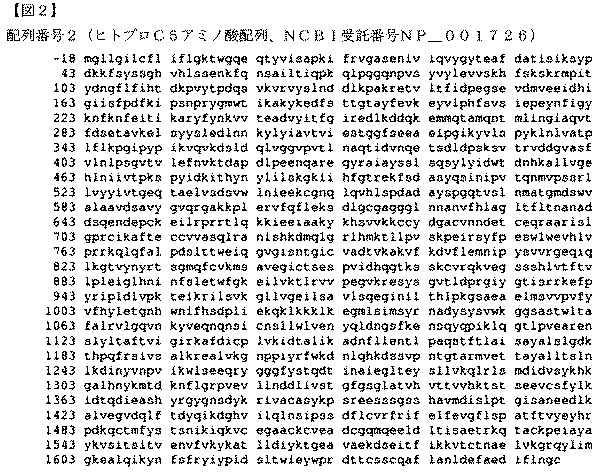
実験の結果は以下の通りである。hC5の非存在下、hFcRnマウスモデルにおける抗hC5抗体の半減期は、13.49±0.93日であった。2倍モル過剰のhC5と混合した抗hC5抗体の半減期は、9.58±1.24日であった。抗hC5抗体を4倍モル過剰のhC5と混合することは、5.77±1.86日の抗体半減期をもたらした。4:1のhC5/抗hC5抗体混合物を投与されたマウスに対するhC5の追加の後次用量は、抗体の半減期を4.55±1.02日に低下した。 The results of the experiment are as follows. In the absence of hC5, the half-life of anti-hC5 antibody in the hFcRn mouse model was 13.49 ± 0.93 days. The half-life of anti-hC5 antibody mixed with a 2-fold molar excess of hC5 was 9.58 ± 1.24 days. Mixing anti-hC5 antibody with a 4-fold molar excess of hC5 resulted in an antibody half-life of 5.77 ± 1.86 days. Subsequent subsequent doses of hC5 to mice receiving a 4: 1 hC5 / anti-hC5 antibody mixture reduced the antibody half-life to 4.55 ± 1.02 days.
これらの結果は、より多量のhC5の存在が抗hC5抗体の半減期を著しく短縮したことを示す。抗体の半減期は、循環中の遊離抗体の量に著しく依存する。これらの結果は、低下した濃度のヒトC5が、抗原媒介性抗体クリアランスの影響を著しく低下し、それ故にヒトにおける抗hC5抗体の半減期を増加させることを示唆する。 These results indicate that the presence of higher amounts of hC5 significantly shortened the half-life of anti-hC5 antibodies. The half-life of the antibody is highly dependent on the amount of free antibody in the circulation. These results suggest that reduced concentrations of human C5 significantly reduce the effects of antigen-mediated antibody clearance and therefore increase the half-life of anti-hC5 antibodies in humans.
本開示は、その特定の実施形態を参照して説明されたが、様々な変更を行うことができ、本開示の真の趣旨及び範囲を逸脱することなく、等価物が代用され得ることが当業者によって理解されるはずである。さらに、特定の状況、材料、物質の組成物、プロセス、1つまたは複数のプロセスステップを、本開示の目的、趣旨及び範囲に適合させるように、多くの修正を行うことができる。全てのそのような修正は、本開示の範囲内であることが意図される。 Although the present disclosure has been described with reference to specific embodiments thereof, various modifications can be made and equivalents can be substituted without departing from the true spirit and scope of the disclosure. Should be understood by the vendor. In addition, many modifications may be made to adapt a particular situation, material, composition of matter, process, process step or steps, to the objective, spirit and scope of the present disclosure. All such modifications are intended to be within the scope of this disclosure.
Claims (1)
Applications Claiming Priority (2)
| Application Number | Priority Date | Filing Date | Title |
|---|---|---|---|
| US201361806687P | 2013-03-29 | 2013-03-29 | |
| US61/806,687 | 2013-03-29 |
Related Parent Applications (1)
| Application Number | Title | Priority Date | Filing Date |
|---|---|---|---|
| JP2016505600A Division JP6505079B2 (en) | 2013-03-29 | 2014-03-28 | Compositions and methods for increasing the serum half-life of a therapeutic that targets complement C5 |
Publications (3)
| Publication Number | Publication Date |
|---|---|
| JP2018111728A true JP2018111728A (en) | 2018-07-19 |
| JP2018111728A5 JP2018111728A5 (en) | 2018-12-27 |
| JP6505288B2 JP6505288B2 (en) | 2019-04-24 |
Family
ID=50686201
Family Applications (2)
| Application Number | Title | Priority Date | Filing Date |
|---|---|---|---|
| JP2016505600A Active JP6505079B2 (en) | 2013-03-29 | 2014-03-28 | Compositions and methods for increasing the serum half-life of a therapeutic that targets complement C5 |
| JP2018080510A Active JP6505288B2 (en) | 2013-03-29 | 2018-04-19 | Compositions and methods for increasing the serum half-life of a therapeutic that targets complement C5 |
Family Applications Before (1)
| Application Number | Title | Priority Date | Filing Date |
|---|---|---|---|
| JP2016505600A Active JP6505079B2 (en) | 2013-03-29 | 2014-03-28 | Compositions and methods for increasing the serum half-life of a therapeutic that targets complement C5 |
Country Status (6)
| Country | Link |
|---|---|
| US (3) | US20160051673A1 (en) |
| EP (2) | EP2978451B1 (en) |
| JP (2) | JP6505079B2 (en) |
| CA (1) | CA2897334A1 (en) |
| ES (1) | ES2768648T3 (en) |
| WO (1) | WO2014160958A1 (en) |
Families Citing this family (23)
| Publication number | Priority date | Publication date | Assignee | Title |
|---|---|---|---|---|
| DK2006381T3 (en) | 2006-03-31 | 2016-02-22 | Chugai Pharmaceutical Co Ltd | PROCEDURE FOR REGULATING ANTIBODIES BLOOD PHARMACOKINETICS |
| DK2202245T3 (en) | 2007-09-26 | 2016-11-21 | Chugai Pharmaceutical Co Ltd | A method of modifying an antibody isoelectric point VIA amino acid substitution in CDR |
| UA121453C2 (en) | 2008-04-11 | 2020-06-10 | Чугей Сейяку Кабусікі Кайся | METHOD OF PREPARATION OF PHARMACEUTICAL COMPOSITION CONTAINING ANTIBODY |
| KR102385507B1 (en) | 2010-11-30 | 2022-04-12 | 추가이 세이야쿠 가부시키가이샤 | Antigen-binding molecule capable of binding to plurality of antigen molecules repeatedly |
| CN120574828A (en) | 2013-03-14 | 2025-09-02 | 阿尔尼拉姆医药品有限公司 | Complement component C5 iRNA compositions and methods of use thereof |
| EP3191591A1 (en) | 2014-09-12 | 2017-07-19 | Alnylam Pharmaceuticals, Inc. | Polynucleotide agents targeting complement component c5 and methods of use thereof |
| US9765135B2 (en) | 2014-12-19 | 2017-09-19 | Chugai Seiyaku Kabushiki Kaisha | Anti-C5 antibodies |
| JP6227191B1 (en) | 2014-12-19 | 2017-11-08 | 中外製薬株式会社 | Anti-myostatin antibody, polypeptide comprising mutant Fc region, and method of use |
| WO2016209956A1 (en) * | 2015-06-26 | 2016-12-29 | Alexion Pharmaceuticals, Inc. | A method for treating a patient in compliance with vaccination with eculizumab or an eculizumab variant |
| JP2018528218A (en) * | 2015-09-11 | 2018-09-27 | アンドリアン、ブルース | Recombinant glycosylated eculizumab and eculizumab variants |
| US10633434B2 (en) | 2016-06-14 | 2020-04-28 | Regeneron Pharmaceuticals, Inc. | Anti-C5 antibodies |
| TWI610941B (en) * | 2016-06-17 | 2018-01-11 | Chugai Seiyaku Kabushiki Kaisha | Anti-C5 antibody and method of use |
| IL264626B (en) | 2016-08-05 | 2022-07-01 | Chugai Pharmaceutical Co Ltd | A preparation for the prevention or treatment of diseases related to il-8 |
| US11828683B2 (en) | 2016-10-19 | 2023-11-28 | Alexion Pharmaceuticals, Inc. | Method of quantitating unbound C5a in a sample |
| US11965884B2 (en) | 2016-10-19 | 2024-04-23 | Alexion Pharmaceuticals, Inc. | Method of quantitating unbound C5 in a sample |
| CN110167961A (en) * | 2017-01-31 | 2019-08-23 | 中外制药株式会社 | Pharmaceutical compositions for treating or preventing C5-related diseases and methods of treating or preventing C5-related diseases |
| KR102656199B1 (en) * | 2017-04-21 | 2024-04-09 | 볼루션 이뮤노 파마슈티컬스 에스에이 | Coversin for the treatment of autoimmune blistering disease |
| CN120571008A (en) | 2017-12-13 | 2025-09-02 | 瑞泽恩制药公司 | Anti-C5 antibody combinations and uses thereof |
| EP3597222A1 (en) * | 2018-07-16 | 2020-01-22 | Easemedcontrol R & D GmbH & Co KG | Treatment and diagnosis of unresolved inflammatory diseases |
| KR20210055742A (en) | 2018-09-06 | 2021-05-17 | 더 트러스티스 오브 더 유니버시티 오브 펜실바니아 | Humanized anti-C5 antibodies and uses thereof |
| EP3958901A4 (en) * | 2019-04-24 | 2023-07-19 | The Trustees of the University of Pennsylvania | Bi-functional humanized anti-c5 antibodies and factor h fusion proteins and uses thereof |
| WO2021154941A1 (en) * | 2020-01-31 | 2021-08-05 | Alnylam Pharmaceuticals, Inc. | Complement component c5 irna compositions for use in the treatment of amyotrophic lateral sclerosis (als) |
| US20240417725A1 (en) * | 2021-10-12 | 2024-12-19 | Vanqua Bio, Inc. | Oligonucleotides for targeting complement c5 |
Citations (2)
| Publication number | Priority date | Publication date | Assignee | Title |
|---|---|---|---|---|
| JP2007520494A (en) * | 2004-02-03 | 2007-07-26 | アレクシオン ファーマシューティカルズ, インコーポレイテッド | Method for treating hemolytic disease |
| JP2009530299A (en) * | 2006-03-15 | 2009-08-27 | アレクシオン ファーマシューティカルズ, インコーポレイテッド | Treatment of patients with paroxysmal nocturnal hemoglobinuria with inhibitors of complement |
Family Cites Families (41)
| Publication number | Priority date | Publication date | Assignee | Title |
|---|---|---|---|---|
| US3710795A (en) | 1970-09-29 | 1973-01-16 | Alza Corp | Drug-delivery device with stretched, rate-controlling membrane |
| US4863457A (en) | 1986-11-24 | 1989-09-05 | Lee David A | Drug delivery device |
| US5116742A (en) | 1986-12-03 | 1992-05-26 | University Patents, Inc. | RNA ribozyme restriction endoribonucleases and methods |
| US4987071A (en) | 1986-12-03 | 1991-01-22 | University Patents, Inc. | RNA ribozyme polymerases, dephosphorylases, restriction endoribonucleases and methods |
| FR2650598B1 (en) | 1989-08-03 | 1994-06-03 | Rhone Poulenc Sante | DERIVATIVES OF ALBUMIN WITH THERAPEUTIC FUNCTION |
| US5164188A (en) | 1989-11-22 | 1992-11-17 | Visionex, Inc. | Biodegradable ocular implants |
| KR0185215B1 (en) | 1990-11-30 | 1999-05-01 | 요시다 쇼오지 | Sustained release eye drops |
| FR2686899B1 (en) | 1992-01-31 | 1995-09-01 | Rhone Poulenc Rorer Sa | NOVEL BIOLOGICALLY ACTIVE POLYPEPTIDES, THEIR PREPARATION AND PHARMACEUTICAL COMPOSITIONS CONTAINING THEM. |
| FR2686901A1 (en) | 1992-01-31 | 1993-08-06 | Rhone Poulenc Rorer Sa | NOVEL ANTITHROMBOTIC POLYPEPTIDES, THEIR PREPARATION AND PHARMACEUTICAL COMPOSITIONS CONTAINING THEM. |
| US5308341A (en) | 1993-09-28 | 1994-05-03 | Becton, Dickinson And Company | Method of testing the dose accuracy of a medication delivery device |
| US6074642A (en) | 1994-05-02 | 2000-06-13 | Alexion Pharmaceuticals, Inc. | Use of antibodies specific to human complement component C5 for the treatment of glomerulonephritis |
| US20030143204A1 (en) | 2001-07-27 | 2003-07-31 | Lewis David L. | Inhibition of RNA function by delivery of inhibitors to animal cells |
| CA2249195A1 (en) | 1996-03-18 | 1997-09-25 | Board Of Regents, The University Of Texas System | Immunoglobin-like domains with increased half lives |
| US6146361A (en) | 1996-09-26 | 2000-11-14 | Becton Dickinson And Company | Medication delivery pen having a 31 gauge needle |
| WO1998023289A1 (en) | 1996-11-27 | 1998-06-04 | The General Hospital Corporation | MODULATION OF IgG BINDING TO FcRn |
| US6277375B1 (en) | 1997-03-03 | 2001-08-21 | Board Of Regents, The University Of Texas System | Immunoglobulin-like domains with increased half-lives |
| US6302855B1 (en) | 1998-05-20 | 2001-10-16 | Novo Nordisk A/S | Medical apparatus for use by a patient for medical self treatment of diabetes |
| WO2001077137A1 (en) | 2000-04-12 | 2001-10-18 | Human Genome Sciences, Inc. | Albumin fusion proteins |
| US6192891B1 (en) | 1999-04-26 | 2001-02-27 | Becton Dickinson And Company | Integrated system including medication delivery pen, blood monitoring device, and lancer |
| US6277099B1 (en) | 1999-08-06 | 2001-08-21 | Becton, Dickinson And Company | Medication delivery pen |
| PE20011227A1 (en) | 2000-04-17 | 2002-01-07 | Chiesi Farma Spa | PHARMACEUTICAL FORMULATIONS FOR DRY POWDER INHALERS IN THE FORM OF HARD AGGLOMERATES |
| US7556615B2 (en) | 2001-09-12 | 2009-07-07 | Becton, Dickinson And Company | Microneedle-based pen device for drug delivery and method for using same |
| EP1572902B1 (en) | 2002-02-01 | 2014-06-11 | Life Technologies Corporation | HIGH POTENCY siRNAS FOR REDUCING THE EXPRESSION OF TARGET GENES |
| WO2003093430A2 (en) | 2002-05-03 | 2003-11-13 | The Board Of Trustees Of The Leland Stanford Junior University | Methods and compositions for use in preparing sirnas |
| ITMI20021527A1 (en) | 2002-07-11 | 2004-01-12 | Consiglio Nazionale Ricerche | C5 COMPONENT ANTIBODIES OF COMPLEMENT AND THEIR USE |
| WO2004015062A2 (en) | 2002-08-12 | 2004-02-19 | New England Biolabs, Inc. | Methods and compositions relating to gene silencing |
| US20050271660A1 (en) | 2002-09-06 | 2005-12-08 | Alexion Pharmaceuticals, Inc. | Nebulization of monoclonal antibodies for treating pulmonary diseases |
| US20040102469A1 (en) | 2002-09-13 | 2004-05-27 | Boehringer Ingelheim Pharma Gmbh & Co. Kg | Method for reducing the mortality rate |
| GB0222023D0 (en) | 2002-09-21 | 2002-10-30 | Aventis Pharma Ltd | Inhaler |
| EP3385384B1 (en) | 2004-02-12 | 2020-04-08 | Archemix LLC | Aptamer therapeutics useful in the treatment of complement-related disorders |
| US8685435B2 (en) | 2004-04-30 | 2014-04-01 | Allergan, Inc. | Extended release biodegradable ocular implants |
| US7919094B2 (en) | 2004-06-10 | 2011-04-05 | Omeros Corporation | Methods for treating conditions associated with MASP-2 dependent complement activation |
| CA3148917A1 (en) * | 2006-03-08 | 2007-09-13 | Archemix Llc | Complement binding aptamers and anti-c5 agents useful in the treatment of ocular disorders |
| US20090110679A1 (en) | 2007-07-13 | 2009-04-30 | Luk-Chiu Li | Methods and compositions for pulmonary administration of a TNFa inhibitor |
| UA121453C2 (en) | 2008-04-11 | 2020-06-10 | Чугей Сейяку Кабусікі Кайся | METHOD OF PREPARATION OF PHARMACEUTICAL COMPOSITION CONTAINING ANTIBODY |
| ES2643411T3 (en) | 2008-08-05 | 2017-11-22 | Novartis Ag | Compositions and methods for antibodies directed to the complement protein C5 |
| CA3035432A1 (en) | 2008-11-10 | 2010-05-14 | Alexion Pharmaceuticals, Inc. | Methods and compositions for treating complement-associated disorders |
| US20100291106A1 (en) | 2009-05-06 | 2010-11-18 | Novartis Ag | Compositions and methods for antibodies targeting complement protein c3b |
| JP2012531418A (en) | 2009-06-23 | 2012-12-10 | アレクシオン ファーマシューティカルズ, インコーポレイテッド | Bispecific antibodies that bind complement proteins |
| BR112012022214A2 (en) * | 2010-03-01 | 2017-07-04 | Alexion Pharma Inc | methods and compositions for treating degum disease |
| CN120574828A (en) | 2013-03-14 | 2025-09-02 | 阿尔尼拉姆医药品有限公司 | Complement component C5 iRNA compositions and methods of use thereof |
-
2014
- 2014-03-28 CA CA2897334A patent/CA2897334A1/en not_active Abandoned
- 2014-03-28 EP EP14722916.5A patent/EP2978451B1/en not_active Revoked
- 2014-03-28 ES ES14722916T patent/ES2768648T3/en active Active
- 2014-03-28 WO PCT/US2014/032209 patent/WO2014160958A1/en not_active Ceased
- 2014-03-28 JP JP2016505600A patent/JP6505079B2/en active Active
- 2014-03-28 US US14/779,605 patent/US20160051673A1/en not_active Abandoned
- 2014-03-28 EP EP18211716.8A patent/EP3473272A1/en not_active Withdrawn
-
2018
- 2018-04-19 JP JP2018080510A patent/JP6505288B2/en active Active
-
2019
- 2019-05-29 US US16/425,402 patent/US20200023060A1/en not_active Abandoned
-
2023
- 2023-10-06 US US18/482,159 patent/US20240293540A1/en active Pending
Patent Citations (2)
| Publication number | Priority date | Publication date | Assignee | Title |
|---|---|---|---|---|
| JP2007520494A (en) * | 2004-02-03 | 2007-07-26 | アレクシオン ファーマシューティカルズ, インコーポレイテッド | Method for treating hemolytic disease |
| JP2009530299A (en) * | 2006-03-15 | 2009-08-27 | アレクシオン ファーマシューティカルズ, インコーポレイテッド | Treatment of patients with paroxysmal nocturnal hemoglobinuria with inhibitors of complement |
Also Published As
| Publication number | Publication date |
|---|---|
| EP2978451B1 (en) | 2019-11-27 |
| ES2768648T3 (en) | 2020-06-23 |
| JP6505079B2 (en) | 2019-04-24 |
| US20240293540A1 (en) | 2024-09-05 |
| CA2897334A1 (en) | 2014-10-02 |
| JP6505288B2 (en) | 2019-04-24 |
| US20160051673A1 (en) | 2016-02-25 |
| US20200023060A1 (en) | 2020-01-23 |
| WO2014160958A1 (en) | 2014-10-02 |
| EP3473272A1 (en) | 2019-04-24 |
| JP2016520542A (en) | 2016-07-14 |
| EP2978451A1 (en) | 2016-02-03 |
Similar Documents
| Publication | Publication Date | Title |
|---|---|---|
| JP6505288B2 (en) | Compositions and methods for increasing the serum half-life of a therapeutic that targets complement C5 | |
| JP6022441B2 (en) | Anti-C5a antibodies and methods for use of the antibodies | |
| JP6189895B2 (en) | Methods and compositions for treating complement related disorders | |
| JP6112469B1 (en) | Anti-C5 antibody with improved pharmacokinetics | |
| US8999340B2 (en) | Methods for treating multiorgan, systemic degos' disease with a complement inhibitor | |
| US20180142010A1 (en) | Method for treating a patient in compliance with vaccination with eculizumab or an eculizumab variant | |
| WO2018109588A2 (en) | Stable aqueous anti-c5 antibody composition | |
| TW201244737A (en) | Use of an anti-CD200 antibody for prolonging the survival of allografts | |
| ES2957464T3 (en) | Compositions and methods for treating pulmonary fibrosis | |
| WO2023098637A1 (en) | Method for preventing and/or treating thromboembolic diseases |
Legal Events
| Date | Code | Title | Description |
|---|---|---|---|
| A621 | Written request for application examination |
Free format text: JAPANESE INTERMEDIATE CODE: A621 Effective date: 20180419 |
|
| A521 | Request for written amendment filed |
Free format text: JAPANESE INTERMEDIATE CODE: A523 Effective date: 20181107 |
|
| RD03 | Notification of appointment of power of attorney |
Free format text: JAPANESE INTERMEDIATE CODE: A7423 Effective date: 20181107 |
|
| RD04 | Notification of resignation of power of attorney |
Free format text: JAPANESE INTERMEDIATE CODE: A7424 Effective date: 20181107 |
|
| TRDD | Decision of grant or rejection written | ||
| A01 | Written decision to grant a patent or to grant a registration (utility model) |
Free format text: JAPANESE INTERMEDIATE CODE: A01 Effective date: 20190312 |
|
| A61 | First payment of annual fees (during grant procedure) |
Free format text: JAPANESE INTERMEDIATE CODE: A61 Effective date: 20190326 |
|
| R150 | Certificate of patent or registration of utility model |
Ref document number: 6505288 Country of ref document: JP Free format text: JAPANESE INTERMEDIATE CODE: R150 |
|
| R250 | Receipt of annual fees |
Free format text: JAPANESE INTERMEDIATE CODE: R250 |
|
| R250 | Receipt of annual fees |
Free format text: JAPANESE INTERMEDIATE CODE: R250 |
|
| R250 | Receipt of annual fees |
Free format text: JAPANESE INTERMEDIATE CODE: R250 |
|
| R250 | Receipt of annual fees |
Free format text: JAPANESE INTERMEDIATE CODE: R250 |