JP2016538097A - Consumer biometric devices - Google Patents
Consumer biometric devices Download PDFInfo
- Publication number
- JP2016538097A JP2016538097A JP2016550670A JP2016550670A JP2016538097A JP 2016538097 A JP2016538097 A JP 2016538097A JP 2016550670 A JP2016550670 A JP 2016550670A JP 2016550670 A JP2016550670 A JP 2016550670A JP 2016538097 A JP2016538097 A JP 2016538097A
- Authority
- JP
- Japan
- Prior art keywords
- subject
- data
- acquired
- information
- location
- Prior art date
- Legal status (The legal status is an assumption and is not a legal conclusion. Google has not performed a legal analysis and makes no representation as to the accuracy of the status listed.)
- Pending
Links
Images


Classifications
-
- G—PHYSICS
- G08—SIGNALLING
- G08B—SIGNALLING OR CALLING SYSTEMS; ORDER TELEGRAPHS; ALARM SYSTEMS
- G08B21/00—Alarms responsive to a single specified undesired or abnormal condition and not otherwise provided for
- G08B21/02—Alarms for ensuring the safety of persons
- G08B21/04—Alarms for ensuring the safety of persons responsive to non-activity, e.g. of elderly persons
- G08B21/0438—Sensor means for detecting
- G08B21/0453—Sensor means for detecting worn on the body to detect health condition by physiological monitoring, e.g. electrocardiogram, temperature, breathing
-
- A—HUMAN NECESSITIES
- A61—MEDICAL OR VETERINARY SCIENCE; HYGIENE
- A61B—DIAGNOSIS; SURGERY; IDENTIFICATION
- A61B5/00—Measuring for diagnostic purposes; Identification of persons
- A61B5/0002—Remote monitoring of patients using telemetry, e.g. transmission of vital signals via a communication network
- A61B5/0015—Remote monitoring of patients using telemetry, e.g. transmission of vital signals via a communication network characterised by features of the telemetry system
- A61B5/0022—Monitoring a patient using a global network, e.g. telephone networks, internet
-
- A—HUMAN NECESSITIES
- A61—MEDICAL OR VETERINARY SCIENCE; HYGIENE
- A61B—DIAGNOSIS; SURGERY; IDENTIFICATION
- A61B5/00—Measuring for diagnostic purposes; Identification of persons
- A61B5/02—Detecting, measuring or recording for evaluating the cardiovascular system, e.g. pulse, heart rate, blood pressure or blood flow
- A61B5/02028—Determining haemodynamic parameters not otherwise provided for, e.g. cardiac contractility or left ventricular ejection fraction
-
- A—HUMAN NECESSITIES
- A61—MEDICAL OR VETERINARY SCIENCE; HYGIENE
- A61B—DIAGNOSIS; SURGERY; IDENTIFICATION
- A61B5/00—Measuring for diagnostic purposes; Identification of persons
- A61B5/02—Detecting, measuring or recording for evaluating the cardiovascular system, e.g. pulse, heart rate, blood pressure or blood flow
- A61B5/0205—Simultaneously evaluating both cardiovascular conditions and different types of body conditions, e.g. heart and respiratory condition
-
- A—HUMAN NECESSITIES
- A61—MEDICAL OR VETERINARY SCIENCE; HYGIENE
- A61B—DIAGNOSIS; SURGERY; IDENTIFICATION
- A61B5/00—Measuring for diagnostic purposes; Identification of persons
- A61B5/02—Detecting, measuring or recording for evaluating the cardiovascular system, e.g. pulse, heart rate, blood pressure or blood flow
- A61B5/0205—Simultaneously evaluating both cardiovascular conditions and different types of body conditions, e.g. heart and respiratory condition
- A61B5/02055—Simultaneously evaluating both cardiovascular condition and temperature
-
- A—HUMAN NECESSITIES
- A61—MEDICAL OR VETERINARY SCIENCE; HYGIENE
- A61B—DIAGNOSIS; SURGERY; IDENTIFICATION
- A61B5/00—Measuring for diagnostic purposes; Identification of persons
- A61B5/02—Detecting, measuring or recording for evaluating the cardiovascular system, e.g. pulse, heart rate, blood pressure or blood flow
- A61B5/021—Measuring pressure in heart or blood vessels
- A61B5/02108—Measuring pressure in heart or blood vessels from analysis of pulse wave characteristics
-
- A—HUMAN NECESSITIES
- A61—MEDICAL OR VETERINARY SCIENCE; HYGIENE
- A61B—DIAGNOSIS; SURGERY; IDENTIFICATION
- A61B5/00—Measuring for diagnostic purposes; Identification of persons
- A61B5/02—Detecting, measuring or recording for evaluating the cardiovascular system, e.g. pulse, heart rate, blood pressure or blood flow
- A61B5/021—Measuring pressure in heart or blood vessels
- A61B5/02108—Measuring pressure in heart or blood vessels from analysis of pulse wave characteristics
- A61B5/02125—Measuring pressure in heart or blood vessels from analysis of pulse wave characteristics of pulse wave propagation time
-
- A—HUMAN NECESSITIES
- A61—MEDICAL OR VETERINARY SCIENCE; HYGIENE
- A61B—DIAGNOSIS; SURGERY; IDENTIFICATION
- A61B5/00—Measuring for diagnostic purposes; Identification of persons
- A61B5/02—Detecting, measuring or recording for evaluating the cardiovascular system, e.g. pulse, heart rate, blood pressure or blood flow
- A61B5/024—Measuring pulse rate or heart rate
- A61B5/02416—Measuring pulse rate or heart rate using photoplethysmograph signals, e.g. generated by infrared radiation
-
- A—HUMAN NECESSITIES
- A61—MEDICAL OR VETERINARY SCIENCE; HYGIENE
- A61B—DIAGNOSIS; SURGERY; IDENTIFICATION
- A61B5/00—Measuring for diagnostic purposes; Identification of persons
- A61B5/02—Detecting, measuring or recording for evaluating the cardiovascular system, e.g. pulse, heart rate, blood pressure or blood flow
- A61B5/024—Measuring pulse rate or heart rate
- A61B5/02416—Measuring pulse rate or heart rate using photoplethysmograph signals, e.g. generated by infrared radiation
- A61B5/02427—Details of sensor
-
- A—HUMAN NECESSITIES
- A61—MEDICAL OR VETERINARY SCIENCE; HYGIENE
- A61B—DIAGNOSIS; SURGERY; IDENTIFICATION
- A61B5/00—Measuring for diagnostic purposes; Identification of persons
- A61B5/02—Detecting, measuring or recording for evaluating the cardiovascular system, e.g. pulse, heart rate, blood pressure or blood flow
- A61B5/026—Measuring blood flow
- A61B5/0285—Measuring or recording phase velocity of blood waves
-
- A—HUMAN NECESSITIES
- A61—MEDICAL OR VETERINARY SCIENCE; HYGIENE
- A61B—DIAGNOSIS; SURGERY; IDENTIFICATION
- A61B5/00—Measuring for diagnostic purposes; Identification of persons
- A61B5/02—Detecting, measuring or recording for evaluating the cardiovascular system, e.g. pulse, heart rate, blood pressure or blood flow
- A61B5/026—Measuring blood flow
- A61B5/029—Measuring blood output from the heart, e.g. minute volume
-
- A—HUMAN NECESSITIES
- A61—MEDICAL OR VETERINARY SCIENCE; HYGIENE
- A61B—DIAGNOSIS; SURGERY; IDENTIFICATION
- A61B5/00—Measuring for diagnostic purposes; Identification of persons
- A61B5/08—Measuring devices for evaluating the respiratory organs
-
- A—HUMAN NECESSITIES
- A61—MEDICAL OR VETERINARY SCIENCE; HYGIENE
- A61B—DIAGNOSIS; SURGERY; IDENTIFICATION
- A61B5/00—Measuring for diagnostic purposes; Identification of persons
- A61B5/103—Measuring devices for testing the shape, pattern, colour, size or movement of the body or parts thereof, for diagnostic purposes
- A61B5/11—Measuring movement of the entire body or parts thereof, e.g. head or hand tremor or mobility of a limb
-
- A—HUMAN NECESSITIES
- A61—MEDICAL OR VETERINARY SCIENCE; HYGIENE
- A61B—DIAGNOSIS; SURGERY; IDENTIFICATION
- A61B5/00—Measuring for diagnostic purposes; Identification of persons
- A61B5/103—Measuring devices for testing the shape, pattern, colour, size or movement of the body or parts thereof, for diagnostic purposes
- A61B5/11—Measuring movement of the entire body or parts thereof, e.g. head or hand tremor or mobility of a limb
- A61B5/1102—Ballistocardiography
-
- A—HUMAN NECESSITIES
- A61—MEDICAL OR VETERINARY SCIENCE; HYGIENE
- A61B—DIAGNOSIS; SURGERY; IDENTIFICATION
- A61B5/00—Measuring for diagnostic purposes; Identification of persons
- A61B5/103—Measuring devices for testing the shape, pattern, colour, size or movement of the body or parts thereof, for diagnostic purposes
- A61B5/11—Measuring movement of the entire body or parts thereof, e.g. head or hand tremor or mobility of a limb
- A61B5/1118—Determining activity level
-
- A—HUMAN NECESSITIES
- A61—MEDICAL OR VETERINARY SCIENCE; HYGIENE
- A61B—DIAGNOSIS; SURGERY; IDENTIFICATION
- A61B5/00—Measuring for diagnostic purposes; Identification of persons
- A61B5/103—Measuring devices for testing the shape, pattern, colour, size or movement of the body or parts thereof, for diagnostic purposes
- A61B5/11—Measuring movement of the entire body or parts thereof, e.g. head or hand tremor or mobility of a limb
- A61B5/113—Measuring movement of the entire body or parts thereof, e.g. head or hand tremor or mobility of a limb occurring during breathing
-
- A—HUMAN NECESSITIES
- A61—MEDICAL OR VETERINARY SCIENCE; HYGIENE
- A61B—DIAGNOSIS; SURGERY; IDENTIFICATION
- A61B5/00—Measuring for diagnostic purposes; Identification of persons
- A61B5/117—Identification of persons
-
- A—HUMAN NECESSITIES
- A61—MEDICAL OR VETERINARY SCIENCE; HYGIENE
- A61B—DIAGNOSIS; SURGERY; IDENTIFICATION
- A61B5/00—Measuring for diagnostic purposes; Identification of persons
- A61B5/145—Measuring characteristics of blood in vivo, e.g. gas concentration or pH-value ; Measuring characteristics of body fluids or tissues, e.g. interstitial fluid or cerebral tissue
- A61B5/14542—Measuring characteristics of blood in vivo, e.g. gas concentration or pH-value ; Measuring characteristics of body fluids or tissues, e.g. interstitial fluid or cerebral tissue for measuring blood gases
-
- A—HUMAN NECESSITIES
- A61—MEDICAL OR VETERINARY SCIENCE; HYGIENE
- A61B—DIAGNOSIS; SURGERY; IDENTIFICATION
- A61B5/00—Measuring for diagnostic purposes; Identification of persons
- A61B5/16—Devices for psychotechnics; Testing reaction times ; Devices for evaluating the psychological state
- A61B5/165—Evaluating the state of mind, e.g. depression, anxiety
-
- A—HUMAN NECESSITIES
- A61—MEDICAL OR VETERINARY SCIENCE; HYGIENE
- A61B—DIAGNOSIS; SURGERY; IDENTIFICATION
- A61B5/00—Measuring for diagnostic purposes; Identification of persons
- A61B5/48—Other medical applications
- A61B5/4806—Sleep evaluation
- A61B5/4809—Sleep detection, i.e. determining whether a subject is asleep or not
-
- A—HUMAN NECESSITIES
- A61—MEDICAL OR VETERINARY SCIENCE; HYGIENE
- A61B—DIAGNOSIS; SURGERY; IDENTIFICATION
- A61B5/00—Measuring for diagnostic purposes; Identification of persons
- A61B5/48—Other medical applications
- A61B5/4806—Sleep evaluation
- A61B5/4815—Sleep quality
-
- A—HUMAN NECESSITIES
- A61—MEDICAL OR VETERINARY SCIENCE; HYGIENE
- A61B—DIAGNOSIS; SURGERY; IDENTIFICATION
- A61B5/00—Measuring for diagnostic purposes; Identification of persons
- A61B5/48—Other medical applications
- A61B5/4806—Sleep evaluation
- A61B5/4818—Sleep apnoea
-
- A—HUMAN NECESSITIES
- A61—MEDICAL OR VETERINARY SCIENCE; HYGIENE
- A61B—DIAGNOSIS; SURGERY; IDENTIFICATION
- A61B5/00—Measuring for diagnostic purposes; Identification of persons
- A61B5/48—Other medical applications
- A61B5/4833—Assessment of subject's compliance to treatment
-
- A—HUMAN NECESSITIES
- A61—MEDICAL OR VETERINARY SCIENCE; HYGIENE
- A61B—DIAGNOSIS; SURGERY; IDENTIFICATION
- A61B5/00—Measuring for diagnostic purposes; Identification of persons
- A61B5/48—Other medical applications
- A61B5/486—Biofeedback
-
- A—HUMAN NECESSITIES
- A61—MEDICAL OR VETERINARY SCIENCE; HYGIENE
- A61B—DIAGNOSIS; SURGERY; IDENTIFICATION
- A61B5/00—Measuring for diagnostic purposes; Identification of persons
- A61B5/68—Arrangements of detecting, measuring or recording means, e.g. sensors, in relation to patient
- A61B5/6801—Arrangements of detecting, measuring or recording means, e.g. sensors, in relation to patient specially adapted to be attached to or worn on the body surface
-
- A—HUMAN NECESSITIES
- A61—MEDICAL OR VETERINARY SCIENCE; HYGIENE
- A61B—DIAGNOSIS; SURGERY; IDENTIFICATION
- A61B5/00—Measuring for diagnostic purposes; Identification of persons
- A61B5/68—Arrangements of detecting, measuring or recording means, e.g. sensors, in relation to patient
- A61B5/6801—Arrangements of detecting, measuring or recording means, e.g. sensors, in relation to patient specially adapted to be attached to or worn on the body surface
- A61B5/6802—Sensor mounted on worn items
- A61B5/681—Wristwatch-type devices
-
- A—HUMAN NECESSITIES
- A61—MEDICAL OR VETERINARY SCIENCE; HYGIENE
- A61B—DIAGNOSIS; SURGERY; IDENTIFICATION
- A61B5/00—Measuring for diagnostic purposes; Identification of persons
- A61B5/68—Arrangements of detecting, measuring or recording means, e.g. sensors, in relation to patient
- A61B5/6801—Arrangements of detecting, measuring or recording means, e.g. sensors, in relation to patient specially adapted to be attached to or worn on the body surface
- A61B5/6813—Specially adapted to be attached to a specific body part
- A61B5/6824—Arm or wrist
-
- A—HUMAN NECESSITIES
- A61—MEDICAL OR VETERINARY SCIENCE; HYGIENE
- A61B—DIAGNOSIS; SURGERY; IDENTIFICATION
- A61B5/00—Measuring for diagnostic purposes; Identification of persons
- A61B5/68—Arrangements of detecting, measuring or recording means, e.g. sensors, in relation to patient
- A61B5/6887—Arrangements of detecting, measuring or recording means, e.g. sensors, in relation to patient mounted on external non-worn devices, e.g. non-medical devices
- A61B5/6898—Portable consumer electronic devices, e.g. music players, telephones, tablet computers
-
- A—HUMAN NECESSITIES
- A61—MEDICAL OR VETERINARY SCIENCE; HYGIENE
- A61B—DIAGNOSIS; SURGERY; IDENTIFICATION
- A61B5/00—Measuring for diagnostic purposes; Identification of persons
- A61B5/72—Signal processing specially adapted for physiological signals or for diagnostic purposes
- A61B5/7271—Specific aspects of physiological measurement analysis
- A61B5/7275—Determining trends in physiological measurement data; Predicting development of a medical condition based on physiological measurements, e.g. determining a risk factor
-
- A—HUMAN NECESSITIES
- A61—MEDICAL OR VETERINARY SCIENCE; HYGIENE
- A61B—DIAGNOSIS; SURGERY; IDENTIFICATION
- A61B5/00—Measuring for diagnostic purposes; Identification of persons
- A61B5/72—Signal processing specially adapted for physiological signals or for diagnostic purposes
- A61B5/7271—Specific aspects of physiological measurement analysis
- A61B5/7278—Artificial waveform generation or derivation, e.g. synthesizing signals from measured signals
-
- A—HUMAN NECESSITIES
- A61—MEDICAL OR VETERINARY SCIENCE; HYGIENE
- A61B—DIAGNOSIS; SURGERY; IDENTIFICATION
- A61B5/00—Measuring for diagnostic purposes; Identification of persons
- A61B5/72—Signal processing specially adapted for physiological signals or for diagnostic purposes
- A61B5/7271—Specific aspects of physiological measurement analysis
- A61B5/7282—Event detection, e.g. detecting unique waveforms indicative of a medical condition
-
- A—HUMAN NECESSITIES
- A61—MEDICAL OR VETERINARY SCIENCE; HYGIENE
- A61B—DIAGNOSIS; SURGERY; IDENTIFICATION
- A61B5/00—Measuring for diagnostic purposes; Identification of persons
- A61B5/74—Details of notification to user or communication with user or patient; User input means
- A61B5/742—Details of notification to user or communication with user or patient; User input means using visual displays
-
- A—HUMAN NECESSITIES
- A61—MEDICAL OR VETERINARY SCIENCE; HYGIENE
- A61B—DIAGNOSIS; SURGERY; IDENTIFICATION
- A61B5/00—Measuring for diagnostic purposes; Identification of persons
- A61B5/74—Details of notification to user or communication with user or patient; User input means
- A61B5/746—Alarms related to a physiological condition, e.g. details of setting alarm thresholds or avoiding false alarms
-
- G—PHYSICS
- G06—COMPUTING OR CALCULATING; COUNTING
- G06F—ELECTRIC DIGITAL DATA PROCESSING
- G06F21/00—Security arrangements for protecting computers, components thereof, programs or data against unauthorised activity
- G06F21/30—Authentication, i.e. establishing the identity or authorisation of security principals
- G06F21/31—User authentication
- G06F21/32—User authentication using biometric data, e.g. fingerprints, iris scans or voiceprints
-
- G—PHYSICS
- G06—COMPUTING OR CALCULATING; COUNTING
- G06F—ELECTRIC DIGITAL DATA PROCESSING
- G06F3/00—Input arrangements for transferring data to be processed into a form capable of being handled by the computer; Output arrangements for transferring data from processing unit to output unit, e.g. interface arrangements
- G06F3/01—Input arrangements or combined input and output arrangements for interaction between user and computer
- G06F3/048—Interaction techniques based on graphical user interfaces [GUI]
- G06F3/0481—Interaction techniques based on graphical user interfaces [GUI] based on specific properties of the displayed interaction object or a metaphor-based environment, e.g. interaction with desktop elements like windows or icons, or assisted by a cursor's changing behaviour or appearance
-
- G—PHYSICS
- G08—SIGNALLING
- G08B—SIGNALLING OR CALLING SYSTEMS; ORDER TELEGRAPHS; ALARM SYSTEMS
- G08B21/00—Alarms responsive to a single specified undesired or abnormal condition and not otherwise provided for
- G08B21/02—Alarms for ensuring the safety of persons
- G08B21/06—Alarms for ensuring the safety of persons indicating a condition of sleep, e.g. anti-dozing alarms
-
- A—HUMAN NECESSITIES
- A61—MEDICAL OR VETERINARY SCIENCE; HYGIENE
- A61B—DIAGNOSIS; SURGERY; IDENTIFICATION
- A61B5/00—Measuring for diagnostic purposes; Identification of persons
- A61B5/02—Detecting, measuring or recording for evaluating the cardiovascular system, e.g. pulse, heart rate, blood pressure or blood flow
- A61B5/02007—Evaluating blood vessel condition, e.g. elasticity, compliance
-
- A—HUMAN NECESSITIES
- A61—MEDICAL OR VETERINARY SCIENCE; HYGIENE
- A61B—DIAGNOSIS; SURGERY; IDENTIFICATION
- A61B5/00—Measuring for diagnostic purposes; Identification of persons
- A61B5/02—Detecting, measuring or recording for evaluating the cardiovascular system, e.g. pulse, heart rate, blood pressure or blood flow
- A61B5/024—Measuring pulse rate or heart rate
- A61B5/02405—Determining heart rate variability
-
- A—HUMAN NECESSITIES
- A61—MEDICAL OR VETERINARY SCIENCE; HYGIENE
- A61B—DIAGNOSIS; SURGERY; IDENTIFICATION
- A61B5/00—Measuring for diagnostic purposes; Identification of persons
- A61B5/02—Detecting, measuring or recording for evaluating the cardiovascular system, e.g. pulse, heart rate, blood pressure or blood flow
- A61B5/024—Measuring pulse rate or heart rate
- A61B5/02438—Measuring pulse rate or heart rate with portable devices, e.g. worn by the patient
-
- A—HUMAN NECESSITIES
- A61—MEDICAL OR VETERINARY SCIENCE; HYGIENE
- A61B—DIAGNOSIS; SURGERY; IDENTIFICATION
- A61B5/00—Measuring for diagnostic purposes; Identification of persons
- A61B5/05—Detecting, measuring or recording for diagnosis by means of electric currents or magnetic fields; Measuring using microwaves or radio waves
- A61B5/053—Measuring electrical impedance or conductance of a portion of the body
- A61B5/0531—Measuring skin impedance
-
- A—HUMAN NECESSITIES
- A61—MEDICAL OR VETERINARY SCIENCE; HYGIENE
- A61B—DIAGNOSIS; SURGERY; IDENTIFICATION
- A61B5/00—Measuring for diagnostic purposes; Identification of persons
- A61B5/08—Measuring devices for evaluating the respiratory organs
- A61B5/0816—Measuring devices for examining respiratory frequency
-
- A—HUMAN NECESSITIES
- A61—MEDICAL OR VETERINARY SCIENCE; HYGIENE
- A61B—DIAGNOSIS; SURGERY; IDENTIFICATION
- A61B5/00—Measuring for diagnostic purposes; Identification of persons
- A61B5/24—Detecting, measuring or recording bioelectric or biomagnetic signals of the body or parts thereof
- A61B5/316—Modalities, i.e. specific diagnostic methods
- A61B5/318—Heart-related electrical modalities, e.g. electrocardiography [ECG]
- A61B5/346—Analysis of electrocardiograms
- A61B5/349—Detecting specific parameters of the electrocardiograph cycle
- A61B5/363—Detecting tachycardia or bradycardia
-
- H—ELECTRICITY
- H04—ELECTRIC COMMUNICATION TECHNIQUE
- H04L—TRANSMISSION OF DIGITAL INFORMATION, e.g. TELEGRAPHIC COMMUNICATION
- H04L67/00—Network arrangements or protocols for supporting network services or applications
- H04L67/01—Protocols
- H04L67/12—Protocols specially adapted for proprietary or special-purpose networking environments, e.g. medical networks, sensor networks, networks in vehicles or remote metering networks
Landscapes
- Health & Medical Sciences (AREA)
- Life Sciences & Earth Sciences (AREA)
- Engineering & Computer Science (AREA)
- Physics & Mathematics (AREA)
- General Health & Medical Sciences (AREA)
- Biophysics (AREA)
- Heart & Thoracic Surgery (AREA)
- Medical Informatics (AREA)
- Animal Behavior & Ethology (AREA)
- Biomedical Technology (AREA)
- Molecular Biology (AREA)
- Surgery (AREA)
- Pathology (AREA)
- Public Health (AREA)
- Veterinary Medicine (AREA)
- Cardiology (AREA)
- Physiology (AREA)
- Pulmonology (AREA)
- General Physics & Mathematics (AREA)
- Theoretical Computer Science (AREA)
- Psychiatry (AREA)
- Oral & Maxillofacial Surgery (AREA)
- Dentistry (AREA)
- Hematology (AREA)
- Computer Security & Cryptography (AREA)
- General Engineering & Computer Science (AREA)
- Vascular Medicine (AREA)
- Business, Economics & Management (AREA)
- Emergency Management (AREA)
- Signal Processing (AREA)
- Artificial Intelligence (AREA)
- Computer Vision & Pattern Recognition (AREA)
- Software Systems (AREA)
- Computer Hardware Design (AREA)
- Computer Networks & Wireless Communication (AREA)
- Child & Adolescent Psychology (AREA)
- Developmental Disabilities (AREA)
- Educational Technology (AREA)
- Hospice & Palliative Care (AREA)
- Psychology (AREA)
Abstract
本書に説明される技術は、第1のセンサを使用して、対象の第1の身体部分における血管系内の少なくとも1つのパルス圧力波に関する時変情報を表す第1のデータセットを得るステップを含む、方法において具現化される。本方法はまた、第2のセンサを使用して、対象の第1の身体部分における対象の運動についての時変情報を表す第2のデータセットを得るステップを含む。本方法はまた、1つまたはそれを上回るプロセッサを使用して、第1のデータセット内の第1の点を識別するステップであって、第1の点は、第1の身体部分におけるパルス圧力波の到着時間を表す、ステップを含む。本方法はまた、1つまたはそれを上回るプロセッサを使用して、第2のデータセット内の第2の点を識別するステップであって、第2の点は、パルス圧力波が対象の第2の身体部分を進行する初期時間を表す、ステップを含む。The techniques described herein use a first sensor to obtain a first data set that represents time-varying information about at least one pulse pressure wave in the vasculature in a first body part of a subject. Embodied in a method. The method also includes using a second sensor to obtain a second data set that represents time-varying information about the movement of the object in the first body part of the object. The method also identifies the first point in the first data set using one or more processors, the first point comprising a pulse pressure in the first body part. It includes a step that represents the arrival time of the wave. The method also includes identifying a second point in the second data set using one or more processors, the second point being a second of the pulse pressure wave of interest. Representing the initial time to travel through the body part.
Description
(関連出願の引用)
本願は、2013年10月23日に出願された米国仮出願第61/894,884号および2014年5月23日に出願された米国仮出願第62/002,531号に対する優先権を主張するものであり、その全体の内容は、参照により本明細書中に援用される。
(Citation of related application)
This application claims priority to US Provisional Application No. 61 / 894,884 filed on October 23, 2013 and US Provisional Application No. 62 / 002,531 filed on May 23, 2014. The entire contents of which are hereby incorporated by reference.
本書は、消費者バイオメトリックデバイスに関連する技術を説明する。 This document describes techniques associated with consumer biometric devices.
種々のタイプのセンサが、バイオメトリックパラメータを感知するために使用されることができる。 Various types of sensors can be used to sense biometric parameters.
一側面では、方法は、第1のセンサを使用して、対象の第1の身体部分における血管系内の少なくとも1つのパルス圧力波に関する時変情報を表す第1のデータセットを得るステップを含む。本方法はまた、第2のセンサを使用して、対象の第1の身体部分における対象の運動についての時変情報を表す第2のデータセットを得るステップを含む。本方法はまた、1つまたはそれを上回るプロセッサを使用して、第1のデータセット内の第1の点を識別するステップであって、第1の点は、第1の身体部分におけるパルス圧力波の到着時間を表す、ステップを含む。本方法はまた、1つまたはそれを上回るプロセッサを使用して、第2のデータセット内の第2の点を識別するステップであって、第2の点は、パルス圧力波が対象の第2の身体部分を進行する初期時間を表す、ステップを含む。本方法はまた、第1の点と第2の点との間の差異として、パルス走行時間(PTT)を算出するステップであって、PTTは、パルス圧力波が対象の第2の身体部分から第1の身体部分に進行するためにかかる時間を表す、ステップを含む。 In one aspect, the method includes using a first sensor to obtain a first data set representing time-varying information regarding at least one pulsed pressure wave in the vasculature in the first body part of the subject. . The method also includes using a second sensor to obtain a second data set that represents time-varying information about the movement of the object in the first body part of the object. The method also identifies the first point in the first data set using one or more processors, the first point comprising a pulse pressure in the first body part. It includes a step that represents the arrival time of the wave. The method also includes identifying a second point in the second data set using one or more processors, the second point being a second of the pulse pressure wave of interest. Representing the initial time to travel through the body part. The method also includes calculating a pulse transit time (PTT) as a difference between the first point and the second point, wherein the PTT is a pulse pressure wave from a second body part of interest. Representing the time taken to travel to the first body part.
別の側面では、1つまたはそれを上回る機械可読記憶デバイスが、対象の第1の身体部分における血管系内の少なくとも1つのパルス圧力波に関する時変情報を表す第1のデータセットを得るステップを含む、動作を行うように1つまたはそれを上回る処理デバイスによって実行可能な命令を記憶する。本動作はまた、対象の第1の身体部分における対象の運動についての時変情報を表す第2のデータセットを得るステップを含む。本動作はまた、第1のデータセット内の第1の点を識別するステップを含む。第1の点は、第1の身体部分におけるパルス圧力波の到着時間を表す。本動作はまた、第2のデータセット内の第2の点を識別するステップを含む。第2の点は、パルス圧力波が対象の第2の身体部分を進行する初期時間を表す。本動作はまた、第1の点と第2の点との間の差異として、パルス走行時間(PTT)を算出するステップを含む。PTTは、パルス圧力波が対象の第2の身体部分から第1の身体部分に進行するためにかかる時間を表す。 In another aspect, one or more machine-readable storage devices obtain a first data set representing time-varying information regarding at least one pulsed pressure wave in the vasculature in the first body part of interest. Including instructions that are executable by one or more processing devices to perform operations. The operation also includes obtaining a second data set representing time-varying information about the subject's motion in the subject's first body part. The operation also includes identifying a first point in the first data set. The first point represents the arrival time of the pulse pressure wave in the first body part. The operation also includes identifying a second point in the second data set. The second point represents the initial time that the pulse pressure wave travels through the second body part of interest. The operation also includes calculating a pulse transit time (PTT) as the difference between the first point and the second point. PTT represents the time it takes for the pulsed pressure wave to travel from the second body part of interest to the first body part.
別の側面では、対象によって装着されるように構成されるバイオフィードバックデバイスが、対象の第1の身体部分における血管系内の少なくとも1つのパルス圧力波に関する時変情報を表す第1のデータセットを得るように構成される、第1のセンサを含む。本デバイスはまた、対象の第1の身体部分における対象の運動についての時変情報を表す第2のデータセットを得るように構成される、第2のセンサを含む。本デバイスはまた、メモリを含む。本デバイスはまた、1つまたはそれを上回るプロセッサを含む。1つまたはそれを上回るプロセッサは、第1および第2のデータセットを受信するように構成される。1つまたはそれを上回るプロセッサはまた、第1のデータセット内の第1の点を識別するように構成され、第1の点は、第1の身体部分におけるパルス圧力波の到着時間を表す。1つまたはそれを上回るプロセッサはまた、第2のデータセット内の第2の点を識別するように構成され、第2の点は、パルス圧力波が対象の第2の身体部分を進行する初期時間を表す。1つまたはそれを上回るプロセッサはまた、第1の点と第2の点との間の差異として、パルス走行時間(PTT)を算出するように構成される。PTTは、パルス圧力波が対象の第2の身体部分から第1の身体部分に進行するためにかかる時間を表す。 In another aspect, a biofeedback device configured to be worn by a subject has a first data set representing time-varying information regarding at least one pulsed pressure wave in the vasculature in a first body part of the subject. A first sensor configured to obtain is included. The device also includes a second sensor configured to obtain a second data set that represents time-varying information about the motion of the subject in the first body part of the subject. The device also includes a memory. The device also includes one or more processors. One or more processors are configured to receive the first and second data sets. The one or more processors are also configured to identify a first point in the first data set, the first point representing the arrival time of the pulse pressure wave in the first body part. The one or more processors are also configured to identify a second point in the second data set, the second point being an initial time at which the pulse pressure wave travels through the second body part of interest. Represents time. One or more processors are also configured to calculate a pulse transit time (PTT) as the difference between the first point and the second point. PTT represents the time it takes for the pulsed pressure wave to travel from the second body part of interest to the first body part.
実装は、以下の特徴のうちの1つまたはそれを上回るものを含むことができる。 Implementations can include one or more of the following features.
いくつかの実装では、少なくとも1つのパルス圧力波についての情報は、フォトプレチスモグラフィ(PPG)データを含み、対象の運動についての情報は、拍動運動信号(MoCG)データおよび総合的運動データの一方または両方を含む。 In some implementations, the information about the at least one pulse pressure wave includes photoplethysmography (PPG) data, and the information about the subject's motion is one of pulsatile motion signal (MoCG) data and total motion data. Or both.
いくつかの実装では、第1のデータセットおよび第2のデータセットのうちの少なくとも1つを含むデータは、継続的に取得される。 In some implementations, data including at least one of the first data set and the second data set is continuously acquired.
いくつかの実装では、データは、少なくとも16Hzの周波数において取得される。 In some implementations, data is acquired at a frequency of at least 16 Hz.
いくつかの実装では、データは、75Hz〜85Hzの周波数において取得される。 In some implementations, data is acquired at a frequency of 75 Hz to 85 Hz.
いくつかの実装では、データは、対象によって装着されるデバイスによって取得される。 In some implementations, the data is obtained by a device worn by the subject.
いくつかの実装では、本デバイスは、可動性であり、対象の移動度を低減させない。 In some implementations, the device is mobile and does not reduce the mobility of the object.
いくつかの実装では、本デバイスは、データを処理する。 In some implementations, the device processes data.
いくつかの実装では、第1の身体部分は、対象の腕である。 In some implementations, the first body part is the subject's arm.
いくつかの実装では、第1の身体部分は、対象の手首である。 In some implementations, the first body part is the subject's wrist.
いくつかの実装では、第1のセンサは、光学センサを含み、第2のセンサは、加速度計またはジャイロスコープを含む。 In some implementations, the first sensor includes an optical sensor and the second sensor includes an accelerometer or a gyroscope.
いくつかの実装では、第1の点を識別するステップは、1つまたはそれを上回るプロセッサによって、テンプレートセグメントと第1のデータセットの複数のセグメントのそれぞれの相互相関を算出するステップを含む。第1の点を識別するステップはまた、算出された相互相関に基づいて、第1のデータセットの少なくとも1つの候補セグメントを第1の点を含むものとして識別するステップを含む。第1の点を識別するステップはまた、1つまたはそれを上回るプロセッサによって、識別された候補セグメント内の第1の特徴を第1の点として識別するステップを含む。 In some implementations, identifying the first point includes calculating a cross-correlation of each of the template segment and the plurality of segments of the first data set by one or more processors. Identifying the first point also includes identifying at least one candidate segment of the first data set as containing the first point based on the calculated cross-correlation. Identifying the first point also includes identifying the first feature in the identified candidate segment as a first point by one or more processors.
いくつかの実装では、第2の点を識別するステップは、第2のデータセット内の参照点を判定するステップであって、参照点は、第1のデータセット内の第1の点と実質的同一時間点に対応する、ステップとを含む。第2の点を識別するステップはまた、参照点に対して所定の時間範囲内の1つまたはそれを上回る標的特徴を識別するステップを含む。第2の点を識別するステップはまた、標的特徴のうちの1つに対応する時間点を第2の点として選択するステップを含む。 In some implementations, identifying the second point is determining a reference point in the second data set, wherein the reference point is substantially the same as the first point in the first data set. Corresponding to the same time point. Identifying the second point also includes identifying one or more target features within a predetermined time range relative to the reference point. Identifying the second point also includes selecting a time point corresponding to one of the target features as the second point.
いくつかの実装では、標的特徴は、ピークおよび谷のうちの少なくとも1つを含む。 In some implementations, the target feature includes at least one of a peak and a valley.
いくつかの実装では、本方法はまた、対象の血圧をPTTの関数として算出するステップを含む。 In some implementations, the method also includes calculating the subject's blood pressure as a function of PTT.
いくつかの実装では、血圧は、収縮期圧および拡張期圧を含む。 In some implementations, blood pressure includes systolic pressure and diastolic pressure.
いくつかの実装では、拡張期圧は、PTTの対数の線形関数として計算される。 In some implementations, diastolic pressure is calculated as a linear function of the logarithm of PTT.
いくつかの実装では、収縮期圧は、拡張期圧の線形関数として計算される。 In some implementations, systolic pressure is calculated as a linear function of diastolic pressure.
いくつかの実装では、所定の時間範囲は、対象の心拍の収縮期部分と関連付けられる。 In some implementations, the predetermined time range is associated with a systolic portion of the subject's heart rate.
いくつかの実装では、本方法はまた、PTTの算出を開始するためのユーザ入力を受け取るステップを含む。 In some implementations, the method also includes receiving user input to initiate a PTT calculation.
いくつかの実装では、本方法はまた、動脈硬化度をPTTの関数として算出するステップを含む。 In some implementations, the method also includes calculating the degree of arteriosclerosis as a function of PTT.
いくつかの実装では、本デバイスはまた、本デバイスが対象によって装着されることを可能にする機構を含む。 In some implementations, the device also includes a mechanism that allows the device to be worn by a subject.
いくつかの実装では、本機構は、対象の移動度を低減させない。 In some implementations, the mechanism does not reduce target mobility.
いくつかの実装では、1つまたはそれを上回るプロセッサはまた、PTTの関数として対象の血圧を算出するように構成される。 In some implementations, one or more processors are also configured to calculate a subject's blood pressure as a function of PTT.
いくつかの実装では、本デバイスはまた、PTTの算出を開始するためのユーザ入力を受け取るように構成される、入力機構を含む。 In some implementations, the device also includes an input mechanism configured to receive user input to initiate the calculation of the PTT.
いくつかの実装では、1つまたはそれを上回るプロセッサはまた、動脈硬化度をPTTの関数として算出するように構成される。 In some implementations, one or more processors are also configured to calculate the degree of arteriosclerosis as a function of PTT.
別の側面では、方法は、対象の場所において取得された対象内の血液を通して伝搬する少なくとも1つのパルス圧力波についての時変情報を表す、第1のデータセット内のデータを処理するステップを含む。本方法はまた、対象の場所において取得された対象の運動についての時変情報を表す、第2のデータセット内のデータを処理するステップを含む。本方法はまた、データに基づいて、対象の不整脈を検出するステップを含む。 In another aspect, the method includes processing data in the first data set representing time-varying information about at least one pulse pressure wave propagating through blood in the subject acquired at the location of the subject. . The method also includes processing data in the second data set that represents time-varying information about the motion of the subject acquired at the location of the subject. The method also includes detecting an arrhythmia in the subject based on the data.
別の側面では、1つまたはそれを上回る機械可読記憶デバイスが、対象の場所において取得された対象内の血液を通して伝搬する少なくとも1つのパルス圧力波についての時変情報を表す、第1のデータセット内のデータを処理するステップを含む、動作を行うように1つまたはそれを上回る処理デバイスによって実行可能な命令を記憶する。本動作はまた、対象の場所において取得された対象の運動についての時変情報を表す、第2のデータセット内のデータを処理するステップを含む。本動作はまた、データに基づいて、対象の不整脈を検出するステップを含む。 In another aspect, a first data set in which one or more machine-readable storage devices represent time-varying information about at least one pulsed pressure wave propagating through blood in a subject acquired at the location of the subject Instructions that are executable by one or more processing devices to perform operations are stored, including processing data within. The operation also includes processing data in the second data set that represents time-varying information about the motion of the subject acquired at the location of the subject. The operation also includes detecting the subject's arrhythmia based on the data.
別の側面では、対象によって装着されるように構成されるバイオフィードバックデバイスが、光を対象の皮膚に向かって放出するように構成される、光源を含む。本デバイスはまた、放出された光が対象の皮膚に反射した後、放出された光を受信するように構成される、光学センサを含む。光学センサはまた、受信された光の特性に対応するデータを提供するように構成され、データは、対象の場所において光学センサによって取得された対象内の血液を通して伝搬する少なくとも1つのパルス圧力波についての時変情報を表す。本デバイスはまた、対象の場所において運動センサによって取得された対象の運動についての時変情報を表すデータを提供するように構成される、運動センサを含む。本デバイスはまた、発光要素、光学センサ、および運動センサのうちの1つまたはそれを上回るものからデータを受信するように構成される、プロセッサを含む。プロセッサはまた、データに基づいて、対象の不整脈を検出するように構成される。 In another aspect, a biofeedback device configured to be worn by a subject includes a light source configured to emit light toward the subject's skin. The device also includes an optical sensor configured to receive the emitted light after the emitted light reflects off the subject's skin. The optical sensor is also configured to provide data corresponding to the characteristics of the received light, the data for at least one pulse pressure wave propagating through blood in the subject acquired by the optical sensor at the location of the subject. Represents time-varying information. The device also includes a motion sensor configured to provide data representing time-varying information about the motion of the subject acquired by the motion sensor at the location of the subject. The device also includes a processor configured to receive data from one or more of the light emitting element, the optical sensor, and the motion sensor. The processor is also configured to detect the arrhythmia of the subject based on the data.
実装は、以下の特徴のうちの1つまたはそれを上回るものを含むことができる。 Implementations can include one or more of the following features.
いくつかの実装では、対象内の血液を通して伝搬する少なくとも1つのパルス圧力波についての情報は、フォトプレチスモグラフィ(PPG)データを含み、対象の運動についての情報は、拍動運動信号(MoCG)データおよび総合的運動データの一方または両方を含む。 In some implementations, the information about at least one pulse pressure wave propagating through the blood in the subject includes photoplethysmography (PPG) data, and the information about the subject's motion is pulsatile motion signal (MoCG) data. And / or comprehensive exercise data.
いくつかの実装では、データは、継続的に取得される。 In some implementations, data is acquired continuously.
いくつかの実装では、データは、少なくとも16Hzの周波数において取得される。 In some implementations, data is acquired at a frequency of at least 16 Hz.
いくつかの実装では、データは、75Hz〜85Hzの周波数において取得される。 In some implementations, data is acquired at a frequency of 75 Hz to 85 Hz.
いくつかの実装では、データは、対象の単一場所において取得される。 In some implementations, data is obtained at a single location of interest.
いくつかの実装では、データは、対象によって装着されるデバイスによって取得される。 In some implementations, the data is obtained by a device worn by the subject.
いくつかの実装では、本デバイスは、可動性であり、対象の移動度を低減させない。 In some implementations, the device is mobile and does not reduce the mobility of the object.
いくつかの実装では、本デバイスは、データを処理する。 In some implementations, the device processes data.
いくつかの実装では、単一場所は、対象の腕である。 In some implementations, the single location is the subject's arm.
いくつかの実装では、単一場所は、対象の手首である。 In some implementations, the single location is the subject's wrist.
いくつかの実装では、不整脈は、心房細動(AFIB)を含む。 In some implementations, the arrhythmia includes atrial fibrillation (AFIB).
いくつかの実装では、不整脈は、心房粗動を含む。 In some implementations, the arrhythmia includes atrial flutter.
いくつかの実装では、本方法はまた、対象の総合的運動データに基づいて、対象の1つまたはそれを上回る高活動期間を識別するステップを含む。 In some implementations, the method also includes identifying one or more periods of high activity of the subject based on the subject's overall motion data.
いくつかの実装では、不整脈検出が基づくデータは、1つまたはそれを上回る高活動期間中に収集されるデータを含まない。 In some implementations, the data on which arrhythmia detection is based does not include data collected during one or more periods of high activity.
いくつかの実装では、不整脈検出が基づくデータは、1つまたはそれを上回る高活動期間中に収集されるデータを含む。 In some implementations, the data on which arrhythmia detection is based includes data collected during one or more periods of high activity.
いくつかの実装では、データを処理するステップは、R波−R波間隔(RRi)対次の連続R波−R波間隔(RRi+1)をプロットするステップを含む。 In some implementations, processing the data includes plotting the R-wave interval (RR i ) versus the next continuous R-R interval (RR i + 1 ).
いくつかの実装では、データを処理するステップは、プロットされたデータ点の分散が所定の分散値を超えるかどうかを判定するステップを含む。 In some implementations, processing the data includes determining whether the variance of the plotted data points exceeds a predetermined variance value.
いくつかの実装では、本方法はまた、プロットされたデータ点の分散が所定の分散値を超える場合、対象が心房細動(AFIB)を発現したことを判定するステップを含む。 In some implementations, the method also includes determining that the subject has developed atrial fibrillation (AFIB) if the variance of the plotted data points exceeds a predetermined variance value.
いくつかの実装では、データを処理するステップは、プロットされたデータ点の複数のクラスタが対角線からオフセットされているかどうかを判定するステップを含む。 In some implementations, processing the data includes determining whether a plurality of clusters of plotted data points are offset from the diagonal.
いくつかの実装では、本方法はまた、対角線からオフセットされているプロットされたデータ点の複数のクラスタが存在する場合、対象が心房粗動を発現したことを判定するステップを含む。 In some implementations, the method also includes determining that the subject has developed atrial flutter if there are multiple clusters of plotted data points that are offset from the diagonal.
いくつかの実装では、データを処理するステップは、対象の心拍数、心拍変動、および血圧のうちの1つまたはそれを上回るものを判定するステップを含む。 In some implementations, processing the data includes determining one or more of the subject's heart rate, heart rate variability, and blood pressure.
いくつかの実装では、対象の心拍数を判定するステップは、第1のデータセット内の2つの連続参照点間の距離を計算するステップを含み、距離は、対象の2つの連続心拍間に経過した時間を表す。 In some implementations, determining the heart rate of the subject includes calculating a distance between two consecutive reference points in the first data set, the distance elapses between the two consecutive heart beats of the subject. Represents the time spent.
いくつかの実装では、参照点は、極大値または極小値である。 In some implementations, the reference point is a local maximum or local minimum.
いくつかの実装では、参照点は、ピークまたは谷である。 In some implementations, the reference point is a peak or valley.
いくつかの実装では、対象の心拍変動を判定するステップは、第1のデータセット内の複数の対の連続参照点間の距離を計算するステップを含み、各距離は、対象の2つの連続心拍間に経過した時間を表す。 In some implementations, determining the subject's heart rate variability includes calculating a distance between a plurality of pairs of consecutive reference points in the first data set, each distance comprising two consecutive heartbeats of the subject. Represents the time elapsed between.
いくつかの実装では、心房細動は、対象の心拍変動が閾値を超える場合に検出される。 In some implementations, atrial fibrillation is detected when the subject's heart rate variability exceeds a threshold.
いくつかの実装では、対象の血圧を判定するステップは、第1のデータセット内の第1の点を識別するステップであって、第1の点は、対象の第1の身体部分におけるパルス圧力波の到着時間を表す、ステップを含む。対象の血圧を判定するステップはまた、第2のデータセット内の第2の点を識別するステップであって、第2の点は、パルス圧力波が対象の第2の身体部分を進行する初期時間を表す、ステップを含む。対象の血圧を判定するステップはまた、第1の点と第2の点との間の差異として、パルス走行時間(PTT)を算出するステップであって、PTTは、パルス圧力波が対象の第2の身体部分から第1の身体部分に進行するためにかかる時間を表す、ステップを含み、PTTは、対象の1つまたはそれを上回る血管の弾性に関連する。対象の血圧を判定するステップはまた、1つまたはそれを上回る血管の弾性に基づいて、対象の血圧を判定するステップを含む。 In some implementations, determining the subject's blood pressure is identifying a first point in the first data set, wherein the first point is a pulse pressure in the first body part of the subject. It includes a step that represents the arrival time of the wave. Determining the subject's blood pressure is also the step of identifying a second point in the second data set, the second point being an initial stage in which the pulse pressure wave travels through the subject's second body part. Represents time, including steps. The step of determining the blood pressure of the subject is also a step of calculating a pulse transit time (PTT) as a difference between the first point and the second point, wherein the PTT is a pulse pressure wave of the subject The step represents the time taken to travel from the two body parts to the first body part, the PTT being related to the elasticity of one or more blood vessels of the subject. Determining a subject's blood pressure also includes determining the subject's blood pressure based on the elasticity of one or more blood vessels.
いくつかの実装では、第1の身体部分は、第1のデータセット内のデータが取得される対象の場所であり、第2の身体部分は、対象の心臓である。 In some implementations, the first body part is the location of the subject from which data in the first data set is obtained, and the second body part is the heart of the subject.
いくつかの実装では、データを処理するステップは、R波−R波間隔(RRi)対次の連続R波−R波間隔(RRi+1)をプロットするステップを含む。 In some implementations, processing the data includes plotting the R-wave interval (RR i ) versus the next continuous R-R interval (RR i + 1 ).
いくつかの実装では、データを処理するステップは、プロットされたデータ点の分散が所定の分散値を超えるかどうかを判定するステップを含む。 In some implementations, processing the data includes determining whether the variance of the plotted data points exceeds a predetermined variance value.
いくつかの実装では、プロセッサはまた、プロットされたデータ点の分散が所定の分散値を超える場合、対象が心房細動(AFIB)を発現したことを判定するように構成される。 In some implementations, the processor is also configured to determine that the subject has developed atrial fibrillation (AFIB) if the variance of the plotted data points exceeds a predetermined variance value.
いくつかの実装では、データを処理するステップは、プロットされたデータ点の複数のクラスタが対角線からオフセットされているかどうかを判定するステップを含む。 In some implementations, processing the data includes determining whether a plurality of clusters of plotted data points are offset from the diagonal.
いくつかの実装では、プロセッサはまた、対角線からオフセットされているプロットされたデータ点の複数のクラスタが存在する場合、対象が心房粗動を発現したことを判定するように構成される。 In some implementations, the processor is also configured to determine that the subject has developed atrial flutter if there are multiple clusters of plotted data points that are offset from the diagonal.
別の側面では、方法は、対象のそれぞれの場所において取得された1人またはそれを上回る対象のそれぞれ内の血液を通して伝搬する少なくとも1つのパルス圧力波についての時変情報を表すデータを処理するステップを含む。本方法はまた、対象のそれぞれの場所において取得された1人またはそれを上回る対象の運動についての時変情報を表すデータを処理するステップを含む。本方法はまた、データに基づいて、1人またはそれを上回る対象を治療する治療施設によって1人またはそれを上回る対象に提供される治療の質を判定するステップを含む。 In another aspect, the method processes data representing time-varying information about at least one pulse pressure wave propagating through blood in each of one or more subjects acquired at each location of the subject. including. The method also includes processing data representing time-varying information about one or more subject movements acquired at each location of the subject. The method also includes determining the quality of treatment provided to one or more subjects by the treatment facility treating one or more subjects based on the data.
別の側面では、1つまたはそれを上回る機械可読記憶デバイスが、対象のそれぞれの場所において取得された1人またはそれを上回る対象のそれぞれ内の血液を通して伝搬する少なくとも1つのパルス圧力波についての時変情報を表すデータを処理するステップを含む、動作を行うように1つまたはそれを上回る処理デバイスによって実行可能な命令を記憶する。本動作はまた、対象のそれぞれの場所において取得された1人またはそれを上回る対象の運動についての時変情報を表すデータを処理するステップを含む。本動作はまた、データに基づいて、1人またはそれを上回る対象を治療する治療施設によって1人またはそれを上回る対象に提供される治療の質を判定するステップを含む。 In another aspect, when one or more machine-readable storage devices for at least one pulsed pressure wave propagating through blood in each of one or more subjects acquired at each location of the subject Instructions are stored that are executable by one or more processing devices to perform operations, including processing data representing the change information. The operation also includes processing data representing time-varying information about one or more subject movements acquired at each location of the subject. The operation also includes determining the quality of treatment provided to the one or more subjects by the treatment facility treating the one or more subjects based on the data.
別の側面では、1人またはそれを上回る対象によって装着されるように構成されるバイオフィードバックデバイスは、光を対象の皮膚に向かって放出するように構成される、光源を含む。本デバイスはまた、放出された光が対象の皮膚に反射した後、放出された光を受信するように構成される、光学センサを含む。光学センサはまた、受信された光の特性に対応するデータを提供するように構成され、データは、対象の場所において光学センサによって取得された対象内の血液を通して伝搬する少なくとも1つのパルス圧力波についての時変情報を表す。本デバイスはまた、対象の場所において運動センサによって取得された対象の運動についての時変情報を表すデータを提供するように構成される、運動センサを含む。本デバイスはまた、発光要素、光学センサ、および運動センサのうちの1つまたはそれを上回るものからデータを受信するように構成される、プロセッサを含む。プロセッサはまた、データに基づいて、1人またはそれを上回る対象を治療する治療施設によって1人またはそれを上回る対象に提供される治療の質を判定するように構成される。 In another aspect, a biofeedback device configured to be worn by one or more subjects includes a light source configured to emit light toward the subject's skin. The device also includes an optical sensor configured to receive the emitted light after the emitted light reflects off the subject's skin. The optical sensor is also configured to provide data corresponding to the characteristics of the received light, the data for at least one pulse pressure wave propagating through blood in the subject acquired by the optical sensor at the location of the subject. Represents time-varying information. The device also includes a motion sensor configured to provide data representing time-varying information about the motion of the subject acquired by the motion sensor at the location of the subject. The device also includes a processor configured to receive data from one or more of the light emitting element, the optical sensor, and the motion sensor. The processor is also configured to determine the quality of treatment provided to the one or more subjects by the treatment facility treating the one or more subjects based on the data.
実装は、以下の特徴のうちの1つまたはそれを上回るものを含むことができる。 Implementations can include one or more of the following features.
いくつかの実装では、対象内の血液を通して伝搬する少なくとも1つのパルス圧力波についての情報は、フォトプレチスモグラフィ(PPG)データを含み、対象の運動についての情報は、拍動運動信号(MoCG)データおよび総合的運動データの一方または両方を含む。 In some implementations, the information about at least one pulse pressure wave propagating through the blood in the subject includes photoplethysmography (PPG) data, and the information about the subject's motion is pulsatile motion signal (MoCG) data. And / or comprehensive exercise data.
いくつかの実装では、データは、継続的に取得される。 In some implementations, data is acquired continuously.
いくつかの実装では、データは、少なくとも16Hzの周波数において取得される。 In some implementations, data is acquired at a frequency of at least 16 Hz.
いくつかの実装では、データは、75Hz〜85Hzの周波数において取得される。 In some implementations, data is acquired at a frequency of 75 Hz to 85 Hz.
いくつかの実装では、データは、対象のそれぞれの単一場所において取得される。 In some implementations, data is acquired at each single location of interest.
いくつかの実装では、データは、対象によって装着されるデバイスによって取得される。 In some implementations, the data is obtained by a device worn by the subject.
いくつかの実装では、本デバイスは、可動性であり、対象の移動度を低減させない。 In some implementations, the device is mobile and does not reduce the mobility of the object.
いくつかの実装では、本デバイスは、データを処理する。 In some implementations, the device processes data.
いくつかの実装では、対象のそれぞれの単一場所は、対象の腕である。 In some implementations, each single location of the subject is the subject's arm.
いくつかの実装では、単一場所は、対象の手首である。 In some implementations, the single location is the subject's wrist.
いくつかの実装では、1人またはそれを上回る対象に提供される治療の質を判定するステップは、各対象の総合的運動データと閾値を比較することによって、1人またはそれを上回る対象のそれぞれによって発現される物理活動のレベルを判定するステップを含む。 In some implementations, determining the quality of treatment provided to one or more subjects includes comparing each subject's overall exercise data to a threshold value, thereby comparing each of the one or more subjects. Determining the level of physical activity expressed by.
いくつかの実装では、閾値は、保健機関によって定義される指標に基づく。 In some implementations, the threshold is based on an indicator defined by the health organization.
いくつかの実装では、物理活動のレベルは、各対象が特定の期間にわたって運動した時間量を含む。 In some implementations, the level of physical activity includes the amount of time each subject has exercised over a specific period of time.
いくつかの実装では、物理活動のレベルは、各対象が特定の期間にわたって歩行した時間量または距離を含む。 In some implementations, the level of physical activity includes the amount of time or distance each subject has walked over a particular period of time.
いくつかの実装では、本方法はまた、1人またはそれを上回る対象のそれぞれが特定の期間にわたって暴露された紫外線光の量についての情報を表す、データを処理するステップを含む。 In some implementations, the method also includes processing data representing information about the amount of ultraviolet light that each of the one or more subjects has been exposed to for a particular period of time.
いくつかの実装では、本方法はまた、紫外線光についての情報に基づいて、1人またはそれを上回る対象のそれぞれが特定の期間にわたって屋外で過ごした時間量を判定するステップを含む。 In some implementations, the method also includes determining the amount of time each of one or more subjects spent outdoors over a specified period based on information about the ultraviolet light.
いくつかの実装では、本方法はまた、治療施設によって提供される治療の質と1人またはそれを上回る他の対象を治療する別の治療施設によって提供される治療の質を比較するステップを含む。 In some implementations, the method also includes comparing the quality of treatment provided by the treatment facility with the quality of treatment provided by another treatment facility treating one or more other subjects. .
いくつかの実装では、本デバイスはまた、1人またはそれを上回る対象のそれぞれが特定の期間にわたって暴露される紫外線光のレベルを測定するように構成される、紫外線光センサを含む。 In some implementations, the device also includes an ultraviolet light sensor that is configured to measure the level of ultraviolet light to which each of one or more subjects are exposed for a specified period of time.
いくつかの実装では、プロセッサはまた、1人またはそれを上回る対象のそれぞれが特定の期間にわたって暴露される紫外線光のレベルについての情報を表す、データを処理するように構成される。 In some implementations, the processor is also configured to process data representing information about the level of ultraviolet light to which each of one or more subjects are exposed for a particular period of time.
いくつかの実装では、プロセッサはまた、紫外線光のレベルについての情報に基づいて、1人またはそれを上回る対象のそれぞれが特定の期間にわたって屋外で過ごした時間量を判定するように構成される。 In some implementations, the processor is also configured to determine the amount of time each of one or more subjects spent outdoors over a specific period based on information about the level of ultraviolet light.
いくつかの実装では、1人またはそれを上回る対象に提供される治療の質を判定するステップは、各対象の総合的運動データと閾値を比較することによって、1人またはそれを上回る対象のそれぞれによって発現される物理活動のレベルを判定するステップを含む。 In some implementations, determining the quality of treatment provided to one or more subjects includes comparing each subject's overall exercise data to a threshold value, thereby comparing each of the one or more subjects. Determining the level of physical activity expressed by.
別の側面では、方法は、対象の場所において取得された対象内の血液を通して伝搬する少なくとも1つのパルス圧力波についての時変情報を表す、第1のデータセット内のデータを処理するステップを含む。データは、対象がデータによって示されるリスクと関連付けられる状況にある間に取得される。 In another aspect, the method includes processing data in the first data set representing time-varying information about at least one pulse pressure wave propagating through blood in the subject acquired at the location of the subject. . The data is acquired while the subject is in a situation associated with the risk indicated by the data.
別の側面では、1つまたはそれを上回る機械可読記憶デバイスが、対象の場所において取得された対象内の血液を通して伝搬する少なくとも1つのパルス圧力波についての時変情報を表す、第1のデータセット内のデータを処理するステップを含む、動作を行うように1つまたはそれを上回る処理デバイスによって実行可能な命令を記憶する。データは、対象がデータによって示されるリスクと関連付けられる状況にある間に取得される。 In another aspect, a first data set in which one or more machine-readable storage devices represent time-varying information about at least one pulsed pressure wave propagating through blood in a subject acquired at the location of the subject Instructions that are executable by one or more processing devices to perform operations are stored, including processing data within. The data is acquired while the subject is in a situation associated with the risk indicated by the data.
別の側面では、対象によって装着されるように構成されるバイオフィードバックデバイスが、光を対象の皮膚に向かって放出するように構成される、光源を含む。本デバイスはまた、放出された光が対象の皮膚に反射した後、放出された光を受信するように構成される、光学センサを含む。光学センサはまた、受信された光の特性に対応するデータを提供するように構成され、データは、対象の場所において光学センサによって取得された対象内の血液を通して伝搬する少なくとも1つのパルス圧力波についての時変情報を表す。本デバイスはまた、発光要素および光学センサの一方または両方からデータを受信するように構成される、プロセッサを含む。プロセッサはまた、データを処理し、対象がリスクと関連付けられる状況にあるかどうかを判定し、対象と関連付けられたリスクのレベルの測定値を導出するように構成される。 In another aspect, a biofeedback device configured to be worn by a subject includes a light source configured to emit light toward the subject's skin. The device also includes an optical sensor configured to receive the emitted light after the emitted light reflects off the subject's skin. The optical sensor is also configured to provide data corresponding to the characteristics of the received light, the data for at least one pulse pressure wave propagating through blood in the subject acquired by the optical sensor at the location of the subject. Represents time-varying information. The device also includes a processor configured to receive data from one or both of the light emitting element and the optical sensor. The processor is also configured to process the data, determine whether the subject is in a situation associated with the risk, and derive a measure of the level of risk associated with the subject.
実装は、以下の特徴のうちの1つまたはそれを上回るものを含むことができる。 Implementations can include one or more of the following features.
いくつかの実装では、本方法はまた、対象の場所において取得された対象の運動についての時変情報を表す、第2のデータセット内のデータを処理するステップを含む。 In some implementations, the method also includes processing data in the second data set that represents time-varying information about the motion of the subject acquired at the location of the subject.
いくつかの実装では、対象内の血液を通して伝搬する少なくとも1つのパルス圧力波についての情報は、フォトプレチスモグラフィ(PPG)データを含み、対象の運動についての情報は、拍動運動信号(MoCG)データおよび総合的運動データの一方または両方を含む。 In some implementations, the information about at least one pulse pressure wave propagating through the blood in the subject includes photoplethysmography (PPG) data, and the information about the subject's motion is pulsatile motion signal (MoCG) data. And / or comprehensive exercise data.
いくつかの実装では、データは、継続的に取得される。 In some implementations, data is acquired continuously.
いくつかの実装では、データは、少なくとも16Hzの周波数において取得される。 In some implementations, data is acquired at a frequency of at least 16 Hz.
いくつかの実装では、データは、75Hz〜85Hzの周波数において取得される。 In some implementations, data is acquired at a frequency of 75 Hz to 85 Hz.
いくつかの実装では、データは、対象の単一場所において取得される。 In some implementations, data is obtained at a single location of interest.
いくつかの実装では、データは、対象によって装着されるデバイスによって取得される。 In some implementations, the data is obtained by a device worn by the subject.
いくつかの実装では、本デバイスは、可動性であり、対象の移動度を低減させない。 In some implementations, the device is mobile and does not reduce the mobility of the object.
いくつかの実装では、本デバイスは、データを処理する。 In some implementations, the device processes data.
いくつかの実装では、単一場所は、対象の腕である。 In some implementations, the single location is the subject's arm.
いくつかの実装では、単一場所は、対象の手首である。 In some implementations, the single location is the subject's wrist.
いくつかの実装では、本方法はまた、処理されたデータを使用して、対象と関連付けられたリスクのレベルの測定値を導出するステップを含む。 In some implementations, the method also includes deriving a measure of the level of risk associated with the subject using the processed data.
いくつかの実装では、本方法はまた、第1のデータセット内の第1の点を識別するステップであって、第1の点は、対象の第1の身体部分におけるパルス圧力波の到着時間を表す、ステップを含む。本方法はまた、第2のデータセット内の第2の点を識別するステップであって、第2の点は、パルス圧力波が対象の第2の身体部分を進行する初期時間を表す、ステップを含む。本方法はまた、第1の点と第2の点との間の差異として、パルス走行時間(PTT)を算出するステップであって、PTTは、パルス圧力波が対象の第2の身体部分から第1の身体部分に進行するためにかかる時間を表す、ステップを含む。 In some implementations, the method also includes identifying a first point in the first data set, wherein the first point is an arrival time of a pulse pressure wave in the first body part of interest. Represents a step. The method also identifies a second point in the second data set, the second point representing an initial time for the pulsed pressure wave to travel through the second body part of interest. including. The method also includes calculating a pulse transit time (PTT) as a difference between the first point and the second point, wherein the PTT is a pulse pressure wave from a second body part of interest. Representing the time taken to travel to the first body part.
いくつかの実装では、第1の身体部分は、第1のデータセット内のデータが取得される対象の場所であり、第2の身体部分は、対象の心臓である。 In some implementations, the first body part is the location of the subject from which data in the first data set is obtained, and the second body part is the heart of the subject.
いくつかの実装では、本方法はまた、PTTに基づいて、対象の血圧を判定するステップを含む。 In some implementations, the method also includes determining a subject's blood pressure based on the PTT.
いくつかの実装では、リスクは、対象への外傷を含み、データは、外傷の存在を示す。 In some implementations, the risk includes trauma to the subject and the data indicates the presence of the trauma.
いくつかの実装では、本方法はまた、処理されたデータを外傷に対処する当事者に提供するステップを含む。 In some implementations, the method also includes providing the processed data to a party that deals with the trauma.
いくつかの実装では、処理されたデータは、対象によって装着されるデバイスから遠隔デバイスに伝送される。 In some implementations, the processed data is transmitted from the device worn by the subject to the remote device.
いくつかの実装では、遠隔デバイスは、緊急サービス提供者と関連付けられたサーバである。 In some implementations, the remote device is a server associated with the emergency service provider.
いくつかの実装では、処理されたデータは、当事者が対象に到達する前に、当事者に提供される。 In some implementations, the processed data is provided to the party before the party reaches the subject.
いくつかの実装では、本方法はまた、対象のそれぞれの場所において取得されたさらなる対象内の血液を通して伝搬する少なくとも1つのパルス圧力波についての時変情報を表すデータを処理するステップを含む。本方法はまた、対象のそれぞれの場所において取得されたさらなる対象の運動についての時変情報を表すデータを処理するステップを含む。データは、さらなる対象がリスクと関連付けられる状況にある間に取得され、リスクは、外傷を含む。 In some implementations, the method also includes processing data representing time-varying information about at least one pulse pressure wave propagating through the blood in the further subject acquired at each location of the subject. The method also includes processing data representing time-varying information about additional subject motion acquired at each location of the subject. Data is acquired while a further subject is in a situation associated with risk, where risk includes trauma.
いくつかの実装では、本方法はまた、当事者が対象に到達する前に、対象およびさらなる対象に関する処理されたデータを外傷に対処する当事者に提供するステップを含む。 In some implementations, the method also includes providing processed data regarding the subject and further subjects to the party addressing the trauma before the parties reach the subject.
いくつかの実装では、処理されたデータは、対象によって装着されるデバイスから遠隔デバイスに伝送される。 In some implementations, the processed data is transmitted from the device worn by the subject to the remote device.
いくつかの実装では、遠隔デバイスは、緊急サービス提供者と関連付けられたサーバである。 In some implementations, the remote device is a server associated with the emergency service provider.
いくつかの実装では、本方法はまた、当事者が対象に到達する前に、当事者が対象のそれぞれと関連付けられたリスクのレベルを査定することを可能にする情報を当事者に提供するステップを含む。 In some implementations, the method also includes providing the parties with information that enables the parties to assess the level of risk associated with each of the subjects before the parties reach the subjects.
いくつかの実装では、本方法はまた、対象が医療的治療のために搬送される医療施設に、処理されたデータを提供するステップを含む。 In some implementations, the method also includes providing the processed data to a medical facility where the subject is transported for medical treatment.
いくつかの実装では、リスクは、外傷を含む。 In some implementations, the risk includes trauma.
いくつかの実装では、処理されたデータを医療施設に提供するステップは、処理されたデータを医療施設の救急治療部門に提供するステップを含む。 In some implementations, providing the processed data to the medical facility includes providing the processed data to the emergency care department of the medical facility.
いくつかの実装では、情報は、対象が救急治療部門によって処置される前に、救急治療部門に提供される。 In some implementations, information is provided to the emergency care department before the subject is treated by the emergency care department.
いくつかの実装では、本方法はまた、対象のそれぞれの場所において取得されたさらなる対象内の血液を通して伝搬する少なくとも1つのパルス圧力波についての時変情報を表すデータを処理するステップを含む。本方法はまた、対象のそれぞれの場所において取得されたさらなる対象の運動についての時変情報を表すデータを処理するステップを含む。データは、さらなる対象がリスクと関連付けられる状況にある間に取得される。 In some implementations, the method also includes processing data representing time-varying information about at least one pulse pressure wave propagating through the blood in the further subject acquired at each location of the subject. The method also includes processing data representing time-varying information about additional subject motion acquired at each location of the subject. Data is acquired while further subjects are in a situation associated with risk.
いくつかの実装では、処理されたデータを医療施設に提供するステップは、処理されたデータを医療施設の救急治療部門に提供するステップを含む。 In some implementations, providing the processed data to the medical facility includes providing the processed data to the emergency care department of the medical facility.
いくつかの実装では、情報は、対象のうちの1人またはそれを上回る人数が救急治療部門によって処置される前に、救急治療部門に提供される。 In some implementations, information is provided to the emergency care department before one or more of the subjects are treated by the emergency care department.
いくつかの実装では、対象は、傷害の重症度に基づく順序で処置される。 In some implementations, subjects are treated in an order based on the severity of the injury.
いくつかの実装では、比較的に深刻に傷害された対象は、比較的にあまり深刻に傷害されていない対象より前に処置される。 In some implementations, a relatively seriously injured subject is treated before a relatively less severely injured subject.
いくつかの実装では、処理されたデータは、標準治療段階の進行過程全体を通して、特定の標準治療との対象のコンプライアンスを判定するために使用される。 In some implementations, the processed data is used to determine subject compliance with a particular standard treatment throughout the course of the standard treatment phase.
いくつかの実装では、処理されたデータは、特定の標準治療に従って、対象が適切な治療を受けているかどうかを判定するために使用される。 In some implementations, the processed data is used to determine whether a subject is receiving appropriate treatment according to a particular standard treatment.
いくつかの実装では、データは、対象がリスクと関連付けられる状況になった後に処理される。 In some implementations, the data is processed after the subject is in a situation associated with the risk.
いくつかの実装では、データの処理は、データが取得された後、リスクの影響が解明されることを可能にするために十分に短い遅延を伴って生じる。 In some implementations, processing of the data occurs with a sufficiently short delay to allow the risk impact to be elucidated after the data is acquired.
いくつかの実装では、状況は、消火活動を含む。 In some implementations, the situation includes fire fighting activities.
いくつかの実装では、状況は、天災または突発的暴力行為を含む。 In some implementations, the situation involves natural disasters or sudden violence.
いくつかの実装では、リスクは、心不全、情動性ストレス、異常皮膚温、異常体温、高血圧症、心臓発作、脳卒中、不整脈、疲労、および不安神経症のうちの1つまたはそれを上回るものを含む。 In some implementations, the risk includes one or more of heart failure, emotional stress, abnormal skin temperature, abnormal body temperature, hypertension, heart attack, stroke, arrhythmia, fatigue, and anxiety .
いくつかの実装では、本方法はまた、データセットに基づいて、対象の血圧、皮膚温、体温、心拍数、および心拍変動のうちの1つまたはそれを上回るものを判定するステップを含む。本方法はまた、対象の判定された血圧、心拍数、および心拍変動のうちの1つまたはそれを上回るものが、閾値を上回る所定の量であるかどうかを判定することによって、対象における情動性ストレスを検出するステップを含む。 In some implementations, the method also includes determining one or more of the subject's blood pressure, skin temperature, body temperature, heart rate, and heart rate variability based on the data set. The method may also affect the affectivity in the subject by determining whether one or more of the determined blood pressure, heart rate, and heart rate variability of the subject is a predetermined amount that is above a threshold. Detecting a stress.
いくつかの実装では、データは、対象がリスクのうちの1つの影響を発現しつつあることを示す。 In some implementations, the data indicates that the subject is developing the impact of one of the risks.
いくつかの実装では、リスクは、紫外線光への対象の過剰暴露を含む。 In some implementations, the risk includes overexposure of the subject to ultraviolet light.
いくつかの実装では、本方法はまた、対象が暴露された紫外線光の量についての情報を表すデータを処理するステップを含む。 In some implementations, the method also includes processing data representing information about the amount of ultraviolet light to which the subject has been exposed.
いくつかの実装では、本方法はまた、対象が暴露された紫外線光の量と閾値を比較し、対象が紫外線光に過剰暴露されたかどうかを判定するステップを含む。 In some implementations, the method also includes comparing the amount of ultraviolet light to which the subject has been exposed to a threshold and determining whether the subject has been overexposed to ultraviolet light.
いくつかの実装では、本方法はまた、対象が紫外線光に過剰暴露された場合、対象にアラートするステップを含む。 In some implementations, the method also includes alerting the subject if the subject is overexposed to ultraviolet light.
いくつかの実装では、リスクは、対象への外傷を含み、データは、外傷の存在を示す。 In some implementations, the risk includes trauma to the subject and the data indicates the presence of the trauma.
いくつかの実装では、本動作はまた、対象の場所において取得された対象の運動についての時変情報を表す、第2のデータセット内のデータを処理するステップを含む。 In some implementations, the operation also includes processing data in the second data set that represents time-varying information about the motion of the subject acquired at the location of the subject.
いくつかの実装では、本デバイスはまた、対象の場所において運動センサによって取得された対象の運動についての時変情報を表すデータを提供するように構成される、運動センサを含む。プロセッサはまた、運動センサからデータを受信し、処理するように構成される。 In some implementations, the device also includes a motion sensor configured to provide data representing time-varying information about the motion of the subject acquired by the motion sensor at the location of the subject. The processor is also configured to receive and process data from the motion sensor.
いくつかの実装では、プロセッサはまた、バイオフィードバックデバイスに、処理されたデータを外傷に対処する当事者に提供させるように構成される。 In some implementations, the processor is also configured to cause the biofeedback device to provide processed data to a party that deals with the trauma.
いくつかの実装では、プロセッサはまた、バイオフィードバックデバイスに、処理されたデータを遠隔デバイスに提供させるように構成される。 In some implementations, the processor is also configured to cause the biofeedback device to provide processed data to the remote device.
いくつかの実装では、遠隔デバイスは、緊急サービス提供者と関連付けられたサーバである。 In some implementations, the remote device is a server associated with the emergency service provider.
いくつかの実装では、プロセッサはまた、バイオフィードバックデバイスに、対象が医療的治療のために搬送される医療施設に、処理されたデータを提供させるように構成される。 In some implementations, the processor is also configured to cause the biofeedback device to provide processed data to a medical facility where the subject is transported for medical treatment.
いくつかの実装では、本デバイスはまた、処理されたデータを提供するように構成される、送受信機を含む。 In some implementations, the device also includes a transceiver configured to provide the processed data.
いくつかの実装では、処理されたデータは、標準治療段階の進行過程全体を通して、特定の標準治療との対象のコンプライアンスを判定するために使用される。 In some implementations, the processed data is used to determine subject compliance with a particular standard treatment throughout the course of the standard treatment phase.
いくつかの実装では、処理されたデータは、特定の標準治療に従って、対象が適切な治療を受けているかどうかを判定するために使用される。 In some implementations, the processed data is used to determine whether a subject is receiving appropriate treatment according to a particular standard treatment.
いくつかの実装では、リスクは、紫外線光への対象の過剰暴露を含む。 In some implementations, the risk includes overexposure of the subject to ultraviolet light.
いくつかの実装では、本デバイスはまた、対象が暴露される紫外線光の量を測定するように構成される、紫外線光センサを含む。 In some implementations, the device also includes an ultraviolet light sensor configured to measure the amount of ultraviolet light to which the subject is exposed.
いくつかの実装では、プロセッサはまた、対象が暴露される紫外線光の量についての情報を表す、データを処理するように構成される。 In some implementations, the processor is also configured to process data that represents information about the amount of ultraviolet light to which the subject is exposed.
いくつかの実装では、プロセッサはまた、対象が暴露される紫外線光の量と閾値を比較し、対象が紫外線光に過剰暴露されたかどうかを判定するように構成される。 In some implementations, the processor is also configured to compare the amount of ultraviolet light to which the subject is exposed and a threshold to determine whether the subject has been overexposed to ultraviolet light.
いくつかの実装では、本デバイスはまた、対象が紫外線光に過剰暴露された場合、対象にアラートするように構成される。 In some implementations, the device is also configured to alert the subject if the subject is overexposed to ultraviolet light.
別の側面では、方法は、対象の場所において取得された対象内の血液を通して伝搬する少なくとも1つのパルス圧力波についての時変情報を表す、第1のデータセット内のデータを処理するステップを含む。本方法はまた、データに関連する情報を遠隔デバイスに提供するステップを含む。 In another aspect, the method includes processing data in the first data set representing time-varying information about at least one pulse pressure wave propagating through blood in the subject acquired at the location of the subject. . The method also includes providing information related to the data to the remote device.
別の側面では、システムは、遠隔デバイスと、対象によって装着されるように構成されるバイオフィードバックデバイスとを含む。バイオフィードバックデバイスは、光を対象の皮膚に向かって放出するように構成される、光源を含む。バイオフィードバックデバイスはまた、放出された光が対象の皮膚に反射した後、放出された光を受信するように構成される、光学センサを含む。光学センサはまた、受信された光の特性に対応するデータを提供するように構成され、データは、対象の場所において光学センサによって取得された対象内の血液を通して伝搬する少なくとも1つのパルス圧力波についての時変情報を表す。バイオフィードバックデバイスはまた、発光要素および光学センサの一方または両方からデータを受信するように構成される、プロセッサを含む。プロセッサはまた、データに関連する情報を遠隔デバイスに提供するように構成される。 In another aspect, the system includes a remote device and a biofeedback device configured to be worn by the subject. The biofeedback device includes a light source configured to emit light toward the subject's skin. The biofeedback device also includes an optical sensor configured to receive the emitted light after the emitted light reflects off the subject's skin. The optical sensor is also configured to provide data corresponding to the characteristics of the received light, the data for at least one pulse pressure wave propagating through blood in the subject acquired by the optical sensor at the location of the subject. Represents time-varying information. The biofeedback device also includes a processor configured to receive data from one or both of the light emitting element and the optical sensor. The processor is also configured to provide information related to the data to the remote device.
別の側面では、1つまたはそれを上回る機械可読記憶デバイスが、対象の場所において取得された対象内の血液を通して伝搬する少なくとも1つのパルス圧力波についての時変情報を表す、第1のデータセット内のデータを処理するステップを含む、動作を行うように1つまたはそれを上回る処理デバイスによって実行可能な命令を記憶する。本動作はまた、データに関連する情報を遠隔デバイスに提供するステップを含む。 In another aspect, a first data set in which one or more machine-readable storage devices represent time-varying information about at least one pulsed pressure wave propagating through blood in a subject acquired at the location of the subject Instructions that are executable by one or more processing devices to perform operations are stored, including processing data within. The operation also includes providing information related to the data to the remote device.
別の側面では、対象によって装着されるように構成されるバイオフィードバックデバイスが、光を対象の皮膚に向かって放出するように構成される、光源を含む。バイオフィードバックデバイスはまた、放出された光が対象の皮膚に反射した後、放出された光を受信するように構成される、光学センサを含む。光学センサはまた、受信された光の特性に対応するデータを提供するように構成され、データは、対象の場所において光学センサによって取得された対象内の血液を通して伝搬する少なくとも1つのパルス圧力波についての時変情報を表す。バイオフィードバックデバイスはまた、発光要素および光学センサの一方または両方からデータを受信するように構成される、プロセッサを含む。プロセッサはまた、データに関連する情報を遠隔デバイスに提供するように構成される。 In another aspect, a biofeedback device configured to be worn by a subject includes a light source configured to emit light toward the subject's skin. The biofeedback device also includes an optical sensor configured to receive the emitted light after the emitted light reflects off the subject's skin. The optical sensor is also configured to provide data corresponding to the characteristics of the received light, the data for at least one pulse pressure wave propagating through blood in the subject acquired by the optical sensor at the location of the subject. Represents time-varying information. The biofeedback device also includes a processor configured to receive data from one or both of the light emitting element and the optical sensor. The processor is also configured to provide information related to the data to the remote device.
実装は、以下の特徴のうちの1つまたはそれを上回るものを含むことができる。 Implementations can include one or more of the following features.
いくつかの実装では、本方法はまた、対象の場所において取得された対象の運動についての時変情報を表す、第2のデータセット内のデータを処理するステップを含む。 In some implementations, the method also includes processing data in the second data set that represents time-varying information about the motion of the subject acquired at the location of the subject.
いくつかの実装では、対象内の血液を通して伝搬する少なくとも1つのパルス圧力波についての情報は、フォトプレチスモグラフィ(PPG)データを含み、対象の運動についての情報は、拍動運動信号(MoCG)データおよび総合的運動データの一方または両方を含む。 In some implementations, the information about at least one pulse pressure wave propagating through the blood in the subject includes photoplethysmography (PPG) data, and the information about the subject's motion is pulsatile motion signal (MoCG) data. And / or comprehensive exercise data.
いくつかの実装では、データは、継続的に取得される。 In some implementations, data is acquired continuously.
いくつかの実装では、データは、少なくとも16Hzの周波数において取得される。 In some implementations, data is acquired at a frequency of at least 16 Hz.
いくつかの実装では、データは、75Hz〜85Hzの周波数において取得される。 In some implementations, data is acquired at a frequency of 75 Hz to 85 Hz.
いくつかの実装では、データは、対象の単一場所において取得される。 In some implementations, data is obtained at a single location of interest.
いくつかの実装では、データは、対象によって装着されるデバイスによって取得される。 In some implementations, the data is obtained by a device worn by the subject.
いくつかの実装では、本デバイスは、可動性であり、対象の移動度を低減させない。 In some implementations, the device is mobile and does not reduce the mobility of the object.
いくつかの実装では、本デバイスは、データを処理する。 In some implementations, the device processes data.
いくつかの実装では、単一場所は、対象の腕である。 In some implementations, the single location is the subject's arm.
いくつかの実装では、単一場所は、対象の手首である。 In some implementations, the single location is the subject's wrist.
いくつかの実装では、遠隔デバイスは、サーバである。 In some implementations, the remote device is a server.
いくつかの実装では、本方法はまた、第1および第2のデータセット内のデータに基づいて、対象が、健康関連問題を発現している、または発現したことを判定するステップを含む。 In some implementations, the method also includes determining based on the data in the first and second data sets that the subject has developed or has developed a health related problem.
いくつかの実装では、本方法はまた、遠隔デバイスに、介護者および対象の一方または両方に、対象が、健康関連問題を発現している、または発現したことをアラートさせるステップを含む。 In some implementations, the method also includes causing the remote device to alert one or both of the caregiver and the subject that the subject is developing or has developed a health related problem.
いくつかの実装では、本方法はまた、遠隔デバイスに、対象が健康関連問題を発現していることを対象にアラートさせるステップを含む。 In some implementations, the method also includes causing the remote device to alert the subject that the subject is developing a health related problem.
いくつかの実装では、遠隔デバイスは、データを取得する対象によって装着されるデバイスにアラートを送信する。 In some implementations, the remote device sends an alert to the device worn by the subject from which data is obtained.
いくつかの実装では、遠隔デバイスは、対象の携帯電話にアラートを送信する。 In some implementations, the remote device sends an alert to the subject mobile phone.
いくつかの実装では、対象が、健康関連問題を発現している、または発現したことを判定するステップは、対象の血圧が閾値を満たすかどうかを判定するステップを含む。 In some implementations, determining that the subject is developing or has developed a health related problem includes determining whether the subject's blood pressure meets a threshold.
いくつかの実装では、健康関連問題は、高血圧症である。 In some implementations, the health related problem is hypertension.
いくつかの実装では、対象が、健康関連問題を発現している、または発現したことを判定するステップは、対象の血圧の変化率を判定するステップを含む。 In some implementations, determining that the subject is developing or has developed a health related problem includes determining a rate of change in the subject's blood pressure.
いくつかの実装では、医療事象は、脳卒中であり、対象は、対象の血圧の変化率が、正であり、かつ閾値を上回る場合、脳卒中を有することを判定される。 In some implementations, the medical event is a stroke and the subject is determined to have a stroke if the subject's rate of change in blood pressure is positive and above a threshold.
いくつかの実装では、医療事象は、異常心臓機能であり、対象は、対象の血圧の変化率が、負であり、かつ閾値を下回る場合、異常心臓機能を発現していることを判定される。 In some implementations, the medical event is abnormal cardiac function, and the subject is determined to develop abnormal cardiac function if the subject's rate of change in blood pressure is negative and below a threshold .
いくつかの実装では、本方法はまた、第1のデータセット内の第1の点を識別するステップであって、第1の点は、対象の第1の身体部分におけるパルス圧力波の到着時間を表す、ステップを含む。本方法はまた、第2のデータセット内の第2の点を識別するステップであって、第2の点は、パルス圧力波が対象の第2の身体部分を進行する初期時間を表す、ステップを含む。本方法はまた、第1の点と第2の点との間の差異として、パルス走行時間(PTT)を算出するステップであって、PTTは、パルス圧力波が対象の第2の身体部分から第1の身体部分に進行するためにかかる時間を表す、ステップを含む。 In some implementations, the method also includes identifying a first point in the first data set, wherein the first point is an arrival time of a pulse pressure wave in the first body part of interest. Represents a step. The method also identifies a second point in the second data set, the second point representing an initial time for the pulsed pressure wave to travel through the second body part of interest. including. The method also includes calculating a pulse transit time (PTT) as a difference between the first point and the second point, wherein the PTT is a pulse pressure wave from a second body part of interest. Representing the time taken to travel to the first body part.
いくつかの実装では、対象の血圧は、PTTに基づいて判定される。 In some implementations, the subject's blood pressure is determined based on the PTT.
いくつかの実装では、第1の身体部分は、第1のデータセット内のデータが取得される対象の場所であり、第2の身体部分は、対象の心臓である。 In some implementations, the first body part is the location of the subject from which data in the first data set is obtained, and the second body part is the heart of the subject.
いくつかの実装では、対象が健康関連問題を発現していることを判定するステップは、対象の心拍数が閾値を満たすかどうかを判定するステップを含む。 In some implementations, determining that the subject is developing a health related problem includes determining whether the subject's heart rate meets a threshold.
いくつかの実装では、健康関連問題は、頻脈である。 In some implementations, the health related problem is tachycardia.
いくつかの実装では、対象の心拍数を判定するステップは、第1のデータセット内の2つの連続参照点間の距離を計算するステップを含み、距離は、対象の2つの連続心拍間に経過した時間を表す。 In some implementations, determining the heart rate of the subject includes calculating a distance between two consecutive reference points in the first data set, the distance elapses between the two consecutive heart beats of the subject. Represents the time spent.
いくつかの実装では、参照点は、極大値または極小値である。 In some implementations, the reference point is a local maximum or local minimum.
いくつかの実装では、参照点は、第1のデータセット内のピークまたは谷である。 In some implementations, the reference point is a peak or valley in the first data set.
いくつかの実装では、対象が健康関連問題を発現していることを判定するステップは、対象の心拍変動が閾値を満たすかどうかを判定するステップを含む。 In some implementations, determining that the subject is developing a health related problem includes determining whether the subject's heart rate variability meets a threshold.
いくつかの実装では、閾値は、対象が不整脈を発現しているかどうかに基づく。 In some implementations, the threshold is based on whether the subject develops an arrhythmia.
いくつかの実装では、対象の心拍変動を判定するステップは、第1のデータセット内の複数の対の連続参照点間の距離を計算するステップを含み、各距離は、対象の2つの連続心拍間に経過した時間を表す。 In some implementations, determining the subject's heart rate variability includes calculating a distance between a plurality of pairs of consecutive reference points in the first data set, each distance comprising two consecutive heartbeats of the subject. Represents the time elapsed between.
いくつかの実装では、参照点は、極大値または極小値である。 In some implementations, the reference point is a local maximum or local minimum.
いくつかの実装では、参照点は、ピークまたは谷である。 In some implementations, the reference point is a peak or valley.
いくつかの実装では、対象が健康関連問題を発現していることを判定するステップは、対象が閾値を満たす規模の影響を持続しているかどうかを判定するステップを含む。 In some implementations, determining that the subject is developing a health-related problem includes determining whether the subject is sustaining an impact of a magnitude that meets a threshold.
いくつかの実装では、影響の規模を判定するステップは、影響時における対象の総合的運動データを分析するステップを含む。 In some implementations, determining the magnitude of the impact includes analyzing the subject's overall motion data at the time of the impact.
いくつかの実装では、健康関連問題は、震盪である。 In some implementations, the health related problem is concussion.
いくつかの実装では、本方法はまた、第1および第2のデータセット内のデータに基づいて、対象が健康関連問題を発現しつつあることを判定するステップを含む。 In some implementations, the method also includes determining that the subject is developing a health related problem based on the data in the first and second data sets.
いくつかの実装では、本方法はまた、遠隔デバイスに、対象が健康関連問題を発現しつつあることを介護者にアラートさせるステップを含む。 In some implementations, the method also includes causing the remote device to alert the caregiver that the subject is developing a health related problem.
いくつかの実装では、本方法はまた、遠隔デバイスに、対象が健康関連問題を発現しつつあることを対象にアラートさせるステップを含む。 In some implementations, the method also includes causing the remote device to alert the subject that the subject is developing a health related problem.
いくつかの実装では、遠隔デバイスは、データを取得する対象によって装着されるデバイスにアラートを送信する。 In some implementations, the remote device sends an alert to the device worn by the subject from which data is obtained.
いくつかの実装では、遠隔デバイスは、対象の携帯電話にアラートを送信する。 In some implementations, the remote device sends an alert to the subject mobile phone.
いくつかの実装では、対象が健康関連問題を発現しつつあることを判定するステップは、対象の血圧が閾値を満たすかどうかを判定するステップを含む。 In some implementations, determining that the subject is developing a health-related problem includes determining whether the subject's blood pressure meets a threshold.
いくつかの実装では、本方法はまた、第1のデータセット内の第1の点を識別するステップであって、第1の点は、対象の第1の身体部分におけるパルス圧力波の到着時間を表す、ステップを含む。本方法はまた、第2のデータセット内の第2の点を識別するステップであって、第2の点は、パルス圧力波が対象の第2の身体部分を進行する初期時間を表す、ステップを含む。本方法はまた、第1の点と第2の点との間の差異として、パルス走行時間(PTT)を算出するステップであって、PTTは、パルス圧力波が対象の第2の身体部分から第1の身体部分に進行するためにかかる時間を表す、ステップを含む。 In some implementations, the method also includes identifying a first point in the first data set, wherein the first point is an arrival time of a pulse pressure wave in the first body part of interest. Represents a step. The method also identifies a second point in the second data set, the second point representing an initial time for the pulsed pressure wave to travel through the second body part of interest. including. The method also includes calculating a pulse transit time (PTT) as a difference between the first point and the second point, wherein the PTT is a pulse pressure wave from a second body part of interest. Representing the time taken to travel to the first body part.
いくつかの実装では、対象の血圧は、PTTに基づいて判定される。 In some implementations, the subject's blood pressure is determined based on the PTT.
いくつかの実装では、第1の身体部分は、第1のデータセット内のデータが取得される対象の場所であり、第2の身体部分は、対象の心臓である。 In some implementations, the first body part is the location of the subject from which data in the first data set is obtained, and the second body part is the heart of the subject.
いくつかの実装では、対象が健康関連問題を発現しつつあることを判定するステップは、対象の心拍数が閾値を満たすかどうかを判定するステップを含む。 In some implementations, determining that the subject is developing a health-related problem includes determining whether the subject's heart rate meets a threshold.
いくつかの実装では、対象の心拍数を判定するステップは、第1のデータセット内の2つの連続参照点間の距離を計算するステップを含み、距離は、対象の2つの連続心拍間に経過した時間を表す。 In some implementations, determining the heart rate of the subject includes calculating a distance between two consecutive reference points in the first data set, the distance elapses between the two consecutive heart beats of the subject. Represents the time spent.
いくつかの実装では、参照点は、極大値または極小値である。 In some implementations, the reference point is a local maximum or local minimum.
いくつかの実装では、参照点は、第1のデータセット内のピークまたは谷である。 In some implementations, the reference point is a peak or valley in the first data set.
いくつかの実装では、対象が健康関連問題を発現しつつあることを判定するステップは、対象の心拍変動が閾値を満たすかどうかを判定するステップを含む。 In some implementations, determining that the subject is developing a health-related problem includes determining whether the subject's heart rate variability meets a threshold.
いくつかの実装では、対象の心拍変動を判定するステップは、第1のデータセット内の複数の対の連続参照点間の距離を計算するステップを含み、各距離は、対象の2つの連続心拍間に経過した時間を表す。 In some implementations, determining the subject's heart rate variability includes calculating a distance between a plurality of pairs of consecutive reference points in the first data set, each distance comprising two consecutive heartbeats of the subject. Represents the time elapsed between.
いくつかの実装では、参照点は、極大値または極小値である。 In some implementations, the reference point is a local maximum or local minimum.
いくつかの実装では、参照点は、ピークまたは谷である。 In some implementations, the reference point is a peak or valley.
いくつかの実装では、本方法はまた、対象に関連する場所情報を遠隔デバイスに提供するステップを含む。 In some implementations, the method also includes providing location information associated with the subject to the remote device.
いくつかの実装では、場所情報は、データを取得する対象によって装着されるデバイスの測位モジュールによって提供される。 In some implementations, the location information is provided by a positioning module of a device that is worn by the subject from which data is obtained.
いくつかの実装では、測位モジュールは、GPSトランスポンダである。 In some implementations, the positioning module is a GPS transponder.
いくつかの実装では、本方法はまた、対象に関連する温度情報を遠隔デバイスに提供するステップを含む。 In some implementations, the method also includes providing temperature information associated with the subject to the remote device.
いくつかの実装では、遠隔デバイスは、サーモスタットである。 In some implementations, the remote device is a thermostat.
いくつかの実装では、対象は、サーモスタットによって温度制御される場所から遠隔にいる。 In some implementations, the subject is remote from where the temperature is controlled by a thermostat.
いくつかの実装では、サーモスタットは、対象に関連する温度情報に基づいて、その温度設定を調節するように構成される。 In some implementations, the thermostat is configured to adjust its temperature setting based on temperature information associated with the subject.
いくつかの実装では、サーモスタットがその温度設定を調節する時間は、対象に関連する場所情報に基づく。 In some implementations, the time that the thermostat adjusts its temperature setting is based on location information associated with the subject.
いくつかの実装では、サーモスタットは、場所情報が、対象がサーモスタットによって温度制御される場所から所定の距離内にあることを示すとき、その温度設定を調節する。 In some implementations, the thermostat adjusts its temperature setting when the location information indicates that the subject is within a predetermined distance from the location temperature controlled by the thermostat.
いくつかの実装では、遠隔デバイスは、照明である。 In some implementations, the remote device is lighting.
いくつかの実装では、対象は、照明によって照射されることができる場所から遠隔にいる。 In some implementations, the subject is remote from where it can be illuminated by illumination.
いくつかの実装では、照明は、対象に関連する場所情報に基づく時間において、その照明設定を調節するように構成される。 In some implementations, the lighting is configured to adjust its lighting settings at times based on location information associated with the subject.
いくつかの実装では、照明は、場所情報が、対象が照明によって照明制御される場所から所定の距離内にあることを示すとき、その照明設定を調節する。 In some implementations, the lighting adjusts its lighting settings when the location information indicates that the object is within a predetermined distance from the location that is controlled by the lighting.
いくつかの実装では、本方法はまた、対象の場所に基づいて、対象が特定の物体と相互作用していることを判定するステップを含む。 In some implementations, the method also includes determining that the object is interacting with a particular object based on the location of the object.
いくつかの実装では、遠隔デバイスは、サーバである。 In some implementations, the remote device is a server.
いくつかの実装では、特定の物体は、広告である。 In some implementations, the specific object is an advertisement.
いくつかの実装では、特定の物体は、製品陳列である。 In some implementations, the particular object is a product display.
いくつかの実装では、特定の物体は、小売製品である。 In some implementations, the particular object is a retail product.
いくつかの実装では、対象の場所は、データを取得する対象によって装着されるデバイスのGPSモジュールによって判定される。 In some implementations, the location of interest is determined by the GPS module of the device worn by the subject from which data is obtained.
いくつかの実装では、対象の場所は、データを取得する対象によって装着されるデバイスと1つまたはそれを上回る近接センサとの間のワイヤレス接続の強度に基づいて判定される。 In some implementations, the location of the subject is determined based on the strength of the wireless connection between the device worn by the subject acquiring the data and one or more proximity sensors.
いくつかの実装では、本デバイスと近接センサとの間のワイヤレス接続の比較的に高い強度は、本デバイスが近接センサに比較的に近いことを示す。 In some implementations, the relatively high strength of the wireless connection between the device and the proximity sensor indicates that the device is relatively close to the proximity sensor.
いくつかの実装では、ワイヤレス接続は、Bluetooth(登録商標)接続である。 In some implementations, the wireless connection is a Bluetooth® connection.
いくつかの実装では、本方法はまた、対象が特定の物体と相互作用している間、処理されたデータに基づいて、対象が心拍数、血圧、および呼吸数の増加のうちの1つまたはそれを上回るものを発現していることを判定するステップを含む。 In some implementations, the method may also include one of an increase in heart rate, blood pressure, and respiratory rate based on the processed data while the subject is interacting with a particular object or Determining that more is being expressed.
いくつかの実装では、本方法はまた、対象が特定の物体と相互作用している間、対象の心拍数、血圧、および呼吸数のうちの1つまたはそれを上回るものに基づいて、対象が特定の物体に関心があることを推測するステップを含む。 In some implementations, the method may also be based on one or more of the subject's heart rate, blood pressure, and respiratory rate while the subject interacts with a particular object. Inferring interest in a particular object.
いくつかの実装では、遠隔デバイスは、娯楽デバイスである。 In some implementations, the remote device is an entertainment device.
いくつかの実装では、娯楽デバイスは、テレビである。 In some implementations, the entertainment device is a television.
いくつかの実装では、娯楽デバイスは、オーディオ出力デバイスである。 In some implementations, the entertainment device is an audio output device.
いくつかの実装では、娯楽デバイスは、ゲームデバイスである。 In some implementations, the entertainment device is a gaming device.
いくつかの実装では、処理されたデータは、所定の時間長の間、対象が運動したかどうかを示し、娯楽デバイスは、所定の時間長の間、対象が運動した場合のみオンにされることができる。 In some implementations, the processed data indicates whether the subject has exercised for a predetermined length of time, and the entertainment device is turned on only if the subject has exercised for a predetermined length of time. Can do.
いくつかの実装では、娯楽デバイスは、処理されたデータから判定される対象の状態に基づいて、対象のために個人用コンテンツを提供するように構成される。 In some implementations, the entertainment device is configured to provide personal content for the subject based on the state of the subject determined from the processed data.
いくつかの実装では、対象の状態は、娯楽デバイスによって提供されるコンテンツへの関心レベルを含む。 In some implementations, the state of interest includes a level of interest in content provided by the entertainment device.
いくつかの実装では、対象がコンテンツを享受している間の対象の心拍数、心拍変動、電気皮膚インピーダンス、呼吸数、および血圧のうちの1つまたはそれを上回るものの上昇は、コンテンツへの関心レベルの増加を示す。 In some implementations, an increase in one or more of the subject's heart rate, heart rate variability, electrical skin impedance, respiration rate, and blood pressure while the subject is enjoying the content may increase content interest. Indicates an increase in level.
いくつかの実装では、対象の心拍数、心拍変動、電気皮膚インピーダンス、および呼吸数は、処理されたデータから判定される。 In some implementations, the subject's heart rate, heart rate variability, electrical skin impedance, and respiration rate are determined from the processed data.
いくつかの実装では、本方法はまた、対象の場所において取得された対象の運動についての時変情報を表す、第2のデータセット内のデータを処理するステップを含む。対象の血圧は、処理されたデータから判定される。 In some implementations, the method also includes processing data in the second data set that represents time-varying information about the motion of the subject acquired at the location of the subject. The subject's blood pressure is determined from the processed data.
いくつかの実装では、娯楽デバイスは、対象の心拍変動が所定の範囲内にある場合、対象を歓喜させるように設計されたコンテンツを提供する。 In some implementations, the entertainment device provides content designed to delight the subject if the subject's heart rate variability is within a predetermined range.
いくつかの実装では、娯楽デバイスは、対象の心拍数、電気皮膚インピーダンス、呼吸数、および血圧のうちの1つまたはそれを上回るものが、個別の閾値を下回る場合、対象を歓喜させるように設計されたコンテンツを提供する。 In some implementations, the entertainment device is designed to delight a subject when one or more of the subject's heart rate, electrical skin impedance, respiratory rate, and blood pressure is below a separate threshold. Provided content.
いくつかの実装では、対象の状態は、対象がコンテンツを享受している間の対象のストレスのレベルを含む。 In some implementations, the state of the target includes the level of stress of the target while the target is enjoying the content.
いくつかの実装では、対象がコンテンツを享受している間の対象の心拍数、心拍変動、電気皮膚インピーダンス、呼吸数、および血圧のうちの1つまたはそれを上回るものの上昇は、コンテンツへの関心レベルの増加を示す。 In some implementations, an increase in one or more of the subject's heart rate, heart rate variability, electrical skin impedance, respiration rate, and blood pressure while the subject is enjoying the content may increase content interest. Indicates an increase in level.
いくつかの実装では、対象の心拍数、心拍変動、電気皮膚インピーダンス、および呼吸数は、処理されたデータから判定される。 In some implementations, the subject's heart rate, heart rate variability, electrical skin impedance, and respiration rate are determined from the processed data.
いくつかの実装では、本方法はまた、対象の場所において取得された対象の運動についての時変情報を表す、第2のデータセット内のデータを処理するステップを含み、対象の血圧は、処理されたデータから判定される。 In some implementations, the method also includes processing data in the second data set that represents time-varying information about the movement of the subject acquired at the location of the subject, Judgment is made from the processed data.
いくつかの実装では、娯楽デバイスは、対象の心拍変動が所定の範囲内にある場合、対象を落ち着かせるように設計されたコンテンツを提供する。 In some implementations, the entertainment device provides content designed to calm the subject if the subject's heart rate variability is within a predetermined range.
いくつかの実装では、娯楽デバイスは、対象の心拍数、電気皮膚インピーダンス、呼吸数、および血圧のうちの1つまたはそれを上回るものが、個別の閾値を上回る場合、対象を落ち着かせるように設計されたコンテンツを提供する。 In some implementations, the entertainment device is designed to calm the subject if one or more of the subject's heart rate, electrical skin impedance, respiration rate, and blood pressure exceeds a particular threshold. Provided content.
いくつかの実装では、娯楽デバイスは、テレビであり、コンテンツは、テレビ番組、映画、およびゲームのうちの1つまたはそれを上回るものを含む。 In some implementations, the entertainment device is a television and the content includes one or more of television programs, movies, and games.
いくつかの実装では、娯楽デバイスは、処理されたデータから判定される対象の状態に基づいて、ゲーム設定を調節するように構成される、ゲームデバイスである。 In some implementations, the entertainment device is a gaming device configured to adjust game settings based on the state of interest determined from the processed data.
いくつかの実装では、ゲーム設定は、難度設定、音設定、および状況設定のうちの1つまたはそれを上回るものを含む。 In some implementations, the game settings include one or more of difficulty settings, sound settings, and situation settings.
いくつかの実装では、娯楽デバイスは、処理されたデータから判定される対象の状態に基づいて、オフになるように構成される。 In some implementations, the entertainment device is configured to turn off based on the condition of the subject determined from the processed data.
いくつかの実装では、本方法はまた、遠隔デバイスに、処理されたデータから判定される対象の状態に基づいて、対象のお見合いプロファイル内のお見合い相手選好を調節させるステップを含む。 In some implementations, the method also includes causing the remote device to adjust match partner preferences in the target match profile based on the state of the target determined from the processed data.
いくつかの実装では、本方法はまた、他の対象上の場所において取得された1人またはそれを上回る他の対象内の血液を通して伝搬する少なくとも1つのパルス圧力波についての時変情報を表すデータを処理するステップを含む。本方法はまた、他の対象上の場所において取得された1人またはそれを上回る他の対象の運動についての時変情報を表すデータを処理するステップを含む。本方法はまた、データから判定される対象の状態に基づいて、対象と他の対象のそれぞれとの間の互換性を判定するステップを含む。 In some implementations, the method also includes data representing time-varying information about at least one pulse pressure wave that propagates through blood in one or more other subjects acquired at a location on the other subject. Includes the step of processing. The method also includes processing data representing time-varying information about the movement of one or more other subjects acquired at a location on the other subject. The method also includes determining compatibility between the object and each of the other objects based on the state of the object determined from the data.
いくつかの実装では、本方法はまた、対象と他の対象のそれぞれとの間の互換性をランク付けするステップを含む。 In some implementations, the method also includes ranking compatibility between the subject and each of the other subjects.
いくつかの実装では、遠隔デバイスは、対象によって動作されているデバイスである。 In some implementations, the remote device is the device being operated by the subject.
いくつかの実装では、本方法はまた、第1および第2のデータセット内のデータに基づいて、対象が適正にアラートされていないことを判定するステップを含む。 In some implementations, the method also includes determining based on the data in the first and second data sets that the subject is not being properly alerted.
いくつかの実装では、対象が適正にアラートされていないことを判定するステップは、対象の心拍数、呼吸数、血圧、および活動レベルのうちの1つまたはそれを上回るものに基づく。 In some implementations, determining that the subject is not being properly alerted is based on one or more of the subject's heart rate, respiratory rate, blood pressure, and activity level.
いくつかの実装では、対象が適正にアラートされていないことを判定するステップは、処理されたデータに基づいて、対象の心拍数、呼吸数、血圧、および活動レベルのうちの1つまたはそれを上回るものが閾値を下回るかどうかを判定するステップを含む。 In some implementations, the step of determining that the subject is not being properly alerted may include one or more of the subject's heart rate, respiratory rate, blood pressure, and activity level based on the processed data. Determining whether more is below the threshold.
いくつかの実装では、本方法はまた、デバイスに、対象が適正にアラートされていない場合、アラームをアクティブ化させるステップを含む。 In some implementations, the method also includes causing the device to activate an alarm if the subject is not properly alerted.
いくつかの実装では、本方法はまた、対象が適正にアラートされていない場合、デバイスを減速させるステップを含む。 In some implementations, the method also includes decelerating the device if the subject is not properly alerted.
いくつかの実装では、デバイスは、車両である。 In some implementations, the device is a vehicle.
いくつかの実装では、データは、本デバイスによって取得され、本デバイスは、対象によって装着可能である。 In some implementations, data is acquired by the device, which can be worn by the subject.
いくつかの実装では、本方法はまた、対象が適正にアラートされていない場合、装着式デバイスのアラームをアクティブ化させるステップを含む。 In some implementations, the method also includes activating an alarm on the wearable device if the subject is not properly alerted.
いくつかの実装では、バイオフィードバックデバイスはまた、対象の場所において運動センサによって取得された対象の運動についての時変情報を表すデータを提供するように構成される、運動センサを含む。プロセッサはまた、運動センサからデータを受信するように構成される。 In some implementations, the biofeedback device also includes a motion sensor configured to provide data representing time-varying information about the subject's motion acquired by the motion sensor at the location of the subject. The processor is also configured to receive data from the motion sensor.
いくつかの実装では、本動作はまた、対象の場所において取得された対象の運動についての時変情報を表す、第2のデータセット内のデータを処理するステップを含む。 In some implementations, the operation also includes processing data in the second data set that represents time-varying information about the motion of the subject acquired at the location of the subject.
いくつかの実装では、バイオフィードバックデバイスはまた、対象の場所において運動センサによって取得された対象の運動についての時変情報を表すデータを提供するように構成される、運動センサを含む。プロセッサはまた、運動センサからデータを受信するように構成される。 In some implementations, the biofeedback device also includes a motion sensor configured to provide data representing time-varying information about the subject's motion acquired by the motion sensor at the location of the subject. The processor is also configured to receive data from the motion sensor.
いくつかの実装では、プロセッサはまた、受信されたデータに基づいて、対象が、健康関連問題を発現している、または発現したことを判定するように構成される。 In some implementations, the processor is also configured to determine that the subject is developing or has developed a health-related problem based on the received data.
いくつかの実装では、プロセッサはまた、受信されたデータに基づいて、対象が健康関連問題を発現しつつあることを判定するように構成される。 In some implementations, the processor is also configured to determine that the subject is developing a health-related problem based on the received data.
いくつかの実装では、プロセッサはまた、遠隔デバイスに、対象が、健康関連問題を発現している、発現した、または発現しつつあることを介護者にアラートさせるように構成される。 In some implementations, the processor is also configured to cause the remote device to alert the caregiver that the subject is developing, developing, or developing a health-related problem.
いくつかの実装では、プロセッサはまた、遠隔デバイスに、対象が、健康関連問題を発現している、発現した、または発現しつつあることを対象にアラートさせるように構成される。 In some implementations, the processor is also configured to cause the remote device to alert the subject that the subject is developing, developing, or developing a health-related problem.
いくつかの実装では、遠隔デバイスは、アラートをバイオフィードバックデバイスに送信する。 In some implementations, the remote device sends an alert to the biofeedback device.
いくつかの実装では、遠隔デバイスは、対象の携帯電話にアラートを送信する。 In some implementations, the remote device sends an alert to the subject mobile phone.
いくつかの実装では、プロセッサはまた、対象に関連する場所情報を遠隔デバイスに提供するように構成される。 In some implementations, the processor is also configured to provide location information related to the subject to the remote device.
いくつかの実装では、バイオフィードバックデバイスはまた、対象に関連する場所情報を遠隔デバイスに提供するように構成される、測位モジュールを含む。 In some implementations, the biofeedback device also includes a positioning module configured to provide location information related to the subject to the remote device.
いくつかの実装では、測位モジュールは、GPSトランスポンダである。 In some implementations, the positioning module is a GPS transponder.
いくつかの実装では、プロセッサはまた、対象に関連する温度情報を遠隔デバイスに提供するように構成される。 In some implementations, the processor is also configured to provide temperature information associated with the subject to the remote device.
いくつかの実装では、プロセッサはまた、対象の場所に基づいて、対象が特定の物体と相互作用していることを判定するように構成される。 In some implementations, the processor is also configured to determine that the subject is interacting with a particular object based on the location of the subject.
いくつかの実装では、遠隔デバイスは、サーバである。 In some implementations, the remote device is a server.
いくつかの実装では、特定の物体は、広告である。 In some implementations, the specific object is an advertisement.
いくつかの実装では、特定の物体は、製品陳列である。 In some implementations, the particular object is a product display.
いくつかの実装では、特定の物体は、小売製品である。 In some implementations, the particular object is a retail product.
いくつかの実装では、対象の場所は、バイオフィードバックデバイスのGPSモジュールによって判定される。 In some implementations, the location of interest is determined by the GPS module of the biofeedback device.
いくつかの実装では、対象の場所は、バイオフィードバックデバイスと1つまたはそれを上回る近接センサとの間のワイヤレス接続の強度に基づいて判定される。 In some implementations, the location of interest is determined based on the strength of the wireless connection between the biofeedback device and one or more proximity sensors.
いくつかの実装では、バイオフィードバックデバイスと近接センサとの間のワイヤレス接続の比較的に高い強度は、バイオフィードバックデバイスが近接センサに比較的に近いことを示す。 In some implementations, the relatively high strength of the wireless connection between the biofeedback device and the proximity sensor indicates that the biofeedback device is relatively close to the proximity sensor.
いくつかの実装では、ワイヤレス接続は、Bluetooth(登録商標)接続である。 In some implementations, the wireless connection is a Bluetooth® connection.
いくつかの実装では、遠隔デバイスは、対象によって動作されているデバイスである。 In some implementations, the remote device is the device being operated by the subject.
いくつかの実装では、プロセッサはまた、受信されたデータに基づいて、対象が適正にアラートされていないことを判定するように構成される。 In some implementations, the processor is also configured to determine that the subject is not properly alerted based on the received data.
いくつかの実装では、プロセッサはまた、対象が適正にアラートされていない場合、バイオフィードバックデバイスに、アラームをアクティブ化させるように構成される。 In some implementations, the processor is also configured to cause the biofeedback device to activate an alarm if the subject is not properly alerted.
いくつかの実装では、プロセッサはまた、対象が適正にアラートされていない場合、対象によって動作されているデバイスを減速させるように構成される。 In some implementations, the processor is also configured to slow down the device being operated by the subject if the subject is not properly alerted.
いくつかの実装では、デバイスは、車両である。 In some implementations, the device is a vehicle.
別の側面では、方法は、対象の状態と関連付けられたスコアを導出するステップを含み、対象の状態は、健康、睡眠、体力、およびストレスから成る群から選択される1つまたはそれを上回る要素である。スコアを導出するステップは、対象の場所において取得された対象内の血液を通して伝搬する少なくとも1つのパルス圧力波についての時変情報を表す、第1のデータセット内のデータに基づく。 In another aspect, the method includes deriving a score associated with the subject's condition, wherein the subject's condition is one or more elements selected from the group consisting of health, sleep, physical fitness, and stress It is. The step of deriving a score is based on data in the first data set representing time-varying information about at least one pulse pressure wave propagating through blood in the subject acquired at the location of the subject.
別の側面では、1つまたはそれを上回る機械可読記憶デバイスが、対象の状態と関連付けられたスコアを導出するステップを含む、動作を行うように1つまたはそれを上回る処理デバイスによって実行可能な命令を記憶する。対象の状態は、健康、睡眠、体力、およびストレスから成る群から選択される1つまたはそれを上回る要素である。スコアを導出するステップは、対象の場所において取得された対象内の血液を通して伝搬する少なくとも1つのパルス圧力波についての時変情報を表す、第1のデータセット内のデータに基づく。 In another aspect, instructions executable by one or more processing devices to perform an operation, wherein the one or more machine-readable storage devices include deriving a score associated with the state of interest. Remember. A subject's condition is one or more elements selected from the group consisting of health, sleep, physical fitness, and stress. The step of deriving a score is based on data in the first data set representing time-varying information about at least one pulse pressure wave propagating through blood in the subject acquired at the location of the subject.
別の側面では、対象によって装着されるように構成されるバイオフィードバックデバイスが、光を対象の皮膚に向かって放出するように構成される、光源を含む。本デバイスはまた、放出された光が対象の皮膚に反射した後、放出された光を受信するように構成される、光学センサを含む。光学センサはまた、受信された光の特性に対応するデータを提供するように構成され、データは、対象の場所において光学センサによって取得された対象内の血液を通して伝搬する少なくとも1つのパルス圧力波についての時変情報を表す。本デバイスはまた、対象の場所において運動センサによって取得された対象の運動についての時変情報を表すデータを提供するように構成される、運動センサを含む。本デバイスはまた、発光要素、光学センサ、および運動センサのうちの1つまたはそれを上回るものからデータを受信するように構成される、プロセッサを含む。プロセッサはまた、対象の状態と関連付けられたスコアを導出するように構成され、対象の状態は、健康、睡眠、体力、およびストレスから成る群から選択される1つまたはそれを上回る要素である。 In another aspect, a biofeedback device configured to be worn by a subject includes a light source configured to emit light toward the subject's skin. The device also includes an optical sensor configured to receive the emitted light after the emitted light reflects off the subject's skin. The optical sensor is also configured to provide data corresponding to the characteristics of the received light, the data for at least one pulse pressure wave propagating through blood in the subject acquired by the optical sensor at the location of the subject. Represents time-varying information. The device also includes a motion sensor configured to provide data representing time-varying information about the motion of the subject acquired by the motion sensor at the location of the subject. The device also includes a processor configured to receive data from one or more of the light emitting element, the optical sensor, and the motion sensor. The processor is also configured to derive a score associated with the subject's condition, where the subject's condition is one or more elements selected from the group consisting of health, sleep, physical fitness, and stress.
実装は、以下の特徴のうちの1つまたはそれを上回るものを含むことができる。 Implementations can include one or more of the following features.
いくつかの実装では、スコアを導出するステップはまた、対象の場所において取得された対象の運動についての時変情報を表す、第2のデータセット内のデータに基づく。 In some implementations, the step of deriving a score is also based on data in the second data set that represents time-varying information about the subject's motion obtained at the location of the subject.
いくつかの実装では、対象内の血液を通して伝搬する少なくとも1つのパルス圧力波についての情報は、フォトプレチスモグラフィ(PPG)データを含み、対象の運動についての情報は、拍動運動信号(MoCG)データおよび総合的運動データの一方または両方を含む。 In some implementations, the information about at least one pulse pressure wave propagating through the blood in the subject includes photoplethysmography (PPG) data, and the information about the subject's motion is pulsatile motion signal (MoCG) data. And / or comprehensive exercise data.
いくつかの実装では、データは、継続的に取得される。 In some implementations, data is acquired continuously.
いくつかの実装では、データは、少なくとも16Hzの周波数において取得される。 In some implementations, data is acquired at a frequency of at least 16 Hz.
いくつかの実装では、データは、75Hz〜85Hzの周波数において取得される。 In some implementations, data is acquired at a frequency of 75 Hz to 85 Hz.
いくつかの実装では、データは、対象の単一場所において取得される。 In some implementations, data is obtained at a single location of interest.
いくつかの実装では、データは、対象によって装着されるデバイスによって取得される。 In some implementations, the data is obtained by a device worn by the subject.
いくつかの実装では、本デバイスは、可動性であり、対象の移動度を低減させない。 In some implementations, the device is mobile and does not reduce the mobility of the object.
いくつかの実装では、本デバイスは、データを処理する。 In some implementations, the device processes data.
いくつかの実装では、単一場所は、対象の腕である。 In some implementations, the single location is the subject's arm.
いくつかの実装では、単一場所は、対象の手首である。 In some implementations, the single location is the subject's wrist.
いくつかの実装では、スコアは、数値である。 In some implementations, the score is a number.
いくつかの実装では、数値は、1〜100である。 In some implementations, the number is 1-100.
いくつかの実装では、数値は、1〜10である。 In some implementations, the number is 1-10.
いくつかの実装では、データは、対象によって装着され、スコアを表示する、デバイスによって取得される。 In some implementations, the data is acquired by a device that is worn by the subject and displays the score.
いくつかの実装では、対象によって装着されるデバイスは、スコアを導出する。 In some implementations, the device worn by the subject derives a score.
いくつかの実装では、対象によって装着されるデバイスは、データをスコアを導出する遠隔デバイスに提供する。 In some implementations, the device worn by the subject provides data to the remote device that derives the score.
いくつかの実装では、遠隔デバイスは、サーバである。 In some implementations, the remote device is a server.
いくつかの実装では、遠隔デバイスは、スコアを対象によって装着されるデバイスに提供する。 In some implementations, the remote device provides a score to the device worn by the subject.
いくつかの実装では、遠隔デバイスは、スコアを対象の携帯電話に提供する。 In some implementations, the remote device provides the score to the subject mobile phone.
いくつかの実装では、スコアは、対象および別の当事者の一方または両方に提供される。 In some implementations, the score is provided to one or both of the subject and another party.
いくつかの実装では、対象の状態は、睡眠状態を含み、スコアは、睡眠スコアを含む。 In some implementations, the subject's condition includes a sleep condition and the score includes a sleep score.
いくつかの実装では、睡眠スコアは、対象の睡眠の質のレベルと関連付けられる。 In some implementations, the sleep score is associated with the level of sleep quality of the subject.
いくつかの実装では、スコアを導出するステップは、対象の総合的運動データに基づいて、対象の1つまたはそれを上回る潜在的睡眠安静期間を識別するステップを含む。 In some implementations, deriving a score includes identifying one or more potential sleep rest periods of the subject based on the subject's overall movement data.
いくつかの実装では、スコアを導出するステップはまた、対象内の血液を通して伝搬する少なくとも1つのパルス圧力波についての情報に基づいて、1つまたはそれを上回る潜在的睡眠安静期間のそれぞれの間の対象の平均心拍数、平均心拍数の標準偏差、および平均心拍変動のうちの1つまたはそれを上回るものを計算するステップを含む。 In some implementations, the step of deriving a score can also be based on information about at least one pulse pressure wave propagating through the blood in the subject during each of one or more potential sleep rest periods. Calculating one or more of the subject's average heart rate, average heart rate standard deviation, and average heart rate variability.
いくつかの実装では、潜在的睡眠安静期間のうちの1つまたはそれを上回るものは、個別の潜在的睡眠安静期間の間の対象の平均心拍数、平均心拍数の標準偏差、および平均心拍変動のうちの1つまたはそれを上回るものと閾値を比較することによって、睡眠安静期間として識別される。 In some implementations, one or more of the potential sleep rest periods is the subject's average heart rate, average heart rate standard deviation, and average heart rate variability during the individual potential sleep rest periods Is identified as a sleep rest period by comparing the threshold with one or more of the above.
いくつかの実装では、対象の睡眠状態は、睡眠持続時間、睡眠潜時、および入眠期のうちの1つまたはそれを上回るものと関連付けられる。 In some implementations, the subject's sleep state is associated with one or more of sleep duration, sleep latency, and sleep onset.
いくつかの実装では、スコアを導出するステップは、対象の睡眠持続時間、睡眠潜時、および入眠期のうちの1つまたはそれを上回るものを判定するステップを含む。 In some implementations, deriving a score includes determining one or more of the subject's sleep duration, sleep latency, and sleep onset.
いくつかの実装では、本方法はまた、対象の睡眠持続時間を判定するステップを含む。 In some implementations, the method also includes determining a subject's sleep duration.
いくつかの実装では、対象の睡眠持続時間を判定するステップは、対象の1つまたはそれを上回る睡眠安静期間に関連する情報に基づいて、対象が睡眠中であった総時間長を判定するステップを含む。 In some implementations, determining the subject's sleep duration includes determining a total length of time the subject has been sleeping based on information related to one or more sleep rest periods of the subject. including.
いくつかの実装では、1つまたはそれを上回る睡眠安静期間に関連する情報は、各睡眠安静期間の開始と関連付けられた時間、各睡眠安静期間の終了と関連付けられた時間、各睡眠安静期間の間の対象の総合的運動データ、および各睡眠安静期間の間の対象の心拍数データを含む。 In some implementations, information related to one or more sleep rest periods is the time associated with the start of each sleep rest period, the time associated with the end of each sleep rest period, Subject's overall exercise data, and subject's heart rate data during each sleep rest period.
いくつかの実装では、対象の睡眠持続時間を判定するステップは、対象の1つまたはそれを上回る睡眠安静期間に関連する情報および対象が睡眠に入る前の対象の総合的運動データに基づいて、対象が睡眠に入ろうと試みを開始した時間と、対象が覚醒した時間との間の対象が睡眠中の時間のパーセンテージを判定するステップを含む。 In some implementations, determining the subject's sleep duration is based on information related to one or more sleep rest periods of the subject and the subject's overall motion data before the subject enters sleep. Determining the percentage of time that the subject is sleeping between the time the subject initiated an attempt to go to sleep and the time the subject woke up.
いくつかの実装では、本方法はまた、対象の睡眠潜時を判定するステップを含む。 In some implementations, the method also includes determining the sleep latency of the subject.
いくつかの実装では、対象の睡眠潜時を判定するステップは、対象の1つまたはそれを上回る睡眠安静期間に関連する情報および対象が睡眠に入る前の対象の総合的運動データに基づいて、対象が覚醒状態から睡眠状態に遷移するためにかかる時間長を判定するステップを含む。 In some implementations, determining the subject's sleep latency is based on information related to one or more sleep rest periods of the subject and the subject's overall motion data before the subject enters sleep. Determining the length of time it takes for the subject to transition from the awake state to the sleep state.
いくつかの実装では、本方法はまた、対象の入眠期を判定するステップを含む。 In some implementations, the method also includes determining a subject's sleep period.
いくつかの実装では、対象の入眠期を判定するステップは、1つまたはそれを上回る睡眠安静期間に関連する情報に基づいて、対象の1つまたはそれを上回る睡眠安静期間のそれぞれの一部の間の対象の睡眠の深さを判定するステップを含む。 In some implementations, the step of determining a subject's sleep period is based on information associated with one or more sleep rest periods, and a portion of each of the one or more sleep rest periods of the subject. Determining the depth of sleep of the subject in between.
いくつかの実装では、対象の入眠期は、睡眠安静期間の一部のうちの1つまたはそれを上回るものの間の対象の少なくとも心拍数および総合的運動データに基づいて判定される。 In some implementations, the subject's sleep onset is determined based on at least the heart rate and overall motion data of the subject during one or more of the portions of the sleep rest period.
いくつかの実装では、データは、対象によって装着されるデバイスによって取得される。 In some implementations, the data is obtained by a device worn by the subject.
いくつかの実装では、本方法はまた、本デバイスに、対象が覚醒していると判定されるとき、睡眠スコアを計算および表示させるステップを含む。 In some implementations, the method also includes causing the device to calculate and display a sleep score when it is determined that the subject is awake.
いくつかの実装では、本方法はまた、対象の睡眠スコアの改善を補助する情報を対象に提供するステップを含む。 In some implementations, the method also includes providing information to the subject to help improve the subject's sleep score.
いくつかの実装では、情報は、推奨される睡眠スケジュールを含む。 In some implementations, the information includes a recommended sleep schedule.
いくつかの実装では、情報は、データを取得する対象によって装着されるデバイスに提供される。 In some implementations, information is provided to a device worn by the subject from which data is obtained.
いくつかの実装では、情報は、対象の携帯電話に提供される。 In some implementations, the information is provided to the target mobile phone.
いくつかの実装では、対象の状態は、体力状態を含み、スコアは、体力スコアを含む。 In some implementations, the subject's condition includes a fitness condition and the score includes a fitness score.
いくつかの実装では、体力スコアは、対象の物理体力、心臓の状態、指導、脱水症状、社会的相互作用、計画の順守、および指導有効性の程度のうちの1つまたはそれを上回るものと関連付けられる。 In some implementations, the physical fitness score is one or more of the subject's physical fitness, heart condition, guidance, dehydration, social interaction, adherence to the plan, and degree of guidance effectiveness. Associated.
いくつかの実装では、スコアを導出するステップは、対象内の血液を通して伝搬する少なくとも1つのパルス圧力波についての情報および対象の総合的運動データに基づいて、対象が無活動である間の対象の安静時心拍数を計算するステップを含む。 In some implementations, the step of deriving a score includes determining whether the subject is inactive based on information about at least one pulse pressure wave propagating through blood in the subject and the subject's overall motion data. Calculating a resting heart rate.
いくつかの実装では、スコアを導出するステップはまた、対象内の血液を通して伝搬する少なくとも1つのパルス圧力波についての情報に基づいて、対象の心拍数を計算するステップを含む。スコアを導出するステップはまた、対象の心拍数および総合的運動データに基づいて、対象が体力良好状態であることを判定するステップを含む。 In some implementations, deriving a score also includes calculating a heart rate of the subject based on information about at least one pulse pressure wave propagating through blood in the subject. Deriving the score also includes determining that the subject is in good physical condition based on the subject's heart rate and overall exercise data.
いくつかの実装では、スコアを導出するステップは、対象の心拍数が体力良好状態における心拍数から安静時心拍数に遷移するためにかかる時間長を判定するステップを含む。 In some implementations, deriving the score includes determining the length of time it takes for the subject's heart rate to transition from a heart rate in a well-being state to a resting heart rate.
いくつかの実装では、スコアを導出するステップは、対象の心拍数が安静時心拍数から体力良好状態における心拍数に遷移するためにかかる時間長を判定するステップを含む。 In some implementations, deriving the score includes determining the length of time it takes for the subject's heart rate to transition from a resting heart rate to a heart rate in a good physical condition.
いくつかの実装では、データは、対象によって装着されるデバイスによって取得される。 In some implementations, the data is obtained by a device worn by the subject.
いくつかの実装では、本方法はまた、本デバイスに、対象が体力良好状態にあると判定されるとき、体力スコアを計算および表示させるステップを含む。 In some implementations, the method also includes causing the device to calculate and display a fitness score when it is determined that the subject is in good health.
いくつかの実装では、本方法はまた、本デバイスに、対象が体力良好状態から非体力良好状態に遷移したと判定されるとき、体力スコアを計算および表示させるステップを含む。 In some implementations, the method also includes causing the device to calculate and display a physical fitness score when it is determined that the subject has transitioned from a good physical condition to a non-physical condition.
いくつかの実装では、本方法はまた、対象の体力スコアの改善を補助する情報を対象に提供するステップを含む。 In some implementations, the method also includes providing information to the subject to help improve the subject's physical fitness score.
いくつかの実装では、情報は、推奨される運動ルーチンを含む。 In some implementations, the information includes a recommended exercise routine.
いくつかの実装では、情報は、データを取得する対象によって装着されるデバイスに提供される。 In some implementations, information is provided to a device worn by the subject from which data is obtained.
いくつかの実装では、情報は、対象の携帯電話に提供される。 In some implementations, the information is provided to the target mobile phone.
いくつかの実装では、本方法はまた、対象の体力スコア、心拍数、呼吸数、および血圧のうちの1つまたはそれを上回るものの視覚的インジケーションを運動ルーチンを行っている対象を示すビデオの中に埋め込むステップを含む。 In some implementations, the method also includes a video of a subject performing an exercise routine with visual indication of one or more of the subject's fitness score, heart rate, respiratory rate, and blood pressure. Including an embedding step.
いくつかの実装では、視覚的インジケーションは、運動ルーチンの間、対象の体力スコア、心拍数、呼吸数、および血圧に従って、ビデオ全体を通して更新される。 In some implementations, the visual indication is updated throughout the video according to the subject's fitness score, heart rate, respiratory rate, and blood pressure during the exercise routine.
いくつかの実装では、本方法はまた、運動種目の間の対象の体力スコア、心拍数、呼吸数、および血圧のうちの1つまたはそれを上回るものに基づいて、対象が参加する運動種目の結果を予測するステップを含む。 In some implementations, the method may also include an exercise event in which the subject participates based on one or more of the fitness score, heart rate, respiratory rate, and blood pressure of the subject during the exercise event. Predicting the outcome.
いくつかの実装では、本方法はまた、対象の体力スコア、心拍数、呼吸数、および血圧のうちの1つまたはそれを上回るものと、運動種目に参加する他の個人の体力スコア、心拍数、呼吸数、および血圧を比較するステップを含む。 In some implementations, the method may also include one or more of the subject's physical fitness score, heart rate, respiratory rate, and blood pressure, as well as the physical fitness score, heart rate of other individuals participating in the athletic event. Comparing the respiratory rate and blood pressure.
いくつかの実装では、本方法はまた、対象が物理活動を行っている間、対象の体力スコア、心拍数、呼吸数、および血圧のうちの1つまたはそれを上回るものと、物理活動を以前に行った1人またはそれを上回る個人の体力スコア、心拍数、呼吸数、および血圧を比較するステップを含む。 In some implementations, the method also reduces physical activity to one or more of the subject's fitness score, heart rate, respiratory rate, and blood pressure while the subject is performing physical activity. Comparing the fitness score, heart rate, respiration rate, and blood pressure of one or more individuals who have performed.
いくつかの実装では、物理活動を行うステップは、運動種目を行うステップを含み、1人またはそれを上回る個人は、その運動種目で競合するプロの運動選手である。 In some implementations, performing the physical activity includes performing an athletic event, wherein one or more individuals are professional athletes competing for the athletic event.
いくつかの実装では、対象の状態は、ストレス状態を含み、スコアは、ストレススコアを含む。 In some implementations, the subject's condition includes a stress condition and the score includes a stress score.
いくつかの実装では、スコアを導出するステップは、対象内の血液を通して伝搬する少なくとも1つのパルス圧力波についての情報および対象の運動についての情報に基づいて、対象の心拍数、心拍変動、血圧、電気皮膚インピーダンス、および呼吸数のうちの1つまたはそれを上回るものを計算するステップを含む。 In some implementations, the step of deriving a score includes: subject heart rate, heart rate variability, blood pressure, based on information about at least one pulse pressure wave propagating through blood in the subject and information about subject motion. Calculating one or more of electrical skin impedance and respiratory rate.
いくつかの実装では、対象のストレス状態は、高血圧症と関連付けられ、スコアを導出するステップは、対象の血圧と閾値を比較することによって、対象が高血圧症を発現しているかどうかを判定するステップを含む。 In some implementations, the subject's stress condition is associated with hypertension, and the step of deriving a score determines whether the subject develops hypertension by comparing the subject's blood pressure with a threshold value. including.
いくつかの実装では、対象のストレス状態は、情動性ストレスと関連付けられ、スコアを導出するステップは、対象の心拍数、心拍変動、血圧、電気皮膚インピーダンス、および呼吸数のうちの1つまたはそれを上回るものと閾値を比較することによって、対象によって発現される情動性ストレスのレベルを判定するステップを含む。 In some implementations, the subject's stress state is associated with emotional stress, and the step of deriving a score comprises one or more of the subject's heart rate, heart rate variability, blood pressure, electrical skin impedance, and respiratory rate. Determining the level of emotional stress expressed by the subject by comparing the threshold with those above.
いくつかの実装では、対象によって発現される情動性ストレスのレベルを判定するステップは、少なくとも部分的に、オーディオデータに基づく。 In some implementations, determining the level of emotional stress expressed by the subject is based at least in part on the audio data.
いくつかの実装では、オーディオデータは、第1のデータセット内のデータを取得する本デバイスのマイクロホンによって捕捉される。 In some implementations, audio data is captured by a microphone of the device that acquires data in the first data set.
いくつかの実装では、オーディオデータは、環境雑音および対象の音声の調性の一方または両方を含む。 In some implementations, the audio data includes one or both of environmental noise and the tonal tone of the subject.
いくつかの実装では、対象によって発現される情動性ストレスのレベルを判定するステップは、環境雑音を分析し、対象が情動性ストレスレベルの増加に起因する環境内にあるかどうかを判定するステップを含む。 In some implementations, determining the level of emotional stress expressed by the subject comprises analyzing environmental noise and determining whether the subject is in an environment due to increased emotional stress level. Including.
いくつかの実装では、対象によって発現される情動性ストレスのレベルを判定するステップは、対象の音声の調性を分析し、対象が情動性ストレスレベルの増加に起因する対立的状況にあるかどうかを判定するステップを含む。 In some implementations, the step of determining the level of emotional stress expressed by the subject analyzes the tonal tone of the subject and determines whether the subject is in an opposing situation due to an increased emotional stress level. The step of determining.
いくつかの実装では、データは、対象によって装着されるデバイスによって取得される。 In some implementations, the data is obtained by a device worn by the subject.
いくつかの実装では、本方法はまた、本デバイスに、対象がストレス状態にあると判定されると、ストレススコアを計算および表示させるステップを含む。 In some implementations, the method also includes causing the device to calculate and display a stress score when the subject is determined to be in a stress state.
いくつかの実装では、本方法はまた、対象のストレススコアの改善を補助する情報を対象に提供するステップを含む。 In some implementations, the method also includes providing information to the subject to help improve the subject's stress score.
いくつかの実装では、情報は、推奨されるストレス軽減ルーチンを含む。 In some implementations, the information includes recommended stress relief routines.
いくつかの実装では、情報は、データを取得する対象によって装着されるデバイスに提供される。 In some implementations, information is provided to a device worn by the subject from which data is obtained.
いくつかの実装では、情報は、対象の携帯電話に提供される。 In some implementations, the information is provided to the target mobile phone.
いくつかの実装では、対象の状態は、睡眠状態を含み、スコアは、睡眠スコアを含む。 In some implementations, the subject's condition includes a sleep condition and the score includes a sleep score.
いくつかの実装では、対象の睡眠状態は、睡眠持続時間、睡眠潜時、および入眠期のうちの1つまたはそれを上回るものと関連付けられ、スコアを導出するステップは、対象の睡眠持続時間、睡眠潜時、および入眠期のうちの1つまたはそれを上回るものを判定するステップを含む。 In some implementations, the sleep state of the subject is associated with one or more of sleep duration, sleep latency, and sleep onset, and deriving a score comprises: Determining the sleep latency and one or more of the sleep periods.
いくつかの実装では、プロセッサはまた、対象の睡眠持続時間を判定するように構成される。 In some implementations, the processor is also configured to determine the sleep duration of the subject.
いくつかの実装では、対象の睡眠持続時間を判定するステップは、対象の1つまたはそれを上回る睡眠安静期間に関連する情報に基づいて、対象が睡眠中であった総時間長を判定するステップを含む。 In some implementations, determining the subject's sleep duration includes determining a total length of time the subject has been sleeping based on information related to one or more sleep rest periods of the subject. including.
いくつかの実装では、対象の睡眠持続時間を判定するステップは、対象の1つまたはそれを上回る睡眠安静期間に関連する情報および対象が睡眠に入る前の対象の総合的運動データに基づいて、対象が睡眠に入ろうと試みを開始した時間と、対象が覚醒した時間との間の対象が睡眠中の時間のパーセンテージを判定するステップを含む。 In some implementations, determining the subject's sleep duration is based on information related to one or more sleep rest periods of the subject and the subject's overall motion data before the subject enters sleep. Determining the percentage of time that the subject is sleeping between the time the subject initiated an attempt to go to sleep and the time the subject woke up.
いくつかの実装では、プロセッサはまた、対象の睡眠潜時を判定するように構成される。 In some implementations, the processor is also configured to determine the sleep latency of the subject.
いくつかの実装では、対象の睡眠潜時を判定するステップは、対象の1つまたはそれを上回る睡眠安静期間に関連する情報および対象が睡眠に入る前の対象の総合的運動データに基づいて、対象が覚醒状態から睡眠状態に遷移するためにかかる時間長を判定するステップを含む。 In some implementations, determining the subject's sleep latency is based on information related to one or more sleep rest periods of the subject and the subject's overall motion data before the subject enters sleep. Determining the length of time it takes for the subject to transition from the awake state to the sleep state.
いくつかの実装では、プロセッサはまた、対象の入眠期を判定するように構成される。 In some implementations, the processor is also configured to determine the sleep onset of the subject.
いくつかの実装では、対象の入眠期を判定するステップは、1つまたはそれを上回る睡眠安静期間に関連する情報に基づいて、対象の1つまたはそれを上回る睡眠安静期間のそれぞれの一部の間の対象の睡眠の深さを判定するステップを含む。 In some implementations, the step of determining a subject's sleep period is based on information associated with one or more sleep rest periods, and a portion of each of the one or more sleep rest periods of the subject. Determining the depth of sleep of the subject in between.
いくつかの実装では、対象の入眠期は、睡眠安静期間の一部のうちの1つまたはそれを上回るものの間の対象の少なくとも心拍数および総合的運動データに基づいて判定される。 In some implementations, the subject's sleep onset is determined based on at least the heart rate and overall motion data of the subject during one or more of the portions of the sleep rest period.
いくつかの実装では、バイオフィードバックデバイスはまたディスプレイを含み、プロセッサはまた、ディスプレイに、睡眠スコアを表示させるように構成される。 In some implementations, the biofeedback device also includes a display, and the processor is also configured to cause the display to display a sleep score.
いくつかの実装では、プロセッサは、ディスプレイに、対象が覚醒していると判定されるとき、睡眠スコアを表示させる。 In some implementations, the processor causes the display to display a sleep score when it is determined that the subject is awake.
いくつかの実装では、対象の状態は、体力状態を含み、スコアは、体力スコアを含む。 In some implementations, the subject's condition includes a fitness condition and the score includes a fitness score.
いくつかの実装では、体力スコアは、対象の物理体力、心臓の状態、指導、脱水症状、社会的相互作用、計画の順守、および指導有効性の程度のうちの1つまたはそれを上回るものと関連付けられる。 In some implementations, the physical fitness score is one or more of the subject's physical fitness, heart condition, guidance, dehydration, social interaction, adherence to the plan, and degree of guidance effectiveness. Associated.
いくつかの実装では、スコアを導出するステップは、対象内の血液を通して伝搬する少なくとも1つのパルス圧力波についての情報および対象の総合的運動データに基づいて、対象が無活動である間の対象の安静時心拍数を計算するステップを含む。 In some implementations, the step of deriving a score includes determining whether the subject is inactive based on information about at least one pulse pressure wave propagating through blood in the subject and the subject's overall motion data. Calculating a resting heart rate.
いくつかの実装では、スコアを導出するステップはまた、対象内の血液を通して伝搬する少なくとも1つのパルス圧力波についての情報に基づいて、対象の心拍数を計算するステップを含む。スコアを導出するステップはまた、対象の心拍数および総合的運動データに基づいて、対象が体力良好状態であることを判定するステップを含む。 In some implementations, deriving a score also includes calculating a heart rate of the subject based on information about at least one pulse pressure wave propagating through blood in the subject. Deriving the score also includes determining that the subject is in good physical condition based on the subject's heart rate and overall exercise data.
いくつかの実装では、スコアを導出するステップはまた、対象の心拍数が体力良好状態における心拍数から安静時心拍数に遷移するためにかかる時間長を判定するステップを含む。 In some implementations, the step of deriving a score also includes determining a length of time it takes for the subject's heart rate to transition from a heart rate in a healthy state to a resting heart rate.
いくつかの実装では、スコアを導出するステップはまた、対象の心拍数が安静時心拍数から体力良好状態における心拍数に遷移するためにかかる時間長を判定するステップを含む。 In some implementations, deriving a score also includes determining a length of time it takes for the subject's heart rate to transition from a resting heart rate to a heart rate in a well-being state.
いくつかの実装では、プロセッサはまた、ディスプレイに、体力スコアを表示させるように構成される。 In some implementations, the processor is also configured to cause the display to display the fitness score.
いくつかの実装では、プロセッサは、ディスプレイに、対象が体力良好状態にあると判定されるとき、体力スコアを表示させる。 In some implementations, the processor causes the display to display a fitness score when it is determined that the subject is in good health.
いくつかの実装では、プロセッサは、ディスプレイに、対象が体力良好状態から非体力良好状態に遷移したと判定されるとき、体力スコアを表示させる。 In some implementations, the processor causes the display to display a physical fitness score when it is determined that the subject has transitioned from a good physical condition to a non-physical condition.
いくつかの実装では、プロセッサはまた、発光要素、光学センサ、および運動センサのうちの1つまたはそれを上回るものから受信されたデータに基づいて、対象の心拍数、呼吸数、および血圧のうちの1つまたはそれを上回るものを判定するように構成される。 In some implementations, the processor may also include the subject's heart rate, respiratory rate, and blood pressure based on data received from one or more of the light emitting elements, optical sensors, and motion sensors. Is configured to determine one or more of.
いくつかの実装では、本デバイスはまた、送受信機を含み、プロセッサは、送受信機に、対象の体力スコア、心拍数、呼吸数、および血圧のうちの1つまたはそれを上回るものを遠隔デバイスに提供させるように構成される。 In some implementations, the device also includes a transceiver, and the processor causes the transceiver to transmit one or more of the subject's fitness score, heart rate, respiratory rate, and blood pressure to the remote device. Configured to be offered.
いくつかの実装では、プロセッサは、送受信機に、対象の体力スコア、心拍数、呼吸数、および血圧のうちの1つまたはそれを上回るものを運動ルーチンを行っている対象を示すビデオに提供させる。対象の体力スコア、心拍数、呼吸数、および血圧のうちの1つまたはそれを上回るものの視覚的インジケーションが、ビデオの中に埋め込まれる。 In some implementations, the processor causes the transceiver to provide one or more of the subject's fitness score, heart rate, respiration rate, and blood pressure to a video showing the subject performing the exercise routine. . A visual indication of one or more of the subject's fitness score, heart rate, respiratory rate, and blood pressure is embedded in the video.
いくつかの実装では、視覚的インジケーションは、運動ルーチンの間、対象の体力スコア、心拍数、呼吸数、および血圧に従って、ビデオ全体を通して更新される。 In some implementations, the visual indication is updated throughout the video according to the subject's fitness score, heart rate, respiratory rate, and blood pressure during the exercise routine.
いくつかの実装では、プロセッサはまた、運動種目の間、対象の体力スコア、心拍数、呼吸数、および血圧のうちの1つまたはそれを上回るものに基づいて、対象が参加する運動種目の結果を予測するように構成される。 In some implementations, the processor may also determine the result of the exercise event in which the subject participates based on one or more of the subject's fitness score, heart rate, respiratory rate, and blood pressure during the exercise event. Is configured to predict
いくつかの実装では、送受信機は、他のバイオフィードバックデバイスの送受信機と通信するように構成される。 In some implementations, the transceiver is configured to communicate with transceivers of other biofeedback devices.
いくつかの実装では、プロセッサはまた、対象の体力スコア、心拍数、呼吸数、および血圧のうちの1つまたはそれを上回るものと、運動種目に参加する他の個人の体力スコア、心拍数、呼吸数、および血圧を比較するように構成される。 In some implementations, the processor may also include one or more of the subject's physical fitness score, heart rate, respiratory rate, and blood pressure, as well as the physical fitness score, heart rate, It is configured to compare respiratory rate and blood pressure.
いくつかの実装では、プロセッサはまた、対象が物理活動を行っている間、対象の体力スコア、心拍数、呼吸数、および血圧のうちの1つまたはそれを上回るものと、物理活動を以前に行った1人またはそれを上回る個人の体力スコア、心拍数、呼吸数、および血圧と比較するように構成される。 In some implementations, the processor may also perform physical activity previously with one or more of the subject's physical fitness score, heart rate, respiratory rate, and blood pressure while the subject is performing physical activity. Configured to compare the fitness score, heart rate, respiratory rate, and blood pressure of one or more individuals who have performed.
いくつかの実装では、物理活動を行うステップは、運動種目を行うステップを含み、1人またはそれを上回る個人は、その運動種目で競合するプロの運動選手である。 In some implementations, performing the physical activity includes performing an athletic event, wherein one or more individuals are professional athletes competing for the athletic event.
いくつかの実装では、対象の状態は、ストレス状態を含み、スコアは、ストレススコアを含む。 In some implementations, the subject's condition includes a stress condition and the score includes a stress score.
いくつかの実装では、対象のストレス状態は、情動性ストレスと関連付けられ、スコアを導出するステップは、対象の心拍数、心拍変動、血圧、電気皮膚インピーダンス、および呼吸数のうちの1つまたはそれを上回るものと閾値を比較することによって、対象によって発現される情動性ストレスのレベルを判定するステップを含む。 In some implementations, the subject's stress state is associated with emotional stress, and the step of deriving a score comprises one or more of the subject's heart rate, heart rate variability, blood pressure, electrical skin impedance, and respiratory rate. Determining the level of emotional stress expressed by the subject by comparing the threshold with those above.
いくつかの実装では、バイオフィードバックデバイスはまた、オーディオ入力デバイスを含む。 In some implementations, the biofeedback device also includes an audio input device.
いくつかの実装では、対象によって発現される情動性ストレスのレベルを判定するステップは、少なくとも部分的に、オーディオ入力デバイスによってプロセッサに提供されるオーディオデータに基づく。 In some implementations, determining the level of emotional stress expressed by the subject is based at least in part on audio data provided to the processor by the audio input device.
いくつかの実装では、オーディオデータは、環境雑音および対象の音声の調性の一方または両方を含む。
いくつかの実装では、対象によって発現される情動性ストレスのレベルを判定するステップは、環境雑音を分析し、対象が情動性ストレスレベルの増加に起因する環境内にあるかどうかを判定するステップを含む。
In some implementations, the audio data includes one or both of environmental noise and the tonal tone of the subject.
In some implementations, determining the level of emotional stress expressed by the subject comprises analyzing environmental noise and determining whether the subject is in an environment due to increased emotional stress level. Including.
いくつかの実装では、対象によって発現される情動性ストレスのレベルを判定するステップは、対象の音声の調性を分析し、対象が情動性ストレスレベルの増加に起因する対立的状況にあるかどうかを判定するステップを含む。 In some implementations, the step of determining the level of emotional stress expressed by the subject analyzes the tonal tone of the subject and determines whether the subject is in an opposing situation due to an increased emotional stress level. The step of determining.
いくつかの実装では、プロセッサはまた、ディスプレイに、ストレススコアを表示させるように構成される。 In some implementations, the processor is also configured to cause the display to display the stress score.
いくつかの実装では、プロセッサは、ディスプレイに、対象がストレス状態にあると判定されるとき、ストレススコアを表示させる。 In some implementations, the processor causes the display to display a stress score when the subject is determined to be in a stress state.
別の側面では、方法は、対象の場所において取得された対象内の血液を通して伝搬する少なくとも1つのパルス圧力波についての時変情報を表す、第1のデータセット内のデータを処理するステップを含む。本方法はまた、対象の場所において取得された対象の運動についての時変情報を表す、第2のデータセット内のデータを処理するステップを含む。本方法はまた、処理されたデータから対象の心理状態についての情報を導出するステップを含む。 In another aspect, the method includes processing data in the first data set representing time-varying information about at least one pulse pressure wave propagating through blood in the subject acquired at the location of the subject. . The method also includes processing data in the second data set that represents time-varying information about the motion of the subject acquired at the location of the subject. The method also includes deriving information about the subject's psychological state from the processed data.
別の側面では、1つまたはそれを上回る機械可読記憶デバイスが、対象の場所において取得された対象内の血液を通して伝搬する少なくとも1つのパルス圧力波についての時変情報を表す、第1のデータセット内のデータを処理するステップを含む、動作を行うように1つまたはそれを上回る処理デバイスによって実行可能な命令を記憶する。本動作はまた、対象の場所において取得された対象の運動についての時変情報を表す、第2のデータセット内のデータを処理するステップを含む。本動作はまた、処理されたデータから対象の心理状態についての情報を導出するステップを含む。 In another aspect, a first data set in which one or more machine-readable storage devices represent time-varying information about at least one pulsed pressure wave propagating through blood in a subject acquired at the location of the subject Instructions that are executable by one or more processing devices to perform operations are stored, including processing data within. The operation also includes processing data in the second data set that represents time-varying information about the motion of the subject acquired at the location of the subject. The operation also includes deriving information about the subject's psychological state from the processed data.
別の側面では、対象によって装着されるように構成されるバイオフィードバックデバイスが、光を対象の皮膚に向かって放出するように構成される、光源を含む。本デバイスはまた、放出された光が対象の皮膚に反射した後、放出された光を受信するように構成される、光学センサを含む。光学センサはまた、受信された光の特性に対応するデータを提供するように構成され、データは、対象の場所において光学センサによって取得された対象内の血液を通して伝搬する少なくとも1つのパルス圧力波についての時変情報を表す。本デバイスはまた、対象の場所において運動センサによって取得された対象の運動についての時変情報を表すデータを提供するように構成される、運動センサを含む。本デバイスはまた、発光要素、光学センサ、および運動センサのうちの1つまたはそれを上回るものからデータを受信するように構成される、プロセッサを含む。プロセッサはまた、処理されたデータから対象の心理状態についての情報を導出するように構成される。 In another aspect, a biofeedback device configured to be worn by a subject includes a light source configured to emit light toward the subject's skin. The device also includes an optical sensor configured to receive the emitted light after the emitted light reflects off the subject's skin. The optical sensor is also configured to provide data corresponding to the characteristics of the received light, the data for at least one pulse pressure wave propagating through blood in the subject acquired by the optical sensor at the location of the subject. Represents time-varying information. The device also includes a motion sensor configured to provide data representing time-varying information about the motion of the subject acquired by the motion sensor at the location of the subject. The device also includes a processor configured to receive data from one or more of the light emitting element, the optical sensor, and the motion sensor. The processor is also configured to derive information about the subject's psychological state from the processed data.
実装は、以下の特徴のうちの1つまたはそれを上回るものを含むことができる。 Implementations can include one or more of the following features.
いくつかの実装では、対象内の血液を通して伝搬する少なくとも1つのパルス圧力波についての情報は、フォトプレチスモグラフィ(PPG)データを含み、対象の運動についての情報は、拍動運動信号(MoCG)データおよび総合的運動データの一方または両方を含む。 In some implementations, the information about at least one pulse pressure wave propagating through the blood in the subject includes photoplethysmography (PPG) data, and the information about the subject's motion is pulsatile motion signal (MoCG) data. And / or comprehensive exercise data.
いくつかの実装では、データは、継続的に取得される。 In some implementations, data is acquired continuously.
いくつかの実装では、データは、少なくとも16Hzの周波数において取得される。 In some implementations, data is acquired at a frequency of at least 16 Hz.
いくつかの実装では、データは、75Hz〜85Hzの周波数において取得される。 In some implementations, data is acquired at a frequency of 75 Hz to 85 Hz.
いくつかの実装では、データは、対象の単一場所において取得される。
In some implementations, data is obtained at a single location of interest.
いくつかの実装では、データは、対象によって装着されるデバイスによって取得される。 In some implementations, the data is obtained by a device worn by the subject.
いくつかの実装では、本デバイスは、可動性であり、対象の移動度を低減させない。 In some implementations, the device is mobile and does not reduce the mobility of the object.
いくつかの実装では、本デバイスは、データを処理する。 In some implementations, the device processes data.
いくつかの実装では、単一場所は、対象の腕である。 In some implementations, the single location is the subject's arm.
いくつかの実装では、単一場所は、対象の手首である。 In some implementations, the single location is the subject's wrist.
いくつかの実装では、対象の心理状態は、ストレスの状態を含む。 In some implementations, the subject's psychological state includes a stress state.
いくつかの実装では、本方法はまた、データセットに基づいて、対象の血圧、心拍数、および心拍変動のうちの1つまたはそれを上回るものを判定するステップを含む。本方法はまた、対象の判定された血圧、心拍数、および心拍変動のうちの1つまたはそれを上回るものに基づいて、対象のストレスの状態についての情報を導出するステップを含む。 In some implementations, the method also includes determining one or more of the subject's blood pressure, heart rate, and heart rate variability based on the data set. The method also includes deriving information about the subject's stress status based on one or more of the subject's determined blood pressure, heart rate, and heart rate variability.
いくつかの実装では、本方法はまた、対象のストレスのレベルと対象が暴露された紫外線光の量を相関させるステップを含む。 In some implementations, the method also includes correlating the subject's level of stress with the amount of ultraviolet light to which the subject has been exposed.
いくつかの実装では、情報を導出するステップは、処理されたデータの少なくとも一部と対象の1つの心理状態との間の関係を推測するステップを含む。 In some implementations, deriving the information includes inferring a relationship between at least a portion of the processed data and one psychological state of the subject.
いくつかの実装では、本方法はまた、他の処理されたデータと1つの心理状態に関連する処理されたデータを比較することによって、対象の第2の心理状態の存在を推測するステップを含む。 In some implementations, the method also includes inferring the presence of a second psychological state of interest by comparing the processed data associated with one psychological state with other processed data. .
いくつかの実装では、1つの心理状態は、比較的に低いストレスの状態を含む。 In some implementations, one psychological state includes a relatively low stress state.
いくつかの実装では、1つの心理状態は、対象のベースライン状態を含み、処理されたデータの少なくとも一部と1つの心理状態との間の関係は、対象がポリグラフテストを行うのに先立って推測される。 In some implementations, one psychological state includes the subject's baseline state, and the relationship between at least a portion of the processed data and one psychological state is prior to the subject performing a polygraph test. Guessed.
いくつかの実装では、心理状態は、悪意を含む。 In some implementations, the psychological state includes malice.
いくつかの実装では、心理状態は、嘘をついていることを含む。 In some implementations, the psychological state involves lying.
いくつかの実装では、対象によって装着されるデバイスは、データを取得する。 In some implementations, the device worn by the subject obtains data.
いくつかの実装では、対象の心理状態についての情報を導出するステップは、血圧、心拍数、心拍変動、呼吸数、および電気皮膚インピーダンスのうちの1つまたはそれを上回るものに基づいて、対象のベースライン状態を判定するステップを含む。 In some implementations, the step of deriving information about the subject's psychological state includes determining the subject's psychological state based on one or more of blood pressure, heart rate, heart rate variability, respiratory rate, and electrical skin impedance. Determining a baseline condition.
いくつかの実装では、本デバイスは、対象のベースライン状態を判定するために、長期間の間、対象によって装着される。 In some implementations, the device is worn by the subject for an extended period of time to determine the baseline condition of the subject.
いくつかの実装では、本デバイスは、1日を上回る間、対象によって継続的に装着される。 In some implementations, the device is continuously worn by the subject for more than a day.
いくつかの実装では、プロセッサはまた、受信されたデータに基づいて、対象の血圧、心拍数、および心拍変動のうちの1つまたはそれを上回るものを判定するように構成される。プロセッサはまた、対象の判定された血圧、心拍数、および心拍変動のうちの1つまたはそれを上回るものに基づいて、対象のストレスの状態についての情報を導出するように構成される。 In some implementations, the processor is also configured to determine one or more of the subject's blood pressure, heart rate, and heart rate variability based on the received data. The processor is also configured to derive information about the subject's stress status based on one or more of the subject's determined blood pressure, heart rate, and heart rate variability.
いくつかの実装では、本デバイスはまた、対象が暴露される紫外線光の量を測定するように構成される、紫外線光センサを含む。 In some implementations, the device also includes an ultraviolet light sensor configured to measure the amount of ultraviolet light to which the subject is exposed.
いくつかの実装では、プロセッサはまた、対象のストレスのレベルと対象が暴露された紫外線光の量を相関させるように構成される。 In some implementations, the processor is also configured to correlate the subject's level of stress with the amount of ultraviolet light to which the subject has been exposed.
別の側面では、方法は、対象の場所において取得された対象内の血液を通して伝搬する少なくとも1つのパルス圧力波についての時変情報を表す、データセット内のデータを処理するステップを含む。本方法はまた、セグメントの形態学的特徴を分析することによって、データセットの1つまたはそれを上回るセグメントが予期される対象以外の対象から捕捉されたかどうかを判定するステップを含む。 In another aspect, the method includes processing data in the data set representing time-varying information about at least one pulse pressure wave propagating through blood in the subject acquired at the location of the subject. The method also includes determining whether one or more segments of the data set have been captured from a subject other than the expected subject by analyzing the morphological characteristics of the segment.
別の側面では、方法は、対象の場所において取得された対象の運動についての時変情報を表す、データセット内のデータを処理するステップを含む。本方法はまた、セグメントの形態学的特徴を分析することによって、データセットの1つまたはそれを上回るセグメントが予期される対象以外の対象から捕捉されたかどうかを判定するステップを含む。 In another aspect, the method includes processing data in the data set that represents time-varying information about the motion of the subject acquired at the location of the subject. The method also includes determining whether one or more segments of the data set have been captured from a subject other than the expected subject by analyzing the morphological characteristics of the segment.
別の側面では、方法は、対象の場所において取得された対象内の血液を通して伝搬する少なくとも1つのパルス圧力波についての時変情報を表す、第1のデータセット内のデータを処理するステップを含む。本方法はまた、対象の場所において取得された対象の運動についての時変情報を表す、第2のデータセット内のデータを処理するステップを含む。本方法はまた、第1および第2のデータセットに基づいて、対象の少なくとも2つのパラメータを判定するステップであって、パラメータは、血圧、呼吸数、血液酸素レベル、心拍数、心拍変動、1回拍出量、心拍出量、MoCG形態、およびPPG形態から成る群から選択される、ステップを含む。本方法はまた、対象のバイオメトリックシグネチャを判定するステップであって、バイオメトリックシグネチャは、少なくとも2つの軸によって定義される多次元空間によって表され、各軸は、判定されたパラメータのうちの少なくとも1つに対応する、ステップを含む。本方法はまた、バイオメトリックシグネチャの特徴を分析することによって、バイオメトリックシグネチャが予期される対象である対象から捕捉されたかどうかを判定するステップを含む。 In another aspect, the method includes processing data in the first data set representing time-varying information about at least one pulse pressure wave propagating through blood in the subject acquired at the location of the subject. . The method also includes processing data in the second data set that represents time-varying information about the motion of the subject acquired at the location of the subject. The method also determines at least two parameters of the subject based on the first and second data sets, wherein the parameters are blood pressure, respiratory rate, blood oxygen level, heart rate, heart rate variability, 1 A step selected from the group consisting of stroke volume, cardiac output, MoCG form, and PPG form. The method also includes determining a biometric signature of interest, wherein the biometric signature is represented by a multidimensional space defined by at least two axes, each axis comprising at least one of the determined parameters. One corresponding step. The method also includes determining whether the biometric signature has been captured from an expected subject by analyzing the characteristics of the biometric signature.
別の側面では、1つまたはそれを上回る機械可読記憶デバイスが、対象の場所において取得された対象内の血液を通して伝搬する少なくとも1つのパルス圧力波についての時変情報を表す、データセット内のデータを処理するステップを含む、動作を行うように1つまたはそれを上回る処理デバイスによって実行可能な命令を記憶する。本動作はまた、セグメントの形態学的特徴を分析することによって、データセットの1つまたはそれを上回るセグメントが予期される対象以外の対象から捕捉されたかどうかを判定するステップを含む。 In another aspect, data in a data set in which one or more machine-readable storage devices represent time-varying information about at least one pulse pressure wave that propagates through blood in the subject acquired at the location of interest. Storing instructions that are executable by one or more processing devices to perform an operation. The operation also includes determining whether one or more segments of the data set have been captured from a subject other than the expected subject by analyzing the morphological characteristics of the segment.
別の側面では、1つまたはそれを上回る機械可読記憶デバイスが、対象の場所において取得された対象の運動についての時変情報を表す、データセット内のデータを処理するステップを含む、動作を行うように1つまたはそれを上回る処理デバイスによって実行可能な命令を記憶する。本動作はまた、セグメントの形態学的特徴を分析することによって、データセットの1つまたはそれを上回るセグメントが予期される対象以外の対象から捕捉されたかどうかを判定するステップを含む。 In another aspect, one or more machine-readable storage devices perform operations including processing data in a data set that represents time-varying information about the motion of the subject acquired at the location of the subject. Store instructions executable by one or more processing devices. The operation also includes determining whether one or more segments of the data set have been captured from a subject other than the expected subject by analyzing the morphological characteristics of the segment.
別の側面では、1つまたはそれを上回る機械可読記憶デバイスが、対象の場所において取得された対象内の血液を通して伝搬する少なくとも1つのパルス圧力波についての時変情報を表す、第1のデータセット内のデータを処理するステップを含む、動作を行うように1つまたはそれを上回る処理デバイスによって実行可能な命令を記憶する。本動作はまた、対象の場所において取得された対象の運動についての時変情報を表す、第2のデータセット内のデータを処理するステップを含む。本動作はまた、第1および第2のデータセットに基づいて、対象の少なくとも2つのパラメータを判定するステップを含む。パラメータは、血圧、呼吸数、血液酸素レベル、心拍数、心拍変動、1回拍出量、心拍出量、MoCG形態、およびPPG形態から成る群から選択される。本動作はまた、対象のバイオメトリックシグネチャを判定するステップを含む。バイオメトリックシグネチャは、少なくとも2つの軸によって定義される多次元空間によって表される。各軸は、判定されたパラメータのうちの少なくとも1つに対応する。本動作はまた、バイオメトリックシグネチャの特徴を分析することによって、バイオメトリックシグネチャが予期される対象である対象から捕捉されたかどうかを判定するステップを含む。 In another aspect, a first data set in which one or more machine-readable storage devices represent time-varying information about at least one pulsed pressure wave propagating through blood in a subject acquired at the location of the subject Instructions that are executable by one or more processing devices to perform operations are stored, including processing data within. The operation also includes processing data in the second data set that represents time-varying information about the motion of the subject acquired at the location of the subject. The operation also includes determining at least two parameters of interest based on the first and second data sets. The parameter is selected from the group consisting of blood pressure, respiratory rate, blood oxygen level, heart rate, heart rate variability, stroke volume, cardiac output, MoCG form, and PPG form. The operation also includes determining a subject's biometric signature. A biometric signature is represented by a multidimensional space defined by at least two axes. Each axis corresponds to at least one of the determined parameters. The operation also includes determining whether the biometric signature has been captured from an expected subject by analyzing the characteristics of the biometric signature.
別の側面では、対象によって装着されるように構成されるバイオフィードバックデバイスが、光を対象の皮膚に向かって放出するように構成される、光源を含む。バイオフィードバックデバイスはまた、放出された光が対象の皮膚に反射した後、放出された光を受信するように構成される、光学センサを含む。光学センサはまた、受信された光の特性に対応するデータを提供するように構成され、データは、対象の場所において光学センサによって取得された対象内の血液を通して伝搬する少なくとも1つのパルス圧力波についての時変情報を表す。バイオフィードバックデバイスはまた、発光要素および光学センサの一方または両方からデータを受信するように構成される、プロセッサを含む。プロセッサはまた、セグメントの形態学的特徴を分析することによって、データの1つまたはそれを上回るセグメントが予期される対象以外の対象から捕捉されたかどうかを判定するように構成される。 In another aspect, a biofeedback device configured to be worn by a subject includes a light source configured to emit light toward the subject's skin. The biofeedback device also includes an optical sensor configured to receive the emitted light after the emitted light reflects off the subject's skin. The optical sensor is also configured to provide data corresponding to the characteristics of the received light, the data for at least one pulse pressure wave propagating through blood in the subject acquired by the optical sensor at the location of the subject. Represents time-varying information. The biofeedback device also includes a processor configured to receive data from one or both of the light emitting element and the optical sensor. The processor is also configured to determine whether one or more segments of the data have been captured from a subject other than the expected one by analyzing the morphological characteristics of the segment.
実装は、以下の特徴のうちの1つまたはそれを上回るものを含むことができる。 Implementations can include one or more of the following features.
いくつかの実装では、データは、継続的に取得される。 In some implementations, data is acquired continuously.
いくつかの実装では、データは、少なくとも16Hzの周波数において取得される。 In some implementations, data is acquired at a frequency of at least 16 Hz.
いくつかの実装では、データは、75Hz〜85Hzの周波数において取得される。 In some implementations, data is acquired at a frequency of 75 Hz to 85 Hz.
いくつかの実装では、データは、対象の単一場所において取得される。 In some implementations, data is obtained at a single location of interest.
いくつかの実装では、データは、対象によって装着されるデバイスによって取得される。 In some implementations, the data is obtained by a device worn by the subject.
いくつかの実装では、本デバイスは、可動性であり、対象の移動度を低減させない。 In some implementations, the device is mobile and does not reduce the mobility of the object.
いくつかの実装では、本デバイスは、データを処理する。 In some implementations, the device processes data.
いくつかの実装では、単一場所は、対象の腕である。 In some implementations, the single location is the subject's arm.
いくつかの実装では、単一場所は、対象の手首である。 In some implementations, the single location is the subject's wrist.
いくつかの実装では、判定するステップは、他のバイオメトリックデータを分析するステップを含む。 In some implementations, the determining step includes analyzing other biometric data.
いくつかの実装では、他のバイオメトリックデータは、対象の電気皮膚インピーダンス、呼吸数、心拍数、心拍変動、PPG形態、および声帯音周波数のうちの1つまたはそれを上回るものを含む。 In some implementations, the other biometric data includes one or more of the subject's electrical skin impedance, respiratory rate, heart rate, heart rate variability, PPG morphology, and vocal cord frequency.
いくつかの実装では、他のバイオメトリックデータを分析するステップは、対象が苦痛下にあるかどうかを判定するステップを含む。 In some implementations, analyzing the other biometric data includes determining whether the subject is in pain.
いくつかの実装では、判定するステップは、対象によって提供される秘密情報を分析するステップを含む。 In some implementations, the determining step includes analyzing confidential information provided by the subject.
いくつかの実装では、秘密情報は、パスワード、個人識別番号、および所定のジェスチャのうちの1つまたはそれを上回るものを含む。 In some implementations, the confidential information includes one or more of a password, a personal identification number, and a predetermined gesture.
いくつかの実装では、分析するステップは、バイオメトリックデータの異なるセグメントの形態学的特徴を比較するステップを含む。 In some implementations, the analyzing step includes comparing morphological features of different segments of the biometric data.
いくつかの実装では、本方法はまた、セグメントのうちの1つまたはそれを上回るものが予期される対象以外の対象から捕捉されたと判定されるとき、措置を講じるステップを含む。 In some implementations, the method also includes taking steps when it is determined that one or more of the segments have been captured from a subject other than the expected subject.
いくつかの実装では、措置を講じるステップは、対象に、秘密情報を提供し、対象を予期される対象として認証するように促すステップを含む。 In some implementations, taking steps includes providing the subject with confidential information and prompting the subject to be authenticated as an expected subject.
いくつかの実装では、予期される対象は、予期される対象上の場所においてデータセグメントを捕捉する特定のデバイスと関連付けられた対象である。 In some implementations, the expected object is an object associated with a particular device that captures a data segment at a location on the expected object.
いくつかの実装では、判定するステップは、対象の活動レベルの変化および心拍数の変化の一方または両方を考慮するステップを含む。 In some implementations, the determining step includes considering one or both of a change in the subject's activity level and a change in heart rate.
いくつかの実装では、本方法はまた、対象が予期される対象であることの判定に応じて、情報をデバイスに送信するステップを含む。 In some implementations, the method also includes transmitting information to the device in response to determining that the subject is an expected subject.
いくつかの実装では、デバイスは、支払ゲートウェイであり、情報は、支払認証を含む。 In some implementations, the device is a payment gateway and the information includes payment authorization.
いくつかの実装では、デバイスは、ロック装置であり、情報は、ロック装置をロック解除させる。 In some implementations, the device is a locking device and the information causes the locking device to unlock.
いくつかの実装では、ロック装置をロック解除させるステップはまた、対象の場所に基づく。 In some implementations, unlocking the locking device is also based on the location of interest.
いくつかの実装では、本方法はまた、対象が苦痛下にあることの判定に応じて、情報をデバイスに送信するステップを含む。 In some implementations, the method also includes transmitting information to the device in response to determining that the subject is in pain.
いくつかの実装では、対象は、対象の心拍数、血圧、および呼吸数のうちの1つまたはそれを上回るものが閾値を超える場合、苦痛下にあると判定される。 In some implementations, a subject is determined to be in pain if one or more of the subject's heart rate, blood pressure, and respiratory rate exceeds a threshold.
いくつかの実装では、デバイスは、支払ゲートウェイであり、情報は、対象が支払ゲートウェイにアクセスすることを防止するための支払ゲートウェイに対する命令を含む。 In some implementations, the device is a payment gateway and the information includes instructions for the payment gateway to prevent an object from accessing the payment gateway.
いくつかの実装では、デバイスは、ロック装置であり、情報は、ロック装置がロックされたままであるための命令を含む。 In some implementations, the device is a locking device and the information includes instructions for the locking device to remain locked.
いくつかの実装では、本方法はまた、対象の場所において取得された対象の運動についての時変情報を表す、第2のデータセット内のデータを処理するステップを含む。本方法はまた、セグメントの形態学的特徴を分析することによって、データセットの1つまたはそれを上回るセグメントが予期される対象以外の対象から捕捉されたかどうかを判定するステップを含む。 In some implementations, the method also includes processing data in the second data set that represents time-varying information about the motion of the subject acquired at the location of the subject. The method also includes determining whether one or more segments of the data set have been captured from an object other than the expected object by analyzing the morphological characteristics of the segment.
いくつかの実装では、対象内の血液を通して伝搬する少なくとも1つのパルス圧力波についての情報は、フォトプレチスモグラフィ(PPG)データを含み、対象の運動についての情報は、拍動運動信号(MoCG)データおよび総合的運動データの一方または両方を含む。 In some implementations, the information about at least one pulse pressure wave propagating through the blood in the subject includes photoplethysmography (PPG) data, and the information about the subject's motion is pulsatile motion signal (MoCG) data. And / or comprehensive exercise data.
いくつかの実装では、本方法はまた、データセットに基づいて、パルス走行時間(PTT)を判定するステップを含み、PTTは、対象内のパルス圧力波の走行時間を表す。 In some implementations, the method also includes determining a pulse transit time (PTT) based on the data set, where the PTT represents the transit time of the pulse pressure wave within the subject.
いくつかの実装では、本方法はまた、データセットに基づいて、対象の血圧を判定するステップを含む。 In some implementations, the method also includes determining a subject's blood pressure based on the data set.
いくつかの実装では、判定するステップは、他のバイオメトリックデータを分析するステップを含む。 In some implementations, the determining step includes analyzing other biometric data.
いくつかの実装では、他のバイオメトリックデータは、対象の電気皮膚インピーダンス、呼吸数、心拍数、心拍変動、1回拍出量、心拍出量、MoCG形態、PPG形態、および声帯音周波数のうちの1つまたはそれを上回るものを含む。 In some implementations, the other biometric data includes the subject's electrical skin impedance, respiratory rate, heart rate, heart rate variability, stroke volume, cardiac output, MoCG form, PPG form, and vocal cord frequency. Includes one or more of them.
いくつかの実装では、他のバイオメトリックデータを分析するステップは、対象が苦痛下にあるかどうかを判定するステップを含む。 In some implementations, analyzing the other biometric data includes determining whether the subject is in pain.
いくつかの実装では、形態学的特徴は、データセグメントのそれぞれの間の具体的時間における血圧差を含む。 In some implementations, the morphological features include blood pressure differences at specific times between each of the data segments.
いくつかの実装では、具体的時間は、データセグメントの間の血圧のピークまたは谷の時間を含む。 In some implementations, the specific time includes the peak or trough time of the blood pressure during the data segment.
いくつかの実装では、形態学的特徴は、血圧の逐次ピーク、血圧の逐次谷、または血圧の逐次ピークおよび谷における血圧差を含む。 In some implementations, the morphological features include blood pressure differences at sequential peaks of blood pressure, sequential valleys of blood pressure, or sequential peaks and valleys of blood pressure.
いくつかの実装では、データの1つまたはそれを上回るセグメントが予期される対象以外の対象から捕捉されたかどうかを判定するステップは、対象によって提供される秘密情報を分析するステップを含む。 In some implementations, determining whether one or more segments of data have been captured from a subject other than the expected subject includes analyzing confidential information provided by the subject.
いくつかの実装では、秘密情報は、パスワード、個人識別番号、および所定のジェスチャのうちの1つまたはそれを上回るものを含む。
いくつかの実装では、バイオフィードバックデバイスはまた、対象の場所において運動センサによって取得された対象の運動についての時変情報を表すデータを提供するように構成される、運動センサを含む。プロセッサはまた、運動センサからデータを受信するように構成される。
In some implementations, the confidential information includes one or more of a password, a personal identification number, and a predetermined gesture.
In some implementations, the biofeedback device also includes a motion sensor configured to provide data representing time-varying information about the subject's motion acquired by the motion sensor at the location of the subject. The processor is also configured to receive data from the motion sensor.
いくつかの実装では、プロセッサはまた、セグメントのうちの1つまたはそれを上回るものが予期される対象以外の対象から捕捉されたと判定されると、措置を講じるように構成される。 In some implementations, the processor is also configured to take action when it is determined that one or more of the segments has been captured from a subject other than the expected subject.
いくつかの実装では、措置を講じるステップは、対象に、秘密情報を提供し、対象を予期される対象として認証するように促すステップを含む。 In some implementations, taking steps includes providing the subject with confidential information and prompting the subject to be authenticated as an expected subject.
いくつかの実装では、運動センサはまた、対象が所定のジェスチャを行うと、それを判定するように構成される。 In some implementations, the motion sensor is also configured to determine when the subject makes a predetermined gesture.
いくつかの実装では、バイオフィードバックデバイスはまた、対象が予期される対象であることの判定に応じて、情報をデバイスに送信するように構成される、送受信機を含む。 In some implementations, the biofeedback device also includes a transceiver configured to transmit information to the device in response to determining that the subject is an expected subject.
いくつかの実装では、デバイスは、支払ゲートウェイであり、情報は、支払認証を含む。 In some implementations, the device is a payment gateway and the information includes payment authorization.
いくつかの実装では、デバイスは、ロック装置であり、情報は、ロック装置をロック解除させる。 In some implementations, the device is a locking device and the information causes the locking device to unlock.
いくつかの実装では、バイオフィードバックデバイスはまた、測位モジュールを含み、ロック装置をロック解除させるステップはまた、測位モジュールによって判定される対象の場所に基づく。 In some implementations, the biofeedback device also includes a positioning module, and the step of unlocking the locking device is also based on the location of interest determined by the positioning module.
いくつかの実装では、送受信機はまた、対象が苦痛下にあることの判定に応じて、情報をデバイスに送信するように構成される。 In some implementations, the transceiver is also configured to send information to the device in response to determining that the subject is in pain.
いくつかの実装では、デバイスは、支払ゲートウェイであり、情報は、対象が支払ゲートウェイにアクセスすることを防止するための支払ゲートウェイに対する命令を含む。 In some implementations, the device is a payment gateway and the information includes instructions for the payment gateway to prevent an object from accessing the payment gateway.
いくつかの実装では、デバイスは、ロック装置であり、情報は、ロック装置がロックされたままであるための命令を含む。 In some implementations, the device is a locking device and the information includes instructions for the locking device to remain locked.
別の側面では、方法は、対象の場所において取得された対象内の血液を通して伝搬する少なくとも1つのパルス圧力波についての時変情報を表す、第1のデータセット内のデータを処理するステップを含む。本方法はまた、データに基づいて、対象の投薬計画についての情報を提供するステップを含む。 In another aspect, the method includes processing data in the first data set representing time-varying information about at least one pulse pressure wave propagating through blood in the subject acquired at the location of the subject. . The method also includes providing information about the subject's regimen based on the data.
別の側面では、1つまたはそれを上回る機械可読記憶デバイスが、対象の場所において取得された対象内の血液を通して伝搬する少なくとも1つのパルス圧力波についての時変情報を表す、第1のデータセット内のデータを処理するステップを含む、動作を行うように1つまたはそれを上回る処理デバイスによって実行可能な命令を記憶する。本動作はまた、データに基づいて、対象の投薬計画についての情報を提供するステップを含む。 In another aspect, a first data set in which one or more machine-readable storage devices represent time-varying information about at least one pulsed pressure wave propagating through blood in a subject acquired at the location of the subject Instructions that are executable by one or more processing devices to perform operations are stored, including processing data within. The operation also includes providing information about the subject's regimen based on the data.
別の側面では、対象によって装着されるように構成されるバイオフィードバックデバイスが、光を対象の皮膚に向かって放出するように構成される、光源を含む。本デバイスはまた、放出された光が対象の皮膚に反射した後、放出された光を受信するように構成される、光学センサを含む。光学センサはまた、受信された光の特性に対応するデータを提供するように構成され、データは、対象の場所において光学センサによって取得された対象内の血液を通して伝搬する少なくとも1つのパルス圧力波についての時変情報を表す。本デバイスはまた、発光要素および光学センサの一方または両方からデータを受信するように構成される、プロセッサを含む。プロセッサはまた、データに基づいて、対象の投薬計画についての情報を提供するように構成される。 In another aspect, a biofeedback device configured to be worn by a subject includes a light source configured to emit light toward the subject's skin. The device also includes an optical sensor configured to receive the emitted light after the emitted light reflects off the subject's skin. The optical sensor is also configured to provide data corresponding to the characteristics of the received light, the data for at least one pulse pressure wave propagating through blood in the subject acquired by the optical sensor at the location of the subject. Represents time-varying information. The device also includes a processor configured to receive data from one or both of the light emitting element and the optical sensor. The processor is also configured to provide information about the subject's regimen based on the data.
実装は、以下の特徴のうちの1つまたはそれを上回るものを含むことができる。 Implementations can include one or more of the following features.
いくつかの実装では、本方法はまた、対象の場所において取得された対象の運動についての時変情報を表す、第2のデータセット内のデータを処理するステップを含む。 In some implementations, the method also includes processing data in the second data set that represents time-varying information about the motion of the subject acquired at the location of the subject.
いくつかの実装では、対象内の血液を通して伝搬する少なくとも1つのパルス圧力波についての情報は、フォトプレチスモグラフィ(PPG)データを含み、対象の運動についての情報は、拍動運動信号(MoCG)データおよび総合的運動データの一方または両方を含む。 In some implementations, the information about at least one pulse pressure wave propagating through the blood in the subject includes photoplethysmography (PPG) data, and the information about the subject's motion is pulsatile motion signal (MoCG) data. And / or comprehensive exercise data.
いくつかの実装では、データは、継続的に取得される。 In some implementations, data is acquired continuously.
いくつかの実装では、データは、少なくとも16Hzの周波数において取得される。 In some implementations, data is acquired at a frequency of at least 16 Hz.
いくつかの実装では、データは、75Hz〜85Hzの周波数において取得される。 In some implementations, data is acquired at a frequency of 75 Hz to 85 Hz.
いくつかの実装では、データは、対象の単一場所において取得される。 In some implementations, data is obtained at a single location of interest.
いくつかの実装では、データは、対象によって装着されるデバイスによって取得される。 In some implementations, the data is obtained by a device worn by the subject.
いくつかの実装では、本デバイスは、可動性であり、対象の移動度を低減させない。 In some implementations, the device is mobile and does not reduce the mobility of the object.
いくつかの実装では、本デバイスは、データを処理する。 In some implementations, the device processes data.
いくつかの実装では、単一場所は、対象の腕である。 In some implementations, the single location is the subject's arm.
いくつかの実装では、単一場所は、対象の手首である。 In some implementations, the single location is the subject's wrist.
いくつかの実装では、本方法はまた、データに基づいて、対象が、潜在的に、薬剤のある用量を逸失したことを判定するステップを含む。本方法はまた、対象が、潜在的に、薬剤の用量を逸失したことを示す、通知を提供するステップを含む。 In some implementations, the method also includes determining based on the data that the subject has potentially lost a dose of the drug. The method also includes providing a notification indicating that the subject has potentially lost a dose of the drug.
いくつかの実装では、対象が、潜在的に、薬剤のある用量を逸失したことを判定するステップは、対象の血圧が閾値を超えたことを判定するステップを含む。 In some implementations, determining that the subject has potentially lost a dose of the drug includes determining that the subject's blood pressure has exceeded a threshold.
いくつかの実装では、本方法はまた、第1のデータセット内の第1の点を識別するステップであって、第1の点は、対象の第1の身体部分におけるパルス圧力波の到着時間を表す、ステップを含む。本方法はまた、第2のデータセット内の第2の点を識別するステップであって、第2の点は、パルス圧力波が対象の第2の身体部分を進行する初期時間を表す、ステップを含む。本方法はまた、第1の点と第2の点との間の差異として、パルス走行時間(PTT)を算出するステップであって、PTTは、パルス圧力波が対象の第2の身体部分から第1の身体部分に進行するためにかかる時間を表す、ステップを含む。対象の血圧は、PTTに基づいて判定される。 In some implementations, the method also includes identifying a first point in the first data set, wherein the first point is an arrival time of a pulse pressure wave in the first body part of interest. Represents a step. The method also identifies a second point in the second data set, the second point representing an initial time for the pulsed pressure wave to travel through the second body part of interest. including. The method also includes calculating a pulse transit time (PTT) as a difference between the first point and the second point, wherein the PTT is a pulse pressure wave from a second body part of interest. Representing the time taken to travel to the first body part. The blood pressure of the subject is determined based on the PTT.
いくつかの実装では、第1の身体部分は、第1のデータセット内のデータが取得される対象の場所であり、第2の身体部分は、対象の心臓である。 In some implementations, the first body part is the location of the subject from which data in the first data set is obtained, and the second body part is the heart of the subject.
いくつかの実装では、対象が、潜在的に、薬剤のある用量を逸失したことを判定するステップは、対象の心拍数が閾値を超えたことを判定するステップを含む。 In some implementations, determining that the subject has potentially lost a dose of the drug includes determining that the subject's heart rate has exceeded a threshold.
いくつかの実装では、対象が、潜在的に、薬剤のある用量を逸失したことを判定するステップは、対象の呼吸数が閾値を超えたことを判定するステップを含む。 In some implementations, determining that the subject has potentially lost a dose of the drug includes determining that the subject's respiratory rate has exceeded a threshold.
いくつかの実装では、本方法はまた、データに基づいて、薬剤への対象の反応を判定するステップを含む。本方法はまた、薬剤への対象の反応に基づいて、薬剤の推奨される投薬計画を提供するステップを含む。 In some implementations, the method also includes determining a subject's response to the drug based on the data. The method also includes providing a recommended dosing schedule for the drug based on the subject's response to the drug.
いくつかの実装では、推奨される投薬計画は、1つまたはそれを上回る推奨される投薬タイミングを含む。推奨される投薬計画はまた、1つまたはそれを上回る推奨される投薬量を含む。推奨される投薬量はそれぞれ、投薬タイミングのうちの1つに対応する。 In some implementations, the recommended dosing schedule includes one or more recommended dosing timings. Recommended dosage regimes also include one or more recommended dosages. Each recommended dosage corresponds to one of the dosing timings.
いくつかの実装では、薬剤への対象の反応を判定するステップは、対象の血圧を判定するステップを含む。 In some implementations, determining the subject's response to the medication includes determining the subject's blood pressure.
いくつかの実装では、対象の血圧は、周期的に判定される。 In some implementations, the subject's blood pressure is determined periodically.
いくつかの実装では、推奨される投薬タイミングおよび量は、対象の血圧を定義される範囲内に維持するように判定される。 In some implementations, the recommended dosing timing and amount are determined to maintain the subject's blood pressure within a defined range.
いくつかの実装では、薬剤への対象の反応を判定するステップは、対象の心拍数を判定するステップを含む。 In some implementations, determining the subject's response to the medication includes determining the subject's heart rate.
いくつかの実装では、対象の心拍数は、周期的に判定される。 In some implementations, the subject's heart rate is determined periodically.
いくつかの実装では、薬剤への対象の反応を判定するステップは、対象の心拍数の規則性を判定するステップを含む。 In some implementations, determining the subject's response to the medication includes determining the subject's heart rate regularity.
いくつかの実装では、推奨される投薬タイミングおよび量は、対象の心拍数を定義される範囲内に維持するように判定される。 In some implementations, the recommended dosing timing and amount are determined to maintain the subject's heart rate within a defined range.
いくつかの実装では、薬剤への対象の反応を判定するステップは、対象の心拍出量を判定するステップを含む。 In some implementations, determining the subject's response to the medication includes determining the subject's cardiac output.
いくつかの実装では、推奨される投薬タイミングおよび量は、対象の心拍出量を定義される範囲内に維持するように判定される。 In some implementations, the recommended dosing timing and amount is determined to maintain the subject's cardiac output within a defined range.
いくつかの実装では、薬剤への対象の反応を判定するステップは、対象の体温を判定するステップを含む。 In some implementations, determining the subject's response to the medication includes determining the subject's body temperature.
いくつかの実装では、推奨される投薬タイミングおよび量は、対象の体温を定義される範囲内に維持するように判定される。 In some implementations, the recommended dosing timing and amount are determined to maintain the subject's body temperature within a defined range.
いくつかの実装では、推奨される投薬タイミングおよび量は、対象の心拍数を定義される範囲内に維持するように判定される。 In some implementations, the recommended dosing timing and amount are determined to maintain the subject's heart rate within a defined range.
いくつかの実装では、薬剤への対象の反応を判定するステップは、対象の呼吸数を判定するステップを含む。 In some implementations, determining the subject's response to the medication includes determining the subject's respiration rate.
いくつかの実装では、対象の呼吸数は、周期的に判定される。 In some implementations, the subject's respiratory rate is determined periodically.
いくつかの実装では、推奨される投薬タイミングおよび量は、対象の呼吸数を定義される範囲内に維持するように判定される。 In some implementations, the recommended dosing timing and amount are determined to maintain the subject's respiratory rate within a defined range.
いくつかの実装では、バイオフィードバックデバイスはまた、対象の場所において運動センサによって取得された対象の運動についての時変情報を表すデータを提供するように構成される、運動センサを含む。プロセッサはまた、運動センサからデータを受信するように構成される。 In some implementations, the biofeedback device also includes a motion sensor configured to provide data representing time-varying information about the subject's motion acquired by the motion sensor at the location of the subject. The processor is also configured to receive data from the motion sensor.
いくつかの実装では、プロセッサはまた、データに基づいて、対象が、潜在的に、薬剤のある用量を逸失したことを判定し、対象が、潜在的に、その薬剤の用量を逸失したことを示す、通知を提供するように構成される。 In some implementations, the processor also determines, based on the data, that the subject has potentially lost a dose of the drug and that the subject has potentially lost the dose of the drug. Configured to provide a notification.
いくつかの実装では、プロセッサはまた、データに基づいて、薬剤への対象の反応を判定し、薬剤への対象の反応に基づいて、薬剤の推奨される投薬計画を提供するように構成される。 In some implementations, the processor is also configured to determine a response of the subject to the drug based on the data and to provide a recommended dosing schedule for the drug based on the response of the subject to the drug. .
いくつかの実装では、推奨される投薬計画は、1つまたはそれを上回る推奨される投薬タイミングを含む。推奨される投薬計画はまた、それぞれ、投薬タイミングのうちの1つに対応する、1つまたはそれを上回る推奨される投薬量を含む。
いくつかの実装では、本動作はまた、対象の場所において取得された対象の運動についての時変情報を表す、第2のデータセット内のデータを処理するステップを含む。
In some implementations, the recommended dosing schedule includes one or more recommended dosing timings. The recommended dosing schedule also includes one or more recommended dosages, each corresponding to one of the dosing timings.
In some implementations, the operation also includes processing data in the second data set that represents time-varying information about the motion of the subject acquired at the location of the subject.
別の側面では、方法は、対象のそれぞれの場所において取得された2人またはそれを上回る対象のそれぞれ内の血液を通して伝搬する少なくとも1つのパルス圧力波についての時変情報を表すデータを処理するステップを含む。本方法はまた、対象のそれぞれの場所において取得された2人またはそれを上回る対象の運動についての時変情報を表すデータを処理するステップを含む。本方法はまた、対象の相対的状態を報告する情報をユーザに提供するステップを含む。 In another aspect, the method processes data representing time-varying information about at least one pulse pressure wave propagating through blood in each of two or more subjects acquired at each location of the subject. including. The method also includes processing data representing time-varying information about the motion of the two or more subjects acquired at each location of the subject. The method also includes providing the user with information reporting the relative status of the subject.
別の側面では、1つまたはそれを上回る機械可読記憶デバイスが、対象のそれぞれの場所において取得された2人またはそれを上回る対象のそれぞれ内の血液を通して伝搬する少なくとも1つのパルス圧力波についての時変情報を表すデータを処理するステップを含む、動作を行うように1つまたはそれを上回る処理デバイスによって実行可能な命令を記憶する。本動作はまた、対象のそれぞれの場所において取得された2人またはそれを上回る対象の運動についての時変情報を表すデータを処理するステップを含む。本動作はまた、対象の相対的状態を報告する情報をユーザに提供するステップを含む。 In another aspect, when one or more machine-readable storage devices for at least one pulsed pressure wave propagating through blood in each of two or more subjects acquired at each location of the subject Instructions are stored that are executable by one or more processing devices to perform operations, including processing data representing the change information. The operation also includes processing data representing time-varying information about the motion of the two or more subjects acquired at each location of the subject. The operation also includes providing the user with information reporting the relative status of the subject.
別の側面では、2人またはそれを上回る対象によって装着されるように構成されるバイオフィードバックデバイスは、光を対象の皮膚に向かって放出するように構成される、光源を含む。本デバイスはまた、放出された光が対象の皮膚に反射した後、放出された光を受信するように構成される、光学センサを含む。光学センサはまた、受信された光の特性に対応するデータを提供するように構成され、データは、対象の場所において光学センサによって取得された対象内の血液を通して伝搬する少なくとも1つのパルス圧力波についての時変情報を表す。本デバイスはまた、対象の場所において運動センサによって取得された対象の運動についての時変情報を表すデータを提供するように構成される、運動センサを含む。本デバイスはまた、発光要素、光学センサ、および運動センサのうちの1つまたはそれを上回るものからデータを受信するように構成される、プロセッサを含む。プロセッサはまた、対象の相対的状態を報告する情報をユーザに提供するように構成される。 In another aspect, a biofeedback device configured to be worn by two or more subjects includes a light source configured to emit light toward the subject's skin. The device also includes an optical sensor configured to receive the emitted light after the emitted light reflects off the subject's skin. The optical sensor is also configured to provide data corresponding to the characteristics of the received light, the data for at least one pulse pressure wave propagating through blood in the subject acquired by the optical sensor at the location of the subject. Represents time-varying information. The device also includes a motion sensor configured to provide data representing time-varying information about the motion of the subject acquired by the motion sensor at the location of the subject. The device also includes a processor configured to receive data from one or more of the light emitting element, the optical sensor, and the motion sensor. The processor is also configured to provide information to the user reporting the relative status of the subject.
実装は、以下の特徴のうちの1つまたはそれを上回るものを含むことができる。 Implementations can include one or more of the following features.
いくつかの実装では、対象内の血液を通して伝搬する少なくとも1つのパルス圧力波についての情報は、フォトプレチスモグラフィ(PPG)データを含み、対象の運動についての情報は、拍動運動信号(MoCG)データおよび総合的運動データの一方または両方を含む。 In some implementations, the information about at least one pulse pressure wave propagating through the blood in the subject includes photoplethysmography (PPG) data, and the information about the subject's motion is pulsatile motion signal (MoCG) data. And / or comprehensive exercise data.
いくつかの実装では、データは、継続的に取得される。 In some implementations, data is acquired continuously.
いくつかの実装では、データは、少なくとも16Hzの周波数において取得される。 In some implementations, data is acquired at a frequency of at least 16 Hz.
いくつかの実装では、データは、75Hz〜85Hzの周波数において取得される。 In some implementations, data is acquired at a frequency of 75 Hz to 85 Hz.
いくつかの実装では、データは、対象のそれぞれの単一場所において取得される。 In some implementations, data is acquired at each single location of interest.
いくつかの実装では、データは、対象によって装着されるデバイスによって取得される。 In some implementations, the data is obtained by a device worn by the subject.
いくつかの実装では、本デバイスは、可動性であり、対象の移動度を低減させない。 In some implementations, the device is mobile and does not reduce the mobility of the object.
いくつかの実装では、本デバイスは、データを処理する。 In some implementations, the device processes data.
いくつかの実装では、対象のそれぞれの単一場所は、対象の腕である。 In some implementations, each single location of the subject is the subject's arm.
いくつかの実装では、単一場所は、対象の手首である。 In some implementations, the single location is the subject's wrist.
いくつかの実装では、対象の相対的状態は、対象の呼吸数、心拍数、および血圧のうちの1つまたはそれを上回るものに基づいて判定される。 In some implementations, the relative state of the subject is determined based on one or more of the subject's respiration rate, heart rate, and blood pressure.
いくつかの実装では、対象の相対的状態は、対象の呼吸数、心拍数、および血圧のうちの1つまたはそれを上回るものと個別の閾値を比較することによって判定される。 In some implementations, the relative state of the subject is determined by comparing individual thresholds with one or more of the subject's respiration rate, heart rate, and blood pressure.
いくつかの実装では、対象によって装着されるデバイスは、データを取得し、対象の呼吸数、心拍数、および血圧は、データに従って判定される。 In some implementations, a device worn by the subject obtains data, and the subject's respiration rate, heart rate, and blood pressure are determined according to the data.
いくつかの実装では、本方法はまた、相対的状態に基づいて、対象を管理するステップを含む。 In some implementations, the method also includes managing subjects based on relative status.
いくつかの実装では、本方法はまた、対象の相対的状態に基づいて、対象にタスクを割り当てるステップを含む。 In some implementations, the method also includes assigning a task to the object based on the relative state of the object.
いくつかの実装では、対象のうちの1人またはそれを上回る人数が、対象の相対的状態に従って、運動競技に投入される。 In some implementations, one or more of the subjects is put into the athletic competition according to the relative status of the subjects.
いくつかの実装では、対象の呼吸数、心拍数、および血圧のうちの1つまたはそれを上回るものが個別の閾値を上回る場合、対象は、運動競技に投入される。 In some implementations, if one or more of the subject's respiration rate, heart rate, and blood pressure exceeds an individual threshold, the subject is entered into the athletic competition.
いくつかの実装では、対象のうちの1人またはそれを上回る人数は、対象の相対的状態に従って、特定の戦闘タスクが割り当てられる。 In some implementations, one or more of the subjects is assigned a specific combat task according to the relative state of the subject.
いくつかの実装では、対象の呼吸数、心拍数、および血圧のうちの1つまたはそれを上回るものが個別の閾値を上回る場合、対象は、特定の戦闘タスクが割り当てられる。 In some implementations, a subject is assigned a particular combat task if one or more of the subject's respiration rate, heart rate, and blood pressure exceeds an individual threshold.
いくつかの実装では、相対的状態は、相対的心理状態、相対的物理状態、および相対的即応性状態のうちの1つまたはそれを上回るものを含む。 In some implementations, the relative state includes one or more of a relative psychological state, a relative physical state, and a relative responsive state.
いくつかの実装では、2人またはそれを上回る対象は、相対的状態に基づいて、管理される。 In some implementations, two or more subjects are managed based on relative status.
いくつかの実装では、プロセッサはまた、対象の相対的状態に基づいて、タスクを対象に割り当てるように構成される。 In some implementations, the processor is also configured to assign tasks to objects based on the relative state of the objects.
いくつかの実装では、対象のうちの1人またはそれを上回る人数が、対象の相対的状態に従って、運動競技に投入される。 In some implementations, one or more of the subjects is put into the athletic competition according to the relative status of the subjects.
いくつかの実装では、対象のうちの1人またはそれを上回る人数は、対象の相対的状態に従って、特定の戦闘タスクが割り当てられる。 In some implementations, one or more of the subjects is assigned a specific combat task according to the relative state of the subject.
別の側面では、方法は、対象が睡眠中、対象の場所において取得された対象内の血液を通して伝搬する少なくとも1つのパルス圧力波についての時変情報を表す、第1のデータセット内のデータを処理するステップを含む。本方法はまた、対象が睡眠中、対象の場所において取得された対象の運動についての時変情報を表す、第2のデータセット内のデータを処理するステップを含む。本方法はまた、データに基づいて、対象の睡眠の特性についての情報を判定するステップを含む。 In another aspect, the method uses data in a first data set representing time-varying information about at least one pulse pressure wave propagating through blood in the subject acquired at the subject's location while the subject is sleeping. Including processing steps. The method also includes processing data in a second data set that represents time-varying information about the subject's motion acquired at the subject's location while the subject is sleeping. The method also includes determining information about the subject's sleep characteristics based on the data.
別の側面では、1つまたはそれを上回る機械可読記憶デバイスが、対象が睡眠中、対象の場所において取得された対象内の血液を通して伝搬する少なくとも1つのパルス圧力波についての時変情報を表す、第1のデータセット内のデータを処理するステップを含む、動作を行うように1つまたはそれを上回る処理デバイスによって実行可能な命令を記憶する。本動作はまた、対象が睡眠中、対象の場所において取得された対象の運動についての時変情報を表す、第2のデータセット内のデータを処理するステップを含む。本動作はまた、データに基づいて、対象の睡眠の特性についての情報を判定するステップを含む。 In another aspect, one or more machine-readable storage devices represent time-varying information about at least one pulsed pressure wave propagating through blood within the subject acquired at the subject's location while the subject is sleeping. Stores instructions executable by one or more processing devices to perform operations, including processing data in a first data set. The operation also includes processing data in a second data set that represents time-varying information about the subject's motion acquired at the subject's location while the subject is sleeping. The operation also includes determining information about the subject's sleep characteristics based on the data.
別の側面では、対象によって装着されるように構成されるバイオフィードバックデバイスが、光を対象の皮膚に向かって放出するように構成される、光源を含む。本デバイスはまた、放出された光が対象の皮膚に反射した後、放出された光を受信するように構成される、光学センサを含む。光学センサはまた、受信された光の特性に対応するデータを提供するように構成され、データは、対象の場所において光学センサによって取得された対象内の血液を通して伝搬する少なくとも1つのパルス圧力波についての時変情報を表す。本デバイスはまた、対象の場所において運動センサによって取得された対象の運動についての時変情報を表すデータを提供するように構成される、運動センサを含む。本デバイスはまた、発光要素、光学センサ、および運動センサのうちの1つまたはそれを上回るものからデータを受信するように構成される、プロセッサを含む。プロセッサはまた、データに基づいて、対象の睡眠の特性についての情報を判定するように構成される。 In another aspect, a biofeedback device configured to be worn by a subject includes a light source configured to emit light toward the subject's skin. The device also includes an optical sensor configured to receive the emitted light after the emitted light reflects off the subject's skin. The optical sensor is also configured to provide data corresponding to the characteristics of the received light, the data for at least one pulse pressure wave propagating through blood in the subject acquired by the optical sensor at the location of the subject. Represents time-varying information. The device also includes a motion sensor configured to provide data representing time-varying information about the motion of the subject acquired by the motion sensor at the location of the subject. The device also includes a processor configured to receive data from one or more of the light emitting element, the optical sensor, and the motion sensor. The processor is also configured to determine information about the sleep characteristics of the subject based on the data.
実装は、以下の特徴のうちの1つまたはそれを上回るものを含むことができる。 Implementations can include one or more of the following features.
いくつかの実装では、対象内の血液を通して伝搬する少なくとも1つのパルス圧力波についての情報は、フォトプレチスモグラフィ(PPG)データを含み、対象の運動についての情報は、拍動運動信号(MoCG)データおよび総合的運動データの一方または両方を含む。 In some implementations, the information about at least one pulse pressure wave propagating through the blood in the subject includes photoplethysmography (PPG) data, and the information about the subject's motion is pulsatile motion signal (MoCG) data. And / or comprehensive exercise data.
いくつかの実装では、データは、継続的に取得される。 In some implementations, data is acquired continuously.
いくつかの実装では、データは、少なくとも16Hzの周波数において取得される。 In some implementations, data is acquired at a frequency of at least 16 Hz.
いくつかの実装では、データは、75Hz〜85Hzの周波数において取得される。 In some implementations, data is acquired at a frequency of 75 Hz to 85 Hz.
いくつかの実装では、データは、対象の単一場所において取得される。 In some implementations, data is obtained at a single location of interest.
いくつかの実装では、データは、対象によって装着されるデバイスによって取得される。 In some implementations, the data is obtained by a device worn by the subject.
いくつかの実装では、本デバイスは、可動性であり、対象の移動度を低減させない。 In some implementations, the device is mobile and does not reduce the mobility of the object.
いくつかの実装では、本デバイスは、データを処理する。 In some implementations, the device processes data.
いくつかの実装では、単一場所は、対象の腕である。 In some implementations, the single location is the subject's arm.
いくつかの実装では、単一場所は、対象の手首である。 In some implementations, the single location is the subject's wrist.
いくつかの実装では、本方法はまた、対象の非睡眠期間と関連付けられたデータを除外することによって、縮小データセットを生成するステップを含む。 In some implementations, the method also includes generating a reduced data set by excluding data associated with the subject's non-sleep period.
いくつかの実装では、期間は、対象の総合的運動データに基づいて、非睡眠期間として識別される。 In some implementations, the time period is identified as a non-sleep period based on the subject's overall exercise data.
いくつかの実装では、期間を非睡眠期間として識別するステップは、期間の間の総合的運動データが閾値を上回ることを判定するステップを含む。 In some implementations, identifying the period as a non-sleep period includes determining that the overall exercise data during the period exceeds a threshold.
いくつかの実装では、期間を非睡眠期間として識別するステップは、期間の間の総合的運動データが実質的に不規則であることを判定するステップを含む。 In some implementations, identifying the period as a non-sleep period includes determining that the overall exercise data during the period is substantially irregular.
いくつかの実装では、期間は、対象の総合的運動データに基づいて、睡眠期間として識別される。 In some implementations, the time period is identified as a sleep period based on the subject's overall exercise data.
いくつかの実装では、期間を睡眠期間として識別するステップは、期間の間の総合的運動データが閾値を下回ることを判定するステップを含む。 In some implementations, identifying the period as a sleep period includes determining that the overall exercise data during the period is below a threshold.
いくつかの実装では、期間を睡眠期間として識別するステップは、期間の間の総合的運動データが実質的に平坦であることを判定するステップを含む。 In some implementations, identifying the time period as a sleep period includes determining that the overall motion data during the time period is substantially flat.
いくつかの実装では、本方法はまた、睡眠期間の開始および終了を判定するステップを含む。 In some implementations, the method also includes determining the start and end of the sleep period.
いくつかの実装では、睡眠期間の開始を判定するステップは、総合的運動データが閾値を下回って降下する時間を識別するステップを含み、睡眠期間の終了を判定するステップは、総合的運動データが閾値を上回って上昇する時間を識別するステップを含む。 In some implementations, determining the start of the sleep period includes identifying a time when the overall exercise data falls below a threshold, and determining the end of the sleep period comprises: Identifying a time to rise above the threshold.
いくつかの実装では、本方法はまた、データに基づいて、対象の睡眠の特性を計算するステップを含む。 In some implementations, the method also includes calculating a sleep characteristic of the subject based on the data.
いくつかの実装では、特性は、対象の心拍数、心拍変動、活動レベル、呼吸数、および血圧のうちの1つまたはそれを上回るものと関連付けられる。 In some implementations, the characteristic is associated with one or more of the subject's heart rate, heart rate variability, activity level, respiration rate, and blood pressure.
いくつかの実装では、対象の心拍数、心拍変動、活動レベル、呼吸数、および血圧のうちの1つまたはそれを上回るものは、処理されたデータに基づいて判定される。 In some implementations, one or more of the subject's heart rate, heart rate variability, activity level, respiration rate, and blood pressure is determined based on the processed data.
いくつかの実装では、対象の心拍数を判定するステップは、第1のデータセット内の2つの連続参照点間の距離を計算するステップを含み、距離は、対象の2つの連続心拍間に経過した時間を表す。 In some implementations, determining the heart rate of the subject includes calculating a distance between two consecutive reference points in the first data set, the distance elapses between the two consecutive heart beats of the subject. Represents the time spent.
いくつかの実装では、参照点は、極大値または極小値である。 In some implementations, the reference point is a local maximum or local minimum.
いくつかの実装では、参照点は、ピークまたは谷である。 In some implementations, the reference point is a peak or valley.
いくつかの実装では、対象の心拍変動を判定するステップは、第1のデータセット内の複数の対の連続参照点間の距離を計算するステップを含み、各距離は、対象の2つの連続心拍間に経過した時間を表す。 In some implementations, determining the subject's heart rate variability includes calculating a distance between a plurality of pairs of consecutive reference points in the first data set, each distance comprising two consecutive heartbeats of the subject. Represents the time elapsed between.
いくつかの実装では、対象の血圧を判定するステップは、第1のデータセット内の第1の点を識別するステップであって、第1の点は、対象の第1の身体部分におけるパルス圧力波の到着時間を表す、ステップを含む。対象の血圧を判定するステップはまた、第2のデータセット内の第2の点を識別するステップであって、第2の点は、パルス圧力波が対象の第2の身体部分を進行する初期時間を表す、ステップを含む。対象の血圧を判定するステップはまた、第1の点と第2の点との間の差異として、パルス走行時間(PTT)を算出するステップであって、PTTは、パルス圧力波が対象の第2の身体部分から第1の身体部分に進行するためにかかる時間を表し、PTTは、対象の1つまたはそれを上回る血管の内圧に関連する、ステップを含む。対象の血圧を判定するステップはまた、1つまたはそれを上回る血管の内圧に基づいて、対象の血圧を判定するステップを含む。 In some implementations, determining the subject's blood pressure is identifying a first point in the first data set, wherein the first point is a pulse pressure in the first body part of the subject. It includes a step that represents the arrival time of the wave. Determining the subject's blood pressure is also the step of identifying a second point in the second data set, the second point being an initial stage in which the pulse pressure wave travels through the subject's second body part. Represents time, including steps. The step of determining the blood pressure of the subject is also a step of calculating a pulse transit time (PTT) as a difference between the first point and the second point, wherein the PTT is a pulse pressure wave of the subject. Represents the time taken to travel from the two body parts to the first body part, and the PTT includes steps related to the internal pressure of one or more blood vessels of the subject. Determining a subject's blood pressure also includes determining the subject's blood pressure based on the internal pressure of one or more blood vessels.
いくつかの実装では、第1の身体部分は、第1のデータセット内のデータが取得される対象の場所であり、第2の身体部分は、対象の心臓である。 In some implementations, the first body part is the location of the subject from which data in the first data set is obtained, and the second body part is the heart of the subject.
いくつかの実装では、対象の睡眠の特性は、特性に基づいて判定される。 In some implementations, the sleep characteristics of the subject are determined based on the characteristics.
いくつかの実装では、特性は、睡眠時無呼吸を含む。 In some implementations, the characteristics include sleep apnea.
いくつかの実装では、対象が睡眠時無呼吸を発現していることを判定するステップは、対象の睡眠期間の間に取得される対象の心拍数信号中の単純信号を識別するステップを含む。 In some implementations, determining that the subject is developing sleep apnea includes identifying a simple signal in the subject's heart rate signal acquired during the subject's sleep period.
いくつかの実装では、対象が睡眠時無呼吸を発現していることを判定するステップは、対象の心拍数信号中の繰り返し起こる単純信号を識別するステップを含む。 In some implementations, determining that the subject is developing sleep apnea includes identifying recurring simple signals in the subject's heart rate signal.
いくつかの実装では、単純信号は、対象の睡眠期間の間、少なくとも2分毎に繰り返し起こる。 In some implementations, the simple signal repeats at least every 2 minutes during the subject's sleep period.
いくつかの実装では、特性は、睡眠持続時間、睡眠潜時、入眠期、妨害の回数、および寝返りの回数のうちの1つまたはそれを上回るものを含む、睡眠の質を含む。 In some implementations, the characteristics include sleep quality, including one or more of sleep duration, sleep latency, sleep onset, number of disturbances, and number of rollovers.
いくつかの実装では、対象の睡眠の特性についての情報を判定するステップは、対象の睡眠持続時間を判定するステップを含む。 In some implementations, determining information about the sleep characteristics of the subject includes determining the sleep duration of the subject.
いくつかの実装では、対象の睡眠持続時間を判定するステップは、対象の1つまたはそれを上回る睡眠安静期間に関連する情報に基づいて、対象が睡眠中であった総時間長を判定するステップを含む。 In some implementations, determining the subject's sleep duration includes determining a total length of time the subject has been sleeping based on information related to one or more sleep rest periods of the subject. including.
いくつかの実装では、1つまたはそれを上回る睡眠安静期間に関連する情報は、各睡眠安静期間の開始と関連付けられた時間、各睡眠安静期間の終了と関連付けられた時間、各睡眠安静期間の間の対象の総合的運動データ、および各睡眠安静期間の間の対象の心拍数データを含む。 In some implementations, information related to one or more sleep rest periods is the time associated with the start of each sleep rest period, the time associated with the end of each sleep rest period, Subject's overall exercise data, and subject's heart rate data during each sleep rest period.
いくつかの実装では、対象の睡眠の特性についての情報を判定するステップは、対象の睡眠潜時を判定するステップを含む。 In some implementations, determining information about the sleep characteristics of the subject includes determining the sleep latency of the subject.
いくつかの実装では、対象の睡眠潜時を判定するステップは、対象の1つまたはそれを上回る睡眠安静期間に関連する情報および対象が睡眠に入る前の対象の総合的運動データに基づいて、対象が覚醒状態から睡眠状態に遷移するためにかかる時間長を判定するステップを含む。 In some implementations, determining the subject's sleep latency is based on information related to one or more sleep rest periods of the subject and the subject's overall motion data before the subject enters sleep. Determining the length of time it takes for the subject to transition from the awake state to the sleep state.
いくつかの実装では、対象の睡眠の特性についての情報を判定するステップは、対象の入眠期を判定するステップを含む。 In some implementations, determining information about the sleep characteristics of the subject includes determining the sleep phase of the subject.
いくつかの実装では、対象の入眠期を判定するステップは、1つまたはそれを上回る睡眠安静期間に関連する情報に基づいて、対象の1つまたはそれを上回る睡眠安静期間のそれぞれの一部の間の対象の睡眠の深さを判定するステップを含む。 In some implementations, the step of determining a subject's sleep period is based on information associated with one or more sleep rest periods, and a portion of each of the one or more sleep rest periods of the subject. Determining the depth of sleep of the subject in between.
いくつかの実装では、対象の入眠期は、睡眠安静期間の一部のうちの1つまたはそれを上回るものの間の対象の少なくとも心拍数および総合的運動データに基づいて判定される。 In some implementations, the subject's sleep onset is determined based on at least the heart rate and overall motion data of the subject during one or more of the portions of the sleep rest period.
いくつかの実装では、本方法はまた、対象が浅眠期にある間、睡眠持続時間が閾値を超えると、対象にアラートするステップを含む。 In some implementations, the method also includes alerting the subject when the sleep duration exceeds a threshold while the subject is in the sleep phase.
いくつかの実装では、特性は、睡眠障害を含む。 In some implementations, the characteristic includes a sleep disorder.
いくつかの実装では、特性は、夜間血圧降下のレベルを含む。 In some implementations, the characteristic includes a level of nocturnal blood pressure drop.
いくつかの実装では、特性は、睡眠期間を含む。 In some implementations, the characteristic includes a sleep period.
いくつかの実装では、本方法はまた、データに基づいて、対象の状態の評価を表す値を導出するステップを含む。 In some implementations, the method also includes deriving a value that represents an assessment of the state of interest based on the data.
いくつかの実装では、対象の状態は、健康関連状態を含む。 In some implementations, the subject's condition includes a health related condition.
いくつかの実装では、対象の状態は、睡眠の質、睡眠持続時間、睡眠潜時、および入眠期のうちの1つまたはそれを上回るものと関連付けられる。 In some implementations, the subject's condition is associated with one or more of sleep quality, sleep duration, sleep latency, and sleep onset.
いくつかの実装では、値は、対象または別の当事者に提供される。 In some implementations, the value is provided to the subject or another party.
いくつかの実装では、値は、対象の運動に関連するデータに基づいて、導出される。 In some implementations, the value is derived based on data related to the subject's motion.
いくつかの実装では、データは、対象によって装着され、値を表示する、本デバイスによって取得される。 In some implementations, data is acquired by the device that is worn by the subject and displays the value.
いくつかの実装では、本デバイスは、値を導出する。 In some implementations, the device derives a value.
いくつかの実装では、本デバイスは、データを値を導出する遠隔デバイスに提供する。 In some implementations, the device provides data to a remote device that derives a value.
いくつかの実装では、本方法はまた、対象が暴露された紫外線光の量についての情報を表すデータを処理するステップを含む。 In some implementations, the method also includes processing data representing information about the amount of ultraviolet light to which the subject has been exposed.
いくつかの実装では、本方法はまた、対象の睡眠の特性と対象が暴露された紫外線光の量を相関させるステップを含む。 In some implementations, the method also includes correlating the sleep characteristics of the subject with the amount of ultraviolet light to which the subject has been exposed.
いくつかの実装では、本方法はまた、対象の睡眠の質と対象が暴露された紫外線光の量を相関させるステップを含む。 In some implementations, the method also includes correlating the sleep quality of the subject with the amount of ultraviolet light to which the subject has been exposed.
いくつかの実装では、本方法はまた、対象の睡眠の持続時間と対象が暴露された紫外線光の量を相関させるステップを含む。 In some implementations, the method also includes correlating the sleep duration of the subject with the amount of ultraviolet light to which the subject has been exposed.
いくつかの実装では、プロセッサはまた、運動センサによって測定される対象の総合的運動データに基づいて、期間を非睡眠期間として識別するように構成される。 In some implementations, the processor is also configured to identify the period as a non-sleep period based on the subject's overall motion data measured by the motion sensor.
いくつかの実装では、期間を非睡眠期間として識別するステップは、期間の間の総合的運動データが閾値を上回ることを判定するステップを含む。 In some implementations, identifying the period as a non-sleep period includes determining that the overall exercise data during the period exceeds a threshold.
いくつかの実装では、期間を非睡眠期間として識別するステップは、期間の間の総合的運動データが実質的に不規則であることを判定するステップを含む。 In some implementations, identifying the period as a non-sleep period includes determining that the overall exercise data during the period is substantially irregular.
いくつかの実装では、プロセッサはまた、運動センサによって測定される対象の総合的運動データに基づいて、期間を睡眠期間として識別するように構成される。 In some implementations, the processor is also configured to identify the period as a sleep period based on the subject's overall motion data measured by the motion sensor.
いくつかの実装では、期間を睡眠期間として識別するステップは、期間の間の総合的運動データが閾値を下回ることを判定するステップを含む。 In some implementations, identifying the period as a sleep period includes determining that the overall exercise data during the period is below a threshold.
いくつかの実装では、期間を睡眠期間として識別するステップは、期間の間の総合的運動データが実質的に平坦であることを判定するステップを含む。 In some implementations, identifying the time period as a sleep period includes determining that the overall motion data during the time period is substantially flat.
いくつかの実装では、プロセッサはまた、睡眠期間の開始および終了を判定するように構成される。 In some implementations, the processor is also configured to determine the start and end of the sleep period.
いくつかの実装では、睡眠期間の開始を判定するステップは、総合的運動データが閾値を下回って降下する時間を識別するステップを含み、睡眠期間の終了を判定するステップは、総合的運動データが閾値を上回って上昇する時間を識別するステップを含む。 In some implementations, determining the start of the sleep period includes identifying a time when the overall exercise data falls below a threshold, and determining the end of the sleep period comprises: Identifying a time to rise above the threshold.
いくつかの実装では、プロセッサはまた、データに基づいて、対象の睡眠の特性を計算するように構成される。 In some implementations, the processor is also configured to calculate a sleep characteristic of the subject based on the data.
いくつかの実装では、対象の睡眠の特性は、特性に基づいて判定され、対象の睡眠の特性は、睡眠時無呼吸を含む。 In some implementations, the sleep characteristics of the subject are determined based on the characteristics, and the sleep characteristics of the subject include sleep apnea.
いくつかの実装では、プロセッサはまた、対象が睡眠時無呼吸を発現していることを判定するように構成される。対象が睡眠時無呼吸を発現していることを判定するステップは、対象の睡眠期間の間に取得される対象の心拍数信号中の単純信号を識別するステップを含む。 In some implementations, the processor is also configured to determine that the subject is developing sleep apnea. Determining that the subject is developing sleep apnea includes identifying a simple signal in the subject's heart rate signal acquired during the subject's sleep period.
いくつかの実装では、対象が睡眠時無呼吸を発現していることを判定するステップは、対象の心拍数信号中の繰り返し起こる単純信号を識別するステップを含む。 In some implementations, determining that the subject is developing sleep apnea includes identifying recurring simple signals in the subject's heart rate signal.
いくつかの実装では、単純信号は、対象の睡眠期間の間、少なくとも2分毎に繰り返し起こる。 In some implementations, the simple signal repeats at least every 2 minutes during the subject's sleep period.
いくつかの実装では、特性は、睡眠潜時、妨害の回数、および寝返りの回数のうちの1つまたはそれを上回るものを含む、睡眠の質を含む。 In some implementations, the characteristics include sleep quality, including one or more of sleep latency, number of disturbances, and number of rolls.
別の側面では、方法は、対象の場所において取得された対象内の血液を通して伝搬する少なくとも1つのパルス圧力波についての時変情報を表す、第1のデータセット内のデータを処理するステップを含む。第1および第2のデータセット内のデータは、対象が、対象の少なくとも所定の量の覚醒度を要求する状況にある間に取得される。 In another aspect, the method includes processing data in the first data set representing time-varying information about at least one pulse pressure wave propagating through blood in the subject acquired at the location of the subject. . Data in the first and second data sets is acquired while the subject is in a situation that requires at least a predetermined amount of arousal of the subject.
別の側面では、1つまたはそれを上回る機械可読記憶デバイスが、対象の場所において取得された対象内の血液を通して伝搬する少なくとも1つのパルス圧力波についての時変情報を表す、第1のデータセット内のデータを処理するステップを含む、動作を行うように1つまたはそれを上回る処理デバイスによって実行可能な命令を記憶する。データは、対象が、対象の少なくとも所定の量の覚醒度を要求する状況にある間に取得される。 In another aspect, a first data set in which one or more machine-readable storage devices represent time-varying information about at least one pulsed pressure wave propagating through blood in a subject acquired at the location of the subject Instructions that are executable by one or more processing devices to perform operations are stored, including processing data within. Data is acquired while the subject is in a situation that requires at least a predetermined amount of arousal of the subject.
別の側面では、対象によって装着されるように構成されるバイオフィードバックデバイスが、光を対象の皮膚に向かって放出するように構成される、光源を含む。本デバイスはまた、放出された光が対象の皮膚に反射した後、放出された光を受信するように構成される、光学センサを含む。光学センサはまた、受信された光の特性に対応するデータを提供するように構成され、データは、対象の場所において光学センサによって取得された対象内の血液を通して伝搬する少なくとも1つのパルス圧力波についての時変情報を表す。本デバイスはまた、発光要素および光学センサの一方または両方からデータを受信するように構成される、プロセッサを含む。プロセッサはまた、データを処理し、対象の覚醒度の測定値を導出するように構成される。 In another aspect, a biofeedback device configured to be worn by a subject includes a light source configured to emit light toward the subject's skin. The device also includes an optical sensor configured to receive the emitted light after the emitted light reflects off the subject's skin. The optical sensor is also configured to provide data corresponding to the characteristics of the received light, the data for at least one pulse pressure wave propagating through blood in the subject acquired by the optical sensor at the location of the subject. Represents time-varying information. The device also includes a processor configured to receive data from one or both of the light emitting element and the optical sensor. The processor is also configured to process the data and derive a measurement of the subject's arousal level.
実装は、以下の特徴のうちの1つまたはそれを上回るものを含むことができる。
いくつかの実装では、本方法はまた、対象の場所において取得された対象の運動についての時変情報を表す、第2のデータセット内のデータを処理するステップを含む。
Implementations can include one or more of the following features.
In some implementations, the method also includes processing data in the second data set that represents time-varying information about the motion of the subject acquired at the location of the subject.
いくつかの実装では、対象内の血液を通して伝搬する少なくとも1つのパルス圧力波についての情報は、フォトプレチスモグラフィ(PPG)データを含み、対象の運動についての情報は、拍動運動信号(MoCG)データおよび総合的運動データの一方または両方を含む。 In some implementations, the information about at least one pulse pressure wave propagating through the blood in the subject includes photoplethysmography (PPG) data, and the information about the subject's motion is pulsatile motion signal (MoCG) data. And / or comprehensive exercise data.
いくつかの実装では、データは、継続的に取得される。 In some implementations, data is acquired continuously.
いくつかの実装では、データは、少なくとも16Hzの周波数において取得される。 In some implementations, data is acquired at a frequency of at least 16 Hz.
いくつかの実装では、データは、75Hz〜85Hzの周波数において取得される。 In some implementations, data is acquired at a frequency of 75 Hz to 85 Hz.
いくつかの実装では、データは、対象の単一場所において取得される。 In some implementations, data is obtained at a single location of interest.
いくつかの実装では、データは、対象によって装着されるデバイスによって取得される。 In some implementations, the data is obtained by a device worn by the subject.
いくつかの実装では、本デバイスは、可動性であり、対象の移動度を低減させない。 In some implementations, the device is mobile and does not reduce the mobility of the object.
いくつかの実装では、本デバイスは、データを処理する。 In some implementations, the device processes data.
いくつかの実装では、単一場所は、対象の腕である。 In some implementations, the single location is the subject's arm.
いくつかの実装では、単一場所は、対象の手首である。 In some implementations, the single location is the subject's wrist.
いくつかの実装では、状況は、対象の覚醒度が所定の量を下回る場合、1人またはそれを上回る人間の命を脅かす可能性が増加されるものを含む。 In some implementations, situations include those where the likelihood of one or more human beings being threatened is increased if the subject's arousal level is below a predetermined amount.
いくつかの実装では、状況は、対象の覚醒度が所定の量を下回る場合、1つまたはそれを上回る特性への被害の可能性が増加されるものである。 In some implementations, the situation is one where the likelihood of damage to one or more characteristics is increased if the subject's arousal level falls below a predetermined amount.
いくつかの実装では、状況は、対象の覚醒度が所定の量を下回る場合、経済的損害の可能性が増加されるものである。 In some implementations, the situation is one where the likelihood of economic damage is increased if the subject's arousal level falls below a predetermined amount.
いくつかの実装では、状況は、航空交通制御、知的分析、車両の運転、機械の運転、安全警備、手荷物検査、および飛行機の操縦のうちの1つまたはそれを上回るものである。 In some implementations, the situation is one or more of air traffic control, intelligent analysis, vehicle driving, machine driving, safety guard, baggage inspection, and airplane maneuvering.
いくつかの実装では、本方法はまた、処理されたデータを使用して、対象の覚醒度の測定値を導出するステップを含む。 In some implementations, the method also includes deriving a measure of the subject's arousal level using the processed data.
いくつかの実装では、対象の覚醒度の測定値は、対象の心拍数、呼吸数、血圧、および活動レベルのうちの1つまたはそれを上回るものに基づく。 In some implementations, the subject's arousal measure is based on one or more of the subject's heart rate, respiratory rate, blood pressure, and activity level.
いくつかの実装では、本方法はまた、対象の覚醒度の測定値が閾値を下回って降下する場合、対象によって装着されるデバイス上のアラームをアクティブ化するステップを含む。 In some implementations, the method also includes activating an alarm on a device worn by the subject if the measurement of the subject's arousal falls below a threshold.
いくつかの実装では、対象によって装着されるデバイスは、データを取得する。 In some implementations, the device worn by the subject obtains data.
いくつかの実装では、対象によって装着されるデバイスは、データを処理する。 In some implementations, the device worn by the subject processes the data.
いくつかの実装では、本方法はまた、対象の覚醒度の測定値が閾値を下回って降下する場合、対象によって動作されている車両の速度を減速させるステップを含む。 In some implementations, the method also includes decelerating the speed of the vehicle being operated by the subject when the subject's wakefulness measurement falls below a threshold.
いくつかの実装では、本方法はまた、対象の覚醒度の測定値が閾値を下回って降下する場合、対象によって動作されている車両内のアラームをアクティブ化させるステップを含む。 In some implementations, the method also includes activating an alarm in the vehicle being operated by the subject if the subject's wakefulness measurement falls below a threshold.
いくつかの実装では、本方法はまた、対象の覚醒度の測定値が閾値を下回って降下する場合、対象によって動作されているデバイスをオフにさせるステップを含む。 In some implementations, the method also includes turning off a device operated by the subject if the measurement of the subject's arousal falls below a threshold.
いくつかの実装では、本方法はまた、対象の覚醒度の測定値が閾値を下回って降下する場合、対象によって動作されている車両の操作スイッチをオフにさせるステップを含む。 In some implementations, the method also includes turning off an operation switch of a vehicle operated by the subject if the subject's wakefulness measurement falls below a threshold.
いくつかの実装では、本方法はまた、覚醒度の測定値に基づいて、対象にタスクを割り当てるステップを含む。 In some implementations, the method also includes assigning a task to the subject based on the wakefulness measurement.
いくつかの実装では、対象は、対象の覚醒度の測定値が閾値を上回る場合、運動競技に投入される。 In some implementations, a subject is entered into an athletic event if the measure of the subject's arousal exceeds a threshold.
いくつかの実装では、対象は、対象の覚醒度の測定値が閾値を上回る場合、特定の戦闘タスクが割り当てられる。 In some implementations, a subject is assigned a specific combat task if the measure of the subject's arousal exceeds a threshold.
いくつかの実装では、バイオフィードバックデバイスはまた、対象の場所において運動センサによって取得された対象の運動についての時変情報を表すデータを提供するように構成される、運動センサを含む。プロセッサはまた、運動センサからデータを受信し、処理するように構成される。 In some implementations, the biofeedback device also includes a motion sensor configured to provide data representing time-varying information about the subject's motion acquired by the motion sensor at the location of the subject. The processor is also configured to receive and process data from the motion sensor.
いくつかの実装では、バイオフィードバックデバイスはまた、処理されたデータおよび覚醒度の測定値の一方または両方を提供するように構成される、送受信機を含む。 In some implementations, the biofeedback device also includes a transceiver configured to provide one or both of the processed data and the wakefulness measurement.
いくつかの実装では、送受信機はまた、対象の覚醒度の測定値が閾値を下回って降下する場合、対象によって動作されている車両の速度を減速させるように構成される。 In some implementations, the transceiver is also configured to decelerate the speed of the vehicle being operated by the subject if the subject's wakefulness measurement falls below a threshold.
いくつかの実装では、送受信機はまた、対象の覚醒度の測定値が閾値を下回って降下する場合、対象によって動作されている車両内のアラームをアクティブ化させるように構成される。 In some implementations, the transceiver is also configured to activate an alarm in a vehicle operated by the subject if the subject's wakefulness measurement falls below a threshold.
いくつかの実装では、送受信機はまた、対象の覚醒度の測定値が閾値を下回って降下する場合、対象によって動作されているデバイスをオフにさせるように構成される。 In some implementations, the transceiver is also configured to turn off the device being operated by the subject if the subject's wakefulness measurement falls below a threshold.
いくつかの実装では、送受信機はまた、対象の覚醒度の測定値が閾値を下回って降下する場合、対象によって動作されている車両の操作スイッチをオフにさせるように構成される。 In some implementations, the transceiver is also configured to turn off an operation switch of a vehicle operated by the subject if the subject's wakefulness measurement falls below a threshold.
いくつかの実装では、プロセッサはまた、覚醒度の測定値に基づいて、タスクを対象に割り当てるように構成される。 In some implementations, the processor is also configured to assign tasks to subjects based on a measure of wakefulness.
いくつかの実装では、対象は、対象の覚醒度の測定値が閾値を上回る場合、運動競技に投入される。 In some implementations, a subject is entered into an athletic event if the measure of the subject's arousal exceeds a threshold.
いくつかの実装では、対象は、対象の覚醒度の測定値が閾値を上回る場合、特定の戦闘タスクが割り当てられる。 In some implementations, a subject is assigned a specific combat task if the measure of the subject's arousal exceeds a threshold.
いくつかの実装では、本動作はまた、対象の場所において取得された対象の運動についての時変情報を表す、第2のデータセット内のデータを処理するステップを含む。 In some implementations, the operation also includes processing data in the second data set that represents time-varying information about the motion of the subject acquired at the location of the subject.
別の側面では、方法は、対象の場所において取得された対象内の血液を通して伝搬する少なくとも1つのパルス圧力波についての時変情報を表す、第1のデータセット内のデータを処理するステップを含む。本方法はまた、処理されたデータに基づいて、対象の医療事象を予測するステップを含む。 In another aspect, the method includes processing data in the first data set representing time-varying information about at least one pulse pressure wave propagating through blood in the subject acquired at the location of the subject. . The method also includes predicting a medical event of interest based on the processed data.
別の側面では、1つまたはそれを上回る機械可読記憶デバイスが、対象の場所において取得された対象内の血液を通して伝搬する少なくとも1つのパルス圧力波についての時変情報を表す、第1のデータセット内のデータを処理するステップを含む、動作を行うように1つまたはそれを上回る処理デバイスによって実行可能な命令を記憶する。本動作はまた、処理されたデータに基づいて、対象の医療事象を予測するステップを含む。 In another aspect, a first data set in which one or more machine-readable storage devices represent time-varying information about at least one pulsed pressure wave propagating through blood in a subject acquired at the location of the subject Instructions that are executable by one or more processing devices to perform operations are stored, including processing data within. The operation also includes predicting a medical event of interest based on the processed data.
別の側面では、対象によって装着されるように構成されるバイオフィードバックデバイスが、光を対象の皮膚に向かって放出するように構成される、光源を含む。本デバイスはまた、放出された光が対象の皮膚に反射した後、放出された光を受信するように構成される、光学センサを含む。光学センサはまた、受信された光の特性に対応するデータを提供するように構成され、データは、対象の場所において光学センサによって取得された対象内の血液を通して伝搬する少なくとも1つのパルス圧力波についての時変情報を表す。本デバイスはまた、発光要素および光学センサの一方または両方からデータを受信するように構成される、プロセッサを含む。プロセッサはまた、データに基づいて、対象の医療事象を予測するように構成される。 In another aspect, a biofeedback device configured to be worn by a subject includes a light source configured to emit light toward the subject's skin. The device also includes an optical sensor configured to receive the emitted light after the emitted light reflects off the subject's skin. The optical sensor is also configured to provide data corresponding to the characteristics of the received light, the data for at least one pulse pressure wave propagating through blood in the subject acquired by the optical sensor at the location of the subject. Represents time-varying information. The device also includes a processor configured to receive data from one or both of the light emitting element and the optical sensor. The processor is also configured to predict a medical event of interest based on the data.
実装は、以下の特徴のうちの1つまたはそれを上回るものを含むことができる。 Implementations can include one or more of the following features.
いくつかの実装では、本方法はまた、対象の場所において取得された対象の運動についての時変情報を表す、第2のデータセット内のデータを処理するステップを含む。 In some implementations, the method also includes processing data in the second data set that represents time-varying information about the motion of the subject acquired at the location of the subject.
いくつかの実装では、対象内の血液を通して伝搬する少なくとも1つのパルス圧力波についての情報は、フォトプレチスモグラフィ(PPG)データを含み、対象の運動についての情報は、拍動運動信号(MoCG)データおよび総合的運動データの一方または両方を含む。 In some implementations, the information about at least one pulse pressure wave propagating through the blood in the subject includes photoplethysmography (PPG) data, and the information about the subject's motion is pulsatile motion signal (MoCG) data. And / or comprehensive exercise data.
いくつかの実装では、データは、継続的に取得される。 In some implementations, data is acquired continuously.
いくつかの実装では、データは、少なくとも16Hzの周波数において取得される。 In some implementations, data is acquired at a frequency of at least 16 Hz.
いくつかの実装では、データは、75Hz〜85Hzの周波数において取得される。 In some implementations, data is acquired at a frequency of 75 Hz to 85 Hz.
いくつかの実装では、データは、対象の単一場所において取得される。 In some implementations, data is obtained at a single location of interest.
いくつかの実装では、データは、対象によって装着されるデバイスによって取得される。 In some implementations, the data is obtained by a device worn by the subject.
いくつかの実装では、本デバイスは、可動性であり、対象の移動度を低減させない。 In some implementations, the device is mobile and does not reduce the mobility of the object.
いくつかの実装では、本デバイスは、データを処理する。 In some implementations, the device processes data.
いくつかの実装では、単一場所は、対象の腕である。 In some implementations, the single location is the subject's arm.
いくつかの実装では、単一場所は、対象の手首である。 In some implementations, the single location is the subject's wrist.
いくつかの実装では、本方法はまた、対象の医療事象が予測されると、介護者にアラートするステップを含む。 In some implementations, the method also includes alerting the caregiver when the subject medical event is predicted.
いくつかの実装では、データを処理するステップは、対象の心拍数、心拍変動、血圧、血圧変動、体温、皮膚温、声帯音調性、電気皮膚インピーダンス、呼吸数、血液酸素レベル、1回拍出量、心拍出量、MoCG形態、およびPPG形態のうちの1つまたはそれを上回るものを判定するステップを含む。 In some implementations, the step of processing the data includes subject heart rate, heart rate variability, blood pressure, blood pressure variability, body temperature, skin temperature, vocal cord tonality, electrical skin impedance, respiratory rate, blood oxygen level, stroke volume Determining one or more of quantity, cardiac output, MoCG morphology, and PPG morphology.
いくつかの実装では、対象の医療事象を予測するステップは、対象の心拍数が閾値を満たすかどうかを判定するステップを含む。 In some implementations, predicting the subject's medical event includes determining whether the subject's heart rate meets a threshold.
いくつかの実装では、医療事象は、頻脈である。 In some implementations, the medical event is tachycardia.
いくつかの実装では、対象の心拍数を判定するステップは、第1のデータセット内の2つの連続参照点間の距離を計算するステップを含み、距離は、対象の2つの連続心拍間に経過した時間を表す。 In some implementations, determining the heart rate of the subject includes calculating a distance between two consecutive reference points in the first data set, the distance elapses between the two consecutive heart beats of the subject. Represents the time spent.
いくつかの実装では、参照点は、極大値または極小値である。 In some implementations, the reference point is a local maximum or local minimum.
いくつかの実装では、参照点は、ピークまたは谷である。 In some implementations, the reference point is a peak or valley.
いくつかの実装では、対象の医療事象を予測するステップは、対象の心拍変動が閾値を満たすかどうかを判定するステップを含む。 In some implementations, predicting the subject's medical event includes determining whether the subject's heart rate variability meets a threshold.
いくつかの実装では、閾値は、対象が不整脈を発現しているかどうかに基づく。 In some implementations, the threshold is based on whether the subject develops an arrhythmia.
いくつかの実装では、対象の心拍変動を判定するステップは、第1のデータセット内の複数の対の連続参照点間の距離を計算するステップを含み、各距離は、対象の2つの連続心拍間に経過した時間を表す。 In some implementations, determining the subject's heart rate variability includes calculating a distance between a plurality of pairs of consecutive reference points in the first data set, each distance comprising two consecutive heartbeats of the subject. Represents the time elapsed between.
いくつかの実装では、参照点は、極大値または極小値である。 In some implementations, the reference point is a local maximum or local minimum.
いくつかの実装では、参照点は、ピークまたは谷である。 In some implementations, the reference point is a peak or valley.
いくつかの実装では、対象の医療事象を予測するステップは、対象の血圧が閾値を満たすかどうかを判定するステップを含む。 In some implementations, predicting the subject's medical event includes determining whether the subject's blood pressure meets a threshold.
いくつかの実装では、医療事象は、高血圧症である。 In some implementations, the medical event is hypertension.
いくつかの実装では、対象の医療事象を予測するステップは、対象の血圧の変化率を判定するステップを含む。 In some implementations, predicting the subject's medical event includes determining a rate of change in the subject's blood pressure.
いくつかの実装では、医療事象は、脳卒中であり、脳卒中は、対象の血圧の変化率が、正であり、かつ閾値を上回る場合、予測される。 In some implementations, the medical event is a stroke, which is predicted if the subject's rate of change in blood pressure is positive and above a threshold.
いくつかの実装では、医療事象は、異常心臓機能であり、異常心臓機能は、対象の血圧の変化率が、負であり、かつ閾値を下回る場合、予測される。 In some implementations, the medical event is an abnormal heart function that is predicted if the rate of change in the subject's blood pressure is negative and below a threshold.
いくつかの実装では、本方法はまた、第1のデータセット内の第1の点を識別するステップであって、第1の点は、対象の第1の身体部分におけるパルス圧力波の到着時間を表す、ステップを含む。本方法はまた、第2のデータセット内の第2の点を識別するステップであって、第2の点は、パルス圧力波が対象の第2の身体部分を進行する初期時間を表す、ステップを含む。本方法はまた、第1の点と第2の点との間の差異として、パルス走行時間(PTT)を算出するステップであって、PTTは、パルス圧力波が対象の第2の身体部分から第1の身体部分に進行するためにかかる時間を表す、ステップを含む。 In some implementations, the method also includes identifying a first point in the first data set, wherein the first point is an arrival time of a pulse pressure wave in the first body part of interest. Represents a step. The method also identifies a second point in the second data set, the second point representing an initial time for the pulsed pressure wave to travel through the second body part of interest. including. The method also includes calculating a pulse transit time (PTT) as a difference between the first point and the second point, wherein the PTT is a pulse pressure wave from a second body part of interest. Representing the time taken to travel to the first body part.
いくつかの実装では、対象の血圧は、PTTに基づいて判定される。 In some implementations, the subject's blood pressure is determined based on the PTT.
いくつかの実装では、第1の身体部分は、第1のデータセット内のデータが取得される対象の場所であり、第2の身体部分は、対象の心臓である。 In some implementations, the first body part is the location of the subject from which data in the first data set is obtained, and the second body part is the heart of the subject.
いくつかの実装では、本デバイスはまた、対象の場所において運動センサによって取得された対象の運動についての時変情報を表すデータを提供するように構成される、運動センサを含む。プロセッサはまた、運動センサからデータを受信するように構成される。 In some implementations, the device also includes a motion sensor configured to provide data representing time-varying information about the motion of the subject acquired by the motion sensor at the location of the subject. The processor is also configured to receive data from the motion sensor.
いくつかの実装では、本デバイスはまた、対象の医療事象が予測されると、介護者にアラートするように構成される、送受信機を含む。 In some implementations, the device also includes a transceiver configured to alert the caregiver when a subject medical event is predicted.
いくつかの実装では、本動作はまた、対象の場所において取得された対象の運動についての時変情報を表す、第2のデータセット内のデータを処理するステップを含む。 In some implementations, the operation also includes processing data in the second data set that represents time-varying information about the motion of the subject acquired at the location of the subject.
側面は、以下の利点のうちの1つまたはそれを上回るものを含むことができる。 Aspects can include one or more of the following advantages.
特定の実装は、以下の利点の1つまたはそれを上回るものを実現し得る。血圧および/または他のバイオメトリックパラメータは、カフ、圧点、または電極を必要とせず、継続的に取得されたデータに基づいて測定されてもよい。データの「継続的」取得とは、本明細書で使用されるように、十分な頻度(例えば、1秒あたりの十分な回数)でデータを取得し、そのデータから本明細書に説明されるパラメータの導出を可能にすることを意味する。データは、例えば、16Hz〜256Hzの周波数において取得されることができる。ある実装では、データは、75Hz〜85Hzの周波数において取得される。バイタルサインは、快適かつ目立たないデバイスを使用して、1つの場所において測定されることができる。1日24時間の連続測定値を捕捉する能力を提供することによって、健康監視における新しい対応策が、可能となり、それによって、そうでなければ検出されず見逃され得る、過渡医療事象の記録を可能にすることができる。開示される技術は、第三者デバイス(例えば、可動性デバイス)と統合され、それによって、第三者デバイス内に配置される運動検出器および光センサ等の外部センサの使用を可能にし得る。 Particular implementations may realize one or more of the following advantages. Blood pressure and / or other biometric parameters do not require cuffs, pressure points, or electrodes, and may be measured based on continuously acquired data. “Continuous” acquisition of data, as used herein, is acquired herein with sufficient frequency (eg, sufficient times per second) and is described herein from that data. This means that it is possible to derive parameters. The data can be acquired, for example, at a frequency of 16 Hz to 256 Hz. In some implementations, data is acquired at a frequency between 75 Hz and 85 Hz. Vital signs can be measured in one place using a comfortable and unobtrusive device. By providing the ability to capture 24 hour continuous measurements, new countermeasures in health monitoring are possible, thereby enabling the recording of transient medical events that would otherwise be undetected and missed Can be. The disclosed technology may be integrated with a third party device (eg, a mobile device), thereby enabling the use of external sensors such as motion detectors and light sensors that are located within the third party device.
本明細書に説明される主題の1つまたはそれを上回る実装の詳細は、付随の図面および以下の説明に記載される。主題の他の特徴、側面、および利点は、説明、図面、および請求項から明白となるであろう。 The details of one or more implementations of the subject matter described in this specification are set forth in the accompanying drawings and the description below. Other features, aspects, and advantages of the subject matter will be apparent from the description, drawings, and claims.
本書は、拍動運動信号(MoCG)データ(本書では、心弾動図(BCG)データに関連し、また、そのようにも称される)等の運動データおよびフォトプレチスモグラフィ(PPG)データ等の光学データに基づいて、血液のパルス走行時間(PTT)を判定するための技術を説明する。身体の運動データを使用して判定されるとき、PTTはまた、運動パルス走行時間(MPTT)とも称され得る。本書では、用語「PTT」および「MPTT」は、同じ意味で使用され得る。本書はまた、MoCGデータおよびPPGデータに基づいて、種々のバイオメトリック測定(例えば、血圧、呼吸数、血液酸素レベル、1回拍出量、心拍出量、動脈硬化度、および温度)を行うための技術も説明する。MoCGは、対象の運動の実施例である。例えば、MoCGは、例えば、加速度計またはジャイロスコープ等の運動センサによって測定可能な身体の拍動運動信号である。拍動運動信号は、心臓の機械的運動に応答して生じる、身体の一部の機械的運動からもたらされる。例えば、拍動運動信号は、心拍の間に送出される血液に応答して生じる、身体の一部の機械的運動からもたらされ得る。本運動は、血液の内部送出への身体の機械的反応であって、外部から測定可能である。MoCG信号は、したがって、心拍に対応するが、そこから遅延される。身体の所与の部分において記録されるMoCG信号は、したがって、心拍に起因する血液の運動を表すが、心臓の電気活性化(例えば、心室が電気的に脱分極されるとき)から遅延される。 This document includes exercise data such as pulsatile movement signal (MoCG) data (in this document, related to and also referred to as cardiopulmonary rhythm (BCG) data) and photoplethysmography (PPG) data, etc. A technique for determining the blood pulse transit time (PTT) based on the optical data will be described. When determined using body movement data, PTT may also be referred to as movement pulse transit time (MPTT). In this document, the terms “PTT” and “MPTT” may be used interchangeably. This document also makes various biometric measurements (eg, blood pressure, respiratory rate, blood oxygen level, stroke volume, cardiac output, arteriosclerosis, and temperature) based on MoCG and PPG data. Techniques for this are also described. MoCG is an example of a subject's motion. For example, MoCG is a pulsating motion signal of the body that can be measured by a motion sensor such as an accelerometer or a gyroscope. The pulsatile motion signal is derived from the mechanical motion of a part of the body that occurs in response to the mechanical motion of the heart. For example, a pulsatile motion signal can result from mechanical movements of a part of the body that occur in response to blood delivered during a heartbeat. This movement is the body's mechanical response to the internal delivery of blood and can be measured externally. The MoCG signal thus corresponds to the heartbeat but is delayed therefrom. The MoCG signal recorded in a given part of the body thus represents blood movement due to the heartbeat, but is delayed from cardiac electrical activation (eg, when the ventricle is electrically depolarized) .
PPGデータは、血管系の体積測定値である、プレチスモグラムを介して、光学的に得られたデータである。PPGデータは、皮膚を照射し、光吸収の変化を測定する、光学デバイスを使用して得られることができる。各心臓サイクルに伴って、心臓は、血液を送出し、血管系内に圧力パルス波をもたらす。これは、血管系の体積に時変変化を生じさせる。変化は、例えば、発光ダイオード(LED)からの光を用いて皮膚を照射し、次いで、フォトダイオード等の検出器に伝送されるか、または反射されるかのいずれかである光の量を測定することによって、検出されることができる。各心臓サイクルは、したがって、山部および谷部のパターンとして表される。PPG波形の形状は、対象毎に異なり、波形が記録される場所および様式に伴って変動する。 PPG data is data obtained optically via a plethysmogram, which is a volumetric measurement of the vasculature. PPG data can be obtained using an optical device that irradiates the skin and measures changes in light absorption. With each cardiac cycle, the heart delivers blood and produces pressure pulse waves within the vasculature. This causes a time-varying change in the volume of the vasculature. The change is measured, for example, by illuminating the skin with light from a light emitting diode (LED) and then measuring the amount of light that is either transmitted to or reflected by a detector such as a photodiode. Can be detected. Each cardiac cycle is therefore represented as a crest and trough pattern. The shape of the PPG waveform varies from subject to subject and varies with the location and manner in which the waveform is recorded.
図1Aは、例示的BCGプロット102およびフォトプレチスモグラフ(PPG)プロット103を使用する、パルス走行時間(PTT)計算を例証する。BCGプロット102は、分析され、パルス(または圧力波)が身体上の第1の場所から発生する点を判定することができる。しかしながら、BCGは、身体上の第2の場所において測定されてもよい。例えば、BCGプロット102内の点(例えば、極大値)108a、108b、および108cは、対応するパルスが胸部またはその近傍で発生する時間点を表し得る。これらの点は、多くの場合、本書では、パルス原点と称される。
FIG. 1A illustrates a pulse transit time (PTT) calculation using an exemplary BCG plot 102 and a photoplethysmograph (PPG)
第2の場所(例えば、手首)におけるパルスの到着の時間は、第2の場所において得られるPPGデータから判定されることができる。例えば、PPGデータは、1つまたはそれを上回る光学センサを使用して、手首において測定されることができる。光学センサ(すなわち、光学センサのLED等の光源)からの光は、対象の皮膚に向かって指向され、反射された光(皮膚真下の血液体積変化によって変調される)は、1つまたはそれを上回る光検出器(例えば、フォトダイオード)を使用して測定される。光検出器の出力は、PPGを表すデジタル信号に変換される(例えば、アナログ/デジタルコンバータ(ADC)によって)前に、増幅器によって増幅されてもよい。 The time of arrival of the pulse at the second location (eg, wrist) can be determined from the PPG data obtained at the second location. For example, PPG data can be measured at the wrist using one or more optical sensors. Light from an optical sensor (ie, a light source such as an LED of the optical sensor) is directed toward the subject's skin, and reflected light (modulated by a change in blood volume beneath the skin) is one or more Measured using an overlying photodetector (eg, a photodiode). The output of the photodetector may be amplified by an amplifier before being converted to a digital signal representing PPG (eg, by an analog to digital converter (ADC)).
図1Aのプロット103は、手首におけるパルスの到着時間を判定するために使用されることができる、PPGデータを表す。例えば、最大傾斜点109a、109b、および109c(概して、109)は、それぞれ、108a、108b、および108cによって表される時間点において、胸部で発生したパルスの到着時間を表す。これらの点は、概して、本書では、パルス到着点109と称され得る。プロット103は、胸部と手首との間のPTT(またはMPTT)113が、胸部における発生点と手首における対応する到着点との間の時間差として判定され得るように、BCGプロット102と同期される。図1Aに示される実施例では、108bと109bとの間の時間差は、PTT113を表す。同様に、108aと109aとの間の時間差または108cと109cとの間の時間差も、PTT113を判定する際に使用されることができる。
Plot 103 in FIG. 1A represents PPG data that can be used to determine the arrival time of a pulse at the wrist. For example,
本書に説明される技術は、人間身体(例えば、手首)上の実質的に同一場所において測定されるMoCG(またはBCG)およびPPGデータからのPTTの判定を可能にする。これは、PPGデータから、パルス波がその場所に到着する時間点(例えば、時間点109)を識別するステップと、BCGデータから、MoCGデータからのパルスが身体上の異なる場所(例えば、心臓)において発生した時間点(例えば、時間点108)を識別するステップと、PTT113を2つの識別された時間点間の差異として判定するステップとを含む。
The techniques described herein allow for the determination of PTT from MoCG (or BCG) and PPG data measured at substantially the same location on the human body (eg, wrist). This includes identifying from the PPG data the time point (eg, time point 109) at which the pulse wave arrives at that location, and from the BCG data, the pulse from the MoCG data is at a different location on the body (eg, the heart). Identifying the time point that occurred at (eg, time point 108) and determining
図1Bは、MoCGおよびPPGデータに基づいてバイオメトリック測定を行う、デバイス100の実施例のブロック図である。バイオメトリック測定は、健康関連パラメータを監視するため、かつ状態を診断し、そのような状態の発症を予測する際に使用されることができる。いくつかの実装では、デバイス100は、対象が身体上に装着し得る、装着式デバイスであることができる。例えば、デバイス100は、装着式腕時計、ブレスレット、アンクレット、アームバンド、胸当て、またはベルト内に配置されることができる。装着式腕時計3200の形態のデバイスの例示的実装は、図32Aおよび32Bに示される。腕時計3200は、光源3204a、3204bと、光学センサ3206と、運動センサ3208と、プロセッサ3210と、紫外線光センサ3212とを含む、腕時計の内部構成要素を保持するように構成される、ケース3202を含む。
FIG. 1B is a block diagram of an example of a
いくつかの実装では、本デバイスはまた、対象によって装着される衣類の一部として配置されてもよい。デバイス100はまた、ラグまたはマット(例えば、浴室のマットまたはシャワー室のマット)内に配置されてもよい。デバイス100はまた、対象によって携行または装着される別個のデバイス内に配置されてもよい。例えば、デバイス100は、対象によって使用される腕時計または可動性デバイスの内部または外部に配置されることができる。いくつかの実装では、デバイス100は、別のデバイスとワイヤレス通信し、バイオメトリック監視プロセスを行うように構成される、送受信機を含むことができる。例えば、デバイス100によって収集および/または算出されたデータは、付加的分析または記憶のために、可動性デバイス上で実行するアプリケーションに伝送されてもよい。一方、アラートおよびメッセージが、デバイス100上での表示のために、サーバまたは可動性デバイスから伝送されてもよい。デバイス100に類似するデバイスは、米国特許出願第13/166,388号、第13/803,165号、および第61/660,987号に説明されており、その内容は、参照することによって本明細書に組み込まれる。本書に説明される動作の種々の組み合わせもまた、光ディスク、ハードディスク、またはメモリデバイス等の非一過性コンピュータ可読記憶デバイス上にエンコードされる適切な命令を実行する、汎用コンピューティングデバイスによって行われてもよい。
In some implementations, the device may also be placed as part of a garment worn by the subject. The
デバイス100は、直接(アームバンド、リストバンド、胸当て、下着の一部として実装されるとき等)または間接的に(可動性デバイスの一部として実装されるとき等)のいずれかにおいて、本デバイスの場所に近接する身体の一部から、MoCGおよびPPG測定を行うように構成されることができる。MoCGデータは、加速度計またはジャイロスコープ等の1つまたはそれを上回る運動センサ105を使用して測定されることができる。いくつかの実装では、運動センサ105は、複数の加速度計(例えば、x、y、およびz軸毎に1つ)および/または複数のジャイロスコープ(例えば、傾き、回転、およびヨーを測定するために1つずつ)を含む。図1Bは、運動センサおよび光学センサのみを示すが、電気インピーダンスセンサ(ガルバニック皮膚抵抗センサ等の電気皮膚インピーダンスセンサを含む)、水和レベルセンサ、皮膚反射率センサ、および歪みセンサ等の他のタイプのセンサもまた、本書に説明される測定のうちの1つまたはそれを上回るものを行う際に使用されることができる。いくつかの実装では、センサのうちの1つまたはそれを上回るものは、可動性デバイス等の外部デバイス内に位置してもよい。例えば、可動性デバイス内に配置される運動センサおよびカメラが、それぞれ、運動センサ105および光学センサ110の代わりに、使用されてもよい。いくつかの実装では、デバイス100は、1つまたはそれを上回るセンサを含み、周囲条件を測定または検出することができる。そのようなセンサは、例えば、マイクロホン(例えば、環境雑音を測定するため)、高度計、湿度センサ、GPSデバイス(地理的場所を判定するため)、および紫外線光センサ(例えば、太陽暴露のレベルを検出するため)を含むことができる。
The
いくつかの実装では、デバイス100は、測定、導出、または推測される健康パラメータが、パラメータのための容認可能範囲外にある場合、ユーザに警告するように構成されることができる(例えば、メッセージを表示することによって)。そのような健康パラメータの実施例は、心拍数、呼吸数、または不整脈等の測定されるパラメータ、血圧、1回拍出量、または動脈硬化度等の導出されるパラメータ、および気分、ストレスレベル、または断眠等の推測されるパラメータを含むことができる(それらに限定されない)。一実施例では、太陽暴露のレベル(紫外線光センサによって測定される)は、ユーザの気分またはストレスレベルに相関されることができ、関連提案および推奨が、適宜、提供されることができる。例えば、ある閾値レベルを上回る太陽暴露が、特定のユーザに対してストレスを低下させることが既知である場合、ユーザは、デバイス100によって検出されるストレスレベルが高いとき、ある期間の間、太陽暴露を増加させるように求められてもよい。
In some implementations, the
いくつかの実装では、マイクロホンによって捕捉される環境音は、デバイス100を使用して捕捉されるバイタルサインデータを文脈化または解釈するために使用されることができる。例えば、ユーザの音声の調性(例えば、振幅および/または周波数)が、ユーザが、特定の健康パラメータ(例えば、ストレス)の容認不可能なレベルに起因し得る、対立的状況にある(例えば、職場または家庭において)かどうかを判定するために分析されることができる。別の実施例では、環境雑音が、ユーザの通勤の間に検出され、例えば、運転(または混雑時の地下鉄)がユーザの健康パラメータに影響を及ぼすかどうかと、その程度を判定することができる。さらに別の実施例では、ユーザが、妨害睡眠パターンを有することが検出される場合、マイクロホンによって捕捉されるデータが、環境雑音(例えば、いびきまたはアラームクロック鳴音)に起因するかどうかを判定および/または確認するために使用されることができる。別の実施例では、容認不可能な状態(例えば、ユーザのストレスレベルの増加)が、建設活動(例えば、マイクロホンによって捕捉される杭打ち機音を介して判定される)と合致する場合、容認不可能な状態は、建設現場から生じる音に起因する可能性があると判定され得る。
In some implementations, ambient sounds captured by a microphone can be used to contextualize or interpret vital sign data captured using
運動センサ105を使用して捕捉されるデータは、対象の活動と関連付けられたMoCGデータおよび運動データの両方を含む。MoCGデータは、例えば、図1Cに示される1つまたはそれを上回る帯域通過フィルタ(BPF)125を使用して、組み合わせから取り除くことができる。いくつかの実装では、BPF125の通過帯域は、一定成分(例えば、重力に起因する加速)および高周波数雑音成分を取り除くように設計されることができる。例えば、ある場合には、3−12Hzの通過帯域が、帯域通過フィルタ125のために使用されてもよい。他の場合では、複数の帯域通過フィルタが、並行して使用されてもよい。例えば、3〜12Hz通過帯域を伴うフィルタおよび10〜30Hz通過帯域を伴う別のフィルタが、2つの異なる帯域内で測定可能な異なるパラメータを測定するために、同時に使用されることができる。いくつかの実装では、帯域通過フィルタ処理付き加速度計が、活動指数127を得るために組み合わせられることができ、これは、順に、更新されるバイオメトリック測定値132を得るための適切な加重130を計算する際に使用される。例えば、対象が静かに座っている場合、活動指数127は、閾値(例えば、5)未満であり得、例えば、帯域通過フィルタ処理された加速度計出力が、直接、バイオメトリック測定を判定する際に使用されることができることを示す。別の実施例では、対象が、ランニング中である場合、活動指数127は、より高くなり得(例えば、5〜15)、帯域通過フィルタされた加速度計データが、バイオメトリック測定を判定する際に使用される前に、調節される必要があり得ることを示す(例えば、閾値を適用することによって)。いくつかの実装では、活動指数が、上位閾値(例えば、15)より高い場合、帯域通過フィルタ処理された加速度計データは、信頼不能として破棄され得る。いくつかの実装では、加重130は、加速度計105からの帯域通過フィルタ処理されたデータが使用されるかどうかと、その方法を判定するように調節されてもよい。帯域通過フィルタ処理された加速度計データの実施例は、図1Fに例証され、プロット170、172、および174は、それぞれ、x、y、およびz軸における加速度計の出力を表す。
Data captured using the
いくつかの実装では、PPGデータは、1つまたはそれを上回る光学センサ110を使用して測定されることができる。いくつかの実装では、光学センサ110は、1つまたはそれを上回る発光ダイオード(LED)を含むことができ、その出力は、例えば、マイクロコントローラによって制御されることができる。光学センサ110の例示的構成は、図1Gに描写される。いくつかの実装では、光学センサは、両側から1.5mm以内に設置された2つの緑色LEDを伴う、7.5mm2フォトダイオードを含む。フォトダイオードは、側面を囲繞する不透明光学遮蔽体を有する。LEDは、ピーク波長525nmおよび視野角60度を有することができる。
In some implementations, PPG data can be measured using one or more
動作時、光学センサ110(すなわち、光学センサのLED等の光源)からの光は、対象の皮膚に向かって指向され、反射された光は、皮膚真下の血流によって変調される。光学センサ110はまた、反射された光を受信し、結果として生じる信号をマイクロコントローラに提供する、1つまたはそれを上回る光検出器(例えば、フォトダイオード)を含む。結果として生じる信号は、マイクロコントローラに提供されるデジタル信号に変換される前に(例えば、アナログ/デジタルコンバータ(ADC)によって)、増幅器によって増幅されてもよい。PPG信号は、心拍と同期され、したがって、本デバイスの装着者の心拍数(HR)112を判定するために使用されることができる。これは、図1Cにさらに詳細に示される。いくつかの実装では、心拍数信号は、PPG信号150のスペクトルの特定の範囲内にあり得(例えば、サンプリング周波数の0〜2分の1)、例えば、帯域通過フィルタ(BPF)154を使用して、単離されることができる。これの実施例は、図1Dに示され、プロット160は、未加工PPGデータを表し、プロット162は、BPF154の出力を表す。図1Cに描写される実施例のために使用されるフィルタの通過帯域は、0.4〜4Hzである。図1Cから分かるように、未加工データの低周波数部分ならびに高周波数変動は、出力プロット162内では取り除かれる。
In operation, light from the optical sensor 110 (ie, a light source such as an LED of the optical sensor) is directed toward the subject's skin, and the reflected light is modulated by blood flow beneath the skin. The
いくつかの実装では、電力節約を達成するために、光学PPGセンサを低周波数でサンプリングすることが望ましくあり得る。しかしながら、低サンプリング周波数は、光学センサと人工光源との間に干渉を生じさせ得、これは、通常、北米では、60Hzおよび120Hz、世界では、50Hzおよび100Hzの周波数で発振する。サンプリングレートが、最大周波数(例えば、120Hz*2=240Hz)に対応するナイキスト比率を下回る場合、エイリアシングが生じるであろう。例えば、PPGセンサが、121Hzでサンプリングされる場合、120Hz干渉源が、心拍数の周波数内である、1Hzとしてエイリアシングし、混同を生じさせ得る。いくつかの実装では、合理的電力節約が、達成され、光学干渉が、非生物学的光学信号周波数範囲(>10Hz)中にエイリアシングされるように、75〜85Hzの周波数が選定される。例えば、80Hzが選定される場合、エイリアシングされた干渉は、20Hz、30Hz、および/または40Hz等の周波数となるであろう。適切な低域通過フィルタ(例えば、10Hzのカットオフ周波数を伴うフィルタ)が、次いで、PPG信号を保存しながら、干渉を排除するために使用され得る。より高い時間分解能が所望される場合(例えば、256Hzに対応する)、フィルタ処理されたPPG信号が、信号損失を伴わずに、適宜、時間ドメイン内に補間されることができる。 In some implementations, it may be desirable to sample the optical PPG sensor at a low frequency to achieve power savings. However, the low sampling frequency can cause interference between the optical sensor and the artificial light source, which typically oscillates at frequencies of 60 Hz and 120 Hz in North America and 50 Hz and 100 Hz in the world. If the sampling rate is below the Nyquist ratio corresponding to the maximum frequency (eg, 120 Hz * 2 = 240 Hz), aliasing will occur. For example, if a PPG sensor is sampled at 121 Hz, a 120 Hz interference source may alias as 1 Hz, which is within the heart rate frequency, causing confusion. In some implementations, a frequency of 75-85 Hz is selected such that reasonable power savings are achieved and optical interference is aliased into the non-biological optical signal frequency range (> 10 Hz). For example, if 80 Hz is selected, the aliased interference will be at a frequency such as 20 Hz, 30 Hz, and / or 40 Hz. A suitable low pass filter (eg, a filter with a 10 Hz cutoff frequency) can then be used to eliminate interference while preserving the PPG signal. If higher time resolution is desired (eg, corresponding to 256 Hz), the filtered PPG signal can be interpolated appropriately in the time domain without signal loss.
いくつかの実装では、BPF154の出力は、対象の心拍数144を判定するために使用されることができ、また、BPF125の出力と組み合わせられ、パルス走行時間(MPTT)および1回拍出量(SV)145等の他のバイオメトリックパラメータ、ならびに、例えば、収縮期および拡張期血圧、1回拍出量(SV)、および心拍出量(CO)を含む、他のパラメータ146を判定することができる。 In some implementations, the output of the BPF 154 can be used to determine the subject's heart rate 144, and combined with the output of the BPF 125, the pulse transit time (MPTT) and stroke volume ( Other biometric parameters such as SV) 145 and other parameters 146 including, for example, systolic and diastolic blood pressure, stroke volume (SV), and cardiac output (CO) Can do.
いくつかの実装では、較正データ155が、パラメータ146のうちの1つまたはそれを上回るものを算出する際に使用される。例えば、較正データ155は、パラメータ146のうちの1つまたはそれを上回るものを算出する際に使用され得る、ユーザ特有の較正情報(例えば、方程式において使用される定数)を含むことができる。いくつかの実装では、較正データ155は、ユーザ提供データに基づいて、算出されることができる。例えば、ユーザは、較正データを算出する際に使用するための年齢、身長、および体重等の個人データを提供するように求められてもよい。いくつかの実装では、ユーザは、較正データ155内に含まれる1つまたはそれを上回る定数またはパラメータを判定するために、最新の既知の血圧データを提供するように求められることができる。ある場合には、医療従事者が、デバイス100の設定の間、ユーザの血圧を測定してもよい。いくつかの実装では、較正データ155は、ユーザ行為に基づいて、計算されることができる。例えば、ユーザは、静水圧効果を平衡化し、較正点を算出する際に使用される胸部振動を感知するために、デバイス100を胸の高さまたはその近傍に保持するように求められてもよい。このように、胸部振動と手首(デバイス100が手首上に装着される場合)におけるパルス波の到着の時間との間の遅延は、心臓と測定点との間に高さの差が存在しないシナリオのために、血圧を較正するために使用されることができる。いくつかの実装では、較正データ155は、肌の色合い較正に関連する情報を含むことができ、LED強度および増幅器利得が、最適DCレベルに到達するまで調節される。ユーザ特有の較正データが利用可能ではない場合、標準的較正値(例えば、標準的120/80mmHg収縮期/拡張期血圧測定値を得るためのパラメータ)が、較正データ155内に含まれてもよい。いくつかの実装では、較正係数は、いったんユーザが有効較正データを打ち込むと、遡及的に調節されてもよい。較正データはまた、例えば、本デバイスが、その医療従事者によってユーザに配給される場合、ユーザの医療記録からインポートされてもよい。
In some implementations, calibration data 155 is used in calculating one or more of parameters 146. For example, the calibration data 155 can include user specific calibration information (eg, constants used in the equations) that can be used in calculating one or more of the parameters 146. In some implementations, the calibration data 155 can be calculated based on user-provided data. For example, the user may be asked to provide personal data such as age, height, and weight for use in calculating calibration data. In some implementations, the user may be asked to provide the latest known blood pressure data to determine one or more constants or parameters included in the calibration data 155. In some cases, a healthcare professional may measure a user's blood pressure during
PPGのベースラインは、呼吸によって変調されるため、呼吸数を表す信号は、典型的には、PPGの0〜1Hz範囲内であって、低域通過フィルタ処理を使用して得られることができる。これは、図1Cに例証され、PPGデータ150は、低域通過フィルタ(LPF)152を通して通過し、随意に、睡眠データ142および呼吸数143等のバイオメトリックパラメータを得るために別のLPF135(MoCGデータを低域通過フィルタ処理するために使用される)の出力と組み合わせられる。PPGデータ150から呼吸数143を判定するステップの実施例は、図1Eに例証される。本実施例では、プロット166は、未加工PPGデータを表し、プロット168は、呼吸に起因する低周波数変動を表す、LPF152の出力を示す。
Since the PPG baseline is modulated by respiration, a signal representing the respiration rate is typically within the 0-1 Hz range of PPG and can be obtained using low-pass filtering. . This is illustrated in FIG. 1C where the
いくつかの実装では、他のバイオメトリックパラメータもまた、算出されてもよい。例えば、光学センサ110内で異なる色の複数のLEDを使用することによって、血中酸素濃度(SpO2)が、パルスオキシメトリ理論を使用して得られることができる。他のバイオメトリックパラメータの算出は、以下に説明される。再び、図1Bを参照すると、デバイス100はまた、例えば、血圧、呼吸数、血液酸素、1回拍出量、心拍出量、および温度を含む、バイオメトリックパラメータを算出するように構成され得る、コンピューティングデバイス115を含むことができる。いくつかの実装では、活動指数148(同様に図1Cに示される、活動指数127であり得る)が、バイオメトリックパラメータ146のうちの1つまたはそれを上回るものを計算する際に使用される、一式の加重147を判定するために使用されることができる。
In some implementations, other biometric parameters may also be calculated. For example, by using multiple LEDs of different colors in the
図1Cから分かるように、心拍数情報144は、バイオメトリックパラメータ146のうちの1つまたはそれを上回るものを計算する際に使用される。いくつかの実装では、心拍数情報144は、PPGデータ150のグラフィカル表現(例えば、図1Cに示されるプロット162)中のピークおよび/または谷を検出することによって、PPGから得られることができる。これは、例えば、PPGデータの一部(例えば、図1Cのプロット162の2秒セグメントに対応するサンプルまたはデータ)と類似セグメントを相互相関させ、一連の相互相関積を表す、プロット180(図2Aに示される)を生成するステップを含むことができる。一実施例では、プロット162からの2秒セグメントが、隣接する(可能性として、いくつかの部分的重複を伴う)2秒セグメントと相互相関され、図2Aのプロット180を生成する。特定の相互相関結果(例えば、最高相互相関振幅を生成するもの)が、次いで、テンプレートとして選択されることができる。図2Bに示されるプロット178は、テンプレートの実施例である。いくつかの実装では、テンプレートは、所望の形態に一致するように調節され、拍動毎の自然変動を可能にするが、雑音および非心拍信号を除外することができる。
As can be seen from FIG. 1C, the heart rate information 144 is used in calculating one or more of the biometric parameters 146. In some implementations, the heart rate information 144 can be obtained from the PPG by detecting peaks and / or valleys in a graphical representation of the PPG data 150 (eg,
選択されるテンプレートは、次いで、プロット162(図1Cに示される)からのセグメントと相関され、相関ピークの場所を識別することができる。これは、図2Aに例証され、プロット180は、一連のそのようなピークを表す。相関信号ピークの場所は、帯域通過フィルタ処理されたPPG信号内の谷、変曲点、および/またはピークに対する検索を指示するために使用されることができる。変曲点は、この場合、最大傾斜点として定義される。図2Cは、識別されたピーク181、変曲点183、および谷185を伴う、PPG信号の実施例を例証する。簡潔にするために、ピーク、変曲点、および谷のいくつかのみが、それぞれ、参照番号181、183、および185を使用してマークされる。2つの連続谷(または変曲点もしくはピーク)間の距離は、2つの連続心拍間の時間差を表し、瞬時心拍数を算出するために使用されることができる。例えば、2つの谷(または変曲点もしくはピーク)が、141サンプルだけ分離される場合、かつサンプリングレートが、128Hzである場合、瞬時心拍数は、60*128/141=54.47拍/分(BPM)として算出されることができる。心拍毎の瞬時心拍数は、図3に示されるようにプロットされることができ、他のパラメータの算出および不整脈等の状態の診断等、他の目的のために使用されることができる。
The selected template can then be correlated with the segments from plot 162 (shown in FIG. 1C) to identify the location of the correlation peak. This is illustrated in FIG. 2A, where
いくつかの実装では、計算された瞬時心拍数と関連付けられる信頼性レベルが、任意の後続分析において使用される前に、判定されることができる。例えば、人が、突然、座位から起立する場合、遷移の間の瞬時心拍数は、急上昇し得る。いくつかの実装では、そのような急増率は、有意義な情報を含み得る。しかしながら、いくつかの実装では、本遷移の間に得られる情報は、人の健康ステータスのインジケータとして信頼性がない場合がある。算出された心拍数と関連付けられる信頼性レベルの判定は、後続分析におけるそのような外れ値を破棄することを可能にすることができる。いくつかの実装では、所与の算出された瞬時心拍数は、例えば、所定の時間範囲(例えば、±10秒)にわたって、平均(または中央値)瞬時心拍数と比較され、所与の瞬時心拍数が信頼性があるかどうかを判定することができる。所与の瞬時心拍数が、所定の時間範囲にわたって、平均心拍数と異なる(例えば、所定の量を上回って異なる)場合、所与の瞬時心拍数は、信頼性がないと判定され、したがって、後続算出において加重解除されてもよい。これは、短待ち時間(前述の実施例では、10秒)を犠牲にして、信頼性があるデータ点の選択を可能にする。 In some implementations, the confidence level associated with the calculated instantaneous heart rate can be determined before being used in any subsequent analysis. For example, if a person suddenly stands up from a sitting position, the instantaneous heart rate during the transition may spike. In some implementations, such spike rates may include meaningful information. However, in some implementations, the information obtained during this transition may not be reliable as an indicator of human health status. Determining the confidence level associated with the calculated heart rate can allow such outliers in subsequent analysis to be discarded. In some implementations, a given calculated instantaneous heart rate is compared to an average (or median) instantaneous heart rate, for example, over a predetermined time range (eg, ± 10 seconds) to provide a given instantaneous heart rate. It can be determined whether the number is reliable. If a given instantaneous heart rate differs from the average heart rate over a predetermined time range (eg, more than a predetermined amount), the given instantaneous heart rate is determined to be unreliable, and therefore The weighting may be canceled in the subsequent calculation. This allows for the selection of reliable data points at the expense of short latency (10 seconds in the previous embodiment).
いくつかの実装では、図3に示されるような瞬時心拍数データが、瞬時心拍数変動(HRV)を算出するために使用されることができる。対応する心拍に対してプロットされたHRVの実施例が、図4に示される。図4に示されるように、HRVデータは、一式の心拍に対して平均値HRVを計算するために使用されることができる。いくつかの実装では、HRVデータは、ストレス等の状態を検出する際に使用されることができる。例えば、平均値HRVが、ある閾値を上回る場合、対象は、通常より高いストレス下にあると判定されてもよい。時間ドメインでは、HRVは、ある期間(例えば、5分)にわたって、平均RR間隔から、個々のRR間隔の相違(図2Cに示されるように、心拍を表す2つの連続QRS複合曲線の「R」点間の距離、または代替として、谷間の距離)を算出することによって計算されることができる。代替として、HRVはまた、超低周波数(例えば、0.04〜0.15Hz)におけるパワースペクトルと、若干高い周波数(例えば、0.18〜0.4Hz)におけるパワースペクトルを比較することによって、周波数ドメイン内で計算されることができる。 In some implementations, instantaneous heart rate data as shown in FIG. 3 can be used to calculate instantaneous heart rate variability (HRV). An example of HRV plotted against the corresponding heart rate is shown in FIG. As shown in FIG. 4, the HRV data can be used to calculate an average value HRV for a set of heartbeats. In some implementations, HRV data can be used in detecting conditions such as stress. For example, when the average value HRV exceeds a certain threshold value, the subject may be determined to be under a higher stress than usual. In the time domain, HRV is the difference between individual RR intervals from the average RR interval over a period of time (eg, 5 minutes) (as shown in FIG. 2C, the “R” of two consecutive QRS composite curves representing heart rate. Can be calculated by calculating the distance between points, or alternatively the distance between valleys. Alternatively, HRV can also be used by comparing the power spectrum at very low frequencies (eg, 0.04-0.15 Hz) with the power spectrum at slightly higher frequencies (eg, 0.18-0.4 Hz). Can be calculated within the domain.
心波形形態(また、心形態とも称される)は、心活動を表すプロットの形状として定義されることができる。図5Aは、心臓生理学において使用される標準的図である、Wiggers図を表す。図5Aを参照すると、心電図(ECG)QRS複素505の形状は、心拍と関連付けられた形態を表す。心形態は、心活動が測定される場所および方法に依存する。例えば、心音図信号の形態510は、ECG形態505のものと異なる。別の実施例では、心室容積515と関連付けられる形態は、心室圧力520と関連付けられる形態と異なる。
図5Bは、PPG信号と関連付けられた形態525を例証する、心信号の実施例を示す。測定されたPPG信号の形態は、測定されたPPG信号が心拍を確実に表すかどうかを判定するためにチェックされることができる。いくつかの実装では、PPG信号のピークおよび谷の相対的分離が、PPG信号が心拍を確実に表すかどうかを判定するために分析される。例えば、PPG信号のあるセグメントが、以下の閾値条件が満たされる場合、心拍を表すと判定されることができる
0.25<中央値(ピーク−谷距離)/中央値(谷−谷距離)<0.4
前述の条件は、実施例として、範囲[0.25,0.4]を使用するが、他の値もまた、使用されることができる。例えば、範囲(または閾値)は、例えば、特定のユーザに対して通常であると見なされる範囲を使用することによって、個々のユーザに対して判定され得る。前述の条件からの比率は、対象の種々の状態に対して、範囲内で変動し得る。例えば、比率は、リラックスまたは睡眠状態の間、範囲の低部分にあって、怒りまたは恐怖等のストレス事象の間の範囲の高部分にあり得る。いくつかの実装では、他の形態チェックもまた、行われることができる。例えば、ある形態チェックは、安静位にあるとき、ユーザの収縮期振幅が拡張期振幅のおよそ半分であることの検証を伴い得る。いくつかの実装では、形態チェック条件を満たさないセグメントは、バイオメトリックパラメータ算出において使用されないように破棄される。
Cardiac waveform morphology (also referred to as heart morphology) can be defined as the shape of a plot representing cardiac activity. FIG. 5A represents the Wiggers diagram, which is a standard diagram used in cardiac physiology. Referring to FIG. 5A, the shape of an electrocardiogram (ECG) QRS complex 505 represents the morphology associated with the heartbeat. Heart morphology depends on where and how heart activity is measured. For example, the phonocardiogram signal form 510 is different from the ECG form 505. In another example, the configuration associated with
FIG. 5B shows an example of a cardiac signal that illustrates
The above conditions use the range [0.25, 0.4] as an example, but other values can also be used. For example, a range (or threshold) can be determined for an individual user, for example, by using a range that is considered normal for a particular user. The ratio from the aforementioned conditions can vary within a range for various states of interest. For example, the ratio can be in the low part of the range during relaxed or sleep states and in the high part of the range during stress events such as anger or fear. In some implementations, other form checks can also be performed. For example, some morphological checks may involve verification that the user's systolic amplitude is approximately half of the diastolic amplitude when in a resting position. In some implementations, segments that do not meet the morphological check condition are discarded so that they are not used in the biometric parameter calculation.
心形態はまた、典型的には、例えば、個人の動脈の長さおよび硬化度によって生じる、一意の心拍シグネチャ、呼吸パターン、および一意の「伝送線」反射シグネチャに起因して、人毎に変動する。典型的PPG信号では、主ピークは、第1の収縮期ピークを表し、それに続く二次ピーク(または上昇)は、早期拡張期ピーク(または反射)を表す。2つのピーク間の時間はまた、動脈硬化度に反比例する。これは、PPG信号の一次および/または二次導関数から容易に視覚化される。図5Cおよび5Dは、PPG信号に基づく形態を例証する、心信号の実施例を示す。図5Cの実施例では、PPG信号539の導関数538は、認識可能な第2のピーク540を示す一方、図5Dの実施例では、対応する第2のピーク545は、比較に弱い。しかしながら、図5Dの実施例は、第3のピーク550の存在を示す。したがって、いくつかの実装では、心形態は、バイオメトリック識別子として使用されることができる。例えば、図1Bを参照して説明されるデバイス100は、判定された心形態に基づいて、本デバイスを装着している人が本デバイスが割り当てられた人であることを検証するように構成されることができる。いくつかの実装では、判定された心形態はまた、デバイス100の装着者を一意に識別するために使用されてもよい。そのようなバイオメトリック識別は、例えば、セキュリティおよびアクセス可能性用途で使用されることができる。例えば、デバイス100は、心形態ベースのシグネチャを受信機(例えば、携帯電話またはセキュア化されたアクセスポイント)に伝送し、セキュアな資源へのアクセスを得るように構成されることができる。いくつかの実装では、同一デバイスが、複数の個人(例えば、家族の異なる構成員)によって使用されるとき、本デバイスの装着者は、装着者の識別された心形態に基づいて、識別されてもよい。図5Eは、4人の異なる個人に対する形態を例証する、心信号の実施例を示し、心形態が人毎にどのように変動するかを例証する。
セキュリティ用途
いくつかの実装では、複数の測定または導出されたパラメータが、装着者を一意に識別するためのバイオメトリックシグネチャとして使用されることができる。例えば、装着者は、測定または導出されたパラメータに基づいて定義される多次元空間に基づいて、識別されることができる。パラメータは、人毎に変動するため、各人は、多次元空間内の異なる領域にマップされるであろう。そのような空間の単純2次元実施例は、例えば、心拍数を1つの軸として、PPG形状を第2の軸として使用することによって、定義されることができる。PPG形状および心拍数は、人毎に変動するため、各人は、典型的には、2次元平面上の別個の領域にマップされることができ、領域の場所に基づいて、識別されることができる。より高次元の空間が、大規模集団間の個人を確実に識別するために使用されることができる。そのような空間のための軸として使用され得る、パラメータの実施例は、心形態、心拍数、心容積、PPG、またはこれらのパラメータのうちの1つまたはそれを上回るものの関数として導出される他のパラメータを含む。別の実施例では、心形態は、MoCG形態等の別のパラメータと組み合わせられ、生体認証用途のための増加された正確度および/または分解能を達成することができる。そのような用途の実施例は、アクセス制御、デジタルウォレット認証、デジタルパスワード/シグネチャ、および環境制御を含む。そのような場合では、MoCGデータは、特定のユーザに一意であり得る、MPTTシグネチャおよび/またはMoCGシグネチャ波形を提供するために使用されることができる。
Heart morphology also typically varies from person to person due to, for example, unique heartbeat signatures, breathing patterns, and unique “transmission line” reflection signatures caused by, for example, the length and stiffness of an individual's arteries To do. In a typical PPG signal, the main peak represents the first systolic peak and the subsequent secondary peak (or rise) represents the early diastolic peak (or reflection). The time between the two peaks is also inversely proportional to the degree of arteriosclerosis. This is easily visualized from the first and / or second derivative of the PPG signal. 5C and 5D show an example of a cardiac signal that illustrates a configuration based on a PPG signal. In the example of FIG. 5C, the derivative 538 of the PPG signal 539 shows a recognizable
Security Applications In some implementations, multiple measured or derived parameters can be used as a biometric signature to uniquely identify a wearer. For example, the wearer can be identified based on a multi-dimensional space defined based on measured or derived parameters. Since parameters vary from person to person, each person will be mapped to a different region in the multidimensional space. A simple two-dimensional example of such a space can be defined, for example, by using heart rate as one axis and PPG shape as the second axis. Since the PPG shape and heart rate vary from person to person, each person can typically be mapped to a separate area on a two-dimensional plane and identified based on the location of the area. Can do. A higher dimensional space can be used to reliably identify individuals between large populations. Examples of parameters that can be used as axes for such space are derived from heart morphology, heart rate, heart volume, PPG, or other functions derived from one or more of these parameters. Including parameters. In another example, the heart morphology can be combined with other parameters, such as MoCG morphology, to achieve increased accuracy and / or resolution for biometric applications. Examples of such applications include access control, digital wallet authentication, digital password / signature, and environmental control. In such cases, MoCG data can be used to provide an MPTT signature and / or MoCG signature waveform that can be unique to a particular user.
いくつかの実装では、バイオメトリックシグネチャベースのユーザ識別は、電子支払用途で使用されることができる。いくつかの実装では、デバイス100は、例えば、近距離通信(NFC)またはBluetooth(登録商標)低エネルギー(BLE)プロトコルを使用して、支払ゲートウェイと通信するように構成されることができる。支払ゲートウェイは、対応するバイオメトリックシグネチャに基づいて、ユーザを識別し、支払プロセスを開始するように構成されることができる。支払ゲートウェイは、対応するユーザのクレジットカードまたは銀行情報を、例えば、対応するユーザアカウント内に記憶するサーバに、識別情報を通信することができる。ユーザの識別の受信に応じて、サーバは、支払ゲートウェイと通信を開始し、クレジットカードからの請求または銀行口座からの引き落としをもたらしてもよい。
In some implementations, biometric signature-based user identification can be used in electronic payment applications. In some implementations, the
いくつかの実装では、バイオメトリックシグネチャベースのユーザ識別は、本デバイスが、装着者が苦痛下にあると判定する場合、無効にされる。本デバイスは、装着者のバイタルサイン(例えば、心拍数(HR)、心拍変動(HRV)、血圧(BP)、および呼吸数等)に基づいて、装着者が苦痛下にあるかどうかを判定することができる。例えば、本デバイスの装着者が、支払ゲートウェイにアクセスするように強要されている場合、本デバイスは、HR、BP、および/または呼吸数の急上昇によって示される、装着者の苦痛を検出し、支払ゲートウェイにアクセスすることを防止することができる。同様に、いくつかの実施例では、本デバイスの装着者が、ロック装置(例えば、装着者の自宅のドアのロック装置)をロック解除するように強要されている場合、本デバイスは、HR、BP、および/または呼吸数の急上昇によって示される、装着者の苦痛を検出し、ロック装置をロック解除することを防止することができる。 In some implementations, biometric signature based user identification is disabled if the device determines that the wearer is in pain. The device determines whether the wearer is in pain based on the wearer's vital signs (eg, heart rate (HR), heart rate variability (HRV), blood pressure (BP), respiration rate, etc.). be able to. For example, if the wearer of the device is forced to access the payment gateway, the device will detect and pay for the wearer's pain, as indicated by a HR, BP, and / or rapid increase in respiratory rate. Access to the gateway can be prevented. Similarly, in some embodiments, if the wearer of the device is forced to unlock a lock device (eg, a lock device on the wearer's home door), the device may The wearer's pain, indicated by BP and / or a rapid increase in breathing rate, can be detected and unlocking of the locking device can be prevented.
いくつかの実装では、装着者のバイタルサインは、装着者が苦痛下にあるとき、装着者のバイオメトリックシグネチャの一致を生成しない。例えば、装着者が苦痛下にあるとき、測定または導出されるパラメータに基づいて定義される多次元空間は、装着者のバイオメトリックシグネチャに一致しない、修正形態をとる。したがって、苦痛下にある装着者は、バイオメトリックシグネチャによって識別されることができない。 In some implementations, the wearer's vital signs do not generate a match for the wearer's biometric signature when the wearer is in pain. For example, when the wearer is in pain, the multidimensional space defined based on the measured or derived parameters takes a modified form that does not match the wearer's biometric signature. Thus, a wearer who is in pain cannot be identified by a biometric signature.
ある場合には、装着者は、装着者が実際には苦痛下にないとき、苦痛に似た兆候を呈し得る。例えば、装着者が、非常に高価な製品の購入等、非危険であるが、刺激的事象に関与する場合、装着者は、本デバイスによって、苦痛の兆候として誤って解釈され得る、HR、BP、および/または呼吸数の増加を発現し得る。したがって、いくつかの実装では、装着者は、本デバイスが、苦痛の誤兆候を検出する、または装着者のバイオメトリックシグネチャの識別に失敗する場合、自身を認証する機会が提供される。装着者は、本デバイスまたは本デバイスと通信するサーバに通信される、パスワードまたは個人識別番号等の秘密情報を使用して、自身を認証することができる。いくつかの実装では、装着者は、個人用の所定のジェスチャを行うことによって、自身を認証することができる。本デバイスの1つまたはそれを上回る運動センサは、認証ジェスチャが所定のジェスチャに一致するかどうかを判定するように構成されることができる。 In some cases, the wearer may present symptoms similar to pain when the wearer is not actually in pain. For example, if the wearer is non-dangerous, such as purchasing a very expensive product, but is involved in a stimulating event, the wearer may be misinterpreted by the device as a sign of distress, HR, BP And / or an increase in respiratory rate. Thus, in some implementations, the wearer is provided with an opportunity to authenticate himself if the device detects false signs of distress or fails to identify the wearer's biometric signature. The wearer can authenticate himself using secret information such as a password or personal identification number communicated to the device or a server communicating with the device. In some implementations, the wearer can authenticate himself by making certain personal gestures. One or more motion sensors of the device can be configured to determine whether the authentication gesture matches a predetermined gesture.
対象を生体認証する例示的プロセス600が、図6Aに示される。デバイス100の光学センサ110から情報を受信する、プロセッサ等の機械が、プロセス600の1つまたはそれを上回るステップを行うことができる。いくつかの実装では、機械は、図1Bを参照して前述されるコンピューティングデバイス115を含むことができる。プロセス600では、最初に、対象内の血液を通して伝搬する少なくとも1つのパルス圧力波についての時変情報を表す、データセット内のデータが、処理されることができる(602)。データは、対象の場所(例えば、対象の腕または手首)において取得されることができる。次いで、データセットの1つまたはそれを上回るセグメントが予期される対象以外の対象から捕捉されたかどうかの判定が行われることができる(604)。判定は、セグメントの形態学的特徴を分析することによって行われることができる。
An
対象の運動についての情報を使用して対象を生体認証する別の例示的プロセス610610が、図6Bに示される。デバイス100の運動センサ105から情報を受信する、プロセッサ等の機械が、プロセス610610の1つまたはそれを上回るステップを行うことができる。いくつかの実装では、機械は、図1Bを参照して前述されるコンピューティングデバイス115を含むことができる。プロセス610では、最初に、対象の運動についての時変情報を表す、データセット内のデータが、処理されることができる(612)。データは、対象の場所(例えば、対象の腕または手首)において取得されることができる。次いで、データセットの1つまたはそれを上回るセグメントが予期される対象以外の対象から捕捉されたかどうかの判定が行われることができる(614)。判定は、セグメントの形態学的特徴を分析することによって行われることができる。
Another exemplary process 610610 for biometrically authenticating a subject using information about the subject's motion is shown in FIG. 6B. A machine, such as a processor, that receives information from the
対象を生体認証する別の例示的プロセス620が、図6Cに示される。デバイス100の運動センサ105および光学センサ110から情報を受信する、プロセッサ等の機械が、プロセス620の1つまたはそれを上回るステップを行うことができる。いくつかの実装では、機械は、図1Bを参照して前述されるコンピューティングデバイス115を含むことができる。機械はまた、計算されたMPTTを使用し、付加的バイオメトリック測定値をさらに生成してもよく、そのためのプロセスは、以下に論じられる。プロセス620では、最初に、対象内の血液を通して伝搬する少なくとも1つのパルス圧力波についての時変情報を表す、第1のデータセット内のデータが、処理されることができる(622)。対象の運動についての時変情報を表す、第2のデータセット内のデータもまた、処理されることができる(624)。データは、対象の場所(例えば、対象の腕または手首)において取得されることができる。第1および第2のデータセットに基づいて、対象の少なくとも2つのパラメータが、判定されることができる(626)。パラメータは、血圧、呼吸数、血液酸素レベル、心拍数、心拍変動、1回拍出量、心拍出量、MoCG形態、およびPPG形態のうちの1つまたはそれを上回るものを含むことができる。対象のバイオメトリックシグネチャが、次いで、判定されることができる(628)。いくつかの実装では、バイオメトリックシグネチャは、多次元空間内に表されることができる。各軸は、判定されたパラメータのうちの少なくとも1つに対応することができる。次いで、バイオメトリックシグネチャが予期される対象である対象から捕捉されたかどうかの判定が行われることができる(630)。判定は、バイオメトリックシグネチャの特徴を分析することによって行われることができる。
Another
いくつかの実装では、バイオメトリックシグネチャベースのユーザ識別は、報酬および/または割引をユーザに提供する際に使用されることができる。例えば、識別されたユーザが、特定の運動計画を順守していると判定される場合、特定の製品に関する割引等の報酬ポイントまたは報奨物が、対応するユーザアカウントにクレジット付与されることができる。したがって、ユーザは、そのような報酬または割引を獲得し続けるために、特定の優良実践を順守し続けようと動機付けられることができる。
運動パルス走行時間(MPTT)計算
図1Bの運動センサ105および光学センサ110から収集される情報は、MPTTを計算するために使用され、これは、血圧、1回拍出量等のバイオメトリックパラメータをさらに計算するために使用されることができる。MPTT計算のための例示的プロセス700が、図7Aに示される。運動センサ105および光学センサ110から情報を受信する、プロセッサ等の機械が、プロセス700700の1つまたはそれを上回るステップを行うことができる。機械はさらに、計算された結果を、例えば、装着者、情報を受信することに関心があり、かつその権限を有する別の人物、またはさらなるデータ処理またはデータ記憶のための別の機械に提供してもよい。いくつかの実装では、機械は、図1Bを参照して前述されるコンピューティングデバイス115を含むことができる。機械はまた、計算されたMPTTを使用し、付加的バイオメトリック測定値をさらに生成してもよく、そのためのプロセスは、以下に論じられる。
In some implementations, biometric signature-based user identification can be used in providing rewards and / or discounts to the user. For example, if the identified user is determined to comply with a particular exercise plan, reward points or rewards such as discounts for a particular product can be credited to the corresponding user account. Thus, the user can be motivated to continue to adhere to certain good practices in order to continue to obtain such rewards or discounts.
Motion Pulse Travel Time (MPTT) Calculation The information collected from
プロセス700では、最初に、MPTT計算において使用するためのMoCGデータが、前処理されることができる(702)。任意の期間の間、運動センサまたはセンサ(例えば、加速度計)が、3つの直交軸、x、y、およびzに沿った、すなわち、極座標に沿った3つのMoCGデータセットを収集する。3つのセットは、セット毎に加重wx、wy、wzを選択し、加重されたセットを合計することによって、組み合わせられてもよい。加重選択の実施例が、経時的に収集されるMoCG集合のパワースペクトルから生成された2次元ヒートマップ図800、802、および804を例証する、図8に示される。図800、802、804のそれぞれでは、水平軸は、周波数を表し、垂直軸は、経時的に収集されるMoCGデータのフレームを表す。したがって、図中の各行は、MoCGデータの対応するフレームのパワースペクトルを表す。色は、エネルギーレベルの値を表す。加重wx、wy、wzは、心拍数範囲内のエネルギーと心拍数範囲外のエネルギーの比率に基づいて、個別の図を使用して、割り当てられることができる。パワースペクトルが、異なるフレームにわたって一貫する、および/またはすでに計算された心拍数の調波である(図804に例証されるように)場合、対応する軸(本実施例では、z軸)は、他の軸より高い加重が割り当てられる。図8における線806、808、および810は、それぞれ、本時間セグメント内の測定される心拍数の第1、第2、および第3調波を表す。図8に示される実施例では、割り当てられる加重は、wx=0.03、wy=0.15、およびwz=0.95である。MPTT計算のためのMoCGデータが、次いで、3つの軸に対する3つのMoCGデータセットの加重和として計算される。代替として、単一軸が、他のものを無視しながら、選択されることができる(例えば、最高加重を伴う軸)。例えば、z軸のみ、図8に示される実施例に対して選択されることができる。いくつかの実装では、軸選択は、独立して、各軸を分析し、次いで、候補MPTT値の一致に基づいて、軸を組み合わせることによって、行われることができる。これは、例えば、正確度を犠牲にせずに、パワースペクトル信号の計算を回避するために行われてもよい。
In
再び、図7Aを参照すると、PPGデータの代表セグメントが、PPTを計算するために生成される(704704)。いくつかの実装では、代表PPGセグメントは、同一長の複数のPPGセグメントにわたって平均化することによって生成される。図9は、MPTTを判定する際に使用されるPPGデータの代表セグメント904の実施例を示す。代表セグメント904は、本実施例では、等持続時間の複数のセグメント906にわたって平均化することによって計算される。MoCGデータが、次いで、候補MPTT値を計算するために、代表セグメント(706)を使用して分析される。代表セグメントは、例えば、代表PPG信号と同一時間グリッド上に配列される等持続時間の複数のセグメントにわたって平均化することによって計算されることができる。(代表セグメント904まで等持続時間の)MoCGデータ902の短セグメントおよび代表セグメント904は、例えば、変曲点(または谷またはピーク)を整合させることによって、時間的に整合される。セグメント904および対応するMoCGデータの長さは、約数秒であり得る。図9に示される実施例では、セグメント904の長さは、2秒である。しかしながら、他の長さ(例えば、1.5秒〜5秒)のセグメントもまた、使用されることができる。いくつかの実装では、代表セグメントは、データが有意な量の望ましくない雑音を含まないように、ユーザが定常であるときに収集されたデータから生成される。
Referring again to FIG. 7A, a representative segment of PPG data is generated to calculate the PPT (704704). In some implementations, the representative PPG segment is generated by averaging over multiple PPG segments of the same length. FIG. 9 shows an example of a
いくつかの実装では、MPTTは、代表PPGセグメント904の収縮中期部分908が測定される時間点t0と、収縮中期に対応するMoCGデータの部分を表す第2の時間点との間の差異として測定される。MoCGデータは、実際の心拍に起因する運動を表し、PPGデータは、心臓からある距離において記録されるパルス波到着を表すため、第2の時間点は、概して、t0の前に生じる。人間身体は、力学の法則によって定義されるように、剛体ではないため、MoCGパルスは、本デバイスが位置する場所に、幾分遅延される(但し、個人毎に一定)方式において到達する。収縮中期に対応するMoCGデータの部分は、典型的には、MoCGデータ内のピークまたは谷として表出され、MPTTは、収縮中期に対応する正確なピークまたは谷を識別することによって判定されることができる。収縮中期が、本実施例では、参照点として使用されるが、心形態の他の部分もまた、参照点として使用されることができる。典型的MPTTの先験知識に基づいて、t0に対する所定の時間範囲が、検索され、所定の時間範囲内で検出されるピークおよび谷は、収縮中期に対応する正確なピークまたは谷である潜在的候補としてフラグされる。したがって、各そのような谷またはピークに対応する時間点と時間t0との間の差異は、仮説上のMPTTを表す。正確なMPTT値は、以下の実施例を使用して説明されるように、仮説上のMPTTに基づいて判定される。
In some implementations, the MPTT is the difference between the time point t 0 where the mid
所定の時間範囲は、例えば、10〜400ms、または実際の予期される範囲より長い別の持続時間であるように選定されることができる。所定の時間範囲内において、それぞれ、時間点t1、t2、t3、t4、t5、t6、t7に対応する7つのピークおよび谷910、912、913、914、916、918、920が、MoCGプロット902上で識別される。故に、7つの仮説上のMPTTが、h1=t0−t1、h2=t0−t2、h3=t0−t3、h4=t0−t4、h5=t0−t5、h6=t0−t6、およびh7=t0−t7として判定される。
The predetermined time range can be selected to be, for example, 10 to 400 ms, or another duration longer than the actual expected range. Within a predetermined time range, respectively, the time point t 1, t 2, t 3 ,
次に、所与の仮説上のMPTT(例えば、h1)に関して、(例えば、図10Aに示されるように、20秒の持続時間の)MoCGデータのより長いセグメント1000が、対応するPPGデータと整合され、PPGパルス内の収縮中期に対応する時間点が、参照点として識別される。MoCGデータは、ピークまたは谷の存在に関して、参照点をh1ずつ先行する時間点毎に(および可能性としてそのような時間点の周囲の小時間範囲内で)チェックされる。ピークまたは谷が検出される場合、フラグされ、MoCGデータのセグメント全体に対するフラグされたピークおよび谷の総数が、記録される。図10Aは、MoCGデータの20秒のセグメントとともに、1つの特定の仮説上のMPTTに対応するフラグされたピークおよび谷を例証する。図10Aの実施例では、フラグされたピークおよび谷は、マーカー(例えば、円形)1008、1010によって識別される。
Next, for a given hypothetical MPTT (eg, h 1 ), a
前述のプロセスは、仮説上のMPTT毎に繰り返され、ピークまたは谷の総数が、各場合に関して記録される。2つの他の仮説に対応するプロットが、図10Bおよび10Cに例証される。いくつかの実装では、仮説上のMPTTの1つが、ピークまたは谷の記録される数に基づいて、真のMPTT値として選定される。例えば、最大数のピークまたは谷をもたらす仮説上のMPTTは、真のMPTT値として選定されることができる。いくつかの実装では、仮説上のMPTTは、真のMPTT値を得るために、加重和としてともに組み合わせられることができる。加重は、例えば、フラグされたピーク(または谷)の数と参照点の総数の比率と、信号対雑音比として定義されるフラグされたピーク(または谷)の一貫性とに基づいて、割り当てられることができる:
SNR=平均値(フラグされたピークの振幅)/標準偏差(フラグされたピークの振幅)
所与の仮説上のMPTTに対する加重が、次いで、以下のように判定されることができる:
加重=((フラグされたピークの数)/(総参照点))2*log(SNR)
次に、2Dヒストグラムが、所定の時間範囲の間に計算されたMPTT値から生成される(708)。例えば、所定の時間範囲は、ユーザがデバイス100を装着する持続時間であることができる。そのようなヒストグラムの実施例が、図11Aに示され、y軸は、計算されたMPTT値(60秒にわたって平均化される)を表し、y軸は、時間を表し、各点の暗度は、計算されたMPTTと関連付けられた計算される信頼性測定値を表す。異なる水平セットは、異なる時間範囲に対する候補MPTT値を表す。代表セットが、例えば、予期されるMPTTについての先験知識および/またはセット内の点と関連付けられた信頼性測定値に基づいて、候補セットから選択されることができる。例えば、図11Aから、セット1111または1112が、点と関連付けられた信頼性レベル(点の暗度によって表される)ならびにMPTTが250〜350ms範囲内であると予期される先験知識に基づいて、MPTTに対する最良代表セットとして選択されることができる。したがって、MPTT値のより一貫した(故に、信頼性がある)推定値が、ヒストグラムから識別されることができ、所定の時間範囲にわたる平均MPTT値が、例えば、一貫したMPTT値の平均として計算されることができる(710)。非一貫MPTT値は、平均MPTTを算出する際に含まれないように破棄されることができる。平均SV等の他のパラメータもまた、類似プロットを使用して計算されることができる。そのようなプロットを生成する前に、SV(ml/心拍)の個々の推定値が、SVが、直接、MoCGの平均振幅に伴って変動するという事実に基づいて、MoCG信号の振幅から計算されることができる。
The above process is repeated for each hypothetical MPTT and the total number of peaks or valleys is recorded for each case. Plots corresponding to two other hypotheses are illustrated in FIGS. 10B and 10C. In some implementations, one of the hypothetical MPTTs is selected as the true MPTT value based on the number of peaks or valleys recorded. For example, the hypothetical MPTT that yields the maximum number of peaks or valleys can be selected as the true MPTT value. In some implementations, the hypothetical MPTT can be combined together as a weighted sum to obtain a true MPTT value. The weights are assigned based on, for example, the ratio of the number of flagged peaks (or valleys) to the total number of reference points and the consistency of flagged peaks (or valleys) defined as the signal-to-noise ratio. be able to:
SNR = mean value (flagged peak amplitude) / standard deviation (flagged peak amplitude)
The weight for a given hypothetical MPTT can then be determined as follows:
Weight = ((number of flagged peaks) / (total reference points)) 2 * log (SNR)
A 2D histogram is then generated from the MPTT values calculated during the predetermined time range (708). For example, the predetermined time range can be a duration that the user wears the
いくつかの実装では、1つのみの候補MPTT値が、選択されることができる。例えば、最高加重および/または適切もしくは予期される形態を有する候補MPTT値が、選択されることができる。いくつかの実装では、信頼性測定値が、読取においてそれが有する信頼性を示すために、MPTT(または他のバイオメトリックパラメータ)の測定毎に判定される。実施例が、MPTT1115の計算された値に対応する信頼性測定値1120の算出を例証する、図11Bに示される。信頼性測定値は、例えば、計算された値が後続算出のために使用され得るかどうかを判定するために使用されることができる。 In some implementations, only one candidate MPTT value can be selected. For example, the candidate MPTT value with the highest weight and / or appropriate or expected form can be selected. In some implementations, a reliability measurement is determined for each measurement of MPTT (or other biometric parameter) to indicate the reliability that it has in the reading. An example is shown in FIG. 11B illustrating the calculation of a reliability measurement 1120 corresponding to the calculated value of MPTT 1115. The reliability measurement can be used, for example, to determine whether the calculated value can be used for subsequent calculations.
MPTTを計算するための例示的プロセスが、図7Bに示される。プロセスは、例えば、図1Bを参照して前述されるデバイス100によって実行されることができる。プロセスの動作は、対象の第1の身体部分における血管系内の少なくとも1つのパルス圧力波に関する時変情報を表す第1のデータセットを得るステップを含むことができる(722)。第1のデータセットは、PPGセンサ等の第1のセンサから得られることができる。動作はまた、対象の第1の身体部分における対象の運動についての時変情報を表す第2のデータセットを得るステップを含む(724)。第2のデータセットは、運動センサ等の第2のセンサから得られることができる。
An exemplary process for calculating MPTT is shown in FIG. 7B. The process can be performed, for example, by the
動作はさらに、第1のデータセット内の第1の点を識別するステップであって、第1の点は、第1の身体部分におけるパルス圧力波の到着時間を表す、ステップ(726)と、第2のデータセット内の第2の点を識別するステップであって、第2の点は、パルス圧力波が対象の第2の身体部分を進行する初期時間を表す、ステップ(728)とを含む。第1の点を識別するステップは、例えば、テンプレートセグメントと第1のデータセットの複数のセグメントのそれぞれの相互相関を算出するステップと、算出された相互相関に基づいて、第1のデータセットの少なくとも1つの候補セグメントを第1の点を含むものとして識別するステップと、識別された候補セグメント内の第1の特徴を第1の点として識別するステップとを含むことができる。第2の点を識別するステップは、例えば、第2のデータセット内の参照点を判定するステップを含むことができ、参照点は、第1のデータセット内の第1の点と実質的に同一時間点に対応する。1つまたはそれを上回る標的特徴が、次いで、参照点に対して所定の時間範囲内で識別されることができ、標的特徴の1つに対応する時間点は、第2の点として選択されることができる。 The operation further comprises identifying a first point in the first data set, wherein the first point represents an arrival time of a pulsed pressure wave in the first body part (726); Identifying a second point in the second data set, wherein the second point represents an initial time for the pulsed pressure wave to travel through the second body part of interest, step (728); Including. The step of identifying the first point includes, for example, calculating a cross-correlation of each of the template segment and the plurality of segments of the first data set, and based on the calculated cross-correlation, Identifying at least one candidate segment as including a first point and identifying a first feature in the identified candidate segment as a first point. Identifying the second point can include, for example, determining a reference point in the second data set, wherein the reference point is substantially the same as the first point in the first data set. Corresponds to the same time point. One or more target features can then be identified within a predetermined time range with respect to the reference point, and the time point corresponding to one of the target features is selected as the second point. be able to.
動作はまた、第1の時間点と第2の時間点との間の差異としてMPTTを算出するステップを含む(730)。MPTTは、パルス圧力波が対象の第2の身体部分から第1の身体部分に進行するためにかかる時間を表し、次いで、血圧または動脈硬化度等の種々のパラメータを算出する際に使用されることができる。 The operation also includes calculating an MPTT as the difference between the first time point and the second time point (730). MPTT represents the time taken for the pulse pressure wave to travel from the second body part of interest to the first body part, and is then used in calculating various parameters such as blood pressure or degree of arteriosclerosis be able to.
MPTTおよびSV値の使用
計算されたMPTT値は、以下の方程式に示されるように、血管の弾性に関連する。
Use of MPTT and SV values The calculated MPTT values are related to vessel elasticity, as shown in the following equation.
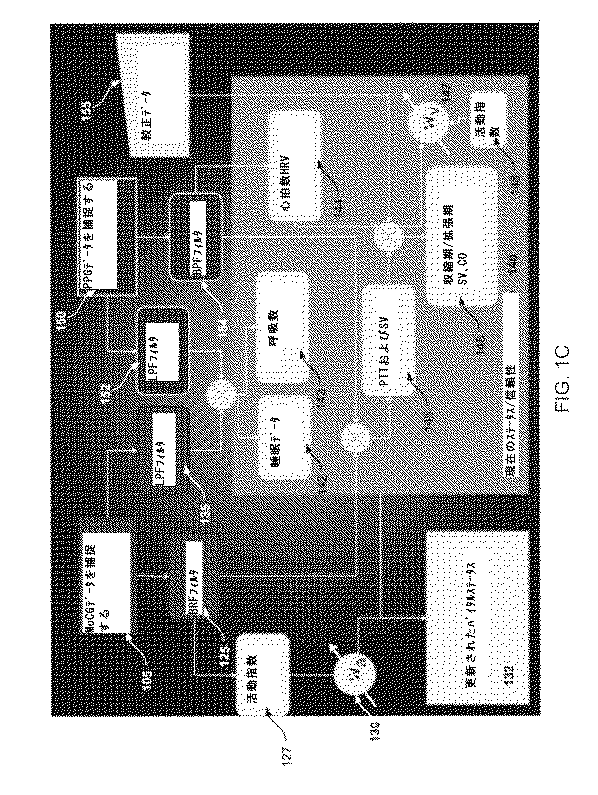
弾性は、順に、以下のように、脈管圧Pに関連する。 The elasticity is in turn related to the vascular pressure P as follows.
Sys=Dia+C*SV(5)
式中、Aは、全ユーザに適用される普遍定数かつ無単位であって、Bは、mmHgの単位における個々の定数であって、Cは、mmHg/mgの単位における個々の定数であって、SVは、1回拍出量である。
Sys = Dia + C * SV (5)
Where A is a universal constant and unitless that applies to all users, B is an individual constant in mmHg units, and C is an individual constant in mmHg / mg units. SV is the stroke volume.
較正
拡張期および収縮期圧を計算するためのパラメータBおよびCは、人毎に変動し得る。故に、プロセスまたは本デバイスは、使用前に、個人のために較正される必要があり得る。概して、較正は、加速度計および光学センサが測定のために使用される最初の時に行われ、アルゴリズムが、MPTT、SV、および他のパラメータを計算するために使用される。
The parameters B and C for calculating the calibrated diastolic and systolic pressure can vary from person to person. Thus, the process or device may need to be calibrated for an individual prior to use. In general, calibration is performed the first time accelerometers and optical sensors are used for measurements, and algorithms are used to calculate MPTT, SV, and other parameters.
プロセッサ等の機械によって行われる較正の例示的プロセス1200が、図12に示される。機械は、例えば、装着者からの入力として、既知の参照収縮期および拡張期圧(Sys0およびDia0)を受信する(1202)。圧力が、装着者に未知である場合、一般的値120/80mmHgが、使用される。そのような場合では、装着者は、実際の圧力が既知となる後の時間に、較正値を改変することが可能にされてもよい。機械はまた、前述の方法を使用して、MPTTおよびSVを計算する(1204)。機械は、次いで、以下の方程式に基づいて、本特定の装着者に対して定数BおよびC(1206)を計算する:
B=refDia−Aln(MPTT)および
C=(refSys−refDia0)/SV
パラメータの値は、個人に対して保存または記憶される(1208)。いくつかの状況では、加速度計および光学センサを含む、本デバイス(例えば、デバイス100)は、複数の人々によって使用されることができる。較正は、プロセス1200に続いて、個人毎に行われ、一式の計算されたパラメータが、対応する人と関連付けられて記憶される。本デバイスは、個人のバイオメトリック識別に基づいて、個人との使用のために、自動的に、一式の記憶されたパラメータを選定してもよい、または本デバイスが複数のユーザ間で共有される場合、使用のための正確なパラメータセットを自己識別および選定するように個人に求めてもよい。
An exemplary process 1200 of calibration performed by a machine such as a processor is shown in FIG. The machine receives known reference systolic and diastolic pressures (Sys0 and Dia0), for example, as input from the wearer (1202). If the pressure is unknown to the wearer, a typical value of 120/80 mmHg is used. In such cases, the wearer may be allowed to modify the calibration value at a time after the actual pressure is known. The machine also calculates MPTT and SV using the method described above (1204). The machine then calculates constants B and C (1206) for this particular wearer based on the following equation:
B = refDia-Aln (MPTT) and C = (refSys-refDia0) / SV
The value of the parameter is saved or stored for the individual (1208). In some situations, the device (eg, device 100), including accelerometers and optical sensors, can be used by multiple people. Calibration is performed for each individual following process 1200 and a set of calculated parameters is stored in association with the corresponding person. The device may automatically select a set of stored parameters for use with an individual based on the individual's biometric identification, or the device may be shared among multiple users In some cases, the individual may be asked to self-identify and select the correct set of parameters for use.
較正後、継続的に取得されたデータに基づいて、血圧測定が、前述のように、MPTTおよびSVを収縮期および拡張期圧に変換することによって、個人毎に利用可能となることができる。 After calibration, based on continuously acquired data, blood pressure measurements can be made available on an individual basis by converting MPTT and SV into systolic and diastolic pressures as described above.
いくつかの実装では、収縮期および拡張期圧はまた、二次パラメータに基づいて、時変パラメータ推定を追加することによって、計算されることができる。例えば、拡張期圧は、以下のように計算されることができる:
Dia=B+A*ln(MPTT)+D*f(HR)+E*g(体温)
式中、f(.)およびg(.)は、所定の関数であって、パラメータDおよびEは、時間依存性かつ個人依存性である。パラメータは、異なる時間における少なくとも2つの較正点(例えば、収縮期および拡張期圧の2つの既知のセット)が利用可能であるとき、較正されることができる。
In some implementations, systolic and diastolic pressures can also be calculated by adding time-varying parameter estimates based on the secondary parameters. For example, diastolic pressure can be calculated as follows:
Dia = B + A * ln (MPTT) + D * f (HR) + E * g (body temperature)
Where f (.) And g (.) Are predetermined functions, and parameters D and E are time-dependent and individual-dependent. The parameters can be calibrated when at least two calibration points at different times (eg, two known sets of systolic and diastolic pressures) are available.
概して、較正されるパラメータは、頻繁に変化しない。これらのパラメータは、動脈直径、動脈壁厚、動脈長、動脈弾性、および人間身体の心血管系に関連する他の物理パラメータによって影響され得る。MPTTに関連する血液の体積の大部分は、大動脈を通して進行し、静力学的変化、温度、または末梢緊張度の影響を受けにくい。MPTTと血圧との間の関係を表す曲線が、図13に例証される。本実施例から分かるように、曲線は、人毎に異なり得るが、曲線の一般形状は、類似する。 In general, the calibrated parameters do not change frequently. These parameters can be influenced by arterial diameter, arterial wall thickness, arterial length, arterial elasticity, and other physical parameters related to the human body's cardiovascular system. Most of the blood volume associated with MPTT progresses through the aorta and is less susceptible to static changes, temperature, or peripheral tone. A curve representing the relationship between MPTT and blood pressure is illustrated in FIG. As can be seen from this example, the curve may vary from person to person, but the general shape of the curve is similar.
所与の人に対する複数の較正点は、対応する曲線上に留まって現れるため、一貫したデータが、1回の較正後、合理的長時間の間、得られ得る。システムが参照「正常」血圧値の周囲となるように較正された状態で、ユーザの血圧が元の較正値から経時的に逸脱する場合、本デバイスは、BP値が異なるが、正確度低下を伴うことを正確に識別するであろう。その時点において、本デバイスは、較正が要求されることをユーザにアラートしてもよい。ある場合には、本デバイスは、数ヶ月の間、再較正を要求しなくてもよい。実施例として、図14は、単回較正後、かつ任意の付加的再較正がなく、90日にわたって測定される収縮期圧を例証する。 Because multiple calibration points for a given person appear on the corresponding curve, consistent data can be obtained for a reasonably long time after a single calibration. If the system is calibrated to be around the reference “normal” blood pressure value and the user's blood pressure deviates from the original calibration value over time, the device will have a different BP value, but with reduced accuracy. It will identify exactly what follows. At that point, the device may alert the user that calibration is required. In some cases, the device may not require recalibration for several months. As an example, FIG. 14 illustrates systolic pressure measured over 90 days after a single calibration and without any additional recalibration.
本デバイスの装着者のあるバイタルサイン(例えば、血圧(BP)、HR、HRV、呼吸数、血液酸素レベル、SV、および心拍出量(CO))を判定するための前述のPPGデータおよび加速度計データ(例えば、MoCGデータ)の使用に加え、プロセッサ(例えば、コンピューティングデバイス115(図1Bに示される)のプロセッサ、またはPPGデータおよびMoCGデータが伝送される外部コンピューティングデバイス)が、本データを使用して、ある健康関連状態を検出または予測するようにプログラムされることができる。
不規則心調律の検出
プロセッサは、PPGデータおよび加速度計データを使用して、動脈細動(AFIB)または心房粗動等の不整脈または不規則心調律を検出するようにプログラムされることができる。図15A−15Dは、デバイス100の装着者の心拍数データがプロットされたグラフを示す。グラフは、24時間期間にわたって(図15A)、昼間(図15B)、および夜間(図15C)にプロットされた心拍数データを示す。具体的には、これらのグラフはそれぞれ、x−軸に沿ったR波−R波間隔(RRi)およびy−軸に沿ったRRi+1を含む。プロットされたデータは、対象が、以下に説明されるように、正常心調律または不規則心調律を有するかどうかを判定するために使用されることができる。プロットは、任意の過渡異常を捕捉するために、所定の間隔後(例えば、5〜10分毎)に更新されることができる。
The aforementioned PPG data and acceleration to determine certain vital signs (eg, blood pressure (BP), HR, HRV, respiratory rate, blood oxygen level, SV, and cardiac output (CO)) of the wearer of the device In addition to using metered data (eg, MoCG data), a processor (eg, a processor of computing device 115 (shown in FIG. 1B), or an external computing device through which PPG and MoCG data is transmitted) Can be programmed to detect or predict certain health related conditions.
Detection of Irregular Heart Rhythm The processor can be programmed to detect arrhythmias or irregular heart rhythms such as arterial fibrillation (AFIB) or atrial flutter using PPG data and accelerometer data. 15A-15D show graphs in which heart rate data of a wearer of
図15A−15Cに示されるグラフを取り込むために、PPGおよび加速度計信号が、前述の様式で使用され、ある期間(例えば、20秒)にわたって、装着者の心拍毎に装着者の瞬時心拍数を判定する。RR値が、次いで、瞬時心拍数曲線を検証し、逐次心拍のそれぞれ間の時間を判定することによって判定される。各RR値は、2つの連続心拍間の時間に等しい。各RR値(RRi)は、次いで、後続RR値(RRi+1)に対してプロットされる。 To capture the graphs shown in FIGS. 15A-15C, the PPG and accelerometer signals are used in the manner described above to calculate the wearer's instantaneous heart rate for each wearer's heart rate over a period of time (eg, 20 seconds). judge. The RR value is then determined by examining the instantaneous heart rate curve and determining the time between each successive heart rate. Each RR value is equal to the time between two consecutive heartbeats. Each RR value (RR i ) is then plotted against the subsequent RR value (RR i + 1 ).
図15A−15Dに示されるグラフは、正常心調律を伴う対象のプロットを表す。正常心調律では、拍動間の時間は、非常に一貫する傾向にある。例えば、健康な個人の心拍数が、運動等のある活動の結果として増加する間、心拍数は、経時的に徐々に増加する傾向となる。したがって、個人の心拍数は、そのような活動の間、有意に高くなり得るが(安静時のその心拍数と比較して)、連続心拍間の時間差は、小連続心拍数の過程にわたって非常に一貫するはずである。同様に、健康な個人の心拍数は、そのような活動から回復するにつれて、有意に低下し得るが、心拍数は、経時的に徐々に低下する傾向にあり、連続心拍間の時間差が、そのような回復期間の間、非常に一貫するはずであることを意味する。したがって、健康な個人では、RRi対RRi+1プロットは、典型的には、図15Dに示されるように、対角線に沿って非常に線形となるであろう。 The graphs shown in FIGS. 15A-15D represent plots of subjects with normal heart rhythm. In normal rhythm, the time between beats tends to be very consistent. For example, while the heart rate of a healthy individual increases as a result of certain activities such as exercise, the heart rate tends to gradually increase over time. Thus, although an individual's heart rate can be significantly higher during such activities (compared to its heart rate at rest), the time difference between consecutive heart rates is very high over the course of a small continuous heart rate. Should be consistent. Similarly, the heart rate of a healthy individual can decline significantly as he recovers from such activity, but the heart rate tends to decline gradually over time, and the time difference between consecutive heartbeats It should be very consistent during such a recovery period. Thus, in healthy individuals, the RR i vs. RR i + 1 plot will typically be very linear along the diagonal, as shown in FIG. 15D.
図16A−16Cは、異なる心臓状態を伴う個人に対する心拍数データを示す。例えば、図16Aは、心房細動(AFIB)を有する個人から24時間期間にわたって採取された心拍数データを示す。図16Bは、心房粗動を有する個人から24時間期間にわたって採取された心拍数データを示し、図16Cは、正常心調律を有する個人から24時間期間にわたって採取された心拍数データを示す。最初に、図16Aを参照すると、AFIBは、予期される対角線からの種々のRRデータ点の分散が所定の分散値を上回るため、明白である。AFIBは、心臓の一貫性のない拍動を生じさせ、連続心拍間の時間が対の心拍毎に有意に変動する結果となる。本特性は、RRi対RRi+1のプロットを予期される対角線(すなわち、規則的心調律を有する個人の対角線プロット(図16Cに示されるように))から有意に分散させる。 16A-16C show heart rate data for individuals with different heart conditions. For example, FIG. 16A shows heart rate data collected over a 24 hour period from an individual with atrial fibrillation (AFIB). FIG. 16B shows heart rate data collected over a 24 hour period from an individual with atrial flutter, and FIG. 16C shows heart rate data collected over a 24 hour period from an individual with normal heart rhythm. First, referring to FIG. 16A, AFIB is evident because the variance of the various RR data points from the expected diagonal exceeds the predetermined variance value. AFIB results in inconsistent pulsations of the heart, resulting in the time between successive heartbeats varying significantly from pair to heartbeat. This property significantly scatters the plot of RR i vs. RR i + 1 from the expected diagonal (ie, a diagonal plot of individuals with regular heart rhythm (as shown in FIG. 16C)).
ここで図16Bを参照すると、心房粗動が、対角線からオフセットされるデータの複数のクラスタによって認められ得る。心房粗動は、複数点において心拍数の変化をもたらし、これは、対角線からオフセットされるデータの複数のクラスタを生成する。 Referring now to FIG. 16B, atrial flutter can be seen by multiple clusters of data offset from the diagonal. Atrial flutter results in heart rate changes at multiple points, which generate multiple clusters of data that are offset from the diagonal.
動脈細動(AFIB)または心房粗動等の不規則心調律を検出するようにプログラムされることに加え、プロセッサは、そのような不規則心調律の検出に応答して、装着者にアラートするようにプログラムされることができる。例えば、プロセッサは、本デバイスのオーディオまたは視覚的アラームをアクティブ化することができ、これは、例えば、装着者に、医療手当てを求めるように命令することができる。
対象の不整脈を検出する例示的プロセス1700が、図17に示される。デバイス100の運動センサ105および光学センサ110から情報を受信する、プロセッサ等の機械が、プロセス1700の1つまたはそれを上回るステップを行うことができる。いくつかの実装では、機械は、図1Bを参照して前述されるコンピューティングデバイス115を含むことができる。プロセス1700では、最初に、対象内の血液を通して伝搬する少なくとも1つのパルス圧力波についての時変情報を表す、第1のデータセット内のデータが、処理されることができる(1702)。対象の運動についての時変情報を表す、第2のデータセット内のデータもまた、処理されることができる(1704)。データは、対象の場所(例えば、対象の腕または手首)において取得されることができる。対象の不整脈は、処理されたデータに基づいて検出されることができる(1706)。不整脈は、心房細動または心房粗動を含むことができる。データを処理するステップは、プロットされたR波−R波間隔対次の連続R波−R波間隔の分散が所定の分散値を超えるかどうかを判定するステップを含むことができる。データを処理するステップはまた、プロットされたデータ点の複数のクラスタが対角線からオフセットされているかどうかを判定するステップを含むことができる。
動脈硬化度の検出
本明細書に説明されるデバイスによって検出されることができる別の健康関連特性は、血管健康(例えば、動脈硬化症)、高血圧症、脳卒中、および心臓発作のリスクのインジケータである、動脈硬化度である。動脈が硬いほど、血液波は、高速に進行し(流体動態に起因して)、したがって、MPTTが短くなる。プロセッサは、したがって、パルス走行時間(MPTT)の関数として動脈硬化度を計算するようにプログラムされることができる。
In addition to being programmed to detect irregular heart rhythms such as arterial fibrillation (AFIB) or atrial flutter, the processor alerts the wearer in response to detection of such irregular heart rhythms. Can be programmed as follows. For example, the processor can activate an audio or visual alarm on the device, which can, for example, instruct the wearer to seek medical attention.
An
Detection of Arteriosclerosis Another health-related characteristic that can be detected by the devices described herein is an indicator of the risk of vascular health (eg, arteriosclerosis), hypertension, stroke, and heart attack. It is a certain degree of arteriosclerosis. The stiffer the artery, the faster the blood wave travels (due to fluid dynamics) and thus a shorter MPTT. The processor can therefore be programmed to calculate the degree of arteriosclerosis as a function of pulse transit time (MPTT).
動脈硬化度を査定するために使用される、ある従来のデバイスは、デバイスが2つの異なる対象の場所(例えば、対象の頸動脈および脚)に留置されることを要求する。したがって、動脈硬化度を判定するために、対象の単一場所から全必要データを収集可能な本明細書に説明されるデバイスは、それらの従来のデバイスより便宜的である傾向にある。 One conventional device used to assess arteriosclerosis requires that the device be placed in two different subject locations (eg, the subject's carotid artery and leg). Thus, the devices described herein that can collect all necessary data from a single location of interest to determine the degree of arteriosclerosis tend to be more convenient than those conventional devices.
プロセッサは、本デバイスの装着者に、例えば、その値を本デバイスのディスプレイ上に表示させることによって、その動脈硬化度値を通知するようにプログラムされることができる。加えて、動脈硬化度値は、装着者の全体的健康を査定するための複数の係数のうちの1つとして使用されることができる。ある場合には、例えば、プロセッサは、装着者の動脈硬化度を使用して、装着者の健康指標(例えば、健康スコア)を判定するようにプログラムされる。健康スコアは、数値であってもよい。ある場合には、数値は、1〜10または1〜100である。 The processor can be programmed to notify the wearer of the device of its arteriosclerosis value, for example by displaying the value on the display of the device. In addition, the arteriosclerosis value can be used as one of a plurality of factors to assess the wearer's overall health. In some cases, for example, the processor is programmed to determine the wearer's health index (eg, health score) using the wearer's degree of arteriosclerosis. The health score may be a numerical value. In some cases, the numerical value is 1-10 or 1-100.
図18に示されるように、対象の動脈硬化度は、対象の活動レベル(例えば、対象が運動する、週あたりの回数)が増加するにつれて低下する傾向にある。したがって、動脈硬化度は、運動計画に関与する対象の進度を追跡するために、本デバイスによって監視され、ユーザと共有され得る、1つのパラメータである。これは、体重減少等の従来のフィードバックに加え、ユーザのための正のフィードバックとしての役割を果たすことができる。
睡眠状態の検出
プロセッサはまた、PPGデータおよび加速度計データを使用して、睡眠時無呼吸等の睡眠障害を検出し、睡眠の質および入眠期を推測するようにプログラムされることができる。図19を参照すると、本デバイスの装着者の睡眠を分析するために、プロセッサは、最初に、加速度計データの低周波数成分を分析し、加速度計データが、最小期間(例えば、90秒)の間、実質的に平坦である期間である、睡眠安静期間(SRP)を識別する。加速度計データの平坦度は、本デバイスの装着者が、SRPの間、移動していないことを示す。したがって、SRPは、本デバイスの装着者が睡眠中である可能性が高い期間である。
As shown in FIG. 18, the arteriosclerosis degree of the subject tends to decrease as the activity level of the subject (for example, the number of times the subject exercises per week) increases. Thus, the degree of arteriosclerosis is one parameter that can be monitored by the device and shared with the user to track the progress of subjects involved in the exercise plan. This can serve as positive feedback for the user in addition to conventional feedback such as weight loss.
Sleep State Detection The processor can also be programmed to use PPG data and accelerometer data to detect sleep disorders such as sleep apnea and to infer sleep quality and sleep periods. Referring to FIG. 19, in order to analyze the sleep of the wearer of the device, the processor first analyzes the low frequency component of the accelerometer data and the accelerometer data is for a minimum period (eg, 90 seconds). In the meantime, a sleep rest period (SRP) is identified, which is a period that is substantially flat. The flatness of the accelerometer data indicates that the wearer of the device is not moving during SRP. Therefore, SRP is a period during which the wearer of the device is likely to be sleeping.
図19は、3つの別個のSRP(SRP1、SRP2、およびSRP3)を例証する。SRP1およびSRP2ならびにSRP2およびSRP3は、それぞれ、本デバイスの装着者による運動の短期間によって相互から分離される。しかしながら、睡眠状態に関する心拍数信号を分析する目的のために、3つのSRPは、単一睡眠サイクルとして処理される。プロセッサは、例えば、5分未満続く運動の期間をその運動が生じる睡眠サイクルを中断していないとして処理するようにプログラムされることができる。 FIG. 19 illustrates three separate SRPs (SRP1, SRP2, and SRP3). SRP1 and SRP2 and SRP2 and SRP3 are each separated from each other by a short period of exercise by the wearer of the device. However, for the purpose of analyzing heart rate signals for sleep states, the three SRPs are processed as a single sleep cycle. The processor can be programmed, for example, to treat periods of exercise that last less than 5 minutes as not interrupting the sleep cycle in which the exercise occurs.
SRPを識別後、プロセッサは、SRPの間に収集されるPPGデータおよび加速度計データを使用して、SRP毎の平均心拍数、心拍数の標準偏差、平均心拍変動(HRV)、および平均活動レベルを計算する。加えて、プロセッサは、心拍数信号の複雑性およびRRi対RRi+1プロット上にプロットされた値の対角線からの逸脱を分析する。これらのパラメータは、本デバイスの装着者が、分析されるSRPの間、睡眠中であったことを確認し、以下に論じられるように、ある睡眠状態および睡眠障害を識別するために使用されることができる。いくつかの実装では、時差ぼけもまた、睡眠の間の心拍数を分析することによって検出されることができる。例えば、睡眠の間の上向き心拍数は、時差ぼけの存在を示すことができ、睡眠の間の平坦心拍数は、対象が時差ぼけではないことを示すことができる。 After identifying the SRP, the processor uses the PPG data and accelerometer data collected during SRP to use the average heart rate, standard deviation of heart rate, average heart rate variability (HRV), and average activity level per SRP. Calculate In addition, the processor analyzes the complexity of the heart rate signal and the deviation of the values plotted on the RR i vs. RR i + 1 plot from the diagonal. These parameters are used to confirm that the wearer of the device was sleeping during the analyzed SRP and to identify certain sleep states and sleep disorders as discussed below be able to. In some implementations, jet lag can also be detected by analyzing heart rate during sleep. For example, an upward heart rate during sleep can indicate the presence of jet lag, and a flat heart rate during sleep can indicate that the subject is not jet lag.
運動の欠如は、単独で、本デバイスの装着者が睡眠中であったかどうかを判定するために使用されることができないため、プロセッサは、平均心拍数、心拍数の標準偏差、および平均心拍変動(HRV)を考慮し、検討されているSRPの間、装着者が睡眠中であったことを確認するようにプログラムされることができる。例えば、分析されているSRPにわたる対象の平均心拍数、心拍数の標準偏差、および平均心拍変動(HRV)が、対象におけるこれらの値のベースラインと比較される。それらがベースラインを所定の量だけ下回って降下する場合、これは、対象が、分析されている期間の間、睡眠中であったことを確認する。 Since the lack of exercise alone cannot be used to determine if the wearer of the device was sleeping, the processor would calculate the average heart rate, the standard deviation of the heart rate, and the average heart rate variability ( HRV) and can be programmed to confirm that the wearer was sleeping during the SRP under consideration. For example, the subject's average heart rate, heart rate standard deviation, and average heart rate variability (HRV) across the SRP being analyzed are compared to a baseline of these values in the subject. If they descend below a baseline by a predetermined amount, this confirms that the subject was sleeping during the period being analyzed.
いったんプロセッサが、識別されたSRPの間、装着者が睡眠中であったことを確認すると、それらの期間の間に収集されたデータが、装着者の睡眠についての詳細情報を提供し、睡眠の質を推測するために分析されることができる。例えば、関連期間の間のPPGデータおよび加速度計データを分析することによって、プロセッサは、装着者による入眠回数、装着者の睡眠潜時(例えば、対象が覚醒から睡眠まで遷移するためにかかる時間長)、装着者の寝返りの回数、および就寝時間と起床時間との間の装着者が睡眠中であった時間の割合を判定することができる。ある場合には、プロセッサはさらに、SRPのそれぞれの間の装着者の睡眠の深さを判定することができる。睡眠の深さは、時として、入眠期と称される。例えば、SRPの一部の間、加速度計が、最小限の移動を検出し、患者の心拍変動が、装着者のベースライン心拍数を下回る所定の量であった場合、装着者が、SRPのその部分の間、深い睡眠中であったと結論付けられ得る。SRPの一部の間、加速度計が、いくつかの移動を検出し、患者の心拍数が、深い睡眠の予期され得るものより高かった場合、装着者が、SRPのその部分の間、REM睡眠中であったと結論付けられ得る。そうでなければ、装着者が、SRPのその部分の間、浅眠中であったと結論付けられ得る。 Once the processor confirms that the wearer was sleeping during the identified SRP, the data collected during those periods provides detailed information about the wearer's sleep, Can be analyzed to infer quality. For example, by analyzing the PPG data and accelerometer data during the relevant period, the processor can determine the number of sleeps by the wearer, the sleep latency of the wearer (e.g., the length of time it takes for the subject to transition from awakening to sleep). ), The number of times the wearer wakes up, and the proportion of time the wearer was sleeping between bedtime and wake-up time. In some cases, the processor may further determine the wearer's depth of sleep during each of the SRPs. The depth of sleep is sometimes referred to as the sleep onset. For example, if during a portion of the SRP, the accelerometer detects minimal movement and the patient's heart rate variability is a predetermined amount below the wearer's baseline heart rate, the wearer It can be concluded that he was in deep sleep during that part. If the accelerometer detects some movement during part of the SRP and the patient's heart rate is higher than can be expected of deep sleep, the wearer will be in REM sleep during that part of the SRP. It can be concluded that it was in. Otherwise, it can be concluded that the wearer was sleeping asleep during that part of the SRP.
ある場合には、プロセッサは、前述のパラメータ(例えば、装着者による入眠回数、装着者の寝返りの回数、就寝時間と起床時間との間の装着者が睡眠中であった時間の割合、および睡眠の深さ)を使用して、睡眠の質の指標または睡眠スコアを導出するようにプログラムされる。装着者は、その睡眠習慣を修正し、その睡眠の質を最大限にする試みとして、その睡眠スコアを経時的に監視することができる。そのようなスコアの使用は、種々の異なる関連パラメータとは対照的に、ユーザによってより容易に理解されることが分かっている。 In some cases, the processor may use the parameters described above (eg, number of sleeps by the wearer, number of times the wearer wakes up, the percentage of time the wearer was sleeping between bedtime and wake-up time, and sleep. Is used to derive a sleep quality indicator or sleep score. The wearer can monitor the sleep score over time in an attempt to modify the sleep habit and maximize the quality of the sleep. It has been found that the use of such a score is more easily understood by the user as opposed to a variety of different related parameters.
ある場合には、プロセッサは、本デバイスに、装着者が覚醒していると判定されるとき、睡眠スコアを自動的に表示させることができる。本デバイスは、装着者が、SRPに関連する情報に基づいて、覚醒しているときを判定することができる。装着者の睡眠に関連する特性に基づいて、情報は、装着者に提供され、装着者のその睡眠スコアの改善を補助することができる。いくつかの実装では、装着者は、推奨される睡眠スケジュールが提供されることができる。例えば、装着者が、睡眠をほとんどとっていないと判定される場合、推奨される睡眠スケジュールは、装着者に、夜により早く就寝するか、または朝により遅くまで睡眠するように提案してもよい。情報は、本デバイスのディスプレイまたは装着者の携帯電話等の別個のデバイス上に提供されることができる。 In some cases, the processor can cause the device to automatically display a sleep score when it is determined that the wearer is awake. The device can determine when the wearer is awake based on information related to SRP. Based on characteristics associated with the wearer's sleep, information can be provided to the wearer to help improve the wearer's sleep score. In some implementations, the wearer can be provided with a recommended sleep schedule. For example, if the wearer is determined to have little sleep, a recommended sleep schedule may suggest the wearer go to bed earlier in the night or sleep later in the morning. . The information can be provided on a separate device, such as the display of the device or the wearer's mobile phone.
前述のように、概して、装着者の睡眠の質を判定することに加え、プロセッサは、睡眠時無呼吸等のある睡眠障害を検出することができる。図19Bは、装着者が睡眠時無呼吸の発症を発現した期間の間の装着者の心拍数信号を例証する。図19Bを参照すると、装着者の心拍数信号は、2:54AMから、装着者の心拍数が急上昇する、約3:16AMまで複雑である。3:16AMから約3:30AMまで、心拍数信号は、単純である(すなわち、周期性または繰り返しパターンを含む)。SRPの間の少なくとも2分毎の単純心信号の存在は、睡眠時無呼吸を示し得る。
プロセッサは、多ステップ試験を実施し、睡眠時無呼吸を検出するようにプログラムされることができる。最初に、プロセッサは、分析されているSRP全体を通して心拍数を分析する。SRPの間の最小心拍数と最大心拍数との間の差異が、閾値心拍数差未満である場合、プロセッサは、睡眠時無呼吸が存在しないと判定し、試験は、終了される。しかしながら、最小−最大心拍数差が閾値心拍数差を超える場合、プロセッサは、睡眠時無呼吸が、原因であり得ると判定し、SRPのさらなる分析を実施する。具体的には、プロセッサは、SRPの間の対象の心拍変動、プロットされたRR点、信号の複雑性、および活動レベルを分析する。
As described above, in general, in addition to determining the wearer's sleep quality, the processor can detect certain sleep disorders, such as sleep apnea. FIG. 19B illustrates the wearer's heart rate signal during the period in which the wearer developed the onset of sleep apnea. Referring to FIG. 19B, the wearer's heart rate signal is complex from 2:54 AM to approximately 3:16 AM, where the wearer's heart rate spikes. From 3:16 AM to about 3:30 AM, the heart rate signal is simple (ie, contains a periodic or repetitive pattern). The presence of a simple heart signal at least every 2 minutes during SRP may indicate sleep apnea.
The processor can be programmed to perform a multi-step test and detect sleep apnea. Initially, the processor analyzes heart rate throughout the SRP being analyzed. If the difference between the minimum heart rate and the maximum heart rate during SRP is less than the threshold heart rate difference, the processor determines that there is no sleep apnea and the test is terminated. However, if the minimum-maximum heart rate difference exceeds the threshold heart rate difference, the processor determines that sleep apnea may be the cause and performs further analysis of the SRP. Specifically, the processor analyzes the subject's heart rate variability, plotted RR points, signal complexity, and activity level during SRP.
心拍変動が、SRPの間、近傍期間におけるものより低い場合、これは、睡眠時無呼吸の発見に不利に働く。しかしながら、SRPの間の心拍変動が、近傍期間の間の心拍変動を超える場合、これは、睡眠時無呼吸の発見に有利に働く。 If the heart rate variability is lower during SRP than in the near period, this is detrimental to the discovery of sleep apnea. However, if the heart rate variability during SRP exceeds the heart rate variability during the neighborhood period, this favors the discovery of sleep apnea.
同様に、RRi対RRi+1プロット内のデータ点の分散が、概して、対角線に沿ってある場合、これは、睡眠時無呼吸の発見に不利に働く。しかしながら、データ点が、対角線から分散する場合、これは、睡眠時無呼吸の発見に有利に働く。データ点は、装着者の心拍数が、装着者の血液中の酸素の欠如に起因して、非常に短い期間中に劇的に増加するであろうため、睡眠時無呼吸発症の間、対角線から分散することが予期されるであろう。短期間中の本劇的増加は、その期間の間、正常より大きいRRi値とRRi+1値との間の相違に変換されるであろう。 Similarly, if the variance of the data points in the RR i vs. RR i + 1 plot is generally along the diagonal, this is detrimental to the discovery of sleep apnea. However, if the data points are scattered from the diagonal, this favors the discovery of sleep apnea. Data points are diagonal during sleep apnea episodes because the wearer's heart rate will increase dramatically during a very short period due to the lack of oxygen in the wearer's blood. Would be expected to disperse from This dramatic increase in the short term, during that period, will be converted into differences between normal larger RR i value and RR i + 1 value.
装着者が睡眠時無呼吸を有するかどうかを判定するために使用される別の係数は、心拍数信号の複雑性である。心拍数信号が、SRPの間、複雑である場合、これは、睡眠時無呼吸の発見に不利に働く。しかしながら、少なくとも2分毎に、心拍数信号が、単純になる(すなわち、周期性または繰り返しパターンを有する)場合、これは、睡眠時無呼吸に有利に働く。 Another factor used to determine whether a wearer has sleep apnea is the complexity of the heart rate signal. If the heart rate signal is complex during SRP, this is detrimental to the discovery of sleep apnea. However, if the heart rate signal becomes simple (ie, has a periodic or repetitive pattern) at least every 2 minutes, this favors sleep apnea.
活動レベルは、睡眠時無呼吸を識別するために使用される別の係数である。分析されているSRPの間の装着者の活動レベル(加速度計データを使用して判定される)が、近傍期間の間の装着者の活動レベルを上回る場合、これは、睡眠時無呼吸の発見に不利に働く。しかしながら、分析されているSRPの間の装着者の活動レベルが、近傍期間の間の装着者の活動レベル未満である場合、これは、睡眠時無呼吸の発見に有利に働く。 Activity level is another factor used to identify sleep apnea. If the wearer's activity level during the SRP being analyzed (determined using accelerometer data) exceeds the wearer's activity level during the neighborhood period, this is the discovery of sleep apnea Work against you. However, if the wearer's activity level during the SRP being analyzed is less than the wearer's activity level during the neighborhood period, this favors the discovery of sleep apnea.
プロセッサは、対象の心拍数、心拍変動、RRi対RRi+1プロット上のデータ点の場所、心拍数信号の複雑性、および活動レベルの関数として、睡眠時無呼吸の存在または不在を判定するようにプログラムされることができる。 The processor determines the presence or absence of sleep apnea as a function of the subject's heart rate, heart rate variability, location of data points on the RR i vs. RR i + 1 plot, complexity of the heart rate signal, and activity level. Can be programmed.
ある場合には、プロセッサは、装着者の睡眠の質と装着者が暴露される光の量との間の相関を判定するようにプログラムされることができる。図20は、装着者の睡眠の質と併せて、種々の時間の間の光レベルを表示する、装着者の携帯電話2002上の例示的スクリーンショット2000を示す。本実施例では、装着者は、合計7時間および52分の睡眠をとり、4回覚醒し、睡眠スコア74を有する。スクリーンショットはまた、2つのバーを含み、一方のバーは、装着者が低品質睡眠中であった時間を示し、別のバーは、それらの時間の間に測定された光レベルを示す。このように、相関は、装着者の睡眠の質と装着者によって発現される光レベルとの間で行われる。スクリーンショット2000はまた、装着者が、その睡眠の質を改善し得る、睡眠環境のヒントを受信するためのリンク2004を含む。
In some cases, the processor can be programmed to determine a correlation between the wearer's sleep quality and the amount of light to which the wearer is exposed. FIG. 20 shows an
睡眠時無呼吸の発症の検出に応じて、プロセッサは、不規則睡眠パターンを発現している可能性があることを装着者にアラートすることができる。 In response to detecting the onset of sleep apnea, the processor can alert the wearer that there may be an irregular sleep pattern.
対象の睡眠の特性についての情報を判定する例示的プロセス2100が、図21に示される。デバイス100の運動センサ105および光学センサ110から情報を受信する、プロセッサ等の機械が、プロセス2100の1つまたはそれを上回るステップを行うことができる。いくつかの実装では、機械は、図1Bを参照して前述されるコンピューティングデバイス115を含むことができる。プロセス2100では、最初に、対象内の血液を通して伝搬する少なくとも1つのパルス圧力波についての時変情報を表す、第1のデータセット内のデータが、処理されることができる(2102)。対象の運動についての時変情報を表す、第2のデータセット内のデータもまた、処理されることができる(2104)。データは、対象の場所(例えば、対象の腕または手首)において取得されることができる。対象内の血液を通して伝搬する少なくとも1つのパルス圧力波についての情報は、フォトプレチスモグラフィ(PPG)データを含むことができ、対象の運動についての情報は、拍動運動信号(MoCG)データおよび総合的運動データの一方または両方を含むことができる。データに基づいて、対象の睡眠の特性についての情報が、判定されることができる(2106)。特性は、対象の睡眠の質を含むことができる。対象の睡眠の質は、睡眠持続時間、睡眠潜時、入眠期、睡眠潜時、妨害の回数、および寝返りの回数のうちの1つまたはそれを上回るものを含むことができる。対象の睡眠の特性はまた、睡眠時無呼吸を含むことができる。
体力関連用途
プロセッサはまた、装着者がその体力レベルを監視することを可能にする、種々の体力用途を果たすようにプログラムされることができる。実施例として、プロセッサは、所与の期間(例えば、15分)にわたって加速度計データを分析し、その時間の間、装着者によって進められる総歩数を判定するようにプログラムされることができる。プロセッサは、手の動きおよび震え等の他の通常運動とは対照的に、リズム/抑揚を探し、歩行を検出するようにプログラムされる。加速度計データの絶対値は、典型的には、歩行期間の間、大部分の他の日常活動の期間より高くなるであろう。
An
Physical fitness related applications The processor can also be programmed to perform various physical fitness applications that allow the wearer to monitor their physical fitness level. As an example, the processor can be programmed to analyze accelerometer data over a given period (eg, 15 minutes) and determine the total number of steps advanced by the wearer during that time. The processor is programmed to look for rhythm / inflection and detect gait, as opposed to other normal movements such as hand movements and tremors. The absolute value of accelerometer data will typically be higher during the walking period than during most other daily activities.
加えて、プロセッサは、装着者の活動レベルおよび/またはユーザの心拍数を分析することによって、所与の期間にわたって燃焼されたカロリーを計算することができる。活動レベルおよび心拍数の両方を使用して、燃焼されたカロリーを判定することは、カロリー出力のより正確な推定につながり得る。 In addition, the processor can calculate the calories burned over a given period by analyzing the wearer's activity level and / or the user's heart rate. Determining the calories burned using both activity level and heart rate can lead to a more accurate estimate of caloric output.
ある場合には、プロセッサは、安静時心拍数等のある体力関連パラメータに基づいて、体力スコアを提供するようにプログラムされる。より健康な個人は、そのベースラインHRが低くなるであろう。したがって、ある場合には、プロセッサは、睡眠期間または無活動期間の間の装着者の平均心拍数に基づいて、体力スコアを判定するようにプログラムされる。加えて、心拍数回復の速度は、人の体力レベルの顕著な指標となり得る。例えば、より健康な個人は、運動後、その心拍数がベースラインにより早く戻る。同様に、より健康な個人は、運動の間、その心拍数が増加するまでにより長くかかる。したがって、ある場合には、プロセッサは、運動の間、個人の心拍数が最大値に到達するためにかかる時間量と、運動後、その心拍数がベースラインに戻るためにかかる時間量とに基づいて、個人の体力スコアを判定するようにプログラムされる。 In some cases, the processor is programmed to provide a fitness score based on certain fitness related parameters, such as a resting heart rate. A healthier individual will have a lower baseline HR. Thus, in some cases, the processor is programmed to determine a fitness score based on the wearer's average heart rate during the sleep or inactivity period. In addition, the rate of heart rate recovery can be a significant indicator of a person's physical fitness level. For example, a healthier individual will have his heart rate returned to baseline earlier after exercise. Similarly, healthier individuals take longer to increase their heart rate during exercise. Thus, in some cases, the processor is based on the amount of time it takes for an individual's heart rate to reach a maximum during exercise and the amount of time it takes for the heart rate to return to baseline after exercise. And programmed to determine an individual's physical fitness score.
ある場合には、プロセッサは、本デバイスに、装着者が体力良好状態にあると判定されると、体力スコアを自動的に表示させることができる。例えば、体力スコアは、装着者がランニングを開始すると表示されてもよく、ランニング全体を通して表示されてもよい。いくつかの実装では、体力スコアは、装着者が体力良好状態から非体力良好状態に遷移すると、表示されてもよい。例えば、体力スコアは、装着者がランニングを終了すると、表示されてもよい。いくつかの実装では、本デバイスは、総合的運動データおよび装着者の心拍数等の装着者のバイタルに基づいて、装着者が体力良好状態にあるときを判定することができる。装着者の体力に関連する特性に基づいて、情報は、装着者に提供され、装着者の体力スコアの改善を補助することができる。 In some cases, the processor can cause the device to automatically display a fitness score when it is determined that the wearer is in good health. For example, the physical strength score may be displayed when the wearer starts running, or may be displayed throughout the running. In some implementations, the physical fitness score may be displayed when the wearer transitions from a good physical condition to a non-physical condition. For example, the physical strength score may be displayed when the wearer finishes running. In some implementations, the device can determine when the wearer is in good health based on the wearer's vitals, such as the overall exercise data and the wearer's heart rate. Based on characteristics associated with the wearer's physical strength, information can be provided to the wearer to help improve the wearer's physical fitness score.
図22は、装着者の携帯電話2202上の体力スコアを表示する、例示的スクリーンショット2200を示す。スクリーンショット上の情報は、装着者が、その体力スコアを2ポイント改善したことを示す。スクリーンショットはまた、装着者に、更新された個人用トレーニングゾーンを提供する。個人用トレーニングゾーンは、装着者が種々の運動条件下で達成するよう努力すべき心拍数を表す。例えば、装着者が激しい運動を行う場合、151拍/分を上回る心拍数となるよう努力すべきである。
FIG. 22 shows an
いくつかの実装では、装着者は、推奨される運動ルーチンが提供されることができる。例えば、装着者は、ランニングの間の異常に高い心拍数によって示されるように、3マイルのランニングの完走が困難であると判定され得る。推奨される体力スケジュールは、装着者が、その体力を改善し、それによって、装着者が、3マイルのランニングを安全に完走するために適切な体力レベルまで高めることを可能にするために、1週間、週2回、1マイルのランニングを行うように提案してもよい。装着者を補助するための情報は、本デバイスのディスプレイまたは装着者の携帯電話等の別個のデバイス上に提供されることができる。 In some implementations, the wearer can be provided with a recommended exercise routine. For example, the wearer may be determined to have difficulty completing a three mile run, as indicated by an abnormally high heart rate during the run. The recommended fitness schedule is to allow the wearer to improve his fitness, thereby increasing the fitness level to the appropriate fitness level for the wearer to safely complete the 3 mile run. You may suggest running one mile twice a week for a week. Information to assist the wearer can be provided on a separate device, such as the display of the device or the wearer's cell phone.
いくつかの実装では、本デバイスは、本デバイスの装着者がその体力スコアと他の人々のものを比較し得るように、他のユーザのバイタル情報および体力スコアへのアクセスを有してもよい。例えば、トレーニングの間に本デバイスを使用する、プロの運動選手は、特定のバイタル情報および体力スコアを呈する。本デバイスの装着者は、プロの運動選手が従うものと同一トレーニング計画に従うことを所望してもよい。しかしながら、同一トレーニング計画に従うことは、必ずしも、同一結果をもたらすわけではない。例えば、本デバイスの装着者は、プロの運動選手と同一トレーニング計画に従い得るが、プロの運動選手と同一レベルの努力を呈さない場合がある。プロの運動選手のバイタル情報へのアクセスを得て、それと装着者のバイタル情報を比較することによって、本デバイスは、装着者のトレーニングレベルとプロの運動選手のトレーニングレベルとの間の類似度を判定することができる。 In some implementations, the device may have access to other users' vital information and fitness scores so that the wearer of the device can compare their fitness scores with those of other people. . For example, professional athletes who use the device during workouts will exhibit specific vital information and fitness scores. The wearer of the device may desire to follow the same training plan that a professional athlete follows. However, following the same training plan does not necessarily give the same results. For example, a wearer of the device may follow the same training plan as a professional athlete, but may not exhibit the same level of effort as a professional athlete. By gaining access to the vital information of a professional athlete and comparing it to the wearer's vital information, the device will determine the similarity between the wearer's training level and the professional athlete's training level. Can be determined.
いくつかの実装では、運動選手が特定のトレーニングルーチンを行った、または行っているときのプロの運動選手のバイタル情報が、装着者が同一トレーニングルーチンを行っている間、装着者に提示される。例えば、トレーニングルーチンを行っている運動選手を示すビデオが、トレーニングルーチンの過程にわたる運動選手のBP、HR、および呼吸数の視覚的インジケーションを含むことができる。装着者が、ビデオを視聴しながら、同一トレーニングルーチンを行うにつれて、装着者は、運動選手と類似BP、HR、および呼吸数を経ているかどうかを判定し、それによって、装着者が運動選手と同一強度でトレーニングしているかどうかを示すことができる。ビデオは、装着者の強度が運動選手のものを下回る場合、ビデオが装着者にもっと努力するように促すように、本デバイスと相互作用するように構成されてもよい。同様に、トレーニング後、本デバイスは、装着者のBP、HR、および呼吸数を監視し続け、装着者が運動選手と同様に物理的に回復しているかどうかを判定することができる。 In some implementations, the vital information of a professional athlete when an athlete has or has performed a specific training routine is presented to the wearer while the wearer is performing the same training routine . For example, a video showing an athlete performing a training routine may include a visual indication of the athlete's BP, HR, and respiratory rate over the course of the training routine. As the wearer performs the same training routine while watching the video, the wearer determines whether he / she is experiencing similar BP, HR, and respiratory rate with the athlete so that the wearer is identical to the athlete You can show whether you are training with strength. The video may be configured to interact with the device to encourage the wearer to make more effort if the wearer's strength is below that of the athlete. Similarly, after training, the device can continue to monitor the wearer's BP, HR, and respiratory rate to determine if the wearer is physically recovering, similar to an athlete.
プロの運動選手のバイタル情報は、競技中の特定の時間における運動選手の物理状態を判定するために使用されることができる。例えば、運動選手のバイタル情報は、100メートルダッシュの最後の20メートルを完走する間、または時間切れ時の勝利タッチダウンをキャッチする間、運動選手が物理的にどのように感じているかを表すことができる。装着者は、本感覚を自身に対して再現することを所望し得る。いくつかの実装では、本デバイスは、装着者の類似競技状況の再現を補助するように構成される。例えば、運動選手のバイタル情報は、ワイドレシーバが、決勝戦において勝利タッチダウンをキャッチする間、特定のBP、HR、および呼吸数を有していたことを示し得る。特定のBP、HR、および呼吸数は、典型的には、試合状況の熾烈度および重要性に起因するであろうものより有意に高くあり得る。その状況を再現するために、装着者は、ワイドレシーバのキャッチ時のものと同一物理状態にないであろうため、装着者は、単に、現地のフットボール競技場に行き、友人からパスをキャッチすることはできない。むしろ、ユーザは、キャッチを再現する前に、ワイドレシーバのBP、HR、および呼吸数に一致させる必要がある。装着者は、種々の行為または活動を行い、ワイドレシーバのバイタルに人工的に一致させてもよい(例えば、走る、高音量または激しい音楽を聴く等)。装着者が、運動選手のものに一致する物理状態を達成すると、本デバイスは、装着者にアラートすることができる。その時点で、装着者は、改善された正確度を伴って、試合状況を再現することができる。 The vital information of a professional athlete can be used to determine the physical state of the athlete at a particular time during the competition. For example, an athlete's vital information represents how the athlete feels physically while completing the last 20 meters of a 100 meter dash or catching a winning touchdown on time out Can do. The wearer may desire to reproduce this feeling for himself. In some implementations, the device is configured to assist the wearer in reproducing similar playing situations. For example, the athlete's vital information may indicate that the wide receiver had a specific BP, HR, and breathing rate while catching a winning touchdown in the final. Certain BPs, HRs, and respiratory rates can typically be significantly higher than would be due to the severity and importance of the game situation. To reproduce the situation, the wearer will not be in the same physical state as when the wide receiver was caught, so the wearer simply goes to the local football field and catches a pass from a friend It is not possible. Rather, the user needs to match the BP, HR, and breath rate of the wide receiver before reproducing the catch. The wearer may perform various actions or activities and artificially match the wide receiver vitals (eg, run, listen to high volume or intense music, etc.). The device can alert the wearer when the wearer achieves a physical state that matches that of the athlete. At that point, the wearer can reproduce the game situation with improved accuracy.
いくつかの実装では、装着者は、コンピュータシミュレーション環境を生成する、立体視デバイス等の仮想現実デバイスを用いて、試合状況を再現することができる。例えば、立体視デバイスは、装着者に、運動選手が試合状況の前に体験した同一光景および音を提示することによって、装着者のバイタルと運動選手のものの人工的一致を補助するために使用されることができる。いったん装着者が、一致する物理状態を達成すると、立体視デバイスはまた、特定の試合状況または対戦を再現するために使用されることができる。すなわち、実際の人から実際のフットボールをキャッチするのではなく、立体視デバイスは、勝利タッチダウンをキャッチする行為をシミュレートする光景を表示することができる。 In some implementations, the wearer can reproduce the game situation using a virtual reality device, such as a stereoscopic device, that creates a computer simulation environment. For example, stereoscopic devices are used to assist the artificial match between the wearer's vitals and the athlete's by presenting the wearer the same scene and sound that the athlete experienced before the game situation. Can. Once the wearer has achieved a matching physical state, the stereoscopic device can also be used to reproduce a particular game situation or match. That is, instead of catching real football from a real person, the stereoscopic device can display a scene that simulates the act of catching a winning touchdown.
前述のものに類似する概念はまた、戦闘トレーニングの状況に適用されることができる。実際の戦闘状況における人は、典型的には、状況の危険性に起因して、BP、HR、および呼吸数の増加を呈する。これらの状況に対するトレーニングは、同一の危険リスクを伴わない。したがって、そのようなトレーニングは、典型的には、同一物理条件下で行われない。すなわち、被訓練者は、そうでなければ、実際の戦闘状況では有するであろう、同一BP、HR、および呼吸数を有していない。いくつかの実装では、人のバイタル情報は、実際の戦闘状況の間の特定の時間における人の物理状態を判定するために使用されることができる。例えば、海軍特殊部隊(Navy SEAL)は、テロリストの潜伏場所の急襲を行う際、特定のBP、HR、および呼吸数を呈し得る。本デバイスを装着している被訓練者は、種々の行為または活動を行い、Navy SEALのバイタルに人工的に一致させてもよい。被訓練者が、Navy SEALのものに一致する物理状態を達成すると、本デバイスは、被訓練者にアラートすることができ、次いで、改善された正確度を伴って、トレーニングシナリオを再現することができる。
ストレスレベルの監視
プロセッサはまた、本デバイスの装着者のストレスレベルを判定するような方法において、PPGデータおよび加速度計データを分析するようにプログラムされることができる。心拍数(HR)、心拍変動(HRV)、血圧(BP)、および呼吸数は全て、ストレスのインジケータである。具体的には、これらのパラメータの値は、ストレスレベルが増加するにつれて増加する。したがって、関連付けられたパラメータに関して、これらの値と装着者のベースライン値を比較することによって、装着者のストレスのレベルが、推定されることができる。ストレスレベルは、例えば、ストレススコアとして装着者に提供されることができる。
Concepts similar to those described above can also be applied to combat training situations. People in actual combat situations typically exhibit increased BP, HR, and respiratory rate due to the danger of the situation. Training for these situations does not involve the same risk of danger. Thus, such training is typically not performed under the same physical conditions. That is, the trainee does not have the same BP, HR, and breathing rate that would otherwise have in actual combat situations. In some implementations, a person's vital information can be used to determine a person's physical state at a particular time during an actual battle situation. For example, the Navy SEAL may present a specific BP, HR, and respiratory rate when performing a terrorist hiding place raid. A trainee wearing this device may perform various actions or activities and artificially match the vitality of Navy SEAL. When the trainee achieves a physical state that matches that of Navy SEAL, the device can alert the trainee and then reproduce the training scenario with improved accuracy. it can.
Stress Level Monitoring The processor can also be programmed to analyze PPG data and accelerometer data in such a way as to determine the stress level of the wearer of the device. Heart rate (HR), heart rate variability (HRV), blood pressure (BP), and respiratory rate are all indicators of stress. Specifically, the values of these parameters increase as the stress level increases. Thus, by comparing these values with the wearer's baseline value for the associated parameter, the wearer's level of stress can be estimated. The stress level can be provided to the wearer as a stress score, for example.
ある場合には、プロセッサは、本デバイスに、装着者がストレス状態にあると判定されると、ストレススコアを自動的に表示させることができる。本デバイスは、装着者の心拍数、心拍変動、血圧、および呼吸数等の装着者のバイタルに基づいて、装着者がストレス状態にあるときを判定することができる。装着者のストレスに関連する特性に基づいて、情報は、装着者に提供され、装着者のストレススコアの改善を補助することができる。いくつかの実装では、装着者は、推奨されるストレス低下ルーチンが提供されることができる。例えば、推奨されるストレス低下ルーチンは、装着者が、特定の時間(例えば、1日1回)に瞑想を行う、またはその1日のスケジュールを調節し、概して、ストレスに起因する状況(例えば、交通渋滞に巻き込まれる、働き過ぎ等)を最小限にすることを提案してもよい。情報は、本デバイスのディスプレイまたは装着者の携帯電話等の別個のデバイス上に提供されることができる。 In some cases, the processor can cause the device to automatically display a stress score when it is determined that the wearer is in a stress state. The device can determine when the wearer is in a stress state based on the wearer's vitals such as the wearer's heart rate, heart rate variability, blood pressure, and respiratory rate. Based on characteristics associated with the wearer's stress, information can be provided to the wearer to help improve the wearer's stress score. In some implementations, the wearer can be provided with a recommended stress reduction routine. For example, a recommended stress reduction routine is that the wearer meditates at a particular time (eg, once a day) or adjusts the daily schedule, and generally the situation resulting from stress (eg, It may be suggested to minimize (such as being overworked or overworked). The information can be provided on a separate device, such as the display of the device or the wearer's mobile phone.
図23は、装着者によって発現されるストレス的瞬間の回数を含む、装着者の携帯電話2302上の例示的スクリーンショット2300を示す。本実施例では、装着者は、本日、4回のストレス的瞬間を体験している。グラフは、装着者が1週間を通して体験したストレス的瞬間の回数を示す。スクリーンショットは、装着者がそのストレスを減少させるための推奨を含む。本実施例では、スクリーンショットは、装着者が、ある程度の休息、リラックス、および/または瞑想セッションを計画し、ストレスを減少させることを推奨する。スクリーンショットはまた、1分のリラックスセッションへのリンク2304を含み、その間、携帯電話が、装着者をリラックスセッションに誘導する。
FIG. 23 shows an
対象の心理状態についての情報を導出する例示的プロセス2400が、図24に示される。デバイス100の運動センサ105および光学センサ110から情報を受信する、プロセッサ等の機械が、プロセスの1つまたはそれを上回るステップを行うことができる2400。いくつかの実装では、機械は、図1Bを参照して前述されるコンピューティングデバイス115を含むことができる。プロセス2400では、最初に、対象内の血液を通して伝搬する少なくとも1つのパルス圧力波についての時変情報を表す、第1のデータセット内のデータが、処理されることができる(2402)。対象の運動についての時変情報を表す、第2のデータセット内のデータもまた、処理されることができる(2404)。データは、対象の場所(例えば、対象の腕または手首)において取得されることができる。対象の心理状態についての情報は、処理されたデータから導出されることができる(2406)。対象の心理状態は、ストレスの状態、悪意、または嘘をついている状態であることができる。処理されたデータの少なくとも一部と対象の心理状態との間の関係が、推測されることができる。
健康指標
前述のように、健康指標とも称される、1つまたはそれを上回るスコアが、デバイス100によって収集されるデータに基づいて、導出されることができる。デバイス100の光学センサ110から情報を受信する、プロセッサ等の機械が、プロセスの1つまたはそれを上回るステップを行うことができる。いくつかの実装では、機械は、図1Bを参照して前述されるコンピューティングデバイス115を含むことができる。プロセスの動作は、対象の状態と関連付けられるスコアを導出するステップを含むことができる。対象の状態は、健康状態、睡眠指標、体力状態、およびストレス状態のうちの1つまたはそれを上回るものであることができる。スコアを導出するステップは、対象内の血液を通して伝搬する少なくとも1つのパルス圧力波についての時変情報を表す、第1のデータセット内のデータに基づくことができる。データは、対象の場所(例えば、対象の腕または手首)において取得されることができる。スコアを導出するステップはまた、対象の運動についての時変情報を表す、第2のデータセット内のデータに基づくことができる。機械は、デバイス100の運動センサ105から情報を受信することができる。
トリアージ用途
本デバイスによって生成されたデータは、種々の状況におけるトリアージ医療関係者を補助するために使用されることができる。実施例として、本デバイスは、医療関係者に、軍関係者のバイタルサインに関する貴重な情報を提供するために、戦闘中に軍関係者によって装着され得る。軍関係者によって装着されるデバイスは、例えば、そのバイタルサインに関するデータを医療関係者が配備された中央コンピュータに伝送するように構成されることができる。複数の犠牲者が同時に負傷している場合、医療関係者は、種々の軍関係者のバイタルサインを吟味し、医療的治療を優先化することができる。その結果、救急処置を最も必要とする人々が、最初にそれを受ける一方、急変する可能性が低い傷害を負った者は、後に看護されるであろう。
An exemplary process 2400 for deriving information about the subject's psychological state is shown in FIG. A machine, such as a processor, that receives information from the
Health Index As noted above, one or more scores, also referred to as health indicators, can be derived based on data collected by the
Triage Applications Data generated by the device can be used to assist triage medical personnel in various situations. As an example, the device may be worn by military personnel during battle to provide medical personnel with valuable information regarding the vital signs of military personnel. The device worn by the military personnel can be configured to transmit, for example, data regarding its vital signs to a central computer where the medical personnel are deployed. If multiple victims are injured at the same time, medical personnel can review the vital signs of various military personnel and prioritize medical treatment. As a result, those who are most in need of first aid will receive it first, while those who have injuries that are unlikely to change suddenly will be cared for later.
軍関係者のために使用されることに加え、本明細書に説明されるデバイスは、天災またはテロリスト攻撃地等の種々の他のトリアージ状況において医療関係者を補助するためにも使用され得る。例えば、医療関係者は、トリアージ状況において、患者が査定される際、それらの患者上に置かれ得る、いくつかのデバイスが提供され得る。このように、医療関係者が、被害者の初期査定を行い、彼らが救急医療的治療を要求しないことを判定後、医療関係者は、そのような被害者から離れ、より医療的治療の救急の必要性がある被害者にその努力を集中させることができる。その間、最初に査定され、救急医療的治療を要求しないと判定されたそれらの被害者のバイタルサインが、監視され、中央監視ステーションに伝送されるであろう。したがって、監視されているそれらの被害者のうちの1人の状態が、救急医療手当てを要求するまで悪化する場合、現場の医療関係者が、その被害者に派遣され、必要な医療的治療を提供することができる。 In addition to being used for military personnel, the devices described herein can also be used to assist medical personnel in various other triage situations, such as natural disasters or terrorist attack sites. For example, medical personnel can be provided with a number of devices that can be placed on a patient in a triage situation when the patient is assessed. Thus, after medical personnel make an initial assessment of the victims and determine that they do not require emergency medical treatment, the medical personnel will be away from such victims and more emergency medical treatment The effort can be concentrated on the victims who need to. Meanwhile, the vital signs of those victims that were initially assessed and determined not to require emergency medical treatment would be monitored and transmitted to the central monitoring station. Therefore, if the condition of one of those victims being monitored worsens until an emergency medical treatment is requested, the local medical personnel will be dispatched to the victim to provide the necessary medical treatment. Can be provided.
デバイス100の光学センサ110から情報を受信する、プロセッサ等の機械は、リスク査定のためのプロセスを行うことができる。いくつかの実装では、機械は、図1Bを参照して前述されるコンピューティングデバイス115を含むことができる。プロセスは、対象内の血液を通して伝搬する少なくとも1つのパルス圧力波についての時変情報を表す、第1のデータセットから、データを処理するステップを含むことができる。データは、対象の場所(例えば、対象の腕または手首)において取得されることができる。対象の運動についての時変情報を表す、第2のデータセット内のデータもまた、処理されることができる。機械は、デバイス100の運動センサ105から情報を受信することができる。データは、対象がリスクと関連付けられる状況にある間、取得されることができる。対象がリスクと関連付けられる状況にあるかどうかは、データによって示されることができる。リスクは、対象への外傷であり得、データは、外傷の存在を示し得る。
A machine, such as a processor, that receives information from the
トリアージ状況において使用されることに加え、本明細書に説明されるデバイスは、病院環境において医療関係者を補助するために使用され得る。いったん患者が、トリアージに続いて安定すると、典型的には、提供者の標準治療または指示に基づいて、(例えば、責任医療機構(ACO)に従って)監視される。いくつかの実装では、本デバイスは、トリアージ状況外の患者のバイタルサインを監視し続け、患者が受ける治療が患者のバイタルの観点から適切であることを確実にすることができる。提供者の標準治療は、患者が退院の準備ができていると見なされる前に、患者が段階的進歩を経ることを要求し得る。本デバイスは、各進歩の段階の間、患者のバイタルサインを監視することができる。例えば、第1の進歩の段階は、患者が安静時(例えば、仰臥位時および/または睡眠中)の間の患者のバイタルの監視を伴い得、第2の進歩の段階は、患者がベッドに座っている間の患者のバイタルの監視を伴い得、第3の進歩の段階は、患者が支持されながら立っている間の患者のバイタルの監視を伴い得、第4の進歩の段階は、患者が補助なしで立っている間の患者のバイタルの監視を伴い得、第5の進歩の段階は、患者が歩行中の間の患者のバイタルの監視を伴い得る。本デバイスは、これらの段階のそれぞれの全体を通して患者のバイタルを継続的に監視し、バイタルが、患者が危険な状態にあることを示す場合(例えば、患者が、その身体が回復する機会を与えることなく、あまりに急速に各段階を通して進歩する場合)、通知を提示することができる。このように、本デバイスは、提供者の標準治療との患者のコンプライアンスを監視する。 In addition to being used in triage situations, the devices described herein can be used to assist medical personnel in a hospital environment. Once the patient is stable following triage, it is typically monitored (eg, according to the Responsible Care Organization (ACO)) based on the provider's standard treatment or instructions. In some implementations, the device may continue to monitor the patient's vital signs outside of the triage situation to ensure that the treatment the patient receives is appropriate from the patient's vital point of view. The provider's standard treatment may require the patient to undergo gradual progress before the patient is considered ready for discharge. The device can monitor a patient's vital signs during each stage of progress. For example, the first stage of advancement may involve monitoring the patient's vitals while the patient is at rest (eg, supine and / or sleeping), and the second stage of advancement may be performed when the patient is in bed. The patient's vitals may be monitored while sitting, the third stage of progress may be accompanied by monitoring of the patient's vitals while the patient is supported and the fourth stage of progress may be The patient may monitor patient vitals while standing without assistance, and the fifth stage of progression may involve monitoring patient vitals while the patient is walking. The device continually monitors the patient's vitals throughout each of these stages, and if the vitals indicate that the patient is at risk (eg, the patient has the opportunity to recover his body) Notifications can be presented if they progress through each stage too quickly). In this way, the device monitors patient compliance with the provider's standard treatment.
いくつかの実装では、患者のバイタルはまた、患者が治療施設において受けている治療の質のインジケータとしての役割を果たすことができる。例えば、本デバイスは、介護施設における居住者のバイタルを監視し、居住者が発現している活動のレベルを判定することができる。本デバイスの運動センサからのデータは、居住者が、典型的には、1日1回、歩く、または他の運動を行うことを示し得、本デバイスの紫外線光センサからのデータは、居住者が、典型的には、1日2時間、屋外で過ごしたことを示し得る。監視されるバイタルは、保健機関(例えば、アメリカ心臓協会)によって定義される指標と比較され、居住者が、物理活動および他の健康関連行為に関する機関の推奨を順守しているかどうかを判定することができる。機関の推奨との居住者のコンプライアンスのレベルは、介護施設における治療の質を査定するために使用されることができる。いくつかの実装では、介護施設は、監視されるバイタルおよび機関の推奨とのコンプライアンスのレベルに基づいて、質スコアが割り当てられてもよく、複数の介護施設が、その質スコアに従って、比較および/またはランク付けされてもよい。類似概念はまた、小児治療の状況にも適用されることができる。 In some implementations, the patient's vitals can also serve as an indicator of the quality of treatment that the patient is receiving at the treatment facility. For example, the device can monitor a resident's vitals at a care facility and determine the level of activity the resident is expressing. Data from the device's motion sensor may indicate that the resident typically walks or performs other exercises once a day, and the data from the device's ultraviolet light sensor However, it may typically indicate that they spent 2 hours a day outdoors. Monitored vitals are compared to indicators defined by health institutions (eg, the American Heart Association) to determine if residents are in compliance with the agency's recommendations for physical activities and other health-related activities Can do. The level of resident compliance with institutional recommendations can be used to assess the quality of treatment in a care facility. In some implementations, care homes may be assigned a quality score based on the level of compliance with monitored vitals and institutional recommendations, and multiple care homes may compare and / or follow according to their quality scores. Or it may be ranked. Similar concepts can also be applied to pediatric treatment situations.
治療施設によって1人またはそれを上回る対象に提供される治療の質を判定する例示的プロセス2500が、図25に示される。デバイス100の運動センサ105および光学センサ110から情報を受信する、プロセッサ等の機械が、プロセス2500の1つまたはそれを上回るステップを行うことができる。いくつかの実装では、機械は、図1Bを参照して前述されるコンピューティングデバイス115を含むことができる。プロセス2500では、最初に、1人またはそれを上回る対象のそれぞれ内の血液を通して伝搬する少なくとも1つのパルス圧力波についての時変情報を表す、データが、処理されることができる(2502)。1人またはそれを上回る対象の運動についての時変情報を表す、データもまた、処理されることができる(2504)。データは、対象の場所(例えば、対象の腕または手首)において取得されることができる。1人またはそれを上回る対象を治療する治療施設によって1人またはそれを上回る対象に提供される治療の質が、判定されることができる(2506)。治療の質を判定するステップは、1人またはそれを上回る対象のそれぞれによって発現される物理活動のレベルを判定するステップを含むことができる。物理活動のレベルは、運動センサ105によって集められる総合的運動データと閾値を比較することによって判定されることができる。1人またはそれを上回る対象のそれぞれが特定の期間にわたって暴露された紫外線光の量についての情報を表す、データもまた、処理されることができ、1人またはそれを上回る対象のそれぞれが屋外で過ごした時間量が、判定されることができる。
初期対応関係者用途
本明細書に説明されるデバイスはまた、消防士および警察官等の初期対応関係者に有益となり得る。本デバイスを装着することによって、初期対応関係者は、そのバイタルサインが、彼らが体験する任意のストレス的事象の前、その間、およびその後に監視され、必要な支援を確実に受けられることを確実にするであろう。これは、図26の実施例に例証され、潜在的に危険な任務に関わる1人またはそれを上回る消防士2605の健康パラメータが、消防士2605によって装着または携行されるデバイス100を介して得られる。本実施例では、消防士のバイタルサインは、デバイス100によって得られ、中央監視ステーション(例えば、消防車2610内または消防署において)に伝送され得、そこで、バイタルサインが、監視され、消防士2605が、火災を消火する、または別様に、緊急状況に対応し続けるために十分に良好であるかどうかを判定することができる。消防士の健康が、その監視されるバイタルサインに基づいて、危険であると見なされる場合、その消防士は、例えば、安全な場所に退避するようにアラートを消防士2605に送信することによって、火災を消火する、または緊急状況に対応し続けることを防止され得る。
An
Initial responder applications The devices described herein may also be beneficial to initial responders such as firefighters and police officers. By wearing this device, initial respondents can ensure that their vital signs are monitored before, during and after any stressful events they experience and receive the necessary assistance. Will be. This is illustrated in the embodiment of FIG. 26 where one or
ある実装では、消防士2605によって装着または携行されるデバイス100はさらに、GPSトランスポンダを含む。そのようなデバイスは、特に、1人またはそれを上回る初期対応関係者2605が、危険な状況において動けなくなる状況に対して有益である。例えば、消防士2605が、建物の内側の火災を消火している際、心臓発作を発症した場合、本デバイスは、消防士のバイタルサインデータを中央監視ステーションに送信し、消防士が医療的治療を必要としていることを誰かにアラートし得るだけではなく、本デバイスはまた、救助者2620が行くべき場所を正確に把握するように、消防士2605の場所を動けなくなった消防士2605を補助するために派遣される救助者2620に識別し得る(可能性として、デバイス100を介して)。
In one implementation,
1人またはそれを上回る消防士2605の健康パラメータについての通信は、直接、中央監視ステーションに、またはサーバ2630を介して、送信されることができる。いくつかの実装では、サーバ2630が、消防士の精神/物理状態が任務を継続するために好適ではないと判定する場合、サーバ2630は、信号を消防士(例えば、デバイス100を介して、または別の通信デバイスを介して)に送信し、消防士2605に状況についてアラートすることができる。例えば、消防士の健康状態が、任務の間、悪化する場合(例えば、過剰な煙の吸入のため)、信号が、デバイス100に送信され、是正手段を講じるように、消防士にアラートすることができる。
Communications about the health parameters of one or
いくつかの実装では、デバイス100は、消防車2610上の中央監視ステーションと通信するように構成されることができる。デバイス100からのデータは、消防士2605が安全かどうかを判定するために、サーバ2630に伝送されることができる(可能性として、中央監視ステーションを介して)。判定はまた、中央監視ステーションでも行われることができる。デバイス100からのデータはまた、デバイス100の装着者が救助者2620からの補助を要求するかどうかを示してもよい。サーバ2630および/または中央監視ステーションは、次いで、適宜、消防士2605および/または救助者2620にアラートすることができる。いくつかの実装では、別の個人(すなわち、消火活動隊ではない者)がデバイス100を装着している場合、その場所もまた、対応するデバイスから伝送される情報を使用して追跡されてもよい。
覚醒度監視
プロセッサはまた、装着者の覚醒度を監視するようにプログラムされることができる。これは、特に、注意力および集中力を要求し、不正確に実施される場合、深刻な危害または危険をもたらし得る、タスクを行う関係者に有利であり得る。そのような関係者の実施例は、航空交通管制官、パイロット、軍用トラック運転者、タンカー運転者、警備員、米国運輸保安局(TSA)職員、情報分析家等を含む。
In some implementations, the
Arousal Monitoring The processor can also be programmed to monitor the wearer's arousal. This can be advantageous to those who perform the task, especially if they require attention and concentration and can cause serious harm or danger if performed incorrectly. Examples of such parties include air traffic controllers, pilots, military truck drivers, tanker drivers, security guards, US Transportation Security Administration (TSA) personnel, information analysts, and the like.
装着者の覚醒度を監視するために、プロセッサは、装着者の呼吸数、心拍数、血圧、および活動レベルを分析することができる。これらのパラメータはそれぞれ、対象が眠りに落ちるにつれて、低下する傾向にある。したがって、プロセッサは、それらのパラメータのうちの1つまたはそれを上回るものがそれらのパラメータのベースラインから所定の量を下回ると、装着者の覚醒度レベルが容認不可能なレベルまで低下したと結論付けるようにプログラムされることができる。 To monitor the wearer's arousal level, the processor can analyze the wearer's breathing rate, heart rate, blood pressure, and activity level. Each of these parameters tends to decrease as the subject falls asleep. Accordingly, the processor concludes that when one or more of those parameters falls below a predetermined amount from their baseline, the wearer's arousal level has dropped to an unacceptable level. Can be programmed to stick.
プロセッサは、装着者のアラートレベルが容認不可能なレベルまで低下したことの判定に応じて、本デバイス上のアラーム(例えば、聴覚的、視覚的、または触覚的アラーム)がアクティブ化されるようにプログラムされることができる。アラームは、装着者の覚醒度レベルを上昇させ、したがって、装着者および他者への危害のリスクを低減させることができる。 In response to determining that the wearer's alert level has dropped to an unacceptable level, the processor activates an alarm (eg, an audible, visual, or tactile alarm) on the device. Can be programmed. Alarms can increase the wearer's arousal level and thus reduce the risk of harm to the wearer and others.
前述のように、本デバイスの本用途から利益を享受し得る一部の装着者は、不正確に運転または操作される場合、危険を提示し得る、車両を運転する、または機械を操作する、装着者である。それらの場合には、プロセッサは、装着者が関与する車両または機械と通信するように構成されることができる。実施例として、トラック運転者によって装着されるデバイスは、その覚醒度レベルに関するデータをトラックのコントローラに伝送することができる。コントローラは、覚醒度レベルが容認可能閾値を下回る場合、トラックの動作を無効にするように構成されることができる。例えば、コントローラは、無効にされる前に、トラックを路肩に止めるための一定期間を設けるように、運転者に警告することができる。これは、運転者に車を路肩に寄せさせ、トラックを再び運転する前に、少し睡眠をとるか、または別様に、その覚醒度レベルを増加させるかのいずれかを行うように促すであろう。 As mentioned above, some wearers who may benefit from this application of the device may present a danger, drive a vehicle, or operate a machine if driven or operated incorrectly. It is a wearer. In those cases, the processor can be configured to communicate with the vehicle or machine with which the wearer is involved. As an example, a device worn by a truck driver can transmit data regarding its arousal level to the truck controller. The controller can be configured to disable the operation of the track if the arousal level is below an acceptable threshold. For example, the controller can alert the driver to provide a period of time to stop the truck on the shoulder before being disabled. This encourages the driver to bring the car to the shoulder and either sleep a little before driving the truck again, or otherwise increase its arousal level. Let's go.
潜在的非安全覚醒度レベルの検出に応答して、前述の措置を講じることの代替として、またはそれに加え、覚醒度データは、後の分析のために、データベース内に記憶されることができる。所与の産業における関係者の大量のサンプリングからの覚醒度データの研究は、それらの産業に関する規制機関が、生産性を維持しながら、安全性を増加または最大限にする、安全性規格を草案することに役立ち得る。 As an alternative to, or in addition to, taking the above measures in response to detection of a potential non-safety alertness level, alertness data can be stored in a database for later analysis. The study of arousal data from a large sampling of participants in a given industry drafts safety standards that allow regulatory agencies for those industries to increase or maximize safety while maintaining productivity Can help you to.
同様に、特定のデバイスの装着者に関するある期間にわたる覚醒度データは、所与の装着者の全体的物理および/または精神状態を判定するために分析されることができる(例えば、所与のユーザの瞬時状態とは対照的に)。そのような情報は、所与の装着者の低下する物理および/または精神状態の傾向を検出するために使用されることができる。例えば、本デバイスの装着者が、特定の時間に特定のタスク(例えば、飛行機を操縦する)を行うために十分に覚醒していることを示すバイタルを呈し得るが、ある期間にわたる装着者の覚醒度データは、装着者の一般的覚醒度が下落傾向にあることを示し得る。これは、装着者の加齢に起因し得る。本デバイスは、そのような傾向を検出し、装着者および/または装着者が注意深く監視されるべき外部エンティティにアラートすることができる。 Similarly, arousal data over a period of time for a particular device wearer can be analyzed to determine the overall physical and / or mental status of a given wearer (eg, a given user). As opposed to the instantaneous state). Such information can be used to detect a decreasing physical and / or mental state trend of a given wearer. For example, the wearer of the device may present a vital that indicates that it is sufficiently awake to perform a certain task (eg, maneuver an airplane) at a certain time, but the wearer's arousal over a period of time The degree data may indicate that the wearer's general arousal level is declining. This can be attributed to the aging of the wearer. The device can detect such trends and alert the wearer and / or external entities that the wearer should be carefully monitored.
いくつかの実装では、プロセスは、対象が所定の量の対象の覚醒度を要求する状況にある間、データを取得するように構成されることができる。デバイス100の光学センサ110から情報を受信する、プロセッサ等の機械が、そのようなプロセスの1つまたはそれを上回るステップを行うことができる。いくつかの実装では、機械は、図1Bを参照して前述されるコンピューティングデバイス115を含むことができる。プロセスの動作は、対象内の血液を通して伝搬する少なくとも1つのパルス圧力波についての時変情報を表す、第1のデータセット内のデータを処理するステップを含むことができる。データは、対象の場所(例えば、対象の腕または手首)において取得されることができる。動作はまた、対象の運動についての時変情報を表す、第2のデータセット内のデータを処理するステップを含むことができる。機械は、デバイス100の運動センサ105から情報を受信することができる。データは、対象が少なくとも所定の量の対象の覚醒度を要求する状況にある間、取得されることができる。状況は、航空交通制御、知的分析、車両の運転、機械の運転、安全警備、手荷物検査、および飛行機の操縦のうちの1つまたはそれを上回るものを含むことができる。
悪意の検出
本明細書に説明されるデバイスはまた、ポリグラフデバイスとして使用されることができる。従来のポリグラフデバイスのように、本明細書に説明されるデバイスは、装着者のバイタルサイン(例えば、呼吸数、電気皮膚インピーダンス、心拍数、心拍変動、および血圧)に関するベースラインを集め、それらのベースラインは、後に、質問の間に記録される関連付けられたバイタルサインと比較されることができる。本明細書に説明されるデバイスは、装着式であって、繋索式ではなく、かつ非煩雑であって、したがって、装着者の移動度を減少させないため、試験される個人は、個人の通常の日常活動を妨害せず、質問の前後において、規定された期間(例えば、24時間)の間、本デバイスを装着することを要求されることができる。長期間、対象が本デバイスを装着する結果、対象のバイタルサインに関するベースラインが、より正確に判定されることができる。例えば、それらのベースラインを形成するための大量の収集されるデータに起因して、対象がそのバイタルベースラインを人工的に調節し得る可能性は低い。したがって、ポリグラフテストの正確度は、ある従来のポリグラフデバイスと比較して増加され得る。
In some implementations, the process can be configured to acquire data while the subject is in a situation that requires a predetermined amount of subject arousal. A machine, such as a processor, that receives information from the
Malicious detection The devices described herein can also be used as polygraph devices. Like conventional polygraph devices, the devices described herein collect baselines regarding the wearer's vital signs (eg, respiratory rate, electrical skin impedance, heart rate, heart rate variability, and blood pressure) The baseline can later be compared to the associated vital signs recorded during the question. The device described herein is wearable, not tethered, and uncomplicated, and therefore does not reduce wearer mobility, so the individual being tested is Can be required to wear the device for a specified period of time (eg, 24 hours) before and after the question. As a result of the subject wearing the device for an extended period of time, a baseline for the subject's vital signs can be more accurately determined. For example, due to the large amount of collected data to form those baselines, it is unlikely that a subject can artificially adjust their vital baseline. Thus, the accuracy of the polygraph test can be increased compared to certain conventional polygraph devices.
対象の前述のバイタルサインを監視し、対象が質問に正直に回答しているかどうかを判定することに加え、加速度計データが、分析され、対象が嘘をついていることを示し得る、動きまたは動きの欠如を識別することができる。例えば、個人は、何か間違ったことをしているところを見つけられた瞬間、身動きができなくなると考えられる。ポリグラフ検査の場合、対象は、対象の犯罪について質問が尋ねられるとき、動作が停止するであろうと考えられる。したがって、本デバイスの加速度計データを分析することによって、対象の動作が停止している、質問の間のそれらの時間を識別することが可能となる。本情報は、その時間の間の対象の応答の真実性をさらに査定するために使用されることができる。
即応性検出
前述のそれらの用途に加え、プロセッサは、PPGデータおよび加速度計データを分析し、あるタスクを行うための対象の物理および精神的即応性を判定するようにプログラムされることができる。物理および精神的即応性の低下をもたらし得る、一般的疲労およびストレスは、概して、呼吸数、心拍数、および血圧の増加によって証明される。したがって、装着者の物理および/または精神的即応性を判定するために、プロセッサは、装着者の呼吸数、心拍数、および血圧を分析し、それらのパラメータがそれらのパラメータに関するベースラインをある量だけ下回って低下する場合、非即応性状態を示すようにプログラムされることができる。ある場合には、プロセッサは、査定までのある期間(例えば、24時間または48時間)にわたる装着者の睡眠の質(例えば、装着者の睡眠スコア)を含む、他の要因も本即応性査定に考慮するようにプログラムされる。
In addition to monitoring the aforementioned vital signs of the subject and determining whether the subject is answering the question honestly, accelerometer data can be analyzed to indicate that the subject is lying The lack of can be identified. For example, an individual may be unable to move the moment he finds something wrong. In the case of a polygraph examination, the subject is considered to stop working when asked about the subject's crime. Therefore, by analyzing the accelerometer data of the device, it is possible to identify those times between questions when the subject's motion has stopped. This information can be used to further assess the authenticity of the subject's response during that time.
Responsiveness detection In addition to those applications described above, the processor can be programmed to analyze the PPG data and accelerometer data to determine the physical and mental responsiveness of the subject to perform a task. General fatigue and stress, which can result in reduced physical and mental responsiveness, is generally evidenced by an increase in respiratory rate, heart rate, and blood pressure. Thus, in order to determine the wearer's physical and / or mental responsiveness, the processor analyzes the wearer's breathing rate, heart rate, and blood pressure, and those parameters are a certain amount of baseline for those parameters. Can be programmed to indicate a non-responsive state. In some cases, the processor may also consider other factors in the responsive assessment, including the wearer's sleep quality (eg, the wearer's sleep score) over a period of time (eg, 24 hours or 48 hours) until the assessment. Programmed to take into account.
本デバイスの装着者の即応性の判定は、負担のかかる状況の間、その人間資源を最大限にしながら、それらの装着者の指導者を補助することができる。例えば、軍事指導者は、その隊内の兵士のデータを分析し、それらの兵士のうちの誰が、最も物理的かつ精神的に、任務遂行を成功させることが可能であるかを判定し、適宜、任務を任命することができる。同様に、コーチは、そのチームメンバーのデータを分析し、それらの運動選手のうちの誰が、最も物理的かつ精神的に、競技の間、任意の所与の時間において、その最高レベルでプレーするために適しているかを判定し得、その最高レベルで能力を発揮することが可能なそれらの選手を起用することができる。 Determining the responsiveness of the wearers of the device can assist the wearer's instructor while maximizing its human resources during a burdensome situation. For example, military leaders analyze the data of soldiers in the corps, determine who of those soldiers can perform the mission most physically and mentally, and as appropriate , You can appoint a mission. Similarly, the coach analyzes the data of the team members and who of those athletes plays at its highest level at any given time during the competition, most physically and mentally. It is possible to determine whether it is suitable for that, and to appoint those players who are capable of performing at the highest level.
いくつかの実装では、対象の物理および精神的即応性ならびに運動センサデータおよび他の要因に関連する情報は、本デバイスによって、競技の勝者を予測するために使用されることができる。例えば、トラックレースの前およびその間の競技者のバイタルサイン(例えば、BP、HR、呼吸数)を分析することによって、物理および精神的即応性の変化が、推測されることができる。本デバイスはまた、レースの間の種々の時点において、競技者によって地面に対して付与される力および競技者の速度等の情報を考慮し、競技者がレースで優勝するであろう可能性を判定する。競技者のデバイスはまた、競技者がレースで優勝するであろう可能性を判定する際、他の競技者に関連する類似情報を考慮することができる。例えば、本デバイスは、収集される運動データに基づいて、100メートルダッシュにおいて、第1の競技者が第2の競技者より素早いスタートを切ることを判定してもよい。過去のデータは、「出発点から最初に出た」競技者がレースに勝利する可能性が65%であることを示し得る。したがって、本デバイスは、レース開始の数ミリ秒以内に、レースの勝者を予測することができる。 In some implementations, information related to the subject's physical and mental responsiveness and motion sensor data and other factors can be used by the device to predict the winner of the competition. For example, by analyzing the athlete's vital signs (eg, BP, HR, respiratory rate) before and during the track race, changes in physical and mental responsiveness can be inferred. The device also takes into account information such as the force applied to the ground by the competitors and the speed of the competitors at various points during the race, and the possibility that the competitor will win the race. judge. Athlete's device can also take into account similar information related to other competitors in determining the likelihood that the athlete will win the race. For example, the device may determine that at 100 meters dash, the first athlete starts a quicker start than the second athlete based on the collected exercise data. Historical data may indicate that a competitor “starting from the starting point” has a 65% chance of winning the race. Thus, the device can predict the race winner within a few milliseconds of the start of the race.
いくつかの実装では、本デバイスは、競技者のパフォーマンスと測定されたバイタルを相関させながら、無限数の間隔において競技者のパフォーマンスを監視することができる。1マイルのトラックレースの間、競技者は、典型的には、その4周毎のラップタイムを記録する。しかしながら、競技者は、典型的には、最初の100メートル、最後の100メートル、レース中間の種々の地点等におけるそのパフォーマンス等、より詳細なデータへのアクセスを有していない。本デバイスは、レースの間の任意の時間または時間範囲において、競技者のパフォーマンスを記録するように構成されることができ、また、競技者のパフォーマンスと本デバイスによって測定されるバイタルを相関させることができる。例えば、競技者は、1マイルの1周目を50秒で完走し、このままのペースで行くと、世界記録を容易に塗り替え得る。しかしながら、本デバイスは、競技者が、典型的には、レースの25%のみ完走した者に見られるであろうものより有意に高いBP、HR、および呼吸数を有することを判定し、したがって、競技者がレースで勝利しない可能性が高いであろうことを判定し得る。レース序盤に相当な努力を注ぐことによって、競技者は、消耗し、平凡なタイムでレームを終える。いくつかの実装では、競技者は、パフォーマンスデータおよび測定されたバイタルを使用し、今後のそのトレーニングを改善することができる。例えば、次回、競技者が1マイルを走るとき、本デバイスは、高BP、HR、および呼吸数を測定することによって、競技者がレース序盤に相当な努力を注ぎすぎていることを検出してもよい。本デバイスは、そのパフォーマンスを最適化するために、エネルギーを温存するように競技者に通知するように構成されることができる。 In some implementations, the device can monitor the athlete's performance at an infinite number of intervals while correlating the athlete's performance with the measured vitals. During a one mile track race, the competitor typically records their lap times every four laps. However, athletes typically do not have access to more detailed data such as the first 100 meters, the last 100 meters, their performance at various points in the middle of the race, etc. The device may be configured to record the competitor's performance at any time or time range between races, and correlate the athlete's performance with the vitals measured by the device. Can do. For example, if a competitor completes the first lap of a mile in 50 seconds and continues at this pace, the world record can be easily changed. However, the device determines that the athlete typically has a significantly higher BP, HR, and respiratory rate than would be seen by those who completed only 25% of the race, and therefore It may be determined that the competitor will likely not win the race. By putting a lot of effort in the early part of the race, the competitors wear out and finish the ram in a mediocre time. In some implementations, an athlete can use performance data and measured vitals to improve their future training. For example, the next time the athlete runs a mile, the device will detect that the athlete is overpriced early in the race by measuring high BP, HR, and breathing rate. Also good. The device can be configured to notify the athlete to save energy in order to optimize its performance.
同様に、いくつかの実装では、本デバイスは、本デバイスを装着する個人のチーム全体のパフォーマンスを監視するために使用されることができる。例えば、フットボールチームの集団的物理および精神的即応性ならびに運動センサデータおよび他の要因に関連する情報は、フットボールチームがその潜在性まで能力を発揮しているかどうかを判定するために使用されることができる。チームの集団的BP、HR、および呼吸数等の第1のチームのバイタルに関連する情報は、第1のチームが多大な努力を呈していることを示し得る。第2のチームのバイタルに関連する情報は、第2のチームが最小限の努力を呈していることを示し得る。しかしながら、第2のチームは、第1のチームとのフットボールゲームに勝利しており、第1のチームが技術または指導力が劣っている可能性を示す。そのような情報は、トレーニングの間に使用され、チームがその技術を改善するために必要な分野を示すことができる。チームのバイタルに関連する情報はまた、チームが、シーズン序盤に相当な努力を注ぎすぎ、それによって、シーズン終了に向かって「消耗」しやすくならないことを確実にするために使用されることができる。 Similarly, in some implementations, the device can be used to monitor the performance of an entire team of individuals wearing the device. For example, information related to the football team's collective physics and mental responsiveness and motion sensor data and other factors should be used to determine whether the football team is performing to its potential Can do. Information related to the first team's vitals, such as the team's collective BP, HR, and respiratory rate, may indicate that the first team is making great efforts. Information related to the second team's vitals may indicate that the second team is making minimal effort. However, the second team has won the football game with the first team, indicating that the first team may have poor skills or leadership. Such information can be used during training to indicate areas needed for the team to improve their skills. Information related to the team's vitals can also be used to ensure that the team does not spend too much effort early in the season, thereby making it more likely to “waste” towards the end of the season. .
対象の相対的状態を報告する情報をユーザに提供する例示的プロセス2700が、図27に示される。デバイス100の運動センサ105および光学センサ110から情報を受信する、プロセッサ等の機械が、プロセス2700の1つまたはそれを上回るステップを行うことができる。いくつかの実装では、機械は、図1Bを参照して前述されるコンピューティングデバイス115を含むことができる。プロセス2700では、最初に、2人またはそれを上回る対象のそれぞれ内の血液を通して伝搬する少なくとも1つのパルス圧力波についての時変情報を表す、データが、処理されることができる(2702)。2人またはそれを上回る対象の運動についての時変情報を表す、データもまた、処理されることができる(2704)。データは、対象の場所(例えば、対象の腕または手首)において取得されることができる。情報は、対象の相対的状態を報告するようにユーザに提供されることができる(2706)。情報は、処理されたデータに基づき得る。対象の相対的状態は、相対的心理状態、相対的物理状態、および相対的即応性状態のうちの1つまたはそれを上回るものを含むことができる。対象は、対象の相対的状態に従って、運動競技に投入される、または特定の戦闘タスクが割り当てられることができる。
複数のユーザの衝突力とバイタルとの間の相関
いくつかの実装では、プロセッサは、激突につながる瞬間における複数のユーザのバイタルサインを分析するようにプログラムされることができる。例えば、2人の選手が、スポーツ競技の間に激突するとき、多大な力が、各選手によって吸収される。力データは、本デバイスの運動センサによって測定されることができ、本デバイスは、各選手によって吸収される力の規模を判定することができる。本デバイスは、激突の前、その間、およびその後、選手のバイタル(例えば、BP、HR、呼吸数、体温)を分析することによって、各選手にかかる力の影響を判定することができる。バイタルおよび力情報は、選手が衝突力に起因する身体的被害を持続しているかどうかを判定するために使用されることができる。例えば、選手が、激突に続いて、HR、呼吸数、および体温の急上昇を発現する場合、選手が震盪を持続していることのインジケーションであり得る。
An
Correlation Between Multiple User Collision Forces and Vitals In some implementations, the processor can be programmed to analyze the vital signs of multiple users at the moment leading to a crash. For example, when two players clash during a sporting event, a great deal of power is absorbed by each player. The force data can be measured by the motion sensor of the device, which can determine the magnitude of the force absorbed by each player. The device can determine the impact of the force on each player by analyzing the player's vitals (eg, BP, HR, respiratory rate, body temperature) before, during, and after the crash. Vital and force information can be used to determine whether a player has sustained physical damage due to collision force. For example, if a player develops a sudden increase in HR, respiratory rate, and body temperature following a crash, this may be an indication that the player is continuing to shake.
ある場合には、震盪持続に対する選手の身体反応は、遅延される。例えば、選手は、激突に続くある時間に、HR、呼吸数、および体温の急上昇を発現し得る、または選手は、激突時から始まり、HR、呼吸数、および体温の漸増を発現し得る。本デバイスは、激突に続いて、長時間、選手のバイタルを監視し、監視されたバイタル情報と震盪と以前に診断された選手のバイタル情報を比較することができる。このように、本デバイスは、震盪が持続する人を示す、バイタルパターンを判定することができる。本デバイスが、選手の震盪が持続していると判定する場合、本デバイスは、選手または第三者にアラートするように構成されてもよい。選手は、試合に戻る前に、あるプロトコルに合格することが要求されてもよい。本デバイスが、選手の震盪が持続している可能性があると判定する場合、本デバイスは、より断定的判定を行うために、選手がより注意して監視されるモードに入ってもよい。
人間フライトレコーダ
本明細書に説明されるデバイスはまた、人間フライトレコーダとして使用されることができる。事故調査員(例えば、国家運輸安全委員会(NTSB)調査員)は、従来、飛行機および電車の衝突事故後、ボイスレコーダ、ある場合には、ブラックボックスの分析に限定されるが、本明細書に説明されるデバイスは、それらの車両の操作者によって装着されると、衝突事故時の操作者の状態に関する見識を提供するであろう。例えば、衝突事故までの瞬間における操作者のバイタルサイン(例えば、操作者の呼吸数、心拍数、心拍変動、および血圧)を分析することによって、調査員は、操作者が眠りに落ちていたかどうか、ある形態の医学的な緊急事態を発現していたかどうか等を把握することができる。本情報は、衝突事故が、機械的故障等のある他の理由とは対照的に、操作者の行為の結果であったかどうかを判定するために、調査員にとって貴重である。
In some cases, the athlete's physical response to the shaking duration is delayed. For example, an athlete may develop a sudden rise in HR, respiratory rate, and body temperature at some time following the crash, or an athlete may begin at the time of the crash and develop a gradual increase in HR, respiratory rate, and body temperature. The device can monitor a player's vitals for extended periods of time following a crash and compare the monitored vitals information with that of a previously diagnosed athlete with shaking. In this way, the device can determine a vital pattern that indicates a person with continued shaking. If the device determines that the player's shaking continues, the device may be configured to alert the player or a third party. A player may be required to pass certain protocols before returning to the match. If the device determines that the player's shaking may persist, the device may enter a mode in which the player is monitored more carefully to make a more definitive determination.
Human Flight Recorder The device described herein can also be used as a human flight recorder. Accident investigators (eg, National Transport Safety Board (NTSB) investigators) have traditionally been limited to analysis of voice recorders, and in some cases black boxes, after airplane and train collisions, When worn by the operators of those vehicles, the devices described in will provide insight into the operator's condition at the time of the collision. For example, by analyzing the operator's vital signs (eg, operator's breathing rate, heart rate, heart rate variability, and blood pressure) at the moment up to the crash, the investigator has determined whether the operator has fallen asleep It is possible to grasp whether or not a certain form of medical emergency has occurred. This information is valuable to the investigator to determine whether the crash was the result of an operator action, as opposed to some other reason, such as a mechanical failure.
例えば、車の事故の状況では、操作者のバイタルサインに関連する情報ならびに車の動作特性(例えば、他のセンサによって測定される、速度、方向、および制動)に関連する情報が、事故の原因、操作者への傷害の機構、および操作者への傷害の影響を判定するために使用されることができる。このように、事故の前、その間、および/またはその後の操作者の精神および/または生理学的状態が、究明されることができる。外傷性傷害に続く60分は、概して、「ゴールデンアワー」と称され、その間、迅速な医療処置によって死亡を防ぐであろう可能性が最も高い。特に、本時間の間、バイタル情報を迅速に集め、初期対応関係者および医師の診断および操作者の処置を補助することが重要である。 For example, in a car accident situation, information related to the operator's vital signs as well as information related to the vehicle's operating characteristics (eg, speed, direction, and braking as measured by other sensors) Can be used to determine the mechanism of injury to the operator and the impact of injury to the operator. In this way, the mental and / or physiological state of the operator before, during and / or after the accident can be investigated. The 60 minutes following traumatic injury is generally referred to as “golden hour”, during which it is most likely that rapid medical procedures will prevent death. In particular, during this time, it is important to quickly collect vital information and to assist with initial responders and physicians' diagnosis and operator actions.
いくつかの実装では、人間フライトレコーダ情報は、第三者によって、事故の責任がある人物を判定するために使用されることができる。例えば、法執行機関が、人間フライトレコーダ情報を分析し、不法行為または犯罪が操作者によって行われたかどうかを判定してもよい。いくつかの実装では、人間フライトレコーダ情報は、事象が生じた正確な時間を判定するために使用されることができる。例えば、情報は、正確な死亡時刻、ある人が行方不明になった正確な時刻(例えば、誘拐されることによって)、またはある人が転倒した正確な時刻を判定するために使用されることができる。 In some implementations, the human flight recorder information can be used by a third party to determine the person responsible for the accident. For example, a law enforcement agency may analyze human flight recorder information to determine whether an illegal act or crime has been committed by an operator. In some implementations, human flight recorder information can be used to determine the exact time that an event occurred. For example, information may be used to determine the exact time of death, the exact time when a person was missing (eg, by being kidnapped), or the exact time when a person fell. it can.
同様に、本デバイスの装着者がある期間の病気または不快感を発現した後、データは、その医師によって分析され、その状態を診断するために役立ち得る。例えば、装着者は、心臓発作を発症した場合、データが、発作までのバイタルサインの変動を調査するために分析され得る。装着者の遺伝子、後生学、食事、運動実践、およびその事象または状態を取り囲む環境状況等の他のデータもまた、考慮され得る。本情報は、相関され、例えば、バイタルサインの類似変動の検出に応じて、そのような可能性をユーザにアラートすることによって、将来的類似状態の発症を防止するために使用されてもよい。 Similarly, after the wearer of the device has developed a period of illness or discomfort, the data can be analyzed by the physician to help diagnose the condition. For example, if a wearer develops a heart attack, the data can be analyzed to investigate changes in vital signs up to the attack. Other data such as the wearer's genes, epigenetics, diet, exercise practices, and environmental conditions surrounding the event or condition may also be considered. This information may be correlated and used to prevent future onset of similar conditions, for example, by alerting the user to such a possibility in response to detecting a similar variation in vital signs.
いくつかの実装では、本デバイスは、種々の状況および周囲環境における装着者のバイタルサインに基づいて、装着者の「ベースラインバイオリズム」を判定可能である。ベースラインバイオリズムは、典型的には、各個人に一意である。いったんベースラインバイオリズムが、確立され、実質的に精緻化されると、本デバイスは、装着者のバイタルサインがベースラインバイオリズムから偏移するときを検出可能である。例えば、本デバイスは、装着者のバイオリズムが、装着者のバイタルサインの変動によって示されるように、特定の期間にわたって、徐々に偏移していることを検出してもよい。本デバイスはまた、装着者が、本デバイスの紫外線光センサからの測定値によって示されるように、同一期間にわたって、最小限の時間しか屋外で過ごしていないことを検出してもよい。本デバイスは、装着者のバイオリズムの変化と紫外線光暴露の変化との間の相関を識別することができる。 In some implementations, the device can determine a wearer's “baseline biorhythm” based on the wearer's vital signs in various situations and surroundings. Baseline biorhythms are typically unique to each individual. Once the baseline biorhythm is established and substantially refined, the device can detect when the wearer's vital signs deviate from the baseline biorhythm. For example, the device may detect that the wearer's biorhythm is gradually shifting over a specified period of time, as indicated by a change in the wearer's vital signs. The device may also detect that the wearer is spending minimal time outdoors over the same period, as indicated by measurements from the device's ultraviolet light sensor. The device can identify a correlation between a change in the wearer's biorhythm and a change in UV light exposure.
いくつかの実装では、本デバイスは、装着者のバイオリズムの変化と天候の変化との間の相関を識別することができる。例えば、本デバイスは、装着者の場所情報と併せて、アメリカ海洋大気庁からの天候情報を考慮し、特定の期間にわたって装着者によって体験される天候のタイプを判定することができる。本デバイスは、天候が寒くおよび/または雨天であるとき、装着者がより高いBPおよびHRを発現することを識別し、そのような天候が装着者のストレス増加を生じさせることを判定してもよい。
温度の検出
加速度計および光学センサを使用して、装着者のバイタルサインを判定することに加え、本デバイスは、装着者の皮膚温を判定する温度センサと、周囲温度を検出するための周囲温度センサとを含むことができる。プロセッサは、測定された皮膚温および周囲温度の関数として、装着者の中核体温を推定するようにプログラムされることができる(例えば、皮膚温と周囲温度との間の差異に基づいて)。
医療事象の予測
前述のある実施例は、ユーザによってすでに発現された病状または事象を診断するためのPPGデータおよび加速度計データ(例えば、MoCGデータ)の使用に関するが、ある実装では、プロセッサは、本データを使用して、発生前に、病状を予測するようにプログラムされることができる。例えば、装着者の心拍数、心拍変動、および血圧が、プロセッサによって監視および処理され、そのような予測を行うことができる。対象において予測され得る、医療事象の一実施例は、頻脈である。頻脈は、対象の心拍数が100拍/分を超えるときである。対象の心拍数が、上向き傾向にある場合、対象が頻脈を発現するであろうときに関して、予測が行われることができる。予測され得る、医療事象の他の実施例は、高血圧症および脳卒中である。例えば、対象の血圧が、経時的に増加している場合(例えば、血圧の変化率が閾値を上回る場合)、対象が高血圧症を発現するであろうときに関して、予測が行われることができる。高血圧症は、対象の血圧が140/90mmHgを超えるときに診断される。増加が急速である場合、脳卒中を発現している可能性が高くなるであろうときに関して、予測が行われることができる。同様に、対象の血圧が、急減している場合(例えば、血圧の変化率が、負かつ閾値を下回る場合)、対象が心臓の病気を有するであろうときに関して、予測が行われることができる。
In some implementations, the device can identify a correlation between a change in the wearer's biorhythm and a change in weather. For example, the device can consider weather information from the United States Oceanic and Atmospheric Administration along with the wearer's location information and determine the type of weather experienced by the wearer over a particular period of time. The device identifies that the wearer develops higher BP and HR when the weather is cold and / or rainy, and determines that such weather causes an increase in wearer stress. Good.
In addition to determining the wearer's vital signs using accelerometers and optical sensors, the device also includes a temperature sensor to determine the wearer's skin temperature and an ambient temperature to detect the ambient temperature. And a sensor. The processor can be programmed to estimate the wearer's core body temperature as a function of the measured skin temperature and ambient temperature (eg, based on the difference between skin temperature and ambient temperature).
Medical Event Prediction Certain examples described above relate to the use of PPG data and accelerometer data (eg, MoCG data) to diagnose a medical condition or event that has already been expressed by a user. The data can be used to program a disease state before it occurs. For example, the wearer's heart rate, heart rate variability, and blood pressure can be monitored and processed by a processor to make such predictions. One example of a medical event that can be predicted in a subject is tachycardia. Tachycardia is when the subject's heart rate exceeds 100 beats / minute. If the subject's heart rate is trending upward, a prediction can be made as to when the subject will develop tachycardia. Other examples of medical events that can be predicted are hypertension and stroke. For example, if the subject's blood pressure is increasing over time (eg, if the rate of change in blood pressure exceeds a threshold), predictions can be made regarding when the subject will develop hypertension. Hypertension is diagnosed when the subject's blood pressure exceeds 140/90 mmHg. If the increase is rapid, a prediction can be made as to when the likelihood of developing a stroke is likely. Similarly, if the subject's blood pressure is plummeting (eg, if the rate of change in blood pressure is negative and below a threshold), a prediction can be made as to when the subject will have heart disease. .
対象の心拍変動が、医療事象を予測するために使用される場合、対象が不整脈(例えば、心房細動)を発現するかどうかは、対象の適切な心拍変動を判定することができる。例えば、不整脈を発現する対象は、高心拍変動を有し得るが、これは、対象の状態を前提として正常であり得る。 If the subject's heart rate variability is used to predict a medical event, whether the subject develops an arrhythmia (eg, atrial fibrillation) can determine the subject's appropriate heart rate variability. For example, a subject who develops an arrhythmia can have high heart rate variability, which can be normal given the subject's condition.
対象の医療事象を予測する例示的プロセス2800が、図28に示される。デバイス100の光学センサ110から情報を受信する、プロセッサ等の機械が、プロセス##00の1つまたはそれを上回るステップを行うことができる。いくつかの実装では、機械は、図1Bを参照して前述されるコンピューティングデバイス115を含むことができる。プロセス2800では、最初に、対象内の血液を通して伝搬する少なくとも1つのパルス圧力波についての時変情報を表す、第1のデータセット内のデータが、処理されることができる(2802)。対象の運動についての時変情報を表す、第2のデータセット内のデータもまた、処理されることができる。データは、対象の場所(例えば、対象の腕または手首)において取得されることができる。対象の医療事象が、次いで、予測されることができる(2804)。医療事象は、処理されたデータに基づいて予測されることができる。予測され得る、医療事象は、頻脈、高血圧症、脳卒中、および心臓の状態を含む。
薬剤コンプライアンス
プロセッサはまた、本デバイスの装着者が処方された投薬計画を順守していることを確実にするようにプログラムされることができる。例えば、血圧治療剤が処方された装着者に関して、プロセッサは、装着者の血圧を監視し、血圧データに基づいて、装着者がその薬剤を服用することを忘れたことが明らかになる場合、装着者にアラートするようにプログラムされることができる。本デバイスは、このように、本デバイスによって監視される種々の異なるバイタルサインに影響を及ぼす、種々の他の薬剤のいずれかに関して処方された薬剤スケジュールへの装着者の順守を監視するために使用されることができる。
薬剤有効性
プロセッサはまた、薬剤の有効性を判定するようにプログラムされることができる。例えば、吸入薬剤の場合、ジェネリック吸入薬剤がブランド吸入薬剤と同一有効性を有するかどうかは、未知である。これについての理由の1つは、環境および遺伝子構造が、概して、ユーザ間で異なることである。プロセッサは、ジェネリック吸入薬剤が処方されたデバイスの装着者およびブランド吸入薬剤が処方されたデバイスの装着者の心拍数ならびに血中酸素濃度(SpO2)を監視するようにプログラムされることができる。プロセッサはまた、装着者の環境および遺伝子構造に関連するデータを考慮することができる。装着者に及ぼす吸入薬剤の影響に関連するデータは、ブランド吸入薬剤の有効性と比較されるジェネリック吸入薬剤の有効性を判定するために使用されることができる。本デバイスは、このように、本デバイスによって監視される種々の異なるバイタルサインに影響を及ぼす種々の他の薬剤のいずれかの有効性を監視するために使用されることができる。
An
The drug compliance processor can also be programmed to ensure that the wearer of the device is in compliance with a prescribed medication plan. For example, for a wearer who has been prescribed a blood pressure treatment, the processor monitors the wearer's blood pressure and, based on blood pressure data, it becomes clear that the wearer has forgotten to take the drug Can be programmed to alert the person. The device is thus used to monitor the wearer's adherence to a prescribed medication schedule for any of a variety of other medications that affect a variety of different vital signs monitored by the device. Can be done.
Drug Effectiveness The processor can also be programmed to determine drug effectiveness. For example, in the case of inhaled drugs, it is unknown whether generic inhaled drugs have the same effectiveness as brand inhaled drugs. One reason for this is that the environment and genetic structure are generally different among users. The processor can be programmed to monitor the heart rate and blood oxygen concentration (SpO 2 ) of the wearer of the device prescribed generic inhalation drug and the wearer of the device prescribed brand inhalation drug. The processor can also take into account data related to the wearer's environment and genetic structure. Data relating to the effects of inhaled medications on the wearer can be used to determine the effectiveness of generic inhaled medications compared to the effectiveness of brand inhaled medications. The device can thus be used to monitor the effectiveness of any of a variety of other agents that affect a variety of different vital signs monitored by the device.
いくつかの実装では、プロセッサは、特定の薬剤の有効性と環境要因との間の相関を判定することができる。例えば、2つの異なる極端環境(例えば、AlaskaおよびFlorida)に居住する2人のデバイスの装着者は、特定の薬剤から異なる影響を享受し得る。薬剤の有効性の差異は、装着者によって体験される異なる極端環境に起因し得る。例えば、プロセッサは、特定の薬剤の有効性と装着者によって体験される環境温度との間の相関を判定することができる。 In some implementations, the processor can determine a correlation between the effectiveness of a particular drug and environmental factors. For example, wearers of two devices residing in two different extreme environments (eg, Alaska and Florida) may enjoy different effects from a particular drug. Differences in drug effectiveness can be attributed to different extreme environments experienced by the wearer. For example, the processor can determine a correlation between the effectiveness of a particular medication and the environmental temperature experienced by the wearer.
いくつかの実装では、本デバイスは、特定の薬剤の有効性と他の環境要因との間の相関を識別してもよい。例えば、2人のユーザ間の薬剤の有効性の差異は、人々が、概して、特定の地域において摂取する食品に帰属し得、それによって、本デバイスが、薬剤に関連する食品−薬物相互作用情報を識別することができる。 In some implementations, the device may identify a correlation between the effectiveness of a particular drug and other environmental factors. For example, differences in drug effectiveness between two users can be attributed to foods that people generally consume in a particular region, so that the device can be associated with food-drug interaction information related to the drug. Can be identified.
全ての人は、異なる遺伝子構造を有するため、異なる人々は、特定の薬剤の異なる投薬および投薬タイミングを要求し得る。例えば、比較的に高代謝を伴う人は、1日かけて複数の低用量の薬剤を服用することによって、薬剤の有効性を増加させることが可能となり得る。対照的に、比較的に低代謝を伴う人は、より少数の高用量を服用することから利益を享受し得る。本デバイスは、装着者が薬剤の影響下にある間、装着者のバイタルを監視することによって、特定の装着者に対する最適タイミングおよび投薬計画を判定するように構成されることができる。例えば、装着者は、薬剤を服用し、その血圧を特定のレベルを下回るように維持してもよい。装着者が、薬剤の一般的に推奨される用量を服用後、本デバイスは、装着者の血圧がはるかに低下したことを判定し、装着者が、翌日、より少ない用量を服用することを推奨してもよい。翌日、装着者は、本デバイスによって推奨される投薬量を服用し得る。本デバイスは、装着者の血圧が理想的レベルまで低下したが、装着者が、1日かけて、薬剤の第2の低用量を服用し、その血圧を理想的レベルに維持する必要があり得ることを判定してもよい。このように、本デバイスは、装着者にカスタマイズ調整されるように、装着者の投薬計画を継続的に精緻化することができる。本デバイスは、このように、本明細書に説明されるデバイスによって監視される種々の異なるバイタルサインに影響を及ぼす、種々の他の薬剤のいずれかに対する最適投薬計画を判定するために使用されることができる。 Since everyone has a different genetic structure, different people may require different dosing and timing of a particular drug. For example, a person with a relatively high metabolism may be able to increase the effectiveness of a drug by taking multiple low doses of the drug over the course of a day. In contrast, persons with relatively low metabolism can benefit from taking a smaller number of higher doses. The device can be configured to determine the optimal timing and dosing schedule for a particular wearer by monitoring the wearer's vitals while the wearer is under the influence of a medication. For example, the wearer may take a medication and maintain its blood pressure below a certain level. After the wearer has taken a generally recommended dose of the drug, the device will determine that the wearer's blood pressure has dropped significantly and recommend that the wearer take a smaller dose the next day. May be. The next day, the wearer may take the dosage recommended by the device. The device reduces the wearer's blood pressure to an ideal level, but the wearer may need to take a second low dose of the drug over the course of the day to maintain the blood pressure at the ideal level. You may determine that. In this way, the device can continually refine the wearer's medication plan so that the wearer can customize it. The device is thus used to determine an optimal dosing regimen for any of a variety of other medications that affect a variety of different vital signs monitored by the devices described herein. be able to.
いくつかの実装では、プロセッサは、本デバイスの装着者が薬剤を服用するための最適時間を判定することができる。例えば、医師は、典型的には、患者に、特定の薬剤を1日の特定の時間または特定の状況下(例えば、朝、夜、食品とともに等)で服用するように伝える。そのような包括的な指示は、典型的には、あらゆる状況下において、全ての患者に適用されるわけではない。プロセッサは、本デバイスの装着者のバイタルサインを監視し、装着者が現状下で薬剤を服用するための最適時間を判定することができる。プロセッサは、判定を行うとき、特定の薬剤の特性を考慮することができる。 In some implementations, the processor can determine an optimal time for the wearer of the device to take the medication. For example, a physician typically tells a patient to take a particular medication at a particular time of day or under certain circumstances (eg, morning, evening, with food, etc.). Such comprehensive instructions typically do not apply to all patients under all circumstances. The processor can monitor the vital signs of the wearer of the device and determine the optimal time for the wearer to take the medication under the current conditions. The processor can take into account the characteristics of a particular drug when making a determination.
例えば、本デバイスの装着者は、装着者を活動的にさせる傾向を有する薬剤を服用してもよい。医師は、装着者の睡眠の妨害を防止するために、3:00pm以降、薬剤を服用しないように提案してもよい。特定の1日にわたって、装着者の心拍数および呼吸数等の装着者のバイタルサインを分析することによって、プロセッサは、装着者が、通常より活動的であることを判定してもよい。プロセッサは、装着者が活動的になりすぎて、後に睡眠が妨害されることを防止するために、装着者が通常より早く薬剤を服用することを推奨してもよい。 For example, a wearer of the device may take a drug that tends to make the wearer active. The doctor may suggest not to take the drug after 3:00 pm to prevent the wearer from disturbing sleep. By analyzing the wearer's vital signs, such as the wearer's heart rate and respiratory rate, over a particular day, the processor may determine that the wearer is more active than usual. The processor may recommend that the wearer take medication earlier than usual to prevent the wearer from becoming too active and disturbing sleep later.
対象の投薬計画についての情報を提供する例示的プロセス2900が、図29に示される。デバイス100の光学センサ110から情報を受信する、プロセッサ等の機械が、プロセス2900の1つまたはそれを上回るステップを行うことができる。いくつかの実装では、機械は、図1Bを参照して前述されるコンピューティングデバイス115を含むことができる。プロセス2900では、最初に、対象内の血液を通して伝搬する少なくとも1つのパルス圧力波についての時変情報を表す、第1のデータセット内のデータが、処理されることができる(2902)。対象の運動についての時変情報を表す、第2のデータセット内のデータもまた、処理されることができる。データは、対象の場所(例えば、対象の腕または手首)において取得されることができる。対象の投薬計画についての情報が、次いで、提供されることができる(2904)。データに基づいて、対象が、潜在的に、薬剤のある用量を逸失したことの判定が行われることができ、それを示す通知が、対象に提供されることができる。データに基づいて、薬剤への対象の反応が、判定され、薬剤の推奨される投薬計画が、薬剤への反応に基づいて、対象に提供されることができる。推奨される投薬計画は、1つまたはそれを上回る推奨される投薬タイミングと、それぞれ、投薬タイミングのうちの1つに対応する、1つまたはそれを上回る推奨される投薬量とを含むことができる。
他のデバイスとの接続
いくつかの実装では、デバイス100は、他のコンピューティングデバイスと通信するように構成されることができる。例えば、デバイス100は、サーバコンピュータにデータを伝送し、そこからデータを受信し得る、送受信機モジュールを含むことができる。そのような場合では、デバイス100は、クライアント−サーバアーキテクチャ内のクライアントとして作用するように構成されることができる。サーバコンピュータは、デバイス100によって提供されるデータを受信および記憶し、データを他のコンピューティングデバイスと共有するように構成されることができる。これは、病院、介護施設、または養老センタが、患者または居住者3005によって装着されるデバイス100から通信を受信するように構成される、サーバコンピュータ(またはハブとして作用する別の中央コンピュータ)3030を使用する実施例を示す、図30に例証される。そのような場合では、サーバコンピュータ3030は、特定のデバイス100から受信されたデータに基づいて、本デバイス100の装着者が補助を必要とすることを判定するように構成されることができる。サーバコンピュータは、適宜、適切な関係者(例えば、医療関係者3007)にアラートするように構成されることができる。例えば、特定のデバイス100から受信されたデータ(例えば、心拍数または血圧)に基づいて、サーバコンピュータ3030は、特定のデバイス100の装着者が、健康関連の緊急状態を発現している(または発現する可能性が高い)ことを判定し、適切な介護者3007に自動的にアラートしてもよい(例えば、メッセージを介護ステーションにおけるコンピューティングデバイス3040に送信する、テキストメッセージまたは呼び出しメッセージを介護者に送信する、アラームをトリガする、または緊急通話をかけることによって)。いくつかの実装では、健康関連情報に加え、デバイス100から受信されたデータは、健康情報を文脈化する際に使用され得る、付加的情報(例えば、場所データ)を含むことができる。例えば、デバイス100から受信されたデータが、患者が2:00AMに水平位置にあったことを示す場合、状況は、正常として判定され得る。しかしながら、付随の場所データ(例えば、デバイス100内のGPSユニットによって提供される)が、患者が廊下またはトイレに居ることを示す場合、サーバコンピュータは、潜在的に危険な事象(例えば、転倒または意識不明)が生じていると判定し得る。いくつかの実装では、デバイス100自体が、そのような判定を行い、適切な措置を講じるために、情報をサーバコンピュータ3030に自動転送してもよい。
An
Connection with Other Devices In some implementations, the
いくつかの実装では、デバイス100は、ネットワーク(例えば、Wi−Fiネットワーク)を経由して、ネットワークに接続される他のデバイスと通信するように構成されることができる。例えば、デバイス100は、Wi−Fi対応サーモスタットと通信し、デバイス100によって収集されるバイタルサインデータに基づいて、周囲温度の制御を促進するように構成されることができる。例えば、デバイス100を使用して収集される温度データは、装着者が低温であることを判定するために使用されることができ、温度は、適宜、上昇されることができる。別の実施例では、デバイス100によって提供される場所データ(可能性として、サーバコンピュータを通して)は、装着者が自宅に不在であることを判定するために使用されることができ、サーモスタットは、適宜、空調システムのスイッチをオフにするように命令されることができる。場所データはまた、例えば、装着者が家に戻りつつあることを判定するために使用されることができ、空調システムは、事前に、スイッチがオンにされることができる。
In some implementations, the
図31を参照すると、デバイス100(例えば、図32Aおよび32Bの装着式腕時計3200)は、腕時計3200の場所を識別するように構成される近接システム3100と、ワイヤレスで通信するように構成されることができる(例えば、Bluetooth(登録商標)接続を介して)。店舗全体を通して位置付けられる1つまたはそれを上回る近接センサ3102が、腕時計3200の場所を監視し、したがって、店舗内の装着者の傾向を判定することができる。腕時計3200の場所は、腕時計3200と近接センサ3102のうちの1つまたはそれを上回るものとの間のワイヤレス通信信号の強度に基づいて判定されることができる。いくつかの実装では、近接センサ3102は、iBeacons(TM)である。場所情報は、装着者が関心を示した特定の製品および/または広告を判定するために使用されることができる。例えば、近接システム3100は、腕時計3200の装着者が、新しく発売されたスマートフォン3104のディスプレイ近傍の場所で特定の時間量を費やしたことを判定し、したがって、装着者がディスプレイおよびスマートフォン3104を吟味および/または相互作用していたことを推測することができる。近接システム3100によって測定される情報は、同一期間の間、腕時計32003によって収集されるバイタル情報と比較され、ディスプレイおよびスマートフォン3104への装着者の反応を判定することができる。例えば、装着者は、ディスプレイおよびスマートフォン3104を検討する間、心拍数、血圧、および呼吸数の増加を発現しており、それによって、装着者がスマートフォン3104に関心および/または興味があることを示し得る。いくつかの実装では、装着者のバイタルサインは、測定されたバイタルサインによって示されるように、特定のディスプレイ、製品、および/または広告が、装着者を驚かせる、または装着者にストレスを感じさせることを示し得る。
Referring to FIG. 31, device 100 (eg,
いくつかの実装では、本デバイスは、他のデバイスとワイヤレスで通信するように構成されることができる(例えば、Bluetooth(登録商標)接続を介して)。複数のデバイスは、メッシュネットワークを生成することができ、各デバイスは、ネットワークのために、データを中継するノードを表す。このように、他の形態の通信が利用可能ではない場所に居る装着者は、依然として、本デバイスを介して、メッシュネットワークと通信可能であり得る。例えば、地下トンネル内に居る装着者は、セルラーまたはWi−Fiネットワークへのアクセスを有していない可能性があるが、依然として、他の装着者のデバイスと通信可能であり得る。そのようなメッシュネットワーク通信は、ある緊急状況において有益であり得る。例えば、地下建設計画を実施中の本デバイスの装着者は、行方不明および/または閉じ込められ得、装着者は、救助を呼ぶためにセルラーネットワークへのアクセスを有していない可能性があり得る。しかしながら、装着者は、接続されるデバイスのメッシュネットワークを介して、緊急状態の別の装着者に手動で通知可能であり得る。 In some implementations, the device can be configured to communicate wirelessly with other devices (eg, via a Bluetooth® connection). Multiple devices can create a mesh network, each device representing a node that relays data for the network. In this way, a wearer who is in a location where no other form of communication is available may still be able to communicate with the mesh network via the device. For example, a wearer who is in an underground tunnel may not have access to a cellular or Wi-Fi network, but may still be able to communicate with other wearer's devices. Such mesh network communication may be beneficial in certain emergency situations. For example, a wearer of the device performing an underground construction plan may be missing and / or trapped, and the wearer may not have access to the cellular network to call for rescue. However, the wearer may be able to manually notify another wearer in an emergency state via a mesh network of connected devices.
いくつかの実装では、本デバイスは、装着者のバイタルに基づいて、緊急状態を検出することができる。例えば、本デバイスは、血圧、心拍数、および/または呼吸数の急上昇を検出し、装着者が苦痛下にあることを推測してもよい。そのような判定に応じて、本デバイスは、緊急状態の他のデバイスの装着者に通知するために、範囲内の任意の他のデバイスとのワイヤレスBluetooth(登録商標)接続を自動的に確立するように構成されることができる。ワイヤレスBluetooth(登録商標)接続は、苦痛下の装着者を他の装着者が特定することを補助するために使用され得る情報を当該他の装着者に中継可能であってもよい。例えば、Bluetooth(登録商標)接続の信号強度が、監視され、潜在的救助者が苦痛下の装着者に近づきつつあるかどうかを判定することができる。 In some implementations, the device can detect an emergency condition based on the wearer's vitals. For example, the device may detect a surge in blood pressure, heart rate, and / or respiratory rate and infer that the wearer is in pain. In response to such determination, the device automatically establishes a wireless Bluetooth connection with any other device in range to notify the wearer of the other device in an emergency state. Can be configured as follows. A wireless Bluetooth® connection may be capable of relaying information to other wearers that may be used to help other wearers identify the wearer in pain. For example, the signal strength of a Bluetooth® connection can be monitored to determine whether a potential rescuer is approaching a suffering wearer.
複数のデバイス100が、環境特性を測定するために使用されることができる。いくつかの実装では、複数のデバイス100は、Wi−Fi対応サーモスタットと通信し、デバイス100によって収集されるユーザのバイタルサインデータに基づいて、公共の場の周囲温度の制御を促進するように構成されることができる。デバイス100によって収集される温度データは、装着者が低温であることを判定するために使用されることができ、公共の場の温度は、適宜、上昇されることができる。例えば、ともに部屋内に居るユーザによって装着されるデバイス100によって収集される温度データは、装着者のうちの少なくとも一部が低温であることを判定するために使用されることができ、適宜、部屋の温度は、上昇されることができる。
さらに、デバイス100のGPSトランスポンダによって提供される場所データが、ユーザによって占有されていない公共の場を判定するために使用されることができ、サーモスタットは、適宜、空調システムのスイッチをオフにするように命令されることができる。同様に、場所データもまた、例えば、ユーザが特定の公共の場に近づきつつあることを判定するために使用されることができ、空調システムは、事前に、スイッチがオンにされることができる。
In addition, location data provided by the GPS transponder of
いくつかの実装では、デバイス100によって提供される場所データおよび温度データは、誰も特定の地下鉄車両内に居ないことを判定するために使用されることができ、特定の地下鉄車両内の空調システムは、適宜、スイッチがオフにされることができる。同様に、デバイス100によって提供される場所および温度データは、デバイス100の1人またはそれを上回るユーザが特定の地下鉄車両を占有しつつあることを判定するために使用されることができ、特定の地下鉄車両の空調システムは、事前に、スイッチがオンにされることができる(例えば、地下鉄車両が、占有される前に、適切な温度を保つことを可能にする)。
In some implementations, the location data and temperature data provided by the
デバイス100からのデータは、装着者を識別し、かつ装着者の身体(活動、疲労度、ストレスレベル、睡眠パターン等)および/または精神(気分、覚醒度等)の状態について、種々の推測を行うために使用されることができるため、異なるタイプの個人用設定が、適切なデバイスおよびシステムとの通信を介して、適宜、促進されることができる。そのような個人用設定の実施例は、気分ベースの照明または音楽および活動ベースの温度制御を提供することを含むことができる。いくつかの実装では、スマートTV等の娯楽デバイスが、デバイス100から受信されたデータから判定されるユーザの身体および/または精神の状態に基づいて、TV番組、映画、またはゲームの個人用提案を提供するように構成されることができる。
Data from the
いくつかの実装では、デバイス100からのデータは、特定のTV番組または映画を動的に変化させるために使用されることができる。例えば、TV番組または映画は、複数の事前に作成された結末を有し得る。デバイス100は、血圧、心拍数、および呼吸数等の装着者のバイタルを考慮して、装着者の物理および/または精神状態について推測を行うことができる。デバイス100は、次いで、装着者の状態に基づいて、特定のTV番組または映画を動的に改変させることができる。例えば、装着者のバイタルが、装着者が退屈であることを示す場合(例えば、心拍数および/または呼吸数の減少によって示されるように)、デバイス100は、TV番組または映画をより興味を引く代替結末に動的に適応させ、再生させてもよい。一方、装着者のバイタルが、装着者がTV番組または映画のコンテンツに恐怖もしくは憤慨を感じていることを示す場合(例えば、血圧、心拍数、および/または呼吸数の増加によって示されるように)、デバイス100は、TV番組または映画を穏やかな代替結末に動的に適応させ、再生させてもよい。デバイス100は、同様に、オーディオ出力デバイス(例えば、ステレオまたは娯楽システム)、ビデオゲーム、および以下により詳細に説明されるような他の娯楽媒体を動的に改変するために使用されることができる。
In some implementations, data from
いくつかの実装では、デバイス100は、アクセス制御を促進するために使用されることができる。そのような環境3300の実施例が、図33に示される。図33の実施例では、本デバイス100の装着者のバイオメトリックシグネチャ(例えば、デバイス100を使用して導出される、心形態、または検出された1つまたはそれを上回るパラメータの組み合わせに基づくもの)は、場所データと併せて、装着者がドアまたは自動改札機等のアクセスポイント3310に近接していることを判定するために使用されることができる。ネットワーク接続式ロック装置またはアクセスポイント3310と関連付けられた別のアクセス制御機構3320は、バイオメトリックシグネチャが、対応するアクセス制御された敷地にアクセスするために権限が付与された装着者に対応することの判定に基づいて、アクティブ化されることができる。
In some implementations, the
いくつかの実装では、ユーザのバイオメトリックシグネチャに関連する情報は、デバイス100と通信する遠隔サーバ3330を介して、アクセス制御機構3320に提供されることができる。例えば、遠隔サーバ3330は、デバイス100から受信されたデータに基づいて、ユーザのバイオメトリックシグネチャが制御された敷地にアクセスするために権限が付与されたユーザに対応するかどうかを判定することができる。サーバ3330が、ユーザが敷地にアクセスするために権限が付与されていることを判定する場合、サーバ3330は、次いで、信号をアクセス制御機構3320に送信し、アクセスポイント3310をロック解除させることができる。いくつかの実装では、サーバ3330とデバイス100との間の通信は、サーバ3330と通信し、デバイス100から受信された情報を自動転送する、ローカルハブ3340(例えば、近接センサ)を介することができる。いくつかの実装では、ローカルハブ3340は、デバイス100から受信された情報を処理し、適宜、直接、信号をアクセス制御機構3320に伝送するように構成されることができる。アクセス制御機構はまた、直接、デバイス100と通信するように構成されることができる。そのような場合では、デバイス100からの情報は、アクセス制御機構3320に伝送され、受信された情報に基づいて、対応するユーザが制御された敷地にアクセスするために権限が付与されていることの判定に応じて、それ自体をロック解除させる。
In some implementations, information related to the user's biometric signature can be provided to the
いくつかの実装では、バイオメトリックシグネチャは、装着者が、車両または別のアクセス制御された機械にアクセスする/それを操作することを可能にするために使用されることができる。これは、図34に描写される実施例に例証される。図34の実施例では、デバイス100からのデータは、個人が、車両または機械3410を操作するための権限が付与されているかどうかを識別する、および/または個々の物理ならびに/もしくは精神状態が、車両または機械を取り扱うもしくは操作するために適切であるかどうかを判定するために使用されることができる。いくつかの実装では、ユーザについての情報は、直接、または車両もしくは機械上に展開される送受信機モジュール3440を介してのいずれかにおいて、デバイス100から遠隔サーバ3430に提供されることができる。遠隔サーバ3430(または送受信機モジュール3440)は、デバイス100から受信されたデータに基づいて、ユーザのバイオメトリックシグネチャが制御された敷地にアクセスするための権限が付与されたユーザに対応するかどうかを判定することができる。サーバ3430(または送受信機モジュール3440)はまた、例えば、ユーザが、車両または機械を操作するための十分な精神/物理的能力を保有しているかどうかを判定することができる。一実施例では、デバイス100からのデータは、パイロットが、そのバイタルサインが閾値未満の覚醒度レベルを示す場合、飛行機を操作することを防止するために使用されることができる。別の実施例では、デバイス100からのデータは、運転者が、そのストレスレベルが閾値レベルより高いと判定される場合、車両を操作することを防止するために使用されることができる。これは、例えば、ストレス関連交通問題(例えば、運転中の激怒)および事故の発生を減少させるために役立ち得る。いくつかの実装では、サーバ3430が、ユーザの精神/物理状態が車両または機械を操作するために好適ではないと判定する場合、サーバ3430は、次いで、信号を送受信機モジュール3440に送信し、車両または機械をシャットダウンする、または別様に、状況についてユーザにアラートすることができる。いくつかの実装では、サーバ3430(または送受信機モジュール3440)は、信号をデバイス100に送信し、ユーザにアラートすることができる。例えば、ユーザの覚醒度が、車両の操作中に低下する場合(例えば、ユーザが運転中にうとうとするため)、信号が、デバイス100に送信され、是正措置を講じるようにユーザにアラートすることができる。
In some implementations, biometric signatures can be used to allow a wearer to access / manipulate a vehicle or another access controlled machine. This is illustrated in the example depicted in FIG. In the example of FIG. 34, data from
いくつかの実装では、デバイス100は、車両の送受信機モジュール3440と通信するように構成されることができる。そのような場合では、送受信機モジュール3440は、デバイス100から受信されたデータに基づいて、フィードバックを車両内の他のモジュールに提供するように構成されることができる(直接またはサーバ3430を介してのいずれかにおいて)。例えば、車の送受信機モジュール3440は、デバイス100によって収集されるバイタルサインデータに基づいて、フィードバック信号を車両の温度制御システムに提供し、温度を調節するように構成されることができる。別の実施例では、送受信機モジュール3440は、デバイス100からのデータを使用して、デバイス100を装着している運転者が適正に覚醒していないことの判定に応じて、例えば、アラームをトリガする(および/または車両を減速させる)フィードバックを激突回避システムに提供してもよい。別の実施例では、送受信機モジュール3440は、デバイス100からのデータを使用して、車両の操作スイッチ(例えば、イグニッション)をオフにしてもよい。いくつかの実装では、事故の場合、デバイス100からのデータは、事故現場に派遣されるべき資源の性質を判定するために、適切な当局に伝送されることができる(可能性として、送受信機モジュール3440を介して)。例えば、デバイス100からのデータは、デバイス100を装着している運転者が標準的救急医療隊員の補助を要求することを示し得る、またはデバイス100からのデータは、運転者が外傷対応ユニットの補助を要求することを示し得る。デバイス100からのデータはまた、デバイス100の装着者が救助隊員からの即時手当てを要求するかどうか、または代替として、デバイス100の装着者が後で処置されることができるかどうか(例えば、事故に関わった他の人を最初に処置するために)を示し得る。
In some implementations, the
いくつかの実装では、デバイス100は、ビデオゲームコンソール等のゲームデバイスと通信するように構成されることができる。これは、図35に描写される実施例に例証される。図35の実施例では、デバイス100からのデータは、ユーザの識別および/または身体の状態に基づいて、ゲームデバイス3510を制御するために使用されることができる。例えば、デバイス100を使用して得られる血圧データ、呼吸数、および心拍数のうちの1つまたはそれを上回るものが、ユーザの関心レベルまたは没頭レベルを判定するために使用されることができる。ユーザが、他のゲームシチュエーションとは対照的に、あるゲームシチュエーションにより関心を示すと判定される場合、ゲームデバイスは、ユーザが関心があるゲームシチュエーションを適応的に提供するように構成されることができる。デバイス100からのデータが、低関心レベルを示す場合、ユーザの関心レベルを増加させるための措置が講じられることができる(例えば、背景音レベルを増加させる、刺激のある曲を再生する、または付加的課題を導入する)。このように、ゲームデバイス3510上で再生されているゲームは、ユーザに対してより魅力的にされることができる。いくつかの実装では、ゲームデバイス3510は、ユーザの身体状態が、潜在的に、危険な状態にあると判定される場合、オフにされるように構成されることができる。例えば、デバイス100からの血圧または心拍数データが、ユーザのストレスレベルが閾値を上回ることを示す場合、ゲームデバイスは、シャットダウンされるように命令され、ユーザがプレーし続けることを防止することができる。
In some implementations, the
いくつかの実装では、デバイス100からの情報は、直接またはサーバ3530と通信するローカルハブ3540を介してのいずれかにおいて、遠隔サーバ3530に提供されることができる。サーバ3530からの情報はまた、例えば、直接またはローカルハブ3540を介してのいずれかにおいて、ゲームデバイス3510に伝送されることができる。いくつかの実装では、ゲームデバイス3510は、直接、デバイス100(またはローカルハブ3540を介して)からデータを受信し、適宜、ゲームシチュエーションを変更するように構成されることができる。
In some implementations, information from the
いくつかの実装では、娯楽またはゲームデバイスの操作は、デバイス100から得られるデータにリンクされることができる。例えば、ユーザが、運動するように自らを追い込むことを選択する場合、所与の期間中の所定の時間長の間、運動した場合のみ、ゲームデバイス3510またはTV3520のスイッチがオンにされるであろう構成を選定することができる。いくつかの実装では、デバイス100からのデータが、ユーザが眠りに落ちたことを示す場合、娯楽デバイス(例えば、TV3520)はまた、そのようなデータに基づいて、スイッチがオフにされてもよい。
In some implementations, entertainment or gaming device operations can be linked to data obtained from the
さらに、図36に描写される実施例に示されるように、デバイス100は、代替として、または加えて、デバイス100からのデータに基づいて調節され得る、照明ユニット3610、サーモスタット3620等の他のタイプのデバイスにリンクされることができる。例えば、デバイス100を使用して得られるバイオメトリックシグネチャまたは健康データは、ユーザが高温または低温であるかどうかを判定する際に使用されることができ、サーモスタット3620は、適宜、調節されることができる。別の実施例では、デバイス100からのデータは、ユーザが部屋に接近しつつあることを判定する際に使用されることができ、部屋内の照明が、照明ユニット3610との通信を介して、オンにされることができる。ユーザについてのデータは、デバイス100と通信する遠隔サーバ3630を介して、照明ユニット3610またはサーモスタット3620に提供されることができる。一実施例では、サーバ3630が、デバイス100から受信されたデータに基づいて、ユーザが寒すぎると感じていると判定する場合、サーバ3630は、次いで、信号をサーモスタット3620に送信し、部屋の温度を上昇させることができる。いくつかの実装では、サーバ3630とデバイス100との間の通信は、サーバ3630と通信し、デバイス100から受信された情報を自動転送する、ローカルハブ3640(例えば、近接センサ)を介することができる。いくつかの実装では、ローカルハブ3640は、デバイス100から受信された情報を処理し、適宜、直接、信号を、例えば、照明ユニット3610またはサーモスタット3620に伝送するように構成されることができる。いくつかの実装では、ネットワーク接続式照明ユニット3610またはサーモスタット3620は、直接、デバイス100と通信するように構成されることができる。そのような場合では、デバイス100からの情報は、サーモスタット3620に伝送され、受信された情報に基づいて、対応するユーザが現在の温度設定に不快であることの判定に応じて、温度を調節することができる。いくつかの実装では、照明ユニット3610、サーモスタット3620、ゲームデバイス3510、またはTV3520等のネットワーク接続式デバイスは、ユーザが眠りに落ちたことを示すデータの受信に応じて、オフまたは調節されることができる。
Further, as shown in the example depicted in FIG. 36,
ゲームデバイスに関する前述のような関心レベルまたは没頭レベルの判定はまた、他の用途のためにも使用されることができる。例えば、ユーザからの承諾に応じて、そのような情報は、お見合いまたは結婚仲介サービスによって使用されてもよい。例えば、ユーザがデート中、ユーザのバイタルサインを精査することによって、ユーザが相手に関心があるかどうかの判定が行われることができる。関心レベルが、閾値レベルを満たすと判定されない場合、お見合いまたは結婚仲介サービスは、類似プロファイルを伴う人を提案しないようにしてもよい。一方、関心レベルが高いと判定される(すなわち、関心レベルが閾値条件を満たす)場合、お見合いまたは結婚仲介サービスは、ユーザに、類似プロファイルを伴う他の相手を提案してもよい。関心レベルに基づく提案は、例えば、ユーザのデータを受信し、データベースから潜在的一致を読み出す、処理デバイスによって提供されることができる。いくつかの実装では、プロセスは、ユーザの個人データが職員に暴露されることを回避するために、完全に自動化されることができる。いくつかの実装では、ユーザのデータは、特定のユーザが職員によって識別され得ないように、匿名化されることができる。いくつかの実装では、デバイス100から受信されたデータまたはフィードバックの一部は、ユーザのプロファイル内に記憶され(ユーザからの承諾および許可に基づいて)、ユーザがより関心を示す可能性が高い将来的相手を提案することができる。
The determination of interest level or immersion level as described above for gaming devices can also be used for other applications. For example, depending on consent from the user, such information may be used by a matchmaking or marriage agency service. For example, while a user is dating, by examining the user's vital signs, a determination can be made whether the user is interested in the other party. If the level of interest is not determined to meet the threshold level, the matchmaking or marriage agency service may not suggest people with similar profiles. On the other hand, if it is determined that the level of interest is high (ie, the level of interest meets the threshold condition), the matchmaking or marriage brokerage service may suggest other parties with similar profiles to the user. Suggestions based on interest levels can be provided, for example, by a processing device that receives user data and retrieves potential matches from a database. In some implementations, the process can be fully automated to avoid exposing the user's personal data to staff. In some implementations, user data can be anonymized such that a particular user cannot be identified by a staff member. In some implementations, some of the data or feedback received from the
いくつかの実装では、デバイス100によって収集されるデータに基づく情報は、例えば、スマートフォンデバイス上で実行されるアプリケーションを介して、ユーザに利用可能となることができる。アプリケーションは、ユーザが、特定の期間(例えば、1日、1晩、1週間、または1ヶ月)にわたって、または特定の事象(例えば、会議、運動セッション、またはデート)の間の変動を精査することを可能にする、1つまたはそれを上回るユーザインターフェースを含むことができる。そのようなユーザインターフェース3900、3925、および3950の実施例が、図39A−39Cに示される。例示的ユーザインターフェース3900等のユーザインターフェースは、ユーザが、その人生の種々の事象がストレスレベルにどのように影響を及ぼすかを確認し、可能性として、適宜、措置を講じることを可能にすることができる。例えば、ユーザインターフェース3900は、ユーザが、夜遅くに仕事関連の電子メールに対応しているときにストレスを被る傾向にあることを示すことができる。ユーザは、次いで、仕事関連の電子メールを夜遅くに確認することを回避するように意識的に努力し、ストレスを軽減させてもよい。特定の活動が、ユーザに有益な影響を及ぼすと判定される場合、ユーザは、その日常生活において、そのような活動を増加させるように努力することができる。ユーザインターフェース3900は、ストレスレベルを改善するための提案を含み、ある期間(例えば、1週間)にわたるストレスレベル変動のグラフィカル表現を示すことができる。
In some implementations, information based on data collected by the
いくつかの実装では、ユーザインターフェース3925は、ある活動(例えば、音楽を聞くまたはランニング)の間のバイタルサインの変動を示すことができる。例えば、ユーザインターフェース3925は、ランニングセッションの間の心拍数の変動を示し、その変動と、前回からのユーザ自身の変動または類似活動の間のプロの運動選手の変動等の他のベースラインを図式的に比較することができる。ユーザは、次いで、その体力レベルが改善または悪化しているかどうかを判定することができる。いくつかの実装では、例示的ユーザインターフェース3950等のユーザインターフェースは、ユーザの心臓の健康に関連する種々のバイタル信号(例えば、心拍数、心拍出量、心拍数、心容積、回復率等)を表示するように構成されることができる。
In some implementations, the
図37は、装着者がその血圧結果を閲覧および共有するための装着者の携帯電話3702上の例示的スクリーンショット3700を示す。本実施例では、装着者の平均血圧は、136/86mmHgである。グラフは、数日にわたる装着者の血圧を表示する。装着者は、セキュアなリンクを介して、血圧データを他の人々と共有するオプションを有する。装着者はまた、装着者の薬剤データ、活動データ、および睡眠データ等の他の情報を他の人々と共有するように選ぶことができる。
FIG. 37 shows an
処理されたデータに関連する情報を遠隔デバイスに提供する例示的プロセス3800が、図38に示される。デバイス100の光学センサ110から情報を受信する、プロセッサ等の機械が、プロセス3800の1つまたはそれを上回るステップを行うことができる。いくつかの実装では、機械は、図1Bを参照して前述されるコンピューティングデバイス115を含むことができる。プロセス3800では、最初に、対象内の血液を通して伝搬する少なくとも1つのパルス圧力波についての時変情報を表す、第1のデータセット内のデータが、処理されることができる(3802)。対象の運動についての時変情報を表す、第2のデータセット内のデータもまた、処理されることができる。データは、対象の場所(例えば、対象の腕または手首)において取得されることができる。処理されたデータに関連する情報は、次いで、遠隔デバイスに提供されることができる(3804)。遠隔デバイスは、サーバ、サーモスタット、照明、娯楽デバイス、テレビ、オーディオ出力デバイス、またはゲームデバイスであることができる。遠隔デバイスは、処理されたデータに基づいて、動作することができる。
コンピューティングデバイス
図40は、前述の技術に関連する1つまたはそれを上回る動作を行うために使用されることができる、例示的コンピュータシステム4000のブロック図である。いくつかの実装では、コンピュータシステム4000は、デバイス100の任意の部分、モジュール、ユニットまたはサブユニット、もしくは前述のコンピューティングデバイスおよびプロセッサを実装するために使用されることができる。システム4000は、プロセッサ4010と、メモリ4020と、記憶デバイス4030と、入力/出力デバイス4040とを含む。構成要素4010、4020、4030、および4040はそれぞれ、例えば、システムバス4050を使用して、相互接続されることができる。プロセッサ4010は、システム4000内の実行のための命令を処理可能である。一実装では、プロセッサ4010は、シングルスレッドプロセッサである。別の実装では、プロセッサ4010は、マルチスレッドプロセッサである。プロセッサ4010は、メモリ4020内または記憶デバイス4030上に記憶される命令を処理可能である。
An
Computing Device FIG. 40 is a block diagram of an example computer system 4000 that can be used to perform one or more operations associated with the techniques described above. In some implementations, the computer system 4000 can be used to implement any portion, module, unit or subunit of the
メモリ4020は、情報をシステム4000内に記憶する。一実装では、メモリ4020は、非一過性コンピュータ可読媒体を含む、コンピュータ可読記憶デバイスである。一般に、非一過性コンピュータ可読媒体は、コンピュータ可読命令および/またはデータを記憶するための有形記憶媒体である。ある場合には、記憶媒体は、記憶された命令またはデータが新しい命令および/またはデータによって消去もしくは置換されるように構成されることができる。そのような非一過性コンピュータ可読媒体の実施例は、ハードディスク、固体記憶デバイス、磁気メモリ、または光ディスクを含む。一実装では、メモリ4020は、揮発性メモリユニットである。別の実装では、メモリ4020は、不揮発性メモリユニットである。
記憶デバイス4030は、システム4000のための大容量記憶を提供可能である。一実装では、記憶デバイス4030は、コンピュータ可読媒体である。種々の異なる実装では、記憶デバイス4030は、例えば、ハードディスクデバイス、光ディスクデバイス、またはある他の大用量記憶デバイスを含むことができる。 Storage device 4030 can provide mass storage for system 4000. In one implementation, storage device 4030 is a computer-readable medium. In various different implementations, the storage device 4030 can include, for example, a hard disk device, an optical disk device, or some other large dose storage device.
入力/出力デバイス4040は、システム4000のための入力/出力動作を提供する。一実装では、入力/出力デバイス4040は、ネットワークインターフェースデバイス、例えば、イーサネット(登録商標)カード、シリアル通信デバイス、例えば、RS−232ポート、および/またはワイヤレスインターフェースデバイス、例えば、および802.11カードのうちの1つまたはそれを上回るものを含むことができる。別の実装では、入力/出力デバイスは、入力データを受信し、および出力データを他の入力/出力デバイス、例えば、キーボード、プリンタ、およびディスプレイデバイスに送信するように構成される、ドライバデバイスを含むことができる。
Input /
例示的処理システムが、図40に説明されたが、本明細書に説明される主題および機能動作の実装は、他のタイプのデジタル電子回路内、または本明細書に開示される構造およびその構造均等物を含む、コンピュータソフトウェア、ファームウェア、もしくはハードウェア内、またはそれらのうちの1つまたはそれを上回るものの組み合わせ内に実装されることができる。本明細書に説明される主題の実装は、1つまたはそれを上回るコンピュータプログラム製品、すなわち、処理システムによって実行するため、またはその動作を制御するために、有形プログラム担体、例えば、コンピュータ可読媒体上にエンコードされるコンピュータプログラム命令の1つまたはそれを上回るモジュールとして実装されることができる。コンピュータ可読媒体は、機械可読記憶デバイス、機械可読記憶基板、メモリデバイス、またはそれらのうちの1つまたはそれを上回るものの組み合わせであることができる。 Although an exemplary processing system has been described in FIG. 40, implementations of the subject matter and functional operations described herein can be implemented in other types of digital electronic circuits, or structures and structures disclosed herein. It can be implemented in computer software, firmware, or hardware, including equivalents, or in a combination of one or more of them. Implementation of the subject matter described herein is on a tangible program carrier, eg, a computer-readable medium, for execution by or controlling the operation of one or more computer program products, ie, processing systems. Can be implemented as one or more modules of computer program instructions encoded into the. The computer readable medium can be a machine readable storage device, a machine readable storage substrate, a memory device, or a combination of one or more thereof.
用語「処理システム」は、一例として、プログラマブルプロセッサ、コンピュータ、または複数のプロセッサもしくはコンピュータを含む、データを処理するためのあらゆる装置、デバイス、および機械を包含する。処理システムは、ハードウェアに加え、当該コンピュータプログラムのための実行環境を生成するコード、例えば、プロセッサファームウェア、プロトコルスタック、データベース管理システム、オペレーティングシステム、またはそれらのうちの1つまたはそれを上回るものの組み合わせを構成するコードを含むことができる。 The term “processing system” includes, by way of example, any apparatus, device, and machine for processing data, including a programmable processor, a computer, or multiple processors or computers. In addition to hardware, the processing system may include code that generates an execution environment for the computer program, eg, processor firmware, protocol stack, database management system, operating system, or a combination of one or more thereof Can be included.
コンピュータプログラム(また、プログラム、ソフトウェア、ソフトウェアアプリケーション、スクリプト、またはコードとしても知られる)は、コンパイルもしくはインタープリタ型言語または宣言型もしくは手続型言語を含む、任意の形態のプログラミング言語で書き込まれることができ、スタンドアロンプログラム、モジュール、構成要素、サブルーチン、またはコンピューティング環境において使用するために好適な他のユニットとしてを含む、任意の形態で展開されることができる。コンピュータプログラムは、必ずしも、ファイルシステム内のファイルに対応するわけではない。プログラムは、他のプログラムまたはデータを保持するファイルの一部(例えば、マークアップ言語ドキュメント内に記憶される1つまたはそれを上回るスクリプト)内、当該プログラム専用の単一ファイル内、または複数の調整されたファイル(例えば、1つまたはそれを上回るモジュール、サブプログラム、またはコードの一部を記憶するファイル)内に記憶されることができる。コンピュータプログラムは、1つのコンピュータ上、または1つの場所に位置する、もしくは複数の場所に横断して分散され、通信ネットワークによって相互接続される、複数のコンピュータ上で実行されるように展開されることができる。 A computer program (also known as a program, software, software application, script, or code) can be written in any form of programming language, including a compiled or interpreted language or a declarative or procedural language , Stand-alone programs, modules, components, subroutines, or other units suitable for use in a computing environment. A computer program does not necessarily correspond to a file in a file system. A program may be part of a file that holds other programs or data (eg, one or more scripts stored in a markup language document), a single file dedicated to the program, or multiple adjustments Recorded files (eg, files that store one or more modules, subprograms, or portions of code). A computer program is deployed to be executed on one computer or on multiple computers located at one location or distributed across multiple locations and interconnected by a communication network. Can do.
コンピュータプログラム命令およびデータを記憶するために好適なコンピュータ可読媒体は、一例として、半導体メモリデバイス、例えば、EPROM、EEPROM、およびフラッシュメモリデバイス、磁気ディスク、例えば、内部ハードディスクまたは可撤性ディスク、磁気光ディスク、ならびにCD ROMおよびDVD ROMディスクを含む、あらゆる形態の不揮発性メモリ、媒体、およびメモリデバイスを含む。プロセッサおよびメモリは、特殊目的論理回路によって補完される、またはその中に組み込まれることができる。 Computer readable media suitable for storing computer program instructions and data include, by way of example, semiconductor memory devices such as EPROM, EEPROM, and flash memory devices, magnetic disks such as internal hard disks or removable disks, magnetic optical disks. And all forms of non-volatile memory, media, and memory devices, including CD ROM and DVD ROM disks. The processor and the memory can be supplemented by, or incorporated in, special purpose logic circuitry.
本明細書に説明される主題の実装は、バックエンド構成要素、例えば、データサーバを含む、またはミドルウェア構成要素、例えば、アプリケーションサーバを含む、またはフロントエンド構成要素、例えば、それを通してユーザが本明細書に説明される主題の実装と相互作用することができる、グラフィカルユーザインターフェースまたはウェブブラウザを有するクライアントコンピュータを含む、または1つまたはそれを上回るそのようなバックエンド、ミドルウェア、またはフロントエンド構成要素の任意の組み合わせを含む、コンピューティングシステム内に実装されることができる。システムの構成要素は、任意の形態または媒体のデジタルデータ通信、例えば、通信ネットワークによって、相互接続されることができる。通信ネットワークの実施例は、ローカルエリアネットワーク(「LAN」)および広域ネットワーク(「WAN」)、例えば、インターネットを含む。 Implementations of the subject matter described herein include back-end components, eg, data servers, or middleware components, eg, application servers, or front-end components, eg, through which a user Of one or more such back-end, middleware, or front-end components including or more than one client computer with a graphical user interface or web browser that can interact with the implementation of the subject matter described in the document It can be implemented in a computing system, including any combination. The components of the system can be interconnected by any form or medium of digital data communication, eg, a communication network. Examples of communication networks include a local area network (“LAN”) and a wide area network (“WAN”), eg, the Internet.
コンピューティングシステムは、クライアントおよびサーバを含むことができる。クライアントおよびサーバは、概して、相互から遠隔であって、典型的には、通信ネットワークを通して相互作用する。クライアントおよびサーバの関係は、個別のコンピュータ上で起動し、クライアントサーバ関係を相互に有する、コンピュータプログラムによって生じる。 The computing system can include clients and servers. A client and server are generally remote from each other and typically interact through a communication network. The client and server relationship is caused by a computer program that runs on separate computers and has a client-server relationship with each other.
本明細書は、多くの具体的実装詳細を含有するが、これらは、請求され得るものの範囲の限定としてではなく、むしろ、特定の実装に特有であり得る特徴の説明として解釈されるべきである。別個の実装の状況において本明細書に説明されるある特徴はまた、単一実装内に組み合わせて実装されることができる。逆に言えば、単一実装の状況において説明される種々の特徴はまた、複数の実装内に、別個にまたは任意の好適な部分的組み合わせにおいて実装されることができる。さらに、特徴は、ある組み合わせにおいて作用するように前述され、さらに、最初にそのように請求され得るが、請求される組み合わせからの1つまたはそれを上回る特徴は、ある場合には、組み合わせから除外されることができ、請求される組み合わせは、部分的組み合わせまたは部分的組み合わせの変形例も対象とし得る。 This specification contains many specific implementation details, which should not be construed as limiting the scope of what may be claimed, but rather as an explanation of features that may be specific to a particular implementation. . Certain features described herein in the context of separate implementations can also be implemented in combination within a single implementation. Conversely, the various features described in the context of a single implementation can also be implemented within multiple implementations, either separately or in any suitable subcombination. In addition, features are described above as acting in certain combinations and may be so claimed initially, but one or more features from the claimed combination are excluded from the combination in some cases. The claimed combinations can also cover partial combinations or variations of partial combinations.
同様に、動作は、特定の順序で図面に描写されるが、これは、そのような動作が、示される特定の順序において、または順次的順序において行われること、または全ての例証される動作が望ましい結果を達成するために行われることを要求するものとして理解されるべきではない。ある状況では、マルチタスクおよび並列処理が、有利であり得る。さらに、前述の実装における種々のシステム構成要素の分離は、全実装において、そのような分離を要求するものとして理解されるべきではなく、説明されるプログラム構成要素およびシステムは、概して、単一ソフトウェア製品にともに統合される、または複数のソフトウェア製品の中にパッケージ化されることができることを理解されたい。 Similarly, operations are depicted in the drawings in a particular order, as long as such actions are performed in the particular order shown, or in sequential order, or all illustrated actions. It should not be understood as requiring that it be done to achieve the desired result. In certain situations, multitasking and parallel processing may be advantageous. Furthermore, the separation of various system components in the foregoing implementations should not be understood as requiring such separation in all implementations, and the described program components and systems are generally single software. It should be understood that the products can be integrated together or packaged into multiple software products.
本発明のいくつかの実装が説明されている。それにもかかわらず、種々の修正が、本書に説明される技術の精神および範囲から逸脱することなく、成され得ることを理解されるであろう。故に、他の実装も、以下の請求項の範囲内である。 Several implementations of the invention have been described. Nevertheless, it will be understood that various modifications may be made without departing from the spirit and scope of the technology described herein. Thus, other implementations are within the scope of the following claims.
Claims (525)
第2のセンサを使用して、前記対象の第1の身体部分における前記対象の運動についての時変情報を表す第2のデータセットを得るステップと、
1つまたはそれを上回るプロセッサを使用して、前記第1のデータセット内の第1の点を識別するステップであって、前記第1の点は、前記第1の身体部分における前記パルス圧力波の到着時間を表す、ステップと、
前記1つまたはそれを上回るプロセッサを使用して、前記第2のデータセット内の第2の点を識別するステップであって、前記第2の点は、前記パルス圧力波が前記対象の第2の身体部分を進行する初期時間を表す、ステップと、
前記第1の点と第2の点との間の差異として、パルス走行時間(PTT)を算出するステップであって、前記PTTは、前記パルス圧力波が前記対象の第2の身体部分から第1の身体部分に進行するためにかかる時間を表す、ステップと
を含む、方法。 Using a first sensor to obtain a first data set representing time-varying information regarding at least one pulse pressure wave in the vasculature in the first body part of the subject;
Using a second sensor to obtain a second data set representing time-varying information about the movement of the object in the first body part of the object;
Identifying a first point in the first data set using one or more processors, the first point comprising the pulse pressure wave in the first body part; Step, which represents the arrival time of
Using the one or more processors to identify a second point in the second data set, wherein the second point is a pulse pressure wave of a second of the object. Steps representing the initial time to travel through the body part of
Calculating a pulse transit time (PTT) as a difference between the first point and the second point, wherein the PTT includes a second pulse from the second body part of the subject. Representing the time it takes to progress to one body part.
前記1つまたはそれを上回るプロセッサによって、テンプレートセグメントと前記第1のデータセットの複数のセグメントのそれぞれの相互相関を算出するステップと、
前記算出された相互相関に基づいて、前記第1のデータセットの少なくとも1つの候補セグメントを前記第1の点を含むものとして識別するステップと、
前記1つまたはそれを上回るプロセッサによって、前記識別された候補セグメント内の第1の特徴を前記第1の点として識別するステップと
を含む、請求項1−11のいずれかに記載の方法。 Identifying the first point comprises:
Calculating a cross-correlation of each of the template segment and the plurality of segments of the first data set by the one or more processors;
Identifying at least one candidate segment of the first data set as containing the first point based on the calculated cross-correlation;
12. A method according to any of claims 1-11, comprising: identifying, by the one or more processors, a first feature in the identified candidate segment as the first point.
前記第2のデータセット内の参照点を判定するステップであって、前記参照点は、前記第1のデータセット内の第1の点と実質的同一時間点に対応する、ステップと、
前記参照点に対して所定の時間範囲内の1つまたはそれを上回る標的特徴を識別するステップと、
前記標的特徴のうちの1つに対応する時間点を前記第2の点として選択するステップと
を含む、請求項1−12のいずれかに記載の方法。 Identifying the second point comprises:
Determining a reference point in the second data set, the reference point corresponding to a point of time substantially the same as the first point in the first data set;
Identifying one or more target features within a predetermined time range relative to the reference point;
And selecting a time point corresponding to one of the target features as the second point.
対象の第1の身体部分における血管系内の少なくとも1つのパルス圧力波に関する時変情報を表す第1のデータセットを得るように構成される、第1のセンサと、
前記対象の第1の身体部分における前記対象の運動についての時変情報を表す第2のデータセットを得るように構成される、第2のセンサと、
メモリと、
1つまたはそれを上回るプロセッサであって、
前記第1および第2のデータセットを受信することと、
前記第1のデータセット内の第1の点を識別することであって、前記第1の点は、前記第1の身体部分における前記パルス圧力波の到着時間を表す、ことと、
前記第2のデータセット内の第2の点を識別することであって、前記第2の点は、前記パルス圧力波が前記対象の第2の身体部分を進行する初期時間を表す、ことと、
前記第1の点と第2の点との間の差異として、パルス走行時間(PTT)を算出することであって、前記PTTは、前記パルス圧力波が前記対象の第2の身体部分から第1の身体部分に進行するためにかかる時間を表す、ことと
を行うように構成される、1つまたはそれを上回るプロセッサと
を備える、デバイス。 A biofeedback device configured to be worn by a subject,
A first sensor configured to obtain a first data set representing time-varying information regarding at least one pulse pressure wave in the vasculature in the first body part of the subject;
A second sensor configured to obtain a second data set representing time-varying information about the movement of the object in the first body part of the object;
Memory,
One or more processors,
Receiving the first and second data sets;
Identifying a first point in the first data set, wherein the first point represents an arrival time of the pulsed pressure wave in the first body part;
Identifying a second point in the second data set, wherein the second point represents an initial time for the pulsed pressure wave to travel through the second body part of the object; ,
The difference between the first point and the second point is to calculate a pulse transit time (PTT), wherein the pulse pressure wave is determined from the second body part of the subject. One or more processors configured to represent the time taken to travel to one body part.
前記1つまたはそれを上回るプロセッサによって、テンプレートセグメントと前記第1のデータセットの複数のセグメントのそれぞれの相互相関を算出するステップと、
前記算出された相互相関に基づいて、前記第1のデータセットの少なくとも1つの候補セグメントを前記第1の点を含むものとして識別するステップと、
前記1つまたはそれを上回るプロセッサによって、前記識別された候補セグメント内の第1の特徴を前記第1の点として識別するステップと
を含む、請求項21−30のいずれかに記載のデバイス。 Identifying the first point comprises:
Calculating a cross-correlation of each of the template segment and the plurality of segments of the first data set by the one or more processors;
Identifying at least one candidate segment of the first data set as containing the first point based on the calculated cross-correlation;
31. A device according to any of claims 21-30 comprising identifying, by the one or more processors, a first feature in the identified candidate segment as the first point.
前記第2のデータセット内の参照点を判定するステップであって、前記参照点は、前記第1のデータセット内の第1の点と実質的同一時間点に対応する、ステップと、
前記参照点に対して所定の時間範囲内の1つまたはそれを上回る標的特徴を識別するステップと、
前記標的特徴のうちの1つに対応する時間点を前記第2の点として選択するステップと
を含む、請求項21−31のいずれかに記載のデバイス。 Identifying the second point comprises:
Determining a reference point in the second data set, the reference point corresponding to a point of time substantially the same as the first point in the first data set;
Identifying one or more target features within a predetermined time range relative to the reference point;
32. The device of any of claims 21-31, comprising: selecting a time point corresponding to one of the target features as the second point.
前記対象の第1の身体部分における前記対象の運動についての時変情報を表す第2のデータセットを得るステップと、
前記第1のデータセット内の第1の点を識別するステップであって、前記第1の点は、前記第1の身体部分における前記パルス圧力波の到着時間を表す、ステップと、
前記第2のデータセット内の第2の点を識別するステップであって、前記第2の点は、前記パルス圧力波が前記対象の第2の身体部分を進行する初期時間を表す、ステップと、
前記第1の点と第2の点との間の差異として、パルス走行時間(PTT)を算出するステップであって、前記PTTは、前記パルス圧力波が前記対象の第2の身体部分から第1の身体部分に進行するためにかかる時間を表す、ステップと
を含む動作を行うように1つまたはそれを上回る処理デバイスによって実行可能である命令を記憶する、1つまたはそれを上回る機械可読記憶デバイス。 Obtaining a first data set representing time-varying information regarding at least one pulse pressure wave in the vasculature in a first body part of the subject;
Obtaining a second data set representing time-varying information about the movement of the object in the first body part of the object;
Identifying a first point in the first data set, wherein the first point represents an arrival time of the pulsed pressure wave in the first body part;
Identifying a second point in the second data set, wherein the second point represents an initial time for the pulsed pressure wave to travel through the second body part of the object; ,
Calculating a pulse transit time (PTT) as a difference between the first point and the second point, wherein the PTT includes a second pulse from the second body part of the subject. One or more machine-readable storages that store instructions that are executable by one or more processing devices to perform an action that includes the steps representing the time it takes to travel to one body part device.
前記対象の場所において取得された前記対象の運動についての時変情報を表す、第2のデータセット内のデータを処理するステップと、
前記データに基づいて、前記対象の不整脈を検出するステップと
を含む、方法。 Processing data in a first data set representing time-varying information about at least one pulse pressure wave propagating through blood in the subject acquired at the location of the subject;
Processing data in a second data set representing time-varying information about the movement of the object obtained at the location of the object;
Detecting an arrhythmia in the subject based on the data.
光を前記対象の皮膚に向かって放出するように構成される、光源と、
光学センサであって、
前記放出された光が前記対象の皮膚に反射した後、前記放出された光を受信することと、
前記受信された光の特性に対応するデータを提供することであって、前記データは、前記対象の場所において前記光学センサによって取得された前記対象内の血液を通して伝搬する少なくとも1つのパルス圧力波についての時変情報を表す、ことと
を行うように構成される、光学センサと、
前記対象の場所において運動センサによって取得された前記対象の運動についての時変情報を表すデータを提供するように構成される、運動センサと、
プロセッサであって、
前記発光要素、前記光学センサ、および前記運動センサのうちの1つまたはそれを上回るものからデータを受信することと、
前記データに基づいて、前記対象の不整脈を検出することと
を行うように構成される、プロセッサと
を備える、デバイス。 A biofeedback device configured to be worn by a subject,
A light source configured to emit light toward the subject's skin;
An optical sensor,
Receiving the emitted light after the emitted light has reflected off the subject's skin;
Providing data corresponding to characteristics of the received light, wherein the data is for at least one pulse pressure wave propagating through blood in the subject acquired by the optical sensor at the location of the subject. An optical sensor configured to represent the time-varying information of
A motion sensor configured to provide data representing time-varying information about the motion of the object acquired by a motion sensor at the location of the object;
A processor,
Receiving data from one or more of the light emitting element, the optical sensor, and the motion sensor;
And a processor configured to detect an arrhythmia of the subject based on the data.
前記対象の場所において取得された前記対象の運動についての時変情報を表す、第2のデータセット内のデータを処理するステップと、
前記データに基づいて、前記対象の不整脈を検出するステップと
を含む、動作を行うように1つまたはそれを上回る処理デバイスによって実行可能である命令を記憶する、1つまたはそれを上回る機械可読記憶デバイス。 Processing data in a first data set representing time-varying information about at least one pulse pressure wave propagating through blood in the subject acquired at the location of the subject;
Processing data in a second data set representing time-varying information about the movement of the object obtained at the location of the object;
One or more machine-readable storages that store instructions executable by one or more processing devices to perform an action comprising detecting an arrhythmia in the subject based on the data device.
前記対象のそれぞれの場所において取得された前記1人またはそれを上回る対象の運動についての時変情報を表すデータを処理するステップと、
前記データに基づいて、前記1人またはそれを上回る対象を治療する治療施設によって前記1人またはそれを上回る対象に提供される治療の質を判定するステップと
を含む、方法。 Processing data representing time-varying information about at least one pulse pressure wave propagating through blood within each of one or more subjects acquired at each location of the subject;
Processing data representing time-varying information about the movement of the one or more subjects acquired at each location of the subject;
Determining the quality of treatment provided to the one or more subjects by a treatment facility treating the one or more subjects based on the data.
光を前記対象の皮膚に向かって放出するように構成される、光源と、
光学センサであって、
前記放出された光が前記対象の皮膚に反射した後、前記放出された光を受信することと、
前記受信された光の特性に対応するデータを提供することであって、前記データは、前記対象の場所において前記光学センサによって取得された前記対象内の血液を通して伝搬する少なくとも1つのパルス圧力波についての時変情報を表す、ことと
を行うように構成される、光学センサと、
前記対象の場所において運動センサによって取得された前記対象の運動についての時変情報を表すデータを提供するように構成される、運動センサと、
プロセッサであって、
前記発光要素、前記光学センサ、および前記運動センサのうちの1つまたはそれを上回るものからデータを受信することと、
前記データに基づいて、前記1人またはそれを上回る対象を治療する治療施設によって1人またはそれを上回る対象に提供される治療の質を判定することと
を行うように構成される、プロセッサと
を備える、デバイス。 A biofeedback device configured to be worn by one or more subjects,
A light source configured to emit light toward the subject's skin;
An optical sensor,
Receiving the emitted light after the emitted light has reflected off the subject's skin;
Providing data corresponding to characteristics of the received light, wherein the data is for at least one pulse pressure wave propagating through blood in the subject acquired by the optical sensor at the location of the subject. An optical sensor configured to represent the time-varying information of
A motion sensor configured to provide data representing time-varying information about the motion of the object acquired by a motion sensor at the location of the object;
A processor,
Receiving data from one or more of the light emitting element, the optical sensor, and the motion sensor;
Based on the data, determining a quality of treatment provided to one or more subjects by a treatment facility treating the one or more subjects; and a processor, A device with.
前記対象のそれぞれの場所において取得された前記1人またはそれを上回る対象の運動についての時変情報を表すデータを処理するステップと、
前記データに基づいて、前記1人またはそれを上回る対象を治療する治療施設によって前記1人またはそれを上回る対象に提供される治療の質を判定するステップと
を含む動作を行うように1つまたはそれを上回る処理デバイスによって実行可能である命令を記憶する、1つまたはそれを上回る機械可読記憶デバイス。 Processing data representing time-varying information about at least one pulse pressure wave propagating through blood within each of one or more subjects acquired at each location of the subject;
Processing data representing time-varying information about the movement of the one or more subjects acquired at each location of the subject;
Determining, based on the data, a quality of treatment provided to the one or more subjects by a treatment facility treating the one or more subjects, or One or more machine-readable storage devices that store instructions that are executable by more processing devices.
前記第2のデータセット内の第2の点を識別するステップであって、前記第2の点は、前記パルス圧力波が前記対象の第2の身体部分を進行する初期時間を表す、ステップと、
前記第1の点と第2の点との間の差異として、パルス走行時間(PTT)を算出するステップであって、前記PTTは、前記パルス圧力波が前記対象の第2の身体部分から第1の身体部分に進行するためにかかる時間を表す、ステップと
をさらに含む、請求項92−102のいずれかに記載の方法。 Identifying a first point in the first data set, wherein the first point represents an arrival time of the pulse pressure wave in a first body part of the subject;
Identifying a second point in the second data set, wherein the second point represents an initial time for the pulsed pressure wave to travel through the second body part of the object; ,
Calculating a pulse transit time (PTT) as a difference between the first point and the second point, wherein the PTT includes a second pulse from the second body part of the subject. 105. A method according to any of claims 92-102, further comprising the step of representing the time it takes to progress to one body part.
前記対象のそれぞれの場所において取得された前記さらなる対象の運動についての時変情報を表すデータを処理するステップと
をさらに含み、
前記データは、前記さらなる対象が前記リスクと関連付けられる状況にある間に取得され、前記リスクは、外傷を含む、請求項92−110のいずれかに記載の方法。 Processing data representing time-varying information about at least one pulse pressure wave propagating through blood in a further subject acquired at each location of the subject;
Processing data representing time-varying information about the movement of the further subject acquired at each location of the subject; and
111. The method of any of claims 92-110, wherein the data is acquired while the additional subject is in a situation associated with the risk, the risk comprising trauma.
前記対象のそれぞれの場所において取得された前記さらなる対象の運動についての時変情報を表すデータを処理するステップと
をさらに含み、
前記データは、前記さらなる対象が前記リスクと関連付けられる状況にある間に取得される、請求項116−119のいずれかに記載の方法。 Processing data representing time-varying information about at least one pulse pressure wave propagating through blood in a further subject acquired at each location of the subject;
Processing data representing time-varying information about the movement of the further subject acquired at each location of the subject; and
120. The method of any of claims 116-119, wherein the data is acquired while the additional subject is in a situation associated with the risk.
前記対象の判定された血圧、心拍数、および心拍変動のうちの1つまたはそれを上回るものが、閾値を上回る所定の量であるかどうかを判定することによって、前記対象における情動性ストレスを検出するステップと
をさらに含む、請求項91−132のいずれかに記載の方法。 Determining one or more of blood pressure, skin temperature, body temperature, heart rate, and heart rate variability of the subject based on the data set;
Detecting emotional stress in the subject by determining whether one or more of the determined blood pressure, heart rate, and heart rate variability of the subject is a predetermined amount that exceeds a threshold 132. The method according to any of claims 91-132, further comprising:
光を前記対象の皮膚に向かって放出するように構成される、光源と、
光学センサであって、
前記放出された光が前記対象の皮膚に反射した後、前記放出された光を受信することと、
前記受信された光の特性に対応するデータを提供することであって、前記データは、前記対象の場所において前記光学センサによって取得された前記対象内の血液を通して伝搬する少なくとも1つのパルス圧力波についての時変情報を表す、ことと
を行うように構成される、光学センサと、
プロセッサであって、
前記発光要素および前記光学センサの一方または両方からデータを受信することと、
前記データを処理し、前記対象がリスクと関連付けられる状況にあるかどうかを判定し、前記対象と関連付けられたリスクのレベルの測定値を導出することと
を行うように構成される、プロセッサと
を備える、デバイス。 A biofeedback device configured to be worn by a subject,
A light source configured to emit light toward the subject's skin;
An optical sensor,
Receiving the emitted light after the emitted light has reflected off the subject's skin;
Providing data corresponding to characteristics of the received light, wherein the data is for at least one pulse pressure wave propagating through blood in the subject acquired by the optical sensor at the location of the subject. An optical sensor configured to represent the time-varying information of
A processor,
Receiving data from one or both of the light emitting element and the optical sensor;
Processing the data, determining whether the subject is in a situation associated with risk, and deriving a measure of the level of risk associated with the subject; and A device.
前記データに関連する情報を遠隔デバイスに提供するステップと
を含む、方法。 Processing data in a first data set representing time-varying information about at least one pulse pressure wave propagating through blood in the subject acquired at the location of the subject;
Providing information related to the data to a remote device.
前記第2のデータセット内の第2の点を識別するステップであって、前記第2の点は、前記パルス圧力波が前記対象の第2の身体部分を進行する初期時間を表す、ステップと、
前記第1の点と第2の点との間の差異として、パルス走行時間(PTT)を算出するステップであって、前記PTTは、前記パルス圧力波が前記対象の第2の身体部分から第1の身体部分に進行するためにかかる時間を表す、ステップと
をさらに含む、請求項142−161のいずれかに記載の方法。 Identifying a first point in the first data set, wherein the first point represents an arrival time of the pulse pressure wave in a first body part of the subject;
Identifying a second point in the second data set, wherein the second point represents an initial time for the pulsed pressure wave to travel through the second body part of the object; ,
Calculating a pulse transit time (PTT) as a difference between the first point and the second point, wherein the PTT includes a second pulse from the second body part of the subject. 164. The method according to any of claims 142-161, further comprising the step of representing the time it takes to travel to one body part.
前記他の対象上の場所において取得された前記1人またはそれを上回る他の対象の運動についての時変情報を表すデータを処理するステップと、
前記データから判定される前記対象の状態に基づいて、前記対象と前記他の対象のそれぞれとの間の互換性を判定するステップと
をさらに含む、請求項214に記載の方法。 Processing data representing time-varying information about at least one pulse pressure wave propagating through blood in one or more other subjects acquired at a location on the other subject;
Processing data representing time-varying information about movement of the one or more other subjects acquired at a location on the other subjects;
223. The method of claim 214, further comprising: determining compatibility between the object and each of the other objects based on the state of the object determined from the data.
光を前記対象の皮膚に向かって放出するように構成される、光源と、
光学センサであって、
前記放出された光が前記対象の皮膚に反射した後、前記放出された光を受信することと、
前記受信された光の特性に対応するデータを提供することであって、前記データは、前記対象の場所において前記光学センサによって取得された前記対象内の血液を通して伝搬する少なくとも1つのパルス圧力波についての時変情報を表す、ことと
を行うように構成される、光学センサと、
プロセッサであって、
前記発光要素および前記光学センサの一方または両方からデータを受信することと、
前記データに関連する情報を遠隔デバイスに提供することと
を行うように構成される、プロセッサと
を備える、デバイス。 A biofeedback device configured to be worn by a subject,
A light source configured to emit light toward the subject's skin;
An optical sensor,
Receiving the emitted light after the emitted light has reflected off the subject's skin;
Providing data corresponding to characteristics of the received light, wherein the data is for at least one pulse pressure wave propagating through blood in the subject acquired by the optical sensor at the location of the subject. An optical sensor configured to represent the time-varying information of
A processor,
Receiving data from one or both of the light emitting element and the optical sensor;
And a processor configured to provide information related to the data to a remote device.
対象によって装着されるように構成されるバイオフィードバックデバイスと
を備えるシステムであって、
前記バイオフィードバックデバイスは、
光を前記対象の皮膚に向かって放出するように構成される、光源と、
光学センサであって、
前記放出された光が前記対象の皮膚に反射した後、前記放出された光を受信することと、
前記受信された光の特性に対応するデータを提供することであって、前記データは、前記対象の場所において前記光学センサによって取得された前記対象内の血液を通して伝搬する少なくとも1つのパルス圧力波についての時変情報を表す、ことと
を行うように構成される、光学センサと、
プロセッサであって、
前記発光要素および前記光学センサの一方または両方からデータを受信することと、
前記データに関連する情報を遠隔デバイスに提供することと
を行うように構成される、プロセッサと
を備える、システム。 A remote device;
A biofeedback device configured to be worn by a subject comprising:
The biofeedback device is
A light source configured to emit light toward the subject's skin;
An optical sensor,
Receiving the emitted light after the emitted light has reflected off the subject's skin;
Providing data corresponding to characteristics of the received light, wherein the data is for at least one pulse pressure wave propagating through blood in the subject acquired by the optical sensor at the location of the subject. An optical sensor configured to represent the time-varying information of
A processor,
Receiving data from one or both of the light emitting element and the optical sensor;
And a processor configured to provide information related to the data to a remote device.
前記データに関連する情報を遠隔デバイスに提供するステップと
を含む動作を行うように1つまたはそれを上回る処理デバイスによって実行可能である命令を記憶する、1つまたはそれを上回る機械可読記憶デバイス。 Processing data in a first data set representing time-varying information about at least one pulse pressure wave propagating through blood in the subject acquired at the location of the subject;
One or more machine-readable storage devices that store instructions executable by one or more processing devices to perform operations including providing information related to the data to a remote device.
前記対象内の血液を通して伝搬する少なくとも1つのパルス圧力波についての情報に基づいて、前記対象の心拍数を計算するステップと、
前記対象の心拍数および総合的運動データに基づいて、前記対象が体力良好状態であることを判定するステップと
を含む、請求項253−255のいずれかに記載の方法。 Deriving the indicator further comprises:
Calculating a heart rate of the subject based on information about at least one pulse pressure wave propagating through blood in the subject;
256. The method of any of claims 253-255, comprising: determining that the subject is in good physical condition based on the subject's heart rate and overall exercise data.
光を前記対象の皮膚に向かって放出するように構成される、光源と、
光学センサであって、
前記放出された光が前記対象の皮膚に反射した後、前記放出された光を受信することと、
前記受信された光の特性に対応するデータを提供することであって、前記データは、前記対象の場所において前記光学センサによって取得された前記対象内の血液を通して伝搬する少なくとも1つのパルス圧力波についての時変情報を表す、ことと
を行うように構成される、光学センサと、
前記対象の場所において運動センサによって取得された前記対象の運動についての時変情報を表すデータを提供するように構成される、運動センサと、
プロセッサであって、
前記発光要素、前記光学センサ、および前記運動センサのうちの1つまたはそれを上回るものからデータを受信することと、
前記対象の状態と関連付けられた指標を導出することであって、前記対象の状態は、健康、睡眠、体力、およびストレスから成る群から選択される1つまたはそれを上回る要素である、ことと
を行うように構成される、プロセッサと
を備える、デバイス。 A biofeedback device configured to be worn by a subject,
A light source configured to emit light toward the subject's skin;
An optical sensor,
Receiving the emitted light after the emitted light has reflected off the subject's skin;
Providing data corresponding to characteristics of the received light, wherein the data is for at least one pulse pressure wave propagating through blood in the subject acquired by the optical sensor at the location of the subject. An optical sensor configured to represent the time-varying information of
A motion sensor configured to provide data representing time-varying information about the motion of the object acquired by a motion sensor at the location of the object;
A processor,
Receiving data from one or more of the light emitting element, the optical sensor, and the motion sensor;
Deriving an indicator associated with the condition of the subject, wherein the condition of the subject is one or more elements selected from the group consisting of health, sleep, physical fitness, and stress; A device comprising: a processor configured to:
前記対象の場所において取得された前記対象の運動についての時変情報を表す、第2のデータセット内のデータを処理するステップと、
前記処理されたデータから前記対象の心理状態についての情報を導出するステップと
を含む、方法。 Processing data in a first data set representing time-varying information about at least one pulse pressure wave propagating through blood in the subject acquired at the location of the subject;
Processing data in a second data set representing time-varying information about the movement of the object obtained at the location of the object;
Deriving information about the subject's psychological state from the processed data.
前記対象の判定された血圧、心拍数、および心拍変動のうちの1つまたはそれを上回るものに基づいて、前記対象のストレスの状態についての情報を導出するステップと
をさらに含む、請求項295に記載の方法。 Determining one or more of the subject's blood pressure, heart rate, and heart rate variability based on the data set;
296. further comprising deriving information about the subject's stress status based on one or more of the determined blood pressure, heart rate, and heart rate variability of the subject. The method described.
光を前記対象の皮膚に向かって放出するように構成される、光源と、
光学センサであって、
前記放出された光が前記対象の皮膚に反射した後、前記放出された光を受信することと、
前記受信された光の特性に対応するデータを提供することであって、前記データは、前記対象の場所において前記光学センサによって取得された前記対象内の血液を通して伝搬する少なくとも1つのパルス圧力波についての時変情報を表す、ことと
を行うように構成される、光学センサと、
前記対象の場所において運動センサによって取得された前記対象の運動についての時変情報を表すデータを提供するように構成される、運動センサと、
プロセッサであって、
前記発光要素、前記光学センサ、および前記運動センサのうちの1つまたはそれを上回るものからデータを受信することと、
前記処理されたデータから前記対象の心理状態についての情報を導出することと
を行うように構成される、プロセッサと
を備える、デバイス A biofeedback device configured to be worn by a subject,
A light source configured to emit light toward the subject's skin;
An optical sensor,
Receiving the emitted light after the emitted light has reflected off the subject's skin;
Providing data corresponding to characteristics of the received light, wherein the data is for at least one pulse pressure wave propagating through blood in the subject acquired by the optical sensor at the location of the subject. An optical sensor configured to represent the time-varying information of
A motion sensor configured to provide data representing time-varying information about the motion of the object acquired by a motion sensor at the location of the object;
A processor,
Receiving data from one or more of the light emitting element, the optical sensor, and the motion sensor;
A processor configured to derive information about the subject's psychological state from the processed data.
前記対象の場所において取得された前記対象の運動についての時変情報を表す、第2のデータセット内のデータを処理するステップと、
前記処理されたデータから前記対象の心理状態についての情報を導出するステップと
を含む動作を行うように1つまたはそれを上回る処理デバイスによって実行可能である命令を記憶する、1つまたはそれを上回る機械可読記憶デバイス。 Processing data in a first data set representing time-varying information about at least one pulse pressure wave propagating through blood in the subject acquired at the location of the subject;
Processing data in a second data set representing time-varying information about the movement of the object obtained at the location of the object;
Deriving information about the subject's psychological state from the processed data; storing one or more instructions that are executable by one or more processing devices to perform an operation Machine-readable storage device.
前記セグメントの形態学的特徴を分析することによって、前記データセットの1つまたはそれを上回るセグメントが予期される対象以外の対象から捕捉されたかどうかを判定するステップと
を含む、方法。 Processing data in a data set representing time-varying information about at least one pulse pressure wave propagating through blood in the subject acquired at the location of the subject;
Determining whether one or more segments of the data set were captured from a subject other than the expected subject by analyzing the morphological characteristics of the segment.
前記セグメントの形態学的特徴を分析することによって、前記データセットの1つまたはそれを上回るセグメントが予期される対象以外の対象から捕捉されたかどうかを判定するステップと
をさらに含む、請求項310−336のいずれかに記載の方法。 Processing data in a second data set representing time-varying information about the movement of the object obtained at the location of the object;
Determining whether one or more segments of the data set have been captured from a subject other than the expected subject by analyzing the morphological characteristics of the segment. 336. The method according to any of 336.
前記セグメントの形態学的特徴を分析することによって、前記データセットの1つまたはそれを上回るセグメントが予期される対象以外の対象から捕捉されたかどうかを判定するステップと
を含む、方法。 Processing data in a data set representing time-varying information about the subject's motion acquired at the location of the subject;
Determining whether one or more segments of the data set were captured from a subject other than the expected subject by analyzing the morphological characteristics of the segment.
前記対象の場所において取得された前記対象の運動についての時変情報を表す、第2のデータセット内のデータを処理するステップと、
前記第1および第2のデータセットに基づいて、前記対象の少なくとも2つのパラメータを判定するステップであって、前記パラメータは、血圧、呼吸数、血液酸素レベル、心拍数、心拍変動、1回拍出量、心拍出量、MoCG形態、およびPPG形態から成る群から選択される、ステップと、
前記対象のバイオメトリックシグネチャを判定するステップであって、前記バイオメトリックシグネチャは、少なくとも2つの軸によって定義される多次元空間によって表され、各軸は、前記判定されたパラメータのうちの少なくとも1つに対応する、ステップと、
前記バイオメトリックシグネチャの特徴を分析することによって、前記バイオメトリックシグネチャが予期される対象である対象から捕捉されたかどうかを判定するステップと
を含む、方法。 Processing data in a first data set representing time-varying information about at least one pulse pressure wave propagating through blood in the subject acquired at the location of the subject;
Processing data in a second data set representing time-varying information about the movement of the object obtained at the location of the object;
Determining at least two parameters of the subject based on the first and second data sets, the parameters comprising: blood pressure, respiratory rate, blood oxygen level, heart rate, heart rate variability, stroke Selected from the group consisting of output, cardiac output, MoCG form, and PPG form;
Determining a biometric signature of the object, wherein the biometric signature is represented by a multidimensional space defined by at least two axes, each axis being at least one of the determined parameters Corresponding to the steps,
Determining whether the biometric signature was captured from a subject that is an expected target by analyzing characteristics of the biometric signature.
光を前記対象の皮膚に向かって放出するように構成される、光源と、
光学センサであって、
前記放出された光が前記対象の皮膚に反射した後、前記放出された光を受信することと、
前記受信された光の特性に対応するデータを提供することであって、前記データは、前記対象の場所において前記光学センサによって取得された前記対象内の血液を通して伝搬する少なくとも1つのパルス圧力波についての時変情報を表す、ことと
を行うように構成される、光学センサと、
プロセッサであって、
前記発光要素および前記光学センサの一方または両方からデータを受信することと、
前記セグメントの形態学的特徴を分析することによって、前記データの1つまたはそれを上回るセグメントが予期される対象以外の対象から捕捉されたかどうかを判定することと
を行うように構成される、プロセッサと
を備える、デバイス。 A biofeedback device configured to be worn by a subject,
A light source configured to emit light toward the subject's skin;
An optical sensor,
Receiving the emitted light after the emitted light has reflected off the subject's skin;
Providing data corresponding to characteristics of the received light, wherein the data is for at least one pulse pressure wave propagating through blood in the subject acquired by the optical sensor at the location of the subject. An optical sensor configured to represent the time-varying information of
A processor,
Receiving data from one or both of the light emitting element and the optical sensor;
Analyzing the morphological characteristics of the segment to determine whether one or more segments of the data were captured from a subject other than the expected subject. A device comprising:
前記セグメントの形態学的特徴を分析することによって、前記データセットの1つまたはそれを上回るセグメントが予期される対象以外の対象から捕捉されたかどうかを判定するステップと
を含む動作を行うように1つまたはそれを上回る処理デバイスによって実行可能である命令を記憶する、1つまたはそれを上回る機械可読記憶デバイス。 Processing data in a data set representing time-varying information about the subject's motion acquired at the location of the subject;
Analyzing the morphological characteristics of the segment to determine whether one or more segments of the data set have been captured from an object other than the expected object to perform an operation comprising: One or more machine-readable storage devices that store instructions that are executable by one or more processing devices.
前記対象の場所において取得された前記対象の運動についての時変情報を表す、第2のデータセット内のデータを処理するステップと、
前記第1および第2のデータセットに基づいて、前記対象の少なくとも2つのパラメータを判定するステップであって、前記パラメータは、血圧、呼吸数、血液酸素レベル、心拍数、心拍変動、1回拍出量、心拍出量、MoCG形態、およびPPG形態から成る群から選択される、ステップと、
前記対象のバイオメトリックシグネチャを判定するステップであって、前記バイオメトリックシグネチャは、少なくとも2つの軸によって定義される多次元空間によって表され、各軸は、前記判定されたパラメータのうちの少なくとも1つに対応する、ステップと、
前記バイオメトリックシグネチャの特徴を分析することによって、前記バイオメトリックシグネチャが予期される対象である対象から捕捉されたかどうかを判定するステップと
を含む動作を行うように1つまたはそれを上回る処理デバイスによって実行可能である命令を記憶する、1つまたはそれを上回る機械可読記憶デバイス。 Processing data in a first data set representing time-varying information about at least one pulse pressure wave propagating through blood in the subject acquired at the location of the subject;
Processing data in a second data set representing time-varying information about the movement of the object obtained at the location of the object;
Determining at least two parameters of the subject based on the first and second data sets, the parameters comprising: blood pressure, respiratory rate, blood oxygen level, heart rate, heart rate variability, stroke Selected from the group consisting of output, cardiac output, MoCG form, and PPG form;
Determining a biometric signature of the object, wherein the biometric signature is represented by a multidimensional space defined by at least two axes, each axis being at least one of the determined parameters Corresponding to the steps,
By analyzing the characteristics of the biometric signature to determine whether the biometric signature has been captured from a subject that is the expected target by one or more processing devices to perform One or more machine-readable storage devices that store instructions that are executable.
前記セグメントの形態学的特徴を分析することによって、前記データセットの1つまたはそれを上回るセグメントが予期される対象以外の対象から捕捉されたかどうかを判定するステップと
を含む動作を行うように1つまたはそれを上回る処理デバイスによって実行可能である命令を記憶する、1つまたはそれを上回る機械可読記憶デバイス。 Processing data in a data set representing time-varying information about at least one pulse pressure wave propagating through blood in the subject acquired at the location of the subject;
Analyzing the morphological characteristics of the segment to determine whether one or more segments of the data set have been captured from an object other than the expected object to perform an operation comprising: One or more machine-readable storage devices that store instructions that are executable by one or more processing devices.
前記データに基づいて、前記対象の投薬計画についての情報を提供するステップと
を含む、方法。 Processing data in a first data set representing time-varying information about at least one pulse pressure wave propagating through blood in the subject acquired at the location of the subject;
Providing information about the subject's dosing schedule based on the data.
前記対象が、潜在的に、前記薬剤の用量を逸失したことを示す、通知を提供するステップと
をさらに含む、請求項354に記載の方法。 Determining that the subject has potentially lost a dose of the drug based on the data;
354. The method of claim 354, further comprising: providing a notification indicating that the subject has potentially lost a dose of the drug.
前記第2のデータセット内の第2の点を識別するステップであって、前記第2の点は、前記パルス圧力波が前記対象の第2の身体部分を進行する初期時間を表す、ステップと、
前記第1の点と第2の点との間の差異として、パルス走行時間(PTT)を算出するステップであって、前記PTTは、前記パルス圧力波が前記対象の第2の身体部分から第1の身体部分に進行するためにかかる時間を表す、ステップと
をさらに含み、
前記対象の血圧は、前記PTTに基づいて判定される、請求項366に記載の方法。 Identifying a first point in the first data set, wherein the first point represents an arrival time of the pulse pressure wave in a first body part of the subject;
Identifying a second point in the second data set, wherein the second point represents an initial time for the pulsed pressure wave to travel through the second body part of the object; ,
Calculating a pulse transit time (PTT) as a difference between the first point and the second point, wherein the PTT includes a second pulse from the second body part of the subject. A step representing the time taken to travel to one body part, and
372. The method of claim 366, wherein the subject's blood pressure is determined based on the PTT.
前記薬剤への前記対象の反応に基づいて、前記薬剤の推奨される投薬計画を提供するステップと
をさらに含む、請求項353−370のいずれかに記載の方法。 Determining a response of the subject to a drug based on the data;
375. The method of any one of claims 353-370, further comprising providing a recommended dosing schedule for the drug based on the subject's response to the drug.
1つまたはそれを上回る推奨される投薬タイミングと、
それぞれ、前記投薬タイミングのうちの1つに対応する、1つまたはそれを上回る推奨される投薬量と
を含む、請求項371に記載の方法。 The recommended dosing schedule is:
One or more recommended dosing timings;
371. The method of claim 371, each comprising one or more recommended dosages corresponding to one of the dosing timings.
光を前記対象の皮膚に向かって放出するように構成される、光源と、
光学センサであって、
前記放出された光が前記対象の皮膚に反射した後、前記放出された光を受信することと、
前記受信された光の特性に対応するデータを提供することであって、前記データは、前記対象の場所において前記光学センサによって取得された前記対象内の血液を通して伝搬する少なくとも1つのパルス圧力波についての時変情報を表す、ことと
を行うように構成される、光学センサと、
プロセッサであって、
前記発光要素および前記光学センサの一方または両方からデータを受信することと、
前記データに基づいて、前記対象の投薬計画についての情報を提供することと
を行うように構成される、プロセッサと
を備える、デバイス。 A biofeedback device configured to be worn by a subject,
A light source configured to emit light toward the subject's skin;
An optical sensor,
Receiving the emitted light after the emitted light has reflected off the subject's skin;
Providing data corresponding to characteristics of the received light, wherein the data is for at least one pulse pressure wave propagating through blood in the subject acquired by the optical sensor at the location of the subject. An optical sensor configured to represent the time-varying information of
A processor,
Receiving data from one or both of the light emitting element and the optical sensor;
And a processor configured to provide information about the subject's regimen based on the data.
前記データに基づいて、前記対象の投薬計画についての情報を提供するステップと
を含む動作を行うように1つまたはそれを上回る処理デバイスによって実行可能である命令を記憶する、1つまたはそれを上回る機械可読記憶デバイス。 Processing data in a first data set representing time-varying information about at least one pulse pressure wave propagating through blood in the subject acquired at the location of the subject;
Providing one or more instructions that are executable by one or more processing devices to perform operations including providing information about the subject's medication plan based on the data Machine-readable storage device.
前記対象のそれぞれの場所において取得された前記2人またはそれを上回る対象の運動についての時変情報を表すデータを処理するステップと、
前記対象の相対的状態を報告する情報をユーザに提供するステップと
を含む、方法。 Processing data representing time-varying information about at least one pulse pressure wave propagating through blood in each of two or more subjects acquired at each location of the subject;
Processing data representing time-varying information about the motion of the two or more subjects acquired at each location of the subject;
Providing the user with information reporting the relative status of the subject.
光を前記対象の皮膚に向かって放出するように構成される、光源と、
光学センサであって、
前記放出された光が前記対象の皮膚に反射した後、前記放出された光を受信することと、
前記受信された光の特性に対応するデータを提供することであって、前記データは、前記対象の場所において前記光学センサによって取得された前記対象内の血液を通して伝搬する少なくとも1つのパルス圧力波についての時変情報を表す、ことと
を行うように構成される、光学センサと、
前記対象の場所において運動センサによって取得された前記対象の運動についての時変情報を表すデータを提供するように構成される、運動センサと、
プロセッサであって、
前記発光要素、前記光学センサ、および前記運動センサのうちの1つまたはそれを上回るものからデータを受信することと、
前記対象の相対的状態を報告する情報をユーザに提供することと
を行うように構成される、プロセッサと
を備える、デバイス。 A biofeedback device configured to be worn by two or more subjects,
A light source configured to emit light toward the subject's skin;
An optical sensor,
Receiving the emitted light after the emitted light has reflected off the subject's skin;
Providing data corresponding to characteristics of the received light, wherein the data is for at least one pulse pressure wave propagating through blood in the subject acquired by the optical sensor at the location of the subject. An optical sensor configured to represent the time-varying information of
A motion sensor configured to provide data representing time-varying information about the motion of the object acquired by a motion sensor at the location of the object;
A processor,
Receiving data from one or more of the light emitting element, the optical sensor, and the motion sensor;
And a processor configured to provide information reporting a relative state of the object to a user.
前記対象のそれぞれの場所において取得された前記2人またはそれを上回る対象の運動についての時変情報を表すデータを処理するステップと、
前記対象の相対的状態を報告する情報をユーザに提供するステップと
を含む動作を行うように1つまたはそれを上回る処理デバイスによって実行可能である命令を記憶する、1つまたはそれを上回る機械可読記憶デバイス。 Processing data representing time-varying information about at least one pulse pressure wave propagating through blood in each of two or more subjects acquired at each location of the subject;
Processing data representing time-varying information about the motion of the two or more subjects acquired at each location of the subject;
One or more machine-readable instructions for storing instructions that can be executed by one or more processing devices to perform an operation comprising: Storage device.
前記対象が睡眠中、前記対象の場所において取得された前記対象の運動についての時変情報を表す、第2のデータセット内のデータを処理するステップと、
前記データに基づいて、前記対象の睡眠の特性についての情報を判定するステップと
を含む、方法。 Processing data in a first data set representing time-varying information about at least one pulse pressure wave propagating through blood in the subject acquired at the subject's location while the subject is sleeping;
Processing data in a second data set representing time-varying information about the subject's motion acquired at the subject's location while the subject is sleeping;
Determining information about sleep characteristics of the subject based on the data.
前記第1のデータセット内の第1の点を識別するステップであって、前記第1の点は、前記対象の第1の身体部分における前記パルス圧力波の到着時間を表す、ステップと、
前記第2のデータセット内の第2の点を識別するステップであって、前記第2の点は、前記パルス圧力波が前記対象の第2の身体部分を進行する初期時間を表す、ステップと、
前記第1の点と第2の点との間の差異として、パルス走行時間(PTT)を算出するステップであって、前記PTTは、前記パルス圧力波が前記対象の第2の身体部分から第1の身体部分に進行するためにかかる時間を表し、前記PTTは、前記対象の1つまたはそれを上回る血管の内圧に関連する、ステップと、
前記1つまたはそれを上回る血管の内圧に基づいて、前記対象の血圧を判定するステップと
を含む、請求項412−437のいずれかに記載の方法。 The step of determining the blood pressure of the subject includes
Identifying a first point in the first data set, wherein the first point represents an arrival time of the pulse pressure wave in a first body part of the subject;
Identifying a second point in the second data set, wherein the second point represents an initial time for the pulsed pressure wave to travel through the second body part of the object; ,
Calculating a pulse transit time (PTT) as a difference between the first point and the second point, wherein the PTT includes a second pulse from the second body part of the subject. Representing the time it takes to travel to one body part, wherein the PTT is related to the internal pressure of one or more blood vessels of the subject;
437. Determine the blood pressure of the subject based on the internal pressure of the one or more blood vessels.
光を前記対象の皮膚に向かって放出するように構成される、光源と、
光学センサであって、
前記放出された光が前記対象の皮膚に反射した後、前記放出された光を受信することと、
前記受信された光の特性に対応するデータを提供することであって、前記データは、前記対象の場所において前記光学センサによって取得された前記対象内の血液を通して伝搬する少なくとも1つのパルス圧力波についての時変情報を表す、ことと
を行うように構成される、光学センサと、
前記対象の場所において運動センサによって取得された前記対象の運動についての時変情報を表すデータを提供するように構成される、運動センサと、
プロセッサであって、
前記発光要素、前記光学センサ、および前記運動センサのうちの1つまたはそれを上回るものからデータを受信することと、
前記データに基づいて、前記対象の睡眠の特性についての情報を判定することと
を行うように構成される、プロセッサと
を備える、デバイス。 A biofeedback device configured to be worn by a subject,
A light source configured to emit light toward the subject's skin;
An optical sensor,
Receiving the emitted light after the emitted light has reflected off the subject's skin;
Providing data corresponding to characteristics of the received light, wherein the data is for at least one pulse pressure wave propagating through blood in the subject acquired by the optical sensor at the location of the subject. An optical sensor configured to represent the time-varying information of
A motion sensor configured to provide data representing time-varying information about the motion of the object acquired by a motion sensor at the location of the object;
A processor,
Receiving data from one or more of the light emitting element, the optical sensor, and the motion sensor;
A processor configured to determine information about sleep characteristics of the subject based on the data.
前記対象が睡眠中、前記対象の場所において取得された前記対象の運動についての時変情報を表す、第2のデータセット内のデータを処理するステップと、
前記データに基づいて、前記対象の睡眠の特性についての情報を判定するステップと
を含む動作を行うように1つまたはそれを上回る処理デバイスによって実行可能である命令を記憶する、1つまたはそれを上回る機械可読記憶デバイス。 Processing data in a first data set representing time-varying information about at least one pulse pressure wave propagating through blood in the subject acquired at the subject's location while the subject is sleeping;
Processing data in a second data set representing time-varying information about the subject's motion acquired at the subject's location while the subject is sleeping;
Determining instructions about the subject's sleep characteristics based on the data, storing instructions that are executable by one or more processing devices to perform one or more of the instructions More machine-readable storage devices.
光を前記対象の皮膚に向かって放出するように構成される、光源と、
光学センサであって、
前記放出された光が前記対象の皮膚に反射した後、前記放出された光を受信することと、
前記受信された光の特性に対応するデータを提供することであって、前記データは、前記対象の場所において前記光学センサによって取得された前記対象内の血液を通して伝搬する少なくとも1つのパルス圧力波についての時変情報を表す、ことと
を行うように構成される、光学センサと、
プロセッサであって、
前記発光要素および前記光学センサの一方または両方からデータを受信することと、
前記データを処理し、前記対象の覚醒度の測定値を導出することと
を行うように構成される、プロセッサと
を備える、デバイス。 A biofeedback device configured to be worn by a subject,
A light source configured to emit light toward the subject's skin;
An optical sensor,
Receiving the emitted light after the emitted light has reflected off the subject's skin;
Providing data corresponding to characteristics of the received light, wherein the data is for at least one pulse pressure wave propagating through blood in the subject acquired by the optical sensor at the location of the subject. An optical sensor configured to represent the time-varying information of
A processor,
Receiving data from one or both of the light emitting element and the optical sensor;
A processor configured to process the data and derive a measure of arousal level of the subject.
前記処理されたデータに基づいて、前記対象の医療事象を予測するステップと
を含む、方法。 Processing data in a first data set representing time-varying information about at least one pulse pressure wave propagating through blood in the subject acquired at the location of the subject;
Predicting a medical event of the subject based on the processed data.
前記第2のデータセット内の第2の点を識別するステップであって、前記第2の点は、前記パルス圧力波が前記対象の第2の身体部分を進行する初期時間を表す、ステップと、
前記第1の点と第2の点との間の差異として、パルス走行時間(PTT)を算出するステップであって、前記PTTは、前記パルス圧力波が前記対象の第2の身体部分から第1の身体部分に進行するためにかかる時間を表す、ステップと
をさらに含む、請求項514に記載の方法。 Identifying a first point in the first data set, wherein the first point represents an arrival time of the pulse pressure wave in a first body part of the subject;
Identifying a second point in the second data set, wherein the second point represents an initial time for the pulsed pressure wave to travel through the second body part of the object; ,
Calculating a pulse transit time (PTT) as a difference between the first point and the second point, wherein the PTT includes a second pulse from the second body part of the subject. 515. The method of claim 514, further comprising the step of representing a time taken to progress to one body part.
光を前記対象の皮膚に向かって放出するように構成される、光源と、
光学センサであって、
前記放出された光が前記対象の皮膚に反射した後、前記放出された光を受信することと、
前記受信された光の特性に対応するデータを提供することであって、前記データは、前記対象の場所において前記光学センサによって取得された前記対象内の血液を通して伝搬する少なくとも1つのパルス圧力波についての時変情報を表す、ことと
を行うように構成される、光学センサと、
プロセッサであって、
前記発光要素および前記光学センサの一方または両方からデータを受信することと、
前記データに基づいて、前記対象の医療事象を予測することと
を行うように構成される、プロセッサと
を備える、デバイス。 A biofeedback device configured to be worn by a subject,
A light source configured to emit light toward the subject's skin;
An optical sensor,
Receiving the emitted light after the emitted light has reflected off the subject's skin;
Providing data corresponding to characteristics of the received light, wherein the data is for at least one pulse pressure wave propagating through blood in the subject acquired by the optical sensor at the location of the subject. An optical sensor configured to represent the time-varying information of
A processor,
Receiving data from one or both of the light emitting element and the optical sensor;
And a processor configured to predict a medical event of the subject based on the data.
前記処理されたデータに基づいて、前記対象の医療事象を予測するステップと
を含む動作を行うように1つまたはそれを上回る処理デバイスによって実行可能である命令を記憶する、1つまたはそれを上回る機械可読記憶デバイス。 Processing data in a first data set representing time-varying information about at least one pulse pressure wave propagating through blood in the subject acquired at the location of the subject;
Storing one or more instructions that are executable by one or more processing devices to perform an action comprising: predicting a medical event of interest based on the processed data Machine-readable storage device.
Applications Claiming Priority (5)
| Application Number | Priority Date | Filing Date | Title |
|---|---|---|---|
| US201361894884P | 2013-10-23 | 2013-10-23 | |
| US61/894,884 | 2013-10-23 | ||
| US201462002531P | 2014-05-23 | 2014-05-23 | |
| US62/002,531 | 2014-05-23 | ||
| PCT/US2014/061987 WO2015061579A1 (en) | 2013-10-23 | 2014-10-23 | Consumer biometric devices |
Publications (1)
| Publication Number | Publication Date |
|---|---|
| JP2016538097A true JP2016538097A (en) | 2016-12-08 |
Family
ID=52825691
Family Applications (1)
| Application Number | Title | Priority Date | Filing Date |
|---|---|---|---|
| JP2016550670A Pending JP2016538097A (en) | 2013-10-23 | 2014-10-23 | Consumer biometric devices |
Country Status (6)
| Country | Link |
|---|---|
| US (10) | US20150112158A1 (en) |
| EP (1) | EP3060107A1 (en) |
| JP (1) | JP2016538097A (en) |
| KR (1) | KR20160075677A (en) |
| CA (1) | CA2928197A1 (en) |
| WO (1) | WO2015061579A1 (en) |
Cited By (8)
| Publication number | Priority date | Publication date | Assignee | Title |
|---|---|---|---|---|
| JP2018126422A (en) * | 2017-02-10 | 2018-08-16 | 株式会社東芝 | Electronic apparatus, method, and program |
| WO2019208134A1 (en) * | 2018-04-23 | 2019-10-31 | 日本電信電話株式会社 | Exercise performance estimating device, exercise performance estimating method, and program |
| JP2020528787A (en) * | 2017-07-26 | 2020-10-01 | 日東電工株式会社 | Photopretismography (PPG) devices and methods for measuring physiological changes |
| JP2021069444A (en) * | 2019-10-29 | 2021-05-06 | オムロンヘルスケア株式会社 | Sphygmomanometer, blood pressure measurement method, and program |
| JP2023544515A (en) * | 2020-09-18 | 2023-10-24 | レズメド センサー テクノロジーズ リミテッド | Systems and methods for assisting users of respiratory treatment systems |
| WO2023204221A1 (en) * | 2022-04-19 | 2023-10-26 | 株式会社エー・アンド・デイ | Blood pressure measurement device |
| JP2024153645A (en) * | 2018-12-14 | 2024-10-29 | バルブ コーポレーション | device |
| JP7813776B2 (en) | 2020-09-18 | 2026-02-13 | レズメド センサー テクノロジーズ リミテッド | Systems and methods for assisting users of respiratory treatment systems |
Families Citing this family (244)
| Publication number | Priority date | Publication date | Assignee | Title |
|---|---|---|---|---|
| US11872053B1 (en) * | 2013-02-22 | 2024-01-16 | Cloud Dx, Inc. | Systems and methods for monitoring medication effectiveness |
| US9946844B2 (en) * | 2013-02-22 | 2018-04-17 | Cloud Dx, Inc. | Systems and methods for monitoring patient medication adherence |
| US11612352B1 (en) * | 2013-02-22 | 2023-03-28 | Cloud Dx, Inc. | Systems and methods for monitoring medication effectiveness |
| US10463299B1 (en) * | 2013-02-22 | 2019-11-05 | Cloud Dx, Inc. | Systems and methods for monitoring medication effectiveness |
| RU2522400C1 (en) * | 2013-04-05 | 2014-07-10 | Общество С Ограниченной Ответственностью "Хилби" | Method for determining human sleep phase favourable to awakening |
| US11693383B1 (en) * | 2013-05-31 | 2023-07-04 | Signify Holding B.V. | Systems and methods for providing hub-based motion detection using distributed, light-based motion sensors |
| US10231333B1 (en) | 2013-08-27 | 2019-03-12 | Flextronics Ap, Llc. | Copper interconnect for PTH components assembly |
| US9554465B1 (en) | 2013-08-27 | 2017-01-24 | Flextronics Ap, Llc | Stretchable conductor design and methods of making |
| US9674949B1 (en) | 2013-08-27 | 2017-06-06 | Flextronics Ap, Llc | Method of making stretchable interconnect using magnet wires |
| US10786161B1 (en) | 2013-11-27 | 2020-09-29 | Bodymatter, Inc. | Method for collection of blood pressure measurement |
| JP6075277B2 (en) * | 2013-12-04 | 2017-02-08 | オムロンヘルスケア株式会社 | User authentication system |
| US10015880B1 (en) | 2013-12-09 | 2018-07-03 | Multek Technologies Ltd. | Rip stop on flex and rigid flex circuits |
| US9338915B1 (en) | 2013-12-09 | 2016-05-10 | Flextronics Ap, Llc | Method of attaching electronic module on fabrics by stitching plated through holes |
| US9659478B1 (en) * | 2013-12-16 | 2017-05-23 | Multek Technologies, Ltd. | Wearable electronic stress and strain indicator |
| US9575560B2 (en) | 2014-06-03 | 2017-02-21 | Google Inc. | Radar-based gesture-recognition through a wearable device |
| WO2015188156A1 (en) * | 2014-06-05 | 2015-12-10 | Morphy Inc. | Methods and systems for gathering human biological signals and controlling a bed device |
| US9694156B2 (en) | 2014-06-05 | 2017-07-04 | Eight Sleep Inc. | Bed device system and methods |
| WO2015193551A1 (en) * | 2014-06-18 | 2015-12-23 | Medieta Oy | Method, device and arrangement for determining pulse transit time |
| US10278638B2 (en) * | 2014-07-21 | 2019-05-07 | Withings | System and method to monitor and assist individual's sleep |
| US9921660B2 (en) | 2014-08-07 | 2018-03-20 | Google Llc | Radar-based gesture recognition |
| US9811164B2 (en) | 2014-08-07 | 2017-11-07 | Google Inc. | Radar-based gesture sensing and data transmission |
| US9588625B2 (en) | 2014-08-15 | 2017-03-07 | Google Inc. | Interactive textiles |
| US10268321B2 (en) | 2014-08-15 | 2019-04-23 | Google Llc | Interactive textiles within hard objects |
| US9629565B2 (en) * | 2014-08-18 | 2017-04-25 | Cameron Health, Inc. | Peak selection for self correlation analysis of cardiac rate in an implantable medical devices |
| US11169988B2 (en) | 2014-08-22 | 2021-11-09 | Google Llc | Radar recognition-aided search |
| US9778749B2 (en) | 2014-08-22 | 2017-10-03 | Google Inc. | Occluded gesture recognition |
| WO2016040264A1 (en) | 2014-09-08 | 2016-03-17 | Braintree Analytics Llc | Electrical coupling of pulse transit time (ptt) measurement system to heart for blood pressure measurment |
| US10517489B2 (en) | 2014-09-08 | 2019-12-31 | Apple Inc. | Wrist worn accelerometer for pulse transit time (PTT) measurements of blood pressure |
| WO2016040256A1 (en) | 2014-09-08 | 2016-03-17 | Braintree Analytics Llc | Systems, devices, and methods for measuring blood pressure of a user |
| EP3190959B1 (en) | 2014-09-08 | 2023-03-29 | Apple Inc. | Blood pressure monitoring using a multi-function wrist-worn device |
| BR112017004621A2 (en) | 2014-09-09 | 2018-01-30 | Torvec, Inc. | portable device to monitor fatigue and notify a user, and method for monitoring a user's alertness and notify the user. |
| EP3196836A4 (en) * | 2014-09-19 | 2018-04-25 | Shinano Kenshi Co., Ltd. | System for predicting risk of onset of cerebrovascular disease |
| US9600080B2 (en) | 2014-10-02 | 2017-03-21 | Google Inc. | Non-line-of-sight radar-based gesture recognition |
| SG11201703001RA (en) * | 2014-10-16 | 2017-05-30 | Teijin Ltd | Protective equipment comprising alarm system |
| WO2016065476A1 (en) * | 2014-10-30 | 2016-05-06 | 2352409 Ontario Inc. | A wearable device and method for non-invasive monitoring continuous blood pressure and other physiological parameters with reduced movement artifacts |
| USD772904S1 (en) * | 2014-11-14 | 2016-11-29 | Volvo Car Corporation | Display screen with transitional graphical user interface |
| USD772260S1 (en) * | 2014-11-14 | 2016-11-22 | Volvo Car Corporation | Display screen with graphical user interface |
| USD772905S1 (en) * | 2014-11-14 | 2016-11-29 | Volvo Car Corporation | Display screen with graphical user interface |
| USD772903S1 (en) * | 2014-11-14 | 2016-11-29 | Volvo Car Corporation | Display screen with transitional graphical user interface |
| US10168430B2 (en) | 2014-11-17 | 2019-01-01 | Adam Sobol | Wireless devices and systems for tracking patients and methods for using the like |
| US11622730B2 (en) | 2014-11-17 | 2023-04-11 | Rochester Institute Of Technology | Pulse wave velocity, arterial compliance, and blood pressure |
| KR102364842B1 (en) * | 2014-12-02 | 2022-02-18 | 삼성전자주식회사 | Apparatus and method for measuring pulse wave |
| GB2534678B (en) * | 2014-12-18 | 2017-08-09 | Wearable Tech Ltd | Issuing alarm signal to operatives |
| US11076788B2 (en) * | 2014-12-30 | 2021-08-03 | Nitto Denko Corporation | Method and apparatus for deriving a mental state of a subject |
| US10064582B2 (en) | 2015-01-19 | 2018-09-04 | Google Llc | Noninvasive determination of cardiac health and other functional states and trends for human physiological systems |
| US10016162B1 (en) | 2015-03-23 | 2018-07-10 | Google Llc | In-ear health monitoring |
| WO2016154256A1 (en) * | 2015-03-25 | 2016-09-29 | Quanttus, Inc. | Contact-less blood pressure measurement |
| EP3073400B1 (en) * | 2015-03-25 | 2022-05-04 | Tata Consultancy Services Limited | System and method for determining psychological stress of a person |
| US9983747B2 (en) | 2015-03-26 | 2018-05-29 | Google Llc | Two-layer interactive textiles |
| US9848780B1 (en) * | 2015-04-08 | 2017-12-26 | Google Inc. | Assessing cardiovascular function using an optical sensor |
| KR102229658B1 (en) | 2015-04-30 | 2021-03-17 | 구글 엘엘씨 | Type-agnostic rf signal representations |
| US10139916B2 (en) | 2015-04-30 | 2018-11-27 | Google Llc | Wide-field radar-based gesture recognition |
| CL2015001149A1 (en) * | 2015-04-30 | 2015-08-28 | Pontificia Universidad Católica De Chile | Method and device for detecting and recording emotional events, in which the method comprises energizing sensors and other devices, recording and storing electro-dermal activity, ambient sound, temperature and movement of the user, setting the normal conditions of the variables, detecting at least an emotional event, send the data to a device for storage, processing and visualization of information, analyze the data and associate events with audio records |
| KR102002112B1 (en) | 2015-04-30 | 2019-07-19 | 구글 엘엘씨 | RF-based micro-motion tracking for gesture tracking and recognition |
| CA2985452A1 (en) * | 2015-05-08 | 2016-11-17 | Eight Sleep Inc. | Vibrating alarm system and operating methods |
| US20160361032A1 (en) * | 2015-05-14 | 2016-12-15 | Abraham Carter | Systems and Methods for Wearable Health Alerts |
| US10080528B2 (en) | 2015-05-19 | 2018-09-25 | Google Llc | Optical central venous pressure measurement |
| US9693592B2 (en) | 2015-05-27 | 2017-07-04 | Google Inc. | Attaching electronic components to interactive textiles |
| US10088908B1 (en) | 2015-05-27 | 2018-10-02 | Google Llc | Gesture detection and interactions |
| US11147505B1 (en) | 2015-06-01 | 2021-10-19 | Verily Life Sciences Llc | Methods, systems and devices for identifying an abnormal sleep condition |
| US10376195B1 (en) | 2015-06-04 | 2019-08-13 | Google Llc | Automated nursing assessment |
| US11064892B2 (en) | 2015-06-14 | 2021-07-20 | Facense Ltd. | Detecting a transient ischemic attack using photoplethysmogram signals |
| US11103139B2 (en) | 2015-06-14 | 2021-08-31 | Facense Ltd. | Detecting fever from video images and a baseline |
| US11154203B2 (en) | 2015-06-14 | 2021-10-26 | Facense Ltd. | Detecting fever from images and temperatures |
| US10376163B1 (en) | 2015-06-14 | 2019-08-13 | Facense Ltd. | Blood pressure from inward-facing head-mounted cameras |
| US10799122B2 (en) | 2015-06-14 | 2020-10-13 | Facense Ltd. | Utilizing correlations between PPG signals and iPPG signals to improve detection of physiological responses |
| US10349887B1 (en) | 2015-06-14 | 2019-07-16 | Facense Ltd. | Blood pressure measuring smartglasses |
| US10638938B1 (en) | 2015-06-14 | 2020-05-05 | Facense Ltd. | Eyeglasses to detect abnormal medical events including stroke and migraine |
| US12232850B2 (en) | 2015-06-14 | 2025-02-25 | Facense Ltd. | Doorway system that utilizes wearable-based health state verifications |
| US10667697B2 (en) | 2015-06-14 | 2020-06-02 | Facense Ltd. | Identification of posture-related syncope using head-mounted sensors |
| US10791938B2 (en) | 2015-06-14 | 2020-10-06 | Facense Ltd. | Smartglasses for detecting congestive heart failure |
| US11103140B2 (en) | 2015-06-14 | 2021-08-31 | Facense Ltd. | Monitoring blood sugar level with a comfortable head-mounted device |
| US12293844B2 (en) | 2015-06-14 | 2025-05-06 | Facense Ltd. | Wearable-based certification of a premises as contagion-safe |
| US11903680B2 (en) * | 2015-06-14 | 2024-02-20 | Facense Ltd. | Wearable-based health state verification for physical access authorization |
| US10542961B2 (en) | 2015-06-15 | 2020-01-28 | The Research Foundation For The State University Of New York | System and method for infrasonic cardiac monitoring |
| KR102436726B1 (en) * | 2015-06-15 | 2022-08-26 | 삼성전자주식회사 | Method and apparatus of evaluating physiological aging level |
| US10194871B2 (en) | 2015-09-25 | 2019-02-05 | Sanmina Corporation | Vehicular health monitoring system and method |
| US10307100B2 (en) * | 2015-07-20 | 2019-06-04 | iFeel Healthy Ltd. | Methods and systems of controlling a subject's body feature having a periodic wave function |
| US9955303B2 (en) | 2015-07-21 | 2018-04-24 | IP Funding Group, LLC | Determining relative position with a BLE beacon |
| US10678890B2 (en) | 2015-08-06 | 2020-06-09 | Microsoft Technology Licensing, Llc | Client computing device health-related suggestions |
| FI126600B (en) * | 2015-08-10 | 2017-03-15 | Murata Manufacturing Co | Detection of sleep phenomenon using ballistocardiography |
| KR101696602B1 (en) * | 2015-08-11 | 2017-01-23 | 주식회사 슈프리마 | Biometric authentication using gesture |
| US10321871B2 (en) | 2015-08-28 | 2019-06-18 | Awarables Inc. | Determining sleep stages and sleep events using sensor data |
| WO2017040333A1 (en) * | 2015-08-28 | 2017-03-09 | Awarables, Inc. | Visualizing, scoring, recording, and analyzing sleep data and hypnograms |
| US10709371B2 (en) | 2015-09-09 | 2020-07-14 | WellBrain, Inc. | System and methods for serving a custom meditation program to a patient |
| US10881307B1 (en) | 2015-09-29 | 2021-01-05 | Apple Inc. | Devices and systems for correcting errors in blood pressure measurements |
| WO2017058655A1 (en) | 2015-09-29 | 2017-04-06 | Apple Inc. | Pressure measurement designs |
| ES2607721B2 (en) * | 2015-10-02 | 2019-07-04 | Univ Catalunya Politecnica | Method and apparatus for estimating the transit time of the aortic pulse from measured time intervals between fiducial points of the balistocardiogram |
| US10817065B1 (en) | 2015-10-06 | 2020-10-27 | Google Llc | Gesture recognition using multiple antenna |
| CN105167759A (en) * | 2015-10-09 | 2015-12-23 | 谢洪武 | Human pulse wave velocity measuring method and system based on intelligent mobile phone |
| US20170126613A1 (en) * | 2015-11-03 | 2017-05-04 | Joiiup Technology Inc. | Instant information exchange system and method for online sports teams |
| WO2017079484A1 (en) | 2015-11-04 | 2017-05-11 | Google Inc. | Connectors for connecting electronics embedded in garments to external devices |
| TWI610657B (en) * | 2015-11-13 | 2018-01-11 | 慶旺科技股份有限公司 | A wearable device which diagnoses personal cardiac health condition by monitoring and analyzing heartbeat and the method thereof |
| US10105092B2 (en) | 2015-11-16 | 2018-10-23 | Eight Sleep Inc. | Detecting sleeping disorders |
| US10154932B2 (en) | 2015-11-16 | 2018-12-18 | Eight Sleep Inc. | Adjustable bedframe and operating methods for health monitoring |
| US10321831B2 (en) * | 2015-11-25 | 2019-06-18 | Texas Instruments Incorporated | Heart rate estimation apparatus with state sequence optimization |
| US10758185B2 (en) | 2015-11-25 | 2020-09-01 | Texas Instruments Incorporated | Heart rate estimation apparatus using digital automatic gain control |
| USD781881S1 (en) * | 2015-12-09 | 2017-03-21 | Facebook, Inc. | Display screen with animated graphical user interface |
| US9989369B2 (en) | 2015-12-29 | 2018-06-05 | Ebay Inc. | Proactive re-routing of vehicles to control traffic flow |
| US9709417B1 (en) | 2015-12-29 | 2017-07-18 | Ebay Inc. | Proactive re-routing of vehicles using passive monitoring of occupant frustration level |
| US9792814B2 (en) * | 2015-12-29 | 2017-10-17 | Ebay Inc. | Traffic disruption detection using passive monitoring of vehicle occupant frustration level |
| US9892247B2 (en) * | 2015-12-30 | 2018-02-13 | Motorola Mobility Llc | Multimodal biometric authentication system and method with photoplethysmography (PPG) bulk absorption biometric |
| US10973422B2 (en) * | 2016-01-22 | 2021-04-13 | Fitbit, Inc. | Photoplethysmography-based pulse wave analysis using a wearable device |
| US11589758B2 (en) | 2016-01-25 | 2023-02-28 | Fitbit, Inc. | Calibration of pulse-transit-time to blood pressure model using multiple physiological sensors and various methods for blood pressure variation |
| JP6642055B2 (en) * | 2016-02-02 | 2020-02-05 | 富士通株式会社 | Sensor information processing device, sensor unit, and sensor information processing program |
| US10803145B2 (en) * | 2016-02-05 | 2020-10-13 | The Intellectual Property Network, Inc. | Triggered responses based on real-time electroencephalography |
| KR20170096323A (en) * | 2016-02-16 | 2017-08-24 | 삼성전자주식회사 | Method and apparatus of providing matching degree of real life rhythm of user and circadian rhythm of user |
| US10238335B2 (en) * | 2016-02-18 | 2019-03-26 | Curaegis Technologies, Inc. | Alertness prediction system and method |
| CN105748051B (en) * | 2016-02-18 | 2018-10-09 | 京东方科技集团股份有限公司 | A kind of blood pressure measuring device |
| US11179049B2 (en) | 2016-02-29 | 2021-11-23 | Fitbit, Inc. | Intelligent inflatable cuff for arm-based blood pressure measurement |
| US11457824B2 (en) | 2016-03-07 | 2022-10-04 | Fitbit, Inc. | Blood pressure sensors |
| US10747850B2 (en) | 2016-03-29 | 2020-08-18 | International Business Machines Corporation | Medication scheduling and alerts |
| CN105877941A (en) * | 2016-04-06 | 2016-08-24 | 吉林大学 | Neurosurgery sickbed auxiliary device |
| US20170290526A1 (en) * | 2016-04-07 | 2017-10-12 | Oregon Health & Science University | Telecentive spirometer |
| US20190090818A1 (en) * | 2016-04-15 | 2019-03-28 | Omron Corporation | Biological information analyzing device, system, and program |
| US9762581B1 (en) | 2016-04-15 | 2017-09-12 | Striiv, Inc. | Multifactor authentication through wearable electronic device |
| US20190122517A1 (en) * | 2016-04-19 | 2019-04-25 | Teijin Limited | Article provided with warning system |
| WO2017189913A1 (en) * | 2016-04-27 | 2017-11-02 | BRYX, Inc. | Method, apparatus and computer-readable medium for aiding emergency response |
| WO2017192167A1 (en) | 2016-05-03 | 2017-11-09 | Google Llc | Connecting an electronic component to an interactive textile |
| KR20170124943A (en) * | 2016-05-03 | 2017-11-13 | 삼성전자주식회사 | Apparatus and method for extracting cardiovascular characteristic |
| US11051760B2 (en) | 2016-05-09 | 2021-07-06 | Belun Technology Company Limited | Wearable device for healthcare and method thereof |
| US10175781B2 (en) | 2016-05-16 | 2019-01-08 | Google Llc | Interactive object with multiple electronics modules |
| US10463295B2 (en) * | 2016-06-13 | 2019-11-05 | Medtronic, Inc. | Multi-parameter prediction of acute cardiac episodes and attacks |
| DE102016211197B4 (en) * | 2016-06-22 | 2018-11-08 | Audi Ag | Authenticate using vital signs |
| US10426411B2 (en) * | 2016-06-29 | 2019-10-01 | Samsung Electronics Co., Ltd. | System and method for providing a real-time signal segmentation and fiducial points alignment framework |
| EP3482678A4 (en) * | 2016-07-07 | 2020-03-04 | National Institute of Advanced Industrial Science and Technology | PHYSIOLOGICAL CONDITION EVALUATION DEVICE, PHYSIOLOGICAL CONDITION EVALUATION METHOD, PROGRAM FOR PHYSIOLOGICAL CONDITION EVALUATION DEVICE AND PHYSIOLOGICAL CONDITION EVALUATION SYSTEM |
| EP3481293A4 (en) * | 2016-07-11 | 2020-03-04 | Mc10, Inc. | Multi-sensor blood pressure measurement system |
| US11064893B2 (en) | 2016-07-20 | 2021-07-20 | Samsung Electronics Co., Ltd. | Real time authentication based on blood flow parameters |
| KR101814382B1 (en) * | 2016-08-05 | 2018-01-04 | 울산대학교 산학협력단 | Apparatus and method for diagnosing blood circulatory disturbance |
| DE102016215250A1 (en) * | 2016-08-16 | 2018-02-22 | Audi Ag | A method of operating a motor vehicle using a user's mobile terminal and physiological vital signs |
| US10602964B2 (en) * | 2016-08-17 | 2020-03-31 | Koninklijke Philips N.V. | Location, activity, and health compliance monitoring using multidimensional context analysis |
| US11419509B1 (en) * | 2016-08-18 | 2022-08-23 | Verily Life Sciences Llc | Portable monitor for heart rate detection |
| US11207021B2 (en) * | 2016-09-06 | 2021-12-28 | Fitbit, Inc | Methods and systems for labeling sleep states |
| US10561362B2 (en) | 2016-09-16 | 2020-02-18 | Bose Corporation | Sleep assessment using a home sleep system |
| US11594111B2 (en) | 2016-09-16 | 2023-02-28 | Bose Corporation | Intelligent wake-up system |
| US10434279B2 (en) | 2016-09-16 | 2019-10-08 | Bose Corporation | Sleep assistance device |
| US10963146B2 (en) | 2016-09-16 | 2021-03-30 | Bose Corporation | User interface for a sleep system |
| US10517527B2 (en) | 2016-09-16 | 2019-12-31 | Bose Corporation | Sleep quality scoring and improvement |
| US10478590B2 (en) | 2016-09-16 | 2019-11-19 | Bose Corporation | Sleep assistance device for multiple users |
| US10653856B2 (en) | 2016-09-16 | 2020-05-19 | Bose Corporation | Sleep system |
| CN107865647B (en) * | 2016-09-28 | 2020-01-14 | 京东方科技集团股份有限公司 | Blood pressure detection device and method for calibrating blood pressure detection device |
| US11030618B1 (en) | 2016-09-30 | 2021-06-08 | Winkk, Inc. | Authentication and personal data sharing for partner services using out-of-band optical mark recognition |
| CN106473750B (en) * | 2016-10-08 | 2019-03-26 | 西安电子科技大学 | Personal identification method based on photoplethysmographic optimal period waveform |
| TWI594728B (en) * | 2016-10-14 | 2017-08-11 | 麗寶大數據股份有限公司 | Carpet type body fat meter |
| KR102655670B1 (en) | 2016-10-25 | 2024-04-05 | 삼성전자주식회사 | Bio signal assessment apparatus and method, Measurement parameter optimization apparatus and method |
| US10716518B2 (en) | 2016-11-01 | 2020-07-21 | Microsoft Technology Licensing, Llc | Blood pressure estimation by wearable computing device |
| US10579150B2 (en) | 2016-12-05 | 2020-03-03 | Google Llc | Concurrent detection of absolute distance and relative movement for sensing action gestures |
| CN110461224B (en) | 2016-12-15 | 2023-04-28 | 薇心健康有限公司 | Wearable pulse waveform measurement system and method |
| US20180174146A1 (en) * | 2016-12-15 | 2018-06-21 | Parveen Bansal | Situational access override |
| US11670422B2 (en) | 2017-01-13 | 2023-06-06 | Microsoft Technology Licensing, Llc | Machine-learning models for predicting decompensation risk |
| US10749863B2 (en) * | 2017-02-22 | 2020-08-18 | Intel Corporation | System, apparatus and method for providing contextual data in a biometric authentication system |
| KR102002638B1 (en) * | 2017-03-06 | 2019-07-22 | 계명대학교 산학협력단 | arrhythmia diagnostic method and apparatus using signal of electrocardiogram for driver |
| EP3373171A1 (en) * | 2017-03-08 | 2018-09-12 | Koninklijke Philips N.V. | System and method for monitoring a state of well-being |
| US10111615B2 (en) * | 2017-03-11 | 2018-10-30 | Fitbit, Inc. | Sleep scoring based on physiological information |
| US11123014B2 (en) | 2017-03-21 | 2021-09-21 | Stryker Corporation | Systems and methods for ambient energy powered physiological parameter monitoring |
| US10939833B2 (en) * | 2017-05-01 | 2021-03-09 | Samsung Electronics Company, Ltd. | Determining artery location using camera-based sensing |
| US11602656B2 (en) | 2017-05-02 | 2023-03-14 | Kyndryl, Inc. | Cognitive solution to enhance firefighting capabilities |
| US10699247B2 (en) | 2017-05-16 | 2020-06-30 | Under Armour, Inc. | Systems and methods for providing health task notifications |
| US11266346B2 (en) * | 2017-06-07 | 2022-03-08 | Electronics And Telecommunications Research Institute | Method and apparatus for determining sleep state using biometric information and motion information |
| JP6738491B2 (en) * | 2017-06-22 | 2020-08-12 | シャープ株式会社 | Biological condition management device and biological condition management method |
| EP3417770A1 (en) * | 2017-06-23 | 2018-12-26 | Koninklijke Philips N.V. | Device, system and method for detection of pulse and/or pulse-related information of a patient |
| US10869627B2 (en) * | 2017-07-05 | 2020-12-22 | Osr Enterprises Ag | System and method for fusing information related to a driver of a vehicle |
| DE102017211631A1 (en) * | 2017-07-07 | 2019-01-10 | Bundesdruckerei Gmbh | Electronic system and method for classifying a physiological condition |
| US10896375B2 (en) * | 2017-07-11 | 2021-01-19 | International Business Machines Corporation | Cognitive replication through augmented reality |
| CN107516075B (en) | 2017-08-03 | 2020-10-09 | 安徽华米智能科技有限公司 | ECG signal detection method, device and electronic equipment |
| US11406788B2 (en) * | 2017-08-08 | 2022-08-09 | Sony Corporation | Information processing apparatus and method |
| CN107707525B (en) * | 2017-08-24 | 2020-06-19 | 大唐终端技术有限公司 | Authentication method and device for talkback terminal |
| US11687800B2 (en) * | 2017-08-30 | 2023-06-27 | P Tech, Llc | Artificial intelligence and/or virtual reality for activity optimization/personalization |
| KR101962812B1 (en) * | 2017-10-13 | 2019-03-28 | 아주대학교산학협력단 | Method and apparatus for detecting REM sleep based on PPG |
| US20190021633A1 (en) * | 2017-11-21 | 2019-01-24 | Ling Wang | Detecting respiratory rates in audio using an adaptive low-pass filter |
| JP7028002B2 (en) * | 2017-12-06 | 2022-03-02 | 新東工業株式会社 | Industrial machine start control system, start control method, and program |
| US10244985B1 (en) | 2017-12-28 | 2019-04-02 | Saleem Sayani | Wearable diagnostic device |
| EP3505051A1 (en) * | 2017-12-29 | 2019-07-03 | Sanmina Corporation | Vehicular health monitoring system and method |
| GB2584242B (en) | 2018-01-09 | 2022-09-14 | Eight Sleep Inc | Systems and methods for detecting a biological signal of a user of an article of furniture |
| WO2019143953A1 (en) | 2018-01-19 | 2019-07-25 | Eight Sleep Inc. | Sleep pod |
| US11445986B2 (en) * | 2018-01-30 | 2022-09-20 | Gaia Connect Inc. | Health monitor wearable device |
| US10284552B1 (en) | 2018-06-06 | 2019-05-07 | Capital One Services, Llc | Systems and methods for using micro accelerations as a biometric identification factor |
| EP3764885A4 (en) * | 2018-03-15 | 2022-03-16 | Blumio, Inc. | System and method for cardiovascular health monitoring |
| US11006875B2 (en) | 2018-03-30 | 2021-05-18 | Intel Corporation | Technologies for emotion prediction based on breathing patterns |
| US11707225B2 (en) * | 2018-04-27 | 2023-07-25 | Samsung Electronics Co., Ltd. | Bio-sensing based monitoring of health |
| CN108937860B (en) * | 2018-06-06 | 2021-02-02 | 歌尔科技有限公司 | Motion state monitoring method, system and equipment and storage medium |
| US10587615B2 (en) | 2018-06-06 | 2020-03-10 | Capital One Services, Llc | Systems and methods for using micro accelerations as a biometric identification factor |
| KR102564269B1 (en) | 2018-06-07 | 2023-08-07 | 삼성전자주식회사 | Electronic apparatus for providing exercise information using biometric information and operating method thereof |
| US10380813B1 (en) | 2018-07-19 | 2019-08-13 | Capital One Services, Llc | Systems and methods for using motion pattern of a user for authentication |
| US10621322B2 (en) | 2018-08-02 | 2020-04-14 | Capital One Services, Llc | Platform for distinguishing human from machine input |
| TW202021528A (en) * | 2018-12-05 | 2020-06-16 | 宏碁股份有限公司 | Method for obtaining cardiac arrhythmia information and device for detecting cardiac arrhythmia based on photoplethysmogram signal |
| GB2579656A (en) | 2018-12-11 | 2020-07-01 | Ge Aviat Systems Ltd | Method of assessing a pilot emotional state |
| JP7028339B2 (en) * | 2018-12-19 | 2022-03-02 | 日本電気株式会社 | Information processing equipment, wearable equipment, information processing methods and storage media |
| KR102830100B1 (en) | 2018-12-21 | 2025-07-03 | 삼성전자주식회사 | Apparatus and method for estimating blood pressure |
| US10957140B2 (en) * | 2018-12-28 | 2021-03-23 | Intel Corporation | Multi-factor biometric authentication |
| KR102243012B1 (en) * | 2019-02-13 | 2021-04-22 | 와이케이씨테크(주) | Estimation method of blood vessel elasticity and arrhythmia using skin image |
| US11445927B2 (en) | 2019-02-13 | 2022-09-20 | Viavi Solutions Inc. | Baseline correction and extraction of heartbeat profiles |
| EP3701863B1 (en) * | 2019-02-26 | 2025-12-24 | Polar Electro Oy | Cardiogram measurements |
| US10748656B1 (en) * | 2019-03-12 | 2020-08-18 | Harmonize Inc. | Population health platform |
| CN110025321B (en) * | 2019-03-20 | 2021-08-31 | 华为技术有限公司 | A kind of psychological stress assessment method and related equipment |
| EP3941339A4 (en) * | 2019-03-22 | 2022-12-21 | Sibel Inc. | WIRELESS COMMUNICATION SYSTEM FOR WEARABLE MEDICAL SENSORS |
| JP7246609B2 (en) * | 2019-03-28 | 2023-03-28 | 京セラドキュメントソリューションズ株式会社 | image forming device |
| WO2020202173A1 (en) * | 2019-04-02 | 2020-10-08 | Myelin Foundry Private Limited | System and method for predicting wellness metrics |
| KR102259285B1 (en) * | 2019-04-25 | 2021-06-01 | 서울대학교산학협력단 | Apparatus and method for measuring blood pressure |
| KR102277105B1 (en) * | 2019-06-03 | 2021-07-14 | 계명대학교 산학협력단 | Non-contact system of measuring blood pressure and its way to working |
| WO2020257352A1 (en) * | 2019-06-17 | 2020-12-24 | Gideon Health | Wearable device operable to detect and/or prepare a user for sleep |
| CN112089423B (en) * | 2019-06-18 | 2024-05-17 | 北京京东尚科信息技术有限公司 | Sleep information determining method, device and equipment |
| CN112168139B (en) * | 2019-07-05 | 2022-09-30 | 腾讯科技(深圳)有限公司 | Health monitoring method, device and storage medium |
| US10559145B1 (en) * | 2019-07-17 | 2020-02-11 | Abdulaziz Mohammed Almehmadi | Systems and methods for providing behavioral based intention detection |
| WO2021016136A1 (en) * | 2019-07-19 | 2021-01-28 | Barnacka Anna | System and method for heart rhythm detection and reporting |
| AU2020327353B2 (en) * | 2019-08-14 | 2025-03-27 | Cardio Ring Technologies, Inc. | Blood pressure measurement systems and methods |
| CN113347916B (en) | 2019-10-15 | 2025-04-25 | 因普瑞缇夫护理公司 | Systems and methods for multivariate stroke detection |
| US11574045B2 (en) | 2019-12-10 | 2023-02-07 | Winkk, Inc. | Automated ID proofing using a random multitude of real-time behavioral biometric samplings |
| US20220139546A1 (en) * | 2019-12-10 | 2022-05-05 | Winkk, Inc | Machine learning model to detect and prevent psychological events |
| US11553337B2 (en) | 2019-12-10 | 2023-01-10 | Winkk, Inc. | Method and apparatus for encryption key exchange with enhanced security through opti-encryption channel |
| KR102813226B1 (en) * | 2019-12-18 | 2025-05-27 | 삼성전자주식회사 | An electronic device for recognizing gesture of user from sensor signal of user and method for recognizing gesture using the same |
| WO2021211634A1 (en) * | 2020-04-14 | 2021-10-21 | Rubyelf Llc | System and method of assessing intra-arterial fluid volume using intelligent pulse averaging with integrated ekg and ppg sensors |
| US20210275110A1 (en) * | 2019-12-30 | 2021-09-09 | RubyElf, LLC | Systems For Synchronizing Different Devices To A Cardiac Cycle And For Generating Pulse Waveforms From Synchronized ECG and PPG Systems |
| US11599826B2 (en) * | 2020-01-13 | 2023-03-07 | International Business Machines Corporation | Knowledge aided feature engineering |
| JP7600527B2 (en) * | 2020-02-20 | 2024-12-17 | オムロンヘルスケア株式会社 | Biological signal measuring device, method and program |
| RU2740601C1 (en) * | 2020-03-05 | 2021-01-15 | Федеральное государственное бюджетное образовательное учреждение высшего образования Читинская государственная медицинская академия Министерства здравоохранения российской федерации | Method for prediction of risk of developing ischemic stroke in females over 50 years old |
| US20230198779A1 (en) * | 2020-05-04 | 2023-06-22 | Hewlett-Packard Development Company, L.P. | Partial signatures based on environmental characteristics |
| US11361445B2 (en) | 2020-07-08 | 2022-06-14 | Nec Corporation Of America | Image analysis for detecting mask compliance |
| US11357411B2 (en) | 2020-07-08 | 2022-06-14 | Nec Corporation Of America | Sensor fusion for measurement of physiological parameters |
| WO2022060991A1 (en) * | 2020-09-16 | 2022-03-24 | Oregon Health & Science University | Wearable photoplethysmography device for detecting clinical decompensation based on heart rate variability |
| US12039025B2 (en) | 2020-11-19 | 2024-07-16 | Jvckenwood Corporation | Biometric authentication through vascular monitoring |
| US11666271B2 (en) * | 2020-12-09 | 2023-06-06 | Medtronic, Inc. | Detection and monitoring of sleep apnea conditions |
| US11995166B2 (en) | 2020-12-17 | 2024-05-28 | Jvckenwood Corporation | Biometric authentication through vascular studies |
| KR20220095715A (en) | 2020-12-30 | 2022-07-07 | 삼성전자주식회사 | Electronic devices and controlliong method of the same |
| CN112967801A (en) * | 2021-01-28 | 2021-06-15 | 安徽华米健康科技有限公司 | PAI value processing method, PAI value processing device, PAI value processing equipment and storage medium |
| KR102560787B1 (en) | 2021-02-04 | 2023-07-26 | 삼성전자주식회사 | Apparatus and method for estimating biological information, and electronic system having the same |
| US11468992B2 (en) | 2021-02-04 | 2022-10-11 | Harmonize Inc. | Predicting adverse health events using a measure of adherence to a testing routine |
| KR20220125425A (en) * | 2021-03-05 | 2022-09-14 | 삼성전자주식회사 | Method for providing information on sleep quality and electronic device for supporting the same |
| TWI799821B (en) * | 2021-03-30 | 2023-04-21 | 許維綸 | Hazard Prediction and Prevention System |
| KR102570742B1 (en) * | 2021-04-23 | 2023-08-24 | 우정하 | Smart lifesaving alarm system |
| KR20230078415A (en) * | 2021-11-26 | 2023-06-02 | 삼성전자주식회사 | Electronic apparatus and controlling method thereof |
| US12364405B1 (en) * | 2021-12-06 | 2025-07-22 | Quantum Biotek Inc. | Hemodynamic determination of arterial stiffness, arterial age, arterial deposits and HBA1C |
| US20230190122A1 (en) * | 2021-12-21 | 2023-06-22 | Rockwell Collins, Inc. | Systems and methods for monitoring pilot biometrics |
| EP4201317B1 (en) * | 2021-12-22 | 2026-02-11 | Qompium | A ppg signal processing device and corresponding computer-implemented method |
| CN118786489A (en) * | 2022-01-27 | 2024-10-15 | 大金工业株式会社 | Systems, methods and programs for quantifying the effects of changes in a state associated with a subject |
| EP4475757A1 (en) * | 2022-02-07 | 2024-12-18 | Zoll Medical Corporation | Patient engagement for wearable medical devices |
| GB2615359B (en) * | 2022-02-08 | 2024-02-07 | Xpo Health Ltd | A wearable monitor with photoplethysmogram sensor for determining emotion level |
| TWI822234B (en) * | 2022-08-08 | 2023-11-11 | 簡國隆 | Disaster site control device and disaster site control system |
| USD1069809S1 (en) | 2022-08-25 | 2025-04-08 | Kandu Health, Inc. | Display screen or portion thereof with graphical user interface |
| US20240074668A1 (en) * | 2022-09-02 | 2024-03-07 | Board Of Regents Of The University Of Nebraska | Systems and methods for determination of pulse arrival time with wearable electronic devices |
| KR102792452B1 (en) | 2022-09-14 | 2025-04-04 | 삼성전자주식회사 | Apparatus for estimating bio-information, method for detecting abnormal bio-signal |
| US12395353B2 (en) | 2022-09-21 | 2025-08-19 | Winkk, Inc. | Authentication process with an exposed and unregistered public certificate |
| GB2638675A (en) * | 2024-02-22 | 2025-09-03 | Nokia Technologies Oy | Apparatus, method and computer program |
| CN119257545B (en) * | 2024-03-27 | 2025-09-16 | 荣耀终端股份有限公司 | Sleep state detection method and wearable device |
Family Cites Families (115)
| Publication number | Priority date | Publication date | Assignee | Title |
|---|---|---|---|---|
| US4913150A (en) | 1986-08-18 | 1990-04-03 | Physio-Control Corporation | Method and apparatus for the automatic calibration of signals employed in oximetry |
| EP0267884A3 (en) | 1986-11-10 | 1990-01-17 | Saccinni ved. Vigna, Luisa | Device for connecting electrical cables |
| US4854699A (en) | 1987-11-02 | 1989-08-08 | Nippon Colin Co., Ltd. | Backscatter oximeter |
| US5289824A (en) | 1991-12-26 | 1994-03-01 | Instromedix, Inc. | Wrist-worn ECG monitor |
| FI92139C (en) | 1992-02-28 | 1994-10-10 | Matti Myllymaeki | Wrist-mounted health monitor |
| US5692501A (en) | 1993-09-20 | 1997-12-02 | Minturn; Paul | Scientific wellness personal/clinical/laboratory assessments, profile and health risk managment system with insurability rankings on cross-correlated 10-point optical health/fitness/wellness scales |
| US5836884A (en) * | 1993-12-17 | 1998-11-17 | Pulse Metric, Inc. | Method for diagnosing, monitoring and treating hypertension and other cardiac problems |
| US5622178A (en) * | 1994-05-04 | 1997-04-22 | Spacelabs Medical, Inc. | System and method for dynamically displaying cardiac interval data using scatter-plots |
| US6266623B1 (en) | 1994-11-21 | 2001-07-24 | Phatrat Technology, Inc. | Sport monitoring apparatus for determining loft time, speed, power absorbed and other factors such as height |
| DE69730298T2 (en) | 1996-06-12 | 2005-01-13 | Seiko Epson Corp. | KOERPERTEMPERATURMESSVORRICHTUNG |
| US8734339B2 (en) * | 1996-12-16 | 2014-05-27 | Ip Holdings, Inc. | Electronic skin patch for real time monitoring of cardiac activity and personal health management |
| US6008703A (en) | 1997-01-31 | 1999-12-28 | Massachusetts Institute Of Technology | Digital compensation for wideband modulation of a phase locked loop frequency synthesizer |
| US5818788A (en) | 1997-05-30 | 1998-10-06 | Nec Corporation | Circuit technique for logic integrated DRAM with SIMD architecture and a method for controlling low-power, high-speed and highly reliable operation |
| JP2004513669A (en) | 1999-10-08 | 2004-05-13 | ヘルセテック インコーポレイテッド | Integrated calorie management system |
| US6527711B1 (en) | 1999-10-18 | 2003-03-04 | Bodymedia, Inc. | Wearable human physiological data sensors and reporting system therefor |
| US6480733B1 (en) | 1999-11-10 | 2002-11-12 | Pacesetter, Inc. | Method for monitoring heart failure |
| FI115289B (en) | 2000-02-23 | 2005-04-15 | Polar Electro Oy | Measurement of an organism's energy metabolism and glucose levels |
| US6452149B1 (en) | 2000-03-07 | 2002-09-17 | Kabushiki Kaisha Toshiba | Image input system including solid image sensing section and signal processing section |
| US7261690B2 (en) | 2000-06-16 | 2007-08-28 | Bodymedia, Inc. | Apparatus for monitoring health, wellness and fitness |
| US7689437B1 (en) | 2000-06-16 | 2010-03-30 | Bodymedia, Inc. | System for monitoring health, wellness and fitness |
| US6605038B1 (en) | 2000-06-16 | 2003-08-12 | Bodymedia, Inc. | System for monitoring health, wellness and fitness |
| PT1292218E (en) | 2000-06-23 | 2006-09-29 | Bodymedia Inc | SYSTEM FOR HEALTH, WELL-BEING AND APPROPRIATE SURVEILLANCE |
| US6600471B2 (en) | 2000-07-28 | 2003-07-29 | Smal Camera Technologies, Inc. | Precise MOS imager transfer function control for expanded dynamic range imaging |
| AU2002255568B8 (en) | 2001-02-20 | 2014-01-09 | Adidas Ag | Modular personal network systems and methods |
| US7054679B2 (en) | 2001-10-31 | 2006-05-30 | Robert Hirsh | Non-invasive method and device to monitor cardiac parameters |
| US7946959B2 (en) | 2002-05-30 | 2011-05-24 | Nike, Inc. | Training scripts |
| US7020508B2 (en) | 2002-08-22 | 2006-03-28 | Bodymedia, Inc. | Apparatus for detecting human physiological and contextual information |
| CZ2005209A3 (en) * | 2002-09-10 | 2005-12-14 | Ivi Smart Technologies, Inc. | Secure Biometric Identity Verification |
| US6791462B2 (en) * | 2002-09-18 | 2004-09-14 | Sang J. Choi | Sleepy alarm system activated by heart pulse meter |
| EP1551282B1 (en) | 2002-10-09 | 2015-11-18 | BodyMedia, Inc. | Apparatus for detecting, receiving, deriving and displaying human physiological and contextual information |
| US7349574B1 (en) | 2002-10-11 | 2008-03-25 | Sensata Technologies, Inc. | System and method for processing non-linear image data from a digital imager |
| US7218966B2 (en) * | 2003-04-11 | 2007-05-15 | Cardiac Pacemakers, Inc. | Multi-parameter arrhythmia discrimination |
| US20070159926A1 (en) | 2003-04-17 | 2007-07-12 | Nike, Inc. | Adaptive Watch |
| EP2319410A1 (en) | 2003-09-12 | 2011-05-11 | BodyMedia, Inc. | Apparatus for measuring heart related parameters |
| DE102004032812B4 (en) | 2003-11-11 | 2006-07-20 | Dräger Safety AG & Co. KGaA | Combination sensor for physiological measurements |
| US20050209512A1 (en) | 2004-03-16 | 2005-09-22 | Heruth Kenneth T | Detecting sleep |
| US7717848B2 (en) * | 2004-03-16 | 2010-05-18 | Medtronic, Inc. | Collecting sleep quality information via a medical device |
| EP2574275A3 (en) | 2004-03-22 | 2013-06-26 | BodyMedia, Inc. | Non-Invasive Temperature Monitoring Device |
| US8172761B1 (en) | 2004-09-28 | 2012-05-08 | Impact Sports Technologies, Inc. | Monitoring device with an accelerometer, method and system |
| JP4487730B2 (en) | 2004-11-02 | 2010-06-23 | 株式会社日立製作所 | Life status notification system |
| US7254516B2 (en) | 2004-12-17 | 2007-08-07 | Nike, Inc. | Multi-sensor monitoring of athletic performance |
| US7319425B2 (en) | 2005-03-21 | 2008-01-15 | Massachusetts Institute Of Technology | Comparator-based switched capacitor circuit for scaled semiconductor fabrication processes |
| US20070010748A1 (en) | 2005-07-06 | 2007-01-11 | Rauch Steven D | Ambulatory monitors |
| US20070032731A1 (en) | 2005-08-05 | 2007-02-08 | Lovejoy Jeffrey L | Non-invasive pulse rate detection via headphone mounted electrodes / monitoring system |
| US7534206B1 (en) | 2005-09-19 | 2009-05-19 | Garmin Ltd. | Navigation-assisted fitness and dieting device |
| US7657307B2 (en) * | 2005-10-31 | 2010-02-02 | Medtronic, Inc. | Method of and apparatus for classifying arrhythmias using scatter plot analysis |
| US20070197881A1 (en) * | 2006-02-22 | 2007-08-23 | Wolf James L | Wireless Health Monitor Device and System with Cognition |
| US20070232454A1 (en) * | 2006-03-28 | 2007-10-04 | David Kagan | Fitness assessment |
| US7539532B2 (en) | 2006-05-12 | 2009-05-26 | Bao Tran | Cuffless blood pressure monitoring appliance |
| US8500636B2 (en) | 2006-05-12 | 2013-08-06 | Bao Tran | Health monitoring appliance |
| US7558622B2 (en) | 2006-05-24 | 2009-07-07 | Bao Tran | Mesh network stroke monitoring appliance |
| US8684922B2 (en) | 2006-05-12 | 2014-04-01 | Bao Tran | Health monitoring system |
| US8684900B2 (en) | 2006-05-16 | 2014-04-01 | Bao Tran | Health monitoring appliance |
| US7539533B2 (en) | 2006-05-16 | 2009-05-26 | Bao Tran | Mesh network monitoring appliance |
| WO2008036518A1 (en) | 2006-09-18 | 2008-03-27 | Koninklijke Philips Electronics, N.V. | Ip based monitoring and alarming |
| US20080076972A1 (en) * | 2006-09-21 | 2008-03-27 | Apple Inc. | Integrated sensors for tracking performance metrics |
| DE102006057709B4 (en) | 2006-12-07 | 2015-04-02 | Dräger Medical GmbH | Apparatus and method for determining a respiratory rate |
| KR20080069851A (en) | 2007-01-24 | 2008-07-29 | 삼성전자주식회사 | Biological signal measuring sensor device and headset device and pendant device having said sensor device |
| US7846104B2 (en) | 2007-02-08 | 2010-12-07 | Heart Force Medical Inc. | Monitoring physiological condition and detecting abnormalities |
| US20080319796A1 (en) | 2007-02-16 | 2008-12-25 | Stivoric John M | Medical applications of lifeotypes |
| US20080287821A1 (en) | 2007-03-30 | 2008-11-20 | Searete Llc, A Limited Liability Corporation Of The State Of Delaware | Computational user-health testing |
| US8140154B2 (en) * | 2007-06-13 | 2012-03-20 | Zoll Medical Corporation | Wearable medical treatment device |
| US10154790B2 (en) | 2007-08-21 | 2018-12-18 | University College Dublin, National University Of Ireland | Method and system for monitoring sleep |
| US8764653B2 (en) | 2007-08-22 | 2014-07-01 | Bozena Kaminska | Apparatus for signal detection, processing and communication |
| US8768520B2 (en) * | 2008-02-25 | 2014-07-01 | Kingsdown, Inc. | Systems and methods for controlling a bedroom environment and for providing sleep data |
| EP2116183B1 (en) | 2008-05-07 | 2012-02-01 | CSEM Centre Suisse d'Electronique et de Microtechnique SA | Robust opto-electrical ear located cardiovascular monitoring device |
| US20100056878A1 (en) | 2008-08-28 | 2010-03-04 | Partin Dale L | Indirectly coupled personal monitor for obtaining at least one physiological parameter of a subject |
| US20100076276A1 (en) | 2008-09-25 | 2010-03-25 | Nellcor Puritan Bennett Llc | Medical Sensor, Display, and Technique For Using The Same |
| US8355769B2 (en) * | 2009-03-17 | 2013-01-15 | Advanced Brain Monitoring, Inc. | System for the assessment of sleep quality in adults and children |
| WO2010108287A1 (en) | 2009-03-23 | 2010-09-30 | Hongyue Luo | A wearable intelligent healthcare system and method |
| WO2010111489A2 (en) | 2009-03-27 | 2010-09-30 | LifeWatch Corp. | Methods and apparatus for processing physiological data acquired from an ambulatory physiological monitoring unit |
| WO2010128500A2 (en) | 2009-05-04 | 2010-11-11 | Wellsense Technologies | System and method for monitoring blood glucose levels non-invasively |
| US20100292589A1 (en) | 2009-05-13 | 2010-11-18 | Jesse Bruce Goodman | Hypothenar sensor |
| US8475370B2 (en) * | 2009-05-20 | 2013-07-02 | Sotera Wireless, Inc. | Method for measuring patient motion, activity level, and posture along with PTT-based blood pressure |
| EP2448474B1 (en) | 2009-06-23 | 2019-09-18 | Boris Leschinsky | Devices for remote ischemic preconditioning and near-continuous blood pressure monitoring |
| US20100331631A1 (en) | 2009-06-30 | 2010-12-30 | Nellcor Puritan Bennett Llc | Oxygen saturation ear sensor design that optimizes both attachment method and signal quality |
| US20110066042A1 (en) | 2009-09-15 | 2011-03-17 | Texas Instruments Incorporated | Estimation of blood flow and hemodynamic parameters from a single chest-worn sensor, and other circuits, devices and processes |
| US8690799B2 (en) | 2009-10-15 | 2014-04-08 | Masimo Corporation | Acoustic respiratory monitoring sensor having multiple sensing elements |
| EP2490587A1 (en) | 2009-10-20 | 2012-08-29 | Widemed Ltd. | Method and system for detecting cardiac arrhythmia |
| US8529448B2 (en) * | 2009-12-31 | 2013-09-10 | Cerner Innovation, Inc. | Computerized systems and methods for stability—theoretic prediction and prevention of falls |
| US8620591B2 (en) * | 2010-01-14 | 2013-12-31 | Venture Gain LLC | Multivariate residual-based health index for human health monitoring |
| US20110245633A1 (en) * | 2010-03-04 | 2011-10-06 | Neumitra LLC | Devices and methods for treating psychological disorders |
| EP2595707B1 (en) | 2010-03-07 | 2023-04-19 | Leaf Healthcare, Inc. | Systems for preventing, detecting, and treating pressure-induced ischemia, pressure ulcers, and other conditions |
| US20110224564A1 (en) | 2010-03-10 | 2011-09-15 | Sotera Wireless, Inc. | Body-worn vital sign monitor |
| EP2595528A1 (en) | 2010-07-21 | 2013-05-29 | Koninklijke Philips Electronics N.V. | Detection and monitoring of abdominal aortic aneurysm |
| CA2808379C (en) * | 2010-08-17 | 2019-04-09 | University Of Florida Research Foundation, Inc. | Central site photoplethysmography, medication administration, and safety |
| US20120075122A1 (en) * | 2010-09-24 | 2012-03-29 | Honeywell International Inc. | Alert generation and related aircraft operating methods |
| US9167991B2 (en) | 2010-09-30 | 2015-10-27 | Fitbit, Inc. | Portable monitoring devices and methods of operating same |
| CA2826866A1 (en) | 2011-02-09 | 2012-08-16 | Massachusetts Institute Of Technology | Wearable vital signs monitor |
| WO2012112407A1 (en) * | 2011-02-14 | 2012-08-23 | Chung Wayne | Wireless physiological sensor system and method |
| US8519835B2 (en) | 2011-03-02 | 2013-08-27 | Htc Corporation | Systems and methods for sensory feedback |
| US8568330B2 (en) | 2011-03-08 | 2013-10-29 | Pulsaw Informatics, Inc. | Composite human physiological stress index based on heart beat and sleep and/or activity history data including actigraphy |
| US8725311B1 (en) * | 2011-03-14 | 2014-05-13 | American Vehicular Sciences, LLC | Driver health and fatigue monitoring system and method |
| US20140089672A1 (en) * | 2012-09-25 | 2014-03-27 | Aliphcom | Wearable device and method to generate biometric identifier for authentication using near-field communications |
| US20140257058A1 (en) | 2011-10-19 | 2014-09-11 | Scanadu Incorporated | Automated personal medical diagnostic system, method, and arrangement |
| US10006896B2 (en) * | 2011-11-14 | 2018-06-26 | University of Pittsburgh—of the Commonwealth System of Higher Education | Method, apparatus and system for food intake and physical activity assessment |
| EP2747649A1 (en) | 2011-12-20 | 2014-07-02 | Koninklijke Philips N.V. | Method and apparatus for monitoring the baroreceptor reflex of a user |
| CN104114084A (en) * | 2012-01-16 | 2014-10-22 | 新加坡科技研究局 | Method and system for optical blood pressure monitoring |
| US9186077B2 (en) | 2012-02-16 | 2015-11-17 | Google Technology Holdings LLC | Method and device with customizable power management |
| RU2518134C2 (en) | 2012-02-24 | 2014-06-10 | Хилби Корпорейшн | Method for determining individual's blood glucose concentration |
| US10219709B2 (en) * | 2012-03-28 | 2019-03-05 | Wayne State University | Sensor and method for continuous health monitoring |
| US20130338460A1 (en) | 2012-06-18 | 2013-12-19 | David Da He | Wearable Device for Continuous Cardiac Monitoring |
| US8954135B2 (en) * | 2012-06-22 | 2015-02-10 | Fitbit, Inc. | Portable biometric monitoring devices and methods of operating same |
| US9044171B2 (en) * | 2012-06-22 | 2015-06-02 | Fitbit, Inc. | GPS power conservation using environmental data |
| US20150182132A1 (en) | 2012-08-10 | 2015-07-02 | Cnv Systems Ltd. | Mobile device system for measurement of cardiovascular health |
| CA2883852A1 (en) * | 2012-09-04 | 2014-03-13 | Whoop, Inc. | Systems, devices and methods for continuous heart rate monitoring and interpretation |
| EP2898470A4 (en) | 2012-09-21 | 2017-09-06 | CardioMems, Inc. | Method and system for trend-based patient management |
| US20140085050A1 (en) | 2012-09-25 | 2014-03-27 | Aliphcom | Validation of biometric identification used to authenticate identity of a user of wearable sensors |
| US20140089673A1 (en) | 2012-09-25 | 2014-03-27 | Aliphcom | Biometric identification method and apparatus to authenticate identity of a user of a wearable device that includes sensors |
| US20140197963A1 (en) * | 2013-01-15 | 2014-07-17 | Fitbit, Inc. | Portable monitoring devices and methods of operating the same |
| US20140235977A1 (en) | 2013-02-20 | 2014-08-21 | Perminova Inc. | Necklace-shaped physiological monitor |
| US9320434B2 (en) | 2013-03-04 | 2016-04-26 | Hello Inc. | Patient monitoring systems and messages that send alerts to patients only when the patient is awake |
| US20140275883A1 (en) | 2013-03-14 | 2014-09-18 | Covidien Lp | Wireless sensors |
| US9558336B2 (en) | 2013-10-04 | 2017-01-31 | Salutron Inc. | Persistent authentication using sensors of a user-wearable device |
| US20150173674A1 (en) * | 2013-12-20 | 2015-06-25 | Diabetes Sentry Products Inc. | Detecting and communicating health conditions |
-
2014
- 2014-10-23 JP JP2016550670A patent/JP2016538097A/en active Pending
- 2014-10-23 US US14/522,132 patent/US20150112158A1/en not_active Abandoned
- 2014-10-23 US US14/521,767 patent/US20150112154A1/en not_active Abandoned
- 2014-10-23 US US14/521,897 patent/US20150112208A1/en not_active Abandoned
- 2014-10-23 KR KR1020167013640A patent/KR20160075677A/en not_active Withdrawn
- 2014-10-23 US US14/522,157 patent/US9396642B2/en not_active Expired - Fee Related
- 2014-10-23 US US14/521,822 patent/US20150112155A1/en not_active Abandoned
- 2014-10-23 US US14/522,230 patent/US9396643B2/en not_active Expired - Fee Related
- 2014-10-23 WO PCT/US2014/061987 patent/WO2015061579A1/en not_active Ceased
- 2014-10-23 US US14/521,907 patent/US20150112157A1/en not_active Abandoned
- 2014-10-23 CA CA2928197A patent/CA2928197A1/en not_active Abandoned
- 2014-10-23 US US14/522,398 patent/US20150112159A1/en not_active Abandoned
- 2014-10-23 US US14/521,823 patent/US20150112156A1/en not_active Abandoned
- 2014-10-23 EP EP14855152.6A patent/EP3060107A1/en not_active Withdrawn
- 2014-10-23 US US14/521,829 patent/US20150112606A1/en not_active Abandoned
Cited By (14)
| Publication number | Priority date | Publication date | Assignee | Title |
|---|---|---|---|---|
| JP2018126422A (en) * | 2017-02-10 | 2018-08-16 | 株式会社東芝 | Electronic apparatus, method, and program |
| JP2023052921A (en) * | 2017-07-26 | 2023-04-12 | 日東電工株式会社 | Photoplethysmography (PPG) device and method for measuring physiological changes |
| JP2020528787A (en) * | 2017-07-26 | 2020-10-01 | 日東電工株式会社 | Photopretismography (PPG) devices and methods for measuring physiological changes |
| US11944416B2 (en) | 2017-07-26 | 2024-04-02 | Nitto Denko Corporation | Photoplethysmography (PPG) apparatus and method for determining physiological changes |
| JP7573058B2 (en) | 2017-07-26 | 2024-10-24 | 日東電工株式会社 | Photoplethysmography (PPG) Apparatus and Method for Measuring Physiological Changes - Patent application |
| JP2019187678A (en) * | 2018-04-23 | 2019-10-31 | 日本電信電話株式会社 | Exercise performance estimation device, method, program |
| WO2019208134A1 (en) * | 2018-04-23 | 2019-10-31 | 日本電信電話株式会社 | Exercise performance estimating device, exercise performance estimating method, and program |
| JP2024153645A (en) * | 2018-12-14 | 2024-10-29 | バルブ コーポレーション | device |
| JP2021069444A (en) * | 2019-10-29 | 2021-05-06 | オムロンヘルスケア株式会社 | Sphygmomanometer, blood pressure measurement method, and program |
| WO2021085042A1 (en) * | 2019-10-29 | 2021-05-06 | オムロンヘルスケア株式会社 | Sphygmomanometer, blood pressure measurement method, and program |
| JP7476514B2 (en) | 2019-10-29 | 2024-05-01 | オムロンヘルスケア株式会社 | Sphygmomanometer, method of operating the same, and program |
| JP2023544515A (en) * | 2020-09-18 | 2023-10-24 | レズメド センサー テクノロジーズ リミテッド | Systems and methods for assisting users of respiratory treatment systems |
| JP7813776B2 (en) | 2020-09-18 | 2026-02-13 | レズメド センサー テクノロジーズ リミテッド | Systems and methods for assisting users of respiratory treatment systems |
| WO2023204221A1 (en) * | 2022-04-19 | 2023-10-26 | 株式会社エー・アンド・デイ | Blood pressure measurement device |
Also Published As
| Publication number | Publication date |
|---|---|
| EP3060107A1 (en) | 2016-08-31 |
| WO2015061579A1 (en) | 2015-04-30 |
| US20150112157A1 (en) | 2015-04-23 |
| US20150112155A1 (en) | 2015-04-23 |
| US9396643B2 (en) | 2016-07-19 |
| US20150112154A1 (en) | 2015-04-23 |
| US20150112159A1 (en) | 2015-04-23 |
| US20150112208A1 (en) | 2015-04-23 |
| US9396642B2 (en) | 2016-07-19 |
| US20150112452A1 (en) | 2015-04-23 |
| US20150112156A1 (en) | 2015-04-23 |
| US20150112158A1 (en) | 2015-04-23 |
| US20150112606A1 (en) | 2015-04-23 |
| US20150109124A1 (en) | 2015-04-23 |
| CA2928197A1 (en) | 2015-04-30 |
| KR20160075677A (en) | 2016-06-29 |
Similar Documents
| Publication | Publication Date | Title |
|---|---|---|
| US9396643B2 (en) | Biometric authentication | |
| US20160302677A1 (en) | Calibrating for Blood Pressure Using Height Difference | |
| US20150164351A1 (en) | Calculating pulse transit time from chest vibrations | |
| US11992288B2 (en) | Systems and methods for quantification of, and prediction of smoking behavior | |
| KR102318887B1 (en) | Wearable electronic device and method for controlling thereof | |
| US9865176B2 (en) | Health monitoring system | |
| EP2457500B1 (en) | Inductively-powered ring-based sensor | |
| CN107708548B (en) | System and method for quantification and prediction of smoking behavior | |
| US8684922B2 (en) | Health monitoring system | |
| US20120130201A1 (en) | Diagnosis and Monitoring of Dyspnea | |
| US20120130202A1 (en) | Diagnosis and Monitoring of Musculoskeletal Pathologies | |
| Grifantini | How's My Sleep?: Personal sleep trackers are gaining in popularity, but their accuracy is still open to debate | |
| US20240081647A1 (en) | Systems and methods for assisting in smoking cessation | |
| WO2016137698A1 (en) | Calculating pulse transit time from chest vibrations | |
| US20220167859A1 (en) | System and method for blood pressure monitoring with subject awareness information | |
| CN106169012A (en) | Method and system for extendible personalized respiratory function | |
| US20240148298A1 (en) | Systems and methods for monitoring one or more addictive activities of an addict | |
| KR102809212B1 (en) | Wearable device for monitoring and managing wearer's condition | |
| WO2025019425A1 (en) | Substance usage management with gamified self-control training exercises | |
| AU2024291951A1 (en) | Substance usage management with gamified self-control training exercises | |
| HK40066021A (en) | Systems and methods for quantification of, and prediction of smoking behavior | |
| Chickella et al. | 1.2. PERVASIVE AND PERSUASIVE TECHNOLOGIES IN MOTIVATING PEOPLE TO PHYSICAL ACTIVITIES OUTDOOR IN FITNESS PARKS |