JP2016531924A - Bispecific pentavalent and hexavalent Ig-M antibodies with constant chain modified - Google Patents
Bispecific pentavalent and hexavalent Ig-M antibodies with constant chain modified Download PDFInfo
- Publication number
- JP2016531924A JP2016531924A JP2016540383A JP2016540383A JP2016531924A JP 2016531924 A JP2016531924 A JP 2016531924A JP 2016540383 A JP2016540383 A JP 2016540383A JP 2016540383 A JP2016540383 A JP 2016540383A JP 2016531924 A JP2016531924 A JP 2016531924A
- Authority
- JP
- Japan
- Prior art keywords
- binding
- binding molecule
- multispecific
- igm
- heavy chain
- Prior art date
- Legal status (The legal status is an assumption and is not a legal conclusion. Google has not performed a legal analysis and makes no representation as to the accuracy of the status listed.)
- Granted
Links
Images


Classifications
-
- C—CHEMISTRY; METALLURGY
- C07—ORGANIC CHEMISTRY
- C07K—PEPTIDES
- C07K16/00—Immunoglobulins [IGs], e.g. monoclonal or polyclonal antibodies
- C07K16/46—Hybrid immunoglobulins
- C07K16/468—Immunoglobulins having two or more different antigen binding sites, e.g. multifunctional antibodies
-
- A—HUMAN NECESSITIES
- A61—MEDICAL OR VETERINARY SCIENCE; HYGIENE
- A61K—PREPARATIONS FOR MEDICAL, DENTAL OR TOILETRY PURPOSES
- A61K39/00—Medicinal preparations containing antigens or antibodies
- A61K39/395—Antibodies; Immunoglobulins; Immune serum, e.g. antilymphocytic serum
-
- C—CHEMISTRY; METALLURGY
- C07—ORGANIC CHEMISTRY
- C07K—PEPTIDES
- C07K16/00—Immunoglobulins [IGs], e.g. monoclonal or polyclonal antibodies
-
- C—CHEMISTRY; METALLURGY
- C07—ORGANIC CHEMISTRY
- C07K—PEPTIDES
- C07K16/00—Immunoglobulins [IGs], e.g. monoclonal or polyclonal antibodies
- C07K16/18—Immunoglobulins [IGs], e.g. monoclonal or polyclonal antibodies against material from animals or humans
- C07K16/28—Immunoglobulins [IGs], e.g. monoclonal or polyclonal antibodies against material from animals or humans against receptors, cell surface antigens or cell surface determinants
- C07K16/2803—Immunoglobulins [IGs], e.g. monoclonal or polyclonal antibodies against material from animals or humans against receptors, cell surface antigens or cell surface determinants against the immunoglobulin superfamily
- C07K16/2809—Immunoglobulins [IGs], e.g. monoclonal or polyclonal antibodies against material from animals or humans against receptors, cell surface antigens or cell surface determinants against the immunoglobulin superfamily against the T-cell receptor (TcR)-CD3 complex
-
- C—CHEMISTRY; METALLURGY
- C07—ORGANIC CHEMISTRY
- C07K—PEPTIDES
- C07K16/00—Immunoglobulins [IGs], e.g. monoclonal or polyclonal antibodies
- C07K16/18—Immunoglobulins [IGs], e.g. monoclonal or polyclonal antibodies against material from animals or humans
- C07K16/28—Immunoglobulins [IGs], e.g. monoclonal or polyclonal antibodies against material from animals or humans against receptors, cell surface antigens or cell surface determinants
- C07K16/2887—Immunoglobulins [IGs], e.g. monoclonal or polyclonal antibodies against material from animals or humans against receptors, cell surface antigens or cell surface determinants against CD20
-
- C—CHEMISTRY; METALLURGY
- C07—ORGANIC CHEMISTRY
- C07K—PEPTIDES
- C07K16/00—Immunoglobulins [IGs], e.g. monoclonal or polyclonal antibodies
- C07K16/46—Hybrid immunoglobulins
- C07K16/461—Igs containing Ig-regions, -domains or -residues form different species
-
- C—CHEMISTRY; METALLURGY
- C07—ORGANIC CHEMISTRY
- C07K—PEPTIDES
- C07K2317/00—Immunoglobulins specific features
- C07K2317/20—Immunoglobulins specific features characterized by taxonomic origin
- C07K2317/24—Immunoglobulins specific features characterized by taxonomic origin containing regions, domains or residues from different species, e.g. chimeric, humanized or veneered
-
- C—CHEMISTRY; METALLURGY
- C07—ORGANIC CHEMISTRY
- C07K—PEPTIDES
- C07K2317/00—Immunoglobulins specific features
- C07K2317/30—Immunoglobulins specific features characterized by aspects of specificity or valency
- C07K2317/31—Immunoglobulins specific features characterized by aspects of specificity or valency multispecific
-
- C—CHEMISTRY; METALLURGY
- C07—ORGANIC CHEMISTRY
- C07K—PEPTIDES
- C07K2317/00—Immunoglobulins specific features
- C07K2317/30—Immunoglobulins specific features characterized by aspects of specificity or valency
- C07K2317/35—Valency
-
- C—CHEMISTRY; METALLURGY
- C07—ORGANIC CHEMISTRY
- C07K—PEPTIDES
- C07K2317/00—Immunoglobulins specific features
- C07K2317/50—Immunoglobulins specific features characterized by immunoglobulin fragments
- C07K2317/52—Constant or Fc region; Isotype
-
- C—CHEMISTRY; METALLURGY
- C07—ORGANIC CHEMISTRY
- C07K—PEPTIDES
- C07K2317/00—Immunoglobulins specific features
- C07K2317/50—Immunoglobulins specific features characterized by immunoglobulin fragments
- C07K2317/52—Constant or Fc region; Isotype
- C07K2317/522—CH1 domain
-
- C—CHEMISTRY; METALLURGY
- C07—ORGANIC CHEMISTRY
- C07K—PEPTIDES
- C07K2317/00—Immunoglobulins specific features
- C07K2317/50—Immunoglobulins specific features characterized by immunoglobulin fragments
- C07K2317/52—Constant or Fc region; Isotype
- C07K2317/524—CH2 domain
-
- C—CHEMISTRY; METALLURGY
- C07—ORGANIC CHEMISTRY
- C07K—PEPTIDES
- C07K2317/00—Immunoglobulins specific features
- C07K2317/50—Immunoglobulins specific features characterized by immunoglobulin fragments
- C07K2317/52—Constant or Fc region; Isotype
- C07K2317/526—CH3 domain
-
- C—CHEMISTRY; METALLURGY
- C07—ORGANIC CHEMISTRY
- C07K—PEPTIDES
- C07K2317/00—Immunoglobulins specific features
- C07K2317/50—Immunoglobulins specific features characterized by immunoglobulin fragments
- C07K2317/52—Constant or Fc region; Isotype
- C07K2317/528—CH4 domain
-
- C—CHEMISTRY; METALLURGY
- C07—ORGANIC CHEMISTRY
- C07K—PEPTIDES
- C07K2317/00—Immunoglobulins specific features
- C07K2317/60—Immunoglobulins specific features characterized by non-natural combinations of immunoglobulin fragments
- C07K2317/64—Immunoglobulins specific features characterized by non-natural combinations of immunoglobulin fragments comprising a combination of variable region and constant region components
Landscapes
- Health & Medical Sciences (AREA)
- Chemical & Material Sciences (AREA)
- Immunology (AREA)
- Organic Chemistry (AREA)
- Life Sciences & Earth Sciences (AREA)
- Medicinal Chemistry (AREA)
- General Health & Medical Sciences (AREA)
- Biochemistry (AREA)
- Biophysics (AREA)
- Genetics & Genomics (AREA)
- Molecular Biology (AREA)
- Proteomics, Peptides & Aminoacids (AREA)
- Engineering & Computer Science (AREA)
- Bioinformatics & Cheminformatics (AREA)
- Microbiology (AREA)
- Mycology (AREA)
- Pharmacology & Pharmacy (AREA)
- Epidemiology (AREA)
- Animal Behavior & Ethology (AREA)
- Public Health (AREA)
- Veterinary Medicine (AREA)
- Peptides Or Proteins (AREA)
- Medicines Containing Antibodies Or Antigens For Use As Internal Diagnostic Agents (AREA)
- Preparation Of Compounds By Using Micro-Organisms (AREA)
Abstract
本発明は、五量体または六量体環構造を有する結合分子、例えば5つまたは6つの二重特異性結合単位を有する単離されたIgM抗体、ならびにそれを生成及び使用する方法及び手段に関係する。本発明は、さらに、五量体または六量体環構造を有する多重特異性結合分子、例えば5つまたは6つの二重特異性結合単位を有する単離されたIgM抗体、ならびにそれを生成及び使用する方法及び手段に関係する。【選択図】図1The present invention relates to binding molecules having pentameric or hexameric ring structures, such as isolated IgM antibodies having 5 or 6 bispecific binding units, and methods and means for producing and using the same. Involved. The present invention further provides multispecific binding molecules having pentameric or hexameric ring structures, such as isolated IgM antibodies having 5 or 6 bispecific binding units, and the production and use thereof It relates to the method and means to do. [Selection] Figure 1
Description
本発明は、五量体または六量体構造を有する結合分子に関係する。 The present invention relates to binding molecules having a pentameric or hexameric structure.
詳細には本発明は、5つまたは6つの二重特異性結合単位を含む五量体または六量体環構造を有する結合分子に関する。本発明の結合分子において、二重特異性結合単位のそれぞれは、2つの異なる結合ターゲット、または同じ結合ターゲット上の異なる結合領域(例えば、エピトープ)に結合し、5つまたは6つの二重特異性結合単位のそれぞれは、同じ結合特異性を有する(同じ2つの結合ターゲットに結合する)。特定の実施形態において、本発明は、5つまたは6つの二重特異性結合単位を含む五量体または六量体構造を有する二重特異性抗体に関係する。 In particular, the present invention relates to binding molecules having pentameric or hexameric ring structures containing 5 or 6 bispecific binding units. In the binding molecules of the invention, each of the bispecific binding units binds to two different binding targets, or different binding regions (eg, epitopes) on the same binding target, and five or six bispecifics. Each of the binding units has the same binding specificity (binds to the same two binding targets). In certain embodiments, the present invention relates to bispecific antibodies having a pentameric or hexameric structure comprising 5 or 6 bispecific binding units.
異なる態様において、本発明は、5つまたは6つの単一特異性結合単位を含む結合分子であって、ここで(i)該単一特異性結合単位のそれぞれが、2つのIgM重鎖定常領域を含み、その定常領域のそれぞれが、結合ターゲットにつながる結合領域にコンジュゲートされた少なくとも1つのCμ3及びCμ4ドメインを含み、(ii)該単一特異性結合単位の少なくとも2つが、異なる結合ターゲットに結合する、該結合分子を包含する。本発明は、5つまたは6つの二重特異性結合単位を含む結合分子であって、ここで(i)該二重特異性結合単位のそれぞれが、2つのIgM重鎖定常領域を含み、その定常領のそれぞれが、結合ターゲットにつながる結合領域にコンジュゲートされた少なくとも1つのCμ3及びCμ4ドメインを含み、(ii)該二重特異性結合単位の少なくとも2つが、異なる結合ターゲットに結合する、該結合分子をさらに包含する。特定の実施形態において、該結合分子は、多重特異性IgM抗体である。 In a different embodiment, the present invention is a binding molecule comprising 5 or 6 monospecific binding units, wherein (i) each of the monospecific binding units has two IgM heavy chain constant regions. Wherein each of the constant regions comprises at least one Cμ3 and Cμ4 domain conjugated to a binding region leading to a binding target, and (ii) at least two of the monospecific binding units are directed to different binding targets Includes the binding molecules that bind. The present invention is a binding molecule comprising 5 or 6 bispecific binding units, wherein (i) each of the bispecific binding units comprises two IgM heavy chain constant regions, Each of the constant regions comprises at least one Cμ3 and Cμ4 domain conjugated to a binding region leading to a binding target, (ii) at least two of the bispecific binding units bind to different binding targets, Further includes a binding molecule. In certain embodiments, the binding molecule is a multispecific IgM antibody.
ヒト化抗体の出現以来、リツキサン(登録商標)(リツキシマブ)、ハーセプチン(登録商標)(トラスツズマブ)及びアバスチン(登録商標)(ベバシズマブ)などの抗体の治療使用が、腫瘍学をはじめとする医薬品、関節リウマチなどの炎症性障害及び他の多くの適応症の処置の分野を革新した。米国では、30種を超えるヒトまたはヒト化抗体が、臨床使用で認可されており、600種を超える新規抗体または抗体様分子が、様々な開発段階にある。幾つかの抗体は、作用が疾患の病理過程の一部である血管内皮細胞増殖因子(VEGF)または腫瘍壊死因子(TNF)などの可溶性標的分子におけるアンタゴニスト機能を有する。あるいは抗体は、癌などの特定疾患において病的細胞に結合すること、病的細胞の破壊を遮断及び/または誘導することが可能である。これらの治療抗体の主な機能は、Fab領域を通した結合、及びFcドメイン(抗体の長い循環半減期も媒介する)を介したエフェクター機能の動員である。小分子薬に比較した抗体の主要な利点の1つが、鋭敏な特異性であり得る。抗体は、非常に類似した相同体の排除に向けて、腫瘍遺伝子などの選択されたタンパク質抗体を非常に正確に標的化して、無害の安全性プロファイルを可能にする。このため抗体は、特異的な単一標的化機能について明確に特徴づけられている。 Since the advent of humanized antibodies, therapeutic use of antibodies such as Rituxan® (Rituximab), Herceptin® (Trastuzumab), and Avastin® (Bevacizumab) has been used in oncology and other pharmaceuticals, joints Innovated in the field of treatment of inflammatory disorders such as rheumatism and many other indications. In the United States, over 30 human or humanized antibodies have been approved for clinical use, and over 600 new antibodies or antibody-like molecules are in various stages of development. Some antibodies have antagonist function in soluble target molecules such as vascular endothelial growth factor (VEGF) or tumor necrosis factor (TNF) whose action is part of the pathological process of the disease. Alternatively, the antibody can bind to pathological cells in certain diseases such as cancer, and block and / or induce destruction of pathological cells. The main function of these therapeutic antibodies is binding through the Fab region and recruitment of effector functions through the Fc domain (which also mediates the antibody's long circulating half-life). One of the major advantages of antibodies compared to small molecule drugs may be sensitive specificity. The antibodies target selected protein antibodies, such as oncogenes, very accurately towards the elimination of very similar homologs, allowing harmless safety profiles. Thus, antibodies have been clearly characterized for specific single targeting functions.
この分野は進歩したため、より高い親和性、より長い半減期及び/またはより良好な組織分布を提供するようなタンパク質設計の独創的手段に加えて、毒性ペイロード送達を介して細胞破壊の焦点を拡大するための小分子技術と大分子技術の組み合わせ(例えば、抗体−薬物コンジュゲート)を通して、抗体機能は向上してきた。抗体機能を改善するための別のアプローチは、1つの免疫グロブリンG(IgG)分子を2つの抗原に結合させるIgG構造の二価結合の利点を利用する。事実、特定の適用において、非対称抗体には2つの異なる標的抗原に同時に結合することにより有用な機能を発揮する、良好な潜在能力が存在する。この要件に取り組むために、2つの異なる抗原を結合させて、本来は認められることのなかった機能を可能にする単一分子を得るために、多様な構築物が製造された。この二重特異性アプローチの例は、T細胞及びB細胞で、それぞれCD3及びCD19受容体に結合する「ブリナツムマブ(blinatumumab)」(MT103)である。癌性B細胞への細胞毒性T細胞のこのテザリングは、B細胞白血病の効果的処置を可能にする。 As this field has advanced, in addition to the original means of protein design to provide higher affinity, longer half-life and / or better tissue distribution, it expands the focus of cell destruction through toxic payload delivery Through a combination of small molecule technology and large molecule technology to achieve (eg, antibody-drug conjugates), antibody function has improved. Another approach to improve antibody function takes advantage of the bivalent binding of IgG structures that bind one immunoglobulin G (IgG) molecule to two antigens. In fact, in certain applications, asymmetric antibodies have good potential to perform useful functions by binding to two different target antigens simultaneously. To address this requirement, a variety of constructs have been made to combine two different antigens to obtain a single molecule that allows functions not previously recognized. An example of this bispecific approach is “blinatumumab” (MT103), which binds to the CD3 and CD19 receptors in T and B cells, respectively. This tethering of cytotoxic T cells to cancerous B cells allows for effective treatment of B cell leukemia.
しかし、二重特異性抗体の構築、発現及び製造には、依然として少なからぬ技術的難題が存在する。二重特異性抗体は、2つの異なる抗原に同時に結合する能力により有望な治療薬と見なされているが、安定性及び製造の複雑さにかかわる問題により、用途が限定される。 However, there are still considerable technical challenges in the construction, expression and production of bispecific antibodies. Bispecific antibodies are considered promising therapeutic agents due to their ability to bind to two different antigens simultaneously, but have limited applications due to problems related to stability and manufacturing complexity.
タンパク質設計の様々な形態を用いて、非相同的な重鎖をマッチさせることに加え、重鎖と軽鎖を適切にペアごとにマッチングして、二重特異性IgGを効率的に生成した。加えて、クアドローマ、化学的ヘテロコンジュゲート、選択されたヘテロ二量体化ドメインを用いた組換え構築物、及び2つの最小抗原結合部位からなる最小サイズの組換え構築物をはじめとする様々な二重特異性抗体形式。 Using various forms of protein design, in addition to matching non-homologous heavy chains, the heavy and light chains were matched appropriately in pairs to efficiently generate bispecific IgG. In addition, a variety of duplexes, including quadromas, chemical heteroconjugates, recombination constructs with selected heterodimerization domains, and minimal size recombination constructs consisting of two minimal antigen binding sites. Specific antibody format.
しかし、これらの努力の全てが、難題を含んでいた。 However, all of these efforts involved challenges.
したがって、二重特異性治療抗体の開発に向けて努力したにもかかわらず、二重特異性及び多重特異性抗体のより効率的で柔軟な製造を誘導し、それによりそのような治療の発見から臨床導入までのタイムラインを短縮して、多重特異性及び/または多価を有する新規なタイプの抗体形式の設計及び製造を可能にする、より効率的なプラットフォームの開発が、依然として非常に必要とされている。 Thus, despite efforts towards the development of bispecific therapeutic antibodies, it has led to more efficient and flexible production of bispecific and multispecific antibodies, thereby discovering such therapies. There remains a great need for the development of more efficient platforms that shorten the timeline to clinical introduction and allow the design and manufacture of new types of antibody formats with multispecificity and / or multivalency. Has been.
発明の概要
本発明は、例えば5つまたは6つの二重特異性結合単位を有する単離されたIgM抗体など、五量体または六量体環構造を有する結合分子、ならびにそれを生成及び使用する方法及び手段に関係する。
SUMMARY OF THE INVENTION The present invention relates to binding molecules having pentameric or hexameric ring structures, such as isolated IgM antibodies having, for example, 5 or 6 bispecific binding units, and the production and use thereof. Related to methods and means.
一態様において、本発明は、5つまたは6つの二重特異性結合単位を含む五量体または六量体環構造を有する結合分子であって、ここで該二重特異性結合単位のそれぞれが、同じ2つの結合特異性を有し、第一の結合ターゲットにつながる第一の結合領域にコンジュゲートされたIgM重鎖定常領域の少なくとも1つのCμ4ドメインを含む第一の鎖と、IgM重鎖定常領域の少なくとも1つのCμ4ドメイン及び第二の結合ターゲットにつながる第二の結合領域を含む第二の鎖と、を含み、ここで該第一及び第二の結合ターゲットが異なっており、該第一及び第二の鎖が、それらの各IgM重鎖定常領域の間に生成された非対称界面の結果として、二重特異性結合単位を生成するように組み立てられる、該結合分子に関係する。 In one aspect, the invention provides a binding molecule having a pentameric or hexameric ring structure comprising 5 or 6 bispecific binding units, wherein each of the bispecific binding units is A first chain comprising at least one Cμ4 domain of an IgM heavy chain constant region conjugated to a first binding region having the same two binding specificities and leading to a first binding target, and an IgM heavy chain constant A second strand comprising at least one Cμ4 domain of a normal region and a second binding region leading to a second binding target, wherein the first and second binding targets are different, One and second strands are associated with the binding molecules that are assembled to produce bispecific binding units as a result of the asymmetric interface created between their respective IgM heavy chain constant regions.
一実施形態において、該二重特異性結合単位は、同一である。 In one embodiment, the bispecific binding unit is the same.
別の実施形態において、該結合分子は、IgM J鎖をさらに含む。 In another embodiment, the binding molecule further comprises an IgM J chain.
さらに別の実施形態において、該結合分子は、五量体環構造を有する。 In yet another embodiment, the binding molecule has a pentameric ring structure.
さらなる実施形態において、該結合分子は、六量体環構造を有する。 In a further embodiment, the binding molecule has a hexameric ring structure.
さらなる実施形態において、該結合分子における該第一及び第二の鎖は、IgM重鎖定常領域のCμ3ドメインをさらに含む。 In further embodiments, the first and second strands in the binding molecule further comprise a Cμ3 domain of an IgM heavy chain constant region.
別の実施形態において、該第一及び第二の鎖は、IgM重鎖定常領域のCμ2ドメインをさらに含む。 In another embodiment, the first and second strands further comprise a Cμ2 domain of an IgM heavy chain constant region.
別の実施形態において、該第一及び第二の結合ターゲットは、非限定的に可溶性ポリペプチド、細胞表面受容体、リガンド、分子トランスポータ、酵素及び酵素基質をはじめとする、ペプチド、ポリペプチド、糖タンパク質、核酸分子、ならびに有機及び非有機小分子から選択される。 In another embodiment, the first and second binding targets are peptides, polypeptides, including but not limited to soluble polypeptides, cell surface receptors, ligands, molecular transporters, enzymes and enzyme substrates, Selected from glycoproteins, nucleic acid molecules, and small organic and non-organic molecules.
さらなる実施形態において、該第一及び第二の結合ターゲットは、同じ可溶性ターゲット上の2つの部位、同じ細胞表面受容体ターゲット上の2つの部位、2つの異なる可溶性ターゲット、2つの細胞表面受容体ターゲット、1つの可溶性ターゲットと1つの細胞表面受容体ターゲット、1つの可溶性もしくは細胞表面受容体ターゲットと1つの長滞留時間ターゲット、1つの可溶性ターゲットと1つのマトリックスタンパク質もしくは基質ターゲット、1つの可溶性もしくは受容体ターゲットと1つの分子トラスポータターゲット、または2つの異なる細胞型である。 In a further embodiment, the first and second binding targets comprise two sites on the same soluble target, two sites on the same cell surface receptor target, two different soluble targets, two cell surface receptor targets. 1 soluble target and 1 cell surface receptor target, 1 soluble or cell surface receptor target and 1 long residence time target, 1 soluble target and 1 matrix protein or substrate target, 1 soluble or receptor Target and one molecular transporter target, or two different cell types.
該結合領域の、分子の残り部分へのコンジュゲーションは、融合により起こり得る。したがって、例えば該第一及び第二の結合領域は、それぞれ第一及び第二のIgM重鎖定常領域のN末端に融合され得る。 Conjugation of the binding region to the rest of the molecule can occur by fusion. Thus, for example, the first and second binding regions can be fused to the N-terminus of the first and second IgM heavy chain constant regions, respectively.
特定の実施形態において、該第一及び第二の結合領域は、抗体の可変領域である。 In certain embodiments, the first and second binding regions are antibody variable regions.
別の実施形態において、該第一及び第二の結合ターゲットは、2つの異なる抗原である。 In another embodiment, the first and second binding targets are two different antigens.
さらに別の実施形態において、該第一及び第二の結合ターゲットは、同じ抗原上の異なるエピトープである。 In yet another embodiment, the first and second binding targets are different epitopes on the same antigen.
さらなる実施形態において、該第一及び第二の結合領域は、2つの結合ターゲットに結合する、または同じ結合ターゲット上の異なるエピトープに結合する、2つの異なる抗体重鎖可変領域であり得る。 In a further embodiment, the first and second binding regions may be two different antibody heavy chain variable regions that bind to two binding targets or bind to different epitopes on the same binding target.
本発明の結合分子において、該抗体重鎖可変領域は、IgG、IgA、IgE、及び/またはIgM抗体のもの、好ましくはIgM抗体のものであり得る。好ましくは本明細書における結合分子は、二重特異性IgM分子であり、2つの異なるIgM重鎖可変領域のうちの一方と会合する少なくとも1つのIgM軽鎖可変領域配列をさらに含み得るが、その必要はない。 In the binding molecules of the invention, the antibody heavy chain variable region can be that of an IgG, IgA, IgE, and / or IgM antibody, preferably an IgM antibody. Preferably, the binding molecule herein is a bispecific IgM molecule, which may further comprise at least one IgM light chain variable region sequence associated with one of two different IgM heavy chain variable regions, There is no need.
特定の実施形態において、本発明の結合分子における、結合単位の2つの鎖のIgM重鎖定常領域の間の非対称界面の少なくとも一部が、前記結合単位の2つの鎖のCμ2、Cμ3及び/またはCμ4ドメインの少なくとも1つにおける逆電荷アミノ酸残基間のペアごとの切替えに(pair−wise switches)より形成される塩架橋により生成される。 In certain embodiments, in a binding molecule of the invention, at least part of the asymmetric interface between the IgM heavy chain constant regions of the two chains of binding units is Cμ2, Cμ3 and / or Produced by salt bridges formed by pair-wise switching between oppositely charged amino acid residues in at least one of the Cμ4 domains.
したがって塩架橋は、結合単位の2つの鎖のCμ2−Cμ2、Cμ4−Cμ4、及びCμ2−Cμ3−Cμ4ドメインのうちの少なくとも1つの間に形成され得る。 Thus, a salt bridge can be formed between at least one of the Cμ2-Cμ2, Cμ4-Cμ4, and Cμ2-Cμ3-Cμ4 domains of the two chains of binding units.
一実施形態において、該ペアごとの切替えは、E→K、K→E;R→E、E→R;D→K、K→D;及びR→D、D→Rからなる群から選択される。 In one embodiment, the pairwise switching is selected from the group consisting of E → K, K → E; R → E, E → R; D → K, K → D; and R → D, D → R. The
別の実施形態において、該結合分子は、Cμ4−Cμ4ドメイン内に少なくとも1つのペアごとの電荷アミノ酸残基切替えを含むことができ、該切替えは、例えばR328E,D⇔E339R,K;R344E,D⇔S330R,K;K376E,D⇔E385R,K;R427E,D⇔E339R,K;及びT354E,D⇔I397R,Kからなる群から選択され得る。 In another embodiment, the binding molecule can comprise at least one pair-by-pair charged amino acid residue switch within the Cμ4-Cμ4 domain, such as R328E, D⇔E339R, K; R344E, D ⇔S330R, K; K376E, D⇔E385R, K; R427E, D⇔E339R, K; and T354E, D⇔I397R, K.
さらなる実施形態において、Cμ2−Cμ2ドメインの間の少なくとも1つのペアごとの電荷アミノ酸残基切替えであり、例えばE167R,K⇔K177E,D及びK169E,D⇔E170R,Kからなる群から選択され得る。 In further embodiments, at least one pair-by-pair charge amino acid residue switch between Cμ2-Cμ2 domains, eg, selected from the group consisting of E167R, K⇔K177E, D and K169E, D⇔E170R, K.
さらなる実施形態において、少なくとも1つのペアごとの電荷アミノ酸残基切替えは、Cμ2−Cμ3−Cμ4ドメイン内にあり、例えばD121K,R⇔K315D,E;K150E,D⇔E385K,R;及びK185D,E⇔D360K,Rからなる群から選択され得る。 In a further embodiment, the at least one pair-by-pair charge amino acid residue switch is in the Cμ2-Cμ3-Cμ4 domain, eg, D121K, R3K315D, E; K150E, D⇔E385K, R; and K185D, E⇔. D360K, R may be selected from the group.
さらなる実施形態において、本発明の結合分子における、結合単位の2つの鎖のIgM重鎖定常領域間の非対称界面の少なくとも一部は、例えばノブ:T350→Y,F,W;及びH395→Y,Fと、ホール:L352→G,A,V,I,M,S,T;H395→A,V,I,L,M,F,Y;F393→W,Y;I397→A,V,S,T;T350→S,A,V;及びT348→Sと、からなる群から選択される突然変異により生成され得るノブ・イントゥー・ホールの結合を通して生成される。 In further embodiments, at least a portion of the asymmetric interface between the two strands of the IgM heavy chain constant region of the binding unit in the binding molecules of the invention is, for example, knobs: T350 → Y, F, W; and H395 → Y, F and Hall: L352 → G, A, V, I, M, S, T; H395 → A, V, I, L, M, F, Y; F393 → W, Y; I397 → A, V, S , T; T350 → S, A, V; and T348 → S, and is generated through the binding of a knob into hole that can be generated by a mutation selected from the group consisting of:
具体的実施形態において、本発明の結合分子における軽鎖可変領域配列が存在するならば、それは軽鎖と重鎖の間に非対称界面を生成することにより、マッチする重鎖可変領域にカップリングされる。 In a specific embodiment, if a light chain variable region sequence in the binding molecule of the invention is present, it is coupled to a matching heavy chain variable region by creating an asymmetric interface between the light and heavy chains. The
他の実施形態において、該非対称界面は、CrossMab技術、ノブ・イントゥー・ホールカップリング及び/または塩架橋カップリングにより生成される。 In other embodiments, the asymmetric interface is generated by CrossMab technology, Knob into hole coupling, and / or salt bridge coupling.
本発明の結合分子は、共通の軽鎖を含むこと、及び/または毒素もしくは化学療法剤にコンジュゲートすることができる。好ましくはコンジュゲーションは、融合によるが、化学的リンカーによるコンジュゲーションもまた、本発明の範囲に含まれる。 The binding molecules of the invention can comprise a common light chain and / or conjugated to a toxin or chemotherapeutic agent. Preferably conjugation is by fusion, but conjugation by chemical linkers is also within the scope of the invention.
本明細書の結合分子は、五量体または六量体構造の二重特異性抗体であり得、キメラまたはヒト化であり得る。 The binding molecules herein may be pentameric or hexameric bispecific antibodies and may be chimeric or humanized.
異なる態様において、本発明は、本明細書の先に定義された結合分子を少なくとも約70%、または少なくとも80%、または少なくとも90%、または少なくとも95%、または少なくとも98%、または少なくとも99%含む組成物に関係する。 In different embodiments, the invention comprises at least about 70%, or at least 80%, or at least 90%, or at least 95%, or at least 98%, or at least 99% of the binding molecules as defined herein above. Related to the composition.
特定の実施形態において、該組成物は、医薬組成物である。 In certain embodiments, the composition is a pharmaceutical composition.
本発明は、さらに、5つまたは6つの単一特異性結合単位を含む五量体または六量体環構造を有する多重特異性結合分子であって、ここで(i)該単一特異性結合単位のそれぞれが、2つのIgM重鎖定常領域を含み、その定常領域のそれぞれが、結合ターゲットにつながる結合領域にコンジュゲートされた少なくとも1つのCμ3及びCμ4ドメインを含み、(ii)該単一特異性結合単位の少なくとも2つが、異なる結合ターゲットに結合し、(iii)外部非対称界面が、異なる結合ターゲットに結合する隣接の単一特異性結合単位の重鎖定常領域の間に生成される、該多重特異性結合分子に関係する。 The invention further provides a multispecific binding molecule having a pentameric or hexameric ring structure comprising 5 or 6 monospecific binding units, wherein (i) said monospecific binding molecule Each of the units comprises two IgM heavy chain constant regions, each of which comprises at least one Cμ3 and Cμ4 domain conjugated to a binding region leading to a binding target; (ii) the monospecific At least two of the sex binding units bind to different binding targets, and (iii) an external asymmetric interface is generated between the heavy chain constant regions of adjacent monospecific binding units that bind to different binding targets, Related to multispecific binding molecules.
一実施形態において、該単一特異性結合単位の少なくとも3つは、異なる結合ターゲットに結合する。 In one embodiment, at least three of the monospecific binding units bind to different binding targets.
別の実施形態において、前記単一特異性結合単位の少なくとも4つは、異なる結合ターゲットに結合する。 In another embodiment, at least four of the monospecific binding units bind to different binding targets.
さらに別の実施形態において、該結合分子は、五量体環構造を有し、5つの単一特異性結合単位の全てが、異なるターゲットに結合する。 In yet another embodiment, the binding molecule has a pentameric ring structure and all five monospecific binding units bind to different targets.
さらなる実施形態において、該結合分子は、六量体環構造を有し、前記単一特異性結合単位の少なくとも5つは、異なるターゲットに結合する。 In a further embodiment, the binding molecule has a hexameric ring structure, and at least five of the monospecific binding units bind to different targets.
さらなる実施形態において、該6つの単一特異性結合単位の全てが、異なるターゲットに結合する。 In a further embodiment, all of the six monospecific binding units bind to different targets.
別の態様において、本発明は、5つまたは6つの二重特異性結合単位を含む五量体または六量体環構造を有する多重特異性結合分子であって、ここで(i)該二重特異性結合単位のそれぞれが、2つのIgM重鎖定常領域を含み、その定常領域のそれぞれが、結合ターゲットにつながる結合領域にコンジュゲートされた少なくとも1つのCμ3及びCμ4ドメインを含み、(ii)該二重特異性結合単位の少なくとも2つが、異なる結合ターゲットに結合し、(iii)内部非対称界面が、各二重特異性結合単位の2つのIgM重鎖定常領域の間に生成され、(iv)外部非対称界面が、異なる結合ターゲットに結合する隣接の二重特異性結合単位の重鎖定常領域の間に生成される、該多重特異性結合分子に関係する。 In another embodiment, the present invention provides a multispecific binding molecule having a pentameric or hexameric ring structure comprising 5 or 6 bispecific binding units, wherein (i) said bispecific binding molecule Each of the specific binding units comprises two IgM heavy chain constant regions, each of which comprises at least one Cμ3 and Cμ4 domain conjugated to a binding region leading to a binding target; (ii) the At least two of the bispecific binding units bind to different binding targets; (iii) an internal asymmetric interface is created between the two IgM heavy chain constant regions of each bispecific binding unit; (iv) An external asymmetric interface is associated with the multispecific binding molecule that is created between the heavy chain constant regions of adjacent bispecific binding units that bind to different binding targets.
一実施形態において、該二重特異性結合単位の少なくとも3つは、異なる結合ターゲットに結合する。 In one embodiment, at least three of the bispecific binding units bind to different binding targets.
別の実施形態において、該二重特異性結合単位の少なくとも4つは、異なる結合ターゲットに結合する。 In another embodiment, at least four of the bispecific binding units bind to different binding targets.
さらに別の実施形態において、該結合分子は、五量体環構造を有し、5つの二重特異性結合単位の全てが、異なるターゲットに結合する。 In yet another embodiment, the binding molecule has a pentameric ring structure and all five bispecific binding units bind to different targets.
さらなる実施形態において、該結合分子は、六量体環構造を有し、該二重特異性結合単位の少なくとも5つが、異なるターゲットに結合する。 In a further embodiment, the binding molecule has a hexameric ring structure, and at least five of the bispecific binding units bind to different targets.
さらなる実施形態において、6つの二重特異性結合単位の全てが、異なるターゲットに結合する。 In a further embodiment, all six bispecific binding units bind to different targets.
異なる実施形態において、該多重特異性結合分子は、IgM J鎖をさらに含む。 In different embodiments, the multispecific binding molecule further comprises an IgM J chain.
様々な実施形態において、該多重特異性結合分子は、五量体または六量体環構造を有し得る。 In various embodiments, the multispecific binding molecule can have a pentameric or hexameric ring structure.
本発明の多重特異性結合分子の結合特異性の数及び性質にかかわらず、以下の具体的実施形態が適用される: Regardless of the number and nature of the binding specificity of the multispecific binding molecules of the invention, the following specific embodiments apply:
一実施形態において、該結合単位の少なくとも1つにおける該IgM重鎖定常領域は、Cμ2ドメインをさらに含む。さらに別の実施形態において、該結合単位の全てにおける該IgM重鎖定常領域は、Cμ2ドメインをさらに含む。様々な実施形態において、本発明の多重特異性結合分子は、ペプチド、ポリペプチド、糖タンパク質、核酸分子、ならびに有機及び非有機小分子から選択される結合ターゲットに結合し得る。 In one embodiment, the IgM heavy chain constant region in at least one of the binding units further comprises a Cμ2 domain. In yet another embodiment, the IgM heavy chain constant region in all of the binding units further comprises a Cμ2 domain. In various embodiments, the multispecific binding molecules of the invention can bind to a binding target selected from peptides, polypeptides, glycoproteins, nucleic acid molecules, and small organic and non-organic molecules.
他の実施形態において、本発明の多重特異性結合分子は、可溶性ポリペプチド、細胞表面受容体、リガンド、分子トランスポータ、酵素及び酵素基質から選択される結合ターゲットに結合する。 In other embodiments, the multispecific binding molecules of the invention bind to a binding target selected from soluble polypeptides, cell surface receptors, ligands, molecular transporters, enzymes and enzyme substrates.
さらなる実施形態において、異なるターゲットに結合する本発明の多重特異性結合分子は、同じ可溶性ターゲット上の部位;同じ細胞表面受容体ターゲット上の部位;異なる可溶性ターゲット;異なる細胞表面受容体ターゲット;可溶性及び細胞表面受容体ターゲット;可溶性もしくは細胞表面受容体ターゲット及び長滞留時間ターゲット;可溶性及びマトリックスタンパク質もしくは基質ターゲット;可溶性もしくは受容体及び分子トラスポータターゲット;ならびに異なる細胞型、に結合する結合単位からなる群から選択される。 In a further embodiment, the multispecific binding molecules of the invention that bind to different targets may comprise a site on the same soluble target; a site on the same cell surface receptor target; a different soluble target; a different cell surface receptor target; Cell surface receptor targets; soluble or cell surface receptor targets and long residence time targets; soluble and matrix protein or substrate targets; soluble or receptor and molecular transporter targets; and binding units that bind to different cell types Selected from.
特定の実施形態において、本発明の結合分子内の結合単位における、IgM重鎖定常領域と結合ターゲットにつながる結合領域の間のコンジュゲーションは、融合による。したがって例えば該結合領域は、IgM重鎖定常領域のN末端に融合され得る。 In certain embodiments, conjugation between an IgM heavy chain constant region and a binding region leading to a binding target in a binding unit within a binding molecule of the invention is by fusion. Thus, for example, the binding region can be fused to the N-terminus of an IgM heavy chain constant region.
一実施形態において、該結合領域の少なくとも1つは、抗体の可変領域である。 In one embodiment, at least one of the binding regions is an antibody variable region.
別の実施形態において、該結合領域の全ては、抗体重鎖可変領域である。 In another embodiment, all of the binding regions are antibody heavy chain variable regions.
さらに別の実施形態において、少なくとも2つの結合ターゲットは、異なる抗原である。 In yet another embodiment, the at least two binding targets are different antigens.
さらなる実施形態において、少なくとも2つの結合ターゲットは、同じ抗原上の異なるエピトープである。 In further embodiments, the at least two binding targets are different epitopes on the same antigen.
全ての態様及び実施形態において、該抗原重鎖可変領域は、IgG、IgA、IgE、またはIgM抗体のもの、好ましくはIgM抗体のものであり得る。 In all aspects and embodiments, the antigen heavy chain variable region can be that of an IgG, IgA, IgE, or IgM antibody, preferably an IgM antibody.
好ましい実施形態において、本発明の多重特異性結合分子は、多重特異性IgM抗体である。 In a preferred embodiment, the multispecific binding molecule of the invention is a multispecific IgM antibody.
一実施形態において、本発明の多重特異性IgM抗体は、該結合単位の少なくとも1つのIgM重鎖可変領域と会合する少なくとも1つのIgM軽鎖可変領域配列をさらに含む。 In one embodiment, the multispecific IgM antibody of the invention further comprises at least one IgM light chain variable region sequence associated with at least one IgM heavy chain variable region of the binding unit.
別の実施形態において、該多重特異性IgM抗体は、該IgM重鎖可変領域のそれぞれと会合するIgM軽鎖可変領域配列をさらに含む。 In another embodiment, the multispecific IgM antibody further comprises an IgM light chain variable region sequence associated with each of the IgM heavy chain variable regions.
全ての態様及び実施形態において、該外部非対称界面は、Cμ3ドメイン内の改変(複数可)により生成される。一実施形態において、該改変は、Cμ3ドメイン内の逆電荷アミノ酸残基の間のペアごとの切替えにより形成される塩架橋により生成される。 In all aspects and embodiments, the external asymmetric interface is generated by alteration (s) in the Cμ3 domain. In one embodiment, the modification is generated by a salt bridge formed by pair-wise switching between oppositely charged amino acid residues within the Cμ3 domain.
様々な実施形態において、該外部非対称界面を提供する塩架橋は、Cμ3−Cμ3ドメイン内の少なくとも1つのペアごとの電荷アミノ酸残基切替えにより形成され、該切替えは、例えば隣接のμ鎖の中のK238⇔D293またはK268⇔D294であり得る。 In various embodiments, the salt bridge providing the external asymmetric interface is formed by at least one pair-by-pair charged amino acid residue switch within the Cμ3-Cμ3 domain, the switch being, for example, within an adjacent μ chain. It can be K238⇔D293 or K268⇔D294.
全ての態様及び実施形態において、本発明の多重特異性結合分子、例えば多重特異性IgM抗体において、該内部非対称界面は、Cμ2、Cμ3及び/またはCμ4ドメインのうちの少なくとも1つの中の逆電荷アミノ酸残基の間のペアごとの切替えにより形成される塩架橋により生成される。 In all aspects and embodiments, in a multispecific binding molecule of the invention, such as a multispecific IgM antibody, the internal asymmetric interface is a reverse charged amino acid in at least one of the Cμ2, Cμ3 and / or Cμ4 domains Produced by salt bridges formed by pair-wise switching between residues.
一実施形態において、塩架橋は、前記結合単位の2つの鎖のCμ2−Cμ2、Cμ4−Cμ4、及びCμ2−Cμ3−Cμ4ドメインのうちの少なくとも1つの間に形成され得る。 In one embodiment, a salt bridge may be formed between at least one of the Cμ2-Cμ2, Cμ4-Cμ4, and Cμ2-Cμ3-Cμ4 domains of the two chains of the binding unit.
別の実施形態において、該ペアごとの切替えは、E→K、K→E;R→E、E→R;D→K、K→D;及びR→D、D→Rからなる群から選択される。 In another embodiment, the pairwise switching is selected from the group consisting of E → K, K → E; R → E, E → R; D → K, K → D; and R → D, D → R. Is done.
さらなる実施形態において、該多重特異性結合分子、例えば多重特異性IgM抗体は、Cμ4−Cμ4ドメイン内に少なくとも1つのペアごとの電荷アミノ酸残基切替えを含み、該切替えは、例えばR328E,D⇔E339R,K;R344E,D⇔S330R,K;K376E,D⇔E385R,K;R427E,D⇔E339R,K;及びT354E,D⇔I397R,Kからなる群から選択され得る。 In further embodiments, the multispecific binding molecule, eg, a multispecific IgM antibody, comprises at least one pair-by-pair charged amino acid residue switch within the Cμ4-Cμ4 domain, wherein the switch is, for example, R328E, D⇔E339R. , K; R344E, D⇔S330R, K; K376E, D⇔E385R, K; R427E, D⇔E339R, K; and T354E, D⇔I397R, K.
さらなる実施形態において、該多重特異性結合分子、例えば多重特異性IgM抗体は、Cμ2−Cμ2ドメイン間に少なくとも1つのペアごとの電荷アミノ酸残基切替えを含み、該切替えは、例えばE167R,K⇔K177E,D及びK169E,D⇔E170R,Kからなる群から選択され得る。 In further embodiments, the multispecific binding molecule, eg, a multispecific IgM antibody, comprises at least one pair-by-pair charged amino acid residue switch between Cμ2-Cμ2 domains, the switch comprising, for example, E167R, K⇔K177E , D and K169E, D⇔E170R, K may be selected.
別の実施形態において、該多重特異性結合分子、例えば多重特異性IgM抗体は、Cμ2−Cμ3−Cμ4ドメイン内に少なくとも1つのペアごとの電荷アミノ酸残基切替えを含み、該切替えは、例えばD121K,R⇔K315D,E;K150E,D⇔E385K,R;及びK185D,E⇔D360K,Rからなる群から選択され得る。 In another embodiment, the multispecific binding molecule, eg, a multispecific IgM antibody, comprises at least one pair-by-pair charged amino acid residue switch within the Cμ2-Cμ3-Cμ4 domain, the switch comprising, for example, D121K, R⇔K315D, E; K150E, D⇔E385K, R; and K185D, E⇔D360K, R may be selected.
全ての態様及び実施形態において、IgM重鎖定常領域間の外部及び/または内部非対称界面の少なくとも一部は、ノブ・イントゥー・ホール結合により生成され得る。例えば少なくとも1つのノブ・イントゥー・ホール結合は、ノブ:T350→Y,F,W;及びH395→Y,Fと、ホール:L352→G,A,V,I,M,S,T;H395→A,V,I,L,M,F,Y;F393→W,Y;I397→A,V,S,T;T350→S,A,V;及びT348→Sと、からなる群から選択される突然変異により生成され得る。 In all aspects and embodiments, at least a portion of the external and / or internal asymmetric interface between IgM heavy chain constant regions can be generated by knob-in-hole coupling. For example, at least one knob-in-to-hole combination includes knobs: T350 → Y, F, W; and H395 → Y, F and holes: L352 → G, A, V, I, M, S, T; H395 → A, V, I, L, M, F, Y; F393 → W, Y; I397 → A, V, S, T; T350 → S, A, V; and T348 → S Can be generated by mutation.
軽鎖可変領域配列を含む多重特異性IgM抗体において、そのような軽鎖可変領域配列は、軽鎖と重鎖の間に非対称界面を生成することにより、マッチする重鎖可変領域にカップリングされ得る。様々な実施形態において、該非対称界面は、CrossMab技術、ノブ・イントゥー・ホールカップリング及び/または塩架橋カップリングにより生成され得る。さらなる実施形態において、該多重特異性結合分子の結合単位は、共通の軽鎖を含む。 In multispecific IgM antibodies comprising light chain variable region sequences, such light chain variable region sequences are coupled to matching heavy chain variable regions by creating an asymmetric interface between the light and heavy chains. obtain. In various embodiments, the asymmetric interface can be created by CrossMab technology, knob-in-to-hole coupling, and / or salt cross-linking coupling. In a further embodiment, the binding units of the multispecific binding molecule comprise a common light chain.
全ての態様及び実施形態において、該多重特異性結合分子は、毒素または化学療法剤にコンジュゲートされ得、該コンジュゲートションは、例えば融合及び/または化学的リンカーによることができる。 In all aspects and embodiments, the multispecific binding molecule can be conjugated to a toxin or chemotherapeutic agent, and the conjugation can be, for example, by a fusion and / or chemical linker.
本明細書の多重特異性IgM抗体は、キメラまたはヒト化であり得る。 The multispecific IgM antibodies herein can be chimeric or humanized.
さらなる態様において、本発明は、本明細書における多重特異性結合分子を少なくとも約70%、または少なくとも80%、または少なくとも90%、または少なくとも95%、または少なくとも98%、または少なくとも99%含む組成物に関係する。該組成物は、例えば少なくとも1種の医薬的に許容し得る原材料を含む医薬組成物であり得る。 In a further aspect, the invention provides a composition comprising at least about 70%, or at least 80%, or at least 90%, or at least 95%, or at least 98%, or at least 99% of the multispecific binding molecule herein. Related to. The composition can be, for example, a pharmaceutical composition comprising at least one pharmaceutically acceptable raw material.
I. 定義
用語「抗体」は、モノクローナル抗体(免疫グロブリンFc領域を有する全長抗体を含む)、一本鎖分子、及び抗体断片(例えば、Fab、F(ab’)2及びFv)を包含する。用語「免疫グロブリン(Ig)」は、本明細書において「抗体」と互換的に用いられる。基本的な4本鎖抗体単位は、2つの同一の軽(L)鎖と2つの同一重(H)鎖で構成されたヘテロ四量体糖タンパク質である。
I. Definitions The term “antibody” encompasses monoclonal antibodies (including full-length antibodies having an immunoglobulin Fc region), single chain molecules, and antibody fragments (eg, Fab, F (ab ′) 2 and Fv). The term “immunoglobulin (Ig)” is used interchangeably with “antibody” herein. The basic four-chain antibody unit is a heterotetrameric glycoprotein composed of two identical light (L) chains and two identical heavy (H) chains.
IgGの場合、4本鎖単位は、一般に、約150,000ダルトンである。各L鎖は、1つのジスルフィド共有結合によりH差に連結され、2つのH鎖は、H鎖のアイソタイプに応じて1つまたは複数のジスルフィド結合により互いに連結されている。各H及びL鎖は、規則的間隔で存在する鎖内ジスルフィド架橋も有する。各H鎖は、N末端に可変ドメイン(VH)を有し、続いてα及びγ鎖それぞれでは3つの定常ドメイン(CH)を、そしてμ及びεアイソタイプでは4つのCHドメインを有する。各L鎖は、N末端に可変ドメイン(VL)を有し、続いてもう一方の末端に定常ドメインを有する。VLは、VHとアライメントされ、CLは、重鎖の第一の定常ドメイン(CH1)とアライメントされている。特定のアミノ酸残基が、軽鎖可変ドメインと重鎖可変ドメインの間の界面を形成すると考えられている。VHとVLが互いに対合して、1つの抗原結合部位を形成している。 In the case of IgG, the 4-chain unit is generally about 150,000 daltons. Each L chain is linked to the H difference by one disulfide covalent bond, and the two H chains are linked to each other by one or more disulfide bonds depending on the H chain isotype. Each H and L chain also has intrachain disulfide bridges that are present at regular intervals. Each heavy chain has a variable domain (V H ) at the N-terminus, followed by three constant domains (C H ) in the α and γ chains, respectively, and four C H domains in the μ and ε isotypes. Each light chain has a variable domain (V L ) at the N-terminus followed by a constant domain at the other end. V L is aligned with V H and C L is aligned with the first constant domain (C H1 ) of the heavy chain. Certain amino acid residues are thought to form an interface between the light chain variable domain and the heavy chain variable domain. V H and V L pair with each other to form one antigen-binding site.
IgM形態は、複数の免疫グロブリンがジスルフィド結合と一緒になって共有結合で連結しているポリマーである。IgMは、ほとんどが五量体として存在するが六量体としても存在し、それゆえ10または12の抗原結合部位を含む。五量体形態は、場合によりJ鎖と呼ばれる追加のポリペプチドを含むが、J鎖を含まずに生成することもできる。五量体IgM分子は、およそ970kDaの分子量を有する。IgMは、そのポリマー性により、高いアビディティを有し、相補的活性化に特に効果的である。IgGとは異なり、IgM単量体内の重鎖は、1つの可変ドメインと4つの定常ドメインで構成される。IgM定常ドメインは、本明細書において、CM1またはCμ1、CM2またはCμ2、CM3またはCμ3、及びCM4またはCμ4と称され、ここで「CM」及び「Cμ」の称号は、互換的に用いられている。 The IgM form is a polymer in which multiple immunoglobulins are covalently linked together with disulfide bonds. IgM exists mostly as a pentamer but also as a hexamer and therefore contains 10 or 12 antigen binding sites. The pentameric form includes an additional polypeptide, sometimes referred to as the J chain, but can also be produced without the J chain. The pentameric IgM molecule has a molecular weight of approximately 970 kDa. IgM has high avidity due to its polymeric nature and is particularly effective for complementary activation. Unlike IgG, the heavy chain within an IgM monomer is composed of one variable domain and four constant domains. IgM constant domains are referred to herein as CM1 or Cμ1, CM2 or Cμ2, CM3 or Cμ3, and CM4 or Cμ4, where the designations “CM” and “Cμ” are used interchangeably. .
IgA抗体は、単量体形態で存在するが、重合することも可能である。分泌形態において、IgAは、J鎖に連結された基本的4本鎖単位2〜5個と、分泌成分とを含む。 IgA antibodies exist in monomeric form, but can also polymerize. In the secreted form, IgA contains 2-5 basic four-chain units linked to the J chain and a secretory component.
IgEは、単量体形態で存在し、本出願においてCE1、CE2、CE3及びCE4と称される4つの定常ドメインを有する。 IgE exists in monomeric form and has four constant domains, referred to in this application as CE1, CE2, CE3 and CE4.
任意の脊椎動物種のL鎖は、定常ドメインのアミノ酸配列に基づいて、カッパ(κ)及びラムダ(λ)と呼ばれる2つの明確に異なるタイプのうちの1つに割り付けることができる。 The light chain of any vertebrate species can be assigned to one of two distinct types called kappa (κ) and lambda (λ) based on the amino acid sequence of the constant domain.
抗体の一部のタイプは、さらに様々な下位分類:IgG1、IgG2、IgG3、IgG4、IgA1及びIgA2に分別され得る。 Some types of antibodies can be further classified into various subclasses: IgG1, IgG2, IgG3, IgG4, IgA1 and IgA2.
異なる抗体分類の構造及び特性のさらなる詳細については、例えばBasic and Clinical Immunology, 8th Edition, Daniel P. Stites, Abba I. Terr and Tristram G. Parslow (eds), Appleton & Lange, Norwalk, Conn., 1994, page 71及びChapter 6を参照されたい。
For further details on the structure and properties of different antibody classes, see, eg, Basic and Clinical Immunology, 8th Edition, Daniel P. et al. States, Abba I. et al. Terr and Tristram G. Parslow (eds), Appleton & Lange, Norwalk, Conn. , 1994, page 71 and
他に断りがなければ、用語「抗体」は、具体的には天然由来の変異体を含む、ネイティブのヒト抗体及び非ヒトIgG1、IgG2、IgG3、IgG4、IgE、IgA、IgD及びIgM抗体を包含する。したがって例えばヒトIgM配列は、GenBankアクセション番号X14940.1の下で入手可能であり、変異体は、GenBank CAB37838.1、CAC20458.1、AFM37312.1、X57331.1、及びJ00260.1として報告されている。 Unless otherwise noted, the term “antibody” specifically includes native human and non-human IgG1, IgG2, IgG3, IgG4, IgE, IgA, IgD and IgM antibodies, including naturally occurring variants. To do. Thus, for example, the human IgM sequence is available under GenBank accession number X14940.1, and variants are reported as GenBank CAB37838.1, CAC20458.1, AFM37312.1, X57331.1, and J00260.1. ing.
本明細書で用いられる用語「モノクローナル抗体」は、実質的に同種の抗体の集団から得られた抗体を指し、即ち該集団を含む個々の抗体は、微量で存在し得る可能な天然由来の突然変異以外では同一である。モノクローナル抗体は、高特異性であり、単一抗原部位を対象とする。さらに、典型的には異なる決定基(エピトープ)を対象とする異なる抗体を含む、従来の(ポリクローナル)抗体調製物とは対照的に、各モノクローナル抗体は、抗原上の単一決定基を対象とする。修飾語「モノクローナル」は、抗体の実質的に同種の集団から得られているという抗体の特徴を指しており、任意の特定の方法による抗体生成を要すると解釈されるべきでない。例えば本発明により用いられるモノクローナル抗体は、Kohler et al. (1975) Nature 256:495に初めて記載されたハイブリドーマ法により作製され得るか、または組換えDNA法(例えば、米国特許第4,816,567号参照)により作製され得る。「モノクローナル抗体」はまた、例えばClackson et al. (1991) Nature 352:624−628及びMarks et al. (1991) J. Mol. Biol. 222:581−597に記載された技術を利用して、ファージ抗体ライブラリーから単離することができる。 As used herein, the term “monoclonal antibody” refers to an antibody obtained from a population of substantially homogeneous antibodies, ie, an individual antibody comprising said population is a possible naturally occurring mutation that may be present in trace amounts. It is the same except for mutation. Monoclonal antibodies are highly specific and target a single antigenic site. Furthermore, in contrast to conventional (polyclonal) antibody preparations, which typically include different antibodies directed against different determinants (epitopes), each monoclonal antibody is directed against a single determinant on the antigen. To do. The modifier “monoclonal” refers to the characteristic of the antibody being derived from a substantially homogeneous population of antibodies, and is not to be construed as requiring production of the antibody by any particular method. For example, monoclonal antibodies used in accordance with the present invention can be obtained from Kohler et al. (1975) Nature 256: 495, which can be made by the hybridoma method first described, or can be made by recombinant DNA methods (see, eg, US Pat. No. 4,816,567). “Monoclonal antibodies” are also described, for example, in Clackson et al. (1991) Nature 352: 624-628 and Marks et al. (1991) J. MoI. Mol. Biol. 222: 581-597 can be used to isolate from a phage antibody library.
本明細書におけるモノクローナル抗体は、具体的には「キメラ」抗体(免疫グロブリン)を包含し、所望の生物活性を示す限りにおいて、重鎖及び/または軽鎖の一部が、特定の種に由来する、または特定の抗体分類もしくは下位分類に属する、抗体内の対応する配列と同一である、または相同性があるが、該鎖(複数可)の残り部分は、別の種に由来する、または別の抗体分類もしくは下位分類に属する抗体、及びそのような抗体の断片の中の対応する配列と同一である、または相同性がある(米国特許第4,816,567号;及びMorrison et al. (1984) Proc. Natl. Acad. Sci. USA 81:6851−6855)。 Monoclonal antibodies herein specifically include “chimeric” antibodies (immunoglobulins), and as long as they exhibit the desired biological activity, a portion of the heavy and / or light chain is derived from a particular species. Or the same or homologous to the corresponding sequence in the antibody belonging to a particular antibody class or subclass, but the remainder of the chain (s) is from another species, or Antibodies that belong to another antibody class or subclass and the corresponding sequences in fragments of such antibodies, or are homologous (US Pat. No. 4,816,567; and Morrison et al. (1984) Proc. Natl. Acad. Sci. USA 81: 6851-6855).
非ヒト(例えば、ネズミ)抗体の「ヒト化」形態は、非ヒト免疫グロブリンに由来する最小配列を含む抗体である。ほとんどの部分で、ヒト化抗体は、レシピエントの超可変領域からの残基が、所望の特異性、親和性、及び容量(capacity)を有するマウス、ラット、ウサギまたは非ヒト霊長類などの非ヒト種(ドナー抗体)の超可変領域からの残基により置換された、ヒト免疫グロブリン(レシピエント抗体)である。幾つかの例において、ヒト免疫グロブリンのFvフレームワーク領域(FR)残基もまた、対応する非ヒト残基により置換されている。さらにヒト化抗体は、レシピエント抗体またはドナー抗体中に見出されない残基を含み得る。これらの修飾は、抗体の性能をさらに精巧にするために実施される。一般にヒト化抗体は、少なくとも1つ、典型的には2つの可変ドメインの実質的に全てを含み、超可変ループの全てまたは実質的に全てが、非ヒト免疫グロブリンの超可変ループに対応し、FR領域の全てまたは実質的に全てが、ヒト免疫グロブリン配列のFR領域である。ヒト化抗体は、場合により免疫グロブリン定常領域(Fc)、典型的にはヒト免疫グロブリンの定常領域の少なくとも一部も含むであろう。さらなる詳細については、Jones et al. (1986) Nature 321:522−525; Riechmann et al. (1988) Nature 332:323−329;及びPresta (1992) Curr. Op. Struct. Biol. 2:593−596を参照されたい。 “Humanized” forms of non-human (eg, murine) antibodies are antibodies that contain minimal sequence derived from non-human immunoglobulin. For the most part, humanized antibodies are non-residues such as mice, rats, rabbits or non-human primates whose residues from the recipient's hypervariable region have the desired specificity, affinity, and capacity. Human immunoglobulin (recipient antibody) substituted by residues from the hypervariable region of a human species (donor antibody). In some instances, Fv framework region (FR) residues of the human immunoglobulin are also replaced with corresponding non-human residues. Furthermore, humanized antibodies may comprise residues that are not found in the recipient or donor antibody. These modifications are made to further refine antibody performance. In general, humanized antibodies comprise substantially all of at least one, typically two variable domains, all or substantially all of the hypervariable loops corresponding to the hypervariable loops of a non-human immunoglobulin, All or substantially all of the FR region is a FR region of a human immunoglobulin sequence. A humanized antibody optionally will also comprise at least a portion of an immunoglobulin constant region (Fc), typically that of a human immunoglobulin. For further details, see Jones et al. (1986) Nature 321: 522-525; Riechmann et al. (1988) Nature 332: 323-329; and Presta (1992) Curr. Op. Struct. Biol. 2: 593-596.
「種依存性抗体」は、第一の哺乳動物種からの抗原に対して、第二の哺乳動物種からの抗原の相同体に対するよりも強い結合親和性を有する抗体である。通常、種依存性抗体は、ヒト抗原に「特異的に結合する」(即ち、約1×10⁻⁷M以下、好ましくは約1×10⁻⁸M以下、最も好ましくは約1×10⁻⁹M以下の結合親和性(Kd)値を有する)が、第2の非ヒト哺乳動物種からの抗原の相同体に対して、ヒト抗原に対する結合親和性よりも、少なくとも約50倍、または少なくとも約500倍、または少なくとも約1000倍弱い結合親和性を有する。種依存性抗体は、先に定義された様々なタイプの抗体のいずれでもあり得るが、好ましくはヒト化またはヒト抗体である。 A “species-dependent antibody” is an antibody that has a stronger binding affinity for an antigen from a first mammalian species than to a homologue of an antigen from a second mammalian species. Typically, species-dependent antibodies “bind specifically” to human antigens (ie, about 1 × 10 −7 M or less, preferably about 1 × 10 −8 M or less, most preferably about 1 × 10 −9. Have a binding affinity (K d ) value of M or less) for a homologue of an antigen from a second non-human mammalian species, at least about 50 times greater than the binding affinity for a human antigen, or at least Has a binding affinity about 500 times, or at least about 1000 times weaker. The species-dependent antibody can be any of the various types of antibodies defined above, but is preferably a humanized or human antibody.
本明細書で用いられる「抗体突然変異体」または「抗体変異体」は、参照抗体のアミノ酸残基の1つまたは複数が修飾されている該参照抗体のアミノ酸配列変異体を指す。参照抗体は、例えばネイティブ抗体だけでなくネイティブ抗体の既知の変異体でもあり得る。そのような突然変異体は、必然的に参照抗体と100%未満の配列同一性または類似性を有する。好ましい実施態様において、抗体突然変異体は、参照抗体の重鎖または軽鎖のいずれかの可変ドメインのアミノ酸配列と、少なくとも75%、より好ましくは少なくとも80%、より好ましくは少なくとも85%、より好ましくは少なくとも90%、最も好ましくは少なくとも95%のアミノ酸配列同一性または類似性を有するアミノ酸配列を有するであろう。この配列に関する同一性または類似性は、本明細書において、最大配列同一性%を達成するために、必要に応じて、配列をアライメントしギャップを導入した後の、参照抗体残基と同一(即ち、同じ残基)または類似(即ち、共通の側鎖特性に基づく同じ群からのアミノ酸残基)である候補配列内のアミノ酸残基の割合%と定義される。可変ドメインの外部にある抗体配列へのN末端、C末端、または内部の伸長、欠失、または挿入はいずれも、配列同一性または類似性に影響を及ぼすと解釈されてはならない。 As used herein, “antibody mutant” or “antibody variant” refers to an amino acid sequence variant of the reference antibody in which one or more of the amino acid residues of the reference antibody has been modified. A reference antibody can be, for example, a known variant of a native antibody as well as a native antibody. Such mutants necessarily have less than 100% sequence identity or similarity with the reference antibody. In a preferred embodiment, the antibody mutant has at least 75%, more preferably at least 80%, more preferably at least 85%, more preferably with the amino acid sequence of either the heavy or light chain variable domain of the reference antibody. Will have an amino acid sequence having at least 90%, most preferably at least 95% amino acid sequence identity or similarity. The identity or similarity with respect to this sequence is herein identical to the reference antibody residue after aligning the sequence and introducing gaps as necessary to achieve maximum% sequence identity (ie, , The same residue) or similar (ie, amino acid residues from the same group based on common side chain properties) is defined as the percentage of amino acid residues in the candidate sequence. Any N-terminal, C-terminal, or internal extensions, deletions, or insertions into the antibody sequence outside of the variable domain should not be construed as affecting sequence identity or similarity.
本明細書における「単離された」二重特異性または多重特異性結合分子、例えば二重特異性または多重特異性抗体は、天然の組換え宿主細胞内環境の構成成分から同定され、そして分離及び/または回収されたものである。天然の環境の混入成分は、該分子、例えば抗体のための診断または治療使用を妨害する材料であり、酵素、ホルモン、及び他のタンパク質性または非タンパク質性溶質に加え、望ましくない製造副産物、例えば単一特異性結合単位(AB結合単位を含む二重特異性分子の場合にはAA及び/またはBB)、または5未満の二重特異性結合単位を有する分子を挙げることができる。好ましい実施形態において、抗体などの二重特異性結合分子は、(1)SDS−PAGEもしくはSEC−HPLC法による測定で95重量%を超える、もしくは98重量%を超える、もしくは99重量%を超えるまで、(2)アミノ酸シークエンサーの使用によりN末端もしくは内部アミノ酸配列の少なくとも15残基を得るのに十分な程度に、または(3)クーマシーブルーもしくは好ましくは銀染色を利用して還元もしくは非還元条件下でSDS−PAGEにより均一になるまで、精製されるであろう。普通、単離された多重特異性、例えば二重特異性の結合分子、例えば抗体は、少なくとも1つの精製ステップにより調製されるであろう。 “Isolated” bispecific or multispecific binding molecules herein, such as bispecific or multispecific antibodies, are identified and separated from components of the natural recombinant host intracellular environment. And / or recovered. Contaminant components of the natural environment are materials that interfere with diagnostic or therapeutic use for the molecule, e.g. antibodies, in addition to enzymes, hormones, and other proteinaceous or non-proteinaceous solutes, as well as unwanted manufacturing by-products, e.g. Mention may be made of monospecific binding units (AA and / or BB in the case of bispecific molecules comprising AB binding units) or molecules having less than 5 bispecific binding units. In preferred embodiments, the bispecific binding molecule, such as an antibody, is (1) greater than 95 wt%, or greater than 98 wt%, or greater than 99 wt% as determined by SDS-PAGE or SEC-HPLC methods. (2) sufficient to obtain at least 15 residues of the N-terminal or internal amino acid sequence by use of an amino acid sequencer, or (3) reducing or non-reducing conditions utilizing Coomassie blue or preferably silver staining Below it will be purified by SDS-PAGE until homogeneous. Ordinarily, an isolated multispecific, eg bispecific binding molecule, eg an antibody, will be prepared by at least one purification step.
用語「特異的結合」または「特異的に結合する」または「に対して特異性がある」は、標的分子、例えば特定のポリペプチド、または特定のポリペプチド、ペプチドもしくは他のターゲット(例えば、糖タンパク質ターゲット)上のエピトープに対する、抗体などの結合分子の結合を指し、非特異的相互作用と測定可能に異なる結合を意味する(例えば、非特異的相互作用は、ウシ血清アルブミンまたはカゼインへの結合であり得る)。特異的結合は、例えば標的分子への抗体の結合を対照分子への抗体の結合に比較して計測することにより、測定され得る。例えば特異的結合は、ターゲットに類似した対照分子、例えば過剰な非標識ターゲットとの拮抗により決定され得る。この場合、標識されたターゲットによるプローブへの結合が、過剰な非標識ターゲットにより拮抗阻害されれば、特異的結合が示される。本明細書で用いられる、特定のポリペプチド、またはポリペプチドターゲット上のエピトープに関する用語「特異的結合」または「特異的に結合する」または「に対して特異性がある」は、例えば少なくとも約200nM、あるいは少なくとも約150nM、あるいは少なくとも約100nM、あるいは少なくとも約60nM、あるいは少なくとも約50nM、あるいは少なくとも約40nM、あるいは少なくとも約30nM、あるいは少なくとも約20nM、あるいは少なくとも約10nM、あるいは少なくとも約8nM、あるいは少なくとも約6nM、あるいは少なくとも約4nM、あるいは少なくとも約2nM、あるいは少なくとも約1nMの、またはそれを超える、ターゲットへのKdを有する分子により示され得る。特定の例において、用語「特異的結合」は、分子が、任意の他のポリペプチドまたはポリペプチドエピトープに実質的に結合せずに、特定のポリペプチド、または特定のポリペプチド上のエピトープに結合する場合の結合を指す。 The term “specific binding” or “specifically binds” or “specific for” refers to a target molecule, eg, a specific polypeptide, or a specific polypeptide, peptide or other target (eg, a sugar Refers to the binding of a binding molecule, such as an antibody, to an epitope on a protein target, meaning a binding that is measurablely different from a non-specific interaction (eg, non-specific interaction is binding to bovine serum albumin or casein) Can be). Specific binding can be measured, for example, by measuring the binding of the antibody to the target molecule compared to the binding of the antibody to the control molecule. For example, specific binding can be determined by antagonizing a control molecule similar to the target, such as excess unlabeled target. In this case, specific binding is indicated if the binding of the labeled target to the probe is competitively inhibited by excess unlabeled target. As used herein, the term “specific binding” or “specifically binds” or “specific for” with respect to a particular polypeptide or epitope on a polypeptide target is, for example, at least about 200 nM Or at least about 150 nM, alternatively at least about 100 nM, alternatively at least about 60 nM, alternatively at least about 50 nM, alternatively at least about 40 nM, alternatively at least about 30 nM, alternatively at least about 20 nM, alternatively at least about 10 nM, alternatively at least about 8 nM, alternatively at least about 6 nM. Or, alternatively, at least about 4 nM, alternatively at least about 2 nM, alternatively at least about 1 nM, or more than a molecule having a Kd to the target. In certain instances, the term “specific binding” refers to a molecule that binds to a specific polypeptide, or an epitope on a specific polypeptide, without substantially binding to any other polypeptide or polypeptide epitope. Refers to the bond when doing.
「結合親和性」は、分子(例えば、抗体)の単一結合部位とその結合パートナー(例えば、抗原)の間の非共有結合的相互作用の総和の強度を指す。他に断りがなければ、本明細書で用いられる「結合親和性」は、結合ペアのメンバー(例えば、抗体と抗原)の間の1:1相互作用を反映する固有の結合親和性を指す。一般的に、分子XのパートナーYに対する親和性は、解離定数(Kd)として表すことができる。例えばKdは、約200nM、150nM、100nM、60nM、50nM、40nM、30nM、20nM、10nM、8nM、6nM、4nM、2nM、1nM、またはそれよりも大きくなり得る。親和性は、本明細書に記載された方法など、当該技術分野で公知の一般的方法により測定することができる。低親和性抗体は、一般に抗原に緩やかに結合して即座に解離する傾向があるのに対し、高親和性抗体は、一般に抗原により急速に結合してより長時間結合を維持する傾向がある。結合親和性を測定する様々な方法が、当該技術分野で公知である。 “Binding affinity” refers to the strength of the sum total of non-covalent interactions between a single binding site of a molecule (eg, an antibody) and its binding partner (eg, an antigen). Unless otherwise noted, “binding affinity” as used herein refers to an intrinsic binding affinity that reflects a 1: 1 interaction between members of a binding pair (eg, an antibody and an antigen). In general, the affinity of molecule X for partner Y can be expressed as the dissociation constant (Kd). For example, Kd can be about 200 nM, 150 nM, 100 nM, 60 nM, 50 nM, 40 nM, 30 nM, 20 nM, 10 nM, 8 nM, 6 nM, 4 nM, 2 nM, 1 nM, or greater. Affinity can be measured by common methods known in the art, such as the methods described herein. Low affinity antibodies generally tend to bind slowly to the antigen and dissociate quickly, whereas high affinity antibodies generally tend to bind more rapidly to the antigen and maintain binding for a longer time. Various methods for measuring binding affinity are known in the art.
本明細書で用いられる「Kd」または「Kd値」は、抗体及び標的ペアに適した技術により、例えば約10応答単位(RU)で固定された抗原CM5チップを含む25℃のビアコア(商標)−2000またはビアコア(商標)−3000(ビアコア社、ニュージャージー州ピスカタウェイ所在)を用いて、例えば表面プラズモン共鳴アッセイを利用して、測定される解離定数を指す。 As used herein, “Kd” or “Kd value” refers to 25 ° C. Biacore ™ comprising an antigen CM5 chip immobilized at about 10 response units (RU), for example, by techniques appropriate for the antibody and target pair. -2000 or Biacore (TM) -3000 (Biacore, Piscataway, NJ) refers to the dissociation constant measured using, for example, a surface plasmon resonance assay.
用語「二重特異性結合単位」は、本明細書において、一対のIgM重鎖定常領域ポリペプチドを含む分子であって、その各ポリペプチドが少なくとも1つのCM4ドメインを含み、その各ポリペプチドが異なる結合ターゲットにつながる結合領域にコンジュゲートされている、該分子を指すために用いられる。好ましくは該コンジュゲーションは、好ましくはIgM鎖定常領域のポリペプチド配列のN末端への、融合による。用語「二重特異性結合単位」は、具体的には本明細書の以後に定義される「二重特異性IgM抗体結合単位」を包含するが、これに限定されない。本発明の結合分子は、五量体または六量体環構造を有し、5つまたは6つの二重結合単位を含む。 The term “bispecific binding unit” as used herein is a molecule comprising a pair of IgM heavy chain constant region polypeptides, each polypeptide comprising at least one CM4 domain, each polypeptide comprising Used to refer to the molecule conjugated to a binding region that leads to a different binding target. Preferably the conjugation is by fusion, preferably to the N-terminus of the polypeptide sequence of the IgM chain constant region. The term “bispecific binding unit” specifically includes, but is not limited to, “bispecific IgM antibody binding units” as defined hereinafter. The binding molecules of the present invention have a pentameric or hexameric ring structure and contain 5 or 6 double bond units.
用語「コンジュゲートする」、「コンジュゲートされた」及び「コンジュゲーション」は、共有結合的、または非共有結合的連結のあらゆる形態を指しており、直接の遺伝子融合または化学的融合、リンカーまたは架橋剤を通したカップリング、及び非共有結合的会合を包含するが、これらに限定されない。 The terms “conjugate”, “conjugated” and “conjugation” refer to any form of covalent or non-covalent linkage, direct gene fusion or chemical fusion, linker or bridge Coupling through agents, and non-covalent associations are included but not limited to.
用語「二重特異性IgM抗体結合単位」は、最も広い意味で用いられ、具体的には可変ドメイン配列(VH)に融合された少なくとも1つのCM4定常ドメインを含むIgM抗体重鎖定常領域ポリペプチドのペアであって、各可変ドメイン配列が会合する抗体軽鎖可変ドメイン(VL)配列と共に、またはそれを伴わずに異なるターゲットに結合する、該IgM抗体重鎖定常領域ポリペプチドのペアを包含する。一実施形態において、二重特異性IgM抗体は、2つのVHVL抗原結合領域を含み、その領域のそれぞれが1つの抗原上の異なるエピトープまたは2つの異なる抗原上のエピトープに結合することが可能である。二重特異性IgM抗体結合単位は、1つの種から得られる全長のものであり得、またはキメラ化もしくはヒト化されたものであり得る。本発明の二重特異性IgM抗体は、5つまたは6つの二重特異性IgM結合単位を含む五量体または六量体環構造を有する。 The term “bispecific IgM antibody binding unit” is used in the broadest sense and specifically includes an IgM antibody heavy chain constant region polysole comprising at least one CM4 constant domain fused to a variable domain sequence (V H ). A pair of peptides that bind to different targets with or without antibody light chain variable domain (V L ) sequences with which each variable domain sequence associates. Include. In one embodiment, the bispecific IgM antibody comprises two V H V L antigen binding regions, each of which binds to a different epitope on one antigen or to an epitope on two different antigens. Is possible. Bispecific IgM antibody binding units can be full length derived from one species, or can be chimerized or humanized. The bispecific IgM antibodies of the present invention have a pentameric or hexameric ring structure comprising 5 or 6 bispecific IgM binding units.
「全長IgM抗体重鎖」は、N末端からC末端の方向に、抗体重鎖可変ドメイン(VH)、抗体重鎖定常ドメイン1(CM1またはCμ1)、抗体重鎖定常ドメイン2(CM2またはCμ2)、抗体重鎖定常ドメイン3(CM3またはCμ3)、及び抗体重鎖定常ドメイン4(CM4またはCμ4)からなるポリペプチドである。本発明による二重特異性全長IgM抗体は、5つまたは6つの単量体(結合単位)を含み、それぞれの単量体が2つの抗原結合部位を有し、2つの異なる結合ターゲット(エピトープ)に特異的に結合する。全長抗体の重鎖または軽鎖のC末端は、該重鎖または軽鎖のC末端にある最後のアミノ酸を表す。全長抗体の重鎖または軽鎖のN末端は、該重鎖または軽鎖のN末端にある最初のアミノ酸を表す。 “Full-length IgM antibody heavy chain” refers to antibody heavy chain variable domain (VH), antibody heavy chain constant domain 1 (CM1 or Cμ1), antibody heavy chain constant domain 2 (CM2 or Cμ2) in the N-terminal to C-terminal direction. , Antibody heavy chain constant domain 3 (CM3 or Cμ3), and antibody heavy chain constant domain 4 (CM4 or Cμ4). Bispecific full-length IgM antibodies according to the invention comprise 5 or 6 monomers (binding units), each monomer having two antigen binding sites and two different binding targets (epitopes). Bind specifically. The C-terminus of the heavy or light chain of a full-length antibody represents the last amino acid at the C-terminus of the heavy or light chain. The N-terminus of the heavy or light chain of a full-length antibody represents the first amino acid at the N-terminus of the heavy or light chain.
本明細書で用いられる用語「価」は、抗体における特定数の結合部位の存在を表す。そのため用語「二価」、「四価」、及び「六価」は、それぞれ2つの結合部位、4つの結合部位、及び6つの結合部位の存在を表す。本発明による二重特異性IgM抗体において、各結合単位は、二価である。したがって本明細書における二重特異性IgM抗体は、10または12価を有する。その定義は、非抗体である結合分子にも同様に適用される。 As used herein, the term “valence” refers to the presence of a specific number of binding sites in an antibody. Thus, the terms “bivalent”, “tetravalent”, and “hexavalent” represent the presence of two binding sites, four binding sites, and six binding sites, respectively. In the bispecific IgM antibody according to the invention, each binding unit is bivalent. Thus, the bispecific IgM antibody herein has 10 or 12 valences. The definition applies to binding molecules that are non-antibodies as well.
用語「エピトープ」は、抗体への特異的結合が可能な任意の分子決定基を包含する。特定の実施形態において、エピトープ決定基は、アミノ酸、糖側鎖、ホスホリル、またはスルホニルなどの分子の化学的活性の表面基を包含し、特定の実施形態において、特異的三次元構造特性、及び/または特異的電荷特性を有し得る。エピトープは、抗体により結合される抗原の領域である。「結合領域」は、結合分子により結合されるターゲット上の領域である。 The term “epitope” encompasses any molecular determinant capable of specific binding to an antibody. In certain embodiments, epitope determinants include chemically active surface groups of molecules such as amino acids, sugar side chains, phosphoryls, or sulfonyls, and in certain embodiments, specific three-dimensional structural properties, and / or Or it may have specific charge characteristics. An epitope is a region of an antigen that is bound by an antibody. A “binding region” is a region on a target that is bound by a binding molecule.
「ポリエピトープ特異性(polyepitopic specificity)」は、同一または異なるターゲット(複数可)上の2つ以上の異なるエピトープに特異的に結合する能力を指す。「単一特異性」は、1つのエピトープのみに結合する能力を指す。一実施形態によれば、二重特異性IgM抗体は、少なくとも10−7Mまたは10−8Mまたはさらに良好な親和性を有する各エピトープに結合する。 “Polyepitopic specificity” refers to the ability to specifically bind to two or more different epitopes on the same or different target (s). “Monospecificity” refers to the ability to bind to only one epitope. According to one embodiment, the bispecific IgM antibody binds to each epitope having at least 10 −7 M or 10 −8 M or even better affinity.
用語「ターゲット」は、最も広い意味で用いられており、具体的にはポリペプチド、核酸、炭水化物、脂質、及び天然に存在する通りの生物学的機能を有する他の分子を包含する。「ターゲット」は、例えば二重特異性結合単位が、2つの異なる細胞型、同じ細胞型の異なる亜集団(例えば、異なるB細胞集団)、または単一細胞上の2種の異なる物体をターゲットとする、細胞であり得る。 The term “target” is used in the broadest sense and specifically encompasses polypeptides, nucleic acids, carbohydrates, lipids, and other molecules with biological functions as they occur in nature. A “target”, for example, targets a bispecific binding unit to two different cell types, different subpopulations of the same cell type (eg, different B cell populations), or two different objects on a single cell. It can be a cell.
本発明の抗体の「抗原結合部位」または「抗原結合領域」は、典型的には抗原に対する結合部位の親和性に様々な度合いで寄与する6つの相補性決定領域(CDR)を含む。3つの重鎖可変ドメインCDR(CDRH1、CDRH2及びCDRH3)及び3つの軽鎖可変ドメインCDR(CDRL1、CDRL2及びCDRL3)が存在する。CDR及びフレームワーク領域(FR)の範囲は、それらの領域が抗体/抗原複合体からの配列及び/または構造情報の変動性に従って定義されている、集められたアミノ酸配列データベースへの比較により決定される。同じく本発明の範囲に含まれるのは、より少ないCDRで構成された(即ち、結合特異性が3つ、4つまたは5つのCDRにより決定された)機能的抗原結合部位である。幾つかの結合ターゲットへの結合には、6つのCDRの完全なセットより少ない数で十分であり得る。したがって幾つかの例において、VHまたはVLドメインのみのCDRが、十分となろう。さらに特定の抗体は、抗原への非CDR関連結合部位を有し得る。そのような結合部位は、具体的に本発明の定義に含まれる。 The “antigen-binding site” or “antigen-binding region” of an antibody of the invention typically comprises six complementarity determining regions (CDRs) that contribute to varying degrees to the affinity of the binding site for the antigen. There are three heavy chain variable domain CDRs (CDRH1, CDRH2 and CDRH3) and three light chain variable domain CDRs (CDRL1, CDRL2 and CDRL3). The extent of the CDRs and framework regions (FR) is determined by comparison to a collected amino acid sequence database where these regions are defined according to variability in sequence and / or structural information from the antibody / antigen complex. The Also included within the scope of the present invention are functional antigen binding sites composed of fewer CDRs (ie, binding specificity determined by 3, 4 or 5 CDRs). Less than a complete set of 6 CDRs may be sufficient for binding to several binding targets. Thus, in some instances, CDRs with only VH or VL domains will be sufficient. Furthermore, certain antibodies may have non-CDR associated binding sites for antigen. Such binding sites are specifically included in the definition of the present invention.
本明細書で用いられる用語「界面」は、第二のIgM重鎖定常領域内の1つまたは複数の「接触する」アミノ酸残基(または他の非アミノ酸基)と相互作用する第一のIgM重鎖定常領域内の「接触する」アミノ酸残基(または例えば炭水化物基などの他の非アミノ酸基)を含む領域を指すために用いられる。 As used herein, the term “interface” refers to a first IgM that interacts with one or more “contacting” amino acid residues (or other non-amino acid groups) within a second IgM heavy chain constant region. It is used to refer to a region containing “contacting” amino acid residues (or other non-amino acid groups such as carbohydrate groups) within a heavy chain constant region.
用語「非対称界面」は、第一及び第二のIgM重鎖定常領域などの2つの抗原鎖の間、及び/またはIgM重鎖定常領域とそのマッチする軽鎖の間に形成された界面(本明細書の先に定義された)であって、ここで第一及び第二の鎖の接触残基が、設計が異なり、相補性接触残基を含む、該界面を指すために用いられる。非対称界面は、ノブ/ホール相互作用及び/または塩架橋カップリング(電荷スワップ)及び/または当該技術分野で公知の他の技術、例えばμ重鎖のマッチする軽鎖へのカップリングのためのCrossMabアプローチにより、生成され得る。 The term “asymmetric interface” refers to an interface formed between two antigen chains, such as first and second IgM heavy chain constant regions, and / or between an IgM heavy chain constant region and its matching light chain (this Where the first and second strand contact residues are used to refer to the interface, which is different in design and includes complementary contact residues. Asymmetric interfaces can be used for Knob / Hole interaction and / or salt bridge coupling (charge swap) and / or other techniques known in the art, such as CrossMab for coupling of μ heavy chain to matching light chain. It can be generated by an approach.
「キャビティー」または「ホール」は、第二のポリペプチドの界面から引っ込んでいるため、第一のポリペプチドの隣接する界面上の対応する突起(「ノブ」)を収容する、少なくとも1つのアミノ酸側鎖を指す。キャビティー(ホール)は、本来の界面の中に存在し得るか、または合成により(例えば、界面をコードする核酸を改変することにより)導入され得る。通常、第二のポリペプチドの界面をコードする核酸は、キャビティーをコードするように改変される。これを実現するために、第二のポリペプチドの界面にある少なくとも1つの「本来の」アミノ酸残基をコードする核酸が、該本来のアミノ酸残基よりも小さな側鎖体積を有する少なくとも1つの「移入された(import)」アミノ酸残基をコードするDNAと置換される。1つを超える本来の残基、及び対応する移入された残基が存在し得ることは、認識されよう。置換される本来の残基の数の上限は、第二のポリペプチドの界面にある残基の総数である。キャビティーの形成に好ましい移入された残基は、通常、天然由来アミノ酸残基であり、好ましくはアラニン(A)、セリン(S)、トレオニン(T)、バリン(V)及びグリシン(G)から選択される。最も好ましいアミノ酸残基は、セリン、アラニンまたはトレオニン、最も好ましくはアラニンである。好ましい実施形態において、突起形成のための本来の残基は、チロシン(Y)、アルギニン(R)、フェニルアラニン(F)またはトリプトファン(W)などの大きな側鎖体積を有する。 A “cavity” or “hole” is recessed from the interface of the second polypeptide, so that at least one amino acid that accommodates the corresponding protrusion (“knob”) on the adjacent interface of the first polypeptide Refers to the side chain. Cavities (holes) can exist within the native interface or can be introduced synthetically (eg, by modifying the nucleic acid encoding the interface). Usually, the nucleic acid encoding the interface of the second polypeptide is modified to encode the cavity. To accomplish this, the nucleic acid encoding at least one “original” amino acid residue at the interface of the second polypeptide has at least one “chain” having a smaller side chain volume than the original amino acid residue. It is replaced with the DNA encoding the “imported” amino acid residue. It will be appreciated that there may be more than one original residue and the corresponding imported residue. The upper limit on the number of original residues that are replaced is the total number of residues at the interface of the second polypeptide. Preferred imported residues for the formation of cavities are usually naturally derived amino acid residues, preferably from alanine (A), serine (S), threonine (T), valine (V) and glycine (G). Selected. The most preferred amino acid residue is serine, alanine or threonine, most preferably alanine. In preferred embodiments, the native residues for protrusion formation have a large side chain volume such as tyrosine (Y), arginine (R), phenylalanine (F) or tryptophan (W).
「本来の」アミノ酸残基は、該本来の残基よりも小さな、または大きな側鎖体積を有し得る「移入された」残基により置換されるものである。移入されたアミノ酸残基は、天然由来または非天然由来のアミノ酸残基であり得るが、好ましくは前者である。 An “original” amino acid residue is one that is replaced by an “imported” residue that may have a smaller or larger side chain volume than the original residue. The imported amino acid residue can be a naturally occurring or non-naturally occurring amino acid residue, but the former is preferred.
「非天然由来」アミノ酸残基は、遺伝子コードによりコードされていないが、ポリペプチド鎖内の隣接するアミノ酸残基(複数可)に共有結合し得る残基を意味する。非天然由来アミノ酸残基の例は、例えばEllman et al., Meth. Enzym. 202:301−336 (1991)に記載されるものなどのノルロイシン、オルニチン、ノルバリン、ホモセリン及び他のアミノ酸残基類似体である。そのような非天然由来アミノ酸残基を作製するために、Noren et al. Science 244: 182 (1989)及び上掲のEllman et al.,の手順を用いることができる。手短に述べると、これは、非天然由来アミノ酸残基でのサプレッサtRNAの化学的活性化と、続くRNAのインビトロ転写及び翻訳を含む。特定の実施形態における本発明の方法は、IgM重鎖内の少なくとも1つの本来のアミノ酸残基を置換することを含むが、1つを超える本来の残基を置換することができる。通常、多くとも第一または第二のポリペプチドの界面の全残基が、置換される本来のアミノ酸残基を含む。置換に好ましい本来の残基は、「埋め込まれている(buried)」。「埋め込まれる」は、残基が本質的に溶媒に到達し難いことを意味する。好ましい移入された残基は、システインではなく、ジスルフィド結合の可能な酸化または誤対合が防止される。 By “non-naturally occurring” amino acid residue is meant a residue that is not encoded by the genetic code but can be covalently linked to adjacent amino acid residue (s) in the polypeptide chain. Examples of non-naturally occurring amino acid residues are described, for example, in Ellman et al. , Meth. Enzym. 202: 301-336 (1991), norleucine, ornithine, norvaline, homoserine and other amino acid residue analogs. To generate such non-naturally occurring amino acid residues, Noren et al. Science 244: 182 (1989) and Ellman et al., Supra. The procedure can be used. Briefly, this involves chemical activation of suppressor tRNA with non-naturally occurring amino acid residues, followed by in vitro transcription and translation of RNA. The methods of the invention in certain embodiments include substituting at least one native amino acid residue in an IgM heavy chain, but can replace more than one native residue. Usually, at most all residues at the interface of the first or second polypeptide will contain the original amino acid residue to be substituted. Preferred native residues for substitution are “burried”. “Embedded” means that the residue is essentially inaccessible to the solvent. Preferred imported residues are not cysteine, but prevent possible oxidation or mispairing of disulfide bonds.
突起は、キャビティー内で「位置決め可能」であるが、それは界面での第一及び第二のポリペプチドの正常な会合を著しく混乱させることなく、突起がキャビティー内に配置され得るような、それぞれ第一のポリペプチド及び第二のポリペプチドの界面にある突起及びキャビティーの空間配置と、突起及びキャビティーのサイズにすることを意味する。Tyr、Phe及びTrpなどの突起は、典型的には界面の軸から垂直方向に延在せず、好ましい立体配座を有するため、突起の対応するキャビティーとのアライメントは、X線結晶構造解析または核磁気共鳴(NMR)により得られるような三次元構造に基づく突起/キャビティーペアをモデリングすることに依存する。これは、分子モデリングの技術など、当該技術分野で広く容認された技術を利用して実行され得る。 The protrusion is “positionable” within the cavity, such that the protrusion can be placed within the cavity without significantly disrupting the normal association of the first and second polypeptides at the interface. It means to make the spatial arrangement of protrusions and cavities at the interface between the first polypeptide and the second polypeptide, respectively, and the size of the protrusions and cavities. Since protrusions such as Tyr, Phe, and Trp typically do not extend vertically from the interface axis and have a preferred conformation, alignment of the protrusions with the corresponding cavities can be determined by X-ray crystallographic analysis. Or rely on modeling protrusion / cavity pairs based on three-dimensional structures such as obtained by nuclear magnetic resonance (NMR). This can be performed using techniques widely accepted in the art, such as molecular modeling techniques.
「本来の核酸」は、突起またはキャビティーをコードするように「改変」(即ち、遺伝子操作または突然変異)することが可能な該当するポリペプチドをコードする核酸を意味する。本来の、または出発時の核酸は、天然由来核酸であり得るか、または予め改変を受けた核酸を含み得る(例えば、ヒト化抗体断片)。核酸を「改変すること」は、本来のアミノ酸が、該当するアミノ酸残基をコードする少なくとも1つのコドンを挿入、欠失または置換することにより突然変異されることを意味する。通常、本来の残基をコードするコドンは、移入された残基をコードするコドンにより置換される。この手法でDNAを遺伝子修飾するための技術は、Mutagenesis: a Practical Approach, M. J. McPherson, Ed., (IRL Press, Oxford, UK. (1991)で論評されており、例えば部位特異的変異導入法、カセット変異導入法及びポリメラーゼ連鎖反応(PCR)変異導入法が挙げられる。 “Natural nucleic acid” means a nucleic acid that encodes a polypeptide of interest that can be “modified” (ie, genetically engineered or mutated) to encode a protrusion or cavity. The original or starting nucleic acid can be a naturally occurring nucleic acid or can include a nucleic acid that has been previously modified (eg, a humanized antibody fragment). “Modifying” a nucleic acid means that the original amino acid is mutated by inserting, deleting or substituting at least one codon encoding the relevant amino acid residue. Usually, the codon encoding the original residue is replaced by a codon encoding the imported residue. A technique for genetically modifying DNA by this technique is described in Mutagenesis: a Practical Approach, M .; J. et al. McPherson, Ed. (IRL Press, Oxford, UK. (1991), for example, site-directed mutagenesis, cassette mutagenesis, and polymerase chain reaction (PCR) mutagenesis.
突起またはキャビティーは、合成手段により、例えば組換え技術、インビトロペプチド合成、過去に記載された非天然由来アミノ酸残基を導入するそれらの技術、ペプチドの酵素的もしくは化学的カップリング、またはこれらの技術の幾つかの組み合わせにより、第一または第二のポリペプチドの界面に「導入」することができる。したがって「導入される」突起またはキャビティーは、「非天然由来」または「非ネイティブ」であり、それは天然に、または本来のポリペプチド(例えば、ヒト化モノクローナル抗体)中に存在しないことを意味する。 Protrusions or cavities can be produced by synthetic means, such as recombinant techniques, in vitro peptide synthesis, those techniques for introducing previously described non-naturally occurring amino acid residues, enzymatic or chemical coupling of peptides, or these Some combination of techniques can be “introduced” at the interface of the first or second polypeptide. Thus, an “introduced” protrusion or cavity is “non-naturally occurring” or “non-native”, meaning that it is not naturally or present in the native polypeptide (eg, a humanized monoclonal antibody). .
好ましくは、突起を形成するための移入されたアミノ酸残基は、比較的少ない「回転異性体」の数(例えば、約3〜6)を有する。「回転異性体」は、アミノ酸側鎖のエネルギー的に好都合の立体配座である。様々なアミノ酸残基の回転異性体の数が、Ponders and Richards, J. Mol. Biol. 193: 775−791 (1987)に論評されている。 Preferably, the imported amino acid residues to form protrusions have a relatively low number of “rotamers” (eg, about 3-6). “Rotamers” are energetically favorable conformations of amino acid side chains. The number of rotamers of various amino acid residues is described by Ponders and Richards, J. Am. Mol. Biol. 193: 775-791 (1987).
本出願において用いられる用語「宿主細胞」は、本発明により抗体を作製するように設計され得る任意の種類の細胞系を表す。一実施形態において、チャイニーズハムスター卵巣(CHO)細胞が、宿主細胞として用いられる。 The term “host cell” as used in this application refers to any type of cell line that can be designed to produce antibodies according to the present invention. In one embodiment, Chinese hamster ovary (CHO) cells are used as host cells.
本明細書で用いられる表現「細胞」、「細胞株」及び「細胞培養物」は、互換的に用いられ、そのような名称は全て、子孫を含む。したがって言語「形質転換体」及び「形質転換された細胞」は、初代対象細胞、及び継代回数にかかわらず該初代細胞に由来する培養物を包含する。計画的な、または偶発的な突然変異により、全ての子孫のDNA量が精密に同一になり得ないことも、理解される。元々形質転換されていた細胞でスクリーニングされたものと同じ機能または生物活性を有する変異体子孫が含まれる。 As used herein, the expressions “cell”, “cell line” and “cell culture” are used interchangeably and all such names include progeny. Thus, the languages “transformants” and “transformed cells” include primary subject cells and cultures derived from the primary cells regardless of the number of passages. It is also understood that due to deliberate or accidental mutations, the DNA content of all progeny cannot be exactly the same. Variant progeny that have the same function or biological activity as screened for in the originally transformed cell are included.
核酸が、別の核酸配列との機能的関連性が認められた場合に、その核酸は、「作動可能に連結されている」。例えば、前駆配列または分泌リーダーのDNAが、ポリペプチドの分泌に関係するプレタンパク質として発現される場合、そのDNAは、ポリペプチドのDNAに作動可能に連結されており;プロモーターもしくはエンハンサーが、コード配列の転写に影響を及ぼす場合、そのプロモーターもしくはエンハンサーは、コード配列に作動可能に連結されており;またはリボソーム結合部位が、翻訳を容易にするように配置されている場合、その結合部位は、コード配列に作動可能に連結されている。一般に、“作動可能に連結されている”は、連結されたDNA配列が連続であり、分泌リーダーの場合には、連続かつリーディングフレーム内にあることを意味する。しかしエンハンサーは、連続である必要がない。連結は、簡便な制限部位におけるライゲーションによって遂行される。そのような部位が存在しない場合には、合成オリゴヌクレオチドアダプターまたはリンカーが、従来の実践法に従って用いられる。 A nucleic acid is “operably linked” when it has a functional association with another nucleic acid sequence. For example, if the precursor sequence or secretory leader DNA is expressed as a preprotein involved in the secretion of the polypeptide, the DNA is operably linked to the polypeptide DNA; the promoter or enhancer is the coding sequence. The promoter or enhancer is operably linked to the coding sequence; or if the ribosome binding site is positioned to facilitate translation, the binding site is Operatively linked to the array. In general, “operably linked” means that the linked DNA sequences are contiguous and, in the case of a secretory leader, are contiguous and in reading frame. However, enhancers do not have to be continuous. Ligation is accomplished by ligation at convenient restriction sites. If such sites do not exist, synthetic oligonucleotide adapters or linkers are used according to conventional practice.
詳細な説明
IgMは、抗原による刺激に応答したB細胞により産生された最初の免疫グロブリンであり、血清中におよそ1.5mg/mlで存在し、5日の半減期である。IgMは、五量体または六量体分子である。まさしくIgGと同様に、IgM単量体は、2つの軽鎖及び2つの重鎖からなる。しかしIgGは、3つの重鎖定常ドメイン(CH1、CH2及びCH3)を含むが、IgMの重(μ)鎖は、IgE内のε重鎖と同様に4番目の定常ドメイン(CH4)をさらに含む。この追加の定常ドメインは、IgG及びIgA抗体のFcドメインを中心とした抗体結合Fabドメインの回転自由度を担うIgG及びIgAプロリンリッチヒンジ領域の代わりに配置されている。
DETAILED DESCRIPTION IgM is the first immunoglobulin produced by B cells in response to stimulation with an antigen, is present in serum at approximately 1.5 mg / ml, and has a half-life of 5 days. IgM is a pentamer or hexamer molecule. Just like IgG, an IgM monomer consists of two light chains and two heavy chains. However, IgG contains three heavy chain constant domains (CH1, CH2 and CH3), but the heavy (μ) chain of IgM also contains a fourth constant domain (CH4), similar to the ε heavy chain in IgE. . This additional constant domain is located in place of the IgG and IgA proline rich hinge regions responsible for the rotational freedom of the antibody-bound Fab domain centered on the Fc domains of IgG and IgA antibodies.
5つのIgM単量体は、更なる小さいポリペプチド鎖(J鎖)と複合体を形成して、ネイティブIgM分子を形成する。J鎖は、IgMが抗体産生細胞から分泌される前に、μ鎖の重合を容易にすると見なされている。IgMの結晶化は、悪名高い程難題であることが立証されているが、Czajkowsky及びShao(PNAS 106(35):14960−14965, 2009)は、近年になり、IgE Fcドメインの構造及び公知のジスルフィド対合に基づき、IgMの相同性に基づく構造モデルを発表した。その著者らは、ヒトIgM五量体が屈曲偏向(flexural bias)を有するマッシュルーム形分子であることを報告している。 The five IgM monomers form a complex with an additional small polypeptide chain (J chain) to form a native IgM molecule. The J chain is considered to facilitate the polymerization of the μ chain before IgM is secreted from the antibody producing cells. Although crystallization of IgM has proved to be a notoriously difficult challenge, Czajkowski and Shao (PNAS 106 (35): 14960-14965, 2009) have recently developed the structure of the IgE Fc domain and the known Based on disulfide pairing, a structural model based on IgM homology was published. The authors report that the human IgM pentamer is a mushroom-shaped molecule with flexural bias.
自然な五量体または六量体IgM抗体分子において、全ての重(μ)鎖は、同一であり、軽鎖もまた、同一である。本発明は、2つのμ鎖が互いに異なるIgM分子の製造を可能にする。 In a natural pentameric or hexameric IgM antibody molecule, all heavy (μ) chains are identical and the light chains are also identical. The present invention allows the production of IgM molecules in which the two μ chains are different from each other.
一態様において、本発明は、5つまたは6つの二重特異性結合単位により形成される五量体または六量体構造を有する、2つの異なる結合領域への結合特異性を備えた二重特異性結合分子であって、そのような二重特異性結合単位のそれぞれが、同じ2つの結合特異性を有し、第一の結合ターゲットにつながる第一の結合領域にコンジュゲートされたIgM重鎖定常領域の少なくとも1つのCM4ドメインを含む第一の鎖と、IgM重鎖定常領域の少なくとも1つのCM4ドメイン及び第二の結合ターゲットにつながる第二の結合領域を含む第二の鎖と、を含み、該第一のターゲットと第二の結合ターゲットが異なり、該第一及び第二の鎖が、各IgM重鎖定常領域間に生成された非対称界面の結果、二重特異性結合単位を生成するように組み立てられる、該二重特異性結合分子に関係する。 In one aspect, the present invention provides bispecificity with binding specificity to two different binding regions having a pentameric or hexameric structure formed by 5 or 6 bispecific binding units. IgM heavy chain constant, wherein each such bispecific binding unit has the same two binding specificities and is conjugated to a first binding region that leads to a first binding target. A first strand comprising at least one CM4 domain of a normal region and a second strand comprising a second binding region leading to at least one CM4 domain and a second binding target of an IgM heavy chain constant region. The first target and the second binding target are different, and the first and second strands generate a bispecific binding unit as a result of the asymmetric interface created between each IgM heavy chain constant region So pair It is raised, related to the bispecific binding molecules.
様々な実施形態において、該IgM重鎖定常領域は、CM2及びCM3ドメインの一方または両方またはそれらの断片と、潜在的に他のIgM重鎖定常ドメイン配列と、をさらに含む。一実施形態において、本発明の結合分子は、2つの重鎖間に非対称界面を生成するために1つまたは複数の修飾を有する、完全なIgM重(μ)鎖定常ドメインを含む。 In various embodiments, the IgM heavy chain constant region further comprises one or both of the CM2 and CM3 domains, or fragments thereof, and potentially other IgM heavy chain constant domain sequences. In one embodiment, a binding molecule of the invention comprises a complete IgM heavy (μ) chain constant domain with one or more modifications to create an asymmetric interface between the two heavy chains.
2つの異なるμ重鎖(鎖A及びB)を有するIgM分子を生成するためには、2つの異なる結合特異性を有する2つのマッチするμ重鎖(A及びB)を互いにカップリングさせるための解決手段が見出されなければならない。加えて、結合領域を形成するのに軽鎖が必要となる場合には、所望の結合特異性を提供するために、各重鎖をそのマッチする軽鎖とカップリングさせるための解決手段が見出されなければならない。 In order to generate IgM molecules with two different μ heavy chains (chains A and B), two matching μ heavy chains (A and B) with two different binding specificities can be coupled to each other. A solution must be found. In addition, if a light chain is required to form the binding region, a solution is found to couple each heavy chain with its matching light chain to provide the desired binding specificity. Must be issued.
カップリングは、特定の残基間の塩架橋ペア電荷切替え(電荷スワップまたは電荷反転とも称される)により、及び/または2つの鎖の間にノブ−ホール相互作用を生成することにより、実現され得る。重鎖は、CrossMab技術を利用することにより、マッチする軽鎖と対合することもできる。最適な結果を実現するために、異なるアプローチを組み合わせることもできる。 Coupling is achieved by salt-bridge pair charge switching (also called charge swapping or charge reversal) between specific residues and / or by creating knob-hole interactions between the two strands. obtain. The heavy chain can also be paired with a matching light chain by utilizing CrossMab technology. Different approaches can be combined to achieve optimal results.
別の態様において、五量体または六量体構造を有する2つ以上の異なる結合ターゲットへの結合特異性を有する多重特異性結合分子に関係する。本発明は、5つまたは6つの単一特異性結合単位を含む結合分子であって、ここで(i)該単一特異性結合単位のそれぞれが、2つのIgM重鎖定常領域を含み、その定常領域のそれぞれが、結合ターゲットにつながる結合領域にコンジュゲートされた少なくとも1つのCμ3及びCμ4ドメインを含み、(ii)該単一特異性結合単位の少なくとも2つが、異なる結合ターゲットに結合する、該結合分子を包含する。本発明は、5つまたは6つの二重特異性結合単位を含む結合分子であって、ここで(i)該二重特異性結合単位のそれぞれが、2つのIgM重鎖定常領域を含み、その定常領域のそれぞれが、結合ターゲットにつながる結合領域にコンジュゲートされた少なくとも1つのCμ3及びCμ4ドメインを含み、(ii)該二重特異性結合単位の少なくとも2つが、異なる結合ターゲットに結合する、該結合分子をさらに包含する。特定の実施形態において、該結合分子は、多重特異性IgM抗体である。 In another embodiment, it relates to a multispecific binding molecule that has binding specificity for two or more different binding targets having a pentameric or hexameric structure. The present invention is a binding molecule comprising 5 or 6 monospecific binding units, wherein (i) each of the monospecific binding units comprises two IgM heavy chain constant regions, Each of the constant regions comprises at least one Cμ3 and Cμ4 domain conjugated to a binding region leading to a binding target, (ii) at least two of the monospecific binding units bind to different binding targets, Includes binding molecules. The present invention is a binding molecule comprising 5 or 6 bispecific binding units, wherein (i) each of the bispecific binding units comprises two IgM heavy chain constant regions, Each of the constant regions comprises at least one Cμ3 and Cμ4 domain conjugated to a binding region leading to a binding target, (ii) at least two of the bispecific binding units bind to different binding targets, Further includes a binding molecule. In certain embodiments, the binding molecule is a multispecific IgM antibody.
様々な実施形態において、該IgM重鎖定常領域は、Cμ2ドメインまたはその断片と、潜在的に他のIgM重鎖定常ドメイン配列と、をさらに含む。一実施形態において、本発明の結合分子は、2つの重鎖の間に非対称界面を生成するために1つまたは複数の修飾を有する、完全なIgM重(μ)鎖定常ドメインを含む。 In various embodiments, the IgM heavy chain constant region further comprises a Cμ2 domain or fragment thereof and potentially other IgM heavy chain constant domain sequences. In one embodiment, a binding molecule of the invention comprises a complete IgM heavy (μ) chain constant domain with one or more modifications to create an asymmetric interface between the two heavy chains.
少なくとも1つの二重特異性結合単位を含む本発明の多重特異性結合分子において、2つの異なるμ重鎖(鎖A及びB)を有するIgM分子を生成するためには、内部非対称界面を介して、2つの異なる結合特異性を有する2つのマッチするμ重鎖(A及びB)を互いにカップリングさせるための解決策が見出されなければならない。加えて、結合領域を形成するのに軽鎖が必要となる場合には、所望の結合特異性を提供するために、各重鎖をそのマッチする軽鎖とカップリングさせるための解決策が見出されなければならない。 In order to generate IgM molecules with two different μ heavy chains (chains A and B) in a multispecific binding molecule of the invention comprising at least one bispecific binding unit, an internal asymmetric interface is used. A solution must be found for coupling two matching μ heavy chains (A and B) with two different binding specificities to each other. In addition, if a light chain is required to form a binding region, a solution for coupling each heavy chain with its matching light chain is found to provide the desired binding specificity. Must be issued.
加えて、異なる結合ターゲットに結合する隣接する単一特異性結合単位の重鎖定常領域間に外部非対称界面を生成するための解決策が見出されなければならない。 In addition, a solution must be found to create an external asymmetric interface between the heavy chain constant regions of adjacent monospecific binding units that bind to different binding targets.
内部及び外部非対称界面を生成するための技術としては、特定の残基間での塩架橋ペア電荷切替え(電荷スワップまたは電荷反転とも称される)及び2つの鎖の間のノブ−ホール相互作用の生成が挙げられるが、これらに限定されない。重鎖は、CrossMab技術を利用することにより、マッチする軽鎖と対合することもできる。最適な結果を実現するために、異なるアプローチを組み合わせることもできる。 Techniques for creating internal and external asymmetric interfaces include salt bridge pair charge switching (also called charge swapping or charge reversal) between specific residues and knob-hole interaction between two chains. Production, but not limited to. The heavy chain can also be paired with a matching light chain by utilizing CrossMab technology. Different approaches can be combined to achieve optimal results.
1.ノブ・イントゥー・ホール技術
本発明の五量体または六量体二重特異性または多重特異性結合分子の収率を改善するために、IgM重鎖定常領域、例えばCM4、CM2及び/またはCM3ドメインを、「ノブ・イントゥー・ホール」技術により改変することができ、その技術は、例えばWO96/027011、Ridgway, J., B., et al., Protein Eng 9 (1996) 617−621;及びMerchant, A. M., et al., Nat Biotechnol 16 (1998) 677−681における複数の実施例によって詳細に記載されている。この方法において、2つのIgM重鎖定常ドメインの相互作用表面を、異なる結合特異性を有する2つの重鎖のヘテロ二量体化、及び/または重鎖とそのマッチする軽鎖の間のヘテロ二量体化を増加させるように改変する。2つの重鎖ドメインのそれぞれ、例えばCM4−CM4、CM2−CM2及び/またはCM2−CM3−CM4/CM2−CM3−CM4が、「ノブ」であり得、他方が「ホール」である。ジスルフィド架橋の導入により、ヘテロ二量体が安定化し(Merchant, A. M., et al., Nature Biotech 16 (1998) 677−681; Atwell, S., et al., J. Mol. Biol. 270 (1997) 26−35)、収率が上昇する。同様にマッチする重鎖と軽鎖を、この技術により互いにカップリングさせることができる。Zhu, Z.; Presta, L.G.; Zapata, G.; Carter, P. Remodeling domain interfaces to enhance heterodimer formation. Prot. Sci. 6:781−788 (1997)。
1. Knob into hole technology In order to improve the yield of pentamer or hexamer bispecific or multispecific binding molecules of the present invention, IgM heavy chain constant regions, eg CM4, CM2 and / or CM3 domains Can be modified by the “knob into hall” technique, which is described, for example, in WO 96/027011, Ridgway, J. et al. , B. , Et al. , Protein Eng 9 (1996) 617-621; and Merchant, A .; M.M. , Et al. , Nat Biotechnol 16 (1998) 677-681. In this method, the interaction surface of two IgM heavy chain constant domains is converted to heterodimerization of two heavy chains with different binding specificities and / or a heterodimer between the heavy chain and its matching light chain. Modify to increase merization. Each of the two heavy chain domains, eg, CM4-CM4, CM2-CM2, and / or CM2-CM3-CM4 / CM2-CM3-CM4 can be a “knob” and the other is a “hole”. The introduction of disulfide bridges stabilizes the heterodimer (Merchant, AM, et al., Nature Biotech 16 (1998) 677-681; Atwell, S., et al., J. Mol. Biol. 270 (1997) 26-35), yield increases. Similarly matching heavy and light chains can be coupled together by this technique. Zhu, Z. Presta, L .; G. Zapata, G .; Carter, P .; Remodeling domain interfaces to enhancement heterodimer formation. Prot. Sci. 6: 781-788 (1997).
このアプローチに従って、二重特異性IgM結合分子(例えば、抗体)内の他の重鎖の対応するドメインの本来の界面に適合する1つの重鎖のCH4、CH2及び/またはCH3ドメインの本来の界面内の二重特異性IgM結合分子の場合、アミノ酸残基をより大きな側鎖体積を有するアミノ酸残基と置換し、それにより突起を該界面内に生成させて、該他のIgM重鎖定常領域内の対応するドメインの界面内のキャビティーに配置可能にすることができる。同様に、第一のIgM重鎖の定常領域内の対応するドメインとの界面の中のアミノ酸残基を、より小さな側鎖体積を有するアミノ酸残基と置換し、それにより2つの重鎖領域間の界面の中にホール(キャビティー)を生成することにより、第二のIgM重鎖を改変することができる。 Following this approach, the native interface of one heavy chain CH4, CH2 and / or CH3 domain that matches the native interface of the corresponding domain of another heavy chain within the bispecific IgM binding molecule (eg, antibody). In the case of a bispecific IgM-binding molecule, the amino acid residue is replaced with an amino acid residue having a larger side chain volume, thereby generating a protrusion in the interface and the other IgM heavy chain constant region Can be placed in a cavity in the interface of the corresponding domain in the. Similarly, an amino acid residue in the interface with the corresponding domain in the constant region of the first IgM heavy chain is replaced with an amino acid residue having a smaller side chain volume, so that between the two heavy chain regions The second IgM heavy chain can be modified by creating holes (cavities) in the interface.
ノブ−ホール位置のヒトIgM CM4及びCM2ドメイン界面残基を、表A及びDに示す。これらの表に、図4D及び4Bに示されたナンバリングに従って、それぞれ図4D内に示されたCM4配列及び図4Bに示されたCM2配列の示された位置のネイティブ残基と、ノブ−ホールペアを生成するために用いられ得る潜在的突然変異を識別している。したがって例えばCM4ドメインにおいて、位置350にあるネイティブトレオニン(T)残基をチロシン(Y)に突然変異させてノブを生成することができ、それをネイティブCM4配列の残基352、393及び395に関して列挙された潜在的突然変異の任意の組み合わせで組み合わせることができる(セットNo.1)。場合によりセットNo.1と組み合わせ得る位置254及び397のさらなる突然変異を、セットNo.2及びセットNo.3に示している。同様にセットNo.4に、位置352、393、395、及び397のうちの1つまたは複数にあるホール突然変異と組み合わせた、位置350及び395のノブ突然変異を例示している。セットNo.4と組み合わせたさらなる突然変異を、セットNo.5及びセットNo.6に列挙している。表Aの残りを、類似の方法で読み取ることができる。これらのセットの幾つかは、電荷導入、即ち非電荷残基から電荷残基への変換も含む(以下に議論される表Cと同様)。
The human IgM CM4 and CM2 domain interface residues at the knob-hole positions are shown in Tables A and D. These tables show the native residues at the indicated positions of the CM4 sequence shown in FIG. 4D and the CM2 sequence shown in FIG. 4B and the knob-hole pair according to the numbering shown in FIGS. 4D and 4B, respectively. Identify potential mutations that can be used to generate Thus, for example, in the CM4 domain, the native threonine (T) residue at
セットNo.1〜30内に列挙されたノブ−ホール突然変異が、表Aに示された様々な組み合わせで用いられ得ることを強調する。さらに、該列挙された突然変異は、表の残りに列挙された他のノブ−ホール及び/または電荷スワップ及び/または電荷導入突然変異と組み合わせることができる。したがって以下に議論される通り、表Aに示されたノブ−ホール突然変異の1つまたは複数を、表Dに示されたノブ−ホール突然変異の1つまたは複数と任意の組み合わせで、そして/または表B、C、E及びFに列挙された電荷スワップ/電荷導入突然変異の1つまたは複数と組み合わせることができる。したがって任意の順序または組み合わせで、表Aのいずれかのセットを選択し、それを表Bの任意のセットと混合し、表Cの任意のセットと混合する、などが可能である。 Set No. It is emphasized that the knob-hole mutations listed within 1-30 can be used in various combinations as shown in Table A. Furthermore, the listed mutations can be combined with other knob-holes and / or charge swap and / or charge transfer mutations listed in the rest of the table. Thus, as discussed below, one or more of the knob-hole mutations shown in Table A may be combined with any one or more of the knob-hole mutations shown in Table D, and / or Or can be combined with one or more of the charge swap / charge induction mutations listed in Tables B, C, E and F. Thus, in any order or combination, any set of Table A can be selected, mixed with any set of Table B, mixed with any set of Table C, and so on.
2.塩架橋ペア電荷切替え(電荷スワッピング)
逆電荷は互いに誘引し、同じ電荷は互いに反発する。アミノ酸分子の電荷は、pH依存性であり、pK値により特徴づけることができ、pK値は、遊離アミノ酸のαアミノ基(N)、αカルボキシ基(C)及び側鎖に関して決定される。アミノ酸がタンパク質またはペプチドの一部である場合、局部環境が、側鎖のpKaを変化させる可能性がある。
2. Salt bridge pair charge switching (charge swapping)
The opposite charges attract each other and the same charges repel each other. The charge of amino acid molecules is pH dependent and can be characterized by a pK value, which is determined with respect to the α amino group (N), α carboxy group (C) and side chain of the free amino acid. When the amino acids are part of a protein or peptide, the local environment is likely to change the pK a of the side chain.
アミノ酸分子の電荷特性は、等電点(pI)、つまり分子の全体的電荷が中性となるpHにより特徴づけることもできる。アミノ酸は、その側鎖において互いに異なるため、pIは、側鎖のpKの差を反映する。 The charge characteristics of an amino acid molecule can also be characterized by the isoelectric point (pI), ie the pH at which the overall charge of the molecule is neutral. Since amino acids are different from each other in their side chains, pI reflects the difference in pK of the side chains.
ほとんどのアミノ酸(15/20)は、6付近のpIを有し、そのため中性の全体的電荷を有すると見なされる。Asp及びGluは、負電荷であり、His、Lys、Argは、正電荷である。 Most amino acids (15/20) have a pI around 6 and are therefore considered to have a neutral overall charge. Asp and Glu are negative charges, and His, Lys, and Arg are positive charges.
マッシュルーム形IgM複合体内の2つの結合単位の間の界面において、単量体を連結するジスルフィド架橋の上及び下に、4つの塩架橋が存在する。これらの相互作用に関与する残基(Lys−238、Lys−268、Asp−293及びAsp294)は、2つの単量体内では同一であるが、IgM Fc構造内のCM3ドメインが非対称であるため、これらの界面での相対的配置は異なる。 There are four salt bridges above and below the disulfide bridge connecting the monomers at the interface between the two binding units in the mushroom IgM complex. Residues involved in these interactions (Lys-238, Lys-268, Asp-293 and Asp294) are identical within the two monomers, but because the CM3 domain within the IgM Fc structure is asymmetric, The relative arrangement at these interfaces is different.
電荷スワッピングまたは電荷導入突然変異のための位置及びアミノ酸残基を、表A、B、D、E、及びFに列挙する。先に議論された通り、またはこれらの突然変異のより多く、または突然変異のセットを、ノブ−ホール突然変異の1つまたは複数のセットと組み合わせて、2つの異なるIgM重鎖の間、及び/またはIgM重鎖とそのマッチする軽鎖の間に所望の非対称界面を提供することができる。 Positions and amino acid residues for charge swapping or charge transfer mutations are listed in Tables A, B, D, E, and F. As discussed above, or more of these mutations, or a set of mutations, combined with one or more sets of knob-hole mutations, between two different IgM heavy chains, and / or Alternatively, a desired asymmetric interface can be provided between the IgM heavy chain and its matching light chain.
好ましくは、2つの異なるIgM重鎖定常領域間の非対称界面は、1つのIgM重鎖内に最大8、例えば1〜8、もしくは1〜7、もしくは1〜6、もしくは1〜5、もしくは1〜4、もしくは1〜3、もしくは1〜2の突然変異、または2つのIgM重鎖内に2〜10、もしくは2〜9、もしくは2〜8、もしくは2〜7、もしくは2〜6、もしくは2〜5、もしくは2〜4、もしくは2〜3の組み合わせた突然変異が生成される。 Preferably, the asymmetric interface between two different IgM heavy chain constant regions is a maximum of 8, such as 1-8, or 1-7, or 1-6, or 1-5, or 1 within one IgM heavy chain. 4, or 1-3, or 1-2 mutations, or 2-10, or 2-9, or 2-8, or 2-7, or 2-6, or 2 within two IgM heavy chains 5, or 2-4, or 2-3 combined mutations are generated.
本明細書における多重特異性結合分子の場合、外部非対称界面が、Cμ3ドメイン内の改変により生成される。特に外部非対称界面を生成するために、塩架橋がCμ3ドメイン内の逆電荷アミノ酸残基間でペアごとの切替えにより形成される。様々な実施形態において、外部非対称界面を提供する塩架橋は、Cμ3−Cμ3ドメイン内の少なくとも1つのペアごとの電荷アミノ酸残基切替えにより形成され、その切替えは、例えば隣接するμ鎖内のK238⇔D293またはK268⇔D294であり得る。 In the case of multispecific binding molecules herein, an external asymmetric interface is created by modification within the Cμ3 domain. In particular, salt bridges are formed by pair-wise switching between oppositely charged amino acid residues in the Cμ3 domain to create an external asymmetric interface. In various embodiments, the salt bridge that provides the external asymmetric interface is formed by at least one pair-by-pair charged amino acid residue switch within the Cμ3-Cμ3 domain, such as K2382 in adjacent μ chains. D293 or K268⇔D294.
3.CrossMab技術
先に議論された通り、ノブ・イントゥー・ホール技術または電荷スワッピングは、抗体重鎖のヘテロ二量体化を可能にする。軽鎖と関連の重鎖との正しい会合は、二重特異性抗体結合単位の半分の抗原結合断片(Fab)内での重鎖ドメインと軽鎖ドメインとの交換により実現され得る。クロスオーバーは、IgM抗体の二重特異性結合単位の半分の中の、完全なVH−CMドメインとVL−CLドメインのクロスオーバー、VHドメインとVLドメインのみ、またはCMドメインとCLドメインのみのクロスオーバーとして起こり得る。この「クロスオーバー」は、抗原結合親和性を保持するが、2つのアームを非常に異ならせるため、軽鎖の誤対合はもはや起こり得ない。IgG抗体の状況におけるさらなる詳細については、例えばSchaeffer et al., (2011) Proc Natl Acad Sci USA 108(27): 11187−11192を参照されたい。
3. CrossMab technology As previously discussed, knob-in-hole technology or charge swapping allows heterodimerization of antibody heavy chains. Correct association of the light chain with the associated heavy chain can be achieved by exchanging the heavy and light chain domains within the antigen-binding fragment (Fab) half of the bispecific antibody binding unit. Crossover is a complete VH-CM and VL-CL domain crossover, VH and VL domain only, or CM and CL domain only cross in half of the IgM antibody bispecific binding unit. Can happen as over. This “crossover” retains the antigen binding affinity but makes the two arms so different that light chain mispairing can no longer occur. For further details in the context of IgG antibodies, see, eg, Schaeffer et al. (2011) Proc Natl Acad Sci USA 108 (27): 11187-11192.
4.二重特異性及び多重特異性IgM結合分子の生成
所望の突然変異を有する(ノブ・イントゥー・ホール、電荷スワップ及び/またはCrossMab技術に従う)二重特異性IgM抗体結合単位の重鎖のコード配列は、適切なヌクレオチド変換を抗体DNAに導入することにより、またはヌクレオチド合成により生成され得る。抗体は、その後、組換え手段により生成され得る。
4). Generation of bispecific and multispecific IgM binding molecules The coding sequence of the heavy chain of a bispecific IgM antibody binding unit with the desired mutation (according to Knob into hole, charge swap and / or CrossMab technology) is Can be generated by introducing appropriate nucleotide changes into the antibody DNA, or by nucleotide synthesis. The antibody can then be produced by recombinant means.
組換え生成の方法は、最先端技術で広く知られており、原核及び真核細胞内でのタンパク質発現と、それに続く抗体の単離、そして通常は医薬的に許容し得る純度までの精製を含む。宿主細胞内での抗体発現の場合、各修飾された重鎖及び場合により軽鎖をコードする核酸が、標準法により発現ベクターに挿入される。発現は、CHO細胞、NS0細胞、SP2/0細胞、HEK293細胞、COS細胞、PER.C6細胞、酵母、または大腸菌細胞のような適切な原核または真核宿主細胞において実施され、抗体が細胞(溶解後の上清または細胞)から回収される。抗体の組換え生成についての一般的方法は、例えばMakrides, S. C., Protein Expr. Purif. 17 (1999) 183−202; Geisse, S., et al., Protein Expr. Purif. 8 (1996) 271−282; Kaufman, R. J., Mol. Biotechnol. 16 (2000) 151−161; Werner, R. G., Drug Res. 48 (1998) 870−880の論評文献に記載されている。 Recombinant production methods are widely known in the state of the art, and include protein expression in prokaryotic and eukaryotic cells, followed by isolation of the antibody and purification to usually pharmaceutically acceptable purity. Including. For antibody expression in host cells, the nucleic acid encoding each modified heavy chain and optionally the light chain is inserted into an expression vector by standard methods. Expression is expressed in CHO cells, NS0 cells, SP2 / 0 cells, HEK293 cells, COS cells, PER. Performed in a suitable prokaryotic or eukaryotic host cell, such as a C6 cell, yeast, or E. coli cell, and the antibody is recovered from the cell (supernatant or cell after lysis). General methods for recombinant production of antibodies are described, for example, in Makrides, S .; C. , Protein Expr. Purif. 17 (1999) 183-202; Geisse, S .; , Et al. , Protein Expr. Purif. 8 (1996) 271-282; Kaufman, R .; J. et al. , Mol. Biotechnol. 16 (2000) 151-161; Werner, R .; G. , Drug Res. 48 (1998) 870-880.
二重特異性及び多重特異性抗体は、例えばプロテインA−SEPHAROSE(登録商標)、ヒドロキシアパタイトクロマトグラフィー、ゲル電気泳動、透析、またはアフィニティークロマトグラフィーなどの従来の免疫グロブリン精製手順により培地から適切に分離される。 Bispecific and multispecific antibodies are suitably separated from the medium by conventional immunoglobulin purification procedures such as, for example, Protein A-SEPHAROSE®, hydroxyapatite chromatography, gel electrophoresis, dialysis, or affinity chromatography. Is done.
組換えIgMの大規模生成は、その複雑な構造により困難であったが、C6グリオーマ細胞、CHO細胞、及びHeLa細胞内でのIgM重(H)鎖及び軽(L)鎖の共発現をはじめとする、非リンパ球細胞を用いたIgMの複数の組換え産生系が報告された。共発現はポリマー形成の成功をもたらしたが、収率は典型的には低く(例えば、CHO細胞内での発現に関するW089/01975及びWood et al., J. Immunol. 145, 3011−3016 (1990)参照)、五量体または六量体分子の厳密なポリマー構造は、即座に決定することができなかった。アデノウイルスのE1A及びE1Bタンパク質を発現する不死化ヒト網膜細胞株内でのIgM産生が、米国特許出願公開第20060063234号に記載されている。本発明の二重特異性IgM抗体生成のさらなる詳細を、以下の実施例に提供する。 Large-scale production of recombinant IgM was difficult due to its complex structure, including co-expression of IgM heavy (H) and light (L) chains in C6 glioma cells, CHO cells, and HeLa cells. Several recombinant production systems for IgM using non-lymphocyte cells have been reported. Co-expression resulted in successful polymer formation, but yields were typically low (eg, W089 / 01975 and Wood et al., J. Immunol. 145, 3011-3016 for expression in CHO cells (1990). )), The exact polymer structure of the pentamer or hexamer molecule could not be immediately determined. IgM production in immortalized human retinal cell lines expressing adenovirus E1A and E1B proteins is described in US Patent Publication No. 20060063234. Further details of bispecific IgM antibody production of the invention are provided in the examples below.
本発明の方法は、主成分としての二重特異性または多重特異性IgM抗体などの二重特異性または多重特異性IgM結合分子を、所望の五量体または六量体構造の代わりに単一特異性抗体、抗体断片、二重特異性結合単位の単量体、二量体、三量体及び/または四量体などの製造工程の様々な副産物と共に含む組成物をもたらすであろう。生成された該組成物は、一般に、少なくとも約70%、または少なくとも約75%、または少なくとも約80%、または少なくとも約85%、または少なくとも約90%、または少なくとも約92%、または少なくとも約95%の所望の五量体または六量体二重特異性結合分子、例えば抗体を含み、それらは当該技術分野で公知の方法によりさらに精製されて、少なくとも約90%、または少なくとも約95%、または少なくとも約98%、または少なくとも約99%、または少なくとも約99.5%、または少なくとも約99.9%の純度を有する生成物を生じるであろう。 The methods of the present invention allow bispecific or multispecific IgM binding molecules, such as bispecific or multispecific IgM antibodies as major components, to be replaced by a single pentamer or hexamer structure instead of a single pentamer or hexamer structure. Specific compositions, antibody fragments, bispecific binding unit monomers, dimers, trimers and / or tetramers will result in compositions comprising various by-products of the manufacturing process. The composition produced is generally at least about 70%, or at least about 75%, or at least about 80%, or at least about 85%, or at least about 90%, or at least about 92%, or at least about 95%. Of the desired pentamer or hexamer bispecific binding molecule, such as an antibody, which is further purified by methods known in the art to provide at least about 90%, or at least about 95%, or at least It will produce a product having a purity of about 98%, or at least about 99%, or at least about 99.5%, or at least about 99.9%.
5.二重特異性及び多重特異性IgM結合分子の適用
本発明の二重特異性及び多重特異性IgM結合分子、例えば抗体は、広範囲の治療及び診断適用を有する。
5. Application of Bispecific and Multispecific IgM Binding Molecules Bispecific and multispecific IgM binding molecules, such as antibodies, of the present invention have a wide range of therapeutic and diagnostic applications.
一実施形態において、本明細書における二重特異性結合分子は、同じ可溶性ターゲット、例えばVEGF、TNFα、またはIL6の2つの部位に結合する。その目的は、例えば該タンパク質上の複数の部位をアンタゴナイズすること、及び/または所与のターゲットへのアビディティを増大させることであり得る。 In one embodiment, the bispecific binding molecule herein binds to two sites of the same soluble target, eg, VEGF, TNFα, or IL6. The purpose may be, for example, antagonizing multiple sites on the protein and / or increasing avidity to a given target.
別の実施形態において、本明細書における二重特異性または多重特異性結合分子は、EGFRまたはHER2(ErbB2)などの同じ細胞表面(受容体)ターゲット上の2つ以上の部位に結合する。したがって例えば二重特異性または多重特異性結合分子は、HER2分子上の4D5エピトープ及び2C4エピトープの両方を標的化し得る。このアプローチは、所与のターゲットへのバイオポテンシー(bio−potency)及び/またはアビディティを増大させ得る。 In another embodiment, a bispecific or multispecific binding molecule herein binds to two or more sites on the same cell surface (receptor) target, such as EGFR or HER2 (ErbB2). Thus, for example, bispecific or multispecific binding molecules can target both the 4D5 and 2C4 epitopes on the HER2 molecule. This approach may increase bio-potency and / or avidity for a given target.
さらに別の実施形態において、本発明の二重特異性または多重特異性結合分子は、2つ以上の異なる可溶性ターゲット(球状タンパク質またはペプチド)、例えばTNFαとIL6、VEGFαとAng2、または2つのサイトカインに結合する。このアプローチは、特異的経路のより完全なブロッキング;いわゆる「サイトカインストーム」のブロッキングをもたらすか、または酵素及びその基質、例えば第IXa因子及び第X因子を調整し得る。 In yet another embodiment, the bispecific or multispecific binding molecule of the invention binds to two or more different soluble targets (globular proteins or peptides), such as TNFα and IL6, VEGFα and Ang2, or two cytokines. Join. This approach can result in more complete blocking of specific pathways; blocking of so-called “cytokine storms” or can modulate enzymes and their substrates, such as Factor IXa and Factor X.
さらなる実施形態において、本明細書における二重特異性または多重特異性結合分子は、可溶性ターゲット及び細胞表面受容体ターゲット、例えば血管新生因子及び新生血管特異性受容体に結合し得る。このアプローチの目的は、特異的部位または組織での送達及び遮断を増加させることでもあり得る。 In further embodiments, the bispecific or multispecific binding molecules herein can bind to soluble and cell surface receptor targets, such as angiogenic factors and neovascular specific receptors. The purpose of this approach may also be to increase delivery and blockage at specific sites or tissues.
さらなる実施形態において、本明細書における二重特異性結合分子は、例えばHER2(ErbB2)及びHER3(ErbB3)など、2つの異なる細胞表面受容体ターゲットに結合するように設計される。同様に本明細書における多重特異性結合分子は、例えばHER1、HER2(ErbB2)及びHER3(ErbB3)など、2つ以上の異なる細胞表面受容体ターゲットに結合するように設計され得る。これは、特異性及び選択性の増大、ならびに/または所与の経路のより完全な遮断をもたらし得る。 In further embodiments, the bispecific binding molecules herein are designed to bind to two different cell surface receptor targets, eg, HER2 (ErbB2) and HER3 (ErbB3). Similarly, multispecific binding molecules herein can be designed to bind to two or more different cell surface receptor targets such as HER1, HER2 (ErbB2) and HER3 (ErbB3). This can result in increased specificity and selectivity and / or more complete blockage of a given pathway.
本発明の二重特異性及び多重特異性結合分子、例えば抗体は、1つの可溶性ターゲットまたは細胞表面受容体ターゲット、及び長期滞留時間ターゲット、例えばTNFαと血清アルブミン、またはVEGFと血清アルブミンに結合するように設計させることもできる。これらの分子は、アルブミン特異性を有さない結合分子よりも長い循環半減期を有すると予測される。 Bispecific and multispecific binding molecules, such as antibodies, of the present invention will bind to one soluble or cell surface receptor target, and long residence time targets such as TNFα and serum albumin, or VEGF and serum albumin. Can also be designed. These molecules are expected to have a longer circulating half-life than binding molecules that do not have albumin specificity.
さらなる実施形態において、本明細書における二重特異性結合分子は、1つの可溶性ターゲット及びマトリックスタンパク質または基質、例えばVEGFα及びヒアルロン酸に結合し得る。同様に本明細書の多重特異性結合分子は、1つまたは複数の可溶性ターゲット、ならびに1つまたは複数のマトリックスタンパク質及び/または基質、例えばVEGFα及びヒアルロン酸に結合し得る。得られた二重特異性または多重特異性結合分子は、例えば眼内空間への滞留時間増加により、加齢黄斑変性(AMD)などの眼科疾病の抗血管新生治療において用途を見出し得る。 In further embodiments, the bispecific binding molecules herein can bind to one soluble target and matrix protein or substrate, such as VEGFα and hyaluronic acid. Similarly, the multispecific binding molecules herein can bind to one or more soluble targets, as well as one or more matrix proteins and / or substrates such as VEGFα and hyaluronic acid. The resulting bispecific or multispecific binding molecules may find use in anti-angiogenic treatment of ophthalmic diseases such as age-related macular degeneration (AMD), for example by increasing residence time in the intraocular space.
1つの可溶性または受容体ターゲット+トランスポータ受容体(即ち、トランスフェリン受容体)に結合する二重特異性分子、例えば抗体、例えば抗トランスフェリン特異性と併せた、グリオブラストーマに見出される抗EGFRvIII(エクソンIIIが欠失した突然変異形態)は、血液脳関門を通過する抗体送達において用途を見出し得る。 Anti-EGFRvIII (exon) found in glioblastoma combined with one soluble or receptor target + transporter receptor (ie transferrin receptor), a bispecific molecule such as an antibody, eg anti-transferrin specificity Mutant forms lacking III) may find use in antibody delivery across the blood brain barrier.
同様に、1つまたは複数の可溶性または受容体ターゲット+1つまたは複数のトランスポータ受容体(即ち、トランスフェリン受容体)に結合する多重特異性分子、例えば抗体、例えば抗トランスフェリン特異性と併せた、グリオブラストーマに見出される抗EGFRvIII(エクソンIIIが欠失した突然変異形態)は、血液脳関門を通過する抗体送達において用途を見出し得る。 Similarly, a multispecific molecule that binds to one or more soluble or receptor targets + one or more transporter receptors (ie, transferrin receptor), eg, a glio, combined with an antibody, eg, an anti-transferrin specificity Anti-EGFRvIII (a mutant form lacking exon III) found in blastoma may find use in antibody delivery across the blood brain barrier.
6.組成物、医薬組成物、及び処置方法
一態様において、本発明は、本明細書における二重特異性または多重特異性IgM抗体などの精製された二重特異性または多重特異性IgM結合分子を含む組成物に関係する。該組成物は、一般に、少なくとも約80%、または少なくとも約85%、または少なくとも約90%、または少なくとも約92%、または少なくとも約95%、または少なくとも約98%、または少なくとも約99%の所望の二重特異性または多重特異性IgM結合分子、例えば抗体を含有するであろう。該組成物は、二重特異性または多重特異性結合分子、例えば抗体が、少なくとも1種の医薬的に許容し得る担体と混和されている、医薬組成物であり得る。
6). Compositions, pharmaceutical compositions, and methods of treatment In one aspect, the invention includes a purified bispecific or multispecific IgM binding molecule, such as a bispecific or multispecific IgM antibody herein. Related to the composition. The composition is generally at least about 80%, or at least about 85%, or at least about 90%, or at least about 92%, or at least about 95%, or at least about 98%, or at least about 99% of the desired It will contain bispecific or multispecific IgM binding molecules such as antibodies. The composition can be a pharmaceutical composition in which a bispecific or multispecific binding molecule, such as an antibody, is admixed with at least one pharmaceutically acceptable carrier.
本発明の医薬組成物は、当該技術分野で公知の様々な方法により投与され得る。当業者に認識される通り、投与経路及び/または方式は、標的疾患または疾病、及び所望の結果に応じて変動するであろう。特定の投与経路により本発明の化合物を投与するためには、不活性化を予防する材料で該化合物をコーティングすること、または該材料と該化合物を共投与することが必要となり得る。例えば該化合物は、適切な担体、例えばリポソーム、または希釈剤中で対象に投与され得る。医薬的に許容し得る希釈剤としては、生理食塩水及び水性緩衝溶液が挙げられる。医薬的担体としては、滅菌水性溶液または分散液、及び滅菌注射溶液または分散液の即時調製用の滅菌粉末が挙げられる。医薬的活性物質のためのそのような媒体及び薬剤の使用は、当該技術分野で公知である。 The pharmaceutical composition of the present invention can be administered by various methods known in the art. As will be appreciated by those skilled in the art, the route and / or mode of administration will vary depending on the target disease or condition and the desired outcome. In order to administer a compound of the invention by a particular route of administration, it may be necessary to coat the compound with a material that prevents inactivation or to co-administer the compound with the material. For example, the compound can be administered to the subject in a suitable carrier, such as a liposome, or diluent. Pharmaceutically acceptable diluents include saline and aqueous buffer solutions. Pharmaceutical carriers include sterile aqueous solutions or dispersions and sterile powders for the extemporaneous preparation of sterile injectable solutions or dispersion. The use of such media and agents for pharmaceutically active substances is known in the art.
該組成物は、防腐剤、湿潤剤、乳化剤及び/または分散剤などのアジュバントも含有し得る。微生物の存在の予防は、滅菌手順、ならびに様々な抗菌及び抗真菌剤、例えばパラベン、クロロブタノール、フェノール、ソルビン酸などの含有の両方により確実になり得る。糖、塩化ナトリウムなどの等張剤を該組成物に含めることが望ましい場合もある。加えて、注射用医薬形態の長期吸収が、モノステアリン酸アルミニウム及びゼラチンなど、吸収を遅延する薬剤の含有によりもたらされ得る。 The composition may also contain adjuvants such as preservatives, wetting agents, emulsifying agents, and / or dispersing agents. Prevention of the presence of microorganisms can be ensured both by sterilization procedures and the inclusion of various antibacterial and antifungal agents such as parabens, chlorobutanol, phenol, sorbic acid, and the like. It may be desirable to include isotonic agents such as sugars, sodium chloride in the composition. In addition, prolonged absorption of the injectable pharmaceutical form may be brought about by the inclusion of agents that delay absorption such as aluminum monostearate and gelatin.
本発明の医薬組成物中の有効成分の実際の投与レベルは、特定の患者、組成及び投与方式にとって望ましい治療応答を実現するのに効果的となる有効成分量を、患者にとって有毒にならずに得るように変動され得る。選択された投与レベルは、用いられる本発明の特定の組成物の活性、投与経路、投与時間、用いられる特定の化合物の排出速度、処置期間、用いられる特定の組成物と併用で用いられる他の薬物、化合物及び/または材料、処置される患者の年齢、性別、体重、状態、一般的健康状態及び過去の医療歴、ならびに医療業界で周知の類似因子をはじめとし、様々な薬物動態因子に依存するであろう。 The actual dosage level of the active ingredient in the pharmaceutical composition of the present invention is such that the amount of active ingredient effective to achieve the desired therapeutic response for a particular patient, composition and mode of administration is not toxic to the patient. Can be varied to obtain. The selected dosage level will depend on the activity of the particular composition of the invention used, the route of administration, the time of administration, the rate of elimination of the particular compound used, the duration of treatment, the other used in combination with the particular composition used. Depends on various pharmacokinetic factors, including drugs, compounds and / or materials, age, gender, weight, condition, general health and past medical history of the patient being treated, and similar factors well known in the medical industry Will do.
該組成物は、滅菌されていなければならず、シリンジにより送達可能な程度に流動しなければならない。担体は、水に加え、好ましくは等張の緩衝生理食塩液である。 The composition must be sterile and must be fluid to the extent that it can be delivered by syringe. The carrier is preferably isotonic buffered saline in addition to water.
以下の実施例、配列の列挙及び図は、本発明の理解を促すために提供されており、本発明の真の範囲は、添付の特許請求の範囲に示されている。本発明の主旨を逸脱することなく示された手順の中で修正を施し得ることを理解する。 The following examples, sequence listing, and figures are provided to aid the understanding of the present invention, the true scope of which is set forth in the appended claims. It will be understood that modifications may be made in the procedures set forth without departing from the spirit of the invention.
本開示全体で引用された全ての特許及び科学的参考資料は、参照により本明細書に明白に組み入れられる。 All patents and scientific references cited throughout this disclosure are expressly incorporated herein by reference.
実施例1
1.設計された突然変異を有するDNA構築物の作製
材料及び方法
a.DNA構築物の合成
当該技術分野で公知の方法を利用して、各発現ベクターにサブクローニングするために両端に適合性のある制限部位を有する、設計された突然変異を有するDNA構築物の全てが、商業的供給業者(ジーンウィズ社)により合成された。
Example 1
1. Generation of DNA constructs with designed mutations Materials and Methods a. Synthesis of DNA constructs All of the DNA constructs with designed mutations that have compatible restriction sites at both ends for subcloning into each expression vector using methods known in the art are commercially available. Synthesized by the supplier (Gene With).
b.発現ベクターの構築
合成されたDNA構築物を、Tris−EDTA緩衝液で1μg/mlに再懸濁させた。DNA(1μg)を酵素消化に供して、合成された遺伝子を電気泳動により担体プラスミドDNAから分離した。消化されたDNAを、標準の分子生物学的技術により、予め消化されたプラスミドDNA(μ鎖ではpFUSEss−CHIg−hM*03;カッパ鎖ではpFUSE2ss−CLIg−hk、インビボゲン(InvivoGen))にライゲートした。ライゲートされたDNAを能力のある細菌に形質転換して、多重選択性の(multiple selective)抗生物質と共にLBプレートに播種した。複数の細菌コロニーを選び出して、標準の分子生物学的技術によりDNA調製物を作製した。調製されたDNAを配列決定により検証した。DNA配列が設計されたDNA配列と100%マッチする細菌クローンのみを、プラスミドDNA調製と、次の細胞トランスフェクションに用いた。
b. Construction of Expression Vector The synthesized DNA construct was resuspended at 1 μg / ml with Tris-EDTA buffer. DNA (1 μg) was subjected to enzymatic digestion, and the synthesized gene was separated from carrier plasmid DNA by electrophoresis. The digested DNA was ligated to pre-digested plasmid DNA (pFUSEss-CHIg-hM * 03 for μ chain; pFUSE2ss-CLIg-hk for kappa chain, in vivo Gen) by standard molecular biology techniques. . Ligated DNA was transformed into competent bacteria and seeded on LB plates with multiple selective antibiotics. Multiple bacterial colonies were picked and DNA preparations made by standard molecular biology techniques. The prepared DNA was verified by sequencing. Only bacterial clones whose DNA sequence matched 100% with the designed DNA sequence were used for plasmid DNA preparation and subsequent cell transfection.
c.異なるサイズのμ鎖
CM4相互作用界面突然変異を有する、または有さない2つの異なるμ鎖(A及びB)を互いにカップリングし得ることを実証するために、異なる分子量及びリガンド特異性を有する異なるサイズのμ鎖の2組を構築した。
c. Different sized μ chains Different with different molecular weights and ligand specificities to demonstrate that two different μ chains (A and B) with or without CM4 interacting interface mutations can be coupled to each other Two sets of size μ chains were constructed.
i.Rtx鎖は、C291S突然変異及びテールピース欠失を有するヒトIgM抗体μ鎖のCM1領域が融合されたキメラ抗CD20抗体リツキサン(リツキシマブ)Vh領域のμ鎖で構成される。
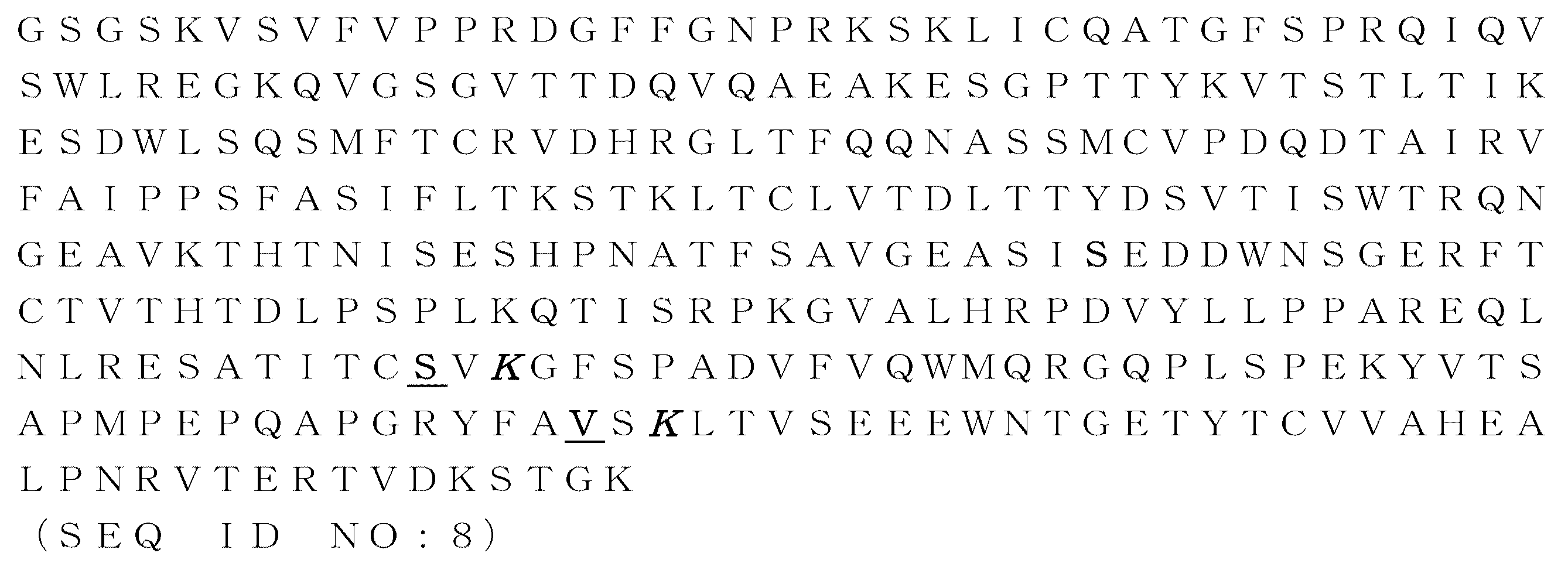
Rtx鎖は、約60kD(グリコシル化なし)及び66kD(4N−グリコシル化部位あり)の計算された分子量を有し、CD20陽性B細胞、例えばRaji細胞に結合することができる。 The Rtx chain has a calculated molecular weight of approximately 60 kD (no glycosylation) and 66 kD (with 4N-glycosylation sites) and can bind to CD20 positive B cells, such as Raji cells.
ii.Fc鎖は、cMycタグを含み、6Hisタグにより置換されたテールピースを有し、C291S突然変異を有する、ヒトIgMμ鎖CM2〜CM4領域を含む:
Fc鎖は、約39kD(グリコシル化なし)及び43kD(3N−グリコシル化部位あり)の分子量を有し、抗mycモノクローナル抗体9E4または他の抗myc抗体に結合することができる。 The Fc chain has a molecular weight of approximately 39 kD (no glycosylation) and 43 kD (with 3N-glycosylation sites) and can bind to anti-myc monoclonal antibody 9E4 or other anti-myc antibodies.
iii.Okt鎖は、C291S及びテールピース欠失を有するヒトミュー鎖のCM2が融合されたOKT3(抗CD3)の一本鎖Fvバージョンで構成される:
Okt鎖は、グリコシル化部位を有さない約61kD及び4N−グリコシル化部位を含む67kDの計算された分子量を有し、CD3陽性T細胞に結合することができる。 The Okt chain has a calculated molecular weight of approximately 61 kD with no glycosylation site and 67 kD including 4N-glycosylation sites and can bind to CD3-positive T cells.
d.軽鎖カップリング:
i.ネイティブキメラリツキサンカッパ(κ)鎖
QIVLSQSPAILSASPGEKVTMTCRASSSVSYIHWFQQKPGSSPKPWIYATSNLASGVPVRFSGSGSGTSYSLTISRVEAEDAATYYCQQWTSNPPTFGGGTKLEIKRTVAAPSVFIFPPSDEQLKSGTASVVCLLNNFYPREAKVQWKVDNALQSGNSQESVTEQDSKDSTYSLSSTLTLSKADYEKHKVYACEVTHQGLSSPVTKSFNRGEC
(SEQ ID NO:4)
d. Light chain coupling:
i. Native chimeric Rituxan kappa (κ) chain QIVLSQSPAILSASPGEKVTMTCRASSSVSYIHWFQQKPGSSPKPWIYATSNLASGVPVRFSGSGSGTSYSLTISRVEAEDAATYYCQQWTSNPPTFGGGTKLEIKRTVAAPSVFIFPPSDEQLKSGTASVVCLLNNFYPREAKVQWKVDNALQSGNSQESVTEQDSKDSTYSLSSTLTLSKADYEKHKVYACEVTHQGLSSPVTKSFNRGEC
(SEQ ID NO: 4)
該カッパ鎖は、約23kDの計算された分子量を有し、リツキサンIgM重鎖に連結することができる。 The kappa chain has a calculated molecular weight of about 23 kD and can be linked to a Rituxan IgM heavy chain.
e.界面突然変異
ノブ及びホール、静電荷カップリングをCM3相互作用界面に非対称に導入して、2つのμ鎖のヘテロ二量体化を最大にした。2対のCM3相互作用界面突然変異体を作製した。
e. Interfacial mutation Knobs and holes, electrostatic charge coupling were introduced asymmetrically at the CM3 interaction interface to maximize heterodimerization of the two μ chains. Two pairs of CM3 interacting interface mutants were generated.
i.Fc1aは、C291S及びT350Y突然変異及びテールピース欠失を有するヒトμ鎖CH2〜CH4領域である:
Fc1a鎖は、グリコシル化部位を有さない約36kD及び3N−グリコシル化部位を含む場合には41kDの計算された分子量を有する。 The Fc1a chain has a calculated molecular weight of about 36 kD with no glycosylation site and 41 kD when it contains a 3N-glycosylation site.
ii.Fc1bは、C291S、L352S及びH395V突然変異及びテールピース欠失を有するヒトμ鎖CH2〜CH4である。
Fc1b鎖は、グリコシル化部位を有さない約36kD及び3N−グリコシル化部位を含む41kDの計算された分子量を有する。 The Fc1b chain has a calculated molecular weight of about 36 kD with no glycosylation site and 41 kD with a 3N-glycosylation site.
iii.Fc2aは、C291S、T350Y、T354E、及びI397E突然変異及びテールピース欠失を有するヒトμ鎖CH2〜CH4からなる。
Fc2a鎖は、グリコシル化部位を有さない約36kD及び3N−グリコシル化部位を含む41kDの計算された分子量を有する。 The Fc2a chain has a calculated molecular weight of about 36 kD with no glycosylation site and 41 kD with a 3N-glycosylation site.
iv.Fc2bは、C291S、L352S、T354K、H395V、及びI397K突然変異及びテールピース欠失を有するヒトμ鎖CH2〜CH4である。
Fc2b鎖は、グリコシル化部位を有さない約36kD及び3N−グリコシル化部位を含む41kDの計算された分子量を有する。 The Fc2b chain has a calculated molecular weight of about 36 kD with no glycosylation site and 41 kD with a 3N-glycosylation site.
f.界面突然変異
ノブ、ホール、及び静電荷カップリングを有するFc2a鎖及びFc2b鎖を、2つのμ鎖の非対称ヘテロ二量体化のための分子クローニングによりリツキサン及びOKT3(抗CD3抗体)scFvの両方にさらに連結させた。
f. Interfacial mutations Fc2a and Fc2b chains with knob, hole, and electrostatic charge coupling can be converted to both Rituxan and OKT3 (anti-CD3 antibody) scFv by molecular cloning for asymmetric heterodimerization of two μ chains It was further linked.
i.Rtx2aは、C291S、T350Y、T354E、及びI397E突然変異及びテールピース欠失を有するヒトμ鎖のCM1〜CM4が融合されたキメラリツキサン(抗CD20)Vh領域のμ鎖で構成される。
Rtx2a鎖は、グリコシル化部位を有さない約61kD及び4N−グリコシル化部位を有する67kDの計算された分子量を有する。 The Rtx2a chain has a calculated molecular weight of approximately 61 kD without a glycosylation site and 67 kD with a 4N-glycosylation site.
ii.Rtx2bは、C291S、L352S、T354K、H395V、及びI397K突然変異及びテールピース欠失を有するヒトμ鎖のCM1〜CM4が融合されたキメラリツキサン(抗CD20)Vh領域のμ鎖で構成される。
Rtx2b鎖は、グリコシル化部位を有さない約61kD及び4N−グリコシル化部位を含む67kDの計算された分子量を有する。 The Rtx2b chain has a calculated molecular weight of approximately 61 kD without a glycosylation site and 67 kD including a 4N-glycosylation site.
iii.Okt2aは、C291S、T350Y、T354E、及びI397E突然変異及びテールピース欠失を有するヒトμ鎖のCM2〜CM4が融合されたOKT3(抗CD3抗体)scFvで構成される。
Okt2a鎖は、グリコシル化部位を有さない約62kD及び4N−グリコシル化部位を含む68kDの計算された分子量を有する。 The Okt2a chain has a calculated molecular weight of approximately 62 kD without a glycosylation site and 68 kD including a 4N-glycosylation site.
iv.Okt2bは、C291S、L352S、T354K、H395V、及びI397K突然変異及びテールピース欠失を有するヒトμ鎖のCM2〜CM4が融合されたOKT3(抗CD3抗体)scFvで構成される。
Okt2b鎖は、グリコシル化部位を有さない約62kD及び4N−グリコシル化部位を含む68kDの計算された分子量を有する。 The Okt2b chain has a calculated molecular weight of approximately 62 kD without a glycosylation site and 68 kD including a 4N-glycosylation site.
2.タンパク質の発現、精製及び特徴づけ
a.トランスフェクション
複数の異なる発現ベクターを等モル比で哺乳動物細胞、例えば293F細胞(インビトロジェン)にコトランスフェクトすることにより、IgMを作製した。発現ベクターのための混合DNA10μgを、Opti−MEM(インビトロジェン)2ml中で293フェクチン(インビトロジェン)20μlと室温で30分間混合し、その後、293F細胞107個に添加した。293F細胞のトランスフェクション物を、トランスフェクション後72時間インキュベートした後、上清を回収した。
2. Protein expression, purification and characterization a. Transfection IgM was generated by co-transfecting different expression vectors into equimolar ratios to mammalian cells, eg 293F cells (Invitrogen). 10 μg of the mixed DNA for the expression vector was mixed with 20 μl of 293fectin (Invitrogen) in 2 ml of Opti-MEM (Invitrogen) for 30 minutes at room temperature and then added to 10 7 293F cells. The 293F cell transfection was incubated for 72 hours after transfection, and the supernatant was collected.
b.免疫沈降によるタンパク質の精製
i.キャプチャー・セレクトIgM(カタログNo.2890.05、BAC、サーモフィッシャー)
トランスフェクトされた上清を2,000Gでの10分間の遠心分離により回収した。IgMタンパク質を、アフィニティー・キャプチャー・セレクトIgM・アフィニティーマトリックスでの免疫沈降により精製した。キャプチャー・セレクトIgMスラリー100μlを、回収された上清15mlに添加した。上清及びアフィニティーマトリックスの混合物を、ロッカー上、室温で2時間インキュベートした。アフィニティーマトリックスを、その後、300gで2分間遠心分離し、溶液をデカンテーションした。アフィニティーマトリックスを、PBS+0.05%Tweenでさらに3回洗浄した。最後に、精製されたIgMタンパク質を、4×LSD試料ローディングバッファー(インビトロジェン)20μlと共に室温で5分間インキュベートし、続いて10,000gで遠心分離することにより、アフィニティーマトリックスから洗い流した。アフィニティーマトリックスをPBS 60μlでさらに洗浄して、ゲル電気泳動での分析用に上清をプールした。
b. Purification of proteins by immunoprecipitation i. Capture Select IgM (Catalog No. 2890.05, BAC, Thermo Fisher)
The transfected supernatant was collected by centrifugation at 2,000 G for 10 minutes. IgM protein was purified by immunoprecipitation with affinity capture select IgM affinity matrix. 100 μl of Capture Select IgM slurry was added to 15 ml of recovered supernatant. The mixture of supernatant and affinity matrix was incubated for 2 hours at room temperature on a rocker. The affinity matrix was then centrifuged at 300 g for 2 minutes and the solution decanted. The affinity matrix was washed three more times with PBS + 0.05% Tween. Finally, the purified IgM protein was washed away from the affinity matrix by incubating with 20 μl of 4 × LSD sample loading buffer (Invitrogen) for 5 minutes at room temperature followed by centrifugation at 10,000 g. The affinity matrix was further washed with 60 μl PBS and the supernatants were pooled for analysis by gel electrophoresis.
c.ゲル電気泳動
i.非還元SDS−PAGE
非還元SDS−PAGEを利用して、異なる分子量の様々な突然変異体IgMタンパク質を分離した。ノベックス4−12%Bis−Trisゲル(ライフ・テクノロジーズ)を、ノベックスMES SDSランニングバッファー(ライフ・テクノロジーズ)と共に用いた。
c. Gel electrophoresis i. Non-reducing SDS-PAGE
Non-reducing SDS-PAGE was utilized to separate various mutant IgM proteins with different molecular weights. Novex 4-12% Bis-Tris gel (Life Technologies) was used with Novex MES SDS running buffer (Life Technologies).
ii.還元SDS−PAGE
NuPage LDSサンプルバッファー(ライフ・テクノロジーズ)及びNuPage還元剤ジチオトレイトール(ライフ・テクノロジーズ)をIgMタンパク質試料に添加して、80℃まで10分間加熱した後、NuPageノベックス4−12%Bis−Trisゲル(ライフ・テクノロジーズ、カタログNo.NPO322)上にロードした。NuPage MES SDSランニングバッファー(ライフ・テクノロジーズ、カタログNo.NP0002)をゲル電気泳動に用いた。電気泳動が完了した後、ゲルを装置から取り出して、コロイダルブルー染色(ライフ・テクノロジーズ、マニュアルNo.LC6025)を用いて染色した。
ii. Reduced SDS-PAGE
NuPage LDS sample buffer (Life Technologies) and NuPage reducing agent dithiothreitol (Life Technologies) were added to the IgM protein sample and heated to 80 ° C. for 10 minutes, followed by NuPage Novex 4-12% Bis-Tris gel ( Life Technologies, Catalog No. NPO322). NuPage MES SDS running buffer (Life Technologies, Catalog No. NP0002) was used for gel electrophoresis. After electrophoresis was completed, the gel was removed from the apparatus and stained using colloidal blue staining (Life Technologies, Manual No. LC6025).
iii.ゲルバンド定量
タンパク質ゲルを乾燥させ、その後、画像スキャナーでデジタル化する。ゲル画像をImage Jプログラムで処理して、ゲル定量機能を利用して特定バンドのタンパク質量を計測する。
iii. Gel band quantification The protein gel is dried and then digitized with an image scanner. The gel image is processed by the Image J program, and the amount of protein in a specific band is measured using the gel quantification function.
iv.SDS−PAGEゲルの分析
野生型及び設計されたIgM Fcペア2a及び2b SDS−PAGEゲルを含むRtx:Fc。非還元SDS−PGEゲル上のレーン1、2、及び3(図6)は、モノ二量体Rtx(H2L2、予測されるMW168〜180kDa)に相当する上のバンド、ならびにRtx2a単独、Rtx2b単独及び野生型Rtxの半抗体(HL、予測されるMW84〜90kDa)に相当する下のバンドを示す。非会合Fc(予測されるMW36〜41kDa)のバンドが、3つのレーン全てに存在し;会合したFc(予測されるMW72〜82kDa)は、80〜90kDaバンドの成分でもあり得る。レーン2は、Rtx2a:Fc2bの混合物を示し、レーン3は、Rtx2b:Fc2aの混合物を示す。両方のレーンにおいて、ヘテロ二量体(予測されるMW120〜131kDa)を矢印で示している。設計されたRtx2a:Fc2b及びRtx2b:Fc2aの組み合わせは両者とも、著しいヘテロ二量体の存在を示しているが、野生型Rtx:Fcの組み合わせは、少量だけのヘテロ二量体を示している。
iv. Analysis of SDS-PAGE gels Rtx: Fc including wild-type and designed IgM Fc pairs 2a and 2b SDS-PAGE gels.
Fcは、実際に、図7に示された還元SDS−PAGEのレーン1〜3に認められる通り存在し、上のバンドはRtx重鎖(予測されるMW61〜67kDa)であり、中央のバンドはFcであり(予測されるMW36〜41kDa)、下のバンドはRtx軽鎖(予測されるMW23kDa)である。 Fc is actually present as seen in lanes 1-3 of the reduced SDS-PAGE shown in FIG. 7, the upper band is the Rtx heavy chain (predicted MW 61-67 kDa) and the middle band is Fc (expected MW 36-41 kDa), lower band is Rtx light chain (expected MW 23 kDa).
野生型及び設計されたIgM Fcペア2a及び2bを含むOkt:Fc。SDS−PAGE、図8のレーンの1〜3
野生型Okt:Fc組み合わせ(SDS−PAGE、図8のレーン1)は、Okt:Fcヘテロ二量体(予測されるMW98〜107kDa)の上のバンド、非会合Fc(予測されるMW36〜41)に相当する下のバンド、及び会合Fc(予測されるMW72〜82)を表す大きな中央のバンドを示す。これに対して、Okt2a:Fc2b及びOkt2b:Fc2a組み合わせについては、図8のレーン2に示されたSDS−PAGEゲルは、ヘテロ二量体の目立つバンドと、会合したFc2b、及び上のOkt2aモノ二量体及びOkt2a:Fc2bヘテロ二量体と一致する非常に薄いバンドを示している。矢印は、ヘテロ二量体を示す。
Okt: Fc comprising wild type and designed IgM Fc pairs 2a and 2b. SDS-PAGE, 1-3 of lane in FIG.
Wild-type Okt: Fc combination (SDS-PAGE,
Okt2a及びFc2bは両者とも、還元ゲル(図9のレーン2に示されたSDS−PAGEゲル)に存在する。類似の結果が、図8及び9に示されたゲルのOkt2b:Fc2aペアに関して認められる。
Both Okt2a and Fc2b are present in the reducing gel (SDS-PAGE gel shown in
図8及び9のレーン4〜6に示された野生型及び設計されたIgM Fcペア2a及び2b SDS−PAGEゲルを含むOkt:Rtx
野生型Okt:Rtx組み合わせ(図8のレーン4に示されたSDS−PAGEゲル)は、野生型Rtxモノ二量体(H2L2、予測されるMW168〜180kDa)のバンド、野生型Rtx半抗体(HL、予測されるMW84〜90kDa)のバンド、及びOktモノ二量体(予測されるMW124〜133kDa)の可能性がある薄いバンドを示す。これに対して、設計されたOkt2a:Rtx2b組み合わせ(図8のレーン5に示されたSDS−PAGEゲル)は、著しいヘテロ二量体(予測されるMW146〜157)に加え、Rtx2bモノ二量体(予測されるMW168〜180kDa)及び半抗体(予測されるMW84〜90kDa)の存在を示している。還元された場合(図9のレーン5に示されたSDS−PAGEゲル)、Rtx2b軽鎖は、MW23kDaのバンドを示し;60〜80kDaの重鎖は、Rtx2b重鎖(予測されるMW61〜67kDa)及びOkt2a重鎖(予測されるMW62〜67kDa)で構成される可能性がある。同様の結果が、Okt2b:Rtx2aペアで認められる。
Okt: Rtx containing wild-type and designed IgM Fc pairs 2a and 2b SDS-PAGE gels shown in lanes 4-6 of FIGS. 8 and 9
The wild-type Okt: Rtx combination (SDS-PAGE gel shown in lane 4 of FIG. 8) is a wild-type Rtx monodimer (H2L2, predicted MW 168-180 kDa) band, wild-type Rtx half antibody (HL , Predicted MW 84-90 kDa) band, and a thin band with the potential of Okt monodimer (predicted MW 124-133 kDa). In contrast, the designed Okt2a: Rtx2b combination (SDS-PAGE gel shown in lane 5 of FIG. 8) has a significant heterodimer (predicted MW 146-157) plus an Rtx2b monodimer. (Predicted MW 168-180 kDa) and half antibody (predicted MW 84-90 kDa) are shown. When reduced (SDS-PAGE gel shown in lane 5 of FIG. 9), the Rtx2b light chain shows a MW23 kDa band; the 60-80 kDa heavy chain is the Rtx2b heavy chain (predicted MW61-67 kDa) And the Okt2a heavy chain (expected MW 62-67 kDa). Similar results are observed with the Okt2b: Rtx2a pair.
結論
テストされた3つの系:Okt:Rtx、Okt:Fc、Rtx:Fcの全てについて、設計されたIgM Fc変異体が、ネイティブ(非設計)IgM Fcに比較して実質的に増加されたヘテロ二量体形成を示した。一対の配列(即ち、Fc 2a及び2b)をテストし、ホモ二量体形成をさらに減少させてヘテロ二量体形成を最適化させる、設計されたFc界面の更なる変異体を評価することができる。
CONCLUSION For all three tested systems: Okt: Rtx, Okt: Fc, Rtx: Fc, the designed IgM Fc variants showed substantially increased heterogeneity compared to native (non-designed) IgM Fc. Dimer formation was indicated. Testing a pair of sequences (ie, Fc 2a and 2b) to evaluate additional variants of the designed Fc interface that further reduce homodimer formation and optimize heterodimer formation it can.
3.二重特異性機能分析
a.2つのリガンドについてのELISA分析
OKT3(鎖A)及びcMycペプチド(鎖B)を有するIgMを、可溶性CD3イプシロンタンパク質捕捉及び抗cMyc(9E10)検出を伴うELISA分析によりアッセイする。可溶性CD3eタンパク質を、150mM NaHCO3中の2mg/mlでELISAプレートにコーティングし、その後PBS中の3%BSAでブロッキングする。トランスフェクトされたIgM−OKT3−cMycを含む上清(100μl)を、ブロッキングされたELISAプレートに25℃で4時間添加する。PBSで洗浄した後、9E10抗体をELISAプレートに室温で2時間添加する。PBSで洗浄した後、抗マウスIgG−HRPを添加する。HRP基質を添加した後にOD450で読み取ることにより、二重特異性IgMの存在を検出する。
3. Bispecific functional analysis a. ELISA analysis for two ligands IgM with OKT3 (chain A) and cMyc peptide (chain B) is assayed by ELISA analysis with soluble CD3 epsilon protein capture and anti-cMyc (9E10) detection. Soluble CD3e protein is coated on ELISA plates at 2 mg / ml in 150 mM NaHCO 3 and then blocked with 3% BSA in PBS. The supernatant (100 μl) containing the transfected IgM-OKT3-cMyc is added to the blocked ELISA plate at 25 ° C. for 4 hours. After washing with PBS, 9E10 antibody is added to the ELISA plate for 2 hours at room temperature. After washing with PBS, anti-mouse IgG-HRP is added. The presence of bispecific IgM is detected by reading at OD450 after adding HRP substrate.
Okt3(鎖A)及びリツキサン(鎖B)を有するIgMを、可溶性CD3イプシロンタンパク質捕捉及びプロテイン−L−HRP検出を伴うELISA分析によりアッセイする。可溶性CD3eタンパク質を、150mM NaHCO3中の2mg/mlでELISAプレートにコーティングし、その後PBS中の3%BSAでブロッキングする。トランスフェクトされたIgM−Okta:RtxbまたはOktb:Rtxaを含む上清(100μl)を、ブロッキングされたELISAプレートに25℃で4時間添加する。PBSで洗浄した後、プロテイン−L−HRPをELISAプレートに室温で2時間添加する。HRP基質を添加した後にOD450で読み取ることにより、二重特異性IgMの存在を検出する。 IgM with Okt3 (chain A) and Rituxan (chain B) is assayed by ELISA analysis with soluble CD3 epsilon protein capture and protein-L-HRP detection. Soluble CD3e protein is coated on ELISA plates at 2 mg / ml in 150 mM NaHCO 3 and then blocked with 3% BSA in PBS. Supernatant (100 μl) containing transfected IgM-Okta: Rtxb or Oktb: Rtxa is added to the blocked ELISA plate at 25 ° C. for 4 hours. After washing with PBS, protein-L-HRP is added to the ELISA plate for 2 hours at room temperature. The presence of bispecific IgM is detected by reading at OD450 after adding HRP substrate.
b.標的結合のFACS分析
T細胞株(ピア(peer)、陽性細胞株)及びB細胞株(ダウジ、陰性対照細胞株)への抗体の結合により、T細胞へのIgM−OKT3−cMyc結合を確認する。洗浄後、ローダミン標識された9E10を細胞懸濁液に添加する。細胞標的結合を、CD20抗原を含む、または含まない陽性及び陰性対照細胞の両方のMFIにより検出する。
b. FACS analysis of target binding IgM-OKT3-cMyc binding to T cells is confirmed by antibody binding to T cell lines (peer, positive cell lines) and B cell lines (Daudi, negative control cell lines) . After washing, rhodamine labeled 9E10 is added to the cell suspension. Cell target binding is detected by MFI of both positive and negative control cells with or without CD20 antigen.
c.二重特異性結合についての蛍光顕微鏡アッセイ
各細胞型が2種の異なる生体染色色素で予め標識されたCD3陽性細胞及びCD20陽性細胞の2集団を集合させる能力により、設計されたIgMの二重特異性結合を検証する。例えば
i.CD3陽性細胞株(ピア)を標識する緑色蛍光細胞基質生体染色色素(セルトレース(商標)カルセイン・グリーンAM)
ii.赤色蛍光細胞基質生体染色色素(セルトレース(商標)カルセイン・レッド−オレンジAM)が標識されたCD20陽性B細胞株(ダウジ)
c. Fluorescence microscopy assay for bispecific binding The ability to assemble two populations of CD3 positive cells and CD20 positive cells, each cell type pre-labeled with two different vital staining dyes, is designed for dual specificity of IgM Verify sexual coupling. For example i. Green fluorescent cell substrate vital dye for labeling CD3 positive cell line (Pia) (Celtrace ™ Calcein Green AM)
ii. CD20 positive B cell line (Daudi) labeled with red fluorescent cell matrix vital dye (Celtrace ™ Calcein Red-Orange AM)
実施例2
1.設計された突然変異を有するDNA構築物の作製
DNA構築物の合成及び発現ベクターの構築を、実施例1と同様に実施する。
Example 2
1. Preparation of DNA constructs with designed mutations Synthesis of DNA constructs and construction of expression vectors is performed as in Example 1.
a.異なるサイズのμ鎖
A鎖は、ヒトミュー鎖のCM1が融合されたキメラOKT3(抗CD3)Vh領域の全長μ鎖で構成される:
QVQLQQSGAELARPGASVKMSCKASGYTFTRYTMHWVKQRPGQGLEWIGYINPSRGYTNYNQKFKDKATLTTDKSSSTAYMQLSSLTSEDSAVYYCARYYDDHYCLDYWGQGTTLTVSSGSASAPTLFPLVSCENSPSDTSSVAVGCLAQDFLPDSITFSWKYKNNSDISSTRGFPSVLRGGKYAATSQVLLPSKDVMQGTDEHVVCKVQHPNGNKEKNVPLPVIAELPPKVSVFVPPRDGFFGNPRKSKLICQATGFSPRQIQVSWLREGKQVGSGVTTDQVQAEAKESGPTTYKVTSTLTIKESDWLSQSMFTCRVDHRGLTFQQNASSMCVPDQDTAIRVFAIPPSFASIFLTKSTKLTCLVTDLTTYDSVTISWTRQNGEAVKTHTNISESHPNATFSAVGEASICEDDWNSGERFTCTVTHTDLPSPLKQTISRPKGVALHRPDVYLLPPAREQLNLRESATITCLVTGFSPADVFVQWMQRGQPLSPEKYVTSAPMPEPQAPGRYFAHSILTVSEEEWNTGETYTCVVAHEALPNRVTERTVDKSTGKPTLYNVSLVMSDTAGTCY
(SEQ ID NO:13)
a. Different sizes of μ chain A chain is composed of full length μ chain of chimeric OKT3 (anti-CD3) Vh region fused with human mu chain CM1:
QVQLQQSGAELARPGASVKMSCKASGYTFTRYTMHWVKQRPGQGLEWIGYINPSRGYTNYNQKFKDKATLTTDKSSSTAYMQLSSLTSEDSAVYYCARYYDDHYCLDYWGQGTTLTVSSGSASAPTLFPLVSCENSPSDTSSVAVGCLAQDFLPDSITFSWKYKNNSDISSTRGFPSVLRGGKYAATSQVLLPSKDVMQGTDEHVVCKVQHPNGNKEKNVPLPVIAELPPKVSVFVPPRDGFFGNPRKSKLICQATGFSPRQIQVSWLREGKQVGSGVTTDQVQAEAKESGPTTYKVTSTLTIKESDWLSQSMFTCRVDHRGLTFQQNASSMC PDQDTAIRVFAIPPSFASIFLTKSTKLTCLVTDLTTYDSVTISWTRQNGEAVKTHTNISESHPNATFSAVGEASICEDDWNSGERFTCTVTHTDLPSPLKQTISRPKGVALHRPDVYLLPPAREQLNLRESATITCLVTGFSPADVFVQWMQRGQPLSPEKYVTSAPMPEPQAPGRYFAHSILTVSEEEWNTGETYTCVVAHEALPNRVTERTVDKSTGKPTLYNVSLVMSDTAGTCY
(SEQ ID NO: 13)
A鎖は、約63kDの分子量を有し、CD3(10977−H08H、シノバイオロジカル)またはT細胞の可溶性イプシロン鎖に結合することができる。 The A chain has a molecular weight of approximately 63 kD and can bind to the soluble epsilon chain of CD3 (10977-H08H, Synobiological) or T cells.
B鎖は、ヒトμ鎖のCH2が融合されたcMycタグを有する:
QVQLGGPEQKLISEEDLNSAVLPVIAELPPKVSVFVPPRDGFFGNPRKSKLICQATGFSPRQIQVSWLREGKQVGSGVTTDQVQAEAKESGPTTYKVTSTLTIKESDWLSQSMFTCRVDHRGLTFQQNASSMCVPDQDTAIRVFAIPPSFASIFLTKSTKLTCLVTDLTTYDSVTISWTRQNGEAVKTHTNISESHPNATFSAVGEASICEDDWNSGERFTCTVTHTDLPSPLKQTISRPKGVALHRPDVYLLPPAREQLNLRESATITCLVTGFSPADVFVQWMQRGQPLSPEKYVTSAPMPEPQAPGRYFAHSILTVSEEEWNTGETYTCVVAHEALPNRVTERTVDKSTGKPTLYNVSLVMSDTAGTCY
(SEQ ID NO:14)
The B chain has a cMyc tag fused to CH2 of the human μ chain:
QVQLGGPEQKLISEEDLNSAV LPVIAELPPKV SVFVPPRDGFFGNPRKSKLICQATGFSPRQIQVSWLREGKQVGSGVTTDQVQAEAKESGPTTYKVTSTLTIKESDWLSQSMFTCRVDHRGLTFQQNASSMCVPDQDTAIRVFAIPPSFASIFLTKSTKLTCLVTDLTTYDSVTISWTRQNGEAVKTHTNISESHPNATFSAVGEASICEDDWNSGERFTCTVTHTDLPSPLKQTISRPKGVALHRPDVYLLPPAREQLNLRESATITCLVTGFSPADVFVQWMQRGQPLSPEKYVTSAPMPEPQAPGRYFAHSILTVSEEEWNTGETYTC VAHEALPNRVTERTVDKSTGKPTLYNVSLVMSDTAGTCY
(SEQ ID NO: 14)
B鎖は、約41kDの分子量を有し、抗mycモノクローナル抗体9E4または他の抗myc抗体に結合することができる。 The B chain has a molecular weight of about 41 kD and can bind to anti-myc monoclonal antibody 9E4 or other anti-myc antibodies.
別のB鎖は、ヒトミュー鎖のCH2が融合されたCrossMabM−CL(VH+CL)リツキシマブ(抗CD20)のための全長μ鎖を有する:
QVQLQQPGAELVKPGASVKMSCKASGYTFTSYNMHWVKQTPGRGLEWIGAIYPGNGDTSYNQKFKGKATLTADKSSSTAYMQLSSLTSEDSAVYYCARSTYYGGDWYFNVWGAGTTVTVSASVAAPSVFIFPPSDEQLKSGTASVVCLLNNFYPREAKVQWKVDNALQSGNSQESVTEQDSKDSTYSLSSTLTLSKADYEKHKVYACEVTHQGLSSPVTKSFNRGECDKTHLPVIAELPPKVSVFVPPRDGFFGNPRKSKLICQATGFSPRQIQVSWLREGKQVGSGVTTDQVQAEAKESGPTTYKVTSTLTIKESDWLSQSMFTCRVDHRGLTFQQNASSMCVPDQDTAIRVFAIPPSFASIFLTKSTKLTCLVTDLTTYDSVTISWTRQNGEAVKTHTNISESHPNATFSAVGEASICEDDWNSGERFTCTVTHTDLPSPLKQTISRPKGVALHRPDVYLLPPAREQLNLRESATITCLVTGFSPADVFVQWMQRGQPLSPEKYVTSAPMPEPQAPGRYFAHSILTVSEEEWNTGETYTCVVAHEALPNRVTERTVDKSTGKPTLYNVSLVMSDTAGTCY
(SEQ ID NO:15)
Another B chain has a full-length μ chain for CrossMab M-CL (V H + C L ) rituximab (anti-CD20) fused to CH2 of the human mu chain:
QVQLQQPGAELVKPGASVKMSCKASGYTFTSYNMHWVKQTPGRGLEWIGAIYPGNGDTSYNQKFKGKATLTADKSSSTAYMQLSSLTSEDSAVYYCARSTYYGGDWYFNVWGAGTTVTVSASVAAPSVFIFPPSDEQLKSGTASVVCLLNNFYPREAKVQWKVDNALQSGNSQESVTEQDSKDSTYSLSSTLTLSKADYEKHKVYACEVTHQGLSSPVTKSFNRGECDKTH LPVIAELPPKV SVFVPPRDGFFGNPRKSKLICQATGFSPRQIQVSWLREGKQVGSGVTTDQVQAEAKESGPTTYKVTSTLTIKESDWLSQSMFTCRVDHRG TFQQNASSMCVPDQDTAIRVFAIPPSFASIFLTKSTKLTCLVTDLTTYDSVTISWTRQNGEAVKTHTNISESHPNATFSAVGEASICEDDWNSGERFTCTVTHTDLPSPLKQTISRPKGVALHRPDVYLLPPAREQLNLRESATITCLVTGFSPADVFVQWMQRGQPLSPEKYVTSAPMPEPQAPGRYFAHSILTVSEEEWNTGETYTCVVAHEALPNRVTERTVDKSTGKPTLYNVSLVMSDTAGTCY
(SEQ ID NO: 15)
B鎖は、約64kDの分子量を有し、CD20陽性B細胞に結合することができる。 The B chain has a molecular weight of approximately 64 kD and can bind to CD20 positive B cells.
b.異なる軽鎖カップリング
ネイティブキメラOKT3カッパ鎖
QIVLTQSPAIMSASPGEKVTMTCSASSSVSYMNWYQQKSGTSPKRWIYDTSKLASGVPAHFRGSGSGTSYSLTISGMEAEDAATYYCQQWSSNPFTFGSGTKLEINRAVAAPSVFIFPPSDEQLKSGTASVVCLLNNFYPREAKVQWKVDNALQSGNSQESVTEQDSKDSTYSLSSTLTLSKADYEKHKVYACEVTHQGLSSPVTKSFNRGEC
(SEQ ID NO:16)
b. Different light chain coupling native chimeric OKT3 kappa chain QIVLTQSPAIMSASPGEKVTMTCSASSSVSYMNWYQQKSGTSPKRWIYDTSKLASGVPAHFRGSGSGTSYSLTISGMEAEDAATYYCQQWSSNPFTFGSGTKLEINRAVAAPSVFIFPPSDEQLKSGTASVVCLLNNFYPREAKVQWKVDNALQSGNSQESVTEQDSKDSTYSLSSTLTLSKADYEKHKVYACEVTHQGLSSPVTKSFNRGEC
(SEQ ID NO: 16)
リツキシマブのためのCrossMabCM1−CL
QIVLSQSPAILSASPGEKVTMTCRASSSVSYIHWFQQKPGSSPKPWIYATSNLASGVPVRFSGSGSGTSYSLTISRVEAEDAATYYCQQWTSNPPTFGGGTKLEIKSSASTKGPSVFPLAPSSKSTSGGTAALGCLVKDYFPEPVTVSWNSGALTSGVHTFPAVLQSSGLYSLSSVVTVPSSSLGTQTYICNVNHKPSNTKVDKRVEPKSC
(SEQ ID NO:17)
CrossMab CM1-CL for Rituximab
QIVLSQSPAILSASPGEKVTMTCRASSSVSYIHWFQQKPGSSPKPWIYATSNLASGVPVRFSGSGSGTSYSLTISRVEAEDAATYYCQQWTSNPPTFGGGTKLEIKSSASTKGPSVFPLAPSSKSTSGGTAALGCLVKDYFPEPVTVSWNSGALTSGVHTFPAVLQSSGLYSLSSVVTVPSSSLGTQTYICNVNHKPSNTKVDKRVEPKSC
(SEQ ID NO: 17)
c.異なる発現ベクターのための異なる選択マーカ
コトランスフェクションに用いられる異なる発現ベクターにおいて、異なる選択マーカが用いられる。IgM生成に関連して必要な発現ベクターの全てを収容するために、複数の薬物が細胞の選択のために用いられる。これらのベクターに特異的DNAをクローニングするために、標準の分子生物学的技術が利用される。
i.ミュー鎖は、ゼオシン選択(ant−zn−1、インビトロジェン)を利用する。ゼオシンは、100μg/mlの濃度で用いられる。Sh ble遺伝子を含むプラスミドでトランスフェクトした後、細胞を、ゼオシンを含むOpti−CHO培地で100μg/mlでインキュベートして、安定したトランスフェクタントを選択する。
ii.カッパ鎖は、ブラスチシジンS選択(ant−bl−1、インビトロジェン)を利用する。ブラスチシジンSは、10μg/mlの濃度で使用される。bsr遺伝子を含むプラスミドでトランスフェクトした後、細胞を、ブラスチシジンSを含むOpti−CHO培地で10μg/mlでインキュベートして、安定したトランスフェクタントを選択する。
c. Different selection markers for different expression vectors Different selection markers are used in different expression vectors used for cotransfection. Multiple drugs are used for cell selection to accommodate all of the expression vectors required for IgM production. Standard molecular biology techniques are utilized to clone specific DNA into these vectors.
i. The mu chain utilizes zeocin selection (ant-zn-1, Invitrogen). Zeocin is used at a concentration of 100 μg / ml. After transfection with a plasmid containing the Sh ble gene, cells are incubated at 100 μg / ml in Opti-CHO medium containing zeocin to select stable transfectants.
ii. The kappa chain utilizes blasticidin S selection (ant-bl-1, Invitrogen). Blasticidin S is used at a concentration of 10 μg / ml. After transfection with a plasmid containing the bsr gene, cells are incubated at 10 μg / ml in Opti-CHO medium containing blasticidin S to select stable transfectants.
d.タンパク質の発現、精製及び特徴づけ
i.トランスフェクション
複数の異なる発現ベクターを等モル比または様々なモル比(5〜10倍差)で哺乳動物細胞、例えば293細胞またはCHO細胞にコトランスフェクトすることにより、IgMを作製する。発現ベクターのためのDNAをPEIと混合し、その後、CHO−S細胞に添加する。CHO−S細胞でのPEIトランスフェクションを、確立された技術(“Biotechnology and Bioengineering, Vol 87, 553−545”参照)に従って実施する。
d. Protein expression, purification and characterization i. Transfection IgM is produced by co-transfecting different expression vectors into mammalian cells such as 293 cells or CHO cells at equimolar ratios or various molar ratios (5-10 fold differences). DNA for the expression vector is mixed with PEI and then added to CHO-S cells. PEI transfection in CHO-S cells is performed according to established techniques (see “Biotechnology and Bioengineering, Vol 87, 553-545”).
ii.タンパク質の精製
・キャプチャー・セレクトIgM(カタログ2890.05、BAC、サーモフィッシャー)
トランスフェクトされたCHO−S細胞上清からのIgMタンパク質を、製造業者のプロトコルに従ってアフィニティー・キャプチャー・セレクトIgM・アフィニティーマトリックスにより精製する。
・キャプト−L(カタログ17−5478−01、GEヘルスケア)
CHO−S細胞上清中の、カッパ鎖を含有するトランスフェクトされたIgMタンパク質を、製造業者のプロトコルに従ってキャプト−Lアフィニティーマトリックスにより精製する。
ii. Protein purification ・ Capture Select IgM (Catalog 2890.05, BAC, Thermo Fisher)
IgM protein from the transfected CHO-S cell supernatant is purified by affinity capture select IgM affinity matrix according to the manufacturer's protocol.
・ Capto-L (Catalog 17-5478-01, GE Healthcare)
Transfected IgM protein containing kappa chains in CHO-S cell supernatant is purified with a Capto-L affinity matrix according to the manufacturer's protocol.
iii.ゲル電気泳動
・非還元SDS−PAGE
非還元SDS−PAGEで、ネイティブIgMとその突然変異形態をサイズにより分離する。ホモ二量体重鎖(AA)で構成された五量体IgMは、およそ1,000,000分子量のタンパク質バンドを生じる。より短い型のモノ二量体重鎖(BB)で構成された五量体IgMは、著しく低い分子量のタンパク質バンドを生じる。ヘテロ二量体重鎖(キメラAB)で構成された五量体IgMは、BBよりも大きくAAよりも小さい分子量の複数のタンパク質を生じる。
iii. Gel electrophoresis ・ Non-reducing SDS-PAGE
Native IgM and its mutant forms are separated by size on non-reducing SDS-PAGE. A pentameric IgM composed of a homodimeric body weight chain (AA) produces a protein band of approximately 1,000,000 molecular weight. A pentameric IgM composed of a shorter form of the monodimeric body weight chain (BB) results in a significantly lower molecular weight protein band. A pentameric IgM composed of heterodimeric body weight chains (chimeric AB) yields multiple proteins with molecular weights larger than BB and smaller than AA.
NuPage LDSサンプルバッファー(ライフ・テクノロジーズ)をIgMタンパク質試料に25℃で30分間添加した後、ゲルにロードする。NativePage ノベックス3−12% Bis−Trisゲル(ライフ・テクノロジーズ)を、ノベックスTris−酢酸SDSランニングバッファー(ライフ・テクノロジーズ)と共に使用する。色素の先頭がゲルの最下部に達するまで、ゲルを泳動にかける。 NuPage LDS sample buffer (Life Technologies) is added to the IgM protein sample for 30 minutes at 25 ° C. and then loaded onto the gel. NativePage Novex 3-12% Bis-Tris gel (Life Technologies) is used with Novex Tris-acetic acid SDS running buffer (Life Technologies). Run the gel until the top of the dye reaches the bottom of the gel.
・還元SDS−PAGE
NuPage LDSサンプルバッファー(ライフ・テクノロジーズ)及びNuPage還元剤ジチオトレイトール(ライフ・テクノロジーズ)をIgMタンパク質試料に添加して、80℃まで10分間加熱した後、NuPageノベックス4−12% Bis−Trisゲル(ライフ・テクノロジーズ、カタログNo.NP0322)にロードする。NuPage MES SDSランニングバッファー(ライフ・テクノロジーズ、カタログNo.NP0002)をゲル電気泳動に使用する。色素の先頭がゲルの最下部に達するまで、ゲルを泳動にかける。
・ Reduced SDS-PAGE
NuPage LDS sample buffer (Life Technologies) and NuPage reducing agent dithiothreitol (Life Technologies) were added to the IgM protein sample and heated to 80 ° C. for 10 minutes, followed by NuPage Novex 4-12% Bis-Tris gel ( Life Technologies, Catalog No. NP0322). NuPage MES SDS running buffer (Life Technologies, Catalog No. NP0002) is used for gel electrophoresis. Run the gel until the top of the dye reaches the bottom of the gel.
電気泳動が完了した後、ゲルを装置から取り出して、コロイダルブルー染色(ライフ・テクノロジーズ、マニュアルNo.LC6025)を用いてゲルを染色する。 After electrophoresis is complete, the gel is removed from the apparatus and stained using colloidal blue staining (Life Technologies, Manual No. LC6025).
・ゲルバンド定量
タンパク質ゲルを乾燥させ、その後、画像スキャナーでデジタル化する。ゲル画像をImage Jプログラムで処理して、ゲル定量機能を利用して特定バンドのタンパク質量を計測することができる。
-Gel band quantification The protein gel is dried and then digitized with an image scanner. The gel image can be processed with the Image J program, and the amount of protein in a specific band can be measured using the gel quantitative function.
iv.二重特異性調製物中の様々なmAbを同定/定量するための質量分析法 iv. Mass spectrometry method for identifying / quantifying various mAbs in bispecific preparations
v.示差走査熱量測定(DSC)を利用した安定性分析
e.二重特異性機能分析
i.2つのリガンドのELISA分析
OKT3(鎖A)及びcMycペプチド(鎖B)を有するIgMを、可溶性CD3イプシロンタンパク質捕捉及び抗cMyc(9E10)検出を伴うELISA分析によりアッセイする。可溶性CD3eタンパク質を、150mM NaHCO3中の2mg/mlでELISAプレートにコーティングし、その後PBS中の3%BSAでブロッキングする。トランスフェクトされたIgM−OKT3−cMycを含む上清(100μl)を、ブロッキングされたELISAプレートに25℃で4時間添加する。PBSで洗浄した後、9E10抗体をELISAプレートに室温で2時間添加する。PBSで洗浄した後、抗マウスIgG−HRPを添加する。HRP基質を添加した後にOD450で読み取ることにより、二重特異性IgMの存在を検出する。
v. Stability analysis using differential scanning calorimetry (DSC) e. Bispecific functional analysis i. ELISA analysis of two ligands IgM with OKT3 (chain A) and cMyc peptide (chain B) is assayed by ELISA analysis with soluble CD3 epsilon protein capture and anti-cMyc (9E10) detection. Soluble CD3e protein is coated on ELISA plates at 2 mg / ml in 150 mM NaHCO 3 and then blocked with 3% BSA in PBS. The supernatant (100 μl) containing the transfected IgM-OKT3-cMyc is added to the blocked ELISA plate at 25 ° C. for 4 hours. After washing with PBS, 9E10 antibody is added to the ELISA plate for 2 hours at room temperature. After washing with PBS, anti-mouse IgG-HRP is added. The presence of bispecific IgM is detected by reading at OD450 after adding HRP substrate.
ii.標的結合のFACS分析
T細胞株(ピア、陽性細胞株)及びB細胞株(ダウジ、陰性対照細胞株)への抗体の結合により、T細胞へのIgM−OKT3−cMyc結合を確認する。洗浄後、ローダミン標識された9E10を細胞懸濁液に添加する。細胞標的結合を、CD20抗原を含む、または含まない陽性及び陰性対照細胞の両方のMFIにより検出する。
ii. FACS analysis of target binding IgM-OKT3-cMyc binding to T cells is confirmed by antibody binding to T cell lines (peers, positive cell lines) and B cell lines (Daudi, negative control cell lines). After washing, rhodamine labeled 9E10 is added to the cell suspension. Cell target binding is detected by MFI of both positive and negative control cells with or without CD20 antigen.
iii.二重特異性結合についての蛍光顕微鏡アッセイ
各細胞型の2種の異なる生体染色色素で予め標識されたCD3陽性細胞及びCD20陽性細胞の2集団を集合させる能力により、設計されたIgMの二重特異性結合を検証する。例えば
・CD3陽性細胞株(ピア)を標識する緑色蛍光細胞基質生体染色色素(セルトレース(商標)カルセイン・グリーンAM)
・赤色蛍光細胞基質生体染色色素(セルトレース(商標)カルセイン・レッド−オレンジAM)が標識されたCD20陽性B細胞株(ダウジ)
iii. Fluorescence microscopy assay for bispecific binding The ability to assemble two populations of designed IgM with the ability to assemble two populations of CD3 positive cells and CD20 positive cells pre-labeled with two different vital stains of each cell type Verify sexual coupling. For example: Green fluorescent cell substrate vital staining dye for labeling CD3 positive cell line (Pier) (Celtrace ™ Calcein Green AM)
CD20 positive B cell line (Daudi) labeled with red fluorescent cell substrate vital dye (Celtrace ™ Calcein Red-Orange AM)
多重特異性結合及び多重特異性機能分析を、先に記載されたものなどの当該技術分野で公知の技術を利用して、類似の手法で実施することができる。 Multispecific binding and multispecific functional analysis can be performed in a similar manner using techniques known in the art, such as those described above.
Claims (102)
Applications Claiming Priority (5)
| Application Number | Priority Date | Filing Date | Title |
|---|---|---|---|
| US201361874284P | 2013-09-05 | 2013-09-05 | |
| US201361874277P | 2013-09-05 | 2013-09-05 | |
| US61/874,284 | 2013-09-05 | ||
| US61/874,277 | 2013-09-05 | ||
| PCT/US2014/054079 WO2015053887A1 (en) | 2013-09-05 | 2014-09-04 | Constant chain modified bispecific, penta- and hexavalent ig-m antibodies |
Publications (3)
| Publication Number | Publication Date |
|---|---|
| JP2016531924A true JP2016531924A (en) | 2016-10-13 |
| JP2016531924A5 JP2016531924A5 (en) | 2017-10-12 |
| JP6721505B2 JP6721505B2 (en) | 2020-07-15 |
Family
ID=51542496
Family Applications (1)
| Application Number | Title | Priority Date | Filing Date |
|---|---|---|---|
| JP2016540383A Expired - Fee Related JP6721505B2 (en) | 2013-09-05 | 2014-09-04 | Constant-chain modified bispecific pentavalent and hexavalent Ig-M antibodies |
Country Status (9)
| Country | Link |
|---|---|
| US (1) | US10351631B2 (en) |
| EP (1) | EP3041862B1 (en) |
| JP (1) | JP6721505B2 (en) |
| KR (1) | KR102306492B1 (en) |
| CN (1) | CN105722855B (en) |
| AU (1) | AU2014332458B2 (en) |
| CA (1) | CA2922830A1 (en) |
| DK (1) | DK3041862T3 (en) |
| WO (1) | WO2015053887A1 (en) |
Families Citing this family (20)
| Publication number | Priority date | Publication date | Assignee | Title |
|---|---|---|---|---|
| US20090162359A1 (en) | 2007-12-21 | 2009-06-25 | Christian Klein | Bivalent, bispecific antibodies |
| US9676845B2 (en) | 2009-06-16 | 2017-06-13 | Hoffmann-La Roche, Inc. | Bispecific antigen binding proteins |
| WO2012116927A1 (en) | 2011-02-28 | 2012-09-07 | F. Hoffmann-La Roche Ag | Monovalent antigen binding proteins |
| MX341921B (en) | 2011-02-28 | 2016-09-07 | Hoffmann La Roche | Antigen binding proteins. |
| KR20160044060A (en) * | 2013-10-11 | 2016-04-22 | 에프. 호프만-라 로슈 아게 | Multispecific domain exchanged common variable light chain antibodies |
| CA2939191C (en) | 2014-02-10 | 2023-04-04 | Igm Biosciences, Inc. | Iga multi-specific binding molecules |
| SI3560954T1 (en) | 2014-04-03 | 2021-11-30 | Igm Biosciences, Inc. | Modified j-chain |
| ES2806500T3 (en) | 2015-01-20 | 2021-02-17 | Igm Biosciences Inc | TNF (tumor necrosis factor) superfamily receptor-binding molecules and uses thereof |
| WO2016141303A2 (en) | 2015-03-04 | 2016-09-09 | Igm Biosciences, Inc. | Cd20 binding molecules and uses thereof |
| CA2980751A1 (en) | 2015-03-25 | 2016-09-29 | Stephen F. Carroll | Multi-valent hepatitis b virus antigen binding molecules and uses thereof |
| JP6811723B2 (en) | 2015-04-17 | 2021-01-13 | アイジーエム バイオサイエンシズ インコーポレイテッド | Multivalent human immunodeficiency virus antigen-binding molecule and its usage |
| JP7058213B2 (en) * | 2015-09-30 | 2022-04-21 | アイジーエム バイオサイエンシズ インコーポレイテッド | Bonded molecule with modified J chain |
| AU2016329197B2 (en) * | 2015-09-30 | 2021-01-21 | Igm Biosciences, Inc. | Binding molecules with modified J-chain |
| CA3021669A1 (en) | 2016-05-09 | 2017-11-16 | Igm Biosciences, Inc. | Anti-pd-l1 antibodies |
| EP3607091A4 (en) | 2017-04-07 | 2021-01-20 | IGM Biosciences, Inc. | HUMAN IGM CONSTANT REGIONS MODIFIED FOR THE MODULATION OF THE COMPLEMENT DEPENDENT CYTOLYTIC EFFECTOR FUNCTION |
| BR112020017296A2 (en) | 2018-03-01 | 2020-12-29 | Igm Biosciences, Inc. | CHANGES OF IGM FC AND J CHAIN AFFECTING THE SERUM IGM SERIE LIFE |
| BR112022002780A2 (en) | 2019-08-15 | 2022-05-10 | Igm Biosciences Inc | Immunostimulatory multimeric binding molecules |
| KR20230005228A (en) | 2020-04-22 | 2023-01-09 | 아이쥐엠 바이오사이언스 인코포레이티드 | PD-1 agonist multimeric binding molecule |
| US20250326844A1 (en) | 2022-04-07 | 2025-10-23 | Repertoire Immune Medicines, Inc. | T cell receptor multimers and uses thereof |
| EP4594358A1 (en) * | 2022-09-28 | 2025-08-06 | Dren Bio, Inc. | Multispecific antibodies and methods of use thereof |
Citations (6)
| Publication number | Priority date | Publication date | Assignee | Title |
|---|---|---|---|---|
| JPH11500915A (en) * | 1995-03-01 | 1999-01-26 | ジェネンテック インコーポレーテッド | Method for producing heteromultimeric polypeptides |
| US20020062010A1 (en) * | 1997-05-02 | 2002-05-23 | Genentech, Inc. | Method for making multispecific antibodies having heteromultimeric and common components |
| JP2008512987A (en) * | 2004-07-22 | 2008-05-01 | エラスムス・ユニヴァーシティ・メディカル・センター・ロッテルダム | Binding molecule |
| JP2011508604A (en) * | 2008-01-07 | 2011-03-17 | アムジェン インコーポレイテッド | Method for generating antibody Fc heterodimer molecules using electrostatic steering effect |
| WO2013049254A1 (en) * | 2011-09-26 | 2013-04-04 | Jn Biosciences Llc | Hybrid constant regions |
| WO2013096291A2 (en) * | 2011-12-20 | 2013-06-27 | Medimmune, Llc | Modified polypeptides for bispecific antibody scaffolds |
Family Cites Families (22)
| Publication number | Priority date | Publication date | Assignee | Title |
|---|---|---|---|---|
| US4816567A (en) | 1983-04-08 | 1989-03-28 | Genentech, Inc. | Recombinant immunoglobin preparations |
| GB8719963D0 (en) | 1987-08-24 | 1987-09-30 | Cattaneo A | Recombinant dna products |
| DE602004027483D1 (en) | 2003-05-23 | 2010-07-15 | Crucell Holland Bv | PREPARATION OF RECOMBINANT IGM IN THE PER.C6 CELLS |
| WO2006052641A2 (en) | 2004-11-05 | 2006-05-18 | Palingen, Inc. | Antibody induced cell membrane wounding |
| US8349332B2 (en) * | 2005-04-06 | 2013-01-08 | Ibc Pharmaceuticals, Inc. | Multiple signaling pathways induced by hexavalent, monospecific and bispecific antibodies for enhanced toxicity to B-cell lymphomas and other diseases |
| US9676845B2 (en) * | 2009-06-16 | 2017-06-13 | Hoffmann-La Roche, Inc. | Bispecific antigen binding proteins |
| US20130129723A1 (en) * | 2009-12-29 | 2013-05-23 | Emergent Product Development Seattle, Llc | Heterodimer Binding Proteins and Uses Thereof |
| AU2013200903B2 (en) | 2012-02-08 | 2015-05-14 | Mcure Biosciences Inc. | CDIM binding proteins and uses thereof |
| US10167333B2 (en) | 2014-01-16 | 2019-01-01 | Mario Umberto Francesco Mondelli | Neutralizing human monoclonal antibodies against hepatitis B virus surface antigen |
| CA2939191C (en) | 2014-02-10 | 2023-04-04 | Igm Biosciences, Inc. | Iga multi-specific binding molecules |
| SI3560954T1 (en) | 2014-04-03 | 2021-11-30 | Igm Biosciences, Inc. | Modified j-chain |
| ES2806500T3 (en) | 2015-01-20 | 2021-02-17 | Igm Biosciences Inc | TNF (tumor necrosis factor) superfamily receptor-binding molecules and uses thereof |
| WO2016141303A2 (en) | 2015-03-04 | 2016-09-09 | Igm Biosciences, Inc. | Cd20 binding molecules and uses thereof |
| CA2980751A1 (en) | 2015-03-25 | 2016-09-29 | Stephen F. Carroll | Multi-valent hepatitis b virus antigen binding molecules and uses thereof |
| JP6811723B2 (en) | 2015-04-17 | 2021-01-13 | アイジーエム バイオサイエンシズ インコーポレイテッド | Multivalent human immunodeficiency virus antigen-binding molecule and its usage |
| AU2016329197B2 (en) | 2015-09-30 | 2021-01-21 | Igm Biosciences, Inc. | Binding molecules with modified J-chain |
| JP7058213B2 (en) | 2015-09-30 | 2022-04-21 | アイジーエム バイオサイエンシズ インコーポレイテッド | Bonded molecule with modified J chain |
| CA3021669A1 (en) | 2016-05-09 | 2017-11-16 | Igm Biosciences, Inc. | Anti-pd-l1 antibodies |
| AU2017298483A1 (en) | 2016-07-20 | 2019-02-07 | Igm Biosciences, Inc. | Multimeric OX40 binding molecules and uses thereof |
| US20190330360A1 (en) | 2016-07-20 | 2019-10-31 | Igm Biosciences, Inc. | Multimeric gitr binding molecules and uses thereof |
| WO2018017761A1 (en) | 2016-07-20 | 2018-01-25 | Igm Biosciences, Inc. | Multimeric cd137/4-1bb binding molecules and uses thereof |
| WO2018017763A1 (en) | 2016-07-20 | 2018-01-25 | Igm Biosciences, Inc. | Multimeric cd40 binding molecules and uses thereof |
-
2014
- 2014-09-04 AU AU2014332458A patent/AU2014332458B2/en not_active Ceased
- 2014-09-04 KR KR1020167007082A patent/KR102306492B1/en not_active Expired - Fee Related
- 2014-09-04 CA CA2922830A patent/CA2922830A1/en active Pending
- 2014-09-04 EP EP14766628.3A patent/EP3041862B1/en active Active
- 2014-09-04 CN CN201480051238.5A patent/CN105722855B/en not_active Expired - Fee Related
- 2014-09-04 DK DK14766628.3T patent/DK3041862T3/en active
- 2014-09-04 US US14/916,166 patent/US10351631B2/en active Active
- 2014-09-04 JP JP2016540383A patent/JP6721505B2/en not_active Expired - Fee Related
- 2014-09-04 WO PCT/US2014/054079 patent/WO2015053887A1/en not_active Ceased
Patent Citations (6)
| Publication number | Priority date | Publication date | Assignee | Title |
|---|---|---|---|---|
| JPH11500915A (en) * | 1995-03-01 | 1999-01-26 | ジェネンテック インコーポレーテッド | Method for producing heteromultimeric polypeptides |
| US20020062010A1 (en) * | 1997-05-02 | 2002-05-23 | Genentech, Inc. | Method for making multispecific antibodies having heteromultimeric and common components |
| JP2008512987A (en) * | 2004-07-22 | 2008-05-01 | エラスムス・ユニヴァーシティ・メディカル・センター・ロッテルダム | Binding molecule |
| JP2011508604A (en) * | 2008-01-07 | 2011-03-17 | アムジェン インコーポレイテッド | Method for generating antibody Fc heterodimer molecules using electrostatic steering effect |
| WO2013049254A1 (en) * | 2011-09-26 | 2013-04-04 | Jn Biosciences Llc | Hybrid constant regions |
| WO2013096291A2 (en) * | 2011-12-20 | 2013-06-27 | Medimmune, Llc | Modified polypeptides for bispecific antibody scaffolds |
Non-Patent Citations (2)
| Title |
|---|
| MABS, 2012, 4(6), PP.653-663, JPN6018032894, ISSN: 0004071158 * |
| PROC. NATL. ACAD. SCI. U.S.A., 2013, 110(25), PP.10183-10188, JPN6018032897, ISSN: 0004071159 * |
Also Published As
| Publication number | Publication date |
|---|---|
| DK3041862T3 (en) | 2020-07-27 |
| KR102306492B1 (en) | 2021-09-29 |
| BR112016004768A8 (en) | 2018-06-12 |
| AU2014332458B2 (en) | 2020-03-12 |
| KR20160077036A (en) | 2016-07-01 |
| CA2922830A1 (en) | 2015-04-16 |
| CN105722855A (en) | 2016-06-29 |
| WO2015053887A1 (en) | 2015-04-16 |
| EP3041862B1 (en) | 2020-05-06 |
| US20160222132A1 (en) | 2016-08-04 |
| JP6721505B2 (en) | 2020-07-15 |
| AU2014332458A1 (en) | 2016-04-07 |
| US10351631B2 (en) | 2019-07-16 |
| BR112016004768A2 (en) | 2017-09-05 |
| CN105722855B (en) | 2021-04-23 |
| EP3041862A1 (en) | 2016-07-13 |
Similar Documents
| Publication | Publication Date | Title |
|---|---|---|
| JP6721505B2 (en) | Constant-chain modified bispecific pentavalent and hexavalent Ig-M antibodies | |
| TWI830151B (en) | TRISPECIFIC ANTIBODY AGAINST GPRC5DxBCMAxCD3 AND USE THEREOF | |
| CN110305210B (en) | Novel antibody molecules, methods of making and uses thereof | |
| JP7579795B2 (en) | Antibody molecules that bind to NKp30 and uses thereof | |
| JP7058213B2 (en) | Bonded molecule with modified J chain | |
| KR102378289B1 (en) | IgA MULTI-SPECIFIC BINDING MOLECULES | |
| JP2022105085A (en) | Bonded molecule with modified J chain | |
| CN111683970A (en) | C-KIT binders | |
| CN106967172A (en) | The anti-bifunctional antibodies of PD 1 of anti-CTLA 4, its medical composition and its use | |
| TW200932271A (en) | Bivalent, bispecific antibodies | |
| CN105408356A (en) | Bispecific constructs and their use in the treatment of various diseases | |
| US20240092899A1 (en) | Bispecific antibody | |
| JP2023159379A (en) | Tetravalent bispecific antibody targeting PD-1 and VEGF, its production method and use | |
| CN119998326A (en) | Ultrastable antibody fragments with novel disulfide bonds | |
| BR112016004768B1 (en) | BINDING MOLECULES WITH A PENTAMERIC OR HEXAMERIC RING STRUCTURE | |
| WO2024074145A1 (en) | Bispecific antibody binding to baffr and cd3 and use thereof | |
| WO2025131081A1 (en) | Anti-tnfr2 antibody and use thereof | |
| JP2025528101A (en) | Multispecific Polypeptide Complexes | |
| WO2025021155A1 (en) | Multispecific binding protein and use thereof | |
| CN118667026A (en) | Anti-MUC17*CD3*CD28 trispecific antibody | |
| WO2024193665A1 (en) | Fusion protein of anti-pd-1/anti-tigit bispecific antibody and il-2 and use thereof | |
| TW202448960A (en) | Antibody fusion proteins comprising anti-glyco-muc4 antibodies and mic protein α1-α2 domains, and their uses | |
| CN115073596A (en) | Humanized Claudin18.2 antibody and application thereof |
Legal Events
| Date | Code | Title | Description |
|---|---|---|---|
| A521 | Request for written amendment filed |
Free format text: JAPANESE INTERMEDIATE CODE: A523 Effective date: 20170901 |
|
| A621 | Written request for application examination |
Free format text: JAPANESE INTERMEDIATE CODE: A621 Effective date: 20170901 |
|
| A711 | Notification of change in applicant |
Free format text: JAPANESE INTERMEDIATE CODE: A711 Effective date: 20180307 |
|
| A131 | Notification of reasons for refusal |
Free format text: JAPANESE INTERMEDIATE CODE: A131 Effective date: 20180823 |
|
| A711 | Notification of change in applicant |
Free format text: JAPANESE INTERMEDIATE CODE: A711 Effective date: 20181001 |
|
| A601 | Written request for extension of time |
Free format text: JAPANESE INTERMEDIATE CODE: A601 Effective date: 20181106 |
|
| A521 | Request for written amendment filed |
Free format text: JAPANESE INTERMEDIATE CODE: A523 Effective date: 20190222 |
|
| A131 | Notification of reasons for refusal |
Free format text: JAPANESE INTERMEDIATE CODE: A131 Effective date: 20190708 |
|
| A601 | Written request for extension of time |
Free format text: JAPANESE INTERMEDIATE CODE: A601 Effective date: 20191001 |
|
| A521 | Request for written amendment filed |
Free format text: JAPANESE INTERMEDIATE CODE: A523 Effective date: 20191223 |
|
| TRDD | Decision of grant or rejection written | ||
| A01 | Written decision to grant a patent or to grant a registration (utility model) |
Free format text: JAPANESE INTERMEDIATE CODE: A01 Effective date: 20200525 |
|
| A61 | First payment of annual fees (during grant procedure) |
Free format text: JAPANESE INTERMEDIATE CODE: A61 Effective date: 20200618 |
|
| R150 | Certificate of patent or registration of utility model |
Ref document number: 6721505 Country of ref document: JP Free format text: JAPANESE INTERMEDIATE CODE: R150 |
|
| R250 | Receipt of annual fees |
Free format text: JAPANESE INTERMEDIATE CODE: R250 |
|
| LAPS | Cancellation because of no payment of annual fees |