[go: up one dir, main page]

JP2016069988A - Daylighting system - Google Patents

Daylighting system Download PDF

Info

Publication number
JP2016069988A
JP2016069988A JP2014202186A JP2014202186A JP2016069988A JP 2016069988 A JP2016069988 A JP 2016069988A JP 2014202186 A JP2014202186 A JP 2014202186A JP 2014202186 A JP2014202186 A JP 2014202186A JP 2016069988 A JP2016069988 A JP 2016069988A
Authority
JP
Japan
Prior art keywords
light
incident
control member
angle
light control
Prior art date
Legal status (The legal status is an assumption and is not a legal conclusion. Google has not performed a legal analysis and makes no representation as to the accuracy of the status listed.)
Granted
Application number
JP2014202186A
Other languages
Japanese (ja)
Other versions
JP6478012B2 (en
Inventor
戸 雅 幸 関
Masayuki Sekido
戸 雅 幸 関
Current Assignee (The listed assignees may be inaccurate. Google has not performed a legal analysis and makes no representation or warranty as to the accuracy of the list.)
Dai Nippon Printing Co Ltd
Original Assignee
Dai Nippon Printing Co Ltd
Priority date (The priority date is an assumption and is not a legal conclusion. Google has not performed a legal analysis and makes no representation as to the accuracy of the date listed.)
Filing date
Publication date
Application filed by Dai Nippon Printing Co Ltd filed Critical Dai Nippon Printing Co Ltd
Priority to JP2014202186A priority Critical patent/JP6478012B2/en
Publication of JP2016069988A publication Critical patent/JP2016069988A/en
Application granted granted Critical
Publication of JP6478012B2 publication Critical patent/JP6478012B2/en
Expired - Fee Related legal-status Critical Current
Anticipated expiration legal-status Critical

Links

Images

Landscapes

  • Blinds (AREA)

Abstract

PROBLEM TO BE SOLVED: To make anti-glare properties and privacy protectiveness excellent without deteriorating daylighting performance, and increase convenience.SOLUTION: A daylighting system 10 includes: a light control member 20 that deflects incident light; a blind 50 that has a plurality of slats for transmitting or reflecting light deflected by the light control member; and an adjustment part 69 that automatically adjusts a slat angle indicating the inclination of the plurality of slats, depending on an incident light direction.SELECTED DRAWING: Figure 1

Description

本発明は、太陽光等の外光を効率よく建物の屋内に取り込む採光システムに関する。   The present invention relates to a daylighting system that efficiently takes outside light such as sunlight into a building.

屋内の照明の照明強度を弱めて二酸化炭素の排出量の削減と消費電力の低減を図る一環として、窓に入射された外光を屋内の天井方向に偏向させて採光効率を向上させる光制御シートが提案されている。例えば、特許文献1には、透過部と遮光部を交互に並べた構造の光制御シートを例えば窓ガラスに貼り付けて、太陽光の入射角度の違いにより、夏季は屋内への太陽光の取り込みを減少させ、冬季は太陽光の取り込みを増加させる技術が開示されている。   Light control sheet that improves daylighting efficiency by deflecting outside light incident on the window toward the indoor ceiling as part of efforts to reduce carbon dioxide emissions and reduce power consumption by reducing the intensity of indoor lighting Has been proposed. For example, in Patent Document 1, a light control sheet having a structure in which transmissive portions and light-shielding portions are alternately arranged is attached to, for example, a window glass, and sunlight is taken in indoors in summer due to a difference in the incident angle of sunlight. Have been disclosed, and the technology for increasing the uptake of sunlight in winter is disclosed.

特開2010−259406号公報JP 2010-259406 A

しかしながら、光制御シートは、透明な部材で構成されているため、光制御シートに太陽からの直達光が入射されると、光制御シートの出射面側である屋内では眩しさを感じることが多い。また、光制御シートは、その内部に遮光部を設けているとはいえ、透過部の面積も大きいため、光制御シートを通して屋内の様子が視認されてしまい、プライバシを確保できないという問題もある。   However, since the light control sheet is composed of a transparent member, when direct light from the sun is incident on the light control sheet, the light control sheet often feels dazzling indoors, which is on the light emission surface side of the light control sheet. . In addition, although the light control sheet has a light-shielding part inside, the area of the transmission part is large, so that the indoor state is visually recognized through the light control sheet, and privacy cannot be secured.

本発明は、上述した課題を解決するためになされたものであり、その目的は、採光性能を落とすことなく、防眩性およびプライバシ性にも優れ、かつ利便性も向上させた採光システム10を提供することにある。   The present invention has been made in order to solve the above-described problems. The purpose of the present invention is to provide a daylighting system 10 that is superior in antiglare property and privacy and has improved convenience without reducing the daylighting performance. It is to provide.

上記の課題を解決するために、本発明の一態様では、入射光を偏向する光制御部材と、
前記光制御部材で偏向された光を透過または反射させる複数のスラットを有するブラインドと、
前記複数のスラットの傾きを表すスラット角度を前記入射光の方向に応じて自動調整する調整部と、を備える採光システムが提供される。
In order to solve the above problems, in one embodiment of the present invention, a light control member that deflects incident light;
A blind having a plurality of slats that transmit or reflect light deflected by the light control member;
There is provided a daylighting system including an adjustment unit that automatically adjusts slat angles representing inclinations of the plurality of slats according to the direction of the incident light.

前記光制御部材への入射光のそれぞれ異なる入射角度に対応する最適なスラット角度を記憶する記憶部と、
前記光制御部材への入射光の入射角度を検出する入射角度検出部と、を備えていてもよく、
前記調整部は、前記入射角度検出部で検出された入射角度に対応する最適なスラット角度を前記記憶部から取得して、取得したスラット角度に前記複数のスラットを調整してもよい。
A storage unit for storing optimum slat angles corresponding to different incident angles of light incident on the light control member;
An incident angle detector that detects an incident angle of incident light to the light control member,
The adjustment unit may acquire an optimum slat angle corresponding to the incident angle detected by the incident angle detection unit from the storage unit, and adjust the plurality of slats to the acquired slat angle.

前記記憶部は、
前記光制御部材への入射光のそれぞれ異なる入射角度に対応する出射角度を記憶する第1記憶部と、
前記光制御部材からの出射光のそれぞれ異なる出射角度に対応する最適なスラット角度を記憶する第2記憶部と、を有していてもよく、
前記調整部は、前記入射角度検出部で検出された入射角度に対応する出射角度を前記第1記憶部から取得し、取得した出射角度に対応する前記スラット角度を前記第2記憶部から取得して、取得したスラット角度に前記複数のスラットを調整してもよい。
The storage unit
A first storage unit that stores emission angles corresponding to different incident angles of incident light to the light control member;
A second storage unit that stores optimum slat angles corresponding to different emission angles of light emitted from the light control member,
The adjustment unit acquires an emission angle corresponding to the incident angle detected by the incident angle detection unit from the first storage unit, and acquires the slat angle corresponding to the acquired emission angle from the second storage unit. The plurality of slats may be adjusted to the acquired slat angle.

前記入射角度検出部は、前記光制御部材の入射面の方位と、前記光制御部材の設置場所と、日時と、に基づいて、入射光の入射角度を検出してもよい。   The incident angle detector may detect an incident angle of incident light based on an orientation of an incident surface of the light control member, an installation location of the light control member, and a date and time.

前記調整部は、前記光制御部材から出射する光の出射方向と、天候および温度の少なくとも一つを含む環境条件と、に基づいて前記スラット角度を調整してもよい。   The adjustment unit may adjust the slat angle based on an emission direction of light emitted from the light control member and an environmental condition including at least one of weather and temperature.

入射光の強度を測定する強度測定部を備えていてもよく、
前記調整部は、前記強度が第1閾値以下の場合には、前記光制御部材を透過した光が前記ブラインドを透過しないように前記複数のスラットを閉じてもよい。
It may be equipped with an intensity measurement unit that measures the intensity of incident light,
The adjustment unit may close the plurality of slats so that light transmitted through the light control member does not transmit through the blind when the intensity is equal to or less than a first threshold value.

当該採光システムが設置される建物の内部の屋内照明を制御する照明制御部を備えていてもよく、
前記調整部は、前記強度が第1閾値以下の場合には、前記屋内照明を点灯するよう前記照明制御部に指示してもよい。
It may include an illumination control unit that controls indoor lighting inside the building where the daylighting system is installed,
The adjustment unit may instruct the lighting control unit to turn on the indoor lighting when the intensity is equal to or less than a first threshold value.

前記調整部は、前記強度が前記第1閾値より大きく第2閾値以下の場合には、前記光制御部材を透過した光を遮断しないように前記複数のスラットのスラット角度を調整してもよい。   The adjustment unit may adjust the slat angles of the plurality of slats so that the light transmitted through the light control member is not blocked when the intensity is greater than the first threshold and less than or equal to a second threshold.

周囲温度を計測する温度検出部を備えていてもよく、
前記調整部は、前記強度が前記第2閾値より大きく、かつ前記周囲温度が所定温度以下の場合には、前記光制御部材を透過した光を遮断しないように前記複数のスラットのスラット角度を調整してもよい。
You may have a temperature detector that measures the ambient temperature,
The adjusting unit adjusts the slat angles of the plurality of slats so as not to block light transmitted through the light control member when the intensity is greater than the second threshold and the ambient temperature is equal to or lower than a predetermined temperature. May be.

前記調整部は、前記強度が前記第2閾値より大きく、かつ前記周囲温度が前記所定温度より高い場合には、前記光制御部材への入射光の入射角度に応じて前記スラット角度を調整してもよい。   The adjusting unit adjusts the slat angle according to an incident angle of incident light to the light control member when the intensity is larger than the second threshold and the ambient temperature is higher than the predetermined temperature. Also good.

本発明によれば、採光性能を落とすことなく、防眩性およびプライバシ性にも優れ、かつ利便性も向上させることができる。   According to the present invention, it is possible to improve the antiglare property and the privacy property and to improve the convenience without deteriorating the daylighting performance.

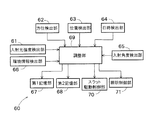
採光システム10を示す側面図。The side view which shows the lighting system 10. FIG. 採光システム10の光制御部材20を示す斜視図。The perspective view which shows the light control member 20 of the lighting system 10. FIG. 採光システム10の光制御部材20を示す縦断面図。1 is a longitudinal sectional view showing a light control member 20 of a daylighting system 10. FIG. 採光システム10のブラインド50を示す斜視図。The perspective view which shows the blind 50 of the lighting system 10. FIG. スラット角調整機構55の概略を説明する図。The figure explaining the outline of the slat angle adjustment mechanism 55. FIG. 本実施形態による採光システム10の制御系60のブロック図。The block diagram of the control system 60 of the lighting system 10 by this embodiment. 調整部69が行うスラット角度調整処理の一例を示すフローチャート。The flowchart which shows an example of the slat angle adjustment process which the adjustment part 69 performs.

以下、図面を参照して本発明の一実施の形態について説明する。なお、本件明細書に添付する図面においては、図示と理解のしやすさの便宜上、適宜縮尺および縦横の寸法比等を、実物のそれらから変更し誇張してある。   Hereinafter, an embodiment of the present invention will be described with reference to the drawings. In the drawings attached to the present specification, for the sake of illustration and ease of understanding, the scale, the vertical / horizontal dimension ratio, and the like are appropriately changed and exaggerated from those of the actual product.

また、本明細書において用いる、形状や幾何学的条件並びにそれらの程度を特定する、例えば、「平行」、「直交」、「同一」等の用語については、厳密な意味に縛られることなく、同様の機能を期待し得る程度の範囲を含めて解釈することとする。   Further, as used in the present specification, the shape and geometric conditions and the degree thereof are specified, for example, terms such as “parallel”, “orthogonal”, “identical”, etc. are not limited to strict meanings, Interpretation should include the extent to which similar functions can be expected.

さらに、本明細書において、「シート」、「フィルム」、「板」の用語は、呼称の違いのみに基づいて、互いから区別されるものではない。例えば、「シート」はフィルムや板と呼ばれ得るような部材も含む概念である。   Further, in the present specification, the terms “sheet”, “film”, and “plate” are not distinguished from each other only based on the difference in designation. For example, the “sheet” is a concept including a member that can be called a film or a plate.

さらに、「シート面(フィルム面、板面)」とは、対象となるシート状(フィルム状、板状)の部材を全体的かつ大局的に見た場合において対象となるシート状(フィルム状部材、板状部材)の平面と一致する面のことを指す。また、シート状(フィルム状、板状)の部材に対する法線方向とは、当該シート状(フィルム状、板状)の部材のシート面(フィルム面、板面)への法線方向のことを指す。   Furthermore, the “sheet surface (film surface, plate surface)” means the target sheet shape (film-like member) when the target sheet-like (film shape, plate-like) member is viewed as a whole and globally. , Plate-like member). Moreover, the normal direction with respect to a sheet-like (film shape, plate-shaped) member is a normal direction to the sheet surface (film surface, plate surface) of the sheet-shaped (film shape, plate-shaped) member. Point to.

さらに、本明細書における「上下方向」とは、鉛直方向に平行な面内において水平方向と非平行な方向であり、必ずしても鉛直方向とは一致しない。また、「上」とは、上下方向における一方の側(又は方)であって、鉛直方向における「上」に近接する側(又は方)のことを指す。「下」とは、上下方向における「上」とは反対の側であって、鉛直方向における「下」に近接する側(又は方)のことを指す。   Furthermore, the “vertical direction” in this specification is a direction that is not parallel to the horizontal direction in a plane parallel to the vertical direction, and does not necessarily match the vertical direction. Further, “upper” refers to one side (or direction) in the vertical direction and the side (or direction) close to “upper” in the vertical direction. “Lower” refers to a side (or direction) opposite to “upper” in the vertical direction and close to “lower” in the vertical direction.

図1〜図7は、本発明による一実施の形態を説明するための図である。このうち図1は採光システム10を示す側面図であり、図2及び図3は、それぞれ、採光システム10の光制御部材20を示す斜視図または縦断面図であり、図4は採光システム10のブラインド50を示す斜視図であり、図5〜図7はブラインド50のスラット52のスラット角度を自動調整する機構および処理を説明する図である。   FIGS. 1-7 is a figure for demonstrating one Embodiment by this invention. 1 is a side view showing the daylighting system 10, FIGS. 2 and 3 are perspective views and longitudinal sectional views showing the light control members 20 of the daylighting system 10, respectively. FIG. FIG. 5 to FIG. 7 are diagrams for explaining a mechanism and a process for automatically adjusting the slat angle of the slat 52 of the blind 50.

以下に説明する採光システム10は、採光用の開口1の周辺に配置される装置であって、太陽光を効率的に採光するためのシステムである。採光システム10は、採光用の開口1の少なくとも上方部分に設けられた光制御部材20と、光制御部材20と少なくとも一部が対向するように配置されたブラインド50と、を有する。光制御部材20は、面方向の広がりを持つシート状に形成されており、図1に示すように、入射光の進行方向を斜め上方に変更して透過させる。ここで説明する採光システム10によれば、詳しくは後述するように、太陽光のうちの直達光の開口を介した進入を効果的に防止して防眩を図りながらも、十分な採光を実施することができる。加えて、この採光システム10によれば、採光システム10によって光を採れ込まれるべき領域に突出する突出物等が設けられておらず、開口1周辺の美感、統一感を損なうこともない。   The daylighting system 10 described below is an apparatus arranged around the daylighting opening 1 and is a system for efficiently daylighting sunlight. The daylighting system 10 includes a light control member 20 provided in at least an upper part of the daylighting opening 1 and a blind 50 disposed so that at least a part of the light control member 20 faces the light control member 20. The light control member 20 is formed in a sheet shape having a spread in the surface direction, and as shown in FIG. According to the daylighting system 10 described here, as will be described in detail later, sufficient daylighting is carried out while effectively preventing the direct entry of sunlight through the opening and preventing glare. can do. In addition, according to the daylighting system 10, there is no protrusion or the like protruding in the area where the daylighting system 10 should take in light, and the aesthetics and unity around the opening 1 are not impaired.

以下に説明する例による採光システム10は、建物の採光用窓に適用されている。開口1は、壁2に形成されており、ブラインド50は、壁2、天井3及び床4によって区画された室内に配置され、壁2に形成された採光用の開口1に対面するよう、壁2に取り付けられている。そして、開口1には、ガラス等からなる透明な窓材7を含む採光具6が取り付けられ、採光具6によって開口1が塞がれている。そして、光制御部材20は、窓材7に貼り付けられ又は一対の窓材7の間に挟み込まれて支持されて、窓材7とともに採光具6を形成し、或いは、窓材7の一部分に組み込まれて採光具6を形成している。   A daylighting system 10 according to an example described below is applied to a daylighting window of a building. The opening 1 is formed in the wall 2, and the blind 50 is disposed in a room defined by the wall 2, the ceiling 3 and the floor 4, and faces the lighting opening 1 formed in the wall 2. 2 is attached. A lighting tool 6 including a transparent window material 7 made of glass or the like is attached to the opening 1, and the opening 1 is blocked by the lighting tool 6. The light control member 20 is affixed to the window material 7 or sandwiched between and supported by the pair of window materials 7 to form the lighting tool 6 together with the window material 7, or on a part of the window material 7. It is incorporated to form the daylighting tool 6.

まず、光制御部材20について説明する。図1に示された例において、光制御部材20は、採光具6の上方部分に貼り付けられている。光制御部材20は、図2に示すように、ベース部31と、ベース部31内に離隔して形成される複数の溝34a内に設けられる複数のルーバ部32とを有する。複数のルーバ部32は、第1方向d1に沿って線状に延びている。第1方向d1は、光制御部材20のシート面と平行に延び、且つ、図1の上下方向と非平行となっている。また、図2に示すように、光制御部材20の光入射側のシート面から眺めると、ベース部31と複数のルーバ部32は、第1方向d1と非平行な第2方向d2に交互に配列されている。第2方向d2は、光制御部材20のシート面と平行に延びており、図示された例においては、上下方向と平行になっている。   First, the light control member 20 will be described. In the example shown in FIG. 1, the light control member 20 is attached to the upper part of the lighting tool 6. As shown in FIG. 2, the light control member 20 includes a base portion 31 and a plurality of louver portions 32 provided in a plurality of grooves 34 a that are formed separately in the base portion 31. The plurality of louver portions 32 extend linearly along the first direction d1. The first direction d1 extends in parallel with the sheet surface of the light control member 20, and is not parallel to the vertical direction in FIG. As shown in FIG. 2, when viewed from the light incident side sheet surface of the light control member 20, the base portion 31 and the plurality of louver portions 32 are alternately arranged in a second direction d2 that is non-parallel to the first direction d1. It is arranged. The second direction d2 extends in parallel with the sheet surface of the light control member 20, and in the illustrated example, is parallel to the vertical direction.

図示された例において、窓材7は、鉛直(天地および上下)方向と平行に延び、結果として、光制御部材20のシート面も鉛直方向と平行になっている。また、第1方向d1及び第2方向d2は直交している。この結果、図示された例では、第1方向d1が水平方向に延び、第2方向d2が鉛直方向に延びている。   In the illustrated example, the window member 7 extends in parallel to the vertical (top and bottom) direction, and as a result, the seat surface of the light control member 20 is also parallel to the vertical direction. The first direction d1 and the second direction d2 are orthogonal to each other. As a result, in the illustrated example, the first direction d1 extends in the horizontal direction, and the second direction d2 extends in the vertical direction.

図2及び図3に示すように、本実施の形態における光制御部材20は、ベース部31及びルーバ部32を含む光制御層30と、光制御層30と積層された基材層40と、を有している。なお、本実施の形態において、基材層40は、後述する光制御層30の製造方法に起因して設けられているが、特に必須の構成要素ではない。したがって、一例として、単なる透明または半透明な樹脂製フィルムから形成され得る。   As shown in FIGS. 2 and 3, the light control member 20 in the present embodiment includes a light control layer 30 including a base portion 31 and a louver portion 32, a base material layer 40 laminated with the light control layer 30, and have. In the present embodiment, the base material layer 40 is provided due to a manufacturing method of the light control layer 30 described later, but is not a particularly essential component. Therefore, as an example, it can be formed from a simple transparent or translucent resin film.

図3は光制御部材20の主切断面図である。すなわち、図3は、第2方向d2と光制御部材20のシート面への法線方向ndとの両方に平行な方向の断面図である。図3に示すように、ルーバ部32は、光制御層30の基材層40側とは反対側の面の一部をなす底面35と、底面35から延び出た第1側面36及び第2側面37と、を含んでいる。図示された例において、光制御部材20のシート面に沿った第1側面36及び第2側面37の離間間隔は、光制御部材20のシート面への法線方向に沿って底面35から離間するにつれて、互いに接近していき、最終的に互いに接続されている。図示された例において、第2側面37は平坦面であり、第1側面36は折れ面である。図示された例では、第1側面36は、底面35に接続する急斜面36aと、底面35から離間した側に位置して第2側面37と接続する緩斜面36bと、を含んでいる。光制御部材20のシート面への法線方向ndに対して急斜面36aがなす角度は、光制御部材20のシート面への法線方向ndに対して緩斜面36bがなす角度よりも大きくなっている。   FIG. 3 is a main cross-sectional view of the light control member 20. That is, FIG. 3 is a cross-sectional view in a direction parallel to both the second direction d2 and the normal direction nd to the sheet surface of the light control member 20. As shown in FIG. 3, the louver portion 32 includes a bottom surface 35 that forms part of the surface of the light control layer 30 opposite to the base material layer 40 side, a first side surface 36 that extends from the bottom surface 35, and a second side surface 36. Side surface 37. In the illustrated example, the spacing between the first side surface 36 and the second side surface 37 along the sheet surface of the light control member 20 is separated from the bottom surface 35 along the normal direction to the sheet surface of the light control member 20. As they approach each other, they are finally connected to each other. In the illustrated example, the second side surface 37 is a flat surface, and the first side surface 36 is a folded surface. In the illustrated example, the first side surface 36 includes a steep slope 36 a that is connected to the bottom surface 35, and a gentle slope 36 b that is located on the side away from the bottom surface 35 and is connected to the second side surface 37. The angle formed by the steep slope 36a with respect to the normal direction nd to the sheet surface of the light control member 20 is larger than the angle formed by the gentle slope 36b with respect to the normal direction nd to the sheet surface of the light control member 20. Yes.

ここで、各ルーバ部32の第1側面36は、当該ルーバ部32と、当該ルーバ部32に対して上下方向における上側から隣接するベース部31との間の界面を形成する。一方、各ルーバ部32の第2側面37は、当該ルーバ部32と、当該ルーバ部32に対して上下方向における下側から隣接するベース部31との間の界面を形成する。広い角度範囲からの入射光を狭い角度範囲に偏向して採光する観点から、各ルーバ部と当該ルーバ部32に上側から隣接するベース部31との界面は、すなわち、ルーバ部32の第1側面36は、入光側で上下方向における上方に位置し且つ出光側で上下方向における下方に位置するよう、光制御部材20の法線方向ndに対して傾斜している。また、入射光をより狭い角度範囲に偏向して採光する観点からは、図3に示された例のように、光制御部材20への法線方向ndと第1及びルーバ部31,32の配列方向である第2方向d2との両方に沿った図3に示された面内において、各ルーバ部と当該ルーバ部32に上側から隣接するベース部31との界面が光制御部材20への法線方向ndに対してなす角度θa(図3参照)が、入光側から出光側へ向けて小さくなるように変化することが好ましい。   Here, the first side surface 36 of each louver part 32 forms an interface between the louver part 32 and the base part 31 adjacent to the louver part 32 from the upper side in the vertical direction. On the other hand, the second side surface 37 of each louver part 32 forms an interface between the louver part 32 and the base part 31 adjacent to the louver part 32 from the lower side in the vertical direction. From the viewpoint of deflecting incident light from a wide angle range into a narrow angle range and collecting the light, the interface between each louver part and the base part 31 adjacent to the louver part 32 from above is the first side surface of the louver part 32. 36 is inclined with respect to the normal direction nd of the light control member 20 so as to be positioned above the light incident side in the vertical direction and below the light output side in the vertical direction. Further, from the viewpoint of deflecting the incident light into a narrower angle range and collecting the light, the normal direction nd to the light control member 20 and the first and louver portions 31 and 32 as shown in the example shown in FIG. In the plane shown in FIG. 3 along both the second direction d2 that is the arrangement direction, the interface between each louver portion and the base portion 31 adjacent to the louver portion 32 from above is connected to the light control member 20. The angle θa (see FIG. 3) formed with respect to the normal direction nd is preferably changed so as to decrease from the light incident side toward the light outgoing side.

なお、角度θaが、「入光側から出光側へ向けて小さくなるように変化する」とは、角度θaが連続的に減少していく場合だけでなく、図3に示された例のように、角度θaが段階的に減少することも含む。また、本明細書で言及する「入光側」及び「出光側」との用語は、太陽光を採光する光路を基準として用いられる。したがって、図1及び図3においては、図面における左側が入光側で、図面における出光側が右側となる。   The angle θa “changes so as to decrease from the light incident side toward the light exiting side” is not limited to the case where the angle θa decreases continuously, but as in the example shown in FIG. In addition, the angle θa is decreased stepwise. In addition, the terms “incident side” and “exit side” referred to in this specification are used with reference to an optical path for collecting sunlight. Therefore, in FIGS. 1 and 3, the left side in the drawings is the light incident side, and the light exit side in the drawings is the right side.

図示された例において、ルーバ部32は、第2方向d2に沿って等間隔に配置されている。また、ルーバ部32は、断面形状を変化させることなく、第1方向d1に延びている。さらに、光制御部材20に含まれる多数のルーバ部32は、互いに同一に構成されている。以上のルーバ部32の構成にともない、図示された例では、光制御部材20に含まれるベース部31は、第2方向d2に沿って等間隔に配置され、断面形状を変化させることなく第1方向d1に延び、且つ、互いに同一に構成されている。   In the illustrated example, the louver portions 32 are arranged at equal intervals along the second direction d2. In addition, the louver portion 32 extends in the first direction d1 without changing the cross-sectional shape. Further, the multiple louver portions 32 included in the light control member 20 are configured identically. With the configuration of the louver portion 32 described above, in the illustrated example, the base portions 31 included in the light control member 20 are arranged at equal intervals along the second direction d2, and the first cross section is not changed. They extend in the direction d1 and are identical to each other.

図3に示された断面での、ルーバ部32の第2方向d1に沿った配列ピッチpは、一例として、1mm以下とすることができ、光制御部材20のシート面への法線方向ndに沿ったルーバ部32の高さhは、1mm以下とすることができる。また、光制御部材20のシート面への法線方向ndに沿った光制御部材20の厚みは、150μ以上2mm以下とすることができる。   The arrangement pitch p along the second direction d1 of the louver part 32 in the cross section shown in FIG. 3 can be 1 mm or less as an example, and the normal direction nd to the sheet surface of the light control member 20 The height h of the louver part 32 along can be 1 mm or less. Moreover, the thickness of the light control member 20 along the normal direction nd to the sheet surface of the light control member 20 can be 150 μm or more and 2 mm or less.

なお、光制御部材20のシート面に沿ったルーバ部32の幅wに対する、光制御部材20のシート面への法線方向に沿ったルーバ部32の高さhの比、すなわち、h/wで表されるアスペクト比は、採光機能、及び、例えば遮光機能等のその他の機能を十分に発揮し得るよう、1より大きくなっていることが好ましく、4以上であることがさらに好ましい。また、このアスペクト比は、製造の安定性を考慮して、10以下であることが好ましい。   The ratio of the height h of the louver part 32 along the normal direction to the sheet surface of the light control member 20 to the width w of the louver part 32 along the sheet surface of the light control member 20, that is, h / w. Is preferably larger than 1 and more preferably 4 or more so that the lighting function and other functions such as a light shielding function can be sufficiently exhibited. The aspect ratio is preferably 10 or less in consideration of production stability.

ただし、以上に説明したルーバ部32の形状およびピッチは、単なる例示であり、例えば後述する光制御部材20の機能を考慮して適宜変更することが可能である。一例として、ルーバ部32の第1側面36を曲面として構成してもよい。第1側面36が曲面となっている場合にも、上述したように、各ルーバ部と当該ルーバ部32に上側から隣接するベース部31との界面が光制御部材20への法線方向ndに対してなす角度θa(図3参照)が、入光側から出光側へ向けて小さくなるように変化することが好ましい。また、ルーバ部32の断面形状を、台形形状等の種々の形状に変更することができる。また、光制御部材20に含まれる多数のベース部31の間で、形状や配列が異なるようにしてもよいし、同様に、光制御部材20に含まれる多数のルーバ部32の間で、形状や配列が異なるようにしてもよい。   However, the shape and pitch of the louver portion 32 described above are merely examples, and can be appropriately changed in consideration of, for example, the function of the light control member 20 described later. As an example, the first side surface 36 of the louver portion 32 may be configured as a curved surface. Even when the first side surface 36 is a curved surface, as described above, the interface between each louver part and the base part 31 adjacent to the louver part 32 from above is in the normal direction nd to the light control member 20. It is preferable that the angle θa (refer to FIG. 3) formed with respect to the surface changes so as to decrease from the light incident side toward the light output side. Further, the cross-sectional shape of the louver portion 32 can be changed to various shapes such as a trapezoidal shape. Further, the shape and arrangement may be different between the large number of base portions 31 included in the light control member 20, and similarly, the shape may be different between the large number of louver portions 32 included in the light control member 20. And the arrangement may be different.

次に、ベース部31及びルーバ部32の材料について説明する。   Next, the material of the base part 31 and the louver part 32 is demonstrated.

まず、ベース部31は透明に形成されている。本明細書において「透明」とは、可視光透過率が50%以上となっていることを意味している。ただし、本実施の形態におけるベース部20の可視光透過率は、70%以上となっていることが好ましく、90%以上となっていることがより好ましい。   First, the base part 31 is formed to be transparent. In this specification, “transparent” means that the visible light transmittance is 50% or more. However, the visible light transmittance of the base portion 20 in the present embodiment is preferably 70% or more, and more preferably 90% or more.

なお、本明細書における可視光透過率は、測定対象となる部位をなすようになる材料を東洋紡績製PETフィルム(品番:コスモシャインA4300、厚さ100μm)の上に膜厚1μmで成膜し、分光光度計((株)島津製作所製「UV−2450」、JISK0115準拠品)を用いて測定波長380nm〜780nmの範囲内で測定したときの、各波長における透過率の平均値として特定される。同様に、後述する熱線透過率は、測定対象となる部位をなすようになる材料を東洋紡績製PETフィルム(品番:コスモシャインA4300、厚さ100μm)の上に膜厚1μmで成膜し、分光光度計((株)島津製作所製「UV−2450」、JISK0115準拠品)を用いて測定波長900nm〜2500nmの範囲内で測定したときの、各波長における透過率の平均値として特定される。   In this specification, the visible light transmittance is determined by depositing a material that will be a part to be measured on a PET film (product number: Cosmo Shine A4300, thickness 100 μm) made by Toyobo with a thickness of 1 μm. , Specified as an average value of transmittance at each wavelength when measured within a measurement wavelength range of 380 nm to 780 nm using a spectrophotometer (manufactured by Shimadzu Corporation "UV-2450", JISK0115 compliant product) . Similarly, for the heat ray transmittance described later, a material that forms a part to be measured is formed on a PET film (product number: Cosmo Shine A4300, thickness 100 μm) made by Toyobo Co., Ltd. with a film thickness of 1 μm. It is specified as an average value of transmittance at each wavelength when measured within a measurement wavelength range of 900 nm to 2500 nm using a photometer (“UV-2450” manufactured by Shimadzu Corporation, JISK0115 compliant product).

ベース部31をなす光制御層本体34に用いられる材料として、例えば、樹脂材料、より具体的には電離放射線の照射により硬化する電離放射線硬化性樹脂を用いることができる。電離放射線硬化性樹脂としては、紫外線硬化性樹脂、電子線硬化性樹脂、可視光線硬化性樹脂、近赤外線硬化性樹脂等が挙げられる。樹脂材料の具体例としては、アクリル樹脂が挙げられる。   As a material used for the light control layer body 34 forming the base portion 31, for example, a resin material, more specifically, an ionizing radiation curable resin that is cured by irradiation with ionizing radiation can be used. Examples of the ionizing radiation curable resin include an ultraviolet curable resin, an electron beam curable resin, a visible light curable resin, and a near infrared curable resin. A specific example of the resin material is an acrylic resin.

一方、ルーバ部32は、ベース部31とは異なる屈折率を有する。本実施の形態において、ルーバ部32は、バインダーとして機能する主部32aと、主部32a中に分散された任意の機能性含有物32bと、を有している。主部32aの屈折率は、ベース部31の屈折率と異なっており、この結果、ベース部31とルーバ部32との界面が、屈折率差を有し、可視光を反射する面として機能する。ベース部31側から入射した可視光をベース部31とルーバ部32との界面で反射させるためには、ルーバ部32の屈折率をベース部31の屈折率よりも小さくなるように調節することが好ましい。   On the other hand, the louver part 32 has a refractive index different from that of the base part 31. In the present embodiment, the louver part 32 has a main part 32a functioning as a binder, and an arbitrary functional content 32b dispersed in the main part 32a. The refractive index of the main part 32a is different from the refractive index of the base part 31, and as a result, the interface between the base part 31 and the louver part 32 has a refractive index difference and functions as a surface that reflects visible light. . In order to reflect visible light incident from the base part 31 side at the interface between the base part 31 and the louver part 32, the refractive index of the louver part 32 may be adjusted to be smaller than the refractive index of the base part 31. preferable.

ルーバ部32の主部32aに用いられる材料として、例えば、樹脂材料、より具体的には電離放射線の照射により硬化する電離放射線硬化性樹脂の硬化物を用いることができる。電離放射線硬化性樹脂としては、紫外線硬化性樹脂、電子線硬化性樹脂、可視光線硬化性樹脂、近赤外線硬化性樹脂等が挙げられる。樹脂材料の具体例としては、ベース部31に用いるアクリル樹脂とは屈折率が異なるアクリル樹脂が挙げられる。もっとも、機能性含有物32bを有する場合にその機能性含有物32bによってルーバ部32の屈折率が変わるのであれば、ベース部31に用いるものと同じアクリル樹脂を用いてもよい。   As a material used for the main part 32a of the louver part 32, for example, a resin material, more specifically, a cured product of an ionizing radiation curable resin that is cured by irradiation with ionizing radiation can be used. Examples of the ionizing radiation curable resin include an ultraviolet curable resin, an electron beam curable resin, a visible light curable resin, and a near infrared curable resin. Specific examples of the resin material include an acrylic resin having a refractive index different from that of the acrylic resin used for the base portion 31. However, if the functional inclusion 32b is included and the refractive index of the louver portion 32 varies depending on the functional inclusion 32b, the same acrylic resin as that used for the base portion 31 may be used.

一方、ルーバ部32の機能性含有物32bは、種々の機能を期待されて主部32a中に分散されており、一例として、熱線吸収材や着色材とすることができる。熱線吸収材として、赤外光波長帯域に吸収特性を有し、且つ、可視光波長帯域に透過特性を有する粒子が用いられる。具体的には、熱線吸収材として、透明性を有する無機ナノ粒子を用いることができ、例えば、アンチモン錫酸化物(ATO)、インジウム錫酸化物(ITO)、六ホウ化ランタン(LaB6)、アルミニウムドープ酸化亜鉛、インジウムドープ酸化亜鉛、ガリウムドープ酸化亜鉛、酸化タングステン、六ホウ化セリウム、無水アンチモン酸亜鉛および硫化銅またはそれらの混合物のナノ粒子等を用いることができる。   On the other hand, the functional content 32b of the louver part 32 is dispersed in the main part 32a in anticipation of various functions, and as an example, a heat ray absorbing material or a coloring material can be used. As the heat ray absorbing material, particles having absorption characteristics in the infrared light wavelength band and transmission characteristics in the visible light wavelength band are used. Specifically, transparent inorganic nanoparticles can be used as the heat-absorbing material. For example, antimony tin oxide (ATO), indium tin oxide (ITO), lanthanum hexaboride (LaB6), aluminum Doped zinc oxide, indium-doped zinc oxide, gallium-doped zinc oxide, tungsten oxide, cerium hexaboride, anhydrous zinc antimonate and copper sulfide, or a mixture thereof can be used.

また、着色材としては、可視光波長帯域の少なくとも一部の波長域の光を吸収する機能を有した粒子を用いることができる。着色材の一例として、顔料、より具体的には、カーボンブラック、黒鉛、窒化チタン等の黒色顔料や、酸化チタン等の白色顔料を用いることができる。また、紺色、青色、紫色等の青みを帯びた粒子、赤みを帯びた粒子、黄色みを帯びた粒子等を着色材として用いてもよい。着色材としての機能性含有物32bをルーバ部32に用いることにより、ルーバ部32を着色することができる。この際、ルーバ部32の色味等も考慮した上で、光制御部材20に意匠性を付与することができる。   As the coloring material, particles having a function of absorbing light in at least a part of the visible light wavelength band can be used. As an example of the coloring material, a pigment, more specifically, a black pigment such as carbon black, graphite, or titanium nitride, or a white pigment such as titanium oxide can be used. Further, bluish particles such as amber, blue, and purple, reddish particles, yellowish particles, and the like may be used as the colorant. The louver part 32 can be colored by using the functional inclusion 32b as a coloring material in the louver part 32. At this time, design characteristics can be imparted to the light control member 20 in consideration of the color of the louver portion 32 and the like.

なお、以上のような構成からなる、光制御層30は次のようにして製造され得る。まず、ベース部31をなす光制御層本体34を、例えば、電子線、紫外線等の電離放射線の照射により硬化する特徴を有するエポキシアクリレート等の硬化性材料を用いて、作製する。具体的には、光制御層本体34の溝34aの構成(配置、形状等)に対応した凸部を有する型ロール、言い換えると、ベース部31の構成(配置、形状等)に対応した凹部を有する型ロールを準備する。当該型ロールとニップロールとの間に基材層40をなすようになるシートを送り込み、該シートの送り込みに合わせて、硬化性材料を型ロールと基材層40との間に供給する。その後、基材層40上に供給された未硬化状態で液状の硬化性材料が型ロールの凹部に充填されるように、型ロールおよびニップロールで該硬化性材料を押圧する。このとき、型ロールの凹部の深さより厚くなるように、すなわち、型ロールと基材層40とが接触しないように、硬化性材料を基材層40上に供給しておくことによって、ベース部31内の溝34aにルーバ部32の材料が充填される。以上のようにして基材層40と型ロールとの間に未硬化で液状の硬化性材料を充填した後、光を照射して該硬化性材料を硬化(固化)させることによって光制御層本体34を形成することができる。   The light control layer 30 having the above-described configuration can be manufactured as follows. First, the light control layer main body 34 forming the base portion 31 is manufactured using a curable material such as epoxy acrylate having a characteristic of being cured by irradiation with ionizing radiation such as an electron beam or ultraviolet rays. Specifically, a mold roll having a convex portion corresponding to the configuration (arrangement, shape, etc.) of the groove 34a of the light control layer body 34, in other words, a concave portion corresponding to the configuration (arrangement, shape, etc.) of the base portion 31 is provided. A mold roll is prepared. A sheet that forms the base layer 40 is fed between the mold roll and the nip roll, and a curable material is supplied between the mold roll and the base layer 40 in accordance with the feeding of the sheet. Thereafter, the curable material is pressed with a mold roll and a nip roll so that the liquid curable material supplied onto the base material layer 40 is filled in the concave portion of the mold roll. At this time, by supplying the curable material onto the base layer 40 so as to be thicker than the depth of the concave portion of the mold roll, that is, so that the mold roll and the base layer 40 do not come into contact with each other, the base portion The material of the louver portion 32 is filled in the groove 34 a in the 31. After filling the uncured and liquid curable material between the base material layer 40 and the mold roll as described above, the light control layer body is formed by irradiating light to cure (solidify) the curable material. 34 can be formed.

次に、硬化することによって主部32aをなすようになる硬化性材料と、任意の機能性含有物32bと、を含んだ未硬化で液状の組成物を用いてルーバ部32を作製する。硬化することによって主部32aをなすようになる硬化性材料として、電離放射線により硬化する特徴を有するウレタンアクリレート等の硬化性材料を用いることができる。まず、先に形成された光制御層本体34上に組成物を供給する。その後、隣り合うベース部31の間の形成された溝34a、すなわち、型ロールの凸部に対応していた部分の内部に、ドクターブレードを用いながら、組成物を充填しつつ、該溝34a外に溢出した余剰分の組成物を掻き落としていく。その後、ベース部31の間の組成物に電離放射線を照射して硬化させることにより、ルーバ部32が形成される。これにより、基材層40、ベース部31及びルーバ部32と、を有する光制御部材20が作製される。   Next, the louver part 32 is produced using an uncured and liquid composition containing a curable material that forms the main part 32a by curing and an arbitrary functional content 32b. A curable material such as urethane acrylate having a characteristic of being cured by ionizing radiation can be used as the curable material that forms the main portion 32a by being cured. First, the composition is supplied onto the light control layer main body 34 previously formed. Thereafter, the groove 34a formed between the adjacent base portions 31, that is, the portion corresponding to the convex portion of the mold roll is filled with the composition while using a doctor blade, and the outside of the groove 34a is filled. Scrape off the surplus composition that has overflowed. Then, the louver part 32 is formed by irradiating the composition between the base parts 31 with ionizing radiation and curing it. Thereby, the light control member 20 which has the base material layer 40, the base part 31, and the louver part 32 is produced.

次に、ブラインド50について説明する。ブラインド50は、図4に示すように、壁2への取付具となる取付ボックス51と、取付ボックス51から垂下し且つ鉛直方向に間隔をあけて配置される多数のスラット52と、これらスラット52を支持するラダーコード53と、スラット52を引き上げるための昇降コード54と、各スラット52のスラット角度を調整するスラット角調整機構55と、昇降コード54を上下させる昇降コード移動機構56と、を有する。スラット角調整機構55と昇降コード移動機構56の少なくとも一部は、取付ボックス51の内部に収納されている。   Next, the blind 50 will be described. As shown in FIG. 4, the blind 50 includes a mounting box 51 serving as a mounting tool for the wall 2, a large number of slats 52 that are suspended from the mounting box 51 and spaced in the vertical direction, and the slats 52. And a lifting / lowering cord 54 for lifting the slat 52, a slat angle adjusting mechanism 55 for adjusting the slat angle of each slat 52, and a lifting / lowering cord moving mechanism 56 for moving the lifting / lowering cord 54 up and down. . At least a part of the slat angle adjusting mechanism 55 and the lifting / lowering cord moving mechanism 56 are accommodated in the mounting box 51.

ラダーコード53は、ブラインド50に含まれるすべてのスラット52を概ね平行となるよう、各スラット52を支持する。そして、スラット角調整機構55によりスラット角度を切り替えると、すべてのスラット52が同じスラット角度になるように傾き調整される。ラダーコード53は、スラット角度が変更されても、各スラット52の短手方向の端面が概略面一となるように、各スラット52を支持する。   The ladder cord 53 supports each slat 52 so that all the slats 52 included in the blind 50 are substantially parallel. When the slat angle is switched by the slat angle adjusting mechanism 55, the inclination is adjusted so that all the slats 52 have the same slat angle. The ladder cord 53 supports the slats 52 so that the end surfaces in the short direction of the slats 52 are substantially flush even when the slat angle is changed.

昇降コード移動機構56により昇降コード54を上方に引っ張ると、下方側のスラット52から順に鉛直方向における間隔を狭めるようにして、多数のスラット52を引き上げることができる。この際、多数のスラット52の少なくとも一部が取付ボックス51内に収容され、且つ、開口1に装着された採光具6が室内に露出する。同様に、昇降コード移動機構56により昇降コード54を下方に繰り出すと、上方に集められたスラット52を、採光具6に対面する位置に下げることができる。   When the lifting / lowering cord 54 is pulled upward by the lifting / lowering cord moving mechanism 56, a large number of slats 52 can be pulled up in such a manner that the intervals in the vertical direction are reduced in order from the lower slat 52. At this time, at least a part of the large number of slats 52 is accommodated in the mounting box 51, and the lighting tool 6 attached to the opening 1 is exposed in the room. Similarly, when the lifting / lowering cord 54 is extended downward by the lifting / lowering cord moving mechanism 56, the slats 52 gathered upward can be lowered to a position facing the daylighting tool 6.

スラット52は、一例として、耐食アルミニウム合金からなる薄板材、木材からなる薄板材、樹脂からなる薄板材を用いることができる。このようなスラット52は、不透明であり、可視光遮光性を有している。スラット52は、可視光を反射する機能を有し、入射光の進行方向を変化させるようにしてもよい。また、スラット52の表面に、ブラインド50に対して遮熱、防汚、抗菌、消臭機能を付与するための機能層が形成されていてもよい。一例として、フッ素コートや酸化チタンコートをスラット52に設けることができる。   As an example, the slat 52 may be a thin plate material made of a corrosion-resistant aluminum alloy, a thin plate material made of wood, or a thin plate material made of resin. Such a slat 52 is opaque and has a visible light shielding property. The slat 52 may have a function of reflecting visible light and may change the traveling direction of incident light. Further, a functional layer for imparting heat shielding, antifouling, antibacterial, and deodorizing functions to the blind 50 may be formed on the surface of the slat 52. As an example, a fluorine coat or a titanium oxide coat can be provided on the slat 52.

図1に示すように、ブラインド50の少なくとも一部は、光制御部材20に対向する領域にも広がるように、配置されている。すなわち、図示された例において、ブラインド50は、開口1の全域に対向するように配置されており、開口1の全域から入射してくる光に対して、遮光機能、遮熱機能等を発揮することができる。以下、ブラインド50の一例について説明するが、ここで説明する採光システム10に対しては、種々の既知なブラインド50を用いることができる。   As shown in FIG. 1, at least a part of the blind 50 is arranged so as to extend to a region facing the light control member 20. That is, in the illustrated example, the blind 50 is disposed so as to face the entire area of the opening 1, and exhibits a light blocking function, a heat blocking function, and the like with respect to light incident from the entire area of the opening 1. be able to. Hereinafter, although an example of the blind 50 will be described, various known blinds 50 can be used for the daylighting system 10 described here.

図5はスラット角調整機構55の概略を説明する図である。スラット角調整機構55は、回転軸57aを回転駆動するモータ57と、このモータ57の回転軸57aに噛み合わされるラックギア58と有する。モータ57が回転軸57aを回転させると、ラックギア58はその長手方向に沿って直線運動を行う。各スラット52の長手方向における端面の略中央部には、スラット軸52aが固定されており、このスラット軸52aの先端部には、ギア52bが形成されている。スラット軸52aのギア52bは、ラックギア58に噛み合わされている。よって、ラックギア58がその長手方向に沿って移動すると、その移動量分だけスラット軸52aが回転し、そのスラット軸52aの回転に伴って、スラット軸52aに固定されたスラット52も回転する。これにより、スラット角度が調整される。   FIG. 5 is a diagram for explaining the outline of the slat angle adjusting mechanism 55. The slat angle adjusting mechanism 55 includes a motor 57 that rotationally drives the rotary shaft 57 a and a rack gear 58 that meshes with the rotary shaft 57 a of the motor 57. When the motor 57 rotates the rotating shaft 57a, the rack gear 58 performs a linear motion along the longitudinal direction. A slat shaft 52a is fixed to a substantially central portion of the end surface in the longitudinal direction of each slat 52, and a gear 52b is formed at the tip of the slat shaft 52a. The gear 52b of the slat shaft 52a is meshed with the rack gear 58. Therefore, when the rack gear 58 moves along the longitudinal direction, the slat shaft 52a rotates by the amount of movement, and the slat 52 fixed to the slat shaft 52a also rotates with the rotation of the slat shaft 52a. Thereby, the slat angle is adjusted.

モータ57は、回転量を電気信号により段階的に指定可能なステッピングモータを用いるのが望ましい。モータ57の回転量を、例えば20度単位で指定できる場合には、スラット角度を0度〜180度の範囲内で切り替えられるとすると、スラット角度を9通りに可変調整できることになる。   As the motor 57, it is desirable to use a stepping motor in which the rotation amount can be specified stepwise by an electric signal. If the rotation amount of the motor 57 can be specified in units of 20 degrees, for example, if the slat angle can be switched within the range of 0 degrees to 180 degrees, the slat angle can be variably adjusted in nine ways.

なお、スラット角調整機構55の具体的な構造は、図5に示したものには限定されない。スラット角度を複数段階に自動調整できる機構であれば、どのような機構を採用してもよい。
また、自動調整したスラット角度を必要に応じて手動で微調整できるようにしてもよい。この場合、自動調整したスラット角度を表示する表示器と、自動調整したスラット角度を変更するボタンとを設けて、ユーザがボタンを押すたびに所定角度ずつスラット角度が変更されて、変更したスラット角度を表示器に表示するようにしてもよい。この場合、ユーザがボタンを押す度に、モータ57の回転軸57aが所定角度ずつ回転して、スラット角度が調整されることになる。
The specific structure of the slat angle adjusting mechanism 55 is not limited to that shown in FIG. Any mechanism that can automatically adjust the slat angle in a plurality of stages may be adopted.
Further, the automatically adjusted slat angle may be finely adjusted manually as necessary. In this case, an indicator for displaying the automatically adjusted slat angle and a button for changing the automatically adjusted slat angle are provided, and the slat angle is changed by a predetermined angle each time the user presses the button. May be displayed on the display. In this case, each time the user presses the button, the rotation shaft 57a of the motor 57 rotates by a predetermined angle, and the slat angle is adjusted.

図6は本実施形態による採光システム10の制御系60のブロック図である。本実施形態の制御系60は、光制御部材20とブラインド50とが対向配置された面領域において、ブラインド50のスラット角度を最適な角度に自動調整するものである。図6の制御系60を構成する一部の部材は、例えば図4に示す取付ボックス51内に収納され、その他の部材は光制御部材20またはブラインド50の近傍に配置されている。   FIG. 6 is a block diagram of the control system 60 of the daylighting system 10 according to the present embodiment. The control system 60 of the present embodiment automatically adjusts the slat angle of the blind 50 to an optimum angle in the surface area where the light control member 20 and the blind 50 are arranged to face each other. 6 are housed in, for example, the mounting box 51 shown in FIG. 4, and other members are arranged in the vicinity of the light control member 20 or the blind 50.

より具体的には、図6の制御系60は、入射光強度検出部61と、方位検出部62と、位置検出部63と、日時検出部64と、入射角度検出部65と、環境情報検出部66と、第1記憶部67と、第2記憶部68と、調整部69と、スラット駆動制御部70と、照明制御部71とを備えている。   More specifically, the control system 60 of FIG. 6 includes an incident light intensity detector 61, an orientation detector 62, a position detector 63, a date / time detector 64, an incident angle detector 65, and environmental information detection. A unit 66, a first storage unit 67, a second storage unit 68, an adjustment unit 69, a slat drive control unit 70, and an illumination control unit 71 are provided.

入射光強度検出部61は、光制御部材20の入射面上の入射光強度を検出する。あるいは、光制御部材20を透過してブラインド50に入射される光強度を検出してもよい。入射光強度検出部61はフォトダイオードを用いたフォトセンサで構成可能である。より具体的には、光制御部材20の入射面やブラインド50にフォトダイオードを取り付けて、このフォトダイオードで光電変換した電気信号により、光強度を検出する。   The incident light intensity detector 61 detects the incident light intensity on the incident surface of the light control member 20. Alternatively, the light intensity that passes through the light control member 20 and enters the blind 50 may be detected. The incident light intensity detection unit 61 can be configured by a photosensor using a photodiode. More specifically, a photodiode is attached to the incident surface of the light control member 20 or the blind 50, and the light intensity is detected by an electrical signal photoelectrically converted by the photodiode.

方位検出部62は、光制御部材20の入射面の方位を検出する。より具体的には、方位検出部62は、光制御部材20の近傍に設置された磁気センサを用いて方位を検出する。   The direction detector 62 detects the direction of the incident surface of the light control member 20. More specifically, the orientation detection unit 62 detects the orientation using a magnetic sensor installed in the vicinity of the light control member 20.

採光システム10はいったん設置した後は方位は変化しないため、例えば採光システム10を設置した際に、施工業者が所持する方位センサにて方位を計測し、計測した方位を方位検出部62に設定してもよい。このように、方位検出部62は、スラット角度を調整するたびに方位を検出する必要はなく、何らかの手段で計測した方位を記憶する機能さえ備えておけばよい。よって、方位検出部62は、後述する調整部69に統合することが可能である。   Since the daylighting system 10 does not change its orientation once installed, for example, when the daylighting system 10 is installed, the direction is measured by the direction sensor possessed by the contractor, and the measured direction is set in the direction detection unit 62. May be. Thus, the azimuth detecting unit 62 does not need to detect the azimuth every time the slat angle is adjusted, and only needs to have a function of storing the azimuth measured by some means. Therefore, the azimuth detecting unit 62 can be integrated into the adjusting unit 69 described later.

位置検出部63は、本実施形態による採光システム10の設置場所を検出する。位置検出部63は、例えばGPSセンサで構成可能である。採光システム10における位置も、方位と同様に設置後には変化しないため、何らかの手段により計測した位置を位置検出部63に記憶する機能さえ備えておけばよい。よって、位置検出部63も、調整部69に統合することが可能である。   The position detection unit 63 detects the installation location of the daylighting system 10 according to the present embodiment. The position detection unit 63 can be configured by a GPS sensor, for example. Since the position in the daylighting system 10 does not change after installation as in the case of the orientation, it is sufficient to have only a function of storing the position measured by some means in the position detection unit 63. Therefore, the position detection unit 63 can also be integrated into the adjustment unit 69.

日時検出部64は、現在の時刻を検出する。日時検出部64は、時計により代用可能である。ただし、日時検出部64は、日付の情報まで検出する必要がある。同じ時間であっても、日付が異なると、太陽高度は異なるためである。なお、太陽高度の精度は劣るが、日付の代わりに、季節を検出してもよい。季節は、例えば昼間と夜間の長さの比により検出してもよいし、温度により検出してもよい。   The date and time detection unit 64 detects the current time. The date and time detection unit 64 can be replaced by a clock. However, the date detection unit 64 needs to detect even date information. This is because, even at the same time, the solar altitude is different for different dates. Although the accuracy of the solar altitude is inferior, the season may be detected instead of the date. The season may be detected by, for example, the ratio of the length between daytime and nighttime, or may be detected by temperature.

入射角度検出部65は、光制御部材20の入射面方向あるいは入射面の法線方向に対する入射角度を検出する。入射角度検出部65は、太陽光などの外光の入射角度を検出する入射角度検出センサを用いて入射角度を直接的に検出してもよいし、上述した方位検出部62で検出される方位と、位置検出部63で検出される位置と、日時検出部64で検出される日時とに基づいて、入射角度を間接的に検出してもよい。すなわち、方位検出部62により光制御部材20の入射面の方向を検知でき、位置検出部63により採光システム10の設置場所を検知でき、日時検出部64により太陽位置を検知できることから、これらの情報に基づいて、太陽光から光制御部材20に入射される入射角度を間接的に検出してもよい。   The incident angle detector 65 detects the incident angle with respect to the incident surface direction of the light control member 20 or the normal direction of the incident surface. The incident angle detection unit 65 may directly detect the incident angle using an incident angle detection sensor that detects the incident angle of external light such as sunlight, or the direction detected by the direction detection unit 62 described above. The incident angle may be indirectly detected based on the position detected by the position detector 63 and the date detected by the date detector 64. That is, since the direction detection unit 62 can detect the direction of the incident surface of the light control member 20, the position detection unit 63 can detect the installation location of the daylighting system 10, and the date and time detection unit 64 can detect the solar position. The incident angle incident on the light control member 20 from sunlight may be indirectly detected.

環境情報検出部66は、本実施形態による採光システム10が設置される建物の内部の温度や湿度などの環境情報を測定するセンサを有する。センサの一具体例は、採光システム10が設置される建物の屋内の温度を測定する温度センサである。   The environmental information detection unit 66 includes a sensor that measures environmental information such as temperature and humidity inside the building in which the daylighting system 10 according to the present embodiment is installed. A specific example of the sensor is a temperature sensor that measures the indoor temperature of a building where the daylighting system 10 is installed.

第1記憶部67は、光制御部材20の入射面方向または入射面の法線方向に対する入射角度と、光制御部材20の出射面方向または出射面の法線方向に対する出射角度との対応関係を予め記憶したデータテーブルである。第1記憶部67には、複数の入射角度と、各入射角度に対応する出射角度とが予め記憶されている。第1記憶部67に任意の入射角度が入力されると、その入射角度に対応する出射角度が第1記憶部67から出力される。仮に、第1記憶部67に記憶されていない入射角度が入力された場合には、入力された入射角度に最も近い入射角度に対応する出射角度が出力されるようにしてもよいし、あるいは入力された入射角度に近い複数の入射角度に対応する複数の出射角度が出力されるようにしてもよい。後者の場合、調整部69にて、複数の出射角度を平均化した角度を、入力した入射角度に対応する出射角度とすることができる。   The first storage unit 67 has a correspondence relationship between the incident angle with respect to the incident surface direction of the light control member 20 or the normal direction of the incident surface and the emission angle with respect to the emission surface direction of the light control member 20 or the normal direction of the emission surface. It is a data table stored in advance. In the first storage unit 67, a plurality of incident angles and emission angles corresponding to the respective incident angles are stored in advance. When an arbitrary incident angle is input to the first storage unit 67, an emission angle corresponding to the incident angle is output from the first storage unit 67. If an incident angle that is not stored in the first storage unit 67 is input, an output angle corresponding to the incident angle closest to the input incident angle may be output or input. A plurality of emission angles corresponding to a plurality of incident angles close to the incident angle may be output. In the latter case, the adjustment unit 69 can set an angle obtained by averaging a plurality of emission angles as an emission angle corresponding to the input incident angle.

第1記憶部67に記憶する入射角度に対応する出射角度のデータは、光制御部材20の構造から理論的な計算により求めることができる。すなわち、光制御部材20におけるベース部31の厚さ、ルーバ部32のピッチ、ベース部31とルーバ部32との屈折率差、およびルーバ32部の形状などが既知であれば、光制御部材20に入射される光の入射方向を複数通りに変えたときに、光がルーバ部32で反射または屈折されて、光制御部材20から出射する方向を計算により求めることができる。よって、このようにして理論的に計算した入射角度と出射角度との対応関係を第1記憶部67に記憶してもよい。   The emission angle data corresponding to the incident angle stored in the first storage unit 67 can be obtained from the structure of the light control member 20 by theoretical calculation. That is, if the thickness of the base part 31 in the light control member 20, the pitch of the louver part 32, the refractive index difference between the base part 31 and the louver part 32, the shape of the louver part 32, etc. are known, the light control member 20. When the incident direction of the light incident on is changed in a plurality of ways, the direction in which the light is reflected or refracted by the louver part 32 and is emitted from the light control member 20 can be obtained by calculation. Therefore, the correspondence relationship between the incident angle and the emission angle calculated theoretically in this way may be stored in the first storage unit 67.

あるいは、光制御部材20の入射面に入射する光の方向を複数通りに切り替えて、各入射方向での光制御部材20の出射方向を実験により求めて、その実験結果である入射角度と出射角度との対応関係を第1記憶部67に記憶してもよい。   Alternatively, the direction of light incident on the incident surface of the light control member 20 is switched to a plurality of ways, and the emission direction of the light control member 20 in each incident direction is obtained by experiment, and the incident angle and the emission angle, which are the experimental results, are obtained. May be stored in the first storage unit 67.

第2記憶部68は、光制御部材20から出射される光の出射角度と最適なスラット角度との対応関係を予め記憶したデータテーブルである。第2記憶部68には、複数の出射角度と、各出射角度に対応するスラット角度とが予め記憶されている。第2記憶部68に任意の出射角度が入力されると、その出射角度に対応する最適なスラット角度が第2記憶部68から出力される。仮に、第2記憶部68に記憶されていない出射角度が入力された場合には、入力された出射角度に最も近いスラット角度が出力されるようにしてもよいし、あるいは入力された出射角度に近い複数の出射角度に対応する複数のスラット角度が出力されるようにしてもよい。後者の場合、調整部69にて、複数のスラット角度を平均化した角度を、入力した出射角度に対応するスラット角度とすることができる。   The second storage unit 68 is a data table that stores in advance the correspondence between the emission angle of light emitted from the light control member 20 and the optimum slat angle. The second storage unit 68 stores a plurality of emission angles and slat angles corresponding to the emission angles in advance. When an arbitrary emission angle is input to the second storage unit 68, an optimum slat angle corresponding to the emission angle is output from the second storage unit 68. If an exit angle that is not stored in the second storage unit 68 is input, a slat angle closest to the input exit angle may be output, or the input exit angle may be A plurality of slat angles corresponding to a plurality of close emission angles may be output. In the latter case, the adjustment unit 69 can set an angle obtained by averaging a plurality of slat angles as a slat angle corresponding to the input emission angle.

なお、光制御部材20の入射面の方位によって、最適なスラット角度が異なることが考えられる。例えば、光制御部材20の入射面が西側に面しているときは、スラット52を通過する外光ができるだけ少なくなるようにスラット角度を調整するのが望ましいのに対して、光制御部材20の入射面が東側や南側に面しているときは、スラット52を通過する外光ができるだけ多くなるようにスラット角度を調整するのが望ましいこともありうる。そこで、第2記憶部68を、光制御部材20の入射面の方位ごとに別個に設けて、同じ出射角度を入力しても、第2記憶部68から出力されるスラット角度が異なるようにしてもよい。あるいは、第2記憶部68の入力パラメータとして、光制御部材20からの光の出射角度だけでなく、方位も入力し、出射角度と方位の組合せで決まるスラット角度を第2記憶部68から出力するようにしてもよい。   Note that the optimum slat angle may vary depending on the orientation of the incident surface of the light control member 20. For example, when the incident surface of the light control member 20 faces the west side, it is desirable to adjust the slat angle so that external light passing through the slat 52 is reduced as much as possible. When the incident surface faces the east side or the south side, it may be desirable to adjust the slat angle so that the amount of external light passing through the slat 52 is as large as possible. Therefore, the second storage unit 68 is provided separately for each orientation of the incident surface of the light control member 20 so that the slat angles output from the second storage unit 68 are different even when the same emission angle is input. Also good. Alternatively, not only the emission angle of light from the light control member 20 but also the azimuth are input as input parameters of the second storage unit 68, and the slat angle determined by the combination of the emission angle and the azimuth is output from the second storage unit 68. You may do it.

同様に、季節や温度によって、最適なスラット角度が異なることも考えられる。例えば、夏場や高温時にはできるだけスラット52を通過する外光を抑制し、冬場や低温時にはできるだけスラット52を通過する外光を増やすのが望ましいこともありうる。そこで、例えば、第2記憶部68の入力パラメータとして、光制御部材20からの光の出射角度だけでなく、温度や日時情報も入力し、出射角度と温度(あるいは日時)との組合せで決まるスラット角度を第2記憶部68から出力するようにしてもよい。   Similarly, the optimum slat angle may vary depending on the season and temperature. For example, it may be desirable to suppress external light passing through the slats 52 as much as possible during summer and high temperatures, and to increase external light as much as possible through the slats 52 during winter and low temperatures. Therefore, for example, not only the light emission angle from the light control member 20 but also the temperature and date information are input as input parameters of the second storage unit 68, and the slat determined by the combination of the emission angle and temperature (or date and time). The angle may be output from the second storage unit 68.

光制御部材20とブラインド50との距離、ブラインド50の隣接するスラット52同士の間隔、各スラット52の短手方向の長さ、スラット52の反射特性などが既知であれば、光制御部材20から出射した光をブラインド50にて斜め上方に跳ね上げるのに適したスラット角度は、理論的に計算可能である。よって、光制御部材20からの光の出射角度を複数通りに変化させて、各出射角度ごとに、ブラインド50にて斜め上方に跳ね上げるのに最適なスラット角度を理論的な計算により求めて、第2記憶部68に記憶しておけばよい。あるいは、実際にブラインド50を設置した状態で、ブラインド50への入射角度を複数通りに変化させて、斜め上方に跳ね上げるのに最適なスラット角度を実験により求めて、その実験データを第2記憶部68に記憶してもよい。   If the distance between the light control member 20 and the blind 50, the distance between adjacent slats 52 of the blind 50, the length of each slat 52 in the short direction, the reflection characteristics of the slats 52, etc. are known, the light control member 20 A slat angle suitable for jumping up the emitted light obliquely upward by the blind 50 can be theoretically calculated. Therefore, by changing the emission angle of the light from the light control member 20 in a plurality of ways, for each emission angle, the optimum slat angle for jumping up obliquely upward by the blind 50 is obtained by theoretical calculation, What is necessary is just to memorize | store in the 2nd memory | storage part 68. FIG. Alternatively, in the state where the blind 50 is actually installed, the angle of incidence on the blind 50 is changed in a plurality of ways, and an optimum slat angle for jumping up obliquely is obtained by experiment, and the experimental data is stored in the second memory. You may memorize | store in the part 68. FIG.

第1記憶部67と第2記憶部68に記憶されているデータテーブルは、採光システム10の設置場所や設置方位、日時に依存しないデータであり、一度作製してしまえば、別の場所に設置される別の採光システム10にも流用することができる。よって、採光システム10の設計を行う際に、コンピュータを用いた理論計算、あるいは実験により、これらのデータテーブルを作製しておくのが望ましい。これにより、採光システム10がどの場所にどの方位で設置される場合であっても、同じデータテーブルからなる第1記憶部67と第2記憶部68を用いることができ、採光システム10の制御系60の部材コストを抑制できる。   The data table stored in the first storage unit 67 and the second storage unit 68 is data that does not depend on the installation location, installation orientation, and date / time of the daylighting system 10, and once created, it is installed in another location. It can also be used for another daylighting system 10. Therefore, when designing the daylighting system 10, it is desirable to prepare these data tables by theoretical calculation using computers or experiments. Thereby, even if it is a case where the lighting system 10 is installed in which direction and which direction, the 1st memory | storage part 67 and the 2nd memory | storage part 68 which consist of the same data table can be used, and the control system of the lighting system 10 is used. 60 member costs can be reduced.

このように、第1記憶部67と第2記憶部68は、別個の場所に設置される複数の採光システム10で共用できるため、例えば、第1記憶部67と第2記憶部68を遠隔地に設けて、調整部69はインターネット等の通信ネットワークを介して、第1記憶部67と第2記憶部68にアクセスして、最適なスラット角度を通信ネットワーク経由で取得してもよい。   Thus, since the 1st memory | storage part 67 and the 2nd memory | storage part 68 can be shared by the some lighting system 10 installed in a separate place, for example, the 1st memory | storage part 67 and the 2nd memory | storage part 68 are located in a remote place. The adjustment unit 69 may access the first storage unit 67 and the second storage unit 68 via a communication network such as the Internet, and acquire the optimum slat angle via the communication network.

なお、第1記憶部67と第2記憶部68は、一つの記憶部に統合してもよい。すなわち、光制御部材20への光の入射角度を入力すると、対応するスラット角度が記憶部から直接出力されるようにしてもよい。   Note that the first storage unit 67 and the second storage unit 68 may be integrated into one storage unit. That is, when the incident angle of light to the light control member 20 is input, the corresponding slat angle may be directly output from the storage unit.

調整部69は、光制御部材20から出射する光の出射方向と、天候および温度の少なくとも一つを含む環境条件と、に基づいて、スラット角度を調整する。より具体的には、調整部69は、後述するフローチャートに基づいて最適なスラット角度を決定し、スラット駆動制御部70に対してスラット52の角度調整を指示する。調整部69は、プロセッサなどのハードウェア部品で構成可能である。   The adjustment unit 69 adjusts the slat angle based on the emission direction of the light emitted from the light control member 20 and the environmental condition including at least one of weather and temperature. More specifically, the adjustment unit 69 determines an optimum slat angle based on a flowchart described later, and instructs the slat drive control unit 70 to adjust the angle of the slat 52. The adjustment unit 69 can be configured with hardware components such as a processor.

スラット駆動制御部70は、調整部69から指示されたスラット角度になるように、図5に示すモータ57を駆動する。より具体的には、調整部69から指示されたスラット角度に応じて、モータ57の回転方向および回転量に関する情報を決定し、決定した情報に基づいて、所定の回転方向および回転量でモータ57を駆動する。   The slat drive control unit 70 drives the motor 57 shown in FIG. 5 so that the slat angle specified by the adjustment unit 69 is obtained. More specifically, information on the rotation direction and the rotation amount of the motor 57 is determined according to the slat angle instructed from the adjustment unit 69, and the motor 57 with a predetermined rotation direction and rotation amount is determined based on the determined information. Drive.

照明制御部71は、採光システム10が設置される建物の屋内照明の点灯/消灯を制御する。後述するように、調整部69は、太陽光等の外光を十分に屋内に取り込める場合には、屋内照明を自動消灯し、曇天や夜間のように屋内が暗い場合には、屋内照明を自動点灯する。なお、照明制御部71は、必須の構成部材ではないため、省略してもよい。   The lighting control unit 71 controls lighting / extinguishing of the indoor lighting of the building where the daylighting system 10 is installed. As will be described later, the adjustment unit 69 automatically turns off the indoor lighting when the outside light such as sunlight is sufficiently taken in indoors, and automatically turns on the indoor lighting when the indoor is dark such as cloudy or at night. Light. In addition, since the illumination control part 71 is not an essential structural member, you may abbreviate | omit.

図7は調整部69が行うスラット角度調整処理の一例を示すフローチャートである。まず、入射光強度検出部61で検出された入射光強度が第1閾値以下か否かを判定する(ステップS1)。第1閾値以下の場合には、採光システム10が設置される建物の屋内が暗いと判断して、ブラインド50内の全スラット52を閉じるようスラット駆動制御部70に指示するとともに、屋内照明を点灯するよう照明制御部71に指示する(ステップS2)。ここで、スラット52を閉じるとは、光制御部材20を透過した光がブラインド50を透過しないようにスラット角度を調整することである。   FIG. 7 is a flowchart showing an example of slat angle adjustment processing performed by the adjustment unit 69. First, it is determined whether or not the incident light intensity detected by the incident light intensity detection unit 61 is equal to or less than a first threshold (step S1). If it is less than or equal to the first threshold, it is determined that the interior of the building where the daylighting system 10 is installed is dark, and the slat drive control unit 70 is instructed to close all the slats 52 in the blind 50, and the indoor lighting is turned on. The lighting control unit 71 is instructed to do so (step S2). Here, closing the slat 52 means adjusting the slat angle so that the light transmitted through the light control member 20 does not pass through the blind 50.

なお、屋内照明を点灯する際に全スラット52を閉じる理由は、屋内が明るくなって屋内の様子が屋外から丸見えになり、プライバシを確保できなくなるためである。   The reason why all the slats 52 are closed when the indoor lighting is turned on is that the interior becomes bright and the indoor state becomes fully visible from the outside, and privacy cannot be secured.

ステップS1で入射光強度が第1閾値より大きいと判定された場合、入射光強度が第2閾値以下か否かを判定する(ステップS3)。入射光強度が第1閾値より大きくて第2閾値以下の場合には、屋内照明が必要ではないものの、屋内をできるだけ明るくするために、ブラインド50内の全スラット52を全開にするようスラット駆動制御部70に指示する(ステップS4)。ここで、全開とは、光制御部材20を透過した光をブラインド50で遮断しないようにスラット角度を調整することであり、例えば、スラット面が設置面(水平面)に略平行になるようにスラット角度が設定される。あるいは、ステップS4を実施するにあたって、入射角度検出部65にて外光の入射角度を検出し、外光の入射方向とスラット面の方向とを一致させて、外光をできるだけ屋内に取り込むようにしてもよい。   When it is determined in step S1 that the incident light intensity is greater than the first threshold value, it is determined whether the incident light intensity is equal to or less than the second threshold value (step S3). When the incident light intensity is greater than the first threshold and less than or equal to the second threshold, although indoor lighting is not required, slat drive control is performed so that all slats 52 in the blind 50 are fully opened in order to make the interior as bright as possible. The unit 70 is instructed (step S4). Here, fully opening means adjusting the slat angle so that the light transmitted through the light control member 20 is not blocked by the blind 50. For example, the slat surface is substantially parallel to the installation surface (horizontal plane). An angle is set. Alternatively, when performing step S4, the incident angle detection unit 65 detects the incident angle of the external light, matches the incident direction of the external light with the direction of the slat surface, and takes in the external light as much as possible indoors. May be.

ステップS3で入射光強度が第2閾値より大きいと判定されると、環境情報検出部66の温度センサを用いて、屋内温度が所定温度以下か否かを判定する(ステップS5)。所定温度は例えば、摂氏10℃であり、屋内温度が所定温度より低い場合は、できるだけ外光を積極的に取り込んで、屋内の温度を短時間で上げるのが望ましいことから、ステップS4に進んで、ブラインド50内の全スラット52を全開にするようスラット駆動制御部70に指示する。   If it is determined in step S3 that the incident light intensity is greater than the second threshold, it is determined whether the indoor temperature is equal to or lower than a predetermined temperature using the temperature sensor of the environment information detection unit 66 (step S5). The predetermined temperature is, for example, 10 degrees Celsius. When the indoor temperature is lower than the predetermined temperature, it is desirable to take in external light as much as possible and raise the indoor temperature in a short time. The slat drive control unit 70 is instructed to fully open all the slats 52 in the blind 50.

ステップS5で屋内温度が所定温度より高いと判定されると、入射角度検出部65を用いて、太陽光等の外光の光制御部材20への入射角度を検出する(ステップS6)。   If it is determined in step S5 that the indoor temperature is higher than the predetermined temperature, the incident angle detector 65 is used to detect the incident angle of outside light such as sunlight on the light control member 20 (step S6).

次に、検出した入射角度に対応する光制御部材20の出射角度を第1記憶部67から読み出す(ステップS7)。続いて、第1記憶部67から読み出した出射角度に対応するスラット角度を第2記憶部68から読み出して、スラット角度を決定する(ステップS8)。   Next, the emission angle of the light control member 20 corresponding to the detected incident angle is read from the first storage unit 67 (step S7). Subsequently, the slat angle corresponding to the emission angle read from the first storage unit 67 is read from the second storage unit 68 to determine the slat angle (step S8).

次に、決定したスラット角度になるようスラット駆動制御部70に指示する(ステップS9)。これにより、図5に示したモータ57が所定長さだけラックギア58を移動させ、ラックギア58の移動に合わせて、ラックギア58と噛み合っているスラット軸52aが回転し、スラット軸52aに固定されているスラット52も同様に回転して、最適なスラット角度に設定される。   Next, the slat drive control unit 70 is instructed to achieve the determined slat angle (step S9). As a result, the motor 57 shown in FIG. 5 moves the rack gear 58 by a predetermined length, and the slat shaft 52a meshing with the rack gear 58 rotates and is fixed to the slat shaft 52a as the rack gear 58 moves. The slat 52 rotates in the same manner and is set to an optimum slat angle.

このように、本実施形態によれば、光制御部材20とブラインド50を対向させて配置した採光システム10において、光制御部材20に入射された光が光制御部材20で偏向されて出射された後にブラインド50に入射される際、光制御部材20を通過した光の出射角度に合わせてブラインド50のスラット角度を自動調整することができる。より具体的には、採光システム10の設置方位、設置場所、日時、季節、温度、入射光強度などの環境条件に応じて、最適なスラット角度に自動的に調整することができる。よって、従来のように、太陽の動きに合わせて、頻繁にスラット角度を手動で調整する必要がなくなり、ユーザの利便性を向上させることができる。これにより、光制御部材20とブラインド50を対向配置させても、採光性能が落ちることがなく、また、光制御部材20だけでは不十分であった防眩性やプライバシ性の向上が図れる。   As described above, according to the present embodiment, in the daylighting system 10 in which the light control member 20 and the blind 50 are arranged to face each other, the light incident on the light control member 20 is deflected by the light control member 20 and emitted. When the light is incident on the blind 50 later, the slat angle of the blind 50 can be automatically adjusted in accordance with the emission angle of the light that has passed through the light control member 20. More specifically, the optimum slat angle can be automatically adjusted in accordance with the environmental conditions such as the installation direction, installation location, date and time, season, temperature, and incident light intensity of the daylighting system 10. Therefore, unlike the conventional case, it is not necessary to manually adjust the slat angle frequently in accordance with the movement of the sun, and the convenience for the user can be improved. Thereby, even if it arrange | positions the light control member 20 and the blind 50 facing each other, the lighting performance does not fall, and the anti-glare property and privacy which were inadequate only by the light control member 20 can be aimed at.

図1では、ブラインド50の設置面の一部にだけ光制御部材20が重複して配置されている例を示しているが、光制御部材20と重複して配置されているブラインド50の領域(以下、第1ブラインド領域)と、光制御部材20が配置されていないブラインド50の領域(以下、第2ブラインド領域)とで、スラット角度の調整の仕方を変えてもよい。すなわち、第1ブラインド領域は、上述した図7のフローチャートに従ってスラット角度を調整し、第2ブラインド領域は、外光が直接ブラインド50に入射されることから、外光のブラインド50への入射角度と最適なスラット角度との対応関係を記憶した別個の記憶部を設けて、この記憶部から読み出したスラット角度に基づいてスラット52の角度調整を行ってもよい。   In FIG. 1, an example in which the light control member 20 is disposed so as to overlap with only a part of the installation surface of the blind 50 is illustrated. However, the area of the blind 50 that is disposed so as to overlap with the light control member 20 ( Hereinafter, the method of adjusting the slat angle may be changed between the first blind region) and the region of the blind 50 where the light control member 20 is not disposed (hereinafter, the second blind region). That is, the first blind region adjusts the slat angle according to the flowchart of FIG. 7 described above, and the second blind region has the incident angle of the external light to the blind 50 since the external light is directly incident on the blind 50. A separate storage unit that stores the correspondence relationship with the optimum slat angle may be provided, and the angle adjustment of the slat 52 may be performed based on the slat angle read from the storage unit.

また、本実施形態では、各ブラインド50ごとに、ブラインド50の近傍に制御系60を設けて、スラット角度の自動調整を行う例を説明したが、例えば、採光システム10内に、対向配置された光制御部材20とブラインド50とが、複数組設けられている場合には、各組内の各ブラインド50のスラット角度を同タイミングで自動調整できるように、制御系60を遠隔地に設けて、制御系60から、有線または無線で、各ブラインド50のスラット角調整機構55に、スラット角度の調整を指示してもよい。   In the present embodiment, an example in which the control system 60 is provided in the vicinity of the blind 50 and the slat angle is automatically adjusted for each blind 50 has been described. For example, the blinds 50 are arranged to face each other. When a plurality of sets of light control members 20 and blinds 50 are provided, a control system 60 is provided at a remote location so that the slat angle of each blind 50 in each set can be automatically adjusted at the same timing, The control system 60 may instruct the slat angle adjustment mechanism 55 of each blind 50 to adjust the slat angle by wire or wirelessly.

本発明の態様は、上述した個々の実施形態に限定されるものではなく、当業者が想到しうる種々の変形も含むものであり、本発明の効果も上述した内容に限定されない。すなわち、特許請求の範囲に規定された内容およびその均等物から導き出される本発明の概念的な思想と趣旨を逸脱しない範囲で種々の追加、変更および部分的削除が可能である。   The aspect of the present invention is not limited to the individual embodiments described above, and includes various modifications that can be conceived by those skilled in the art, and the effects of the present invention are not limited to the contents described above. That is, various additions, modifications, and partial deletions can be made without departing from the concept and spirit of the present invention derived from the contents defined in the claims and equivalents thereof.

1 開口、2 壁、3 天井、4 床、6 採光具、7 窓材、10 採光システム、20 光制御部材、30 光制御層、31 ベース部、32 ルーバ部、32a 主部、32b 機能性含有物、34a 溝、35 底面、36 第1側面、36a 急斜面、36b 緩斜面、37 第2側面、40 基材層、50 ブラインド、51 取付ボックス、52 スラット、53 ラダーコード、54 昇降コード、55 スラット角調整機構、56 昇降コード移動機構、57 モータ、58 ラックギア、60 制御系、61 入射光強度検出部、62 方位検出部、63 位置検出部、64 日時検出部、65 入射角度検出部、66 環境情報検出部、67 第1記憶部、68 第2記憶部、69 調整部、70 スラット駆動制御部、71 照明制御部   1 Opening, 2 walls, 3 ceilings, 4 floors, 6 lighting tools, 7 window materials, 10 lighting systems, 20 light control members, 30 light control layers, 31 base parts, 32 louver parts, 32a main parts, 32b containing functionalities Object, 34a groove, 35 bottom surface, 36 first side, 36a steep slope, 36b gentle slope, 37 second side, 40 base layer, 50 blind, 51 mounting box, 52 slat, 53 ladder cord, 54 lifting cord, 55 slat Angle adjustment mechanism, 56 Lift code moving mechanism, 57 Motor, 58 Rack gear, 60 Control system, 61 Incident light intensity detector, 62 Direction detector, 63 Position detector, 64 Date / time detector, 65 Incident angle detector, 66 Environment Information detection unit, 67 First storage unit, 68 Second storage unit, 69 Adjustment unit, 70 Slat drive control unit, 71 Illumination control unit

Claims (10)

入射光を偏向する光制御部材と、
前記光制御部材で偏向された光を透過または反射させる複数のスラットを有するブラインドと、
前記複数のスラットの傾きを表すスラット角度を前記入射光の方向に応じて自動調整する調整部と、を備える採光システム。
A light control member for deflecting incident light;
A blind having a plurality of slats that transmit or reflect light deflected by the light control member;
A daylighting system comprising: an adjustment unit that automatically adjusts a slat angle representing an inclination of the plurality of slats according to a direction of the incident light.
前記光制御部材への入射光のそれぞれ異なる入射角度に対応する最適なスラット角度を記憶する記憶部と、
前記光制御部材への入射光の入射角度を検出する入射角度検出部と、を備え、
前記調整部は、前記入射角度検出部で検出された入射角度に対応する最適なスラット角度を前記記憶部から取得して、取得したスラット角度に前記複数のスラットを調整する請求項1に記載の採光システム。
A storage unit for storing optimum slat angles corresponding to different incident angles of light incident on the light control member;
An incident angle detector that detects an incident angle of incident light to the light control member,
2. The adjustment unit according to claim 1, wherein the adjustment unit acquires an optimum slat angle corresponding to the incident angle detected by the incident angle detection unit from the storage unit, and adjusts the plurality of slats to the acquired slat angle. Daylighting system.
前記記憶部は、
前記光制御部材への入射光のそれぞれ異なる入射角度に対応する出射角度を記憶する第1記憶部と、
前記光制御部材からの出射光のそれぞれ異なる出射角度に対応する最適なスラット角度を記憶する第2記憶部と、を有し、
前記調整部は、前記入射角度検出部で検出された入射角度に対応する出射角度を前記第1記憶部から取得し、取得した出射角度に対応する前記スラット角度を前記第2記憶部から取得して、取得したスラット角度に前記複数のスラットを調整する請求項2に記載の採光システム。
The storage unit
A first storage unit that stores emission angles corresponding to different incident angles of incident light to the light control member;
A second storage unit that stores optimum slat angles corresponding to different emission angles of light emitted from the light control member,
The adjustment unit acquires an emission angle corresponding to the incident angle detected by the incident angle detection unit from the first storage unit, and acquires the slat angle corresponding to the acquired emission angle from the second storage unit. The lighting system according to claim 2, wherein the plurality of slats are adjusted to the acquired slat angle.
前記入射角度検出部は、前記光制御部材の入射面の方位と、前記光制御部材の設置場所と、日時と、に基づいて、入射光の入射角度を検出する請求項1乃至3のいずれかに記載の採光システム。   The incident angle detection unit detects an incident angle of incident light based on an orientation of an incident surface of the light control member, an installation location of the light control member, and a date and time. Daylighting system as described in 前記調整部は、前記光制御部材から出射する光の出射方向と、天候および温度の少なくとも一つを含む環境条件と、に基づいて前記スラット角度を調整する請求項1乃至4のいずれかに記載の採光システム。   The said adjustment part adjusts the said slat angle based on the emission direction of the light radiate | emitted from the said light control member, and the environmental conditions containing at least one of a weather and temperature. Daylighting system. 入射光の強度を測定する強度測定部を備え、
前記調整部は、前記強度が第1閾値以下の場合には、前記光制御部材を透過した光が前記ブラインドを透過しないように前記複数のスラットを閉じる請求項1乃至4のいずれかに記載の採光システム。
It has an intensity measurement unit that measures the intensity of incident light,
The said adjustment part closes these slats so that the light which permeate | transmitted the said light control member may not permeate | transmit the said blind, when the said intensity | strength is below a 1st threshold value. Daylighting system.
当該採光システムが設置される建物の内部の屋内照明を制御する照明制御部を備え、
前記調整部は、前記強度が第1閾値以下の場合には、前記屋内照明を点灯するよう前記照明制御部に指示する請求項6に記載の採光システム。
A lighting control unit that controls indoor lighting in a building where the daylighting system is installed;
The lighting system according to claim 6, wherein the adjustment unit instructs the illumination control unit to turn on the indoor lighting when the intensity is equal to or less than a first threshold value.
前記調整部は、前記強度が前記第1閾値より大きく第2閾値以下の場合には、前記光制御部材を透過した光を遮断しないように前記複数のスラットのスラット角度を調整する請求項6または7に記載の採光システム。   The adjustment unit adjusts the slat angles of the plurality of slats so as not to block light transmitted through the light control member when the intensity is greater than the first threshold value and less than or equal to a second threshold value. The daylighting system according to 7. 周囲温度を計測する温度検出部を備え、
前記調整部は、前記強度が前記第2閾値より大きく、かつ前記周囲温度が所定温度以下の場合には、前記光制御部材を透過した光を遮断しないように前記複数のスラットのスラット角度を調整する請求項8に記載の採光システム。
It has a temperature detector that measures the ambient temperature,
The adjusting unit adjusts the slat angles of the plurality of slats so as not to block light transmitted through the light control member when the intensity is greater than the second threshold and the ambient temperature is equal to or lower than a predetermined temperature. The daylighting system according to claim 8.
前記調整部は、前記強度が前記第2閾値より大きく、かつ前記周囲温度が前記所定温度より高い場合には、前記光制御部材への入射光の入射角度に応じて前記スラット角度を調整する請求項9に記載の採光システム。   The said adjustment part adjusts the said slat angle according to the incident angle of the incident light to the said light control member, when the said intensity | strength is larger than the said 2nd threshold value and the said ambient temperature is higher than the said predetermined temperature. Item 10. The daylighting system according to Item 9.
JP2014202186A 2014-09-30 2014-09-30 Daylighting system Expired - Fee Related JP6478012B2 (en)

Priority Applications (1)

Application Number Priority Date Filing Date Title
JP2014202186A JP6478012B2 (en) 2014-09-30 2014-09-30 Daylighting system

Applications Claiming Priority (1)

Application Number Priority Date Filing Date Title
JP2014202186A JP6478012B2 (en) 2014-09-30 2014-09-30 Daylighting system

Publications (2)

Publication Number Publication Date
JP2016069988A true JP2016069988A (en) 2016-05-09
JP6478012B2 JP6478012B2 (en) 2019-03-06

Family

ID=55864189

Family Applications (1)

Application Number Title Priority Date Filing Date
JP2014202186A Expired - Fee Related JP6478012B2 (en) 2014-09-30 2014-09-30 Daylighting system

Country Status (1)

Country Link
JP (1) JP6478012B2 (en)

Cited By (1)

* Cited by examiner, † Cited by third party
Publication number Priority date Publication date Assignee Title
KR102584907B1 (en) * 2022-11-09 2023-10-05 주식회사 티에스엠테크놀로지 Server for managing energy of building and program for managing energy of building

Citations (7)

* Cited by examiner, † Cited by third party
Publication number Priority date Publication date Assignee Title
JPH0673969A (en) * 1992-08-26 1994-03-15 Kyushu Electric Power Co Inc Electric shading
JP2001003661A (en) * 1999-06-21 2001-01-09 Kajima Corp Daylight utilization system
JP2005023592A (en) * 2003-06-30 2005-01-27 Sekisui Chem Co Ltd Photothermal control structure in the building
JP2007277833A (en) * 2006-04-03 2007-10-25 Toyota Motor Corp Electric shutter control device and building equipped with the same
JP2010101151A (en) * 2008-09-26 2010-05-06 Sekisui Chem Co Ltd Light quantity control system
US20120193039A1 (en) * 2011-02-02 2012-08-02 Scolari Nathan A Window shade with reflective and aesthetic features
JP2013068016A (en) * 2011-09-22 2013-04-18 Toyota Home Kk Shutter apparatus of building and control method therefor

Patent Citations (7)

* Cited by examiner, † Cited by third party
Publication number Priority date Publication date Assignee Title
JPH0673969A (en) * 1992-08-26 1994-03-15 Kyushu Electric Power Co Inc Electric shading
JP2001003661A (en) * 1999-06-21 2001-01-09 Kajima Corp Daylight utilization system
JP2005023592A (en) * 2003-06-30 2005-01-27 Sekisui Chem Co Ltd Photothermal control structure in the building
JP2007277833A (en) * 2006-04-03 2007-10-25 Toyota Motor Corp Electric shutter control device and building equipped with the same
JP2010101151A (en) * 2008-09-26 2010-05-06 Sekisui Chem Co Ltd Light quantity control system
US20120193039A1 (en) * 2011-02-02 2012-08-02 Scolari Nathan A Window shade with reflective and aesthetic features
JP2013068016A (en) * 2011-09-22 2013-04-18 Toyota Home Kk Shutter apparatus of building and control method therefor

Cited By (1)

* Cited by examiner, † Cited by third party
Publication number Priority date Publication date Assignee Title
KR102584907B1 (en) * 2022-11-09 2023-10-05 주식회사 티에스엠테크놀로지 Server for managing energy of building and program for managing energy of building

Also Published As

Publication number Publication date
JP6478012B2 (en) 2019-03-06

Similar Documents

Publication Publication Date Title
US10281114B2 (en) Light control device
JP6165512B2 (en) Daylighting system
US20120011782A1 (en) Fenestration system with solar cells
JP6244660B2 (en) blind
US20170314752A1 (en) Daylighting device and daylighting system
KR102147151B1 (en) Heat insulating composition
WO2016175207A1 (en) Daylighting system
KR101145810B1 (en) Unartificial Lighting Structure and Method for Making the Same Structure
JP6245500B2 (en) Blinds and lighting equipment
JP5991455B2 (en) Daylighting blind
JP6311224B2 (en) Light control member
JP6478012B2 (en) Daylighting system
JP6411587B2 (en) Daylighting system
JP2014238511A (en) Light control member
JP2013002224A (en) Lighting blind with heat ray shielding function, shielding/lighting blind with heat ray shielding function, and illumination system
JP6414282B2 (en) blind
JP6344066B2 (en) Daylighting system
JP6800927B2 (en) Daylighting system
JP6142909B2 (en) Light control tool
JP2016071123A (en) Daylighting system
JP2017172322A (en) Lighting device
JP2015101855A (en) Light control member and window
JP2014077851A (en) Light-controlling sheet and light-incident part with light-controlling sheet
JP2014228557A (en) Light control member and window fixture

Legal Events

Date Code Title Description
A621 Written request for application examination

Free format text: JAPANESE INTERMEDIATE CODE: A621

Effective date: 20170727

A977 Report on retrieval

Free format text: JAPANESE INTERMEDIATE CODE: A971007

Effective date: 20180406

A131 Notification of reasons for refusal

Free format text: JAPANESE INTERMEDIATE CODE: A131

Effective date: 20180417

RD02 Notification of acceptance of power of attorney

Free format text: JAPANESE INTERMEDIATE CODE: A7422

Effective date: 20180524

A521 Request for written amendment filed

Free format text: JAPANESE INTERMEDIATE CODE: A523

Effective date: 20180615

A131 Notification of reasons for refusal

Free format text: JAPANESE INTERMEDIATE CODE: A131

Effective date: 20181002

A521 Request for written amendment filed

Free format text: JAPANESE INTERMEDIATE CODE: A523

Effective date: 20181017

TRDD Decision of grant or rejection written
A01 Written decision to grant a patent or to grant a registration (utility model)

Free format text: JAPANESE INTERMEDIATE CODE: A01

Effective date: 20190109

A61 First payment of annual fees (during grant procedure)

Free format text: JAPANESE INTERMEDIATE CODE: A61

Effective date: 20190122

R150 Certificate of patent or registration of utility model

Ref document number: 6478012

Country of ref document: JP

Free format text: JAPANESE INTERMEDIATE CODE: R150

LAPS Cancellation because of no payment of annual fees