JP2016011337A - Manufacturing method of recycled polyester - Google Patents
Manufacturing method of recycled polyester Download PDFInfo
- Publication number
- JP2016011337A JP2016011337A JP2014132651A JP2014132651A JP2016011337A JP 2016011337 A JP2016011337 A JP 2016011337A JP 2014132651 A JP2014132651 A JP 2014132651A JP 2014132651 A JP2014132651 A JP 2014132651A JP 2016011337 A JP2016011337 A JP 2016011337A
- Authority
- JP
- Japan
- Prior art keywords
- polyester
- resin
- acid
- product
- polyester resin
- Prior art date
- Legal status (The legal status is an assumption and is not a legal conclusion. Google has not performed a legal analysis and makes no representation as to the accuracy of the status listed.)
- Pending
Links
Landscapes
- Polyamides (AREA)
- Compositions Of Macromolecular Compounds (AREA)
- Polyesters Or Polycarbonates (AREA)
Abstract
Description
本発明は、ポリエステル樹脂とポリアミド樹脂とを含む樹脂構造体からポリエステル再生品を得るポリエステル再生品の製造方法に関する。 The present invention relates to a method for producing a recycled polyester product, in which a recycled polyester product is obtained from a resin structure containing a polyester resin and a polyamide resin.
ポリエチレンテレフタレート(以下、「PET」と略記することがある)は、例えば、ブロー成形によりボトルに成形され、このボトル(以下、「PETボトル」と略記する)は、各種液体飲料用容器として広く汎用されている。 Polyethylene terephthalate (hereinafter sometimes abbreviated as “PET”) is formed into a bottle by, for example, blow molding, and this bottle (hereinafter abbreviated as “PET bottle”) is widely used as a container for various liquid beverages. Has been.
また、ポリエステル樹脂としては、PETのみならず、ポリエチレンナフタレート等の他のポリエステル樹脂も汎用されており、各種容器、シート、フィルム等として、包装材料などの広範な技術分野で用いられている。 Further, as polyester resins, not only PET but also other polyester resins such as polyethylene naphthalate are widely used, and they are used in various technical fields such as packaging materials as various containers, sheets, films and the like.
ビールやその他の炭酸飲料、ホット飲料用等に使用されるPETボトルには、長期保存性を確保するために、酸素ガスバリア性や炭酸ガスバリア性などのガスバリア性が必要とされる。またポリエチレンテレフタレート以外の他のポリエステル樹脂においても、PETボトルと同様に、内容物の保存性や変質防止性を高めたりするために、ガスバリア性の向上が求められている。
しかしながら、ガスバリア性は、PET等のポリエステル樹脂単体では十分に補えず、従来、ガスバリア性を向上させるための種々の改良がなされている。
PET bottles used for beer, other carbonated beverages, hot beverages, and the like are required to have gas barrier properties such as oxygen gas barrier properties and carbon dioxide gas barrier properties to ensure long-term storage. Further, other polyester resins other than polyethylene terephthalate are also required to have improved gas barrier properties in order to enhance the storage stability and alteration prevention of the contents, as in the case of PET bottles.
However, the gas barrier property cannot be sufficiently supplemented with a polyester resin alone such as PET, and various improvements have been made to improve the gas barrier property.
例えば、ガスバリア性を向上させる方法として、ポリエステル樹脂よりも高いガスバリア性能を有するバリア樹脂をポリエステル樹脂からなる成形体や包装容器に塗布あるいは積層する方法も知られている。この方法におけるバリア樹脂としては、ポリアミド樹脂、特に、キシリレンジアミンを構成単位として含むキシリレン基含有ポリアミドが好適に使用される。 For example, as a method for improving gas barrier properties, a method of applying or laminating a barrier resin having a gas barrier performance higher than that of a polyester resin to a molded body or a packaging container made of the polyester resin is also known. As the barrier resin in this method, a polyamide resin, particularly a xylylene group-containing polyamide containing xylylenediamine as a structural unit is preferably used.
キシリレン基含有ポリアミドは、高いガスバリア性を有する上に、ポリエステル樹脂、特に広く利用されるPET樹脂とガラス転移温度、融点、結晶性が近似している。そのため、キシリレン基含有ポリアミドを含むポリアミド樹脂層と、ポリエステル層とを複合化した多層容器や多層フィルムなどの多層積層体やブレンド体は、ガスバリア性、耐熱性、成形加工性、透明性、耐久性などに優れたものとなり、汎用的に使用されている。 The xylylene group-containing polyamide has a high gas barrier property, and also has a glass transition temperature, a melting point, and crystallinity similar to a polyester resin, particularly a widely used PET resin. Therefore, multi-layer laminates and blends such as multi-layer containers and multi-layer films in which a polyamide resin layer containing a xylylene group-containing polyamide and a polyester layer are combined have gas barrier properties, heat resistance, molding processability, transparency, and durability. Etc., and is widely used.
ところで、近年は環境保全と省資源の観点からプラスチックをリサイクルする必要性が広く認識され、各界でのリサイクルへの取り組みと法整備が進められている。PETボトルは、大量生産され、各種液体飲料用容器として汎用されていることから、循環型経済社会を形成する上で、そのリサイクルが特に重要な課題となっている。また、使用済みPETボトルのみならず、その他のポリエステル樹脂製品の再利用も、省資源と生産コスト低減の観点から重要な課題となっている。 By the way, in recent years, the necessity of recycling plastics has been widely recognized from the viewpoint of environmental conservation and resource saving, and efforts and laws have been promoted for recycling in various fields. Since PET bottles are mass-produced and widely used as containers for various liquid beverages, recycling is a particularly important issue in forming a recycling-oriented economic society. Further, not only used PET bottles but also reuse of other polyester resin products is an important issue from the viewpoint of resource saving and production cost reduction.
ポリエステルのリサイクルを大別すると、回収したポリエステルをモノマーレベルまで分解して再合成するケミカルリサイクルと、回収したポリエステルを分別、洗浄、造粒によって再利用形態に戻すメカニカルリサイクルが挙げられる。前者は純度の高いポリエステルが得られるものの、必要エネルギー量の多さとコストの観点から、後者が広く普及する一般的なリサイクル方法である。
特に近年は、飲料ボトルから得た再生ポリエステルを飲料ボトルに再利用する、いわゆるBtoBが望まれており、再生ポリエステルの品質保持は重要な課題となっている。しかしながら、飲料ボトルに多用されるポリエチレンテレフタレートなどのポリエステルは、再生利用するために再ペレット化するが、その工程の一部に可塑化工程を含むため、アセトアルデヒドなどの不純物が発生することがある。アセトアルデヒドは、包装容器内に充填された食品等の風味を損なったり、衛生性を阻害したりする可能性がある。再生樹脂からアセトアルデヒドなどの不純物を除くためには、再生樹脂を固相重合工程に供して熱処理することによりアセトアルデヒドを揮発除去させる方法がある(特許文献3)。しかし、固相重合には多くのエネルギーを費やす必要があり、コスト面や環境負荷の観点から課題となっていた。また、一旦再生したポリエステルからアセトアルデヒドを除去しても、再度、成形時に可塑化する際に、再びアセトアルデヒドが発生してしまう問題があった。
Polyester recycling can be broadly classified into chemical recycling in which the recovered polyester is decomposed and re-synthesized to the monomer level, and mechanical recycling in which the recovered polyester is returned to a reused form by separation, washing, and granulation. The former is a general recycling method in which the latter is widely used from the viewpoint of a large amount of required energy and cost, although high purity polyester can be obtained.
Particularly in recent years, so-called BtoB in which recycled polyester obtained from beverage bottles is reused in beverage bottles has been desired, and maintaining the quality of recycled polyester has become an important issue. However, polyesters such as polyethylene terephthalate that are frequently used in beverage bottles are re-pelletized for reuse. However, since a part of the process includes a plasticizing step, impurities such as acetaldehyde may be generated. Acetaldehyde may impair the flavor of foods and the like filled in the packaging container, or may impair hygiene. In order to remove impurities such as acetaldehyde from the regenerated resin, there is a method of volatilizing and removing acetaldehyde by subjecting the regenerated resin to a solid phase polymerization process and heat treatment (Patent Document 3). However, it is necessary to spend a lot of energy for solid phase polymerization, which is a problem from the viewpoint of cost and environmental load. Further, even if acetaldehyde is removed from the regenerated polyester, there is a problem that acetaldehyde is generated again when plasticizing again during molding.
一方、熱処理以外の除去方法として、再生ポリエステルにキシリレン基含有ポリアミドを添加して、アセトアルデヒドを捕捉することができる方法が知られる(特許文献1および2)。しかし、キシリレン基含有ポリアミドを多量に添加すると、樹脂の熱劣化に伴ってポリエステルの色調に影響を及ぼすことがある(特許文献4)。また多くの熱処理工程を経るリサイクルプロセスではその影響がより顕著になることが問題であった。 On the other hand, as a removal method other than heat treatment, a method is known in which xylylene group-containing polyamide is added to regenerated polyester and acetaldehyde can be captured (Patent Documents 1 and 2). However, when a large amount of the xylylene group-containing polyamide is added, the color tone of the polyester may be affected with the thermal deterioration of the resin (Patent Document 4). In addition, there is a problem that the influence becomes more conspicuous in the recycling process through many heat treatment steps.
本発明の課題は、ポリエステル樹脂とキシリレンジアミン由来の構成単位を含むポリアミドを含有する樹脂構造体から、高品質のポリエステル再生品の製造方法を提供することにある。 An object of the present invention is to provide a method for producing a high-quality recycled polyester product from a resin structure containing a polyester resin and a polyamide containing a structural unit derived from xylylenediamine.
本発明者らは、メカニカルリサイクルを基本とするプロセスにおいて、ポリエステル樹脂を含む樹脂構造体から高品質のポリエステル樹脂を回収する方法について鋭意研究を行った。その結果、本発明者らは、樹脂構造体がポリエステル樹脂に加えて特定量のキシリレン基含有ポリアミドを含有し、かつ特定条件下での固相重合工程を含む工程とすることで、アセトアルデヒドの含有量が少なく、加工に必要なエネルギーも抑えられ、なおかつ外観にも優れた品質の高いポリエステル再生品が得られることを見出し、以下の本発明に至った。 The present inventors have conducted intensive research on a method for recovering a high-quality polyester resin from a resin structure containing a polyester resin in a process based on mechanical recycling. As a result, the present inventors have found that the resin structure contains a specific amount of xylylene group-containing polyamide in addition to the polyester resin and includes a solid phase polymerization step under specific conditions, thereby containing acetaldehyde. The inventors have found that a high-quality recycled polyester product having a small amount, suppressing the energy required for processing, and having an excellent appearance can be obtained.
本発明は、以下の(1)〜(5)のポリエステル再生品の製造方法を提供する。
[1] ポリエステル樹脂(A)と、キシリレンジアミン由来の構成単位を含むポリアミド樹脂(B)とを含む樹脂構造体から、ポリエステル再生品を得るポリエステル再生品の製造方法であって、前記製造方法が少なくとも粉砕工程、分離工程、及び固相重合工程を含み、さらに固相重合工程が式(1)および(2)を満たすことを特徴とする、ポリエステル再生品の製造方法。
(mp−55)≦M<(mp−5) ・・・・(1)
V≦1.5 ・・・・(2)
(Mは固相重合における材料温度、mpは固相重合に供するポリエステル樹脂の融点(℃)を示す。Vは固相重合反応において材料温度がMである時の真空度(torr)を示す)
[2] ポリエステル樹脂(A)が、ジカルボン酸単位としてテレフタル酸由来の構成単位を含み、ジオール単位としてエチレングリコール由来の構成単位を含む、[1]に記載のポリエステル再生品の製造方法。
[3] 前記ポリアミド樹脂(B)が、ジアミン単位としてキシリレンジアミン由来の構成単位を含み、ジカルボン酸単位として炭素数が4〜20のα,ω−ジカルボン酸由来の構造単位を含む[1]に記載のポリエステル再生品の製造方法。
[4] 前記ポリエステル再生品に含まれるポリエステル樹脂とポリアミド樹脂の質量比が99.99〜93:0.01〜7である、[1]〜[3]のいずれかに記載のポリエステル再生品の製造方法。
[5] 前記ポリエステル再生品が、下記式(3)を満たす[1]〜[4]のいずれかに記載のポリエステル再生品の製造方法。
AA≦9.0 ・・・・(3)
(AAは、ポリエステル再生品からなる2mm厚プレート中片に含まれるアセトアルデヒド濃度(ppm)を示す)
[6] 前記樹脂構造体が、樹脂容器である[1]〜[5]のいずれかに記載のポリエステル再生品の製造方法。
The present invention provides a method for producing a recycled polyester product of the following (1) to (5).
[1] A method for producing a polyester reclaimed product, in which a polyester reclaimed product is obtained from a resin structure comprising a polyester resin (A) and a polyamide resin (B) containing a structural unit derived from xylylenediamine, the production method Includes at least a pulverization step, a separation step, and a solid phase polymerization step, and the solid phase polymerization step satisfies the formulas (1) and (2).
(Mp−55) ≦ M <(mp−5) (1)
V ≦ 1.5 (2)
(M represents the material temperature in solid phase polymerization, mp represents the melting point (° C.) of the polyester resin subjected to solid phase polymerization, and V represents the degree of vacuum (torr) when the material temperature is M in the solid phase polymerization reaction)
[2] The method for producing a recycled polyester product according to [1], wherein the polyester resin (A) includes a structural unit derived from terephthalic acid as a dicarboxylic acid unit and a structural unit derived from ethylene glycol as a diol unit.
[3] The polyamide resin (B) includes a structural unit derived from xylylenediamine as a diamine unit, and a structural unit derived from an α, ω-dicarboxylic acid having 4 to 20 carbon atoms as a dicarboxylic acid unit [1]. A method for producing a recycled polyester product as described in 1.
[4] The polyester recycled product according to any one of [1] to [3], wherein a mass ratio of the polyester resin and the polyamide resin contained in the polyester recycled product is 99.99 to 93: 0.01 to 7. Production method.
[5] The method for producing a recycled polyester product according to any one of [1] to [4], wherein the recycled polyester product satisfies the following formula (3).
AA ≦ 9.0 (3)
(AA indicates the acetaldehyde concentration (ppm) contained in a piece in a 2 mm thick plate made of a recycled polyester product)
[6] The method for producing a recycled polyester product according to any one of [1] to [5], wherein the resin structure is a resin container.
本発明によれば、ポリエステル樹脂とキシリレン基含有ポリアミドとを含有する樹脂構造体から、高品質のポリエステル再生品の製造方法を提供することが可能になる。 ADVANTAGE OF THE INVENTION According to this invention, it becomes possible to provide the manufacturing method of a high-quality polyester recycled product from the resin structure containing a polyester resin and a xylylene group containing polyamide.
以下、本発明について実施形態を用いて詳細に説明する。
本発明は、ポリエステル樹脂(A)と、キシリレンジアミンに由来する構成単位を含むポリアミド(B)(以下、キシリレン基含有ポリアミドとも言う)とを含む樹脂構造体から、特定の条件下での固相重合工程を経てポリエステル再生品を得るものである。
Hereinafter, the present invention will be described in detail using embodiments.
The present invention relates to a resin structure comprising a polyester resin (A) and a polyamide (B) containing a structural unit derived from xylylenediamine (hereinafter also referred to as a xylylene group-containing polyamide), and is solidified under specific conditions. A polyester recycled product is obtained through a phase polymerization step.
以下、各樹脂(A),(B)について詳細に説明する。
[ポリエステル樹脂(A)]
本発明で使用するポリエステル樹脂(A)は、ポリエステル樹脂であれば特に限定されないが、通常、市場に流通している樹脂構造体に含有されるポリエステル樹脂を構成するポリエステルである。ポリエステル樹脂(A)は、特に限定されないが、詳しくは以下のものが挙げられる。
Hereinafter, the resins (A) and (B) will be described in detail.
[Polyester resin (A)]
Although the polyester resin (A) used by this invention will not be specifically limited if it is a polyester resin, Usually, it is polyester which comprises the polyester resin contained in the resin structure currently distribute | circulated on the market. Although a polyester resin (A) is not specifically limited, The following are mentioned in detail.
ポリエステル樹脂(A)は、ジカルボン酸とジオールとを重縮合して得た重縮合ポリマーであり、ジカルボン酸に由来する構成単位(ジカルボン酸単位)の70モル%以上が芳香族ジカルボン酸に由来し、かつジオールに由来する構成単位(ジオール単位)の70モル%以上が脂肪族ジオールに由来することが好ましい。
芳香族ジカルボン酸としては、テレフタル酸、イソフタル酸、オルトフタル酸、ビフェニルジカルボン酸、ジフェニルエーテル−ジカルボン酸、ジフェニルスルホン−ジカルボン酸、ジフェニルケトン−ジカルボン酸、2,6−ナフタレンジカルボン酸、1,4−ナフタレンジカルボン酸及び2,7−ナフタレンジカルボン酸などが挙げられ、テレフタル酸、イソフタル酸、オルトフタル酸、ナフタレンジカルボン酸、及び4,4'−ビフェニルジカルボン酸が好ましく、テレフタル酸がより好ましい。
また、脂肪族ジオールとしては、エチレングリコール、2−ブテン−1,4−ジオール、トリメチレングリコール、テトラメチレングリコール、ヘキサメチレングリコール、ネオペンチルグリコール、メチルペンタンジオール及びジエチレングリコールなどの直鎖または分岐構造を有する脂肪族ジオール;シクロヘキサンジメタノール、ノルボルネンジメタノール及びトリシクロデカンジメタノールなどの脂環式ジオールが挙げられる。これらのなかでは、エチレングリコール、ネオペンチルグリコール、シクロヘキサンジメタノールが好ましく、エチレングリコールがより好ましい。
The polyester resin (A) is a polycondensation polymer obtained by polycondensation of a dicarboxylic acid and a diol, and 70 mol% or more of the structural units derived from the dicarboxylic acid (dicarboxylic acid units) are derived from the aromatic dicarboxylic acid. And 70 mol% or more of the structural unit (diol unit) derived from diol is preferably derived from aliphatic diol.
Aromatic dicarboxylic acids include terephthalic acid, isophthalic acid, orthophthalic acid, biphenyl dicarboxylic acid, diphenyl ether-dicarboxylic acid, diphenyl sulfone-dicarboxylic acid, diphenyl ketone-dicarboxylic acid, 2,6-naphthalenedicarboxylic acid, 1,4-naphthalene Examples thereof include dicarboxylic acid and 2,7-naphthalenedicarboxylic acid, and terephthalic acid, isophthalic acid, orthophthalic acid, naphthalenedicarboxylic acid, and 4,4′-biphenyldicarboxylic acid are preferable, and terephthalic acid is more preferable.
The aliphatic diol has a linear or branched structure such as ethylene glycol, 2-butene-1,4-diol, trimethylene glycol, tetramethylene glycol, hexamethylene glycol, neopentyl glycol, methylpentanediol, and diethylene glycol. Aliphatic diols such as cycloaliphatic dimethanol, norbornene dimethanol and tricyclodecane dimethanol. Among these, ethylene glycol, neopentyl glycol, and cyclohexanedimethanol are preferable, and ethylene glycol is more preferable.
好ましいポリエステル樹脂(A)は、ジカルボン酸単位としてテレフタル酸由来の構成単位を含み、かつジオール単位としてエチレングリコール由来の構成単位を含むものである。ここで、ジカルボン酸単位は、テレフタル酸由来の構成単位を70モル%以上含むことが好ましく、ジオール単位はエチレングリコール由来の構成単位を70モル%以上含むことが好ましい。また、ポリエステル樹脂(A)において、ジカルボン酸単位中に占めるテレフタル酸由来の構成単位の割合は、より好ましくは80〜100モル%、更に好ましくは90〜100モル%である。さらに、ジオール単位中に占めるエチレングリコール由来の構成単位の割合は、より好ましくは80〜100モル%、更に好ましくは90〜100モル%である。
上記したようにテレフタル酸由来の単位の割合を70モル%以上とすることで、ポリエステル樹脂(A)が非晶質となりにくく、そのため、樹脂構造体は、その内部に高温のものを充填する時等に熱収縮しにくくなり、耐熱性が良好となる。
A preferred polyester resin (A) contains a constituent unit derived from terephthalic acid as a dicarboxylic acid unit and a constituent unit derived from ethylene glycol as a diol unit. Here, the dicarboxylic acid unit preferably contains 70 mol% or more of a structural unit derived from terephthalic acid, and the diol unit preferably contains 70 mol% or more of a structural unit derived from ethylene glycol. Moreover, in the polyester resin (A), the ratio of the structural unit derived from terephthalic acid in the dicarboxylic acid unit is more preferably 80 to 100 mol%, and still more preferably 90 to 100 mol%. Furthermore, the ratio of the structural unit derived from ethylene glycol in the diol unit is more preferably 80 to 100 mol%, and still more preferably 90 to 100 mol%.
As described above, by setting the proportion of units derived from terephthalic acid to 70 mol% or more, the polyester resin (A) is unlikely to be amorphous. Therefore, when the resin structure is filled with a high-temperature one inside it, It becomes difficult to heat-shrink etc., and heat resistance becomes favorable.
また、ジカルボン酸単位としてテレフタル酸由来の構成単位を含み、ジオール単位としてエチレングリコール由来の構成単位を含むポリエステル樹脂(A)は、テレフタル酸、エチレングリコール以外の二官能性化合物由来の構成単位を含むものであってもよい。その二官能性化合物としては、テレフタル酸、エチレングリコール以外の上記した芳香族ジカルボン酸及び脂肪族ジオール、並びに芳香族ジカルボン酸、脂肪族ジオール以外の後述する二官能性化合物が挙げられる。この際、テレフタル酸、エチレングリコール以外の二官能性化合物由来の構成単位は、ポリエステル樹脂(A)を構成する全構成単位の総モルに対して、30モル%以下であることが好ましく、20モル%以下がより好ましく、さらに好ましくは10モル%以下である。
ポリエステル樹脂(A)は、テレフタル酸及び/又はエチレングリコール由来の構成単位を含まない場合であってもよいし、芳香族ジカルボン酸、脂肪族ジオール以外の二官能性化合物由来の構成単位を含むものであってもよい。
Further, the polyester resin (A) containing a structural unit derived from terephthalic acid as a dicarboxylic acid unit and a structural unit derived from ethylene glycol as a diol unit includes a structural unit derived from a bifunctional compound other than terephthalic acid and ethylene glycol. It may be a thing. Examples of the bifunctional compound include the above-described aromatic dicarboxylic acid and aliphatic diol other than terephthalic acid and ethylene glycol, and bifunctional compounds described later other than the aromatic dicarboxylic acid and aliphatic diol. Under the present circumstances, it is preferable that the structural unit derived from bifunctional compounds other than a terephthalic acid and ethylene glycol is 30 mol% or less with respect to the total mol of all the structural units which comprise a polyester resin (A), and 20 mol % Or less is more preferable, and more preferably 10 mol% or less.
The polyester resin (A) may not contain a structural unit derived from terephthalic acid and / or ethylene glycol, or contains a structural unit derived from a bifunctional compound other than an aromatic dicarboxylic acid or an aliphatic diol. It may be.
芳香族ジカルボン酸、脂肪族ジオール以外の二官能性化合物は、脂肪族ジオール以外の脂肪族二官能性化合物、芳香族ジカルボン酸以外の芳香族二官能性化合物単位等が挙げられる。
脂肪族ジオール以外の脂肪族二官能性化合物としては、直鎖又は分岐の脂肪族二官能性化合物が挙げられ、具体的には、マロン酸、コハク酸、アジピン酸、アゼライン酸及びセバシン酸などの脂肪族ジカルボン酸;10−ヒドロキシオクタデカノイル酸、乳酸、ヒドロキシアクリル酸、2−ヒドロキシ−2−メチルプロピオン酸及びヒドロキシブチル酸などの脂肪族ヒドロキシカルボン酸等が挙げられる。
また、上記の脂肪族二官能性化合物は、脂環式二官能性化合物であってもよく、例えば、シクロヘキサンジカルボン酸、ノルボルネンジカルボン酸及びトリシクロデカンジカルボン酸などの脂環式ジカルボン酸;ヒドロキシメチルシクロヘキサン−カルボン酸、ヒドロキシメチルノルボルネン−カルボン酸及びヒドロキシメチルトリシクロデカンカルボン酸などの脂環式ヒドロキシカルボン酸などが挙げられる。
これらのうち、好ましい脂環式二官能性化合物としては、1,2−シクロヘキサンジカルボン酸、1,3−シクロヘキサンジカルボン酸、及び1,4−シクロヘキサンジカルボン酸等が挙げられる。これら脂環式二官能性化合物由来の構成単位を含む共重合ポリエステル樹脂は製造が容易であり、また、多層容器等の多層積層体の落下衝撃強度や透明性を改善させることが可能になる。上述したもののうち、さらに好ましいものは、容易に入手可能であり高い落下衝撃強度を有することができることから、1,4−シクロヘキサンジカルボン酸が挙げられる。
芳香族ジカルボン酸以外の芳香族二官能性化合物は、特に限定されることはないが、具体例としては、ヒドロキシ安息香酸、ヒドロキシトルイル酸、ヒドロキシナフト酸、3−(ヒドロキシフェニル)プロピオン酸、ヒドロキシフェニル酢酸及び3−ヒドロキシ−3−フェニルプロピオン酸などの芳香族ヒドロキシカルボン酸;並びにビスフェノール化合物及びヒドロキノン化合物などの芳香族ジオールが挙げられる。
Examples of the bifunctional compound other than the aromatic dicarboxylic acid and the aliphatic diol include an aliphatic bifunctional compound other than the aliphatic diol and an aromatic bifunctional compound unit other than the aromatic dicarboxylic acid.
Examples of the aliphatic bifunctional compound other than the aliphatic diol include linear or branched aliphatic bifunctional compounds, and specific examples include malonic acid, succinic acid, adipic acid, azelaic acid, and sebacic acid. Aliphatic dicarboxylic acids; aliphatic hydroxycarboxylic acids such as 10-hydroxyoctadecanoic acid, lactic acid, hydroxyacrylic acid, 2-hydroxy-2-methylpropionic acid and hydroxybutyric acid.
The aliphatic bifunctional compound may be an alicyclic difunctional compound, for example, an alicyclic dicarboxylic acid such as cyclohexanedicarboxylic acid, norbornenedicarboxylic acid, and tricyclodecanedicarboxylic acid; And alicyclic hydroxycarboxylic acids such as cyclohexane-carboxylic acid, hydroxymethylnorbornene-carboxylic acid and hydroxymethyltricyclodecanecarboxylic acid.
Among these, preferable alicyclic bifunctional compounds include 1,2-cyclohexanedicarboxylic acid, 1,3-cyclohexanedicarboxylic acid, 1,4-cyclohexanedicarboxylic acid, and the like. Copolymerized polyester resins containing structural units derived from these alicyclic bifunctional compounds are easy to produce, and can improve the drop impact strength and transparency of multilayer laminates such as multilayer containers. Of those mentioned above, 1,4-cyclohexanedicarboxylic acid is preferable because it is easily available and can have high drop impact strength.
The aromatic bifunctional compound other than the aromatic dicarboxylic acid is not particularly limited. Specific examples thereof include hydroxybenzoic acid, hydroxytoluic acid, hydroxynaphthoic acid, 3- (hydroxyphenyl) propionic acid, hydroxy Aromatic hydroxycarboxylic acids such as phenylacetic acid and 3-hydroxy-3-phenylpropionic acid; and aromatic diols such as bisphenol compounds and hydroquinone compounds.
また、ジカルボン酸単位としてテレフタル酸由来の構成単位を含み、ジオール単位としてエチレングリコール由来の構成単位を含むポリエステル樹脂(A)は、イソフタル酸、オルトフタル酸、ナフタレンジカルボン酸、及び4,4'−ビフェニルジカルボン酸から選択される芳香族二官能性化合物由来の構成単位を含むことが好ましい。これらはコストが低く、また、これらのうち1種を含む共重合ポリエステル樹脂は、製造が容易である。
これらの中で特に好ましい芳香族二官能性化合物としては、イソフタル酸、ナフタレンジカルボン酸が挙げられる。イソフタル酸由来の構成単位を含む共重合ポリエステル樹脂は、成形性が優れ、また、結晶化速度が遅くなることによって、成形品の白化を防ぐという点で優れている。イソフタル酸由来の構成単位の割合は、ジカルボン酸単位の1〜10モル%であることが好ましく、より好ましくは1〜8モル%、更に好ましくは1〜6モル%である。
また、ナフタレンジカルボン酸由来の構成単位を含む共重合ポリエステル樹脂は、樹脂のガラス転移点を上昇させ、耐熱性が向上するうえ、紫外線を吸収するため、紫外線に対して耐性が求められる多層容器の製造に好適に使用される。また、ポリエステル樹脂(A)において、ナフタレンジカルボン酸由来の構成単位の割合は、ジカルボン酸単位の0.1〜15モル%であることが好ましく、より好ましくは1.0〜10モル%である。これらの割合とすることで、紫外線から多層容器に収納される内容物を適切に保護することが可能になる。また、ナフタレンジカルボン酸としては、2,6−ナフタレンジカルボン酸成分が、製造が容易であり経済性が高いことから好ましい。
Further, the polyester resin (A) containing a constituent unit derived from terephthalic acid as a dicarboxylic acid unit and a constituent unit derived from ethylene glycol as a diol unit comprises isophthalic acid, orthophthalic acid, naphthalenedicarboxylic acid, and 4,4′-biphenyl. It preferably contains a structural unit derived from an aromatic bifunctional compound selected from dicarboxylic acids. These are low in cost, and a copolyester resin containing one of these is easy to produce.
Among these, particularly preferred aromatic bifunctional compounds include isophthalic acid and naphthalenedicarboxylic acid. A copolymerized polyester resin containing a structural unit derived from isophthalic acid is excellent in that the moldability is excellent and the whitening of the molded product is prevented by slowing the crystallization rate. The proportion of the structural unit derived from isophthalic acid is preferably 1 to 10 mol%, more preferably 1 to 8 mol%, and further preferably 1 to 6 mol% of the dicarboxylic acid unit.
In addition, the copolymer polyester resin containing a structural unit derived from naphthalenedicarboxylic acid increases the glass transition point of the resin, improves heat resistance, and absorbs ultraviolet rays. It is suitably used for production. In the polyester resin (A), the proportion of the structural unit derived from naphthalenedicarboxylic acid is preferably 0.1 to 15 mol%, more preferably 1.0 to 10 mol% of the dicarboxylic acid unit. By setting it as these ratios, it becomes possible to protect appropriately the contents accommodated in a multilayer container from an ultraviolet-ray. As naphthalenedicarboxylic acid, a 2,6-naphthalenedicarboxylic acid component is preferred because it is easy to produce and economical.
芳香族二官能性化合物としては、上記以外の芳香族二官能性化合物を使用してもよい。その芳香族二官能性化合物の具体例としては、限定されるものではないが、2,2−ビス(4−(2−ヒドロキシエトキシフェニル)プロパン、2−(4−(2−(2−ヒドロキシエトキシ)エトキシ)フェニル)−2−(4−(2−ヒドロキシエトキシ)フェニル)プロパン、2,2−ビス(4−(2−(2−ヒドロキシエトキシ)エトキシ)フェニル)プロパン、ビス(4−(2−ヒドロキシエトキシ)フェニル)スルホン、(4−((2−ヒドロキシエトキシ)エトキシ)フェニル)−(4−(2−ヒドロキシエトキシ)フェニル)スルホン、1,1−ビス(4−(2−ヒドロキシエトキシ)フェニル)シクロヘキサン、1−(4−(2−(2−ヒドロキシエトキシ)エトキシ)エトキシ)フェニル)−1−(4−(2−ヒドロキシエトキシ)フェニル)シクロヘキサン、1,1−ビス(4−(2−(2−ヒドロキシエトキシ)エトキシ)フェニル)シクロヘキサン、2,2−ビス(4−(2−ヒドロキシエトキシ)−2,3,5,6−テトラブロモフェニル)プロパン、1,4−ビス(2−ヒドロキシエトキシ)ベンゼン、1−(2−ヒドロキシエトキシ)−4−(2−(2−ヒドロキシエトキシ)エトキシ)ベンゼン又は1,4−ビス(2−(2−ヒドロキシエトキシ)エトキシ)ベンゼンから誘導されるジオール単位が挙げられる。さらに、これらのジオールのうち、2,2−ビス(4−(2−ヒドロキシエトキシ)フェニル)プロパン、ビス(4−(2−ヒドロキシエトキシ)フェニル)スルホン及び1,4−ビス(2−ヒドロキシエトキシ)ベンゼンは、優れた溶融安定性を有するとともに製造容易であり、これらの共重合ポリエステル樹脂は優れた色調と優れた耐衝撃性を有することから好ましい。 As the aromatic bifunctional compound, aromatic bifunctional compounds other than those described above may be used. Specific examples of the aromatic bifunctional compound include, but are not limited to, 2,2-bis (4- (2-hydroxyethoxyphenyl) propane, 2- (4- (2- (2-hydroxy Ethoxy) ethoxy) phenyl) -2- (4- (2-hydroxyethoxy) phenyl) propane, 2,2-bis (4- (2- (2-hydroxyethoxy) ethoxy) phenyl) propane, bis (4- ( 2-hydroxyethoxy) phenyl) sulfone, (4-((2-hydroxyethoxy) ethoxy) phenyl)-(4- (2-hydroxyethoxy) phenyl) sulfone, 1,1-bis (4- (2-hydroxyethoxy) ) Phenyl) cyclohexane, 1- (4- (2- (2-hydroxyethoxy) ethoxy) ethoxy) phenyl) -1- (4- (2-hydroxyethyl) Xyl) phenyl) cyclohexane, 1,1-bis (4- (2- (2-hydroxyethoxy) ethoxy) phenyl) cyclohexane, 2,2-bis (4- (2-hydroxyethoxy) -2,3,5, 6-tetrabromophenyl) propane, 1,4-bis (2-hydroxyethoxy) benzene, 1- (2-hydroxyethoxy) -4- (2- (2-hydroxyethoxy) ethoxy) benzene or 1,4-bis And diol units derived from (2- (2-hydroxyethoxy) ethoxy) benzene. Further, among these diols, 2,2-bis (4- (2-hydroxyethoxy) phenyl) propane, bis (4- (2-hydroxyethoxy) phenyl) sulfone and 1,4-bis (2-hydroxyethoxy) ) Benzene is preferred because it has excellent melt stability and is easy to produce, and these copolyester resins have excellent color tone and excellent impact resistance.
ポリエステル樹脂(A)は、モノカルボン酸、モノアルコール、又はこれらのエステル形成誘導体等の単官能性化合物由来の構成単位を含んでも良い。これら化合物の具体例としては、安息香酸、o−メトキシ安息香酸、m−メトキシ安息香酸、p−メトキシ安息香酸、o−メチル安息香酸、m−メチル安息香酸、p−メチル安息香酸、2,3−ジメチル安息香酸、2,4−ジメチル安息香酸、2,5−ジメチル安息香酸、2,6−ジメチル安息香酸、3,4−ジメチル安息香酸、3,5−ジメチル安息香酸、2,4,6−トリメチル安息香酸、2,4,6−トリメトキシ安息香酸、3,4,5−トリメトキシ安息香酸、1−ナフトエ酸、2−ナフトエ酸、2−ビフェニルカルボン酸、1−ナフタレン酢酸及び2−ナフタレン酢酸等の芳香族単官能性カルボン酸;プロピオン酸、酪酸、n−オクタン酸、n−ノナン酸、ミリスチン酸、ペンタデカン酸、ステアリン酸、オレイン酸、リノール酸及びリノレン酸等の脂肪族モノカルボン酸;これらモノカルボン酸のエステル形成誘導体、ベンジルアルコール、2,5−ジメチルベンジルアルコール、2−フェネチルアルコール、フェノール、1−ナフトール及び2−ナフトール等の芳香族アルコール;ブチルアルコール、ヘキシルアルコール、オクチルアルコール、ペンタデシルアルコール、ステアリルアルコール、ポリエチレングリコールモノアルキルエーテル、ポリプロピレングリコールモノアルキルエーテル、ポリテトラメチレングリコールモノアルキルエーテル、オレイルアルコール及びシクロドデカノール等の脂肪族又は脂環式モノアルコール等が挙げられる。
これらの中では、ポリエステル製造の容易性及びそれらの製造コストの観点から、安息香酸、2,4,6−トリメトキシ安息香酸、2−ナフトエ酸、ステアリン酸及びステアリルアルコールが好ましい。単官能性化合物由来の構成単位の割合は、ポリエステル樹脂(A)の全構成単位の総モルに対して5モル%以下、好ましくは3%以下、さらに好ましくは1%以下である。単官能性化合物は、ポリエステル樹脂分子鎖の末端基又は分岐鎖の末端基封止として機能し、それによりポリエステル樹脂(A)の過度の架橋を抑制し、ゲル化を防止する。
The polyester resin (A) may contain a structural unit derived from a monofunctional compound such as a monocarboxylic acid, a monoalcohol, or an ester-forming derivative thereof. Specific examples of these compounds include benzoic acid, o-methoxybenzoic acid, m-methoxybenzoic acid, p-methoxybenzoic acid, o-methylbenzoic acid, m-methylbenzoic acid, p-methylbenzoic acid, 2,3 -Dimethylbenzoic acid, 2,4-dimethylbenzoic acid, 2,5-dimethylbenzoic acid, 2,6-dimethylbenzoic acid, 3,4-dimethylbenzoic acid, 3,5-dimethylbenzoic acid, 2,4,6 -Trimethylbenzoic acid, 2,4,6-trimethoxybenzoic acid, 3,4,5-trimethoxybenzoic acid, 1-naphthoic acid, 2-naphthoic acid, 2-biphenylcarboxylic acid, 1-naphthalene acetic acid and 2-naphthalene acetic acid Aromatic monofunctional carboxylic acids such as propionic acid, butyric acid, n-octanoic acid, n-nonanoic acid, myristic acid, pentadecanoic acid, stearic acid, oleic acid, linoleic acid Aliphatic monocarboxylic acids such as linolenic acid; ester-forming derivatives of these monocarboxylic acids, aromatic alcohols such as benzyl alcohol, 2,5-dimethylbenzyl alcohol, 2-phenethyl alcohol, phenol, 1-naphthol and 2-naphthol Aliphatic or alicyclic such as butyl alcohol, hexyl alcohol, octyl alcohol, pentadecyl alcohol, stearyl alcohol, polyethylene glycol monoalkyl ether, polypropylene glycol monoalkyl ether, polytetramethylene glycol monoalkyl ether, oleyl alcohol and cyclododecanol And the formula monoalcohol.
Among these, benzoic acid, 2,4,6-trimethoxybenzoic acid, 2-naphthoic acid, stearic acid, and stearyl alcohol are preferable from the viewpoint of ease of polyester production and production costs thereof. The proportion of the structural unit derived from the monofunctional compound is 5% by mole or less, preferably 3% or less, more preferably 1% or less, based on the total moles of all the structural units of the polyester resin (A). A monofunctional compound functions as an end group of a polyester resin molecular chain or an end group of a branched chain, thereby suppressing excessive crosslinking of the polyester resin (A) and preventing gelation.
さらに、ポリエステル樹脂(A)は、カルボキシル基、ヒドロキシ基及びそれらのエステル形成基から選択される少なくとも3つの基を有する多官能性化合物を共重合成分としてもよい。多官能性化合物としては、例えば、トリメシン酸、トリメリット酸、1,2,3−ベンゼントリカルボン酸、ピロメリット酸及び1,4,5,8−ナフタレンテトラカルボン酸などの芳香族ポリカルボン酸;1,3,5−シクロヘキサントリカルボン酸などの脂環式ポリカルボン酸;1,3,5−トリヒドロキシベンゼンなどの芳香族多価アルコール;トリメチロールプロパン、ペンタエリトリトール、グリセリン及び1,3,5−シクロヘキサントリオールなどの脂肪族又は脂環式多価アルコール;4−ヒドロキシイソフタル酸、3−ヒドロキシイソフタル酸、2,3−ジヒドロキシ安息香酸、2,4−ジヒドロキシ安息香酸、2,5−ジヒドロキシ安息香酸、2,6−ジヒドロキシ安息香酸、プロトカテク酸、ガリック酸及び2,4−ジヒドロキシフェニル酢酸などの芳香族ヒドロキシカルボン酸;酒石酸及びリンゴ酸などの脂肪族ヒドロキシカルボン酸;及びそれらのエステル体が挙げられる。
ポリエステル樹脂(A)中における多官能性化合物由来の構成単位の割合は、ポリエステルの全構成単位の総モル数に対して、0.5モル%未満であることが好ましい。
上述のもののうち、好ましい多官能性化合物としては、ポリエステル樹脂(A)の製造のしやすさと製造コストの観点から、トリメリット酸、ピロメリット酸、トリメシン酸、トリメチロールプロパン及びペンタエリスリトールが挙げられる。
Furthermore, the polyester resin (A) may have a polyfunctional compound having at least three groups selected from a carboxyl group, a hydroxy group, and an ester-forming group thereof as a copolymerization component. Examples of the polyfunctional compound include aromatic polycarboxylic acids such as trimesic acid, trimellitic acid, 1,2,3-benzenetricarboxylic acid, pyromellitic acid, and 1,4,5,8-naphthalenetetracarboxylic acid; Alicyclic polycarboxylic acids such as 1,3,5-cyclohexanetricarboxylic acid; aromatic polyhydric alcohols such as 1,3,5-trihydroxybenzene; trimethylolpropane, pentaerythritol, glycerin and 1,3,5- Aliphatic or cycloaliphatic polyhydric alcohols such as cyclohexanetriol; 4-hydroxyisophthalic acid, 3-hydroxyisophthalic acid, 2,3-dihydroxybenzoic acid, 2,4-dihydroxybenzoic acid, 2,5-dihydroxybenzoic acid, 2,6-dihydroxybenzoic acid, protocatechuic acid, gallic acid and 2,4-di Aliphatic hydroxycarboxylic acids such as tartaric acid and malic acid; aromatic hydroxycarboxylic acids, such as hydroxyphenyl acetic acid and their esters are mentioned.
It is preferable that the ratio of the structural unit derived from a polyfunctional compound in a polyester resin (A) is less than 0.5 mol% with respect to the total number of moles of all the structural units of polyester.
Among the above-mentioned compounds, preferable polyfunctional compounds include trimellitic acid, pyromellitic acid, trimesic acid, trimethylolpropane, and pentaerythritol from the viewpoint of ease of production of the polyester resin (A) and production cost. .
さらに、ポリエステル樹脂(A)は、金属スルホネート基含有化合物に由来する構成単位(以下、金属スルホネート単位)を含有してもよい。
金属スルホネート基含有化合物に由来する構成単位は、金属スルホネート基含有化合物を、ポリエステル樹脂(A)の共重合体成分とすることで、ポリエステル樹脂(A)に導入することができる。
金属スルホネート基含有化合物は、式:X−Rで表され、Xはジカルボン酸またはジオールであり、Rは、−SO3Mである。Mは、Li、Na、Zn、Sn、KおよびCaから選択され得る+1価または+2価状態の金属で示される。これらの中でMは、NaあるいはLiであることが製造の容易さ等から好ましい。該金属スルホネート基含有化合物は、2個以上の官能基を含有し、Rは、ジオール、ジカルボン酸であるXの芳香族環、またはメチレン基のような側鎖に直接結合する。
Furthermore, the polyester resin (A) may contain a structural unit derived from a metal sulfonate group-containing compound (hereinafter referred to as a metal sulfonate unit).
The structural unit derived from the metal sulfonate group-containing compound can be introduced into the polyester resin (A) by using the metal sulfonate group-containing compound as a copolymer component of the polyester resin (A).
The metal sulfonate group-containing compound is represented by the formula: X—R, X is a dicarboxylic acid or diol, and R is —SO 3 M. M is represented by a metal in the +1 or +2 state that can be selected from Li, Na, Zn, Sn, K and Ca. Among these, M is preferably Na or Li for ease of production. The metal sulfonate group-containing compound contains two or more functional groups, and R is directly bonded to a side chain such as a diol, an aromatic ring of X which is a dicarboxylic acid, or a methylene group.
式中のXは、特に限定しないが、例えば、テレフタル酸、イソフタル酸、オルトフタル酸、ナフタレンジカルボン酸、ジフェニルエーテルジカルボン酸、ジフェニル−4,4−ジカルボン酸などの芳香族ジカルボン酸;シュウ酸、マロン酸、コハク酸、グルタル酸、アジピン酸、ピメリン酸、スベリン酸、アゼライン酸、セバシン酸などの直鎖状脂肪族ジカルボン酸;シクロヘキサンジカルボン酸などの脂環式ジカルボン酸から選ばれる化合物から水素原子を1つ除いたものが例示される。これらの中では、製造の容易さ等からイソフタル酸が好ましい。
また、式中のXは、エチレングリコール、1,3−プロパンジオール、1,4−ブタンジオール、1,5−ペンタンジオール、1,6−ヘキサンジオール、1,9−ノナンジオール、ジエチレングリコールなどの直鎖脂肪族グリコール;1,3−シクロヘキサンジオール等のシクロヘキサンジオール、シクロヘキサンジメタノールなどの脂環式ジオール等から水素原子を1つ除いたものが例示できる。これらのうち、エチレングリコール、ジエチレングリコールおよびシクロヘキサンジオールが好ましい。
ポリエステル樹脂(A)における金属スルホネート単位(−SO3M)の量は、Xがジオールであればジオール構成単位、Xがジカルボン酸であればジカルボン酸単位に対して0.05〜10モル%の範囲であり、0.1〜5モル%の範囲がより好ましく、0.2〜4モル%がさらに好ましく、0.4〜2モル%の範囲が最も好ましい。金属スルホネートの量は、ポリマー中の硫黄および金属の量を測り、モル量換算することによって測定することができる。
X in the formula is not particularly limited. For example, terephthalic acid, isophthalic acid, orthophthalic acid, naphthalene dicarboxylic acid, diphenyl ether dicarboxylic acid, diphenyl-4,4-dicarboxylic acid and other aromatic dicarboxylic acids; oxalic acid, malonic acid , Succinic acid, glutaric acid, adipic acid, pimelic acid, suberic acid, azelaic acid, sebacic acid and other linear aliphatic dicarboxylic acids; cyclohexanedicarboxylic acid and other alicyclic dicarboxylic acids such as 1 Excluded are examples. Among these, isophthalic acid is preferable from the viewpoint of ease of production.
X in the formula is a straight chain such as ethylene glycol, 1,3-propanediol, 1,4-butanediol, 1,5-pentanediol, 1,6-hexanediol, 1,9-nonanediol, and diethylene glycol. Examples thereof include those obtained by removing one hydrogen atom from a cycloaliphatic glycol; cyclohexanediol such as 1,3-cyclohexanediol, and alicyclic diol such as cyclohexanedimethanol. Of these, ethylene glycol, diethylene glycol and cyclohexanediol are preferred.
The amount of the metal sulfonate unit (—SO 3 M) in the polyester resin (A) is 0.05 to 10 mol% with respect to the dicarboxylic acid unit when X is a diol, and when X is a dicarboxylic acid. The range is more preferably 0.1 to 5 mol%, further preferably 0.2 to 4 mol%, and most preferably 0.4 to 2 mol%. The amount of metal sulfonate can be measured by measuring the amounts of sulfur and metal in the polymer and converting them to molar amounts.
ポリエステル樹脂(A)の製造には、公知の方法である直接エステル化法やエステル交換法を適用することができる。ポリエステル樹脂(A)の製造時に使用する重縮合触媒としては、公知の三酸化アンチモン、五酸化アンチモン等のアンチモン化合物、酸化ゲルマニウム等のゲルマニウム化合物、酢酸チタン等のチタン化合物、塩化アルミニウム等のアルミニウム化合物等が例示できるが、これらに限定されない。また、他の製造方法として、長い滞留時間および/または高温押出のような方法で、異なる種のポリエステル樹脂(A)をエステル交換する方法が挙げられる。 For the production of the polyester resin (A), a direct esterification method or a transesterification method, which are known methods, can be applied. Polycondensation catalysts used in the production of the polyester resin (A) include known antimony compounds such as antimony trioxide and antimony pentoxide, germanium compounds such as germanium oxide, titanium compounds such as titanium acetate, and aluminum compounds such as aluminum chloride. However, the present invention is not limited to these. Further, as another production method, a method of transesterifying different kinds of polyester resins (A) by a method such as a long residence time and / or high temperature extrusion can be mentioned.
ポリエステル樹脂(A)は、エチレングリコール成分の二量体であり、ポリエステル樹脂の製造工程において少量形成される少量のジエチレングリコール副生成物単位を含むことがある。樹脂構造体が良好な物性を保つためには、ポリエステル樹脂中のジエチレングリコール単位の割合は、極力低いことが好ましい。ジエチレングリコール由来の構成単位の割合は、好ましくは、ポリエステル樹脂(A)の全構成単位に対して、好ましくは3モル%以下、より好ましくは1〜2モル%である。 The polyester resin (A) is a dimer of an ethylene glycol component, and may contain a small amount of diethylene glycol by-product units formed in a small amount in the polyester resin production process. In order to maintain good physical properties of the resin structure, the proportion of diethylene glycol units in the polyester resin is preferably as low as possible. The proportion of the structural units derived from diethylene glycol is preferably 3 mol% or less, more preferably 1 to 2 mol%, based on all the structural units of the polyester resin (A).
好ましいポリエステル樹脂(A)としては、特に限定するものではないが、ポリエチレンテレフタレート樹脂、ポリエチレンテレフタレート−イソフタレート共重合樹脂、ポリエチレン−1,4−シクロヘキサンジメチレン−テレフタレート共重合樹脂、ポリエチレン−2,6−ナフタレンジカルボキレート樹脂、ポリエチレン−2,6−ナフタレンジカルボキシレート−テレフタレート共重合樹脂、ポリエチレン−テレフタレート−4,4'−ビフェニルジカルボキシレート樹脂、ポリ−1,3−プロピレン−テレフタレート樹脂、ポリブチレンテレフタレート樹脂、ポリブチレン−2,6−ナフタレンジカルボキシレート樹脂、ナトリウムスルホイソフタレート共重合ポリエチレンテレフタレート樹脂、ナトリウムスルホイソフタレート共重合ポリエチレンテレフタレートーイソフタレート共重合樹脂、リチウムスルホイソフタレート共重合ポリエチレンテレフタレート樹脂、リチウムスルホイソフタレート共重合ポリエチレンテレフタレート−イソフタレート共重合樹脂等が挙げられる。より好ましいポリエステル樹脂(A)としては、ポリエチレンテレフタレート樹脂、ポリエチレンテレフタレート−イソフタレート共重合樹脂、ポリエチレン−1,4−シクロヘキサンジメチレン−テレフタレート共重合樹脂、ポリブチレンテレフタレート樹脂およびポリエチレン−2,6−ナフタレンジカルボキシレート樹脂、ナトリウムスルホイソフタレート共重合ポリエチレンテレフタレート樹脂、リチウムスルホイソフタレート共重合ポリエチレンテレフタレート樹脂が挙げられる。
ポリエステル樹脂(A)は、2種以上のポリエステル樹脂を併用してもよい。
Preferable polyester resin (A) is not particularly limited, but polyethylene terephthalate resin, polyethylene terephthalate-isophthalate copolymer resin, polyethylene-1,4-cyclohexanedimethylene-terephthalate copolymer resin, polyethylene-2,6 -Naphthalene dicarboxylate resin, polyethylene-2,6-naphthalene dicarboxylate-terephthalate copolymer resin, polyethylene-terephthalate-4,4'-biphenyl dicarboxylate resin, poly-1,3-propylene-terephthalate resin, poly Butylene terephthalate resin, polybutylene-2,6-naphthalene dicarboxylate resin, sodium sulfoisophthalate copolymer polyethylene terephthalate resin, sodium sulfoisophthalate copolymer Examples thereof include polymerized polyethylene terephthalate-isophthalate copolymer resin, lithium sulfoisophthalate copolymer polyethylene terephthalate resin, lithium sulfoisophthalate copolymer polyethylene terephthalate-isophthalate copolymer resin, and the like. More preferable polyester resins (A) include polyethylene terephthalate resin, polyethylene terephthalate-isophthalate copolymer resin, polyethylene-1,4-cyclohexanedimethylene-terephthalate copolymer resin, polybutylene terephthalate resin, and polyethylene-2,6-naphthalene. Examples thereof include dicarboxylate resin, sodium sulfoisophthalate copolymer polyethylene terephthalate resin, and lithium sulfoisophthalate copolymer polyethylene terephthalate resin.
A polyester resin (A) may use 2 or more types of polyester resins together.
ポリエステル樹脂(A)の水分率は、200ppm以下であることが好ましく、100ppm以下であることがより好ましい。水分率が上記範囲内であると、成形時等にポリエステルが加水分解して分子量が極端に低下することがない。ポリエステル樹脂は、樹脂構造体に成形される前に乾燥等されて水分率が低下させられたものであってもよい。 The moisture content of the polyester resin (A) is preferably 200 ppm or less, and more preferably 100 ppm or less. When the moisture content is within the above range, the polyester does not hydrolyze during molding or the like, and the molecular weight does not extremely decrease. The polyester resin may be one whose moisture content has been reduced by drying or the like before being molded into a resin structure.
ポリエステル樹脂(A)の固有粘度(フェノール/1,1,2,2,−テトラクロロエタン=60/40質量比混合溶媒中、25℃で測定した値)は、特に制限はないが、通常0.5〜2.0dl/g、好ましくは0.6〜1.5dl/gであることが望ましい。固有粘度が0.5dl/g以上であるとポリエステル樹脂(A)の分子量が充分に高いために、樹脂構造体は構造物として必要な機械的性質を発現することができる。なお、固有粘度は、後述する測定方法で測定されたものである。 The intrinsic viscosity of the polyester resin (A) (phenol / 1,1,2,2, -tetrachloroethane = value measured at 25 ° C. in a mixed solvent of 60/40 mass ratio) is not particularly limited, but is usually 0.00. It is desired to be 5 to 2.0 dl / g, preferably 0.6 to 1.5 dl / g. When the intrinsic viscosity is 0.5 dl / g or more, the molecular weight of the polyester resin (A) is sufficiently high, so that the resin structure can exhibit the mechanical properties necessary for the structure. In addition, intrinsic viscosity is measured by the measuring method mentioned later.
また、ポリエステル樹脂(A)は、再生ポリエステル、或いは使用済みポリエステルまたは工業リサイクル済みポリエステルに由来する材料(例えばポリエステルモノマー、触媒およびオリゴマー)を含んでもよい。 Further, the polyester resin (A) may contain a material derived from recycled polyester, used polyester, or industrial recycled polyester (for example, polyester monomer, catalyst, and oligomer).
[ポリアミド樹脂(B)]
ポリアミド樹脂(B)は、キシリレンジアミン由来の構成単位を含むポリアミド樹脂である。ポリアミド樹脂(B)は、特に限定されないが、例えば以下のものが挙げられる。
[Polyamide resin (B)]
The polyamide resin (B) is a polyamide resin containing a structural unit derived from xylylenediamine. Although a polyamide resin (B) is not specifically limited, For example, the following are mentioned.
ポリアミド樹脂(B)は、キシリレンジアミンを含むジアミンと、ジカルボン酸を重縮合したものである。ポリアミド樹脂(B)は、ジアミンに由来する構成単位(ジアミン単位)のうち、キシリレンジアミン由来の構成単位を70モル%以上含み、好ましくは80〜100モル%、より好ましくは90〜100モル%含有する。
キシリレンジアミンとしては、メタキシリレンジアミン、パラキシリレンジアミン、又はその両方が好ましいが、メタキシリレンジアミンであることがより好ましい。また、ポリアミド樹脂(B)を構成するジアミン単位は、メタキシリレンジアミン由来の構成単位を70モル%以上含み、好ましくは80〜100モル%、より好ましくは90モル%〜100モル%含む。ジアミン単位中のメタキシリレンジアミン単位が70モル%以上であることで、ポリアミド樹脂(B)は優れたガスバリア性を発現することができる。
The polyamide resin (B) is obtained by polycondensation of a diamine containing xylylenediamine and a dicarboxylic acid. The polyamide resin (B) contains 70 mol% or more of structural units derived from xylylenediamine among the structural units derived from diamine (diamine units), preferably 80 to 100 mol%, more preferably 90 to 100 mol%. contains.
As xylylenediamine, metaxylylenediamine, paraxylylenediamine, or both are preferable, but metaxylylenediamine is more preferable. Moreover, the diamine unit which comprises a polyamide resin (B) contains 70 mol% or more of structural units derived from metaxylylenediamine, preferably 80-100 mol%, more preferably 90 mol% -100 mol%. Polyamide resin (B) can express the outstanding gas barrier property because the metaxylylene diamine unit in a diamine unit is 70 mol% or more.
ポリアミド樹脂(B)におけるジアミン単位は、キシリレンジアミン由来の構成単位のみからなってもよいが、キシリレンジアミン以外のジアミン由来の構成単位を含有してもよい。ここで、キシリレンジアミン以外のジアミンとしては、テトラメチレンジアミン、ペンタメチレンジアミン、2−メチルペンタンジアミン、ヘキサメチレンジアミン、ヘプタメチレンジアミン、オクタメチレンジアミン、ノナメチレンジアミン、デカメチレンジアミン、ドデカメチレンジアミン、2,2,4−トリメチル−ヘキサメチレンジアミン、2,4,4−トリメチル−ヘキサメチレンジアミン等の直鎖又は分岐構造を有する脂肪族ジアミン;1,3−ビス(アミノメチル)シクロヘキサン、1,4−ビス(アミノメチル)シクロヘキサン、1,3−ジアミノシクロヘキサン、1,4−ジアミノシクロヘキサン、ビス(4−アミノシクロヘキシル)メタン、2,2−ビス(4−アミノシクロヘキシル)プロパン、ビス(アミノメチル)デカリン、ビス(アミノメチル)トリシクロデカン等の脂環式ジアミン;ビス(4−アミノフェニル)エーテル、パラフェニレンジアミン、ビス(アミノメチル)ナフタレン等の芳香環を有するジアミン類等が例示できるが、これらに限定されるものではない。 The diamine unit in the polyamide resin (B) may be composed only of a structural unit derived from xylylenediamine, but may contain a structural unit derived from diamine other than xylylenediamine. Here, as diamines other than xylylenediamine, tetramethylenediamine, pentamethylenediamine, 2-methylpentanediamine, hexamethylenediamine, heptamethylenediamine, octamethylenediamine, nonamethylenediamine, decamethylenediamine, dodecamethylenediamine, Aliphatic diamines having a linear or branched structure such as 2,2,4-trimethyl-hexamethylenediamine and 2,4,4-trimethyl-hexamethylenediamine; 1,3-bis (aminomethyl) cyclohexane, 1,4 -Bis (aminomethyl) cyclohexane, 1,3-diaminocyclohexane, 1,4-diaminocyclohexane, bis (4-aminocyclohexyl) methane, 2,2-bis (4-aminocyclohexyl) propane, bis (aminomethyl) Examples include alicyclic diamines such as carin and bis (aminomethyl) tricyclodecane; diamines having an aromatic ring such as bis (4-aminophenyl) ether, paraphenylenediamine, and bis (aminomethyl) naphthalene. It is not limited to these.
ポリアミド樹脂(B)においてジカルボン酸単位を構成しうる化合物としては、コハク酸、グルタル酸、ピメリン酸、アジピン酸、スベリン酸、アゼライン酸、セバシン酸、ウンデカン二酸、ドデカン二酸等の炭素数4〜20のα,ω−直鎖状脂肪族ジカルボン酸;1,4−シクロヘキサンジカルボン酸等の脂環式ジカルボン酸;ダイマー酸等のその他の脂肪族ジカルボン酸;テレフタル酸、イソフタル酸、オルソフタル酸、キシリレンジカルボン酸、ナフタレンジカルボン酸などの芳香族ジカルボン酸等が例示できるが、これらに限定されるものではない。これらの中では、アジピン酸、セバシン酸が好ましく、バリア性能を良好にする観点からアジピン酸がさらに好ましい。
ポリアミド樹脂(B)は、ジカルボン酸単位のうち、アジピン酸由来の構成単位を70モル%以上含むことが好ましく、より好ましくは80〜100モル%、さらに好ましくは90〜100モル%含有する。
Examples of the compound that can constitute the dicarboxylic acid unit in the polyamide resin (B) include succinic acid, glutaric acid, pimelic acid, adipic acid, suberic acid, azelaic acid, sebacic acid, undecanedioic acid, dodecanedioic acid, etc. ~ 20 α, ω-linear aliphatic dicarboxylic acid; alicyclic dicarboxylic acid such as 1,4-cyclohexanedicarboxylic acid; other aliphatic dicarboxylic acid such as dimer acid; terephthalic acid, isophthalic acid, orthophthalic acid, Aromatic dicarboxylic acids such as xylylene dicarboxylic acid and naphthalene dicarboxylic acid can be exemplified, but are not limited thereto. Among these, adipic acid and sebacic acid are preferable, and adipic acid is more preferable from the viewpoint of improving the barrier performance.
It is preferable that a polyamide resin (B) contains 70 mol% or more of structural units derived from adipic acid among dicarboxylic acid units, more preferably 80-100 mol%, still more preferably 90-100 mol%.
また、ポリアミド樹脂(B)は、ジアミン構成単位の70モル%以上がメタキシリレンジアミンに由来するとともに、ジカルボン酸構成単位の70モル%以上がアジピン酸に由来するポリアミド樹脂であることが特に好ましい。このようなモノマー組成及び構成単位を有するポリアミド樹脂は、バリア性が良好であるうえに、ポリエチレンテレフタレート樹脂等のポリエステル樹脂(A)と成形加工性が近似するため、樹脂構造体の加工性を良好にしやすい。このポリアミド樹脂においては、アジピン酸以外のジカルボン酸単位を構成する化合物としては、炭素数4〜20のα,ω−直鎖状脂肪族ジカルボン酸のうち1種以上が好ましく使用される。 The polyamide resin (B) is particularly preferably a polyamide resin in which 70 mol% or more of the diamine structural unit is derived from metaxylylenediamine and 70 mol% or more of the dicarboxylic acid structural unit is derived from adipic acid. . The polyamide resin having such a monomer composition and constitutional unit has good barrier properties, and also has good processability of the resin structure because the moldability is similar to that of a polyester resin (A) such as polyethylene terephthalate resin. Easy to do. In this polyamide resin, as the compound constituting the dicarboxylic acid unit other than adipic acid, one or more of α, ω-linear aliphatic dicarboxylic acids having 4 to 20 carbon atoms are preferably used.
また、好ましいポリアミド樹脂(B)としては、ジアミン構成単位の70モル%以上がメタキシリレンジアミンに由来するとともに、ジカルボン酸構成単位の70〜99モル%がアジピン酸に由来し、1〜30モル%がイソフタル酸に由来するポリアミドを例示することもできる。ジカルボン酸単位としてイソフタル酸単位を加えることで融点が低下し、成形加工温度を下げることができるため成型中の熱劣化を抑制することができ、また、結晶時間を遅延することより延伸成型性が向上する。 Moreover, as preferable polyamide resin (B), 70 mol% or more of diamine structural units are derived from metaxylylenediamine, and 70 to 99 mol% of dicarboxylic acid structural units are derived from adipic acid, and 1 to 30 mols. A polyamide in which% is derived from isophthalic acid can also be exemplified. By adding an isophthalic acid unit as a dicarboxylic acid unit, the melting point can be lowered, and the molding processing temperature can be lowered, so that thermal deterioration during molding can be suppressed, and stretch moldability is improved by delaying the crystallization time. improves.
また、本発明で好ましく利用できるポリアミド樹脂(B)として、ジアミン構成単位の70モル%以上がメタキシリレンジアミンに由来するとともに、ジカルボン酸構成単位の70モル%以上がセバシン酸に由来するポリアミドも例示することもできる。ジカルボン酸単位中にセバシン酸単位が70モル%以上含まれると、ガスバリア性の低下や結晶性の過度の低下を避けることができるほか、融点が低く成形加工温度を下げることができ、ゲルの生成を抑制することができる。このポリアミド樹脂においては、セバシン酸以外のジカルボン酸単位を構成しうる化合物としては、炭素数4〜20のα,ω−直鎖状脂肪族ジカルボン酸のうち1種以上が好ましく使用される。 Further, as the polyamide resin (B) that can be preferably used in the present invention, a polyamide in which 70 mol% or more of the diamine structural unit is derived from metaxylylenediamine and 70 mol% or more of the dicarboxylic acid structural unit is derived from sebacic acid is also available. It can also be illustrated. When the dicarboxylic acid unit contains 70 mol% or more of sebacic acid units, it is possible to avoid a decrease in gas barrier properties and an excessive decrease in crystallinity, a low melting point, and a reduction in molding processing temperature, resulting in gel formation. Can be suppressed. In this polyamide resin, as a compound that can constitute a dicarboxylic acid unit other than sebacic acid, one or more of α, ω-linear aliphatic dicarboxylic acids having 4 to 20 carbon atoms are preferably used.
前記のジアミン及びジカルボン酸以外にも、ポリアミド樹脂(B)を構成する成分として、本発明の効果を損なわない範囲で、ε−カプロラクタムやラウロラクタム等のラクタム類、アミノカプロン酸、アミノウンデカン酸等の脂肪族アミノカルボン酸類;p−アミノメチル安息香酸のような芳香族アミノカルボン酸も共重合成分として使用できる。 In addition to the diamine and dicarboxylic acid, as a component constituting the polyamide resin (B), lactams such as ε-caprolactam and laurolactam, aminocaproic acid, aminoundecanoic acid and the like are included as long as the effects of the present invention are not impaired. Aliphatic aminocarboxylic acids; aromatic aminocarboxylic acids such as p-aminomethylbenzoic acid can also be used as copolymerization components.
ポリアミド樹脂(B)は、溶融状態での重縮合反応(以下、「溶融重縮合」と記すことがある)により製造することが好ましい。例えば、ジアミン単位を構成するジアミン成分とジカルボン酸単位を構成するジカルボン酸異聞とからなるナイロン塩を水の存在下に、加圧法で昇温し、加えた水および縮合水を除きながら溶融状態で重合させる方法により製造することが好ましい。また、ジアミン成分を溶融状態のジカルボン酸成分に直接加えて、常圧下で重縮合する方法によって製造してもよい。この場合、反応系を均一な液状状態で保つために、ジアミン成分をジカルボン酸成分に連続的に加え、その間、反応温度が、生成するオリゴアミドおよびポリアミドの融点よりも下回らないように反応系を昇温しつつ、重縮合を進行させることが好ましい。なお、ポリアミド樹脂(B)については必要に応じて溶融重縮合により得られたものをさらに固相重合することにより分子量を高めることもできる。 The polyamide resin (B) is preferably produced by a polycondensation reaction in a molten state (hereinafter sometimes referred to as “melt polycondensation”). For example, a nylon salt composed of a diamine component constituting a diamine unit and a dicarboxylic acid anomaly constituting a dicarboxylic acid unit is heated in a pressure method in the presence of water, and in a molten state while removing added water and condensed water. It is preferable to produce by a polymerization method. Moreover, you may manufacture by the method of adding a diamine component directly to the dicarboxylic acid component of a molten state, and carrying out the polycondensation under a normal pressure. In this case, in order to keep the reaction system in a uniform liquid state, the diamine component is continuously added to the dicarboxylic acid component, and during that time, the reaction system is increased so that the reaction temperature does not fall below the melting point of the generated oligoamide and polyamide. It is preferable to proceed polycondensation while warming. In addition, about a polyamide resin (B), molecular weight can also be raised by further solid-phase-polymerizing what was obtained by melt polycondensation as needed.
ポリアミド樹脂(B)はリン原子含有化合物の存在下で重縮合されてもよい。ポリアミド樹脂(B)は、リン原子含有化合物の存在下で重縮合されると、溶融成形時の加工安定性が高められ、着色が防止されやすくなる。
リン原子含有化合物の好ましい具体例としては、次亜リン酸化合物(ホスフィン酸化合物又は亜ホスホン酸化合物ともいう)や亜リン酸化合物(ホスホン酸化合物ともいう)等が挙げられるが、特にこれらに限定されるものではない。リン原子含有化合物は有機金属塩であってもよく、アルカリ金属塩であってもよい。
次亜リン酸化合物の具体例としては、次亜リン酸;次亜リン酸ナトリウム、次亜リン酸カリウム、次亜リン酸リチウム等の次亜リン酸金属塩;次亜リン酸エチル、ジメチルホスフィン酸、フェニルメチルホスフィン酸、フェニル亜ホスホン酸、フェニル亜ホスホン酸エチル等の次亜リン酸化合物;フェニル亜ホスホン酸ナトリウム、フェニル亜ホスホン酸カリウム、フェニル亜ホスホン酸リチウム等のフェニル亜ホスホン酸金属塩等が挙げられる。
亜リン酸化合物の具体例としては、亜リン酸、ピロ亜リン酸;亜リン酸水素ナトリウム、亜リン酸ナトリウム等の亜リン酸金属塩;亜リン酸トリエチル、亜リン酸トリフェニル、エチルホスホン酸、フェニルホスホン酸、フェニルホスホン酸ジエチル等の亜リン酸化合物;エチルホスホン酸ナトリウム、エチルホスホン酸カリウム、フェニルホスホン酸ナトリウム、フェニルホスホン酸カリウム、フェニルホスホン酸リチウム等のフェニルホスホン酸金属塩等が挙げられる。
リン原子含有化合物は、上記のうち1種類でもよいし、2種以上を併用してもよい。上記の中でも、ポリアミド樹脂(B)の重合反応を促進する効果の観点及び着色防止効果の観点から、次亜リン酸ナトリウム、次亜リン酸カリウム、次亜リン酸リチウム等の次亜リン酸金属塩が好ましく、次亜リン酸ナトリウムがより好ましい。
The polyamide resin (B) may be polycondensed in the presence of a phosphorus atom-containing compound. When the polyamide resin (B) is polycondensed in the presence of a phosphorus atom-containing compound, the processing stability at the time of melt molding is enhanced, and coloring is easily prevented.
Preferable specific examples of the phosphorus atom-containing compound include a hypophosphorous acid compound (also referred to as a phosphinic acid compound or a phosphonic acid compound), a phosphorous acid compound (also referred to as a phosphonic acid compound), and the like. Is not to be done. The phosphorus atom-containing compound may be an organic metal salt or an alkali metal salt.
Specific examples of hypophosphorous acid compounds include hypophosphorous acid; hypophosphorous acid metal salts such as sodium hypophosphite, potassium hypophosphite, lithium hypophosphite; ethyl hypophosphite, dimethylphosphine Hypophosphorous acid compounds such as acid, phenylmethylphosphinic acid, phenylphosphonous acid, and phenylphosphonous acid ethyl; metal phenylphosphonous acid salts such as sodium phenylphosphonous acid, potassium phenylphosphonous acid, and lithium phenylphosphonous acid Etc.
Specific examples of the phosphite compound include phosphorous acid, pyrophosphorous acid; metal phosphites such as sodium hydrogen phosphite and sodium phosphite; triethyl phosphite, triphenyl phosphite, ethylphosphone Phosphorous acid compounds such as acid, phenylphosphonic acid, diethyl phenylphosphonate; phenylphosphonic acid metal salts such as sodium ethylphosphonate, potassium ethylphosphonate, sodium phenylphosphonate, potassium phenylphosphonate, lithium phenylphosphonate, etc. Can be mentioned.
One type of phosphorus atom-containing compound may be used, or two or more types may be used in combination. Among these, metal hypophosphite such as sodium hypophosphite, potassium hypophosphite, lithium hypophosphite and the like from the viewpoint of the effect of promoting the polymerization reaction of the polyamide resin (B) and the anti-coloring effect. Salts are preferred, and sodium hypophosphite is more preferred.
また、ポリアミド樹脂(B)の重縮合は、リン原子含有化合物及びアルカリ金属化合物の存在下で行われることが好ましい。重縮合中のポリアミド樹脂(B)の着色を防止するためにはリン原子含有化合物を十分な量存在させる必要があるが、リン原子含有化合物の使用量が多すぎるとアミド化反応速度が促進されすぎてポリアミド樹脂(B)のゲル化を招くおそれがある。そのため、アミド化反応速度を調整する観点から、アルカリ金属化合物を共存させることが好ましい。
アルカリ金属化合物としては特に限定されないが、好ましい具体例としてアルカリ金属水酸化物やアルカリ金属酢酸塩を挙げることができる。アルカリ金属水酸化物としては、水酸化リチウム、水酸化ナトリウム、水酸化カリウム、水酸化ルビジウム、水酸化セシウムを挙げることができ、アルカリ金属酢酸塩としては、酢酸リチウム、酢酸ナトリウム、酢酸カリウム、酢酸ルビジウム、酢酸セシウムを挙げることができる。
ポリアミド樹脂(B)を重縮合する際にアルカリ金属化合物を使用する場合、アルカリ金属化合物の使用量は、ゲルの生成を抑制する観点から、アルカリ金属化合物のモル数をリン原子含有化合物のモル数で除した値が、好ましくは0.5〜1、より好ましくは0.55〜0.95、更に好ましくは0.6〜0.9となる範囲が好ましい。
The polycondensation of the polyamide resin (B) is preferably performed in the presence of a phosphorus atom-containing compound and an alkali metal compound. In order to prevent the polyamide resin (B) from being colored during the polycondensation, a sufficient amount of the phosphorus atom-containing compound must be present. However, if the amount of the phosphorus atom-containing compound used is too large, the amidation reaction rate is accelerated. This is likely to cause gelation of the polyamide resin (B). Therefore, it is preferable to coexist an alkali metal compound from the viewpoint of adjusting the amidation reaction rate.
Although it does not specifically limit as an alkali metal compound, An alkali metal hydroxide and an alkali metal acetate can be mentioned as a preferable specific example. Examples of the alkali metal hydroxide include lithium hydroxide, sodium hydroxide, potassium hydroxide, rubidium hydroxide, and cesium hydroxide. Examples of the alkali metal acetate include lithium acetate, sodium acetate, potassium acetate, and acetic acid. Examples include rubidium and cesium acetate.
When an alkali metal compound is used when polycondensing the polyamide resin (B), the amount of the alkali metal compound used is determined from the number of moles of the alkali metal compound from the viewpoint of suppressing the formation of gel. The value divided by is preferably 0.5 to 1, more preferably 0.55 to 0.95, and still more preferably 0.6 to 0.9.
ポリアミド樹脂(B)の数平均分子量は、樹脂構造体の用途や成形方法により適宜選択されるが、樹脂構造体の成形性や強度の観点から、通常10000〜40000程度とする。また、上記観点から、ポリアミド樹脂(B)の数平均分子量は、より好ましくは11000〜25000、更に好ましくは13000〜18000程度とする。 The number average molecular weight of the polyamide resin (B) is appropriately selected depending on the use of the resin structure and the molding method, but is usually about 10,000 to 40,000 from the viewpoint of moldability and strength of the resin structure. From the above viewpoint, the number average molecular weight of the polyamide resin (B) is more preferably about 11000 to 25000, and still more preferably about 13,000 to 18000.
ポリアミド樹脂(B)の数平均分子量については、下式(X)から算出される。
数平均分子量=2×1000000/([COOH]+[NH2])・・・・(X)
(式中、[COOH]はポリアミド樹脂(B)中の末端カルボキシル基濃度(μmol/g)を表し、[NH2]はポリアミド樹脂(B)中の末端アミノ基濃度(μmol/g)を表す。)
ここで、末端アミノ基濃度は、ポリアミドをフェノール/エタノール混合溶液に溶解したものを希塩酸水溶液で中和滴定して算出した値を用い、末端カルボキシル基濃度は、ポリアミドをベンジルアルコールに溶解したものを水酸化ナトリウム水溶液で中和滴定して算出した値を用いる。
The number average molecular weight of the polyamide resin (B) is calculated from the following formula (X).
Number average molecular weight = 2 × 1000000 / ([COOH] + [NH2]) (X)
(In the formula, [COOH] represents the terminal carboxyl group concentration (μmol / g) in the polyamide resin (B), and [NH 2 ] represents the terminal amino group concentration (μmol / g) in the polyamide resin (B). .)
Here, the terminal amino group concentration was obtained by neutralizing and titrating a solution of polyamide dissolved in a phenol / ethanol mixed solution with a dilute hydrochloric acid aqueous solution, and the terminal carboxyl group concentration was determined by dissolving polyamide in benzyl alcohol. The value calculated by neutralization titration with an aqueous sodium hydroxide solution is used.
ポリアミド樹脂(B)の水分率は0.15質量%以下が好ましく、より好ましくは0.1質量%以下である。水分率が0.15質量%以下であると、成形時等に、ポリアミド樹脂(B)から発生する水分により引き起こされるポリエステル樹脂(B)の加水分解を抑制することができる。
ポリアミド樹脂(B)は、樹脂構造体に成形される前に乾燥されたものであってもよく、乾燥は、公知の方法により行うことができる。例えば、ポリアミド樹脂を真空ポンプ付きの加熱可能なタンブラー(回転式真空槽)中や減圧乾燥機中に仕込み、減圧下でポリマーの融点以下、好ましくは160℃以下の温度で加熱して乾燥する方法、ベント付きの押出機でポリアミド樹脂を溶融押出する際にベント孔を減圧にすることでポリマー中の水分を除去する方法等が挙げられるが、これに限定されるものではない。
The moisture content of the polyamide resin (B) is preferably 0.15% by mass or less, more preferably 0.1% by mass or less. When the moisture content is 0.15% by mass or less, hydrolysis of the polyester resin (B) caused by moisture generated from the polyamide resin (B) during molding can be suppressed.
The polyamide resin (B) may be dried before being molded into a resin structure, and drying can be performed by a known method. For example, a method in which polyamide resin is charged in a heatable tumbler (rotary vacuum tank) equipped with a vacuum pump or in a vacuum dryer, and heated at a temperature below the melting point of the polymer, preferably below 160 ° C., and dried under reduced pressure. Examples of the method include, but are not limited to, a method of removing moisture in the polymer by reducing the pressure of the vent hole when the polyamide resin is melt-extruded by an extruder with a vent.
[樹脂構造体]
次に、樹脂構造体について説明する。本発明で使用される樹脂構造体は、ポリエステル樹脂(A)と、ポリアミド樹脂(B)を含むものである。樹脂構造体としては、ポリエステル樹脂(A)を含むポリエステル樹脂層と、ポリアミド樹脂(B)を含むポリアミド樹脂層を少なくとも1層ずつ有する多層積層体、あるいはポリエステル樹脂(A)とポリアミド樹脂(B)を溶融混練した樹脂組成物で構成される層を少なくとも1層有するブレンド体を挙げることが出来る。
[Resin structure]
Next, the resin structure will be described. The resin structure used in the present invention contains a polyester resin (A) and a polyamide resin (B). As the resin structure, a multilayer laminate having at least one polyester resin layer containing a polyester resin (A) and at least one polyamide resin layer containing a polyamide resin (B), or a polyester resin (A) and a polyamide resin (B) And blends having at least one layer composed of a resin composition obtained by melt-kneading the above.
本発明で使用する樹脂構造体は、使用済み品を使用することが好ましい。ここで「使用済み品」とは、樹脂構造体がボトル等の形態で飲料用容器等として一旦流通したものを回収したものが挙げられる。さらに、本発明における「使用済み品」とは、上記飲料用容器等に使用された回収品だけに限定されず、例えば、ブロー成形時のプリフォーム(パリソン)の不良品、フィルムまたはシート製造時の端部の切断物など、成形工程での不良品や各種リグラインドであってもよい。すなわち、本発明で使用する原料である樹脂構造体には、市場で流通し飲料容器等として使用されたのち回収された使用済みの樹脂構造体だけでなく、成形工程で発生する不良品やリグラインドが含まれていてもよい。 The resin structure used in the present invention is preferably a used product. Here, the “used product” includes a product obtained by collecting a resin structure once distributed as a beverage container or the like in the form of a bottle or the like. Further, the “used product” in the present invention is not limited to the recovered product used in the beverage container or the like, and is, for example, a defective preform (parison) at the time of blow molding, at the time of manufacturing a film or a sheet It may be a defective product or various regrinds in the molding process, such as a cut product at the end of the material. That is, the resin structure that is a raw material used in the present invention includes not only a used resin structure that has been distributed in the market and used as a beverage container or the like, but also a defective product and a recycle product that are generated in the molding process. Grinds may be included.
<ブレンド体>
本発明の樹脂構造体であるブレンド体としては、ポリエステル樹脂(A)中にポリアミド樹脂(B)を溶融混練した樹脂組成物からなる層を少なくとも1層有する単層体または多層体が挙げられる。樹脂組成物からなる層において、ポリアミド樹脂(B)はポリエステル樹脂(A)に均一に微分散されたものが好ましい。ブレンド体の形状としては、容器(例えば、ボトル)、フィルム、シート、パイプ等を挙げることができる。これらの中でも各種物品を収納可能な収納容器となることが好ましく、液体飲料容器がより好ましい。
<Blend>
Examples of the blend that is the resin structure of the present invention include a monolayer or a multilayer having at least one layer composed of a resin composition obtained by melt-kneading a polyamide resin (B) in a polyester resin (A). In the layer composed of the resin composition, the polyamide resin (B) is preferably finely dispersed uniformly in the polyester resin (A). Examples of the shape of the blend include containers (for example, bottles), films, sheets, pipes and the like. Among these, a storage container that can store various articles is preferable, and a liquid beverage container is more preferable.
<多層積層体>
本発明の樹脂構造体である多層積層体としては、ポリエステル樹脂(A)を含むポリエステル樹脂層と、ポリアミド樹脂(B)を含むポリアミド樹脂層を少なくとも1層ずつ有する構造を有する。多層積層体の形状としては特に限定されず、例えば多層容器(例えば、多層ボトル)、多層フィルム、多層シート、多層パイプ、その他の多層積層体を挙げることができる。これらの中でも、各種物品を収納可能な収納容器となる多層容器であることが好ましく、液体飲料容器がより好ましい。
<Multilayer laminate>
The multilayer laminate as the resin structure of the present invention has a structure having at least one polyester resin layer containing a polyester resin (A) and at least one polyamide resin layer containing a polyamide resin (B). The shape of the multilayer laminate is not particularly limited, and examples thereof include multilayer containers (for example, multilayer bottles), multilayer films, multilayer sheets, multilayer pipes, and other multilayer laminates. Among these, it is preferable that it is a multilayer container used as a storage container which can store various articles | goods, and a liquid drink container is more preferable.
<多層積層体の構成>
多層積層体の層構成は特に限定されず、ポリエステル樹脂(A)からなる層(A)及びポリエステル層(B)の数や種類は特に限定されない。例えば、1層のポリエステル樹脂層及び1層のポリアミド樹脂層からなる(A)/(B)構成、(B)/(A)構成であってもよく、1層のポリアミド樹脂層及び2層のポリエステル樹脂層からなる(A)/(B)/(A)の3層構成であってもよい。また、2層のポリアミド樹脂層並びに3層のポリエステル樹脂層からなる(A)/(B)/(A)/(B)/(A)の5層構成であってもよい。また、多層容器の場合には、耐熱性や成形加工性の観点から、ポリエステル樹脂層とポリアミド樹脂層との間には接着剤層を介在させないものが好ましい。また、ポリエステル樹脂との分別が困難になるような樹脂層は、ポリエステル樹脂を効率的に回収する観点から、多層積層体に含有されないほうがよい。
<Configuration of multilayer laminate>
The layer structure of the multilayer laminate is not particularly limited, and the number and type of the layer (A) and the polyester layer (B) made of the polyester resin (A) are not particularly limited. For example, (A) / (B) configuration composed of one polyester resin layer and one polyamide resin layer, (B) / (A) configuration may be used, and one polyamide resin layer and two layers A three-layer structure of (A) / (B) / (A) made of a polyester resin layer may be used. Further, it may have a five-layer structure of (A) / (B) / (A) / (B) / (A) composed of two polyamide resin layers and three polyester resin layers. Moreover, in the case of a multilayer container, it is preferable that an adhesive layer is not interposed between the polyester resin layer and the polyamide resin layer from the viewpoint of heat resistance and molding processability. In addition, a resin layer that is difficult to separate from the polyester resin is preferably not contained in the multilayer laminate from the viewpoint of efficiently recovering the polyester resin.
<樹脂構造体の成形方法>
本発明の多層構造体の形状としては、前記したようにボトル、シート、シート、チューブの形状が例示される。ボトルは、ブロー成形容器またはそのプリフォームであることが好ましい。より好ましくは、多層ボトルは、共押出した多層プリフォーム(多層パリソン)をダイレクトブローにより成形したもの、ブレンドボトルはメルトブレンドすることで得られたプリフォーム(パリソン)をダイレクトブローにより成形したもの、プリフォームを延伸ブローにより成形したもの等が挙げられる。
シート及びフィルムは、共押出法、ドライラミネート法、押出ラミネート法などにより製造することができる。延伸多層フィルムを製造するには、多層フィルムの延伸法、各延伸したフィルム同士のラミネート法などにより製造することができる。多層シート及び多層フィルムは、インフレーション法によっても製造することができる。多層パイプは、共押出法により製造することができる。
<Method for molding resin structure>
Examples of the shape of the multilayer structure of the present invention include the shapes of bottles, sheets, sheets, and tubes as described above. The bottle is preferably a blow molded container or a preform thereof. More preferably, the multi-layer bottle is a co-extruded multi-layer preform (multi-layer parison) formed by direct blow, and the blend bottle is a preform obtained by melt blending (parison) formed by direct blow, Examples include a preform formed by stretch blow.
The sheet and film can be produced by a coextrusion method, a dry lamination method, an extrusion lamination method, or the like. In order to produce a stretched multilayer film, the stretched multilayer film can be produced by a stretching method of the multilayer film, a lamination method of the stretched films, or the like. The multilayer sheet and the multilayer film can also be produced by an inflation method. The multilayer pipe can be manufactured by a coextrusion method.
樹脂構造体におけるポリエステル樹脂(A)とポリアミド樹脂(B)との質量比は、通常99.5:0.5〜55:45の範囲内である。この質量比は、樹脂構造体の形状や使用目的によって適宜定めることができる。ポリアミド樹脂層によるガスバリア性の向上を目的とする樹脂構造体では、この質量比は、ガスバリア性、機械的強度、耐熱性などをバランスさせる観点から、好ましくは99:1〜80:20、より好ましくは98.5:1.5〜90:10の範囲内である。ただし、本発明は、これらの質量比の範囲外にある収納容器にも適用することができる。 The mass ratio of the polyester resin (A) and the polyamide resin (B) in the resin structure is usually in the range of 99.5: 0.5 to 55:45. This mass ratio can be appropriately determined depending on the shape of the resin structure and the purpose of use. In the resin structure for the purpose of improving the gas barrier property by the polyamide resin layer, this mass ratio is preferably 99: 1 to 80:20, more preferably from the viewpoint of balancing gas barrier property, mechanical strength, heat resistance and the like. Is in the range of 98.5: 1.5 to 90:10. However, the present invention can also be applied to storage containers that are outside the range of these mass ratios.
樹脂構造体が多層積層体の場合、ポリエステル樹脂(A)とポリアミド樹脂(B)との所望の質量比の範囲内にすることで、ポリエステル樹脂層の厚み(複数層の場合は合計厚み)とポリアミド樹脂層の厚み(複数層の場合は合計厚み)との比を任意に設定することができるが、ポリアミド樹脂層の厚みが、ポリエステル樹脂層の厚みよりも薄いことが好ましい。多層積層体における(ポリエステル樹脂層の厚み/ポリアミド樹脂層の厚み)比は2以上であり、より好ましくは4以上である。ポリアミド樹脂層がポリエステル樹脂層より薄いことで、各層の比重に差が生じ、ポリエステル樹脂(A)をポリアミド樹脂(B)から分離させやすくなる。 When the resin structure is a multilayer laminate, the thickness of the polyester resin layer (total thickness in the case of a plurality of layers) is determined by making the polyester resin (A) and the polyamide resin (B) within a desired mass ratio range. The ratio to the thickness of the polyamide resin layer (total thickness in the case of a plurality of layers) can be arbitrarily set, but the thickness of the polyamide resin layer is preferably thinner than the thickness of the polyester resin layer. The ratio of (polyester resin layer thickness / polyamide resin layer thickness) in the multilayer laminate is 2 or more, more preferably 4 or more. When the polyamide resin layer is thinner than the polyester resin layer, a difference occurs in the specific gravity of each layer, and the polyester resin (A) is easily separated from the polyamide resin (B).
樹脂構造体の厚みは、通常70μm〜7mm、好ましくは100μm〜5mm、より好ましくは150μm〜3mmである。また、樹脂構造体が多層積層体である場合、ポリエステル樹脂の厚み(複数層の場合には合計厚み)は、通常30μm〜6.9mm、より好ましくは50μm〜4.5mm、さらに好ましくは100μm〜2.5mmである。ポリアミド樹脂層の厚み(複数層の場合は合計厚み)は、通常0.5〜500μm、好ましくは1〜200μmの範囲内である。
また、樹脂構造体が多層積層体である場合、その全層厚みは、通常100μm〜5mm、好ましくは150μm〜3mm、より好ましくは300μm〜2mmの範囲内である。また、ポリエステル樹脂層の厚み(複数層の場合には合計厚み)は、通常50μm〜4.5mm、好ましくは100μm〜2.5mm、より好ましくは150μm〜1mmの範囲内である。ポリアミド樹脂層の厚み(複数層の場合は合計厚み)は、通常1〜200μm、好ましくは3〜100μmの範囲内である。
The thickness of the resin structure is usually 70 μm to 7 mm, preferably 100 μm to 5 mm, more preferably 150 μm to 3 mm. When the resin structure is a multilayer laminate, the thickness of the polyester resin (total thickness in the case of a plurality of layers) is usually 30 μm to 6.9 mm, more preferably 50 μm to 4.5 mm, and still more preferably 100 μm to 2.5 mm. The thickness of the polyamide resin layer (the total thickness in the case of a plurality of layers) is usually 0.5 to 500 μm, preferably 1 to 200 μm.
Moreover, when a resin structure is a multilayer laminated body, the total layer thickness is 100 micrometers-5 mm normally, Preferably it is 150 micrometers-3 mm, More preferably, it exists in the range of 300 micrometers-2 mm. Moreover, the thickness (total thickness in the case of a plurality of layers) of the polyester resin layer is usually 50 μm to 4.5 mm, preferably 100 μm to 2.5 mm, more preferably 150 μm to 1 mm. The thickness of the polyamide resin layer (the total thickness in the case of a plurality of layers) is usually 1 to 200 μm, preferably 3 to 100 μm.
また、多層容器の胴部において、ポリアミド樹脂層は、その全周にわたって設けられてもよいが、周方向において部分的に設けられていてもよい。
ポリアミド樹脂層は、周方向において部分的に設けられる場合、例えば、ポリアミド樹脂層を縞状に細分化してポリエステル樹脂層間に積層されることが好ましい。ポリアミド樹脂層を縞状に細分化した多層容器としては、その胴部において、ポリエステル樹脂層のポリアミド樹脂層が軸方向に沿って延設される複数の縦帯状間隔によって周方向に複数に細分化されたものが挙げられる(例えば特許文献4953178号参照)。このような構造の多層容器は、縦帯状間隔にポリエステル樹脂層が入り込むので、細分化されたポリアミド樹脂層が、それらの間に入り込んだポリエステル樹脂層によって両側から拘束され、それにより、ポリエステル樹脂層とポリアミド樹脂層との間の耐層間剥離性が強化されている。
Moreover, in the trunk | drum of a multilayer container, although the polyamide resin layer may be provided over the perimeter, it may be provided partially in the circumferential direction.
When the polyamide resin layer is partially provided in the circumferential direction, for example, the polyamide resin layer is preferably subdivided into stripes and laminated between the polyester resin layers. As a multilayer container in which the polyamide resin layer is subdivided into stripes, the polyamide resin layer of the polyester resin layer is subdivided into a plurality in the circumferential direction by a plurality of longitudinal belt-like intervals extending along the axial direction (For example, see Patent Document 4953178). In the multilayer container having such a structure, since the polyester resin layer enters into the longitudinal belt interval, the subdivided polyamide resin layer is constrained from both sides by the polyester resin layer that has entered between them, whereby the polyester resin layer And the delamination resistance between the polyamide resin layer and the polyamide resin layer are enhanced.
また、ポリエステル樹脂(A)及びポリアミド樹脂(B)は、各種添加剤成分を含有するものであってもよい。添加剤成分としては、例えば、着色剤、熱安定剤、光安定剤、防湿剤、防水剤、滑剤、リヒート剤、脱臭剤などが挙げられる。
また、樹脂構造体に酸素吸収性を付与する目的で各種酸素吸収剤を添加してもよい。例えば、ポリエステル樹脂(A)に対しては、ブタジエン共重合ポリエステル、シクロジエン共重合ポリエステル、あるいは鉄粉や銅などの重金属等、ポリアミド樹脂(B)に対しては、ブタジエン共重合ポリマー、あるいはコバルトやマンガン等の重金属塩等が好ましく使用される。ブレンド体に対しては、いずれの酸素吸収剤も好ましく使用される。
また、ポリエステル樹脂層及びポリアミド樹脂層それぞれは、本発明の目的を逸脱しない範囲内において、ポリエステル樹脂(A)及びポリアミド樹脂(B)以外の樹脂成分を含有していてもよい。例えば、ポリアミド樹脂層は、上記したポリアミド樹脂(B)以外のポリアミドを含有していてもよい。そのようなポリアミドとしては、ポリアミド樹脂(B)よりも弾性率が低い低弾性率ポリアミドが挙げられ、具体的には、ナイロン6、ナイロン66、ナイロン46、ナイロン610、ナイロン612、ナイロン11、ナイロン12、カプロラクタム−ヘキサメチレンアジパアミド共重合体(ナイロン666)等が例示される。
Moreover, the polyester resin (A) and the polyamide resin (B) may contain various additive components. Examples of the additive component include a colorant, a heat stabilizer, a light stabilizer, a moisture proofing agent, a waterproofing agent, a lubricant, a reheat agent, and a deodorizing agent.
Various oxygen absorbents may be added for the purpose of imparting oxygen absorbability to the resin structure. For example, for polyester resin (A), butadiene copolymer polyester, cyclodiene copolymer polyester, or heavy metals such as iron powder and copper, and for polyamide resin (B), butadiene copolymer polymer, cobalt, Heavy metal salts such as manganese are preferably used. Any oxygen absorbent is preferably used for the blend.
Each of the polyester resin layer and the polyamide resin layer may contain a resin component other than the polyester resin (A) and the polyamide resin (B) within a range not departing from the object of the present invention. For example, the polyamide resin layer may contain a polyamide other than the above-described polyamide resin (B). Examples of such polyamides include low-elastic modulus polyamides having a lower elastic modulus than that of the polyamide resin (B). Specifically, nylon 6, nylon 66, nylon 46, nylon 610, nylon 612, nylon 11, nylon 12, caprolactam-hexamethylene adipamide copolymer (nylon 666) and the like.
[ポリエステル再生品の製造方法]
本発明のポリエステル再生品の製造方法は、上記した樹脂構造体を粉砕する粉砕工程を経て、その粉砕物から高品質なポリエステル再生品を得る工程を含むものである。
以下、これら各工程についてより詳細に説明する。
[Production method of recycled polyester]
The method for producing a recycled polyester product of the present invention includes a step of obtaining a high-quality polyester recycled product from the pulverized product through a pulverizing step of pulverizing the above-described resin structure.
Hereinafter, each of these steps will be described in more detail.
<粉砕工程>
樹脂構造体の粉砕は、単軸粉砕機、二軸粉砕機、三軸粉砕機、カッターミル等の粉砕機を用いて行うことができる。これらは、具体的には、複数の固定刃を取り付けたハウジング内に、周縁部に一定間隔で複数の回転刃を取り付けたローターが収容され、該ローターの回転によって回転する各回転刃の先端と固定刃の先端との間で固体材料を切断することにより粉砕する。粉砕したもののうち、所定のメッシュのスクリーンを通過したものを粉砕物として得るものである。また、収納容器は、そのまま粉砕に供しても良いが、事前に圧縮処理によって減容したものを使用しても良い。
また、上記各粉砕機で粉砕(一次粉砕)して得た粉砕物をさらに凍結粉砕機等にて粉砕(二次粉砕)してさらにサイズが小さくなるようにしてもよい。凍結粉砕機は、液体窒素等により凍結したものをさらに粉砕する。
ただし、粉砕方法はこれらに限定されず、粉砕物が後述する所定のサイズになるように粉砕されるものであれば、いずれの公知の方法も使用できる。
粉砕工程に供される樹脂構造体は、上記した樹脂構造体であれば限定されないが、複数の樹脂構造体を一度に粉砕機に投入することが好ましく、より好ましくは回収された使用済みの複数の樹脂構造体を一度に粉砕機に投入することがより好ましい。
<Crushing process>
The resin structure can be pulverized using a pulverizer such as a single-screw pulverizer, a biaxial pulverizer, a triaxial pulverizer, or a cutter mill. Specifically, a rotor having a plurality of rotating blades attached to a peripheral portion in a housing having a plurality of fixed blades accommodated therein is accommodated, and the tip of each rotating blade rotating by the rotation of the rotor. The solid material is crushed by cutting between the tips of the fixed blades. Among the pulverized materials, those that have passed through a screen of a predetermined mesh are obtained as pulverized products. Further, the storage container may be subjected to pulverization as it is, but may be used after having been reduced in volume by a compression process in advance.
Further, the pulverized product obtained by pulverization (primary pulverization) with each of the pulverizers may be further pulverized (secondary pulverization) with a freeze pulverizer or the like to further reduce the size. The freeze pulverizer further pulverizes the one frozen with liquid nitrogen or the like.
However, the pulverization method is not limited to these, and any known method can be used as long as the pulverized product is pulverized so as to have a predetermined size described later.
The resin structure to be subjected to the pulverization step is not limited as long as it is the above-described resin structure, but it is preferable to put a plurality of resin structures into a pulverizer at a time, more preferably a plurality of recovered used More preferably, the resin structure is put into a pulverizer at once.
粉砕工程で粉砕して得られ、後述する分離工程に供される粉砕物は、例えば、フレーク状、粉末状、塊状のものであるが、フレーク状のものを含むことが好ましい。なお、フレーク状である粉砕物とは、薄片状ないし扁平状であるものをいう。
上記粉砕物の粒度分布は、好ましくは、孔の直径が8mmであるふるいを通過するものが粉砕物全体に対して、90質量%以上あることが好ましく、ふるいを通過するものは、95質量%以上であることがより好ましく、99質量%以上であることがさらに好ましい。
また、粉砕物の粒度分布は、孔の直径が0.8mmであるふるいを通過するものが粉砕物全体に対して、10質量%以下であることが好ましい。好ましくは、粉砕物の粒度分布は、孔の直径が0.8mmである円形孔を有するふるいを通過するものが5質量%以下であることがより好ましく、1質量%以下であることがさらに好ましい。
ただし、粉砕物は、孔の直径が0.8mmである円形孔を有するふるいを通過するものが粉砕物全体に対して、10質量%より多くなる細粉砕物であってもよい。細粉砕物は、通常、粉末状の粉砕物である。粉末状の粉砕物は、上記した粗粉砕物の粉砕物よりも小さい径を有し、実質的に球形又はそれに近い形状を有するものである。粉末状の粉砕物は、より具体的には、円相当径が300〜3000μmであることが好ましく、500〜2000μmであることがより好ましい。なお、円相当径とは、レーザー回折散乱法粒度測定装置(マイクロトラック;日機装株式会社製)により、体積分布を測定し、それを算術平均径として円相当径を算出する方法が挙げられる。
The pulverized product obtained by pulverization in the pulverization step and used in the separation step described later is, for example, flakes, powders, or lumps, but preferably includes flakes. The pulverized product having a flake shape refers to a flake shape or a flat shape.
The particle size distribution of the pulverized product is preferably 90% by mass or more with respect to the entire pulverized product, and 95% by mass passes through the sieve having a hole diameter of 8 mm. More preferably, it is 99 mass% or more.
The particle size distribution of the pulverized product is preferably 10% by mass or less based on the entire pulverized product through the sieve having a hole diameter of 0.8 mm. Preferably, the particle size distribution of the pulverized product is more preferably 5% by mass or less, more preferably 1% by mass or less, through a sieve having a circular hole having a hole diameter of 0.8 mm. .
However, the pulverized product may be a finely pulverized product in which the amount passing through a sieve having a circular hole having a hole diameter of 0.8 mm is greater than 10% by mass with respect to the entire pulverized product. The finely pulverized product is usually a powdered pulverized product. The powdered pulverized product has a smaller diameter than the pulverized product of the above-mentioned coarsely pulverized product, and has a substantially spherical shape or a shape close thereto. More specifically, the powdered pulverized product preferably has an equivalent circle diameter of 300 to 3000 μm, and more preferably 500 to 2000 μm. The equivalent circle diameter includes a method of measuring the volume distribution with a laser diffraction scattering particle size measurement device (Microtrack; manufactured by Nikkiso Co., Ltd.) and calculating the equivalent circle diameter as an arithmetic average diameter.
本発明の樹脂構造体は、上記した一次粉砕により、通常粗粉砕物となる。通常、樹脂構造体は、厚みが数mm以下の薄厚状のものであるため、粗粉砕物の大部分は、通常、フレーク状の粉砕物となる。また、粉砕物が、ボトル形状の樹脂構造体を粉砕したものを含む場合、フレーク状の粉砕物に加えて、塊状の粉砕物を含むことが多い。胴部の粉砕物は概ねフレーク状の粉砕物となるが、首部および底部の粉砕により得たものは塊状の粉砕物となるためである。また、粗粉砕物をさらに上記した二次粉砕をすることにより、粉末状の細粉砕物とすることができる。 The resin structure of the present invention is usually a coarsely pulverized product by the primary pulverization described above. Usually, since the resin structure is a thin one having a thickness of several mm or less, most of the coarsely pulverized product is usually a flaky pulverized product. In addition, when the pulverized product includes a product obtained by pulverizing a bottle-shaped resin structure, in addition to the flaky pulverized product, a pulverized pulverized product is often included. This is because the pulverized product of the trunk portion is generally a flake-like pulverized product, but the product obtained by pulverizing the neck and bottom becomes a crushed pulverized product. Further, the coarsely pulverized product can be made into a powdery finely pulverized product by further secondary pulverization as described above.
樹脂構造体が多層構造体である場合、ポリアミド樹脂層とポリエステル樹脂層とは互いに接着しないものの構造上は一体となっている。その一体となった樹脂層は、粉砕工程における粉砕により、別体として分離された上で、後述する分離工程に供されてもよい。このように、粉砕物において、ポリアミド樹脂とポリエステル樹脂ができる限り分離されると、後述する分離工程において、ポリエステル樹脂を高純度で回収しやすくなるが、一方でアセトアルデヒドが多く残存する恐れがある。
例えば、多層構造体のうち、ポリアミド樹脂層とポリエステル樹脂層との耐剥離性が強化されていない容器(以下、通常容器ともいう)は、上記した一次粉砕により、ポリアミド樹脂層は、粉砕されつつ、ポリエステル樹脂層から剥離されてフレーク状とされる。そのため、粗粉砕物において、ポリエステル樹脂と、ポリアミド樹脂とは別体として存在しやすくなる。
When the resin structure is a multilayer structure, the polyamide resin layer and the polyester resin layer are not bonded to each other, but are integrated on the structure. The integrated resin layer may be separated as a separate body by pulverization in the pulverization step and then subjected to a separation step described later. As described above, when the polyamide resin and the polyester resin are separated as much as possible in the pulverized product, the polyester resin can be easily recovered with high purity in the separation step described later, but on the other hand, a large amount of acetaldehyde may remain.
For example, in a multilayer structure, a container in which the peel resistance between a polyamide resin layer and a polyester resin layer is not reinforced (hereinafter also referred to as a normal container) is being crushed by the above-described primary pulverization. The flakes are peeled off from the polyester resin layer. Therefore, in the coarsely pulverized product, the polyester resin and the polyamide resin tend to exist as separate bodies.
さらに、現状、樹脂構造体としては、上記したように、ポリアミド樹脂層とポリエステル樹脂層を含む多層積層体から形成されるもの、ポリアミド樹脂とポリエステル樹脂からなる樹脂組成物を含むブレンド体(単層体および多層体)、ポリエステル樹脂層単体から形成されるもの等、ポリアミド樹脂(B)を含まないポリエステル樹脂製の収納容器も多く流通している。そのため、粉砕工程に供されるものは、本発明で規定する樹脂構造体以外のものを含むものであってもよい。
なお、市場より回収される樹脂構造体としては、上述したポリエステル樹脂(A)とポリアミド樹脂(B)を含む多層積層体、ブレンド体以外にも、塩化ビニルを含む容器や着色容器、収納容器に付着するラベル等、ポリエステル再生品の品質悪化に影響し得るさまざまな不純物を含むものがあるが、これらは機械選別や手作業によって粉砕工程前に除去されることが好ましい。
Further, as described above, the resin structure is currently formed from a multilayer laminate including a polyamide resin layer and a polyester resin layer, or a blend (single layer) including a resin composition composed of a polyamide resin and a polyester resin. Many storage containers made of polyester resin that do not contain the polyamide resin (B) such as those formed from a single body and multilayer body) and polyester resin layers are also in circulation. Therefore, what is used for a grinding | pulverization process may contain things other than the resin structure prescribed | regulated by this invention.
In addition to the multilayer laminates and blends containing the polyester resin (A) and polyamide resin (B) described above, the resin structures recovered from the market include containers containing vinyl chloride, colored containers, and storage containers. Some of them contain various impurities that may affect the deterioration of the quality of the recycled polyester product, such as a sticking label, but these are preferably removed before the pulverization step by machine sorting or manual work.
<分離工程>
分離工程は、供された粉砕物のうち、ラベルや接着剤残りの付着した粉砕物や、ポリアミド樹脂の含有率が高い粉砕物を、ポリエステル樹脂の含有率が高い粉砕物から分離除去して、ポリエステル樹脂の含有率が高い粉砕物を分別回収する工程である。
分離工程では、自然に生じる摩擦、あるいは後述する帯電処理によって表面に発生する電荷に起因する引力を利用して、静電分離処理により粉砕物を分離選別する方法や各種材料の比重の違いを利用した比重選別方法が挙げられる。選別を行うことで、ポリエステル樹脂の分離効率を上げることができる。比重選別としては、具体的には風力による粉砕物の選別を行う風力選別、水等の液体に浸し、液体に対する粉砕物の比重差によって分別する方法、粉砕物に一定の振動を与えて比重の異なる粉砕物を分離し分別する方法等が挙げられる。風力選別は、例えば、気流を生むための回転体装置内で、該回転体によって生じた気流にあてられた粉砕物のうち、比重あるいは嵩比重が大きく自重によって自然落下するものと、比重あるいは嵩比重が小さく、気流によって巻き上げられるものによって分別回収する装置が挙げられるが、既知の装置であればいずれを使用してもよい。
<Separation process>
In the separation step, among the crushed material provided, the crushed material with the label and adhesive residue attached, and the pulverized material with a high polyamide resin content are separated and removed from the pulverized material with a high polyester resin content, This is a step of separating and recovering a pulverized product having a high polyester resin content.
In the separation process, using the friction that occurs naturally or the attractive force caused by the charge generated on the surface by the charging process described later, the method of separating and sorting the pulverized material by electrostatic separation process and the difference in specific gravity of various materials are used. Specific gravity sorting method. By performing the sorting, the separation efficiency of the polyester resin can be increased. Specific gravity sorting includes, specifically, wind sorting in which pulverized material is sorted by wind, a method of separating by immersing in a liquid such as water, and separating by the specific gravity difference of the pulverized material relative to the liquid, giving a certain vibration to the pulverized material, Examples include a method of separating and separating different pulverized products. For example, in the rotator device for generating airflow, the crushed material applied to the airflow generated by the rotator has a specific gravity or a bulk specific gravity that is large and drops naturally due to its own weight, and a specific gravity or bulk specific gravity. However, any device may be used as long as it is a known device.
風力選別は粉砕前あるいは粉砕後に行っても良いが、後述する造粒前に行うことが好ましい。これは、造粒前のほうが、気流によって樹脂を巻き上げやすいからである。
また、樹脂構造体を粉末にまで粉砕すると、風力による選別は、困難か、非効率となる可能性がある。したがって、粉末状の粉砕物を静電分離する際には、風力選別は粉末化前に行うことが望ましい。例えば、粉砕工程における一次粉砕と二次粉砕の間に行ってもよい。
風力選別では、例えば多層容器等に付されたラベル等を分離除去する以外にも、ポリアミド樹脂(B)の一部も取り除いてもよい。ポリエステル樹脂(A)の含有率が高い粉砕物は、比重及び嵩比重が通常高く、そのため、本工程では、通常、自重によって自然落下するものを回収して次の工程に供する。
また、比重選別工程は、通常、樹脂構造体を粉砕した後で行うが、粉砕する前に行ってもよい。
The wind sorting may be performed before pulverization or after pulverization, but is preferably performed before granulation described later. This is because the resin is easily wound up by the air current before granulation.
In addition, when the resin structure is pulverized into powder, sorting by wind force may be difficult or inefficient. Therefore, when electrostatically separating a powdered pulverized product, it is desirable to perform wind sorting before pulverization. For example, it may be performed between the primary pulverization and the secondary pulverization in the pulverization step.
In the wind sorting, for example, a part of the polyamide resin (B) may be removed in addition to separating and removing the label attached to the multilayer container or the like. The pulverized product having a high content of the polyester resin (A) usually has a high specific gravity and bulk specific gravity. Therefore, in this step, the material that naturally falls by its own weight is usually recovered and used for the next step.
The specific gravity sorting step is usually performed after the resin structure is pulverized, but may be performed before pulverization.
また、他の比重選別を行う装置としては、例えば、振動装置の付いた傾斜板を移動する材料が、比重あるいは嵩比重が小さいものは上に、比重あるいは嵩比重が大きいものは下に移動することで分別回収する装置が挙げられるが、既知の他の装置を使用してもよい。また、上記した風力選別とその他の比重選別を併用してもよい。 As another specific gravity selection apparatus, for example, a material that moves an inclined plate with a vibration device moves upward when the specific gravity or bulk specific gravity is small, and moves downward when the specific gravity or bulk specific gravity is large. However, other known devices may be used. Further, the above-described wind sorting and other specific gravity sorting may be used in combination.
上記分離工程により、ポリアミド樹脂の含有率が高い粉砕物をポリエステル樹脂の含有率が高い粉砕物から分離除去して、ポリエステル樹脂の含有率が高い粉砕物を分別回収する。分離工程後に得られた粉砕物は、さらに後述する洗浄工程、結晶化工程、固相重合工程等で処理されるが、最終製品であるポリエステル再生品中のポリアミド含有量は分離工程でほぼ確定する。分離工程後の粉砕物におけるポリアミドの含有量(B)は、ポリエステル樹脂(A)とポリアミド樹脂(B)の質量比は99.9〜93:0.1〜7であることが好ましく、より好ましくは、質量比は99.8〜95:0.2〜5質量%である。分離工程後の粉砕物におけるポリアミド含有量を当該範囲とすることで、得られるポリエステル再生品は色調に優れたものとなる。 By the separation step, the pulverized product having a high polyamide resin content is separated and removed from the pulverized product having a high polyester resin content, and the pulverized product having a high polyester resin content is separated and recovered. The pulverized product obtained after the separation step is further processed in a washing step, a crystallization step, a solid phase polymerization step, etc., which will be described later, but the polyamide content in the recycled polyester product as the final product is almost determined in the separation step. . The polyamide content (B) in the pulverized product after the separation step is preferably 99.9 to 93: 0.1 to 7, more preferably the mass ratio of the polyester resin (A) and the polyamide resin (B). The mass ratio is 99.8 to 95: 0.2 to 5% by mass. By setting the polyamide content in the pulverized product after the separation step within the above range, the obtained polyester regenerated product has excellent color tone.
<洗浄工程>
更に本発明の方法は、樹脂構造体が使用済みの容器等である場合には、容器等に付着する内容物等を除去するために、樹脂構造体を洗浄する洗浄工程を含んでもよい。洗浄は液体によってリンスすることが望ましく、水による洗浄、アルカリ性水溶液による洗浄、あるいはその両方を行っても良い。アルカリ性水溶液による洗浄では、溶液中に界面活性剤を含んでも良い。洗浄はシャワー状に噴霧してもよく、容器あるいはその粉砕物を液体に浸漬させても良い。また、洗浄液体は加温した状態であってもよい。
また、洗浄は、樹脂構造体が粉砕物に粉砕される前に行ってもよいし、粉砕後に行ってもよい。粉砕後に行う場合は、分離工程前に行ってもよいし分離工程後に行ってもよいが、造粒、結晶化、固相重合のいずれかが行われる前に行うほうがよい。
また、洗浄工程は、粉砕工程の前に行ってもよいし、湿式粉砕機と呼ばれる洗浄と粉砕を同時に行う粉砕機で粉砕工程と同時に行ってもよい。
<Washing process>
Furthermore, when the resin structure is a used container or the like, the method of the present invention may include a washing step of washing the resin structure in order to remove the contents attached to the container or the like. The washing is preferably performed by rinsing with a liquid, and washing with water, washing with an alkaline aqueous solution, or both may be performed. In washing with an alkaline aqueous solution, a surfactant may be included in the solution. Washing may be sprayed in the form of a shower, or the container or its pulverized product may be immersed in a liquid. The cleaning liquid may be in a heated state.
The washing may be performed before the resin structure is pulverized into a pulverized product, or may be performed after pulverization. When it is performed after pulverization, it may be performed before the separation step or after the separation step, but is preferably performed before any one of granulation, crystallization, and solid phase polymerization.
The washing step may be performed before the pulverization step, or may be performed simultaneously with the pulverization step by a pulverizer that performs washing and pulverization at the same time called a wet pulverizer.
<乾燥工程>
洗浄工程が行われる場合、洗浄工程の後に、乾燥工程が行われてもよい。乾燥工程を行うことで、本方法で得られるポリエステル再生品の水分量を少なくすることができるため、熱安定性等が高く、高品質のポリエステル再生品を提供することが可能になる。乾燥工程は、例えば、ドライヤーによる送風又は熱風等を用いて行うことができる。
<Drying process>
When the cleaning process is performed, the drying process may be performed after the cleaning process. By performing the drying step, it is possible to reduce the moisture content of the polyester regenerated product obtained by this method, so that it is possible to provide a high-quality polyester regenerated product with high thermal stability and the like. A drying process can be performed using the ventilation or hot air by a dryer, for example.
<篩工程>
また、本発明の方法は、粉砕物を所定のメッシュを有するふるいによってふるいをかけて、微細粉を取り除く篩工程を含んでいてもよい。篩工程は、分離工程の前に行われることが好ましい。ふるいのメッシュ径は、円直径として0.8〜10mmが好ましく、1〜8mmがより好ましい。粉砕物にふるいをかけることで、後の行程で粉砕物が受ける熱履歴の不均一性を低減することができる。
篩工程は、上記した洗浄工程と同時又は洗浄工程に先立って行われることが好ましく、例えば、粉砕物をふるい上に散布し、ふるい上に残った粉砕物を液体に浸漬し、又はふるい上に残った粉砕物に液体を掛けて洗浄してもよい。
また、ふるいによる微細粉の除去は、上記した比重選別工程において併せて行われてもよい。
<Sieving process>
Moreover, the method of this invention may include the sieving process which sifts a ground material with the sieve which has a predetermined mesh, and removes fine powder. The sieving step is preferably performed before the separation step. The mesh diameter of the sieve is preferably 0.8 to 10 mm, more preferably 1 to 8 mm as a circular diameter. By sieving the pulverized product, it is possible to reduce the non-uniformity of the thermal history that the pulverized product receives in the subsequent process.
The sieving step is preferably performed at the same time as the above-described washing step or prior to the washing step. For example, the pulverized product is sprayed on the sieve, and the pulverized product remaining on the sieve is immersed in a liquid, or on the sieve. The remaining pulverized product may be washed with a liquid.
Moreover, the removal of fine powder by sieving may be performed together in the above-described specific gravity selection step.
<固相重合工程>
本発明のポリエステル再生品の製造方法は、使用済みポリエステルに含まれる揮発性不純物の除去、および使用済みポリエステルの分子量をあげてボトルの成形性を向上させることを目的として、固相重合工程を含む。当該工程を含むことで、得られる再生ポリエステルの品質が向上し、ポリエステル樹脂をBtoBとして再利用することが可能となる。さらに固相重合工程を含むことで、再生ポリエステルの分子量が向上して成形加工性が向上し、また再生ポリエステルを使用した容器は十分な強度を得ることが可能となる。
固相重合では、高温下でポリエステル樹脂を長時間保持するため、ラベルやキャップに由来するポリオレフィンや紙、接着剤、コート剤、残留内容物、残留アルカリ洗浄液等の不揮発性の不純物が存在すると色調等を大きく悪化させることがある。そのため、固相重合工程は、通常、分離工程や洗浄工程を行った後に行うことが望ましい。分離工程や洗浄工程を経たものは、不純物の含有量が低くなるので、固相重合により加熱しても劣化が起きにくく、高品質のポリエステル再生品が得られやすくなる。
また固相重合は、後述する造粒工程によりペレット化されたものに対して行ってもよいし、粉砕物がフレーク形状等の粗粉砕物である場合には、フレーク形状等の粗粉砕物に対して行ってもよい。なお、フレーク形状等の粗粉砕物の状態で固相重合を行う場合、後述する造粒工程を経ていない、すなわち粗粉砕物と不純物が溶融混練されていないため、固相重合後に着色劣化した不純物の混じる祖粉砕物を色選別装置等によって除去することもできる。一方で、フレーク形状等の粗粉砕物の状態で固相重合を行った場合には、固相重合後に熱履歴の掛かる造粒工程を行う必要があるため、造粒工程において経てアセトアルデヒドなどの揮発性不純物が再発生する恐れがある。
<Solid-state polymerization process>
The method for producing a recycled polyester product of the present invention includes a solid phase polymerization step for the purpose of removing volatile impurities contained in the used polyester and improving the moldability of the bottle by increasing the molecular weight of the used polyester. . By including this step, the quality of the obtained recycled polyester is improved, and the polyester resin can be reused as BtoB. Further, by including a solid phase polymerization step, the molecular weight of the regenerated polyester is improved and the molding processability is improved, and a container using the regenerated polyester can obtain sufficient strength.
In solid-phase polymerization, the polyester resin is held for a long time at high temperatures, so the presence of non-volatile impurities such as polyolefin or paper derived from labels and caps, adhesives, coating agents, residual contents, and residual alkaline cleaning liquids. Etc. may be greatly deteriorated. Therefore, it is desirable that the solid phase polymerization step is usually performed after the separation step and the washing step. Those subjected to the separation step and the washing step have a low impurity content, so that they do not easily deteriorate even when heated by solid-phase polymerization, and a high-quality polyester recycled product is easily obtained.
The solid phase polymerization may be performed on the pelletized product in the granulation step described later, and when the pulverized product is a coarsely pulverized product such as a flake shape, You may do it for. When solid phase polymerization is performed in the form of a coarsely pulverized product such as a flake shape, the granulated process described later has not been performed, that is, the coarsely pulverized product and impurities are not melt-kneaded, so that the impurities deteriorated in color after the solid phase polymerization. It is also possible to remove the ground crushed material mixed with a color sorting device or the like. On the other hand, when solid phase polymerization is performed in the form of a coarsely pulverized product such as a flake shape, it is necessary to perform a granulation step with a thermal history after solid phase polymerization. There is a risk of reoccurrence of ionic impurities.
固相重合は、材料温度が(ポリエステル樹脂の融点−55℃)以上、ポリエステル樹脂の(ポリエステル樹脂の融点−5℃)以下の温度で一定時間保つことで行われることが好ましい。ここで言う材料温度とは、固相重合中に材料に直接あるいは熱伝導性の高い構造材等を介して間接的に接することができる熱電対や温度センサー等で感知する温度を指す。固相重合中の材料の上限温度を(ポリエステル樹脂の融点−5℃)とすることでポリエステル樹脂が溶融することを防止し、ポリエステル樹脂が装置表面に付着して作業効率が低下することを防止する。また、固相重合の材料の下限温度を(ポリエステル樹脂の融点−55℃)以上とすることで、十分な重合速度が得られ、かつアセトアルデヒドに代表される不純物の除去を効率よく除去できるため、所望の物性が得られやすくなる。
固相重合の下限温度は、好ましくは(ポリエステル樹脂の融点−35℃)以上である。また、固相重合の上限温度は、好ましくは(ポリエステル樹脂の融点−10℃)以下である。
The solid-phase polymerization is preferably carried out by keeping the material temperature at a temperature of (melting point of polyester resin−55 ° C.) or higher and lower than that of polyester resin (melting point of polyester resin−5 ° C.) for a certain time. The material temperature as used herein refers to a temperature sensed by a thermocouple or a temperature sensor that can be in direct contact with the material during solid phase polymerization or indirectly through a structural material having high thermal conductivity. By setting the upper limit temperature of the material during solid-phase polymerization to (the melting point of the polyester resin -5 ° C), the polyester resin is prevented from melting, and the polyester resin is prevented from adhering to the surface of the apparatus to reduce work efficiency. To do. In addition, by setting the lower limit temperature of the material for solid-phase polymerization to (melting point of polyester resin −55 ° C.) or higher, a sufficient polymerization rate can be obtained, and removal of impurities represented by acetaldehyde can be efficiently removed. Desired physical properties are easily obtained.
The lower limit temperature of the solid phase polymerization is preferably (melting point of the polyester resin-35 ° C.) or more. Further, the upper limit temperature of the solid phase polymerization is preferably (melting point of polyester resin−10 ° C.) or less.
また、固相重合は、真空度が1.5torr以下で行うことが好ましい。より好ましくは、0.6torr以下がさらに望ましく、0.2torr以下が特に望ましい。なお、ここで言う真空度とは、材料温度が所定の温度に達してから、一定時間保持し、その後冷却により内温が(ポリエステル樹脂の融点−55℃)未満となるまでの間、少なくともそれ以上に高い圧力とならなかった装置内の圧力の値を示す。
固相重合工程において、固相重合装置内に残存する酸素濃度を低くすることが望ましい。系内の酸素濃度が低いほど、得られるポリエステル樹脂の諸物性に優れる傾向があるためである。得られるポリエステル樹脂の諸物性の観点から、系内の酸素濃度は好ましくは400ppm以下、さらに好ましくは170ppm以下である。系内の酸素濃度を400ppm以下とすることで、黄色化などの外観不良を低減できる。
なお、真空下の固相重合内の微量酸素濃度を検知することは困難であるが、系内に残存すると想定される酸素濃度は、空気中の酸素濃度の分率が体積比で20.9%として、下記の計算式で概算できる。
X=(Y/760)×(20.9/100)
(Xは真空下の固相重合における系内の微量酸素濃度換算値、Yは系内の真空度(torr)を表す。)
また、予め窒素等の不活性ガスにて系内を置換した後に減圧して固相重合を行うことで、酸素濃度は上記式より更に低くすることもできる。
The solid phase polymerization is preferably carried out at a vacuum degree of 1.5 torr or less. More preferably, 0.6 torr or less is further desirable, and 0.2 torr or less is particularly desirable. Note that the degree of vacuum referred to here is at least the time from when the material temperature reaches a predetermined temperature until the material temperature is maintained for a certain period of time and then the internal temperature becomes less than (melting point of polyester resin −55 ° C.) by cooling. The pressure value in the apparatus which did not become higher than the above is shown.
In the solid phase polymerization step, it is desirable to reduce the oxygen concentration remaining in the solid phase polymerization apparatus. This is because the lower the oxygen concentration in the system, the better the physical properties of the resulting polyester resin. From the viewpoint of various physical properties of the obtained polyester resin, the oxygen concentration in the system is preferably 400 ppm or less, more preferably 170 ppm or less. By setting the oxygen concentration in the system to 400 ppm or less, appearance defects such as yellowing can be reduced.
Although it is difficult to detect the trace oxygen concentration in the solid-phase polymerization under vacuum, the oxygen concentration assumed to remain in the system is that the fraction of oxygen concentration in the air is 20.9 in volume ratio. % Can be approximated by the following calculation formula.
X = (Y / 760) × (20.9 / 100)
(X represents a converted value of trace oxygen concentration in the system in solid phase polymerization under vacuum, and Y represents the degree of vacuum (torr) in the system.)
Moreover, after substituting the inside of the system with an inert gas such as nitrogen in advance and then performing solid phase polymerization under reduced pressure, the oxygen concentration can be further lowered from the above formula.
固相重合を行うための固相装置は、加温ジャケットを装着したタンブラー型のバッチ式装置や、不活性ガス気流設備を備えた乾燥サイロ型、内部に撹拌翼および排出スクリューを備えた結晶化装置およびリアクター等が挙げられるが、公知であればいずれの装置を使用することが出来る。
固相重合の際には、粉砕物又はペレットの攪拌又は混合を常に繰り返しながら伝熱を均一に保つことが望ましい。
固相重合の加熱時間は、装置、他条件を踏まえて適時決定するが、ポリエステルが十分な物性を得る時間であればよい。具体的には、ポリエステルの固有粘度(IV)が0.67〜1.00となるまで継続することが望ましく、より望ましくは0.71〜0.90さらに望ましくは0.75〜0.85である。
特に本発明の発明者らは、少量のポリアミド樹脂の存在下でポリエステル樹脂の固相重合を行うことで、ポリエステル樹脂の固有粘度の上昇速度を上げることを見出した。その結果、固相重合の加熱時間をより短い時間に抑えることが可能となり、さらに得られる再生ポリエステルは十分な固有粘度を有し、かつアセトアルデヒド量を低く抑えたものとなる。
The solid-phase equipment for performing solid-phase polymerization is a tumbler-type batch equipment equipped with a heating jacket, a dry silo type equipped with an inert gas flow facility, and a crystallization system equipped with a stirring blade and a discharge screw inside. Examples thereof include an apparatus and a reactor, and any apparatus can be used as long as it is known.
In solid phase polymerization, it is desirable to keep heat transfer uniform while constantly stirring or mixing the pulverized product or pellets.
The heating time for solid phase polymerization is determined in a timely manner in consideration of the apparatus and other conditions, but may be any time as long as the polyester obtains sufficient physical properties. Specifically, it is desirable to continue until the intrinsic viscosity (IV) of the polyester is 0.67 to 1.00, more desirably 0.71 to 0.90, and even more desirably 0.75 to 0.85. is there.
In particular, the inventors of the present invention have found that the rate of increase in the intrinsic viscosity of the polyester resin is increased by solid-phase polymerization of the polyester resin in the presence of a small amount of polyamide resin. As a result, the heating time of the solid phase polymerization can be suppressed to a shorter time, and the regenerated polyester obtained has a sufficient intrinsic viscosity and the amount of acetaldehyde is suppressed to a low level.
<造粒工程>
本発明の方法は、成形加工が容易な製品形態とするため、粉砕物に対して造粒化を行う工程を含むことが望ましい。造粒工程は、固相重合の前でも後でもよく、最終的な形態がペレットとなるものであればよい。
造粒方法は、粉砕物をメルトブレンドによって可塑化・造粒化することが望ましい。造粒装置としては、単軸押出機、二軸押出機、多軸押出機等が挙げられるが、公知のものであればいずれのものも使用することが出来る。造粒形態としては、円柱状、枕状、球状、楕円球状であることが望ましい。
<Granulation process>
The method of the present invention preferably includes a step of granulating the pulverized product in order to obtain a product form that can be easily molded. The granulation step may be performed before or after solid-phase polymerization, and may be performed so long as the final form becomes a pellet.
As the granulation method, it is desirable to plasticize and granulate the pulverized product by melt blending. Examples of the granulator include a single screw extruder, a twin screw extruder, a multi-screw extruder, and the like, and any known one can be used. The granulation form is preferably a columnar shape, a pillow shape, a spherical shape, or an elliptical spherical shape.
<結晶化工程>
固相重合を行う際に、粉砕物同士の融着や装置内面への付着を避けるために、固相重合の前に結晶化工程を行うことが好ましい。また、造粒化工程を行う場合、造粒化工程の後に結晶化工程を行ってもよい。
結晶化工程は、特に粉砕物の表面を結晶化させることが融着や付着防止のために重要であり、そのためにポリエステル樹脂再生品樹脂構造体の粉砕物を一定の加熱下で保持することが望ましく、具体的には100〜230℃にて加熱することが望ましい。また、表面の結晶化を促すために水一定量加えた上で熱処理してもよい。また、樹脂の劣化を防止するために、窒素ガスなどの不活性ガス気流下で実施してもよい。
<Crystalling process>
When performing solid phase polymerization, it is preferable to perform a crystallization step before solid phase polymerization in order to avoid fusion of pulverized products and adhesion to the inner surface of the apparatus. Moreover, when performing a granulation process, you may perform a crystallization process after a granulation process.
In the crystallization process, it is particularly important to crystallize the surface of the pulverized product in order to prevent fusion and adhesion. For this purpose, the pulverized product of the polyester resin recycled product resin structure can be held under constant heating. Desirably, specifically, it is desirable to heat at 100 to 230 ° C. Further, heat treatment may be performed after adding a certain amount of water in order to promote crystallization of the surface. Moreover, in order to prevent deterioration of resin, you may implement in inert gas stream, such as nitrogen gas.
本発明の方法は、以下の1)〜4)のいずれかに示された工程を含み、かつこれら工程が記載された順に行われることが好ましいが、粉砕工程、分離工程および固相重合工程を含んでいれば、特に限定されない。また、篩工程は、記載されないが、各洗浄工程の直前若しくは洗浄工程と同時に行われ、又は粉砕工程と同時に行われてもよい。また、容器外観等による選別、ラベル・キャップ・キャップリングの除去、内容物や付着物洗浄などの操作は下記順より前の樹脂容器の状態でなされてもよい。
1) 粉砕工程、分離工程、洗浄工程、乾燥工程、造粒工程、結晶化工程、固相重合工程
2) 粉砕工程、洗浄工程、乾燥工程、分離工程、造粒工程、結晶化工程、固相重合工程
3) 粉砕工程、分離工程、洗浄工程、結晶化工程、固相重合工程、造粒工程、結晶化工程
4) 粉砕工程、洗浄工程、乾燥工程、分離工程、結晶化工程、固相重合工程、造粒工程、結晶化工程
The method of the present invention includes the steps shown in any of the following 1) to 4), and these steps are preferably performed in the order described, but the pulverization step, separation step and solid phase polymerization step are performed. If it contains, it will not specifically limit. Moreover, although a sieving process is not described, it may be performed immediately before each cleaning process or simultaneously with the cleaning process, or may be performed simultaneously with the grinding process. In addition, operations such as sorting by container appearance, removal of labels, caps and cap rings, and washing of contents and deposits may be performed in the state of the resin container prior to the following order.
1) Grinding step, separation step, washing step, drying step, granulation step, crystallization step, solid phase polymerization step 2) Grinding step, washing step, drying step, separation step, granulation step, crystallization step, solid phase Polymerization step 3) Grinding step, separation step, washing step, crystallization step, solid phase polymerization step, granulation step, crystallization step 4) Grinding step, washing step, drying step, separation step, crystallization step, solid phase polymerization Process, granulation process, crystallization process
[ポリエステル再生品]
ポリエステル再生品は、以上の製造方法により得られたものであり、ポリエステル樹脂を主成分とするものである。ポリエステル再生品は、本発明の固相重合条件を経ることからに、成分としてポリアミド樹脂を一定量含有していてもよい。
ポリエステル再生品に含まれうるポリアミド樹脂の含有量は、ポリエスエル樹脂とポリアミド樹脂の質量比は、99.99〜3:0.01〜7が好ましく、より好ましくは99.8〜95:0.2〜5である。ポリエステル再生品中のポリアミド樹脂含有量が当該範囲内であれば、外観を大きく損ねることなく高い品質のポリエステルが得られる。なお、ポリアミド樹脂の含有量は、実施例に記載の方法により測定される。
[Recycled polyester]
The polyester recycled product is obtained by the above production method and has a polyester resin as a main component. The recycled polyester product may contain a certain amount of polyamide resin as a component because it undergoes the solid phase polymerization conditions of the present invention.
The content of the polyamide resin that can be contained in the recycled polyester product is such that the mass ratio of the polyester resin and the polyamide resin is preferably 99.99 to 3: 0.01 to 7, more preferably 99.8 to 95: 0.2. ~ 5. If the polyamide resin content in the recycled polyester product is within the above range, a high-quality polyester can be obtained without significantly deteriorating the appearance. In addition, content of a polyamide resin is measured by the method as described in an Example.
ポリエステル再生品は、フレーク状、粉末状等の粉砕物と同様の形状でもよいが、上記した造粒工程によりペレット形状とされることが好ましく、さらには、外観等の簡易評価のためにプレート形状、ボトル形状等の他の形状に成形されたものでもよい。 The recycled polyester product may have the same shape as the pulverized product such as flakes, powders, etc., but is preferably formed into a pellet shape by the granulation process described above, and further, a plate shape for simple evaluation of appearance and the like. It may be molded into other shapes such as a bottle shape.
本発明において、ポリエステル再生品は2mm厚プレートの色調(b*)がポリアミドを実質含まないポリエステル再生品に対して5以下となることが望ましく、より好ましくは4以下、さらに好ましくは3以下である。色調(b*)が5以下である場合、ポリエステル再生品から得られる成型品は優れた外観となる。 In the present invention, the recycled polyester product desirably has a color tone (b *) of a 2 mm thick plate of 5 or less, more preferably 4 or less, and even more preferably 3 or less, with respect to a polyester recycled product that does not substantially contain polyamide. . When the color tone (b *) is 5 or less, the molded product obtained from the recycled polyester product has an excellent appearance.
さらには、ポリエステル再生品の固有粘度は、同一条件化で固相重合を行ったポリアミドを実質含まないポリエステル再生品の固有粘度との差が1.0以下となることが望ましく、より好ましくは0.9以下、さらに好ましくは0.7以下である。1.0以下となることで、ポリエステル再生品から得られる成型品はポリアミドを含む場合においても安定した成形性や機械物性を得ることが出来る。なお、ここで言う固有粘度は実施例に記載した方法で測定して得られた値を指す。 Further, it is desirable that the intrinsic viscosity of the recycled polyester product is 1.0 or less, more preferably 0, with respect to the intrinsic viscosity of the polyester recycled product which does not substantially contain polyamide subjected to solid phase polymerization under the same conditions. .9 or less, more preferably 0.7 or less. By being 1.0 or less, a molded product obtained from a recycled polyester product can obtain stable moldability and mechanical properties even when polyamide is contained. In addition, the intrinsic viscosity said here points out the value obtained by measuring by the method described in the Example.
さらには、ポリエステル再生品中のアセトアルデヒド量は、9.0ppm以下となることが望ましく、より好ましくは8.0ppm以下、さらに好ましくは7.0ppm以下である。9.0ppm以下となることで、ポリエステル再生品から得られる液体飲料用の収納容器は内容物の品質を長期にわたり良好に保つことが出来る。 Further, the amount of acetaldehyde in the recycled polyester product is desirably 9.0 ppm or less, more preferably 8.0 ppm or less, and still more preferably 7.0 ppm or less. By being 9.0 ppm or less, the container for liquid beverages obtained from the recycled polyester product can maintain the quality of the contents well over a long period of time.
ポリエステル再生品は、本発明の固相重合工程を含む再生化工程を経ることにより、そのままで各種成形品の成形用樹脂原料として再利用することができるが、適宜新しいポリエステル樹脂で希釈すれば、黄色化などの品質悪化を低減することができる。この希釈物も、各種成形品の成形用樹脂原料として使用することができる。
また、ポリエステル再生品は、本発明の製造方法に供された樹脂構造体と同種の成形品の原料とすることが好ましく、本製造方法に供された樹脂構造体が樹脂容器であるとともに、ポリエステル再生品が樹脂容器の原料とされることがより好ましい。また、本製造方法に供された樹脂構造体が使用済みの液体飲料用収納容器(PETボトル)であるとともに、ポリエステル再生品も液体飲料用収納容器(PETボトル)の原料とされることがさらに好ましい。
Polyester recycled products can be reused as molding resin raw materials for various molded products as they are through the regeneration process including the solid phase polymerization process of the present invention, but if appropriately diluted with a new polyester resin, Quality deterioration such as yellowing can be reduced. This diluted product can also be used as a molding resin material for various molded products.
The recycled polyester product is preferably used as a raw material for a molded product of the same type as the resin structure provided in the production method of the present invention. The resin structure provided in the production method is a resin container, and polyester. More preferably, the recycled product is used as a raw material for the resin container. In addition, the resin structure provided in the present production method is a used liquid beverage storage container (PET bottle), and the recycled polyester is also used as a raw material for the liquid beverage storage container (PET bottle). preferable.
以下、本発明について、実施例を挙げてより具体的に説明するが、以下の実施例により本発明はなんら限定されるものではない。 EXAMPLES Hereinafter, although an Example is given and this invention is demonstrated more concretely, this invention is not limited at all by the following examples.
本発明の各種物性、評価方法等の測定法は、次の通りである。
(1)ポリアミド量の測定方法
(A法)
微量全窒素分析装置TN−2100H(三菱アナリテック製)を用い、標準濃度として所定濃度に調製したピリジン/トルエン混合液を使用して検量線を作成し、ポリエステル再生品又は多層積層体4〜8mgを使用して含有窒素量を測定した。測定は3回繰り返し、平均値を算出した。得られた窒素含有量の平均値は、以下式によって含有ポリアミド量へ換算した。
α=β×(MW[ポリアミド]/MW[窒素原子])
(α;含有ポリアミド量、β;窒素含有量の平均値、MW[ポリアミド];ポリアミドの単位ユニット当たりの分子量、 MW[窒素];窒素原子の分子量×ポリアミドの単位ユニット当たりに含まれる窒素数)
(B法)
A法による方法にてオーバーレンジ(窒素含有量として5000ppm以上)する場合は、本法で定量を実施した。ポリアミドを重ギ酸に溶解後、400MHzのNMR装置(日本電子製)にて、1H−NMR測定により、ポリエステルのジカルボン酸成分とポリアミドのジアミン成分に由来するピーク面積強度を比較することにポリアミド含有量を求めた。
(2)ペレットの色調測定方法
JIS K7105に準拠し、日本電色工業(株)製のSE2000型分光式色彩計(光源としてハロゲンランプを使用)で、反射法により測定した。
(3)プレートの色調測定方法
JIS Z8722に準拠し、日本電色工業(株)製のCOM−400型色差・濁度測定器(光源としてハロゲンランプを使用)で、透過法により測定した。
(4)固有粘度の測定
フェノール/1,1,2,2−テトラクロロエタン(=6/4重量比)混合溶媒に、測定対象のポリエステル樹脂を溶解して0.2、0.4、0.6g/dL溶液を調製し、25℃にて自動粘度測定装置(マルバーン製、Viscotek)により固有粘度を測定した。
(5)アセトアルデヒド量の測定
プリフォームを1cm角程度に切断して冷凍粉砕装置にて粉砕し、750μm孔のメッシュを通過した粉砕試料をガラス瓶に1.0g秤量し、6.0mlの純水を加えて密封した。この懸濁液を温度120℃に温調したオーブン内で60分間加熱した後、氷水中にて冷却した。懸濁液の上澄みを2.0ml採取し、これに濃度0.1%の2,4−ジニトロフェニルヒドラジン・リン酸溶液を0.4ml加え、室温で30分間放置した。放置後の上澄みを細孔径0.45μmのPTFEメンブレンフィルターにて濾過し、濾液を、高速液体クロマトグラフィー(装置;日立製作所製LC system、UV検出器;日立製作所製 L−7400(360nm)、カラム;GLサイエンス製Inertsil ODS-3 φ4.6mm×150mm、溶離液;水/アセトニトリル混合溶液(グラジエント勾配)、流速;1.0mL/min、カラム温度;40℃、注入量;10.0μL)にて測定した。同時にアセトアルデヒドの標準溶液の測定も行い、得られた検量線をもとにプリフォーム中のアセトアルデヒド含有量を計算した。
Measurement methods such as various physical properties and evaluation methods of the present invention are as follows.
(1) Method for measuring the amount of polyamide (Method A)
Using a trace total nitrogen analyzer TN-2100H (manufactured by Mitsubishi Analytech), a calibration curve is prepared using a pyridine / toluene mixed solution prepared to a predetermined concentration as a standard concentration, and a polyester regenerated product or a multilayer laminate 4 to 8 mg Was used to measure the nitrogen content. The measurement was repeated 3 times, and the average value was calculated. The average value of the obtained nitrogen content was converted into the amount of contained polyamide by the following formula.
α = β × (MW [polyamide] / MW [nitrogen atom])
(Α: contained polyamide amount, β: average value of nitrogen content, MW [polyamide]; molecular weight per unit of polyamide, MW [nitrogen]; molecular weight of nitrogen atom × number of nitrogen contained per unit unit of polyamide)
(Method B)
In the case of over-range (the nitrogen content is 5000 ppm or more) by the method by the method A, the quantification was carried out by this method. After dissolving the polyamide in heavy formic acid, using a 400 MHz NMR apparatus (manufactured by JEOL), comparing the peak area intensity derived from the dicarboxylic acid component of the polyester and the diamine component of the polyamide by 1 H-NMR measurement The amount was determined.
(2) Method for measuring color tone of pellets In accordance with JIS K7105, measurement was performed by a reflection method using a SE2000 type spectrocolorimeter (a halogen lamp was used as a light source) manufactured by Nippon Denshoku Industries Co., Ltd.
(3) Color tone measurement method of plate Based on JIS Z8722, it measured by the transmission method with the COM-400 type color difference and turbidity measuring device (a halogen lamp is used as a light source) by Nippon Denshoku Industries Co., Ltd.
(4) Measurement of Intrinsic Viscosity The polyester resin to be measured is dissolved in a phenol / 1,1,2,2-tetrachloroethane (= 6/4 weight ratio) mixed solvent to obtain 0.2, 0.4, 0.00. A 6 g / dL solution was prepared, and the intrinsic viscosity was measured at 25 ° C. using an automatic viscosity measuring apparatus (Malvern, Viscotek).
(5) Measurement of the amount of acetaldehyde The preform was cut into about 1 cm square and pulverized with a freeze pulverizer, and 1.0 g of the pulverized sample that passed through the mesh of 750 μm pores was weighed into a glass bottle, and 6.0 ml of pure water was added. In addition, it was sealed. The suspension was heated in an oven adjusted to a temperature of 120 ° C. for 60 minutes and then cooled in ice water. 2.0 ml of the supernatant of the suspension was collected, 0.4 ml of a 0.1% strength 2,4-dinitrophenylhydrazine / phosphoric acid solution was added thereto, and the mixture was allowed to stand at room temperature for 30 minutes. The supernatant after standing was filtered through a PTFE membrane filter having a pore diameter of 0.45 μm, and the filtrate was subjected to high performance liquid chromatography (apparatus; LC system manufactured by Hitachi, Ltd., UV detector; L-7400 (360 nm) manufactured by Hitachi, Ltd.), column Inertsil ODS-3 φ4.6 mm × 150 mm, manufactured by GL Science, eluent: water / acetonitrile mixed solution (gradient gradient), flow rate: 1.0 mL / min, column temperature: 40 ° C., injection amount: 10.0 μL) It was measured. At the same time, a standard solution of acetaldehyde was also measured, and the acetaldehyde content in the preform was calculated based on the obtained calibration curve.
<製造例1(ポリアミド樹脂(B)の製造)>
攪拌機、分縮器、全縮器、温度計、滴下ロート、窒素導入管、及びストランドダイを備えた内容積50リットルの反応容器に、精秤したアジピン酸15000g(102.6mol)、次亜リン酸ナトリウム一水和物(NaH2PO2・H2O)12.98g(122.5mmol、ポリアミド中のリン原子濃度として150ppm)、酢酸ナトリウム7.029mg(85.75mmol、次亜リン酸ナトリウム一水和物に対するモル数比として0.70)を入れ、十分に窒素置換した後、さらに少量の窒素気流下で系内を攪拌しながら170℃まで加熱した。これにメタキシリレンジアミン13896g(102.0mol)を攪拌下に滴下し、生成する縮合水を系外へ除きながら系内を連続的に昇温した。メタキシリレンジアミンの滴下終了後、内温を260℃として40分反応を継続した。その後、系内を窒素で加圧し、ストランドダイからポリマーを取り出してこれをペレット化し、約24kgのポリアミドを得た。
次いで、窒素ガス導入管、真空ライン、真空ポンプ、内温測定用の熱電対を設けたジャケット付きのタンブルドライヤーに前記ポリアミドを仕込み、一定速度で回転させつつ、タンブルドライヤー内部を純度が99容量%以上の窒素ガスで十分に置換した後、同窒素ガス気流下でタンブルドライヤーを加熱し、約150分かけてペレット温度を150℃に昇温した。ペレット温度が150℃に達した時点で系内の圧力を1torr以下に減圧した。さらに昇温を続け、約70分かけてペレット温度を200℃まで昇温した後、200℃で30〜45分保持した。次いで、系内に純度が99容量%以上の窒素ガスを導入して、タンブルドライヤーを回転させたまま冷却してポリアミド樹脂(B)を得た。
<Production Example 1 (Production of polyamide resin (B))>
15000 g (102.6 mol) of adipic acid weighed precisely in a reaction vessel having an internal volume of 50 liters equipped with a stirrer, a partial condenser, a total condenser, a thermometer, a dropping funnel, a nitrogen introduction tube, and a strand die, hypophosphorous acid Sodium phosphate monohydrate (NaH 2 PO 2 .H 2 O) 12.98 g (122.5 mmol, 150 ppm as the phosphorus atom concentration in the polyamide), sodium acetate 7.029 mg (85.75 mmol, sodium hypophosphite mono The molar ratio to the hydrate was 0.70), and after sufficient nitrogen substitution, the system was heated to 170 ° C. with stirring in a small amount of nitrogen stream. To this, 13896 g (102.0 mol) of metaxylylenediamine was added dropwise with stirring, and the inside of the system was continuously heated while removing the generated condensed water. After completion of the dropwise addition of metaxylylenediamine, the internal temperature was 260 ° C. and the reaction was continued for 40 minutes. Thereafter, the inside of the system was pressurized with nitrogen, and the polymer was taken out from the strand die and pelletized to obtain about 24 kg of polyamide.
Next, the polyamide is charged into a tumble dryer with a jacket provided with a nitrogen gas introduction tube, a vacuum line, a vacuum pump, and a thermocouple for measuring the internal temperature, and the purity inside the tumble dryer is 99% by volume while rotating at a constant speed. After sufficiently replacing with the above nitrogen gas, the tumble dryer was heated under the same nitrogen gas stream, and the pellet temperature was raised to 150 ° C. over about 150 minutes. When the pellet temperature reached 150 ° C., the pressure in the system was reduced to 1 torr or less. The temperature was further raised, and the pellet temperature was raised to 200 ° C. over about 70 minutes, and then held at 200 ° C. for 30 to 45 minutes. Next, nitrogen gas having a purity of 99% by volume or more was introduced into the system, and the tumble dryer was rotated and cooled to obtain a polyamide resin (B).
<ポリエステル樹脂(A)>
実施例では、以下のポリエステル樹脂(A)を使用した。
商品名.BK−2180、日本ユニペット社製、固有粘度:0.83dl/g、ポリエチレンテレフタレート−イソフタレート共重合樹脂(イソフタル酸含有率1.5モル%)、融点247℃
<Polyester resin (A)>
In the examples, the following polyester resin (A) was used.
Product name. BK-2180, manufactured by Nippon Unipet Co., Ltd., intrinsic viscosity: 0.83 dl / g, polyethylene terephthalate-isophthalate copolymer resin (isophthalic acid content 1.5 mol%), melting point 247 ° C.
実施例1
<樹脂構造体の擬似再生工程>
本発明では、原料である樹脂構造体から種々の再生化工程を経てポリエステル再生品になるまでの工程を、ポリエステル樹脂およびポリアミド樹脂各々に対して以下の方法にて同等の熱履歴を与えることにより評価した。具体的には、樹脂構造体が成形工程および造粒工程で受ける熱履歴を、ポリエステル樹脂とポリアミド樹脂が押出ペレット化工程で受ける熱履歴と同等と見なし評価した。また、原料である樹脂構造体が粉砕、洗浄、および分離工程で受ける熱履歴は、成形工程および造粒工程で受ける熱履歴と比べると無視できる程度の熱履歴であるため、熱履歴として考慮しないものとした。
すなわち、単軸押出機(口径:35mmφ、フルフライトスクリュー)に100メッシュのフィルターを設けたストランドダイを取り付けた押出機を使用して、ポリエステル樹脂を、ヒーター温度290℃、吐出速度20kg/時間にてストランド状とし、水槽内にて冷却しつつペレタイザーにてカットを行ってペレット化した。
また、ポリエステル樹脂に代えてポリアミド樹脂でも同様の操作を用い、ヒーター温度280℃とした以外は同様の方法にてペレット化した。
得られたポリエステルのペレットおよびポリアミドのペレットを熱風乾燥機にて150℃で4時間乾燥した後、ポリエステルの乾燥ペレットおよびポリアミドの乾燥ペレットを表1に記載した配合比でドライブレンドしたものを、ヒーター温度280℃とした以外は上記と同様に単軸押出機を使用してペレット化した。得られた樹脂組成物ペレットは多層構造体を粉砕・造粒したものと同等の熱履歴をうけたものとみなされる。
Example 1
<Pseudo regeneration process of resin structure>
In the present invention, the process from the resin structure as the raw material to the polyester recycled product through various regeneration processes is given to each of the polyester resin and the polyamide resin by giving an equivalent thermal history by the following method. evaluated. Specifically, the thermal history that the resin structure receives in the molding step and the granulation step is regarded as equivalent to the thermal history that the polyester resin and the polyamide resin receive in the extrusion pelletizing step. In addition, the heat history that the resin structure that is the raw material undergoes in the pulverization, washing, and separation processes is negligible compared to the heat history that is received in the molding process and granulation process, so it is not considered as the heat history. It was supposed to be.
That is, using a single screw extruder (caliber: 35 mmφ, full flight screw) with an extruder equipped with a strand die provided with a 100 mesh filter, the polyester resin was heated to a heater temperature of 290 ° C. and a discharge rate of 20 kg / hour. It was made into a strand shape, cut with a pelletizer while being cooled in a water tank, and pelletized.
Moreover, it replaced with the polyester resin and pelletized by the same method except having used the same operation also with the heater temperature of 280 degreeC also with the polyamide resin.
The obtained polyester pellets and polyamide pellets were dried in a hot air dryer at 150 ° C. for 4 hours, and then the polyester dry pellets and polyamide dry pellets were dry blended at the compounding ratio shown in Table 1 to obtain a heater. It pelletized using the single screw extruder similarly to the above except having set the temperature to 280 degreeC. The obtained resin composition pellets are considered to have received a thermal history equivalent to that obtained by pulverizing and granulating a multilayer structure.
<結晶化工程>
リーク弁付き真空ポンプ、冷却トラップ、オイルバス、ローター、連続式の温度・内圧ロガーを備えたロータリー式20Lフラスコエバポレーターのフラスコ内に、ペレット化した樹脂組成物ペレットを投入し、減圧と窒素ガス置換を3回繰り返した後、10L/minの窒素気流下にて、フラスコを20rpmで回転させた。その状態を保ったまま、予め160℃〜180℃程度に加熱したオイルバスにフラスコを接触させ、樹脂組成物ペレットに直接接触するように備えた熱電対から読み取った内温が160℃となるまで昇温し、その後160℃のまま2時間回転を継続した。
<Crystalling process>
Pelletized resin composition pellets are put into a flask of a rotary 20L flask evaporator equipped with a vacuum pump with a leak valve, a cooling trap, an oil bath, a rotor, and a continuous temperature / internal pressure logger. Was repeated three times, and then the flask was rotated at 20 rpm under a nitrogen flow of 10 L / min. While maintaining that state, the flask is brought into contact with an oil bath preheated to about 160 ° C. to 180 ° C. until the internal temperature read from the thermocouple provided to directly contact the resin composition pellets reaches 160 ° C. The temperature was raised, and then the rotation was continued for 2 hours at 160 ° C.
<固相重合工程>
上記結晶化工程の後、続けて210℃〜230℃程度にオイルバスを加熱し、フラスコ内を所定圧以下まで減圧した後に材料温度が205℃となるまで昇温し、内温が205℃に達してから7時間回転を継続した。この時の真空度は0.4torrであった。フラスコをオイルバスから上げて、内温が150℃以下になった時点で窒素ガスにて復圧し、さらに内温が60℃以下になるまで自然冷却し、取り出したペレットを再生ペレットとした。再生ペレットの固有粘度を測定し、結果を表1に示す。
<Solid-state polymerization process>
After the crystallization step, the oil bath is continuously heated to about 210 ° C. to 230 ° C., the pressure inside the flask is reduced to a predetermined pressure or lower, and then the temperature of the material is increased to 205 ° C. Rotation was continued for 7 hours after reaching. The degree of vacuum at this time was 0.4 torr. The flask was lifted from the oil bath, and when the internal temperature became 150 ° C. or lower, the pressure was restored with nitrogen gas, and then naturally cooled until the internal temperature became 60 ° C. or lower. The intrinsic viscosity of the recycled pellets was measured and the results are shown in Table 1.
<プレート化>
上記再生ペレットを射出成形装置(住友重機械工業(株)製、型式SE130DU−HP)を用いて、射出成形して、厚み2mmとなる再生プレートを得た。このプレートの厚み方向の色調(b*)およびアセトアルデヒド量を測定した。結果を表1に示す。
また、ポリアミド樹脂(B)を含まないポリエステル樹脂(A)を、同一条件下で固相重合したあとのポリエステル再生品についても2mm厚の再生プレートを作成し、同様の測定を行い、本願発明の再生プレートのb値との差(※b)を測定した。
<Plate>
The recycled pellets were injection molded using an injection molding apparatus (model SE130DU-HP, manufactured by Sumitomo Heavy Industries, Ltd.) to obtain a recycled plate having a thickness of 2 mm. The color tone (b *) in the thickness direction of this plate and the amount of acetaldehyde were measured. The results are shown in Table 1.
In addition, a polyester resin (A) that does not contain the polyamide resin (B) is subjected to solid state polymerization under the same conditions, and a 2 mm thick recycled plate is prepared for the polyester recycled product, and the same measurement is performed. The difference (* b) from the b value of the regenerated plate was measured.
<ボトル化>
上記再生ペレットを用いてプリフォーム成形およびブロー成形を行い、単層ボトルを得た。このボトルに殺菌処理した蒸留水を満注し40℃/4週間保管した後に、蒸留水の風味を5人による官能試験として評価した。結果を表1に示す。
<Bottled>
Using the recycled pellets, preform molding and blow molding were performed to obtain a single layer bottle. The bottle was filled with sterilized distilled water and stored at 40 ° C. for 4 weeks, and then the flavor of distilled water was evaluated as a sensory test by five people. The results are shown in Table 1.
[実施例2〜11、比較例1〜4]
ポリアミド含有量、および固相重合での温度、保持時間、真空度を変更した以外は実施例1と同様に実施した。なお、真空度はリーク弁の開度を調整して設定した。
[Examples 2 to 11, Comparative Examples 1 to 4]
The same procedure as in Example 1 was performed except that the polyamide content, the temperature in solid phase polymerization, the holding time, and the degree of vacuum were changed. The degree of vacuum was set by adjusting the opening of the leak valve.
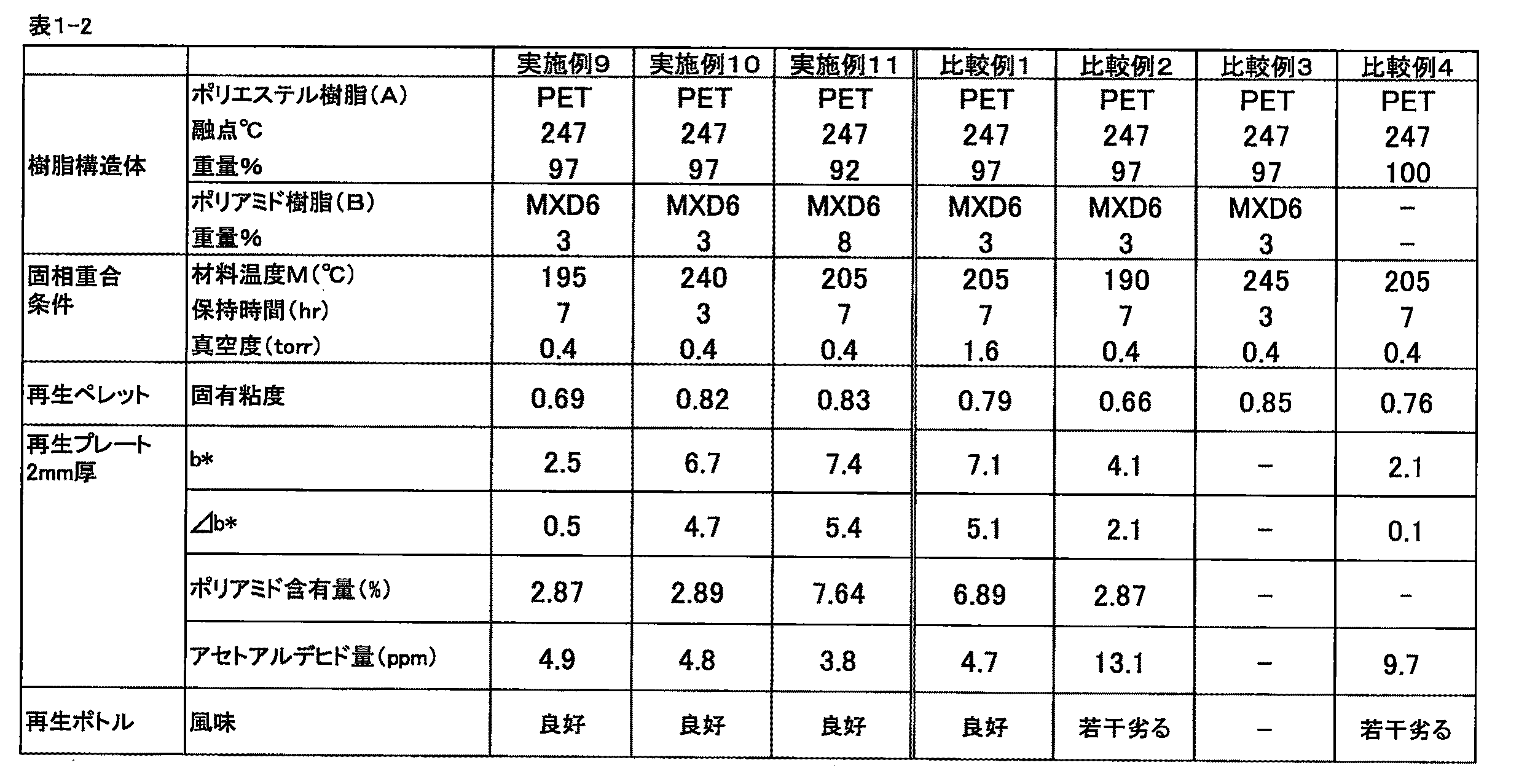
以上の実施例に示すように、一定の温度条件および真空条件下で固相重合を行うことにより、得られたポリエステル再生品(再生ペレットや再生プレート)では、色調および固有粘度は概ね良好となった。
一方、真空度に劣る条件で固相重合を行った比較例1で得られたポリエステル再生品は色調の悪いものであった。固相重合における材料温度が低すぎる比較例2およびポリアミド樹脂を含まない原料を用いた比較例4では、アセトアルデヒド発生量が多くなり、得られる再生ボトルは内容物の風味を低下させた。
また、固相重合温度が高すぎる比較例3はペレット同士の融着が生じ、プリフォームを成形することが出来なかった。なお、固有粘度の測定は融着したペレットを一部解砕して測定した。
As shown in the above examples, by performing solid-phase polymerization under a constant temperature condition and a vacuum condition, the color reproduction and intrinsic viscosity are generally good in the obtained polyester recycled product (recycled pellets and recycled plate). It was.
On the other hand, the polyester regenerated product obtained in Comparative Example 1 which was subjected to solid phase polymerization under conditions of poor vacuum was poor in color tone. In Comparative Example 2 in which the material temperature in the solid-phase polymerization is too low and in Comparative Example 4 using a raw material not containing a polyamide resin, the amount of acetaldehyde generated increased, and the resulting regenerated bottle reduced the flavor of the contents.
Further, in Comparative Example 3 in which the solid-state polymerization temperature was too high, fusion between pellets occurred, and a preform could not be formed. The intrinsic viscosity was measured by partially pulverizing the fused pellets.
本発明は、ボトル等の樹脂容器、フィルム、シート、パイプ等の各種の樹脂構造体を再利用する用途、特に使用済みのPETボトル等の収納容器を再利用する用途に利用することができる。 INDUSTRIAL APPLICATION This invention can be utilized for the use which reuses various resin structures, such as resin containers, such as a bottle, and a film, a sheet | seat, a pipe, especially the usage which reuses storage containers, such as a used PET bottle.
Claims (6)
前記製造方法が少なくとも粉砕工程、分離工程、及び固相重合工程を含み、さらに固相重合工程が式(1)および(2)を満たすことを特徴とする、ポリエステル再生品の製造方法。
(mp−55)≦M<(mp−5) ・・・・(1)
V≦1.5 ・・・・(2)
(Mは固相重合における材料温度、mpは固相重合に供するポリエステル樹脂の融点(℃)を示す。Vは固相重合反応において材料温度がMである時の真空度(torr)を示す) A method for producing a polyester recycled product, which obtains a polyester recycled product from a resin structure comprising a polyester resin (A) and a polyamide resin (B) containing a structural unit derived from xylylenediamine,
The method for producing a recycled polyester product, wherein the production method includes at least a pulverization step, a separation step, and a solid phase polymerization step, and the solid phase polymerization step satisfies formulas (1) and (2).
(Mp−55) ≦ M <(mp−5) (1)
V ≦ 1.5 (2)
(M represents the material temperature in solid phase polymerization, mp represents the melting point (° C.) of the polyester resin subjected to solid phase polymerization, and V represents the degree of vacuum (torr) when the material temperature is M in the solid phase polymerization reaction)
AA≦9.0 ・・・・(3)
(AAは、ポリエステル再生品からなる2mm厚プレート中片に含まれるアセトアルデヒド濃度(ppm)を示す) The manufacturing method of the polyester reproduction | regeneration goods in any one of Claims 1-4 with which the said polyester reproduction | regeneration goods satisfy | fill following formula (3).
AA ≦ 9.0 (3)
(AA indicates the acetaldehyde concentration (ppm) contained in a piece in a 2 mm thick plate made of a recycled polyester product)
Priority Applications (1)
| Application Number | Priority Date | Filing Date | Title |
|---|---|---|---|
| JP2014132651A JP2016011337A (en) | 2014-06-27 | 2014-06-27 | Manufacturing method of recycled polyester |
Applications Claiming Priority (1)
| Application Number | Priority Date | Filing Date | Title |
|---|---|---|---|
| JP2014132651A JP2016011337A (en) | 2014-06-27 | 2014-06-27 | Manufacturing method of recycled polyester |
Publications (1)
| Publication Number | Publication Date |
|---|---|
| JP2016011337A true JP2016011337A (en) | 2016-01-21 |
Family
ID=55228262
Family Applications (1)
| Application Number | Title | Priority Date | Filing Date |
|---|---|---|---|
| JP2014132651A Pending JP2016011337A (en) | 2014-06-27 | 2014-06-27 | Manufacturing method of recycled polyester |
Country Status (1)
| Country | Link |
|---|---|
| JP (1) | JP2016011337A (en) |
Cited By (4)
| Publication number | Priority date | Publication date | Assignee | Title |
|---|---|---|---|---|
| JP2017056956A (en) * | 2015-09-15 | 2017-03-23 | 三菱瓦斯化学株式会社 | Packaging container, and method for producing recycled polyester resin |
| JP2018043773A (en) * | 2016-09-15 | 2018-03-22 | 三菱瓦斯化学株式会社 | Multilayer container and method for producing recycled polyester |
| US11130605B2 (en) | 2015-10-02 | 2021-09-28 | Mitsubishi Gas Chemical Company, Inc. | Multi-layer container and production method therefor, single-layer container production method, and recycled polyester resin production method |
| JP7006998B1 (en) | 2021-03-31 | 2022-01-24 | 互応化学工業株式会社 | Manufacturing method of water-based polyester resin |
Citations (9)
| Publication number | Priority date | Publication date | Assignee | Title |
|---|---|---|---|---|
| JPS6335647A (en) * | 1986-07-30 | 1988-02-16 | Toyo Seikan Kaisha Ltd | Container made of polyester and having improved flavor retention |
| JPH07509011A (en) * | 1992-04-02 | 1995-10-05 | イーストマン ケミカル カンパニー | Polyester/polyamide blend with improved flavor retention and clarity |
| JPH10259254A (en) * | 1997-02-03 | 1998-09-29 | Illinois Tool Works Inc <Itw> | Polyethylene terephthalate material polymerized in solid phase and its production |
| JP2000119381A (en) * | 1998-10-13 | 2000-04-25 | Illinois Tool Works Inc <Itw> | Improved inline solid-phase polymerization of poly(ethylene terephthalate) flake for producing plastic strap by removing amorphous material from recovered poly(ethylene terephthalate) |
| JP2000143870A (en) * | 1998-11-13 | 2000-05-26 | Illinois Tool Works Inc <Itw> | In-line solid phase polymerization of pet flake for producing plastic strap |
| JP2003096175A (en) * | 2001-09-26 | 2003-04-03 | Utsumi Recycle Systems Kk | Process for producing reclaimed article of recovered polyethylene terephthalate |
| JP2003261663A (en) * | 2002-03-12 | 2003-09-19 | Toyobo Co Ltd | Catalyst for polymerization of polyester, polyester produced with it and production method |
| JP2007538126A (en) * | 2004-05-18 | 2007-12-27 | エンメ エ ジ・ポリメリ・イタリア・ソチエタ・ペル・アツィオーニ | Compartmented resin pellets |
| JP2011184580A (en) * | 2010-03-09 | 2011-09-22 | Nakamoto Pakkusu Kk | Method of manufacturing sheet for food container |
-
2014
- 2014-06-27 JP JP2014132651A patent/JP2016011337A/en active Pending
Patent Citations (9)
| Publication number | Priority date | Publication date | Assignee | Title |
|---|---|---|---|---|
| JPS6335647A (en) * | 1986-07-30 | 1988-02-16 | Toyo Seikan Kaisha Ltd | Container made of polyester and having improved flavor retention |
| JPH07509011A (en) * | 1992-04-02 | 1995-10-05 | イーストマン ケミカル カンパニー | Polyester/polyamide blend with improved flavor retention and clarity |
| JPH10259254A (en) * | 1997-02-03 | 1998-09-29 | Illinois Tool Works Inc <Itw> | Polyethylene terephthalate material polymerized in solid phase and its production |
| JP2000119381A (en) * | 1998-10-13 | 2000-04-25 | Illinois Tool Works Inc <Itw> | Improved inline solid-phase polymerization of poly(ethylene terephthalate) flake for producing plastic strap by removing amorphous material from recovered poly(ethylene terephthalate) |
| JP2000143870A (en) * | 1998-11-13 | 2000-05-26 | Illinois Tool Works Inc <Itw> | In-line solid phase polymerization of pet flake for producing plastic strap |
| JP2003096175A (en) * | 2001-09-26 | 2003-04-03 | Utsumi Recycle Systems Kk | Process for producing reclaimed article of recovered polyethylene terephthalate |
| JP2003261663A (en) * | 2002-03-12 | 2003-09-19 | Toyobo Co Ltd | Catalyst for polymerization of polyester, polyester produced with it and production method |
| JP2007538126A (en) * | 2004-05-18 | 2007-12-27 | エンメ エ ジ・ポリメリ・イタリア・ソチエタ・ペル・アツィオーニ | Compartmented resin pellets |
| JP2011184580A (en) * | 2010-03-09 | 2011-09-22 | Nakamoto Pakkusu Kk | Method of manufacturing sheet for food container |
Cited By (5)
| Publication number | Priority date | Publication date | Assignee | Title |
|---|---|---|---|---|
| JP2017056956A (en) * | 2015-09-15 | 2017-03-23 | 三菱瓦斯化学株式会社 | Packaging container, and method for producing recycled polyester resin |
| US11130605B2 (en) | 2015-10-02 | 2021-09-28 | Mitsubishi Gas Chemical Company, Inc. | Multi-layer container and production method therefor, single-layer container production method, and recycled polyester resin production method |
| JP2018043773A (en) * | 2016-09-15 | 2018-03-22 | 三菱瓦斯化学株式会社 | Multilayer container and method for producing recycled polyester |
| JP7006998B1 (en) | 2021-03-31 | 2022-01-24 | 互応化学工業株式会社 | Manufacturing method of water-based polyester resin |
| JP2022157199A (en) * | 2021-03-31 | 2022-10-14 | 互応化学工業株式会社 | Method for producing water-based polyester resin |
Similar Documents
| Publication | Publication Date | Title |
|---|---|---|
| JP6168261B1 (en) | Multilayer container and method for producing the same, method for producing single-layer container, and method for producing recycled polyester resin | |
| RU2323947C2 (en) | Method for preparation of polyalkylene therephthalates, method to manufacture moulded polyalkylene therephthalate part and moulded polyalkylenetherephthalate part | |
| JP7006737B2 (en) | Multi-layer container, its manufacturing method, and recycled polyester manufacturing method | |
| TWI600712B (en) | Multi-layer bottle and method for manufacturing the same | |
| JP2018043773A (en) | Multilayer container and method for producing recycled polyester | |
| CN115243891B (en) | Multilayer container, method for producing the same, and method for producing recycled polyester | |
| CN116034025B (en) | Multilayer container, method for producing the same, and method for producing recycled polyester | |
| JP5609039B2 (en) | Polyester container | |
| KR20080082961A (en) | Stable Polyamides for Simultaneous Solid-Phase Polymerization of Polyesters and Polyamides | |
| JP2016011337A (en) | Manufacturing method of recycled polyester | |
| CN114981081B (en) | Multilayer container, method for producing the same, and method for producing recycled polyester | |
| JP2009052041A (en) | Method for producing polyester | |
| JP6648453B2 (en) | Method for producing recycled polyester resin | |
| JP7006738B2 (en) | Multi-layer container, its manufacturing method, and recycled polyester manufacturing method | |
| EP4428047A1 (en) | Multilayer container, method for producing container, and method for producing regenerated polyester resin | |
| JP2007138156A (en) | Polyester composition and method for producing polyester molded article and polyester blow-molded article made thereof | |
| WO2022039004A1 (en) | Single-layer container, manufacturing method thereof, and recycled polyester manufacturing method | |
| JP7136384B1 (en) | Multilayer hollow container, method for producing same, and method for producing recycled polyester | |
| CN120916950A (en) | Multilayer container and method for producing recycled polyester | |
| JP2003082206A (en) | Polyester composition and molded product composed of the same | |
| JP2007138158A (en) | Polyester composition, polyester molded article made thereof and method for producing the same | |
| JP2006097013A (en) | Polyester composition and polyester molded product comprising the same | |
| JP2007138155A (en) | Polyester composition, polyester molded product made of the same and method for manufacturing polyester blow molded product | |
| JP2007138157A (en) | Polyester composition and method for producing polyester molded article and polyester blow-molded article made thereof | |
| JP2007002239A (en) | Polyester composition and molded polyester article made thereof |
Legal Events
| Date | Code | Title | Description |
|---|---|---|---|
| A621 | Written request for application examination |
Free format text: JAPANESE INTERMEDIATE CODE: A621 Effective date: 20170404 |
|
| A131 | Notification of reasons for refusal |
Free format text: JAPANESE INTERMEDIATE CODE: A131 Effective date: 20171031 |
|
| A977 | Report on retrieval |
Free format text: JAPANESE INTERMEDIATE CODE: A971007 Effective date: 20171031 |
|
| A02 | Decision of refusal |
Free format text: JAPANESE INTERMEDIATE CODE: A02 Effective date: 20180424 |