JP2015528698A - Method for predicting survival and responsiveness to treatment of a patient with solid cancer using a signature of at least 7 genes - Google Patents
Method for predicting survival and responsiveness to treatment of a patient with solid cancer using a signature of at least 7 genes Download PDFInfo
- Publication number
- JP2015528698A JP2015528698A JP2015521016A JP2015521016A JP2015528698A JP 2015528698 A JP2015528698 A JP 2015528698A JP 2015521016 A JP2015521016 A JP 2015521016A JP 2015521016 A JP2015521016 A JP 2015521016A JP 2015528698 A JP2015528698 A JP 2015528698A
- Authority
- JP
- Japan
- Prior art keywords
- reference value
- determined
- predetermined reference
- patients
- patient
- Prior art date
- Legal status (The legal status is an assumption and is not a legal conclusion. Google has not performed a legal analysis and makes no representation as to the accuracy of the status listed.)
- Granted
Links
Images




Classifications
-
- C—CHEMISTRY; METALLURGY
- C12—BIOCHEMISTRY; BEER; SPIRITS; WINE; VINEGAR; MICROBIOLOGY; ENZYMOLOGY; MUTATION OR GENETIC ENGINEERING
- C12Q—MEASURING OR TESTING PROCESSES INVOLVING ENZYMES, NUCLEIC ACIDS OR MICROORGANISMS; COMPOSITIONS OR TEST PAPERS THEREFOR; PROCESSES OF PREPARING SUCH COMPOSITIONS; CONDITION-RESPONSIVE CONTROL IN MICROBIOLOGICAL OR ENZYMOLOGICAL PROCESSES
- C12Q1/00—Measuring or testing processes involving enzymes, nucleic acids or microorganisms; Compositions therefor; Processes of preparing such compositions
- C12Q1/68—Measuring or testing processes involving enzymes, nucleic acids or microorganisms; Compositions therefor; Processes of preparing such compositions involving nucleic acids
- C12Q1/6876—Nucleic acid products used in the analysis of nucleic acids, e.g. primers or probes
- C12Q1/6883—Nucleic acid products used in the analysis of nucleic acids, e.g. primers or probes for diseases caused by alterations of genetic material
- C12Q1/6886—Nucleic acid products used in the analysis of nucleic acids, e.g. primers or probes for diseases caused by alterations of genetic material for cancer
-
- A—HUMAN NECESSITIES
- A61—MEDICAL OR VETERINARY SCIENCE; HYGIENE
- A61P—SPECIFIC THERAPEUTIC ACTIVITY OF CHEMICAL COMPOUNDS OR MEDICINAL PREPARATIONS
- A61P35/00—Antineoplastic agents
-
- C—CHEMISTRY; METALLURGY
- C12—BIOCHEMISTRY; BEER; SPIRITS; WINE; VINEGAR; MICROBIOLOGY; ENZYMOLOGY; MUTATION OR GENETIC ENGINEERING
- C12Q—MEASURING OR TESTING PROCESSES INVOLVING ENZYMES, NUCLEIC ACIDS OR MICROORGANISMS; COMPOSITIONS OR TEST PAPERS THEREFOR; PROCESSES OF PREPARING SUCH COMPOSITIONS; CONDITION-RESPONSIVE CONTROL IN MICROBIOLOGICAL OR ENZYMOLOGICAL PROCESSES
- C12Q2537/00—Reactions characterised by the reaction format or use of a specific feature
- C12Q2537/10—Reactions characterised by the reaction format or use of a specific feature the purpose or use of
- C12Q2537/143—Multiplexing, i.e. use of multiple primers or probes in a single reaction, usually for simultaneously analyse of multiple analysis
-
- C—CHEMISTRY; METALLURGY
- C12—BIOCHEMISTRY; BEER; SPIRITS; WINE; VINEGAR; MICROBIOLOGY; ENZYMOLOGY; MUTATION OR GENETIC ENGINEERING
- C12Q—MEASURING OR TESTING PROCESSES INVOLVING ENZYMES, NUCLEIC ACIDS OR MICROORGANISMS; COMPOSITIONS OR TEST PAPERS THEREFOR; PROCESSES OF PREPARING SUCH COMPOSITIONS; CONDITION-RESPONSIVE CONTROL IN MICROBIOLOGICAL OR ENZYMOLOGICAL PROCESSES
- C12Q2600/00—Oligonucleotides characterized by their use
- C12Q2600/112—Disease subtyping, staging or classification
-
- C—CHEMISTRY; METALLURGY
- C12—BIOCHEMISTRY; BEER; SPIRITS; WINE; VINEGAR; MICROBIOLOGY; ENZYMOLOGY; MUTATION OR GENETIC ENGINEERING
- C12Q—MEASURING OR TESTING PROCESSES INVOLVING ENZYMES, NUCLEIC ACIDS OR MICROORGANISMS; COMPOSITIONS OR TEST PAPERS THEREFOR; PROCESSES OF PREPARING SUCH COMPOSITIONS; CONDITION-RESPONSIVE CONTROL IN MICROBIOLOGICAL OR ENZYMOLOGICAL PROCESSES
- C12Q2600/00—Oligonucleotides characterized by their use
- C12Q2600/118—Prognosis of disease development
-
- C—CHEMISTRY; METALLURGY
- C12—BIOCHEMISTRY; BEER; SPIRITS; WINE; VINEGAR; MICROBIOLOGY; ENZYMOLOGY; MUTATION OR GENETIC ENGINEERING
- C12Q—MEASURING OR TESTING PROCESSES INVOLVING ENZYMES, NUCLEIC ACIDS OR MICROORGANISMS; COMPOSITIONS OR TEST PAPERS THEREFOR; PROCESSES OF PREPARING SUCH COMPOSITIONS; CONDITION-RESPONSIVE CONTROL IN MICROBIOLOGICAL OR ENZYMOLOGICAL PROCESSES
- C12Q2600/00—Oligonucleotides characterized by their use
- C12Q2600/158—Expression markers
-
- C—CHEMISTRY; METALLURGY
- C12—BIOCHEMISTRY; BEER; SPIRITS; WINE; VINEGAR; MICROBIOLOGY; ENZYMOLOGY; MUTATION OR GENETIC ENGINEERING
- C12Q—MEASURING OR TESTING PROCESSES INVOLVING ENZYMES, NUCLEIC ACIDS OR MICROORGANISMS; COMPOSITIONS OR TEST PAPERS THEREFOR; PROCESSES OF PREPARING SUCH COMPOSITIONS; CONDITION-RESPONSIVE CONTROL IN MICROBIOLOGICAL OR ENZYMOLOGICAL PROCESSES
- C12Q2600/00—Oligonucleotides characterized by their use
- C12Q2600/16—Primer sets for multiplex assays
Landscapes
- Chemical & Material Sciences (AREA)
- Health & Medical Sciences (AREA)
- Life Sciences & Earth Sciences (AREA)
- Organic Chemistry (AREA)
- Proteomics, Peptides & Aminoacids (AREA)
- Zoology (AREA)
- Immunology (AREA)
- Pathology (AREA)
- Analytical Chemistry (AREA)
- Genetics & Genomics (AREA)
- Wood Science & Technology (AREA)
- Engineering & Computer Science (AREA)
- General Health & Medical Sciences (AREA)
- Bioinformatics & Cheminformatics (AREA)
- Microbiology (AREA)
- Molecular Biology (AREA)
- Biotechnology (AREA)
- Biophysics (AREA)
- Hospice & Palliative Care (AREA)
- Biochemistry (AREA)
- Physics & Mathematics (AREA)
- General Engineering & Computer Science (AREA)
- Oncology (AREA)
- General Chemical & Material Sciences (AREA)
- Veterinary Medicine (AREA)
- Medicinal Chemistry (AREA)
- Nuclear Medicine, Radiotherapy & Molecular Imaging (AREA)
- Pharmacology & Pharmacy (AREA)
- Animal Behavior & Ethology (AREA)
- Public Health (AREA)
- Chemical Kinetics & Catalysis (AREA)
- Measuring Or Testing Involving Enzymes Or Micro-Organisms (AREA)
- Investigating Or Analysing Biological Materials (AREA)
- Apparatus Associated With Microorganisms And Enzymes (AREA)
- Medicines That Contain Protein Lipid Enzymes And Other Medicines (AREA)
- Medicines Containing Antibodies Or Antigens For Use As Internal Diagnostic Agents (AREA)
- Medicines Containing Material From Animals Or Micro-Organisms (AREA)
Abstract
本発明は、i)患者から得られた腫瘍サンプルにおいて、CCR2、CD3D、CD3E、CD3G、CD8A、CXCL10、CXCL11、GZMA、GZMB、GZMK、GZMM、IL15、IRF1、PRF1、STAT1、CD69、ICOS、CXCR3、STAT4、CCL2およびTBX21からなる群より選択された少なくとも7個の遺伝子の遺伝子発現レベルを決定する工程、ii)工程i)で決定されたあらゆる発現レベルを、その予め決定された参照値と比較する工程、およびiii)工程i)で決定された全ての発現レベルが、その予め決定された参照値よりも高い場合には良好な予後を与える工程、または、工程i)で決定された全ての発現レベルが、その予め決定された参照値よりも低い場合には悪い予後を与える工程、または決定された少なくとも1つの発現レベル値がその予め決定された値よりも高い場合には中度の予後を与える工程を含む、固形癌を患う患者の生存期間を予測するための方法に関する。前記方法はまた、処置に対する患者の応答性を予測するのに特に適している。The present invention relates to i) tumor samples obtained from patients, CCR2, CD3D, CD3E, CD3G, CD8A, CXCL10, CXCL11, GZMA, GZMB, GZMK, GZMM, IL15, IRF1, PRF1, STAT1, CD69, ICOS, CXCR3 Ii) determining the gene expression level of at least 7 genes selected from the group consisting of STAT4, CCL2 and TBX21, ii) comparing any expression level determined in step i) with its predetermined reference value And iii) providing a good prognosis if all the expression levels determined in step i) are higher than the predetermined reference value, or all determined in step i) Providing a poor prognosis if the expression level is lower than the predetermined reference value, or a moderate prognosis if the determined at least one expression level value is higher than the predetermined value Giving the process No, to a method for predicting survival of patients suffering from solid cancers. The method is also particularly suitable for predicting patient responsiveness to treatment.
Description
発明の分野:
本発明は、固形癌を患う患者の生存期間および応答性を予測するための方法およびキットに関する。
Field of Invention:
The present invention relates to methods and kits for predicting survival and responsiveness of patients suffering from solid cancer.
発明の背景:
癌は依然として先進国において深刻な公衆衛生上の問題である。従って、癌処置は、最も効果的であるために、悪性腫瘍の早期検出および処置または除去だけではなく、悪性腫瘍の重篤度の信頼性のある評価および癌再発の可能性の予測を必要とする。癌のステージはどれだけ遠くに癌が広がっているかを示す。処置は癌のステージに従って決定されることが多いので、ステージ分類は重要である。現在まで、癌は、一般的に、UICC−TNMシステムに従って分類されている。TNM(「腫瘍−所属リンパ節−転移」)分類システムは、腫瘍のサイズ、所属リンパ節における腫瘍の有無、および遠隔転移の有無を使用して、腫瘍にステージを割り当てる。TNMシステムは、原発部位に小さな腫瘍を有する患者は、より大きなサイズの腫瘍を有する患者よりも良好な予後を有するという観察から開発された。一般的に、原発部位に限局された腫瘍を有する患者は、所属リンパ節にも併発している患者よりも良好な予後を有し、また所属リンパ節併発患者は、他の臓器まで疾病が遠隔に広がった患者よりも良好な予後を有する。従って、癌は一般的に4つのステージに分けることができる。ステージIは、リンパ節に癌を全く有さない非常に限局された癌である。ステージIIの癌は、原発臓器により深く広がっている(典型的にはT3、T4腫瘍)。ステージIIIの癌は、リンパ節にまで広がっている。ステージIVの癌は、生体の別の部分にまで広がっている。割り当てられたステージは、適切な療法の選択のためのおよび予後診断目的のための基礎として使用される。例えば、ステージIVの癌を有する患者には常に化学療法が推奨される。逆に、UICC−TNMステージIIまたはIIIの癌を有する患者に化学療法を処方するための関連するガイドラインは全くない。従って、多数の利用可能な新規な療法のための重要な工程が適切な癌療法のための効率的な患者の選択であるため一層、処置の決定を導く信頼性ある診断ツールが必要とされる。
Background of the invention:
Cancer remains a serious public health problem in developed countries. Therefore, cancer treatment is not only effective, but requires not only early detection and treatment or removal of malignant tumors, but also a reliable assessment of the severity of the malignant tumors and prediction of the likelihood of cancer recurrence. To do. The cancer stage shows how far the cancer has spread. Stage classification is important because treatment is often determined according to the stage of the cancer. To date, cancers are generally classified according to the UICC-TNM system. The TNM ("Tumor-Regional Lymph Node-Metastasis") classification system assigns stages to tumors using the size of the tumor, the presence of the tumor in the regional lymph node, and the presence or absence of distant metastasis. The TNM system was developed from the observation that patients with small tumors at the primary site have a better prognosis than patients with larger size tumors. In general, patients with tumors confined to the primary site have a better prognosis than patients who also have regional lymph nodes, and patients with regional lymph nodes have remote disease to other organs. Has a better prognosis than patients who have spread to. Thus, cancer can generally be divided into four stages. Stage I is a very localized cancer that has no cancer in the lymph nodes. Stage II cancer has spread more deeply into the primary organ (typically T3, T4 tumors). Stage III cancer has spread to the lymph nodes. Stage IV cancer has spread to other parts of the body. The assigned stage is used as a basis for selection of an appropriate therapy and for prognostic purposes. For example, chemotherapy is always recommended for patients with stage IV cancer. Conversely, there are no relevant guidelines for prescribing chemotherapy to patients with UICC-TNM stage II or III cancer. Therefore, a more reliable diagnostic tool that guides treatment decisions is needed because an important step for many available novel therapies is efficient patient selection for appropriate cancer therapy .
上記のTNM分類は、有用であるが不完全であり、癌の転帰の信頼性ある予後診断を可能としない。近年、Galon et al.は、腫瘍内の適応的免疫応答に関連した遺伝子発現の分析は、患者における癌の転帰を予測するのに適切であり得ることを示唆した(国際公開公報第2007045996号)。従って、彼らは、癌の進行について患者の予後診断のために有用であり得る、遺伝子およびその組合せのリストを提供する。しかしながら、前記文書に示された方法は、癌患者の生存期間の予測のためにおよび患者の処置に対する応答を予測するためにTNM分類が提供するよりも、より良好な成績を与える特定の遺伝子の組合せを指摘できていない。 The above TNM classification is useful but incomplete and does not allow reliable prognosis of cancer outcome. Recently, Galon et al. Have suggested that analysis of gene expression associated with adaptive immune responses within tumors may be appropriate to predict cancer outcome in patients (WO2007045996). . Thus, they provide a list of genes and combinations thereof that may be useful for patient prognosis for cancer progression. However, the method presented in the above document is not suitable for certain genes that give better results than TNM classification provides for predicting survival of cancer patients and for predicting response to treatment of patients. I couldn't point out the combination.
発明の要約:
本発明は、固形癌を患う患者の生存期間および応答性を予測するための方法およびキットに関する。
Summary of invention:
The present invention relates to methods and kits for predicting survival and responsiveness of patients suffering from solid cancer.
発明の詳細な説明:
国際特許出願の国際公開公報第2007045996号は、遺伝子間の組合せを考慮せずに選択された、腫瘍の微小環境を説明する一般的に選択された最も重要な遺伝子(〜300個)に関する。サインの数を限定するために、患者コホートに対する100回の交差検定後でも高度にログランクで有意であった、僅か7〜21個の遺伝子が使用された。前記遺伝子は、CCR2、CD3D、CD3E、CD3G、CD8A、CXCL10、CXCL11、GZMA、GZMB、GZMK、GZMM、IL15、IRF1、PRF1、STAT1、CD69、ICOS、CXCR3、STAT4、CCL2およびTBX2からなる群より選択される。例えば、国際特許出願の国際公開公報第2007045996号に記載された300中約21個の遺伝子の非重複サインの見込まれる数は、1.0×1037個を超える。本発明者らは、同定された21個の遺伝子のサインは、UICC−TNM分類が与えるよりも大きな感度および選択性を与えることを実証する。本発明者らは、種々の癌の上のサインを検証する。さらに、本発明者らは、同じサインが、処置に対する患者の応答を予測するのに適切であることを実証した。
Detailed description of the invention:
International Patent Application Publication No. 2007045996 relates to the most important genes (~ 300) that are generally selected to account for the tumor microenvironment, selected without considering the combination between genes. To limit the number of signatures, only 7-21 genes were used that were highly log rank significant even after 100 cross-validations on the patient cohort. The gene is selected from the group consisting of CCR2, CD3D, CD3E, CD3G, CD8A, CXCL10, CXCL11, GZMA, GZMB, GZMK, GZMM, IL15, IRF1, PRF1, STAT1, CD69, ICOS, CXCR3, STAT4, CCL2 and TBX2 Is done. For example, the expected number of non-redundant signatures of about 21 genes in 300 described in International Publication No. 2007045996 of International Patent Application exceeds 1.0 × 10 37 . We demonstrate that the signature of the 21 genes identified gives greater sensitivity and selectivity than does the UICC-TNM classification. We verify the signature on various cancers. In addition, the inventors have demonstrated that the same signature is appropriate for predicting patient response to treatment.
従って、本発明は、i)患者から得られた腫瘍サンプルにおいて、CCR2、CD3D、CD3E、CD3G、CD8A、CXCL10、CXCL11、GZMA、GZMB、GZMK、GZMM、IL15、IRF1、PRF1、STAT1、CD69、ICOS、CXCR3、STAT4、CCL2およびTBX21からなる群より選択された少なくとも7個の遺伝子の遺伝子発現レベルを決定する工程、ii)工程i)で決定されたあらゆる発現レベルを、その予め決定された参照値と比較する工程、およびiii)
− 工程i)で決定された全ての発現レベルが、その予め決定された参照値よりも高い場合には良好な予後を与える工程、または、
− 工程i)で決定された全ての発現レベルが、その予め決定された参照値よりも低い場合には悪い予後を与える工程、または
− 決定された少なくとも1つの発現レベル値がその予め決定された値よりも高い場合には中度の予後を与える工程、
を含む、固形癌を患う患者の生存期間を予測するための方法に関する。
Therefore, the present invention provides i) tumor samples obtained from patients, CCR2, CD3D, CD3E, CD3G, CD8A, CXCL10, CXCL11, GZMA, GZMB, GZMK, GZMM, IL15, IRF1, PRF1, STAT1, CD69, ICOS Determining the gene expression level of at least 7 genes selected from the group consisting of CXCR3, STAT4, CCL2 and TBX21, ii) any expression level determined in step i) as its predetermined reference value And iii)
-Giving a good prognosis if all the expression levels determined in step i) are higher than its predetermined reference value, or
-Giving a poor prognosis if all the expression levels determined in step i) are lower than the predetermined reference value, or-at least one expression level value determined is determined in advance A process that gives a moderate prognosis if higher than the value,
And a method for predicting the survival time of a patient suffering from solid cancer.
本発明はまた、i)患者から得られた腫瘍サンプルにおいて、CCR2、CD3D、CD3E、CD3G、CD8A、CXCL10、CXCL11、GZMA、GZMB、GZMK、GZMM、IL15、IRF1、PRF1、STAT1、CD69、ICOS、CXCR3、STAT4、CCL2およびTBX21の遺伝子発現レベルを決定する工程、ii)工程i)で決定されたあらゆる発現レベルを、その予め決定された参照値と比較する工程、およびiii)
− 工程i)で決定された全ての発現レベルが、その予め決定された参照値よりも高い場合には良好な予後を与える工程、または、
− 工程i)で決定された全ての発現レベルが、その予め決定された参照値よりも低い場合には悪い予後を与える工程、または
− 決定された少なくとも1つの発現レベル値がその予め決定された値よりも高い場合には中度の予後を与える工程、
を含む、固形癌を患う患者の生存期間を予測するための方法に関する。
The present invention also provides i) in tumor samples obtained from patients, CCR2, CD3D, CD3E, CD3G, CD8A, CXCL10, CXCL11, GZMA, GZMB, GZMK, GZMM, IL15, IRF1, PRF1, STAT1, CD69, ICOS, Determining the gene expression levels of CXCR3, STAT4, CCL2 and TBX21, ii) comparing any expression level determined in step i) with its predetermined reference value, and iii)
-Giving a good prognosis if all the expression levels determined in step i) are higher than its predetermined reference value, or
-Giving a poor prognosis if all the expression levels determined in step i) are lower than the predetermined reference value, or-at least one expression level value determined is determined in advance A process that gives a moderate prognosis if higher than the value,
And a method for predicting the survival time of a patient suffering from solid cancer.
中度の予後に関して、遺伝子の発現レベルがその予め決定された参照値よりも高い時にはいつでも、患者の予後はより好ましいものとなるだろう。 For a moderate prognosis, whenever a gene expression level is higher than its predetermined reference value, the patient's prognosis will be more favorable.
患者は、任意の固形癌を患い得る。典型的には、癌は、胆管癌(例えば末梢型癌、遠位胆管癌、肝内胆管癌)、膀胱癌、骨癌(例えば骨芽細胞腫、骨軟骨腫、血管腫、軟骨粘液線維腫、骨肉腫、軟骨肉腫、線維肉腫、悪性線維性組織球腫、骨巨細胞腫、脊索腫、リンパ腫、多発性骨髄腫)、脳および中枢神経系の癌(例えば髄膜腫、星状細胞腫、乏突起神経膠腫、上衣腫、神経膠腫、髄芽腫、神経節膠腫、シュワン腫、胚細胞腫、頭蓋咽頭腫)、乳癌(例えば非浸潤性乳管癌、浸潤性腺管癌、浸潤性小葉癌、非浸潤性小葉癌、女性化乳房)、キャッスルマン病(例えば巨大リンパ節過形成、脈管濾胞性リンパ節増殖症)、子宮頸癌、結腸直腸癌、子宮内膜癌(例えば子宮内膜腺癌、腺棘細胞癌、乳頭状漿液性腺癌、明細胞)、食道癌、膀胱癌(粘液性腺癌、小細胞癌)、消化管カルチノイド腫瘍(例えば絨毛癌、破壊性絨毛腺癌)、ホジキン病、非ホジキンリンパ腫、カポジ肉腫、腎臓癌(例えば腎細胞癌)、咽頭癌および下咽頭癌、肝臓癌(例えば血管腫、肝腺腫、限局性結節性過形成、肝細胞癌)、肺癌(例えば小細胞肺癌、非小細胞肺癌)、中皮腫、形質細胞腫、鼻腔癌および副鼻腔癌(例えば感覚神経芽腫、正中線肉芽腫)、上咽頭癌、神経芽細胞腫、口腔癌および中咽頭癌、卵巣癌、膵臓癌、陰茎癌、下垂体癌、前立腺癌、網膜芽細胞腫、横紋筋肉腫(例えば胎児性横紋筋肉腫、胞巣状横紋筋肉腫、多形性横紋筋肉腫)、唾液腺癌、皮膚癌(例えば黒色腫、非黒色腫皮膚癌)、胃癌、精巣癌(例えば精上皮腫、非セミノーム性胚細胞癌)、胸腺癌、甲状腺癌(例えば濾胞癌、未分化癌、低分化癌、甲状腺髄様癌、甲状腺リンパ腫)、膣癌、外陰癌、および子宮癌(例えば子宮平滑筋肉腫)からなる群より選択され得る。特定の態様において、癌は結腸直腸癌である。 A patient can suffer from any solid cancer. Typically, the cancer is cholangiocarcinoma (eg peripheral cancer, distal cholangiocarcinoma, intrahepatic cholangiocarcinoma), bladder cancer, bone cancer (eg osteoblastoma, osteochondroma, hemangioma, cartilage mucofibroma) , Osteosarcoma, chondrosarcoma, fibrosarcoma, malignant fibrous histiocytoma, giant cell tumor of bone, chordoma, lymphoma, multiple myeloma), brain and central nervous system cancer (eg meningioma, astrocytoma) , Oligodendroglioma, ependymoma, glioma, medulloblastoma, ganglioglioma, Schwannoma, germinoma, craniopharyngioma), breast cancer (eg non-invasive ductal carcinoma, invasive ductal carcinoma, Invasive lobular carcinoma, non-invasive lobular carcinoma, gynecomastia), Castleman disease (eg giant lymph node hyperplasia, vascular follicular lymphadenopathy), cervical cancer, colorectal cancer, endometrial cancer ( For example, endometrial adenocarcinoma, adenocarcinoma, papillary serous adenocarcinoma, clear cell), esophageal cancer, bladder cancer (mucinous adenocarcinoma, small cell carcinoma), gastrointestinal tract Rutinoid tumors (eg choriocarcinoma, destructive choriocarcinoma), Hodgkin's disease, non-Hodgkin's lymphoma, Kaposi's sarcoma, kidney cancer (eg renal cell carcinoma), pharyngeal and hypopharyngeal cancer, liver cancer (eg hemangioma, hepatic adenoma, Localized nodular hyperplasia, hepatocellular carcinoma), lung cancer (eg small cell lung cancer, non-small cell lung cancer), mesothelioma, plasmacytoma, nasal cavity cancer and sinus cancer (eg sensory neuroblastoma, midline granuloma) ), Nasopharyngeal cancer, neuroblastoma, oral and oropharyngeal cancer, ovarian cancer, pancreatic cancer, penile cancer, pituitary cancer, prostate cancer, retinoblastoma, rhabdomyosarcoma (eg fetal rhabdomyosarcoma) Tumor, alveolar rhabdomyosarcoma, pleomorphic rhabdomyosarcoma), salivary gland cancer, skin cancer (eg melanoma, non-melanoma skin cancer), gastric cancer, testicular cancer (eg seminoma, nonseminomic embryo) Cell carcinoma), thymic cancer, thyroid cancer (eg follicular cancer, undifferentiated cancer, poorly differentiated cancer, medullary thyroid) Cancer, thyroid lymphoma), vaginal cancer, may be selected from the group consisting of vulvar cancer, and uterine cancer (e.g. uterine leiomyosarcoma). In certain embodiments, the cancer is colorectal cancer.
「腫瘍サンプル」という用語は、患者から得られた任意の組織腫瘍サンプルを意味する。前記組織サンプルは、インビトロにおける評価の目的のために得られる。サンプルは、新鮮であっても、凍結されていても、固定されていても(例えばホルマリンで固定)または包埋(例えばパラフィンに包埋)されていてもよい。特定の態様において、腫瘍サンプルは、患者から切除された腫瘍からもたらされ得る。別の態様において、腫瘍サンプルは、患者の原発性腫瘍で実施された、または、患者の原発性腫瘍から遠位にある転移性腫瘍で実施された生検から得ることができる。例えば、結腸直腸癌に罹患した患者の腸で実施された内視鏡生検。 The term “tumor sample” means any tissue tumor sample obtained from a patient. The tissue sample is obtained for in vitro evaluation purposes. The sample may be fresh, frozen, fixed (eg, fixed with formalin) or embedded (eg, embedded in paraffin). In certain embodiments, the tumor sample can be derived from a tumor excised from the patient. In another embodiment, the tumor sample can be obtained from a biopsy performed on the patient's primary tumor or on a metastatic tumor distal to the patient's primary tumor. For example, an endoscopic biopsy performed in the intestine of a patient with colorectal cancer.
本発明に関する全ての遺伝子はそれ自体公知であり、以下の表Aに列挙されている: All genes related to the present invention are known per se and are listed in Table A below:

CCR2、CD3D、CD3E、CD3G、CD8A、CXCL10、CXCL11、GZMA、GZMB、GZMK、GZMM、IL15、IRF1、PRF1、STAT1、CD69、ICOS、CXCR3、STAT4、CCL2およびTBX21。 CCR2, CD3D, CD3E, CD3G, CD8A, CXCL10, CXCL11, GZMA, GZMB, GZMK, GZMM, IL15, IRF1, PRF1, STAT1, CD69, ICOS, CXCR3, STAT4, CCL2, and TBX21.
従って、本発明は、以下を含み得る:
− CCR2(ELCCR2)の発現レベルを決定し、前記レベルをCCR2(ELRCCR2)について予め決定された参照レベルと比較する工程、
− CD3D(ELCD3D)の発現レベルを決定し、前記レベルをCD3D(ELRCD3D)について予め決定された参照レベルと比較する工程、
− CD3E(ELCD3E)の発現レベルを決定し、前記レベルをCD3E(ELRCD3E)について予め決定された参照レベルと比較する工程、
− CD3G(ELCD3G)の発現レベルを決定し、前記レベルをCD3G(ELRCD3G)について予め決定された参照レベルと比較する工程、
− CD8A(ELCD8A)の発現レベルを決定し、前記レベルをCD8A(ELRCD8A)について予め決定された参照レベルと比較する工程、
− CXCL10(ELCXCL10)の発現レベルを決定し、前記レベルをCXCL10(ELRCXL10)について予め決定された参照レベルと比較する工程、
− CXCL11(ELCXCL11)の発現レベルを決定し、前記レベルをCXCL11(ELRCXCL11)について予め決定された参照レベルと比較する工程、
− GZMA(ELGZMA)の発現レベルを決定し、前記レベルをGZMA(ELRGZMA)について予め決定された参照レベルと比較する工程、
− GZMB(ELGZMB)の発現レベルを決定し、前記レベルをGZMB(ELRGZMB)について予め決定された参照レベルと比較する工程、
− GZMK(ELGZMK)の発現レベルを決定し、前記レベルをGZMK(ELRGZMK)について予め決定された参照レベルと比較する工程、
− GZMM(ELGZMM)の発現レベルを決定し、前記レベルをGZMM(ELRGZMM)について予め決定された参照レベルと比較する工程、
− IL15(ELIL15)の発現レベルを決定し、前記レベルをIL15(ELRIL15)について予め決定された参照レベルと比較する工程、
− IRF1(ELIRF1)の発現レベルを決定し、前記レベルをIRF1(ELRIRF1)について予め決定された参照レベルと比較する工程、
− PRF1(ELPRF1)の発現レベルを決定し、前記レベルをPRF1(ELRPRF1)について予め決定された参照レベルと比較する工程、
− STAT1(ELSTAT1)の発現レベルを決定し、前記レベルをSTAT1(ELRSTAT1)について予め決定された参照レベルと比較する工程、
− CD69(ELCD69)の発現レベルを決定し、前記レベルをCD69(ELRCD69)について予め決定された参照レベルと比較する工程、
− ICOS(ELICOS)の発現レベルを決定し、前記レベルをICOS(ELRICOS)について予め決定された参照レベルと比較する工程、
− CXCR3(ELCXCR3)の発現レベルを決定し、前記レベルをCXCR3(ELRCXCR3)について予め決定された参照レベルと比較する工程、
− STAT4(ELSTAT4)の発現レベルを決定し、前記レベルをSTAT4(ELRSTAT4)について予め決定された参照レベルと比較する工程、
− CCL2(ELCCL2)の発現レベルを決定し、前記レベルをCCL2(ELRCCL2)について予め決定された参照レベルと比較する工程、
− TBX21(ELTBX21)の発現レベルを決定し、前記レベルをTBX21(ELRTBX21)について予め決定された参照レベルと比較する工程。
Accordingly, the present invention may include:
-Determining the expression level of CCR2 (EL CCR2 ) and comparing said level to a predetermined reference level for CCR2 (ELR CCR2 );
-Determining the expression level of CD3D (EL CD3D ) and comparing said level to a reference level predetermined for CD3D (ELR CD3D );
-Determining the expression level of CD3E (EL CD3E ) and comparing said level with a predetermined reference level for CD3E (ELR CD3E );
-Determining the expression level of CD3G (EL CD3G ) and comparing said level with a predetermined reference level for CD3G (ELR CD3G );
-Determining the expression level of CD8A (EL CD8A ) and comparing said level with a predetermined reference level for CD8A (ELR CD8A );
-Determining the expression level of CXCL10 (EL CXCL10 ) and comparing said level with a reference level predetermined for CXCL10 (ELR CXL10 );
-Determining the expression level of CXCL11 (EL CXCL11 ) and comparing said level to a predetermined reference level for CXCL11 (ELR CXCL11 );
-Determining the expression level of GZMA (EL GZMA ) and comparing said level with a predetermined reference level for GZMA (ELR GZMA );
-Determining the expression level of GZMB (EL GZMB ) and comparing said level with a reference level predetermined for GZMB (ELR GZMB );
-Determining the expression level of GZMK (EL GZMK ) and comparing said level with a reference level predetermined for GZMK (ELR GZMK );
-Determining the expression level of GZMM (EL GZMM ) and comparing said level with a reference level predetermined for GZMM (ELR GZMM );
-Determining the expression level of IL15 (EL IL15 ) and comparing said level to a predetermined reference level for IL15 (ELR IL15 );
-Determining the expression level of IRF1 (EL IRF1 ) and comparing said level to a predetermined reference level for IRF1 (ELR IRF1 );
-Determining the expression level of PRF1 (EL PRF1 ) and comparing said level to a reference level predetermined for PRF1 (ELR PRF1 );
-Determining the expression level of STAT1 (EL STAT1 ) and comparing said level to a reference level previously determined for STAT1 (ELR STAT1 );
-Determining the expression level of CD69 (EL CD69 ) and comparing said level to a predetermined reference level for CD69 (ELR CD69 );
-Determining the expression level of ICOS (EL ICOS ) and comparing said level to a predetermined reference level for ICOS (ELR ICOS );
-Determining the expression level of CXCR3 (EL CXCR3 ) and comparing said level to a reference level predetermined for CXCR3 (ELR CXCR3 );
-Determining the expression level of STAT4 (EL STAT4 ) and comparing said level to a reference level predetermined for STAT4 (ELR STAT4 );
-Determining the expression level of CCL2 (EL CCL2 ) and comparing said level to a predetermined reference level for CCL2 (ELR CCL2 );
-Determining the expression level of TBX21 (EL TBX21 ) and comparing said level to a reference level predetermined for TBX21 (ELR TBX21 );
本発明はまた、i)患者から得られた腫瘍サンプルにおいて、CCR2、GZMB、GZMK、STAT1、ICOS、STAT4およびTBX21の遺伝子発現レベルを決定する工程、ii)工程i)で決定されたあらゆる発現レベルを、その予め決定された参照値と比較する工程、およびiii)
− 工程i)で決定された全ての発現レベルが、その予め決定された参照値よりも高い場合には良好な予後を与える工程、または、
− 工程i)で決定された全ての発現レベルが、その予め決定された参照値よりも低い場合には悪い予後を与える工程、または
− 決定された少なくとも1つの発現レベル値がその予め決定された値よりも高い場合には中度の予後を与える工程、
を含む、乳癌を患う患者の生存期間を予測するための方法に関する。
The present invention also provides i) determining the gene expression level of CCR2, GZMB, GZMK, STAT1, ICOS, STAT4 and TBX21 in a tumor sample obtained from a patient, ii) any expression level determined in step i) And iii) with the predetermined reference value
-Giving a good prognosis if all the expression levels determined in step i) are higher than its predetermined reference value, or
-Giving a poor prognosis if all the expression levels determined in step i) are lower than the predetermined reference value, or-at least one expression level value determined is determined in advance A process that gives a moderate prognosis if higher than the value,
And a method for predicting the survival time of a patient suffering from breast cancer.
本発明はまた、i)患者から得られた腫瘍サンプルにおいて、CCR2、CD3D、CD3E、CD3G、CD8A、CXCL10、CXCL11、GZMA、GZMB、GZMK、GZMM、IL15、IRF1、PRF1、CD69、ICOS、CXCR3およびSTAT4の遺伝子発現レベルを決定する工程、ii)工程i)で決定されたあらゆる発現レベルを、その予め決定された参照値と比較する工程、およびiii)
− 工程i)で決定された全ての発現レベルが、その予め決定された参照値よりも高い場合には良好な予後を与える工程、または、
− 工程i)で決定された全ての発現レベルが、その予め決定された参照値よりも低い場合には悪い予後を与える工程、または
− 決定された少なくとも1つの発現レベル値がその予め決定された値よりも高い場合には中度の予後を与える工程、
を含む、乳癌を患う患者の生存期間を予測するための方法に関する。
The present invention also provides i) in tumor samples obtained from patients, CCR2, CD3D, CD3E, CD3G, CD8A, CXCL10, CXCL11, GZMA, GZMB, GZMK, GZMM, IL15, IRF1, PRF1, CD69, ICOS, CXCR3 and Determining the gene expression level of STAT4, ii) comparing any expression level determined in step i) with its predetermined reference value, and iii)
-Giving a good prognosis if all the expression levels determined in step i) are higher than its predetermined reference value, or
-Giving a poor prognosis if all the expression levels determined in step i) are lower than the predetermined reference value, or-at least one expression level value determined is determined in advance A process that gives a moderate prognosis if higher than the value,
And a method for predicting the survival time of a patient suffering from breast cancer.
本発明はまた、i)患者から得られた腫瘍サンプルにおいて、CD3E、CD3G、CD8A、CXCL11、GZMA、GZMB、GZMK、GZMM、IL15、IRF1、CD69、ICOS、CXCR3、STAT4、CCL2およびTBX21の遺伝子発現レベルを決定する工程、ii)工程i)で決定されたあらゆる発現レベルを、その予め決定された参照値と比較する工程、およびiii)
− 工程i)で決定された全ての発現レベルが、その予め決定された参照値よりも高い場合には良好な予後を与える工程、または、
− 工程i)で決定された全ての発現レベルが、その予め決定された参照値よりも低い場合には悪い予後を与える工程、または
− 少なくとも1つの発現の場合には中度の予後を与える工程、
を含む、子宮頸癌を患う患者の生存期間を予測するための方法に関する。
The present invention also provides i) gene expression of CD3E, CD3G, CD8A, CXCL11, GZMA, GZMB, GZMK, GZMM, IL15, IRF1, CD69, ICOS, CXCR3, STAT4, CCL2 and TBX21 in tumor samples obtained from patients Determining the level, ii) comparing any expression level determined in step i) with its predetermined reference value, and iii)
-Giving a good prognosis if all the expression levels determined in step i) are higher than its predetermined reference value, or
-Giving a poor prognosis if all the expression levels determined in step i) are lower than its predetermined reference value, or-giving a moderate prognosis in the case of at least one expression ,
And a method for predicting the survival time of a patient suffering from cervical cancer.
本発明はまた、i)患者から得られた腫瘍サンプルにおいて、CCR2、CD3D、CD3E、CD8A、CXCL10、GZMA、GZMM、IL15、IRF1、PRF1、STAT1、CD69、CXCR3およびSTAT4の遺伝子発現レベルを決定する工程、ii)工程i)で決定されたあらゆる発現レベルを、その予め決定された参照値と比較する工程、およびiii)
− 工程i)で決定された全ての発現レベルが、その予め決定された参照値よりも高い場合には良好な予後を与える工程、または、
− 工程i)で決定された全ての発現レベルが、その予め決定された参照値よりも低い場合には悪い予後を与える工程、または
− 少なくとも1つの発現の場合には中度の予後を与える工程、
を含む、肝細胞癌を患う患者の生存期間を予測するための方法に関する。
The present invention also determines i) gene expression levels of CCR2, CD3D, CD3E, CD8A, CXCL10, GZMA, GZMM, IL15, IRF1, PRF1, STAT1, CD69, CXCR3 and STAT4 in tumor samples obtained from patients Step ii) comparing any expression level determined in step i) with its predetermined reference value, and iii)
-Giving a good prognosis if all the expression levels determined in step i) are higher than its predetermined reference value, or
-Giving a poor prognosis if all the expression levels determined in step i) are lower than its predetermined reference value, or-giving a moderate prognosis in the case of at least one expression ,
And a method for predicting the survival time of a patient suffering from hepatocellular carcinoma.
本発明はまた、i)患者から得られた腫瘍サンプルにおいて、CCR2、CD3D、CD3E、CD3G、CD8A、CXCL11、GZMA、GZMB、GZMK、GZMM、IL15、IRF1、PRF1、STAT1、CD69、STAT4およびCCL2の遺伝子発現レベルを決定する工程、ii)工程i)で決定されたあらゆる発現レベルを、その予め決定された参照値と比較する工程、およびiii)
− 工程i)で決定された全ての発現レベルが、その予め決定された参照値よりも高い場合には良好な予後を与える工程、または、
− 工程i)で決定された全ての発現レベルが、その予め決定された参照値よりも低い場合には悪い予後を与える工程、または
− 少なくとも1つの発現の場合には中度の予後を与える工程、
を含む、肺癌を患う患者の生存期間を予測するための方法に関する。
The present invention also provides i) in tumor samples obtained from patients, CCR2, CD3D, CD3E, CD3G, CD8A, CXCL11, GZMA, GZMB, GZMK, GZMM, IL15, IRF1, PRF1, STAT1, CD69, STAT4 and CCL2. Determining a gene expression level, ii) comparing any expression level determined in step i) with its predetermined reference value, and iii)
-Giving a good prognosis if all the expression levels determined in step i) are higher than its predetermined reference value, or
-Giving a poor prognosis if all the expression levels determined in step i) are lower than its predetermined reference value, or-giving a moderate prognosis in the case of at least one expression ,
And a method for predicting the survival time of a patient suffering from lung cancer.
本発明はまた、i)患者から得られた腫瘍サンプルにおいて、CCR2、CD3D、CD3E、CD3G、CD8A、CXCL10、GZMA、GZMB、GZMK、GZMM、IRF1、PRF1、CD69、ICOS、CXCR3およびTBX21の遺伝子発現レベルを決定する工程、ii)工程i)で決定されたあらゆる発現レベルを、その予め決定された参照値と比較する工程、およびiii)
− 工程i)で決定された全ての発現レベルが、その予め決定された参照値よりも高い場合には良好な予後を与える工程、または、
− 工程i)で決定された全ての発現レベルが、その予め決定された参照値よりも低い場合には悪い予後を与える工程、または
− 少なくとも1つの発現の場合には中度の予後を与える工程、
を含む、黒色腫を患う患者の生存期間を予測するための方法に関する。
The present invention also provides i) gene expression of CCR2, CD3D, CD3E, CD3G, CD8A, CXCL10, GZMA, GZMB, GZMK, GZMM, IRF1, PRF1, CD69, ICOS, CXCR3 and TBX21 in tumor samples obtained from patients Determining the level, ii) comparing any expression level determined in step i) with its predetermined reference value, and iii)
-Giving a good prognosis if all the expression levels determined in step i) are higher than its predetermined reference value, or
-Giving a poor prognosis if all the expression levels determined in step i) are lower than its predetermined reference value, or-giving a moderate prognosis in the case of at least one expression ,
To a method for predicting the survival time of a patient suffering from melanoma.
本発明はまた、i)患者から得られた腫瘍サンプルにおいて、CD3D、CD3E、CD3G、CD8A、CXCL10、CXCL11、GZMA、GZMB、GZMK、IRF1、PRF1、STAT1、ICOS、CXCR3、STAT4、CCL2およびTBX21の遺伝子発現レベルを決定する工程、ii)工程i)で決定されたあらゆる発現レベルを、その予め決定された参照値と比較する工程、およびiii)
− 工程i)で決定された全ての発現レベルが、その予め決定された参照値よりも高い場合には良好な予後を与える工程、または、
− 工程i)で決定された全ての発現レベルが、その予め決定された参照値よりも低い場合には悪い予後を与える工程、または
− 少なくとも1つの発現の場合には中度の予後を与える工程、
を含む、卵巣癌を患う患者の生存期間を予測するための方法に関する。
The present invention also provides i) in tumor samples obtained from patients, CD3D, CD3E, CD3G, CD8A, CXCL10, CXCL11, GZMA, GZMB, GZMK, IRF1, PRF1, STAT1, ICOS, CXCR3, STAT4, CCL2 and TBX21 Determining a gene expression level, ii) comparing any expression level determined in step i) with its predetermined reference value, and iii)
-Giving a good prognosis if all the expression levels determined in step i) are higher than its predetermined reference value, or
-Giving a poor prognosis if all the expression levels determined in step i) are lower than its predetermined reference value, or-giving a moderate prognosis in the case of at least one expression ,
And a method for predicting the survival time of a patient suffering from ovarian cancer.
本発明はまた、i)患者から得られた腫瘍サンプルにおいて、CD3E、CD3G、CXCL10、CXCL11、GZMB、GZMK、IRF1、PRF1、STAT1、ICOS、CXCR3、CCL2およびTBX21の遺伝子発現レベルを決定する工程、ii)工程i)で決定されたあらゆる発現レベルを、その予め決定された参照値と比較する工程、およびiii)
− 工程i)で決定された全ての発現レベルが、その予め決定された参照値よりも高い場合には良好な予後を与える工程、または、
− 工程i)で決定された全ての発現レベルが、その予め決定された参照値よりも低い場合には悪い予後を与える工程、または
− 少なくとも1つの発現の場合には中度の予後を与える工程、
を含む、卵巣癌を患う患者の生存期間を予測するための方法に関する。
The present invention also provides i) determining gene expression levels of CD3E, CD3G, CXCL10, CXCL11, GZMB, GZMK, IRF1, PRF1, STAT1, ICOS, CXCR3, CCL2 and TBX21 in a tumor sample obtained from a patient; ii) comparing any expression level determined in step i) with its predetermined reference value; and iii)
-Giving a good prognosis if all the expression levels determined in step i) are higher than its predetermined reference value, or
-Giving a poor prognosis if all the expression levels determined in step i) are lower than its predetermined reference value, or-giving a moderate prognosis in the case of at least one expression ,
And a method for predicting the survival time of a patient suffering from ovarian cancer.
本発明はまた、i)患者から得られた腫瘍サンプルにおいて、CD3G、CD8A、CXCL11、GZMA、GZMK、GZMM、IL15、IRF1、PRF1、STAT1、ICOS、CXCR3、STAT4およびTBX21の遺伝子発現レベルを決定する工程、ii)工程i)で決定されたあらゆる発現レベルを、その予め決定された参照値と比較する工程、およびiii)
− 工程i)で決定された全ての発現レベルが、その予め決定された参照値よりも高い場合には良好な予後を与える工程、または、
− 工程i)で決定された全ての発現レベルが、その予め決定された参照値よりも低い場合には悪い予後を与える工程、または
− 決定された少なくとも1つの発現レベル値がその予め決定された値よりも高い場合には中度の予後を与える工程、
を含む、膵臓癌を患う患者の生存期間を予測するための方法に関する。
The present invention also determines i) gene expression levels of CD3G, CD8A, CXCL11, GZMA, GZMK, GZMM, IL15, IRF1, PRF1, STAT1, ICOS, CXCR3, STAT4 and TBX21 in tumor samples obtained from patients Step ii) comparing any expression level determined in step i) with its predetermined reference value, and iii)
-Giving a good prognosis if all the expression levels determined in step i) are higher than its predetermined reference value, or
-Giving a poor prognosis if all the expression levels determined in step i) are lower than the predetermined reference value, or-at least one expression level value determined is determined in advance A process that gives a moderate prognosis if higher than the value,
And a method for predicting the survival time of a patient suffering from pancreatic cancer.
遺伝子の発現レベルの測定は、当技術分野において周知の多種多様な技術によって実施され得る。 Measurement of gene expression levels can be performed by a wide variety of techniques well known in the art.
典型的には、遺伝子の発現レベルは、mRNAの量を決定することによって決定され得る。mRNAの量を決定するための方法は、当技術分野において周知である。例えば、サンプル(例えば患者から調製された細胞または組織)に含まれる核酸を、まず標準的な方法に従って、例えば溶解酵素または化学的溶液を使用して抽出するか、あるいは、製造業者の指示に従って核酸結合樹脂によって抽出する。抽出されたmRNAを、その後、ハイブリダイゼーション(例えばノザンブロット分析、インサイツハイブリダイゼーション)および/または増幅(例えばRT−PCR)によって検出する。 Typically, the expression level of a gene can be determined by determining the amount of mRNA. Methods for determining the amount of mRNA are well known in the art. For example, the nucleic acid contained in a sample (eg, a cell or tissue prepared from a patient) is first extracted according to standard methods, eg, using lytic enzymes or chemical solutions, or according to the manufacturer's instructions. Extract with binding resin. The extracted mRNA is then detected by hybridization (eg Northern blot analysis, in situ hybridization) and / or amplification (eg RT-PCR).
他の増幅法としては、リガーゼ連鎖反応(LCR)、転写介在増幅法(TMA)、鎖置換増幅法(SDA)および核酸配列ベース増幅法(NASBA)が挙げられる。 Other amplification methods include ligase chain reaction (LCR), transcription-mediated amplification (TMA), strand displacement amplification (SDA) and nucleic acid sequence-based amplification (NASBA).
少なくとも10個のヌクレオチドを有し、対象のmRNAに対して配列相補性または相同性を示す核酸は、本明細書において、ハイブリダイゼーションプローブまたは増幅プライマーとして有用性を見出す。このような核酸は同等なサイズの相同領域に対して同一である必要はないが、典型的には少なくとも約80%同一、より好ましくは85%同一、さらにより好ましくは90〜95%同一であると理解される。特定の態様において、ハイブリダイゼーションを検出するために、核酸と、検出可能なラベルなどの適切な手段とを組み合わせて使用することが有利である。 Nucleic acids having at least 10 nucleotides and exhibiting sequence complementarity or homology to the mRNA of interest find utility herein as hybridization probes or amplification primers. Such nucleic acids need not be identical to homologous regions of comparable size, but are typically at least about 80% identical, more preferably 85% identical, even more preferably 90-95% identical. It is understood. In certain embodiments, it is advantageous to use a combination of nucleic acid and a suitable means such as a detectable label to detect hybridization.
典型的には、核酸プローブは、例えば開示されているプローブを使用したターゲット核酸分子の検出を可能とするための、1つ以上のラベルを含む。インサイツハイブリダイゼーション手順などの種々の適用において、核酸プローブは、ラベル(例えば検出可能なラベル)を含む。「検出可能なラベル」は、サンプル中のプローブ(特に結合またはハイブリダイズしたプローブ)の存在または濃度を示す検出可能なシグナルを産生するために使用され得る分子または材料である。従って、ラベル化された核酸分子は、サンプル中のターゲット核酸配列(例えばゲノム核酸配列)(これに、ラベル化された独特で特異的な核酸分子が結合またはハイブリダイズする)の存在または濃度の指標を提供する。1つ以上の核酸分子(例えば開示されている方法によって生成されたプローブ)と結合したラベルは、直接的にまたは間接的にのいずれかで検出され得る。ラベルは、光子(無線周波数、マイクロ波周波数、赤外線周波数、可視周波数および紫外線周波数の光子を含む)の吸収、放出および/または散乱を含む、任意の公知のまたは依然として発見されていない機序によって検出され得る。検出可能なラベルとしては、着色している、蛍光を有する、リン光を有する、並びに発光している分子および材料、ある物質を別の物質へと変換することにより検出可能な差異をもたらす(例えば、着色していない物質を着色した物質へと変換する、もしくはその逆によって、または、沈降物を産生することによって、またはサンプルの濁度を増加させることによって)触媒(例えば酵素)、抗体との結合相互作用によって検出され得るハプテン、並びに常磁性および磁性分子または材料が挙げられる。 Typically, a nucleic acid probe includes one or more labels, for example, to allow detection of a target nucleic acid molecule using the disclosed probes. In various applications, such as in situ hybridization procedures, the nucleic acid probe includes a label (eg, a detectable label). A “detectable label” is a molecule or material that can be used to produce a detectable signal that indicates the presence or concentration of a probe, particularly a bound or hybridized probe, in a sample. Thus, a labeled nucleic acid molecule is an indicator of the presence or concentration of a target nucleic acid sequence (eg, a genomic nucleic acid sequence) in a sample (to which a labeled unique and specific nucleic acid molecule binds or hybridizes). I will provide a. Labels associated with one or more nucleic acid molecules (eg, probes generated by the disclosed methods) can be detected either directly or indirectly. The label is detected by any known or yet undiscovered mechanism, including absorption, emission and / or scattering of photons (including radions, microwave frequencies, infrared frequencies, visible and ultraviolet frequency photons) Can be done. Detectable labels include colored, fluorescent, phosphorescent, and luminescent molecules and materials that produce a detectable difference by converting one substance into another (e.g., By converting uncolored material into colored material, or vice versa, or by producing a precipitate or by increasing the turbidity of a sample) Examples include haptens that can be detected by binding interactions, as well as paramagnetic and magnetic molecules or materials.
検出可能なラベルの具体例としては、蛍光分子(または蛍光色素)が挙げられる。数多くの蛍光色素が当業者には公知であり、例えばLife Technologies(以前はInvitrogen)から選択され得、例えばThe Handbook-A Guide to Fluorescent Probes and Labeling Technologiesを参照されたい。核酸分子(例えば独特で特異的な結合領域)に付着(例えば化学的にコンジュゲート)させることのできる具体的なフルオロフォアの例は、Nazarenko et al.の米国特許第5,866,366号に提供され、例えば、4−アセトアミド−4’−イソチオシアネートスチルベン−2,2’−ジスルホン酸、アクリジンおよび誘導体、例えばアクリジンおよびアクリジンイソチオシアネート、5−(2’−アミノエチル)アミノナフタレン−1−スルホン酸(EDANS)、4−アミノ−N−[3ビニルスルホニル]フェニル]ナフタルイミド−3,5−ジスルホネート(ルシファーイエローVS)、N−(4−アニリノ−1−ナフチル)マレイミド、アントラニラミド、ブリリアントイエロー、クマリンおよび誘導体、例えばクマリン、7−アミノ−4−メチルクマリン(AMC、クマリン120)、7−アミノ−4−トリフルオロメチルクマリン(クマリン151);シアノシン;4’,6−ジアミジノ−2−フェニルインドール(DAPI);5’,5’’ジブロモピロガロール−スルホンフタレイン(ブロモピロガロールレッド);7−ジエチルアミノ−3−(4’−イソチオシアネートフェニル)−4−メチルクマリン;ジエチレントリアミン五酢酸;4,4’−ジイソチオシアネートジヒドロ−スチルベン−2,2’−ジスルホン酸;4,4’−ジイソチオシアネートスチルベン−2,2’−ジスルホン酸;5−[ジメチルアミノ]ナフタレン−1−スルホニルクロリド(DNS、ダンシルクロリド);4−(4’−ジメチルアミノフェニルアゾ)安息香酸(DABCYL);4−ジメチルアミノフェニルアゾフェニル−4’−イソチオシアネート(DABITC);エオシンおよび誘導体、例えばエオシンおよびエオシンイソチオシアネート;エリスロシンおよび誘導体、例えばエリスロシンBおよびエリスロシンイソチオシアネート;エチジウム;フルオレセインおよび誘導体、例えば5−カルボキシフルオレセイン(FAM)、5−(4,6−ジクロロトリアジン−2−イル)アミノフルオレセイン(DTAF)、2’7’ジメトキシ−4’5’−ジクロロ−6−カルボキシフルオレセイン(JOE)、フルオレセイン、フルオレセインイソチオシアネート(FITC)、およびQFITC Q(RITC);2’,7’−ジフルオロフルオレセイン(オレゴングリーン(登録商標));フルオレスカミン;IR144;IR1446;マラカイトグリーンイソチオシアネート;4−メチルウンベリフェロン;オルトクレゾールフタレイン;ニトロチロシン;パラロザニリン;フェノールレッド;B−フィコエリトリン;o−フタルジアルデヒド;ピレンおよび誘導体、例えばピレン、ピレンブチレートおよびスクシンイミジル1−ピレンブチレート;リアクティブレッド4(Cibacronブリリアントレッド3B−A);ローダミンおよび誘導体、例えば6−カルボキシ−X−ローダミン(ROX)、6−カルボキシローダミン(R6G)、リサミンローダミンBスルホニルクロリド、ローダミン(Rhod)、ローダミンB、ローダミン123、ローダミンXイソチオシアネート、ローダミングリーン、スルホローダミンB、スルホローダミン101およびスルホローダミン101のスルホニルクロリド誘導体(テキサスレッド);N,N,N’,N’−テトラメチル−6−カルボキシローダミン(TAMRA);テトラメチルローダミン;テトラメチルローダミンイソチオシアネート(TRITC);リボフラビン;ロゾール酸およびテルビウムキレート誘導体である。他の適切なフルオロフォアとしては、約617nmで発光するチオール反応性ユーロピウムキレート(HeydukおよびHeyduk, Analyt. Biochem. 248:216-27, 1997; J. Biol. Chem. 274:3315-22, 1999)、並びに、GFP、リサミン(登録商標)、ジエチルアミノクマリン、フルオレセインクロロトリアジニル、ナフトフルオレセイン、4,7−ジクロロローダミンおよびキサンテン(Lee et al.の米国特許第5,800,996号に記載)およびその誘導体が挙げられる。例えば、Life Technologies (Invitrogen; Molecular Probes (Eugene, Oreg.))から入手できるものなどの当業者に公知の他のフルオロフォアも使用することができ、これには、ALEXA FLUOR(登録商標)シリーズの色素(例えば、米国特許第5,696,157号、第6,130,101号および第6,716,979号に記載)、BODIPYシリーズの色素(例えば、米国特許第4,774,339号、第5,187,288号、第5,248,782号、第5,274,113号、第5,338,854号、第5,451,663号および第5,433,896号に記載のようなジピロメテンホウ素ジフルオリド色素)、カスケードブルー(米国特許第5,132,432号に記載のスルホン化ピレンのアミン反応性誘導体)およびマリーナブルー(米国特許第5,830,912号)が含まれる。 Specific examples of detectable labels include fluorescent molecules (or fluorescent dyes). Numerous fluorescent dyes are known to those skilled in the art and can be selected, for example, from Life Technologies (formerly Invitrogen), see, for example, The Handbook-A Guide to Fluorescent Probes and Labeling Technologies. Examples of specific fluorophores that can be attached (eg, chemically conjugated) to nucleic acid molecules (eg, unique and specific binding regions) are described in US Pat. No. 5,866,366 to Nazarenko et al. Provided, for example, 4-acetamido-4′-isothiocyanate stilbene-2,2′-disulfonic acid, acridine and derivatives such as acridine and acridine isothiocyanate, 5- (2′-aminoethyl) aminonaphthalene-1-sulfone Acid (EDANS), 4-amino-N- [3-vinylsulfonyl] phenyl] naphthalimide-3,5-disulfonate (Lucifer Yellow VS), N- (4-anilino-1-naphthyl) maleimide, anthranilamide, brilliant yellow , Coumarins and derivatives such as coumarin, 7-amino- 4-methylcoumarin (AMC, coumarin 120), 7-amino-4-trifluoromethylcoumarin (coumarin 151); cyanocin; 4 ′, 6-diamidino-2-phenylindole (DAPI); 5 ′, 5 ″ dibromo Pyrogallol-sulfonephthalein (bromopyrogallol red); 7-diethylamino-3- (4′-isothiocyanatephenyl) -4-methylcoumarin; diethylenetriaminepentaacetic acid; 4,4′-diisothiocyanate dihydro-stilbene-2,2 '-Disulfonic acid; 4,4'-diisothiocyanate stilbene-2,2'-disulfonic acid; 5- [dimethylamino] naphthalene-1-sulfonyl chloride (DNS, dansyl chloride); 4- (4'-dimethylamino) Phenylazo) benzoic acid (DABCYL); 4 Dimethylaminophenylazophenyl-4'-isothiocyanate (DABITC); eosin and derivatives such as eosin and eosin isothiocyanate; erythrosin and derivatives such as erythrosin B and erythrosine isothiocyanate; ethidium; fluorescein and derivatives such as 5-carboxyfluorescein ( FAM), 5- (4,6-dichlorotriazin-2-yl) aminofluorescein (DTAF), 2'7'dimethoxy-4'5'-dichloro-6-carboxyfluorescein (JOE), fluorescein, fluorescein isothiocyanate ( FITC), and QFITC Q (RITC); 2 ′, 7′-difluorofluorescein (Oregon Green®); fluorescamine; IR1 4; IR1446; Malachite green isothiocyanate; 4-methylumbelliferone; orthocresolphthalein; nitrotyrosine; pararosaniline; phenol red; B-phycoerythrin; o-phthaldialdehyde; pyrene and derivatives such as pyrene, pyrenebutyrate and Succinimidyl 1-pyrenebutyrate; Reactive Red 4 (Cibacron Brilliant Red 3B-A); Rhodamine and derivatives such as 6-carboxy-X-rhodamine (ROX), 6-carboxyrhodamine (R6G), Lisamin rhodamine B sulfonyl chloride , Rhodamine (Rhod), rhodamine B, rhodamine 123, rhodamine X isothiocyanate, rhodamine green, sulforhodamine B, sulforhodamine 101 and Sulfonyl chloride derivative of ruphorodamine 101 (Texas Red); N, N, N ′, N′-tetramethyl-6-carboxyrhodamine (TAMRA); tetramethylrhodamine; tetramethylrhodamine isothiocyanate (TRITC); riboflavin; Terbium chelate derivative. Other suitable fluorophores include thiol-reactive europium chelates that emit at about 617 nm (Heyduk and Heyduk, Analyt. Biochem. 248: 216-27, 1997; J. Biol. Chem. 274: 3315-22, 1999) And GFP, Lisamin®, diethylaminocoumarin, fluorescein chlorotriazinyl, naphthofluorescein, 4,7-dichlororhodamine and xanthene (described in US Pat. No. 5,800,996 to Lee et al.) And And derivatives thereof. Other fluorophores known to those skilled in the art such as those available from Life Technologies (Invitrogen; Molecular Probes (Eugene, Oreg.)) Can also be used, including the ALEXA FLUOR® series. Dyes (eg, as described in US Pat. Nos. 5,696,157, 6,130,101 and 6,716,979), BODIPY series dyes (eg, US Pat. No. 4,774,339, 5,187,288, 5,248,782, 5,274,113, 5,338,854, 5,451,663 and 5,433,896 Dipyrromethene boron difluoride dyes), cascade blue (amine-reactive derivatives of sulfonated pyrenes as described in US Pat. No. 5,132,432) and marinabul (U.S. Pat. No. 5,830,912) are included.
上記の蛍光色素に加えて、蛍光ラベルは、蛍光ナノ粒子、例えば半導体ナノ結晶、例えばQUANTUM DOTTM(例えば、Life Technologies (QuantumDot Corp, Invitrogen Nanocrystal Technologies, Eugene, Oreg.)から得られた;また、米国特許第6,815,064号;第6,682,596号;および第6,649,138号を参照されたい)であり得る。半導体ナノ結晶は、サイズ依存性の光学的および/または電気的特性を有する微視的な粒子である。半導体ナノ結晶が一次エネルギー源を用いて照射されると、二次的なエネルギーの放出が、半導体ナノ結晶に使用される半導体材料のバンドギャップに相当する周波数で起こる。この放出は、特定の波長の発光または蛍光として検出され得る。異なるスペクトル特徴を有する半導体ナノ結晶は、米国特許第6,602,671号に記載されている。例えばBruchez et al., Science 281 :20132016, 1998; Chan et al., Science 281:2016-2018, 1998;および米国特許第6,274,323号に記載の技術によって、多種多様な生物学的分子(dNTPおよび/または核酸を含む)または基質に結合させることのできる半導体ナノ結晶。種々の組成の半導体ナノ粒子の形成が、例えば、米国特許第6,927,069号;第6,914,256号;第6,855,202号;第6,709,929号;第6,689,338号;第6,500,622号;第6,306,736号;第6,225,198号;第6,207,392号;第6,114,038号;第6,048,616号;第5,990,479号;第5,690,807号;第5,571,018号;第5,505,928号;第5,262,357号および米国特許公開公報第2003/0165951号並びにPCT公開公報第99/26299号(1999年5月27日に公開)に開示されている。その異なるスペクトル特徴に基づいて同定可能である別々の半導体ナノ結晶集団を産生することができる。例えば、その組成、サイズまたはサイズおよび組成に基づいて異なる色の光を発光する半導体ナノ結晶を産生することができる。例えば、本明細書に開示されたプローブ中の蛍光ラベルとして適切である、サイズに基づいて異なる波長(565nm、655nm、705nm、または800nmの発光波長)で発光する量子ドットは、Life Technologies (Carlshad, Calif.)から入手可能である。 In addition to the fluorescent dyes described above, fluorescent labels were obtained from fluorescent nanoparticles, such as semiconductor nanocrystals, such as QUANTUM DOT ™ (eg, Life Technologies (QuantumDot Corp, Invitrogen Nanocrystal Technologies, Eugene, Oreg.); Nos. 6,815,064; 6,682,596; and 6,649,138). Semiconductor nanocrystals are microscopic particles having size-dependent optical and / or electrical properties. When a semiconductor nanocrystal is irradiated using a primary energy source, secondary energy release occurs at a frequency corresponding to the band gap of the semiconductor material used for the semiconductor nanocrystal. This emission can be detected as emission or fluorescence at a specific wavelength. Semiconductor nanocrystals with different spectral characteristics are described in US Pat. No. 6,602,671. For example, a wide variety of biological molecules can be obtained by the techniques described in Bruchez et al., Science 281: 20132016, 1998; Chan et al., Science 281: 2016-2018, 1998; and US Pat. No. 6,274,323. Semiconductor nanocrystals that can be bound to (including dNTPs and / or nucleic acids) or substrates. The formation of semiconductor nanoparticles of various compositions is described, for example, in US Pat. Nos. 6,927,069; 6,914,256; 6,855,202; 6,709,929; 6,689,338; 6,500,622; 6,306,736; 6,225,198; 6,207,392; 6,114,038; 6,048, No. 616; No. 5,990,479; No. 5,690,807; No. 5,571,018; No. 5,505,928; No. 5,262,357 and US Pat. No. 0165951 and PCT Publication No. 99/26299 (published on May 27, 1999). Separate semiconductor nanocrystal populations can be produced that can be identified based on their different spectral features. For example, semiconductor nanocrystals that emit light of different colors based on their composition, size or size and composition can be produced. For example, quantum dots emitting at different wavelengths based on size (emission wavelengths of 565 nm, 655 nm, 705 nm, or 800 nm) that are suitable as fluorescent labels in the probes disclosed herein are Life Technologies (Carlshad, Available from Calif.).
さらなるラベルとしては、例えば、放射性同位体(例えば3H)、金属キレート、例えば放射性または常磁性金属イオンのDOTAおよびDPTAキレート、例えばGd3+、並びにリポソームが挙げられる。 Additional labels include, for example, radioisotopes (eg, 3 H), metal chelates, such as DOTA and DPTA chelates of radioactive or paramagnetic metal ions, such as Gd3 +, and liposomes.
核酸分子と共に使用することのできる検出可能なラベルとしては、また、酵素、例えばセイヨウワサビペルオキシダーゼ、アルカリホスファターゼ、酸ホスファターゼ、グルコースオキシダーゼ、β−ガラクトシダーゼ、β−グルクロニダーゼまたはβ−ラクタマーゼも挙げられる。 Detectable labels that can be used with the nucleic acid molecule also include enzymes such as horseradish peroxidase, alkaline phosphatase, acid phosphatase, glucose oxidase, β-galactosidase, β-glucuronidase or β-lactamase.
あるいは、酵素が、金属学的検出スキームに使用され得る。例えば、銀インサイツハイブリダイゼーション(SISH)手順は、ハイブリダイズしたゲノムターゲット核酸配列の同定および場所決定のための金属学的検出スキームを含む。金属学的検出法は、アルカリホスファターゼなどの酵素を、水溶性金属イオンおよび酸化還元活性のない酵素の基質と組み合わせて使用することを含む。基質は、酵素によって酸化還元活性のある物質へと変換され、酸化還元活性のある物質は、金属イオンを還元して、検出可能な沈降物の形成を引き起こす(例えば、米国特許出願公開公報第2005/0100976号、PCT公開公報第2005/003777号および米国特許出願公開公報第2004/0265922号を参照)。金属学的検出法はまた、水溶性金属イオン、酸化剤および還元剤と共に、酸化還元酵素(例えばセイヨウワサビペルオキシダーゼ)を使用して、再び検出可能な沈降物を形成することを含む(例えば、米国特許第6,670,113号参照)。 Alternatively, enzymes can be used in metallurgical detection schemes. For example, the silver in situ hybridization (SISH) procedure includes a metallurgical detection scheme for identification and localization of hybridized genomic target nucleic acid sequences. Metallurgical detection methods involve the use of an enzyme such as alkaline phosphatase in combination with a water-soluble metal ion and a substrate for an enzyme without redox activity. The substrate is converted by the enzyme into a redox-active substance, which reduces the metal ions and causes the formation of a detectable precipitate (eg, US Patent Application Publication No. 2005/2005). No. / 0100976, PCT Publication No. 2005/003777 and US Patent Application Publication No. 2004/0265922). Metallurgical detection methods also include the use of redox enzymes (eg, horseradish peroxidase) with water soluble metal ions, oxidizing agents and reducing agents to form detectable precipitates again (eg, US (See Patent No. 6,670,113).
開示された方法を使用して作成されたプローブは、核酸の検出、例えばISH手順(例えば、蛍光インサイツハイブリダイゼーション(FISH)、色素産生インサイツハイブリダイゼーション(CISH)、および銀インサイツハイブリダイゼーション(SISH))または比較ゲノムハイブリダイゼーション(CGH)に使用することができる。 Probes made using the disclosed methods can be used to detect nucleic acids, such as ISH procedures (eg, fluorescence in situ hybridization (FISH), chromogenic in situ hybridization (CISH), and silver in situ hybridization (SISH)). Or it can be used for comparative genomic hybridization (CGH).
インサイツハイブリダイゼーション(ISH)は、中期または間期染色体標本に関連したターゲット核酸配列(例えばゲノムターゲット核酸配列)を含むサンプル(例えばスライド上に乗せられた細胞または組織サンプル)を、ターゲット核酸配列(例えばゲノムターゲット核酸配列)と特異的にハイブリダイズすることのできるまたはそれに特異的であるラベル化プローブと接触させることを含む。スライドを、場合により前処理して、例えば均一なハイブリダイゼーションに干渉する可能性のあるパラフィンまたは他の材料を除去する。サンプルおよびプローブはどちらも、例えば加熱によって処理されて、二本鎖核酸を変性させる。プローブ(適切なハイブリダイゼーション緩衝液中で調合)およびサンプルを、ハイブリダイゼーションが起こる(典型的には平衡を達成する)のを可能とする条件下および十分な時間をかけて合わせる。染色体標本を洗浄して、過剰なプローブを除去し、染色体ターゲットの特異的な標識の検出を標準的な技術を使用して実施する。 In-situ hybridization (ISH) involves the conversion of a sample (eg, a cell or tissue sample placed on a slide) containing a target nucleic acid sequence (eg, a genomic target nucleic acid sequence) associated with a metaphase or interphase chromosome specimen into a target nucleic acid sequence (eg, Contact with a labeled probe that can specifically hybridize to or is specific to a genomic target nucleic acid sequence). The slide is optionally pretreated to remove, for example, paraffin or other material that may interfere with uniform hybridization. Both the sample and the probe are treated, for example by heating, to denature the double stranded nucleic acid. The probe (prepared in an appropriate hybridization buffer) and sample are combined under conditions and sufficient time to allow hybridization to occur (typically achieving an equilibrium). Chromosome specimens are washed to remove excess probe, and detection of specific labels on the chromosomal target is performed using standard techniques.
例えば、ビオチニル化プローブを、フルオレセインラベル化アビジンまたはアビジン−アルカリホスファターゼを使用して検出することができる。蛍光色素の検出のために、蛍光色素を直接検出しても、またはサンプルを、例えば、フルオレセインイソチオシアネート(FITC)コンジュゲートアビジンと共にインキュベーションしてもよい。FITCシグナルの増幅を、必要であれば、ビオチンにコンジュゲートさせたヤギ抗アビジン抗体と共にインキュベーションし、洗浄し、FITCにコンジュゲートさせたアビジンと共に2回目のインキュベーションを行なうことによって行なうことができる。酵素活性による検出のために、サンプルを、例えば、ストレプトアビジンと共にインキュベーションし、洗浄し、ビオチンにコンジュゲートさせたアルカリホスファターゼと共にインキュベーションし、再度洗浄し、再度平衡化させることができる(例えばアルカリホスファターゼ(AP)緩衝液中で)。インサイツハイブリダイゼーション手順の一般的な記載については、例えば、米国特許第4,888,278号を参照されたい。 For example, biotinylated probes can be detected using fluorescein labeled avidin or avidin-alkaline phosphatase. For detection of the fluorescent dye, the fluorescent dye may be detected directly or the sample may be incubated with, for example, fluorescein isothiocyanate (FITC) conjugated avidin. Amplification of the FITC signal can be performed, if necessary, by incubating with a goat anti-avidin antibody conjugated to biotin, washing and performing a second incubation with avidin conjugated to FITC. For detection by enzymatic activity, the sample can be incubated, for example, with streptavidin, washed, incubated with alkaline phosphatase conjugated to biotin, washed again and re-equilibrated (eg, alkaline phosphatase ( AP) in buffer). For a general description of in situ hybridization procedures, see, for example, US Pat. No. 4,888,278.
FISH、CISHおよびSISHのための数多くの手順が当技術分野において公知である。例えば、FISHを実施するための手順は、米国特許第5,447,841号;第5,472,842号;および第5,427,932号;および例えば、Pir1kel et al., Proc. Natl. Acad. Sci. 83:2934-2938, 1986; Pinkel et al., Proc. Natl. Acad. Sci. 85:9138-9142, 1988;およびLichter et al., Proc. Natl. Acad. Sci. 85:9664-9668, 1988に記載されている。CISHは、例えば、Tanner et al., Am. .1. Pathol. 157:1467-1472, 2000および米国特許第6,942,970号に記載されている。さらなる検出法は、米国特許第6,280,929号に提供されている。 Numerous procedures for FISH, CISH and SISH are known in the art. For example, procedures for performing FISH are described in US Pat. Nos. 5,447,841; 5,472,842; and 5,427,932; and, for example, Pir1kel et al., Proc. Natl. Acad. Sci. 83: 2934-2938, 1986; Pinkel et al., Proc. Natl. Acad. Sci. 85: 9138-9142, 1988; and Lichter et al., Proc. Natl. Acad. Sci. 85: 9664 -9668, 1988. CISH is described, for example, in Tanner et al., Am. .1. Pathol. 157: 1467-1472, 2000 and US Pat. No. 6,942,970. Additional detection methods are provided in US Pat. No. 6,280,929.
数多くの試薬および検出スキームを、FISH、CISHおよびSISH手順と共に使用して、感度、解像度または他の望ましい特性を向上させることができる。上記に考察しているように、フルオロフォア(蛍光色素およびQUANTUM DOTS(登録商標)を含む)を用いてラベル化されたプローブを、FISHを実施すれば、直接光学的に検出することができる。あるいは、プローブを、非蛍光分子、例えばハプテン(例えば、以下の非制限的な例など:ビオチン、ジゴキシゲニン、DNP、および種々のオキサゾール、ピラゾール、チアゾール、ニトロアリール、ベンゾフラザン、トリテルペン、尿素、チオ尿素、ロテノン、クマリン、クマリンをベースとした化合物、ポドフィロトキシン、ポドフィロトキシンをベースとした化合物、およびその組合せ)、リガンドまたは他の間接的に検出可能な部分でラベル化することができる。このような非蛍光分子でラベル化されたプローブ(およびそれらが結合したターゲット核酸配列)を、その後、サンプル(例えばプローブが結合する細胞または組織サンプル)を、ラベル化された検出試薬、例えば選択されたハプテンまたはリガンドに特異的な抗体(またはレセプター、または他の特異的な結合対)と接触させることによって検出することができる。検出試薬を、フルオロフォア(例えばQUANTUM DOTS(登録商標))または別の間接的に検出可能な部分でラベル化することができるか、あるいはフルオロフォアでラベル化され得る1つ以上の追加の特異的な結合剤(例えば二次抗体または特異的抗体)と接触させることができる。 A number of reagents and detection schemes can be used with FISH, CISH and SISH procedures to improve sensitivity, resolution or other desirable properties. As discussed above, probes labeled with fluorophores (including fluorescent dyes and QUANTUM DOTS®) can be directly optically detected by performing FISH. Alternatively, the probe can be a non-fluorescent molecule, such as a hapten (eg, such as the following non-limiting examples: biotin, digoxigenin, DNP, and various oxazoles, pyrazoles, thiazoles, nitroaryls, benzofurazans, triterpenes, ureas, thioureas, Labeling with rotenone, coumarin, coumarin based compounds, podophyllotoxins, podophyllotoxin based compounds, and combinations thereof), ligands or other indirectly detectable moieties. Probes (and target nucleic acid sequences to which they are bound) labeled with such non-fluorescent molecules, and then samples (eg, cell or tissue samples to which the probe binds), labeled detection reagents, eg, are selected. Can be detected by contacting with an antibody (or receptor, or other specific binding pair) specific for the hapten or ligand. The detection reagent can be labeled with a fluorophore (eg QUANTUM DOTS®) or another indirectly detectable moiety, or one or more additional specificities that can be labeled with a fluorophore Can be contacted with a suitable binding agent (eg, a secondary antibody or a specific antibody).
他の例において、プローブまたは特異的結合剤(例えば抗体、例えば一次抗体、レセプターまたは他の結合剤)を、蛍光発生組成物または発色性組成物を検出可能な蛍光、着色または別様に検出可能なシグナル(例えばSISHにおける検出可能な金属粒子の沈着のように)へと変換することのできる酵素でラベル化する。上記に示されているように、酵素を、リンカーを介して、関連プローブまたは検出試薬に直接的にまたは間接的に付着させることができる。適切な試薬(例えば結合試薬)および化学反応(例えばリンカーおよび付着化学反応)の例は、米国特許出願公開公報第2006/0246524号;第2006/0246523号および第2007/0117153号に記載されている。 In other examples, a probe or specific binding agent (eg, an antibody, eg, a primary antibody, receptor or other binding agent) can be fluorescently, colored or otherwise detectable to detect a fluorogenic or chromogenic composition. Label with an enzyme that can be converted into a strong signal (such as detectable metal particle deposition in SISH). As indicated above, the enzyme can be directly or indirectly attached to the relevant probe or detection reagent via a linker. Examples of suitable reagents (eg, binding reagents) and chemical reactions (eg, linkers and attachment chemistries) are described in US Patent Application Publication Nos. 2006/0246524; 2006/0246523 and 2007/0117153. .
ラベル化されたプローブ−特異的結合剤の対を適切に選択することによって、マルチプレックス検出スキームを作成して、1つのアッセイで複数のターゲット核酸配列(例えばゲノムターゲット核酸配列)の検出(例えば、1つの細胞もしくは組織サンプル、または1つを超える細胞もしくは組織サンプル上で)を促進することができることが当業者によって理解されるだろう。例えば、第一ターゲット配列に対応する第一プローブを、ビオチンなどの第一ハプテンでラベル化することができ、一方、第二のターゲット配列に対応する第二プローブをDNPなどの第二ハプテンでラベル化することができる。サンプルをプローブに曝露した後、サンプルを第一の特異的な結合剤(この場合、第一フルオロフォア、例えば585nmで発光する第一のスペクトル的に明確に異なるQUANTUM DOTS(登録商標)でラベル化されたアビジン)および第二の特異的な結合剤(この場合、第二フルオロフォア(例えば705nmで発光する、例えば第二のスペクトル的に明確に異なるQUANTUM DOTS(登録商標))でラベル化された抗DNP抗体または抗体フラグメント)と接触させることによって、結合したプローブを検出することができる。さらに他のプローブ/結合剤の対も、他のスペクトル的に明確に異なるフルオロフォアを使用してマルチプレックス検出スキームに加えることができる。直接的および間接的な数多くのバリエーション(1工程、2工程またはそれ以上)を想定することができ、その全てが、開示されたプローブおよびアッセイの上で適切である。 By appropriate selection of labeled probe-specific binding agent pairs, a multiplex detection scheme can be created to detect multiple target nucleic acid sequences (eg, genomic target nucleic acid sequences) in one assay (eg, It will be appreciated by those skilled in the art that a single cell or tissue sample or on more than one cell or tissue sample can be promoted. For example, a first probe corresponding to a first target sequence can be labeled with a first hapten such as biotin, while a second probe corresponding to a second target sequence is labeled with a second hapten such as DNP. Can be After exposing the sample to the probe, the sample is labeled with a first specific binder (in this case, a first fluorophore, eg, a first spectrally distinct QUANTUM DOTS® that emits at 585 nm) Avidin) and a second specific binding agent (in this case, a second fluorophore (eg emitting at 705 nm, eg a second spectrally distinct QUANTUM DOTS®)) The bound probe can be detected by contacting with an anti-DNP antibody or antibody fragment. Still other probe / binder pairs can be added to the multiplex detection scheme using other spectrally distinct fluorophores. Numerous direct and indirect variations (1 step, 2 steps or more) can be envisaged, all of which are suitable on the disclosed probes and assays.
プローブは、典型的には、10〜1000、例えば10〜800、より好ましくは15〜700、典型的には20〜500のヌクレオチド長の一本鎖核酸を含む。プライマーは、典型的には、増幅しようとする対象の核酸に完全にまたはほぼ完全に一致するように設計された、10〜25ヌクレオチド長の、より短い一本鎖核酸である。プローブおよびプライマーは、それらがハイブリダイズする核酸に「特異的」であり、すなわち、それらは好ましくは高ストリンジェンシーなハイブリダイゼーション条件下(最も高い融解温度Tm、例えば50%ホルムアミド、5×または6×SCCに相当する。SCCは0.15M NaCl、0.015M クエン酸Naである)でハイブリダイズする。
The probe typically comprises a single-stranded
上記の増幅法および検出法に使用される核酸プライマーまたはプローブをキットとして構築し得る。このようなキットは、共通プライマーおよび分子プローブを含む。好ましいキットはまた、増幅が起こったかどうかを決定するために必要な成分も含む。キットはまた、例えばPCR緩衝液および酵素;陽性対照配列、反応対照プライマー;並びに特異的な配列を増幅および検出するための説明書も含み得る。 Nucleic acid primers or probes used in the above amplification and detection methods can be constructed as a kit. Such a kit includes a common primer and a molecular probe. Preferred kits also include the components necessary to determine if amplification has occurred. The kit can also include, for example, PCR buffers and enzymes; positive control sequences, reaction control primers; and instructions for amplifying and detecting specific sequences.
特定の態様において、本発明の方法は、卵丘細胞から抽出された全RNAを準備する工程、前記RNAを、より特定すると定量的または半定量的RT−PCRを用いて、増幅および特異的プローブに対するハイブリダイゼーションにかける工程を含む。 In a particular embodiment, the method of the invention comprises the steps of preparing total RNA extracted from cumulus cells, said RNA, more specifically using quantitative or semi-quantitative RT-PCR, amplification and specific probes. Subjecting to hybridization.
別の好ましい態様において、発現レベルはDNAチップ分析によって決定される。このようなDNAチップまたは核酸マイクロアレイは、基材(これはマイクロチップ、スライドガラスまたはマイクロスフィアのサイズのビーズであり得る)に化学的に付着させた、種々の核酸プローブからなる。マイクロチップは、ポリマー、プラスチック、樹脂、多糖、シリカまたはシリカをベースとした材料、炭素、金属、無機ガラスまたはニトロセルロースから構成され得る。プローブは、約10〜約60塩基対であり得る、核酸、例えばcDNAまたはオリゴヌクレオチドを含む。発現レベルを決定するために、場合によりまず逆転写にかけられた試験被験者からのサンプルをラベル化し、ハイブリダイゼーション条件でマイクロアレイと接触させると、マイクロアレイ表面に付着させたプローブ配列に相補的であるターゲット核酸間との複合体が形成される。その後、ラベル化されたハイブリダイズした複合体を検出し、定量または半定量することができる。ラベル化は、種々の方法によって、例えば放射性ラベル化または蛍光ラベル化によって達成することができる。マイクロアレイハイブリダイゼーション技術の多くの変法が、当業者には利用可能である(例えば、Hoheisel, Nature Reviews, Genetics, 2006, 7:200-210参照)。 In another preferred embodiment, the expression level is determined by DNA chip analysis. Such DNA chips or nucleic acid microarrays consist of various nucleic acid probes that are chemically attached to a substrate, which can be a microchip, glass slide or microsphere size bead. Microchips can be composed of polymers, plastics, resins, polysaccharides, silica or silica-based materials, carbon, metal, inorganic glass or nitrocellulose. Probes include nucleic acids, such as cDNA or oligonucleotides, which can be from about 10 to about 60 base pairs. To determine the expression level, a target nucleic acid that is complementary to the probe sequence attached to the surface of the microarray when labeled with a sample from a test subject that has been first subjected to reverse transcription and contacting the microarray under hybridization conditions. A complex is formed. The labeled hybridized complex can then be detected and quantified or semi-quantified. Labeling can be accomplished by various methods, for example by radioactive labeling or fluorescent labeling. Many variations of microarray hybridization techniques are available to those skilled in the art (see, eg, Hoheisel, Nature Reviews, Genetics, 2006, 7: 200-210).
遺伝子の発現レベルは、絶対発現レベルまたは規準化発現レベルとして表現され得る。典型的には、発現レベルは、遺伝子の発現を、患者の癌ステージを決定する際に関連しない遺伝子、例えば構成的に発現されているハウスキーピング遺伝子と比較することによって、前記遺伝子の絶対発現レベルを修正することによって規準化される。規準化のために適切な遺伝子としては、ハウスキーピング遺伝子、例えばアクチン遺伝子ACTB、リボソーム18S遺伝子、GUSB、PGK1およびTFRCが挙げられる。この規準化は、あるサンプル中の、例えば患者サンプル中の発現レベルを、別のサンプルの発現レベルと比較、または異なる入手源のサンプル間の発現レベルの比較を可能とする。 The expression level of a gene can be expressed as an absolute expression level or a normalized expression level. Typically, the expression level is determined by comparing the expression of the gene to a gene that is not relevant in determining the patient's cancer stage, such as a constitutively expressed housekeeping gene. Normalized by correcting. Suitable genes for normalization include housekeeping genes such as the actin gene ACTB, the ribosome 18S gene, GUSB, PGK1 and TFRC. This normalization allows for the comparison of expression levels in one sample, for example in a patient sample, with the expression level of another sample, or comparison of expression levels between samples from different sources.
比較のために使用される予め決定された参照値は、本明細書に記載のように決定され得る「カットオフ」値または「閾値」を含み得る。各対象遺伝子についての各参照(「カットオフ」)値は、以下の工程を含む方法を実施することによって予め決定され得る:
a)癌を患う患者の腫瘍組織サンプルの収集物を準備する工程;
b)工程a)で準備された収集物に含まれる各腫瘍組織サンプルについての遺伝子発現レベルを決定する工程;
c)前記発現レベルに従って腫瘍組織サンプルを順位付けする工程;
d)その発現レベルに従って順位付けされたそれぞれ増加しているメンバー番号、減少しているメンバー番号の部分集合の対に、前記腫瘍組織サンプルを分類する工程;
e)工程a)で準備した各腫瘍組織サンプルについて、対応する癌患者についての実際の臨床転帰に関する情報(すなわち、無病生存期間(DFS)または全生存期間(OS)またはその両方)を準備する工程;
f)腫瘍組織サンプルの各部分集合対について、生存曲線のカプランマイヤー率を得る工程;
g)腫瘍組織サンプルの各部分集合対について、両方の部分集合間の統計学的有意性(p値)を計算する工程;
h)発現レベルの参照値として、p値が最も小さい発現レベル値を選択する工程。
The predetermined reference value used for comparison may include a “cutoff” value or “threshold” that may be determined as described herein. Each reference (“cutoff”) value for each gene of interest can be predetermined by performing a method comprising the following steps:
a) preparing a collection of tumor tissue samples of patients suffering from cancer;
b) determining the gene expression level for each tumor tissue sample contained in the collection prepared in step a);
c) ranking the tumor tissue samples according to said expression level;
d) classifying the tumor tissue sample into pairs of subsets of increasing member numbers, decreasing member numbers ranked according to their expression levels;
e) For each tumor tissue sample prepared in step a), providing information on the actual clinical outcome for the corresponding cancer patient (ie disease free survival (DFS) or overall survival (OS) or both). ;
f) obtaining a Kaplan-Meier rate of the survival curve for each subset pair of tumor tissue samples;
g) calculating, for each subset pair of tumor tissue samples, statistical significance (p value) between both subsets;
h) A step of selecting an expression level value having the smallest p value as a reference value of the expression level.
例えば、100人の患者の100個の癌サンプルについて、遺伝子Xの発現レベルを評価した。100個のサンプルが、その発現レベルに従って順位付けされる。サンプル1は最善の発現レベルを有し、サンプル100は最悪の発現レベルを有する。第1のグループは、2つの部分集合を提供する:一方はサンプル番号1で、他方は99個の他のサンプル。次のグループは、一方はサンプル1および2、他方は98個の残りのサンプルを提供し、最後のグループ(一方はサンプル1〜99で、他方はサンプル番号100である)まで同様に続ける。対応する癌患者の実際の臨床転帰に関連する情報に従って、2つの部分集合の各99個のグループについてのカプランマイヤー曲線を作成する。また、各99個のグループについて、両方の部分集合間のp値を計算した。
For example, the expression level of gene X was evaluated on 100 cancer samples from 100 patients. 100 samples are ranked according to their expression level.
最小p値の基準に基づいた識別が最強となるように参照値が選択される。別の言葉で言えば、p値が最小である両方のサブセット間の境界に対応する発現レベルが、参照値と判断される。参照値は、必ずしも発現レベルの中央値ではないことを注記すべきである。 The reference value is selected so that the identification based on the criterion of the minimum p value is strongest. In other words, the expression level corresponding to the boundary between both subsets with the smallest p-value is determined as the reference value. It should be noted that the reference value is not necessarily the median expression level.
通常の作業では、参照値(カットオフ値)を本発明の方法に使用して、腫瘍サンプルを識別し得、それ故、対応する患者を識別し得る。 In normal operation, a reference value (cutoff value) can be used in the method of the present invention to identify a tumor sample and therefore a corresponding patient.
時間を関数とした生存率のカプランマイヤー曲線は、一般的に、処置後の特定の期間生存する患者の割合を測定するためのものであり、これは当業者には周知である。 Kaplan-Meier curves of survival as a function of time are generally for measuring the percentage of patients who survive a specific period after treatment, which is well known to those skilled in the art.
当業者はまた、遺伝子の発現レベルの同じ評価技術が、もちろん、参照値を得るために、その後、本発明の方法にかけられた患者の遺伝子発現レベルの評価のために使用されることを理解する。 Those skilled in the art also understand that the same technique for assessing gene expression levels is, of course, used to obtain a reference value and then for assessing the gene expression level of a patient who has been subjected to the method of the invention. .
このような予め決定された発現レベルの参照値は、上記で定義された任意の遺伝子について決定され得る。 Such a reference value of the predetermined expression level can be determined for any gene as defined above.
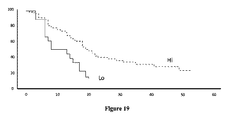
高い(Hi)または低い(Lo)適応的免疫遺伝子サインを有する患者は、非常に異なる臨床転帰および非常に異なる生存期間(適応的免疫遺伝子サインの強力な予後予測値)を有するので、この適応的免疫遺伝子サイン(HiまたはLo)に基づいて患者を層別化する必要があり、これにより、癌処置から恩恵が得られる患者が予測される。類似した適応的免疫遺伝子サイン(HiまたはLo)を有する患者群の比較は、癌処置に有意に応答する患者を検出および予測することを可能とする。例えば、図4は、ステージIVの結腸直腸癌患者を示し、「Hi」な適応的免疫遺伝子サインを有する患者は、延長された生存期間を有し、化学療法による処置を必要としない(化学療法による処置から全く恩恵を受けない)。化学療法による処置の有意で有益な効果が、「Lo」な適応的免疫遺伝子サインを有する患者で観察され得る。図2は、ステージI/IIIの結腸直腸癌患者を示し、「Lo」な適応的免疫遺伝子サインを有する患者は、劣っている生存期間を有し、化学療法による処置から恩恵を受けず、一方、「Hi」な適応的免疫遺伝子サインを有する患者は、化学療法による処置を受けた場合には改善された転帰を有する。図2と同様に、図6は、ステージIIの結腸直腸癌患者を示し、「Lo」な適応的免疫遺伝子サインを有する患者は、劣っている生存期間を有し、化学療法による処置から恩恵を受けず、一方、「Hi」な適応的免疫遺伝子サインを有する患者は、化学療法による処置を受けた場合には改善された転帰を有する。従って、本発明の方法は、「悪い応答者」である第1群の患者(すなわち、処置は、患者の生存期間に対して限定された(または中程度の)影響を及ぼすだろう)および「良好な応答者」である第2群の患者(すなわち、処置は患者の生存期間に対して有意な影響を及ぼすだろう)という、2つの患者群間を識別するのに適切であり得る。 Because patients with high (Hi) or low (Lo) adaptive immune gene signatures have very different clinical outcomes and very different survival times (strong prognostic value of adaptive immune gene signature), this adaptive Patients need to be stratified based on the immune gene signature (Hi or Lo), which predicts patients that will benefit from cancer treatment. Comparison of patient groups with similar adaptive immune gene signatures (Hi or Lo) allows detection and prediction of patients who respond significantly to cancer treatment. For example, FIG. 4 shows a stage IV colorectal cancer patient, where the patient with the “Hi” adaptive immune gene signature has prolonged survival and does not require treatment with chemotherapy (chemotherapy) Will not benefit at all from the treatment). Significant and beneficial effects of chemotherapy treatment can be observed in patients with the “Lo” adaptive immune gene signature. FIG. 2 shows stage I / III colorectal cancer patients, patients with “Lo” adaptive immune gene signature have poor survival and do not benefit from chemotherapy treatment, , Patients with a “Hi” adaptive immune gene signature have an improved outcome when treated with chemotherapy. Similar to FIG. 2, FIG. 6 shows stage II colorectal cancer patients, patients with “Lo” adaptive immunity gene signature have poor survival and benefit from chemotherapy treatment. On the other hand, patients with the “Hi” adaptive immune gene signature have an improved outcome when treated with chemotherapy. Thus, the methods of the present invention provide a first group of patients who are “bad responders” (ie, treatment will have a limited (or moderate) impact on patient survival) and “ It may be appropriate to distinguish between two groups of patients, a second group of patients who are “good responders” (ie, the treatment will have a significant impact on patient survival).
従って、本発明のさらなる局面は、i)患者から得られた腫瘍サンプルにおいて、CCR2、CD3D、CD3E、CD3G、CD8A、CXCL10、CXCL11、GZMA、GZMB、GZMK、GZMM、IL15、IRF1、PRF1、STAT1、CD69、ICOS、CXCR3、STAT4、CCL2およびTBX21からなる群より選択された少なくとも7個の遺伝子の遺伝子発現レベルを決定する工程、ii)工程i)で決定されたあらゆる発現レベルを、その予め決定された参照値と比較する工程、およびiii)工程i)で決定された全ての発現レベルが、その予め決定された参照値よりも高いまたは低い場合には患者は処置に有意に応答するであろうと結論する工程を含む、癌を患う患者が処置に応答するかどうかを決定するための方法に関する。 Thus, a further aspect of the invention is that i) in tumor samples obtained from patients, CCR2, CD3D, CD3E, CD3G, CD8A, CXCL10, CXCL11, GZMA, GZMB, GZMK, GZMM, IL15, IRF1, PRF1, STAT1, Determining the gene expression level of at least 7 genes selected from the group consisting of CD69, ICOS, CXCR3, STAT4, CCL2 and TBX21, ii) any expression level determined in step i) And iii) if all the expression levels determined in step i) are higher or lower than the predetermined reference value, the patient will respond significantly to the treatment. It relates to a method for determining whether a patient suffering from cancer responds to treatment, comprising a step of concluding.
従って、本発明のさらなる局面は、i)患者から得られた腫瘍サンプルにおいて、CCR2、CD3D、CD3E、CD3G、CD8A、CXCL10、CXCL11、GZMA、GZMB、GZMK、GZMM、IL15、IRF1、PRF1、STAT1、CD69、ICOS、CXCR3、STAT4、CCL2およびTBX21の遺伝子発現レベルを決定する工程、ii)工程i)で決定されたあらゆる発現レベルを、その予め決定された参照値と比較する工程、およびiii)工程i)で決定された全ての発現レベルが、その予め決定された参照値よりも高いまたは低い場合には患者は処置に有意に応答するであろうと結論する工程を含む、癌を患う患者が処置に応答するかどうかを決定するための方法に関する。 Accordingly, a further aspect of the invention is that i) in a tumor sample obtained from a patient, CCR2, CD3D, CD3E, CD3G, CD8A, CXCL10, CXCL11, GZMA, GZMB, GZMK, GZMM, IL15, IRF1, PRF1, STAT1, Determining the gene expression level of CD69, ICOS, CXCR3, STAT4, CCL2 and TBX21, ii) comparing any expression level determined in step i) with its predetermined reference value, and iii) step A patient suffering from cancer is treated with a step that concludes that if all the expression levels determined in i) are higher or lower than the predetermined reference value, the patient will respond significantly to the treatment. Relates to a method for determining whether to respond.
特定の態様において、本発明は、i)患者から得られた腫瘍サンプルにおいて、CCR2、CD3D、CD3E、CD3G、CD8A、CXCL10、CXCL11、GZMA、GZMB、GZMK、GZMM、IL15、IRF1、PRF1、STAT1、CD69、ICOS、CXCR3、STAT4、CCL2およびTBX21の遺伝子発現レベルを決定する工程、ii)工程i)で決定されたあらゆる発現レベルを、その予め決定された参照値と比較する工程、およびiii)工程i)で決定された全ての発現レベルがその予め決定された参照値よりも高い場合には患者は処置に有意に応答するであろうと結論する工程、または工程i)で決定された全ての発現レベルがその予め決定された参照値よりも低い場合には患者は処置に有意に応答しないであろうと結論する工程を含む、非転移性結腸直腸癌を患う患者が処置に応答するかどうかを決定するための方法に関する。 In a particular embodiment, the present invention relates to i) tumor samples obtained from patients, CCR2, CD3D, CD3E, CD3G, CD8A, CXCL10, CXCL11, GZMA, GZMB, GZMK, GZMM, IL15, IRF1, PRF1, STAT1, Determining the gene expression level of CD69, ICOS, CXCR3, STAT4, CCL2 and TBX21, ii) comparing any expression level determined in step i) with its predetermined reference value, and iii) step the conclusion that the patient will respond significantly to treatment if all expression levels determined in i) are higher than the predetermined reference value, or all expression determined in step i) Determining whether a patient with non-metastatic colorectal cancer responds to treatment, including the step of concluding that the patient will not respond significantly to treatment if the level is lower than the predetermined reference value On how to do .
また、少なくとも1つの遺伝子がその対応する予め決定された参照値よりも高い場合には中間の結論が提供され得る。遺伝子の発現レベルがその予め決定された参照値よりも高い時にはいつでも、処置に対する患者の応答はより良好であろう。 An intermediate conclusion can also be provided if at least one gene is higher than its corresponding predetermined reference value. Whenever the level of gene expression is higher than its predetermined reference value, the patient's response to treatment will be better.
上記の方法は、処置のガイドラインが確立されていない初期の進行癌患者(TNM分類によるとステージII)にとって特に適切である。上記の方法は、非転移性患者が処置の恩恵を受け得るかどうかを決定するための信頼性のあるツールを提供することによってニーズを満たすだろう。 The above method is particularly appropriate for early advanced cancer patients (stage II according to TNM classification) for which treatment guidelines have not been established. The above method would meet the needs by providing a reliable tool for determining whether non-metastatic patients can benefit from treatment.
特定の態様において、本発明は、i)患者から得られた腫瘍サンプルにおいて、CCR2、CD3D、CD3E、CD3G、CD8A、CXCL10、CXCL11、GZMA、GZMB、GZMK、GZMM、IL15、IRF1、PRF1、STAT1、CD69、ICOS、CXCR3、STAT4、CCL2およびTBX21の遺伝子発現レベルを決定する工程、ii)工程i)で決定されたあらゆる発現レベルを、その予め決定された参照値と比較する工程、およびiii)工程i)で決定された全ての発現レベルがその予め決定された参照値よりも低い場合には患者は処置に有意に応答するであろうと結論する工程、または工程i)で決定された全ての発現レベルがその予め決定された参照値よりも高い場合には患者は処置に有意に応答しないであろうと結論する工程を含む、転移性結腸直腸癌を有する患者が処置に応答するかどうかを決定するための方法に関する。 In a particular embodiment, the present invention relates to i) tumor samples obtained from patients, CCR2, CD3D, CD3E, CD3G, CD8A, CXCL10, CXCL11, GZMA, GZMB, GZMK, GZMM, IL15, IRF1, PRF1, STAT1, Determining the gene expression level of CD69, ICOS, CXCR3, STAT4, CCL2 and TBX21, ii) comparing any expression level determined in step i) with its predetermined reference value, and iii) step concludes that the patient will respond significantly to treatment if all expression levels determined in i) are lower than the predetermined reference value, or all expression determined in step i) Determining whether a patient with metastatic colorectal cancer responds to treatment, including the step of concluding that the patient will not respond significantly to the treatment if the level is higher than the predetermined reference value On how to .
また、少なくとも1つの遺伝子がその対応する予め決定された参照値よりも低い場合には中間の結論が提供され得る。遺伝子の発現レベルがその予め決定された参照値よりも低い時にはいつでも、処置に対する患者の応答はより良好であろう。 An intermediate conclusion can also be provided if at least one gene is lower than its corresponding predetermined reference value. Whenever the level of gene expression is lower than its predetermined reference value, the patient's response to treatment will be better.
特定の態様において、本発明は、i)患者から得られた腫瘍サンプルにおいて、CCR2、CD3D、CD3E、CD3G、CD8A、CXCL10、CXCL11、GZMA、GZMB、GZMK、GZMM、IL15、IRF1、PRF1、STAT1、CD69、ICOS、CXCR3、STAT4、CCL2およびTBX21の遺伝子発現レベルを決定する工程、ii)工程i)で決定されたあらゆる発現レベルを、その予め決定された参照値と比較する工程、およびiii)工程i)で決定された全ての発現レベルがその予め決定された参照値よりも低い場合には患者は処置に有意に応答するであろうと結論する工程、または工程i)で決定された全ての発現レベルがその予め決定された参照値よりも高い場合には患者は処置に有意に応答しないであろうと結論する工程を含む、非転移性肺癌を有する患者が処置に応答するかどうかを決定するための方法に関する。 In a particular embodiment, the present invention relates to i) tumor samples obtained from patients, CCR2, CD3D, CD3E, CD3G, CD8A, CXCL10, CXCL11, GZMA, GZMB, GZMK, GZMM, IL15, IRF1, PRF1, STAT1, Determining the gene expression level of CD69, ICOS, CXCR3, STAT4, CCL2 and TBX21, ii) comparing any expression level determined in step i) with its predetermined reference value, and iii) step concludes that the patient will respond significantly to treatment if all expression levels determined in i) are lower than the predetermined reference value, or all expression determined in step i) To determine whether a patient with non-metastatic lung cancer responds to treatment, including the step of concluding that if the level is higher than the predetermined reference value, the patient will not respond significantly to the treatment Concerning the method.
特定の態様において、本発明は、i)患者から得られた腫瘍サンプルにおいて、CCR2、CD3D、CD3E、CD3G、CD8A、CXCL10、CXCL11、GZMA、GZMB、GZMK、GZMM、IL15、IRF1、PRF1、STAT1、CD69、ICOS、CXCR3、STAT4、CCL2およびTBX21の遺伝子発現レベルを決定する工程、ii)工程i)で決定されたあらゆる発現レベルを、その予め決定された参照値と比較する工程、およびiii)工程i)で決定された全ての発現レベルがその予め決定された参照値よりも高い場合には患者は処置に有意に応答するであろうと結論する工程、または工程i)で決定された全ての発現レベルがその予め決定された参照値よりも低い場合には患者は処置に有意に応答しないであろうと結論する工程を含む、転移性卵巣癌を有する患者が処置に応答するかどうかを決定するための方法に関する。 In a particular embodiment, the present invention relates to i) tumor samples obtained from patients, CCR2, CD3D, CD3E, CD3G, CD8A, CXCL10, CXCL11, GZMA, GZMB, GZMK, GZMM, IL15, IRF1, PRF1, STAT1, Determining the gene expression level of CD69, ICOS, CXCR3, STAT4, CCL2 and TBX21, ii) comparing any expression level determined in step i) with its predetermined reference value, and iii) step the conclusion that the patient will respond significantly to treatment if all expression levels determined in i) are higher than the predetermined reference value, or all expression determined in step i) To determine whether a patient with metastatic ovarian cancer responds to treatment, including the step of concluding that the patient will not respond significantly to the treatment if the level is lower than the predetermined reference value Concerning the method.
処置は、放射線療法、化学療法または免疫療法からなり得る。処置は、アジュバント療法(すなわち、原発腫瘍の外科的切除後の処置)またはネオアジュバント療法(すなわち原発腫瘍の外科的切除前の処置)からなり得る。 Treatment can consist of radiation therapy, chemotherapy or immunotherapy. Treatment may consist of adjuvant therapy (ie treatment after surgical excision of the primary tumor) or neoadjuvant therapy (ie treatment before surgical excision of the primary tumor).
「化学療法剤」という用語は、腫瘍増殖を阻止するのに効果的である全ての化合物を指す。化学療法剤の例としては、アルキル化剤、例えばチオテパおよびシクロホスファミド;アルキルスルホン酸類、例えばブスルファン、インプロスルファンおよびピポスルファン;アジリジン類、例えばベンゾドーパ、カルボクオン、メツレドーパ(meturedopa)、およびウレドパ(uredopa);エチレンイミン類およびメチルメラミン類、例えばアルトレタミン、トリエチレンメラミン、トリエチレンホスホルアミド、トリエチレンチオホスホルアミドおよびトリメチロールメラミン;アセトゲニン類(特にブラタシンおよびブラタシノン);カンプトテシン(合成類似体トポテカンを含む);ブリオスタチン類;カリスタチン;CC−1065(そのアドゼレシン、カルゼレシンおよびビゼレシン合成類似体を含む);クリプトフィシン(特にクリプトフィシン1およびクリプトフィシン8);ドラスタチン;デュオカルマイシン(合成類似体のKW−2189およびCBI−TMIを含む);エリュテロビン;パンクラチスタチン;サルコジクチイン:スポンギスタチン;ナイトロジェンマスタード、例えばクロラムブシル、クロルナファジン、シクロホスファミド、エストラムスチン、イホスファミド、メクロレタミン、メクロレタミンオキシド塩酸塩、メルファラン、ノボエンビキン、フェネステリン、プレドニムスチン、トロホスファミド、ウラシルマスタード;ニトロソ尿素類、例えばカルムスチン、クロロゾトシン、ホテムスチン、ロムスチン、ニムスチン、ラニムスチン;抗生物質、例えばエンジイン抗生物質(例えばカリケアマイシン、特にカリケアマイシン(11およびカリケアマイシン211、例えば、Agnew Chem Intl. Ed. Engl. 33:183-186 (1994)を参照;ダイネミシン、例えばダイネミシンA;エスペラミシン;並びに、ネオカルジノスタチンクロモフォアおよび関連色素タンパク質エンジイン抗生物質クロモフォア)、アクラシノマイシン、アクチノマイシン、アントラマイシン、アザセリン、ブレオマイシン、カクチノマイシン、カラビシン(carabicin)、カルミノマイシン、カルジノフィリン、クロモマイシン、ダクチノマイシン、ダウノルビシン、デトルビシン、6−ジアゾ−5−オキソ−L−ノルロイシン、ドキソルビシン(モルホリノ−ドキソルビシ、シアノモルホリノ−ドキソルビシン、2−ピロリノ−ドキソルビシ、およびデオキシドキソルビシを含む)、エピルビシン、エソルビシン(esorubicin)、イダルビシン、マルセロマイシン、マイトマイシン、ミコフェノール酸、ノガラマイシン、オリボマイシン、ペプロマイシン、ポトフィロマイシン(potfiromycin)、ピューロマイシン、ケラマイシン(quelamycin)、ロドルビシン(rodorubicin)、ストレプトニグリン、ストレプトゾシン、ツベルシジン、ウベニメクス、ジノスタチン、ゾルビシン;代謝拮抗剤、例えばメトトレキサートおよび5−フルオロウラシル(5−FU);葉酸類似体、例えばデノプテリン、メトトレキサート、プテロプテリン、トリメトレキサート;プリン類似体、例えばフルダラビン、6−メルカプトプリン、チアミプリン、チオグアニン;ピリミジン類似体、例えばアンシタビン、アザシチジン、6−アザウリジン、カルモフール、シタラビン、ジデオキシウリジン、ドキシフルリジン、エノシタビン、フロクスウリジン、5−FU;アンドロゲン、例えばカルステロン、プロピオン酸ドロモスタノロン、エピチオスタノール、メピチオスタン、テストラクトン;抗副腎皮質ホルモン剤、例えばアミノグルテチミド、ミトタン、トリロスタン;葉酸補充剤、例えばフォリン酸;アセグラトン;アルドホスファミド配糖体;アミノレブリン酸;アムサクリン;ベストラブシル;ビサントレン;エダトレキサート;デフォファミン(defofamine);デメコルチン;ジアジクオン;エフロルニチン;酢酸エリプチニウム;エポチロン;エトグルシド;硝酸ガリウム;ヒドロキシ尿素;レンチナン;ロニダミン;マイタンシノイド、例えばマイタンシンおよびアンサマイトシン;ミトグアゾン;ミトキサントロン;モピダモール;ニトラクリン;ペントスタチン;フェナメット;ピラルビシン;ポドフィリン酸;2−エチルヒドラジド;プロカルバジン;PSK(登録商標);ラゾキサン;リゾキシン;シゾフィラン;スピロゲンナニウム(spirogennanium);テヌアゾン酸;トリアジコン;2,2’,2’’−トリクロロトリエチルアミン;トリコテセン類(特にT−2毒素、ベルカリンA、ロリジンAおよびアングイジン);ウレタン;ビンデシン;デカルバジン;マンノムスチン;ミトブロニトール;ミトラクトール;ピポブロマン;ガシトシン(gacytosine)、アラビノシド(「Ara−C」);シクロホスファミド;チオテパ;タキソイド、例えばパクリタキセル(タキソール(登録商標)、Bristol-Myers Squibb Oncology, Princeton, N.J.)およびドセタキセル(タキソテア(登録商標)、Rhone-Poulenc Rorer, Antony, France);クロラムブシル;ゲムシタビン;6−チオグアニン;メルカプトプリン;メトトレキサート;白金類似体、例えばシスプラチンおよびカルボプラチン;ビンブラスチン;白金;エトポシド(VP−16);イホスファミド;マイトマイシンC;ミトキサントロン;ビンクリスチン;ビノレルビン;ナベルビン:ノバントロン;テニポシド;ダウノマイシン;アミノプテリン;ゼローダ;イバンドロン酸;CPT−11;トポイソメラーゼ阻害剤RFS2000;ジフルオロメチルオルニチン(DMFO);レチノイン酸;カペシタビン;および上記のいずれかの薬学的に許容される塩、酸または誘導体が挙げられる。また、この定義には、腫瘍に対するホルモン作用を調節または阻害するように作用する抗ホルモン剤、例えば抗エストロゲン剤、例えばタモキシフェン、ラロキシフェン、アロマターゼ阻害性4(5)−イミダゾール、4−ヒドロキシタモキシフェン、トリオキシフェン、ケオキシフェン、LY117018、オナプリストン、およびトレミフェン(フェアストン);並びに抗アンドロゲン剤、例えばフルタミド、ニルタミド、ビカルタミド、ロイプロリドおよびゴセレリン;並びに上記のいずれかの薬学的に許容される塩、酸または誘導体も含まれる。 The term “chemotherapeutic agent” refers to any compound that is effective in inhibiting tumor growth. Examples of chemotherapeutic agents include alkylating agents such as thiotepa and cyclophosphamide; alkyl sulfonic acids such as busulfan, improsulfan and piperosulfan; aziridines such as benzodopa, carboxone, meturedopa, and uredopa ); Ethyleneimines and methylmelamines such as altretamine, triethylenemelamine, triethylenephosphoramide, triethylenethiophosphoramide and trimethylolmelamine; acetogenins (especially bratacin and bratacinone); Bryostatins; calistatin; CC-1065 (including its adzelesin, calzelesin and bizelesin synthetic analogues); cryptophysin (especially Putoficin 1 and Cryptophycin 8); Dolastatin; Duocarmycin (including the synthetic analogs KW-2189 and CBI-TMI); Eluterobin; Pancratistatin; Sarcoctycin: Spongistatin; Chlornafazine, cyclophosphamide, estramustine, ifosfamide, mechloretamine, mechloretamine oxide hydrochloride, melphalan, novoenbiquine, phenesterine, predonimustine, trophosphamide, uracil mustard; nitrosoureas such as carmustine, chlorozotocin, hotemstin, lomustine , Nimustine, ranimustine; antibiotics such as enediyne antibiotics (eg calicheamicin, especially calicheamicin (11 and And calicheamicin 211, for example, Agnew Chem Intl. Ed. Engl. 33: 183-186 (1994); dynemicins, such as dynemicin A; esperamicins; ), Aclacinomycin, actinomycin, anthramycin, azaserine, bleomycin, kactinomycin, carabicin, carminomycin, cardinophylline, chromomycin, dactinomycin, daunorubicin, detorubicin, 6-diazo-5-oxo -L-norleucine, doxorubicin (including morpholino-doxorubicin, cyanomorpholino-doxorubicin, 2-pyrrolino-doxorubicin, and dexoxorubicin), epirubicin, esorubicin, Darubicin, marceromycin, mitomycin, mycophenolic acid, nogaramycin, olivomycin, pepromycin, potfiromycin, puromycin, keramycin, rhodorubicin, streptonigrin, streptozocin, tubercidin, ubenimex, dinostatin Antibiotics such as methotrexate and 5-fluorouracil (5-FU); folic acid analogues such as denopterine, methotrexate, pteropterin, trimetrexate; purine analogues such as fludarabine, 6-mercaptopurine, thiapurine, thioguanine; Pyrimidine analogs such as ancitabine, azacitidine, 6-azauridine, carmofur, cytarabine, dideoxyuridine, Xyfluridine, enocitabine, floxuridine, 5-FU; androgens such as carsterone, drmostanolone propionate, epithiostanol, mepithiostan, test lactones; For example, folinic acid; acegraton; aldophosphamide glycosides; aminolevulinic acid; amsacrine; vestlabsyl; bisantrene; edatrexate; defofamine; defofamine; demecoltin; Urea; lentinan; lonidamine; maytansinoids such as maytansine and ansamitocin; mitguazone; mitoxantrone; Nitracrine; pentostatin; phenamet; pirarubicin; podophyllic acid; 2-ethylhydrazide; procarbazine; PSK®; razoxan; rizoxin; schizophyllan; spirogennanium; ', 2' '-trichlorotriethylamine; trichothecenes (especially T-2 toxin, velkaline A, loridine A and anguidine); urethane; vindesine; decarbazine; mannomustine; mitoblonitol; mitralactol; pipobroman; gacytosine; -C "); cyclophosphamide; thiotepa; taxoids such as paclitaxel (Taxol®, Bristol-Myers Squibb Oncology, Princeton, NJ) and docetaxel (Taxote (R), Rhone-Poulenc Rorer, Antony, France); chlorambucil; gemcitabine; 6-thioguanine; mercaptopurine; methotrexate; platinum analogs such as cisplatin and carboplatin; vinblastine; platinum; etoposide (VP-16); Mitomycin C; Mitoxantrone; Vincristine; Vinorelbine; Navelbine: Novantrone; Teniposide; Daunomycin; Aminopterin; Xeloda; Ibandronic acid; CPT-11; Topoisomerase inhibitor RFS2000; Difluoromethylornithine (DMFO); Retinoic acid; Or a pharmaceutically acceptable salt, acid or derivative thereof. This definition also includes antihormonal agents that act to regulate or inhibit hormonal effects on tumors, such as antiestrogens such as tamoxifen, raloxifene, aromatase inhibitory 4 (5) -imidazole, 4-hydroxy tamoxifen, tri Oxyphene, keoxifene, LY11018, onapristone, and toremifene (fairstone); and antiandrogens such as flutamide, nilutamide, bicalutamide, leuprolide, and goserelin; Is also included.
本明細書に使用される「免疫療法剤」という用語は、癌細胞に対する生体の免疫応答を間接的にもしくは直接的に増強、刺激もしくは増大させる、および/または他の抗癌療法の副作用を和らげる、化合物、組成物もしくは処置を指す。従って、免疫療法は、癌細胞に対する免疫系の応答を直接的にもしくは間接的に刺激もしくは増強する、および/または他の抗癌剤によって引き起こされ得る副作用を和らげる療法である。免疫療法はまた、当技術分野において、免疫学的療法、生物学的療法、生物学的反応修飾物質療法、および生物療法とも称される。当技術分野において公知の一般的な免疫療法剤の例としては、サイトカイン、癌ワクチン、モノクローナル抗体、および非サイトカインアジュバントが挙げられるがそれらに限定されない。あるいは、免疫療法剤による処置は、患者に、ある量の免疫細胞(T細胞、NK細胞、樹状細胞、B細胞など)を投与することからなり得る。 As used herein, the term “immunotherapeutic agent” indirectly or directly enhances, stimulates or increases the body's immune response to cancer cells, and / or alleviates the side effects of other anti-cancer therapies. , Compound, composition or treatment. Thus, immunotherapy is a therapy that directly or indirectly stimulates or enhances the immune system's response to cancer cells and / or mitigates side effects that may be caused by other anticancer agents. Immunotherapy is also referred to in the art as immunological therapy, biological therapy, biological response modifier therapy, and biotherapy. Examples of common immunotherapeutic agents known in the art include, but are not limited to, cytokines, cancer vaccines, monoclonal antibodies, and non-cytokine adjuvants. Alternatively, treatment with an immunotherapeutic agent can consist of administering to a patient an amount of immune cells (T cells, NK cells, dendritic cells, B cells, etc.).
免疫療法剤は非特異的であり得、すなわち、免疫系を全般的に高めることができ、よって、癌細胞の増殖および/または蔓延に対して戦うのにより効果的となるか、あるいはそれらは特異的であり得、すなわち、癌細胞それ自体にターゲティングされ得、免疫療法処方計画は、非特異的免疫療法剤および特異的免疫療法剤の使用を組合せ得る。 Immunotherapeutic agents can be non-specific, i.e. they can generally boost the immune system and are therefore more effective in combating the proliferation and / or spread of cancer cells, or they are specific That is, it can be targeted to the cancer cells themselves and the immunotherapy regimen can combine the use of non-specific and specific immunotherapeutic agents.
非特異的免疫療法剤は、免疫系を刺激または間接的に増大させる物質である。非特異的免疫療法剤は、単独で癌の処置のための主要な療法として使用され、並びに主要な療法に加えて、その場合には、非特異的な免疫療法剤は、他の療法(例えば癌ワクチン)の効力を増強するためのアジュバントとして機能する。非特異的免疫療法剤はまた、この後者の脈絡において、他の療法の副作用(例えば、特定の化学療法剤によって誘発される骨髄抑制)を低減させるように機能し得る。非特異的免疫療法剤は、重要な免疫系細胞に対して作用し、二次応答、例えばサイトカインおよび免疫グロブリンの産生の増加などを引き起こし得る。あるいは、前記薬剤は、それ自体、サイトカインを含み得る。非特異的免疫療法剤は、一般的に、サイトカインまたは非サイトカインアジュバントとして分類される。 Non-specific immunotherapeutic agents are substances that stimulate or indirectly increase the immune system. Non-specific immunotherapeutic agents are used alone as primary therapies for the treatment of cancer, and in addition to primary therapies, non-specific immunotherapeutic agents can be used in other therapies (eg, It functions as an adjuvant for enhancing the efficacy of cancer vaccines. Non-specific immunotherapeutic agents can also function in this latter context to reduce the side effects of other therapies (eg, myelosuppression induced by certain chemotherapeutic agents). Non-specific immunotherapeutic agents can act on important immune system cells and cause secondary responses such as increased production of cytokines and immunoglobulins. Alternatively, the agent may itself contain a cytokine. Non-specific immunotherapeutic agents are generally classified as cytokines or non-cytokine adjuvants.
多くのサイトカインが、免疫系を高めるように設計された一般的な非特異的免疫療法として、または他の療法と共に提供されるアジュバントとしてのいずれかとして、癌の処置に用途を見出す。適切なサイトカインとしては、インターフェロン、インターロイキンおよびコロニー刺激因子が挙げられるがそれらに限定されない。 Many cytokines find use in the treatment of cancer, either as general non-specific immunotherapy designed to boost the immune system or as an adjuvant provided with other therapies. Suitable cytokines include but are not limited to interferons, interleukins and colony stimulating factors.
本発明によって考えられるインターフェロン(IFN)としては、一般的な種類のIFN、IFN−α(IFN−α)、IFN−β(IFN−β)およびIFN−γ(IFN−γ)が挙げられる。IFNは、例えば、癌細胞の増殖を遅延させることによって、癌細胞がより正常な行動を有する細胞へと発達するのを促進することによって、および/または癌細胞による抗原の産生を増加させることによって、免疫系が癌細胞をより容易に認識して破壊するようにすることによって、癌細胞に対して直接的に作用し得る。IFNはまた、例えば、血管新生を減速させることによって、免疫系を高めることによって、および/またはナチュラルキラー(NK)細胞、T細胞およびマクロファージを刺激することによって、癌細胞に対して間接的に作用することができる。組換えIFN−αは、Roferon(Roche Pharmaceuticals)およびIntron A(Schering Corporation)から市販されている。IFN−αの単独での使用または他の免疫療法剤または化学療法剤との併用は、黒色腫(転移性黒色腫を含む)、腎臓癌(転移性腎臓癌を含む)、乳癌、前立腺癌および子宮頸癌(転移性子宮頸癌を含む)を含む、種々の癌の処置に効力を示した。 Interferons (IFN) contemplated by the present invention include the general types of IFN, IFN-α (IFN-α), IFN-β (IFN-β) and IFN-γ (IFN-γ). IFN, for example, by slowing the growth of cancer cells, by promoting the development of cancer cells into cells with more normal behavior, and / or by increasing the production of antigens by cancer cells It can act directly on cancer cells by making the immune system more easily recognize and destroy cancer cells. IFN also acts indirectly on cancer cells, for example by slowing angiogenesis, by enhancing the immune system, and / or by stimulating natural killer (NK) cells, T cells and macrophages. can do. Recombinant IFN-α is commercially available from Roferon (Roche Pharmaceuticals) and Intron A (Schering Corporation). Use of IFN-α alone or in combination with other immunotherapy or chemotherapeutic agents includes melanoma (including metastatic melanoma), kidney cancer (including metastatic kidney cancer), breast cancer, prostate cancer and It has shown efficacy in the treatment of various cancers, including cervical cancer (including metastatic cervical cancer).
本発明によって考えられるインターロイキンとしては、IL−2、IL−4、IL−11およびIL−12が挙げられる。市販されている組換えインターロイキンの例としては、Proleukin(登録商標)(IL−2;Chiron Corporation)およびNeumega(登録商標)(IL−12;Wyeth Pharmaceuticals)が挙げられる。Zymogenetics, Inc. (Seattle, Wash.)は、これもまた本発明の組合せに使用が考えられている組換え型IL−21を現在試験している。単独でまたは他の免疫療法剤もしくは化学療法剤と組み合わせたインターロイキンは、腎臓癌(転移性腎臓癌を含む)、黒色腫(転移性黒色腫を含む)、卵巣癌(再発卵巣癌を含む)、子宮頸癌(転移性子宮頸癌を含む)、乳癌、結腸直腸癌、肺癌、脳癌および前立腺癌を含む、種々の癌の処置に効力を示した。 Interleukins contemplated by the present invention include IL-2, IL-4, IL-11 and IL-12. Examples of commercially available recombinant interleukins include Proleukin® (IL-2; Chiron Corporation) and Neumega® (IL-12; Wyeth Pharmaceuticals). Zymogenetics, Inc. (Seattle, Wash.) Is currently testing recombinant IL-21, which is also contemplated for use in the combinations of the present invention. Interleukins alone or in combination with other immunotherapeutic or chemotherapeutic agents are kidney cancer (including metastatic kidney cancer), melanoma (including metastatic melanoma), ovarian cancer (including recurrent ovarian cancer) Has shown efficacy in the treatment of various cancers, including cervical cancer (including metastatic cervical cancer), breast cancer, colorectal cancer, lung cancer, brain cancer and prostate cancer.
インターロイキンはまた、種々の癌の処置においてIFN−αと組み合わせて良好な活性を示した(Negrier et al., Ann Oncol. 2002 13(9):1460-8;Touranietal, JClin Oncol. 2003 21(21):398794)。 Interleukin also showed good activity in combination with IFN-α in the treatment of various cancers (Negrier et al., Ann Oncol. 2002 13 (9): 1460-8; Touranietal, JClin Oncol. 2003 21 ( 21): 398794).
本発明によって考えられるコロニー刺激因子(CSF)としては、顆粒球コロニー刺激因子(G−CSFまたはフィルグラスチム)、顆粒球−マクロファージコロニー刺激因子(GM−CSFまたはサルグラモスチム)およびエリスロポエチン(エポエチンアルファ、ダルベポエチン)が挙げられる。1つ以上の増殖因子を用いての処置は、従来の化学療法を受けている患者における新たな血液細胞の生成を刺激するのに役立ち得る。従って、CSFを用いての処置は、化学療法に伴う副作用を低減させるのに役立ち得、より高用量の化学療法剤を使用することを可能とし得る。種々の組換えコロニー刺激因子、例えば、Neupogen(登録商標)(G-CSF; Amgen)、Neulasta (pelfilgrastim; Amgen)、Leukine (GM-CSF; Berlex)、Procrit(エリスロポエチン;Ortho Biotech)、 Epogen(エリスロポエチン;Amgen)、 Arnesp(エリスロポエチン)が市販されている。コロニー刺激因子は、黒色腫、結腸直腸癌(転移性結腸直腸癌を含む)および肺癌を含む、癌の処置に効力を示した。 Colony stimulating factors (CSF) contemplated by the present invention include granulocyte colony stimulating factor (G-CSF or filgrastim), granulocyte-macrophage colony stimulating factor (GM-CSF or sargramostim) and erythropoietin (epoetin alfa, darbepoetin) ). Treatment with one or more growth factors can help stimulate the production of new blood cells in patients undergoing conventional chemotherapy. Thus, treatment with CSF may help reduce the side effects associated with chemotherapy and may allow higher doses of chemotherapeutic agents to be used. Various recombinant colony stimulating factors such as Neupogen® (G-CSF; Amgen), Neulasta (pelfilgrastim; Amgen), Leukine (GM-CSF; Berlex), Procrit (erythropoietin; Ortho Biotech), Epogen (erythropoietin) Amgen), Arnesp (erythropoietin) is commercially available. Colony stimulating factors have shown efficacy in the treatment of cancer, including melanoma, colorectal cancer (including metastatic colorectal cancer) and lung cancer.
本発明の組合せに使用するのに適した非サイトカインアジュバントとしては、レバミソール、ミョウバン水酸化物(ミョウバン)、カルメット・ゲラン桿菌(ACG)、不完全フロイントアジュバント(IFA)、QS−21、DETOX、キーホールリムペットヘモシアニン(KLH)およびジニトロフェニル(DNP)が挙げられるがそれらに限定されない。他の免疫療法および/または化学療法と組み合わせた非サイトカインアジュバントは、例えば大腸癌および結腸直腸癌(レバミソール);黒色腫(BCGおよびQS−21);腎臓癌および膀胱癌(BCG)を含む、種々の癌に対する効力を示した。 Non-cytokine adjuvants suitable for use in the combinations of the present invention include levamisole, alum hydroxide (alum), bacilli Calmette Guerin (ACG), incomplete Freund's adjuvant (IFA), QS-21, DETOX, key These include, but are not limited to, whole rimpet hemocyanin (KLH) and dinitrophenyl (DNP). Non-cytokine adjuvants in combination with other immunotherapy and / or chemotherapy include, for example, colorectal and colorectal cancer (levamisole); melanoma (BCG and QS-21); kidney cancer and bladder cancer (BCG) Showed efficacy against cancer.
特異的または非特異的ターゲットを有することに加えて、免疫療法剤は能動的であり得る、すなわち、生体自身の免疫応答を刺激し得る、またはそれらは受動的であり得る、すなわち生体外で生成された免疫系成分を含み得る。 In addition to having specific or non-specific targets, immunotherapeutic agents can be active, i.e., stimulate the body's own immune response, or they can be passive, i.e. generated in vitro. Immune system components may be included.
受動的で特異的な免疫療法は、典型的には、癌細胞の表面上に見られる特定の抗原に対して特異的であるかまたは特定の細胞増殖因子に対して特異的である、1つ以上のモノクローナル抗体の使用を含む。モノクローナル抗体は癌の処置における多くの方法に使用されることにより、例えば、特定の種類の癌に対する被験者の免疫応答を増強し得、血管形成に関与する因子などの特定の細胞増殖因子をターゲティングすることによって、または化学療法剤、放射性粒子もしくは毒素などの他の抗癌剤に連結またはコンジュゲートさせた場合に癌細胞への前記薬剤の送達を増強することによって癌細胞の増殖を妨害し得る。 Passive and specific immunotherapy is typically specific for specific antigens found on the surface of cancer cells or specific for specific cell growth factors. Including the use of the above monoclonal antibodies. Monoclonal antibodies can be used in a number of ways in the treatment of cancer, for example, to enhance a subject's immune response to a particular type of cancer and target specific cell growth factors, such as factors involved in angiogenesis Or may prevent the growth of cancer cells by enhancing delivery of the agent to cancer cells when linked or conjugated to other anticancer agents such as chemotherapeutic agents, radioactive particles or toxins.
本発明の組合せに包含するのに適した癌免疫療法剤として現在使用されているモノクローナル抗体としては、リツキシマブ(リツキサン(登録商標))、トラスツズマブ(ハーセプチン(登録商標))、イブリツモバブチウキセタン(ゼバリン(登録商標))、トシツモマブ(ベキサール(登録商標))、セツキシマブ(C−225、アービタックス(登録商標))、ベバシズマブ(アバスチン(登録商標))、ゲムツズマブオゾガマイシン(マイロターグ(登録商標))、アレムツズマブ(キャンパス(登録商標))およびBL22が挙げられるがそれらに限定されない。モノクローナル抗体は、乳癌(進行転移性乳癌を含む)、結腸直腸癌(進行および/または転移性結腸直腸癌を含む)、卵巣癌、肺癌、前立腺癌、子宮頸癌、黒色腫および脳腫瘍を含む、多種多様な癌の処置に使用される。 Monoclonal antibodies currently used as cancer immunotherapeutic agents suitable for inclusion in the combinations of the present invention include rituximab (Rituxan®), trastuzumab (Herceptin®), ibritumovab tiuxetan (Zevalin (registered trademark)), tositumomab (bexal (registered trademark)), cetuximab (C-225, Erbitux (registered trademark)), bevacizumab (Avastin (registered trademark)), gemtuzumab ozogamicin (Myrotag (registered trademark) Trademark)), alemtuzumab (Campus®) and BL22. Monoclonal antibodies include breast cancer (including advanced metastatic breast cancer), colorectal cancer (including advanced and / or metastatic colorectal cancer), ovarian cancer, lung cancer, prostate cancer, cervical cancer, melanoma and brain tumors, Used in the treatment of a wide variety of cancers.
他の例としては、抗体特異的な共刺激分子が挙げられる。共刺激分子としては、例えば、B7-1/CD80、CD28、B7- 2/CD86、CTLA-4、B7-H1/PD-L1、Gi24/Dies 1/VISTA、B7-H2、ICOS、B7-H3 PD-1、B7-H4、PD-L2/B7-DC、B7-H6、PDCD6、BTLA、4-1 BB/TNFRSF9/CD137、CD40リガンド/TNFSF5、4-1BBリガンド/TNFSF9 GITR/TNFRSF18、HVEM/TNFRSF14、CD27/TNFRSF7、LIGHT/TNFSF14、CD27リガンド/TNFSF7、OX40/TNFRSF4、CD30/TNFRSF8、OX40リガンド/TNFSF4、CD30リガンド/TNFSF8、TACI/TNFRSF13B、CD40/TNFRSF5、2B4/CD244/SLAMF4 CD84/SLAMF5、BLAME/SLAMF8、CD229/SLAMF3、CD2CRACC/SLAMF7、CD2F-10/SLAMF9 NTB-A/SLAMF6、CD48/SLAMF2、SLAM/CD 150、CD58/LFA-3、CD2イカロス、CD53インテグリンアルファ4/CD49d、CD82/Kai-1 インテグリンアルファ4β1、CD90/Thylインテグリンアルファ4β7/LPAM-l、CD96 LAG-3、CD160 LMIR1/CD300A、CRTAM TCL1A、DAP 12 TCL1B、Dectin-1/CLEC7A TIM-l/KIM-1/HAVCR、DPPIV/CD26 TIM-4、EphB6 TSLP、HLAクラスI TSLP R、HLA-DRが挙げられる。特に、抗体は、抗CTLA-4抗体(例えばイピリムマブ)、抗PD1抗体、抗PDL1抗体、抗TIMP3抗体、抗LAG3抗体、抗B7H3抗体、抗B7H4抗体、抗TREM抗体、抗BTLA抗体、抗LIGHT抗体または抗B7H6抗体からなる群より選択される。
Other examples include antibody specific costimulatory molecules. Examples of costimulatory molecules include B7-1 / CD80, CD28, B7-2 / CD86, CTLA-4, B7-H1 / PD-L1, Gi24 / Dies 1 / VISTA, B7-H2, ICOS, B7-H3. PD-1, B7-H4, PD-L2 / B7-DC, B7-H6, PDCD6, BTLA, 4-1 BB / TNFRSF9 / CD137, CD40 ligand / TNFSF5, 4-1BB ligand / TNFSF9 GITR / TNFRSF18, HVEM / TNFRSF14, CD27 / TNFRSF7, LIGHT / TNFSF14, CD27 ligand / TNFSF7, OX40 / TNFRSF4, CD30 / TNFRSF8, OX40 ligand / TNFSF4, CD30 ligand / TNFSF8, TACI / TNFRSF13B, CD40 / TNFRSF5, 2B4 / CD244 / SLAMF4 CD84 / SLAMF4 BLAME / SLAMF8, CD229 / SLAMF3, CD2CRACC / SLAMF7, CD2F-10 / SLAMF9 NTB-A / SLAMF6, CD48 / SLAMF2, SLAM /
モノクローナル抗体は、単独でまたは他の免疫療法剤もしくは化学療法剤と組み合わせて使用され得る。 Monoclonal antibodies can be used alone or in combination with other immunotherapeutic or chemotherapeutic agents.
能動的で特異的な免疫療法は、典型的には、癌ワクチンの使用を含む。全癌細胞、癌細胞の一部、または癌細胞に由来する1つ以上の抗原を含む、癌ワクチンが開発された。癌ワクチンは、単独でまたは1つ以上の免疫療法剤もしくは化学療法剤と組み合わせて、黒色腫、腎臓癌、卵巣癌、乳癌、結腸直腸癌および肺癌を含む、数種類の癌の処置において調査中である。生体の免疫応答を増強するために、癌ワクチンと組み合わせた非特異的な免疫療法剤が有用である。 Active and specific immunotherapy typically involves the use of cancer vaccines. Cancer vaccines have been developed that contain whole cancer cells, portions of cancer cells, or one or more antigens derived from cancer cells. Cancer vaccines are under investigation in the treatment of several types of cancer, including melanoma, kidney cancer, ovarian cancer, breast cancer, colorectal cancer and lung cancer, alone or in combination with one or more immunotherapy or chemotherapeutic agents is there. Non-specific immunotherapeutic agents combined with cancer vaccines are useful for enhancing the immune response of the body.
免疫療法剤による処置は、Nicholas P. Restifo, Mark E. DudleyおよびSteven A. Rosenberg "Adoptive immunotherapy for cancer: harnessing the T cell response, Nature Reviews Immunology, Volume 12, April 2012に記載されているような養子免疫療法からなり得る。養子免疫療法では、患者の循環中のリンパ球または腫瘍浸潤リンパ球をインビトロで単離し、IL−2などのリンホカインによって活性化させるかまたは腫瘍壊死のための遺伝子を用いて形質導入し、再投与する(Rosenberg et al., 1988; 1989)。活性化リンパ球は、最も好ましくは、血液または腫瘍サンプルから以前に単離されインビトロで活性化(または「増殖」)された患者自身の細胞である。この形態の免疫療法は、数症例の黒色腫および腎臓癌の退縮をもたらした。
Treatment with an immunotherapeutic agent is adopted as described in Nicholas P. Restifo, Mark E. Dudley and Steven A. Rosenberg "Adoptive immunotherapy for cancer: harnessing the T cell response, Nature Reviews Immunology,
本明細書に使用される「放射線療法剤」という用語は、癌を処置または寛解するのに効果的である当業者に公知の任意の放射線療法剤を指すことを意味するがこれに限定されない。例えば、放射線療法剤は、密封小線源療法または放射線核種療法で投与されるような薬剤であり得る。 The term “radiotherapy agent” as used herein is meant to refer to, but is not limited to, any radiation therapy agent known to those of skill in the art that is effective in treating or ameliorating cancer. For example, the radiation therapy agent can be an agent such as administered by brachytherapy or radionuclide therapy.
このような方法は、場合によりさらに、例えば化学療法および/または別の放射線療法および/または別の免疫療法などであるがこれらに限定されない、1つ以上の追加の癌療法の投与を含み得る。 Such a method may optionally further comprise administration of one or more additional cancer therapies, such as but not limited to chemotherapy and / or another radiation therapy and / or another immunotherapy.
本発明のさらなる目的は、本発明の方法を実施するためのキットに関し、前記キットは、患者から得られたサンプル中の本発明の21個の遺伝子の発現レベルを測定するための手段を含む。 A further object of the present invention relates to a kit for carrying out the method of the present invention, said kit comprising means for measuring the expression level of 21 genes of the present invention in a sample obtained from a patient.
従って、本発明はまた、CCR2、CD3D、CD3E、CD3G、CD8A、CXCL10、CXCL11、GZMA、GZMB、GZMK、GZMM、IL15、IRF1、PRF1、STAT1、CD69、ICOS、CXCR3、STAT4、CCL2およびTBX21からなる群より選択された少なくとも7個の遺伝子の発現レベルを決定するための手段を含む、本発明のキットに関する。 Therefore, the present invention also comprises CCR2, CD3D, CD3E, CD3G, CD8A, CXCL10, CXCL11, GZMA, GZMB, GZMK, GZMM, IL15, IRF1, PRF1, STAT1, CD69, ICOS, CXCR3, STAT4, CCL2 and TBX21 It relates to a kit according to the invention, comprising means for determining the expression level of at least 7 genes selected from the group.
従って、本発明はまた、CCR2、CD3D、CD3E、CD3G、CD8A、CXCL10、CXCL11、GZMA、GZMB、GZMK、GZMM、IL15、IRF1、PRF1、STAT1、CD69、ICOS、CXCR3、STAT4、CCL2およびTBX21の発現レベルを決定するための手段を含む、本発明のキットに関する。 Therefore, the present invention also expresses CCR2, CD3D, CD3E, CD3G, CD8A, CXCL10, CXCL11, GZMA, GZMB, GZMK, GZMM, IL15, IRF1, PRF1, STAT1, CD69, ICOS, CXCR3, STAT4, CCL2 and TBX21 It relates to a kit according to the invention comprising means for determining the level.
キットは、上記したようなプローブ、プライマー、マクロアレイ、またはマイクロアレイを含み得る。例えば、キットは、通常、DNAから作られ、予めラベル化されていてもよい、上記に定義したような1セットのプローブを含み得る。あるいは、プローブはラベル化されていなくてもよく、ラベル化のための成分が、キット内の別々の容器に含まれていてもよい。キットはさらに、特定のハイブリダイゼーションプロトコールに必要とされる、ハイブリダイゼーション試薬または他の適切にパッケージングされた試薬および材料(固相マトリックス(適用可能である場合)および標準物質を含む)を含み得る。あるいは、本発明のキットは、予めラベル化されていてもよいか、またはアフィニティ精製部分もしくは付着部分を含んでいてもよい、増幅プライマーを含み得る。キットはさらに、特定の増幅プロトコールに必要とされる、増幅試薬並びにまた他の適切にパッケージングされた試薬および材料を含み得る。 The kit can include probes, primers, macroarrays, or microarrays as described above. For example, a kit may comprise a set of probes as defined above, usually made from DNA and may be pre-labeled. Alternatively, the probe may not be labeled and the components for labeling may be contained in separate containers within the kit. The kit may further include hybridization reagents or other appropriately packaged reagents and materials (including solid phase matrix (if applicable) and standards) as required for the particular hybridization protocol. . Alternatively, kits of the invention can include amplification primers that can be pre-labeled or can include an affinity purification or attachment moiety. The kit may further include amplification reagents as well as other appropriately packaged reagents and materials required for a particular amplification protocol.
本発明は、以下の図面および実施例によってさらに説明されるだろう。しかしながら、これらの実施例および図面は、いずれもしても本発明の範囲を制限するものと捉えるべきではない。 The invention will be further illustrated by the following figures and examples. However, these examples and drawings should not be construed as limiting the scope of the present invention in any way.
実施例1:
材料および方法
患者およびデータベース:
1996年から2004年までの間にLaennec-HEGP病院でその腫瘍の初回切除を受けた結腸直腸癌(CRC)患者の記録が、論評され、以前に記載されていた(Galon et al. 2006)。十分なRNAの品質および量を有する、1996年から2004年までのLaennec-HEGP病院から入手可能な凍結腫瘍サンプルが選択された(検証コホート1、n=108)。分析したRNAサンプルは108人の異なる患者からのものであった。これらの患者は、遺伝子発現実験のために使用された(Taqmanコホート)。コホートの観察時間は診断から最後の接触(死亡または最後のフォローアップ)までの時間であった。データは、再発または死亡しなかった患者については最後のフォローアップ時に検討されていた。進行/死亡または最後のフォローアップまでの最低:最高値は、それぞれ、(0:136)か月であった。フォローアップデータが入手できなかった3人の患者は、生存分析から除外された。再発までの期間または無病期間は、再発患者については手術日から確定腫瘍再発日までの区間として、無病患者については手術日から最後のフォローアップ日までの時間として定義された。
Example 1:
Materials and Methods <br/> Patients and Database:
Records of patients with colorectal cancer (CRC) who underwent initial resection of the tumor at Laennec-HEGP hospital between 1996 and 2004 were reviewed and described previously (Galon et al. 2006). A frozen tumor sample available from the Laennec-HEGP hospital from 1996 to 2004 with sufficient RNA quality and quantity was selected (
組織病理学的所見および臨床所見を、UICC−TNMステージ分類システムに従ってスコアリングした。術後患者の調査を、Laennec-HEGP病院で全ての患者についてCRC患者の一般的な慣行に従って実施した。アジュバント化学療法を、ステージIIおよびIIIのCRCを有する患者に投与するかまたは投与せず、対症療法的な化学療法を、進行した結腸直腸癌患者(ステージIV)および腫瘍の完全切除がなされていない患者に投与した。アジュバント化学療法は、フルオロウラシル(FU)系であった。フォローアップデータを前向きに収集し、更新した。信頼し得るウェブベースのデータベース、TME.データベース(Tumor MicroEnvironment Database)をJava-2 Enterprise-Edition (J2EE)を使用して3段構造物上に構築し、臨床データと高処理法によるデータを統合した。 Histopathological and clinical findings were scored according to the UICC-TNM staging system. Post-surgical patient surveys were performed at Laennec-HEGP hospital according to the general practice of CRC patients for all patients. Adjuvant chemotherapy is administered or not administered to patients with stage II and III CRC, and symptomatic chemotherapy is not performed in patients with advanced colorectal cancer (stage IV) and complete tumor resection Administered to patients. Adjuvant chemotherapy was the fluorouracil (FU) system. Follow-up data was collected and updated prospectively. A reliable web-based database, the TME. Database (Tumor MicroEnvironment Database), was built on a three-level structure using Java-2 Enterprise-Edition (J2EE) to integrate clinical data and high-throughput data. .
遺伝子発現分析:
組織サンプルは、手術後15分以内に急速凍結され、液体窒素中に保存されていた。十分なRNAの品質および量を有する、Laennec-HEGP病院から入手可能な無作為に選択された患者の凍結腫瘍サンプル(コホート1、n=108)を、遺伝子発現分析のために選択した。分析したRNAサンプルは108人の異なる患者からのものであった。全RNAを、RNeasy分離キット(Qiagen, Valencia, CA)による均質化によって分離した。RNAの完全性および量を、バイオアナライザー2100(Agilent Technologies, Palo Alto, CA)で評価した。RT−PCR実験を、製造業者の説明書(Applied-Biosystems, Foster City, CA)に従って実施した。定量的リアルタイムTaqMan−PCRを、低密度アレイおよび7900ロボット化リアルタイムPCR装置(Applied-Biosystems)を使用して実施した。18SリボソームRNAプライマーおよびプローブが、内部対照として使用された。遺伝子発現分析は、18SリボソームRNAに規準化されたCt値(閾値サイクル)を使用して実施された(ΔCt)。データは、SDSソフトウェアv2.2(Applied-Biosystems)およびTME統計モジュールを使用して分析された。
Gene expression analysis:
Tissue samples were snap frozen within 15 minutes after surgery and stored in liquid nitrogen. Randomly selected patient frozen tumor samples (
結果:
本発明者らは、腫瘍サンプルにおける遺伝子CCR2、CD3D、CD3E、CD3G、CD8A、CXCL10、CXCL11、GZMA、GZMB、GZMK、GZMM、IL15、IRF1、PRF1、STAT1、CD69、ICOS、CXCR3、STAT4、CCL2およびTBX2の発現レベル(EL)を決定した。予め決定された参照値(ELR)は、国際公開公報第2007045996号およびJerome Galon, et al. (Type, Density, and Location of Immune Cells Within Human Colorectal Tumors Predict Clinical Outcome Science 313, 1960 (2006); DOI: 10.1126/science.1129139)に従って以前に決定された。その後、本発明者らは、以下のようにスコアを構築した:0個の遺伝子が、その予め決定された参照値よりも高いその発現レベルを有する場合にはI0(すなわち、全ての遺伝子が、その予め決定された参照値よりも低いその発現レベルを有する)、n子の遺伝子がそのそれぞれの予め決定された参照値よりも高いその発現レベルを有する場合にはIn(I1−I21)。結果の解釈を明瞭にするために、本発明者らは患者を2つの群に分ける:I0−I10のスコアを有する患者については「低いレベル」、I11−I21のスコアを有する患者については「高いレベル」。その後、2つの患者群についてのKM曲線を描いた。結果を図1〜6に示す。本発明者らは、患者(非転移性患者または転移性患者)のステージがどのようなものであろうとも、スコアが高くなればなるほど、患者の生存期間が長くなると判定した(図1、3および4)。興味深いことに、非転移性結腸直腸癌について、本発明者らは、高いスコアを有する患者は、有利なことに、低いスコアを有する患者と比較して化学療法剤による処置の恩恵を受けると判定した(図2)。逆に、転移性結腸直腸癌については、本発明者らは、低いスコアを有する患者は、有利なことに、低いスコアを有する患者と比較して化学療法剤による処置の恩恵を受けると判定した(図4)。より興味深いことには、初期の進行非転移性結腸直腸癌(ステージII)について、本発明者らは、高いスコアを有する患者は、有利なことに、低いスコアを有する患者と比較して化学療法剤による処置の恩恵を受けると判定した(図6)。従って、化学療法剤に適格である患者を選択するためのガイドラインが現在全く存在しない前記カテゴリーの患者について、同定されたサインは、患者が有利には化学療法剤による処置を受けるかどうかを決定するのに非常に役立つであろう。
result:
We have the genes CCR2, CD3D, CD3E, CD3G, CD8A, CXCL10, CXCL11, GZMA, GZMB, GZMK, GZMM, IL15, IRF1, PRF1, STAT1, CD69, ICOS, CXCR3, STAT4, CCL2 in tumor samples and The expression level (EL) of TBX2 was determined. Predetermined reference values (ELRs) are described in WO2007045996 and Jerome Galon, et al. (Type, Density, and Location of Immune Cells Within Human Colorectal Tumors Predict Clinical Outcome Science 313, 1960 (2006); DOI : 10.1126 / science.1129139) previously determined. The inventors then constructed a score as follows: if 0 gene has its expression level higher than its predetermined reference value, I0 (ie all genes are In (I1-I21) if the n-child gene has its expression level higher than its respective predetermined reference value. To clarify the interpretation of the results, we divide the patients into two groups: “low level” for patients with a score of I0-I10, “high” for patients with a score of I11-I21. level". Subsequently, KM curves were drawn for the two patient groups. The results are shown in FIGS. The inventors have determined that the higher the score, the longer the patient's survival time, whatever the stage of the patient (non-metastatic or metastatic patient) (FIGS. 1, 3). And 4). Interestingly, for non-metastatic colorectal cancer, we have determined that patients with high scores will advantageously benefit from treatment with chemotherapeutic agents compared to patients with low scores. (FIG. 2). Conversely, for metastatic colorectal cancer, we have determined that patients with low scores will advantageously benefit from treatment with chemotherapeutic agents compared to patients with low scores. (FIG. 4). More interestingly, for early advanced non-metastatic colorectal cancer (stage II), we found that patients with high scores advantageously benefit from chemotherapy compared to patients with low scores. It was determined that they would benefit from treatment with the agent (Figure 6). Thus, for those categories of patients for which there are currently no guidelines for selecting patients eligible for chemotherapeutic agents, the identified signature determines whether the patient is advantageously treated with chemotherapeutic agents Would be very helpful.
実施例2:
実施例1で同定された21個の遺伝子のサインは、乳癌、子宮頸癌、肝細胞癌、肺癌、黒色腫、卵巣癌または膵臓癌を患う患者の生存期間を予測するために検証された(例えば、図7、12、14および16を参照されたい)。少なくとも7個の遺伝子の最小のサインも決定された(図8、9、10、11、13、15、17、18および19を参照されたい)。
Example 2:
The signature of the 21 genes identified in Example 1 was verified to predict the survival of patients with breast cancer, cervical cancer, hepatocellular carcinoma, lung cancer, melanoma, ovarian cancer or pancreatic cancer ( See, for example, FIGS. 7, 12, 14 and 16). The minimum signature of at least 7 genes was also determined (see FIGS. 8, 9, 10, 11, 13, 15, 17, 18 and 19).
実施例3:
図20は、ステージIB−IIIVの肺癌患者(NSCLC)を示し、「Hi」な適応的免疫遺伝子サインを有する患者は、延長された生存期間を有し、化学療法による処置を必要としない(化学療法による処置により恩恵を全く受けない)。化学療法による処置の有意で有益な効果は、「Lo」な適応的免疫遺伝子サインを有する患者で観察され得る。
Example 3:
FIG. 20 shows stage IB-IIIV lung cancer patients (NSCLC), patients with “Hi” adaptive immune gene signature have prolonged survival and do not require treatment with chemotherapy (chemistry No benefit from therapy treatment). Significant and beneficial effects of chemotherapy treatment can be observed in patients with the “Lo” adaptive immune gene signature.
図21は、ステージIII/IVの卵巣癌患者を示し、「Hi」な適応的免疫遺伝子サインを有する患者は、化学療法による処置の有意で有益な効果を有する。逆に、「Lo」な適応的免疫遺伝子サインを有する患者は、生存期間を延長し、化学療法による処置を必要としない(化学療法による処置により恩恵を全く受けない)。 FIG. 21 shows stage III / IV ovarian cancer patients, and patients with the “Hi” adaptive immune gene signature have a significant and beneficial effect of treatment with chemotherapy. Conversely, patients with an “Lo” adaptive immune gene signature prolong survival and do not require treatment with chemotherapy (no benefit from treatment with chemotherapy).
参考文献:
本出願全体を通して、種々の参考文献が、本発明が属する技術分野の最新技術を記載している。これらの参考文献の開示は、本開示への参照によって本明細書に組み入れられる。
References:
Throughout this application, various references describe the state of the art to which this invention belongs. The disclosures of these references are incorporated herein by reference to the present disclosure.
Claims (24)
Priority Applications (1)
| Application Number | Priority Date | Filing Date | Title |
|---|---|---|---|
| JP2019099354A JP6936277B2 (en) | 2012-07-12 | 2019-05-28 | Methods for predicting survival and treatment responsiveness of patients with solid tumors using the signatures of at least 7 genes |
Applications Claiming Priority (3)
| Application Number | Priority Date | Filing Date | Title |
|---|---|---|---|
| EP12305836.4 | 2012-07-12 | ||
| EP12305836 | 2012-07-12 | ||
| PCT/EP2013/064808 WO2014009535A2 (en) | 2012-07-12 | 2013-07-12 | Methods for predicting the survival time and treatment responsiveness of a patient suffering from a solid cancer with a signature of at least 7 genes |
Related Child Applications (1)
| Application Number | Title | Priority Date | Filing Date |
|---|---|---|---|
| JP2019099354A Division JP6936277B2 (en) | 2012-07-12 | 2019-05-28 | Methods for predicting survival and treatment responsiveness of patients with solid tumors using the signatures of at least 7 genes |
Publications (3)
| Publication Number | Publication Date |
|---|---|
| JP2015528698A true JP2015528698A (en) | 2015-10-01 |
| JP2015528698A5 JP2015528698A5 (en) | 2016-08-25 |
| JP6923291B2 JP6923291B2 (en) | 2021-08-18 |
Family
ID=48782367
Family Applications (3)
| Application Number | Title | Priority Date | Filing Date |
|---|---|---|---|
| JP2015521016A Active JP6923291B2 (en) | 2012-07-12 | 2013-07-12 | A method for predicting survival and treatment responsiveness of patients with solid tumors using the signatures of at least 7 genes |
| JP2019099354A Active JP6936277B2 (en) | 2012-07-12 | 2019-05-28 | Methods for predicting survival and treatment responsiveness of patients with solid tumors using the signatures of at least 7 genes |
| JP2021112781A Active JP7378443B2 (en) | 2012-07-12 | 2021-07-07 | A method for predicting survival and response to treatment in patients with solid tumors using a signature of at least seven genes. |
Family Applications After (2)
| Application Number | Title | Priority Date | Filing Date |
|---|---|---|---|
| JP2019099354A Active JP6936277B2 (en) | 2012-07-12 | 2019-05-28 | Methods for predicting survival and treatment responsiveness of patients with solid tumors using the signatures of at least 7 genes |
| JP2021112781A Active JP7378443B2 (en) | 2012-07-12 | 2021-07-07 | A method for predicting survival and response to treatment in patients with solid tumors using a signature of at least seven genes. |
Country Status (8)
| Country | Link |
|---|---|
| US (2) | US11242564B2 (en) |
| EP (1) | EP2872646B1 (en) |
| JP (3) | JP6923291B2 (en) |
| DK (1) | DK2872646T3 (en) |
| ES (1) | ES2648176T3 (en) |
| NO (1) | NO2872646T3 (en) |
| PL (1) | PL2872646T3 (en) |
| WO (1) | WO2014009535A2 (en) |
Cited By (8)
| Publication number | Priority date | Publication date | Assignee | Title |
|---|---|---|---|---|
| WO2017065000A1 (en) * | 2015-10-15 | 2017-04-20 | 国立大学法人京都大学 | Biomarker for predicting remarkable response of pd-1 pathway inhibitor |
| JP2018534927A (en) * | 2015-10-22 | 2018-11-29 | ジョンス セラピューティクス, インコーポレイテッド | Gene signature that determines ICOS expression |
| KR20190016025A (en) * | 2016-05-09 | 2019-02-15 | 인스티튜트 내셔널 드 라 싼테 에 드 라 리셰르셰 메디칼르 (인 썸) | Classification of Patients with Solid Cancer |
| JP2019511552A (en) * | 2016-04-15 | 2019-04-25 | トリリウム セラピューティクス インコーポレイテッド | Stimulation of macrophages in CD47 blockade therapy |
| JP2019521169A (en) * | 2016-07-19 | 2019-07-25 | テバ・ファーマシューティカルズ・オーストラリア・ピーティワイ・リミテッド | Anti-CD47 combination therapy |
| JP2019162138A (en) * | 2012-07-12 | 2019-09-26 | アンスティチュ ナショナル ドゥ ラ サンテ エ ドゥ ラ ルシェルシュ メディカル | Methods for predicting survival time and treatment responsiveness of a patient suffering from a solid tumor using a signature of at least seven genes |
| JP2020523022A (en) * | 2017-06-14 | 2020-08-06 | アイカーン スクール オブ メディシン アット マウント サイナイ | Methods of detecting and treating a class of hepatocellular carcinoma responsive to immunotherapy |
| JP2023531305A (en) * | 2020-06-30 | 2023-07-21 | アンスティチュ ナショナル ドゥ ラ サンテ エ ドゥ ラ ルシェルシュ メディカル | A method for predicting the risk of recurrence and/or death in patients with solid tumors after neoadjuvant therapy. |
Families Citing this family (28)
| Publication number | Priority date | Publication date | Assignee | Title |
|---|---|---|---|---|
| US10801070B2 (en) | 2013-11-25 | 2020-10-13 | The Broad Institute, Inc. | Compositions and methods for diagnosing, evaluating and treating cancer |
| US11725237B2 (en) | 2013-12-05 | 2023-08-15 | The Broad Institute Inc. | Polymorphic gene typing and somatic change detection using sequencing data |
| US20160312295A1 (en) * | 2013-12-17 | 2016-10-27 | Merck Sharp & Dohme Corp. | Gene signature biomarkers of tumor response to pd-1 antagonists |
| EP3084003A4 (en) * | 2013-12-17 | 2017-07-19 | Merck Sharp & Dohme Corp. | Ifn-gamma gene signature biomarkers of tumor response to pd-1 antagonists |
| AU2014368898B2 (en) | 2013-12-20 | 2020-06-11 | Dana-Farber Cancer Institute, Inc. | Combination therapy with neoantigen vaccine |
| CN107148274A (en) * | 2014-08-19 | 2017-09-08 | 国立大学法人冈山大学 | Strengthen the method for immune cell function and assess the multi-functional method of immunocyte |
| US20170298443A1 (en) * | 2014-09-25 | 2017-10-19 | Moffitt Genetics Corporation | Prognostic tumor biomarkers |
| MX2017005750A (en) | 2014-11-03 | 2017-12-15 | Genentech Inc | Assays for detecting t cell immune subsets and methods of use thereof. |
| EP3215637B1 (en) * | 2014-11-03 | 2019-07-03 | F. Hoffmann-La Roche AG | Methods and biomarkers for predicting efficacy and valuation of an ox40 agonist treatment |
| MX2017007535A (en) | 2014-12-09 | 2017-08-10 | Merck Sharp & Dohme | System and methods for deriving gene signature biomarkers of response to pd-1 antagonists. |
| US10993997B2 (en) | 2014-12-19 | 2021-05-04 | The Broad Institute, Inc. | Methods for profiling the t cell repertoire |
| US10975442B2 (en) | 2014-12-19 | 2021-04-13 | Massachusetts Institute Of Technology | Molecular biomarkers for cancer immunotherapy |
| EP3735986A1 (en) | 2015-03-23 | 2020-11-11 | Jounce Therapeutics, Inc. | Antibodies to icos |
| EP3073268A1 (en) * | 2015-03-27 | 2016-09-28 | Deutsches Krebsforschungszentrum Stiftung des Öffentlichen Rechts | Biomarker panel for diagnosing cancer |
| EP3839510A3 (en) * | 2015-04-17 | 2021-08-25 | Merck Sharp & Dohme Corp. | Blood-based biomarkers of tumor sensitivity to pd-1 antagonists |
| PE20180670A1 (en) | 2015-05-20 | 2018-04-19 | Broad Inst Inc | SHARED NEOANTIGENS |
| WO2017096458A1 (en) * | 2015-12-07 | 2017-06-15 | Ontario Institute For Cancer Research (Oicr) | Immune gene signature predictive of anthracycline benefit |
| WO2018045346A1 (en) * | 2016-09-01 | 2018-03-08 | Autotelic Llc | Methods for treating cancer and determining efficacy of treatment |
| US11549149B2 (en) | 2017-01-24 | 2023-01-10 | The Broad Institute, Inc. | Compositions and methods for detecting a mutant variant of a polynucleotide |
| EP3589754B1 (en) | 2017-03-01 | 2023-06-28 | F. Hoffmann-La Roche AG | Diagnostic and therapeutic methods for cancer |
| US20210142864A1 (en) * | 2017-06-16 | 2021-05-13 | Nantomics, Llc | Prognostic indicators of poor outcomes in pregnant metastatic breast cancer cohort |
| WO2020245155A1 (en) | 2019-06-03 | 2020-12-10 | INSERM (Institut National de la Santé et de la Recherche Médicale) | Methods for modulating a treatment regimen |
| MX2022004501A (en) | 2019-11-07 | 2022-05-06 | Oncxerna Therapeutics Inc | Classification of tumor microenvironments. |
| TWI865759B (en) | 2020-04-01 | 2024-12-11 | 美商阿法羅醫療股份有限公司 | Methods and treatment involving excess free light |
| GB202007099D0 (en) | 2020-05-14 | 2020-07-01 | Kymab Ltd | Tumour biomarkers for immunotherapy |
| MX2022016220A (en) * | 2020-06-18 | 2023-03-01 | Macrogenics Inc | Use of bispecific cd123 x cd3 diabodies for the treatment of hematologic malignancies. |
| JP7741831B2 (en) | 2020-06-30 | 2025-09-18 | アンスティチュ ナショナル ドゥ ラ サンテ エ ドゥ ラ ルシェルシュ メディカル | Method for predicting the risk of recurrence and/or death in patients with solid tumors after neoadjuvant therapy and curative surgery - Patent Application 20070122997 |
| WO2023175366A1 (en) | 2022-03-17 | 2023-09-21 | Veracyte | Methods for predicting response to an immunotherapeutic treatment in a patient with a cancer |
Citations (8)
| Publication number | Priority date | Publication date | Assignee | Title |
|---|---|---|---|---|
| WO2004037996A2 (en) * | 2002-10-24 | 2004-05-06 | Duke University | Evaluation of breast cancer states and outcomes using gene expression profiles |
| JP2007516693A (en) * | 2003-06-09 | 2007-06-28 | ザ・リージェンツ・オブ・ザ・ユニバーシティ・オブ・ミシガン | Compositions and methods for the treatment and diagnosis of cancer |
| JP2009515148A (en) * | 2005-10-19 | 2009-04-09 | アンセルム (アンスティテュ ナシオナル ドゥ ラ サンテ エ ドゥ ラ ルシェルシュ メディカル) | Method for in vitro prognosis of cancer progression and outcome of a patient, and means for performing the method |
| WO2009091659A2 (en) * | 2008-01-16 | 2009-07-23 | Shi-Lung Lin | Generation of tumor-free embryonic stem-like pluripotent cells using inducible recombinant rna agents |
| JP2009538607A (en) * | 2006-06-02 | 2009-11-12 | グラクソスミスクライン バイオロジカルズ ソシエテ アノニム | How to identify whether a patient is a responder to immunotherapy |
| WO2010144192A1 (en) * | 2009-05-05 | 2010-12-16 | Children's Medical Center Corporation | Prognosis indicators for solid human tumors |
| WO2011011339A1 (en) * | 2009-07-20 | 2011-01-27 | Genentech, Inc. | Gene expression markers for crohn's disease |
| WO2011068839A1 (en) * | 2009-12-01 | 2011-06-09 | Compendia Bioscience, Inc. | Classification of cancers |
Family Cites Families (50)
| Publication number | Priority date | Publication date | Assignee | Title |
|---|---|---|---|---|
| US4888278A (en) | 1985-10-22 | 1989-12-19 | University Of Massachusetts Medical Center | In-situ hybridization to detect nucleic acid sequences in morphologically intact cells |
| US5447841A (en) | 1986-01-16 | 1995-09-05 | The Regents Of The Univ. Of California | Methods for chromosome-specific staining |
| US6280929B1 (en) | 1986-01-16 | 2001-08-28 | The Regents Of The University Of California | Method of detecting genetic translocations identified with chromosomal abnormalities |
| US4774339A (en) | 1987-08-10 | 1988-09-27 | Molecular Probes, Inc. | Chemically reactive dipyrrometheneboron difluoride dyes |
| US5132432A (en) | 1989-09-22 | 1992-07-21 | Molecular Probes, Inc. | Chemically reactive pyrenyloxy sulfonic acid dyes |
| US5433896A (en) | 1994-05-20 | 1995-07-18 | Molecular Probes, Inc. | Dibenzopyrrometheneboron difluoride dyes |
| US5274113A (en) | 1991-11-01 | 1993-12-28 | Molecular Probes, Inc. | Long wavelength chemically reactive dipyrrometheneboron difluoride dyes and conjugates |
| US5248782A (en) | 1990-12-18 | 1993-09-28 | Molecular Probes, Inc. | Long wavelength heteroaryl-substituted dipyrrometheneboron difluoride dyes |
| US5338854A (en) | 1991-02-13 | 1994-08-16 | Molecular Probes, Inc. | Fluorescent fatty acids derived from dipyrrometheneboron difluoride dyes |
| US5427932A (en) | 1991-04-09 | 1995-06-27 | Reagents Of The University Of California | Repeat sequence chromosome specific nucleic acid probes and methods of preparing and using |
| US5187288A (en) | 1991-05-22 | 1993-02-16 | Molecular Probes, Inc. | Ethenyl-substituted dipyrrometheneboron difluoride dyes and their synthesis |
| US5262357A (en) | 1991-11-22 | 1993-11-16 | The Regents Of The University Of California | Low temperature thin films formed from nanocrystal precursors |
| US5505928A (en) | 1991-11-22 | 1996-04-09 | The Regents Of University Of California | Preparation of III-V semiconductor nanocrystals |
| US6048616A (en) | 1993-04-21 | 2000-04-11 | Philips Electronics N.A. Corp. | Encapsulated quantum sized doped semiconductor particles and method of manufacturing same |
| US5472842A (en) | 1993-10-06 | 1995-12-05 | The Regents Of The University Of California | Detection of amplified or deleted chromosomal regions |
| US5595756A (en) * | 1993-12-22 | 1997-01-21 | Inex Pharmaceuticals Corporation | Liposomal compositions for enhanced retention of bioactive agents |
| US5571018A (en) | 1994-11-23 | 1996-11-05 | Motorola, Inc. | Arrangement for simulating indirect fire in combat training |
| US5690807A (en) | 1995-08-03 | 1997-11-25 | Massachusetts Institute Of Technology | Method for producing semiconductor particles |
| US5800996A (en) | 1996-05-03 | 1998-09-01 | The Perkin Elmer Corporation | Energy transfer dyes with enchanced fluorescence |
| US5696157A (en) | 1996-11-15 | 1997-12-09 | Molecular Probes, Inc. | Sulfonated derivatives of 7-aminocoumarin |
| US5830912A (en) | 1996-11-15 | 1998-11-03 | Molecular Probes, Inc. | Derivatives of 6,8-difluoro-7-hydroxycoumarin |
| US5866366A (en) | 1997-07-01 | 1999-02-02 | Smithkline Beecham Corporation | gidB |
| US6130101A (en) | 1997-09-23 | 2000-10-10 | Molecular Probes, Inc. | Sulfonated xanthene derivatives |
| US6322901B1 (en) | 1997-11-13 | 2001-11-27 | Massachusetts Institute Of Technology | Highly luminescent color-selective nano-crystalline materials |
| US5990479A (en) | 1997-11-25 | 1999-11-23 | Regents Of The University Of California | Organo Luminescent semiconductor nanocrystal probes for biological applications and process for making and using such probes |
| US6207392B1 (en) | 1997-11-25 | 2001-03-27 | The Regents Of The University Of California | Semiconductor nanocrystal probes for biological applications and process for making and using such probes |
| US6617583B1 (en) | 1998-09-18 | 2003-09-09 | Massachusetts Institute Of Technology | Inventory control |
| US6114038A (en) | 1998-11-10 | 2000-09-05 | Biocrystal Ltd. | Functionalized nanocrystals and their use in detection systems |
| US6855202B2 (en) | 2001-11-30 | 2005-02-15 | The Regents Of The University Of California | Shaped nanocrystal particles and methods for making the same |
| WO2000068692A1 (en) | 1999-05-07 | 2000-11-16 | Quantum Dot Corporation | A method of detecting an analyte using semiconductor nanocrystals |
| US6225198B1 (en) | 2000-02-04 | 2001-05-01 | The Regents Of The University Of California | Process for forming shaped group II-VI semiconductor nanocrystals, and product formed using process |
| US6306736B1 (en) | 2000-02-04 | 2001-10-23 | The Regents Of The University Of California | Process for forming shaped group III-V semiconductor nanocrystals, and product formed using process |
| WO2001071044A1 (en) | 2000-03-22 | 2001-09-27 | Quantum Dot Corporation | Methods of using semiconductor nanocrystals in bead-based nucleic acid assays |
| JP2003535063A (en) | 2000-06-01 | 2003-11-25 | ザ・ボード・オブ・リージェンツ・フォー・オクラホマ・ステート・ユニバーシティー | Bioconjugates of nanoparticles as radiopharmaceuticals |
| WO2002012195A1 (en) | 2000-08-04 | 2002-02-14 | Molecular Probes, Inc. | Derivatives of 1,2-dihydro-7-hydroxyquinolines containing fused rings |
| US6942970B2 (en) | 2000-09-14 | 2005-09-13 | Zymed Laboratories, Inc. | Identifying subjects suitable for topoisomerase II inhibitor treatment |
| US6649138B2 (en) | 2000-10-13 | 2003-11-18 | Quantum Dot Corporation | Surface-modified semiconductive and metallic nanoparticles having enhanced dispersibility in aqueous media |
| US20020083888A1 (en) | 2000-12-28 | 2002-07-04 | Zehnder Donald A. | Flow synthesis of quantum dot nanocrystals |
| US6670113B2 (en) | 2001-03-30 | 2003-12-30 | Nanoprobes | Enzymatic deposition and alteration of metals |
| US6709929B2 (en) | 2001-06-25 | 2004-03-23 | North Carolina State University | Methods of forming nano-scale electronic and optoelectronic devices using non-photolithographically defined nano-channel templates |
| EP1409240B1 (en) | 2001-07-20 | 2012-05-09 | Life Technologies Corporation | Luminescent nanoparticles and methods for their preparation |
| AU2004254386B2 (en) | 2003-06-24 | 2009-09-24 | Ventana Medical Systems, Inc. | Enzyme-catalyzed metal deposition for the enhanced in situ detection of immunohistochemical epitopes and nucleic acid sequences |
| US7642064B2 (en) | 2003-06-24 | 2010-01-05 | Ventana Medical Systems, Inc. | Enzyme-catalyzed metal deposition for the enhanced detection of analytes of interest |
| DK1877101T3 (en) | 2005-04-28 | 2017-01-09 | Ventana Med Syst Inc | ENZYMES CONJUGATED TO ANTIBODIES THROUGH A PEG hetero LINKER |
| EP1893241A2 (en) | 2005-04-28 | 2008-03-05 | Ventana Medical Systems, Inc. | Fluorescent nanoparticles conjugated to antibodies via a peg linker |
| PL2161336T5 (en) * | 2005-05-09 | 2017-10-31 | Ono Pharmaceutical Co | Human monoclonal antibodies to programmed death 1(PD-1) and methods for treating cancer using anti-PD-1 antibodies alone or in combination with other immunotherapeutics |
| AU2006318438B2 (en) | 2005-11-23 | 2011-09-22 | Ventana Medical Systems, Inc. | Molecular conjugate |
| WO2007072225A2 (en) * | 2005-12-01 | 2007-06-28 | Medical Prognosis Institute | Methods and devices for identifying biomarkers of treatment response and use thereof to predict treatment efficacy |
| US9404926B2 (en) * | 2010-01-29 | 2016-08-02 | H. Lee Moffitt Cancer Center And Research Institute, Inc. | Immune gene signatures in cancer |
| PL2872646T3 (en) * | 2012-07-12 | 2018-03-30 | Institut National De La Santé Et De La Recherche Médicale (Inserm) | Methods for predicting the survival time and treatment responsiveness of a patient suffering from a solid cancer with a signature of at least 7 genes |
-
2013
- 2013-07-12 PL PL13735334T patent/PL2872646T3/en unknown
- 2013-07-12 DK DK13735334.8T patent/DK2872646T3/en active
- 2013-07-12 JP JP2015521016A patent/JP6923291B2/en active Active
- 2013-07-12 ES ES13735334.8T patent/ES2648176T3/en active Active
- 2013-07-12 EP EP13735334.8A patent/EP2872646B1/en active Active
- 2013-07-12 WO PCT/EP2013/064808 patent/WO2014009535A2/en not_active Ceased
- 2013-07-12 US US14/413,856 patent/US11242564B2/en active Active
- 2013-07-12 NO NO13735334A patent/NO2872646T3/no unknown
-
2019
- 2019-05-28 JP JP2019099354A patent/JP6936277B2/en active Active
-
2021
- 2021-07-07 JP JP2021112781A patent/JP7378443B2/en active Active
- 2021-12-27 US US17/562,111 patent/US12291752B2/en active Active
Patent Citations (8)
| Publication number | Priority date | Publication date | Assignee | Title |
|---|---|---|---|---|
| WO2004037996A2 (en) * | 2002-10-24 | 2004-05-06 | Duke University | Evaluation of breast cancer states and outcomes using gene expression profiles |
| JP2007516693A (en) * | 2003-06-09 | 2007-06-28 | ザ・リージェンツ・オブ・ザ・ユニバーシティ・オブ・ミシガン | Compositions and methods for the treatment and diagnosis of cancer |
| JP2009515148A (en) * | 2005-10-19 | 2009-04-09 | アンセルム (アンスティテュ ナシオナル ドゥ ラ サンテ エ ドゥ ラ ルシェルシュ メディカル) | Method for in vitro prognosis of cancer progression and outcome of a patient, and means for performing the method |
| JP2009538607A (en) * | 2006-06-02 | 2009-11-12 | グラクソスミスクライン バイオロジカルズ ソシエテ アノニム | How to identify whether a patient is a responder to immunotherapy |
| WO2009091659A2 (en) * | 2008-01-16 | 2009-07-23 | Shi-Lung Lin | Generation of tumor-free embryonic stem-like pluripotent cells using inducible recombinant rna agents |
| WO2010144192A1 (en) * | 2009-05-05 | 2010-12-16 | Children's Medical Center Corporation | Prognosis indicators for solid human tumors |
| WO2011011339A1 (en) * | 2009-07-20 | 2011-01-27 | Genentech, Inc. | Gene expression markers for crohn's disease |
| WO2011068839A1 (en) * | 2009-12-01 | 2011-06-09 | Compendia Bioscience, Inc. | Classification of cancers |
Non-Patent Citations (7)
| Title |
|---|
| BRITISH JOURNAL OF CANCER, vol. 103, JPN6017015971, 2010, pages 685 - 692, ISSN: 0003962827 * |
| JOURNAL OF CLINICAL ONCOLOGY, vol. 27, no. 35, JPN6017015963, 2009, pages 5944 - 5951, ISSN: 0003551929 * |
| JOURNAL OF TRANSLATIONAL MEDICINE, vol. 7, no. 45, JPN6017015969, 2009, ISSN: 0003962826 * |
| JOURNAL OF TRANSLATIONAL MEDICINE, vol. 9, no. 146, JPN6017015966, 2011, ISSN: 0003962824 * |
| ONCOGENE, vol. 29, JPN6017015967, 2010, pages 1093 - 1102, ISSN: 0003962825 * |
| SCIENCE, vol. 313, no. 5795, JPN6017015972, 2006, pages 1960 - 1964, ISSN: 0003962828 * |
| THE JOURNAL OF IMMUNOLOGY, vol. 180, JPN6017015964, 2008, pages 8184 - 8191, ISSN: 0003962823 * |
Cited By (16)
| Publication number | Priority date | Publication date | Assignee | Title |
|---|---|---|---|---|
| JP2019162138A (en) * | 2012-07-12 | 2019-09-26 | アンスティチュ ナショナル ドゥ ラ サンテ エ ドゥ ラ ルシェルシュ メディカル | Methods for predicting survival time and treatment responsiveness of a patient suffering from a solid tumor using a signature of at least seven genes |
| JPWO2017065000A1 (en) * | 2015-10-15 | 2018-08-02 | 国立大学法人京都大学 | Biomarker for predicting effective cases of PD-1 pathway inhibitors |
| WO2017065000A1 (en) * | 2015-10-15 | 2017-04-20 | 国立大学法人京都大学 | Biomarker for predicting remarkable response of pd-1 pathway inhibitor |
| JP2018534927A (en) * | 2015-10-22 | 2018-11-29 | ジョンス セラピューティクス, インコーポレイテッド | Gene signature that determines ICOS expression |
| JP2019511552A (en) * | 2016-04-15 | 2019-04-25 | トリリウム セラピューティクス インコーポレイテッド | Stimulation of macrophages in CD47 blockade therapy |
| JP7281903B2 (en) | 2016-05-09 | 2023-05-26 | アンセルム(アンスティチュート・ナシオナル・ドゥ・ラ・サンテ・エ・ドゥ・ラ・ルシェルシュ・メディカル) | Methods for Classifying Patients with Solid Tumors |
| JP2019516979A (en) * | 2016-05-09 | 2019-06-20 | アンセルム(アンスティチュート・ナシオナル・ドゥ・ラ・サンテ・エ・ドゥ・ラ・ルシェルシュ・メディカル) | Method for classifying patients with solid tumors |
| KR102245021B1 (en) | 2016-05-09 | 2021-04-26 | 인스티튜트 내셔널 드 라 싼테 에 드 라 리셰르셰 메디칼르 (인 썸) | How to classify patients with solid cancer |
| KR20190016025A (en) * | 2016-05-09 | 2019-02-15 | 인스티튜트 내셔널 드 라 싼테 에 드 라 리셰르셰 메디칼르 (인 썸) | Classification of Patients with Solid Cancer |
| JP2024019551A (en) * | 2016-05-09 | 2024-02-09 | アンセルム(アンスティチュート・ナシオナル・ドゥ・ラ・サンテ・エ・ドゥ・ラ・ルシェルシュ・メディカル) | Methods for classifying patients with solid tumors |
| JP2019521169A (en) * | 2016-07-19 | 2019-07-25 | テバ・ファーマシューティカルズ・オーストラリア・ピーティワイ・リミテッド | Anti-CD47 combination therapy |
| JP7241677B2 (en) | 2016-07-19 | 2023-03-17 | テバ・ファーマシューティカルズ・オーストラリア・ピーティワイ・リミテッド | Anti-CD47 combination therapy |
| US11618784B2 (en) | 2016-07-19 | 2023-04-04 | Teva Pharmaceuticals Australia Pty Ltd. | Anti-CD47 combination therapy |
| US12258401B2 (en) | 2016-07-19 | 2025-03-25 | Teva Pharmaceuticals Australia Pty Ltd | Anti-CD47 combination therapy |
| JP2020523022A (en) * | 2017-06-14 | 2020-08-06 | アイカーン スクール オブ メディシン アット マウント サイナイ | Methods of detecting and treating a class of hepatocellular carcinoma responsive to immunotherapy |
| JP2023531305A (en) * | 2020-06-30 | 2023-07-21 | アンスティチュ ナショナル ドゥ ラ サンテ エ ドゥ ラ ルシェルシュ メディカル | A method for predicting the risk of recurrence and/or death in patients with solid tumors after neoadjuvant therapy. |
Also Published As
| Publication number | Publication date |
|---|---|
| ES2648176T3 (en) | 2017-12-28 |
| NO2872646T3 (en) | 2018-01-27 |
| EP2872646A2 (en) | 2015-05-20 |
| DK2872646T3 (en) | 2017-12-04 |
| US12291752B2 (en) | 2025-05-06 |
| PL2872646T3 (en) | 2018-03-30 |
| EP2872646B1 (en) | 2017-08-30 |
| US20150203919A1 (en) | 2015-07-23 |
| US11242564B2 (en) | 2022-02-08 |
| US20220259665A1 (en) | 2022-08-18 |
| JP2019162138A (en) | 2019-09-26 |
| WO2014009535A2 (en) | 2014-01-16 |
| JP6923291B2 (en) | 2021-08-18 |
| WO2014009535A3 (en) | 2014-04-17 |
| JP7378443B2 (en) | 2023-11-13 |
| JP6936277B2 (en) | 2021-09-15 |
| JP2021166539A (en) | 2021-10-21 |
Similar Documents
| Publication | Publication Date | Title |
|---|---|---|
| JP7378443B2 (en) | A method for predicting survival and response to treatment in patients with solid tumors using a signature of at least seven genes. | |
| JP7654318B2 (en) | Method for classifying patients with solid tumors - Patents.com | |
| JP6995091B2 (en) | Methods and kits for screening cancer patients | |
| US20180216193A1 (en) | Methods for predicting the survival time and treatment responsiveness of a patient suffering from a solid cancer | |
| JP2022536075A (en) | How to adjust the treatment regimen | |
| US20250320564A1 (en) | Methods and kits for treatment of cancer patients who are good responders to antitumoral treatment | |
| JP2020509354A (en) | TIM-3 for assessing cancer severity | |
| HK40007449B (en) | Methods for classifying patients with a solid cancer | |
| HK40007449A (en) | Methods for classifying patients with a solid cancer |
Legal Events
| Date | Code | Title | Description |
|---|---|---|---|
| RD04 | Notification of resignation of power of attorney |
Free format text: JAPANESE INTERMEDIATE CODE: A7424 Effective date: 20150313 |
|
| A521 | Request for written amendment filed |
Free format text: JAPANESE INTERMEDIATE CODE: A523 Effective date: 20160706 |
|
| A621 | Written request for application examination |
Free format text: JAPANESE INTERMEDIATE CODE: A621 Effective date: 20160706 |
|
| A131 | Notification of reasons for refusal |
Free format text: JAPANESE INTERMEDIATE CODE: A131 Effective date: 20170509 |
|
| A601 | Written request for extension of time |
Free format text: JAPANESE INTERMEDIATE CODE: A601 Effective date: 20170719 |
|
| A601 | Written request for extension of time |
Free format text: JAPANESE INTERMEDIATE CODE: A601 Effective date: 20170929 |
|
| A521 | Request for written amendment filed |
Free format text: JAPANESE INTERMEDIATE CODE: A523 Effective date: 20171109 |
|
| A131 | Notification of reasons for refusal |
Free format text: JAPANESE INTERMEDIATE CODE: A131 Effective date: 20180508 |
|
| A521 | Request for written amendment filed |
Free format text: JAPANESE INTERMEDIATE CODE: A523 Effective date: 20180808 |
|
| RD03 | Notification of appointment of power of attorney |
Free format text: JAPANESE INTERMEDIATE CODE: A7423 Effective date: 20190108 |
|
| A02 | Decision of refusal |
Free format text: JAPANESE INTERMEDIATE CODE: A02 Effective date: 20190128 |
|
| RD04 | Notification of resignation of power of attorney |
Free format text: JAPANESE INTERMEDIATE CODE: A7424 Effective date: 20190124 |
|
| A521 | Request for written amendment filed |
Free format text: JAPANESE INTERMEDIATE CODE: A523 Effective date: 20190528 |
|
| C60 | Trial request (containing other claim documents, opposition documents) |
Free format text: JAPANESE INTERMEDIATE CODE: C60 Effective date: 20190528 |
|
| A911 | Transfer to examiner for re-examination before appeal (zenchi) |
Free format text: JAPANESE INTERMEDIATE CODE: A911 Effective date: 20190605 |
|
| C21 | Notice of transfer of a case for reconsideration by examiners before appeal proceedings |
Free format text: JAPANESE INTERMEDIATE CODE: C21 Effective date: 20190610 |
|
| A912 | Re-examination (zenchi) completed and case transferred to appeal board |
Free format text: JAPANESE INTERMEDIATE CODE: A912 Effective date: 20190809 |
|
| C211 | Notice of termination of reconsideration by examiners before appeal proceedings |
Free format text: JAPANESE INTERMEDIATE CODE: C211 Effective date: 20190819 |
|
| C22 | Notice of designation (change) of administrative judge |
Free format text: JAPANESE INTERMEDIATE CODE: C22 Effective date: 20200127 |
|
| C22 | Notice of designation (change) of administrative judge |
Free format text: JAPANESE INTERMEDIATE CODE: C22 Effective date: 20200406 |
|
| C13 | Notice of reasons for refusal |
Free format text: JAPANESE INTERMEDIATE CODE: C13 Effective date: 20210104 |
|
| A521 | Request for written amendment filed |
Free format text: JAPANESE INTERMEDIATE CODE: A523 Effective date: 20210405 |
|
| C22 | Notice of designation (change) of administrative judge |
Free format text: JAPANESE INTERMEDIATE CODE: C22 Effective date: 20210412 |
|
| C23 | Notice of termination of proceedings |
Free format text: JAPANESE INTERMEDIATE CODE: C23 Effective date: 20210531 |
|
| C03 | Trial/appeal decision taken |
Free format text: JAPANESE INTERMEDIATE CODE: C03 Effective date: 20210705 |
|
| C30A | Notification sent |
Free format text: JAPANESE INTERMEDIATE CODE: C3012 Effective date: 20210705 |
|
| A61 | First payment of annual fees (during grant procedure) |
Free format text: JAPANESE INTERMEDIATE CODE: A61 Effective date: 20210729 |
|
| R150 | Certificate of patent or registration of utility model |
Ref document number: 6923291 Country of ref document: JP Free format text: JAPANESE INTERMEDIATE CODE: R150 |
|
| S111 | Request for change of ownership or part of ownership |
Free format text: JAPANESE INTERMEDIATE CODE: R313115 |
|
| R350 | Written notification of registration of transfer |
Free format text: JAPANESE INTERMEDIATE CODE: R350 |
|
| R250 | Receipt of annual fees |
Free format text: JAPANESE INTERMEDIATE CODE: R250 |