JP2015502957A - Medical organogel process and composition - Google Patents
Medical organogel process and composition Download PDFInfo
- Publication number
- JP2015502957A JP2015502957A JP2014546028A JP2014546028A JP2015502957A JP 2015502957 A JP2015502957 A JP 2015502957A JP 2014546028 A JP2014546028 A JP 2014546028A JP 2014546028 A JP2014546028 A JP 2014546028A JP 2015502957 A JP2015502957 A JP 2015502957A
- Authority
- JP
- Japan
- Prior art keywords
- precursor
- organogel
- xerogel
- hydrogel
- particles
- Prior art date
- Legal status (The legal status is an assumption and is not a legal conclusion. Google has not performed a legal analysis and makes no representation as to the accuracy of the status listed.)
- Granted
Links
- SNKNZGCIBZPGOF-UHFFFAOYSA-N CCC1C(C2)CC2C1 Chemical compound CCC1C(C2)CC2C1 SNKNZGCIBZPGOF-UHFFFAOYSA-N 0.000 description 1
Images


Classifications
-
- A—HUMAN NECESSITIES
- A61—MEDICAL OR VETERINARY SCIENCE; HYGIENE
- A61K—PREPARATIONS FOR MEDICAL, DENTAL OR TOILETRY PURPOSES
- A61K47/00—Medicinal preparations characterised by the non-active ingredients used, e.g. carriers or inert additives; Targeting or modifying agents chemically bound to the active ingredient
- A61K47/30—Macromolecular organic or inorganic compounds, e.g. inorganic polyphosphates
- A61K47/34—Macromolecular compounds obtained otherwise than by reactions only involving carbon-to-carbon unsaturated bonds, e.g. polyesters, polyamino acids, polysiloxanes, polyphosphazines, copolymers of polyalkylene glycol or poloxamers
-
- A—HUMAN NECESSITIES
- A61—MEDICAL OR VETERINARY SCIENCE; HYGIENE
- A61K—PREPARATIONS FOR MEDICAL, DENTAL OR TOILETRY PURPOSES
- A61K38/00—Medicinal preparations containing peptides
- A61K38/16—Peptides having more than 20 amino acids; Gastrins; Somatostatins; Melanotropins; Derivatives thereof
- A61K38/17—Peptides having more than 20 amino acids; Gastrins; Somatostatins; Melanotropins; Derivatives thereof from animals; from humans
- A61K38/38—Albumins
-
- A—HUMAN NECESSITIES
- A61—MEDICAL OR VETERINARY SCIENCE; HYGIENE
- A61K—PREPARATIONS FOR MEDICAL, DENTAL OR TOILETRY PURPOSES
- A61K47/00—Medicinal preparations characterised by the non-active ingredients used, e.g. carriers or inert additives; Targeting or modifying agents chemically bound to the active ingredient
- A61K47/06—Organic compounds, e.g. natural or synthetic hydrocarbons, polyolefins, mineral oil, petrolatum or ozokerite
- A61K47/08—Organic compounds, e.g. natural or synthetic hydrocarbons, polyolefins, mineral oil, petrolatum or ozokerite containing oxygen, e.g. ethers, acetals, ketones, quinones, aldehydes, peroxides
- A61K47/10—Alcohols; Phenols; Salts thereof, e.g. glycerol; Polyethylene glycols [PEG]; Poloxamers; PEG/POE alkyl ethers
-
- A—HUMAN NECESSITIES
- A61—MEDICAL OR VETERINARY SCIENCE; HYGIENE
- A61K—PREPARATIONS FOR MEDICAL, DENTAL OR TOILETRY PURPOSES
- A61K9/00—Medicinal preparations characterised by special physical form
- A61K9/06—Ointments; Bases therefor; Other semi-solid forms, e.g. creams, sticks, gels
-
- C—CHEMISTRY; METALLURGY
- C07—ORGANIC CHEMISTRY
- C07K—PEPTIDES
- C07K16/00—Immunoglobulins [IGs], e.g. monoclonal or polyclonal antibodies
-
- A—HUMAN NECESSITIES
- A61—MEDICAL OR VETERINARY SCIENCE; HYGIENE
- A61K—PREPARATIONS FOR MEDICAL, DENTAL OR TOILETRY PURPOSES
- A61K9/00—Medicinal preparations characterised by special physical form
- A61K9/0012—Galenical forms characterised by the site of application
- A61K9/0048—Eye, e.g. artificial tears
- A61K9/0051—Ocular inserts, ocular implants
Landscapes
- Health & Medical Sciences (AREA)
- Life Sciences & Earth Sciences (AREA)
- Chemical & Material Sciences (AREA)
- Medicinal Chemistry (AREA)
- General Health & Medical Sciences (AREA)
- Animal Behavior & Ethology (AREA)
- Epidemiology (AREA)
- Public Health (AREA)
- Veterinary Medicine (AREA)
- Pharmacology & Pharmacy (AREA)
- Proteomics, Peptides & Aminoacids (AREA)
- Immunology (AREA)
- Inorganic Chemistry (AREA)
- Engineering & Computer Science (AREA)
- Organic Chemistry (AREA)
- Bioinformatics & Cheminformatics (AREA)
- Zoology (AREA)
- Gastroenterology & Hepatology (AREA)
- Molecular Biology (AREA)
- Genetics & Genomics (AREA)
- Biophysics (AREA)
- Biochemistry (AREA)
- Ophthalmology & Optometry (AREA)
- Chemical Kinetics & Catalysis (AREA)
- General Chemical & Material Sciences (AREA)
- Oil, Petroleum & Natural Gas (AREA)
- Medicines That Contain Protein Lipid Enzymes And Other Medicines (AREA)
- Medicinal Preparation (AREA)
- Pharmaceuticals Containing Other Organic And Inorganic Compounds (AREA)
- Medicines Containing Antibodies Or Antigens For Use As Internal Diagnostic Agents (AREA)
Abstract
連続溶媒生体材料が記載される。実施形態は、有機溶媒中で製造され、溶媒が放散されて患者に使用される材料を含み、患者内でそれらは水を吸収してヒドロゲルを形成する。これらの材料は、とりわけ、治療剤の送達、組織増大、及び放射線マーキングに有用である。A continuous solvent biomaterial is described. Embodiments include materials that are manufactured in an organic solvent and from which the solvent is diffused and used by the patient, within which they absorb water to form a hydrogel. These materials are particularly useful for therapeutic agent delivery, tissue augmentation, and radiation marking.
Description
関連出願の相互参照
本特許出願は、引用により本明細書に組み込まれる、2011年12月5日に出願された米国特許出願第61/566,768号明細書の優先権を主張する。
CROSS REFERENCE TO RELATED APPLICATIONS This patent application claims priority from US patent application Ser. No. 61 / 566,768, filed Dec. 5, 2011, which is incorporated herein by reference.
技術分野は、全般的に薬物の制御された放出に関し、小粒子からのタンパク質の送達を含む。 The technical field relates generally to controlled release of drugs and includes delivery of proteins from small particles.
治療剤には、送達手段が有効であることが必要である。薬物送達は、医薬化合物が投与されてヒト又は動物において治療効果を達成することに関連する。時間とともに薬剤を放出させる送達機構は有用である。薬物送達技術は、製品の効能及び安全性の向上並びに患者の便利さ及びコンプライアンスのために、薬物の放出プロファイル、吸収、分布、又は薬物消失を変更するのに役立ちうる。 The therapeutic agent requires that the delivery means be effective. Drug delivery involves the administration of a pharmaceutical compound to achieve a therapeutic effect in a human or animal. A delivery mechanism that releases the drug over time is useful. Drug delivery techniques can help to alter the drug release profile, absorption, distribution, or drug disappearance for improved product efficacy and safety and patient convenience and compliance.
これらの分野における膨大な研究にもかかわらず、タンパク質を含む生物製剤を使用する療法の有用性及び成功は、生物製剤のインビボでの安定性の乏しさのために、きわめて限定されたままである。医薬加工技術におけるタンパク質は有機溶媒に曝露されるべきではないという従来の知識にもかかわらず、多くの溶媒が使用可能であることが観察された。第一の溶媒が加工における有機溶媒であり第二の溶媒がインビボの生理液である2溶媒送達系の実施形態を含む、そのような溶媒を使用する方法が記載される。 Despite the vast amount of research in these areas, the usefulness and success of therapies using protein-containing biologics remains extremely limited due to the in vivo stability of the biologics. Despite conventional knowledge that proteins in pharmaceutical processing techniques should not be exposed to organic solvents, it has been observed that many solvents can be used. Methods using such solvents are described, including embodiments of a two-solvent delivery system where the first solvent is an organic solvent in processing and the second solvent is an in vivo physiological fluid.
本発明の実施形態は、キセロゲルのマトリックスに分散した、タンパク質粉末又は他の水溶性生物製剤を含むキセロゲルである。キセロゲルは、使用の時点で水和して、組織内に配置されていてよく、そこで時間とともにタンパク質を制御可能に放出する。この実施形態及び他の実施形態は以下に詳述される。 An embodiment of the present invention is a xerogel comprising protein powder or other water-soluble biologic dispersed in a xerogel matrix. The xerogel may be hydrated at the point of use and placed in the tissue where it controlslably releases the protein over time. This and other embodiments are described in detail below.
本発明の一実施形態は、キセロゲルのマトリックス中に分散した、タンパク質粉末又は他の水溶性生物製剤粉末を含むキセロゲルである。キセロゲルは、使用時に水和されて、組織内に配置されていてよく、そこで時間とともにタンパク質を制御可能に放出する。粉末は、タンパク質の微粒子を含む。キセロゲルマトリックスは、水和すると、架橋したマトリックスでできたヒドロゲルである。タンパク質は固相にあり、マトリックスが侵食されるまで実質的に可溶性ではなく、浸食によりタンパク質は溶解状態になるようにされる。マトリックスは、タンパク質を細胞、酵素変性、及び望まれない局所反応から保護する。タンパク質は、徐々の溶媒和により放出されるまで実質的に固相にあり、それにより、変性、自己加水分解、タンパク質加水分解、及び有効性の喪失を起こすか又は抗原性を作り得る局所化学反応から保護される。 One embodiment of the present invention is a xerogel comprising protein powder or other water soluble biologic powder dispersed in a xerogel matrix. The xerogel may be hydrated at the time of use and placed in the tissue where it controlslably releases the protein over time. The powder contains fine particles of protein. A xerogel matrix is a hydrogel made of a crosslinked matrix when hydrated. The protein is in the solid phase and is not substantially soluble until the matrix is eroded, and erosion causes the protein to become dissolved. The matrix protects the protein from cells, enzymatic denaturation, and unwanted local reactions. The protein remains substantially in the solid phase until released by gradual solvation, thereby causing denaturation, autohydrolysis, protein hydrolysis, and loss of effectiveness or local chemical reaction that can create antigenicity Protected from.
図1Aは、このプロセス(又は方法)の実施形態を表すが、従来の手段により、タンパク質の二次構造、及び存在する場合三次構造又は四次構造を保つように調製されたタンパク質粒子100で出発する。これらは、前駆体102、104と有機溶媒106中で組み合わされる。混合物は、例えば、キャスティング108して、ロッド110として、粒子及び/又は球体112として、成形品114として、生体材料の望ましい形状を得るように処理される。溶媒は構造から放散され(ストリップされ又は除去され)、材料は水に曝露されるとヒドロゲルを形成するだろう。キセロゲルが実際に患者に使用される時点まで、プロセス全体は、水の非存在下及び/又は疎水性材料の非存在下で実施され得る。図1Bは、このプロセスにより製造された生体材料120の微細構造を表す。この構造は、材料の製造及び使用のプロセスにわたる材料:オルガノゲル、キセロゲル、次いでヒドロゲルを表す。架橋したマトリックスは、互いに共有結合で反応した前駆体124でできている。水溶性生物製剤の粒子122は、マトリックス内に分散している。マトリックスは連続相であり、粒子はその内部に広がっていて、分散相とも呼ばれる不連続相である。
FIG. 1A represents an embodiment of this process (or method), but starting with
代替実施形態は、図1Cに示される通り、疎水性ドメインの形成により物理的に架橋したブロックコポリマー前駆体を使用するものである。生体材料130は、マトリックス中に分散した生物製剤粒子132を有する。前駆体は、親水性ブロック134及び疎水性ブロック136を有する。疎水性ブロック136は自己組織化して疎水性ドメイン138を形成し、それは前駆体間に物理的な架橋を作り出す。物理的な架橋という用語は、非共有結合性結合した架橋を意味する。疎水性ドメイン、並びにポリウレタンのハード/ソフトセグメント又は他のセグメント化ポリマーはそのような例の1つである。イオン性架橋はもう1つの例である。架橋という用語は当業者によりよく理解されており、当業者は、共有結合性架橋を、物理的な架橋から、並びにイオン性、疎水性、及び結晶性ドメインなどの物理的架橋のサブタイプから直ちに区別できるだろう。
An alternative embodiment is to use a block copolymer precursor that is physically crosslinked by the formation of hydrophobic domains, as shown in FIG. 1C.
他の薬物送達手法は、例えばリポソーム又はミセルによりタンパク質をカプセル化し、又は粒子の製造においてポリマー又は他の作用剤を使用するナノ粒子を製造してきた。ヒドロゲルにおける薬物送達は、一般的に、例えば、ヒドロゲルを、リポソーム、ミセル中に、又はポリマーなどの結合剤との混合物中に配置することにより、ヒドロゲルからタンパク質を隔離することを対象としてきた。他の手法は、タンパク質の溶解を防ぐためにタンパク質に材料を直接吸着させることを対象としてきた。他の手法は、米国特許出願公開第2008/0187568号明細書に開示される通り、送達プロセスにおいてタンパク質を沈殿させることであった。他の手法は、ヒドロゲル全体に可溶性タンパク質が分散しているヒドロゲルを使用し、ヒドロゲル浸食が放出を制御するものである。 Other drug delivery approaches have produced nanoparticles, eg, encapsulating proteins with liposomes or micelles, or using polymers or other agents in the production of particles. Drug delivery in hydrogels has generally been directed to sequestering proteins from the hydrogel, for example, by placing the hydrogel in liposomes, micelles, or in a mixture with a binder such as a polymer. Other approaches have been directed to directly adsorbing materials to proteins to prevent protein dissolution. Another approach has been to precipitate proteins in the delivery process, as disclosed in US Patent Application Publication No. 2008/0187568. Another approach uses a hydrogel with soluble proteins dispersed throughout the hydrogel, where hydrogel erosion controls release.
このような取り組みの全てにもかかわらず、タンパク質を含む生物製剤を使用する持続放出療法の有用性及び成功は、生物製剤のインビボでの安定性が低い傾向があるために、限定されている。また、コンフォメーション(構造、形態又は配置)の喪失は効能の喪失につながることがあるだけでなく、望ましくない作用を起こすか、又は免疫応答を引き起こすことにより有害にもなり得る。非常に多くの取り組みにもかかわらず、Wu and Jin,AAPS PhamSciTech 9(4):1218−1229(2008)に記載されている通り、現実世界の臨床的な価値を有するのに充分に有効な一般的に適用可能な解決策は全くなかった。 Despite all of these efforts, the usefulness and success of sustained-release therapies using protein-containing biologics is limited due to the tendency of biologics to be less stable in vivo. Also, loss of conformation (structure, form or arrangement) can not only lead to loss of efficacy, but can also be detrimental by causing undesirable effects or causing an immune response. Despite so many efforts, the public is sufficiently effective to have real-world clinical value, as described in Wu and Jin, AAPS PhamSciTech 9 (4): 1218-1229 (2008) There was no solution that could be applied.
しかし、驚くべきことに、本明細書に提供される実施形態は、タンパク質又は他の生物製剤の溶解度及びマトリックスからの放出が、生物製剤を好適なマトリックス中に固相粒子として配置することにより制御でき、そのため、ポリマー、カプセル材料、結合剤などを含むこれらの他の手法が必要でないことを示す。さらに、生物製剤は、インビボの水性環境においてすら変性を起こしにくい。マトリックス内の粒子は水溶性であるが、コーティングなどを全く有さないにもかかわらず、溶解するのが遅く、生理溶液へのそれらの溶解は、通常は分又は時間で測定されるだろうが、数日、数週、又は数か月に延びることがある。さらに、他の予期せぬ驚くべき結果が観察された。すなわち、生物製剤は、マトリックス内に必ず非常に高い濃度で存在しているとしても、凝集する傾向がない。生物製剤は非常にゆっくりと粒子から出てくるようである。第一の動作原理は、本発明はそれに限定されないが、高度に可動性のポリマー−例えばポリエチレングリコール(PEG)又はポリエチレンイミンなどのポリマー−でできたマトリックスの分子鎖が、自身の周囲に排除体積を形成し、それがすぐ近くにある他の高分子の溶解度を限定するというものである。この構造属性は、マトリックス内で物理的なトラップにより固相にタンパク質を閉じ込めるだけでなく、高分子の溶解も限定し、そのためタンパク質粒子は溶解状態へと動くことができない。粒子及びタンパク質が水との溶媒和により膨潤し始めると、それらは、マトリックスが少なくとも部分的に溶解するまでマトリックスにより拘束される。そのため、架橋密度が低下し、分子鎖がさらに別々に動くにつれ、トラップされた高分子粒子の徐々の溶解が促進される。これらのプロセスは、次のように予期せぬ驚くべき結果を与える。生物製剤は、マトリックスからのその放出の時間に比較的近くなるまで、固相に留まる。したがって、タンパク質又は他の生物製剤は、長時間溶解状態にあるという有害な作用に曝露されないので、安定である。放出も、マトリックスからの高分子の拡散により制限されており、高分子の分子量並びにマトリックス形成ポリマーの特性により影響される。第二の動作原理は第一の原理を補うものであり、同様に本発明が限定される機構でない。マトリックスの分子鎖は、タンパク質が溶解できないように、タンパク質の近くの水分子と会合している。この第二の原理は、PEGなどの高度に可動性で、親水性で、直鎖のポリマーに当てはまる。PEGの他に、選択されたタンパク質と排除体積効果を示す他の水溶性ポリマー又はコポリマーを選択できる。例えば、ポリアクリル酸、ポリビニルアルコール、ポリビニルピロリドン(PVP)、及びポリヒドロキシエチルメタクリラート(PHEMA)などのポリマーが一般的にそのような作用を持つだろう。一部の多糖類もこれらの作用を有する。PEG及び/又はこれらの他のポリマーも、オルガノゲル中に固体として取り込まれ得る。それらは、水の存在下で、すなわちヒドロゲル中で可溶性になるだろう。さらに、非架橋PEG及びPLURONICなどのPEGコポリマーは、タンパク質と共にヒドロゲル中にトラップされて排除体積効果を増大させ、それによりタンパク質を固体状態に保ち得る添加剤である。 Surprisingly, however, the embodiments provided herein control the solubility and release of a protein or other biologic from the matrix by placing the biologic as solid phase particles in a suitable matrix. It can be shown that these other approaches including polymers, encapsulants, binders, etc. are not necessary. Furthermore, biologics are less susceptible to denaturation even in an in vivo aqueous environment. Although the particles in the matrix are water soluble but have no coating etc., they dissolve slowly and their dissolution in physiological solutions will usually be measured in minutes or hours. , Days, weeks, or months. In addition, other unexpected and surprising results were observed. That is, biologics do not tend to aggregate even if they are always present in the matrix at very high concentrations. The biologic appears to emerge from the particles very slowly. The first principle of operation is that the present invention is not limited thereto, but the molecular chains of a matrix made of a highly mobile polymer, such as a polymer such as polyethylene glycol (PEG) or polyethyleneimine, are excluded around itself. Which limits the solubility of other macromolecules in the immediate vicinity. This structural attribute not only confines the protein in the solid phase by physical trapping within the matrix, but also limits the dissolution of the polymer, so that the protein particles cannot move into a dissolved state. As the particles and proteins begin to swell due to solvation with water, they are constrained by the matrix until the matrix is at least partially dissolved. Therefore, as the crosslink density decreases and the molecular chains move more separately, the gradual dissolution of the trapped polymer particles is promoted. These processes give unexpected and surprising results as follows. The biologic remains in the solid phase until it is relatively close to its time of release from the matrix. Thus, proteins or other biologics are stable because they are not exposed to the detrimental effect of being in a dissolved state for extended periods of time. Release is also limited by the diffusion of the polymer from the matrix and is affected by the molecular weight of the polymer as well as the properties of the matrix-forming polymer. The second operating principle supplements the first principle, and is not a mechanism to which the present invention is similarly limited. The molecular chains of the matrix are associated with water molecules near the protein so that the protein cannot dissolve. This second principle applies to highly mobile, hydrophilic, linear polymers such as PEG. In addition to PEG, other water soluble polymers or copolymers exhibiting selected volume and excluded volume effects can be selected. For example, polymers such as polyacrylic acid, polyvinyl alcohol, polyvinyl pyrrolidone (PVP), and polyhydroxyethyl methacrylate (PHEMA) will generally have such action. Some polysaccharides also have these effects. PEG and / or these other polymers can also be incorporated as solids in the organogel. They will become soluble in the presence of water, ie in the hydrogel. In addition, PEG copolymers such as uncrosslinked PEG and PLURONIC are additives that can be trapped in the hydrogel with the protein to increase the excluded volume effect and thereby keep the protein in the solid state.
本明細書に開示される系の一態様は、タンパク質粒子を水和性キセロゲル中に配置することにより起こる、放出期間にわたる制御の大幅な増大に関する。実施例1〜2は、水溶性生物製剤の粒子を含むキセロゲルの形成に利用されるプロセスを詳述する。タンパク質アルブミン及び免疫グロブリン(IgG)を、水溶性治療剤タンパク質のモデル化に使用した。これらのタンパク質の粉末を調製した。粉末粒子を有機溶媒中でヒドロゲル前駆体と組み合わせ、オルガノゲルを形成した。実施例1の表1〜5は、分散したタンパク質粉末を含むオルガノゲルの例を述べる。オルガノゲルを粉砕して、ふるいにかけて粒子の集団にし、それから有機溶媒を除いてキセロゲルを形成した。実施例2は、キセロゲルからのタンパク質の放出を記載する。 One aspect of the system disclosed herein relates to the significant increase in control over the release period that occurs by placing protein particles in a hydrating xerogel. Examples 1-2 detail the processes utilized to form xerogels containing water-soluble biopharmaceutical particles. Protein albumin and immunoglobulin (IgG) were used to model water soluble therapeutic protein. These protein powders were prepared. The powder particles were combined with a hydrogel precursor in an organic solvent to form an organogel. Tables 1-5 of Example 1 describe examples of organogels containing dispersed protein powder. The organogel was crushed and sieved into a mass of particles, and then the organic solvent was removed to form a xerogel. Example 2 describes the release of protein from a xerogel.
図2〜5に表される通り、タンパク質は完全に放出された。意外にも、マトリックスが分解するにつれタンパク質が可溶化するのを妨げる、オルガノゲル前駆体とタンパク質との検出可能な反応は全くなかった。実際、これらのタンパク質及びタンパク質全般は、使用された求電子前駆体などの強力な求電子体に対して潜在的に非常に反応性のあるアミン及びチオール官能基を含んでいた。これらの求電子官能基との反応が予想されたが、反応がなかったのは、ゲル化の前に、ゲル形成性前駆体が液相にあった一方で、タンパク質を非溶解又は実質的に固相のままにしたことにより、これらの反応が防がれたことを示す。放出曲線は放出の速度に対して良好な制御を示し、数時間の急速な放出から数か月の放出の範囲であった。 As represented in FIGS. 2-5, the protein was completely released. Surprisingly, there was no detectable reaction between the organogel precursor and the protein that prevented the protein from solubilizing as the matrix degraded. In fact, these proteins and proteins in general contained amine and thiol functional groups that were potentially very reactive towards strong electrophiles such as the electrophilic precursors used. Reactions with these electrophilic functional groups were expected, but there was no reaction because the gel-forming precursor was in the liquid phase prior to gelation, while the protein was not dissolved or substantially It shows that these reactions were prevented by leaving the solid phase. The release curve showed good control over the rate of release, ranging from a rapid release of several hours to a release of months.
さらに、放出の速度及び速度論は、図6及び7に示される通り、種々のセットの粒子を互いに組み合わせてさらに制御できる。これらは、時間及び医薬剤形中の薬物の濃度に依存しない速度で薬物を送達する能力である実質的に零次の放出が望ましいことを表す。零次放出機構は、時間とともに一定量の薬物が放出されることを確実にし、薬物濃度が治療域(効能)内に留まる時間の量を最大にする一方で、潜在的なピーク値/トラフ値変動及び副作用を最小限にする。 Furthermore, the rate and kinetics of release can be further controlled by combining different sets of particles with each other, as shown in FIGS. These indicate that a substantially zero order release is desirable which is the ability to deliver the drug at a rate that is independent of time and the concentration of the drug in the pharmaceutical dosage form. The zero order release mechanism ensures that a certain amount of drug is released over time, maximizing the amount of time that the drug concentration stays within the therapeutic window (potency), while the potential peak / trough value Minimize variability and side effects.
オルガノゲル−ヒドロゲルを調製するプロセス及び材料、水溶性生物製剤の2溶媒送達系
第一の実施形態は、共有結合性架橋したマトリックスの形成を含む。水溶性生物製剤の微粉末は、水溶性生物製剤、例えばタンパク質を溶媒和しない有機溶媒中で、調製され、懸濁される。粉末という用語は、乾燥粒子の集団を意味するように本明細書で広く使用される。粒子という用語は広く、球体、涙滴形状、小ロッド、及び他の不規則な形状を含む。一般に、粉末は、公知の大きさ、形状、及び分布(相加平均又は平均値からの分散)を持つ制御された粒子組成物を与えるように処理されている。タンパク質粉末は、典型的には、スクロース又はトレハロースなどの安定化糖を含む。これらの糖類は、一般的に水溶性であり、有機溶媒可溶性でない。これらが、水和してヒドロゲルを形成する時点までプロセスを通してタンパク質と共に留まることが見出された。有機溶媒中で互いに反応して架橋オルガノゲルを形成する能力を有するマトリックス前駆体が調製される。前駆体は、有機溶媒に可溶性であるように選択される。前駆体と水溶性生物製剤粉末は、水溶性生物製剤粒子が、前駆体間の共有結合の形成時に形成するマトリックス全体に分散するように有機溶媒中で混合される。有機溶媒中に形成するマトリックスは、オルガノゲルと呼ばれる。溶媒は除去されて、キセロゲルを形成する。水中での水和と同時に、マトリックスは、内部で共有結合性架橋したヒドロゲルを形成する。有機溶媒は生物製剤及び前駆体(類)と有効で、放散可能(又は除去可能)(すなわち、薬学的に許容できない残渣を残さずに除去可能)でなくてはならないが、前駆体はインビボの水性環境において有効でなくてはならないので、このプロセスは連続的な2溶媒プロセスである。タンパク質はどの時点でも有機相と水相の両方に曝露されることはない。水溶液中のタンパク質が、有機液体又は固体又は気泡との界面に曝露されることは、タンパク質の吸着及び変性の一因であると考えられる。オルガノゲルからキセロゲルへ、それからヒドロゲルへの連続プロセスは界面曝露の可能性をなくし、すなわち、実施形態は、空気、気体、水、有機溶媒の任意の組み合わせの間の界面に水溶性生物製剤が曝露されずに実施される、本明細書に記載されるプロセスを含む。
Processes and Materials for Preparing Organogel-Hydrogels, Two Solvent Delivery Systems for Water-Soluble Biologics A first embodiment involves the formation of a covalently crosslinked matrix. Fine powders of water-soluble biologics are prepared and suspended in water-soluble biologics, such as organic solvents that do not solvate proteins. The term powder is used broadly herein to mean a population of dry particles. The term particle is broad and includes spheres, teardrop shapes, small rods, and other irregular shapes. Generally, the powder is processed to give a controlled particle composition having a known size, shape, and distribution (arithmetic mean or dispersion from mean). Protein powders typically contain a stabilizing sugar such as sucrose or trehalose. These sugars are generally water soluble and not organic solvent soluble. It has been found that they remain with the protein throughout the process up to the point of hydration to form a hydrogel. A matrix precursor is prepared that has the ability to react with each other in an organic solvent to form a crosslinked organogel. The precursor is selected to be soluble in the organic solvent. The precursor and water-soluble biopharmaceutical powder are mixed in an organic solvent such that the water-soluble biopharmaceutical particles are dispersed throughout the matrix that forms upon formation of covalent bonds between the precursors. The matrix that forms in the organic solvent is called an organogel. The solvent is removed to form a xerogel. Upon hydration in water, the matrix forms a covalently crosslinked hydrogel inside. The organic solvent must be effective with the biologic and the precursor (s) and be dissipative (or removable) (ie, removable without leaving a pharmaceutically unacceptable residue), but the precursor is in vivo. This process is a continuous two-solvent process because it must be effective in an aqueous environment. Proteins are not exposed to both organic and aqueous phases at any time. Exposure of proteins in aqueous solution to the interface with organic liquids or solids or bubbles is believed to contribute to protein adsorption and denaturation. The continuous process from organogel to xerogel and then hydrogel eliminates the possibility of interfacial exposure, i.e., embodiments expose the water-soluble biologic to the interface between any combination of air, gas, water, and organic solvent. Including the processes described herein that are performed without
他の実施形態は、マトリックス前駆体などの液体反応性ポリマーを利用することによる共有結合性架橋したゲル(本明細書で、偽オルガノゲルとも称される)の形成である。有機溶媒の非存在下で、例えば融解状態で互いに反応することによる、架橋オルガノゲルを形成する能力を有するマトリックス前駆体が調製される。前駆体及び水溶性生物製剤粉末は、前駆体ポリマーを液化するのには充分高いが、タンパク質の安定性を維持するには充分に低い温度で混合される。そのような温度の例は、約10℃から約75℃、又は約60℃まで、又は約75℃までである。当業者は、明示的に述べられた値の間の全値及び範囲が企図され、詳細に書かれたかのように本明細書に組み込まれることをすぐに認識するだろう。混合条件は、水溶性生物製剤粒子が、前駆体間の共有結合の形成と同時に形成するマトリックス全体に分布するように利用される。例えば、反応はポリマーのメルト中で実施されるが、メルトという用語は溶媒が全く存在しないことを意味する。しかし、例えば、生物製剤、糖類、タンパク質、緩衝剤などの他の物質はメルト中に存在し得る。実施形態は、医療材料(又は医用材料)を製造する材料及びプロセス(又は方法)であって、水溶性生物製剤の粉末がゲルに分散している状態で、粉末の周囲にゲルを形成することを含み、ゲルの形成が、1種以上の前駆体のメルトを調製すること及び前駆体を共有結合性架橋することを含む材料及びプロセスを含む。前記ゲルは、その体積の大部分、例えば、約30%から約95%v/vが生物製剤又は他の固体(例えば、糖類、緩衝塩類)により占められることがある。当業者は、明示的に述べられた値の間の全値及び範囲、例えば、少なくとも30%v/v又は約40%から約75%などが企図され、詳細に書かれたかのように本明細書に組み込まれることをすぐに認識するだろう。 Another embodiment is the formation of a covalently crosslinked gel (also referred to herein as a pseudoorganogel) by utilizing a liquid reactive polymer such as a matrix precursor. A matrix precursor having the ability to form a crosslinked organogel is prepared in the absence of an organic solvent, for example by reacting with each other in the molten state. The precursor and water-soluble biopharmaceutical powder are mixed at a temperature that is high enough to liquefy the precursor polymer, but low enough to maintain protein stability. Examples of such temperatures are from about 10 ° C to about 75 ° C, or up to about 60 ° C, or up to about 75 ° C. Those skilled in the art will readily recognize that all values and ranges between explicitly stated values are contemplated and incorporated herein as if written in detail. Mixing conditions are utilized such that the water-soluble biopharmaceutical particles are distributed throughout the matrix that forms simultaneously with the formation of covalent bonds between the precursors. For example, the reaction is carried out in a polymer melt, but the term melt means that no solvent is present. However, other substances such as biologics, sugars, proteins, buffers, etc. may be present in the melt. Embodiments are materials and processes (or methods) for producing medical materials (or medical materials) that form a gel around the powder with the water-soluble biopharmaceutical powder dispersed in the gel And the formation of the gel includes materials and processes that include preparing a melt of one or more precursors and covalently crosslinking the precursors. The gel may have a majority of its volume, eg, about 30% to about 95% v / v, occupied by biologics or other solids (eg, sugars, buffer salts). Those skilled in the art will appreciate that all values and ranges between explicitly stated values, such as at least 30% v / v or about 40% to about 75%, are contemplated and described in detail herein. You will immediately recognize that it will be incorporated into.
連続2溶媒プロセスの他の実施形態は、物理的な架橋を有する架橋材料を形成することを含む。そのような一実施形態は、ブロックコポリマーを前駆体として使用する。前駆体は、親液性(溶媒を好む)ブロックと疎液性(溶媒を嫌う)ブロックを有する。これらの前駆体(類)は有機溶媒に加えられ、物理的に架橋したマトリックスを形成する。特定の有機溶媒中で沈殿してオルガノゲルを形成するブロック(セグメントとも称される)は、水中で沈殿してヒドロゲルを形成するのと同じセグメントのことも、そうでないこともある。1種以上のブロック又はセグメント部分は疎水性であり、1種以上のブロック又はセグメント部分は親水性であるので、溶媒を放散させた(又は除去した)後、得られたキセロゲルは水溶液中でヒドロゲルを形成する。関連する実施形態は、2種の有機溶媒を使用する。ブロックコポリマー性前駆体は第一の有機溶媒に溶解する。次いで、コポリマー溶液は、第一の溶媒と混和性であるが、コポリマーの少なくとも1種のセグメントの非溶媒である第二の有機溶媒と混合される。疎液性ドメインがオルガノゲルを形成する。他の実施形態は第一及び第二の有機溶媒を使用し、オルガノゲル及び生物製剤の粒子が同じ工程で形成されるように、第二の有機溶媒を使用して生物製剤を沈殿させる。 Another embodiment of a continuous two-solvent process includes forming a crosslinked material having physical crosslinking. One such embodiment uses a block copolymer as a precursor. The precursor has a lyophilic (solvent preferred) block and a lyophobic (solvent disliked) block. These precursor (s) are added to an organic solvent to form a physically cross-linked matrix. The block that precipitates in a particular organic solvent to form an organogel (also referred to as a segment) may or may not be the same segment that precipitates in water to form a hydrogel. Since one or more blocks or segment portions are hydrophobic and one or more blocks or segment portions are hydrophilic, the resulting xerogel is hydrogel in aqueous solution after the solvent has been stripped (or removed). Form. A related embodiment uses two organic solvents. The block copolymeric precursor is soluble in the first organic solvent. The copolymer solution is then mixed with a second organic solvent that is miscible with the first solvent but is a non-solvent for at least one segment of the copolymer. The lyophobic domain forms an organogel. Other embodiments use first and second organic solvents, and the second organic solvent is used to precipitate the biologic so that the organogel and biologic particles are formed in the same step.
連続的な2溶媒プロセスの他の実施形態は、加熱ゲル化である。約−20℃から約70℃の範囲の温度の有機溶媒中で溶液からオルガノゲルに移る前駆体は、生物製剤と共に、前駆体が溶解状態にある温度の有機溶媒中に配置される。次いで、溶液はゲル化点より低い第二の温度に冷却されて、前駆体はオルガノゲルを形成する。したがって、オルガノゲルを製造するプロセスは、溶媒を加熱してコポリマーを溶解させ、次いで溶液を冷却して、コポリマーの少なくとも1種のセグメントを沈殿させることである。次いで、溶媒が放散されて(strippped:ストリップ又は除去されて)、キセロゲルが製造される。前駆体は、キセロゲルが生理的温度でヒドロゲルであるように選択される。 Another embodiment of a continuous two solvent process is heat gelation. The precursor that moves from solution to organogel in an organic solvent at a temperature in the range of about −20 ° C. to about 70 ° C. is placed with the biologic in an organic solvent at a temperature at which the precursor is in solution. The solution is then cooled to a second temperature below the gel point and the precursor forms an organogel. Thus, the process of making the organogel is to heat the solvent to dissolve the copolymer and then cool the solution to precipitate at least one segment of the copolymer. The solvent is then stripped (stripped or removed) to produce a xerogel. The precursor is selected such that the xerogel is a hydrogel at physiological temperature.
これらのプロセスでの使用に適合したブロックコポリマーには、PEGの多くのコポリマーがある。PEGは親水性であり、多くの有機溶媒に親液性である。他の親水性ポリマー及びポリマー性セグメントは、ポリビニルアルコール、ポリアクリル酸、ポリ無水マレイン酸、PVP、PHEMA、多糖類、ポリエチレンイミン、ポリビニルアミンポリアクリルアミド(類)などである。他のブロックは、疎水性且つ有機溶媒に疎液性であるように選択される。これらの他のブロックの例は、ポリブチレンテレフタラート(PBT)、ポリ乳酸、ポリグリコール酸、ポリトリメチレンカーボナート、ポリジオキサノン、及びポリプロピレンオキシド(PLURONICS、POLOXAMERS)などのポリアルキルエーテルである。コポリマーは、各種類のブロックを1種以上有してよい。 Block copolymers that are suitable for use in these processes include many copolymers of PEG. PEG is hydrophilic and lyophilic in many organic solvents. Other hydrophilic polymers and polymeric segments are polyvinyl alcohol, polyacrylic acid, polymaleic anhydride, PVP, PHEMA, polysaccharides, polyethyleneimine, polyvinylamine polyacrylamide (s), and the like. The other blocks are selected to be hydrophobic and lyophobic to organic solvents. Examples of these other blocks are polyalkyl ethers such as polybutylene terephthalate (PBT), polylactic acid, polyglycolic acid, polytrimethylene carbonate, polydioxanone, and polypropylene oxide (PLURONICS, POLOXAMERS). The copolymer may have one or more of each type of block.
これらのプロセスは、水溶性生物製剤が、最初に調製される時点からインビボに配置されるまで水と全く接触しないように実施できる。水溶性生物製剤は、源又は製造場所で精製された形態でいったん得られると、その後、ゲル製造プロセスの間、水に溶解されないか、且つ/又は水に曝露されないようにさらに処理できる。水への曝露は種々の問題を起こし得る。問題の1つは、タンパク質が時間とともに加水分解して、ゆっくりと分解することである。別な問題は、タンパク質が、いったん溶解すると、再配列し得ることや、二量体又は三量体などの準安定凝集体を形成し得ることである。 These processes can be performed so that the water-soluble biologic is not in contact with water at all from the time it is first prepared until it is placed in vivo. Once obtained in purified form at the source or production site, the water-soluble biologic can then be further processed so that it is not dissolved and / or exposed to water during the gel manufacturing process. Exposure to water can cause various problems. One problem is that proteins hydrolyze over time and degrade slowly. Another problem is that once dissolved, proteins can rearrange and form metastable aggregates such as dimers or trimers.
本発明の実施形態は、疎水性ポリマー及び/又は疎水性溶媒の非存在下で実施されるこれらのプロセスを含む。疎水性ブロックポリマーを必要とする実施形態は、疎水性でないプロセスでは実施できないが、当業者は、どのプロセスが適応可能かを容易に識別できる。一実施形態は、オルガノゲル工程及びその後の工程の両方で、生物製剤粒子の存在下及び疎水性材料の非存在下で、親水性前駆体が有機溶媒中で共有結合性架橋することを可能にする。いくつかの実施形態において、疎水性である溶媒は、溶媒によっては不利益なしに存在でき、実施形態は、溶媒以外の疎水性物質の非存在;及び/又は疎水性ポリマーの非存在;及び/又は疎水性ポリマーセグメントの非存在を含む。 Embodiments of the invention include those processes that are performed in the absence of a hydrophobic polymer and / or a hydrophobic solvent. Although embodiments that require a hydrophobic block polymer cannot be performed with a non-hydrophobic process, one skilled in the art can readily identify which process is applicable. One embodiment allows hydrophilic precursors to be covalently crosslinked in organic solvents in the presence of biologic particles and in the absence of hydrophobic materials, both in the organogel process and in subsequent steps. . In some embodiments, a solvent that is hydrophobic can be present without disadvantages depending on the solvent, and embodiments can include the absence of a hydrophobic material other than the solvent; and / or the absence of a hydrophobic polymer; and / or Or the absence of hydrophobic polymer segments.
従来の知識は、有機溶媒が一般的にタンパク質を変性させることを教示する。いくつかの生命科学プロセスは、例えば診断又は分析設定において、ある程度の変性を許容し得る。しかし、医薬分野においては、低い程度の変性ですら望ましくない。変性したタンパク質は、溶解度の低下からコミュナルな凝集(communal aggregation)まで広範囲の特性を示し得る。コミュナルな凝集は、疎水性タンパク質が互いに接近し、水に露出する総面積を低下させる凝集を含む。距離の減少は、永久又は準安定な会合を起こし得る。タンパク質が変性すると、その二次構造及び三次構造は変化するが、アミノ酸の間の一次構造のペプチド結合は一般的に無傷のまま残る。 Prior knowledge teaches that organic solvents generally denature proteins. Some life science processes can tolerate some degree of denaturation, for example in a diagnostic or analytical setting. However, even a low degree of modification is undesirable in the pharmaceutical field. Denatured proteins can exhibit a wide range of properties, from reduced solubility to communal aggregation. Communal aggregation involves aggregation where hydrophobic proteins are brought close together and reduce the total area exposed to water. The decrease in distance can cause a permanent or metastable association. When a protein is denatured, its secondary and tertiary structure changes, but the primary structure of peptide bonds between amino acids generally remains intact.
しかし、驚くべきことに、固相に残されたタンパク質を、大規模な変性なしに特定の有機溶媒に曝露させることができることが発見された。無水条件下で扱われる完全に無水の有機溶媒が好ましい。有機溶媒への曝露による変性は、タンパク質がすでに水溶液中にあるか、且つ/又は有機溶媒、若しくは有機/水性混合溶媒(例えば、エタノール/水)がタンパク質粒子を溶解させるか、若しくは限定される方法ですら膨潤させる傾向を有する場合に起こり得る。タンパク質−溶媒適合性は、曝露とそれに続く特性化試験によりタンパク質が変性されたか、且つ/又は1種以上の化学基の置換若しくは変化を受けたかを決定することにより、実験的に確認できる。有機溶媒適合性は、対象タンパク質を対象溶媒に適切な期間浸漬し、濾過及び真空乾燥などによりタンパク質を除き、次いでタンパク質の回収をHPLC又は他の適切な分析方法により試験して、簡単に試験できる。タンパク質を傷つけないままにする可能性が最も高い溶媒は無水で疎水性であるが、ゲル形成性前駆体分子にとっても良溶媒でなくてはならない。ポリエチレングリコール(PEG)前駆体の場合、塩化メチレン及び炭酸ジメチルなどの溶媒が使用されてきた。アセトン(又はアセトン/水)、酢酸エチル、テトラヒドロフランなどの他の溶媒も有用になり得る。二酸化炭素などの超臨界流体溶媒も、オルガノゲルの形成に有用になり得る。 Surprisingly, however, it has been discovered that proteins left in the solid phase can be exposed to certain organic solvents without extensive denaturation. Completely anhydrous organic solvents that are handled under anhydrous conditions are preferred. Denaturation by exposure to an organic solvent is a method in which the protein is already in an aqueous solution and / or the organic solvent, or an organic / aqueous mixed solvent (eg, ethanol / water) dissolves the protein particles or is limited It can happen even if it has a tendency to swell. Protein-solvent compatibility can be confirmed experimentally by determining whether the protein has been denatured by exposure and subsequent characterization studies and / or subjected to substitution or change of one or more chemical groups. Organic solvent compatibility can be easily tested by immersing the target protein in the target solvent for an appropriate period of time, removing the protein, such as by filtration and vacuum drying, and then testing the protein recovery by HPLC or other appropriate analytical method. . The solvent most likely to leave the protein intact is anhydrous and hydrophobic, but it must also be a good solvent for the gel-forming precursor molecule. In the case of polyethylene glycol (PEG) precursors, solvents such as methylene chloride and dimethyl carbonate have been used. Other solvents such as acetone (or acetone / water), ethyl acetate, tetrahydrofuran may also be useful. Supercritical fluid solvents such as carbon dioxide can also be useful in forming organogels.
前駆体は、本明細書の別の所に詳細に記載されている。多くの有用な前駆体が複数の前駆体として利用可能である。第一の前駆体が溶媒−タンパク質混合物に加えられ、それに続いて第一の前駆体との反応性がある第二の前駆体が加えられ架橋が形成される。第一の前駆体は、さらなる化学成分の非存在下では、タンパク質と共有結合を形成する反応性のない官能基のみを有するように選択できる。タンパク質は、特定の求電子官能基と反応して共有結合を形成するのに利用できるアミン及びチオール並びに他の化学反応に利用できるカルボキシル及びヒドロキシルを有する。したがって、前駆体はこれらの官能基と反応しないように選択してよい。例えば、前駆体は、アミン及び/又はチオール及び/又はヒドロキシル及び/又はカルボキシルを有し、タンパク質と反応性でないことがある。したがって、本発明の一実施形態は、第一のタンパク質非反応性前駆体をタンパク質−有機溶媒混合物に加えること、及び次いで第一の前駆体と反応性のある第二の前駆体を加えることを含む。 The precursors are described in detail elsewhere in this specification. Many useful precursors are available as multiple precursors. A first precursor is added to the solvent-protein mixture, followed by a second precursor that is reactive with the first precursor to form a crosslink. The first precursor can be selected to have only non-reactive functional groups that form covalent bonds with the protein in the absence of additional chemical components. Proteins have amines and thiols that can be used to react with specific electrophilic functional groups to form covalent bonds and carboxyls and hydroxyls that can be used for other chemical reactions. Thus, the precursor may be selected so as not to react with these functional groups. For example, the precursor may have amines and / or thiols and / or hydroxyls and / or carboxyls and may not be reactive with proteins. Thus, one embodiment of the invention involves adding a first non-protein reactive precursor to a protein-organic solvent mixture and then adding a second precursor that is reactive with the first precursor. Including.
水溶性生物製剤粒子は、結合剤、脂肪酸、疎水性材料、界面活性剤、脂類、リン脂質、油類、ワックス、ミセル、リポソーム、及びナノカプセルの1つ以上を含まないことがある。水溶性生物製剤粒子を含むオルガノゲル又はキセロゲルも、上記の1つ以上を含まないことがある。キセルゲル中のタンパク質又は他の水溶性生物製剤は全て固相にあることがあり、全て結晶性のことも、部分的に結晶性のことも、基本的に結晶を含まないこともある(90%w/w超結晶がないことを意味する;当業者は、明示的に述べられた範囲内の全値及び範囲が企図されることをすぐに認識するだろう)。 Water-soluble biopharmaceutical particles may be free of one or more of binders, fatty acids, hydrophobic materials, surfactants, fats, phospholipids, oils, waxes, micelles, liposomes, and nanocapsules. Organogels or xerogels containing water-soluble biopharmaceutical particles may also not include one or more of the above. All proteins or other water-soluble biologics in a xelgel may be in the solid phase, all crystalline, partially crystalline, or essentially free of crystals (90% meaning that there is no w / w supercrystal; one skilled in the art will readily recognize that all values and ranges within the explicitly stated ranges are contemplated).
キセロゲル−水溶性生物製剤材料は、所望の形状に形成できる。方法の1つは、所望の形状を有する型の中で前駆体を反応させることである。構造は、溶媒の除去の前又は後に型から取り除かれる。材料は、本明細書の別のところにより詳細に記載される通り、破壊して粒子にしてもよい。 The xerogel-water soluble biopharmaceutical material can be formed into a desired shape. One method is to react the precursor in a mold having the desired shape. The structure is removed from the mold before or after removal of the solvent. The material may be broken into particles as described in more detail elsewhere herein.
有機溶媒中にマトリックスを形成した後、溶媒を除去して、キセロゲルを形成できる。潜在的なプロセスは、例えば、非溶媒による沈殿、窒素を流すことによる乾燥、真空乾燥、凍結乾燥(freeze−drying)、熱と真空の組み合わせ、及び凍結乾燥(lyophilization)がある。 After forming the matrix in an organic solvent, the solvent can be removed to form a xerogel. Potential processes include, for example, non-solvent precipitation, nitrogen drying, vacuum drying, freeze-drying, a combination of heat and vacuum, and lyophilization.
融解した前駆体が第三の溶媒なしで使用される場合、溶媒除去プロセスを利用する必要は全くない。冷却すると、材料は、ゴム状固体(Tmより上の場合)、半剛性半結晶性材料(Tmより下の場合)、又は剛性ガラス状固体(Tgより下の場合)を形成する。これらの材料は、有機溶媒から形成されたキセルゲルよりも密度が高い。他の物質、例えば、治療剤、緩衝剤塩類、可視化剤の粒子で満たされている場合、固体粒子が細孔を作りそれを埋めるので、それらは多孔性が高くなり得る。 If the molten precursor is used without a third solvent, there is no need to utilize a solvent removal process. Upon cooling, the material forms a rubbery solid (if above Tm), a semi-rigid semicrystalline material (if below Tm), or a rigid glassy solid (if below Tg). These materials are denser than the xelgel formed from organic solvents. When filled with particles of other substances, such as therapeutic agents, buffer salts, visualization agents, they can become more porous as solid particles create pores and fill them.
これらのプロセスは全て水溶性生物製剤なしで実施できる。粒子を含む材料は、生物製剤なしで多くの用途に有用である。用途には、例えば、組織増大、充填剤、及び放射線療法における組織分離がある。 All of these processes can be performed without water soluble biologics. The material comprising the particles is useful for many applications without biologics. Applications include, for example, tissue augmentation, fillers, and tissue separation in radiation therapy.
さらに、これらのプロセスは全て、生物製剤の代りの追加の治療剤又は生物製剤に加える追加の治療剤と共に実施できる。そのような追加の治療剤には、肉眼で認識できる可視化剤及び放射線不透剤又は材料がある。 Furthermore, all of these processes can be performed with additional therapeutic agents instead of biologics or with additional therapeutic agents added to the biologic. Such additional therapeutic agents include visualization agents and radiopaque agents or materials that are visible to the naked eye.
粒子調製
オルガノゲルを形成し、次いで粒子にし、その次にそれを処理して有機溶媒又は複数の溶媒を除去して、キセロゲルを形成できる。注射可能な形態のためには、オルガノゲルは、細断しても、均質化しても、押し出ても、ふるいにかけても、切り刻んでも、さいの目に切っても、他の方法で粒子形態にしてもよい。或いは、オルガノゲルは、懸濁したタンパク質粒子を含む液滴又は成形物品として形成できる。
Particle Preparation An organogel can be formed and then made into particles, which can then be processed to remove the organic solvent or solvents to form a xerogel. For injectable forms, organogels can be shredded, homogenized, extruded, sieved, chopped, diced, or otherwise particulated. Good. Alternatively, the organogel can be formed as a droplet or molded article containing suspended protein particles.
オルガノゲル粒子を製造する一プロセスは、マトリックスを製造し、それを破壊してオルガノゲル粒子を製造することを含む。例えば、マトリックスは、本明細書に記載される前駆体で製造され、次いでそれが破壊される。ある技術は、オルガノゲルをタンパク質粒子と共に調製し、それを、例えば、ボールミル中で、又は乳鉢と乳棒で粉砕することを含む。マトリックスは、ナイフ又はワイヤーで細断しても、さいの目に切ってもよい。或いは、マトリックスは、ブレンダー又はホモジナイザー中で切り刻んでよい。別のプロセスは、オルガノゲルをメッシュに押し通し、断片を回収し、所望の大きさに達するまでそれを同じメッシュ又は他のメッシュに通すことを含む。 One process for producing organogel particles involves producing a matrix and breaking it to produce organogel particles. For example, the matrix is made with the precursor described herein and then it is destroyed. One technique involves preparing an organogel with protein particles and grinding it, for example, in a ball mill or with a mortar and pestle. The matrix may be chopped with a knife or wire or diced. Alternatively, the matrix may be chopped in a blender or homogenizer. Another process involves pushing the organogel through the mesh, collecting the pieces and passing it through the same or other mesh until the desired size is reached.
水溶性生物製剤、例えばタンパク質は、オルガノゲルへの分散の前に粒子として調製される。噴霧乾燥又は沈殿などの多くのタンパク質粒子化技術が存在し、対象とするタンパク質がそのような処理と適合性があるならば利用できる。粒子調製の実施形態は、実質的な変性のない生物製剤を、例えば、業者から、又は動物若しくはリコンビナントな源から受け取ることを含む。固相はタンパク質にとって安定な形態である。タンパク質は、凍結乾燥されるか、濃縮されるか、受け取ったままで使用される。次いで、タンパク質は、固体状態で処理し、任意に酸素のない環境で、高温、湿気を避けることにより、変性なしに微粉末として調製される。粉末は、例えば、粉砕、ボールミリング、凍結粉砕、ミクロ流動化(microfluidizing)、又は乳鉢と乳棒により、それに続いて固体のタンパク質をふるいにかけることにより調製することができる。タンパク質は、対象とするタンパク質が可溶性でない適合性のある無水有機溶媒中で、タンパク質を固体形態に保ったままでも処理できる。所望の範囲への粒径の低減は、例えば、適合性のある有機溶媒中の固体タンパク質懸濁液の粉砕、ボールミリング、ジェットミリングにより達成できる。高せん断速度処理、高圧、及び急激な温度変化は、タンパク質の不安定さにつながるので、最低限にしなければならない。したがって、タンパク質又は他の水溶性生物製剤を、損傷を回避する方法で扱うように注意を払わなければならず、粒子製造の常用のプロセスの利用を好適であると思うべきではなく、好適な再設計及び結果の試験なしに有用であると期待しないものとする。 Water-soluble biologics such as proteins are prepared as particles prior to dispersion into the organogel. Many protein granulation techniques such as spray drying or precipitation exist and can be used if the protein of interest is compatible with such processing. Embodiments of particle preparation include receiving a biopharmaceutical that is substantially unmodified, eg, from a vendor or from an animal or recombinant source. The solid phase is a stable form for proteins. The protein is lyophilized, concentrated, or used as received. The protein is then prepared as a fine powder without denaturation by treating it in the solid state and avoiding high temperature and humidity, optionally in an oxygen free environment. The powder can be prepared, for example, by grinding, ball milling, freeze grinding, microfluidizing, or mortar and pestle, followed by sieving solid protein. The protein can be processed in a compatible anhydrous organic solvent in which the protein of interest is not soluble, while the protein remains in solid form. Reduction of the particle size to the desired range can be achieved, for example, by grinding, ball milling, jet milling of a solid protein suspension in a compatible organic solvent. High shear rate processing, high pressure, and rapid temperature changes must be minimized because they lead to protein instability. Therefore, care must be taken to handle proteins or other water-soluble biologics in a way that avoids damage, and the use of routine processes for particle production should not be considered suitable, and suitable re-use is not recommended. Do not expect to be useful without testing the design and results.
タンパク質の粉末という用語は、1種以上のタンパク質からできた粉末を意味する。同様に、水溶性生物製剤の粉末は、1種以上の水溶性生物製剤でできた粒子を含む粉末である。タンパク質粒子中のタンパク質又は生物製剤粒子中の生物製剤は、互いに会合して、結合剤又はカプセル化材料がない場合でも乾燥粒子に機械的一体性及び構造を与える。これらの粉末は、リポソーム、ミセル、若しくはナノカプセル、タンパク質若しくは生物製剤を実質的にカプセル化する他の技術などのカプセル化又は手法を利用するタンパク質又は生物製剤の送達とは異なる。それらを含む粉末及び/又はキセロゲル又はヒドロゲルは、カプセル化材料を含まず、リポソーム、ミセル、又はナノカプセルを含まないことがある。さらに、結合剤、非ペプチドポリマー、界面活性剤、油類、脂類、ワックス、疎水性ポリマー、4つのCH2基より長いアルキル鎖を含むポリマー、リン脂質、ミセル形成性ポリマー、ミセル形成性組成物、両親媒物質、多糖類、3種以上の糖の多糖類、脂肪酸、及び脂質の1つ以上を含まないタンパク質粒子又は水溶性生物製剤粒子を製造できる。凍結乾燥、噴霧乾燥、又は他の方法で処理されたタンパク質はトレハロースなどの糖類と共に製剤化させることが多く、凍結乾燥又はタンパク質調製に利用される他のプロセスにわたってタンパク質が安定化される。これらの糖類は、オルガノゲル/キセロゲルプロセス全体にわたって粒子内に残存することが許され得る。粒子は、約20%から約100%(乾燥w/w)のタンパク質を含むように製造することができる。当業者は、明示的に述べられた範囲内の全ての範囲及び値、例えば、約50%から約80%又は少なくとも90%若しくは少なくとも約99%が企図されることをすぐに認識するだろう。 The term protein powder means a powder made of one or more proteins. Similarly, a water-soluble biopharmaceutical powder is a powder comprising particles made of one or more water-soluble biologics. Proteins in protein particles or biologics in biologic particles associate with each other to provide mechanical integrity and structure to the dry particles even in the absence of a binder or encapsulating material. These powders differ from protein or biologic delivery using encapsulation or techniques such as liposomes, micelles, or nanocapsules, other techniques that substantially encapsulate proteins or biologics. Powders and / or xerogels or hydrogels containing them do not contain encapsulating material and may not contain liposomes, micelles, or nanocapsules. In addition, binders, non-peptide polymers, surfactants, oils, fats, waxes, hydrophobic polymers, polymers containing alkyl chains longer than four CH 2 groups, phospholipids, micelle-forming polymers, micelle-forming compositions Protein particles or water-soluble biopharmaceutical particles free of one or more of substances, amphiphiles, polysaccharides, polysaccharides of three or more sugars, fatty acids, and lipids can be produced. Proteins that have been lyophilized, spray dried, or otherwise processed are often formulated with sugars such as trehalose, which stabilizes the protein over lyophilization or other processes utilized for protein preparation. These saccharides may be allowed to remain in the particles throughout the organogel / xerogel process. The particles can be made to contain about 20% to about 100% (dry w / w) protein. One skilled in the art will readily recognize that all ranges and values within the explicitly stated ranges are contemplated, for example, from about 50% to about 80%, or at least 90% or at least about 99%.
生物製剤の粒子、又はオルガノゲルの粒子、又はキセロゲルの粒子は、種々の方法により、望ましい大きさの範囲及び分布を持つ集団に分離することができる。大きさが1ミクロンから数mmで、粒子径の平均及び範囲が狭い分布とともに制御可能な、非常に微細な分粒の制御が利用できる。当業者は、明示的に述べられた範囲内の全ての範囲及び値、例えば、約1から約10μm又は約1から約30μmが企図されることをすぐに認識するだろう。約1から約500ミクロンは有用であるそのようなもう1つの範囲であり、大きさはその範囲全体にあり、平均は範囲内の1つの値であり、標準偏差は例えば、約1%から約100%など平均値周囲に中心を持つ。粒子を分粒する簡単な方法は、注文製又は標準のふるいのメッシュサイズを利用することを含む。標準的な米国及びタイラーメッシュサイズの他に、ふるいは、Market Grade、Mill Grade、及びTensile Bolting Clothでも通常利用される。メッシュに押し通される材料は変形を示すことがあるので、粒径はメッシュサイズに正確に合致しない。それでも、メッシュサイズは、所望の粒径範囲を得るために選択できる。タンパク質粒子が有機又は油相に分布される粒径分析器は通常利用されている。顕微鏡法も、粒径の決定に通常利用される。回転楕円面状の粒子は、最長の中心軸(粒子の幾何学的中心を通る直線)が他の中心軸の長さの約2倍以下であり、粒子が文字通り球状であるか、又は不規則な形状を有する粒子を意味する。ロッド状粒子は、長軸方向の中心軸が最短の中心軸の約2倍を超える粒子を意味する。実施形態は、インビボで異なる分解速度を有する粒子の複数の集団を製造し、集団を混合して、所望の分解性能を有する生体材料を製造することを含む。 Biopharmaceutical particles, or organogel particles, or xerogel particles can be separated into populations having a desired size range and distribution by various methods. Very fine sizing controls are available that are 1 micron to several mm in size and can be controlled with a narrow average particle size distribution and a narrow distribution. Those skilled in the art will readily recognize that all ranges and values within the explicitly stated ranges are contemplated, for example, from about 1 to about 10 μm or from about 1 to about 30 μm. About 1 to about 500 microns is another such range that is useful, the size is over that range, the average is one value within the range, and the standard deviation is, for example, about 1% to about Centered around the average value such as 100%. A simple method for sizing the particles involves utilizing a custom or standard sieve mesh size. In addition to standard US and Tyler mesh sizes, sieves are also commonly used in the Market Grade, Mill Grade, and Tensile Bolting Close. Since the material pushed through the mesh may exhibit deformation, the particle size will not exactly match the mesh size. Nevertheless, the mesh size can be selected to obtain the desired particle size range. Particle size analyzers in which protein particles are distributed in the organic or oil phase are commonly used. Microscopy is also commonly used to determine particle size. A spheroidal particle has a longest central axis (a straight line passing through the geometric center of the particle) that is no more than about twice the length of the other central axis, and the particle is literally spherical or irregular Means a particle having an arbitrary shape. The rod-shaped particle means a particle whose central axis in the major axis direction is more than about twice the shortest central axis. Embodiments include producing multiple populations of particles having different degradation rates in vivo and mixing the populations to produce a biomaterial having the desired degradation performance.
変性のない水溶性生物製剤の送達
これらのプロセスは、タンパク質又は他の水溶性生物製剤で実施できる。これらは、ペプチド及びタンパク質を含む。タンパク質という用語は、本明細書では、少なくとも約5000ダルトンのペプチドを意味する。ペプチドという用語は、本明細書では、任意の大きさのペプチドを意味する。オリゴペプチドという用語は、約5000ダルトンまでの質量を有するペプチドを意味する。ペプチドには、治療用のタンパク質及びペプチド、抗体、抗体断片、短鎖可変断片(scFv)、成長因子、血管新生因子、及びインスリンがある。他の水溶性生物製剤には、炭水化物、多糖類、核酸、アンチセンス核酸、RNA、DNA、低分子干渉RNA(siRNA)、及びアプタマーがある。本明細書での説明はタンパク質に関して述べられているものが多いが、方法は一般的に他の水溶性生物製剤にも適用できる。
Delivery of water-soluble biologics without denaturation These processes can be performed on proteins or other water-soluble biologics. These include peptides and proteins. The term protein as used herein means a peptide of at least about 5000 daltons. The term peptide as used herein means a peptide of any size. The term oligopeptide means a peptide having a mass of up to about 5000 daltons. Peptides include therapeutic proteins and peptides, antibodies, antibody fragments, short chain variable fragments (scFv), growth factors, angiogenic factors, and insulin. Other water soluble biologics include carbohydrates, polysaccharides, nucleic acids, antisense nucleic acids, RNA, DNA, small interfering RNA (siRNA), and aptamers. Although much of the description herein is in terms of proteins, the method is generally applicable to other water-soluble biologics.
タンパク質は容易に変性する。しかし、本明細書に記載される通り、タンパク質は、結合剤、親油性材料、界面活性剤、又は他の予防成分が全く使用されていない場合を含んで、実質的に変性なしに送達できる。実質的に変性がないという用語は、タンパク質の化学構造の修飾なしに(化学基の付加又は既存の化学基の変化なしに)、且つタンパク質のコンフォメーション(構造、形態又は配置)、すなわち二次及び/又は三次及び/又は四次構造の変化なしに粒子に処理されるタンパク質を意味する。この文脈での実質的にという用語は、エピトープの変性に関して酵素結合免疫吸着法(ELISA)により、0.2を超える等電点(pI)のシフトに関して等電点電気泳動法(IEF)により、常用の条件下で試験した平均試験群で、処理されたタンパク質と対照のタンパク質の間に有意な差(p値<0.05)が全く見られないことを意味するが、試験又はタンパク質の安定性及び全目的のために引用により本明細書に組み込まれる米国特許出願第13/234,428号明細書を参照されたい。矛盾がある場合、本明細書が優先する。タンパク質一次構造は、アミノ酸配列を意味する。その生物学的機能を発揮できるために、タンパク質は、水素結合、イオン性相互作用、ファンデルワールス力、及び疎水性充填などのいくつかの非共有結合的な相互作用により動かされて1つ以上の特定の空間的コンフォメーションに折りたたまれる。二次構造という用語は、局所的な折り畳みなど局所的なタンパク質構造を意味する。三次構造は、折り畳みを含む特定の三次元コンフォメーションを意味する。二次構造及び/又は三次構造を有するタンパク質は、このように局所的及び全般的な構造組織化を示す。対照的に、特定のコンフォメーションを全く持たない直鎖ペプチドは、二次構造及び/又は三次構造を持たない。ネイティブという用語は、インビボで天然にみられるままを意味し、そのためタンパク質は粒子に処理されて、ネイティブなコンフォメーションで放出され得る。 Proteins denature easily. However, as described herein, proteins can be delivered substantially without denaturation, including when no binders, lipophilic materials, surfactants, or other prophylactic ingredients are used. The term substantially free of denaturation means that there is no modification of the chemical structure of the protein (without the addition of chemical groups or changes in existing chemical groups) and the conformation of the protein (structure, form or configuration), ie secondary And / or protein that is processed into particles without changes in tertiary and / or quaternary structure. The term substantially in this context is by enzyme-linked immunosorbent assay (ELISA) with respect to epitope denaturation, by isoelectric focusing (IEF) with respect to isoelectric point (pI) shifts greater than 0.2, Mean test group tested under normal conditions means no significant difference (p value <0.05) between treated protein and control protein, but test or protein stability See US patent application Ser. No. 13 / 234,428, which is incorporated herein by reference for all purposes. In case of conflict, the present specification will prevail. Protein primary structure refers to the amino acid sequence. In order to be able to perform its biological function, a protein is moved by one or more non-covalent interactions such as hydrogen bonding, ionic interactions, van der Waals forces, and hydrophobic packing. Collapses into a specific spatial conformation. The term secondary structure refers to a local protein structure such as local folding. Tertiary structure refers to a specific three-dimensional conformation that includes folding. Proteins with secondary and / or tertiary structure thus show local and general structural organization. In contrast, linear peptides that have no specific conformation do not have secondary and / or tertiary structure. The term native means as it is found naturally in vivo, so that the protein can be processed into particles and released in the native conformation.
タンパク質は、酵素結合免疫吸着法(ELISA)、等電点電気泳動(IEF)、サイズ排除クロマトグラフィー(SEC)、高圧液体クロマトグラフィー(HPLC)、円二色性(CD)、及びフーリエ変換赤外分光法(FTIR)を含む種々の技術により変性に関して試験できる。これらの試験により、分子量の変化、末端基の変化、結合の変化、疎水性又は体積排除の変化、及び抗原部位が現れること/隠れることなどのパラメーターが報告される。一般に、処理の後のネイティブなコンフォメーションを示すのに充分であるIEF及びELISAによる試験を設計することができるが、他の試験及び試験の組み合わせを代替的に利用できる。 Proteins include enzyme-linked immunosorbent assay (ELISA), isoelectric focusing (IEF), size exclusion chromatography (SEC), high pressure liquid chromatography (HPLC), circular dichroism (CD), and Fourier transform infrared. It can be tested for denaturation by a variety of techniques including spectroscopy (FTIR). These tests report parameters such as changes in molecular weight, changes in end groups, changes in binding, changes in hydrophobicity or volume exclusion, and the appearance / hiding of antigenic sites. In general, IEF and ELISA tests can be designed that are sufficient to show the native conformation after processing, but other tests and combinations of tests can alternatively be utilized.
実験により、変性のないタンパク質の処理及び送達に寄与するいくつかの因子が制御できることが示された。タンパク質は粉末として調製できるが、粉末粒径は、最終的なオルガノゲルの大きさに照らして選択される。タンパク質用の有機溶媒は全て、タンパク質が有機溶媒により溶媒和されず、タンパク質と適合性があるように選択できる。他の因子は酸素であり、酸素の除去は変性を回避するために処理において有益である。他の因子は化学反応である。これらは、タンパク質が埋め込まれる時まで、タンパク質を固相に、タンパク質を溶解する溶媒を含まないまま保つことにより、回避され得る。 Experiments have shown that several factors contributing to the processing and delivery of proteins without denaturation can be controlled. The protein can be prepared as a powder, but the powder particle size is selected in light of the final organogel size. All organic solvents for proteins can be selected such that the protein is not solvated by the organic solvent and is compatible with the protein. Another factor is oxygen, and removal of oxygen is beneficial in the process to avoid denaturation. Another factor is a chemical reaction. These can be avoided by keeping the protein in the solid phase and free of solvents that dissolve the protein until the protein is embedded.
粒子調製の一実施形態は、実質的な変性のないタンパク質を、例えば、業者又は動物若しくはリコンビナントな源から受け取ることを含む。タンパク質は、凍結乾燥され、噴霧乾燥され、若しくは濃縮されるか、又は受け取ったまま使用される。次いで、タンパク質は、固体状態で処理され、場合により酸素のない環境で、高温、湿気を避けることにより、変性なしに微粉末として調製される。粉末は、例えば、固体のタンパク質を粉砕、ボールミリング、又は乳鉢と乳棒により調製できる。 One embodiment of particle preparation involves receiving protein without substantial denaturation, for example, from a vendor or animal or recombinant source. The protein is lyophilized, spray dried, concentrated, or used as received. The protein is then processed in the solid state and prepared as a fine powder without denaturation by avoiding high temperature and humidity, optionally in an oxygen free environment. The powder can be prepared, for example, by grinding solid protein, ball milling, or using a mortar and pestle.
タンパク質剤又は他の水溶性生物製剤を粒子にすることは、固相から薬剤を送達するために有用な第一の工程になり得る。しかし、それは、マトリックスからの良好に制御された放出又は長期間にわたる有効な放出を達成するための充分な工程ではない。しかし、埋め込みと同時に、粒子は、水が粒子に接触して薬剤を溶媒和するにつれ急速に溶解する傾向があるだろう。ヒドロゲル中の粒子の場合、例えば、水はヒドロゲルに浸透し、粒子と接触する。しかし、意外にも、ヒドロゲル中の粒子の中の水溶性生物製剤が溶解するのを防ぐことが可能である。そのようにするいくつかの機構は本明細書に記載されているが、本発明を特定の作用理論に限定するように利用されるものではない。機構の1つは、明らかに、薬剤が粒子から動くのを防ぐマトリックスの利用に関連する。そして、薬剤の分子が溶解しても、それは局所的な部位に留まり、その局所部位を飽和させて他の薬剤分子のさらなる溶媒和を防ぐだろう。他の機構は、マトリックスの溶媒和に関連し、それは潜在的に可溶性である薬剤と水を求めて競争するが、マトリックスは薬剤の溶媒和に干渉する体積排除効果を有する。 Making a protein agent or other water-soluble biologic into particles can be a useful first step to deliver the drug from the solid phase. However, it is not a sufficient process to achieve a well controlled release from the matrix or an effective release over a long period of time. However, upon implantation, the particles will tend to dissolve rapidly as water contacts the particles and solvates the drug. In the case of particles in a hydrogel, for example, water penetrates the hydrogel and contacts the particles. However, surprisingly, it is possible to prevent dissolution of the water-soluble biologic in the particles in the hydrogel. Several mechanisms for doing so are described herein, but are not utilized to limit the invention to a particular theory of action. One mechanism is clearly related to the use of a matrix that prevents the drug from moving from the particles. And if a drug molecule dissolves, it will remain at the local site and saturate the local site to prevent further solvation of other drug molecules. Another mechanism is related to the solvation of the matrix, which competes for water with a potentially soluble drug, but the matrix has a volume exclusion effect that interferes with the solvation of the drug.
これらの機構は、密なマトリックスの分子鎖の間に空間を得ることに関連する。オルガノゲルマトリックス(したがって、キセロゲル及びヒドロゲルマトリックス)の架橋密度は、架橋剤(類)として使用される前駆体(類)及び他の前駆体(類)の全体的な分子量並びに前駆体分子あたり利用できる官能基の数により制御される。500などの架橋間の低い分子量は、10,000などの架橋間のより高い分子量に比較してはるかに高い架橋密度を与えるだろう。架橋密度は、架橋剤及び官能性ポリマー溶液の全体的な固形分パーセントによっても制御され得る。架橋密度を制御するさらに他の方法は、求核官能基と求電子官能基の化学量論を調整することによる。1対1の比は、最高の架橋密度につながる。架橋部位間の距離が長い前駆体は、一般的に柔らかく、より変形しやすい、より弾性のあるゲルを形成する。このように、ポリエチレングリコールなどの水溶性セグメントの長さが増すと、弾性が増して、所望の物性を生み出す傾向がある。そのため、特定の実施形態は、2,000から100,000の範囲の分子量を有する水溶性セグメントを持つ前駆体を対象とする。当業者は、明示的に述べられた範囲内の全範囲及び値、例えば、10,000から35,000が企図されることをすぐに認識するだろう。ヒドロゲルの固形分は、その機械的性質及び生体適合性に影響を与えることができ、競合する要件間のバランスを反映する。例えば、約2.5%から約20%、その間の全ての範囲及び値を含んで、例えば、約2.5%から約10%、約5%から約15%、又は約15%未満の比較的低い固形分が有用である。特定の性質の達成が、単に、関与する前駆体の一般的な種類に基づいて想定されるべきではないように、当業者は、同じ材料を利用して、非常に異なる機械的性質及び性能を有する、広範囲な構造を持つマトリックスを製造できることを認識するだろう。 These mechanisms are related to obtaining space between the molecular chains of a dense matrix. The crosslink density of the organogel matrix (and hence the xerogel and hydrogel matrix) depends on the overall molecular weight of the precursor (s) and other precursor (s) used as the crosslinker (s) and the functionality available per precursor molecule. Controlled by the number of groups. A low molecular weight between crosslinks such as 500 will give a much higher crosslink density compared to a higher molecular weight between crosslinks such as 10,000. Crosslink density can also be controlled by the overall percent solids of the crosslinker and functional polymer solution. Yet another way to control the crosslink density is by adjusting the stoichiometry of the nucleophilic and electrophilic functional groups. A one to one ratio leads to the highest crosslink density. Precursors with long distances between cross-linked sites generally form softer, more deformable, more elastic gels. Thus, as the length of a water-soluble segment such as polyethylene glycol increases, the elasticity tends to increase and tend to produce the desired physical properties. As such, certain embodiments are directed to precursors having water-soluble segments having a molecular weight in the range of 2,000 to 100,000. Those skilled in the art will readily recognize that all ranges and values within the explicitly stated ranges are contemplated, eg, 10,000 to 35,000. The hydrogel solids can affect its mechanical properties and biocompatibility, reflecting a balance between competing requirements. For example, a comparison of about 2.5% to about 20%, including all ranges and values in between, for example, about 2.5% to about 10%, about 5% to about 15%, or less than about 15% A low solids content is useful. Those skilled in the art can use the same materials to achieve very different mechanical properties and performance so that the achievement of a particular property should not be assumed simply based on the general type of precursor involved. It will be appreciated that a matrix with a wide range of structures can be produced.
水溶性生物製剤及び他の治療剤の送達
種々の水溶性生物製剤及び/又は他の治療剤は、本明細書に記載される系により送達できる。タンパク質粉末を含むキセロゲル粒子を利用して、水溶性生物製剤及び/又は他の治療剤を送達できる。粒子は、キセロゲル内で投与できる。キセロゲルは、例えば、少なくとも2cm3の体積を有する(当業者は明示的に述べられた範囲内の全範囲及び値、例えば、約2から約20cm3が企図されることをすぐに認識するだろう)事前に形成した構造にも、粒子の集団にもなり得る。或いは、キセロゲル粒子は、直接でも薬学的に許容できる結合剤又は担体中でも投与できる。他の材料はキセロゲル粒子を含み得る。水溶性薬剤は、キセロゲル内の粉末として送達できる薬剤の一分類である。疎水性薬剤又は小分子薬剤(水溶性又は疎水性)などの他の薬剤は、キセロゲル中に混合しても、キセロゲルと混合してもよい。
Delivery of water soluble biologics and other therapeutic agents Various water soluble biologics and / or other therapeutic agents can be delivered by the systems described herein. Xerogel particles containing protein powder can be utilized to deliver water-soluble biologics and / or other therapeutic agents. The particles can be administered within a xerogel. The xerogel has, for example, a volume of at least 2 cm 3 (the person skilled in the art will readily recognize that all ranges and values within the explicitly stated ranges are contemplated, eg about 2 to about 20 cm 3 ) It can be a preformed structure or a population of particles. Alternatively, the xerogel particles can be administered directly or in a pharmaceutically acceptable binder or carrier. Other materials can include xerogel particles. Water soluble drugs are a class of drugs that can be delivered as a powder in a xerogel. Other drugs such as hydrophobic drugs or small molecule drugs (water soluble or hydrophobic) may be mixed in the xerogel or mixed with the xerogel.
タンパク質は水溶性薬剤の一分類である。タンパク質が取り込まれ、実質的な変性なしに、且つ/又はそのネイティブなコンフォメーションで放出されるように、キセロゲル粒子を処理できる。数種の抗血管内皮細胞増殖因子(抗VEGF)剤は、治療剤タンパク質である。抗VEGF療法は、特定の癌の治療において、加齢黄斑変性において重要である。それらには、ベバシズマブ(AVASTIN)などのモノクローナル抗体、ラニビズマブ(LUCENTIS)などの抗体誘導体、又はVEGFにより刺激されるチロシンキナーゼを阻害する小分子:ラパチニブ(TYKERB)、スニチニブ(SUTENT)、ソラフェニブ(NEXAVAR)、アキシチニブ、及びパゾパニブがあり得る(これらの療法の一部は、VEGFではなくVEGF受容体を標的としている)。 Proteins are a class of water soluble drugs. The xerogel particles can be treated so that the protein is incorporated and released without substantial denaturation and / or in its native conformation. Several anti-vascular endothelial growth factor (anti-VEGF) agents are therapeutic protein. Anti-VEGF therapy is important in age-related macular degeneration in the treatment of certain cancers. These include monoclonal antibodies such as bevacizumab (AVASTIN), antibody derivatives such as ranibizumab (LUCENTIS), or small molecules that inhibit VEGF-stimulated tyrosine kinases: lapatinib (TYKERB), sunitinib (SUTENT), sorafenib (NEXAVAR) , Axitinib, and pazopanib (some of these therapies target the VEGF receptor rather than VEGF).
いくつかの従来の目薬の送達系は、薬物を局所用点眼剤で送達する。例えば、白内障及び硝子体網膜手術の後、抗生物質が、2,3時間ごとに数日間滴下により投与される。さらに、非ステロイド性抗炎症薬(NSAIDS)などの他の薬物も、頻繁に与えられる必要があり得る。これらの点眼剤の一部、例えばRESTASIS(Allergan)は、その投与に関連して刺痛及び灼熱感を有する。RESTASISはドライアイに適応され、患者は一日に数回使用する必要がある。同様に、嚢胞様黄斑浮腫、糖尿病性黄斑浮腫(DME)、及び糖尿病性網膜症などの他の眼病の治療も、ステロイド薬又はNSAID薬の投与を必要とする。黄斑変性などのいくつかの血管増殖性疾患は、VEGF阻害剤の硝子体内注射を利用して治療される。これらには、LUCENTIS及びAVASTIN(Genentech)並びにMACUGEN(OSI)などの薬物がある。そのような薬物は、本明細書に記載されるヒドロゲル−及び−粒子系を使用して送達することができ、繰り返し投薬する工程が避けられる。例えば、薬物を、毎日、毎週、若しくは毎月新たに適用することも、薬物の投与に局所点眼剤を使用することもない。 Some conventional eye drop delivery systems deliver drugs in topical eye drops. For example, after cataract and vitreous retinal surgery, antibiotics are administered by infusion every few hours for several days. In addition, other drugs such as non-steroidal anti-inflammatory drugs (NSAIDS) may need to be given frequently. Some of these eye drops, such as RESTASIS (Allergan), have a stinging and burning sensation associated with their administration. RESTASIS is indicated for dry eye and patients need to use several times a day. Similarly, the treatment of other eye diseases such as cystoid macular edema, diabetic macular edema (DME), and diabetic retinopathy also requires administration of steroid drugs or NSAID drugs. Some vascular proliferative diseases, such as macular degeneration, are treated using intravitreal injection of VEGF inhibitors. These include drugs such as LUCENTIS and AVASTIN (Genentech) and MACUGEN (OSI). Such drugs can be delivered using the hydrogel-and-particle systems described herein, avoiding repeated dosing steps. For example, the drug is not newly applied daily, weekly, or monthly, nor is topical eye drops used to administer the drug.
種々の薬物送達系が公知である。これらの種々の他の系は一般的に、硝子体内埋め込み型リザーバータイプの系、生分解性デポー系、又は除去が必要なインプラント(非浸食性)を含む。この点での技術水準は、Intraocular Drug Delivery(Jaffe et al.,Taylor & Francis pub.,2006)などの教科書に詳細に記載されている。しかし、これらのインプラントのほとんどは、期間終了時に除去する必要があるか、その標的部位から離れることがあるか、眼の後部で視覚の妨げになり得るか、又は大量の酸性分解産物の遊離によりそれ自体炎症性になり得るかのいずれかである。そのため、これらのインプラントは、非常に高い薬物濃度で非常に小さく作られている。それらが小さいとしても、25G(25ゲージ)を超える大きさの針により、又は埋め込み若しくは必要に応じて除去のための外科的手法送達系により配置する必要がある。一般的に、これらは、生分解性手法又は除去可能なリザーバー手法を利用する、薬物溶液の硝子体液又は硝子体内インプラントへの局所注射である。例えば、硝子体液へ送達される局所注射には、抗VEGF剤LUCENTIS又はAVASTINがある。POSURDEX(Allergan)は、糖尿病性黄斑浮腫(DME)又は網膜静脈閉塞症に適応される生分解性インプラントであり、硝子体腔への送達に22ゲージの注射器送達系が使用される。これらは、薬物送達期間設定の短い強力な薬物である。治療剤は、ポリ乳酸/ポリグリコール酸ポリマーマトリックスを含むデキサメタゾンである。糖尿病性網膜症に対するPOSURDEXの治験は進行している。そして、例えば、MEDIDUREインプラント(PSIVIDA)は、DME適応症に使用される。このインプラントの治療剤はフルオシノロンアセトニドであり、公称送達寿命は18か月又は36か月である(2バージョン)。トリアムシノロンアセトニドを収容する硝子体内の除去可能なインプラントが試験されている。その公称送達寿命は約2年であり、外科的な埋め込みが必要である。その適応症はDMEである。 Various drug delivery systems are known. These various other systems generally include intravitreous reservoir type systems, biodegradable depot systems, or implants that need to be removed (non-erodible). The state of the art in this respect is described in detail in textbooks such as Intramolecular Drug Delivery (Jaffe et al., Taylor & Francis pub., 2006). However, most of these implants need to be removed at the end of the period, can leave the target site, can interfere with vision at the back of the eye, or can be due to the release of large amounts of acid degradation products Either can itself be inflammatory. As such, these implants are made very small at very high drug concentrations. Even if they are small, they must be placed with a needle larger than 25G (25 gauge) or with a surgical delivery system for implantation or removal as needed. Generally, these are local injections of drug solutions into vitreous humor or intravitreal implants utilizing biodegradable or removable reservoir techniques. For example, local injections delivered to the vitreous humor include the anti-VEGF agents LUCENTIS or AVASTIN. POSURDEX (Allergan) is a biodegradable implant adapted for diabetic macular edema (DME) or retinal vein occlusion, using a 22 gauge syringe delivery system for delivery to the vitreous cavity. These are powerful drugs with a short drug delivery period setting. The therapeutic agent is dexamethasone comprising a polylactic acid / polyglycolic acid polymer matrix. POSURDEX trials for diabetic retinopathy are ongoing. For example, MEDIDURE implants (PSIVIDA) are used for DME indications. The therapeutic agent for this implant is fluocinolone acetonide, with a nominal delivery life of 18 or 36 months (2 versions). Intravitreal removable implants containing triamcinolone acetonide have been tested. Its nominal delivery life is about 2 years and requires surgical implantation. Its indication is DME.
これらの従来の系と対照的に、これらの治療剤又は他の治療剤は、キセロゲル粒子の集団又は粒子を含む系を利用して送達できる。キセロゲル粒子は薬剤を含む。キセロゲルは、生理液への曝露と同時に、液体を吸収して、眼にとって生体適合性であるヒドロゲルを形成するが、それは他の環境とは明確に異なる環境である。炎症性が最低限である材料を使用すると、多くの場合眼において有害である血管形成が回避される。生体適合性眼用材料はこのように意図されない血管形成を回避する。いくつかの態様において、酸性分解産物を回避すると、この目的が達成される。さらに、ヒドロゲル及び親水性材料(水への溶解度が少なくともリットルあたり1グラムである成分、例えば、ポリエチレングリコール/オキシド)の使用により、炎症細胞の流入も最低限になる。このプロセスは、非ヒドロゲル又は剛性のリザーバー系眼用インプラントの従来の使用とは対照的である。さらに、特定のタンパク質は、生体適合性を高めるために避けられることがある。例えば、コラーゲン又はフィブリン糊は、分解につれて生物活性を促進するシグナルを放出するので、炎症又は望ましくない細胞反応を促進する傾向がある。その代わりに、合成材料又は通常天然にみられないペプチド配列が使用される。さらに、例えば、分解しない熱形成ゲルで起こるような慢性異物反応を回避するために生分解性材料が利用され得る。さらに、軟質の材料又は周囲の組織の形状に従うようにインサイチュで製造される材料は眼の歪みを最低限にし、低膨張性材料は、膨張により起こる視界の歪みをなくすために使用できる。高pH又は低pHの材料は、形成、導入、又は分解段階のいずれでも避けられ得る。 In contrast to these conventional systems, these or other therapeutic agents can be delivered utilizing a system comprising a population or particles of xerogel particles. Xerogel particles contain a drug. Xerogel absorbs fluid upon exposure to physiological fluid to form a hydrogel that is biocompatible to the eye, which is a distinct environment from other environments. The use of materials that are minimally inflammatory avoids angiogenesis, which is often harmful to the eye. Biocompatible ophthalmic materials thus avoid unintended angiogenesis. In some embodiments, this goal is achieved by avoiding acidic degradation products. In addition, the use of hydrogels and hydrophilic materials (components having a water solubility of at least 1 gram per liter, such as polyethylene glycol / oxide) also minimizes the influx of inflammatory cells. This process is in contrast to the conventional use of non-hydrogel or rigid reservoir-based ocular implants. In addition, certain proteins may be avoided to enhance biocompatibility. For example, collagen or fibrin glues tend to promote inflammation or unwanted cellular responses because they release signals that promote biological activity as they degrade. Instead, synthetic materials or peptide sequences not normally found in nature are used. In addition, biodegradable materials can be utilized to avoid, for example, chronic foreign body reactions such as occur with thermoforming gels that do not degrade. In addition, soft materials or materials produced in situ to conform to the shape of the surrounding tissue minimize eye distortion, and low expansion materials can be used to eliminate vision distortion caused by expansion. High or low pH materials can be avoided during either the formation, introduction, or degradation steps.
キセロゲルは、ステロイド、非ステロイド性抗炎症薬(NSAIDS)、抗癌剤、抗生物質などを含む、いくつかのクラスの薬物(及び局所並びに全身送達用の体の他の部分への薬物)と共に調製され、その送達に利用され得る。キセロゲルを利用して、薬物及び治療剤、例えば、抗炎症剤(例えば、ジクロフェナク)、鎮痛剤(例えば、ブピバカイン)、カルシウムチャネルブロッカー(例えば、ニフェジピン)、抗生物質(例えば、シプロフロキサシン)、細胞周期阻害剤(例えば、シンバスタチン)、タンパク質(例えば、インスリン)を送達できる。粒子を利用して、例えば、ステロイド、NSAIDS、抗生物質、鎮痛剤、血管内皮細胞増殖因子(VEGF)の阻害剤、化学療法剤、抗ウイルス薬などのいくつかのクラスの薬物を送達できる。NSAIDSの例は、イブプロフェン、メクロフェナム酸ナトリウム、メファナム酸(mefanamic acid又はメフェナム酸)、サルサレート、スリンダク、トルメチンナトリウム、ケトプロフェン、ジフルニサル、ピロキシカム、ナプロキセン、エトドラク、フルルビプロフェン、フェノプロフェンカルシウム、インドメタシン、セロキシブ(celoxib)、ケトロラック、及びネパフェナクである。薬物自体は、小分子、タンパク質、RNA断片、タンパク質、グリコサミノグリカン、炭水化物、核酸、無機及び有機の生物活性化合物であり得るが、具体的な生物活性剤には、酵素、抗生物質、抗新生物剤、局所麻酔剤、ホルモン、血管新生剤、抗血管新生剤、成長因子、抗体、神経伝達物質、向精神薬、抗癌剤、化学療法剤、生殖器に影響を与える薬剤、遺伝子、及びオリゴヌクレオチド、又は他の配列(configurations)があるがこれらに限定されない。 Xerogels are prepared with several classes of drugs (and drugs to other parts of the body for local and systemic delivery), including steroids, non-steroidal anti-inflammatory drugs (NSAIDS), anticancer drugs, antibiotics, etc. It can be used for its delivery. Using xerogels, drugs and therapeutic agents such as anti-inflammatory agents (eg, diclofenac), analgesics (eg, bupivacaine), calcium channel blockers (eg, nifedipine), antibiotics (eg, ciprofloxacin), Cell cycle inhibitors (eg, simvastatin), proteins (eg, insulin) can be delivered. The particles can be utilized to deliver several classes of drugs such as, for example, steroids, NSAIDS, antibiotics, analgesics, inhibitors of vascular endothelial growth factor (VEGF), chemotherapeutic agents, antiviral agents, and the like. Examples of NSAIDS are ibuprofen, sodium meclofenamic acid, mefanamic acid (mefanamic acid or mefenamic acid), salsalate, sulindac, tolmetin sodium, ketoprofen, diflunisal, piroxicam, naproxen, etodolac, flurbiprofen, fenoprofen calcium, Indomethacin, celoxib, ketorolac, and nepafenac. Drugs themselves can be small molecules, proteins, RNA fragments, proteins, glycosaminoglycans, carbohydrates, nucleic acids, inorganic and organic bioactive compounds, specific bioactive agents include enzymes, antibiotics, Neoplastic agents, local anesthetics, hormones, angiogenic agents, anti-angiogenic agents, growth factors, antibodies, neurotransmitters, psychotropic drugs, anticancer agents, chemotherapeutic agents, drugs that affect the genital organs, genes, and oligonucleotides , Or other configurations, but are not limited to these.
種々の薬物又は他の治療剤は、これらのキセロゲル粒子又は他のキセロゲル構造を利用して送達できる。薬剤又は薬物のファミリー及び薬剤の適応症の例のリストが与えられる。薬剤は、適応される状態を治療する方法の一部としても、適応される状態を治療する組成物を製造する方法の一部としても使用できる。例えば、AZOPT(ブリンゾラミド眼科用懸濁剤)を、高眼圧又は開放隅角緑内障の患者の眼内圧亢進の治療に使用できる。ポビドンヨード眼科用液剤中のBETADINEは、眼周囲領域の準備処置及び眼表面の洗浄に利用できる。BETOPTIC(塩酸ベタキソロール)は、眼内圧を下げるために、又は慢性開放隅角緑内障及び/若しくは高眼圧に利用できる。CILOXAN(塩酸シプロフロキサシン眼科用液剤)は、微生物の感受性株により起こされる感染症を治療するのに利用できる。NATACYN(ナタマイシン眼科用懸濁剤)は、真菌性眼瞼炎、結膜炎、及び角膜炎の治療に利用できる。NEVANAC(ネパンフェナク(Nepanfenac)眼科用懸濁液)は、白内障手術に関連した疼痛及び炎症の治療に利用できる。TRAVATAN(トラボプロスト眼科用液剤)は、眼内圧亢進の低減−開放隅角緑内障又は高眼圧に利用できる。FML FORTE(フルオロメトロン眼科用懸濁液)は、眼瞼結膜及び眼球結膜、角膜、及び眼球前部のコルチコステロイド反応性炎症の治療に利用できる。LUMIGAN(ビマトプロスト眼科用液剤)は、眼内圧亢進の低減−開放隅角緑内障又は高眼圧に利用できる。PRED FORTE(酢酸プレドニゾロン)は、眼瞼結膜及び眼球結膜、角膜、並びに眼球前部のステロイド反応性炎症の治療に利用できる。PROPINE(塩酸ジピベフリン)は、慢性開放隅角緑内障における眼内圧の制御に利用できる。RESTASIS(シクロスポリン眼科用乳剤)は、例えば、乾性角結膜炎に関連する眼炎症がある患者などの患者の涙産生を増加させるのに利用できる。ALREX(エタボン酸ロテプレドノール眼科用懸濁剤)は、季節性アレルギー性結膜炎の一時的な緩和に利用できる。LOTEMAX(エタボン酸ロテプレドノール眼科用懸濁液)は、眼瞼結膜及び眼球結膜、角膜、並びに眼球前部のステロイド反応性炎症の治療に利用できる。MACUGEN(ペガプタニブナトリウム注射液)は、新生血管型(ウェット)加齢黄斑変性の治療に利用できる。OPTIVAR(塩酸アゼラスチン)は、アレルギー性結膜炎に関連する眼のかゆみの治療に利用できる。XALATAN(ラタノプロスト眼科用液剤)は、例えば、開放隅角緑内障又は高眼圧の患者の眼内圧亢進を低減するのに利用できる。BETIMOL(チモロール眼科用液剤)は、高眼圧又は開放隅角緑内障の患者の眼内圧亢進の治療に利用できる。ラタノプロストは、プロスタノイド選択性FP受容体作動剤である、遊離酸形態のプロドラッグである。ラタノプロストは、副作用をほとんど起こさずに緑内障患者の眼内圧を低下させる。ラタノプロストは水溶液への溶解度が比較的低いが、溶媒蒸発を利用する微小球の製造に通常利用される有機溶媒に容易に溶ける。 Various drugs or other therapeutic agents can be delivered utilizing these xerogel particles or other xerogel structures. A list of examples of drugs or drug families and drug indications is given. The medicament can be used as part of a method for treating an indication condition or as part of a method for producing a composition for treating an indication condition. For example, AZOPT (brinzolamide ophthalmic suspension) can be used to treat increased intraocular pressure in patients with high intraocular pressure or open angle glaucoma. BETADINE in povidone iodine ophthalmic solution can be used for pre-treatment of the periocular region and cleaning of the ocular surface. BETOPTIC (betaxolol hydrochloride) can be used to reduce intraocular pressure or for chronic open angle glaucoma and / or high intraocular pressure. CILO XAN (ciprofloxacin hydrochloride ophthalmic solution) can be used to treat infections caused by susceptible strains of microorganisms. NATACYN (natamycin ophthalmic suspension) can be used to treat fungal blepharitis, conjunctivitis, and keratitis. NEVANAC (Nepenafenac ophthalmic suspension) can be used to treat pain and inflammation associated with cataract surgery. TRAVATAN (travoprost ophthalmic solution) can be used for reducing intraocular pressure enhancement-open-angle glaucoma or high intraocular pressure. FML FORTE (fluorometholone ophthalmic suspension) can be used to treat corticosteroid-responsive inflammation of the eyelid conjunctiva and eyeball conjunctiva, cornea, and anterior eyeball. LUMIGAN (bimatoprost ophthalmic solution) can be used for reducing intraocular pressure enhancement-open-angle glaucoma or high intraocular pressure. PRED FORTE (prednisolone acetate) can be used for the treatment of steroid-responsive inflammation of the eyelid conjunctiva and eyeball conjunctiva, cornea, and anterior part of the eyeball. PROPINE (dipivefrin hydrochloride) can be used to control intraocular pressure in chronic open-angle glaucoma. RESTASIS (cyclosporine ophthalmic emulsion) can be used to increase tear production in patients such as, for example, patients with ocular inflammation associated with dry keratoconjunctivitis. ALREX (roteprednol ethadonate ophthalmic suspension) can be used to temporarily relieve seasonal allergic conjunctivitis. LOTEMAX (roteprednol ethadonate ophthalmic suspension) can be used to treat steroid-responsive inflammation of the eyelid conjunctiva and eyeball conjunctiva, cornea, and anterior eyeball. MACUGEN (pegaptanib sodium injection) can be used to treat neovascular (wet) age-related macular degeneration. OPTIVAR (azelastine hydrochloride) can be used to treat the itching of the eyes associated with allergic conjunctivitis. XALATAN (latanoprost ophthalmic solution) can be used, for example, to reduce increased intraocular pressure in patients with open-angle glaucoma or high intraocular pressure. BETIMOL (Timolol ophthalmic solution) can be used to treat increased intraocular pressure in patients with high intraocular pressure or open-angle glaucoma. Latanoprost is a free acid form of a prodrug that is a prostanoid-selective FP receptor agonist. Latanoprost reduces intraocular pressure in glaucoma patients with few side effects. Latanoprost has a relatively low solubility in aqueous solutions, but is readily soluble in organic solvents commonly used in the production of microspheres utilizing solvent evaporation.
送達用の薬剤のさらなる実施形態は、標的ペプチドにインビボで特異的に結合して標的ペプチドとその天然の受容体又は他のリガンドとの相互作用を防ぐものがある。AVASTINは、例えば、VEGFに結合する抗体である。そして、AFLIBERCEPTは、VEGF受容体の部分を含んでVEGFをトラップする融合タンパク質である。IL−1受容体の細胞外ドメインを利用するIL−1トラップも公知である。トラップは、IL−1が細胞表面の受容体に結合して活性化するのを阻害する。送達用の薬剤の実施形態は、核酸、例えば、アプタマーを含む。ペガプタニブ(MACUGEN)は、例えば、ペグ化された抗VEGFアプタマーである。粒子−及び−ヒドロゲル送達プロセスの利点は、アプタマーがその放出までインビボの環境から保護されていることである。送達用の薬剤のさらなる実施形態は高分子薬物であり、これは、従来の小分子薬物より著しく大きい薬物、すなわち、オリゴヌクレオチド(アプタマー、アンチセンス、RNAi)、リボザイム、遺伝子療法核酸、リコンビナントペプチド、及び抗体などの薬物を意味する用語である。 Additional embodiments of agents for delivery include those that specifically bind to the target peptide in vivo to prevent interaction of the target peptide with its natural receptor or other ligand. AVASTIN is, for example, an antibody that binds to VEGF. AFLIBERCEPT is a fusion protein that contains a portion of the VEGF receptor and traps VEGF. IL-1 traps that utilize the extracellular domain of the IL-1 receptor are also known. The trap inhibits IL-1 from binding to and activating cell surface receptors. Embodiments of agents for delivery include nucleic acids such as aptamers. Pegaptanib (MACUGEN) is, for example, a pegylated anti-VEGF aptamer. An advantage of the particle-and-hydrogel delivery process is that the aptamer is protected from the in vivo environment until its release. A further embodiment of the agent for delivery is a macromolecular drug, which is a drug that is significantly larger than conventional small molecule drugs: oligonucleotides (aptamers, antisense, RNAi), ribozymes, gene therapy nucleic acids, recombinant peptides, And a term meaning a drug such as an antibody.
一実施形態は、アレルギー性結膜炎の医薬の延長した放出を含む。例えば、ケトチフェン、抗ヒスタミン剤及び肥満細胞安定剤を粒子中に与えて、本明細書に記載される通り有効量で眼に放出して、アレルギー性結膜炎を治療できる。季節性アレルギー性結膜炎(SAC)及び通年性アレルギー性結膜炎(PAC)はアレルギー性結膜疾患である。症状には、かゆみ及びピンクから赤味を帯びた眼がある。これらの2つの眼の症状は肥満細胞により媒介される。症状を緩和する非特異的な手段には、従来、冷湿布、代用涙液による洗眼、及びアレルゲンの回避がある。治療は、従来、抗ヒスタミン肥満細胞安定剤、二重機構抗アレルゲン剤、又は局所抗ヒスタミン剤からなる。コルチコステロイドは有効かもしれないが、副作用のため、春季角結膜炎(VKC)及びアトピー性角結膜炎(AKC)などのより重症な形態のアレルギー性結膜炎用にとっておかれる。 One embodiment includes an extended release of the drug for allergic conjunctivitis. For example, ketotifen, antihistamines and mast cell stabilizers can be provided in the particles and released into the eye in an effective amount as described herein to treat allergic conjunctivitis. Seasonal allergic conjunctivitis (SAC) and perennial allergic conjunctivitis (PAC) are allergic conjunctival diseases. Symptoms include itching and pink to reddish eyes. These two eye symptoms are mediated by mast cells. Nonspecific means of alleviating symptoms conventionally include cold compresses, eyewashes with tear substitutes, and avoidance of allergens. Treatment conventionally consists of antihistamine mast cell stabilizers, dual-mechanism allergens, or topical antihistamines. Corticosteroids may be effective, but because of side effects, they are reserved for more severe forms of allergic conjunctivitis such as spring keratoconjunctivitis (VKC) and atopic keratoconjunctivitis (AKC).
モキシフロキサシンはVIGAMOXの有効成分であり、眼の細菌感染を治療又は予防するための使用に認可されたフルオロキノロンである。用量は、典型的には、0.5%溶液1滴であり、1日3回1週間以上投与される。 Moxifloxacin is an active ingredient of VIGAMOX and is a fluoroquinolone approved for use to treat or prevent bacterial infections of the eye. The dose is typically a drop of 0.5% solution, administered 3 times a day for 1 week or more.
VKC及びAKCは慢性のアレルギー性疾患であり、好酸球、結膜繊維芽細胞、上皮細胞、肥満細胞、及び/又はTH2リンパ球が、結膜の生化学的特徴及び組織特徴をさらに悪化させる。VKC及びAKCは、アレルギー性結膜炎の抑制に使用される医薬品により治療できる。 VKC and AKC are chronic allergic diseases, and eosinophils, conjunctival fibroblasts, epithelial cells, mast cells, and / or TH2 lymphocytes further exacerbate the biochemical and tissue characteristics of the conjunctiva. VKC and AKC can be treated with pharmaceuticals used to suppress allergic conjunctivitis.
浸透剤(Permeation agents)は作用剤であり、本明細書に記載されるゲル、ヒドロゲル、オルガノゲル、キセロゲル、及び生体材料に含まれてよい。これらは、薬物が意図される組織に浸透するのを助ける作用剤である。浸透剤は、組織に対して必要に応じて選択でき、例えば、皮膚に対する浸透剤、鼓膜に対する浸透剤、眼に対する浸透剤である。 Permeation agents are agents and may be included in the gels, hydrogels, organogels, xerogels, and biomaterials described herein. These are agents that help the drug penetrate the intended tissue. The penetrant can be selected as necessary for the tissue, and is, for example, a penetrant for the skin, a penetrant for the tympanic membrane, or a penetrant for the eye.
キセロゲル粒子のブレンディング及び集団
粒子の集団(薬剤の粉末粒子及び/又はキセロゲル/ヒドロゲル粒子)は、複数のセットの粒子を含み得る。キセロゲル/ヒドロゲルという用語は、キセロゲル及び/又はヒドロゲルとして水和されたキセロゲル(xerogels−hydrated−as−hydrogels)を意味する。例えば、集団は、放射線不透剤を含むいくらかのキセロゲル粒子を含み得るが、これらの粒子は集団内で1セットを形成している。他のセットは粒径を対象とし、セットは別個の形状又は粒径分布を有する。議論された通り、粒子は良好に制御された大きさで製造可能であり、そのようにして、集団中に組み合わせるために種々のセットに製造及び分割できる。
Blending and Population of Xerogel Particles A population of particles (drug powder particles and / or xerogel / hydrogel particles) may comprise multiple sets of particles. The term xerogel / hydrogel refers to xerogels-hydrated-as-hydrogels hydrated as xerogels and / or hydrogels. For example, a population can include some xerogel particles that include a radiopaque agent, but these particles form a set within the population. The other set is for particle size, and the set has a distinct shape or particle size distribution. As discussed, the particles can be manufactured in a well-controlled size and thus can be manufactured and divided into various sets for combination into a population.
あるセットは、特定の分解性を有する粒子(キセロゲル/ヒドロゲル)でできている。一実施形態は、それぞれ別個の分解性プロファイルを有する複数のセットを含む。異なる分解速度は、異なる放出プロファイルを与える。実施例2に関する図6及び7に示される通り、異なるセットの粒子の組み合わせを製造して、所望のプロファイルを達成できる。分解時間は3から1000日を含む。当業者は、明示的に述べられた範囲内の全範囲及び値が企図されることをすぐに認識するだろう。例えば、第一のセットの中央分解時間が約5から約8日のことがあり、第二のセットの中央時間が約30から約90日のことがあり、第三のセットの中央時間が約180から約360日のことがある。 One set is made of particles with specific degradability (xerogel / hydrogel). One embodiment includes multiple sets, each having a separate degradability profile. Different degradation rates give different release profiles. As shown in FIGS. 6 and 7 for Example 2, different sets of particle combinations can be produced to achieve the desired profile. Degradation time includes 3 to 1000 days. Those skilled in the art will readily recognize that all ranges and values within the explicitly stated ranges are contemplated. For example, the median time of the first set can be about 5 to about 8 days, the median time of the second set can be about 30 to about 90 days, and the median time of the third set can be about There can be 180 to about 360 days.
キセロゲル/ヒドロゲル粒子をブレンドして、所望のタンパク質放出プロファイルを達成することができる。異なる分解速度(ヒドロゲルとして)を有するゲルを組み合わせて、単一のゲルの本質的に非線形な放出プロファイルを補う一定又は一定に近い放出を与えることができる。 Xerogel / hydrogel particles can be blended to achieve the desired protein release profile. Gels with different degradation rates (as hydrogels) can be combined to give a constant or near constant release that complements the essentially non-linear release profile of a single gel.
キセロゲル/ヒドロゲル粒子の集団は、複数のセットの薬剤を含んでよい。例えば、ある粒子は第一の治療剤を含むように製造でき、これらの粒子は集団内で1セットを形成する。他のセットは他の薬剤を有してよい。薬剤の例には、水溶性生物製剤、タンパク質、ペプチド、核酸、小分子薬物、及び疎水性薬剤がある。他のセットは、粒径を対象とすることがあり、セットは別個の形状又は粒径分布を有する。議論された通り、粒子は、良好に制御された大きさに製造でき、集団中に組み合わせるために種々のセットに分割できる。これらの種々のセットは、自由に、組み合わせ及び部分組み合わせ中に混合及び調和でき、例えば:大きさ、分解性、治療剤、及び可視化剤である。 The population of xerogel / hydrogel particles may include multiple sets of drugs. For example, certain particles can be made to contain a first therapeutic agent, and these particles form a set within the population. Other sets may have other drugs. Examples of drugs include water soluble biologics, proteins, peptides, nucleic acids, small molecule drugs, and hydrophobic drugs. Other sets may be directed to particle size, and the set has a distinct shape or particle size distribution. As discussed, the particles can be manufactured to a well-controlled size and can be divided into various sets for combination into a population. These various sets can be freely mixed and matched in combinations and subcombinations, for example: size, degradability, therapeutic agents, and visualization agents.
キセロゲル/ヒドロゲルは、粉末形態でない薬剤をさらに含み得る。薬剤は、キセロゲル/ヒドロゲルと共に配置されても、キセロゲル/ヒドロゲルと共に使用される他のビヒクルの溶液と混合されてもよい。例えば、キセロゲル粒子の集団は、薬物溶液をさらに含む水又は塩水を加えることにより、使用時に水和されてヒドロゲルを形成することができる。そのような薬物又は薬剤は、初期の多量の放出を与えるためにキセロゲル/ヒドロゲル中の粉末である薬剤と同じでもよく、二次療法又は可視化用でもよい。 The xerogel / hydrogel may further comprise a drug that is not in powder form. The drug may be placed with the xerogel / hydrogel or mixed with other vehicle solutions used with the xerogel / hydrogel. For example, a population of xerogel particles can be hydrated at the time of use to form a hydrogel by adding water or salt water further containing a drug solution. Such a drug or agent may be the same as the agent that is a powder in a xerogel / hydrogel to provide an initial large release, and may be for secondary therapy or visualization.
潤滑性
集団は、小さいゲージの針により手作業で注射するための大きさ及び潤滑性をもって製造できる。直径が約40から約100ミクロンの回転楕円面状粒子に粉砕された親水性ヒドロゲルは充分小さいので、30ゲージの針による手作業の注射が可能である。親水性ヒドロゲル粒子は、全目的のために本明細書に組み込まれる米国特許出願公開第2011/0142936号明細書(矛盾がある場合、本明細書が優先する)に報告の通り、小さいゲージの針/カテーテルを通るのが困難であることが観察された。粒径は、抵抗並びに溶液の粘度に寄与する。粒子は、針を詰まらせる傾向があった。抵抗力は、流体の粘度に比例するので、より粘性の流体は、小さい開口部を通って押し進むのにより多くの力が必要である。
Lubricity The population can be manufactured with the size and lubricity for manual injection with a small gauge needle. Hydrophilic hydrogels ground into spheroidal particles of about 40 to about 100 microns in diameter are small enough to allow manual injection with a 30 gauge needle. Hydrophilic hydrogel particles can be produced with small gauge needles as reported in US 2011/0142936, which is incorporated herein for all purposes (the specification of which is to be overridden). / It was observed that it was difficult to pass through the catheter. The particle size contributes to resistance as well as the viscosity of the solution. The particles tended to clog the needles. Since the drag force is proportional to the viscosity of the fluid, more viscous fluids need more force to push through the small openings.
米国特許出願公開第2011/0142936号明細書に報告される通り、粒子の溶媒の粘度を上げると、カテーテル及び/又は針を通る抵抗が低くなり得ることが意外にも見出された。この低下は、高オスモル濃度を有する溶媒の使用に起因し得る。特定の理論に拘束はされないが、これらの作用剤の添加による注射性の向上は、粒子の収縮、粘度に対する粒子対粒子の寄与を減らす粒子間の自由水の増加、及び自由水の粘度増加により起こったが、それは粒子を針の中に且つ針の外へ引っ張るのを助け、歪み及び詰まりを防いだ。直鎖ポリマーの使用は、沈降を防ぎ溶媒と共に粒子が動くのを促進するのに有用なチキソトロピック性にさらに寄与し得るが、小さな開口部から押し出されるとずり減粘を示す。この手法は、他の問題、すなわち、粒子が沈降し他の方法で拾い上げを逃れる傾向があったので、粒子を溶液から針/カテーテルを通して動かすことが困難だったが、これも解決するのが観察された。水性溶媒中の粒子の溶液が小さい穴の開口部を通って排除されるのが観察された。溶媒は優先的にアプリケーターから動いて出る傾向があり、過剰の粒子を後に残し、それはアプリケーターから取り除くことができないか、又はアプリケーターを詰まらせ、又はある場合には、取り除くことはできるが、手持ちサイズの針を操作する平均的な使用者には合わない不適切に大きな力を利用しなければならない。しかし、浸透圧剤(osmotic agents)の添加は、アプリケーターから粒子を出すのを助ける粘度及び/又はチキソトロピック挙動に寄与した。 As reported in US Patent Application Publication No. 2011/0142936, it has been surprisingly found that increasing the viscosity of the solvent of the particles can reduce the resistance through the catheter and / or needle. This reduction can be attributed to the use of solvents with high osmolality. Without being bound by any particular theory, the improvement in injectability with the addition of these agents is due to particle shrinkage, increased free water between particles that reduces the particle-to-particle contribution to viscosity, and increased free water viscosity. What happened, it helped pull the particles into and out of the needle, preventing distortion and clogging. The use of linear polymers can further contribute to thixotropic properties that are useful in preventing settling and promoting movement of the particles with the solvent, but exhibit shear thinning when extruded through small openings. This approach was difficult to move the particles out of solution through the needle / catheter as the particles tended to settle and otherwise escape picking up, but this was also observed to be resolved. It was done. It was observed that a solution of particles in an aqueous solvent was eliminated through the opening in the small hole. The solvent tends to preferentially move out of the applicator, leaving behind excess particles that cannot be removed from the applicator or can clog the applicator or, in some cases, can be removed, but handheld size Improperly large forces that do not fit the average user operating the needle must be used. However, the addition of osmotic agents contributed to the viscosity and / or thixotropic behavior that helped eject the particles from the applicator.
本発明の実施形態は、複数のキセロゲル/ヒドロゲル粒子への浸透圧剤の添加を含む。そのような作用剤の例に塩類及びポリマーがある。実施形態は、ポリマー、直鎖ポリマー、親水性ポリマー、又はこれらの組み合わせを含む。実施形態は、分子量が約500から約100,000のポリマーを含む。当業者は、明示的に述べられた範囲内の全範囲及び値、例えば、分子量約5000から約50,000が企図されることをすぐに認識するだろう。実施形態は、例えば、約1%から約50%w/wの浸透圧剤の濃度を含む。当業者は、明示的に述べられた範囲内の全範囲及び値、例えば、10%から30%が企図されることをすぐに認識するだろう。作用剤及びヒドロゲルは患者に導入され、そのキットの一部になり得る。 Embodiments of the present invention include the addition of osmotic agents to a plurality of xerogel / hydrogel particles. Examples of such agents are salts and polymers. Embodiments include polymers, linear polymers, hydrophilic polymers, or combinations thereof. Embodiments include polymers with a molecular weight of about 500 to about 100,000. Those skilled in the art will readily recognize that all ranges and values within the explicitly stated ranges are contemplated, eg, molecular weights of about 5000 to about 50,000. Embodiments include, for example, a concentration of osmotic agent from about 1% to about 50% w / w. Those skilled in the art will readily recognize that all ranges and values within the explicitly stated ranges are contemplated, eg, 10% to 30%. Agents and hydrogels are introduced into the patient and can be part of the kit.
前駆体
マトリックスは、水溶性生物製剤の粒子を含むように調製し、使用することができる。したがって、埋め込み可能なマトリックスを製造する実施形態が本明細書に提供される。そのようなマトリックスには、多孔性が約20%v/vを超えるマトリックスがある。当業者は、明示的に述べられた範囲内の全範囲及び値が企図されることをすぐに認識するだろう。前駆体は有機溶媒に溶解されて、オルガノゲルが製造され得る。オルガノゲルは、三次元架橋ネットワークに捕捉された液体有機相から構成される非結晶性で非ガラス状の固体材料である。液体は、例えば、有機溶媒、鉱油、又は植物油でよい。溶媒の溶解度及び容量は、オルガノゲルの弾性及び堅さにとって重要な特性である。或いは、前駆体分子は、それ自身、自身の有機マトリックスを形成する可能性があることがあり、第三の有機溶媒の必要性がなくなる。前駆体という用語は、架橋マトリックスの一部になる成分を意味する。架橋してマトリックスになるポリマーは前駆体であるが、マトリックス中に単に存在しているだけである塩又はタンパク質は前駆体でない。
The precursor matrix can be prepared and used to contain particles of a water-soluble biologic. Accordingly, embodiments are provided herein for making an implantable matrix. Such matrices include matrices with a porosity greater than about 20% v / v. Those skilled in the art will readily recognize that all ranges and values within the explicitly stated ranges are contemplated. The precursor can be dissolved in an organic solvent to produce an organogel. Organogel is an amorphous, non-glassy solid material composed of a liquid organic phase trapped in a three-dimensional crosslinked network. The liquid may be, for example, an organic solvent, mineral oil, or vegetable oil. Solvent solubility and volume are important properties for organogel elasticity and stiffness. Alternatively, the precursor molecule may itself form its own organic matrix, eliminating the need for a third organic solvent. The term precursor means a component that becomes part of the cross-linked matrix. A polymer that crosslinks into a matrix is a precursor, but a salt or protein that is simply present in the matrix is not a precursor.
オルガノゲルから溶媒(使用される場合)を除去すると、キセロゲル、乾燥したゲルを与える。例えば、凍結乾燥により形成されたキセロゲルは、高い多孔性(少なくとも約20%、大きい表面積、及び小さい細孔径を有することがある。親水性材料により製造されたキセロゲルは、水溶液に曝されるとヒドロゲルを形成する。多孔性の高いキセロゲルは、より密度の高いキセロゲルよりも急速に水和する。ヒドロゲルは、水に溶解せず、その構造内に多量の(20%超)水を保持する材料である。実際に、90%を超える含水量がしばしば知られている。ヒドロゲルは、水溶性分子を架橋して、基本的に無限の分子量のネットワークを形成することにより形成することができる。高含水量のヒドロゲルは、典型的には柔らかく、しなやかな材料である。米国特許出願公開第2009/0017097号明細書、同第2011/0142936号明細書、及び同第2012/0071865号明細書に記載されるヒドロゲル及び薬物送達系は、本明細書に提供される手引きに従って、本明細書の材料及び方法と共に使用するために適合され得る。これらの引用文献は、全目的のために本明細書に組み込まれ、矛盾する場合には本明細書が優先する。 Removal of the solvent (if used) from the organogel gives a xerogel, a dried gel. For example, a xerogel formed by lyophilization may have a high porosity (at least about 20%, a large surface area, and a small pore size. A xerogel made of a hydrophilic material is hydrogel when exposed to an aqueous solution. A highly porous xerogel hydrates more rapidly than a denser xerogel, which is a material that does not dissolve in water and retains a large amount (greater than 20%) of water in its structure. In fact, water content above 90% is often known, hydrogels can be formed by crosslinking water-soluble molecules to form a network of essentially infinite molecular weight. Water-based hydrogels are typically soft and supple materials US Patent Application Publication Nos. 2009/0017097, 2011/0142. No. 36, and the 2012/0071865 specification can be adapted for use with the materials and methods herein, according to the guidance provided herein. These references are incorporated herein for all purposes, and in the event of conflict, the present specification will control.
オルガノゲル及びヒドロゲルは、天然ポリマーからも、合成ポリマーからも、生合成ポリマーからも形成できる。天然ポリマーには、グルコスミノグリカン(glycosminoglycans又はグリコサミノグリカン)、多糖類、及びタンパク質があり得る。グリコサミノグリカンのいくつかの例には、デルマタン硫酸、ヒアルロン酸、硫酸コンドロイチン、キチン、ヘパリン、ケラタン硫酸、ケラト硫酸、及びこれらの誘導体がある。一般に、グリコサミノグリカンは天然源から抽出され、精製され、誘導体化される。しかし、それらは、合成により製造することも、細菌などの改変された微生物により合成することもできる。これらの材料は、天然の可溶性の状態から部分的に可溶性又は水膨潤性又はヒドロゲル状態に、合成により修飾することができる。この修飾は、種々の周知の技術、例えば、カルボキシル及び/又はヒドロキシル又はアミン基などの電離性又は水素結合性の官能基を、他のより疎水性の基と結合させるか、それらと置き換えて達成できる。 Organogels and hydrogels can be formed from natural, synthetic, or biosynthetic polymers. Natural polymers can include glucosminoglycans, polysaccharides, and proteins. Some examples of glycosaminoglycans include dermatan sulfate, hyaluronic acid, chondroitin sulfate, chitin, heparin, keratan sulfate, kerato sulfate, and derivatives thereof. In general, glycosaminoglycans are extracted from natural sources, purified and derivatized. However, they can be produced synthetically or synthesized by modified microorganisms such as bacteria. These materials can be modified synthetically from a naturally soluble state to a partially soluble or water swellable or hydrogel state. This modification is accomplished by a variety of well-known techniques, for example by linking or replacing ionizing or hydrogen bonding functional groups such as carboxyl and / or hydroxyl or amine groups with other more hydrophobic groups. it can.
例えば、ヒアルロン酸に付いているカルボキシル基を、アルコールによりエステル化して、ヒアルロン酸の溶解度を低下させることができる。そのようなプロセスは、ヒアルロン酸製品の種々の製造業者(Genzyme Corp.,Cambridge,MAなど)により利用されて、ヒドロゲルを形成するヒアルロン酸系シート、繊維、及び織物が作られている。カルボキシメチルセルロース又は酸化再生セルロースなどの他の天然の多糖類、天然ゴム、寒天、アグロース(agrose又はアガロース)、アルギン酸ナトリウム、カラギーナン、フコイダン、ファーセレラン、ラミナラン、イバラノリ(hypnea)、キリンサイ(eucheuma)、アラビアゴム、ガッチゴム、カラヤゴム、トラガカントゴム、ローカストビーンゴム、アラビノガラクタン、ペクチン、アミロペクチン、ゼラチン、プロピレングリコールなどのポリオールと架橋したカルボキシメチルセルロースゴム又はアルギナートゴムなどの親水性コロイドなども、水性の環境と接触するとヒドロゲルを形成する。 For example, the carboxyl group attached to hyaluronic acid can be esterified with alcohol to reduce the solubility of hyaluronic acid. Such a process has been utilized by various manufacturers of hyaluronic acid products (such as Genzyme Corp., Cambridge, MA) to make hyaluronic acid-based sheets, fibers, and fabrics that form hydrogels. Other natural polysaccharides such as carboxymethyl cellulose or oxidized regenerated cellulose, natural rubber, agar, agrose, alginate, sodium alginate, carrageenan, fucoidan, far celerin, laminaran, hypnea, eucheuma, gum arabic , Hydrophilic colloids such as carboxymethylcellulose rubber or alginate rubber cross-linked with polyols such as Gucci rubber, Karaya rubber, tragacanth rubber, locust bean rubber, arabinogalactan, pectin, amylopectin, gelatin, propylene glycol, etc. Form a hydrogel.
合成オルガノゲル又はヒドロゲルは、生物学的に安定にも、生分解性にもなり得る。生物学的に安定な親水性ポリマー材料の例は、ポリ(ヒドロキシアルキルメタクリラート)、ポリ(電解質錯体)、加水分解性又は他の方法で分解可能な結合と架橋したポリ(ビニルアセタート)、及び水膨潤性N−ビニルラクタムである。他のヒドロゲルには、CARBOPOL(登録商標)として知られる親水性ヒドロゲル、酸性カルボキシポリマー(カルボマー樹脂は、C10−C30アルキルアクリラートにより修飾された、高分子量の、アリルペンタエリトリトール−架橋アクリル酸系ポリマーである)、ポリアクリルアミド、ポリアクリル酸、スターチグラフトコポリマー、アクリラートポリマー、エステル架橋ポリグルカンがある。そのようなヒドロゲルは、例えば、Etesの米国特許第3,640,741号明細書、Hartopの米国特許第3,865,108号明細書、Denzinger et al.の米国特許第3,992,562号明細書、Manning et al.の米国特許第4,002,173号明細書、Arnoldの米国特許第4,014,335号明細書、及びMichaelsの米国特許第4,207,893号明細書に記載されており、これらは全て引用により本明細書に組み込まれるが、矛盾する場合は本明細書が優先する。 Synthetic organogels or hydrogels can be biologically stable or biodegradable. Examples of biologically stable hydrophilic polymer materials include poly (hydroxyalkyl methacrylate), poly (electrolyte complex), poly (vinyl acetate) crosslinked with hydrolyzable or otherwise degradable bonds, And water-swellable N-vinyl lactam. Other hydrogels include hydrophilic hydrogels known as CARBOPOL®, acidic carboxy polymers (carbomer resins are high molecular weight, allylpentaerythritol-crosslinked acrylic acid polymers modified with C10-C30 alkyl acrylates. Polyacrylamide, polyacrylic acid, starch graft copolymer, acrylate polymer, ester cross-linked polyglucan. Such hydrogels are described, for example, in U.S. Pat. No. 3,640,741 to Etes, U.S. Pat. No. 3,865,108 to Hartop, Denzinger et al. U.S. Pat. No. 3,992,562, Manning et al. U.S. Pat. No. 4,002,173, Arnold U.S. Pat. No. 4,014,335, and Michaels U.S. Pat. No. 4,207,893, all of which are incorporated herein by reference. Incorporated herein by reference, the specification shall prevail in case of conflict.
ヒドロゲル及びオルガノゲルは、前駆体から作ることができる。前駆体は、ヒドロゲル/オルガノゲルではないが、互いに架橋してヒドロゲル/オルガノゲルを形成する。架橋は、共有結合によっても、物理的結合によっても形成できる。物理的結合の例は、イオン結合、前駆体分子セグメントの疎水性会合、及び前駆体分子セグメントの結晶化である。前駆体にきっかけを与えて、架橋ヒドロゲルを形成するように反応させることができる。前駆体は重合性であることがあり、常にではないが多くの場合重合性前駆体である架橋剤を含む。例えば、重合性前駆体は、互いに反応してマトリックス及び/又は繰り返し単位からできたポリマーを形成する官能基を有する前駆体である。前駆体はポリマーでよい。 Hydrogels and organogels can be made from precursors. The precursors are not hydrogels / organogels, but crosslink with each other to form a hydrogel / organogel. Crosslinks can be formed either covalently or physically. Examples of physical bonds are ionic bonds, hydrophobic association of precursor molecule segments, and crystallization of precursor molecule segments. The precursor can be triggered to react to form a crosslinked hydrogel. The precursor may be polymerizable and often includes a crosslinking agent that is, but not always, a polymerizable precursor. For example, a polymerizable precursor is a precursor having functional groups that react with each other to form a polymer made of a matrix and / or repeating units. The precursor may be a polymer.
例えば、いくつかの前駆体は、付加重合とも称される連鎖成長重合により反応し、二重又は三重化学結合を組み込んだモノマーを互いに連結することを含む。これらの不飽和モノマーは、開いて他のモノマーと連結して繰り返し鎖を形成できる、特別な内部結合を有する。モノマーは、他の基と反応してポリマーを形成する少なくとも1つの基を持つ重合性分子である。マクロモノマー(又はマクロマー)は、多くの場合末端に、モノマーとしての作用を可能にする少なくとも1つの反応基を有するポリマー又はオリゴマーである。各マクロモノマー分子は、反応基の反応によりポリマーに結合する。そのため、2つ以上のモノマー又は他の官能基を有するマクロモノマーは、共有結合性架橋を形成する傾向がある。付加重合は、例えば、ポリプロピレン又はポリ塩化ビニルの製造に関与する。付加重合の種類の1つはリビング重合である。 For example, some precursors involve reacting by chain growth polymerization, also called addition polymerization, and linking monomers that incorporate double or triple chemical bonds together. These unsaturated monomers have special internal bonds that can be opened and linked with other monomers to form repeating chains. A monomer is a polymerizable molecule having at least one group that reacts with other groups to form a polymer. A macromonomer (or macromer) is a polymer or oligomer that has at least one reactive group that allows it to act as a monomer, often at the end. Each macromonomer molecule binds to the polymer by reaction of reactive groups. As such, macromonomers having two or more monomers or other functional groups tend to form covalent crosslinks. Addition polymerization involves, for example, the production of polypropylene or polyvinyl chloride. One type of addition polymerization is living polymerization.
例えば、いくつかの前駆体は、モノマーが縮合反応により結合する場合に起こる重縮合により反応する。典型的には、これらの反応は、アルコール、アミン、又はカルボン酸(又は他のカルボキシル誘導体)官能基を組み込んだ分子の反応により達成できる。アミンがカルボン酸と反応すると、アミド又はペプチド結合が形成され、水が放出される。例えば、本明細書に明示的に開示されているものと矛盾しない程度に引用により本明細書に全体として組み込まれる米国特許第6,958,212号明細書にある通り、いくつかの縮合反応は求核アシル置換の後に起こる。 For example, some precursors react by polycondensation that occurs when monomers are combined by a condensation reaction. Typically, these reactions can be accomplished by reaction of molecules that incorporate alcohol, amine, or carboxylic acid (or other carboxyl derivative) functional groups. When the amine reacts with the carboxylic acid, an amide or peptide bond is formed and water is released. For example, as in US Pat. No. 6,958,212, which is hereby incorporated by reference in its entirety to the extent not inconsistent with what is explicitly disclosed herein, some condensation reactions are Occurs after nucleophilic acyl substitution.
いくつかの前駆体は、連鎖成長機構により反応する。連鎖成長ポリマーは、モノマー又はマクロモノマーと反応中心との反応により形成されるポリマーと定義される。反応中心は、化学化合物が関与する反応の開始剤である化合物内の特定の位置である。連鎖成長ポリマー化学作用において、これは、成長鎖の連鎖成長の点でもある。反応中心は、通常、本質的に、ラジカル性、アニオン性、又はカチオン性であるが、別な形態をとることもある。連鎖成長系はフリーラジカル重合を含み、それは、開始、成長、及び停止のプロセスを含む。開始は、ラジカル開始剤、例えば、有機過酸化物分子から作られる、成長に必要なフリーラジカルの製造である。停止は、ラジカルがさらなる成長を妨げるように反応すると起こる。最もよくみられる停止の方法は、2つのラジカル種が互いに反応して一分子を形成するカップリングによる。 Some precursors react by a chain growth mechanism. A chain growth polymer is defined as a polymer formed by the reaction of a monomer or macromonomer with a reaction center. A reaction center is a specific position within a compound that is the initiator of a reaction involving a chemical compound. In chain growth polymer chemistry, this is also the point of chain growth of the growing chain. The reaction center is usually essentially radical, anionic, or cationic, but may take other forms. Chain growth systems include free radical polymerization, which includes initiation, growth, and termination processes. Initiation is the production of free radicals necessary for growth, made from radical initiators, such as organic peroxide molecules. Termination occurs when radicals react to prevent further growth. The most common method of termination is by coupling in which two radical species react with each other to form a molecule.
いくつかの前駆体は、逐次成長機構により反応し、モノマーの官能基の間の逐次反応により形成されたポリマーである。ほとんどの逐次成長ポリマーは、縮合ポリマーとも分類されるが、逐次成長ポリマーが全て縮合物を放出するわけではない。 Some precursors are polymers formed by a sequential reaction between monomer functional groups that react by a sequential growth mechanism. Most step-growth polymers are also classified as condensation polymers, but not all step-growth polymers release condensates.
モノマーはポリマーでも小さな分子でもよい。ポリマーは、多くの小さな分子(モノマー)を規則的なパターンで結合させて形成された高分子量分子である。オリゴマーは、約20未満のモノマー繰り返し単位を有するポリマーである。小さい分子は、一般に、約2000ダルトン未満である分子を意味する。 The monomer may be a polymer or a small molecule. A polymer is a high molecular weight molecule formed by bonding many small molecules (monomers) in a regular pattern. An oligomer is a polymer having less than about 20 monomer repeat units. Small molecules generally mean molecules that are less than about 2000 Daltons.
このように、前駆体は、アクリル酸又はビニルカプロラクタムなどの小さい分子でも、アクリラートでキャップされたポリエチレングリコール(PEG−ジアクリラート)などの重合性基を含むより大きな分子でも、本明細書に明示的に開示されているものと矛盾しない程度にそれぞれ引用により本明細書に全体として組み込まれているDunn et alの米国特許第4,938,763号明細書、Cohn et alの米国特許第第5,100,992号及び同第4,826,945号明細書、又はDeLuca et alの米国特許第4,741,872号及び同第5,160,745号明細書のものなどエチレン性不飽和基を含む他のポリマーでもよい。 Thus, the precursors may be expressed explicitly herein, whether they are small molecules such as acrylic acid or vinylcaprolactam, or larger molecules that contain polymerizable groups such as acrylate-capped polyethylene glycol (PEG-diacrylate). Dunn et al U.S. Pat. No. 4,938,763, Cohn et al U.S. Pat. No. 5,100, each incorporated herein by reference in its entirety to the extent not inconsistent with what is disclosed. , 992, and 4,826,945, or those of DeLuca et al, US Pat. Nos. 4,741,872 and 5,160,745, which contain ethylenically unsaturated groups. Other polymers may be used.
共有結合性架橋したヒドロゲルを形成するために、前駆体は共有結合性架橋されなければならない。一般に、ポリマー性前駆体は、2つ以上の点で他のポリマー性前駆体に結合するポリマーであり、各点は同じポリマー又は異なるポリマーへの連結である。少なくとも2つの反応中心(例えば、フリーラジカル重合において)を持つ前駆体は、各反応基が異なる成長ポリマー鎖の形成に関与できるので、架橋剤として作用できる。とりわけ、反応中心のない官能基の場合、架橋には、前駆体種類の少なくとも1つに3つ以上のそのような官能基が必要である。例えば、多くの求電子求核反応は、求電子官能基及び求核官能基を消費するので、前駆体が架橋を形成するには第三の官能基が必要とされる。そのため、そのような前駆体は3つ以上の官能基を有することがあり、2つ以上の官能基を有する前駆体により架橋され得る。架橋された分子は、イオン結合又は共有結合、物理的な力、又は他の引力により架橋され得る。しかし、共有結合性架橋は、典型的には、安定性及び反応物生成物の構造における予測可能性を与えるだろう。 In order to form a covalently crosslinked hydrogel, the precursor must be covalently crosslinked. In general, a polymeric precursor is a polymer that binds to other polymeric precursors at two or more points, each point being a link to the same polymer or a different polymer. Precursors with at least two reactive centers (eg, in free radical polymerization) can act as crosslinkers because each reactive group can participate in the formation of different growing polymer chains. In particular, in the case of functional groups without reaction centers, crosslinking requires three or more such functional groups for at least one of the precursor types. For example, many electrophilic nucleophilic reactions consume electrophilic functional groups and nucleophilic functional groups, so a third functional group is required for the precursor to form a crosslink. As such, such precursors can have more than two functional groups and can be crosslinked by precursors having more than one functional group. Cross-linked molecules can be cross-linked by ionic or covalent bonds, physical forces, or other attractive forces. However, covalent crosslinking will typically provide predictability in stability and structure of the reactant product.
いくつかの実施形態において、各前駆体は多官能性であるが、これは、ある前駆体に付いている求核官能基が他の前駆体についている求電子官能基と反応して共有結合を形成できるように、2つ以上の求電子又は求核官能基を含むことを意味する。少なくとも一方の前駆体は3つ以上の官能基を含み、そのため、求電子求核反応の結果として、前駆体は結合して架橋したポリマー生成物を形成する。 In some embodiments, each precursor is multifunctional, which means that a nucleophilic functional group attached to one precursor reacts with an electrophilic functional group attached to another precursor to form a covalent bond. Means containing two or more electrophilic or nucleophilic functional groups so that they can be formed. At least one of the precursors contains three or more functional groups, so that as a result of the electrophilic nucleophilic reaction, the precursors combine to form a crosslinked polymer product.
前駆体は、生物学的に不活性で親水性の部分、例えばコアを有することがある。分岐ポリマーの場合、コアは、コアから伸びるアームに結合した分子の連続する部分を意味し、アームは官能基を有し、それは分岐の末端であることが多い。親水性の前駆体又は前駆体部分は、水溶液に対して少なくとも1g/100mLの溶解度を有する。親水性部分は、例えば、ポリエーテル、例えば、ポリエチレングリコール(PEG)、ポリエチレンオキシド(PEO)、ポリエチレンオキシド−コ−ポリプロピレンオキシド(PPO)、コ−ポリエチレンオキシドブロック又はランダムコポリマーなどのポリアルキレンオキシド、並びにポリビニルアルコール(PVA)、ポリ(ビニルピロリジノン)(PVP)、ポリ(アミノ酸、デキストラン、又はタンパク質でよい。前駆体はポリアルキレングリコール部分を有してよく、ポリエチレングリコール系でよく、少なくとも重量で約80%又は90%のポリマーがポリエチレンオキシド繰り返しを含む。ポリエーテル及びより詳細にはポリ(オキシアルキレン)又はポリ(エチレングリコール)又はポリエチレングリコールは一般的に親水性である。これらの分野において慣例である通り、PEGという用語は、ヒドロキシル末端基があるPEOも、ヒドロキシル末端基がないPEOも意味するように使用される。 The precursor may have a biologically inert and hydrophilic portion, such as a core. In the case of a branched polymer, the core means a continuous portion of the molecule attached to an arm extending from the core, the arm having a functional group, which is often the terminal end of the branch. The hydrophilic precursor or precursor portion has a solubility of at least 1 g / 100 mL in the aqueous solution. The hydrophilic moiety may be, for example, a polyether, for example a polyalkylene oxide such as polyethylene glycol (PEG), polyethylene oxide (PEO), polyethylene oxide-co-polypropylene oxide (PPO), co-polyethylene oxide block or random copolymer, and Polyvinyl alcohol (PVA), poly (vinyl pyrrolidinone) (PVP), poly (amino acid, dextran, or protein) .The precursor may have a polyalkylene glycol moiety and may be polyethylene glycol based, at least about 80 by weight. % Or 90% of the polymer contains polyethylene oxide repeats, polyethers and more particularly poly (oxyalkylene) or poly (ethylene glycol) or polyethylene glycol are generally the parent A gender. As is customary in these areas, the term PEG also PEO that have hydroxyl end groups, is used to also mean no hydroxyl terminal groups PEO.
前駆体は、高分子(すなわちマクロマー)でもよく、それは分子量が千から数百万の範囲にある分子である。しかし、いくつかの実施形態において、前駆体の少なくとも1つは、約1000Da以下の小分子である。高分子は、約1000Da以下の小分子と組み合わせて反応する場合、好ましくは分子量が小分子の少なくとも5倍から50倍であり、好ましくは約60,000Da未満である。当業者は、明示的に述べられた範囲内の全範囲及び値が企図されることをすぐに認識するだろう。より好ましい範囲は、分子量が、架橋剤の約7倍から約30倍である高分子であり、最も好ましい範囲は、重量で約10倍から20倍の差である。さらに、7,000から40,000の分子量又は10,000から20,000の分子量のように、5,000から50,000の高分子の分子量が有用である。 The precursor may be a macromolecule (ie, a macromer), which is a molecule with a molecular weight in the range of thousands to millions. However, in some embodiments, at least one of the precursors is a small molecule of about 1000 Da or less. When the polymer reacts in combination with a small molecule of about 1000 Da or less, the molecular weight is preferably at least 5 to 50 times that of the small molecule, and preferably less than about 60,000 Da. Those skilled in the art will readily recognize that all ranges and values within the explicitly stated ranges are contemplated. A more preferred range is a polymer having a molecular weight of about 7 to about 30 times that of the cross-linking agent, and the most preferred range is a difference of about 10 to 20 times by weight. Furthermore, molecular weights of 5,000 to 50,000 macromolecules are useful, such as molecular weights of 7,000 to 40,000 or molecular weights of 10,000 to 20,000.
特定のマクロマー前駆体は、明示的に開示されているものと矛盾しない程度に引用により本明細書に全体として組み込まれているHubbell et alの米国特許第5,410,016号明細書に記載されている架橋性で生分解性で水溶性のマクロマーである。これらのマクロマーは、少なくとも2つの重合性基を、少なくとも1つの分解性領域により分離して有することを特徴とする。 Certain macromer precursors are described in Hubbell et al US Pat. No. 5,410,016, which is incorporated herein by reference in its entirety to the extent that it is not inconsistent with what is explicitly disclosed. It is a crosslinkable, biodegradable and water-soluble macromer. These macromers are characterized by having at least two polymerizable groups separated by at least one degradable region.
合成前駆体を使用できる。合成は、天然にみられず、ヒトにも通常みられない分子を意味する。いくつかの合成前駆体は、アミノ酸を含まず、天然にみられるアミノ酸配列も含まない。いくつかの合成前駆体は、天然にみられず通常人体にも見られないポリペプチドであり、例えば、ジ、トリ−、又はテトラ−リジンである。いくつかの合成分子はアミノ酸残基を有するが、隣接しているものは1、2、又は3つのみで、アミノ酸又はその集団は非天然のポリマー又は基により分離されている。そのため、多糖類又はその誘導体は合成ではない。 Synthetic precursors can be used. Synthetic means a molecule that is not found in nature and is not normally found in humans. Some synthetic precursors do not contain amino acids and do not contain naturally occurring amino acid sequences. Some synthetic precursors are polypeptides that are not found in nature and are not normally found in the human body, for example, di-, tri-, or tetra-lysine. Some synthetic molecules have amino acid residues, but only one, two, or three are adjacent and the amino acids or populations thereof are separated by a non-natural polymer or group. Therefore, polysaccharides or their derivatives are not synthetic.
或いは、天然のタンパク質又は多糖類、例えば、コラーゲン、フィブリン(ノーゲン)、アルブミン、アルギナート、ヒアルロン酸、及びヘパリンは、これらの方法による使用に適合され得る。これらの天然分子は、化学的誘導体化、例えば、合成ポリマー装飾をさらに含み得る。天然分子は、そのネイティブな求核体によっても、例えば、本明細書に明示的に開示されているものと矛盾しない程度にそれぞれ引用により組み込まれている米国特許第5,304,595号、同第5,324,775号、同第6,371,975号、及び同第7,129,210号明細書にある通り官能基により誘導体化された後でも架橋することができる。天然は、天然にみられる分子を意味する。天然のポリマー、例えばタンパク質又はグリコサミノグリカン、例えば、コラーゲン、フィブリノーゲン、アルブミン、及びフィブリンは、求電子官能基を持つ反応性前駆体種を利用して架橋できる。体内に通常みられる天然のポリマーは、体内に存在するプロテアーゼによりタンパク分解的に分解される。そのようなポリマーは、それらのアミノ酸についているアミン、チオール、又はカルボキシルなどの官能基により反応させても、誘導体化して活性化可能な官能基を有してもよい。天然のポリマーはヒドロゲルに利用可能であるが、そのゲル化までの時間及び最終的な機械的性質は、追加の官能基の適切な導入及び好適な反応条件、例えばpHの選択により制御されなければならない。 Alternatively, natural proteins or polysaccharides such as collagen, fibrin (nogen), albumin, alginate, hyaluronic acid, and heparin can be adapted for use by these methods. These natural molecules can further include chemical derivatization, eg, synthetic polymer decoration. Natural molecules can also be obtained by their native nucleophiles, for example, US Pat. No. 5,304,595, which is incorporated by reference to the extent that they do not conflict with those explicitly disclosed herein. Even after derivatization with a functional group as described in US Pat. Nos. 5,324,775, 6,371,975, and 7,129,210, it can be crosslinked. Natural means a molecule found in nature. Natural polymers such as proteins or glycosaminoglycans such as collagen, fibrinogen, albumin, and fibrin can be cross-linked utilizing reactive precursor species with electrophilic functional groups. Natural polymers normally found in the body are proteolytically degraded by proteases present in the body. Such polymers may be reacted with functional groups such as amines, thiols, or carboxyls attached to those amino acids, or may have functional groups that can be derivatized and activated. Natural polymers are available for hydrogels, but their time to gelation and final mechanical properties must be controlled by appropriate introduction of additional functional groups and suitable reaction conditions, such as pH selection. Don't be.
前駆体は、生じるヒドロゲルが必要な量の水、例えば少なくとも約20%の水を保持するならば、疎水性部分と共に製造できる。いくつかの場合において、それでも、前駆体は、親水性部分も有するので、水に可溶性である。他の場合において、前駆体は水中に分散する(懸濁液)が、それでも反応性で架橋材料を形成する。いくつかの疎水性部分は、複数のアルキル、ポリプロピレン、アルキル鎖、又は他の基を含み得る。疎水性部分を持ついくつかの前駆体は、PLURONIC F68、JEFFAMINE、又はTECTRONICの商標で販売されている。疎水性分子又はコポリマーなどの疎水性部分は、分子(例えば、ポリマー又はコポリマー)を凝集させて、ミセル又は疎水性ドメインを水性連続相に含む微小球を形成するほど疎水性であるもの又は、単独で試験すると、pH約7から約7.5で温度が約30℃から約50℃の水の水溶液から沈殿するか、又はその水溶液内にある場合他の方法で相を変えるほど疎水性であるものである。 The precursor can be made with a hydrophobic portion if the resulting hydrogel retains the required amount of water, eg, at least about 20% water. In some cases, the precursor is still soluble in water because it also has a hydrophilic portion. In other cases, the precursor is dispersed in water (suspension) but is still reactive and forms a cross-linked material. Some hydrophobic moieties can include multiple alkyls, polypropylenes, alkyl chains, or other groups. Some precursors with hydrophobic moieties are sold under the trademarks PLURONIC F68, JEFFAMINE, or TECTRONIC. Hydrophobic moieties such as hydrophobic molecules or copolymers are hydrophobic enough to aggregate molecules (eg, polymers or copolymers) to form microspheres containing micelles or hydrophobic domains in the aqueous continuous phase, or alone When tested in water, it precipitates from an aqueous solution of water having a pH of about 7 to about 7.5 and a temperature of about 30 ° C. to about 50 ° C. Is.
前駆体の中にはデンドリマーにも他の高度に分岐した材料にもなり得るものがあることを念頭に置くと、前駆体は、例えば、それぞれ末端を有する2〜100のアームを有し得る。ヒドロゲル前駆体についているアームは、架橋性官能基をポリマーコアに接続する化学基の直鎖を意味する。いくつかの実施形態は、3から300のアームを持つ前駆体である。当業者は、明示的に述べられた範囲内の全範囲及び値が、例えば、4から16、8から100、又は少なくとも6アームが企図されることをすぐに認識するだろう。 Keeping in mind that some of the precursors can be dendrimers or other highly branched materials, the precursors can have, for example, 2-100 arms, each with an end. The arm on the hydrogel precursor means a straight chain of chemical groups that connect the crosslinkable functional group to the polymer core. Some embodiments are precursors with 3 to 300 arms. Those skilled in the art will readily recognize that all ranges and values within the explicitly stated ranges are contemplated, for example, 4 to 16, 8 to 100, or at least 6 arms.
このため、ヒドロゲルは、例えば、第一のセットの官能基を持つマルチアームの前駆体及び第二のセットの官能基を有する低分子量前駆体から製造できる。例えば、6アーム又は8アームの前駆体は、末端が一級アミンであり、アームの分子量が約1,000から約40,000である親水性アーム、例えば、ポリエチレングリコールを有し得る。当業者は、明示的に述べられた範囲内の全範囲及び値が企図されることをすぐに認識するだろう。そのような前駆体は比較的小さな前駆体、例えば、分子量が約100から約5000、又は約800以下、1000以下、2000以下、若しくは5000以下で、少なくとも約3つの官能基、又は約3から約16の官能基を有する分子と混合され得る。当業者は、明示的に表現されたこれらの値の間の全範囲及び値が企図されることをすぐに認識するだろう。そのような小分子は、ポリマーでも非ポリマーでもよく、天然でも合成でもよい。 Thus, hydrogels can be made, for example, from multi-arm precursors having a first set of functional groups and low molecular weight precursors having a second set of functional groups. For example, a 6-arm or 8-arm precursor can have a hydrophilic arm, such as polyethylene glycol, that is terminated with a primary amine and the molecular weight of the arm is from about 1,000 to about 40,000. Those skilled in the art will readily recognize that all ranges and values within the explicitly stated ranges are contemplated. Such precursors are relatively small precursors, for example, having a molecular weight of about 100 to about 5000, or about 800 or less, 1000 or less, 2000 or less, or 5000 or less, at least about 3 functional groups, or about 3 to about It can be mixed with molecules having 16 functional groups. Those skilled in the art will readily recognize that the full range and values between these explicitly expressed values are contemplated. Such small molecules may be polymeric or non-polymeric and may be natural or synthetic.
デンドリマーでない前駆体を使用できる。樹枝状分子は、原子が中心コアから放射状に広がる多くのアーム及びサブアームに配列している高度に分岐した放射相称ポリマーである。デンドリマーは、対称性と多分散性の両方の評価に基づく構造の完全性の程度により特徴づけられ、合成には特定の化学的プロセスが必要である。しがたって、当業者は、デンドリマー前駆体を非デンドリマー前駆体から容易に区別できる。デンドリマーは、ある環境においてその成分ポリマーの溶解度に典型的に依存し、その周囲の溶媒又は溶質、例えば、温度、pH、又はイオン含量の変化に実質的に従って変化し得る形状を有する。 Precursors that are not dendrimers can be used. Dendritic molecules are highly branched, radiological polymers in which atoms are arranged in many arms and sub-arms that radiate from the central core. Dendrimers are characterized by a degree of structural integrity based on both symmetry and polydispersity assessment, and synthesis requires specific chemical processes. Thus, those skilled in the art can easily distinguish dendrimer precursors from non-dendrimer precursors. Dendrimers typically have a shape that depends on the solubility of the component polymer in an environment and can vary substantially according to changes in its surrounding solvent or solute, such as temperature, pH, or ionic content.
前駆体は、例えば、米国特許出願公開第2004/0086479号及び同第2004/0131582号明細書並びに国際公開第07005249号、同第07001926号、及び同第06031358号パンフレット又はその米国対応特許にある通りデンドリマーでよい。デンドリマーは、例えば、米国特許出願公開第2004/0131582号及び同第2004/0086479号明細書並びに国際公開第06031388号及び同第06031388号パンフレットにある通り、多官能性前駆体としても有用になり得る。米国及びPCT出願のそれぞれは、本明細書に明示的に開示されているものと矛盾しない程度にそれぞれ引用により本明細書に全体として組み込まれている。デンドリマーは、高度に秩序があり、高い表面積対体積比を有し、潜在的な機能化のための多数の末端基を示す。実施形態は、デンドリマーでない多官能性前駆体を含む。 The precursor may be, for example, as described in U.S. Patent Application Publication Nos. 2004/0086479 and 2004/0131582 and WO07005249, 07001926, and 06031358 or US counterparts thereof. A dendrimer may be used. Dendrimers can also be useful as multifunctional precursors, for example, as described in US Patent Application Publication Nos. 2004/0131582 and 2004/0086479 and International Publication Nos. 060313388 and 060313388. . Each of the United States and PCT applications is hereby incorporated by reference in its entirety to the extent that it does not conflict with what is explicitly disclosed herein. Dendrimers are highly ordered, have a high surface area to volume ratio, and exhibit a large number of end groups for potential functionalization. Embodiments include multifunctional precursors that are not dendrimers.
いくつかの実施形態は、5つ以下の残基、例えば、少なくとも1つのアミン、チオール、カルボキシル、又はヒドロキシル側鎖を含むアミノ酸のオリゴペプチド配列から基本的になる前駆体を含む。残基は、天然にみられるか、又はその誘導体化されたアミノ酸である。そのようなオリゴペプチドの骨格は天然でも合成でもよい。いくつかの実施形態において、2つ以上のアミノ酸のペプチドは、合成の骨格と組み合わされて前駆体が作られる。そのような前駆体の特定の実施形態は、分子量が約100から約10,000、又は約300から約500の範囲である。当業者は、明示的に表された範囲内の全範囲及び値が企図されることをすぐに認識するだろう。 Some embodiments comprise a precursor consisting essentially of an oligopeptide sequence of amino acids comprising no more than 5 residues, eg, at least one amine, thiol, carboxyl, or hydroxyl side chain. A residue is a naturally occurring or derivatized amino acid. Such oligopeptide backbones may be natural or synthetic. In some embodiments, a peptide of two or more amino acids is combined with a synthetic backbone to make a precursor. Certain embodiments of such precursors have a molecular weight in the range of about 100 to about 10,000, or about 300 to about 500. Those skilled in the art will readily recognize that all ranges and values within the explicitly expressed ranges are contemplated.
前駆体は、メタロプロテイナーゼ及び/又はコラゲナーゼによる付着を受けやすい配列を含まないことを含む、導入部位に存在する酵素により切断可能なアミノ酸配列を含まないように調製できる。さらに、前駆体は、全てのアミノ酸を含まないようにも、約50、30、20、10、9、8、7、6、5、4、3、2、又は1つのアミノ酸を超えるアミノ酸配列を含まないようにも製造できる。前駆体は非タンパク質でもよく、これはそれらが天然に存在するタンパク質でなく、天然に存在するタンパク質の切断によって製造できず、タンパク質への合成材料の付加によって製造できないことを意味する。前駆体は、非コラーゲン、非フィブリン、非フィブリノーゲン、及び非アルブミンであり得るが、それは、それらがこれらタンパク質のいずれかでなく、これらのタンパク質の1つの化学誘導体でないことを意味する。非タンパク質前駆体の使用及びアミノ酸配列の限定された使用は、免疫反応の回避、望まれない細胞認識の回避、及び天然源から誘導されたタンパク質の使用に関連する危険の回避に有用になり得る。前駆体は非糖類でもよく(糖類を含まない)、基本的に非糖類でもよい(前駆体分子量の約5%w/wを超える糖類を含まない。そのため、前駆体は、例えば、ヒアルロン酸、ヘパリン、又はゲラン(gellan)(又はジェラン)を除外する。前駆体は、非タンパク質と非糖質の両方でもよい。 The precursor can be prepared to be free of amino acid sequences cleavable by enzymes present at the site of introduction, including not including sequences susceptible to attachment by metalloproteinases and / or collagenases. In addition, the precursor has an amino acid sequence greater than about 50, 30, 20, 10, 9, 8, 7, 6, 5, 4, 3, 2, or one amino acid so that it does not contain all amino acids. It can also be manufactured so as not to include it. Precursors may be non-proteins, meaning that they are not naturally occurring proteins, cannot be produced by cleavage of naturally occurring proteins, and cannot be produced by the addition of synthetic materials to the protein. The precursors can be non-collagen, non-fibrin, non-fibrinogen, and non-albumin, which means that they are not any of these proteins and are not one chemical derivative of these proteins. The use of non-protein precursors and limited use of amino acid sequences can be useful in avoiding immune responses, avoiding unwanted cell recognition, and avoiding risks associated with the use of proteins derived from natural sources. . The precursor may be non-saccharide (free of saccharides) or essentially non-saccharide (free of saccharides exceeding about 5% w / w of the precursor molecular weight. Therefore, the precursor may be hyaluronic acid, Excludes heparin or gellan (or gellan) The precursor may be both non-protein and non-carbohydrate.
ペプチドを前駆体として使用できる。一般に、より大きな配列(例えば、タンパク質)も使用できるが、約10残基未満のペプチドが好ましい。当業者は、これらの明示的な範囲内の全ての範囲及び値、例えば、1〜10、2〜9、3〜10、1、2、3、4、5、6、又は7が含まれることをすぐに認識するだろう。いくつかのアミノ酸は、求核基(例えば、一級アミン又はチオール)又は求核基又は求電子基を組み込むために必要に応じて誘導体化され得る基(例えば、カルボキシル又はヒドロキシル)を有する。合成により生成したポリアミノ酸ポリマーは、それらが天然にみられず、天然の生体分子に同一でないように操作される場合、合成であると通常考えられる。 Peptides can be used as precursors. In general, larger sequences (eg, proteins) can be used, but peptides of less than about 10 residues are preferred. Those skilled in the art should include all ranges and values within these explicit ranges, eg, 1-10, 2-9, 3-10, 1, 2, 3, 4, 5, 6, or 7. Will immediately recognize. Some amino acids have nucleophilic groups (eg, primary amines or thiols) or groups (eg, carboxyl or hydroxyl) that can be derivatized as needed to incorporate nucleophilic or electrophilic groups. Polyamino acid polymers produced synthetically are usually considered synthetic if they are not found in nature and are manipulated such that they are not identical to natural biomolecules.
いくつかのオルガノゲル及びヒドロゲルは、ポリエチレングリコール含有前駆体により製造される。ポリエチレングリコール(PEG、高分子量で存在する場合ポリエチレンオキシドとも称される)は、nが少なくとも3である繰り返し単位(CH2CH2O)nを有するポリマーを意味する。そのため、ポリエチレングリコールを有するポリマー性前駆体は、直列で互いに結合した少なくとも3つのこれらの繰り返し単位を有する。ポリマー又はアームのポリエチレングリコール含量は、ポリマー又はアームにあるポリエチレングリコール基を、他の基が間に入っていても、全て加算して計算される。そのため、少なくとも1000MWポリエチレングリコールを有するアームは、合計で少なくとも1000MWになるのに充分なCH2CH2O基を有する。これらの分野で常用の用語である通り、ポリエチレングリコールポリマーは、必ずしも末端がヒドロキシル基である分子を意味しない。分子量は、記号kを使用して千単位で略され、例えば、15Kは分子量15,000、すなわち15,000ダルトンを意味する。SGは、スクシンイミジルグルタラートを意味する。SSは、スクシンイミジルスクシナートを意味する。SAPは、スクシンイミジルアジパートを意味する。SAZは、スクシンイミジルアゼラートを意味する。SS、SG、SAP、及びSAZは、水中で加水分解により分解するエステル基を有するスクシンイミジルエステルである。そのため、加水分解可能とは、存在して分解を媒介する酵素又は細胞が全くない状態で、過剰の水の中で、インビトロで自然に分解する材料を意味する。分解の時間は、目視により判断して材料の実際上の消失を意味する。トリリジン(LLLとも略記される)は合成のトリペプチドである。PEG及び/又はヒドロゲル、並びにこれらを含む組成物は、薬学的に許容できる形態で提供でき、それは高度に精製されて、汚染物、例えばパイロジェンを含まないことを意味する。 Some organogels and hydrogels are made with polyethylene glycol-containing precursors. Polyethylene glycol (PEG, also referred to as polyethylene oxide when present in high molecular weight) refers to a polymer having repeating units (CH 2 CH 2 O) n where n is at least 3. As such, the polymeric precursor with polyethylene glycol has at least three of these repeating units bonded together in series. The polyethylene glycol content of the polymer or arm is calculated by adding all the polyethylene glycol groups in the polymer or arm, even if other groups are in between. Thus, an arm having at least 1000 MW polyethylene glycol has enough CH 2 CH 2 O groups to total at least 1000 MW. As commonly used in these fields, polyethylene glycol polymer does not necessarily mean a molecule that is terminated with a hydroxyl group. Molecular weight is abbreviated in thousands using the symbol k, for example, 15K means 15,000 molecular weight, ie 15,000 daltons. SG means succinimidyl glutarate. SS means succinimidyl succinate. SAP means succinimidyl adipate. SAZ means succinimidyl azelate. SS, SG, SAP, and SAZ are succinimidyl esters having an ester group that decomposes by hydrolysis in water. As such, hydrolyzable means a material that naturally degrades in vitro in excess water in the absence of any enzymes or cells that mediate degradation. The time of decomposition means the actual disappearance of the material as judged by visual observation. Trilysine (also abbreviated as LLL) is a synthetic tripeptide. PEG and / or hydrogels and compositions comprising them can be provided in a pharmaceutically acceptable form, which means that they are highly purified and free of contaminants such as pyrogens.
官能基
共有結合性架橋のための前駆体は、患者の外側又はインサイチュのいずれかで互いに反応して材料を形成する官能基を有する。官能基は、一般的には重合用の重合性基を有するか、求電子求核反応で互いに反応するか、他の重合反応に関与するように構成されている。重合反応の種々の態様が、本明細書の前駆体の項で議論されている。
Functional Groups Precursors for covalent cross-linking have functional groups that react with each other to form materials either outside the patient or in situ. The functional group generally has a polymerizable group for polymerization, reacts with each other by electrophilic nucleophilic reaction, or participates in other polymerization reactions. Various aspects of the polymerization reaction are discussed in the precursor section herein.
そのため、いくつかの実施形態において、本明細書に明示的に開示されているものと矛盾しない程度にそれぞれ引用により本明細書に全体として組み込まれる米国特許第5,410,016号又は同第6,149,931号明細書にある通り、前駆体は、重合分野で利用される光開始又はレドックス系により活性化される重合性基、例えば、カルボジイミダゾール、スルホニルクロリド、クロロカーボナート、n−ヒドロキシスクシンイミジルエステル、スクシンイミジルエステル、又はスルファスクシンイミジルエステルである求電子官能基を有する。求核官能基は、例えば、アミン、ヒドロキシル、カルボキシル、及びチオールであり得る。他の種類の求電子体は、例えば、とりわけポリマーの反応のためのマイケル付加スキームを記載する米国特許第6,958,212号明細書にある通り、アシルである。 As such, in some embodiments, US Pat. No. 5,410,016 or 6, each incorporated herein by reference in its entirety to the extent not inconsistent with what is explicitly disclosed herein. 149,931, precursors are polymerizable groups activated by photoinitiation or redox systems utilized in the polymerization field, such as carbodiimidazole, sulfonyl chloride, chlorocarbonate, n- It has an electrophilic functional group that is a hydroxysuccinimidyl ester, a succinimidyl ester, or a sulfasuccinimidyl ester. Nucleophilic functional groups can be, for example, amines, hydroxyls, carboxyls, and thiols. Another type of electrophile is acyl, for example, as in US Pat. No. 6,958,212 which describes, inter alia, a Michael addition scheme for the reaction of polymers.
アルコール又はカルボン酸などの特定の官能基は、生理的条件(例えば、pH7.2〜11.0、37℃)でアミンなどの他の官能基と通常反応しない。しかし、そのような官能基は、N−ヒドロキシスクシンイミドなどの活性化基を使用して、より反応性を高めることができる。特定の活性化基には、カルボニルジイミダゾール、スルホニルクロリド、アリールハライド、スルホスクシンイミジルエステル、N−ヒドロキシスクシンイミジルエステル、スクシンイミジルエステル、エポキシド、アルデヒド、マレイミド、イミドエステルなどがある。N−ヒドロキシスクシンイミドエステル又はN−ヒドロキシスルホスクシンイミド(NHS)基は、タンパク質又はアミン含有ポリマー、例えば、アミノ末端ポリエチレングリコールの架橋に有用な基である。NHSアミン反応の利点は、反応速度が好都合であるが、ゲル化速度がpH又は濃度により調製できる点である。NHSアミン架橋反応は、副生成物としてN−ヒドロキシスクシンイミドを形成する。N−ヒドロキシスクシンイミドのスルホン化又はエトキシ化形態は、水に対する溶解度が比較的高く、そのため体から迅速に排出される。NHS−アミン架橋反応は、水溶液中且つ緩衝剤、例えば、リン酸緩衝剤(pH5.0−7.5)、トリエタノールアミン緩衝剤(pH7.5−9.0)、又はホウ酸緩衝剤(pH9.0−12)、又は重炭酸ナトリウム緩衝剤(pH9.0−10.0)の存在下で実施できる。NHS系架橋剤及び官能性ポリマーの水溶液は、好ましくは、NHS基と水との反応のため架橋反応の直前に作られる。これらの基の反応速度は、これらの溶液をより低いpH(pH4〜7)に保つことにより遅くさせることができる。緩衝剤は、体内に導入されるヒドロゲルにも含まれてよい。 Certain functional groups such as alcohols or carboxylic acids do not normally react with other functional groups such as amines at physiological conditions (eg, pH 7.2 to 11.0, 37 ° C.). However, such functional groups can be made more reactive using an activating group such as N-hydroxysuccinimide. Specific activating groups include carbonyldiimidazole, sulfonyl chloride, aryl halide, sulfosuccinimidyl ester, N-hydroxysuccinimidyl ester, succinimidyl ester, epoxide, aldehyde, maleimide, imide ester and the like. N-hydroxysuccinimide ester or N-hydroxysulfosuccinimide (NHS) groups are useful groups for cross-linking proteins or amine-containing polymers such as amino-terminated polyethylene glycols. The advantage of the NHS amine reaction is that the reaction rate is convenient, but the gelation rate can be adjusted by pH or concentration. The NHS amine crosslinking reaction forms N-hydroxysuccinimide as a by-product. The sulfonated or ethoxylated form of N-hydroxysuccinimide has a relatively high solubility in water and is therefore rapidly excreted from the body. The NHS-amine cross-linking reaction is carried out in an aqueous solution and with a buffer such as a phosphate buffer (pH 5.0-7.5), a triethanolamine buffer (pH 7.5-9.0), or a borate buffer ( pH 9.0-12), or in the presence of sodium bicarbonate buffer (pH 9.0-10.0). An aqueous solution of NHS-based crosslinker and functional polymer is preferably made immediately prior to the crosslinking reaction due to the reaction of NHS groups with water. The reaction rate of these groups can be slowed by keeping these solutions at lower pH (pH 4-7). Buffering agents may also be included in hydrogels that are introduced into the body.
いくつかの実施形態において、求核前駆体と求電子前駆体の両方が架橋反応に使用される限り、各前駆体は、求核官能基のみ又は求電子官能基のみを含む。そのため、例えば、架橋剤がアミンなどの求核官能基を有する場合、官能性ポリマーは、N−ヒドロキシスクシンイミドなどの求電子官能基を有し得る。その一方で、架橋剤が、スルホスクシンイミドなどの求電子官能基を有する場合、官能性ポリマーはアミン又はチオールなどの求核官能基を有し得る。例えば、タンパク質、ポリ(アリルアミン)、又はアミン末端二官能性又は多官能性ポリ(エチレングリコール)などの官能性ポリマーを使用できる。 In some embodiments, as long as both nucleophilic precursors and electrophilic precursors are used in the cross-linking reaction, each precursor includes only nucleophilic functional groups or only electrophilic functional groups. Thus, for example, when the crosslinker has a nucleophilic functional group such as an amine, the functional polymer can have an electrophilic functional group such as N-hydroxysuccinimide. On the other hand, if the cross-linking agent has an electrophilic functional group such as sulfosuccinimide, the functional polymer can have a nucleophilic functional group such as an amine or thiol. For example, functional polymers such as proteins, poly (allylamine), or amine-terminated bifunctional or polyfunctional poly (ethylene glycol) can be used.
一実施形態は、それぞれ3から16の求核官能基を有する反応性前駆体種及びそれぞれ2から12の求電子官能基を有する反応性前駆体種を有する。当業者は、明示的に述べられた範囲内の全範囲及び値が企図されることをすぐに認識するだろう。 One embodiment has reactive precursor species each having 3 to 16 nucleophilic functional groups and reactive precursor species each having 2 to 12 electrophilic functional groups. Those skilled in the art will readily recognize that all ranges and values within the explicitly stated ranges are contemplated.
官能基は、例えば、求核体と反応性のある求電子体、具体的な求核体、例えば、一級アミンと反応性のある基、体液中で材料とアミド結合を形成する基、カルボキシルとアミド結合を形成する基、活性酸官能基、又はこれらの組み合わせになり得る。官能基は、例えば、強力な求電子官能基でよく、これは、pH9.0の水溶液中で、室温及び室圧で一級アミンと共有結合を効果的に形成する求電子官能基、及び/又はマイケル型反応により反応する求電子基を意味する。強力な求電子体は、マイケル型反応に関与しない型のことも、マイケル型反応に関与する型のこともある。 Functional groups include, for example, electrophiles that are reactive with nucleophiles, specific nucleophiles, such as groups that are reactive with primary amines, groups that form amide bonds with materials in body fluids, and carboxyl It can be a group that forms an amide bond, an active acid functional group, or a combination thereof. The functional group can be, for example, a strong electrophilic functional group, which effectively forms a covalent bond with a primary amine at room temperature and room pressure in an aqueous solution at pH 9.0, and / or An electrophilic group that reacts by a Michael-type reaction. Strong electrophiles may be of a type that does not participate in the Michael type reaction or a type that participates in the Michael type reaction.
マイケル型反応は、共役不飽和系への求核体の1,4−付加反応を意味する。付加機構は、純粋に極性であるか、又はラジカル様中間状態(類)により進行することがある。ルイス酸又は適切に設計された水素結合種は触媒として作用できる。コンジュゲーション(共役、結合)という用語は、炭素−炭素、炭素−ヘテロ原子、又はヘテロ原子−ヘテロ原子多重結合と単結合が交互になることと、合成ポリマー又はタンパク質などの高分子への官能基の連結の両方を意味し得る。マイケル型反応は、本明細書に明示的に開示されているものと矛盾しない程度に全目的のために引用により本明細書に全体として組み込まれている米国特許第6,958,212号明細書に詳細に議論されている。 Michael-type reaction means a 1,4-addition reaction of a nucleophile to a conjugated unsaturated system. The addition mechanism may be purely polar or may proceed via a radical-like intermediate state (s). Lewis acids or appropriately designed hydrogen bonding species can act as catalysts. The term conjugation refers to alternating carbon-carbon, carbon-heteroatom, or heteroatom-heteroatom multiple bonds and single bonds and functional groups to macromolecules such as synthetic polymers or proteins. Can be both connected. The Michael-type reaction is described in US Pat. No. 6,958,212, which is incorporated herein by reference in its entirety for all purposes to the extent it does not conflict with what is explicitly disclosed herein. Are discussed in detail.
マイケル型反応に関与しない強力な求電子体の例は、スクシンイミド、スクシンイミジルエステル、又はNHSエステルである。マイケル型求電子体の例は、アクリラート、メタクリラート、メチルメタクリラート、及び他の不飽和重合性基である。 Examples of strong electrophiles that do not participate in Michael-type reactions are succinimides, succinimidyl esters, or NHS esters. Examples of Michael type electrophiles are acrylates, methacrylates, methyl methacrylates, and other unsaturated polymerizable groups.
開始系
いくつかの前駆体は、開始剤を利用して反応する。開始剤基は、フリーラジカル重合反応を開始できる化学基である。例えば、それは、別な成分としても、前駆体についているペンダント基としても存在し得る。開始剤基には、熱開始剤、光活性化開始剤、及び酸化還元(レドックス)系がある。長波UV及び可視光光活性化開始剤には、例えば、エチルエオシン基、2,2−ジメトキシ−2−フェニルアセトフェノン基、他のアセトフェノン誘導体、チオキサントン基、ベンゾフェノン基、及びカンファキノン基がある。熱反応性開始剤の例には、4,4’アゾビス(4−シアノペンタン酸)基、及び過酸化ベンゾイル基の類似体がある。Wako Chemicals USA,Inc.,Richmond,Va.から市販のV−044などのいくつかの市販の低温フリーラジカル開始剤を利用して、体温でフリーラジカル架橋反応を開始して、上述のモノマーによるヒドロゲルコーティングを形成できる。
Initiation systems Some precursors react using an initiator. An initiator group is a chemical group that can initiate a free radical polymerization reaction. For example, it can exist as a separate component or as a pendant group attached to a precursor. Initiator groups include thermal initiators, photoactivated initiators, and redox systems. Long wave UV and visible light photoinitiators include, for example, ethyl eosin group, 2,2-dimethoxy-2-phenylacetophenone group, other acetophenone derivatives, thioxanthone group, benzophenone group, and camphorquinone group. Examples of thermally reactive initiators include 4,4 ′ azobis (4-cyanopentanoic acid) groups and analogs of benzoyl peroxide groups. Wako Chemicals USA, Inc. , Richmond, Va. Several commercially available low temperature free radical initiators such as V-044 from can be used to initiate a free radical crosslinking reaction at body temperature to form a hydrogel coating with the above-described monomers.
金属イオンを、レドックス開始剤系において酸化剤又は還元剤のどちらとしても使用できる。例えば、第一鉄イオンを、ペルオキシド又はヒドロペルオキシドと組み合わせて重合を開始しても、重合系の一部としてもよい。この場合、第一鉄イオンは還元剤として作用するだろう。或いは、金属イオンは酸化剤として作用し得る。例えば、セリウムイオン(セリウムの+4価状態)は、カルボン酸及びウレタンを含む種々の有機基と相互作用して、金属イオンに電子を除去し、有機基に開始ラジカルを残す。そのような系において、金属イオンは酸化剤として作用する。どちらの役割にも潜在的に好適な金属イオンは、遷移金属イオン、ランタニド、及びアクチニドのいずれでもよく、それらは少なくとも2つの容易に利用可能な酸化状態を有する。特に有用な金属イオンは、わずか1つの電荷の差により分けられた少なくとも2つの状態を有する。これらのうち、最も普通に使用されるのは、第二鉄/第一鉄、第二銅/第一銅;四価セリウム/三価セリウム;三価コバルト/二価コバルト;バナジウム酸塩V対IV;過マンガン酸塩;及び三価マンガン/二価マンガンである。過酸化水素、t−ブチルヒドロペルオキシド、t−ブチルペルオキシド、ベンゾイルペルオキシド、クミルペルオキシドを含むペルオキシド及びヒドロペルオキシドなどの過酸素含有化合物を使用できる。 Metal ions can be used as either oxidizing or reducing agents in redox initiator systems. For example, ferrous ions may be combined with peroxide or hydroperoxide to initiate polymerization or be part of a polymerization system. In this case, ferrous ions will act as a reducing agent. Alternatively, the metal ion can act as an oxidant. For example, cerium ions (cerium's +4 valence state) interact with various organic groups, including carboxylic acids and urethanes, removing electrons from metal ions and leaving initiating radicals in organic groups. In such a system, the metal ion acts as an oxidant. Potentially suitable metal ions for either role can be any of transition metal ions, lanthanides, and actinides, which have at least two readily available oxidation states. Particularly useful metal ions have at least two states separated by only one charge difference. Of these, the most commonly used are ferric / ferrous, cupric / cuprous; tetravalent cerium / trivalent cerium; trivalent cobalt / divalent cobalt; vanadate V pair IV; permanganate; and trivalent manganese / divalent manganese. Peroxygen-containing compounds such as hydrogen peroxide, t-butyl hydroperoxide, t-butyl peroxide, benzoyl peroxide, peroxides including cumyl peroxide and hydroperoxides can be used.
開始系の例は、ある溶液中の過酸素化合物と、他の溶液中の遷移金属などの反応性イオンの組み合わせである。この場合、外部の重合開始剤は全く必要とされず、2つの相補的な反応性官能基含有部分が適用部位で相互作用する場合、重合は、自然に、外部エネルギーを加えなくても、外部エネルギー源を使用しなくても進行する。 An example of an initiating system is a combination of a peroxygen compound in one solution and a reactive ion such as a transition metal in another solution. In this case, no external polymerization initiator is required and if two complementary reactive functional group-containing moieties interact at the site of application, the polymerization will naturally occur without adding external energy. It progresses without using an energy source.
可視化剤
可視化剤は、キセロゲル/ヒドロゲル中で粉末として使用できる。ヒドロゲルが有効量の作用剤を含む場合ヒドロゲルを利用する使用者が目的物を観察できるように、それは、ヒトの眼に検出できる波長で光を反射又は放出する。画像化のために機械の支援を必要とする作用剤は、本明細書においてイメージング剤と称され、例には、放射線造影剤及び超音波造影剤がある。
Visualizing agent The visualizing agent can be used as a powder in a xerogel / hydrogel. If the hydrogel contains an effective amount of the agent, it reflects or emits light at a wavelength that can be detected by the human eye so that a user utilizing the hydrogel can observe the object. Agents that require mechanical assistance for imaging are referred to herein as imaging agents, examples being radiocontrast agents and ultrasound contrast agents.
いくつかの生体適合性可視化剤は、FD&C BLUE #1、FD&C BLUE #2、及びメチレンブルーである。これらの作用剤は、好ましくは、最終的な求電子求核反応性前駆体種混合物に、0.05mg/mlを超える濃度で、好ましくは少なくとも0.1から約12mg/mlの濃度範囲で、より好ましくは0.1から4.0mg/mlの範囲で存在するが、より高い濃度も、可視化剤の溶解度の限度まで潜在的に利用され得る。可視化剤は、キセロゲル/ヒドロゲルの分子ネットワークに共有結合で連結することができ、そのようにして、患者に適用された後ヒドロゲルが加水分解して溶解に至るまで、可視化を維持する。
Some biocompatible visualization agents are FD &
可視化剤は、医療用の埋込み式医療装置での使用に好適な種々の非毒性着色物質、例えば、FD&C BLUE染料3及び6、オエシン、メチレンブルー、インドシアニングリーン、又は合成縫合糸に通常存在する着色染料のいずれからも選択してよい。NHS−フルオレセインなどの反応性の可視化剤を使用して、可視化剤を、キセロゲル/ヒドロゲルの分子ネットワーク中に組み込むことができる。可視化剤は、反応性前駆体種、例えば架橋剤と官能性ポリマー溶液のどちらと共に存在してもよい。好ましい着色物質は、ヒドロゲルに化学的に結合することも、化学的に結合しないこともある。可視化剤は、少量、例えば、1%重量/体積、より好ましくは0.01%重量/体積未満、最も好ましくは0.001%重量/体積未満の濃度で使用できる。当業者は、明示的に述べられた範囲内の全範囲及び値が企図されることをすぐに認識するだろう。作用剤は、粒子の位置をはっきり示す傾向があり、その存在及び溶解速度を示す。 Visualizing agents are various non-toxic coloring materials suitable for use in medical implantable medical devices, such as those commonly present in FD & C BLUE dyes 3 and 6, oecin, methylene blue, indocyanine green, or synthetic sutures. You may choose from any of the dyes. Using a reactive visualization agent such as NHS-fluorescein, the visualization agent can be incorporated into the xerogel / hydrogel molecular network. The visualization agent may be present with a reactive precursor species, such as either a crosslinking agent or a functional polymer solution. Preferred colored materials may or may not be chemically bonded to the hydrogel. The visualization agent can be used in small amounts, for example at a concentration of 1% weight / volume, more preferably less than 0.01% weight / volume, most preferably less than 0.001% weight / volume. Those skilled in the art will readily recognize that all ranges and values within the explicitly stated ranges are contemplated. Agents tend to clearly show the location of the particles, indicating their presence and dissolution rate.
生分解
キセロゲルは、生理溶液中で水和すると、ヒドロゲルが機械的強度を失い、ついには水分解性基の加水分解によりインビトロで過剰の水の中に消散することにより測定可能な通り、水分解性であるヒドロゲルが形成されるようにオルガノゲルから形成できる。この試験は、細胞又はプロテアーゼにより促進される分解とは対照的なプロセスである、加水分解により促進されるインビボの溶解を予測する。しかし、重要なことは、ポリ無水物又は従来使用されている分解して酸性成分になる他の分解性材料は、組織に炎症を起こす傾向がある。しかし、ヒドロゲルは、そのような材料を除外することができ、ポリ無水物、無水物結合、又は酸若しくは二酸に分解する前駆体を含まないことがある。水への溶解とも称される水の溶媒和による分解という用語は、マトリックスが徐々に溶解状態になるプロセスを意味し、これは、共有結合性架橋した材料及び水に不溶性の材料では起こり得ないプロセスである。
Biodegradation Xerogels can be hydrolyzed as measured by hydration in physiological solutions, where the hydrogel loses mechanical strength and eventually dissipates in excess water in vitro by hydrolysis of water-degradable groups. Can be formed from an organogel such that a hydrogel is formed. This test predicts hydrolysis-stimulated in vivo lysis, a process as opposed to cell or protease-stimulated degradation. Importantly, however, polyanhydrides or other degradable materials conventionally used that degrade to acidic components tend to irritate the tissue. However, hydrogels can exclude such materials and may not contain polyanhydrides, anhydride bonds, or precursors that decompose into acids or diacids. The term water solvation, also called water dissolution, refers to the process by which the matrix gradually becomes dissolved, which cannot occur with covalently crosslinked materials and water insoluble materials. Is a process.
例えば、SG(N−ヒドロキシスクシンイミジルグルタラート)、SS(N−ヒドロキシスクシンイミジルスクシナート)、SC(N−ヒドロキシスクシンイミジルカーボナート)、SAP(N−ヒドロキシスクシンイミジルアジパート)、又はSAZ(N−ヒドロキシスクシンイミジルアゼラート)などの求電子基を使用して、加水分解を受けやすいエステル結合を有することができる。ピメラート、スベラート、アゼラート、又はセバカート結合などの、より直鎖の疎水性結合も使用できるが、これらの結合は、スクシナート、グルタラート、又はアジパート結合よりも分解性が低い。分岐、環式、又は他の疎水性結合も利用できる。ポリエチレングリコール及び他の前駆体は、これらの基と共に調製できる。架橋したヒドロゲルの分解は、水分解性材料が使用される場合、生分解性セグメントの水により促進される加水分解により進行し得る。エステル結合を含むポリマーを含めて、エステル付近に基を加えるか除いて分解速度を増加させるか減少させて、所望の分解速度を与えることができる。そのため、分解性セグメントを利用して、2,3日から数か月の所望の分解プロファイルを持つヒドロゲルを構成することが可能である。ポリグリコラートが生分解性セグメントとして使用される場合、例えば、架橋ポリマーは、ネットワークの架橋密度に依存して約1から約30日で分解するように作ることができるだろう。同様に、ポリカプロラクトン系架橋ネットワークは、約1から約8か月で分解するように作ることができる。分解時間は、一般に、以下の順で、使用される分解性セグメントの種類に応じて変化する:ポリグリコラート<ポリラクタート<ポリトリメチレンカーボナート<ポリカプロラクトン。そのため、分解性セグメントを使用して、2,3日から数か月の所望の分解プロファイルを持つヒドロゲルを構成することが可能である。 For example, SG (N-hydroxysuccinimidyl glutarate), SS (N-hydroxysuccinimidyl succinate), SC (N-hydroxysuccinimidyl carbonate), SAP (N-hydroxysuccinimidyl azide) Part), or electrophilic groups such as SAZ (N-hydroxysuccinimidyl azelate) can be used to have ester linkages that are susceptible to hydrolysis. More linear hydrophobic bonds, such as pimelate, suberate, azelate, or sebacate bonds can also be used, but these bonds are less degradable than succinate, glutarate, or adipate bonds. Branched, cyclic, or other hydrophobic bonds can also be utilized. Polyethylene glycol and other precursors can be prepared with these groups. The degradation of the cross-linked hydrogel can proceed by water-enhanced hydrolysis of the biodegradable segment when a water-degradable material is used. Including polymers containing ester linkages can add or remove groups near the ester to increase or decrease the degradation rate to give the desired degradation rate. Therefore, it is possible to construct hydrogels with a desired degradation profile from a few days to several months using degradable segments. If polyglycolate is used as the biodegradable segment, for example, the crosslinked polymer could be made to degrade in about 1 to about 30 days, depending on the crosslinking density of the network. Similarly, polycaprolactone-based crosslinked networks can be made to degrade in about 1 to about 8 months. The degradation time generally varies in the following order depending on the type of degradable segment used: polyglycolate <polylactate <polytrimethylene carbonate <polycaprolactone. As such, the degradable segments can be used to construct hydrogels with a desired degradation profile from a few days to several months.
オルガノゲル及び/又はキセロゲル及び/又はヒドロゲル及び/又は前駆体中の生分解性結合は、水分解性でも、酵素分解性でもよい。実例となる水分解性生分解性結合には、グリコライド、dl−ラクチド、1−ラクチド、ジオキサノン、エステル、カーボナート、及びトリメチレンカーボナートのポリマー、コポリマー、及びオリゴマーがある。実例となる酵素生分解性結合には、メタロプロテイナーゼ及びコラゲナーゼにより切断可能なペプチド結合がある。生分解性結合の例には、ポリ(ヒドロキシ酸)、ポリ(オルトカーボナート)、ポリ(無水物)、ポリ(ラクトン)、ポリ(アミノ酸)、ポリ(カーボナート)、及びポリ(ホスホナート)のポリマー及びコポリマーがある。 The biodegradable linkage in the organogel and / or xerogel and / or hydrogel and / or precursor may be water degradable or enzymatically degradable. Illustrative water-degradable biodegradable linkages include polymers, copolymers, and oligomers of glycolide, dl-lactide, 1-lactide, dioxanone, ester, carbonate, and trimethylene carbonate. Illustrative enzyme biodegradable linkages include peptide bonds cleavable by metalloproteinases and collagenases. Examples of biodegradable linkages include polymers of poly (hydroxy acids), poly (orthocarbonates), poly (anhydrides), poly (lactones), poly (amino acids), poly (carbonates), and poly (phosphonates). And copolymers.
生体適合性架橋マトリックスが生分解性又は吸収性であることが望ましい場合、官能基の間に存在する生分解性結合を有する1種以上の前駆体を使用できる。生分解性結合は、任意に、マトリックス製造に使用される1種以上の前駆体の水溶性コアとしても作用できる。それぞれの手法では、生分解性結合は、得られる生分解性生体適合性架橋ポリマーが所望の期間の後に分解又は吸収されるように選択することができる。 Where it is desired that the biocompatible crosslinked matrix be biodegradable or absorbable, one or more precursors having biodegradable bonds present between functional groups can be used. The biodegradable bond can optionally also act as a water soluble core of one or more precursors used in matrix manufacture. In each approach, the biodegradable linkage can be selected such that the resulting biodegradable biocompatible crosslinked polymer is degraded or absorbed after a desired period of time.
マトリックス材料は、分解産物が循環系に吸収され、基本的には腎臓濾過により体から排出されるように選択できる。マトリックス材料は、生理溶液中のヒドロゲルでよい。一方法は、前駆体の間の結合が分解されて前駆体又は共有結合性架橋プロセスにより起こった小さな変化を有する前駆体に戻る、体内で分解されない前駆体を選択することである。この手法は、酵素プロセスにより分解される生物学的マトリックス材料及び/又はマクロファージにより片づけられる材料、又は事実上水溶性でない副生成物を生み出す生物学的マトリックス材料を選択することとは対照的である。腎臓濾過により体から排出される材料は、当業者に公知である技術を利用して、標識をつけ、尿中で検出することができる。他の体内の系へのこれらの材料の一部の少なくとも理論的な損失があるだろうが、材料の通常の末路は腎臓排出プロセスである。そのため、基本的に排出されるという用語は、通常腎臓を通って排出される材料を意味する。 The matrix material can be selected such that the degradation products are absorbed into the circulatory system and are basically excreted from the body by renal filtration. The matrix material may be a hydrogel in a physiological solution. One method is to select a precursor that is not broken down in the body, where the bonds between the precursors are broken back to a precursor with a small change caused by the precursor or the covalent crosslinking process. This approach is in contrast to selecting biological matrix materials that are degraded by enzymatic processes and / or materials that are cleared by macrophages, or that produce by-products that are virtually insoluble in water. . The material excreted from the body by renal filtration can be labeled and detected in urine using techniques known to those skilled in the art. There will be at least a theoretical loss of some of these materials to other body systems, but the normal end of the material is the renal excretion process. Thus, the term basically excreted means a material that is usually excreted through the kidneys.
投与
キセロゲルの投与は、対象とする部位に直接実施できる。例えば、キセロゲルの微小凸レンズを角膜に適用でき、フィルムを真皮又は表皮に適用できる。キセロゲル粒子を吸入により投与できる。粉末送達系を使用して、組織に直接キセロゲル粉末を注射できる。
Administration Xerogel can be administered directly to the site of interest. For example, a xerogel microconvex lens can be applied to the cornea and a film can be applied to the dermis or epidermis. Xerogel particles can be administered by inhalation. A powder delivery system can be used to inject xerogel powder directly into the tissue.
キセロゲルの投与は、およそ使用の時点で、又は使用の点で、水和も含み得る。キセロゲルは、水溶液、例えば生理食塩水に曝されて、水を吸収してヒドロゲルを形成する。ヒドロゲルは、直接、外科的に、又は針若しくはカテーテルによる注射により埋め込まれる。 Xerogel administration may also include hydration at about the point of use or in terms of use. Xerogel is exposed to an aqueous solution, such as saline, to absorb water and form a hydrogel. The hydrogel is implanted directly, surgically, or by injection with a needle or catheter.
本発明の実施形態は、眼又は眼の付近への投与を含む。哺乳動物の眼の構造は、3つの主な層又は膜、線維膜、血管膜、及び神経膜に分けることができる。線維膜は、眼球強膜としても知られ、角膜及び強膜からなる眼球の外層である。強膜は眼の支持壁であり、眼にその白色のほとんどを与える。それは角膜(眼の透明な前部)から眼の奥の視神経に延びる。強膜は、繊維質で、弾力がある保護組織であり、密に詰まったコラーゲン繊維からなり約70%の水を含む。 Embodiments of the invention include administration to or near the eye. The structure of the mammalian eye can be divided into three main layers or membranes, a fibrous membrane, a vascular membrane, and a neural membrane. Fibrous membrane, also known as ocular sclera, is the outer layer of the eyeball composed of the cornea and sclera. The sclera is the support wall of the eye and gives most of its white color to the eye. It extends from the cornea (the transparent front of the eye) to the optic nerve at the back of the eye. The sclera is a fibrous, elastic protective tissue that consists of closely packed collagen fibers and contains about 70% water.
線維膜に重なって結膜がある。結膜は、強膜(眼の白い部分)を覆う膜であり、瞼の内側を覆う。それは、涙腺よりは少量の涙ではあるが、粘液及び涙の産生により眼を潤滑するのを助ける。結膜は、典型的には、3つの部分に分けられる:(a)瞼を覆う結膜である眼瞼又は瞼結膜;眼瞼結膜は上結膜円蓋及び下結膜円蓋で折れ曲がり、眼球結膜になる、(b)結膜円蓋:瞼の内側部分と眼球が会う場所の結膜、(c)眼結膜又は眼球結膜:強膜の上で眼球を覆う結膜。結膜のこの領域はしっかりと結合しており、眼球の動きと共に動く。結膜は、強膜を事実上取り囲み、覆い、強膜に付着している。それは、細胞組織及び結合組織を有し、ある程度弾性があり、除去したり、裂いたり、他の方法で取り外して、強膜の表面部分を露出することができる。 There is a conjunctiva overlying the fibrous membrane. The conjunctiva is a membrane that covers the sclera (the white part of the eye) and covers the inside of the eyelid. It is a smaller amount of tears than the lacrimal gland, but helps to lubricate the eyes by producing mucus and tears. The conjunctiva is typically divided into three parts: (a) the eyelid or conjunctiva, which is the conjunctiva that covers the eyelid; the eyelid conjunctiva is folded at the upper conjunctival and lower conjunctival fora to become the eyeball conjunctiva. b) Conjunctival foramen: Conjunctiva where the inner part of the eyelid meets the eyeball, (c) Conjunctiva or eyeball conjunctiva: Conjunctiva covering the eyeball on the sclera. This area of the conjunctiva is tightly coupled and moves with the movement of the eyeball. The conjunctiva effectively surrounds, covers, and adheres to the sclera. It has cellular tissue and connective tissue and is somewhat elastic and can be removed, torn, or otherwise removed to expose the surface portion of the sclera.
血管膜は、眼球血管膜としても知られ、虹彩、毛様体、及び脈絡膜を含む血管を分布する中層である。脈絡膜は、網膜細胞に酸素を供給し呼吸の老廃物を除く血管を含む。神経膜は、眼球神経膜としても知られ、網膜を含む内部感覚器官である。網膜は、光感受性の桿体細胞及び錐体細胞並びに関連する神経を含む。網膜は比較的なめらかな(しかし湾曲している)層である。それは、それが異なる2つの点、中心窩及び視神経乳頭を有する。中心窩は、レンズに直接向かい合った網膜のくぼみであり、錐体細胞が密に詰まっている。中心窩は、黄斑の一部である。中心窩は、主にヒトの色覚を担い、読むことに必要な高度な視力を可能にする。視神経乳頭は、視神経が網膜を貫いてその内側で神経細胞につながる、網膜上の点である。 The vascular membrane, also known as the ocular vascular membrane, is the middle layer that distributes blood vessels including the iris, ciliary body, and choroid. The choroid includes blood vessels that supply retinal cells with oxygen and exclude respiratory waste. The nerve membrane, also known as the ocular nerve membrane, is an internal sensory organ that includes the retina. The retina contains light-sensitive rod and cone cells and associated nerves. The retina is a relatively smooth (but curved) layer. It has two points where it differs, the fovea and the optic nerve head. The fovea is a retinal indentation that faces the lens directly and is densely packed with cone cells. The fovea is part of the macula. The fovea is primarily responsible for human color vision and allows the advanced visual acuity necessary for reading. The optic nerve head is a point on the retina where the optic nerve penetrates the retina and connects to nerve cells inside it.
哺乳動物の眼は、2つの主な部分、前部及び後部に分けることができる。前部は、前房及び後房からなる。前房は、虹彩の前で角膜内皮の後ろに位置し、瞳孔、虹彩、毛様体、及び水性流体を含む。後房は、虹彩の後ろで水晶体面の前に位置し、水晶体及び小帯線維が、水性環境中で前嚢と後嚢の間に位置している。 The mammalian eye can be divided into two main parts, an anterior part and a posterior part. The front part consists of an anterior chamber and a posterior chamber. The anterior chamber is located behind the corneal endothelium in front of the iris and contains the pupil, iris, ciliary body, and aqueous fluid. The posterior chamber is located behind the iris and in front of the lens surface, and the lens and zonule fibers are located between the anterior and posterior capsules in an aqueous environment.
角膜及び水晶体は、網膜に焦点を合わせるように光を集束するのに役立つ。水晶体は、虹彩の後ろにあり、第二の体液を通して網膜に光を集束させる凸状の弾力のある円板である。それは、チン小帯と知られる提靭帯の環により毛様体に結合している。毛様体筋が緩和して遠くの物体に焦点が合うと、それを水晶体に結合している線維が伸び、水晶体が平らになる。光が眼に入り、角膜を通り、2種の体液の第一の房水へと入る。眼の全体的な屈折力のおよそ2/3は、固定した曲率を有する角膜から来る。房水は、角膜を眼の水晶体に接続し、角膜の凸形状を維持するのを助け(水晶体での光の集束に必要)、角膜内皮に栄養物を与える透明な塊である。 The cornea and lens serve to focus the light to focus on the retina. The lens is behind the iris and is a convex elastic disc that focuses light onto the retina through a second bodily fluid. It is attached to the ciliary body by a ring of ligaments known as the Ching zonule. As the ciliary muscle relaxes and focuses on a distant object, the fibers that connect it to the lens stretch and the lens becomes flat. Light enters the eye, passes through the cornea, and enters the first aqueous humor of the two body fluids. Approximately 2/3 of the total refractive power of the eye comes from the cornea with a fixed curvature. Aqueous humor is a transparent mass that connects the cornea to the lens of the eye, helps maintain the convex shape of the cornea (necessary for focusing light at the lens), and nourishes the corneal endothelium.
後部は、水晶体の後ろで網膜の前に位置する。それは、前部硝子体膜及びその後ろの全構造、硝子体液、網膜、c、及び視神経を含み眼のおよそ2/3である。水晶体の反対には、第二の体液、硝子体液があり、その全面が、水晶体、毛様体、提靭帯、及び網膜と境を接している。それは、屈折なしに光を通し、眼の形状を維持するのを助け、繊細な水晶体を浮かせている。 The posterior part is located behind the lens and in front of the retina. It is approximately 2/3 of the eye, including the anterior vitreous membrane and the entire structure behind it, vitreous humor, retina, c, and optic nerve. Opposite to the lens is the second body fluid, the vitreous humor, whose entire surface borders the lens, ciliary body, ligament, and retina. It allows light to pass through without refraction, helps maintain the shape of the eye, and floats the delicate lens.
図8は、眼200又はその付近の送達のための特定の点を占めす。眼200は、強膜212、虹彩214、角膜222、硝子体232、小帯隙242、中心窩236、網膜238、及び視神経225を含む。送達の一領域は局所的に260であり、領域260は眼200の表面にドットで示されている。他の領域は、数字262に示される硝子体内、又は数字264により示される経強膜である。使用時に、例えば、注射器266、カテーテル(図示せず)、又は他の装置を使用して、キセロゲル(又はゲル又はヒドロゲル又はその前駆体)を、任意に針268を通して眼に、262での硝子体内又は272での眼球周囲のいずれかで送達する。他の領域は、結膜下であり(図示せず)、結膜211の下で強膜212の上である。薬物又は他の治療剤は眼球内空間に放出される。眼の後部の疾患の場合、薬物は、眼球周囲又は硝子体内経路により標的化されて、おおよその領域274を標的とすることができ、そこで薬物は生物機能と相互作用して、療法を達成する。一実施形態は、網膜238と接触するか、又は網膜238付近で網膜と接触しないキセロゲルの配置である。例えば、キセロゲル、ヒドロゲル、及び/又は粒子(又はロッド、微小球、単一の材料、ビーズ、又は本明細書に記載される他の形状)を、網膜238に隣接するか、又はその上の位置に送達できる。ヒドロゲルは、好都合には、硝子体ゲル中に固定され、粒子の拡散をさせない。対照的に、ロッド又はすべりやすい微小球を使用する他の系は、固定、及び、眼の動き又は眼をこすることに反応する拡散又は移動を与えない。網膜又はその付近に(又は他の位置に)デポーを配置すると、意図される部位に高濃度が達成でき、有効な治療のための薬物を送達するのに小粒子が利用可能である。対照的に、大きすぎて拡散又は移動できない球体、ロッド、又は他の形状は、有効な制御放出のためには不都合である体積/表面積定量(ration又は比)を有する。キセロゲル、ヒドロゲル、及び/又は粒子、又は粒子を含む他の材料の配置のための他の領域は、例えば、眼の涙点に挿入される涙点プラグ(シリコーン、多糖、ヒドロゲル、又は他の材料)中に粒子を配置することによる、涙点(図示せず)内である。
FIG. 8 occupies a particular point for delivery at or near the
薬物送達デポーが眼内又は眼の付近に形成され得る部位には、とりわけ、前房、硝子体(硝子体内配置)、上強膜、テノン嚢下空間内(下結膜円蓋)、結膜下、角膜又は結膜の表面がある。結膜下、眼球後方、又はテノン嚢下配置を利用する眼科用ヒドロゲルインプラントの眼球周囲薬物送達は、局所及び全身経路に比べて、網膜により安全で向上した薬物送達系を与える可能性を有する。 Sites where drug delivery depots can be formed in or near the eye include, among others, the anterior chamber, the vitreous body (placement in the vitreous), the superior sclera, the subtenon space (the lower conjunctival cap), the subconjunctiva, There is a cornea or conjunctival surface. Periocular drug delivery of ophthalmic hydrogel implants utilizing subconjunctival, posterior ocular, or sub-Tenon capsule placement has the potential to provide a safer and improved drug delivery system for the retina compared to local and systemic routes.
インサイチュ配置の例は、図9Aで硝子体内インプラントに関して示されている。図9Aにおいて、キセロロゲル(xerorogel又はキセロゲル)インプラントは、眼310の切開部390を明視化(visualization)するために固定されている拡大鏡394の描写により示される通り、角膜縁の約2.5mm後方に、毛様体扁平部切開部390を通り、網膜下カニューレ392を使用して硝子体内注射されるが、それは、必要に応じて切開又は他の方法で結膜を除いた後に実施され得る。次いで、網膜下カニューレ392(又は他の適切なカニューレ)が切開部390を通って挿入され、所望の標的部位、例えば、396、398、300(図9B)部位のうち少なくとも1つに眼内配置されるが、そこにキセロゲル(類)は導入され、その後インサイチュでヒドロゲルを形成する。キセロゲルは吸収性のゲル302、304、及び/又は306に形成し、所望の標的部位に付着する。治療剤を含む粒子がゲル又は複数のゲルに含まれていてよい。重大なことは、前駆体を配置するのに、微細なゲージの針を使用できることである。実施形態は、25ゲージの針による配置を含む。さらなる実施形態は、25ゲージよりも小さい直径、例えば、26、27、30、31、32ゲージの針の使用を含む。
An example of in situ placement is shown for an intravitreal implant in FIG. 9A. In FIG. 9A, a xerorogel (xerorogel) implant is about 2.5 mm of the corneal margin, as shown by the depiction of a
硝子体内インサイチュインプラント実施形態は、眼病の治療における有効な治療剤の効能及び薬物動態を向上させることができ、いくつかの方法で患者の副作用を最小限にできる。第一に、インプラントは、具体的な疾患部位で硝子体中に配置でき、局所又は全身経路を回避して、それにより薬物のバイオアベイラビリティーを増大させる。第二に、インプラントは、長期間、具体的な標的組織部位での局所治療濃度を維持する。第三に、硝子体内注射の回数が、12か月の治療レジメンにわたり著しく低減され、それにより、感染、網膜剥離、及び硝子体中の薬物が眼の下壁に向かって、硝子体中心又は黄斑の一部から離れて移動するまで起こり得る一時的な視力障害(硝子体中に浮いている白い斑点)という患者のリスクを低減するだろう。 Intravitreal in situ implant embodiments can improve the efficacy and pharmacokinetics of effective therapeutic agents in the treatment of eye diseases and can minimize patient side effects in several ways. First, the implant can be placed in the vitreous at a specific disease site, avoiding local or systemic routes, thereby increasing the bioavailability of the drug. Second, the implant maintains a local therapeutic concentration at a specific target tissue site for an extended period of time. Third, the number of intravitreal injections is significantly reduced over the 12-month treatment regimen so that infection, retinal detachment, and drugs in the vitreous are directed toward the lower wall of the eye toward the vitreous center or the macula Will reduce the patient's risk of temporary visual impairment (white spots floating in the vitreous) that can occur until they move away from the part of the body.
キセロゲル又はヒドロゲルとして水和されたキセロゲル(キセロゲル/ヒドロゲル)は、結膜が存在しても存在しなくても強膜組織に配置できる。キセロゲル/ヒドロゲルは、強膜又は強膜付近の他の組織に付着して、意図される組織を通る薬物拡散を促進することも、安定なデポーを与えて必要に応じて治療剤を向けることもできる。RESURE(登録商標)シーラントなどのヒドロゲル接着剤を、付着助剤として利用できる。いくつかの実施形態において、組織を強膜から持ち上げてキセロゲル/ヒドロゲルの埋め込み又は注射のために強膜の特定の領域に接近できるように、眼の結膜は、取り除かれても、細断されても、切り裂かれても、切り取られても(teased−free)よい。キセロゲル/ヒドロゲルは、表面上に層をつくるように、且つ表面に付着するように配置される。結膜は、まだ存在して接触するための充分な機械的完全性を保持している場合、組織に接触するようにされ得る。いくつかの実施形態において、キセロゲル/ヒドロゲルは、少なくとも50%、75%、80%、90%、又は99%w/wの水溶性前駆体(水又は溶媒又は非ヒドロゲル成分の重量が無視されるように、親水性前駆体の重量を測定し、全ての前駆体の重量で割ることにより計算する)で構成されて、ヒドロゲルの非付着性が高められる。いくつかの実施形態において、そのような親水性前駆体は実質的にPEOを含む。いくつかの実施形態において、細胞有糸分裂、細胞遊走、又はマクロファージの遊走若しくは活性化を含む生物学的機構により媒介される組織付着を低減する薬物、例えば、抗炎症剤、抗有糸分裂剤、抗生物質、PACLITAXEL、MITOMYCIN、又はタキソールなどが含まれる。 Xerogel or xerogel hydrated as a hydrogel (xerogel / hydrogel) can be placed in the scleral tissue with or without the conjunctiva. The xerogel / hydrogel attaches to the sclera or other tissue near the sclera to promote drug diffusion through the intended tissue, or provides a stable depot to direct therapeutic agents as needed. it can. A hydrogel adhesive such as RESURE® sealant can be used as a deposition aid. In some embodiments, the eye conjunctiva is removed and shredded so that the tissue can be lifted from the sclera and accessible to specific areas of the sclera for xerogel / hydrogel implantation or injection. May be torn or teared-free. The xerogel / hydrogel is arranged to form a layer on the surface and to adhere to the surface. The conjunctiva can be brought into contact with tissue if it is still present and retains sufficient mechanical integrity to contact. In some embodiments, the xerogel / hydrogel is at least 50%, 75%, 80%, 90%, or 99% w / w water soluble precursor (ignoring the weight of water or solvent or non-hydrogel components) As such, it is calculated by measuring the weight of the hydrophilic precursor and dividing by the weight of all the precursors) to increase the non-adhesion of the hydrogel. In some embodiments, such hydrophilic precursor substantially comprises PEO. In some embodiments, drugs that reduce tissue adhesion mediated by biological mechanisms including cell mitosis, cell migration, or macrophage migration or activation, eg, anti-inflammatory agents, anti-mitotic agents , Antibiotics, PACLITAXEL, MITOMYCIN, taxol and the like.
他の実施形態において、強膜は実質的に結膜から取り除かれない。結膜は、強膜の多く又は全てを覆う重要な組織の塊である。針又はカテーテル又はトロカールで、結膜に穴をあけても、貫通してもよく、前駆体は強膜と結膜の間の空間に導入される。インプラントのこの配置は、結膜下位置と称される。いくつかの場合、結膜に穴をあけて、組織の間の自然な潜在的空間に近づくことができ、そこが前駆体により満たされる。他の場合、潜在的又は実際にある空間は、前駆体が導入され得るように、強膜と結膜の間の付着を壊すトロカール、スプレッダーなどにより機械的に作られる。結膜は、有用な量のキセロゲルが、そのような自然な空間又は作られた空間に導入又は押し込まれるのを可能にする充分な弾性を有する。したがって、いくつかの場合で、キセロゲル/ヒドロゲル体積は約0.25から約5mlである。当業者は、明示的に述べられた範囲内の全範囲及び値、例えば、約1ml又は0.5mlから約1.5mlが企図されることをすぐに認識するだろう。 In other embodiments, the sclera is not substantially removed from the conjunctiva. The conjunctiva is an important tissue mass that covers most or all of the sclera. With a needle or catheter or trocar, the conjunctiva may be pierced or penetrated, and the precursor is introduced into the space between the sclera and the conjunctiva. This placement of the implant is referred to as the subconjunctival position. In some cases, the conjunctiva can be pierced to gain access to the natural potential space between tissues, which is filled with precursors. In other cases, the potential or actual space is created mechanically by trocars, spreaders, etc. that break the adhesion between the sclera and the conjunctiva so that precursors can be introduced. The conjunctiva has sufficient elasticity to allow a useful amount of xerogel to be introduced or pushed into such natural or created space. Thus, in some cases, the xerogel / hydrogel volume is about 0.25 to about 5 ml. Those skilled in the art will readily recognize that all ranges and values within the explicitly stated ranges are contemplated, for example, about 1 ml or 0.5 ml to about 1.5 ml.
さらに、ヒドロゲルを形成したキセロゲルの除去も、眼球内部にあろうと眼球周囲にあろうと、インプラントが硝子体腔に位置する場合は硝子体切除カッターを、インプラントが強膜表面上に位置する場合はマニュアルI/A注射器及びカニューレを、又は洗浄/吸引ハンドピースを使用して容易に達成される。これは、いくつかの従来の非吸収性インプラントの除去に必要とされる大がかりな手術手順と対照をなす。 In addition, removal of the hydrogel-formed xerogel, whether inside or around the eyeball, can be done using a vitrectomy cutter if the implant is located in the vitreous cavity, or manual I if the implant is located on the sclera surface. / A easily achieved using a syringe and cannula, or a irrigation / aspiration handpiece. This contrasts with the extensive surgical procedures required to remove some conventional non-absorbable implants.
さらなる実施形態において、キセロゲル/ヒドロゲル材料は、患者の中に、例えば、皮下、筋肉内、腹腔内を含む組織又は臓器内に、体の潜在的な空間内に、又は自然な空洞若しくは開口部に配置することができる。材料は、経時的な薬剤の放出のためのデポーを与える。そのため、実施形態は、配置のための約0.5から約500mlの体積を含む(粒子の集団が送達される場合総体積を意味する)。当業者は、明示的に述べられた範囲内の全範囲及び値、例えば、1から10ml又は5から50mlが企図されることをすぐに認識するだろう。例えば、腹腔内又は筋肉内注射は、数時間、数日、又は数週間にわたる薬剤の延長された制御放出のための有用な部分である。 In further embodiments, the xerogel / hydrogel material is in a patient, for example, in a tissue or organ including subcutaneous, intramuscular, intraperitoneal, in a potential space of the body, or in a natural cavity or opening. Can be arranged. The material provides a depot for drug release over time. As such, embodiments include a volume of about 0.5 to about 500 ml for placement (meaning total volume when a population of particles is delivered). One skilled in the art will readily recognize that all ranges and values within the explicitly stated ranges are contemplated, for example 1 to 10 ml or 5 to 50 ml. For example, intraperitoneal or intramuscular injection is a useful part for extended controlled release of drugs over hours, days, or weeks.
本明細書に記載される材料は、薬物又は他の治療剤(例えば、イメージング剤又はマーカー)を送達できる。一適用様式は、キセロゲル/ヒドロゲル粒子と他の材料(例えば、治療剤、緩衝剤、促進剤、開始剤)の混合物を、針、カニューレ、カテーテル、又は中空ワイヤーにより部位に適用することである。混合物は、手作業で制御される注射器又は機械的に制御される注射器、例えば、シリンジポンプを使用して送達できる。或いは、二重の注射器又は多筒式注射器又は多腔型系を使用して、キセロゲル/ヒドロゲル粒子を、部位又は部位の近くで、水和流体及び/又は他の薬剤と混合できる。 The materials described herein can deliver drugs or other therapeutic agents (eg, imaging agents or markers). One mode of application is to apply a mixture of xerogel / hydrogel particles and other materials (eg, therapeutic agents, buffers, enhancers, initiators) to the site via a needle, cannula, catheter, or hollow wire. The mixture can be delivered using a manually controlled syringe or a mechanically controlled syringe, such as a syringe pump. Alternatively, dual syringes or multi-cylinder syringes or multilumen systems can be used to mix the xerogel / hydrogel particles with the hydrating fluid and / or other drugs at or near the site.
キセロゲルは、部位へ流動可能な形態で、例えば、流動可能な粒子として提供できる。キセロゲルは、液体中に懸濁されて、部位に適用できる。キセロゲル粒子は、3から5フレンチカテーテル、又は10から30ゲージの針から手作業で通るための最大直径を持つように製造できる。当業者は、明示的に述べられた範囲内の全範囲及び値、例えば25から30ゲージが企図されることをすぐに認識するだろう。小さい針の使用は、敏感な器官である眼の中では特に好都合である。他の器官への適用も、例えば、出血又は他の損傷を制御するのに好都合である。粒子は、ヒドロゲルをつくり、次いでそれをより小さな断片に破壊することにより形成できる。材料は、例えば、ボールミル内で又は乳鉢と乳棒で粉砕され、又はナイフ又はワイヤーで細断又はさいの目に切ることができる。或いは、材料をブレンダー中で切り刻んでもよい。他のプロセスは、オルガノゲル又はゲル工程の材料をメッシュに押し通し、断片を回収し、所望のサイズに到達するまでそれを同じメッシュ又は他のメッシュに通し、それに続いてキセロゲルを製造することを含む。キセロゲル/ヒドロゲルは、治療剤が充填された粒子を含んでよい。ヒドロゲル粒子の一部又は全ては、治療剤が充填された粒子を含んでよい。いくつかの実施形態において、第一の治療剤が充填された第一のセットの治療剤充填粒子が第一のセットのキセロゲル粒子の内部に含まれ、第二の治療剤が充填された第二のセットの治療剤充填粒子が第二のセットのキセロゲル粒子の内部に含まれる。このようにして、複数の薬剤が単一のインプラントから放出され得る。粒子の実施形態には、球体、ロッド、又は円板などの特定の形状のものがある。 Xerogel can be provided in a flowable form to the site, for example, as flowable particles. The xerogel is suspended in a liquid and can be applied to the site. Xerogel particles can be made to have a maximum diameter for manual passage from a 3 to 5 French catheter, or a 10 to 30 gauge needle. Those skilled in the art will readily recognize that all ranges and values within the explicitly stated ranges are contemplated, for example 25 to 30 gauge. The use of a small needle is particularly advantageous in the eye, which is a sensitive organ. Application to other organs is also advantageous, for example, to control bleeding or other damage. The particles can be formed by making a hydrogel and then breaking it into smaller pieces. The material can be ground, for example, in a ball mill or with a mortar and pestle, or chopped or diced with a knife or wire. Alternatively, the material may be chopped in a blender. Other processes include pushing the organogel or gel process material through the mesh, collecting the pieces and passing it through the same or other mesh until the desired size is reached, followed by producing the xerogel. The xerogel / hydrogel may include particles loaded with a therapeutic agent. Some or all of the hydrogel particles may include particles loaded with a therapeutic agent. In some embodiments, a first set of therapeutic agent-filled particles loaded with a first therapeutic agent is contained within the first set of xerogel particles and a second therapeutic agent-filled second A set of therapeutic agent-filled particles is contained within a second set of xerogel particles. In this way, multiple drugs can be released from a single implant. Particle embodiments include those of a specific shape such as a sphere, rod, or disk.
実施形態は、複数のキセロゲル/ヒドロゲル粒子の配置を含む。キセロゲル/ヒドロゲル粒子は、治療剤、例えば、抗VEGFなどのタンパク質を含んでよい。粒子は、27ゲージ又はより小さい直径の針を手作業で通るための大きさを持つように製造できる。粒子を針に押し通すための圧力は手作業で与えることができる。 Embodiments include an arrangement of a plurality of xerogel / hydrogel particles. The xerogel / hydrogel particles may include a therapeutic agent, eg, a protein such as anti-VEGF. The particles can be manufactured to have a size for manually passing a 27 gauge or smaller diameter needle. The pressure to push the particles through the needle can be applied manually.
粒子を送達する代替法は、付形された物品としてゲルを予備形成し、次いで材料を体内に導入することである。例えば、キセロゲル/ヒドロゲルを、球体、ロッド、円筒、又は他の形状として形成できる。実施例は、1種以上の薬剤の皮下埋め込み及び送達のためのキセロゲル/ヒドロゲルの中実ロッドを含む。 An alternative method of delivering the particles is to preform the gel as a shaped article and then introduce the material into the body. For example, the xerogel / hydrogel can be formed as a sphere, rod, cylinder, or other shape. Examples include solid rods of xerogel / hydrogel for subcutaneous implantation and delivery of one or more drugs.
本明細書に述べられるキセロゲル/ヒドロゲルは、組織増大のために使用できる。皮膚増大(dermal augmentation)のためのコラーゲンの使用は周知である。キセロゲル/ヒドロゲル、例えば粒子は、皮膚充填剤のために、又は組織増大のために使用できる。実施形態は、複数の粒子を組織に注射又は他の方法で配置すること、又はインサイチュでヒドロゲルを形成することを含む。材料は、意図される部位に注射しても、他の方法で配置されてもよい。 The xerogel / hydrogel described herein can be used for tissue augmentation. The use of collagen for dermal augmentation is well known. Xerogel / hydrogels such as particles can be used for skin fillers or for tissue augmentation. Embodiments include injecting or otherwise placing a plurality of particles into tissue, or forming a hydrogel in situ. The material may be injected into the intended site or placed in other ways.
本明細書に述べられるキセロゲル/ヒドロゲルを使用して組織を分離し、組織の1つにより受け止められる放射能の線量を低減できる。矛盾する場合には本明細書が優先するとして引用により本明細書に全目的のために組み込まれる米国特許第7,744,913号明細書に述べられている通り、スペーサー材料を患者に配置することができる。特定の実施形態は、第一の組織位置と第二の組織位置の間の位置にスペーサーを導入して、第一の組織位置と第二の組織位置の間の距離を増加させることを含む方法である。さらに、少なくとも第一の組織位置又は第二の組織位置に、ある線量の放射能を投与する工程があるだろう。例えば、一方法は、治療量の放射線を患者に送達することであって、生体適合性で生分解性の粒子状キセロゲル、例えば、粒子の集団を任意に放射線不透含量と共に第一の組織位置と第二の組織位置の間に導入して、第一の組織位置と第二の組織位置の間の距離を増加させること及び充填剤装置の存在により第一の組織位置が、スペーサーがない場合に第一の組織位置が受け取るだろう放射線の線量に比べて少ない放射線の線量を受け取るように第二の組織位置を治療量の放射線で治療することを含む方法である。スペーサーは、患者中でヒドロゲルを形成するキセロゲルとして導入されてよく、それは患者内でスペーサー−ヒドロゲルの生分解により除去される。一例は、第一の組織位置が直腸に関連し、第二の組織位置が前立腺に関連する場合である。放射線の低減量はさまざまになり得る。実施形態は少なくとも約10%から約90%を含む。当業者は、明示的に述べられた範囲内の全範囲及び値、例えば少なくとも約50%が企図されることをすぐに認識するだろう。或いは、第一の組織又は第二の組織が、他の組織(複数可)からの分離の結果としてより少ない量の放射線を受け取るように、放射線は、第三の組織に向けられてよい。第一の組織と第二の組織は体内で互いに隣接していても、他の組織により互いに離れていてもよい。組織を分離するスペーサー体積は、治療すべき組織及び互いに分離すべき組織の配置に依存する。多くの場合、約20立方センチメートル(cc又はml)の体積が好適である。他の実施形態において、わずか約1ccが必要とされることがある。他の体積は、約5〜1000ccの範囲である。当業者は、明示的に述べられた範囲内の全範囲及び値、例えば、10〜30ccが企図されることをすぐに認識するだろう。いくつかの実施形態において、スペーサーは、組織が伸びて、スペーサーを収容し、それにより、他の方法で容易に可能であるよりも多い体積のスペーサーを受け入れるように、異なる時間に2つの投与量で投与される。スペーサーにより分離すべき組織には、例えば、直腸、前立腺、及び乳房(又は胸)、又はその一部の少なくとも1つがある。例えば、乳房(又は胸)の第一の部分を第二の部分から分離することができる。 The xerogel / hydrogel described herein can be used to separate tissue and reduce the dose of radioactivity received by one of the tissues. In the event of conflict, the spacer material is placed on the patient as described in US Pat. No. 7,744,913, which is incorporated herein by reference for all purposes. be able to. Certain embodiments include introducing a spacer at a location between the first tissue location and the second tissue location to increase the distance between the first tissue location and the second tissue location. It is. Furthermore, there will be a step of administering a dose of radioactivity to at least the first tissue location or the second tissue location. For example, one method is to deliver a therapeutic amount of radiation to a patient, wherein a biocompatible and biodegradable particulate xerogel, for example, a population of particles, optionally with a radiopaque content, in a first tissue location. When the first tissue position is free of spacers due to the introduction of between the first and second tissue positions to increase the distance between the first and second tissue positions and the presence of the filler device Treating the second tissue location with a therapeutic amount of radiation so as to receive a dose of radiation that is less than the dose of radiation that the first tissue location would receive. The spacer may be introduced as a xerogel that forms a hydrogel in the patient, which is removed within the patient by biodegradation of the spacer-hydrogel. One example is where the first tissue location is associated with the rectum and the second tissue location is associated with the prostate. The amount of radiation reduction can vary. Embodiments include at least about 10% to about 90%. Those skilled in the art will readily recognize that all ranges and values within the explicitly stated ranges are contemplated, for example at least about 50%. Alternatively, the radiation may be directed to the third tissue so that the first tissue or the second tissue receives a smaller amount of radiation as a result of separation from the other tissue (s). The first tissue and the second tissue may be adjacent to each other in the body or may be separated from each other by other tissues. The spacer volume separating the tissues depends on the tissue to be treated and the arrangement of the tissues to be separated from each other. In many cases, a volume of about 20 cubic centimeters (cc or ml) is suitable. In other embodiments, only about 1 cc may be required. Other volumes range from about 5 to 1000 cc. Those skilled in the art will readily recognize that all ranges and values within the explicitly stated ranges are contemplated, eg, 10-30 cc. In some embodiments, the spacer has two doses at different times so that the tissue stretches to accommodate the spacer, thereby accepting a larger volume of spacer than would otherwise be possible. Is administered. The tissue to be separated by the spacer includes, for example, at least one of the rectum, prostate, and breast (or breast), or part thereof. For example, a first part of the breast (or breast) can be separated from the second part.
キット
キセロゲルがキットに保存され、患者で使用するために必要な場合にヒドロゲルにされるように、キセロゲルからヒドロゲルを製造するキット又は系を調製できる。キットは、キセロゲル形態のキセロゲルを適用するために製造できる。アプリケーターを、キセロゲル及び/又はヒドロゲルと組み合わせて使用できる。キットは、医学的に許容できる条件を利用して製造され、無菌状態、純度、及び薬学的に許容できる調製を有する成分を含む。キットは必要に応じてアプリケーター並びに説明書を含むことがある。治療剤を含むキセロゲル粒子は、キットにあるか、又は別に与えられる溶液と混合するために利用可能なことがある。キセロゲル成分は、ヒドロゲルを形成するキセロゲルであって、キセロゲルが患者内に配置される複数の粒子の形態であるキセロゲルの1つ以上の容器として、又は単一のインプラントとして提供され得る。溶媒/溶液をキット中又は別々に提供でき、或いは、成分を溶媒と事前混合してもよい。キットは、混合及び/又は送達のための注射器及び/又は針を含んでよい。キット又は系は、本明細書に述べられる成分を含んでよい。
Kits or systems that produce hydrogels from xerogels can be prepared so that the xerogel is stored in a kit and made into a hydrogel when needed for use in a patient. The kit can be manufactured to apply a xerogel in the form of a xerogel. The applicator can be used in combination with a xerogel and / or a hydrogel. The kit is manufactured using medically acceptable conditions and includes components having aseptic conditions, purity, and pharmaceutically acceptable preparation. The kit may include an applicator and instructions as needed. Xerogel particles containing a therapeutic agent may be available for mixing with solutions that are either in the kit or provided separately. The xerogel component is a xerogel that forms a hydrogel, which can be provided as one or more containers of xerogel in the form of a plurality of particles that are placed in a patient, or as a single implant. The solvent / solution can be provided in the kit or separately, or the components can be premixed with the solvent. The kit may include a syringe and / or needle for mixing and / or delivery. The kit or system may include the components described herein.
いくつかの実施形態は、送達のためのキセロゲル粒子を含む単一のアプリケーター、例えば、1つの注射器を与えるが、水溶液が水和のためにアプリケーターに加えられ、それに続いて注射器を使用して材料が患者に配置される。キセロゲル粒子溶媒は基本的に水であり得るが、溶媒の約99%v/vが水であることを意味し、望まれる場合塩類又は緩衝剤が存在する。安全で生体適合性のある他の溶媒、例えばジメチルスルホキシドを使用してよい。キセロゲル粒子は、タンパク質及び/又は他の薬剤の粉末をさらに含んでよい。 Some embodiments provide a single applicator containing xerogel particles for delivery, eg, one syringe, but an aqueous solution is added to the applicator for hydration, followed by the material using the syringe. Is placed on the patient. Although the xerogel particle solvent can be essentially water, it means that about 99% v / v of the solvent is water, and salts or buffers are present if desired. Other safe and biocompatible solvents may be used, such as dimethyl sulfoxide. The xerogel particles may further comprise protein and / or other drug powders.
前駆体及び/又はキット全体の包装は、好ましくは、酸素のない乾燥条件下で実施される。前駆体及び/又はキット成分は、水分にも酸素にも透過性でない密封容器、例えば、ガラス又は金属(箔)容器に配置することができる。 Packaging of the precursor and / or the entire kit is preferably performed under dry conditions without oxygen. The precursor and / or kit components can be placed in a sealed container that is permeable to neither moisture nor oxygen, such as a glass or metal (foil) container.
タンパク質粉末、又は他の固相、水溶性生物製剤を含むキセロゲルは、埋め込み可能な材料の製造プロセスの最後にガンマ線滅菌することができる。代わりに、又はさらに、キットの組み立て及び密封の前及び/又は後のいずれでも滅菌プロセスがあってよい。この技術において、低湿度条件が役立つことが多い。固相分散粉末が、ガンマ線照射下で凝集物の形成及び架橋を起こしにくいことが観察された。ガンマ線滅菌は一般にタンパク質又はペプチド生物製剤を損なうと考えられているので、この結果は意外であり驚くべきものである。特定の動作原理に拘束されないが、小さい粒径及び湿気のないことがこれらの望まれない反応を不利にすると考えられる。 A xerogel containing protein powder, or other solid phase, water-soluble biologic can be gamma sterilized at the end of the process of manufacturing the implantable material. Alternatively or additionally, there may be a sterilization process either before and / or after assembly and sealing of the kit. Low humidity conditions are often useful in this technology. It was observed that the solid dispersion powder was less prone to aggregate formation and cross-linking under gamma irradiation. This result is surprising and surprising since gamma sterilization is generally thought to damage protein or peptide biologics. Although not bound by a particular operating principle, it is believed that small particle size and lack of moisture are detrimental to these unwanted reactions.
さらなる説明
(1)本発明の第一の実施形態は、水溶性生物製剤の粉末がオルガノゲルに分散している状態で粉末の周囲にオルガノゲルを形成することを含む医療材料(又は医用材料)を製造するプロセス(又は方法)を対象とする。(2)本発明の第二の実施形態は、水溶性生物製剤の粉末がゲルに分散している状態で粉末の周囲にゲルを形成することを含み、ゲルの形成が1種以上の前駆体のメルトを調製すること及び前駆体を共有結合性架橋することを含む医療材料を製造するプロセスを対象とする。(3)本発明の第三の実施形態は、生物製剤の粉末の粒子がオルガノゲルに分散している状態で粒子の周囲にオルガノゲルを形成すること及びオルガノゲルから溶媒を除去して、それによりキセロゲルを形成することを含む医療材料を製造するプロセスであって、水の非存在下で実施されるプロセスを対象とする。(4)本発明の第四の実施形態は、メルトからオルガノゲル又はゲルを形成すること、(オルガノ)ゲルからキセロゲルを製造すること、及びキセロゲルを粒子の集団として与えることを含み、キセロゲルが水溶液への曝露時にヒドロゲルである、医療材料を製造するプロセスを対象とする。(5)本発明の第五の実施形態は、実施形態I〜IVのいずれかにある薬学的に許容できる材料を対象とする。(6)本発明の第六の実施形態は、分散したタンパク質粒子を含む薬学的に許容できる生分解性キセロゲルを含む医療材料であって、タンパク質が治療剤であり二次構造及び/又は三次構造を有する医療材料を対象とする。さらに、前記タンパク質は、実質的に変性のないコンフォメーションで、水溶液中で、粒子から放出され得る。(7)本発明の第七の実施形態は、キセロゲル中に分散している生物製剤の固体粒子を含む薬学的に許容できるキセロゲルであって、(任意に、キセロゲルは疎水性材料を含まず)、水に曝露されるとヒドロゲルであるキセロゲルを含む治療用水溶性生物製剤の制御放出のための(薬学的に許容できる)生体材料を対象とする。(8)第八の実施形態は、実施形態VI又はVIIの材料のいずれかを製造する方法である。
Further description (1) The first embodiment of the present invention produces a medical material (or medical material) including forming an organogel around the powder in a state where the water-soluble biopharmaceutical powder is dispersed in the organogel. Target process (or method). (2) The second embodiment of the present invention includes forming a gel around the powder in a state where the water-soluble biopharmaceutical powder is dispersed in the gel, and the formation of the gel is one or more precursors Directed to a process for producing a medical material comprising preparing a melt of said material and covalently crosslinking a precursor. (3) In the third embodiment of the present invention, an organogel is formed around particles in a state where the particles of the biopharmaceutical powder are dispersed in the organogel, and the solvent is removed from the organogel, whereby the xerogel is formed. It is directed to a process for manufacturing a medical material that includes forming and performed in the absence of water. (4) A fourth embodiment of the invention includes forming an organogel or gel from a melt, producing a xerogel from the (organo) gel, and providing the xerogel as a population of particles, the xerogel into an aqueous solution. It is directed to a process for producing a medical material that is a hydrogel upon exposure. (5) The fifth embodiment of the present invention is directed to the pharmaceutically acceptable material in any of Embodiments I to IV. (6) A sixth embodiment of the present invention is a medical material containing a pharmaceutically acceptable biodegradable xerogel containing dispersed protein particles, wherein the protein is a therapeutic agent and has a secondary structure and / or a tertiary structure Targeting medical materials with Furthermore, the protein can be released from the particles in an aqueous solution in a substantially unmodified conformation. (7) A seventh embodiment of the present invention is a pharmaceutically acceptable xerogel comprising solid particles of a biologic dispersed in a xerogel (optionally, the xerogel does not include a hydrophobic material) Intended for (pharmaceutically acceptable) biomaterials for controlled release of therapeutic water-soluble biologics, including xerogels that are hydrogels when exposed to water. (8) The eighth embodiment is a method of manufacturing either the material of Embodiment VI or VII.
さらなる実施形態は:(9)(水溶性)生物製剤がタンパク質である、1〜8のいずれかの通り(10)タンパク質が少なくとも約10,000ダルトンの分子質量を有し、糖がタンパク質に会合している、1〜9のいずれかの通り(11)粉末が使用され、第一の粉末であり、プロセスが、第二の水溶性生物製剤を含む第二の粉末をさらに含み、第一の粉末及び第二の粉末がオルガノゲル全体に分散している、1〜10のいずれかにある通り(12)粉末が使用され、約1μmから約10μmの平均粒径を有する、1〜11のいずれかの通り(13)オルガノゲルが水溶液の非存在下で形成される、1〜12のいずれかの通り(14)必要に応じてオルガノゲルから溶媒を除去して、それによりキセロゲルを形成することを含む、1〜13のいずれかの通り(15)真空除去、凍結乾燥、及び凍結とそれに続く真空の適用からなる群から選択されるプロセスにより溶媒を除去することを含む、1〜14のいずれかの通り(16)キセロゲルを含み、キセロゲルが水溶液への曝露時にヒドロゲルである、1〜15のいずれかの通り(17)粉末を含み、ヒドロゲルが形成される時、(水溶性)生物製剤が固相において実質的に粉末中に留まり、ヒドロゲルが哺乳動物中インビボで生理溶液に曝される時、ある期間にわたりゆっくりと溶解する、1〜15のいずれかの通り(18)ある期間における前記溶解が約1週から約52週の範囲である、17の通り(19))ゲル中の生物製剤が二次構造及び/又は三次構造を有するタンパク質であり、タンパク質が、例えば、酵素結合免疫吸着法及び等電点電気泳動により測定可能な変性を実質的に含まないコンフォメーションで放出される、1〜18のいずれかの通り(20)ゲル又はオルガノゲル又はキセロゲルが、共有結合性架橋した親水性ポリマーを含む、1〜19のいずれかの通り(21)ゲルオルガノゲル、又はキセロゲルオルガノゲルが、ポリエチレンオキシド、ポリビニルピロリジノン、ヒアルロン酸、ポリヒドロキシエチルメタクリラート(又はポリヒドロキシエチルメタクリレート)、及びこれらのブロックコポリマーからなる群から選択される共有結合性架橋した親水性ポリマーを含む、1〜20のいずれかの通り(22)ヒドロゲルが存在する場合、ヒドロゲルが、エステル、カーボナート(又はカーボネート)、無水物、及びオルトカーボナートからなる群から選択される加水分解で分解する結合の自然な加水分解により生分解性である、1〜21のいずれかの通り(23)オルガノゲルが存在する場合、オルガノゲルが、オルガノゲルを形成し、溶媒が除去されてキセロゲルが形成した後に、水溶液への曝露時にヒドロゲルを形成するブロックコポリマーを含む、1〜22のいずれかの通り(24)オルガノゲルが存在する場合、オルガノゲル(及びヒドロゲル)がイオン結合性架橋したポリマーを含む、オルガノゲルが含む、1〜23のいずれかの通り(25)オルガノゲルが存在する場合、オルガノゲルが、アルギナート(又はアルギネート)、ゲラン、コラーゲン、及び多糖からなる群から選択される要素を含む、1〜24のいずれかの通り(25)(a)ゲル(b)オルガノゲル(c)ゲル若しくはオルガノゲルから作られたキセロゲル、又は(d)ゲル若しくはオルガノゲルから作られたヒドロゲルから複数の粒子を形成することを含む、1〜24のいずれかの通り(26)オルガノゲルが存在する場合、有機溶媒中で前駆体からオルガノゲルを形成することであって、前駆体が化学反応して共有結合を形成し、それによりオルガノゲルが形成され、オルガノゲルが共有結合性架橋している、1〜25のいずれかの通り(27)前駆体がフリーラジカル重合により反応して、オルガノゲルが形成される、1〜26のいずれかの通り(28)前駆体が、第一の官能基を含む第一の前駆体であり、第二の官能基を含む第二の前駆体をさらに含み、第一の官能基と第二の官能基が有機溶媒中で反応性であり、共有結合を形成する、1〜27のいずれかの通り(29)第一の官能基及び第二の官能基が、求電子体及び求核体からなる群からそれぞれ選択され、第一の官能基と第二の官能基の間の反応が、共有結合を形成する求電子求核反応である、28の通り(30)求電子基が、スクシミド(succimide又はスクシンイミド)、スクシンイミドエステル、n−ヒドロキシスクシンイミド、マレイミド、スクシナート(又はスクシネート)、ニトロフェニルカーボナート、アルデヒド、ビニルスルホン、アジド、ヒドラジド、イソシアナート(又はイソシアネート)、ジイソシアナート、トシル、トレシル、又はカルボニルジイミダゾールを含む、28又は29の通り(31)求核基が、一級アミン又は一級チオールを含む、28〜30のいずれかの通り(32)第一の前駆体及び第二の前駆体が水溶性である、28〜31のいずれかの通り(33)第一の前駆体と第二の前駆体の少なくとも一方が合成ポリマーを含む、28〜32のいずれかの通り(34)第一の前駆体が、ポリエチレングリコール、ポリアクリル酸、ポリビニルピロリドン、及びこれらのブロックコポリマーからなる群から選択されるポリマーを含む、28〜33のいずれかの通り(35)オルガノゲルを含み、オルガノゲルを、ロッド、シート、粒子、球体、及びこれらの少なくとも1つの集団からなる群から選択される構造として調製することを含む、1〜34のいずれかの通り(36)治療剤を含むか、治療剤をさらに含み、薬剤が、フルオロキノロン、モキシフロキサシン、トラボプロスト、デキサメタゾン、抗生物質、又は前庭毒素(vestibulotoxin)を含む、1〜35のいずれかの通り(37)オルガノゲルが浸透促進剤をさらに含む、36の通り(38)オルガノゲルがドメインの形成により物理的に架橋しており、プロセスが、有機溶媒中で、第一ブロック及び第二ブロックを含むブロックコポリマーである前駆体からオルガノゲルを形成することを含む、1〜8のいずれかの通り(39)前駆体と有機溶媒の混合物を加熱し、溶液を放冷し、それによりコポリマー性前駆体の少なくとも第一ブロックを沈殿させることを含み、前記ドメインが少なくとも第一ブロックを含む、38の通り、(40)前駆体を、コポリマー性前駆体を溶解させる第一の有機溶媒中で、コポリマー性前駆体のブロックの全てが第一の有機溶媒に可溶性である状態で混合すること及び第一の有機溶媒と混和性である第二の有機溶媒を加えることであって、コポリマー性前駆体の第一ブロックが第二の有機溶媒に不溶性であり、第二の溶媒がドメインの形成に有効であり、ドメインがコポリマーの第一ブロックを含むことを含む、38又は39の通り(41)コポリマー性前駆体が、ポリエチレングリコールからなる群から選択されるブロックを含む、38〜40のいずれかの通り(42)コポリマー性前駆体が、ポリ乳酸、ポリグリコール酸、ポリトリメチレンカーボナート、ポリジオキサノン、ポリアルキル、ポリブチレンテレフタラート、及びポリリジンからなる群から選択される第二のブロックをさらに含む、38〜41のいずれかの通り(43)オルガノゲルが疎水性材料を含まず;或いは、疎水性ポリマーを含まないか、又は溶媒(幾分疎水性のことがある)を例外として全ての疎水性材料を含まない、1〜37のいずれかの通り(44)生物製剤の変性を回避する方法に従って生物製剤の粉末を調製すること及びいったん粉末が調製されたら、粉末の水への曝露を防ぐことを含む、1〜43のいずれかの通り(45)生物製剤が、二次構造及び/又は三次構造を有する治療用タンパク質である、1〜44のいずれかの通り(46)キセロゲルを含み、キセロゲルが水に曝露された後ヒドロゲルである、1〜45のいずれかの通り(47)ヒドロゲル、又はゲル/オルガノゲル/キセロゲルから作られたヒドロゲルが生分解性である、1〜46のいずれかの通り(48)キセロゲルを含み、ヒドロゲル及び粒子の塩溶液中への配置後約1か月から約6か月の時点で薬剤の放出の累積量が薬剤の90%w/wに達する、1〜47のいずれかの通り(49)1〜48のいずれかの通りの生体材料(50)キセロゲルが共有結合性架橋した親水性ポリマーを含む、1〜49のいずれかの通りの生体材料(51)水溶性生物製剤が二次構造及び/又は三次構造を有するタンパク質である、1〜50のいずれかの通りの生体材料(52)ヒドロゲルが形成される時、水溶性生物製剤が実質的に固相に留まり、ヒドロゲルが哺乳動物中インビボで生理溶液に曝される時、ある期間にわたってゆっくりと溶解する、1〜51のいずれかの通りである生体材料(53)オルガノゲルを含み、オルガノゲルが共有結合性架橋した親水性ポリマーを含む、1〜52のいずれかの通りである生体材料(54)ポリマーが、ポリエチレンオキシド、ポリビニルピロリジノン、ヒアルロン酸、ポリヒドロキシエチルメタクリラート、及びこれらのブロックコポリマーからなる群から選択される要素を含む、53の生体材料(54)材料が、ロッド、シート、粒子、球体、及びこれらの集合からなる群から選択される構造である、1〜53のいずれかの通り(55)キセロゲル又は下記からなる群から選択される方法(a)オルガノゲルを製造し、それを破壊して集合のための粒子を形成すること、(b)キセロゲルを製造し、キセロゲルを破壊して集合のための粒子を形成すること、及び(c)オルガノゲルを、集合のための複数の粒子として製造することであって、前記粒子から有機溶媒(類)が放散されてキセロゲルが製造されることにより、キセロゲルを粒子の集合として提供するプロセスを含む、1〜54のいずれか(56)粒子の複数の集団であってインビボで異なる分解速度を有する集団を製造すること及び集団を混合して、所望の分解性能を有する生体材料を製造することを含む、55にある通りのプロセスである。 Further embodiments are: (9) the (water-soluble) biologic is a protein, as in any of 1-8, (10) the protein has a molecular mass of at least about 10,000 daltons, and the sugar is associated with the protein (11) a powder is used and is the first powder, wherein the process further comprises a second powder comprising a second water-soluble biologic, Any of 1-11, wherein the powder and second powder are dispersed throughout the organogel, as in any of 1-10 (12) the powder is used and has an average particle size of about 1 μm to about 10 μm (13) The organogel is formed in the absence of an aqueous solution, as in any of 1-12 (14), optionally removing the solvent from the organogel, thereby forming a xerogel, 1-13 (16) The xerogel according to any of 1-14, comprising removing the solvent by a process selected from the group consisting of (15) vacuum removal, lyophilization, and freezing followed by application of vacuum. And the xerogel is a hydrogel upon exposure to an aqueous solution, as in any of 1-15, wherein the (water-soluble) biologic is substantially powdered in the solid phase when the hydrogel is formed. Stays in and dissolves slowly over a period of time when the hydrogel is exposed to a physiological solution in vivo in a mammal, as in any of 1-15 (18) said dissolution over a period of about 1 week to about 52 The range of weeks, 17 (19)) The biologic in the gel is a protein having secondary structure and / or tertiary structure, and the protein is, for example, enzyme-linked immunosorbent (1) The gel or organogel or xerogel is covalently cross-linked hydrophilicly released as described in any of 1-18, in a conformation substantially free of denaturation measurable by the method and isoelectric focusing (21) the gel organogel or xerogel organogel comprising a polymer is polyethylene oxide, polyvinylpyrrolidinone, hyaluronic acid, polyhydroxyethyl methacrylate (or polyhydroxyethyl methacrylate), and block copolymers thereof (22) When a hydrogel is present as described in any of 1-20, comprising a covalently crosslinked hydrophilic polymer selected from the group consisting of: an ester, a carbonate (or carbonate), an anhydride, and From Ortho Carbonate As described in any one of 1 to 21, which is biodegradable by natural hydrolysis of a bond that is decomposed by hydrolysis selected from the group (23) When the organogel is present, the organogel forms the organogel and the solvent is After removal to form a xerogel, the block contains a block copolymer that forms a hydrogel upon exposure to an aqueous solution. (24) If an organogel is present, the organogel (and hydrogel) is ionically crosslinked. (25) When the organogel is present, the organogel comprises an element selected from the group consisting of alginate (or alginate), gellan, collagen, and polysaccharide. Including any one of 1 to 24 (25) (a) gel (b) organogel (c (26) When the organogel is present as in any of 1-24, comprising forming a plurality of particles from a xerogel made from a gel or an organogel, or (d) a hydrogel made from a gel or an organogel, Forming an organogel from a precursor in an organic solvent, wherein the precursor chemically reacts to form a covalent bond, thereby forming an organogel, wherein the organogel is covalently crosslinked; Any of (27) Precursor reacts by free radical polymerization to form an organogel, Any of 1 to 26 (28) A first precursor containing a first functional group And a second precursor comprising a second functional group, wherein the first functional group and the second functional group are reactive in an organic solvent to form a covalent bond (29) the first functional group and the second functional group are each selected from the group consisting of an electrophile and a nucleophile, and the first functional group and the second functional group, The reaction between is an electrophilic nucleophilic reaction forming a covalent bond, as in 28 (30) electrophilic groups are succinimide (succimide or succinimide), succinimide ester, n-hydroxysuccinimide, maleimide, succinate (or Succinate), nitrophenyl carbonate, aldehyde, vinyl sulfone, azide, hydrazide, isocyanate (or isocyanate), diisocyanate, tosyl, tresyl, or carbonyldiimidazole as 28 or 29 (31) nucleophilic groups (32) The first precursor as in any of 28-30, wherein comprises a primary amine or primary thiol And the second precursor is water soluble, as in any of 28-31 (33) any of 28-32, wherein at least one of the first precursor and the second precursor comprises a synthetic polymer (34) The (35) organogel of any of 28-33, wherein the first precursor comprises a polymer selected from the group consisting of polyethylene glycol, polyacrylic acid, polyvinylpyrrolidone, and block copolymers thereof. (36) comprising a therapeutic agent as in any of 1-34, comprising preparing the organogel as a structure selected from the group consisting of rods, sheets, particles, spheres, and at least one population thereof. Or a therapeutic agent, wherein the drug is fluoroquinolone, moxifloxacin, travoprost, dexamethasone, antibiotics, or vestibular toxins ( (37) the organogel further comprises a penetration enhancer, (36) the organogel is physically cross-linked by the formation of a domain, and the process comprises an organic solvent (39) heating the mixture of the precursor and the organic solvent as in any of 1 to 8, comprising forming an organogel from a precursor that is a block copolymer comprising a first block and a second block , Thereby precipitating at least the first block of the copolymeric precursor, wherein the domain comprises at least the first block, as in 38, (40) the precursor, dissolving the copolymeric precursor In the first organic solvent to be mixed, all blocks of the copolymeric precursor are mixed in a state that is soluble in the first organic solvent And a second organic solvent that is miscible with the first organic solvent, wherein the first block of the copolymeric precursor is insoluble in the second organic solvent and the second solvent is in the domain. 38 to 39 of (38) the copolymeric precursor comprising a block selected from the group consisting of polyethylene glycol, wherein the domain is effective to form and the domain includes the first block of the copolymer. (42) wherein the copolymeric precursor comprises a second block selected from the group consisting of polylactic acid, polyglycolic acid, polytrimethylene carbonate, polydioxanone, polyalkyl, polybutylene terephthalate, and polylysine. Further, as in any of 38 to 41, (43) the organogel does not contain a hydrophobic material; or alternatively, a hydrophobic polymer Or as described in any one of 1 to 37, with the exception of solvents (which may be somewhat hydrophobic) (44) (45) The biologic has a secondary structure and / or a tertiary structure as described in any of 1-43, comprising preparing a powder of the formulation and once the powder is prepared, preventing exposure of the powder to water (46) The hydrogel or gel of any one of 1 to 45, comprising a xerogel as described in any of 1 to 44, wherein the xerogel is a hydrogel after exposure to water (46) The hydrogel made from / organogel / xerogel is biodegradable, as described in any of 1-46 (48) comprising a xerogel, from about one month after placement of the hydrogel and particles in a salt solution Biomaterial (50) xerogel as in any of (49) 1-48, wherein cumulative amount of drug release reaches 90% w / w of drug at about 6 months Any one of 1 to 50, wherein the water-soluble biologic is a protein having a secondary structure and / or a tertiary structure. When the biomaterial (52) hydrogel is formed, the water-soluble biologic remains substantially in the solid phase and slowly dissolves over a period of time when the hydrogel is exposed to physiological solutions in vivo in mammals. A biomaterial (53) as in any of 1 to 51, comprising an organogel, wherein the organogel comprises a covalently crosslinked hydrophilic polymer (54) 53 biomaterials (54), wherein the mer comprises an element selected from the group consisting of polyethylene oxide, polyvinylpyrrolidinone, hyaluronic acid, polyhydroxyethyl methacrylate, and block copolymers thereof, rods, sheets, particles, A structure selected from the group consisting of a sphere and a set of these, as in any of 1 to 53 (55) a method selected from xerogel or the group consisting of: (a) producing an organogel and destroying it Forming particles for assembly, (b) producing a xerogel, breaking the xerogel to form particles for assembly, and (c) forming the organogel as a plurality of particles for assembly A xerogel is produced by releasing the organic solvent (s) from the particles to produce a xerogel. Producing a plurality of populations of any of 1 to 54 (56) particles having different degradation rates in vivo and mixing the populations, including the process of providing the particles as a collection of particles 55. The process as in 55, comprising producing a biomaterial with degradation performance.
これらの実施形態1〜56は、ポリマー、生物製剤又はタンパク質、及びアプリケーターを有するキットとしてさらに調製できるが、キットは滅菌容器中にある。これらの実施形態1〜56は、材料、又はプロセスの1つにより製造された材料を、患者の組織と接触させて配置することによりさらに実施できる。組織の例は、腹腔内空間、筋肉、真皮、表皮、自然な内腔又は空洞、腹腔、前立腺、直腸、前立腺と直腸の間の位置、胸(又は乳房)、放射目標と健康な組織の間の組織、及び脈管構造(又は血管系)である。 These embodiments 1-56 can be further prepared as a kit having a polymer, biologic or protein, and an applicator, but the kit is in a sterile container. These embodiments 1-56 can be further practiced by placing the material, or material produced by one of the processes, in contact with the patient's tissue. Examples of tissues are intraperitoneal space, muscle, dermis, epidermis, natural lumen or cavity, abdominal cavity, prostate, rectum, position between prostate and rectum, breast (or breast), between radiation target and healthy tissue Tissue and vasculature (or vasculature).
実施例1.タンパク質粒子を含むオルガノゲル及びキセロゲルの調製
ポリエチレングリコール(PEG)化合物
以下の構造を持つPEG化合物を得た。
Example 1. Preparation of organogel and xerogel containing protein particles Polyethylene glycol (PEG) compound A PEG compound having the following structure was obtained.
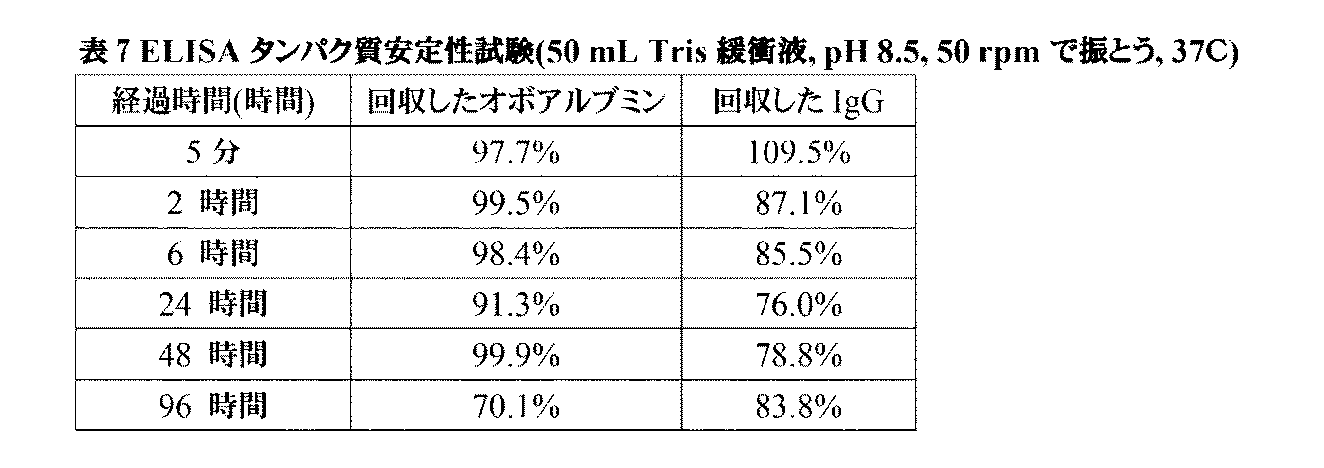
PEG溶液の調製
以下の表にある通り、PEG粉末を秤量して、10mlメスシリンダーに入れた。
Preparation of PEG solution PEG powder was weighed into a 10 ml graduated cylinder as shown in the table below.
PEGが溶解すると、塩化メチレンを10mLの標線まで加えた。 When the PEG was dissolved, methylene chloride was added to the 10 mL mark.
粉砕したオボアルブミンの調製
窒素を満たしたグローブバッグ中で、オボアルブミン(Worthington Biochemical Corporation;LS003048)を乳鉢と乳棒を使用して粉砕し、ステンレススチールのふるいに通して20μm未満の粒子にした。
Preparation of ground ovalbumin Ovalbumin (Worthington Biochemical Corporation; LS003048) was ground using a mortar and pestle in a nitrogen-filled glove bag and passed through a stainless steel sieve to particles less than 20 μm.
オボアルブミンオルガノゲルの調製
粉砕したオボアルブミンを、ポリエチレンの雌のルアーロック注射器に量り入れた。PEGアミン溶液をオボアルブミンと混合して懸濁液を形成した。PEGエステル溶液を雄のポリエチレンルアーロック注射器に入れた。注射器を合わせ、溶液を注射器対注射器で10秒間混合し、雄の注射器内で10分間静置し、その間にタンパク質を含むゲルが形成した。注射器を切り開き、ゲル−タンパク質の円筒を取り除いた。ゲルを真空下に一晩おいて乾燥させた。以下の表は、この方法で調製した試料をまとめる。
Preparation of Ovalbumin Organogel Ground ovalbumin was weighed into a polyethylene female luer lock syringe. The PEG amine solution was mixed with ovalbumin to form a suspension. The PEG ester solution was placed in a male polyethylene luer lock syringe. The syringes were combined and the solution was mixed with a syringe vs. syringe for 10 seconds and allowed to stand in a male syringe for 10 minutes, during which time a gel containing the protein formed. The syringe was opened and the gel-protein cylinder was removed. The gel was dried overnight under vacuum. The following table summarizes the samples prepared by this method.
オボアルブミン−PEGキセロゲルの調製
オボアルブミンオルガノゲルを収容する注射器を切り開き、ゲル−タンパク質の円筒を取り除いた。ゲルを真空下において乾燥させた。乾燥したキセロゲルを、上部空間を窒素で満たして5℃で保存した。
Preparation of Ovalbumin-PEG Xerogel The syringe containing the ovalbumin organogel was cut open and the gel-protein cylinder was removed. The gel was dried under vacuum. The dried xerogel was stored at 5 ° C. with the headspace filled with nitrogen.
粉砕したウサギIgGの調製
窒素を満たしたグローブバッグ中で、ウサギIgG(ウサギ血清由来のIgG;Sigma;>95%)を、乳鉢と乳棒を使用して手作業で粉砕し、ステンレススチールのふるいに通して20μm未満にした。
Preparation of ground rabbit IgG In a glove bag filled with nitrogen, rabbit IgG (IgG from rabbit serum; Sigma;> 95%) is ground manually using a mortar and pestle into a stainless steel sieve. And less than 20 μm.
ウサギIgGオルガノゲルの調製
粉砕したウサギIgGを、ポリエチレン製雌のルアーロック注射器に量り入れた。PEGアミン溶液をオボアルブミンと混合して懸濁液を形成した。PEGエステル溶液を雄のポリエチレンのルアーロック注射器に入れた。注射器を合わせ、溶液を注射器対注射器で10秒間混合し、雄の注射器中で10分間静置すると、タンパク質を含むゲルが形成した。注射器を切り開いて、ゲル−タンパク質の円筒を取り除いた。ゲルを真空下に一晩おいて乾燥させた。以下の表は、この方法で調製した試料をまとめる。以下の表は、この方法で調製した試料をまとめる。
Preparation of Rabbit IgG Organogel Ground rabbit IgG was weighed into a polyethylene female luer lock syringe. The PEG amine solution was mixed with ovalbumin to form a suspension. The PEG ester solution was placed in a male polyethylene luer lock syringe. When the syringes were combined and the solution was mixed with a syringe versus syringe for 10 seconds and allowed to stand in a male syringe for 10 minutes, a protein-containing gel formed. The syringe was cut open to remove the gel-protein cylinder. The gel was dried overnight under vacuum. The following table summarizes the samples prepared by this method. The following table summarizes the samples prepared by this method.
ウサギIgG−PEGキセロゲルの調製
ウサギIgGオルガノゲルを収容している注射器を切り開き、ゲル−タンパク質の円筒を取り除いた。ゲルを真空下に一晩おいて乾燥させた。乾燥したキセロゲルを、上部空間を窒素で満たして5℃で保存した。
Preparation of Rabbit IgG-PEG Xerogel The syringe containing the rabbit IgG organogel was cut open and the gel-protein cylinder was removed. The gel was dried overnight under vacuum. The dried xerogel was stored at 5 ° C. with the headspace filled with nitrogen.
実施例2.ヒドロゲルからのタンパク質のインビトロ放出
緩衝溶液中のタンパク質の安定性
オボアルブミン(Worthington Biochemical Corporation;LS003048)及びウサギIgG(ウサギ血清由来のIgG;Sigma;>95%)を、TRIS緩衝液に0.065mg/mlで溶解させた。初期の試料を、ベースライン用及び種々の時点で採り、緩衝液中のタンパク質の安定性を決定した。試料を、HPLC及びELISAによりタンパク質含量に関して分析した。結果を以下の表にまとめる。
Example 2 Protein Stability in In Vitro Release Buffer of Proteins from Hydrogels Ovalbumin (Worthington Biochemical Corporation; LS003048) and rabbit IgG (IgG from rabbit serum; Sigma;> 95%) were added to TRIS buffer at 0.065 mg / Dissolved in ml. Initial samples were taken for baseline and at various time points to determine the stability of the protein in the buffer. Samples were analyzed for protein content by HPLC and ELISA. The results are summarized in the following table.
結果は、タンパク質が加速インビトロタンパク質放出試験に使用するのに充分安定であることを示す。 The results indicate that the protein is sufficiently stable for use in accelerated in vitro protein release tests.
インビトロタンパク質持続放出試験
実施例1のキセロゲルの試料を切り、秤量し、50mL遠心管中で50mlのTRIS緩衝液に加えた。ステンレススチールの溶解ケージ(dissolution cages)を使用して、試料を遠心管の下半分で保持した。管を、37℃で50RPMの振とう水槽に沈めた。
In vitro protein sustained release test A sample of the xerogel of Example 1 was cut, weighed and added to 50 ml of TRIS buffer in a 50 ml centrifuge tube. Samples were held in the lower half of the centrifuge tube using stainless steel dissolution cages. The tube was submerged in a 50 RPM shaking water bath at 37 ° C.
緩衝媒体試料を、2時間、4時間、8時間で、次いで、ゲルが分解するまで8時間ごとに採取した。緩衝培地を、全ての時点で完全に交換した。試料を回収し、HPLC及びELISAにより分析した。結果を、以下の図2〜5にグラフで表す。 Buffer media samples were taken at 2 hours, 4 hours, 8 hours and then every 8 hours until the gel degraded. The buffer medium was completely changed at all time points. Samples were collected and analyzed by HPLC and ELISA. The results are represented graphically in the following FIGS.
薬物放出プロファイルの個別化
種々のビヒクルの組み合わせを使用して、治療剤の放出速度を個別化することができる。種々の粒子の放出速度を組み合わせ、図6及び7に描写する通り、複合総放出速度を計算した。図6は、約10から約60時間の実質的に零次の放出速度を描写する。図7は、微調整した系を描写する。最初の24時間に初期の噴出を与える第一の放出があり、それに続いて約24から約100時間の追加の零次放出がある。零次放出は、材料の最終的な溶解にわたり持続する。
Personalization of the drug release profile Various vehicle combinations can be used to personalize the release rate of the therapeutic agent. Combining the release rates of the various particles, the composite total release rate was calculated as depicted in FIGS. FIG. 6 depicts a substantially zero order release rate from about 10 to about 60 hours. FIG. 7 depicts a fine-tuned system. There is a first release giving an initial eruption in the first 24 hours, followed by an additional zero order release of about 24 to about 100 hours. Zero order release persists throughout the final dissolution of the material.
実施例3.前駆体のメルトからの架橋ゲルの形成
0.86gの約15,000ダルトンでSS末端の8アーム分岐鎖PEG(8a15KSS)を50℃で融解させた。1.14gの約20,000ダルトンで一級アミン末端の8アーム分岐鎖PEG(8a20KNH2)を、0.5gのウシ血清アルブミン(BSA)粉末と共に、10ml注射器に量り入れ、次いで、60℃の水浴に浸して、8a20KNH2を溶解させた。8a15KSSメルトの液滴を50℃のホットプレート表面で、8a20KNH2メルト/BSAの液滴の隣に置いた。液滴を素早く混合すると、2秒以内にゲル化した。形成したゲルは、顕微鏡で観察すると固体形態のBSA粒子を含んでいる。
Example 3 Formation of Crosslinked Gel from Precursor Melt 0.86 g of approximately 15,000 dalton SS-terminated 8-arm branched PEG (8a15 KSS) was melted at 50 ° C. 1.14 g of approximately 20,000 dalton primary amine terminated 8-arm branched PEG (8a20KNH2) is weighed into a 10 ml syringe with 0.5 g bovine serum albumin (BSA) powder and then placed in a 60 ° C. water bath. It was immersed to dissolve 8a20KNH2. An 8a15 KSS melt droplet was placed on the hot plate surface at 50 ° C. next to the 8a20KNH2 melt / BSA droplet. When the droplets were mixed rapidly, they gelled within 2 seconds. The formed gel contains BSA particles in a solid form when observed with a microscope.
形成したゲルを、Tris−緩衝生理食塩水(TBS)pH8.5緩衝液を満たしたシンチレーションバイアルに移し、ポリマーを迅速に加水分解して、BSAを放出させた。 The formed gel was transferred to a scintillation vial filled with Tris-buffered saline (TBS) pH 8.5 buffer and the polymer was rapidly hydrolyzed to release BSA.
ゲル分解の後、得られたTBS放出媒体が透明であることに気付いたが、これはTBS中のBSAの可溶性を示し、凝集又は変性の点でタンパク質溶解度に対する処理の効果を示さなかった。 After gel degradation, it was noticed that the resulting TBS release medium was transparent, which showed the solubility of BSA in TBS and no effect of treatment on protein solubility in terms of aggregation or denaturation.
特許、特許出願、特許公報、及び本明細書に述べられた参考文献は、全目的のために本明細書に引用により組み込まれる。矛盾する場合には、本明細書が優先する。 Patents, patent applications, patent publications, and references mentioned herein are hereby incorporated by reference for all purposes. In case of conflict, the present specification will prevail.
Claims (44)
水溶性生物製剤の粉末がオルガノゲルに分散している製造方法。 A method for producing a medical material comprising forming an organogel around a water-soluble biopharmaceutical powder comprising:
A production method in which a water-soluble biopharmaceutical powder is dispersed in an organogel.
前記方法が、有機溶媒中で、前駆体からオルガノゲルを形成することを更に含み、前駆体は、第一ブロック及び第二ブロックを含むブロックコポリマーである、請求項1〜9、11〜12、14〜15、又は24〜25のいずれかに記載の方法。 The organogel is physically cross-linked by the formation of domains,
The method further comprises forming an organogel from a precursor in an organic solvent, wherein the precursor is a block copolymer comprising a first block and a second block. The method in any one of -15 or 24-25.
前記第一の有機溶媒と混和性である第二の有機溶媒を加えることであって、前記コポリマー性前駆体の第一ブロックは前記第二の有機溶媒に不溶性であり、前記第二の溶媒は前記ドメインの形成に有効であり、前記ドメインが前記コポリマーの第一ブロックを含むこと
を含む、請求項26に記載の方法。 Mixing the precursor into the first organic solvent that dissolves the copolymeric precursor, wherein all blocks of the copolymeric precursor are soluble in the first organic solvent; and Adding a second organic solvent that is miscible with the first organic solvent, wherein the first block of the copolymeric precursor is insoluble in the second organic solvent, and the second solvent is 27. The method of claim 26, wherein the method is effective in forming the domain and the domain comprises a first block of the copolymer.
前記オルガノゲルからキセロゲルを製造すること、及び
前記キセロゲルを粒子の集団として提供することを含み、前記キセロゲルが水溶液への曝露時にヒドロゲルである、医療材料の製造方法。 Forming an organogel,
A method for producing a medical material, comprising producing a xerogel from the organogel, and providing the xerogel as a population of particles, wherein the xerogel is a hydrogel upon exposure to an aqueous solution.
Applications Claiming Priority (3)
| Application Number | Priority Date | Filing Date | Title |
|---|---|---|---|
| US201161566768P | 2011-12-05 | 2011-12-05 | |
| US61/566,768 | 2011-12-05 | ||
| PCT/US2012/067978 WO2013086015A1 (en) | 2011-12-05 | 2012-12-05 | Medical organogel processes and compositions |
Publications (3)
| Publication Number | Publication Date |
|---|---|
| JP2015502957A true JP2015502957A (en) | 2015-01-29 |
| JP2015502957A5 JP2015502957A5 (en) | 2016-01-21 |
| JP6199883B2 JP6199883B2 (en) | 2017-09-20 |
Family
ID=48574835
Family Applications (1)
| Application Number | Title | Priority Date | Filing Date |
|---|---|---|---|
| JP2014546028A Active JP6199883B2 (en) | 2011-12-05 | 2012-12-05 | Medical organogel process and composition |
Country Status (8)
| Country | Link |
|---|---|
| US (3) | US9205150B2 (en) |
| EP (2) | EP2787973B1 (en) |
| JP (1) | JP6199883B2 (en) |
| KR (2) | KR20190090048A (en) |
| CN (2) | CN109200013A (en) |
| AU (1) | AU2012347926B2 (en) |
| CA (1) | CA2858161C (en) |
| WO (1) | WO2013086015A1 (en) |
Cited By (6)
| Publication number | Priority date | Publication date | Assignee | Title |
|---|---|---|---|---|
| JP2017105948A (en) * | 2015-12-11 | 2017-06-15 | パナソニックIpマネジメント株式会社 | Insulation and manufacturing method |
| JP2018535390A (en) * | 2015-11-17 | 2018-11-29 | ジェジュ ナショナル ユニバーシティー インダストリー−アカデミック コオペレーション ファウンデーション | Soft radiation shielding material containing hydrogel and method for producing the same |
| WO2019189330A1 (en) | 2018-03-28 | 2019-10-03 | 持田製薬株式会社 | Novel reactive alginic acid derivatives |
| JP2021530480A (en) * | 2018-07-09 | 2021-11-11 | リジェネロン・ファーマシューティカルズ・インコーポレイテッドRegeneron Pharmaceuticals, Inc. | Adjustment of release rate in hydrogel |
| JP2023510380A (en) * | 2020-01-16 | 2023-03-13 | 香港科技大学 | Compositions and methods for controlled release of targeted agents |
| US12479933B2 (en) | 2019-09-25 | 2025-11-25 | Mochida Pharmaceutical Co., Ltd. | Crosslinked alginic acid structure |
Families Citing this family (47)
| Publication number | Priority date | Publication date | Assignee | Title |
|---|---|---|---|---|
| ES2713062T3 (en) | 2005-09-27 | 2019-05-17 | Tissuetech Inc | Amniotic membrane preparations and purified compositions and methods of use |
| CA2848397C (en) | 2011-09-14 | 2022-04-26 | Forsight Vision5, Inc. | Ocular insert apparatus and methods |
| CN109200013A (en) | 2011-12-05 | 2019-01-15 | 因赛普特有限责任公司 | Medical organogel method and composition |
| JP6298068B2 (en) | 2012-10-26 | 2018-03-20 | フォーサイト・ビジョン5・インコーポレイテッドForsight Vision5,Inc. | Ophthalmic system for sustained drug release to the eye |
| EP3229779B1 (en) * | 2014-12-10 | 2021-02-03 | Incept, LLC | Hydrogel drug delivery implants |
| BR112017012706A2 (en) | 2014-12-15 | 2018-03-13 | The Johns Hopkins University | sunitinib formulations and methods for their use in the treatment of eye disorders |
| US20160243288A1 (en) | 2015-02-23 | 2016-08-25 | Tissuetech, Inc. | Apparatuses and methods for treating ophthalmic diseases and disorders |
| KR20160117050A (en) | 2015-03-31 | 2016-10-10 | 홍익대학교세종캠퍼스산학협력단 | Microgel comprising biodegradable polymer and method for preparing the same |
| WO2016168141A1 (en) | 2015-04-13 | 2016-10-20 | Forsight Vision5, Inc. | Ocular insert composition of semi-crystalline or crystalline pharmaceutically active agent |
| EP3288626B8 (en) | 2015-04-27 | 2025-12-10 | Tulavi Therapeutics, Inc. | Substances and compositions for use in blocking nerve regeneration |
| AU2016261925B2 (en) | 2015-05-12 | 2020-10-01 | Incept, Llc | Drug delivery from hydrogels |
| WO2017015616A1 (en) * | 2015-07-22 | 2017-01-26 | Envisia Therapeutics, Inc. | Ocular protein delivery |
| US11458041B2 (en) | 2015-10-08 | 2022-10-04 | Ocular Therapeutix, Inc. | Punctal plug and bioadhesives |
| CN114469872A (en) | 2015-11-12 | 2022-05-13 | 灰色视觉公司 | Aggregate microparticles for therapy |
| CN108601725B (en) | 2015-11-25 | 2024-03-08 | 因赛普特有限责任公司 | Shape-changing drug delivery devices and methods |
| WO2017139487A1 (en) | 2016-02-09 | 2017-08-17 | Northwind Medical, Inc. | Methods, agents, and devices for local neuromodulation of autonomic nerves |
| KR102478639B1 (en) | 2016-02-23 | 2022-12-19 | 노을 주식회사 | Labeling substance storing patch, tissue diagnostic method using the patch and device using the same |
| US10371610B2 (en) | 2016-02-23 | 2019-08-06 | Noul Co., Ltd. | Contact-type patch, staining method using the same, and manufacturing method thereof |
| KR20170099738A (en) | 2016-02-23 | 2017-09-01 | 노을 주식회사 | Contact-type staining patch and manufacturing method thereof |
| CN110035754A (en) | 2016-06-29 | 2019-07-19 | 图拉维治疗股份有限公司 | Pass through the local nerve adjustment for the treatment of septicemia and the related inflammatory patient's condition of autonomic nerves system |
| CN109641077A (en) | 2016-07-13 | 2019-04-16 | 马萨诸塞眼科耳科诊所 | For treating the method and polymer composition of detachment of retina He other eye diseases |
| EP4197527A1 (en) | 2016-09-23 | 2023-06-21 | Incept, LLC | Intracameral drug delivery depots |
| JP6898603B2 (en) | 2017-04-07 | 2021-07-07 | ビュー ポイント メディカル, インコーポレーテッドView Point Medical, Inc. | Multimode imaging marker |
| JP2020519585A (en) | 2017-05-10 | 2020-07-02 | グレイバグ ビジョン インコーポレイテッド | Extended release microparticles and suspensions thereof for medical therapy |
| CN107907640A (en) * | 2017-11-22 | 2018-04-13 | 杭州华东医药集团新药研究院有限公司 | The method of evaluating drug effect of fermentation winter worm summer bacterium powder piece |
| CA3105343A1 (en) | 2018-07-02 | 2020-01-09 | Corinne Bright | Methods and devices for in situ formed nerve cap |
| US20210315587A1 (en) | 2018-07-02 | 2021-10-14 | Tulavi Therapeutics, Inc. | Methods and devices for in situ formed nerve cap with rapid release |
| WO2020015737A1 (en) | 2018-07-20 | 2020-01-23 | The Hong Kong University Of Science And Technology | Compositions and methods for controlled release of target agent |
| EP3955978A1 (en) * | 2019-04-18 | 2022-02-23 | DePuy Synthes Products, Inc. | Biocompatible organogel matrices for intraoperative preparation of a drug delivery depot |
| KR102857686B1 (en) | 2019-07-25 | 2025-09-10 | 엘지디스플레이 주식회사 | Display device |
| CA3146944A1 (en) | 2019-08-06 | 2021-02-11 | Patrick Michael Hughes | Bioerodible cross-linked hydrogel implants and related methods of use |
| JP7735255B2 (en) * | 2019-08-20 | 2025-09-08 | ゼロックス コーポレイション | Biodegradable Electrochemical Devices |
| WO2021041560A1 (en) | 2019-08-28 | 2021-03-04 | View Point Medical, Inc. | Ultrasound marker detection, markers and associated systems, methods and articles |
| US20210251893A1 (en) | 2020-02-06 | 2021-08-19 | Ocular Therapeutix, Inc. | Compositions and Methods for Treating Ocular Diseases |
| CN120227316A (en) | 2020-03-25 | 2025-07-01 | 视尔普斯眼科公司 | Ocular implants containing tyrosine kinase inhibitors |
| EP4142664A4 (en) | 2020-04-27 | 2024-05-29 | Ocular Therapeutix, Inc. | Methods of treating allergic conjunctivitis |
| AU2021347318A1 (en) | 2020-09-24 | 2023-03-23 | Ocular Therapeutix, Inc. | Sustained release biodegradable intracanalicular inserts comprising a hydrogel and cyclosporine |
| WO2022066891A1 (en) | 2020-09-24 | 2022-03-31 | Ocular Therapeutix, Inc. | Sustained release biodegradable intracanalicular inserts comprising a hydrogel and an active agent |
| CN116507330A (en) * | 2020-11-12 | 2023-07-28 | 普拉曼德有限责任公司 | In situ formed hydrogel and composition design for in utero use |
| WO2023064618A1 (en) * | 2021-10-15 | 2023-04-20 | Prohibix Llc | Crosslinked hyaluronic acid precipitates |
| WO2023097213A1 (en) | 2021-11-24 | 2023-06-01 | Pykus Therapeutics, Inc. | Hydrogel formulations and methods and devices for focal administration of the same |
| AU2023215312A1 (en) * | 2022-02-01 | 2024-07-25 | Ocular Therapeutix, Inc. | A controlled release implant for biologics and corresponding methods of treatment |
| WO2023205649A1 (en) * | 2022-04-18 | 2023-10-26 | Massachusetts Institute Of Technology | Crosslinked organogels for drug delivery |
| CN115073657B (en) * | 2022-05-12 | 2023-08-22 | 深圳大学 | A kind of high-toughness impact-resistant organogel and its preparation method and application |
| KR20260002666A (en) | 2023-04-11 | 2026-01-06 | 오큘라 테라퓨틱스, 인코포레이티드 | Ocular implant comprising axitinib polymorph IV |
| WO2025196238A1 (en) * | 2024-03-20 | 2025-09-25 | Boston Scientific Scimed, Inc. | Hydrolysis-resistant hydrogels and methods of treatment using same |
| US12233157B1 (en) | 2024-07-24 | 2025-02-25 | Pykus Therapeutics, Inc. | Hydrogel formulations and methods and devices for administration of the same |
Citations (3)
| Publication number | Priority date | Publication date | Assignee | Title |
|---|---|---|---|---|
| JPH07508735A (en) * | 1992-07-07 | 1995-09-28 | アストラ アクチボラゲット | Drug delivery device and method for manufacturing the device |
| WO2010093873A2 (en) * | 2009-02-12 | 2010-08-19 | Incept, Llc | Drug delivery through hydrogel plugs |
| WO2011123416A1 (en) * | 2010-03-29 | 2011-10-06 | Surmodics, Inc. | Injectable drug delivery formulation |
Family Cites Families (243)
| Publication number | Priority date | Publication date | Assignee | Title |
|---|---|---|---|---|
| BE622026A (en) | 1961-09-05 | |||
| US3423489A (en) | 1966-11-01 | 1969-01-21 | Minnesota Mining & Mfg | Encapsulation process |
| US3640741A (en) | 1970-02-24 | 1972-02-08 | Hollister Inc | Composition containing gel |
| US3779942A (en) | 1970-12-04 | 1973-12-18 | Minnesota Mining & Mfg | Capsules and process for forming capsules |
| US3865108A (en) | 1971-05-17 | 1975-02-11 | Ortho Pharma Corp | Expandable drug delivery device |
| US3991766A (en) | 1973-05-31 | 1976-11-16 | American Cyanamid Company | Controlled release of medicaments using polymers from glycolic acid |
| US4002173A (en) | 1974-07-23 | 1977-01-11 | International Paper Company | Diester crosslinked polyglucan hydrogels and reticulated sponges thereof |
| DE2437629C3 (en) | 1974-08-05 | 1978-09-21 | Basf Ag, 6700 Ludwigshafen | Process for the preparation of insoluble polymers of N-vinyllactams which are only slightly swellable in water |
| US4107288A (en) | 1974-09-18 | 1978-08-15 | Pharmaceutical Society Of Victoria | Injectable compositions, nanoparticles useful therein, and process of manufacturing same |
| US4014335A (en) | 1975-04-21 | 1977-03-29 | Alza Corporation | Ocular drug delivery device |
| US4193813A (en) | 1976-09-07 | 1980-03-18 | Medi-Coll, Inc. | Method for making collagen sponge |
| US4207893A (en) | 1977-08-29 | 1980-06-17 | Alza Corporation | Device using hydrophilic polymer for delivering drug to biological environment |
| US4268495A (en) | 1979-01-08 | 1981-05-19 | Ethicon, Inc. | Injectable embolization and occlusion solution |
| DE3265697D1 (en) | 1981-02-05 | 1985-10-03 | Nippon Oil Co Ltd | Process for preparing a hydrogel |
| JPS585320A (en) | 1981-07-01 | 1983-01-12 | Toray Ind Inc | Graft copolymer |
| DE3128923A1 (en) | 1981-07-22 | 1983-02-10 | Beiersdorf Ag, 2000 Hamburg | POWDER BLEND FOR SURGICAL PURPOSES |
| US4734097A (en) | 1981-09-25 | 1988-03-29 | Nippon Oil Company, Ltd. | Medical material of polyvinyl alcohol and process of making |
| US4530840A (en) | 1982-07-29 | 1985-07-23 | The Stolle Research And Development Corporation | Injectable, long-acting microparticle formulation for the delivery of anti-inflammatory agents |
| JPS5930881A (en) | 1982-08-13 | 1984-02-18 | Nippon Oil Co Ltd | Manufacture of low-temperature insulating gel |
| US4631188A (en) | 1983-08-31 | 1986-12-23 | S.K.Y. Polymers, Ltd. (Kingston Technologies) | Injectable physiologically-acceptable polymeric composition |
| MX163953B (en) | 1984-03-27 | 1992-07-03 | Univ New Jersey Med | PROCEDURE FOR PREPARING A BIODEGRADABLE COLLAGEN MATRIX |
| US4839345A (en) | 1985-03-09 | 1989-06-13 | Nippon Oil And Fats Co., Ltd. | Hydrated adhesive gel and method for preparing the same |
| DD252978A5 (en) | 1985-09-16 | 1988-01-06 | K | PROCESS FOR CLEANING GASES CONTAINING SULFUR DIOXIDE |
| US4760131A (en) | 1986-04-23 | 1988-07-26 | Collagen Corporation | Wound-healing composition |
| US4741872A (en) | 1986-05-16 | 1988-05-03 | The University Of Kentucky Research Foundation | Preparation of biodegradable microspheres useful as carriers for macromolecules |
| US5160745A (en) | 1986-05-16 | 1992-11-03 | The University Of Kentucky Research Foundation | Biodegradable microspheres as a carrier for macromolecules |
| US4837381A (en) | 1986-08-11 | 1989-06-06 | American Cyanamid Company | Compositions for parenteral administration and their use |
| US5147647A (en) | 1986-10-02 | 1992-09-15 | Sohrab Darougar | Ocular insert for the fornix |
| US5322691A (en) | 1986-10-02 | 1994-06-21 | Sohrab Darougar | Ocular insert with anchoring protrusions |
| US4952581A (en) | 1987-04-03 | 1990-08-28 | The Trustees Of Columbia University In The City Of New York | Use of a prostaglandin in combination with an adrenergic blocking agent for reduction of intraocular pressure |
| IL82834A (en) | 1987-06-09 | 1990-11-05 | Yissum Res Dev Co | Biodegradable polymeric materials based on polyether glycols,processes for the preparation thereof and surgical artiicles made therefrom |
| US4853224A (en) | 1987-12-22 | 1989-08-01 | Visionex | Biodegradable ocular implants |
| US5024742A (en) | 1988-02-24 | 1991-06-18 | Cedars-Sinai Medical Center | Method of crosslinking amino acid containing polymers using photoactivatable chemical crosslinkers |
| US4925677A (en) | 1988-08-31 | 1990-05-15 | Theratech, Inc. | Biodegradable hydrogel matrices for the controlled release of pharmacologically active agents |
| US5041292A (en) | 1988-08-31 | 1991-08-20 | Theratech, Inc. | Biodegradable hydrogel matrices for the controlled release of pharmacologically active agents |
| US5296504A (en) | 1988-09-06 | 1994-03-22 | Kabi Pharmacia | Prostaglandin derivatives for the treatment of glaucoma or ocular hypertension |
| US4938763B1 (en) | 1988-10-03 | 1995-07-04 | Atrix Lab Inc | Biodegradable in-situ forming implants and method of producing the same |
| US5681576A (en) | 1988-11-16 | 1997-10-28 | Mdv Technologies, Inc. | Method and composition for post surgical adhesion reduction |
| US5304595A (en) | 1988-11-21 | 1994-04-19 | Collagen Corporation | Collagen-polymer conjugates |
| US5306500A (en) | 1988-11-21 | 1994-04-26 | Collagen Corporation | Method of augmenting tissue with collagen-polymer conjugates |
| US5510418A (en) | 1988-11-21 | 1996-04-23 | Collagen Corporation | Glycosaminoglycan-synthetic polymer conjugates |
| US5800541A (en) | 1988-11-21 | 1998-09-01 | Collagen Corporation | Collagen-synthetic polymer matrices prepared using a multiple step reaction |
| US5936035A (en) | 1988-11-21 | 1999-08-10 | Cohesion Technologies, Inc. | Biocompatible adhesive compositions |
| US5475052A (en) | 1988-11-21 | 1995-12-12 | Collagen Corporation | Collagen-synthetic polymer matrices prepared using a multiple step reaction |
| US5162430A (en) | 1988-11-21 | 1992-11-10 | Collagen Corporation | Collagen-polymer conjugates |
| US5565519A (en) | 1988-11-21 | 1996-10-15 | Collagen Corporation | Clear, chemically modified collagen-synthetic polymer conjugates for ophthalmic applications |
| US5527856A (en) | 1988-11-21 | 1996-06-18 | Collagen Corporation | Method of preparing crosslinked biomaterial compositions for use in tissue augmentation |
| US5643464A (en) | 1988-11-21 | 1997-07-01 | Collagen Corporation | Process for preparing a sterile, dry crosslinking agent |
| US5614587A (en) | 1988-11-21 | 1997-03-25 | Collagen Corporation | Collagen-based bioadhesive compositions |
| US5550187A (en) | 1988-11-21 | 1996-08-27 | Collagen Corporation | Method of preparing crosslinked biomaterial compositions for use in tissue augmentation |
| US4948575A (en) | 1989-01-24 | 1990-08-14 | Minnesota Mining And Manufacturing Company | Alginate hydrogel foam wound dressing |
| IL90193A (en) | 1989-05-04 | 1993-02-21 | Biomedical Polymers Int | Polurethane-based polymeric materials and biomedical articles and pharmaceutical compositions utilizing the same |
| US5776493A (en) | 1989-07-14 | 1998-07-07 | Alza Corporation | Oral osmotic device for delivery of nystatin with hydrogel driving member |
| US5487897A (en) | 1989-07-24 | 1996-01-30 | Atrix Laboratories, Inc. | Biodegradable implant precursor |
| US5324519A (en) | 1989-07-24 | 1994-06-28 | Atrix Laboratories, Inc. | Biodegradable polymer composition |
| US5198220A (en) | 1989-11-17 | 1993-03-30 | The Procter & Gamble Company | Sustained release compositions for treating periodontal disease |
| US5185152A (en) | 1990-01-10 | 1993-02-09 | Peyman Gholam A | Method and apparatus for controlled release drug delivery to the cornea and anterior chamber of the eye |
| US5227372A (en) | 1990-03-07 | 1993-07-13 | Children's Medical Center Corporation | Method for retaining ophthalmological agents in ocular tissues |
| JPH0442955U (en) | 1990-08-08 | 1992-04-13 | ||
| US5266325A (en) | 1990-09-28 | 1993-11-30 | Hydro Med Science Division Of National Patent Development Corp. | Preparation of homogeneous hydrogel copolymers |
| US5380536A (en) | 1990-10-15 | 1995-01-10 | The Board Of Regents, The University Of Texas System | Biocompatible microcapsules |
| US5410016A (en) | 1990-10-15 | 1995-04-25 | Board Of Regents, The University Of Texas System | Photopolymerizable biodegradable hydrogels as tissue contacting materials and controlled-release carriers |
| US5529914A (en) | 1990-10-15 | 1996-06-25 | The Board Of Regents The Univeristy Of Texas System | Gels for encapsulation of biological materials |
| US5462990A (en) | 1990-10-15 | 1995-10-31 | Board Of Regents, The University Of Texas System | Multifunctional organic polymers |
| US5232984A (en) | 1990-10-15 | 1993-08-03 | The Board Of The Regents The University Of Texas | Biocompatible microcapsules |
| WO1992010218A1 (en) | 1990-12-06 | 1992-06-25 | W.L. Gore & Associates, Inc. | Implantable bioabsorbable article |
| US5143662A (en) | 1991-02-12 | 1992-09-01 | United States Surgical Corporation | Process for preparing particles of bioabsorbable polymer |
| AU1442592A (en) | 1991-02-20 | 1992-09-15 | Nova Pharmaceutical Corporation | Controlled release microparticulate delivery system for proteins |
| US5330768A (en) | 1991-07-05 | 1994-07-19 | Massachusetts Institute Of Technology | Controlled drug delivery using polymer/pluronic blends |
| CA2078530A1 (en) | 1991-09-23 | 1993-03-24 | Jay Erlebacher | Percutaneous arterial puncture seal device and insertion tool therefore |
| US5192743A (en) | 1992-01-16 | 1993-03-09 | Genentech, Inc. | Reconstitutable lyophilized protein formulation |
| US5573934A (en) | 1992-04-20 | 1996-11-12 | Board Of Regents, The University Of Texas System | Gels for encapsulation of biological materials |
| US5629008A (en) | 1992-06-02 | 1997-05-13 | C.R. Bard, Inc. | Method and device for long-term delivery of drugs |
| AU4198793A (en) | 1992-07-24 | 1994-01-27 | Takeda Chemical Industries Ltd. | Microparticle preparation and production thereof |
| US5514379A (en) | 1992-08-07 | 1996-05-07 | The General Hospital Corporation | Hydrogel compositions and methods of use |
| CA2103846A1 (en) | 1992-08-13 | 1994-02-14 | Patricia-Ann Truter | Hydrogel composition and methods of making it |
| US6592859B1 (en) | 1992-08-20 | 2003-07-15 | Ethicon, Inc. | Controlled expansion sphincter augmentation media |
| DE69331387T2 (en) | 1992-09-10 | 2002-08-22 | Childrens Medical Center | BIODEGRADABLE POLYMER MATRICATES WITH DELAYED RELEASE OF LOCALANE AESTHETICS |
| US5530528A (en) | 1992-09-28 | 1996-06-25 | Fujitsu Limited | Image forming apparatus having contact type, one-component developing unit |
| US5844023A (en) | 1992-11-06 | 1998-12-01 | Bio-Tec Biologische Naturverpackungen Gmbh | Biologically degradable polymer mixture |
| AU675252B2 (en) | 1992-12-18 | 1997-01-30 | Tremco, Inc. | Fast-curing, high strength, two-part sealants using acetoacetate-amine cure chemistry |
| JP3390477B2 (en) | 1993-01-25 | 2003-03-24 | 生化学工業株式会社 | Pharmaceutical composition and method for producing the same |
| US5707643A (en) | 1993-02-26 | 1998-01-13 | Santen Pharmaceutical Co., Ltd. | Biodegradable scleral plug |
| US5800373A (en) | 1995-03-23 | 1998-09-01 | Focal, Inc. | Initiator priming for improved adherence of gels to substrates |
| EP0696185B1 (en) | 1993-04-28 | 1998-08-12 | Focal, Inc. | Apparatus, product and use related to intraluminal photothermoforming |
| US5409703A (en) | 1993-06-24 | 1995-04-25 | Carrington Laboratories, Inc. | Dried hydrogel from hydrophilic-hygroscopic polymer |
| US5499994A (en) | 1993-07-30 | 1996-03-19 | American Medical Systems, Inc. | Dilation device for the urethra |
| US5773025A (en) | 1993-09-09 | 1998-06-30 | Edward Mendell Co., Inc. | Sustained release heterodisperse hydrogel systems--amorphous drugs |
| US5589194A (en) | 1993-09-20 | 1996-12-31 | Minnesota Mining And Manufacturing Company | Method of encapsulation and microcapsules produced thereby |
| US5578638A (en) | 1993-11-05 | 1996-11-26 | American Cyanamid Company | Treatment of glaucoma and ocular hypertension with β3 -adrenergic agonists |
| US5446090A (en) | 1993-11-12 | 1995-08-29 | Shearwater Polymers, Inc. | Isolatable, water soluble, and hydrolytically stable active sulfones of poly(ethylene glycol) and related polymers for modification of surfaces and molecules |
| US5650173A (en) | 1993-11-19 | 1997-07-22 | Alkermes Controlled Therapeutics Inc. Ii | Preparation of biodegradable microparticles containing a biologically active agent |
| EP0731693A1 (en) | 1993-12-08 | 1996-09-18 | Vitaphore Corporation | Microsphere drug delivery system |
| CA2140053C (en) | 1994-02-09 | 2000-04-04 | Joel S. Rosenblatt | Collagen-based injectable drug delivery system and its use |
| US5480914A (en) | 1994-05-06 | 1996-01-02 | Allergan, Inc. | Nonaqueous thixotropic drug delivery suspensions and methods of their use |
| WO1995031223A1 (en) | 1994-05-13 | 1995-11-23 | Kuraray Co., Ltd. | Medical polymer gel |
| KR0141431B1 (en) | 1994-05-17 | 1998-07-01 | 김상웅 | Biodegradable Hydrogel Polymer |
| US5665840A (en) | 1994-11-18 | 1997-09-09 | Novartis Corporation | Polymeric networks from water-soluble prepolymers |
| EP0713707A1 (en) | 1994-11-23 | 1996-05-29 | Collagen Corporation | In situ crosslinkable, injectable collagen composition for tissue augmention |
| MY114536A (en) | 1994-11-24 | 2002-11-30 | Apic Yamada Corp | A resin molding machine and a method of resin molding |
| US5932462A (en) | 1995-01-10 | 1999-08-03 | Shearwater Polymers, Inc. | Multiarmed, monofunctional, polymer for coupling to molecules and surfaces |
| US5849412A (en) | 1995-02-17 | 1998-12-15 | Medlogic Global Corporation | Encapsulated materials |
| JP4484247B2 (en) | 1995-02-24 | 2010-06-16 | エラン ファーマ インターナショナル,リミティド | Aerosol containing nanoparticle dispersion |
| US5565188A (en) | 1995-02-24 | 1996-10-15 | Nanosystems L.L.C. | Polyalkylene block copolymers as surface modifiers for nanoparticles |
| US5618850A (en) | 1995-03-09 | 1997-04-08 | Focal, Inc. | Hydroxy-acid cosmetics |
| US6962979B1 (en) | 1995-03-14 | 2005-11-08 | Cohesion Technologies, Inc. | Crosslinkable biomaterial compositions containing hydrophobic and hydrophilic crosslinking agents |
| US5900245A (en) | 1996-03-22 | 1999-05-04 | Focal, Inc. | Compliant tissue sealants |
| CA2215309C (en) | 1995-03-23 | 2008-11-25 | Focal, Inc. | Redox and photoinitiator systems for priming for improved adherence of gels to substrates |
| AU701286B2 (en) | 1995-04-03 | 1999-01-21 | Mcneil-Ppc, Inc. | Multiple folded side barriers for improved leakage protection |
| US5612052A (en) | 1995-04-13 | 1997-03-18 | Poly-Med, Inc. | Hydrogel-forming, self-solvating absorbable polyester copolymers, and methods for use thereof |
| US6413539B1 (en) | 1996-10-31 | 2002-07-02 | Poly-Med, Inc. | Hydrogel-forming, self-solvating absorbable polyester copolymers, and methods for use thereof |
| US5869079A (en) | 1995-06-02 | 1999-02-09 | Oculex Pharmaceuticals, Inc. | Formulation for controlled release of drugs by combining hydrophilic and hydrophobic agents |
| US6214331B1 (en) | 1995-06-06 | 2001-04-10 | C. R. Bard, Inc. | Process for the preparation of aqueous dispersions of particles of water-soluble polymers and the particles obtained |
| US6129761A (en) | 1995-06-07 | 2000-10-10 | Reprogenesis, Inc. | Injectable hydrogel compositions |
| US5759583A (en) | 1995-08-30 | 1998-06-02 | Syntex (U.S.A.) Inc. | Sustained release poly (lactic/glycolic) matrices |
| US5773019A (en) | 1995-09-27 | 1998-06-30 | The University Of Kentucky Research Foundation | Implantable controlled release device to deliver drugs directly to an internal portion of the body |
| US5824037A (en) | 1995-10-03 | 1998-10-20 | Medtronic, Inc. | Modular intraluminal prostheses construction and methods |
| US5741292A (en) | 1995-10-26 | 1998-04-21 | Eagle Vision | Punctum dilating and plug inserting instrument with push-button plug release |
| CA2164262A1 (en) | 1995-12-01 | 1997-06-02 | Charles J. Doillon | Biostable porous material comprising composite biopolymers |
| US5752974A (en) | 1995-12-18 | 1998-05-19 | Collagen Corporation | Injectable or implantable biomaterials for filling or blocking lumens and voids of the body |
| PT1704878E (en) | 1995-12-18 | 2013-07-17 | Angiodevice Internat Gmbh | Crosslinked polymer compositions and methods for their use |
| DE19612628A1 (en) | 1996-03-29 | 1997-10-02 | Hoechst Ag | Process for the production of porous, hydrophilic, highly swellable hydrogels |
| US6764690B2 (en) * | 1996-05-29 | 2004-07-20 | Delsitech Oy | Dissolvable oxides for biological applications |
| ES2167761T3 (en) | 1996-07-02 | 2002-05-16 | Minnesota Mining & Mfg | COMPOSITE MATERIAL ADHESIVE MEDICAL AND ENVELOPE. |
| US6060534A (en) | 1996-07-11 | 2000-05-09 | Scimed Life Systems, Inc. | Medical devices comprising ionically and non-ionically crosslinked polymer hydrogels having improved mechanical properties |
| WO1998003641A1 (en) * | 1996-07-23 | 1998-01-29 | Crandall Wilson T | Transdermal transport of molecules |
| US5823198A (en) | 1996-07-31 | 1998-10-20 | Micro Therapeutics, Inc. | Method and apparatus for intravasculer embolization |
| US7049346B1 (en) | 1996-08-20 | 2006-05-23 | Menlo Care Div Of Ethicon, Inc. | Swollen hydrogel for sphincter augmentation |
| US6063061A (en) | 1996-08-27 | 2000-05-16 | Fusion Medical Technologies, Inc. | Fragmented polymeric compositions and methods for their use |
| US20020064546A1 (en) | 1996-09-13 | 2002-05-30 | J. Milton Harris | Degradable poly(ethylene glycol) hydrogels with controlled half-life and precursors therefor |
| WO1998012274A1 (en) | 1996-09-23 | 1998-03-26 | Chandrashekar Pathak | Methods and devices for preparing protein concentrates |
| ZA978537B (en) | 1996-09-23 | 1998-05-12 | Focal Inc | Polymerizable biodegradable polymers including carbonate or dioxanone linkages. |
| US7009034B2 (en) | 1996-09-23 | 2006-03-07 | Incept, Llc | Biocompatible crosslinked polymers |
| US6214966B1 (en) | 1996-09-26 | 2001-04-10 | Shearwater Corporation | Soluble, degradable poly(ethylene glycol) derivatives for controllable release of bound molecules into solution |
| US6258351B1 (en) | 1996-11-06 | 2001-07-10 | Shearwater Corporation | Delivery of poly(ethylene glycol)-modified molecules from degradable hydrogels |
| AU5261898A (en) | 1996-12-04 | 1998-06-29 | Abbot F. Clark | Tgfalpha for the treatment of ocular hypertension and glaucoma |
| US5888493A (en) | 1996-12-05 | 1999-03-30 | Sawaya; Assad S. | Ophthalmic aqueous gel formulation and related methods |
| US20070185033A1 (en) | 1996-12-11 | 2007-08-09 | Praecis Pharmaceuticals, Inc. | Pharmaceutical formulations for sustained drug delivery |
| US6416778B1 (en) | 1997-01-24 | 2002-07-09 | Femmepharma | Pharmaceutical preparations and methods for their regional administration |
| US5718916A (en) | 1997-02-03 | 1998-02-17 | Scherr; George H. | Alginate foam products |
| WO1998035631A1 (en) | 1997-02-14 | 1998-08-20 | Pathak Chandrashekar | Biocompatible polymers and methods for their use |
| US6371975B2 (en) | 1998-11-06 | 2002-04-16 | Neomend, Inc. | Compositions, systems, and methods for creating in situ, chemically cross-linked, mechanical barriers |
| DE69832288T2 (en) | 1997-03-20 | 2006-07-13 | Genzyme Corp., Cambridge | BIODEGRADABLE TISSUE SPREADER |
| US6082362A (en) | 1997-03-27 | 2000-07-04 | Eagle Vision, Inc. | Punctum plug |
| US5906997A (en) | 1997-06-17 | 1999-05-25 | Fzio Med, Inc. | Bioresorbable compositions of carboxypolysaccharide polyether intermacromolecular complexes and methods for their use in reducing surgical adhesions |
| KR20010022007A (en) | 1997-07-18 | 2001-03-15 | 추후보정 | Biodegradable macromers for the controlled release of biologically active substances |
| US5830171A (en) | 1997-08-12 | 1998-11-03 | Odyssey Medical, Inc. | Punctal occluder |
| US6316522B1 (en) | 1997-08-18 | 2001-11-13 | Scimed Life Systems, Inc. | Bioresorbable hydrogel compositions for implantable prostheses |
| AU743819B2 (en) | 1997-10-27 | 2002-02-07 | California Institute Of Technology | Methods and pharmaceutical compositions for the closure of retinal breaks |
| AU1307399A (en) | 1997-11-06 | 1999-05-31 | Orbon Corporation | Stabilized, dry pharmaceutical compositions for drug delivery and methods of preparing same |
| DE69842217D1 (en) | 1997-11-07 | 2011-05-19 | State University | Radiopaque polymeric biomaterials |
| CA2313225A1 (en) | 1997-12-12 | 1999-06-17 | Macromed, Inc. | Heterofunctionalized star-shaped poly(ethylene glycols) for protein modification |
| FR2773320B1 (en) | 1998-01-05 | 2000-03-03 | Optisinvest | DEVICE FOR INTRAOCULAR TRANSFER OF ACTIVE PRODUCTS BY IONTOPHORESIS |
| US5981607A (en) | 1998-01-20 | 1999-11-09 | Allergan | Emulsion eye drop for alleviation of dry eye related symptoms in dry eye patients and/or contact lens wearers |
| JP4549529B2 (en) | 1998-01-30 | 2010-09-22 | サイオス,インコーポレーテッド | Controlled release delivery of peptides or proteins |
| US6660301B1 (en) | 1998-03-06 | 2003-12-09 | Biosphere Medical, Inc. | Injectable microspheres for dermal augmentation and tissue bulking |
| US6007833A (en) | 1998-03-19 | 1999-12-28 | Surmodics, Inc. | Crosslinkable macromers bearing initiator groups |
| US6196993B1 (en) | 1998-04-20 | 2001-03-06 | Eyelab Group, Llc | Ophthalmic insert and method for sustained release of medication to the eye |
| US6154971A (en) | 1998-07-01 | 2000-12-05 | Perkins; Ronald Keith | Sight apparatus |
| US6156531A (en) | 1998-07-20 | 2000-12-05 | Sulzer Carbomedics Inc. | Cross-linking tissue with a compound having a C8 to C40 aliphatic chain |
| US6152943A (en) | 1998-08-14 | 2000-11-28 | Incept Llc | Methods and apparatus for intraluminal deposition of hydrogels |
| WO2000009199A1 (en) | 1998-08-14 | 2000-02-24 | Incept Llc | Methods and apparatus for in situ formation of hydrogels |
| US6179862B1 (en) | 1998-08-14 | 2001-01-30 | Incept Llc | Methods and apparatus for in situ formation of hydrogels |
| US6605294B2 (en) | 1998-08-14 | 2003-08-12 | Incept Llc | Methods of using in situ hydration of hydrogel articles for sealing or augmentation of tissue or vessels |
| US6818018B1 (en) | 1998-08-14 | 2004-11-16 | Incept Llc | In situ polymerizable hydrogels |
| US6703047B2 (en) | 2001-02-02 | 2004-03-09 | Incept Llc | Dehydrated hydrogel precursor-based, tissue adherent compositions and methods of use |
| US6632457B1 (en) | 1998-08-14 | 2003-10-14 | Incept Llc | Composite hydrogel drug delivery systems |
| JP2002531217A (en) | 1998-12-04 | 2002-09-24 | チャンドラシェカー ピー. パサック, | Biocompatible crosslinked polymer |
| US6958212B1 (en) | 1999-02-01 | 2005-10-25 | Eidgenossische Technische Hochschule Zurich | Conjugate addition reactions for the controlled delivery of pharmaceutically active compounds |
| US6248363B1 (en) | 1999-11-23 | 2001-06-19 | Lipocine, Inc. | Solid carriers for improved delivery of active ingredients in pharmaceutical compositions |
| JP4558213B2 (en) | 1999-04-12 | 2010-10-06 | コーネル・リサーチ・ファンデーション・インコーポレイテッド | Aqueous gel-forming system with hydrophobic and hydrophilic components |
| US6312725B1 (en) | 1999-04-16 | 2001-11-06 | Cohesion Technologies, Inc. | Rapid gelling biocompatible polymer composition |
| US6132986A (en) | 1999-04-23 | 2000-10-17 | Sulzer Carbomedics Inc. | Tissue crosslinking for bioprostheses using activated difunctional or polyfunctional acids |
| US6287588B1 (en) | 1999-04-29 | 2001-09-11 | Macromed, Inc. | Agent delivering system comprised of microparticle and biodegradable gel with an improved releasing profile and methods of use thereof |
| FI19991806A7 (en) * | 1999-08-25 | 2001-02-26 | Yli Urpo Antti | Novel compositions for controlled release of a biologically active agent, and their preparation |
| US6331313B1 (en) | 1999-10-22 | 2001-12-18 | Oculex Pharmaceticals, Inc. | Controlled-release biocompatible ocular drug delivery implant devices and methods |
| IT1311576B1 (en) * | 1999-10-25 | 2002-03-13 | Ghimas Spa | INVASIVE MEDICAL DEVICE, IN PARTICULAR FOR GUIDED TISSUE REGENERATION. |
| US7785625B2 (en) | 2000-01-14 | 2010-08-31 | Lg Life Sciences, Limited | Lipophilic-coated microparticle containing a protein drug and formulation comprising same |
| US6436424B1 (en) | 2000-03-20 | 2002-08-20 | Biosphere Medical, Inc. | Injectable and swellable microspheres for dermal augmentation |
| US9314339B2 (en) | 2000-03-27 | 2016-04-19 | Formae, Inc. | Implants for replacing cartilage, with negatively-charged hydrogel surfaces and flexible matrix reinforcement |
| US20040175410A1 (en) | 2000-04-26 | 2004-09-09 | Control Delivery Systems, Inc. | Sustained release device and method for ocular delivery of carbonic anhydrase inhibitors |
| AU2001286651A1 (en) | 2000-08-22 | 2002-03-04 | Purdue Research Foundation | Microparticle composition and method |
| WO2002019989A2 (en) * | 2000-09-08 | 2002-03-14 | Powderject Research Limited | Alginate particle formulation |
| EP1339438B1 (en) | 2000-11-29 | 2005-10-19 | Allergan Inc. | Preventing transplant rejection in the eye |
| US6596471B2 (en) | 2000-12-21 | 2003-07-22 | Carbomedics Inc. | Method of cross-linking tissue with a bis-maleimide compound |
| JP2004523624A (en) | 2001-02-26 | 2004-08-05 | デューク ユニバーシティ | Novel dendritic polymer and its biomedical use |
| US6747090B2 (en) | 2001-07-16 | 2004-06-08 | Pharmacia Groningen Bv | Compositions capable of forming hydrogels in the eye |
| US20030185892A1 (en) | 2001-08-17 | 2003-10-02 | Bell Steve J. D. | Intraocular delivery compositions and methods |
| CN1277805C (en) | 2001-10-03 | 2006-10-04 | 大日本除虫菊株式会社 | Propargylbenzyl alcohol ester derivative, process for producing the same, and insecticide/insectifuge containing the same |
| US20030091513A1 (en) | 2001-10-03 | 2003-05-15 | Mohsen Nahed M. | Method to generate water soluble or nonwater soluble in nanoparticulates directly in suspension or dispersion media |
| US20070264227A1 (en) | 2001-11-07 | 2007-11-15 | Eidgenossische Technische Hochschule Zurich | Synthetic Matrix for Controlled Cell Ingrowth and Tissue Regeneration |
| US7204995B2 (en) | 2002-01-31 | 2007-04-17 | El-Sherif Dalia M | Treatment and control of dry eye by use of biodegradable polymer capsules |
| US20040116524A1 (en) | 2002-02-04 | 2004-06-17 | Cohen Ben Z. | Method of administering opthalmic fluids |
| WO2003070219A1 (en) | 2002-02-22 | 2003-08-28 | Santen Pharmaceutical Co., Ltd. | Drug delivery system for the subconjunctival administration of fine grains |
| US20040131582A1 (en) | 2002-02-26 | 2004-07-08 | Grinstaff Mark W. | Novel dendritic polymers and their biomedical uses |
| US7744913B2 (en) | 2002-06-24 | 2010-06-29 | Incept, Llc | Fillers and methods for displacing tissues to improve radiological outcomes |
| US7351430B2 (en) | 2002-11-06 | 2008-04-01 | Uluru Inc. | Shape-retentive hydrogel particle aggregates and their uses |
| US20050043220A1 (en) | 2002-11-08 | 2005-02-24 | Guyer David R. | Methods and compositions for treating macular degeneration |
| US20060039979A1 (en) | 2002-12-04 | 2006-02-23 | Kazuhito Yamada | Drug delivery system using subconjunctival depot |
| US8545830B2 (en) | 2003-03-24 | 2013-10-01 | University Of Tennessee Research Foundation | Multi-functional polymeric materials and their uses |
| US20050255144A1 (en) | 2003-04-09 | 2005-11-17 | Directcontact Llc | Methods and articles for the delivery of medicaments to the eye for the treatment of posterior segment diseases |
| US20050074497A1 (en) | 2003-04-09 | 2005-04-07 | Schultz Clyde L. | Hydrogels used to deliver medicaments to the eye for the treatment of posterior segment diseases |
| JP4119304B2 (en) | 2003-05-20 | 2008-07-16 | トヨタ自動車株式会社 | Gas storage equipment |
| US7129210B2 (en) | 2003-07-23 | 2006-10-31 | Covalent Medical, Inc. | Tissue adhesive sealant |
| US7790141B2 (en) | 2003-08-11 | 2010-09-07 | Pathak Holdings, Llc | Radio-opaque compounds, compositions containing same and methods of their synthesis and use |
| CA2536185C (en) | 2003-08-20 | 2012-06-26 | Santen Pharmaceutical Co., Ltd. | Drug delivery system by administrating fine particles to sub-tenon |
| US20090240276A1 (en) | 2003-11-04 | 2009-09-24 | Parviz Robert Ainpour | Gel Plug For Blockage Of The Canaliculus |
| US20090148527A1 (en) | 2007-12-07 | 2009-06-11 | Robinson Michael R | Intraocular formulation |
| US20060182781A1 (en) | 2004-04-30 | 2006-08-17 | Allergan, Inc. | Methods for treating ocular conditions with cyclic lipid contraining microparticles |
| US7589057B2 (en) | 2004-04-30 | 2009-09-15 | Allergan, Inc. | Oil-in-water method for making alpha-2 agonist polymeric drug delivery systems |
| US7993634B2 (en) | 2004-04-30 | 2011-08-09 | Allergan, Inc. | Oil-in-oil emulsified polymeric implants containing a hypotensive lipid and related methods |
| US20080124400A1 (en) | 2004-06-24 | 2008-05-29 | Angiotech International Ag | Microparticles With High Loadings Of A Bioactive Agent |
| ATE439123T1 (en) | 2004-07-02 | 2009-08-15 | Novagali Pharma Sa | USE OF EMULSIONS FOR INTRA- AND PERIOCULAR INJECTION |
| WO2006031358A2 (en) | 2004-08-13 | 2006-03-23 | Hyperbranch Medical Technology, Inc. | Dendritic polymers, crosslinked gels, and their uses as ophthalmic sealants and lenses |
| WO2006031388A2 (en) | 2004-08-20 | 2006-03-23 | Hyperbranch Medical Technology, Inc. | Dentritic polymers, crosslinked gels, and their uses in orthopedic applications |
| US7919112B2 (en) | 2004-08-26 | 2011-04-05 | Pathak Holdings, Llc | Implantable tissue compositions and method |
| US7495052B2 (en) | 2004-09-15 | 2009-02-24 | Bausch & Lomb Incorporated | Method for the production of polymerized nanoparticles and microparticles by ternary agent concentration and temperature alteration induced immiscibility |
| WO2006039558A2 (en) | 2004-10-09 | 2006-04-13 | Formurex, Inc. | Ocular agent delivery systems |
| ES2314354T3 (en) | 2004-11-09 | 2009-03-16 | Novagali Pharma S.A. | EMULSION OF WATER OIL TYPE WITH LOW CONCENTRATION OF CATIONIC AGENT AND POTENTIAL POSITIVE ZETA. |
| BRPI0607606B1 (en) | 2005-02-09 | 2021-06-22 | Santen Pharmaceutical, Co., Ltd. | LIQUID FORMULATION |
| JP2008535921A (en) | 2005-04-12 | 2008-09-04 | エラン・ファルマ・インターナショナル・リミテッド | Nanoparticles containing cyclosporine and controlled release compositions |
| WO2007001926A2 (en) | 2005-06-24 | 2007-01-04 | Hyperbranch Medical Technology, Inc. | Low-swelling hydrogel sealants for wound repair |
| WO2007005249A2 (en) | 2005-06-29 | 2007-01-11 | Hyperbranch Medical Technology, Inc. | Nanoparticles and dendritic-polymer-based hydrogels comprising them |
| WO2007084418A2 (en) | 2006-01-13 | 2007-07-26 | Surmodics, Inc. | Microparticle containing matrices for drug delivery |
| US8795709B2 (en) | 2006-03-29 | 2014-08-05 | Incept Llc | Superabsorbent, freeze dried hydrogels for medical applications |
| US20070254038A1 (en) * | 2006-04-26 | 2007-11-01 | The Trustees Of The University Of Pennsylvania | Microspheroidal Controlled Release Of Biomolecules |
| CA2677532A1 (en) | 2007-02-06 | 2008-08-14 | Incept, Llc | Polymerization with precipitation of proteins for elution in physiological solution |
| ES2718542T3 (en) * | 2007-03-28 | 2019-07-02 | Innocoll Pharm Ltd | A medication delivery device to provide local analgesia, local anesthesia or nerve block |
| EP2178502A2 (en) | 2007-06-21 | 2010-04-28 | Yale University | Sustained delivery of drugs from biodegradable polymeric microparticles |
| US9125807B2 (en) | 2007-07-09 | 2015-09-08 | Incept Llc | Adhesive hydrogels for ophthalmic drug delivery |
| US9987221B2 (en) | 2007-08-23 | 2018-06-05 | Boston Scientific Scimed, Inc. | Injectable hydrogel compositions |
| JP2010537776A (en) | 2007-09-07 | 2010-12-09 | キューエルティー プラグ デリバリー,インク. | Insertion and extraction tools for lacrimal implants |
| WO2009059121A1 (en) | 2007-11-02 | 2009-05-07 | Genzyme Corporation | Methods of augmenting or repairing soft tissue |
| SG188155A1 (en) | 2008-02-18 | 2013-03-28 | Quadra Logic Tech Inc | Lacrimal implants and related methods |
| WO2009145842A2 (en) | 2008-04-04 | 2009-12-03 | Forsight Labs, Llc | Therapeutic device for pain management and vision |
| ES2569556T3 (en) * | 2008-06-03 | 2016-05-11 | Indivior Uk Limited | Dehydrated hydrogel inclusion complex of a bioactive agent with fluid medication delivery system |
| US20100104654A1 (en) | 2008-10-27 | 2010-04-29 | Allergan, Inc. | Prostaglandin and prostamide drug delivery systems and intraocular therapeutic uses thereof |
| CA3042067C (en) | 2009-12-15 | 2022-10-18 | Incept, Llc | Implants and biodegradable fiducial markers |
| WO2011075557A1 (en) | 2009-12-16 | 2011-06-23 | The Trustees Of Columbia University In The City Of New York | Methods, devices, and systems for on-demand ultrasound-triggered drug delivery |
| CA2792771A1 (en) * | 2010-03-12 | 2011-09-15 | Surmodics, Inc. | Injectable drug delivery system |
| US8961501B2 (en) | 2010-09-17 | 2015-02-24 | Incept, Llc | Method for applying flowable hydrogels to a cornea |
| WO2012122544A2 (en) * | 2011-03-10 | 2012-09-13 | Board Of Regents, The University Of Texas System | Protein nanoparticle dispersions |
| CN109200013A (en) | 2011-12-05 | 2019-01-15 | 因赛普特有限责任公司 | Medical organogel method and composition |
-
2012
- 2012-12-05 CN CN201811049910.3A patent/CN109200013A/en active Pending
- 2012-12-05 KR KR1020197021327A patent/KR20190090048A/en not_active Ceased
- 2012-12-05 AU AU2012347926A patent/AU2012347926B2/en active Active
- 2012-12-05 CN CN201280073745.XA patent/CN104349769B/en active Active
- 2012-12-05 WO PCT/US2012/067978 patent/WO2013086015A1/en not_active Ceased
- 2012-12-05 CA CA2858161A patent/CA2858161C/en active Active
- 2012-12-05 JP JP2014546028A patent/JP6199883B2/en active Active
- 2012-12-05 EP EP12856353.3A patent/EP2787973B1/en active Active
- 2012-12-05 US US13/705,808 patent/US9205150B2/en active Active
- 2012-12-05 KR KR1020147018751A patent/KR102039468B1/en active Active
- 2012-12-05 EP EP19202033.7A patent/EP3613413A1/en not_active Withdrawn
-
2015
- 2015-10-29 US US14/926,707 patent/US10905765B2/en active Active
-
2020
- 2020-12-22 US US17/131,242 patent/US11890343B2/en active Active
Patent Citations (3)
| Publication number | Priority date | Publication date | Assignee | Title |
|---|---|---|---|---|
| JPH07508735A (en) * | 1992-07-07 | 1995-09-28 | アストラ アクチボラゲット | Drug delivery device and method for manufacturing the device |
| WO2010093873A2 (en) * | 2009-02-12 | 2010-08-19 | Incept, Llc | Drug delivery through hydrogel plugs |
| WO2011123416A1 (en) * | 2010-03-29 | 2011-10-06 | Surmodics, Inc. | Injectable drug delivery formulation |
Cited By (8)
| Publication number | Priority date | Publication date | Assignee | Title |
|---|---|---|---|---|
| JP2018535390A (en) * | 2015-11-17 | 2018-11-29 | ジェジュ ナショナル ユニバーシティー インダストリー−アカデミック コオペレーション ファウンデーション | Soft radiation shielding material containing hydrogel and method for producing the same |
| JP2017105948A (en) * | 2015-12-11 | 2017-06-15 | パナソニックIpマネジメント株式会社 | Insulation and manufacturing method |
| WO2019189330A1 (en) | 2018-03-28 | 2019-10-03 | 持田製薬株式会社 | Novel reactive alginic acid derivatives |
| US11472892B2 (en) | 2018-03-28 | 2022-10-18 | Mochida Pharmaceutical Co., Ltd. | Reactive alginic acid derivatives |
| JP2021530480A (en) * | 2018-07-09 | 2021-11-11 | リジェネロン・ファーマシューティカルズ・インコーポレイテッドRegeneron Pharmaceuticals, Inc. | Adjustment of release rate in hydrogel |
| JP2024056063A (en) * | 2018-07-09 | 2024-04-19 | リジェネロン・ファーマシューティカルズ・インコーポレイテッド | Tailoring release rates in hydrogels |
| US12479933B2 (en) | 2019-09-25 | 2025-11-25 | Mochida Pharmaceutical Co., Ltd. | Crosslinked alginic acid structure |
| JP2023510380A (en) * | 2020-01-16 | 2023-03-13 | 香港科技大学 | Compositions and methods for controlled release of targeted agents |
Also Published As
| Publication number | Publication date |
|---|---|
| US10905765B2 (en) | 2021-02-02 |
| CN109200013A (en) | 2019-01-15 |
| EP2787973A4 (en) | 2015-08-12 |
| CN104349769A (en) | 2015-02-11 |
| KR102039468B1 (en) | 2019-11-01 |
| KR20190090048A (en) | 2019-07-31 |
| US20210177975A1 (en) | 2021-06-17 |
| EP2787973A1 (en) | 2014-10-15 |
| WO2013086015A1 (en) | 2013-06-13 |
| EP3613413A1 (en) | 2020-02-26 |
| US20160045602A1 (en) | 2016-02-18 |
| US9205150B2 (en) | 2015-12-08 |
| HK1203367A1 (en) | 2015-10-30 |
| AU2012347926B2 (en) | 2018-03-15 |
| US20130156752A1 (en) | 2013-06-20 |
| EP2787973B1 (en) | 2019-10-09 |
| JP6199883B2 (en) | 2017-09-20 |
| CA2858161C (en) | 2020-03-10 |
| CA2858161A1 (en) | 2013-06-13 |
| CN104349769B (en) | 2018-10-09 |
| US11890343B2 (en) | 2024-02-06 |
| KR20140109415A (en) | 2014-09-15 |
| AU2012347926A1 (en) | 2014-06-19 |
Similar Documents
| Publication | Publication Date | Title |
|---|---|---|
| US11890343B2 (en) | Medical organogel processes and compositions | |
| JP7256226B2 (en) | Drug delivery from hydrogels | |
| JP7092502B2 (en) | Hydrogel drug delivery implant | |
| JP5693954B2 (en) | Hydrogel polymer compositions and methods | |
| JP7430529B2 (en) | Intracameral drug delivery depot | |
| US10226417B2 (en) | Drug delivery systems and applications | |
| HK40023142A (en) | Medical organogel processes and compositions | |
| CA3038075C (en) | Intracameral drug delivery depots | |
| CA2985656C (en) | Drug delivery from hydrogels | |
| HK1203367B (en) | Medical organogel processes and compositions | |
| HK40002938A (en) | Medical organogel processes and compositions |
Legal Events
| Date | Code | Title | Description |
|---|---|---|---|
| A521 | Request for written amendment filed |
Free format text: JAPANESE INTERMEDIATE CODE: A523 Effective date: 20151126 |
|
| A621 | Written request for application examination |
Free format text: JAPANESE INTERMEDIATE CODE: A621 Effective date: 20151126 |
|
| RD04 | Notification of resignation of power of attorney |
Free format text: JAPANESE INTERMEDIATE CODE: A7424 Effective date: 20160217 |
|
| A977 | Report on retrieval |
Free format text: JAPANESE INTERMEDIATE CODE: A971007 Effective date: 20160824 |
|
| A131 | Notification of reasons for refusal |
Free format text: JAPANESE INTERMEDIATE CODE: A131 Effective date: 20160906 |
|
| A521 | Request for written amendment filed |
Free format text: JAPANESE INTERMEDIATE CODE: A523 Effective date: 20161205 |
|
| A131 | Notification of reasons for refusal |
Free format text: JAPANESE INTERMEDIATE CODE: A131 Effective date: 20170214 |
|
| A521 | Request for written amendment filed |
Free format text: JAPANESE INTERMEDIATE CODE: A523 Effective date: 20170427 |
|
| A131 | Notification of reasons for refusal |
Free format text: JAPANESE INTERMEDIATE CODE: A131 Effective date: 20170704 |
|
| A521 | Request for written amendment filed |
Free format text: JAPANESE INTERMEDIATE CODE: A523 Effective date: 20170710 |
|
| TRDD | Decision of grant or rejection written | ||
| A01 | Written decision to grant a patent or to grant a registration (utility model) |
Free format text: JAPANESE INTERMEDIATE CODE: A01 Effective date: 20170725 |
|
| A61 | First payment of annual fees (during grant procedure) |
Free format text: JAPANESE INTERMEDIATE CODE: A61 Effective date: 20170824 |
|
| R150 | Certificate of patent or registration of utility model |
Ref document number: 6199883 Country of ref document: JP Free format text: JAPANESE INTERMEDIATE CODE: R150 |
|
| R250 | Receipt of annual fees |
Free format text: JAPANESE INTERMEDIATE CODE: R250 |
|
| R250 | Receipt of annual fees |
Free format text: JAPANESE INTERMEDIATE CODE: R250 |
|
| R250 | Receipt of annual fees |
Free format text: JAPANESE INTERMEDIATE CODE: R250 |
|
| R250 | Receipt of annual fees |
Free format text: JAPANESE INTERMEDIATE CODE: R250 |
|
| R250 | Receipt of annual fees |
Free format text: JAPANESE INTERMEDIATE CODE: R250 |
|
| R250 | Receipt of annual fees |
Free format text: JAPANESE INTERMEDIATE CODE: R250 |