JP2015147862A - Catalyst for polyethylene polymer production and method of producing polyethylene polymer using the same - Google Patents
Catalyst for polyethylene polymer production and method of producing polyethylene polymer using the same Download PDFInfo
- Publication number
- JP2015147862A JP2015147862A JP2014021170A JP2014021170A JP2015147862A JP 2015147862 A JP2015147862 A JP 2015147862A JP 2014021170 A JP2014021170 A JP 2014021170A JP 2014021170 A JP2014021170 A JP 2014021170A JP 2015147862 A JP2015147862 A JP 2015147862A
- Authority
- JP
- Japan
- Prior art keywords
- carbon atoms
- group
- carbon
- atom
- hydrocarbon group
- Prior art date
- Legal status (The legal status is an assumption and is not a legal conclusion. Google has not performed a legal analysis and makes no representation as to the accuracy of the status listed.)
- Pending
Links
Landscapes
- Addition Polymer Or Copolymer, Post-Treatments, Or Chemical Modifications (AREA)
- Transition And Organic Metals Composition Catalysts For Addition Polymerization (AREA)
Abstract
【課題】 灰分が少なく、磨耗性に優れる、超高分子量を有するポリエチレン系重合体を効率良く製造することが可能となるポリエチレン系重合体製造用触媒を提供する。【解決手段】 特定の構造を有するハフニウム系遷移金属化合物(A)、特定の構造を有する活性化助触媒(B)及び有機アルミニウム化合物(C)を含んでなるメタロセン系触媒からなるポリエチレン系重合体製造用触媒及びそれを用いてなるポリエチレン系重合体の製造方法。【選択図】 なしPROBLEM TO BE SOLVED: To provide a catalyst for producing a polyethylene polymer, which can efficiently produce a polyethylene polymer having a low molecular weight and excellent wear resistance and having an ultra-high molecular weight. A polyethylene polymer comprising a metallocene catalyst comprising a hafnium-based transition metal compound (A) having a specific structure, an activation promoter (B) having a specific structure, and an organoaluminum compound (C). A production catalyst and a method for producing a polyethylene polymer using the catalyst. [Selection figure] None
Description
本発明は、特定の構造を有する遷移金属化合物、特定の構造を有する活性化助触媒及び有機アルミニウム化合物を含んでなるメタロセン系触媒からなるポリエチレン系重合体製造用触媒及びそれを用いてなるポリエチレン系重合体の製造方法に関するものであり、さらに詳細には、スラリー法プロセスに適用可能であり、固有粘度(dL/g)が12.0以上であり、灰分が少なく、磨耗性に優れている超高分子量ポリエチレン系重合体を効率よく製造することが可能となる(超高分子量)ポリエチレン系重合体製造用触媒、それを用いてなる(超高分子量)ポリエチレン系重合体の製造方法および(超高分子量)ポリエチレン系重合体に関するものである。 The present invention relates to a catalyst for producing a polyethylene polymer comprising a transition metal compound having a specific structure, an activation promoter having a specific structure, and a metallocene catalyst comprising an organoaluminum compound, and a polyethylene system using the same. The present invention relates to a method for producing a polymer, and more specifically, is applicable to a slurry process, has an intrinsic viscosity (dL / g) of 12.0 or more, has a low ash content, and is excellent in wear resistance. A catalyst for producing an (ultra high molecular weight) polyethylene polymer that can efficiently produce a high molecular weight polyethylene polymer, a method for producing an (ultra high molecular weight) polyethylene polymer using the catalyst, and (ultra high molecular weight) Molecular weight) relates to a polyethylene-based polymer.
従来、超高分子量ポリエチレン系重合体は、その粘度平均分子量(Mv)が100万〜700万に達するため、通常のポリエチレン系重合体にはない耐衝撃性、自己潤滑性、耐薬品性、寸法安定性、軽量性、食品安定性等に優れるという効果を有することから、エンジニアリングプラスチックに匹敵する物性を有するものとして、射出成形、押出成形、圧縮成形等の各種成形法によって成形され、ライニング材、食品工業のライン部品、機械部品、スポーツ用品等の用途に用いられている。 Conventionally, ultra-high molecular weight polyethylene polymers have a viscosity average molecular weight (Mv) of 1,000,000 to 7,000,000, so impact resistance, self-lubricating property, chemical resistance, and dimensions not found in ordinary polyethylene polymers. Because it has the effect of being excellent in stability, light weight, food stability, etc., it has a physical property comparable to engineering plastic, and is molded by various molding methods such as injection molding, extrusion molding, compression molding, lining material, Used in food industry line parts, machine parts, sports equipment, etc.
しかし、通常のチーグラー触媒によって製造された超高分子量ポリエチレン系重合体は、超高分子量成分と低分子量成分が混在した分子量分布の非常に大きいものであった。そして、超高分子量成分は成形体とする際の成形加工性を低下させるという悪影響を有していた。また、その一方で低分子量成分は、耐摩耗性等の機械物性を低下させたり、繊維にした場合に分子鎖末端数が増え、結晶化を阻害することにより、繊維の強度を下げる要因となり、超高分子量ポリエチレン系重合体の特性を低下させる要因となっていた。 However, the ultra-high molecular weight polyethylene polymer produced by a normal Ziegler catalyst has a very large molecular weight distribution in which ultra-high molecular weight components and low molecular weight components are mixed. The ultrahigh molecular weight component has an adverse effect of reducing the molding processability when forming a molded body. On the other hand, the low molecular weight component decreases the mechanical properties such as abrasion resistance or increases the number of molecular chain ends when it is made into a fiber, which causes a decrease in fiber strength by inhibiting crystallization, This was a factor that deteriorated the characteristics of the ultrahigh molecular weight polyethylene polymer.
これらを解決する手段として、メタロセン系触媒を用いることにより分子量分布が、3.0以下である超高分子量エチレン系(共)重合体が提案されている(例えば特許文献1参照。)。 As means for solving these problems, an ultrahigh molecular weight ethylene (co) polymer having a molecular weight distribution of 3.0 or less by using a metallocene catalyst has been proposed (for example, see Patent Document 1).
しかし、特許文献1に提案の超高分子量エチレン系(共)重合体は、チーグラー触媒によって製造されるものに比較して、分子量にばらつきがないことから加工性が低下する反面、強度が下がる等の課題を緩和するものであるが、固有粘度(dL/g)が12.0以上又は粘度換算分子量(Mv)が200万以上という超高分子量ポリエチレン系(共)重合体、特に灰分が少なく、磨耗性に優れている超高分子量ポリエチレン系(共)重合体を効率良く製造するという点ではまだまだ課題を有するものであった。 However, the ultra-high molecular weight ethylene-based (co) polymer proposed in Patent Document 1 has lower molecular weight compared to that produced by a Ziegler catalyst, but the processability is reduced, but the strength is reduced. However, the ultra-high molecular weight polyethylene (co) polymer having an intrinsic viscosity (dL / g) of 12.0 or more or a viscosity-converted molecular weight (Mv) of 2 million or more, particularly less ash, There was still a problem in terms of efficiently producing an ultra-high molecular weight polyethylene (co) polymer having excellent wear properties.
そこで、本発明は、固有粘度(dL/g)が12.0以上で、灰分が少なく、磨耗性に優れている超高分子量ポリエチレン系重合体を効率良く製造することが可能となるポリエチレン系重合体製造用触媒及びそれを用いたポリエチレン系重合体の製造方法を提供するものである。 Therefore, the present invention provides a polyethylene-based polymer that can efficiently produce an ultrahigh molecular weight polyethylene polymer having an intrinsic viscosity (dL / g) of 12.0 or more, low ash content, and excellent wear resistance. The present invention provides a catalyst for producing a coalescence and a method for producing a polyethylene polymer using the catalyst.
本発明者等は、上記課題を解決するために鋭意検討した結果、特定の構造を有する遷移金属化合物、特定の構造を有する活性化助触媒及び有機アルミニウム化合物を含んでなるメタロセン系触媒からなるポリエチレン系重合体製造用触媒をスラリー法プロセス等に適用した際に、固有粘度(dL/g)が12.0以上であり、灰分が少なく、磨耗性に優れている超高分子量ポリエチレン系重合体を効率良く製造することが可能となることを見出し、本発明を完成させるに至った。 As a result of intensive studies to solve the above problems, the present inventors have found that a polyethylene comprising a metallocene catalyst comprising a transition metal compound having a specific structure, an activation promoter having a specific structure, and an organoaluminum compound. When a catalyst for production of a polymer is applied to a slurry process or the like, an ultrahigh molecular weight polyethylene polymer having an intrinsic viscosity (dL / g) of 12.0 or more, low ash content, and excellent wear resistance The inventors have found that it is possible to manufacture efficiently, and have completed the present invention.
すなわち、本発明は、下記一般式(1)及び/又は下記一般式(2)で表される遷移金属化合物(A)、 That is, the present invention provides a transition metal compound (A) represented by the following general formula (1) and / or the following general formula (2),
下記一般式(3)〜(6)で表される群よりなる少なくとも1種の活性化助触媒(B)、
(HL1)(G1(Ar1)4) (3)
(式中、Hはプロトン、G1はホウ素原子又はアルミニウム原子、L1はルイス塩基、Ar1はそれぞれ独立して炭素数6〜20のハロゲン置換アリール基である。)
(DL2 m)(G2(Ar2)4) (4)
(式中、Dはリチウム、鉄、銀から選ばれる陽イオンであり、L2はルイス塩基又はシクロペンタジエニル基、G2はホウ素原子又はアルミニウム原子、Ar2はそれぞれ独立して炭素数6〜20のハロゲン置換アリール基、mは0〜2の整数である。)
(E)(G3(Ar3)4) (5)
(式中、Eはカルボニウムカチオン又はトロピニウムカチオン、G3はホウ素原子又はアルミニウム原子、Ar3はそれぞれ独立して炭素数6〜20のハロゲン置換アリール基である。)
G4(Ar4)3 (6)
(式中、G4はホウ素原子又はアルミニウム原子、Ar4はそれぞれ独立して炭素数6〜20のハロゲン置換アリール基である。)
及び、有機アルミニウム化合物(C)を含んでなるメタロセン系触媒からなることを特徴とするポリエチレン系重合体製造用触媒、それを用いてなるポリエチレン系重合体の製造方法に関するものである。
At least one activation promoter (B) comprising the group represented by the following general formulas (3) to (6),
(HL 1 ) (G 1 (Ar 1 ) 4 ) (3)
(In the formula, H is a proton, G 1 is a boron atom or an aluminum atom, L 1 is a Lewis base, and Ar 1 is independently a halogen-substituted aryl group having 6 to 20 carbon atoms.)
(DL 2 m ) (G 2 (Ar 2 ) 4 ) (4)
(In the formula, D is a cation selected from lithium, iron, and silver, L 2 is a Lewis base or cyclopentadienyl group, G 2 is a boron atom or an aluminum atom, and Ar 2 is independently 6 carbon atoms. -20 halogen-substituted aryl groups, m is an integer from 0-2.
(E) (G 3 (Ar 3 ) 4 ) (5)
(In the formula, E is a carbonium cation or tropinium cation, G 3 is a boron atom or an aluminum atom, and Ar 3 is independently a halogen-substituted aryl group having 6 to 20 carbon atoms.)
G 4 (Ar 4 ) 3 (6)
(In the formula, G 4 is a boron atom or an aluminum atom, and Ar 4 is independently a halogen-substituted aryl group having 6 to 20 carbon atoms.)
And a catalyst for producing a polyethylene polymer comprising a metallocene catalyst comprising an organoaluminum compound (C), and a method for producing a polyethylene polymer using the same.
以下に、本発明を詳細に説明する。 The present invention is described in detail below.
本発明のポリエチレン系重合体製造用触媒は、上記一般式(1)及び/又は上記一般式(2)で表される遷移金属化合物(A)、上記一般式(3)〜(6)で表される群よりなる少なくとも1種の活性化助触媒(B)、及び、有機アルミニウム化合物(C)を含んでなるメタロセン系触媒からなるものであり、該遷移金属化合物(A)、活性化助触媒(B)及び有機アルミニウム化合物(C)を含んでなるものであればそれらの反応物であってもよい。 The catalyst for producing a polyethylene-based polymer of the present invention is represented by the transition metal compound (A) represented by the general formula (1) and / or the general formula (2), and the general formulas (3) to (6). And a metallocene catalyst comprising an organoaluminum compound (C), the transition metal compound (A), and the activation promoter. Those reactants may be used as long as they comprise (B) and the organoaluminum compound (C).
本発明のポリエチレン系重合体製造用触媒を構成する該遷移金属化合物(A)は、上記一般式(1)及び/又は上記一般式(2)で表される遷移金属化合物であり、ハフニウム系遷移金属化合物である。 The transition metal compound (A) constituting the polyethylene polymer production catalyst of the present invention is a transition metal compound represented by the general formula (1) and / or the general formula (2), and has a hafnium transition. It is a metal compound.
そして、上記一般式(1)におけるX1は各々独立して水素原子、ハロゲン原子、炭素数1〜30の炭化水素基、炭素数1〜20のアルコキシ基、炭素数1〜20のアルキルアミノ基、炭素数1〜20のアルキルシリル基、炭素数1〜20の炭化水素基の炭素と炭素の結合間に酸素を導入した置換基、炭素数1〜20の炭化水素基の一部を炭素数1〜20のアルキルアミノ基に置換した置換基又は炭素数1〜20の炭化水素基の一部の炭素をケイ素に置換した置換基であり、これら特定の置換基であることにより分子量の極めて高く、灰分が少なく、磨耗性に優れているポリエチレン系重合体を効率良く製造することが可能となる。そして、X1の具体的例示として、例えば水素原子;塩素原子、臭素原子、ヨウ素原子等のハロゲン原子;メチル基、エチル基、プロピル基、ブチル基、ペンチル基、ヘキシル基やそれらの異性体置換基などの炭素数1〜30のアルキル基:フェニル基、インデニル基、ナフチル基、フルオレニル基、ビフェニレニル基などの炭素数6〜30のアリール基:ベンジル基、フェニルエチル基、ジフェニルメチル基、ジフェニルエチル基などの炭素数7〜30のアリールアルキル基:メチルフェニル基、エチルフェニル基、メチルナフチル基などの炭素数7〜30のアルキルアリール基等の炭素数1〜30の炭化水素基;メトキシ基、エトキシ基、プロポキシ基、ブトキシ基やそれらの異性体置換基などの炭素数1〜20のアルコキシ基;ジメチルアミノ基、ジエチルアミノ基、ジプロピルアミノ基、ジブチルアミノ基、ジベンジルアミノ基やそれらの異性体置換基などの炭素数1〜20のアルキルアミノ基;トリメチルシリル基などのアルキルシリル基;2−メトキシ−エチル基、p−メトキシ−フェニル基などの炭素数1〜20の炭化水素基の炭素と炭素の結合間に酸素を導入した置換基;2−ジメチルアミノ−エチル基、p−(N,N−ジメチルアミノ)−フェニル基などの炭素数1〜20の炭化水素基の一部を炭素数1〜20のアルキルアミノ基に置換した置換基;2−トリメチルシリル−エチル基、p−トリメチルシリル−フェニル基などの炭素数1〜20の炭化水素基の一部の炭素をケイ素に置換した置換基;などが挙げられる。 Then, X 1 is independently a hydrogen atom in the general formula (1), a halogen atom, a hydrocarbon group having 1 to 30 carbon atoms, an alkoxy group having 1 to 20 carbon atoms, an alkylamino group having 1 to 20 carbon atoms , An alkylsilyl group having 1 to 20 carbon atoms, a substituent having oxygen introduced between carbon and carbon bonds of a hydrocarbon group having 1 to 20 carbon atoms, and a part of the hydrocarbon group having 1 to 20 carbon atoms in carbon number It is a substituent in which 1 to 20 alkylamino groups are substituted, or a substituent in which a part of carbons of a hydrocarbon group having 1 to 20 carbon atoms is substituted with silicon. Due to these specific substituents, the molecular weight is extremely high. Therefore, it is possible to efficiently produce a polyethylene polymer having a low ash content and excellent wear resistance. As specific examples of X 1 , for example, hydrogen atom; halogen atom such as chlorine atom, bromine atom, iodine atom; methyl group, ethyl group, propyl group, butyl group, pentyl group, hexyl group and isomer substitution thereof C1-C30 alkyl group such as a group: phenyl group, indenyl group, naphthyl group, fluorenyl group, biphenylenyl group, etc. aryl group: benzyl group, phenylethyl group, diphenylmethyl group, diphenylethyl An arylalkyl group having 7 to 30 carbon atoms such as a group: a hydrocarbon group having 1 to 30 carbon atoms such as an alkylaryl group having 7 to 30 carbon atoms such as a methylphenyl group, an ethylphenyl group or a methylnaphthyl group; a methoxy group, Alkoxy groups having 1 to 20 carbon atoms such as ethoxy group, propoxy group, butoxy group and isomer substituents thereof; An alkylamino group having 1 to 20 carbon atoms such as a ruamino group, a diethylamino group, a dipropylamino group, a dibutylamino group, a dibenzylamino group or an isomer substituent thereof; an alkylsilyl group such as a trimethylsilyl group; 2-methoxy- A substituent in which oxygen is introduced between carbon-carbon bonds of a hydrocarbon group having 1 to 20 carbon atoms such as an ethyl group and a p-methoxy-phenyl group; 2-dimethylamino-ethyl group, p- (N, N- A substituent in which a part of a hydrocarbon group having 1 to 20 carbon atoms such as (dimethylamino) -phenyl group is substituted with an alkylamino group having 1 to 20 carbon atoms; 2-trimethylsilyl-ethyl group, p-trimethylsilyl-phenyl group, etc. And a substituent obtained by substituting a part of carbon of the hydrocarbon group having 1 to 20 carbon atoms with silicon.
該一般式(1)で示される遷移金属化合物の中心金属はハフニウム原子であり、この特定の金属原子であることにより分子量の極めて高く、灰分が少なく、磨耗性に優れているポリエチレン系重合体を効率よく製造することが可能となる。 The central metal of the transition metal compound represented by the general formula (1) is a hafnium atom. Due to this specific metal atom, a polyethylene polymer having an extremely high molecular weight, low ash content, and excellent wear resistance is obtained. It becomes possible to manufacture efficiently.
R1はシクロペンタジエニル基の置換基を表すものであり、各々独立して水素原子、ハロゲン原子、炭素数1〜30の炭化水素基、炭素数1〜20のアルコキシ基、炭素数1〜20のアルキルアミノ基、炭素数1〜20のアルキルシリル基、炭素数1〜20の炭化水素基の炭素と炭素の結合間に酸素を導入した置換基、炭素数1〜20の炭化水素基の一部を炭素数1〜20のアルキルアミノ基に置換した置換基又は炭素数1〜20の炭化水素基の一部の炭素をケイ素に置換した置換基であり、これら特定の置換基であることにより分子量の極めて高く、灰分が少なく、磨耗性に優れているポリエチレン系重合体を効率良く製造することが可能となる。そして、R1の具体的例示としては、上記したX1の例示と同様のものを挙げることができる。 R 1 represents a substituent of a cyclopentadienyl group, and each independently represents a hydrogen atom, a halogen atom, a hydrocarbon group having 1 to 30 carbon atoms, an alkoxy group having 1 to 20 carbon atoms, or 1 to 1 carbon atom. 20 alkylamino groups, alkyl silyl groups having 1 to 20 carbon atoms, substituents having oxygen introduced between carbon-carbon bonds of hydrocarbon groups having 1 to 20 carbon atoms, hydrocarbon groups having 1 to 20 carbon atoms It is a substituent in which a part of the alkylamino group having 1 to 20 carbon atoms is substituted or a part of the hydrocarbon group having 1 to 20 carbon atoms in which carbon is substituted with silicon. Thus, it becomes possible to efficiently produce a polyethylene polymer having an extremely high molecular weight, low ash content, and excellent wear resistance. As specific examples of R 1, the same examples as those of X 1 described above can be given.
R2はフルオレニル基の置換基を表すものであり、各々独立して水素原子、ハロゲン原子、炭素数1〜30の炭化水素基、炭素数1〜20のアルコキシ基、炭素数1〜20のアルキルアミノ基、炭素数1〜20のアルキルシリル基、炭素数1〜20の炭化水素基の炭素と炭素の結合間に酸素を導入した置換基、炭素数1〜20の炭化水素基の一部を炭素数1〜20のアルキルアミノ基に置換した置換基又は炭素数1〜20の炭化水素基の一部の炭素をケイ素に置換した置換基であり、これら特定の置換基であることにより分子量の極めて高く、灰分が少なく、磨耗性に優れているポリエチレン系重合体を効率良く製造することが可能となる。R2の具体的例示としては、上記したX1の例示と同様のものを挙げることができる。 R 2 represents a substituent of a fluorenyl group, and each independently represents a hydrogen atom, a halogen atom, a hydrocarbon group having 1 to 30 carbon atoms, an alkoxy group having 1 to 20 carbon atoms, or an alkyl having 1 to 20 carbon atoms. An amino group, an alkylsilyl group having 1 to 20 carbon atoms, a substituent in which oxygen is introduced between the carbon-carbon bonds of the hydrocarbon group having 1 to 20 carbon atoms, and a part of the hydrocarbon group having 1 to 20 carbon atoms. It is a substituent substituted with a C1-C20 alkylamino group or a part of carbon of a C1-C20 hydrocarbon group with silicon, and these specific substituents make it possible to reduce the molecular weight. It is possible to efficiently produce a polyethylene polymer that is extremely high, has low ash content, and is excellent in abrasion. Specific examples of R 2 include the same examples as those of X 1 described above.
Y1はシクロペンタジエニル基とフルオレニル基を架橋する部位を表すものであり、炭素原子又はケイ素原子であり、これら特定の構造であることにより分子量の極めて高く、灰分が少なく、磨耗性に優れているポリエチレン系重合体を効率良く製造することが可能となる。 Y 1 represents a site for crosslinking a cyclopentadienyl group and a fluorenyl group, and is a carbon atom or a silicon atom. Due to these specific structures, the molecular weight is extremely high, the ash content is small, and the wear resistance is excellent. It is possible to efficiently produce a polyethylene polymer.
R3はY1の置換基を表すものであり、それぞれ独立して炭素数1〜30の炭化水素基、炭素数1〜20のアルコキシ基、炭素数1〜20のアルキルアミノ基、炭素数1〜20のアルキルシリル基、炭素数1〜20の炭化水素基の炭素と炭素の結合間に酸素を導入した置換基、炭素数1〜20の炭化水素基の一部を炭素数1〜20のアルキルアミノ基に置換した置換基又は炭素数1〜20の炭化水素基の一部の炭素をケイ素に置換した置換基であり、これら特定の置換基であることにより分子量の極めて高く、灰分が少なく、磨耗性に優れているポリエチレン系重合体を効率良く製造することが可能となる。そして、R3の具体的例示としては、メチル基、エチル基、プロピル基、ブチル基、ペンチル基、ヘキシル基やそれらの異性体置換基などの炭素数1〜30のアルキル基:フェニル基、インデニル基、ナフチル基、フルオレニル基、ビフェニレニル基などの炭素数6〜30のアリール基:ベンジル基、フェニルエチル基、ジフェニルメチル基、ジフェニルエチル基などの炭素数7〜30のアリールアルキル基:メチルフェニル基、エチルフェニル基、メチルナフチル基などの炭素数7〜30のアルキルアリール基等の炭素数1〜30の炭化水素基;メトキシ基、エトキシ基、プロポキシ基、ブトキシ基やそれらの異性体置換基などの炭素数1〜20のアルコキシ基;ジメチルアミノ基、ジエチルアミノ基、ジプロピルアミノ基、ジブチルアミノ基、ジベンジルアミノ基やそれらの異性体置換基などの炭素数1〜20のアルキルアミノ基;トリメチルシリル基などのアルキルシリル基;2−メトキシ−エチル基、p−メトキシ−フェニル基などの炭素数1〜20の炭化水素基の炭素と炭素の結合間に酸素を導入した置換基;2−ジメチルアミノ−エチル基、p−(N,N−ジメチルアミノ)−フェニル基などの炭素数1〜20の炭化水素基の一部を炭素数1〜20のアルキルアミノ基に置換した置換基;2−トリメチルシリル−エチル基、p−トリメチルシリル−フェニル基などの炭素数1〜20の炭化水素基の一部の炭素をケイ素に置換した置換基;などが挙げられる。 R 3 represents a substituent of Y 1 and each independently represents a hydrocarbon group having 1 to 30 carbon atoms, an alkoxy group having 1 to 20 carbon atoms, an alkylamino group having 1 to 20 carbon atoms, or 1 carbon atom. ˜20 alkylsilyl group, a substituent having oxygen introduced between carbon-carbon bonds of a hydrocarbon group having 1 to 20 carbon atoms, a part of the hydrocarbon group having 1 to 20 carbon atoms having 1 to 20 carbon atoms Substituents substituted with alkylamino groups or substituents obtained by substituting some carbons of hydrocarbon groups having 1 to 20 carbon atoms with silicon. These specific substituents have extremely high molecular weight and low ash content. Thus, it becomes possible to efficiently produce a polyethylene-based polymer having excellent wear properties. Specific examples of R 3 include alkyl groups having 1 to 30 carbon atoms such as methyl group, ethyl group, propyl group, butyl group, pentyl group, hexyl group and isomer substituents thereof: phenyl group, indenyl. Aryl group having 6 to 30 carbon atoms such as benzyl group, phenylethyl group, diphenylmethyl group and diphenylethyl group: methylphenyl group such as benzyl group, phenylethyl group, diphenylmethyl group and diphenylethyl group Hydrocarbon groups having 1 to 30 carbon atoms such as alkylaryl groups having 7 to 30 carbon atoms such as ethylphenyl group and methylnaphthyl group; methoxy groups, ethoxy groups, propoxy groups, butoxy groups and isomeric substituents thereof An alkoxy group having 1 to 20 carbon atoms; dimethylamino group, diethylamino group, dipropylamino group, dibutylamino Alkyl group having 1 to 20 carbon atoms such as a cyano group, dibenzylamino group or isomer substituent thereof; alkylsilyl group such as trimethylsilyl group; carbon such as 2-methoxy-ethyl group or p-methoxy-phenyl group Substituents in which oxygen is introduced between the carbon bonds of the hydrocarbon group of 1 to 20; 2-dimethylamino-ethyl group, p- (N, N-dimethylamino) -phenyl group, etc. A substituent obtained by substituting a part of 20 hydrocarbon groups with an alkylamino group having 1 to 20 carbon atoms; one of hydrocarbon groups having 1 to 20 carbon atoms such as 2-trimethylsilyl-ethyl group and p-trimethylsilyl-phenyl group; A substituent in which part of carbon is substituted with silicon; and the like.
また、上記一般式(2)におけるX2は、各々独立して水素原子、ハロゲン原子、炭素数1〜30の炭化水素基、炭素数1〜20のアルコキシ基、炭素数1〜20のアルキルアミノ基、炭素数1〜20のアルキルシリル基、炭素数1〜20の炭化水素基の炭素と炭素の結合間に酸素を導入した置換基、炭素数1〜20の炭化水素基の一部を炭素数1〜20のアルキルアミノ基に置換した置換基又は炭素数1〜20の炭化水素基の一部の炭素をケイ素に置換した置換基であり、これら特定の置換基であることにより分子量の極めて高く、灰分が少なく、磨耗性に優れているポリエチレン系重合体を効率良く製造することが可能となる。そして、X2の具体的例示として、X1の例示と同様のものを挙げることができる。 Further, X 2 in the general formula (2) are each independently a hydrogen atom, a halogen atom, a hydrocarbon group having 1 to 30 carbon atoms, an alkoxy group having 1 to 20 carbon atoms, alkylamino of 1 to 20 carbon atoms Group, an alkylsilyl group having 1 to 20 carbon atoms, a substituent having oxygen introduced between carbon and carbon bonds of a hydrocarbon group having 1 to 20 carbon atoms, and a part of the hydrocarbon group having 1 to 20 carbon atoms in carbon A substituent substituted with an alkylamino group of 1 to 20 or a substituent obtained by substituting a part of carbons of a hydrocarbon group of 1 to 20 with silicon. It is possible to efficiently produce a polyethylene polymer that is high, has low ash content, and is excellent in abrasion. Then, as specific examples of X 2, can be the same as the exemplary X 1.
該一般式(2)で示される遷移金属化合物の中心金属はハフニウム原子であり、この特定の金属原子であることにより分子量の極めて高く、灰分が少なく、磨耗性に優れているポリエチレン系重合体を効率よく製造することが可能となる。 The central metal of the transition metal compound represented by the general formula (2) is a hafnium atom. Due to this specific metal atom, a polyethylene polymer having an extremely high molecular weight, low ash content, and excellent wear resistance is obtained. It becomes possible to manufacture efficiently.
R4は、インデニル基の置換基を表すものであり、各々独立して水素原子、ハロゲン原子、炭素数1〜30の炭化水素基、炭素数1〜20のアルコキシ基、炭素数1〜20のアルキルアミノ基、炭素数1〜20のアルキルシリル基、炭素数1〜20の炭化水素基の炭素と炭素の結合間に酸素を導入した置換基、炭素数1〜20の炭化水素基の一部を炭素数1〜20のアルキルアミノ基に置換した置換基又は炭素数1〜20の炭化水素基の一部の炭素をケイ素に置換した置換基であり、これら特定の置換基であることにより分子量の極めて高く、灰分が少なく、磨耗性に優れているポリエチレン系重合体を効率良く製造することが可能となる。そして、R4の具体的例示としては、上記したX1の例示と同様のものを挙げることができる。 R 4 represents a substituent of an indenyl group, and each independently represents a hydrogen atom, a halogen atom, a hydrocarbon group having 1 to 30 carbon atoms, an alkoxy group having 1 to 20 carbon atoms, or an alkyl group having 1 to 20 carbon atoms. Alkylamino group, alkylsilyl group having 1 to 20 carbon atoms, substituent having oxygen introduced between carbon-carbon bonds of hydrocarbon group having 1 to 20 carbon atoms, part of hydrocarbon group having 1 to 20 carbon atoms Is a substituent obtained by substituting an alkylamino group having 1 to 20 carbon atoms, or a substituent obtained by substituting a part of carbons of a hydrocarbon group having 1 to 20 carbons with silicon, and is a molecular weight based on these specific substituents. It is possible to efficiently produce a polyethylene polymer having an extremely high ash content, low ash content, and excellent wear resistance. As specific examples of R 4, the same examples as those of X 1 described above can be given.
R5は、フルオレニル基の置換基を表すものであり、各々独立して水素原子、ハロゲン原子、炭素数1〜30の炭化水素基、炭素数1〜20のアルコキシ基、炭素数1〜20のアルキルアミノ基、炭素数1〜20のアルキルシリル基、炭素数1〜20の炭化水素基の炭素と炭素の結合間に酸素を導入した置換基、炭素数1〜20の炭化水素基の一部を炭素数1〜20のアルキルアミノ基に置換した置換基又は炭素数1〜20の炭化水素基の一部の炭素をケイ素に置換した置換基であり、これら特定の置換基であることにより分子量の極めて高く、灰分が少なく、磨耗性に優れているポリエチレン系重合体を効率良く製造することが可能となる。そして、R5の具体的例示としては、上記したX1の例示と同様のものを挙げることができる。 R 5 represents a substituent of a fluorenyl group, and each independently represents a hydrogen atom, a halogen atom, a hydrocarbon group having 1 to 30 carbon atoms, an alkoxy group having 1 to 20 carbon atoms, or an alkyl group having 1 to 20 carbon atoms. Alkylamino group, alkylsilyl group having 1 to 20 carbon atoms, substituent having oxygen introduced between carbon-carbon bonds of hydrocarbon group having 1 to 20 carbon atoms, part of hydrocarbon group having 1 to 20 carbon atoms Is a substituent obtained by substituting an alkylamino group having 1 to 20 carbon atoms, or a substituent obtained by substituting a part of carbons of a hydrocarbon group having 1 to 20 carbons with silicon, and is a molecular weight based on these specific substituents. It is possible to efficiently produce a polyethylene polymer having an extremely high ash content, low ash content, and excellent wear resistance. As specific examples of R 5, the same examples as those of X 1 described above can be given.
Y2は、インデニル基とフルオレニル基を架橋する部位を表すものであり、炭素原子又はケイ素原子であり、これら特定の構造であることにより分子量の極めて高く、灰分が少なく、磨耗性に優れているポリエチレン系重合体を効率良く製造することが可能となる。 Y 2 represents a site that crosslinks an indenyl group and a fluorenyl group, and is a carbon atom or a silicon atom. Due to these specific structures, the molecular weight is extremely high, the ash content is small, and the wear resistance is excellent. A polyethylene polymer can be produced efficiently.
R6は、Y2の置換基を表すものであり、それぞれ独立して炭素数1〜30の炭化水素基、炭素数1〜20のアルコキシ基、炭素数1〜20のアルキルアミノ基、炭素数1〜20のアルキルシリル基、炭素数1〜20の炭化水素基の炭素と炭素の結合間に酸素を導入した置換基、炭素数1〜20の炭化水素基の一部を炭素数1〜20のアルキルアミノ基に置換した置換基又は炭素数1〜20の炭化水素基の一部の炭素をケイ素に置換した置換基であり、これら特定の置換基であることにより分子量の極めて高く、灰分が少なく、磨耗性に優れているポリエチレン系重合体を効率良く製造することが可能となる。そして、R6の具体的例示としては、上記したR3の例示と同様のものを挙げることができる。 R 6 represents a substituent for Y 2 , and each independently represents a hydrocarbon group having 1 to 30 carbon atoms, an alkoxy group having 1 to 20 carbon atoms, an alkylamino group having 1 to 20 carbon atoms, or a carbon number. An alkylsilyl group having 1 to 20 carbon atoms, a substituent having oxygen introduced between carbon and carbon bonds of a hydrocarbon group having 1 to 20 carbon atoms, and a part of the hydrocarbon group having 1 to 20 carbon atoms having 1 to 20 carbon atoms Or a substituent obtained by substituting a part of carbons of a hydrocarbon group having 1 to 20 carbon atoms with silicon, and by these specific substituents, the molecular weight is extremely high, and the ash content is Therefore, it is possible to efficiently produce a polyethylene-based polymer that is low in wear resistance. As specific examples of R 6, the same examples as those of R 3 described above can be given.
該遷移金属化合物(A)は、シクロペンタジエニル基(または置換シクロペンタジエニル基)とフルオレニル基(または置換フルオレニル基)を組み合わせた構造の配位子を有するハフニウム系遷移金属化合物(上記一般式(1))及び/又はインデニル基(または置換インデニル基)とフルオレニル基(または置換フルオレニル基)を組み合わせた構造の配位子を有するハフニウム系遷移金属化合物(上記一般式(2))であり、その具体的例示として、例えばジメチルシランジイル(シクロペンタジエニル)(9−フルオレニル)ハフニウムジクロライド、ジフェニルシランジイル(シクロペンタジエニル)(9−フルオレニル)ハフニウムジクロライド、メチルフェニルシランジイル(シクロペンタジエニル)(9−フルオレニル)ハフニウムジクロライド、ジメチルメチレン(シクロペンタジエニル)(9−フルオレニル)ハフニウムジクロライド、ジフェニルメチレン(シクロペンタジエニル)(9−フルオレニル)ハフニウムジクロライド、メチルフェニルメチレン(シクロペンタジエニル)(9−フルオレニル)ハフニウムジクロライド、ジメチルシランジイル(1−インデニル)(9−フルオレニル)ハフニウムジクロライド、ジフェニルシランジイル(1−インデニル)(9−フルオレニル)ハフニウムジクロライド、メチルフェニルシランジイル(1−インデニル)(9−フルオレニル)ハフニウムジクロライド、ジメチルメチレン(1−インデニル)(9−フルオレニル)ハフニウムジクロライド、ジフェニルメチレン(1−インデニル)(9−フルオレニル)ハフニウムジクロライド、メチルフェニルメチレン(1−インデニル)(9−フルオレニル)ハフニウムジクロライド、ジメチルシランジイル(3−メチル−シクロペンタジエニル)(9−フルオレニル)ハフニウムジクロライド、ジメチルシランジイル(3−エチル−シクロペンタジエニル)(9−フルオレニル)ハフニウムジクロライド、ジメチルシランジイル(3−ベンジル−シクロペンタジエニル)(9−フルオレニル)ハフニウムジクロライド、ジメチルシランジイル(シクロペンタジエニル)(2、7−ジ−tert−ブチル−9−フルオレニル)ハフニウムジクロライド、ジメチルシランジイル(シクロペンタジエニル)(2、7−ジ−エチル−9−フルオレニル)ハフニウムジクロライド、ジメチルシランジイル(シクロペンタジエニル)(2、7−ジ−ベンジル−9−フルオレニル)ハフニウムジクロライド、ジメチルシランジイル(シクロペンタジエニル)(2、7−ジ−メトキシ−9−フルオレニル)ハフニウムジクロライド、ジフェニルメチレン(3−メチル−シクロペンタジエニル)(9−フルオレニル)ハフニウムジクロライド、ジフェニルメチレン(3−エチル−シクロペンタジエニル)(9−フルオレニル)ハフニウムジクロライド、ジフェニルメチレン(3−ベンジル−シクロペンタジエニル)(9−フルオレニル)ハフニウムジクロライド、ジフェニルメチレン(シクロペンタジエニル)(2、7−ジ−tert−ブチル−9−フルオレニル)ハフニウムジクロライド、ジフェニルメチレン(シクロペンタジエニル)(2、7−ジ−エチル−9−フルオレニル)ハフニウムジクロライド、ジフェニルメチレン(シクロペンタジエニル)(2、7−ジ−ベンジル−9−フルオレニル)ハフニウムジクロライド、ジフェニルメチレン(シクロペンタジエニル)(2、7−ジ−メトキシ−9−フルオレニル)ハフニウムジクロライド、ジフェニルメチレン(4−フェニル−1−インデニル)(9−フルオレニル)ハフニウムジクロライド、ジフェニルメチレン(4−イソプロピル−1−インデニル)(9−フルオレニル)ハフニウムジクロライド、ジフェニルメチレン(4,7−ジ−メチル−1−インデニル)(9−フルオレニル)ハフニウムジクロライド、ジフェニルメチレン(1−インデニル)(2、7−ジ−tert−ブチル−9−フルオレニル)ハフニウムジクロライド、ジフェニルメチレン(1−インデニル)(2、7−ジ−エチル−9−フルオレニル)ハフニウムジクロライド、ジフェニルメチレン(1−インデニル)(2、7−ジ−ベンジル−9−フルオレニル)ハフニウムジクロライド、ジフェニルメチレン(1−インデニル)(2、7−ジ−メトキシ−9−フルオレニル)ハフニウムジクロライド、ジフェニルメチレン(4−フェニル−1−インデニル)(2、7−ジ−メトキシ−9−フルオレニル)ハフニウムジクロライド、ジフェニルメチレン(4−イソプロピル−1−インデニル)(2、7−ジ−メトキシ−9−フルオレニル)ハフニウムジクロライド、ジフェニルメチレン(4,7−ジ−メチル−1−インデニル)(2、7−ジ−メトキシ−9−フルオレニル)ハフニウムジクロライド、ジメチルシランジイル(4−フェニル−1−インデニル)(9−フルオレニル)ハフニウムジクロライド、ジメチルシランジイル(4−イソプロピル−1−インデニル)(9−フルオレニル)ハフニウムジクロライド、ジメチルシランジイル(4,7−ジ−メチル−1−インデニル)(9−フルオレニル)ハフニウムジクロライド、ジメチルシランジイル(1−インデニル)(2、7−ジ−tert−ブチル−9−フルオレニル)ハフニウムジクロライド、ジメチルシランジイル(1−インデニル)(2、7−ジ−エチル−9−フルオレニル)ハフニウムジクロライド、ジメチルシランジイル(1−インデニル)(2、7−ジ−ベンジル−9−フルオレニル)ハフニウムジクロライド、ジメチルシランジイル(1−インデニル)(2、7−ジ−メトキシ−9−フルオレニル)ハフニウムジクロライド、ジメチルシランジイル(4−フェニル−1−インデニル)(2、7−ジ−メトキシ−9−フルオレニル)ハフニウムジクロライド、ジメチルシランジイル(4−イソプロピル−1−インデニル)(2、7−ジ−メトキシ−9−フルオレニル)ハフニウムジクロライド、ジメチルシランジイル(4,7−ジ−メチル−1−インデニル)(2、7−ジ−メトキシ−9−フルオレニル)ハフニウムジクロライド等が挙げられ、上記遷移金属化合物のジクロロ体をジメチル体、ジエチル体、ジヒドロ体、ジフェニル体、ジベンジル体に変えた化合物などをも例示することができる。 The transition metal compound (A) is a hafnium-based transition metal compound having a ligand having a structure in which a cyclopentadienyl group (or substituted cyclopentadienyl group) and a fluorenyl group (or substituted fluorenyl group) are combined (the above general It is a hafnium-based transition metal compound (the above general formula (2)) having a ligand having a structure in which the formula (1)) and / or indenyl group (or substituted indenyl group) and fluorenyl group (or substituted fluorenyl group) are combined. Specific examples thereof include, for example, dimethylsilanediyl (cyclopentadienyl) (9-fluorenyl) hafnium dichloride, diphenylsilanediyl (cyclopentadienyl) (9-fluorenyl) hafnium dichloride, methylphenylsilanediyl (cyclopentadiyl). Enyl) (9-fluorenyl) ha Nium dichloride, dimethylmethylene (cyclopentadienyl) (9-fluorenyl) hafnium dichloride, diphenylmethylene (cyclopentadienyl) (9-fluorenyl) hafnium dichloride, methylphenylmethylene (cyclopentadienyl) (9-fluorenyl) hafnium Dichloride, dimethylsilanediyl (1-indenyl) (9-fluorenyl) hafnium dichloride, diphenylsilanediyl (1-indenyl) (9-fluorenyl) hafnium dichloride, methylphenylsilanediyl (1-indenyl) (9-fluorenyl) hafnium dichloride , Dimethylmethylene (1-indenyl) (9-fluorenyl) hafnium dichloride, diphenylmethylene (1-indenyl) (9-fluorenyl) ) Hafnium dichloride, methylphenylmethylene (1-indenyl) (9-fluorenyl) hafnium dichloride, dimethylsilanediyl (3-methyl-cyclopentadienyl) (9-fluorenyl) hafnium dichloride, dimethylsilanediyl (3-ethyl-cyclo) Pentadienyl) (9-fluorenyl) hafnium dichloride, dimethylsilanediyl (3-benzyl-cyclopentadienyl) (9-fluorenyl) hafnium dichloride, dimethylsilanediyl (cyclopentadienyl) (2,7-di-tert) -Butyl-9-fluorenyl) hafnium dichloride, dimethylsilanediyl (cyclopentadienyl) (2,7-di-ethyl-9-fluorenyl) hafnium dichloride, dimethylsilanediyl (cyclo Pentadienyl) (2,7-di-benzyl-9-fluorenyl) hafnium dichloride, dimethylsilanediyl (cyclopentadienyl) (2,7-di-methoxy-9-fluorenyl) hafnium dichloride, diphenylmethylene (3-methyl-) Cyclopentadienyl) (9-fluorenyl) hafnium dichloride, diphenylmethylene (3-ethyl-cyclopentadienyl) (9-fluorenyl) hafnium dichloride, diphenylmethylene (3-benzyl-cyclopentadienyl) (9-fluorenyl) Hafnium dichloride, diphenylmethylene (cyclopentadienyl) (2,7-di-tert-butyl-9-fluorenyl) hafnium dichloride, diphenylmethylene (cyclopentadienyl) (2,7-di-ethyl) 9-fluorenyl) hafnium dichloride, diphenylmethylene (cyclopentadienyl) (2,7-di-benzyl-9-fluorenyl) hafnium dichloride, diphenylmethylene (cyclopentadienyl) (2,7-di-methoxy-9- Fluorenyl) hafnium dichloride, diphenylmethylene (4-phenyl-1-indenyl) (9-fluorenyl) hafnium dichloride, diphenylmethylene (4-isopropyl-1-indenyl) (9-fluorenyl) hafnium dichloride, diphenylmethylene (4,7- Di-methyl-1-indenyl) (9-fluorenyl) hafnium dichloride, diphenylmethylene (1-indenyl) (2,7-di-tert-butyl-9-fluorenyl) hafnium dichloride, diph Nilmethylene (1-indenyl) (2,7-di-ethyl-9-fluorenyl) hafnium dichloride, diphenylmethylene (1-indenyl) (2,7-di-benzyl-9-fluorenyl) hafnium dichloride, diphenylmethylene (1- Indenyl) (2,7-di-methoxy-9-fluorenyl) hafnium dichloride, diphenylmethylene (4-phenyl-1-indenyl) (2,7-di-methoxy-9-fluorenyl) hafnium dichloride, diphenylmethylene (4- Isopropyl-1-indenyl) (2,7-di-methoxy-9-fluorenyl) hafnium dichloride, diphenylmethylene (4,7-di-methyl-1-indenyl) (2,7-di-methoxy-9-fluorenyl) Hafnium dichloride, dimethyl chloride Randiyl (4-phenyl-1-indenyl) (9-fluorenyl) hafnium dichloride, dimethylsilanediyl (4-isopropyl-1-indenyl) (9-fluorenyl) hafnium dichloride, dimethylsilanediyl (4,7-di-methyl- 1-indenyl) (9-fluorenyl) hafnium dichloride, dimethylsilanediyl (1-indenyl) (2,7-di-tert-butyl-9-fluorenyl) hafnium dichloride, dimethylsilanediyl (1-indenyl) (2,7 -Di-ethyl-9-fluorenyl) hafnium dichloride, dimethylsilanediyl (1-indenyl) (2,7-di-benzyl-9-fluorenyl) hafnium dichloride, dimethylsilanediyl (1-indenyl) (2,7-di -Methoxy 9-fluorenyl) hafnium dichloride, dimethylsilanediyl (4-phenyl-1-indenyl) (2,7-di-methoxy-9-fluorenyl) hafnium dichloride, dimethylsilanediyl (4-isopropyl-1-indenyl) (2, 7-di-methoxy-9-fluorenyl) hafnium dichloride, dimethylsilanediyl (4,7-di-methyl-1-indenyl) (2,7-di-methoxy-9-fluorenyl) hafnium dichloride, etc. Examples thereof include compounds in which the dichloro form of the transition metal compound is changed to a dimethyl form, a diethyl form, a dihydro form, a diphenyl form, or a dibenzyl form.
本発明のポリエチレン系重合体製造用触媒を構成する活性化助触媒(B)は、下記一般式(3)〜(6)で表される群よりなる少なくとも1種の活性化助触媒である。
(HL1)(G1(Ar1)4) (3)
(式中、Hはプロトン、G1はホウ素原子又はアルミニウム原子、L1はルイス塩基、Ar1はそれぞれ独立して炭素数6〜20のハロゲン置換アリール基である。)
(DL2 m)(G2(Ar2)4) (4)
(式中、Dはリチウム、鉄、銀から選ばれる陽イオンであり、L2はルイス塩基又はシクロペンタジエニル基、G2はホウ素原子又はアルミニウム原子、Ar2はそれぞれ独立して炭素数6〜20のハロゲン置換アリール基、mは0〜2の整数である。)
(E)(G3(Ar3)4) (5)
(式中、Eはカルボニウムカチオン又はトロピニウムカチオン、G3はホウ素原子又はアルミニウム原子、Ar3はそれぞれ独立して炭素数6〜20のハロゲン置換アリール基である。)
G4(Ar4)3 (6)
(式中、G4はホウ素原子又はアルミニウム原子、Ar4はそれぞれ独立して炭素数6〜20のハロゲン置換アリール基である。)
そして、上記一般式(3)で表される活性化助触媒において、Hはプロトン、G1はホウ素原子又はアルミニウム原子、L1はルイス塩基、Ar1はそれぞれ独立して炭素数6〜20のハロゲン置換アリール基を表し、L1としては例えばジエチルエーテル、テトラヒドロフラン、トリメチルアミン、トリ(n−ブチル)アミン、N,N−ジメチルアニリン等を挙げることができ、Ar1としては、例えばペンタフルオロフェニル基、p−トリフルオロメチル−フェニル等を挙げることができる。
The activation co-catalyst (B) constituting the polyethylene polymer production catalyst of the present invention is at least one activation co-catalyst consisting of the group represented by the following general formulas (3) to (6).
(HL 1 ) (G 1 (Ar 1 ) 4 ) (3)
(In the formula, H is a proton, G 1 is a boron atom or an aluminum atom, L 1 is a Lewis base, and Ar 1 is independently a halogen-substituted aryl group having 6 to 20 carbon atoms.)
(DL 2 m ) (G 2 (Ar 2 ) 4 ) (4)
(In the formula, D is a cation selected from lithium, iron, and silver, L 2 is a Lewis base or cyclopentadienyl group, G 2 is a boron atom or an aluminum atom, and Ar 2 is independently 6 carbon atoms. -20 halogen-substituted aryl groups, m is an integer from 0-2.
(E) (G 3 (Ar 3 ) 4 ) (5)
(In the formula, E is a carbonium cation or tropinium cation, G 3 is a boron atom or an aluminum atom, and Ar 3 is independently a halogen-substituted aryl group having 6 to 20 carbon atoms.)
G 4 (Ar 4 ) 3 (6)
(In the formula, G 4 is a boron atom or an aluminum atom, and Ar 4 is independently a halogen-substituted aryl group having 6 to 20 carbon atoms.)
In the activation promoter represented by the general formula (3), H is a proton, G 1 is a boron atom or an aluminum atom, L 1 is a Lewis base, and Ar 1 is independently a C 6-20 carbon atom. Represents a halogen-substituted aryl group, and examples of L 1 include diethyl ether, tetrahydrofuran, trimethylamine, tri (n-butyl) amine, N, N-dimethylaniline, and Ar 1 includes, for example, a pentafluorophenyl group. , P-trifluoromethyl-phenyl and the like.
また、該一般式(3)で表される活性化助触媒の具体的例示としては、例えばジエチルオキソニウムテトラキス(ペンタフルオロフェニル)ボレート、ジメチルオキソニウムテトラキス(ペンタフルオロフェニル)ボレート、テトラメチレンオキソニウムテトラキス(ペンタフルオロフェニル)ボレート、ヒドロニウムテトラキス(ペンタフルオロフェニル)ボレート、トリメチルアンモニウムテトラキス(ペンタフルオロフェニル)ボレート、トリ(n−ブチル)アンモニウムテトラキス(ペンタフルオロフェニル)ボレート、N,N−ジメチルアニリニウムテトラキス(ペンタフルオロフェニル)ボレート、ジエチルオキソニウムテトラキス(ペンタフルオロフェニル)アルミネート、ジメチルオキソニウムテトラキス(ペンタフルオロフェニル)アルミネート、テトラメチレンオキソニウムテトラキス(ペンタフルオロフェニル)アルミネート、ヒドロニウムテトラキス(ペンタフルオロフェニル)アルミネート、N,N−ジメチルアニリニウムテトラキス(ペンタフルオロフェニル)アルミネート、トリ(n−ブチル)アンモニウムテトラキス(ペンタフルオロフェニル)アルミネート等を挙げることができる。 Specific examples of the activation promoter represented by the general formula (3) include diethyloxonium tetrakis (pentafluorophenyl) borate, dimethyloxonium tetrakis (pentafluorophenyl) borate, and tetramethyleneoxonium. Tetrakis (pentafluorophenyl) borate, hydroniumtetrakis (pentafluorophenyl) borate, trimethylammonium tetrakis (pentafluorophenyl) borate, tri (n-butyl) ammonium tetrakis (pentafluorophenyl) borate, N, N-dimethylanilinium Tetrakis (pentafluorophenyl) borate, diethyloxonium tetrakis (pentafluorophenyl) aluminate, dimethyloxonium tetrakis (pentafluoro Enyl) aluminate, tetramethyleneoxonium tetrakis (pentafluorophenyl) aluminate, hydroniumtetrakis (pentafluorophenyl) aluminate, N, N-dimethylanilinium tetrakis (pentafluorophenyl) aluminate, tri (n-butyl) ) Ammonium tetrakis (pentafluorophenyl) aluminate and the like.
上記一般式(4)で表される活性化助触媒において、Dはリチウム、鉄、銀から選ばれる陽イオン、L2はルイス塩基又はシクロペンタジエニル基、G2はホウ素原子又はアルミニウム原子、Ar2はそれぞれ独立して炭素数6〜20のハロゲン置換アリール基、mは0〜2の整数を表し、L2がルイス塩基である場合としては、L1と同様のものを挙げることができ、Ar2としては、Ar1と同様のものを挙げることができる。 In the activation promoter represented by the general formula (4), D is a cation selected from lithium, iron, and silver, L 2 is a Lewis base or a cyclopentadienyl group, G 2 is a boron atom or an aluminum atom, Ar 2 is independently a halogen-substituted aryl group having 6 to 20 carbon atoms, m is an integer of 0 to 2, and when L 2 is a Lewis base, the same as L 1 can be exemplified. , Ar 2 may be the same as Ar 1 .
該一般式(4)で表される活性化助触媒の具体的例示としては、例えばリチウムテトラキス(ペンタフルオロフェニル)ボレート、リチウムテトラキス(ペンタフルオロフェニル)アルミネート等のリチウム塩、またはそのエーテル錯体、フェロセニウムテトラキス(ペンタフルオロフェニル)ボレート、フェロセニウムテトラキス(ペンタフルオロフェニル)アルミネート等のフェロセニウム塩、シルバーテトラキス(ペンタフルオロフェニル)ボレート、シルバーテトラキス(ペンタフルオレフェニル)アルミネート等の銀塩等を挙げることができる。 Specific examples of the activation promoter represented by the general formula (4) include lithium salts such as lithium tetrakis (pentafluorophenyl) borate and lithium tetrakis (pentafluorophenyl) aluminate, or ether complexes thereof. Ferrocenium salts such as ferrocenium tetrakis (pentafluorophenyl) borate, ferrocenium tetrakis (pentafluorophenyl) aluminate, silver salts such as silver tetrakis (pentafluorophenyl) borate, silver tetrakis (pentafluorphenyl) aluminate Etc.
上記一般式(5)で表される活性化助触媒において、Eはカルボニウムカチオン又はトロピニウムカチオン、G3はホウ素原子又はアルミニウム原子、Ar3はそれぞれ独立して炭素数6〜20のハロゲン置換アリール基であり、Ar3としては、Ar1と同様のものを挙げることができる。 In the activation promoter represented by the general formula (5), E is a carbonium cation or a tropinium cation, G 3 is a boron atom or an aluminum atom, and Ar 3 is independently a halogen substitution having 6 to 20 carbon atoms. An aryl group, Ar 3 may be the same as Ar 1 .
該一般式(5)で表される活性化助触媒の具体的例示としては、例えばトリチルテトラキス(ペンタフルオロフェニル)ボレート、トリチルテトラキス(ペンタフルオロフェニル)アルミネート、トロピリウムテトラキス(ペンタフルオロフェニル)ボレート、トロピリウムテトラキス(ペンタフルオロフェニル)アルミネート等を挙げることができる。 Specific examples of the activation promoter represented by the general formula (5) include, for example, trityltetrakis (pentafluorophenyl) borate, trityltetrakis (pentafluorophenyl) aluminate, tropyliumtetrakis (pentafluorophenyl) borate. And tropylium tetrakis (pentafluorophenyl) aluminate.
上記一般式(6)で表される活性化助触媒において、G4はホウ素原子又はアルミニウム原子、Ar4はそれぞれ独立して炭素数6〜20のハロゲン置換アリール基であり、Ar4としては、Ar1と同様のものを挙げることができる。 In the activation promoter represented by the general formula (6), G 4 is a boron atom or an aluminum atom, Ar 4 is independently a halogen-substituted aryl group having 6 to 20 carbon atoms, and Ar 4 is The same thing as Ar 1 can be mentioned.
該一般式(6)で表される活性化助触媒の具体的例示としては、例えばトリス(ペンタフルオロフェニル)ボラン、トリス(2,3,5,6−テトラフルオロフェニル)ボラン、トリス(2,3,4,5−テトラフェニルフェニル)ボラン、トリス(3,4,5−トリフルオロフェニル)ボラン、フェニルビス(ペンタフルオロフェニル)ボラン、トリス(3,4,5−トリフルオロフェニル)アルミニウム等を挙げることができる。 Specific examples of the activation promoter represented by the general formula (6) include, for example, tris (pentafluorophenyl) borane, tris (2,3,5,6-tetrafluorophenyl) borane, tris (2, 3,4,5-tetraphenylphenyl) borane, tris (3,4,5-trifluorophenyl) borane, phenylbis (pentafluorophenyl) borane, tris (3,4,5-trifluorophenyl) aluminum, etc. Can be mentioned.
これらの構造を有する活性化助触媒(B)を用いることにより、分子量の極めて高く、灰分が少なく、磨耗性に優れているポリエチレン系重合体を効率良く製造することが可能となる。 By using the activation cocatalyst (B) having these structures, it becomes possible to efficiently produce a polyethylene polymer having a very high molecular weight, low ash content, and excellent abrasion.
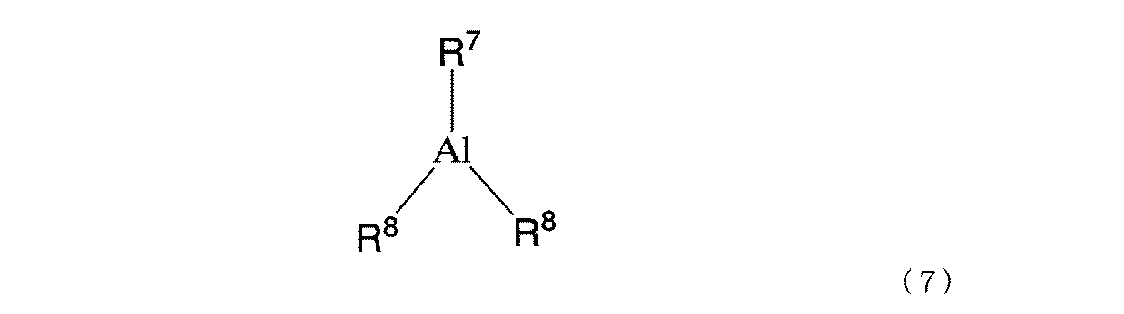
本発明のポリエチレン系重合体製造用触媒を構成する有機アルミニウム化合物(C)は、有機アルミニウム化合物と称される範疇に属するものであれば如何なるものも用いることも可能であり、その中でも、特に超高分子量ポリエチレン系重合体を生産効率よく製造することが可能なポリエチレン系重合体製造用触媒となることから、下記一般式(7)で表される有機アルミニウム化合物であることが好ましい。ここで、有機アルミニウム化合物以外の化合物、例えばメチルアルモキサン系化合物を用いた場合、触媒により得られるポリエチレン系重合体は、灰分が多いものとなったり、成形加工性に劣るなどの課題を有するものとなる。 As the organoaluminum compound (C) constituting the catalyst for producing the polyethylene-based polymer of the present invention, any organoaluminum compound (C) can be used as long as it belongs to the category called organoaluminum compound. An organoaluminum compound represented by the following general formula (7) is preferred because it becomes a polyethylene polymer production catalyst capable of producing a high molecular weight polyethylene polymer with high production efficiency. Here, when a compound other than the organoaluminum compound, for example, a methylalumoxane compound, is used, the polyethylene polymer obtained by the catalyst has problems such as a high ash content and poor molding processability. It becomes.
ここで、R7は炭素数1〜20の炭化水素基であり、例えばメチル基、エチル基、プロピル基、ブチル基、ペンチル基、ヘキシル基やそれらの異性体置換基などの炭素数1〜20のアルキル基;フェニル基、インデニル基、ナフチル基、フルオレニル基、ビフェニレニル基などの炭素数6〜20のアリール基;ベンジル基、フェニルエチル基、ジフェニルメチル基、ジフェニルエチル基などの炭素数7〜20のアリールアルキル基;メチルフェニル基、エチルフェニル基、メチルナフチル基などの炭素数7〜20のアルキルアリール基などを挙げることができ、R8は、各々独立して水素原子、塩素原子又は炭素数1〜20の炭化水素基であり、R8が炭素数1〜20の炭化水素基である場合は、R7と同様のものを挙げることができる。
Here, R 7 is a hydrocarbon group having 1 to 20 carbon atoms, for example, 1 to 20 carbon atoms such as methyl group, ethyl group, propyl group, butyl group, pentyl group, hexyl group and isomer substituents thereof. An aryl group having 6 to 20 carbon atoms such as phenyl group, indenyl group, naphthyl group, fluorenyl group and biphenylenyl group; 7 to 20 carbon atoms such as benzyl group, phenylethyl group, diphenylmethyl group and diphenylethyl group An alkylaryl group having 7 to 20 carbon atoms such as a methylphenyl group, an ethylphenyl group, or a methylnaphthyl group, and the like, and each R 8 independently represents a hydrogen atom, a chlorine atom, or a carbon number. 20 is a hydrocarbon group, when R 8 is a hydrocarbon group having 1 to 20 carbon atoms may include the same as R 7.
そして、該有機アルミニウム化合物としては、特に遷移金属化合物(A)を容易にアルキル化することが可能となることから、例えばトリメチルアルミニウム、トリエチルアルミニウム、トリイソブチルアルミニウムなどのアルキルアルミニウムなどを挙げることができる。 As the organoaluminum compound, the transition metal compound (A) can be easily alkylated, and examples thereof include alkylaluminums such as trimethylaluminum, triethylaluminum, and triisobutylaluminum. .
本発明のポリエチレン系重合体製造用触媒を構成する該遷移金属化合物(A)(以下(A)成分ということもある。)、該活性化助触媒(B)(以下、(B)成分ということもある。)、および該有機アルミニウム化合物(C)(以下、(C)成分ということもある。)の使用割合に関しては、ポリエチレン系重合体製造用触媒としての使用が可能であれば如何なる制限を受けるものでなく、その中でも、特に超高分子量ポリエチレン系重合体を生産効率よく製造することが可能なポリエチレン系重合体製造用触媒となることから、(A)成分と(C)成分の金属原子当たりのモル比は(A成分):(C成分)=100:1〜1:100000の範囲にあることが好ましく、特に1:1〜1:10000の範囲であることが好ましい。また、(A)成分と(B)成分のモル比は(A成分):(B成分)=10:1〜1:1000にあることが好ましく、特に3:1〜1:10の範囲であることが好ましい。 The transition metal compound (A) (hereinafter also referred to as component (A)) constituting the catalyst for producing a polyethylene polymer of the present invention, the activation promoter (B) (hereinafter referred to as component (B)). And the organoaluminum compound (C) (hereinafter also referred to as component (C)) may be used with any restrictions as long as it can be used as a catalyst for the production of a polyethylene polymer. Among them, since it becomes a catalyst for the production of a polyethylene polymer capable of producing an ultra-high molecular weight polyethylene polymer particularly efficiently, the metal atoms of the (A) component and the (C) component The per mole ratio is preferably in the range of (component A) :( component C) = 100: 1 to 1: 100000, and particularly preferably in the range of 1: 1 to 1: 10000. The molar ratio of the component (A) to the component (B) is preferably (component A) :( component B) = 10: 1 to 1: 1000, particularly 3: 1 to 1:10. It is preferable.
本発明のポリエチレン系重合体製造用触媒の調製方法に関しては、該(A)成分、該(B)成分および該(C)成分を含んでなるポリエチレン系重合体製造用触媒を調製することが可能であれば如何なる方法を用いてもよく、例えば各(A)成分、(B)成分、(C)成分に関して不活性な溶媒中あるいは重合を行うモノマーを溶媒として用い、混合する方法などを挙げることができる。また、これらの成分を反応させる順番に関しても制限はなく、この処理を行う温度、処理時間も制限はない。また、(A)成分、(B)成分、(C)成分のそれぞれを2種類以上用いてポリエチレン系重合体製造用触媒を調製することも可能である。 Regarding the method for preparing a catalyst for producing a polyethylene polymer of the present invention, it is possible to prepare a catalyst for producing a polyethylene polymer comprising the component (A), the component (B) and the component (C). Any method may be used as long as it includes, for example, a method in which each of the components (A), (B), and (C) is mixed in an inert solvent or using a monomer for polymerization as a solvent. Can do. Moreover, there is no restriction | limiting also about the order which makes these components react, and the temperature and processing time which perform this process also have no restriction | limiting. It is also possible to prepare a polyethylene-based polymer production catalyst by using two or more of each of the component (A), the component (B), and the component (C).
本発明のポリエチレン系重合体製造用触媒を用いて得られるポリエチレン系重合体としては、エチレンの単独重合のみならず他のオレフィンとの共重合であってもよく、これら重合により得られるポリエチレン系重合体は、単独重合体のみならず共重合体も含む意味で用いられる。 The polyethylene polymer obtained by using the catalyst for producing the polyethylene polymer of the present invention may be not only homopolymerization of ethylene but also copolymerization with other olefins. The polyethylene polymer obtained by these polymerizations may be used. The term “copolymer” is used to mean not only a homopolymer but also a copolymer.
本発明のポリエチレン系重合体製造用触媒を用いポリエチレン系重合体を製造する際の製造方法としては、例えば溶液重合法、塊状重合法、気相重合法、スラリー重合法等の方法を挙げることができ、その中でも、特に粒子形状の整ったポリエチレン系重合体を効率よく安定的に製造することが可能となることからスラリー重合法であることが好ましい。また、スラリー重合法に用いる溶媒としては、一般に用いられている有機溶媒であればいずれでもよく、例えばベンゼン、トルエン、キシレン、ペンタン、ヘキサン、ヘプタン等が挙げられ、プロピレン、1−ブテン、1−オクテン、1−ヘキセンなどのオレフィンを溶媒として用いることもできる。 Examples of the production method for producing a polyethylene polymer using the polyethylene polymer production catalyst of the present invention include a solution polymerization method, a bulk polymerization method, a gas phase polymerization method, and a slurry polymerization method. Among them, a slurry polymerization method is preferable because a polyethylene polymer having a particularly uniform particle shape can be produced efficiently and stably. The solvent used in the slurry polymerization method may be any organic solvent that is generally used, and examples thereof include benzene, toluene, xylene, pentane, hexane, heptane, and the like. Propylene, 1-butene, 1- Olefins such as octene and 1-hexene can also be used as a solvent.
また、ポリエチレン系重合体を共重合体とする際にエチレンとの共重合に用いる他のオレフィンとしては、例えばプロピレン、1−ブテン、4−メチル−1−ペンテン、1−ヘキセン、1−オクテン等のα−オレフィン;スチレン、スチレン誘導体;ブタジエン、1,4−ヘキサジエン、5−エチリデン−2−ノルボルネン、ジシクロペンタジエン、4−メチル−1,4−ヘキサジエン、7−メチル−1,6−オクタジエン等の共役および非共役ジエン;シクロブテン等の環状オレフィン;等が挙げられる。さらに、エチレンとプロピレンとスチレン、エチレンと1−ヘキセンとスチレン、エチレンとプロピレンとエチリデンノルボルネンのように、3種以上の成分を用いた共重合体とすることもできる。 Other olefins used for copolymerization with ethylene when a polyethylene polymer is used as a copolymer include, for example, propylene, 1-butene, 4-methyl-1-pentene, 1-hexene, 1-octene and the like. Styrene, styrene derivatives; butadiene, 1,4-hexadiene, 5-ethylidene-2-norbornene, dicyclopentadiene, 4-methyl-1,4-hexadiene, 7-methyl-1,6-octadiene, etc. Conjugated and non-conjugated dienes; cyclic olefins such as cyclobutene; and the like. Further, a copolymer using three or more components such as ethylene, propylene and styrene, ethylene, 1-hexene and styrene, ethylene, propylene, and ethylidene norbornene can be used.
本発明のポリエチレン系重合体製造用触媒によりポリエチレン系重合体を製造する際の重合温度、重合時間、重合圧力、モノマー濃度などの重合条件については任意に選択可能であり、その中でも、重合温度30〜90℃、重合時間10秒〜20時間、重合圧力常圧〜100MPaの範囲で行うことが好ましい。また、重合時に水素などを用いて分子量の調節を行うことも可能である。重合はバッチ式、半連続式、連続式のいずれの方法でも行うことが可能であり、重合条件を変えて、2段以上に分けて行うことも可能である。また、重合終了後に得られるポリエチレン系重合体は、従来既知の方法により重合溶媒から分離回収され、乾燥して得ることができる。 Polymerization conditions such as a polymerization temperature, a polymerization time, a polymerization pressure, and a monomer concentration when producing a polyethylene polymer using the catalyst for producing a polyethylene polymer of the present invention can be arbitrarily selected. It is preferable to carry out in the range of ˜90 ° C., polymerization time of 10 seconds to 20 hours, and polymerization pressure of normal pressure to 100 MPa. It is also possible to adjust the molecular weight using hydrogen during polymerization. The polymerization can be carried out by any of batch, semi-continuous and continuous methods, and can be carried out in two or more stages by changing the polymerization conditions. The polyethylene polymer obtained after the completion of the polymerization can be obtained by separating and recovering from the polymerization solvent by a conventionally known method and drying it.
本発明のポリエチレン系重合体製造用触媒は特に超高分子量のポリエチレン系重合体を製造するのに適したものであり、得られるポリエチレン系重合体としては、耐摩耗性等の機械物性に優れるポリエチレン系重合体となることから固有粘度(dL/g)12.0以上又はMvが200万以上の超高分子量ポリエチレン系重合体であることが好ましい。 The catalyst for producing a polyethylene polymer of the present invention is particularly suitable for producing an ultra-high molecular weight polyethylene polymer, and the obtained polyethylene polymer includes polyethylene having excellent mechanical properties such as wear resistance. Since it becomes a polymer, it is preferably an ultrahigh molecular weight polyethylene polymer having an intrinsic viscosity (dL / g) of 12.0 or more or an Mv of 2 million or more.
また、含有する金属不純物が少なく、クリーンなものとなることから、燃焼後の灰分が60ppm以下の超高分子量ポリエチレン系重合体であることが好ましい。 Moreover, since there are few metal impurities to contain and it becomes a clean thing, it is preferable that it is an ultra high molecular weight polyethylene-type polymer whose ash after combustion is 60 ppm or less.
さらに、特に耐摩耗性に優れるものとなることから、例えば得られる超高分子量ポリエチレン系重合体を直径×高さ=5mm×8mmの丸棒とし、相手材にSS400を用い、JIS K 7218に準じて測定した摩耗量が6mg以下の超高分子量ポリエチレン系重合体であることが好ましい。 Furthermore, since it will be particularly excellent in abrasion resistance, for example, the obtained ultra high molecular weight polyethylene polymer is a round bar of diameter × height = 5 mm × 8 mm, SS400 is used as the mating material, and conforms to JIS K 7218. The ultra high molecular weight polyethylene polymer having an abrasion amount of 6 mg or less is preferred.
本発明の特定の構造を有する遷移金属化合物(A)、特定の構造を有する活性化助触(B)及び有機アルミニウム化合物(C)を含んでなるメタロセン系触媒からなるポリエチレン系重合体製造用触媒は、特に機械的特性、耐摩耗性、成形性に優れ、灰分が少ない(超高分子量)ポリエチレン系重合体を効率よく安定的に製造することが可能となる。 Catalyst for producing a polyethylene polymer comprising a transition metal compound (A) having a specific structure of the present invention, an activation catalyst (B) having a specific structure and a metallocene catalyst comprising an organoaluminum compound (C) In particular, it is possible to efficiently and stably produce a polyethylene polymer having excellent mechanical properties, wear resistance, moldability, and low ash content (ultra high molecular weight).
以下に、実施例を示して本発明を更に詳細に説明するが、本発明はこれら実施例により制限されるものではない。なお、断りのない限り、用いた試薬等は市販品、あるいは既知の方法に従って合成したものを用いた。 Hereinafter, the present invention will be described in more detail with reference to examples, but the present invention is not limited to these examples. Unless otherwise noted, the reagents used were commercially available products or those synthesized according to known methods.
ポリエチレン系重合体製造用触媒の調製、ポリエチレン系重合体の製造および溶媒精製は全て不活性ガス雰囲気下で行った。トリイソブチルアルミニウムのヘキサン溶液(20wt%)は東ソーファインケム(株)製を用いた。 Preparation of the polyethylene polymer production catalyst, production of the polyethylene polymer and solvent purification were all carried out under an inert gas atmosphere. A hexane solution (20 wt%) of triisobutylaluminum manufactured by Tosoh Finechem Co., Ltd. was used.
さらに、実施例におけるポリエチレン系重合体の諸物性は、以下に示す方法により測定した。 Furthermore, various physical properties of the polyethylene-based polymer in the examples were measured by the following methods.
〜固有粘度の測定〜
ウベローデ型粘度計を用い、ODCB(オルトジクロルベンゼン)を溶媒として、135℃において、ポリエチレン系重合体濃度0.005wt%〜0.01wt%で測定した。
~ Measurement of intrinsic viscosity ~
Using an Ubbelohde viscometer, ODCB (orthodichlorobenzene) was used as a solvent at 135 ° C. with a polyethylene polymer concentration of 0.005 wt% to 0.01 wt%.
〜粘度換算分子量〜
固有粘度([η](dL/g))と粘度換算分子量(Mv)の下記関係式に基づき算出した。
[η]=5.05×10⁻⁴×(Mv)0.693
〜灰分の測定〜
白金皿に得られたポリエチレン系重合体を載せ、バーナーにて加熱し予備燃焼させた後、650℃に設定した電気炉内にて1時間加熱し、サンプルを灰化させることにより灰分重量を測定し、算出した。
~ Viscosity conversion molecular weight ~
It calculated based on the following relational expression of intrinsic viscosity ([η] (dL / g)) and viscosity conversion molecular weight (Mv).
[Η] = 5.05 × 10 −4 × (Mv) 0.693
~ Measurement of ash ~
Place the obtained polyethylene polymer on a platinum dish, heat it with a burner and pre-combust it, then heat it in an electric furnace set at 650 ° C for 1 hour, and incinerate the sample to measure the ash weight And calculated.
〜磨耗量の測定〜
得られたポリエチレン系重合体90gを金型に投入し、金型温度190℃、面圧力50kg/cm2にて20分間プレス成形し、縦×横×厚さ=100mm×100mm×10mmの板状成形品を得た。
~ Measurement of wear amount ~
90 g of the obtained polyethylene polymer was put into a mold, press-molded at a mold temperature of 190 ° C. and a surface pressure of 50 kg / cm 2 for 20 minutes, and a plate shape of length × width × thickness = 100 mm × 100 mm × 10 mm A molded product was obtained.
この成形品を平削り機にて切削加工して、直径×高さ=5mm×8mmの丸棒を試験用サンプルとして調製し、摩擦摩耗試験機(オリエンテック(株)製、型式EFM−III−EN)を用いて、JIS K 7218に準拠して、速度2.0m/秒、荷重25MPa、時間360分、相手材料SS400の条件で摩耗量を測定した。 This molded product was cut by a planing machine to prepare a round bar having a diameter × height = 5 mm × 8 mm as a test sample, and a friction and wear tester (Orientec Co., Ltd., model EFM-III- EN), and the amount of wear was measured in accordance with JIS K 7218 under the conditions of speed 2.0 m / sec, load 25 MPa, time 360 minutes, mating material SS400.
実施例1
(1)ポリエチレン系重合体製造用触媒溶液の調製
50mlのシュレンク管に、ジフェニルメチレン(1−インデニル)(2,7−ジ−tert−ブチル−9−フルオレニル)ハフニウムジクロリド10μmol、トルエン7.0ml、およびトリイソブチルアルミニウムのトルエン溶液(0.85mol/l)をアルミニウム原子当たり2.5mmol(3.0ml)加えた後、1時間攪拌した(以下、溶液(A)と記す。)。
Example 1
(1) Preparation of catalyst solution for production of polyethylene polymer In a 50 ml Schlenk tube, diphenylmethylene (1-indenyl) (2,7-di-tert-butyl-9-fluorenyl) hafnium dichloride 10 μmol, toluene 7.0 ml, Then, 2.5 mmol (3.0 ml) per aluminum atom of a toluene solution of triisobutylaluminum (0.85 mol / l) was added and stirred for 1 hour (hereinafter referred to as solution (A)).
一方、別に用意した50mlのシュレンク管に、ジメチルアニリニウムテトラキスペンタフルオロフェニルボレート12μmol(9.6mg)、トルエン10mlを加えて溶解した(以下、溶液(B)と記す。)。 On the other hand, 12 μmol (9.6 mg) of dimethylanilinium tetrakispentafluorophenylborate and 10 ml of toluene were added to a separately prepared 50 ml Schlenk tube and dissolved (hereinafter referred to as solution (B)).
そして、溶液(A)に溶液(B)を加えることによりメタロセン系触媒であるポリエチレン系重合体製造用触媒を調製した(ハフニウム原子濃度0.5mmol/l)。 And the catalyst for polyethylene-type polymer manufacture which is a metallocene catalyst was prepared by adding the solution (B) to the solution (A) (hafnium atom concentration 0.5 mmol / l).
(2)ポリエチレン系重合体の製造
2リットルのオートクレーブにヘキサンを1.2リットル、20%トリイソブチルアルミニウムを1.0ml、(1)で得られたポリエチレン系重合体製造用触媒の溶液をハフニウム原子当たり5μmol(触媒溶液10ml相当)加え、50℃に昇温後、分圧が1.5MPaになるようにエチレンを連続的に供給し、エチレンのスラリー重合を行った。60分経過後に脱圧し、スラリーを濾別後、乾燥することで120gのポリエチレン単独重合体を得た(活性:24kg/mmolHf)。得られたポリエチレン単独重合体の物性を表1に示す。
(2) Production of polyethylene polymer 1.2 liters of hexane, 1.0 ml of 20% triisobutylaluminum in a 2 liter autoclave, and a solution of the catalyst for production of the polyethylene polymer obtained in (1) was used as hafnium atoms 5 μmol per catalyst (equivalent to 10 ml of the catalyst solution) was added, and after raising the temperature to 50 ° C., ethylene was continuously supplied so that the partial pressure became 1.5 MPa, and ethylene slurry polymerization was performed. After 60 minutes, the pressure was released, and the slurry was filtered and dried to obtain 120 g of a polyethylene homopolymer (activity: 24 kg / mmol Hf). Table 1 shows the physical properties of the obtained polyethylene homopolymer.
実施例2
(1)ポリエチレン系重合体製造用触媒溶液の調製
50mlのシュレンク管に、ジフェニルメチレン(シクロペンタジエニル)(2,7−ジ−tert−ブチル−9−フルオレニル)ハフニウムジクロリド10μmol、トルエン7.0ml、およびトリイソブチルアルミニウムのトルエン溶液(0.85mol/l)をアルミニウム原子当たり2.5mmol(3.0ml)加えた後、1時間攪拌した(以下、溶液(C)と記す。)。
Example 2
(1) Preparation of catalyst solution for production of polyethylene polymer In a 50 ml Schlenk tube, diphenylmethylene (cyclopentadienyl) (2,7-di-tert-butyl-9-fluorenyl) hafnium dichloride 10 μmol, toluene 7.0 ml , And a toluene solution of triisobutylaluminum (0.85 mol / l) was added at 2.5 mmol (3.0 ml) per aluminum atom, followed by stirring for 1 hour (hereinafter referred to as solution (C)).
一方、別に用意した50mlのシュレンク管に、ジメチルアニリニウムテトラキスペンタフルオロフェニルボレート12μmol(9.6mg)、トルエン10mlを加えて溶解した(以下、溶液(D)と記す。)。 On the other hand, 12 μmol (9.6 mg) of dimethylanilinium tetrakispentafluorophenylborate and 10 ml of toluene were added to a separately prepared 50 ml Schlenk tube and dissolved (hereinafter referred to as solution (D)).
溶液(C)に溶液(D)を加えることによりメタロセン系触媒であるポリエチレン系重合体製造用触媒を調製した(ハフニウム原子濃度0.5mmol/l)。 By adding the solution (D) to the solution (C), a catalyst for producing a polyethylene polymer that is a metallocene catalyst was prepared (hafnium atom concentration 0.5 mmol / l).
(2)ポリエチレン系重合体の製造
2リットルのオートクレーブにヘキサンを1.2リットル、20%トリイソブチルアルミニウムを1.0ml、(1)で得られたポリエチレン系重合体製造用触媒の溶液をハフニウム原子当たり4μmol(触媒溶液8ml相当)加え、50℃に昇温後、分圧が1.5MPaになるようにエチレンを連続的に供給し、エチレンのスラリー重合を行った。60分経過後に脱圧し、スラリーを濾別後、乾燥することで140gのポリエチレン単独重合体を得た(活性:35kg/mmolHf)。得られたポリエチレン単独重合体の物性は表1に示す。
(2) Production of polyethylene polymer 1.2 liters of hexane, 1.0 ml of 20% triisobutylaluminum in a 2 liter autoclave, and a solution of the catalyst for production of the polyethylene polymer obtained in (1) was used as hafnium atoms 4 μmol per catalyst (equivalent to 8 ml of the catalyst solution) was added, and after raising the temperature to 50 ° C., ethylene was continuously supplied so that the partial pressure became 1.5 MPa to carry out slurry polymerization of ethylene. After 60 minutes, the pressure was released, and the slurry was filtered and dried to obtain 140 g of a polyethylene homopolymer (activity: 35 kg / mmol Hf). Table 1 shows the physical properties of the obtained polyethylene homopolymer.
実施例3
(1)ポリエチレン系重合体製造用触媒溶液の調製
50mlのシュレンク管に、ジメチルシランジイル(4−フェニル−1−インデニル)(2,7−ジ−tert−ブチル−9−フルオレニル)ハフニウムジクロリド10μmol、トルエン7.0ml、およびトリイソブチルアルミニウムのトルエン溶液(0.85mol/l)をアルミニウム原子当たり2.5mmol(3.0ml)加えた後、1時間攪拌した(以下、溶液(E)と記す。)。
Example 3
(1) Preparation of catalyst solution for production of polyethylene polymer In a 50 ml Schlenk tube, 10 μmol of dimethylsilanediyl (4-phenyl-1-indenyl) (2,7-di-tert-butyl-9-fluorenyl) hafnium dichloride, Toluene 7.0 ml, and a toluene solution of triisobutylaluminum (0.85 mol / l) were added at 2.5 mmol (3.0 ml) per aluminum atom, and then stirred for 1 hour (hereinafter referred to as solution (E)). .
一方、別に用意した50mlのシュレンク管に、ジメチルアニリニウムテトラキスペンタフルオロフェニルボレート12μmol(9.6mg)、トルエン10mlを加えて溶解した(以下、溶液(F)と記す。)。 On the other hand, 12 μmol (9.6 mg) of dimethylanilinium tetrakispentafluorophenylborate and 10 ml of toluene were added to a separately prepared 50 ml Schlenk tube and dissolved (hereinafter referred to as solution (F)).
溶液(E)に溶液(F)を加えることによりメタロセン系触媒であるポリエチレン系重合体製造用触媒を調製した(ハフニウム原子濃度0.5mmol/l)。 By adding the solution (F) to the solution (E), a catalyst for producing a polyethylene polymer which is a metallocene catalyst was prepared (hafnium atom concentration 0.5 mmol / l).
(2)ポリエチレン系重合体の製造
2リットルのオートクレーブにヘキサンを1.2リットル、20%トリイソブチルアルミニウムを1.0ml、(1)で得られたポリエチレン系重合体製造用触媒の溶液をハフニウム原子当たり3μmol(触媒溶液6ml相当)加え、50℃に昇温後、分圧が1.5MPaになるようにエチレンを連続的に供給し、エチレンのスラリー重合を行った。60分経過後に脱圧し、スラリーを濾別後、乾燥することで125gのポリエチレン単独重合体を得た(活性:42kg/mmolHf)。得られたポリエチレン単独重合体の物性を表1に示す。
(2) Production of polyethylene polymer 1.2 liters of hexane, 1.0 ml of 20% triisobutylaluminum in a 2 liter autoclave, and a solution of the catalyst for production of the polyethylene polymer obtained in (1) was used as hafnium atoms 3 μmol per catalyst (corresponding to 6 ml of the catalyst solution) was added, and after raising the temperature to 50 ° C., ethylene was continuously supplied so that the partial pressure became 1.5 MPa to carry out slurry polymerization of ethylene. After 60 minutes, the pressure was released, and the slurry was filtered and dried to obtain 125 g of a polyethylene homopolymer (activity: 42 kg / mmol Hf). Table 1 shows the physical properties of the obtained polyethylene homopolymer.
実施例4
(1)ポリエチレン系重合体製造用触媒溶液の調製
50mlのシュレンク管に、ジフェニルメチレン(1−インデニル)(2,7−ジメトキシ−9−フルオレニル)ハフニウムジクロリド10μmol、トルエン7.0ml、およびトリイソブチルアルミニウムのトルエン溶液(0.85mol/l)をアルミニウム原子当たり2.5mmol(3.0ml)加えた後、1時間攪拌した(以下、溶液(G)と記す。)。
Example 4
(1) Preparation of catalyst solution for production of polyethylene polymer In a 50 ml Schlenk tube, 10 μmol of diphenylmethylene (1-indenyl) (2,7-dimethoxy-9-fluorenyl) hafnium dichloride, 7.0 ml of toluene, and triisobutylaluminum Toluene solution (0.85 mol / l) was added in an amount of 2.5 mmol (3.0 ml) per aluminum atom and stirred for 1 hour (hereinafter referred to as solution (G)).
一方、別に用意した50mlのシュレンク管に、ジメチルアニリニウムテトラキスペンタフルオロフェニルボレート12μmol(9.6mg)、トルエン10mlを加えて溶解した(以下、溶液(H)と記す。)。 On the other hand, 12 μmol (9.6 mg) of dimethylanilinium tetrakispentafluorophenylborate and 10 ml of toluene were added to a separately prepared 50 ml Schlenk tube and dissolved (hereinafter referred to as solution (H)).
そして、溶液(G)に溶液(H)を加えることによりメタロセン系触媒であるポリエチレン系重合体製造用触媒を調製した(ハフニウム原子濃度0.5mmol/l)。 And the catalyst for polyethylene polymer manufacture which is a metallocene catalyst was prepared by adding the solution (H) to the solution (G) (hafnium atom concentration 0.5 mmol / l).
(2)ポリエチレン系重合体の製造
2リットルのオートクレーブにヘキサンを1.2リットル、20%トリイソブチルアルミニウムを1.0ml、(1)で得られたポリエチレン系重合体製造用触媒の溶液をハフニウム原子当たり6μmol(触媒溶液12ml相当)加え、50℃に昇温後、分圧が1.5MPaになるようにエチレンを連続的に供給し、エチレンのスラリー重合を行った。60分経過後に脱圧し、スラリーを濾別後、乾燥することで120gのポリエチレン単独重合体を得た(活性:20kg/mmolHf)。得られたポリエチレン単独重合体の物性を表1に示す。
(2) Production of polyethylene polymer 1.2 liters of hexane, 1.0 ml of 20% triisobutylaluminum in a 2 liter autoclave, and a solution of the catalyst for production of the polyethylene polymer obtained in (1) was used as hafnium atoms 6 μmol per catalyst (equivalent to 12 ml of catalyst solution) was added, and after raising the temperature to 50 ° C., ethylene was continuously supplied so that the partial pressure became 1.5 MPa, and ethylene slurry polymerization was performed. After 60 minutes, the pressure was released, and the slurry was filtered and dried to obtain 120 g of a polyethylene homopolymer (activity: 20 kg / mmol Hf). Table 1 shows the physical properties of the obtained polyethylene homopolymer.
実施例5
(1)ポリエチレン系重合体製造用触媒溶液の調製
50mlのシュレンク管に、ジフェニルメチレン(シクロペンタジエニル)(2,7−ジメトキシ−9−フルオレニル)ハフニウムジクロリド10μmol、トルエン7.0ml、およびトリイソブチルアルミニウムのトルエン溶液(0.85mol/l)をアルミニウム原子当たり2.5mmol(3.0ml)加えた後、1時間攪拌した(以下、溶液(I)と記す。)。
Example 5
(1) Preparation of catalyst solution for production of polyethylene polymer In a 50 ml Schlenk tube, 10 μmol of diphenylmethylene (cyclopentadienyl) (2,7-dimethoxy-9-fluorenyl) hafnium dichloride, 7.0 ml of toluene, and triisobutyl After adding 2.5 mmol (3.0 ml) of aluminum in toluene (0.85 mol / l) per aluminum atom, the solution was stirred for 1 hour (hereinafter referred to as solution (I)).
一方、別に用意した50mlのシュレンク管に、ジメチルアニリニウムテトラキスペンタフルオロフェニルボレート12μmol(9.6mg)、トルエン10mlを加えて溶解した(以下、溶液(J)と記す。)。 Meanwhile, 12 μmol (9.6 mg) of dimethylanilinium tetrakispentafluorophenylborate and 10 ml of toluene were added to a separately prepared 50 ml Schlenk tube and dissolved (hereinafter referred to as solution (J)).
そして、溶液(I)に溶液(J)を加えることによりメタロセン系触媒であるポリエチレン系重合体製造用触媒を調製した(ハフニウム原子濃度0.5mmol/l)。 And the catalyst for polyethylene-type polymer manufacture which is a metallocene-type catalyst was prepared by adding solution (J) to solution (I) (hafnium atom density | concentration 0.5 mmol / l).
(2)ポリエチレン系重合体の製造
2リットルのオートクレーブにヘキサンを1.2リットル、20%トリイソブチルアルミニウムを1.0ml、(1)で得られたポリエチレン系重合体製造用触媒の溶液をハフニウム原子当たり5μmol(触媒溶液10ml相当)加え、50℃に昇温後、分圧が1.5MPaになるようにエチレンを連続的に供給し、エチレンのスラリー重合を行った。60分経過後に脱圧し、スラリーを濾別後、乾燥することで135gのポリエチレン単独重合体を得た(活性:27kg/mmolHf)。得られたポリエチレン単独重合体の物性を表1に示す。
(2) Production of polyethylene polymer 1.2 liters of hexane, 1.0 ml of 20% triisobutylaluminum in a 2 liter autoclave, and a solution of the catalyst for production of the polyethylene polymer obtained in (1) was used as hafnium atoms 5 μmol per catalyst (equivalent to 10 ml of the catalyst solution) was added, and after raising the temperature to 50 ° C., ethylene was continuously supplied so that the partial pressure became 1.5 MPa, and ethylene slurry polymerization was performed. After 60 minutes, the pressure was released, and the slurry was filtered and dried to obtain 135 g of a polyethylene homopolymer (activity: 27 kg / mmol Hf). Table 1 shows the physical properties of the obtained polyethylene homopolymer.
実施例6
(1)ポリエチレン系重合体製造用触媒溶液の調製
50mlのシュレンク管に、ジメチルシランジイル(4,7−ジメチル−1−インデニル)(2,7−ジ−tert−ブチル−9−フルオレニル)ハフニウムジクロリド10μmol、トルエン7.0ml、およびトリイソブチルアルミニウムのトルエン溶液(0.85mol/l)をアルミニウム原子当たり2.5mmol(3.0ml)加えた後、1時間攪拌した(以下、溶液(K)と記す。)。
Example 6
(1) Preparation of catalyst solution for production of polyethylene polymer In a 50 ml Schlenk tube, dimethylsilanediyl (4,7-dimethyl-1-indenyl) (2,7-di-tert-butyl-9-fluorenyl) hafnium dichloride is added. 10 μmol, 7.0 ml of toluene, and a toluene solution of triisobutylaluminum (0.85 mol / l) were added at 2.5 mmol (3.0 ml) per aluminum atom and stirred for 1 hour (hereinafter referred to as solution (K)). .)
一方、別に用意した50mlのシュレンク管に、ジメチルアニリニウムテトラキスペンタフルオロフェニルボレート12μmol(9.6mg)、トルエン10mlを加えて溶解した(以下、溶液(L)と記す。)。 On the other hand, 12 μmol (9.6 mg) of dimethylanilinium tetrakispentafluorophenylborate and 10 ml of toluene were added to a separately prepared 50 ml Schlenk tube and dissolved (hereinafter referred to as solution (L)).
溶液(K)に溶液(L)を加えることによりメタロセン系触媒であるポリエチレン系重合体製造用触媒を調製した(ハフニウム原子濃度0.5mmol/l)。 By adding the solution (L) to the solution (K), a catalyst for producing a polyethylene polymer that is a metallocene catalyst was prepared (hafnium atom concentration: 0.5 mmol / l).
(2)ポリエチレン系重合体の製造
2リットルのオートクレーブにヘキサンを1.2リットル、20%トリイソブチルアルミニウムを1.0ml、(1)で得られたポリエチレン系重合体製造用触媒の溶液をハフニウム原子当たり3μmol(触媒溶液6ml相当)加え、50℃に昇温後、分圧が1.5MPaになるようにエチレンを連続的に供給し、エチレンのスラリー重合を行った。60分経過後に脱圧し、スラリーを濾別後、乾燥することで125gのポリエチレン単独重合体を得た(活性:42kg/mmolHf)。得られたポリエチレン単独重合体の物性を表1に示す。
(2) Production of polyethylene polymer 1.2 liters of hexane, 1.0 ml of 20% triisobutylaluminum in a 2 liter autoclave, and a solution of the catalyst for production of the polyethylene polymer obtained in (1) was used as hafnium atoms 3 μmol per catalyst (corresponding to 6 ml of the catalyst solution) was added, and after raising the temperature to 50 ° C., ethylene was continuously supplied so that the partial pressure became 1.5 MPa to carry out slurry polymerization of ethylene. After 60 minutes, the pressure was released, and the slurry was filtered and dried to obtain 125 g of a polyethylene homopolymer (activity: 42 kg / mmol Hf). Table 1 shows the physical properties of the obtained polyethylene homopolymer.
実施例7
(1)ポリエチレン系重合体製造用触媒溶液の調製
50mlのシュレンク管に、ジフェニルメチレン(4,7−ジメチル−1−インデニル)(2,7−ジ−tert−ブチル−9−フルオレニル)ハフニウムジクロリド10μmol、トルエン7.0ml、およびトリイソブチルアルミニウムのトルエン溶液(0.85mol/l)をアルミニウム原子当たり2.5mmol(3.0ml)加えた後、1時間攪拌した(以下、溶液(M)と記す。)。
Example 7
(1) Preparation of catalyst solution for production of polyethylene polymer Diphenylmethylene (4,7-dimethyl-1-indenyl) (2,7-di-tert-butyl-9-fluorenyl) hafnium dichloride 10 μmol was added to a 50 ml Schlenk tube. Then, 7.0 ml of toluene and a toluene solution of triisobutylaluminum (0.85 mol / l) were added at 2.5 mmol (3.0 ml) per aluminum atom, followed by stirring for 1 hour (hereinafter referred to as solution (M). ).
一方、別に用意した50mlのシュレンク管に、ジメチルアニリニウムテトラキスペンタフルオロフェニルボレート12μmol(9.6mg)、トルエン10mlを加えて溶解した(以下、溶液(N)と記す。)。 On the other hand, 12 μmol (9.6 mg) of dimethylanilinium tetrakispentafluorophenylborate and 10 ml of toluene were added to a separately prepared 50 ml Schlenk tube and dissolved (hereinafter referred to as solution (N)).
溶液(M)に溶液(N)を加えることによりメタロセン系触媒であるポリエチレン系重合体製造用触媒を調製した(ハフニウム原子濃度0.5mmol/l)。 By adding the solution (N) to the solution (M), a catalyst for producing a polyethylene polymer that is a metallocene catalyst was prepared (hafnium atom concentration: 0.5 mmol / l).
(2)ポリエチレン系重合体の製造
2リットルのオートクレーブにヘキサンを1.2リットル、20%トリイソブチルアルミニウムを1.0ml、(1)で得られたポリエチレン系重合体製造用触媒の溶液をハフニウム原子当たり6μmol(触媒溶液12ml相当)加え、50℃に昇温後、分圧が1.5MPaになるようにエチレンを連続的に供給し、エチレンのスラリー重合を行った。60分経過後に脱圧し、スラリーを濾別後、乾燥することで110gのポリエチレン単独重合体を得た(活性:18kg/mmolHf)。得られたポリエチレン単独重合体の物性を表1に示す。
(2) Production of polyethylene polymer 1.2 liters of hexane, 1.0 ml of 20% triisobutylaluminum in a 2 liter autoclave, and a solution of the catalyst for production of the polyethylene polymer obtained in (1) was used as hafnium atoms 6 μmol per catalyst (equivalent to 12 ml of catalyst solution) was added, and after raising the temperature to 50 ° C., ethylene was continuously supplied so that the partial pressure became 1.5 MPa, and ethylene slurry polymerization was performed. After 60 minutes, the pressure was released, and the slurry was filtered and dried to obtain 110 g of a polyethylene homopolymer (activity: 18 kg / mmol Hf). Table 1 shows the physical properties of the obtained polyethylene homopolymer.
実施例8
(1)ポリエチレン系重合体製造用触媒溶液の調製
50mlのシュレンク管に、ジフェニルメチレン(4,7−ジメチル−1−インデニル)(2,7−ジメトキシ−9−フルオレニル)ハフニウムジクロリド10μmol、トルエン7.0ml、およびトリイソブチルアルミニウムのトルエン溶液(0.85mol/l)をアルミニウム原子当たり2.5mmol(3.0ml)加えた後、1時間攪拌した(以下、溶液(P)と記す。)。
Example 8
(1) Preparation of catalyst solution for production of polyethylene polymer In a 50 ml Schlenk tube, diphenylmethylene (4,7-dimethyl-1-indenyl) (2,7-dimethoxy-9-fluorenyl) hafnium dichloride 10 μmol, toluene 7. After adding 0 ml and a toluene solution of triisobutylaluminum (0.85 mol / l), 2.5 mmol (3.0 ml) per aluminum atom, the mixture was stirred for 1 hour (hereinafter referred to as solution (P)).
一方、別に用意した50mlのシュレンク管に、ジメチルアニリニウムテトラキスペンタフルオロフェニルボレート12μmol(9.6mg)、トルエン10mlを加えて溶解した(以下、溶液(Q)と記す。)。 On the other hand, 12 μmol (9.6 mg) of dimethylanilinium tetrakispentafluorophenylborate and 10 ml of toluene were added to a separately prepared 50 ml Schlenk tube and dissolved (hereinafter referred to as solution (Q)).
そして、溶液(P)に溶液(Q)を加えることによりメタロセン系触媒であるポリエチレン系重合体製造用触媒を調製した(ハフニウム原子濃度0.5mmol/l)。 Then, by adding the solution (Q) to the solution (P), a catalyst for producing a polyethylene polymer that is a metallocene catalyst was prepared (hafnium atom concentration: 0.5 mmol / l).
(2)ポリエチレン系重合体の製造
2リットルのオートクレーブにヘキサンを1.2リットル、20%トリイソブチルアルミニウムを1.0ml、(1)で得られたポリエチレン系重合体製造用触媒の溶液をハフニウム原子当たり6μmol(触媒溶液12ml相当)加え、50℃に昇温後、分圧が1.5MPaになるようにエチレンを連続的に供給し、エチレンのスラリー重合を行った。60分経過後に脱圧し、スラリーを濾別後、乾燥することで100gのポリエチレン単独重合体を得た(活性:17kg/mmolHf)。得られたポリエチレン単独重合体の物性を表1に示す。
(2) Production of polyethylene polymer 1.2 liters of hexane, 1.0 ml of 20% triisobutylaluminum in a 2 liter autoclave, and a solution of the catalyst for production of the polyethylene polymer obtained in (1) was used as hafnium atoms 6 μmol per catalyst (equivalent to 12 ml of catalyst solution) was added, and after raising the temperature to 50 ° C., ethylene was continuously supplied so that the partial pressure became 1.5 MPa, and ethylene slurry polymerization was performed. After 60 minutes, the pressure was released, and the slurry was filtered and dried to obtain 100 g of a polyethylene homopolymer (activity: 17 kg / mmol Hf). Table 1 shows the physical properties of the obtained polyethylene homopolymer.
実施例9
(1)ポリエチレン系重合体製造用触媒溶液の調製
50mlのシュレンク管に、ジフェニルメチレン(4−フェニル−1−インデニル)(2,7−ジ−tert−ブチル−9−フルオレニル)ハフニウムジクロリド10μmol、トルエン7.0ml、およびトリイソブチルアルミニウムのトルエン溶液(0.85mol/l)をアルミニウム原子当たり2.5mmol(3.0ml)加えた後、1時間攪拌した(以下、溶液(R)と記す。)。
Example 9
(1) Preparation of catalyst solution for production of polyethylene polymer In a 50 ml Schlenk tube, diphenylmethylene (4-phenyl-1-indenyl) (2,7-di-tert-butyl-9-fluorenyl) hafnium dichloride 10 μmol, toluene 7.0 ml of a toluene solution of triisobutylaluminum (0.85 mol / l) was added at 2.5 mmol (3.0 ml) per aluminum atom, and the mixture was stirred for 1 hour (hereinafter referred to as solution (R)).
一方、別に用意した50mlのシュレンク管に、ジメチルアニリニウムテトラキスペンタフルオロフェニルボレート12μmol(9.6mg)、トルエン10mlを加えて溶解した(以下、溶液(S)と記す。)。 On the other hand, 12 μmol (9.6 mg) of dimethylanilinium tetrakispentafluorophenylborate and 10 ml of toluene were added to a separately prepared 50 ml Schlenk tube and dissolved (hereinafter referred to as solution (S)).
溶液(R)に溶液(S)を加えることによりメタロセン系触媒であるポリエチレン系重合体製造用触媒を調製した(ハフニウム原子濃度0.5mmol/l)。 By adding the solution (S) to the solution (R), a catalyst for producing a polyethylene polymer which is a metallocene catalyst was prepared (hafnium atom concentration: 0.5 mmol / l).
(2)ポリエチレン系重合体の製造
2リットルのオートクレーブにヘキサンを1.2リットル、20%トリイソブチルアルミニウムを1.0ml、(1)で得られたポリエチレン系重合体製造用触媒の溶液をハフニウム原子当たり6μmol(触媒溶液12ml相当)加え、50℃に昇温後、分圧が1.5MPaになるようにエチレンを連続的に供給し、エチレンのスラリー重合を行った。60分経過後に脱圧し、スラリーを濾別後、乾燥することで110gのポリエチレン単独重合体を得た(活性:18kg/mmolHf)。得られたポリエチレン単独重合体の物性を表1に示す。
(2) Production of polyethylene polymer 1.2 liters of hexane, 1.0 ml of 20% triisobutylaluminum in a 2 liter autoclave, and a solution of the catalyst for production of the polyethylene polymer obtained in (1) was used as hafnium atoms 6 μmol per catalyst (equivalent to 12 ml of catalyst solution) was added, and after raising the temperature to 50 ° C., ethylene was continuously supplied so that the partial pressure became 1.5 MPa, and ethylene slurry polymerization was performed. After 60 minutes, the pressure was released, and the slurry was filtered and dried to obtain 110 g of a polyethylene homopolymer (activity: 18 kg / mmol Hf). Table 1 shows the physical properties of the obtained polyethylene homopolymer.
実施例10
(1)ポリエチレン系重合体製造用触媒溶液の調製
50mlのシュレンク管に、ジフェニルメチレン(4−フェニル−1−インデニル)(2,7−ジメトキシ−9−フルオレニル)ハフニウムジクロリド10μmol、トルエン7.0ml、およびトリイソブチルアルミニウムのトルエン溶液(0.85mol/l)をアルミニウム原子当たり2.5mmol(3.0ml)加えた後、1時間攪拌した(以下、溶液(T)と記す。)。
Example 10
(1) Preparation of catalyst solution for production of polyethylene polymer In a 50 ml Schlenk tube, diphenylmethylene (4-phenyl-1-indenyl) (2,7-dimethoxy-9-fluorenyl) hafnium dichloride 10 μmol, 7.0 ml of toluene, Then, 2.5 mmol (3.0 ml) per aluminum atom of a toluene solution of triisobutylaluminum (0.85 mol / l) was added, followed by stirring for 1 hour (hereinafter referred to as solution (T)).
一方、別に用意した50mlのシュレンク管に、ジメチルアニリニウムテトラキスペンタフルオロフェニルボレート12μmol(9.6mg)、トルエン10mlを加えて溶解した(以下、溶液(U)と記す。)。 On the other hand, 12 μmol (9.6 mg) of dimethylanilinium tetrakispentafluorophenylborate and 10 ml of toluene were added to a separately prepared 50 ml Schlenk tube and dissolved (hereinafter referred to as solution (U)).
そして、溶液(T)に溶液(U)を加えることによりメタロセン系触媒であるポリエチレン系重合体製造用触媒を調製した(ハフニウム原子濃度0.5mmol/l)。 And the catalyst for polyethylene polymer manufacture which is a metallocene catalyst was prepared by adding the solution (U) to the solution (T) (hafnium atom concentration 0.5 mmol / l).
(2)ポリエチレン系重合体の製造
2リットルのオートクレーブにヘキサンを1.2リットル、20%トリイソブチルアルミニウムを1.0ml、(1)で得られたポリエチレン系重合体製造用触媒の溶液をハフニウム原子当たり6μmol(触媒溶液12ml相当)加え、50℃に昇温後、分圧が1.5MPaになるようにエチレンを連続的に供給し、エチレンのスラリー重合を行った。60分経過後に脱圧し、スラリーを濾別後、乾燥することで100gのポリエチレン単独重合体を得た(活性:17kg/mmolHf)。得られたポリエチレン単独重合体の物性を表1に示す。
(2) Production of polyethylene polymer 1.2 liters of hexane, 1.0 ml of 20% triisobutylaluminum in a 2 liter autoclave, and a solution of the catalyst for production of the polyethylene polymer obtained in (1) was used as hafnium atoms 6 μmol per catalyst (equivalent to 12 ml of catalyst solution) was added, and after raising the temperature to 50 ° C., ethylene was continuously supplied so that the partial pressure became 1.5 MPa, and ethylene slurry polymerization was performed. After 60 minutes, the pressure was released, and the slurry was filtered and dried to obtain 100 g of a polyethylene homopolymer (activity: 17 kg / mmol Hf). Table 1 shows the physical properties of the obtained polyethylene homopolymer.
比較例1
(1)触媒溶液の調製
50mlのシュレンク管に、ジフェニルメチレン(1−インデニル)(2,7−ジ−tert−ブチル−9−フルオレニル)ジルコニウムジクロリド10μmol、トルエン7.0ml、およびトリイソブチルアルミニウムのトルエン溶液(0.85mol/l)をアルミニウム原子当たり2.5mmol(3.0ml)加えた後、1時間攪拌した(以下、溶液(1)と記す。)。
Comparative Example 1
(1) Preparation of catalyst solution To a 50 ml Schlenk tube, 10 μmol of diphenylmethylene (1-indenyl) (2,7-di-tert-butyl-9-fluorenyl) zirconium dichloride, 7.0 ml of toluene, and toluene of triisobutylaluminum The solution (0.85 mol / l) was added with 2.5 mmol (3.0 ml) per aluminum atom, and then stirred for 1 hour (hereinafter referred to as solution (1)).
一方、別に用意した50mlのシュレンク管に、ジメチルアニリニウムテトラキスペンタフルオロフェニルボレート12μmol(9.6mg)、トルエン10mlを加えて溶解した(以下、溶液(2)と記す。)。 On the other hand, 12 μmol (9.6 mg) of dimethylanilinium tetrakispentafluorophenylborate and 10 ml of toluene were added to a separately prepared 50 ml Schlenk tube and dissolved (hereinafter referred to as solution (2)).
溶液(1)に溶液(2)を加えることにより触媒を調製した(ジルコニウム原子濃度0.5mmol/l)。 A catalyst was prepared by adding the solution (2) to the solution (1) (zirconium atom concentration 0.5 mmol / l).
(2)ポリエチレンの製造
2リットルのオートクレーブにヘキサンを1.2リットル、20%トリイソブチルアルミニウムを1.0ml、(1)で得られた触媒溶液をジルコニウム原子当たり2μmol(触媒溶液4ml相当)加え、50℃に昇温後、分圧が1.5MPaになるようにエチレンを連続的に供給し、エチレンのスラリー重合を行った。60分経過後に脱圧し、スラリーを濾別後、乾燥することで130gのポリエチレンを得た(活性:65kg/mmolZr)。得られたポリエチレンの物性を表1に示す。得られたポリエチレンは、固有粘度が低いものであり、耐摩耗性に期待できないものであった。
(2) Production of polyethylene 1.2 liters of hexane, 1.0 ml of 20% triisobutylaluminum in a 2 liter autoclave, 2 μmol of catalyst solution obtained in (1) (equivalent to 4 ml of catalyst solution) were added, After raising the temperature to 50 ° C., ethylene was continuously supplied so that the partial pressure became 1.5 MPa, and ethylene slurry polymerization was performed. After 60 minutes, the pressure was released, and the slurry was filtered and dried to obtain 130 g of polyethylene (activity: 65 kg / mmol Zr). Table 1 shows the physical properties of the obtained polyethylene. The obtained polyethylene had a low intrinsic viscosity and was not expected to have wear resistance.
比較例2
(1)触媒溶液の調製
50mlのシュレンク管に、ジフェニルメチレン(1−シクロペンタジエニル)(2,7−ジ−tert−ブチル−9−フルオレニル)ジルコニウムジクロリド10μmol、トルエン7.0ml、およびトリイソブチルアルミニウムのトルエン溶液(0.85mol/l)をアルミニウム原子当たり2.5mmol(3.0ml)加えた後、1時間攪拌した(以下、溶液(3)と記す。)。
Comparative Example 2
(1) Preparation of catalyst solution In a 50 ml Schlenk tube, diphenylmethylene (1-cyclopentadienyl) (2,7-di-tert-butyl-9-fluorenyl) zirconium dichloride 10 μmol, toluene 7.0 ml, and triisobutyl After adding 2.5 mmol (3.0 ml) of aluminum in toluene (0.85 mol / l) per aluminum atom, the solution was stirred for 1 hour (hereinafter referred to as solution (3)).
一方、別に用意した50mlのシュレンク管に、ジメチルアニリニウムテトラキスペンタフルオロフェニルボレート12μmol(9.6mg)、トルエン10mlを加えて溶解した(以下、溶液(4)と記す。)。 On the other hand, 12 μmol (9.6 mg) of dimethylanilinium tetrakispentafluorophenylborate and 10 ml of toluene were added to a separately prepared 50 ml Schlenk tube and dissolved (hereinafter referred to as solution (4)).
溶液(3)に溶液(4)を加えることにより触媒を調製した(ジルコニウム原子濃度0.5mmol/l)。 A catalyst was prepared by adding the solution (4) to the solution (3) (zirconium atom concentration 0.5 mmol / l).
(2)ポリエチレンの製造
2リットルのオートクレーブにヘキサンを1.2リットル、20%トリイソブチルアルミニウムを1.0ml、(1)で得られた触媒溶液をジルコニウム原子当たり2μmol(触媒溶液4ml相当)加え、50℃に昇温後、分圧が1.5MPaになるようにエチレンを連続的に供給し、エチレンのスラリー重合を行った。60分経過後に脱圧し、スラリーを濾別後、乾燥することで160gのポリエチレンを得た(活性:80kg/mmolZr)。得られたポリエチレンの物性を表1に示す。得られたポリエチレンは、固有粘度が低いものであり、耐摩耗性に期待できないものであった。
(2) Production of polyethylene 1.2 liters of hexane, 1.0 ml of 20% triisobutylaluminum in a 2 liter autoclave, 2 μmol of catalyst solution obtained in (1) (equivalent to 4 ml of catalyst solution) were added, After raising the temperature to 50 ° C., ethylene was continuously supplied so that the partial pressure became 1.5 MPa, and ethylene slurry polymerization was performed. After 60 minutes, the pressure was released, and the slurry was filtered and dried to obtain 160 g of polyethylene (activity: 80 kg / mmol Zr). Table 1 shows the physical properties of the obtained polyethylene. The obtained polyethylene had a low intrinsic viscosity and was not expected to have wear resistance.
比較例3
(1)触媒溶液の調製
50mlのシュレンク管に、ジフェニルメチレン(1−インデニル)(2,7−ジメトキシ−9−フルオレニル)ジルコニウムジクロリド10μmol、トルエン7.0ml、およびトリイソブチルアルミニウムのトルエン溶液(0.85mol/l)をアルミニウム原子当たり2.5mmol(3.0ml)加えた後、1時間攪拌した(以下、溶液(5)と記す。)。
Comparative Example 3
(1) Preparation of catalyst solution In a 50 ml Schlenk tube, 10 μmol of diphenylmethylene (1-indenyl) (2,7-dimethoxy-9-fluorenyl) zirconium dichloride, 7.0 ml of toluene, and a toluene solution of triisobutylaluminum (0. 85 mol / l) was added at 2.5 mmol (3.0 ml) per aluminum atom, followed by stirring for 1 hour (hereinafter referred to as solution (5)).
一方、別に用意した50mlのシュレンク管に、ジメチルアニリニウムテトラキスペンタフルオロフェニルボレート12μmol(9.6mg)、トルエン10mlを加えて溶解した(以下、溶液(6)と記す。)。 On the other hand, 12 μmol (9.6 mg) of dimethylanilinium tetrakispentafluorophenylborate and 10 ml of toluene were added to a separately prepared 50 ml Schlenk tube and dissolved (hereinafter referred to as solution (6)).
溶液(5)に溶液(6)を加えることにより触媒を調製した(ジルコニウム原子濃度0.5mmol/l)。 A catalyst was prepared by adding the solution (6) to the solution (5) (zirconium atom concentration 0.5 mmol / l).
(2)ポリエチレンの製造
2リットルのオートクレーブにヘキサンを1.2リットル、20%トリイソブチルアルミニウムを1.0ml、(1)で得られた触媒溶液をジルコニウム原子当たり2μmol(触媒溶液4ml相当)加え、50℃に昇温後、分圧が1.5MPaになるようにエチレンを連続的に供給し、エチレンのスラリー重合を行った。60分経過後に脱圧し、スラリーを濾別後、乾燥することで120gのポリエチレンを得た(活性:60kg/mmolZr)。得られたポリエチレンの物性を表1に示す。得られたポリエチレンは、固有粘度が低いものであり、耐摩耗性に期待できないものであった。
(2) Production of polyethylene 1.2 liters of hexane, 1.0 ml of 20% triisobutylaluminum in a 2 liter autoclave, 2 μmol of catalyst solution obtained in (1) (equivalent to 4 ml of catalyst solution) were added, After raising the temperature to 50 ° C., ethylene was continuously supplied so that the partial pressure became 1.5 MPa, and ethylene slurry polymerization was performed. After 60 minutes, the pressure was released, and the slurry was filtered and dried to obtain 120 g of polyethylene (activity: 60 kg / mmol Zr). Table 1 shows the physical properties of the obtained polyethylene. The obtained polyethylene had a low intrinsic viscosity and was not expected to have wear resistance.
比較例4
(1)触媒溶液の調製
50mlのシュレンク管に、ジフェニルメチレン(シクロペンタジエニル)(2,7−ジメトキシ−9−フルオレニル)ジルコニウムジクロリド10μmol、トルエン7.0ml、およびトリイソブチルアルミニウムのトルエン溶液(0.85mol/l)をアルミニウム原子当たり2.5mmol(3.0ml)加えた後、1時間攪拌した(以下、溶液(7)と記す。)。
Comparative Example 4
(1) Preparation of catalyst solution A 50 ml Schlenk tube was charged with 10 μmol of diphenylmethylene (cyclopentadienyl) (2,7-dimethoxy-9-fluorenyl) zirconium dichloride, 7.0 ml of toluene, and a toluene solution of triisobutylaluminum (0 Then, 2.5 mmol (3.0 ml) per aluminum atom was added, followed by stirring for 1 hour (hereinafter referred to as solution (7)).
一方、別に用意した50mlのシュレンク管に、ジメチルアニリニウムテトラキスペンタフルオロフェニルボレート12μmol(9.6mg)、トルエン10mlを加えて溶解した(以下、溶液(8)と記す。)。 On the other hand, 12 μmol (9.6 mg) of dimethylanilinium tetrakispentafluorophenylborate and 10 ml of toluene were added to a separately prepared 50 ml Schlenk tube and dissolved (hereinafter referred to as solution (8)).
溶液(7)に溶液(8)を加えることにより触媒を調製した(ジルコニウム原子濃度0.5mmol/l)。 A catalyst was prepared by adding the solution (8) to the solution (7) (zirconium atom concentration 0.5 mmol / l).
(2)ポリエチレンの製造
2リットルのオートクレーブにヘキサンを1.2リットル、20%トリイソブチルアルミニウムを1.0ml、(1)で得られた触媒溶液をジルコニウム原子当たり2μmol(触媒溶液4ml相当)加え、50℃に昇温後、分圧が1.5MPaになるようにエチレンを連続的に供給し、エチレンのスラリー重合を行った。60分経過後に脱圧し、スラリーを濾別後、乾燥することで150gのポリエチレンを得た(活性:75kg/mmolZr)。得られたポリエチレンの物性を表1に示す。得られたポリエチレンは、固有粘度が低いものであり、耐摩耗性に期待できないものであった。
(2) Production of polyethylene 1.2 liters of hexane, 1.0 ml of 20% triisobutylaluminum in a 2 liter autoclave, 2 μmol of catalyst solution obtained in (1) (equivalent to 4 ml of catalyst solution) were added, After raising the temperature to 50 ° C., ethylene was continuously supplied so that the partial pressure became 1.5 MPa, and ethylene slurry polymerization was performed. After 60 minutes, the pressure was released, and the slurry was filtered and dried to obtain 150 g of polyethylene (activity: 75 kg / mmol Zr). Table 1 shows the physical properties of the obtained polyethylene. The obtained polyethylene had a low intrinsic viscosity and was not expected to have wear resistance.
比較例5
(1)触媒溶液の調製
50mlのシュレンク管に、ジフェニルメチレン(1−インデニル)(2,7−ジ−tert−ブチル−9−フルオレニル)ハフニウムジクロリド10μmol、トルエン18.2ml、およびメチルアルモキサン(MAO)のトルエン溶液(0.85mol/l)をアルミニウム原子当たり5mmol(1.8ml)加えた後、1時間攪拌することにより触媒を調製した(ハフニウム原子濃度0.5mmol/l)。
Comparative Example 5
(1) Preparation of catalyst solution In a 50 ml Schlenk tube, diphenylmethylene (1-indenyl) (2,7-di-tert-butyl-9-fluorenyl) hafnium dichloride 10 μmol, toluene 18.2 ml, and methylalumoxane (MAO) After adding 5 mmol (1.8 ml) per aluminum atom of a toluene solution (0.85 mol / l), a catalyst was prepared by stirring for 1 hour (hafnium atom concentration 0.5 mmol / l).
(2)ポリエチレンの製造
2リットルのオートクレーブにヘキサンを1.2リットル、20%トリイソブチルアルミニウムを1.0ml、(1)で得られた触媒溶液をハフニウム原子当たり4μmol(触媒溶液8ml相当)加え、50℃に昇温後、分圧が1.5MPaになるようにエチレンを連続的に供給し、エチレンのスラリー重合を行った。60分経過後に脱圧し、スラリーを濾別後、乾燥することで100gのポリエチレンを得た(活性:25kg/mmolHf)。得られたポリエチレンの物性を表1に示す。得られたポリエチレンは、灰分が多いものであり、機械強度に期待できないものであった。
(2) Production of polyethylene 1.2 liters of hexane, 1.0 ml of 20% triisobutylaluminum in a 2 liter autoclave, and 4 μmol (corresponding to 8 ml of catalyst solution) of the catalyst solution obtained in (1) were added, After raising the temperature to 50 ° C., ethylene was continuously supplied so that the partial pressure became 1.5 MPa, and ethylene slurry polymerization was performed. After 60 minutes, the pressure was released, and the slurry was filtered and dried to obtain 100 g of polyethylene (activity: 25 kg / mmol Hf). Table 1 shows the physical properties of the obtained polyethylene. The obtained polyethylene had a large amount of ash and could not be expected in mechanical strength.
本発明のポリエチレン系重合体製造用触媒は、ライニング材、食品工業のライン部品、機械部品、スポーツ用品等の用途に有用な機械的特性、耐摩耗性、成形性に優れる(超高分子量)ポリエチレン系重合体を効率よく安定的に製造することが可能となることから、その産業上の利用可能性は極めて高いものである。 The polyethylene polymer production catalyst of the present invention is a polyethylene (extra high molecular weight) excellent in mechanical properties, abrasion resistance, and moldability useful for applications such as lining materials, food industry line parts, machine parts, and sporting goods. Since the polymer can be efficiently and stably produced, its industrial applicability is extremely high.
Claims (6)
下記一般式(3)〜(6)で表される群よりなる少なくとも1種の活性化助触媒(B)、
(HL1)(G1(Ar1)4) (3)
(式中、Hはプロトン、G1はホウ素原子又はアルミニウム原子、L1はルイス塩基、Ar1はそれぞれ独立して炭素数6〜20のハロゲン置換アリール基である。)
(DL2 m)(G2(Ar2)4) (4)
(式中、Dはリチウム、鉄、銀から選ばれる陽イオンであり、L2はルイス塩基又はシクロペンタジエニル基、G2はホウ素原子又はアルミニウム原子、Ar2はそれぞれ独立して炭素数6〜20のハロゲン置換アリール基、mは0〜2の整数である。)
(E)(G3(Ar3)4) (5)
(式中、Eはカルボニウムカチオン又はトロピニウムカチオン、G3はホウ素原子又はアルミニウム原子、Ar3はそれぞれ独立して炭素数6〜20のハロゲン置換アリール基である。)
G4(Ar4)3 (6)
(式中、G4はホウ素原子又はアルミニウム原子、Ar4はそれぞれ独立して炭素数6〜20のハロゲン置換アリール基である。)
及び、有機アルミニウム化合物(C)を含んでなるメタロセン系触媒からなることを特徴とするポリエチレン系重合体製造用触媒。 The transition metal compound (A) represented by the following general formula (1) and / or the following general formula (2),
At least one activation promoter (B) comprising the group represented by the following general formulas (3) to (6),
(HL 1 ) (G 1 (Ar 1 ) 4 ) (3)
(In the formula, H is a proton, G 1 is a boron atom or an aluminum atom, L 1 is a Lewis base, and Ar 1 is independently a halogen-substituted aryl group having 6 to 20 carbon atoms.)
(DL 2 m ) (G 2 (Ar 2 ) 4 ) (4)
(In the formula, D is a cation selected from lithium, iron, and silver, L 2 is a Lewis base or cyclopentadienyl group, G 2 is a boron atom or an aluminum atom, and Ar 2 is independently 6 carbon atoms. -20 halogen-substituted aryl groups, m is an integer from 0-2.
(E) (G 3 (Ar 3 ) 4 ) (5)
(In the formula, E is a carbonium cation or tropinium cation, G 3 is a boron atom or an aluminum atom, and Ar 3 is independently a halogen-substituted aryl group having 6 to 20 carbon atoms.)
G 4 (Ar 4 ) 3 (6)
(In the formula, G 4 is a boron atom or an aluminum atom, and Ar 4 is independently a halogen-substituted aryl group having 6 to 20 carbon atoms.)
And a catalyst for producing a polyethylene polymer, comprising a metallocene catalyst comprising the organoaluminum compound (C).
Priority Applications (1)
| Application Number | Priority Date | Filing Date | Title |
|---|---|---|---|
| JP2014021170A JP2015147862A (en) | 2014-02-06 | 2014-02-06 | Catalyst for polyethylene polymer production and method of producing polyethylene polymer using the same |
Applications Claiming Priority (1)
| Application Number | Priority Date | Filing Date | Title |
|---|---|---|---|
| JP2014021170A JP2015147862A (en) | 2014-02-06 | 2014-02-06 | Catalyst for polyethylene polymer production and method of producing polyethylene polymer using the same |
Publications (1)
| Publication Number | Publication Date |
|---|---|
| JP2015147862A true JP2015147862A (en) | 2015-08-20 |
Family
ID=53891502
Family Applications (1)
| Application Number | Title | Priority Date | Filing Date |
|---|---|---|---|
| JP2014021170A Pending JP2015147862A (en) | 2014-02-06 | 2014-02-06 | Catalyst for polyethylene polymer production and method of producing polyethylene polymer using the same |
Country Status (1)
| Country | Link |
|---|---|
| JP (1) | JP2015147862A (en) |
Cited By (5)
| Publication number | Priority date | Publication date | Assignee | Title |
|---|---|---|---|---|
| WO2019188644A1 (en) * | 2018-03-26 | 2019-10-03 | 三井化学株式会社 | Transition metal compound, catalyst for olefin polymerization and method for producing olefin polymer |
| JP2020502327A (en) * | 2016-12-15 | 2020-01-23 | ボレアリス エージー | A novel catalyst system for producing polyethylene copolymers in a high temperature solution polymerization process |
| KR20200060509A (en) * | 2017-11-07 | 2020-05-29 | 노바 케미컬즈 (인터내셔널) 소시에테 아노님 | Preparation of ethylene interpolymer products at high production rates |
| KR20200060763A (en) * | 2017-11-07 | 2020-06-01 | 노바 케미컬즈 (인터내셔널) 소시에테 아노님 | Improved process for preparing ethylene interpolymer products |
| CN117343110A (en) * | 2022-07-05 | 2024-01-05 | 韩华道达尔能源有限公司 | Novel transition metal compound, catalyst composition containing the same, and method for producing ethylene and alpha-olefin copolymer using the same |
Citations (5)
| Publication number | Priority date | Publication date | Assignee | Title |
|---|---|---|---|---|
| JPH08176222A (en) * | 1994-10-25 | 1996-07-09 | Tosoh Corp | Olefin polymerization catalyst and method for producing olefin polymer |
| JPH09183817A (en) * | 1995-10-31 | 1997-07-15 | Tosoh Corp | Ethylene copolymer, method for producing the same, and composition thereof |
| JPH09291112A (en) * | 1996-04-25 | 1997-11-11 | Tosoh Corp | Ultra high molecular weight ethylene polymer, powder thereof, and method for producing the same |
| JP2002505353A (en) * | 1998-03-04 | 2002-02-19 | エクソンモービル・ケミカル・パテンツ・インク | High temperature olefin polymerization method |
| JP2004263050A (en) * | 2003-02-28 | 2004-09-24 | Tosoh Corp | Method for producing olefin copolymer |
-
2014
- 2014-02-06 JP JP2014021170A patent/JP2015147862A/en active Pending
Patent Citations (5)
| Publication number | Priority date | Publication date | Assignee | Title |
|---|---|---|---|---|
| JPH08176222A (en) * | 1994-10-25 | 1996-07-09 | Tosoh Corp | Olefin polymerization catalyst and method for producing olefin polymer |
| JPH09183817A (en) * | 1995-10-31 | 1997-07-15 | Tosoh Corp | Ethylene copolymer, method for producing the same, and composition thereof |
| JPH09291112A (en) * | 1996-04-25 | 1997-11-11 | Tosoh Corp | Ultra high molecular weight ethylene polymer, powder thereof, and method for producing the same |
| JP2002505353A (en) * | 1998-03-04 | 2002-02-19 | エクソンモービル・ケミカル・パテンツ・インク | High temperature olefin polymerization method |
| JP2004263050A (en) * | 2003-02-28 | 2004-09-24 | Tosoh Corp | Method for producing olefin copolymer |
Cited By (14)
| Publication number | Priority date | Publication date | Assignee | Title |
|---|---|---|---|---|
| JP7130644B2 (en) | 2016-12-15 | 2022-09-05 | ボレアリス エージー | A Novel Catalyst System for the Production of Polyethylene Copolymers in a High Temperature Solution Polymerization Process |
| JP2020502327A (en) * | 2016-12-15 | 2020-01-23 | ボレアリス エージー | A novel catalyst system for producing polyethylene copolymers in a high temperature solution polymerization process |
| JP2021501821A (en) * | 2017-11-07 | 2021-01-21 | ノヴァ ケミカルズ(アンテルナショナル)ソシエテ アノニム | Production of ethylene interpolymer products at higher production rates |
| KR20200060763A (en) * | 2017-11-07 | 2020-06-01 | 노바 케미컬즈 (인터내셔널) 소시에테 아노님 | Improved process for preparing ethylene interpolymer products |
| CN111770939A (en) * | 2017-11-07 | 2020-10-13 | 诺瓦化学品(国际)股份有限公司 | Improved method for making ethylene interpolymer products |
| JP6995199B2 (en) | 2017-11-07 | 2022-02-04 | ノヴァ ケミカルズ(アンテルナショナル)ソシエテ アノニム | Production of ethylene interpolymer products at higher production rates |
| KR102365847B1 (en) * | 2017-11-07 | 2022-02-23 | 노바 케미컬즈 (인터내셔널) 소시에테 아노님 | Preparation of Ethylene Interpolymer Products at High Production Rates |
| KR102365853B1 (en) * | 2017-11-07 | 2022-02-24 | 노바 케미컬즈 (인터내셔널) 소시에테 아노님 | Improved Process for Making Ethylene Interpolymer Products |
| KR20200060509A (en) * | 2017-11-07 | 2020-05-29 | 노바 케미컬즈 (인터내셔널) 소시에테 아노님 | Preparation of ethylene interpolymer products at high production rates |
| JPWO2019188644A1 (en) * | 2018-03-26 | 2020-12-03 | 三井化学株式会社 | Method for producing transition metal compound, catalyst for olefin polymerization and olefin polymer |
| WO2019188644A1 (en) * | 2018-03-26 | 2019-10-03 | 三井化学株式会社 | Transition metal compound, catalyst for olefin polymerization and method for producing olefin polymer |
| CN117343110A (en) * | 2022-07-05 | 2024-01-05 | 韩华道达尔能源有限公司 | Novel transition metal compound, catalyst composition containing the same, and method for producing ethylene and alpha-olefin copolymer using the same |
| JP2024007403A (en) * | 2022-07-05 | 2024-01-18 | ハンファ トータルエナジーズ ペトロケミカル カンパニー リミテッド | Novel transition metal compound, transition metal catalyst composition containing the same, and method for producing a copolymer of ethylene and α-olefin using the same |
| JP7681063B2 (en) | 2022-07-05 | 2025-05-21 | ハンファ トータルエナジーズ ペトロケミカル カンパニー リミテッド | NOVEL TRANSITION METAL COMPOUND, TRANSITION METAL CATALYST COMPOSITION CONTAINING SAME, AND METHOD FOR PRODUCING ETHYLENE/α-OLEFIN COPOLYMER USING SAME |
Similar Documents
| Publication | Publication Date | Title |
|---|---|---|
| EP0575875B1 (en) | Catalysts for the polymerization of olefins | |
| CN102421808B (en) | Olefin polymer and fiber including same | |
| CN106687487B (en) | Olefin-based polymer having excellent processability | |
| US7678866B2 (en) | Polyethylene composition and process for producing same | |
| EP0260999A1 (en) | High pressure, high temperature polymerization of ethylene | |
| JP4491669B2 (en) | Method for producing polyethylene | |
| JP4696453B2 (en) | Particulate polyethylene and method for producing the same | |
| JP2018502169A (en) | Olefin polymer with excellent processability | |
| JP2015147862A (en) | Catalyst for polyethylene polymer production and method of producing polyethylene polymer using the same | |
| EP3131911A1 (en) | Silyl bis(hexamethylindenyl) complexes of group iva metals as polymerization catalysts | |
| JPH0733825A (en) | Elastic copolymers of ethylene and propylene and their production method | |
| JP5655496B2 (en) | Catalyst for producing ethylene polymer, method for producing ethylene polymer, and ethylene polymer | |
| JPH06329714A (en) | Aluminum oxy compound and polymerization catalyst containing the same | |
| JP5648463B2 (en) | Polyethylene pipe | |
| JPH05331232A (en) | Method for producing ethylene-based polymer composition | |
| JPH10182716A (en) | Catalytic system for polymerizing and copolymerizing alpha olefin | |
| JP2018162384A (en) | Catalyst for production of polyethylene and method for producing polyethylene | |
| JPH05320248A (en) | Production of ethylenic polymer composition | |
| EP1574525A1 (en) | Catalyst composition for polymerization of olefins and polymerization process using the same | |
| JP6379526B2 (en) | Polyethylene polymer production catalyst and method for producing polyethylene polymer using the same | |
| JP2015160919A (en) | Polyethylene polymer production catalyst and method for producing polyethylene polymer using the same | |
| US5910464A (en) | Catalysts for the polymerization of olefins | |
| JP5949216B2 (en) | Ethylene polymer | |
| JP6353527B2 (en) | Olefin polymerization catalyst, its preparation method and its use | |
| EP3889191A1 (en) | Polypropylene resin having excellent melt characteristics, and preparation method therefor |
Legal Events
| Date | Code | Title | Description |
|---|---|---|---|
| A621 | Written request for application examination |
Free format text: JAPANESE INTERMEDIATE CODE: A621 Effective date: 20170117 |
|
| A977 | Report on retrieval |
Free format text: JAPANESE INTERMEDIATE CODE: A971007 Effective date: 20171018 |
|
| A131 | Notification of reasons for refusal |
Free format text: JAPANESE INTERMEDIATE CODE: A131 Effective date: 20171031 |
|
| A521 | Request for written amendment filed |
Free format text: JAPANESE INTERMEDIATE CODE: A523 Effective date: 20171208 |
|
| A02 | Decision of refusal |
Free format text: JAPANESE INTERMEDIATE CODE: A02 Effective date: 20180123 |