JP2014209430A - Method for manufacturing sulfide-based solid electrolyte slurry and sulfide-based solid electrolyte slurry produced thereby, and method for manufacturing sulfide-based solid electrolyte powder and sulfide-based solid electrolyte powder produced thereby - Google Patents
Method for manufacturing sulfide-based solid electrolyte slurry and sulfide-based solid electrolyte slurry produced thereby, and method for manufacturing sulfide-based solid electrolyte powder and sulfide-based solid electrolyte powder produced thereby Download PDFInfo
- Publication number
- JP2014209430A JP2014209430A JP2013238522A JP2013238522A JP2014209430A JP 2014209430 A JP2014209430 A JP 2014209430A JP 2013238522 A JP2013238522 A JP 2013238522A JP 2013238522 A JP2013238522 A JP 2013238522A JP 2014209430 A JP2014209430 A JP 2014209430A
- Authority
- JP
- Japan
- Prior art keywords
- sulfide
- solid electrolyte
- based solid
- slurry
- particles
- Prior art date
- Legal status (The legal status is an assumption and is not a legal conclusion. Google has not performed a legal analysis and makes no representation as to the accuracy of the status listed.)
- Pending
Links
Images


Classifications
-
- Y—GENERAL TAGGING OF NEW TECHNOLOGICAL DEVELOPMENTS; GENERAL TAGGING OF CROSS-SECTIONAL TECHNOLOGIES SPANNING OVER SEVERAL SECTIONS OF THE IPC; TECHNICAL SUBJECTS COVERED BY FORMER USPC CROSS-REFERENCE ART COLLECTIONS [XRACs] AND DIGESTS
- Y02—TECHNOLOGIES OR APPLICATIONS FOR MITIGATION OR ADAPTATION AGAINST CLIMATE CHANGE
- Y02E—REDUCTION OF GREENHOUSE GAS [GHG] EMISSIONS, RELATED TO ENERGY GENERATION, TRANSMISSION OR DISTRIBUTION
- Y02E60/00—Enabling technologies; Technologies with a potential or indirect contribution to GHG emissions mitigation
- Y02E60/10—Energy storage using batteries
Landscapes
- Conductive Materials (AREA)
- Secondary Cells (AREA)
Abstract
Description
本発明は、全固体二次電池用機能性膜に適用可能な硫化物系固体電解質スラリーと硫化物系固体電解質粉末の製造方法、及びその製造方法で得られる硫化物系固体電解質スラリーと硫化物系固体電解質粉末に関するものである。より詳しくは、集電体層(正極、負極)、及び正極活物質層、固体電解質層、負極活物質層の各機能性膜を有する全固体二次電池において、それら各機能性膜の形成に用いられる硫化物系固体電解質スラリーや硫化物系固体電解質粉末の簡便な製造方法、及びその製造方法で得られる硫化物系固体電解質スラリーや硫化物系固体電解質粉末に関するものである。 The present invention relates to a sulfide-based solid electrolyte slurry and a method for producing a sulfide-based solid electrolyte powder applicable to a functional membrane for an all-solid-state secondary battery, and a sulfide-based solid electrolyte slurry and a sulfide obtained by the method. The present invention relates to a system solid electrolyte powder. More specifically, in an all-solid-state secondary battery having a current collector layer (positive electrode, negative electrode), and a positive electrode active material layer, a solid electrolyte layer, and a negative electrode active material layer, the functional films The present invention relates to a simple method for producing a sulfide-based solid electrolyte slurry and sulfide-based solid electrolyte powder used, and a sulfide-based solid electrolyte slurry and a sulfide-based solid electrolyte powder obtained by the production method.
リチウムイオン二次電池は、エネルギー密度が大きく、充放電のサイクル特性に優れるため、携帯機器等の電子機器を中心に広く使用されている。 Lithium ion secondary batteries have a large energy density and are excellent in charge / discharge cycle characteristics, and thus are widely used mainly in electronic devices such as portable devices.
一般的なリチウムイオン二次電池は、正極、負極、電解液、セパレータの基本要素で構成され、正極、及び負極は、これら電極間に電解質を保持できるセパレータを介在させた状態で電解液(リチウム塩を溶解した有機溶剤)に浸漬され、容器(パッケージ)で覆われている。さらに、上記正極、及び負極は、それぞれの活物質(正極活物質、負極活物質)の結晶性粒子、導電材、結合材等を集電体(金属箔、金属メッシュ等)が保持し、構成されて利用されている。 A typical lithium ion secondary battery is composed of basic elements of a positive electrode, a negative electrode, an electrolytic solution, and a separator. The positive electrode and the negative electrode have an electrolyte solution (lithium) with a separator that can hold an electrolyte interposed between these electrodes. It is immersed in an organic solvent in which salt is dissolved, and is covered with a container (package). Further, the positive electrode and the negative electrode have a structure in which current collectors (metal foil, metal mesh, etc.) hold crystalline particles, conductive materials, binders, etc. of the respective active materials (positive electrode active material, negative electrode active material). Has been used.
正極活物質にはリチウムと遷移金属を含む複合酸化物が用いられている。具体的には、層状系材料としてのコバルト酸リチウム(LiCoO2)、ニッケル酸リチウム(LiNiO2)、リチウム−ニッケル−マンガン−コバルト酸化物(LiNi1/3Mn1/3Co1/3O2)、スピネル系材料としてのリチウム−マンガン酸化物(LiMn2O4)、オリビン系材料としてのリン酸鉄リチウム(LiFePO4)等が一般的である。負極活物質としては、黒鉛(グラファイト)、チタン酸リチウム(Li4Ti5O12)等が一般的に用いられている。 A composite oxide containing lithium and a transition metal is used for the positive electrode active material. Specifically, lithium cobaltate (LiCoO 2 ), lithium nickelate (LiNiO 2 ), lithium-nickel-manganese-cobalt oxide (LiNi 1/3 Mn 1/3 Co 1/3 O 2 ) as a layered material. ), Lithium-manganese oxide (LiMn 2 O 4 ) as a spinel material, lithium iron phosphate (LiFePO 4 ) as an olivine material, and the like are common. As the negative electrode active material, graphite (graphite), lithium titanate (Li 4 Ti 5 O 12 ) or the like is generally used.
しかしながら、液体である電解液を電解質として用いるリチウムイオン二次電池では、電解液主成分の有機溶剤の可燃性のため発火の危険性があり、また電解液の液漏れの心配もあるため、十分な安全性を有しているとは言えず、更に通常電池電圧4.5V程度以上では電解液の分解が生ずるため高電圧化による高容量化が困難で、かつ、容器(パッケージ)内のセル同士が電解液で電気的に繋がっているためバイポーラ型の積層セル構造によるセルの高電圧化・小型化が困難等、今後の低コスト化や小型化・高性能化におのずと限界があった。 However, in lithium ion secondary batteries that use a liquid electrolyte as the electrolyte, there is a risk of ignition due to the flammability of the organic solvent, which is the main component of the electrolyte, and there is also a risk of leakage of the electrolyte. In addition, it is difficult to increase the capacity by increasing the voltage because the electrolytic solution decomposes at a battery voltage of about 4.5 V or more, and the cells in the container (package) are not safe. Since the cells are electrically connected to each other by an electrolytic solution, there has been a limit to the future cost reduction, size reduction, and performance enhancement, such as difficulty in increasing the voltage and size of the cell due to the bipolar stacked cell structure.
そこで、上記課題を克服するため、電解液に代えて固体電解質を用いる全固体二次電池の開発が進められてきた。全固体二次電池の基本セル構造は、各機能性膜(正極活物質層、固体電解質層、負極活物質層)が積層された積層構造(正極集電体/正極活物質層/固体電解質層/負極活物質層/負極集電体)であり、この積層構造が複数積み重ねられたバイポーラ型積層セル構造(正極集電体/正極活物質層(1)/固体電解質層(1)/負極活物質層(1)/集電体/正極活物質層(2)/固体電解質層(2)/負極活物質層(2)/集電体/・・・/正極活物質層(n)/固体電解質層(n)/負極活物質層(n)/負極集電体;n回積層)が容易に実現できる。 Therefore, in order to overcome the above problems, development of all-solid secondary batteries using a solid electrolyte instead of the electrolytic solution has been advanced. The basic cell structure of the all-solid-state secondary battery is a laminated structure (positive electrode current collector / positive electrode active material layer / solid electrolyte layer) in which each functional film (positive electrode active material layer, solid electrolyte layer, negative electrode active material layer) is laminated. / Negative electrode active material layer / negative electrode current collector), and a bipolar stacked cell structure (positive electrode current collector / positive electrode active material layer (1) / solid electrolyte layer (1) / negative electrode active) in which a plurality of stacked structures are stacked. Material layer (1) / current collector / positive electrode active material layer (2) / solid electrolyte layer (2) / negative electrode active material layer (2) / current collector /.../ positive electrode active material layer (n) / solid The electrolyte layer (n) / negative electrode active material layer (n) / negative electrode current collector; n times stacking) can be easily realized.
上記バイポーラ型積層セル構造により、パッケージの薄型化・小型化、及び、一つのセル内での直列化(積層)でのセルの高電圧化等による低コスト化が可能という利点に加え、電位窓が広いためLiに対して高電位の正極活物質(5V系)の適用による高容量化をより一層図ることも可能となる。更に、固体電解質の優れた耐熱性や難燃性による安全性向上も期待できる。 In addition to the advantages that the bipolar stacked cell structure can reduce the package thickness and size, and reduce the cost by increasing the voltage of the cells in series (stacking) in one cell, the potential window Therefore, it is possible to further increase the capacity by applying a positive electrode active material (5 V system) having a higher potential with respect to Li. Furthermore, improvement in safety due to the excellent heat resistance and flame retardancy of the solid electrolyte can be expected.
使用する固体電解質は、酸化物系固体電解質と硫化物系固体電解質に大別され、例えば、酸化物系固体電解質では、リン酸リチウム(Li3PO4)、リン酸リチウムに窒素を添加したLi3PO4NX(LiPONと呼ばれる。)、LiBO2NX、LiNbO3、LiTaO3、Li2SiO3、Li4SiO4−Li3PO4、Li4SiO4−Li3VO4、Li2O−B2O3−P2O5、Li2O−SiO2、Li2O−B2O3−ZnO、Li1+XAlXTi2−X(PO4)3(0≦X≦1)(LATPまたはLTAPと呼ばれる。)、Li1+XAlXGe2−X(PO4)3(0≦X≦1;具体的には、Li1.5Al0.5Ge1.5(PO4)3)(LAGPと呼ばれる。)、LiTi2(PO4)3、Li3XLa2/3−XTiO3(0≦X≦2/3;具体的には、Li0.33La0.56TiO3、Li0.5La0.5TiO3等)(LLTまたはLLTOと呼ばれる。)、Li5La3Ta2O12、Li7La3Zr2O12(LLZまたはLLZOと呼ばれる。)、Li6BaLa2Ta2O12、Li3.6Si0.6P0.4O4等、硫化物系固体電解質では、Li2S−SiS2、LiI−Li2S−SiS2、LiI−Li2S−P2S5、LiI−Li2S−B2S3、Li3PO4−Li2S−Si2S、Li3PO4−Li2S−SiS2、LiPO4−Li2S−SiS、LiI−Li2S−P2O5、LiI−Li3PO4−P2S5、Li2S−P2S5等が挙げられるが、酸化物系固体電解質に比べてリチウムイオン伝導度が高い硫化物系固体電解質が好適であり、中でもLi2S−P2S5系硫化物系固体電解質が注目され、広く用いられている。
The solid electrolyte to be used is roughly classified into an oxide solid electrolyte and a sulfide solid electrolyte. For example, in an oxide solid electrolyte, lithium phosphate (Li 3 PO 4 ), Li phosphate in which nitrogen is added to lithium phosphate. 3 PO 4 N X (referred to as LiPON), LiBO 2 N X , LiNbO 3 , LiTaO 3 , Li 2 SiO 3 , Li 4 SiO 4 —Li 3 PO 4 , Li 4 SiO 4 —Li 3 VO 4 , Li 2 O—B 2 O 3 —P 2 O 5 , Li 2 O—SiO 2 , Li 2 O—B 2 O 3 —ZnO, Li 1 + X Al X Ti 2-X (PO 4 ) 3 (0 ≦ X ≦ 1) (Referred to as LATP or LTAP), Li 1 + X Al X Ge 2-X (PO 4 ) 3 (0 ≦ X ≦ 1; specifically, Li 1.5 Al 0.5 Ge 1.5 (PO 4 ) 3 ) (Referred to as LAGP), LiTi 2 (PO 4 ) 3 , Li 3X La 2 / 3-X TiO 3 (0 ≦ X ≦ 2/3; specifically, Li 0.33 La 0.56 TiO 3 , Li 0.5 La 0.5 TiO 3 etc.) (referred to as LLT or LLTO), Li 5 La 3 Ta 2 O 12 , Li 7 La 3 Zr 2 O 12 (referred to as LLZ or LLZO), Li 6 BaLa 2 Ta 2 O 12, Li 3.6 Si 0.6 P 0.4
上記硫化物系固体電解質の製造方法としてメカニカルミリング法(特許文献1参照)及び溶融法(特許文献2参照)があるが、メカニカルミリング法は、ボールミル等の特殊な装置を必要とし、かつ長時間(20hr以上)の処理が必要なため製造コストが高くなってしまう問題があった。また、溶融法は高温化で硫化物系固体電解質を製造するため特殊な設備等が必要であり、同様に製造コストが高くなる問題があった。 As a method for producing the sulfide-based solid electrolyte, there are a mechanical milling method (see Patent Document 1) and a melting method (see Patent Document 2). However, the mechanical milling method requires a special device such as a ball mill and is used for a long time. There is a problem that the manufacturing cost increases because the treatment (20 hours or more) is required. Further, the melting method requires a special facility for producing a sulfide-based solid electrolyte at a high temperature, and there is a problem that the production cost is similarly increased.
上記製造コストの問題を解決するため、メカニカルミリング法や溶融法等で必要な特殊な装置を用いない簡便な方法として、有機溶剤中でLi2S−P2S5系等の硫化物系固体電解質を製造する方法が開示されている(特許文献3、4参照)。
In order to solve the above-mentioned problem of production cost, a sulfide-based solid such as Li 2 S—P 2 S 5 system in an organic solvent is used as a simple method that does not use special equipment required for mechanical milling method, melting method, etc. A method for producing an electrolyte is disclosed (see
特許文献3では、非プロトン性有機溶剤としてのN−メチル−2−ピロリドン(NMP)中で硫化リチウム(Li2S)粉末と五硫化二リン(P2S5)粉末を150℃程度で数時間程度反応させてLi2S−P2S5系硫化物系固体電解質粉末を得ている。
In
また、特許文献4では、トルエン、キシレン、ヘキサン、デカン等の炭化水素系有機溶剤中で硫化リチウム(Li2S)粉末と五硫化二リン(P2S5)粉末を80〜250℃程度で12〜48時間程度(必要に応じオートクレーブ反応装置を用いて)反応させてLi2S−P2S5系硫化物系固体電解質粉末を得ている。
In
しかしながら、上記いずれの方法(特許文献3、4)においても、毒物及び劇物取締法で毒物に該当する硫化リン(P2S5)を出発原料に用いており、毒物の取り扱いを考慮すると、必ずしも簡便なプロセスとは言えず、毒性の低い赤リンと硫黄を出発原料とする製造方法が求められていた。
However, in any of the above methods (
尚、上記機械的手段であるメカニカルミリング法によるLi2S−P2S5系硫化物系固体電解質の製造では、出発原料として五硫化二リン(P2S5)粉末を用いるのが一般的であるが、毒性の低い赤リンと硫黄を出発原料とする方法も開示されている(特許文献5、6参照)。ただし、前述したメカニカルミリング法の製造コストが高くなる問題は依然として未解決であった。
In the production of a Li 2 S—P 2 S 5 sulfide-based solid electrolyte by mechanical milling, which is the mechanical means, it is common to use diphosphorus pentasulfide (P 2 S 5 ) powder as a starting material. However, a method using red phosphorus and sulfur having low toxicity as starting materials is also disclosed (see
本発明の目的は、全固体二次電池用機能性膜に適用可能な硫化物系固体電解質スラリーや硫化物系固体電解質粉末を、メカニカルミリング法等で必要な特殊な装置を用いず、かつ毒性の低い赤リンと硫黄を出発原料とすることで、簡便でかつ低コストに製造する方法を提供することである。 The object of the present invention is to use a sulfide-based solid electrolyte slurry or sulfide-based solid electrolyte powder that can be applied to a functional membrane for an all-solid-state secondary battery without using a special device necessary for mechanical milling or the like, and to be toxic. By using red phosphorus and sulfur as low starting materials, a simple and low-cost production method is provided.
発明者らは、このような状況に鑑み、各種有機溶剤中での赤リンと硫黄の反応について鋭意研究を重ねた結果、特定の有機溶剤中で加熱と超音波照射を併用すれば、安定で不活性な赤リンの反応性が促進されて、硫化物系固体電解質が得られることを見出したものである。 In view of such circumstances, the inventors have conducted extensive research on the reaction between red phosphorus and sulfur in various organic solvents, and as a result, when heating and ultrasonic irradiation are used in combination in a specific organic solvent, It has been found that the reactivity of inactive red phosphorus is promoted to obtain a sulfide-based solid electrolyte.
即ち、本発明の第1の発明は、有機溶剤中で、少なくとも赤リン(P)粒子、硫黄(S)粒子、硫化アルカリ粒子を加熱及び超音波照射しながら順次または同時に反応させる工程を含むことを特徴とする硫化物系固体電解質スラリーの製造方法である。 That is, the first invention of the present invention includes a step of reacting at least red phosphorus (P) particles, sulfur (S) particles, and alkali sulfide particles in an organic solvent sequentially or simultaneously with heating and ultrasonic irradiation. Is a method for producing a sulfide-based solid electrolyte slurry.
本発明の第2の発明は、第1の発明において、赤リン(P)粒子と硫黄(S)粒子を最初に加熱及び超音波照射しながら反応させた後、硫化アルカリ粒子と加熱及び超音波照射しながら反応させることを特徴とする硫化物系固体電解質スラリーの製造方法である。 According to a second aspect of the present invention, in the first aspect, the red phosphorus (P) particles and the sulfur (S) particles are first reacted while being heated and ultrasonically irradiated, and then the alkali sulfide particles are heated with the ultrasonic waves. A method for producing a sulfide-based solid electrolyte slurry, wherein the reaction is performed while irradiating.
本発明の第3の発明は、第1または第2の発明における有機溶剤が、アルコール系有機溶剤であることを特徴とする硫化物系固体電解質スラリーの製造方法である。 A third invention of the present invention is a method for producing a sulfide-based solid electrolyte slurry, wherein the organic solvent in the first or second invention is an alcohol-based organic solvent.
本発明の第4の発明は、第1〜第3の発明における硫化アルカリが、硫化リチウム(Li2S)であることを特徴とする硫化物系固体電解質スラリーの製造方法である。 A fourth invention of the present invention is a method for producing a sulfide-based solid electrolyte slurry, wherein the alkali sulfide in the first to third inventions is lithium sulfide (Li 2 S).
本発明の第5の発明は、第1〜第4の発明における硫化物系固体電解質スラリーの製造方法で得られる硫化物系固体電解質スラリーから有機溶剤を除去することを特徴とする硫化物系固体電解質粉末の製造方法である。 According to a fifth aspect of the present invention, there is provided a sulfide-based solid characterized by removing an organic solvent from a sulfide-based solid electrolyte slurry obtained by the method for producing a sulfide-based solid electrolyte slurry according to the first to fourth inventions. It is a manufacturing method of electrolyte powder.
本発明の第6の発明は、第5の発明における硫化物系固体電解質粉末の製造方法で得られ、リチウムイオン伝導度(1.7×10⁻⁶〜2.5×10⁻⁵S(ジーメンス)/cm[プレス圧力:400MPa])と電子伝導度(2.0×10−10〜7.5×10−9S(ジーメンス)/cm[プレス圧力:400MPa])を有することを特徴とする硫化物系固体電解質粉末である。 The sixth invention of the present invention is obtained by the method for producing a sulfide-based solid electrolyte powder according to the fifth invention, and has a lithium ion conductivity (1.7 × 10 −6 to 2.5 × 10 −5 S (Siemens). ) / Cm [pressing pressure: 400 MPa]) and electronic conductivity (2.0 × 10 −10 to 7.5 × 10 −9 S (Siemens) / cm [pressing pressure: 400 MPa]). This is a sulfide-based solid electrolyte powder.
本発明の第7の発明は、第1〜第4の発明における硫化物系固体電解質スラリーの製造方法で得られる硫化物系固体電解質スラリーを塗布・乾燥することを特徴とする硫化物系固体電解質層の製造方法である。 According to a seventh aspect of the present invention, there is provided a sulfide-based solid electrolyte characterized in that a sulfide-based solid electrolyte slurry obtained by the method for producing a sulfide-based solid electrolyte slurry according to the first to fourth inventions is applied and dried. It is a manufacturing method of a layer.
本発明の第8の発明は、第7の発明における硫化物系固体電解質スラリーの粘度が1000〜100000mPa・s(25℃)である硫化物系固体電解質層の製造方法である。 The eighth invention of the present invention is a method for producing a sulfide-based solid electrolyte layer in which the viscosity of the sulfide-based solid electrolyte slurry in the seventh invention is 1000 to 100,000 mPa · s (25 ° C.).
本発明の第9の発明は、第7又は第8の発明における硫化物系固体電解質層の製造方法で得られることを特徴とする硫化物系固体電解質層である。 A ninth invention of the present invention is a sulfide-based solid electrolyte layer obtained by the method for producing a sulfide-based solid electrolyte layer in the seventh or eighth invention.
本発明の硫化物系固体電解質スラリーと硫化物系固体電解質粉末の製造方法によれば、メカニカルミリング法等で必要な特殊な装置を用いず、かつ毒性の低い赤リンと硫黄を出発原料とする簡便な製造工程からなるため、硫化物系固体電解質スラリーや硫化物系固体電解質粉末を安価に製造できる。 According to the method for producing a sulfide-based solid electrolyte slurry and sulfide-based solid electrolyte powder of the present invention, red phosphorus and sulfur having low toxicity are used as starting materials without using special equipment necessary for mechanical milling or the like. Since it consists of a simple manufacturing process, sulfide-based solid electrolyte slurry and sulfide-based solid electrolyte powder can be manufactured at low cost.
本発明に係る硫化物系固体電解質スラリーやそのスラリーから得られる硫化物系固体電解質層、及び硫化物系固体電解質粉末を用いる全固体二次電池において、薄型化・小型化、低コスト化、高性能化が期待できる。 The all-solid-state secondary battery using the sulfide-based solid electrolyte slurry according to the present invention, the sulfide-based solid electrolyte layer obtained from the slurry, and the sulfide-based solid electrolyte powder is reduced in thickness, size, cost, and cost. Performance improvement can be expected.
以下、本発明の実施の形態について詳細に説明する。本発明の硫化物系固体電解質スラリーと硫化物系固体電解質粉末の製造方法では、毒性の低い赤リンと硫黄を出発原料とし、かつ特殊な製造装置を必要としない簡便な製造工程を有するため、上記硫化物系固体電解質スラリー、硫化物系固体電解質粉末等を安価に製造することが可能であり、それらを用いることで全固体二次電池に適用可能な機能性膜を簡便かつ安価に製造することができる。 Hereinafter, embodiments of the present invention will be described in detail. In the manufacturing method of the sulfide-based solid electrolyte slurry and sulfide-based solid electrolyte powder of the present invention, since it has a simple manufacturing process that uses red phosphorus and sulfur having low toxicity as starting materials and does not require a special manufacturing apparatus, The sulfide-based solid electrolyte slurry, sulfide-based solid electrolyte powder and the like can be manufactured at low cost, and functional films applicable to all-solid-state secondary batteries can be manufactured easily and inexpensively by using them. be able to.
[全固体二次電池の構造]
先ず、本発明の硫化物系固体電解質スラリー、硫化物系固体電解質粉末、硫化物系固体電解質層が適用される全固体二次電池の構造を図1、図2を参照して説明する。図1は全固体二次電池の基本セル構造を示しており、正極集電体1、正極活物質層2、固体電解質層3、負極活物質層4、負極集電体5からなる積層構造を有しており、図2のバイポーラ型全固体二次電池は、図1の基本セル構成が3回積み重ねられた積層セル構造を有している。なお、全固体二次電池は、大気中の水分によって性能の劣化を生じるため、保護容器または保護フィルム6を設けることで、耐久性向上が図られている。
[All-solid-state secondary battery structure]
First, the structure of an all-solid-state secondary battery to which the sulfide-based solid electrolyte slurry, sulfide-based solid electrolyte powder, and sulfide-based solid electrolyte layer of the present invention is applied will be described with reference to FIGS. FIG. 1 shows a basic cell structure of an all-solid-state secondary battery. A laminated structure including a positive electrode
以下、全固体二次電池の各要素について詳細に説明する。 Hereinafter, each element of the all-solid-state secondary battery will be described in detail.
(a)集電体(正極集電体、負極集電体、正極・負極兼用集電体)
正極集電体1、負極集電体5、正極・負極兼用集電体7の材料としては、Cu、Mg、Ti、Fe、Co、Ni、V、Zn、Al、Ge、In、Au、Pt、Ag、Pd等、または、これらのいずれかを含む合金(例えばステンレススチール)から適宜選択し、板状、箔状、メッシュ状にして用いることができる。
(A) Current collector (positive electrode current collector, negative electrode current collector, positive electrode / negative electrode combined current collector)
Materials for the positive electrode
(b)正極活物質層
正極活物質層2を形成する物質は、リチウムイオンを離脱、吸着させ易く、多くのリチウムイオンを離脱、吸蔵させることが可能な物質であればよく、リチウム−コバルト酸化物(LiCoO2[コバルト酸リチウム]、LiCo2O4等)(LCOと呼ばれる。)、リチウム−ニッケル酸化物(LiNiO2[ニッケル酸リチウム]、LiNi2O4等)(LNOと呼ばれる。)、リチウム−マンガン酸化物(LiMnO2[マンガン酸リチウム]、LiMn2O4、Li2Mn2O4等)(LMOと呼ばれる。)、リチウム−マンガン−コバルト酸化物(LiMnCoO4、Li2MnCoO4等)、リチウム−ニッケル−マンガン−コバルト酸化物(Li(Ni−Mn−Co)O2、LiNi1/3Mn1/3Co1/3O2等)(NMCまたはNCMと呼ばれる。)、リチウム−ニッケル−コバルト−アルミニウム酸化物(Li(Ni−Co−Al)O2)(NCAと呼ばれる。)、リチウム−チタン酸化物(Li4Ti5O12、LiTi2O4等)(LTOと呼ばれる。)、その他遷移金属を含むリチウム酸化物(Li2CuO2、LiCuO2、LiVO2、LiV2O4、LiCrO2、LiFeO2、LiTiO2、LiScO2、LiYO2、LiMnCrO4、LiNiVO4、LiCoVO4等)、各種遷移金属を含むリチウムリン酸塩(LiFePO4[リン酸鉄リチウム]、LiCuPO4、LiNiPO4、LiCoPO4、LiMnPO4、Li2NiPO4F、Li2CoPO4F、Li2MnPO4F、Li2FePO4F、LiVOPO4、Li3V2(PO4)3等)、各種遷移金属を含むリチウムケイ酸塩(Li2MnSiO4、Li2FeSiO4、Li2CoSiO4、Li2NiSiO4等)、各種遷移金属の硫化物(TiS2、MoS2、FeS、FeS2、CuS、Ni3S2)、各種遷移金属の酸化物(Bi2O3、Bi2Pb2O5、CuO、V2O5、V6O13、Nb2O5等)等を使用することができる。また、これらを混合して用いても良い。
(B) Positive electrode active material layer The material forming the positive electrode
ここで、正極活物質と負極活物質には明確な区別はなく、2種類の化合物の充放電電位を比較して貴な電位のものを正極活物質に、卑な電位のものを負極活物質に用いれば良い。上記多くの正極活物質の中では、層状系材料としてのコバルト酸リチウム(LiCoO2)、ニッケル酸リチウム(LiNiO2)、リチウム−ニッケル−マンガン−コバルト酸化物(LiNi1/3Mn1/3Co1/3O2)、スピネル系材料としてのリチウム−マンガン酸化物(LiMn2O4)、オリビン系材料としてのリン酸鉄リチウム(LiFePO4)等が好適であり、一般的に用いられている。 Here, there is no clear distinction between the positive electrode active material and the negative electrode active material, the charge / discharge potentials of the two types of compounds are compared, the positive potential is the positive electrode active material, and the base potential is the negative electrode active material. Can be used. Among the many positive electrode active materials, lithium cobaltate (LiCoO 2 ), lithium nickelate (LiNiO 2 ), and lithium-nickel-manganese-cobalt oxide (LiNi 1/3 Mn 1/3 Co) as layered materials 1/3 O 2 ), lithium-manganese oxide (LiMn 2 O 4 ) as a spinel-based material, lithium iron phosphate (LiFePO 4 ) as an olivine-based material are suitable and generally used .
(c)負極活物質層
上述のように、負極活物質と正極活物質には明確な区別はなく、負極活物質層4を形成する物質は、リチウムイオンを吸着、離脱させ易く、多くのリチウムイオンを吸蔵、離脱させることが可能な物質であればよく、例えば、リチウム−チタン酸化物(Li4Ti5O12、LiTi2O4等)、リチウム−チタン−ニオブ酸化物(Li4(Ti2Nb3)O12等)、各種金属酸化物(Nb2O5、V2O5、NiO、In2O3、SnO2、ZnO、TiO2等)、各種単体元素(Si、Ge、Li、Mg、Al等)、各種シリコン合金(Si−Mn、Si−Co、Si−Ni等)、マグネシウム−リチウム合金(Mg−Li)、アルミニウム−リチウム合金(Al−Li系;AlLi等)、インジウム−リチウム合金(In−Li系;In2Li3等)、黒鉛(天然黒鉛、人造黒鉛等)等を使用することができる。また、これらを混合して用いても良い。上記多くの負極活物質の中で、金属リチウム(Li)、各種リチウム合金(例えばAlLi、In2Li3等)、黒鉛、チタン酸リチウム(Li4Ti5O12)等が一般的に用いられるが、高容量化という観点からすると、金属リチウム(Li)、または各種リチウム合金が好ましく、これらはシート状や箔状として負極活物質層に適用することができる。
(C) Negative electrode active material layer As described above, there is no clear distinction between the negative electrode active material and the positive electrode active material, and the material forming the negative electrode
(d)固体電解質層
前述の通り、固体電解質層3を形成する物質には、酸化物系固体電解質や硫化物系固体電解質があるが、酸化物系固体電解質に比べてリチウムイオン伝導度が高い硫化物系固体電解質が好適であり、中でもLi2S−P2S5系硫化物系固体電解質が好ましい。ただし、硫化物系固体電解質は水分と反応すると有毒な硫化水素ガスを発生するという潜在的な課題を有している。
(D) Solid electrolyte layer As described above, the substances forming the
固体電解質層3の膜厚は、薄型化やリチウムイオンの移動距離を短くするという観点からできるだけ薄いことが望ましいが、薄すぎると固体電解質層にピンホ−ルが発生し易くなるため、その防止の観点からすると、1〜100μm程度が好ましい。
The thickness of the
本発明では、硫化物系固体電解質と有機溶剤を主成分とする硫化物系固体電解質スラリーを、毒性の低い赤リンと硫黄を出発原料とし、それらを有機溶剤中で反応させるという簡便な製造工程を経て作製している。そして、その硫化物系固体電解質スラリーを用いて、硫化物系固体電解質粉末を作製したり、あるいは硫化物系固体電解質層を含む全固体二次電池用各種機能性膜の作製を可能としている。まず、硫化物系固体電解質スラリーについて説明する。 In the present invention, a simple manufacturing process in which a sulfide-based solid electrolyte slurry mainly composed of a sulfide-based solid electrolyte and an organic solvent is reacted with red phosphorus and sulfur having low toxicity as starting materials and reacted in an organic solvent. It is made through. Then, using the sulfide-based solid electrolyte slurry, it is possible to produce a sulfide-based solid electrolyte powder or to produce various functional films for an all-solid-state secondary battery including a sulfide-based solid electrolyte layer. First, the sulfide-based solid electrolyte slurry will be described.
[硫化物系固体電解質スラリー]
本発明では、Li2S−P2S5系等の硫化物系固体電解質の出発原料として毒物及び劇物取締法で毒物に該当する硫化リン(P2S5)を用いず、毒性の低い赤リンと硫黄を用い、これらを有機溶剤中で加熱及び超音波照射しながら反応させ、次いで硫化アルカリ粒子と反応させる簡便な工程を経て硫化物系固体電解質スラリーを製造する。以下、硫化物系固体電解質スラリーの製造に用いられる(a)硫化物系固体電解質スラリーの出発原料、(b)硫化物系固体電解質スラリーの有機溶剤、について詳細に説明する。
[Sulfide-based solid electrolyte slurry]
In the present invention, phosphorus sulfide (P 2 S 5 ), which is a poisonous substance in the Poisonous and Deleterious Substances Control Law, is not used as a starting material for sulfide-based solid electrolytes such as Li 2 S—P 2 S 5 system, and has low toxicity. Using red phosphorus and sulfur, these are reacted in an organic solvent while being heated and irradiated with ultrasonic waves, and then subjected to a simple process of reacting with alkali sulfide particles to produce a sulfide-based solid electrolyte slurry. Hereinafter, (a) the starting material of the sulfide-based solid electrolyte slurry and (b) the organic solvent of the sulfide-based solid electrolyte slurry used for the production of the sulfide-based solid electrolyte slurry will be described in detail.
(a)硫化物系固体電解質スラリーの出発原料
本発明の硫化物系固体電解質スラリーの出発原料としては、(1)赤リン(P)粒子、(2)硫黄(S)粒子、(3)硫化アルカリ粒子、等が挙げられる。
(A) Starting material for sulfide-based solid electrolyte slurry The starting material for the sulfide-based solid electrolyte slurry of the present invention includes (1) red phosphorus (P) particles, (2) sulfur (S) particles, and (3) sulfide. Examples include alkali particles.
(1)赤リン(P)粒子
単体リン(P)には、白リン(黄リン)、赤リン、紫リン、黒リン等の多くの同素体があり、ここで白リン(黄リン)は高い反応性を有するものの不安定な有毒物質であり、毒物及び劇物取締法の毒物に該当するため好ましい原料ではない。一方で、赤リン、紫リン、黒リンは皆安定で有害性は低いが、特に黒リンは反応性が極めて乏しいため、本発明の出発原料としての用途から判断すると、広く安価に得られる赤リンが最も好ましい。ただし、赤リンの反応性も決して高い訳ではないので、本発明では後述するような超音波ホモジナイザー等の超音波照射処理を加熱処理と併用している。
(1) Red phosphorus (P) particles Single phosphorus (P) has many allotropes such as white phosphorus (yellow phosphorus), red phosphorus, purple phosphorus, and black phosphorus, where white phosphorus (yellow phosphorus) is high Although it is reactive, it is an unstable toxic substance and falls under the category of poisonous substances under the Poisonous and Deleterious Substances Control Law. On the other hand, red phosphorus, purple phosphorus, and black phosphorus are all stable and have low harmfulness. However, since black phosphorus is extremely poor in reactivity, it can be obtained widely and inexpensively, judging from its use as a starting material of the present invention. Phosphorus is most preferred. However, since the reactivity of red phosphorus is not necessarily high, in the present invention, an ultrasonic irradiation treatment such as an ultrasonic homogenizer as described later is used in combination with the heat treatment.
(2)硫黄(S)粒子
単体硫黄(S)にも多く同素体や結晶多形が存在するが、室温で安定な同素体はα硫黄(斜方硫黄;融点112.8℃、比重2.07、淡黄色斜方晶)であり、硫黄(S)粒子としてはα硫黄(斜方硫黄)粒子が好ましい。α硫黄(斜方硫黄)を加熱・昇温していくと、融点直上の温度では黄色の低粘性融体となるが、159.4℃以上ではオリゴマー化した直鎖状硫黄(暗赤色)を形成し急速に粘度増大して殆ど流動性を失う。
(2) Sulfur (S) particles There are many allotropes and crystalline polymorphs in elemental sulfur (S), but allotropes stable at room temperature are alpha sulfur (orthogonal sulfur; melting point 112.8 ° C., specific gravity 2.07, Pale yellow orthorhombic), and the sulfur (S) particles are preferably α sulfur (orthorhombic sulfur) particles. When α sulfur (orthorhombic sulfur) is heated and heated, it becomes a yellow low-viscosity melt at a temperature just above the melting point, but oligomerized linear sulfur (dark red) at 159.4 ° C or higher. It forms and rapidly increases in viscosity and loses almost fluidity.
(3)硫化アルカリ粒子
本発明で用いられる硫化アルカリ粒子は、硫化物系固体電解質がリチウムイオン伝導性のLi2S−P2S5系等の場合は硫化リチウム(Li2S)が好ましく、また、ナトリウムイオン伝導性のNa2S−P2S5系等の場合は硫化ナトリウム(Na2S)が好ましい。
(3) Alkali sulfide particles The alkali sulfide particles used in the present invention are preferably lithium sulfide (Li 2 S) when the sulfide solid electrolyte is a lithium ion conductive Li 2 S—P 2 S 5 system, etc. In the case of a sodium ion conductive Na 2 S—P 2 S 5 system or the like, sodium sulfide (Na 2 S) is preferable.
(b)硫化物系固体電解質スラリーの有機溶剤
硫化物系固体電解質スラリーの製造に用いる有機溶剤は、1−ブタノール(n−ブチルアルコール;NBA)、2−ブタノール(sec−ブチルアルコール;SBA)、イソブタノール(イソブチルアルコール;IBA)、1−ペンタノール(n−アミルアルコール)、2−ペンタノール(sec−アミルアルコール)、3−ペンタノール(1−エチル−1−プロパノール)、イソペンタノール(イソアミルアルコール)、1−ヘキサノール(n−ヘキシルアルコール)、1−ヘプタノール(n−ヘプチルアルコール)、1−オクタノール(n−オクチルアルコール)、2−エチル−1−ヘキサノール(2−エチルヘキシルアルコール)等のアルコール系有機溶剤であることが望ましい。上記のような適度に極性(親水性)を有するアルコール系有機溶剤は硫黄の溶解度が低くて有機溶剤中に硫黄粒子が完全溶解せずに存在するため、赤リン粒子との反応が進みやすくなる。中でも難揮発性でなく、硫黄(α硫黄[斜方硫黄]、融点112.8℃)の融点よりも沸点が低い、イソブタノール(イソブチルアルコール;IBA)(沸点:107.9℃)が好ましい。例えば、イソブチルアルコール(IBA)への硫黄の溶解度は、1.5wt%[107.9℃])と小さい値である。
(B) Organic Solvent of Sulfide-Based Solid Electrolyte Slurry The organic solvent used for producing the sulfide-based solid electrolyte slurry is 1-butanol (n-butyl alcohol; NBA), 2-butanol (sec-butyl alcohol; SBA), Isobutanol (isobutyl alcohol; IBA), 1-pentanol (n-amyl alcohol), 2-pentanol (sec-amyl alcohol), 3-pentanol (1-ethyl-1-propanol), isopentanol (isoamyl) Alcohol), 1-hexanol (n-hexyl alcohol), 1-heptanol (n-heptyl alcohol), 1-octanol (n-octyl alcohol), 2-ethyl-1-hexanol (2-ethylhexyl alcohol) and the like An organic solvent is desirable. The alcoholic organic solvent having a moderate polarity (hydrophilicity) as described above has a low sulfur solubility, and the sulfur particles do not completely dissolve in the organic solvent, so that the reaction with the red phosphorus particles easily proceeds. . Among them, isobutanol (isobutyl alcohol; IBA) (boiling point: 107.9 ° C.) which is not volatile and has a boiling point lower than that of sulfur (α sulfur [rhombic sulfur], melting point 112.8 ° C.) is preferable. For example, the solubility of sulfur in isobutyl alcohol (IBA) is as small as 1.5 wt% [107.9 ° C.].
炭化水素系有機溶剤のトルエン、キシレン、デカヒドロナフタレン(デカリン)等の硫黄の溶解度が高い有機溶剤は、それらの有機溶剤を用いた場合に硫黄が有機溶剤中に溶解・安定化して赤リンとの反応が進まないため好ましくない。例えば、トルエン(沸点:110.6℃)、デカヒドロナフタレン(沸点:187〜196℃)への硫黄の溶解度は、それぞれ28wt%[110.6℃]、10wt%[105℃]と大きな値である。 Organic solvents with high sulfur solubility such as hydrocarbon organic solvents such as toluene, xylene, decahydronaphthalene (decalin), etc., when these organic solvents are used, sulfur dissolves and stabilizes in the organic solvent. Since this reaction does not proceed, it is not preferable. For example, the solubility of sulfur in toluene (boiling point: 110.6 ° C.) and decahydronaphthalene (boiling point: 187 to 196 ° C.) is 28 wt% [110.6 ° C.] and 10 wt% [105 ° C.], respectively. is there.
また、一方で、1−アミノ−2−プロパノール、2−アミノエタノール(別名:モノエタノールアミン)、3−アミノ−1−プロパノール、2−(2−アミノエチルアミノ)エタノール、3−アミノ−1,2−プロパンジオール、ジエタノールアミン等のアミン系有機溶剤、エチレングリコール、ジエチレングリコール、プロピレングリコール、ジプロピレングリコール、1、3−ブチレングリコール、ペンタメチレングリコール、1、3−オクチレングリコール等のグリコール系有機溶剤、N−メチル−2−ピロリドン(NMP)等のように親水性が高い極性有機溶剤を用いた場合は、これらの有機溶剤が、(2)硫黄(S)粒子、(3)硫化アルカリ粒子のいずれか、あるいは両方と錯体形成等の反応を生じ、最終的に得られる硫化物系固体電解質スラリー中に、濃紺色、濃褐色、黒色等の副反応性生物を生じて目的とする硫化物系固体電解質スラリーが得られないため好ましくない。 On the other hand, 1-amino-2-propanol, 2-aminoethanol (also known as monoethanolamine), 3-amino-1-propanol, 2- (2-aminoethylamino) ethanol, 3-amino-1, Amine organic solvents such as 2-propanediol and diethanolamine, glycol organic solvents such as ethylene glycol, diethylene glycol, propylene glycol, dipropylene glycol, 1,3-butylene glycol, pentamethylene glycol and 1,3-octylene glycol; When a polar organic solvent having high hydrophilicity such as N-methyl-2-pyrrolidone (NMP) is used, these organic solvents are either (2) sulfur (S) particles or (3) alkali sulfide particles. Or a sulfide system that finally undergoes a reaction such as complex formation with both The body electrolyte slurry, navy blue, dark brown, is not preferable because the sulfide-based solid electrolyte slurry for the purpose occurs a side reaction organisms such as black can not be obtained.
上記と同様に、アセトン、メチルエチルケトン(MEK)、メチルプロピルケトン、メチルイソブチルケトン(MIBK)、シクロヘキサノン、イソホロン等のケトン系有機溶剤や、エチレングリコールモノメチルエーテル(MCS)、エチレングリコールモノエチルエーテル(ECS)、エチレングリコールイソプロピルエーテル(IPC)、エチレングリコールモノブチルエーテル(BCS)、エチレングリコールモノエチルエーテルアセテート、エチレングリコールモノブチルエーテルアセテート、プロピレングリコールメチルエーテル(PGM)、プロピレングリコールエチルエーテル(PE)、プロピレングリコールメチルエーテルアセテート(PGM−AC)、プロピレングリコールエチルエーテルアセテート(PE−AC)、ジエチレングリコールモノメチルエーテル、ジエチレングリコールモノエチルエーテル、ジエチレングリコールモノブチルエーテル、ジエチレングリコールモノメチルエーテルアセテート、ジエチレングリコールモノエチルエーテルアセテート、ジエチレングリコールモノブチルエーテルアセテート、ジエチレングリコールジメチルエーテル、ジエチレングリコールジエチルエーテル、ジエチレングリコールジブチルエーテル、ジプロピレングリコールモノメチルエーテル、ジプロピレングリコールモノエチルエーテル、ジプロピレングリコールモノブチルエーテル等のエーテル系有機溶剤を用いた場合にも、これらの有機溶剤と(2)硫黄(S)粒子や(3)硫化アルカリ粒子のいずれか、あるいは両方との副反応性生物が生じて目的とする硫化物系固体電解質スラリーが得られないため好ましくない。 Similar to the above, ketone organic solvents such as acetone, methyl ethyl ketone (MEK), methyl propyl ketone, methyl isobutyl ketone (MIBK), cyclohexanone, isophorone, ethylene glycol monomethyl ether (MCS), ethylene glycol monoethyl ether (ECS) , Ethylene glycol isopropyl ether (IPC), ethylene glycol monobutyl ether (BCS), ethylene glycol monoethyl ether acetate, ethylene glycol monobutyl ether acetate, propylene glycol methyl ether (PGM), propylene glycol ethyl ether (PE), propylene glycol methyl ether Acetate (PGM-AC), propylene glycol ethyl ether acetate (PE-AC), Ethylene glycol monomethyl ether, diethylene glycol monoethyl ether, diethylene glycol monobutyl ether, diethylene glycol monomethyl ether acetate, diethylene glycol monoethyl ether acetate, diethylene glycol monobutyl ether acetate, diethylene glycol dimethyl ether, diethylene glycol diethyl ether, diethylene glycol dibutyl ether, dipropylene glycol monomethyl ether, dipropylene glycol Even when ether-based organic solvents such as monoethyl ether and dipropylene glycol monobutyl ether are used, these organic solvents and (2) sulfur (S) particles, (3) alkali sulfide particles, or both Side-reactive organisms are generated and targeted Undesirably sulfide-based solid electrolyte slurry can not be obtained.
[硫化物系固体電解質スラリーの製造方法]
硫化物系固体電解質スラリーは、上記(a)硫化物系固体電解質スラリーの出発原料((1)赤リン(P)粒子、(2)硫黄(S)粒子、(3)硫化アルカリ粒子)、及び(b)硫化物系固体電解質スラリーの有機溶剤、を用いて、例えば、以下の工程で製造することができる。
[Method for producing sulfide-based solid electrolyte slurry]
The sulfide-based solid electrolyte slurry includes the above-mentioned (a) starting materials for the sulfide-based solid electrolyte slurry ((1) red phosphorus (P) particles, (2) sulfur (S) particles, (3) alkali sulfide particles), and (B) It can manufacture in the following processes, for example using the organic solvent of sulfide system solid electrolyte slurry.
すなわち、赤リン(P)粒子、硫黄(S)粒子、硫化アルカリ粒子をアルコール系有機溶剤中で80〜120℃で20〜120分間程度の加熱及び超音波照射しながら反応させる。尚、反応性の低い赤リンを効率よく反応させるという観点からすると、赤リン(P)粒子と硫黄(S)粒子だけを最初にアルコール系有機溶剤中で80〜120℃で20〜60分間程度の加熱及び超音波照射しながら反応させた後、次に硫化アルカリ粒子と80〜120℃で20〜60分間程度の加熱及び超音波照射しながら反応させることが好ましい。 That is, red phosphorus (P) particles, sulfur (S) particles, and alkali sulfide particles are reacted in an alcohol-based organic solvent at 80 to 120 ° C. for about 20 to 120 minutes with heating and ultrasonic irradiation. From the viewpoint of efficiently reacting low-reactivity red phosphorus, only red phosphorus (P) particles and sulfur (S) particles are first used in an alcoholic organic solvent at 80 to 120 ° C. for about 20 to 60 minutes. Next, it is preferable to react with alkali sulfide particles while heating and irradiating with ultrasonic waves at 80 to 120 ° C. for about 20 to 60 minutes.
加熱温度が80℃よりも低いと反応が十分に進行せず、120℃よりも高いと赤リン(P)粒子と硫黄(S)粒子の反応の生成物が溶融して塊りを形成し易くなり、微細な粒子としての反応生成物が得られなくなる恐れがある。 When the heating temperature is lower than 80 ° C., the reaction does not proceed sufficiently. When the heating temperature is higher than 120 ° C., the reaction product of red phosphorus (P) particles and sulfur (S) particles melts and easily forms a lump. Therefore, the reaction product as fine particles may not be obtained.
超音波照射の条件としては、出発原料同士の反応を促進させるという観点からすると、超音波のエネルギー密度が高いことが望ましく、例えば超音波ホモジナイザーを用いる場合、超音波ホモジナイザーの出力として、処理液に対し2W(ワット)/g以上、好ましくは5W(ワット)/g以上、更に好ましくは10W(ワット)/g以上であることが望ましい。 As the conditions for ultrasonic irradiation, from the viewpoint of promoting the reaction between the starting materials, it is desirable that the energy density of the ultrasonic wave is high.For example, when using an ultrasonic homogenizer, the output of the ultrasonic homogenizer is used as the treatment liquid. On the other hand, it is desirably 2 W (Watt) / g or more, preferably 5 W (Watt) / g or more, and more preferably 10 W (Watt) / g or more.
硫化物系固体電解質スラリー中の硫化物系固体電解質の含有量は、特に限定はされないが、製造効率や取り扱いを考慮すると15〜40質量%が好ましい。硫化物系固体電解質スラリーの外観は、硫化物系固体電解質の含有量にもよるが明黄褐色で粘調な液体であり、前述の通り、そのまま、スクリーン印刷法、ディスペンサ印刷法、スリットコート法、ダイコート法、ドクターブレードコート法、ワイヤーバーコート法、スピンコート法、ディップコート法、スプレーコート法等の汎用の各種塗布方法を用いて基材上に塗布・乾燥することで硫化物系固体電解質層を形成できる。 The content of the sulfide-based solid electrolyte in the sulfide-based solid electrolyte slurry is not particularly limited, but is preferably 15 to 40% by mass in consideration of production efficiency and handling. The appearance of the sulfide-based solid electrolyte slurry is a light yellow-brown and viscous liquid depending on the content of the sulfide-based solid electrolyte, and as described above, as it is, the screen printing method, the dispenser printing method, the slit coating method, Sulfide-based solid electrolyte layer by coating and drying on a substrate using various general-purpose coating methods such as die coating, doctor blade coating, wire bar coating, spin coating, dip coating, and spray coating Can be formed.
尚、硫化物系固体電解質スラリーには、その製造工程のいずれかで、必要に応じて少量の有機バインダーを添加しても良い。有機バインダーを加えることで、硫化物系固体電解質スラリーを塗布・乾燥して得られる硫化物系固体電解質層の密着性や柔軟性を向上できる場合がある。 Note that a small amount of an organic binder may be added to the sulfide-based solid electrolyte slurry as necessary in any of the production steps. By adding an organic binder, the adhesion and flexibility of the sulfide-based solid electrolyte layer obtained by applying and drying the sulfide-based solid electrolyte slurry may be improved.
硫化物系固体電解質スラリーの粘度は、上記各種塗布方法にもよるが、厚さ:数十〜数百μmで均一な塗布膜を得るためのスラリーの塗布性の観点からは、1000〜100000mPa・s(25℃)が好ましく、5000〜50000mPa・s(25℃)の粘度であれば、均一な膜厚を得ることができるので特に好ましい。 The viscosity of the sulfide-based solid electrolyte slurry depends on the above-mentioned various coating methods, but from the viewpoint of the coating properties of the slurry for obtaining a uniform coating film with a thickness: several tens to several hundreds of μm, the viscosity is 1000 to 100,000 mPa · s (25 ° C.) is preferable, and a viscosity of 5000 to 50000 mPa · s (25 ° C.) is particularly preferable because a uniform film thickness can be obtained.
[硫化物系固体電解質粉末]
本発明の硫化物系固体電解質粉末は、前述の硫化物系固体電解質スラリーから有機溶剤を除去することで得ることができる。具体的には、窒素ガスや不活性ガス(アルゴンガス、ヘリウムガス)雰囲気中で、硫化物系固体電解質スラリーを乾燥温度80〜200℃程度で、30分間〜数時間の間乾燥し、有機溶剤を除去することで、非晶質(アモルファス)の硫化物系固体電解質粉末を得ることができる。必要に応じ、窒素ガスや不活性ガス雰囲気中で250〜350℃の加熱処理を追加で施して結晶化させ、硫化物系固体電解質のリチウムイオン伝導度をより一層向上させる処理を行っても良い。
[Sulfide-based solid electrolyte powder]
The sulfide solid electrolyte powder of the present invention can be obtained by removing the organic solvent from the sulfide solid electrolyte slurry. Specifically, in a nitrogen gas or inert gas (argon gas, helium gas) atmosphere, the sulfide-based solid electrolyte slurry is dried at a drying temperature of about 80 to 200 ° C. for 30 minutes to several hours, and then an organic solvent. By removing, amorphous sulfide solid electrolyte powder can be obtained. If necessary, a heat treatment at 250 to 350 ° C. may be additionally performed in a nitrogen gas or inert gas atmosphere for crystallization to further improve the lithium ion conductivity of the sulfide-based solid electrolyte. .
本発明の硫化物系固体電解質粉末は、比較的高いリチウムイオン伝導度(1.7×10⁻⁶〜2.5×10⁻⁵S(ジーメンス)/cm[プレス圧力:400MPa])と、非常に低い電子伝導度(2.0×10−10〜7.5×10−9S(ジーメンス)/cm[プレス圧力:400MPa])を有する。 The sulfide-based solid electrolyte powder of the present invention has a relatively high lithium ion conductivity (1.7 × 10 −6 to 2.5 × 10 −5 S (Siemens) / cm [pressing pressure: 400 MPa]). And low electronic conductivity (2.0 × 10 −10 to 7.5 × 10 −9 S (Siemens) / cm [pressing pressure: 400 MPa]).
[硫化物系固体電解質層を含む全固体二次電池用各種機能性膜の作製方法]
次に、全固体二次電池用の機能性膜(正極活物質層、固体電解質層、負極活物質層)の製造方法について詳細に説明する。まず、硫化物系固体電解質層の一つの作製方法は、前述のように得られた硫化物系固体電解質粉末を窒素ガスや不活性ガス(アルゴンガス、ヘリウムガス)雰囲気中で加圧プレス成型して板状、箔状にする方法であり、通常10MPa(約100kg/cm2)〜400MPa(約4トン/cm2)の圧力で行われる。
[Methods for producing various functional membranes for all-solid-state secondary batteries including sulfide-based solid electrolyte layers]
Next, the manufacturing method of the functional film (a positive electrode active material layer, a solid electrolyte layer, a negative electrode active material layer) for all solid state secondary batteries will be described in detail. First, one method for producing a sulfide-based solid electrolyte layer is to press-mold the sulfide-based solid electrolyte powder obtained as described above in a nitrogen gas or inert gas (argon gas, helium gas) atmosphere. It is a method of forming a plate or foil, and is usually performed at a pressure of 10 MPa (about 100 kg / cm 2 ) to 400 MPa (about 4 tons / cm 2 ).
硫化物系固体電解質層のもう一つの作製方法は、前段の硫化物系固体電解質スラリーからの硫化物系固体電解質粉末の製造と同様に、硫化物系固体電解質スラリーを塗布し、乾燥(必要に応じ追加の加熱処理)する方法である。硫化物系固体電解質スラリーの塗布は、スクリーン印刷法、フレキソ印刷法、ディスペンサ印刷法、スリットコート法、ダイコート法、ドクターブレードコート法、ワイヤーバーコート法、スピンコート法、スプレーコート法等の各種塗布法を用いて行うことができる。 Another method for producing a sulfide-based solid electrolyte layer is to apply a sulfide-based solid electrolyte slurry and dry (necessary) as in the production of sulfide-based solid electrolyte powder from the sulfide-based solid electrolyte slurry in the previous stage. (Additional heat treatment). Application of sulfide-based solid electrolyte slurry is various applications such as screen printing, flexographic printing, dispenser printing, slit coating, die coating, doctor blade coating, wire bar coating, spin coating, and spray coating. It can be done using the method.
ここで、硫化物系固体電解質層以外の全固体二次電池用機能性膜である正極活物質層と負極活物質層の作製方法は、上述の硫化物系固体電解質スラリーの塗布・乾燥(必要に応じ追加の加熱処理)による硫化物系固体電解質層と同様に行うことができる。すなわち、硫化物系固体電解質スラリーの代わりに、硫化物系固体電解質スラリーに正極活物質粒子、または負極活物質粒子を配合・分散させた正極活物質層形成用スラリー、または、負極活物質層形成用スラリーを用いるだけでよい。この方法で得られる正極活物質層、または負極活物質層は、硫化物系固体電解質からなるマトリックス中に正極活物質粒子、または負極活物質粒子が分散した膜構造を有し、それぞれ正極活物質層、または負極活物質層として機能する。 Here, the positive electrode active material layer and the negative electrode active material layer, which are functional films for an all-solid secondary battery other than the sulfide-based solid electrolyte layer, are prepared by applying and drying the above-described sulfide-based solid electrolyte slurry (required) Depending on the above, it can be performed in the same manner as the sulfide-based solid electrolyte layer by additional heat treatment). That is, instead of sulfide-based solid electrolyte slurry, positive electrode active material layer forming slurry in which positive electrode active material particles or negative electrode active material particles are blended and dispersed in sulfide-based solid electrolyte slurry, or negative electrode active material layer formation It is only necessary to use a slurry for the use. The positive electrode active material layer or negative electrode active material layer obtained by this method has a film structure in which positive electrode active material particles or negative electrode active material particles are dispersed in a matrix made of a sulfide-based solid electrolyte. Functions as a layer or a negative electrode active material layer.
本発明に係る硫化物系固体電解質スラリーやそのスラリーから得られる硫化物系固体電解質層、及び硫化物系固体電解質粉末は、簡便かつ安価な方法で得られるため、全固体二次電池に適用することで、その薄型化・小型化、低コスト化、高性能化に大きく貢献することができるものである。 Since the sulfide-based solid electrolyte slurry according to the present invention, the sulfide-based solid electrolyte layer obtained from the slurry, and the sulfide-based solid electrolyte powder are obtained by a simple and inexpensive method, they are applied to an all-solid-state secondary battery. Thus, it can greatly contribute to the reduction in thickness and size, cost reduction, and performance.
以下、実施例を用いて本発明を詳細に説明するが、本発明はこれら実施例に限定されるものではない。 EXAMPLES Hereinafter, although this invention is demonstrated in detail using an Example, this invention is not limited to these Examples.
<実施例1>
[硫化物系固体電解質スラリーの作製]
赤褐色粉末状の赤リン[P](分子量=30.97)0.449g、黄色粉末状の硫黄[S](分子量=32.06)1.163g、イソブチルアルコール(IBA;沸点:107.9℃)5.0gを混合し、窒素ガス雰囲気中で約110℃に加温しながら30分間超音波照射処理(超音波ホモジナイザー;出力50W、振幅40μm)して赤リンと硫黄を反応させ、次に、淡黄白色粉末状の硫化リチウム[Li2S](分子量=45.94)1.0g、イソブチルアルコール(IBA)3.0gを混合して均一になるまで良く攪拌し、更に上記と同様の窒素ガス雰囲気中で約110℃に加温しながら30分間超音波照射処理を施して反応させた後室温まで冷却して、リチウム、リン、硫黄を含有する実施例1に係る硫化物系固体電解質スラリー(粘度:12000mPa・s(25℃);粘調な明るい黄褐色の液体;硫化物系固体電解質含有量:25質量%)を作製した(配合したリチウム、リン、硫黄を硫化リチウム[Li2S]と硫化リン[P2S5]に換算した場合には、硫化リチウム[Li2S]:硫化リン[P2S5]=75:25[モル比])。尚、硫化物系固体電解質スラリーの粘度は、スラリー温度25℃で、B型粘度計を用いて測定した。
<Example 1>
[Preparation of sulfide-based solid electrolyte slurry]
0.449 g of red phosphorus [P] in the form of reddish brown powder (molecular weight = 30.97), 1.163 g of sulfur [S] in the form of yellow powder (molecular weight = 32.06), isobutyl alcohol (IBA; boiling point: 107.9 ° C.) ) Mix 5.0g, react with red phosphorus and sulfur by ultrasonic irradiation treatment (ultrasonic homogenizer; output 50W, amplitude 40μm) for 30 minutes while heating to about 110 ° C in a nitrogen gas atmosphere. Then, 1.0 g of light yellowish white powdery lithium sulfide [Li 2 S] (molecular weight = 45.94) and 3.0 g of isobutyl alcohol (IBA) were mixed and stirred well until uniform, and the same as above Sulfide-based solid electrolyte according to Example 1 containing lithium, phosphorus and sulfur after reacting with ultrasonic irradiation treatment for 30 minutes while heating to about 110 ° C. in a nitrogen gas atmosphere and cooling to room temperature Sura Li (viscosity: 12000 mPa · s (25 ° C.); viscous light tan liquid; sulfide solid electrolyte content: 25 mass%) was prepared (mixed lithium, phosphorus, and sulfur into lithium sulfide [Li 2 S] and phosphorus sulfide [P 2 S 5 ], lithium sulfide [Li 2 S]: phosphorous sulfide [P 2 S 5 ] = 75: 25 [molar ratio]). The viscosity of the sulfide-based solid electrolyte slurry was measured using a B-type viscometer at a slurry temperature of 25 ° C.
[硫化物系固体電解質粉末の作製]
次に、この硫化物系固体電解質スラリーを窒素ガス雰囲気中でまず110℃程度に加熱し有機溶剤を揮発・除去を進め、最終的には窒素ガス雰囲気中で180℃で30分間加熱し有機溶剤を除去して、実施例1に係る硫化物系固体電解質粉末(粉体色:黄白色)を得た(配合したリチウム、リン、硫黄を硫化リチウム[Li2S]と硫化リン[P2S5]に換算した場合には、硫化リチウム[Li2S]:硫化リン[P2S5]=75:25[モル比])。X線回折測定の結果、上記硫化物系固体電解質粉末は非晶質(アモルファス)であった。
[Preparation of sulfide-based solid electrolyte powder]
Next, the sulfide-based solid electrolyte slurry is first heated to about 110 ° C. in a nitrogen gas atmosphere to evaporate and remove the organic solvent. Finally, the organic solvent is heated in a nitrogen gas atmosphere at 180 ° C. for 30 minutes. To obtain a sulfide-based solid electrolyte powder (powder color: yellowish white) according to Example 1 (mixed lithium, phosphorus, and sulfur were lithium sulfide [Li 2 S] and phosphorus sulfide [P 2 S]. 5 ], lithium sulfide [Li 2 S]: phosphorous sulfide [P 2 S 5 ] = 75: 25 [molar ratio]). As a result of X-ray diffraction measurement, the sulfide-based solid electrolyte powder was amorphous.
[特性評価]
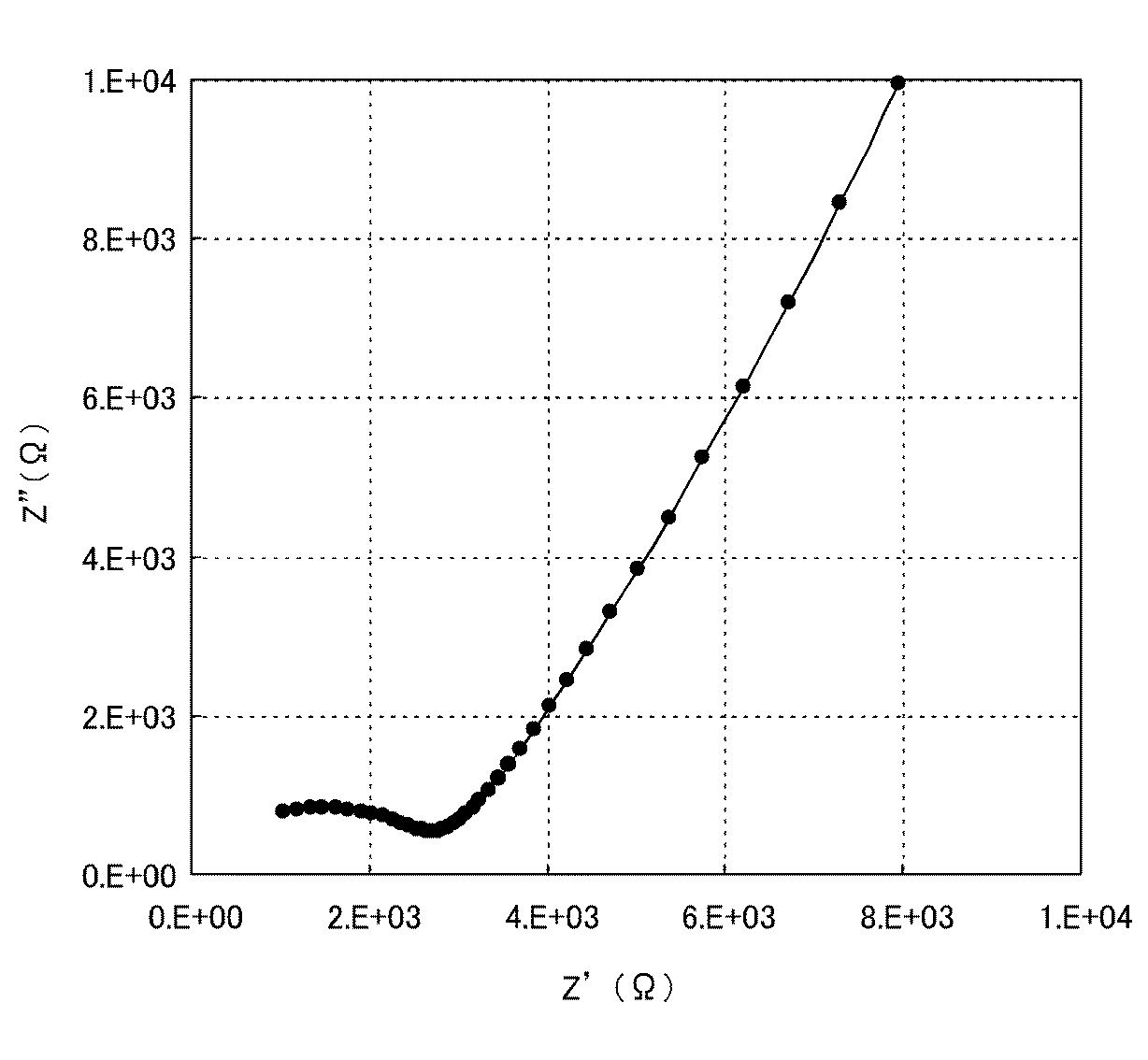
次に、作製した硫化物系固体電解質粉末のリチウムイオン伝導度と電子伝導度の諸特性を測定し、その結果を表1に示す。尚、リチウムイオン伝導度の評価は、図3に示すように、100MPa(約1トン/cm2)の圧力でプレスし直径6mmの硫化物系固体電解質粉末ペレット10を得て、そのペレットの両面にステンレス電極(ステンレスシリンダー棒8)が数MPa(数十kg/cm2)程度に軽く押し当てられた状態で、交流インピーダンス測定(電圧5mV、周波数1〜1MHz)を行い、その結果からリチウムイオン伝導度を求めた。図4に交流インピーダンス測定の測定結果を示す。また、同様の構成で、直流電流測定(印加直流電圧:1V)を行い、電子伝導度を求めた。図5に直流電流測定の測定結果を示すが、ステンレス電極はリチウムイオンに対しブロッキング電極(非活性化電極)として作用するため、測定電流値は時間と共に低下し、最終的には電子伝導度の部分だけの電流値に収束するため、その値から電子伝導度を求めた。
[Characteristic evaluation]
Next, various properties of lithium ion conductivity and electronic conductivity of the produced sulfide-based solid electrolyte powder were measured, and the results are shown in Table 1. As shown in FIG. 3, the lithium ion conductivity was evaluated by pressing with a pressure of 100 MPa (about 1 ton / cm 2 ) to obtain a sulfide-based solid
また、上記100MPa(約1トン/cm2)の圧力でのプレスでは硫化物系固体電解質粉末ペレットの緻密性が低い(相対密度=約70%程度)ため、図3において、400MPa(約4トン/cm2)の圧力でプレスし、より緻密性の高い(相対密度=90〜95%程度)硫化物系固体電解質粉末ペレット10(直径6mm)も作製し、同様にリチウムイオン伝導度、および電子伝導度を求めた。
Further, in the press at the pressure of 100 MPa (about 1 ton / cm 2 ), the density of the sulfide-based solid electrolyte powder pellets is low (relative density = about 70%). / Cm 2 ) pressure to produce a more dense (relative density = 90 to 95%) sulfide-based solid electrolyte powder pellet 10 (
<実施例2>
[硫化物系固体電解質粉末の作製]
実施例1で得られた硫化物系固体電解質粉末をアルゴン雰囲気中でステンレス密閉容器に入れ、260℃で60分間加熱し熱処理を施して、実施例2に係る硫化物系固体電解質粉末(粉体色:黄土色)を得た(配合したリチウム、リン、硫黄を硫化リチウム[Li2S]と硫化リン[P2S5]に換算した場合には、硫化リチウム[Li2S]:硫化リン[P2S5]=75:25[モル比])。X線回折測定の結果、上記硫化物系固体電解質粉末は結晶化しており、Li3.2P0.96S4結晶が主成分であった。
<Example 2>
[Preparation of sulfide-based solid electrolyte powder]
The sulfide-based solid electrolyte powder obtained in Example 1 was placed in a stainless steel sealed container in an argon atmosphere, heated at 260 ° C. for 60 minutes and subjected to heat treatment, and the sulfide-based solid electrolyte powder according to Example 2 (powder) Color: ocher) (mixed lithium, phosphorus and sulfur were converted to lithium sulfide [Li 2 S] and phosphorus sulfide [P 2 S 5 ], lithium sulfide [Li 2 S]: phosphorus sulfide [P 2 S 5 ] = 75: 25 [molar ratio]). As a result of X-ray diffraction measurement, the sulfide-based solid electrolyte powder was crystallized, and Li 3.2 P 0.96 S 4 crystal was the main component.
[特性評価]
次に、作製した硫化物系固体電解質粉末の諸特性を実施例1と同様に測定し、その結果を表1に示す。
[Characteristic evaluation]
Next, various characteristics of the produced sulfide solid electrolyte powder were measured in the same manner as in Example 1, and the results are shown in Table 1.
<実施例3>
[硫化物系固体電解質スラリーの作製]
赤褐色粉末状の赤リン[P](分子量=30.97)0.428g、黄色粉末状の硫黄[S](分子量=32.06)1.107g、イソブチルアルコール(IBA;沸点:107.9℃)6.0gを混合し、窒素ガス雰囲気中で約110℃に加温しながら90分間超音波照射処理(超音波ホモジナイザー;出力50W、振幅40μm)して赤リンと硫黄を反応させ、次に、淡黄白色粉末状の硫化リチウム[Li2S](分子量=45.94)0.952g、イソブチルアルコール(IBA)2.0gを混合して均一になるまで良く攪拌し、更に上記と同様の窒素ガス雰囲気中で約110℃に加温しながら210分間超音波照射処理を施して反応させた後室温まで冷却して、リチウム、リン、硫黄を含有する実施例3に係る硫化物系固体電解質スラリー(粘度:54000mPa・s(25℃);粘調な明るい黄褐色の液体;硫化物系固体電解質含有量:25質量%)を作製した(配合したリチウム、リン、硫黄を硫化リチウム[Li2S]と硫化リン[P2S5]に換算した場合には、硫化リチウム[Li2S]:硫化リン[P2S5]=75:25[モル比])。尚、硫化物系固体電解質スラリーの粘度は、スラリー温度25℃で、B型粘度計を用いて測定した。
<Example 3>
[Preparation of sulfide-based solid electrolyte slurry]
Red phosphorus [P] (molecular weight = 30.97) 0.428 g, yellow powdery sulfur [S] (molecular weight = 32.06) 1.107 g, isobutyl alcohol (IBA; boiling point: 107.9 ° C.) ) Mix 6.0g, and heat for 90 minutes while heating to about 110 ° C in a nitrogen gas atmosphere (ultrasonic homogenizer; output 50W, amplitude 40μm) to react red phosphorus and sulfur, , 0.952 g of light yellowish white powdery lithium sulfide [Li 2 S] (molecular weight = 45.94) and 2.0 g of isobutyl alcohol (IBA) were mixed and stirred well until uniform, and the same as above Sulfide-based solid electrolysis according to Example 3 containing lithium, phosphorus, and sulfur after cooling to room temperature and reacting for 210 minutes while heating to about 110 ° C. in a nitrogen gas atmosphere Slurry (viscosity: 54000 mPa · s (25 ° C.); viscous light yellowish brown liquid; sulfide solid electrolyte content: 25 mass%) (mixed lithium, phosphorus, sulfur into lithium sulfide [Li 2 S] and phosphorus sulfide [P 2 S 5 ], lithium sulfide [Li 2 S]: phosphorous sulfide [P 2 S 5 ] = 75: 25 [molar ratio]). The viscosity of the sulfide-based solid electrolyte slurry was measured using a B-type viscometer at a slurry temperature of 25 ° C.
[硫化物系固体電解質粉末の作製]
次に、この硫化物系固体電解質スラリーを窒素ガス雰囲気中でまず110℃程度に加熱し有機溶剤を揮発・除去を進め、更に窒素ガス雰囲気中で180℃で30分間加熱し有機溶剤を除去し、最終的にアルゴン雰囲気にしたステンレス密閉容器中で、260℃で120分間加熱し熱処理を施して、実施例3に係る硫化物系固体電解質粉末(粉体色:桃白色)を得た(配合したリチウム、リン、硫黄を硫化リチウム[Li2S]と硫化リン[P2S5]に換算した場合には、硫化リチウム[Li2S]:硫化リン[P2S5]=75:25[モル比])。X線回折測定の結果、上記硫化物系固体電解質粉末は結晶化しており、Li3.2P0.96S4結晶が主成分であった。
[Preparation of sulfide-based solid electrolyte powder]
Next, this sulfide-based solid electrolyte slurry is first heated to about 110 ° C. in a nitrogen gas atmosphere to advance volatilization and removal of the organic solvent, and further heated at 180 ° C. for 30 minutes in the nitrogen gas atmosphere to remove the organic solvent. Then, in a stainless steel sealed container finally in an argon atmosphere, heat treatment was performed by heating at 260 ° C. for 120 minutes to obtain a sulfide-based solid electrolyte powder (powder color: pink white) according to Example 3 (formulation) the lithium, phosphorus, when converted to sulfur lithium sulfide [Li 2 S] and
[特性評価]
次に、作製した硫化物系固体電解質粉末の諸特性を実施例1と同様に測定し、その結果を表1に示す。
尚、リチウムイオン伝導度の評価は、図6に示すように、150MPa(約1.5トン/cm2)の圧力でプレスし直径8mmの硫化物系固体電解質粉末ペレット10を得て、そのペレットの両面にステンレス電極(ステンレスシリンダー棒8)が数MPa(数十kg/cm2)程度に軽く押し当てられた状態で、交流インピーダンス測定(電圧10mV、周波数1〜1MHz)を行い、その結果からリチウムイオン伝導度を求めた。図7に交流インピーダンス測定の測定結果を示す。また、同様の構成で、直流電流測定(印加直流電圧:1V)を行い、実施例1と同様の手法で電子伝導度を求めた。図8に直流電流測定の測定結果を示す。
[Characteristic evaluation]
Next, various characteristics of the produced sulfide solid electrolyte powder were measured in the same manner as in Example 1, and the results are shown in Table 1.
As shown in FIG. 6, the lithium ion conductivity was evaluated by pressing at a pressure of 150 MPa (about 1.5 ton / cm 2 ) to obtain a sulfide-based solid
また、上記150MPa(約1.5トン/cm2)の圧力でのプレスでは硫化物系固体電解質粉末ペレットの緻密性が低い(相対密度=約75%程度)ため、図3において、400MPa(約4トン/cm2)の圧力でプレスし、より緻密性の高い(相対密度=90〜95%程度)硫化物系固体電解質粉末ペレット10(直径6mm)も作製し、同様にリチウムイオン伝導度、および電子伝導度を求めた。
Further, in the press at the pressure of 150 MPa (about 1.5 ton / cm 2 ), the density of the sulfide-based solid electrolyte powder pellets is low (relative density = about 75%). 4 ton / cm 2 ) is pressed to produce a more dense (relative density = 90 to 95%) sulfide-based solid electrolyte powder pellet 10 (
<実施例4>
[硫化物系固体電解質層の作製]
実施例1に係る硫化物系固体電解質スラリー(粘度:12000mPa・s(25℃);粘調な明るい黄褐色の液体;硫化物系固体電解質含有量:25質量%)を、窒素ガス雰囲気中でステンレスシート上にドクターブレードを用い塗布し、雰囲気はそのままに、まず110℃程度に加熱し有機溶剤を揮発・除去を進め、最終的に180℃で30分間加熱し有機溶剤を除去して、硫化物系固体電解質スラリー乾燥膜を得た。この硫化物系固体電解質スラリー乾燥膜を有するステンレスシートを2本の金属ロールによるロールプレス(ニップ幅=0.5mm、面圧力=400MPa(約4トン/cm2)を行い、ステンレスシート上に形成された硫化物系固体電解質層(層厚:200μm、硫化リチウム[Li2S]:硫化リン[P2S5]=75:25[モル比])を得た。X線回折測定の結果、上記硫化物系固体電解質層は非晶質(アモルファス)であった。また、膜厚バラツキは200μm±5μmの範囲内に収まっていた。
<Example 4>
[Preparation of sulfide-based solid electrolyte layer]
The sulfide-based solid electrolyte slurry according to Example 1 (viscosity: 12000 mPa · s (25 ° C.); viscous light tan liquid; sulfide-based solid electrolyte content: 25% by mass) in a nitrogen gas atmosphere Applying onto a stainless sheet using a doctor blade, the atmosphere is kept as it is, first heating to about 110 ° C. to evaporate and remove the organic solvent, finally heating at 180 ° C. for 30 minutes to remove the organic solvent, and sulfidation A physical solid electrolyte slurry dry membrane was obtained. A stainless steel sheet having this sulfide-based solid electrolyte slurry dry film is formed on a stainless steel sheet by roll pressing with two metal rolls (nip width = 0.5 mm, surface pressure = 400 MPa (about 4 tons / cm 2 )). As a result of X-ray diffraction measurement, a sulfide-based solid electrolyte layer (layer thickness: 200 μm, lithium sulfide [Li 2 S]: phosphorous sulfide [P 2 S 5 ] = 75: 25 [molar ratio]) was obtained. The sulfide-based solid electrolyte layer was amorphous, and the film thickness variation was within the range of 200 μm ± 5 μm.
[特性評価]
次に、上記硫化物系固体電解質層が形成されたステンレスシートを直径8mmに切り出した試料を、図6の硫化物系固体電解質粉末ペレット10に代えて設置し、その試料の両面にステンレス電極(ステンレスシリンダー棒8)が数MPa(数十kg/cm2)程度に軽く押し当てられた状態とした以外は実施例3と同様に行い、作製した硫化物系固体電解質層のリチウムイオン伝導度と電子伝導度の諸特性を測定した。リチウムイオン伝導度と電子伝導度の測定結果は、実施例1において400MPa(約4トン/cm2)の圧力でプレスした硫化物系固体電解質粉末ペレット10の測定結果をほぼ同等であった。
[Characteristic evaluation]
Next, a sample obtained by cutting out the stainless steel sheet on which the sulfide-based solid electrolyte layer was formed to a diameter of 8 mm was placed in place of the sulfide-based solid
<比較例1>
[硫化物系固体電解質スラリーの作製]
イソブチルアルコール(IBA)の代わりにトルエン(沸点:110.6℃)を用いた以外は、実施例1と同様に行い、まず赤リンと硫黄の反応を試みたが、硫黄がトルエンに完全溶解してトルエン中で安定化したため、ほとんど反応しなかった。次に、実施例1と同様に硫化リチウムと反応させた後室温まで冷却して、リチウム、リン、硫黄を含有する比較例1に係るスラリーを作製した。このスラリーは、硫黄を溶解したトルエン中に赤リン粉末と硫化リチウム粉末を含有するスラリーであり、室温に放置すると、赤リン粉末と硫化リチウム粉末の混合物からなる赤褐色沈殿と透明な上澄み液(トルエン)に分離し、かつ、液中から黄色の硫黄粒子が析出し、実施例1のような硫化物系固体電解質は合成されなかった。
<Comparative Example 1>
[Preparation of sulfide-based solid electrolyte slurry]
Except that toluene (boiling point: 110.6 ° C.) was used instead of isobutyl alcohol (IBA), the reaction was carried out in the same manner as in Example 1, and first the reaction between red phosphorus and sulfur was attempted. However, sulfur was completely dissolved in toluene. Most of the reaction did not occur. Next, after making it react with lithium sulfide similarly to Example 1, it cooled to room temperature and produced the slurry which concerns on the comparative example 1 containing lithium, phosphorus, and sulfur. This slurry is a slurry containing red phosphorus powder and lithium sulfide powder in toluene in which sulfur is dissolved, and when left at room temperature, a red-brown precipitate consisting of a mixture of red phosphorus powder and lithium sulfide powder and a transparent supernatant (toluene). ) And yellow sulfur particles were precipitated from the liquid, and the sulfide-based solid electrolyte as in Example 1 was not synthesized.
上述のように、硫化物系固体電解質スラリーが得られなかったため、粉末の作製、及び粉末の特性評価は行わなかった。 As described above, since a sulfide-based solid electrolyte slurry was not obtained, powder preparation and powder characteristic evaluation were not performed.
実施例1と比較例1の比較から、有機溶剤として、硫黄の溶解度の小さいイソブチルアルコールを用いた実施例1では、硫化物系固体電解質スラリーが得られたのに対し、硫黄の溶解度の大きいトルエンを用いた比較例1では、硫化物系固体電解質スラリーが得られないことが確認できる。 From the comparison between Example 1 and Comparative Example 1, in Example 1 using isobutyl alcohol having a low sulfur solubility as an organic solvent, a sulfide-based solid electrolyte slurry was obtained, whereas toluene having a high sulfur solubility was obtained. In Comparative Example 1 using No, it can be confirmed that a sulfide-based solid electrolyte slurry cannot be obtained.
各実施例(実施例1〜4)から、本発明の硫化物系固体電解質粉末は、毒性の低い赤リンと硫黄を出発原料とする簡便な製造工程により低コストで得られ、かつ比較的高いリチウムイオン伝導度(1.7×10⁻⁶〜2.5×10⁻⁵S(ジーメンス)/cm[プレス圧力:400MPa])と非常に低い電子伝導度(2.0×10−10〜7.5×10−9S(ジーメンス)/cm[プレス圧力:400MPa])を有するため全固体二次電池の各種機能性層に適用できることが確認された。 From each of the examples (Examples 1 to 4), the sulfide-based solid electrolyte powder of the present invention is obtained at a low cost by a simple production process using red phosphorus and sulfur having low toxicity as starting materials, and is relatively high. Lithium ion conductivity (1.7 × 10 −6 to 2.5 × 10 −5 S (Siemens) / cm [pressing pressure: 400 MPa]) and very low electron conductivity (2.0 × 10 −10 to 7 .5 × 10 −9 S (Siemens) / cm [pressing pressure: 400 MPa]), it was confirmed that it can be applied to various functional layers of an all-solid-state secondary battery.
また、実施例4から、本発明の硫化物系固体電解質スラリーは適度の粘度(12000mPa・s(25℃))を有しているため、ドクターブレードコーティング法等の汎用の塗布方法により均一な膜厚で基板上に塗布することが可能なため、塗布法という簡便な方法で、膜厚バラツキの小さい硫化物系固体電解質層(膜厚:200μm±5μm)を容易に得ることができる。 Further, from Example 4, since the sulfide-based solid electrolyte slurry of the present invention has an appropriate viscosity (12000 mPa · s (25 ° C.)), a uniform film can be formed by a general-purpose coating method such as a doctor blade coating method. Since it can be coated on the substrate with a thickness, a sulfide-based solid electrolyte layer (thickness: 200 μm ± 5 μm) having a small variation in film thickness can be easily obtained by a simple method called a coating method.
本発明による硫化物系固体電解質スラリー、硫化物系固体電解質粉末、硫化物系固体電解質層の製造方法によれば、毒性の低い赤リンと硫黄を出発原料とし、かつ特殊な製造装置を必要としない簡便な製造工程を有するため、上記硫化物系固体電解質スラリー、硫化物系固体電解質粉末等を安価に製造することが可能であり、得られた硫化物系固体電解質層や硫化物系固体電解質粉末を適用した全固体二次電池は、薄型化・小型化、低コスト化、高性能化が実現できるため、携帯電話やノートPC等の携帯機器や自動車・バイク等の二次電池への応用促進が期待できる。 According to the method for producing a sulfide-based solid electrolyte slurry, sulfide-based solid electrolyte powder, and sulfide-based solid electrolyte layer according to the present invention, a highly toxic red phosphorus and sulfur are used as starting materials, and a special production apparatus is required. Because it has a simple manufacturing process, it is possible to manufacture the above-mentioned sulfide-based solid electrolyte slurry, sulfide-based solid electrolyte powder, etc. at low cost, and the obtained sulfide-based solid electrolyte layer and sulfide-based solid electrolyte All-solid-state secondary batteries using powder can be thinned, reduced in size, reduced in cost, and improved in performance, so they can be applied to portable devices such as mobile phones and notebook PCs, and secondary batteries for automobiles and motorcycles. Promotion can be expected.
1 正極集電体
2 正極活物質層
3 固体電解質層
4 負極活物質層
5 負極集電体
6 保護容器または保護フィルム
7 正極・負極兼用集電体
8 ステンレスシリンダー棒(φ6mm、またはφ8mm)
9 絶縁スリーブ(フッ素樹脂)
10 硫化物系固体電解質粉末ペレット
11 ステンレスホルダー
DESCRIPTION OF
9 Insulation sleeve (fluororesin)
10 Sulfide solid
Claims (9)
Priority Applications (1)
| Application Number | Priority Date | Filing Date | Title |
|---|---|---|---|
| JP2013238522A JP2014209430A (en) | 2012-11-28 | 2013-11-19 | Method for manufacturing sulfide-based solid electrolyte slurry and sulfide-based solid electrolyte slurry produced thereby, and method for manufacturing sulfide-based solid electrolyte powder and sulfide-based solid electrolyte powder produced thereby |
Applications Claiming Priority (5)
| Application Number | Priority Date | Filing Date | Title |
|---|---|---|---|
| JP2012260260 | 2012-11-28 | ||
| JP2012260260 | 2012-11-28 | ||
| JP2013064309 | 2013-03-26 | ||
| JP2013064309 | 2013-03-26 | ||
| JP2013238522A JP2014209430A (en) | 2012-11-28 | 2013-11-19 | Method for manufacturing sulfide-based solid electrolyte slurry and sulfide-based solid electrolyte slurry produced thereby, and method for manufacturing sulfide-based solid electrolyte powder and sulfide-based solid electrolyte powder produced thereby |
Publications (1)
| Publication Number | Publication Date |
|---|---|
| JP2014209430A true JP2014209430A (en) | 2014-11-06 |
Family
ID=51903555
Family Applications (1)
| Application Number | Title | Priority Date | Filing Date |
|---|---|---|---|
| JP2013238522A Pending JP2014209430A (en) | 2012-11-28 | 2013-11-19 | Method for manufacturing sulfide-based solid electrolyte slurry and sulfide-based solid electrolyte slurry produced thereby, and method for manufacturing sulfide-based solid electrolyte powder and sulfide-based solid electrolyte powder produced thereby |
Country Status (1)
| Country | Link |
|---|---|
| JP (1) | JP2014209430A (en) |
Cited By (12)
| Publication number | Priority date | Publication date | Assignee | Title |
|---|---|---|---|---|
| JP2016504257A (en) * | 2012-11-28 | 2016-02-12 | ファラディオン リミテッド | Metal-containing compounds |
| JP2016117640A (en) * | 2014-12-05 | 2016-06-30 | 国立大学法人豊橋技術科学大学 | Solid electrolyte glass and method of producing the same, precursor for solid electrolyte glass, suspension, electrode for lithium ion battery, and lithium ion battery |
| KR20160109604A (en) * | 2015-03-12 | 2016-09-21 | 현대자동차주식회사 | A manufacturing method of all-solid battery using wet-dry process |
| CN107845830A (en) * | 2016-09-20 | 2018-03-27 | 株式会社东芝 | Solid electrolyte, lithium battery, battery bag and vehicle |
| CN108529579A (en) * | 2018-04-26 | 2018-09-14 | 山东亿盛实业股份有限公司 | A kind of method that ultrasound adverse current refines red phosphorus crude product |
| CN108878961A (en) * | 2018-07-11 | 2018-11-23 | 桑德集团有限公司 | Sulfide solid electrolyte and preparation method thereof and equipment |
| JP2021510905A (en) * | 2018-01-12 | 2021-04-30 | ユニバーシティー オブ ヒューストン システム | Solid electrolyte for sodium batteries |
| CN113422109A (en) * | 2021-06-23 | 2021-09-21 | 中国第一汽车股份有限公司 | Multilayer solid electrolyte membrane and application thereof |
| WO2022004884A1 (en) * | 2020-07-02 | 2022-01-06 | 富士フイルム株式会社 | Method for manufacturing sheet for all-solid-state secondary battery and all-solid-state secondary battery, sheet for all-solid-state secondary battery, and all-solid-state secondary battery |
| JPWO2022163541A1 (en) * | 2021-01-28 | 2022-08-04 | ||
| JP2023068540A (en) * | 2021-11-02 | 2023-05-17 | 株式会社スギノマシン | Inorganic solid electrolyte dispersion and method for producing inorganic solid electrolyte dispersion |
| WO2023191416A1 (en) * | 2022-03-31 | 2023-10-05 | 주식회사 솔리비스 | Method for preparing sulfide-based solid electrolyte |
-
2013
- 2013-11-19 JP JP2013238522A patent/JP2014209430A/en active Pending
Cited By (23)
| Publication number | Priority date | Publication date | Assignee | Title |
|---|---|---|---|---|
| JP2016504257A (en) * | 2012-11-28 | 2016-02-12 | ファラディオン リミテッド | Metal-containing compounds |
| JP2016117640A (en) * | 2014-12-05 | 2016-06-30 | 国立大学法人豊橋技術科学大学 | Solid electrolyte glass and method of producing the same, precursor for solid electrolyte glass, suspension, electrode for lithium ion battery, and lithium ion battery |
| KR20160109604A (en) * | 2015-03-12 | 2016-09-21 | 현대자동차주식회사 | A manufacturing method of all-solid battery using wet-dry process |
| CN105977532A (en) * | 2015-03-12 | 2016-09-28 | 现代自动车株式会社 | Method of manufacturing all-solid battery through wet-dry mixing process |
| KR101684074B1 (en) | 2015-03-12 | 2016-12-07 | 현대자동차주식회사 | A manufacturing method of all-solid battery using wet-dry process |
| US10707523B2 (en) | 2016-09-20 | 2020-07-07 | Kabushiki Kaisha Toshiba | Solid electrolyte, lithium battery, battery pack, and vehicle |
| CN107845830A (en) * | 2016-09-20 | 2018-03-27 | 株式会社东芝 | Solid electrolyte, lithium battery, battery bag and vehicle |
| JP2018049701A (en) * | 2016-09-20 | 2018-03-29 | 株式会社東芝 | Solid electrolyte, lithium battery, battery pack and vehicle |
| JP2021510905A (en) * | 2018-01-12 | 2021-04-30 | ユニバーシティー オブ ヒューストン システム | Solid electrolyte for sodium batteries |
| JP7301272B2 (en) | 2018-01-12 | 2023-07-03 | ユニバーシティー オブ ヒューストン システム | Solid electrolyte for sodium batteries |
| CN108529579A (en) * | 2018-04-26 | 2018-09-14 | 山东亿盛实业股份有限公司 | A kind of method that ultrasound adverse current refines red phosphorus crude product |
| CN108878961A (en) * | 2018-07-11 | 2018-11-23 | 桑德集团有限公司 | Sulfide solid electrolyte and preparation method thereof and equipment |
| WO2022004884A1 (en) * | 2020-07-02 | 2022-01-06 | 富士フイルム株式会社 | Method for manufacturing sheet for all-solid-state secondary battery and all-solid-state secondary battery, sheet for all-solid-state secondary battery, and all-solid-state secondary battery |
| JPWO2022004884A1 (en) * | 2020-07-02 | 2022-01-06 | ||
| CN115917818A (en) * | 2020-07-02 | 2023-04-04 | 富士胶片株式会社 | Sheet for all-solid secondary battery, method for producing all-solid secondary battery, sheet for all-solid secondary battery, and all-solid secondary battery |
| JP7448657B2 (en) | 2020-07-02 | 2024-03-12 | 富士フイルム株式会社 | All-solid-state secondary battery sheet and all-solid-state secondary battery manufacturing method, all-solid-state secondary battery sheet and all-solid-state secondary battery |
| JPWO2022163541A1 (en) * | 2021-01-28 | 2022-08-04 | ||
| WO2022163541A1 (en) * | 2021-01-28 | 2022-08-04 | 出光興産株式会社 | Method for producing solid electrolyte |
| JP7742365B2 (en) | 2021-01-28 | 2025-09-19 | 出光興産株式会社 | Method for producing solid electrolyte |
| CN113422109A (en) * | 2021-06-23 | 2021-09-21 | 中国第一汽车股份有限公司 | Multilayer solid electrolyte membrane and application thereof |
| JP2023068540A (en) * | 2021-11-02 | 2023-05-17 | 株式会社スギノマシン | Inorganic solid electrolyte dispersion and method for producing inorganic solid electrolyte dispersion |
| JP7777424B2 (en) | 2021-11-02 | 2025-11-28 | 株式会社スギノマシン | Inorganic solid electrolyte dispersion and method for producing inorganic solid electrolyte dispersion |
| WO2023191416A1 (en) * | 2022-03-31 | 2023-10-05 | 주식회사 솔리비스 | Method for preparing sulfide-based solid electrolyte |
Similar Documents
| Publication | Publication Date | Title |
|---|---|---|
| JP2014209430A (en) | Method for manufacturing sulfide-based solid electrolyte slurry and sulfide-based solid electrolyte slurry produced thereby, and method for manufacturing sulfide-based solid electrolyte powder and sulfide-based solid electrolyte powder produced thereby | |
| JP6329745B2 (en) | Lithium ion secondary battery and method for producing positive electrode active material for lithium ion secondary battery | |
| CN108292780B (en) | Material for solid electrolyte | |
| JP6095218B2 (en) | Method for producing active material coated with solid electrolyte, solution for forming layer containing solid electrolyte of all-solid lithium secondary battery, all-solid lithium secondary battery and method for producing the same | |
| JP5825455B2 (en) | Method for producing surface-treated oxide particles and oxide particles obtained by the method | |
| US10361451B2 (en) | Sulfide solid electrolyte material, lithium solid battery, and producing method for sulfide solid electrolyte material | |
| CN106058166B (en) | Battery and positive electrode material for battery | |
| KR20160002364A (en) | Solid state lithium secondary battery and method for producing the same | |
| CN112635763A (en) | All-solid-state battery | |
| CN105027345A (en) | Solid electrolyte, and all-solid ion secondary cell using same | |
| KR101685799B1 (en) | Method for manufacturing electrodes for all-solid battery and method for manufacturing all-solid battery | |
| JP2013222530A (en) | All solid state battery and method for charging/discharging all solid state battery | |
| CN105453324A (en) | Sulfide solid electrolyte material, battery and method for manufacturing sulfide solid electrolyte material | |
| JP2021034199A (en) | All solid state battery | |
| JP7059951B2 (en) | Negative electrode layer and all-solid-state battery | |
| JP2020129519A (en) | All-solid battery | |
| JP2021089814A (en) | All-solid battery | |
| Zhang et al. | High-performance PEO-based solid-state LiCoO2 lithium metal battery enabled by poly (acrylic acid) artificial cathode electrolyte interface | |
| JP2021197302A (en) | Solid battery | |
| JP2021034200A (en) | All-solid battery | |
| JP6812940B2 (en) | Manufacturing method of active material layer for all-solid-state battery and manufacturing method of all-solid-state battery | |
| JP2020024780A (en) | All-solid battery and manufacturing method thereof | |
| JP6030960B2 (en) | Manufacturing method of all solid state battery | |
| JP2022010554A (en) | Solid battery | |
| CN114335498A (en) | Negative electrode material and solid-state battery |