JP2014024945A - Aqueous ink set for ink jet recording - Google Patents
Aqueous ink set for ink jet recording Download PDFInfo
- Publication number
- JP2014024945A JP2014024945A JP2012165780A JP2012165780A JP2014024945A JP 2014024945 A JP2014024945 A JP 2014024945A JP 2012165780 A JP2012165780 A JP 2012165780A JP 2012165780 A JP2012165780 A JP 2012165780A JP 2014024945 A JP2014024945 A JP 2014024945A
- Authority
- JP
- Japan
- Prior art keywords
- ink
- application
- water
- acid
- pigment
- Prior art date
- Legal status (The legal status is an assumption and is not a legal conclusion. Google has not performed a legal analysis and makes no representation as to the accuracy of the status listed.)
- Pending
Links
Landscapes
- Ink Jet (AREA)
- Ink Jet Recording Methods And Recording Media Thereof (AREA)
- Inks, Pencil-Leads, Or Crayons (AREA)
Abstract
【課題】 プラスチックフィルムに印字しても、滲み、色間滲み等の画像の乱れがなく印刷直後の耐擦性に優れる2液型のインクジェット記録用水性インクセットを提供する。
【解決手段】 少なくとも2種類以上のインクを用いたインクジェット記録用インクセットであって、第1のインクは色材、ヒドロキシ基及び/またはカルボキシル基を有するオレフィン樹脂、水溶性溶媒及び/または水を含み、第2のインクは、酸型アニオン性界面活性剤、水溶性溶媒及び/または水を含むインクジェット記録用水性インクセット。
【選択図】 なしPROBLEM TO BE SOLVED: To provide a two-component water-based ink set for ink jet recording which is excellent in abrasion resistance immediately after printing without causing image disturbance such as bleeding or intercolor bleeding even when printed on a plastic film.
An ink set for ink-jet recording using at least two or more types of ink, wherein the first ink contains a color material, an olefin resin having a hydroxy group and / or a carboxyl group, a water-soluble solvent and / or water. And the second ink is an aqueous ink set for ink jet recording comprising an acid type anionic surfactant, a water-soluble solvent and / or water.
[Selection figure] None
Description
本発明はインクジェット記録用水性インクセットに関する。 The present invention relates to a water-based ink set for inkjet recording.
インクジェットプリンター記録装置による印刷は、ノズルよりインクを噴射し被記録材に付着せしめる方式であり、従来の印刷方法と異なり版を使用しない印刷方式であることから、少量多品種に対応できるオンデマンド印刷方式として広範囲にわたる利用分野が期待されている印刷方式である。特に近年では、被記録材として、従来の紙等の吸収基材に対する印刷から、プラスチック等の非吸収基材に対する印刷の検討が数多くなされ、中でも耐候性等の観点から、顔料インクを使用した印刷の検討がなされている。 Printing with an inkjet printer recording device is a method that ejects ink from nozzles and adheres to the recording material. Unlike conventional printing methods, this is a printing method that does not use a plate, so on-demand printing that can accommodate a small variety of products This printing method is expected to be used in a wide range of fields. Particularly in recent years, as a recording material, there have been many studies on printing on a non-absorbing substrate such as plastic from printing on a conventional absorbing substrate such as paper, and printing using pigment inks from the viewpoint of weather resistance, among others. Is being studied.
プラスチックフィルムを被記録材とする印刷の場合、プラスチックは非吸収性であるために、水性インクを使用すると乾燥性が著しく低下し、この結果、インク付着時のインクの広がりが不均一となることにより滲み、色間滲み等の画像の乱れや良好な発色が得られず画質が低下する等の問題があった。このため通常は、プラスチックフィルム上に受理層を設けることが行われる(例えば、特許文献1参照。)。しかしながら、プラスチックフィルムの表面はインクジェットインクとの密着性が悪く、通常アンカー層、プライマー層、下引き層、接着層等と称される層を当該フィルム表面に形成させた上にポリウレタンやポリアクリル等を主成分とするインク受容層を設ける工程が必須であった。この様な表面処理工程は、コストアップに繋がるだけでなく、工程が増えることから生産に掛かる時間も多く必要となる。 In the case of printing using a plastic film as the recording material, since the plastic is non-absorbent, the use of water-based ink significantly reduces the drying property, resulting in non-uniform spreading of the ink when the ink is deposited. As a result, there are problems such as blurring of images such as bleeding and intercolor bleeding, and deterioration in image quality due to failure to obtain good color development. For this reason, usually, a receiving layer is provided on a plastic film (for example, refer to Patent Document 1). However, the surface of the plastic film has poor adhesion to the ink-jet ink, and a layer usually called an anchor layer, primer layer, undercoat layer, adhesive layer, etc. is formed on the film surface, and polyurethane, polyacryl, etc. The step of providing an ink receiving layer containing as a main component was essential. Such a surface treatment process not only leads to an increase in cost, but also requires a lot of time for production because the number of processes increases.
これに対し、プラスチック等の非吸収基材に対して記録媒体のインク吸収性によらず画質と耐擦性に優れ、吐出安定性にも優れる水性インクジェット記録方式の印刷方法として、
色インク、樹脂インク、および反応インクを塗布して画像を印刷する印刷方法が知られている(例えば特許文献2参照)。具体的には、水不溶性の着色剤、水溶性および/または非水溶性の樹脂成分、水溶性溶剤、界面活性剤を含む色インクと、水溶性樹脂溶剤、水には不溶であるが前記水溶性樹脂溶剤には相溶する熱可塑性の樹脂粒子を含み、かつ当該樹脂粒子の総含有率が前記色インクに含まれる前記着色剤の含有率以上である樹脂インクと、多価金属塩、ポリアリルアミンおよびその誘導体から選択される反応剤と、界面活性剤を含む反応インクの3つのインクを塗布して画像を形成する。
しかしながら該方法は少なくとも3種のインクを準備しなければならず、高度な吐出精度を有するインクジェット装置を必要とする。
On the other hand, as a printing method of the water-based inkjet recording method, which is excellent in image quality and scratch resistance regardless of the ink absorbability of the recording medium with respect to a non-absorbing substrate such as plastic,
A printing method for printing an image by applying color ink, resin ink, and reaction ink is known (see, for example, Patent Document 2). Specifically, a color ink containing a water-insoluble colorant, a water-soluble and / or water-insoluble resin component, a water-soluble solvent, and a surfactant, a water-soluble resin solvent, and water-soluble but not soluble in water. The resin resin solvent contains thermoplastic resin particles that are compatible, and the total content of the resin particles is greater than or equal to the content of the colorant contained in the color ink; a polyvalent metal salt; Three inks of a reactive agent selected from allylamine and its derivatives and a reactive ink containing a surfactant are applied to form an image.
However, this method must prepare at least three kinds of inks, and requires an ink jet apparatus having a high degree of ejection accuracy.
一方、2種のインクを使用した2液型印刷方法として、アニオン性界面活性剤を含有するインクと、アニオン性水溶性高分子を含有する処理液とを記録媒体表面で接触・混合するインクジェット記録用インクセットが知られている(例えば特許文献3参照)。 On the other hand, as a two-component printing method using two types of ink, ink jet recording in which an ink containing an anionic surfactant and a treatment liquid containing an anionic water-soluble polymer are contacted and mixed on the surface of the recording medium Ink sets are known (see, for example, Patent Document 3).
本発明の課題は、プラスチックフィルムに印字しても、滲み、色間滲み等の画像の乱れがなく印刷直後の耐擦性に優れる2液型のインクジェット記録用水性インクセットを提供することにある。 An object of the present invention is to provide a two-component water-based ink set for ink-jet recording that is excellent in abrasion resistance immediately after printing without causing image disturbance such as bleeding and intercolor bleeding even when printed on a plastic film. .
本発明者らは、ヒドロキシ基及び/またはカルボキシル基を有するオレフィン樹脂を含む第1の顔料インクと、アニオン性界面活性剤、水溶性溶媒及び/または水を含む第2のインクとを組み合わせた2液型のインクジェット記録用水性インクセットとすることで、上記課題を解決した。 The present inventors have combined 2 of a first pigment ink containing an olefin resin having a hydroxy group and / or a carboxyl group and a second ink containing an anionic surfactant, a water-soluble solvent and / or water. The above-mentioned problems were solved by using a liquid-type water-based ink set for inkjet recording.
即ち本発明は、少なくとも2種類以上のインクを用いたインクジェット記録用インクセットであって、第1のインクは色材、ヒドロキシ基及び/またはカルボキシル基を有するオレフィン樹脂、水溶性溶媒及び/または水を含み、第2のインクは、アニオン性界面活性剤、水溶性溶媒及び/または水を含むインクジェット記録用水性インクセットを提供する。 That is, the present invention is an ink set for ink jet recording using at least two kinds of inks, wherein the first ink is a color material, an olefin resin having a hydroxy group and / or a carboxyl group, a water-soluble solvent and / or water. And the second ink provides an aqueous ink set for ink jet recording comprising an anionic surfactant, a water-soluble solvent and / or water.
本発明により、プラスチックフィルムに印字しても、滲み、色間滲み等の画像の乱れがなく、印刷直後の耐擦性に優れる印刷物を与えるインクジェット記録用水性インクセットを提供することができる。 According to the present invention, it is possible to provide an aqueous ink set for ink jet recording that gives a printed matter that is excellent in abrasion resistance immediately after printing without causing image distortion such as bleeding or intercolor bleeding even when printed on a plastic film.
本発明のインクジェット記録用水性インクセットは、第1のインクは色材、ヒドロキシ基及び/またはカルボキシル基を有するオレフィン樹脂、水溶性溶媒及び/または水を含み、第2のインクは、アニオン性界面活性剤、水溶性溶媒及び/または水を含むインクジェット記録用水性インクセットである。
両インクを重ね刷りすることで被印刷物に対して迅速に固着する。この結果、滲み、色間滲み等の画像の乱れがなく、且つ印刷直後の耐擦性に優れるインキを得ることができる。
In the water-based ink set for ink-jet recording of the present invention, the first ink contains a color material, an olefin resin having a hydroxy group and / or a carboxyl group, a water-soluble solvent and / or water, and the second ink has an anionic interface. An aqueous ink set for ink-jet recording comprising an activator, a water-soluble solvent and / or water.
By overprinting both inks, the ink is quickly fixed to the substrate. As a result, it is possible to obtain an ink which is free from image disturbance such as bleeding and intercolor bleeding and has excellent abrasion resistance immediately after printing.
両インクを重ね刷りすることで被印刷物に対して迅速に固着することについて、そのメカニズムは明確ではないが、以下を推定している。
酸性アニオン性界面活性剤とヒドロキシ基及び/またはカルボキシル基を有するオレフィン樹脂との分子間水素結合により、複合体を形成し、ファンデルワールス力などの相互作用によりそれらが束になって網目状に絡まり相互に運動を妨げあって流動性を失い、印刷物表面に固定化されている可能性がある。また、高分子溶液の溶媒の組成がわずかに変化したときに濃厚相と希薄な連続相に分離する現象(コアセルベーション)が発生して、静電相互作用や水素結合によって、1種類以上の高分子コロイドが界面に析出し、印刷物表面に固定化されている可能性もある。
Although the mechanism is not clear about fast fixing with respect to a printing material by overprinting both inks, the following is estimated.
A complex is formed by an intermolecular hydrogen bond between an acidic anionic surfactant and an olefin resin having a hydroxy group and / or a carboxyl group, and they are bundled into a network by interaction such as van der Waals force. There is a possibility that entanglement interferes with movement and loses fluidity and is fixed on the surface of the printed matter. In addition, when the composition of the solvent of the polymer solution is slightly changed, a phenomenon (coacervation) that separates into a dense phase and a dilute continuous phase occurs, and one or more types are caused by electrostatic interaction or hydrogen bonding There is also a possibility that the polymer colloid is deposited on the interface and immobilized on the surface of the printed material.
(第1のインク ヒドロキシ基及び/またはカルボキシル基を有するオレフィン樹脂)
本発明で使用する第1のインクは色材、ヒドロキシ基及び/またはカルボキシル基を有するオレフィン樹脂、水溶性溶媒及び/または水を含む。
(First ink: Olefin resin having hydroxy group and / or carboxyl group)
The first ink used in the present invention contains a coloring material, an olefin resin having a hydroxy group and / or a carboxyl group, a water-soluble solvent and / or water.
本発明で使用するヒドロキシ基及び/またはカルボキシル基を有するオレフィン樹脂は、水と混合して均一な状態で存在しうるオレフィン樹脂であれば特に限定なく使用することができる。水と混合して均一な状態で存在しうる樹脂とは、水中に微粒子の状態で散在している(これは分散粒子が極めて小さく単分子で散在している状態も含む)、いわゆる水分散性の樹脂であってもよいし、いわゆる水溶性、水可溶性と称される状態の樹脂も含む。具体的には、例えば、エチレン、プロピレン、イソブチレン、1−ブテン、1−ペンテン、1−ヘキセン等のオレフィンモノマー類の共重合体又は単独重合体からなるオレフィン樹脂やゴム状物を界面活性剤等でエマルジョン化したものや、ポリオレフィン成分と酸等の親水性成分より構成される水分散性樹脂等があげられる。 The olefin resin having a hydroxy group and / or a carboxyl group used in the present invention can be used without particular limitation as long as it is an olefin resin that can be mixed with water and exist in a uniform state. A resin that can exist in a uniform state when mixed with water is dispersed in the form of fine particles in water (this includes a state in which dispersed particles are extremely small and dispersed in a single molecule), so-called water dispersibility. These resins may be used, and so-called water-soluble and water-soluble resins are also included. Specifically, for example, an olefin resin or a rubber-like material composed of a copolymer or a homopolymer of olefin monomers such as ethylene, propylene, isobutylene, 1-butene, 1-pentene, 1-hexene, a surfactant, etc. And a water-dispersible resin composed of a polyolefin component and a hydrophilic component such as an acid.
前記オレフィン成分と酸等の親水性成分より構成される水分散性樹脂としては、例えば、オレフィン成分を構成するオレフィン化合物であるエチレン、プロピレン、イソブチレン、1−ブテン、1−ペンテン、1−ヘキセン等のオレフィンモノマー類と、酸成分を構成するための酸性基を含むモノマーである不飽和カルボン酸またはその無水物、具体的には、アクリル酸、メタクリル酸、マレイン酸、無水マレイン酸、イタコン酸、無水イタコン酸、フマル酸、クロトン酸等のほか、不飽和ジカルボン酸のハーフエステル、ハーフアミド等が挙げられる。あるいは不飽和スルホン酸等とを、ラジカル発生剤の存在下、高圧ラジカル共重合することにより得ることができる。 Examples of the water dispersible resin composed of the olefin component and a hydrophilic component such as an acid include, for example, ethylene, propylene, isobutylene, 1-butene, 1-pentene, 1-hexene, which are olefin compounds constituting the olefin component. Olefin monomers and unsaturated carboxylic acid or anhydride thereof which is a monomer containing an acidic group for constituting an acid component, specifically, acrylic acid, methacrylic acid, maleic acid, maleic anhydride, itaconic acid, In addition to itaconic anhydride, fumaric acid, crotonic acid and the like, unsaturated dicarboxylic acid half esters, half amides and the like can be mentioned. Alternatively, unsaturated sulfonic acid or the like can be obtained by high-pressure radical copolymerization in the presence of a radical generator.
また、該オレフィン樹脂、あるいは、エチレン、プロピレン、イソブチレン、1−ブテン、1−ペンテン、1−ヘキセン等のオレフィンモノマー類の共重合体又は単独重合体からなるオレフィン樹脂やゴム状物に、酸性基等の親水性基を有するモノマーあるいは樹脂をグラフトすることで得ることができる。 In addition, the olefin resin or an olefin resin or rubber-like material made of a copolymer or homopolymer of olefin monomers such as ethylene, propylene, isobutylene, 1-butene, 1-pentene, 1-hexene, etc. It can be obtained by grafting a monomer or resin having a hydrophilic group such as.
前記オレフィン樹脂やゴム状物の例としては、プロピレン−α−ブテン共重合体、エチレン−プロピレン−ジエン共重合体、エチレン−プロピレン共重合体、エチレン−1−ブテン共重合体、エチレン−酢酸ビニル共重合体、ポリエチレン、ポリプロピレン、ポリ−1−ブテン、ポリ−4−メチル−1ペンテン等、更にプロピレン−α−オレフインの共重合体、α−オレフインの2種以上と共役又は非共役ジエンとの共重合体、例えば、エチレン−プロピレン−ブタジエン共重合体、エチレン−プロピレン−ジシクロペンタジエン共重合体、エチレン−プロピレン−エチリデンノルボルネン共重合体、エチレン−プロピレン−1.5−ヘキサジエン共重合体、またα−オレフインと共役又は非共役ジエンとの共重合体、例えば、プロピレン−ブタジエン共重合体、プロピレン−エチリデンノルボルネン共重合体類等、またビニルモノマ−等のモノマ−とα−オレフインの共重合体及びその部分ケン化物、更に記の共重合体又は上記の共重合体の2種以上からなる組成物等が使用される。またこれらにカルボキシル基や水酸基又は酸無水物基等を導入した変性オレフィン樹脂も使用できる。オレフィン樹脂のα,β−不飽和カルボン酸又はその酸無水物による変性は通常の反応方法で容易に実施できる。 Examples of the olefin resin and rubber-like material include propylene-α-butene copolymer, ethylene-propylene-diene copolymer, ethylene-propylene copolymer, ethylene-1-butene copolymer, ethylene-vinyl acetate. Copolymer, polyethylene, polypropylene, poly-1-butene, poly-4-methyl-1-pentene, and the like, and further, a copolymer of propylene-α-olefin and two or more of α-olefin and a conjugated or nonconjugated diene Copolymers, such as ethylene-propylene-butadiene copolymer, ethylene-propylene-dicyclopentadiene copolymer, ethylene-propylene-ethylidene norbornene copolymer, ethylene-propylene-1.5-hexadiene copolymer, and Copolymers of α-olefin and conjugated or non-conjugated dienes such as propylene-butyl Diene copolymers, propylene-ethylidene norbornene copolymers, etc., monomers such as vinyl monomers and α-olefin copolymers and partially saponified products thereof, and the copolymers described above or 2 of the above-mentioned copolymers A composition composed of more than one species is used. Moreover, the modified olefin resin which introduce | transduced the carboxyl group, the hydroxyl group, or the acid anhydride group etc. into these can also be used. Modification of an olefin resin with an α, β-unsaturated carboxylic acid or an acid anhydride thereof can be easily carried out by an ordinary reaction method.
例えば前記オレフィン樹脂に酸性基を有するモノマーを使用して酸性基等の親水性基を導入するには、前記オレフィン樹脂とα,β−不飽和カルボン酸と(メタ)アクリル酸エステルモノマーまたはその誘導体モノマーと重合開始剤とを混合溶解した溶液を、分散剤や乳化剤の存在下、水中で懸濁重合することで、オレフィン樹脂に、α,β−不飽和カルボン酸および/またはその無水物、並びに(メタ)アクリル酸エステルモノマーまたはその誘導体モノマーがグラフト共重合された水分散性のオレフィン樹脂を得ることができる。 For example, in order to introduce a hydrophilic group such as an acidic group using a monomer having an acidic group into the olefin resin, the olefin resin, an α, β-unsaturated carboxylic acid, a (meth) acrylic acid ester monomer or a derivative thereof A solution in which a monomer and a polymerization initiator are mixed and dissolved is subjected to suspension polymerization in water in the presence of a dispersant or an emulsifier, whereby an α, β-unsaturated carboxylic acid and / or an anhydride thereof is converted into an olefin resin. A water-dispersible olefin resin in which a (meth) acrylic acid ester monomer or a derivative monomer thereof is graft-copolymerized can be obtained.
また、例えば、前記オレフィン樹脂として、反応性基を有する不飽和化合物とを共重合した共重合体を使用し、該反応性基とポリ(メタ)アクリル樹脂、ポリエーテル樹脂、ポリビニルアルコール樹脂、ポリビニルピロリドン樹脂等の親水性基を有する樹脂を反応させグラフトさせることによっても、水分散性のオレフィン樹脂を得ることができる。前記反応性基としては、例えばカルボン酸基、ジカルボン酸無水物基、及びジカルボン酸無水物モノエステル基、水酸基、アミノ基、エポキシ基、イソシアネート基などが挙げられる。 Further, for example, a copolymer obtained by copolymerizing an unsaturated compound having a reactive group is used as the olefin resin, and the reactive group and a poly (meth) acrylic resin, a polyether resin, a polyvinyl alcohol resin, polyvinyl A water-dispersible olefin resin can also be obtained by reacting and grafting a resin having a hydrophilic group such as a pyrrolidone resin. Examples of the reactive group include a carboxylic acid group, a dicarboxylic anhydride group, and a dicarboxylic anhydride monoester group, a hydroxyl group, an amino group, an epoxy group, and an isocyanate group.
オレフィン樹脂として、自己乳化性オレフィン系重合体を用い、この自己乳化性オレフィン系重合体の水性分散液中で、オレフィン以外のラジカル重合性単量体を乳化重合することによって得られる、コア/シェル構造を有する樹脂粒子も、本発明の水分散性のオレフィン樹脂として用いることができる。 A core / shell obtained by emulsion polymerization of a radically polymerizable monomer other than an olefin in an aqueous dispersion of the self-emulsifiable olefin polymer, using a self-emulsifiable olefin polymer as the olefin resin. Resin particles having a structure can also be used as the water-dispersible olefin resin of the present invention.
得られた前記オレフィン樹脂の水性化に際して、塩基性化合物を添加することができる。前記塩基性化合物には特に制限はなく、水酸化ナトリウムや水酸化カリウムなどのアルカリ金属水酸化物に代表される無機塩基性化合物、アンモニアまたは各種の有機アミン化合物のいずれも使用できる。有機アミン化合物の具体例としては、トリエチルアミン、N,N−ジメチルエタノールアミン、アミノエタノールアミン、N−メチル−N,N−ジエタノールアミン、イソプロピルアミン、イミノビスプロピルアミン、エチルアミン、ジエチルアミン、3−エトキシプロピルアミン、3−ジエチルアミノプロピルアミン、sec−ブチルアミン、プロピルアミン、メチルアミノプロピルアミン、メチルイミノビスプロピルアミン、3−メトキシプロピルアミン、モノエタノールアミン、ジエタノールアミン、トリエタノールアミン、モルホリン、N−メチルモルホリン、N−エチルモルホリン等を挙げることができる。 In making the obtained olefin resin aqueous, a basic compound can be added. There is no restriction | limiting in particular in the said basic compound, Any of an inorganic basic compound represented by alkali metal hydroxides, such as sodium hydroxide and potassium hydroxide, ammonia, or various organic amine compounds can be used. Specific examples of the organic amine compound include triethylamine, N, N-dimethylethanolamine, aminoethanolamine, N-methyl-N, N-diethanolamine, isopropylamine, iminobispropylamine, ethylamine, diethylamine, and 3-ethoxypropylamine. , 3-diethylaminopropylamine, sec-butylamine, propylamine, methylaminopropylamine, methyliminobispropylamine, 3-methoxypropylamine, monoethanolamine, diethanolamine, triethanolamine, morpholine, N-methylmorpholine, N- Examples thereof include ethyl morpholine.
これら前記オレフィン樹脂の酸価としては、10mgKOH/g以上200mgKOH/g以下であることが好ましい。酸価が10mgKOH/g未満では、インクの貯蔵安定性に劣る恐れがある。一方、酸価が200mgKOH/gを超えると、好ましい耐久性、耐水性等の物性が得られないことがある。
より好ましくは5〜100mgKOH/gの範囲であり、さらに好ましくは10〜80mgKOH/gの範囲であり、さらに好ましくは15〜60mgKOH/gの範囲である。
The acid value of these olefin resins is preferably 10 mgKOH / g or more and 200 mgKOH / g or less. If the acid value is less than 10 mgKOH / g, the storage stability of the ink may be inferior. On the other hand, when the acid value exceeds 200 mgKOH / g, physical properties such as preferable durability and water resistance may not be obtained.
More preferably, it is the range of 5-100 mgKOH / g, More preferably, it is the range of 10-80 mgKOH / g, More preferably, it is the range of 15-60 mgKOH / g.
前記オレフィン樹脂のガラス転移温度(以下Tgと称す)は、所望する用途に応じて適宜設定することが好ましい。例えば食品用の包装材料用途等の可とう性を有するプラスチックフィルムに印字する場合は、フレキシビリティー即ち柔軟性が要求されることから、Tgはあまり高くないほうが好ましい。適当なフィルムへの密着性とフレキシビリティーとを両立させるために、前記オレフィン樹脂のTgは−80℃〜80℃の範囲であることが好ましく、−80℃〜30℃の範囲であることが特に好ましい。また同様の観点から、結晶化度の低いオレフィン樹脂を使用することが好ましい。 The glass transition temperature (hereinafter referred to as Tg) of the olefin resin is preferably set as appropriate depending on the desired application. For example, when printing on a plastic film having flexibility, such as for packaging materials for foods, Tg is preferably not so high because flexibility, that is, flexibility is required. In order to achieve both adhesion to an appropriate film and flexibility, the Tg of the olefin resin is preferably in the range of -80 ° C to 80 ° C, and preferably in the range of -80 ° C to 30 ° C. Particularly preferred. From the same viewpoint, it is preferable to use an olefin resin having a low crystallinity.
前記オレフィン樹脂の重量平均分子量(GPC−Mw)は特に限定はないが、重量平均分子量(GPC−Mw)が10,000〜1,000,000の範囲、さらには20,000〜700,000の範囲であることが、水性インクジェット記録用インクとの保存安定性や粘度などの物性バランスを確保しやすいので好ましい。
なお、ここでいう重量平均分子量(GPC−Mw)は、下記の条件でGPC測定により求めたものとする。
The weight average molecular weight (GPC-Mw) of the olefin resin is not particularly limited, but the weight average molecular weight (GPC-Mw) is in the range of 10,000 to 1,000,000, more preferably 20,000 to 700,000. The range is preferable because it is easy to secure a balance of physical properties such as storage stability and viscosity with the water-based inkjet recording ink.
In addition, the weight average molecular weight (GPC-Mw) here shall be calculated | required by GPC measurement on the following conditions.
[GPC測定条件]
測定装置:東ソー株式会社製「HLC−8220 GPC」、
カラム:東ソー株式会社製ガードカラム「SuperHZ−L」(内径4.6mm×2cm)
+東ソー株式会社製「TSKgel SuperHZ4000」(内径4.6mm×15cm)
+東ソー株式会社製「TSKgel SuperHZ3000」(内径4.6mm×15cm)
+東ソー株式会社製「TSKgel SuperHZ2000」(内径4.6mm×15cm)
+東ソー株式会社製「TSKgel SuperHZ1000」(内径4.6mm×15cm)
測定条件:カラム温度 40℃
流速 0.35ml/分
試料:樹脂水溶液を乾燥固化し、樹脂固形分換算で0.5質量%のテトラヒドロフラン(THF)溶液をマイクロフィルターでろ過したもの(10μl)。
校正曲線:単分散標準ポリスチレンSTK standardポリスチレン(東ソー株式会社製)分子量4000000〜250までのサンプルによる校正曲線を使用した。
[GPC measurement conditions]
Measuring device: “HLC-8220 GPC” manufactured by Tosoh Corporation
Column: Guard column “SuperHZ-L” manufactured by Tosoh Corporation (inner diameter 4.6 mm × 2 cm)
+ Tosoh Corporation “TSKgel SuperHZ4000” (inner diameter 4.6 mm × 15 cm)
+ Tosoh Corporation “TSKgel SuperHZ3000” (inner diameter 4.6 mm × 15 cm)
+ "TSKgel SuperHZ2000" manufactured by Tosoh Corporation (inner diameter 4.6 mm x 15 cm)
+ Tosoh Corporation “TSKgel SuperHZ1000” (inner diameter 4.6 mm × 15 cm)
Measurement conditions: Column temperature 40 ° C
Flow rate 0.35 ml / min Sample: A resin aqueous solution was dried and solidified, and a 0.5 mass% tetrahydrofuran (THF) solution in terms of resin solid content was filtered through a microfilter (10 μl).
Calibration curve: Monodisperse standard polystyrene STK standard polystyrene (manufactured by Tosoh Corporation) A calibration curve with samples having a molecular weight of 4000000 to 250 was used.
前記オレフィン樹脂が水分散体であるとき、該粒径は、インクジェットインクの吐出性の観点から5nm〜1000nmの範囲であることが好ましく、10nm〜400nmの範囲であることがなお好ましい。ここで粒子径の測定は、公知慣用の遠心沈降方式、レーザー回折方式(光散乱方式)、ESA方式、キャピラリー方式、電子顕微鏡方式などで行うことができる。好ましいのは、動的光散乱法を利用したマイクロトラックUPAによる測定である。 When the olefin resin is an aqueous dispersion, the particle size is preferably in the range of 5 nm to 1000 nm, and more preferably in the range of 10 nm to 400 nm, from the viewpoint of ink jetting properties. Here, the particle diameter can be measured by a known and common centrifugal sedimentation method, laser diffraction method (light scattering method), ESA method, capillary method, electron microscope method, or the like. Preferable is measurement by Microtrac UPA using a dynamic light scattering method.
前記オレフィン樹脂は、市販品を使用してももちろん構わない。
市販品としては、具体的には、三菱化学(株)製アプトロックBW−5550(商品名)、東洋紡績(株)製「ハードレンNA、同NZ」シリーズ、ユニチカ(株)製「アローベースSA、同SB,同SD、同SE、同TC、同TD」シリーズ等があげられる。
Of course, a commercial product may be used as the olefin resin.
Specifically, commercially available products include APTLOCK BW-5550 (trade name) manufactured by Mitsubishi Chemical Corporation, “Hardren NA, NZ” series manufactured by Toyobo Co., Ltd., “Arrow Base SA” manufactured by Unitika Ltd. SB, SD, SE, TC, TD ”series, etc.
前記オレフィン樹脂は、インク全質量を基準として0.5質量%〜30質量%の範囲で使用することが一般的である。中でも1質量%〜10質量%が好ましい。 The olefin resin is generally used in the range of 0.5% by mass to 30% by mass based on the total mass of the ink. Among these, 1% by mass to 10% by mass is preferable.
(第1のインク 色材)
本発明で使用する色材は、特に限定はなく、水性インクジェットインクにおいて通常使用される色材を使用することができ、顔料や染料等が挙げられる。
耐候性、耐水性を要求される用途であれば、顔料を使用することが好ましい。顔料としては、公知慣用の有機顔料あるいは無機顔料を使用することができる。
(First ink coloring material)
The color material used in the present invention is not particularly limited, and color materials usually used in water-based inkjet inks can be used, and examples thereof include pigments and dyes.
If the application requires weather resistance and water resistance, it is preferable to use a pigment. As the pigment, known and commonly used organic pigments or inorganic pigments can be used.
本発明で使用する顔料は、公知慣用の有機顔料あるいは無機顔料の中から選ばれる少なくとも一種の顔料である。また、本発明は未処理顔料、処理顔料のいずれでも適用することができる。
プラスチックを被記録材とする印刷の場合、インクジェットインクとしては、イエローインク、シアンインク、マゼンタインク、ブラックインク等のほか、視認性を高める目的から白色インクも使用される。これらの使用される顔料は特に限定はなく、通常水性インクジェット記録用インク用の顔料として使用されているものが使用できる。具体的には、水や水溶性有機溶剤に分散可能であり、公知の無機顔料や有機顔料が使用できる。無機顔料としては例えば、酸化鉄、コンタクト法、ファーネス法、サーマル法等の公知の方法によって製造されたカーボンブラック等がある。また、有機顔料としては、アゾ顔料(アゾレーキ、不溶性アゾ顔料、縮合アゾ顔料、キレートアゾ顔料などを含む)、多環式顔料(例えば、フタロシアニン顔料、ペリレン顔料、ペリノン顔料、アントラキノン顔料、キナクリドン顔料、ジオキサジン顔料、チオインジゴ顔料、イソインドリノン顔料、キノフラロン顔料など)、染料キレート(例えば、塩基性染料型キレート、酸性染料型キレートなど)、ニトロ顔料、ニトロソ顔料、アニリンブラックなどを使用することができる。
The pigment used in the present invention is at least one pigment selected from known and commonly used organic pigments or inorganic pigments. In addition, the present invention can be applied to either an untreated pigment or a treated pigment.
In the case of printing using plastic as a recording material, as ink-jet ink, in addition to yellow ink, cyan ink, magenta ink, black ink, etc., white ink is also used for the purpose of improving visibility. These pigments used are not particularly limited, and those usually used as pigments for water-based inkjet recording inks can be used. Specifically, it can be dispersed in water or a water-soluble organic solvent, and a known inorganic pigment or organic pigment can be used. Examples of the inorganic pigment include carbon black produced by a known method such as iron oxide, a contact method, a furnace method, and a thermal method. Organic pigments include azo pigments (including azo lakes, insoluble azo pigments, condensed azo pigments, chelate azo pigments), polycyclic pigments (for example, phthalocyanine pigments, perylene pigments, perinone pigments, anthraquinone pigments, quinacridone pigments, dioxazines). Pigments, thioindigo pigments, isoindolinone pigments, quinofullerone pigments, etc.), dye chelates (for example, basic dye chelates, acidic dye chelates, etc.), nitro pigments, nitroso pigments, aniline black, and the like.
例えばブラックインクに使用される顔料としては、カーボンブラックとして、三菱化学社製のNo.2300、No.2200B、No.900、No.960、No.980、No.33、No.40、No,45、No.45L、No.52、HCF88、MA7、MA8、MA100、等が、コロンビア社製のRaven5750、Raven5250、Raven5000、Raven3500、Raven1255、Raven700等が、キャボット社製のRegal 400R、Regal 330R、Regal 660R、Mogul L、Mogul 700、Monarch800、Monarch880、Monarch900、Monarch1000、Monarch1100、Monarch1300、Monarch1400等が、デグサ社製のColor Black FW1、同FW2、同FW2V、同FW18、同FW200、同S150、同S160、同S170、Printex 35、同U、同V、同1400U、Special Black 6、同5、同4、同4A、NIPEX150、NIPEX160、NIPEX170、NIPEX180等が挙げられる。 For example, the pigment used in the black ink is carbon black, No. manufactured by Mitsubishi Chemical Corporation. 2300, no. 2200B, no. 900, no. 960, no. 980, no. 33, no. 40, No, 45, No. 45L, no. 52, HCF88, MA7, MA8, MA100, etc. are Raven5750, Raven5250, Raven5000, Raven3500, Raven1255, Raven700, etc. manufactured by Columbia, Regal 400R, Regal 330R, Regal 660R, Mull 660R, Mull 660R Monarch 800, Monarch 880, Monarch 900, Monarch 1000, Monarch 1100, Monarch 1300, Monarch 1400, etc. are Degussa's Color Black FW1, FW2, FW2V, FW18, FW200, S170, U, S150, S35, P , V, 1400U, Special Bla k 6, the 5, 4, 4A, NIPEX150, NIPEX160, NIPEX170, NIPEX180 and the like.
またイエローインクに使用される顔料の具体例としては、C.I.ピグメントイエロー1、2、12、13、14、16、17、73、74、75、83、93、95、97、98、109、110、114、120、128、129、138、150、151、154、155、174、180、185等が挙げられる。 Specific examples of pigments used in yellow ink include C.I. I. Pigment Yellow 1, 2, 12, 13, 14, 16, 17, 73, 74, 75, 83, 93, 95, 97, 98, 109, 110, 114, 120, 128, 129, 138, 150, 151, 154, 155, 174, 180, 185 and the like.
また、マゼンタインクに使用される顔料の具体例としては、C.I.ピグメントレッド5、7、12、48(Ca)、48(Mn)、57(Ca)、57:1、112、122、123、146、168、176、184、185、202、209、等が挙げられる。 Specific examples of pigments used in magenta ink include C.I. I. Pigment Red 5, 7, 12, 48 (Ca), 48 (Mn), 57 (Ca), 57: 1, 112, 122, 123, 146, 168, 176, 184, 185, 202, 209, etc. It is done.
また、シアンインクに使用される顔料の具体例としては、C.I.ピグメントブルー1、2、3、15、15:3、15:4、16、22、60、63、66等が挙げられる。 Specific examples of pigments used for cyan ink include C.I. I. Pigment blue 1, 2, 3, 15, 15: 3, 15: 4, 16, 22, 60, 63, 66, and the like.
また、白インクに使用される顔料の具体例としては、アルカリ土類金属の硫酸塩、炭酸塩、微粉ケイ酸、合成珪酸塩、等のシリカ類、ケイ酸カルシウム、アルミナ、アルミナ水和物、酸化チタン、酸化亜鉛、タルク、クレイ等があげられる。また、前記無機白色顔料が各種表面処理方法で表面処理されていてもよい。 Specific examples of pigments used in white inks include silicas such as alkaline earth metal sulfates, carbonates, finely divided silicic acids, synthetic silicates, calcium silicates, alumina, alumina hydrates, Examples thereof include titanium oxide, zinc oxide, talc, and clay. The inorganic white pigment may be surface-treated by various surface treatment methods.
また、染料としては、例えば、C.I.アシッド ブラック1、2、7、16、17、24、26、28、31、41、48、52、58、60、63、94、107、109、112、118、119、121、122、131、155、156;C.I.アシッド イエロー1、3、4、7、11、12、13、14、17、18、19、23、25、29、34、38、40、41、42、44、49、53、55、59、61、71、72、76、78、79、99、111、114、116、122、135、142、161、172、;C.I.アシッド オレンジ7、8、10、19、20、24、28、33、41、45、51、56、64;C.I.アシッド レッド1、4、6、8、13、14、15、18、19、21、26、27、30、32、34、35、37、40、42、44、51、52、54、57、80、82、83、85、87、88、89、92、94、97、106、108、110、111、114、115、119、129、131、133、134、135、143、143:1、144、152、154、155、172、176、180、184、186、187、249、254、256、289、317、318;C.I.アシッド バイオレット7、11、15、34、35、41、43、49、51、75;C.I.アシッド ブルー1、7、9、15、22、23、25、27、29、40、41、43、45、49、51、53、55、56、59、62、78、80、81、83、90、92、93、102、104、111、113、117、120、124、126、138、145、167、171、175、183、229、234、236、249;C.I.アシッド グリーン3、9、12、16、19、20、25、27、41、44;C.I.アシッド ブラウン4、14等の酸性染料や、 Examples of the dye include C.I. I. Acid Black 1, 2, 7, 16, 17, 24, 26, 28, 31, 41, 48, 52, 58, 60, 63, 94, 107, 109, 112, 118, 119, 121, 122, 131, 155, 156; C.I. I. Acid Yellow 1, 3, 4, 7, 11, 12, 13, 14, 17, 18, 19, 23, 25, 29, 34, 38, 40, 41, 42, 44, 49, 53, 55, 59, 61, 71, 72, 76, 78, 79, 99, 111, 114, 116, 122, 135, 142, 161, 172; I. Acid Orange 7, 8, 10, 19, 20, 24, 28, 33, 41, 45, 51, 56, 64; C.I. I. Acid Red 1, 4, 6, 8, 13, 14, 15, 18, 19, 21, 26, 27, 30, 32, 34, 35, 37, 40, 42, 44, 51, 52, 54, 57, 80, 82, 83, 85, 87, 88, 89, 92, 94, 97, 106, 108, 110, 111, 114, 115, 119, 129, 131, 133, 134, 135, 143, 143: 1, 144, 152, 154, 155, 172, 176, 180, 184, 186, 187, 249, 254, 256, 289, 317, 318; I. Acid Violet 7, 11, 15, 34, 35, 41, 43, 49, 51, 75; C.I. I. Acid Blue 1, 7, 9, 15, 22, 23, 25, 27, 29, 40, 41, 43, 45, 49, 51, 53, 55, 56, 59, 62, 78, 80, 81, 83, 90, 92, 93, 102, 104, 111, 113, 117, 120, 124, 126, 138, 145, 167, 171, 175, 183, 229, 234, 236, 249; I. Acid Green 3, 9, 12, 16, 19, 20, 25, 27, 41, 44; C.I. I. Acid dyes such as Acid Brown 4 and 14,
C.I.ベイシック ブラック2.8;C.I.ベイシック イエロー1、2、11、12、14、21、32、36;C.I.ベイシック オレンジ2、15、21、22;C.I.ベイシック レッド1、2、9、12、13、37;C.I.ベイシック バイオレット1、3、7、10、14;C.I.ベイシック ブルー1、3、5、7、9、24、25、26、28、29;C.I.ベイシック グリーン1、4;ベイシック ブラウン1、12等の塩基性染料や、 C. I. Basic Black 2.8; C.I. I. Basic yellow 1, 2, 11, 12, 14, 21, 32, 36; I. B. Basic Orange 2, 15, 21, 22; C.I. I. Basic Red 1, 2, 9, 12, 13, 37; I. B. Basic violet 1, 3, 7, 10, 14; I. Basic blue 1, 3, 5, 7, 9, 24, 25, 26, 28, 29; I. Basic green 1, 4; basic dyes such as basic brown 1 and 12,
C.I.ダイレクト ブラック2、4、9、11、14、17、19、22、27、32、36、38、41、48、49、51、56、62、71、74、75、77、78、80、105、106、107、108、112、113、117、132、146、154、168、171、194;I.C.ダイレクト イエロー1、2、4、8、11、12、24、26、27、28、33、34、39、41、42、44、50、51、58、72、85、86、87、88、98、100、110、127、135、141、142、144;C.I.ダイレクト オレンジ6、8、10、26、29、41、49、52、102;C.I.ダイレクト レッド1、2、4、8、9、11、13、15、17、20、23、24、28、31、33、37、39、44、46、47、48、51、59、62、63、73、75、77、80、81、83、84、85、87、89、90、94、95、99、101、108、110、145、189、197、220、224、225、226、227、230、250、254、256、257;C.I.ダイレクト バイオレット1、7、9、12、35、48、51、90、94;C.I.ダイレクト ブルー1、2、6、8、15、22、25、34、69、70、71、72、75、76、78、80、81、82、83、86、90、98、106、110、110、120、123、158、163、165、192、193、194、195、196、199、200、201、202、203、207、218、236、237、239、246、258、287;ダイレクト グリーン1、6、8、28、33、37、63、64;C.I.ダイレクト ブラウン1A、2、6、25、27、44、58、95、10、101、106、112、173、194、195、209、210、211等の直接染料や、 C. I. Direct Black 2, 4, 9, 11, 14, 17, 19, 22, 27, 32, 36, 38, 41, 48, 49, 51, 56, 62, 71, 74, 75, 77, 78, 80, 105, 106, 107, 108, 112, 113, 117, 132, 146, 154, 168, 171, 194; C. Direct Yellow 1, 2, 4, 8, 11, 12, 24, 26, 27, 28, 33, 34, 39, 41, 42, 44, 50, 51, 58, 72, 85, 86, 87, 88, 98, 100, 110, 127, 135, 141, 142, 144; C.I. I. Direct orange 6, 8, 10, 26, 29, 41, 49, 52, 102; C.I. I. Direct Red 1, 2, 4, 8, 9, 11, 13, 15, 17, 20, 23, 24, 28, 31, 33, 37, 39, 44, 46, 47, 48, 51, 59, 62, 63, 73, 75, 77, 80, 81, 83, 84, 85, 87, 89, 90, 94, 95, 99, 101, 108, 110, 145, 189, 197, 220, 224, 225, 226, 227, 230, 250, 254, 256, 257; I. Direct violet 1, 7, 9, 12, 35, 48, 51, 90, 94; I. Direct Blue 1, 2, 6, 8, 15, 22, 25, 34, 69, 70, 71, 72, 75, 76, 78, 80, 81, 82, 83, 86, 90, 98, 106, 110, 110, 120, 123, 158, 163, 165, 192, 193, 194, 195, 196, 199, 200, 201, 202, 203, 207, 218, 236, 237, 239, 246, 258, 287; Direct Green 1, 6, 8, 28, 33, 37, 63, 64; C.I. I. Direct dyes such as direct brown 1A, 2, 6, 25, 27, 44, 58, 95, 10, 101, 106, 112, 173, 194, 195, 209, 210, 211,
C.I.リアクテブ ブラック1、3、5、6、8、12、14;C.I.リアクテブ イエロー1、2、3、13、14、15、17;C.I.リアクテブ オレンジ2、5、7、16、20、24;、リアクテブ レッド6、7、11、12、15、17、21、23、24、35、36、42、63、66、84、184;C.I.リアクテブ バイオレット2、4、5、8、9;C.I.リアクテブ ブルー2、5、7、12、13、14、15、17、18、19、20、21、25、27、28、37、38、40、41;C.I.リアクテブ グリーン5、7;リアクテブ ブラウン1、7、16等の反応性染料や、 C. I. Reactive black 1, 3, 5, 6, 8, 12, 14; I. Reactive yellow 1, 2, 3, 13, 14, 15, 17; I. Reactive Blue 2, 5, 7, 16, 20, 24; Reactable Red 6, 7, 11, 12, 15, 17, 21, 23, 24, 35, 36, 42, 63, 66, 84, 184; C . I. Reactive violet 2, 4, 5, 8, 9; I. Reactive Blue 2, 5, 7, 12, 13, 14, 15, 17, 18, 19, 20, 21, 25, 27, 28, 37, 38, 40, 41; C.I. I. Reactive dyes 5, 7; reactive dyes such as Reacteve Brown 1, 7, 16, etc.
C.I.フード ブラック1、2;C.I.フード イエロー3、4、5;C.I.フード レッド2、3、7、9、14、52、87、92、94、102、104、105、106;C.I.フード バイオレット2;C.I.フード ブルー1、2;C.I.フード グリーン2、3等の食品用色素等が挙げられる。 C. I. Food black 1, 2; C.I. I. Food yellow 3, 4, 5; C.I. I. Food Red 2, 3, 7, 9, 14, 52, 87, 92, 94, 102, 104, 105, 106; C.I. I. Food violet 2; C.I. I. Food Blue 1, 2; I. Examples include food dyes such as Food Green 2 and 3.
本発明においては、顔料表面に水分散性付与基を有し、分散剤が無くとも安定に分散状態が維持できる、いわゆる自己分散型顔料(表面処理顔料)でも良いし、顔料表面の全体をポリマーで被覆し、これにより分散剤が無くとも安定に分散状態が維持できる、いわゆるカプセル顔料(水分散性ポリマー包含顔料)でも良いし、分散剤により分散された顔料を使用してもよい。
前記顔料の平均粒子径は、通常インクジェットインクに使用される粒径であることが好ましく、具体的には50〜500nmが好ましく、カラーインクに関しては50〜300nmがより好ましい。
In the present invention, a so-called self-dispersing pigment (surface-treated pigment) having a water dispersibility-imparting group on the pigment surface and capable of stably maintaining the dispersion state without a dispersant may be used. So-called capsule pigments (water-dispersible polymer-containing pigments) that can be stably maintained without a dispersant, or pigments dispersed with a dispersant may be used.
The average particle size of the pigment is preferably a particle size usually used for inkjet inks, specifically 50 to 500 nm is preferable, and 50 to 300 nm is more preferable for color ink.
前記顔料は、公知慣用の顔料分散剤やバインダーを使用して水に分散してもよいし、界面活性剤を使用してもよい。
前記顔料分散剤としては水性樹脂がよく、好ましい例としては、ポリビニルアルコール類、ポリビニルピロリドン類、アクリル酸−アクリル酸エステル共重合体などのアクリル系樹脂、スチレン−アクリル酸共重合体、スチレン−メタクリル酸共重合体、スチレン−メタクリル酸−アクリル酸エステル共重合体、スチレン−α−メチルスチレン−アクリル酸共重合体、スチレン−α−メチルスチレン−アクリル酸−アクリル酸エステル共重合体などのスチレン−アクリル樹脂、スチレン−マレイン酸共重合体、スチレン−無水マレイン酸共重合体、ビニルナフタレン−アクリル酸共重合体、及び該水性樹脂の塩が挙げられる。
前記共重合体の塩を形成するための化合物としては、水酸化ナトリウム、水酸化カリウム、水酸化リチウムなどの水酸化アルカリ金属類、およびジエチルアミン、アンモニア、エチルアミン、トリエチルアミン、プロピルアミン、イソプロピルアミン、ジプロピルアミン、ブチルアミン、イソブチルアミン、トリエタノールアミン、ジエタノールアミン、アミノメチルプロパノール、モルホリンなどが挙げられる。これらの塩を形成するための化合物の使用量は、前記共重合体の中和当量以上であることが好ましい。
また市販品を使用することも勿論可能である。市販品としては、味の素ファインテクノ(株)製品)のアジスパーPBシリーズ、ビックケミー・ジャパン(株)のDisperbykシリーズ、BYK−シリーズ、チバ・スペシャリティー・ケミカルズ社製のEFKAシリーズ等を使用できる。
The pigment may be dispersed in water using a known and commonly used pigment dispersant or binder, or a surfactant may be used.
The pigment dispersant is preferably an aqueous resin, and preferable examples include polyvinyl alcohols, polyvinylpyrrolidones, acrylic resins such as acrylic acid-acrylic acid ester copolymers, styrene-acrylic acid copolymers, styrene-methacrylic acid. Styrene such as acid copolymer, styrene-methacrylic acid-acrylic acid ester copolymer, styrene-α-methylstyrene-acrylic acid copolymer, styrene-α-methylstyrene-acrylic acid-acrylic acid ester copolymer Examples thereof include acrylic resins, styrene-maleic acid copolymers, styrene-maleic anhydride copolymers, vinylnaphthalene-acrylic acid copolymers, and salts of the aqueous resins.
The compounds for forming the copolymer salt include alkali metal hydroxides such as sodium hydroxide, potassium hydroxide and lithium hydroxide, and diethylamine, ammonia, ethylamine, triethylamine, propylamine, isopropylamine, Examples include propylamine, butylamine, isobutylamine, triethanolamine, diethanolamine, aminomethylpropanol, and morpholine. The amount of the compound used to form these salts is preferably equal to or greater than the neutralization equivalent of the copolymer.
Of course, it is also possible to use a commercial item. As a commercially available product, Ajinomoto Fine Techno Co., Ltd. product Ajisper PB series, Big Chemie Japan Co., Ltd. Disperbyk series, BYK-series, Ciba Specialty Chemicals EFKA series, etc. can be used.
(第1のインク 水溶性溶媒及び/または水)
本発明で使用する水溶性溶媒及び/または水は、水単独で使用してもよいし、水と水溶性溶媒からなる混合溶媒でもよい。水溶性溶媒としては、例えば、アセトン、メチルエチルケトン、メチルブチルケトン、メチルイソブチルケトン、等のケトン類;メタノール、エタノール、2−プロパノール、2−メチル−1−プロパノール、1−ブタノール、2−メトキシエタノール、等のアルコール類;テトラヒドロフラン、1,4−ジオキサン、1,2−ジメトキシエタン、等のエーテル類;ジメチルホルムアミド、N−メチルピロリドン、等のアミド類が挙げられ、とりわけ炭素数が3〜6のケトン及び炭素数が1〜5のアルコールからなる群から選ばれる化合物を用いるのが好ましい。
(First ink, water-soluble solvent and / or water)
The water-soluble solvent and / or water used in the present invention may be water alone or a mixed solvent composed of water and a water-soluble solvent. Examples of the water-soluble solvent include ketones such as acetone, methyl ethyl ketone, methyl butyl ketone, and methyl isobutyl ketone; methanol, ethanol, 2-propanol, 2-methyl-1-propanol, 1-butanol, 2-methoxyethanol, Alcohols such as tetrahydrofuran; 1,4-dioxane; 1,2-dimethoxyethane; and the like; amides such as dimethylformamide and N-methylpyrrolidone; And a compound selected from the group consisting of alcohols having 1 to 5 carbon atoms.
(第1のインクの製造方法)
本発明で使用する第1のインクは、前記顔料の分散液(顔料ペースト)を作成し、それを水で希釈し、前記ヒドロキシ基及び/またはカルボキシル基を有するオレフィン樹脂を加え、必要に応じて湿潤剤(乾燥抑止剤)、浸透剤、あるいはその他の添加剤を添加して、インクを調製することができる。
(First ink production method)
The first ink used in the present invention is to prepare a dispersion liquid (pigment paste) of the pigment, dilute it with water, add the olefin resin having a hydroxy group and / or a carboxyl group, and if necessary An ink can be prepared by adding a wetting agent (drying inhibitor), a penetrating agent, or other additives.
(顔料ペースト)
前記顔料ペーストを調製する方法としては、下記の方法を採用することができる。
(1)顔料分散剤及び水を含有する水性媒体に、顔料を添加した後、攪拌・分散装置を用いて顔料を該水性媒体中に分散させることにより、顔料ペーストを調製する方法。
(2)顔料、及び顔料分散剤を2本ロール、ミキサー等の混練機を用いて混練し、得られた混練物を、水を含む水性媒体中に添加し、攪拌・分散装置を用いて顔料ペーストを調製する方法。
(3)メチルエチルケトン、テトラヒドロフラン等のような水と相溶性を有する有機溶剤中に顔料分散剤を溶解して得られた溶液に顔料を添加した後、攪拌・分散装置を用いて顔料を有機溶液中に分散させ、次いで水性媒体を用いて転相乳化させた後、前記有機溶剤を留去し顔料ペーストを調製する方法。
(Pigment paste)
As a method for preparing the pigment paste, the following method can be employed.
(1) A method of preparing a pigment paste by adding a pigment to an aqueous medium containing a pigment dispersant and water and then dispersing the pigment in the aqueous medium using a stirring / dispersing device.
(2) The pigment and the pigment dispersant are kneaded using a kneader such as two rolls or a mixer, and the resulting kneaded product is added to an aqueous medium containing water, and the pigment is then mixed using a stirring / dispersing device. A method of preparing a paste.
(3) After adding a pigment to a solution obtained by dissolving a pigment dispersant in an organic solvent compatible with water such as methyl ethyl ketone and tetrahydrofuran, the pigment is added to the organic solution using a stirring / dispersing device. And then phase-emulsifying using an aqueous medium, and then the organic solvent is distilled off to prepare a pigment paste.
混練機としては、特に限定されることなく、例えば、ヘンシェルミキサー、加圧ニーダー、バンバリーミキサー、プラネタリーミキサーなどがあげられる。また、攪拌・分散装置としても特に限定されることなく、例えば、超音波ホモジナイザー、高圧ホモジナイザー、ペイントシェーカー、ボールミル、ロールミル、サンドミル、サンドグラインダー、ダイノーミル、ディスパーマット、SCミル、ナノマイザー等を挙げられる。
これらのうちの1つを単独で用いてもよく、2種類以上装置を組み合わせて用いてもよい。
The kneader is not particularly limited, and examples thereof include a Henschel mixer, a pressure kneader, a Banbury mixer, and a planetary mixer. Also, the stirring / dispersing device is not particularly limited, and examples thereof include an ultrasonic homogenizer, a high-pressure homogenizer, a paint shaker, a ball mill, a roll mill, a sand mill, a sand grinder, a dyno mill, a disperse mat, an SC mill, and a nanomizer.
One of these may be used alone, or two or more devices may be used in combination.
前記顔料ペーストに占める顔料量は5〜60質量%であることが好ましく、10〜50質量%であることがより好ましい。顔料量が5質量%より少ない場合は、前記顔料ペーストから調製した水性インクの着色が不充分であり、充分な画像濃度が得られない傾向にある。また、逆に60質量%よりも多い場合は、顔料ペーストにおいて顔料の分散安定性が低下する傾向がある。 The amount of pigment in the pigment paste is preferably 5 to 60% by mass, and more preferably 10 to 50% by mass. When the pigment amount is less than 5% by mass, the water-based ink prepared from the pigment paste is insufficiently colored, and a sufficient image density tends not to be obtained. On the other hand, when the amount is more than 60% by mass, the dispersion stability of the pigment tends to decrease in the pigment paste.
また、インクの調製例の際には、粗大粒子が、ノズル詰まり、その他の画像特性を劣化させる原因になるため、インク調製後に、遠心分離、あるいは濾過処理等により粗大粒子を除去することが好ましい。 In addition, in the ink preparation example, coarse particles cause nozzle clogging and other image characteristics, and therefore it is preferable to remove the coarse particles by centrifugation or filtration after ink preparation. .
(湿潤剤)
前記湿潤剤は、インクの乾燥防止を目的として添加する。乾燥防止を目的とする湿潤剤のインク中の含有量は3〜50質量%であることが好ましい。
本発明で使用する湿潤剤としては特に限定はないが、水との混和性がありインクジェットプリンターのヘッドの目詰まり防止効果が得られるものが好ましい。例えば、グリセリン、エチレングリコール、ジエチレングリコール、トリエチレングリコール、分子量2000以下のポリエチレングリコール、プロピレングリコール、ジプロピレングリコール、トリプロピレングリコール、1,3−プロピレングリコール、イソプロピレングリコール、イソブチレングリコール、1,4−ブタンジオール、1,3−ブタンジオール、1,5−ペンタンジオール、1,6−ヘキサンジオール、メソエリスリトール、ペンタエリスリトール、等が挙げられる。中でも、プロピレングリコール、1,3−ブタンジオールを含むことが安全性を有し、かつインク乾燥性、吐出性能に優れた効果が見られる。
(Wetting agent)
The wetting agent is added for the purpose of preventing the ink from drying. The content of the wetting agent in the ink for the purpose of preventing drying is preferably 3 to 50% by mass.
The wetting agent used in the present invention is not particularly limited, but a wetting agent that is miscible with water and can prevent clogging of the head of an inkjet printer is preferable. For example, glycerin, ethylene glycol, diethylene glycol, triethylene glycol, polyethylene glycol having a molecular weight of 2000 or less, propylene glycol, dipropylene glycol, tripropylene glycol, 1,3-propylene glycol, isopropylene glycol, isobutylene glycol, 1,4-butane Examples include diol, 1,3-butanediol, 1,5-pentanediol, 1,6-hexanediol, mesoerythritol, pentaerythritol, and the like. Among them, the inclusion of propylene glycol and 1,3-butanediol is safe and has excellent effects in ink drying properties and ejection performance.
(浸透剤)
前記浸透剤は、被記録媒体への浸透性改良や記録媒体上でのドット径調整を目的として添加する。浸透剤としては、例えばエタノール、イソプロピルアルコール等の低級アルコール、エチレングリコールヘキシルエーテルやジエチレングリコールブチルエーテル等のアルキルアルコールのエチレンオキシド付加物やプロピレングリコールプロピルエーテル等のアルキルアルコールのプロピレンオキシド付加物等が挙げられる。
インク中の浸透剤の含有量は0.01〜10質量%であることが好ましい。
(Penetration agent)
The penetrant is added for the purpose of improving the permeability to a recording medium and adjusting the dot diameter on the recording medium. Examples of the penetrant include lower alcohols such as ethanol and isopropyl alcohol, ethylene oxide adducts of alkyl alcohols such as ethylene glycol hexyl ether and diethylene glycol butyl ether, and propylene oxide adducts of alkyl alcohols such as propylene glycol propyl ether.
The penetrant content in the ink is preferably 0.01 to 10% by mass.
(界面活性剤)
前記界面活性剤は、表面張力等のインク特性を調整するために添加する。このために添加することのできる界面活性剤は特に限定されるものではなく、各種のアニオン性界面活性剤、ノニオン性界面活性剤、カチオン性界面活性剤、両性界面活性剤などが挙げられ、これらの中では、アニオン性界面活性剤塩、ノニオン性界面活性剤が好ましい。
(Surfactant)
The surfactant is added to adjust ink properties such as surface tension. The surfactant that can be added for this purpose is not particularly limited, and examples include various anionic surfactants, nonionic surfactants, cationic surfactants, and amphoteric surfactants. Of these, anionic surfactant salts and nonionic surfactants are preferred.
アニオン性界面活性剤塩としては、例えば、アルキルベンゼンスルホン酸塩、アルキルフェニルスルホン酸塩、アルキルナフタレンスルホン酸塩、高級脂肪酸塩、高級脂肪酸エステルの硫酸エステル塩、高級脂肪酸エステルのスルホン酸塩、高級アルコールエーテルの硫酸エステル塩及びスルホン酸塩、高級アルキルスルホコハク酸塩、ポリオキシエチレンアルキルエーテルカルボン酸塩、ポリオキシエチレンアルキルエーテル硫酸塩、アルキルリン酸塩、ポリオキシエチレンアルキルエーテルリン酸塩等が挙げられ、これらの具体例として、ドデシルベンゼンスルホン酸塩、イソプロピルナフタレンスルホン酸塩、モノブチルフェニルフェノールモノスルホン酸塩、モノブチルビフェニルスルホン酸塩、ジブチルフェニルフェノールジスルホン酸塩などを挙げることができる。 Examples of the anionic surfactant salt include alkylbenzene sulfonate, alkylphenyl sulfonate, alkylnaphthalene sulfonate, higher fatty acid salt, sulfate of higher fatty acid ester, sulfonate of higher fatty acid ester, higher alcohol. Examples include sulfates and sulfonates of ethers, higher alkyl sulfosuccinates, polyoxyethylene alkyl ether carboxylates, polyoxyethylene alkyl ether sulfates, alkyl phosphates, polyoxyethylene alkyl ether phosphates, etc. Specific examples of these include dodecylbenzenesulfonate, isopropylnaphthalenesulfonate, monobutylphenylphenol monosulfonate, monobutylbiphenylsulfonate, dibutylphenylphenol disulfate. Such as phosphate salt can be mentioned.
ノニオン性界面活性剤としては、例えば、ポリオキシエチレンアルキルエーテル、ポリオキシエチレンアルキルフェニルエーテル、ポリオキシエチレン脂肪酸エステル、ソルビタン脂肪酸エステル、ポリオキシエチレンソルビタン脂肪酸エステル、ポリオキシエチレンソルビトール脂肪酸エステル、グリセリン脂肪酸エステル、ポリオキシエチレングリセリン脂肪酸エステル、ポリグリセリン脂肪酸エステル、ショ糖脂肪酸エステル、ポリオキシエチレンアルキルアミン、ポリオキシエチレン脂肪酸アミド、脂肪酸アルキロールアミド、アルキルアルカノールアミド、アセチレングリコール、アセチレングリコールのオキシエチレン付加物、ポリエチレングリコールポリプロピレングリコールブロックコポリマー、等を挙げることができ、これらの中では、ポリオキシエチレンノニルフェニルエーテル、ポリオキシエチレンオクチルフェニルエーテル、ポリオキシエチレンドデシルフェニルエーテル、ポリオキシエチレンアルキルエーテル、ポリオキシエチレン脂肪酸エステル、ソルビタン脂肪酸エステル、ポリオキシエチレンソルビタン脂肪酸エステル、脂肪酸アルキロールアミド、アセチレングリコール、アセチレングリコールのオキシエチレン付加物、ポリエチレングリコールポリプロピレングリコールブロックコポリマーが好ましい。 Nonionic surfactants include, for example, polyoxyethylene alkyl ether, polyoxyethylene alkylphenyl ether, polyoxyethylene fatty acid ester, sorbitan fatty acid ester, polyoxyethylene sorbitan fatty acid ester, polyoxyethylene sorbitol fatty acid ester, glycerin fatty acid ester , Polyoxyethylene glycerin fatty acid ester, polyglycerin fatty acid ester, sucrose fatty acid ester, polyoxyethylene alkylamine, polyoxyethylene fatty acid amide, fatty acid alkylolamide, alkyl alkanolamide, acetylene glycol, oxyethylene adduct of acetylene glycol, Polyethylene glycol polypropylene glycol block copolymer, etc. Among them, polyoxyethylene nonyl phenyl ether, polyoxyethylene octyl phenyl ether, polyoxyethylene dodecyl phenyl ether, polyoxyethylene alkyl ether, polyoxyethylene fatty acid ester, sorbitan fatty acid ester, polyoxyethylene sorbitan fatty acid ester, fatty acid Preference is given to alkylolamide, acetylene glycol, oxyethylene adducts of acetylene glycol and polyethylene glycol polypropylene glycol block copolymers.
その他の界面活性剤として、ポリシロキサンオキシエチレン付加物のようなシリコーン系界面活性剤;パーフルオロアルキルカルボン酸塩、パーフルオロアルキルスルホン酸塩、オキシエチレンパーフルオロアルキルエーテルのようなフッ素系界面活性剤;スピクリスポール酸塩、ラムノリピド、リゾレシチンのようなバイオサーファクタント等も使用することができる。 Other surfactants include silicone surfactants such as polysiloxane oxyethylene adducts; fluorine surfactants such as perfluoroalkyl carboxylates, perfluoroalkyl sulfonates, and oxyethylene perfluoroalkyl ethers. Biosurfactants such as spicrispolate, rhamnolipid, lysolecithin and the like can also be used.
これらの界面活性剤は、単独で用いることもでき、又2種類以上を混合して用いることもできる。また、界面活性剤の溶解安定性等を考慮すると、そのHLBは、7〜20の範囲であることが好ましい。界面活性剤を添加する場合は、その添加量はインクの全質量に対し、0.001〜2質量%の範囲が好ましく、0.001〜1.5質量%であることがより好ましく、0.01〜1質量%の範囲であることがさらに好ましい。界面活性剤の添加量が0.001質量%未満の場合は、界面活性剤添加の効果が得られない傾向にあり、2質量%を超えて用いると、画像が滲むなどの問題を生じやすくなる。 These surfactants can be used alone or in combination of two or more. In consideration of the dissolution stability of the surfactant, the HLB is preferably in the range of 7-20. When the surfactant is added, the addition amount is preferably in the range of 0.001 to 2% by mass, more preferably 0.001 to 1.5% by mass, based on the total mass of the ink. More preferably, it is in the range of 01 to 1% by mass. When the addition amount of the surfactant is less than 0.001% by mass, the effect of adding the surfactant tends to be not obtained, and when it exceeds 2% by mass, problems such as blurring of the image are likely to occur. .
また、必要に応じて防腐剤、粘度調整剤、pH調整剤、キレート化剤、可塑剤、酸化防止剤、紫外線吸収剤等を添加することができる。
例えば粘度調整剤としては、カルボキシル基を有するアルギン酸、ジェランガム、硫酸基を有するカラギーナン、アガロース及びこれらの塩などの高分子電解質ゲル生成物質を添加することができる。これらの高分子電解質ゲル生成物質は、インクジェット記録時、すなわち、第1のインクと第2のインクの混合時に、インクの粘度を急激に上昇させ得るため、画像の滲みが少なくなる傾向にあり好ましい。
Moreover, antiseptic | preservative, a viscosity modifier, a pH adjuster, a chelating agent, a plasticizer, antioxidant, an ultraviolet absorber etc. can be added as needed.
For example, as the viscosity modifier, polyelectrolyte gel-forming substances such as alginic acid having a carboxyl group, gellan gum, carrageenan having a sulfate group, agarose and salts thereof can be added. These polyelectrolyte gel-forming substances are preferable because ink viscosity can be rapidly increased during ink-jet recording, that is, when the first ink and the second ink are mixed. .
前記顔料ペーストから調製するインクジェット記録用インクに占める顔料量は、充分な画像濃度を得る必要性と、インク中での顔料の分散安定性を確保するために、1〜20質量%であることが好ましい。 The amount of pigment in the ink jet recording ink prepared from the pigment paste is 1 to 20% by mass in order to obtain a sufficient image density and to ensure the dispersion stability of the pigment in the ink. preferable.
本発明において第1のインクの表面張力は、20mN/m以上60mN/m以下であることが好ましい。より好ましくは、20mN以上45mN/m以下であり、更に好ましくは、20mN/m以上40mN/m以下である。表面張力が20mN/m未満となるとノズル面に液体が溢れ出し、正常に印字できない場合がある。一方、60mN/mを超えると非吸収基材でのはじきが発生し易い傾向がある。 In the present invention, the surface tension of the first ink is preferably 20 mN / m or more and 60 mN / m or less. More preferably, it is 20 mN / m or more and 45 mN / m or less, More preferably, it is 20 mN / m or more and 40 mN / m or less. If the surface tension is less than 20 mN / m, the liquid may overflow on the nozzle surface and printing may not be performed normally. On the other hand, when it exceeds 60 mN / m, there is a tendency that the non-absorbing base material is easily repelled.
本発明において第1のインクの粘度は、1.2mPa・s以上20.0 mPa・s以下であることが好ましく、より好ましくは2.0 mPa・s以上 15.0mPa・s未満、更に好ましくは3.0mPa・s以上 12.0 mPa・s未満である。粘度がこの範囲において、優れた吐出性と、長期間にわたる良好な噴射性の維持が達成できる。
第1のインクの表面張力や粘度は、含有する界面活性剤や水溶性溶媒の種類や添加量を調製するにより上記の好ましい範囲に維持することができる。
In the present invention, the viscosity of the first ink is preferably 1.2 mPa · s or more and 20.0 mPa · s or less, more preferably 2.0 mPa · s or more and less than 15.0 mPa · s, and still more preferably. 3.0 mPa · s or more and less than 12.0 mPa · s. When the viscosity is within this range, it is possible to achieve excellent dischargeability and good jetability over a long period of time.
The surface tension and viscosity of the first ink can be maintained in the above preferred ranges by adjusting the type and amount of surfactant and water-soluble solvent to be contained.
(第2のインク)
(酸型アニオン性界面活性剤)
本発明で使用する酸型アニオン性界面活性剤は、特に限定されることはなく、未中和の酸型アニオン性界面活性剤を使用することができ、エーテルカルボン酸系界面活性剤が好ましく、中でもポリオキシエチレンアルキルエーテル脂肪酸がより好ましく用いられる。
(Second ink)
(Acid type anionic surfactant)
The acid type anionic surfactant used in the present invention is not particularly limited, and an unneutralized acid type anionic surfactant can be used, and an ether carboxylic acid type surfactant is preferable. Of these, polyoxyethylene alkyl ether fatty acids are more preferably used.
また、中和されたアニオン性界面活性剤、すなわち、アニオン性界面活性剤塩に酸を添加混合することによって酸型化してもよく、この場合は容易に所望の酸型アニオン性界面活性剤を得ることができる。この際、全てのアニオン性界面活性剤を酸型にする必要は無く、酸型アニオン性界面活性剤量が総アニオン界面活性剤量の80モル%以上、好ましくは90モル%以上、更に好ましくは95モル%以上であることが好ましい。 Further, it may be acidified by adding an acid to a neutralized anionic surfactant, that is, an anionic surfactant salt, and in this case, a desired acid type anionic surfactant can be easily obtained. Can be obtained. At this time, it is not necessary to make all the anionic surfactants in acid form, and the amount of acid type anionic surfactant is 80 mol% or more, preferably 90 mol% or more, more preferably of the total anionic surfactant amount. It is preferable that it is 95 mol% or more.
アニオン界面活性剤を酸型にするために使用される酸は無機酸、有機酸いずれの酸でもよく、グルタミン酸、アスパラギン酸等の酸性アミノ酸、クエン酸、酢酸、乳酸、リンゴ酸、p−トルエンスルホン酸、酒石酸、グリコール酸、ピロリドンカルボン酸等の有機酸、塩酸、硫酸、リン酸、炭酸、硝酸等の無機酸が挙げられる。 The acid used to convert the anionic surfactant into an acid form may be either an inorganic acid or an organic acid, such as acidic amino acids such as glutamic acid and aspartic acid, citric acid, acetic acid, lactic acid, malic acid, and p-toluenesulfone. Examples thereof include organic acids such as acid, tartaric acid, glycolic acid and pyrrolidone carboxylic acid, and inorganic acids such as hydrochloric acid, sulfuric acid, phosphoric acid, carbonic acid and nitric acid.
本発明で用いる、ポリオキシエチレンアルキルエーテル脂肪酸とは、例えば次の一般式で示される化合物である。 The polyoxyethylene alkyl ether fatty acid used in the present invention is, for example, a compound represented by the following general formula.
(式中、dは1〜20、eは2〜20、fは0〜20である。) (In the formula, d is 1 to 20, e is 2 to 20, and f is 0 to 20.)
具体的には、ポリオキシエチレンオクチルエーテル酢酸、ポリオキシエチレンヘキシル/オクチルエーテル酢酸、ポリオキシエチレンラウリルエーテル酢酸、ポリオキシエチレンステアリルエーテル酢酸、ポリオキシエチレンオレイルエーテル酢酸、ポリオキシエチレンセチルエーテル酢酸、ポリオキシエチレントリデシルエーテル酢酸、ポリオキシエチレンポリオキシプロピレンラウリルエーテル酢酸、ポリオキシエチレンラウリルエーテルラウリン酸、ポリオキシエチレンラウリルエーテルステアリン酸等が例示される。 Specifically, polyoxyethylene octyl ether acetic acid, polyoxyethylene hexyl / octyl ether acetic acid, polyoxyethylene lauryl ether acetic acid, polyoxyethylene stearyl ether acetic acid, polyoxyethylene oleyl ether acetic acid, polyoxyethylene cetyl ether acetic acid, Examples thereof include oxyethylene tridecyl ether acetic acid, polyoxyethylene polyoxypropylene lauryl ether acetic acid, polyoxyethylene lauryl ether lauric acid, polyoxyethylene lauryl ether stearic acid and the like.
本発明で使用するポリオキシエチレンアルキルエーテル脂肪酸は、市販品を使用してももちろん構わない。市販品としては、例えばカオーアキポ RLM−100(商品名、INCI名:LAURETH−11CARBOXYLIC ACID、花王(株)製)、ビューライトLCA−H(商品名、ポリオキシエチレンラウリルエーテル酢酸、INCI名:LAURETH−5CARBOXYLIC ACID、三洋化成(株)製)、ビューライトLCA−25NH(商品名、ポリオキシエチレンラウリルエーテル酢酸、INCI名:LAURETH−4CARBOXYLIC ACID、三洋化成(株)製)、アキポLS−F2(商品名、ポリオキシエチレンオクチルエーテル酢酸、花王(株)製)、アキポLS−F4(商品名、ポリオキシエチレンヘキシル/オクチルエーテル酢酸、花王(株)製)、アキポLS−090(商品名、ポリオキシエチレンオレイルエーテル酢酸、花王(株)製)等があげられる。 Of course, a commercially available product may be used as the polyoxyethylene alkyl ether fatty acid used in the present invention. Examples of commercially available products include Kao Akipo RLM-100 (trade name, INCI name: LAURETH-11 CARBOXYLIC ACID, manufactured by Kao Corporation), Viewlite LCA-H (trade name, polyoxyethylene lauryl ether acetic acid, INCI name: LAURETH- 5 CARBOXYLIC ACID, manufactured by Sanyo Chemical Co., Ltd., Viewlite LCA-25NH (trade name, polyoxyethylene lauryl ether acetic acid, INCI name: LAURETH-4 CARBOXYLIC ACID, manufactured by Sanyo Chemical Co., Ltd.), Akipo LS-F2 (trade name) , Polyoxyethylene octyl ether acetic acid, manufactured by Kao Corporation), Akipo LS-F4 (trade name, polyoxyethylene hexyl / octyl ether acetic acid, manufactured by Kao Corporation), Akipo LS-090 (trade name, polyoxyethylene) Oh Rail ether acetic acid, manufactured by Kao Corporation) and the like.
前記アニオン性界面活性剤は、前記第2のインク中、固形分に換算して1質量%〜50質量%含むことが好ましく、3質量%〜30質量%の範囲がなお好ましく、3〜10質量%の範囲が最も好ましい。1質量%未満では硬化が十分に得られない問題があり、50質量%超える量では吐出安定性が劣り、画像鮮明性が低下するおそれがある。 The anionic surfactant is preferably contained in the second ink in an amount of 1% by mass to 50% by mass in terms of solid content, more preferably in the range of 3% by mass to 30% by mass, and further 3-10% by mass. % Range is most preferred. If it is less than 1% by mass, there is a problem that sufficient curing cannot be obtained, and if it exceeds 50% by mass, the ejection stability is inferior and the image sharpness may be deteriorated.
本発明で使用する第2のインクは、前記第1のインクで使用する色材や、湿潤剤(乾燥抑止剤)、浸透剤、あるいはその他の添加剤を適宜添加してインクを調製することができる。
第2のインクの表面張力は、20mN/m以上60mN/m以下であることが好ましい。より好ましくは、20mN以上45mN/m以下であり、更に好ましくは、20mN/m以上40mN/m以下である。表面張力が20mN/m未満となるとノズル面に液体が溢れ出し、正常に印字できない場合がある。一方、60mN/mを超えると記録媒体への浸透性の低下、はじきが発生することから画像再現性が劣る傾向がある。
The second ink used in the present invention may be prepared by appropriately adding a coloring material used in the first ink, a wetting agent (drying inhibitor), a penetrating agent, or other additives. it can.
The surface tension of the second ink is preferably 20 mN / m or more and 60 mN / m or less. More preferably, it is 20 mN / m or more and 45 mN / m or less, More preferably, it is 20 mN / m or more and 40 mN / m or less. If the surface tension is less than 20 mN / m, the liquid may overflow on the nozzle surface and printing may not be performed normally. On the other hand, when it exceeds 60 mN / m, the permeability to the recording medium is lowered and the repelling occurs, so that the image reproducibility tends to be inferior.
第2のインクの粘度は、1.2mPa・s以上20.0 mPa・s以下であることが好ましく、より好ましくは2.0 mPa・s以上 15.0mPa・s未満、更に好ましくは3.0mPa・s以上 12.0 mPa・s未満である。粘度がこの範囲において、優れた吐出性と、長期間にわたる良好な噴射性の維持が達成できる。
第2のインクの表面張力や粘度は、含有する界面活性剤や水溶性溶媒の種類や添加量を調整することにより上記の好ましい範囲に維持することができる。
The viscosity of the second ink is preferably 1.2 mPa · s or more and 20.0 mPa · s or less, more preferably 2.0 mPa · s or more and less than 15.0 mPa · s, and further preferably 3.0 mPa · s. · S or more and less than 12.0 mPa · s. When the viscosity is within this range, it is possible to achieve excellent dischargeability and good jetability over a long period of time.
The surface tension and viscosity of the second ink can be maintained in the above preferred ranges by adjusting the type and amount of the surfactant and water-soluble solvent to be contained.
(インクセット)
本発明のインクジェット記録用水性インクセットは、少なくとも前記第1のインクと第2のインクとを含むものであり、これら前記第1のインクと、第2のインクとが互いに接するように非吸収性基材上に付与され、画像が形成されることになる。
(Ink set)
The water-based ink set for ink-jet recording of the present invention includes at least the first ink and the second ink, and the first ink and the second ink are non-absorbing so that they are in contact with each other. An image is formed on the substrate.
(非吸収基材)
本発明で用いる非吸収基材であるプラスチックフィルムとしては、例えば食品用の包装材料に使用されているもの等を使用することができ、公知のプラスチックフィルムが使用できる。具体例としては、ポリエチレンテレフタレートやポリエチレンナフタレート等のポリエステルフィルム、ポリエチレンやポリプロピレン等のポリオレフィンフィルム、ナイロン等のポリアミド系フィルム、ポリスチレンフィルム、ポリビニルアルコールフィルム、ポリ塩化ビニルフィルム、ポリカーボネートフィルム、ポリアクリロニトリルフィルム、ポリ乳酸フィルム等の生分解性フィルム等が挙げられる。特にポリエステルフィルム、ポリオレフィンフィルム、ポリアミド系フィルムが好ましく、さらにポリエチレンテレフタレート、ポリプロピレン、ナイロンが好ましい。またバリア性を付与するためのポリ塩化ビニリデン等のコーティングをした上記フィルムでもよいし、必要に応じてアルミニウム等の金属、あるいはシリカやアルミナ等の金属酸化物の蒸着層を積層したフィルムを併用してもよい。
(Non-absorbing substrate)
As a plastic film which is a non-absorbing substrate used in the present invention, for example, those used for food packaging materials can be used, and known plastic films can be used. Specific examples include polyester films such as polyethylene terephthalate and polyethylene naphthalate, polyolefin films such as polyethylene and polypropylene, polyamide films such as nylon, polystyrene films, polyvinyl alcohol films, polyvinyl chloride films, polycarbonate films, polyacrylonitrile films, Examples include biodegradable films such as polylactic acid films. In particular, a polyester film, a polyolefin film, and a polyamide film are preferable, and polyethylene terephthalate, polypropylene, and nylon are more preferable. Moreover, the above-mentioned film coated with polyvinylidene chloride or the like for imparting a barrier property may be used, and if necessary, a film in which a deposited layer of a metal oxide such as aluminum or a metal oxide such as silica or alumina is used in combination. May be.
前記プラスチックフィルムは、未延伸フィルムであってもよいが、1軸もしくは2軸方向に延伸されたものが好ましい。さらにフィルムの表面は、未処理であってもよいが、コロナ放電処理、オゾン処理、低温プラズマ処理、フレーム処理、グロー放電処理等、接着性を向上させるための各種処理を施したものが好ましい。
前記プラスチックフィルムの膜厚は用途に応じて適宜変更されるが、例えば軟包装用途である場合は、柔軟性と耐久性、耐カール性を有しているものとして、膜厚が10μm〜100μmであることが好ましい。より好ましくは10μm〜30μmである。
The plastic film may be an unstretched film, but is preferably stretched uniaxially or biaxially. Further, the surface of the film may be untreated, but those subjected to various treatments for improving adhesive properties such as corona discharge treatment, ozone treatment, low temperature plasma treatment, flame treatment, glow discharge treatment and the like are preferable.
The film thickness of the plastic film is appropriately changed according to the use. For example, in the case of a flexible packaging application, the film thickness is 10 μm to 100 μm as having flexibility, durability, and curl resistance. Preferably there is. More preferably, it is 10 micrometers-30 micrometers.
本発明のインクジェット記録用水性インクセットは、通常のインクジェット記録装置は勿論、インクのドライングを制御するためのヒーター等を搭載した記録装置、または、中間体転写機構を搭載し、中間体に記録材料を印字した後、非吸収基材等の記録媒体に転写する記録装置等においても用いることもできる。
インクジェット記録方式としては、従来公知の方式がいずれも使用できる。例えば圧電素子の振動を利用して液滴を吐出させる方法(電歪素子の機械的変形によりインク滴を形成するインクジェットヘッドを用いた記録方法)や熱エネルギーを利用する方法が挙げられる。
The water-based ink set for ink-jet recording according to the present invention includes not only a normal ink-jet recording apparatus but also a recording apparatus equipped with a heater for controlling ink drying or the like, or an intermediate transfer mechanism, and a recording material as an intermediate. It can also be used in a recording apparatus or the like that prints on a recording medium such as a non-absorbing substrate after printing.
Any conventionally known method can be used as the ink jet recording method. For example, a method of ejecting droplets using vibration of a piezoelectric element (a recording method using an ink jet head that forms ink droplets by mechanical deformation of an electrostrictive element) or a method of using thermal energy can be given.
本発明の方法においては、前記第1のインクと第2のインクとを、互いに接するように非吸収基材上に付与するに際して、その付与する順には特に制限はなく、第1のインクの付与後に第2のインクを付与してもよく、第2のインクの付与後に第1のインクを付与してもよく、同時に付与してもよい。 In the method of the present invention, when the first ink and the second ink are applied on the non-absorbing substrate so as to be in contact with each other, there is no particular limitation on the order of the application, and the application of the first ink The second ink may be applied later, the first ink may be applied after the second ink application, or may be applied simultaneously.
1画素を形成するために付与される前記第1のインクと第2のインクの付与量は、必ずしも等量でなくてもよいが、質量比で1:10〜10:1の範囲内となるようにインクを付与することが好ましい態様である。 The applied amounts of the first ink and the second ink applied to form one pixel are not necessarily equal, but are within a range of 1:10 to 10: 1 in mass ratio. Thus, it is a preferable aspect to apply ink.
以下、実施例により本発明をさらに詳しく説明するが、本発明は下記実施例に何ら制限されるものではない。なお、以下実施例中にある部とは、質量部を表す。 EXAMPLES Hereinafter, although an Example demonstrates this invention further in detail, this invention is not restrict | limited to the following Example at all. In addition, the part in an Example below represents a mass part.
(調製例 シアンインク)
DIC(株)製のシアン顔料「FANTOGEN BLUE FSJ−SD」20部、顔料分散剤としてビックケミー・ジャパン(株)社製の「Disperbyk−190」30部、イソプロピルアルコール5部、純水45部を攪拌混合した。次にビーズミルを用いて練肉分散した後、遠心分離機にかけて粗大粒子を取り除き、純水を加えて、顔料濃度15質量%に調製したシアン顔料分散液を得た。当該シアン顔料分散液を27部、樹脂部(固形分)3部、プロピレングリコール15部、1.3−ブタンジオール10部、サーフィノール440 0.5部、純水 残量、を混合し 該混合液を0.5μmのフィルターで濾過して、シアンインク(C−1)〜(C−7)および(HC−8)を得た。
(Preparation example cyan ink)
Stir 20 parts of DIC Corporation Cyan Pigment “FANTOGEN BLUE FSJ-SD”, 30 parts of “Disperbyk-190” manufactured by Big Chemie Japan Co., Ltd. as a pigment dispersant, 5 parts of isopropyl alcohol, and 45 parts of pure water. Mixed. Next, after the kneaded meat was dispersed using a bead mill, coarse particles were removed by a centrifugal separator, and pure water was added to obtain a cyan pigment dispersion prepared to have a pigment concentration of 15% by mass. 27 parts of the cyan pigment dispersion, 3 parts of resin part (solid content), 15 parts of propylene glycol, 10 parts of 1.3-butanediol, 0.5 part of Surfinol 440, and remaining amount of pure water were mixed. The liquid was filtered through a 0.5 μm filter to obtain cyan inks (C-1) to (C-7) and (HC-8).
(調製例 イエローインク)
クラリアントジャパン(株)製のイエロー顔料「NOVOPERM YELLOW 4G―01」20部、顔料分散剤としてビックケミー・ジャパン(株)社製の「Disperbyk−190」30部、イソプロピルアルコール5部、純水45部を攪拌混合した。次にビーズミルを用いて練肉分散した後、遠心分離機にかけて粗大粒子を取り除き、純水を加えて、顔料濃度15質量%に調製したイエロー顔料分散液を得た。
当該イエロー顔料分散液を34部、樹脂部(固形分)3部、プロピレングリコール15部、1.3−ブタンジオール10部、サーフィノール440 0.5部、純水 残量、を混合し 該混合液を0.5μmのフィルターで濾過して、イエローインク(Y−1)〜(Y−7)を得た。
(Preparation example Yellow ink)
20 parts of a yellow pigment “NOVOPERM YELLOW 4G-01” manufactured by Clariant Japan Co., Ltd., 30 parts of “Disperbyk-190” manufactured by Big Chemie Japan Co., Ltd. as a pigment dispersant, 5 parts of isopropyl alcohol, and 45 parts of pure water Stir and mix. Next, after the kneaded meat was dispersed using a bead mill, coarse particles were removed by a centrifugal separator, and pure water was added to obtain a yellow pigment dispersion prepared to have a pigment concentration of 15% by mass.
34 parts of the yellow pigment dispersion, 3 parts of resin part (solid content), 15 parts of propylene glycol, 10 parts of 1.3-butanediol, 0.5 part of Surfinol 440, and the remaining amount of pure water were mixed. The liquid was filtered through a 0.5 μm filter to obtain yellow inks (Y-1) to (Y-7).
(調製例 マゼンタインク)
BASF(株)製のマゼンタ顔料「Irgazin Magenta 2012」20部、顔料分散剤としてビックケミー・ジャパン(株)社製の「Disperbyk−190」30部、イソプロピルアルコール5部、純水45部を攪拌混合した。次にビーズミルを用いて練肉分散した後、遠心分離機にかけて粗大粒子を取り除き、純水を加えて、顔料濃度15質量%に調製したマゼンタ顔料分散液を得た。
当該マゼンタ顔料分散液を47部、樹脂部(固形分)3部、プロピレングリコール15部、1.3−ブタンジオール10部、サーフィノール440 0.5部、純水(残量)、を混合し 該混合液を0.5μmのフィルターで濾過して、マゼンタインク(M−1)〜(M−7)および(HM−8)を得た。
(Preparation example Magenta ink)
20 parts of magenta pigment “Irgazin Magenta 2012” manufactured by BASF Corporation, 30 parts of “Disperbyk-190” manufactured by Big Chemie Japan Co., Ltd. as a pigment dispersant, 5 parts of isopropyl alcohol, and 45 parts of pure water were mixed. . Next, after the kneaded meat was dispersed using a bead mill, coarse particles were removed by a centrifugal separator, and pure water was added to obtain a magenta pigment dispersion prepared to have a pigment concentration of 15% by mass.
47 parts of the magenta pigment dispersion, 3 parts of resin part (solid content), 15 parts of propylene glycol, 10 parts of 1.3-butanediol, 0.5 part of Surfinol 440, and pure water (remaining amount) are mixed. The mixture was filtered through a 0.5 μm filter to obtain magenta inks (M-1) to (M-7) and (HM-8).
(調製例 ブラックインク)
三菱化学(株)製のブラック顔料「カーボンブラック#960」20部、顔料分散剤としてビックケミー・ジャパン(株)社製の「Disperbyk−190」30部、イソプロピルアルコール5部、純水45部を攪拌混合した。次にビーズミルを用いて練肉分散した後、遠心分離機にかけて粗大粒子を取り除き、純水を加えて、顔料濃度15質量%に調製したブラック顔料分散液を得た。
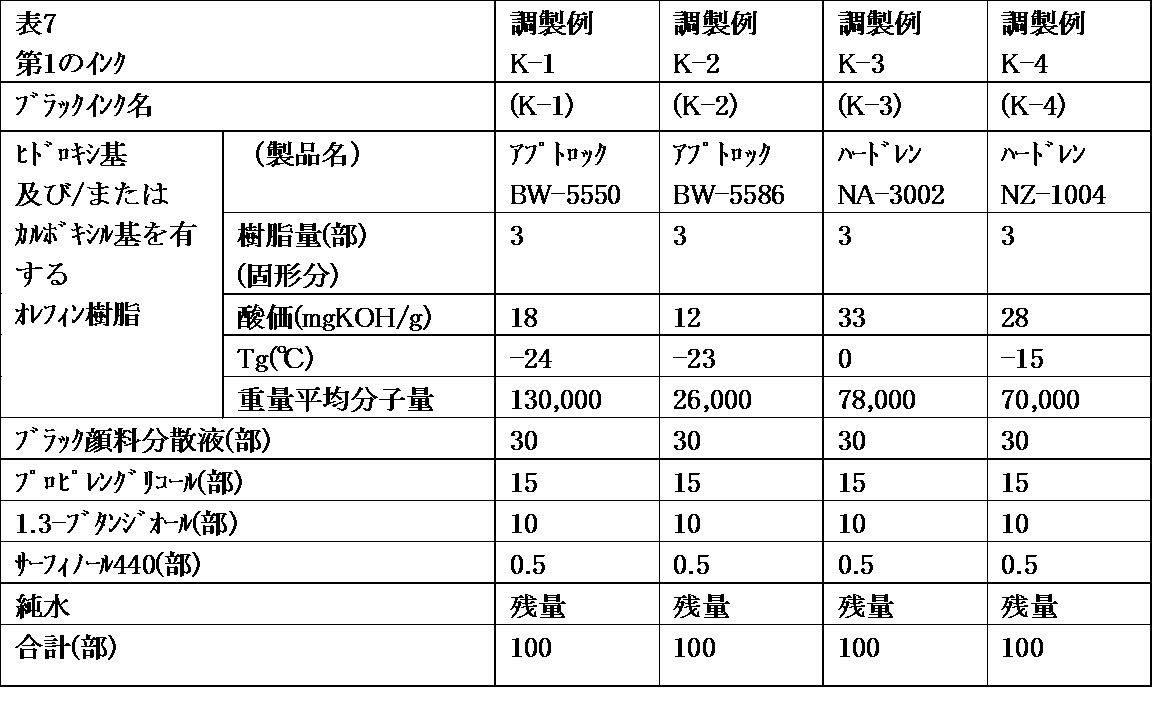
当該ブラック顔料分散液を30部、樹脂部(固形分)3部、プロピレングリコール15部、1.3−ブタンジオール10部、サーフィノール440 0.5部、純水(残量)、を混合し 該混合液を0.5μmのフィルターで濾過して、ブラックインク(K−1)〜(K−7)および(HK−8)を得た。
(Preparation example Black ink)
20 parts of black pigment “Carbon Black # 960” manufactured by Mitsubishi Chemical Corporation, 30 parts of “Disperbyk-190” manufactured by Big Chemie Japan Co., Ltd., 5 parts of isopropyl alcohol and 45 parts of pure water as a pigment dispersant are stirred. Mixed. Next, after kneading with a bead mill, coarse particles were removed by a centrifugal separator, and pure water was added to obtain a black pigment dispersion prepared to have a pigment concentration of 15% by mass.
30 parts of the black pigment dispersion, 3 parts of resin part (solid content), 15 parts of propylene glycol, 10 parts of 1.3-butanediol, 0.5 part of Surfinol 440, pure water (remaining amount) are mixed. The mixture was filtered through a 0.5 μm filter to obtain black inks (K-1) to (K-7) and (HK-8).
各々の組成を表1〜表9に示す。 The respective compositions are shown in Tables 1 to 9.
(第2のインク調製例)
表10の組成に従い、第2のインクを調製した。
(Second ink preparation example)
A second ink was prepared according to the composition in Table 10.
表1〜10中の記載物質等の詳細は以下の通りである。特に表記がないものは、試薬をそのまま用いた。
アプトロックBW−5550(商品名):オレフィン系エマルション(三菱化学(株)製、pH:8、酸価:18mgKOH/g、固形分30%)
アプトロックBW−5586(商品名):オレフィン系エマルション(三菱化学(株)製、pH:7、酸価:12mgKOH/g、固形分30%)
ハードレンNA−3002(商品名):オレフィン系エマルション(東洋紡績(株)製、pH:8、酸価:33mgKOH/g、固形分30%)
ハードレンNZ−1004(商品名):オレフィン系エマルション(東洋紡績(株)製、pH:9、酸価:28mgKOH/g、固形分30%)
ハードレンEW−5515(商品名):塩素化オレフィン系エマルション(東洋紡績(株)製、pH:8、酸価:15mgKOH/g、固形分30%)
アローベースTC−4010(商品名):ポリオレフィン系エマルション(ユニチカ(株)製、pH:10、酸価:23mgKOH/g、固形分25%)
アローベースTD−4010(商品名):ポリオレフィン系エマルション(ユニチカ(株)製、pH:10、酸価:23mgKOH/g、固形分25%)
アローベースCB−1200(商品名):変性ポリオレフィン樹脂エマルション(ユニチカ(株)製、pH:3、固形分23%)
サーフィノール440(商品名):エアープロダクツジャパン(株)製
ビューライトLCA−H(商品名):ポリオキシエチレンアルキルエーテル脂肪酸(ポリオキシエチレン(5)ラウリルエーテル酢酸、三洋化成工業(株)製)
アキポLS−F2(商品名):ポリオキシエチレンオクチルエーテル酢酸(ポリオキシエチレンオクチルエーテル酢酸、花王(株)製)
エポミンSP−200(商品名):ポリエチレンイミン(日本触媒(株)製)
エマルゲン106(商品名):ポリオキシエチレンアルキルエーテル(ポリオキシエチレン(5)ラウリルエーテル、花王(株)製)
Details of the substances described in Tables 1 to 10 are as follows. Unless otherwise indicated, the reagents were used as they were.
Aptolock BW-5550 (trade name): olefin emulsion (Mitsubishi Chemical Corporation, pH: 8, acid value: 18 mg KOH / g, solid content 30%)
Aptolock BW-5586 (trade name): Olefin emulsion (Mitsubishi Chemical Co., Ltd., pH: 7, acid value: 12 mg KOH / g, solid content 30%)
Hardren NA-3002 (trade name): Olefin emulsion (manufactured by Toyobo Co., Ltd., pH: 8, acid value: 33 mg KOH / g, solid content 30%)
HARDREN NZ-1004 (trade name): Olefin emulsion (manufactured by Toyobo Co., Ltd., pH: 9, acid value: 28 mg KOH / g, solid content 30%)
HARDREN EW-5515 (trade name): Chlorinated olefin emulsion (manufactured by Toyobo Co., Ltd., pH: 8, acid value: 15 mg KOH / g, solid content 30%)
Arrow Base TC-4010 (trade name): Polyolefin emulsion (manufactured by Unitika Ltd., pH: 10, acid value: 23 mg KOH / g, solid content 25%)
Arrow Base TD-4010 (trade name): Polyolefin emulsion (manufactured by Unitika Ltd., pH: 10, acid value: 23 mg KOH / g, solid content 25%)
Arrow Base CB-1200 (trade name): Modified polyolefin resin emulsion (manufactured by Unitika Ltd., pH: 3, solid content 23%)
Surfynol 440 (trade name): Viewlight LCA-H (trade name) manufactured by Air Products Japan Co., Ltd .: polyoxyethylene alkyl ether fatty acid (polyoxyethylene (5) lauryl ether acetic acid, manufactured by Sanyo Chemical Industries, Ltd.)
Akipo LS-F2 (trade name): polyoxyethylene octyl ether acetic acid (polyoxyethylene octyl ether acetic acid, manufactured by Kao Corporation)
Epomin SP-200 (trade name): Polyethyleneimine (manufactured by Nippon Shokubai Co., Ltd.)
Emulgen 106 (trade name): Polyoxyethylene alkyl ether (polyoxyethylene (5) lauryl ether, manufactured by Kao Corporation)
(酸価の測定方法)
酸価の測定はJISのK0070に準拠した方法で測定した。なお本発明では、測定用溶剤として以下に示す溶剤を用いた。
上記樹脂水溶液を乾燥固化した樹脂10gを300mlの三角フラスコに秤量し、エタノール:ベンゼン=1:2の混合溶媒約50ml加えて樹脂を溶解する。次いで、フェノールフタレイン指示薬を用い、あらかじめ標定された0.1mol/Lの水酸化カリウムエタノール溶液で滴定し、滴定に用いた水酸化カリウムエタノール溶液の量から、計算式(1)に従い酸価(mgKOH/g)を求める。
(Measurement method of acid value)
The acid value was measured by a method based on JIS K0070. In the present invention, the following solvents were used as measurement solvents.
10 g of the resin obtained by drying and solidifying the resin aqueous solution is weighed into a 300 ml Erlenmeyer flask, and about 50 ml of a mixed solvent of ethanol: benzene = 1: 2 is added to dissolve the resin. Subsequently, using a phenolphthalein indicator, titration was performed with a 0.1 mol / L potassium hydroxide ethanol solution that had been standardized in advance, and the acid value ( mgKOH / g) is determined.
式中、Aは樹脂の酸価(mgKOH/g)、Bは滴定に用いた0.1mol/L水酸化カリウムエタノール溶液の量(ml)、fは0.1mol/リットル水酸化カリウムエタノール溶液のファクター、Sは、樹脂の質量(g)、5.611は、水酸化カリウムの式量の1/10の値(56.11/10)である。 In the formula, A is the acid value of the resin (mgKOH / g), B is the amount of 0.1 mol / L potassium hydroxide ethanol solution used for titration (ml), and f is the 0.1 mol / liter potassium hydroxide ethanol solution. The factor, S is the mass (g) of the resin, and 5.611 is a value (56.11 / 10) of 1/10 of the formula weight of potassium hydroxide.
なお樹脂によって、エタノール:ベンゼン=1:2の混合溶媒約50mlに溶解しないものは、エタノール50ml、あるいは、エタノール/純水=1:1の混合溶媒約50mlのどちらか溶解するほうを選択して、他は同じ操作にて滴定を行う。 For resins that do not dissolve in about 50 ml of a mixed solvent of ethanol: benzene = 1: 2, select either 50 ml of ethanol or about 50 ml of a mixed solvent of ethanol / pure water = 1: 1. The others are titrated by the same operation.
(Tg(ガラス転移温度)の測定方法)
DSC測定は、デュポン社製 熱分析装置DSC10を用い、JIS7122に準じて、昇温速度5℃/分にて測定した。
(Measurement method of Tg (glass transition temperature))
The DSC measurement was performed at a heating rate of 5 ° C./min according to JIS7122 using a thermal analyzer DSC10 manufactured by DuPont.
(ヒドロキシ基及び/またはカルボキシル基を有するオレフィン樹脂等の重量平均分子量(Mw)の測定方法)
ヒドロキシ基及び/またはカルボキシル基を有するオレフィン樹脂等のMwは、下記の条件でGPC測定により求めた。
[GPC測定条件]
測定装置:東ソー株式会社製「HLC−8220 GPC」、
カラム:東ソー株式会社製ガードカラム「SuperHZ−L」(内径4.6mm×2cm)
+東ソー株式会社製「TSKgel SuperHZ4000」(内径4.6mm×15cm)
+東ソー株式会社製「TSKgel SuperHZ3000」(内径4.6mm×15cm)
+東ソー株式会社製「TSKgel SuperHZ2000」(内径4.6mm×15cm)
+東ソー株式会社製「TSKgel SuperHZ1000」(内径4.6mm×15cm)
測定条件:カラム温度 40℃
流速 0.35ml/分
試料:樹脂水溶液を乾燥固化し、樹脂固形分換算で0.5質量%のテトラヒドロフラン(THF)溶液をマイクロフィルターでろ過したもの(10μl)。
校正曲線:単分散標準ポリスチレンSTK standardポリスチレン(東ソー株式会社製)分子量4000000〜250までのサンプルによる校正曲線を使用した。
(Method for measuring weight average molecular weight (Mw) of olefin resin having hydroxy group and / or carboxyl group)
Mw of an olefin resin having a hydroxy group and / or a carboxyl group was determined by GPC measurement under the following conditions.
[GPC measurement conditions]
Measuring device: “HLC-8220 GPC” manufactured by Tosoh Corporation
Column: Guard column “SuperHZ-L” manufactured by Tosoh Corporation (inner diameter 4.6 mm × 2 cm)
+ Tosoh Corporation “TSKgel SuperHZ4000” (inner diameter 4.6 mm × 15 cm)
+ Tosoh Corporation “TSKgel SuperHZ3000” (inner diameter 4.6 mm × 15 cm)
+ "TSKgel SuperHZ2000" manufactured by Tosoh Corporation (inner diameter 4.6 mm x 15 cm)
+ Tosoh Corporation “TSKgel SuperHZ1000” (inner diameter 4.6 mm × 15 cm)
Measurement conditions: Column temperature 40 ° C
Flow rate 0.35 ml / min Sample: A resin aqueous solution was dried and solidified, and a 0.5 mass% tetrahydrofuran (THF) solution in terms of resin solid content was filtered through a microfilter (10 μl).
Calibration curve: Monodisperse standard polystyrene STK standard polystyrene (manufactured by Tosoh Corporation) A calibration curve with samples having a molecular weight of 4000000 to 250 was used.
(実施例1〜140、比較例1〜6)
256ノズル×2列のピエゾ型インクジェットノズルを有するインクジェット記録装置(コニカミノルタ(株)製 EB−100)に、各インクセットを装填し、被記録材としてOPPフィルム(フタムラ化学(株)製 FOR#20、膜厚20μm)上への画像記録を行った。液滴サイズは約42plとし、360×360dpi(dpiとは2.54cmあたりのドット数)の解像度で射出できるようにし、駆動周波数2kHzにて駆動した。フィルムの表面が60℃程度になるようにヒーターにてプレヒートしながら、下記インク付与順番に従い印字を行い、乾燥(80℃/60秒)させた。
(Examples 1-140, Comparative Examples 1-6)
Each ink set was loaded into an inkjet recording apparatus (EB-100 manufactured by Konica Minolta Co., Ltd.) having 256 nozzles × 2 rows of piezo-type inkjet nozzles, and an OPP film (Futamura Chemical Co., Ltd. FOR # manufactured as a recording material) 20 and a film thickness of 20 μm). The droplet size was about 42 pl so that it could be ejected at a resolution of 360 × 360 dpi (dpi is the number of dots per 2.54 cm) and was driven at a driving frequency of 2 kHz. While preheating with a heater so that the surface of the film was about 60 ° C., printing was performed according to the following ink application sequence, followed by drying (80 ° C./60 seconds).
(インク付与順番)
タイプA:第1のインクの付与後に第2のインクを付与。
タイプB:第2のインクの付与後に第1のインクを付与。
タイプC:第1のインクと第2のインクを同時付与。
(Ink application order)
Type A: The second ink is applied after the first ink is applied.
Type B: The first ink is applied after the second ink is applied.
Type C: First ink and second ink are applied simultaneously.
(粘度測定方法)
E型粘度計「V−25型(東機産業(株)製)」用いて、測定(インク温度25℃)した。
(Viscosity measurement method)
Using an E-type viscometer “V-25 type (manufactured by Toki Sangyo Co., Ltd.)”, measurement was performed (ink temperature 25 ° C.).
(pH測定方法)
MM−60R(東亜ディーケーケー(株)製)を用いて測定(インク温度25℃)した。
(PH measurement method)
Measurement was performed using MM-60R (manufactured by Toa DKK Co., Ltd.) (ink temperature 25 ° C.).
(評価方法)
吐出性、及び得られた印字について、恒温恒湿室(室温25℃、湿度50%)において、以下(1)〜(4)の物性を評価した。
(Evaluation method)
The following physical properties (1) to (4) were evaluated in a constant temperature and humidity chamber (room temperature: 25 ° C., humidity: 50%) for the ejection properties and the obtained prints.
(1)吐出性
連続12枚印刷後のノズルの目詰り等を評価した。
○:ノズル周辺にインク付着無く、ノズルの目詰り無し。
△:ノズル周辺にインク付着があるが、ノズルの目詰り無し。
×:ノズルの目詰り有り。
(1) Evaluation of nozzle clogging and the like after printing 12 continuous sheets.
○: Ink does not adhere around the nozzle, and the nozzle is not clogged.
Δ: Ink adheres around the nozzle, but the nozzle is not clogged.
×: Nozzle clogged.
(2)滲み性(ブリード)
○:網点ドット、ベタ部の境界でインクが滲まない。
△:網点ドット、ベタ部の境界で若干滲みがある。
×:網点ドット、ベタ部の境界が滲む。
(2) Breathability (bleed)
○: Ink does not bleed at the boundary between halftone dots and solid portions.
Δ: There is a slight blur at the boundary between halftone dots and solid portions.
X: The dot of a halftone dot and a solid part spread.
(3)ハジキ性
○:網点ドット、ベタ部でインクがはじかない。
△:網点ドット、ベタ部で若干インクがはじく。
×:網点ドット、ベタ部でインクがはじく。
(3) Repelling ○: Ink does not repel at halftone dots and solid areas.
Δ: Ink is slightly repelled at halftone dots and solid portions.
X: Ink repels at halftone dots and solid areas.
(4)ベタ部再現性
○:ベタ画像印字部で濃度ムラ無くインクが再現する。
△:ベタ画像印字部の濃度ムラが印字部に対して20%未満。
×:ベタ画像印字部の濃度ムラが印字部に対して20%以上。
評価結果を、表11〜31に示す。
(4) Solid part reproducibility ○: Ink is reproduced without density unevenness in the solid image printing part.
(Triangle | delta): The density nonuniformity of a solid image printing part is less than 20% with respect to a printing part.
X: Density unevenness of the solid image printing part is 20% or more with respect to the printing part.
The evaluation results are shown in Tables 11-31.
インク付与順番
タイプA:第1のインクの付与後に第2のインクを付与
タイプB:第2のインクの付与後に第1のインクを付与
タイプC:第1のインクと第2のインクを同時付与
インク混合比率(質量比):ヒドロキシ基及び/またはカルボキシル基を有するオレフィン樹脂(固形分)/ポリオキシエチレンアルキルエーテル脂肪酸(固形分)
Ink application order type A: Application of the second ink after application of the first ink Type B: Application of the first ink after application of the second ink Type C: Application of the first ink and the second ink simultaneously Ink mixing ratio (mass ratio): olefin resin having hydroxy group and / or carboxyl group (solid content) / polyoxyethylene alkyl ether fatty acid (solid content)
インク付与順番
タイプA:第1のインクの付与後に第2のインクを付与
タイプB:第2のインクの付与後に第1のインクを付与
タイプC:第1のインクと第2のインクを同時付与
インク混合比率(質量比):ヒドロキシ基及び/またはカルボキシル基を有するオレフィン樹脂(固形分)/ポリオキシエチレンアルキルエーテル脂肪酸(固形分)
Ink application order type A: Application of the second ink after application of the first ink Type B: Application of the first ink after application of the second ink Type C: Application of the first ink and the second ink simultaneously Ink mixing ratio (mass ratio): olefin resin having hydroxy group and / or carboxyl group (solid content) / polyoxyethylene alkyl ether fatty acid (solid content)
インク付与順番
タイプA:第1のインクの付与後に第2のインクを付与
タイプB:第2のインクの付与後に第1のインクを付与
タイプC:第1のインクと第2のインクを同時付与
インク混合比率(質量比):ヒドロキシ基及び/またはカルボキシル基を有するオレフィン樹脂(固形分)/ポリオキシエチレンアルキルエーテル脂肪酸(固形分)
Ink application order type A: Application of the second ink after application of the first ink Type B: Application of the first ink after application of the second ink Type C: Application of the first ink and the second ink simultaneously Ink mixing ratio (mass ratio): olefin resin having hydroxy group and / or carboxyl group (solid content) / polyoxyethylene alkyl ether fatty acid (solid content)
インク付与順番
タイプA:第1のインクの付与後に第2のインクを付与
タイプB:第2のインクの付与後に第1のインクを付与
タイプC:第1のインクと第2のインクを同時付与
インク混合比率(質量比):ヒドロキシ基及び/またはカルボキシル基を有するオレフィン樹脂(固形分)/ポリオキシエチレンアルキルエーテル脂肪酸(固形分)
Ink application order type A: Application of the second ink after application of the first ink Type B: Application of the first ink after application of the second ink Type C: Application of the first ink and the second ink simultaneously Ink mixing ratio (mass ratio): olefin resin having hydroxy group and / or carboxyl group (solid content) / polyoxyethylene alkyl ether fatty acid (solid content)
インク付与順番
タイプA:第1のインクの付与後に第2のインクを付与
タイプB:第2のインクの付与後に第1のインクを付与
タイプC:第1のインクと第2のインクを同時付与
インク混合比率(質量比):ヒドロキシ基及び/またはカルボキシル基を有するオレフィン樹脂(固形分)/ポリオキシエチレンアルキルエーテル脂肪酸(固形分)
Ink application order type A: Application of the second ink after application of the first ink Type B: Application of the first ink after application of the second ink Type C: Application of the first ink and the second ink simultaneously Ink mixing ratio (mass ratio): olefin resin having hydroxy group and / or carboxyl group (solid content) / polyoxyethylene alkyl ether fatty acid (solid content)
インク付与順番
タイプA:第1のインクの付与後に第2のインクを付与
タイプB:第2のインクの付与後に第1のインクを付与
タイプC:第1のインクと第2のインクを同時付与
インク混合比率(質量比):ヒドロキシ基及び/またはカルボキシル基を有するオレフィン樹脂(固形分)/ポリオキシエチレンアルキルエーテル脂肪酸(固形分)
Ink application order type A: Application of the second ink after application of the first ink Type B: Application of the first ink after application of the second ink Type C: Application of the first ink and the second ink simultaneously Ink mixing ratio (mass ratio): olefin resin having hydroxy group and / or carboxyl group (solid content) / polyoxyethylene alkyl ether fatty acid (solid content)
インク付与順番
タイプA:第1のインクの付与後に第2のインクを付与
タイプB:第2のインクの付与後に第1のインクを付与
タイプC:第1のインクと第2のインクを同時付与
インク混合比率(質量比):ヒドロキシ基及び/またはカルボキシル基を有するオレフィン樹脂(固形分)/ポリオキシエチレンアルキルエーテル脂肪酸(固形分)
Ink application order type A: Application of the second ink after application of the first ink Type B: Application of the first ink after application of the second ink Type C: Application of the first ink and the second ink simultaneously Ink mixing ratio (mass ratio): olefin resin having hydroxy group and / or carboxyl group (solid content) / polyoxyethylene alkyl ether fatty acid (solid content)
インク付与順番
タイプA:第1のインクの付与後に第2のインクを付与
タイプB:第2のインクの付与後に第1のインクを付与
タイプC:第1のインクと第2のインクを同時付与
インク混合比率(質量比):ヒドロキシ基及び/またはカルボキシル基を有するオレフィン樹脂(固形分)/ポリオキシエチレンアルキルエーテル脂肪酸(固形分)
Ink application order type A: Application of the second ink after application of the first ink Type B: Application of the first ink after application of the second ink Type C: Application of the first ink and the second ink simultaneously Ink mixing ratio (mass ratio): olefin resin having hydroxy group and / or carboxyl group (solid content) / polyoxyethylene alkyl ether fatty acid (solid content)
インク付与順番
タイプA:第1のインクの付与後に第2のインクを付与
タイプB:第2のインクの付与後に第1のインクを付与
タイプC:第1のインクと第2のインクを同時付与
インク混合比率(質量比):ヒドロキシ基及び/またはカルボキシル基を有するオレフィン樹脂(固形分)/ポリオキシエチレンアルキルエーテル脂肪酸(固形分)
Ink application order type A: Application of the second ink after application of the first ink Type B: Application of the first ink after application of the second ink Type C: Application of the first ink and the second ink simultaneously Ink mixing ratio (mass ratio): olefin resin having hydroxy group and / or carboxyl group (solid content) / polyoxyethylene alkyl ether fatty acid (solid content)
インク付与順番
タイプA:第1のインクの付与後に第2のインクを付与
タイプB:第2のインクの付与後に第1のインクを付与
タイプC:第1のインクと第2のインクを同時付与
インク混合比率(質量比):ヒドロキシ基及び/またはカルボキシル基を有するオレフィン樹脂(固形分)/ポリオキシエチレンアルキルエーテル脂肪酸(固形分)
Ink application order type A: Application of the second ink after application of the first ink Type B: Application of the first ink after application of the second ink Type C: Application of the first ink and the second ink simultaneously Ink mixing ratio (mass ratio): olefin resin having hydroxy group and / or carboxyl group (solid content) / polyoxyethylene alkyl ether fatty acid (solid content)
インク付与順番
タイプA:第1のインクの付与後に第2のインクを付与
タイプB:第2のインクの付与後に第1のインクを付与
タイプC:第1のインクと第2のインクを同時付与
インク混合比率(質量比):ヒドロキシ基及び/またはカルボキシル基を有するオレフィン樹脂(固形分)/ポリオキシエチレンアルキルエーテル脂肪酸(固形分)
Ink application order type A: Application of the second ink after application of the first ink Type B: Application of the first ink after application of the second ink Type C: Application of the first ink and the second ink simultaneously Ink mixing ratio (mass ratio): olefin resin having hydroxy group and / or carboxyl group (solid content) / polyoxyethylene alkyl ether fatty acid (solid content)
インク付与順番
タイプA:第1のインクの付与後に第2のインクを付与
タイプB:第2のインクの付与後に第1のインクを付与
タイプC:第1のインクと第2のインクを同時付与
インク混合比率(質量比):ヒドロキシ基及び/またはカルボキシル基を有するオレフィン樹脂(固形分)/ポリオキシエチレンアルキルエーテル脂肪酸(固形分)
Ink application order type A: Application of the second ink after application of the first ink Type B: Application of the first ink after application of the second ink Type C: Application of the first ink and the second ink simultaneously Ink mixing ratio (mass ratio): olefin resin having hydroxy group and / or carboxyl group (solid content) / polyoxyethylene alkyl ether fatty acid (solid content)
インク付与順番
タイプA:第1のインクの付与後に第2のインクを付与
タイプB:第2のインクの付与後に第1のインクを付与
タイプC:第1のインクと第2のインクを同時付与
インク混合比率(質量比):ヒドロキシ基及び/またはカルボキシル基を有するオレフィン樹脂(固形分)/ポリオキシエチレンアルキルエーテル脂肪酸(固形分)
Ink application order type A: Application of the second ink after application of the first ink Type B: Application of the first ink after application of the second ink Type C: Application of the first ink and the second ink simultaneously Ink mixing ratio (mass ratio): olefin resin having hydroxy group and / or carboxyl group (solid content) / polyoxyethylene alkyl ether fatty acid (solid content)
インク付与順番
タイプA:第1のインクの付与後に第2のインクを付与
タイプB:第2のインクの付与後に第1のインクを付与
タイプC:第1のインクと第2のインクを同時付与
インク混合比率(質量比):ヒドロキシ基及び/またはカルボキシル基を有するオレフィン樹脂(固形分)/ポリオキシエチレンアルキルエーテル脂肪酸(固形分)
Ink application order type A: Application of the second ink after application of the first ink Type B: Application of the first ink after application of the second ink Type C: Application of the first ink and the second ink simultaneously Ink mixing ratio (mass ratio): olefin resin having hydroxy group and / or carboxyl group (solid content) / polyoxyethylene alkyl ether fatty acid (solid content)
インク付与順番
タイプA:第1のインクの付与後に第2のインクを付与
タイプB:第2のインクの付与後に第1のインクを付与
タイプC:第1のインクと第2のインクを同時付与
インク混合比率(質量比):ヒドロキシ基及び/またはカルボキシル基を有するオレフィン樹脂(固形分)/ポリオキシエチレンアルキルエーテル脂肪酸(固形分)
Ink application order type A: Application of the second ink after application of the first ink Type B: Application of the first ink after application of the second ink Type C: Application of the first ink and the second ink simultaneously Ink mixing ratio (mass ratio): olefin resin having hydroxy group and / or carboxyl group (solid content) / polyoxyethylene alkyl ether fatty acid (solid content)
インク付与順番
タイプA:第1のインクの付与後に第2のインクを付与
タイプB:第2のインクの付与後に第1のインクを付与
タイプC:第1のインクと第2のインクを同時付与
インク混合比率(質量比):ヒドロキシ基及び/またはカルボキシル基を有するオレフィン樹脂(固形分)/ポリオキシエチレンアルキルエーテル脂肪酸(固形分)
Ink application order type A: Application of the second ink after application of the first ink Type B: Application of the first ink after application of the second ink Type C: Application of the first ink and the second ink simultaneously Ink mixing ratio (mass ratio): olefin resin having hydroxy group and / or carboxyl group (solid content) / polyoxyethylene alkyl ether fatty acid (solid content)
インク付与順番
タイプA:第1のインクの付与後に第2のインクを付与
タイプB:第2のインクの付与後に第1のインクを付与
タイプC:第1のインクと第2のインクを同時付与
インク混合比率(質量比):ヒドロキシ基及び/またはカルボキシル基を有するオレフィン樹脂(固形分)/ポリオキシエチレンアルキルエーテル脂肪酸(固形分)
Ink application order type A: Application of the second ink after application of the first ink Type B: Application of the first ink after application of the second ink Type C: Application of the first ink and the second ink simultaneously Ink mixing ratio (mass ratio): olefin resin having hydroxy group and / or carboxyl group (solid content) / polyoxyethylene alkyl ether fatty acid (solid content)
インク付与順番
タイプA:第1のインクの付与後に第2のインクを付与
タイプB:第2のインクの付与後に第1のインクを付与
タイプC:第1のインクと第2のインクを同時付与
インク混合比率(質量比):ヒドロキシ基及び/またはカルボキシル基を有するオレフィン樹脂(固形分)/ポリオキシエチレンアルキルエーテル脂肪酸(固形分)
Ink application order type A: Application of the second ink after application of the first ink Type B: Application of the first ink after application of the second ink Type C: Application of the first ink and the second ink simultaneously Ink mixing ratio (mass ratio): olefin resin having hydroxy group and / or carboxyl group (solid content) / polyoxyethylene alkyl ether fatty acid (solid content)
インク付与順番
タイプA:第1のインクの付与後に第2のインクを付与
タイプB:第2のインクの付与後に第1のインクを付与
タイプC:第1のインクと第2のインクを同時付与
インク混合比率(質量比):ヒドロキシ基及び/またはカルボキシル基を有するオレフィン樹脂(固形分)/ポリオキシエチレンアルキルエーテル脂肪酸(固形分)
Ink application order type A: Application of the second ink after application of the first ink Type B: Application of the first ink after application of the second ink Type C: Application of the first ink and the second ink simultaneously Ink mixing ratio (mass ratio): olefin resin having hydroxy group and / or carboxyl group (solid content) / polyoxyethylene alkyl ether fatty acid (solid content)
インク付与順番
タイプA:第1のインクの付与後に第2のインクを付与
タイプB:第2のインクの付与後に第1のインクを付与
タイプC:第1のインクと第2のインクを同時付与
インク混合比率(質量比):ヒドロキシ基及び/またはカルボキシル基を有するオレフィン樹脂(固形分)/ポリオキシエチレンアルキルエーテル脂肪酸(固形分)
Ink application order type A: Application of the second ink after application of the first ink Type B: Application of the first ink after application of the second ink Type C: Application of the first ink and the second ink simultaneously Ink mixing ratio (mass ratio): olefin resin having hydroxy group and / or carboxyl group (solid content) / polyoxyethylene alkyl ether fatty acid (solid content)
インク付与順番
タイプA:第1のインクの付与後に第2のインクを付与
タイプB:第2のインクの付与後に第1のインクを付与
タイプC:第1のインクと第2のインクを同時付与
インク混合比率(質量比)
比較例1:ヒドロキシ基及びカルボキシル基を有さないオレフィン樹脂(固形分)
/ポリオキシエチレンアルキルエーテル脂肪酸(固形分)
比較例2〜6:ヒドロキシ基及びカルボキシル基を有するオレフィン樹脂(固形分)
/ポリオキシエチレンアルキルエーテル脂肪酸に属さないポリマー(固形分)
Ink application order type A: Application of the second ink after application of the first ink Type B: Application of the first ink after application of the second ink Type C: Application of the first ink and the second ink simultaneously Ink mixing ratio (mass ratio)
Comparative Example 1: Olefin resin having no hydroxy group and carboxyl group (solid content)
/ Polyoxyethylene alkyl ether fatty acid (solid content)
Comparative Examples 2 to 6: Olefin resin having a hydroxy group and a carboxyl group (solid content)
/ Polyoxyethylene alkyl ether fatty acid-free polymer (solid content)
この結果、実施例1〜140で得たインクセットは、いずれも滲み性、ハジキ性、ベタ部再現性は良好であった。一方、比較例1は第1のインクにおけるバインダー樹脂としてヒドロキシ基及び/またはカルボキシル基を有さないオレフィン樹脂を用いた例であるが、印刷物の評価はいずれも×であった。比較例2〜6は第2のインクとしてポリオキシエチレンアルキルエーテル脂肪酸に替えてポリエチレンイミンやポリオキシエチレンラウリルエーテルを用いた例であるが、いずれの場合も所望の効果が得られなかった。 As a result, the ink sets obtained in Examples 1 to 140 all had good bleeding, repelling, and solid portion reproducibility. On the other hand, Comparative Example 1 is an example in which an olefin resin having no hydroxy group and / or carboxyl group was used as the binder resin in the first ink. Comparative Examples 2 to 6 are examples in which polyethyleneimine or polyoxyethylene lauryl ether was used as the second ink in place of the polyoxyethylene alkyl ether fatty acid, but the desired effect was not obtained in either case.
Claims (3)
Priority Applications (1)
| Application Number | Priority Date | Filing Date | Title |
|---|---|---|---|
| JP2012165780A JP2014024945A (en) | 2012-07-26 | 2012-07-26 | Aqueous ink set for ink jet recording |
Applications Claiming Priority (1)
| Application Number | Priority Date | Filing Date | Title |
|---|---|---|---|
| JP2012165780A JP2014024945A (en) | 2012-07-26 | 2012-07-26 | Aqueous ink set for ink jet recording |
Publications (1)
| Publication Number | Publication Date |
|---|---|
| JP2014024945A true JP2014024945A (en) | 2014-02-06 |
Family
ID=50198893
Family Applications (1)
| Application Number | Title | Priority Date | Filing Date |
|---|---|---|---|
| JP2012165780A Pending JP2014024945A (en) | 2012-07-26 | 2012-07-26 | Aqueous ink set for ink jet recording |
Country Status (1)
| Country | Link |
|---|---|
| JP (1) | JP2014024945A (en) |
Cited By (2)
| Publication number | Priority date | Publication date | Assignee | Title |
|---|---|---|---|---|
| WO2019188283A1 (en) * | 2018-03-30 | 2019-10-03 | 東洋紡株式会社 | Polyolefin-based adhesive composition |
| WO2020080121A1 (en) * | 2018-10-15 | 2020-04-23 | Dic株式会社 | Aqueous ink, ink for inkjet recording, printed material and method for producing printed material |
-
2012
- 2012-07-26 JP JP2012165780A patent/JP2014024945A/en active Pending
Cited By (6)
| Publication number | Priority date | Publication date | Assignee | Title |
|---|---|---|---|---|
| WO2019188283A1 (en) * | 2018-03-30 | 2019-10-03 | 東洋紡株式会社 | Polyolefin-based adhesive composition |
| CN111971360A (en) * | 2018-03-30 | 2020-11-20 | 东洋纺株式会社 | Polyolefin adhesive composition |
| WO2020080121A1 (en) * | 2018-10-15 | 2020-04-23 | Dic株式会社 | Aqueous ink, ink for inkjet recording, printed material and method for producing printed material |
| CN112739783A (en) * | 2018-10-15 | 2021-04-30 | Dic株式会社 | Water-based ink, ink for inkjet recording, printed matter, and method for producing printed matter |
| JPWO2020080121A1 (en) * | 2018-10-15 | 2021-05-13 | Dic株式会社 | Water-based inks, inkjet recording inks, printed matter, and methods for manufacturing printed matter |
| US11421122B2 (en) | 2018-10-15 | 2022-08-23 | Dic Corporation | Aqueous ink, ink for inkjet recording, printed material and method for producing printed material |
Similar Documents
| Publication | Publication Date | Title |
|---|---|---|
| JP5088659B2 (en) | Ink composition and ink jet recording method using the same | |
| CN102199383B (en) | Aqueous ink composition and use its printing process of ink-jet recording | |
| JP5915133B2 (en) | Water-based ink set for inkjet recording | |
| JP6160892B1 (en) | Aqueous ink set for inkjet recording and inkjet recording method | |
| JP5987260B2 (en) | Water-based ink set for inkjet recording | |
| JP5500409B2 (en) | Water-based ink set for inkjet recording | |
| JP2007262272A (en) | Ink composition and ink jet recording method using the same | |
| JP6128381B2 (en) | Water-based ink set for inkjet recording | |
| JP7193010B2 (en) | AQUEOUS INK COMPOSITION, INK SET, PRINTED MATERIAL AND METHOD FOR PRODUCING PRINTED MATERIAL | |
| JP5692491B2 (en) | Inkjet recording method | |
| JP2013203777A (en) | Aqueous ink set for inkjet recording | |
| JP6031827B2 (en) | Water-based ink set for inkjet recording | |
| JP2014024945A (en) | Aqueous ink set for ink jet recording | |
| US12534632B2 (en) | Aqueous ink composition, printed material, and method of producing printed material | |
| JP5500410B1 (en) | Water-based ink set for inkjet recording | |
| JP4894084B2 (en) | Water-based ink composition for inkjet recording | |
| JP2024071961A (en) | Water-based ink for ink-jet recording | |
| JP5355009B2 (en) | Ink set for ink jet recording and image recording method | |
| JP5637413B2 (en) | Water-based ink set for inkjet recording | |
| JP7670090B2 (en) | Inkjet printing ink and method for producing printed matter | |
| CN118339242A (en) | Water-based ink composition, ink set, printed matter, and method for producing printed matter | |
| JP2024094892A (en) | Water-based ink for ink-jet recording |