JP2012252529A - Information processor, information processing method and program - Google Patents
Information processor, information processing method and program Download PDFInfo
- Publication number
- JP2012252529A JP2012252529A JP2011124759A JP2011124759A JP2012252529A JP 2012252529 A JP2012252529 A JP 2012252529A JP 2011124759 A JP2011124759 A JP 2011124759A JP 2011124759 A JP2011124759 A JP 2011124759A JP 2012252529 A JP2012252529 A JP 2012252529A
- Authority
- JP
- Japan
- Prior art keywords
- node
- display
- feature space
- display screen
- cluster
- Prior art date
- Legal status (The legal status is an assumption and is not a legal conclusion. Google has not performed a legal analysis and makes no representation as to the accuracy of the status listed.)
- Abandoned
Links
Images


Classifications
-
- G—PHYSICS
- G06—COMPUTING OR CALCULATING; COUNTING
- G06F—ELECTRIC DIGITAL DATA PROCESSING
- G06F3/00—Input arrangements for transferring data to be processed into a form capable of being handled by the computer; Output arrangements for transferring data from processing unit to output unit, e.g. interface arrangements
- G06F3/01—Input arrangements or combined input and output arrangements for interaction between user and computer
- G06F3/048—Interaction techniques based on graphical user interfaces [GUI]
- G06F3/0481—Interaction techniques based on graphical user interfaces [GUI] based on specific properties of the displayed interaction object or a metaphor-based environment, e.g. interaction with desktop elements like windows or icons, or assisted by a cursor's changing behaviour or appearance
-
- G—PHYSICS
- G06—COMPUTING OR CALCULATING; COUNTING
- G06F—ELECTRIC DIGITAL DATA PROCESSING
- G06F2203/00—Indexing scheme relating to G06F3/00 - G06F3/048
- G06F2203/048—Indexing scheme relating to G06F3/048
- G06F2203/04806—Zoom, i.e. interaction techniques or interactors for controlling the zooming operation
Landscapes
- Engineering & Computer Science (AREA)
- General Engineering & Computer Science (AREA)
- Theoretical Computer Science (AREA)
- Human Computer Interaction (AREA)
- Physics & Mathematics (AREA)
- General Physics & Mathematics (AREA)
- User Interface Of Digital Computer (AREA)
- Information Retrieval, Db Structures And Fs Structures Therefor (AREA)
Abstract
【課題】表示画面を煩雑にすることなく、コンテンツに関する情報を提供すること。
【解決手段】本開示によれば、所定の特徴量に基づいて規定される特徴空間の少なくとも一部と、特徴空間における位置を表す位置情報がメタデータとして関連付けられたコンテンツデータの集合とを表示画面に併せて表示する際の表示形式を選択する表示形式選択制御部と、コンテンツデータをリーフノードとする所定の木構造を利用し、表示特徴空間の大きさに応じて木構造に含まれるノードから所定の条件を満たすノードを選択するノード選択部とを備え、ノード選択部は、表示特徴空間の外側に位置するノードについて、当該ノードの表示特徴空間からの離隔距離に応じた特徴空間における広さを有するものを表示画面外ノードとして選択し、表示形式選択制御部は、選択された表示画面外ノードの存在を示すオブジェクトを表示画面内に表示させる情報処理装置が提供される。
【選択図】図1Information about contents is provided without complicating a display screen.
According to the present disclosure, at least a part of a feature space defined based on a predetermined feature amount and a set of content data in which position information representing a position in the feature space is associated as metadata are displayed. Nodes included in the tree structure according to the size of the display feature space, using a display format selection control unit that selects a display format for display along with the screen, and a predetermined tree structure with content data as leaf nodes A node selection unit that selects a node satisfying a predetermined condition from the node, and the node selection unit selects a node located outside the display feature space in a feature space according to a separation distance of the node from the display feature space. The display format selection control unit displays an object indicating the presence of the selected display off-screen node. The information processing apparatus is provided for displaying within.
[Selection] Figure 1
Description
本開示は、情報処理装置、情報処理方法及びプログラムに関する。 The present disclosure relates to an information processing apparatus, an information processing method, and a program.
所定の特徴量により規定される特徴空間上において距離の近いデータごとにグループを作成する技術は、クラスタリングと呼ばれ、様々な分野に広く利用されている。また、クラスタリングにより生成される各クラスタに含まれるデータを、更にグループ分けすることで、木構造のデータ構造を作成することも広く行われている。 A technique for creating a group for each data having a short distance in a feature space defined by a predetermined feature quantity is called clustering and is widely used in various fields. In addition, it is also widely performed to create a tree-structured data structure by further grouping data included in each cluster generated by clustering.
こうして作成されたデータ構造は、上位階層が下位階層を含むような構造になっている。そのため、粒度の荒いグループから粒度の細かいグループまでを順に選択してゆくことで所望のデータを探索する目的や、あるデータに対するグループ分けを実現する際に、階層を変更することで、様々な粒度のグループ分けを実現する目的などに用いられる(例えば、以下の特許文献1を参照。)。 The data structure thus created has a structure in which the upper hierarchy includes the lower hierarchy. Therefore, it is possible to search for desired data by selecting from coarse-grained groups to fine-grained groups in order, and by changing the hierarchy when realizing grouping for certain data, various granularities (For example, refer to the following Patent Document 1).
グループ分けされたデータをユーザが検索する場合には、クラスタリングによって形成された階層構造を上から順にたどっていくことで、データの検索を行うことが多い。上記特許文献1においても、階層構造を直感的に把握できるような表示画面を提供することで、ユーザがデータ探索を容易に実行できるようにしている。
When a user searches for grouped data, the data is often searched by following the hierarchical structure formed by clustering from the top. Also in the said
ところで、検索対象となるデータが解っている場合には、上記特許文献1に記載の方法のような探索方法が効果的であるが、例えば、写真などのあるコンテンツデータが生成された状況と類似した状況を有するコンテンツ(例えば、写真等を撮影した場所がほぼ同じ場所であるコンテンツ等)を検索したい、といった場合には、現在着目しているデータを基準として、データの閲覧や検索ができたほうが便利である。
By the way, when the data to be searched is known, a search method such as the method described in
そこで、近年では、指定された位置を基準としたコンテンツの一覧を表示するアプリケーションやサービスの開発が行われるようになってきた。 Therefore, in recent years, applications and services for displaying a list of contents based on a designated position have been developed.
しかしながら、上述のような指定された位置を基準としたコンテンツの一覧を表示するためのアプリケーションは、全てのコンテンツを表示画面に表示してしまうため、表示画面が煩雑になってしまうという問題があった。 However, the application for displaying the list of contents based on the designated position as described above displays all the contents on the display screen, which causes a problem that the display screen becomes complicated. It was.
そこで、本開示では、表示画面を煩雑にすることなく、コンテンツに関する情報を提供することが可能な、情報処理装置、情報処理方法及びプログラムを提案する。 Therefore, the present disclosure proposes an information processing apparatus, an information processing method, and a program that can provide information related to content without complicating the display screen.
本開示によれば、所定の特徴量に基づいて規定される特徴空間の少なくとも一部と、前記特徴空間における位置を表す位置情報がメタデータとして関連付けられたコンテンツデータの集合と、を表示画面にあわせて表示する際の表示形式を選択する表示形式選択制御部と、前記コンテンツデータをリーフノードとし、前記特徴空間におけるノード間の距離が所定の条件を満たすノードの集合が、当該所定の条件を満たすノードの親ノードとして規定される木構造を利用し、前記表示画面に表示される前記特徴空間である表示特徴空間の大きさに応じて、前記木構造に含まれるノードの中から所定の条件を満たすノードを選択するノード選択部と、を備え、前記ノード選択部は、前記表示特徴空間の外側に位置する前記ノードについて、当該ノードの前記表示特徴空間からの離隔距離に応じた前記特徴空間における広さを有するものを、表示画面外に位置する表示画面外ノードとして選択し、前記表示形式選択制御部は、前記ノード選択部により選択された前記表示画面外ノードの存在を示すオブジェクトを前記表示画面内に表示させる、情報処理装置が提供される。 According to the present disclosure, on a display screen, at least a part of a feature space defined based on a predetermined feature amount and a set of content data in which position information indicating a position in the feature space is associated as metadata are displayed on the display screen. A display format selection control unit that selects a display format for displaying together, and a set of nodes that use the content data as leaf nodes and the distance between the nodes in the feature space satisfies a predetermined condition satisfy the predetermined condition. A predetermined condition is selected from the nodes included in the tree structure according to the size of the display feature space, which is the feature space displayed on the display screen, using a tree structure defined as a parent node of the node to be satisfied A node selection unit that selects a node that satisfies the condition, and the node selection unit selects the node for the node located outside the display feature space. Having a size in the feature space corresponding to a separation distance from the display feature space of the display screen as a node outside the display screen located outside the display screen, the display format selection control unit is configured to select the node selection unit There is provided an information processing apparatus for displaying an object indicating the presence of the node outside the display screen selected by the item in the display screen.
また、本開示によれば、所定の特徴量に基づいて規定される特徴空間における位置を表す位置情報がメタデータとして関連付けられたコンテンツデータをリーフノードとし、前記特徴空間におけるノード間の距離が所定の条件を満たすノードの集合が、当該所定の条件を満たすノードの親ノードとして規定される木構造を利用し、表示画面に表示される前記特徴空間である表示特徴空間の大きさに応じて、前記木構造に含まれるノードの中から所定の条件を満たすノードを選択することと、前記特徴空間の少なくとも一部と、選択された前記ノードの少なくとも一部と、を表示画面にあわせて表示する際の表示形式を選択することと、を含み、前記ノードを選択する際には、前記表示特徴空間の外側に位置する前記ノードのうち、当該ノードの前記表示特徴空間からの離隔距離に応じた前記特徴空間における広さを有するものが、表示画面外に位置する表示画面外ノードとして選択され、前記表示形式を選択する際には、選択された前記表示画面外ノードの存在を示すオブジェクトが前記表示画面内に表示されるようにする、情報処理方法が提供される。 Further, according to the present disclosure, content data associated with position information representing a position in a feature space defined based on a predetermined feature amount as metadata is set as a leaf node, and a distance between the nodes in the feature space is set to a predetermined value. The set of nodes satisfying the condition is based on the tree structure defined as the parent node of the node satisfying the predetermined condition, and according to the size of the display feature space that is the feature space displayed on the display screen, Selecting a node satisfying a predetermined condition from the nodes included in the tree structure, and displaying at least a part of the feature space and at least a part of the selected node according to a display screen Selecting a display format at the time, and when selecting the node, among the nodes located outside the display feature space, the node What has the size in the feature space according to the separation distance from the display feature space is selected as a display screen outside node located outside the display screen, and when the display format is selected, the selected There is provided an information processing method for causing an object indicating the presence of a node outside the display screen to be displayed in the display screen.
また、本開示によれば、コンピュータに、所定の特徴量に基づいて規定される特徴空間の少なくとも一部と、前記特徴空間における位置を表す位置情報がメタデータとして関連付けられたコンテンツデータの集合と、を表示画面にあわせて表示する際の表示形式を選択する表示形式選択制御機能と、前記コンテンツデータをリーフノードとし、前記特徴空間におけるノード間の距離が所定の条件を満たすノードの集合が、当該所定の条件を満たすノードの親ノードとして規定される木構造を利用し、前記表示画面に表示される前記特徴空間である表示特徴空間の大きさに応じて、前記木構造に含まれるノードの中から所定の条件を満たすノードを選択するノード選択機能と、を実現させ、前記ノード選択機能が、前記表示特徴空間の外側に位置する前記ノードについて、当該ノードの前記表示特徴空間からの離隔距離に応じた前記特徴空間における広さを有するものを、表示画面外に位置する表示画面外ノードとして選択し、前記表示形式選択制御機能が、前記ノード選択機能により選択された前記表示画面外ノードの存在を示すオブジェクトを前記表示画面内に表示させるためのプログラムが提供される。 Further, according to the present disclosure, the computer includes at least a part of a feature space defined based on a predetermined feature amount, and a set of content data in which position information representing a position in the feature space is associated as metadata. , And a display format selection control function for selecting a display format when displaying in accordance with the display screen, and a set of nodes in which the content data is a leaf node and the distance between the nodes in the feature space satisfies a predetermined condition, Using the tree structure defined as the parent node of the node that satisfies the predetermined condition, the size of the node included in the tree structure is determined according to the size of the display feature space that is the feature space displayed on the display screen. A node selection function for selecting a node satisfying a predetermined condition from among the nodes, and the node selection function is located outside the display feature space. The node having a size in the feature space corresponding to the distance from the display feature space of the node is selected as a node outside the display screen located outside the display screen, and the display format selection control function However, there is provided a program for displaying an object indicating the presence of the node outside the display screen selected by the node selection function in the display screen.
本開示によれば、表示形式選択制御部は、所定の特徴量に基づいて規定される特徴空間の少なくとも一部と、かかる特徴空間における位置を表す位置情報がメタデータとして関連付けられたコンテンツデータの集合と、を表示画面にあわせて表示する際の表示形式を選択し、ノード選択部は、上記コンテンツデータをリーフノードとし、特徴空間におけるノード間の距離が所定の条件を満たすノードの集合が、当該所定の条件を満たすノードの親ノードとして規定される木構造を利用して、表示画面に表示される特徴空間である表示特徴空間の大きさに応じて、木構造に含まれるノードの中から所定の条件を満たすノードを選択する。この際、ノード選択部は、表示特徴空間の外側に位置するノードについて、当該ノードの表示特徴空間からの離隔距離に応じた特徴空間における広さを有するものを、表示画面外に位置する表示画面外ノードとして選択し、表示形式選択制御部は、ノード選択部により選択された表示画面外ノードの存在を示すオブジェクトを表示画面内に表示させる。 According to the present disclosure, the display format selection control unit includes content data in which at least a part of a feature space defined based on a predetermined feature amount and position information representing a position in the feature space are associated as metadata. And a display format for displaying the set in accordance with the display screen, the node selection unit uses the content data as a leaf node, and a set of nodes satisfying a predetermined distance between nodes in the feature space, Using the tree structure defined as the parent node of the node that satisfies the predetermined condition, depending on the size of the display feature space that is the feature space displayed on the display screen, from among the nodes included in the tree structure A node satisfying a predetermined condition is selected. At this time, the node selection unit displays a node located outside the display feature space and having a size in the feature space corresponding to the separation distance of the node from the display feature space. The display format selection control unit displays an object indicating the presence of a node outside the display screen selected by the node selection unit on the display screen.
以上説明したように本開示によれば、表示画面を煩雑にすることなく、コンテンツに関する情報を提供することが可能である。 As described above, according to the present disclosure, it is possible to provide information related to content without complicating the display screen.
以下に添付図面を参照しながら、本開示の好適な実施の形態について詳細に説明する。なお、本明細書及び図面において、実質的に同一の機能構成を有する構成要素については、同一の符号を付することにより重複説明を省略する。 Hereinafter, preferred embodiments of the present disclosure will be described in detail with reference to the accompanying drawings. In addition, in this specification and drawing, about the component which has the substantially same function structure, duplication description is abbreviate | omitted by attaching | subjecting the same code | symbol.
なお、説明は、以下の順序で行うものとする。
(1)木構造について
(2)第1の実施形態
(2−1)情報処理装置で利用されるクラスタリングの概略について
(2−2)情報処理装置の構成について
(2−3)情報処理方法の流れについて
(2−4)第1変形例
(3)本開示の実施形態に係る情報処理装置のハードウェア構成について
The description will be made in the following order.
(1) Tree structure (2) First embodiment (2-1) Outline of clustering used in information processing apparatus (2-2) Configuration of information processing apparatus (2-3) Information processing method (2-4) First Modification (3) Regarding Hardware Configuration of Information Processing Device According to Embodiment of Present Disclosure
(木構造について)
まず、本開示の実施形態に係る説明を行うに先立ち、本明細書中で使用する木構造に関する用語について、図1を参照しながら簡単に説明する。図1は、木構造について説明するための説明図である。
(About the tree structure)
First, prior to describing the embodiment of the present disclosure, terms related to a tree structure used in the present specification will be briefly described with reference to FIG. FIG. 1 is an explanatory diagram for explaining a tree structure.
図1に例示したように、木構造は、複数の要素(図1において○で示したもの)から構成されている。これら複数の要素のことを、ノードと称する。また、木構造において、一番上に位置するノードをルートノードと称する。ルートノードに着目すると、このルートノードから図の下方向に向かって枝分かれが生じており、それぞれの枝の先にノードが位置している。このような枝分かれが繰り返されることで、木構造は、図1に示したような多層的な構造となる。また、木構造において、一番下に位置するノードを、リーフノードと称する。図から明らかなように、これらリーフノードからは枝分かれが生じていない。 As illustrated in FIG. 1, the tree structure is composed of a plurality of elements (shown by ◯ in FIG. 1). These multiple elements are called nodes. In the tree structure, the node located at the top is referred to as a root node. Focusing on the root node, branching occurs from the root node downward in the figure, and the node is located at the end of each branch. By repeating such branching, the tree structure becomes a multilayer structure as shown in FIG. Further, the node located at the bottom in the tree structure is referred to as a leaf node. As is apparent from the figure, no branching occurs from these leaf nodes.
ここで、図1に示したノード「B」に着目する。ノードBから上に向かって延びている枝は、ルートノードにつながっており、ノードBから下に向かって延びている枝は、リーフ3及びリーフ4という2つのノード(リーフノード)につながっている。ここで、ノードBに対するルートノードのように、上方向(換言すれば、ルートノードの方向)に向かって延びている枝に直接つながっているノードのことを、親ノードと称することとする。また、ノードBに対するリーフ3及びリーフ4のように、下方向(換言すれば、ルートノードの方向とは逆の方向)に向かって延びている枝に直接つながっているノードのことを、子ノードと称することとする。
Here, attention is paid to the node “B” shown in FIG. The branch extending upward from the node B is connected to the root node, and the branch extending downward from the node B is connected to two nodes (leaf nodes) called
親ノード、及び、子ノードという呼び方は、あくまでも相対的なものであって、着目しているノードが変わることで、その呼び方も変化する。例えば、ノードBは、リーフ3又はリーフ4にとっては親ノードとなるが、ルートノードにとっては子ノードとなる。
The names of the parent node and the child node are relative to each other, and the name of the node changes when the node of interest changes. For example, node B is a parent node for
また、木構造は、図1に示したような多層構造となっているが、以下では、ルートノードが属する階層を第0階層と呼ぶこととし、ルートノードの子ノードが属する階層を第1階層、第1階層に位置するノードの子ノードが属する階層を第2階層と呼ぶこととする。以下、必要に応じて、順に、第3階層、第4階層・・・と称することとする。 The tree structure is a multilayer structure as shown in FIG. 1. In the following, the hierarchy to which the root node belongs is called the 0th hierarchy, and the hierarchy to which the child node of the root node belongs is the 1st hierarchy. A hierarchy to which a child node of a node located in the first hierarchy belongs is called a second hierarchy. Hereinafter, the third hierarchy, the fourth hierarchy, and so on are sequentially referred to as necessary.
また、ノードBに着目した場合におけるノードA及びノードCのように、あるノードの親ノードから分岐している、着目しているノード以外の子ノードのことを、兄弟ノード(sibling node)と称することとする。例えば図1において、リーフ3に着目した場合、その兄弟ノードはリーフ4となる。
In addition, child nodes other than the focused node that branch from the parent node of a certain node, such as the node A and the node C when focusing on the node B, are referred to as sibling nodes. I will do it. For example, in FIG. 1, when attention is paid to
なお、図1に示した例では、あるノードから複数の枝が分岐している場合について示しているが、ノードから下方向(ルートノードに向かう方向とは逆の方向)に延びる枝の個数は、1つのみであってもよい。また、あるノードから分岐する枝の個数は、図1に示した例に限定されるわけではない。 The example shown in FIG. 1 shows a case where a plurality of branches branch from a certain node, but the number of branches extending downward from the node (the direction opposite to the direction toward the root node) is There may be only one. Further, the number of branches branched from a certain node is not limited to the example shown in FIG.
(第1の実施形態)
<情報処理装置で利用されるクラスタリングの概略について>
続いて、図2を参照しながら、本開示の第1の実施形態に係る情報処理装置で利用されるクラスタリングの概略を説明する。
(First embodiment)
<About clustering used in information processing devices>
Next, an outline of clustering used in the information processing apparatus according to the first embodiment of the present disclosure will be described with reference to FIG.
先に説明したように、データをグループ分け(クラスタリング)する際に、ある特定の位置を基準として、この特定の位置から近いデータは細かい粒度で分割し、遠く離れたデータは粗い粒度でまとめるようなグループ分けを行いたい場合がある。 As explained earlier, when grouping data (clustering), using a specific position as a reference, data close to this specific position is divided with a fine granularity, and data far away is collected with a coarse granularity. You may want to make a grouping.
例えば、地図上の現在地に応じて、周辺のお勧めスポットを表示する装置を考える。この際、現在地の近くに位置するスポットは、グループ分けが行われることなく(又は、1データ=1グループのグループ分けを行って)表示されるものとする。また、現在地から少し離れた位置のスポットは市町村毎などにグループ分けして表示され、遠く離れた外国のスポットは国毎などにグループ分けして表示されるものとする。 For example, consider a device that displays nearby recommended spots according to the current location on a map. At this time, a spot located near the current location is displayed without being grouped (or by grouping 1 data = 1 group). In addition, it is assumed that spots at a position slightly distant from the current location are displayed grouped for each municipality and the like, and foreign spots far away are displayed grouped for each country.
図2に示した例は、現在位置が東京の渋谷近辺である場合に、渋谷からの距離に応じてグループ(すなわち、クラスタ)の粒度を変化させながら、グループ分けの結果を示したものである。現在位置である渋谷の近傍に位置するグループ(クラスタ)である、「新宿」、「上野」、「品川」といった位置を表すクラスタは、細かい粒度で表示されており、現在位置から離れるにしたがって、クラスタの粒度が粗くなっていることがわかる。 The example shown in FIG. 2 shows the result of grouping while changing the granularity of the group (ie, cluster) according to the distance from Shibuya when the current position is near Shibuya in Tokyo. . Clusters representing positions such as “Shinjuku”, “Ueno”, and “Shinagawa”, which are groups (clusters) located in the vicinity of Shibuya, which is the current position, are displayed in fine granularity. It can be seen that the cluster granularity is coarse.
このような表示が装置によって提供されることで、ユーザは、表示されているクラスタ間の位置関係を大まかに、かつ、容易に把握することが可能となる。したがって、かかる装置を実現できれば、結果としてユーザの利便性を向上させることが可能となる。 By providing such a display by the apparatus, the user can roughly and easily grasp the positional relationship between the displayed clusters. Therefore, if such an apparatus can be realized, it is possible to improve user convenience as a result.
以上の例のように、指定された位置からの距離に応じてグループのサイズを分けたい場合、このようなグループ分けは、特徴空間上のデータの絶対的な位置に加え、特定の位置からのデータまでの距離も加味してクラスタリングを行うことで可能となる。 As in the above example, when it is desired to divide the size of the group according to the distance from the specified position, such grouping is not limited to the absolute position of the data on the feature space, but also from the specific position. This can be done by clustering in consideration of the distance to the data.
しかしながら、クラスタリングは、特にデータが大量になる場合には、演算量の負荷が大きい。したがって、上述の例のような、現在の位置に応じてスポットをグループ分けするような場合、時々刻々と変化する現在地に応じて毎回クラスタリングを実行し直すことは、システムに大きな負荷を強いる処理となる。 However, clustering places a heavy load on the amount of computation, especially when the amount of data is large. Therefore, when the spots are grouped according to the current position as in the above example, re-executing clustering every time according to the current location that changes from moment to moment is a process that imposes a heavy load on the system. Become.
実際の現在地に基づくクラスタリングであれば、例えば現実世界ではそれほど高速な移動は考えられないことから、例えば1分に一度現在地を変更する、というような運用も考えられる。しかし、上記例と同じようなことを仮想世界で行わせようとする場合など、いつどれだけ特定位置が変化するか想定できないような場合では、かかるクラスタリングの実現は、困難となる。 If the clustering is based on the actual current location, for example, it is not possible to move so fast in the real world, so an operation such as changing the current location once per minute is also conceivable. However, such a clustering is difficult to realize when it is impossible to assume when and how much the specific position changes, such as when trying to perform the same thing as the above example in the virtual world.
そこで、以下で説明する本実施形態に係る情報処理装置では、クラスタ粒度の異なる多階層のクラスタ構造を生成するクラスタリングに従って生成された、クラスタ構造を表す木構造を利用する。また、本実施形態に係る情報処理装置では、クラスタ構造が規定される特徴空間においてある領域が指定されると、指定された領域と、生成されているクラスタ構造とを利用して、様々な階層から所望のクラスタを抽出する。これにより、本実施形態に係る情報処理装置では、特徴空間における特定の領域からの距離に基づきクラスタ粒度を変化させるようなクラスタリングを、クラスタリングに要する負荷を抑制しながら行うことが可能となる。 Therefore, the information processing apparatus according to the present embodiment described below uses a tree structure that represents a cluster structure generated according to clustering that generates a multi-level cluster structure with different cluster granularities. Further, in the information processing apparatus according to the present embodiment, when a certain area is specified in the feature space in which the cluster structure is defined, various hierarchies are made using the specified area and the generated cluster structure. To extract a desired cluster. Thereby, in the information processing apparatus according to the present embodiment, it is possible to perform clustering that changes the cluster granularity based on the distance from a specific region in the feature space while suppressing the load required for clustering.
<情報処理装置の構成について>
続いて、図3〜図15を参照しながら、本実施形態に係る情報処理装置の構成について、詳細に説明する。
<Configuration of information processing device>
Next, the configuration of the information processing apparatus according to the present embodiment will be described in detail with reference to FIGS.
[情報処理装置の概略]
本実施形態に係る情報処理装置は、各種のコンテンツデータが所定の条件のもとで配置された木構造を利用し、情報処理装置の表示画面に、コンテンツデータ、又は、コンテンツデータ群がある規則の下でまとめられたグループ(すなわち、クラスタ)を表示する。ここで、本実施形態に係る情報処理装置が利用する木構造は、所定の特徴量に基づいて規定される特徴空間の位置を表す位置情報がメタデータとして関連づけられたコンテンツデータをリーフノードとし、特徴空間におけるノード間の距離が所定の条件を満たすノードの集合が、当該所定の条件を満たすノードの親ノードとして規定される。
[Outline of information processing device]
The information processing apparatus according to the present embodiment uses a tree structure in which various types of content data are arranged under predetermined conditions, and the display screen of the information processing apparatus has content data or a group of content data. Display groups (ie, clusters) grouped under. Here, the tree structure used by the information processing apparatus according to the present embodiment uses, as a leaf node, content data in which position information representing the position of a feature space defined based on a predetermined feature amount is associated as metadata, A set of nodes in which the distance between nodes in the feature space satisfies a predetermined condition is defined as a parent node of the node that satisfies the predetermined condition.
なお、本実施形態に係る情報処理装置で扱うコンテンツデータの一例として、静止画コンテンツ、動画コンテンツといった画像コンテンツや、ユーザ同士が各種情報の共有を行うためにサーバ等に登録した各種の文字情報・画像情報等を挙げることができる。これらのデータ以外にも、例えば、メール、楽曲、スケジュール、電子マネー使用履歴、通話履歴、コンテンツ視聴履歴、観光情報や地域情報、ニュースや天気予報、着信音モード履歴等のコンテンツに適用することができる。 In addition, as an example of content data handled by the information processing apparatus according to the present embodiment, image content such as still image content and moving image content, and various character information registered in a server or the like so that users can share various information Image information etc. can be mentioned. Besides these data, for example, it can be applied to contents such as mail, music, schedule, electronic money usage history, call history, content viewing history, sightseeing information and local information, news and weather forecast, ringtone mode history, etc. it can.
以下の説明では、静止画コンテンツ及び動画コンテンツといった画像コンテンツを例にとって、説明を行うものとする。しかしながら、本実施形態に係る情報処理装置では、特徴空間における位置を表す位置情報が例えばメタデータとして添付されているデータであれば、任意の情報やコンテンツデータを扱うことが可能である。 In the following description, image content such as still image content and moving image content will be described as an example. However, the information processing apparatus according to the present embodiment can handle arbitrary information and content data as long as the position information representing the position in the feature space is data attached as, for example, metadata.
また、上述のようなコンテンツデータや各種情報を表すデータは、情報処理装置の内部に格納されていることが好ましい。しかしながら、情報処理装置の外部に設けられたサーバ等の装置にデータ本体が格納されており、情報処理装置には、これらのデータ本体に対応するメタデータが格納されていてもよい。以下では、情報処理装置がコンテンツデータや各種情報を表すデータを、メタデータとともに格納している場合を例にとって説明を行うものとする。 Moreover, it is preferable that the content data and the data representing various types of information as described above are stored inside the information processing apparatus. However, the data body may be stored in a device such as a server provided outside the information processing apparatus, and the metadata corresponding to these data bodies may be stored in the information processing apparatus. In the following description, it is assumed that the information processing apparatus stores content data and data representing various types of information together with metadata.
メタデータ中に記載されている所定の特徴量の一例としては、例えば、コンテンツが生成された場所を特定するための緯度・経度に関する情報、コンテンツが生成された時刻に関する情報、コンテンツが生成された場所を表す住所に関する情報等を挙げることができる。これら所定の特徴量に関するメタデータは、例えば、コンテンツデータに関連付けられたExif(Exchangeable Image File Format)タグ等に格納されていてもよい。 As an example of the predetermined feature amount described in the metadata, for example, information on latitude / longitude for specifying the location where the content was generated, information on the time when the content was generated, and content were generated The information regarding the address showing a place can be mentioned. The metadata related to these predetermined feature amounts may be stored in, for example, an Exif (Exchangeable Image File Format) tag associated with the content data.
場所を特定するための緯度・経度に関する情報は、例えばGPS信号を取得及び解析することで得ることが可能な情報である。緯度・経度といった位置情報は、地球という球状の物体の表面の位置(球表面上の位置)を特定するための特徴量であるといえる。したがって、この緯度・経度に関する情報をもとに規定された特徴空間は、地球という球表面上の位置を表す空間となる。かかる特徴空間における位置は、当然ながら、緯度及び経度をそれぞれ指定することで定義することができる。また、特徴空間上のある2つの位置間の距離は、いわゆる大圏距離を用いて定義することができる。 Information on latitude and longitude for specifying a location is information that can be obtained by acquiring and analyzing a GPS signal, for example. Position information such as latitude and longitude can be said to be a feature quantity for specifying the position of the surface of a spherical object called the earth (position on the surface of the sphere). Therefore, the feature space defined based on the information on the latitude and longitude is a space representing the position on the sphere surface called the earth. Naturally, the position in the feature space can be defined by designating latitude and longitude, respectively. The distance between two positions on the feature space can be defined using a so-called great circle distance.
また、地球表面上の位置を表す情報を特徴量として用いる場合であっても、着目している領域が局所的である場合には、球表面を近似的に平面とみなすこともできる。したがって、緯度をx座標とし、経度をy座標として扱うことで、特徴空間を規定することも可能である。この場合における特徴空間は、(x,y)のような2次元のベクトルで規定される平面空間(ユークリッド空間)となり、特徴空間上のある2つの位置間の距離は、いわゆるユークリッド距離を用いて定義することができる。 Even when information representing a position on the earth surface is used as a feature amount, if the region of interest is local, the sphere surface can be approximately regarded as a plane. Therefore, the feature space can be defined by treating the latitude as the x coordinate and the longitude as the y coordinate. The feature space in this case is a plane space (Euclidean space) defined by a two-dimensional vector such as (x, y), and the distance between two positions on the feature space is a so-called Euclidean distance. Can be defined.
また、コンテンツが生成された時刻に関する情報を特徴量として用いる場合には、時間という一次元の情報を元に特徴空間を規定することとなる。したがって、かかる場合における特徴空間は、スカラー量である時刻によって定義され、特徴空間上のある2つの位置間の距離は、時刻差で定義することができる。 Also, when using information about the time when content is generated as a feature value, the feature space is defined based on one-dimensional information called time. Therefore, the feature space in such a case is defined by a time that is a scalar quantity, and a distance between two positions on the feature space can be defined by a time difference.
また、かかる特徴空間の次数は、一次元又は二次元に限定されるわけではなく、例えば、幅方向、高さ方向及び奥行き方向を考慮した三次元空間を特徴空間として取り扱っても良く、四次元以上の空間を特徴空間として取り扱っても良い。 The order of the feature space is not limited to one or two dimensions. For example, a three-dimensional space considering the width direction, the height direction, and the depth direction may be treated as a feature space. The above space may be treated as a feature space.
かかる特徴空間におけるコンテンツの分布度合いに応じて実施されたコンテンツのクラスタリング結果を表す木構造は、以下のような特徴を有するものである。 The tree structure representing the result of content clustering performed according to the content distribution degree in the feature space has the following features.
(1)コンテンツデータは、リーフノードに対応している。
(2)特徴空間上で互いの距離が近いデータは、同一のノードに包含される。
(3)互いの距離が近いデータを包含するノード自体が、他のノードと近い距離に存在する場合、これらのノードは、同一のノードに包含される。
(4)階層レベルが同じノード間には、ノードサイズに関して関連性がある。
(1) Content data corresponds to leaf nodes.
(2) Data that is close to each other in the feature space is included in the same node.
(3) When nodes that include data that are close to each other are present at a distance close to other nodes, these nodes are included in the same node.
(4) Nodes having the same hierarchical level are related to the node size.
また、本実施形態に係る情報処理装置が利用する木構造は、上記(1)〜(4)に示した特徴に加えて、以下の特徴を更に備えていても良い。 The tree structure used by the information processing apparatus according to the present embodiment may further include the following features in addition to the features shown in the above (1) to (4).
(5)親子関係にあるノードを除き、あるノードの特徴空間での領域は、他のノードの特徴空間での領域と重複しない。 (5) Except for nodes in a parent-child relationship, an area in a feature space of a node does not overlap with an area in the feature space of another node.
なお、位置情報に関するメタデータが関連付けられたコンテンツのクラスタリングは、上記説明のように特徴空間上の距離に基づいて実施されてもよいが、例えば、都道府県、市町村などといった行政区画に着目し、同じ行政区画に含まれる等といった観点に則して、住所階層に基づくクラスタリングが実施されてもよい。また、特徴空間上の距離や行政区画等といった観点とは異なるものを利用して、クラスタリングを実施してもよい。 Note that the clustering of the content associated with the metadata related to the location information may be performed based on the distance in the feature space as described above. For example, focusing on administrative divisions such as prefectures, municipalities, etc. Clustering based on the address hierarchy may be performed in accordance with a viewpoint such as being included in the same administrative district. Further, clustering may be performed using a different point from the viewpoint such as the distance in the feature space and the administrative division.
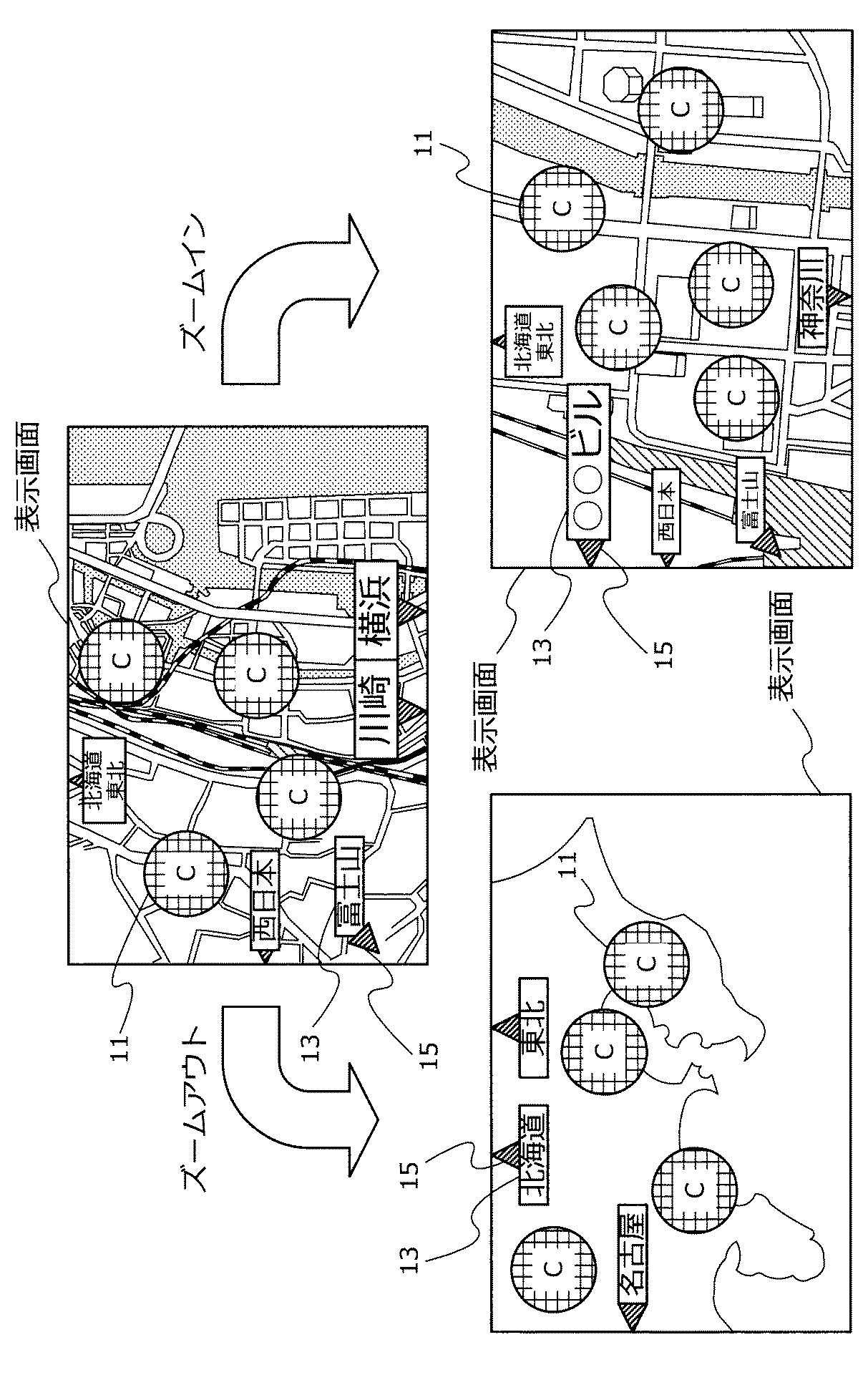
図3及び図4は、本実施形態に係る情報処理装置の表示画面の一例を示した説明図である。図3に示した例では、コンテンツデータに対して地球表面上の位置を表す位置情報が関連づけられており、クラスタが、特徴空間に対応する地図情報とともに表示されている。本実施形態に係る情報処理装置は、表示画面に表示されている特徴空間の大きさに応じて表示画面内に表示されるクラスタ11の粒度を調整するとともに、表示画面内には表示されないクラスタの粒度を、当該クラスタと表示画面との距離に応じて調整する。その上で、本実施形態に係る情報処理装置は、表示画面内には表示されないクラスタの存在を、当該クラスタの名称を示したラベル13や、クラスタの存在位置を示した方向指示子15等とともに表示画面に表示することで、ユーザに通知する。
3 and 4 are explanatory diagrams illustrating an example of a display screen of the information processing apparatus according to the present embodiment. In the example shown in FIG. 3, position information representing a position on the earth's surface is associated with the content data, and a cluster is displayed together with map information corresponding to the feature space. The information processing apparatus according to the present embodiment adjusts the granularity of the
図4上段に示したような表示画面が、ある時点での情報処理装置の表示装置に表示されているものとする。ここで、ユーザによりズームイン操作が行われた場合には、図4下段右側の図に示したように、表示画面に表示されている地図の縮尺が小さくなり、かかる変化に伴い、表示画面中に表示されているクラスタ11のサイズ(クラスタ粒度)も、小さくなる。その結果、図4上段に示した表示画面では、例えばクラスタ11のサイズが半径1kmであった場合に、図4下段右側に示した表示画面では、例えばクラスタ11のサイズが半径200mとなるように変化することとなる。他方、図4上段に示した表示画面に対し、ユーザによりズームアウト操作が行われた場合には、図4下段左側の図に示したように、表示画面に表示されている地図の縮尺が大きくなり、かかる変化に伴い、表示画面中に表示されているクラスタ11のサイズも大きくなる。その結果、図4上段に示した表示画面では、例えばクラスタ11のサイズが半径1kmであった場合に、図4下段左側に示した表示画面では、例えばクラスタ11のサイズが半径10kmとなるように変化することとなる。
It is assumed that a display screen as shown in the upper part of FIG. 4 is displayed on the display device of the information processing device at a certain time. Here, when the zoom-in operation is performed by the user, the scale of the map displayed on the display screen becomes small as shown in the lower right diagram in FIG. The size (cluster granularity) of the displayed
また、表示画面に表示されるクラスタの粒度が変化するに伴い、表示画面外に存在するクラスタの粒度も変化することとなり、表示画面内に表示されるラベル13の名称や方向指示子15の大きさも、併せて変化する。ここで、図4に示したように、例えば表示画面外に存在するクラスタのうち表示画面の近くに存在するものほどラベル13を大きく表示するようにすることで、ユーザ操作の利便性を高めることができる。なお、かかるラベル13や方向指示子15の表示制御方法については、以下で改めて説明する。
Further, as the granularity of the cluster displayed on the display screen changes, the granularity of the cluster existing outside the display screen also changes, and the name of the
本実施形態に係る情報処理装置の具体例としては、例えば、パーソナルコンピュータ、カーナビゲーションシステム、携帯電話やスマートフォンなどの携帯移動通信機器、携帯用ゲーム機、携帯用音楽プレーヤや携帯用動画プレーヤ等の携帯用コンテンツプレーヤ、タブレット式携帯移動端末、デジタルスチルカメラやデジタルビデオカメラといった撮像装置、各種のデジタル家電、ネットワーク上の地図サービスと連携したコンテンツ管理閲覧サービス等を挙げることができるが、これらの例に限定されるわけではない。 Specific examples of the information processing apparatus according to the present embodiment include personal computers, car navigation systems, portable mobile communication devices such as mobile phones and smartphones, portable game machines, portable music players, and portable video players. Examples include portable content players, tablet portable mobile terminals, imaging devices such as digital still cameras and digital video cameras, various digital home appliances, content management browsing services linked to network map services, and the like. It is not limited to.
[情報処理装置の構成]
続いて、図5を参照しながら、本実施形態に係る情報処理装置10の構成について、詳細に説明する。図5は、本実施形態に係る情報処理装置10の構成を示したブロック図である。
[Configuration of information processing equipment]
Next, the configuration of the
図5に示したように、本実施形態に係る情報処理装置10は、ユーザ操作情報生成部101と、表示形式選択制御部103と、表示制御部105と、ノード選択部107と、記憶部109と、を主に備える。また、本実施形態に係る情報処理装置10は、これらの処理部に加えて、木構造生成部111を更に備えていても良い。
As illustrated in FIG. 5, the
ユーザ操作情報生成部101は、例えば、CPU(Central Processing Unit)、ROM(Read Only Memory)、RAM(Random Access Memory)、入力装置等により実現される。ユーザ操作情報生成部101は、ユーザが、情報処理装置10が備えるキーボード、マウス、各種ボタン、タッチパネル等の入力装置を利用して行った操作(ユーザ操作)を表すユーザ操作情報を生成する。ユーザ操作情報生成部101は、ユーザ操作を表すユーザ操作情報を生成すると、生成したユーザ操作情報を、後述する表示形式選択制御部103や表示制御部105へと出力する。
The user operation
表示形式選択制御部103は、例えば、CPU、ROM、RAM等により実現される。表示形式選択制御部103は、後述する表示制御部105及びノード選択部107と連携しながら、所定の特徴量に基づいて規定される特徴空間の少なくとも一部と、コンテンツデータもしくはコンテンツデータの集合(クラスタ)と、を表示画面にあわせて表示する際の表示形式を選択する。なお、かかる木構造は、本実施形態に係る情報処理装置10において予め生成されたものであってもよく、情報処理装置10が通信可能な各種機器(例えば、ネットワーク上に存在する情報処理サーバ等)において予め生成されたものであってもよい。
The display format
例えば、表示形式選択制御部103は、表示画面へのクラスタの表示開始を要請するユーザ操作情報や、表示画面に表示されている表示領域の移動を要請するユーザ操作情報がユーザ操作情報生成部101から通知された場合、後述する記憶部109等に格納された初期設定値等を参照して、表示画面に表示させる特徴空間(例えば、地球表面上の位置を表す地図平面)の大きさを特定する。その後、表示形式選択制御部103は、特定した特徴空間の大きさに応じて表示画面に表示させるクラスタの粒度(クラスタの大きさ)を決定し、特定した特徴空間の大きさ及び決定したクラスタの粒度に関する情報を、後述するノード選択部107に通知する。これにより、後述するノード選択部107によって、表示画面に表示すべきクラスタが選択されることとなる。ノード選択部107から表示画面に表示すべきクラスタを示した情報が通知されると、表示形式選択制御部103は、表示すべきクラスタの表示形式を決定して、後述する表示制御部105にクラスタの表示制御を実施させる。
For example, the display format
また、表示形式選択制御部103は、表示画面に表示されている特徴空間の大きさの変更を要請するユーザ操作情報がユーザ操作情報生成部101から通知された場合、その時点で表示されている特徴空間の大きさを特定する。その上で、表示形式選択制御部103は、通知されたユーザ操作情報に応じて、表示画面に表示させる特徴空間の大きさを変更する。表示形式選択制御部103は、変更後の特徴空間の大きさに応じて表示画面に表示させるクラスタの粒度(クラスタの大きさ)を決定し、変更後の特徴空間の大きさ及び決定したクラスタの粒度に関する情報を、後述するノード選択部107に通知する。これにより、後述するノード選択部107によって、表示画面に表示すべきクラスタが選択されることとなる。ノード選択部107から表示画面に表示すべきクラスタを示した情報が通知されると、表示形式選択制御部103は、表示すべきクラスタの表示形式を決定して、後述する表示制御部105にクラスタの表示制御を実施させる。
In addition, the display format
ここで、表示画面内に表示されるクラスタの粒度を表示形式選択制御部103が選択可能な特徴空間の大きさ(例えば、選択可能な地図平面の大きさや、選択可能な地図平面の縮尺等)毎に予め設定しておき、表示形式選択制御部103が、かかる設定値に応じてクラスタの粒度を選択するようにしてもよい。また、表示形式選択制御部103は、表示画面に表示させる特徴空間の大きさ等を利用して、所定の計算式によりクラスタの粒度を決定してもよい。また、表示形式選択制御部103がクラスタの粒度を決定する方法は、かかる例に限定されるわけではなく、表示形式選択制御部103は、任意の方法でクラスタの粒度を決定することができる。
Here, the size of the feature space in which the display format
ところで、本実施形態において、木構造のノードに対応するクラスタには、図6に示したようなメタデータがそれぞれ関連づけられている。このメタデータを、以下では、クラスタデータと称することとする。 By the way, in the present embodiment, metadata as shown in FIG. 6 is associated with the clusters corresponding to the nodes of the tree structure. This metadata is hereinafter referred to as cluster data.
クラスタデータは、生成されたクラスタそれぞれに固有の情報である。このクラスタデータには、図6に例示したように、クラスタに固有な識別情報(クラスタID)、クラスタ中心位置と半径に関する情報、クラスタに属するコンテンツ数、コンテンツリスト、子クラスタのリスト等が記録されている。 Cluster data is information unique to each generated cluster. As illustrated in FIG. 6, the cluster data includes identification information (cluster ID) unique to the cluster, information on the cluster center position and radius, the number of contents belonging to the cluster, a content list, a list of child clusters, and the like. ing.
クラスタIDは、クラスタデータに対応するクラスタに固有の識別情報であり、例えば、4桁の整数値が記録される。クラスタ中心位置は、クラスタデータに対応するクラスタの中心位置を示すデータであり、特徴空間における位置を指定する情報(例えば、クラスタの中心位置に対応する緯度及び経度を表す情報)が記録される。クラスタ半径は、クラスタデータに対応するクラスタの半径を示すデータであり、例えば、単位をメートル(m)とする値など、特徴空間を規定する特徴量を表すのに適した任意の形式で記録される。クラスタ名は、クラスタに関連付けられた名称を示すデータである。コンテンツ数は、クラスタデータに対応するクラスタの領域に含まれるコンテンツの数を示すデータである。コンテンツデータリストは、クラスタデータに対応するクラスタの領域に含まれるコンテンツのID(図6では整数値で表されている。)を示すデータであり、例えば、コンテンツのIDとして整数値のリストが記録される。 The cluster ID is identification information unique to the cluster corresponding to the cluster data, and for example, a 4-digit integer value is recorded. The cluster center position is data indicating the center position of the cluster corresponding to the cluster data, and information specifying the position in the feature space (for example, information indicating the latitude and longitude corresponding to the cluster center position) is recorded. The cluster radius is data indicating the radius of the cluster corresponding to the cluster data, and is recorded in an arbitrary format suitable for representing the feature quantity defining the feature space, for example, a value having a unit of meter (m). The The cluster name is data indicating a name associated with the cluster. The number of contents is data indicating the number of contents included in the cluster area corresponding to the cluster data. The content data list is data indicating content IDs (represented by integer values in FIG. 6) included in the cluster area corresponding to the cluster data. For example, a list of integer values is recorded as the content IDs. Is done.
表示形式選択制御部103は、選択されたクラスタを表示させる際に、表示画面外に位置することとなるクラスタ(以下、単に、表示画面外クラスタとも称する。)の存在をユーザに認識させるために、図3及び図4に示したようなラベル13や方向指示子15の表示を行うことが可能である。以下では、ラベル13及び方向指示子15を、クラスタオブジェクトと称することもある。
When displaying the selected cluster, the display format
ここで、図3及び図4に示したように、表示画面中に複数のクラスタオブジェクトが配置される場合も生じうる。この場合、表示形式選択制御部103は、ラベル13及び方向指示子15といったクラスタオブジェクトがなるべく重なりあわないように、その表示位置を調整することが好ましい。
Here, as shown in FIGS. 3 and 4, a plurality of cluster objects may be arranged on the display screen. In this case, it is preferable that the display format
方向指示子15は、その先端が、表示画面外クラスタの中心位置の方向に向くように、表示画面中に表示される。以下、図7A及び図7Bを参照しながら、方向指示子15の描画制御方法について、簡単に説明する。なお、図7A及び図7Bに示した座標系は、表示画面の中央を原点とする、表示画面中の各位置を表すための座標系である。
The
図7Aは、表示画面に表示されている表示領域と、表示画面外クラスタに対応するクラスタAとの位置関係を模式的に表した図である。図7Aに示したように、表示形式選択制御部103は、クラスタAに対応する方向指示子15を表示画面に表示させる場合、まず、クラスタAのクラスタ領域について、表示画面用の座標系における中心位置C(c_x,c_y)を特定する。その後、表示形式選択制御部103は、原点と中心位置Cとを結ぶ直線を考え、この直線上に方向指示子15を配置する。この際、図7Aに示したように、方向指示子15の先端を、原点と中心位置Cとを結ぶ直線と、表示領域の境界線との交点A(a_x,a_y)とすることが好ましい。
FIG. 7A is a diagram schematically showing the positional relationship between the display area displayed on the display screen and the cluster A corresponding to the cluster outside the display screen. As shown in FIG. 7A, when displaying the
また、図7Bに示したように、表示形式選択制御部103は、表示画面の中心位置(すなわち、原点O)とクラスタAとの間の距離に応じて、方向指示子15の大きさを変化させる。より詳細には、表示形式選択制御部103は、クラスタAとの距離が近づくほど、方向指示子15の大きさを大きくする。かかる表示を行うことで、ユーザは、方向指示子15に対応する表示画面外クラスタと、表示領域の中心位置との間の距離を、感覚的に把握することが可能となる。
As shown in FIG. 7B, the display format
また、図7A及び図7Bでは、方向指示子15の表示位置及び大きさについて説明したが、ラベル13についても、クラスタAが存在する方向を示唆するような位置に表示され、また、クラスタとの距離を示唆するような大きさで表示されることが好ましい。
7A and 7B, the display position and size of the
例えば図7Aに示したように、表示領域は、その対角線を現す2本の直線によって、4つの部分領域に区分することができる。ここで、各表示画面外クラスタに対応するクラスタオブジェクト(ラベル13及び方向指示子15)は、クラスタが属する部分領域内に配置されることが好ましい。例えば、図7に示したクラスタAに対応するクラスタオブジェクトは、y≧(height/width)x、かつ、y≧−(height/width)xで表される領域内に配置されることが好ましい。
For example, as shown in FIG. 7A, the display area can be divided into four partial areas by two straight lines that represent the diagonal lines. Here, the cluster object (
また、図3及び図4に示したように、文字配列からなるラベル13を表示する場合には、表示形式選択制御部103は、文字の大きさを、表示画面外クラスタとの距離を示唆するような大きさで表示することが好ましい。例えば、表示形式選択制御部103は、表示画面外クラスタとの距離が大きい場合には文字の大きさを小さくし、表示画面外クラスタとの距離が小さい場合には文字の大きさを大きくすることが好ましい。
As shown in FIGS. 3 and 4, when displaying the
ここで、表示形式選択制御部103は、ラベル13及び方向指示子15の具体的な大きさを任意の方法で決定することが可能であるが、表示形式選択制御部103は、例えば、図8Aに示したような関数を用いて具体的な大きさを決定してもよい。
Here, the display format
図8Aに示した関数において、X座標は、表示画面の中心位置からクラスタ中心までのピクセル距離を現しており、Y座標は、ラベル13及び方向指示子15の表示倍率を表している。
In the function shown in FIG. 8A, the X coordinate represents the pixel distance from the center position of the display screen to the cluster center, and the Y coordinate represents the display magnification of the
ここで、表示形式選択制御部103は、表示倍率Yを、以下の式101及び式102のように決定する。
Here, the display format
上記式より明らかなように、表示形式選択制御部103は、クラスタ中心との距離が所定の閾値(MIN_DIST)未満である場合には、表示倍率を最大値(MAX_SCALE)とし、所定の閾値以上である場合には、表示倍率が最大値の1/Xとなるように変化させる。
As is clear from the above formula, when the distance from the cluster center is less than a predetermined threshold (MIN_DIST), the display format
また、表示形式選択制御部103は、ラベル13及び方向指示子15の具体的な大きさを、着目している表示画面外クラスタに含まれるコンテンツ数に応じて決定してもよい。この場合、表示形式選択制御部103は、図8Bに示したような関数を用いて具体的な大きさを決定してもよい。
The display format
図8Bに示した関数において、X座標は、着目している表示画面外クラスタに含まれるコンテンツ数を現しており、Y座標は、ラベル13及び方向指示子15の表示倍率を表している。
In the function shown in FIG. 8B, the X coordinate represents the number of contents included in the focused cluster outside the display screen, and the Y coordinate represents the display magnification of the
ここで、表示形式選択制御部103は、表示倍率Yを、以下の式103及び式104のように決定する。
Here, the display format
ここで、上記式103におけるパラメータkは、関数の傾きを決める係数であり、かかる方法を適用する環境に応じて、任意の値を設定することが可能である。上記式より明らかなように、表示形式選択制御部103は、クラスタに含まれるコンテンツ数が1である場合には、表示倍率を最小値(MIN_SCALE)とし、クラスタに含まれるコンテンツ数が増加するに従って、上記式103に基づいて表示倍率を変化させる。
Here, the parameter k in
また、表示形式選択制御部103は、予め設定されている初期設定値やユーザ操作等に応じて、図3及び図4に例示したようなクラスタのラベル13や方向指示子15の表示/非表示を切り替える制御を行うことも可能である。表示形式選択制御部103がこのような切り替え制御を行うことで、ユーザは、ユーザ自身が所望する表示画面の表示形式(より詳細には、表示画面外に存在するクラスタについての情報の表示形式)を選択することが可能となる。ラベル13や方向指示子15の表示/非表示を切り替えるためのユーザ操作は、具体的な情報処理装置10の仕様に応じて適宜設定することが可能である。このような切り替え操作の例として、アイコン等のオブジェクトやボタン等の選択、タッチパネルの長押し、タッチパネルに対するフリック操作等を挙げることが可能である。
Further, the display format
更に、本実施形態に係る表示形式選択制御部103は、後述するノード選択部107によって選択されたクラスタに関連づけられている、図6に示したようなメタデータを参照して、表示画面外に存在するクラスタまでの距離(表示領域からの離隔距離)を、クラスタのラベル13や方向指示子15に付随して表示させてもよい。また、かかるクラスタまでの距離を表すオブジェクトは、クラスタのラベル13や方向指示子15と同様に、表示/非表示を切り替えることが可能である。
Further, the display format
なお、上記説明では、表示画面に表示させる特徴空間の大きさ(例えば、特徴空間を表示する際の縮尺率等)に応じて、クラスタの粒度が決定される場合を例にとって説明したが、クラスタの粒度は、例えば、表示画面に表示される地図の行政区画に応じて決定されてもよく、行政区画や縮尺率をそれぞれ考慮したうえで決定されてもよい。 In the above description, the case where the cluster granularity is determined according to the size of the feature space displayed on the display screen (for example, the scale ratio when displaying the feature space) is described as an example. The granularity may be determined according to, for example, the administrative divisions of the map displayed on the display screen, or may be determined in consideration of the administrative divisions and the scale ratio.
表示制御部105は、例えば、CPU、ROM、RAM、通信装置、出力装置等により実現される。表示制御部105は、情報処理装置10が備えるディスプレイ等の表示装置や、情報処理装置10の外部に設けられたディスプレイ等の表示装置における表示画面の表示制御を行う。この表示制御部105は、ユーザ操作情報生成部101から通知されたユーザ操作情報や、表示形式選択制御部103から通知された表示画面の表示形式に関する情報等に基づいて、表示画面の表示制御を実施する。
The
ノード選択部107は、例えば、CPU、ROM、RAM等により実現される。ノード選択部107は、予め生成されている木構造を利用して、表示画面に表示される特徴空間である表示特徴空間の大きさに応じて、木構造に含まれるノードの中から所定の条件を満たすノードを選択する。より詳細には、ノード選択部107は、表示形式選択制御部103から通知された、表示画面に表示される特徴空間に関する情報、及び、表示画面に表示するクラスタ粒度に関する情報に基づき、表示画面の表示形式の制御を行う際に用いられるノード(すなわち、クラスタ)を選択する。
The
ここで、ノード選択部107は、表示画面に表示されている点(ポイント)ではなく、表示画面に表示されている領域(エリア)に着目することで、ノードの選択を行う。より詳細には、ノード選択部107は、表示領域内に含まれるクラスタの粒度をそろえるとともに、表示画面外に存在するクラスタについては、表示画面に対応する表示領域から距離が離れるほどクラスタの粒度が大きくなるように、クラスタを選択する。
Here, the
以下、図9を参照しながら、本実施形態に係るノード選択部107におけるノード選択処理(クラスタ選択処理)について、具体的に説明する。
具体的には、ノード選択部107は、表示形式選択制御部103から通知された表示画面に表示される特徴空間に関する情報を参照して、表示画面に表示される特徴空間の大きさや、かかる特徴空間が表示画面に表示される際の縮小率(又は拡大率)を特定する。なお、表示画面に表示される特徴空間に関する情報には、表示画面に表示される特徴空間の大きさに関する情報、及び、縮小率の双方が含まれていなくともよく、表示画面の実際の大きさに基づいて表示画面に表示される特徴空間の大きさや縮小率を算出することが可能な情報が含まれていればよい。
Hereinafter, the node selection processing (cluster selection processing) in the
Specifically, the
本実施形態に係る情報処理装置10で利用される木構造は、図9に例示したように、同一の階層レベルに属するクラスタ間は、クラスタの粒度に関して関連性がある(より具体的には、互いに類似したクラスタ粒度を有する)ようになっている。そこで、ノード選択部107は、表示形式選択制御部103から、表示画面に表示するクラスタの粒度に関する情報を取得すると、得られたクラスタの粒度についての情報を利用して、木構造においてノードの探索を行う階層を決定する。具体的には、ノード選択部107は、通知されたクラスタの粒度を特定すると、ルートノードを含む階層から、通知されたクラスタの粒度に該当する階層まで(図9の場合には、第0階層〜第3階層)を、ノードの探索を行う階層として決定する。
As illustrated in FIG. 9, the tree structure used in the
次に、ノード選択部107は、図6に示したようなクラスタに関連付けられたメタデータと、表示画面に表示される特徴領域の大きさに関する知見とを利用して、ルートノードから順に、表示画面に対応する特徴空間と交差するクラスタが存在するか否かを判断する。ここで、表示画面に対応する特徴空間と交差しないクラスタが存在する場合には、ノード選択部107は、かかるクラスタを、表示形式選択制御部103で利用されるクラスタとして選択する。
Next, the
また、表示画面に対応する特徴空間と交差するクラスタが存在する場合には、かかるクラスタの子ノードに対応するクラスタに対して、再帰的に処理を繰り返す。すなわち、着目しているクラスタの子ノードに対応する各クラスタについて、表示画面に対応する特徴空間と交差するか否かを判断していく。 If there is a cluster that intersects the feature space corresponding to the display screen, the process is recursively repeated for the cluster corresponding to the child node of the cluster. That is, it is determined whether or not each cluster corresponding to the child node of the cluster of interest intersects the feature space corresponding to the display screen.
ノード選択部107は、着目しているクラスタ(ノード)の階層が、表示形式選択制御部103から通知されたクラスタの粒度に対応する階層(規定階層)となった場合には、着目している階層よりも下層(リーフノード側)の探索は行わず、着目している階層において着目しているクラスタ全てを、表示形式選択制御部103で利用されるクラスタとして選択する。
The
以下、図9を参照しながら、ノード選択部107によるノードの選択処理を具体的に説明する。なお、以下の説明では、図9に示した第3階層が規定階層であるものとする。
まず、ノード選択部107は、ルートノードc0に関連付けられたメタデータを参照して、ルートノードc0が表示画面に対応する特徴空間(以下、表示特徴空間とも称する。)と交差するか否かを判断する。図9に示した例の場合、ルートノードc0は表示特徴空間と交差しているため、ノード選択部107は、第1階層に属するノードc1とノードc2とを、探索対象とする。
Hereinafter, the node selection processing by the
First, whether the
この際、ノードc1は、表示特徴空間とは交差しておらず、ノードc2は、表示特徴空間と交差しているものとする。かかる場合、ノード選択部107は、ノードc1に対応するクラスタを表示形式選択制御部103で利用されるクラスタとして選択するとともに、ノードc2の子ノードに対応するノードc5〜c7を、探索対象とする。
At this time, it is assumed that the node c 1 does not intersect the display feature space, and the node c 2 intersects the display feature space. In such a case, the
ここで、ノードc5及びノードc6は、表示特徴空間と交差しており、ノードc7は、表示特徴空間と交差していないものとする。かかる場合、ノード選択部107は、ノードc7に対応するクラスタを表示形式選択制御部103で利用されるクラスタとして選択するとともに、ノードc5及びノードc6の子ノードに対応するノードc12〜c16を、探索対象とする。
Here, the node c 5 and the node c 6 intersects the display feature space, the node c 7 shall not intersect the display feature space. In this case, the
次に、ノード選択部107は、ノードc12〜c16を処理対象とするわけであるが、ノードc12〜c16は、規定階層である第3階層に属しているため、着目している階層において着目しているクラスタ全てであるノードc12〜c16を、表示形式選択制御部103で利用されるクラスタとして選択する。
Next, the
以上のような探索処理により、最終的に、ノードc1,c7,c12〜c16が、表示形式選択制御部103で利用されるクラスタとして選択されることとなる。
Through the search processing as described above, the nodes c 1 , c 7 , c 12 to c 16 are finally selected as clusters used by the display format
ここで、規定階層は、表示画面に表示されるクラスタ粒度に基づいて決定されるため、規定階層に属している選択クラスタの一部は、表示特徴空間内に包含されることとなる。図9に示した例では、ノードc13〜c15に対応するクラスタが、表示画面内にほぼ同一のクラスタ粒度で表示されることとなる。また、表示画面外に存在するクラスタは、ノードc12,ノードc16,ノードc7,ノードc1にそれぞれ対応するクラスタとなるが、図9から明らかなように、表示画面(表示特徴空間)から離れるにつれて、そのクラスタの粒度が大きくなっていることがわかる。本実施形態に係るクラスタの選択手法によらずに表示特徴空間外のクラスタを表示しようとした場合、例えば、図9に例示したクラスタc8〜c12や、クラスタc16〜c17に対応する方向指示子が、表示画面内に表示されてしまい、表示画面が煩雑になる恐れがある。しかしながら、以上説明したようなクラスタの選択手法を用いることで、表示特徴空間から遠くに位置するクラスタが大きなクラスタ粒度でグループ化され、表示画面上に表示されるクラスタオブジェクト(ラベル13及び方向指示子15)の増大を防止することが可能となる。
Here, since the specified hierarchy is determined based on the cluster granularity displayed on the display screen, a part of the selected clusters belonging to the specified hierarchy is included in the display feature space. In the example shown in FIG. 9, the clusters corresponding to the nodes c 13 to c 15 are displayed with substantially the same cluster granularity in the display screen. The clusters existing outside the display screen are clusters corresponding to the nodes c 12 , c 16 , node c 7 , and node c 1 respectively. As is apparent from FIG. 9, the display screen (display feature space) It can be seen that the granularity of the cluster increases with distance from. If regardless of the selection method of the clusters according to the present embodiment tries to display the display feature space outside the cluster, for example, and the cluster c 8 to c 12 illustrated in FIG. 9, corresponding to the cluster c 16 to c 17 The direction indicator may be displayed in the display screen, and the display screen may become complicated. However, by using the cluster selection method as described above, clusters located far from the display feature space are grouped with a large cluster granularity, and cluster objects (
ノード選択部107は、以上のような処理により選択したノード(クラスタ)を示した情報を、表示形式選択制御部103に通知する。
The
記憶部109は、本実施形態に係る情報処理装置10が備えるストレージ装置の一例である。この記憶部109には、情報処理装置10が有する各種のコンテンツデータ、及び、コンテンツデータに対応付けられたメタデータ等が格納されてもよい。また、記憶部109には、後述する木構造生成部111や外部の情報処理装置によって生成された木構造に対応する木構造データが格納されてもよい。また、記憶部109には、表示形式選択制御部103や表示制御部105が、各種の情報を表示画面に表示するために利用する各種のアプリケーションに対応する実行データが格納されてもよい。また、この記憶部109には、情報処理装置10が何らかの処理を行う際に保存する必要が生じた様々なパラメータや処理の途中経過等、又は、各種のデータベース等が適宜格納される。この記憶部109は、本実施形態に係る情報処理装置10が備える各処理部が、自由に読み書きを行うことが可能である。
The
木構造生成部111は、例えば、CPU、ROM、RAM等により実現される。木構造生成部111は、先に説明したような特徴量を用いて規定される特徴空間を想定し、この特徴空間内におけるコンテンツの分布度合いに応じて、コンテンツのクラスタリング結果を表す木構造を生成する。
The tree
木構造生成部111は、上述のような木構造を、例えば以下のようにして生成する。
木構造生成部111は、まず、情報処理装置10が利用可能なコンテンツデータに関連付けられているメタデータを参照し、メタデータ中に記載されている位置情報に基づいて、コンテンツデータを特徴空間内の平面上に配置する。これらのコンテンツの配置は、あくまでも仮想的なものである点に注意されたい。
The tree
First, the tree
次に、木構造生成部111は、平面上に存在するコンテンツデータの集合に対して、各データ間の距離を算出する。続いて、木構造生成部111は、互いの距離が近い複数のデータ同士をまとめて、グループ化(分類)する。木構造生成部111が実施するこのようなグループ化処理が、クラスタリングであるといえる。また、このグループ化処理(クラスタリング)によってまとめられた各グループのことを、クラスタと称することとする。
Next, the tree
木構造生成部111は、このようなクラスタの結合又は分離の操作を経ることで、情報処理装置10が利用可能なコンテンツを複数のクラスタに分類し、コンテンツデータがリーフノードとなり各クラスタがノードとなる多階層の木構造を生成する。
The tree
以下では、図10〜図15を参照しながら、木構造生成部111が実施するクラスタリング方法の一例について、簡単に説明する。
Hereinafter, an example of a clustering method performed by the tree
本実施形態に係る木構造生成部111が実施するクラスタリング方法は、図10に示したような流れで行われる。まず、木構造生成部111は、コンテンツデータに関連付けられている位置情報を参照して、図10の右上に示した内部ツリーと称する木構造をまず生成する。次に、木構造生成部111は、所定の条件に基づき、生成した内部ツリーを再構成することで、図10の下側に示したクラスタツリーを生成する。
The clustering method performed by the tree
なお、図10では、コンテンツデータに関連付けられた位置情報の例として、緯度及び経度を用いた位置情報を記載している。また、図10において、斜線のつけられた○印で示したものがコンテンツデータに対応し、○印が内部ツリーにおけるノード(クラスタ)を表している。また、□印は、木構造生成部111による木構造生成処理により生成される木構造のノードを表している。
In FIG. 10, position information using latitude and longitude is described as an example of position information associated with content data. In FIG. 10, the hatched circles indicate the content data, and the circles indicate nodes (clusters) in the internal tree. Further, □ represents a tree structure node generated by the tree structure generation processing by the tree
まず、内部ツリーを生成する処理について説明する。
図11は、クラスタの生成方法について説明するための説明図である。ここで、図11(a)は、クラスタc1に1つのコンテンツが属する場合を示す図であり、図11(b)は、クラスタc2に2つのクラスタが属する場合を示す図である。また、図11(c)は、クラスタc5に少なくとも4つのクラスタが属する場合を示す図である。
First, processing for generating an internal tree will be described.
FIG. 11 is an explanatory diagram for explaining a cluster generation method. Here, FIG. 11A is a diagram showing a case where one content belongs to the cluster c1, and FIG. 11B is a diagram showing a case where two clusters belong to the cluster c2. FIG. 11C is a diagram illustrating a case where at least four clusters belong to the cluster c5.
なお、図11(b)に示すクラスタc2は、1つのコンテンツのみを有するクラスタc3及びc4で構成されているクラスタであり、図11(c)に示すクラスタc5は、少なくとも2以上のコンテンツを有するクラスタc6及びc7により作成されているクラスタである。また、以下では、2次元に配置されるコンテンツをクラスタリングする場合について説明する。 Note that the cluster c2 shown in FIG. 11B is a cluster composed of clusters c3 and c4 having only one content, and the cluster c5 shown in FIG. 11C has at least two or more contents. This is a cluster created by clusters c6 and c7. In the following, a case where contents arranged in two dimensions are clustered will be described.
複数のコンテンツがクラスタリングされた後に生成される各クラスタは、円形状の領域であり、その円の中心位置(中心点)及び半径を属性値として有する。このように、中心点及び半径により定まる円形状のクラスタ領域に、当該クラスタに属するコンテンツが含まれることとなる。 Each cluster generated after a plurality of contents are clustered is a circular area, and has the center position (center point) and radius of the circle as attribute values. As described above, the circular cluster region determined by the center point and the radius includes content belonging to the cluster.
例えば図11(a)に示すように、クラスタc1に1つのコンテンツのみが属する場合において、クラスタc1の中心位置は、クラスタc1に属するコンテンツの位置となる。また、クラスタc1の半径は、クラスタc1自体が1つの点のみで構成されているため、0(r=0)となる。 For example, as shown in FIG. 11A, when only one content belongs to the cluster c1, the center position of the cluster c1 is the position of the content belonging to the cluster c1. The radius of the cluster c1 is 0 (r = 0) because the cluster c1 itself is composed of only one point.
また、例えば図11(b)に示すように、クラスタc2に2つのコンテンツ(クラスタc3及びc4)が属する場合、クラスタc2の中心位置は、2つのコンテンツの位置を結ぶ直線上に位置し、詳細な位置はこの直線の中央となる。また、クラスタc2の半径は、2つのコンテンツの位置を結ぶ直線の半分となる。例えば、2つのコンテンツに対応するクラスタc3及びc4を結ぶ直線の距離がA1の場合、クラスタc2の半径rは、A1/2となる。 For example, as shown in FIG. 11B, when two contents (clusters c3 and c4) belong to the cluster c2, the center position of the cluster c2 is located on a straight line connecting the positions of the two contents. The correct position is the center of this line. Further, the radius of the cluster c2 is half of the straight line connecting the positions of the two contents. For example, when the distance of the straight line connecting the clusters c3 and c4 corresponding to the two contents is A1, the radius r of the cluster c2 is A1 / 2.
なお、クラスタリングする場合において、1つのコンテンツのみが属するクラスタ間の距離を算出する場合には、各コンテンツ間の距離を算出する。例えば、クラスタc3及びc4間の距離を算出する場合には、クラスタc3に属するコンテンツの位置と、クラスタc4に属するコンテンツの位置との間の距離を算出する。 In the case of clustering, when calculating the distance between clusters to which only one content belongs, the distance between each content is calculated. For example, when calculating the distance between the clusters c3 and c4, the distance between the position of the content belonging to the cluster c3 and the position of the content belonging to the cluster c4 is calculated.
また、例えば図11(c)に示すように、クラスタc5に少なくとも4以上のコンテンツが属する場合を考える。この場合、クラスタc5の中心位置は、クラスタc6の中心位置及びクラスタc7の中心位置を結ぶ直線上であって、クラスタc5の円とクラスタc6の円とが接する位置と、クラスタc5の円とクラスタc7の円とが接する位置とを結ぶ直線の真中の位置となる。また、クラスタc5の半径は、クラスタc6及びc7の円とクラスタc5の円とが接する位置を結ぶ直線の半分の値となる。 Further, for example, as shown in FIG. 11C, consider a case where at least four contents belong to the cluster c5. In this case, the center position of the cluster c5 is on a straight line connecting the center position of the cluster c6 and the center position of the cluster c7, the position where the circle of the cluster c5 and the circle of the cluster c6 are in contact, the circle of the cluster c5 and the cluster This is the middle position of the straight line connecting the position where the circle c7 contacts. The radius of the cluster c5 is half the value of the straight line connecting the positions where the circles of the clusters c6 and c7 and the circle of the cluster c5 are in contact.
なお、クラスタリングする場合において、複数のコンテンツが属するクラスタ間の距離を算出する場合には、各クラスタの円の外周間の最短距離を算出する。例えば、クラスタc6及びc7間の距離は、図中に示した距離dとなる。クラスタc6の半径をA2とし、クラスタc7の半径をA3とし、クラスタc5の半径をA4とした場合には、クラスタc6及びc7間の距離dは、2(A4−A2−A3)となる。 In the case of clustering, when calculating the distance between clusters to which a plurality of contents belong, the shortest distance between the outer circumferences of the circles of each cluster is calculated. For example, the distance between the clusters c6 and c7 is the distance d shown in the figure. When the radius of the cluster c6 is A2, the radius of the cluster c7 is A3, and the radius of the cluster c5 is A4, the distance d between the clusters c6 and c7 is 2 (A4-A2-A3).
なお、本実施形態に係る木構造生成部111で用いられるクラスタ間の距離の計算方法は、上述の方法に限定されるわけではなく、重心法(Centroid)、最短距離法、最長距離法、群間平均距離法、Ward法等の任意の方法を利用することができる。
Note that the calculation method of the distance between clusters used in the tree
次に、図12A〜図13を参照しながら、木構造生成部111により実施されるクラスタリング処理の具体例について説明する。図12A〜図13は、クラスタの生成方法(より詳細には、内部ツリーの生成方法)について説明するための説明図である。図12A〜図13では、5つのコンテンツC11〜C15をクラスタリングする場合について図示している。
Next, a specific example of the clustering process performed by the tree
まず、木構造生成部111は、5つのコンテンツC11〜C15に関連付けられている位置情報を参照して、これらのコンテンツを特徴空間上の平面に配置する(図12A)。次に、木構造生成部111は、各コンテンツ間の距離を計算する。この計算結果に基づいて、木構造生成部111は、コンテンツ間の距離が最も短くなったコンテンツC11及びコンテンツC12を1つのグループとしてまとめ、クラスタc21とする(図12B)。ここで、木構造生成部111は、クラスタc21を、クラスタc21の要素であるコンテンツC11及びコンテンツC12の全てを包含するように決定する。
First, the tree
木構造生成部111は、同様にして処理を行い、コンテンツ間の距離が次に短くなったコンテンツC14及びコンテンツC15を1つのグループとしてまとめ、クラスタc22とする(図12C)。この場合にも、木構造生成部111は、クラスタc22を、クラスタc22の要素であるコンテンツC14及びコンテンツC15の全てを包含するように決定する。
The tree
次に、木構造生成部111は、生成した2つのクラスタc21及びc22と、残っているコンテンツC13との間の距離をそれぞれ算出する。図12Cに示した場合では、クラスタc21とコンテンツC13との距離が、クラスタc22とコンテンツC13との距離よりも短くなる。そのため、木構造生成部111は、クラスタc21とコンテンツC13とを1つのグループとしてまとめ、クラスタc23とする(図12D)。この場合においても、木構造生成部111は、クラスタc23を、クラスタc21とコンテンツC18の全てを包含するように決定する。
Next, the tree
最後に、木構造生成部111は、残っている2つのクラスタc22及びクラスタc23を1つのグループとしてまとめ、クラスタc24とする(図12E)。この場合においても、木構造生成部111は、クラスタc24を、クラスタc22及びクラスタc23の全てを包含するように決定する。例えば、木構造生成部111は、2つのクラスタc22及びc23が表す円の外接円となるように、クラスタc24を決定することができる。
Finally, the tree
木構造生成部111は、以上説明したようにコンテンツC11〜C15を順次クラスタリングし、クラスタc21〜c24を生成する。また、木構造生成部111は、生成したクラスタc21〜c24に基づいて、木構造(クラスタリング樹形図)を生成する。このようにして生成された木構造を、図13に示す。
As described above, the tree
各コンテンツC11〜C15をリーフノードとして扱うと、木構造生成部111により生成される各クラスタは、図13に示すような木構造を形成することがわかる。例えば図12Bにおいて、クラスタc21は、コンテンツC11及びコンテンツC12の全てを包含するクラスタである旨を説明した。このような包含関係は、図13において、クラスタc21から2つの枝が分岐しており、コンテンツC11及びコンテンツC12がクラスタc21の子ノードとなっていることに対応している。同様に、例えば図12Eにおいて、クラスタc24が、クラスタc22及びクラスタc23の全てを包含するクラスタである旨を説明した。このような包含関係は、図13に示した木構造において、クラスタc24から2つの枝が分岐しており、クラスタc22及びクラスタc23がクラスタc24の子ノードとなっていることに対応している。
When the contents C11 to C15 are handled as leaf nodes, it can be seen that the clusters generated by the tree
また、図12E及び図13からも明らかなように、最終的に生成されたクラスタc24は、全てのコンテンツ(すなわち、全てのリーフノード)及び全てのクラスタ(すなわち、ノード)を包含するものである。したがって、クラスタc24は、木構造において、ルートノードに対応するクラスタであることがわかる。 As is clear from FIGS. 12E and 13, the finally generated cluster c24 includes all the contents (that is, all the leaf nodes) and all the clusters (that is, the nodes). . Therefore, it can be seen that the cluster c24 is a cluster corresponding to the root node in the tree structure.
以上、木構造生成部111が実施する内部ツリーの生成処理を、具体例を挙げながら説明した。
The internal tree generation processing performed by the tree
木構造生成部111は、内部ツリーの生成処理が終了すると、続いて、以下で説明するようなクラスタツリーの生成処理を実施する。
When the internal tree generation process ends, the tree
なお、図12A〜図12Eに示したような内部ツリーの生成処理、及び、以下で説明するクラスタツリーの生成処理が行われる際には、クラスタの中心位置及びクラスタ間距離を適切に算出することが好ましい。本実施形態に係る木構造生成部111は、これらの情報を算出するために、任意の方法を用いることが可能であるが、例えば、以下のような方法を用いても良い。
In addition, when the internal tree generation process as shown in FIGS. 12A to 12E and the cluster tree generation process described below are performed, the center position of the cluster and the distance between clusters should be calculated appropriately. Is preferred. The tree
例えば、コンテンツデータが全部でn個存在する場合、木構造生成部111は、まず、1つのクラスタに各データが1つの要素として属するようにクラスタを設定し、全体でn個のクラスタを作成する。なお、各クラスタは、属性値として、中心点C及び半径rを有し、中心点Cの初期値はデータの座標値であり、半径rの初期値は0である。
For example, when there are a total of n pieces of content data, the tree
次に、木構造生成部111は、クラスタに属する全要素について、クラスタ中心Cから各要素までの距離が半径r以下になるように、クラスタ中心Cと半径rとを決定する。これにより、中心点C及び半径rで定まる球の内部に、クラスタに属する全要素が含まれることとなる。
Next, the tree
続いて、木構造生成部111は、クラスタ間の距離を、例えば以下のように定める。
Subsequently, the tree
クラスタi及びクラスタjを併合してクラスタkが作成される場合、木構造生成部111は、クラスタi及びクラスタjの間の距離d(i,j)を、以下の式111及び式112を利用して算出することができる。
When cluster k is created by merging cluster i and cluster j, tree
d(i,j)=r(k)−r(i)−r(j) (r(k)≧r(i)+r(j))
・・・(式111)
d(i,j)=0 (r(k)<r(i)+r(j)) ・・・(式112)
d (i, j) = r (k) −r (i) −r (j) (r (k) ≧ r (i) + r (j))
... (Formula 111)
d (i, j) = 0 (r (k) <r (i) + r (j)) (Formula 112)
なお、上記式111及び式112において、r(i)は、クラスタiの半径を表す。上記式101及び式102から明らかなように、クラスタ間距離dは、クラスタを併合した場合の半径の増分に相当する。
In the
次に、2つのクラスタが併合された後の併合後のクラスタの中心点及び半径を求める方法について、図14A〜図14Cを参照しながら、簡単に説明する。図14A〜図14Cは、2つのクラスタを併合する場合における各クラスタに属する要素の包含関係を示す図である。 Next, a method for obtaining the center point and the radius of the merged cluster after the two clusters are merged will be briefly described with reference to FIGS. 14A to 14C. FIG. 14A to FIG. 14C are diagrams showing the inclusion relationship of elements belonging to each cluster when two clusters are merged.
2つのクラスタを併合する場合、木構造生成部111は、クラスタに属する要素の包含関係に応じて、以下の(1)〜(3)の3つのパターンに場合分けをする。
When merging two clusters, the tree
(a) m(i)⊃m(j)
(b) m(j)⊃m(i)
(c) 上記以外
(A) m (i) ⊃m (j)
(B) m (j) ⊃m (i)
(C) Other than the above
なお、m(i)は、クラスタiに属する全要素の集合を示し、m(j)は、クラスタjに属する全要素の集合を示している。 Note that m (i) represents a set of all elements belonging to cluster i, and m (j) represents a set of all elements belonging to cluster j.
上記(a)が表す状況は、図14Aに示したように、クラスタjに属する全ての要素が、クラスタiに属する場合である。上記(b)が表す状況は、図14Bに示したように、クラスタiに属する全ての要素が、クラスタjに属する場合である。また、上記(c)は、上記(a)及び(b)以外の状況であり、例えば、クラスタi及びクラスタjの包含関係が、図14Cに示す関係となっている場合である。 The situation represented by (a) above is a case where all elements belonging to cluster j belong to cluster i as shown in FIG. 14A. The situation represented by (b) is a case where all elements belonging to cluster i belong to cluster j, as shown in FIG. 14B. Further, (c) is a situation other than the above (a) and (b), for example, when the inclusion relationship between the cluster i and the cluster j is the relationship shown in FIG. 14C.
木構造生成部111は、上記(a)〜(c)の場合分けを、クラスタi及びクラスタjの各中心点の座標及び各半径に基づいて決定する。
The tree
例えば、クラスタiの中心点の座標C(i)から半径r(i)の球が、中心点の座標C(j)及び半径r(j)で構成される球からなるクラスタjを全て含む場合、木構造生成部111は、図14Aにしたような上記(a)の状況が成立していると判断する。
For example, when the sphere having the radius r (i) from the coordinates C (i) of the center point of the cluster i includes all the clusters j including the sphere composed of the coordinates C (j) and the radius r (j) of the center point The tree
換言すれば、木構造生成部111は、r(i)≧r(j)+l(i,j)となる場合、上記(a)の関係が成立していると判断する。ここで、l(i,j)は、以下の式113に示すように、クラスタi及びクラスタjの中心点間のユークリッド距離である。
In other words, the tree
l(i,j)=|C(i)−C(j)| ・・・(式113) l (i, j) = | C (i) −C (j) | (Formula 113)
ここで、データの次元をdimとすると、l(i,j)は、以下の式114により表すことができる。ここで、以下の式114において、c(i,k)は、クラスタiの中心値を表す属性のk番目の値を意味する。 Here, if the dimension of the data is dim, l (i, j) can be expressed by the following expression 114. Here, in the following expression 114, c (i, k) means the kth value of the attribute representing the center value of the cluster i.
上記(a)の状況が成立している場合、木構造生成部111は、併合後のクラスタkの中心点及び半径として、クラスタiのものをそのまま利用する。
When the above situation (a) is established, the tree
また、上記(b)の場合は、上記(a)の場合において添え字「i」及び「j」を入れ替えた場合に相当するため、木構造生成部111は、上記(a)の場合と同様に処理を行うことができる。
The case (b) corresponds to the case where the subscripts “i” and “j” are exchanged in the case (a), and therefore the tree
上記(c)の状況が成立している場合、木構造生成部111は、図14Cに示したように、クラスタiの球及びクラスタjの球を含む最小の球として、クラスタkを生成する。ここで、木構造生成部111は、クラスタkの半径を、以下の式115を用いて算出する。また、木構造生成部111は、クラスタkの中心点を、以下の式116を用いて算出する。ここで、クラスタkの中心点は、クラスタiの中心点C(i)及びクラスタjの中心点C(j)を結ぶ直線上に存在することとなる。
When the situation of (c) is established, the tree
r(k)=(l(i,j)+r(i)+r(j))/2 ・・・(式115)
C(k)={(r(i)−r(j)+l(i,j))*C(i)
+(r(j)−r(i)+l(i,j))*C(j)}
/(2*l(i,j)) ・・・(式116)
r (k) = (l (i, j) + r (i) + r (j)) / 2 (Formula 115)
C (k) = {(r (i) -r (j) + l (i, j)) * C (i)
+ (R (j) -r (i) + l (i, j)) * C (j)}
/ (2 * l (i, j)) (Formula 116)
以上説明したような方法を用いることで、木構造生成部111は、クラスタ間距離及びクラスタの中心点を決定することができる。
By using the method described above, the tree
木構造生成部111は、このようにして算出されたクラスタの中心点(中心位置)及び半径を、図6に示したようなクラスタデータを構成する、クラスタに固有な属性値とする。木構造生成部111は、内部ツリーを構成する各クラスタに固有なこれらの属性値を利用して、以下で説明するクラスタツリーの生成処理を実行する。また、ノード選択部107は、クラスタが表示特徴空間と交差しているか否かを、クラスタツリーを構成する各クラスタの属性値と、任意の点に対応する位置情報とを比較することで、容易に判断することができる。また、あるクラスタ領域は、このクラスタ領域の親クラスタのクラスタ領域に全てが含まれており、クラスタの属性値(中心位置及び半径)がそのクラスタに含まれる要素の範囲を示す。そのため、表示形式選択制御部103及びノード選択部107は、表示画面に表示されるクラスタと要素との対応付けを容易に行うことができる。
The tree
続いて、図15を参照しながら、木構造生成部111が行うクラスタツリーの生成処理について、簡単に説明する。図15は、クラスタの生成方法(より詳細には、クラスタツリーの生成方法)を説明するための説明図である。
Next, a cluster tree generation process performed by the tree
内部ツリーに基づくクラスタツリーの生成処理は、図15に示したようなパラメータに則して行われる。クラスタツリーの生成処理に利用されるパラメータとして、図15では、(A)クラスタのどのような特徴量に着目するか、(B)ルートノードの位置する階層及びリーフノードの位置する階層以外に、いくつの階層を生成するか、(C)各階層のクラスタ粒度の条件、というパラメータが設定されている。具体的には、図15では、(A)クラスタの最大直径に基づいて、(B)ルートノードの位置する階層及びリーフノードの位置する階層の間に2つの階層を生成し、(C)第1階層の最大直径R≦100、第2階層の最大直径R≦50、という設定がなされている。 The cluster tree generation process based on the internal tree is performed according to the parameters as shown in FIG. As parameters used for cluster tree generation processing, in FIG. 15, (A) what feature quantity of the cluster is focused on, (B) in addition to the hierarchy where the root node is located and the hierarchy where the leaf node is located, The number of hierarchies to be generated and (C) the condition of the cluster granularity of each hierarchy are set. Specifically, in FIG. 15, (A) based on the maximum diameter of the cluster, (B) two hierarchies are generated between the hierarchy where the root node is located and the hierarchy where the leaf node is located. The maximum diameter R ≦ 100 of the first layer and the maximum diameter R ≦ 50 of the second layer are set.
ここで、木構造生成部111は、生成した内部ツリーのルートノードから順に木構造を探索し、第1階層に関する条件を満たすノードを特定する。そして、木構造生成部111は、特定したノードが属する各ブランチについて、条件を満たす最上位のノードを、第1階層に属するノードとする。この結果、図15に示した例では、太字の点線でつないだ3つのノード(図の左から順に、R=53であるノード、R=46であるノード、及び、R=82であるノード)が、第1階層に属するノードとして選択される。
Here, the tree
同様にして、木構造生成部111は、生成した内部ツリーのルートノードから順に木構造を探索し、第2階層に関する条件を満たすノードを特定する。そして、木構造生成部111は、特定したノードが属する各ブランチについて、条件を満たす最上位のノードを第2階層に属するノードとする。この結果、図15に示した例では、一点鎖線でつないだ6つのノード(左から順に、R=1であるノード、R=20であるノード、R=46であるノード、左から7番目のコンテンツデータ、R=22であるノード、一番右のコンテンツデータ)が、第2階層に属するノードとして選択される。
Similarly, the tree
このような処理を行うことで、木構造生成部111は、図15の右側に示したようなクラスタツリーを生成する。
By performing such processing, the tree
木構造生成部111は、情報処理装置10が利用可能なコンテンツについて、クラスタツリーの生成が終了すると、生成した各クラスタに対して、図6に示したようなメタデータを関連付ける。木構造生成部111は、クラスタリング処理が終了し、クラスタデータを生成した各クラスタに関連付けると、生成した木構造を表す木構造データ、及び、クラスタデータを、記憶部109等に格納する。
When the generation of the cluster tree is completed for the content that can be used by the
以上、本実施形態に係る情報処理装置10が備えうる木構造生成部111について説明した。
The tree
以上、本実施形態に係る情報処理装置10の機能の一例を示した。上記の各構成要素は、汎用的な部材や回路を用いて構成されていてもよいし、各構成要素の機能に特化したハードウェアにより構成されていてもよい。また、各構成要素の機能を、CPU等が全て行ってもよい。従って、本実施形態を実施する時々の技術レベルに応じて、適宜、利用する構成を変更することが可能である。
Heretofore, an example of the function of the
なお、上述のような本実施形態に係る情報処理装置の各機能を実現するためのコンピュータプログラムを作製し、パーソナルコンピュータ等に実装することが可能である。また、このようなコンピュータプログラムが格納された、コンピュータで読み取り可能な記録媒体も提供することができる。記録媒体は、例えば、磁気ディスク、光ディスク、光磁気ディスク、フラッシュメモリなどである。また、上記のコンピュータプログラムは、記録媒体を用いずに、例えばネットワークを介して配信してもよい。 It should be noted that a computer program for realizing each function of the information processing apparatus according to the present embodiment as described above can be produced and installed in a personal computer or the like. In addition, a computer-readable recording medium storing such a computer program can be provided. The recording medium is, for example, a magnetic disk, an optical disk, a magneto-optical disk, a flash memory, or the like. Further, the above computer program may be distributed via a network, for example, without using a recording medium.
なお、上記説明では、特徴空間を特徴づける特徴量として、地球表面上の位置を特定する緯度・経度を用い、地球表面を平面展開した地図平面が表示画面に表示される場合を例にとって説明を行った。そのため、上記説明においては、表示特徴空間は、表示画面に収まる地図範囲という略矩形状のものとなる。しかしながら、例えば、幅方向、高さ方向、奥行き方向を有する3次元の特徴空間を表示画面に表示する場合を考えると、例えば遠近法を用いた絵画を思い浮かべれば明らかなように、幅方向及び高さ方向は表示画面の大きさとほぼ同様の有限の値を有し無限の奥行き長さを有する立体が、表示画面に表示されることとなる。このような場合における表示特徴空間をどのように規定するかについては、適宜設定すればよいが、例えば、表示画面から奥行き方向に向かって所定の長さ(換言すれば、遠方の奥行き位置は考慮しない有限の長さ)を有する立体を、表示特徴空間として用いればよい。 In the above description, the latitude / longitude for specifying the position on the earth surface is used as the feature quantity characterizing the feature space, and the map plane in which the earth surface is expanded is displayed on the display screen as an example. went. Therefore, in the above description, the display feature space has a substantially rectangular shape that is a map range that fits on the display screen. However, for example, when a case where a three-dimensional feature space having a width direction, a height direction, and a depth direction is displayed on a display screen is considered, for example, when a picture using perspective is imagined, the width direction and A solid body having a finite value in the height direction that is almost the same as the size of the display screen and having an infinite depth length is displayed on the display screen. How to define the display feature space in such a case may be set as appropriate. For example, a predetermined length from the display screen in the depth direction (in other words, a distant depth position is considered). A solid having a finite length) may be used as the display feature space.
<情報処理方法の流れについて>
続いて、図16及び図17を参照しながら、本実施形態に係る情報処理方法の流れについて説明する。図16及び図17は、本実施形態に係る情報処理方法の流れの一例を示した流れ図である。
<Flow of information processing method>
Subsequently, the flow of the information processing method according to the present embodiment will be described with reference to FIGS. 16 and 17. 16 and 17 are flowcharts showing an example of the flow of the information processing method according to the present embodiment.
[全体的な流れ]
まず、図16を参照して、本実施形態に係る情報処理方法の全体的な流れについて説明する。
まず、情報処理装置10のユーザ操作情報生成部101は、各種入力装置からユーザ操作に伴う信号を取得して、ユーザによる操作内容を示したユーザ操作情報を生成し(ステップS101)、表示形式選択制御部103及び表示制御部105に出力する。
[Overall flow]
First, an overall flow of the information processing method according to the present embodiment will be described with reference to FIG.
First, the user operation
表示形式選択制御部103は、ユーザ操作情報生成部101から通知されたユーザ操作情報に基づいて、表示画面に表示される特徴空間(表示特徴空間)を特定する(ステップS103)。これにより、表示特徴空間の大きさや、表示特徴空間が表示画面に表示される際の縮尺率(又は拡大率)が特定されることとなる。
The display format
続いて、表示形式選択制御部103は、特定した表示特徴空間の大きさや縮尺率に基づいて、表示画面内に表示するクラスタの粒度を決定する(ステップS105)。その後、表示形式選択制御部103は、表示特徴空間に関する各種情報や表示画面内に表示するクラスタの粒度に関する情報を、ノード選択部107に出力する。
Subsequently, the display format
ノード選択部107は、表示特徴空間の大きさや縮尺率等、及び、表示するクラスタの粒度に基づいて、予め生成されている木構造やクラスタに関連付けられたメタデータを参照して、表示形式選択制御部103が処理に利用するクラスタを選択する(ステップS107)。ノード選択部107は、表示形式選択制御部103が処理に利用するクラスタを選択すると、選択したクラスタに関する情報を、表示形式選択制御部103へ出力する。
The
表示形式選択制御部103は、ノード選択部107から通知されたクラスタに関する情報を参照し、選択されたクラスタを利用して表示内容を生成する(ステップS109)。具体的には、表示形式選択制御部103は、選択されたクラスタのうち表示画面内に位置するものについては、クラスタを表示画面内に表示させるようにする。また、表示形式選択制御部103は、選択されたクラスタのうち表示画面外に位置するものについては、ラベル13や方向指示子15といったクラスタオブジェクトを表示画面内に表示させるようにする。これにより、表示画面内に存在するクラスタの粒度がそろうとともに、表示画面外に位置するクラスタについては、表示画面外に位置するクラスタの存在を示唆するクラスタオブジェクトが表示画面内に表示されることとなる。
The display format
[クラスタ選択処理の流れ]
次に、図17を参照しながら、本実施形態に係るクラスタ選択処理の流れについて説明する。
ノード選択部107は、表示形式選択制御部103からノード(すなわち、クラスタ)の選択処理の開始を要請されると、まず、表示形式選択制御部103から通知されたクラスタ粒度に関する情報に基づいて、木構造において探索を行う階層を規定するパラメータ(図17における、パラメータLAYER)の値を設定する。また、ノード選択部107は、表示形式選択制御部103から通知された表示特徴空間に関する情報に基づいて、表示特徴空間(以下、単に表示領域とも称する。)を規定するパラメータの値を設定する。
[Flow of cluster selection processing]
Next, the flow of cluster selection processing according to the present embodiment will be described with reference to FIG.
When the
続いて、ノード選択部107は、ノード選択処理に用いるリストの要素の初期設定を行う(ステップS151)。
Subsequently, the
具体的には、ノード選択部107は、3種類のリストL_src,L_next,L_outの初期設定を行う。ここで、リストL_srcはノードの探索処理において着目しているノードを示す値が要素として格納されるリストであり、リストL_nextは、次の一連の処理で着目するノードを示す値が要素として格納されるリストであり、リストL_outは、選択されたノードを示す値が要素として格納されるリストである。ノード選択部107は、リストL_srcにルートノードを追加するとともに、リストL_next及びL_outの内容を空にする。
Specifically, the
ノード選択部107は、図17に示した「ループA」という繰り返し処理において、着目している木構造の階層を表すパラメータlの値を0に設定するとともに、パラメータl<LAYERの関係が成立する間、以下で説明するステップS153〜ステップS163の処理を繰り返す。この「ループA」で表された繰り返し処理は、「ループB」というステップS153〜ステップS157までの繰り返し処理と、ステップS159〜ステップS163までの処理とから構成されている。
In the iterative process of “loop A” shown in FIG. 17, the
ノード選択部107は、図17に示した「ループB」という繰り返し処理において、リストL_srcに格納されているノード(パラメータeで表される。)に対して、以下で説明する処理を実施する。すなわち、ノード選択部107は、パラメータeで表されるノード(着目しているノード)について、当該ノードが表示領域と交差しているか否かを判断する(ステップS153)。パラメータeで表される着目しているノードが表示領域と交差している場合には、ノード選択部107は、リストL_nextに、ノードeの全ての子ノードを追加する(ステップS155)。また、パラメータeで表されるノードが表示領域と交差していない場合には、ノード選択部107は、リストL_outに、ノードeを追加する(ステップS157)。
The
ノード選択部107は、リストL_srcに格納されている全てのノードeに対して処理を終了すると、「ループB」で表される繰り返し処理を終了して、リストL_srcの内容(要素)を空にする(ステップS159)。続いて、ノード選択部107は、リストL_srcの要素と、リストL_nextの要素とを交換する(ステップS161)。その上で、ノード選択部107は、リストL_srcの要素が空であるか否かを判断する(ステップS153)。
When the
リストL_srcの要素が空であった場合には、ノード選択部107は、「ループA」という繰り返し処理を中断して、後述する「ループC」という繰り返し処理を実施する。また、リストL_srcの要素が空ではなかった場合には、ノード選択部107は、パラメータLAYERの値を1増加させ、「ループA」の繰り返し処理を継続する。
If the element of the list L_src is empty, the
ステップS153においてリストL_srcの値が空になった場合、又は、「ループA」の繰り返し条件が満たされなくなった場合には、ノード選択部107は、「ループC」という繰り返し処理を実施する。この「ループC」の繰り返し処理は、リストL_srcの要素として格納されている全てのノードeに対して実施される。
When the value of the list L_src becomes empty in step S153, or when the repetition condition of “loop A” is not satisfied, the
具体的には、ノード選択部107は、着目しているノードeを表す値を、リストL_outの要素として追加する(ステップS165)。リストL_srcの要素として格納されている全てのノードeに対してステップS165の処理を実施すると、ノード選択部107は、「ループC」で表される繰り返し処理を終了して、ノード選択処理を終了する。
Specifically, the
このような流れでノード選択処理が行われることにより、ノード選択部107は、例えば図9に示したようなノードを、表示形式選択制御部103が処理に利用するノード(クラスタ)として選択することができる。
By performing the node selection processing in such a flow, the
以上、図16及び図17を参照しながら、本実施形態に係る情報処理方法の流れを説明した。 The flow of the information processing method according to the present embodiment has been described above with reference to FIGS. 16 and 17.
<第1変形例>
続いて、図18及び図19を参照しながら、本実施形態に係る情報処理装置10の第1変形例について、簡単に説明する。図18及び図19は、本実施形態に係る情報処理装置10の機能を実現することが可能な情報処理システムの構成の一例を示したブロック図である。
<First Modification>
Subsequently, a first modification of the
図5に示した例は、本実施形態に係る情報処理装置10の機能が、ある一つの装置の内部に実現されているものとして図示したものであった。しかしながら、例えば図18に示したように、図3〜図15を参照しながら説明した本実施形態に係る情報処理装置10の機能は、各種ネットワークを介して接続された複数の装置、又は、互いに直接接続されている複数の装置が、相互に連携することで実現されてもよい。
In the example illustrated in FIG. 5, the function of the
本変形例に係る情報処理システムは、図18に示したように、ユーザ操作機器20と、情報処理サーバ30とが、ネットワークを介して相互に接続されており、これらの機器が互いに連携することで、本実施形態に係る情報処理装置10の機能を実現している。
In the information processing system according to this modification, as illustrated in FIG. 18, the
ユーザ操作機器20は、図18に例示したように、ユーザ操作情報生成部201と、表示制御部203と、データ送受信部205と、記憶部207と、を主に備える。
As illustrated in FIG. 18, the
ここで、ユーザ操作情報生成部201は、生成したユーザ操作情報を、後述するデータ送受信部205を介して情報処理サーバ30に出力する以外は、図5に示した本実施形態に係る情報処理装置10が備えるユーザ操作情報生成部101と同様の機能を有し、同様の効果を奏するものであるため、以下では詳細な説明は省略する。
Here, the user operation
また、表示制御部203は、後述するデータ送受信部205が受信した情報処理サーバ30からの出力情報を利用して表示制御を実施する。また、表示制御部203は、表示画面の大きさ等といった、表示画面に表示される特徴空間の大きさを特定するために用いられる情報を、後述するデータ送受信部205を介して情報処理サーバ30に出力する。本変形例に係る表示制御部203は、他の点に関しては、図5に示した本実施形態に係る情報処理装置10が備える表示制御部105と同様の機能を有し、同様の効果を奏するものであるため、以下では詳細な説明は省略する。
Further, the
データ送受信部205は、CPU、ROM、RAM、通信装置等により実現される。データ送受信部205は、ユーザ操作情報生成部201及び表示制御部203から出力された各種の情報を、ネットワークを介して情報処理サーバ30へと送信する。また、データ送受信部205は、ネットワークを介して情報処理サーバ30から出力された各種情報を受信し、表示制御部203に出力する。
The data transmission /
記憶部207は、本変形例に係るユーザ操作機器20が備えるストレージ装置の一例である。記憶部207には、表示制御部203が、各種の情報を表示画面に表示するために利用する各種のアプリケーションに対応する実行データが格納されてもよい。また、この記憶部207には、ユーザ操作機器20が何らかの処理を行う際に保存する必要が生じた様々なパラメータや処理の途中経過等、又は、各種のデータベース等が適宜格納される。この記憶部207は、本変形例に係るユーザ操作機器20が備える各処理部が、自由に読み書きを行うことが可能である。
The
なお、本変形例では、各種のコンテンツデータ、及び、コンテンツデータに対応付けられたメタデータ等が、情報処理サーバ30に格納されている場合を例にとって説明を行うが、これらコンテンツデータやメタデータは、記憶部207に格納されていてもよい。
In this modification, a description will be given by taking as an example the case where various content data and metadata associated with the content data are stored in the information processing server 30, but these content data and metadata May be stored in the
以上、本変形例に係るユーザ操作機器20の機能の一例を示した。上記の各構成要素は、汎用的な部材や回路を用いて構成されていてもよいし、各構成要素の機能に特化したハードウェアにより構成されていてもよい。また、各構成要素の機能を、CPU等が全て行ってもよい。従って、本実施形態を実施する時々の技術レベルに応じて、適宜、利用する構成を変更することが可能である。
Heretofore, an example of the function of the
なお、上述のような本変形例に係るユーザ操作機器の各機能を実現するためのコンピュータプログラムを作製し、パーソナルコンピュータ等に実装することが可能である。また、このようなコンピュータプログラムが格納された、コンピュータで読み取り可能な記録媒体も提供することができる。記録媒体は、例えば、磁気ディスク、光ディスク、光磁気ディスク、フラッシュメモリなどである。また、上記のコンピュータプログラムは、記録媒体を用いずに、例えばネットワークを介して配信してもよい。 It should be noted that a computer program for realizing each function of the user operation device according to the present modification as described above can be produced and installed in a personal computer or the like. In addition, a computer-readable recording medium storing such a computer program can be provided. The recording medium is, for example, a magnetic disk, an optical disk, a magneto-optical disk, a flash memory, or the like. Further, the above computer program may be distributed via a network, for example, without using a recording medium.
本変形例に係る情報処理サーバ30は、図18に例示したように、表示形式選択制御部301と、ノード選択部303と、木構造生成部305と、データ送受信部307と、記憶部309と、を主に備える。
As illustrated in FIG. 18, the information processing server 30 according to this modification includes a display format
ここで、本変形例に係る表示形式選択制御部301は、ネットワークを介してユーザ操作機器20から送信された各種情報を利用する以外は、図5に示した本実施形態に係る情報処理装置10が備える表示形式選択制御部103と同様の機能を有し、同様の効果を奏するものであるため、以下では詳細な説明は省略する。
Here, the
また、ノード選択部303及び木構造生成部305は、図5に示した本実施形態に係る情報処理装置10が備えるノード選択部107及び木構造生成部111と同様の構成を有し、同様の効果を奏するものであるため、以下では詳細な説明は省略する。
The
データ送受信部307は、例えば、CPU、ROM、RAM、通信装置等により実現される。データ送受信部307は、ネットワークを介してユーザ操作機器20から送信された各種の情報を受信するとともに、表示形式選択制御部301から出力された各種情報を、ネットワークを介してユーザ操作機器20に送信する。
The data transmission /
記憶部309は、本変形例に係る情報処理サーバ30が備えるストレージ装置の一例である。この記憶部309には、ユーザ操作機器20を操作するユーザが所有している各種のコンテンツデータ、及び、コンテンツデータに対応付けられたメタデータ等が格納されている。また、記憶部309には、木構造生成部305や外部の情報処理装置によって生成された木構造に対応する木構造データが格納されてもよい。また、記憶部309には、情報処理サーバ30が何らかの処理を行う際に保存する必要が生じた様々なパラメータや処理の途中経過等、又は、各種のデータベース等が適宜格納される。この記憶部309は、本変形例に係る情報処理サーバ30が備える各処理部が、自由に読み書きを行うことが可能である。
The
以上、本変形例に係る情報処理サーバ30の機能の一例を示した。上記の各構成要素は、汎用的な部材や回路を用いて構成されていてもよいし、各構成要素の機能に特化したハードウェアにより構成されていてもよい。また、各構成要素の機能を、CPU等が全て行ってもよい。従って、本実施形態を実施する時々の技術レベルに応じて、適宜、利用する構成を変更することが可能である。 Heretofore, an example of the function of the information processing server 30 according to the present modification has been shown. Each component described above may be configured using a general-purpose member or circuit, or may be configured by hardware specialized for the function of each component. In addition, the CPU or the like may perform all functions of each component. Therefore, it is possible to appropriately change the configuration to be used according to the technical level at the time of carrying out the present embodiment.
なお、上述のような本変形例に係る情報処理サーバの各機能を実現するためのコンピュータプログラムを作製し、パーソナルコンピュータ等に実装することが可能である。また、このようなコンピュータプログラムが格納された、コンピュータで読み取り可能な記録媒体も提供することができる。記録媒体は、例えば、磁気ディスク、光ディスク、光磁気ディスク、フラッシュメモリなどである。また、上記のコンピュータプログラムは、記録媒体を用いずに、例えばネットワークを介して配信してもよい。 It is possible to create a computer program for realizing each function of the information processing server according to this modification as described above, and to implement the computer program on a personal computer or the like. In addition, a computer-readable recording medium storing such a computer program can be provided. The recording medium is, for example, a magnetic disk, an optical disk, a magneto-optical disk, a flash memory, or the like. Further, the above computer program may be distributed via a network, for example, without using a recording medium.
ここで、図18に示した例では、表示形式選択制御部の機能、ノード選択部の機能、木構造生成部の機能、及び、コンテンツデータやメタデータの格納・管理機能がある一つのサーバに実現されている場合を例に挙げているが、これらの機能は、複数のサーバにわたって別個に実現されていてもよい。 Here, in the example shown in FIG. 18, the function of the display format selection control unit, the function of the node selection unit, the function of the tree structure generation unit, and the storage / management function of content data and metadata are provided on one server. Although the case where it implement | achieves is mentioned as an example, these functions may be implement | achieved separately over several servers.
また、図18に示した例では、本実施形態に係る情報処理装置10の機能のうち、ユーザ操作情報生成部及び表示制御部の機能がユーザ操作機器20に実現され、表示形式選択制御部、ノード選択部及び木構造生成部の機能が情報処理サーバ30に実現されている。しかしながら、図5に示した本実施形態に係る情報処理装置10が備える複数の処理部のうち、どの処理部の機能がユーザ操作機器20又は情報処理サーバ30のどちらに実現されるかについては、適宜変更することが可能である。
In the example illustrated in FIG. 18, among the functions of the
例えば、図19では、本実施形態に係る情報処理装置10の機能のうち、ユーザ操作情報生成部、表示形式選択制御部、表示制御部及びノード選択部の機能がユーザ操作機器20に実現され、木構造生成部の機能が情報処理サーバ30に実現されている例を示している。この例において、ノード選択処理に用いられる木構造は、情報処理サーバ30により任意のタイミングで生成されればよく、また、任意のタイミングで更新されてもよい。
For example, in FIG. 19, among the functions of the
この例において、ユーザ操作機器20は、ユーザ操作情報生成部211、表示形式選択制御部213、表示制御部215、ノード選択部219、データ送受信部219及び記憶部221を主に備える。
In this example, the
ここで、ユーザ操作情報生成部211、表示形式選択制御部213、表示制御部215及び記憶部221は、本実施形態に係る情報処理装置10におけるユーザ操作情報生成部101、表示形式選択制御部103、表示制御部105及び記憶部109とそれぞれ同様の構成を有し、同様の効果を奏するものであるため、以下では詳細な説明は省略する。
Here, the user operation
また、ノード選択部217は、ユーザ操作機器20が管理しているコンテンツに基づいて情報処理サーバ30により生成された木構造の提供を情報処理サーバ30に要請するとともに、かかる木構造を利用してノード選択処理を行う以外は、本実施形態に係る情報処理装置10におけるノード選択部107と同様の構成を有し、同様の効果を奏するものである。従って、以下では詳細な説明は省略する。
In addition, the
データ送受信部219は、CPU、ROM、RAM、通信装置等により実現される。データ送受信部219は、ノード選択部217から出力された、木構造の提供を要請する情報を、ネットワークを介して情報処理サーバ30へと送信する。また、データ送受信部219は、ネットワークを介して情報処理サーバ30から出力された、生成された木構造に関する情報を受信し、ノード選択部217に出力する。
The data transmission /
以上、本変形例に係るユーザ操作機器20の機能の一例を示した。上記の各構成要素は、汎用的な部材や回路を用いて構成されていてもよいし、各構成要素の機能に特化したハードウェアにより構成されていてもよい。また、各構成要素の機能を、CPU等が全て行ってもよい。従って、本実施形態を実施する時々の技術レベルに応じて、適宜、利用する構成を変更することが可能である。
Heretofore, an example of the function of the
なお、上述のような本変形例に係るユーザ操作機器の各機能を実現するためのコンピュータプログラムを作製し、パーソナルコンピュータ等に実装することが可能である。また、このようなコンピュータプログラムが格納された、コンピュータで読み取り可能な記録媒体も提供することができる。記録媒体は、例えば、磁気ディスク、光ディスク、光磁気ディスク、フラッシュメモリなどである。また、上記のコンピュータプログラムは、記録媒体を用いずに、例えばネットワークを介して配信してもよい。 It should be noted that a computer program for realizing each function of the user operation device according to the present modification as described above can be produced and installed in a personal computer or the like. In addition, a computer-readable recording medium storing such a computer program can be provided. The recording medium is, for example, a magnetic disk, an optical disk, a magneto-optical disk, a flash memory, or the like. Further, the above computer program may be distributed via a network, for example, without using a recording medium.
また、情報処理サーバ30は、データ送受信部311と、木構造生成部313と、記憶部315と、を主に備える。
The information processing server 30 mainly includes a data transmission /
データ送受信部311は、例えば、CPU、ROM、RAM、通信装置等により実現される。データ送受信部311は、ネットワークを介してユーザ操作機器20から送信された木構造の提供要請を受信するとともに、後述する木構造生成部313により生成された木構造に関する情報を、ネットワークを介してユーザ操作機器20に送信する。
The data transmission /
本変形例における木構造生成部313は、ユーザ操作機器20が管理しているコンテンツに基づいてコンテンツのクラスタリング処理を実施して、クラスタリング結果を表す木構造を生成する処理部であり、本実施形態に係る情報処理装置10が備える木構造生成部111と同様の構成を有し、同様の効果を奏するものである。従って、以下では詳細な説明は省略する。
The tree
記憶部315は、本変形例に係る情報処理サーバ30が備えるストレージ装置の一例である。この記憶部315には、情報処理サーバ30が何らかの処理を行う際に保存する必要が生じた様々なパラメータや処理の途中経過等、又は、各種のデータベース等が適宜格納される。この記憶部315は、本変形例に係る情報処理サーバ30が備える各処理部が、自由に読み書きを行うことが可能である。
The
以上、本変形例に係る情報処理サーバ30の機能の一例を示した。上記の各構成要素は、汎用的な部材や回路を用いて構成されていてもよいし、各構成要素の機能に特化したハードウェアにより構成されていてもよい。また、各構成要素の機能を、CPU等が全て行ってもよい。従って、本実施形態を実施する時々の技術レベルに応じて、適宜、利用する構成を変更することが可能である。 Heretofore, an example of the function of the information processing server 30 according to the present modification has been shown. Each component described above may be configured using a general-purpose member or circuit, or may be configured by hardware specialized for the function of each component. In addition, the CPU or the like may perform all functions of each component. Therefore, it is possible to appropriately change the configuration to be used according to the technical level at the time of carrying out the present embodiment.
なお、上述のような本変形例に係る情報処理サーバの各機能を実現するためのコンピュータプログラムを作製し、パーソナルコンピュータ等に実装することが可能である。また、このようなコンピュータプログラムが格納された、コンピュータで読み取り可能な記録媒体も提供することができる。記録媒体は、例えば、磁気ディスク、光ディスク、光磁気ディスク、フラッシュメモリなどである。また、上記のコンピュータプログラムは、記録媒体を用いずに、例えばネットワークを介して配信してもよい。 It is possible to create a computer program for realizing each function of the information processing server according to this modification as described above, and to implement the computer program on a personal computer or the like. In addition, a computer-readable recording medium storing such a computer program can be provided. The recording medium is, for example, a magnetic disk, an optical disk, a magneto-optical disk, a flash memory, or the like. Further, the above computer program may be distributed via a network, for example, without using a recording medium.
以上、図18及び図19を参照しながら、本実施形態に係る情報処理装置10の第1変形例について説明した。
The first modification of the
(ハードウェア構成について)
次に、図20を参照しながら、本開示の実施形態に係る情報処理装置10のハードウェア構成について、詳細に説明する。図20は、本開示の実施形態に係る情報処理装置10のハードウェア構成を説明するためのブロック図である。
(About hardware configuration)
Next, the hardware configuration of the
情報処理装置10は、主に、CPU901と、ROM903と、RAM905と、を備える。また、情報処理装置10は、更に、ホストバス907と、ブリッジ909と、外部バス911と、インターフェース913と、入力装置915と、出力装置917と、ストレージ装置919と、ドライブ921と、接続ポート923と、通信装置925とを備える。
The
CPU901は、演算処理装置及び制御装置として機能し、ROM903、RAM905、ストレージ装置919、又はリムーバブル記録媒体927に記録された各種プログラムに従って、情報処理装置10内の動作全般又はその一部を制御する。ROM903は、CPU901が使用するプログラムや演算パラメータ等を記憶する。RAM905は、CPU901が使用するプログラムや、プログラムの実行において適宜変化するパラメータ等を一次記憶する。これらはCPUバス等の内部バスにより構成されるホストバス907により相互に接続されている。
The
ホストバス907は、ブリッジ909を介して、PCI(Peripheral Component Interconnect/Interface)バスなどの外部バス911に接続されている。
The
入力装置915は、例えば、マウス、キーボード、タッチパネル、ボタン、スイッチ及びレバーなどユーザが操作する操作手段である。また、入力装置915は、例えば、赤外線やその他の電波を利用したリモートコントロール手段(いわゆる、リモコン)であってもよいし、情報処理装置10の操作に対応した携帯電話やPDA等の外部接続機器929であってもよい。さらに、入力装置915は、例えば、上記の操作手段を用いてユーザにより入力された情報に基づいて入力信号を生成し、CPU901に出力する入力制御回路などから構成されている。情報処理装置10のユーザは、この入力装置915を操作することにより、情報処理装置10に対して各種のデータを入力したり処理動作を指示したりすることができる。
The
出力装置917は、取得した情報をユーザに対して視覚的又は聴覚的に通知することが可能な装置で構成される。このような装置として、CRTディスプレイ装置、液晶ディスプレイ装置、プラズマディスプレイ装置、ELディスプレイ装置及びランプなどの表示装置や、スピーカ及びヘッドホンなどの音声出力装置や、プリンタ装置、携帯電話、ファクシミリなどがある。出力装置917は、例えば、情報処理装置10が行った各種処理により得られた結果を出力する。具体的には、表示装置は、情報処理装置10が行った各種処理により得られた結果を、テキスト又はイメージで表示する。他方、音声出力装置は、再生された音声データや音響データ等からなるオーディオ信号をアナログ信号に変換して出力する。
The
ストレージ装置919は、情報処理装置10の記憶部の一例として構成されたデータ格納用の装置である。ストレージ装置919は、例えば、HDD(Hard Disk Drive)等の磁気記憶部デバイス、半導体記憶デバイス、光記憶デバイス、又は光磁気記憶デバイス等により構成される。このストレージ装置919は、CPU901が実行するプログラムや各種データ、及び外部から取得した各種のデータなどを格納する。
The
ドライブ921は、記録媒体用リーダライタであり、情報処理装置10に内蔵、あるいは外付けされる。ドライブ921は、装着されている磁気ディスク、光ディスク、光磁気ディスク、又は半導体メモリ等のリムーバブル記録媒体927に記録されている情報を読み出して、RAM905に出力する。また、ドライブ921は、装着されている磁気ディスク、光ディスク、光磁気ディスク、又は半導体メモリ等のリムーバブル記録媒体927に記録を書き込むことも可能である。リムーバブル記録媒体927は、例えば、DVDメディア、HD−DVDメディア、Blu−rayメディア等である。また、リムーバブル記録媒体927は、コンパクトフラッシュ(登録商標)(CompactFlash:CF)、フラッシュメモリ、又は、SDメモリカード(Secure Digital memory card)等であってもよい。また、リムーバブル記録媒体927は、例えば、非接触型ICチップを搭載したICカード(Integrated Circuit card)又は電子機器等であってもよい。
The
接続ポート923は、機器を情報処理装置10に直接接続するためのポートである。接続ポート923の一例として、USB(Universal Serial Bus)ポート、IEEE1394ポート、SCSI(Small Computer System Interface)ポート等がある。接続ポート923の別の例として、RS−232Cポート、光オーディオ端子、HDMI(High−Definition Multimedia Interface)ポート等がある。この接続ポート923に外部接続機器929を接続することで、情報処理装置10は、外部接続機器929から直接各種データを取得したり、外部接続機器929に各種データを提供したりする。
The
通信装置925は、例えば、通信網931に接続するための通信デバイス等で構成された通信インターフェースである。通信装置925は、例えば、有線又は無線LAN(Local Area Network)、Bluetooth(登録商標)、又はWUSB(Wireless USB)用の通信カード等である。また、通信装置925は、光通信用のルータ、ADSL(Asymmetric Digital Subscriber Line)用のルータ、又は、各種通信用のモデム等であってもよい。この通信装置925は、例えば、インターネットや他の通信機器との間で、例えばTCP/IP等の所定のプロトコルに則して信号等を送受信することができる。また、通信装置925に接続される通信網931は、有線又は無線によって接続されたネットワーク等により構成され、例えば、インターネット、家庭内LAN、赤外線通信、ラジオ波通信又は衛星通信等であってもよい。
The
以上、本開示の実施形態に係る情報処理装置10の機能を実現可能なハードウェア構成の一例を示した。上記の各構成要素は、汎用的な部材を用いて構成されていてもよいし、各構成要素の機能に特化したハードウェアにより構成されていてもよい。従って、本実施形態を実施する時々の技術レベルに応じて、適宜、利用するハードウェア構成を変更することが可能である。
Heretofore, an example of a hardware configuration capable of realizing the function of the
なお、本開示の第1実施形態に係る情報処理装置の第1変形例において言及したユーザ操作機器20及び情報処理サーバ30は、それぞれ、本開示の実施形態に係る情報処理装置10のハードウェア構成と同様の構成を有するものであるため、詳細な説明は省略する。
Note that the
以上、添付図面を参照しながら本開示の好適な実施形態について詳細に説明したが、本開示の技術的範囲はかかる例に限定されない。本開示の技術分野における通常の知識を有する者であれば、特許請求の範囲に記載された技術的思想の範疇内において、各種の変更例又は修正例に想到し得ることは明らかであり、これらについても、当然に本開示の技術的範囲に属するものと了解される。 The preferred embodiments of the present disclosure have been described in detail above with reference to the accompanying drawings, but the technical scope of the present disclosure is not limited to such examples. It is obvious that a person having ordinary knowledge in the technical field of the present disclosure can come up with various changes or modifications within the scope of the technical idea described in the claims. Of course, it is understood that it belongs to the technical scope of the present disclosure.
なお、以下のような構成も本開示の技術的範囲に属する。
(1)所定の特徴量に基づいて規定される特徴空間の少なくとも一部と、前記特徴空間における位置を表す位置情報がメタデータとして関連付けられたコンテンツデータの集合と、を表示画面にあわせて表示する際の表示形式を選択する表示形式選択制御部と、
前記コンテンツデータをリーフノードとし、前記特徴空間におけるノード間の距離が所定の条件を満たすノードの集合が、当該所定の条件を満たすノードの親ノードとして規定される木構造を利用し、前記表示画面に表示される前記特徴空間である表示特徴空間の大きさに応じて、前記木構造に含まれるノードの中から所定の条件を満たすノードを選択するノード選択部と、
を備え、
前記ノード選択部は、前記表示特徴空間の外側に位置する前記ノードについて、当該ノードの前記表示特徴空間からの離隔距離に応じた前記特徴空間における広さを有するものを、表示画面外に位置する表示画面外ノードとして選択し、
前記表示形式選択制御部は、前記ノード選択部により選択された前記表示画面外ノードの存在を示すオブジェクトを前記表示画面内に表示させる、情報処理装置。
(2)前記ノード選択部は、前記表示特徴空間の大きさに応じて決定される前記特徴空間における広さを表す指標に基づき、互いに類似した前記特徴空間における広さを有するノードを、前記表示画面に表示されるノードである表示ノードとして選択する、(1)に記載の情報処理装置。
(3)前記表示形式選択制御部は、前記表示画面外ノードの存在を示すオブジェクトとして、当該表示画面外ノードが存在する方向を示した方向指示子を前記表示画面内に表示させる、(1)又は(2)に記載の情報処理装置。
(4)前記ノード選択部は、
前記表示特徴空間における広さを表す指標に応じて、前記木構造に属するノードを探索する際の探索対象とする階層の範囲を決定し、
ルートノードが属する階層から順に、着目する階層に属するノードに対応する前記特徴空間における広さが、前記表示特徴空間と交差するかを判断し、
前記表示特徴空間と交差しない前記ノードを前記表示画面外ノードとして選択するとともに、前記表示特徴空間と交差する前記ノードの全ての子ノードを、前記着目する階層の下位の階層において着目するノードとし、
前記下位の階層において着目するノードそれぞれについて、当該ノードに対応する前記特徴空間における広さが、前記表示特徴空間と交差するかを判断する、(1)〜(3)のいずれか1つに記載の情報処理装置。
(5)前記ノード選択部は、
前記下位の階層において着目するノードの属する階層が、前記探索対象とする階層の範囲の境界階層である場合、当該階層において着目する全てのノードを、前記表示ノード又は前記表示画面外ノードとして選択する、(4)に記載の情報処理装置。
(6)前記表示形式選択制御部は、前記表示画面外ノードの存在を示すオブジェクトとして、前記表示画面外ノードの名称を示したオブジェクト、又は、前記表示画面外ノードまでの前記離隔距離を示したオブジェクトの少なくともいずれか一方を更に表示させる、(3)〜(5)のいずれか1つに記載の情報処理装置。
(7)前記表示形式選択制御部は、ユーザによる操作又は予め設定された設定条件に応じて、前記方向指示子、前記表示画面外ノードの名称を示したオブジェクト及び前記表示画面外ノードまでの離隔距離を示したオブジェクトの表示/非表示を、それぞれ独立して切り替える、(6)に記載の情報処理装置。
(8)前記表示特徴空間の大きさを示す尺度として、前記特徴空間の少なくとも一部が前記表示画面に表示される際の縮小率又は拡大率が利用される、(1)〜(7)のいずれか1つに記載の情報処理装置。
(9)前記特徴空間は、緯度及び経度によって規定される地球表面上の位置を表す空間である、(1)〜(8)のいずれか1つに記載の情報処理装置。
(10)前記特徴空間は、平面上又は空間上の位置を指定する特徴量によって規定される空間である、(1)〜(8)のいずれか1つに記載の情報処理装置。
(11)所定の特徴量に基づいて規定される特徴空間における位置を表す位置情報がメタデータとして関連付けられたコンテンツデータをリーフノードとし、前記特徴空間におけるノード間の距離が所定の条件を満たすノードの集合が、当該所定の条件を満たすノードの親ノードとして規定される木構造を利用し、表示画面に表示される前記特徴空間である表示特徴空間の大きさに応じて、前記木構造に含まれるノードの中から所定の条件を満たすノードを選択することと、
前記特徴空間の少なくとも一部と、選択された前記ノードの少なくとも一部と、を表示画面にあわせて表示する際の表示形式を選択することと、
を含み、
前記ノードを選択する際には、前記表示特徴空間の外側に位置する前記ノードのうち、当該ノードの前記表示特徴空間からの離隔距離に応じた前記特徴空間における広さを有するものが、表示画面外に位置する表示画面外ノードとして選択され、
前記表示形式を選択する際には、選択された前記表示画面外ノードの存在を示すオブジェクトが前記表示画面内に表示されるようにする、情報処理方法。
(12)コンピュータに、
所定の特徴量に基づいて規定される特徴空間の少なくとも一部と、前記特徴空間における位置を表す位置情報がメタデータとして関連付けられたコンテンツデータの集合と、を表示画面にあわせて表示する際の表示形式を選択する表示形式選択制御機能と、
前記コンテンツデータをリーフノードとし、前記特徴空間におけるノード間の距離が所定の条件を満たすノードの集合が、当該所定の条件を満たすノードの親ノードとして規定される木構造を利用し、前記表示画面に表示される前記特徴空間である表示特徴空間の大きさに応じて、前記木構造に含まれるノードの中から所定の条件を満たすノードを選択するノード選択機能と、
を実現させ、
前記ノード選択機能が、前記表示特徴空間の外側に位置する前記ノードについて、当該ノードの前記表示特徴空間からの離隔距離に応じた前記特徴空間における広さを有するものを、表示画面外に位置する表示画面外ノードとして選択し、
前記表示形式選択制御機能が、前記ノード選択機能により選択された前記表示画面外ノードの存在を示すオブジェクトを前記表示画面内に表示させる
ためのプログラム。
The following configurations also belong to the technical scope of the present disclosure.
(1) Displaying at least a part of a feature space defined based on a predetermined feature amount and a set of content data in which position information representing a position in the feature space is associated as metadata in accordance with a display screen A display format selection control unit for selecting a display format when
The display screen uses a tree structure in which the content data is a leaf node, and a set of nodes in which the distance between nodes in the feature space satisfies a predetermined condition is defined as a parent node of the node that satisfies the predetermined condition, A node selection unit that selects a node satisfying a predetermined condition from the nodes included in the tree structure according to the size of the display feature space that is the feature space displayed in
With
The node selection unit is located outside the display screen, with the node located outside the display feature space having a size in the feature space corresponding to the separation distance of the node from the display feature space. Select it as a node outside the display screen,
The information processing apparatus, wherein the display format selection control unit causes an object indicating the presence of the node outside the display screen selected by the node selection unit to be displayed in the display screen.
(2) The node selection unit is configured to display, on the basis of an index representing the size in the feature space determined according to the size of the display feature space, nodes having sizes in the feature space similar to each other. The information processing apparatus according to (1), which is selected as a display node that is a node displayed on the screen.
(3) The display format selection control unit displays, as an object indicating the presence of the node outside the display screen, a direction indicator indicating the direction in which the node outside the display screen exists in the display screen. (1) Or the information processing apparatus according to (2).
(4) The node selection unit
In accordance with an index representing the area in the display feature space, a range of hierarchies to be searched when searching for nodes belonging to the tree structure is determined,
In order from the hierarchy to which the root node belongs, it is determined whether the area in the feature space corresponding to the node belonging to the target hierarchy intersects the display feature space;
The node that does not intersect the display feature space is selected as a node outside the display screen, and all the child nodes of the node that intersect the display feature space are nodes to be focused on in the lower hierarchy of the hierarchy of interest,
The node according to any one of (1) to (3), wherein for each node of interest in the lower hierarchy, it is determined whether an area in the feature space corresponding to the node intersects the display feature space. Information processing device.
(5) The node selection unit
If the hierarchy to which the node of interest belongs in the lower hierarchy is a boundary hierarchy of the range of the hierarchy to be searched, select all nodes of interest in the hierarchy as the display node or the node outside the display screen , (4) Information processing apparatus.
(6) The display format selection control unit indicates the object indicating the name of the node outside the display screen as the object indicating the presence of the node outside the display screen, or the separation distance to the node outside the display screen. The information processing apparatus according to any one of (3) to (5), further displaying at least one of the objects.
(7) The display format selection control unit is configured to move the direction indicator, the object indicating the name of the node outside the display screen, and the distance to the node outside the display screen according to a user operation or a preset setting condition. The information processing apparatus according to (6), wherein display / non-display of the object indicating the distance is independently switched.
(8) As a scale indicating the size of the display feature space, a reduction rate or an enlargement rate when at least a part of the feature space is displayed on the display screen is used. (1) to (7) The information processing apparatus according to any one of the above.
(9) The information processing apparatus according to any one of (1) to (8), wherein the feature space is a space representing a position on the earth surface defined by latitude and longitude.
(10) The information processing apparatus according to any one of (1) to (8), wherein the feature space is a space defined by a feature value that specifies a position on a plane or space.
(11) A node having content data associated with position information representing a position in a feature space defined based on a predetermined feature amount as metadata is a leaf node, and a distance between nodes in the feature space satisfies a predetermined condition Is included in the tree structure according to the size of the display feature space, which is the feature space displayed on the display screen, using a tree structure defined as a parent node of a node satisfying the predetermined condition Selecting a node satisfying a predetermined condition from among the nodes to be
Selecting a display format for displaying at least a part of the feature space and at least a part of the selected node in accordance with a display screen;
Including
When selecting the node, among the nodes located outside the display feature space, a display screen having a size in the feature space according to a separation distance of the node from the display feature space is displayed. Selected as a node outside the display screen located outside,
An information processing method for causing an object indicating the presence of the selected node outside the display screen to be displayed in the display screen when selecting the display format.
(12)
When displaying at least a part of a feature space defined based on a predetermined feature amount and a set of content data in which position information representing a position in the feature space is associated as metadata in accordance with a display screen A display format selection control function for selecting a display format;
The display screen uses a tree structure in which the content data is a leaf node, and a set of nodes in which the distance between nodes in the feature space satisfies a predetermined condition is defined as a parent node of the node that satisfies the predetermined condition, A node selection function for selecting a node satisfying a predetermined condition from the nodes included in the tree structure according to the size of the display feature space that is the feature space displayed in
Realized,
The node selection function is located outside the display screen, with the node located outside the display feature space having a size in the feature space corresponding to the separation distance of the node from the display feature space. Select it as a node outside the display screen,
A program for causing the display format selection control function to display an object indicating the presence of a node outside the display screen selected by the node selection function in the display screen.
10 情報処理装置
20 ユーザ操作機器
30 情報処理サーバ
101,201,211 ユーザ操作情報生成部
103,213,301 表示形式選択制御部
105,203,215 表示制御部
107,217,303 ノード選択部
109,207,221,309,315 記憶部
111,305,313 木構造生成部
205,219,307,311 データ送受信部
DESCRIPTION OF
Claims (12)
前記コンテンツデータをリーフノードとし、前記特徴空間におけるノード間の距離が所定の条件を満たすノードの集合が、当該所定の条件を満たすノードの親ノードとして規定される木構造を利用し、前記表示画面に表示される前記特徴空間である表示特徴空間の大きさに応じて、前記木構造に含まれるノードの中から所定の条件を満たすノードを選択するノード選択部と、
を備え、
前記ノード選択部は、前記表示特徴空間の外側に位置する前記ノードについて、当該ノードの前記表示特徴空間からの離隔距離に応じた前記特徴空間における広さを有するものを、表示画面外に位置する表示画面外ノードとして選択し、
前記表示形式選択制御部は、前記ノード選択部により選択された前記表示画面外ノードの存在を示すオブジェクトを前記表示画面内に表示させる、情報処理装置。 When displaying at least a part of a feature space defined based on a predetermined feature amount and a set of content data in which position information representing a position in the feature space is associated as metadata in accordance with a display screen A display format selection control unit for selecting a display format;
The display screen uses a tree structure in which the content data is a leaf node, and a set of nodes in which the distance between nodes in the feature space satisfies a predetermined condition is defined as a parent node of the node that satisfies the predetermined condition, A node selection unit that selects a node satisfying a predetermined condition from the nodes included in the tree structure according to the size of the display feature space that is the feature space displayed in
With
The node selection unit is located outside the display screen, with the node located outside the display feature space having a size in the feature space corresponding to the separation distance of the node from the display feature space. Select it as a node outside the display screen,
The information processing apparatus, wherein the display format selection control unit causes an object indicating the presence of the node outside the display screen selected by the node selection unit to be displayed in the display screen.
前記表示特徴空間における広さを表す指標に応じて、前記木構造に属するノードを探索する際の探索対象とする階層の範囲を決定し、
ルートノードが属する階層から順に、着目する階層に属するノードに対応する前記特徴空間における広さが、前記表示特徴空間と交差するかを判断し、
前記表示特徴空間と交差しない前記ノードを前記表示画面外ノードとして選択するとともに、前記表示特徴空間と交差する前記ノードの全ての子ノードを、前記着目する階層の下位の階層において着目するノードとし、
前記下位の階層において着目するノードそれぞれについて、当該ノードに対応する前記特徴空間における広さが、前記表示特徴空間と交差するかを判断する、請求項3に記載の情報処理装置。 The node selection unit includes:
In accordance with an index representing the area in the display feature space, a range of hierarchies to be searched when searching for nodes belonging to the tree structure is determined,
In order from the hierarchy to which the root node belongs, it is determined whether the area in the feature space corresponding to the node belonging to the target hierarchy intersects the display feature space;
The node that does not intersect the display feature space is selected as a node outside the display screen, and all the child nodes of the node that intersect the display feature space are nodes to be focused on in the lower hierarchy of the hierarchy of interest,
The information processing apparatus according to claim 3, wherein for each node focused on in the lower hierarchy, it is determined whether an area in the feature space corresponding to the node intersects the display feature space.
前記下位の階層において着目するノードの属する階層が、前記探索対象とする階層の範囲の境界階層である場合、当該階層において着目する全てのノードを、前記表示ノード又は前記表示画面外ノードとして選択する、請求項4に記載の情報処理装置。 The node selection unit includes:
If the hierarchy to which the node of interest belongs in the lower hierarchy is a boundary hierarchy of the range of the hierarchy to be searched, select all nodes of interest in the hierarchy as the display node or the node outside the display screen The information processing apparatus according to claim 4.
前記特徴空間の少なくとも一部と、選択された前記ノードの少なくとも一部と、を表示画面にあわせて表示する際の表示形式を選択することと、
を含み、
前記ノードを選択する際には、前記表示特徴空間の外側に位置する前記ノードのうち、当該ノードの前記表示特徴空間からの離隔距離に応じた前記特徴空間における広さを有するものが、表示画面外に位置する表示画面外ノードとして選択され、
前記表示形式を選択する際には、選択された前記表示画面外ノードの存在を示すオブジェクトが前記表示画面内に表示されるようにする、情報処理方法。 Content data in which position information representing a position in a feature space defined based on a predetermined feature amount is associated as metadata is a leaf node, and a set of nodes in which the distance between the nodes in the feature space satisfies a predetermined condition , Using a tree structure defined as a parent node of a node that satisfies the predetermined condition, and according to the size of the display feature space that is the feature space displayed on the display screen, Selecting a node satisfying a predetermined condition from among them,
Selecting a display format for displaying at least a part of the feature space and at least a part of the selected node in accordance with a display screen;
Including
When selecting the node, among the nodes located outside the display feature space, a display screen having a size in the feature space according to a separation distance of the node from the display feature space is displayed. Selected as a node outside the display screen located outside,
An information processing method for causing an object indicating the presence of the selected node outside the display screen to be displayed in the display screen when selecting the display format.
所定の特徴量に基づいて規定される特徴空間の少なくとも一部と、前記特徴空間における位置を表す位置情報がメタデータとして関連付けられたコンテンツデータの集合と、を表示画面にあわせて表示する際の表示形式を選択する表示形式選択制御機能と、
前記コンテンツデータをリーフノードとし、前記特徴空間におけるノード間の距離が所定の条件を満たすノードの集合が、当該所定の条件を満たすノードの親ノードとして規定される木構造を利用し、前記表示画面に表示される前記特徴空間である表示特徴空間の大きさに応じて、前記木構造に含まれるノードの中から所定の条件を満たすノードを選択するノード選択機能と、
を実現させ、
前記ノード選択機能が、前記表示特徴空間の外側に位置する前記ノードについて、当該ノードの前記表示特徴空間からの離隔距離に応じた前記特徴空間における広さを有するものを、表示画面外に位置する表示画面外ノードとして選択し、
前記表示形式選択制御機能が、前記ノード選択機能により選択された前記表示画面外ノードの存在を示すオブジェクトを前記表示画面内に表示させる
ためのプログラム。
On the computer,
When displaying at least a part of a feature space defined based on a predetermined feature amount and a set of content data in which position information representing a position in the feature space is associated as metadata in accordance with a display screen A display format selection control function for selecting a display format;
The display screen uses a tree structure in which the content data is a leaf node, and a set of nodes in which the distance between nodes in the feature space satisfies a predetermined condition is defined as a parent node of the node that satisfies the predetermined condition, A node selection function for selecting a node satisfying a predetermined condition from the nodes included in the tree structure according to the size of the display feature space that is the feature space displayed in
Realized,
The node selection function is located outside the display screen, with the node located outside the display feature space having a size in the feature space corresponding to the separation distance of the node from the display feature space. Select it as a node outside the display screen,
A program for causing the display format selection control function to display an object indicating the presence of a node outside the display screen selected by the node selection function in the display screen.
Priority Applications (3)
| Application Number | Priority Date | Filing Date | Title |
|---|---|---|---|
| JP2011124759A JP2012252529A (en) | 2011-06-03 | 2011-06-03 | Information processor, information processing method and program |
| CN2012101670069A CN102982054A (en) | 2011-06-03 | 2012-05-25 | Information processor, information processing method and program |
| US13/480,508 US20120306909A1 (en) | 2011-06-03 | 2012-05-25 | Information processor, information processing method and program |
Applications Claiming Priority (1)
| Application Number | Priority Date | Filing Date | Title |
|---|---|---|---|
| JP2011124759A JP2012252529A (en) | 2011-06-03 | 2011-06-03 | Information processor, information processing method and program |
Publications (2)
| Publication Number | Publication Date |
|---|---|
| JP2012252529A true JP2012252529A (en) | 2012-12-20 |
| JP2012252529A5 JP2012252529A5 (en) | 2014-07-10 |
Family
ID=47261331
Family Applications (1)
| Application Number | Title | Priority Date | Filing Date |
|---|---|---|---|
| JP2011124759A Abandoned JP2012252529A (en) | 2011-06-03 | 2011-06-03 | Information processor, information processing method and program |
Country Status (3)
| Country | Link |
|---|---|
| US (1) | US20120306909A1 (en) |
| JP (1) | JP2012252529A (en) |
| CN (1) | CN102982054A (en) |
Cited By (1)
| Publication number | Priority date | Publication date | Assignee | Title |
|---|---|---|---|---|
| JP2016085642A (en) * | 2014-10-27 | 2016-05-19 | 富士通株式会社 | Operation support method, operation support program, and operation support apparatus |
Families Citing this family (8)
| Publication number | Priority date | Publication date | Assignee | Title |
|---|---|---|---|---|
| JP5747678B2 (en) * | 2011-06-17 | 2015-07-15 | ソニー株式会社 | Information processing apparatus, information processing method, and program |
| JP2015037200A (en) * | 2013-08-12 | 2015-02-23 | ソニー株式会社 | Wireless terminal, wireless terminal search processing method, and wireless communication system |
| JP6753190B2 (en) * | 2016-07-27 | 2020-09-09 | 富士ゼロックス株式会社 | Document retrieval device and program |
| KR102644105B1 (en) * | 2017-12-29 | 2024-03-06 | 주식회사 피제이팩토리 | Method for auto-generation of multi-depth image |
| KR102644097B1 (en) * | 2017-12-29 | 2024-03-06 | 주식회사 피제이팩토리 | Method for auto-conversion of multi-depth image |
| CN108765260A (en) * | 2018-04-03 | 2018-11-06 | 北京易讯理想科技有限公司 | A kind of method in the outer target object direction of instruction screen |
| US11315326B2 (en) * | 2019-10-15 | 2022-04-26 | At&T Intellectual Property I, L.P. | Extended reality anchor caching based on viewport prediction |
| CN118520323B (en) * | 2024-07-19 | 2024-11-08 | 山东盛德智能科技股份有限公司 | A method for analyzing the improvement of self-learning ability of large data models |
Family Cites Families (4)
| Publication number | Priority date | Publication date | Assignee | Title |
|---|---|---|---|---|
| US6392661B1 (en) * | 1998-06-17 | 2002-05-21 | Trident Systems, Inc. | Method and apparatus for improving situational awareness using multiple map displays employing peripheral range bands |
| US7634354B2 (en) * | 2005-08-31 | 2009-12-15 | Microsoft Corporation | Location signposting and orientation |
| JP4412342B2 (en) * | 2007-03-30 | 2010-02-10 | ソニー株式会社 | CONTENT MANAGEMENT DEVICE, IMAGE DISPLAY DEVICE, IMAGING DEVICE, PROCESSING METHOD IN THEM, AND PROGRAM FOR CAUSING COMPUTER TO EXECUTE THE METHOD |
| JP5014486B2 (en) * | 2008-03-26 | 2012-08-29 | 三菱電機株式会社 | Map data creation device and map drawing device |
-
2011
- 2011-06-03 JP JP2011124759A patent/JP2012252529A/en not_active Abandoned
-
2012
- 2012-05-25 US US13/480,508 patent/US20120306909A1/en not_active Abandoned
- 2012-05-25 CN CN2012101670069A patent/CN102982054A/en active Pending
Cited By (1)
| Publication number | Priority date | Publication date | Assignee | Title |
|---|---|---|---|---|
| JP2016085642A (en) * | 2014-10-27 | 2016-05-19 | 富士通株式会社 | Operation support method, operation support program, and operation support apparatus |
Also Published As
| Publication number | Publication date |
|---|---|
| US20120306909A1 (en) | 2012-12-06 |
| CN102982054A (en) | 2013-03-20 |
Similar Documents
| Publication | Publication Date | Title |
|---|---|---|
| JP5747673B2 (en) | Information processing apparatus, information processing method, and program | |
| CN102087576B (en) | Display control method, image user interface, information processing apparatus and information processing method | |
| US10664510B1 (en) | Displaying clusters of media items on a map using representative media items | |
| JP2012252529A (en) | Information processor, information processing method and program | |
| CN102359791B (en) | 3D layering of map metadata | |
| US20190391709A1 (en) | Interactive geospatial map | |
| CN103270509B (en) | For geographical data bank being converted into the method for map tile data base, equipment and computer program | |
| US8250480B2 (en) | Interactive navigation of a dataflow process image | |
| CN106462945A (en) | Represents the hierarchy of map data at different zoom levels | |
| US20140052763A1 (en) | Information processing device, information processing method and computer program product | |
| TW201931172A (en) | Poi retrieving method and device based on geographic locations | |
| JP5598196B2 (en) | Information display device, information display system, information display method and program | |
| JP5446799B2 (en) | Information processing apparatus, information processing method, and program | |
| JP2012515994A (en) | System and method for displaying search results based on density | |
| Parker et al. | Data visualisation trends in mobile augmented reality applications | |
| CN102591903A (en) | Information processing apparatus, information processing method and information processing program | |
| JP2011118783A (en) | Display screen control method and graphical user interface | |
| JP5950367B2 (en) | Ripple user interface of information display system | |
| KR102523006B1 (en) | Method, apparatus and computer program for providing contents list | |
| CN110321858A (en) | Video similarity determines method, apparatus, electronic equipment and storage medium | |
| CN105474188A (en) | Information processing device and information processing method | |
| KR100848452B1 (en) | Map based content registration / display method | |
| JP2013037513A (en) | Information presentation device, information display system, information presentation method, and computer program | |
| KR101102083B1 (en) | Diagram system and method of geodata | |
| CN115374311B (en) | Business processing methods, devices, equipment and storage media |
Legal Events
| Date | Code | Title | Description |
|---|---|---|---|
| A521 | Request for written amendment filed |
Free format text: JAPANESE INTERMEDIATE CODE: A523 Effective date: 20140526 |
|
| A621 | Written request for application examination |
Free format text: JAPANESE INTERMEDIATE CODE: A621 Effective date: 20140526 |
|
| A977 | Report on retrieval |
Free format text: JAPANESE INTERMEDIATE CODE: A971007 Effective date: 20141015 |
|
| A762 | Written abandonment of application |
Free format text: JAPANESE INTERMEDIATE CODE: A762 Effective date: 20141106 |