JP2012203905A - System, method and computer program for detecting leadership - Google Patents
System, method and computer program for detecting leadership Download PDFInfo
- Publication number
- JP2012203905A JP2012203905A JP2012063407A JP2012063407A JP2012203905A JP 2012203905 A JP2012203905 A JP 2012203905A JP 2012063407 A JP2012063407 A JP 2012063407A JP 2012063407 A JP2012063407 A JP 2012063407A JP 2012203905 A JP2012203905 A JP 2012203905A
- Authority
- JP
- Japan
- Prior art keywords
- individual
- leadership
- interaction
- person
- time
- Prior art date
- Legal status (The legal status is an assumption and is not a legal conclusion. Google has not performed a legal analysis and makes no representation as to the accuracy of the status listed.)
- Pending
Links
Images


Classifications
-
- G—PHYSICS
- G06—COMPUTING OR CALCULATING; COUNTING
- G06Q—INFORMATION AND COMMUNICATION TECHNOLOGY [ICT] SPECIALLY ADAPTED FOR ADMINISTRATIVE, COMMERCIAL, FINANCIAL, MANAGERIAL OR SUPERVISORY PURPOSES; SYSTEMS OR METHODS SPECIALLY ADAPTED FOR ADMINISTRATIVE, COMMERCIAL, FINANCIAL, MANAGERIAL OR SUPERVISORY PURPOSES, NOT OTHERWISE PROVIDED FOR
- G06Q10/00—Administration; Management
- G06Q10/06—Resources, workflows, human or project management; Enterprise or organisation planning; Enterprise or organisation modelling
- G06Q10/063—Operations research, analysis or management
- G06Q10/0639—Performance analysis of employees; Performance analysis of enterprise or organisation operations
- G06Q10/06398—Performance of employee with respect to a job function
Landscapes
- Business, Economics & Management (AREA)
- Human Resources & Organizations (AREA)
- Engineering & Computer Science (AREA)
- Strategic Management (AREA)
- Development Economics (AREA)
- Economics (AREA)
- Entrepreneurship & Innovation (AREA)
- Educational Administration (AREA)
- Operations Research (AREA)
- Marketing (AREA)
- Game Theory and Decision Science (AREA)
- Quality & Reliability (AREA)
- Tourism & Hospitality (AREA)
- Physics & Mathematics (AREA)
- General Business, Economics & Management (AREA)
- General Physics & Mathematics (AREA)
- Theoretical Computer Science (AREA)
- Management, Administration, Business Operations System, And Electronic Commerce (AREA)
Abstract
Description
本発明は一般に組織に関し、具体的には、だれが組織のリーダーかを判定するためのシステム、方法、およびコンピュータ・プログラムに関する。 The present invention relates generally to organizations, and more particularly to systems, methods, and computer programs for determining who is the leader of an organization.
組織におけるリーダーシップを検知することは、組織内でどのコミュニケーション・チャネルが途絶しており確立を必要としているかを理解し、現在の組織構造が既存のコミュニケーションの機構に好適であるかどうかを理解するためのファクタである。例えば、所与の時点においてだれがある組織のリーダーであるかを検知することは、重要なコミュニケーションの途絶を検知する上で、および、既存の組織構造が、グループ内で自然に発生するタイプのコミュニケーションを促進するものかどうかを理解する上で助力となり得る。 Detecting leadership in an organization understands which communication channels within the organization are disrupted and needs to be established, and understands whether the current organizational structure is suitable for existing communication mechanisms Is a factor. For example, detecting who is a leader of an organization at a given point in time is a type of naturally occurring disruption within the group that detects important communication disruptions and It can be helpful in understanding whether it facilitates communication.
ある組織でだれがリーダーであるかを判定するためのシステムおよび方法の提供は大いに望まれていよう。 It would be highly desirable to provide a system and method for determining who is a leader in an organization.
さらに、リーダーシップ・ウェイトを組織内の各個人と関連付けるためのシステムおよび方法を提供することが大いに望まれていると思われ、組織内でどの人(たち)がリーダー(群)かを判定するのにこれを用いることができる。 In addition, it would be highly desirable to provide a system and method for associating leadership weights with each individual in the organization, and to determine which people (groups) in the organization are leaders (groups). This can be used.
リーダーシップのパターンを抽出し、リーダーシップに係わる問題挙動を判断するためのシステムおよび方法の提供もさらに大いに望まれていよう。 It would also be highly desirable to provide a system and method for extracting leadership patterns and determining problem behavior related to leadership.
本発明は、組織内のリーダーシップの動的な概念を定義するためのシステム、方法、およびコンピュータ・プログラムを提供し、このリーダーシップの概念は、時間推移と個別的アクション(行動、処置)によって成就された仕事の量とに基づく。一つの態様において、本システムおよび方法は、組織内でだれがリーダーかを検知し、リーダーシップ・ウェイトを組織内の各個人に関連付ける。 The present invention provides a system, method, and computer program for defining a dynamic concept of leadership within an organization, which is accomplished through time transitions and individual actions (actions, actions). Based on the amount of work done. In one embodiment, the system and method detect who is a leader in the organization and associate a leadership weight with each individual in the organization.
一つの態様では、本システム、方法、およびコンピュータ・プログラムは、一組のリーダーシップ・パターン、および組織内における問題挙動の兆候であり得る状況を定義する。すなわち、本システムおよび方法は、リーダーシップ・パターンの抽出と、リーダーシップに関する問題挙動の判定とを行う。 In one aspect, the present systems, methods, and computer programs define a set of leadership patterns and situations that may be an indication of problem behavior within an organization. In other words, the present system and method perform leadership pattern extraction and problem behavior determination related to leadership.
さらなる態様において、社会技術的状況に影響を与える挙動のパターンを判定する方法が提供される。一つの実施形態において、例えば、一組のパターンを定義しこれを社会技術ネットワーク内で観察されるインタラクション(交流、対話、相互作用)と比較することによって、例えば、リーダーとそのリーダーのアクションによって影響を受ける個々人との間の交流路の喪失、過大または過小の統制、あまりにも多くの矛盾したまたはピンボケな発想、過少な批判的思考法、過少なアイデア交換などの問題が発見できる。 In a further aspect, a method is provided for determining a pattern of behavior that affects a socio-technical situation. In one embodiment, for example, by defining a set of patterns and comparing this with the interactions observed within the socio-technical network (interaction, dialogue, interaction), for example, influenced by the leader and its actions You can discover problems such as loss of communication paths with individuals who receive the subject, over- or under-control, too many contradictory or out-of-focus ideas, too little critical thinking, too little idea exchange.
この態様において、これら挙動のパターンは、組織内で自然に発生する、または少なくとも組織構造によってサポートされているインタラクション・パターンなどを備えている。 In this embodiment, these behavioral patterns comprise interaction patterns that occur naturally in the tissue or at least supported by the organizational structure.
しかして、一つの態様において、個々人のグループの中でだれがリーダーかを検知するためのシステムおよび方法が提供され、このシステムおよび方法は、グループ中の個人の間のインタラクションに関するデータを収集するステップ、グループ中の各個人iと、個人iと交流する各個人jと、iとjとの間の各インタラクションとに対し、個人iに対応するリーダーシップ・スコアliと個人jに対応するリーダーシップ・スコアljとの関係を表す相対リーダーシップ・スコアλijを計算するステップ、および、この相対リーダーシップ・スコアと、各個人iおよびjに対応する個人リーダーシップ・スコアli、ljとに基づいて、所与の時点で最大のリーダーシップ・スコアを有する個人として判定されるグループのリーダーを計算するステップ、を含み、プログラムが、プロセッサ装置を用いてこれら収集、計算、および判定ステップの一つ以上を実行する。 Thus, in one aspect, a system and method for detecting who is a leader in a group of individuals is provided, the system and method collecting data regarding interactions between individuals in the group. , Leadership score l i corresponding to individual i and leadership corresponding to individual j for each individual i in the group, each individual j interacting with individual i, and each interaction between i and j. Based on the relative leadership score λ ij representing the relationship with the score l j , and the relative leadership score and the individual leadership scores l i , l j corresponding to each person i and j, Leader of a group determined as an individual with the highest leadership score at a given time Wherein computation steps, a program, they collected using a processor unit to perform calculations, and one or more decision steps.
さらにこの態様に関し、相対リーダーシップ・スコアλijの計算ステップは、受信者jが送信者iによって開始されたインタラクションに応答する期間t送信者,受信者の関数として、各インタラクションの相対リーダーシップ・スコアへの寄与度を計算するステップを含む。 Further to this aspect, the step of calculating the relative leadership score λ ij includes a period t during which the receiver j responds to the interaction initiated by the sender i, to the relative leadership score of each interaction as a function of the sender and receiver . Calculating the contribution of.
さらに、相対リーダーシップ・スコアλijを計算するステップは、受信者jが諸送信者によって開始された全てのインタラクションに応答した平均応答時間 Further, the step of calculating the relative leadership score λ ij is the average response time that receiver j responded to all interactions initiated by the senders.
の関数として、各インタラクションの相対リーダーシップ・スコアへの寄与度を計算するステップを含む。なお、上記数1は、請求項を含め以降「H受信者」と記載する。 And calculating the contribution of each interaction to the relative leadership score. The number 1 will be referred to as “H receiver ” hereinafter including the claims.
相対リーダーシップ・スコアλijを計算するステップには、各インタラクションの個人iとjとの間の相対リーダーシップ・スコアへのウェイト寄与度を判定するステップを追加して含め、λijが個人iとjとの間の全インタラクションの平均ウェイトを表現するようにすることができる。 The step of calculating the relative leadership score λ ij includes an additional step of determining a weight contribution to the relative leadership score between the individuals i and j in each interaction, where λ ij is the individuals i and j The average weight of all interactions with can be expressed.
さらにこの態様に関し、リーダーシップ・スコアの判定ステップは、li中の一組の一次方程式を反復処理してliとlkとの差を最小化するステップを含み、li=λijljである。 Further to this aspect, the step of determining the leadership score includes iterating through a set of linear equations in li to minimize the difference between l i and l k , where l i = λ ij l j is there.
さらにこの態様に関し、ある個人によるアクションは、受信者へのeメール通信、受信者とのチャット開始、または受信者との電話インタラクション、あるいはソフトウエア・アーチファクトの生成または変更、の一つ以上を含み、本方法は、インタラクションがeメールの送信かどうかを判定し、受信者のeメールボックスまたはボイス・メールボックス中にメッセージが受信された時間を記録するステップ、または、インタラクションが何らかのソフトウエア・アーチファクトの生成または変更かどうかを判定し、そのアーチファクトがパブリック・ドメインに提示された時間を記録するステップをさらに含む。 Further to this aspect, an action by an individual includes one or more of: email communication to the recipient, initiating a chat with the recipient, or telephone interaction with the recipient, or creating or modifying a software artifact. The method determines whether the interaction is an email transmission and records the time when the message was received in the recipient's email or voice mailbox, or the interaction is any software artifact Further comprising recording the time when the artifact was presented to the public domain.
さらにこの態様に関し、本方法は、リーダーシップを示したエンティティ中の個人を判定した後、その個人のエンティティ内でのインタラクション・パターンを観察し、それをリーダーシップに関するパターンと比較し、その比較についての情報を報告するステップをさらに含む。 Further to this aspect, the method determines an individual in an entity that exhibits leadership, then observes an interaction pattern within the individual's entity, compares it to a pattern related to leadership, and provides information about the comparison. The method further includes reporting.
別の態様において、オペレーションを遂行するためのコンピュータ・プログラムが提供される。本コンピュータ・プログラムは、処理回路に可読で、該処理回路によって方法を実施するために実行される命令を格納する記憶媒体を包含する。この方法は前述したものと同じである。 In another aspect, a computer program for performing operations is provided. The computer program includes a storage medium that is readable by a processing circuit and stores instructions that are executed by the processing circuit to perform the method. This method is the same as described above.
添付の図面と併せ以下の詳細な説明を考慮すれば、当業者には、本発明の目的、特質および利点は明らかとなろう、 The objects, features and advantages of the present invention will become apparent to those skilled in the art upon consideration of the following detailed description in conjunction with the accompanying drawings,
一つの態様において、組織中の個々人の間のインタラクション過程におけるアクション/応答の時間的分布を観察し、これらを一組のアーチファクトとして記録することによって、だれがインタラクションに対し最も大きな影響を有する個人かを判定することができる。例えば、これは、そのアクションが他のかなりの数の他の個々人によって最も早く応答される一人の個人であり得、この種の行動を生じさせる者をリーダーということができよう。 In one aspect, by observing the temporal distribution of actions / responses in the interaction process between individuals in an organization and recording these as a set of artifacts, who has the greatest impact on the interaction? Can be determined. For example, this could be one individual whose action is earliest responded by a significant number of other individuals, and those who cause this kind of behavior could be leaders.
しかして、一つの態様において、ソフトウエア・アーチファクトに組み込まれたタイムスタンプの解析に基づく技法を実行することによって、だれが組織のリーダーたちであるかを検知する。 Thus, in one embodiment, it detects who is the leader of the organization by performing techniques based on the analysis of time stamps embedded in software artifacts.
リーダーシップの一つの例示的な実施形態に、ある特定の人によって生成されたアーチファクトが、短期間内に、同じ組織内の相当な数のメンバーによって生成された後続の多数のアーチファクトをもたらすケースがある。この例は、eメール交信の状況において見られる。具体的には、受信者が、所与のeメールに対し、少なくともすぐには、応答しないことがある。しかし、リーダーがそのeメールに応答すると、高い確率で、残りの受信者が同様に回答することがあり得る。 In one exemplary embodiment of leadership, an artifact generated by a particular person may result in a number of subsequent artifacts generated by a significant number of members within the same organization in a short period of time. . This example is seen in the context of email communication. Specifically, the recipient may not respond to a given email at least immediately. However, if the leader responds to the email, it is likely that the remaining recipients will respond as well with a high probability.
しかして、本システムおよび方法は、その人のeメールが一連の応答を開始させた人がリーダーであり、元のeメールを送信した人ではないと認識する。応答の多くが、時間的に元のeメールでなくリーダーのeメールに近接していることに基づいて予測が行われる。 Thus, the present system and method recognizes that the person whose email initiated a series of responses is the leader and not the person who sent the original email. Predictions are made based on the fact that many of the responses are close in time to the reader's email rather than the original email.
しかしながら、注意しておきたいのは、リーダーの一つの例示的概念が、組織中で最多に結合されている人がリーダーであるという概念とは異なり、動的な概念であることである。 However, it should be noted that one exemplary concept of a leader is a dynamic concept, unlike the concept that a person who is most connected in an organization is a leader.
例えば、リーダーシップは時間とともに変わり得、また、同時にいくつもの異なったリーダーが存在し得る。時間とともにリーダーが変わる状況は、例えば、発売の前に製品を試験するプロセスに例えられる。従業員は、存在する最重要な問題の解決に自分たちの努力を集中することになり、かかる問題の各々は一人のリーダーの専門領域内にある。問題が解決され、焦点が異なる問題に移ると、多くの場合、技術的リーダーも変わることになる。 For example, leadership can change over time, and there can be several different leaders at the same time. The situation where leaders change over time can be compared, for example, to the process of testing products before launch. Employees will focus their efforts on solving the most important problems that exist, each of which is within the domain of one leader. In many cases, the technical leader will change as the problem is solved and the focus moves to a different focus.
さらなる例として、開発フェーズでは、プロジェクトは通常はいくつかの部分野に分割されており、メンバーは同時に複数の部分野で作業することがあるが、通例、関与する相異なる技術分野の各々に対しリーダーとなる一人がいる。複数のリーダーに対する他の個々人の応答の数は、各リーダーの分野で活動する個々人を含むクラスの関係の濃さ如何によって大きく異なる場合がある。そうであっても、実際上、複数のリーダーがいることを認めるのが望ましい。 As a further example, during the development phase, a project is usually divided into several departments, and members may work in several departments simultaneously, but typically for each of the different technical areas involved. There is one person who becomes a leader. The number of other individual responses to multiple leaders can vary greatly depending on the strength of the class relationships involving the individuals active in each leader's field. Even so, in practice it is desirable to admit that there are multiple leaders.
このようなクラスを構築するための一つの例示的なやり方は、調査対象の組織またはプロジェクトに対する関心事項の概念体系を明確化し、アクション/応答の内容の型を記録することである。付加された内容情報に基づいて、2つのインタラクション(すなわち、推移的に結合されたアクション/応答のセット)が、利害または専門性の同じドメインに関係しているかどうか、従って、これらの両方をリーダーを判定するにあたって検討すべきかどうかを判断することができる。 One exemplary way to build such a class is to clarify the conceptual system of interest for the organization or project under investigation and record the type of action / response content. Based on the added content information, whether two interactions (ie, transitively combined action / response sets) are related to the same domain of interest or expertise, and therefore both It can be determined whether or not to consider in determining
さらに、リーダーシップの一つの概念は、最も中心に結合された個人に基づく静的な概念なら誤った結論に達する可能性のあるシナリオを正しく取り扱うことができる。研究部門の最高者などのリーダーは、自分のすぐ下近くの階層にいる個々人より多くの人に直接に交流することはできない。従って、この人は、部門の中で最多に結合された個人ではないが、彼が送信したeメールが他のどの個々人よりも数多くの迅速な応答を受信するならば、彼をリーダーと見なすのが妥当である。 Furthermore, one concept of leadership can correctly handle scenarios that can lead to false conclusions if they are static concepts based on the most centrally coupled individuals. Leaders, such as the best in the research department, cannot interact directly with more people than individuals in the immediate hierarchy. So this person is not the most connected individual in the department, but if he sends an email he receives more quick responses than any other individual, he considers him a leader. Is reasonable.
しかして、一つの非限定的な態様において、本明細書で説明するリーダーシップの概念をサポートする一般的シナリオの例には、中心に結合されていないリーダー、インタラクションを開始しないリーダー、複数のリーダー、リーダーシップの変化、個別のアクション/応答のペアの相対的ウェイト、リーダーシップの移行性、および面識関係が含まれる。 Thus, in one non-limiting aspect, examples of common scenarios that support the leadership concepts described herein include leaders that are not centrally coupled, leaders that do not initiate interaction, multiple leaders, This includes leadership changes, the relative weight of individual action / response pairs, leadership transition, and face-to-face relationships.
例えば深い階層構造を有する経営が優秀な組織の場合、リーダーである可能性が最も高い個人はその階層のトップにいる人である。というのは、この人は、おそらくは階層中の直下または近傍下の個々人と最も高い確実性で情報交換しているだろうからである。彼は、自分の決定を実行する責任のある人々と直接にはつながっていないであろう。大勢の従業員を管理するより低い階層の個人は、この人がもっと多くの人々を知り直接に交流しているという意味で、上記のリーダーよりも効果的に「中心に結合」しているといえる。そうであっても、彼は、アイデアを提案する人物でもなく、他の人がその意見に最も従う人物でもなく、意思決定者でもない。 For example, in the case of an organization having a deep hierarchical structure and excellent management, the individual who is most likely to be a leader is the person at the top of the hierarchy. This is because the person is probably exchanging information with the highest certainty, either directly or in the immediate vicinity of the hierarchy. He will not be directly connected to those responsible for implementing his decisions. A lower-level individual who manages a large number of employees is more effectively “joined to the center” than the above leaders in the sense that this person knows more people and interacts directly. I can say that. Even so, he is not the person who proposes the idea, nor is the person others follow the opinion most, nor is it the decision maker.
しかして、個人がいかにうまく結合しているかということに基づくリーダーシップの静的な概念では、この人をリーダーとして誤って識別することがあり得る。本明細書で説明するリーダーシップの定義は、リーダーのアクションへの応答時間および応答者のリーダーシップ・ウェイトに基づいて真のリーダーを検知することを可能にする。 Thus, a static concept of leadership based on how well an individual is connected can mistakenly identify this person as a leader. The leadership definition described herein allows a true leader to be detected based on the response time of the leader's action and the responder's leadership weight.
しかして、組織内で中心に結合された人の例において、その人がパワー階層のトップにあり、従ってその人の直接指揮下にある全管理者から距離「1」にいると仮定し、この管理者たちに直接管理される全ての人々からは距離「2」にいるとして、以下同様に仮定する。階層のトップにあるこの人が、異なるマネジメント系列でまた関係のないプロジェクトに所属している人々にeメールを介してインタラクションを開始した、とさらに仮定する。このとき一つだけのインタラクションが見られ、その組織中の残りの人々が知らない場合、発信者は、組織の残りに対し彼が有する結合の数に関しては末梢的な位置になる。本発明の方法は、結合の数と違って、この人が他の個人に持つ影響力、この場合は応答の時間および量、に基づくため、この人をリーダーとして検知する。 Thus, in the example of a centrally coupled person within an organization, assuming that the person is at the top of the power hierarchy and is therefore at a distance “1” from all managers under his direct command, this Assuming that all the people directly managed by the managers are at a distance of “2”, the same applies below. Assume further that this person at the top of the hierarchy initiates an interaction via email to people who belong to a different management line and unrelated project. If only one interaction is seen at this time and the rest of the person in the organization is unaware, the caller is in a peripheral position with respect to the number of bonds he has with the rest of the organization. Because the method of the present invention is based on the influence this person has on other individuals, in this case the time and amount of response, unlike the number of bonds, this person is detected as a leader.
インタラクションを開始しないリーダーの例として、アクションを取るリーダーでない個人が、例えば、その人が追求したいアイデアについてeメールを送信し、他の人々がそれに対し興味を持つよう働きかけることによって、多くのインタラクションが開始される。彼がeメールを送信した人々の一人が組織内の認知されたリーダーであったとしよう。しばらくの間、このアクションの発信者は自分のeメールに応答を得られなかったが、このときリーダーが彼のアイデアが興味あるものと気付き返事を送信する。このようなケースでもっと多く起こることは、当初のメール・リストにあった他の人々が、リーダーのeメールに気付き、通常、最初のメールでなく、リーダーのeメールに対して非常に素早く応答し始めることである。アイデアを出し意見交換を開始したのがリーダーでなくても、組織中の他の人々がこのインタラクションに参加し始めたのは、リーダーが応答したからである。 As an example of a leader who does not initiate an interaction, a non-leading individual who takes action, for example, sends an email about the idea he wants to pursue and encourages others to be interested in it. Be started. Suppose one of the people he sent the email to was a recognized leader in the organization. For some time, the originator of this action did not get a response to his email, but at this time the leader notices that his idea is of interest and sends a reply. What happens more in this case is that other people on the original mail list notice the reader's email and usually respond very quickly to the reader's email instead of the first email. Is to start doing. Even though it wasn't the leader who initiated the idea and started exchanging ideas, the other people in the organization began to participate in this interaction because the leader responded.
しかして、本発明の方法はこの人をリーダーとして検知する。というのは、たとえ最終的には人々がリーダーの代わりに発信者に応答することになるとしても、当初のeメール自体の後でなく、この人が応答した後に非常に素早く多くの応答が開始されたという事実に基づいてリーダーは正しく認識されるようにするように本方法を調整することが可能だからである。 Thus, the method of the present invention detects this person as a leader. Because even if people eventually respond to the caller instead of the leader, many responses start very quickly after this person responds, not after the original email itself This is because it is possible to adjust the method so that the reader is recognized correctly based on the fact that it has been done.
さらに、一般に、各個人は複数のインタラクションに参加し、多くの場合、個人が異なった役割を担う複数の型のインタラクションがある。例えば、一人の人が同時に、作業プロジェクトに、グループ旅行の詳細の協議に、および自分の妻とのeメール交換に従事することができる。この人は、旅行をまとめるリーダーにはなれるが、作業プロジェクトではなれない人かもしれない。同様に、彼が自分の妻からのeメールに非常に素早く返答し得るという事実は必ずしも彼女がリーダーであることを意味しないが、eメールの主題に関し、もし多くの人々が非常に素早く返答し彼らのリーダーシップ・ウェイトを彼女に与えるならば、当然ながらその可能性はある。開発フェーズでは、プロジェクトは通常はいくつかの部分野に分けられており、メンバーが同時に複数の部分野で作業することがあるが、通例、関与する相異なる技術分野の各々に対しリーダーとなる一人がいる。複数のリーダーに対する他の個々人の応答の数は、各リーダーの分野で活動する個々人を含むクラスの関係の濃さの如何により大きく異なり得る。そうであっても、本発明では、実際上、複数のリーダーがいることを認める。このようなクラスを構築するための一つのうまいやり方は、調査対象の組織またはプロジェクトに対する関心事項の概念体系を明確化し、アクション/応答の内容の型を記録することである。付加された内容情報に基づいて、2つのインタラクション(すなわち、推移的に結合されたアクション/応答のセット)が、利害または専門性の同じドメインに関係しているかどうか、従って、これらの両方をリーダーを判定するにあたって検討すべきかどうかを判断することができる。 Furthermore, in general, each individual participates in multiple interactions, and in many cases there are multiple types of interactions in which the individual plays different roles. For example, one person can simultaneously engage in a work project, discuss group trip details, and exchange emails with his wife. This person may be a leader who organizes the trip, but may not be a work project. Similarly, the fact that he can respond very quickly to emails from his wife does not necessarily mean she is a leader, but on the subject of emails, many people respond very quickly If you give her leadership weight, it is of course possible. In the development phase, a project is usually divided into several departments, and members may work in several departments simultaneously, but typically one person who is the leader for each of the different technical areas involved. There is. The number of other individual responses to multiple leaders can vary greatly depending on the strength of the class relationships involving the individuals active in each leader's field. Even so, the present invention recognizes that there are actually multiple leaders. One good way to build such a class is to clarify the conceptual system of interests for the organization or project under investigation and record the type of action / response content. Based on the added content information, whether two interactions (ie, transitively combined action / response sets) are related to the same domain of interest or expertise, and therefore both It can be determined whether or not to consider in determining
静的コンセプトとしてのリーダーの概念は、よりフレキシブルな構造を有する組織、製品革新を重視する組織、並びに他の多くの環境において現実的ではない。本発明によるリーダーシップの定義は、動的であり時間経過とともに進展するものであって、今日リーダーであり得る人も、組織の焦点事項の変化の如何によっては、次の月はそうでなくなる。時間とともにリーダーが変わる状況は、発売の前に製品を試験するプロセスにうまく例えられる。従業員は、存在する最重要な問題の解決に自分たちの努力を集中することになり、かかる問題の各々は一人のリーダーの専門領域内にあることを考える。問題が解決され、焦点が異なる問題に移ると、多くの場合、技術的リーダーも変わることになる。 The concept of a leader as a static concept is not practical in organizations with more flexible structures, organizations that emphasize product innovation, and many other environments. The definition of leadership in accordance with the present invention is dynamic and evolves over time, so that today's leaders may not be the next month, depending on changes in organizational focus. The situation where leaders change over time can be compared to the process of testing a product before launch. Employees will focus their efforts on solving the most important problems that exist and consider that each such problem is within the domain of one leader. In many cases, the technical leader will change as the problem is solved and the focus moves to a different focus.
さらなる事例において、個別のアクション/応答のペアの相対的ウェイトを用いて、リーダーシップの概念を究明する。例えば、作業中の新規プロジェクトに対し、ある個人からあるアイデアが提案され、その個人の上司の上司が、そのアイデアが会社が長期にわたって抱えている問題の一部を解決するだろうと考えたとしよう。彼からの応答は、この個人のリーダーシップ・スコアに対し、この個人の同僚からの同じ反応よりも、はるかに多くのウェイトを加えることになる。すなわち、この個人に応答するリーダーの数が多いほど、この個人は「リーダー性を高める」ことになる。究極的には、リーダーとは、他の人々に仕事をやらせる人物である。 In a further example, the concept of leadership is explored using the relative weights of individual action / response pairs. For example, suppose an individual proposes an idea for a new project that is being worked on, and the manager of that individual thinks that the idea will solve some of the company's long-standing problems. His response adds a lot more weight to this individual's leadership score than the same response from this individual's colleagues. That is, the more leaders that respond to this individual, the more this individual will “enhance the leader”. Ultimately, a leader is someone who lets other people do their work.
しかして、さらなる態様において、本発明は、応答の関連性に基づいて応答を評価する。これを達成する一つのやり方の例に、応答のテキストを検索する(テキスト・マイニング)、またはアクションと課題の完了との間の因果関係を確立するなどがある。かかる複雑な解析ができない場合、アクション/応答ペアの関連性は、応答者対アクション実行者の相対ウェイトによって測定される。 Thus, in a further aspect, the present invention evaluates responses based on response relevance. Examples of one way to accomplish this include searching the text of the response (text mining) or establishing a causal relationship between the action and completion of the task. If such complex analysis is not possible, the relevance of action / response pairs is measured by the relative weights of responders versus action performers.
リーダーシップの移行性に関しては、これを、他の一人のデベロッパBからコードを継承することによってある機能の特定の実装を再使用することを選択したデベロッパAに、例えることができる。デベロッパBは、二人のデベロッパCおよびDからのコードを再使用することによって、デベロッパAが必要としている機能を構築している。移行性によって、デベロッパAはCおよびDからのコードも再使用していることになり、従って、デベロッパAは、デベロッパBのコードを使用し、彼のリーダーシップ・ウェイトを高めることによってBに応答しているだけではなく、デベロッパCおよびDに対しても、各々に対し半分だけのウェイトではあるが応答している。 With regard to leadership transferability, this can be compared to developer A who has chosen to reuse a particular implementation of a function by inheriting code from one other developer B. Developer B builds the functionality that Developer A needs by reusing code from two developers C and D. Due to the transferability, Developer A has also reused the code from C and D, so Developer A responds to B by using Developer B's code and increasing his leadership weight. In addition, it responds to developers C and D, though only half the weight.
リーダーシップにおける面識関係に関しては、これは、ある人がある人物を個人的に知っているか、または以前にその人物とうまく仕事をしたことがあるか、またはある人がある人物と、その人がその人物のアクションに応答するかどうかに影響するような、定期的なeメール交換をしているか、どうかをいう。しかして例えば、その人のアクションに応答することによって追加されるリーダーシップ・ウェイトは、ある人がその人に過去に行ったインタラクションが多いほど低くなる。 As regards the acquaintances in leadership, this means that a person knows a person personally or has previously worked well with that person, Whether you regularly exchange emails that affect whether you respond to a person's actions. Thus, for example, the leadership weight added by responding to a person's action becomes lower the more interactions a person has had with the person in the past.
所与のアクションに対する個人の応答に影響を与える他の多くのファクタがある。利害の衝突、不十分なリソース、競争などは全て、あるアクションに対する否定的な応答に影響を与えるファクタになり得る。自分のプロジェクトのための資源についてある人と競い合っている同僚は、その人のアクションに対し非常に素早く返答することがあるが、その同僚は、相手方が大きなリーダーシップ影響を持つことには一切興味がないことがあり得る。この同僚は、実際のところ、その人のアイデアに他の人々があまりにも注目する前に頓挫するように、その問題点を指摘したいのかもしれない。そのアクションに対する同僚の応答は、この意図を最適化するために計算されたものかもしれない。これらのファクタは、リーダーシップ・ウェイトを計算する算式の一部として組み込むことができる。 There are many other factors that affect an individual's response to a given action. Conflicts of interest, insufficient resources, competition, etc. can all be factors that affect the negative response to an action. A colleague competing with a person for resources for his project may respond very quickly to his actions, but the colleague has no interest in having a significant leadership impact on the other party. There can be nothing. This coworker may actually want to point out the problem so that other people are overwhelmed with his ideas too much. A colleague's response to that action may have been calculated to optimize this intent. These factors can be incorporated as part of the formula for calculating leadership weights.
所与の時点においてだれがある組織のリーダーであるかを検知することは、重要なコミュニケーションの途絶を検知する上で、および、既存の組織構造が、グループ内で自然に発生するタイプのコミュニケーションを促進するものかどうかを理解する上で助力となる。 Detecting who is the leader of an organization at a given point in time detects critical communication disruptions, and allows existing organizational structures to detect the type of communication that occurs naturally within the group. It helps to understand whether it is promoted or not.
本システム、方法、およびコンピュータ・プログラムにおける、リーダーシップの検知を例を挙げながら本明細書で説明する。本例では、ある人が議論の開始を求めているグループにeメールを送信するケースを検討する。eメールの送信者がリーダーとして見られていない場合、受信者は、eメールを一瞥し、もっと緊急の要求に応えた後で処理するつもりで取っておくことになりがちである。多くの場合、これは受信者がそのeメールに対して何も応答しないことを意味する。しかしながら、送信者が例えばリーダーなど組織内で十分に尊敬されている人の場合、そのeメールは、より十分に注意を払って考慮され、多くの場合迅速な応答を受け取ることになる。グループに、この個人を尊敬している相当な数のメンバーがいる場合、これは活気ある議論をもたらし得る。応答の時間および数は多くのファクタに影響されるランダム変数であるが、eメールを送信する人のリーダーシップ・ステータスは、応答時間に大きく影響する。例えば、組織内の各人に関連付けてリーダーシップ・スコアを生成することができ、受信者が応答にかける時間は、送信者と受信者との相対リーダーシップ・スコアの関数となる。一つの算式は、受信者が
時間t送信者,受信者内に応答し、
受信者が受信する全eメールに対する彼/彼女の平均応答時間をH受信者とすれば、このとき、相対リーダーシップ・スコアの評価尺度は次式で与えられる。
l送信者=l受信者f(t送信者,受信者/H受信者) (1)
Leadership detection in the present system, method, and computer program is described herein by way of example. In this example, consider the case where a person sends an email to a group seeking to start a discussion. If the sender of the email is not viewed as a leader, the recipient is likely to save the email at a glance and process it after responding to a more urgent request. In many cases, this means that the recipient does not respond to the email. However, if the sender is a well-respected person in the organization, such as a leader, the email is considered with greater care and often receives a quick response. If the group has a significant number of members who respect this individual, this can lead to lively discussions. Although the time and number of responses is a random variable that is affected by many factors, the leadership status of the person sending the email has a significant effect on the response time. For example, a leadership score can be generated in association with each person in the organization, and the time that the receiver takes to respond is a function of the relative leadership score between the sender and the receiver. One formula is that the receiver responds in time t sender, receiver ,
If his / her average response time for all emails received by the recipient is H recipient, then the relative leadership score rating scale is given by:
l sender = l receiver f (t sender, receiver / H receiver ) (1)
これは、二人の人の相対リーダーシップ・スコアを秤量する単なる一つの可能なやり方である。eメール、チャット、電話インタラクションなど、さまざまなインタラクションのパラメータから相対リーダーシップ・スコアを推定することができる。しかして、一般に、相対リーダーシップ・スコアの評価尺度は次式で与えられる。
l送信者=l受信者f(各種観測パラメータ)
This is just one possible way to weigh the relative leadership score of two people. Relative leadership scores can be estimated from various interaction parameters such as email, chat, and telephone interaction. Therefore, in general, the evaluation scale of the relative leadership score is given by the following equation.
l sender = l receiver f (various observation parameters)
数多くのかかるインタラクションがあり得るので、所与の送信者と受信者との間のかかる全てのインタラクションに対する平均ウェイトが計算される。しかして、本方法は、これらインタラクションを総平均し、式(2)による関係を得ることができる。
li=λijlj (2)
上式のλijは、iとjとの間の全インタラクションの平均ウェイトであり、本明細書では相対リーダーシップ・スコアという。
Since there can be many such interactions, the average weight for all such interactions between a given sender and receiver is calculated. Therefore, the present method can average these interactions and obtain the relationship according to the equation (2).
l i = λ ij l j (2)
Λ ij in the above equation is an average weight of all interactions between i and j and is referred to herein as a relative leadership score.
さらに、一つの実施形態において、リーダーシップ・スコアは正規化され、リーダーシップ・スコアが値「1」を指向することが求められる。組織中の個人のペアの相当数のサブセットに対する、送信者と受信者との間の前述の関係が与えられれば、前述の算式のセットに最善に適合するリーダーシップ・スコアが見出される。一般に、数「n」のl送信者変数およびO(n2)のインタラクションがあるので、前述の算式を正確に満たす解法はない可能性はある。 Further, in one embodiment, the leadership score is normalized and the leadership score is required to be directed to the value “1”. Given the aforementioned relationships between senders and recipients for a substantial subset of pairs of individuals in the organization, a leadership score is found that best fits the aforementioned set of equations. In general, because there are a number “n” of 1 sender variables and O (n 2 ) interactions, there may be no solution that exactly satisfies the above formula.
さらに、上記の算式に対する解法がないことはあり得るが、上記の関係を満たすのに最近似となる相対リーダーシップ・スコアλijは計算することができる。すなわち、上記関係中の平方誤差を最小化することができる。しかして、上記関係の各々にウェイトwijを関連付けて、次式の関係が得られる。 Furthermore, although there may be no solution to the above formula, the relative leadership score λ ij that is closest to satisfying the above relationship can be calculated. That is, the square error in the above relationship can be minimized. Thus, the relationship of the following equation is obtained by associating the weight w ij with each of the above relationships.
(3)に示した関係式のwijは、あるインタラクションは強く、従ってフル・ウェイトに値し、他のインタラクションは弱く、極わずかのまたはたまさかのインタラクションであり得、従ってより小さなウェイトに値することを取り入れるために選択される。nijを個人iと個人jとの間のインタラクションの数とすれば、リーダーシップ・ウェイトは次式に従って選択することができる。
wij=nijw0/(nij+n0) (4)
上式のn0は、例えば整数または実数の定数である。例えば、この定数n0は、全参加者に対し同一(すなわち定数)とすることもでき、この定数を各参加者に対し異ならせることもできる(例えば、各参加者の平均値)。インタラクションの数が少ない場合、このウェイトはインタラクションの数とともにリニアに増大するが、インタラクションの数がn0よりずっと大きな場合、これはw0の値で飽和に達する。
The w ij in the relation shown in (3) is that some interactions are strong and therefore deserve full weight, and other interactions are weak and may be negligible or quasi interactions, and therefore deserve smaller weights. Selected to incorporate. If n ij is the number of interactions between person i and person j, the leadership weight can be selected according to the following equation:
w ij = n ij w 0 / (n ij + n 0 ) (4)
N 0 in the above formula is, for example, an integer or a real constant. For example, the constant n 0 can be the same (ie, constant) for all participants, or the constant can be different for each participant (eg, the average value of each participant). If the number of interactions is small, the weight is increased with the number of interactions to linear, the number of interaction when much larger than n 0, which reaches saturation at a value of w 0.
算式(4)の極小値群は、li中に一組の一次方程式をもたらす微分によって算定することができ、これら方程式が処理されてリーダーシップ・スコアが算定される。これら一時方程式は次式で表され、 The local minimum group of equation (4) can be calculated by the differentiation that yields a set of linear equations in li, and these equations are processed to calculate the leadership score. These temporary equations are expressed as
上式のk=1,…,nは、n個の方程式のセットであり、n個の未知数li、i=1,…,nに対しこれらを解くことができる。この連立方程式(5)は、例えばli=1など、liの初期値設定から開始し、次いで方程式(5)の右手側でliの旧い値を使って、左手側でlkの新しい値を解くことによって、反復法で解ける。 K = 1,..., N in the above equation is a set of n equations, and these can be solved for n unknowns l i , i = 1,. This simultaneous equation (5) starts with the initial setting of l i , eg l i = 1, then uses the old value of l i on the right hand side of equation (5) and then the new l k on the left hand side It can be solved iteratively by solving the values.
図1は、ある組織中のだれがリーダーかを検知するための方法100のステップを示すフロー・チャートである。第一ステップ103は、コンピュータによって個々人の間の全てのインタラクションを記録するステップである。一つの事例において、これには、個人iが実行した全てのeメールのインタラクションを記録することが含まれる。記録された個々人のインタラクション(例、送信者iと受信者jとの間のeメール)のこのデータは、データベースに格納することができる。次いで109,115、および123それぞれにおいて、WHILEまたはFOR−DOのループに入り、129において、データベース中の各個人i(109で)と、iと交流した各人j(115で)と、(例えば、iが送信者でjが受信者の場合などの)iとその個人jとの間の各インタラクション(123で)とに対して、相対リーダーシップ・スコアへのインタラクションの寄与度が計算される。一つの事例において、129での計算には、算式(1)で示されたような関数の計算が必要となる。
λij=f(t送信者,受信者/H受信者)=f(tij/H受信者)
上式のtijは、個別の受信者例えば個人jが、送信者例えば個人iのアクションに応答するのにかかった時間を表し、H受信者は受信者の平均応答時間である。ユーザのeメール・システムに繋がれ作動可能に接続されタコンピュータ・デバイスが実装されて、これらの時間を記録する。
FIG. 1 is a flow chart showing the steps of a
λ ij = f (t sender, receiver / H receiver ) = f (t ij / H receiver )
In the above equation, t ij represents the time taken for an individual recipient, eg, individual j, to respond to the action of the sender, eg, individual i, where H recipient is the average response time of the recipient. A computer device is mounted and operably connected to the user's email system to record these times.
一つの実施形態において、アクションが、個人jによる以前のアクションへの応答であるかどうかの判定が行われる。このアクションが個人jによる以前のアクションへの応答である場合、コンピュータ・デバイスは、次式によってその個人が応答を開始するまでにかかった時間を計算する。
tij=t1−t3
上式のt1は、アクションが開始された(例えば、個別の送信者iがeメールを送信した)時間であり、t3は、第二個人(個人i)がアクションを観察した記録時間である。
In one embodiment, a determination is made whether the action is a response to a previous action by person j. If this action is a response to a previous action by person j, the computing device calculates the time it took for the person to start responding according to:
t ij = t 1 −t 3
In the above equation, t 1 is the time when the action was started (for example, an individual sender i sent an email), and t 3 is the recording time when the second individual (person i) observed the action. is there.
前述でなければ、最初に、個人iのこのアクションが個人jによる以前のアクションへの応答でないと判定され、この場合、コンピュータは、その個人がアクションを開始した時間(t1)およびその個人のアクションが他の個々人に観察可能になった時間(t2)を記録する。例えば、アクションがeメールを送信することである場合、コンピュータは、そのメッセージが受信者のメールボックスに受信された時間t2を記録する。アクションが、あるソフトウエア・アーチファクトの生成または変更である場合、コンピュータは、そのアーチファクトがパブリック・ドメインに提示された時間を記録することになる。この実施形態において、第二個人がそのアクションを観察し、コンピュータは、第二個人がアクションを観察した時間(t3)を記録する。第2の観察者が第一個人のアクションに気付くまでの時間T観測=t3−t2であり、この計算は例えばステップ129で追加して行うことができる。
If not, it is first determined that this action for person i is not a response to a previous action by person j, in which case the computer will determine when the person started the action (t 1 ) and the person's Record the time (t 2 ) when the action became observable to other individuals. For example, if the action is to send the e-mail, computer, the message records the time received t 2 to the recipient's mailbox. If the action is the creation or modification of a software artifact, the computer will record the time that the artifact was presented in the public domain. In this embodiment, the second individual observes the action, and the computer records the time (t 3 ) that the second individual observed the action. Time T observation until the second observer notices the action of the first individual = t 3 −t 2 , and this calculation can be additionally performed in
一つの実施形態において、λij=f(t送信者,受信者/H受信者)=f(tij/H受信者)を例えば次式などの指数的に減少する関数によって統御することができる。
λij=f(X)=e(−X)、前式の(X)は(tij/H受信者)である。
In one embodiment, λ ij = f (t sender, receiver / H receiver ) = f (t ij / H receiver ) can be governed by an exponentially decreasing function such as .
λ ij = f (X) = e (−X) where (X) in the previous equation is (t ij / H receiver ).
しかして、例えば、このやり方で、例えばjなど、受信者の応答により多くの時間がかかれば、例えば個人iなど、送信者の相対リーダーシップ・スコアはより低く計算される。 Thus, in this manner, if the recipient's response takes more time, for example j, the sender's relative leadership score is calculated lower, for example individual i.
次にステップ133において、システムは、iとjとの間の全てのインタラクションを平均することによって相対リーダーシップ・スコアλijを計算する。
Next, in
ステップ135へと続いて、iとjとの間のインタラクションのウェイトが算定される。すなわち、コンピュータは、tijに基づき、本明細書中前述の算式(4)に従ってリーダーシップ・ウェイトwijを更新する。
wij=nijw0/(nij+n0)
Following
w ij = n ij w 0 / (n ij + n 0 )
この時点で、図1の139で示されるように、相対リーダーシップ・スコアλijの行列(おそらくは疎行列)およびウェイトwijの行列が生成される。 At this point, a matrix of relative leadership scores λ ij (possibly a sparse matrix) and a matrix of weights w ij are generated, as shown at 139 in FIG.
図1のステップ140へと続いて、この個人iに対する全インタラクションが記録されたか、あるいは個々人の間に記録対象となる更新インタラクションがあるかどうかが判定される。さらなるインタラクションがある場合、プロセスはステップ109に戻り、個人iと個人jとの間のさらなるインタラクションが記録され、ステップ115〜139の処理が繰り返される。 Continuing to step 140 of FIG. 1, it is determined whether all interactions for this individual i have been recorded, or whether there are updated interactions to be recorded between individuals. If there are further interactions, the process returns to step 109, where further interactions between person i and person j are recorded, and the processing of steps 115-139 is repeated.
例えば個人iが関わる追加のインタラクションがなくなるなど、さらなるインタラクションの更新がないときは、プロセスは図1のステップ140からステップ143に進み、2つの行列が使われリーダーシップ・スコアliを得るため解かれる。一つの実施形態において、これらスコアは、本明細書中前述の算式(5)を使って計算され、例えば、算式(5)は、全リーダーシップ・スコアに対し、li=1として開始し反復法で解くことができる。次いで、算式(5)の右手側で旧い値が使われ、liは左手側で解かれてliの新しい値が得られる。これらの反復は、新しい値が旧い値に近接するまで繰り返される。
If there is no further interaction update, for example, when there is no additional interaction involving individual i, the process proceeds from
次いで、図1の153に示されるように、全てのリーダーシップ・スコアが算定されたならば、これら個々人は彼らのリーダーシップ・スコアによって仕分けされる。最高のリーダーシップ・スコア(群)はリーダー(たち)の有力候補を表す。他の実施形態において、ある部門または他のサブグループにおける最高のリーダーシップ・スコアを判定し、例えば各サブグループ(群)内のリーダーを判定することができる。 Then, as shown at 153 in FIG. 1, once all leadership scores have been calculated, these individuals are sorted by their leadership scores. The highest leadership score (s) represents the leader (s) leading candidates. In other embodiments, the highest leadership score in a department or other subgroup can be determined, for example, the leader in each subgroup (s).
応答時間に加え、相対リーダーシップ・スコアλijに影響を与え得る他のいくつかのファクタがあり、これには、以下に限らないが、例えば、過去の分を除いた応答のサイズ;eメールが転送された人々の数、添付資料の数;eメールが受信の順序で応答されたかどうか;第二観察者が第一個人のアクションに気付くのにかかった時間T観察者;受信したeメールが「一連情報」の一部だったのかまたは単独のeメールなのか;個人がインタラクションの対象主題を改変するのに成功したかどうか;応答が肯定的だったの否定的だったのか(これらのファクタを把握するためテキスト・マイニングを実装することができる);インタラクションの中の特定のeメールに関する応答のタイミング;インタラクションの特定の関心事項(例えば、自分が仕事のリーダーだが旅行計画の作成においては追従者である場合、このときは仕事についてのインタラクションと旅行に関するものとを分け、そのそれぞれのリーダーを決めるのが合理的である);アクション実行者と応答者との面識関係の程度(例えば、第一の近似値として、これを彼らが過去に交わしたインタラクションの数とすることができよう);などが含まれる。 In addition to response time, there are several other factors that can affect the relative leadership score λ ij , including but not limited to: response size excluding past minutes; Number of people transferred, number of attachments; whether email was responded in order of receipt; time it took for the second observer to notice the action of the first individual T observer ; Was it part of the “sequential information” or a single email; whether the individual was successful in modifying the subject of the interaction; whether the response was positive or negative (see these factors Text mining can be implemented to understand); timing of responses for specific emails within the interaction; specific interests of the interaction (eg, If you are a work leader but a follower in creating a travel plan, it is reasonable to separate the work interaction and the travel, and decide each leader)); And the degree of acquaintance with the responder (eg, as a first approximation, this could be the number of interactions they have made in the past);
相対リーダーシップ・スコアλijに影響し得るさらなるファクタには、以下に限らないが、eメールが送信された個々人の数およびそれら個々人がリーダーであるかどうか;応答者のリーダーが既にアクション実行者に返答しているかどうか;アクション実行者と応答者との間にあった「やり取り」の数;例えば、個人Aが、個人Cによって書かれたコードを使う個人Bが書いたコードを使っているかどうか(この場合、AはBおよびC両方のコードを使っており、個人Aは、同じ程度ではないがBおよびC両方のリーダーシップ・ウェイトに貢献している);などが含まれる。 Additional factors that can affect the relative leadership score λ ij include, but are not limited to, the number of individuals the email was sent to and whether they were leaders; The number of “interactions” between the action performer and the responder; for example, whether person A is using the code written by person B who uses the code written by person C (this A uses both B and C codes, and individual A contributes to the leadership weights of both B and C to a lesser extent);
調査対象となる特定の状況によっては、例えば、eメール記録対フォーラム対CVSリポジトリなど、これらのパラメータのいくつかが他のものより重要となる。一つの実施形態では、パラメータのウェイトは変化することが予期され、また、ある程度の範囲でユーザ固有のパターンに応じたものとすることもできる。 Depending on the particular situation being investigated, some of these parameters may be more important than others, for example, email records vs. forums vs. CVS repositories. In one embodiment, the parameter weights are expected to change and may be responsive to user specific patterns to some extent.
本発明のさらなる態様において、リーダーシップに関わる問題挙動を判定するための機能が提供され、次に、リーダーシップの一つの共通な特定のパターンを検知する具体的な方法が提示される。図2は、問題挙動の発生を検知するための一つの例示的方法200を示す。最初に202において、ビジネス組織などのエンティティ中で、リーダーシップを示す個々人を判定する、言い方を換えれば、リーダーシップ・ウェイトを組織中の各個人に関連付ける。次に205において、組織内のインタラクション・パターンの観察が行われ、208で、観察されたインタラクション・パターンが、リーダーシップに関わる既知のまたは所定のパターンと比較される。最後に、210において、比較についての情報を包含するレポートの作成が行われる。
In a further aspect of the invention, functionality is provided for determining problem behavior related to leadership, and then a specific method for detecting one common specific pattern of leadership is presented. FIG. 2 shows one
リーダーシップ・パターン
本明細書での定義において、リーダーの概念は、この役割を果たすよう静的に指名された個人、または動的にリーダーとして浮上した人物のいずれをもいう。静的タイプのリーダーの例は、組織内で最も中心に結合された人々、意思決定者、スポンサなどである。リーダーの動的概念は、先に定義されたように、時間経緯ベースのリーダーの概念であるが、これに限定されてはならない。リーダーシップ・パターンは、有用で適用可能なことが判明しているリーダーシップに関する任意のパターンである。さらに具体的には、リーダーシップ・パターンは、少なくとも一人のリーダーが関与する、統計的に関連性のある(直接または間接の)インタラクションの時間的なシーケンスの生起である。一組のリーダーシップ・パターンを定義し−または既存のパターンを組み込み−、これらを、例えばビジネス組織などのエンティティ内で観察されるインタラクションと比較することによって、リーダーとそのリーダーのアクションに影響を受ける個人との間の交流路の喪失、過大または過小の統制、あまりにも多くの矛盾したまたはピンボケな発想、過少な批判的思考法、過少なアイデア交換などの問題を見出すことができる。ここで、一つの実施形態において、特定の状況では問題となるいくつかのリーダーシップ・パターンが定義される。
Leadership Patterns As defined herein, the concept of leader refers to either a statically nominated individual or a person who has dynamically emerged as a leader. Examples of static type leaders are the most centrally coupled people, decision makers, sponsors, etc. in an organization. The leader dynamic concept is a time history based leader concept as defined above, but should not be limited to this. A leadership pattern is any pattern related to leadership that has been found useful and applicable. More specifically, a leadership pattern is the occurrence of a temporal sequence of statistically relevant (direct or indirect) interactions involving at least one leader. Individuals affected by a leader and their actions by defining a set of leadership patterns-or incorporating existing patterns-and comparing them to interactions observed within entities such as business organizations You can find problems such as loss of exchanges, over- or under-control, too many contradictory or out-of-focus ideas, too little critical thinking, too little idea exchange. Here, in one embodiment, several leadership patterns are defined that are problematic in certain situations.
例えば、本明細書で「かき回し型」という一つのパターンは、一連のアクションを実行し、以前の応答の少なくとも一部をキャンセルする応答を引き起こす一人または複数のリーダーを表す。多すぎる調整されないアクションの結果として、組織は焦点を失い、一部の人々は時間内に作業課題を完了しないことになり得る。 For example, one pattern herein referred to as “stirring” represents one or more leaders that perform a series of actions and cause a response that cancels at least a portion of a previous response. As a result of too many uncoordinated actions, the organization may lose focus and some people may not complete the work task in time.
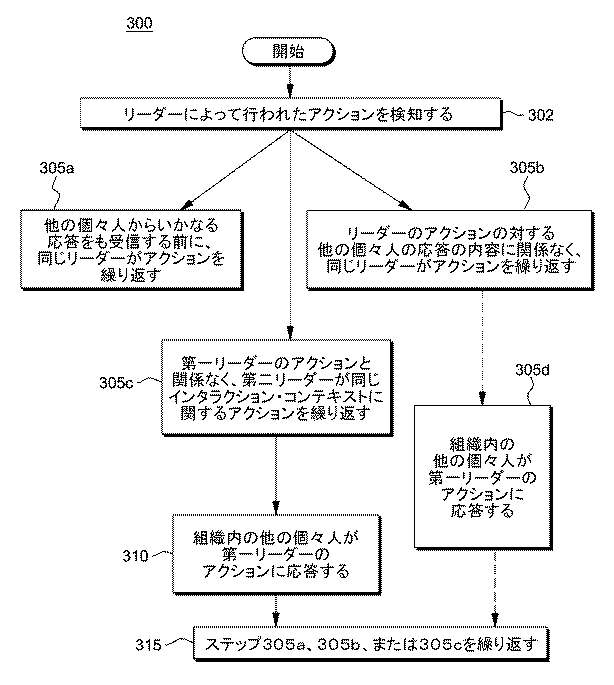
図3は、一つの例示的実施形態において、かき回し型パターンの出現を検知するため、コンピュータもしくはホスト・サーバまたはその両方のネットワークによって実施される一つの方法300を示す。この検知は、リーダーのアクションを観察し、時間内に完成しなかった課題に関連するその後のシーケンスを示唆することによって行われる。図3に示された実施形態において、このシーケンスは、1)302においてリーダーがアクションを実行する(例えばコミュニケーション・イベント);そして、2A)305aにおいて、組織内の他の個人が応答する機会を得る前にリーダーがステップ1を繰り返す、あるいは2B)305bにおいて、リーダーのアクションへの他の個人の応答の内容と関係なくリーダーがステップ1を繰り返す、あるいは2C)305cにおいて、第一リーダーのアクションとは関係なく −すなわち第一リーダーのアクションへの応答としてでなく− 第2リーダーが同じインタラクション・コンテキストに関してステップ1を繰り返す。次いで、3)310において、またはおそらくは305dにおいてステップ2A〜2Cと同時に、組織内の他の個々人が第一リーダーのアクションに応答し;次に4)315において、ステップ305a〜305cのアクションのいずれかが繰り返される。一つの実施形態において、ある例示的実装ではコミュニケーション・イベントはeメールである。「会話」は、相互に対する回答であるeメール(コミュニケーション・イベント)として定義することができ、一つの実施形態において、これはeメールの件名をベースとしている。
FIG. 3 illustrates one
しかして、リーダーのアクションがこれらリーダーが得た応答と関係がない場合の例において、彼らはそれでも同じ産生方向のインタラクションを最重点視し押し進める。次に、一つの例示的シナリオにおいて、有効な双方向のインタラクションの欠如は、かき回し型問題をもたらす可能性があるという結果になる。同様に反対のシナリオもあり得る、すなわち、アクションと応答とが、相互に時間的にロジカルな順序で続いているインタラクション・パターンだからといって、リーダーが他の個々人の応答を読んでそれらに対応する場合であっても、そのリーダーは矛盾するアクションを取ることができない、ということを意味するわけではない。このようなケースかどうかについてさらに正確な洞察を得るため、追加的なテキスト・マイニングが行われる。 Thus, in cases where leader actions are unrelated to the responses they have received, they still push the same production direction interaction with the highest priority. Second, in one exemplary scenario, the lack of effective bidirectional interaction can result in a crawl type problem. Similarly, there can be opposite scenarios, i.e., when a leader reads other individuals' responses and responds to them because the action and response are interaction patterns that follow each other in a logical order. This does not mean that the leader cannot take contradictory actions. Additional text mining is done to get a more accurate insight into whether this is the case.
第一に、かき回し型パターンは、一人以上のリーダーが、矛盾とまで言わなくても関連性のないアクションを取り続ける、双方向インタラクションの欠如を一般に示唆する、インタラクションのモードを検知する。また、これには、このインタラクション型に巻き込まれた個々人が彼らの作業課題を時間内に完成しないことの観察が必要となる。課題の未完成放置は、当然、リーダーおよび他の個人の焦点の合わないインタラクションに起因するものでないこともあるが、これによる場合の頻度はそうでない場合よりずっと高い。 First, the stir pattern detects a mode of interaction that generally suggests a lack of interactive interaction in which one or more leaders continue to take irrelevant actions, even if not contradictory. This also requires the observation that individuals involved in this interaction type do not complete their work tasks in time. Of course, an unfinished assignment may not be due to unfocused interactions of leaders and other individuals, but the frequency of this is much higher than otherwise.
一つの態様において、組織が採用する戦略に応じて、良いおよび悪いリーダーシップ・パターンのいろいろな型がある。検討対象の戦略の型は(1)運営の卓抜さ、(2)製品の革新性、および(3)顧客との親密関係、である。例えば、運営の卓越な組織においては、その構造がより階層的であることが予期される。さらに、リーダーは、通常パワー構造の中で高位の個人であることが予期される一方、プロジェクトごとにリーダーが変わることは予期されていない。インタラクションにおけるリーダーの欠如、またはリーダーと、推移的にプロジェクトの成功に責任を持つ担当者たちとの間のコミュニケーションの欠如は、報告されなければならない明らかなリーダーシップ問題である。 In one aspect, there are different types of good and bad leadership patterns, depending on the strategy adopted by the organization. The types of strategies considered are (1) operational excellence, (2) product innovation, and (3) intimate relationships with customers. For example, in a dominant organization, the structure is expected to be more hierarchical. Furthermore, while leaders are usually expected to be higher individuals in the power structure, it is not expected that leaders will change from project to project. Lack of leaders in interaction, or lack of communication between leaders and those who are transitively responsible for project success, is an obvious leadership issue that must be reported.
これらは、製品革新性の組織では問題の顕現がより少ない可能性があり、この例の組織型においては、多くのアイデアがボトムアップで提起され、個人は、リーダーによる厳重な統制なしに自分たちのアイデアを追求するさらに大きな自由を持っている。また、リーダーは、彼らの技術的専門性および特定のプロジェクトに応じて、はるかに頻繁に交代し、過剰な統制は新しいアイデアを過早に潰してしまうので、ある程度のかき回し型が予期されており望まれてさえいる。 These may be less manifest in a product innovation organization, and in this example organizational type, many ideas are raised bottom-up, and individuals do not have strict control by their leaders. Have even greater freedom to pursue ideas. Leaders are also changing much more frequently, depending on their technical expertise and specific projects, and excessive controls can prematurely crush new ideas, so some agitation is expected. Even desired.
図4は、本明細書で説明した方法のステップを実行もしくは実装またはその両方を行うコンピューティング・システム400の例示的ハードウエア構成を示す。このハードウエア構成は、望ましくは、少なくとも一つのプロセッサまたは中央処理装置(CPU:central processing unit)411を有する。CPU411は、システム・バス412を介し、ランダム・アクセス・メモリ(RAM:random access memory)414と、読み取り専用メモリ(ROM:read−only memory)416と、(ディスク装置421およびテープ・ドライブ440などの周辺デバイスをバス412に接続するための)入力/出力(I/O:input/output)アダプタ418と、(キーボード424、マウス426、スピーカ428、マイクロホン432、もしくは他のユーザ・インタフェースまたはこれらの組み合わせをバス412に接続するための)ユーザ・インタフェース・アダプタ422と、システム400をデータ処理ネットワーク、インターネット、イントラネット、ローカル・エリア・ネットワーク(LAN:local area network)などに接続するための通信アダプタ434と、バス412をディスプレイ・デバイス438もしくはプリンタ439(例、デジタル・プリンタまたは類似品)またはその両方に接続するためのディスプレイ・アダプタ436と、相互接続されている。
FIG. 4 illustrates an exemplary hardware configuration of a
当業者ならよく理解するであろうように、本発明の態様は、システム、方法、またはコンピュータ・プログラムとして具現することができる。従って、本発明の態様は、全体がハードウエアの実施形態、全体がソフトウエアの実施形態(ファームウエア、常駐ソフトウエア、マイクロコードなどを含む)、あるいは、一般に本明細書では全て「回路」、「モジュール」、または「システム」といわれる、ソフトウエアおよびハードウエア態様を組み合わせた実施形態の形を取ることができる。さらに、本発明の態様は、内部に具体化されたコンピュータ可読プログラム・コードを有する一つ以上のコンピュータ可読媒体(群)中に具現されたコンピュータ・プログラムの形を取ることもできる。 As will be appreciated by those skilled in the art, aspects of the present invention may be embodied as a system, method, or computer program. Accordingly, aspects of the invention may be described in terms of hardware embodiments entirely, software embodiments entirely (including firmware, resident software, microcode, etc.), or, generally herein, “circuitry”, It can take the form of an embodiment that combines software and hardware aspects, referred to as a “module” or “system”. Furthermore, aspects of the invention may take the form of a computer program embodied in one or more computer readable medium (s) having computer readable program code embodied therein.
一つ以上のコンピュータ可読媒体(群)の任意の組み合わせを用いることができる。コンピュータ可読媒体は、コンピュータ可読信号媒体、またはコンピュータ可読記憶媒体とすることができる。コンピュータ可読記憶媒体は、例えば、以下に限らないが、電子的、磁気的、光学的、電磁気的、赤外的な、または半導体の、システム、装置、もしくはデバイス、あるいはこれらの任意の適切な組み合わせとすることができる。コンピュータ可読記憶媒体のさらに具体的な例(非包括的リスト)には、一つ以上の配線を有する電気接続、携帯型コンピュータ・ディスケット、ハード・ディスク、ランダム・アクセス・メモリ(RAM)、読み取り専用メモリ(ROM)、消去可能プログラム可能読み取り専用メモリ(EPROM(erasable programmable read−only memory)またはフラッシュ・メモリ)、光ファイバ、携帯型コンパクト・ディスク読み取り専用メモリ(CD−ROM:compact disc read−only memory)、光記憶デバイス、磁気記憶デバイス、またはこれらの任意の適切な組み合わせが含まれよう。本文書の文脈において、コンピュータ可読記憶媒体は、命令を実行するシステム、装置、またはデバイスによってまたはこれらに関連させて使用するためのプログラムを、包含または格納できる任意の有形媒体とすることができる。 Any combination of one or more computer readable medium (s) may be used. The computer readable medium may be a computer readable signal medium or a computer readable storage medium. The computer readable storage medium may be, for example, but not limited to, an electronic, magnetic, optical, electromagnetic, infrared, or semiconductor system, apparatus, or device, or any suitable combination thereof It can be. More specific examples of computer-readable storage media (non-inclusive list) include electrical connections with one or more wires, portable computer diskettes, hard disks, random access memory (RAM), read-only Memory (ROM), erasable programmable read-only memory (EPROM (erasable programmable read-only memory) or flash memory), optical fiber, portable compact disk read-only memory (CD-ROM: compact disc read-only memory) ), An optical storage device, a magnetic storage device, or any suitable combination thereof. In the context of this document, a computer-readable storage medium may be any tangible medium that can contain or store a program for use by or in connection with a system, apparatus, or device that executes instructions.
コンピュータ可読信号媒体には、例えばベースバンド中にまたは搬送波の一部として具現されたコンピュータ可読のプログラム・コードを有する、伝播データ信号を含めることができる。かかる伝播信号は、以下に限らないが、電磁気的、光学的、またはこれらの任意の組み合わせを含め、さまざまな形態の任意の形を取ることができる。コンピュータ可読信号媒体は、コンピュータ可読記憶媒体ではないが、命令を実行するシステム、装置、またはデバイスによってまたはこれらに関連させて使用するためのプログラムの通信、伝播、または伝送が可能な任意のコンピュータ可読媒体であり得る。コンピュータ可読媒体中に具現されたプログラム・コードは、以下に限らないが、無線、有線、光ファイバ・ケーブル、RFなど、またはこれらの任意の適した組み合わせを含め、任意の適切な媒体を用いて送信することができる。 A computer readable signal medium may include a propagated data signal with computer readable program code embodied therein, for example, in baseband or as part of a carrier wave. Such propagated signals can take any of a variety of forms, including but not limited to electromagnetic, optical, or any combination thereof. A computer readable signal medium is not a computer readable storage medium, but any computer readable medium capable of communicating, propagating, or transmitting a program for use by or in connection with a system, apparatus, or device that executes instructions. It can be a medium. Program code embodied in a computer readable medium may be any suitable medium including, but not limited to, wireless, wired, fiber optic cable, RF, etc., or any suitable combination thereof. Can be sent.
本発明の態様のオペレーションを実行するためのコンピュータ・プログラム・コードは、Java(R)、Smalltalk(R)、C++などのオブジェクト指向プログラミング言語、および、“C”プログラミング言語または類似のプログラミング言語などの従来式手続き型プログラミング言語を含め、一つ以上のプログラミング言語の任意の組み合せで記述することができる。このプログラム・コードは、全体をユーザのコンピュータで、一部をユーザのコンピュータで、スタンドアロン・ソフトウエア・パッケージとして実行することができ、一部をユーザのコンピュータで他の部分を遠隔コンピュータで、または全体を遠隔のコンピュータまたはサーバで実行することができる。後者のシナリオでは、ローカル・エリア・ネットワーク(LAN)または広域ネットワーク(WAN:wide area network)を含む任意の種類のネットワークを介して、遠隔コンピュータをユーザのコンピュータに接続することができ、あるいは(例えばインターネット・サービス・プロバイダを使いインターネットを介し)外部のコンピュータへの接続を行うことができる。 Computer program code for performing operations of aspects of the present invention includes object-oriented programming languages such as Java®, Smalltalk®, C ++, and “C” programming language or similar programming languages. It can be written in any combination of one or more programming languages, including conventional procedural programming languages. This program code can be executed entirely on the user's computer, partly on the user's computer, as a stand-alone software package, partly on the user's computer and the other part on the remote computer, or The whole can be run on a remote computer or server. In the latter scenario, the remote computer can be connected to the user's computer via any type of network, including a local area network (LAN) or a wide area network (WAN), or (for example, You can connect to an external computer (via the Internet using an Internet service provider).
本発明の実施形態による方法、装置(システム)およびコンピュータ・プログラムのフロー・チャート説明図もしくはブロック図またはその両方を参照しながら本発明の態様を以下に説明する。フロー・チャート説明図もしくはブロック図またはその両方の各ブロック、および、フロー・チャート説明図もしくはブロック図またはその両方中のブロックの組み合わせは、コンピュータ・プログラム命令によって実行可能であることが理解されよう。これらのコンピュータ・プログラム命令を、汎用コンピュータ、特殊用途コンピュータ、またはマシンを形成する他のプログラム可能データ処理装置のプロセッサに供給し、コンピュータまたは他のプログラム可能データ処理装置のプロセッサを介して実行されるこれらの命令が、フロー・チャートもしくはブロック図またはその両方のブロックまたはブロック群中に規定された機能群/処理群を実施するための手段を生成するようにすることができる。また、これらのコンピュータ・プログラム命令を、コンピュータ、他のプログラム可能データ処理装置、または他のデバイスに対し特定の仕方で機能するよう命令できるコンピュータ可読媒体に格納し、そのコンピュータ可読媒体に格納された命令が、フロー・チャートもしくはブロック図またはその両方のブロックまたはブロック群中に規定された機能/処理を実施する命令群を包含する製品を形成するようにすることができる。 Aspects of the present invention are described below with reference to flowchart illustrations and / or block diagrams of methods, apparatus (systems) and computer program products according to embodiments of the invention. It will be understood that each block of the flow chart illustration and / or block diagram, and combinations of blocks in the flow chart illustration and / or block diagram, can be executed by computer program instructions. These computer program instructions are supplied to a processor of a general purpose computer, special purpose computer, or other programmable data processing device forming a machine and executed via the processor of the computer or other programmable data processing device. These instructions may cause the flow chart and / or block diagram or both to generate means for performing the function / process group defined in the block or block group. These computer program instructions are stored on a computer readable medium capable of instructing a computer, other programmable data processing apparatus, or other device to function in a particular manner. The instructions may form a product that includes instructions that perform the functions / processes defined in the blocks or blocks of the flow chart and / or block diagram.
同様に、コンピュータ・プログラム命令を、コンピュータ、他のプログラム可能データ処理装置、または他のデバイスにロードして、これらコンピュータ、他のプログラム可能装置、または他のデバイス上で一連のオペレーション・ステップを実行させてコンピュータ実装のプロセスを生成し、これらコンピュータまたは他のプログラム可能装置で実行されるこれらの命令が、フロー・チャートもしくはブロック図またはその両方のブロックまたはブロック群中に規定された機能群/処理群を実施するためのプロセスを提供するようにすることもできる。 Similarly, computer program instructions can be loaded into a computer, other programmable data processing apparatus, or other device to perform a series of operational steps on the computer, other programmable apparatus, or other device. To generate a computer-implemented process, and these instructions executed on these computers or other programmable devices are defined in a flow chart or block diagram or in both blocks or groups of functions / processes It is also possible to provide a process for implementing the group.
図中のフロー・チャートおよびブロック図は、本発明のさまざまな実施形態による、システム、方法、およびコンピュータ・プログラムの可能な実装のアーキテクチャ、機能、およびオペレーションを例示している。この点に関し、フロー・チャートまたはブロック図中の各ブロックは、所定の論理機能(群)を実行するための一つ以上の実行可能命令を含む、モジュール、セグメント、またはコードの部分を表し得る。また、一部の別の実装においては、ブロック中に記載された機能が、図に記載された順序を外れて行われることがあり得ることにも留意すべきである。例えば、連続して示された2つのブロックが、実際にはほぼ同時に実行されることがあり、関与する機能によっては、時には、これらブロックが逆の順序で実行されることもあり得る。また、ブロック図もしくはフロー・チャート説明図またはその両方の各ブロック、およびブロック図もしくはフロー・チャート説明図またはその両方中のブロック群の組み合わせは、特定の機能群または処置群を実施する、特殊用途のハードウエア・ベースのシステム、または特殊用途のハードウエアとコンピュータ命令との組み合わせによって実装可能なことにも留意すべきである。 The flowchart and block diagrams in the Figures illustrate the architecture, functionality, and operation of possible implementations of systems, methods and computer programs according to various embodiments of the present invention. In this regard, each block in the flow chart or block diagram may represent a module, segment, or portion of code that includes one or more executable instructions for performing a given logical function (s). It should also be noted that in some other implementations, the functions described in the blocks may be performed out of the order described in the figures. For example, two blocks shown in succession may actually be executed almost simultaneously, and depending on the function involved, sometimes these blocks may be executed in reverse order. In addition, each block in the block diagram and / or flow chart explanatory diagram, and combinations of blocks in the block diagram and / or flow chart explanatory diagram, perform a specific function group or treatment group. It should also be noted that this can be implemented with any hardware-based system or combination of special purpose hardware and computer instructions.
400 コンピューティング・システム
411 プロセッサまたは中央処理装置(CPU)
412 システム・バス
414 ランダム・アクセス・メモリ(RAM)
416 読み取り専用メモリ(ROM)
418 入力/出力(I/O)アダプタ
421 ディスク装置
422 ユーザ・インタフェース・アダプタ
424 キーボード
426 マウス
428 スピーカ
432 マイクロホン
434 通信アダプタ
436 ディスプレイ・アダプタ
438 ディスプレイ・デバイス
439 プリンタ
440 テープ・ドライブ
400
412
416 Read-only memory (ROM)
418 Input / Output (I / O)
Claims (24)
前記コンピュータが、前記グループ中の個々人の間のインタラクションに関するデータを収集するステップと、
前記コンピュータが、前記グループ中の各個人iと、個人iと交流する各個人jと、iとjとの間の各インタラクションとに対し、個人iに対応するリーダーシップ・スコアliと個人jに対応するリーダーシップ・スコアljとの関係を表す相対リーダーシップ・スコアλijを計算するステップと、
前記コンピュータが、前記相対リーダーシップ・スコア、各個人iおよびjに対応する個人リーダーシップ・スコアli、ljに基づいて、所与の時点で最大のリーダーシップ・スコアを有する個人として判定される前記グループのリーダーを計算するステップと、
を含む方法。 A method of detecting who is a leader in a group of individuals with a computer,
The computer collects data relating to interactions between individuals in the group;
For each person i in the group, each person j interacting with person i, and each interaction between i and j, the computer assigns a leadership score l i corresponding to person i and person j. Calculating a relative leadership score λ ij representing the relationship with the corresponding leadership score l j ;
The group in which the computer is determined as the individual having the highest leadership score at a given time based on the relative leadership score, the individual leadership scores l i , l j corresponding to each individual i and j Calculating the leaders of the
Including methods.
受信者jが送信者iによって開始されたインタラクションに応答する期間t送信者,受信者の関数として、各インタラクションの前記相対リーダーシップ・スコアへの寄与度を計算するステップ、
を含む、請求項1に記載の方法。 Calculating the relative leadership score λ ij comprises:
Calculating the contribution of each interaction to the relative leadership score as a function of the sender, the receiver, the time period t during which the receiver j responds to the interaction initiated by the sender i;
The method of claim 1 comprising:
受信者jが、諸送信者によって開始された全てのインタラクションに応答した平均応答時間H受信者の関数として、各インタラクションの前記相対リーダーシップ・スコアへの寄与度を計算するステップ、
をさらに含む、請求項2に記載の方法。 Calculating the relative leadership score λ ij comprises:
Calculating the contribution of each interaction to the relative leadership score as a function of the average response time H receiver that the receiver j responded to all interactions initiated by the senders;
The method of claim 2 further comprising:
li中の一組の一次方程式を反復処理してliとlkとの差を最小化するステップを含み、
li=λijlj
である、請求項4に記載の方法。 The step of calculating the leadership score includes:
comprising the step of minimizing the difference between the l i and l k the set of linear equations in the l i iteration to,
l i = λ ij l j
The method of claim 4, wherein
前記グループの第一個人iがコンピュータ・デバイスを介してインタラクションを開始した時間を記録するステップと、
前記グループの第二個人が第一個人iによって開始された前記インタラクションに応答するのにかかった時間tijを記録するステップであって、前記第二個人jは、他の個々人によって開始されたコンピュータ・ベースのインタラクションに対し平均応答時間
を有する、前記記録するステップと、
を含み、前記方法は、
前記個々人i、jの関連リーダーシップ・スコアを更新するステップであって、前記第二個人jに対する前記第一個人iの前記リーダーシップ・スコアはtij/Hjの関数である、前記更新するステップ、
をさらに含む、請求項3に記載の方法。 Collecting the data comprises:
Recording the time at which said group's first individual i initiated an interaction via a computer device;
Recording the time t ij taken for the second individual of the group to respond to the interaction initiated by the first individual i, wherein the second individual j is a computer initiated by another individual Average response time for base interactions
Comprising the step of recording,
The method comprises:
Updating the relevant leadership score of the individual i, j, wherein the leadership score of the first person i for the second person j is a function of t ij / H j ,
The method of claim 3, further comprising:
前記コンピュータが、前記個人iのアクションが開始された時間t1を記録するステップと、
前記コンピュータが、前記個人iのアクションが一人以上の第二個々人に観察可能になった時間t2を記録するステップと、
前記コンピュータが、前記個人iのアクションを前記第二個人が観察した時間t3を記録するステップであって、tijは、個人jが、個人iのアクションへの応答を開始するまでの応答時間を表し、t3−t1である、前記記録するステップと、
をさらに含み、
前記リーダーシップ・スコアの前記更新は前記tijに基づく、
請求項6に記載の方法。 Collecting the data comprises:
The computer recording a time t 1 when the action of the individual i was initiated;
The computer records a time t 2 when the action of the individual i becomes observable by one or more second individuals;
The computer recording time t 3 when the second person observed the action of the person i, where t ij is a response time until the person j starts responding to the action of the person i Said recording step, wherein t 3 -t 1 ;
Further including
The update of the leadership score is based on the t ij ;
The method of claim 6.
前記相対応答時間tijに基づきリーダーシップ・ウェイトを更新するステップであって、tij=t3−t1である、前記更新するステップと、
をさらに含む、請求項7に記載の方法。 Determining whether the action of person i is a response to a previous action by another person j, and if the action of person i is a response to a previous action of person j, said person j responds Recording the time t ij taken to start
Updating a leadership weight based on the relative response time t ij , wherein t ij = t 3 −t 1 ;
The method of claim 7, further comprising:
前記インタラクションがeメールの送信かどうかを判定し、受信者のeメールボックスまたはボイス・メールボックス中にメッセージが受信された時間を記録するステップ、または、
前記インタラクションが、あるソフトウエア・アーチファクトの前記生成または変更かどうかを判定し、前記アーチファクトがパブリック・ドメインに提示された時間を記録するステップ、
をさらに含む、請求項1に記載の方法。 Interaction by the sender and the individual recipient includes email communication to the recipient, chat initiated with the recipient, or telephone interaction with the recipient, or creation or modification of software artifacts, the method comprising:
Determining whether the interaction is an email and recording the time the message was received in the recipient's email or voice mailbox; or
Determining whether the interaction is the creation or modification of a software artifact and recording the time the artifact was presented to the public domain;
The method of claim 1, further comprising:
同種のアクションに対する個々人の応答時間を比較するステップと、
によってリーダーの型を判定するステップをさらに含み、
各アクションに対応するリーダーは、前記応答時間の比較に基づいて判定可能である、
請求項1に記載の方法。 Reviewing the type of action taken by the user;
Comparing individual response times to similar actions;
Further comprising determining the type of reader by
A leader corresponding to each action can be determined based on the comparison of the response times.
The method of claim 1.
前記利用可能な情報に基づいて各個人の応答のウェイトを修正するステップと、
前記応答の関連性についての情報がない場合にあっては、他の過去または現在のリーダーからの応答により大きなウェイトを与えるステップと、
をさらに含む、請求項1に記載の方法。 Determining the availability of information about the relevance of the response;
Modifying the weight of each individual's response based on the available information;
If there is no information about the relevance of the response, giving more weight to responses from other past or current leaders;
The method of claim 1, further comprising:
その個人リーダーの前記グループ内でのインタラクション・パターンを観察し、これらをリーダーシップに関するパターンと比較するステップと、
前記比較についての情報を報告するステップと、
を含む、請求項1に記載の方法。 After determining the individual leaders in the group,
Observing the interaction patterns of the individual leader within the group and comparing them with patterns related to leadership;
Reporting information about the comparison;
The method of claim 1 comprising:
メモリと、
前記メモリと交信するプロセッサ装置であって、
前記グループ中の個々人の間のインタラクションに関するデータを収集するステップと、
前記グループ中の各個人iと、個人iと交流する各個人jと、iとjとの間の各インタラクションとに対し、個人iに対応するリーダーシップ・スコアliと個人jに対応するリーダーシップ・スコアljとの関係を表す相対リーダーシップ・スコアλijを計算するステップと、
前記相対リーダーシップ・スコア、各個人iおよびjに対応する個人リーダーシップ・スコアli、ljに基づいて、所与の時点で最大のリーダーシップ・スコアを有する個人として判定される前記グループのリーダーを計算するステップと、
を含む方法を遂行する、前記プロセッサ装置と、
を含むシステム。 A system for detecting who is a leader in a group of individuals, the system comprising:
Memory,
A processor device in communication with the memory,
Collecting data on interactions between individuals in the group;
For each individual i in the group, each individual j interacting with the individual i, and each interaction between i and j, a leadership score l i corresponding to the individual i and a leadership score corresponding to the individual j Calculating a relative leadership score λ ij representing the relationship with the score l j ;
Based on the relative leadership score, the individual leadership scores l i , l j corresponding to each individual i and j, calculate the leader of the group that is determined as the individual with the highest leadership score at a given time And steps to
Said processor device for performing a method comprising:
Including system.
受信者jが送信者iによって開始されたインタラクションに応答する期間t送信者,受信者の関数として、各インタラクションの前記相対リーダーシップ・スコアへの寄与度を計算するステップ、
を含む、請求項13に記載のシステム。 Calculating the relative leadership score λ ij comprises:
Calculating the contribution of each interaction to the relative leadership score as a function of the sender, the receiver, the time period t during which the receiver j responds to the interaction initiated by the sender i;
14. The system of claim 13, comprising:
受信者jが、諸送信者によって開始された全てのインタラクションに応答した平均応答時間H受信者の関数として、各インタラクションの前記相対リーダーシップ・スコアへの寄与度を計算するステップ、
をさらに含む、請求項14に記載のシステム。 Calculating the relative leadership score λ ij comprises:
Calculating the contribution of each interaction to the relative leadership score as a function of the average response time H receiver that the receiver j responded to all interactions initiated by the senders;
15. The system of claim 14, further comprising:
li中の一組の一次方程式を反復処理してliとlkとの差を最小化するステップを含み、
li=λijlj
である、請求項16に記載のシステム。 The step of calculating the leadership score includes:
comprising the step of minimizing the difference between the l i and l k the set of linear equations in the l i iteration to,
l i = λ ij l j
The system of claim 16, wherein
前記グループの第一個人iがコンピュータ・デバイスを介してインタラクションを開始した時間を記録するステップと、
前記グループの第二個人jが第一個人iによって開始された前記インタラクションに応答するのにかかった時間tijを記録するステップであって、前記第二個人jは、他の個々人によって開始されたコンピュータ・ベースのインタラクションに対し平均応答時間Hjを有する、前記記録するステップと、
前記個人i、jの関連リーダーシップ・スコアを更新するステップであって、前記第二個人jに対する前記第一個人iの前記リーダーシップ・スコアはtij/Hjの関数である、前記更新するステップと、
を含む、請求項15に記載のシステム。 Collecting the data comprises:
Recording the time at which said group's first individual i initiated an interaction via a computer device;
Recording the time t ij taken for the second individual j of the group to respond to the interaction initiated by the first individual i, wherein the second individual j is a computer initiated by another individual Said recording step having an average response time H j for a base interaction;
Updating the associated leadership score of the person i, j, wherein the leadership score of the first person i for the second person j is a function of t ij / H j ;
The system of claim 15, comprising:
前記プロセッサ装置によって、前記個人iのアクションが開始された時間t1を記録するステップと、
前記プロセッサ装置によって、前記個人iのアクションが一人以上の第二個々人に観測可能になった時間t2を記録するステップと、
前記プロセッサ装置によって、前記個人iのアクションを前記第二個人が観察した時間t3を記録するステップであって、時間tijは、個人jが、個人iのアクションへの応答を開始するまでの応答時間を表し、t3−t1である、前記記録するステップと、
を含み、
前記リーダーシップ・スコアの前記更新は前記tijに基づく、
請求項18に記載のシステム。 Collecting the data comprises:
Recording the time t 1 when the action of the individual i is started by the processor device;
Recording the time t 2 when the action of the individual i becomes observable by one or more second individuals by the processor device;
Recording a time t 3 when the second individual observes the action of the person i by the processor device, the time t ij being a time until the person j starts responding to the action of the person i. Said step of recording, which represents a response time and is t 3 -t 1 ;
Including
The update of the leadership score is based on the t ij ;
The system of claim 18.
個人iのアクションが、別の個人jによる以前のアクションへの応答なのかどうかを判定するステップ、および前記個人iのアクションが、個人jの以前のアクションへの応答である場合、前記個人jが応答を開始するのにかかった前記時間tijを記録するステップと、
前記相対応答時間tijに基づきリーダーシップ・ウェイトを更新するステップであって、tij=t3−t1である、前記更新するステップと、
をさらに含む、請求項19に記載のシステム。 The method comprises
Determining whether the action of person i is a response to a previous action by another person j, and if the action of person i is a response to a previous action of person j, Recording the time t ij taken to initiate a response;
Updating a leadership weight based on the relative response time t ij , wherein t ij = t 3 −t 1 ;
20. The system of claim 19, further comprising:
前記インタラクションがeメールの送信かどうかを判定し、受信者のeメールボックスまたはボイス・メールボックス中にメッセージが受信された時間を記録するステップ、または、
前記インタラクションが、あるソフトウエア・アーチファクトの前記生成または変更かどうかを判定し、前記アーチファクトがパブリック・ドメインに提示された時間を記録するステップ、
をさらに含む、請求項13に記載のシステム。 Interaction by the sender and the individual recipient includes email communication to the recipient, chat initiated with the recipient, or telephone interaction with the recipient, or creation or modification of software artifacts, the method comprising:
Determining whether the interaction is an email and recording the time the message was received in the recipient's email or voice mailbox; or
Determining whether the interaction is the creation or modification of a software artifact and recording the time the artifact was presented to the public domain;
The system of claim 13, further comprising:
コンピュータに
前記グループ中の個人の間のインタラクションに関するデータを収集するステップと、
前記グループ中の各個人iと、個人iと交流する各個人jと、iとjとの間の各インタラクションとに対し、個人iに対応するリーダーシップ・スコアliと個人jに対応するリーダーシップ・スコアljとの関係を表す相対リーダーシップ・スコアλijを計算するステップと、
前記相対リーダーシップ・スコア、各個人iおよびjに対応するリーダーシップ・スコアli、ljに基づいて、所与の時点で最大のリーダーシップ・スコアを有する個人として判定される前記グループのリーダーを計算するステップと、
を実行させる、前記コンピュータ・プログラム。 A computer program for detecting who is a leader in a group of individuals, the computer program comprising:
Collecting data on interactions between individuals in the group on a computer;
For each individual i in the group, each individual j interacting with the individual i, and each interaction between i and j, a leadership score l i corresponding to the individual i and a leadership score corresponding to the individual j Calculating a relative leadership score λ ij representing the relationship with the score l j ;
Based on the relative leadership score, leadership scores l i , l j corresponding to each individual i and j, calculate the leader of the group that is determined as the individual with the highest leadership score at a given time Steps,
The computer program for executing
受信者jが、諸送信者によって開始された全てのインタラクションに応答した平均応答時間H受信者の関数として、各インタラクションの前記相対リーダーシップ・スコアへの寄与度を計算するステップと、
各インタラクションの個人iとjとの間の相対リーダーシップ・スコアへのウェイト寄与度を算定するステップであって、前記λijは個人iとjとの間の全ての前記インタラクションの平均ウェイトを表現する、前記算定するステップと、
をさら前記コンピュータに実行させる、請求項22に記載のコンピュータ・プログラム。 Calculating the contribution of each interaction to the relative leadership score as a function of the sender, the receiver, the time period t during which the receiver j responds to the interaction initiated by the sender i;
Calculating the contribution of each interaction to the relative leadership score as a function of the average response time H receiver that the receiver j responded to all interactions initiated by the senders;
Calculating the weight contribution to the relative leadership score between individuals i and j for each interaction, wherein λ ij represents the average weight of all the interactions between individuals i and j , Said calculating step;
The computer program according to claim 22, further causing the computer to execute.
li中の一組の一次方程式を反復処理してliとlkとの差を最小化するステップを含み、
li=λijlj
である、請求項23に記載のコンピュータ・プログラム。 The step of calculating the leadership score includes:
iterating a set of linear equations in li to minimize the difference between l i and l k ,
l i = λ ij l j
The computer program according to claim 23, wherein:
Applications Claiming Priority (2)
| Application Number | Priority Date | Filing Date | Title |
|---|---|---|---|
| US13/070,116 US20120244500A1 (en) | 2011-03-23 | 2011-03-23 | System and method for detecting leadership |
| US13/070116 | 2011-03-23 |
Publications (1)
| Publication Number | Publication Date |
|---|---|
| JP2012203905A true JP2012203905A (en) | 2012-10-22 |
Family
ID=46877624
Family Applications (1)
| Application Number | Title | Priority Date | Filing Date |
|---|---|---|---|
| JP2012063407A Pending JP2012203905A (en) | 2011-03-23 | 2012-03-21 | System, method and computer program for detecting leadership |
Country Status (2)
| Country | Link |
|---|---|
| US (1) | US20120244500A1 (en) |
| JP (1) | JP2012203905A (en) |
Families Citing this family (6)
| Publication number | Priority date | Publication date | Assignee | Title |
|---|---|---|---|---|
| JP2012244463A (en) * | 2011-05-20 | 2012-12-10 | Sony Corp | Reception terminal, information processing method, program, server, transmission terminal, and information processing system |
| US9262936B2 (en) | 2012-12-06 | 2016-02-16 | Google Inc. | Determining individuals for online groups |
| US10032385B2 (en) | 2015-03-27 | 2018-07-24 | Hartford Fire Insurance Company | System for optimizing employee leadership training program enrollment selection |
| US20210042681A1 (en) * | 2019-08-09 | 2021-02-11 | Qulture, Inc. | Leadership development optimization |
| US11677783B2 (en) * | 2019-10-25 | 2023-06-13 | Target Brands, Inc. | Analysis of potentially malicious emails |
| US20240046175A1 (en) * | 2022-08-08 | 2024-02-08 | Genpact Luxembourg S.à r.l. II | Systems and methods for determining and visualizing employee engagement |
Citations (7)
| Publication number | Priority date | Publication date | Assignee | Title |
|---|---|---|---|---|
| JP2000113064A (en) * | 1998-10-09 | 2000-04-21 | Fuji Xerox Co Ltd | Optimum acting person selection support system |
| JP2003216563A (en) * | 2002-01-24 | 2003-07-31 | Japan Research Institute Ltd | Community analysis method and community analysis server |
| JP2006155421A (en) * | 2004-11-30 | 2006-06-15 | Fuji Xerox Co Ltd | Communication role analyzer, its method, and program |
| JP2007257002A (en) * | 2006-03-20 | 2007-10-04 | Japan Research Institute Ltd | Person diagnosis method, person diagnosis system, and person diagnosis program |
| JP2008117049A (en) * | 2006-11-01 | 2008-05-22 | Nec Corp | Expertise calculation system, method and program |
| JP2008242574A (en) * | 2007-03-26 | 2008-10-09 | Nec Corp | Individual performance evaluation system based on e-mail analysis |
| JP2010211287A (en) * | 2009-03-06 | 2010-09-24 | Ntt Docomo Inc | Apparatus, system, and method for analyzing degree of association between users |
Family Cites Families (6)
| Publication number | Priority date | Publication date | Assignee | Title |
|---|---|---|---|---|
| EP1221118A2 (en) * | 1999-08-31 | 2002-07-10 | Comsort, Inc. | System for influence network marketing |
| US7970712B2 (en) * | 2002-12-19 | 2011-06-28 | International Business Machines Corporation | Displaying strengths of social relationships between a user and other people |
| US7653568B2 (en) * | 2004-01-13 | 2010-01-26 | GfK U.S. Holdings, Inc. | System and method of identifying individuals of influence |
| US7933843B1 (en) * | 2006-08-26 | 2011-04-26 | CommEq Ltd. | Media-based computational influencer network analysis |
| US8359276B2 (en) * | 2006-09-20 | 2013-01-22 | Microsoft Corporation | Identifying influential persons in a social network |
| US8456472B2 (en) * | 2010-01-08 | 2013-06-04 | International Business Machines Corporation | Ranking nodes in a graph |
-
2011
- 2011-03-23 US US13/070,116 patent/US20120244500A1/en not_active Abandoned
-
2012
- 2012-03-21 JP JP2012063407A patent/JP2012203905A/en active Pending
Patent Citations (7)
| Publication number | Priority date | Publication date | Assignee | Title |
|---|---|---|---|---|
| JP2000113064A (en) * | 1998-10-09 | 2000-04-21 | Fuji Xerox Co Ltd | Optimum acting person selection support system |
| JP2003216563A (en) * | 2002-01-24 | 2003-07-31 | Japan Research Institute Ltd | Community analysis method and community analysis server |
| JP2006155421A (en) * | 2004-11-30 | 2006-06-15 | Fuji Xerox Co Ltd | Communication role analyzer, its method, and program |
| JP2007257002A (en) * | 2006-03-20 | 2007-10-04 | Japan Research Institute Ltd | Person diagnosis method, person diagnosis system, and person diagnosis program |
| JP2008117049A (en) * | 2006-11-01 | 2008-05-22 | Nec Corp | Expertise calculation system, method and program |
| JP2008242574A (en) * | 2007-03-26 | 2008-10-09 | Nec Corp | Individual performance evaluation system based on e-mail analysis |
| JP2010211287A (en) * | 2009-03-06 | 2010-09-24 | Ntt Docomo Inc | Apparatus, system, and method for analyzing degree of association between users |
Also Published As
| Publication number | Publication date |
|---|---|
| US20120244500A1 (en) | 2012-09-27 |
Similar Documents
| Publication | Publication Date | Title |
|---|---|---|
| KR102121135B1 (en) | Optimized routing of interactions to contact center agents based on machine learning | |
| US8862482B2 (en) | Managing connections between real world and virtual world communities | |
| JP6546180B2 (en) | Get Network Subject's Social Relationship Type | |
| US7930255B2 (en) | Social profile assessment | |
| US11087247B2 (en) | Dynamic optimization for data quality control in crowd sourcing tasks to crowd labor | |
| US9282073B1 (en) | E-mail enhancement based on user-behavior | |
| US8959086B2 (en) | Automated online social network inter-entity relationship management | |
| WO2013030830A1 (en) | Automatic ranking of entities based on interactions therebetween | |
| US10083415B2 (en) | Multi-variable assessment systems and methods that evaluate and predict entrepreneurial behavior | |
| US20140297765A1 (en) | Profiling social trendsetters | |
| US10430748B2 (en) | Utilizing social performance patterns to manage and evaluate performance of user | |
| JP2012203905A (en) | System, method and computer program for detecting leadership | |
| JP2016505974A (en) | Instance weight learning machine learning model | |
| US12106246B2 (en) | System and method supporting ongoing worker feedback | |
| CN102055793B (en) | The method and system configured or set up of automatically change or more new communication system | |
| US20160026738A1 (en) | Modeling and visualizing a dynamic interpersonal relationship from social media | |
| JP2017532660A (en) | Automatic tenant upgrade for multi-tenant services | |
| WO2021139513A1 (en) | Method and apparatus for processing interaction sequence data | |
| JP2019164699A (en) | Computation device, computation method, and computation program | |
| US10152684B2 (en) | Device, method and system for valuating individuals and organizations based on personal interactions | |
| JP5652047B2 (en) | Information processing apparatus and information processing program | |
| Jain et al. | Are you there? identifying unavailability in mobile messaging | |
| JP2016021131A (en) | Information processing apparatus and information processing program | |
| US20170116529A1 (en) | Generating a database of skills | |
| CN115408608A (en) | Intelligent information exchange method, system, device and readable storage medium |
Legal Events
| Date | Code | Title | Description |
|---|---|---|---|
| A621 | Written request for application examination |
Free format text: JAPANESE INTERMEDIATE CODE: A621 Effective date: 20140903 |
|
| A977 | Report on retrieval |
Free format text: JAPANESE INTERMEDIATE CODE: A971007 Effective date: 20150708 |
|
| A131 | Notification of reasons for refusal |
Free format text: JAPANESE INTERMEDIATE CODE: A131 Effective date: 20150728 |
|
| A02 | Decision of refusal |
Free format text: JAPANESE INTERMEDIATE CODE: A02 Effective date: 20160329 |