JP2012092270A - Apparatus for treating chicken manure - Google Patents
Apparatus for treating chicken manure Download PDFInfo
- Publication number
- JP2012092270A JP2012092270A JP2010242587A JP2010242587A JP2012092270A JP 2012092270 A JP2012092270 A JP 2012092270A JP 2010242587 A JP2010242587 A JP 2010242587A JP 2010242587 A JP2010242587 A JP 2010242587A JP 2012092270 A JP2012092270 A JP 2012092270A
- Authority
- JP
- Japan
- Prior art keywords
- chicken manure
- rotary kiln
- heavy gas
- chicken
- nickel
- Prior art date
- Legal status (The legal status is an assumption and is not a legal conclusion. Google has not performed a legal analysis and makes no representation as to the accuracy of the status listed.)
- Pending
Links
- 210000003608 fece Anatomy 0.000 title claims abstract description 65
- 241000287828 Gallus gallus Species 0.000 title claims abstract description 61
- 239000010871 livestock manure Substances 0.000 title claims abstract description 48
- 239000003054 catalyst Substances 0.000 claims abstract description 28
- 238000000354 decomposition reaction Methods 0.000 claims abstract description 26
- 239000000126 substance Substances 0.000 claims abstract description 25
- 238000011282 treatment Methods 0.000 claims abstract description 24
- XEEYBQQBJWHFJM-UHFFFAOYSA-N Iron Chemical compound [Fe] XEEYBQQBJWHFJM-UHFFFAOYSA-N 0.000 claims abstract description 16
- 239000000446 fuel Substances 0.000 claims abstract description 16
- 238000010438 heat treatment Methods 0.000 claims abstract description 16
- 238000004380 ashing Methods 0.000 claims abstract description 13
- PXHVJJICTQNCMI-UHFFFAOYSA-N Nickel Chemical compound [Ni] PXHVJJICTQNCMI-UHFFFAOYSA-N 0.000 claims abstract description 10
- 238000010000 carbonizing Methods 0.000 claims abstract description 9
- 239000003077 lignite Substances 0.000 claims abstract description 9
- 229910052742 iron Inorganic materials 0.000 claims abstract description 8
- CWYNVVGOOAEACU-UHFFFAOYSA-N Fe2+ Chemical compound [Fe+2] CWYNVVGOOAEACU-UHFFFAOYSA-N 0.000 claims abstract description 5
- PNEYBMLMFCGWSK-UHFFFAOYSA-N aluminium oxide Inorganic materials [O-2].[O-2].[O-2].[Al+3].[Al+3] PNEYBMLMFCGWSK-UHFFFAOYSA-N 0.000 claims abstract description 5
- 229910052759 nickel Inorganic materials 0.000 claims abstract description 5
- 229910052751 metal Inorganic materials 0.000 claims abstract description 4
- 239000002184 metal Substances 0.000 claims abstract description 4
- 238000000197 pyrolysis Methods 0.000 claims abstract description 3
- 238000004140 cleaning Methods 0.000 abstract description 4
- 238000007599 discharging Methods 0.000 abstract description 3
- 238000012423 maintenance Methods 0.000 abstract description 3
- 238000005336 cracking Methods 0.000 abstract 2
- 239000007789 gas Substances 0.000 description 41
- 238000000034 method Methods 0.000 description 14
- QVGXLLKOCUKJST-UHFFFAOYSA-N atomic oxygen Chemical compound [O] QVGXLLKOCUKJST-UHFFFAOYSA-N 0.000 description 12
- 239000001301 oxygen Substances 0.000 description 12
- 229910052760 oxygen Inorganic materials 0.000 description 12
- 238000003763 carbonization Methods 0.000 description 10
- 239000003337 fertilizer Substances 0.000 description 10
- OAICVXFJPJFONN-UHFFFAOYSA-N Phosphorus Chemical compound [P] OAICVXFJPJFONN-UHFFFAOYSA-N 0.000 description 9
- 229910052698 phosphorus Inorganic materials 0.000 description 9
- 239000011574 phosphorus Substances 0.000 description 9
- VTYYLEPIZMXCLO-UHFFFAOYSA-L Calcium carbonate Chemical compound [Ca+2].[O-]C([O-])=O VTYYLEPIZMXCLO-UHFFFAOYSA-L 0.000 description 8
- 239000000463 material Substances 0.000 description 7
- 239000002994 raw material Substances 0.000 description 7
- OKTJSMMVPCPJKN-UHFFFAOYSA-N Carbon Chemical compound [C] OKTJSMMVPCPJKN-UHFFFAOYSA-N 0.000 description 6
- 239000000919 ceramic Substances 0.000 description 6
- 230000000052 comparative effect Effects 0.000 description 6
- 239000011261 inert gas Substances 0.000 description 6
- 238000009825 accumulation Methods 0.000 description 5
- BRPQOXSCLDDYGP-UHFFFAOYSA-N calcium oxide Chemical compound [O-2].[Ca+2] BRPQOXSCLDDYGP-UHFFFAOYSA-N 0.000 description 5
- 239000000292 calcium oxide Substances 0.000 description 5
- ODINCKMPIJJUCX-UHFFFAOYSA-N calcium oxide Inorganic materials [Ca]=O ODINCKMPIJJUCX-UHFFFAOYSA-N 0.000 description 5
- 239000003610 charcoal Substances 0.000 description 5
- 244000144972 livestock Species 0.000 description 5
- 238000004519 manufacturing process Methods 0.000 description 5
- 150000001247 metal acetylides Chemical class 0.000 description 5
- 239000003516 soil conditioner Substances 0.000 description 5
- 229910000019 calcium carbonate Inorganic materials 0.000 description 4
- XLYOFNOQVPJJNP-UHFFFAOYSA-N water Chemical compound O XLYOFNOQVPJJNP-UHFFFAOYSA-N 0.000 description 4
- VYZAMTAEIAYCRO-UHFFFAOYSA-N Chromium Chemical compound [Cr] VYZAMTAEIAYCRO-UHFFFAOYSA-N 0.000 description 3
- 239000004568 cement Substances 0.000 description 3
- 238000002485 combustion reaction Methods 0.000 description 3
- 239000000428 dust Substances 0.000 description 3
- 229910001026 inconel Inorganic materials 0.000 description 3
- 238000002156 mixing Methods 0.000 description 3
- 239000000203 mixture Substances 0.000 description 3
- 238000003672 processing method Methods 0.000 description 3
- XKRFYHLGVUSROY-UHFFFAOYSA-N Argon Chemical compound [Ar] XKRFYHLGVUSROY-UHFFFAOYSA-N 0.000 description 2
- IJGRMHOSHXDMSA-UHFFFAOYSA-N Atomic nitrogen Chemical compound N#N IJGRMHOSHXDMSA-UHFFFAOYSA-N 0.000 description 2
- 239000002028 Biomass Substances 0.000 description 2
- CURLTUGMZLYLDI-UHFFFAOYSA-N Carbon dioxide Chemical compound O=C=O CURLTUGMZLYLDI-UHFFFAOYSA-N 0.000 description 2
- 239000010796 biological waste Substances 0.000 description 2
- 238000001035 drying Methods 0.000 description 2
- 230000000694 effects Effects 0.000 description 2
- 238000005265 energy consumption Methods 0.000 description 2
- 230000007613 environmental effect Effects 0.000 description 2
- 238000010304 firing Methods 0.000 description 2
- 239000007769 metal material Substances 0.000 description 2
- VNWKTOKETHGBQD-UHFFFAOYSA-N methane Chemical compound C VNWKTOKETHGBQD-UHFFFAOYSA-N 0.000 description 2
- 230000017448 oviposition Effects 0.000 description 2
- 244000144977 poultry Species 0.000 description 2
- 239000002689 soil Substances 0.000 description 2
- 239000002881 soil fertilizer Substances 0.000 description 2
- 238000005979 thermal decomposition reaction Methods 0.000 description 2
- 239000002699 waste material Substances 0.000 description 2
- UGFAIRIUMAVXCW-UHFFFAOYSA-N Carbon monoxide Chemical compound [O+]#[C-] UGFAIRIUMAVXCW-UHFFFAOYSA-N 0.000 description 1
- OTMSDBZUPAUEDD-UHFFFAOYSA-N Ethane Chemical compound CC OTMSDBZUPAUEDD-UHFFFAOYSA-N 0.000 description 1
- VGGSQFUCUMXWEO-UHFFFAOYSA-N Ethene Chemical compound C=C VGGSQFUCUMXWEO-UHFFFAOYSA-N 0.000 description 1
- 239000005977 Ethylene Substances 0.000 description 1
- ZLMJMSJWJFRBEC-UHFFFAOYSA-N Potassium Chemical compound [K] ZLMJMSJWJFRBEC-UHFFFAOYSA-N 0.000 description 1
- 230000004913 activation Effects 0.000 description 1
- 229910052786 argon Inorganic materials 0.000 description 1
- 229910002092 carbon dioxide Inorganic materials 0.000 description 1
- 239000001569 carbon dioxide Substances 0.000 description 1
- 229910002091 carbon monoxide Inorganic materials 0.000 description 1
- 229910052804 chromium Inorganic materials 0.000 description 1
- 239000011651 chromium Substances 0.000 description 1
- 239000002361 compost Substances 0.000 description 1
- 238000009264 composting Methods 0.000 description 1
- 230000003247 decreasing effect Effects 0.000 description 1
- 230000008021 deposition Effects 0.000 description 1
- 238000010586 diagram Methods 0.000 description 1
- 230000005611 electricity Effects 0.000 description 1
- 239000000839 emulsion Substances 0.000 description 1
- 238000004146 energy storage Methods 0.000 description 1
- 238000003912 environmental pollution Methods 0.000 description 1
- 210000003746 feather Anatomy 0.000 description 1
- 239000008187 granular material Substances 0.000 description 1
- 230000005484 gravity Effects 0.000 description 1
- 239000001257 hydrogen Substances 0.000 description 1
- 229910052739 hydrogen Inorganic materials 0.000 description 1
- 125000004435 hydrogen atom Chemical class [H]* 0.000 description 1
- 239000003350 kerosene Substances 0.000 description 1
- 239000007788 liquid Substances 0.000 description 1
- 230000014759 maintenance of location Effects 0.000 description 1
- 239000003595 mist Substances 0.000 description 1
- 229910052757 nitrogen Inorganic materials 0.000 description 1
- 239000005416 organic matter Substances 0.000 description 1
- 230000003647 oxidation Effects 0.000 description 1
- 238000007254 oxidation reaction Methods 0.000 description 1
- 239000002245 particle Substances 0.000 description 1
- 239000011591 potassium Substances 0.000 description 1
- 229910052700 potassium Inorganic materials 0.000 description 1
- 238000007873 sieving Methods 0.000 description 1
Images

Classifications
-
- Y—GENERAL TAGGING OF NEW TECHNOLOGICAL DEVELOPMENTS; GENERAL TAGGING OF CROSS-SECTIONAL TECHNOLOGIES SPANNING OVER SEVERAL SECTIONS OF THE IPC; TECHNICAL SUBJECTS COVERED BY FORMER USPC CROSS-REFERENCE ART COLLECTIONS [XRACs] AND DIGESTS
- Y02—TECHNOLOGIES OR APPLICATIONS FOR MITIGATION OR ADAPTATION AGAINST CLIMATE CHANGE
- Y02A—TECHNOLOGIES FOR ADAPTATION TO CLIMATE CHANGE
- Y02A40/00—Adaptation technologies in agriculture, forestry, livestock or agroalimentary production
- Y02A40/10—Adaptation technologies in agriculture, forestry, livestock or agroalimentary production in agriculture
- Y02A40/20—Fertilizers of biological origin, e.g. guano or fertilizers made from animal corpses
-
- Y—GENERAL TAGGING OF NEW TECHNOLOGICAL DEVELOPMENTS; GENERAL TAGGING OF CROSS-SECTIONAL TECHNOLOGIES SPANNING OVER SEVERAL SECTIONS OF THE IPC; TECHNICAL SUBJECTS COVERED BY FORMER USPC CROSS-REFERENCE ART COLLECTIONS [XRACs] AND DIGESTS
- Y02—TECHNOLOGIES OR APPLICATIONS FOR MITIGATION OR ADAPTATION AGAINST CLIMATE CHANGE
- Y02E—REDUCTION OF GREENHOUSE GAS [GHG] EMISSIONS, RELATED TO ENERGY GENERATION, TRANSMISSION OR DISTRIBUTION
- Y02E50/00—Technologies for the production of fuel of non-fossil origin
- Y02E50/30—Fuel from waste, e.g. synthetic alcohol or diesel
-
- Y—GENERAL TAGGING OF NEW TECHNOLOGICAL DEVELOPMENTS; GENERAL TAGGING OF CROSS-SECTIONAL TECHNOLOGIES SPANNING OVER SEVERAL SECTIONS OF THE IPC; TECHNICAL SUBJECTS COVERED BY FORMER USPC CROSS-REFERENCE ART COLLECTIONS [XRACs] AND DIGESTS
- Y02—TECHNOLOGIES OR APPLICATIONS FOR MITIGATION OR ADAPTATION AGAINST CLIMATE CHANGE
- Y02W—CLIMATE CHANGE MITIGATION TECHNOLOGIES RELATED TO WASTEWATER TREATMENT OR WASTE MANAGEMENT
- Y02W10/00—Technologies for wastewater treatment
- Y02W10/40—Valorisation of by-products of wastewater, sewage or sludge processing
Landscapes
- Catalysts (AREA)
- Soil Conditioners And Soil-Stabilizing Materials (AREA)
- Fertilizers (AREA)
- Processing Of Solid Wastes (AREA)
- Treatment Of Sludge (AREA)
Abstract
【課題】多大な燃料を必要としない、タール状物質を分解させてその分解ガスを補助燃料として再利用する高エネルギー効率の、またタール物質の洗浄排出の必要性が低減された維持管理の容易な鶏糞を炭化または灰化するための実用性の高い鶏糞処理装置を提供する。
【解決手段】
ロータリーキルン内またはロータリーキルンに接して直結して、熱処理により発生する常温ではタール物質となる重質ガスの分解を促進するニッケル担持褐炭およびニッケル担持アルミナを含むニッケル系触媒、あるいは、リモナイトを含む鉄系触媒などの第VIII族の金属系触媒が充填された重質ガス分解装置が設けられ、該重質ガス分解装置から排出された熱分解ガスを補助燃料として使用することが可能な設備が設けられていることを特徴とし、熱処理温度が500℃から700℃の範囲内であることを特徴とする。
【選択図】図1
[PROBLEMS] To eliminate the need for a large amount of fuel, facilitate the maintenance and management with high energy efficiency in which tar-like substances are decomposed and the cracked gas is reused as auxiliary fuel, and the need for cleaning and discharging tar substances is reduced. A highly practical chicken manure treatment apparatus for carbonizing or ashing fresh chicken manure is provided.
[Solution]
A nickel-based catalyst containing nickel-supported lignite and nickel-supported alumina, or an iron-based catalyst containing limonite, which is directly connected to or in contact with the rotary kiln and promotes the decomposition of heavy gas that is a tar substance at room temperature generated by heat treatment A heavy gas cracking device filled with a Group VIII metal catalyst such as is provided, and equipment capable of using the pyrolysis gas discharged from the heavy gas cracking device as auxiliary fuel is provided. The heat treatment temperature is in the range of 500 ° C. to 700 ° C.
[Selection] Figure 1
Description
本発明は、鶏糞を炭化または灰化するための鶏糞処理装置に関する。 The present invention relates to a chicken dung processing apparatus for carbonizing or ashing chicken dung.
地球環境対策の一環として、大量に発生している家畜糞からのエネルギー獲得、再資源化が急務となっている。従来から家畜糞の処理方法としては堆肥化が主流となっているが、その堆肥が余剰傾向にあり炭化処理や活性炭化処理、焼却灰化処理することが行われてきている。鶏糞も炭化処理や活性炭化処理、焼却灰化処理が行われているがこれらの処理炉は高温で稼動させることが一般的であり使用する燃料や電気などエネルギーが多大となっている。 As part of global environmental measures, there is an urgent need to acquire and recycle energy from large amounts of livestock dung. Conventionally, composting has been the mainstream treatment method for livestock manure, but the compost tends to be surplus, and carbonization, activated carbonization, and incineration ashing have been performed. Chicken manure is also carbonized, activated carbonized, and incinerated ashed, but these processing furnaces are generally operated at high temperatures, and energy such as fuel and electricity used is enormous.
具体的には例えば鶏糞を800℃程度の高温で炭化し、900℃から1000℃程度で水蒸気を導入して鶏糞活性炭を製造する方法や、エマルジョン燃料を煙霧状にして1000℃で鶏糞を処理し、鶏糞の炭化粒製品と可燃性ガスを得る方法、鶏糞などの生物系廃棄物を連続式に燃焼させる小型炉、回転ドラム式で鶏糞炭を製造する炉、燃焼油を鶏糞に混合した後焼却する方法などが知られている(特許文献1、2、3、4および5)。しかしながらこれらの方法は実質的に800℃以上の高温で処理することが必須であり、多大な燃料を必要し、処理コストが高くなる欠点を有する。さらに1000℃のような高温に耐える炭化焼成炉では、使用する材料を例えば高価なクロム系セラミックやインコネルのような金属材料にすることが不可欠となり、例えば700℃に耐えれば十分である低温熱処理炉の場合の材料セメント系セラミックや鉄材に比較し設備費が高くなる欠点を有する。
Specifically, for example, chicken dung is carbonized at a high temperature of about 800 ° C., and steam is introduced at about 900 ° C. to 1000 ° C. to produce chicken dung activated carbon. , A method to obtain charcoal products and combustible gas of chicken manure, a small furnace that continuously burns biological waste such as chicken manure, a furnace that produces chicken manure charcoal with a rotary drum type, incineration after mixing combustion oil with chicken manure And the like are known (
これらの高温処理での欠点を改良する方法として比較的低温で処理する方法も知られている。例えば鶏糞などの畜糞を還元雰囲気で300℃から500℃で熱分解させ、ガス成分と炭化物を得、さらに当該炭化物に微量の酸素を導入して灰化物を得る方法や500℃から700℃程度で部分炭化し炭化肥料を製造する方法が知られている(特許文献6および7)。しかしながらこれら比較的低温での処理炉においては、当該温度に応じて多岐にわたる分解生成物が炉内に発生する。低分子の分解生成物はガス成分として得られるが比較的高分子の重質ガス生成物はいわゆるタール状物質と呼ばれ室温では液状となり、炉内にとどまって堆積し、炉の損傷を招く原因となるだけでなく、その洗浄排出のために定期的に多くの労力と時間を要し、結果的に製造物のコストアップの要因となる欠点を有することに加え、洗浄排出されたタール状物質は利用されずに二次廃棄物として処理されなければならず、エネルギーロスと環境問題の両方に課題を残す。 A method of treating at a relatively low temperature is also known as a method for improving the drawbacks of these high temperature treatments. For example, livestock manure such as chicken manure is thermally decomposed in a reducing atmosphere at 300 ° C. to 500 ° C. to obtain a gas component and a carbide, and further, a trace amount of oxygen is introduced into the carbide to obtain an ash, or about 500 ° C. to 700 ° C. A method for producing carbonized fertilizer by partial carbonization is known (Patent Documents 6 and 7). However, in these relatively low temperature processing furnaces, various decomposition products are generated in the furnace depending on the temperature. Low molecular decomposition products are obtained as gas components, but relatively high molecular weight heavy gas products are so-called tar-like substances that are liquid at room temperature and accumulate in the furnace, causing damage to the furnace. In addition to having the drawbacks of regularly requiring a lot of labor and time for the cleaning and discharging, resulting in a cost increase of the product, the tar-like material discharged and cleaned Must be treated as secondary waste without being used, leaving challenges for both energy loss and environmental issues.
また、具体的な処理温度の開示はないが、例えば鶏糞などを多段式で乾燥、炭化、灰化する方法や、無酸素状態での炭化処理室と有酸素状態での燃焼室とを備えた炭化焼却炉などが提案されている(特許文献8および9)。しかしながらこれらの方法においても、比較的低温で処理するとタール物質の生成が避けられず、炉の損傷の問題や維持管理に多大の費用が必要になる。また得られる炭化物や灰化物にタール臭が残存し、製品とした場合には付加価値が低下する課題がある。さらには燃焼させる場合は800℃以上の温度になることが実質的に避けられず、前述した欠点を有する。
Moreover, although there is no disclosure of a specific processing temperature, for example, a method of drying, carbonizing, and ashing chicken manure etc. in a multi-stage manner, a carbonization processing chamber in an oxygen-free state, and a combustion chamber in an aerobic state Carbonization incinerators have been proposed (
重質ガス分解装置を設け流動床式により低温で家畜排せつ物をガス化分解する処理方法も知られている(特許文献10)。しかしこの処理方法では装置の初期設備費とランニングコストが膨大となり、処理する家畜排せつ物の処理量を極めて多大にするか、他のエネルギー蓄積の多いバイオマス原料と混合使用しないと経済性が成り立たず、バイオマスの収集課題という実用面で欠点を有する。 There is also known a processing method in which a heavy gas decomposition apparatus is provided to gasify and decompose livestock excrement at a low temperature using a fluidized bed system (Patent Document 10). However, in this processing method, the initial equipment cost and running cost of the apparatus become enormous, the processing amount of livestock excrement to be processed is extremely large, or if it is not mixed with other biomass raw materials with a lot of energy storage, economic efficiency will not be realized, It has a practical disadvantage of biomass collection.
本発明は、多大な燃料を必要としない、タール状物質を分解させてその分解ガスを補助燃料として再利用する高エネルギー効率の、またタール物質の洗浄排出の必要性が低減された維持管理の容易な鶏糞を炭化または灰化するための実用性の高い鶏糞処理装置を提供する。 The present invention does not require a large amount of fuel, has a high energy efficiency in which tar-like substances are decomposed and the cracked gas is reused as auxiliary fuel, and maintenance and management that reduces the need for cleaning and discharging tar substances. Provided is a highly practical chicken manure treatment device for carbonizing or ashing easy chicken manure.
本発明は、上記の課題を解決するために、以下のことを特徴としている。 The present invention is characterized by the following in order to solve the above problems.
第1発明は、鶏糞を炭化または灰化するための鶏糞処理装置であって、
内熱式のロータリーキルンと、
前記ロータリーキルン内または該ロータリーキルンに接して直結して、該ロータリーキルンによる鶏糞の熱処理により発生する常温ではタール物質となる重質ガスの分解を促進する触媒が充填された重質ガス分解装置と
を備え、
前記重質ガス分解装置から排出された熱分解ガスを前記ロータリーキルンのバーナーに導き補助燃料として使用することを特徴とする。
The first invention is a chicken manure treatment apparatus for carbonizing or ashing chicken manure,
With internal heat type rotary kiln,
A heavy gas decomposing apparatus filled with a catalyst that promotes decomposition of heavy gas that becomes tar substance at room temperature generated by heat treatment of chicken manure by the rotary kiln, directly connected to or in contact with the rotary kiln,
The pyrolysis gas discharged from the heavy gas decomposition apparatus is guided to a burner of the rotary kiln and used as auxiliary fuel.
第2発明は、第1発明において、
前記重質ガス分解装置に充填される触媒は、ニッケル担持褐炭およびニッケル担持アルミナを含むニッケル系触媒、あるいは、リモナイトを含む鉄系触媒などの第VIII族の金属系触媒であることを特徴とする。
The second invention is the first invention,
The catalyst charged in the heavy gas decomposition apparatus is a nickel-based catalyst including nickel-supported lignite and nickel-supported alumina, or a Group VIII metal-based catalyst such as an iron-based catalyst including limonite. .
第3発明は、第1または第2発明において、
前記ロータリーキルンによる鶏糞の熱処理温度が500℃から700℃の範囲内であることを特徴とする。
3rd invention is 1st or 2nd invention,
The heat treatment temperature of the chicken manure by the rotary kiln is in the range of 500 ° C to 700 ° C.
本発明によれば例えば鶏糞を800℃程度の高温で炭化し、900℃から1000℃程度で水蒸気を導入して鶏糞活性炭を製造する方法や、エマルジョン燃料を煙霧状にして1000℃で鶏糞を処理し、鶏糞の炭化粒製品と可燃性ガスを得る方法、鶏糞などの生物系廃棄物を連続式に小型炉で燃焼させる方法、回転ドラム式により高温で鶏糞炭を製造する方法、燃焼油を鶏糞に混合した後高温で焼却する方法などとは異なり、500℃から700℃の範囲の低温で炭化およびまたは灰化するため多大な燃料を必要としない。重質ガス分解装置により室温ではタール状物質となる重質ガスが分解され低分子の熱分解ガスとなり、これを補助燃料として利用するためエネルギー効率が向上する。 According to the present invention, for example, a method for producing chicken dung activated carbon by carbonizing chicken dung at a high temperature of about 800 ° C. and introducing water vapor at about 900 ° C. to 1000 ° C., or treating chicken dung at 1000 ° C. by forming emulsion fuel into a mist form. A method of obtaining charcoal granules and combustible gas of chicken manure, a method of burning biological waste such as chicken manure continuously in a small furnace, a method of producing chicken manure charcoal at a high temperature using a rotating drum method, Unlike the method of incineration at a high temperature after mixing, the fuel is carbonized and / or incinerated at a low temperature in the range of 500 ° C. to 700 ° C., so that a large amount of fuel is not required. The heavy gas decomposition apparatus decomposes heavy gas, which is a tar-like substance, at room temperature into a low molecular thermal decomposition gas, which is used as an auxiliary fuel, improving energy efficiency.
また、1000℃のような高温に耐える炭化焼成炉を製造するためには、使用する材料を例えば高価なクロム系セラミックやインコネルのような金属材料にすることが不可欠となるが、本発明のキルン型低温熱処理炉装置の場合、700℃に耐え得ればよく、セメント系セラミックや鉄材が使用でき、設備費が削減でき合理的価格で実用性の高い装置が提供できる。その結果として低価格の炭化物または灰化物を製造することが出来る。また低温で炭化または灰化するため、鶏糞中に存在する炭酸カルシウムの酸化が抑制され、酸化カルシウムの少ない高機能の炭化物、灰化物が得られる効果がある。酸化カルシウムが多いと土壌のアルカリ性を極度に高めてしまい肥料などには適さないことが知られている。 In addition, in order to manufacture a carbonization firing furnace that can withstand high temperatures such as 1000 ° C., it is indispensable to use a metal material such as an expensive chrome-based ceramic or Inconel, but the kiln of the present invention. In the case of the type low-temperature heat treatment furnace apparatus, it is only necessary to withstand 700 ° C., cement-based ceramics and iron materials can be used, equipment costs can be reduced, and a highly practical apparatus can be provided at a reasonable price. As a result, low-cost carbide or ash can be produced. In addition, since carbonization or ashing is performed at a low temperature, the oxidation of calcium carbonate present in chicken manure is suppressed, and there is an effect that a highly functional carbide and ashing product with a small amount of calcium oxide can be obtained. It is known that if there is a large amount of calcium oxide, the alkalinity of the soil is extremely increased and it is not suitable for fertilizers.
また、従来行われてきた低温で処理する方法と異なり、本発明では、重質ガス分解装置により多岐にわたる重質分解生成物がタール状物質として炉内に発生することが抑制され、炉の損傷を招くことが少なく、その洗浄排出のために定期的に多大の労力と時間を要することも少ない、結果的に炭化物、灰化物のコストアップが避けられる効果がある。 In addition, unlike the conventional low temperature processing method, the present invention suppresses the generation of various heavy decomposition products as tar-like substances in the furnace by the heavy gas decomposition apparatus, and damages to the furnace. This is effective in avoiding an increase in the cost of carbide and ash as a result.
さらにはタール状物質の洗浄排出物を二次廃棄物として処理する必要が少ないため環境汚染問題も改善できる効果がある。また本発明により製造される鶏糞の炭化物や灰化物はリンを多く含有することから、肥料や土壌改良剤のほか、リン資源としても有用である。 Furthermore, since there is little need to treat the tar-like substance cleaning discharge as secondary waste, there is an effect of improving the environmental pollution problem. Moreover, since the carbonized and incinerated products of chicken manure produced according to the present invention contain a large amount of phosphorus, they are also useful as phosphorus resources in addition to fertilizers and soil conditioners.
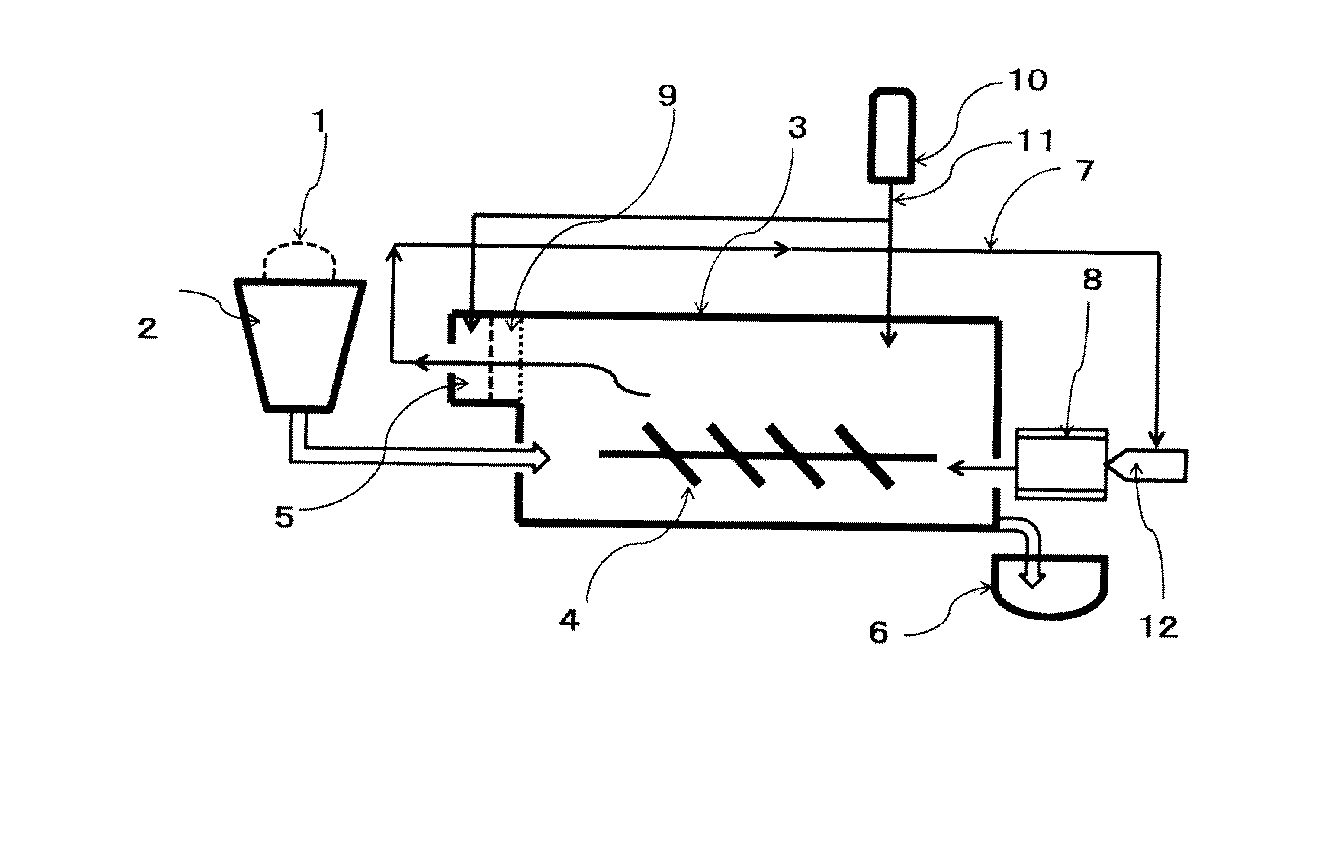
本発明の鶏糞を炭化または灰化するためのロータリーキルン型低温熱処理炉装置の概略構成を図1に示した。 A schematic configuration of a rotary kiln type low temperature heat treatment furnace apparatus for carbonizing or ashing chicken manure of the present invention is shown in FIG.
原料として投入使用する鶏糞1は、鶏舎から直接排出される生の鶏糞を使用する。鶏糞は他の家畜糞に比較し、排泄された時点での水分含有率が低く、そのまま炉の中に投入してもエネルギーの消費が少なくて済む。鶏糞を堆肥化して肥料として利用されているものも原料として使用して差し支えない。なお他の家畜糞、例えば豚糞なども原料として炭化または灰化が可能であるが、乾燥処理などの前処理による水分調整などが必要となることに加え、灰化物の利用においても鶏糞のそれに比較し有用性が低いため原料としては最良ではない。 The poultry manure 1 used as a raw material is raw chicken manure discharged directly from the poultry house. Compared with other livestock feces, chicken manure has a low water content when it is excreted, and even if it is put into the furnace as it is, it consumes less energy. What is composted chicken manure and used as fertilizer can also be used as a raw material. Other livestock dung, such as pig dung, can be carbonized or incinerated as a raw material, but in addition to the need for moisture adjustment by pretreatment such as drying treatment, in addition to the use of ashed products, Compared to its low usefulness, it is not the best raw material.
鶏糞1は無機成分が多く、かさ比重が高いためロータリーキルン型の熱処理炉での処理が最適である。鶏糞1は撹拌機が設けられた投入ホッパー2から搬送スクリューにより搬送されてロータリーキルン3に入る。炉の径や羽根4の大きさや形などは原料の鶏糞1の炉内搬送に適した設計が必要であるが、その構造は特に限定されない。
Since chicken manure 1 has many inorganic components and has a high bulk specific gravity, the treatment in a rotary kiln type heat treatment furnace is optimal. The chicken manure 1 is conveyed by a conveying screw from a
重質ガス分解装置5は炉内または、炉に接して直結されていることが必要である。粉塵を除去するための集塵装置9などを重質ガス分解装置5の手前に設けることもできる。バーナーポンプなどを備えた熱風発生装置8により熱風を炉内に送り込み、鶏糞1の炭化または灰化を行う。鶏糞1の熱分解により発生する常温ではタール状物質となる重質ガスは、重質ガス分解装置5を通過することにより発生と同時または極めて短時間のうちに触媒と接触させて低分子の熱分解ガスに変換させる。このことにより炉内のタール状物質発生とその堆積を極少にすることができる。
The heavy
重質ガス分解装置5の内部構造は特に限定されず、発生する重質ガスが内部に装填された触媒に効率よく接触するように設計されていれば良い。なお、触媒の劣化と消耗を防止する目的で、重質ガス分解装置5内へ必要に応じて窒素やアルゴンなどの不活性ガスを、不活性ガス供給装置10から配管11を通して導入することもできる。またこの不活性ガスはロータリーキルン3内にも導入することができ、それにより炉内の酸素濃度を制御し、炭化または灰化の制御をすることができる。得られる炭化物、灰化物の性能や機能に応じて不活性ガスの導入量を増減する。
The internal structure of the heavy
炉内の酸素濃度が3%を超えない範囲で運転すると炭化物を収率よく製造できる。得られる炭化物は、従来技術の低温で得られる炭化物に比較し、表面に付着したり内部に侵入したりしたタール状物質が少ないため異臭が少なく土壌改良剤などとして有用である。また同じく酸素濃度が15%を超える範囲で運転すると有機分の少ない灰化物が得られ、肥料用やリン資源用として活用できる。 When the oxygen concentration in the furnace is operated within a range not exceeding 3%, the carbide can be produced with good yield. Compared with the carbides obtained at a low temperature of the prior art, the obtained carbides are less odorous and less useful as a soil conditioner because they have less tar-like substances adhering to the surface or entering the interior. Similarly, when the oxygen concentration is in a range exceeding 15%, an ash with a small amount of organic matter can be obtained, which can be used for fertilizer and phosphorus resources.
炉内での処理温度は500℃から700℃の範囲が良く、500℃未満だと重質ガス分解装置5の能力が十分に発揮されずタール物質の堆積が生じ易くなり、700℃を超えると熱風発生装置8に供給する燃料の使用量、すなわちエネルギーが多大になり好ましくない。使用するエネルギーと重質ガス分解装置5の機能、また炭酸カルシウムの酸化カルシウムへの変化を防ぐことを考慮すると550℃から650℃の範囲が最も好ましい。
The treatment temperature in the furnace is preferably in the range of 500 ° C. to 700 ° C. If the temperature is less than 500 ° C., the ability of the heavy
炉内処理温度が700℃を超えると炉の材料も安価なセメント系セラミックや鉄材では耐熱性に問題が生じ、高価なクロム系セラミックやインコネルなどを使用しなくてはならず設備費が高くなり好ましくない。材料の低価格化により、実質的に概略70%の設備費低減が可能となり、単純に試算しても生成物である鶏糞炭化物や鶏糞灰の製造コストを50%以上カットすることができる。 If the temperature in the furnace exceeds 700 ° C, the material of the furnace will also have problems with heat resistance in cheap cement-based ceramics and iron materials, and expensive chrome-based ceramics and Inconel will have to be used, resulting in high equipment costs. It is not preferable. By reducing the price of materials, it is possible to substantially reduce the equipment cost by about 70%, and even if it is simply calculated, the production cost of chicken dung carbide and chicken dung ash as products can be cut by 50% or more.
重質ガス分解装置5に充填する触媒は、ニッケル担持褐炭およびニッケル担持アルミナを含むニッケル系触媒、あるいは、リモナイトを含む鉄系触媒などの第VIII族の金属系触媒が良い。特にニッケル担持褐炭は安価であり装置コストを低減できる。重質ガスが分解されて生成した水素や一酸化炭素、メタン、エチレン、エタンなどの低分子物質は分解ガス配管7を通りバーナー12に導かれ補助燃料として利用され、使用エネルギーの効率が向上する。
The catalyst charged in the heavy
鶏糞原料1は一定の処理の後、排出容器6に排出される。処理時間、すなわちロータリーキルン3内での滞留時間も得られる炭化物や灰化物の性質に影響を与える。処理時間については特に限定されないが、炭化物の残存が少ない、肥料やリン資源としての良質の灰化物を得るためには酸素濃度が15%の場合500℃ではおよそ1時間を越える処理が必要であり、700℃の場合でも40分程度以上を超えて処理する必要がある。これ以上の処理時間を要しても灰化物の成分や機能に大きな変化はなくエネルギーの損失となり好ましくない。もちろんこれら処理時間以内で得られる炭化物残存灰化物は土壌改良剤などとして利用できる。
The chicken manure raw material 1 is discharged into the discharge container 6 after a certain treatment. The treatment time, that is, the residence time in the
また鶏糞原料1にあらかじめ本発明のニッケル担持褐炭およびニッケル担持アルミナを含むニッケル系触媒、あるいは、リモナイトを含む鉄系触媒などの第VIII族の金属系触媒を混合した後、本発明の内熱式ロータリーキルン型低温熱処理炉装置で処理しても良い。この場合は排出された炭化物、灰化物から触媒を除去すれば良好な灰化物、炭化物がえられる。ロータリーキルン3内またはロータリーキルン3に接して直結して設けられた重質ガス分解装置5で処理した場合と同様に炉内へのタール状物質の堆積は少ない。
In addition, after mixing a nickel-based catalyst containing the nickel-supporting lignite and nickel-supporting alumina of the present invention or an iron-based catalyst including limonite with the chicken manure raw material 1 in advance, the internal heat type of the present invention is mixed. You may process with a rotary kiln type low-temperature heat treatment furnace apparatus. In this case, if the catalyst is removed from the discharged carbide and ash, a good ash and carbide can be obtained. As in the case of processing in the heavy
炉内の酸素濃度については特には限定されないが、肥料やリン資源としての利活用に良好な灰化物を得るためには、7%以上が好ましいが、15%を超えると処理時間が短くなりより好ましい。7%未満だと比較的長時間滞留処理しても、炭化物が残存する部分灰化物が得られる。3%以下の酸素濃度で処理すると、炭化物が収率よく得られる。なお、本発明による炭化または灰化炉においては、不活性ガスの導入により炉内酸素濃度を2%程度よりも低く制御したうえで、例えば水蒸気や、炭酸ガス、燃焼排ガスなどの賦活ガスを適宜炉内に導入すれば、例えば700℃で処理することで鶏糞活性炭が得られることはいうまでもない。 The oxygen concentration in the furnace is not particularly limited, but 7% or more is preferable in order to obtain a good ashed product for use as a fertilizer or phosphorus resource, but if it exceeds 15%, the treatment time becomes shorter. preferable. If it is less than 7%, a partially ashed product in which carbides remain is obtained even if the retention treatment is relatively long. When treated at an oxygen concentration of 3% or less, carbides can be obtained in good yield. In the carbonization or ashing furnace according to the present invention, the oxygen concentration in the furnace is controlled to be lower than about 2% by introducing an inert gas, and, for example, an activation gas such as water vapor, carbon dioxide gas, or combustion exhaust gas is appropriately used. Needless to say, if it is introduced into the furnace, for example, chicken dung activated carbon can be obtained by treatment at 700 ° C.
以上、本発明の装置はロータリーキルン3内またはロータリーキルン3に接して直結した重質ガス分解装置5が設けられており、装置内でのタール状物質発生とその堆積が低減され、500℃から700℃という使用エネルギーの抑制された低温で最良の形態で実施されて得られる鶏糞の炭化物や灰化物は、低価格で肥料用、土壌改良剤用、リン資源用としてその性能、機能を利活用できる。
As described above, the apparatus of the present invention is provided with the heavy
以下、下表1〜表3を参照して、実施例について詳細に述べるが、本発明はこれらの実施例によって制限されるものではない。 Hereinafter, examples will be described in detail with reference to the following Tables 1 to 3, but the present invention is not limited to these examples.
<実施例1>
まず、上表1を参照して、38Kg/Hrの処理能力を有する、重質ガスの分解を促進するニッケル担持褐炭触媒が充填された重質ガス分解装置5がロータリーキルン3に接して直結して設けられた内熱式ロータリーキルン型低温熱処理炉装置により、ミヤマブロイラー株式会社より受領した水分44.3%のブロイラー鶏糞を炉内温度630℃、炉内酸素濃度7.8%、炉内滞留処理時間を50分とし、4時間連続運転して20Kgの鶏糞灰化物を得た。
<Example 1>
First, referring to Table 1, a heavy
得られた灰化物は、総リン19.5%、総カリウム16.3%、炭酸カルシウム12.4%、酸化カルシウム11.3%を含有する土壌改良剤、肥料、リン資源として有用な灰化物であった。また同じ条件で1日4時間、10日間運転後も炉内にタール状物質の堆積は少なく、重質ガス分解装置5が極めて効果のあることが判明した。さらにまた使用した燃料は水分44.3%鶏糞1kg 処理するのに2.5という少量の灯油で可能となり、処理に使用するエネルギーが極めて少ないことがわかった。
The obtained ashed product is an ashed product useful as a soil conditioner, fertilizer, and phosphorus resource containing 19.5% total phosphorus, 16.3% total potassium, 12.4% calcium carbonate, and 11.3% calcium oxide. Met. In addition, it was found that the heavy
<実施例2〜実施例7>
次に、上表1および表2を参照して、実施例2〜実施例7には500℃から700℃、処理時間15分から120分、炉内の酸素濃度2.3%から15.6%で実施した例を上述した実施例1とあわせて表に示した。いずれもタールの発生がほとんど見られず、使用エネルギーも少なく、良好な土壌改良剤、肥料、リン資源として有用な炭化物または灰化物が得られた。さらにこれらの炭化物、灰化物はタール臭がほとんどなく、タール状物質の付着のないことが分かった。
<Example 2 to Example 7>
Next, referring to Table 1 and Table 2 above, in Examples 2 to 7, the temperature is 500 to 700 ° C., the treatment time is 15 to 120 minutes, and the oxygen concentration in the furnace is 2.3 to 15.6%. The example implemented in Table 1 is shown in the table together with Example 1 described above. In all cases, tar generation was hardly observed, energy consumption was low, and a good carbide or ash was obtained as a good soil conditioner, fertilizer, and phosphorus resource. Furthermore, it was found that these carbides and ash products have almost no tar odor and no adhesion of tar-like substances.
<実施例8>
次に、表2を参照して、株式会社トマルより受領した水分60%の採卵鶏の糞100重量部にあらかじめニッケル担持褐炭触媒を2重量部混合したもの10kgを、内熱式ロータリーキルン型低温熱処理炉装置により炉内温度600℃、炉内酸素濃度13.3%、炉内滞留処理時間30分で処理し、約2Kgの鶏糞灰化物および触媒の混合物を得た。この混合物から触媒粒子を篩い分けして得た灰化物は全くタール臭がなく、肥料成分も十分に存在し(表2参照)、炉内のタール状物質の堆積も全く見られない良好なものであった。
<Example 8>
Next, referring to Table 2, 10 kg of a mixture of 2 parts by weight of a nickel-supported lignite catalyst previously mixed with 100 parts by weight of a 60% moisture egg-laying chicken dung received from Tomar Co., Ltd., is subjected to an internal heating rotary kiln type low-temperature heat treatment. Using a furnace apparatus, the furnace temperature was 600 ° C., the furnace oxygen concentration was 13.3%, and the residence time in the furnace was 30 minutes to obtain about 2 kg of a mixture of chicken manure and catalyst. The ashed product obtained by sieving the catalyst particles from this mixture has no tar odor, fertilizer components are sufficiently present (see Table 2), and there is no deposit of tar-like substances in the furnace. Met.
<比較例1から比較例3>
次に、上表3を参照して、重質ガス分解装置5に重質ガスの分解を促進するニッケル担持褐炭触媒を充填しないほかはすべて同じ型式の内熱式ロータリーキルン型低温熱処理炉装置を用いて実施した例を比較例1から比較例3として、実施例1から実施例8と併せて表に示した。720℃で採卵鶏糞を酸素濃度8.2%、処理時間35分で処理した場合(比較例1)短持間に炉内にタール状物質が堆積すると同時に使用エネルギーも多く、また得られた炭化物又は灰化物はタール臭が強く、表面にタール状物質が付着していることが分かった。800℃で処理した例(比較例2)においても炉内へのタール状物質の堆積が多く、また800℃という比較的高温処理のため鶏糞中の炭酸カルシウムがほぼすべて酸化カルシウムに変換されており、肥料としての価値が低下していた。また480℃という低温の場合(比較例3)ではタール状物質の堆積が極めて多く、長時間運転に支障をきたすことが明白となった。
<Comparative Example 1 to Comparative Example 3>
Next, referring to Table 3 above, the internal gas type rotary kiln type low temperature heat treatment furnace apparatus of the same type is used except that the heavy
1…鶏糞、2…投入ホッパー、3…ロータリーキルン(ロータリーキルン型低温熱処理炉)、4…羽、5…重質ガス分解装置、6…排出容器、7…配管、8…熱風発生装置、9…集塵装置、10…不活性ガス供給装置、11…配管、12…バーナー。
DESCRIPTION OF SYMBOLS 1 ... Chicken manure, 2 ... Input hopper, 3 ... Rotary kiln (rotary kiln type low-temperature heat treatment furnace), 4 ... Feather, 5 ... Heavy gas decomposition device, 6 ... Discharge container, 7 ... Piping, 8 ... Hot-air generator, 9 ... Collection Dust device, 10 ... inert gas supply device, 11 ... piping, 12 ... burner.
Claims (3)
内熱式のロータリーキルンと、
前記ロータリーキルン内または該ロータリーキルンに接して直結して、該ロータリーキルンによる鶏糞の熱処理により発生する常温ではタール物質となる重質ガスの分解を促進する触媒が充填された重質ガス分解装置と
を備え、
前記重質ガス分解装置から排出された熱分解ガスを前記ロータリーキルンのバーナーに導き補助燃料として使用することを特徴とする鶏糞処理装置。 A chicken manure treatment device for carbonizing or ashing chicken manure,
With internal heat type rotary kiln,
A heavy gas decomposing apparatus filled with a catalyst that promotes decomposition of heavy gas that becomes tar substance at room temperature generated by heat treatment of chicken manure by the rotary kiln, directly connected to or in contact with the rotary kiln,
The chicken manure processing apparatus, wherein the pyrolysis gas discharged from the heavy gas decomposition apparatus is guided to a burner of the rotary kiln and used as an auxiliary fuel.
前記重質ガス分解装置に充填される触媒は、ニッケル担持褐炭およびニッケル担持アルミナを含むニッケル系触媒、あるいは、リモナイトを含む鉄系触媒などの第VIII族の金属系触媒であることを特徴とする鶏糞処理装置。 In the chicken excrement processing apparatus according to claim 1,
The catalyst charged in the heavy gas decomposition apparatus is a nickel-based catalyst including nickel-supported lignite and nickel-supported alumina, or a Group VIII metal-based catalyst such as an iron-based catalyst including limonite. Chicken manure processing equipment.
前記ロータリーキルンによる鶏糞の熱処理温度が500℃から700℃の範囲内であることを特徴とする鶏糞処理装置。 In the chicken dung processing apparatus according to claim 1 or 2,
The chicken feces treatment apparatus, wherein the heat treatment temperature of the chicken feces by the rotary kiln is in the range of 500 ° C to 700 ° C.
Priority Applications (1)
| Application Number | Priority Date | Filing Date | Title |
|---|---|---|---|
| JP2010242587A JP2012092270A (en) | 2010-10-28 | 2010-10-28 | Apparatus for treating chicken manure |
Applications Claiming Priority (1)
| Application Number | Priority Date | Filing Date | Title |
|---|---|---|---|
| JP2010242587A JP2012092270A (en) | 2010-10-28 | 2010-10-28 | Apparatus for treating chicken manure |
Publications (1)
| Publication Number | Publication Date |
|---|---|
| JP2012092270A true JP2012092270A (en) | 2012-05-17 |
Family
ID=46385992
Family Applications (1)
| Application Number | Title | Priority Date | Filing Date |
|---|---|---|---|
| JP2010242587A Pending JP2012092270A (en) | 2010-10-28 | 2010-10-28 | Apparatus for treating chicken manure |
Country Status (1)
| Country | Link |
|---|---|
| JP (1) | JP2012092270A (en) |
Cited By (4)
| Publication number | Priority date | Publication date | Assignee | Title |
|---|---|---|---|---|
| JP2014035105A (en) * | 2012-08-07 | 2014-02-24 | Kinsei Sangyo:Kk | Livestock feces incineration device |
| CN106085480A (en) * | 2016-08-11 | 2016-11-09 | 北京神雾环境能源科技集团股份有限公司 | A kind of pyrolysis installation and gas-based shaft kiln combined system and the method for process coal |
| CN114249611A (en) * | 2022-02-28 | 2022-03-29 | 山东聚义兴生物工程有限公司 | Small-molecule organic protein fertilizer and preparation method thereof |
| JP2023033872A (en) * | 2021-08-30 | 2023-03-13 | 国立研究開発法人農業・食品産業技術総合研究機構 | Carbide Fertilizer Production Method and Carbide Fertilizer |
Citations (2)
| Publication number | Priority date | Publication date | Assignee | Title |
|---|---|---|---|---|
| JP2004277578A (en) * | 2003-03-17 | 2004-10-07 | Toomu:Kk | Charring apparatus |
| JP2008246452A (en) * | 2007-03-30 | 2008-10-16 | Gunma Univ | Method for dry treatment of nitrogen-containing waste and apparatus therefor |
-
2010
- 2010-10-28 JP JP2010242587A patent/JP2012092270A/en active Pending
Patent Citations (2)
| Publication number | Priority date | Publication date | Assignee | Title |
|---|---|---|---|---|
| JP2004277578A (en) * | 2003-03-17 | 2004-10-07 | Toomu:Kk | Charring apparatus |
| JP2008246452A (en) * | 2007-03-30 | 2008-10-16 | Gunma Univ | Method for dry treatment of nitrogen-containing waste and apparatus therefor |
Non-Patent Citations (1)
| Title |
|---|
| JPN6015000875; 'Ni担持褐炭を利用したバイオマスタールの低温接触水蒸気改質' 石炭科学会議発表論文集 Vol.43, 20061012, p.67-68 * |
Cited By (5)
| Publication number | Priority date | Publication date | Assignee | Title |
|---|---|---|---|---|
| JP2014035105A (en) * | 2012-08-07 | 2014-02-24 | Kinsei Sangyo:Kk | Livestock feces incineration device |
| CN106085480A (en) * | 2016-08-11 | 2016-11-09 | 北京神雾环境能源科技集团股份有限公司 | A kind of pyrolysis installation and gas-based shaft kiln combined system and the method for process coal |
| JP2023033872A (en) * | 2021-08-30 | 2023-03-13 | 国立研究開発法人農業・食品産業技術総合研究機構 | Carbide Fertilizer Production Method and Carbide Fertilizer |
| JP7725055B2 (en) | 2021-08-30 | 2025-08-19 | 国立研究開発法人農業・食品産業技術総合研究機構 | Manufacturing method of carbide fertilizer |
| CN114249611A (en) * | 2022-02-28 | 2022-03-29 | 山东聚义兴生物工程有限公司 | Small-molecule organic protein fertilizer and preparation method thereof |
Similar Documents
| Publication | Publication Date | Title |
|---|---|---|
| CN105505414B (en) | A kind of solid refuse anaerobic catalytic thermocracking process | |
| Finney et al. | The reuse of spent mushroom compost and coal tailings for energy recovery: comparison of thermal treatment technologies | |
| CN100462315C (en) | A Comprehensive Waste Treatment Method Suitable for Villages and Towns | |
| CN109679672B (en) | A reaction system and method for preparing gaseous fuel by catalytic pyrolysis of organic solid waste | |
| CN108059160B (en) | A kind of production method of bamboo charcoal and carbonization device used in the method | |
| CN203791331U (en) | System for synergistic treatment of municipal domestic waste in cement kiln | |
| Xiao et al. | Catalytic steam gasification of biomass in fluidized bed at low temperature: conversion from livestock manure compost to hydrogen-rich syngas | |
| CN203991628U (en) | A kind for the treatment of apparatus that efficiently utilizes MSW heating value | |
| CN203265240U (en) | Device for preparing fuel gas by utilizing domestic garbage and generating power by utilizing fuel gas | |
| CN108165287B (en) | Anaerobic thermal cracking method and system for sticky garbage | |
| WO2011140401A2 (en) | Method and apparatus for continuous production of carbonaceous pyrolysis by-products | |
| CN103658157A (en) | Processing method of solid waste homogeneity modified gasification cleaning electricity generation | |
| CN103934254A (en) | System and method utilizing cement klin to co-process city household garbage | |
| CN102504843B (en) | Heat accumulation type fuel gas radiation pipe rotary hearth furnace domestic garbage dry distillation method | |
| CN106433799A (en) | System and method for disposing household garbage | |
| WO2011128513A1 (en) | A waste refining method | |
| CN114181722A (en) | Multi-source solid waste cooperative heat treatment device and method | |
| CN107699294B (en) | Green island type urban and rural organic waste harmless recycling treatment process | |
| CN203265244U (en) | Equipment for fuel gas preparation and gas power generation by virtue of household garbage | |
| JP2012092270A (en) | Apparatus for treating chicken manure | |
| CN105710114B (en) | Domestic garbage and agricultural and forestry waste carbonization cycle comprehensive treatment system and method | |
| CN2697475Y (en) | Screened pyrolyzing treatment furnace for domestic refuse | |
| JP5117251B2 (en) | Nanocarbon and carbide continuous production equipment | |
| CN108467740A (en) | A kind of device preparing clean coal using pyrolysis of waste gasification partial carbonization | |
| CN110257093B (en) | Control method of carbonization system in biomass external heating method heat and carbon co-production system |
Legal Events
| Date | Code | Title | Description |
|---|---|---|---|
| A621 | Written request for application examination |
Free format text: JAPANESE INTERMEDIATE CODE: A621 Effective date: 20131028 |
|
| A131 | Notification of reasons for refusal |
Free format text: JAPANESE INTERMEDIATE CODE: A131 Effective date: 20150120 |
|
| A521 | Request for written amendment filed |
Free format text: JAPANESE INTERMEDIATE CODE: A523 Effective date: 20150323 |
|
| A02 | Decision of refusal |
Free format text: JAPANESE INTERMEDIATE CODE: A02 Effective date: 20150929 |