JP2012061008A - P-glycoprotein and use thereof - Google Patents
P-glycoprotein and use thereof Download PDFInfo
- Publication number
- JP2012061008A JP2012061008A JP2011284080A JP2011284080A JP2012061008A JP 2012061008 A JP2012061008 A JP 2012061008A JP 2011284080 A JP2011284080 A JP 2011284080A JP 2011284080 A JP2011284080 A JP 2011284080A JP 2012061008 A JP2012061008 A JP 2012061008A
- Authority
- JP
- Japan
- Prior art keywords
- pgp
- canine
- seq
- glycoprotein
- polypeptide
- Prior art date
- Legal status (The legal status is an assumption and is not a legal conclusion. Google has not performed a legal analysis and makes no representation as to the accuracy of the status listed.)
- Withdrawn
Links
- 102100033350 ATP-dependent translocase ABCB1 Human genes 0.000 title abstract description 134
- 108010047230 Member 1 Subfamily B ATP Binding Cassette Transporter Proteins 0.000 title abstract description 106
- 108090000765 processed proteins & peptides Proteins 0.000 abstract description 189
- 102000004196 processed proteins & peptides Human genes 0.000 abstract description 185
- 229920001184 polypeptide Polymers 0.000 abstract description 177
- 150000007523 nucleic acids Chemical class 0.000 abstract description 163
- 102000039446 nucleic acids Human genes 0.000 abstract description 145
- 108020004707 nucleic acids Proteins 0.000 abstract description 145
- 239000012634 fragment Substances 0.000 abstract description 123
- 238000000034 method Methods 0.000 abstract description 114
- 230000000694 effects Effects 0.000 abstract description 62
- 239000003814 drug Substances 0.000 abstract description 51
- 150000001413 amino acids Chemical class 0.000 abstract description 50
- 229940079593 drug Drugs 0.000 abstract description 48
- 230000014509 gene expression Effects 0.000 abstract description 45
- 239000003112 inhibitor Substances 0.000 abstract description 11
- 229940049937 Pgp inhibitor Drugs 0.000 abstract description 10
- 238000012216 screening Methods 0.000 abstract description 8
- 230000002401 inhibitory effect Effects 0.000 abstract description 6
- 108010091105 Subfamily B ATP Binding Cassette Transporter Proteins 0.000 abstract description 4
- 102000018075 Subfamily B ATP Binding Cassette Transporter Human genes 0.000 abstract description 4
- 241000282465 Canis Species 0.000 description 182
- 210000004027 cell Anatomy 0.000 description 121
- 241000282472 Canis lupus familiaris Species 0.000 description 84
- 235000001014 amino acid Nutrition 0.000 description 78
- 239000002773 nucleotide Substances 0.000 description 72
- 125000003729 nucleotide group Chemical group 0.000 description 72
- 125000003275 alpha amino acid group Chemical group 0.000 description 57
- 229940024606 amino acid Drugs 0.000 description 56
- 150000001875 compounds Chemical class 0.000 description 47
- 230000032258 transport Effects 0.000 description 46
- 238000003556 assay Methods 0.000 description 44
- 238000003752 polymerase chain reaction Methods 0.000 description 42
- 239000013598 vector Substances 0.000 description 41
- 108090000623 proteins and genes Proteins 0.000 description 40
- 230000008859 change Effects 0.000 description 39
- 239000002299 complementary DNA Substances 0.000 description 39
- 230000027455 binding Effects 0.000 description 36
- 241000282414 Homo sapiens Species 0.000 description 35
- 108020004414 DNA Proteins 0.000 description 29
- 108091034117 Oligonucleotide Proteins 0.000 description 29
- 238000012360 testing method Methods 0.000 description 29
- 239000000203 mixture Substances 0.000 description 27
- 102000004169 proteins and genes Human genes 0.000 description 25
- 239000002831 pharmacologic agent Substances 0.000 description 23
- 235000018102 proteins Nutrition 0.000 description 23
- 238000006467 substitution reaction Methods 0.000 description 21
- 239000013604 expression vector Substances 0.000 description 20
- XLYOFNOQVPJJNP-UHFFFAOYSA-N water Substances O XLYOFNOQVPJJNP-UHFFFAOYSA-N 0.000 description 19
- LFQSCWFLJHTTHZ-UHFFFAOYSA-N Ethanol Chemical compound CCO LFQSCWFLJHTTHZ-UHFFFAOYSA-N 0.000 description 18
- 239000003795 chemical substances by application Substances 0.000 description 18
- 108091032973 (ribonucleotides)n+m Proteins 0.000 description 17
- 108700028369 Alleles Proteins 0.000 description 17
- 102100032912 CD44 antigen Human genes 0.000 description 17
- 101000868273 Homo sapiens CD44 antigen Proteins 0.000 description 17
- 239000000872 buffer Substances 0.000 description 17
- 238000002360 preparation method Methods 0.000 description 17
- 239000000126 substance Substances 0.000 description 17
- 108091006112 ATPases Proteins 0.000 description 16
- 102000057290 Adenosine Triphosphatases Human genes 0.000 description 16
- 241001465754 Metazoa Species 0.000 description 15
- 108091028043 Nucleic acid sequence Proteins 0.000 description 15
- 108020004705 Codon Proteins 0.000 description 14
- JLCPHMBAVCMARE-UHFFFAOYSA-N [3-[[3-[[3-[[3-[[3-[[3-[[3-[[3-[[3-[[3-[[3-[[5-(2-amino-6-oxo-1H-purin-9-yl)-3-[[3-[[3-[[3-[[3-[[3-[[5-(2-amino-6-oxo-1H-purin-9-yl)-3-[[5-(2-amino-6-oxo-1H-purin-9-yl)-3-hydroxyoxolan-2-yl]methoxy-hydroxyphosphoryl]oxyoxolan-2-yl]methoxy-hydroxyphosphoryl]oxy-5-(5-methyl-2,4-dioxopyrimidin-1-yl)oxolan-2-yl]methoxy-hydroxyphosphoryl]oxy-5-(6-aminopurin-9-yl)oxolan-2-yl]methoxy-hydroxyphosphoryl]oxy-5-(6-aminopurin-9-yl)oxolan-2-yl]methoxy-hydroxyphosphoryl]oxy-5-(6-aminopurin-9-yl)oxolan-2-yl]methoxy-hydroxyphosphoryl]oxy-5-(6-aminopurin-9-yl)oxolan-2-yl]methoxy-hydroxyphosphoryl]oxyoxolan-2-yl]methoxy-hydroxyphosphoryl]oxy-5-(5-methyl-2,4-dioxopyrimidin-1-yl)oxolan-2-yl]methoxy-hydroxyphosphoryl]oxy-5-(4-amino-2-oxopyrimidin-1-yl)oxolan-2-yl]methoxy-hydroxyphosphoryl]oxy-5-(5-methyl-2,4-dioxopyrimidin-1-yl)oxolan-2-yl]methoxy-hydroxyphosphoryl]oxy-5-(5-methyl-2,4-dioxopyrimidin-1-yl)oxolan-2-yl]methoxy-hydroxyphosphoryl]oxy-5-(6-aminopurin-9-yl)oxolan-2-yl]methoxy-hydroxyphosphoryl]oxy-5-(6-aminopurin-9-yl)oxolan-2-yl]methoxy-hydroxyphosphoryl]oxy-5-(4-amino-2-oxopyrimidin-1-yl)oxolan-2-yl]methoxy-hydroxyphosphoryl]oxy-5-(4-amino-2-oxopyrimidin-1-yl)oxolan-2-yl]methoxy-hydroxyphosphoryl]oxy-5-(4-amino-2-oxopyrimidin-1-yl)oxolan-2-yl]methoxy-hydroxyphosphoryl]oxy-5-(6-aminopurin-9-yl)oxolan-2-yl]methoxy-hydroxyphosphoryl]oxy-5-(4-amino-2-oxopyrimidin-1-yl)oxolan-2-yl]methyl [5-(6-aminopurin-9-yl)-2-(hydroxymethyl)oxolan-3-yl] hydrogen phosphate Chemical class Cc1cn(C2CC(OP(O)(=O)OCC3OC(CC3OP(O)(=O)OCC3OC(CC3O)n3cnc4c3nc(N)[nH]c4=O)n3cnc4c3nc(N)[nH]c4=O)C(COP(O)(=O)OC3CC(OC3COP(O)(=O)OC3CC(OC3COP(O)(=O)OC3CC(OC3COP(O)(=O)OC3CC(OC3COP(O)(=O)OC3CC(OC3COP(O)(=O)OC3CC(OC3COP(O)(=O)OC3CC(OC3COP(O)(=O)OC3CC(OC3COP(O)(=O)OC3CC(OC3COP(O)(=O)OC3CC(OC3COP(O)(=O)OC3CC(OC3COP(O)(=O)OC3CC(OC3COP(O)(=O)OC3CC(OC3COP(O)(=O)OC3CC(OC3COP(O)(=O)OC3CC(OC3COP(O)(=O)OC3CC(OC3COP(O)(=O)OC3CC(OC3CO)n3cnc4c(N)ncnc34)n3ccc(N)nc3=O)n3cnc4c(N)ncnc34)n3ccc(N)nc3=O)n3ccc(N)nc3=O)n3ccc(N)nc3=O)n3cnc4c(N)ncnc34)n3cnc4c(N)ncnc34)n3cc(C)c(=O)[nH]c3=O)n3cc(C)c(=O)[nH]c3=O)n3ccc(N)nc3=O)n3cc(C)c(=O)[nH]c3=O)n3cnc4c3nc(N)[nH]c4=O)n3cnc4c(N)ncnc34)n3cnc4c(N)ncnc34)n3cnc4c(N)ncnc34)n3cnc4c(N)ncnc34)O2)c(=O)[nH]c1=O JLCPHMBAVCMARE-UHFFFAOYSA-N 0.000 description 14
- 239000000074 antisense oligonucleotide Substances 0.000 description 13
- 238000012230 antisense oligonucleotides Methods 0.000 description 13
- 239000012528 membrane Substances 0.000 description 13
- 210000004379 membrane Anatomy 0.000 description 13
- 150000003839 salts Chemical class 0.000 description 13
- 239000000523 sample Substances 0.000 description 13
- 238000007792 addition Methods 0.000 description 12
- 239000006228 supernatant Substances 0.000 description 12
- 210000001519 tissue Anatomy 0.000 description 12
- 230000000692 anti-sense effect Effects 0.000 description 11
- 239000000427 antigen Substances 0.000 description 11
- 108091007433 antigens Proteins 0.000 description 11
- 102000036639 antigens Human genes 0.000 description 11
- 238000006243 chemical reaction Methods 0.000 description 11
- 210000004962 mammalian cell Anatomy 0.000 description 11
- 241000700605 Viruses Species 0.000 description 10
- 239000008367 deionised water Substances 0.000 description 10
- 229910021641 deionized water Inorganic materials 0.000 description 10
- 239000000499 gel Substances 0.000 description 10
- 230000032895 transmembrane transport Effects 0.000 description 10
- -1 cationic lipid Chemical class 0.000 description 9
- 238000010367 cloning Methods 0.000 description 9
- 230000001965 increasing effect Effects 0.000 description 9
- 239000002502 liposome Substances 0.000 description 9
- 108020004999 messenger RNA Proteins 0.000 description 9
- 230000035772 mutation Effects 0.000 description 9
- 239000008188 pellet Substances 0.000 description 9
- 239000013612 plasmid Substances 0.000 description 9
- 239000000243 solution Substances 0.000 description 9
- 238000013518 transcription Methods 0.000 description 9
- 230000035897 transcription Effects 0.000 description 9
- 230000009261 transgenic effect Effects 0.000 description 9
- 108020000948 Antisense Oligonucleotides Proteins 0.000 description 8
- 108091026890 Coding region Proteins 0.000 description 8
- KFZMGEQAYNKOFK-UHFFFAOYSA-N Isopropanol Chemical compound CC(C)O KFZMGEQAYNKOFK-UHFFFAOYSA-N 0.000 description 8
- 239000003153 chemical reaction reagent Substances 0.000 description 8
- 238000001514 detection method Methods 0.000 description 8
- 238000000338 in vitro Methods 0.000 description 8
- 238000002955 isolation Methods 0.000 description 8
- 230000004048 modification Effects 0.000 description 8
- 238000012986 modification Methods 0.000 description 8
- 239000000047 product Substances 0.000 description 8
- 239000007787 solid Substances 0.000 description 8
- 241000894007 species Species 0.000 description 8
- 239000000758 substrate Substances 0.000 description 8
- 238000013519 translation Methods 0.000 description 8
- 238000011282 treatment Methods 0.000 description 8
- 241000702421 Dependoparvovirus Species 0.000 description 7
- 108010021625 Immunoglobulin Fragments Proteins 0.000 description 7
- 102000008394 Immunoglobulin Fragments Human genes 0.000 description 7
- 230000000295 complement effect Effects 0.000 description 7
- 238000012217 deletion Methods 0.000 description 7
- 230000037430 deletion Effects 0.000 description 7
- ZDXPYRJPNDTMRX-UHFFFAOYSA-N glutamine Natural products OC(=O)C(N)CCC(N)=O ZDXPYRJPNDTMRX-UHFFFAOYSA-N 0.000 description 7
- 238000011534 incubation Methods 0.000 description 7
- 230000003993 interaction Effects 0.000 description 7
- 150000002611 lead compounds Chemical class 0.000 description 7
- 239000003446 ligand Substances 0.000 description 7
- 230000004044 response Effects 0.000 description 7
- 238000003786 synthesis reaction Methods 0.000 description 7
- 230000001225 therapeutic effect Effects 0.000 description 7
- FWMNVWWHGCHHJJ-SKKKGAJSSA-N 4-amino-1-[(2r)-6-amino-2-[[(2r)-2-[[(2r)-2-[[(2r)-2-amino-3-phenylpropanoyl]amino]-3-phenylpropanoyl]amino]-4-methylpentanoyl]amino]hexanoyl]piperidine-4-carboxylic acid Chemical compound C([C@H](C(=O)N[C@H](CC(C)C)C(=O)N[C@H](CCCCN)C(=O)N1CCC(N)(CC1)C(O)=O)NC(=O)[C@H](N)CC=1C=CC=CC=1)C1=CC=CC=C1 FWMNVWWHGCHHJJ-SKKKGAJSSA-N 0.000 description 6
- QTBSBXVTEAMEQO-UHFFFAOYSA-N Acetic acid Chemical compound CC(O)=O QTBSBXVTEAMEQO-UHFFFAOYSA-N 0.000 description 6
- 108010078791 Carrier Proteins Proteins 0.000 description 6
- 241000701022 Cytomegalovirus Species 0.000 description 6
- 101000605077 Homo sapiens Glycerol-3-phosphate phosphatase Proteins 0.000 description 6
- GRRNUXAQVGOGFE-UHFFFAOYSA-N Hygromycin-B Natural products OC1C(NC)CC(N)C(O)C1OC1C2OC3(C(C(O)C(O)C(C(N)CO)O3)O)OC2C(O)C(CO)O1 GRRNUXAQVGOGFE-UHFFFAOYSA-N 0.000 description 6
- 108700026244 Open Reading Frames Proteins 0.000 description 6
- FAPWRFPIFSIZLT-UHFFFAOYSA-M Sodium chloride Chemical compound [Na+].[Cl-] FAPWRFPIFSIZLT-UHFFFAOYSA-M 0.000 description 6
- KRKNYBCHXYNGOX-UHFFFAOYSA-N citric acid Chemical compound OC(=O)CC(O)(C(O)=O)CC(O)=O KRKNYBCHXYNGOX-UHFFFAOYSA-N 0.000 description 6
- 208000037265 diseases, disorders, signs and symptoms Diseases 0.000 description 6
- 108020001507 fusion proteins Proteins 0.000 description 6
- 102000037865 fusion proteins Human genes 0.000 description 6
- GRRNUXAQVGOGFE-NZSRVPFOSA-N hygromycin B Chemical compound O[C@@H]1[C@@H](NC)C[C@@H](N)[C@H](O)[C@H]1O[C@H]1[C@H]2O[C@@]3([C@@H]([C@@H](O)[C@@H](O)[C@@H](C(N)CO)O3)O)O[C@H]2[C@@H](O)[C@@H](CO)O1 GRRNUXAQVGOGFE-NZSRVPFOSA-N 0.000 description 6
- 229940097277 hygromycin b Drugs 0.000 description 6
- 239000007788 liquid Substances 0.000 description 6
- 239000002609 medium Substances 0.000 description 6
- 238000000926 separation method Methods 0.000 description 6
- 241001430294 unidentified retrovirus Species 0.000 description 6
- 239000003981 vehicle Substances 0.000 description 6
- 230000003612 virological effect Effects 0.000 description 6
- 239000004475 Arginine Substances 0.000 description 5
- 102000004190 Enzymes Human genes 0.000 description 5
- 108090000790 Enzymes Proteins 0.000 description 5
- 241000288906 Primates Species 0.000 description 5
- DBMJMQXJHONAFJ-UHFFFAOYSA-M Sodium laurylsulphate Chemical compound [Na+].CCCCCCCCCCCCOS([O-])(=O)=O DBMJMQXJHONAFJ-UHFFFAOYSA-M 0.000 description 5
- AYFVYJQAPQTCCC-UHFFFAOYSA-N Threonine Natural products CC(O)C(N)C(O)=O AYFVYJQAPQTCCC-UHFFFAOYSA-N 0.000 description 5
- 239000004473 Threonine Substances 0.000 description 5
- KZSNJWFQEVHDMF-UHFFFAOYSA-N Valine Natural products CC(C)C(N)C(O)=O KZSNJWFQEVHDMF-UHFFFAOYSA-N 0.000 description 5
- 239000002253 acid Substances 0.000 description 5
- ODKSFYDXXFIFQN-UHFFFAOYSA-N arginine Natural products OC(=O)C(N)CCCNC(N)=N ODKSFYDXXFIFQN-UHFFFAOYSA-N 0.000 description 5
- 230000001580 bacterial effect Effects 0.000 description 5
- 239000011324 bead Substances 0.000 description 5
- 230000015572 biosynthetic process Effects 0.000 description 5
- 201000010099 disease Diseases 0.000 description 5
- 238000005516 engineering process Methods 0.000 description 5
- 230000002068 genetic effect Effects 0.000 description 5
- HNDVDQJCIGZPNO-UHFFFAOYSA-N histidine Natural products OC(=O)C(N)CC1=CN=CN1 HNDVDQJCIGZPNO-UHFFFAOYSA-N 0.000 description 5
- 238000009396 hybridization Methods 0.000 description 5
- 238000001727 in vivo Methods 0.000 description 5
- 230000001939 inductive effect Effects 0.000 description 5
- 230000005764 inhibitory process Effects 0.000 description 5
- 239000000463 material Substances 0.000 description 5
- 239000002245 particle Substances 0.000 description 5
- 230000000144 pharmacologic effect Effects 0.000 description 5
- 239000000725 suspension Substances 0.000 description 5
- 238000012546 transfer Methods 0.000 description 5
- 102000040811 transporter activity Human genes 0.000 description 5
- 108091092194 transporter activity Proteins 0.000 description 5
- 239000004474 valine Substances 0.000 description 5
- YBJHBAHKTGYVGT-ZKWXMUAHSA-N (+)-Biotin Chemical compound N1C(=O)N[C@@H]2[C@H](CCCCC(=O)O)SC[C@@H]21 YBJHBAHKTGYVGT-ZKWXMUAHSA-N 0.000 description 4
- DCXYFEDJOCDNAF-UHFFFAOYSA-N Asparagine Natural products OC(=O)C(N)CC(N)=O DCXYFEDJOCDNAF-UHFFFAOYSA-N 0.000 description 4
- 241000701044 Human gammaherpesvirus 4 Species 0.000 description 4
- 108010054477 Immunoglobulin Fab Fragments Proteins 0.000 description 4
- 102000001706 Immunoglobulin Fab Fragments Human genes 0.000 description 4
- DCXYFEDJOCDNAF-REOHCLBHSA-N L-asparagine Chemical compound OC(=O)[C@@H](N)CC(N)=O DCXYFEDJOCDNAF-REOHCLBHSA-N 0.000 description 4
- AGPKZVBTJJNPAG-WHFBIAKZSA-N L-isoleucine Chemical compound CC[C@H](C)[C@H](N)C(O)=O AGPKZVBTJJNPAG-WHFBIAKZSA-N 0.000 description 4
- KZSNJWFQEVHDMF-BYPYZUCNSA-N L-valine Chemical compound CC(C)[C@H](N)C(O)=O KZSNJWFQEVHDMF-BYPYZUCNSA-N 0.000 description 4
- 241000282567 Macaca fascicularis Species 0.000 description 4
- 241000699666 Mus <mouse, genus> Species 0.000 description 4
- NBIIXXVUZAFLBC-UHFFFAOYSA-N Phosphoric acid Chemical compound OP(O)(O)=O NBIIXXVUZAFLBC-UHFFFAOYSA-N 0.000 description 4
- MTCFGRXMJLQNBG-UHFFFAOYSA-N Serine Natural products OCC(N)C(O)=O MTCFGRXMJLQNBG-UHFFFAOYSA-N 0.000 description 4
- 239000011543 agarose gel Substances 0.000 description 4
- 125000000539 amino acid group Chemical group 0.000 description 4
- AVKUERGKIZMTKX-NJBDSQKTSA-N ampicillin Chemical compound C1([C@@H](N)C(=O)N[C@H]2[C@H]3SC([C@@H](N3C2=O)C(O)=O)(C)C)=CC=CC=C1 AVKUERGKIZMTKX-NJBDSQKTSA-N 0.000 description 4
- 229960000723 ampicillin Drugs 0.000 description 4
- 238000012197 amplification kit Methods 0.000 description 4
- 239000005557 antagonist Substances 0.000 description 4
- 229960001230 asparagine Drugs 0.000 description 4
- 235000009582 asparagine Nutrition 0.000 description 4
- 239000011230 binding agent Substances 0.000 description 4
- 210000000170 cell membrane Anatomy 0.000 description 4
- 125000003636 chemical group Chemical group 0.000 description 4
- 239000003937 drug carrier Substances 0.000 description 4
- 238000001962 electrophoresis Methods 0.000 description 4
- ZMMJGEGLRURXTF-UHFFFAOYSA-N ethidium bromide Chemical compound [Br-].C12=CC(N)=CC=C2C2=CC=C(N)C=C2[N+](CC)=C1C1=CC=CC=C1 ZMMJGEGLRURXTF-UHFFFAOYSA-N 0.000 description 4
- 238000001990 intravenous administration Methods 0.000 description 4
- AGPKZVBTJJNPAG-UHFFFAOYSA-N isoleucine Natural products CCC(C)C(N)C(O)=O AGPKZVBTJJNPAG-UHFFFAOYSA-N 0.000 description 4
- 229960000310 isoleucine Drugs 0.000 description 4
- 210000004185 liver Anatomy 0.000 description 4
- 238000007899 nucleic acid hybridization Methods 0.000 description 4
- 238000002823 phage display Methods 0.000 description 4
- 239000008177 pharmaceutical agent Substances 0.000 description 4
- 239000008194 pharmaceutical composition Substances 0.000 description 4
- 239000000825 pharmaceutical preparation Substances 0.000 description 4
- 230000004962 physiological condition Effects 0.000 description 4
- 238000000159 protein binding assay Methods 0.000 description 4
- 238000000746 purification Methods 0.000 description 4
- 230000002285 radioactive effect Effects 0.000 description 4
- 230000010076 replication Effects 0.000 description 4
- 238000012163 sequencing technique Methods 0.000 description 4
- 150000003384 small molecules Chemical class 0.000 description 4
- 239000002904 solvent Substances 0.000 description 4
- 238000010561 standard procedure Methods 0.000 description 4
- 235000000346 sugar Nutrition 0.000 description 4
- 238000013268 sustained release Methods 0.000 description 4
- 239000012730 sustained-release form Substances 0.000 description 4
- 230000008685 targeting Effects 0.000 description 4
- 230000009466 transformation Effects 0.000 description 4
- LSGOVYNHVSXFFJ-UHFFFAOYSA-N vanadate(3-) Chemical compound [O-][V]([O-])([O-])=O LSGOVYNHVSXFFJ-UHFFFAOYSA-N 0.000 description 4
- OSBLTNPMIGYQGY-UHFFFAOYSA-N 2-amino-2-(hydroxymethyl)propane-1,3-diol;2-[2-[bis(carboxymethyl)amino]ethyl-(carboxymethyl)amino]acetic acid;boric acid Chemical compound OB(O)O.OCC(N)(CO)CO.OC(=O)CN(CC(O)=O)CCN(CC(O)=O)CC(O)=O OSBLTNPMIGYQGY-UHFFFAOYSA-N 0.000 description 3
- 102000012410 DNA Ligases Human genes 0.000 description 3
- 108010061982 DNA Ligases Proteins 0.000 description 3
- KCXVZYZYPLLWCC-UHFFFAOYSA-N EDTA Chemical compound OC(=O)CN(CC(O)=O)CCN(CC(O)=O)CC(O)=O KCXVZYZYPLLWCC-UHFFFAOYSA-N 0.000 description 3
- 108090000288 Glycoproteins Proteins 0.000 description 3
- 102000003886 Glycoproteins Human genes 0.000 description 3
- ONIBWKKTOPOVIA-BYPYZUCNSA-N L-Proline Chemical compound OC(=O)[C@@H]1CCCN1 ONIBWKKTOPOVIA-BYPYZUCNSA-N 0.000 description 3
- 206010028980 Neoplasm Diseases 0.000 description 3
- 108010067902 Peptide Library Proteins 0.000 description 3
- ONIBWKKTOPOVIA-UHFFFAOYSA-N Proline Natural products OC(=O)C1CCCN1 ONIBWKKTOPOVIA-UHFFFAOYSA-N 0.000 description 3
- OFOBLEOULBTSOW-UHFFFAOYSA-N Propanedioic acid Natural products OC(=O)CC(O)=O OFOBLEOULBTSOW-UHFFFAOYSA-N 0.000 description 3
- 238000012181 QIAquick gel extraction kit Methods 0.000 description 3
- 238000002105 Southern blotting Methods 0.000 description 3
- 239000008051 TBE buffer Substances 0.000 description 3
- JXLYSJRDGCGARV-WWYNWVTFSA-N Vinblastine Natural products O=C(O[C@H]1[C@](O)(C(=O)OC)[C@@H]2N(C)c3c(cc(c(OC)c3)[C@]3(C(=O)OC)c4[nH]c5c(c4CCN4C[C@](O)(CC)C[C@H](C3)C4)cccc5)[C@@]32[C@H]2[C@@]1(CC)C=CCN2CC3)C JXLYSJRDGCGARV-WWYNWVTFSA-N 0.000 description 3
- 150000007513 acids Chemical class 0.000 description 3
- 239000000556 agonist Substances 0.000 description 3
- 229960002685 biotin Drugs 0.000 description 3
- 239000011616 biotin Substances 0.000 description 3
- 238000010804 cDNA synthesis Methods 0.000 description 3
- 239000000969 carrier Substances 0.000 description 3
- 239000013553 cell monolayer Substances 0.000 description 3
- 238000004587 chromatography analysis Methods 0.000 description 3
- 238000003776 cleavage reaction Methods 0.000 description 3
- 230000007423 decrease Effects 0.000 description 3
- 235000014113 dietary fatty acids Nutrition 0.000 description 3
- 238000004520 electroporation Methods 0.000 description 3
- 230000002708 enhancing effect Effects 0.000 description 3
- 210000003527 eukaryotic cell Anatomy 0.000 description 3
- 238000002474 experimental method Methods 0.000 description 3
- 239000000284 extract Substances 0.000 description 3
- 229930195729 fatty acid Natural products 0.000 description 3
- 239000000194 fatty acid Substances 0.000 description 3
- 150000004665 fatty acids Chemical class 0.000 description 3
- 239000007943 implant Substances 0.000 description 3
- 230000010354 integration Effects 0.000 description 3
- 238000007918 intramuscular administration Methods 0.000 description 3
- 239000012160 loading buffer Substances 0.000 description 3
- 230000007774 longterm Effects 0.000 description 3
- 230000014759 maintenance of location Effects 0.000 description 3
- 238000010369 molecular cloning Methods 0.000 description 3
- 238000002703 mutagenesis Methods 0.000 description 3
- 231100000350 mutagenesis Toxicity 0.000 description 3
- 239000013642 negative control Substances 0.000 description 3
- 230000003287 optical effect Effects 0.000 description 3
- 150000002894 organic compounds Chemical class 0.000 description 3
- 230000010287 polarization Effects 0.000 description 3
- 239000011541 reaction mixture Substances 0.000 description 3
- 108020003175 receptors Proteins 0.000 description 3
- 230000002829 reductive effect Effects 0.000 description 3
- 108091008146 restriction endonucleases Proteins 0.000 description 3
- 230000007017 scission Effects 0.000 description 3
- 125000003607 serino group Chemical group [H]N([H])[C@]([H])(C(=O)[*])C(O[H])([H])[H] 0.000 description 3
- 239000011780 sodium chloride Substances 0.000 description 3
- 150000008163 sugars Chemical class 0.000 description 3
- 238000001890 transfection Methods 0.000 description 3
- 241000701161 unidentified adenovirus Species 0.000 description 3
- 238000011144 upstream manufacturing Methods 0.000 description 3
- 229960003048 vinblastine Drugs 0.000 description 3
- JXLYSJRDGCGARV-XQKSVPLYSA-N vincaleukoblastine Chemical compound C([C@@H](C[C@]1(C(=O)OC)C=2C(=CC3=C([C@]45[C@H]([C@@]([C@H](OC(C)=O)[C@]6(CC)C=CCN([C@H]56)CC4)(O)C(=O)OC)N3C)C=2)OC)C[C@@](C2)(O)CC)N2CCC2=C1NC1=CC=CC=C21 JXLYSJRDGCGARV-XQKSVPLYSA-N 0.000 description 3
- PUPZLCDOIYMWBV-UHFFFAOYSA-N (+/-)-1,3-Butanediol Chemical compound CC(O)CCO PUPZLCDOIYMWBV-UHFFFAOYSA-N 0.000 description 2
- GOJUJUVQIVIZAV-UHFFFAOYSA-N 2-amino-4,6-dichloropyrimidine-5-carbaldehyde Chemical group NC1=NC(Cl)=C(C=O)C(Cl)=N1 GOJUJUVQIVIZAV-UHFFFAOYSA-N 0.000 description 2
- OPIFSICVWOWJMJ-AEOCFKNESA-N 5-bromo-4-chloro-3-indolyl beta-D-galactoside Chemical compound O[C@@H]1[C@@H](O)[C@@H](O)[C@@H](CO)O[C@H]1OC1=CNC2=CC=C(Br)C(Cl)=C12 OPIFSICVWOWJMJ-AEOCFKNESA-N 0.000 description 2
- 229920000936 Agarose Polymers 0.000 description 2
- USFZMSVCRYTOJT-UHFFFAOYSA-N Ammonium acetate Chemical compound N.CC(O)=O USFZMSVCRYTOJT-UHFFFAOYSA-N 0.000 description 2
- 239000005695 Ammonium acetate Substances 0.000 description 2
- 108010032595 Antibody Binding Sites Proteins 0.000 description 2
- CIWBSHSKHKDKBQ-JLAZNSOCSA-N Ascorbic acid Chemical compound OC[C@H](O)[C@H]1OC(=O)C(O)=C1O CIWBSHSKHKDKBQ-JLAZNSOCSA-N 0.000 description 2
- IJGRMHOSHXDMSA-UHFFFAOYSA-N Atomic nitrogen Chemical compound N#N IJGRMHOSHXDMSA-UHFFFAOYSA-N 0.000 description 2
- 108091003079 Bovine Serum Albumin Proteins 0.000 description 2
- 241000283707 Capra Species 0.000 description 2
- HEDRZPFGACZZDS-UHFFFAOYSA-N Chloroform Chemical compound ClC(Cl)Cl HEDRZPFGACZZDS-UHFFFAOYSA-N 0.000 description 2
- 108010047041 Complementarity Determining Regions Proteins 0.000 description 2
- 241000588724 Escherichia coli Species 0.000 description 2
- 108700039691 Genetic Promoter Regions Proteins 0.000 description 2
- WQZGKKKJIJFFOK-GASJEMHNSA-N Glucose Natural products OC[C@H]1OC(O)[C@H](O)[C@@H](O)[C@@H]1O WQZGKKKJIJFFOK-GASJEMHNSA-N 0.000 description 2
- DHMQDGOQFOQNFH-UHFFFAOYSA-N Glycine Chemical compound NCC(O)=O DHMQDGOQFOQNFH-UHFFFAOYSA-N 0.000 description 2
- 229920002527 Glycogen Polymers 0.000 description 2
- 239000012981 Hank's balanced salt solution Substances 0.000 description 2
- 241000238631 Hexapoda Species 0.000 description 2
- 241000282412 Homo Species 0.000 description 2
- 241000725303 Human immunodeficiency virus Species 0.000 description 2
- VEXZGXHMUGYJMC-UHFFFAOYSA-N Hydrochloric acid Chemical compound Cl VEXZGXHMUGYJMC-UHFFFAOYSA-N 0.000 description 2
- 102000018251 Hypoxanthine Phosphoribosyltransferase Human genes 0.000 description 2
- 108010091358 Hypoxanthine Phosphoribosyltransferase Proteins 0.000 description 2
- 108060003951 Immunoglobulin Proteins 0.000 description 2
- 102000003960 Ligases Human genes 0.000 description 2
- 108090000364 Ligases Proteins 0.000 description 2
- KDXKERNSBIXSRK-UHFFFAOYSA-N Lysine Natural products NCCCCC(N)C(O)=O KDXKERNSBIXSRK-UHFFFAOYSA-N 0.000 description 2
- 239000004472 Lysine Substances 0.000 description 2
- 108091005461 Nucleic proteins Proteins 0.000 description 2
- 108020005187 Oligonucleotide Probes Proteins 0.000 description 2
- 229910019142 PO4 Inorganic materials 0.000 description 2
- 241001631646 Papillomaviridae Species 0.000 description 2
- 101150102041 Pgp gene Proteins 0.000 description 2
- 241000714474 Rous sarcoma virus Species 0.000 description 2
- 240000004808 Saccharomyces cerevisiae Species 0.000 description 2
- PXIPVTKHYLBLMZ-UHFFFAOYSA-N Sodium azide Chemical compound [Na+].[N-]=[N+]=[N-] PXIPVTKHYLBLMZ-UHFFFAOYSA-N 0.000 description 2
- 241000282887 Suidae Species 0.000 description 2
- QAOWNCQODCNURD-UHFFFAOYSA-N Sulfuric acid Chemical compound OS(O)(=O)=O QAOWNCQODCNURD-UHFFFAOYSA-N 0.000 description 2
- 239000007984 Tris EDTA buffer Substances 0.000 description 2
- 238000002835 absorbance Methods 0.000 description 2
- 239000004480 active ingredient Substances 0.000 description 2
- 229910000147 aluminium phosphate Inorganic materials 0.000 description 2
- 235000019257 ammonium acetate Nutrition 0.000 description 2
- 229940043376 ammonium acetate Drugs 0.000 description 2
- 230000003321 amplification Effects 0.000 description 2
- 230000000890 antigenic effect Effects 0.000 description 2
- 230000008901 benefit Effects 0.000 description 2
- 230000004071 biological effect Effects 0.000 description 2
- 235000020958 biotin Nutrition 0.000 description 2
- 239000006172 buffering agent Substances 0.000 description 2
- 230000003139 buffering effect Effects 0.000 description 2
- 230000015556 catabolic process Effects 0.000 description 2
- 238000000423 cell based assay Methods 0.000 description 2
- 230000001413 cellular effect Effects 0.000 description 2
- OSASVXMJTNOKOY-UHFFFAOYSA-N chlorobutanol Chemical compound CC(C)(O)C(Cl)(Cl)Cl OSASVXMJTNOKOY-UHFFFAOYSA-N 0.000 description 2
- 210000000349 chromosome Anatomy 0.000 description 2
- 230000024203 complement activation Effects 0.000 description 2
- 238000007796 conventional method Methods 0.000 description 2
- 230000002950 deficient Effects 0.000 description 2
- 238000006731 degradation reaction Methods 0.000 description 2
- 230000003111 delayed effect Effects 0.000 description 2
- 230000001419 dependent effect Effects 0.000 description 2
- 239000003599 detergent Substances 0.000 description 2
- 238000007865 diluting Methods 0.000 description 2
- 239000003085 diluting agent Substances 0.000 description 2
- 239000006185 dispersion Substances 0.000 description 2
- 239000000839 emulsion Substances 0.000 description 2
- 238000000605 extraction Methods 0.000 description 2
- 125000000524 functional group Chemical group 0.000 description 2
- 239000008103 glucose Substances 0.000 description 2
- 229940096919 glycogen Drugs 0.000 description 2
- 239000002748 glycoprotein P inhibitor Substances 0.000 description 2
- 238000004128 high performance liquid chromatography Methods 0.000 description 2
- 238000013537 high throughput screening Methods 0.000 description 2
- 238000002744 homologous recombination Methods 0.000 description 2
- 230000006801 homologous recombination Effects 0.000 description 2
- 125000002887 hydroxy group Chemical group [H]O* 0.000 description 2
- 230000001900 immune effect Effects 0.000 description 2
- 102000018358 immunoglobulin Human genes 0.000 description 2
- 239000004615 ingredient Substances 0.000 description 2
- 230000000977 initiatory effect Effects 0.000 description 2
- 229910052816 inorganic phosphate Inorganic materials 0.000 description 2
- 230000000968 intestinal effect Effects 0.000 description 2
- 238000007913 intrathecal administration Methods 0.000 description 2
- 239000010410 layer Substances 0.000 description 2
- 150000002632 lipids Chemical class 0.000 description 2
- 210000005228 liver tissue Anatomy 0.000 description 2
- 238000011068 loading method Methods 0.000 description 2
- 210000004072 lung Anatomy 0.000 description 2
- 238000012423 maintenance Methods 0.000 description 2
- 238000004519 manufacturing process Methods 0.000 description 2
- 238000005259 measurement Methods 0.000 description 2
- 230000007246 mechanism Effects 0.000 description 2
- 230000001404 mediated effect Effects 0.000 description 2
- BDAGIHXWWSANSR-UHFFFAOYSA-N methanoic acid Natural products OC=O BDAGIHXWWSANSR-UHFFFAOYSA-N 0.000 description 2
- VAOCPAMSLUNLGC-UHFFFAOYSA-N metronidazole Chemical compound CC1=NC=C([N+]([O-])=O)N1CCO VAOCPAMSLUNLGC-UHFFFAOYSA-N 0.000 description 2
- 239000000693 micelle Substances 0.000 description 2
- 238000002156 mixing Methods 0.000 description 2
- 229930014626 natural product Natural products 0.000 description 2
- 231100000065 noncytotoxic Toxicity 0.000 description 2
- 230000002020 noncytotoxic effect Effects 0.000 description 2
- 239000000346 nonvolatile oil Substances 0.000 description 2
- 238000003199 nucleic acid amplification method Methods 0.000 description 2
- 229940124276 oligodeoxyribonucleotide Drugs 0.000 description 2
- 239000002751 oligonucleotide probe Substances 0.000 description 2
- 238000004806 packaging method and process Methods 0.000 description 2
- 239000010452 phosphate Substances 0.000 description 2
- 239000003755 preservative agent Substances 0.000 description 2
- 230000008569 process Effects 0.000 description 2
- 210000001236 prokaryotic cell Anatomy 0.000 description 2
- 230000001177 retroviral effect Effects 0.000 description 2
- YGSDEFSMJLZEOE-UHFFFAOYSA-N salicylic acid Chemical compound OC(=O)C1=CC=CC=C1O YGSDEFSMJLZEOE-UHFFFAOYSA-N 0.000 description 2
- 238000002741 site-directed mutagenesis Methods 0.000 description 2
- 238000007920 subcutaneous administration Methods 0.000 description 2
- 241000701447 unidentified baculovirus Species 0.000 description 2
- 239000013603 viral vector Substances 0.000 description 2
- 238000005406 washing Methods 0.000 description 2
- DIGQNXIGRZPYDK-WKSCXVIASA-N (2R)-6-amino-2-[[2-[[(2S)-2-[[2-[[(2R)-2-[[(2S)-2-[[(2R,3S)-2-[[2-[[(2S)-2-[[2-[[(2S)-2-[[(2S)-2-[[(2R)-2-[[(2S,3S)-2-[[(2R)-2-[[(2S)-2-[[(2S)-2-[[(2S)-2-[[2-[[(2S)-2-[[(2R)-2-[[2-[[2-[[2-[(2-amino-1-hydroxyethylidene)amino]-3-carboxy-1-hydroxypropylidene]amino]-1-hydroxy-3-sulfanylpropylidene]amino]-1-hydroxyethylidene]amino]-1-hydroxy-3-sulfanylpropylidene]amino]-1,3-dihydroxypropylidene]amino]-1-hydroxyethylidene]amino]-1-hydroxypropylidene]amino]-1,3-dihydroxypropylidene]amino]-1,3-dihydroxypropylidene]amino]-1-hydroxy-3-sulfanylpropylidene]amino]-1,3-dihydroxybutylidene]amino]-1-hydroxy-3-sulfanylpropylidene]amino]-1-hydroxypropylidene]amino]-1,3-dihydroxypropylidene]amino]-1-hydroxyethylidene]amino]-1,5-dihydroxy-5-iminopentylidene]amino]-1-hydroxy-3-sulfanylpropylidene]amino]-1,3-dihydroxybutylidene]amino]-1-hydroxy-3-sulfanylpropylidene]amino]-1,3-dihydroxypropylidene]amino]-1-hydroxyethylidene]amino]-1-hydroxy-3-sulfanylpropylidene]amino]-1-hydroxyethylidene]amino]hexanoic acid Chemical compound C[C@@H]([C@@H](C(=N[C@@H](CS)C(=N[C@@H](C)C(=N[C@@H](CO)C(=NCC(=N[C@@H](CCC(=N)O)C(=NC(CS)C(=N[C@H]([C@H](C)O)C(=N[C@H](CS)C(=N[C@H](CO)C(=NCC(=N[C@H](CS)C(=NCC(=N[C@H](CCCCN)C(=O)O)O)O)O)O)O)O)O)O)O)O)O)O)O)N=C([C@H](CS)N=C([C@H](CO)N=C([C@H](CO)N=C([C@H](C)N=C(CN=C([C@H](CO)N=C([C@H](CS)N=C(CN=C(C(CS)N=C(C(CC(=O)O)N=C(CN)O)O)O)O)O)O)O)O)O)O)O)O DIGQNXIGRZPYDK-WKSCXVIASA-N 0.000 description 1
- WRIDQFICGBMAFQ-UHFFFAOYSA-N (E)-8-Octadecenoic acid Natural products CCCCCCCCCC=CCCCCCCC(O)=O WRIDQFICGBMAFQ-UHFFFAOYSA-N 0.000 description 1
- LDGWQMRUWMSZIU-LQDDAWAPSA-M 2,3-bis[(z)-octadec-9-enoxy]propyl-trimethylazanium;chloride Chemical compound [Cl-].CCCCCCCC\C=C/CCCCCCCCOCC(C[N+](C)(C)C)OCCCCCCCC\C=C/CCCCCCCC LDGWQMRUWMSZIU-LQDDAWAPSA-M 0.000 description 1
- SGTNSNPWRIOYBX-UHFFFAOYSA-N 2-(3,4-dimethoxyphenyl)-5-{[2-(3,4-dimethoxyphenyl)ethyl](methyl)amino}-2-(propan-2-yl)pentanenitrile Chemical compound C1=C(OC)C(OC)=CC=C1CCN(C)CCCC(C#N)(C(C)C)C1=CC=C(OC)C(OC)=C1 SGTNSNPWRIOYBX-UHFFFAOYSA-N 0.000 description 1
- JKMHFZQWWAIEOD-UHFFFAOYSA-N 2-[4-(2-hydroxyethyl)piperazin-1-yl]ethanesulfonic acid Chemical compound OCC[NH+]1CCN(CCS([O-])(=O)=O)CC1 JKMHFZQWWAIEOD-UHFFFAOYSA-N 0.000 description 1
- LQJBNNIYVWPHFW-UHFFFAOYSA-N 20:1omega9c fatty acid Natural products CCCCCCCCCCC=CCCCCCCCC(O)=O LQJBNNIYVWPHFW-UHFFFAOYSA-N 0.000 description 1
- BMYNFMYTOJXKLE-UHFFFAOYSA-N 3-azaniumyl-2-hydroxypropanoate Chemical compound NCC(O)C(O)=O BMYNFMYTOJXKLE-UHFFFAOYSA-N 0.000 description 1
- OSWFIVFLDKOXQC-UHFFFAOYSA-N 4-(3-methoxyphenyl)aniline Chemical compound COC1=CC=CC(C=2C=CC(N)=CC=2)=C1 OSWFIVFLDKOXQC-UHFFFAOYSA-N 0.000 description 1
- 101710169336 5'-deoxyadenosine deaminase Proteins 0.000 description 1
- FVFVNNKYKYZTJU-UHFFFAOYSA-N 6-chloro-1,3,5-triazine-2,4-diamine Chemical group NC1=NC(N)=NC(Cl)=N1 FVFVNNKYKYZTJU-UHFFFAOYSA-N 0.000 description 1
- QSBYPNXLFMSGKH-UHFFFAOYSA-N 9-Heptadecensaeure Natural products CCCCCCCC=CCCCCCCCC(O)=O QSBYPNXLFMSGKH-UHFFFAOYSA-N 0.000 description 1
- 102000043966 ABC-type transporter activity proteins Human genes 0.000 description 1
- 108010006533 ATP-Binding Cassette Transporters Proteins 0.000 description 1
- DLFVBJFMPXGRIB-UHFFFAOYSA-N Acetamide Chemical compound CC(N)=O DLFVBJFMPXGRIB-UHFFFAOYSA-N 0.000 description 1
- 108010085238 Actins Proteins 0.000 description 1
- 102000007469 Actins Human genes 0.000 description 1
- 102000055025 Adenosine deaminases Human genes 0.000 description 1
- 108010088751 Albumins Proteins 0.000 description 1
- 102000009027 Albumins Human genes 0.000 description 1
- 108010074725 Alpha,alpha-trehalose phosphorylase Proteins 0.000 description 1
- 108020005544 Antisense RNA Proteins 0.000 description 1
- 241000283690 Bos taurus Species 0.000 description 1
- 101001007681 Candida albicans (strain WO-1) Kexin Proteins 0.000 description 1
- KXDHJXZQYSOELW-UHFFFAOYSA-M Carbamate Chemical compound NC([O-])=O KXDHJXZQYSOELW-UHFFFAOYSA-M 0.000 description 1
- OKTJSMMVPCPJKN-UHFFFAOYSA-N Carbon Chemical group [C] OKTJSMMVPCPJKN-UHFFFAOYSA-N 0.000 description 1
- BVKZGUZCCUSVTD-UHFFFAOYSA-L Carbonate Chemical compound [O-]C([O-])=O BVKZGUZCCUSVTD-UHFFFAOYSA-L 0.000 description 1
- HMFHBZSHGGEWLO-SOOFDHNKSA-N D-ribofuranose Chemical compound OC[C@H]1OC(O)[C@H](O)[C@@H]1O HMFHBZSHGGEWLO-SOOFDHNKSA-N 0.000 description 1
- 102000053602 DNA Human genes 0.000 description 1
- 108020003215 DNA Probes Proteins 0.000 description 1
- 239000003298 DNA probe Substances 0.000 description 1
- 102000016928 DNA-directed DNA polymerase Human genes 0.000 description 1
- 108010014303 DNA-directed DNA polymerase Proteins 0.000 description 1
- 102000004163 DNA-directed RNA polymerases Human genes 0.000 description 1
- 108090000626 DNA-directed RNA polymerases Proteins 0.000 description 1
- 206010059866 Drug resistance Diseases 0.000 description 1
- 101710201734 E3 protein Proteins 0.000 description 1
- 108010031111 EBV-encoded nuclear antigen 1 Proteins 0.000 description 1
- 241000196324 Embryophyta Species 0.000 description 1
- 241000991587 Enterovirus C Species 0.000 description 1
- 241000283086 Equidae Species 0.000 description 1
- 241000701959 Escherichia virus Lambda Species 0.000 description 1
- 108700039887 Essential Genes Proteins 0.000 description 1
- 108010008177 Fd immunoglobulins Proteins 0.000 description 1
- 241000282326 Felis catus Species 0.000 description 1
- 108700028146 Genetic Enhancer Elements Proteins 0.000 description 1
- 239000004471 Glycine Substances 0.000 description 1
- 229930186217 Glycolipid Natural products 0.000 description 1
- 239000007995 HEPES buffer Substances 0.000 description 1
- 101000935587 Homo sapiens Flavin reductase (NADPH) Proteins 0.000 description 1
- 108010001336 Horseradish Peroxidase Proteins 0.000 description 1
- 241000701024 Human betaherpesvirus 5 Species 0.000 description 1
- DGAQECJNVWCQMB-PUAWFVPOSA-M Ilexoside XXIX Chemical compound C[C@@H]1CC[C@@]2(CC[C@@]3(C(=CC[C@H]4[C@]3(CC[C@@H]5[C@@]4(CC[C@@H](C5(C)C)OS(=O)(=O)[O-])C)C)[C@@H]2[C@]1(C)O)C)C(=O)O[C@H]6[C@@H]([C@H]([C@@H]([C@H](O6)CO)O)O)O.[Na+] DGAQECJNVWCQMB-PUAWFVPOSA-M 0.000 description 1
- 108010091135 Immunoglobulin Fc Fragments Proteins 0.000 description 1
- 102000018071 Immunoglobulin Fc Fragments Human genes 0.000 description 1
- QNAYBMKLOCPYGJ-REOHCLBHSA-N L-alanine Chemical compound C[C@H](N)C(O)=O QNAYBMKLOCPYGJ-REOHCLBHSA-N 0.000 description 1
- ROHFNLRQFUQHCH-YFKPBYRVSA-N L-leucine Chemical compound CC(C)C[C@H](N)C(O)=O ROHFNLRQFUQHCH-YFKPBYRVSA-N 0.000 description 1
- FFEARJCKVFRZRR-BYPYZUCNSA-N L-methionine Chemical compound CSCC[C@H](N)C(O)=O FFEARJCKVFRZRR-BYPYZUCNSA-N 0.000 description 1
- ROHFNLRQFUQHCH-UHFFFAOYSA-N Leucine Natural products CC(C)CC(N)C(O)=O ROHFNLRQFUQHCH-UHFFFAOYSA-N 0.000 description 1
- 239000006391 Luria-Bertani Medium Substances 0.000 description 1
- 102000003792 Metallothionein Human genes 0.000 description 1
- 108090000157 Metallothionein Proteins 0.000 description 1
- SVSKFMJQWMZCRD-MCDZGGTQSA-L MgADP Chemical compound [Mg+2].C1=NC=2C(N)=NC=NC=2N1[C@@H]1O[C@H](COP([O-])(=O)OP(O)([O-])=O)[C@@H](O)[C@H]1O SVSKFMJQWMZCRD-MCDZGGTQSA-L 0.000 description 1
- 241001024304 Mino Species 0.000 description 1
- 241000713869 Moloney murine leukemia virus Species 0.000 description 1
- 108010085220 Multiprotein Complexes Proteins 0.000 description 1
- 102000007474 Multiprotein Complexes Human genes 0.000 description 1
- 241000714177 Murine leukemia virus Species 0.000 description 1
- 241000699670 Mus sp. Species 0.000 description 1
- GRYLNZFGIOXLOG-UHFFFAOYSA-N Nitric acid Chemical compound O[N+]([O-])=O GRYLNZFGIOXLOG-UHFFFAOYSA-N 0.000 description 1
- 101710163270 Nuclease Proteins 0.000 description 1
- 239000005642 Oleic acid Substances 0.000 description 1
- ZQPPMHVWECSIRJ-UHFFFAOYSA-N Oleic acid Natural products CCCCCCCCC=CCCCCCCCC(O)=O ZQPPMHVWECSIRJ-UHFFFAOYSA-N 0.000 description 1
- 108010087367 P-glycoprotein 2 Proteins 0.000 description 1
- 241001494479 Pecora Species 0.000 description 1
- 108091005804 Peptidases Proteins 0.000 description 1
- 102000035195 Peptidases Human genes 0.000 description 1
- 102000010292 Peptide Elongation Factor 1 Human genes 0.000 description 1
- 108010077524 Peptide Elongation Factor 1 Proteins 0.000 description 1
- 108091000080 Phosphotransferase Proteins 0.000 description 1
- 241001505332 Polyomavirus sp. Species 0.000 description 1
- ZLMJMSJWJFRBEC-UHFFFAOYSA-N Potassium Chemical compound [K] ZLMJMSJWJFRBEC-UHFFFAOYSA-N 0.000 description 1
- 239000004365 Protease Substances 0.000 description 1
- 101710185720 Putative ethidium bromide resistance protein Proteins 0.000 description 1
- 102000013009 Pyruvate Kinase Human genes 0.000 description 1
- 108020005115 Pyruvate Kinase Proteins 0.000 description 1
- 238000002123 RNA extraction Methods 0.000 description 1
- 241000700159 Rattus Species 0.000 description 1
- 108020004511 Recombinant DNA Proteins 0.000 description 1
- 108091028664 Ribonucleotide Proteins 0.000 description 1
- PYMYPHUHKUWMLA-LMVFSUKVSA-N Ribose Natural products OC[C@@H](O)[C@@H](O)[C@@H](O)C=O PYMYPHUHKUWMLA-LMVFSUKVSA-N 0.000 description 1
- 206010039491 Sarcoma Diseases 0.000 description 1
- 238000012300 Sequence Analysis Methods 0.000 description 1
- 241000700584 Simplexvirus Species 0.000 description 1
- 229930182558 Sterol Natural products 0.000 description 1
- KDYFGRWQOYBRFD-UHFFFAOYSA-N Succinic acid Natural products OC(=O)CCC(O)=O KDYFGRWQOYBRFD-UHFFFAOYSA-N 0.000 description 1
- 206010042566 Superinfection Diseases 0.000 description 1
- 108700026226 TATA Box Proteins 0.000 description 1
- RYYWUUFWQRZTIU-UHFFFAOYSA-N Thiophosphoric acid Chemical class OP(O)(S)=O RYYWUUFWQRZTIU-UHFFFAOYSA-N 0.000 description 1
- 108091036066 Three prime untranslated region Proteins 0.000 description 1
- 102000006601 Thymidine Kinase Human genes 0.000 description 1
- 108020004440 Thymidine kinase Proteins 0.000 description 1
- 108700009124 Transcription Initiation Site Proteins 0.000 description 1
- 241000700618 Vaccinia virus Species 0.000 description 1
- 108020000999 Viral RNA Proteins 0.000 description 1
- HMNZFMSWFCAGGW-XPWSMXQVSA-N [3-[hydroxy(2-hydroxyethoxy)phosphoryl]oxy-2-[(e)-octadec-9-enoyl]oxypropyl] (e)-octadec-9-enoate Chemical compound CCCCCCCC\C=C\CCCCCCCC(=O)OCC(COP(O)(=O)OCCO)OC(=O)CCCCCCC\C=C\CCCCCCCC HMNZFMSWFCAGGW-XPWSMXQVSA-N 0.000 description 1
- 230000001594 aberrant effect Effects 0.000 description 1
- ZOIORXHNWRGPMV-UHFFFAOYSA-N acetic acid;zinc Chemical compound [Zn].CC(O)=O.CC(O)=O ZOIORXHNWRGPMV-UHFFFAOYSA-N 0.000 description 1
- 230000004913 activation Effects 0.000 description 1
- 239000012190 activator Substances 0.000 description 1
- 239000013543 active substance Substances 0.000 description 1
- 230000010933 acylation Effects 0.000 description 1
- 238000005917 acylation reaction Methods 0.000 description 1
- 230000002411 adverse Effects 0.000 description 1
- 238000013019 agitation Methods 0.000 description 1
- 235000004279 alanine Nutrition 0.000 description 1
- 125000005600 alkyl phosphonate group Chemical group 0.000 description 1
- 230000029936 alkylation Effects 0.000 description 1
- 238000005804 alkylation reaction Methods 0.000 description 1
- HMFHBZSHGGEWLO-UHFFFAOYSA-N alpha-D-Furanose-Ribose Natural products OCC1OC(O)C(O)C1O HMFHBZSHGGEWLO-UHFFFAOYSA-N 0.000 description 1
- 125000003277 amino group Chemical group 0.000 description 1
- APUPEJJSWDHEBO-UHFFFAOYSA-P ammonium molybdate Chemical compound [NH4+].[NH4+].[O-][Mo]([O-])(=O)=O APUPEJJSWDHEBO-UHFFFAOYSA-P 0.000 description 1
- 239000011609 ammonium molybdate Substances 0.000 description 1
- 235000018660 ammonium molybdate Nutrition 0.000 description 1
- 229940010552 ammonium molybdate Drugs 0.000 description 1
- 239000004599 antimicrobial Substances 0.000 description 1
- PYMYPHUHKUWMLA-WDCZJNDASA-N arabinose Chemical compound OC[C@@H](O)[C@@H](O)[C@H](O)C=O PYMYPHUHKUWMLA-WDCZJNDASA-N 0.000 description 1
- PYMYPHUHKUWMLA-UHFFFAOYSA-N arabinose Natural products OCC(O)C(O)C(O)C=O PYMYPHUHKUWMLA-UHFFFAOYSA-N 0.000 description 1
- 239000000823 artificial membrane Substances 0.000 description 1
- 125000003118 aryl group Chemical group 0.000 description 1
- 235000010323 ascorbic acid Nutrition 0.000 description 1
- 229960005070 ascorbic acid Drugs 0.000 description 1
- 239000011668 ascorbic acid Substances 0.000 description 1
- 229960000686 benzalkonium chloride Drugs 0.000 description 1
- CADWTSSKOVRVJC-UHFFFAOYSA-N benzyl(dimethyl)azanium;chloride Chemical compound [Cl-].C[NH+](C)CC1=CC=CC=C1 CADWTSSKOVRVJC-UHFFFAOYSA-N 0.000 description 1
- SRBFZHDQGSBBOR-UHFFFAOYSA-N beta-D-Pyranose-Lyxose Natural products OC1COC(O)C(O)C1O SRBFZHDQGSBBOR-UHFFFAOYSA-N 0.000 description 1
- 210000004369 blood Anatomy 0.000 description 1
- 239000008280 blood Substances 0.000 description 1
- 229940098773 bovine serum albumin Drugs 0.000 description 1
- 235000021170 buffet Nutrition 0.000 description 1
- KDYFGRWQOYBRFD-NUQCWPJISA-N butanedioic acid Chemical compound O[14C](=O)CC[14C](O)=O KDYFGRWQOYBRFD-NUQCWPJISA-N 0.000 description 1
- BQRGNLJZBFXNCZ-UHFFFAOYSA-N calcein am Chemical compound O1C(=O)C2=CC=CC=C2C21C1=CC(CN(CC(=O)OCOC(C)=O)CC(=O)OCOC(C)=O)=C(OC(C)=O)C=C1OC1=C2C=C(CN(CC(=O)OCOC(C)=O)CC(=O)OCOC(=O)C)C(OC(C)=O)=C1 BQRGNLJZBFXNCZ-UHFFFAOYSA-N 0.000 description 1
- 239000001506 calcium phosphate Substances 0.000 description 1
- 229910000389 calcium phosphate Inorganic materials 0.000 description 1
- 235000011010 calcium phosphates Nutrition 0.000 description 1
- 159000000007 calcium salts Chemical class 0.000 description 1
- 238000004364 calculation method Methods 0.000 description 1
- 238000011088 calibration curve Methods 0.000 description 1
- 201000011510 cancer Diseases 0.000 description 1
- 239000002775 capsule Substances 0.000 description 1
- 150000001720 carbohydrates Chemical class 0.000 description 1
- 229910052799 carbon Inorganic materials 0.000 description 1
- 125000002915 carbonyl group Chemical group [*:2]C([*:1])=O 0.000 description 1
- 125000003178 carboxy group Chemical group [H]OC(*)=O 0.000 description 1
- 150000001768 cations Chemical class 0.000 description 1
- 108091092356 cellular DNA Proteins 0.000 description 1
- 239000001913 cellulose Substances 0.000 description 1
- 229920002678 cellulose Polymers 0.000 description 1
- 238000005119 centrifugation Methods 0.000 description 1
- 238000007385 chemical modification Methods 0.000 description 1
- 238000002512 chemotherapy Methods 0.000 description 1
- 229960004926 chlorobutanol Drugs 0.000 description 1
- 239000013599 cloning vector Substances 0.000 description 1
- 239000003184 complementary RNA Substances 0.000 description 1
- 238000011970 concomitant therapy Methods 0.000 description 1
- 238000012790 confirmation Methods 0.000 description 1
- 238000001816 cooling Methods 0.000 description 1
- 230000008878 coupling Effects 0.000 description 1
- 238000010168 coupling process Methods 0.000 description 1
- 238000005859 coupling reaction Methods 0.000 description 1
- 125000004122 cyclic group Chemical group 0.000 description 1
- 125000000151 cysteine group Chemical group N[C@@H](CS)C(=O)* 0.000 description 1
- 210000000805 cytoplasm Anatomy 0.000 description 1
- 239000003145 cytotoxic factor Substances 0.000 description 1
- 230000003247 decreasing effect Effects 0.000 description 1
- 239000013530 defoamer Substances 0.000 description 1
- 239000005547 deoxyribonucleotide Substances 0.000 description 1
- 125000002637 deoxyribonucleotide group Chemical group 0.000 description 1
- 238000013461 design Methods 0.000 description 1
- 230000001627 detrimental effect Effects 0.000 description 1
- 238000011161 development Methods 0.000 description 1
- 238000003745 diagnosis Methods 0.000 description 1
- 230000029087 digestion Effects 0.000 description 1
- PSLWZOIUBRXAQW-UHFFFAOYSA-M dimethyl(dioctadecyl)azanium;bromide Chemical compound [Br-].CCCCCCCCCCCCCCCCCC[N+](C)(C)CCCCCCCCCCCCCCCCCC PSLWZOIUBRXAQW-UHFFFAOYSA-M 0.000 description 1
- 229940042399 direct acting antivirals protease inhibitors Drugs 0.000 description 1
- BFMYDTVEBKDAKJ-UHFFFAOYSA-L disodium;(2',7'-dibromo-3',6'-dioxido-3-oxospiro[2-benzofuran-1,9'-xanthene]-4'-yl)mercury;hydrate Chemical compound O.[Na+].[Na+].O1C(=O)C2=CC=CC=C2C21C1=CC(Br)=C([O-])C([Hg])=C1OC1=C2C=C(Br)C([O-])=C1 BFMYDTVEBKDAKJ-UHFFFAOYSA-L 0.000 description 1
- 208000035475 disorder Diseases 0.000 description 1
- 239000002270 dispersing agent Substances 0.000 description 1
- NAGJZTKCGNOGPW-UHFFFAOYSA-N dithiophosphoric acid Chemical class OP(O)(S)=S NAGJZTKCGNOGPW-UHFFFAOYSA-N 0.000 description 1
- VHJLVAABSRFDPM-QWWZWVQMSA-N dithiothreitol Chemical compound SC[C@@H](O)[C@H](O)CS VHJLVAABSRFDPM-QWWZWVQMSA-N 0.000 description 1
- 239000002552 dosage form Substances 0.000 description 1
- 230000036267 drug metabolism Effects 0.000 description 1
- 238000003255 drug test Methods 0.000 description 1
- 239000012636 effector Substances 0.000 description 1
- 210000001671 embryonic stem cell Anatomy 0.000 description 1
- 238000005538 encapsulation Methods 0.000 description 1
- 239000003623 enhancer Substances 0.000 description 1
- 210000001842 enterocyte Anatomy 0.000 description 1
- 230000032050 esterification Effects 0.000 description 1
- 238000005886 esterification reaction Methods 0.000 description 1
- DEFVIWRASFVYLL-UHFFFAOYSA-N ethylene glycol bis(2-aminoethyl)tetraacetic acid Chemical compound OC(=O)CN(CC(O)=O)CCOCCOCCN(CC(O)=O)CC(O)=O DEFVIWRASFVYLL-UHFFFAOYSA-N 0.000 description 1
- OUDSFQBUEBFSPS-UHFFFAOYSA-N ethylenediaminetriacetic acid Chemical compound OC(=O)CNCCN(CC(O)=O)CC(O)=O OUDSFQBUEBFSPS-UHFFFAOYSA-N 0.000 description 1
- 238000013401 experimental design Methods 0.000 description 1
- 238000001400 expression cloning Methods 0.000 description 1
- 239000012091 fetal bovine serum Substances 0.000 description 1
- 239000000945 filler Substances 0.000 description 1
- 239000007850 fluorescent dye Substances 0.000 description 1
- 238000001215 fluorescent labelling Methods 0.000 description 1
- 235000019253 formic acid Nutrition 0.000 description 1
- 238000009472 formulation Methods 0.000 description 1
- 231100000221 frame shift mutation induction Toxicity 0.000 description 1
- 230000037433 frameshift Effects 0.000 description 1
- 239000012737 fresh medium Substances 0.000 description 1
- 230000002538 fungal effect Effects 0.000 description 1
- 230000004927 fusion Effects 0.000 description 1
- 210000004602 germ cell Anatomy 0.000 description 1
- 239000001963 growth medium Substances 0.000 description 1
- 210000003494 hepatocyte Anatomy 0.000 description 1
- 125000000623 heterocyclic group Chemical group 0.000 description 1
- 238000003018 immunoassay Methods 0.000 description 1
- 238000003317 immunochromatography Methods 0.000 description 1
- 229940127121 immunoconjugate Drugs 0.000 description 1
- 230000002163 immunogen Effects 0.000 description 1
- 230000002779 inactivation Effects 0.000 description 1
- 230000006698 induction Effects 0.000 description 1
- 208000015181 infectious disease Diseases 0.000 description 1
- 230000002458 infectious effect Effects 0.000 description 1
- 238000001802 infusion Methods 0.000 description 1
- 229940102223 injectable solution Drugs 0.000 description 1
- 229940102213 injectable suspension Drugs 0.000 description 1
- 238000003780 insertion Methods 0.000 description 1
- 230000037431 insertion Effects 0.000 description 1
- 210000000936 intestine Anatomy 0.000 description 1
- 230000010189 intracellular transport Effects 0.000 description 1
- 238000004255 ion exchange chromatography Methods 0.000 description 1
- QXJSBBXBKPUZAA-UHFFFAOYSA-N isooleic acid Natural products CCCCCCCC=CCCCCCCCCC(O)=O QXJSBBXBKPUZAA-UHFFFAOYSA-N 0.000 description 1
- 238000000670 ligand binding assay Methods 0.000 description 1
- 230000000670 limiting effect Effects 0.000 description 1
- 238000005567 liquid scintillation counting Methods 0.000 description 1
- 238000011866 long-term treatment Methods 0.000 description 1
- 239000007937 lozenge Substances 0.000 description 1
- 238000004020 luminiscence type Methods 0.000 description 1
- 239000006166 lysate Substances 0.000 description 1
- 238000010841 mRNA extraction Methods 0.000 description 1
- 229920002521 macromolecule Polymers 0.000 description 1
- VZCYOOQTPOCHFL-UPHRSURJSA-N maleic acid Chemical compound OC(=O)\C=C/C(O)=O VZCYOOQTPOCHFL-UPHRSURJSA-N 0.000 description 1
- 239000011976 maleic acid Substances 0.000 description 1
- 239000003550 marker Substances 0.000 description 1
- 229910052751 metal Inorganic materials 0.000 description 1
- 239000002184 metal Substances 0.000 description 1
- 229910021645 metal ion Inorganic materials 0.000 description 1
- 229930182817 methionine Natural products 0.000 description 1
- 239000011325 microbead Substances 0.000 description 1
- 238000000520 microinjection Methods 0.000 description 1
- 239000004570 mortar (masonry) Substances 0.000 description 1
- 230000007935 neutral effect Effects 0.000 description 1
- 229910017604 nitric acid Inorganic materials 0.000 description 1
- 229910052757 nitrogen Inorganic materials 0.000 description 1
- 231100000252 nontoxic Toxicity 0.000 description 1
- 230000003000 nontoxic effect Effects 0.000 description 1
- 238000010899 nucleation Methods 0.000 description 1
- 210000004940 nucleus Anatomy 0.000 description 1
- 229940099990 ogen Drugs 0.000 description 1
- ZQPPMHVWECSIRJ-KTKRTIGZSA-N oleic acid Chemical compound CCCCCCCC\C=C/CCCCCCCC(O)=O ZQPPMHVWECSIRJ-KTKRTIGZSA-N 0.000 description 1
- 238000005457 optimization Methods 0.000 description 1
- 125000000962 organic group Chemical group 0.000 description 1
- FJKROLUGYXJWQN-UHFFFAOYSA-N papa-hydroxy-benzoic acid Natural products OC(=O)C1=CC=C(O)C=C1 FJKROLUGYXJWQN-UHFFFAOYSA-N 0.000 description 1
- 238000007911 parenteral administration Methods 0.000 description 1
- 230000036961 partial effect Effects 0.000 description 1
- 238000012259 partial gene deletion Methods 0.000 description 1
- 239000000137 peptide hydrolase inhibitor Substances 0.000 description 1
- NBIIXXVUZAFLBC-UHFFFAOYSA-K phosphate Chemical compound [O-]P([O-])([O-])=O NBIIXXVUZAFLBC-UHFFFAOYSA-K 0.000 description 1
- 125000002467 phosphate group Chemical group [H]OP(=O)(O[H])O[*] 0.000 description 1
- 150000004713 phosphodiesters Chemical class 0.000 description 1
- PTMHPRAIXMAOOB-UHFFFAOYSA-L phosphoramidate Chemical compound NP([O-])([O-])=O PTMHPRAIXMAOOB-UHFFFAOYSA-L 0.000 description 1
- 150000003014 phosphoric acid esters Chemical class 0.000 description 1
- 102000020233 phosphotransferase Human genes 0.000 description 1
- 230000001766 physiological effect Effects 0.000 description 1
- 239000001267 polyvinylpyrrolidone Substances 0.000 description 1
- 235000013855 polyvinylpyrrolidone Nutrition 0.000 description 1
- 229920000036 polyvinylpyrrolidone Polymers 0.000 description 1
- 239000013641 positive control Substances 0.000 description 1
- 229910052700 potassium Inorganic materials 0.000 description 1
- 239000011591 potassium Substances 0.000 description 1
- 230000003389 potentiating effect Effects 0.000 description 1
- 239000002244 precipitate Substances 0.000 description 1
- 238000011321 prophylaxis Methods 0.000 description 1
- 108020001580 protein domains Proteins 0.000 description 1
- 230000017854 proteolysis Effects 0.000 description 1
- 150000003212 purines Chemical class 0.000 description 1
- 150000003230 pyrimidines Chemical class 0.000 description 1
- 238000002708 random mutagenesis Methods 0.000 description 1
- 239000000376 reactant Substances 0.000 description 1
- 230000009467 reduction Effects 0.000 description 1
- 230000022532 regulation of transcription, DNA-dependent Effects 0.000 description 1
- 230000001105 regulatory effect Effects 0.000 description 1
- 230000000717 retained effect Effects 0.000 description 1
- 210000001995 reticulocyte Anatomy 0.000 description 1
- 238000010839 reverse transcription Methods 0.000 description 1
- 230000002441 reversible effect Effects 0.000 description 1
- MYFATKRONKHHQL-UHFFFAOYSA-N rhodamine 123 Chemical compound [Cl-].COC(=O)C1=CC=CC=C1C1=C2C=CC(=[NH2+])C=C2OC2=CC(N)=CC=C21 MYFATKRONKHHQL-UHFFFAOYSA-N 0.000 description 1
- 239000002336 ribonucleotide Substances 0.000 description 1
- 125000002652 ribonucleotide group Chemical group 0.000 description 1
- 125000000548 ribosyl group Chemical group C1([C@H](O)[C@H](O)[C@H](O1)CO)* 0.000 description 1
- 229960004889 salicylic acid Drugs 0.000 description 1
- 238000005070 sampling Methods 0.000 description 1
- 229920006395 saturated elastomer Polymers 0.000 description 1
- 238000007423 screening assay Methods 0.000 description 1
- 238000007493 shaping process Methods 0.000 description 1
- 238000001542 size-exclusion chromatography Methods 0.000 description 1
- 229910052708 sodium Inorganic materials 0.000 description 1
- 239000011734 sodium Substances 0.000 description 1
- 239000001509 sodium citrate Substances 0.000 description 1
- NLJMYIDDQXHKNR-UHFFFAOYSA-K sodium citrate Chemical compound O.O.[Na+].[Na+].[Na+].[O-]C(=O)CC(O)(CC([O-])=O)C([O-])=O NLJMYIDDQXHKNR-UHFFFAOYSA-K 0.000 description 1
- 230000009870 specific binding Effects 0.000 description 1
- 238000012453 sprague-dawley rat model Methods 0.000 description 1
- 210000000130 stem cell Anatomy 0.000 description 1
- 150000003432 sterols Chemical class 0.000 description 1
- 235000003702 sterols Nutrition 0.000 description 1
- 230000000638 stimulation Effects 0.000 description 1
- 239000000375 suspending agent Substances 0.000 description 1
- 230000002459 sustained effect Effects 0.000 description 1
- 235000020357 syrup Nutrition 0.000 description 1
- 239000006188 syrup Substances 0.000 description 1
- 230000009885 systemic effect Effects 0.000 description 1
- 239000003826 tablet Substances 0.000 description 1
- 150000003505 terpenes Chemical class 0.000 description 1
- 229940124597 therapeutic agent Drugs 0.000 description 1
- 229940126585 therapeutic drug Drugs 0.000 description 1
- 238000002560 therapeutic procedure Methods 0.000 description 1
- RTKIYNMVFMVABJ-UHFFFAOYSA-L thimerosal Chemical compound [Na+].CC[Hg]SC1=CC=CC=C1C([O-])=O RTKIYNMVFMVABJ-UHFFFAOYSA-L 0.000 description 1
- 229940033663 thimerosal Drugs 0.000 description 1
- 230000000699 topical effect Effects 0.000 description 1
- VZCYOOQTPOCHFL-UHFFFAOYSA-N trans-butenedioic acid Natural products OC(=O)C=CC(O)=O VZCYOOQTPOCHFL-UHFFFAOYSA-N 0.000 description 1
- 230000002103 transcriptional effect Effects 0.000 description 1
- 230000002463 transducing effect Effects 0.000 description 1
- 238000012256 transgenic experiment Methods 0.000 description 1
- 230000014621 translational initiation Effects 0.000 description 1
- QORWJWZARLRLPR-UHFFFAOYSA-H tricalcium bis(phosphate) Chemical compound [Ca+2].[Ca+2].[Ca+2].[O-]P([O-])([O-])=O.[O-]P([O-])([O-])=O QORWJWZARLRLPR-UHFFFAOYSA-H 0.000 description 1
- 239000013638 trimer Substances 0.000 description 1
- IHIXIJGXTJIKRB-UHFFFAOYSA-N trisodium vanadate Chemical compound [Na+].[Na+].[Na+].[O-][V]([O-])([O-])=O IHIXIJGXTJIKRB-UHFFFAOYSA-N 0.000 description 1
- 241001529453 unidentified herpesvirus Species 0.000 description 1
- 108010093851 vanadate-sensitive ATPase Proteins 0.000 description 1
- 229960001722 verapamil Drugs 0.000 description 1
- 230000009385 viral infection Effects 0.000 description 1
- 210000002845 virion Anatomy 0.000 description 1
- 239000011534 wash buffer Substances 0.000 description 1
- 239000000080 wetting agent Substances 0.000 description 1
- 238000001086 yeast two-hybrid system Methods 0.000 description 1
- 239000004246 zinc acetate Substances 0.000 description 1
Classifications
-
- C—CHEMISTRY; METALLURGY
- C07—ORGANIC CHEMISTRY
- C07K—PEPTIDES
- C07K14/00—Peptides having more than 20 amino acids; Gastrins; Somatostatins; Melanotropins; Derivatives thereof
- C07K14/435—Peptides having more than 20 amino acids; Gastrins; Somatostatins; Melanotropins; Derivatives thereof from animals; from humans
- C07K14/705—Receptors; Cell surface antigens; Cell surface determinants
-
- A—HUMAN NECESSITIES
- A61—MEDICAL OR VETERINARY SCIENCE; HYGIENE
- A61P—SPECIFIC THERAPEUTIC ACTIVITY OF CHEMICAL COMPOUNDS OR MEDICINAL PREPARATIONS
- A61P31/00—Antiinfectives, i.e. antibiotics, antiseptics, chemotherapeutics
-
- A—HUMAN NECESSITIES
- A61—MEDICAL OR VETERINARY SCIENCE; HYGIENE
- A61P—SPECIFIC THERAPEUTIC ACTIVITY OF CHEMICAL COMPOUNDS OR MEDICINAL PREPARATIONS
- A61P35/00—Antineoplastic agents
-
- A—HUMAN NECESSITIES
- A61—MEDICAL OR VETERINARY SCIENCE; HYGIENE
- A61P—SPECIFIC THERAPEUTIC ACTIVITY OF CHEMICAL COMPOUNDS OR MEDICINAL PREPARATIONS
- A61P43/00—Drugs for specific purposes, not provided for in groups A61P1/00-A61P41/00
Landscapes
- Health & Medical Sciences (AREA)
- Life Sciences & Earth Sciences (AREA)
- Chemical & Material Sciences (AREA)
- Organic Chemistry (AREA)
- Medicinal Chemistry (AREA)
- General Health & Medical Sciences (AREA)
- General Chemical & Material Sciences (AREA)
- Public Health (AREA)
- Nuclear Medicine, Radiotherapy & Molecular Imaging (AREA)
- Chemical Kinetics & Catalysis (AREA)
- Pharmacology & Pharmacy (AREA)
- Veterinary Medicine (AREA)
- Animal Behavior & Ethology (AREA)
- Zoology (AREA)
- Proteomics, Peptides & Aminoacids (AREA)
- Cell Biology (AREA)
- Immunology (AREA)
- Toxicology (AREA)
- Engineering & Computer Science (AREA)
- Gastroenterology & Hepatology (AREA)
- Biochemistry (AREA)
- Biophysics (AREA)
- Genetics & Genomics (AREA)
- Molecular Biology (AREA)
- Bioinformatics & Cheminformatics (AREA)
- Communicable Diseases (AREA)
- Oncology (AREA)
- Measuring Or Testing Involving Enzymes Or Micro-Organisms (AREA)
- Medicines That Contain Protein Lipid Enzymes And Other Medicines (AREA)
- Micro-Organisms Or Cultivation Processes Thereof (AREA)
- Peptides Or Proteins (AREA)
- Investigating Or Analysing Biological Materials (AREA)
- Medicines Containing Antibodies Or Antigens For Use As Internal Diagnostic Agents (AREA)
- Pharmaceuticals Containing Other Organic And Inorganic Compounds (AREA)
- Preparation Of Compounds By Using Micro-Organisms (AREA)
- Enzymes And Modification Thereof (AREA)
Abstract
Description
(発明の分野)
本発明は、イヌ(Canis familiaris)のP−糖タンパク質に
関する。
(Field of the invention)
The present invention relates to canine (Canis familiaris) P-glycoprotein.
(発明の背景)
P−糖タンパク質(PGP;多剤トランスポーター、MDR1としてもまた公
知)は、ABCトランスポータースーパーファミリーのメンバーであり、そして
ヒトの腸、肝臓および他の組織で発現される。この酵素は、細胞膜を渡って低分
子を輸出する流出ポンプとしてはたらく。数年間、高レベルのPGP発現が癌化
学療法に対する腫瘍耐性に関する機構であることが知られている。PGPの腸発
現は、このトランスポーターの基質である薬物分子の経口バイオアベイラビリテ
ィに影響を及ぼし得る。PGPは、流出薬物を効率的に腸管腔へ戻し得、このよ
うにして循環へ侵入する薬物の量を減少する。
(Background of the Invention)
P-glycoprotein (PGP; also known as multidrug transporter, MDR1) is a member of the ABC transporter superfamily and is expressed in human intestine, liver and other tissues. This enzyme acts as an efflux pump that exports small molecules across the cell membrane. For several years, high levels of PGP expression have been known to be the mechanism for tumor resistance to cancer chemotherapy. Intestinal expression of PGP can affect the oral bioavailability of drug molecules that are substrates for this transporter. PGP can efficiently return the efflux drug to the intestinal lumen, thus reducing the amount of drug that enters the circulation.
PGPとの相互作用の測定は、特定の薬物が低いまたは高いバイオアベイラビ
リティを示す理由のより良い理解を提供し得る。PGPとの相互作用は、極性が
与えられた細胞系における薬物輸送の直接的アッセイまたは薬物刺激ATPas
e活性および蛍光基質輸送の阻害のような間接的アッセイのいずれかを用いて研
究され得る。
Measuring the interaction with PGP may provide a better understanding of why certain drugs exhibit low or high bioavailability. Interaction with PGP is a direct assay for drug transport in polarized cell lines or drug-stimulated ATPas.
It can be studied using either indirect assays such as e-activity and inhibition of fluorescent substrate transport.
従って、上記の薬物アッセイにおける使用のための、さらなるPGPポリペプ
チド(好ましくは、これは、ヒトPGPに密接に関連する)に関する必要性があ
る。
Therefore, there is a need for additional PGP polypeptides, preferably which are closely related to human PGP, for use in the above drug assays.
(発明の要旨)
イヌ(Canis familiaris)のP−糖タンパク質をコードする
核酸が、ここで、同定され、単離され、クローン化され、そして配列決定された
。このPGPは、ヒトPGPと非常に関連している(高い割合の同一性を有する
)。本発明は、単離された核酸分子、これらの分子の特有のフラグメント、上記
のものを含む発現ベクター、およびこれらの分子を用いてトランスフェクトされ
た宿主細胞を提供する。本発明はまた、単離されたポリペプチドならびに薬物輸
送を減少する上記の核酸およびポリペプチドのインヒビターを提供する。このP
GPの核酸およびポリペプチドは、薬物のバイオアベイラビリティを評価するた
めのアッセイ、ならびにこの薬物の最適化または発見のためのアッセイにおいて
有用である。さらに、上記のものは、PGP活性によって特徴付けられる状態の
診断または処置において使用され得、そしてPGP活性を増加または減少するた
めの治療的に有用である方法に使用され得る。
例えば、本願発明は、以下の項目を提供する。
(項目1) 単離された核酸分子であって、以下:
(a)配列番号2のアミノ酸配列をコードする核酸分子、
(b)(a)の対立遺伝子改変体であって、ここで該対立遺伝子は、配列番号3および配列番号5を除く、対立遺伝子改変体、および
(c)(a)または(b)の相補体、
からなる群より選択される、単離された核酸分子。
(項目2) 前記単離された核酸分子が配列番号2をコードする、項目1に記載の単離された核酸分子。
(項目3) 前記単離された核酸が配列番号1のヌクレオチド配列を含む、項目1に記載の単離された核酸分子。
(項目4) 前記単離された核酸が配列番号1のコード領域を含む、請求項1に記載の単離された核酸分子。
(項目5) 前記対立遺伝子改変体が、配列番号23、配列番号25、および配列番号27からなる群から選択されるアミノ酸配列をコードする核酸分子である、項目1に記載の単離された核酸分子。
(項目6) 前記対立遺伝子改変体が、配列番号23をコードする、請求項5に記載の単離された核酸分子。
(項目7) 前記対立遺伝子改変体が、配列番号25をコードする、請求項5に記載の単離された核酸分子。
(項目8) 前記対立遺伝子改変体が、配列番号27をコードする、請求項5に記載の単離された核酸分子。
(項目9) 前記核酸分子が、配列番号22、配列番号24、および配列番号26からなる群から選択されるヌクレオチド配列を含む、項目5に記載の単離された核酸分子。
(項目10) 前記ヌクレオチド配列が配列番号22を含む、項目9に記載の単離された核酸分子。
(項目11) 前記ヌクレオチド配列が配列番号24を含む、項目9に記載の単離された核酸分子。
(項目12) 前記ヌクレオチド配列が配列番号26を含む、項目9に記載の単離された核酸分子。
(項目13) 前記核酸分子が、配列番号22、配列番号24、および配列番号26からなる群から選択されるヌクレオチド配列のコード領域を含む、請求項5に記載の単離された核酸分子。
(項目14) 単離されたP−糖タンパク質ポリペプチドまたはそのフラグメントであって、配列番号2の25位、192位、197位、212位、288位、329位、532位、696位、1273位および1355位;配列番号25の25位;ならびに、配列番号27の25位および1148位からなる群から選択されるイヌP−糖タンパク質の少なくとも1つのアミノ酸を含む、単離されたP−糖タンパク質ポリペプチドまたはそのフラグメント。
(項目15) 単離されたP−糖タンパク質ポリペプチドまたはそのフラ
グメントであって、配列番号2の3位、6位、8位、10位、12位、14〜2
6位、36位、38位、48位、52位、56位、64位、74位、78位、8
4〜92位、94位、96位、98位、99位、101位、103位、104位
、106位、108位、112位、115位、147位、187位、197位、
199位、233位、288位、321位、326位、347位、397位、4
50位、454位、455位、467位、472位、520位、633位、63
7位、643位、644位、650位、657位、658位、661位、666
位、667位、674〜677位、679位、685位、689位、691位、
693位、694位、703位、707位、717位、731位、736位、7
40位、744位、745位、756位、759位、763位、853位、91
4位、920位、942位、943位、946位、968〜970位、972位
、974位、983位、1005位、1010位、1017位、1025位、1
026位、1029位、1040位、1095位、1098位、1105位、1
144位、1148位、1149位、1158位、1162位、1165位、1
168位、1170位、1252位および1279位、ならびに配列番号27の
329位からなる群から選択されるイヌP−糖タンパク質の少なくとも1つのア
ミノ酸を含み、ここで該P−糖タンパク質は、イヌP−糖タンパク質の該少なく
とも1つのアミノ酸を除いて、ヒトP−糖タンパク質と同一である、単離された
P−糖タンパク質ポリペプチドまたはそのフラグメント。
(項目16) 前記ヒトP−糖タンパク質が、配列番号7および配列番号8の群から選択される、項目15に記載の単離されたP−糖タンパク質ポリペプチドまたはそのフラグメント。
(項目17) 前記ポリペプチドまたはそのフラグメントのアミノ酸配列が、配列番号2、配列番号23、配列番号25、配列番号27、配列番号2のフラグメント、配列番号23のフラグメント、配列番号25のフラグメントおよび配列番号27のフラグメントからなる群から選択されるアミノ酸配列である、請求項14〜16のいずれかに記載の単離されたP−糖タンパク質ポリペプチドまたはそのフラグメント。
(項目18) 項目14〜17のいずれかに記載の単離されたP−糖タンパク質ポリペプチドまたはそのフラグメントをコードする、単離された核酸分子。
(項目19) プロモーターに作動可能に連結された、項目1に記載の単離された核酸分子を含む、発現ベクター。
(項目20) プロモーターに作動可能に連結された、項目18に記載の単離された核酸分子を含む、発現ベクター。
(項目21) 項目19に記載の発現ベクターを用いて形質転換されたかまたはトランスフェクトされた、宿主細胞。
(項目22) 項目20に記載の発現ベクターを用いて形質転換されたかまたはトランスフェクトされた、宿主細胞。
(項目23) 項目14に記載の単離されたポリペプチドを選択的に結合する、因子。
(項目24) 前記因子が、ヒトP−糖タンパク質もイヌP−糖タンパク質も結合しない、項目23に記載の方法。
(項目25) 前記因子がポリペプチドである、項目23に記載の因子。
(項目26) 項目25に記載の因子であって、ここで、前記ポリペプチドは、モノクローナル抗体、ポリクローナル抗体、Fab抗体フラグメント、F(ab) 2 抗体フラグメントおよびCDR3領域を含む抗体フラグメントからなる群より選択される、因子。
(項目27) 項目1または項目18に記載の単離された核酸分子を選択的に結合する、因子。
(項目28) 前記因子が、前記単離された核酸分子に選択的に結合するアンチセンス核酸である、項目27に記載の因子。
(項目29) 化合物のバイオアベイラビリティを予測する方法であって、該方法は、以下:
第1のP−糖タンパク質による試験化合物の膜貫通輸送を測定する工程、
該第1のP−糖タンパク質および第2のP−糖タンパク質による該試験化合物の膜貫通輸送を比較し、該試験化合物のバイオアベイラビリティを予測する工程であって、ここで、該第1のP−糖タンパク質および該第2のP−糖タンパク質による相対的な輸送量または輸送速度は、該試験化合物のバイオアベイラビリティを予測する、工程、
を包含する、方法。
(項目30) 前記第1のP−糖タンパク質が、イヌP−糖タンパク質および霊長類P−糖タンパク質からなる群より選択される、項目29に記載の方法。
(項目31) 前記第1のP−糖タンパク質が、項目14〜17に記載のポリペプチドである、項目29に記載の方法。
(項目32) 前記第2のP−糖タンパク質が、ヒトP−糖タンパク質である、項目29に記載の方法。
(項目33) 哺乳動物細胞中のP−糖タンパク質トランスポーター活性を阻害する方法であって、該方法は、該哺乳動物細胞を、該哺乳動物細胞におけるP−糖タンパク質トランスポーター活性を阻害するに有効な量の項目27に記載の因子と接触させる工程を包含する、方法。
(項目34) 被験体中の薬物のバイオアベイラビリティを増加する方法であって、該方法は、このような処置が必要な被験体に、薬物のバイオアベイラビリティを増加するに有効な量で項目27に記載の因子を投与する工程を包含する、方法。
(項目35) インヒビターが前記薬物を投与する前に投与される、請求項34に記載の方法。
(項目36) インヒビターが前記薬物と同時に投与される、項目34に記載の方法。
(項目37) 細胞中のP−糖タンパク質トランスポーター活性を増加する方法であって、該方法は、該細胞を、項目1に記載の核酸分子および項目18に記載の核酸分子からなる群より選択される分子と、該細胞におけるP−糖タンパク質トランスポーター活性を増加するに有効な量で接触させる工程を包含する、方法。
(項目38) P−糖タンパク質トランスポーター活性と関連する疾患の処置において有用な薬理学的因子に関するリード化合物を同定する方法であって、該方法は、以下:
項目14または15に記載のP−糖タンパク質を含む、細胞または他の膜包囲空間を提供する工程;
該細胞または他の膜包囲空間を、候補薬理学的因子の非存在下でP−糖タンパク質トランスポーター活性の第1の量をもたらす条件下で、該候補薬理学的因子と接触させる工程;
該P−糖タンパク質トランスポーター活性に対する該薬理学的因子の効果の尺度として、P−糖タンパク質トランスポーター活性の第2の量を決定する工程であって、ここで、該第1の量よりも少ないP−糖タンパク質トランスポーター活性の第2の量は、該候補薬理学的因子がP−糖タンパク質トランスポーター活性を減少する薬理学的因子に関するリード化合物であることを示し、そしてここで、該第1の量よりも多いP−糖タンパク質トランスポーター活性の第2の量は、該候補薬理学的因子がP−糖タンパク質トランスポーター活性を増加する薬理学的因子に関するリード化合物であることを示す、工程、を包含する、方法。
(項目39) 項目38に記載の方法であって、該方法は、検出可能な化合物を前記細胞または他の膜包囲空間に負荷する工程であって、ここで該化合物は、前記P−糖タンパク質トランスポーター活性の尺度として検出される、工程、をさらに包含する、方法。
(項目40) P−糖タンパク質を選択的に結合する化合物を同定する方法であって、
項目14または15に記載のP−糖タンパク質を化合物と接触させる工程、
該化合物の該P−糖タンパク質への結合を決定する工程、を包含する、方法。
(項目41) 前記P−糖タンパク質のP−糖タンパク質トランスポーター活性に対する前記化合物の効果を決定する工程をさらに包含する、項目40に記載の方法。
(項目42) 前記P−糖タンパク質のATPase活性に対する前記化合物の効果を決定する工程をさらに包含する、項目40に記載の方法。
(項目43) P−糖タンパク質のATPase活性を決定する方法であって、該方法は、以下:
項目21もしくは22に記載の宿主細胞またはその膜画分を、試験薬物と接触させる工程、および
該P−糖タンパク質のATPase活性を測定する工程、を包含する、方法。
(項目44) 前記ATPase活性を測定する工程が、異なる時間に少なくとも2回実施される、項目43に記載の方法。
(項目45) P−糖タンパク質による化合物の膜貫通輸送を決定する方法であって、該方法は、以下:
項目21もしくは22に記載の宿主細胞またはその膜画分を、試験薬物と接触させる工程、および
頂端側から側底側の方向および側底側から頂端側の方向からなる群より選択される少なくとも1つの輸送方向の傾斜条件下において、該試験薬物の輸送を測定する工程、を包含する、方法。
(項目46) 前記試験薬物の輸送を測定する工程が、異なる時間に少なくとも2回実施される、項目45に記載の方法。
(Summary of invention)
A nucleic acid encoding a canine (Canis family) P-glycoprotein has now been identified, isolated, cloned, and sequenced. This PGP is highly associated with human PGP (with a high percentage of identity). The invention provides isolated nucleic acid molecules, unique fragments of these molecules, expression vectors including those described above, and host cells transfected with these molecules. The invention also provides isolated polypeptides and inhibitors of the above nucleic acids and polypeptides that reduce drug transport. This P
GP nucleic acids and polypeptides are useful in assays for assessing the bioavailability of a drug and for optimizing or discovering the drug. In addition, the above may be used in the diagnosis or treatment of conditions characterized by PGP activity, and in methods that are therapeutically useful for increasing or decreasing PGP activity.
For example, the present invention provides the following items.
(Item 1) An isolated nucleic acid molecule, which comprises:
(A) a nucleic acid molecule encoding the amino acid sequence of SEQ ID NO: 2,
(B) an allelic variant of (a), wherein said allele is an allelic variant except SEQ ID NO:3 and SEQ ID NO:5, and
(C) the complement of (a) or (b),
An isolated nucleic acid molecule selected from the group consisting of:
(Item 2) The isolated nucleic acid molecule according to item 1, wherein the isolated nucleic acid molecule encodes SEQ ID NO: 2.
(Item 3) The isolated nucleic acid molecule according to item 1, wherein the isolated nucleic acid comprises the nucleotide sequence of SEQ ID NO: 1.
(Item 4) The isolated nucleic acid molecule according to claim 1, wherein the isolated nucleic acid comprises the coding region of SEQ ID NO: 1.
(Item 5) The isolated nucleic acid according to item 1, wherein the allelic variant is a nucleic acid molecule encoding an amino acid sequence selected from the group consisting of SEQ ID NO:23, SEQ ID NO:25, and SEQ ID NO:27. molecule.
6. The isolated nucleic acid molecule of claim 5, wherein the allelic variant encodes SEQ ID NO:23.
7. The isolated nucleic acid molecule of claim 5, wherein the allelic variant encodes SEQ ID NO:25.
(Item 8) The isolated nucleic acid molecule according to claim 5, wherein the allelic variant encodes SEQ ID NO:27.
(Item 9) The isolated nucleic acid molecule according to item 5, wherein the nucleic acid molecule comprises a nucleotide sequence selected from the group consisting of SEQ ID NO: 22, SEQ ID NO: 24, and SEQ ID NO: 26.
10. The isolated nucleic acid molecule of claim 9, wherein the nucleotide sequence comprises SEQ ID NO:22.
11. The isolated nucleic acid molecule of claim 9, wherein the nucleotide sequence comprises SEQ ID NO:24.
12. The isolated nucleic acid molecule of claim 9, wherein the nucleotide sequence comprises SEQ ID NO:26.
(Item 13) The isolated nucleic acid molecule according to claim 5, wherein the nucleic acid molecule comprises a coding region of a nucleotide sequence selected from the group consisting of SEQ ID NO: 22, SEQ ID NO: 24, and SEQ ID NO: 26.
(Item 14) An isolated P-glycoprotein polypeptide or a fragment thereof, which is at position 25, 192, 197, 212, 288, 329, 532, 696, 1273 of SEQ ID NO: 2. Positions 25 and 1355; positions 25 of SEQ ID NO:25; and an isolated P-sugar comprising at least one amino acid of a canine P-glycoprotein selected from the group consisting of positions 25 and 1148 of SEQ ID NO:27. A protein polypeptide or fragment thereof.
(Item 15) Isolated P-glycoprotein polypeptide or a fragment thereof
SEQ ID NO: 2, 3rd, 6th, 8th, 10th, 12th, 14-2
6th, 36th, 38th, 48th, 52nd, 56th, 64th, 74th, 78th, 8th
4-92, 94, 96, 98, 99, 101, 103, 104
, 106th, 108th, 112th, 115th, 147th, 187th, 197th,
199th, 233rd, 288th, 321st, 326th, 347th, 397th, 4th
50th, 454th, 455th, 467th, 472nd, 520th, 633rd, 63rd
7th, 643rd, 644th, 650th, 657th, 658th, 661th, 666th
Position, 667th, 674-677th, 679th, 685th, 689th, 691st,
693, 694, 703, 707, 717, 731, 736, 7
40th, 744th, 745th, 756th, 759th, 763th, 853th, 91
4th, 920th, 942th, 943rd, 946th, 968-970th, 972th
, 974th, 983th, 1005th, 1010th, 1017th, 1025th, 1st
026th, 1029th, 1040th, 1095th, 1098th, 1105th, 1
144th, 1148th, 1149th, 1158th, 1162th, 1165th, 1st
168, 1170, 1252 and 1279, and SEQ ID NO: 27
At least one canine P-glycoprotein selected from the group consisting of position 329;
Mino acid, wherein the P-glycoprotein is less than the canine P-glycoprotein.
Isolated, identical to human P-glycoprotein except for one amino acid
P-glycoprotein polypeptide or fragment thereof.
16. The isolated P-glycoprotein polypeptide or fragment thereof according to claim 15, wherein the human P-glycoprotein is selected from the group of SEQ ID NO:7 and SEQ ID NO:8.
(Item 17) The amino acid sequence of the polypeptide or a fragment thereof is SEQ ID NO:2, SEQ ID NO:23, SEQ ID NO:25, SEQ ID NO:27, a fragment of SEQ ID NO:2, a fragment of SEQ ID NO:23, a fragment of SEQ ID NO:25 and a sequence. The isolated P-glycoprotein polypeptide or fragment thereof according to any of claims 14 to 16, which is an amino acid sequence selected from the group consisting of the fragment of No. 27.
(Item 18) An isolated nucleic acid molecule encoding the isolated P-glycoprotein polypeptide or fragment thereof according to any one of items 14 to 17.
19. An expression vector comprising the isolated nucleic acid molecule of claim 1, operably linked to a promoter.
20. An expression vector comprising the isolated nucleic acid molecule of claim 18 operably linked to a promoter.
(Item 21) A host cell transformed or transfected with the expression vector according to item 19.
(Item 22) A host cell transformed or transfected with the expression vector according to item 20.
(Item 23) A factor which selectively binds to the isolated polypeptide according to item 14.
24. The method of claim 23, wherein the factor binds neither human P-glycoprotein nor canine P-glycoprotein.
(Item 25) The factor according to item 23, wherein the factor is a polypeptide.
(Item 26) The factor according to item 25, wherein the polypeptide is a monoclonal antibody, a polyclonal antibody, a Fab antibody fragment, an F(ab) 2 antibody fragment or an antibody fragment containing a CDR3 region. Factor to be selected.
(Item 27) A factor which selectively binds to the isolated nucleic acid molecule according to item 1 or item 18.
28. The factor according to claim 27, wherein the factor is an antisense nucleic acid that selectively binds to the isolated nucleic acid molecule.
(Item 29) A method of predicting the bioavailability of a compound, which method comprises the following:
Measuring the transmembrane transport of a test compound by a first P-glycoprotein,
Comparing the transmembrane transport of the test compound by the first P-glycoprotein and the second P-glycoprotein to predict the bioavailability of the test compound, wherein the first P-glycoprotein The relative amount or rate of transport by the glycoprotein and the second P-glycoprotein predicts the bioavailability of the test compound,
Including the method.
(Item 30) The method according to item 29, wherein the first P-glycoprotein is selected from the group consisting of dog P-glycoprotein and primate P-glycoprotein.
(Item 31) The method according to item 29, wherein the first P-glycoprotein is the polypeptide according to items 14 to 17.
(Item 32) The method according to item 29, wherein the second P-glycoprotein is human P-glycoprotein.
(Item 33) A method for inhibiting P-glycoprotein transporter activity in a mammalian cell, the method comprising: inhibiting the mammalian cell from P-glycoprotein transporter activity in the mammalian cell. A method comprising contacting with an effective amount of the factor 27.
34. A method of increasing the bioavailability of a drug in a subject, the method comprising the step of increasing the bioavailability of the drug in a subject in need of such treatment according to claim 27. A method comprising the step of administering the described agent.
35. The method of claim 34, wherein the inhibitor is administered prior to administering the drug.
36. The method of claim 34, wherein the inhibitor is administered concurrently with the drug.
(Item 37) A method for increasing P-glycoprotein transporter activity in a cell, the method comprising selecting the cell from the group consisting of the nucleic acid molecule of item 1 and the nucleic acid molecule of item 18. Contacting the molecule described above with an amount effective to increase P-glycoprotein transporter activity in the cell.
(Item 38) A method for identifying a lead compound relating to a pharmacological factor useful in the treatment of a disease associated with P-glycoprotein transporter activity, which method comprises:
Providing a cell or other membrane-enclosing space comprising the P-glycoprotein of item 14 or 15.
Contacting the cell or other membrane surrounding space with the candidate pharmacological agent under conditions which result in a first amount of P-glycoprotein transporter activity in the absence of the candidate pharmacological agent;
Determining a second amount of P-glycoprotein transporter activity as a measure of the effect of the pharmacological factor on the P-glycoprotein transporter activity, wherein the second amount of P-glycoprotein transporter activity is greater than the first amount. A second amount of low P-glycoprotein transporter activity indicates that the candidate pharmacological agent is a lead compound for a pharmacological agent that decreases P-glycoprotein transporter activity, and wherein A second amount of P-glycoprotein transporter activity that is greater than the first amount indicates that the candidate pharmacological agent is a lead compound for a pharmacological agent that increases P-glycoprotein transporter activity. , A step.
39. The method of claim 38, wherein the method comprises loading a detectable compound into the cell or other membrane-encapsulating space, wherein the compound is the P-glycoprotein. The method further comprising the step of being detected as a measure of transporter activity.
(Item 40) A method for identifying a compound that selectively binds P-glycoprotein, comprising:
Contacting a P-glycoprotein according to item 14 or 15 with a compound,
Determining the binding of the compound to the P-glycoprotein.
41. The method of claim 40, further comprising the step of determining the effect of the compound on the P-glycoprotein transporter activity of the P-glycoprotein.
(Item 42) The method according to item 40, further comprising the step of determining the effect of the compound on the ATPase activity of the P-glycoprotein.
(Item 43) A method for determining the ATPase activity of P-glycoprotein, which method comprises the following:
Contacting the host cell or the membrane fraction thereof according to item 21 or 22 with a test drug, and
Measuring the ATPase activity of the P-glycoprotein.
(Item 44) The method according to item 43, wherein the step of measuring the ATPase activity is performed at least twice at different times.
(Item 45) A method for determining transmembrane transport of a compound by a P-glycoprotein, which method comprises:
Contacting the host cell or the membrane fraction thereof according to item 21 or 22 with a test drug, and
Measuring the transport of the test drug under tilt conditions in at least one transport direction selected from the group consisting of apical to basolateral direction and basolateral to apical direction. ..
46. The method of claim 45, wherein measuring the transport of the test drug is performed at least twice at different times.
本発明の1つの局面に従って、(a)配列番号2のアミノ酸配列をコードする
核酸分子、(b)(a)の対立遺伝子改変体(ここで、この対立遺伝子改変体は
、配列番号3および配列番号5を除く)、および(c)(a)または(b)の相
補体からなる群より選択される単離された核酸分子が提供される。好ましい対立
遺伝子改変体は、配列番号23、配列番号25および配列番号27からなる群よ
り選択されるアミノ酸配列をコードする核酸分子、詳細には、配列番号22、配
列番号24および配列番号26からなる群より選択されるヌクレオチド配列を含
む。好ましい実施形態において、この単離された核酸分子は、配列番号2をコー
ドするか、または配列番号1のヌクレオチド配列を含む。特に好ましい実施形態
において、この核酸分子は、上記のヌクレオチドのコード領域を含むか、あるい
はこれらからなる。
According to one aspect of the invention, (a) a nucleic acid molecule encoding the amino acid sequence of SEQ ID NO:2, (b) an allelic variant of (a), wherein the allelic variant is SEQ ID NO:3 and the sequence (Except number 5), and (c) an isolated nucleic acid molecule selected from the group consisting of the complements of (a) or (b). A preferred allelic variant consists of a nucleic acid molecule encoding an amino acid sequence selected from the group consisting of SEQ ID NO:23, SEQ ID NO:25 and SEQ ID NO:27, in particular SEQ ID NO:22, SEQ ID NO:24 and SEQ ID NO:26. It comprises a nucleotide sequence selected from the group. In a preferred embodiment, the isolated nucleic acid molecule encodes SEQ ID NO:2 or comprises the nucleotide sequence of SEQ ID NO:1. In a particularly preferred embodiment, the nucleic acid molecule comprises or consists of the coding region for the above nucleotides.
本発明の他の局面に従って、単離されたP−糖タンパク質ポリペプチドまたは
そのフラグメントが提供される。このポリペプチドは、配列番号2のアミノ酸2
5、192、197、212、288、329、532、696、1273およ
び1355;配列番号23のアミノ酸25;ならびに配列番号25のアミノ酸2
5および1148からなる群より選択されるイヌP−糖タンパク質の少なくとも
1つのアミノ酸を含む。他の単離されたP−糖タンパク質ポリペプチドまたはそ
のフラグメントは、配列番号2のアミノ酸3、6、8、10、12、14〜26
、36、38、48、52、56、64、74、78、84〜92、94、96
、98、99、101、103、104、106、108、112、115、1
47、187、197、199、233、288、321、326、347、3
97、450、454、455、467、472、520、633、637、6
43、644、650、657、658、661、666、667、674〜6
77、679、685、689、691、693、694、703、707、7
17、731、736、740、744、745、756、759、763、8
53、914、920、942、943、946、968〜970、972、9
74、983、1005、1010、1017、1025、1026、1029
、1040、1095、1098、1105、1144、1148、1149、
1158、1162、1165、1168、1170、1252および1279
;ならびに配列番号27のアミノ酸329からなる群より選択されるイヌP−糖
タンパク質の少なくとも1つのアミノ酸(ここで、P−糖タンパク質は、イヌP
−糖タンパク質の少なくとも1つのアミノ酸を除いて、ヒトP−糖タンパク質に
同一である)を含む。特定の実施形態において、ヒトP−糖タンパク質は、配列
番号7および配列番号8の群から選択される。さらに他の単離されたP−糖タン
パク質ポリペプチドまたはそのフラグメントは、カニクイザルP−糖タンパク質
とは異なるイヌP−糖タンパク質の少なくとも1つのアミノ酸(ここで、このP
−糖タンパク質は、イヌP−糖タンパク質の少なくとも1つのアミノ酸以外はカ
ニクイザルP−糖タンパク質に同一である)を含む。さらに他のポリペプチドは
、上記のイヌPGPポリペプチド、ヒトPGPポリペプチドおよびカニクイザル
PGPポリペプチドの組み合わせを含む。好ましい実施形態において、この単離
されたP−糖タンパク質ポリペプチドまたはそのフラグメントは、配列番号2、
配列番号23、配列番号25、配列番号27、配列番号2のフラグメント、配列
番号23のフラグメント、配列番号25のフラグメント、および配列番号27の
フラグメントからなる群より選択されるアミノ酸配列を含む。
According to another aspect of the invention, an isolated P-glycoprotein polypeptide or fragment thereof is provided. This polypeptide has amino acid 2 of SEQ ID NO:2.
5, 192, 197, 212, 288, 329, 532, 696, 1273 and 1355; amino acid 25 of SEQ ID NO:23; and amino acid 2 of SEQ ID NO:25.
Containing at least one amino acid of a canine P-glycoprotein selected from the group consisting of 5 and 1148. Other isolated P-glycoprotein polypeptides or fragments thereof are amino acids 3, 6, 8, 10, 12, 14-26 of SEQ ID NO:2.
, 36, 38, 48, 52, 56, 64, 74, 78, 84 to 92, 94, 96.
, 98, 99, 101, 103, 104, 106, 108, 112, 115, 1
47, 187, 197, 199, 233, 288, 321, 326, 347, 3
97, 450, 454, 455, 467, 472, 520, 633, 637, 6
43, 644, 650, 657, 658, 661, 666, 667, 674-6.
77, 679, 685, 689, 691, 693, 694, 703, 707, 7
17, 731, 736, 740, 744, 745, 756, 759, 763, 8
53, 914, 920, 942, 943, 946, 968 to 970, 972, 9
74, 983, 1005, 1010, 1017, 1025, 1026, 1029
, 1040, 1095, 1098, 1105, 1144, 1148, 1149,
1158, 1162, 1165, 1168, 1170, 1252 and 1279
And at least one amino acid of a canine P-glycoprotein selected from the group consisting of amino acids 329 of SEQ ID NO: 27, wherein P-glycoprotein is dog P
-Identical to human P-glycoprotein, except for at least one amino acid of the glycoprotein). In a particular embodiment, the human P-glycoprotein is selected from the group of SEQ ID NO:7 and SEQ ID NO:8. Yet another isolated P-glycoprotein polypeptide or fragment thereof is at least one amino acid of a canine P-glycoprotein that differs from a cynomolgus monkey P-glycoprotein, where
-Glycoprotein is identical to cynomolgus monkey P-glycoprotein except for at least one amino acid of canine P-glycoprotein). Still other polypeptides include combinations of the dog PGP, human PGP and cynomolgus PGP polypeptides described above. In a preferred embodiment, the isolated P-glycoprotein polypeptide or fragment thereof is SEQ ID NO:2,
It comprises an amino acid sequence selected from the group consisting of SEQ ID NO:23, SEQ ID NO:25, SEQ ID NO:27, SEQ ID NO:2 fragment, SEQ ID NO:23 fragment, SEQ ID NO:25 fragment, and SEQ ID NO:27 fragment.
本発明のさらに他の実施形態に従って、上記の単離されたP−糖タンパク質ポ
リペプチドまたはそのフラグメントをコードする単離された核酸分子が提供され
る。さらに、プロモーターに作動可能に連結された上記の単離された核酸分子を
含む発現ベクター、ならびにこの発現ベクターを用いて形質転換されたかまたは
トランスフェクトされた宿主細胞が含まれる。
According to yet another embodiment of the invention there is provided an isolated nucleic acid molecule encoding the above isolated P-glycoprotein polypeptide or fragment thereof. Further included are expression vectors comprising the above isolated nucleic acid molecule operably linked to a promoter, as well as host cells transformed or transfected with the expression vector.
本発明の別の局面において、単離されたPGPポリペプチドを選択的に結合す
る因子が、提供される。好ましくは、この因子は、本明細書中に提供されるもの
以外はヒトP−糖タンパク質またはイヌP−糖タンパク質を結合しない。特定の
実施形態において、この因子は、ポリペプチド、好ましくはモノクローナル抗体
、ポリクローナル抗体、Fab抗体フラグメント、F(ab)2抗体フラグメン
トおよびCDR3領域を含む抗体フラグメントからなる群より選択されるもので
ある。上記の単離された核酸分子に選択的に結合する因子、好ましくは単離され
た核酸分子を選択的に結合するアンチセンス核酸分子がまた提供される。
In another aspect of the invention, agents that selectively bind the isolated PGP polypeptides are provided. Preferably, this factor does not bind human P-glycoprotein or canine P-glycoprotein other than those provided herein. In a particular embodiment, the agent is a polypeptide, preferably selected from the group consisting of monoclonal antibodies, polyclonal antibodies, Fab antibody fragments, F(ab) 2 antibody fragments and antibody fragments containing CDR3 regions. Also provided are agents that selectively bind to the above isolated nucleic acid molecules, preferably antisense nucleic acid molecules that selectively bind to the isolated nucleic acid molecules.
本発明の別の局面に従って、化合物のバイオアベイラビリティを予測する方法
が提供される。この方法は、第1のP−糖タンパク質による試験化合物の膜貫通
輸送を測定する工程、この第1のP−糖タンパク質および第2のP−糖タンパク
質によるこの試験化合物の膜貫通輸送を比較し、この試験化合物のバイオアベイ
ラビリティを予測する工程であって、ここで、第1のP−糖タンパク質および第
2のP−糖タンパク質による相対的な輸送量または輸送速度は、この試験化合物
のバイオアベイラビリティを予測する、工程、を包含する。特定の実施形態にお
いて、第1のP−糖タンパク質は、イヌP−糖タンパク質および霊長類P−糖タ
ンパク質からなる群より選択され、好ましくは上記のポリペプチドのうちの1つ
である。他の実施形態において、この第2のP−糖タンパク質は、ヒトP−糖タ
ンパク質である。
According to another aspect of the invention, there is provided a method of predicting the bioavailability of a compound. This method compares the transmembrane transport of a test compound by a first P-glycoprotein, the transmembrane transport of this test compound by this first P-glycoprotein and a second P-glycoprotein. , A step of predicting the bioavailability of the test compound, wherein the relative amount or rate of transport by the first P-glycoprotein and the second P-glycoprotein is the bioavailability of the test compound. Predicting, including the steps of: In a particular embodiment, the first P-glycoprotein is selected from the group consisting of canine P-glycoprotein and primate P-glycoprotein, preferably one of the above polypeptides. In other embodiments, the second P-glycoprotein is human P-glycoprotein.
本発明のさらに他の局面において、哺乳動物細胞においてP−糖タンパク質ト
ランスポーター活性を阻害する方法が、提供される。この方法は、哺乳動物細胞
を、この哺乳動物細胞におけるP−糖タンパク質トランスポーター活性を阻害す
るのに有効な量の上記因子のうちの1つと接触させる工程を包含する。
In yet another aspect of the invention, methods of inhibiting P-glycoprotein transporter activity in mammalian cells are provided. The method comprises contacting the mammalian cell with an amount of one of the above factors effective to inhibit P-glycoprotein transporter activity in the mammalian cell.
被験体中の薬物のバイオアベイラビリティを増加するための方法がまた、本発
明に含まれる。この方法は、そのような処置が必要な被験体に、薬物のバイオア
ベイラビリティを増加するのに有効な量で上記因子のうちの1つを投与する工程
を包含する。このインヒビターは、この薬物を投与する前またはこの薬物と同時
に投与され得る。
Also included in the invention is a method for increasing the bioavailability of a drug in a subject. The method involves administering to a subject in need of such treatment one of the above factors in an amount effective to increase the bioavailability of the drug. The inhibitor may be administered prior to or concurrently with the drug.
細胞中のP−糖タンパク質トランスポーター活性を増加する方法もまた、提供
される。この方法は、この細胞を、上記核酸分子からなる群より選択される分子
と、この細胞におけるP−糖タンパク質トランスポーター活性を増加するに有効
な量で接触させる工程を包含する。この細胞は、P−糖タンパク質が発現される
条件下で接触され得る。
Methods of increasing P-glycoprotein transporter activity in cells are also provided. The method involves contacting the cell with a molecule selected from the group consisting of the nucleic acid molecules described above in an amount effective to increase P-glycoprotein transporter activity in the cell. The cells can be contacted under conditions in which P-glycoprotein is expressed.
本発明のなお別の局面に従って、P−糖タンパク質トランスポーター活性と関
連する疾患の処置において有用な薬理学的因子に関するリード化合物を同定する
方法が提供される。この方法は、本明細書中に提供されるようなP−糖タンパク
質を含む、細胞または他の膜包囲空間を提供する工程;この細胞または他の膜包
囲空間を、候補薬理学的因子の非存在下でP−糖タンパク質トランスポーター活
性の第1の量をもたらす条件下で、この候補薬理学的因子と接触させる工程;お
よび、P−糖タンパク質トランスポーター活性に対するこの薬理学的因子の効果
の尺度として、P−糖タンパク質トランスポーター活性の第2の量を決定する工
程であって、ここで、第1の量よりも少ないP−糖タンパク質トランスポーター
活性の第2の量は、候補薬理学的因子がP−糖タンパク質トランスポーター活性
を減少する薬理学的因子に関するリード化合物であることを示し、そしてここで
、第1の量よりも多いP−糖タンパク質トランスポーター活性の第2の量は、候
補薬理学的因子がP−糖タンパク質トランスポーター活性を増加する薬理学的因
子に関するリード化合物であることを示す工程、を包含する。この方法は、検出
可能な化合物でこの細胞または他の膜包囲空間を負荷する工程であって、ここで
、この化合物は、P−糖タンパク質トランスポーター活性の尺度として検出され
る工程をさらに包含し得る。
In accordance with yet another aspect of the invention, there is provided a method of identifying lead compounds for pharmacological agents useful in the treatment of diseases associated with P-glycoprotein transporter activity. The method provides a cell or other membrane-encapsulating space comprising a P-glycoprotein as provided herein; the cell or other membrane-encapsulating space being free of candidate pharmacological agents. Contacting with this candidate pharmacological agent under conditions that result in a first amount of P-glycoprotein transporter activity in the presence; and of the effect of this pharmacological agent on P-glycoprotein transporter activity. As a measure, the step of determining a second amount of P-glycoprotein transporter activity, wherein the second amount of P-glycoprotein transporter activity less than the first amount is a candidate pharmacology. Is a lead compound for a pharmacological factor that reduces P-glycoprotein transporter activity, and wherein a second amount of P-glycoprotein transporter activity that is greater than the first amount is , Indicating that the candidate pharmacological agent is a lead compound for the pharmacological agent that increases P-glycoprotein transporter activity. The method further comprises the step of loading the cell or other membrane surrounding space with a detectable compound, wherein the compound is detected as a measure of P-glycoprotein transporter activity. obtain.
P−糖タンパク質を選択的に結合する化合物を同定する方法もまた、含まれる
。この方法は、本明細書中に提供されるP−糖タンパク質を化合物と接触させる
工程、およびこの化合物のP−糖タンパク質への結合を決定する工程を包含する
。この方法は、このP−糖タンパク質のP−糖タンパク質トランスポーター活性
に対する化合物の効果を決定する工程、またはこのP−糖タンパク質のATPa
se活性に対する化合物の効果を決定する工程をさらに包含し得る。
Also included are methods of identifying compounds that selectively bind P-glycoprotein. The method involves contacting a P-glycoprotein provided herein with a compound, and determining the binding of the compound to the P-glycoprotein. This method involves determining the effect of a compound on the P-glycoprotein transporter activity of this P-glycoprotein, or the ATPa of this P-glycoprotein.
It may further include the step of determining the effect of the compound on the se activity.
本発明に従って提供されるさらなる方法は、P−糖タンパク質のATPase
活性を決定する方法を含む。この方法は、上記に提供されるような宿主細胞また
はその膜画分を、試験薬物と接触させる工程、およびこのP−糖タンパク質のA
TPase活性を測定する工程を包含する。特定の実施形態において、このAT
Pase活性を測定する工程は、異なる時間に少なくとも2回実施される。P−
糖タンパク質による化合物の膜貫通輸送を決定する方法もまた、提供される。こ
の方法は、上記に提供される宿主細胞またはその膜画分を、試験薬物と接触させ
る工程、および頂端側(apical)から側底側(basolateral)
の方向および側底側から頂端側の方向からなる群より選択される少なくとも1つ
の輸送方向の傾斜(sink)条件下において、試験薬物の輸送を測定する工程
を包含する。特定の実施形態において、この試験薬物の輸送を測定する工程は、
異なる時間に少なくとも2回実施される。
A further method provided according to the invention is the ATPase of P-glycoprotein.
Methods of determining activity are included. This method comprises contacting a host cell or a membrane fraction thereof as provided above with a test drug, and the A of this P-glycoprotein.
The step of measuring TPase activity is included. In a particular embodiment, this AT
The step of measuring Pase activity is performed at least twice at different times. P-
Methods for determining transmembrane transport of compounds by glycoproteins are also provided. This method comprises the steps of contacting a test drug with a host cell or a membrane fraction thereof provided above, and apical to basolateral side.
And a basolateral to apical direction under at least one transport direction sink condition, the test drug transport is measured. In certain embodiments, measuring the transport of the test drug comprises
It is performed at least twice at different times.
本発明のこれらおよび他の局面は、より詳細に以下に記載される。 These and other aspects of the invention are described in more detail below.
(配列の簡単な説明)
配列番号1は、イヌP−糖タンパク質をコードするヌクレオチド配列(遺伝子
型C)である。
(A brief description of the array)
SEQ ID NO: 1 is the nucleotide sequence encoding canine P-glycoprotein (genotype C).
配列番号2は、配列番号1によってコードされるイヌP−糖タンパク質のアミ
ノ酸配列である。
SEQ ID NO:2 is the amino acid sequence of canine P-glycoprotein encoded by SEQ ID NO:1.
配列番号3は、先行分野のイヌP−糖タンパク質をコードするヌクレオチド配
列(GenBank登録番号AF045016)である。
SEQ ID NO:3 is a nucleotide sequence encoding a canine P-glycoprotein in the prior art (GenBank Accession No. AF045016).
配列番号4は、配列番号3によってコードされるイヌP−糖タンパク質のアミ
ノ酸配列である。
SEQ ID NO:4 is the amino acid sequence of canine P-glycoprotein encoded by SEQ ID NO:3.
配列番号5は、別の先行分野のイヌP−糖タンパク質をコードするヌクレオチ
ド配列(GenBank登録番号AF092810)である。
SEQ ID NO:5 is a nucleotide sequence encoding another prior art canine P-glycoprotein (GenBank Accession No. AF0928810).
配列番号6は、配列番号5によってコードされるイヌP−糖タンパク質のアミ
ノ酸配列である。
SEQ ID NO:6 is the amino acid sequence of canine P-glycoprotein encoded by SEQ ID NO:5.
配列番号7は、Genbank登録番号M14758を有する、先行分野のヒ
トP−糖タンパク質のアミノ酸配列である。
SEQ ID NO:7 is the amino acid sequence of the human P-glycoprotein of the prior art, having Genbank accession number M14758.
配列番号8は、Genbank登録番号AF016535またはNM_000
927を有する第2の先行分野のヒトP−糖タンパク質のアミノ酸配列である。
Sequence number 8 is Genbank accession number AF016535 or NM_000.
9 is an amino acid sequence of a second prior art human P-glycoprotein having 927.
配列番号9は、ヒトPGP1に対して相同性のPCRプライマーのヌクレオチ
ド配列である。
SEQ ID NO: 9 is the nucleotide sequence of a PCR primer homologous to human PGP1.
配列番号10は、イヌPGP2に対して相同性のPCRプライマーのヌクレオ
チド配列である。
SEQ ID NO: 10 is the nucleotide sequence of a PCR primer homologous to dog PGP2.
配列番号11は、イヌPGP1に対して相同性のPCRプライマーのヌクレオ
チド配列である。
SEQ ID NO: 11 is the nucleotide sequence of a PCR primer homologous to dog PGP1.
配列番号12は、ヒトPGP1に対して相同性のPCRプライマーのヌクレオ
チド配列である。
SEQ ID NO: 12 is the nucleotide sequence of a PCR primer homologous to human PGP1.
配列番号13は、イヌPGP1に対して相同性のPCRプライマーのヌクレオ
チド配列である。
SEQ ID NO: 13 is the nucleotide sequence of a PCR primer homologous to dog PGP1.
配列番号14は、ヒトPGP1に対して相同性のPCRプライマーのヌクレオ
チド配列である。
SEQ ID NO: 14 is the nucleotide sequence of a PCR primer homologous to human PGP1.
配列番号15は、イヌPGP1に対して相同性のPCRプライマーのヌクレオ
チド配列である。
SEQ ID NO:15 is the nucleotide sequence of a PCR primer homologous to canine PGP1.
配列番号16は、ヒトPGP1に対して相同性のPCRプライマーのヌクレオ
チド配列である。
SEQ ID NO: 16 is the nucleotide sequence of a PCR primer homologous to human PGP1.
配列番号17は、イヌPGP1に対して相同性のPCRプライマーのヌクレオ
チド配列である。
SEQ ID NO: 17 is the nucleotide sequence of a PCR primer homologous to dog PGP1.
配列番号18は、ベクターに対して相同性のPCRプライマーのヌクレオチド
配列である。
SEQ ID NO: 18 is the nucleotide sequence of a PCR primer homologous to the vector.
配列番号19は、イヌPGP1に対して相同性のPCRプライマーのヌクレオ
チド配列である。
SEQ ID NO: 19 is the nucleotide sequence of a PCR primer homologous to canine PGP1.
配列番号20は、ヒトPGP1に対して相同性のPCRプライマーのヌクレオ
チド配列である。
SEQ ID NO:20 is the nucleotide sequence of a PCR primer homologous to human PGP1.
配列番号21は、イヌPGP1に対して相同性のPCRプライマーのヌクレオ
チド配列である。
SEQ ID NO:21 is the nucleotide sequence of a PCR primer homologous to canine PGP1.
配列番号22は、イヌP−糖タンパク質をコードするヌクレオチド配列(遺伝
子型A)である。
SEQ ID NO:22 is the nucleotide sequence encoding canine P-glycoprotein (genotype A).
配列番号23は、配列番号22によってコードされるイヌP−糖タンパク質の
アミノ酸配列である。
SEQ ID NO:23 is the amino acid sequence of canine P-glycoprotein encoded by SEQ ID NO:22.
配列番号24は、イヌP−糖タンパク質をコードするヌクレオチド配列(遺伝
子型B)である。
SEQ ID NO:24 is the nucleotide sequence encoding canine P-glycoprotein (genotype B).
配列番号25は、配列番号24によってコードされるイヌP−糖タンパク質の
アミノ酸配列である。
SEQ ID NO:25 is the amino acid sequence of canine P-glycoprotein encoded by SEQ ID NO:24.
配列番号26は、イヌP−糖タンパク質をコードするヌクレオチド配列(遺伝
子型D)である。
SEQ ID NO:26 is the nucleotide sequence encoding canine P-glycoprotein (genotype D).
配列番号27は、配列番号25によってコードされるイヌP−糖タンパク質の
アミノ酸配列である。
SEQ ID NO:27 is the amino acid sequence of canine P-glycoprotein encoded by SEQ ID NO:25.
配列番号28は、Marathon cDNA増幅キットからのcDNA合成
プライマーのヌクレオチド配列である。
SEQ ID NO:28 is the nucleotide sequence of the cDNA synthesis primer from the Marathon cDNA Amplification Kit.
配列番号29は、Marathon cDNA増幅キットからのcDNAアダ
プタープライマー1のヌクレオチド配列である。
SEQ ID NO:29 is the nucleotide sequence of cDNA Adapter Primer 1 from the Marathon cDNA Amplification Kit.
配列番号30は、イヌPGP1に対して相同性のPCRプライマーのヌクレオ
チド配列である。
SEQ ID NO: 30 is the nucleotide sequence of a PCR primer homologous to dog PGP1.
配列番号31は、イヌPGP1に対して相同性のPCRプライマーのヌクレオ
チド配列である。
SEQ ID NO:31 is the nucleotide sequence of a PCR primer homologous to canine PGP1.
配列番号32は、イヌPGP1に対して相同性のPCRプライマーのヌクレオ
チド配列である。
SEQ ID NO: 32 is the nucleotide sequence of a PCR primer homologous to canine PGP1.
(発明の詳細な説明)
本発明は、1つの局面において、イヌのP−糖タンパク質(本明細書中でイヌ
PGPという)をコードする新規のcDNAの同定を含む。イヌPGP(「遺伝
子型C」と称する)のヌクレオチド配列は、配列番号1として示され、そしてこ
のイヌPGPのアミノ酸配列は、配列番号2として示される。
(Detailed Description of the Invention)
The invention includes, in one aspect, the identification of a novel cDNA encoding a canine P-glycoprotein (referred to herein as canine PGP). The nucleotide sequence of dog PGP (designated "genotype C") is shown as SEQ ID NO:1, and the amino acid sequence of this dog PGP is shown as SEQ ID NO:2.
遺伝子型CのイヌPGPの3つの対立遺伝子改変体が単離された(「遺伝子型
A」「遺伝子型B」および「遺伝子型D」)。遺伝子型Aのヌクレオチド配列お
よびアミノ酸配列は、それぞれ配列番号20および21として示される。遺伝子
型Aのアミノ酸配列は、配列番号2のヌクレオチド607でのC→A変化に基づ
くアミノ酸197(ヒスチジン→グルタミン)において、遺伝子型Cのアミノ酸
配列と異なる。遺伝子型Bのヌクレオチド配列およびアミノ酸配列は、それぞれ
配列番号22および23として示される。遺伝子型Bのアミノ酸配列は、配列番
号2のヌクレオチド91でのT→A変化に基づくアミノ酸25(アスパラギン→
ロイシン)において、およびに配列番号2のヌクレオチド607でのT→A変化
に基づくアミノ酸197(ヒスチジン→グルタミン)において、遺伝子型Cのア
ミノ酸配列と異なる。遺伝子型Aのヌクレオチド配列およびアミノ酸配列は、そ
れぞれ配列番号20および21として示される。遺伝子型Dのヌクレオチド配列
およびアミノ酸配列は、それぞれ配列番号24および25として示される。遺伝
子型Dのアミノ酸配列は、配列番号2のヌクレオチド91でのC→A変化に基づ
くアミノ酸25(アスパラギン→リジン)において、配列番号2のヌクレオチド
607でのC→A変化に基づくアミノ酸197(ヒスチジン→グルタミン)にお
いて、配列番号2のヌクレオチド1001でのC→A変化に基づくアミノ酸32
9(セリン→スレオニン)において、配列番号2のヌクレオチド3458でのC
→A変化に基づくアミノ酸1148(メチオニン→バリン)において、遺伝子型
Cのアミノ酸配列と異なる。
Three allelic variants of genotype C dog PGP have been isolated ("genotype A", "genotype B" and "genotype D"). The genotype A nucleotide and amino acid sequences are set forth as SEQ ID NOS: 20 and 21, respectively. The amino acid sequence of genotype A differs from that of genotype C at amino acid 197 (histidine→glutamine) based on the C→A change at nucleotide 607 of SEQ ID NO:2. The genotype B nucleotide and amino acid sequences are set forth as SEQ ID NOS:22 and 23, respectively. The amino acid sequence of genotype B is amino acid 25 based on the T→A change at nucleotide 91 of SEQ ID NO:2 (asparagine→
Leucine), and at amino acid 197 based on the T→A change at nucleotide 607 of SEQ ID NO: 2 (histidine→glutamine), differs from the amino acid sequence of genotype C. The genotype A nucleotide and amino acid sequences are set forth as SEQ ID NOS: 20 and 21, respectively. The genotype D nucleotide and amino acid sequences are set forth as SEQ ID NOS: 24 and 25, respectively. The amino acid sequence of genotype D is amino acid 25 (asparagine→lysine) based on the C→A change at nucleotide 91 of SEQ ID NO:2, and amino acid 197 (histidine→based on the C→A change at nucleotide 607 of SEQ ID NO:2). Amino acid 32 based on the C→A change at nucleotide 1001 of SEQ ID NO: 2 in glutamine).
9 (serine→threonine), C at nucleotide 3458 of SEQ ID NO:2
-Amino acid 1148 (methionine->valine) based on A change differs from the amino acid sequence of genotype C.
密接に関連した2つのヒトPGP配列は、GenBankにアクセッション番
号AF045016(完全cDNA)およびAF092810(部分cDNA)
として寄託された。本明細書中に示されるポリペプチドのほとんどが公知のイヌ
PGPに同一であるが、本発明のイヌPGP(配列番号2、配列番号21、配列
番号23および配列番号25)は、先行技術の配列とは異なり、少なくとも1つ
の欠失を含む。P−糖タンパク質の非常に高度に保存されたタンパク質ドメイン
におけるこれらの対立遺伝子の差異は、全く予想されない。
Two closely related human PGP sequences are GenBank accession numbers AF045016 (complete cDNA) and AF0928810 (partial cDNA).
Was deposited as. Although most of the polypeptides shown herein are identical to known dog PGPs, the dog PGPs of the present invention (SEQ ID NO:2, SEQ ID NO:21, SEQ ID NO:23 and SEQ ID NO:25) have prior art sequences. Unlike, contains at least one deletion. No differences between these alleles in the very highly conserved protein domains of P-glycoprotein are expected.
本発明は、1つの局面において、イヌPGP核酸およびポリペプチド、ならび
にこれらに関する治療を含む。本発明はまた、前述の核酸およびポリペプチド;
前述の核酸の相補体;および前述の核酸およびポリペプチドに選択的に結合する
分子の、単離された機能的に等価な改変体、有用なアナログおよびフラグメント
を含む。
The invention includes, in one aspect, canine PGP nucleic acids and polypeptides, and therapies associated therewith. The invention also includes the nucleic acids and polypeptides described above;
And complements of the aforementioned nucleic acids; and isolated functionally equivalent variants, useful analogs and fragments of molecules that selectively bind to the aforementioned nucleic acids and polypeptides.
本発明のイヌPGP核酸およびポリペプチドは単離される。本明細書中で核酸
に関して使用される場合、用語「単離された(される)」は:(i)例えば、ポ
リメラーゼ連鎖反応(PCR)によってインビトロで増幅された(される);(
ii)クローニングによって組換え的に産生された(される);(iii)切断
およびゲル分離によるように精製された(される);または(iv)例えば、化
学合成によって合成された(される)、ことを意味する。単離された核酸は、当
該分野において周知の組換えDNA技術によって容易に操作可能であるものであ
る。従って、5’制限部位および3’制限部位が公知であるベクターまたはポリ
メラーゼ連鎖反応(PCR)プライマー配列が開示されたベクターに含まれるヌ
クレオチド配列は、単離されたと認識されるが、その天然の宿主中にそのネイテ
ィブな状態で存在する核酸配列は、単離されたと認識されない。単離された核酸
は、実質的に精製され得るが、実質的に精製される必要はない。例えば、クロー
ニングベクターまたは発現ベクター内に単離された核酸は、その核酸の存在する
細胞中にその物質のほんの少しのパーセントを含み得るという点で純粋ではない
。しかし、この用語が本明細書中で使用される場合、このような核酸は、単離さ
れた(される)である。なぜなら、当業者に公知の標準技術によって容易に操作
可能であるからである。本明細書中で使用される場合、単離された核酸は、天然
に存在する染色体ではない。
Canine PGP nucleic acids and polypeptides of the present invention are isolated. As used herein with respect to nucleic acids, the term “isolated” is: (i) amplified in vitro by, for example, polymerase chain reaction (PCR);
ii) produced recombinantly by cloning; (iii) purified (as) by cleavage and gel separation; or (iv) synthesized (as) by, for example, chemical synthesis. It means that. Isolated nucleic acid is one that is readily operable by recombinant DNA technology well known in the art. Thus, the nucleotide sequence contained in a vector in which the 5'and 3'restriction sites are known or in which the polymerase chain reaction (PCR) primer sequences have been disclosed is recognized as isolated but in its native host. A nucleic acid sequence present in its native state is not recognized as isolated. The isolated nucleic acid can, but need not, be substantially purified. For example, a nucleic acid isolated in a cloning or expression vector is not pure in that it may contain only a small percentage of the material in the cells in which it is present. However, as the term is used herein, such nucleic acid is (is) isolated. Because it can be easily operated by standard techniques known to those skilled in the art. As used herein, an isolated nucleic acid is not a naturally occurring chromosome.
ポリペプチドに関して本明細書中で使用される場合、「単離された(される)
」は、そのネイティブの環境から分離され、そしてその同定または使用を可能に
するに十分な量で存在することを意味する。タンパク質またはポリペプチドに関
していわれる場合、単離された(される)は、例えば:(i)発現クローニング
によって選択的に産生された(される)、または(ii)クロマトグラフィーま
たは電気泳動によるように精製された(される)、ことを意味する。単離された
タンパク質またはポリペプチドは、実質的に純粋であり得るが、実質的に純粋で
ある必要はない。用語「実質的に純粋」は、タンパク質またはポリペプチドが、
その意図された使用に実用的および適切である範囲で、天然にかまたはインビボ
の系で見出され得る他の物質が本質的にないことを意味する。実質的に純粋なポ
リペプチドは、当該分野において周知の技術によって産生され得る。単離された
タンパク質は薬学的調製物中に薬学的に受容可能なキャリアと混合され得るので
、タンパク質は、調製物の少ない重量%のみを含み得る。にもかかわらず、タン
パク質は、生存系において関与し得る物質から分離された(すなわち、他のタン
パク質から単離された)という点で、単離された(される)である。
As used herein with respect to polypeptides, it is "isolated".
"Is separated from its native environment and is present in an amount sufficient to allow its identification or use. When referred to with respect to a protein or polypeptide, isolated (d) is, for example: (i) selectively produced (d) by expression cloning, or (ii) as by chromatography or electrophoresis. Purified means. An isolated protein or polypeptide can, but need not be, substantially pure. The term “substantially pure” refers to a protein or polypeptide
To the extent that it is practical and suitable for its intended use, it is essentially free of other substances that can be found naturally or in in vivo systems. Substantially pure polypeptides can be produced by techniques well known in the art. The isolated protein may be mixed with a pharmaceutically acceptable carrier in a pharmaceutical preparation, so that the protein may comprise only a small percentage by weight of the preparation. Nevertheless, proteins are (are) isolated in that they are separated from substances that may be involved in the living system (ie, isolated from other proteins).
本明細書中で使用される場合、イヌPGP核酸は、単離された核酸分子をいう
。これは、イヌPGPポリペプチドをコードする。このような核酸分子は、配列
番号2、配列番号23、配列番号25および配列番号27ならびにこれらのフラ
グメントのアミノ酸配列を含む、イヌPGPポリペプチドをコードする。核酸分
子は、配列番号1のヌクレオチド配列、ならびに、遺伝コードの縮重に起因する
コドン配列において配列番号1の配列とは異なるヌクレオチド配列を含む。本発
明のイヌPGP核酸はまた、前述の核酸(配列番号22、24、26)の対立遺
伝子(以前から公知のイヌPGP対立遺伝子(例えば、配列番号3および5)の
核酸配列を除く)、およびコードされたポリペプチドの対立遺伝子、ならびに前
述の核酸およびポリペプチドのフラグメントの対立遺伝子を含む。このようなフ
ラグメントは、例えば、ハイブリダイゼーションアッセイにおけるプローブとし
て、および、ポリメラーゼ連鎖反応(PCR)におけるプライマーとして、使用
され得る。好ましいイヌPGP核酸は、配列番号1、配列番号22、配列番号2
4、配列番号26およびこれらのフラグメントの核酸配列を含む。前述の核酸の
相補体はまた、本発明によって含まれる。
Canine PGP nucleic acid, as used herein, refers to an isolated nucleic acid molecule. It encodes a canine PGP polypeptide. Such a nucleic acid molecule encodes a canine PGP polypeptide comprising the amino acid sequences of SEQ ID NO:2, SEQ ID NO:23, SEQ ID NO:25 and SEQ ID NO:27 and fragments thereof. The nucleic acid molecule comprises the nucleotide sequence of SEQ ID NO: 1 as well as a nucleotide sequence that differs from the sequence of SEQ ID NO: 1 in the codon sequence due to the degeneracy of the genetic code. The dog PGP nucleic acids of the invention also include alleles of the aforementioned nucleic acids (SEQ ID NOs:22, 24, 26) (excluding the nucleic acid sequences of previously known dog PGP alleles (eg, SEQ ID NOs:3 and 5)), and It includes alleles of the encoded polypeptides, as well as alleles of the nucleic acids and fragments of the polypeptides described above. Such fragments can be used, for example, as probes in hybridization assays and as primers in polymerase chain reaction (PCR). Preferred dog PGP nucleic acids are SEQ ID NO:1, SEQ ID NO:22, SEQ ID NO:2.
4, including the nucleic acid sequences of SEQ ID NO:26 and fragments thereof. Complements of the aforementioned nucleic acids are also included according to the invention.
本明細書中で使用される場合、「イヌPGP活性」は、細胞膜を横切って低分
子を運び出すPGPポリペプチドの能力をいう。イヌPGP活性を阻害する分子
(アンタゴニスト)は、PGPを介して低分子の運び出しを阻害するものであり
、そしてイヌPGP活性を増加する分子(アゴニスト)は、PGPを介して低分
子の運び出しを増加するものである。イヌPGP活性における変化は、細胞から
の蛍光化合物の流出を含む、本明細書中に記載されるようなアッセイによって測
定され得る。
As used herein, "dog PGP activity" refers to the ability of a PGP polypeptide to carry small molecules across the cell membrane. Molecules that inhibit canine PGP activity (antagonists) are those that inhibit small molecule export through PGP, and molecules that increase canine PGP activity (agonists) increase small molecule export through PGP. To do. Changes in canine PGP activity can be measured by assays as described herein, including efflux of fluorescent compounds from cells.
本発明のイヌPGP核酸の対立遺伝子は、慣用的な技術によって同定され得る
。例えば、イヌPGPの対立遺伝子は、cDNAライブラリーとストリンジェン
トな条件下で、配列番号1のフラグメントを少なくとも含むプローブをハイブリ
ダイズすること、および陽性クローンを選択することによって単離され得る。従
って、本発明の1つの局面は、イヌPGPポリペプチドをコードする核酸配列お
よびストリンジェントな条件下で配列番号1からなる核酸分子にハイブリダイズ
する(以前から公知のイヌPGP対立遺伝子(例えば、配列番号3および5)の
核酸配列を除く)核酸配列である。本明細書中で使用される場合、用語「ストリ
ンジェントな条件」は、当業者が精通するパラメーターをいう。核酸ハイブリダ
イゼーションパラメーターは、このような方法を編集する参考文献中(例えば、
Molecular Cloning:A Laboratory Manua
l,J.Sambrookら編、第2版、Cold Spring Harbo
r Laboratory Press,Cold Spring Harbo
r,New York,1989、または、Current Protocol
s in Molecular Biology,F.M.Ausubelら編
、John Wiley&Sons,Inc,New York)に見出され得
る。より特定には、本明細書中で使用される場合、ストリンジェントな条件は、
例えば、ハイブリダイゼーション緩衝液(3.5×SSC、0.02% Fic
oll、0.02% ポリビニルピロリドン、0.02% ウシ血清アルブミン
、2.5mM NaH2PO4(pH7)、0.5% SDS、2mM EDTA
)中で65℃でのハイブリダイゼーションをいう。SSCは、0.15M 塩化
ナトリウム/0.15M クエン酸ナトリウム(pH7)であり;SDSは、ド
デシル硫酸ナトリウムであり;およびEDTAは、エチレンジアミン3酢酸であ
る。ハイブリダイゼーション後、その上にDNAが転写される膜は、2×SSC
で室温にて洗浄され、次いで、室温〜68℃までの0.1〜0.5×SSC/0
.1×SDSで洗浄される。
Alleles of the dog PGP nucleic acids of the invention can be identified by conventional techniques. For example, the canine PGP allele can be isolated by hybridizing, under stringent conditions, a cDNA library with a probe that at least comprises the fragment of SEQ ID NO:1 and selecting positive clones. Accordingly, one aspect of the present invention is that it hybridizes to a nucleic acid sequence that encodes a canine PGP polypeptide and to a nucleic acid molecule consisting of SEQ ID NO: 1 under stringent conditions (previously known canine PGP alleles (eg, sequence Nucleic acid sequences (excluding the nucleic acid sequences numbered 3 and 5)). As used herein, the term "stringent conditions" refers to parameters with which those of ordinary skill in the art are familiar. Nucleic acid hybridization parameters can be found in references compiling such methods (eg,
Molecular Cloning: A Laboratory Manual
1, J.I. Edited by Sambrook et al., 2nd edition, Cold Spring Harbo
r Laboratory Press, Cold Spring Harbo
r, New York, 1989, or Current Protocol
in Molecular Biology, F.S. M. Ausubel et al., Ed., John Wiley & Sons, Inc, New York). More specifically, as used herein, stringent conditions include
For example, hybridization buffer (3.5 x SSC, 0.02% Fic
ol, 0.02% polyvinylpyrrolidone, 0.02% bovine serum albumin, 2.5 mM NaH 2 PO 4 (pH 7), 0.5% SDS, 2 mM EDTA.
) At 65°C. SSC is 0.15M sodium chloride/0.15M sodium citrate (pH 7); SDS is sodium dodecyl sulfate; and EDTA is ethylenediamine triacetic acid. After hybridization, the membrane on which DNA is transferred is 2 x SSC.
At room temperature, then room temperature to 68° C. at 0.1-0.5×SSC/0.
. Wash with 1×SDS.
同程度のストリンジェンシーを生じる、使用され得る他の条件、試薬、などが
存在する。当業者は、このような条件に精通しており、従って、本明細書中で示
されない。しかし、当業者が、これらの条件を、本発明のイヌPGP核酸の対立
遺伝子の明瞭な同定を可能にする様式で操作し得ることは明白である。当業者は
また、このような分子の発現のための細胞およびライブラリーのスクリーニング
、次いで慣用的な単離、引き続く適切な核酸分子の単離および配列決定について
の方法論に精通している。
There are other conditions, reagents, etc. that can be used that produce comparable stringency. The person skilled in the art is familiar with such conditions and is therefore not shown here. However, it will be apparent to one of skill in the art that these conditions can be manipulated in a manner that allows unambiguous identification of alleles of the canine PGP nucleic acid of the invention. Those skilled in the art are also familiar with the methodology for screening cells and libraries for expression of such molecules, followed by conventional isolation, followed by isolation and sequencing of appropriate nucleic acid molecules.
イヌPGP核酸についてのスクリーニングにおいて、サザンブロットは、放射
活性なプローブとともに前述のストリンジェントな条件を使用して実施され得る
。DNAが最終的に転写された膜の洗浄後に、この膜は、放射活性なシグナルを
検出するためにX線フィルムに対して置かれ得る。
In screening for dog PGP nucleic acids, Southern blots can be performed using the stringent conditions described above with radioactive probes. After washing the membrane to which the DNA was finally transferred, the membrane can be placed against X-ray film to detect the radioactive signal.
本発明のイヌPGP核酸はまた、ネイティブな物質中に存在する核酸に対して
代替的なコドンを含む縮重核酸を含む。例えば、セリン残基は、コドンTCA、
AGT、TCC、TCG、TCTおよびAGCによってコードされる。これら6
つのコドンの各々は、セリン残基をコードする目的について等価である。従って
、セリンをコードするヌクレオチドトリプレット(triplet)のいずれも
が、伸長するイヌPGPポリペプチドにセリン残基を組み込むための、インビト
ロまたはインビボでタンパク質合成装置を指向するために使用され得ることが、
当業者に明白である。同様に、他のアミノ酸残基をコードするヌクレオチド配列
トリプレットとして、以下が挙げられるがこれらに限定されない:CCA、CC
C、CCGおよびCCT(プロリンコドン);CGA、CGC、CGG、CGT
、AGAおよびAGG(アルギニンコドン);ACA、ACC、ACGおよびA
CT(スレオニンコドン);AACおよびAAT(アルギニンコドン);ならび
にATA、ATCおよびATT(イソロイシンコドン)。他のアミノ酸残基は、
多様なヌクレオチド配列によって同様にコードされ得る。従って、本発明は、遺
伝コードの縮重に起因するコドン配列において、生物学的に単離された核酸とは
異なる縮重核酸を含む。
The dog PGP nucleic acids of the invention also include degenerate nucleic acids that contain alternative codons for the nucleic acids present in the native material. For example, the serine residue has the codon TCA,
Coded by AGT, TCC, TCG, TCT and AGC. These 6
Each of the two codons is equivalent for the purpose of encoding a serine residue. Thus, any of the serine-encoding nucleotide triplets can be used to direct the protein synthesizer in vitro or in vivo to incorporate a serine residue into an elongating canine PGP polypeptide,
It will be apparent to those skilled in the art. Similarly, nucleotide sequence triplets encoding other amino acid residues include, but are not limited to: CCA, CC
C, CCG and CCT (proline codon); CGA, CGC, CGG, CGT
, AGA and AGG (arginine codon); ACA, ACC, ACG and A
CT (threonine codon); AAC and AAT (arginine codon); and ATA, ATC and ATT (isoleucine codon). Other amino acid residues are
It may be similarly encoded by a variety of nucleotide sequences. Accordingly, the present invention includes degenerate nucleic acids that differ from biologically isolated nucleic acids in codon sequences that result from the degeneracy of the genetic code.
本発明はまた、改変された核酸分子を提供する。これは、1つ以上のヌクレオ
チドの付加、置換および欠失を含む。好ましい実施形態において、これらの改変
された核酸分子および/またはこれら核酸分子がコードするポリペプチドは、改
変されなかった核酸分子および/またはポリペプチドの少なくとも1つの活性ま
たは機能(例えば、トランスポーター活性など)を保持する。特定の実施形態に
おいて、改変された核酸分子は、改変されたポリペプチド、好ましくは、本明細
書中の他の場所で記載されるような保存的アミノ酸置換を有するポリペプチドを
コードする。改変された核酸分子は、改変されない核酸分子に構造的に関し、好
ましい実施形態において、改変されない核酸分子に十分に構造的に関し、その結
果、改変された核酸分子および改変されない核酸分子は、当業者に公知のストリ
ンジェントな条件下でハイブリダイズする。
The present invention also provides modified nucleic acid molecules. This includes additions, substitutions and deletions of one or more nucleotides. In a preferred embodiment, these modified nucleic acid molecules and/or the polypeptides encoded by these nucleic acid molecules have at least one activity or function of the unmodified nucleic acid molecules and/or polypeptides (eg, transporter activity, etc.). ) Hold. In a particular embodiment, the modified nucleic acid molecule encodes a modified polypeptide, preferably one having conservative amino acid substitutions as described elsewhere herein. The modified nucleic acid molecule is structurally related to the unmodified nucleic acid molecule and, in a preferred embodiment, sufficiently structural to the unmodified nucleic acid molecule so that modified and unmodified nucleic acid molecules are known to those of skill in the art. It hybridizes under known stringent conditions.
例えば、単一のアミノ酸変化を有するポリペプチドをコードする改変された核
酸分子は、調製され得る。これらの核酸分子の各々は、本明細書中で記載される
ような遺伝コードの縮重に対応するヌクレオチド変化を除いて、1、2または3
ヌクレオチド置換を有し得る。同様に、2アミノ酸変化を有するポリペプチドを
コードする改変された核酸分子は、例えば2〜6ヌクレオチド変化を有して調製
され得る。これらのような多数改変された核酸分子は、当業者によって容易に想
像され、例えば、アミノ酸2および3、2および4、2および5、2および6な
どをコードするコドン中のヌクレオチド置換を含む。前述の例において、2アミ
ノ酸の各組合せは、改変された核酸分子ならびにアミノ酸置換をコードする全て
のヌクレオチド置換のセット中に含まれる。さらなる置換(すなわち、3以上)
、付加、または欠失(例えば、停止コドンもしくはスプライシング部位の導入に
よって)を有するポリペプチドをコードするさらなる核酸分子はまた、調製され
得、そして当業者によって容易に想像されるように本発明によって含まれる。前
述の核酸またはポリペプチドのいずれもが、本明細書中に開示される核酸および
/またはポリペプチドに対する構造的な関係または活性の保持について、慣用的
な実験によって試験され得る。
For example, a modified nucleic acid molecule encoding a polypeptide having a single amino acid change can be prepared. Each of these nucleic acid molecules contains 1, 2 or 3 nucleotides, except for nucleotide changes corresponding to the degeneracy of the genetic code as described herein.
It may have nucleotide substitutions. Similarly, modified nucleic acid molecules encoding polypeptides having 2 amino acid changes can be prepared having, eg, 2-6 nucleotide changes. Numerous modified nucleic acid molecules such as these are readily envisioned by those of skill in the art and include, for example, nucleotide substitutions in codons encoding amino acids 2 and 3, 2 and 4, 2 and 5, 2 and 6, and the like. In the above example, each combination of two amino acids is included in the set of modified nucleic acid molecules as well as all nucleotide substitutions encoding amino acid substitutions. Further substitution (ie 3 or more)
Nucleic acid molecules encoding polypeptides having, additions, or deletions (eg, by introducing stop codons or splicing sites) can also be prepared and included by the present invention as would be readily imagined by one of skill in the art. Be done. Any of the foregoing nucleic acids or polypeptides can be tested by routine experimentation for retention of a structural relationship or activity to the nucleic acids and/or polypeptides disclosed herein.
本発明はまた、配列番号1の単離されたフラグメントを提供する。これらのフ
ラグメントは、このような核酸を同定するためのサザンブロット分析におけるプ
ローブとして使用され得るか、またはこれらを利用するPCRのような増幅アッ
セイにおいて使用され得る。より小さいフラグメントは、12、13、14、1
5、16、17、18、20、22、25、30、40、50または75および
これらの間の全ての整数のヌクレオチドを含むフラグメントであり、例えば、核
酸増幅手順についてのプライマーとして有用である。当業者に公知であるように
、200、250、300、400以上のヌクレオチドのような大きいプローブ
は、サザンブロットのような特定の使用に好ましいが、小さいフラグメントは、
PCRのような使用に好ましい。フラグメントはまた、抗体を作製するためかま
たはポリペプチドフラグメントの結合を決定するための融合タンパク質を産生す
るために使用され得る。同様に、フラグメントは、例えば、抗体の調製、免疫ア
ッセイなどにおいて有用な、イヌPGPポリペプチドの融合されないフラグメン
トを産生するために利用され得る。前述の核酸フラグメントはさらに、イヌPG
P核酸およびポリペプチドの発現を阻害するためのアンチセンス分子として、以
下により詳細に記載されるように、特に治療目的に使用され得る。
The invention also provides an isolated fragment of SEQ ID NO:1. These fragments can be used as probes in Southern blot analysis to identify such nucleic acids, or can be used in amplification assays such as PCR utilizing these. Smaller fragments are 12, 13, 14, 1
A fragment containing 5, 16, 17, 18, 18, 20, 22, 25, 30, 40, 50 or 75 and all integer nucleotides in between, and is useful, for example, as a primer for nucleic acid amplification procedures. As is known to those of skill in the art, large probes such as 200, 250, 300, 400 or more nucleotides are preferred for certain uses such as Southern blots, while small fragments are
Preferred for uses such as PCR. The fragments can also be used to produce antibodies or to produce fusion proteins to determine the binding of polypeptide fragments. Similarly, the fragments can be utilized to produce unfused fragments of canine PGP polypeptides, which are useful in, for example, antibody preparation, immunoassays, and the like. The aforementioned nucleic acid fragment is further used in dog PG
As an antisense molecule for inhibiting the expression of P nucleic acids and polypeptides, it may be used, in particular for therapeutic purposes, as described in more detail below.
本発明はまた、イヌPGPの機能的に等価な改変体を含む。これは、イヌPG
Pの1以上の機能的な特性を残す改変体核酸およびポリペプチドを含む。例えば
、改変体は、分子を輸送する能力を保持するイヌPGPの細胞外ドメインおよび
膜貫通ドメインを含む融合タンパク質を含む。なお他の機能的に等価な改変体は
、配列番号1の配列に対するアミノ酸の短縮、欠失、点変異または付加を含み(
例えば、本明細書中に示される対立遺伝子)、これらは、配列番号2の機能を保
持する。機能的に等価な改変体はまた、除去されたかまたは別のP−糖タンパク
質からの同様のドメインによって置換された、N末端の一部を有するイヌPGP
(例えば、「ドメイン交換(swapping)」改変体)を含む。他の機能的
に等価な改変体は、このような改変体を調製する方法と同様に、当業者に公知で
ある。機能的に等価な改変体の活性は、本明細書中および他の種のP−糖タンパ
ク質を使用するアッセイを記載した参考文献中に提供される方法を使用して決定
され得る。このような改変体は、イヌPGPの輸送機能を結合および/または調
節する化合物の同定についてのアッセイにおいて、薬物のバイオアベイラビリテ
ィを評価するために、そして輸送活性が要求されるイヌPGPの部分を決定する
ためにとりわけ有用である。
The invention also includes functionally equivalent variants of dog PGP. This is a dog PG
Variant nucleic acids and polypeptides that retain one or more functional properties of P are included. For example, variants include fusion proteins containing the extracellular and transmembrane domains of canine PGP that retain the ability to transport molecules. Still other functionally equivalent variants include amino acid truncations, deletions, point mutations or additions to the sequence of SEQ ID NO:1 (
For example, alleles set forth herein), these retain the function of SEQ ID NO:2. Functionally equivalent variants have also been removed or replaced with a similar domain from another P-glycoprotein, a dog PGP with a portion of the N-terminus.
(E.g., "domain swapping" variants). Other functionally equivalent variants are known to those of skill in the art, as are methods of preparing such variants. The activity of functionally equivalent variants can be determined using the methods provided herein and in the references that describe assays using P-glycoproteins of other species. Such variants are useful in assessing drug bioavailability and in determining the portion of dog PGP for which transport activity is required in an assay for the identification of compounds that bind and/or modulate canine PGP transport function. Is especially useful for
非機能的である改変体はまた、上記されるように調製され得る。このような改
変体は、例えば、トランスポーター活性を試験する実験におけるネガティブコン
トロールとして有用である。
Variants that are non-functional can also be prepared as described above. Such variants are useful, for example, as negative controls in experiments that test transporter activity.
1つの実施形態において、イヌPGP核酸は、真核生物細胞または原核生物細
胞内にイヌPGP核酸の発現を指向する遺伝子発現配列に作動可能に連結される
。「遺伝子発現配列」は、任意の調節核酸配列(例えば、プロモーター配列また
はプロモーター−エンハンサー組合わせ(これは、作動可能に連結されるイヌP
GP核酸の効果的な転写および翻訳を容易にする))である。遺伝子発現配列は
、例えば、哺乳動物またはウイルスのプロモーター(例えば、構成的プロモータ
ーまたは誘導性プロモーター)であり得る。構成的哺乳動物プロモーターとして
は、以下が挙げられるがこれらに限定されない:ヒポキサンチンホスホリボシル
トランスフェラーゼ(HPTR)、アデノシンデアミナーゼ、ピルビン酸キナー
ゼの遺伝子についてのプロモーター、β−アクチンプロモーターおよび他の構成
的プロモーター。真核生物細胞に構成的に機能するウイルスプロモーターの例示
としては、以下が挙げられる:例えば、シミアンウイルス、パピローマウイルス
、アデノウイルス、ヒト免疫不全ウイルス(HIV)、ラウス肉腫ウイルス、サ
イトメガロウイルス、モロニーマウス白血病ウイルスおよび他のレトロウイルス
の長末端反復(LTR)由来のプロモーター、および単純ヘルペスウイルスのチ
ミジンキナーゼプロモーター。他の構成的プロモーターは、当業者に公知である
。本発明の遺伝子発現配列として有用なプロモーターはまた、誘導性プロモータ
ーを含む。誘導性プロモーターは、誘導剤の存在下で発現される。例えば、メタ
ロチオネインプロモーターは、特定の金属イオンの存在下で転写および翻訳を促
進するように誘導される。他の誘導性プロモーターは、当業者に公知である。
In one embodiment, the dog PGP nucleic acid is operably linked to a gene expression sequence that directs expression of the dog PGP nucleic acid in eukaryotic or prokaryotic cells. A "gene expression sequence" is any regulatory nucleic acid sequence (eg, a promoter sequence or promoter-enhancer combination, which is an operably linked dog P
Facilitates efficient transcription and translation of GP nucleic acids)). The gene expression sequence can be, for example, a mammalian or viral promoter, such as a constitutive or inducible promoter. Constitutive mammalian promoters include, but are not limited to, hypoxanthine phosphoribosyl transferase (HPTR), adenosine deaminase, promoters for the genes for pyruvate kinase, β-actin promoter and other constitutive promoters. Examples of viral promoters that function constitutively in eukaryotic cells include: simian virus, papilloma virus, adenovirus, human immunodeficiency virus (HIV), Rous sarcoma virus, cytomegalovirus, Moloney. Promoters from the murine leukemia virus and other retroviral long terminal repeats (LTRs), and the herpes simplex virus thymidine kinase promoter. Other constitutive promoters are known to those of skill in the art. Promoters useful as the gene expression sequences of the present invention also include inducible promoters. The inducible promoter is expressed in the presence of the inducing agent. For example, the metallothionein promoter is induced to promote transcription and translation in the presence of certain metal ions. Other inducible promoters are known to those of skill in the art.
一般には、遺伝子発現配列は、必要ならば、それぞれ転写の開始および翻訳の
開始に関与する、5’非転写配列および5’非翻訳配列(例えば、TATAボッ
クス、キャッピング配列、CAAT配列など)を含む。特に、このような5’非
転写配列は、作動可能に連結されたイヌPGP核酸の転写制御についてのプロモ
ーター配列を含むプロモーター領域を含む。遺伝子発現配列は、必要ならば、所
望されるようにエンハンサー配列または上流のアクチベーター配列を含む。
Generally, gene expression sequences include 5′ non-transcribed and 5′ untranslated sequences (eg, TATA box, capping sequence, CAAT sequence, etc.), which are involved in initiating transcription and initiating translation, respectively, if necessary. .. In particular, such 5'non-transcribed sequences include a promoter region that includes a promoter sequence for transcriptional control of an operably linked canine PGP nucleic acid. Gene expression sequences, if desired, include enhancer sequences or upstream activator sequences as desired.
イヌPGP核酸配列および遺伝子発現配列は、これらが共有結合されてこの遺
伝子発現配列の影響下または制御下でイヌPGPコード配列を転写および/また
は翻訳する方向に置かれる場合、「作動可能に連結される(された)」といわれ
る。イヌPGP配列が機能的タンパク質に翻訳されることが所望される場合、2
つのDNA配列は、5’遺伝子発現配列中のプロモーターの誘導がイヌPGP配
列の転写を生じる場合、および2つのDNA配列の間の連結の特性が以下ではな
い場合、作動可能に連結されるといわれる:(1)フレームシフト変異の導入を
生じる、(2)イヌPGP配列の転写を指向するプロモーター領域の能力を緩衝
する、または(3)対応するRNA転写物がタンパク質中に翻訳される能力を緩
衝する。従って、遺伝子発現配列がイヌPGP核酸配列の転写を影響し得その結
果生じる転写物が所望のタンパク質またはポリペプチドに翻訳され得る場合、遺
伝子発現配列は、イヌPGP核酸配列に作動可能に連結される。
A dog PGP nucleic acid sequence and a gene expression sequence are "operably linked when they are covalently linked and are oriented to transcribe and/or translate the dog PGP coding sequence under the influence or control of this gene expression sequence. It is said to have been done. 2 if the canine PGP sequence is desired to be translated into a functional protein
Two DNA sequences are said to be operably linked if induction of a promoter in the 5'gene expression sequence results in transcription of the canine PGP sequence, and if the characteristics of the linkage between the two DNA sequences are not : (1) resulting in the introduction of a frameshift mutation, (2) buffering the ability of the promoter region to direct transcription of the canine PGP sequence, or (3) buffering the ability of the corresponding RNA transcript to be translated into a protein. To do. Thus, a gene expression sequence is operably linked to a dog PGP nucleic acid sequence if the gene expression sequence can affect transcription of the dog PGP nucleic acid sequence and the resulting transcript can be translated into a desired protein or polypeptide. .
本発明のイヌPGP核酸分子およびイヌPGPポリペプチド(以下に記載され
るイヌPGPインヒビターを含む)は、真核生物細胞または原核生物細胞に単独
でかまたはベクターと組合わせて送達され得る。その最も広い意味において、「
ベクター」は、以下を容易にし得る任意のビヒクルである:(1)標的細胞への
イヌPGP核酸またはポリペプチドの送達、(2)標的細胞によるイヌPGP核
酸またはポリペプチドの取り込み、または(3)標的細胞でのイヌPGP核酸分
子またはポリペプチドの発現。好ましくは、減少した分解を伴う、イヌPGP核
酸もしくはポリペプチドの標的細胞へのベクター輸送は、ベクターの非存在を生
じる分解の範囲に関する。必要ならば、「標的リガンド」は、ベクターに付着し
て、その標的リガンドに対する同属のレセプター(例えば、抗体によって認識さ
れるレセプター、抗原)をその表面上に発現する細胞に選択的にベクターを送達
し得る。この様式において、ベクター(イヌPGP核酸またはイヌPGPポリペ
プチドを含む)は、特定の細胞に選択的に送達され得る。一般には、本発明にお
いて有用なベクターは、2つのクラスに分けられる:生物学的ベクターおよび化
学的/物理的ベクター。生物学的ベクターは、標的細胞へのイヌPGP核酸の送
達、標的細胞によるイヌPGP核酸の取り込みについてより有用である。化学的
/物理的ベクターは、標的細胞へのイヌPGP核酸またはイヌPGPタンパク質
の送達、標的細胞によるイヌPGP核酸またはイヌPGPタンパク質の取り込み
についてより有用である。
The dog PGP nucleic acid molecules and dog PGP polypeptides of the invention (including the dog PGP inhibitors described below) can be delivered to eukaryotic or prokaryotic cells alone or in combination with a vector. In its broadest sense, "
A "vector" is any vehicle that can facilitate: (1) delivery of a dog PGP nucleic acid or polypeptide to a target cell, (2) uptake of the dog PGP nucleic acid or polypeptide by a target cell, or (3). Expression of canine PGP nucleic acid molecules or polypeptides in target cells. Preferably, vector delivery of a dog PGP nucleic acid or polypeptide to a target cell with reduced degradation is directed to the extent of degradation that results in the absence of vector. If desired, the "target ligand" is attached to the vector to selectively deliver the vector to cells expressing on its surface cognate receptors for the target ligand (eg, receptors recognized by antibodies, antigens). You can In this manner, the vector, including the dog PGP nucleic acid or dog PGP polypeptide, can be selectively delivered to specific cells. In general, the vectors useful in the present invention fall into two classes: biological vectors and chemical/physical vectors. Biological vectors are more useful for delivery of canine PGP nucleic acid to target cells, uptake of canine PGP nucleic acid by target cells. Chemical/physical vectors are more useful for delivery of canine PGP nucleic acids or proteins to target cells, uptake of canine PGP nucleic acids or proteins by target cells.
生物学的ベクターとしては、以下が挙げられるがこれらに限定されない:プラ
スミド、ファージミド、ウイルス、本発明の核酸配列の挿入または組み込みによ
って操作されたウイルスまたは細菌の供給源由来の他のビヒクル、および本発明
の核酸配列に連結され得る遊離核酸フラグメント。ウイルスベクターは、生物学
的ベクターの好ましい型であり、以下のウイルス由来の核酸配列を含むがこれら
に限定されない:モロニーマウス白血病ウイルスのようなレトロウイルス;Ha
rveyマウス肉腫ウイルス;マウス哺乳動物腫瘍ウイルス;ラウス肉腫ウイル
ス;アデノウイルス;アデノ随伴ウイルス;SV40型ウイルス;ポリオーマウ
イルス;ポックスウイルス;レトロウイルス;エプスタイン−バーウイルス;パ
ピローマウイルス;ヘルペスウイルス;ワクシニアウイルス;およびポリオウイ
ルス。当該分野において名前はないが公知である他のベクターは、容易に利用さ
れ得る。
Biological vectors include, but are not limited to: plasmids, phagemids, viruses, other vehicles from viral or bacterial sources engineered by insertion or integration of the nucleic acid sequences of the invention, and books. A free nucleic acid fragment that can be linked to a nucleic acid sequence of the invention. Viral vectors are a preferred type of biological vector and include, but are not limited to, nucleic acid sequences derived from the following viruses: retroviruses such as Moloney murine leukemia virus; Ha.
rvey mouse sarcoma virus; mouse mammalian tumor virus; Rous sarcoma virus; adenovirus; adeno-associated virus; SV40 virus; polyoma virus; pox virus; retrovirus; Epstein-Barr virus; papilloma virus; herpes virus; vaccinia virus; And poliovirus. Other vectors, which have no name but are known in the art, are readily available.
好ましいウイルスベクターは、必須ではない遺伝子が目的の遺伝子と置換され
ている、非細胞傷害性真核生物ウイルスベースである。非細胞傷害性ウイルスは
、レトロウイルスを含み、このウイルスの生活環は、引き続くプロウイルスの宿
主細胞のDNAへの組み込みを有する、ゲノムウイルスRNAのDNAへの逆転
写を含む。一般には、レトロウイルスは、複製欠損(すなわち、所望のタンパク
質の合成を指向し得るが、感染性粒子を製造し得ない)である。このような遺伝
的に変化されたレトロウイルス発現ベクターは、インビボで高効率の遺伝子導入
について一般的な有用性を有する。複製欠損レトロウイルスを産生するための標
準的プロトコール(プラスミドへの外因性遺伝物質の組み込み工程、プラスミド
でのパッケージング細胞株のトランスフェクション工程、パッケージング細胞株
による組換えレトロウイルスの産生工程、組織培養培地からのウイルス粒子の回
収工程、およびウイルス粒子での標的細胞の感染工程を包含する)は、Krie
gler,M.,「Gene Transfer and Expressio
n, A Laboratory Manual」W.H.Freeman C
.O.,New York(1990)およびMurry,E.J.編、「Me
thods in Molecular Biology」第7巻、Human
a Press,Inc.,Clifton,New Jersey(1991
)に提供される。
A preferred viral vector is a non-cytotoxic eukaryotic virus base in which a non-essential gene has been replaced with the gene of interest. Non-cytotoxic viruses include retroviruses, the life cycle of which involves reverse transcription of genomic viral RNA into DNA, with subsequent integration of the provirus into host cell DNA. In general, retroviruses are replication defective (ie, capable of directing the synthesis of the desired protein but not producing infectious particles). Such genetically modified retroviral expression vectors have general utility for high efficiency gene transfer in vivo. Standard protocols for producing replication-defective retroviruses (steps for incorporating exogenous genetic material into a plasmid, transfecting a packaging cell line with a plasmid, producing a recombinant retrovirus with a packaging cell line, tissue Including the steps of collecting viral particles from the culture medium and infecting target cells with viral particles).
gler, M.; , "Gene Transfer and Expressio
n, A Laboratory Manual"W. H. Freeman C
. O. , New York (1990) and Murry, E.; J. Chapter, "Me
"thods in Molecular Biology", Volume 7, Human
a Press, Inc. , Clifton, New Jersey (1991)
) Is provided to.
特定の適用についての別の好ましいウイルスは、二本鎖DNAウイルスである
アデノ随伴ウイルスである。アデノ随伴ウイルスは、複製欠損であるように操作
され得、そして広範な範囲の細胞型および種を感染し得る。これは、利点(例え
ば、熱安定性および脂質溶媒安定性;多様な系統の細胞における高頻度の形質転
換;および複数の一連の形質転換を可能にする重複感染阻害の欠失)をさらに有
する。すでに報告されるように、アデノ随伴ウイルスは、部位特異的様式でヒト
細胞性DNA中に組み込まれ得、これにより、挿入性変異の可能性および挿入さ
れた遺伝子の発現の可変性を最小化し得る。さらに、野生型アデノ随伴ウイルス
感染は、選択的圧力の非存在下で100パッセージを超える組織培養を継代した
。このことは、アデノ随伴ウイルスのゲノム組み込みは、比較的安定な事象であ
ることを意味する。アデノ随伴ウイルスはまた、染色体外様式で機能し得る。
Another preferred virus for certain applications is the adeno-associated virus, which is a double stranded DNA virus. Adeno-associated viruses can be engineered to be replication defective and can infect a wide range of cell types and species. This has further advantages, such as thermostability and lipid solvent stability; high frequency transformation in cells of diverse lineages; and lack of superinfection inhibition that allows multiple rounds of transformation. As previously reported, adeno-associated virus can integrate into human cellular DNA in a site-specific manner, thereby minimizing the possibility of insertional mutations and variability in expression of inserted genes. .. Furthermore, wild-type adeno-associated virus infection has passaged over 100 passages of tissue culture in the absence of selective pressure. This means that genomic integration of adeno-associated virus is a relatively stable event. Adeno-associated virus can also function in an extrachromosomal fashion.
発現について必要な要素を全て含む発現ベクターは、市販されており、そして
当業者に公知である。例えば、Sambrookら、Molecular Cl
oning:A Laboratory Manual,第2版、Cold S
pring Harbor Laboratory Press,1989を参
照のこと。細胞は、イヌPGPポリペプチドまたはそのフラグメントもしくは改
変体をコードする異種DNA(RNA)の細胞への形質導入によって遺伝的に操
作される。この異種DNA(RNA)は、転写要素の作動可能な制御下に置かれ
、宿主細胞での異種DNAの発現を可能にする。
Expression vectors containing all the necessary elements for expression are commercially available and known to those skilled in the art. For example, Sambrook et al., Molecular Cl.
oning: A Laboratory Manual, Second Edition, Cold S
See pring Harbor Laboratory Press, 1989. The cells are genetically engineered by transducing the cells with a heterologous DNA (RNA) encoding a canine PGP polypeptide or a fragment or variant thereof. This heterologous DNA (RNA) is placed under operable control of transcriptional elements, allowing expression of the heterologous DNA in the host cell.
哺乳動物細胞におけるmRNA発現についての好ましい系は、pRc/CMV
(Invitrogen,Carsbad,CAから入手可能)のような系であ
る。pRc/CMVは、G418耐性を与える遺伝子のような選択マーカー(安
定にトランスフェクトされた細胞株の選択を容易にする)およびヒトサイトメガ
ロウイルス(CMV)エンハンサー−プロモーター配列を含む。さらに、pCE
P4ベクターは(Invitrogen)は、霊長類細胞株またはイヌ細胞株に
おける発現について適切である。これは、多コピーの染色体外要素としてプラス
ミドの維持を容易にする、エプスタインバーウイルス(EBV)複製起点を含む
。別の発現ベクターは、インビトロでの効率的な転写を刺激するポリペプチド延
長因子1αのプロモーターを含むpEF−BOSプラスミドである。このプラス
ミドは、MishizumaおよびNagata(Nuc.Acids Res
.18:5322,1990)によって記載され、トランスフェクション実験に
おけるその使用は、例えば、Demoulin(Mol.Cell.Biol.
16:4710−4716,1996)によって開示される。なお別の好ましい
発現ベクターは、Stratford−Perricaudetによって記載さ
れるアデノウイルスであり、E1タンパク質およびE3タンパク質を欠損する(
J.Clin.Invest.90:626−630,1992)。
A preferred system for mRNA expression in mammalian cells is pRc/CMV
(Available from Invitrogen, Carsbad, CA). pRc/CMV contains a selectable marker such as a gene conferring G418 resistance (which facilitates selection of stably transfected cell lines) and the human cytomegalovirus (CMV) enhancer-promoter sequence. Furthermore, pCE
The P4 vector (Invitrogen) is suitable for expression in primate or canine cell lines. It contains the Epstein-Barr virus (EBV) origin of replication, which facilitates maintenance of the plasmid as a multicopy extrachromosomal element. Another expression vector is the pEF-BOS plasmid containing the promoter of polypeptide elongation factor 1α, which stimulates efficient transcription in vitro. This plasmid is compatible with Mitsumizu and Nagata (Nuc. Acids Res).
. 18:5322, 1990) and its use in transfection experiments is described, for example, in Demoulin (Mol. Cell. Biol.
16:4710-4716, 1996). Yet another preferred expression vector is the adenovirus described by Stratford-Perricaudet, which lacks the E1 and E3 proteins (
J. Clin. Invest. 90:626-630, 1992).
生物学的ベクターに加えて、化学的/物理的ベクターは、イヌPGP核酸また
はポリペプチドを標的細胞に送達してそれにより取り込みを容易にするために使
用され得る。本明細書中で使用される場合、「化学的/物理的ベクター」は、単
離されたイヌPGP核酸またはポリペプチドを細胞に送達し得る、細菌性供給源
またはウイルス性供給源由来の分子以外の天然の分子または合成分子をいう。
In addition to biological vectors, chemical/physical vectors can be used to deliver canine PGP nucleic acids or polypeptides to target cells, thereby facilitating uptake. As used herein, a "chemical/physical vector" is a molecule other than a bacterial or viral source that is capable of delivering an isolated canine PGP nucleic acid or polypeptide to a cell. Of natural or synthetic molecules of.
本発明の好ましい化学的/物理的ベクターは、膠様分散系である。膠様分散系
は、水中油乳濁液、ミセル、混合ミセル、およびリポソームを含む脂質ベースの
系を含む。本発明の好ましい膠様系は、リポソームである。リポソームは、イン
ビボまたはインビトロでの送達ベクターとして有用である人工膜ビヒクルである
。これは、サイズが0.2〜4.0μの範囲である巨大な多層状のビヒクル(L
UV)が巨大分子をカプセル化し得ることを示した。RNA、DNAおよびイン
タクトなビリオンは、水性の内部にカプセル化され得、そして生物学的に活性な
形態で細胞中に送達され得る(Fraleyら、Trends Biochem
.Sci.,第6巻第77頁(1981))。リポソームが効果的な核酸輸送ベ
クターであるためには、1以上の以下の特性が存在すべきである:(1)生物学
的活性の保持を有する、目的の核酸の高効率でのカプセル化;(2)非標的細胞
に比べて、標的細胞に対する優先的および実質的な結合;(3)ビヒクルの水性
内容物の標的細胞細胞質への高効率での送達;ならびに(4)遺伝情報の正確か
つ効果的な発現。
The preferred chemical/physical vector of the present invention is a glue-like dispersion system. Glue-like dispersion systems include lipid-based systems including oil-in-water emulsions, micelles, mixed micelles, and liposomes. The preferred glue-like system of the present invention is a liposome. Liposomes are artificial membrane vehicles that are useful as delivery vectors in vivo or in vitro. This is a huge multi-layered vehicle (L) with size ranging from 0.2 to 4.0μ.
It has been shown that UV) can encapsulate macromolecules. RNA, DNA and intact virions can be encapsulated within an aqueous interior and delivered into cells in a biologically active form (Fraley et al. Trends Biochem.
. Sci. , Vol. 6, p. 77 (1981)). For a liposome to be an effective nucleic acid delivery vector, one or more of the following properties should be present: (1) highly efficient encapsulation of the nucleic acid of interest with retention of biological activity; (2) preferential and substantial binding to target cells as compared to non-target cells; (3) highly efficient delivery of aqueous content of vehicle to target cell cytoplasm; and (4) accurate and accurate genetic information. Effective expression.
リポソームは、特異的なリガンド(例えば、モノクローナル抗体、糖、糖脂質
、またはタンパク質)へのリポソームの連結によって特定の組織に標的化され得
る。特定の細胞へリポソームを標的化するために有用であり得るリガンドは、特
定の細胞型または組織型に依存する。さらに、ベクターが核酸をカプセル化する
場合、ベクターは、イヌPGP核酸を宿主細胞の核へ指向する核標的化ペプチド
と連結され得る。
Liposomes can be targeted to specific tissues by linking the liposomes to specific ligands (eg, monoclonal antibodies, sugars, glycolipids, or proteins). Ligands that may be useful for targeting liposomes to particular cells depend on the particular cell or tissue type. Furthermore, when the vector encapsulates a nucleic acid, the vector can be linked with a nuclear targeting peptide that directs the canine PGP nucleic acid to the nucleus of the host cell.
リポソームは、例えば、LIPOFECTINTMおよびLIPOFECTAC
ETMとしてGibco BRLから市販される。これらは、N−[1−(2,3
ジオレイルオキシ)−プロピル]−N,N,N−トリメチルアンモニウムクロ
リド(DOTMA)およびジメチルジオクタデシルアンモニウムブロマイド(D
DAB)のようなカチオン性脂質で形成される。リポソームを作製するための方
法は、当該分野において公知であり、そして多くの刊行物に記載されている。
Liposomes include, for example, LIPOFECTIN ™ and LIPOFECTAC.
Commercially available as E ™ from Gibco BRL. These are N-[1-(2,3
Dioleyloxy)-propyl]-N,N,N-trimethylammonium chloride (DOTMA) and dimethyldioctadecyl ammonium bromide (D
Formed with a cationic lipid such as DAB). Methods for making liposomes are known in the art and have been described in many publications.
標的細胞によるイヌPGP核酸の取り込みを容易にするために使用され得る他
の例示的組成物としては、リン酸カルシウムおよび細胞内輸送の他の化学的メデ
ィエーター、マイクロインジェクション組成物、エレクトロポレーションならび
に(例えば、イヌPGP核酸を標的細胞染色体内の予め選択された位置に組み込
むための)相同組換え組成物が挙げられる。
Other exemplary compositions that can be used to facilitate uptake of canine PGP nucleic acid by target cells include calcium phosphate and other chemical mediators of intracellular transport, microinjection compositions, electroporation and (eg, Homologous recombination compositions (for integrating the canine PGP nucleic acid at preselected locations within the target cell chromosome).
本発明はまた、いわゆる発現キットを包含し、これは、技術者が所望の発現ベ
クターを調製することを可能にする。このような発現キットは、以前議論された
コード配列の少なくとも別個の部分を含む。必要とされる、以前に述べられた配
列が含まれる限り、所望の場合、他の成分が添加され得る。
The present invention also includes so-called expression kits, which allow the technician to prepare the desired expression vector. Such expression kits include at least separate portions of the coding sequences previously discussed. Other components can be added, if desired, so long as the previously mentioned sequences required are included.
本発明は、発現ベクターにおけるイヌのPGP cDNA配列の使用、ならび
に宿主細胞および細胞株(これらは、原核生物(例えば、E.coli)、また
は真核生物(例えば、COS細胞、酵母発現系および、昆虫細胞における組換え
バキュロウイルス発現)である)をトランスフェクトすることを包含することも
認識され得る。哺乳動物細胞(例えば、ヒト、ブタ、ヤギ、霊長類など)が、特
に有用である。それらは、広範な種々な組織型であり得、そして始原細胞および
細胞株を含む。特定の例としては、腸細胞および肝細胞が挙げられる。この発現
ベクターは、適切な配列(すなわち、前記されるそれらの核酸)が、プロモータ
ーに作動可能に連結されることを必要とする。
The present invention relates to the use of canine PGP cDNA sequences in expression vectors, as well as host cells and cell lines, which are prokaryotic (eg E. coli) or eukaryotic (eg COS cells, yeast expression systems and, It can also be recognized that it comprises transfecting)) which is recombinant baculovirus expression in insect cells). Mammalian cells (eg, humans, pigs, goats, primates, etc.) are particularly useful. They can be of a wide variety of tissue types and include progenitor cells and cell lines. Specific examples include enterocytes and hepatocytes. The expression vector requires that the appropriate sequences (ie those nucleic acids described above) be operably linked to a promoter.
本発明はまた、配列番号2のアミノ酸配列およびそれらのフラグメントを含む
、単離されたイヌのPGPポリペプチド(これは、上記イヌのPGP核酸により
コードされる)を提供する。イヌのPGPポリペプチドはまた、対立遺伝子(例
えば、配列番号23、25、および27(配列番号3および5でないものを除く
)、機能的に等価な改変体およびアナログ(1、2、3、4、5、またはそれ以
上のアミノ酸により、開示されたイヌのPGPポリペプチド由来のアミノ酸配列
において変化するそれらの非対立遺伝子ポリペプチド)を包含し、但し、このよ
うなポリペプチドは、イヌのPGP活性を保持する。非機能的改変体もまた、本
発明により包含され;これらは、輸送体機能のアンタゴニストとして、アッセイ
におけるネガティブコントロールとしてなどに有用である。このような対立遺伝
子、改変体、アナログおよびフラグメントは、アッセイの成分として含む種々の
目的のための、例えば、単独または融合タンパク質として有用である。
The invention also provides an isolated canine PGP polypeptide comprising the amino acid sequence of SEQ ID NO:2 and fragments thereof, which is encoded by the canine PGP nucleic acid described above. The canine PGP polypeptide also contains alleles (eg, SEQ ID NOs:23, 25, and 27 (except those that are not SEQ ID NOs: 3 and 5)), functionally equivalent variants and analogs (1, 2, 3, 4). Non-allelic polypeptides that vary in amino acid sequence from the disclosed canine PGP polypeptide by 5 or more amino acids, provided that such polypeptide provides canine PGP activity. Non-functional variants are also encompassed by the invention; they are useful as antagonists of transporter function, as negative controls in assays, etc. Such alleles, variants, analogs and Fragments are useful for a variety of purposes, including as components of assays, eg, alone or as fusion proteins.
ポリペプチドのフラグメントは、好ましくは、イヌのPGPポリペプチドの異
なる機能的能力、特に種々の分子の輸送体として保持するそれらのフラグメント
である。イヌのPGPポリペプチドのフラグメントにおいて保持され得る他の機
能的能力としては、抗体との相互作用および他のポリペプチドとの相互作用(例
えば、タンパク質複合体において見出される)が挙げられる。当業者は、イヌの
PGPの機能的能力を保持するフラグメントを選択するための方法において十分
に精通する。このフラグメントの機能的能力の確認は、標準的な方法に従って、
フラグメントの合成および能力を試験することにより行われ得る。例えば、イヌ
のPGPフラグメントの輸送体活性を試験するために、分子輸送体が、測定され
得る細胞において、フラグメントを挿入または発現する。当該分野において標準
的であるこのような方法が、本明細書中にさらに記載される。
Fragments of the polypeptides are preferably those fragments which retain the different functional capacities of canine PGP polypeptides, in particular as transporters for various molecules. Other functional capabilities that can be retained in fragments of the dog PGP polypeptide include interaction with antibodies and with other polypeptides (eg, found in protein complexes). Those skilled in the art are well versed in methods for selecting fragments that retain the functional capacity of dog PGP. Confirmation of the functional capacity of this fragment follows standard methods.
This can be done by testing the synthesis and potency of the fragment. For example, to test the transporter activity of a dog PGP fragment, a molecular transporter inserts or expresses the fragment in cells that can be measured. Such methods, which are standard in the art, are further described herein.
本発明は、上記のイヌのPGPポリペプチドの改変体を包含する。本明細書中
に記載されるように、イヌのPGPポリペプチドの「改変体」は、イヌのPGP
ポリペプチドの主なアミノ酸配列に対する1つ以上の改変を含むポリペプチドで
ある。イヌのPGP改変体を作製する改変は、種々の理由のためにイヌのPGP
ポリペプチドに対して作製され得、これは以下を含む:1)イヌのPGPポリペ
プチドの活性(例えば、輸送)を低減するかまたは除去すること;2)イヌのP
GPポリペプチドの特性(例えば、発現系におけるタンパク質安定性またはタン
パク質−タンパク質結合の安定性)を増強すること;3)イヌのPGPポリペプ
チドに対する新規の活性または特性(例えば、抗原エピトープの添加または検出
可能部分の添加)を提供すること;または4)アミノ酸置換が分子輸送体活性に
影響するかまたはしないことを確立すること、を含む。イヌのPGPポリペプチ
ドに対する改変は、イヌのPGPポリペプチドをコードする核酸に対して代表的
に作製され、そしてアミノ酸部分または非アミノ酸部分の欠失、点変異、短縮、
アミノ酸置換および付加が挙げられ得る。あるいは、改変は、例えば、切断、リ
ンカー分子の付加、検出可能部分の付加(例えば、ビオチン)、脂肪酸の付加な
どにより、ポリペプチドに直接作製され得る。改変はまた、イヌのPGPアミノ
酸配列の全てまたは1部を含む融合タンパク質を含む。当業者は、タンパク質配
列における変化のタンパク質構造に関する効果を予測するための方法に精通し、
従って、公知の方法に従って、改変体イヌのPGPを「設計」し得る。このよう
な方法の1つの例は、DahiyatおよびMayo、Science 278
:82−87,1997に記載され、これにより、タンパク質は、新規に設計さ
れ得る。方法は、ポリペプチド配列の1つの部分のみを変更するために公知のタ
ンパク質に適用され得る。DahiyatおよびMayoの計算方法を適用する
ことにより、イヌのPGPポリペプチドの特異的な改変体が提案され、そして改
変体が所望の構造を保持するか否かを決定することが試験される。
The invention includes variants of the above-mentioned canine PGP polypeptides. As described herein, a "variant" of a canine PGP polypeptide is a canine PGP.
A polypeptide comprising one or more modifications to the main amino acid sequence of the polypeptide. Modifications that produce canine PGP variants are due to various reasons for canine PGP modifications.
It can be made to a polypeptide, which includes: 1) reducing or eliminating the activity (eg, transport) of canine PGP polypeptide; 2) canine P.
Enhancing a property of a GP polypeptide (eg, protein stability or stability of protein-protein binding in an expression system); 3) Novel activity or property for a dog PGP polypeptide (eg, addition or detection of an antigenic epitope) The addition of possible moieties); or 4) establishing that the amino acid substitution affects or does not affect molecular transporter activity. Modifications to the canine PGP polypeptide are typically made to nucleic acids encoding the canine PGP polypeptide, and deletions, point mutations, truncations of amino acid or non-amino acid moieties,
Amino acid substitutions and additions may be mentioned. Alternatively, modifications can be made directly to the polypeptide by, for example, cleavage, addition of linker molecules, addition of detectable moieties (eg biotin), addition of fatty acids and the like. Modifications also include fusion proteins containing all or part of the canine PGP amino acid sequence. Those of skill in the art are familiar with methods for predicting the effects of changes in protein sequence on protein structure,
Thus, a modified dog PGP can be "designed" according to known methods. One example of such a method is Dahiyat and Mayo, Science 278.
: 82-87, 1997, which allows proteins to be de novo designed. The method can be applied to known proteins to alter only one part of the polypeptide sequence. By applying the calculation method of Dahiyat and Mayo, specific variants of the canine PGP polypeptide are proposed and tested to determine whether the variants retain the desired structure.
改変体としては、その生理学的活性に関連しないポリペプチドの特徴を変更す
るために特に改変されるイヌのPGPポリペプチドが挙げられる。例えば、シス
テイン残基は、所望しないジスルフィド結合を防ぐために置換され得るかまたは
欠失され得る。同様に、特定のアミノ酸は、発現系におけるプロテアーゼによる
タンパク質分解を除去することにより、イヌのPGPポリペプチドの発現を増強
するために変化され得る(例えば、KEX2プロテアーゼ活性が存在する酵母発
現系における二塩基性アミノ酸残基)。
Variants include canine PGP polypeptides that are specifically modified to alter characteristics of the polypeptide that are not associated with its physiological activity. For example, cysteine residues can be substituted or deleted to prevent unwanted disulfide bonds. Similarly, certain amino acids can be altered to enhance expression of canine PGP polypeptide by eliminating proteolysis by proteases in the expression system (eg, dinucleotides in yeast expression systems in which KEX2 protease activity is present). Basic amino acid residue).
イヌのPGPポリペプチドをコードする核酸の変異は、コード配列のアミノ酸
リーディングフレームを好ましくは保存し、そして2次構造(例えば、ヘアピン
またはループ)を形成するためにハイブリダイズしそうな核酸における領域(こ
れは、改変体ポリペプチドの発現に対して有害であり得る)を好ましくは作製し
ない。
Mutations in the nucleic acid encoding the canine PGP polypeptide preferably preserve the amino acid reading frame of the coding sequence, and regions in the nucleic acid likely to hybridize to form secondary structure (eg, hairpins or loops). Preferably may be detrimental to the expression of the variant polypeptide).
変異は、アミノ酸置換を選択することによるか、またはこのポリペプチドをコ
ードする核酸において選択される部位の無作為な変異誘発により作製され得る。
次いで、改変体ポリペプチドは、どの変異体が所望の特性を有する改変体ポリペ
プチドを提供するかを決定するために発現され、そして1つ以上の活性について
試験される。さらなる変異体が、ポリペプチドのアミノ酸配列に関してサイレン
トであるが、特定の宿主における翻訳のために好ましいコドンを提供する改変体
に対して(または、非改変体イヌのPGPポリペプチド)に対して作製され得る
。例えば、E.coliにおける核酸の翻訳のために好ましいコドンが、当業者
に周知である。なお他の変異が、このポリペプチドの発現を増強するためにイヌ
のPGP遺伝子またはcDNAクローンの非コード配列に対して作製され得る。
Mutations can be made by selecting amino acid substitutions or by random mutagenesis of selected sites in the nucleic acid encoding the polypeptide.
The variant polypeptides are then expressed to determine which variant provides the variant polypeptide with the desired properties and tested for one or more activities. Further variants made to the variant that are silent with respect to the amino acid sequence of the polypeptide, but which provide preferred codons for translation in a particular host (or unmodified dog PGP polypeptide). Can be done. For example, E. Preferred codons for translation of nucleic acids in E. coli are well known to those of skill in the art. Still other mutations can be made to the non-coding sequence of the canine PGP gene or cDNA clone to enhance expression of this polypeptide.
イヌのPGPポリペプチドの改変体の活性は、改変体イヌのPGPポリペプチ
ドをコードする遺伝子を、細菌または哺乳動物発現ベクターへクローニングし、
適切な宿主細胞中にこのベクターを導入し、改変体イヌのPGPポリペプチドを
発現し、そして本明細書中に開示されるようなイヌのPGPポリペプチドの機能
的能力について試験することにより、試験され得る。例えば、改変体イヌのPG
Pポリペプチドは、以下の例に示されるように、分子輸送体(例えば、流出)を
提供する能力について試験され得る。他の改変体ポリペプチドの調製は、他の活
性の試験に好まれ得、これは当業者に公知である。
The activity of a variant of a canine PGP polypeptide is obtained by cloning the gene encoding the variant canine PGP polypeptide into a bacterial or mammalian expression vector,
Test by introducing this vector into a suitable host cell, expressing the variant canine PGP polypeptide, and testing for the functional capacity of the canine PGP polypeptide as disclosed herein. Can be done. For example, a modified dog PG
P polypeptides can be tested for their ability to provide a molecular transporter (eg, efflux), as shown in the examples below. Preparation of other variant polypeptides may be preferred for testing other activities, which are known to those of skill in the art.
当業者はまた、保存的アミノ酸置換が、イヌのPGPポリペプチドにおいて、
前述のポリペプチドの機能的に等価な改変体(すなわち、イヌのPGPポリペプ
チドの機能的能力を保持する改変体)を提供するために作製され得ることを認識
する。本明細書中で使用される場合、「保存的アミノ酸置換」とは、アミノ酸置
換が作製されるポリペプチドに特徴的な、相対的な電荷または相対的なサイズを
変更しないアミノ酸置換をいう。改変体は、このような方法を集めた参考文献(
例えば、Molecular Cloning:A Laboartory M
anual,J.Sambrookら、編、第2版、Cold Spring
Harbor Laboratory Press,Cold Spring
Harbor,New York,1989、またはCurrent Prot
ocols in Molecular Biology,F.M.Ausub
elら、編、John Wiley & Sons,Inc.,New Yor
k)において見出されるような、当業者に公知のポリペプチド配列を変更するた
めの方法に従って、調製され得る。イヌのPGPポリペプチドの例示的な機能的
に等価な改変体としては、配列番号2または配列番号4の保存的アミノ酸置換が
挙げられる。アミノ酸の保存的置換は、以下の群内のアミノ酸の中で作製される
置換を含む:(a)M、I、L、V;(b)F、Y、W;(c)K、R、H;(
d)A、G;(e)S、T;(f)Q、N;および(g)E、D。
One of skill in the art will also appreciate that conservative amino acid substitutions may be made in the canine PGP polypeptide,
It will be appreciated that it may be made to provide functionally equivalent variants of the aforementioned polypeptides (ie, variants that retain the functional capacity of the canine PGP polypeptide). As used herein, "conservative amino acid substitutions" refers to amino acid substitutions that do not alter the relative charge or relative size characteristic of the polypeptide in which the amino acid substitution is made. A variant is a reference ((
For example, Molecular Cloning: A Laboratory M
anal, J.; Sambrook et al., ed., 2nd edition, Cold Spring
Harbor Laboratory Press, Cold Spring
Harbor, New York, 1989, or Current Prot
ocols in Molecular Biology, F.M. M. Ausub
el et al., Ed., John Wiley & Sons, Inc. , New Yor
It can be prepared according to methods for altering polypeptide sequences known to those skilled in the art, such as found in k). Exemplary functionally equivalent variants of the dog PGP polypeptide include conservative amino acid substitutions of SEQ ID NO:2 or SEQ ID NO:4. Conservative substitutions of amino acids include substitutions made among amino acids within the following groups: (a) M, I, L, V; (b) F, Y, W; (c) K, R, H;(
d) A, G; (e) S, T; (f) Q, N; and (g) E, D.
イヌのPGPの機能的に等価な改変体を産生するためのイヌのPGPポリペプ
チドのアミノ酸配列における保存的アミノ酸置換は、代表的に、イヌのPGPポ
リペプチドをコードする核酸配列(例えば、配列番号1)の変更により作製され
る。このような置換は、当業者に公知の種々の方法により作製され得る。例えば
、アミノ酸置換は、Kunkelの方法(Kunkel、Proc.Nat.A
cad.Sci.U.S.A.82:488−492、1985)に従って、P
CR指向性変異、部位指向性変異誘発により、またはイヌのPGPポリペプチド
をコードする遺伝子の化学合成により作製され得る。イヌのPGPポリペプチド
の機能的に等価なフラグメントの活性が、化合物の膜貫通輸送を媒介するために
、変更されたイヌのPGPポリペプチドをコードする遺伝子を、細菌性発現ベク
ターまたは哺乳動物発現ベクター中にクローニングし、このベクターを適切な宿
主細胞中に導入し、この変更されたイヌのPGPポリペプチドを発現し、そして
イヌのPGPポリペプチドの能力を試験することにより、試験され得る。化学的
に合成されるペプチドが、機能について直接試験され得る。
Conservative amino acid substitutions in the amino acid sequence of a canine PGP polypeptide to produce a functionally equivalent variant of the canine PGP typically include nucleic acid sequences encoding the canine PGP polypeptide (eg, SEQ ID NO:). It is created by changing 1). Such substitutions can be made by various methods known to those of skill in the art. For example, amino acid substitution is performed by the method of Kunkel (Kunkel, Proc. Nat. A.
cad. Sci. U. S. A. 82:488-492, 1985).
It can be made by CR-directed mutagenesis, site-directed mutagenesis, or by chemical synthesis of the gene encoding the canine PGP polypeptide. The activity of a functionally equivalent fragment of a canine PGP polypeptide has been modified to mediate transmembrane transport of a compound, encoding a gene encoding a canine PGP polypeptide, a bacterial expression vector or a mammalian expression vector. It can be tested by cloning in, introducing the vector into a suitable host cell, expressing the altered canine PGP polypeptide, and testing the potency of the canine PGP polypeptide. Peptides that are chemically synthesized can be tested directly for function.
当業者に周知の種々の方法論が、単離されたイヌのPGP分子を得るために利
用され得る。ポリペプチドは、クロマトグラフィー手段または免疫学的認識によ
り、このポリペプチドを天然に産生する細胞から精製され得る。あるいは、発現
ベクターは、このポリペプチドの産生を引き起こすために細胞に導入され得る。
別の手段において、mRNA転写物が、コードされたポリペプチドの産生を引き
起こすために、細胞に微小注入されてもよいし、またはその他の手段で細胞導入
されてもよい。無細胞系抽出物(例えば、網状赤血球溶解産物系)におけるmR
NAの翻訳もまた、ポリペプチドを産生するために使用され得る。当業者はまた
、イヌのPGPポリペプチドを単離するための公知の手段に容易に従い得る。こ
れらとしては、免疫クロマトグラフィー、HPLC、サイズ排除クロマトグフィ
ー、イオン交換クロマトグラフィーおよび免疫親和性クロマトグラフィーが挙げ
られるがこれらに限定されない。
Various methodologies well known to those skilled in the art can be utilized to obtain isolated canine PGP molecules. The polypeptide may be purified by chromatographic means or immunological recognition from cells which naturally produce the polypeptide. Alternatively, the expression vector can be introduced into cells to cause production of the polypeptide.
In another means, the mRNA transcript may be microinjected into the cell or otherwise transduced to cause production of the encoded polypeptide. MR in cell-free extracts (eg reticulocyte lysate system)
Translation of NA can also be used to produce a polypeptide. One of skill in the art can also readily follow known means for isolating canine PGP polypeptides. These include, but are not limited to, immunochromatography, HPLC, size exclusion chromatography, ion exchange chromatography and immunoaffinity chromatography.
本明細書中に記載されるような発明は、多数の使用を有し、そのいくつかは、
その他で本明細書中に記載される。例えば、本発明は、例えば、標準的なプロト
コールを使用して単離され得る多量のポリペプチドを産生するための組換え核酸
の発現により、イヌのPGPポリペプチド分子の単離を可能にする。別の例とし
て、イヌのPGP遺伝子の単離は、イヌのPGPが、分子輸送のアッセイのため
の方法(例えば、薬物のバイオアベイラビリティ研究)において使用されること
を可能にする。これらの方法は、この薬物のバイオアベイラビリティを決定また
は予測するための方法として、最初の種のPGP(例えば、イヌ)による薬物の
輸送を、他の種のPGP(例えば、ヒト)による薬物の輸送に対する比較におい
て、決定することを含む。従って、薬物の代謝における動物研究全体の結果が、
薬物のP糖タンパク質輸送の、相対的速度または量の点で評価され得る。例えば
、イヌに投与される薬物が、優れた経口バイオアベイラビリティおよびイヌPG
Pによる低い輸送を有する場合、ヒトPGPによる輸送もまた低い場合に、ヒト
における薬物の経口バイオアベイラビリティは優れていることが予測され得る。
逆に、ヒトPGPによる薬物の輸送が高い場合、次いで、薬物のバイオアベイラ
ビリティは、低いことが予測される。
The invention as described herein has a number of uses, some of which are:
Others are described herein. For example, the present invention allows the isolation of canine PGP polypeptide molecules by, for example, expression of recombinant nucleic acid to produce large amounts of the polypeptide that can be isolated using standard protocols. As another example, the isolation of the canine PGP gene allows the canine PGP to be used in methods for assaying molecular transport (eg, drug bioavailability studies). These methods are used to determine or predict the bioavailability of this drug, including the transport of the drug by the PGP of the first species (eg, dog) and the transport of the drug by the PGP of other species (eg, human). In determining in comparison to. Therefore, the results of all animal studies on drug metabolism are
It can be evaluated in terms of the relative rate or amount of P-glycoprotein transport of the drug. For example, a drug administered to dogs has excellent oral bioavailability and canine PG.
It can be expected that the oral bioavailability of a drug in humans will be excellent if it has low transport by P and also by human PGP.
Conversely, if the transport of the drug by human PGP is high, then the bioavailability of the drug is expected to be low.
本発明はまた、イヌのPGP核酸分子またはペプチドに選択的に結合する因子
ならびに本明細書中に記載されるようなポリペプチドおよび核酸の改変体および
フラグメントに結合する因子を包含する。この因子は、イヌのPGP、およびア
ンチセンス核酸に結合するポリペプチドを含み、この両方が、以下により詳細に
記載される。この因子は、イヌのPGP活性を阻害または増大し得る(それぞれ
、アンタゴニストおよびアゴニスト)。
The invention also includes agents that selectively bind to canine PGP nucleic acid molecules or peptides, as well as agents that bind to variants and fragments of the polypeptides and nucleic acids as described herein. This factor includes canine PGP and a polypeptide that binds to antisense nucleic acids, both of which are described in more detail below. This factor can inhibit or increase PGP activity in dogs (antagonists and agonists, respectively).
この因子のいくつかは、インヒビターである。イヌのPGPインヒビターは、
細胞膜を横切る分子のイヌのPGP媒介輸送を阻害する因子である。流出アッセ
イは、イヌのPGPインヒビターが、イヌのPGP活性を阻害する能力を有する
か否か、およびこの阻害が選択的であるか否かを、スクリーニングおよび/また
は決定するために実施され得る。流出の例示的アッセイは、実施例において、以
下に記載される。
Some of these factors are inhibitors. The dog PGP inhibitor is
It is a factor that inhibits dog PGP-mediated transport of molecules across the cell membrane. Efflux assays can be performed to screen and/or determine whether a canine PGP inhibitor has the ability to inhibit canine PGP activity, and whether this inhibition is selective. An exemplary assay of efflux is described below in the Examples.
1つ実施形態において、イヌのPGPインヒビターは、細胞におけるイヌのP
GP(または他の種のPGP)の発現を減少するために、イヌのPGP核酸分子
に選択的に結合するアンチセンスオリゴヌクレオチドである。これは、実質的に
任意の医学的条件において所望され、ここで、PGP輸送活性の減少は、例えば
、細胞における細胞傷害性因子の維持を増加するために所望される。
In one embodiment, the canine PGP inhibitor is a canine PGP in cells.
An antisense oligonucleotide that selectively binds to a canine PGP nucleic acid molecule to reduce expression of GP (or PGP of another species). This is desired in virtually any medical condition, where reduced PGP transport activity is desired, eg, to increase maintenance of cytotoxic factors in cells.
本明細書中に使用される場合、用語「アンチセンスオリゴヌクレオチド」また
は「アンチセンス」は、生理学的条件下で、特定の遺伝子を含むDNAまたはそ
の遺伝子のmRNA転写物にハイブリダイズし、そしてそれにより、その遺伝子
の転写および/またはそのmRNAの翻訳を阻害する、オリゴヌクレオチド、オ
リゴデオキシリボヌクレオチド、改変されたオリゴヌクレオチド、または改変さ
れたオリゴデオキシリボヌクレオチドであるオリゴヌクレオチドを記載する。こ
のアンチセンス分子が設計され、その結果、標的遺伝子または転写物とのハイブ
リダイゼーションに関して、標的遺伝子の転写または翻訳を仲介する。当業者は
、そのアンチセンスオリゴヌクレオチドの正確な長さおよびその標的との相補性
のその程度は、選択された特定の標的に依存し、これは、この標的の配列および
その配列を含む特定の塩基を含むことを認識する。アンチセンスオリゴヌクレオ
チドが、構築されかつ配置され、その結果、生理学的条件下で、標的と選択的に
結合する(すなわち、生理学的条件下で、標的細胞における任意の他の配列に対
してより多く、標的配列に実質的にハイブリダイズすることが好ましい。配列番
号1、または対立遺伝子(配列番号3および5を除く)もしくはホモログゲノム
配列および/もしくはcDNA配列に基づいて、当業者は、本発明に従って、使
用のために多数の適切なアンチセンス分子のいずれかを容易に選択し、かつ合成
し得る。阻害に関して、十分選択的であり、かつ強力であるために、このような
アンチセンスオリゴヌクレオチドが、この標的に相補的である、少なくとも10
、およびより好ましくは、少なくとも15の保存的塩基を含むべきであるが、特
定の場合、7塩基長と同じくらい短い改変されたオリゴヌクレオチドが、アンチ
センスオリゴヌクレオチドとして首尾よく使用された(Wagnerら、Nat
ure Biotechnol.14:840−844、1996)。最も好ま
しくは、アンチセンスオリゴヌクレオチドは、20〜30塩基の相補的な配列を
含む。その遺伝子またはmRNA転写物の任意の領域に対するアンチセンスであ
るオリゴヌクレオチドが選択され得るが、好ましい実施形態において、このアン
チセンスオリゴヌクレオチドは、N末端部位または5’上流部位(例えば、翻訳
開始部位、転写開始部位、またはプロモーター部位)に対応する。さらに、3’
非翻訳領域が、標的化され得る。mRNAスプライシング部位に対する標的化も
また、当該分野において使用されていたが、代替のmRNAスプライシングが生
じる場合、あまり好まれ得ない。さらに、このアンチセンスは、好ましくは、m
RNA2次構造が期待されない部位(例えば、Sainioら、Cell Mo
l.Neurobiol.14(5):439−457、1994を参照のこと
)およびポリペプチドが結合することが期待されない部位に、好ましくは、標的
化される。従って、本発明はまた、配列番号1を含むイヌのPGP核酸に対応す
る対立遺伝子(配列番号3および5を除く)または相同なcDNAおよびゲノム
DNAに相補的であるアンチセンスオリゴヌクレオチドもまた提供する。
As used herein, the term "antisense oligonucleotide" or "antisense" hybridizes under physiological conditions to DNA containing a particular gene or mRNA transcript of that gene, and Describes an oligonucleotide that is an oligonucleotide, an oligodeoxyribonucleotide, a modified oligonucleotide, or a modified oligodeoxyribonucleotide that inhibits the transcription of its gene and/or the translation of its mRNA. This antisense molecule is designed so that it mediates transcription or translation of the target gene for hybridization with the target gene or transcript. Those of skill in the art will appreciate that the exact length of the antisense oligonucleotide and its degree of complementarity with its target will depend on the particular target chosen, which will include the sequence of this target and the particular sequence containing that sequence. Recognize that it contains a base. The antisense oligonucleotide is constructed and arranged so that under physiological conditions it selectively binds to the target (ie, under physiological conditions more than for any other sequence in the target cell). Based on SEQ ID NO: 1, or alleles (excluding SEQ ID NOs: 3 and 5) or homologue genomic and/or cDNA sequences, a person skilled in the art will be able to , One can readily select and synthesize any of a number of suitable antisense molecules for use, such antisense oligonucleotides being such that they are sufficiently selective and potent in terms of inhibition. , At least 10 complementary to this target
, And, more preferably, should contain at least 15 conservative bases, but in certain cases, modified oligonucleotides as short as 7 bases have been successfully used as antisense oligonucleotides (Wagner et al. , Nat
ure Biotechnol. 14:840-844, 1996). Most preferably, the antisense oligonucleotide comprises a complementary sequence of 20-30 bases. Oligonucleotides that are antisense to any region of the gene or mRNA transcript can be selected, but in a preferred embodiment, the antisense oligonucleotides contain an N-terminal site or a 5'upstream site (eg, a translation initiation site, It corresponds to the transcription initiation site, or promoter site). Furthermore, 3'
Untranslated regions can be targeted. Targeting to the mRNA splicing site has also been used in the art, but may be less preferred if alternative mRNA splicing occurs. Furthermore, this antisense is preferably m
Sites where RNA secondary structure is not expected (eg, Sainio et al., Cell Mo)
l. Neurobiol. 14(5):439-457, 1994) and sites where the polypeptide is not expected to bind, preferably. Accordingly, the present invention also provides antisense oligonucleotides that are complementary to alleles (except SEQ ID NOS: 3 and 5) or homologous cDNA and genomic DNA corresponding to the dog PGP nucleic acid comprising SEQ ID NO:1. ..
実施形態の1つの組において、本発明のアンチセンスオリゴヌクレオチドは、
「天然の」デオキシリボヌクレオチド、リボヌクレオチド、またはその任意の組
み合わせからなり得る。つまり、あるネイティブなヌクレオチドの5’末端およ
び別のネイティブなヌクレオチドの3’末端が、ホスホジエステルヌクレオシド
内連結を介して、天然の系として共有結合され得る。これらのオリゴヌクレオチ
ドは、手動または自動合成により実施され得る、当該分野で認識される方法によ
り、調製され得る。それらはまた、ベクターにより、組換え的に産生され得る。
In one set of embodiments, the antisense oligonucleotides of the invention are:
It can consist of "natural" deoxyribonucleotides, ribonucleotides, or any combination thereof. That is, the 5'end of one native nucleotide and the 3'end of another native nucleotide can be covalently linked as a natural system via an intraphosphodiester internucleoside linkage. These oligonucleotides can be prepared by art-recognized methods that can be performed manually or by automated synthesis. They can also be produced recombinantly by the vector.
しかし、好ましい実施形態において、本発明のアンチセンスオリゴヌクレオチ
ドはまた、「改変された」オリゴヌクレオチドを含み得る。つまり、このオリゴ
ヌクレオチドは、これらが、これらの標的にハイブリダイズすることを妨げない
が、それらの安定性または標的化を増強するか、またはその他に、それらの治療
的有効性を増強する多数の方法で改変され得る。
However, in a preferred embodiment, the antisense oligonucleotides of the invention may also include "modified" oligonucleotides. That is, the oligonucleotides do not prevent them from hybridizing to their targets, but enhance their stability or targeting, or otherwise enhance their therapeutic efficacy. Can be modified in any way.
本明細書中で使用される場合、用語「改変されたオリゴヌクレオチド」は、(
1)そのヌクレオチドの少なくとも2つが、合成ヌクレオシド内連結(すなわち
、1つのヌクレオチドの5’末端と別のヌクレオチドの3’末端との間のホスホ
ジエステル連結以外の連結)を介して共有結合され、そして/または(2)核酸
と通常会合しない化学基が、このオリゴヌクレオチドに共有結合されたオリゴヌ
クレオチドを記載する。好ましい合成ヌクレオシド内連結は、ホスホロチオエー
ト、アルキルホスホネート、ホスホロジチオエート、ホスフェートエステル、ア
ルキルホスホロチオエート(alkylphosphonothioate)、
ホスホラミデート、カルバメート、カルボネート、ホスフェートトリエステル、
アセトアミデート、カルボキシメチルエステルおよびペプチドである。
As used herein, the term "modified oligonucleotide" refers to (
1) at least two of its nucleotides are covalently linked via a synthetic intranucleoside linkage (ie, a linkage other than a phosphodiester linkage between the 5'end of one nucleotide and the 3'end of another nucleotide), and /Or (2) describe an oligonucleotide in which a chemical group not normally associated with the nucleic acid is covalently attached to the oligonucleotide. Preferred synthetic intranucleoside linkages are phosphorothioates, alkyl phosphonates, phosphorodithioates, phosphate esters, alkyl phosphorothioates,
Phosphoramidate, carbamate, carbonate, phosphate triester,
Acetamidate, carboxymethyl ester and peptides.
用語「改変されたオリゴヌクレオチド」はまた、共有結合的に、改変された塩
基および/または糖を有するオリゴヌクレオチドを含む。例えば、改変されたオ
リゴヌクレオチドは、3’位置のヒドロキシル基以外および5’位置のリン酸基
以外の低分子量有機基に共有結合される骨格糖を有するオリゴヌクレオチドを含
む。従って、改変されたオリゴヌクレオチドが、2’−O−アルキル化リボース
基を含み得る。さらに、改変されたオリゴヌクレオチドは、リボースの代わりに
、アラビノースのような糖を含み得る。従って、本発明は、生理学的条件下で、
薬学的に受容可能なキャリアと一緒に、イヌのPGPポリペプチドをコードする
核酸と相補的であり、そしてそれとハイブリダイズする改変されたアンチセンス
分子を含む薬学的調製物を、企図する。
The term "modified oligonucleotide" also includes oligonucleotides that have covalently modified bases and/or sugars. For example, modified oligonucleotides include oligonucleotides that have a backbone sugar covalently attached to a low molecular weight organic group other than a hydroxyl group at the 3'position and a phosphate group at the 5'position. Thus, the modified oligonucleotide may include a 2'-O-alkylated ribose group. In addition, modified oligonucleotides may contain sugars such as arabinose instead of ribose. Therefore, the present invention provides that, under physiological conditions,
A pharmaceutical preparation comprising a modified antisense molecule that is complementary to and hybridizes with a nucleic acid encoding a canine PGP polypeptide, together with a pharmaceutically acceptable carrier, is contemplated.
イヌのPGPを結合する因子はまた、結合ペプチド、ならびにイヌのPGPポ
リペプチドおよびイヌのPGPポリペプチドを含む複合体に結合する他の分子を
含む。この結合分子がインヒビターである場合、この分子は、イヌのPGPに結
合し、その活性を阻害する。イヌのPGP結合因子が、イヌのPGPに結合する
か否かを決定するために、任意の公知の結合アッセイが使用され得る。例えば、
この結合因子は、表面に固定され得、次いで標識されたイヌのPGPポリペプチ
ドと接触され得る。次いで、イヌのPGP結合因子と相互作用するイヌのPGP
の量またはイヌのPGP結合因子に結合しない量は、イヌのPGP結合因子が、
イヌのPGPに結合するか否かを決定するために定量され得る。
Factors that bind canine PGP also include binding peptides, as well as other molecules that bind to canine PGP polypeptides and complexes comprising canine PGP polypeptides. If the binding molecule is an inhibitor, it binds to dog PGP and inhibits its activity. Any known binding assay can be used to determine whether a dog PGP binding agent binds to dog PGP. For example,
The binding agent can be immobilized on the surface and then contacted with the labeled canine PGP polypeptide. Then, canine PGP interacting with canine PGP binding factor
Or the amount that does not bind to the canine PGP binding factor is
It can be quantified to determine whether it binds to dog PGP.
イヌのPGP結合因子は、イヌのPGPポリペプチドに選択的または優先的に
結合する多数のサイズおよび型の分子、ならびにイヌのPGPポリペプチドおよ
びそれらの結合パートナーの両方の複合体を含む。これらの分子は、種々の供給
源に由来し得る。例えば、イヌのPGP結合因子は、固定された形態において、
またはファージディスプレイライブラリーとして、溶液中で容易に調製され得る
変性ペプチドライブラリーをスクリーニングすることにより提供され得る。1つ
以上のアミノ酸を含むペプチドのコンビナトリアルライブラリーもまた、合成さ
れ得る。ペプチド合成部分および非ペプチド合成部分のライブラリーが、さらに
合成され得る。
Canine PGP binding agents include numerous sizes and types of molecules that selectively or preferentially bind to canine PGP polypeptides, as well as complexes of both canine PGP polypeptides and their binding partners. These molecules can come from a variety of sources. For example, canine PGP binding factor, in its immobilized form,
Alternatively, it can be provided as a phage display library by screening denatured peptide libraries that can be readily prepared in solution. Combinatorial libraries of peptides containing one or more amino acids can also be synthesized. Libraries of peptide and non-peptide synthetic moieties can be further synthesized.
ファージディスプレイが、本発明にしたがった有用な結合ペプチドを同定する
ことにおいて特に有効であり得る。簡潔には、ファージライブラリー(例えば、
m13、fd、またはλファージを使用する)を調製し、従来の方法を使用して
、4〜約80個のアミノ酸残基由来の挿入物をディスプレイする。この挿入物は
、例えば、完全に変性したか、または偏ったアレイを示し得る。次いで、イヌの
PGPポリペプチドに結合するファージ保有挿入物を選択し得る。このプロセス
は、イヌのPGPポリペプチドに結合するファージの再選択のいくつかのサイク
ルを介して繰り返され得る。繰り返されるラウンドは、特定の配列を保有してい
るファージの富化に導く。DNA配列分析は、発現されたポリペプチドの配列を
同定するために行われ得る。イヌのPGPポリペプチドに結合する配列の最小の
線形部分が、決定され得る。1つ以上のさらなる変性残基をその上流または下流
に加えた最小の線形部分の一部または全てを含む挿入物を含む偏ったライブラリ
ーを使用して、この手順を繰り返し得る。酵母ツーハイブリッドスクリーニング
法はまた、イヌのPGPポリペプチドに結合するポリペプチドを同定するために
使用され得る。従って、本発明のイヌのPGPポリペプチドまたはそのフラグメ
ントが、ペプチドライブラリー(ファージディスプレイライブラリーを含む)を
スクリーニングするために、本発明のイヌのPGPポリペプチドのペプチド結合
パートナーを同定かつ選択するために、使用され得る。このような分子は、記載
されるように、スクリーニングアッセイのために、精製プロトコールのために、
イヌのPGPの機能と直接干渉するために、および当業者に明らかである他の目
的のために使用され得る。
Phage display may be particularly effective in identifying useful binding peptides according to the invention. Briefly, phage libraries (eg,
m13, fd, or lambda phage) are prepared and inserts from 4 to about 80 amino acid residues are displayed using conventional methods. This insert may exhibit, for example, a completely denatured or biased array. Phage-bearing inserts that bind the canine PGP polypeptide can then be selected. This process can be repeated through several cycles of reselection of phage that bind to canine PGP polypeptide. Repeated rounds lead to the enrichment of phage carrying a particular sequence. DNA sequence analysis can be performed to identify the sequence of the expressed polypeptide. The minimal linear portion of the sequence that binds to canine PGP polypeptide can be determined. This procedure can be repeated using a biased library containing inserts containing some or all of the minimal linear portion with one or more additional degenerate residues added upstream or downstream thereof. The yeast two-hybrid screening method can also be used to identify polypeptides that bind to canine PGP polypeptides. Accordingly, the canine PGP polypeptides of the invention or fragments thereof are used to identify and select peptide binding partners of the canine PGP polypeptides of the invention for screening peptide libraries, including phage display libraries. Can be used. Such molecules can be used for screening assays, for purification protocols, as described,
It can be used to directly interfere with the function of canine PGP, and for other purposes that will be apparent to those of skill in the art.
従って、本発明は、一般的に、薬理学的因子または異常なPGP活性と関連す
る状態の処置に有用である因子についてのリード化合物ならびにそこで同定され
る化合物および因子を同定する有効な方法を提供する。一般的に、スクリーニン
グ方法は、イヌのPGPを介した分子の輸送を阻害または増強する化合物につい
てのアッセイを包含する。このような方法は、化合物の、自動化されたハイスル
ープットスクリーニングに適合される。このような方法の例は、米国特許第5,
429,921号において記載される。
Accordingly, the present invention generally provides lead compounds for agents that are useful in the treatment of pharmacological agents or conditions associated with aberrant PGP activity, as well as effective methods for identifying the compounds and agents identified therein. To do. In general, screening methods involve assays for compounds that inhibit or enhance canine PGP-mediated transport of molecules. Such methods are adapted for automated high throughput screening of compounds. An example of such a method is described in US Pat.
429,921.
薬理学的因子についての種々のアッセイが、提供され、これには、標識された
インビトロタンパク質結合アッセイ、検出可能な分子を使用した流出アッセイな
どが含まれる。例えば、タンパク質結合スクリーニングが、イヌのPGPへの候
補薬理学的因子の結合を迅速に調べるために使用される。この候補薬理学的因子
は、例えば、コンビナトリアルペプチドライブラリーに由来し得る。このような
アッセイのための従来の試薬は、当該分野で公知である。流出の例示的細胞ベー
スアッセイは、検出可能に標識された分子の流出が生じ得る条件下で、候補薬理
学的因子と、イヌのPGPを有する細胞とを接触することを含む。特定の条件は
、当該分野で周知であり、そして例えば、Sharomら、Biochem.P
harmacol.58:571−586、1999およびそこで引用される参
考文献に記載される。候補薬理学的因子の存在下における流出の減少は、この候
補薬理学的因子が、イヌのPGPの流出活性を減少することを示す。候補薬理学
的因子の存在下における流出の増加は、候補薬理学的因子が、イヌのPGPの流
出活性を増大することを示す。
A variety of assays for pharmacological agents are provided, including labeled in vitro protein binding assays, efflux assays with detectable molecules, and the like. For example, protein binding screens are used to rapidly examine the binding of candidate pharmacological agents to dog PGP. The candidate pharmacological agent can be derived, for example, from a combinatorial peptide library. Conventional reagents for such assays are known in the art. An exemplary cell-based assay of efflux involves contacting a candidate pharmacological agent with cells that have canine PGP under conditions in which efflux of the detectably labeled molecule may occur. Specific conditions are well known in the art and are described, for example, in Sharom et al., Biochem. P
armacol. 58:571-586, 1999 and references cited therein. A decrease in efflux in the presence of the candidate pharmacological agent indicates that this candidate pharmacological agent reduces the efflux activity of canine PGP. An increase in efflux in the presence of the candidate pharmacological factor indicates that the candidate pharmacological factor increases the efflux activity of canine PGP.
本発明の方法において使用されるイヌのPGPは、単離されたポリペプチドと
して(ここで候補薬理学的因子の結合が、測定されるべきである)、またはイヌ
のPGPポリペプチドを含む細胞または他の膜包囲空間として、アッセイ混合物
に添加され得る。後者のアッセイ構成において、細胞または他の膜包囲空間は、
予め負荷されるポリペプチドとして、または核酸としてイヌのPGPを含み得る
(例えば、イヌのPGPを含む発現ベクターでトランスフェクトされた細胞)。
本明細書中に記載されたアッセイにおいて、イヌのPGPポリペプチドが、組換
え的に産生され得るか、または生物学的抽出物から単離され得るが、好ましくは
、インビトロで合成される。イヌのPGPポリペプチドは、別のポリペプチド(
例えば、タンパク質−タンパク質結合を提供もしくは増強するか、またはアッセ
イ条件下で、イヌのPGPポリペプチドの安定性を増強することが可能なポリペ
プチド)との、イヌのPGPポリペプチドの融合物を含むキメラタンパク質を含
む。イヌのPGPポリペプチドに融合されたポリペプチドまたはそのフラグメン
トはまた、例えば、免疫学的認識によるか、または蛍光標識により、融合タンパ
ク質を容易に検出する手段を提供し得る。
The canine PGP used in the methods of the invention can be used as an isolated polypeptide (where binding of a candidate pharmacological agent should be measured), or cells containing the canine PGP polypeptide or Other membrane-enclosing spaces can be added to the assay mixture. In the latter assay configuration, cells or other membrane-enclosed spaces are
It can include canine PGP either as a preloaded polypeptide or as a nucleic acid (eg, a cell transfected with an expression vector containing canine PGP).
In the assay described herein, the canine PGP polypeptide can be recombinantly produced or isolated from a biological extract, but is preferably synthesized in vitro. The dog PGP polypeptide is another polypeptide (
For example, a fusion of a canine PGP polypeptide with a polypeptide capable of providing or enhancing protein-protein binding or enhancing the stability of a canine PGP polypeptide under assay conditions. Contains chimeric proteins. The polypeptide or fragment thereof fused to a canine PGP polypeptide may also provide a means by which the fusion protein is readily detected, for example, by immunological recognition or by fluorescent labeling.
アッセイ混合物はまた、候補薬理学的因子を含む。代表的には、複数のアッセ
イ混合物が、種々の濃度に対して異なる応答を得るために、異なる因子の濃度と
平行して行われる。代表的に、これらの濃度の1つは、ネガティブコントロール
(すなわち、因子のゼロ濃度で、または、アッセイ検出の限度以下の因子の濃度
で)として働く。候補因子は、多数の化学クラスを含むが、代表的に、それらは
有機化合物である。好ましくは、候補薬理学的因子は、小さい有機化合物であり
、すなわち、それらは、50より大きいが、約2500未満の分子量を有する化
合物)である。候補因子は、ポリペプチドと構造的な相互作用に必要である官能
基の化学基を含み、そして代表的には、少なくとも1つのアミン基、カルボニル
基、ヒドロキシル基またはカルボキシル基、好ましくは少なくとも2つの官能基
の化学基およびより好ましくは少なくとも3つの官能基の化学基を含む。この候
補因子は、1つ以上の上記同定された官能基で置換された環状炭素または複素環
式構造および/または芳香族構造もしくは多芳香族構造を含み得る。候補因子は
また、生体分子(例えば、ペプチド、サッカリド、脂肪酸、ステロール、イソプ
レノイド、プリン、ピリミジン、上記の誘導体もしくは構造的アナログ、または
それらの組み合わせなど)であり得る。この因子が核酸である場合、この因子は
、代表的にはDNAまたはRNA分子であるが、非天然結合またはサブユニット
を有する改変された核酸もまた、企図される。
The assay mixture also includes a candidate pharmacological agent. Typically, multiple assay mixtures are run in parallel with different agent concentrations to obtain different responses to different concentrations. Typically, one of these concentrations serves as a negative control (ie, at zero concentration of factor or at a concentration of factor below the limit of assay detection). Candidate agents include numerous chemical classes, but typically they are organic compounds. Preferably, the candidate pharmacological agents are small organic compounds, ie they are compounds having a molecular weight greater than 50 but less than about 2500). Candidate agents include chemical groups of functional groups required for structural interaction with the polypeptide and typically include at least one amine group, carbonyl group, hydroxyl group or carboxyl group, preferably at least two. It comprises a functional chemical group and more preferably at least three functional chemical groups. The candidate agent may include cyclic carbon or heterocyclic structures and/or aromatic or polyaromatic structures substituted with one or more of the above identified functional groups. Candidate agents can also be biomolecules such as peptides, saccharides, fatty acids, sterols, isoprenoids, purines, pyrimidines, derivatives or structural analogs of the above, or combinations thereof. When the agent is a nucleic acid, the agent is typically a DNA or RNA molecule, although modified nucleic acids having non-natural binding or subunits are also contemplated.
候補因子は、合成化合物または天然化合物のライブラリーを含む広範な種々の
供給源から得られる。例えば、多数の手段が、広範な種々の有機化合物および生
体分子の無作為および指向された合成に利用可能であり、これは、無作為化され
たオリゴヌクレオチドの発現、合成有機コンビナトリアルライブラリー、無作為
ペプチドのファージディスプレイライブラリーなどを含む。あるいは、細菌抽出
物、真菌抽出物、植物抽出物および動物抽出物の形態における天然の化合物のラ
イブラリーが、利用可能であるかまたは容易に産生される。さらに、天然にそし
て合成的に産生されるライブラリーおよび化合物が、従来の化学的手段、物理学
的手段、および生化学的手段を通じて容易に改変され得る。さらに、既知の薬理
学的因子は、指向されるかまたは無作為の化学的改変(例えば、アシル化、アル
キル化、エステル化、アミド化(amidification)などに供され、
その因子の構造的アナログを産生し得る。
Candidate agents are obtained from a wide variety of sources including libraries of synthetic or natural compounds. For example, numerous means are available for random and directed synthesis of a wide variety of organic compounds and biomolecules, including the expression of randomized oligonucleotides, synthetic organic combinatorial libraries, It includes a phage display library of artificial peptides. Alternatively, libraries of natural compounds in the form of bacterial, fungal, plant and animal extracts are available or readily produced. In addition, naturally occurring and synthetically produced libraries and compounds can be readily modified through conventional chemical, physical, and biochemical means. Furthermore, known pharmacological agents are subjected to directed or random chemical modifications (eg, acylation, alkylation, esterification, amidification, etc.)
A structural analog of the factor may be produced.
従って、候補因子の供給源は、公知のP−糖タンパク質インヒビターに基づい
た分子のライブラリーであり、ここで、このインヒビターの構造は、より多くも
しくはより少ない化学的部分または異なった化学的部分を保有するように、分子
の1以上の位置において変化している。アナログインヒビターのライブラリーを
作成する際に分子になされる構造的変化は、方向付けられるか、無作為であるか
、あるいは、方向付けられるかまたは無作為の両方の置換および/または付加の
組合せであり得る。組換えライブラリーの調製の当業者は、既存のP−糖タンパ
ク質インヒビターに基づいたこのようなライブラリーを容易に調製し得る。
Thus, the source of candidate agents is a library of molecules based on known P-glycoprotein inhibitors, where the structure of the inhibitor is either more or less chemical moieties or different chemical moieties. As is possessed, it is altered at one or more positions in the molecule. The structural changes made to a molecule in creating a library of analog inhibitors can be directed, random, or a combination of both directed and random substitutions and/or additions. possible. One skilled in the art of preparing recombinant libraries can readily prepare such libraries based on existing P-glycoprotein inhibitors.
種々の他の試薬はまた、混合物中に含まれ得る。これらとしては、塩、緩衝液
、中性タンパク質(例えば、アルブミン)、界面活性剤などの試薬が挙げられ、
これらは、最適なタンパク質−タンパク質および/またはタンパク質−核酸結合
を容易にするために使用され得る。このような試薬はまた、反応物成分の非特異
的またはバックグラウンドの相互作用を減少し得る。プロテアーゼインヒビター
、ヌクレアーゼインヒビター、抗微生物剤などのようなアッセイの効率を改善す
る他の試薬もまた使用され得る。
Various other reagents can also be included in the mixture. These include reagents such as salts, buffers, neutral proteins (eg albumin), detergents,
These can be used to facilitate optimal protein-protein and/or protein-nucleic acid binding. Such reagents may also reduce non-specific or background interactions of reactant components. Other reagents that improve the efficiency of the assay may also be used, such as protease inhibitors, nuclease inhibitors, antimicrobial agents and the like.
前述のアッセイ材料の混合物は、候補薬学的因子の存在を除き、イヌPGPが
、薬物などの化合物の制御量の流出を媒介する条件下でインキュベートされる。
候補薬学的因子のイヌPGPへの結合を決定するために、混合物を結合を可能に
する条件下でインキュベートする。成分の添加の順序、インキュベーション温度
、インキュベーションの時間、およびアッセイの他のパラメーターは、容易に決
定され得る。このような実験法は単にアッセイパラメーターの最適化を含むのみ
であり、アッセイの基本的な組成物は含まない。インキュベーション温度は、代
表的には、約4℃と40℃の間である。インキュベーション時間は、好ましくは
、迅速なハイスループットスクリーニングを容易にするために最小化され、そし
て代表的には、1分と10時間との間である。
The mixture of assay materials described above, except for the presence of the candidate pharmaceutical agent, is incubated with canine PGP under conditions that mediate the controlled efflux of compounds such as drugs.
To determine the binding of the candidate pharmaceutical agent to dog PGP, the mixture is incubated under conditions that allow binding. The order of addition of components, incubation temperature, time of incubation, and other parameters of the assay can be readily determined. Such experimental methods merely involve the optimization of assay parameters and not the basic composition of the assay. Incubation temperatures are typically between about 4°C and 40°C. Incubation times are preferably minimized to facilitate rapid high throughput screening, and are typically between 1 minute and 10 hours.
インキュベーション後、流出のレベル、またはイヌPGPポリペプチドと候補
薬学的因子との間の特異的な結合のレベルを、使用者に利用可能な任意の簡便な
方法によって検出する。細胞遊離結合型アッセイについて、分離段階はしばしば
、非結合成分から結合成分を分離するために使用される。この分離段階は、種々
の方法によって達成され得る。簡便には、少なくとも1つの成分が固体基板上に
固定され、そこから非結合成分は簡単に分離され得る。固体基板は、広範な種々
の材料から作製され得、そして広範な種々の形状(例えば、マイクロタイタープ
レート、マイクロビーズ、ディップスティック、ビーズ粒子など)であり得る。
この基板は、好ましくは、SN比を最大にするために、主にバックグラウンド結
合を最小化するため、ならびに、分離の容易さおよび費用のために選択される。
After incubation, the level of efflux or the level of specific binding between the canine PGP polypeptide and the candidate pharmaceutical agent is detected by any convenient method available to the user. For cell free binding assays, a separation step is often used to separate bound from unbound components. This separation step can be accomplished by various methods. Conveniently, at least one component is immobilized on a solid substrate from which unbound components can be easily separated. Solid substrates can be made of a wide variety of materials and can be of a wide variety of shapes (eg, microtiter plates, microbeads, dipsticks, bead particles, etc.).
This substrate is preferably selected for maximizing signal-to-noise ratio, primarily for minimizing background coupling, and for ease and cost of separation.
分離は、例えば、リザーバからビーズまたはディップスティックを除去するこ
とによって、マイクロタイタープレートウェルなどのリザーバを空にするかもし
くは希釈することによって、ビーズ、粒子、クロマトグラフィーカラムまたはフ
ィルターを洗浄溶液または溶媒を使用してリンスすることによって、もたれされ
得る。分離段階は、好ましくは、多数のリンスまたは洗浄を含む。例えば、固体
支持体がマイクロタイタープレートである場合、ウェルは洗浄溶液を使用して数
回洗浄され得、この洗浄溶液は、代表的には、塩、緩衝液、界面活性剤、非特異
的タンパク質などの、特定の結合において沈殿しないインキュベーション混合物
のこれらの成分を含む。固体基板が磁性ビーズである場合、このビーズは、洗浄
溶液を使用して1回以上洗浄され得、そして磁石を使用して単離され得る。
Separation may be performed by washing or diluting the beads, particles, chromatography columns or filters by emptying or diluting the reservoir, such as microtiter plate wells, by removing beads or dipsticks from the reservoir. Can be leaned by using and rinsing. The separation step preferably comprises multiple rinses or washes. For example, if the solid support is a microtiter plate, the wells can be washed several times using wash solutions, which typically include salts, buffers, detergents, non-specific proteins. These components of the incubation mixture do not precipitate at a particular binding, such as. If the solid substrate is magnetic beads, the beads can be washed one or more times using a wash solution and isolated using a magnet.
膜貫通輸送アッセイなどの細胞ベースのアッセイのための任意の簡便な方法に
おいて、検出はもたらされ得る。直接的または間接的に検出可能な産物(例えば
、カルセイン(calcein)AMまたはローダミン123のような蛍光性分
子)の輸送が好ましい。細胞遊離結合アッセイについて、成分の1つは、通常、
検出可能な標識を含むかまたはこれに結合される。直接的検出(例えば、放射性
活性、ルミネセンス、光学密度または電子密度など)または間接的検出(例えば
、FLAGエピトープなどのエピトープタグ、西洋ワサビペルオキシダーゼなど
の酵素タグなど)を提供するような広範な種々の標識が使用され得る。この標識
は、イヌPGPポリペプチドまたは候補薬学的因子に結合し得る。
Detection can be effected in any convenient way for cell-based assays, such as transmembrane transport assays. Transport of directly or indirectly detectable products (eg, fluorescent molecules such as calcein AM or rhodamine 123) is preferred. For cell free binding assays, one of the components is usually
Included or attached to a detectable label. A wide variety to provide direct detection (eg radioactivity, luminescence, optical density or electron density etc.) or indirect detection (eg epitope tags such as FLAG epitopes, enzyme tags such as horseradish peroxidase etc.) Labels can be used. The label may be attached to the dog PGP polypeptide or a candidate pharmaceutical agent.
種々の方法が標識を検出するために使用され得、標識の性質および他のアッセ
イ成分に依存する。例えば、固体基板に結合される間かまたは固体基板から続い
て分離される間、標識は検出され得る。標識は、光学密度または電子密度、放射
性放射、非放射性エネルギー伝達などを介して直接的に検出され得るかまたは抗
体結合体、ストレプトアビジン−ビオチン結合体などを使用して間接的に検出さ
れ得る。これらの標識を検出する方法は、当該分野で周知である。
Various methods can be used to detect the label, depending on the nature of the label and other assay components. For example, the label can be detected while bound to the solid substrate or subsequently separated from the solid substrate. Labels may be detected directly via optical or electron density, radiative emission, non-radiative energy transfer, etc. or indirectly using antibody conjugates, streptavidin-biotin conjugates and the like. Methods of detecting these labels are well known in the art.
イヌPGP結合因子はまた、抗体であり得るかまたは機能的に活性な抗体フラ
グメントであり得る。抗体は、免疫学の科学の当業者にとって周知である。本明
細書で使用される場合、用語「抗体」は、インタクトな抗体分子だけではなく、
イヌPGP結合能力を保持する抗体分子のフラグメントも意味する。このような
フラグメントはまた、当該分野で周知であり、インビトロおよびインビボの両方
において調節的に使用される。特に、本明細書中で使用される場合、用語「抗体
」は、インタクトな免疫グロブリン分子だけでなく、周知の活性フラグメントF
(ab’)2、およびFabをも意味する。インタクトな抗体のFcフラグメン
トを欠くF(ab’)2およびFabフラグメントは、循環からより迅速にクリ
アーし、そして、インタクトな抗体のあまり非特異的でない組織結合を有し得る
(Wahlら、J.Nucl.Med.24:316−325(1983))。
The canine PGP binding agent can also be an antibody or a functionally active antibody fragment. Antibodies are well known to those of ordinary skill in the science of immunology. As used herein, the term "antibody" refers to not only intact antibody molecules,
Also meant are fragments of antibody molecules that retain canine PGP binding ability. Such fragments are also well known in the art and are used regulatoryly both in vitro and in vivo. In particular, as used herein, the term “antibody” refers to intact immunoglobulin molecules as well as the well known active fragment F.
It also means (ab′) 2 and Fab. F(ab') 2 and Fab fragments lacking the Fc fragment of intact antibody clear more rapidly from the circulation and may have less nonspecific tissue binding of intact antibody (Wahl et al., J. Am. Nucl. Med. 24:316-325 (1983)).
モノクローナル抗体は、免疫原としてイヌPGPまたはそのフラグメントを利
用して当該分野で公知の任意の方法を使用して作成され得る。あるいは、抗体は
、イヌPGP活性を阻害するイヌPGPに特異的なポリクローナル抗体であり得
る。ポリクローナル抗体の調製および使用はまた、当業者に公知である。
Monoclonal antibodies can be made using any method known in the art utilizing dog PGP or a fragment thereof as the immunogen. Alternatively, the antibody can be a polyclonal antibody specific for dog PGP that inhibits dog PGP activity. The preparation and use of polyclonal antibodies is also known to those of skill in the art.
当該分野で公知のように、抗体分子のごく一部;パラトープが、そのエピトー
プに対する抗体の結合に有意に関与している(一般的には、Clark,W.R
.(1986)The Experimental Foundations
of Medern Immunology Wiley & Sons,In
c.,New York;Roitt,I.(1991)Essential
Immunology,第7版、Blackwell Scientific
Publications,Oxfordを参照のこと)。pFc’およびFc
領域は、例えば、相補体カスケードのエフェクターであるが、抗原結合に関与し
ていない。pFc’領域が酵素的に切断されているかまたはpFc’領域なしで
産生された抗体(F(ab’)2フラグメントと命名される)は、インタクトな
抗体の抗原結合部位の両方を保持する。同様に、Fc領域が酵素的に切断された
かまたはFc領域なしで産生された抗体(Fabフラグメントと命名される)は
、インタクトな抗体分子の抗原結合部位の1つを保持する。さらに進むと、Fa
bフラグメントは、共有結合した抗体軽鎖およびFdと示される抗体重鎖の一部
からなる。Fdフラグメントは、抗体特異性の主要な決定因子であり(単一のF
dフラグメントは、抗体特異性を変更することなく10までの異なった軽鎖と関
連し得る)そしてFdフラグメントは単離の際、エピトープ結合能力を保持する
。
As is known in the art, only a small portion of the antibody molecule; the paratope is significantly involved in the binding of the antibody to its epitope (generally Clark, WR).
. (1986) The Experimental Foundations
of Medern Immunology Wiley & Sons, In
c. , New York; Roitt, I.; (1991) Essential
Immunology, 7th Edition, Blackwell Scientific
Publications, Oxford). pFc' and Fc
The region is, for example, an effector of the complement cascade, but is not involved in antigen binding. Antibodies produced by enzymatically cleaving the pFc′ region or without the pFc′ region (designated F(ab′) 2 fragment) retain both antigen-binding sites of the intact antibody. Similarly, antibodies produced by enzymatically cleaving the Fc region or produced without the Fc region (designated Fab fragments) retain one of the antigen binding sites of an intact antibody molecule. Going further, Fa
The b fragment consists of a covalently bound antibody light chain and a portion of the antibody heavy chain denoted Fd. The Fd fragment is the major determinant of antibody specificity (single F
The d fragment may be associated with up to 10 different light chains without altering antibody specificity) and the Fd fragment retains epitope binding capacity upon isolation.
抗体の抗原結合部分内には、当該分野で周知のように、相補性決定領域(CD
R)が存在し、これは、抗原のエピトープおよび枠組み領域(FR)と直接的に
相互作用し、この枠組み領域は、パラトープの三次構造を維持する(一般的には
、Clark,1986;Roitt,1991を参照のこと)。IgG免疫グ
ロブリンの重鎖Fdフラグメントおよび軽鎖の両方において、3つの相補性決定
領域(CDR1からCDR3)によってそれぞれ分離された4つの枠組み領域(
FR1からFR4)が存在する。CDR、特にCDR3領域、より特定には重鎖
CDR3が、抗体特異性の主な原因である。
Within the antigen-binding portion of the antibody, complementarity determining regions (CD
R), which interacts directly with the epitope of the antigen and the framework regions (FR), which maintain the tertiary structure of the paratope (generally Clark, 1986; Roitt, 1991). In both the heavy chain Fd fragment and the light chain of an IgG immunoglobulin, four framework regions (each separated by three complementarity determining regions (CDR1 to CDR3))
FR1 to FR4) are present. CDRs, especially the CDR3 regions, and more particularly heavy chain CDR3, are the major causes of antibody specificity.
一般的には、インタクトな抗体は、「Fc」および「Fab」領域を含むとい
われている。このFc領域は、相補体活性化に関与しており、そして、抗原結合
に関与していない。Fc’領域が酵素的に切断されたかまたはFc’領域なしで
産生された抗体(「F(ab’)2」として命名される)は、インタクトな抗体
の抗原結合部位の両方を保持する。同様に、Fc領域が酵素的に切断されたかま
たはFc領域なしで産生された抗体(「Fab’」フラグメントとして命名され
る)は、インタクトな抗体の抗原結合部位の1つを保持する。Fab’フラグメ
ントは、共有結合した抗体軽鎖および抗体重鎖の一部からなり、「Fd」と示さ
れる。Fdフラグメントは、抗体特異性の主要な決定因子である(単一のFdフ
ラグメントは、抗体特異性を変更することなく10までの異なった軽鎖と関連し
得る)。単離されたFdフラグメントは、抗原エピトープに特異的に結合する能
力を保持する。
Generally, intact antibodies are said to contain "Fc" and "Fab" regions. This Fc region is involved in complement activation and not in antigen binding. Antibodies that are produced by enzymatically cleaving the Fc' region or without the Fc' region (designated as "F(ab') 2 ") retain both antigen-binding sites of the intact antibody. Similarly, antibodies produced enzymatically cleaved in the Fc region or without the Fc region (designated as "Fab'" fragments) retain one of the antigen binding sites of an intact antibody. Fab' fragments consist of a covalently bound antibody light chain and a portion of the antibody heavy chain and are designated "Fd". Fd fragments are the major determinants of antibody specificity (a single Fd fragment can be associated with up to 10 different light chains without altering antibody specificity). The isolated Fd fragment retains the ability to specifically bind an antigenic epitope.
上記に提供されたアッセイにおいて本発明に従って有用であると同定された抗
イヌPGPモノクローナル抗体の抗原結合Fab’部分、ならびに関連したFR
およびCDR領域の配列は、当該分野で慣例的なアミノ酸配列決定方法を使用し
て決定され得る。哺乳動物抗体の非CDR領域は、元の抗体のエピトープ特異性
を保持する限り、非特異的または異種特異的抗体の対応する領域と置換され得る
ことが確立されている。非ヒトCDRがヒトFRおよび/またはFc/pFc’
領域に共有結合され機能的な抗体を産生する「ヒト化」抗体の開発および使用の
ために、この技術は有用である。イヌPGP活性を阻害する非ヒト動物(例えば
、マウス)抗体が同定される場合、抗体をヒト化する技術は特に有用である。こ
れらの非ヒト化動物抗体は、本発明に従う方法において、ヒト被験体の処置にお
ける使用のためにヒト化され得る。マウス抗体をヒト化するための方法の例は、
米国特許第4,816,567号、同第5,225,539号、同第5,585
,089号、同第5,693,762号および同第5,859,205号におい
て提供される。他の抗体(抗原結合能力を有するインタクトな抗体のフラグメン
トを含む)は、しばしば、「キメラ」抗体といわれる。
Antigen-binding Fab' portions of anti-dog PGP monoclonal antibodies identified as useful according to the invention in the assay provided above, as well as related FRs.
And the sequences of the CDR regions can be determined using amino acid sequencing methods conventional in the art. It is established that the non-CDR regions of mammalian antibodies can be replaced with the corresponding regions of non-specific or heterospecific antibodies, so long as they retain the epitopic specificity of the original antibody. Non-human CDR is human FR and/or Fc/pFc'
This technique is useful for the development and use of "humanized" antibodies that are covalently linked to a region to produce a functional antibody. Techniques for humanizing antibodies are particularly useful when non-human animal (eg, mouse) antibodies that inhibit canine PGP activity are identified. These non-humanized animal antibodies may be humanized in a method according to the invention for use in treating a human subject. Examples of methods for humanizing mouse antibodies are:
U.S. Pat. Nos. 4,816,567, 5,225,539, and 5,585.
, 089, 5,693,762 and 5,859,205. Other antibodies, including fragments of intact antibodies that have the ability to bind antigen, are often referred to as "chimeric" antibodies.
従って、当業者に明らかなように、本発明はまた、抗イヌPGPモノクローナ
ル抗体のF(ab’)2、およびFabフラグメント;抗イヌPGP抗体のFc
および/またはFRおよび/またはCDR1および/またはCDR2および/ま
たは軽鎖CDR3領域が相同なヒトまたは非ヒト配列によって置換されたキメラ
抗体;抗イヌPGP抗体のFRおよび/またはCDR1および/またはCDR2
および/または軽鎖CDR3領域が、相同なヒトまたは非ヒト配列によって置換
されたキメラF(ab’)2フラグメント抗体;ならびにFRおよび/またはC
DR1および/またはCDR2および/または軽鎖CDR3領域が相同なヒトま
たは非ヒト配列によって置換されたキメラFabフラグメント抗体を提供する。
Thus, as will be apparent to those of skill in the art, the present invention also provides anti-dog PGP monoclonal antibodies F(ab′) 2 and Fab fragments; anti-dog PGP antibody Fc.
And/or FR and/or CDR1 and/or CDR2 and/or light chain CDR3 regions replaced by homologous human or non-human sequences; FR and/or CDR1 and/or CDR2 of anti-dog PGP antibodies
And/or chimeric F(ab′) 2 fragment antibodies in which the light chain CDR3 regions have been replaced by homologous human or non-human sequences; and FR and/or C
Chimeric Fab fragment antibodies are provided in which the DR1 and/or CDR2 and/or light chain CDR3 regions have been replaced by homologous human or non-human sequences.
本発明に従って、イヌPGPインヒビターはまた、配列番号2由来の「ドミナ
ントネガティブな」ポリペプチドを含む。ドミナントネガティブなポリペプチド
は、細胞性機構と相互作用することにより、活性ポリペプチドが細胞性機構と相
互作用することを妨げるかまたは活性ポリペプチドと競合する、ポリペプチドの
不活性な改変体であり、これによって、活性ポリペプチドの効果を減少する。例
えば、リガンドと結合するが、リガンドの結合に応答してシグナルを伝達しない
ドミナントネガティブなレセプターは、リガンド発現の生物学的効果を減少し得
る。
In accordance with the present invention, canine PGP inhibitors also include "dominant negative" polypeptides from SEQ ID NO:2. A dominant negative polypeptide is an inactive variant of a polypeptide that interacts with the cellular machinery to prevent the active polypeptide from interacting with the cellular machinery or to compete with the active polypeptide. , Thereby reducing the effect of the active polypeptide. For example, dominant negative receptors that bind the ligand but do not signal in response to the binding of the ligand can reduce the biological effects of ligand expression.
本発明のドミナントネガティブなイヌPGPポリペプチドの細胞中における発
現の最終結果は、分子輸送のようなPGP活性の減少である。当業者は、1つ以
上のドミナントネガティブな改変体ポリペプチドを作製する標準的な変異誘発技
術を使用して、イヌPGPポリペプチドのドミナントネガティブ改変体の能力を
評価し得る。例えば、イヌPGPポリペプチドの本明細書中に含まれる教示を考
えれば、当業者は、部位特異的変異誘発、走査変異誘発、部分的な遺伝子欠損ま
たは短縮などによって、イヌPGPポリペプチドの配列を改変し得る。例えば、
米国特許第5,580,723号およびSambrookら、Molecula
r Cloning:A Laboratory Manual,Second
Edition,Cold Spring Harbor Laborato
ry Press,1989を参照のこと。次いで、当業者は、変異誘発された
ポリペプチドの集団を、イヌPGP活性における減少および/またはこのような
活性の保持について試験し得る。イヌPGPポリペプチドのドミナントネガティ
ブな改変体を作製および試験するための方法は、当業者に明らかである。
The end result of expression of the dominant negative canine PGP polypeptides of the invention in cells is a decrease in PGP activity such as molecular transport. One of ordinary skill in the art can evaluate the potency of dominant negative variants of the canine PGP polypeptide using standard mutagenesis techniques to produce one or more dominant negative variant polypeptides. For example, given the teachings contained herein of a canine PGP polypeptide, one of skill in the art will recognize the sequence of a canine PGP polypeptide by site-directed mutagenesis, scanning mutagenesis, partial gene deletion or truncation, and the like. It can be modified. For example,
US Patent No. 5,580,723 and Sambrook et al., Molecular.
r Cloning: A Laboratory Manual, Second
Edition, Cold Spring Harbor Laborato
See ry Press, 1989. One of ordinary skill in the art can then test the population of mutagenized polypeptides for a reduction in canine PGP activity and/or retention of such activity. Methods for making and testing dominant negative variants of canine PGP polypeptides will be apparent to those of skill in the art.
本発明の組成物の各々は、種々の治療目的または非治療目的に有用である。例
えば、本発明のイヌPGP核酸は、オリゴヌクレオチドプローブとして有用であ
る。このようなオリゴヌクレオチドプローブは、同一または実質的に類似の核酸
配列を有するゲノムライブラリークローンまたはcDNAライブラリークローン
を同定するために、本明細書中で使用され得る。ストリンジェントなハイブリダ
イゼーション条件下で所望の配列にハイブリダイズし得る、適切なオリゴヌクレ
オチドまたはオリゴヌクレオチドのセット、そのようなオリゴヌクレオチドまた
はオリゴヌクレオチドのセットの改変体もしくはそのフラグメントあるいはアン
チセンス相補体は、当該分野で周知の手段によって合成され得(例えば、Syn
thesis and Application of DNA and RN
A,S.A.Narang編、1987、Academic Press,Sa
n Diego,CAを参照のこと)、そして当該分野で公知の技術によって、
その所望の配列、その改変体またはフラグメントを同定および単離するためのプ
ローブとして使用され得る。核酸ハイブリダイゼーションおよびクローン同定の
技術は、Sambrookら、Molecular Cloning、A La
boratory Manual、第2版、Cold Spring Harb
or Laboratory Press,Plainview、NY(198
9)に開示される。所望の核酸配列、あるいはその改変体またはフラグメントの
検出を容易にするために(クローニング目的または配列の存在の単なる検出に関
わらず)、上記のプローブは、検出可能な基で標識され得る。このような検出可
能な基は、検出可能な物理的または化学的特性を有する任意の物質であり得る。
このような物質は、核酸ハイブリダイゼーションの分野で良く開発されており、
一般に、このような方法において有用な多くの標識が、本発明に適用され得る。
特に有用なのは、放射性標識である。十分なシグナルを提供しそして十分な半減
期を有する任意の放射性標識が、使用され得る。一本鎖の場合、オリゴヌクレオ
チドは、キナーゼ反応を使用して放射性標識され得る。あるいは、オリゴヌクレ
オチドはまた、ビオチン、酵素または蛍光基のような非放射性マーカーで標識さ
れた場合にも、核酸ハイブリダイゼーションプローブとして有用である。例えば
、Leary,J.J.ら、Proc.Natl.Acad.Sci.(USA
)80:4045(1983);Renz,M.ら、Nucl.Acids R
es.12:3435(1984);およびRenz,M.EMBO J.6:
817(1983)を参照のこと。
Each of the compositions of the present invention is useful for a variety of therapeutic or non-therapeutic purposes. For example, the dog PGP nucleic acids of the invention are useful as oligonucleotide probes. Such oligonucleotide probes can be used herein to identify genomic or cDNA library clones that have identical or substantially similar nucleic acid sequences. A suitable oligonucleotide or set of oligonucleotides capable of hybridizing to a desired sequence under stringent hybridization conditions, a variant of such an oligonucleotide or set of oligonucleotides or a fragment or antisense complement thereof, It may be synthesized by means well known in the art (eg Syn
thesis and Application of DNA and RN
A, S. A. Narrang, 1987, Academic Press, Sa
n Diego, CA), and by techniques known in the art.
It can be used as a probe to identify and isolate the desired sequence, variants or fragments thereof. Nucleic acid hybridization and clone identification techniques are described in Sambrook et al., Molecular Cloning, A La.
Laboratory Manual, 2nd Edition, Cold Spring Harb
or Laboratory Press, Plainview, NY (198
9). To facilitate detection of the desired nucleic acid sequence, or a variant or fragment thereof (whether for cloning purposes or merely detection of the presence of the sequence), the probe may be labeled with a detectable group. Such a detectable group can be any substance that has a detectable physical or chemical property.
Such substances are well developed in the field of nucleic acid hybridization,
In general, many labels useful in such methods can be applied to the present invention.
Of particular utility are radioactive labels. Any radiolabel that provides a sufficient signal and has a sufficient half-life can be used. If single stranded, the oligonucleotide can be radiolabeled using a kinase reaction. Alternatively, the oligonucleotides are also useful as nucleic acid hybridization probes when labeled with non-radioactive markers such as biotin, enzymes or fluorescent groups. For example, Leary, J. et al. J. Et al., Proc. Natl. Acad. Sci. (USA
80:4045 (1983); Renz, M.; Nucl. Acids R
es. 12:3435 (1984); and Renz, M.; EMBO J.M. 6:
817 (1983).
さらに、イヌPGP核酸の相補体が、アンチセンスオリゴヌクレオチドとして
有用であり得る。例えば、これは、イヌPGP「ノックアウト」表現型を誘導す
るために、このアンチセンスオリゴヌクレオチドを動物に送達することによる。
遺伝子発現をブロックするためのアンチセンスRNAプローブの投与は、Lic
htenstein,C.,Nature 333:801−802(1988
)に議論される。
In addition, the complement of canine PGP nucleic acid may be useful as antisense oligonucleotides. For example, this is by delivering the antisense oligonucleotides to animals to induce the canine PGP "knockout" phenotype.
Administration of antisense RNA probes to block gene expression is described by Lic
htenstain, C.I. , Nature 333:801-802 (1988).
) Will be discussed.
あるいは、本発明のイヌPGP核酸は、非ヒトトランスジェニック動物を作製
するために使用され得る。「トランスジェニック動物」は、細胞内に人工的に挿
入されたDNAを含む細胞を有する動物であり、DNAは、その細胞から発生す
る動物のゲノムの一部となる。好ましいトランスジェニック動物は、霊長類、マ
ウス、ラット、ウシ、ブタ、ウマ、ヤギ、ヒツジ、イヌおよびネコである。トラ
ンスジェニック実験に適切な動物は、Charles River(Wlimi
ngton,MA)、Taconic(Germantown,NY)、Har
lan Sprague Dawley(Indianapolis,IN)な
どの標準的な商業的供給源から入手され得る。特定の疾患に関連する特定の特性
を有するトランスジェニック動物は、それらの疾患に対する種々の薬物および処
置方法の影響を研究するために使用され得、従って、多くのヒト疾患の研究の遺
伝モデルとして機能し得る。従って、本発明は、細胞膜を通過する分子の輸送に
関与する障害の研究のためのモデルとしての、イヌPGPノックアウト動物およ
びトランスジェニック動物の使用を意図する。当業者に公知の種々の方法が、本
発明に関連するトランスジェニック動物の作製に利用可能である。
Alternatively, the dog PGP nucleic acids of the invention can be used to make non-human transgenic animals. A "transgenic animal" is an animal that has a cell that contains DNA that has been artificially inserted into the cell, and the DNA will be part of the animal's genome that develops from that cell. Preferred transgenic animals are primates, mice, rats, cows, pigs, horses, goats, sheep, dogs and cats. Suitable animals for transgenic experiments include Charles River (Wlimi
ngton, MA), Taconic (Germantown, NY), Har
It can be obtained from standard commercial sources such as lan Sprague Dawley (Indianapolis, IN). Transgenic animals with specific characteristics associated with specific diseases can be used to study the effects of various drugs and treatment methods on those diseases, and thus serve as a genetic model for the study of many human diseases. You can Thus, the present invention contemplates the use of canine PGP knockout and transgenic animals as models for the study of disorders involving the transport of molecules across cell membranes. Various methods known to those of skill in the art are available for producing transgenic animals associated with the present invention.
内因性PGP/MDR1の不活性化または置換は、胚性幹細胞を使用する相同
組換え系によって達成され得る。PGP-/-ノックアウト表現型を有する、得ら
れたトランスジェニック非ヒト哺乳動物は、イヌPGPについてトランスジェニ
ックにされ得、そしてイヌPGPのモジュレーター(アゴニストまたはアンタゴ
ニスト/インヒビター)としての化合物のスクリーニングのモデルとして使用さ
れ得る。この様式で、このような治療薬物が同定され得る。
Inactivation or replacement of the endogenous PGP/MDR1 can be achieved by a homologous recombination system using embryonic stem cells. The resulting transgenic non-human mammals having a PGP −/− knockout phenotype can be transgenic for canine PGP and as a model for screening compounds as modulators (agonists or antagonists/inhibitors) of canine PGP. Can be used. In this manner, such therapeutic drugs can be identified.
さらに、イヌPGPの正常または変異体バージョンを生殖系列に挿入し、イヌ
PGPの正常または変異体形態を構成的または誘導的に発現するトランスジェニ
ック動物を作製し得る。これらの動物は、細胞におけるイヌPGPの役割および
機能を規定するための研究において有用である。
In addition, normal or mutant versions of canine PGP can be inserted into the germline to produce transgenic animals that constitutively or inducibly express normal or mutant forms of canine PGP. These animals are useful in studies to define the role and function of canine PGP in cells.
本発明の組成物はまた、治療目的に有用である。従って、本発明は、哺乳動物
細胞においてイヌPGP活性を阻害するための方法を包含する。本発明はさらに
、細胞におけるイヌPGP活性を減少または増加するための方法を提供する。1
つの実施形態において、この方法は、哺乳動物細胞に、その哺乳動物細胞の分子
輸送を阻害するのに有効な量のイヌPGPの核酸またはポリペプチドを接触させ
る工程を包含する。このような方法は、例えば、薬物耐性および薬物バイオアベ
イラビリティの減少に関与する機構を解明する目的のために、インビトロで有用
である。
The compositions of the present invention are also useful for therapeutic purposes. Accordingly, the present invention includes methods for inhibiting canine PGP activity in mammalian cells. The invention further provides methods for reducing or increasing canine PGP activity in cells. 1
In one embodiment, the method comprises contacting the mammalian cell with a canine PGP nucleic acid or polypeptide in an amount effective to inhibit molecular transport in the mammalian cell. Such methods are useful in vitro, for example, for the purpose of elucidating the mechanisms involved in reducing drug resistance and drug bioavailability.
本発明はまた、細胞または被験体においてPGP発現を増加するための方法を
包含する。イヌPGPの量は、細胞または被験体における膜貫通輸送を増加する
のに有効な量の本発明のPGP核酸またはPGPポリペプチドを、細胞に接触さ
せるかまたは被験体に投与することによって、このような細胞または被験体にお
いて増加され得る。PGP活性の増加は、本明細書中に記載のアッセイ(例えば
、膜貫通輸送のアッセイ)によって測定され得る。
The invention also includes methods for increasing PGP expression in a cell or subject. The amount of dog PGP may be determined by contacting the cells or administering to the subject an amount of a PGP nucleic acid or PGP polypeptide of the invention effective to increase transmembrane transport in the cell or subject. Cells or the subject. Increased PGP activity can be measured by the assays described herein (eg, transmembrane transport assays).
本発明の調製物は、有効量で投与され得る。有効量とは、単独でかまたはさら
なる用量と共に、所望の応答を生成する薬学的調製物の量である。もちろん、こ
のような量は、処置される特定の状態、その状態の重篤度、個々の患者のパラメ
ーター(年齢、身体的条件、サイズおよび体重を含む)、処置の継続時間、併用
治療(もしあれば)の特性、特定の投与経路、およびこのような医療従事者の知
識および技術内の因子に依存する。最大用量(すなわち、正確な医学的判断に従
う、最も高い安全用量)が使用されることが、一般的に好ましい。しかし、患者
が、医学的理由、心理学的理由または実質的に任意の他の理由のために、より低
用量または許容可能な用量を要求し得ることは、当業者に理解される。
The preparations of the present invention may be administered in effective amounts. An effective amount is the amount of pharmaceutical preparation that produces the desired response, either alone or together with further doses. Of course, such amounts will depend on the particular condition being treated, the severity of the condition, individual patient parameters including age, physical condition, size and weight, duration of treatment, concomitant therapy (if any). (If any), the particular route of administration, and the factors within the knowledge and skill of such healthcare professionals. It is generally preferred that the highest dose (ie the highest safe dose, according to sound medical judgment) be used. However, it will be appreciated by one of skill in the art that a patient may require a lower dose or an acceptable dose for medical, psychological or virtually any other reasons.
一般に、活性化合物の用量は、約0.01mg/kg/日〜1000mg/k
g/日である。50〜500mg/kgの範囲の用量が適切であり、そして1日
あたり1回または数回で投与されることが期待される。より低い用量は、他の投
与形態(例えば、静脈内投与)から生じる。被験体における応答が適用した初回
用量で不十分である場合には、より高い用量(すなわち、異なるより局在化した
送達経路による、効果的なより高い用量)が、患者の耐性が許容する程度に使用
され得る。1日あたり複数回の用量が、適切な全身の化合物レベルを達成するた
めに意図されるが、化合物が、徐放性医薬または持続放出医薬として調製される
場合には、より少数回の用量が代表的に与えられる。
Generally, doses of active compounds will range from about 0.01 mg/kg/day to 1000 mg/k.
g/day. Doses in the range of 50-500 mg/kg are suitable and are expected to be administered once or several times daily. Lower doses result from other forms of administration (eg, intravenous administration). Where a response in a subject is insufficient at the initial dose applied, a higher dose (ie, a higher effective dose due to different, more localized delivery routes) is more tolerated by the patient's tolerance. Can be used for. Multiple doses per day are intended to achieve appropriate systemic compound levels, but if the compound is prepared as a sustained or sustained release medicament, a smaller dose may be administered. Given typically.
投与される場合、本発明の薬学的調製物は、薬学的に受容可能な量でかつ薬学
的に受容可能な組成物において適用され得る。このような調製物は、塩、緩衝化
剤、保存剤、適合性のキャリア、および必要に応じて他の治療剤を、慣用的に含
み得る。医薬において使用される場合、塩は、薬学的に受容可能であるが、薬学
的に受容可能でない塩が、その薬学的に受容可能な塩を調製するために都合よく
使用され得、そして本発明の範囲から排除されない。このような薬理学的かつ薬
学的に受容可能な塩としては、以下の酸から調製される塩が挙げられるが、これ
らに限定されない:塩酸、臭化水素酸、硫酸、硝酸、リン酸、マレイン酸、酢酸
、サリチル酸、クエン酸、ギ酸、マロン酸、コハク酸など。また、薬学的に受容
可能な塩は、アルカリ金属塩またはアルカリ土類金属塩(例えば、ナトリウム塩
、カリウム塩またはカルシウム塩)として調製され得る。
When administered, the pharmaceutical preparations of the invention may be applied in pharmaceutically acceptable amounts and in pharmaceutically acceptable compositions. Such preparations may routinely contain salts, buffering agents, preservatives, compatible carriers, and optionally other therapeutic agents. When used in medicine, the salts are pharmaceutically acceptable, but non-pharmaceutically acceptable salts may be conveniently used to prepare the pharmaceutically acceptable salts, and the invention Is not excluded from the range. Such pharmacologically and pharmaceutically acceptable salts include, but are not limited to, salts prepared from the following acids: hydrochloric acid, hydrobromic acid, sulfuric acid, nitric acid, phosphoric acid, maleic acid. Acid, acetic acid, salicylic acid, citric acid, formic acid, malonic acid, succinic acid, etc. Also, pharmaceutically acceptable salts can be prepared as alkaline metal or alkaline earth salts, such as sodium, potassium or calcium salts.
本発明に従う有用なイヌPGPインヒビターまたはイヌPGPの核酸およびポ
リペプチドは、必要に応じて、薬学的に受容可能なキャリアと合わせられ得る。
本明細書中で使用される場合、用語「薬学的に受容可能なキャリア」とは、ヒト
への投与に適切な、1以上の適合性の固体充填剤または液体充填剤、希釈剤ある
いは包囲物質を意味する。用語「キャリア」とは、適用を容易にするために活性
成分と合わせられる、有機成分または無機成分(天然性または合成性)を示す。
薬学的組成物の成分は、所望の薬学的効力を実質的に損なう相互作用が存在しな
い様式で、本発明の分子と、および互いに、混合され得る。
Canine PGP inhibitors or canine PGP nucleic acids and polypeptides useful according to the invention can optionally be combined with a pharmaceutically acceptable carrier.
As used herein, the term "pharmaceutically acceptable carrier" refers to one or more compatible solid or liquid fillers, diluents or encapsulating substances which are suitable for human administration. Means The term "carrier" denotes an organic or inorganic ingredient, natural or synthetic, with which the active ingredient is combined to facilitate the application.
The components of the pharmaceutical composition can be mixed with the molecules of the invention and with each other in a manner such that there are no interactions that substantially impair the desired pharmaceutical efficacy.
薬学的組成物は、適切な緩衝化剤を含み得、これらとしては、酢酸(塩);ク
エン酸(塩);およびリン酸(塩)が挙げられる。
The pharmaceutical composition may include suitable buffering agents, including acetic acid (salt); citric acid (salt); and phosphoric acid (salt).
薬学的組成物はまた、必要に応じて、塩化ベンザルコニウム、クロロブタノー
ル、パラベンおよびチメロサールのような、適切な保存剤を含み得る。
The pharmaceutical composition may also optionally contain suitable preservatives, such as benzalkonium chloride, chlorobutanol, parabens and thimerosal.
種々の投与経路が利用可能である。もちろん、選択される特定の様式は、選択
される特定の化合物、処置される状態の重篤度、および治療効力に必要とされる
投薬量に依存する。一般的に言うと、本発明の方法は、医学的に受容可能な任意
の投与様式を使用して行われ得、この様式は、臨床的に受容可能でない有害な効
果を引き起こすことなく効果的なレベルの活性化合物を生成する任意の様式を意
味する。このような投与様式としては、経口経路、直腸経路、局所経路、鼻内経
路、経皮(interdermal)経路または非経口経路が挙げられる。用語
「非経口」とは、皮下、静脈内、髄腔内、筋内または注入が挙げられる。静脈内
経路または筋内経路が、特にではないが、長期の治療および予防に適切である。
Various routes of administration are available. Of course, the particular mode chosen will depend on the particular compound chosen, the severity of the condition being treated and the dosage required for therapeutic efficacy. Generally speaking, the methods of the invention may be carried out using any medically acceptable mode of administration, which mode is effective without causing adverse clinically unacceptable effects. It refers to any manner of producing a level of active compound. Such modes of administration include oral, rectal, topical, intranasal, transdermal or parenteral routes. The term "parenteral" includes subcutaneous, intravenous, intrathecal, intramuscular or infusion. The intravenous or intramuscular route is suitable for long term treatment and prophylaxis, although not particularly.
薬学的組成物は、単位投薬形態で都合よく存在し得、そして薬学分野で周知の
任意の方法によって調製され得る。全ての方法は、活性因子を、1以上の補助的
成分を構成するキャリアと会合させる工程を包含する。一般に、組成物は、活性
化合物を、液体キャリア、細粒固体キャリアまたは両方と、均一かつ密接に会合
させ、次いで、必要に応じて、生成物を成形することによって調製される。
The pharmaceutical compositions may conveniently be presented in unit dosage form and may be prepared by any of the methods well known in the art of pharmacy. All methods include the step of bringing into association the active agent with the carrier which constitutes one or more accessory ingredients. In general, the compositions are prepared by uniformly and intimately bringing into association the active compound with liquid carriers, finely divided solid carriers or both, and then, if necessary, shaping the product.
経口投与に適切な組成物は、個別の単位(例えば、カプセル剤、錠剤、ロゼン
ジ)として存在し得、これらは各々、所定の量の活性化合物を含む。他の組成物
としては、水性の液体または非水性の液体(例えば、シロップ、エリキシルまた
はエマルジョン)中の懸濁液が挙げられる。
Compositions suitable for oral administration may be presented as discrete units (eg capsules, tablets, lozenges) each containing a predetermined amount of active compound. Other compositions include suspensions in aqueous or non-aqueous liquids such as syrups, elixirs or emulsions.
非経口投与に適切な組成物は、都合よくは、イヌPGPインヒビターまたはイ
ヌPGPの核酸およびポリペプチドの滅菌水性調製物を含み、この調製物は、好
ましくは、レシピエントの血液と等張性である。この水性調製物は、適切な分散
剤または湿潤剤、および懸濁剤を使用して、公知の方法に従って処方され得る。
滅菌注射用調製物はまた、非毒性の非経口的に受容可能な希釈剤または溶媒中の
滅菌の注射可能な溶液または懸濁液(例えば、1,3−ブタンジオール中の溶液
)であり得る。使用され得る受容可能なビヒクルおよび溶媒としては、とりわけ
、水、リンゲル溶液、および等張性の塩化ナトリウム溶液である。さらに、滅菌
の不揮発性油が、溶媒または懸濁媒体として都合よく使用される。この目的のた
めに、任意の無菌の(bland)不揮発性油が使用され得、これには、合成の
モノグリセリドまたはジグリセリドが挙げられる。さらに、オレイン酸のような
脂肪酸が、注射剤の調製物に使用され得る。経口投与、皮下投与、静脈内投与、
髄腔内投与、筋内投与などに適切なキャリア処方物は、Remington’s
Pharmaceutical Sciences,Mack Publis
hing Co.,Easton,Paに見い出され得る。
Compositions suitable for parenteral administration conveniently include sterile aqueous preparations of canine PGP inhibitors or canine PGP nucleic acids and polypeptides, which preparations are preferably isotonic with the blood of the recipient. is there. This aqueous preparation may be formulated according to known methods using suitable dispersing or wetting agents and suspending agents.
The sterile injectable preparation may also be a sterile injectable solution or suspension in a non-toxic parenterally-acceptable diluent or solvent, for example as a solution in 1,3-butanediol. .. Among the acceptable vehicles and solvents that may be employed are water, Ringer's solution, and isotonic sodium chloride solution, among others. In addition, sterile, fixed oils are conveniently used as a solvent or suspending medium. For this purpose, any fixed, fixed oil may be used, including synthetic mono- or diglycerides. In addition, fatty acids such as oleic acid can be used in the preparation of injectables. Oral administration, subcutaneous administration, intravenous administration,
Suitable carrier formulations for intrathecal, intramuscular, etc. are Remington's
Pharmaceutical Sciences, Mack Publics
ing Co. , Easton, Pa.
他の送達系としては、時限放出(time−release)、遅延放出(d
elayed release)または持続放出(sustained rel
ease)送達系(例えば、上記で議論される生物学的/化学的ベクター)が挙
げられ得る。このような系は、活性化合物の繰り返しの投与を回避し得、これが
、被験体および主治医に対する簡便性を増加する。多くの型の放出送達系が利用
可能であり、当業者に公知である。長期持続放出移植片の使用が所望され得る。
本明細書中で使用される長期放出とは、その移植片が、少なくとも30日間、そ
して好ましくは60日間、治療レベルの活性成分を送達するように構築および配
置されることを意味する。長記持続放出移植片は、当業者に周知であり、そして
これらには、上記の放出系のいくらかが含まれる。
Other delivery systems include time-release, delayed release (d
delayed release or sustained release
ease) delivery systems such as the biological/chemical vectors discussed above. Such systems may avoid repeated administrations of the active compound, which increases convenience to the subject and the attending physician. Many types of release delivery systems are available and known to those of ordinary skill in the art. The use of long-term sustained release implants may be desirable.
Long-term release, as used herein, means that the implant is constructed and arranged to deliver therapeutic levels of the active ingredient for at least 30 days, and preferably 60 days. Long-term sustained release implants are well known to those of skill in the art, and these include some of the release systems described above.
本発明は、以下の実施例を参照してより完全に理解される。しかし、これらの
実施例は、本発明の実施形態を例示するために単に意図され、本発明の範囲を限
定すると解釈されない。
The invention will be more fully understood with reference to the following examples. However, these examples are merely intended to illustrate embodiments of the invention and are not to be construed as limiting the scope of the invention.
(実施例)
(実施例1:イヌP−糖タンパク質の単離)
cDNAライブラリーを、標準的な手順に従って、イヌ(Canis fam
iliaris)mRNAを使用して調製した。ヒトP−糖タンパク質DNAプ
ローブを用いて、P−糖タンパク質クローンについて、このライブラリーをスク
リーニングした。クローンを、以下に記載されるような標準的な手順に従って、
単離し、精製し、そして配列決定した。
(Example)
(Example 1: Isolation of canine P-glycoprotein)
The cDNA library was analyzed according to standard procedures in dogs (Canis fam).
iliaris) mRNA. This library was screened for P-glycoprotein clones using a human P-glycoprotein DNA probe. The clone was cloned according to standard procedures as described below.
Isolated, purified and sequenced.
肝臓および肺の組織を、ビーグル犬の組織サンプルから切除し、そして液体窒
素中で瞬間凍結した。
Liver and lung tissues were excised from Beagle dog tissue samples and snap frozen in liquid nitrogen.
イヌPGP1の890bpのフラグメントを、Stratageneに発注さ
れたλgt11ベクターcDNAライブラリーからPCR増幅した。Clont
echからの試薬を用いて、PCRを実施した。プライマーをカスタムデザイン
した(一方はヒトPGP1に対して相同な配列に対して特異的、他方はイヌPG
P2に相同な配列に対して特異的)。
A 890 bp fragment of canine PGP1 was PCR amplified from a λgt11 vector cDNA library ordered from Stratagene. Clont
PCR was performed using reagents from ech. Custom designed primers (one specific for sequences homologous to human PGP1 and the other for dog PG)
Specific for sequences homologous to P2).
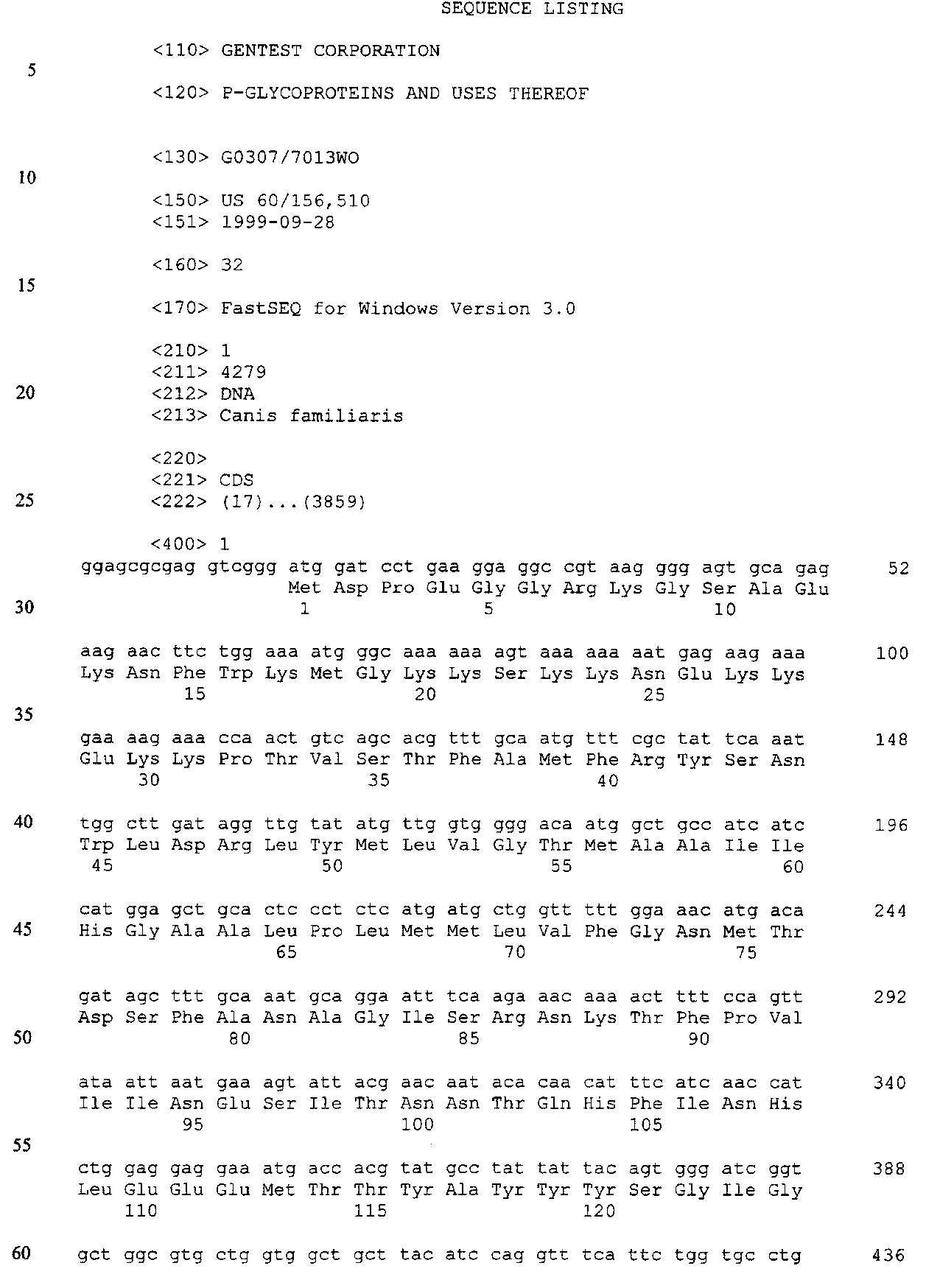
PCRを、Perkin Elmer 9700サーモサイクラーで実施した
。PCRを、94℃にて2分間、次いで、94℃にて30秒間、40℃にて20
秒間、および72℃にて2分30秒間の40サイクルで実施し、次いで、72℃
にて3分間インキュベートした。PCR産物を、1%アガロースゲルにおいて泳
動し、そしてEtBrで染色した。917bpのDNAバンドを切り出し、そし
てQiagen Inc.からのQIAquick Gel Extracti
on kitを用いて精製した。
PCR was performed on a Perkin Elmer 9700 thermocycler. PCR at 94°C for 2 minutes, then 94°C for 30 seconds, 40°C for 20 minutes.
40 cycles of 2 minutes and 30 seconds at 72°C, then 72°C
And incubated for 3 minutes. PCR products were run on a 1% agarose gel and stained with EtBr. The 917 bp DNA band was excised and cut with Qiagen Inc. From QIAquick Gel Extracti
Purified using on kit.
次いで、このDNAを、InvitrogenからのOriginal TA
Cloning kitを用いてベクターpCR2.1に連結した。INVα
F’細胞を、連結保持物(retain)で形質転換し、コロニーを選択し、ア
ンピシリンを含む100mLのLブロス中で増殖させた。DNA精製を、Qia
genからのPlasmid Midi purification kitを
用いて実施した。挿入物を、ABI377シークエンサーを使用して配列決定し
た。この配列は、イヌPGPの890bpフラグメント(オープンリーディング
フレームにおける塩基816〜塩基1706)に対応する。
This DNA was then treated with Original TA from Invitrogen.
It was ligated into the vector pCR2.1 using the Cloning kit. INVα
F'cells were transformed with ligated retains, colonies were selected and grown in 100 mL L broth containing ampicillin. DNA purification, Qia
It was performed using the Plasma Midi purification kit from gen. Inserts were sequenced using the ABI377 sequencer. This sequence corresponds to the 890 bp fragment of canine PGP (base 816 to base 1706 in open reading frame).
他の5つのフラグメントを、以下に記載する手順における任意の差異を伴って
上述と同じ方法を使用して、単離し、クローン化し、そして配列決定した。
The other five fragments were isolated, cloned and sequenced using the same method described above with any differences in the procedures described below.
イヌ肺組織からのRNA抽出を、ClontechからのNucliobon
d RNA Maxi Prep.purification kitを用いて
実施した。cDNAを、Life TechnologiesからのSuper
script Preamplification System for F
irst Strand cDNA Synthesisを用いて、RNA調製
物から合成した。
RNA extraction from dog lung tissue was performed using Nucliobon from Clontech.
d RNA Maxi Prep. It was carried out using a purification kit. cDNA from Life Technologies as a Super
script Preamplification System for F
Synthesized from RNA preparations using the irst Strand cDNA Synthesis.
これは、オープンリーディングフレームにおける塩基1364〜塩基2345の
イヌPGPの981bpフラグメントに対応する。
This corresponds to the 981 bp fragment of canine PGP from base 1364 to base 2345 in the open reading frame.
これは、オープンリーディングフレームにおける塩基1635〜塩基3362の
イヌPGPの1728bpフラグメントに対応する。
This corresponds to a 1728 bp fragment of canine PGP from bases 1635 to 3362 in the open reading frame.
これは、オープンリーディングフレームにおける塩基3004〜塩基3783の
イヌPGPの779bpフラグメントに対応する。
This corresponds to a 779 bp fragment of canine PGP from base 3004 to base 3783 in the open reading frame.
イヌ肝臓組織からのRNA調製物を、先に使用したのと同じ方法を使用して、
実施した。cDNAを、このRNA調製物から、SMART IIオリゴヌクレ
オチドを用いて、ClontechからのSMART RACE cDNA A
mplification Kitを使用して作製した。PCR条件を、以下の
通りに変更した:94℃にて5分間、次いで、以下の5サイクル94℃にて30
秒間、および72℃にて2分間。次いで、94℃にて30秒間、70℃にて45
秒間、および72℃にて2分間の5サイクルを実施した。最後の30サイクルは
、94℃にて30秒間、68℃にて45秒間、および72℃にて2分間であった
。このPCRを、72℃にて7分間で終えた。
RNA preparations from dog liver tissue were prepared using the same method used above.
Carried out. cDNA was prepared from this RNA preparation using SMART II oligonucleotides using SMART RACE cDNA A from Clontech.
It was prepared using the mplification Kit. PCR conditions were modified as follows: 94°C for 5 minutes, then 5 cycles of the following at 30°C at 94°C:
Seconds, and 2 minutes at 72°C. Then, at 94 ℃ for 30 seconds, 70 ℃ 45
Five cycles were carried out for 2 seconds and 2 minutes at 72°C. The last 30 cycles were 94°C for 30 seconds, 68°C for 45 seconds, and 72°C for 2 minutes. This PCR was completed in 72 minutes at 72°C.
これは、オープンリーディングフレームにおける塩基3212〜塩基4264の
イヌPGPの3’末端フラグメントに対応する。
This corresponds to the 3'terminal fragment of dog PGP from base 3212 to base 4264 in the open reading frame.
イヌ肝臓組織由来のRNA調製物を、先に使用したのと同じ方法を使用して、
実施した。cDNAを、このRNA調製物から、遺伝子特異的プライマーDM1
680RL 5’−cgc agc cac tgt tcc caa cca
gcg cca ct−3’,29マー,配列番号19,イヌPGP1を用い
て、ClontechからのSMART RACE cDNA Amplifi
cation Kitを使用して作製した。
RNA preparations from dog liver tissue were prepared using the same method as previously used,
Carried out. cDNA from this RNA preparation was gene specific primer DM1.
680RL 5'-cgc agc cac tgt tcc caa cca
SMART RACE cDNA Amplifi from Clontech using gcg cca ct-3', 29mer, SEQ ID NO: 19, dog PGP1.
It was prepared using the Cation Kit.
これは、オープンリーディングフレームにおける塩基−15〜塩基945のイヌ
PGPのATGフラグメントに対応する。
This corresponds to the ATG fragment of canine PGP from base-15 to base 945 in the open reading frame.
(クローンのアセンブリ)
1Kbフラグメント(890bp)および981bpフラグメント
DNAプレップを、各フラグメントから作製した。両方のフラグメントを、N
coI制限酵素で切断した。1Kbフラグメントをまた、EcoRIで切断した
。981bpフラグメントをまた、BamHIで切断した。各フラグメントを精
製し、共に連結し、次いで末端を切断し、切断分子をゲル精製し、そしてEco
RIおよびBamHIで切断したpUC19中に連結した。
(Clone assembly)
1 Kb fragment (890 bp) and 981 bp fragment DNA prep was made from each fragment. Both fragments are N
It was cut with a coI restriction enzyme. The 1 Kb fragment was also cut with EcoRI. The 981 bp fragment was also cut with BamHI. Each fragment was purified, ligated together, then truncated, the cleavage molecule gel purified, and Eco
Ligated into pUC19 cut with RI and BamHI.
1Kbフラグメント(890bp)/981bpフラグメントおよび1728
bpフラグメント
両方のフラグメントをBamHIで切断し、そして1728bpフラグメント
もまたXbaIで切断したことを除いて、これらのフラグメントを上記の通りに
アセンブルした。
1 Kb fragment (890 bp)/981 bp fragment and 1728
bp fragments These fragments were assembled as described above except that both fragments were cut with BamHI and the 1728 bp fragment was also cut with XbaI.
1Kbフラグメント(890bp)/981bpフラグメント/1728bp
フラグメントおよびATGフラグメント3’末端および779bpフラグメント
1Kbフラグメント(890bp)/981bpフラグメント/1728bp
フラグメントATGフラグメントおよび3’末端/779bpフラグメント
いくつかの場合では、フラグメントをそのヌクレオチド配列に従って、異なる
制限酵素で切断したことを除いて、これらのすべてのフラグメントを上記の通り
にアセンブルした。
1 Kb fragment (890 bp)/981 bp fragment/1728 bp
Fragment and ATG fragment 3'end and 779 bp fragment 1 Kb fragment (890 bp)/981 bp fragment/1728 bp
Fragments ATG and 3'end/779 bp fragments All of these fragments were assembled as described above, except in some cases the fragments were cleaved with different restriction enzymes according to their nucleotide sequences.
イヌP−糖タンパク質のヌクレオチド配列を、配列番号1として表す。コード
配列は、ヌクレオチド17〜3859からなり、1281アミノ酸のポリペプチ
ド(配列番号2)を産生する。
The nucleotide sequence of dog P-glycoprotein is represented as SEQ ID NO:1. The coding sequence consists of nucleotides 17-3859 and produces a 1281 amino acid polypeptide (SEQ ID NO:2).
(実施例2:イヌP−糖タンパク質の活性)
(材料および方法)
イヌPGP cDNA(配列番号1)を、ハイグロマイシンBに対する耐性を
付与するベクター中のLLC−PK1細胞のクローン化集団中に導入する。LL
C−PK1細胞を、American Type Culture Colle
ctionsから得て、そして7%胎仔ウシ血清を補充した培地199中で増殖
する。LLC−PK1細胞を、トランスフェクション前に再クローン化して、細
胞集団の均質性を確証する。簡潔には、イヌPGP cDNAを、p222CM
Vベクター中に組み込む。このベクターは、エプスタインバーウイルスについて
のOriP配列およびEBNA−1遺伝子産物に基づいたp220.2エピソー
ムベクター系に由来する(Sugdenら、Mol.Cell Biol.5:
410−413、1985;Yatesら、Nature(Lond.)313
:812−815、1985)。PGP cDNAを、サイトメガロウイルス(
CMV)極初期プロモーターの制御下におく。このベクターは、ハイグロマイシ
ンBに対する耐性を付与する。細胞(0.4mL中)およびDNA(10〜20
μg)を、2mmギャップ(gap)細胞、100V、2500μFキャパシタ
ンスおよび72ohm抵抗を使用して、BTX Electro cell m
anipulator model 600を用いるエレクトロポレーションに
よってトランスフェクトした。エレクトロポレーション後、細胞を、10%コン
フルエンスでマルチウェルプレート(48ウェル、Corning Costa
r)にプレーティングした。トランスフェクションの1〜2日後、ハイグロマイ
シンBを、最終濃度400〜600μg/mlで導入する。細胞に、2〜4日お
きに再給餌し、そして400〜600μg/mlハイグロマイシンB中で6〜8
日間増殖させ、この時点で野生型細胞のバルクを剥離した。ハイグロマイシンB
を、100μg/mlまで減少させ、そしてこの濃度のハイグロマイシンB中で
維持する。14〜18日後、このウェルを検査し、そして単一コロニーを含むウ
ェルをトリプシン処理し、そしてバルク培養物へとスケールアップする。PGP
の発現を、TranswellsTM中のビンブラスチン(0.1μM)輸送の分
極(polarization)によって測定する。
(Example 2: Activity of dog P-glycoprotein)
(Materials and methods)
Canine PGP cDNA (SEQ ID NO: 1) is introduced into a cloned population of LLC-PK1 cells in a vector conferring resistance to hygromycin B. LL
C-PK1 cells were transferred to American Type Culture Colle.
obtained from Ctions and grown in medium 199 supplemented with 7% fetal bovine serum. LLC-PK1 cells are recloned prior to transfection to ensure homogeneity of the cell population. Briefly, the dog PGP cDNA was cloned into p222CM
Incorporate into V vector. This vector is derived from the p220.2 episomal vector system based on the OriP sequence for Epstein-Barr virus and the EBNA-1 gene product (Sugden et al., Mol. Cell Biol. 5:
410-413, 1985; Yates et al., Nature (Lond.) 313.
: 812-815, 1985). The PGP cDNA was cloned into cytomegalovirus (
CMV) placed under the control of the immediate early promoter. This vector confers resistance to hygromycin B. Cells (in 0.4 mL) and DNA (10-20
μg) using a 2 mm gap cell, 100V, 2500 μF capacitance and 72 ohm resistance, BTX Electro cell m.
Transfected by electroporation using an aniplator model 600. After electroporation, cells were plated at 10% confluence in multiwell plates (48 wells, Corning Costa).
r) was plated. 1-2 days after transfection, hygromycin B is introduced at a final concentration of 400-600 μg/ml. Cells are re-fed every 2-4 days and 6-8 in 400-600 μg/ml hygromycin B.
The cells were grown for a day, at which point the bulk of wild type cells were detached. Hygromycin B
Is reduced to 100 μg/ml and maintained in this concentration of hygromycin B. After 14-18 days, the wells are examined and wells containing single colonies are trypsinized and scaled up to bulk culture. PGP
Expression is measured by polarization of vinblastine (0.1 μM) transport in Transwells ™ .
LLC−PK1細胞に基づく輸送研究を、24ウェルTranswellsTM
(Corning Costar、カタログ番号3415)中で実施する。Tr
answellsTMを、側底側空間(basolateral space)に
0.6mL培地を添加し、そして頂端側空間(apical space)に0
.1mL培地を添加することによって調製する。細胞を、1挿入物あたり4×1
04細胞で播種し(代表的に0.05mL〜0.15mL中)、2〜4日おきに
新鮮培地で再給餌し、そして播種後4〜8日目に輸送研究に使用する。輸送アッ
セイを、10mM HEPESで緩衝化したハンクス平衡生理食塩水(HBSS
)中で実施する(pH7〜7.2)。細胞単層を、輸送アッセイにおいて使用す
る前に、HBSSでリンスする。輸送を、頂端側から側底側(A→B)および側
底側から頂端側(B→A)の方向の両方の傾斜条件下で測定する。1回の決定に
つき、少なくとも二連の単層を使用する。所望される時点で、サンプルを、レシ
ーバーチャンバー(頂端側チャンバーまたは側底側チャンバー)から回収する。
輸送された化合物の量の定量は、UVまたは質量分析検出での液体シンチレーシ
ョン計数(ビンブラスチン)またはHPLCによる。
LLC-PK1 cell-based transport studies were performed using 24-well Transwells ™.
(Corning Costar, Catalog No. 3415). Tr
Answells ™ was added to the basolateral space with 0.6 mL medium and 0 to the apical space.
. Prepare by adding 1 mL medium. 4x1 cells per insert
0 4 cells are seeded (typically in 0.05 mL to 0.15 mL), re-fed with fresh medium every 2-4 days and used for transport studies 4-8 days after seeding. Transport assay was performed with Hank's balanced saline (HBSS) buffered with 10 mM HEPES.
) In (pH 7-7.2). Cell monolayers are rinsed with HBSS before use in the transport assay. Transport is measured under both tilting conditions, apical to basolateral (A→B) and basolateral to apical (B→A). Use at least duplicate monolayers per determination. At the desired time points, samples are collected from the receiver chamber (top chamber or basolateral chamber).
Quantitation of the amount of compound transported is by liquid scintillation counting (vinblastine) with UV or mass spectrometric detection or HPLC.
イヌPGP cDNAを、バキュロウイルスベクターを用いて、昆虫細胞中で
発現させる。(Sarkadiら、J.Biol.Chem.267:4854
−4858、1992)の方法に従って、膜を調製し、そして使用まで−80℃
で保存する。ATPaseアッセイを、96ウェルマイクロタイタープレートに
おいて実施する。アッセイを、(Sarkadiら、1992、およびDrue
kesら、Anal.Biochem.230:173−177、1995)の
方法の改変版を使用して実施する。
Canine PGP cDNA is expressed in insect cells using a baculovirus vector. (Sarkade et al., J. Biol. Chem. 267:4854.
-4858, 1992) and prepare the membrane at -80°C until use.
Save with. The ATPase assay is performed in 96 well microtiter plates. The assay was performed (Sarkadi et al., 1992, and Drue).
kes et al., Anal. Biochem. 230:173-177, 1995).
96ウェルプレートの各ウェルについての詳細な方法は、以下を包含する:
50mM Tris−MES、2mM EGTA、50mM KCl、2mM
ジチオトレイトール、および5mMアジ化ナトリウムを含有する緩衝液中に40
μg膜、20μMベラパミル(ポジティブコントロール)または試験薬物、およ
び3〜5mM MgATPを含む0.06mlの反応混合物を、37℃で20分
間インキュベートする。100μMオルトバナジン酸ナトリウムを含む同一の反
応混合物を、並行してアッセイする。オルトバナジン酸塩は、ヌクレオチド結合
部位にMgADPを捕捉することによって、PGPを阻害する。従って、オルト
バナジン酸塩の存在下で測定されるATPase活性は、非PGP ATPas
e活性を表し、そしてオルトバナジン酸塩なしで生成された活性から差し引かれ
て、バナジン酸塩感受性ATPase活性を生成し得る。30μlの10%SD
S+消泡剤Aの添加によって、反応を停止する。2つのさらなる反応混合物(オ
ルトバナジン酸塩+および−)(しかし、MgATPを含まない)もまた調製し
、そして他のものと共にインキュベートし、次いで、SDSおよびMgATPを
補充して、時間=0分目の反応を表す。インキュベーションに次いで、15mM
酢酸亜鉛:10%アスコルビン酸(1:4)中の35mMモリブデン酸アンモニ
ウムを200μl添加し、そしてさらに20分間37℃にてインキュベートする
。無機ホスフェートの遊離を、800nmでのその吸光度によって検出し、そし
てホスフェートの検量線に対してこの吸光度を比較することによって、定量する
。
Detailed methods for each well of a 96-well plate include:
50 mM Tris-MES, 2 mM EGTA, 50 mM KCl, 2 mM
40 in buffer containing dithiothreitol and 5 mM sodium azide
A 0.06 ml reaction mixture containing μg membrane, 20 μM verapamil (positive control) or test drug, and 3-5 mM MgATP is incubated at 37° C. for 20 minutes. The same reaction mixture containing 100 μM sodium orthovanadate is assayed in parallel. Orthovanadate inhibits PGP by trapping MgADP at the nucleotide binding site. Therefore, the ATPase activity measured in the presence of orthovanadate is not comparable to that of non-PGP ATPas.
e activity and may be subtracted from the activity produced without orthovanadate to produce vanadate-sensitive ATPase activity. 30 μl of 10% SD
The reaction is stopped by the addition of S+ defoamer A. Two additional reaction mixtures (orthovanadate + and -) (but without MgATP) were also prepared and incubated with the others, then supplemented with SDS and MgATP at time = 0 min. Represents the reaction of. Following incubation, 15 mM
Add 200 μl of 35 mM ammonium molybdate in zinc acetate: 10% ascorbic acid (1:4) and incubate for an additional 20 minutes at 37°C. The release of inorganic phosphate is quantified by detecting its absorbance at 800 nm and comparing this absorbance to a phosphate calibration curve.
リガンド結合アッセイおよび蛍光色素取り込みの阻害を測定するためのアッセ
イを、Sharomら(Biochem.Pharmacol.58:571−
586、1999)によって記載されたように実施する。
Ligand binding assays and assays for measuring inhibition of fluorochrome uptake have been described by Sharom et al. (Biochem. Pharmacol. 58:571-.
586, 1999).
(I.LLC−PK1細胞における安定なPGP発現)
イヌPGPの機能的発現を、ビンブラスチンの輸送の分極によって測定する。
コントロール細胞は、代表的に、1と3との間のB→A/A→B比を示す。PG
Pトランスフェクト細胞は、より高い比率を示す。cDNA由来のイヌの発現は
安定である。
(I. Stable PGP expression in LLC-PK1 cells)
Functional expression of canine PGP is measured by polarization of vinblastine transport.
Control cells typically show a B→A/A→B ratio between 1 and 3. PG
P-transfected cells show a higher ratio. Expression of dogs derived from cDNA is stable.
(II.PGP膜におけるATPase活性の活性化)
ATPaseアッセイの刺激によって、薬物とPGPとの任意の相互作用の濃
度依存性の迅速な測定が提供される。遊離の無機ホスフェートを、マイクロタイ
タープレート形式で実施される単純な分光光度学的アッセイによって測定する。
複数の薬物濃度を試験することによって、PGPに対する薬物の親和性を推定す
ること、およびその応答の飽和が観察されたか否かを推定することが可能となる
。
(II. Activation of ATPase activity in PGP membrane)
Stimulation of the ATPase assay provides a rapid concentration-dependent measurement of any drug-PGP interaction. Free inorganic phosphate is measured by a simple spectrophotometric assay performed in a microtiter plate format.
Testing multiple drug concentrations makes it possible to estimate the affinity of a drug for PGP and whether saturation of its response was observed.
(III.細胞単層を横断する薬物輸送)
ATPaseアッセイは、直接的には、薬物輸送を測定しない。ATPase
活性と実際の輸送との間の一致を試験するために、薬物の輸送速度を、コントロ
ールLLC−PK1およびイヌPGP細胞単層において測定する。各薬物濃度に
ついて、4つの測定をなす:
A:A→B コントロール細胞
B:B→A コントロール細胞
C:A→B PGP細胞
D:B→A PGP細胞。
(III. Drug transport across cell monolayers)
The ATPase assay does not measure drug transport directly. ATPase
To test the agreement between activity and actual transport, drug transport rates are measured in control LLC-PK1 and canine PGP cell monolayers. Four measurements are made for each drug concentration:
A:A→B control cells B:B→A control cells C:A→B PGP cells D:B→A PGP cells.
輸送の分極を、コントロール細胞(B/A)およびPGP細胞(D/C)にお
いて算出する。PGPの内因的活性(IA)を、コントロール細胞と比較してP
GP細胞中でPGPがB→A輸送を容易にした量(D−B)と、コントロール細
胞と比較してPGP細胞中でPGPがA→B輸送を妨害した量(A−C)との合
計として算出する。PGPの内因的クリアランスを、非飽和条件下の線のスロー
プを算出することか、または飽和が観察された場合に算出された見かけ上のKm
およびVmax値からのいずれかによって、濃度依存性データのプロットから算
出する。内因的クリアランスを、mL/m2/分として表す。
Transport polarization is calculated in control cells (B/A) and PGP cells (D/C). Endogenous activity (IA) of PGP compared to control cells
Sum of the amount that PGP facilitated B→A transport in GP cells (D−B) and the amount that PGP interfered with A→B transport in PGP cells compared to control cells (A−C) Calculate as The intrinsic clearance of PGP was calculated by calculating the slope of the line under non-saturated conditions or the apparent Km calculated when saturation was observed.
And Vmax values are used to calculate the concentration-dependent data. Intrinsic clearance is expressed as mL/m 2 /min.
ATPaseデータは、有用な濃度応答データを表す。例えば、いくつかの化
合物についての見かけ上のKm値は、ATPaseと輸送系との間で良好な一致
する。しかし、他の薬物はATPase活性を活性化するが、PGPによる輸送
は検出可能ではない。少なくとも、ATPaseアッセイは、下回るとPGPに
よる輸送に対する応答が薬物濃度に対して線形となる濃度範囲を同定し得る。こ
れは、PGPの内因的クリアランスを測定するための実験設計の単純化を可能に
し、これは、大量の化合物を試験する場合に重要な考慮事項となる。
ATPase data represent useful concentration response data. For example, the apparent Km values for some compounds are in good agreement between ATPase and the transport system. However, other drugs activate ATPase activity, but transport by PGP is not detectable. At a minimum, the ATPase assay can identify a concentration range below which the response to transport by PGP is linear with drug concentration. This allows a simplification of the experimental design to measure the intrinsic clearance of PGP, which is an important consideration when testing large numbers of compounds.
(IV.バイオアベイラビリティ)
バイオアベイラビリティ研究を、2つ以上の異なるPGP型を用いる上記アッ
セイの1つ以上を実施することによって行う。異なるPGP型は、異なる種(例
えば、イヌおよびヒト、カニクイザルおよびヒト、イヌおよびカニクイザルなど
)により得るか、または同一種の異なる対立遺伝子であり得る。これらのアッセ
イの結果を比較して、異なる種の個体または異なるPGP対立遺伝子を発現する
個体における薬物のバイオアベイラビリティを決定または推定する。1つの決定
の結果はまた、過去の(historical)コントロールとして、例えば、
ATPaseまたは輸送に関して以前に決定された値に対して比較され得る。
(IV. Bioavailability)
Bioavailability studies are performed by performing one or more of the above assays with two or more different PGP types. Different PGP types can be from different species (eg, dog and human, cynomolgus monkey and human, dog and cynomolgus monkey, etc.) or can be different alleles of the same species. The results of these assays are compared to determine or estimate drug bioavailability in individuals of different species or expressing different PGP alleles. The result of one decision can also be used as a historical control, for example:
It can be compared against previously determined values for ATPase or transport.
(プロトコールおよび手順)
(RNAの単離)
凍結したビーグルの肝臓を乳鉢および乳棒を用いて粉砕した。粉砕化された組
織(300mg)を、ダンス型ホモジナイザーに移した。TRIsol試薬(3
mL;カタログ番号15596(Life Technologiesから))
を添加して、この組織をホモジネートし、次いで、室温で15分間インキュベー
トした。溶液のアリコート(1mL)を3つのミクロチューブ(microfu
ge tube)に移し、そして200μLのクロロホルムを各チューブに添加
した。各チューブを高設定で15秒間ボルテックスし、次いで、室温で3分間イ
ンキュベートし、次いで、10000gで15分間4℃にて遠心分離した。上部
の「水性」層を新しいミクロチューブに移し、一方、残存する下部および間の層
を捨てた。500μLのイソプロパノールを新しいチューブの各々に添加し、そ
してこのチューブを数回反転させることによって混合した。次いで、各チューブ
を室温で10分間インキュベートし、次いで、10000gでさらに10分間4
℃にて遠心分離した。小さな白色ペレットが観察され、そして上清を捨てた。1
mLの75%エタノールを各チューブに添加した。このチューブを手短にボルテ
ックスし、次いで、10000gで10分間4℃にて遠心分離した。上清を捨て
、そしてペレットを室温で5分間乾燥させた。50μLのDEPC処理滅菌脱イ
オン水を、各チューブに添加した。各ペレットを再懸濁し、そして各チューブの
内容物をプールした。
(Protocol and Procedure)
(Isolation of RNA)
Frozen beagle liver was ground using a mortar and pestle. The ground tissue (300 mg) was transferred to a dance homogenizer. TRIsol reagent (3
mL; Catalog No. 15596 (from Life Technologies))
Was added to homogenize the tissue and then incubated at room temperature for 15 minutes. Aliquots of the solution (1 mL) into three microfu (microfu)
transfer to a tube and 200 μL of chloroform was added to each tube. Each tube was vortexed at the high setting for 15 seconds, then incubated at room temperature for 3 minutes, then centrifuged at 10,000 g for 15 minutes at 4°C. The upper "aqueous" layer was transferred to a new microtube, while the remaining lower and intervening layers were discarded. 500 μL of isopropanol was added to each new tube and mixed by inverting the tube several times. Each tube was then incubated at room temperature for 10 minutes, then at 10,000 g for an additional 10 minutes 4
It was centrifuged at 0°C. A small white pellet was observed and the supernatant was discarded. 1
mL of 75% ethanol was added to each tube. The tube was vortexed briefly and then centrifuged at 10,000 g for 10 minutes at 4°C. The supernatant was discarded and the pellet dried at room temperature for 5 minutes. 50 μL of DEPC-treated sterile deionized water was added to each tube. Each pellet was resuspended and the contents of each tube were pooled.
再懸濁されたペレットの光学密度を、Hitachi U3010分光光度計
を用いて分析し、単離されたRNAの量を決定した。次いで、このRNAをDE
PC処理滅菌脱イオン水を用いて、0.55μg/μLの濃度まで希釈した。2
mLのこのRNAを2つのミクロチューブに均等に分けた。次いで、100μL
の5M NaClを各チューブに添加した。両方のチューブを15分間65℃ま
で加温し、次いで、氷上に5分間配置した。MessageMaker mRN
A Isolation System(カタログ番号10551−018(L
ife Technologiesから))からの500μLのOligo(d
T)Cellulose Suspensionを、両方のチューブに添加した
。次いで、これらのチューブを10分間37℃でインキュベートした。このチュ
ーブの内容物を、MessageMaker mRNA Isolation
Systemに提供されたFilter Syringeに移した。液体内容物
を排出した後、シリンジ中のペレットを、製造業者の指示書に従って、Wash
Buffer1およびWash Buffer2を使用して洗浄した。シリン
ジ中のRNAペレットを1mLのDEPC処理滅菌脱イオン水(65℃)中に再
懸濁し、次いで、2.5μLの50μg/mLグリコゲンおよび100μLの7
.5M酢酸アンモニウムを添加し、そして反転によって混合した。次いで、チュ
ーブの内容物を、2つのミクロチューブに移し、そして1mLのエタノールを各
チューブに添加した。両方のチューブの内容物を、反転によって混合し、次いで
、−20℃で一晩インキュベートした。
The optical density of the resuspended pellet was analyzed using a Hitachi U3010 spectrophotometer to determine the amount of RNA isolated. This RNA is then DE
Diluted with PC-treated sterile deionized water to a concentration of 0.55 μg/μL. Two
mL of this RNA was evenly divided into two microtubes. Then 100 μL
5M NaCl was added to each tube. Both tubes were warmed to 65°C for 15 minutes and then placed on ice for 5 minutes. MessageMaker mRN
A Isolation System (Catalog number 10551-018 (L
from If Technologies))) 500 μL of Oligo (d)
T) Cellulose Suspension was added to both tubes. The tubes were then incubated for 10 minutes at 37°C. The contents of this tube were replaced with the MessageMaker mRNA Isolation.
It was transferred to the Filter Syringe provided by System. After draining the liquid contents, wash the pellet in a syringe with Wash according to the manufacturer's instructions.
Washed using Buffer 1 and Wash Buffer 2. The RNA pellet in the syringe was resuspended in 1 mL of DEPC-treated sterile deionized water (65° C.), then 2.5 μL of 50 μg/mL glycogen and 100 μL of 7
. 5M ammonium acetate was added and mixed by inversion. The contents of the tubes were then transferred to two microtubes and 1 mL ethanol was added to each tube. The contents of both tubes were mixed by inversion and then incubated overnight at -20°C.
このチューブを、10000gで30分間4℃にて遠心分離した。この上清を
捨て、そして200μLの75%エタノールを各チューブに添加した。このチュ
ーブを10秒間ボルテックスし、次いで、10000gで15分間4℃にて遠心
分離した。この上清を捨て、そして残存するすべての液体を注意深くピペッティ
ングで取り出した。このペレットを、10μLのDEPC処理滅菌脱イオン水中
に再懸濁した。
The tube was centrifuged at 10000g for 30 minutes at 4°C. The supernatant was discarded and 200 μL of 75% ethanol was added to each tube. The tube was vortexed for 10 seconds and then centrifuged at 10,000 g for 15 minutes at 4°C. The supernatant was discarded and any remaining liquid was carefully pipetted out. The pellet was resuspended in 10 μL DEPC-treated sterile deionized water.
(cDNAの調製)
cDNAを、以下のように、Marathon cDNA Amplific
ation Kit(カタログ番号K1802−1(Clontech Lab
oratories,Inc.,Palo Alto,CAから))を用いて調
製した。4μLの再懸濁mRNAを、新しいミクロチューブに移し、そして以下
のプライマー(10μM濃度)のうちの1つ(1μL)を添加した:Dm168
0RL cgc agc cac tgt tcc caa cca gcg
cca ct(配列番号19;カスタムデザイン,Operon Techno
logies,Inc.により合成)またはMarathon cDNA Am
plification KitからのcDNA Synthesis Pri
mer,nnt ttt ttt ttt ttt ttt ttt ttt
ttt ttt ttc gcc ggc gac tta aga tct
t(配列番号28)。チューブを70℃で2分間インキュベートし、次いで、氷
上に5分間配置した。2μLの5×First−Strand Buffer,
1μLの10mM dNTP Mixおよび1μLの20U/μL AMV R
everse Transcriptaseを各チューブに添加し、そして穏や
かに混合した。このチューブを42℃にて1時間インキュベートし、次いで、氷
上に配置した。2μLの各一本鎖cDNAを、PCRにおけるテンプレートとし
て使用した(以下の「PCR条件」を参照のこと)。48.4μLのDEPC処
理脱イオン水、16μLの5×Second−Strand Buffer,1
.6μLの10mM dNTP Mixおよび4μLの20×Second−S
trand Enzyme Cocktailを、残存するcDNAサンプルに
添加した。このチューブを、16℃にて1.5時間インキュベートした。2μL
の5U/μL T4 DNAポリメラーゼをこのチューブに添加し、次いで、こ
のチューブを16℃にてさらに45分間インキュベートした。20×EDTA/
Glycogen Mix(4μL)を添加し、次いで、QIAquick N
ucleotide Removal Kit(カタログ番号28304(QI
AGEN Inc.,Valencia,CAから))からの430μLのBu
ffer PNを添加した。次いで、このサンプルをQIAquick Spi
n Columnにローディングし、そして10000gで1分間遠心分離した
。収集チューブを空にし、そして750μLのPE Buffer(QIAGE
N)をQIAquick Spin Columnに添加し、これを再度100
00gで1分間遠心分離した。収集チューブを、もう一度空にし、そしてQIA
quick Spin Columnを10000gで1分間遠心分離して、カ
ラムメンブレンを乾燥させた。50℃まで加熱した50μLの滅菌脱イオン水を
QIAquick Spin Columnに添加し、そして室温で1分間イン
キュベートして、次いで、きれいなミクロチューブに、10000gで1分間遠
心分離した。
(Preparation of cDNA)
The cDNA was cloned into the Marathon cDNA Amplified as follows.
ation Kit (Catalog No. K1802-1 (Clontech Lab
oratories, Inc. , Palo Alto, CA)). 4 μL of resuspended mRNA was transferred to a new microtube and one of the following primers (10 μM concentration) (1 μL) was added: Dm168.
0RL cgc agc cac tgt tcc caa cca gcg
cca ct (SEQ ID NO: 19; custom design, Operon Techno
logs, Inc. Synthesized by) or Marathon cDNA Am
cDNA Synthesis Pri from the replication kit
mer, nnt ttt ttt ttt ttt ttt ttt ttt
ttt ttt ttc gcc ggc gac tta aga tct
t (SEQ ID NO: 28). The tubes were incubated at 70°C for 2 minutes and then placed on ice for 5 minutes. 2 μL of 5×First-Strand Buffer,
1 μL of 10 mM dNTP Mix and 1 μL of 20 U/μL AMV R
Everse Transcriptase was added to each tube and mixed gently. The tubes were incubated at 42°C for 1 hour and then placed on ice. 2 μL of each single-stranded cDNA was used as a template in PCR (see “PCR Conditions” below). 48.4 μL DEPC-treated deionized water, 16 μL 5×Second-Strand Buffer, 1
. 6 μL of 10 mM dNTP Mix and 4 μL of 20×Second-S
The Trade Enzyme Cocktail was added to the remaining cDNA samples. The tube was incubated at 16°C for 1.5 hours. 2 μL
5 U/μL T4 DNA Polymerase was added to the tube and the tube was then incubated at 16° C. for an additional 45 minutes. 20 x EDTA/
Glycogen Mix (4 μL) was added, followed by QIAquick N
ucleotide Removal Kit (Catalog number 28304 (QI
AGEN Inc. , Valencia, CA)) 430 μL of Bu
ffer PN was added. This sample is then submitted to the QIAquick Spi
n Column and centrifuged at 10000 g for 1 minute. Empty the collection tube and place 750 μL of PE Buffer (QIAGE).
N) was added to the QIAquick Spin Column and this was added again to 100
Centrifuge for 1 minute at 00g. Empty the collection tube once again and QIA
The quick Spin Column was centrifuged at 10000 g for 1 minute to dry the column membrane. 50 μL of sterile deionized water heated to 50° C. was added to the QIAquick Spin Column and incubated for 1 minute at room temperature, then centrifuged in a clean microtube at 10000 g for 1 minute.
核酸を沈殿するために、10.8μLの7.5M酢酸アンモニウムおよび14
4μLのエタノールをチューブに添加し、次いで、これを10000gで20分
間遠心分離した。この上清を除去し、次いで、300μLの75%エタノールを
添加した。チューブをボルテックスし、そして10000gで20分間遠心分離
した。この上清を除去し、そしてこのサンプルを12μLの滅菌脱イオン水中に
再懸濁した。5μLのこのcDNAを、きれいなミクロチューブに配置した。M
arathon cDNA Amplification Kitからの2μL
の10μM Marathon cDNA Adapter,2μL 5×DN
A Ligation Bufferおよび1μLの400U/μL T4 D
NA Ligaseを、このcDNAに添加し、そして穏やかに混合した。この
混合物を16℃にて一晩インキュベートした。リガーゼを、70℃で5分間、熱
不活化した。PCRを、テンプレートとしてこのサンプルを用いて実施した。
To precipitate the nucleic acid, 10.8 μL of 7.5M ammonium acetate and 14
4 μL of ethanol was added to the tube, which was then centrifuged at 10000 g for 20 minutes. The supernatant was removed and then 300 μL of 75% ethanol was added. The tube was vortexed and centrifuged at 10000g for 20 minutes. The supernatant was removed and the sample resuspended in 12 μL of sterile deionized water. 5 μL of this cDNA was placed in a clean microtube. M
2 μL from arathon cDNA Amplification Kit
10 μM Marathon cDNA Adapter, 2 μL 5×DN
A Ligation Buffer and 1 μL of 400 U/μL T4 D
NA Ligase was added to this cDNA and mixed gently. This mixture was incubated overnight at 16°C. The ligase was heat inactivated at 70°C for 5 minutes. PCR was performed using this sample as a template.
(PCR条件)
PCRを、Clontech Advantage 2 kit(Clont
ech,palo Alto,CA)で供給された試薬を用いて実施した。簡潔
には、2μLのcDNAを200μL MicroAmp反応チューブ(カタロ
グ番号N801−0540,PE Biosystems)中に配置し、次いで
、34μLの滅菌脱イオン水、5μLの10×Clontech Advant
age 2 Polymerase Mix(カタログ番号4700−1 Cl
ontech Laboratories,Inc.)、3μLの10mM A
dvantage UltraPure PCR Deoxynucleoti
de Mix(カタログ番号8430−1 Clontech Laborat
ories,Inc.)、および各々2μLの順方向および逆方向プライマー(
10mM濃度)を添加した。プライマーは、以下のいずれかであった:Mara
thon cDNA Amplification KitからのMarath
on cDNA Adapter Primer 1,cca tcc taa
tac gac tca ctg tag ggc(配列番号29)、または
Operon Technologies Inc.によって作製された種々の
カスタム遺伝子特異的プライマー。カスタムプライマーとしては、以下が挙げら
れる(すべて、5’−3’として列挙した):Dm409FL:gga gcg
cga ggt cgg gat gga tc(配列番号20),Dm14
55RL:gca aat gct tca atg ctt ggg gat
gcc tgt cca a(配列番号30),Dm2037F:aga a
ac aga gaa tcg cca ttg ctc(配列番号13),D
m3920RL:gag ctg ggt tcc ttt gtc tcc
tac tct ggt gtt(配列番号31),Dp1216F:gaa
ctg tga ttg cgt ttg gag gac(配列番号9)およ
びDp2587R:gca aat gct ggt tgc agg cct
cc(配列番号32)。
(PCR conditions)
PCR was performed using Clontech Advantage 2 kit (Clont
ech, palo Alto, CA). Briefly, 2 μL of cDNA was placed in a 200 μL MicroAmp reaction tube (catalog number N801-0540, PE Biosystems), then 34 μL of sterile deionized water, 5 μL of 10×Clontech Advant.
age 2 Polymerase Mix (Cat. No. 47001 Cl
ontech Laboratories, Inc. ) 3 μL of 10 mM A
dvantage UltraPure PCR Deoxynucleoti
de Mix (Cat. No. 8430-1 Clontech Laborat)
ories, Inc. ), and 2 μL each of forward and reverse primers (
10 mM concentration) was added. The primer was one of the following: Mara
Marath from the thon cDNA Amplification Kit
on cDNA Adapter Primer 1, cca tcc taa
tac gac tca ctg tag ggc (SEQ ID NO: 29), or Operon Technologies Inc. Various custom gene-specific primers made by. Custom primers include (all listed as 5'-3'): Dm409FL: gga gcg.
cga ggt cgg gat gga tc (SEQ ID NO: 20), Dm14
55RL: gca aat gct tca atg ctt ggg gat
gcc tgt cca a (SEQ ID NO: 30), Dm2037F: aga a
ac aga gaa tcg cca ttg ctc (SEQ ID NO: 13), D
m3920RL: gag ctg ggt tcc ttt gtc tcc
tac tct ggt gtt (SEQ ID NO: 31), Dp1216F: gaa
ctg tga ttg cgt ttg gag gac (SEQ ID NO: 9) and Dp2587R: gca aat gct ggt tgc agg cct
cc (SEQ ID NO: 32).
熱サイクルを、94℃にて30秒間、次いで、94℃にて5秒間および72℃
にて4分間の2サイクル、次いで、94℃にて5秒間および68℃にて4分間の
16サイクルで、Perkin Elmer 9700を使用して実施した。
Thermal cycle at 94°C for 30 seconds, then 94°C for 5 seconds and 72°C.
2 cycles of 4 minutes at 94° C., followed by 16 cycles of 94° C. for 5 seconds and 68° C. for 4 minutes using a Perkin Elmer 9700.
4つのフラグメントを、各遺伝子型についてのPCRによって獲得した。フラ
グメント1は、プライマーにMarathon cDNA Adapter P
rimer 1およびDm1455RLを使用して生成された。フラグメント2
は、プライマーDp1216FおよびDp2587Rを使用して生成された。フ
ラグメント3は、プライマーDm2037FおよびDm3920RLを使用して
生成された。フラグメント4は、プライマーDp3612FLおよびMarat
hon cDNA Adapter Primer 1を使用して生成された。
Four fragments were obtained by PCR for each genotype. Fragment 1 was prepared using Marathon cDNA Adapter P as a primer.
Produced using trimer 1 and Dm1455RL. Fragment 2
Was generated using primers Dp1216F and Dp2587R. Fragment 3 was generated using primers Dm2037F and Dm3920RL. Fragment 4 contains primers Dp3612FL and Marat
It was produced using the hon cDNA Adapter Primer 1.
(PCR後サンプリングプロセス)
電気泳動を、10×ゲルローディング緩衝液IV(Molecular Cl
oning:A Laboratory Manual,J.Sambrook
ら編,第2版,Cold Spring Harbor Laboratory
Press,Cold Spring Harbor,New York,1
989,6.12頁)を使用して、EtBrを含有する0.5×TBE緩衝液(
Sambrookら,B−23頁)中における1%アガロースゲルにおいて、す
べてのPCR産物に対して実施した。PCR産物を含有するゲルのフラグメント
を切り出し、そして2mLのミクロチューブ中に配置した。各フラグメントの質
量を決定し、そしてQIAquick Gel Extraction Kit
(カタログ番号28704(QIAGEN Inc.から))からの3μL/m
gのBuffer QX1を添加した。次いで、各チューブを、2分毎に混合し
つつ、50℃で10分間インキュベートした。1μL/mgのイソプロパノール
を各チューブに添加し、そして混合した。生じた溶液をQIAquick Ge
l Extraction KitからのQIAquick spin col
umnに移した。これらのカラムを、室温にて1分間10000gで遠心分離し
た。QIAquick Gel Extraction Kitからの750μ
LのBuffer PEを、各チューブに添加し、次いで、室温にて1分間10
000gで遠心分離した。各カラムを、再度、室温にて1分間10000gで遠
心分離して、あらゆる残留緩衝液を除去した。30μLの滅菌脱イオン水(50
℃)を各カラムに添加し、そして室温にて1分間インキュベートした。次いで、
各カラムをミクロチューブ中に配置し、そして1分間10000gで遠心分離し
た。
(Sampling process after PCR)
Electrophoresis was performed using 10X gel loading buffer IV (Molecular Cl).
oning: A Laboratory Manual, J. Am. Sambrook
Et al., Second Edition, Cold Spring Harbor Laboratory
Press, Cold Spring Harbor, New York, 1
989, page 6.12), using 0.5 x TBE buffer containing EtBr (
All PCR products were run on a 1% agarose gel in Sambrook et al., B-23). The fragment of the gel containing the PCR product was cut out and placed in a 2 mL microtube. The mass of each fragment was determined and the QIAquick Gel Extraction Kit
3 μL/m from (catalog number 28704 (from QIAGEN Inc.))
g of Buffer QX1 was added. Each tube was then incubated at 50°C for 10 minutes with mixing every 2 minutes. 1 μL/mg isopropanol was added to each tube and mixed. The resulting solution is QIAquick Ge
QIAquick spin col from l Extraction Kit
moved to umn. The columns were centrifuged at 10,000 g for 1 minute at room temperature. 750μ from QIAquick Gel Extraction Kit
Add L Buffer PE to each tube, then for 10 minutes at room temperature.
Centrifuge at 000 g. Each column was again centrifuged at 10000 g for 1 minute at room temperature to remove any residual buffer. 30 μL of sterile deionized water (50
C) was added to each column and incubated for 1 minute at room temperature. Then
Each column was placed in a microtube and centrifuged for 1 minute at 10,000 g.
次いで、6μLの精製PCR産物を、きれいなミクロチューブに移し、そして
1μLの10×Ligation Buffer,2μLのpCR2.1ベクタ
ーおよび1μLのT4 DNA Ligase(すべて、Original T
A Cloning Kit(カタログ番号K2000−J10)Invitr
ogen,Carlsbad,CAから)をこのミクロチューブに添加し、そし
て混合した。この反応物を、16℃で一晩インキュベートした。
6 μL of the purified PCR product was then transferred to a clean microtube and 1 μL of 10×Ligation Buffer, 2 μL of pCR2.1 vector and 1 μL of T4 DNA Ligase (all Original T.
A Cloning Kit (Cat. No. K2000-J10) Invitr
Ogen, Carlsbad, CA) was added to the microtube and mixed. The reaction was incubated overnight at 16°C.
凍結したOne Shotコンピテント細胞(Invitrogen)の1つ
の50μLバイアルを、各連結反応のために、氷上で解凍した。3.5μLの連
結反応混合物を、コンピテント細胞に添加し、そして穏やかに混合した。この細
胞を、30分間氷上でインキュベートし、次いで、42℃で30秒間「熱ショッ
ク」を与えた。再度氷上で冷却した後、250μLのSOC培地(Invitr
ogen)を各バイアルに添加し、そしてこのバイアルを直接、37℃の水浴中
に1時間配置した。各形質転換反応物の50μLおよび200μLのアリコート
を、1%アガロース,1mg/mLグルコース,50ng/mLアンピシリンお
よび1.6ng/mL X−galを含有するLuria−Bertani M
edium(Sambrookら,A−1頁)に配置した。次いで、接種したプ
レートを、37℃で一晩インキュベートした。白色化コロニーを選択し、そして
50ng/mLアンピシリンを含有するL−B培地の個々の100mL培養物を
接種するために使用した。これを、100rpmで撹拌しつつ、37℃で一晩イ
ンキュベートした。
One 50 μL vial of frozen One Shot competent cells (Invitrogen) was thawed on ice for each ligation reaction. 3.5 μL of the ligation mixture was added to competent cells and mixed gently. The cells were incubated for 30 minutes on ice and then “heat shocked” at 42° C. for 30 seconds. After cooling on ice again, 250 μL of SOC medium (Invitr
gen) was added to each vial and the vials were placed directly in a 37° C. water bath for 1 hour. 50 μL and 200 μL aliquots of each transformation reaction were made into Luria-Bertani M containing 1% agarose, 1 mg/mL glucose, 50 ng/mL ampicillin and 1.6 ng/mL X-gal.
edium (Sambrook et al., page A-1). The inoculated plates were then incubated overnight at 37°C. Whitened colonies were selected and used to inoculate individual 100 mL cultures of LB medium containing 50 ng/mL ampicillin. This was incubated overnight at 37°C with agitation at 100 rpm.
プラスミドDNAを、以下のように製造業者の指示書に従って、QIAGEN
Midi Plasmid Kit(カタログ番号12143(QIAGEN
Inc.から))を用いて調製した。各100mLの培養物を、2つの50m
L円錐状バイアル中に等分し、そして3000gで10分間4℃にて遠心分離し
た。上清を注ぎ出し、そして4mLのBuffer P1を用いて、2つのバイ
アルの一方で、このペレットを再懸濁した。この上清を他のチューブに移し、そ
してこのペレットを再懸濁するために使用した。Buffer P2(4mL)
を添加し、混合し、そしてこの懸濁物を室温で5分間インキュベートした。Bu
ffer P3(4mL)を添加し、混合し、そして懸濁物を4℃で15分間イ
ンキュベートした。このサンプルを、3000gで15分間4℃にて遠心分離し
た。すべての上清を、4mLのBuffer QBTで予め処理されたQIAg
en−tip 100に移した。この上清をカラムから流出させた。Buffe
r QC(10mL)をこのカラムに添加し、そして流出させた。さらなる10
mLのBuffer QCを添加し、そして流出させた。最後に4mLのBuf
fer QFをカラムに添加して、そしてきれいな15mLの円錐状チューブ中
に流出させた。2.8mLのイソプロパノールを添加し、そしてこの溶液と混合
した。これを、ミクロチューブに等分し、4℃にて10分間インキュベートし、
そして10000gで15分間4℃にて遠心分離した。上清を除去し、次いで、
1mLの70%エタノールを各ミクロチューブに添加した。各チューブを、手短
にボルテックスし、次いで、10000gで15分間4℃にて遠心分離した。こ
の上清を除去し、そして100μLの滅菌1×TE緩衝液(Sambrookら
,B−20頁)を添加した。
Plasmid DNA was prepared according to the manufacturer's instructions as follows using QIAGEN.
Midi Plasma Kit (Catalog number 12143 (QIAGEN
Inc. From))). Two 50m cultures of 100mL each
Aliquots into L-cone vials and centrifugation at 3000 g for 10 minutes at 4°C. The supernatant was poured out and the pellet resuspended in 4 vials of Buffer P1 in one of two vials. The supernatant was transferred to another tube and used to resuspend the pellet. Buffer P2 (4mL)
Was added, mixed, and the suspension was incubated at room temperature for 5 minutes. Bu
ffer P3 (4 mL) was added, mixed and the suspension was incubated at 4° C. for 15 minutes. The sample was centrifuged at 3000 g for 15 minutes at 4°C. All supernatants were treated with 4 mL Buffer QBT pre-treated with QIAg
Transferred to en-tip 100. This supernatant was drained from the column. Buffet
r QC (10 mL) was added to the column and drained. 10 more
mL of Buffer QC was added and drained. Finally 4 mL of Buf
fer QF was added to the column and drained into a clean 15 mL conical tube. 2.8 mL of isopropanol was added and mixed with this solution. Aliquot this into microtubes and incubate at 4°C for 10 minutes,
Then, it was centrifuged at 10,000 g for 15 minutes at 4°C. Remove the supernatant, then
1 mL of 70% ethanol was added to each microtube. Each tube was vortexed briefly and then centrifuged at 10,000 g for 15 minutes at 4°C. The supernatant was removed and 100 μL of sterile 1×TE buffer (Sambrook et al., page B-20) was added.
制限消化を、精製DNAにおいて実施した。フラグメントを切り出すために使
用された酵素は、以下の通りであった:フラグメント1,KpnI(カタログ番
号R0142S(New England Biolabs,Inc.,Bev
erly,MAから))およびNsiI(カタログ番号R0127S(New
England Biolabs,Inc.から));フラグメント2,Nsi
IおよびHindIII(カタログ番号R0104S(New England
Biolabs,Inc.から));フラグメント3,HindIIIおよび
PstI(カタログ番号V0279S(New England Biolab
s,Inc.から));ならびに、フラグメント4,PstIおよびNotI(
カタログ番号R0189S(New England Biolabs,Inc
.から))。すべての制限消化を、New England Biolabsに
よって推奨される消化緩衝液中で37℃にて実施した。
Restriction digests were performed on purified DNA. The enzyme used to excise the fragment was as follows: Fragment 1, KpnI (catalog number R0142S (New England Biolabs, Inc., Bev.
erly, MA)) and NsiI (catalog number R0127S (New
England Biolabs, Inc. From)); Fragment 2, Nsi
I and HindIII (catalog number R0104S (New England
Biolabs, Inc. Fragment 3, HindIII and PstI (catalog number V0279S (New England Biolab)).
s, Inc. )); and fragment 4, PstI and NotI(
Catalog number R0189S (New England Biolabs, Inc.
. From)). All restriction digests were performed at 37° C. in digestion buffer recommended by New England Biolabs.
電気泳動を、10×ゲルローディング緩衝液IV(Sambrookら、6.
12頁)を使用して、EtBrを含有する0.5×TBE緩衝液(Sambro
okら、B−23頁)中における1%アガロースゲルにおいて、すべての制限消
化産物に対して実施した。制限消化産物を含有するゲルのフラグメントを切り出
し、そして2mLのミクロチューブ中に配置した。DNAフラグメントを、製造
業者の指示に従って、QIAquick Gel Extraction Ki
t(カタログ番号28704(QIAGEN Inc.から))を使用して、ゲ
ルスライスから抽出した。各フラグメントの質量を決定し、そして3μL/mg
のBuffer QX1を添加した。次いで、各チューブを、2分毎に混合しつ
つ、10分間50℃でインキュベートした。1容量のイソプロパノールを各チュ
ーブに添加して、そして混合した。生じた溶液を、QIAquick spin
columnに移し、そして1分間10000gで室温にて遠心分離した。B
uffer PE(750μL)を各カラムに添加し、次いで、1分間1000
0gで室温にて遠心分離した。各カラムを、再度1分間10000gで室温にて
遠心分離して、あらゆる残留緩衝液を除去する。30μLの滅菌脱イオン水(5
0℃)を各カラムに添加し、そして1分間室温にてインキュベートする。次いで
、各カラムを、ミクロチューブ中に配置し、そして1分間10000gで遠心分
離する。
Electrophoresis was performed on 10× gel loading buffer IV (Sambrook et al., 6.
Page 12) using 0.5×TBE buffer containing EtBr (Sambro).
Ok et al., B-23) on a 1% agarose gel for all restriction digests. The gel fragment containing the restriction digest was excised and placed in a 2 mL microtube. The DNA fragment was treated with QIAquick Gel Extraction Ki according to the manufacturer's instructions.
t (Cat. No. 28704 from QIAGEN Inc.) was used to extract from gel slices. Determine the mass of each fragment and 3 μL/mg
Buffer QX1 was added. Each tube was then incubated for 10 minutes at 50°C with mixing every 2 minutes. One volume of isopropanol was added to each tube and mixed. The resulting solution is a QIAquick spin
Transfer to column and centrifuge for 1 minute at 10,000 g at room temperature. B
UF PE (750 μL) was added to each column, then 1000 for 1 min.
Centrifuge at room temperature at 0 g. Centrifuge each column again for 1 minute at 10000 g at room temperature to remove any residual buffer. 30 μL of sterile deionized water (5
0°C) is added to each column and incubated for 1 minute at room temperature. Each column is then placed in a microtube and centrifuged for 1 minute at 10000 g.
2μLの各フラグメントを、ミクロチューブに添加し、同様に1μLの10×
Ligation Bufferおよび1μLのT4 DNA Ligase(
カタログ番号M0202S(New England Biolabs,Inc
.から))を添加した。この反応物を、16℃で一晩インキュベートした。制限
酵素KpnIおよびNotI(各々1μL)を反応に添加し、そして37℃で1
時間インキュベートした。電気泳動を、10×ゲルローディング緩衝液IVを用
いて、EtBrを含有する0.5×TBE緩衝液中において1%アガロースゲル
において実施した。アセンブルした産物を含有するフラグメントを切り出し、そ
して上記のようにQIAquick Gel Extraction Kitを
使用して、DNAフラグメントを抽出した。
2 μL of each fragment was added to a microtube and similarly 1 μL of 10×
Ligation Buffer and 1 μL of T4 DNA Ligase (
Catalog number M0202S (New England Biolabs, Inc)
. From)) was added. The reaction was incubated overnight at 16°C. Restriction enzymes KpnI and NotI (1 μL each) were added to the reaction and 1 at 37° C.
Incubated for hours. Electrophoresis was performed on 1% agarose gel in 0.5×TBE buffer containing EtBr with 10×gel loading buffer IV. The fragment containing the assembled product was excised and the DNA fragment was extracted using the QIAquick Gel Extraction Kit as described above.
フラグメントを、以下のように、Original TA Cloning
Kitを使用して、ベクター中に連結した:6μLの精製DNAを、きれいなミ
クロチューブに移し、そして1μLの10×Ligation Buffer,
2μLのpCR2.1ベクター(予め、KpnIおよびNotIで消化),およ
び1μLのT4 DNA Ligaseを添加し、そして混合した。この反応物
を、16℃にて一晩インキュベートした。連結反応混合物(3.5μL)を用い
て、上記のようにOne Shotコンピテント細胞を形質転換するために使用
した。形質転換反応物の50μLおよび200μLのアリコートを、1%アガロ
ース,1mg/mLグルコース,50ng/mLアンピシリンおよび1.6ng
/mL X−galを含有するLuria−Bertani Mediumに配
置し、そして上記のように増殖した。白色化コロニーを、上記のように選択し、
そして増殖した。プラスミドDNAを、上記のようにQIAGEN Midi
Plasmid Kitを用いて単離し、そして精製した。DNAを、100μ
Lの滅菌1×TE緩衝液中に再懸濁した。次いで、このDNAを、Tufts
University Core FacilityによるABI 100 D
NAシーケンサー(ABIから)を使用して、配列決定した。
The fragment was attached to the Original TA Cloning as follows.
Ligated into vector using Kit: 6 μL of purified DNA was transferred to a clean microtube and 1 μL of 10× Ligation Buffer,
2 μL of pCR2.1 vector (previously digested with KpnI and NotI), and 1 μL of T4 DNA Ligase were added and mixed. The reaction was incubated overnight at 16°C. The ligation mixture (3.5 μL) was used to transform One Shot competent cells as described above. A 50 μL and 200 μL aliquot of the transformation reaction was added to 1% agarose, 1 mg/mL glucose, 50 ng/mL ampicillin and 1.6 ng.
Were placed in a Luria-Bertani Medium containing /mL X-gal and grown as above. Select the whitened colonies as above,
And it grew. Plasmid DNA was digested with QIAGEN Midi as described above.
It was isolated using the Plasmid Kit and purified. 100μ of DNA
Resuspended in L of sterile 1×TE buffer. Then, this DNA is added to Tufts
ABI 100 D by University Core Facility
Sequencing was performed using a NA sequencer (from ABI).
(イヌP−糖タンパク質の4つの遺伝子型の同定)
実施例1において同定されたイヌP−糖タンパク質を、ここで、遺伝子型Cと
命名した。本実施例に記載されたようなビーグル肝臓から単離されたDNAの配
列決定によって、イヌP−糖タンパク質の3つのさらなる対立遺伝子改変体(遺
伝子型A、B、およびDと命名)の同定が可能となった。DNA配列における対
立遺伝子差異を、以下の表1に示す。
(Identification of four genotypes of canine P-glycoprotein)
The canine P-glycoprotein identified in Example 1 was designated herein as genotype C. Sequencing of DNA isolated from beagle liver as described in this example identified three additional allelic variants of canine P-glycoprotein (designated genotypes A, B, and D). It has become possible. Allelic differences in DNA sequences are shown in Table 1 below.
遺伝子型Aは、配列番号2に対して塩基番号607に、異なるヌクレオチドを
有する。これは、DNA配列におけるCからAへの塩基変化であり、これによっ
て、アミノ酸197位でのヒスチジンからグルタミンへのアミノ酸変化が引き起
こされる。遺伝子型Bは、配列番号2に対して塩基番号91および607で異な
るヌクレオチドを有する。91位での塩基変化は、TからAへであり、そしてア
ミノ酸25位でのアスパラギンからリシンへのアミノ酸変化を引き起こす。60
7位での塩基変化は、遺伝子型Aにおける変化と同一である。遺伝子型Dは、配
列番号2に対して塩基番号91、607、1001、および3458に、異なる
ヌクレオチドを有する。91位および607位での塩基変化は、遺伝子型Bにお
ける変化と同一である。1001位での塩基変化は、TからAへであり、そして
アミノ酸329位でのセリンからスレオニンへのアミノ酸変化を引き起こす。3
458位での塩基変化は、AからGへであり、そしてアミノ酸1148位でのメ
チオニンからバリンへのアミノ酸変化を引き起こす。
Genotype A has a different nucleotide at base number 607 relative to SEQ ID NO:2. This is a C to A base change in the DNA sequence, which causes a histidine to glutamine amino acid change at amino acid position 197. Genotype B has different nucleotides at base numbers 91 and 607 relative to SEQ ID NO:2. The base change at position 91 is from T to A and causes an amino acid change at amino acid position 25 from asparagine to lysine. 60
The base change at position 7 is identical to the change in genotype A. Genotype D has different nucleotides at base numbers 91, 607, 1001 and 3458 relative to SEQ ID NO:2. The base changes at positions 91 and 607 are identical to the changes in genotype B. A base change at position 1001 is from T to A, and causes an amino acid change at amino acid position 329 from serine to threonine. Three
The base change at position 458 is from A to G and causes an amino acid change at amino acid position 1148 from methionine to valine.
以前に同定されたイヌP−糖タンパク質(配列番号3および4;GenBan
k登録番号AF045016)は、遺伝子型CイヌP−糖タンパク質ヌクレオチ
ド配列(配列番号1)とは異なる13個のヌクレオチドを有している。AATを
取り去る塩基89〜塩基91(配列番号1に対して)に3塩基欠失が存在し、こ
れによって、アミノ酸25位のアスパラギンの欠失が引き起こされる。590位
でのAからGへの塩基変化が存在し、これによって、アミノ酸192位でのイソ
ロイシンからバリンへのアミノ酸変化が引き起こされる。607位でのCからA
への塩基変化が存在し、これによって、アミノ酸197位でのヒスチジンからグ
ルタミンへのアミノ酸変化が引き起こされる。651位でのGからCへの塩基変
化が存在し、これによって、アミノ酸212位でのアルギニンからプロリンへの
アミノ酸変化が引き起こされる。878位でのGからAへの塩基変化が存在し、
これによって、アミノ酸288位でのグリシンからアルギニンへのアミノ酸変化
が引き起こされる。1001位でのTからAへの塩基変化が存在し、これによっ
て、アミノ酸329位でのセリンからスレオニンへのアミノ酸変化が引き起こさ
れる。1012位でのAからGへの塩基変化が存在する。これによっては、アミ
ノ酸変化は引き起こされない。これは、アミノ酸332位のグルタミンでのサイ
レントな点変異である。1611位でのAからGへの塩基変化が存在し、これに
よって、アミノ酸532位でのグルタミンからアルギニンへのアミノ酸変化が引
き起こされる。2098位でのAからTへの塩基変化が存在する。これによって
は、アミノ酸変化は引き起こされない。これは、アミノ酸694位のバリンでの
サイレントな点変異である。2102位でのCからTへの塩基変化が存在し、こ
れによって、アミノ酸696位でのプロリンからセリンへのアミノ酸変化が引き
起こされる。3808位でのCからTへの塩基変化が存在する。これによっては
、アミノ酸変化は引き起こされない。これは、アミノ酸1264位のアラニンで
のサイレントな点変異である。3833位でのGからAへの塩基変化が存在し、
これによって、アミノ酸1273位でのバリンからイソロイシンへのアミノ酸変
化が引き起こされる。4080位でのCからTへの塩基変化が存在し、これによ
って、アミノ酸1355位でのスレオニンからイソロイシンへのアミノ酸変化が
引き起こされる。
A previously identified canine P-glycoprotein (SEQ ID NOS: 3 and 4; GenBan
Accession number AF045016) has 13 nucleotides that differ from the genotype C canine P-glycoprotein nucleotide sequence (SEQ ID NO: 1). There is a 3 base deletion from base 89 to base 91 (relative to SEQ ID NO: 1) that removes AAT, which causes a deletion of asparagine at amino acid position 25. There is an A to G base change at position 590, which causes an isoleucine to valine amino acid change at amino acids 192. C to A at 607th place
There is a base change to amino acid that causes a histidine to glutamine amino acid change at amino acid position 197. There is a G to C base change at position 651, which causes an amino acid change at amino acid position 212 from arginine to proline. There is a base change from G to A at position 878,
This causes an amino acid change at amino acid position 288 from glycine to arginine. There is a T to A base change at position 1001 which causes an amino acid change from serine to threonine at amino acid position 329. There is an A to G base change at position 1012. This does not cause amino acid changes. This is a silent point mutation at amino acid 332 at glutamine. There is an A to G base change at position 1611, which causes an amino acid change at amino acid position 532 from glutamine to arginine. There is an A to T base change at position 2098. This does not cause amino acid changes. This is a silent point mutation at valine at amino acid 694. There is a C to T base change at position 2102, which causes a proline to serine amino acid change at amino acids 696. There is a C to T base change at position 3808. This does not cause amino acid changes. This is a silent point mutation at alanine at amino acid 1264. There is a base change from G to A at position 3833,
This causes an amino acid change at amino acid 1273 from valine to isoleucine. There is a C to T base change at position 4080, which causes an amino acid change from threonine to isoleucine at amino acid position 1355.
前述の特許、特許出願、および参考文献の各々が、本明細書中で参考として援
用される。本発明を、特定の実施形態に関して記載してきたが、多くの改変およ
び変更が、本発明の意図から逸脱することなく当業者によってなされ得ることが
理解されるべきである。このような改変、変更、および等価物は、以下の特許請
求の範囲の範囲内にあることが意図される。
Claims (1)
Applications Claiming Priority (2)
| Application Number | Priority Date | Filing Date | Title |
|---|---|---|---|
| US15651099P | 1999-09-28 | 1999-09-28 | |
| US60/156,510 | 1999-09-28 |
Related Parent Applications (1)
| Application Number | Title | Priority Date | Filing Date |
|---|---|---|---|
| JP2001526923A Division JP2003510071A (en) | 1999-09-28 | 2000-09-28 | P-glycoprotein and uses thereof |
Publications (1)
| Publication Number | Publication Date |
|---|---|
| JP2012061008A true JP2012061008A (en) | 2012-03-29 |
Family
ID=22559872
Family Applications (2)
| Application Number | Title | Priority Date | Filing Date |
|---|---|---|---|
| JP2001526923A Pending JP2003510071A (en) | 1999-09-28 | 2000-09-28 | P-glycoprotein and uses thereof |
| JP2011284080A Withdrawn JP2012061008A (en) | 1999-09-28 | 2011-12-26 | P-glycoprotein and use thereof |
Family Applications Before (1)
| Application Number | Title | Priority Date | Filing Date |
|---|---|---|---|
| JP2001526923A Pending JP2003510071A (en) | 1999-09-28 | 2000-09-28 | P-glycoprotein and uses thereof |
Country Status (7)
| Country | Link |
|---|---|
| EP (1) | EP1220911B1 (en) |
| JP (2) | JP2003510071A (en) |
| AT (1) | ATE346924T1 (en) |
| AU (1) | AU785363B2 (en) |
| CA (1) | CA2384981A1 (en) |
| DE (1) | DE60032161D1 (en) |
| WO (1) | WO2001023540A2 (en) |
Families Citing this family (5)
| Publication number | Priority date | Publication date | Assignee | Title |
|---|---|---|---|---|
| EP2182005B1 (en) * | 2000-06-05 | 2015-03-25 | The Brigham & Women's Hospital, Inc. | A gene encoding a multidrug resistance human P-glycoprotein homologue on chromosome 7p15-21 and uses thereof |
| US6855812B2 (en) * | 2001-03-19 | 2005-02-15 | Becton, Dickinson And Company | P-glycoproteins and uses thereof |
| EP3130923B1 (en) | 2008-11-14 | 2020-02-12 | The Brigham and Women's Hospital, Inc. | Therapeutic methods relating to cancer stem cells |
| US11542328B2 (en) | 2008-11-14 | 2023-01-03 | The Brigham And Women's Hospital, Inc. | Therapeutic and diagnostic methods relating to cancer stem cells |
| WO2019210109A1 (en) | 2018-04-25 | 2019-10-31 | Children's Medical Center Corporation | Abcb5 ligands and substrates |
Family Cites Families (2)
| Publication number | Priority date | Publication date | Assignee | Title |
|---|---|---|---|---|
| CA2135645A1 (en) * | 1992-05-22 | 1993-12-09 | Genetic Therapy, Inc. | Improved expression of human multidrug resistance genes and improved selection of cells transduced with such genes |
| US5830697A (en) * | 1997-01-21 | 1998-11-03 | The Board Of Trustees Of The Leland Stanford Junior University | P-glycoprotein mutant resistant to cyclosporin modulation |
-
2000
- 2000-09-28 DE DE60032161T patent/DE60032161D1/en not_active Expired - Lifetime
- 2000-09-28 CA CA002384981A patent/CA2384981A1/en not_active Abandoned
- 2000-09-28 AT AT00967072T patent/ATE346924T1/en not_active IP Right Cessation
- 2000-09-28 AU AU77327/00A patent/AU785363B2/en not_active Ceased
- 2000-09-28 JP JP2001526923A patent/JP2003510071A/en active Pending
- 2000-09-28 EP EP00967072A patent/EP1220911B1/en not_active Expired - Lifetime
- 2000-09-28 WO PCT/US2000/026767 patent/WO2001023540A2/en not_active Ceased
-
2011
- 2011-12-26 JP JP2011284080A patent/JP2012061008A/en not_active Withdrawn
Also Published As
| Publication number | Publication date |
|---|---|
| EP1220911A2 (en) | 2002-07-10 |
| WO2001023540A3 (en) | 2001-10-18 |
| AU7732700A (en) | 2001-04-30 |
| ATE346924T1 (en) | 2006-12-15 |
| WO2001023540A2 (en) | 2001-04-05 |
| CA2384981A1 (en) | 2001-04-05 |
| JP2003510071A (en) | 2003-03-18 |
| DE60032161D1 (en) | 2007-01-11 |
| AU785363B2 (en) | 2007-02-01 |
| EP1220911B1 (en) | 2006-11-29 |
Similar Documents
| Publication | Publication Date | Title |
|---|---|---|
| EP1141017B1 (en) | Characterization of the soc/crac calcium channel protein family | |
| JP2012065671A (en) | P-glycoprotein from macaca fascicularis and use thereof | |
| JP2001514024A (en) | 50 human secreted proteins | |
| JP2012061008A (en) | P-glycoprotein and use thereof | |
| JP2000083669A (en) | Human splicing variant cxcr4b of cxcr4 kemokine receptor | |
| JP2004500125A (en) | Recombinant cell line expressing GPCRx11 as a functional receptor recognized by angiopeptin and useful for screening agonists and antagonists | |
| US6753177B1 (en) | P-glycoproteins and uses thereof | |
| JPH10150993A (en) | New g-protein bond receptor hltex11 | |
| US6855812B2 (en) | P-glycoproteins and uses thereof | |
| AU2004202022B2 (en) | Human N-type calcium channel isoform and uses thereof | |
| JPH10201485A (en) | New g-protein coupled receptor huvct36 | |
| JP4999688B2 (en) | Cell surface glycoprotein | |
| JPH1142093A (en) | Sialoadhesin family member-3 | |
| US7063959B1 (en) | Compositions of the SOC/CRAC calcium channel protein family | |
| EP1484396B1 (en) | Molecules associating to c-terminal domain in receptor cell | |
| US6812336B1 (en) | Transcription factor coactivator protein, p/CIP | |
| JP2003125780A (en) | Novel GPCRs, genes encoding them and their uses | |
| JPH10117791A (en) | Human g protein bond receptor hlyaz61 | |
| JP2002000279A (en) | YS68 gene involved in early hematopoiesis |
Legal Events
| Date | Code | Title | Description |
|---|---|---|---|
| A621 | Written request for application examination |
Free format text: JAPANESE INTERMEDIATE CODE: A621 Effective date: 20111226 |
|
| A072 | Dismissal of procedure [no reply to invitation to correct request for examination] |
Free format text: JAPANESE INTERMEDIATE CODE: A073 Effective date: 20130508 |
|
| A300 | Application deemed to be withdrawn because no request for examination was validly filed |
Free format text: JAPANESE INTERMEDIATE CODE: A300 Effective date: 20130604 |