JP2011004498A - Automobile and control method therefor - Google Patents
Automobile and control method therefor Download PDFInfo
- Publication number
- JP2011004498A JP2011004498A JP2009144472A JP2009144472A JP2011004498A JP 2011004498 A JP2011004498 A JP 2011004498A JP 2009144472 A JP2009144472 A JP 2009144472A JP 2009144472 A JP2009144472 A JP 2009144472A JP 2011004498 A JP2011004498 A JP 2011004498A
- Authority
- JP
- Japan
- Prior art keywords
- temperature
- battery
- passenger compartment
- compressor
- external power
- Prior art date
- Legal status (The legal status is an assumption and is not a legal conclusion. Google has not performed a legal analysis and makes no representation as to the accuracy of the status listed.)
- Pending
Links
Images




Classifications
-
- Y—GENERAL TAGGING OF NEW TECHNOLOGICAL DEVELOPMENTS; GENERAL TAGGING OF CROSS-SECTIONAL TECHNOLOGIES SPANNING OVER SEVERAL SECTIONS OF THE IPC; TECHNICAL SUBJECTS COVERED BY FORMER USPC CROSS-REFERENCE ART COLLECTIONS [XRACs] AND DIGESTS
- Y02—TECHNOLOGIES OR APPLICATIONS FOR MITIGATION OR ADAPTATION AGAINST CLIMATE CHANGE
- Y02T—CLIMATE CHANGE MITIGATION TECHNOLOGIES RELATED TO TRANSPORTATION
- Y02T10/00—Road transport of goods or passengers
- Y02T10/60—Other road transportation technologies with climate change mitigation effect
- Y02T10/62—Hybrid vehicles
-
- Y—GENERAL TAGGING OF NEW TECHNOLOGICAL DEVELOPMENTS; GENERAL TAGGING OF CROSS-SECTIONAL TECHNOLOGIES SPANNING OVER SEVERAL SECTIONS OF THE IPC; TECHNICAL SUBJECTS COVERED BY FORMER USPC CROSS-REFERENCE ART COLLECTIONS [XRACs] AND DIGESTS
- Y02—TECHNOLOGIES OR APPLICATIONS FOR MITIGATION OR ADAPTATION AGAINST CLIMATE CHANGE
- Y02T—CLIMATE CHANGE MITIGATION TECHNOLOGIES RELATED TO TRANSPORTATION
- Y02T10/00—Road transport of goods or passengers
- Y02T10/60—Other road transportation technologies with climate change mitigation effect
- Y02T10/70—Energy storage systems for electromobility, e.g. batteries
Landscapes
- Hybrid Electric Vehicles (AREA)
- Air-Conditioning For Vehicles (AREA)
- Charge And Discharge Circuits For Batteries Or The Like (AREA)
- Electric Propulsion And Braking For Vehicles (AREA)
Abstract
Description
本発明は、自動車およびその制御方法に関し、詳しくは、走行用の動力を入出力可能な電動機と、電動機と電力のやりとりが可能な二次電池と、乗員室が設定された設定温度となるよう乗員室の空気調和を行なう空調装置と、二次電池が接続される電池電力系からの電力を用いて空調装置が備えるコンプレッサを駆動する空調用駆動手段と、を備える自動車およびこうした自動車の制御方法に関する。 The present invention relates to an automobile and a control method thereof, and more specifically, an electric motor capable of inputting / outputting driving power, a secondary battery capable of exchanging electric power with the electric motor, and a set temperature at which a passenger compartment is set. An automobile including an air conditioner that performs air conditioning of a passenger compartment, and an air conditioning drive unit that drives a compressor provided in the air conditioner using electric power from a battery power system to which a secondary battery is connected, and a control method for such an automobile About.
従来、この種の自動車としては、システム停止中に商用電源を用いて電動走行用の蓄電装置を充電するものにおいて、商用電源による蓄電装置の充電中に、蓄電装置の温度が上昇したときにはシステムメインリレーをオフとして蓄電装置を遮断する共に蓄電装置を冷却する冷却装置のコンプレッサを駆動し、冷却により蓄電装置の温度が降下したときにはシステムメインリレーをオンとして蓄電装置の充電を再開すると共に冷却装置のコンプレッサの駆動を停止するものが提案されている(例えば、特許文献1参照)。このハイブリッド自動車では、上述の制御により、蓄電装置を冷却しつつ蓄電装置を確実に充電している。 Conventionally, in this type of automobile, a power storage device for electric travel is charged using a commercial power source while the system is stopped. When the temperature of the power storage device rises while the power storage device is charged by the commercial power source, The relay is turned off to shut off the power storage device and drive the compressor of the cooling device that cools the power storage device. When the temperature of the power storage device drops due to cooling, the system main relay is turned on to restart charging of the power storage device and A device that stops the drive of the compressor has been proposed (see, for example, Patent Document 1). In this hybrid vehicle, the power storage device is reliably charged while cooling the power storage device by the above-described control.
上述した自動車のように、システム停止中に商用電源からの電力によりバッテリを充電することができる車両では、走行前に予め乗員室を冷房或いは暖房しておくプレ空調を行なったり、乗員室で仮眠をとるときなどのように乗員室の空気調和を継続するときなど、商用電源からの電力を用いてバッテリを充電すると共に乗員室の空気調和を行なう場合も生じるが、空気調和を優先すればバッテリの充電を十分に行なうことができず、バッテリの充電を優先すれば空気調和を十分に行なうことができない場合が生じる。 In a vehicle that can charge a battery with electric power from a commercial power source when the system is stopped, such as the above-mentioned automobile, pre-air conditioning is performed in which the passenger compartment is cooled or heated in advance before traveling, or a nap in the passenger compartment. When the air conditioning of the passenger compartment is continued and the battery is charged with the electric power from the commercial power source when the air conditioning of the passenger compartment is performed, such as when the air conditioning of the passenger compartment is continued. Cannot be fully charged, and if battery charging is prioritized, air conditioning may not be sufficiently performed.
本発明の自動車およびその制御方法は、外部電源からの電力を用いて走行用の動力を出力する電動機に電力を供給する二次電池を充電すると共に乗員室の空気調和をより適正に行なうことを主目的とする。 The automobile of the present invention and the control method thereof charge a secondary battery that supplies electric power to an electric motor that outputs power for traveling using electric power from an external power source, and more appropriately perform air conditioning in the passenger compartment. Main purpose.
本発明の自動車およびその制御方法は、上述の主目的を達成するために以下の手段を採った。 In order to achieve the main object described above, the automobile of the present invention and the control method thereof employ the following means.
本発明の自動車は、
走行用の動力を入出力可能な電動機と、前記電動機と電力のやりとりが可能な二次電池と、乗員室が設定された設定温度となるよう該乗員室の空気調和を行なう空調装置と、前記二次電池が接続される電池電力系からの電力を用いて前記空調装置が備えるコンプレッサを駆動する空調用駆動手段と、を備える自動車であって、
外部電源に接続されて該外部電源からの交流電力を直流電力に変換して前記電池電力系に供給する外部電力供給手段と、
外気温度を検出する外気温度検出手段と、
前記検出された外気温度と前記設定温度との差が大きいほど大きくなる傾向にマージン温度を設定するマージン温度設定手段と、
前記外部電力供給手段が前記外部電源に接続された状態で前記空調装置がオンされて乗員室を暖房しているときに前記乗員室の温度が前記設定温度に前記設定されたマージン温度だけ加えた暖房時高側制御温度未満の状態から該暖房時高側制御温度以上に至ったときに前記コンプレッサの駆動を停止して前記二次電池が充電されるよう前記空調用駆動手段と前記外部電力供給手段とを制御すると共に前記乗員室の温度が前記設定温度から前記設定されたマージン温度だけ減じた暖房時低側制御温度以上の状態から該暖房時低側制御温度未満に至ったときに前記コンプレッサを駆動するよう前記空調用駆動手段と前記外部電力供給手段とを制御し、前記外部電力供給手段が前記外部電源に接続された状態で前記空調装置がオンされて乗員室を冷房しているときに前記乗員室の温度が前記設定温度から前記設定されたマージン温度だけ減じた冷房時低側制御温度以上の状態から該冷房時低側制御温度未満に至ったときに前記コンプレッサの駆動を停止して前記二次電池が充電されるよう前記空調用駆動手段と前記外部電力供給手段とを制御すると共に前記乗員室の温度が前記設定温度に前記マージン温度だけ加えた冷房時高側制御温度未満の状態から該冷房時高側制御温度以上に至ったときに前記コンプレッサを駆動するよう前記空調用駆動手段と前記外部電力供給手段とを制御する充電時充電空調制御手段と、
を備えることを要旨とする。
The automobile of the present invention
An electric motor capable of inputting / outputting driving power, a secondary battery capable of exchanging electric power with the electric motor, an air conditioner for air conditioning the passenger compartment so that the passenger compartment has a set temperature, and An air conditioning drive means for driving a compressor included in the air conditioner using power from a battery power system to which a secondary battery is connected,
External power supply means connected to an external power supply and converting AC power from the external power supply to DC power and supplying the battery power system;
Outside temperature detecting means for detecting outside temperature;
Margin temperature setting means for setting a margin temperature in a tendency to increase as the difference between the detected outside air temperature and the set temperature increases,
When the air conditioner is turned on and the passenger compartment is heated while the external power supply means is connected to the external power source, the temperature of the passenger compartment is added to the set temperature by the set margin temperature. The air-conditioning drive means and the external power supply so that the compressor is stopped and the secondary battery is charged when the heating-side high-side control temperature is reached from the state below the heating-side high-side control temperature. And when the temperature of the passenger compartment reaches a temperature lower than the lower control temperature during heating from a state equal to or higher than the lower control temperature during heating obtained by subtracting the set margin temperature from the set temperature. The air conditioning drive means and the external power supply means are controlled to drive the compressor, and the air conditioner is turned on with the external power supply means connected to the external power source to cool the passenger compartment. When the temperature of the passenger compartment reaches a value lower than the low control temperature during cooling from a state equal to or higher than the low control temperature during cooling obtained by subtracting the set margin temperature from the set temperature, the compressor The air conditioning driving means and the external power supply means are controlled so that driving is stopped and the secondary battery is charged, and the temperature of the passenger compartment is increased by the margin temperature to the set temperature. A charge-time air-conditioning control means for charging that controls the air-conditioning drive means and the external power supply means so as to drive the compressor when the cooling-time high-side control temperature or higher is reached from a state below the control temperature;
It is a summary to provide.
この本発明の自動車では、外気温度と乗員室の設定温度との差が大きいほど大きくなる傾向にマージン温度を設定し、外部電力供給手段が外部電源に接続された状態で空調装置がオンされて乗員室を暖房しているときに乗員室の温度が設定温度にマージン温度だけ加えた暖房時高側制御温度未満の状態から暖房時高側制御温度以上に至ったときにコンプレッサの駆動を停止して二次電池が充電されるよう空調用駆動手段と外部電力供給手段とを制御すると共に乗員室の温度が設定温度からマージン温度だけ減じた暖房時低側制御温度以上の状態から暖房時低側制御温度未満に至ったときにコンプレッサを駆動するよう空調用駆動手段と外部電力供給手段とを制御し、外部電力供給手段が外部電源に接続された状態で空調装置がオンされて乗員室を冷房しているときに乗員室の温度が設定温度からマージン温度だけ減じた冷房時低側制御温度以上の状態から冷房時低側制御温度未満に至ったときにコンプレッサの駆動を停止して二次電池が充電されるよう空調用駆動手段と外部電力供給手段とを制御すると共に乗員室の温度が設定温度にマージン温度だけ加えた冷房時高側制御温度未満の状態から冷房時高側制御温度以上に至ったときにコンプレッサを駆動するよう空調用駆動手段と外部電力供給手段とを制御する。ここで、外気温度と乗員室の設定温度との差が大きいほど大きくなる傾向にマージン温度を設定するのは、設定温度までの温度差が大きいほどコンプレッサ駆動デューティが大きくなることから、空調のためにコンプレッサを駆動する時間の割合を小さくするためである。したがって、外気温度と乗員室の設定温度との差が大きいほど大きくなる傾向に設定したマージン温度と設定温度とから得られる高側制御温度や低側制御温度を用いて空気調和のためにコンプレッサを駆動したり停止することにより、二次電池の充電と乗員室の空気調和とをより適正に行なうことができる。なお、自動車としては、走行用の内燃機関を搭載するもの、即ち、ハイブリッド自動車としてもよい。 In this automobile of the present invention, the margin temperature is set so as to increase as the difference between the outside air temperature and the set temperature in the passenger compartment increases, and the air conditioner is turned on with the external power supply means connected to the external power source. When the passenger compartment is heated, the compressor stops driving when the passenger compartment temperature is lower than the heating high-side control temperature, which is the set temperature plus the margin temperature, and then exceeds the heating high-side control temperature. The air conditioning drive means and the external power supply means are controlled so that the secondary battery is charged, and the temperature of the passenger compartment is reduced from the set temperature to the lower control temperature during heating, which is lower than the set temperature by the margin temperature. The air conditioning drive means and the external power supply means are controlled so that the compressor is driven when the temperature falls below the side control temperature, and the air conditioner is turned on while the external power supply means is connected to the external power source, and the occupant When the temperature of the passenger compartment decreases from the set temperature by the margin temperature to a temperature lower than the low control temperature during cooling and below the low control temperature during cooling, the compressor is stopped and The air conditioning drive means and the external power supply means are controlled so that the secondary battery is charged, and the temperature of the passenger compartment is lower than the cooling high side control temperature obtained by adding the margin temperature to the set temperature to the cooling high side control temperature. The air-conditioning drive means and the external power supply means are controlled to drive the compressor when the above is reached. Here, the margin temperature is set so as to increase as the difference between the outside air temperature and the passenger compartment set temperature increases, because the compressor drive duty increases as the temperature difference up to the set temperature increases. This is to reduce the rate of time for driving the compressor. Therefore, the compressor is adjusted for air conditioning using the high and low control temperatures obtained from the margin and set temperatures that tend to increase as the difference between the outside air temperature and the passenger compartment setting temperature increases. By driving or stopping, charging of the secondary battery and air conditioning of the passenger compartment can be performed more appropriately. The vehicle may be a vehicle equipped with a traveling internal combustion engine, that is, a hybrid vehicle.
こうした本発明の自動車において、前記二次電池の状態に応じて該二次電池の蓄電量を検出する蓄電量検出手段と、前記検出された蓄電量と前記二次電池の充電完了として予め設定された完了蓄電量との差分に基づいて充電に必要な充電必要時間を設定する充電必要時間設定手段と、を備え、前記マージン温度設定手段は、前記設定された充電必要時間が長いほど大きくなる傾向に前記マージン温度を設定する手段である、ものとすることもできる。 In such an automobile of the present invention, the storage amount detection means for detecting the storage amount of the secondary battery according to the state of the secondary battery, the detected storage amount and the completion of charging of the secondary battery are preset. Charging required time setting means for setting the required charging time required for charging based on the difference from the completed storage amount, and the margin temperature setting means tends to increase as the set required charging time increases. It is also possible to use a means for setting the margin temperature.
また、本発明の自動車において、前記検出された外気温度と前記設定温度との差が大きいほど大きくなる傾向に且つ前記マージン温度が大きいほど小さくなる傾向に単位時間当たりの空気調和に必要な時間の割合である空調必要割合を設定する空調必要割合設定手段と、前記設定された充電必要時間に前記設定された空調必要割合に応じた時間を加えて充電完了所要時間を設定する充電完了所要時間設定手段と、前記設定された充電完了所要時間を報知する報知手段と、を備えるものとすることもできる。こうすれば、乗員に空気調和を伴って二次電池の充電を完了する充電完了所要時間を知らせることができる。 In the automobile of the present invention, the time required for air conditioning per unit time tends to increase as the difference between the detected outside air temperature and the set temperature increases and decreases as the margin temperature increases. The required air conditioning ratio setting means for setting the required air conditioning ratio, and the required charging completion time setting for setting the required charging completion time by adding the time corresponding to the set required air conditioning ratio to the set required charging time Means and a notifying means for notifying the set required time for completion of charging. If it carries out like this, a passenger | crew can be notified of the charge completion required time which completes charge of a secondary battery with air conditioning.
さらに、本発明の自動車において、前記二次電池と前記電池電力系との接続および接続の解除を行なう電池用接続解除手段を備え、前記充電時充電空調制御手段は、前記コンプレッサを駆動するときには前記二次電池と前記電池電力系との接続が解除されるよう前記電池用接続解除手段を制御する手段である、ものとすることもできる。こうすれば、空調装置が備えるコンプレッサを駆動するときの電力を十分に確保することができる。この場合、前記充電時充電空調制御手段は、前記二次電池が所定の蓄電状態に至ったときには、前記乗員室の温度と前記設定温度との温度差に拘わらずに前記二次電池と前記電池電力系との接続が解除されるよう前記電池用接続解除手段を制御する手段である、ものとすることもできる。こうすれば、二次電池を所定の蓄電状態を超える蓄電状態とするのを回避することができる。 Furthermore, the automobile of the present invention further comprises a battery connection release means for connecting and releasing the connection between the secondary battery and the battery power system, and the charge-time charging air-conditioning control means is configured to operate when the compressor is driven. It may be a means for controlling the battery connection release means so that the connection between the secondary battery and the battery power system is released. If it carries out like this, electric power at the time of driving the compressor with which an air-conditioner is provided can be ensured enough. In this case, when the secondary battery reaches a predetermined power storage state, the charge-time air conditioning control means at the time of charging, the secondary battery and the battery regardless of the temperature difference between the passenger compartment temperature and the set temperature. It may be a means for controlling the battery connection release means so that the connection with the power system is released. In this way, it is possible to avoid making the secondary battery into a storage state exceeding a predetermined storage state.
また、本発明の自動車において、前記充電時充電空調制御手段は、前記コンプレッサを駆動する条件が成立しても前記二次電池を継続して充電する時間が所定時間未満のときには、前記二次電池を継続して充電する時間が前記所定時間以上に至るまでは、前記コンプレッサを駆動せずに前記二次電池が充電されるよう前記空調用駆動手段と前記外部電力供給手段とを制御する手段である、ものとすることもできる。こうすれば、少なくとも継続して所定時間に亘って二次電池を充電することができ、二次電池の充電とコンプレッサの駆動とを頻繁に切り替えるのを抑制することができる。 Further, in the automobile of the present invention, the charging-time charging air-conditioning control means is configured such that, even if a condition for driving the compressor is satisfied, when the time for continuously charging the secondary battery is less than a predetermined time, the secondary battery Means for controlling the air-conditioning drive means and the external power supply means so that the secondary battery is charged without driving the compressor until the time for continuously charging the battery reaches the predetermined time or longer. There can be. If it carries out like this, a secondary battery can be charged over a predetermined time at least continuously, and it can control that the charge of a secondary battery and the drive of a compressor are switched frequently.
本発明の自動車の制御方法は、
走行用の動力を入出力可能な電動機と、前記電動機と電力のやりとりが可能な二次電池と、乗員室が設定された設定温度となるよう該乗員室の空気調和を行なう空調装置と、前記二次電池が接続される電池電力系からの電力を用いて前記空調装置が備えるコンプレッサを駆動する空調用駆動手段と、外部電源に接続されて該外部電源からの交流電力を直流電力に変換して前記電池電力系に供給する外部電力供給手段と、を備える自動車の制御方法であって、
外気温度と前記設定温度との差が大きいほど大きくなる傾向にマージン温度を設定し、
前記外部電力供給手段が前記外部電源に接続された状態で前記空調装置がオンされて乗員室を暖房しているときに前記乗員室の温度が前記設定温度に前記設定されたマージン温度だけ加えた暖房時高側制御温度未満の状態から該暖房時高側制御温度以上に至ったときに前記コンプレッサの駆動を停止して前記二次電池が充電されるよう前記空調用駆動手段と前記外部電力供給手段とを制御すると共に前記乗員室の温度が前記設定温度から前記設定されたマージン温度だけ減じた暖房時低側制御温度以上の状態から該暖房時低側制御温度未満に至ったときに前記コンプレッサを駆動するよう前記空調用駆動手段と前記外部電力供給手段とを制御し、前記外部電力供給手段が前記外部電源に接続された状態で前記空調装置がオンされて乗員室を冷房しているときに前記乗員室の温度が前記設定温度から前記設定されたマージン温度だけ減じた冷房時低側制御温度以上の状態から該冷房時低側制御温度未満に至ったときに前記コンプレッサの駆動を停止して前記二次電池が充電されるよう前記空調用駆動手段と前記外部電力供給手段とを制御すると共に前記乗員室の温度が前記設定温度に前記マージン温度だけ加えた冷房時高側制御温度未満の状態から該冷房時高側制御温度以上に至ったときに前記コンプレッサを駆動するよう前記空調用駆動手段と前記外部電力供給手段とを制御する、
ことを特徴とする。
The method for controlling an automobile of the present invention includes:
An electric motor capable of inputting / outputting driving power, a secondary battery capable of exchanging electric power with the electric motor, an air conditioner for air conditioning the passenger compartment so that the passenger compartment has a set temperature, and Air conditioning driving means for driving a compressor provided in the air conditioner using power from a battery power system to which a secondary battery is connected, and AC power from the external power source connected to an external power source is converted to DC power. An external power supply means for supplying to the battery power system,
Set the margin temperature so that the larger the difference between the outside temperature and the set temperature is,
When the air conditioner is turned on and the passenger compartment is heated while the external power supply means is connected to the external power source, the temperature of the passenger compartment is added to the set temperature by the set margin temperature. The air-conditioning drive means and the external power supply so that the compressor is stopped and the secondary battery is charged when the heating-side high-side control temperature is reached from the state below the heating-side high-side control temperature. And when the temperature of the passenger compartment reaches a temperature lower than the lower control temperature during heating from a state equal to or higher than the lower control temperature during heating obtained by subtracting the set margin temperature from the set temperature. The air conditioning drive means and the external power supply means are controlled to drive the compressor, and the air conditioner is turned on with the external power supply means connected to the external power source to cool the passenger compartment. When the temperature of the passenger compartment reaches a value lower than the low control temperature during cooling from a state equal to or higher than the low control temperature during cooling obtained by subtracting the set margin temperature from the set temperature, the compressor The air conditioning driving means and the external power supply means are controlled so that driving is stopped and the secondary battery is charged, and the temperature of the passenger compartment is increased by the margin temperature to the set temperature. Controlling the air-conditioning driving means and the external power supply means to drive the compressor when the cooling-time high-side control temperature or higher is reached from a state below the control temperature;
It is characterized by that.
この本発明の自動車の制御方法では、外気温度と乗員室の設定温度との差が大きいほど大きくなる傾向にマージン温度を設定し、外部電力供給手段が外部電源に接続された状態で空調装置がオンされて乗員室を暖房しているときに乗員室の温度が設定温度にマージン温度だけ加えた暖房時高側制御温度未満の状態から暖房時高側制御温度以上に至ったときにコンプレッサの駆動を停止して二次電池が充電されるよう空調用駆動手段と外部電力供給手段とを制御すると共に乗員室の温度が設定温度からマージン温度だけ減じた暖房時低側制御温度以上の状態から暖房時低側制御温度未満に至ったときにコンプレッサを駆動するよう空調用駆動手段と外部電力供給手段とを制御し、外部電力供給手段が外部電源に接続された状態で空調装置がオンされて乗員室を冷房しているときに乗員室の温度が設定温度からマージン温度だけ減じた冷房時低側制御温度以上の状態から冷房時低側制御温度未満に至ったときにコンプレッサの駆動を停止して二次電池が充電されるよう空調用駆動手段と外部電力供給手段とを制御すると共に乗員室の温度が設定温度にマージン温度だけ加えた冷房時高側制御温度未満の状態から冷房時高側制御温度以上に至ったときにコンプレッサを駆動するよう空調用駆動手段と外部電力供給手段とを制御する。ここで、外気温度と乗員室の設定温度との差が大きいほど大きくなる傾向にマージン温度を設定するのは、設定温度までの温度差が大きいほどコンプレッサ駆動デューティが大きくなることから、空調のためにコンプレッサを駆動する時間の割合を小さくするためである。したがって、外気温度と乗員室の設定温度との差が大きいほど大きくなる傾向に設定したマージン温度と設定温度とから得られる高側制御温度や低側制御温度を用いて空気調和のためにコンプレッサを駆動したり停止することにより、二次電池の充電と乗員室の空気調和とをより適正に行なうことができる。 In this automobile control method of the present invention, the margin temperature is set so as to increase as the difference between the outside air temperature and the passenger cabin set temperature increases, and the air conditioner is connected with the external power supply means connected to the external power source. When the passenger compartment is turned on and the passenger compartment temperature is lower than the heating high side control temperature, which is equal to the set temperature plus the margin temperature, the compressor is driven when it reaches the heating high side control temperature or higher. The air conditioning drive means and the external power supply means are controlled so that the secondary battery is charged and the temperature of the passenger compartment is reduced from the set temperature by the margin temperature from the state above the low control temperature during heating. The air conditioning drive means and the external power supply means are controlled so that the compressor is driven when the temperature becomes lower than the lower control temperature during heating, and the air conditioner is turned on with the external power supply means connected to the external power supply. When the passenger compartment is being cooled, the compressor is driven when the passenger compartment temperature is lower than the lower control temperature during cooling from the condition higher than the lower control temperature during cooling, which is the margin temperature reduced from the set temperature. Controls the air-conditioning drive means and external power supply means to stop and charge the secondary battery, and at the time of cooling from the state where the temperature of the passenger compartment is lower than the high-side control temperature at the time of cooling when the margin temperature is added to the set temperature. The air-conditioning driving means and the external power supply means are controlled to drive the compressor when the temperature reaches the high side control temperature or higher. Here, the margin temperature is set so as to increase as the difference between the outside air temperature and the passenger compartment set temperature increases, because the compressor drive duty increases as the temperature difference up to the set temperature increases. This is to reduce the rate of time for driving the compressor. Therefore, the compressor is adjusted for air conditioning using the high and low control temperatures obtained from the margin and set temperatures that tend to increase as the difference between the outside air temperature and the passenger compartment setting temperature increases. By driving or stopping, charging of the secondary battery and air conditioning of the passenger compartment can be performed more appropriately.
次に、本発明を実施するための形態を実施例を用いて説明する。 Next, the form for implementing this invention is demonstrated using an Example.
図1は、本発明の一実施例としてのハイブリッド自動車20の構成の概略を示す構成図である。実施例のハイブリッド自動車20は、ガソリンや軽油などを燃料とするエンジン22と、エンジン22のクランクシャフト26にキャリアが接続されると共に駆動輪39a,39bにデファレンシャルギヤ38を介して連結された駆動軸32にリングギヤが接続された遊星歯車機構30と、例えば同期発電電動機として構成されて回転子が遊星歯車機構30のサンギヤに接続されたモータMG1と、例えば同期発電電動機として構成されて回転子が駆動軸32に接続されたモータMG2と、モータMG1,MG2の駆動回路としてのインバータ41,42と、インバータ41,42を介してモータMG1,MG2と電力をやりとりするバッテリ50と、乗員室21の空気調和を行なう空調装置60と、車両全体をコントロールするハイブリッド用電子制御ユニット70と、を備える。
FIG. 1 is a configuration diagram showing an outline of the configuration of a
バッテリ50は、リチウムイオン二次電池として構成されており、システムメインリレー56を介して電力ライン54がインバータ41,42に接続されている。また、電力ライン54には、直流電力の電圧を変換してバッテリ50に供給するDC/DCコンバータ90が接続されており、このDC/DCコンバータ90には、車外の商用電源(例えば、家庭用電源(AC100V)など)から電源プラグ94を介して供給される交流電力を直流電力に変換するAC/DCコンバータ92が接続されている。したがって、電源プラグ94を商用電源に接続すると共にAC/DCコンバータ92とDC/DCコンバータ90とを制御することにより、商用電源からの電力によりバッテリ50を充電することができる。
The
空調装置60は、バッテリ50が接続される電力ライン54に接続されたインバータ65により駆動されるコンプレッサ64や図示しないコンデンサ,エキスパンションバルブ,エバポレータからなる冷凍サイクル62と、この冷凍サイクル62のエバポレータとの熱交換により冷却された空気または加温された空気を乗員室21の吹き出し口21aに送風するブロワ66と、乗員室21に取り付けられた操作パネル67と、を備える。この空調装置60は、空調用電子制御ユニット(以下、空調ECUという)68によって制御されている。空調ECU68には、操作パネル67に取り付けられて冷暖房のオンオフを操作するブロワスイッチ67aからのオンオフ信号や同じく操作パネル67に取り付けられて乗員室21内の温度を設定する設定温度スイッチ67bからの設定温度Tin*,操作パネル67に取り付けられて乗員室21内の温度を検出する温度センサ67cからの乗員室温Tinなどが入力されており、空調ECU68からは、コンプレッサ64を駆動するためのインバータ65やブロワ66への駆動信号などが出力されている。空調ECU68は、入力信号に基づいて乗員室温Tinが設定温度Tin*になるよう空調装置60(コンプレッサ64やブロワ66など)を駆動制御する。なお、空調ECU68は、ハイブリッド用電子制御ユニット70と通信しており、必要に応じて空調装置60の状態に関するデータをハイブリッド用電子制御ユニット70に送信したり、ハイブリッド用電子制御ユニット70からの制御信号を受信したりする。
The
ハイブリッド用電子制御ユニット70は、CPU72を中心とするマイクロプロセッサとして構成されており、CPU72の他に処理プログラムを記憶するROM74と、データを一時的に記憶するRAM76と、図示しない入出力ポートおよび通信ポートと、を備える。ハイブリッド用電子制御ユニット70には、エンジン22の運転状態を検出する各種センサからの信号(例えば、図示しないクランクポジションセンサからのエンジン22のクランクシャフト26のクランクポジションなど),モータMG1,MG2を駆動制御するために必要な信号(例えば、図示しない回転位置検出センサからのモータMG1,MG2の回転子の回転位置や図示しない電流センサからのモータMG1,MG2に印加される相電流など),バッテリ50を管理するのに必要な信号(例えば、図示しない電圧センサからのバッテリ50の端子間電圧や図示しない電流センサからのバッテリ50の充放電電流,温度センサ51からの電池温度Tbなど),イグニッションスイッチからのイグニッション信号やシフトレバーの操作位置を検出するシフトポジションセンサからのシフトポジションSP,アクセルペダルの踏み込み量を検出するアクセルペダルポジションセンサからのアクセル開度Acc,ブレーキペダルの踏み込み量を検出するブレーキペダルポジションセンサからのブレーキペダルポジションBP,車速センサからの車速V,外気温度を検出する外気温センサ82からの外気温度Toutなどが図示しない入力ポートを介して入力されている。また、ハイブリッド用電子制御ユニット70からは、エンジン22を運転制御するための制御信号や、インバータ41,42への制御信号,システムメインリレー56への駆動信号,運転席近傍に設けられたディスプレイ80への表示信号,AC/DCコンバータ92への制御信号やDC/DCコンバータ90への制御信号などが図示しない出力ポートを介して出力されている。ハイブリッド用電子制御ユニット70は、空調ECU68と図示しない通信ポートを介して通信を行なっている。なお、ハイブリッド用電子制御ユニット70は、クランクポジションセンサからのクランクポジションに基づいてクランクシャフト26の回転数即ちエンジン22の回転数Neを演算したり、回転位置検出センサからのモータMG1,MG2の回転子の回転位置に基づいてモータMG1,MG2の回転数Nm1,Nm2を演算したり、バッテリ50の充放電電流の積算値に基づいて蓄電量SOCを演算したりしている。
The hybrid
こうして構成された実施例のハイブリッド自動車20は、運転者によるアクセルペダルの踏み込み量に対応するアクセル開度Accと車速Vとに基づいて駆動軸32に出力すべき要求トルクを計算し、この要求トルクに対応する要求動力が駆動軸32に出力されるように、エンジン22とモータMG1とモータMG2とが運転制御される。エンジン22とモータMG1とモータMG2の運転制御としては、要求動力に見合う動力がエンジン22から出力されるようにエンジン22を運転制御すると共にエンジン22から出力される動力のすべてが遊星歯車機構30とモータMG1とモータMG2とによってトルク変換されて駆動軸32に出力されるようモータMG1およびモータMG2を駆動制御するトルク変換運転モードや要求動力とバッテリ50の充放電に必要な電力との和に見合う動力がエンジン22から出力されるようにエンジン22を運転制御すると共にバッテリ50の充放電を伴ってエンジン22から出力される動力の全部またはその一部が遊星歯車機構30とモータMG1とモータMG2とによるトルク変換を伴って要求動力が駆動軸32に出力されるようモータMG1およびモータMG2を駆動制御する充放電運転モード、エンジン22の運転を停止してモータMG2からの要求動力に見合う動力を駆動軸32に出力するよう運転制御するモータ運転モードなどがある。なお、トルク変換運転モードと充放電運転モードは、いずれもエンジン22の運転を伴って要求動力が駆動軸32に出力されるようエンジン22とモータMG1,MG2とを制御するモードであり、実質的な制御における差異はないため、以下、両者を合わせてエンジン運転モードという。
The
また、実施例のハイブリッド自動車20では、自宅や予め設定された充電ポイントに到達するときにエンジン22の始動を十分に行なうことができる程度にバッテリ50の蓄電量SOCが低くなるように走行中にバッテリ50の充放電の制御を行ない、自宅や予め設定された充電ポイントで車両をシステム停止した後に電源プラグ94を商用電源に接続し、DC/DCコンバータ90とAC/DCコンバータ92とを制御することによって商用電源からの電力によりバッテリ50を満充電や満充電より低い所定の充電状態(例えば、蓄電量SOCが80%や85%の状態)とする。そして、バッテリ50の充電後にシステム起動したときには、車両に要求されるパワーが大きいときを除いてバッテリ50の蓄電量SOCがエンジン22の始動を行なうことができる程度に設定された閾値Shv(例えば、25%や30%など)に至るまでは、モータ運転モードによるモータ走行を行なう。
In addition, in the
次に、こうして構成された実施例のハイブリッド自動車20の動作、特に空調装置60により乗員室21を空気調和しながら商用電源を用いてバッテリ50を充電する際の動作について説明する。図2はハイブリッド用電子制御ユニット70により実行される暖房時充電制御ルーチンの一例を示すフローチャートであり、図3はハイブリッド用電子制御ユニット70により実行される冷房時充電制御ルーチンの一例を示すフローチャートである。これらのルーチンは、ハイブリッド自動車20をシステム停止した状態で電源プラグ94を商用電源に接続し、空調装置60をオンとしたときに実行される。
Next, the operation of the
暖房時充電制御ルーチンが実行されると、ハイブリッド用電子制御ユニット70のCPU72は、まず、外気温センサ82からの外気温度Toutや空調装置60における設定温度Tin*,バッテリ50の蓄電量SOCなど暖房を行ないながらバッテリ50を充電する際の制御に必要なデータを入力する処理を実行する(ステップS100)。ここで、空調装置60における設定温度Tin*は、乗員により操作パネル67の設定温度スイッチ67bにより設定されたものを空調ECU68から通信により入力するものとした。バッテリ50の蓄電量SOCは、バッテリ50の充放電電流の積算値に基づいて演算してRAM76の所定領域に格納されたものを読み込むことにより入力するものとした。
When the heating control routine is executed, the
こうしてデータを入力すると、バッテリ50の充電を完了したときの蓄電量SOCとして予め設定された値Sref(例えば、蓄電量SOCとして80%や85%)と入力したバッテリ50の蓄電量SOCとの差分である蓄電量差ΔSOC(ΔSOC=Sref−SOC)に基づいてバッテリ50を充電するのに必要な時間としての充電必要時間Tchgを設定する(ステップS110)。充電必要時間Tchgは、実施例では、蓄電量差ΔSOCと充電必要時間Tchgとの関係を予め実験などにより求めて充電必要時間設定用マップとしてROM74に記憶しておき、蓄電量差ΔSOCが与えられるとマップから対応する充電必要時間Tchgを導出することにより設定するものとした。充電必要時間設定用マップの一例を図4に示す。実施例の充電必要時間設定用マップは、図示するように、蓄電量差ΔSOCが大きいほど充電必要時間Tchgが大きくなるように設定されている。これは、バッテリ50の充電を完了するまでにバッテリ50に蓄えるべき蓄電量が大きいほど長い時間を要することに基づく。
When the data is input in this manner, a difference between the value Sref set in advance as the storage amount SOC when the charging of the
次に、空調装置60における設定温度Tin*と外気温度Toutとの差分である温度差ΔT(ΔT=|Tin*−Tout|)と充電必要時間Tchgとに基づいて暖房しながらバッテリ50を充電する際の乗員室21の温度の設定温度Tin*から許容される範囲を設定するためのマージン温度αを設定する(ステップS120)。マージン温度αは、実施例では、温度差ΔTと充電必要時間Tchgとマージン温度αとの関係を予め実験などにより求めてマージン温度設定用マップとしてROM74に記憶しておき、温度差ΔTと充電必要時間Tchgとが与えられるとマップから対応するマージン温度αを導出することにより設定するものとした。マージン温度設定用マップの一例を図5に示す。実施例のマージン温度設定用マップは、図示するように、温度差ΔTが大きくなるほどマージン温度αが大きくなり、充電必要時間Tchgが大きくなるほどマージン温度αが大きくなるよう設定されている。マージン温度αは、後述するように、設定温度Tin*からマージン温度αを減じて得られる低側制御温度Tlow(Tin*−α)より乗員室21の温度Tinが低くなったときに空調装置60のコンプレッサ64を駆動して乗員室21の暖房を行ない、設定温度Tin*にマージン温度αを加えて得られる高側制御温度Thi(Tin*+α)より乗員室21の温度Tinが高くなったときに空調装置60のコンプレッサ64の駆動を停止する制御に用いられる。このため、マージン温度αが小さいときには乗員室21は精度よく設定温度Tin*に保持されるが空調装置60のコンプレッサ64の駆動と停止とが頻繁に行なわれることになり、マージン温度αが大きいときには乗員室21は低い精度で設定温度Tin*に保持されるが空調装置60のコンプレッサ64の駆動と停止の頻度は低くなる。また、コンプレッサ64の駆動と停止とを頻繁に行なう場合には、乗員室21の温度Tinと設定温度Tin*との差が小さいことから、コンプレッサ64の駆動時における負荷は比較的小さいものとなるが、コンプレッサ64の駆動と停止の頻度を低くすると、乗員室21の温度Tinと設定温度Tin*との差が大きくなることから、コンプレッサ64の駆動時における負荷は比較的大きなものとなる。したがって、実施例で、温度差ΔTが大きいほどマージン温度αを大きくするのは、温度差ΔTが大きいほどコンプレッサ64の駆動時間を短くしてバッテリ50の充電時間を確保するためである。また、充電必要時間Tchgが大きいほどマージン温度αを大きくするのは、充電必要時間Tchgが大きいほどコンプレッサ64の駆動時間を短くして、充電必要時間Tchgが大きいときにおける乗員室21を暖房しながらバッテリ50を充電する際の充電完了までの所要時間を短くするためである。なお、実施例では、マージン温度αとしては、例えば、3℃や5℃以下の範囲内で設定されるものとした。
Next, the
また、空調装置60における設定温度Tin*と外気温度Toutとの差分である温度差ΔT(ΔT=|Tin*−Tout|)と設定したマージン温度αとに基づいて乗員室21を暖房しながらバッテリ50を充電する際の単位時間当たりの空調装置60の駆動に必要な時間の割合である空調必要割合Dairを設定する(ステップS130)。空調必要割合Dairは、実施例では、温度差ΔTとマージン温度αと空調必要割合Dairとの関係を予め実験などにより求めて空調必要割合設定用マップとしてROM74に記憶しておき、温度差ΔTとマージン温度αとが与えられるとマップから対応する空調必要割合Dairを導出することにより設定するものとした。空調必要割合設定用マップの一例を図6に示す。実施例の空調必要割合設定用マップは、図示するように、温度差ΔTが大きくなるほど空調必要割合Dairが大きくなり、マージン温度αが大きくなるほど空調必要割合Dairが小さくなるよう設定されている。温度差ΔTが大きくなるほど空調必要割合Dairを大きくするのは、温度差ΔTが大きいほど乗員室21の空気調和に必要なエネルギが大きくなることに基づく。マージン温度αが大きくなるほど空調必要割合Dairを小さくするのは、マージン温度αが小さいと比較的低負荷によるコンプレッサ64の駆動と停止とが頻繁に行なわれるために単位時間当たりのコンプレッサ64の駆動時間が長くなり、マージン温度αが大きいと比較的高負荷によるコンプレッサ64の駆動と停止の頻度が低くなるために単位時間当たりのコンプレッサ64の駆動時間が短くなることに基づく。
Further, the battery is heated while heating the
続いて、設定した空調必要割合Dairに値1を加えたものを充電必要時間Tchgに乗じて乗員室21を設定温度Tin*で暖房しながらバッテリ50の充電を完了するのに要する時間としての充電完了所要時間Tcompを計算し(ステップS140)、計算した充電完了所要時間Tcompをディスプレイ80に表示する(ステップS150)。これにより、乗員は、バッテリ50の充電を完了するのに要する時間を知ることができる。
Subsequently, charging as the time required to complete the charging of the
次に、設定温度Tin*からマージン温度αを減じて低側制御温度Tlow(Tin*−α)を設定すると共に設定温度Tin*にマージン温度αを加えて高側制御温度Thi(Tin*+α)を設定し(ステップS160)、コンプレッサ64を駆動して(ステップS170)、乗員室21を設定温度Tin*で暖房しながらバッテリ50を充電する制御(ステップS180〜S270)を開始する。ここで、コンプレッサ64は、ハイブリッド用電子制御ユニット70によりAC/DCコンバータ92とDC/DCコンバータ90とを制御することによって商用電源からの電力を直流電力に変換し、空調ECU68によりインバータ65のスイッチング素子をスイッチング制御することにより、駆動することができる。したがって、コンプレッサ64の駆動は、ハイブリッド用電子制御ユニット70から空調ECU68にコンプレッサ64を駆動すべき制御信号を出力すると共にAC/DCコンバータ92とDC/DCコンバータ90とを作動させるための駆動制御信号を出力することにより行なわれる。なお、このときシステムメインリレー56はオフの状態であるから、バッテリ50の充電は行なわれない。このため、コンプレッサ64の駆動に商用電源からの電力を十分に用いることができる。
Next, the low temperature control temperature Tlow (Tin * −α) is set by subtracting the margin temperature α from the set temperature Tin *, and the high temperature control temperature Thi (Tin * + α) is set by adding the margin temperature α to the set temperature Tin *. Is set (step S160), the
乗員室21を設定温度Tin*で暖房しながらバッテリ50を充電する制御では、まず、ハイブリッド用電子制御ユニット70のCPU72は、乗員室21の温度Tinやバッテリ50の蓄電量SOCを入力し(ステップS180)、入力した蓄電量SOCが充電完了となる値Sref未満であるか否かを判定する処理を実行する(ステップS190)。ここで、乗員室21の温度Tinは、操作パネル67の温度センサ67cにより検出されたものを空調ECU68から通信により入力するものとした。
In the control for charging the
バッテリ50の蓄電量SOCが値Sref未満のときには、システムメインリレー56がオンされているか否かを判定し(ステップS200)、システムメインリレー56がオフされているときには乗員室21の温度Tinが高側制御温度Thi以上であるか否かを判定し(ステップS250)、乗員室21の温度Tinが高側制御温度Thi未満のときには現在の状態、即ち、システムメインリレー56がオフでコンプレッサ64が駆動の状態を保持してステップS180の乗員室21の温度Tinとバッテリ50の蓄電量SOCを入力する処理に戻る。この暖房時充電制御ルーチンを実行して初めてステップS180以降を実行したときには、システムメインリレー56がオフでコンプレッサ64が駆動の状態であり、乗員室21の温度Tinが高側制御温度Thi未満であるから、上述した処理が行なわれる。
When the charged amount SOC of the
バッテリ50の蓄電量SOCが値Sref未満でシステムメインリレー56がオフ且つコンプレッサ64が駆動の状態で乗員室21の温度Tinが高側制御温度Thi以上に至ると、コンプレッサ64の駆動を停止すると共に(ステップS260)、システムメインリレー56をオンとして(ステップS270)、ステップS180の乗員室21の温度Tinとバッテリ50の蓄電量SOCを入力する処理に戻る。コンプレッサ64の駆動停止は、その旨の制御信号を空調ECU68に送信し、この制御信号を受信した空調ECU68がコンプレッサ64を駆動するインバータ65をシャットアウトすることにより行なわれる。システムメインリレー56をオンとすると、商用電源からの交流電力がAC/DCコンバータ92とDC/DCコンバータ90との作動により直流電力に変換され、この直流電力によるバッテリ50の充電が開始される。したがって、DC/DCコンバータ90による電力ライン54の電圧調整は、バッテリ50を充電するのに適した電圧となるように行なえばよい。
When the charged amount SOC of the
バッテリ50の充電が開始されると、ステップS190ではバッテリ50の蓄電量SOCが値Sref未満であると判定されると共にステップS200ではシステムメインリレー56はオンであると判定される。こうした判定の後にハイブリッド用電子制御ユニット70のCPU72は、システムメインリレー56をオンとしてから所定時間経過しているか否かを判定すると共に(ステップS210)、乗員室21の温度Tinが低側制御温度Tlow未満に至っているか否かを判定し(ステップS220)、システムメインリレー56をオンとしてから所定時間経過していないときやシステムメインリレー56をオンとしてから所定時間経過していても乗員室21の温度Tinが低側制御温度Tlow未満に至っていないときにはバッテリ50の充電を継続すべきと判断し、現在の状態、即ち、システムメインリレー56がオンでコンプレッサ64が駆動停止の状態を保持してステップS180の乗員室21の温度Tinとバッテリ50の蓄電量SOCを入力する処理に戻る。ここで、システムメインリレー56をオンとしてから所定時間経過するのを待つのは、システムメインリレー56の頻繁なオンオフを回避してバッテリ50の充電を所定時間以上に亘って行なうためである。したがって、所定時間は、システムメインリレー56のオンオフの頻度やバッテリ50を比較的効率よく充電するのに必要な最小時間以上の時間として設定されるものであり、例えば、2分や3分,5分などの時間を用いることができる。
When charging of the
システムメインリレー56をオンとしてから所定時間経過すると共に乗員室21の温度Tinが低側制御温度Tlow未満に至ったときには、システムメインリレー56をオフとすると共に(ステップS230)、コンプレッサ64を駆動して(ステップS240)、ステップS180の乗員室21の温度Tinとバッテリ50の蓄電量SOCを入力する処理に戻る。この処理により、再び乗員室21の温度Tinが高側制御温度Thi以上に至るまでコンプレッサ64を駆動する。
When a predetermined time elapses after the system
こうしてバッテリ50の充電とコンプレッサ64の駆動とを交互に繰り返している最中にバッテリ50の蓄電量SOCが値Sref以上に至ると、システムメインリレー56をオフとし(ステップS280)、商用電源からの電力を用いた空調ECU68による暖房時における通常の空調制御を実行して(ステップS290)、本ルーチンを終了する。
In this way, when the storage amount SOC of the
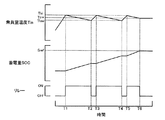
システム停止の状態で電源プラグ94を商用電源に接続すると共に空調装置60により暖房した状態でバッテリ50を充電する際の乗員室21の温度Tinと蓄電量SOCとシステムメインリレー56の状態の時間変化の一例を図7に示す。図示するように、乗員室21の温度Tinが高側制御温度Thi以上に至った時間T1,T3,T5にコンプレッサ64の駆動を停止すると共にシステムメインリレー56をオンとしてバッテリ50の充電を開始し、バッテリ50を充電している最中に乗員室21の温度Tinが低側制御温度Tlow未満に至った時間T2,T4にシステムメインリレー56をオフとしてバッテリ50の充電を中止してコンプレッサ64を駆動する。そして、バッテリ50の蓄電量SOCが値Srefに至った時間T6にシステムメインリレー56をオフとしてバッテリ50の充電を完了すると共に暖房時の通常の制御を開始する。
Changes in the temperature Tin of the
図3の冷房時充電制御ルーチンは、図2の暖房時充電制御ルーチンを冷房に適用したものであり、バッテリ50の蓄電量SOCが値Sref未満のときには、システムメインリレー56がオフ且つコンプレッサ64が駆動の状態のときには乗員室21の温度Tinが低側制御温度Tlow未満に至ると(ステップS250B)、コンプレッサ64の駆動を停止すると共に(ステップS260)、システムメインリレー56をオンとして(ステップS270)、バッテリ50の充電を開始し、その後、システムメインリレー56をオンとしてから所定時間経過すると共に乗員室21の温度Tinが高側制御温度Thi以上に至ったときに(ステップS220B)、システムメインリレー56をオフとすると共に(ステップS230)、コンプレッサ64を駆動する(ステップS240)。そして、バッテリ50の蓄電量SOCが値Sref以上に至ると、システムメインリレー56をオフとし(ステップS280)、商用電源からの電力を用いた空調ECU68による冷房時における通常の空調制御を実行して(ステップS290B)、本ルーチンを終了する。
The cooling charge control routine of FIG. 3 is obtained by applying the heating charge control routine of FIG. 2 to cooling. When the charged amount SOC of the
以上説明した実施例のハイブリッド自動車20によれば、システム停止の状態で電源プラグ94を商用電源に接続すると共に空調装置60をオンとした状態でバッテリ50を充電するときには、空調装置60における設定温度Tin*と外気温度Toutとの差分である温度差ΔT(ΔT=|Tin*−Tout|)が大きくなるほど大きくなり且つ充電必要時間Tchgが大きくなるほど大きくなるようマージン温度αを設定し、設定温度Tin*からマージン温度αの範囲内を不感帯としてバッテリ50の充電と空調装置60のコンプレッサ64の駆動とを交互に行なうことにより、温度差ΔTが大きいほどコンプレッサ64の駆動時間を短くしてバッテリ50の充電時間を確保することができ、充電必要時間Tchgが大きいほどコンプレッサ64の駆動時間を短くして充電必要時間Tchgが大きいときにおける乗員室21を暖房しながらバッテリ50を充電する際の充電完了までの所要時間を短くすることができる。即ち、バッテリ50の充電と乗員室21の空気調和とをより適正に行なうことができる。しかも、システムメインリレー56をオンとしてから所定時間経過するまではバッテリ50の充電を停止しないから、システムメインリレー56のオンオフの頻度を適正に保つことができると共にバッテリ50を比較的効率よく充電することができる。
According to the
また、実施例のハイブリッド自動車20によれば、空調装置60をオンとした状態でバッテリ50を充電するときの充電完了所要時間Tcompを計算し、これをディスプレイ80に表示することにより、バッテリ50の充電を完了するのに必要な時間を乗員に知らせることができる。
Further, according to the
実施例のハイブリッド自動車20では、暖房時であっても冷房時であっても、設定温度Tin*と外気温度Toutとの差分である温度差ΔTと充電必要時間Tchgが同一であれば同一のマージン温度αを設定するものとしたが、暖房時と冷房時で温度差ΔTと充電必要時間Tchgが同一であっても、異なるマージン温度αを設定するものとしても構わない。
In the
実施例のハイブリッド自動車20では、設定温度Tin*と外気温度Toutとの差分である温度差ΔTと充電必要時間Tchgとに基づいてマージン温度αを設定し、設定温度Tin*にマージン温度αを加えて高側制御温度Thiを設定すると共に設定温度Tin*からマージン温度αを減じて低側制御温度Tlowを設定するものとしたが、設定温度Tin*と外気温度Toutとの差分である温度差ΔTと充電必要時間Tchgとに基づいてマージン温度αとこのマージン温度αとは異なるマージン温度βとを設定し、設定温度Tin*にマージン温度αを加えて高側制御温度Thiを設定すると共に設定温度Tin*からマージン温度βを減じて低側制御温度Tlowを設定するものとしたり、設定温度Tin*にマージン温度βを加えて高側制御温度Thiを設定すると共に設定温度Tin*からマージン温度αを減じて低側制御温度Tlowを設定するものとしたりしてもよい。
In the
実施例のハイブリッド自動車20では、システムメインリレー56をオンとしてから所定時間経過するまではシステムメインリレー56をオフとしてコンプレッサ64を駆動しないものとしたが、システムメインリレー56をオンとしてから所定時間経過に拘わらず、暖房時には乗員室21の温度Tinが低側制御温度Tlow未満に至ったときに、冷房時には乗員室21の温度Tinが高側制御温度Thi以上に至ったときに、システムメインリレー56をオフとしてコンプレッサ64を駆動するものとしてもよい。
In the
実施例のハイブリッド自動車20では、空調装置60をオンとした状態でバッテリ50を充電するときの充電完了所要時間Tcompを計算し、これをディスプレイ80に表示するものとしたが、充電完了所要時間Tcompを音声によって出力するものとしてもよい。また、充電完了所要時間Tcmpを報知しないものとしてもよい。その場合、充電完了所要時間Tcompを計算しないものとしても構わない。
In the
実施例のハイブリッド自動車20では、モータMG2の動力を減速ギヤ35により変速して駆動軸22に出力するものとしたが、図8の変形例のハイブリッド自動車120に例示するように、モータMG2の動力を駆動軸22が接続された車軸(駆動輪39a,39bが接続された車軸)とは異なる車軸(図8における車輪39c,39dに接続された車軸)に接続するものとしてもよい。
In the
実施例のハイブリッド自動車20では、エンジン22の動力を動力分配統合機構30を介して駆動輪39a,39bに接続された駆動軸22に出力するものとしたが、図9の変形例のハイブリッド自動車220に例示するように、エンジン22のクランクシャフト26に接続されたインナーロータ232と駆動輪39a,39bに動力を出力する駆動軸に接続されたアウターロータ234とを有し、エンジン22の動力の一部を駆動軸に伝達すると共に残余の動力を電力に変換する対ロータ電動機230を備えるものとしてもよい。
In the
実施例のハイブリッド自動車20では、エンジン22からの動力を動力分配統合機構30を介して駆動輪39a,39bに接続された駆動軸22に出力すると共にモータMG2からの動力を減速ギヤ35を介して駆動軸22に出力するものとしたが、図10の変形例のハイブリッド自動車320に例示するように、駆動輪39a,39bに接続された駆動軸に変速機330を介してモータMGを取り付け、モータMGの回転軸にクラッチ329を介してエンジン22を接続する構成とし、エンジン22からの動力をモータMGの回転軸と変速機330とを介して駆動軸に出力すると共にモータMGからの動力を変速機330を介して駆動軸に出力するものとしてもよい。あるいは、図11の変形例のハイブリッド自動車420に例示するように、エンジン22からの動力を変速機430を介して駆動輪39a,39bに接続された車軸に出力すると共にモータMGからの動力を駆動輪39a,39bが接続された車軸とは異なる車軸(図11における車輪39c,39dに接続された車軸)に出力するものとしてもよい。即ち、走行用の動力を出力するエンジンと走行用の動力を出力する電動機と電動機に電力を供給するバッテリと空調装置と外部電源からの電力を用いてバッテリや空調装置を駆動することができるものであれば、如何なるタイプのハイブリッド自動車としてもよいのである。
In the
また、実施例では、本発明をハイブリッド自動車20の形態として説明したが、こうしたハイブリッド自動車の制御方法の形態としてもよい。
In the embodiment, the present invention has been described as a form of the
実施例の主要な要素と課題を解決するための手段の欄に記載した発明の主要な要素との対応関係について説明する。実施例では、モータMG2が「電動機」に相当し、バッテリ50が「二次電池」に相当し、空調装置60が「空調装置」に相当し、コンプレッサ64を駆動するための駆動回路としてのインバータ65が「空調用駆動手段」に相当し、DC/DCコンバータ90とAC/DCコンバータ92と電源プラグ94とが「外部電力供給手段」に相当し、外気温センサ82が「外気温度検出手段」に相当し、空調装置60における設定温度Tin*と外気温度Toutとの差分である温度差ΔT(ΔT=|Tin*−Tout|)が大きくなるほど大きくなり且つ充電必要時間Tchgが大きくなるほど大きくなるようマージン温度αを設定する図2の暖房時充電制御ルーチンのステップS120や図3の冷房時充電制御ルーチンのステップS120の処理を実行するハイブリッド用電子制御ユニット70が「マージン温度設定手段」に相当し、システム停止した状態で空調装置60により暖房しながらバッテリ50を充電するときには、乗員室21の温度Tinが設定温度Tin*にマージン温度αを加えて得られる高側制御温度Thi以上に至ったときにコンプレッサ64の駆動を停止すると共にシステムメインリレー56をオンとしてバッテリ50の充電を開始し、バッテリ50を充電している最中に乗員室21の温度Tinが設定温度Tin*からマージン温度αを減じて得られる低側制御温度Tlow未満に至ったときにシステムメインリレー56をオフとしてバッテリ50の充電を中止してコンプレッサ64を駆動する図2の暖房時充電制御ルーチンのステップS180〜S270の処理を実行し、システム停止した状態で空調装置60により冷房しながらバッテリ50を充電するときには、乗員室21の温度Tinが低側制御温度Tlow未満に至ったときにコンプレッサ64の駆動を停止すると共にシステムメインリレー56をオンとしてバッテリ50の充電を開始し、バッテリ50を充電している最中に乗員室21の温度Tinが高側制御温度Thi以上に至ったときにシステムメインリレー56をオフとしてバッテリ50の充電を中止してコンプレッサ64を駆動する図3の暖房時充電制御ルーチンのステップS180〜S270の処理を実行するハイブリッド用電子制御ユニット70とハイブリッド用電子制御ユニット70からの制御信号によりコンプレッサ64を駆動する空調ECU68とが「充電時充電空調制御手段」に相当する。また、バッテリ50の充放電電流の積算値に基づいて蓄電量SOCを演算するハイブリッド用電子制御ユニット70が「蓄電量検出手段」に相当し、バッテリ50の充電を完了したときの蓄電量SOCとして予め設定された値Srefとバッテリ50の蓄電量SOCとの差分である蓄電量差ΔSOCが大きいほど大きくなるようバッテリ50を充電するのに必要な時間としての充電必要時間Tchgを設定する図2の暖房時充電制御ルーチンのステップS110や図3の冷房時充電制御ルーチンのステップS110の処理を実行するハイブリッド用電子制御ユニット70が「充電必要時間設定手段」に相当する。
The correspondence between the main elements of the embodiment and the main elements of the invention described in the column of means for solving the problems will be described. In the embodiment, the motor MG2 corresponds to an “electric motor”, the
ここで、「電動機」としては、同期発電電動機として構成されたモータMG2に限定されるものではなく、誘導電動機など、駆動軸に動力を入出力可能なものであれば如何なるタイプの電動機であっても構わない。「二次電池」としては、リチウムイオン二次電池として構成されたバッテリ50に限定されるものではなく、ニッケル水素二次電池やニッケルカドミウム二次電池,鉛蓄電池など如何なる種類の二次電池であっても構わない。「空調装置」としては、空調装置60に限定されるものではなく、乗員室が設定された設定温度となるよう乗員室の空気調和を行なうものであれば如何なるものとしても構わない。「空調用駆動手段」としては、コンプレッサ64を駆動する駆動回路としてのインバータ65に限定されるものではなく、二次電池が接続される電池電力系からの電力を用いて空調装置が備えるコンプレッサを駆動するものであれば如何なるものとしても構わない。「外部電力供給手段」としては、DC/DCコンバータ90とAC/DCコンバータ92と電源プラグ94との組み合わせに限定されるものではなく、外部電源に接続されて外部電源からの交流電力を直流電力に変換して電池電力系に供給するものであれば如何なるものとしても構わない。「マージン温度設定手段」としては、空調装置60における設定温度Tin*と外気温度Toutとの差分である温度差ΔTが大きくなるほど大きくなり且つ充電必要時間Tchgが大きくなるほど大きくなるようマージン温度αを設定するものに限定されるものではなく、外気温度と設定温度との差が大きいほど大きくなる傾向にマージン温度を設定するものであれば如何なるものとしても構わない。「充電時充電空調制御手段」としては、ハイブリッド用電子制御ユニット70と空調ECU68との組み合わせに限定されるものではなく、単一の電子制御ユニットとしてもよい。また、「充電時充電空調制御手段」としては、システム停止した状態で空調装置60により暖房しながらバッテリ50を充電するときには、乗員室21の温度Tinが設定温度Tin*にマージン温度αを加えて得られる高側制御温度Thi以上に至ったときにコンプレッサ64の駆動を停止すると共にシステムメインリレー56をオンとしてバッテリ50の充電を開始し、バッテリ50を充電している最中に乗員室21の温度Tinが設定温度Tin*からマージン温度αを減じて得られる低側制御温度Tlow未満に至ったときにシステムメインリレー56をオフとしてバッテリ50の充電を中止してコンプレッサ64を駆動し、システム停止した状態で空調装置60により冷房しながらバッテリ50を充電するときには、乗員室21の温度Tinが低側制御温度Tlow未満に至ったときにコンプレッサ64の駆動を停止すると共にシステムメインリレー56をオンとしてバッテリ50の充電を開始し、バッテリ50を充電している最中に乗員室21の温度Tinが高側制御温度Thi以上に至ったときにシステムメインリレー56をオフとしてバッテリ50の充電を中止してコンプレッサ64を駆動するものに限定されるものではなく、外部電力供給手段が外部電源に接続された状態で空調装置がオンされて乗員室を暖房しているときに乗員室の温度が設定温度にマージン温度だけ加えた暖房時高側制御温度未満の状態から暖房時高側制御温度以上に至ったときにコンプレッサの駆動を停止して二次電池が充電されるよう空調用駆動手段と外部電力供給手段とを制御すると共に乗員室の温度が設定温度からマージン温度だけ減じた暖房時低側制御温度以上の状態から暖房時低側制御温度未満に至ったときにコンプレッサを駆動するよう空調用駆動手段と外部電力供給手段とを制御し、外部電力供給手段が外部電源に接続された状態で空調装置がオンされて乗員室を冷房しているときに乗員室の温度が設定温度からマージン温度だけ減じた冷房時低側制御温度以上の状態から冷房時低側制御温度未満に至ったときにコンプレッサの駆動を停止して二次電池が充電されるよう空調用駆動手段と外部電力供給手段とを制御すると共に乗員室の温度が設定温度にマージン温度だけ加えた冷房時高側制御温度未満の状態から冷房時高側制御温度以上に至ったときにコンプレッサを駆動するよう空調用駆動手段と外部電力供給手段とを制御するものであれば如何なるものとしても構わない。また、「蓄電量検出手段」としては、バッテリ50の充放電電流の積算値に基づいて蓄電量SOCを演算するものに限定されるものではなく、バッテリの内部抵抗と開放電圧に基づいて蓄電量を演算するものなど、二次電池の状態に応じて二次電池の蓄電量を検出するものであれば如何なるものとしても構わない。「外気温度検出手段」としては、外気温センサ82に限定されるものではなく、外気温度を検出するものであれば如何なるものとしても構わない。「充電必要時間設定手段」としては、バッテリ50の充電を完了したときの蓄電量SOCとして予め設定された値Srefとバッテリ50の蓄電量SOCとの差分である蓄電量差ΔSOCが大きいほど大きくなるようバッテリ50を充電するのに必要な時間としての充電必要時間Tchgを設定するものに限定されるものではなく、蓄電量と二次電池の充電完了として予め設定された完了蓄電量との差分に基づいて充電に必要な充電必要時間を設定するものであれば如何なるものとしても構わない。
Here, the “motor” is not limited to the motor MG2 configured as a synchronous generator motor, and may be any type of motor that can input and output power to the drive shaft, such as an induction motor. It doesn't matter. The “secondary battery” is not limited to the
なお、実施例の主要な要素と課題を解決するための手段の欄に記載した発明の主要な要素との対応関係は、実施例が課題を解決するための手段の欄に記載した発明を実施するための形態を具体的に説明するための一例であることから、課題を解決するための手段の欄に記載した発明の要素を限定するものではない。即ち、課題を解決するための手段の欄に記載した発明についての解釈はその欄の記載に基づいて行なわれるべきものであり、実施例は課題を解決するための手段の欄に記載した発明の具体的な一例に過ぎないものである。 The correspondence between the main elements of the embodiment and the main elements of the invention described in the column of means for solving the problem is the same as that of the embodiment described in the column of means for solving the problem. Therefore, the elements of the invention described in the column of means for solving the problems are not limited. That is, the interpretation of the invention described in the column of means for solving the problems should be made based on the description of the column, and the examples are those of the invention described in the column of means for solving the problems. It is only a specific example.
以上、本発明を実施するための形態について実施例を用いて説明したが、本発明はこうした実施例に何等限定されるものではなく、本発明の要旨を逸脱しない範囲内において、種々なる形態で実施し得ることは勿論である。 As mentioned above, although the form for implementing this invention was demonstrated using the Example, this invention is not limited at all to such an Example, In the range which does not deviate from the summary of this invention, it is with various forms. Of course, it can be implemented.
本発明は、ハイブリッド自動車の製造産業に利用可能である。 The present invention is applicable to the hybrid vehicle manufacturing industry.
20,120,220,320,420 ハイブリッド自動車、21 乗員室、21a 吹き出し口、22 エンジン、26 クランクシャフト、30 遊星歯車機構、32 駆動軸、38 デファレンシャルギヤ、39a,39b 駆動輪、39c,39d 車輪、41,42 インバータ、50 バッテリ、51 温度センサ、54 電力ライン、60 空調装置、62 冷凍サイクル、64 コンプレッサ、65 インバータ、66 ブロワ、67 操作パネル、67a,67b スイッチ、67c 温度センサ、68 空調用電子制御ユニット(空調ECU)、70 ハイブリッド用電子制御ユニット、72 CPU、74 ROM、76 RAM、80 ディスプレイ、82 外気温センサ、90 DC/DCコンバータ、92 AC/DCコンバータ、94 電源プラグ、230 対ロータ電動機、232 インナーロータ、234 アウターロータ、329 クラッチ、330,430 変速機、MG,MG1,MG2 モータ。
20, 120, 220, 320, 420 Hybrid vehicle, 21 passenger compartment, 21a outlet, 22 engine, 26 crankshaft, 30 planetary gear mechanism, 32 drive shaft, 38 differential gear, 39a, 39b drive wheel, 39c, 39d wheel , 41, 42 Inverter, 50 Battery, 51 Temperature sensor, 54 Power line, 60 Air conditioner, 62 Refrigeration cycle, 64 Compressor, 65 Inverter, 66 Blower, 67 Operation panel, 67a, 67b Switch, 67c Temperature sensor, 68 For air conditioning Electronic control unit (air conditioning ECU), 70 Hybrid electronic control unit, 72 CPU, 74 ROM, 76 RAM, 80 display, 82 Outside air temperature sensor, 90 DC / DC converter, 92 AC /
Claims (8)
外部電源に接続されて該外部電源からの交流電力を直流電力に変換して前記電池電力系に供給する外部電力供給手段と、
外気温度を検出する外気温度検出手段と、
前記検出された外気温度と前記設定温度との差が大きいほど大きくなる傾向にマージン温度を設定するマージン温度設定手段と、
前記外部電力供給手段が前記外部電源に接続された状態で前記空調装置がオンされて乗員室を暖房しているときに前記乗員室の温度が前記設定温度に前記設定されたマージン温度だけ加えた暖房時高側制御温度未満の状態から該暖房時高側制御温度以上に至ったときに前記コンプレッサの駆動を停止して前記二次電池が充電されるよう前記空調用駆動手段と前記外部電力供給手段とを制御すると共に前記乗員室の温度が前記設定温度から前記設定されたマージン温度だけ減じた暖房時低側制御温度以上の状態から該暖房時低側制御温度未満に至ったときに前記コンプレッサを駆動するよう前記空調用駆動手段と前記外部電力供給手段とを制御し、前記外部電力供給手段が前記外部電源に接続された状態で前記空調装置がオンされて乗員室を冷房しているときに前記乗員室の温度が前記設定温度から前記設定されたマージン温度だけ減じた冷房時低側制御温度以上の状態から該冷房時低側制御温度未満に至ったときに前記コンプレッサの駆動を停止して前記二次電池が充電されるよう前記空調用駆動手段と前記外部電力供給手段とを制御すると共に前記乗員室の温度が前記設定温度に前記マージン温度だけ加えた冷房時高側制御温度未満の状態から該冷房時高側制御温度以上に至ったときに前記コンプレッサを駆動するよう前記空調用駆動手段と前記外部電力供給手段とを制御する充電時充電空調制御手段と、
を備える自動車。 An electric motor capable of inputting / outputting driving power, a secondary battery capable of exchanging electric power with the electric motor, an air conditioner for air conditioning the passenger compartment so that the passenger compartment has a set temperature, and An air conditioning drive means for driving a compressor included in the air conditioner using power from a battery power system to which a secondary battery is connected,
External power supply means connected to an external power supply and converting AC power from the external power supply to DC power and supplying the battery power system;
Outside temperature detecting means for detecting outside temperature;
Margin temperature setting means for setting a margin temperature in a tendency to increase as the difference between the detected outside air temperature and the set temperature increases,
When the air conditioner is turned on and the passenger compartment is heated while the external power supply means is connected to the external power source, the temperature of the passenger compartment is added to the set temperature by the set margin temperature. The air-conditioning drive means and the external power supply so that the compressor is stopped and the secondary battery is charged when the heating-side high-side control temperature is reached from the state below the heating-side high-side control temperature. And when the temperature of the passenger compartment reaches a temperature lower than the lower control temperature during heating from a state equal to or higher than the lower control temperature during heating obtained by subtracting the set margin temperature from the set temperature. The air conditioning drive means and the external power supply means are controlled to drive the compressor, and the air conditioner is turned on with the external power supply means connected to the external power source to cool the passenger compartment. When the temperature of the passenger compartment reaches a value lower than the low control temperature during cooling from a state equal to or higher than the low control temperature during cooling obtained by subtracting the set margin temperature from the set temperature, the compressor The air conditioning driving means and the external power supply means are controlled so that driving is stopped and the secondary battery is charged, and the temperature of the passenger compartment is increased by the margin temperature to the set temperature. A charge-time air-conditioning control means for charging that controls the air-conditioning drive means and the external power supply means so as to drive the compressor when the cooling-time high-side control temperature or higher is reached from a state below the control temperature;
Automobile equipped with.
前記二次電池の状態に応じて該二次電池の蓄電量を検出する蓄電量検出手段と、
前記検出された蓄電量と前記二次電池の充電完了として予め設定された完了蓄電量との差分に基づいて充電に必要な充電必要時間を設定する充電必要時間設定手段と、
を備え、
前記マージン温度設定手段は、前記設定された充電必要時間が長いほど大きくなる傾向に前記マージン温度を設定する手段である、
自動車。 The automobile according to claim 1,
A storage amount detecting means for detecting a storage amount of the secondary battery according to a state of the secondary battery;
A required charge time setting means for setting a required charge time required for charging based on a difference between the detected charged amount and a completed charged amount preset as a charge completion of the secondary battery;
With
The margin temperature setting means is a means for setting the margin temperature so as to increase as the set required charging time increases.
Car.
前記検出された外気温度と前記設定温度との差が大きいほど大きくなる傾向に且つ前記マージン温度が大きいほど小さくなる傾向に単位時間当たりの空気調和に必要な時間の割合である空調必要割合を設定する空調必要割合設定手段と、
前記設定された充電必要時間に前記設定された空調必要割合に応じた時間を加えて充電完了所要時間を設定する充電完了所要時間設定手段と、
前記設定された充電完了所要時間を報知する報知手段と、
を備える自動車。 The automobile according to claim 1 or 2,
A required air conditioning ratio, which is a ratio of time required for air conditioning per unit time, is set so as to increase as the difference between the detected outside temperature and the set temperature increases and to decrease as the margin temperature increases. Air conditioning required ratio setting means,
Charge completion time setting means for setting a charge completion time by adding a time corresponding to the set air conditioning required ratio to the set charge required time;
Informing means for informing the set time required for completion of charging;
Automobile equipped with.
前記二次電池と前記電池電力系との接続および接続の解除を行なう電池用接続解除手段を備え、
前記充電時充電空調制御手段は、前記コンプレッサを駆動するときには前記二次電池と前記電池電力系との接続が解除されるよう前記電池用接続解除手段を制御する手段である、
自動車。 The automobile according to any one of claims 1 to 3,
A battery connection release means for connecting and releasing the connection between the secondary battery and the battery power system,
The charge-time charging air conditioning control means is means for controlling the battery connection release means so that the connection between the secondary battery and the battery power system is released when the compressor is driven.
Car.
前記充電時充電空調制御手段は、前記二次電池が所定の蓄電状態に至ったときには、前記乗員室の温度と前記設定温度との温度差に拘わらずに前記二次電池と前記電池電力系との接続が解除されるよう前記電池用接続解除手段を制御する手段である、
自動車。 The automobile according to claim 4,
When the secondary battery reaches a predetermined power storage state, the charging-time charging air-conditioning control means includes the secondary battery and the battery power system regardless of the temperature difference between the passenger compartment temperature and the set temperature. A means for controlling the battery connection release means so that the connection of the battery is released.
Car.
前記充電時充電空調制御手段は、前記コンプレッサを駆動する条件が成立しても前記二次電池を継続して充電する時間が所定時間未満のときには、前記二次電池を継続して充電する時間が前記所定時間以上に至るまでは、前記コンプレッサを駆動せずに前記二次電池が充電されるよう前記空調用駆動手段と前記外部電力供給手段とを制御する手段である、
自動車。 The automobile according to any one of claims 1 to 5,
The charging-time charging air-conditioning control means is configured to continue charging the secondary battery when the time for continuously charging the secondary battery is less than a predetermined time even if the condition for driving the compressor is satisfied. Until the predetermined time or longer, the air conditioning drive means and the external power supply means are controlled so that the secondary battery is charged without driving the compressor.
Car.
走行用の動力を出力する内燃機関を搭載する、
自動車。 The automobile according to any one of claims 1 to 5,
Equipped with an internal combustion engine that outputs driving power,
Car.
外気温度と前記設定温度との差が大きいほど大きくなる傾向にマージン温度を設定し、
前記外部電力供給手段が前記外部電源に接続された状態で前記空調装置がオンされて乗員室を暖房しているときに前記乗員室の温度が前記設定温度に前記設定されたマージン温度だけ加えた暖房時高側制御温度未満の状態から該暖房時高側制御温度以上に至ったときに前記コンプレッサの駆動を停止して前記二次電池が充電されるよう前記空調用駆動手段と前記外部電力供給手段とを制御すると共に前記乗員室の温度が前記設定温度から前記設定されたマージン温度だけ減じた暖房時低側制御温度以上の状態から該暖房時低側制御温度未満に至ったときに前記コンプレッサを駆動するよう前記空調用駆動手段と前記外部電力供給手段とを制御し、前記外部電力供給手段が前記外部電源に接続された状態で前記空調装置がオンされて乗員室を冷房しているときに前記乗員室の温度が前記設定温度から前記設定されたマージン温度だけ減じた冷房時低側制御温度以上の状態から該冷房時低側制御温度未満に至ったときに前記コンプレッサの駆動を停止して前記二次電池が充電されるよう前記空調用駆動手段と前記外部電力供給手段とを制御すると共に前記乗員室の温度が前記設定温度に前記マージン温度だけ加えた冷房時高側制御温度未満の状態から該冷房時高側制御温度以上に至ったときに前記コンプレッサを駆動するよう前記空調用駆動手段と前記外部電力供給手段とを制御する、
ことを特徴とする自動車の制御方法。 An electric motor capable of inputting / outputting driving power, a secondary battery capable of exchanging electric power with the electric motor, an air conditioner for air conditioning the passenger compartment so that the passenger compartment has a set temperature, and Air conditioning driving means for driving a compressor provided in the air conditioner using power from a battery power system to which a secondary battery is connected, and AC power from the external power source connected to an external power source is converted to DC power. An external power supply means for supplying to the battery power system,
Set the margin temperature so that the larger the difference between the outside temperature and the set temperature is,
When the air conditioner is turned on and the passenger compartment is heated while the external power supply means is connected to the external power source, the temperature of the passenger compartment is added to the set temperature by the set margin temperature. The air-conditioning drive means and the external power supply so that the compressor is stopped and the secondary battery is charged when the heating-side high-side control temperature is reached from the state below the heating-side high-side control temperature. And when the temperature of the passenger compartment reaches a temperature lower than the lower control temperature during heating from a state equal to or higher than the lower control temperature during heating obtained by subtracting the set margin temperature from the set temperature. The air conditioning drive means and the external power supply means are controlled to drive the compressor, and the air conditioner is turned on with the external power supply means connected to the external power source to cool the passenger compartment. When the temperature of the passenger compartment reaches a value lower than the low control temperature during cooling from a state equal to or higher than the low control temperature during cooling obtained by subtracting the set margin temperature from the set temperature, the compressor The air conditioning driving means and the external power supply means are controlled so that driving is stopped and the secondary battery is charged, and the temperature of the passenger compartment is increased by the margin temperature to the set temperature. Controlling the air-conditioning driving means and the external power supply means to drive the compressor when the cooling-time high-side control temperature or higher is reached from a state below the control temperature;
A method for controlling an automobile.
Priority Applications (1)
| Application Number | Priority Date | Filing Date | Title |
|---|---|---|---|
| JP2009144472A JP2011004498A (en) | 2009-06-17 | 2009-06-17 | Automobile and control method therefor |
Applications Claiming Priority (1)
| Application Number | Priority Date | Filing Date | Title |
|---|---|---|---|
| JP2009144472A JP2011004498A (en) | 2009-06-17 | 2009-06-17 | Automobile and control method therefor |
Publications (1)
| Publication Number | Publication Date |
|---|---|
| JP2011004498A true JP2011004498A (en) | 2011-01-06 |
Family
ID=43561967
Family Applications (1)
| Application Number | Title | Priority Date | Filing Date |
|---|---|---|---|
| JP2009144472A Pending JP2011004498A (en) | 2009-06-17 | 2009-06-17 | Automobile and control method therefor |
Country Status (1)
| Country | Link |
|---|---|
| JP (1) | JP2011004498A (en) |
Cited By (5)
| Publication number | Priority date | Publication date | Assignee | Title |
|---|---|---|---|---|
| JP2012144106A (en) * | 2011-01-10 | 2012-08-02 | Denso Corp | Charge amount control device of hybrid vehicle |
| JP2013059198A (en) * | 2011-09-08 | 2013-03-28 | Suzuki Motor Corp | In-vehicle charging system |
| JP2013544065A (en) * | 2011-08-24 | 2013-12-09 | 常州市西屋自動化有限公司 | Self-adaptive control method for electric vehicle air conditioning system |
| JP2017011904A (en) * | 2015-06-23 | 2017-01-12 | 三菱自動車工業株式会社 | Electric vehicle |
| CN108482064A (en) * | 2018-04-18 | 2018-09-04 | 上海加冷松芝汽车空调股份有限公司 | Used in new energy vehicles integrates crew module's air-conditioning and battery pack heat management heat pump system |
-
2009
- 2009-06-17 JP JP2009144472A patent/JP2011004498A/en active Pending
Cited By (6)
| Publication number | Priority date | Publication date | Assignee | Title |
|---|---|---|---|---|
| JP2012144106A (en) * | 2011-01-10 | 2012-08-02 | Denso Corp | Charge amount control device of hybrid vehicle |
| JP2013544065A (en) * | 2011-08-24 | 2013-12-09 | 常州市西屋自動化有限公司 | Self-adaptive control method for electric vehicle air conditioning system |
| JP2013059198A (en) * | 2011-09-08 | 2013-03-28 | Suzuki Motor Corp | In-vehicle charging system |
| JP2017011904A (en) * | 2015-06-23 | 2017-01-12 | 三菱自動車工業株式会社 | Electric vehicle |
| CN108482064A (en) * | 2018-04-18 | 2018-09-04 | 上海加冷松芝汽车空调股份有限公司 | Used in new energy vehicles integrates crew module's air-conditioning and battery pack heat management heat pump system |
| CN108482064B (en) * | 2018-04-18 | 2023-07-14 | 上海加冷松芝汽车空调股份有限公司 | Integrated passenger cabin air conditioner and battery pack thermal management heat pump system for new energy vehicle |
Similar Documents
| Publication | Publication Date | Title |
|---|---|---|
| JP5029781B2 (en) | Automobile and control method thereof | |
| JP4066995B2 (en) | Automobile and control method thereof | |
| US9327609B2 (en) | Controller for hybrid vehicle | |
| JP2011207300A (en) | Hybrid vehicle and control method thereof | |
| WO2011030444A1 (en) | Hybrid car and method of displaying parameters of hybrid car | |
| JP2013086704A (en) | Hybrid vehicle and control method of the same | |
| JP6229728B2 (en) | Control device and control method for hybrid vehicle | |
| JP4459046B2 (en) | Automobile and control method thereof | |
| JP5967313B2 (en) | Vehicle control apparatus and control method | |
| JP2011083076A (en) | Vehicle and control method thereof | |
| JP2010285110A (en) | Vehicle and control method thereof | |
| JP2011004498A (en) | Automobile and control method therefor | |
| JP2010163095A (en) | Control device for vehicle | |
| JP2011041357A (en) | Battery discharging device for electric vehicles | |
| JP2021040378A (en) | Battery output control device | |
| JP2013095388A (en) | Hybrid car | |
| JP2009303291A (en) | Vehicle and control method thereof | |
| CN106335494A (en) | Hybrid car | |
| JP2013038990A (en) | Motor vehicle | |
| JP2008263754A (en) | Vehicle control device | |
| JP6631375B2 (en) | Hybrid car | |
| JP2017019302A (en) | Automobile | |
| JP4258520B2 (en) | Vehicle and control method thereof | |
| JP2010252427A (en) | Automobile and charging method for secondary battery mounted on the same | |
| JP2006233799A (en) | Drive device and control method thereof |