JP2010527241A - Methods for screening nucleic acids for single nucleotide variations - Google Patents
Methods for screening nucleic acids for single nucleotide variations Download PDFInfo
- Publication number
- JP2010527241A JP2010527241A JP2010508416A JP2010508416A JP2010527241A JP 2010527241 A JP2010527241 A JP 2010527241A JP 2010508416 A JP2010508416 A JP 2010508416A JP 2010508416 A JP2010508416 A JP 2010508416A JP 2010527241 A JP2010527241 A JP 2010527241A
- Authority
- JP
- Japan
- Prior art keywords
- nucleotide
- nucleic acid
- nucleotides
- extension product
- modified
- Prior art date
- Legal status (The legal status is an assumption and is not a legal conclusion. Google has not performed a legal analysis and makes no representation as to the accuracy of the status listed.)
- Pending
Links
Images


Classifications
-
- C—CHEMISTRY; METALLURGY
- C12—BIOCHEMISTRY; BEER; SPIRITS; WINE; VINEGAR; MICROBIOLOGY; ENZYMOLOGY; MUTATION OR GENETIC ENGINEERING
- C12Q—MEASURING OR TESTING PROCESSES INVOLVING ENZYMES, NUCLEIC ACIDS OR MICROORGANISMS; COMPOSITIONS OR TEST PAPERS THEREFOR; PROCESSES OF PREPARING SUCH COMPOSITIONS; CONDITION-RESPONSIVE CONTROL IN MICROBIOLOGICAL OR ENZYMOLOGICAL PROCESSES
- C12Q1/00—Measuring or testing processes involving enzymes, nucleic acids or microorganisms; Compositions therefor; Processes of preparing such compositions
- C12Q1/68—Measuring or testing processes involving enzymes, nucleic acids or microorganisms; Compositions therefor; Processes of preparing such compositions involving nucleic acids
- C12Q1/6813—Hybridisation assays
- C12Q1/6827—Hybridisation assays for detection of mutation or polymorphism
-
- C—CHEMISTRY; METALLURGY
- C12—BIOCHEMISTRY; BEER; SPIRITS; WINE; VINEGAR; MICROBIOLOGY; ENZYMOLOGY; MUTATION OR GENETIC ENGINEERING
- C12Q—MEASURING OR TESTING PROCESSES INVOLVING ENZYMES, NUCLEIC ACIDS OR MICROORGANISMS; COMPOSITIONS OR TEST PAPERS THEREFOR; PROCESSES OF PREPARING SUCH COMPOSITIONS; CONDITION-RESPONSIVE CONTROL IN MICROBIOLOGICAL OR ENZYMOLOGICAL PROCESSES
- C12Q1/00—Measuring or testing processes involving enzymes, nucleic acids or microorganisms; Compositions therefor; Processes of preparing such compositions
- C12Q1/68—Measuring or testing processes involving enzymes, nucleic acids or microorganisms; Compositions therefor; Processes of preparing such compositions involving nucleic acids
- C12Q1/6813—Hybridisation assays
- C12Q1/6834—Enzymatic or biochemical coupling of nucleic acids to a solid phase
Landscapes
- Chemical & Material Sciences (AREA)
- Organic Chemistry (AREA)
- Life Sciences & Earth Sciences (AREA)
- Zoology (AREA)
- Wood Science & Technology (AREA)
- Proteomics, Peptides & Aminoacids (AREA)
- Health & Medical Sciences (AREA)
- Engineering & Computer Science (AREA)
- Microbiology (AREA)
- Immunology (AREA)
- Physics & Mathematics (AREA)
- Molecular Biology (AREA)
- Biotechnology (AREA)
- Biophysics (AREA)
- Analytical Chemistry (AREA)
- Biochemistry (AREA)
- Bioinformatics & Cheminformatics (AREA)
- General Engineering & Computer Science (AREA)
- General Health & Medical Sciences (AREA)
- Genetics & Genomics (AREA)
- Measuring Or Testing Involving Enzymes Or Micro-Organisms (AREA)
Abstract
核酸中のバリエーションを検出するための方法および組成物が開示される。開示される方法は、目的の核酸の配列と参照核酸の配列との間のバリエーションを選択的に特定するために目的の核酸の配列と参照核酸の配列とを比較する。開示される方法は、一般に、他の鎖にハイブリダイズされた核酸鎖中の選択されたヌクレオチドの切除および置換を包含する。この方法では、切り出されたヌクレオチドが、他のハイブリダイズされた鎖中のヌクレオチドとミスマッチしたならば、置換ヌクレオチドはミスマッチされない。切り出されたヌクレオチドが他のハイブリダイズされた鎖中のヌクレオチドとミスマッチしなかったならば、切り出されたヌクレオチドは置換されない。この相違によって目的の核酸中のバリエーションの検出が可能になる。Disclosed are methods and compositions for detecting variations in nucleic acids. The disclosed method compares the sequence of the target nucleic acid with the sequence of the reference nucleic acid to selectively identify variations between the sequence of the nucleic acid of interest and the sequence of the reference nucleic acid. The disclosed methods generally involve excision and substitution of selected nucleotides in a nucleic acid strand that is hybridized to another strand. In this method, the substituted nucleotide is not mismatched if the excised nucleotide mismatches with a nucleotide in the other hybridized strand. If the excised nucleotide does not mismatch with the nucleotide in the other hybridized strand, the excised nucleotide is not replaced. This difference makes it possible to detect variations in the target nucleic acid.
Description
関連出願への相互参照
この出願は、2007年5月14日に出願された米国仮出願第60/917,763号への優先権の利益を主張する。米国仮出願第60/917,763号は、その全体が参考として本明細書に援用される。
This application claims the benefit of priority to US Provisional Application No. 60 / 917,763, filed May 14, 2007. US Provisional Application No. 60 / 917,763 is hereby incorporated by reference in its entirety.
多くの薬物の有効性が、遺伝子中の特定の変位または多型に関連している。個別の遺伝的医薬の段階が現実になってきている。今日の医師は、遺伝子情報に基づいて薬物を処方している。感染性疾患の医師は、患者から単離されたヒト免疫不全ウイルス中で見出される耐性の変位に基づいてAIDSの処置のための薬物を処方している(Rhee SY、らAntimicrob Agents Chemother 2004;48(8):3122〜6)。チトクロムp450遺伝子中の多型は、患者の薬物代謝状態を決定するために用いられている(Ingelman−Sundberg M.Trends Pharmacol Sci 2004;25(4):193〜200)。上皮成長因子レセプター遺伝子の変異は、非小細胞肺癌患者の10%で薬物ゲフィニチブに対する実質的な臨床応答を活性化する(Lynch TJら、N Engl J Med 2004;350(21):2129〜39)。 The effectiveness of many drugs is associated with specific displacements or polymorphisms in the gene. Individual genetic medicine stages are becoming reality. Today's doctors prescribe drugs based on genetic information. Physicians for infectious diseases prescribe drugs for the treatment of AIDS based on resistance shifts found in human immunodeficiency virus isolated from patients (Rhee SY, et al. Antimicrob Agents Chemother 2004; 48 (8): 3122-6). Polymorphisms in the cytochrome p450 gene have been used to determine the drug metabolic status of patients (Ingelman-Sundberg M. Trends Pharmacol Sci 2004; 25 (4): 193-200). Mutations in the epidermal growth factor receptor gene activate a substantial clinical response to the drug gefitinib in 10% of non-small cell lung cancer patients (Lynch TJ et al., N Engl J Med 2004; 350 (21): 2129-39). .
さらに、ガンの早期の検出および処置は罹患および死亡を有意に減らす。実際、ほとんどのガンが早期に検出されれば治癒可能である。体液中の少数のガン細胞を検出するためのゲノムDNAの分子分析は、ガンの早期の検出のための有望なアプローチである。 Furthermore, early detection and treatment of cancer significantly reduces morbidity and mortality. In fact, most cancers can be cured if detected early. Molecular analysis of genomic DNA to detect a small number of cancer cells in body fluids is a promising approach for the early detection of cancer.
腫瘍は、隣接する体液中に一時的に細胞を剥落する。局所の腫瘍由来の悪性細胞は、血液、喀痰、尿および便中で検出される。これらのまれな細胞の鋭敏な検出は、これらの体液中の正常な細胞の数が多すぎるせいで、困難である。これらの細胞由来の正常または野生型のDNAから生成された分子シグナルは、マイナーな変異画分のシグナルを圧倒するか、または競合する。 Tumors temporarily detach cells into adjacent body fluids. Local tumor-derived malignant cells are detected in blood, sputum, urine and stool. Sensitive detection of these rare cells is difficult due to too many normal cells in these body fluids. Molecular signals generated from normal or wild-type DNA from these cells overwhelm or compete with the minor mutant fraction signal.
遺伝子変異に関連する疾患の数は増え続けている。なぜならヒトゲノムの配列が解明されているからである。これらのわずかな変異について陽性に選択するために多くの技術が出現しており、その結果、これらのシグナルは、野生型よりも増幅され得る。これらの技術は、以下の2つのタイプに分けることができる;公知の変異を検出する技術、および未知の変異を検出する技術。 The number of diseases associated with genetic mutations continues to increase. This is because the sequence of the human genome has been elucidated. Many techniques have emerged to select positively for these slight mutations, so that these signals can be amplified more than the wild type. These techniques can be divided into two types: techniques for detecting known mutations, and techniques for detecting unknown mutations.
DNAの公知の部位での変異の鋭敏な検出は既存の技術で容易に行われる。対立遺伝子特異的プライマーは、公知の位置で変異を標的し、その結果そのシグナルが野生型DNAを上回って優先的に増幅され得るように設計することができる。不幸にも、これは標的配列中の任意の位置(塩基)で生じ得る未知の変異では不可能である。ガン遺伝子中のほとんどの変異は、所定の位置には位置しない。kras遺伝子はガンでは高度に変異されている。変異は、エキソン12および13ではホットスポット中でクラスターであるが、遺伝子全体にわたって生じ得る。 Sensitive detection of mutations at known sites in DNA is easily performed with existing techniques. Allele-specific primers can be designed to target mutations at known positions so that the signal can be preferentially amplified over wild-type DNA. Unfortunately, this is not possible with unknown mutations that can occur at any position (base) in the target sequence. Most mutations in the oncogene are not in place. The kras gene is highly mutated in cancer. Mutations are clustered in hot spots in exons 12 and 13, but can occur throughout the gene.
核酸配列決定は、ヌクレオチドバリエーションを検出するための究極的な標準である。核酸配列決定はまた、標的核酸セグメント内の任意の塩基で生じ得る未知の変異または多型を検出するために十分に適している。最も一般に用いられる方法である酵素的なDNA配列決定の化学は、本質的にその概念をそのまま保っている(非特許文献1)。しかし、これは費用、読み取り長さおよび変異の検出に関しては限界がある。この技術は、蛍光色素、ロボット工学および自動化検出による改良型の電気泳動システムの導入などその自動化を可能にしている技術によって改良されている。しかし、遺伝子バリエーションがサンプル集団中において低頻度で生じる場合、自動化は、ほとんどの実験について費用が高くつきすぎる。手動方式でさえ、配列決定は、労働集約型であるせいで費用が高額であり得る。これによってその広範な使用は検出ツールとしては、特に試験されているサンプル集団においてバリエーションが低頻度で生じる場合は限定されたものである。さらに読み取り長さが、電気泳動分離の分解能力によって制限される。DNA配列決定による変異の検出は、特にこれが野生型配列の20%未満を損なう場合、常に明らかというわけではない。 Nucleic acid sequencing is the ultimate standard for detecting nucleotide variations. Nucleic acid sequencing is also well suited for detecting unknown mutations or polymorphisms that can occur at any base within a target nucleic acid segment. The most commonly used method, enzymatic DNA sequencing chemistry, essentially retains that concept (Non-Patent Document 1). However, this is limited in terms of cost, read length and mutation detection. This technique has been improved by techniques that allow its automation, such as the introduction of fluorescent dyes, robotics and improved electrophoretic systems with automated detection. However, if genetic variation occurs infrequently in the sample population, automation is too expensive for most experiments. Even with manual methods, sequencing can be costly due to being labor intensive. This limits its widespread use as a detection tool, especially when variations occur infrequently in the sample population being tested. Furthermore, the reading length is limited by the resolution capability of electrophoretic separation. Detection of mutations by DNA sequencing is not always obvious, especially if this damages less than 20% of the wild type sequence.
DNAマイクロアレイはまた、遺伝子チップおよびオリゴヌクレオチドマイクロアレイとしても公知であり、公知のバリエーションおよび未知のバリエーションの両方を検出するためのさらに主要な趨勢的な使用となりつつある(非特許文献2)。それらは特に、通常は少数の個体由来の特定の遺伝子配列の高密度分析に適している。しかし、高い装備および製造のコストのせいで、未知のバリエーションの大規模集団スクリーニングにはそれほど適していない。チップはまた挿入および欠失変異を検出するのに極めて非効率的である。これらの変異を検出するためにオリゴヌクレオチドを追加することによってチップを2〜4倍の複雑性に増大することは問題である。また、マイクロアレイでは配列決定同様に、大量の野生型DNA中にマイナーな画分として存在し得る変異を検出するのに適切な感度がない。従って、薬物有効性に関連する遺伝子バリエーションの発見および検出は、現行の技術が不十分であることによって妨げられる。従って、配列決定の前に未知のヌクレオチドバリエーションについて核酸をスクリーニングするための簡易で安価なプロセスが当該分野では必要である。 DNA microarrays are also known as gene chips and oligonucleotide microarrays, and are becoming a more dominant trend for detecting both known and unknown variations (Non-Patent Document 2). They are particularly suitable for high density analysis of specific gene sequences, usually from a small number of individuals. However, due to high equipment and manufacturing costs, it is not well suited for large population screening of unknown variations. The chip is also very inefficient in detecting insertion and deletion mutations. Increasing the chip 2 to 4 times more complex by adding oligonucleotides to detect these mutations is problematic. Microarrays, as well as sequencing, are not sensitive enough to detect mutations that can exist as minor fractions in large amounts of wild-type DNA. Thus, the discovery and detection of genetic variations associated with drug efficacy is hampered by the lack of current technology. Therefore, there is a need in the art for a simple and inexpensive process for screening nucleic acids for unknown nucleotide variations prior to sequencing.
本明細書に開示される方法は、核酸中のヌクレオチドバリエーションを検出する分野に関する。本明細書に開示される方法によって、過剰な正常DNAの存在下で単一ヌクレオチドバリエーションを含む変異を包含するまれな変異の急速かつ鋭敏な検出が可能になることが理解され、かつ本明細書において意図される。 The methods disclosed herein relate to the field of detecting nucleotide variations in nucleic acids. It is understood that the methods disclosed herein allow for rapid and sensitive detection of rare mutations, including mutations involving single nucleotide variations in the presence of excess normal DNA. Intended in
開示されるのは、核酸中のバリエーションを検出するための方法および組成物である。この開示された方法は、目的の核酸の配列と参照核酸の配列との間のバリエーションを鋭敏に特定するために目的の核酸の配列と参照核酸の配列とを比較する。この開示された方法は一般に、他の鎖にハイブリダイズした核酸鎖中の選択されたヌクレオチドの切り出しおよび置換を包含する。ハイブリダイズ核酸における核酸鎖のうちの1つは、目的の核酸であるか、またはそれに由来し、そしてハイブリダイズ核酸のもう一方の核酸鎖は、参照核酸であるか、またはそれに由来する。この整列によって、参照核酸の配列と目的の核酸に配列の比較が可能になる。この方法では、この切り出されたヌクレオチドが他のハイブリダイズした鎖におけるヌクレオチドとミスマッチであるならば、この置換ヌクレオチドは、ミスマッチしないであろう。この切り出されたヌクレオチドが、他のハイブリダイズした鎖におけるヌクレオチドとミスマッチしないならば、この切り出されたヌクレオチドは、置換されない。この相違によって、目的の核酸におけるバリエーションの検出が可能になる。 Disclosed are methods and compositions for detecting variations in nucleic acids. This disclosed method compares the sequence of the nucleic acid of interest with the sequence of the reference nucleic acid in order to sharply identify variations between the sequence of the nucleic acid of interest and the sequence of the reference nucleic acid. This disclosed method generally involves excision and substitution of selected nucleotides in a nucleic acid strand that has hybridized to another strand. One of the nucleic acid strands in the hybridizing nucleic acid is or is derived from the nucleic acid of interest, and the other nucleic acid strand of the hybridizing nucleic acid is or is derived from the reference nucleic acid. This alignment allows a sequence comparison between the sequence of the reference nucleic acid and the nucleic acid of interest. In this method, if the excised nucleotide is mismatched with a nucleotide in the other hybridized strand, the replacement nucleotide will not mismatch. If the excised nucleotide does not mismatch with a nucleotide in the other hybridized strand, the excised nucleotide is not replaced. This difference makes it possible to detect variations in the nucleic acid of interest.
この方法のいくつかの形態では、切り出されたヌクレオチドをヌクレアーゼ耐性ヌクレオチドで置き換えることによって、切り出されたヌクレオチドが置換される鎖は、ヌクレアーゼ消化に耐性になるが、切り出されたヌクレオチドが置換されていない鎖は、ヌクレアーゼ消化に感受性である。切り出されたヌクレオチドの置換後にハイブリダイズ核酸をヌクレアーゼに対して曝すことによって、切り出されたヌクレオチドが置換されていない鎖はヌクレアーゼによって破壊され得るが、切り出されたヌクレオチドが置換されている鎖は保存され得る。次いで、残りの鎖が検出可能であって、その鎖がヌクレアーゼ消化を生残したかが注記され得る。ヌクレアーゼ消化を生き残る鎖は、目的の核酸におけるバリエーションの存在の指標である。 In some forms of this method, by replacing the cleaved nucleotide with a nuclease resistant nucleotide, the strand to which the cleaved nucleotide is replaced becomes resistant to nuclease digestion, but the cleaved nucleotide is not replaced. The strand is sensitive to nuclease digestion. By exposing the hybridized nucleic acid to a nuclease after substitution of the excised nucleotide, strands in which the excised nucleotide is not substituted can be destroyed by the nuclease, but strands in which the excised nucleotide is substituted are preserved. obtain. It can then be noted whether the remaining strand is detectable and that strand survived the nuclease digestion. The strand that survives the nuclease digestion is an indication of the presence of variation in the nucleic acid of interest.
この方法のいくつかの形態では、切り出されたヌクレオチドは、テンプレート核酸から産生された核酸鎖中に組み込まれている修飾されたヌクレオチドである。テンプレート核酸は、目的の核酸であっても、または参照核酸であってもよい。修飾されたヌクレオチドは、種々の頻度で、最も通常には合成された鎖あたり平均1回で組み込まれ得る。ミスマッチした鎖とミスマッチの切り出しヌクレオチドなしの鎖との相違は、修飾されたヌクレオチドのタイプ、および/または修飾されたヌクレオチドに用いられる塩基のタイプを限定することによって容易にできる。従って、例えば、特定のタイプの塩基のみを有する修飾されたヌクレオチドの使用とは、その修飾されたヌクレオチドに用いられる塩基のタイプによって特徴付けられる位置でのみヌクレオチドが切り出されることを意味する。切り出され得るヌクレオチドの特定のための範囲がこのように限られているために、置換ヌクレオチドの特異性に制限をおくことが可能になる。従って、例えば、修飾されたヌクレオチド上の塩基のタイプ以外の塩基のタイプを有する置換ヌクレオチドの使用で、ハイブリダイズ鎖とミスマッチした修飾されたヌクレオチドの塩基のみを置換することが可能になる。この方法の特に有用な形態では、単一タイプの塩基を有する修飾されたヌクレオチドおよび3つの他のタイプの塩基を集合的に有する置換ヌクレオチドが用いられ得る。これによって、ある改変体が検出されるとき、改変体であるヌクレオチドのタイプの特定が可能になる。 In some forms of this method, the excised nucleotide is a modified nucleotide that is incorporated into the nucleic acid strand produced from the template nucleic acid. The template nucleic acid may be a target nucleic acid or a reference nucleic acid. Modified nucleotides can be incorporated at various frequencies, most usually on average once per synthesized strand. Differences between mismatched strands and strands without mismatched excision nucleotides can be facilitated by limiting the type of modified nucleotide and / or the type of base used for the modified nucleotide. Thus, for example, the use of a modified nucleotide having only a particular type of base means that the nucleotide is excised only at positions characterized by the type of base used for that modified nucleotide. This limited range for identifying nucleotides that can be excised makes it possible to limit the specificity of the substituted nucleotides. Thus, for example, the use of a substituted nucleotide having a base type other than the base type on the modified nucleotide makes it possible to replace only the base of the modified nucleotide mismatched with the hybridizing strand. In a particularly useful form of this method, modified nucleotides having a single type of base and substituted nucleotides having three other types of bases collectively can be used. This allows the type of nucleotide that is the variant to be identified when a variant is detected.
本発明の目的(単数または複数)によれば、本明細書に具現され、かつ広範に記載されるとおり、本発明は一局面では、目的の核酸内のヌクレオチドバリエーションを検出する方法に関しており、この方法は、(a)第一の核酸由来の伸長産物の1セットを生成すること、およびこの伸長産物中に修飾されたヌクレオチドが存在するようにさせることを包含し、ここでこの修飾されたヌクレオチドが単一タイプの塩基を含む、工程と;(b)第二の核酸に対してこの伸長産物をハイブリダイズさせることを包含する工程と;(c)このハイブリダイズ核酸と修飾されたヌクレオチドを集団的に除去する1つ以上の剤とを接触させることを包含する工程と;(d)このハイブリダイズ核酸と、3つのタイプのヌクレアーゼ耐性ヌクレオチドの存在下においてこの伸長産物を伸長し、かつこの修飾されたヌクレオチドと同じタイプの塩基を含むヌクレオチドの存在下では伸長しない第一の酵素とを接触させることであって、ヌクレアーゼ耐性ヌクレオチドの3つのタイプの各々が異なるタイプの塩基を含む、工程と;(e)ハイブリダイズ核酸と、この伸長産物の3’末端からヌクレオチドを除去する第二の酵素とを接触させることを包含しており、ここでこの第二の酵素がヌクレアーゼ耐性ヌクレオチドを除去しない工程と;(f)このハイブリダイズ核酸と、ヌクレオチドの存在下でこの伸長産物を伸長する第三の酵素とを接触させることを包含する工程と;(g)ヌクレアーゼ耐性ヌクレオチドを含まない伸長産物から、ヌクレアーゼ耐性ヌクレオチドを含む伸長産物を識別することを包含する工程であって、この第一の核酸が参照核酸であって、かつこの第二の核酸が目的の核酸であるか、またはこの第一の核酸が目的の核酸であって、かつこの第二の核酸が参照核酸であり、それによって目的の核酸中のヌクレオチドバリエーションを検出する工程と、を包含する。第一の核酸から生成される伸長産物は、一本鎖であっても二本鎖であってもよい。この修飾されたヌクレオチドは、単一タイプの塩基を含む修飾されたヌクレオチドの存在下で伸長産物を生成することによって伸長産物中で存在するようになり得、ここでこの伸長産物は修飾されたヌクレオチドを組み込む。この修飾されたヌクレオチドは、修飾されたヌクレオチドを産生するために伸長産物中のヌクレオチドを修飾することによって伸長産物中で存在するようにされ得る。このヌクレオチドは、選択的に伸長産物中で修飾され得る。このヌクレオチドは、限定された様式で伸長産物中において修飾され得る。このヌクレオチドは、化学的修飾、酵素修飾または組み合わせによって伸長産物中で修飾され得る。 According to the object (s) of the present invention, as embodied and broadly described herein, the present invention, in one aspect, relates to a method for detecting nucleotide variations in a nucleic acid of interest, comprising: The method includes (a) generating a set of extension products from a first nucleic acid, and causing the modified nucleotide to be present in the extension product, wherein the modified nucleotide Comprising a single type of base; (b) comprising hybridizing the extension product to a second nucleic acid; (c) a population of modified nucleotides with the hybridized nucleic acid Contacting with one or more agents to be removed; (d) the presence of the three types of nuclease resistant nucleotides and the hybridizing nucleic acid. Extending the extension product underneath and contacting a first enzyme that does not extend in the presence of a nucleotide containing the same type of base as the modified nucleotide, comprising three types of nuclease resistant nucleotides: Each comprising a different type of base; and (e) contacting the hybridizing nucleic acid with a second enzyme that removes nucleotides from the 3 ′ end of the extension product, wherein A second enzyme does not remove nuclease resistant nucleotides; (f) contacting the hybridized nucleic acid with a third enzyme that extends the extension product in the presence of nucleotides; g) distinguishing extension products containing nuclease resistant nucleotides from extension products without nuclease resistant nucleotides Wherein the first nucleic acid is a reference nucleic acid and the second nucleic acid is a nucleic acid of interest, or the first nucleic acid is a nucleic acid of interest, and The second nucleic acid is a reference nucleic acid, thereby detecting nucleotide variations in the nucleic acid of interest. The extension product generated from the first nucleic acid may be single-stranded or double-stranded. The modified nucleotide can be present in the extension product by generating the extension product in the presence of a modified nucleotide containing a single type of base, where the extension product is a modified nucleotide. Incorporate This modified nucleotide can be made present in the extension product by modifying the nucleotide in the extension product to produce a modified nucleotide. This nucleotide can be selectively modified in the extension product. This nucleotide can be modified in the extension product in a limited manner. The nucleotide can be modified in the extension product by chemical modification, enzymatic modification or a combination.
開示された方法および組成物のさらなる利点は、本明細書に一部は示されており、これは説明から一部は理解され、または開示される方法および組成物の実施によって学習され得る。この開示された方法および組成物の利点は、添付の特許請求で特に示される要素および組み合わせによって実現および獲得される。前述の一般的説明および以下の詳細な説明の両方とも、例示であり説明でしかなく、特許請求される本発明を限定するものではないことが理解されるべきである。 Additional advantages of the disclosed methods and compositions are set forth in part herein, which can be understood in part from the description, or can be learned by practice of the disclosed methods and compositions. The advantages of the disclosed methods and compositions are realized and obtained by means of the elements and combinations particularly pointed out in the appended claims. It is to be understood that both the foregoing general description and the following detailed description are exemplary and explanatory only and are not restrictive of the invention as claimed.
添付の図面は、本明細書に組み込まれかつその一部を構成しており、開示される方法および組成物のいくつかの実施形態を図示しており、その説明と一緒になって、開示される方法および組成物の原理を説明するように機能する。 The accompanying drawings, which are incorporated in and constitute a part of this specification, illustrate several embodiments of the disclosed methods and compositions, and together with the description, are disclosed. Functions to explain the principles of the methods and compositions.
本発明の化合物、組成物、物品、デバイスおよび/または方法が開示および記載される前、別段の特定がない限り、それらは、特定の合成方法または特定の組み換えバイオテクノロジー方法に、または別段の特定がない限り特定の試薬には限られず、そういうものとして、当然ながら変化してもよいことが理解されるべきである。本明細書に用いられる用語法は、特定の実施形態を記載する目的だけであって、限定する意図はないことも理解されるべきである。 Before the compounds, compositions, articles, devices and / or methods of the present invention are disclosed and described, unless specified otherwise, they are identified in a specific synthetic method or a specific recombinant biotechnology method or otherwise specified. It is to be understood that as long as there is no limitation to a particular reagent, as such it may of course vary. It is also to be understood that the terminology used herein is for the purpose of describing particular embodiments only and is not intended to be limiting.
本明細書および添付の特許請求の範囲で用いられる場合、単数形「1つの、ある(不定冠詞:a、an)」および「この、その(定冠詞:the)」は、文脈が明確に他を示すのでない限り、複数の言及を包含する。従って、例えば、「薬学的なキャリア」との言及は、2つ以上のこのようなキャリアの混合物などを包含する。 As used in this specification and the appended claims, the singular forms “one, indefinite article: a, an” and “this, its (definite article: the)” are clearly different in context. Multiple references are included unless indicated. Thus, for example, reference to “a pharmaceutical carrier” includes a mixture of two or more such carriers, and the like.
範囲は、本明細書では「ほぼ、約、およそ」ある特定の値から、および/または「ほぼ、約、およそ」別の特定の値までとして表現され得る。このような範囲が表現される場合、別の実施形態は、1つの特定の値から、および/または他の特定の値を包含する。同様に、値が近似で表される場合、先行詞「約」の使用で、特定の値が別の実施形態を形成することが理解される。この範囲の各々のエンドポイントが他のエンドポイントに関して、かつ他のエンドポイントとは独立して、その両方で有意であることがさらに理解される。本明細書に開示される多数の値があること、および各々の値がまた「約」(その値自体に加えてその特定の値)として本明細書に開示されることも理解される。例えば、「10」の値が開示されるならば、「約10」も開示される。ある値が開示されるとき、当業者によって適切に理解されるとおり、その値「以下の」、「その値以上」、およびその値の間の可能な範囲も開示されることがまた理解される。例えば、「10」という値が開示されるならば、「10以下」ならびに「10以上」も開示される。この出願を通じて、データは、多数の異なる形式で提供されること、およびこのデータは、エンドポイントおよび開始ポイント、ならびにデータポイントの任意の組み合わせの範囲を示していることも理解される。例えば、特定のデータポイント「10」および特定のデータポイント15が開示される場合、10および15よりも大きい、それ以上、それ未満、それ以下およびそれと等しいことが開示されると考えられ、10〜15も同様であることが理解される。 Ranges may be expressed herein as “about, about, about” from one particular value and / or to “about, about, about” another specific value. When such a range is expressed, another embodiment includes from the one particular value and / or the other particular value. Similarly, where values are expressed as approximations, it is understood that the use of the antecedent “about” forms that particular value forms another embodiment. It is further understood that each endpoint in this range is significant both with respect to the other endpoint and independent of the other endpoint. It is also understood that there are numerous values disclosed herein, and that each value is also disclosed herein as “about” (that particular value in addition to the value itself). For example, if a value of “10” is disclosed, “about 10” is also disclosed. When a value is disclosed, it is also understood that the values “below”, “above that value”, and possible ranges between the values are also disclosed, as properly understood by those skilled in the art. . For example, if the value “10” is disclosed, “10 or less” and “10 or more” are also disclosed. Throughout this application, it is also understood that the data is provided in a number of different formats, and that this data represents the endpoint and starting point, and the range of any combination of data points. For example, if a particular data point “10” and a particular data point 15 are disclosed, it will be disclosed that greater than, less than, less than and equal to 10 and 15 15 is understood to be similar.
本明細書ではおよび以下の特許請求の範囲では、以下の意味を有すると規定される多数の用語に対して言及がなされる。 In this specification and in the claims that follow, reference will be made to a number of terms that shall be defined to have the following meanings.
「任意の(optional)」または「任意に、必要に応じて(optionally)」とは、実質的に記載された事象または環境が生じても生じなくてもよいこと、ならびにこの事象または環境が生じる場合、および生じない場合をその説明が包含することを意味する。 “Optional” or “optionally” means that a substantially described event or environment may or may not occur, and that this event or environment occurs It is meant that the description includes cases and cases that do not occur.
「プライマー」とは、いくつかのタイプの酵素操作を支持し得、酵素操作が生じ得るように標的核酸とハイブリダイズし得るプローブのサブセットである。プライマーは、酵素操作を邪魔しない当該分野で利用可能なヌクレオチドまたはヌクレオチドの誘導体もしくはアナログの任意の組み合わせから作製され得る。 A “primer” is a subset of probes that can support some type of enzymatic manipulation and can hybridize with a target nucleic acid such that the enzymatic manipulation can occur. Primers can be made from any combination of nucleotides or nucleotide derivatives or analogs available in the art that do not interfere with enzymatic manipulation.
「プローブ」は、例えばハイブリダイゼーションを通じて、代表的には配列特異的方式で標的核酸と相互作用し得る分子である。核酸のハイブリダイゼーションは当該分野で十分理解されており、かつ本明細書で考察されている。代表的にはプローブは当該分野で利用可能なヌクレオチドまたはヌクレオチドの誘導体もしくはアナログの任意の組み合わせから作製され得る。 A “probe” is a molecule that can interact with a target nucleic acid, typically in a sequence-specific manner, for example through hybridization. Nucleic acid hybridization is well understood in the art and discussed herein. Typically, probes can be made from any combination of nucleotides or nucleotide derivatives or analogs available in the art.
配列決定技術、特に感度の限界のせいで、未知の変異についての多くの走査技術が長年にわたって開発されてきている:変性高速液体クロマトグラフィー(dHPLC)(Xiao W,Oefner PJ.Hum Mutat 2001;17(6):439〜74)、塩基切断配列走査(BESS)、一本鎖高次構造多型(SSCP)(Orita Mら、Genomics 1989;5(4)874〜9)、ヘテロ二重鎖分析(HA)(Nagamine CMら、Am J Hum Genet 1989;45(2):337〜9)、高次構造感受性ゲル電気泳動(CSGE)(Ganguly A,Prockop DJ.Electrophoresis 1995:16(10):1830〜5;Ganguly Aら、Proc Natl Acad Sci USA 1993;90(21):10325〜9)、変性勾配ゲル電気泳動(DGGE)(Fodde R,Losekoot M.Hum Mutat 1994;3(2):83〜94)、定濃度変性ゲル電気泳動(CDGE)(Hovig E.ら、Mutat Res 1991;262(1):63〜71)、時間的温度勾配ゲル電気泳動(TTGE)(Chen TJら、Clin Chem 1999;45(8Pt1):1162〜7)、ミスマッチの化学的切断(Cotton RGら、Proc Natl Acad Sci USA 1988;85(12):4397〜401、Novack DFら、Proc.Natl.Acad Sci USA 1986;83(3):586〜90)、ミスマッチの酵素切断(Winter Eら、Proc Natl Acad Sci USA 1985;82(22):7575〜9;Myers RMら、Science 1985;230(4731):1242〜6)およびミスマッチ修復酵素(Oldenburg MCら、Biotechniques 2000;28(2):351〜7;Babon JJら、Electrophoresis 1999;20(6):1162〜70;Youil Rら、Genomics 1996;32(3):431〜5;Brow MAら、J Clin Microbiol 1996;34(12):3129〜37;Lu AL、Hsu IC.Genomics 1992;14(2):249〜55)。これらの技術は、広範な使用はみられていない。なぜなら、それらは以下の限界のうちの1つ以上を有するからである:自動化するのが面倒で困難(低い処理能力)、低い感度または再現が困難。 Many scanning techniques for unknown mutations have been developed over the years due to sequencing techniques, particularly sensitivity limitations: Denaturing High Performance Liquid Chromatography (dHPLC) (Xiao W, Oefner PJ. Hum Mutat 2001; 17 (6): 439-74), base cleavage sequence scanning (BESS), single strand conformational polymorphism (SSCP) (Orita M et al., Genomics 1989; 5 (4) 874-9), heteroduplex analysis (HA) (Nagamine CM et al., Am J Hum Genet 1989; 45 (2): 337-9), conformation sensitive gel electrophoresis (CSGE) (Gangular A, Prochop DJ. Electrophoresis 1995: 16 (10): 1830). ~ 5; Gangly A et al., Proc Natl Acad Sci USA 1993; 90 (21): 10325-9), denaturing gradient gel electrophoresis (DGGE) (Fodde R, Rosekot M. Hum Mutat 1994; 3 (2): 83-94), constant concentration denaturing gel electricity. Electrophoresis (CDGE) (Hovig E. et al., Mutat Res 1991; 262 (1): 63-71), Temporal Temperature Gradient Gel Electrophoresis (TTGE) (Chen TJ et al., Clin Chem 1999; 45 (8Pt1): 1162 7), chemical cleavage of mismatches (Cotton RG et al., Proc Natl Acad Sci USA 1988; 85 (12): 4397-401, Novack DF et al., Proc. Natl. Acad Sci USA 1986; 83 (3): 586-90 ), Mi Enzymatic cleavage of smatch (Winter E et al., Proc Natl Acad Sci USA 1985; 82 (22): 7575-9; Myers RM et al., Science 1985; 230 (4731): 1242-6) and mismatch repair enzyme (Oldenburg Burg et al., Biotechniques 2000; 28 (2): 351-7; Babon JJ et al., Electrophoresis 1999; 20 (6): 1162-70; Youil R et al., Genomics 1996; 32 (3): 431-5; Brown MA et al., J Clin. Microbiol 1996; 34 (12): 3129-37; Lu AL, Hsu IC. Genomics 1992; 14 (2): 249-55). These technologies have not seen widespread use. Because they have one or more of the following limitations: cumbersome and difficult to automate (low throughput), low sensitivity or difficult to reproduce.
当該分野のその要件は、未知の変異についてスクリーニングするために開発されている多数の方法によって証明される。一本鎖高次構造多型(SSCP)は、Oritaら、Genomics,5:874〜879(1989)によって開示されるように、非変性ゲル中の既知のサンプルに対して一本鎖状態でのその移動率を比較することによって、未知のサンプル中の変異を検出する。ヌクレオチド配列中の変化は、電気泳動の間その移動率を変え得るDNA分子の二次構造または高次構造に影響する。しかし、この技術は、200bp未満の小さい標的に限定されており、感度に限界があり、再現するには厳格な電気泳動条件を要する。SSCP分析、例えば、ジデオキシフィンガープリンティング、無方向性(Sarkarら、Genomics,13:441〜443(1992))および双方向性(Liuら、Hum.Mol.Genet.,5:107〜114(1996))の両方、ならびに制限エンドヌクレアーゼフィンガープリンティング(LiuおよびSommer,Biotechniques,18:470〜477(1995))における改良によって、1kbのスパンにまたがって変異を検出可能で、ただし簡易さのために感度が犠牲になる。なぜならこれらのプロセスによって生成されるDNAバンドの複雑なパターンのせいで、変異を容易に検出することが困難になるからである。 That requirement in the art is evidenced by a number of methods that have been developed to screen for unknown mutations. Single-stranded conformational polymorphism (SSCP) is in a single-stranded state relative to known samples in non-denaturing gels, as disclosed by Orita et al., Genomics, 5: 874-879 (1989). By comparing the migration rates, mutations in unknown samples are detected. Changes in the nucleotide sequence affect the secondary or higher order structure of the DNA molecule that can change its migration rate during electrophoresis. However, this technique is limited to small targets of less than 200 bp, has limited sensitivity, and requires strict electrophoresis conditions to reproduce. SSCP analysis, eg dideoxy fingerprinting, non-directional (Sarkar et al., Genomics, 13: 441-443 (1992)) and bi-directional (Liu et al., Hum. Mol. Genet., 5: 107-114 (1996) ), As well as restriction endonuclease fingerprinting (Liu and Somer, Biotechniques, 18: 470-477 (1995)) can detect mutations across a 1 kb span, but the sensitivity is increased for simplicity It will be sacrificed. This is because the complex pattern of DNA bands generated by these processes makes it difficult to detect mutations easily.
核酸中のヌクレオチドバリエーションについてスクリーニングするために用いられる別の方法は、ゲルマトリックスを通じてそれらが泳動する場合ヘテロ二重鎖分子の種々の移動度に基づく。Nagamineら(Am.J.Hum.Genet.,45,337〜339(1989))によって最初に記載されたとおり、ヘテロ二重鎖分析と呼ばれるその最も簡易な形態で、特徴付けされていないDNAセグメント、通常は増幅またはPCR産物を、対応する野生型セグメントと混合して、加熱して、ゆっくり変性させる。特徴付けされていない核酸が野生型配列とは異なる配列を有する場合、ヘテロ二重鎖分子が形成される。ヘテロ二重鎖の塩基ミスマッチによって、その移動速度が変化し、それによって非変性ゲル中でホモ二重鎖から部分的に分解能することが可能になる。 Another method used to screen for nucleotide variations in nucleic acids is based on the various mobilities of heteroduplex molecules as they migrate through the gel matrix. An uncharacterized DNA segment in its simplest form, called heteroduplex analysis, as first described by Nagamine et al. (Am. J. Hum. Genet., 45, 337-339 (1989)) Usually, amplification or PCR products are mixed with the corresponding wild-type segment and heated to denature slowly. If the uncharacterized nucleic acid has a sequence that differs from the wild type sequence, a heteroduplex molecule is formed. Heteroduplex base mismatches change their rate of migration, thereby allowing partial resolution from homoduplexes in non-denaturing gels.
FisherおよびLerman(Proc.Natl.Acad.Sci.U.S.A.,80:1579〜1583(1983))によって最初に記載されたとおり、変性ゲル勾配電気泳動(DGGE)と呼ばれるさらに鋭敏なアプローチによって、ヘテロ二重鎖分子を勾配ゲル形式で、漸増する変性レベルに供する。変性を通じてヘテロ二重鎖分子が移動するにつれて、それらは融解または変性をはじめる。この時点で移動は緩徐であって、もはや直線ではない。融点はホモ二重鎖分子についてわずかに異なり、ヘテロ二重鎖分子の部分的分解能が可能になる。電場強度、温度および時間の正確な制御が再現可能な結果を達成するのに重要であり、一貫して再現するのは困難である。 A more sensitive approach called denaturing gel gradient electrophoresis (DGGE), as first described by Fisher and Lerman (Proc. Natl. Acad. Sci. USA, 80: 1579-1583 (1983)). Subjecting the heteroduplex molecules to increasing denaturation levels in a gradient gel format. As heteroduplex molecules migrate through denaturation, they begin to melt or denature. At this point the movement is slow and no longer straight. Melting points are slightly different for homoduplex molecules, allowing partial resolution of heteroduplex molecules. Accurate control of field strength, temperature and time is important to achieve reproducible results and is difficult to reproduce consistently.
定濃度変性ゲル電気泳動(CDGE)では、これらの変数はそれほど重要でない。なぜなら、変性剤の濃度はゲル全体にわたって同じであるからである(Hovigら、Mut.Res.,262:63〜71(1991))。この技術の重大な限界は、核酸セグメントが2つ以上の融解ドメインを有し得、そのために異なる変性濃度で別々のゲルを泳動しなければならないということである。 In constant concentration denaturing gel electrophoresis (CDGE), these variables are less important. This is because the concentration of denaturant is the same throughout the gel (Hovig et al., Mut. Res., 262: 63-71 (1991)). A significant limitation of this technique is that the nucleic acid segment can have more than one melting domain, and therefore separate gels must be run at different denaturing concentrations.
時間的温度勾配ゲル電気泳動(TTGE)は、Borresenら(Bioradiations,99:12〜113(1997))に記載のように、電気泳動の間温度を徐々に上げることによってこの問題を回避しようとする。これは、CDGEと、変性因子として温度のみを用いる温度勾配ゲル電気泳動との間のハイブリッド技術である(RosenbaumおよびRiesner,Biophys.Chem.,26:235〜246(1987))。しかし、予想どおり、この技術はまた、行うことが困難で、再現も困難である。 Temporal temperature gradient gel electrophoresis (TTGE) attempts to avoid this problem by gradually increasing the temperature during electrophoresis as described in Borresen et al. (Bioradiations, 99: 12-113 (1997)). . This is a hybrid technique between CDGE and temperature gradient gel electrophoresis using only temperature as a denaturing factor (Rosenbaum and Riesner, Biophys. Chem., 26: 235-246 (1987)). However, as expected, this technique is also difficult to perform and difficult to reproduce.
塩基切断配列走査(BESS)と呼ばれる最近導入された技術は、別の配列決定反応の必要性を省くことによってddTTPでのジデオキシ・フィンガープリンティングを改善する(Epicentre Technologies,Madison,WI)。目的の標的は、標識プライマーおよび限られた量のdUTPを用いてPCRによって増幅される。増幅後、この産物をウラシルDNAグリコシラーゼで処理して、ウラシル部位で切断する。次いで、フラグメントの変性ゲル電気泳動で、ジデオキシT配列決定ラダーとほぼ同じラダーを産生する。この技術は、変異について最大1kbまでのDNAセグメントをスクリーニングするのに有用であるが、ゲル電気泳動の分解能によって制限され、GからCの塩基転換を検出せず、その逆も同様に検出しない。 A recently introduced technique called base cleavage sequence scanning (BESS) improves dideoxy fingerprinting with ddTTP by eliminating the need for a separate sequencing reaction (Epicentre Technologies, Madison, WI). The target of interest is amplified by PCR using a labeled primer and a limited amount of dUTP. After amplification, the product is treated with uracil DNA glycosylase and cleaved at the uracil site. The denaturing gel electrophoresis of the fragments then produces a ladder that is approximately the same as the dideoxy T sequencing ladder. This technique is useful for screening DNA segments up to 1 kb for mutations, but is limited by the resolution of gel electrophoresis and does not detect G to C transversion and vice versa.
別の近年導入された技術は、クリベース(cleavase)と呼ばれる構造特異的エンドヌクレアーゼを用いて、鎖内構造を消化して、フラグメント長多型(CFLP)を生じ、これはBrowら、J.Clin.Microbiol.,34:3129〜3137(1996)に記載されている。この構造はDNAのセグメントを変性すること、次いでそれを消化温度まで急速に冷却すること、および酵素を添加することによって作製される。所定のセグメントのための折り畳みパターンは、酵素での消化の際に固有の結合パターンを変性ゲル上に生じる配列バリエーションによって変更され得る。しかしこの技術は、ゲル電気泳動の分解能、およびプロセスによって生じる複雑なパターンのDNAバンドによって厳しく制限され、これによって変異の検出が困難になる。 Another recently introduced technique uses a structure-specific endonuclease called cleavase to digest the intrachain structure to produce a fragment length polymorphism (CFLP), which is described in Brown et al. Clin. Microbiol. 34: 3129-3137 (1996). This structure is created by denaturing a segment of DNA, then rapidly cooling it to digestion temperature, and adding an enzyme. The folding pattern for a given segment can be altered by sequence variations that produce a unique binding pattern on the denaturing gel upon enzymatic digestion. However, this technique is severely limited by the resolution of gel electrophoresis and the complex pattern of DNA bands produced by the process, which makes it difficult to detect mutations.
ヘテロ二重鎖DNA中の塩基対ミスマッチの化学的または酵素的な切断による変異の検出は、Noackら、Proc.Natl.Acad.Sci.U.S.A.,83;586〜590(1986)、Cottonら、Proc.Natl.Acad.Sci.U.S.A.,85:4394〜4401(1988)、Cottonら、米国特許第5,202,231号(Winterら、Proc.Natl.Acad.Sci.U.S.A.,82;7575〜7579(1989)、Myersら、Science,230:1245〜1246(1985))、(LuおよびHsu、Genomics,14:249〜255(1992))、および米国特許第5,698,400号によって記載されている。これらの技術の多くは、切断試薬が全てのタイプの塩基対ミスマッチを認識できないことによって制限され、他については、DNAセグメントの両方の鎖を分析することによってこれは克服され得る。今日まで、これらの技術の広範な使用は観察されておらず、その理由の一部は、それらが極めて毒性の試薬を要し、その手順が実施困難であるためである。 Detection of mutations by chemical or enzymatic cleavage of base pair mismatches in heteroduplex DNA is described by Noack et al., Proc. Natl. Acad. Sci. U. S. A. 83; 586-590 (1986); Cotton et al., Proc. Natl. Acad. Sci. U. S. A. 85: 4394-4401 (1988), Cotton et al., US Pat. No. 5,202,231 (Winter et al., Proc. Natl. Acad. Sci. USA, 82; 7575-7579 (1989), Myers et al., Science, 230: 1245-1246 (1985)), (Lu and Hsu, Genomics, 14: 249-255 (1992)), and US Pat. No. 5,698,400. Many of these techniques are limited by the inability of the cleavage reagent to recognize all types of base pair mismatches, and for others this can be overcome by analyzing both strands of the DNA segment. To date, the widespread use of these techniques has not been observed, partly because they require extremely toxic reagents and the procedure is difficult to implement.
DNAチップまたはマイクロアレイとして公知の小型の固相表面へのDNAハイブリダイゼーションプロセスの小型化によって、ゲル電気泳動なしのDNAセグメントの分析が可能になる。Macevicz、米国特許第5,002,867号、Drmanac.米国特許第5,202,231号、Lipshutzら、Biotechniques,9(3):442〜447(1995)およびCheeら、Science,274:610〜614(1996)を参照のこと。しかし、ゲル電気泳動の分解能度によって、DNA配列決定を含む上述の変異検出技術の全てについて分析可能なDNAセグメントのサイズは厳しく制限され、そしてこのプロセスで使用される装置およびチップのコストの高さによって、その広範な使用は制限される。 The miniaturization of the DNA hybridization process on a small solid phase surface known as a DNA chip or microarray allows analysis of DNA segments without gel electrophoresis. Macevicz, U.S. Pat. No. 5,002,867, Drmanac. See US Pat. No. 5,202,231, Lipshutz et al., Biotechniques, 9 (3): 442-447 (1995) and Chee et al., Science, 274: 610-614 (1996). However, the resolution of gel electrophoresis severely limits the size of DNA segments that can be analyzed for all of the mutation detection techniques described above, including DNA sequencing, and the high cost of equipment and chips used in this process. Limits its widespread use.
エンドV変異走査と呼ばれる近年の技術が導入されており、未知の変異を検出するために改良されている(Pincas Hら、Nucl.Acid.Res 2004;32(19):e148)。その改良方式では、それぞれp53およびK−rasの遺伝子について1:50および1:100(変異体:野生型)で存在する未知の変異を検出し得る。既存の技術を上回る改良だが、それは検出のためのゲル電気泳動に依存し、解釈するのが困難である。 A recent technique called endo-V mutation scanning has been introduced and improved to detect unknown mutations (Pincas H et al., Nucl. Acid. Res 2004; 32 (19): e148). In that refinement, unknown mutations present at 1:50 and 1: 100 (mutant: wild type) for the genes of p53 and K-ras, respectively, can be detected. An improvement over existing technology, but it relies on gel electrophoresis for detection and is difficult to interpret.
この開示された方法および組成物によって、単一および複数の塩基の置換、挿入および欠失を含む全ての可能な塩基バリエーションを検出可能である方法を提供することにより、これらの他の方法を上回る必要な改善が得られる。これらのバリエーションは、1つ以上の部位で生じ得、そして所定の遺伝子座について各々の部位で1つ以上のヌクレオチドに影響し得る。第二に、スクリーニングプロセスとして、これらの方法は、明らかな陽性または陰性の結果をもたらす。第三に、このプロセスは、ゲル電気泳動の分解能力では制限されず、従って、1kbのサイズを上回るDNAセグメントの分析を可能にする。最後に、電気泳動検出を排することによって、これは極めて自動化しやすくなり、従って大量のスクリーニングに適する。 Overcoming these other methods by providing a method whereby the disclosed methods and compositions can detect all possible base variations, including single and multiple base substitutions, insertions and deletions Necessary improvements are obtained. These variations can occur at one or more sites and can affect one or more nucleotides at each site for a given locus. Secondly, as a screening process, these methods give clear positive or negative results. Third, this process is not limited by the ability of gel electrophoresis to resolve, thus allowing the analysis of DNA segments greater than 1 kb in size. Finally, by eliminating electrophoretic detection, this is very easy to automate and is therefore suitable for high volume screening.
本明細書に開示されるのは、核酸中のヌクレオチドバリエーションを検出する方法である。本明細書に開示される方法によって、過剰の正常DNAの存在下で単一のヌクレオチドバリエーションを含む変異を包含するがこれに限定されない、まれな変異の急速かつ鋭敏な検出が可能になるということが理解され、かつ本明細書で考えられる。従って、例えば、本明細書に開示されるのは、目的の核酸内のヌクレオチドバリエーションを検出する方法であって、この方法は、
(a)第一の核酸由来の伸長産物の1セットを生成すること、およびこの伸長産物中に修飾されたヌクレオチドが存在するようにさせることを包含し、ここでこの修飾されたヌクレオチドが単一タイプの塩基を含む、工程と、
(b)第二の核酸に対してこの伸長産物をハイブリダイズさせることを包含する工程と、
(c)このハイブリダイズ核酸と、修飾されたヌクレオチドを集団的に除去する1つ以上の剤とを接触させることを包含する工程と、
(d)このハイブリダイズ核酸と、3つのタイプのヌクレアーゼ耐性ヌクレオチドの存在下においてこの伸長産物を伸長し、この修飾されたヌクレオチドと同じタイプの塩基を含むヌクレオチドの存在下では伸長しない第一の酵素とを接触させることであって、ヌクレアーゼ耐性ヌクレオチドの3つのタイプの各々が異なるタイプの塩基を含む、工程と、
(e)このハイブリダイズ核酸と、この伸長産物の3’末端からヌクレオチドを除去する第二の酵素とを接触させることを包含しており、この第二の酵素がヌクレアーゼ耐性ヌクレオチドを除去しない工程と、
(f)このハイブリダイズ核酸と、ヌクレオチドの存在下でこの伸長産物を伸長する第三の酵素とを接触させることを包含する工程と、
(g)ヌクレアーゼ耐性ヌクレオチドを含まない伸長産物から、ヌクレアーゼ耐性ヌクレオチドを含む伸長産物を識別することを包含する工程であって、この第一の核酸が参照核酸であって、かつこの第二の核酸が目的の核酸であるか、またはこの第一の核酸が目的の核酸であって、かつこの第二の核酸が参照核酸であり、それによって目的の核酸中のヌクレオチドバリエーションを検出する工程と、を包含する。この第一の核酸から生成される伸長産物は、一本鎖であってもまたは二本鎖であってもよい。
Disclosed herein are methods for detecting nucleotide variations in nucleic acids. The method disclosed herein allows for rapid and sensitive detection of rare mutations, including but not limited to mutations involving single nucleotide variations in the presence of excess normal DNA. Are understood and considered herein. Thus, for example, disclosed herein is a method for detecting nucleotide variations in a nucleic acid of interest, the method comprising:
(A) generating a set of extension products derived from the first nucleic acid and causing the modified nucleotides to be present in the extension products, wherein the modified nucleotides are single A process comprising a type of base;
(B) comprising hybridizing the extension product to a second nucleic acid;
(C) contacting the hybridizing nucleic acid with one or more agents that collectively remove modified nucleotides;
(D) a first enzyme that extends the extension product in the presence of the hybridizing nucleic acid and three types of nuclease resistant nucleotides and does not extend in the presence of a nucleotide that contains the same type of base as the modified nucleotide. Contacting each of the three types of nuclease resistant nucleotides with a different type of base; and
(E) contacting the hybridized nucleic acid with a second enzyme that removes nucleotides from the 3 ′ end of the extension product, wherein the second enzyme does not remove nuclease resistant nucleotides; ,
(F) contacting the hybridizing nucleic acid with a third enzyme that extends the extension product in the presence of nucleotides;
(G) distinguishing an extension product containing a nuclease resistant nucleotide from an extension product not containing a nuclease resistant nucleotide, wherein the first nucleic acid is a reference nucleic acid and the second nucleic acid Is a nucleic acid of interest, or the first nucleic acid is a nucleic acid of interest, and the second nucleic acid is a reference nucleic acid, thereby detecting nucleotide variations in the nucleic acid of interest. Include. The extension product generated from this first nucleic acid may be single-stranded or double-stranded.
この修飾されたヌクレオチドは、単一タイプの塩基を含む修飾されたヌクレオチドの存在下で伸長産物を例えば生成することによって、この伸長産物に存在するようにされ得、ここでこの伸長産物は修飾されたヌクレオチドを含む。この方法の特に有用な形態は、平均して、伸長産物鎖に1つまたは2〜3個の修飾されたヌクレオチドを生じる。この修飾されたヌクレオチドは、一般にはランダムに組み込まれてもよく、その結果伸長産物のセットは集合的に、その修飾されたヌクレオチドが組み込まれ得る位置のうち多くで、ほとんどで、または全てにおいて修飾されたヌクレオチドを有する。これによって、目的の核酸における関連のヌクレオチド位置のうち多く、ほとんど、または全ての評価が可能になる。この修飾されたヌクレオチドは、例えば、修飾されたヌクレオチドを生じるように伸長産物中でヌクレオチドを修飾することによって、その伸長産物中で存在するようにされ得る。例えば、このヌクレオチドは、化学的修飾、酵素的修飾または組み合わせによって、伸長産物中で修飾され得る。この実施例は実施例3に記載される。ヌクレオチドを修飾し得る多数の化学剤が公知である。同様に、ヌクレオチドを修飾し得る酵素が公知である。有用な修飾によって、伸長した鎖からの除去のために修飾されたヌクレオチドを可能にするか、および/または標的する。 The modified nucleotide can be made present in the extension product, for example by generating an extension product in the presence of a modified nucleotide containing a single type of base, where the extension product is modified. Nucleotides. A particularly useful form of this method on average yields one or a few modified nucleotides in the extension product strand. This modified nucleotide may generally be incorporated randomly, so that the set of extension products is modified in many, most, or all of the positions where the modified nucleotide can be incorporated. Having the nucleotides This allows for the evaluation of many, most or all of the relevant nucleotide positions in the nucleic acid of interest. The modified nucleotide can be made present in the extension product, for example, by modifying the nucleotide in the extension product to yield a modified nucleotide. For example, the nucleotide can be modified in the extension product by chemical modification, enzymatic modification or a combination. This example is described in Example 3. Many chemical agents are known that can modify nucleotides. Similarly, enzymes that can modify nucleotides are known. Useful modifications allow and / or target modified nucleotides for removal from the extended strand.
伸長産物中のヌクレオチドの修飾は、選択的に行うことが可能である。選択的にとは、特定のタイプのヌクレオチドおよび/または特定のタイプの塩基のみが修飾されるかまたは修飾の標的になることを意味する。最も有用なのは、単一タイプの塩基が修飾されるか、および/または修飾の標的である修飾である。伸長産物におけるヌクレオチドの修飾はまた、限定された様式で行うことができる。限定的な修飾とは、ヌクレオチドのうちいくつかだけが修飾されることを意味する。例えば、修飾が、単一タイプの塩基を含むヌクレオチドで例えば選択的に行われる場合、限定的な修飾とは、選択されたタイプの塩基を含むヌクレオチドのうちいくつかだけが修飾されることを意味する。従って限定的な修飾とは、限られた反応または操作である。代表的には、限定的な修飾は、限られた時間または限定条件下で、修飾反応を行うこと、または修飾条件に対して伸長産物を曝すことによって達成され、その結果修飾され得るヌクレオチドのうちいくつかだけが修飾される。限定的な手順での修飾の特に有用な形態は、平均して、伸長産物鎖において1つまたは2〜3個の修飾されたヌクレオチドを生じる。このヌクレオチドは、一般にはランダムに修飾され、その結果、伸長産物のセットは集合的に、ヌクレオチドが修飾され得る位置のうち多くで、ほとんどで、または全てにおいて修飾されたヌクレオチドを有する。これによって、目的の核酸中の関連のヌクレオチド位置のうち多く、ほとんど、または全てのアセスメントが可能になる。
Modification of the nucleotide in the extension product can be done selectively. Selectively means that only certain types of nucleotides and / or certain types of bases are modified or targeted for modification. Most useful are modifications where a single type of base is modified and / or the target of the modification. Nucleotide modifications in the extension product can also be performed in a limited manner. Limited modification means that only some of the nucleotides are modified. For example, if the modification is made, for example, selectively with nucleotides containing a single type of base, limited modification means that only some of the nucleotides containing the selected type of base are modified. To do. Thus, a limited modification is a limited reaction or manipulation. Typically, limited modification is achieved by performing the modification reaction or exposing the extension product to the modification conditions for a limited time or under limited conditions, and as a result of the nucleotides that can be modified. Only a few are qualified. A particularly useful form of modification in a limited procedure results on average in the
本明細書で開示される核酸バリエーションの検出のための方法は、ガンなどの疾患または状態の存在の検出または診断、核酸バリエーションに関連する疾患または状態について感受性またはリスクを評価すること、疾患進行をモニタリングすること、および治療処置に対する感受性または耐性の決定を含むがそれに限定されない多くの用途を有する。従って、例えば、本発明に開示されるのは、目的の核酸内のヌクレオチドバリエーションを検出する工程を包含するガンの存在を検出するための方法であって、この方法は、
(a)第一の核酸由来の伸長産物の1セットを生成すること、およびこの伸長産物中に修飾されたヌクレオチドが存在するようにさせることを包含し、ここでこの修飾されたヌクレオチドが単一タイプの塩基を含む、工程と、
(b)第二の核酸に対してこの伸長産物をハイブリダイズさせることを包含する工程と、
(c)このハイブリダイズ核酸と、修飾されたヌクレオチドを集団的に除去する1つ以上の剤とを接触させることを包含する工程と、
(d)このハイブリダイズ核酸と、3つのタイプのヌクレアーゼ耐性ヌクレオチドの存在下においてこの伸長産物を伸長するが、この修飾されたヌクレオチドと同じタイプの塩基を含むヌクレオチドの存在下では伸長しない第一の酵素とを接触させることであって、ヌクレアーゼ耐性ヌクレオチドの3つのタイプの各々が異なるタイプの塩基を含む、工程と、
(e)このハイブリダイズ核酸と、この伸長産物の3’末端からヌクレオチドを除去する第二の酵素とを接触させることを包含しており、この第二の酵素がヌクレアーゼ耐性ヌクレオチドを除去しない工程と、
(f)このハイブリダイズ核酸と、ヌクレオチドの存在下でこの伸長産物を伸長する第三の酵素とを接触させることを包含する工程と、
(g)ヌクレアーゼ耐性ヌクレオチドを含まない伸長産物から、ヌクレアーゼ耐性ヌクレオチドを含む伸長産物を識別することを包含する工程であって、この第一の核酸が参照核酸であって、かつこの第二の核酸が目的の核酸であるか、またはこの第一の核酸が目的の核酸であって、かつこの第二の核酸が参照核酸であり、それによって目的の核酸中のヌクレオチドバリエーションを検出する工程を包含する工程と、を包含し、ここで、この参照核酸に対する目的の核酸中のバリエーションの存在がガンの存在を示す。第一の核酸から生成された伸長産物は、一本鎖であっても二本鎖であってもよい。この修飾されたヌクレオチドは、単一タイプの塩基を含む修飾されたヌクレオチドの存在下で伸長産物を生成することによって伸長産物中で存在するようにされ得、ここで、この伸長産物は、修飾されたヌクレオチドを組み込んでいる。この修飾されたヌクレオチドは、修飾されたヌクレオチドを生じるために伸長産物中でヌクレオチドを修飾することによって伸長産物中で存在するようにされ得る。このヌクレオチドは、選択的に伸長産物に修飾され得る。このヌクレオチドは、伸長産物中で限定された様式で修飾され得る。このヌクレオチドは、化学的修飾、酵素的修飾または組み合わせによって伸長産物中で修飾され得る。
Methods for detection of nucleic acid variations disclosed herein include detection or diagnosis of the presence of a disease or condition such as cancer, assessing susceptibility or risk for a disease or condition associated with nucleic acid variation, disease progression. It has many uses, including but not limited to monitoring and determining sensitivity or resistance to therapeutic treatment. Thus, for example, disclosed in the present invention is a method for detecting the presence of a cancer comprising the step of detecting nucleotide variations in a nucleic acid of interest comprising:
(A) generating a set of extension products from the first nucleic acid and causing the modified nucleotide to be present in the extension product, wherein the modified nucleotide is a single A process comprising a type of base;
(B) comprising hybridizing the extension product to a second nucleic acid;
(C) contacting the hybridizing nucleic acid with one or more agents that collectively remove modified nucleotides;
(D) a first extension that extends the extension product in the presence of the hybridizing nucleic acid and three types of nuclease resistant nucleotides, but does not extend in the presence of a nucleotide containing the same type of base as the modified nucleotide. Contacting the enzyme, wherein each of the three types of nuclease resistant nucleotides comprises a different type of base;
(E) contacting the hybridizing nucleic acid with a second enzyme that removes nucleotides from the 3 ′ end of the extension product, wherein the second enzyme does not remove nuclease resistant nucleotides; ,
(F) contacting the hybridizing nucleic acid with a third enzyme that extends the extension product in the presence of nucleotides;
(G) distinguishing an extension product containing a nuclease resistant nucleotide from an extension product not containing a nuclease resistant nucleotide, wherein the first nucleic acid is a reference nucleic acid and the second nucleic acid A nucleic acid of interest, or the first nucleic acid is a nucleic acid of interest and the second nucleic acid is a reference nucleic acid, thereby detecting nucleotide variations in the nucleic acid of interest Wherein the presence of a variation in the nucleic acid of interest relative to this reference nucleic acid indicates the presence of the cancer. The extension product generated from the first nucleic acid may be single-stranded or double-stranded. The modified nucleotide can be made present in the extension product by generating the extension product in the presence of a modified nucleotide containing a single type of base, where the extension product is modified. Incorporated nucleotides. The modified nucleotide can be made present in the extension product by modifying the nucleotide in the extension product to yield a modified nucleotide. This nucleotide can be selectively modified to an extension product. This nucleotide can be modified in a limited manner in the extension product. The nucleotide can be modified in the extension product by chemical modification, enzymatic modification or a combination.
この開示された方法は、ヌクレアーゼ耐性ヌクレオチドを含まない伸長産物が実質的にない状況を生じ得る。従って、ヌクレアーゼ耐性ヌクレオチドを含まない伸長産物からヌクレアーゼ耐性ヌクレオチドを含む伸長産物を識別することは、例えば、伸長産物の存在を単に検出することによって、達成され得る。例えば、ヌクレアーゼ耐性ヌクレオチドがヌクレアーゼ耐性ヌクレオチドの存在下で伸長した伸長産物に組み込まれていないサンプルは、酵素(例えば、エキソヌクレアーゼIIIなどのエキソヌクレアーゼ)に対する曝露の際に消化される伸長産物を生じる。逆に、ヌクレアーゼ耐性ヌクレオチドがヌクレアーゼ耐性ヌクレオチドの存在下で伸長した伸長産物に組み込まれているサンプルは、酵素(例えば、エキソヌクレアーゼ)による消化に耐性である伸長産物を生じる。第二の酵素が3’→5’方向に(すなわち、3’末端から)ヌクレオチドを除去し得る当該分野で公知の任意の酵素を含んでもよいことが理解される。従って、例えば、この酵素は、エキソヌクレアーゼIIIなどのエキソヌクレアーゼであってもよい。第二の酵素として利用することが本明細書で考慮される他の酵素としては、限定はしないがTrexI、TrexII、T7およびエキソヌクレアーゼTが挙げられる。従って、本明細書に開示されるのは、第二の酵素がエキソヌクレアーゼであり得る方法である。また本明細書に開示されるのは、第二の酵素がエキソヌクレアーゼIIIである方法である。酵素が3’から5’に消化するエキソヌクレアーゼである方法では、伸長産物中でヌクレアーゼ耐性ヌクレオチドの任意のヌクレオチド5’が酵素による除去から保護されることも理解される。同様に、ヌクレアーゼ耐性ヌクレオチドが存在する伸長産物は、酵素によって消化され得る。従って、本明細書に開示されるのは、伸長産物の3’末端からヌクレオチドを除去する酵素の使用後、ヌクレアーゼ耐性ヌクレオチドを含まない伸長産物が実質的にない方法であり、ここでは、ヌクレアーゼ耐性ヌクレオチドを含まない伸長産物からヌクレアーゼ耐性ヌクレオチドを含む伸長産物を識別することは、伸長産物の存在を検出することを包含する。 This disclosed method can result in a situation that is substantially free of extension products that do not contain nuclease resistant nucleotides. Thus, distinguishing extension products that contain nuclease resistant nucleotides from extension products that do not contain nuclease resistant nucleotides can be accomplished, for example, by simply detecting the presence of the extension product. For example, a sample in which a nuclease resistant nucleotide is not incorporated into an extended product that has been extended in the presence of a nuclease resistant nucleotide yields an extended product that is digested upon exposure to an enzyme (eg, an exonuclease such as exonuclease III). Conversely, a sample in which a nuclease resistant nucleotide is incorporated into an extension product extended in the presence of a nuclease resistant nucleotide results in an extension product that is resistant to digestion by an enzyme (eg, exonuclease). It is understood that the second enzyme may comprise any enzyme known in the art that can remove nucleotides in the 3 'to 5' direction (ie, from the 3 'end). Thus, for example, the enzyme may be an exonuclease such as exonuclease III. Other enzymes contemplated herein for use as the second enzyme include, but are not limited to, TrexI, TrexII, T7, and exonuclease T. Accordingly, disclosed herein is a method in which the second enzyme can be an exonuclease. Also disclosed herein is a method wherein the second enzyme is exonuclease III. It is also understood that in methods where the enzyme is an exonuclease that digests 3 'to 5', any nucleotide 5 'of the nuclease resistant nucleotide is protected from enzymatic removal in the extension product. Similarly, extension products in which nuclease resistant nucleotides are present can be digested by enzymes. Accordingly, disclosed herein is a method that is substantially free of nuclease resistant nucleotide-free extension products after use of an enzyme that removes nucleotides from the 3 ′ end of the extension product, wherein Discriminating extension products containing nuclease resistant nucleotides from extension products that do not contain nucleotides includes detecting the presence of extension products.
本明細書に開示される方法は、ヌクレアーゼ耐性ヌクレオチドが伸長産物中に組み込まれている場合、ヌクレアーゼ消化後にのみ伸長産物が存在する状況を考慮する。「ヌクレアーゼ耐性ヌクレオチド」とは、所定のヌクレアーゼに耐性である任意のヌクレオチドをいう。このような「ヌクレアーゼ耐性ヌクレオチド」は天然に存在してもまたは合成であってもよいことが理解されかつ本明細書で考えられる。当業者に公知の多くのこのようなヌクレオチドがあり、任意の1つのヌクレアーゼ耐性ヌクレオチドの使用は用いられているヌクレアーゼに依存することが理解される。ヌクレアーゼ耐性ヌクレオチドの例としては限定はしないが、チオ修飾デオキシヌクレオチドおよびボラノ修飾ヌクレオチドが挙げられる。従って、例えば、開示されるのは、ヌクレアーゼ耐性ヌクレオチドがαチオデオキシヌクレオチドを含む方法である。本明細書に開示されるのは、核酸バリエーションを検出する方法であって、ここではヌクレオチドバリエーションが目的の核酸に存在する場合のみ、ヌクレアーゼ耐性ヌクレオチドがヌクレアーゼ耐性ヌクレオチドの存在下で伸長産物中に組み込まれる。また開示されるのは、ヌクレオチドバリエーションが目的の核酸に存在する場合のみ実質的に、ヌクレアーゼ耐性ヌクレオチドがヌクレアーゼ耐性ヌクレオチドの存在下で伸長産物中に組み込まれている方法である。 The methods disclosed herein take into account the situation where an extension product is present only after nuclease digestion when a nuclease resistant nucleotide is incorporated into the extension product. A “nuclease resistant nucleotide” refers to any nucleotide that is resistant to a given nuclease. It is understood and contemplated herein that such “nuclease resistant nucleotides” may be naturally occurring or synthetic. It is understood that there are many such nucleotides known to those skilled in the art, and the use of any one nuclease resistant nucleotide depends on the nuclease being used. Examples of nuclease resistant nucleotides include, but are not limited to, thio-modified deoxynucleotides and borano-modified nucleotides. Thus, for example, disclosed is a method wherein a nuclease resistant nucleotide comprises an α-thiodeoxy nucleotide. Disclosed herein is a method for detecting nucleic acid variations, where a nuclease resistant nucleotide is incorporated into an extension product in the presence of a nuclease resistant nucleotide only if the nucleotide variation is present in the nucleic acid of interest. It is. Also disclosed is a method in which nuclease resistant nucleotides are incorporated into extension products in the presence of nuclease resistant nucleotides only when nucleotide variations are present in the nucleic acid of interest.
開示される方法は、本明細書に開示される工程を行う結果として、第一の核酸(目的の核酸であってもまたは参照核酸であってもよい)から(テンプレートによって)産生された核酸中に、この開示される方法の修飾されたヌクレオチドを組み込むことを考慮する。ヌクレオチドバリエーションが生じる部位(単数または複数)が、ヌクレオチドバリエーションが生じる部位(単数または複数)に相当する位置(単数または複数)で修飾されたヌクレオチドの組み込みによって明らかになることもさらに考えられる。従って、本明細書に開示されるのは、伸長産物中の修飾されたヌクレオチドの位置に相当する部位で目的の核酸にヌクレオチドバリエーションが存在した方法である。当業者に公知の多数の修飾されたヌクレオチドが開示された方法で用いられ得ることが理解され、かつ本明細書で考慮される。当業者は、所定の修飾ヌクレオチドの妥当性を決定する方法を承知している。本明細書に開示される方法で用いられる場合、修飾されたヌクレオチドとしては限定はしないが、7,8−ジヒドロ−8−オキソグアニン(8−オキソグアニン)、8−オキソアデニン、fapy−グアニン、メチ−fapy−グアニン、fapy−アデニン、アフラトキシンB1−fapy−グアニン、5−ヒドロキシ−シトシン、5−ヒドロキシ−ウラシル、および開環したN−7グアニン付加物(7−メチルグアニン)が挙げられる。一般には修飾されたヌクレオチドは、1つ以上の剤により核酸鎖から選択的に除去され得るヌクレオチドとして選択され得る。修飾されたヌクレオチドの除去またはDNAの修復のための有用な剤としては、例えば、ウラシルDNAグリコシラーゼ、APEI(ヒトのアプリン/アピリミジンエンドヌクレアーゼ)、FPG(ホルムアミドピリミジン−DNAグリコシラーゼa.k.a.8−オキシグアニンDNAグリコシラーゼ)、エンドヌクレアーゼIVおよびキナーゼ、EndoIII、EndoVIII、hOGG1、T7EndoI、T4PDGおよびafuUDGが挙げられる。修飾されたヌクレオチドはまた、例えば、PCRの間のα−チオヌクレオチドまたはリボースヌクレオチドのランダムな組み込みによる塩基特異的切断、その後の化学切断によって除去されてもよい。 The disclosed method results in performing the steps disclosed herein in a nucleic acid produced (by a template) from a first nucleic acid (which may be a nucleic acid of interest or a reference nucleic acid). Consider incorporating the modified nucleotides of this disclosed method. It is further conceivable that the site (s) where the nucleotide variation occurs is revealed by the incorporation of a modified nucleotide at the position (s) corresponding to the site (s) where the nucleotide variation occurs. Accordingly, disclosed herein is a method in which nucleotide variations exist in the nucleic acid of interest at a site corresponding to the position of the modified nucleotide in the extension product. It is understood and contemplated herein that a number of modified nucleotides known to those skilled in the art can be used in the disclosed methods. Those skilled in the art know how to determine the validity of a given modified nucleotide. When used in the methods disclosed herein, modified nucleotides include, but are not limited to, 7,8-dihydro-8-oxoguanine (8-oxoguanine), 8-oxoadenine, fapy-guanine, Examples include meth-fapy-guanine, fapy-adenine, aflatoxin B 1 -fapy-guanine, 5-hydroxy-cytosine, 5-hydroxy-uracil, and a ring-opened N-7 guanine adduct (7-methylguanine). In general, modified nucleotides can be selected as nucleotides that can be selectively removed from a nucleic acid strand by one or more agents. Useful agents for the removal of modified nucleotides or DNA repair include, for example, uracil DNA glycosylase, APEI (human aprin / apyrimidine endonuclease), FPG (formamidopyrimidine-DNA glycosylase aka 8-oxyguanine DNA glycosylase), endonuclease IV and kinase, EndoIII, EndoVIII, hOGG1, T7EndoI, T4PDG and afuUDG. Modified nucleotides may also be removed by, for example, base-specific cleavage by random incorporation of α-thionucleotides or ribose nucleotides during PCR followed by chemical cleavage.
選択的除去によって、実質的に修飾されたヌクレオチドのみの選択的な置換が可能になる。これによって、この開示された方法を操作して目的の核酸鎖中で改変体であるヌクレオチドのタイプを特定することが可能になる。選択的な除去とは、実質的に標的され除去することを意図するヌクレオチドのみをこの剤の作用によって除去することを意味する。修飾されたヌクレオチドの全て、ほとんど、または多数でさえも選択的な除去を構成するには除去される必要はない。そうではなく、選択的除去を構成する、標的もされず除去することを意図もしないヌクレオチドの除去は存在しない。一般には、修飾されたヌクレオチドの性質およびタイプ、ならびに剤の性質およびタイプによって、どのヌクレオチドが除去されるかが確立される。 Selective removal allows selective replacement of only substantially modified nucleotides. This allows the disclosed method to be manipulated to identify the type of nucleotide that is a variant in the target nucleic acid strand. Selective removal means that only the nucleotides that are substantially targeted and intended to be removed are removed by the action of this agent. All, most, or even many of the modified nucleotides need not be removed to constitute selective removal. Rather, there is no removal of nucleotides that constitute selective removal and that are neither targeted nor intended to be removed. In general, the nature and type of the modified nucleotide and the nature and type of the agent establish which nucleotide is removed.
ヌクレオチドバリエーションを検出する開示された方法は、剤を利用して修飾されたヌクレオチドを除去し得る。この剤は、単剤の作用を通じてまたは多剤の作用を通じて、修飾されたヌクレオチドを除去し得る。従って、1つの剤は、別の剤が機能し得る状態を生じる場合がある。例えば、1つの剤が、修飾されたヌクレオチドの塩基を除去して、無塩基ヌクレオチドでのみ切断するエンドヌクレアーゼの作用のための部位を提供する場合がある。従って本明細書に開示されるのは、1つ以上の剤が、修飾されたヌクレオチドから塩基を除去する方法である。単独で用いられてもよいし、または開示された方法と組み合わせて用いられてもよい、多くの剤が当該分野で公知である。当業者は、開示された方法で用いられ得る剤を承知している。その剤が、ヌクレアーゼおよびグリコシラーゼなどの酵素を含み得るということが本明細書で理解され、かつ考慮される。従って、本明細書に開示されるのは、この剤がエンドヌクレアーゼを含む方法である。1つ以上の剤がエンドヌクレアーゼIVを含む方法も開示される。また、1つ以上の剤がホルムアミドピリミジン−DNAグリコシラーゼ(FPG)を含む方法も開示される。 The disclosed methods for detecting nucleotide variations can utilize an agent to remove modified nucleotides. This agent can remove modified nucleotides through the action of a single agent or through the action of multiple agents. Thus, one agent may cause a condition in which another agent can function. For example, one agent may remove the base of the modified nucleotide and provide a site for the action of an endonuclease that cleaves only at the abasic nucleotide. Accordingly, disclosed herein are methods by which one or more agents remove a base from a modified nucleotide. Many agents are known in the art that may be used alone or in combination with the disclosed methods. Those skilled in the art are aware of agents that can be used in the disclosed methods. It is understood and contemplated herein that the agent can include enzymes such as nucleases and glycosylases. Accordingly, disclosed herein is a method wherein the agent comprises an endonuclease. Also disclosed are methods wherein the one or more agents comprise endonuclease IV. Also disclosed is a method wherein the one or more agents comprise formamide pyrimidine-DNA glycosylase (FPG).
本明細書に開示される方法では、ヌクレアーゼ耐性ヌクレオチドの存在下での修飾されたヌクレオチドの除去および伸長産物の伸長は、連続的に行われてもまたは同時に行われてもよい。 In the methods disclosed herein, removal of modified nucleotides and extension of extension products in the presence of nuclease resistant nucleotides may be performed sequentially or simultaneously.
本明細書に開示される方法は、酵素の使用であって、修飾されたヌクレオチドを除去しかつ置き換えて、それを標識されたヌクレオチドで置換する使用を考慮する。標識されたヌクレオチドで修飾されたヌクレオチドを置換し得る酵素の一例は、ポリメラーゼである。従って、本明細書に開示されるのは、第一の酵素がポリメラーゼを含む方法である。一局面では、ポリメラーゼは、DNAポリメラーゼであってもよいことが理解される。このポリメラーゼは熱安定性であってもよいことが理解され、かつ本明細書で開示される。従って、開示されるのは、第一の酵素が熱安定性ポリメラーゼである方法である。多数の熱安定性ポリメラーゼがこの開示された方法で用いられ得ることが理解されかつ本明細書で考えられる。従って、例えば、第三の酵素は、THERMOSEQUENASE(サーモシクエナーゼ)を含んでもよい。 The method disclosed herein contemplates the use of an enzyme to remove and replace a modified nucleotide and replace it with a labeled nucleotide. An example of an enzyme that can replace a modified nucleotide with a labeled nucleotide is a polymerase. Accordingly, disclosed herein is a method wherein the first enzyme comprises a polymerase. In one aspect, it is understood that the polymerase may be a DNA polymerase. It is understood that the polymerase may be thermostable and is disclosed herein. Accordingly, disclosed is a method wherein the first enzyme is a thermostable polymerase. It is understood and contemplated herein that a number of thermostable polymerases can be used in the disclosed method. Thus, for example, the third enzyme may comprise THERMOSEQUENASE.
ヌクレアーゼ耐性伸長産物を含まない伸長産物からヌクレアーゼ耐性ヌクレオチドを含む伸長産物を識別するために当業者に公知の多数の方法があることが理解されかつ本明細書で考えられる。上記されるとおり、1つのこのような方法は、伸長産物の単なる有無による。これは、例えば、ヌクレアーゼ耐性ヌクレオチドを含む伸長産物のみが存在し、ヌクレオチドバリエーションを含む伸長産物のみがヌクレアーゼ耐性ヌクレオチドを組み込んだ場合であり得る。ヌクレアーゼ耐性ヌクレオチドは、ヌクレオチドバリエーションの存在に対応し得る。なぜならこの方法ではヌクレアーゼ耐性ヌクレオチドは、置換された修飾ヌクレオチドがバリエーションの位置に対応するとき、伸長産物中で修飾されたヌクレオチドを置換し得るからである。 It is understood and contemplated herein that there are a number of methods known to those skilled in the art for distinguishing extension products that contain nuclease resistant nucleotides from extension products that do not contain nuclease resistant extension products. As noted above, one such method relies solely on the presence or absence of extension products. This may be the case, for example, when only extension products containing nuclease resistant nucleotides are present and only extension products containing nucleotide variations incorporate nuclease resistant nucleotides. Nuclease resistant nucleotides can correspond to the presence of nucleotide variations. This is because in this method nuclease resistant nucleotides can replace the modified nucleotide in the extension product when the substituted modified nucleotide corresponds to the position of the variation.
伸長産物はまたPCRを介して識別することもできる。リアルタイムPCR(rtPCR)はこれに特に有用である。任意の型のPCRまたはリアルタイムPCRを、開示される方法で用いてもよい。種々のPCRの形態およびプロトコールが公知であって、かつ用いられ得る。例えば、PCRは、2つ以上のプライマーによって媒介され得、ここで1つ以上のプライマーが蛍光標識を含む。例えば、このプライマーは、蛍光変化プライマーを含んでもよい。このプライマーは伸長産物、および/またはハイブリダイズ核酸に存在する特定の配列にハイブリダイズするように設計され得る。従って、本明細書で考慮されるのは、第一の核酸がプライマー配列を含み、ヌクレアーゼ耐性ヌクレオチドが存在する伸長産物の少なくとも一部が第一の核酸におけるプライマー配列に少なくとも伸長している方法である。すなわち、この伸長産物は、第一の核酸中のプライマー配列に相補的な配列が存在するように伸長され得る。次いで、プライマー配列に対する相補性は、伸長産物の増幅または複製のために用いられるプライマーについてプライマー結合部位として用いられ得る。 Extension products can also be identified via PCR. Real-time PCR (rtPCR) is particularly useful for this. Any type of PCR or real-time PCR may be used in the disclosed methods. Various PCR forms and protocols are known and can be used. For example, PCR can be mediated by more than one primer, where one or more primers contain a fluorescent label. For example, the primer may include a fluorescence change primer. The primer can be designed to hybridize to a specific sequence present in the extension product and / or hybridizing nucleic acid. Thus, contemplated herein is a method wherein the first nucleic acid comprises a primer sequence and at least a portion of the extension product in which nuclease resistant nucleotides are present extends at least to the primer sequence in the first nucleic acid. is there. That is, the extension product can be extended such that there is a sequence complementary to the primer sequence in the first nucleic acid. The complementarity to the primer sequence can then be used as a primer binding site for a primer used for amplification or replication of the extension product.
他の形態の核酸増幅およびシグナル増幅を用いてもよい。一般には、PCRまたは他の増幅方法の目的は、検出されるべき伸長産物由来のシグナルを発生および/または増大することである。開示された方法のいくつかの形態では、標識されるかまたは組み込まれたヌクレアーゼ耐性ヌクレオチドを有するかまたは有さない伸長産物の種々の増幅能力(または検出能力)によって、これらの伸長産物の間の識別のための基礎が得られる。 Other forms of nucleic acid amplification and signal amplification may be used. In general, the purpose of PCR or other amplification methods is to generate and / or increase the signal from the extension product to be detected. In some forms of the disclosed methods, the various amplification capabilities (or detection capabilities) of extension products with or without labeled or incorporated nuclease-resistant nucleotides cause the extension between these extension products. A basis for identification is obtained.
伸長産物を識別する別の方法は、標識されたヌクレオチドの使用を通じる。例えば、本明細書に開示されるのは、ヌクレアーゼ−耐性ヌクレオチドも標識される方法である。従って、例えば、本明細書に開示されるのは、伸長産物の伸長によって、この伸長産物に1つ以上の標識されたヌクレアーゼ耐性ヌクレオチドを組み込む方法である。別の例として、遊離型の伸長産物である修飾されたヌクレオチドは、標識されたヌクレオチドで置換されてもよい。 Another way to identify extension products is through the use of labeled nucleotides. For example, disclosed herein are methods in which nuclease-resistant nucleotides are also labeled. Thus, for example, disclosed herein is a method of incorporating one or more labeled nuclease resistant nucleotides into an extension product by extension of the extension product. As another example, a modified nucleotide that is a free extension product may be replaced with a labeled nucleotide.
また開示されるのは、伸長産物が検出可能な標識で標識され、伸長産物がこの伸長した伸長産物のゲル電気泳動を行うことによって識別される方法であって、この電気泳動がさらに伸長されない標識された伸長産物と全長核酸との間で識別するために十分な分解能度である方法である。 Also disclosed is a method in which an extension product is labeled with a detectable label and the extension product is identified by performing gel electrophoresis of the extended extension product, wherein the electrophoresis is not further extended. This is a method with sufficient resolution to discriminate between the extended product and full-length nucleic acid.
ヌクレオチドバリエーションの存在を決定するか、またはあり得る改変体の間を識別するために各々のタイプの塩基を計上することが必要な場合があるということが本明細書で理解され、かつ考えられる。また本明細書で開示されるのは、ヌクレオチドバリエーションを検出する方法であって、異なるタイプの塩基を含む種々のタイプの修飾ヌクレオチドを各回で用いてさらに1回以上この方法のこの工程を行うことをさらに包含する、方法である。また、この方法のこの工程が、4つの異なる修飾ヌクレオチドの各々を少なくとも1回用いて行われ、この4つの異なる修飾ヌクレオチドの各々が、4つのタイプの塩基のうち異なる1つを含む方法も開示される。これによって、例えば、塩基の各々のタイプを目的の核酸中で評価または計上することが可能になる。これによって、例えば、任意の位置でのヌクレオチドのバリエーションの、および目的の核酸における任意の同一性の評価または決定が可能になり得る。 It is understood and contemplated herein that it may be necessary to account for each type of base to determine the presence of nucleotide variations or to distinguish between possible variants. Also disclosed herein is a method for detecting nucleotide variations, wherein each step of the method is performed one or more times with various types of modified nucleotides containing different types of bases each time. Is a method further comprising: Also disclosed is a method wherein this step of the method is performed at least once with each of the four different modified nucleotides, each of the four different modified nucleotides comprising a different one of the four types of bases. Is done. This allows, for example, each type of base to be evaluated or accounted for in the nucleic acid of interest. This may allow, for example, evaluation or determination of nucleotide identity at any position and any identity in the nucleic acid of interest.
本明細書に開示される方法はまた、ヌクレオチドバリエーションの位置を特定するためにDNA配列決定技術と組み合わせて用いられ得る。従って本明細書に開示されるのは、ヌクレオチドバリエーションを有する伸長産物を配列決定する工程、およびその配列を参照配列に対して比較する工程をさらに包含し、それによって第一の核酸におけるヌクレオチドバリエーションを特異的に特定する、ヌクレオチドバリエーション検出の方法である。 The methods disclosed herein can also be used in combination with DNA sequencing techniques to locate nucleotide variations. Accordingly, disclosed herein further includes sequencing an extension product having a nucleotide variation and comparing the sequence to a reference sequence, thereby determining nucleotide variations in the first nucleic acid. This is a method for detecting nucleotide variation specifically identified.
本明細書に開示される方法は、ヌクレオチドバリエーションが単一ヌクレオチドバリエーションであるヌクレオチドバリエーションを検出するために用いられ得る。さらに、この開示された方法は、ヌクレオチドバリエーションを検出し得、ここで検出されたヌクレオチドバリエーションは、単一ヌクレオチド中のヌクレオチドバリエーションである。 The methods disclosed herein can be used to detect nucleotide variations where the nucleotide variation is a single nucleotide variation. Furthermore, the disclosed method can detect nucleotide variations, where the detected nucleotide variations are nucleotide variations in a single nucleotide.
また本明細書に開示されるのは、第一の核酸内のヌクレオチドバリエーションを検出する方法であって、この方法は:
(a)参照核酸から1セットの伸長産物を生成すること、およびこの伸長産物に修飾されたヌクレオチドが存在するようにさせることを包含する工程であって、この修飾されたヌクレオチドが単一タイプの塩基を含む工程と、
(b)この第一の核酸に対してこの伸長産物をハイブリダイズすることを包含する工程と、
(c)このハイブリダイズ核酸と、修飾されたヌクレオチドを集団的に除去する1つ以上の剤とを接触させることを包含する工程と、
(d)このハイブリダイズ核酸と、3つのタイプの標識ヌクレオチドの存在下においてこの伸長産物を伸長し、この修飾されたヌクレオチドと同じタイプの塩基を含むヌクレオチドの存在下では伸長しない第一の酵素とを接触させることであって、標識ヌクレオチドの3つのタイプの各々が異なるタイプの塩基を含む工程を包含する、工程と、
(e)標識されたヌクレオチドを含まない伸長産物から、標識されたヌクレオチドを含む伸長産物を識別する工程を包含する工程と、を包含し、それによってこの第一の核酸中のヌクレオチドバリエーションを検出する。第一の核酸から生成された伸長産物は、一本鎖であってもまたは二本鎖であってもよい。この修飾されたヌクレオチドは、単一タイプの塩基を含む修飾されたヌクレオチドの存在下で伸長産物を生成することによってこの伸長産物中に存在するようにされ得、ここでこの伸長産物は、修飾されたヌクレオチドを組み込む。この修飾されたヌクレオチドは、修飾されたヌクレオチドを産生するように伸長産物中でヌクレオチドを修飾することによって、この伸長産物中に存在するようにされ得る。このヌクレオチドは、選択的に伸長産物中で修飾され得る。このヌクレオチドは、伸長産物中で限定された様式で修飾され得る。このヌクレオチドは、化学的修飾、酵素的修飾または組み合わせによって伸長産物中で修飾され得る。
Also disclosed herein is a method for detecting nucleotide variations in a first nucleic acid, the method comprising:
(A) generating a set of extension products from a reference nucleic acid and causing the extension products to have modified nucleotides present, wherein the modified nucleotides are of a single type Including a base;
(B) comprising hybridizing the extension product to the first nucleic acid;
(C) contacting the hybridizing nucleic acid with one or more agents that collectively remove modified nucleotides;
(D) a first enzyme that extends the extension product in the presence of three types of labeled nucleotides and does not extend in the presence of a nucleotide that contains the same type of base as the modified nucleotide; Contacting each of the three types of labeled nucleotides comprising a different type of base; and
(E) discriminating extension products containing labeled nucleotides from extension products that do not contain labeled nucleotides, thereby detecting nucleotide variations in the first nucleic acid. . The extension product generated from the first nucleic acid may be single stranded or double stranded. The modified nucleotide can be made present in the extension product by generating an extension product in the presence of a modified nucleotide containing a single type of base, where the extension product is modified. Incorporate nucleotides. The modified nucleotide can be made present in the extension product by modifying the nucleotide in the extension product to produce a modified nucleotide. This nucleotide can be selectively modified in the extension product. This nucleotide can be modified in a limited manner in the extension product. The nucleotide can be modified in the extension product by chemical modification, enzymatic modification or a combination.
この開示された方法は酵素を利用する。この方法の状況では、これらの酵素は、特定の機能を果たし、必要な機能を果たし得る任意の酵素が用いられ得る。一般には、この機能は、核酸およびヌクレオチドに関与する周知の反応である。多くの適切な酵素が公知であって、必要な反応を触媒するために用いられ得、このような反応のためのこのような酵素の使用の様相および方式は、周知である。開示された方法のいくつかの部分は、核酸の伸長を要する。鎖を伸長し得る任意の核酸ポリメラーゼを用いてもよい。有用なポリメラーゼは、核酸を伸長し得、かつテンプレート核酸に基づいて核酸を複製し得る。この方法での他の工程は、ヌクレオチドの除去を要する。一般的なヌクレオチド除去は、任意の適切なヌクレアーゼを用いて達成され得る。エキソヌクレアーゼは開示された方法で特に有用である。開示された方法のいくつかの段階では、修飾されたヌクレオチドの除去が必要である。酵素および/または化学物質が、本明細書のいずれかにさらに詳細に記載されるように、これを達成するために用いられてもよい。特に有用なのは、選択的エンドヌクレアーゼおよびヌクレオチドグリコシラーゼである。 This disclosed method utilizes an enzyme. In the context of this method, these enzymes perform a specific function and any enzyme that can perform the required function can be used. In general, this function is a well-known reaction involving nucleic acids and nucleotides. Many suitable enzymes are known and can be used to catalyze the required reactions, and the aspects and modes of use of such enzymes for such reactions are well known. Some parts of the disclosed method require nucleic acid extension. Any nucleic acid polymerase that can extend the strand may be used. Useful polymerases can extend nucleic acids and replicate nucleic acids based on template nucleic acids. Other steps in this method require the removal of nucleotides. General nucleotide removal can be achieved using any suitable nuclease. Exonucleases are particularly useful with the disclosed methods. Some steps of the disclosed method require the removal of modified nucleotides. Enzymes and / or chemicals may be used to accomplish this, as described in further detail elsewhere herein. Particularly useful are selective endonucleases and nucleotide glycosylases.
A.核酸
開示された方法および組成物は、種々の核酸を利用する。一般には、任意の核酸を開示された方法で用いてもよい。例えば、目的の開示された核酸および開示された参照核酸は、獲得または評価されるべき所望の分析および情報に基づいて選択され得る。この開示された方法ではまた、新規な核酸および変更された核酸が生じる。このような核酸の性質および構造は、それらがこの方法において産生および操作される方式によって確立される。従って、例えば、伸長産物およびハイブリダイズ核酸は、開示された方法で産生される。本明細書において用いる場合、ハイブリダイズ核酸は、伸長産物および第二の核酸のハイブリッドである。
A. Nucleic acids The disclosed methods and compositions utilize a variety of nucleic acids. In general, any nucleic acid may be used in the disclosed method. For example, the disclosed nucleic acid of interest and the disclosed reference nucleic acid can be selected based on the desired analysis and information to be obtained or evaluated. This disclosed method also results in new and altered nucleic acids. The nature and structure of such nucleic acids is established by the manner in which they are produced and manipulated in this way. Thus, for example, extension products and hybridizing nucleic acids are produced by the disclosed methods. As used herein, a hybridizing nucleic acid is a hybrid of an extension product and a second nucleic acid.
目的の核酸は、ヌクレオチドバリエーションの有無の決定が所望される任意の核酸であってもよいことが本明細書で理解されかつ考慮される。従って、例えば目的の核酸は、参照核酸の野生型配列に相当する配列を含んでもよい。本明細書にさらに開示されるのは、この開示される方法が行われ得るということであり、ここではこの第一の核酸が参照核酸であって、この第二の核酸が目的の核酸であるか、またはこの第一の核酸が目的の核酸であって、この第二の核酸が参照核酸である。 It is understood and considered herein that the nucleic acid of interest may be any nucleic acid for which determination of the presence or absence of nucleotide variations is desired. Thus, for example, the nucleic acid of interest may include a sequence corresponding to the wild-type sequence of the reference nucleic acid. Further disclosed herein is that the disclosed method can be performed wherein the first nucleic acid is a reference nucleic acid and the second nucleic acid is a nucleic acid of interest. Or the first nucleic acid is the nucleic acid of interest and the second nucleic acid is the reference nucleic acid.
参照核酸とは、目的の核酸が比較される任意の核酸であってもよいことが理解され、かつ本明細書で考慮される。代表的には、参照核酸は、公知の配列を有する(および/または、参照配列として目的の配列を有することが公知である)。必要ではないが、参照配列が目的の核酸に対して近い関係であることが公知であるかまたは疑われる場合にこれは有用である。例えば、単一ヌクレオチドバリエーションを検出することが望ましい場合、この参照配列は有用には、同じまたは関連の生物体または個体由来の同じ遺伝子または遺伝的エレメントに由来する核酸などの、目的の核酸にホモログであるかまたは密接にマッチする配列であるように選択され得る。従って、例えば、参照核酸が野生型配列を含んでもよいし、あるいは公知の変異、例えば、変異であってその有無が疾患または治療処置に対する抵抗に関連する変異を含む公知の変異を含んでもよいことが本明細書で考慮される。従って、例えば、開示された方法は、野生型配列(すなわち、変異を有さないことが公知)を含む参照核酸に対して目的の核酸を比較すること、および目的の核酸中のバリエーションの有無(ここでバリエーションがないことは変異がないことを示す)について試験することによって、目的の核酸中の公知の変異の存在を検出または診断するために用いられ得ることが考えられる。あるいは、参照核酸は公知の変異を保有してもよい。従って、例えば、開示された方法は、疾患についての疑いを示す公知の変異を含む参照核酸に対して目的の核酸を比較すること、および変異の有無(この変異の存在が疾患を示す)を検査することによって、疾患または状態についての疑いを検出するために用いられ得る。 It is understood that a reference nucleic acid can be any nucleic acid to which a nucleic acid of interest is compared and is contemplated herein. Typically, a reference nucleic acid has a known sequence (and / or is known to have a sequence of interest as a reference sequence). Although not necessary, this is useful when the reference sequence is known or suspected of being closely related to the nucleic acid of interest. For example, if it is desired to detect a single nucleotide variation, this reference sequence is usefully homologous to the nucleic acid of interest, such as a nucleic acid derived from the same gene or genetic element from the same or related organism or individual. Or can be selected to be a closely matched sequence. Thus, for example, the reference nucleic acid may contain a wild-type sequence, or it may contain known mutations, for example known mutations, including mutations whose presence or absence is associated with resistance to disease or therapeutic treatment. Are considered herein. Thus, for example, the disclosed method compares a nucleic acid of interest to a reference nucleic acid containing a wild-type sequence (ie, known to have no mutation) and whether there are variations in the nucleic acid of interest ( It is contemplated that the absence of variation herein indicates that there is no mutation) and can be used to detect or diagnose the presence of a known mutation in the nucleic acid of interest. Alternatively, the reference nucleic acid may carry a known mutation. Thus, for example, the disclosed method compares the nucleic acid of interest to a reference nucleic acid containing a known mutation that indicates a suspected disease, and tests for the presence or absence of the mutation (the presence of this mutation indicates the disease) Can be used to detect a suspicion about a disease or condition.
ここで、「ヌクレオチドバリエーション」という用語は、参照核酸のヌクレオチド配列に対する目的の核酸のヌクレオチド配列における任意の変化または相違を指す。従って、ヌクレオチドバリエーションは、参照核酸と目的の核酸(または状況によってはその相補体)との間の配列が異なる場合に存在するといえる。従って、例えば、核酸での特定の位置におけるアデニン(A)からグアニン(G)への置換は、ヌクレオチドバリエーションであって、ただし参照核酸が対応する位置でAを含む。バリエーションの決定は、参照核酸に基づき、配列が野生型であるか否かは示さないことが理解され、かつ本明細書で考慮される。従って、例えば、公知の変異を有する核酸を参照核酸として用いる場合、変異を保有しない核酸(野生型核酸を含む)は、ヌクレオチドバリエーションを保有するとみなされるであろう(参照核酸に対して)。 Here, the term “nucleotide variation” refers to any change or difference in the nucleotide sequence of the nucleic acid of interest relative to the nucleotide sequence of the reference nucleic acid. Thus, nucleotide variations can be said to exist when the sequence between the reference nucleic acid and the nucleic acid of interest (or its complement in some circumstances) is different. Thus, for example, a substitution of adenine (A) to guanine (G) at a particular position in a nucleic acid is a nucleotide variation, but includes A at the position where the reference nucleic acid corresponds. It is understood that the determination of variation is based on the reference nucleic acid and does not indicate whether the sequence is wild-type and is considered herein. Thus, for example, if a nucleic acid having a known mutation is used as a reference nucleic acid, nucleic acids that do not carry the mutation (including wild type nucleic acids) will be considered to carry nucleotide variations (relative to the reference nucleic acid).
B.ヌクレオチド
開示された方法および組成物は、種々のヌクレオチドを利用する。本出願全体、および本明細書の引用文献に開示される方法は、ヌクレオチドの塩基のタイプに対してなされる。あるタイプの塩基に対して言及する場合、これは核酸鎖中のヌクレオチドが正準塩基の1つ以上の規定のセットに対してハイブリダイズ(結合)し得る塩基を指すことが理解されかつ本明細書で考慮される。従って、例えば、3つのタイプのヌクレアーゼ耐性ヌクレオチドの存在において伸長され、修飾ヌクレオチドと同じタイプの塩基を含むヌクレオチドの存在下では伸長しない伸長産物に対して言及される場合、これは、例えば、修飾されたヌクレオチドの塩基がアデニン(A)である場合、このヌクレアーゼ耐性ヌクレオチドが、例えば、グアニン(G),チミン(T)およびシトシン(C)であり得ることを意味する。これらの塩基の各々(4つの正準塩基を示す)は、4つの正準塩基のうちの異なる1つに対してハイブリダイズし得、これによって各々、本明細書に規定されるのと異なるタイプの塩基として資格を得る。別の例では、イノシン塩基は最初にアデニンおよびシトシンと(DNA中で)対になり、これによって、アデニンからおよびシトシンから種々のタイプの塩基が考えられ得る−塩基がそれぞれチミンおよびグアニンと対になる−ただし、グアニンまたはチミン由来の異なるタイプの塩基とではない−塩基がそれぞれシトシンおよびアデニンと対になる−なぜなら、グアニンおよびチミンの塩基対合は、イノシンのハイブリダイゼーションパターンと重複する(すなわち、異なることはない)からである
任意のタイプの修飾または代替の塩基は、開示された方法および組成物で用いられ得、一般にはこのような塩基を用いるために用いられる酵素の能力によってのみ制限され得る。多くの修飾された、および代替のヌクレオチドおよび塩基が公知であって、そのいくつかは以下におよび本明細書のいずれかに記載されている。このような修飾および代替の塩基が示す塩基のタイプは、本明細書に記載されるような塩基についての塩基対合のパターンによって決定され得る。従って、例えば、この修飾されたヌクレオチドがアデニンである場合、チミンと主に対になる任意のアナログ、誘導体、修飾された塩基または改変体塩基は、アデニンと同じタイプの塩基とみなされる。言い換えれば、アナログ、誘導体、修飾または改変体が別の塩基と同じ塩基対合のパターンを有する限り、同じタイプの塩基を考えることができる。修飾は糖、またはヌクレオチドのリン酸基に対して行ってもよい。一般にはこのような修飾は、塩基の塩基対合パターンを変化させない。しかし、核酸鎖中のヌクレオチドの塩基対合パターンで、ヌクレオチド中の塩基の塩基型が決定される。
B. Nucleotides The disclosed methods and compositions utilize a variety of nucleotides. The methods disclosed throughout this application, and in the references cited herein, are made for nucleotide base types. When referring to a certain type of base, it is understood that this refers to a base capable of hybridizing (binding) to one or more defined sets of canonical bases in a nucleic acid strand. Considered in the book. Thus, for example, when referring to an extension product that is extended in the presence of three types of nuclease resistant nucleotides and does not extend in the presence of nucleotides that contain the same type of base as the modified nucleotide, When the nucleotide base is adenine (A), this means that the nuclease resistant nucleotide can be, for example, guanine (G), thymine (T) and cytosine (C). Each of these bases (representing four canonical bases) can hybridize to a different one of the four canonical bases, thereby each of a different type as defined herein. Qualify as a base. In another example, inosine bases are first paired (in DNA) with adenine and cytosine, thereby allowing various types of bases from adenine and cytosine—bases paired with thymine and guanine, respectively. -But not with different types of bases derived from guanine or thymine-bases pair with cytosine and adenine, respectively- because guanine and thymine base pairing overlaps with the inosine hybridization pattern (i.e. Any type of modification or alternative base can be used in the disclosed methods and compositions and is generally limited only by the ability of the enzyme used to use such base. obtain. Many modified and alternative nucleotides and bases are known, some of which are described below and elsewhere herein. The type of base exhibited by such modifications and alternative bases can be determined by the pattern of base pairing for the base as described herein. Thus, for example, if the modified nucleotide is adenine, any analog, derivative, modified base or variant base that is predominantly paired with thymine is considered the same type of base as adenine. In other words, the same type of base can be considered as long as the analog, derivative, modification or variant has the same base-pairing pattern as another base. Modifications may be made to the sugar or the phosphate group of the nucleotide. In general, such modifications do not change the base pairing pattern of the base. However, the base pairing pattern of nucleotides in the nucleic acid strand determines the base type of the base in the nucleotide.
伸長産物中に組み込まれるべき、および開示された方法で開示された剤によって選択的に除去されるべき修飾ヌクレオチドは、本明細書のいずれかに記載されるとおり、開示される方法で必要な場合機能する任意の修飾されたヌクレオチドであってもよい。修飾されたヌクレオチドはまた、例えば、化学的修飾、酵素的修飾、または組み合わせによって、例えば、伸長産物などの既存の核酸鎖中で産生されてもよい。 Modified nucleotides to be incorporated into the extension product and to be selectively removed by the agents disclosed in the disclosed methods, as required by the disclosed methods, as described elsewhere herein It can be any modified nucleotide that functions. Modified nucleotides may also be produced, for example, in an existing nucleic acid strand, such as an extension product, by chemical modification, enzymatic modification, or a combination.
ヌクレアーゼ耐性ヌクレオチドの多くのタイプが公知であって、開示される方法で用いられ得る。例えば、ヌクレオチドは、修飾されたリン酸基を有してもよいし、および/または修飾された糖基が1つ以上のヌクレアーゼに抵抗性であってもよい。ヌクレアーゼ耐性とは、任意の1つ以上のヌクレアーゼによって核酸からの除去に抵抗性であると本明細書に規定される。一般には、特定のヌクレオチドのヌクレアーゼ耐性は、関連のヌクレアーゼに関して規定され得る。従って、例えば、特定のヌクレアーゼが開示される方法で用いられる場合、ヌクレアーゼ耐性ヌクレオチドとは、その特定のヌクレアーゼに対して耐性であることだけが必要である。有用なヌクレアーゼ耐性ヌクレオチドの例としては、チオ修飾ヌクレオチドおよびボラノ修飾ヌクレオチドが挙げられる。 Many types of nuclease resistant nucleotides are known and can be used in the disclosed methods. For example, the nucleotide may have a modified phosphate group and / or the modified sugar group may be resistant to one or more nucleases. Nuclease resistance is defined herein as being resistant to removal from a nucleic acid by any one or more nucleases. In general, the nuclease resistance of a particular nucleotide can be defined with respect to the relevant nuclease. Thus, for example, when a particular nuclease is used in the disclosed method, a nuclease resistant nucleotide need only be resistant to that particular nuclease. Examples of useful nuclease resistant nucleotides include thio modified nucleotides and borano modified nucleotides.
核酸に基づく種々の分子が本明細書に開示されている。これらおよび他の分子の非限定的な例は本明細書に考察される。例えば、ヌクレオチドは塩基部分、糖部分およびリン酸部分を含む分子であることが理解される。ヌクレオチドは、そのリン酸部分および糖部分を通じて一緒に連結されて、ヌクレオシド間結合を作製し得る。ヌクレオチドの塩基部分は、アデニン−9−イル(アデニン、A)、シトシン−1−イル(シトシン、C)、グアニン−9−イル(グアニン、G)、ウラシル−1−イル(ウラシル、U)およびチミン−1−イル(チミン、T)であってもよい。ヌクレオチドの糖部分は、リボースまたはデオキシリボースである。ヌクレオチドのリン酸部分は、五価のリン酸塩である。ヌクレオチドの非限定的な例は、3’−AMP(3’−アデノシン一リン酸塩)または5’−GMP(5’−グアノシン一リン酸塩)である。 Various molecules based on nucleic acids are disclosed herein. Non-limiting examples of these and other molecules are discussed herein. For example, a nucleotide is understood to be a molecule that includes a base moiety, a sugar moiety and a phosphate moiety. Nucleotides can be linked together through their phosphate and sugar moieties to create internucleoside linkages. The base portion of the nucleotide includes adenine-9-yl (adenine, A), cytosine-1-yl (cytosine, C), guanine-9-yl (guanine, G), uracil-1-yl (uracil, U) and Thymin-1-yl (thymine, T) may be used. The sugar moiety of the nucleotide is ribose or deoxyribose. The phosphate portion of the nucleotide is a pentavalent phosphate. Non-limiting examples of nucleotides are 3'-AMP (3'-adenosine monophosphate) or 5'-GMP (5'-guanosine monophosphate).
ヌクレオチドアナログは、塩基、糖またはリン酸塩部分のいずれかに対するいくつかのタイプの修飾を含むヌクレオチドである。塩基部分に対する修飾は、A、C、GおよびT/Uの天然および合成の修飾、ならびに異なるプリンまたはピリミジン塩基、例えば、ウラシル−5−イル(ψ)、ヒドロキサンチン−9−イル(イノシン、I)および2−アミノアデニン−9−イルを包含する。修飾された塩基としては限定はしないが、5−メチルシトシン(5−me−C)、5−ヒドロキシメチルシトシン、キサンチン、ヒポキサンチン、2−アミノアデニン、6−メチル、ならびにアデニンおよびグアニンの他のアルキル誘導体、2−プロピルならびにアデニンおよびグアニンの他のアルキル誘導体、2−チオウラシル、2−チオチミンおよび2−チオシトシン、5−ハロウラシルおよびシトシン、5−プロピルウラシルおよびシトシン、6−アゾウラシル、シトシンおよびチミン、5−ウラシル(プソイドウラシル)、4−チオウラシル、8−ハロ、8−アミノ、8−チオール、8−チオアルキル、8−ヒドロキシルおよび他の8−置換アデニンおよびグアニン、5−ハロ、特に5−ブロモ、5−トリフルオロメチルおよび他の5−置換ウラシルおよびシトシン、7−メチルグアニンおよび7−メチルアデニン、8−アザグアニンおよび8−アザアデニン、7−デアザグアニンおよび7−デアザアデニンおよび3−デアザグアニンおよび3−デアザアデニンが挙げられる。さらなる塩基修飾は、例えば、米国特許第3,687,808号、Englischら、Angewandte Chemie,International Edition,1991,30,613,およびSanghvi,Y.S.第15章、Antisense Research and Applications、289〜302頁、Crooke,S.T.およびLebleu,B編、CRC Press,1993に見出され得る。特定のヌクレオチドアナログ、例えば、5−置換ピリミジン、6−アザピリミジンおよびN−2、N−6およびO−6置換プリン、例えば、2−アミノプロピルアデニン、5−プロピニルウラシルおよび5−プロピニルシトシン。5−メチルシトシンは、二重鎖形成の安定性を増大し得る。しばしば、時間塩基修飾は、例えば、2’−O−メトキシエチルなどの糖部分と組み合わされて、二重鎖の安定性の増大などの固有の特性を達成できる。塩基修飾の範囲について詳しくかつ記載している多数の米国特許、例えば、 Nucleotide analogs are nucleotides that contain some type of modification to either the base, sugar or phosphate moieties. Modifications to the base moiety include natural and synthetic modifications of A, C, G and T / U, as well as different purine or pyrimidine bases such as uracil-5-yl (ψ), hydroxanthin-9-yl (inosine, I ) And 2-aminoadenine-9-yl. Modified bases include, but are not limited to, 5-methylcytosine (5-me-C), 5-hydroxymethylcytosine, xanthine, hypoxanthine, 2-aminoadenine, 6-methyl, and other adenine and guanine Alkyl derivatives, 2-propyl and other alkyl derivatives of adenine and guanine, 2-thiouracil, 2-thiothymine and 2-thiocytosine, 5-halouracil and cytosine, 5-propyluracil and cytosine, 6-azouracil, cytosine and thymine, 5 -Uracil (pseudouracil), 4-thiouracil, 8-halo, 8-amino, 8-thiol, 8-thioalkyl, 8-hydroxyl and other 8-substituted adenines and guanines, 5-halo, especially 5-bromo, 5- Trifluoromethyl and other - substituted uracils and cytosines, 7-methylguanine and 7-methyladenine, 8-azaguanine and 8-azaadenine, 7-deazaguanine and 7-deazaadenine and 3-deazaguanine and 3-deazaadenine and the like. Further base modifications are described, for example, in US Pat. No. 3,687,808, Englisch et al., Angelwandte Chemie, International Edition, 1991, 30, 613, and Sanghvi, Y. et al. S. Chapter 15, Antisense Research and Applications, pages 289-302, Crooke, S .; T. T. et al. And Lebleu, Ed. B, CRC Press, 1993. Certain nucleotide analogs such as 5-substituted pyrimidines, 6-azapyrimidines and N-2, N-6 and O-6 substituted purines such as 2-aminopropyladenine, 5-propynyluracil and 5-propynylcytosine. 5-methylcytosine can increase the stability of duplex formation. Often, temporal base modifications can be combined with sugar moieties such as, for example, 2'-O-methoxyethyl to achieve unique properties such as increased duplex stability. A number of U.S. patents detailing and describing the scope of base modifications, such as
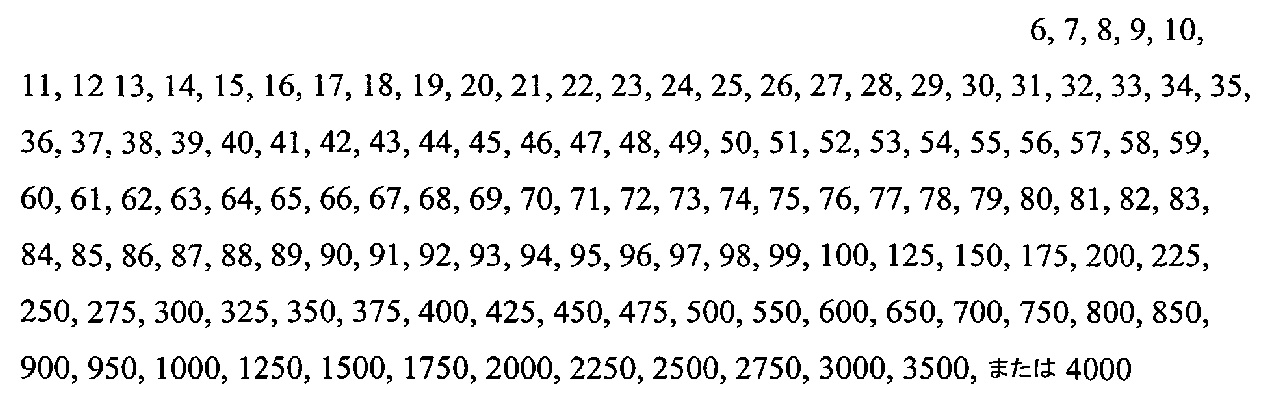
ヌクレオチドアナログはまた、糖部分の修飾を包含し得る。糖部分に対する修飾は、リボースおよびデオキシリボースの天然の修飾、ならびに合成の修飾を包含する。糖修飾としては限定はしないが、2’位置での以下の修飾が挙げられる:OH;F;O−、S−もしくはN−アルキル;O−、S−、もしくはN−アルケニル;O−、S−もしくはN−アルキニル;またはO−アルキル−O−アルキル、ここでこのアルキル、アルケニル、およびアルキニルは置換または非置換のC1〜C10、アルキルまたはC2〜C10アルケニルおよびアルキニルであってもよい。2’糖の修飾としてはまた、限定はしないが、−O[(CH2)nO]mCH3、−O[(CH2)nOCH3、−O(CH2)nNH2、−O(CH2)nCH3、−O(CH2)n−ONH2および−O(CH2)nON[(CH2)nCH3)]2が挙げられ、ここでnおよびmは1〜約10である。 Nucleotide analogs can also include modifications of the sugar moiety. Modifications to the sugar moiety include natural modifications of ribose and deoxyribose, as well as synthetic modifications. Sugar modifications include, but are not limited to, the following modifications at the 2 'position: OH; F; O-, S- or N-alkyl; O-, S-, or N-alkenyl; O-, S -Or N-alkynyl; or O-alkyl-O-alkyl, wherein the alkyl, alkenyl, and alkynyl may be substituted or unsubstituted C1-C10, alkyl or C2-C10 alkenyl and alkynyl. Modifications of the 2 'sugar are also not limited, but include -O [(CH2) nO] mCH3, -O [(CH2) nOCH3, -O (CH2) nNH2, -O (CH2) nCH3, -O (CH2 ) N-ONH2 and -O (CH2) nON [(CH2) nCH3)] 2, where n and m are 1 to about 10.
2’位置の他の修飾としては限定はしないが以下が挙げられる:C1〜C10低級アルキル、置換低級アルキル、アルカリル、アラルキル、O−アルカリルまたはO−アラルキル、SH、SCH3、OCN、Cl、Br、CN、CF3、OCF3、SOCH3、SO2 CH3、ONO2、NO2、N3、NH2、ヘテロシクロアルキル、ヘテロシクロアルカリル、アミノアルキルアミノ、ポリアルキルアミノ、置換シリル、RNA切断基、レポーター基、インターカレーター、オリゴヌクレオチドの薬物動態学的特性を改善するための基、またはオリゴヌクレオチドの薬力学的特性を改善するための基、および類似の特性を有する他の置換基。類似の置換基はまた、糖の上の他の位置で、特に3’末端ヌクレオチド上の糖の3’位置で、または2’−5’連結オリゴヌクレオチド中で、および5’末端ヌクレオチドの5’位置で作製されてもよい。修飾された糖としてはまた、CH2およびSなどの架橋性の環酸素で修飾を含む糖が挙げられる。ヌクレオチド糖アナログはまた、ペンタフラノシル糖の位置でシクロブチル部分などの糖模倣物を有してもよい。このような修飾された糖構造の調製を教示する多数の米国特許、例えば、 Other modifications at the 2 'position include, but are not limited to: C1-C10 lower alkyl, substituted lower alkyl, alkaryl, aralkyl, O-alkaryl or O-aralkyl, SH, SCH3, OCN, Cl, Br, CN, CF3, OCF3, SOCH3, SO2CH3, ONO2, NO2, N3, NH2, heterocycloalkyl, heterocycloalkyl, aminoalkylamino, polyalkylamino, substituted silyl, RNA cleavage group, reporter group, intercalator, oligo Groups for improving the pharmacokinetic properties of nucleotides, or groups for improving the pharmacodynamic properties of oligonucleotides, and other substituents with similar properties. Similar substituents are also available at other positions on the sugar, particularly at the 3 'position of the sugar on the 3' terminal nucleotide, or in 2'-5 'linked oligonucleotides, and 5' of the 5 'terminal nucleotide. It may be made in place. Modified sugars also include sugars containing modifications with crosslinkable ring oxygens such as CH2 and S. Nucleotide sugar analogs may also have sugar mimetics such as a cyclobutyl moiety at the pentafuranosyl sugar position. A number of US patents that teach the preparation of such modified sugar structures, such as
ヌクレオチドアナログはまた、リン酸塩部分で修飾されてもよい。修飾されたリン酸塩部分としては限定はしないが、2つのヌクレオチドの間の結合がホスホロチオエート、キラル・ホスホロチオエート、ホスホロジチオエート、ホスホトリエステル、アミノアルキルホスホトリエステル、メチルおよび他のアルキルホスホノエート、例えば、3’−アルキレン・ホスホネートおよびキラル・ホスホネート、ホスフィン酸塩、ホスホラミデート、例えば、3’−アミノホスホラミデートおよびアミノアルキルホスホラミデート、チオノホスホラミデート、チオノアルキルホスホネート、チオノアルキルホスホトリエステル、およびボラノホスフェートを含むように修飾され得るものが挙げられる。2つのヌクレオチドの間のこれらのリン酸塩または修飾されたリン酸塩結合は、3’−5’連結または2’−5’連結を通じてもよく、この連結は、3’−5’〜5’−3’または2’−5’〜5’−2’などの逆位の極性を含んでもよいことが理解される。種々の塩、混合塩、および遊離の酸型も含まれる。多数の米国特許が、修飾されたリン酸塩を含むヌクレオチドを作製および使用する方法を教示しており、これには限定はしないが、 Nucleotide analogs may also be modified with a phosphate moiety. Although not limited as a modified phosphate moiety, the bond between the two nucleotides is phosphorothioate, chiral phosphorothioate, phosphorodithioate, phosphotriester, aminoalkylphosphotriester, methyl and other alkylphosphono Ates such as 3′-alkylene phosphonates and chiral phosphonates, phosphinates, phosphoramidates such as 3′-aminophosphoramidates and aminoalkyl phosphoramidates, thionophosphoramidates, thionoalkylphosphonates, Examples include thionoalkylphosphotriesters, and those that can be modified to include boranophosphates. These phosphate or modified phosphate linkages between two nucleotides may be through a 3′-5 ′ linkage or a 2′-5 ′ linkage, this linkage being 3′-5 ′ to 5 ′. It is understood that inverted polarity such as −3 ′ or 2′-5 ′ to 5′-2 ′ may be included. Various salts, mixed salts, and free acid forms are also included. A number of US patents teach, but are not limited to, methods of making and using nucleotides containing modified phosphates,
ヌクレオチドアナログは単一の修飾しか必要としないことが理解されるが、またこの部分の1つの中に、または異なる部分の間に複数の修飾を含んでもよい。 Nucleotide analogs are understood to require only a single modification, but may also include multiple modifications in one of these parts or between different parts.
ヌクレオチド置換基とは、ヌクレオチドと類似の機能的特性を有するが、リン酸塩部分、例えば、ペプチド核酸(PNA)を含まない分子である。ヌクレオチド置換基とはワトソン・クリックまたはフーグスティーン方式で核酸を認識し、ただしリン酸塩部分以外の部分を通じて一緒に結合される分子である。ヌクレオチド置換基は、適切な標的核酸と相互作用するとき、二重らせん型の構造に従い得る。 A nucleotide substituent is a molecule that has functional properties similar to nucleotides but does not contain a phosphate moiety, eg, peptide nucleic acid (PNA). Nucleotide substituents are molecules that recognize nucleic acids in a Watson-Crick or Hoogsteen manner, but are joined together through moieties other than the phosphate moiety. Nucleotide substituents may follow a double helix type structure when interacting with the appropriate target nucleic acid.
ヌクレオチド置換基は、置換されたリン酸塩部分および/または糖部分を有するヌクレオチドまたはヌクレオチドアナログである。ヌクレオチド置換基は、標準的なリン原子を含まない。リン酸塩の置換基は、例えば、短い鎖のアルキルもしくはシクロアルキルヌクレオシド間結合、混合ヘテロ原子およびアルキルもしくはシクロアルキルヌクレオチド間結合、または1つ以上の短鎖ヘテロ原子もしくは複素環ヌクレオシド間結合であってもよい。これらとしては、モルホリノ結合を有するもの(ヌクレオシドの糖部分から部分的に形成された);シロキサン骨格;スルフィド、スルホキシドおよびスルホン骨格;ホルムアセチルおよびチオホルムアセチル骨格;メチレンホルムアセチルおよびチオホルムアセチル骨格;アルケン含有骨格;スルファミン酸骨格;メチレンイミノおよびメチレンヒドラジノ骨格;スルホナートおよびスルホンアミド骨格;アミド骨格;ならびにその他混合されたN、OおよびCH2成分の部分を有するものが挙げられる。多数の米国特許が、これらのタイプのリン酸塩置換を作製および使用する方法を開示しており、これには限定はしないが、 Nucleotide substituents are nucleotides or nucleotide analogs that have substituted phosphate and / or sugar moieties. Nucleotide substituents do not contain a standard phosphorus atom. Phosphate substituents may be, for example, short chain alkyl or cycloalkyl internucleoside linkages, mixed heteroatoms and alkyl or cycloalkyl internucleotide linkages, or one or more short chain heteroatoms or heterocyclic internucleoside linkages. May be. These include those having morpholino linkages (partially formed from the sugar moiety of the nucleoside); siloxane skeletons; sulfide, sulfoxide and sulfone skeletons; formacetyl and thioformacetyl skeletons; methyleneformacetyl and thioformacetyl skeletons; Alkene-containing skeletons; sulfamic acid skeletons; methyleneimino and methylenehydrazino skeletons; sulfonate and sulfonamide skeletons; amide skeletons; and other having mixed N, O, and CH2 moiety portions. A number of U.S. patents disclose methods of making and using these types of phosphate substitutions, including but not limited to:
ヌクレオチド置換中では、ヌクレオチドの糖およびリン酸塩部分の両方が、例えば、アミド型の結合(アミノエチルグリシン)(PNA)によって置換されてもよいことも理解される。米国特許第5,539,082号;同第5,714,331号および同第5,719,262号は、PNA分子を作製および使用する方法を教示しており、その各々が参照によって本明細書に援用される。(また、Nielsenら、Science,1991,254,1497〜1500を参照のこと)。 It is also understood that during nucleotide substitution, both the sugar and phosphate moieties of the nucleotide may be substituted, for example by an amide type bond (aminoethylglycine) (PNA). US Pat. Nos. 5,539,082; 5,714,331 and 5,719,262 teach methods for making and using PNA molecules, each of which is herein incorporated by reference. Incorporated into the book. (See also Nielsen et al., Science, 1991, 254, 1497-1500).
ヌクレオチドまたはヌクレオチドアナログに対して、他のタイプの分子(コンジュゲート)を結合することも可能である。コンジュゲートは、ヌクレオチドまたはヌクレオチドアナログに対して化学的に結合され得る。このようなコンジュゲートとしては限定はしないが、脂質部分、例えば、コレステロール部分(Letsingerら、Proc.Natl.Acad.Sci.USA,1989,86,6553〜6556)、コール酸(Manoharanら、Bioorg.Med.Chem.Let.,1994,4,1053〜1060)、チオエステル、例えば、ヘキシル−S−トリチルチオール(Manoharanら、Ann.N.Y.Acad.Sci.,1992,660,306〜309;Manoharanら、Bioorg.Med.Chem.Let.,1993,3,2765〜2779)、チオコレステロール(Oberhauserら、Nucl.Acids Res.,1992,20,533〜538)、脂肪鎖、例えば、ドデカンジオールまたはウンデシル残基(Saison−Behmoarasら、EMBO.J.,1991,10,1111〜1118;Kabanovら、FEBS Lett.,1990,259,327〜330;Svinarchukら、Biochimie,1993,75,49〜54)、リン脂質、例えば、ジ−ヘキサデシル−rac−グリセロールまたはトリエチルアンモニウム1,2−ジ−O−ヘキサデシル−rac−グリセロ−3−H−ホスホネート(Manoharanら、Tetrahedron Lett.,1995,36,3651〜3654;Sheaら、Nucl.Acids Res.,1990,18,3777〜3783)、ポリアミンまたはポリエチレングリコール鎖(Manoharanら、Nucleosides&Nucleotides,1995,14,969〜973)、またはアダマンタン酢酸(Manoharanra,Tetrahedron Lett.,1995,36,3651〜3654)、パルミチル部分(Misharaら、Biochim.Biophys.Acta,1995,1264,229〜237)、またはオクタデシルアミンもしくはヘキシルアミノ−カルボニル−オキシコレステロール部分(Crookeら、J.Pharmacol.Exp.Ther.,1996,277,923〜937が挙げられる。多くの米国特許が、このようなコンジュゲートの調製について教示しており、これには限定はしないが、
It is also possible to bind other types of molecules (conjugates) to nucleotides or nucleotide analogs. The conjugate can be chemically conjugated to a nucleotide or nucleotide analog. Such conjugates include, but are not limited to, lipid moieties such as cholesterol moieties (Letsinger et al., Proc. Natl. Acad. Sci. USA, 1989, 86, 6553-6556), cholic acid (Manoharan et al., Bioorg. Med. Chem. Let., 1994, 4, 1053-1060), thioesters such as hexyl-S-tritylthiol (Mananohara et al., Ann. NY Acad. Sci., 1992, 660, 306-309; Manoharan; Bioorg. Med. Chem. Let., 1993, 3, 2765-2779), thiocholesterol (Oberhauser et al., Nucl. Acids Res., 1992, 20, 533-538), fatty chain, For example, dodecanediol or undecyl residues (Saison-Behmoaras et al., EMBO. J., 1991, 10, 1111-1118; Kabanov et al., FEBS Lett., 1990, 259, 327-330; Svinarchuk et al., Biochimie, 1993, 75 , 49-54), phospholipids such as di-hexadecyl-rac-glycerol or
ワトソン−クリック相互作用とは、ヌクレオチド、ヌクレオチドアナログまたはヌクレオチド置換基のワトソン−クリック面との少なくとも1つの相互作用である。ヌクレオチド、ヌクレオチドアナログまたはヌクレオチド置換のワトソン−クリック面としては、プリンベースのヌクレオチド、ヌクレオチドアナログまたはヌクレオチド置換基のC2、N1およびC6位置、ならびにピリミジンベースのヌクレオチド、ヌクレオチドアナログまたはヌクレオチド置換基のC2、N3、C4位置が挙げられる。 A Watson-Crick interaction is at least one interaction with the Watson-Crick face of a nucleotide, nucleotide analog or nucleotide substituent. Nucleotide, nucleotide analog or nucleotide substitution Watson-Click planes include purine-based nucleotides, C2, N1 and C6 positions of nucleotide analogs or nucleotide substituents, and pyrimidine-based nucleotides, nucleotide analogs or nucleotide substituents C2, N3 , C4 position.
フーグスティーン相互作用は、二重鎖DNAの主要なグルーブに曝されているヌクレオチドまたはヌクレオチドアナログのフーグスティーン面に生じる相互作用である。このフーグスティーン面としては、N7位置およびプリンヌクレオチドのC6位置の反応性基(NH2またはO)が挙げられる。 Hoogsteen interactions are interactions that occur on the Hoogsteen face of nucleotides or nucleotide analogs that are exposed to the main groove of double-stranded DNA. This Hoogsteen face includes reactive groups (NH2 or O) at the N7 position and the C6 position of purine nucleotides.
C.プライマーおよびプローブ
開示されるのは、本明細書に開示されるようなモデルのオリゴ三重鎖のような、開示された核酸と相互作用し得る、プライマーおよびプローブを含む組成物である。特定の実施形態では、このプライマーは核酸伸長反応、核酸複製反応、および/または核酸増幅反応を支持するために用いられる。代表的には、このプライマーは、配列特異的方式で伸長され得るであろう。配列特異的方式でのプライマーの伸長としては、任意の方法を包含し、ここでは、プライマーがハイブリダイズするか、またはそうでなければ会合する核酸分子の配列および/または組成が、このプライマーの伸長によって産生される産物の組成または配列を指示するかまたはこれに影響する。従って、配列特異的な方式でのプライマーの伸長としては限定はしないが、PCR、DNA配列決定、DNA伸長、DNA重合、RNA転写、または逆転写が挙げられる。配列特異的な方式でプライマーを増幅する技術および条件が好ましい。特定の実施形態では、このプライマーは、PCRまたは直接配列決定のようなDNA増幅反応に用いられる。特定の実施形態では、プライマーはまた、例えば、そのプライマーを伸長するために用いられたヌクレオチドまたはオリゴヌクレオチドが修飾されており、その結果それらが配列特異的方式でプライマーを伸長するように化学的に反応する、非酵素的技術を用いて伸長されてもよいことが理解される。代表的には、この開示されたプライマーは、開示された核酸もしくは核酸の領域とハイブリダイズするか、またはそれらは、核酸の相補体もしくは核酸のある領域の相補体とハイブリダイズする。プライマーの使用の例として、1つ以上のプライマーを用いて、第一の核酸から伸長産物を作製してもよいし、第一の核酸によってテンプレートにされてもよい。
C. Primers and Probes Disclosed are compositions comprising primers and probes capable of interacting with the disclosed nucleic acids, such as model oligo triplexes as disclosed herein. In certain embodiments, the primer is used to support a nucleic acid extension reaction, a nucleic acid replication reaction, and / or a nucleic acid amplification reaction. Typically, this primer could be extended in a sequence specific manner. Extending a primer in a sequence-specific manner includes any method in which the sequence and / or composition of a nucleic acid molecule to which the primer hybridizes or otherwise associates is extended by this primer. Indicates or affects the composition or sequence of the product produced by Thus, primer extension in a sequence specific manner is not limited, but includes PCR, DNA sequencing, DNA extension, DNA polymerization, RNA transcription, or reverse transcription. Techniques and conditions for amplifying primers in a sequence specific manner are preferred. In certain embodiments, the primer is used in DNA amplification reactions such as PCR or direct sequencing. In certain embodiments, a primer is also chemically modified such that, for example, the nucleotide or oligonucleotide used to extend the primer is modified so that they extend the primer in a sequence specific manner. It will be appreciated that the reaction may be extended using non-enzymatic techniques. Typically, the disclosed primers hybridize to the disclosed nucleic acids or regions of nucleic acids, or they hybridize to the complement of nucleic acids or the complement of a region of nucleic acids. As an example of the use of a primer, an extension product may be made from a first nucleic acid using one or more primers, or may be templated by a first nucleic acid.
核酸との相互作用のためのプライマーまたはプローブのサイズは、プライマーの所望の酵素的な操作、例えば、DNA増幅またはプローブもしくはプライマーの単純なハイブリダイゼーションを支持する任意のサイズであってもよい。代表的なプライマーまたはプローブは少なくとも The size of the primer or probe for interaction with the nucleic acid may be any size that supports the desired enzymatic manipulation of the primer, eg, DNA amplification or simple hybridization of the probe or primer. A typical primer or probe is at least
他の実施形態では、プライマーまたはプローブは、 In other embodiments, the primer or probe is
目的の核酸のプライマーは代表的には、目的の核酸の領域を含む伸長産物および/または他の複製もしくは増幅された産物を産生するために用いられる。この産物のサイズは、そのサイズが3または2または1ヌクレオチド内まで正確に決定できるようなサイズであり得る。 The nucleic acid primer of interest is typically used to produce extension products and / or other replicated or amplified products that contain regions of the nucleic acid of interest. The size of the product can be such that its size can be accurately determined to within 3 or 2 or 1 nucleotide.
特定の実施形態では、この産物は、例えば、少なくとも In certain embodiments, the product is, for example, at least
他の実施形態では、この産物は例えば、 In other embodiments, the product is, for example,
1.蛍光変化プローブおよびプライマー
蛍光変化プローブおよび蛍光変化プライマーとは、検出、アッセイまたは複製されるべきプローブまたはプライマーおよび核酸の形態または高次構造の変化に基づく蛍光強度または波長の変化を包含する全てのプローブおよびプライマーをいう。蛍光変化プローブおよびプライマーの例としては、分子ビーコン、Amplifluors、FRETプローブ、切断可能FRETプローブ、TaqManプローブ、スコーピオンプライマー、蛍光三重オリゴ、例えば、限定はしないが、三重分子ビーコンまたは三重FRETプローブ、蛍光水溶性コンジュゲートポリマー、PNAプローブおよびQPNAプローブが挙げられる。
1. Fluorescent change probes and primers Fluorescent change probes and fluorescent change primers are probes or primers to be detected, assayed or replicated and all probes that include changes in fluorescence intensity or wavelength based on changes in the form or conformation of nucleic acids And primer. Examples of fluorescent change probes and primers include molecular beacons, Amplifluors, FRET probes, cleavable FRET probes, TaqMan probes, scorpion primers, fluorescent triple oligos, such as but not limited to triple molecular beacons or triple FRET probes, fluorescent water soluble Conjugated polymers, PNA probes and QPNA probes.
蛍光変化プローブおよびプライマーは、それらの構造および/または機能に従って分類され得る。蛍光変化プローブとしては、ヘアピンクエンチ性プローブ、切断クエンチ性プローブ、切断活性化プローブ、および蛍光活性化プローブが挙げられる。蛍光変化プライマーとしては、ステムクエンチ性プライマーおよびヘアピンクエンチ性プライマーが挙げられる。いくつかのタイプの蛍光変化プローブおよびプライマーの使用は、SchweitzerおよびKingsmore,Curr.Opin.Biotech.12:21〜27(2001)に概説される。Hallら、Proc.Natl. Acad.Sci.USA 97:8272〜8277(2000)は、Invaderアッセイによる蛍光変化プローブの使用を記載している。 Fluorescent change probes and primers can be classified according to their structure and / or function. Fluorescent change probes include hairpin quench probes, cleavage quench probes, cleavage activation probes, and fluorescence activation probes. Fluorescent change primers include stem quenching primers and hairpin quenching primers. The use of several types of fluorescent change probes and primers is described by Schweitzer and Kingsmore, Curr. Opin. Biotech. 12: 21-27 (2001). Hall et al., Proc. Natl. Acad. Sci. USA 97: 8272-8277 (2000) describes the use of fluorescent change probes by Invader assay.
ヘアピンクエンチ性プローブとは、標的配列に結合しないとき、ヘアピン構造(および代表的にはループ)を形成し、蛍光標識およびクエンチング部分を近位にもたらし、その結果、標識からの蛍光がクエンチされるプローブである。プローブが標的配列に結合するときこのステムは破壊され、そのクエンチ部分はもはや蛍光標識に近位ではなく、蛍光が増大する。ヘアピンクエンチ性プローブの例は、分子ビーコン、蛍光三重鎖オリゴ、三重鎖分子ビーコン、三重鎖FRETプローブおよびQPNAプローブである。 A hairpin quenchable probe forms a hairpin structure (and typically a loop) when not bound to a target sequence, resulting in a proximal fluorescent label and quenching moiety, so that fluorescence from the label is quenched. It is a probe. When the probe binds to the target sequence, this stem is destroyed and its quench moiety is no longer proximal to the fluorescent label, increasing fluorescence. Examples of hairpin quenching probes are molecular beacons, fluorescent triplex oligos, triplex molecular beacons, triplex FRET probes and QPNA probes.
切断活性化プローブとは、蛍光がプローブの切断によって増大されるプローブである。切断活性化プローブは蛍光標識およびクエンチング部分を近位で含む場合があり、その結果、標識由来の蛍光がクエンチされる。プローブがクリップされるかまたは消化されるとき(代表的には、増幅の間のポリメラーゼの5’−3’エキソヌクレアーゼ活性によって)、このクエンチング部分はもはや蛍光標識に近位ではなく、蛍光が増大する。TaqManプローブ(Hollandら、Proc.Natl.Acad.Sci.USA 88:7276〜7280(1991))は、切断活性化プローブの例である。 A cleavage activated probe is a probe whose fluorescence is increased by cleavage of the probe. The cleavage activation probe may contain a fluorescent label and a quenching moiety proximally, so that the fluorescence from the label is quenched. When the probe is clipped or digested (typically by the 5'-3 'exonuclease activity of the polymerase during amplification), this quenching moiety is no longer proximal to the fluorescent label and Increase. The TaqMan probe (Holland et al., Proc. Natl. Acad. Sci. USA 88: 7276-7280 (1991)) is an example of a cleavage activation probe.
切断クエンチ性プローブとは、プローブの切断によって蛍光が減じるかまたは変更されているプローブである。切断クエンチ性プローブは、アクセプター蛍光標識およびドナー部分を含んでもよく、その結果、このアクセプターおよびドナーが近位であるとき、ドナーからアクセプターへの蛍光共鳴エネルギー伝達によって、アクセプターが蛍光を発するようになる。従ってこのプローブは、例えば、標的配列にハイブリダイズするとき、蛍光性である。このプローブがクリップされるか消化されるとき(代表的には、増幅の間のポリメラーゼの5’−3’エキソヌクレアーゼ活性によって)、このドナー部分はもはやアクセプター蛍光標識に近位ではなく、このアクセプターからの蛍光が減少する。このドナー部分がそれ自体蛍光標識である場合、これは、アクセプターに近位でないとき、エネルギーを蛍光として遊離し得る(代表的には、アクセプターの蛍光とは異なる波長で)。その結果、全体的な効果はアクセプター蛍光の減少およびドナー蛍光の増大となろう。切断クエンチ性プローブの場合のドナー蛍光は、切断活性化プローブによって生成される蛍光に等しく、ここではアクセプターがクエンチング部分であり、ドナーが蛍光標識である。切断可能FRET(蛍光共鳴エネルギー伝達)プローブは、切断クエンチ性プローブの例である。 A cleavage-quenching probe is a probe whose fluorescence has been reduced or altered by cleavage of the probe. A cleaved quench probe may include an acceptor fluorescent label and a donor moiety so that when the acceptor and donor are proximal, fluorescence resonance energy transfer from donor to acceptor causes the acceptor to fluoresce . Thus, this probe is fluorescent, for example when hybridized to a target sequence. When the probe is clipped or digested (typically by the 5'-3 'exonuclease activity of the polymerase during amplification), the donor moiety is no longer proximal to the acceptor fluorescent label and the acceptor Fluorescence from is reduced. If the donor moiety is itself a fluorescent label, it can release energy as fluorescence when it is not proximal to the acceptor (typically at a wavelength different from the acceptor fluorescence). As a result, the overall effect will be a decrease in acceptor fluorescence and an increase in donor fluorescence. The donor fluorescence in the case of a cleavage quench probe is equal to the fluorescence generated by the cleavage activation probe, where the acceptor is the quenching moiety and the donor is the fluorescent label. A cleavable FRET (fluorescence resonance energy transfer) probe is an example of a cleaved quenching probe.
蛍光活性化プローブとは、標的配列に対するプローブのハイブリダイゼーションによって蛍光が増大されるかまたは変更されている、プローブまたはプローブの対である。蛍光活性化プローブは、アクセプター蛍光標識およびドナー部分を含んでもよく、その結果、アクセプターおよびドナーが近位である場合(プローブが標的配列にハイブリダイズされるとき)、ドナーからアクセプターへの蛍光共鳴エネルギー伝達がアクセプターに蛍光を発生させる。蛍光活性化プローブとは代表的には、隣接する配列に対してハイブリダイズするように設計され、その結果アクセプターおよびドナーが近位にされているプローブの対である。蛍光活性化プローブはまた、ドナーおよびアクセプターの両方を含む単一のプローブであってもよく、ここでは、プローブが標的配列にハイブリダイズしない場合、このドナーおよびアクセプターは近位ではないが、ドナーおよびアクセプターは、プローブが標的配列にハイブリダイズした時は近位になっている。これは、例えば、プローブの反対の端にドナーおよびアクセプターを置くこと、およびプローブの各末端に標的相補的配列を置くことによって達成されてもよく、ここではこの標的相補的配列は、標的配列における隣接配列に相補的である。蛍光活性化プローブのドナー部分がそれ自体蛍光標識である場合、アクセプターに近位でないとき(すなわち、プローブが標的配列にハイブリダイズしないとき)、これはエネルギーを蛍光として放出し得る(代表的には、アクセプターの蛍光とは異なる波長で)。プローブが標的配列にハイブリダイズするとき、その結果、全体的な効果はドナー蛍光の減少、およびアクセプター蛍光の増大であろう。FRETプローブは、蛍光活性化プローブの例である。 A fluorescence activated probe is a probe or pair of probes whose fluorescence has been increased or altered by hybridization of the probe to a target sequence. A fluorescently activated probe may include an acceptor fluorescent label and a donor moiety so that when the acceptor and donor are proximal (when the probe is hybridized to the target sequence), the fluorescence resonance energy from donor to acceptor Transmission generates fluorescence at the acceptor. A fluorescently activated probe is typically a pair of probes designed to hybridize to adjacent sequences so that the acceptor and donor are proximal. The fluorescence activated probe may also be a single probe that includes both a donor and an acceptor, where if the probe does not hybridize to the target sequence, the donor and acceptor are not proximal but the donor and acceptor The acceptor is proximal when the probe is hybridized to the target sequence. This may be achieved, for example, by placing a donor and acceptor at the opposite ends of the probe, and a target complementary sequence at each end of the probe, where the target complementary sequence is in the target sequence. Complementary to flanking sequences. If the donor portion of the fluorescently activated probe is itself a fluorescent label, when not proximal to the acceptor (ie, when the probe does not hybridize to the target sequence), this can emit energy as fluorescence (typically , At a wavelength different from the acceptor fluorescence). When the probe hybridizes to the target sequence, the overall effect will then be a decrease in donor fluorescence and an increase in acceptor fluorescence. A FRET probe is an example of a fluorescence activated probe.
ステムクエンチ性プライマーとは、相補的な配列にハイブリダイズしないとき、標識からの蛍光がクエンチされるように蛍光標識およびクエンチ部分を近位にさせるステム構造(分子内ステム構造または分子間ステム構造のいずれか)を形成するプライマーである。プライマーが相補的配列に結合するとき、このステムは破壊され、そのクエンチング部分はもはや蛍光標識に近位ではなく、蛍光が増大する。開示された方法では、ステムクエンチ性プライマーは、核酸合成のプライマーとして用いられ、従って合成または増幅核酸に組み込まれる。ステムクエンチ性プライマーの例は、ペプチド核酸クエンチ性プライマーおよびヘアピンクエンチ性プライマーである。 A stem-quenching primer is a stem structure (intramolecular or intermolecular stem structure) that causes the fluorescent label and the quenching moiety to be proximal so that fluorescence from the label is quenched when not hybridizing to a complementary sequence. Any one). When the primer binds to the complementary sequence, this stem is destroyed and its quenching moiety is no longer proximal to the fluorescent label and fluorescence increases. In the disclosed method, stem quenchable primers are used as primers for nucleic acid synthesis and are thus incorporated into the synthesized or amplified nucleic acid. Examples of stem quenching primers are peptide nucleic acid quenching primers and hairpin quenching primers.
ペプチド核酸クエンチ性プライマーとは、ペプチド核酸クエンチャーまたはペプチド核酸蛍光と会合してステム構造を形成するプライマーである。このプライマーは、蛍光標識またはクエンチング部分を含み、それぞれペプチド核酸クエンチャーまたはペプチド核酸蛍光のいずれかと会合される。これは、クエンチング部分の近位に蛍光標識を置く。プライマーが複製されるとき、ペプチド核酸は置換され、これによって蛍光標識は蛍光シグナルを生じることが可能になる。 A peptide nucleic acid quenching primer is a primer that associates with a peptide nucleic acid quencher or peptide nucleic acid fluorescence to form a stem structure. This primer contains a fluorescent label or quenching moiety and is associated with either a peptide nucleic acid quencher or a peptide nucleic acid fluorescence, respectively. This places a fluorescent label proximal to the quenching moiety. When the primer is replicated, the peptide nucleic acid is displaced, which allows the fluorescent label to produce a fluorescent signal.
ヘアピンクエンチ性プライマーとは、相補的な配列にハイブリダイズしないとき、標識からの蛍光がクエンチされるように蛍光標識およびクエンチ部分を近位にさせるヘアピン構造(および代表的には、ループ)を形成するプライマーである。プライマーが相補的配列に結合するとき、このステムは破壊され、そのクエンチング部分はもはや蛍光標識に近位ではなく、蛍光が増大する。ヘアピンクエンチ性プライマーは代表的には、核酸合成のプライマーとして用いられ、従って合成または増幅核酸に組み込まれる。ヘアピンクエンチ性プライマーの例は、Amplifluorプライマー(Nazerenkoら、Nucleic Acids Res.25:2516〜2521(1997))およびスコーピオンプライマー(Thelwellら、Nucleic Acids Res.28(19):3752〜3761(2000))である。 A hairpin quenchable primer forms a hairpin structure (and typically a loop) that brings the fluorescent label and quench moiety proximal so that fluorescence from the label is quenched when not hybridizing to a complementary sequence Primer. When the primer binds to the complementary sequence, this stem is destroyed and its quenching moiety is no longer proximal to the fluorescent label and fluorescence increases. Hairpin quenchable primers are typically used as primers for nucleic acid synthesis and are therefore incorporated into synthetic or amplified nucleic acids. Examples of hairpin quenching primers include Amplifluor primers (Nazerenko et al., Nucleic Acids Res. 25: 2516-2521 (1997)) and scorpion primers (Thelwell et al., Nucleic Acids Res. 28 (19): 3752-3761 (2000)). It is.
切断活性化プライマーは、それらが複製された鎖に組み込まれるプライマーであり、引き続いて切断されること以外は切断活性化プローブと同様である。Littleら、Clin.Chem.45:777〜784(1999)は、切断活性化プライマーの使用を記載する。 Cleavage activation primers are primers that are incorporated into the replicated strand and are similar to cleavage activation probes except that they are subsequently cleaved. Little et al., Clin. Chem. 45: 777-784 (1999) describes the use of cleavage activating primers.
D.標識
開示される方法を用いて産生される核酸の検出および定量を補助するために、標識をヌクレオチドまたは核酸に直接組み込んでもよいし、またはプローブおよびプライマーなどの検出分子にカップリングさせてもよい。本明細書において用いる場合、標識とは、ヌクレオチドまたは核酸と直接または間接的に会合され得、直接または間接的に測定可能、検出可能なシグナルを生じる任意の分子である。ヌクレオチドおよび核酸への組み込みのための、または核酸プローブへのカップリングのための多くのこのような標識が当業者に公知である。開示される方法における使用に適切な標識の例は、放射性同位体、蛍光分子、リン光分子、酵素、抗体およびリガンドである。蛍光標識は、特に蛍光変化プローブおよびプライマーの状況では、増幅のリアルタイム検出に有用である。
D. Labels Labels may be incorporated directly into nucleotides or nucleic acids, or coupled to detection molecules such as probes and primers, to aid in the detection and quantification of nucleic acids produced using the disclosed methods. As used herein, a label is any molecule that can be directly or indirectly associated with a nucleotide or nucleic acid and that produces a measurable, detectable signal directly or indirectly. Many such labels are known to those skilled in the art for incorporation into nucleotides and nucleic acids, or for coupling to nucleic acid probes. Examples of suitable labels for use in the disclosed methods are radioisotopes, fluorescent molecules, phosphorescent molecules, enzymes, antibodies and ligands. Fluorescent labels are useful for real-time detection of amplification, particularly in the context of fluorescent change probes and primers.
適切な蛍光標識の例としては、フルオレセインイソチオシアネート(FITC),5,6−カルボキシメチルフルオレセイン、テキサスレッド、ニトロベンゾ−2−オキサ−1,3−ジアゾール−4−イル(NBD)、クマリン、塩化ダンシル、ローダミン、アミノ−メチルクマリン(AMCA)、エオシン、エリスロシン、BODIPY(登録商標)、Cascade Blue(登録商標)、Oregon Green(登録商標)、ピレン、リサミン(lissamine)、キサンテン、アクリジン、オキサジン、フィコエリトリン、ランタニドイオンの大環状キレート類、例えば、quantum dye(商標)、蛍光エネルギー伝達色素、例えば、チアゾールオレンジ−エチジウムヘテロ二量体、およびシアニン色素Cy3、Cy3.5、Cy5、Cy5.5およびCy7が挙げられる。他の特異的蛍光標識の例としては、3−ヒドロキシピレン5,8,10−トリスルホン酸、5−ヒドロキシトリプタミン(5−HT)、酸性フクシン、アリザリン・コンプレキソン、アリザリン・レッド、アロフィコシアニン、アミノクマリン、アントロイルステアリン酸、アストラゾン・ブリリアントレッド4G、アストラゾン・オレンジR、アストラゾン・レッド6B、アストラゾン・イエロー7GLL、アタブリン、オーラミン、オーロホスフィン、オーロホスフィンG、BAO9(ビスアミノフェニルオキサジアゾール)、BCECF、硫酸ベルベリン、ビスベンズアミド、ブランコフォアFFG溶液、ブランコフォアSV、Bodipy F1、ブリリアント・スルホフラビンFF、カルセイン・ブルー、カルシウム・グリーン、カルコフロールRW溶液、カルコフロールホワイト、カルコフォール・ホワイト(Calcophor White)ABT溶液、カルコフォール・ホワイト(Calcophor White)標準溶液、カルボスチリル、カスケード・イエロー、カテコールアミン、チナクリン、コリホスフィンO、クマリン−ファロイジン、CY3.1 8、CY5.1 8、CY7、Dans(1−ジメチルアミノナファリン5スルホン酸)、Dansa(ジアミノナフチルスルホン酸)、ダンシルNH−CH3、ジアミノフェニルオキシジアゾール(DAO)、ジメチルアミノ−5−スルホン酸、二フッ化ジピロメテンホウ素、ジフェニルブリリアントフラビン7GFF、ドーパミン、エリスロシン ITC、オイクリシン、FIF(ホルムアルデヒド誘導性蛍光)、フラゾ・オレンジ、フルオ3(Fluo 3)、フルオレスカミン、Fura−2、ゲナクリル・ブリリアント・レッドB、ゲナクリル・ブリリアント・イエロー10GF、ゲナクリル・ピンク3G、ゲナクリル・イエロー5GF、グロキサン酸、グラニュラー・ブルー、ヘマトポルフィリン、Indo−1、イントラホワイトCf液、ロイコフォアPAF、ロイコフォアSF、ロイコフォアWS、リサミン・ローダミンB200(RD200)、ルシファー・イエローCH、ルシファー・イエローVS、マグダラ・レッド、マリーナ・ブルー、マキシロン・ブリリアント・フラビン10GFF、マキシロン・ブリリアント・フラビン8GFF、MPS(メチル・グリーン・ピロニン・スチルベン)、ミトラマイシン、NBDアミン、ニトロベンゾキサジドール、ノルアドレナリン(Noradorenaline)、ヌクレア・ファスト・レッド、ヌクレア・イエロー、ニロサン・ブリリアント・フラビンE8G、オキサジアゾール、パシフィック・ブルー、パラロサニリン(フォイルゲン)、ホルワイトAR溶液、ホルワイトBKL、ホルワイトRev、ホルワイトRPA、ホスフィン3R、フタロシアニン、フィコエリトリンR、フィコエリトリンB、ポリアザインダセン・ポントクローム・ブルー・ブラック、ポルフィリン、プリムリン、プロシオン・イエロー、ピロニン、ピロニンB、ピロザール・ブリリアント・フラビン7GF、キナクリン・マスタード、ローダミン123、ローダミン5GLD、ローダミン6G、ローダミンB、ローダミンB200、ローダミンBエクストラ、ローダミンBB、ローダミンBG、ローダミンWT、セロトニン、セブロン・ブリリアント・レッド2B、セブロン・ブリリアント・レッド4G、セブロン・ブリリアント・レッドB、セブロン・オレンジ、セブロン・イエローL、SITS(プリムリン)、SITS(スチルベン・イソチオスルホン酸)、スチルベン、スナーフ1(Snarf1)、スルホローダミンBカンC、スルホローダミンGエクストラ、テトラサイクリン、チアジン・レッドR、チオフラビンS、チオフラビンTCN、チオフラビン5、チオライト、チオゾールオレンジ、チノポールCBS、トゥルー・ブルー、ウルトラライト、ウラニンB、ユビテックスSFC、キシレンオレンジ、およびXRITCが挙げられる。 Examples of suitable fluorescent labels include fluorescein isothiocyanate (FITC), 5,6-carboxymethylfluorescein, Texas Red, nitrobenzo-2-oxa-1,3-diazol-4-yl (NBD), coumarin, dansyl chloride , Rhodamine, amino-methylcoumarin (AMCA), eosin, erythrosine, BODIPY®, Cascade Blue®, Oregon Green®, pyrene, lissamine, xanthene, acridine, oxazine, phycoerythrin, Macrocyclic chelates of lanthanide ions such as quantum dye ™, fluorescent energy transfer dyes such as thiazole orange-ethidium heterodimer, and cyanine dyes Cy3, C 3.5, Cy5, include Cy5.5 and Cy7. Examples of other specific fluorescent labels include 3-hydroxypyrene 5,8,10-trisulfonic acid, 5-hydroxytryptamine (5-HT), acidic fuchsin, alizarin complexone, alizarin red, allophycocyanin, Aminocoumarin, Antroylstearic acid, Astrazon Brilliant Red 4G, Astrazon Orange R, Astrazon Red 6B, Astrazon Yellow 7GLL, Atabulin, Auramin, Aurophosphine, Aurophosphine G, BAO9 (Bisaminophenyloxadiazole), BCECF, Berberine sulfate, Bisbenzamide, Blancophore FFG solution, Blancophore SV, Bodipy F1, Brilliant sulfoflavin FF, calcein blue, calcium green, LUCOFLOR RW Solution, Calcoflor White, Calcophor White ABT Solution, Calcophor White Standard Solution, Carbostyryl, Cascade Yellow, Catecholamine, Tinaclin, Colliophosphine O, Coumarin-phalloidin, CY3 .18, CY5.18, CY7, Dans (1-dimethylaminonaphthalin-5 sulfonic acid), Dansa (diaminonaphthylsulfonic acid), dansyl NH-CH3, diaminophenyloxydiazole (DAO), dimethylamino-5 -Sulfonic acid, dipyromethene boron difluoride, diphenyl brilliant flavin 7GFF, dopamine, erythrosine ITC, euclicin, FIF (formaldehyde) Conductive fluorescence), Furazo orange, Fluo 3 (Fluo 3), Fluorescamine, Fura-2, Genacrylic Brilliant Red B, Genacrylic Brilliant Yellow 10GF, Genacrylic Pink 3G, Genacryl Yellow 5GF, Gloxanoic acid , Granular Blue, Hematoporphyrin, Indo-1, Intra White Cf Liquid, Leucophore PAF, Leucophore SF, Leucophore WS, Lisamin Rhodamine B200 (RD200), Lucifer Yellow CH, Lucifer Yellow VS, Magdara Red, Marina Marina Blue, maxilon brilliant flavin 10GFF, maxilon brilliant flavin 8GFF, MPS (methyl green pyronin stilbene), mitramycin, NBD , Nitrobenzoxazidole, noradrenaline, Nuclea Fast Red, Nuclea Yellow, Nilosan Brilliant Flavin E8G, Oxadiazole, Pacific Blue, Pararosaniline (Foilgen), Holwight AR Solution, Holwight BKL, Holwight Rev, Holwright RPA, Phosphine 3R, Phthalocyanine, Phycoerythrin R, Phycoerythrin B, Polyazaindene Pontchrome Blue Black, Porphyrin, Primulin, Procion Yellow, Pyronin, Pyronin B, Pyrozar Brilliant Flavin 7GF, Quinacrine Mustard Rhodamine 123, Rhodamine 5GLD, Rhodamine 6G, Rhodamine B, Rhodamine B200, -Damine B Extra, Rhodamine BB, Rhodamine BG, Rhodamine WT, Serotonin, Sebron Brilliant Red 2B, Sebron Brilliant Red 4G, Sebron Brilliant Red B, Sebron Orange, Sebron Yellow L, SITS (Primulin), SITS (stilbene / isothiosulfonic acid), stilbene, snarf 1 (Snarf1), sulforhodamine B can C, sulforhodamine G extra, tetracycline, thiazine red R, thioflavin S, thioflavin TCN, thioflavin 5, thiolite, thiozol orange , Chinopol CBS, True Blue, Ultralight, Uranine B, Ubitex SFC, Xylene Orange, and XRITC.
好ましい蛍光標識は、フルオレセイン(5−カルボキシフルオレセイン−N−ヒドロキシスクシンイミドエステル)、ローダミン(5,6−テトラメチルローダミン)、およびシアニン色素Cy3、Cy3.5、Cy5、Cy5.5およびCy7である。これらの蛍光についての吸収および発光極大波長は、それぞれ、FITC(490nm;520nm)、Cy3(554nm;568nm)、Cy3.5(581nm;588nm)、Cy5(652nm:672nm)、Cy5.5(682nm;703nm)およびCy7(755nm;778nm)であり、これによってそれらの同時検出が可能になる。フルオレセイン色素の他の例としては、6−カルボキシフルオレセイン(6−FAM)、2’,4’,1,4,−テトラクロロフルオレセイン(TET)、2’,4’,5’,7’,1,4−ヘキサクロロフルオレセイン(HEX)、2’,7’−ジメトキシ−4’、5’−ジクロロ−6−カルボキシローダミン(JOE)、2’−クロロ−5’−フルオロ−7’,8’−縮合フェニル−1,4−ジクロロ−6−カルボキシフルオレセイン(NED)、および2’−クロロ−7’−フェニル−1,4−ジクロロ−6−カルボキシフルオレセイン(VIC)が挙げられる。蛍光性の標識は、Amersham Pharmacia Biotech,Piscataway,NJ;Molecular Probes,Eugene,OR;およびResearch Organics,Cleveland,Ohioを含む、様々な商業的供給源から入手できる。 Preferred fluorescent labels are fluorescein (5-carboxyfluorescein-N-hydroxysuccinimide ester), rhodamine (5,6-tetramethylrhodamine), and cyanine dyes Cy3, Cy3.5, Cy5, Cy5.5 and Cy7. The absorption and emission maximum wavelengths for these fluorescences are FITC (490 nm; 520 nm), Cy3 (554 nm; 568 nm), Cy3.5 (581 nm; 588 nm), Cy5 (652 nm: 672 nm), Cy5.5 (682 nm; 703 nm) and Cy7 (755 nm; 778 nm), which allows their simultaneous detection. Other examples of fluorescein dyes include 6-carboxyfluorescein (6-FAM), 2 ′, 4 ′, 1,4, -tetrachlorofluorescein (TET), 2 ′, 4 ′, 5 ′, 7 ′, 1. 2,4-hexachlorofluorescein (HEX), 2 ′, 7′-dimethoxy-4 ′, 5′-dichloro-6-carboxyrhodamine (JOE), 2′-chloro-5′-fluoro-7 ′, 8′-condensation Examples include phenyl-1,4-dichloro-6-carboxyfluorescein (NED), and 2'-chloro-7'-phenyl-1,4-dichloro-6-carboxyfluorescein (VIC). Fluorescent labels are available from a variety of commercial sources, including Amersham Pharmacia Biotech, Piscataway, NJ; Molecular Probes, Eugene, OR; and Research Organics, Cleveland, Ohio.
目的のさらなる標識としては、それらが会合するプローブが標的分子に特異的に結合されるときのみシグナルを生じる標識が挙げられ、このような標識としては以下が挙げられる:Tyagi&Kramer,Nature Biotechnology(1996)14:303および欧州特許第0070685号B1に記載される「分子ビーコン」。目的の他の標識としては、米国特許第5,563,037号;国際公開第97/17471号および国際公開第97/17076号に記載される標識が挙げられる。 Additional labels of interest include labels that generate a signal only when the probes with which they are associated are specifically bound to the target molecule, such labels include: Tyagi & Kramer, Nature Biotechnology (1996). 14: 303 and “Molecular Beacons” described in European Patent No. 0007085B1. Other labels of interest include the labels described in US Pat. No. 5,563,037; WO 97/17471 and WO 97/17076.
標識したヌクレオチドは、合成時に増幅産物に直接組み込まれ得るので標識の好ましい形態である。増幅される核酸中に組み込むことのできる標識の例としては、ヌクレオチドアナログ、例えば、BrdUrd(5−ブロモデオキシウリジン、Hoy and Schimke, Mutation Research 290:217−230(1993))、アミノアリルデオキシウリジン(Henegariu,et al.,Nature Biotechnology 18:345−348(2000))、5−メチルシトシン(Sano,et al.,Biochim.Biophys.Acta 951:157−165(1998))、ブロモウリジン(Wansick,et al.,J.Cell Biology 122:283−293(1993))、ならびにビオチンで(Langer,et al.,Proc.Natl.Acad.Sci.USA 78:6633(1981))またはジゴキシゲニンなどの好適なハプテンで(Kerkhof,Anal.Biochem.205:359−364(1992))修飾したヌクレオチドが挙げられる。好適な蛍光標識ヌクレオチドは、フルオレセイン−イソチオシアン酸塩−dUTP、シアニン−3−dUTP、およびシアニン−5−dUTP(Yu,et al.,Nucleic Acids Res.,22:3226−3232(1994))である。DNAの好ましいヌクレオチドアナログ標識は、BrdUrd(ブロモデオキシウリジン、BrdUrd、BrdU、BUdR、Sigma−Aldrich Co.)である。DNAへの標識の組み込みに好ましい他のヌクレオチドアナログは、AA−dUTP(アミノアリル−デオキシウリジン三リン酸塩、Sigma−Aldrich Co.)、および5−メチル−dCTP(Roche Molecular Biochemicals)である。RNAへの検出標識の組み込みに有用なヌクレオチドアナログは、ビオチン−16−UTP(ビオチン−16−ウリジン−5’−三リン酸塩、Roche Molecular Biochemicals)である。フルオレセイン、Cy3、およびCy5を、直接標識のためにdUTPに結合させてもよい。Cy3.5およびCy7は、ビオチンまたはジゴキシゲニン標識プローブの二次検出のためのアビジンまたは抗ジゴキシゲニンコンジュゲートとして使用できる。 Labeled nucleotides are a preferred form of label because they can be incorporated directly into the amplification product during synthesis. Examples of labels that can be incorporated into the nucleic acid to be amplified include nucleotide analogs such as BrdUrd (5-bromodeoxyuridine, Hoy and Schimke, Mutation Research 290: 217-230 (1993)), aminoallyl deoxyuridine ( Henegariu, et al., Nature Biotechnology 18: 345-348 (2000)), 5-methylcytosine (Sano, et al., Biochim. Biophys. Acta 951: 157-165 (1998)), bromouridine (Wansick, et al.). al., J. Cell Biology 122: 283-293 (1993)), and with biotin (Langer, et al., Proc. N). atl.Acad.Sci.USA 78: 6633 (1981)) or a suitable hapten such as digoxigenin (Kerkhof, Anal. Biochem. 205: 359-364 (1992)). Suitable fluorescently labeled nucleotides are fluorescein-isothiocyanate-dUTP, cyanine-3-dUTP, and cyanine-5-dUTP (Yu, et al., Nucleic Acids Res., 22: 3226-3232 (1994)). . A preferred nucleotide analog label for DNA is BrdUrd (bromodeoxyuridine, BrdUrd, BrdU, BUdR, Sigma-Aldrich Co.). Other preferred nucleotide analogs for incorporation of the label into DNA are AA-dUTP (aminoallyl-deoxyuridine triphosphate, Sigma-Aldrich Co.), and 5-methyl-dCTP (Roche Molecular Biochemicals). A useful nucleotide analog for incorporation of detection label into RNA is biotin-16-UTP (biotin-16-uridine-5'-triphosphate, Roche Molecular Biochemicals). Fluorescein, Cy3, and Cy5 may be conjugated to dUTP for direct labeling. Cy3.5 and Cy7 can be used as avidin or anti-digoxigenin conjugates for secondary detection of biotin or digoxigenin labeled probes.
増幅核酸中に組み込まれている標識、例えばビオチンを、当該分野で周知の鋭敏な方法を用いて引き続き検出することができる。例えば、ビオチンはストレプトアビジン−アルカリホスファターゼコンジュゲート(Tropix,Inc.)を用いて検出可能で、これをビオチンに結合させ、その後適切な基質(例えば、化学発光基質CSPD:二ナトリウム,3−(4−メトキシスピロ−[1,2,−ジオキセタン−3−2’−(5’−クロロ)トリクロロ[3.3.1.13,7]デカン]−4−イル)フェニル燐酸;Tropix,Inc.)の化学発光により検出する。標識はまた、酵素、例えばアルカリホスファターゼ、大豆ペルオキシダーゼ、西洋ワサビペルオキシダーゼおよびポリメラーゼであってもよく、これらは例えば、化学的シグナル増幅を用いて、または光(例えば化学発光性1,2−ジオキセタン基質)もしくは蛍光シグナルを発生する酵素に対する基質を用いることによって検出できる。
Labels incorporated in the amplified nucleic acid, such as biotin, can subsequently be detected using sensitive methods well known in the art. For example, biotin can be detected using a streptavidin-alkaline phosphatase conjugate (Tropix, Inc.), which is conjugated to biotin and then the appropriate substrate (eg, chemiluminescent substrate CSPD: disodium, 3- (4 -Methoxyspiro- [1,2, -dioxetane-3-2 '-(5'-chloro) trichloro [3.3.1.1 3,7 ] decan] -4-yl) phenyl phosphoric acid; Tropix, Inc. ) By chemiluminescence. The label may also be an enzyme, such as alkaline phosphatase, soy peroxidase, horseradish peroxidase and polymerase, which uses, for example, chemical signal amplification or light (eg, a
これらの検出標識のうち2つ以上を組み合わせる分子もまた標識として考えられる。公知の任意の標識を、開示されたプローブ、タグ、分子ならびに、開示された方法を用いて増幅された核酸を標識および検出するための方法とともに用いることができる。標識により発生したシグナルを検出および測定する方法もまた当業者に公知である。例えば、放射性同位体はシンチレーション計数または直接的視覚化により検出でき;蛍光分子は蛍光分光光度計で検出可能であり;リン光分子は分光光度計またはカメラによる直接的視覚化で検出可能であり;酵素は、その酵素で触媒される反応の産物の検出または視覚化によって検出でき;抗体は、その抗体に結合させた二次標識を検出することにより検出できる。本明細書で用いられる場合、検出分子とは、増幅された核酸と相互作用して、そこに1つ以上の標識が結合される分子である。 Molecules that combine two or more of these detection labels are also considered as labels. Any known label can be used with the disclosed probes, tags, molecules, and methods for labeling and detecting nucleic acids amplified using the disclosed methods. Methods for detecting and measuring the signal generated by the label are also known to those skilled in the art. For example, radioactive isotopes can be detected by scintillation counting or direct visualization; fluorescent molecules can be detected by a fluorescence spectrophotometer; phosphorescent molecules can be detected by direct visualization by a spectrophotometer or camera; The enzyme can be detected by detection or visualization of the product of the reaction catalyzed by the enzyme; the antibody can be detected by detecting a secondary label attached to the antibody. As used herein, a detection molecule is a molecule that interacts with amplified nucleic acid to which one or more labels are attached.
E.配列類似性
本明細書に考察されるとおり、相同性および同一性という用語の使用は類似性と同じことを意味すると理解される。したがって例えば、相同性という語の使用が2つの非天然配列の間で用いられる場合、これは、必ずしもこれら2つの配列間の進化上の関係を指している訳ではなく、それらの核酸配列間の類似性または関連に注目しているものと理解される。進化上関連のある2つの分子の相同性を決定する方法の多くは、それらが進化上関連を有するか否かにかかわらず、配列類似性を測定する目的で、任意の2つ以上の核酸またはタンパク質に、慣用的に適用される。
E. Sequence similarity As discussed herein, the use of the terms homology and identity is understood to mean the same as similarity. Thus, for example, if the use of the term homology is used between two non-native sequences, this does not necessarily refer to an evolutionary relationship between these two sequences, but between their nucleic acid sequences. It is understood that the focus is on similarity or association. Many of the methods for determining the homology of two evolutionarily related molecules are any two or more nucleic acids or the other for the purpose of measuring sequence similarity, regardless of whether they are evolutionary related or not. Conventionally applied to proteins.
一般に、本明細書における開示された遺伝子およびタンパク質の、任意の公知の改変体および誘導体または生じ得るものを規定する一つの方法は、特定の公知の配列に対する相同性に関してその改変体および誘導体を定義することによることが理解される。本明細書に開示する特定配列の、この同一性はまた、本明細書のいずれかにも考察される。一般に、本明細書に開示される遺伝子およびタンパク質の改変体は、代表的には、言及された配列または天然配列に対して少なくとも約70、71、72、73、74、75、76、77、78、79、80、81、82、83、84、85、86、87、88、89、90、91、92、93、94、95、96、97、98、または99パーセントの相同性を有する。当業者は、2つのタンパク質または核酸、例えば遺伝子の相同性を決定する方法を容易に理解する。例えば、相同性が最高レベルとなるように2つの配列を整列させた後、その相同性を計算してもよい。 In general, one method of defining any known variants and derivatives or possible ones of the disclosed genes and proteins herein defines the variants and derivatives with respect to homology to a particular known sequence. It is understood that This identity of the specific sequences disclosed herein is also considered anywhere in this specification. In general, variants of the genes and proteins disclosed herein will typically be at least about 70, 71, 72, 73, 74, 75, 76, 77, relative to the referenced or native sequence. 78, 79, 80, 81, 82, 83, 84, 85, 86, 87, 88, 89, 90, 91, 92, 93, 94, 95, 96, 97, 98, or 99 percent homology . Those skilled in the art readily understand how to determine the homology of two proteins or nucleic acids, eg, genes. For example, after aligning two sequences so that the homology is at its highest level, the homology may be calculated.
相同性を計算する別の方法は、公開されているアルゴリズムにより実施できる。比較のために最適な配列アラインメントは、Smith and Waterman Adv. Appl. Math.2:482(1981)の局所相同性(ローカル・ホモロジー)アルゴリズムによって、Needleman and Wunsch,J.MoL Biol.48:443(1970)の相同性アラインメントアルゴリズムによって、PearsonおよびLipman,Proc.Natl.Acad.Sci.U.S.A.85:2444(1988)の相同性検索法によって、これらのアルゴリズムのコンピューター制御された実行によって(Wisconsin Genetics Software Package,Genetics Computer Group,575 Science Dr.,Madison,WIのGAP、BESTFIT、FASTA、およびTFASTA)、または視察によって、行うことができる。 Another way of calculating homology can be performed by published algorithms. The optimal sequence alignment for comparison is described by Smith and Waterman Adv. Appl. Math. 2: 482 (1981), according to the Needleman and Wunsch, J. et al. MoL Biol. 48: 443 (1970) by the homology alignment algorithm of Pearson and Lipman, Proc. Natl. Acad. Sci. U. S. A. 85: 2444 (1988), by computer-controlled execution of these algorithms (Wisconsin Genetics Software Package, Genetics Computer Group, 575 Science Dr., Madison, WI GAP, ESTAFIT, STASTIT, ), Or by inspection.
同じタイプの相同性が、例えば、少なくとも核酸アラインメントに関連する材料について参照によって本明細書に援用される、Zuker,M.Science 244:48−52,1989、Jaeger et al.Proc.Natl.Acad.Sci.USA 86:7706−7710,1989、Jaeger et al.Methods Enzymol.183:281−306,1989に開示されたアルゴリズムにより、核酸について取得できる。通常、これら任意の方法を利用できるということ、そして、特定の例では、これら様々な方法の結果が相違する場合もあるということが理解されるが、当業者には、これらの方法のうち少なくとも一つによって一致が見いだされるならば、その配列は、述べられた同一性を有すると言え、かつ本明細書に開示される。 The same type of homology is described, for example, in Zuker, M., et al. Science 244: 48-52, 1989, Jaeger et al. Proc. Natl. Acad. Sci. USA 86: 7706-7710, 1989, Jaeger et al. Methods Enzymol. 183: 281-306, 1989, can be obtained for nucleic acids. It is generally understood that any of these methods can be used, and in particular examples, the results of these various methods may differ, but those skilled in the art will understand at least one of these methods. If a match is found by one, the sequence is said to have the stated identity and is disclosed herein.
例えば、本明細書で用いる場合、別の配列に対して或る特定の相同性パーセントを有すると述べられた配列とは、上記の計算方法のうち任意の1つ以上の計算方法によって計算する場合に、言及された相同性を有する配列を指す。例えば、第一の配列が第二の配列に対してZuker計算法を用いて80パーセントの相同性を持つと計算されたならば、任意の他の計算法で計算した時に第一の配列が第二の配列に対して80パーセントの相同性を持たなくても、その第一の配列は第二の配列に対して80パーセントの相同性(本明細書の定義による)を有する。別の例として、第一の配列が第二の配列に対してZuker計算法およびPearson and Lipman計算法の両者を用いて80パーセントの相同性を有すると計算されたならば、Smith and Waterman計算法、Needleman and Wunsch計算法、Jaeger計算法、または任意の他の計算法で計算した場合に第一の配列が第二の配列に対して80パーセントの相同性を有さなくても、その第一の配列は第二の配列に対して80パーセントの相同性(本明細書の定義による)を有する。さらに別の例として、第一の配列が第二の配列に対してそれぞれの計算法を用いて80パーセントの相同性を有すると計算されたならば、その第一の配列は第二の配列に対して80パーセントの相同性(本明細書の定義による)を有する(ただし、実際には、異なる計算法ではしばしば異なる相同性パーセントの計算結果となるであろう)。 For example, as used herein, a sequence described as having a certain percent homology to another sequence is calculated by any one or more of the above methods of calculation Refers to sequences having the mentioned homology. For example, if a first sequence is calculated to have 80 percent homology to a second sequence using the Zuker calculation method, the first sequence is calculated when any other calculation method is used. Even if there is no 80 percent homology to the two sequences, the first sequence has 80 percent homology (as defined herein) to the second sequence. As another example, if the first sequence was calculated to have 80 percent homology to the second sequence using both the Zuker and Pearson and Lipman calculations, the Smith and Waterman calculation Even if the first sequence does not have 80 percent homology to the second sequence when calculated by the Needleman and Wunsch method, the Jaeger method, or any other method, the first sequence Sequence has 80 percent homology (as defined herein) to the second sequence. As yet another example, if a first sequence is calculated to have 80 percent homology using the respective calculation method with respect to the second sequence, the first sequence becomes the second sequence. It has 80 percent homology to it (as defined herein) (although in practice, different calculation methods will often result in different percent homology calculations).
F.ハイブリダイゼーション/選択的ハイブリダイゼーション
ハイブリダイゼーションという用語は代表的には、少なくとも2つの核酸分子、例えばプライマーまたはプローブおよび遺伝子の間の、配列駆動性の相互作用を意味する。配列駆動性の相互作用とは、ヌクレオチド特異的方法で2つのヌクレオチドまたはヌクレオチドアナログまたはヌクレオチド誘導体の間に起こる相互作用を意味する。例えば、GがCと相互作用することまたはAがTと相互作用することは、配列駆動性の相互作用である。代表的には、配列駆動性の相互作用は、ヌクレオチドのワトソン−クリック面またはフーグスティーン面で起こる。2つの核酸のハイブリダイゼーションは、当業者に公知の多数の条件およびパラメータにより影響を受ける。例えば、塩濃度、pH、および反応温度の全てが、2つの核酸分子がハイブリダイズするか否かに影響する。
F. Hybridization / selective hybridization The term hybridization typically refers to a sequence-driven interaction between at least two nucleic acid molecules, such as primers or probes and a gene. Sequence driven interaction means an interaction that occurs between two nucleotides or nucleotide analogs or nucleotide derivatives in a nucleotide specific manner. For example, G interacting with C or A interacting with T is a sequence driven interaction. Typically, sequence-driven interactions occur at the Watson-Crick face or Hoogsteen face of nucleotides. The hybridization of two nucleic acids is affected by a number of conditions and parameters known to those skilled in the art. For example, salt concentration, pH, and reaction temperature all affect whether two nucleic acid molecules hybridize.
2つの核酸分子間の選択的ハイブリダイゼーションのパラメータは当業者に周知である。例えばいくつかの実施形態では、選択的ハイブリダイゼーション条件は、ストリンジェントハイブリダイゼーション条件として定義できる。例えば、ハイブリダイゼーションのストリンジェンシーは、そのハイブリダイゼーションおよび洗浄工程のいずれかまたは両方の温度および塩濃度の両者によって制御される。例えば、選択的ハイブリダイゼーションを達成するハイブリダイゼーション条件は、Tm(当該分子の半分がそれらのハイブリダイゼーションのパートナーから解離する融解温度)より約12〜25℃低い温度で高イオン強度溶液(6×SSCまたは6×SSPE)中でのハイブリダイゼーションおよびそれに続く、洗浄温度がTmより約5℃ないし20℃低くなるよう選択された温度および塩濃度の組み合わせでの洗浄を包含し得る。温度および塩条件は予備実験で容易に実験的決定ができ、その予備実験では、フィルターに固定化された参照DNAのサンプルを標識された目的の核酸にハイブリダイズし、次いで異なるストリンジェンシーの条件下で洗浄する。ハイブリダイゼーション温度は、代表的にはDNA−RNAおよびRNA−RNAハイブリダイゼーションではより高い。条件を、ストリンジェンシーを達成するため上記のように利用、または当該分野で公知であるように用いてもよい(少なくとも核酸ハイブリダイゼーションに関係する材料について、参照によって本明細書に援用される、Sambrook et al.,Molecular Cloning:A Laboratory Manual,第2版,Cold Spring Harbor Laboratory,Cold Spring Harbor,New York,1989;Kunkel et al.Methods Enzymol.1987:154:367,1987)。DNA−DNAハイブリダイゼーションのための好ましいストリンジェントなハイブリダイゼーション条件は、6×SSCまたは6×SSPE中で約68℃(水溶液)およびこれに続く68℃での洗浄であってよい。ハイブリダイゼーションおよび洗浄のストリンジェンシーは、所望の場合、所望の相補性の程度が低下するに応じて、そしてさらに変異度を探索する領域のG−CまたはA−Tのリッチさに応じて下げてもよい。同様に、ハイブリダイゼーションおよび洗浄のストリンジェンシーを、必要な場合、所望の相同性が増大するに応じて、そしてさらに高い相同性が望まれる任意の領域のG−CまたはA−Tのリッチさに応じて増大してもよく、これらは全て当該分野で公知である。 Parameters for selective hybridization between two nucleic acid molecules are well known to those of skill in the art. For example, in some embodiments, selective hybridization conditions can be defined as stringent hybridization conditions. For example, the stringency of hybridization is controlled by both the temperature and salt concentration of either or both of the hybridization and washing steps. For example, hybridization conditions to achieve selective hybridization include high ionic strength solutions (6 × SSC) at temperatures about 12-25 ° C. below Tm (the melting temperature at which half of the molecules dissociate from their hybridization partners). Or 6 × SSPE) followed by a wash at a combination of temperature and salt concentration selected such that the wash temperature is about 5 ° C. to 20 ° C. below Tm. Temperature and salt conditions can be easily determined experimentally in preliminary experiments, in which a sample of reference DNA immobilized on a filter is hybridized to a labeled nucleic acid of interest and then subjected to different stringency conditions. Wash with. Hybridization temperatures are typically higher for DNA-RNA and RNA-RNA hybridizations. Conditions may be utilized as described above to achieve stringency, or may be used as is known in the art (at least for materials related to nucleic acid hybridization, Sambrook, incorporated herein by reference. et al., Molecular Cloning: A Laboratory Manual, 2nd edition, Cold Spring Harbor Laboratory, Cold Spring Harbor, New York, 1989; Kunkel et al. Preferred stringent hybridization conditions for DNA-DNA hybridization may be about 68 ° C. (aq) in 6 × SSC or 6 × SSPE followed by a wash at 68 ° C. Hybridization and wash stringency can be reduced, if desired, as the desired degree of complementarity is reduced, and further depending on the GC or AT richness of the region to be sought for mutability. Also good. Similarly, the stringency of hybridization and washing is adjusted to the richness of GC or AT, if necessary, as desired homology increases and in any region where higher homology is desired. May be increased accordingly, all of which are known in the art.
選択的ハイブリダイゼーションを定義する別の方法は、他の核酸に結合した核酸のうち1個の量(パーセンテージ)に注目することによる。例えばいくつかの実施形態では、選択的ハイブリダイゼーション条件は、限定的核酸のうち少なくとも約60、65、70、71、72、73、74、75、76、77、78、79、80、81、82、83、84、85、86、87、88、89、90、91、92、93、94、95、96、97、98、99、100パーセントが非限定的核酸に結合している場合である。代表的には、この非限定的なプライマーは、例えば10または100または1000倍過剰である。このタイプのアッセイは、限定的および非限定的プライマーの両者が、例えばそれらのkdの10倍もしくは100倍もしくは1000倍低いか、または核酸分子の一方だけが10倍もしくは100倍もしくは1000倍であり、または一方もしくは両方の核酸分子がそれらのkd以上であるという条件下で実施できる。 Another way to define selective hybridization is by noting the amount (percentage) of one of the nucleic acids bound to other nucleic acids. For example, in some embodiments, selective hybridization conditions can include at least about 60, 65, 70, 71, 72, 73, 74, 75, 76, 77, 78, 79, 80, 81, of limited nucleic acids. 82, 83, 84, 85, 86, 87, 88, 89, 90, 91, 92, 93, 94, 95, 96, 97, 98, 99, 100 percent when bound to non-limiting nucleic acids is there. Typically, this non-limiting primer is, for example, 10 or 100 or 1000 fold excess. This type of assay, both limiting and non-limiting primer, for example, 10 fold or whether 100-fold or 1000-fold lower their k d, or only one of the nucleic acid molecule is 10 fold or 100 fold or 1000 fold There, or one or both of the nucleic acid molecules can be performed under conditions that are their k d or more.
選択的ハイブリダイゼーションを定義する別の方法は、所望の酵素的操作の推進にハイブリダイゼーションが必要とされる条件下で、その酵素的操作を受けるプライマーのパーセンテージに注目することによる。例えばいくつかの実施形態では、選択的ハイブリダイゼーション条件とは、プライマーのうち少なくとも約60、65、70、71、72、73、74、75、76、77、78、79、80、81、82、83、84、85、86、87、88、89、90、91、92、93、94、95、96、97、98、99、100パーセントが、その酵素的操作を促進する条件下で酵素的操作を受けるとき、例えば、酵素的操作がDNA伸張であるならば、プライマー分子のうち少なくとも約60、65、70、71、72、73、74、75、76、77、78、79、80、81、82、83、84、85、86、87、88、89、90、91、92、93、94、95、96、97、98、99、100パーセントが伸張される選択的ハイブリダイゼーション条件である。好ましい条件はまた、その酵素が操作を遂行するのに適切であるとして製造者が推奨するか、または当該分野で指示される条件を包含する。 Another way to define selective hybridization is by looking at the percentage of primers that undergo that enzymatic manipulation under conditions where hybridization is required to drive the desired enzymatic manipulation. For example, in some embodiments, selective hybridization conditions include at least about 60, 65, 70, 71, 72, 73, 74, 75, 76, 77, 78, 79, 80, 81, 82 of primers. 83, 84, 85, 86, 87, 88, 89, 90, 91, 92, 93, 94, 95, 96, 97, 98, 99, 100 percent of the enzyme under conditions that promote its enzymatic manipulation For example, if the enzymatic manipulation is DNA extension, at least about 60, 65, 70, 71, 72, 73, 74, 75, 76, 77, 78, 79, 80 of the primer molecules. 81, 82, 83, 84, 85, 86, 87, 88, 89, 90, 91, 92, 93, 94, 95, 96, 97, 98, 99, 100 percent are selectively stretched Is Lee hybridization conditions. Preferred conditions also include conditions recommended by the manufacturer, or indicated in the art, that the enzyme is suitable for performing the procedure.
相同性と同様に、2つの核酸分子間のハイブリダイゼーションのレベルを決定するための様々な方法が本明細書に開示されていることが理解される。これらの方法および条件は、2つの核酸分子の間に種々のハイブリダイゼーションパーセンテージを与え得るが、別途記載のない限り、いかなる方法のパラメータへの適合も満足できるものであるということが理解される。例えば、80%ハイブリダイゼーションが求められており、かつハイブリダイゼーションが、これらの方法のうち任意の一つにおいて必要とされるパラメータの範囲内で起こるならば、それは本明細書に開示されているとみなされる。 As with homology, it is understood that various methods for determining the level of hybridization between two nucleic acid molecules are disclosed herein. It will be appreciated that these methods and conditions can give different percentages of hybridization between two nucleic acid molecules, but unless otherwise stated, adaptation to any method parameter is satisfactory. For example, if 80% hybridization is desired and hybridization occurs within the parameters required in any one of these methods, it is disclosed herein. It is regarded.
或る組成物または方法が、集合的にまたは単独でハイブリダイゼーションを決定するためのこれらの基準のいずれか1つを満たすならば、それは本明細書に開示の組成物または方法であるということを当業者が理解するということが理解される。 If a composition or method meets any one of these criteria for determining hybridization collectively or alone, it is a composition or method disclosed herein. It is understood that those skilled in the art will understand.
G.キット
本明細書に開示されるのは、本明細書に開示される方法を行うのに使用され得る試薬を組み込んでいるキットである。このキットは、本明細書の考察される任意の試薬または試薬の組み合わせを備えてもよく、開示される方法の実施に必要とされるか、または利益があることが理解されるであろう。例えば、このキットは、本方法の特定の実施形態に考察される伸長、複製および増幅の反応を行うためのプライマー、ならびに示されるようにプライマーを用いるのに必要な緩衝液および酵素を備えてもよい。追加の試薬としては、修飾ヌクレオチド、ヌクレアーゼ耐性ヌクレオチド、および/または標識されたヌクレオチドを挙げることができる。このキットはまた、開示される方法で用いるべき剤および/または酵素のうちの1つ以上を備えてもよい。
G. Kits Disclosed herein are kits that incorporate reagents that can be used to perform the methods disclosed herein. It will be appreciated that the kit may comprise any reagent or combination of reagents discussed herein and is required or beneficial to practice the disclosed methods. For example, the kit may also include primers for performing the extension, replication and amplification reactions discussed in certain embodiments of the method, as well as the buffers and enzymes necessary to use the primers as indicated. Good. Additional reagents can include modified nucleotides, nuclease resistant nucleotides, and / or labeled nucleotides. The kit may also include one or more of the agents and / or enzymes to be used in the disclosed methods.
本明細書に開示される組成物および開示される方法を行うために必要な組成物は、他に特に注記しない限り、その特定の試薬または化合物について当業者に公知の任意の方法を用いて行うことができる。 The compositions disclosed herein and the compositions necessary to perform the disclosed methods are performed using any method known to those of skill in the art for that particular reagent or compound, unless otherwise noted. be able to.
H.核酸合成
この開示された核酸、例えば、プライマーとして用いるべきオリゴヌクレオチドは、標準的な合成方法を用いて作製してもよいし、または酵素的方法もしくは任意の他の公知の方法を用いて生成してもよい。このような方法は、標準的な酵素消化、その後のヌクレオチドフラグメント単離から(例えば、Sambrookら、Molecular Cloning:A Laboratory Manual,第2版(Cold Spring Harbor Laboratory Press,Cold Spring Harbor,N.Y.,1989)第5,6章を参照のこと)、例えば、MilligenまたはBeckman System 1Plus DNAシンセサイザー(例えば、Milligen−Biosearch,Burlington,MAのModel8700の自動シンセサイザーまたはABI Model 380B)を用いるシアノエチルホスホラミダイト法による純粋合成方法までにおよび得る。オリゴヌクレオチドを作製するために有用な合成方法はまた、Ikutaら、Ann.Rev.Biochem.53:323〜356(1984)、(ホスホトリエステルおよびホスファイト−トリエステル法)、およびNarangら、Methods Enzymol.,65:610〜620(1980)、(ホスホトリエステル法)によって記載されている。タンパク質核酸分子は、Nielsenら、Bioconjug.Chem.5:3〜7(1994)によって記載されるような公知の方法を用いて作製してもよい。
H. Nucleic Acid Synthesis The disclosed nucleic acids, eg, oligonucleotides to be used as primers, may be made using standard synthetic methods or produced using enzymatic methods or any other known method. May be. Such methods include standard enzymatic digestion followed by nucleotide fragment isolation (see, eg, Sambrook et al., Molecular Cloning: A Laboratory Manual, Second Edition (Cold Spring Harbor Laboratory Press, Cold Spring Harbor, NY). 1989),
以下の実施例は、本明細書に特許請求される化合物、組成物、物品、デバイスおよび/または方法が作製および評価される方法の詳細な開示および説明を当業者に与えるために示されており、純粋にその例示を意図するものであって、その開示を限定する意図はない。数値(例えば、量、温度など)に関して正確性を確実にするために労力を払っているが、ある程度の誤差および変異は考えなければならない。別段示さない限り、割合とは重量の割合であって、温度は℃であるか、または外界温度であり、圧力は大気圧かまたは大気圧付近である。 The following examples are presented to provide those skilled in the art with a detailed disclosure and description of how the compounds, compositions, articles, devices, and / or methods claimed herein are made and evaluated. It is intended purely as an illustration and is not intended to limit the disclosure. Efforts have been made to ensure accuracy with respect to numbers (eg, amounts, temperature, etc.) but some errors and variations must be considered. Unless indicated otherwise, percentages are percentages by weight, the temperature being either ° C. or ambient temperature, and the pressure being at or near atmospheric.
(実施例1)
テンプレート交換伸長反応(Template Exchange Extension Reaction)(TEER)
テンプレート交換伸長反応(TEER)とは、配列テンプレートに対して未知または配列決定されていない核酸テンプレートを比較して、それらが同一であるか否かを決定し得る、ある種の方法を指す。これは、配列決定産物が、それらが生成されるテンプレートに固有であるという事実に基づく。この開示された方法および組成物は、特定の形態のTEERを包含する。図1は、ウラシルの部位特異的な除去後のホモ二重鎖またはヘテロ二重鎖DNA上の5’ビオチン化PCR産物の伸長を示す。正常なdNTPに対して少量のdUTPをPCRで用いてこの配列中のチミジンの各々の出現に相当するアンプリコンを含むウラシルのサブセットを作製する。これは本質的に、末端ddTを下回るジデオキシT配列決定ラダーである。4つ全てのdNTP(全)での伸長、切断産物を全長まで容易に伸長する方法が示される。ddUTP(U)での伸長は、マッチングまたは野生型ヌクレオチドでラダーを1塩基伸ばす。ddGTP(G)、ddCTP(C)、またはddATP(A)のいずれかでの単一塩基伸長は、可能な変異に相当する。ヘテロ二重鎖における変異は、Gレーンに示され、矢印で記される(<)。
Example 1
Template Exchange Extension Reaction (TEER)
Template exchange extension reaction (TEER) refers to a method by which unknown or unsequenced nucleic acid templates can be compared to a sequence template to determine whether they are identical. This is based on the fact that the sequencing products are unique to the template from which they are generated. The disclosed methods and compositions encompass specific forms of TEER. FIG. 1 shows the extension of 5 ′ biotinylated PCR products on homoduplex or heteroduplex DNA after site-specific removal of uracil. A small amount of dUTP relative to normal dNTPs is used in PCR to create a subset of uracil containing amplicons corresponding to each occurrence of thymidine in this sequence. This is essentially a dideoxy T sequencing ladder below the terminal ddT. An extension with all four dNTPs (all), a method to easily extend the cleavage product to the full length is shown. Extension with ddUTP (U) extends the ladder one base with matching or wild type nucleotides. Single base extension in either ddGTP (G), ddCTP (C), or ddATP (A) represents a possible mutation. Mutations in the heteroduplex are shown in the G lane and marked with an arrow (<).
もともと、テンプレート交換伸長反応(TEER)は、ホモ接合性またはヘテロ接合性の状態に存在する未知の生殖系列および体細胞性変異を検出するために開発された。これは、ポリアクリルアミドゲル電気泳動、続いて化学発光検出によって実証された。このプロセスは、マイクロタイターベースの検出方式に変換された。マイクロタイタープレート形式では、これはかなり高い処理能力を有し、DNA配列決定の前に変異についてDNAを迅速にスクリーニングするために用いられ得る。配列走査方法と同様、これは、所定のサンプルについて特定の遺伝子中の変異の確率がかなり低い大サンプル集団をスクリーニングするのに有用である。TEERはサンプルを急速にスクリーニングして、変異を含むものにフラグを立て、その結果それらは配列決定されて変異が特定され得る。 Originally, the template exchange extension reaction (TEER) was developed to detect unknown germline and somatic mutations that exist in a homozygous or heterozygous state. This was demonstrated by polyacrylamide gel electrophoresis followed by chemiluminescence detection. This process has been converted to a microtiter-based detection scheme. In the microtiter plate format, this has a fairly high throughput and can be used to rapidly screen DNA for mutations prior to DNA sequencing. Similar to the sequence scanning method, this is useful for screening large sample populations for which a given sample has a much lower probability of mutation in a particular gene. TEER rapidly screens samples and flags those that contain mutations so that they can be sequenced to identify mutations.
TEERは、マイクロプレート形式で変異を検出することが示された。これは、kras遺伝子における公知の変異をTまたはGヌクレオチドのいずれかで検出するように向いていた。図2は、固相マイクロタイター形式で伸長産物を検出するために用いた工程を示す。ストレプトアビジンコートしたマイクロタイターウェルを用いて、固相に対してビオチン化PCR産物を結合させる。ホモ二重鎖分子およびヘテロ二重鎖分子を固相中の御ハイブリダイゼーションの間に形成する。このプロセスの各工程は、マイクロタイタープレート中で容易に達成され、これによって、取り扱いおよび処理がかなり簡易になる。 TEER has been shown to detect mutations in a microplate format. This was adapted to detect known mutations in the kras gene with either T or G nucleotides. FIG. 2 shows the steps used to detect extension products in a solid phase microtiter format. Streptavidin-coated microtiter wells are used to bind the biotinylated PCR product to the solid phase. Homoduplex and heteroduplex molecules are formed during hybridization in the solid phase. Each step of this process is easily accomplished in a microtiter plate, which greatly simplifies handling and processing.
表1に示されるデータは、8つの複製反応の平均である。このデータは、変異が保護されて、次のマッチする塩基に伸びるとき、ヘテロ二重鎖DNAで見られるシグナルにおける増大を示す。変異を保護するためにαチオヌクレオチドを用い、続いてエキソヌクレアーゼIIIでの陰性の選択によって、バックグラウンドを下げて、ホモ二重鎖とヘテロ二重鎖のテンプレートの間の区別を可能にした。保護チオヌクレオチド後のこの配列における次のヌクレオチドはウラシルである。ホモ二重鎖(573RLU)をほぼ4倍上回るヘテロ二重鎖(2158RLU)のシグナルの増大が、Tヌクレオチドを標的した時に達成された。 The data shown in Table 1 is an average of 8 replication reactions. This data shows an increase in the signal seen in heteroduplex DNA when the mutation is protected and extends to the next matching base. Alpha thionucleotides were used to protect the mutations, followed by negative selection with exonuclease III, reducing the background to allow discrimination between homoduplex and heteroduplex templates. The next nucleotide in this sequence after the protected thionucleotide is uracil. An increase in the signal of the heteroduplex (2158RLU) almost 4-fold over the homoduplex (573RLU) was achieved when targeting T nucleotides.
ジゴキシゲニン標識ジデオキシNTP類(A、GおよびC)の混合物での伸長によって、ポリメラーゼによる非特異的伸長、または非特異的酵素切断部位からの伸長のいずれかがあったことが示された。全長テンプレートへの標識ddATPの非特異的な付加が観察された;この活性は通常Taqポリメラーゼで示され、PCRクローニングキットに基づく。反応中のDNAの量はExoIIIコントロールなしで示された二重鎖とほぼ同じである(第3列)。マッチするDNAの分解は、二重鎖がExoIIIで処理された時の伸長シグナルの劇的な減少で示された(第1および2列)。 Extension with a mixture of digoxigenin-labeled dideoxyNTPs (A, G and C) indicated that there was either non-specific extension by polymerase or extension from a non-specific enzymatic cleavage site. Non-specific addition of labeled ddATP to the full-length template was observed; this activity is usually indicated by Taq polymerase and is based on a PCR cloning kit. The amount of DNA in the reaction is approximately the same as the duplex shown without the ExoIII control (third row). Degradation of the matching DNA was shown by a dramatic decrease in the extension signal when the duplex was treated with ExoIII (first and second rows).
B.ハイブリダイゼーションの感度
本発明の方法は、極めて豊富な野生型DNAが少量の変異体DNAよりも自分自身に対して優先的にハイブリダイゼーションすることによって生じる、変異検出の感度に関する問題を回避する。これは、特定の固相ハイブリダイゼーションにおける、またはホモ二重鎖およびヘテロ二重鎖のDNAを識別するのに十分高い温度で行われるハイブリダイゼーションで問題であり得るが、使用されている条件下では問題ではない。等しい量の正常なPCR産物を等しい量のテスターDNAと混合する。このヘテロ二重鎖は、95℃で2分間サンプルを変性すること、続いて72℃に急速に冷却することによって形成され、次いで30分にわたって40℃まで緩徐に冷却される。PCR産物の大きさ(300bp)および非ストリンジェントなハイブリダイゼーション条件(時間および温度)を考慮すれば、変異体DNAに対する野生型DNAのハイブリダイゼーションは邪魔されない。これらの2つの分子のハイブリダイゼーションは、ランダムな衝突および機会に基づく。ヘテロ二重鎖分子の形成は選択されていないので、形成されるヘテロ二重鎖分子の産生はインプットの濃度に直接関連する。1つの変異体テンプレートがハイブリダイゼーションの前にあらゆる100個の正常なテンプレートについて存在するならば、その比は、ハイブリダイゼーション後の産物中で保存されるであろう。
B. Hybridization Sensitivity The method of the present invention avoids the problems associated with sensitivity of mutation detection caused by preferential hybridization of abundant wild-type DNA to itself over a small amount of mutant DNA. This can be a problem in certain solid-phase hybridizations or in hybridizations performed at temperatures high enough to distinguish homoduplex and heteroduplex DNA, but under the conditions used is not a problem. An equal amount of normal PCR product is mixed with an equal amount of tester DNA. This heteroduplex is formed by denaturing the sample at 95 ° C. for 2 minutes followed by rapid cooling to 72 ° C. and then slowly cooling to 40 ° C. over 30 minutes. Considering the size of the PCR product (300 bp) and non-stringent hybridization conditions (time and temperature), the hybridization of wild type DNA to mutant DNA is not disturbed. The hybridization of these two molecules is based on random collisions and opportunities. Since the formation of heteroduplex molecules has not been selected, the production of heteroduplex molecules formed is directly related to the concentration of the input. If one mutant template is present for every 100 normal templates prior to hybridization, the ratio will be preserved in the product after hybridization.
(実施例3)
C.未知の変異
4つ全てのヌクレオチドを標的して未知の変異を検出する。チミンおよびグアニンヌクレオチドは、直接標的され得る。グアニンヌクレオチドは無作為に、8−ヒドロキシグアニンへと化学的に変換され、次いでFPGおよびEndoIVで切り出される。シトシンおよびアデニンは、それらの相補体グアニンおよびチミンを反対側の鎖の上で分析することによって間接的に標的される。他の方法を用いてシトシンおよびアデニンを間接的に標的してもよいこと、ならびにこのような方法は、本明細書に開示の方法と適合することが本明細書で理解および考慮される。
(Example 3)
C. Unknown mutation Target all four nucleotides to detect unknown mutations. Thymine and guanine nucleotides can be targeted directly. Guanine nucleotides are randomly chemically converted to 8-hydroxyguanine and then excised with FPG and EndoIV. Cytosine and adenine are indirectly targeted by analyzing their complements guanine and thymine on the opposite strand. It is understood and contemplated herein that other methods may be used to indirectly target cytosine and adenine, and that such methods are compatible with the methods disclosed herein.
例えば、PromegaのWizard PCR Purificationキットを用いてPCR産物を含むαチオを精製するが、各々のαチオヌクレオチドについて特異的な配列決定ラダーが生成されていることが観察された。このαチオヌクレオチドは、DNAをシリカに結合するために用いられるカオトロピック試薬であるグアニジウムチオシアネートに感受性である。化学的加水分解に対するこの感受性は、2−ヨードエタノールで十分明らかになっており、DNAを配列決定するための方法として用いられている。インドエタノールでの切断後に残った3’末端は、3’リン酸塩および3’ヒドロキシル基の混合物である。この3’ヒドロキシル末端は容易に伸長されて、TEERで用いられ得る。従って、この化学的アプローチは各々のヌクレオチドを直接かつ均一に標的し得る。 For example, α thios containing PCR products were purified using Promega's Wizard PCR Purification kit, and it was observed that a specific sequencing ladder was generated for each α thionucleotide. This alpha thionucleotide is sensitive to guanidinium thiocyanate, a chaotropic reagent used to bind DNA to silica. This sensitivity to chemical hydrolysis is well known with 2-iodoethanol and has been used as a method for sequencing DNA. The 3 'end remaining after cleavage with indoethanol is a mixture of 3' phosphate and 3 'hydroxyl groups. This 3 'hydroxyl terminus is easily extended and can be used in TEER. Therefore, this chemical approach can target each nucleotide directly and uniformly.
(実施例4)
D.挿入および欠失を検出する
TEERは、挿入および欠失を容易に検出し得る。これらの変異は、挿入/欠失のポイントで、または変異のちょうど3’で(野生型伸長鎖上で)ミスマッチを作製し、ここでこの配列フレームがシフトされる。これらの変異の検出は、同じヌクレオチドの長いストレッチまたは反復配列が存在する領域で妨げられ得る。例えば、ストレッチが十分に長いとき、ヘアピンループが形成を開始して、その結果その挿入または欠失は、絞り出されて検出できない場合がある。これらのストレッチの真ん中に近い挿入または欠失は、末端のものよりも検出するのが困難である。
Example 4
D. Detecting insertions and deletions TEER can easily detect insertions and deletions. These mutations create mismatches (on the wild type extension strand) at the point of insertion / deletion or just 3 'of the mutation, where this sequence frame is shifted. Detection of these mutations can be hindered in regions where long stretches or repeats of the same nucleotide are present. For example, when the stretch is long enough, the hairpin loop begins to form so that the insertion or deletion may be squeezed out and undetectable. Insertions or deletions near the middle of these stretches are more difficult to detect than at the ends.
(実施例5)
E.TEER選択された変異のリアルタイムPCR検出
マイクロプレートへの化学の移行の間、TEERは、正常または野生型シグナルを上回る変異シグナルについて選択されているということが証明された。これは60個の「正常な」単一塩基伸長のうち1つの「変異体」からのシグナルを生じていた。ホモ二重鎖を超えるヘテロ二重鎖のシグナルにおける増大は劇的ではなく、約4倍であったが、プロセスが行われているという証拠が得られた。これで、マイクロプレート検出のノイズ比に対するシグナルを増大する必要性とともに、PCRを用いて変異を増幅するか否か、その結果DNA配列決定によってさらに特徴づけられ得るか決定する必要がある。変異を増幅するために最初にPCRを利用することによって、まれな変異の急速かつ鋭敏な検出が可能になる。陽性のサンプルを配列決定して、変異を位置決めおよび特定し得る。
(Example 5)
E. Real-time PCR detection of TEER selected mutations During chemical transfer to microplates, it was demonstrated that TEER was selected for mutation signals above normal or wild type signals. This resulted in a signal from one “mutant” out of 60 “normal” single base extensions. The increase in heteroduplex signal over homoduplex was not dramatic and was about 4-fold, but there was evidence that the process was taking place. Now, with the need to increase the signal to the noise ratio of microplate detection, it is necessary to determine whether or not to amplify the mutation using PCR and consequently can be further characterized by DNA sequencing. By first using PCR to amplify mutations, rapid and sensitive detection of rare mutations is possible. Positive samples can be sequenced to locate and identify mutations.
以下の説明は、図3に例示される工程を指す。簡便のために、kras遺伝子中の公知の変異を標的して、変異について選択するためのTEERの実現可能性を実証する。この十分特徴づけられた公知の変異はコドン12中のGからTの移行である。これによって選択プロセスが作動していることを示す理想的な標的となる。このように、kras遺伝子中で公知の単一の塩基変異を増幅および検出するためのリアルタイムPCR検出方式の容易さが描写される。詳細には、Uヌクレオチドの標的が図示される。残りの3塩基の各々は、別反応で標的され、その結果配列中の各々の塩基が分析される。一旦TEER選択が行われれば、サンプル由来の4つの反応産物を一緒に組み合わせて、1つのリアルタイムPCR検出反応で分析してもよい。 The following description refers to the process illustrated in FIG. For convenience, we demonstrate the feasibility of TEER to target known mutations in the kras gene and select for mutations. This well-characterized known mutation is a G to T transition in codon 12. This makes it an ideal target to show that the selection process is working. Thus, the ease of a real-time PCR detection scheme for amplifying and detecting a known single base mutation in the kras gene is depicted. Specifically, the U nucleotide target is illustrated. Each of the remaining 3 bases is targeted in a separate reaction so that each base in the sequence is analyzed. Once TEER selection is performed, the four reaction products from the sample may be combined together and analyzed in one real-time PCR detection reaction.
TEER中の最初の工程は、テンプレート交換である。特定の塩基で無作為に修飾されているPCR増幅野生型DNAは、潜在的な変異を有するサンプルから増幅されたDNAにハイブリダイズされる。二重鎖DNAは、ExoIIIでの分解を防ぐために一端でミスマッチを有し、反対の端では3’凹部末端を有して固相結合のためのリンカープローブの連結を可能にする。このリンカーによって、全ての標的がその相補体にハイブリダイズすること、およびそれが全長の伸長産物であることが確実になる。任意の不完全な伸長産物は連結されず、ストリンジェントな洗浄を用いることによってプレートから容易に除去される。このヘテロ二重鎖DNAは野生型鎖でのみ修飾されたヌクレオチド(ウラシル)で特異的に切断する酵素または化合物で処理される。変異を含む可能性があるこの相補的な鎖は影響されない。これによって、その配列の塩基の各々の出現を代表する無塩基部位のサブセットが作製される。これは本質的に、インタクトな全長テンプレート上の、標的塩基より少ない、配列決定ラダーである。 The first step in TEER is template exchange. PCR amplified wild-type DNA that is randomly modified with specific bases is hybridized to DNA amplified from a sample with potential mutations. The double stranded DNA has a mismatch at one end to prevent degradation at ExoIII and a 3 'recessed end at the opposite end to allow linking of the linker probe for solid phase bonding. This linker ensures that all targets hybridize to their complements and that it is a full length extension product. Any incomplete extension products are not ligated and are easily removed from the plate by using stringent washes. This heteroduplex DNA is treated with an enzyme or compound that specifically cleaves with a nucleotide (uracil) modified only in the wild type strand. This complementary strand, which may contain mutations, is not affected. This creates a subset of abasic sites that are representative of each occurrence of the base of the sequence. This is essentially a sequencing ladder, less than the target base, on an intact full-length template.
TEERの次の工程は、エキソヌクレアーゼ耐性ヌクレオチドでの伸長反応である。ここではαチオヌクレオチドが用いられている(Pincas Hら、Nucleic Acids Res 2004;32(19):e148;Nakamaye KLら、Nucleic Acids Res 1988;16(21):9947〜59;Labeit Sら、Methods Enzymol 1987;155:166〜77;Labeit Sら、DNA 1986;5(2):173〜7)。ホウ素ヌクレオチドも用いられてもよい(Porter KWら、Nucleic Acids Res 1997;25(8):1611〜7)ことが理解され、かつ本明細書で考慮される。3つの可能性のあるヌクレオチド変異に相当する3つのα−チオデオキシヌクレオチド三リン酸(dNTP類)の混合物をThermosequenase(サーモシークエナーゼ)での伸長反応に用いる。標的された塩基とマッチするdNTPは存在しない。例えば、チミン(ウラシルを介して)が標的塩基であったならば、伸長ヌクレオチドは、α−チオdATP、dCTPおよびdGTPである。 The next step of TEER is an extension reaction with exonuclease resistant nucleotides. Α-thionucleotides are used here (Pincas H et al., Nucleic Acids Res 2004; 32 (19): e148; Nakamay KL et al., Nucleic Acids Res 1988; 16 (21): 9947-59; Labit S et al., Methods Enzymol 1987; 155: 166-77; Labite S et al., DNA 1986; 5 (2): 173-7). Boron nucleotides may also be used (Porter KW et al., Nucleic Acids Res 1997; 25 (8): 1611-7) and are contemplated herein. A mixture of three α-thiodeoxynucleotide triphosphates (dNTPs) corresponding to three possible nucleotide mutations is used for the extension reaction with Thermosequenase. There is no dNTP that matches the targeted base. For example, if thymine (via uracil) was the target base, the extended nucleotides are α-thio dATP, dCTP and dGTP.
エキソヌクレアーゼIIIは、変異を選択するために用いられ得る。チオヌクレオチドで終止した伸長産物は変異を示しており、かつエキソヌクレアーゼIIIに耐性である。保護されていない野生型テンプレートは変性される。 Exonuclease III can be used to select mutations. Extension products terminated with thionucleotides show mutations and are resistant to exonuclease III. The unprotected wild type template is denatured.
編集された野生型鎖はいまや、変異のコピーを含む。ポリメラーゼがDNAを伸長するにつれて、ポリメラーゼは鎖置換、またはポリメラーゼに依存する5’→3’エキソヌクレアーゼを用いて、変異テンプレートの末端に進む。このプロセスは、固相から変異体二重鎖を遊離する。この遊離したDNAはマイクロプレートから直接リアルタイムPCR反応中に移行され得る。 The edited wild-type strand now contains a copy of the mutation. As the polymerase extends the DNA, the polymerase advances to the end of the mutation template using strand displacement, or a polymerase-dependent 5 '→ 3' exonuclease. This process releases the mutant duplex from the solid phase. This released DNA can be transferred directly from the microplate into a real-time PCR reaction.
この選択された変異体テンプレートはリアルタイム蛍光フォワードプライマーおよびリバースプライマーを用いて特異的に増幅される。例えば、SYBR緑色色素または蛍光発生ヘアピンプライマー(伸長された後にのみ蛍光を発する)、例えば、LUXプライマー(Invitrogen,Carlsbad,CA)を用いてもよい。Taqmanまたは二重標識されたFRETプローブなどのリアルタイムPCRのための内部ハイブリダイゼーションプローブの使用は、推奨されない。なぜなら変異の部位が未知であるからである。 This selected mutant template is specifically amplified using real-time fluorescent forward and reverse primers. For example, a SYBR green dye or a fluorogenic hairpin primer (which fluoresces only after being extended), such as a LUX primer (Invitrogen, Carlsbad, CA) may be used. The use of internal hybridization probes for real-time PCR such as Taqman or double labeled FRET probes is not recommended. This is because the site of mutation is unknown.
(実施例6)
モデル三重鎖
このプロセスにおける各工程をモニターおよび最適化するために、3オリゴヌクレオチドから構成されるオリゴハイブリッドを用いてもよい(図4)。オリゴ三重鎖は介在している配列がない全長産物の小型バージョンである。LamMM−krasBは、キャピラリーゲル電気泳動による伸長/連結(ライゲーション)産物の検出を可能にする5’FAM標識を有する。上部の構築物で、ニックが作製されるが、下部の構築物はギャップを有する。この方法を用いれば、種々のポリメラーゼおよびリガーゼを、いずれかの部位で活性を開始する能力について研究できる。固相捕獲および遊離の有効性も研究できる
このプロセスの各々の工程について最適化する必要がある多数の条件がある。オリゴ三重鎖はこれらの工程の各々の最適化を補助する。このモデルには変異選択特異性に影響する多数の技術的リスクが存在する。エキソヌクレアーゼIII消化は、αチオヌクレオチドで終止した3’末端のみを残すのに極めて効率的でなければならない。なんらかの不完全な消化産物はリアルタイムPCRでバックグラウンドを生じる。この反応のための時間、濃度および緩衝液条件を最適化することは、バックグラウンドを低く維持しておくのに重要である。
(Example 6)
Model Triplex In order to monitor and optimize each step in this process, an oligohybrid composed of three oligonucleotides may be used (FIG. 4). An oligo triplex is a small version of the full-length product with no intervening sequences. LammM-krasB has a 5 ′ FAM label that allows detection of extension / ligation products by capillary gel electrophoresis. The upper construct creates a nick, while the lower construct has a gap. Using this method, various polymerases and ligases can be studied for their ability to initiate activity at any site. Solid phase capture and release effectiveness can also be studied. The oligo triplex helps to optimize each of these steps. There are a number of technical risks in this model that affect mutation selection specificity. Exonuclease III digestion must be very efficient to leave only the 3 'end terminated with an alpha thionucleotide. Any incomplete digestion product gives a background in real-time PCR. Optimizing the time, concentration and buffer conditions for this reaction is important to keep the background low.
UDGおよびAPEでの切断も極めて特異的でなければならない。任意のランダムまたは非特異的な切断は、バックグラウンドを生じる。ここでもこの反応のための時間、濃度および緩衝液条件を最適化することは、バックグラウンドを低く維持しておくのに重要であろう。最適化された条件での酵素は極めて特異的である。DNAリガーゼを用いて任意の非特異的ニックを分解してもよい。 Cleavage at UDG and APE must also be very specific. Any random or non-specific cleavage gives a background. Again, optimizing the time, concentration and buffer conditions for this reaction would be important to keep the background low. Enzymes with optimized conditions are very specific. Any non-specific nick may be degraded using DNA ligase.
ホモ二重鎖DNAとヘテロ二重鎖との間で少なくとも10サイクルの相違が観察され得る。これは、50:50の混合物または1:2の比の変異体対野生型である。従って、少なくとも変異体の1:100希釈が検出され得る。上記の図3に図示される方法を用いて、ヘテロ二重鎖DNA対ホモ二重鎖DNAの平均交差ポイントの4サイクルの減少が観察された。バックグラウンドのコントロールについては、ヘテロおよびホモ二重鎖産物の異なる組み合わせを試験した。両方のヘテロ二重鎖がG:Tミスマッチを有するが、お互いの逆相補体である。このヘテロ二重鎖SW/K5は検出のための適切な鎖の上に標的ヌクレオチド(ウラシルを介してT)を有する。バックグラウンド交差ポイントは、低交差ポイントで証明されるとおり、予想されるより高かった。同じTEER産物の複製増幅の間の標準偏差もかなり高かった。これは、SYBR緑色リアルタイムPCRの高い(3.33)増幅効率に基づいて驚くべきである。このアッセイは、極めて純粋な正のテンプレートの10倍階段希釈を用いて最適化した。複製の間の標準偏差を0.5未満にさせるためにテンプレートが高、低およびなしにおいて、他の要因、例えば、プライマー濃度 アニーリングの温度/時間、伸長の温度/時間、MgCl2濃度およびプライマー濃度なども最適化され得ることが理解される。 A difference of at least 10 cycles between homoduplex DNA and heteroduplex can be observed. This is a 50:50 mixture or a 1: 2 ratio of mutant to wild type. Thus, at least a 1: 100 dilution of the variant can be detected. Using the method illustrated in FIG. 3 above, a 4-cycle reduction in the average crossover point of heteroduplex versus homoduplex DNA was observed. For background control, different combinations of hetero and homo duplex products were tested. Both heteroduplexes have a G: T mismatch but are reverse complements of each other. This heteroduplex SW / K5 has the target nucleotide (T via uracil) on the appropriate strand for detection. The background intersection point was higher than expected, as evidenced by the low intersection point. The standard deviation between replicate amplifications of the same TEER product was also quite high. This is surprising based on the high (3.33) amplification efficiency of SYBR green real-time PCR. This assay was optimized using a 10-fold serial dilution of a very pure positive template. Other factors such as primer concentration annealing temperature / time, extension temperature / time, MgCl2 concentration and primer concentration, etc., depending on whether the template is high, low and none to make the standard deviation between replications less than 0.5 It is understood that can also be optimized.
G.検出の感度
このモデル系における公知の変異を検出する能力は、DNA中の未知の変異を検出するためのTEERに重要である。これは滴定実験であって、ここでは変異体krasテンプレートの量が正常または野生型の配列に対して希釈されて、検出の感度が決定される。正常なテンプレートに対する変異体krasテンプレートの希釈系列は、希釈なし、1:2、1:5、1:10、1:50、1:100 1:500、1:1000に設定される。反応条件は感度を増大するように最適化される。好ましくは、50の正常なテンプレートのうち最小1つの変異体テンプレートが検出される。プロセスの定量的な性質も評価される。正常なDNAに対してまれな未知の変異を定量する能力は、ガン処置およびモニタリングのための重要な介入の意義を確立し得る。
G. Sensitivity of detection The ability to detect known mutations in this model system is important for TEER to detect unknown mutations in DNA. This is a titration experiment where the amount of mutant kras template is diluted relative to normal or wild type sequences to determine the sensitivity of detection. The dilution series of the mutant kras template relative to the normal template is set to no dilution, 1: 2, 1: 5, 1:10, 1:50, 1: 100 1: 500, 1: 1000. Reaction conditions are optimized to increase sensitivity. Preferably, at least one mutant template is detected out of 50 normal templates. The quantitative nature of the process is also evaluated. The ability to quantify rare unknown mutations relative to normal DNA can establish the significance of important interventions for cancer treatment and monitoring.
本出願を通じて、種々の刊行物が言及される。これらの刊行物の開示は、本発明が属する当該分野の状況をさらに詳細に記載するため、その全体が参照によって本出願中に援用されている。開示される引用文献はまた、その引用文献が依拠する文章で考察されるものに含まれる材料について本明細書において引用文献によって個々にかつ詳細に援用される。 Throughout this application various publications are mentioned. The disclosures of these publications are hereby incorporated by reference in their entirety to describe in more detail the state of the art to which this invention belongs. The cited references disclosed are also individually and specifically incorporated by reference herein for the material contained in what is considered in the sentence on which the reference is relied upon.
種々の修飾およびバリエーションが本発明の範囲または趣旨から逸脱することなく本発明でなされ得ることは当業者には明白であろう。本発明の他の実施形態は、本明細書に開示される本発明の詳細な説明および実施を考慮して当業者には明白であろう。本明細書および実施例は、単なる例示とみなされ、本発明の真の範囲および趣旨は添付の特許請求の範囲によって示されるものである。 It will be apparent to those skilled in the art that various modifications and variations can be made in the present invention without departing from the scope or spirit of the invention. Other embodiments of the invention will be apparent to those skilled in the art from consideration of the detailed description and practice of the invention disclosed herein. It is intended that the specification and examples be considered as exemplary only, with a true scope and spirit of the invention being indicated by the appended claims.
参考文献 References
本明細書の記載および特許請求の範囲を通じて、「含む、包含する」という用語、およびその用語のバリエーション、例えば、「包含している、含んでいる」および「包含する、含む」とは、「限定はしないが〜を含んでいる、〜を含んでいるが、これらに限定されない」を意味し、例えば、他の付加物、成分、整数または工程を排除するものではない。 Throughout the description and claims, the term “including, including” and variations of that term, for example, “including, including” and “including,” include “ Means, but is not limited to, includes, but is not limited to, and does not exclude, for example, other adducts, ingredients, integers or steps.
当業者は、慣用的な実験のみを用いて、本明細書に記載される方法および組成物の特定の実施形態に対する多くの等価物を認識し、または確定できるであろう。このような等価物は、添付の特許請求の範囲に包含されるものとする。 Those skilled in the art will recognize, or be able to ascertain using no more than routine experimentation, many equivalents to the specific embodiments of the methods and compositions described herein. Such equivalents are intended to be encompassed by the following claims.
Claims (46)
(a)第一の核酸由来の伸長産物の1セットを生成すること、および該伸長産物中に修飾されたヌクレオチドが存在するようにさせることを包含し、ここで該修飾されたヌクレオチドが単一タイプの塩基を含む、工程と、
(b)第二の核酸に対して該伸長産物をハイブリダイズさせることを包含する工程と、
(c)該ハイブリダイズ核酸と、該修飾されたヌクレオチドを集団的に除去する1つ以上の剤とを接触させることを包含する工程と、
(d)該ハイブリダイズ核酸と、3つのタイプのヌクレアーゼ耐性ヌクレオチドの存在下において該伸長産物を伸長するが、該修飾されたヌクレオチドと同じタイプの塩基を含むヌクレオチドの存在下では伸長しない第一の酵素とを接触させることを包含しており、該ヌクレアーゼ耐性ヌクレオチドの3つのタイプの各々が異なるタイプの塩基を含む、工程と、
(e)該ハイブリダイズ核酸と、該伸長産物の3’末端からヌクレオチドを除去する第二の酵素とを接触させることを包含しており、該第二の酵素が該ヌクレアーゼ耐性ヌクレオチドを除去しない工程と、
(f)該ハイブリダイズ核酸と、ヌクレオチドの存在下で該伸長産物を伸長する第三の酵素とを接触させることを包含する工程と、
(g)ヌクレアーゼ耐性ヌクレオチドを含まない伸長産物から、ヌクレアーゼ耐性ヌクレオチドを含む伸長産物を識別することを包含する工程であって、該第一の核酸が参照核酸であって、かつ該第二の核酸が目的の核酸であるか、または該第一の核酸が目的の核酸であって、かつ該第二の核酸が参照核酸である工程と、を包含し、それによって目的の核酸中のヌクレオチドバリエーションを検出する方法。 A method for detecting nucleotide variations in a nucleic acid of interest comprising:
(A) generating a set of extension products from the first nucleic acid, and having the modified nucleotides present in the extension products, wherein the modified nucleotides are single A process comprising a type of base;
(B) comprising hybridizing the extension product to a second nucleic acid;
(C) contacting the hybridizing nucleic acid with one or more agents that collectively remove the modified nucleotides;
(D) a first that extends the extension product in the presence of the hybridizing nucleic acid and three types of nuclease-resistant nucleotides, but does not extend in the presence of a nucleotide comprising the same type of base as the modified nucleotide. Contacting the enzyme, each of the three types of nuclease resistant nucleotides comprising a different type of base;
(E) contacting the hybridized nucleic acid with a second enzyme that removes nucleotides from the 3 ′ end of the extension product, wherein the second enzyme does not remove the nuclease resistant nucleotides When,
(F) contacting the hybridizing nucleic acid with a third enzyme that extends the extension product in the presence of nucleotides;
(G) distinguishing an extension product containing a nuclease resistant nucleotide from an extension product not containing a nuclease resistant nucleotide, wherein the first nucleic acid is a reference nucleic acid and the second nucleic acid Is a nucleic acid of interest, or the first nucleic acid is a nucleic acid of interest and the second nucleic acid is a reference nucleic acid, thereby providing nucleotide variations in the nucleic acid of interest. How to detect.
a.単一タイプの塩基を含む修飾されたヌクレオチドの存在下で参照核酸から1セットの伸長産物を生成することを包含する工程であって、該伸長産物が該修飾されたヌクレオチドを組み込む、工程と、
b.該第一の核酸に対して該伸長産物をハイブリダイズすることを包含する工程と、
c.該ハイブリダイズ核酸と、該修飾されたヌクレオチドを集団的に除去する1つ以上の剤とを接触させることを包含する工程と、
d.該ハイブリダイズ核酸と、3つのタイプの標識されたヌクレオチドの存在下において該伸長産物を伸長し、該修飾されたヌクレオチドと同じタイプの塩基を含むヌクレオチドの存在下では伸長しない第一の酵素とを接触させることを包含し、ここで該標識ヌクレオチドの3つのタイプの各々が異なるタイプの塩基を含む、工程と、
e.標識されたヌクレオチドを含まない伸長産物から、標識されたヌクレオチドを含む伸長産物を識別する工程を包含する工程と、を包含し、
それによって該第一の核酸中のヌクレオチドバリエーションを検出する、方法。 A method for detecting nucleotide variations in a first nucleic acid comprising:
a. Generating a set of extension products from a reference nucleic acid in the presence of a modified nucleotide comprising a single type of base, the extension product incorporating the modified nucleotide; and
b. Hybridizing the extension product to the first nucleic acid;
c. Contacting the hybridizing nucleic acid with one or more agents that collectively remove the modified nucleotides;
d. The hybridizing nucleic acid and a first enzyme that extends the extension product in the presence of three types of labeled nucleotides and does not extend in the presence of a nucleotide that contains the same type of base as the modified nucleotide. Contacting, wherein each of the three types of labeled nucleotides comprises a different type of base; and
e. Discriminating extension products containing labeled nucleotides from extension products not containing labeled nucleotides, and
A method thereby detecting nucleotide variations in the first nucleic acid.
Applications Claiming Priority (2)
| Application Number | Priority Date | Filing Date | Title |
|---|---|---|---|
| US91776307P | 2007-05-14 | 2007-05-14 | |
| PCT/US2008/006191 WO2008143903A2 (en) | 2007-05-14 | 2008-05-14 | Methods of screening nucleic acids for single nucleotide variations |
Publications (2)
| Publication Number | Publication Date |
|---|---|
| JP2010527241A true JP2010527241A (en) | 2010-08-12 |
| JP2010527241A5 JP2010527241A5 (en) | 2011-01-27 |
Family
ID=39831679
Family Applications (1)
| Application Number | Title | Priority Date | Filing Date |
|---|---|---|---|
| JP2010508416A Pending JP2010527241A (en) | 2007-05-14 | 2008-05-14 | Methods for screening nucleic acids for single nucleotide variations |
Country Status (8)
| Country | Link |
|---|---|
| US (1) | US7906287B2 (en) |
| EP (1) | EP2152915A2 (en) |
| JP (1) | JP2010527241A (en) |
| CN (1) | CN101743326A (en) |
| AU (1) | AU2008254986A1 (en) |
| CA (1) | CA2687218A1 (en) |
| RU (1) | RU2009146054A (en) |
| WO (1) | WO2008143903A2 (en) |
Families Citing this family (22)
| Publication number | Priority date | Publication date | Assignee | Title |
|---|---|---|---|---|
| EP2152915A2 (en) | 2007-05-14 | 2010-02-17 | Insight Genetics, Inc. | Methods of screening nucleic acids for single nucleotide variations |
| EP2395113A1 (en) * | 2007-06-29 | 2011-12-14 | Population Genetics Technologies Ltd. | Methods and compositions for isolating nucleic acid sequence variants |
| US20110287947A1 (en) * | 2010-05-18 | 2011-11-24 | University Of Southern California | Tethered Conformation Capture |
| EP2548864B1 (en) | 2011-07-22 | 2014-02-19 | Université Joseph Fourier | Novel bis-indolic derivatives, a process for preparing the same and their uses as a drug |
| CN102384978A (en) * | 2011-08-30 | 2012-03-21 | 南京邮电大学 | Fluorescence detection method for detecting desoxyribonucleic acid binding protein |
| HK1222684A1 (en) * | 2013-03-15 | 2017-07-07 | 夸登特健康公司 | Systems and methods to detect rare mutations and copy number variation |
| CN105874460B (en) * | 2013-11-01 | 2018-10-02 | 精赛恩公司 | Identify method, readable medium and the equipment of at least one base of target sequence |
| WO2016019360A1 (en) | 2014-08-01 | 2016-02-04 | Dovetail Genomics Llc | Tagging nucleic acids for sequence assembly |
| KR102721363B1 (en) | 2015-02-17 | 2024-10-23 | 더브테일 제노믹스 엘엘씨 | Nucleic acid sequence assembly |
| US11807896B2 (en) | 2015-03-26 | 2023-11-07 | Dovetail Genomics, Llc | Physical linkage preservation in DNA storage |
| CN108368542B (en) | 2015-10-19 | 2022-04-08 | 多弗泰尔基因组学有限责任公司 | Methods for genome assembly, haplotype phasing, and target-independent nucleic acid detection |
| CN116426621A (en) * | 2015-11-19 | 2023-07-14 | 赛纳生物科技(北京)有限公司 | A method for correcting sequencing information errors |
| WO2017147279A1 (en) | 2016-02-23 | 2017-08-31 | Dovetail Genomics Llc | Generation of phased read-sets for genome assembly and haplotype phasing |
| CN109477101B (en) | 2016-05-13 | 2022-11-18 | 多弗泰尔基因组学有限责任公司 | Recovery of long range linkage information from stored samples |
| US10527608B2 (en) | 2017-06-13 | 2020-01-07 | Genetics Research, Llc | Methods for rare event detection |
| US10081829B1 (en) | 2017-06-13 | 2018-09-25 | Genetics Research, Llc | Detection of targeted sequence regions |
| EP3638813A4 (en) * | 2017-06-13 | 2021-06-02 | Genetics Research, LLC, D/B/A ZS Genetics, Inc. | Isolation of target nucleic acids |
| US10947599B2 (en) | 2017-06-13 | 2021-03-16 | Genetics Research, Llc | Tumor mutation burden |
| US11149298B2 (en) | 2018-06-13 | 2021-10-19 | International Business Machines Corporation | Detection of nucleic acid sequences using deterministic lateral displacement arrays |
| US11180796B2 (en) | 2018-06-13 | 2021-11-23 | International Business Machines Corporation | Detection of mutations regarding one or more deoxyribonucleic acid sequences using deterministic lateral displacement arrays |
| CN109444105B (en) * | 2018-12-28 | 2021-03-30 | 济南大学 | Fluorescent biosensor for detecting DNA glycosylase UDG and preparation method thereof |
| CN109680044B (en) * | 2019-01-21 | 2021-04-30 | 北京大学 | Gene mutation detection method based on selective elimination of wild chain background interference |
Citations (2)
| Publication number | Priority date | Publication date | Assignee | Title |
|---|---|---|---|---|
| JP2002512044A (en) * | 1998-04-22 | 2002-04-23 | エンタープライズ・アイルランド | A method for characterizing a nucleic acid molecule, comprising generating an extendable upstream DNA fragment resulting from nucleic acid cleavage at an basic site. |
| JP2002523063A (en) * | 1998-08-20 | 2002-07-30 | ジェネティック アセイズ, インコーポレイテッド | Methods for screening nucleic acids for nucleotide mutations |
Family Cites Families (36)
| Publication number | Priority date | Publication date | Assignee | Title |
|---|---|---|---|---|
| US5202231A (en) * | 1987-04-01 | 1993-04-13 | Drmanac Radoje T | Method of sequencing of genomes by hybridization of oligonucleotide probes |
| US5002867A (en) * | 1988-04-25 | 1991-03-26 | Macevicz Stephen C | Nucleic acid sequence determination by multiple mixed oligonucleotide probes |
| WO1990012115A1 (en) * | 1989-03-21 | 1990-10-18 | Collaborative Research, Inc. | A dna diagnostic test using an exonuclease activity |
| US5459039A (en) * | 1989-05-12 | 1995-10-17 | Duke University | Methods for mapping genetic mutations |
| US5556750A (en) * | 1989-05-12 | 1996-09-17 | Duke University | Methods and kits for fractionating a population of DNA molecules based on the presence or absence of a base-pair mismatch utilizing mismatch repair systems |
| FR2650840B1 (en) * | 1989-08-11 | 1991-11-29 | Bertin & Cie | RAPID DETECTION AND / OR IDENTIFICATION OF A SINGLE BASED ON A NUCLEIC ACID SEQUENCE, AND ITS APPLICATIONS |
| US5354656A (en) * | 1989-10-02 | 1994-10-11 | Stratagene | Method of DNA sequencing |
| US5710028A (en) * | 1992-07-02 | 1998-01-20 | Eyal; Nurit | Method of quick screening and identification of specific DNA sequences by single nucleotide primer extension and kits therefor |
| US5795714A (en) * | 1992-11-06 | 1998-08-18 | Trustees Of Boston University | Method for replicating an array of nucleic acid probes |
| US5744306A (en) * | 1993-04-19 | 1998-04-28 | Emory University | Methods for nucleic acid detection, sequencing, and cloning using exonuclease |
| SE501439C2 (en) * | 1993-06-22 | 1995-02-13 | Pharmacia Lkb Biotech | Method and apparatus for analyzing polynucleotide sequences |
| EP0760002B1 (en) * | 1994-04-25 | 2003-08-27 | Avitech Diagnostics, Inc. | Detection of mutation by resolvase cleavage |
| AU5296496A (en) * | 1995-03-24 | 1996-10-16 | Mitokor | Mutation detection by differential primer extension of mutant and wildtype target sequences |
| DE69627189T2 (en) * | 1995-12-15 | 2004-02-05 | Duke University | METHOD FOR DETECTING AND REMOVING MUTANT SEQUENCES ARISING DURING ENZYMATIC AMPLIFICATION |
| WO1997035033A1 (en) * | 1996-03-19 | 1997-09-25 | Molecular Tool, Inc. | Method for determining the nucleotide sequence of a polynucleotide |
| US5869245A (en) * | 1996-06-05 | 1999-02-09 | Fox Chase Cancer Center | Mismatch endonuclease and its use in identifying mutations in targeted polynucleotide strands |
| US5736373A (en) * | 1996-09-23 | 1998-04-07 | Becton, Dickinson And Company | Thermostable DNA polymerase from Bacillus pallidus |
| US6297018B1 (en) * | 1998-04-17 | 2001-10-02 | Ljl Biosystems, Inc. | Methods and apparatus for detecting nucleic acid polymorphisms |
| AU2144000A (en) * | 1998-10-27 | 2000-05-15 | Affymetrix, Inc. | Complexity management and analysis of genomic dna |
| FR2805826B1 (en) * | 2000-03-01 | 2002-09-20 | Nucleica | NEW DNA CHIPS |
| US6936467B2 (en) * | 2000-03-27 | 2005-08-30 | University Of Delaware | Targeted chromosomal genomic alterations with modified single stranded oligonucleotides |
| US6475736B1 (en) * | 2000-05-23 | 2002-11-05 | Variagenics, Inc. | Methods for genetic analysis of DNA using biased amplification of polymorphic sites |
| DE10029914A1 (en) * | 2000-06-19 | 2002-01-03 | Epigenomics Ag | Method for the highly parallel analysis of polymorphisms |
| JP3638516B2 (en) * | 2000-09-28 | 2005-04-13 | 株式会社日立製作所 | Nucleic acid detection method and nucleic acid detection kit |
| AU785425B2 (en) * | 2001-03-30 | 2007-05-17 | Genetic Technologies Limited | Methods of genomic analysis |
| WO2002090589A1 (en) * | 2001-05-03 | 2002-11-14 | Genomed, Llc | Method to find disease-associated snps and genes |
| US20020187477A1 (en) * | 2001-06-06 | 2002-12-12 | Hong Xue | Method for detecting single nucleotide polymorphisms (SNPs) and point mutations |
| US6632611B2 (en) * | 2001-07-20 | 2003-10-14 | Affymetrix, Inc. | Method of target enrichment and amplification |
| US6872529B2 (en) * | 2001-07-25 | 2005-03-29 | Affymetrix, Inc. | Complexity management of genomic DNA |
| US7108976B2 (en) * | 2002-06-17 | 2006-09-19 | Affymetrix, Inc. | Complexity management of genomic DNA by locus specific amplification |
| US7208278B2 (en) * | 2003-11-04 | 2007-04-24 | Applera Corporation | Concatameric ligation products: compositions, methods and kits for same |
| CA2562557A1 (en) * | 2004-04-09 | 2005-10-27 | The Trustees Of Boston University | Method for de novo detection of sequences in nucleic acids:target sequencing by fragmentation |
| GB0622060D0 (en) | 2006-11-06 | 2006-12-13 | Hexcel Composites Ltd | Improved composite materials |
| EP2152915A2 (en) | 2007-05-14 | 2010-02-17 | Insight Genetics, Inc. | Methods of screening nucleic acids for single nucleotide variations |
| US7579155B2 (en) * | 2007-09-12 | 2009-08-25 | Transgenomic, Inc. | Method for identifying the sequence of one or more variant nucleotides in a nucleic acid molecule |
| JP5015864B2 (en) | 2008-06-09 | 2012-08-29 | ホーチキ株式会社 | Fire hydrant equipment |
-
2008
- 2008-05-14 EP EP08754474A patent/EP2152915A2/en not_active Withdrawn
- 2008-05-14 RU RU2009146054/10A patent/RU2009146054A/en unknown
- 2008-05-14 WO PCT/US2008/006191 patent/WO2008143903A2/en not_active Ceased
- 2008-05-14 AU AU2008254986A patent/AU2008254986A1/en not_active Abandoned
- 2008-05-14 JP JP2010508416A patent/JP2010527241A/en active Pending
- 2008-05-14 US US12/152,512 patent/US7906287B2/en not_active Expired - Fee Related
- 2008-05-14 CN CN200880024607A patent/CN101743326A/en active Pending
- 2008-05-14 CA CA002687218A patent/CA2687218A1/en not_active Abandoned
Patent Citations (2)
| Publication number | Priority date | Publication date | Assignee | Title |
|---|---|---|---|---|
| JP2002512044A (en) * | 1998-04-22 | 2002-04-23 | エンタープライズ・アイルランド | A method for characterizing a nucleic acid molecule, comprising generating an extendable upstream DNA fragment resulting from nucleic acid cleavage at an basic site. |
| JP2002523063A (en) * | 1998-08-20 | 2002-07-30 | ジェネティック アセイズ, インコーポレイテッド | Methods for screening nucleic acids for nucleotide mutations |
Also Published As
| Publication number | Publication date |
|---|---|
| WO2008143903A2 (en) | 2008-11-27 |
| EP2152915A2 (en) | 2010-02-17 |
| WO2008143903A3 (en) | 2009-01-08 |
| RU2009146054A (en) | 2011-06-20 |
| CA2687218A1 (en) | 2008-11-27 |
| AU2008254986A1 (en) | 2008-11-27 |
| CN101743326A (en) | 2010-06-16 |
| US20090053715A1 (en) | 2009-02-26 |
| US7906287B2 (en) | 2011-03-15 |
Similar Documents
| Publication | Publication Date | Title |
|---|---|---|
| JP2010527241A (en) | Methods for screening nucleic acids for single nucleotide variations | |
| AU2010248782B2 (en) | Methods and compositions relating to fusions of ALK for diagnosing and treating cancer | |
| US8334116B2 (en) | Methods and compositions for generation of multiple copies of nucleic acid sequences and methods of detection thereof | |
| AU2010208386B2 (en) | Thermophilic helicase dependent amplification technology with endpoint homogenous fluorescent detection | |
| CA2463933A1 (en) | Nucleic acid amplification | |
| CA2512196A1 (en) | Rolling circle amplification of rna | |
| AU2013216904A1 (en) | Methods and compositions relating to fusions of ROS1 for diagnosing and treating cancer | |
| CA2468713A1 (en) | Multiplex real-time quantitative pcr | |
| WO2014052613A2 (en) | Methods and compositions relating to next generation sequencing for genetic testing in alk related cancers | |
| US9428812B2 (en) | Kit comprising primers for amplifying ALK kinase domain nucleic acids | |
| US20040115643A1 (en) | Thermodynamic equilibrium extension of primers | |
| Broeckel et al. | Single-Nucleotide Polymorphisms: Testing DNA Variation for Disease Association | |
| WO2014026133A1 (en) | Methods and compositions relating to alk for diagnosing and treating inflammatory breast and other human cancers |
Legal Events
| Date | Code | Title | Description |
|---|---|---|---|
| A621 | Written request for application examination |
Free format text: JAPANESE INTERMEDIATE CODE: A621 Effective date: 20110513 |
|
| A521 | Request for written amendment filed |
Free format text: JAPANESE INTERMEDIATE CODE: A523 Effective date: 20120502 |
|
| A131 | Notification of reasons for refusal |
Free format text: JAPANESE INTERMEDIATE CODE: A131 Effective date: 20130530 |
|
| A02 | Decision of refusal |
Free format text: JAPANESE INTERMEDIATE CODE: A02 Effective date: 20131031 |