JP2010131698A - Saw wire and method of manufacturing the same - Google Patents
Saw wire and method of manufacturing the same Download PDFInfo
- Publication number
- JP2010131698A JP2010131698A JP2008309185A JP2008309185A JP2010131698A JP 2010131698 A JP2010131698 A JP 2010131698A JP 2008309185 A JP2008309185 A JP 2008309185A JP 2008309185 A JP2008309185 A JP 2008309185A JP 2010131698 A JP2010131698 A JP 2010131698A
- Authority
- JP
- Japan
- Prior art keywords
- wire
- brazing material
- abrasive grains
- substance
- paste
- Prior art date
- Legal status (The legal status is an assumption and is not a legal conclusion. Google has not performed a legal analysis and makes no representation as to the accuracy of the status listed.)
- Granted
Links
- 238000004519 manufacturing process Methods 0.000 title claims description 19
- 239000010432 diamond Substances 0.000 claims abstract description 141
- 229910003460 diamond Inorganic materials 0.000 claims abstract description 139
- 239000006061 abrasive grain Substances 0.000 claims abstract description 112
- 238000005219 brazing Methods 0.000 claims abstract description 110
- 239000000463 material Substances 0.000 claims abstract description 110
- 239000000126 substance Substances 0.000 claims abstract description 63
- KUNSUQLRTQLHQQ-UHFFFAOYSA-N copper tin Chemical compound [Cu].[Sn] KUNSUQLRTQLHQQ-UHFFFAOYSA-N 0.000 claims abstract description 37
- 239000002184 metal Substances 0.000 claims abstract description 36
- 229910000048 titanium hydride Inorganic materials 0.000 claims abstract description 36
- 229910052751 metal Inorganic materials 0.000 claims abstract description 34
- -1 titanium hydride Chemical compound 0.000 claims abstract description 25
- 229910017755 Cu-Sn Inorganic materials 0.000 claims abstract description 23
- 229910017927 Cu—Sn Inorganic materials 0.000 claims abstract description 23
- 229910045601 alloy Inorganic materials 0.000 claims abstract description 23
- 239000000956 alloy Substances 0.000 claims abstract description 23
- 238000005245 sintering Methods 0.000 claims abstract description 23
- 235000011837 pasties Nutrition 0.000 claims abstract description 16
- 238000002156 mixing Methods 0.000 claims abstract description 11
- 229910052718 tin Inorganic materials 0.000 claims abstract description 11
- 235000010493 xanthan gum Nutrition 0.000 claims abstract description 11
- 239000000230 xanthan gum Substances 0.000 claims abstract description 11
- 229920001285 xanthan gum Polymers 0.000 claims abstract description 11
- 229940082509 xanthan gum Drugs 0.000 claims abstract description 11
- 239000002245 particle Substances 0.000 claims description 35
- 238000001035 drying Methods 0.000 claims description 18
- 239000000203 mixture Substances 0.000 claims description 18
- 238000000034 method Methods 0.000 claims description 13
- 230000008569 process Effects 0.000 claims description 10
- 229910000906 Bronze Inorganic materials 0.000 claims description 9
- 239000010974 bronze Substances 0.000 claims description 9
- IXPNQXFRVYWDDI-UHFFFAOYSA-N 1-methyl-2,4-dioxo-1,3-diazinane-5-carboximidamide Chemical compound CN1CC(C(N)=N)C(=O)NC1=O IXPNQXFRVYWDDI-UHFFFAOYSA-N 0.000 claims description 7
- 235000010413 sodium alginate Nutrition 0.000 claims description 7
- 239000000661 sodium alginate Substances 0.000 claims description 7
- 229940005550 sodium alginate Drugs 0.000 claims description 7
- 239000000945 filler Substances 0.000 claims description 6
- ATJFFYVFTNAWJD-UHFFFAOYSA-N Tin Chemical compound [Sn] ATJFFYVFTNAWJD-UHFFFAOYSA-N 0.000 claims description 5
- 238000001704 evaporation Methods 0.000 claims description 3
- 229910052987 metal hydride Inorganic materials 0.000 claims description 2
- 238000005520 cutting process Methods 0.000 abstract description 51
- 238000010438 heat treatment Methods 0.000 abstract description 23
- XUIMIQQOPSSXEZ-UHFFFAOYSA-N Silicon Chemical compound [Si] XUIMIQQOPSSXEZ-UHFFFAOYSA-N 0.000 abstract description 10
- 229910052710 silicon Inorganic materials 0.000 abstract description 10
- 239000010703 silicon Substances 0.000 abstract description 10
- 238000010587 phase diagram Methods 0.000 description 9
- 239000010936 titanium Substances 0.000 description 9
- RTAQQCXQSZGOHL-UHFFFAOYSA-N Titanium Chemical compound [Ti] RTAQQCXQSZGOHL-UHFFFAOYSA-N 0.000 description 8
- 239000010980 sapphire Substances 0.000 description 7
- 229910052594 sapphire Inorganic materials 0.000 description 7
- 229910052719 titanium Inorganic materials 0.000 description 7
- 238000010586 diagram Methods 0.000 description 6
- 238000002844 melting Methods 0.000 description 6
- 230000008018 melting Effects 0.000 description 6
- 239000000843 powder Substances 0.000 description 6
- 229920005989 resin Polymers 0.000 description 6
- 239000011347 resin Substances 0.000 description 6
- WFKWXMTUELFFGS-UHFFFAOYSA-N tungsten Chemical compound [W] WFKWXMTUELFFGS-UHFFFAOYSA-N 0.000 description 6
- 230000000694 effects Effects 0.000 description 5
- 239000007789 gas Substances 0.000 description 5
- 238000012545 processing Methods 0.000 description 5
- 239000003870 refractory metal Substances 0.000 description 5
- 239000007790 solid phase Substances 0.000 description 5
- 229910001220 stainless steel Inorganic materials 0.000 description 5
- 239000010949 copper Substances 0.000 description 4
- 238000009713 electroplating Methods 0.000 description 4
- 239000001257 hydrogen Substances 0.000 description 4
- 229910052739 hydrogen Inorganic materials 0.000 description 4
- 238000007747 plating Methods 0.000 description 4
- 229910052721 tungsten Inorganic materials 0.000 description 4
- 239000010937 tungsten Substances 0.000 description 4
- 239000002699 waste material Substances 0.000 description 4
- XLYOFNOQVPJJNP-UHFFFAOYSA-N water Substances O XLYOFNOQVPJJNP-UHFFFAOYSA-N 0.000 description 4
- UFHFLCQGNIYNRP-UHFFFAOYSA-N Hydrogen Chemical compound [H][H] UFHFLCQGNIYNRP-UHFFFAOYSA-N 0.000 description 3
- GWEVSGVZZGPLCZ-UHFFFAOYSA-N Titan oxide Chemical compound O=[Ti]=O GWEVSGVZZGPLCZ-UHFFFAOYSA-N 0.000 description 3
- QVGXLLKOCUKJST-UHFFFAOYSA-N atomic oxygen Chemical compound [O] QVGXLLKOCUKJST-UHFFFAOYSA-N 0.000 description 3
- 239000011261 inert gas Substances 0.000 description 3
- 239000007788 liquid Substances 0.000 description 3
- 239000001301 oxygen Substances 0.000 description 3
- 229910052760 oxygen Inorganic materials 0.000 description 3
- 239000002002 slurry Substances 0.000 description 3
- OGIDPMRJRNCKJF-UHFFFAOYSA-N titanium oxide Inorganic materials [Ti]=O OGIDPMRJRNCKJF-UHFFFAOYSA-N 0.000 description 3
- XKRFYHLGVUSROY-UHFFFAOYSA-N Argon Chemical compound [Ar] XKRFYHLGVUSROY-UHFFFAOYSA-N 0.000 description 2
- ZOKXTWBITQBERF-UHFFFAOYSA-N Molybdenum Chemical compound [Mo] ZOKXTWBITQBERF-UHFFFAOYSA-N 0.000 description 2
- 229910000831 Steel Inorganic materials 0.000 description 2
- 238000007796 conventional method Methods 0.000 description 2
- 229910052802 copper Inorganic materials 0.000 description 2
- 238000002474 experimental method Methods 0.000 description 2
- 150000004676 glycans Chemical class 0.000 description 2
- 239000007791 liquid phase Substances 0.000 description 2
- 229910001105 martensitic stainless steel Inorganic materials 0.000 description 2
- 229910052750 molybdenum Inorganic materials 0.000 description 2
- 239000011733 molybdenum Substances 0.000 description 2
- 229920001282 polysaccharide Polymers 0.000 description 2
- 239000005017 polysaccharide Substances 0.000 description 2
- 239000011802 pulverized particle Substances 0.000 description 2
- 229910000679 solder Inorganic materials 0.000 description 2
- 239000010935 stainless steel Substances 0.000 description 2
- 239000010959 steel Substances 0.000 description 2
- 229910052715 tantalum Inorganic materials 0.000 description 2
- GUVRBAGPIYLISA-UHFFFAOYSA-N tantalum atom Chemical compound [Ta] GUVRBAGPIYLISA-UHFFFAOYSA-N 0.000 description 2
- IJGRMHOSHXDMSA-UHFFFAOYSA-N Atomic nitrogen Chemical compound N#N IJGRMHOSHXDMSA-UHFFFAOYSA-N 0.000 description 1
- 241001474374 Blennius Species 0.000 description 1
- OKTJSMMVPCPJKN-UHFFFAOYSA-N Carbon Chemical compound [C] OKTJSMMVPCPJKN-UHFFFAOYSA-N 0.000 description 1
- WQZGKKKJIJFFOK-QTVWNMPRSA-N D-mannopyranose Chemical compound OC[C@H]1OC(O)[C@@H](O)[C@@H](O)[C@@H]1O WQZGKKKJIJFFOK-QTVWNMPRSA-N 0.000 description 1
- IAJILQKETJEXLJ-UHFFFAOYSA-N Galacturonsaeure Natural products O=CC(O)C(O)C(O)C(O)C(O)=O IAJILQKETJEXLJ-UHFFFAOYSA-N 0.000 description 1
- WQZGKKKJIJFFOK-GASJEMHNSA-N Glucose Natural products OC[C@H]1OC(O)[C@H](O)[C@@H](O)[C@@H]1O WQZGKKKJIJFFOK-GASJEMHNSA-N 0.000 description 1
- 229910001362 Ta alloys Inorganic materials 0.000 description 1
- 229910001080 W alloy Inorganic materials 0.000 description 1
- 239000003082 abrasive agent Substances 0.000 description 1
- 239000000853 adhesive Substances 0.000 description 1
- 230000001070 adhesive effect Effects 0.000 description 1
- 239000004840 adhesive resin Substances 0.000 description 1
- 229920006223 adhesive resin Polymers 0.000 description 1
- 239000002156 adsorbate Substances 0.000 description 1
- 230000002411 adverse Effects 0.000 description 1
- IAJILQKETJEXLJ-QTBDOELSSA-N aldehydo-D-glucuronic acid Chemical compound O=C[C@H](O)[C@@H](O)[C@H](O)[C@H](O)C(O)=O IAJILQKETJEXLJ-QTBDOELSSA-N 0.000 description 1
- 229910052786 argon Inorganic materials 0.000 description 1
- 230000008901 benefit Effects 0.000 description 1
- 230000015572 biosynthetic process Effects 0.000 description 1
- 229910052799 carbon Inorganic materials 0.000 description 1
- 230000008859 change Effects 0.000 description 1
- 239000013078 crystal Substances 0.000 description 1
- 239000010730 cutting oil Substances 0.000 description 1
- 238000000354 decomposition reaction Methods 0.000 description 1
- 238000011161 development Methods 0.000 description 1
- 238000009826 distribution Methods 0.000 description 1
- 238000004070 electrodeposition Methods 0.000 description 1
- 238000010894 electron beam technology Methods 0.000 description 1
- 230000008020 evaporation Effects 0.000 description 1
- 239000010419 fine particle Substances 0.000 description 1
- 238000010304 firing Methods 0.000 description 1
- 238000005243 fluidization Methods 0.000 description 1
- 239000008103 glucose Substances 0.000 description 1
- 229940097043 glucuronic acid Drugs 0.000 description 1
- 238000000227 grinding Methods 0.000 description 1
- 230000036541 health Effects 0.000 description 1
- 239000001307 helium Substances 0.000 description 1
- 229910052734 helium Inorganic materials 0.000 description 1
- SWQJXJOGLNCZEY-UHFFFAOYSA-N helium atom Chemical compound [He] SWQJXJOGLNCZEY-UHFFFAOYSA-N 0.000 description 1
- 150000004678 hydrides Chemical class 0.000 description 1
- 125000001183 hydrocarbyl group Chemical group 0.000 description 1
- 150000002431 hydrogen Chemical class 0.000 description 1
- 229910000765 intermetallic Inorganic materials 0.000 description 1
- 238000005304 joining Methods 0.000 description 1
- 238000003754 machining Methods 0.000 description 1
- 239000011159 matrix material Substances 0.000 description 1
- 239000000155 melt Substances 0.000 description 1
- 150000001247 metal acetylides Chemical class 0.000 description 1
- 244000005700 microbiome Species 0.000 description 1
- 230000003647 oxidation Effects 0.000 description 1
- 238000007254 oxidation reaction Methods 0.000 description 1
- 125000004430 oxygen atom Chemical group O* 0.000 description 1
- 239000012071 phase Substances 0.000 description 1
- 229920000642 polymer Polymers 0.000 description 1
- 238000010248 power generation Methods 0.000 description 1
- 238000004881 precipitation hardening Methods 0.000 description 1
- 230000004044 response Effects 0.000 description 1
- 239000010802 sludge Substances 0.000 description 1
- 238000007613 slurry method Methods 0.000 description 1
- 239000007787 solid Substances 0.000 description 1
- 230000002195 synergetic effect Effects 0.000 description 1
- 238000005979 thermal decomposition reaction Methods 0.000 description 1
- 229920001187 thermosetting polymer Polymers 0.000 description 1
- 230000008719 thickening Effects 0.000 description 1
- 239000002562 thickening agent Substances 0.000 description 1
- 150000003608 titanium Chemical class 0.000 description 1
- 238000009736 wetting Methods 0.000 description 1
Images



Landscapes
- Polishing Bodies And Polishing Tools (AREA)
- Finish Polishing, Edge Sharpening, And Grinding By Specific Grinding Devices (AREA)
Abstract
【課題】シリコンインゴットなどの切断において、切断能力・切断効率が高く、繰り返し寿命(疲労寿命)の長いソーワイヤを提供すること。
【解決手段】本発明のソーワイヤは、ワイヤの外周にゲル状の糊状物質を均一に塗布した後に、ダイヤモンド砥粒、ろう材、および水素化チタン(TiH2)を含む混粒を前記糊状物質に均一に付着させ、その後で、焼結(加熱処理)させることにより、前記糊状物質を蒸発させ、前記ろう材による金属層を前記ワイヤ外周に形成して前記ダイヤモンド砥粒を前記ワイヤに付着固化する。糊状物質としてキサンタンガム等、ろう材に19〜10wt%Snを含むCu-Sn合金を使用する。
【選択図】図1To provide a saw wire having a high cutting ability and cutting efficiency and a long repeated life (fatigue life) in cutting a silicon ingot or the like.
A saw wire according to the present invention is obtained by uniformly applying a gel-like paste-like substance on the outer periphery of a wire, and then mixing diamond abrasive grains, a brazing material, and a mixed grain containing titanium hydride (TiH 2 ) with the paste-form. By uniformly adhering to the material, and thereafter sintering (heat treatment), the paste-like material is evaporated, a metal layer made of the brazing material is formed on the outer periphery of the wire, and the diamond abrasive grains are applied to the wire. Adhere and solidify. A Cu—Sn alloy containing 19 to 10 wt% Sn in the brazing material, such as xanthan gum, is used as the pasty substance.
[Selection] Figure 1
Description
本発明は、ワイヤソーに使用されるダイヤモンド砥粒を付着固化したワイヤ(ソーワイヤ)の構造およびその製造方法に関するものであり、シリコンインゴットなどの切断において、切断能力・切断効率が高く、繰り返し寿命(疲労寿命)の長いソーワイヤを提供するものである。 The present invention relates to a structure of a wire (saw wire) in which diamond abrasive grains used for a wire saw are adhered and solidified, and a method for producing the same. In cutting silicon ingots, etc., the cutting ability and cutting efficiency are high and repeated life (fatigue A long-life saw wire is provided.
近年、LSIの進化に加えてIT産業や太陽光発電の発展に対応して、シリコン単結晶、サファイア、太陽電池用の多結晶素材などの使用量が拡大している。それに伴いこれらの材料の加工法、特にスライシングなどの切断技術の高能率化と精密加工への要求が増大している。 In recent years, the amount of silicon single crystal, sapphire, polycrystalline materials for solar cells, and the like is increasing in response to the development of the IT industry and photovoltaic power generation in addition to the evolution of LSI. Accordingly, there is an increasing demand for high-efficiency processing of these materials, particularly cutting techniques such as slicing and precision processing.
シリコンやサファイアなどの被切削材は硬度が高いために、それらの切削やスライシングにはダイヤモンド砥粒を用いた切断が行われている。これまでの切断工具やスライシング用ワイヤとしては、電気メッキによる固定砥粒工具(電着ワイヤ)、接着樹脂による固定砥粒工具((レジンボンドワイヤ)、ろう材、半田等による金属層による固定砥粒工具(金属層ワイヤ)、遊離砥粒を混合したスラリー(固液混相)を用いた切断などが挙げられる。 Since materials to be cut such as silicon and sapphire have high hardness, cutting using diamond abrasive grains is performed for cutting and slicing thereof. Conventional cutting tools and slicing wires include fixed abrasive tools by electroplating (electrodeposition wires), fixed abrasive tools by adhesive resin (resin bond wires), fixed abrasives by metal layers using brazing material, solder, etc. Examples thereof include cutting using a grain tool (metal layer wire) and a slurry (solid-liquid mixed phase) in which free abrasive grains are mixed.
電気メッキにおいては、メッキ層(たとえば、Niメッキ層)とダイヤモンドは接合しているのではなく、接触して物理的にかしめているため、メッキ層が摩耗して粒子が半分程度露出するとダイヤモンド砥粒は容易に脱離してしまう。また、電気メッキの宿命としてダイヤモンド砥粒の粒子直径と同程度の厚さのメッキ層を必要とするため細い(たとえば、0.1mm程度)ワイヤを製作することは困難である。 In electroplating, since the plating layer (for example, Ni plating layer) and diamond are not joined but are physically caulked in contact with each other, when the plating layer is worn and particles are exposed to about half, diamond grinding is performed. Grains are easily detached. In addition, it is difficult to manufacture a thin wire (for example, about 0.1 mm) because a plating layer having a thickness similar to the particle diameter of diamond abrasive grains is required as the fate of electroplating.
レジンボンドにおいては、焼成温度が低いという利点があるものの、高分子による接着剤の強度が低いために寿命が短い。たとえば、特許文献1(「ワイヤ工具およびその製造方法」)におけるワイヤは、電子線硬化性樹脂でダイヤモンド砥粒をワイヤに固定したものであり、固定強度は低い。特許文献2(「ソーワイヤ切断装置に用いるワイヤ工具」)におけるワイヤは熱硬化性樹脂で固定したものであり、特許文献3(「ワイヤ工具およびその製造方法」)におけるワイヤでも新しい光硬化性樹脂を用いているが、それらの接合強度は樹脂の強度域を超えることはできず、ダイヤモンド砥粒の付着強度は低い。 The resin bond has an advantage that the firing temperature is low, but has a short life due to the low strength of the adhesive made of polymer. For example, the wire in Patent Document 1 (“wire tool and manufacturing method thereof”) is obtained by fixing diamond abrasive grains to the wire with an electron beam curable resin, and the fixing strength is low. The wire in Patent Document 2 (“Wire Tool Used in Saw Wire Cutting Device”) is fixed with a thermosetting resin, and even in the wire in Patent Document 3 (“Wire Tool and Method for Producing the Same”), a new photocurable resin is used. Although used, their bonding strength cannot exceed the strength range of the resin, and the adhesion strength of diamond abrasive grains is low.
金属層ワイヤにおいては、ダイヤモンド砥粒の付着強度は高くしかも細いワイヤが得られるものの、幾分寿命が短いという課題があり、またその製造方法の面でも、たとえば特許文献4(「固定砥粒式ワイヤソーとその製造方法」)のようにルツボに収容した金属を溶融してワイヤに塗布する工程が含まれ、溶融金属の取り扱いに煩雑さがあった。(特許文献4) In the metal layer wire, although the diamond abrasive grains have a high adhesion strength and a thin wire can be obtained, there is a problem that the life is somewhat short. In terms of the manufacturing method, for example, Patent Document 4 (“fixed abrasive type” A process of melting the metal accommodated in the crucible and applying it to the wire as in the case of a wire saw and its manufacturing method ") was involved, and handling of the molten metal was complicated. (Patent Document 4)
遊離砥粒を用いたワイヤ切断においては、被加工材だけでなくワイヤ自身も傷つけるため、ワイヤ寿命が低下するだけでなく、ワイヤ素材の切削粉により加工面が汚染される可能性が高い。また、ワイヤ寿命を延ばすために、スラリー供給量を多くして供給幅をワイヤに沿って長くすることにより、加工能率を改善することも試みられているが、新たに高額な設備投資を必要とすることや、ワイヤの消耗という本質的な問題は解決されていない。 In wire cutting using loose abrasive grains, not only the workpiece but also the wire itself is damaged, so that not only the wire life is reduced, but also the processing surface is highly likely to be contaminated by the cutting powder of the wire material. In order to extend the life of the wire, attempts have been made to improve the processing efficiency by increasing the supply amount of slurry and increasing the supply width along the wire, but this requires a new and expensive capital investment. And the essential problem of wire consumption is not solved.
上記した電気メッキや遊離砥粒のいずれの切断方法でも、切断後の廃液の中には、ダイヤモンド粒子やワイヤ自身の摩耗粉などが混入するため廃液のリサイクルを困難にしている。また、スラリー法において、切断現場では切削油に含まれる砥粒と加工切屑がヘドロ状になって、被加工材のセットや工具交換などの作業性を低下させるばかりでなく、作業者の健康にも悪影響を及ぼすという問題も存在する。
従来法は、上述したように種々の問題点があるが、特に、シリコンインゴットなどの切断において、切断性能が不十分でかつ繰り返し寿命が短いという課題がある。切断性能と繰り返し寿命を阻害する原因として、上記の問題点から整理すると、ソーワイヤに付着するダイヤモンド砥粒が取れやすいこと、ダイヤモンド砥粒のソーワイヤ外周面における分布が不均一なこと、ダイヤモンド砥粒の品質がばらついていることなどが挙げられる。さらに、従来法は、環境面や安全性からも上記のような問題点が挙げられている。 As described above, the conventional method has various problems. In particular, when cutting a silicon ingot or the like, there are problems that cutting performance is insufficient and repetition life is short. As a cause of hindering cutting performance and repeated life, the diamond abrasive grains adhering to the saw wire are easily removed, the distribution of the diamond abrasive grains on the outer surface of the saw wire is uneven, For example, the quality varies. Furthermore, the conventional method has the above-mentioned problems from the viewpoint of environment and safety.
本発明は、特に、シリコンインゴットなどの切断において、切断性能が良くかつ繰り返し寿命の長いソーワイヤを提供するものである。そこで、本発明は上記課題を解決するために以下の手段を講じている。
ワイヤソーに用いられる本発明のワイヤ(以下、ソーワイヤと呼ぶ)は、ワイヤの外周にゲル状の糊状物質を均一に塗布した後に、ダイヤモンド砥粒、ろう材、および水素化チタン(TiH2)を含む混粒を前記糊状物質に均一に付着させ、その後で、焼結(加熱処理)させることにより、前記糊状物質は蒸発し、前記ろう材による金属層を前記ワイヤ外周に形成して前記ダイヤモンド砥粒を前記ワイヤに付着固化したことを特徴とする。或いは、本発明のソーワイヤは、「ゲル状の糊状物質」と「ダイヤモンド砥粒、ろう材、および水素化チタン(TiH2)を含む混粒」を混合した後で、ワイヤにその混合物を均一に付着させ、その後で、焼結(加熱処理)させることにより、前記糊状物質は蒸発し、前記ろう材による金属層をワイヤ外周に形成してダイヤモンド砥粒を付着固化したことを特徴とする。
The present invention provides a saw wire having good cutting performance and a long repeated life, particularly when cutting a silicon ingot or the like. Therefore, the present invention takes the following means in order to solve the above problems.
The wire of the present invention used for a wire saw (hereinafter referred to as a saw wire) is obtained by uniformly applying a gel-like paste-like substance on the outer periphery of the wire, and then adding diamond abrasive grains, brazing material, and titanium hydride (TiH 2 ). By uniformly adhering the mixed grains to the pasty substance and then sintering (heat treatment), the pasty substance evaporates, and a metal layer made of the brazing material is formed on the outer periphery of the wire. The diamond abrasive grains are adhered to the wire and solidified. Alternatively, in the saw wire of the present invention, after mixing “gel-like paste-like substance” and “mixed grain containing diamond abrasive grains, brazing material, and titanium hydride (TiH 2 )”, the mixture is uniformly applied to the wire. Then, the paste-like substance evaporates by being sintered (heat treatment), and a metal layer made of the brazing material is formed on the outer periphery of the wire to adhere and solidify the diamond abrasive grains. .
ろう材は、19重量%〜10重量%(好適には、16重量%〜14重量%)の錫(Sn)を含む銅錫(Cu−Sn)合金(青銅)である。ダイヤモンド砥粒は、正六面体、正八面体、六八面体、またはこれらの混在であり、できるだけ、粉砕粉末を含まないようにする。好適には、ダイヤモンド砥粒の少なくとも60%は六八面体であり、ダイヤモンド砥粒は、その粒径がワイヤ線径の10〜40%である。好適には、ダイヤモンド砥粒、ろう材、および水素化チタン(TiH2)を含む混粒におけるダイヤモンド砥粒の重量割合は、前記混粒におけるろう材の重量の2〜7%である。最適には、ダイヤモンド砥粒は粉砕粉末を含まない。また、完成品のソーワイヤにおいて、好適には、ダイヤモンド砥粒の体積の少なくとも40%、好適には少なくとも50%は、前記金属層から食み出していて、また、金属層に付着固化したダイヤモンドの平均間隔(ダイヤモンド砥粒の付着密度)はダイヤモンド砥粒の粒径の3〜10倍である。 The brazing material is a copper-tin (Cu—Sn) alloy (bronze) containing 19 wt% to 10 wt% (preferably 16 wt% to 14 wt%) tin (Sn). The diamond abrasive grains are regular hexahedrons, regular octahedrons, hexahedrons, or a mixture thereof, and as much as possible should not contain pulverized powder. Preferably, at least 60% of the diamond abrasive grains are hexahedrons, and the diamond abrasive grains are 10-40% of the wire diameter. Preferably, the weight ratio of the diamond abrasive grains in the mixed grains containing diamond abrasive grains, brazing filler metal, and titanium hydride (TiH 2 ) is 2 to 7% of the weight of the brazing filler metal in the mixed grains. Optimally, the diamond abrasive is free of ground powder. Further, in the finished saw wire, preferably, at least 40%, preferably at least 50% of the volume of the diamond abrasive grains protrudes from the metal layer, and the diamond solid adhered to the metal layer is solidified. The average interval (adhesion density of the diamond abrasive grains) is 3 to 10 times the particle diameter of the diamond abrasive grains.
ワイヤは、タングステン、タンタル、タングステン合金、ンタル合金、モリブデンなどの高融点金属またはこれらの合金、鋼、或るいはマルテンサイト系ステンレス鋼やPHステンレス鋼などのステンレス鋼である。ゲル状の糊状物質はキサンタンガムおよび/またはアルギン酸ナトリウムあることを特徴とする。また、混粒をワイヤ外周に付着時にワイヤおよび/または混粒に振動を加えている。焼結(加熱処理)は、100キロパスカル以下の減圧下、好適には、1パスカル以下、もっと好適には10−2パスカル以下の減圧下で行われる。また、焼結は、Cu-Sn状態図における液相線の温度より50℃低い温度〜1050℃の温度、好適には、Cu-Sn状態図における液相線の温度〜1050℃の温度で行われる。 The wire is refractory metal such as tungsten, tantalum, tungsten alloy, tantalum alloy, molybdenum, or an alloy thereof, steel, or stainless steel such as martensitic stainless steel or PH stainless steel. The gel-like pasty substance is characterized in that it is xanthan gum and / or sodium alginate. Further, vibration is applied to the wire and / or the mixed particles when the mixed particles adhere to the outer periphery of the wire. Sintering (heat treatment) is performed under a reduced pressure of 100 kilopascals or less, preferably 1 pascal or less, and more preferably 10-2 pascals or less. Sintering is performed at a temperature of 1050 ° C. lower than the temperature of the liquidus line in the Cu-Sn phase diagram, preferably at a temperature of 1050 ° C. in the Cu-Sn phase diagram. Is called.
ワイヤの外周にゲル状の糊状物質を均一に塗布したことにより、ダイヤモンド砥粒、ろう材、および水素化チタン(TiH2)を含む混粒を前記糊状物質に均一に付着させることができ、その後の焼結を行うことによって、ワイヤの外周にろう材による金属層が均一に固着しかつダイヤモンド砥粒がその金属層に密度がほぼ均一に固定される。或いは、「ゲル状の糊状物質」と「ダイヤモンド砥粒、ろう材、および水素化チタン(TiH2)を含む混粒」を混合した後で、ワイヤにその混合物を均一に付着させ、その後で、焼結(加熱処理)させることにより、ワイヤの外周にろう材による金属層が均一に固着しかつダイヤモンド砥粒がその金属層に密度がほぼ均一に固定される。 By uniformly applying the gel-like paste-like substance to the outer periphery of the wire, the mixed grains containing diamond abrasive grains, brazing material, and titanium hydride (TiH 2 ) can be uniformly attached to the paste-like substance. By performing subsequent sintering, the metal layer made of the brazing material is uniformly fixed to the outer periphery of the wire, and the diamond abrasive grains are fixed to the metal layer with a substantially uniform density. Alternatively, after mixing “gel-like paste-like substance” and “mixed grain containing diamond abrasive grains, brazing material, and titanium hydride (TiH 2 )”, the mixture is uniformly adhered to the wire, and thereafter By sintering (heat treatment), the metal layer made of the brazing material is uniformly fixed to the outer periphery of the wire, and the diamond abrasive grains are fixed to the metal layer with a substantially uniform density.
ろう材として、19重量%〜10重量%(好適には、16重量%〜14重量%)の錫(Sn)を含む銅錫(Cu−Sn)合金(青銅)を用いると、従来用いられている20重量%以上の錫(Sn)を含む銅錫(Cu−Sn)合金(青銅)に比較し、はるかにワイヤおよびダイヤモンドへの付着強度が高く、摩耗特性の優れた金属層が得られる。すなわち、ダイヤモンドの脱落がない長寿命のソーワイヤが得られる。 Conventionally, a copper tin (Cu—Sn) alloy (bronze) containing 19 wt% to 10 wt% (preferably 16 wt% to 14 wt%) of tin (Sn) is used as the brazing material. Compared with a copper-tin (Cu—Sn) alloy (bronze) containing 20% by weight or more of tin (Sn), a metal layer having much higher adhesion strength to wires and diamonds and excellent wear characteristics can be obtained. That is, it is possible to obtain a long-life saw wire in which diamond does not fall off.
ゲル状の糊状物質として、特にキサンタンガムやアルギン酸ナトリウムを用いると、ワイヤ外周に非常に均一な層ができ、かつ乾燥により容易に固化して混粒を均一に固定(仮止め)できる。しかもこの層は、焼結時に蒸発して、それに代って、ろう材が金属層としてワイヤ外周に均一に形成されるのを助長するので、ろう材による金属層がワイヤ外周に均一に形成する。混粒付着時にワイヤおよび/または混粒に振動を加えることにより、ワイヤ外周に均一に付着形成された糊状物質により均一に混粒が付着する。 When xanthan gum or sodium alginate in particular is used as the gel-like paste-like substance, a very uniform layer can be formed on the outer periphery of the wire, and it can be easily solidified by drying to uniformly fix (temporarily fix) the mixed particles. In addition, this layer evaporates during sintering, and instead promotes the formation of the brazing material as a metal layer uniformly on the outer periphery of the wire, so that the metal layer of the brazing material is uniformly formed on the outer periphery of the wire. . By applying vibration to the wire and / or the mixed particles when adhering to the mixed particles, the mixed particles are uniformly adhered by the paste-like substance uniformly adhered and formed on the outer periphery of the wire.
ダイヤモンド砥粒として、針のような細長い砥粒を含む粉砕粉末を含むと、ワイヤ外周におけるダイヤモンド砥粒が不均一になりやすく、ワイヤの切断効率を低下させるので、ダイヤモンド砥粒に粉砕粉末を含まないようにする。ダイヤモンド砥粒は、球形に近い、正六面体、正八面体、六八面体、またはこれらの混在とすることにより、ソーワイヤ外周に均一に付着分布する。ダイヤモンド砥粒の体積の少なくとも40%、好適には少なくとも50%が金属層から食み出させ、金属層に付着固化したダイヤモンドの平均間隔(ダイヤモンド砥粒の付着密度)をダイヤモンド砥粒の粒径の3〜10倍とする。好適には4〜8倍とする。これらにより、シリコンやサファイアなどの被切削(被切断)物が容易に切削(切断)でき、また切削(切断)屑が容易に除去されるので、切断効率が飛躍的に高まる。さらに、ダイヤモンド砥粒中の六八面体の割合を60%以上に高めることにより、切断性能がさらに高まる。 If the diamond abrasive grains include pulverized powder containing elongated abrasive grains such as needles, the diamond abrasive grains on the outer periphery of the wire are likely to be non-uniform and the wire cutting efficiency is reduced. Do not. The diamond abrasive grains are uniformly distributed on the outer periphery of the saw wire by using a regular hexahedron, a regular octahedron, a hexahedron, or a mixture thereof close to a sphere. At least 40%, preferably at least 50%, of the volume of the diamond abrasive grains protrudes from the metal layer, and the average interval between the diamonds adhered to the metal layer and solidified (the adhesion density of the diamond abrasive grains) is defined as the diameter of the diamond abrasive grains. 3 to 10 times. Preferably 4 to 8 times. As a result, an object to be cut (cut) such as silicon or sapphire can be easily cut (cut), and cutting (cutting) debris can be easily removed, so that the cutting efficiency is dramatically increased. Furthermore, cutting performance is further improved by increasing the ratio of hexahedrons in the diamond abrasive grains to 60% or more.
焼結雰囲気を減圧下で行うことにより、糊状物質がスムーズに蒸発し、また焼結時出るガスを速やかに排除し、同時にろう材が溶融してワイヤ外周に置換付着する。これにより、ダイヤモンド砥粒の均一度が変わらずに金属層にダイヤモンド砥粒が埋め込まれ固定する。この結果、ダイヤモンドは金属層に均一に確実に強固に固定される。 By carrying out the sintering atmosphere under reduced pressure, the paste-like substance evaporates smoothly, and the gas generated during the sintering is quickly eliminated, and at the same time, the brazing filler metal melts and adheres to the outer periphery of the wire. Thereby, the diamond abrasive grains are embedded and fixed in the metal layer without changing the uniformity of the diamond abrasive grains. As a result, the diamond is uniformly and securely fixed to the metal layer.
本発明は、シリコンインゴットなどの切断において、切断性能が良くかつ繰り返し寿命の長いソーワイヤを提供するものである。 The present invention provides a saw wire having good cutting performance and a long repeated life in cutting a silicon ingot or the like.
図1は、本発明のソーワイヤの製造方法を示す図である。ソーワイヤに用いられるワイヤは、タングステン(W)、タンタル(Ta)、モリブデン(Mo)などの高融点金属やこれらの合金を材料とする細線である。或いは、鋼線やステンレス鋼線を用いる場合もある。ステンレス鋼線としてはPH(析出硬化型)ステンレス線やマルテンサイト系ステンレス線などがある。細線の直径は、従来約100〜500μmであるが、細線の強度や繰り返し寿命の関係で100μm以下のものでも使用できる場合がある。本発明のソーワイヤでは、100μm以下でも従来品よりも強度があり繰り返し寿命が長く実用性がある。 FIG. 1 is a diagram showing a saw wire manufacturing method according to the present invention. A wire used for a saw wire is a thin wire made of a refractory metal such as tungsten (W), tantalum (Ta), molybdenum (Mo), or an alloy thereof. Alternatively, a steel wire or a stainless steel wire may be used. Examples of the stainless steel wire include a PH (precipitation hardening type) stainless steel wire and a martensitic stainless steel wire. The diameter of the fine wire is conventionally about 100 to 500 μm, but a wire having a diameter of 100 μm or less may be used depending on the strength of the fine wire and the repetition life. In the saw wire of the present invention, even if it is 100 μm or less, it is stronger than the conventional product, has a long repeated life, and is practical.
図1において、最初ソーワイヤ11はその外周には何も付着されず送り側リール12に巻かれている。そのソーワイヤ11が引き出され、最終的に受け側リール16に巻き取られる。ソーワイヤ11は適度なテンションがかかり直線状になっているが、ある程度たわんでいても良い。この送り側リール12から出たソーワイヤ11は、ゲル容器13に入りゲル容器内に充てんされたゲルに濡れながらゲル容器の出口17から出ていく。ゲル容器の出口17は先端が絞られて他の容器の部分より細くなっている。たとえば、円錐状に出口が狭まって、ソーワイヤ11の外周に均一にゲルが付着するようになる。ゲル容器13内には、糊状物質がゲル状に入っている。我々は、キサンタンガムやアルギン酸ナトリウムがソーワイヤ11に良好に均一に着することを発見した。さらにその後の処理においても所望の形状や特性を示すことを見出した。キサンタンガム(xanthan gum)は微生物由来の天然高分子多糖類であり、分子量は約200万〜5000万で、グルコース2分子、マンノース2分子、グルクロン酸の繰り返し単位からなる増粘剤である。本発明で使用されるキサンタンガムは水と混合させゲル状にし適度な粘性を持たせてゲル容器13に入れられる。アルギン酸ナトリウムは海藻由来の天然高分子多糖類であり、やはりゲル化すると増粘性を有する。 In FIG. 1, initially, the saw wire 11 is wound around the feed reel 12 without being attached to the outer periphery. The saw wire 11 is pulled out and finally wound on the receiving side reel 16. The saw wire 11 is linear with appropriate tension, but may be bent to some extent. The saw wire 11 coming out of the feeding reel 12 enters the gel container 13 and comes out from the outlet 17 of the gel container while getting wet with the gel filled in the gel container. The outlet 17 of the gel container has a narrowed tip and is thinner than other container parts. For example, the outlet narrows in a conical shape, and the gel adheres uniformly to the outer periphery of the saw wire 11. In the gel container 13, a pasty substance is contained in a gel. We have found that xanthan gum and sodium alginate adhere well to the saw wire 11. Furthermore, it discovered that a desired shape and characteristic were shown also in the subsequent process. Xanthan gum is a natural polysaccharide derived from microorganisms, has a molecular weight of about 2 million to 50 million, and is a thickener composed of repeating units of 2 glucose molecules, 2 mannose molecules, and glucuronic acid. The xanthan gum used in the present invention is mixed with water to form a gel and has an appropriate viscosity and is put into the gel container 13. Sodium alginate is a natural polymeric polysaccharide derived from seaweed, and also has thickening properties when gelled.
ソーワイヤ11はゲル容器13内で十分にゲル状糊状物質に浸されて先の狭い出口17で糊状物質が押し固められて確実にソーワイヤ11の外周に均一に付着する。ゲル容器13から出た後の(Aにおける)ソーワイヤの構造は、図2(a)のように、ソーワイヤ11の外周に糊状物質21が均一な厚みとなって付着している。ソーワイヤ11の直径をDとしたとき、ゲル容器13の出口17の内径は、Dが100μm以上の場合、D+50〜100μmとするのが良い。このときのソーワイヤ11の外周に付着した糊状物質21の厚みTは、20〜50μmとなる。Dが100μm以下の場合、D+20〜60μmとするのが良い。このときのソーワイヤ11の外周に付着した糊状物質21の厚みTは、7〜30μmとなる。たとえば、ソーワイヤの直径が80μmのとき、ゲル容器13の出口17の内径は、約100μm〜140μmが好適で、Tは7〜30μmとなる。
The saw wire 11 is sufficiently immersed in the gel-like paste substance in the gel container 13, and the paste-like substance is pressed and hardened at the narrow outlet 17 so that the saw wire 11 adheres uniformly to the outer periphery of the saw wire 11. In the structure of the saw wire (in A) after coming out of the gel container 13, the
ゲル容器13を出て糊状物質21をその外周に均一に付着させたソーワイヤを次に、ダイヤモンド砥粒、水素化チタン(TiH2)、およびろう材を十分に均一に混ぜた混粒の入った混粒容器14中を通過させる。混粒は、ソーワイヤの外周に付着している糊状物質に付着する。混粒の入った容器14内の混粒は流動層になっている。特に適度な振動を容器および/または混粒に与えるとソーワイヤにはほぼ一層の混粒が付着する。すなわち、不十分に付着した混粒は振動による流動化により振るい落されてしまい、結局混粒の層は一層となる。この状態を示したものが図2(b)である。すなわち、混粒容器を出た(Bにおける)ソーワイヤの構造を図2(b)に示す。糊状物質21に、ダイヤモンド砥粒22、ろう材23、水素化チタン24の混粒が1層付着する。2層目の混粒は糊状物質21には接触できないので、2層にはならない。たとえ、2層目の混粒が1層目の混粒の隙間にある糊状物質に接触したとしても付着強度が不十分なので、容器14および/または混粒に与えられた振動により2層目の混粒は振るい落される。この結果、ワイヤ11の外周に均一に付着している糊状物質21に均一に混粒が付着固定される。さらに、ワイヤ11自体にも適度な振動を加えることにより、いっそう均一に混粒を付着させることができる。
Next, the saw wire leaving the gel container 13 and having the
本発明のろう材は、Cu-Sn合金、いわゆる青銅である。通常ろう材に用いる青銅のSnの割合(重量%)は20%以上である。Snが20%以上のCu-Sn合金は強度が大きいが脆くタングステン等の高融点金属に付着させても剥離しやすいことが我々の実験により明らかになっている。ソーワイヤに用いるダイヤモンドを接着するろう材に求められている特性として、ソーワイヤの金属と濡れ性が良い(密着性が良い)こと、強度があること、ダイヤモンドと濡れ性(密着性)が良いこと、脆くないこと、ダイヤモンドは1050℃以上になると脆くなるのでろう材の焼結温度が約1050℃以下であることなどが挙げられる。Snを20重量(wt)%未満にすると強度は低下するが、タングステン等の高融点金属やダイヤモンドに対する濡れ性が良くなることが分かった。また、Snを20重量(wt)%未満に少しずつ下げていくと延性が少しずつ向上していくが、それ以上に脆性(脆さ)が飛躍的に改善されていく。すなわち、Snが20wt%(Cuは80wt%)のとき、繰り返し寿命が30回で破断していたのに対して、Snが15wt%(Cuは85wt%)のとき、繰り返し寿命が200回以上になり飛躍的に改善された。種々の実験と考察により、Snが19wt%以下で効果が現れる。しかし、10wt%未満では、強度低下が大きくろう材が摩耗しやすくなる。このことから、ソーワイヤとして使用できるろう材としてのCu-Sn合金のSnの割合は、19wt%~10wt%である。脆くもなく摩耗性も良い最適な範囲は、16wt%~14wt%である。これらの範囲では、繰り返し寿命は100~200回以上となり、十分な経済性を有する。 The brazing material of the present invention is a Cu-Sn alloy, so-called bronze. Usually, the ratio (% by weight) of Sn in bronze used for the brazing material is 20% or more. Our experiments show that Cu—Sn alloys with Sn of 20% or more have high strength but are brittle and easily peel off even when attached to a refractory metal such as tungsten. The properties required of the brazing material for bonding diamond used for saw wire include good metal and wettability of saw wire (good adhesion), high strength, good wettability (adhesion) with diamond, For example, it is not brittle, and since diamond becomes brittle when the temperature is 1050 ° C. or higher, the sintering temperature of the brazing material is about 1050 ° C. or lower. It has been found that when Sn is less than 20% by weight (wt), the strength is lowered, but wettability to refractory metals such as tungsten and diamond is improved. Further, when Sn is gradually lowered to less than 20 wt (wt)%, ductility is gradually improved, but brittleness (brittleness) is drastically improved. That is, when Sn is 20 wt% (Cu is 80 wt%), the repeated life was broken at 30 times, whereas when Sn is 15 wt% (Cu is 85 wt%), the repeated life was 200 times or more. It has improved dramatically. According to various experiments and considerations, the effect appears when Sn is 19 wt% or less. However, if it is less than 10 wt%, the brazing material is likely to be worn out with a large decrease in strength. From this, the Sn ratio of the Cu—Sn alloy as the brazing material that can be used as the saw wire is 19 wt% to 10 wt%. The optimum range that is not brittle and has good wear is 16 wt% to 14 wt%. Within these ranges, the repetition life is 100 to 200 times or more, and the economy is sufficient.
ろう材の成分であるCu、Snは炭素に対して不活性であり、安定な炭化物を形成することがないので、ダイヤモンドに対する濡れ性(密着性)が良くないと言われている。それでも、Snの割合を20wt%未満に低下するとダイヤモンドに対する濡れ性(密着性)も改善されるが、それだけでは不十分なので、本発明においては、水素化チタン(TiH2)をダイヤモンドおよびろう材と一緒に混ぜて混粒とする。水素化チタンは約300℃から熱分解が始まり600℃でピークとなり、Cu-Sn合金の包晶温度(798℃)以上ではほぼ完全に活性チタンと水素に分解する。本発明の焼結温度は後述するように850℃以上であるから、水素化チタンがほぼ完全に分解して、水素と活性チタンになる。この水素は、ダイヤモンド砥粒やろう材の表面に吸着する酸素と反応して、これらの粉末表面を還元し清浄化する。また、活性チタンは、活性チタンがダイヤモンド砥粒と接触したとき、砥粒表面の吸着酸素原子や炭化水素原子と反応し、ダイヤモンド砥粒表面の吸着物を除去する。これらの相乗効果により、ダイヤモンド砥粒や金属マトリックス表面が清浄化され、濡れ性が確保される。活性チタンは少し添加するだけで上記の効果を示すが、ろう材に対して約8wt%の混合率でその効果が最大となるが、10wt%を超えると接合後のろう材が脆化してしまい、ろう材が割れやすくなる。従って活性チタンはろう材に対して最大約8〜10wt%の混合率とする。 It is said that Cu and Sn, which are components of the brazing material, are inert to carbon and do not form stable carbides, so that the wettability (adhesion) to diamond is not good. Nevertheless, although wettability to diamond (adhesion) is improved when lowering the proportion of Sn to less than 20 wt%, it since only is not sufficient, in the present invention, titanium hydride and (TiH 2) and the diamond and the brazing material Mix together to make a mixture. Titanium hydride begins to thermally decompose at about 300 ° C. and peaks at 600 ° C., and almost completely decomposes into active titanium and hydrogen above the peritectic temperature of the Cu—Sn alloy (798 ° C.). Since the sintering temperature of the present invention is 850 ° C. or higher as described later, titanium hydride is almost completely decomposed into hydrogen and active titanium. This hydrogen reacts with oxygen adsorbed on the surface of diamond abrasive grains and brazing material to reduce and clean these powder surfaces. Further, when the active titanium comes into contact with the diamond abrasive grains, the active titanium reacts with the adsorbed oxygen atoms and hydrocarbon atoms on the abrasive grain surface to remove the adsorbate on the diamond abrasive grain surface. By these synergistic effects, the diamond abrasive grains and the metal matrix surface are cleaned, and wettability is ensured. Activated titanium shows the above effect by adding a little, but the effect becomes maximum at a mixing rate of about 8 wt% with respect to the brazing material, but if it exceeds 10 wt%, the brazing material after joining becomes brittle. , The brazing material is easily broken. Accordingly, the active titanium has a maximum mixing ratio of about 8 to 10 wt% with respect to the brazing material.
ダイヤモンド砥粒は、形状が球形に近く、そのサイズがそろっているものが良い。完成品のソーワイヤにおいてソーワイヤの外周にはろう材が付着し、そのろう材にダイヤモンド砥粒が付着固定されている。ソーワイヤは被切断物を繰り返し往復するものであるから、付着したダイヤモンド砥粒を含めたソーワイヤの直径は一定であることが望ましい。ダイヤモンド砥粒の大きさが不ぞろいであるとその直径が安定せず、切断効率が悪くなったり、ダイヤモンド砥粒の付着強度がばらついたりして、ダイヤモンド砥粒が取れやすくなる。さらに被切断物がろう材に接触し摩耗しやすくなる。従って、細長い先端の尖った粒が入る粉砕粒をできるだけ排除するのが良く、粉砕粒が全くないことが望ましい。また、球状に近い六面体や八面体が良く、六八面体が最適である。ダイヤモンドの尖った部分や角ばった部分がワイヤの外側に飛び出していると切断時にその部分に力がかかり、ダイヤモンド粒が取れやすくなる。特に、サイズのそろった六八面体が60%以上含まれるダイヤモンド砥粒の場合、切断効率も良好で、繰り返し寿命も飛躍的に伸びる。サイズのそろった六八面体が100%であれば最適である。 The diamond abrasive grains preferably have a shape close to a sphere and have the same size. In a finished saw wire, a brazing material adheres to the outer periphery of the saw wire, and diamond abrasive grains are adhered and fixed to the brazing material. Since the saw wire repeatedly reciprocates the workpiece, it is desirable that the diameter of the saw wire including the attached diamond abrasive grains is constant. If the size of the diamond abrasive grains is not uniform, the diameter will not be stable, the cutting efficiency will deteriorate, and the adhesion strength of the diamond abrasive grains will vary, making it easier to remove the diamond abrasive grains. Furthermore, the object to be cut comes into contact with the brazing material and is likely to be worn. Therefore, it is preferable to eliminate as much as possible the pulverized particles containing the long and sharp tip, and it is desirable that there are no pulverized particles at all. Moreover, the hexahedron and octahedron which are nearly spherical are good, and the hexahedron is the best. If the pointed or angular part of the diamond protrudes to the outside of the wire, a force is applied to the part at the time of cutting, and the diamond grains are easily removed. In particular, in the case of diamond abrasive grains containing 60% or more of uniform hexahedrons, the cutting efficiency is good and the repetition life is also greatly increased. It is optimal if the hexahedron of uniform size is 100%.
ワイヤ外周に均一に付着した糊状物質に均一に混粒が付着したソーワイヤ11を、次に乾燥炉14に導く。乾燥炉14は50℃〜150℃に保持されている。この乾燥炉14に通すことにより、ゲル状の糊状物質21は固まり混粒が固定される。この固定は仮止め程度のもので、乾燥炉の後でワイヤ11がリール16に巻き取られても、混粒が脱離しない程度に固定される。本発明で用いるキサンタンガムやアルギン酸ナトリウムはこの乾燥により固化し容易に混粒を固定できる。乾燥炉の雰囲気は、窒素(N2)、ヘリウム(He)、アルゴン(Ar)などの不活性ガスで充満させ、ろう材などが空気に接触しないようにすることが望ましい。しかし、空気に接触しても問題がない場合は、大気の雰囲気でも良い。あるいは、乾燥炉を100キロパスカル以下の減圧下で乾燥しても良い。また、空気や不活性ガスの温風を送って乾燥させても良い。
Next, the saw wire 11 in which the mixed particles are uniformly adhered to the paste-like substance uniformly adhered to the outer periphery of the wire is guided to the drying furnace 14. The drying furnace 14 is maintained at 50 ° C to 150 ° C. By passing through this drying furnace 14, the gel-like paste-
これまで、ワイヤ外周にゲル状の糊状物質を均一に塗布する工程(ゲル塗布工程)の後に、前記糊状物質にダイヤモンド砥粒、ろう材、および水素化チタン(TiH2)からなる混粒を均一に付着させる工程(混粒付着工程)について説明してきたが、これらの工程を結合しても良い。すなわち、ゲル状の糊状物質と、ダイヤモンド砥粒、ろう材、および水素化チタン(TiH2)を含む混粒を混合させ、その混合物を均一に付着させる工程(混合物付着工程)としても良い。その後で、上述した乾燥工程を行う。 So far, after the step of uniformly applying a gel-like paste-like substance to the outer periphery of the wire (gel application step), the paste-like substance is mixed with diamond abrasive grains, brazing material, and titanium hydride (TiH 2 ). Although the process of uniformly adhering (mixed grain adhesion process) has been described, these processes may be combined. That is, a gel-like pasty substance, diamond abrasive grains, the brazing material, and titanium hydride (TiH 2) by mixing mixed grain comprising, may the mixture as a step of uniformly adhere (mixture adhering step). Then, the drying process mentioned above is performed.
乾燥炉から出たソーワイヤ11は受けリール16に巻かれる。ソーワイヤは送りリールと受けリールとの間で一定のテンションを有して張られ直線状に各工程で処理される。これによりワイヤはたるまずにワイヤの外周に糊状物質や混粒が均一に付着固定する。 The saw wire 11 coming out of the drying furnace is wound around a receiving reel 16. The saw wire is stretched with a certain tension between the feeding reel and the receiving reel and processed in each step in a straight line. As a result, the wire does not sag, and the paste-like substance and mixed particles are uniformly adhered and fixed to the outer periphery of the wire.
次に、図3に示すように、ワイヤの外周に糊状物質や混粒が均一に付着固定されたソーワイヤ31が巻かれた受けリール34(図1に示す16)を焼結炉32に入れ、ソーワイヤ31を引き出し、一定のテンションを有して、他方の受けリール35に巻き取る。ソーワイヤ31が引きのばされた状態で、リール34とリール35の間で、ソーワイヤは加熱ゾーン33を通過して加熱され焼結される。本発明のCu-Sn合金は、Sn量が19wt%〜10wt%であるので、ろう材が溶融しソーワイヤに固着するには800℃以上の温度が必要である。ダイヤモンド砥粒をろう材中に確実に固定するには、後に示すように、本発明のろう材の組成においては850℃以上で加熱する。さらに、ろう材の酸化などを抑えるためにワイヤの加熱は100キロパスカル以下の減圧下で行うのが良い。
Next, as shown in FIG. 3, a receiving reel 34 (16 shown in FIG. 1) around which a
糊状物質21の蒸発温度は低いので、減圧下での熱処理により、ろう材の溶融に先立って、糊状物質21が蒸発し速やかに取り除かれ、その後でろう材が溶融してワイヤの外周に均一に付着する。この現象は速やかに進行するので、ダイヤモンド砥粒やろう材が脱離することはない。また、減圧下での熱処理は、ワイヤ製造中に金属間化合物の熱分解によってガスが発生するので、このガスの速やかな除去を行うこともできる。糊状物質の除去やガスの除去をできるだけ速やかに行うために、真空度は高いほど良いが、好適には10−2パスカル以下とする。10−2パスカル以下の場合にはろう材が確実に濡れる。ワイヤは1mm以下と細く、ワイヤ外周に付着している物質も100μm以下であり熱容量が小さいから、熱処理を受けたときにワイヤ外周表面は速やかにその温度に達する。また、減圧下の加熱処理であり糊状物質の除去やガスの除去が速やかに行われるので、ダイヤモンドとろう材、ろう材とワイヤの濡れ性が良くなる。
Since the evaporation temperature of the paste-
この「濡れ」は瞬間的な現象なので、加熱温度に達した後はできるだけ短い時間で保持して、速やかに冷却した方が良い。たとえば、加熱の保持時間は10−2パスカル以下の真空度において10秒程度でも充分目的を達成することができる。この加熱時間は不活性ガス中の熱処理に比べ短時間であるので、処理能力を増大できるとともに、加熱ゾーンを短くできるので装置を小型化できる。尚、図3ではワイヤリールを含めワイヤ全体が減圧状態になるように示しているが、減圧状態が必要な場所は加熱ゾーンだけであるからこの部分だけを減圧状態になるようにすればさらに装置を小型化できる。図3に示すような焼結炉全体を減圧にしても良いし、加熱ゾーン33だけを減圧にするようにしても良い。焼結炉全体を減圧にした場合は、ワイヤを巻いたリール全体も減圧状態におけるので、大気の巻き込みを懸念する必要はない。 Since this “wetting” is an instantaneous phenomenon, after reaching the heating temperature, it is better to hold it in as short a time as possible and cool it quickly. For example, the purpose can be sufficiently achieved even when the heating holding time is about 10 seconds at a vacuum degree of 10 −2 Pascal or less. Since the heating time is shorter than the heat treatment in the inert gas, the processing capacity can be increased and the heating zone can be shortened, so that the apparatus can be miniaturized. Although FIG. 3 shows that the entire wire including the wire reel is in a reduced pressure state, the only place where the reduced pressure state is required is the heating zone. Can be miniaturized. The entire sintering furnace as shown in FIG. 3 may be depressurized, or only the heating zone 33 may be depressurized. When the entire sintering furnace is depressurized, the entire reel wound with the wire is also in a depressurized state, so there is no need to worry about air entrainment.
水素化チタンは上述したように300℃以上で熱分解するので、加熱を受けたときに速やかに水素と活性チタン(Ti)に分解し、ダイヤモンド砥粒の表面やろう材表面に吸着している酸素などと結合して水蒸気(H2O)や酸化チタン(TiO2)になって酸素がダイヤモンド砥粒の表面やろう材表面から取り除かれる。このこともワイヤとろう材、ろう材とダイヤモンドの濡れ性を改善している。水蒸気は減圧下で速やかにワイヤ外周から取り除かれる。また、チタンや酸化チタンは溶融したろう材(Cu-Sn合金)中へ分散して取り込まれる。 Titanium hydride thermally decomposes at 300 ° C. or higher as described above, so it quickly decomposes into hydrogen and active titanium (Ti) when heated, and is adsorbed on the surface of diamond abrasive grains and brazing filler metal. Combined with oxygen or the like, it becomes water vapor (H 2 O) or titanium oxide (TiO 2 ), and oxygen is removed from the surface of the diamond abrasive grains and the brazing material surface. This also improves the wettability of the wire and brazing material, and the brazing material and diamond. Water vapor is quickly removed from the wire periphery under reduced pressure. Titanium and titanium oxide are dispersed and taken into the molten brazing material (Cu-Sn alloy).
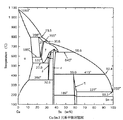
図4はCu-Sn合金の状態図を示す。この状態図から分かるようにCu-Sn合金の状態図は包晶系であり、包晶点はSn22wt%、温度798℃である。本発明のCu-Sn合金におけるSnは19wt%〜10wt%であるが、Sn19wt%の融点は約900℃であり、Sn10wt%の融点は約1010℃である。状態図から分かるようにSn19wt%において、Cu-Sn合金は850℃では完全に溶けるわけではなく、固相のまわりを液相が取り囲んだ状態となっていて、平衡状態では約25%が固相である。ろう材を完全に溶解することにより、ワイヤにろう材を密着性良く付着でき、ダイヤモンド砥粒もろう材内にしっかりと埋め込まれ密着性良く付着することができる。図5はろう材を完全に溶解してダイヤモンド砥粒をろう材に埋め込んだ状態を示す。ろう材を完全に溶解するには状態図における液相線より高い温度で加熱すると良い。たとえば、Sn15wt%の融点は約950℃であるから、これ以上の温度で加熱する。しかし、ダイヤモンド砥粒の付着性は少し低下するが、必ずしも完全にろう材を溶融させなくても良い。我々は、固相が約25%残っていても残りが溶融した状態になれば、ソーワイヤとして十分使用可能であることを発見した。ダイヤモンド砥粒もこれらの固相の間に入り液相の中に充分入り込んだ状態になり、ろう材が固化後は図5に示す状態になることが分かった。従って、本発明のより好適な焼結温度(加熱温度)は、状態図における液相線より高い温度であるが、状態図における液相線より約50℃低くても良い。(この温度での固相の割合が約25%である。)たとえば、Sn19wt%の場合は、850℃以上であれば良い。また、Snが15wt%の場合は約900℃以上、Snが10wt%の場合は約960℃以上である。
FIG. 4 shows a phase diagram of the Cu—Sn alloy. As can be seen from this phase diagram, the phase diagram of the Cu—Sn alloy is peritectic, the peritectic point is Sn 22 wt%, and the temperature is 798 ° C. Sn in the Cu—Sn alloy of the present invention is 19 wt% to 10 wt%, but the melting point of Sn 19 wt% is about 900 ° C., and the melting point of
ダイヤモンド砥粒は、ワイヤ外周に密に付着するよりはある一定の距離を有して付着していた方が切断効率が良く、繰り返し寿命も長い。図5は完成品のソーワイヤの構造を示す図である。上記のダイヤモンド砥粒の距離とはワイヤの長手方向におけるダイヤモンド砥粒同士の間隔であり、図5におけるSで定義される。ダイヤモンド砥粒が密の場合は、切断屑が排除されにくいため切断速度を大きくできない。また切断抵抗も大きくなるため繰り返し寿命も短くなる。これに対して、ある一定の間隔Sを有してダイヤモンド砥粒が分布しているとダイヤモンド砥粒と隣接ダイヤモンド砥粒の間に隙間ができているため切断屑がスムーズに排除される。しかし、ダイヤモンド砥粒の間隔Sが大きすぎると被切断物がダイヤモンド以外の場所であるろう材にも接触するようになる。ろう材では被切断物は切断できないので切断効率が極度に低下する。しかも被切断物とろう材が接触すると、ろう材が削られ、しいてはダイヤモンド砥粒も脱離してワイヤの繰り返し寿命も大きく低下する。我々は、ダイヤモンド砥粒の間隔Sが、ダイヤモンド粒径の3〜10倍、好適には4〜8倍であれば、良好な切断効率や良好な繰り返し寿命を得られることを発見した。尚、ダイヤモンド砥粒の間隔Sはダイヤモンド砥粒の付着密度と考えることもできる。ダイヤモンド砥粒の大きさ並びに混粒全体におけるダイヤモンド砥粒の混合割合を調節することにより、ダイヤモンド砥粒の間隔を調整できる。たとえば、ろう材からのダイヤモンド砥粒の食み出し量を約50%とすれば、ダイヤモンド砥粒のろう材に対する重量割合が約7%、約5%、約2.5%、約2%のときに、Sがダイヤモンド粒径のそれぞれ約3倍、約4倍、約8倍、約10倍となる。 The diamond abrasive grains have better cutting efficiency and longer repetition life if they are attached at a certain distance than the densely attached diamond outer periphery. FIG. 5 is a view showing the structure of a finished saw wire. The distance between the diamond abrasive grains is the distance between the diamond abrasive grains in the longitudinal direction of the wire, and is defined by S in FIG. When the diamond abrasive grains are dense, the cutting speed cannot be increased because it is difficult to remove cutting waste. In addition, since the cutting resistance is increased, the repeated life is shortened. In contrast, when the diamond abrasive grains are distributed with a certain interval S, a gap is formed between the diamond abrasive grains and the adjacent diamond abrasive grains, so that cutting waste is smoothly removed. However, if the distance S between the diamond abrasive grains is too large, the object to be cut comes into contact with the brazing material at a place other than diamond. Since brazing material cannot cut an object to be cut, cutting efficiency is extremely reduced. Moreover, when the object to be cut comes into contact with the brazing material, the brazing material is scraped, and the diamond abrasive grains are also detached, so that the repeated life of the wire is greatly reduced. We have found that good cutting efficiency and good repeat life can be obtained if the spacing S of the diamond abrasive grains is 3 to 10 times, preferably 4 to 8 times, the diamond particle size. The interval S between the diamond abrasive grains can also be considered as the adhesion density of the diamond abrasive grains. The distance between the diamond abrasive grains can be adjusted by adjusting the size of the diamond abrasive grains and the mixing ratio of the diamond abrasive grains in the entire mixed grains. For example, if the amount of diamond abrasive grains protruding from the brazing material is about 50%, the weight ratio of the diamond abrasive grains to the brazing material is about 7%, about 5%, about 2.5%, and about 2%. Sometimes, S is about 3 times, about 4 times, about 8 times, and about 10 times the diamond particle size, respectively.
本発明のソーワイヤでは、ダイヤモンド砥粒がろう材の一部に埋め込まれた状態で固定化されているが、ダイヤモンド砥粒の40%以上、好適には50%以上がろう材の外側に出ていると切断能力が大きいことが分かった。すなわち、図5において、大きさm(ダイヤモンド砥粒は球形に近いので、ダイヤモンドの高さで大きさを比較できる。)のダイヤモンド砥粒のうちろう材から食み出た部分がnであるとき、n/mが50%以上ということである。しかし、余り食み出しすぎるとダイヤモンド砥粒のろう材への付着強度が低下するので、n/mは70%以下である。 In the saw wire of the present invention, diamond abrasive grains are fixed in a state of being embedded in a part of the brazing material, but 40% or more, preferably 50% or more of the diamond abrasive grains come out of the brazing material. It was found that the cutting ability was great. That is, in FIG. 5, when the portion of the diamond abrasive grains of size m (the diamond abrasive grains are nearly spherical, the size can be compared with the height of the diamond) is n from the brazing material. N / m is 50% or more. However, too much protrusion will reduce the adhesion strength of the diamond abrasive grains to the brazing material, so n / m is 70% or less.
ダイヤモンド砥粒は、ろう材および水素化チタンと一緒に混合される。ろう材および水素化チタンも当初は粒状であるが、上述したように溶融したり分解したりして変化する。特にろう材が溶融したときにダイヤモンド砥粒がろう材に埋め込まれないように、ろう材の粒径はダイヤモンド砥粒より小さくする。ワイヤの外周に塗布された糊状物質に均一に付着させるためにできるだけ細かい方が良い。ダイヤモンド砥粒の粒径は、ワイヤやろう材への付着強度の関係で、ワイヤ直径の50%以下とするのが良い。好適には10〜40%とする。40%以下がワイヤやろう材への付着力もあり繰り返し寿命も長くできる。しかし10%以下だと切断能力が落ちてしまう。たとえば、ワイヤ直径が80μmのときは、ダイヤモンド直径は8μm〜32μmとする。またろう材の粒径はダイヤモンド径より小さくするが、好適には40%、もっと好適には30%以下とする。ダイヤモンド径が32μmのときは、好適には約15μm以下、もっと好適には10μm以下とする。水素化チタンもろう材と同様にダイヤモンド径より小さくし、ワイヤ全体に分布させるためにできるだけ細かい方が良い。好適には40%以下、もっと好適には20%以下とする。たとえば、ダイヤモンド径が32μmのときは、30μm以下、好適には約15μm以下、もっと好適には6μm以下とする。以上のように、粒径を調節することにより、その混合割合と合わせてダイヤモンド砥粒を所望の密度に調整できる。 Diamond abrasive is mixed together with brazing material and titanium hydride. The brazing material and titanium hydride are also initially granular, but change as a result of melting or decomposition as described above. In particular, the particle size of the brazing material is made smaller than that of the diamond abrasive grains so that the diamond abrasive grains are not embedded in the brazing material when the brazing material is melted. In order to uniformly adhere to the paste-like substance applied to the outer periphery of the wire, it is better to be as fine as possible. The grain size of the diamond abrasive grains is preferably 50% or less of the wire diameter in relation to the adhesion strength to the wire or brazing material. Preferably it is 10 to 40%. Less than 40% has adhesion to the wire and brazing material and can extend the service life. However, if it is less than 10%, the cutting ability will drop. For example, when the wire diameter is 80 μm, the diamond diameter is 8 μm to 32 μm. The particle size of the brazing material is smaller than the diamond diameter, but is preferably 40%, more preferably 30% or less. When the diamond diameter is 32 μm, it is preferably about 15 μm or less, more preferably 10 μm or less. The titanium hydride should be as fine as possible in order to make it smaller than the diameter of the diamond as well as the brazing material and distribute it throughout the wire. It is preferably 40% or less, more preferably 20% or less. For example, when the diamond diameter is 32 μm, it is 30 μm or less, preferably about 15 μm or less, and more preferably 6 μm or less. As described above, by adjusting the particle diameter, the diamond abrasive grains can be adjusted to a desired density in combination with the mixing ratio.
これまで説明したように、本発明は、ワイヤ外周にゲル状の糊状物質を均一に塗布する工程(ゲル塗布工程)、前記糊状物質にダイヤモンド砥粒、ろう材、および水素化チタン(TiH2)からなる混粒を均一に付着させる工程(混粒付着工程)、糊状物質を乾燥させ固化する工程(乾燥工程)、および焼結させることにより、前記糊状物質を蒸発させ、前記ろう材による金属層をワイヤ外周に形成してダイヤモンド砥粒を付着固化させる工程(焼結工程)を含むことを特徴とする、ダイヤモンド砥粒をろう材によりワイヤに固定する固定砥粒式ソーワイヤの製造方法並びにそれによって製造されたソーワイヤに関するものである。さらに、本発明は、ゲル状の糊状物質と、ダイヤモンド砥粒、ろう材、および水素化チタン(TiH2)を含む混粒を混合させ、その混合物を均一に付着させる工程(混合物付着工程)、糊状物質を乾燥させ固化する工程(乾燥工程)、および焼結させることにより、前記糊状物質を蒸発させ、前記ろう材による金属層をワイヤ外周に形成してダイヤモンド砥粒を付着固化させる工程(焼結工程)を含むことを特徴とする、ダイヤモンド砥粒をろう材によりワイヤに固定する固定砥粒式ソーワイヤの製造方法並びにそれによって製造されたソーワイヤに関するものである。 As described so far, the present invention provides a step of uniformly applying a gel-like paste-like substance to the outer periphery of a wire (gel application step), diamond abrasive grains, brazing material, and titanium hydride (TiH) applied to the paste-like substance. 2 ) the mixed particles uniformly adhering (mixed particle adhering step), the step of drying and solidifying the pasty substance (drying step), and sintering to evaporate the pasty substance and the wax Production of a fixed-abrasive saw wire for fixing diamond abrasive grains to a wire with a brazing material, comprising a step (sintering process) in which a metal layer is formed on the outer circumference of the wire and diamond abrasive grains are adhered and solidified It relates to a method and a saw wire produced thereby. Furthermore, the present invention includes a step of mixing a gel-like paste-like substance, diamond abrasive grains, a brazing material, and a mixed grain containing titanium hydride (TiH 2 ), and uniformly adhering the mixture (mixture attaching step). The paste-like substance is dried and solidified (drying process), and sintered to evaporate the paste-like substance and form a metal layer of the brazing material on the outer periphery of the wire to adhere and solidify the diamond abrasive grains. The present invention relates to a method for producing a fixed abrasive saw wire in which diamond abrasive grains are fixed to a wire by a brazing material, and a saw wire produced thereby.
図1に示すような装置を用いて、80μmのタングステン線ワイヤを、水に溶かしゲル状にしたキサンタンガムの入ったゲル容器内に通して、ワイヤ外周に塗布した。ろう材として15wt%Sn―85wt%Cuを用いた。ダイヤモンド砥粒は六面体、八面体および六八面体からなり、ダイヤモンド砥粒の大きさは直径が約30μm、六八面体の割合が約60%存在する。粒径約10μmのろう材95wt%、ダイヤモンド砥粒2.6wt%および水素化チタン2.4wt%を十分に混ぜた混粒の入った混粒容器を通して、キサンタンガムで被われたワイヤの外周に混粒を付着させ、120℃の温風で乾燥した。混粒付着の際、混粒容器およびワイヤに振動を与えた。振動は、振動数が30Hz〜200Hzで、振幅は1mm〜10mmである。リールに巻かれたワイヤを焼結炉(真空炉)に入れ、他方のリールに伸ばして、その間でテンションが与えられたワイヤを10秒間減圧状態で加熱した。加熱時の真空度は10−3パスカル、加熱温度は950℃である。加熱時間は10秒とした。 Using an apparatus as shown in FIG. 1, an 80 μm tungsten wire was passed through a gel container containing xanthan gum dissolved in water and gelled, and applied to the outer periphery of the wire. As the brazing material, 15 wt% Sn-85 wt% Cu was used. The diamond abrasive grains are composed of hexahedrons, octahedrons, and hexahedrons, and the diamond abrasive grains have a diameter of about 30 μm and a ratio of hexahedrons of about 60%. It is mixed with the outer circumference of the wire covered with xanthan gum through a mixed-grain container containing a mixture of 95 wt% brazing material with a particle size of 95 wt%, diamond abrasive grains 2.6 wt% and titanium hydride 2.4 wt%. The particles were attached and dried with warm air at 120 ° C. When adhering to the mixed particles, vibration was applied to the mixed particle container and the wire. The vibration has a frequency of 30 Hz to 200 Hz and an amplitude of 1 mm to 10 mm. The wire wound around the reel was put into a sintering furnace (vacuum furnace) and extended to the other reel, and the wire tensioned between them was heated in a reduced pressure state for 10 seconds. The degree of vacuum during heating is 10 −3 Pa, and the heating temperature is 950 ° C. The heating time was 10 seconds.
完成品ワイヤのろう材厚みは約15μm、ダイヤモンドはほぼ50~60%ろう材から食み出ていた。ワイヤの長手方向におけるダイヤモンド砥粒同士の平均間隔は約210μmであった。これは、ダイヤモンド直径の約7倍である。ろう材中にはチタンおよび酸化チタンが微小粒で分散して含まれていた。はだかのタングステンワイヤの引っ張り強度は2Gパスカル以上であるが、完成品ワイヤの引っ張り強度も応力で2Gパスカル以上であった。また、ろう材の強度は300Mpa以上で、ダイヤモンド保持力はせん断力で300Mpa以上であった。また、切断力は、厚さ3mmのサファイアを0.7mm/分以上で一定に保つことができ、繰り返し寿命200回以上を実現できた。さらに、厚さ3mmサファイアをワイヤ張力4N、切込み負荷1Nの切断条件で切断したときに、積算距離2000mでも切断効率0.7mm/分を維持できる。尚、ろう材が20wt%SnのCu-Sn合金の場合は繰り返しの切断中にろう材に亀裂が発生して30回の寿命で破断した。このことからも、本発明のソーワイヤは従来品より格段に優れたものであることが分かった。 The finished wire had a brazing material thickness of about 15 μm, and the diamond had erupted from 50 to 60% of the brazing material. The average distance between the diamond abrasive grains in the longitudinal direction of the wire was about 210 μm. This is about 7 times the diamond diameter. The brazing material contained titanium and titanium oxide dispersed in fine particles. The tensile strength of the bare tungsten wire was 2 G Pascal or higher, but the tensile strength of the finished wire was also 2 G Pascal or higher due to stress. The brazing filler metal had a strength of 300 Mpa or more, and the diamond holding power was 300 Mpa or more in terms of shear force. In addition, the cutting force of sapphire with a thickness of 3 mm could be kept constant at 0.7 mm / min or more, and a repetition life of 200 times or more could be realized. Furthermore, when cutting 3mm thick sapphire under cutting conditions with wire tension of 4N and cutting load of 1N, cutting efficiency of 0.7mm / min can be maintained even at an integrated distance of 2000m. When the brazing material was a Cu-Sn alloy with 20 wt% Sn, cracks occurred in the brazing material during repeated cutting, and the solder broke with a life of 30 times. Also from this fact, it was found that the saw wire of the present invention was remarkably superior to the conventional product.
以上説明したように、本発明のソーワイヤは、ダイヤモンド微細砥粒を、活性金属の水素化物を含むCu-Sn合金ろう材を用いて高融点金属等のワイヤに直接接合して、ダイヤモンド砥粒をワイヤに強固に固定したものである。この結果、固定砥粒の切刃により高能率切断が可能になり、ワイヤ寿命が飛躍的に長くなり、たとえば、シリコンやサファイアの切断に威力を発揮する。さらに、スラリーと遊離砥粒がないことなどから環境を汚染しないという効果もある。本発明のソーワイヤの製造方法により高品質なワイヤを高速度で製造することも可能となる。 As described above, in the saw wire of the present invention, diamond fine abrasive grains are directly bonded to a wire such as a refractory metal using a Cu-Sn alloy brazing material containing a hydride of an active metal, and diamond abrasive grains are bonded. It is firmly fixed to the wire. As a result, cutting with fixed abrasive grains enables high-efficiency cutting, greatly extending the life of the wire, and is effective for cutting silicon and sapphire, for example. Furthermore, there is an effect that the environment is not polluted due to the absence of slurry and free abrasive grains. The saw wire manufacturing method of the present invention can also manufacture a high-quality wire at a high speed.
尚、これまで説明してきた内容でお互いに矛盾なく適用できる内容については、具体的な記載がなくとも、お互いに適用や応用ができることは言うまでもない。 Needless to say, the contents that have been described so far can be applied to each other without any specific description.
本発明は、シリコンやサファイアの切断に利用できる。 The present invention can be used for cutting silicon and sapphire.
11・・・ソーワイヤ、12・・・送りリール、13・・・ゲル容器、
14・・・混粒容器、15・・・乾燥炉、16・・・受けリール、
17・・・ゲル容器出口、21・・・糊状物質、22・・・ダイヤモンド砥粒、
23・・・ろう材粒、24・・・水素化チタン粒、31・・・ソーワイヤ、
32・・・焼結炉、33・・・加熱ゾーン、34・・・受けリール、
35・・・巻き取りリール、
11 ... saw wire, 12 ... feed reel, 13 ... gel container,
14 ... Mixed-grain container, 15 ... Drying furnace, 16 ... Receiving reel,
17 ... gel container outlet, 21 ... pasty substance, 22 ... diamond abrasive,
23 ... brazing material grains, 24 ... titanium hydride grains, 31 ... saw wire,
32 ... sintering furnace, 33 ... heating zone, 34 ... receiving reel,
35 ... take-up reel,
Claims (6)
前記糊状物質にダイヤモンド砥粒、ろう材、および水素化チタン(TiH2)からなる混粒を均一に付着させる工程(混粒付着工程)、
糊状物質を乾燥させ固化する工程(乾燥工程)、および
焼結させることにより、前記糊状物質を蒸発させ、前記ろう材による金属層をワイヤ外周に形成してダイヤモンド砥粒を付着固化させる工程(焼結工程)
を含むことを特徴とするダイヤモンド砥粒をろう材によりワイヤに固定する固定砥粒式ソーワイヤの製造方法であって、
前記ろう材は19〜10wt%SnのCu−Sn合金(青銅)であることを特徴とする、固定砥粒式ソーワイヤの製造方法。 A process of uniformly applying a gel-like paste-like substance to the outer periphery of the wire (gel application process),
A step of uniformly adhering a mixture of diamond abrasive grains, brazing material, and titanium hydride (TiH 2 ) to the pasty substance (mixed particle adhesion step);
A step of drying and solidifying the paste-like substance (drying step), and a step of evaporating the paste-like substance, forming a metal layer of the brazing material on the outer periphery of the wire, and adhering and solidifying the diamond abrasive grains (Sintering process)
A method for producing a fixed abrasive saw wire for fixing diamond abrasive grains to a wire with a brazing material, comprising:
The brazing material is a Cu-Sn alloy (bronze) of 19 to 10 wt% Sn, A method for producing a fixed abrasive saw wire.
糊状物質を乾燥させ固化する工程(乾燥工程)、および
焼結させることにより、前記糊状物質を蒸発させ、前記ろう材による金属層をワイヤ外周に形成してダイヤモンド砥粒を付着固化させる工程(焼結工程)
を含むことを特徴とするダイヤモンド砥粒をろう材によりワイヤに固定する固定砥粒式ソーワイヤの製造方法であって、
前記ろう材は19〜10wt%SnのCu−Sn合金(青銅)であることを特徴とする、固定砥粒式ソーワイヤの製造方法。 A step of mixing a gel-like paste-like substance and a mixed grain containing diamond abrasive grains, brazing filler metal, and titanium hydride (TiH 2 ), and uniformly adhering the mixture (mixture attaching step);
A step of drying and solidifying the paste-like substance (drying step), and a step of evaporating the paste-like substance, forming a metal layer of the brazing material on the outer periphery of the wire, and adhering and solidifying the diamond abrasive grains (Sintering process)
A method for producing a fixed abrasive saw wire for fixing diamond abrasive grains to a wire with a brazing material, comprising:
The brazing material is a Cu-Sn alloy (bronze) of 19 to 10 wt% Sn, A method for producing a fixed abrasive saw wire.
Priority Applications (1)
| Application Number | Priority Date | Filing Date | Title |
|---|---|---|---|
| JP2008309185A JP4590513B2 (en) | 2008-12-04 | 2008-12-04 | Saw wire and manufacturing method thereof |
Applications Claiming Priority (1)
| Application Number | Priority Date | Filing Date | Title |
|---|---|---|---|
| JP2008309185A JP4590513B2 (en) | 2008-12-04 | 2008-12-04 | Saw wire and manufacturing method thereof |
Publications (2)
| Publication Number | Publication Date |
|---|---|
| JP2010131698A true JP2010131698A (en) | 2010-06-17 |
| JP4590513B2 JP4590513B2 (en) | 2010-12-01 |
Family
ID=42343553
Family Applications (1)
| Application Number | Title | Priority Date | Filing Date |
|---|---|---|---|
| JP2008309185A Expired - Fee Related JP4590513B2 (en) | 2008-12-04 | 2008-12-04 | Saw wire and manufacturing method thereof |
Country Status (1)
| Country | Link |
|---|---|
| JP (1) | JP4590513B2 (en) |
Cited By (18)
| Publication number | Priority date | Publication date | Assignee | Title |
|---|---|---|---|---|
| JP2013245126A (en) * | 2012-05-24 | 2013-12-09 | Sumitomo Electric Ind Ltd | Polycrystalline diamond abrasive grain and method for producing the same, slurry, and fixed abrasive grain type wire |
| JP2013245260A (en) * | 2012-05-24 | 2013-12-09 | Sumitomo Electric Ind Ltd | Polycrystalline diamond abrasive grain and method for producing the same, slurry, and fixed abrasive grain-type wire |
| JP2014501184A (en) * | 2010-12-30 | 2014-01-20 | サンーゴバン アブレイシブズ,インコーポレイティド | Abrasive article and forming method |
| JP2014079861A (en) * | 2012-10-17 | 2014-05-08 | Noritake Co Ltd | Abrasive grain and method of producing abrasive grain |
| JP2015521957A (en) * | 2012-07-05 | 2015-08-03 | ナムローゼ・フェンノートシャップ・ベーカート・ソシエテ・アノニムN V Bekaert Societe Anonyme | Fixed abrasive sawing wire with cubic octahedral diamond particles |
| US9211634B2 (en) | 2011-09-29 | 2015-12-15 | Saint-Gobain Abrasives, Inc. | Abrasive articles including abrasive particles bonded to an elongated substrate body having a barrier layer, and methods of forming thereof |
| US9254552B2 (en) | 2012-06-29 | 2016-02-09 | Saint-Gobain Abrasives, Inc. | Abrasive article and method of forming |
| US9278429B2 (en) | 2012-06-29 | 2016-03-08 | Saint-Gobain Abrasives, Inc. | Abrasive article for abrading and sawing through workpieces and method of forming |
| US9375826B2 (en) | 2011-09-16 | 2016-06-28 | Saint-Gobain Abrasives, Inc. | Abrasive article and method of forming |
| US9409243B2 (en) | 2013-04-19 | 2016-08-09 | Saint-Gobain Abrasives, Inc. | Abrasive article and method of forming |
| US9533397B2 (en) | 2012-06-29 | 2017-01-03 | Saint-Gobain Abrasives, Inc. | Abrasive article and method of forming |
| KR20170009736A (en) | 2015-07-15 | 2017-01-25 | 미츠이켄사쿠토이시 가부시키가이샤 | Polishing tool and manufacturing method thereof and manufacturing method of polished article |
| US9862041B2 (en) | 2009-08-14 | 2018-01-09 | Saint-Gobain Abrasives, Inc. | Abrasive articles including abrasive particles bonded to an elongated body |
| US9878382B2 (en) | 2015-06-29 | 2018-01-30 | Saint-Gobain Abrasives, Inc. | Abrasive article and method of forming |
| US9902044B2 (en) | 2012-06-29 | 2018-02-27 | Saint-Gobain Abrasives, Inc. | Abrasive article and method of forming |
| CN114952078A (en) * | 2022-05-25 | 2022-08-30 | 浙江亚通焊材有限公司 | Preparation method of copper-based solder for brazing stainless steel and red copper and copper-based solder |
| WO2023286633A1 (en) * | 2021-07-15 | 2023-01-19 | パナソニックIpマネジメント株式会社 | Metal wire and saw wire |
| TWI803929B (en) * | 2021-08-05 | 2023-06-01 | 環球晶圓股份有限公司 | Saw wire and ingot cutting tool |
Citations (6)
| Publication number | Priority date | Publication date | Assignee | Title |
|---|---|---|---|---|
| JPH0379264A (en) * | 1989-08-18 | 1991-04-04 | Tone Boring Co | Cutting wire tool |
| JPH03104553A (en) * | 1989-09-18 | 1991-05-01 | Goei Seisakusho:Kk | Cutting wire |
| JPH09272060A (en) * | 1996-04-10 | 1997-10-21 | Goei Seisakusho:Kk | Grinding wheel tool and its manufacture |
| JPH11165260A (en) * | 1997-08-28 | 1999-06-22 | Norton Co | Strippable binder composition for polishing tool, method of binding abrasive grain utilizing the composition, and polishing tool |
| JP2004082276A (en) * | 2002-08-27 | 2004-03-18 | Tenryu Saw Mfg Co Ltd | Metal bond grinding tool |
| JP2005131784A (en) * | 1998-07-31 | 2005-05-26 | Saint-Gobain Abrasives Inc | Rotary dressing tool containing brazed diamond layer |
-
2008
- 2008-12-04 JP JP2008309185A patent/JP4590513B2/en not_active Expired - Fee Related
Patent Citations (6)
| Publication number | Priority date | Publication date | Assignee | Title |
|---|---|---|---|---|
| JPH0379264A (en) * | 1989-08-18 | 1991-04-04 | Tone Boring Co | Cutting wire tool |
| JPH03104553A (en) * | 1989-09-18 | 1991-05-01 | Goei Seisakusho:Kk | Cutting wire |
| JPH09272060A (en) * | 1996-04-10 | 1997-10-21 | Goei Seisakusho:Kk | Grinding wheel tool and its manufacture |
| JPH11165260A (en) * | 1997-08-28 | 1999-06-22 | Norton Co | Strippable binder composition for polishing tool, method of binding abrasive grain utilizing the composition, and polishing tool |
| JP2005131784A (en) * | 1998-07-31 | 2005-05-26 | Saint-Gobain Abrasives Inc | Rotary dressing tool containing brazed diamond layer |
| JP2004082276A (en) * | 2002-08-27 | 2004-03-18 | Tenryu Saw Mfg Co Ltd | Metal bond grinding tool |
Cited By (27)
| Publication number | Priority date | Publication date | Assignee | Title |
|---|---|---|---|---|
| US9862041B2 (en) | 2009-08-14 | 2018-01-09 | Saint-Gobain Abrasives, Inc. | Abrasive articles including abrasive particles bonded to an elongated body |
| JP2014501184A (en) * | 2010-12-30 | 2014-01-20 | サンーゴバン アブレイシブズ,インコーポレイティド | Abrasive article and forming method |
| US9186816B2 (en) | 2010-12-30 | 2015-11-17 | Saint-Gobain Abrasives, Inc. | Abrasive article and method of forming |
| US9248583B2 (en) | 2010-12-30 | 2016-02-02 | Saint-Gobain Abrasives, Inc. | Abrasive article and method of forming |
| US9375826B2 (en) | 2011-09-16 | 2016-06-28 | Saint-Gobain Abrasives, Inc. | Abrasive article and method of forming |
| US9211634B2 (en) | 2011-09-29 | 2015-12-15 | Saint-Gobain Abrasives, Inc. | Abrasive articles including abrasive particles bonded to an elongated substrate body having a barrier layer, and methods of forming thereof |
| JP2013245260A (en) * | 2012-05-24 | 2013-12-09 | Sumitomo Electric Ind Ltd | Polycrystalline diamond abrasive grain and method for producing the same, slurry, and fixed abrasive grain-type wire |
| JP2013245126A (en) * | 2012-05-24 | 2013-12-09 | Sumitomo Electric Ind Ltd | Polycrystalline diamond abrasive grain and method for producing the same, slurry, and fixed abrasive grain type wire |
| US9533397B2 (en) | 2012-06-29 | 2017-01-03 | Saint-Gobain Abrasives, Inc. | Abrasive article and method of forming |
| US10596681B2 (en) | 2012-06-29 | 2020-03-24 | Saint-Gobain Abrasives, Inc. | Abrasive article and method of forming |
| US9254552B2 (en) | 2012-06-29 | 2016-02-09 | Saint-Gobain Abrasives, Inc. | Abrasive article and method of forming |
| US9278429B2 (en) | 2012-06-29 | 2016-03-08 | Saint-Gobain Abrasives, Inc. | Abrasive article for abrading and sawing through workpieces and method of forming |
| US9687962B2 (en) | 2012-06-29 | 2017-06-27 | Saint-Gobain Abrasives, Inc. | Abrasive article and method of forming |
| US9902044B2 (en) | 2012-06-29 | 2018-02-27 | Saint-Gobain Abrasives, Inc. | Abrasive article and method of forming |
| JP2015521957A (en) * | 2012-07-05 | 2015-08-03 | ナムローゼ・フェンノートシャップ・ベーカート・ソシエテ・アノニムN V Bekaert Societe Anonyme | Fixed abrasive sawing wire with cubic octahedral diamond particles |
| JP2014079861A (en) * | 2012-10-17 | 2014-05-08 | Noritake Co Ltd | Abrasive grain and method of producing abrasive grain |
| US9409243B2 (en) | 2013-04-19 | 2016-08-09 | Saint-Gobain Abrasives, Inc. | Abrasive article and method of forming |
| US9878382B2 (en) | 2015-06-29 | 2018-01-30 | Saint-Gobain Abrasives, Inc. | Abrasive article and method of forming |
| US10137514B2 (en) | 2015-06-29 | 2018-11-27 | Saint-Gobain Abrasives, Inc. | Abrasive article and method of forming |
| US10583506B2 (en) | 2015-06-29 | 2020-03-10 | Saint-Gobain Abrasives, Inc. | Abrasive article and method of forming |
| KR20170009736A (en) | 2015-07-15 | 2017-01-25 | 미츠이켄사쿠토이시 가부시키가이샤 | Polishing tool and manufacturing method thereof and manufacturing method of polished article |
| WO2023286633A1 (en) * | 2021-07-15 | 2023-01-19 | パナソニックIpマネジメント株式会社 | Metal wire and saw wire |
| JP2023013329A (en) * | 2021-07-15 | 2023-01-26 | パナソニックIpマネジメント株式会社 | Metal wire, and saw wire |
| TWI853272B (en) * | 2021-07-15 | 2024-08-21 | 日商松下知識產權經營股份有限公司 | Metal Wire and Saw Wire |
| JP7784634B2 (en) | 2021-07-15 | 2025-12-12 | パナソニックIpマネジメント株式会社 | Metal wire and saw wire |
| TWI803929B (en) * | 2021-08-05 | 2023-06-01 | 環球晶圓股份有限公司 | Saw wire and ingot cutting tool |
| CN114952078A (en) * | 2022-05-25 | 2022-08-30 | 浙江亚通焊材有限公司 | Preparation method of copper-based solder for brazing stainless steel and red copper and copper-based solder |
Also Published As
| Publication number | Publication date |
|---|---|
| JP4590513B2 (en) | 2010-12-01 |
Similar Documents
| Publication | Publication Date | Title |
|---|---|---|
| JP4590513B2 (en) | Saw wire and manufacturing method thereof | |
| KR100430175B1 (en) | Superabrasive wire saw and method for making the saw | |
| US4964209A (en) | Method for producing a wire incrusted with abrasive grain | |
| Artini et al. | Diamond–metal interfaces in cutting tools: a review | |
| US6102024A (en) | Brazed superabrasive wire saw and method therefor | |
| ES2382620T3 (en) | BINDER FOR ABRASION TOOL. | |
| CN105773851B (en) | Saw pearl | |
| CN103786100B (en) | A kind of preparation method of Furnace Brazing of Diamond Grinding Wheel With Ni | |
| CN87105216A (en) | Method for processing diamond particles | |
| CN105619272B (en) | A kind of production method of laser Furnace Brazing of Diamond Grinding Wheel With Ni | |
| KR20140060461A (en) | Method to produce a sawing bead | |
| EP3144082A1 (en) | Porous aluminum sintered body and method for producing porous aluminum sintered body | |
| EP3144083B1 (en) | Porous aluminum sintered body and method for producing porous aluminum sintered body | |
| JP5515646B2 (en) | Wire saw and method for manufacturing wire saw | |
| KR100375649B1 (en) | Removable bond for abrasive tool | |
| CN110106375A (en) | A kind of Cu-Sn-Ti high temperature alloy solder preparation method containing Fe, Ni, Si | |
| Wang et al. | Effect of CoSn3 nanocrystals on Sn3Ag plating for electronic packaging | |
| JP4624011B2 (en) | Lap wheel abrasive layer structure | |
| JP2016068123A (en) | Au-Sn-Ag-BASED SOLDER ALLOY, SEALED OR JOINED ELECTRONIC EQUIPMENT USING THE SAME AND ELECTRONIC DEVICE MOUNTING THE ELECTRONIC EQUIPMENT | |
| Ma et al. | The study on the rapidly-solidified Sn-0.7 Cu lead-free solders and the interface reactions with Cu substrate | |
| RU2457935C2 (en) | Method of making abrasive tool from superhard materials | |
| CN119928085A (en) | Brazed diamond wire saw and manufacturing method thereof | |
| MXPA00008891A (en) | Superabrasive wire saw and method for making the saw | |
| Sharma et al. | Effect of Nano-Particle on the Properties of Sn-3Ag-0.5 Cu Solder | |
| KR20120127030A (en) | Superabrasive grinding device and method for manufacturing the same |
Legal Events
| Date | Code | Title | Description |
|---|---|---|---|
| A521 | Written amendment |
Free format text: JAPANESE INTERMEDIATE CODE: A523 Effective date: 20100304 |
|
| A131 | Notification of reasons for refusal |
Free format text: JAPANESE INTERMEDIATE CODE: A131 Effective date: 20100416 |
|
| A521 | Written amendment |
Free format text: JAPANESE INTERMEDIATE CODE: A523 Effective date: 20100608 |
|
| TRDD | Decision of grant or rejection written | ||
| A01 | Written decision to grant a patent or to grant a registration (utility model) |
Free format text: JAPANESE INTERMEDIATE CODE: A01 Effective date: 20100708 |
|
| A01 | Written decision to grant a patent or to grant a registration (utility model) |
Free format text: JAPANESE INTERMEDIATE CODE: A01 |
|
| A61 | First payment of annual fees (during grant procedure) |
Free format text: JAPANESE INTERMEDIATE CODE: A61 Effective date: 20100805 |
|
| FPAY | Renewal fee payment (event date is renewal date of database) |
Free format text: PAYMENT UNTIL: 20130924 Year of fee payment: 3 |
|
| R150 | Certificate of patent or registration of utility model |
Ref document number: 4590513 Country of ref document: JP Free format text: JAPANESE INTERMEDIATE CODE: R150 Free format text: JAPANESE INTERMEDIATE CODE: R150 |
|
| R250 | Receipt of annual fees |
Free format text: JAPANESE INTERMEDIATE CODE: R250 |
|
| R250 | Receipt of annual fees |
Free format text: JAPANESE INTERMEDIATE CODE: R250 |
|
| LAPS | Cancellation because of no payment of annual fees |