JP2010121096A - Vegetable originated composition and cured product of the same - Google Patents
Vegetable originated composition and cured product of the same Download PDFInfo
- Publication number
- JP2010121096A JP2010121096A JP2008298782A JP2008298782A JP2010121096A JP 2010121096 A JP2010121096 A JP 2010121096A JP 2008298782 A JP2008298782 A JP 2008298782A JP 2008298782 A JP2008298782 A JP 2008298782A JP 2010121096 A JP2010121096 A JP 2010121096A
- Authority
- JP
- Japan
- Prior art keywords
- plant
- hot water
- extract component
- molecular weight
- pressurized hot
- Prior art date
- Legal status (The legal status is an assumption and is not a legal conclusion. Google has not performed a legal analysis and makes no representation as to the accuracy of the status listed.)
- Pending
Links
Landscapes
- Epoxy Resins (AREA)
Abstract
【課題】高い反応性を有し、高い耐熱性と機械的特性を有する硬化物を形成することができる植物由来組成物とその硬化物を提供する。
【解決手段】160〜400℃、0.8〜30MPaの加圧熱水で処理した重量平均分子量500〜10000の植物の抽出成分と、植物油脂のエポキシ化合物とを含有することを特徴とする。
【選択図】なしThe present invention provides a plant-derived composition capable of forming a cured product having high reactivity and high heat resistance and mechanical properties, and a cured product thereof.
An extract component of a plant having a weight average molecular weight of 500 to 10,000 treated with pressurized hot water of 160 to 400 ° C. and 0.8 to 30 MPa and an epoxy compound of a vegetable oil and fat are contained.
[Selection figure] None
Description
本発明は、植物由来組成物とその硬化物に関するものである。 The present invention relates to a plant-derived composition and a cured product thereof.
近年、地球温暖化等の環境問題に対する関心が高まるにつれ、プラスチック分野においては、石油由来の材料に代替するものとして、低エミッションかつカーボンニュートラルな植物由来の分解物を重合して得られる樹脂に注目が集まってきている。 In recent years, as interest in environmental issues such as global warming has increased, in the plastic field, attention has been focused on resins obtained by polymerizing low-emission, carbon-neutral plant-derived degradation products as an alternative to petroleum-derived materials. Are gathering.
中でも、植物由来の分解物の一種である乳酸を重合して得られたポリ乳酸は、結晶性を有し、他の植物由来樹脂と比較して物性の高い樹脂の一つであり、大量生産も可能で生産コストも比較的低い。 Among them, polylactic acid obtained by polymerizing lactic acid, which is a kind of plant-derived degradation product, has crystallinity and is one of the resins with higher physical properties compared to other plant-derived resins. The production cost is relatively low.
しかし、ポリ乳酸は熱可塑性樹脂であり、汎用の石油由来の熱可塑性樹脂(PE、PP、ABS等)に比較すると、耐熱性と機械的特性が低いために、広く普及するには至っていない。また、ポリ乳酸は耐熱性の高いエンジニアリングプラスチックや熱硬化性樹脂に代替できるような物性を有していない。 However, polylactic acid is a thermoplastic resin, and since it has low heat resistance and mechanical properties compared to general-purpose petroleum-derived thermoplastic resins (PE, PP, ABS, etc.), it has not been widely used. In addition, polylactic acid does not have physical properties that can be replaced by engineering plastics or thermosetting resins with high heat resistance.
一方、木材等に多く含まれるポリフェノール類であるリグニンは、植物由来の物質としてはセルロースに次ぐ存在量がある。リグニンはパルプ製造の際に廃棄物となるため、これを有効利用しようという試みが古くからなされてきた。 On the other hand, lignin, which is a polyphenol contained in a large amount in wood and the like, is an abundance after plant as a plant-derived substance. Since lignin becomes waste during pulp production, attempts have been made for a long time to make effective use of it.
例えば、リグニンは化学構造がフェノール樹脂に類似していることから、フェノール樹脂と同様にリグニンをホルムアルデヒドと反応させ縮合させて接着剤として用いることが検討されてきた。また、樹皮等に含まれるタンニンもリグニンと同様にホルムアルデヒドと反応させ縮合させて接着剤として用いることが検討されてきた。さらに、フェノール樹脂のメチロール基とリグニンのフェノール性水酸基との反応を期待して、フェノール樹脂にリグニンを添加し、リグニンをフェノール樹脂の高分子骨格の中に取り込む検討もなされてきた。 For example, since lignin has a chemical structure similar to that of a phenol resin, it has been studied to use lignin as an adhesive by reacting it with formaldehyde and condensing it in the same manner as a phenol resin. In addition, tannin contained in bark and the like has been studied for use as an adhesive by reacting with formaldehyde and condensing in the same manner as lignin. Furthermore, in view of the reaction between the methylol group of the phenol resin and the phenolic hydroxyl group of lignin, studies have been made to add lignin to the phenol resin and incorporate the lignin into the polymer skeleton of the phenol resin.
しかしながら、リグニン等をホルムアルデヒドを用いて反応させる場合、残留したホルムアルデヒドや加水分解によって発生したホルムアルデヒドが放散されるという問題があった。また、リグニンの反応性が従来のフェノール樹脂よりも低いため、物性と生産性が劣り、上記の技術は広く実用化されていないのが現状である。 However, when lignin or the like is reacted with formaldehyde, there is a problem that residual formaldehyde or formaldehyde generated by hydrolysis is diffused. In addition, since the reactivity of lignin is lower than that of conventional phenol resins, physical properties and productivity are inferior, and the above technology is not widely put into practical use.
リグニンを有効利用しようという他の試みとして、リグニンのフェノール性水酸基とポリイソシアナートを反応させてウレタン樹脂とすること(非特許文献1参照)、リグニンのフェノール性水酸基をエポキシ化し、他のエポキシ樹脂と反応させること(非特許文献2参照)、ロジン系成分およびそれと反応する成分をリグニンに加えること(特許文献1参照)等が検討されている。
しかしながら、これらの従来技術では石油由来成分を多く用いているため、植物由来成分の比率を高くできず、さらに反応性が低いため物性と生産性が劣るという問題があり、広く実用化されていないのが現状である。また特許文献1では、ロジン系成分を加えずにリグニンとエポキシ化合物を混合した配合は物性が低くなっている。これはリグニンの反応性の低さが原因と考えられる。 However, since these oils use many petroleum-derived components, the ratio of plant-derived components cannot be increased, and there is a problem that physical properties and productivity are inferior due to low reactivity, and they are not widely put into practical use. is the current situation. Moreover, in patent document 1, the mixing | blending which mixed the lignin and the epoxy compound without adding a rosin-type component has low physical property. This is thought to be due to the low reactivity of lignin.
本発明は、以上の通りの事情に鑑みてなされたものであり、高い反応性を有し、高い耐熱性と機械的特性を有する硬化物を形成することができる植物由来組成物とその硬化物を提供することを課題としている。 The present invention has been made in view of the circumstances as described above, and has a high reactivity, a plant-derived composition capable of forming a cured product having high heat resistance and mechanical properties, and the cured product thereof It is an issue to provide.
本発明は、上記の課題を解決するために、以下のことを特徴としている。 The present invention is characterized by the following in order to solve the above problems.
第1:160〜400℃、0.8〜30MPaの加圧熱水で処理した重量平均分子量500〜10000の植物の抽出成分と、植物油脂のエポキシ化合物とを含有することを特徴とする植物由来組成物。 First: derived from a plant, comprising an extract component of a plant having a weight average molecular weight of 500 to 10,000 treated with pressurized hot water of 160 to 400 ° C. and 0.8 to 30 MPa, and an epoxy compound of vegetable oil and fat Composition.
第2:植物の抽出成分は、少なくとも1つのフェノール性水酸基を有し且つ2つ以上の水酸基を有するフェノール性化合物を含有することを特徴とする上記第1の植物由来組成物。 Second: The plant-derived composition according to the first aspect, wherein the plant extract component contains a phenolic compound having at least one phenolic hydroxyl group and having two or more hydroxyl groups.
第3:植物の抽出成分は、200〜320℃、1.6〜13MPaの加圧熱水で処理したものであることを特徴とする上記第1または第2の植物由来組成物。 Third: The first or second plant-derived composition described above, wherein the plant extract component is treated with pressurized hot water of 200 to 320 ° C. and 1.6 to 13 MPa.
第4:上記第1ないし第3のいずれかの植物由来組成物を硬化してなることを特徴とする硬化物。 Fourth: A cured product obtained by curing any one of the first to third plant-derived compositions.
上記第1の発明によれば、植物を160〜400℃、0.8〜30MPaの加圧熱水で処理し、且つ、重量平均分子量500〜10000の抽出成分を植物から取り出すようにしている。 According to the first aspect of the invention, the plant is treated with pressurized hot water at 160 to 400 ° C. and 0.8 to 30 MPa, and an extract component having a weight average molecular weight of 500 to 10,000 is taken out from the plant.
この特定の加圧熱水処理条件と重量平均分子量を満足する植物の抽出成分は、少なくとも1つのフェノール性水酸基を有するフェノール性化合物を含有しているが、中でも、複数の芳香族環を含むものの割合が大部分を占める。この複数の芳香族環を含むフェノール性化合物は、1分子内に2つ以上の水酸基を有しており、この2つ以上の水酸基が植物油脂のエポキシ化合物のエポキシ基と反応して反応物は3次元架橋する。 The plant extraction component that satisfies the specific pressurized hydrothermal treatment conditions and the weight average molecular weight contains a phenolic compound having at least one phenolic hydroxyl group, but includes a plurality of aromatic rings. The proportion is the majority. This phenolic compound containing a plurality of aromatic rings has two or more hydroxyl groups in one molecule, and these two or more hydroxyl groups react with the epoxy group of the epoxy compound of the vegetable oil and fat, and the reaction product becomes 3D cross-linking.
すなわち当該フェノール性化合物は、パルプ製造時に副生されるクラフトリグニン、リグニンスルホン酸、硫酸を用いて抽出されるリグノフェノール等に比べて加圧熱水で処理することで水酸基の変性が少ない状態で抽出されるため、反応性の高い水酸基を2つ以上有しており、植物油脂のエポキシ化合物との反応性が高い。 In other words, the phenolic compound can be treated with pressurized hot water compared to lignophenol extracted using kraft lignin, lignin sulfonic acid, sulfuric acid, etc., which are by-produced during pulp production, in a state where there is little modification of hydroxyl groups. Since it is extracted, it has two or more highly reactive hydroxyl groups and is highly reactive with the epoxy compound of vegetable oil.
そして植物油脂のエポキシ化合物との反応により、耐熱性を向上させるフェノール性化合物の芳香族環が反応物中に取り込まれ、3次元架橋した高い耐熱性と機械的特性を有する硬化物を形成することができる。 Then, the aromatic ring of the phenolic compound that improves the heat resistance is incorporated into the reaction product by the reaction with the epoxy compound of the vegetable oil and fat to form a three-dimensionally crosslinked cured product having high heat resistance and mechanical properties. Can do.
上記第2の発明によれば、植物の抽出成分は、少なくとも1つのフェノール性水酸基を有し且つ2つ以上の水酸基を有するフェノール性化合物を含有しているので、このフェノール性化合物の2つ以上の水酸基が植物油脂のエポキシ化合物のエポキシ基と反応して反応物は3次元架橋する。 According to the second aspect of the invention, the plant extract component has at least one phenolic hydroxyl group and contains a phenolic compound having two or more hydroxyl groups. The hydroxyl group of this reacts with the epoxy group of the epoxy compound of vegetable oil and fat, and the reaction product is three-dimensionally crosslinked.
そして植物油脂のエポキシ化合物との反応により、耐熱性を向上させるフェノール性化合物の芳香族環が反応物中に取り込まれ、3次元架橋した高い耐熱性と機械的特性を有する硬化物を形成することができる。 Then, the aromatic ring of the phenolic compound that improves the heat resistance is incorporated into the reaction product by the reaction with the epoxy compound of the vegetable oil and fat to form a three-dimensionally crosslinked cured product having high heat resistance and mechanical properties. Can do.
上記第3の発明によれば、植物を200〜320℃、1.6〜13MPaの加圧熱水で処理し、且つ、重量平均分子量500〜10000の抽出成分を植物から取り出すようにしている。 According to the third aspect of the invention, the plant is treated with pressurized hot water at 200 to 320 ° C. and 1.6 to 13 MPa, and an extract component having a weight average molecular weight of 500 to 10,000 is taken out from the plant.
この特定の加圧熱水処理条件と重量平均分子量を満足する植物の抽出成分は、上記第1および第2の発明の効果に加え、植物油脂のエポキシ化合物との硬化反応におけるゲル化時間が大幅に短くなり、植物油脂のエポキシ化合物との反応性を特に高めることができ、硬化物の耐熱性と機械的特性も向上させることができる。 In addition to the effects of the first and second inventions described above, the plant extract component satisfying the specific pressurized hydrothermal treatment conditions and the weight average molecular weight has a significant gelation time in the curing reaction of the vegetable oil with the epoxy compound. In particular, the reactivity of the vegetable oil with the epoxy compound can be particularly increased, and the heat resistance and mechanical properties of the cured product can be improved.
さらに、この特定の加圧熱水処理条件と重量平均分子量を満足することで、植物油脂のエポキシ化合物との反応性の高い植物の抽出成分の収率が大幅に向上する。 Furthermore, by satisfying the specific pressurized hydrothermal treatment conditions and the weight average molecular weight, the yield of the extracted component of the plant having high reactivity with the epoxy compound of the vegetable oil and fat is greatly improved.
上記第4の発明によれば、上記第1ないし第3の発明の植物由来組成物を反応硬化させることで硬化物としており、当該組成物は、従来の硬化性樹脂と同様に加熱、光照射、硬化促進剤の添加等により反応して3次元網状構造の硬化物となるため、熱可塑性樹脂等と比較してより高い耐熱性と機械的強度が得られる。 According to the fourth invention, the plant-derived composition of the first to third inventions is cured by reaction, and the composition is heated and irradiated with light in the same manner as a conventional curable resin. In addition, since it reacts by the addition of a curing accelerator or the like to obtain a cured product having a three-dimensional network structure, higher heat resistance and mechanical strength can be obtained as compared with a thermoplastic resin or the like.
以下、本発明を詳細に説明する。 Hereinafter, the present invention will be described in detail.
本発明において、抽出成分の原料としての植物は、特に制限はないが、その具体例としては木本植物(マツ科、スギ科、ヒノキ科、カバノキ科等の針葉樹、広葉樹)および草本植物の幹、茎、枝、樹皮、葉等の、リグニンやタンニンと呼ばれるポリフェノール類が含まれているものが挙げられる。植物の種類、部位等により、含まれるポリフェノール類の構造は異なり、現在、これらの構造を特定するための研究が行われている。 In the present invention, the plant as a raw material for the extract component is not particularly limited. Specific examples thereof include woody plants (pine trees, cedars, cypresses, birchs, etc.) and herbaceous plant stems. , Stems, branches, bark, leaves, and the like containing polyphenols called lignin and tannin. The structure of the polyphenols contained varies depending on the plant type, site, etc., and studies are currently being conducted to identify these structures.
上記の植物は、これを粉砕して植物材料とした後に、加圧熱水で処理され、そして抽出によりフェノール性化合物を含む抽出成分が取り出される。 The above-mentioned plant is pulverized into plant material, treated with pressurized hot water, and extracted components containing phenolic compounds are extracted by extraction.
本発明では、160〜400℃、0.8〜30MPaの条件で加圧熱水による処理を行い、重量平均分子量500〜10000の植物の抽出成分を得る。特に好ましい態様では、200〜320℃、1.6〜13MPaの条件、好ましくは220〜310℃、2.5〜10MPaの条件で加圧熱水による処理を行い、重量平均分子量500〜10000、好ましくは500〜5000、より好ましくは500〜2000、さらに好ましくは600〜1600の植物の抽出成分を得る。 In this invention, the process by a pressurized hot water is performed on conditions of 160-400 degreeC and 0.8-30 MPa, and the extract component of a plant of the weight average molecular weights 500-10000 is obtained. In a particularly preferred embodiment, the treatment with pressurized hot water is performed under the conditions of 200 to 320 ° C. and 1.6 to 13 MPa, preferably 220 to 310 ° C. and 2.5 to 10 MPa, and the weight average molecular weight is 500 to 10,000, preferably Of 500 to 5000, more preferably 500 to 2000, and still more preferably 600 to 1600 plant extract components.
ここで加圧熱水による処理には、いわゆる蒸煮処理、爆砕処理、亜臨界処理、超臨界処理が含まれる。ここで、「亜臨界処理」とは、亜臨界水中における処理のことであり、亜臨界水とは、水の温度および圧力が水の臨界点(臨界温度374.4℃、臨界圧力22.1MPa)以下であって、かつ、温度が140℃以上、その時の圧力が0.36MPa(140℃の飽和蒸気圧)以上の範囲にある状態の水をいう。また「超臨界処理」とは、超臨界水中における処理のことであり、超臨界水とは、温度および圧力が臨界点を超える水のことをいう。 Here, the treatment with pressurized hot water includes so-called steaming treatment, blasting treatment, subcritical treatment, and supercritical treatment. Here, “subcritical treatment” refers to treatment in subcritical water, and subcritical water is a temperature and pressure of water at a critical point (critical temperature 374.4 ° C., critical pressure 22.1 MPa). ) And water in a state where the temperature is 140 ° C. or higher and the pressure at that time is 0.36 MPa (saturated vapor pressure of 140 ° C.) or higher. “Supercritical treatment” means treatment in supercritical water, and supercritical water means water whose temperature and pressure exceed the critical point.
粉砕した植物材料を上記の条件下で処理することによって、加圧熱水による有機物の溶解作用と強い加水分解作用により高分子であるリグニンやタンニン等が低分子化され、植物油脂のエポキシ化合物との反応性が高いフェノール性化合物となる。 By treating the pulverized plant material under the above conditions, the polymer lignin, tannin and the like are reduced in molecular weight by the action of dissolving the organic matter by the pressurized hot water and the strong hydrolysis action. It becomes a phenolic compound having high reactivity.
この特定の加圧熱水処理条件と重量平均分子量を満足する植物の抽出成分は、少なくとも1つのフェノール性水酸基を有するフェノール性化合物を含有しているが、中でも、複数の芳香族環を含むものの割合が大部分を占める。この複数の芳香族環を含むフェノール性化合物は、1分子内に2つ以上の水酸基を有しており、この2つ以上の水酸基が植物油脂のエポキシ化合物のエポキシ基と反応して反応物は3次元架橋する。 The plant extraction component that satisfies the specific pressurized hydrothermal treatment conditions and the weight average molecular weight contains a phenolic compound having at least one phenolic hydroxyl group, but includes a plurality of aromatic rings. The proportion is the majority. This phenolic compound containing a plurality of aromatic rings has two or more hydroxyl groups in one molecule, and these two or more hydroxyl groups react with the epoxy group of the epoxy compound of the vegetable oil and fat, and the reaction product becomes 3D cross-linking.
すなわち当該フェノール性化合物は、パルプ製造時に副生されるクラフトリグニン、リグニンスルホン酸、硫酸を用いて抽出されるリグノフェノール等に比べて加圧熱水で処理することで水酸基の変性が少ない状態で抽出されるため、反応性の高い水酸基を2つ以上有しており、植物油脂のエポキシ化合物との反応性が高い。 In other words, the phenolic compound can be treated with pressurized hot water compared to lignophenol extracted using kraft lignin, lignin sulfonic acid, sulfuric acid, etc., which are by-produced during pulp production, in a state where there is little modification of hydroxyl groups. Since it is extracted, it has two or more highly reactive hydroxyl groups and is highly reactive with the epoxy compound of vegetable oil.
加圧熱水による処理において、温度が低過ぎる場合または圧力が低過ぎる場合には、粉砕した植物材料に含まれるリグニンやタンニン等の有機物の水への溶解性が低下し、さらに加水分解する能力が低下する。そのため、低分子化が不十分となり、フェノール性化合物を抽出することが困難となる。 In the treatment with pressurized hot water, if the temperature is too low or the pressure is too low, the water solubility of organic substances such as lignin and tannin contained in the crushed plant material is reduced, and the ability to further hydrolyze Decreases. Therefore, the molecular weight reduction is insufficient and it is difficult to extract the phenolic compound.
また、加圧熱水による処理において、温度が低過ぎる場合または圧力が低過ぎる場合には、重量平均分子量が上記の範囲を満足する植物の抽出成分が得られたとしても、処理条件に起因して、適度に低分子化された複数の芳香族環を含むフェノール性化合物であって2つ以上の水酸基を有するものの割合が低くなり、当該抽出物の植物のエポキシ樹脂との反応性は著しく低下する傾向がある。 Further, in the treatment with pressurized hot water, when the temperature is too low or the pressure is too low, even if an extract component of the plant whose weight average molecular weight satisfies the above range is obtained, it is caused by the treatment conditions. The proportion of phenolic compounds containing a plurality of moderately low-molecular aromatic rings having two or more hydroxyl groups is reduced, and the reactivity of the extract with plant epoxy resin is significantly reduced. Tend to.
加圧熱水による処理において、温度が高過ぎる場合または圧力が高過ぎる場合には、粉砕した植物材料に含まれるリグニンやタンニン等の有機物に対する加水分解作用が強過ぎて、過剰に低分子化され、重量平均分子量が上記の範囲未満となり、植物のエポキシ樹脂との反応性が高いフェノール性化合物が得られなくなる。すなわち、植物の抽出成分は、過剰に低分子化されて1つの芳香族環からなる化合物の割合が高くなる。この芳香族環が1つの化合物は、水酸基の数が1つであるかまたは水酸基を有しないものが大部分であり、このような化合物は、植物油脂のエポキシ化合物と反応しないか、あるいは反応しても水酸基が1つのみであるため3次元架橋を形成することができない。 In the treatment with pressurized hot water, if the temperature is too high or the pressure is too high, the hydrolyzing action on organic substances such as lignin and tannin contained in the pulverized plant material is too strong, resulting in excessively low molecular weight. The weight average molecular weight is less than the above range, and a phenolic compound having high reactivity with a plant epoxy resin cannot be obtained. That is, the plant extract component is excessively depolymerized and the proportion of the compound consisting of one aromatic ring increases. Most of the compounds having one aromatic ring have one hydroxyl group or no hydroxyl group, and such a compound does not react or reacts with an epoxy compound of vegetable oil. However, since there is only one hydroxyl group, three-dimensional crosslinking cannot be formed.
なお、植物の抽出成分の重量平均分子量が10000を超えると、水、有機溶媒等の適宜の溶媒への溶解性が大きく低下し、抽出成分として取り出しを行うことが困難になる。 In addition, when the weight average molecular weight of the plant extract component exceeds 10,000, the solubility in an appropriate solvent such as water or an organic solvent is greatly reduced, and it becomes difficult to take out the extract component as an extract component.
加圧熱水による処理においては温度が高い場合、短い処理時間でも植物の抽出成分の低分子化が進むが、温度が低い場合は処理時間を調整することで高い分子量の抽出成分を得ることができる。 In the treatment with pressurized hot water, when the temperature is high, the molecular weight of the plant extract component is reduced even in a short treatment time, but when the temperature is low, an extract component with a high molecular weight can be obtained by adjusting the treatment time. it can.
本発明では特に、200〜320℃、1.6〜13MPaの条件、好ましくは220〜310℃、2.5〜10MPaの条件で加圧熱水による処理を行い、重量平均分子量500〜10000、好ましくは500〜5000、より好ましくは500〜2000、さらに好ましくは600〜1600の植物の抽出成分を得ることで、植物油脂のエポキシ化合物との硬化反応におけるゲル化時間が大幅に短くなり、植物油脂のエポキシ化合物との反応性を特に高めることができ、硬化物の耐熱性と機械的特性も向上させることができる。さらに、この特定の加圧熱水処理条件と重量平均分子量を満足することで、植物油脂のエポキシ化合物との反応性の高い植物の抽出成分の収率が大幅に向上する。 In the present invention, in particular, the treatment with pressurized hot water is carried out under the conditions of 200 to 320 ° C. and 1.6 to 13 MPa, preferably 220 to 310 ° C. and 2.5 to 10 MPa, and the weight average molecular weight is 500 to 10,000, preferably Of 500 to 5000, more preferably 500 to 2000, and even more preferably 600 to 1600, the gelation time in the curing reaction of the vegetable oil with the epoxy compound is significantly shortened, The reactivity with the epoxy compound can be particularly increased, and the heat resistance and mechanical properties of the cured product can be improved. Furthermore, by satisfying the specific pressurized hydrothermal treatment conditions and the weight average molecular weight, the yield of the extracted component of the plant having high reactivity with the epoxy compound of the vegetable oil and fat is greatly improved.
以上に説明した加圧熱水処理による生成物の抽出条件は、特に制限はなく、生成物の溶解性に応じて水、有機溶媒等の適宜の溶媒が選択され、抽出温度、圧力、時間等も適宜に設定される。抽出操作により、反応性が高いフェノール性化合物を含む植物の抽出成分が得られる。 The product extraction conditions by the pressurized hot water treatment described above are not particularly limited, and an appropriate solvent such as water or an organic solvent is selected according to the solubility of the product, and the extraction temperature, pressure, time, etc. Is also set appropriately. By the extraction operation, a plant extract component containing a highly reactive phenolic compound is obtained.
本発明の植物由来組成物に配合される植物油脂のエポキシ化合物は、特に制限はないが、例えば、市販されている大豆、亜麻、桐、ごま、やしの種子等の植物油脂のエポキシ化合物を用いることができる。これらは脂肪酸のグリセリンエステルのエポキシ化物であり、工業的に生産され市販されている植物油脂のエポキシ化合物のエポキシ当量は、通常は100〜400である。 The epoxy compound for vegetable oils and fats blended in the plant-derived composition of the present invention is not particularly limited. For example, commercially available epoxy compounds for vegetable oils and fats such as soybean, flax, paulownia, sesame seeds, and palm seeds are used. Can be used. These are epoxidized products of glycerin esters of fatty acids, and the epoxy equivalents of the epoxy compounds of vegetable oils that are industrially produced and marketed are usually 100 to 400.
そして本発明では、100〜400のエポキシ当量を有し2つ以上のエポキシ基を有する植物油脂のエポキシ化合物を用いることで、1分子内の2つ以上のエポキシ基が、植物の抽出成分に含有される複数の芳香族環を含むフェノール性化合物における2つ以上の水酸基と反応して3次元架橋し、高い耐熱性と機械的特性を有する硬化物を得ることができる。 And in this invention, the epoxy compound of the vegetable oil and fat which has an epoxy equivalent of 100-400 and has two or more epoxy groups is used, and two or more epoxy groups in 1 molecule contain in the extract component of a plant. It is possible to obtain a cured product having high heat resistance and mechanical properties by reacting with two or more hydroxyl groups in the phenolic compound containing a plurality of aromatic rings to be three-dimensionally crosslinked.
本発明の植物由来組成物における植物油脂のエポキシ化合物の配合量は、加圧熱水で処理した植物の抽出成分と、植物油脂のエポキシ化合物との合計量に対して好ましくは1〜30質量%である。植物油脂のエポキシ化合物の含有量を当該範囲内とすることで、植物油脂のエポキシ化合物におけるエポキシ基と、加圧熱水で処理した植物の抽出成分におけるフェノール性化合物の水酸基とが反応し易くなり、その結果として、耐熱性を向上させるフェノール性化合物の芳香族環が反応物中に含有される割合が高くなるので、高い耐熱性と機械的特性を有する硬化物を得ることができる。 The blending amount of the vegetable oil / fat epoxy compound in the plant-derived composition of the present invention is preferably 1 to 30% by mass with respect to the total amount of the plant extract component treated with pressurized hot water and the vegetable oil / fat epoxy compound. It is. By making content of the epoxy compound of vegetable oil and fat within the said range, the epoxy group in the epoxy compound of vegetable oil and fat easily reacts with the hydroxyl group of the phenolic compound in the extracted component of the plant treated with pressurized hot water. As a result, since the proportion of the aromatic ring of the phenolic compound that improves heat resistance is increased in the reaction product, a cured product having high heat resistance and mechanical properties can be obtained.
本発明の植物由来組成物には、加圧熱水で処理した植物の抽出成分と植物油脂のエポキシ化合物に加えて、他の添加成分を配合してもよい。このような添加成分の具体例としては、パラトルエンスルホン酸一水和物、トリフェニルホスフィン、イミダゾール、ジアザビシクロウンデセン等の硬化性樹脂に一般に用いられている硬化促進剤、充填材、増量材等が挙げられる。また、本発明の植物由来組成物は、溶媒で希釈したものとしてもよい。 The plant-derived composition of the present invention may contain other additive components in addition to the plant extract components treated with pressurized hot water and the vegetable fat / oil epoxy compounds. Specific examples of such additive components include curing accelerators, fillers, and weight gains commonly used in curable resins such as paratoluenesulfonic acid monohydrate, triphenylphosphine, imidazole, and diazabicycloundecene. Materials and the like. Moreover, the plant-derived composition of the present invention may be diluted with a solvent.
本発明の植物由来組成物に、硬化促進剤としてパラトルエンスルホン酸一水和物を添加すると、加圧熱水で処理した植物の抽出成分と植物油脂のエポキシ化合物との反応を特に促進し、反応性を向上させることができるので好適である。 When paratoluenesulfonic acid monohydrate is added as a curing accelerator to the plant-derived composition of the present invention, the reaction between the plant extract component treated with pressurized hot water and the epoxy compound of the vegetable oil and fat is particularly accelerated, This is preferable because the reactivity can be improved.
本発明の植物由来組成物は、適宜の条件にて反応させることによって硬化物とされる。硬化反応の反応機構は明らかではないが、加圧熱水で処理した植物の抽出成分におけるフェノール性化合物の水酸基と、植物油脂のエポキシ化合物におけるエポキシ基との反応が主反応として進行し、副反応として植物油脂のエポキシ化合物におけるエポキシ基同士の反応が進行することで、3次元網状構造の硬化物となるものと考えられる。 The plant-derived composition of the present invention is cured by reacting under appropriate conditions. Although the reaction mechanism of the curing reaction is not clear, the reaction between the hydroxyl group of the phenolic compound in the extracted components of the plant treated with pressurized hot water and the epoxy group in the epoxy compound of the vegetable oil proceeds as a main reaction. It is considered that a cured product having a three-dimensional network structure is obtained by the reaction between epoxy groups in the epoxy compound of vegetable oil.
硬化反応の条件は、特に制限はなく、従来の硬化性樹脂と同様の条件が適用できる。具体的には、例えば加熱、光照射、硬化促進剤の添加等により硬化反応を進行させることができる。 The conditions for the curing reaction are not particularly limited, and conditions similar to those for conventional curable resins can be applied. Specifically, for example, the curing reaction can be advanced by heating, light irradiation, addition of a curing accelerator, or the like.
本発明の植物由来組成物は、高い耐熱性と機械的特性を有する硬化物を形成することができるため、成形材料として好適に用いることができる。また、紙やガラス繊維などに含浸し、あるいは単板に塗布して積層板として好適に用いることができ、接着剤としても好適に用いることができる。 Since the plant-derived composition of the present invention can form a cured product having high heat resistance and mechanical properties, it can be suitably used as a molding material. Further, it can be impregnated into paper or glass fiber, or applied to a single plate to be suitably used as a laminated plate, and can also be suitably used as an adhesive.
以下、実施例により本発明をさらに詳しく説明するが、本発明はこれらの実施例に何ら限定されるものではない。
<実施例1>
アカマツの木粉(平均粒径0.7mm)140gおよび水1Lを耐圧釜に入れ、210℃、1.8Mpa、25分の条件で、加圧熱水で処理を行った。処理残渣を乾燥後、メチルエチルケトン(ナカライテスク(株)製)で常温、常圧下にて2時間抽出し、可溶部を減圧により濃縮して、植物の抽出成分を得た。
EXAMPLES Hereinafter, although an Example demonstrates this invention in more detail, this invention is not limited to these Examples at all.
<Example 1>
140 g of red pine wood flour (average particle size 0.7 mm) and 1 L of water were placed in a pressure-resistant kettle and treated with hot hot water under the conditions of 210 ° C., 1.8 Mpa, 25 minutes. After the treatment residue was dried, it was extracted with methyl ethyl ketone (manufactured by Nacalai Tesque) at room temperature and normal pressure for 2 hours, and the soluble part was concentrated under reduced pressure to obtain a plant extract component.
メチルエチルケトンで抽出された植物の抽出成分の重量を原料のアカマツの木粉の重量で割った収率を求めた。また、GPC(ゲル浸透クロマトグラフ法)により植物の抽出成分の重量平均分子量を測定した。GPCの測定条件は次のとおりである。
GPC測定条件
試料にTHFを加え超音波(30分)後、可溶部を測定
装置: 東ソー社製HLC-8120GPC
カラム: G5000HXL+G3000HXL+G2000HXL+G1000HXL(各1本ずつ連結した)
排除限界分子量: 4.0×10⁶
溶離液: THF 1.0ml/min
温度: 40℃
検出器: 示差屈折計
分子量計算: ポリスチレン換算
加圧熱水処理条件、収率および重量平均分子量を表1に示す。
The yield was determined by dividing the weight of the plant extract extracted with methyl ethyl ketone by the weight of the raw pine wood flour. Moreover, the weight average molecular weight of the extract component of the plant was measured by GPC (gel permeation chromatography). The measurement conditions of GPC are as follows.
GPC measurement conditions THF is added to the sample, and after ultrasonication (30 minutes), the soluble part is measured. Device: HLC-8120GPC manufactured by Tosoh Corporation
Column: G5000HXL + G3000HXL + G2000HXL + G1000HXL (each one connected)
Exclusion limit molecular weight: 4.0 × 10⁶
Eluent: THF 1.0ml / min
Temperature: 40 ℃
Detector: Differential refractometer Molecular weight calculation: Table 1 shows the polystyrene conversion pressurized hot water treatment conditions, yield and weight average molecular weight.
得られた植物の抽出成分をGC-MS分析したところ、この植物の抽出成分は多種類の化合物からなる混合物であり、少なくとも1つのフェノール性芳香族環を有するフェノール性化合物、特に複数のフェノール性芳香族環を含むフェノール性化合物を含んでいることが確認された。また、この植物の抽出成分をIR分析したところ、フェノール性化合物として2つ以上の水酸基を有するものが確認された。 When the obtained plant extract component was analyzed by GC-MS, the plant extract component was a mixture of many kinds of compounds, and a phenolic compound having at least one phenolic aromatic ring, particularly a plurality of phenolic compounds. It was confirmed to contain a phenolic compound containing an aromatic ring. Moreover, when IR analysis was performed on the extracted component of this plant, a phenolic compound having two or more hydroxyl groups was confirmed.
この植物の抽出成分と、植物油脂のエポキシ化合物(エポキシ化亜麻仁油、アデカサイザーO−180A、アデカ(株)製、エポキシ当量 176、エポキシ基の数 6)と、硬化促進剤のパラトルエンスルホン酸一水和物(ナカライテスク(株)製)とを溶媒のメチルエチルケトン中で混合して植物由来組成物とした。混合比は植物の抽出成分:植物油脂のエポキシ化合物:硬化促進剤:溶媒=95:5:2:200とした。 This plant extract component, an epoxy compound of vegetable oil (epoxidized linseed oil, Adeka Sizer O-180A, manufactured by Adeka Co., Ltd., epoxy equivalent 176, number of epoxy groups 6), and paratoluenesulfonic acid as a curing accelerator Monohydrate (manufactured by Nacalai Tesque Co., Ltd.) was mixed with methyl ethyl ketone as a solvent to obtain a plant-derived composition. The mixing ratio was as follows: plant extraction component: vegetable oil / epoxy compound: curing accelerator: solvent = 95: 5: 2: 200.
この植物由来組成物について、JIS K6910のゲル化時間 B法に準拠して130℃でのゲル化時間を測定した。その結果を表1に示す。
<実施例2>
アカマツの木粉(平均粒径0.7mm)140gおよび水1Lを耐圧釜に入れ、230℃、3MPa、90分間の条件で、加圧熱水で処理を行った。処理残渣を乾燥後、メチルエチルケトン(ナカライテスク(株)製)で常温、常圧下にて2時間抽出し、可溶部を減圧により濃縮して、植物の抽出成分を得た。この植物の抽出成分について実施例1と同様に収率と重量平均分子量を測定した。また、実施例1と同様の条件にて、この植物の抽出成分と、植物油脂のエポキシ化合物と、硬化促進剤のパラトルエンスルホン酸一水和物とを溶媒のメチルエチルケトン中で混合して実施例1と同じ混合比の植物由来組成物を得た。そしてこの植物由来組成物について実施例1と同様に130℃でのゲル化時間を測定した。
About this plant origin composition, the gelation time in 130 degreeC was measured based on the gelation time B method of JISK6910. The results are shown in Table 1.
<Example 2>
140 g of red pine wood flour (average particle size 0.7 mm) and 1 L of water were placed in a pressure vessel and treated with hot pressurized water at 230 ° C. and 3 MPa for 90 minutes. After the treatment residue was dried, it was extracted with methyl ethyl ketone (manufactured by Nacalai Tesque) at room temperature and normal pressure for 2 hours, and the soluble part was concentrated under reduced pressure to obtain a plant extract component. The yield and weight average molecular weight of the extracted components of this plant were measured in the same manner as in Example 1. Also, under the same conditions as in Example 1, this plant extract component, an epoxy compound of vegetable oil and fat, and paratoluenesulfonic acid monohydrate as a curing accelerator were mixed in methyl ethyl ketone as a solvent. A plant-derived composition having the same mixing ratio as 1 was obtained. And about this plant origin composition, the gelation time in 130 degreeC was measured like Example 1. FIG.
加圧熱水処理条件、植物の抽出成分の収率、重量平均分子量、および植物由来組成物のゲル化時間を表1に示す。
<実施例3>
アカマツの木粉(平均粒径0.7mm)140gおよび水1Lを耐圧釜に入れ、300℃、8.8MPa、20分間の条件で、加圧熱水で処理を行った。処理残渣を乾燥後、メチルエチルケトン(ナカライテスク(株)製)で常温、常圧下にて2時間抽出し、可溶部を減圧により濃縮して、植物の抽出成分を得た。この植物の抽出成分について実施例1と同様に収率と重量平均分子量を測定した。また、実施例1と同様の条件にて、この植物の抽出成分と、植物油脂のエポキシ化合物と、硬化促進剤のパラトルエンスルホン酸一水和物とを溶媒のメチルエチルケトン中で混合して実施例1と同じ混合比の植物由来組成物を得た。そしてこの植物由来組成物について実施例1と同様に130℃でのゲル化時間を測定した。
Table 1 shows the conditions for the pressurized hot water treatment, the yield of the extracted components of the plant, the weight average molecular weight, and the gelation time of the plant-derived composition.
<Example 3>
140 g of red pine wood flour (average particle size 0.7 mm) and 1 L of water were put in a pressure vessel and treated with hot pressurized water at 300 ° C., 8.8 MPa for 20 minutes. After the treatment residue was dried, it was extracted with methyl ethyl ketone (manufactured by Nacalai Tesque) at room temperature and normal pressure for 2 hours, and the soluble part was concentrated under reduced pressure to obtain a plant extract component. The yield and weight average molecular weight of the extracted components of this plant were measured in the same manner as in Example 1. Also, under the same conditions as in Example 1, this plant extract component, an epoxy compound of vegetable oil and fat, and paratoluenesulfonic acid monohydrate as a curing accelerator were mixed in methyl ethyl ketone as a solvent. A plant-derived composition having the same mixing ratio as 1 was obtained. And about this plant origin composition, the gelation time in 130 degreeC was measured like Example 1. FIG.
加圧熱水処理条件、植物の抽出成分の収率、重量平均分子量、および植物由来組成物のゲル化時間を表1に示す。
<実施例4>
アカマツの木粉(平均粒径0.7mm)140gおよび水1Lを耐圧釜に入れ、180℃、1MPa、90分間の条件で、加圧熱水で処理を行った。処理残渣を乾燥後、メチルエチルケトン(ナカライテスク(株)製)で常温、常圧下にて2時間抽出し、可溶部を減圧により濃縮して、植物の抽出成分を得た。この植物の抽出成分について実施例1と同様に収率と重量平均分子量を測定した。また、実施例1と同様の条件にて、この植物の抽出成分と、植物油脂のエポキシ化合物と、硬化促進剤のパラトルエンスルホン酸一水和物とを溶媒のメチルエチルケトン中で混合して実施例1と同じ混合比の植物由来組成物を得た。そしてこの植物由来組成物について実施例1と同様に130℃でのゲル化時間を測定した。
Table 1 shows the conditions for the pressurized hot water treatment, the yield of the extracted components of the plant, the weight average molecular weight, and the gelation time of the plant-derived composition.
<Example 4>
140 g of red pine wood flour (average particle size 0.7 mm) and 1 L of water were placed in a pressure-resistant kettle and treated with pressurized hot water at 180 ° C. and 1 MPa for 90 minutes. After the treatment residue was dried, it was extracted with methyl ethyl ketone (manufactured by Nacalai Tesque) at room temperature and normal pressure for 2 hours, and the soluble part was concentrated under reduced pressure to obtain a plant extract component. The yield and weight average molecular weight of the extracted components of this plant were measured in the same manner as in Example 1. Also, under the same conditions as in Example 1, this plant extract component, an epoxy compound of vegetable oil and fat, and paratoluenesulfonic acid monohydrate as a curing accelerator were mixed in methyl ethyl ketone as a solvent. A plant-derived composition having the same mixing ratio as 1 was obtained. And about this plant origin composition, the gelation time in 130 degreeC was measured like Example 1. FIG.
加圧熱水処理条件、植物の抽出成分の収率、重量平均分子量、および植物由来組成物のゲル化時間を表1に示す。
<比較例1>
アカマツの木粉(平均粒径0.7mm)140gおよび水1Lを耐圧釜に入れ、340℃、15MPa、20分間の条件で、加圧熱水で処理を行った。処理残渣を乾燥後、メチルエチルケトン(ナカライテスク(株)製)で常温、常圧下にて2時間抽出し、可溶部を減圧により濃縮して、抽出成分を得た。この植物の抽出成分について実施例1と同様に収率と重量平均分子量を測定した。また、実施例1と同様の条件にて、この植物の抽出成分と、植物油脂のエポキシ化合物と、硬化促進剤のパラトルエンスルホン酸一水和物とを溶媒のメチルエチルケトン中で混合して実施例1と同じ混合比の植物由来組成物を得た。そしてこの植物由来組成物について実施例1と同様に130℃でのゲル化時間を測定した。
Table 1 shows the conditions for the pressurized hot water treatment, the yield of the extracted components of the plant, the weight average molecular weight, and the gelation time of the plant-derived composition.
<Comparative Example 1>
140 g of red pine wood flour (average particle size 0.7 mm) and 1 L of water were placed in a pressure vessel and treated with pressurized hot water at 340 ° C., 15 MPa for 20 minutes. After the treatment residue was dried, it was extracted with methyl ethyl ketone (manufactured by Nacalai Tesque) at room temperature and normal pressure for 2 hours, and the soluble part was concentrated under reduced pressure to obtain an extract component. The yield and weight average molecular weight of the extracted components of this plant were measured in the same manner as in Example 1. Also, under the same conditions as in Example 1, this plant extract component, an epoxy compound of vegetable oil and fat, and paratoluenesulfonic acid monohydrate as a curing accelerator were mixed in methyl ethyl ketone as a solvent. A plant-derived composition having the same mixing ratio as 1 was obtained. And about this plant origin composition, the gelation time in 130 degreeC was measured like Example 1. FIG.
加圧熱水処理条件、植物の抽出成分の収率、重量平均分子量、および植物由来組成物のゲル化時間を表1に示す。
<比較例2>
アカマツの木粉(平均粒径0.7mm)140gおよび水1Lを耐圧釜に入れ、150℃、0.7Mpa、180分の条件で、加圧熱水で処理を行った。処理残渣を乾燥後、メチルエチルケトン(ナカライテスク(株)製)で常温、常圧下にて2時間抽出し、可溶部を減圧により濃縮して、植物の抽出成分を得た。この植物の抽出成分について実施例1と同様に収率と重量平均分子量を測定した。また、実施例1と同様の条件にて、この植物の抽出成分と、植物油脂のエポキシ化合物と、硬化促進剤のパラトルエンスルホン酸一水和物とを溶媒のメチルエチルケトン中で混合して実施例1と同じ混合比の植物由来組成物を得た。そしてこの植物由来組成物について実施例1と同様に130℃でのゲル化時間を測定した。
Table 1 shows the conditions for the pressurized hot water treatment, the yield of the extracted components of the plant, the weight average molecular weight, and the gelation time of the plant-derived composition.
<Comparative example 2>
140 g of red pine wood flour (average particle size 0.7 mm) and 1 L of water were placed in a pressure vessel and treated with pressurized hot water at 150 ° C., 0.7 Mpa for 180 minutes. After the treatment residue was dried, it was extracted with methyl ethyl ketone (manufactured by Nacalai Tesque) at room temperature and normal pressure for 2 hours, and the soluble part was concentrated under reduced pressure to obtain a plant extract component. The yield and weight average molecular weight of the extracted components of this plant were measured in the same manner as in Example 1. Also, under the same conditions as in Example 1, this plant extract component, an epoxy compound of vegetable oil and fat, and paratoluenesulfonic acid monohydrate as a curing accelerator were mixed in methyl ethyl ketone as a solvent. A plant-derived composition having the same mixing ratio as 1 was obtained. And about this plant origin composition, the gelation time in 130 degreeC was measured like Example 1. FIG.
加圧熱水処理条件、植物の抽出成分の収率、重量平均分子量、および植物由来組成物のゲル化時間を表1に示す。 Table 1 shows the conditions for the pressurized hot water treatment, the yield of the extracted components of the plant, the weight average molecular weight, and the gelation time of the plant-derived composition.
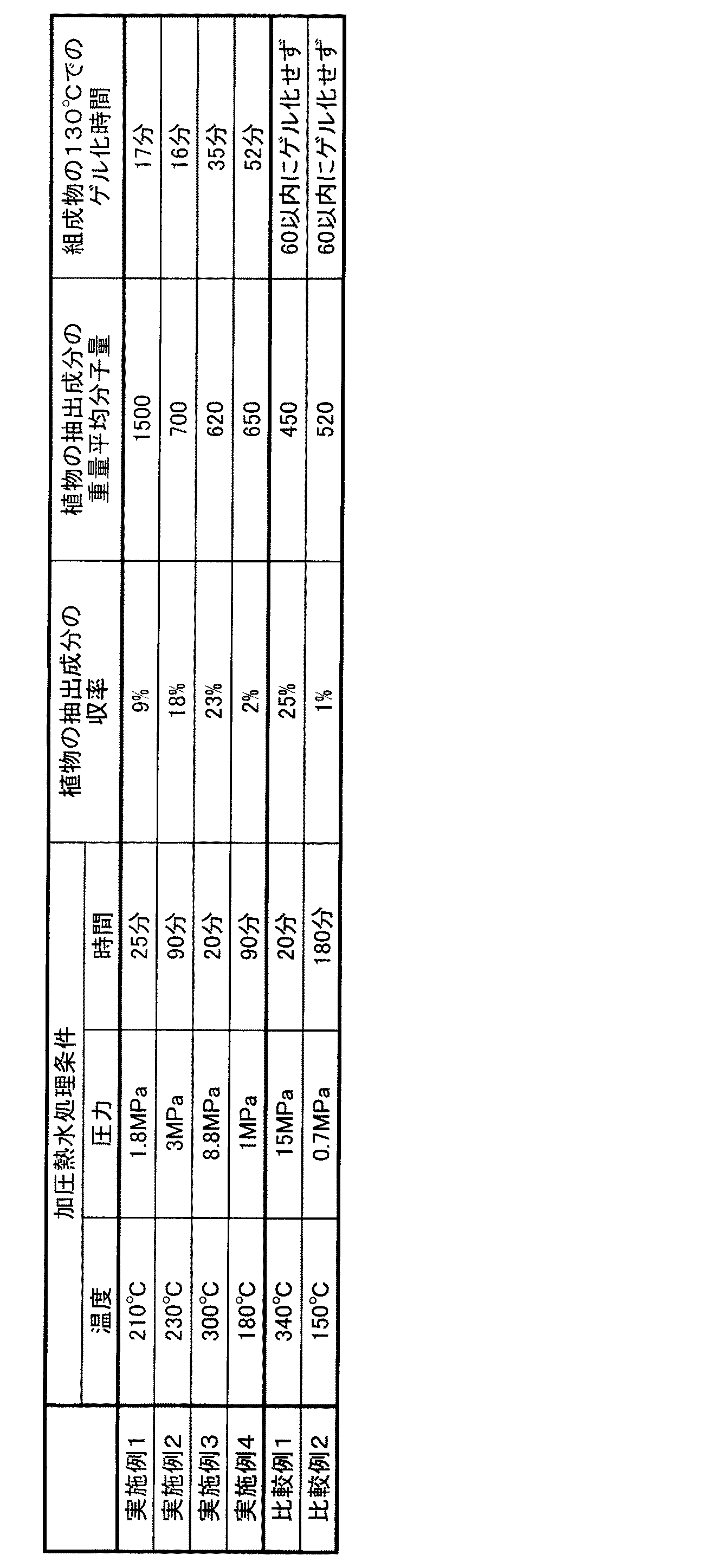
表1より、温度、圧力が特定条件の加圧熱水で処理し、重量平均分子量を500以上とした実施例1〜3の植物の抽出成分は、加熱により反応し短時間でゲル化した。さらに、植物の抽出成分の収率は概ね10%を超え、植物油脂のエポキシ化合物との反応性の高い植物の抽出成分を高い効率で抽出できた。このように、200〜320℃、1.6〜13MPaの加圧熱水で処理し、重量平均分子量500〜10000の抽出成分を得ることで、植物由来組成物のゲル化時間が大幅に短くなり、抽出成分の収率も大幅に向上する。 From Table 1, the extract components of the plants of Examples 1 to 3 treated with pressurized hot water under specific conditions of temperature and pressure and having a weight average molecular weight of 500 or more reacted by heating and gelled in a short time. Furthermore, the yield of the plant extract component generally exceeded 10%, and the plant extract component highly reactive with the epoxy compound of the vegetable oil and fat could be extracted with high efficiency. Thus, the gelation time of a plant-derived composition is significantly shortened by treating with 200-320 ° C. and 1.6-13 MPa pressurized hot water to obtain an extract component with a weight average molecular weight of 500-10000. In addition, the yield of extracted components is greatly improved.
180℃、1MPaの加圧熱水で処理し、重量平均分子量を500以上とした実施例4の植物の抽出成分は、加熱により反応しゲル化したが実施例1〜3に比べると大幅に時間を要した。これは、処理温度および処理圧力が低いため、適度に低分子化された複数の芳香族環を含むフェノール性化合物であって2つ以上の水酸基を有するものの割合が低くなり、植物油脂のエポキシ化合物との反応性の高いフェノール性化合物の割合が低くなったことによるものと考えられる。また、植物の抽出成分の収率は低く、抽出の効率は低かった。これは、処理温度および処理圧力が低いため、植物材料に含まれるリグニンやタンニン等の有機物の水への溶解性が低下し、さらに加水分解する能力が低下して、加圧熱水処理による低分子化が不十分であったことによるものと考えられる。 The extracted component of the plant of Example 4 treated with pressurized hot water at 180 ° C. and 1 MPa and having a weight average molecular weight of 500 or more reacted and gelled by heating, but significantly longer than in Examples 1-3. Cost. This is because the processing temperature and the processing pressure are low, the proportion of phenolic compounds containing a plurality of appropriately reduced aromatic rings having two or more hydroxyl groups is reduced, and the epoxy compound of vegetable oils and fats This is thought to be due to the fact that the proportion of phenolic compounds having a high reactivity with the lower the ratio. Moreover, the yield of the extract component of the plant was low and the extraction efficiency was low. This is because the treatment temperature and the treatment pressure are low, so that the solubility of organic substances such as lignin and tannin contained in plant materials in water is lowered, and further the ability to hydrolyze is lowered. This is probably due to insufficient molecularization.
340℃、15MPaの加圧熱水で処理し、重量平均分子量を500未満とした比較例1の植物の抽出成分は、植物油脂のエポキシ化合物と混合して加熱しても60分以内にゲル化しなかった。これは、植物材料に含まれるリグニンやタンニン等の有機物に対する加水分解作用が強過ぎて、過剰に低分子化され、抽出されたフェノール性化合物の植物油脂のエポキシ化合物との反応性が低下したことによるものと考えられる。 The plant extract component of Comparative Example 1 treated with pressurized hot water at 340 ° C. and 15 MPa and having a weight average molecular weight of less than 500 gels within 60 minutes even when mixed with a vegetable oil epoxy compound and heated. There wasn't. This is because the hydrolysis of organic substances such as lignin and tannin contained in plant materials is too strong, the molecular weight is excessively reduced, and the reactivity of the extracted phenolic compounds with the epoxy compounds of vegetable oils and fats is reduced. It is thought to be due to.
150℃、0.7MPaの加圧熱水で処理し、重量平均分子量を500以上とした比較例2の植物の抽出成分は、植物油脂のエポキシ化合物とを混合して加熱しても60分以内にゲル化しなかった。これは、処理温度および処理圧力が低いため、適度に低分子化された複数の芳香族環を含むフェノール性化合物であって2つ以上の水酸基を有するものの割合が極めて低くなり、植物油脂のエポキシ化合物との反応性の高いフェノール性化合物の割合が極めて低くなったことによるものと考えられる。また、植物の抽出成分の収率も極めて低く、抽出の効率は極めて低かった。これは、処理温度および処理圧力が低いため、植物材料に含まれるリグニンやタンニン等の有機物の水への溶解性が低下し、さらに加水分解する能力が低下して、加圧熱水処理による低分子化が不十分であったことによるものと考えられる。 The plant extract component of Comparative Example 2 treated with pressurized hot water at 150 ° C. and 0.7 MPa and having a weight average molecular weight of 500 or more is mixed with an epoxy compound of vegetable oil within 60 minutes. Did not gel. This is because the processing temperature and the processing pressure are low, the proportion of phenolic compounds containing a plurality of appropriately reduced aromatic rings and having two or more hydroxyl groups is extremely low, and the epoxy of vegetable oils and fats. This is thought to be due to the fact that the proportion of phenolic compounds having high reactivity with the compounds has become extremely low. Moreover, the yield of the extract component of a plant was also very low, and the extraction efficiency was very low. This is because the treatment temperature and the treatment pressure are low, so that the solubility of organic substances such as lignin and tannin contained in plant materials in water is lowered, and further the ability to hydrolyze is lowered. This is probably due to insufficient molecularization.
以上より、160〜400℃、0.8〜30MPaの加圧熱水で処理して重量平均分子量500〜10000の植物の抽出成分とすることで、植物油脂のエポキシ化合物との硬化物を得ることができるが、加圧熱水処理の条件または植物の抽出成分の重量平均分子量が当該範囲外であると、植物油脂のエポキシ化合物との硬化物の形成は極めて困難になる。 From the above, by treating with pressurized hot water at 160 to 400 ° C. and 0.8 to 30 MPa to obtain a plant extract component having a weight average molecular weight of 500 to 10,000, a cured product with an epoxy compound of vegetable oil is obtained. However, when the condition of the pressurized hot water treatment or the weight average molecular weight of the extracted component of the plant is out of the range, formation of a cured product of the vegetable oil with the epoxy compound becomes extremely difficult.
Claims (4)
Priority Applications (1)
| Application Number | Priority Date | Filing Date | Title |
|---|---|---|---|
| JP2008298782A JP2010121096A (en) | 2008-11-21 | 2008-11-21 | Vegetable originated composition and cured product of the same |
Applications Claiming Priority (1)
| Application Number | Priority Date | Filing Date | Title |
|---|---|---|---|
| JP2008298782A JP2010121096A (en) | 2008-11-21 | 2008-11-21 | Vegetable originated composition and cured product of the same |
Publications (1)
| Publication Number | Publication Date |
|---|---|
| JP2010121096A true JP2010121096A (en) | 2010-06-03 |
Family
ID=42322702
Family Applications (1)
| Application Number | Title | Priority Date | Filing Date |
|---|---|---|---|
| JP2008298782A Pending JP2010121096A (en) | 2008-11-21 | 2008-11-21 | Vegetable originated composition and cured product of the same |
Country Status (1)
| Country | Link |
|---|---|
| JP (1) | JP2010121096A (en) |
Cited By (2)
| Publication number | Priority date | Publication date | Assignee | Title |
|---|---|---|---|---|
| JP2010241855A (en) * | 2009-04-01 | 2010-10-28 | Hitachi Ltd | Epoxy resin composition |
| JP2014516090A (en) * | 2011-05-04 | 2014-07-07 | レンマティックス,インコーポレイテッド | Production of lignin from lignocellulosic biomass |
-
2008
- 2008-11-21 JP JP2008298782A patent/JP2010121096A/en active Pending
Cited By (2)
| Publication number | Priority date | Publication date | Assignee | Title |
|---|---|---|---|---|
| JP2010241855A (en) * | 2009-04-01 | 2010-10-28 | Hitachi Ltd | Epoxy resin composition |
| JP2014516090A (en) * | 2011-05-04 | 2014-07-07 | レンマティックス,インコーポレイテッド | Production of lignin from lignocellulosic biomass |
Similar Documents
| Publication | Publication Date | Title |
|---|---|---|
| JP5043575B2 (en) | Plant-derived composition and cured product thereof | |
| Quirino et al. | Thermosetting polymers from renewable sources | |
| Li et al. | A lignin-epoxy resin derived from biomass as an alternative to formaldehyde-based wood adhesives | |
| JP5720924B2 (en) | Wood-based decorative board | |
| JP6733546B2 (en) | Rubber composition and method for producing lignin derivative | |
| Jahanshaei et al. | Eco‐friendly tannin‐phenol formaldehyde resin for producing wood composites | |
| Ping et al. | Wood adhesives from agricultural by-products: Lignins and tannins for the elaboration of particleboards | |
| Pfister et al. | Green composites from a conjugated linseed oil-based resin and wheat straw | |
| D’souza et al. | Synthesis and characterization of bio-polyols through the oxypropylation of bark and alkaline extracts of bark | |
| Feng et al. | Effects of bark extraction before liquefaction and liquid oil fractionation after liquefaction on bark-based phenol formaldehyde resoles | |
| Esteves et al. | Cork liquefaction for polyurethane foam production | |
| JP6905942B2 (en) | Methods for increasing the reactivity of lignin, the resin composition containing the lignin, and the use of the resin composition. | |
| Thébault et al. | Naturally occurring phenolic sources for industrial applications | |
| Jeżo | Valorization of tree bark-derived suberin in applications for the bio-based composites industry–a recent review | |
| JP4457195B2 (en) | Method for producing cellulosic fiberboard | |
| Lei et al. | Recent Developments in Bioadhesives and Binders. | |
| JP2010121096A (en) | Vegetable originated composition and cured product of the same | |
| Suzuki et al. | Biological materials as precursors for the production of resins | |
| Liu et al. | Formaldehyde free tannin-based adhesive with epoxy as hardener for plywood | |
| JP5338793B2 (en) | Method for producing lignin derivative and method for producing lignin secondary derivative | |
| JP2010031092A (en) | Plant-derived resin molded article | |
| WO2016027537A1 (en) | Resin composition and molded object | |
| JP5275888B2 (en) | Plant-derived composition, method for producing the same, and molded product | |
| JP5271221B2 (en) | Plant-derived composition and cured product thereof | |
| Zhao et al. | Recent development in forest biomass derived phenol formaldehyde (PF) resol resin for wood adhesives application |