JP2009515005A - Method for producing magnesium hydroxide polymer hybrid particles - Google Patents
Method for producing magnesium hydroxide polymer hybrid particles Download PDFInfo
- Publication number
- JP2009515005A JP2009515005A JP2008538819A JP2008538819A JP2009515005A JP 2009515005 A JP2009515005 A JP 2009515005A JP 2008538819 A JP2008538819 A JP 2008538819A JP 2008538819 A JP2008538819 A JP 2008538819A JP 2009515005 A JP2009515005 A JP 2009515005A
- Authority
- JP
- Japan
- Prior art keywords
- mdh
- particles
- polymerization
- reaction
- magnesium hydroxide
- Prior art date
- Legal status (The legal status is an assumption and is not a legal conclusion. Google has not performed a legal analysis and makes no representation as to the accuracy of the status listed.)
- Pending
Links
Images


Classifications
-
- C—CHEMISTRY; METALLURGY
- C08—ORGANIC MACROMOLECULAR COMPOUNDS; THEIR PREPARATION OR CHEMICAL WORKING-UP; COMPOSITIONS BASED THEREON
- C08K—Use of inorganic or non-macromolecular organic substances as compounding ingredients
- C08K9/00—Use of pretreated ingredients
- C08K9/08—Ingredients agglomerated by treatment with a binding agent
-
- B—PERFORMING OPERATIONS; TRANSPORTING
- B82—NANOTECHNOLOGY
- B82Y—SPECIFIC USES OR APPLICATIONS OF NANOSTRUCTURES; MEASUREMENT OR ANALYSIS OF NANOSTRUCTURES; MANUFACTURE OR TREATMENT OF NANOSTRUCTURES
- B82Y30/00—Nanotechnology for materials or surface science, e.g. nanocomposites
-
- C—CHEMISTRY; METALLURGY
- C08—ORGANIC MACROMOLECULAR COMPOUNDS; THEIR PREPARATION OR CHEMICAL WORKING-UP; COMPOSITIONS BASED THEREON
- C08F—MACROMOLECULAR COMPOUNDS OBTAINED BY REACTIONS ONLY INVOLVING CARBON-TO-CARBON UNSATURATED BONDS
- C08F292/00—Macromolecular compounds obtained by polymerising monomers on to inorganic materials
-
- C—CHEMISTRY; METALLURGY
- C08—ORGANIC MACROMOLECULAR COMPOUNDS; THEIR PREPARATION OR CHEMICAL WORKING-UP; COMPOSITIONS BASED THEREON
- C08F—MACROMOLECULAR COMPOUNDS OBTAINED BY REACTIONS ONLY INVOLVING CARBON-TO-CARBON UNSATURATED BONDS
- C08F293/00—Macromolecular compounds obtained by polymerisation on to a macromolecule having groups capable of inducing the formation of new polymer chains bound exclusively at one or both ends of the starting macromolecule
- C08F293/005—Macromolecular compounds obtained by polymerisation on to a macromolecule having groups capable of inducing the formation of new polymer chains bound exclusively at one or both ends of the starting macromolecule using free radical "living" or "controlled" polymerisation, e.g. using a complexing agent
-
- C—CHEMISTRY; METALLURGY
- C08—ORGANIC MACROMOLECULAR COMPOUNDS; THEIR PREPARATION OR CHEMICAL WORKING-UP; COMPOSITIONS BASED THEREON
- C08K—Use of inorganic or non-macromolecular organic substances as compounding ingredients
- C08K3/00—Use of inorganic substances as compounding ingredients
- C08K3/18—Oxygen-containing compounds, e.g. metal carbonyls
- C08K3/20—Oxides; Hydroxides
-
- C—CHEMISTRY; METALLURGY
- C08—ORGANIC MACROMOLECULAR COMPOUNDS; THEIR PREPARATION OR CHEMICAL WORKING-UP; COMPOSITIONS BASED THEREON
- C08L—COMPOSITIONS OF MACROMOLECULAR COMPOUNDS
- C08L51/00—Compositions of graft polymers in which the grafted component is obtained by reactions only involving carbon-to-carbon unsaturated bonds; Compositions of derivatives of such polymers
- C08L51/10—Compositions of graft polymers in which the grafted component is obtained by reactions only involving carbon-to-carbon unsaturated bonds; Compositions of derivatives of such polymers grafted on to inorganic materials
-
- C—CHEMISTRY; METALLURGY
- C09—DYES; PAINTS; POLISHES; NATURAL RESINS; ADHESIVES; COMPOSITIONS NOT OTHERWISE PROVIDED FOR; APPLICATIONS OF MATERIALS NOT OTHERWISE PROVIDED FOR
- C09C—TREATMENT OF INORGANIC MATERIALS, OTHER THAN FIBROUS FILLERS, TO ENHANCE THEIR PIGMENTING OR FILLING PROPERTIES ; PREPARATION OF CARBON BLACK ; PREPARATION OF INORGANIC MATERIALS WHICH ARE NO SINGLE CHEMICAL COMPOUNDS AND WHICH ARE MAINLY USED AS PIGMENTS OR FILLERS
- C09C1/00—Treatment of specific inorganic materials other than fibrous fillers; Preparation of carbon black
- C09C1/02—Compounds of alkaline earth metals or magnesium
- C09C1/028—Compounds containing only magnesium as metal
-
- C—CHEMISTRY; METALLURGY
- C09—DYES; PAINTS; POLISHES; NATURAL RESINS; ADHESIVES; COMPOSITIONS NOT OTHERWISE PROVIDED FOR; APPLICATIONS OF MATERIALS NOT OTHERWISE PROVIDED FOR
- C09K—MATERIALS FOR MISCELLANEOUS APPLICATIONS, NOT PROVIDED FOR ELSEWHERE
- C09K21/00—Fireproofing materials
- C09K21/02—Inorganic materials
-
- C—CHEMISTRY; METALLURGY
- C01—INORGANIC CHEMISTRY
- C01P—INDEXING SCHEME RELATING TO STRUCTURAL AND PHYSICAL ASPECTS OF SOLID INORGANIC COMPOUNDS
- C01P2004/00—Particle morphology
- C01P2004/60—Particles characterised by their size
- C01P2004/62—Submicrometer sized, i.e. from 0.1-1 micrometer
-
- C—CHEMISTRY; METALLURGY
- C08—ORGANIC MACROMOLECULAR COMPOUNDS; THEIR PREPARATION OR CHEMICAL WORKING-UP; COMPOSITIONS BASED THEREON
- C08F—MACROMOLECULAR COMPOUNDS OBTAINED BY REACTIONS ONLY INVOLVING CARBON-TO-CARBON UNSATURATED BONDS
- C08F2438/00—Living radical polymerisation
- C08F2438/01—Atom Transfer Radical Polymerization [ATRP] or reverse ATRP
-
- C—CHEMISTRY; METALLURGY
- C08—ORGANIC MACROMOLECULAR COMPOUNDS; THEIR PREPARATION OR CHEMICAL WORKING-UP; COMPOSITIONS BASED THEREON
- C08F—MACROMOLECULAR COMPOUNDS OBTAINED BY REACTIONS ONLY INVOLVING CARBON-TO-CARBON UNSATURATED BONDS
- C08F2438/00—Living radical polymerisation
- C08F2438/02—Stable Free Radical Polymerisation [SFRP]; Nitroxide Mediated Polymerisation [NMP] for, e.g. using 2,2,6,6-tetramethylpiperidine-1-oxyl [TEMPO]
-
- C—CHEMISTRY; METALLURGY
- C08—ORGANIC MACROMOLECULAR COMPOUNDS; THEIR PREPARATION OR CHEMICAL WORKING-UP; COMPOSITIONS BASED THEREON
- C08K—Use of inorganic or non-macromolecular organic substances as compounding ingredients
- C08K3/00—Use of inorganic substances as compounding ingredients
- C08K3/18—Oxygen-containing compounds, e.g. metal carbonyls
- C08K3/20—Oxides; Hydroxides
- C08K3/22—Oxides; Hydroxides of metals
-
- C—CHEMISTRY; METALLURGY
- C08—ORGANIC MACROMOLECULAR COMPOUNDS; THEIR PREPARATION OR CHEMICAL WORKING-UP; COMPOSITIONS BASED THEREON
- C08K—Use of inorganic or non-macromolecular organic substances as compounding ingredients
- C08K7/00—Use of ingredients characterised by shape
- C08K7/16—Solid spheres
-
- C—CHEMISTRY; METALLURGY
- C08—ORGANIC MACROMOLECULAR COMPOUNDS; THEIR PREPARATION OR CHEMICAL WORKING-UP; COMPOSITIONS BASED THEREON
- C08L—COMPOSITIONS OF MACROMOLECULAR COMPOUNDS
- C08L2666/00—Composition of polymers characterized by a further compound in the blend, being organic macromolecular compounds, natural resins, waxes or and bituminous materials, non-macromolecular organic substances, inorganic substances or characterized by their function in the composition
- C08L2666/02—Organic macromolecular compounds, natural resins, waxes or and bituminous materials
Landscapes
- Chemical & Material Sciences (AREA)
- Organic Chemistry (AREA)
- Health & Medical Sciences (AREA)
- Chemical Kinetics & Catalysis (AREA)
- Medicinal Chemistry (AREA)
- Polymers & Plastics (AREA)
- Inorganic Chemistry (AREA)
- Engineering & Computer Science (AREA)
- Materials Engineering (AREA)
- Nanotechnology (AREA)
- Physics & Mathematics (AREA)
- Composite Materials (AREA)
- Condensed Matter Physics & Semiconductors (AREA)
- General Physics & Mathematics (AREA)
- Crystallography & Structural Chemistry (AREA)
- Graft Or Block Polymers (AREA)
- Polymerisation Methods In General (AREA)
- Compositions Of Macromolecular Compounds (AREA)
Abstract
本発明は、水酸化マグネシウムからなるコア及び連結された共重合体鎖を含む有機/無機ハイブリッド粒子の製造方法に関する。本発明による水酸化マグネシウム(MDH)粒子は、付着された鎖のMn/Mwが2.0未満である連結された(共)重合体鎖を含む。MDH組成物を用意するために、付着された開始剤の官能性によって制御ラジカル(共)重合法が行われる。前記制御ラジカル(共)重合法は、NMP、RAFT/MADIX、及びATRPのうち選択された1つの方法である。前記ATRPにおいて、溶媒/反応物内または添加された溶媒に溶解されることで、反応が完了した後、前記MDH組成物から触媒複合体を分離させることができるリガンドが選択される。ポリマー混合物のために、MDH組成物が、添加されたプラスチック物質内に分散される。MDH粒子を用意するために、スラリーまたは分散液内で重合が誘導される。最初のMDH粒子は、重合反応を開始させる官能基をさらに含む分子とのエステル化反応が行われることで官能化される。
【選択図】図1The present invention relates to a method for producing organic / inorganic hybrid particles comprising a core made of magnesium hydroxide and linked copolymer chains. Magnesium hydroxide (MDH) particles according to the present invention comprise linked (co) polymer chains with an attached chain Mn / Mw of less than 2.0. To prepare the MDH composition, a controlled radical (co) polymerization process is performed depending on the functionality of the attached initiator. The controlled radical (co) polymerization method is one selected from NMP, RAFT / MADIX, and ATRP. In the ATRP, a ligand is selected that can be dissolved in the solvent / reactant or in the added solvent to separate the catalyst complex from the MDH composition after the reaction is complete. For the polymer mixture, the MDH composition is dispersed within the added plastic material. To prepare the MDH particles, polymerization is induced in the slurry or dispersion. The initial MDH particles are functionalized by an esterification reaction with a molecule further containing a functional group that initiates the polymerization reaction.
[Selection] Figure 1
Description
本発明は、水酸化マグネシウムからなるコア及び連結された共重合体鎖を含む有機/無機ハイブリッド粒子の製造方法に関する。前記共重合体鎖は、標的とされたプラスチック物質中に分散して機械的物性、電気的物性、及び難燃性を改善させるための目的で選択され得る組成成分からなる。 The present invention relates to a method for producing organic / inorganic hybrid particles comprising a core made of magnesium hydroxide and linked copolymer chains. The copolymer chain is composed of compositional components that can be selected for the purpose of being dispersed in a targeted plastic material to improve mechanical, electrical, and flame retardancy.
フリーラジカル重合法(Free radical polymerization、以下、「RP」と略する)は、商業的に実施可能な多様なプロセスを用いて、多様な種類のモノマーから、所定の分子量(MW)、低い重合分散度(PDI)、組成成分の調整、部位特異的な作用、選択的鎖トポロジー(chain topology)などを有する重合物質を重合し、かつバイオまたは無機種を最終産物に融合することができる重合方法である。制御ラジカル重合方法(Controlled radical polymerization、以下、「CRP」と略する)は、従来のRP法の有する全ての長所を合わせもつため、この技術が知られて以来、注目が高まりつつある。 Free radical polymerization (hereinafter abbreviated as “RP”) uses a variety of commercially feasible processes from various types of monomers to a predetermined molecular weight (MW), low polymerization dispersion. A polymerization method that can polymerize polymeric materials having degree (PDI), compositional adjustment, site-specific action, selective chain topology, etc., and fuse bio or inorganic species into the final product is there. The controlled radical polymerization method (hereinafter abbreviated as “CRP”) has all the advantages of the conventional RP method, and thus has attracted attention since the technology was known.
最も多く研究されて実用性のあるCRP方法には、ニトロキシド媒介重合法(nitroxide mediated polymerization、以下、「NMP」と略する)、原子移動ラジカル重合法(atom transfer radical polymerization、以下、「ATRP」と略する)、及び可逆的付加−開裂移動反応によってジチオエステルに変質遷移される連鎖移動重合法(reversible addition−fragmentation chain transfer polymerization、以下、「RAFT」と略する)の3種の方法がある。これら3種の方法それぞれは、低濃度の活性成長鎖(propagating chain)と高濃度の休止鎖(dormant chain)との間の動的平衡状態の形成に依存している。前記休止鎖は、これ以上伝播することができないか、または、終止されたものであり、前記成長鎖の寿命が終わったことを意味する。活性種の低い濃度は2分子間の終結反応の可能性を減少させ、リビング(living)システムとして行動するラジカル重合過程を誘導する。 The most studied and practical CRP methods include nitroxide mediated polymerization (hereinafter abbreviated as “NMP”), atom transfer radical polymerization (hereinafter referred to as “ATRP”). There are three types of methods: a reversible addition-fragmentation chain transfer polymerization (hereinafter abbreviated as “RAFT”), which is transformed to a dithioester by a reversible addition-cleavage transfer reaction. Each of these three methods relies on the formation of a dynamic equilibrium between a low concentration of active growing chain and a high concentration of dormant chain. The resting chain cannot propagate any more or has been terminated, meaning that the life of the growing chain has ended. A low concentration of active species reduces the possibility of a termination reaction between two molecules and induces a radical polymerization process that acts as a living system.
分子量及び分子量の分布を調節するため、定量的に速い開始速度(Ri)は少なくとも伝播速度(Rp)と同程度に速くなければならない(DPn ([M]/[I]0)を調節することでRi<<RpからRi〜Rp)。ここで、[M]は重合されたモノマーのモル数を示し、[I]0は添加された開始剤の初期濃度を示す。一方、CRPプロセスはラジカルに基づいた重合過程であるため、ある程度の終結反応は避けられない。全てのラジカル重合法において、ラジカルの濃度([P*])の二乗に依存する反応速度(Rt=kt[P*]2)から二価ラジカル終結定数(kt)が現われる。したがって、適用されたシステムが従来のRPシステムであるかまたはCRPシステムであるかを問わず、同一の重合速度(ラジカル濃度が同一)では必ず同一の鎖数で終結される。RPシステムにおいて、大部分の鎖は小さいラジカルと成長ポリマーラジカルの反応によって終結されるため、ある程度のマクロ−ラジカルの拡散効果は無視される。SFRPまたはATRPシステムの場合には、このような初期終結反応は、持続的なラジカル効果から過量の休止種を形成し、その結果、前述した平衡を左に導く(kdeactが増加する)(非特許文献1)。従来のプロセス内では全ての鎖が終結される実質的な結果が発生するが、これとは違って、CRPでは終結された鎖は単に全ての鎖の一部のみ(1ないし10%)で存在し、多数の成長鎖が存在する。残存する種は、ブロック共重合体などを形成するための再活性、官能性、鎖拡張性などの能力を有する休止種である。よって、CRPはリビング(living)システムとして挙動する(非特許文献2)。さらに、少なくとも伝播速度と同程度の、相対的に速い開始速度は、分子量制御(DPn=Δ[M]/[I]0;すなわち、重合度は添加された開始剤の濃度に対して消費されたモノマーの濃度比として定義される)及び狭い分子量分布を提供する。 In order to regulate the molecular weight and molecular weight distribution, the quantitatively fast onset rate (R i ) must be at least as fast as the propagation rate (R p ) (DP n ([M] / [I] 0) Ri << Rp to Ri ~ Rp) by adjusting. Here, [M] indicates the number of moles of polymerized monomer, and [I] 0 indicates the initial concentration of the added initiator. On the other hand, since the CRP process is a radical-based polymerization process, a certain degree of termination reaction is inevitable. In all radical polymerization methods, the divalent radical termination constant (k t ) appears from the reaction rate (R t = k t [P * ] 2 ) depending on the square of the radical concentration ([P * ]). Therefore, regardless of whether the applied system is a conventional RP system or a CRP system, it is always terminated with the same number of chains at the same polymerization rate (the same radical concentration). In the RP system, some chain-radical diffusion effects are ignored because most chains are terminated by the reaction of small radicals with growing polymer radicals. In the case of the SFRP or ATRP system, such an initial termination reaction forms an excessive amount of dormant species due to persistent radical effects, which leads to the aforementioned equilibrium to the left (k deact increases) (non-deactivate) Patent Document 1). Unlike conventional processes, where all strands are terminated, a substantial result occurs, whereas in CRP, the terminated strands are only part of all strands (1-10%). However, there are many growing chains. The remaining species are dormant species that have the ability to reactivate, functionality, chain extendability, etc. to form block copolymers and the like. Therefore, CRP behaves as a living system (Non-Patent Document 2). Furthermore, a relatively fast initiation rate, at least as high as the propagation rate, is a molecular weight control (DP n = Δ [M] / [I] 0 ; ie, the degree of polymerization is consumed relative to the concentration of added initiator Defined monomer concentration ratio) and a narrow molecular weight distribution.
本明細書において、ポリマー(polymer)とは一般に5またはそれ以上のモノマーが化学的に結合されたマクロ分子である。前記ポリマーは、ランダム共重合体、統計的(statistical)共重合体、交互(alternating)共重合体、傾斜(gradient)共重合体、周期(periodic)共重合体、テレケリック(telechelic)ポリマー、及びブロック共重合体、グラフト(graft)ポリマー、スター(star)ポリマー、ボトルブラシ(bottle−brush)共重合体、櫛型(comb)ポリマー、分岐(branched)または多分岐(hyperbranched)ポリマーを含む任意のトポロジーを有するポリマー、その他のポリマー構造はもちろん粒子表面や偏平な表面に付着されたポリマーなどを含む単独重合体及び共重合体を含む。 As used herein, a polymer is generally a macromolecule in which 5 or more monomers are chemically bonded. The polymer may be a random copolymer, a statistical copolymer, an alternating copolymer, a gradient copolymer, a periodic copolymer, a telechelic polymer, and a block. Any topology including copolymer, graft polymer, star polymer, bottle-brush copolymer, comb polymer, branched or hyperbranched polymer As well as other polymer structures, homopolymers and copolymers including particles attached to a particle surface or a flat surface are included.
ATRPプロセスは、最も頻繁に使われるCRP技術であり、コーティング剤、シール剤、接着剤、分散剤はもちろん健康及び美容製品、電子的応用、並びに生物医学応用品などのような多様な特性を有する材料に対して、商業的利用可能性を提供することができる技術である。最も頻繁に使われるATRPプロセスは、最も代表的な物質である銅のような酸化還元活性のある遷移金属化合物が触媒として用いられた簡単かつ可逆性のハロゲン原子の伝達に基づく。 The ATRP process is the most frequently used CRP technology and has various characteristics such as coatings, sealants, adhesives, dispersants as well as health and beauty products, electronic applications, and biomedical applications. A technology that can provide commercial availability to a material. The most frequently used ATRP process is based on the simple and reversible transfer of halogen atoms in which a redox active transition metal compound such as copper, the most representative material, is used as a catalyst.
ATRPプロセスは制御/「リビング」ラジカル重合(CRP)の最も効果的な方法の1つであり、共同譲受人として出願した一連の特許文献1〜24などの米国特許及び米国特許出願などに具体的に開示されている。また、ATRPは共同著者であるマティジャスゼウスキーの名義で刊行された多数の刊行物に開示されており、いくつかの文献で検討された(非特許文献3〜6参照)。このような刊行物には、類似の重合過程が遷移金属触媒重合(transition metal mediated polymerization)または原子移動重合(atom transfer polymerization)などのように他の名称で言及されているが、これらの過程は相互類似であり、本明細書ではこれを「ATRP」と表現している。 The ATRP process is one of the most effective methods of controlled / "living" radical polymerization (CRP), and is specific to US patents and applications such as a series of patent documents 1-24 filed as joint assignees. Is disclosed. In addition, ATRP is disclosed in a number of publications published in the name of co-author, Mattilla Szewsky, and has been examined in several documents (see Non-Patent Documents 3 to 6). Such publications refer to similar polymerization processes under other names such as transition metal catalyzed polymerization or atom transfer polymerization, but these processes are These are similar to each other and are expressed as “ATRP” in this specification.
ATRPプロセスは、以下に示すように、商業的に利用可能な多数の開始剤が使用でき、ウェハー、無機コロイド、ガラス、ペーパー、及びタンパク質、DNA、炭水化物を含む生物活性分子と、多くの商業的ポリマーとを含む多様なマクロ開始剤(macroinitiator)が容易に合成でき;ATRPによって生成された多数のポリマーは親核置換、ラジカル添加、または他のラジカル結合反応を通じてアジド、アミン、ホスフィン及び他の官能基が末端のハロゲンを代替することで末端基の容易な官能性付与または変形が可能になり;多様な(共)重合可能なモノマーが利用可能であるなどの特定の利点がある。ARTPプロセスはブロック共重合体、傾斜共重合体、周期共重合体などに存在する官能基及び組成物の成分を調節する能力と結合してスター、櫛型、及びデンドリマーのような複合体トポロジーを有する巨大分子の生産を可能にして、ポリマーの立体規則性(tacticity)までも調節可能にする。ATRPプロセスは、バルク内、有機溶媒内、同質または異質状態下の水内、またはイオン性液体内、超臨界CO2内で行える簡単な過程である。 The ATRP process can use a number of commercially available initiators, as shown below, including wafers, inorganic colloids, glass, paper, bioactive molecules including proteins, DNA, carbohydrates, and many commercial A variety of macroinitiators, including polymers, can be readily synthesized; many polymers produced by ATRP can undergo azide, amine, phosphine and other functionalities through nucleophilic substitution, radical addition, or other radical coupling reactions. Substituting a terminal halogen for the group allows for easy functionalization or modification of the terminal group; there are certain advantages such as the availability of a variety of (co) polymerizable monomers. The ARTP process combines complex topologies such as stars, combs, and dendrimers in combination with the ability to modulate the functional groups and compositional components present in block copolymers, graded copolymers, periodic copolymers, etc. Allowing the production of macromolecules with control over the tacticity of the polymer. ATRP process, the bulk, in an organic solvent, in water under homogeneous or heterogeneous conditions or ionic within the liquid, is a simple process that allows in the supercritical CO 2.
多くの商業的なプラスチック材料は、有機ハロゲンタイプの難燃剤を用いることで火に燃えない不燃性を有するように製造される。しかし、このような方法は難燃剤の毒性、溶融進行中の装備の腐食、及び進行中やその後の火災で煙と有毒性フューム(fume)が放出されるなどの問題を引き起す。よって、従来の難燃剤を、無毒性であって前述したような難題を避け得る水酸化アルミニウム(ATH)及び水酸化マグネシウム(MDH)のような無機物質として代替するため、多くの努力がなされている。このような類型の難燃剤は、ATH及びMDH両方とも火災中に水蒸気を放出するため、最も環境にやさしい物質であると予想される。放出された水は火炎を遮断し、空気と接触したときに可燃性のガスを希釈させることで酸素を遮断する。また、ポリマー製品の表面に形成されたチャー(char)は、可燃性分解生成物の流れを遮ることで熱の絶縁膜として作用する。添加剤は単独または他の膨張性添加剤の存在下で作用する。しかし、ATHは約180℃で脱水が始まるため、加工温度が200℃以上であるポリエステルのような熱可塑性樹脂では使うことができない。一方、MDHは相対的に高い温度である300ないし320℃でMgOとH2Oとに分解し始めるため、ATHが熱的に安定的でないプラスチック内に溶融されて混合可能であるという長所がある。 Many commercial plastic materials are manufactured to be non-flammable by the use of organic halogen type flame retardants. However, such methods cause problems such as flame retardant toxicity, corrosion of equipment during melting, and the release of smoke and toxic fumes during and after fire. Thus, much effort has been made to replace conventional flame retardants with inorganic materials such as aluminum hydroxide (ATH) and magnesium hydroxide (MDH) that are non-toxic and avoid the above-mentioned challenges. Yes. This type of flame retardant is expected to be the most environmentally friendly material because both ATH and MDH release water vapor during a fire. The released water blocks the flame and blocks oxygen by diluting flammable gases when in contact with air. The char formed on the surface of the polymer product acts as a heat insulating film by blocking the flow of combustible decomposition products. The additive acts alone or in the presence of other swellable additives. However, since dehydration begins at about 180 ° C., ATH cannot be used with thermoplastic resins such as polyester whose processing temperature is 200 ° C. or higher. On the other hand, since MDH starts to decompose into MgO and H 2 O at a relatively high temperature of 300 to 320 ° C., there is an advantage that ATH can be melted and mixed in a plastic that is not thermally stable. .
ATH及びMDHは両方とも若干の欠点がある。有効な難燃剤として作用するためには高充填荷重(60重量%)が必要であり、機械的特性において深刻な損失がもたらされる恐れがあり、特に伸張破壊及び曲げ変形で応力白化現象などが発生することがある。近年、電線産業において、電線の絶縁材料として熱可塑性物質ベースの樹脂の開発が強く求められている。特に最近は、主なポリマーとして使われるPVC及びPE/EVAに可塑性を与えて自動車用の絶縁電線に適用している。PVCはポリオレフィンより難燃性に優れるが、塩素を含む化学物質を放出する恐れがあるため、健康及び環境問題の原因になる。 Both ATH and MDH have some drawbacks. In order to act as an effective flame retardant, a high filling load (60% by weight) is required, which may cause a serious loss in mechanical properties, especially stress whitening due to elongation failure and bending deformation. There are things to do. In recent years, there has been a strong demand in the electric wire industry for the development of thermoplastic-based resins as electric wire insulation materials. Particularly recently, PVC and PE / EVA used as main polymers have been plasticized and applied to insulated wires for automobiles. PVC is more flame retardant than polyolefins, but may cause health and environmental problems because it may release chemicals including chlorine.
MDH粒子で充填されたポリプロピレン組成物に関する近年の技術はHong等によって開示されている(非特許文献7)。該文献の従来技術に対する要約で、粒子の形態、大きさ、分散度、粒子に適用された表面コーティングがMDHが充填されたPP組成物の機械的特性に対して影響を与えると開示している。フィラーとポリマーマトリクスとの間に凝着がないため、MDHの混合量の増加に比例して引張降伏強度(tensile yield strength)が減少することが知られている。しかし、ステアリン酸ナトリウムを用いた表面コーティングは樹脂との親和性を向上させるが、充填剤とマトリクスとの間に化学的結合は提供しない。また、ステアリン酸を用いた表面コーティングは、凝着の発熱作用が低いために、純粋なMDHを含む組成物に比べて組成物の引張降伏強度が減少する。PPgMA分子はPPgMAにグラフトされたカルボキシル基とフィラー表面の水酸基との間の酸−塩基作用に起因して充填剤の表面で化学的に結合されるという報告がある。表面作用が偶然に起きることで、PPgMA/MDH混成が改善されているにもかかわらず、それぞれのマトリクス物質のために互いに異なるグラフトポリマーが用意されなければならない。共重合体に偶然にグラフトされるため、分子量を調節することができず、最終組成物構造の形態も、MDH粒子に付着した物質の量も調節することができなくなる。 Recent technology relating to polypropylene compositions filled with MDH particles has been disclosed by Hong et al. The prior art summary of the document discloses that particle morphology, size, dispersity, and surface coating applied to the particles affect the mechanical properties of PP compositions filled with MDH. . Since there is no adhesion between the filler and the polymer matrix, it is known that the tensile yield strength decreases in proportion to the increase in the amount of MDH mixed. However, surface coating with sodium stearate improves the affinity with the resin but does not provide a chemical bond between the filler and the matrix. Also, a surface coating using stearic acid has a lower exothermic effect of adhesion, which reduces the tensile yield strength of the composition compared to a composition containing pure MDH. There is a report that PPgMA molecules are chemically bonded on the surface of the filler due to the acid-base action between the carboxyl group grafted on PPgMA and the hydroxyl group on the filler surface. Despite the fact that the surface action occurs by chance and the PPgMA / MDH hybrid is improved, different graft polymers must be provided for each matrix material. Since it is accidentally grafted to the copolymer, the molecular weight cannot be adjusted, and the morphology of the final composition structure and the amount of material attached to the MDH particles cannot be adjusted.
したがって、難燃性を提供し、特性を改善するため、ポリオレフィン、熱可塑性及び熱硬化性プラスチック内に効果的に分散可能である環境的に柔軟な難燃剤が求められている。開示された物質はマトリクスポリマーで混和可能なポリマー鎖が付着された粒子であり、これら粒子は本質的にナノ組成物粒子であって、ここに付着されたポリマー鎖はマトリクス全体に亘って粒子が均一に分散するように作用し、その結果物である混合物(alloy)では応力挙動のようなバルクの物理的特性が改善される。 Accordingly, there is a need for environmentally flexible flame retardants that can be effectively dispersed in polyolefins, thermoplastics and thermoset plastics to provide flame retardancy and improve properties. The disclosed materials are particles with attached polymer chains that are miscible with the matrix polymer, and these particles are essentially nanocomposite particles, where the attached polymer chains are particles throughout the matrix. It acts to disperse uniformly and the resulting alloy improves bulk physical properties such as stress behavior.
本明細書で引用された参考文献に含まれている定義は本願に適用されるが、本発明を詳細に説明する前に、本発明は特定組成物、成分または工程段階に限らずさまざまに応用される可能性があると理解されなければならない。また、本願で使われた技術用語は単に特定実施例を説明するためのものであって、これらを限定するためのものではないことを理解しなければならない。 Although the definitions contained in the references cited herein apply to this application, before the present invention is described in detail, the present invention is not limited to specific compositions, components, or process steps, but has various applications. Must be understood as possible. It should also be understood that the terminology used herein is for the purpose of describing particular embodiments only and is not intended to be limiting.
本明細書及び添付された特許請求の範囲で使われたように、文章にて明らかに示さない限り、単数表記は複数を含むことを理解しなければならない。例えば、「ポリマー」は1つ以上のポリマーを含み、「置換基」は1つ以上の置換基を含み、「層」は1つ以上の層を含む。 As used in this specification and the appended claims, it should be understood that the singular forms include the plural unless the text clearly indicates otherwise. For example, “polymer” includes one or more polymers, “substituent” includes one or more substituents, and “layer” includes one or more layers.
置換基または化合物を指称するために使われる「不活性」とは、(1)前記置換基または化合物と接触する可能性がある試薬の存在下で、または(2)前記置換基または化合物が置かれる条件下(例えば、不活性残基が基材表面に付着した後に起きる化学工程)で、前記置換基または化合物が変形されないことを意味する。 “Inert” used to refer to a substituent or compound refers to (1) in the presence of a reagent that may come into contact with the substituent or compound, or (2) where the substituent or compound is placed. It means that the substituent or compound is not deformed under such conditions (for example, a chemical process that occurs after the inert residue is attached to the substrate surface).
選択的に置き換えられた炭素原子を指すために使われる「利用可能な」とは、1つ以上の水素原子と共有結合された炭素原子を指し、ここで水素原子は前記分子の残り構造を破壊するか又は不安定化させない限り、指定された置換基によって置き換えられ得る。 “Available”, used to refer to a selectively replaced carbon atom, refers to a carbon atom covalently bonded to one or more hydrogen atoms, where the hydrogen atom destroys the remaining structure of the molecule. As long as it is not destabilized or destabilized.
「選択的」または「選択的に」とは、その後に説明する状況が生じることも生じないこともあり得るという意味であり、したがって説明には前記状況が生じた例と生じなかった例を含む。例えば、「選択的に置き換えられた」という用語は、非水素置換基が存在するか又は存在しないことを意味し、したがって説明には非水素置換基が存在する構造、及び非水素置換基が存在しない構造を含む。
本発明は、前述したような従来技術の問題点を解決するために、水酸化マグネシウムからなるコア及び連結された共重合体鎖を含む有機/無機ハイブリッド粒子の製造方法を提供することを目的とする。前記共重合体鎖は、標的とされたプラスチック物質に分散して機械的物性、電気的物性、及び難燃性を改善させるための目的で選択され得る組成成分からなる。 In order to solve the problems of the prior art as described above, an object of the present invention is to provide a method of producing organic / inorganic hybrid particles including a magnesium hydroxide core and a linked copolymer chain. To do. The copolymer chain is composed of compositional components that can be selected for the purpose of improving mechanical properties, electrical properties, and flame retardancy by dispersing in a targeted plastic material.
上記の目的を達成するため、本発明は連結された鎖のMn/Mwが2.0未満である(共)重合体鎖が付着された水酸化マグネシウム(MDH)粒子を提供する。 In order to achieve the above object, the present invention provides magnesium hydroxide (MDH) particles to which (co) polymer chains having a linked chain Mn / Mw of less than 2.0 are attached.
また、本発明は、付着された開始剤の官能性によって行われる制御ラジカル(共)重合法である水酸化マグネシウム(MDH)組成物の製造方法を提供する。 The present invention also provides a method for producing a magnesium hydroxide (MDH) composition that is a controlled radical (co) polymerization process performed by the functionality of the attached initiator.
望ましくは、前記制御ラジカル(共)重合法は、NMP、RAFT/MADIX、及びATRPのうち選択された1つの方法である。 Preferably, the controlled radical (co) polymerization method is one selected from NMP, RAFT / MADIX, and ATRP.
望ましくは、前記制御ラジカル(共)重合法は、ATRPである。 Preferably, the controlled radical (co) polymerization method is ATRP.
望ましくは、前記ATRPにおいて、反応が完了した後、溶媒/反応物内または添加された溶媒に溶解されることで前記MDH組成物から触媒複合体を分離することができるリガンドが選択される。 Desirably, in the ATRP, after the reaction is completed, a ligand is selected that can be separated in the solvent / reactant or added solvent to separate the catalyst complex from the MDH composition.
望ましくは、添加されたプラスチック物質内にMDH組成物が分散されてなるポリマー混合物が提供される。 Desirably, a polymer mixture is provided in which the MDH composition is dispersed within the added plastic material.
望ましくは、スラリーまたは分散液内で重合が行われるMDH組成物の製造方法が提供される。 Desirably, a method for producing an MDH composition in which polymerization is performed in a slurry or dispersion is provided.
望ましくは、最初のMDH粒子は、重合反応を開始させる官能基をさらに含む分子とのエステル化反応を行うことで官能化される。 Desirably, the initial MDH particles are functionalized by performing an esterification reaction with a molecule further containing a functional group that initiates the polymerization reaction.
市販中の水酸化マグネシウム(Mg(OH)2またはMDH)の種類は多様である。プラスチックとMDHとの親和性を強化させるために、近年の粒子は沈澱過程を用いてシラン(Toshimitsu、J.,Suzuki、J.,Suzuki、J.:Eur.Pat.Appl.:1422262、2004)、アミンまたは重合による物質でコーティングされて、ポリマー内に(変性MDH粒子を)分散している。しかし、このような例で使われたMDHはその非特異的官能性により、明確に限定された組成成分の構造を提示することができない。 There are various types of magnesium hydroxide (Mg (OH) 2 or MDH) on the market. In order to enhance the affinity between plastic and MDH, recent particles have used silane (Toshimitsu, J., Suzuki, J., Suzuki, J .: Eur. Pat. Appl .: 142222, 2004) using a precipitation process. , Coated with an amine or polymerized material and dispersed (modified MDH particles) within the polymer. However, the MDH used in these examples cannot present a clearly defined compositional component structure due to its non-specific functionality.
組成成分の構造に対する1つのアプローチが、特開2005−179576号に開示されており、ここで調節されていないグラフト反応について記載している。前記組成成分は、3−メタアクリルオキシプロピルトリメトキシシラン(不飽和C−Cダブルボンドを含むカップリング剤)で水酸化マグネシウムを処理し、フリーラジカル開始剤としてのAIBNの存在下で、スチレンがグラフトされてシラン処理されたMg(OH)2から付着されたポリマー層を有するMg(OH)2粒子を作り出すことで用意されている。前記ポリマー層の厚さは6.0nmであり、前記ポリマーの数平均分子量(Mn)は20、000であり、重量平均分子量(Mw)は95、000である。MWD(分子量分布)は4.0以上であり、任意的に付着されたポリスチレン鎖の厚さや前記粒子に付着された鎖の数を調節する方法はない。 One approach to the structure of the composition component is disclosed in JP 2005-179576, which describes an unregulated grafting reaction. The composition component is obtained by treating magnesium hydroxide with 3-methacryloxypropyltrimethoxysilane (a coupling agent containing an unsaturated C—C double bond), and in the presence of AIBN as a free radical initiator, are prepared by producing a Mg (OH) 2 particles having a grafted silane treated Mg (OH) polymer layer deposited from 2. The polymer layer has a thickness of 6.0 nm, the number average molecular weight (Mn) of the polymer is 20,000, and the weight average molecular weight (Mw) is 95,000. The MWD (molecular weight distribution) is 4.0 or more, and there is no method of adjusting the thickness of the arbitrarily attached polystyrene chains or the number of chains attached to the particles.
したがって、通常のプラスチックで組成成分構造の分散性を改善するために、MDH粒子にラジカル共重合可能な鎖を制御可能にグラフトする過程が必要である。「調節可能に重合される」の定義は引用された文献の記載と同様である。 Therefore, in order to improve the dispersibility of the composition component structure in ordinary plastics, a process of controllably grafting radically copolymerizable chains onto MDH particles is required. The definition of “controllably polymerized” is the same as in the cited literature.
Mg(OH)2粒子はその表面に水酸基を含み、これらはATRP開始剤を提供するために官能化され得る。具体的に、官能化反応の一実施例はエステル化反応であり、下記化学式1に表しているMDH開始剤合成過程のように、ブロモプロピオニルブロミドで反応を誘導することができる。
Mg (OH) 2 particles contain hydroxyl groups on their surface, which can be functionalized to provide an ATRP initiator. Specifically, one example of a functionalization reaction is an esterification reaction, which can be induced with bromopropionyl bromide, as in the MDH initiator synthesis process shown in
付着された鎖の一部だけがここに接触するマトリクス内の1つの粒子の分散を助けるため、粒子表面の全ての水酸基が最終物質で粒子の分散性を改善するために官能化される必要はない。しかし、MDH粒子と反応する最初の機能剤の量を調節することで目的に応じて結合された鎖数を調節することができる。ATRP開始剤の前駆体との反応によって機能するMDH粒子に存在する−OH基の割合は、粒子の大きさ及び官能化反応に使われる粒子に対する酸ハロゲン化物の比率によって0.01%ないし5%範囲で変化することができる。 Since only a part of the attached chain helps to disperse one particle in the matrix in contact with it, all the hydroxyl groups on the particle surface need to be functionalized to improve the dispersibility of the particles in the final material. Absent. However, by adjusting the amount of the first functional agent that reacts with the MDH particles, the number of bound chains can be adjusted according to the purpose. The proportion of —OH groups present in MDH particles that function by reaction with the ATRP initiator precursor is 0.01% to 5%, depending on the size of the particles and the ratio of acid halide to particles used in the functionalization reaction. Can vary in range.
下記実施例では、開始種が0.1ないし1.0%範囲で連結された粒子が使われた。 In the examples below, particles were used in which the starting species were linked in the range of 0.1 to 1.0%.
本発明では、商業的に使用することのできるMDH粒子が使われた。 In the present invention, commercially available MDH particles were used.
本発明の他の実施例では、ATRP触媒複合体に対するリガンドは、最終MDH組成物から添加された樹脂に吸着させるかまたは添加された溶媒に抽出させることで、触媒複合体を分離するように選択され得る。 In another embodiment of the invention, the ligand for the ATRP catalyst complex is selected to separate the catalyst complex by adsorbing to the added resin from the final MDH composition or extracting to the added solvent. Can be done.
逆ATRPまたはAGET ATRPが使われた場合はそのまま、または、正ATRPが使われれば、還元の後、前記触媒は再利用することができる。 If reverse ATRP or AGET ATRP is used, or if normal ATRP is used, the catalyst can be reused after reduction.
前記付着されたハロゲン化合物の官能基は、他のCRPプロセスを誘導しようとするのであれば、公知された過程を用いてNMPまたはRAFTのための開始剤に転換することができる。 The functional group of the attached halogen compound can be converted to an initiator for NMP or RAFT using known processes if it is intended to induce other CRP processes.
どのような技術であっても、その末端または粒子表面の利用可能な官能基にポリマーが共有結合されていれば、表面−結合ブラシポリマーの提供に使うことができる。以下、詳細に説明する望ましい技術は、リビングフリーラジカル重合開始剤もしくはリビングフリーラジカル重合開始剤の前駆体として前記露出された官能基の誘導反応とその後の置換または非置換されたビニールモノマーのリビングフリーラジカル重合を含む。 Any technique can be used to provide a surface-bonded brush polymer provided that the polymer is covalently bonded to an available functional group at its end or particle surface. Hereinafter, a desirable technique described in detail is a living free radical polymerization initiator or a precursor of a living free radical polymerization initiator, the induction reaction of the exposed functional group, and the subsequent living free of substituted or unsubstituted vinyl monomer. Includes radical polymerization.
共重合可能なビニールモノマーの範囲は引用された文献の記載と同様である。 The range of copolymerizable vinyl monomers is the same as described in the cited literature.
他の望ましい制御重合技術は、環状エーテル、ラクトン、ラクチドなどのような環状エステルにおいて、適切なプロモーターの存在下で、そして選択的にアルミニウムアルコキシドのような有機金属性プロモーターの存在下で表面開始される開環重合(ring−opening polymerization、以下、「ROP」とする)を含む。例えば、水酸基は開環重合のための重合開始部として用いることができる。 Other desirable controlled polymerization techniques are surface initiated in cyclic esters such as cyclic ethers, lactones, lactides, etc. in the presence of a suitable promoter and optionally in the presence of an organometallic promoter such as an aluminum alkoxide. Ring-opening polymerization (hereinafter referred to as “ROP”). For example, the hydroxyl group can be used as a polymerization initiator for ring-opening polymerization.
ポリマーコーティングの厚さ及び共有結合されたポリマーの多分散度の変化は、重合時間、温度、触媒などのような因子によって容易に制御することができる。 Changes in the thickness of the polymer coating and the polydispersity of the covalently bonded polymer can be easily controlled by factors such as polymerization time, temperature, catalyst, and the like.
さらに他の望ましい重合技術は、基材表面に結合される明確に限定された開始基から開始される調節された過程を含む。このような重合技術はカチオン処理、メタセシス(ROMP)重合などを含むが、これに制限されることはない。他の方法では、前記官能基は縮合重合に関係し得るが、この場合には、重合段階によってモノマー、オリゴマー及びポリマーがその表面に付着された官能基と反応する。 Yet another desirable polymerization technique involves a controlled process initiated from a well-defined initiator group attached to the substrate surface. Such polymerization techniques include, but are not limited to, cation treatment, metathesis (ROMP) polymerization, and the like. In another method, the functional group may be involved in condensation polymerization, in which case the polymerization stage reacts the monomer, oligomer and polymer with the functional group attached to its surface.
従って、本発明は(共)重合体鎖が付着されたMDH粒子の製造及びその用途に関し、標的とされたプラスチック材料に混合可能な物質を提供するために、前記付着された(共)重合体鎖の分子量、組成成分、及び官能性を選択することができる。 Accordingly, the present invention relates to the production of MDH particles with attached (co) polymer chains and uses thereof, in order to provide a substance that is miscible with the targeted plastic material, the attached (co) polymer. Chain molecular weight, compositional components, and functionality can be selected.
単独でまたは他の膨脹性添加剤との結合を通じて製造されたMDHナノ組成物粒子は、最終組成物の構造に難燃性を提供する。 MDH nanocomposite particles produced alone or through combination with other expandable additives provide flame retardancy to the structure of the final composition.
以下、MDH粒子をポリマー鎖に結合する方法を説明する。後述する例は本発明に関する実施例であるが、グラフト反応を行うための単一重合法に本発明が限定されることはない。 Hereinafter, a method for bonding MDH particles to a polymer chain will be described. The examples described later are examples relating to the present invention, but the present invention is not limited to a single polymerization method for carrying out the graft reaction.
MDH(d=50〜100nm、a=20m2/g、堺化学工業株式会社製)をコンベクションオーブンで完全に乾燥した。他の反応物はアルドリッチ社製を用いて、モノマーを除いてはこれ以上の精製なく反応に使った。アクリレートモノマー内の重合抑制剤は塩基性アルミナの充填コラムを通すことで除去した。 MDH (d = 50 to 100 nm, a = 20 m 2 / g, manufactured by Sakai Chemical Industry Co., Ltd.) was completely dried in a convection oven. Other reactants were manufactured by Aldrich and used for the reaction without further purification except for the monomer. The polymerization inhibitor in the acrylate monomer was removed by passing through a packed column of basic alumina.
E1/C1:開始剤部分が付着されたMDH粒子の用意
乾燥したMDH(8.5g、100mM)、トリエチルアミン(13.93ml、100mM)及びTHF(150ml)を250mlフラスコに入れて氷浴(ice bath)につけた。2−ブロモプロピオニルブロミド(15.71ml、150mM)を滴下ロート(dropping funnel)を使って一滴ずつゆっくり添加するが、2−ブロモプロピオニルブロミドは激しい発熱反応を起こすことがあるので気を付けて使わなければならない。混合物を2時間かき混ぜてから、これを濾過紙に注いだ後、薄い黄土色になるまで蒸留水で数回洗浄した。混合物の色が濃くなる場合、アセトン洗浄を追加して余分のブロミドを除去した。粉末を真空状態で乾燥した。さらに、ATRPで使うために、前記開始剤粉末は乳棒と乳鉢を使って粉砕した。この段階で、MDHは水を除去するために真空オーブンで乾燥しなければならず、そうでなければ予期せぬ粉末の凝固が発生し反応性が低くなる。
E1 / C1: Preparation of MDH particles with attached initiator moiety Dry MDH (8.5 g, 100 mM), triethylamine (13.93 ml, 100 mM) and THF (150 ml) were placed in a 250 ml flask in an ice bath. ) 2-Bromopropionyl bromide (15.71 ml, 150 mM) is slowly added dropwise using a dropping funnel, but 2-bromopropionyl bromide can cause a severe exothermic reaction, so be careful. I must. The mixture was agitated for 2 hours, poured into filter paper, and washed several times with distilled water until a light ocher color was obtained. If the color of the mixture darkened, an additional acetone wash was added to remove excess bromide. The powder was dried under vacuum. In addition, the initiator powder was ground using a pestle and mortar for use in ATRP. At this stage, MDH must be dried in a vacuum oven to remove water, otherwise unexpected powder solidification occurs and becomes less reactive.
さらに他の工程がこの後の実験室規模の実施例でより望ましく行われたため、上記工程には比較例として含まれるが、この工程は、産業上良好な工程制御を有するはずである。 Although further steps have been performed more desirably in subsequent laboratory scale examples, the above steps are included as comparative examples, which should have good industrial process control.
E2:開発後の工程
乾燥したMDH(8.5g、100mM)、トリエチルアミン(13.93ml、100mM)及び無水THF(150ml)を250mlのフラスコに入れて氷浴につけた。2−ブロモプロピオニルブロミド(15.71ml、150mM)を滴下ロートを使って一滴ずつゆっくり添加した。このとき、2−ブロモプロピオニルブロミドは激しい発熱反応を起こすことがあるので注意する。氷浴で混合物を2時間かき混ぜた後、反応物を常温で保持させた。24時間が経過した後、前記混合物にTHFを添加し希釈して遠心分離した。その後、遠心分離した上澄み液を注ぎ出してきれいなTHFに換えた。この段階を液が無色透明になるまで繰り返した。
E2: Post-development process Dry MDH (8.5 g, 100 mM), triethylamine (13.93 ml, 100 mM) and anhydrous THF (150 ml) were placed in a 250 ml flask and placed in an ice bath. 2-Bromopropionyl bromide (15.71 ml, 150 mM) was slowly added dropwise using a dropping funnel. Note that 2-bromopropionyl bromide may cause a vigorous exothermic reaction. After stirring the mixture in an ice bath for 2 hours, the reaction was kept at ambient temperature. After 24 hours, THF was added to the mixture, diluted and centrifuged. Thereafter, the centrifuged supernatant was poured out and replaced with clean THF. This step was repeated until the liquid became clear and colorless.
E3:2−ブロモ−2−メチルプロピオニル開始剤をMDHに付着
本段階で、MDH(8.5g、100mM)、トリエチルアミン(13.93ml、100mM)は冷たいフラスコのTHFによってスラリー状になり、2−ブロモ−2−メチルプロピオニルブロミド(18.54ml、150mM)は下記化学式2の作用開始剤が付着されたMDH粒子で示したような付着された開始剤を形成するために徐々に添加した。
E3: Attach 2-bromo-2-methylpropionyl initiator to MDH At this stage, MDH (8.5 g, 100 mM), triethylamine (13.93 ml, 100 mM) was slurried with THF in the cold flask, Bromo-2-methylpropionyl bromide (18.54 ml, 150 mM) was gradually added to form an attached initiator as shown for MDH particles with an action initiator of formula 2 below.
次の実施例は、鎖成長の速度及び量を決めるために、精製されたモノマー及び酸素が排除された環境が使われる反応動力学に従って行った。産業的環境では反応動力学は明確に規定されており低レベルの空気が許容されうるため、このような前反応注意(pre−reaction care)は求められない。 The following examples were performed according to reaction kinetics where purified monomer and oxygen-excluded environment was used to determine the rate and amount of chain growth. Such pre-reaction care is not required because reaction kinetics are well defined in industrial environments and low levels of air can be tolerated.
E4/C2:ポリスチレン鎖が付着されたMDH粒子の用意
本実施例には、第1官能基が付着されたMDH粒子を形成する手順の重要性について説明するための比較例が含まれている。上記のE1/C1で用意したMDH系開始剤は1つのMDH粒子からグラフトする第1ATRPに使われる。
E4 / C2: Preparation of MDH Particles Attached with Polystyrene Chains This example includes a comparative example for explaining the importance of the procedure for forming MDH particles attached with a first functional group. The MDH initiator prepared by E1 / C1 is used for the first ATRP grafted from one MDH particle.
Mg(OH)2開始剤(0.073g;0.2226mM)、PMDETA(0.077g;0.4451mM)、スチレン(2.315g;22.256mM)及び2滴のトルエンを50mlのシュレンクフラスコに入れた。窒素を用いて浄化しながら、3回連続で冷凍−ポンプ−解凍(freeze−pump−thaw)サイクルを行った後、CuBr(0.064g;0.4451mM)をフラスコに添加して110℃で2時間バルク重合を行った。この反応で製造されたポリマーはGPC(ゲルろ過クロマトグラフィー)で測定された分子量として2.6×10⁵であり、PDIは1.73であった。開始剤とモノマーの割合は1:100であるが、分子量は開始剤がモノマーに比べて2.5倍大きい。実際値と理論上の分子量との相当な差は、MDH粒子の官能化の非均質性に起因し、このような開始剤の不均一な分布の理由としては水酸基の反応性が低いことが考えられ、官能化後粒子を乾燥する間に粒子のサイズが過度に大きくなることからさらに著しくなることがある。シリカ粒子の官能性についての文献(Kohji Ohno et al.,Macromolecules 2005 38,2138)によれば、全ての反応中に粒子を濡れた状態に維持することが、開始剤及び粒子から成長したポリマー鎖の均一な分布のために必須である。前記文献において、著者は遠心分離法を用いて数回の溶媒入れ替えを行った。粒子を常に濡れた状態に維持する前述したアプローチは、次の実施例で使われた。また、前記文献では、さらに小さいMDH粒子が凝集の問題の克服に役立つということも紹介されている。 Mg (OH) 2 initiator (0.073 g; 0.2226 mM), PMDETA (0.077 g; 0.4451 mM), styrene (2.315 g; 22.256 mM) and 2 drops of toluene are placed in a 50 ml Schlenk flask. It was. After purifying three consecutive freeze-pump-thaw cycles while purging with nitrogen, CuBr (0.064 g; 0.4451 mM) was added to the flask and 2 at 110 ° C. Time bulk polymerization was performed. The polymer produced by this reaction had a molecular weight of 2.6 × 10 5 as measured by GPC (gel filtration chromatography) and a PDI of 1.73. The ratio of initiator to monomer is 1: 100, but the molecular weight of the initiator is 2.5 times greater than that of the monomer. The substantial difference between the actual value and the theoretical molecular weight is due to the heterogeneity of the functionalization of the MDH particles, and the reason for this non-uniform distribution of initiators is that the reactivity of the hydroxyl groups is low. And may become even more pronounced because the size of the particles becomes excessively large during drying of the functionalized particles. According to the literature on the functionality of silica particles (Kohji Ohno et al., Macromolecules 2005 38, 2138) it is the polymer chains grown from the initiator and particles that keep the particles wet during all reactions. Is essential for a uniform distribution. In the literature, the author performed several solvent changes using the centrifugation method. The previously described approach of keeping the particles always wet was used in the following examples. The document also introduces that smaller MDH particles can help overcome the problem of agglomeration.
E5/C3:ポリ(ブチルアクリレート)鎖が付着されたMDH粒子の用意
本実施例は、ATRP触媒複合体を形成するために使われるリガンドが適切な活性を有する触媒複合体の提供のためにのみ選択されるとき、如何なる現象が発生するかを示すための比較例が含まれている。
E5 / C3: Preparation of MDH particles with attached poly (butyl acrylate) chains This example is only for providing a catalyst complex in which the ligand used to form the ATRP catalyst complex has the appropriate activity A comparative example is included to show what phenomenon occurs when selected.
ブチルアクリレートのバルク重合は官能化されたMDH粒子からのATRPを通じて行われた。エチル2−ブロモイソブチレートは重合の進行度を観察するための犠牲開始剤として使われた。Mg(OH)2−開始剤(0.164g)、エチル2−ブロモイソブチレート(0.098g)、PMDETA(0.173g)、ブチルアクリレート(3.2g)、及び2滴のトルエンを50mlのシュレンクフラスコに入れた。窒素を用いて浄化しながら、3回連続で冷凍−ポンプ−解凍サイクルを行った後、CuBr(0.144g)をフラスコに添加して50℃でバルク重合を行った。この実験では、反応速度が速過ぎてその調節が難しく、これはPMDETA触媒複合体を使ったことに因ると考えられる。前記反応が50℃で10時間維持されたにもかかわらず、反応物の色は反応開始後2時間で暗い緑に変わった。前記犠牲開始剤の使用により、1時間後には分子量が3、570、PDIが1.08であり、10時間後には分子量が9、040、PDIが1.14であるフリーポリマーの成長を確認することができた。1時間に31%であったモノマーの転換率が、10時間でほぼ99%に増加した。重合が完了した後、固体組成物粒子はTHF内で遠心分離法を繰り返して分離したが、Cu(II)複合体を水溶性Cu(I)複合体に転換する錫オクタノエート還元剤を用いたにもかかわらず、CuBr2から白色のMDH粒子を分離することはほとんど不可能であった。このような問題は、Cuを含む不溶性複合体を形成するリガンドとしてPMDETAを使ったために引き起されたのである。 Bulk polymerization of butyl acrylate was performed through ATRP from functionalized MDH particles. Ethyl 2-bromoisobutyrate was used as a sacrificial initiator to observe the progress of the polymerization. 50 ml of Mg (OH) 2 -initiator (0.164 g), ethyl 2-bromoisobutyrate (0.098 g), PMDETA (0.173 g), butyl acrylate (3.2 g), and 2 drops of toluene. Placed in Schlenk flask. While purifying with nitrogen, three consecutive freeze-pump-thaw cycles were performed, and then CuBr (0.144 g) was added to the flask for bulk polymerization at 50 ° C. In this experiment, the reaction rate is too fast to control, which may be due to the use of PMDETA catalyst complex. Despite the reaction being maintained at 50 ° C. for 10 hours, the color of the reaction turned dark green 2 hours after the start of the reaction. The use of the sacrificial initiator confirms the growth of a free polymer having a molecular weight of 3,570 and a PDI of 1.08 after 1 hour, and a molecular weight of 9,040 and a PDI of 1.14 after 10 hours. I was able to. The monomer conversion, which was 31% in one hour, increased to almost 99% in 10 hours. After the polymerization was completed, the solid composition particles were separated by repeated centrifugation in THF, using a tin octanoate reducing agent that converts the Cu (II) complex to a water-soluble Cu (I) complex. Nevertheless, the separation of white MDH particles from CuBr 2 was almost impossible. Such a problem was caused by using PMDETA as a ligand for forming an insoluble complex containing Cu.
次の実施例では、水溶性複合体を形成するリガンドとしてdNbipyを用いる。 In the following example, dNbipy is used as a ligand that forms a water-soluble complex.
E6:ブチルアクリレート鎖が結合されたMDH粒子
開始剤が付着されたMDH粒子(0.312g、0.95mM)、2−ブロモプロピオン酸メチル(0.0056mL、0.05mM)、dNdpy(0.409g、1mM)、及びブチルアクリレート(36.6mL、250mM)を50mLのシュレンクフラスコに入れた。窒素気体を用いて浄化しながら、3回連続で冷凍−ポンプ−解凍サイクルを行って反応物内の不純物を除去した。前記フラスコにCuBr(0.072g;0.5mM)を添加して反応器を70℃に予熱した油浴(oil bath)に入れた。本実施例で、2−ブロモプロピオン酸メチルはMDH粒子の表面から成長したポリマーの分子量を評価するための犠牲開始剤として使われた。前記犠牲開始剤はMDH粒子に付着された前記開始剤と類似の2次構造を有する。前記MDHの表面に付着された開始剤と犠牲開始剤との割合が0.95:0.05であると仮定しても、これに対して正確に測定する必要がある。注射器でガスを除去する過程を経ながら反応が行われる間に得られたサンプルを用いて転換率及び分子量を周期的に測定した。これら結果は図1に示した。分子量に関する図から、開始剤は遅くて不規則に作用するが、徐々に状況が安定化していることが分かる。もし、CuBr2の添加が開始効率を増進させるのであれば、このような現象は純粋なCuBrの使用によって引き起される速い開始反応速度に起因している。22時間が経過した後、最終分子量は51,230、PDIは1.17に至り、これは反応からグラフトが好適に調節されたことを表す(成長したポリマーの分子量測定は粒子から付着した鎖を開裂した後に行った)。重合反応が終わった後、フラスコ内の混合物をガラス瓶に注いで、THFと共に激しく混合した。dNdpyとCuBr2の複合物は、官能基を有する粒子から注ぎ出した上澄みのTHFに溶解しており、官能基を有する粒子は再びTHFに分散させた。このような混合/遠心分離過程は5回繰り返した。前記粒子は真空チャンバー内で乾燥した。
E6: MDH particles (0.312 g, 0.95 mM) to which MDH particle initiators having butyl acrylate chains attached are attached, methyl 2-bromopropionate (0.0056 mL, 0.05 mM), dNdpy (0.409 g) 1 mM) and butyl acrylate (36.6 mL, 250 mM) were placed in a 50 mL Schlenk flask. While purifying with nitrogen gas, the refrigeration-pump-thaw cycle was performed three times in succession to remove impurities in the reaction product. CuBr (0.072 g; 0.5 mM) was added to the flask and the reactor was placed in an oil bath preheated to 70 ° C. In this example, methyl 2-bromopropionate was used as a sacrificial initiator to evaluate the molecular weight of the polymer grown from the surface of MDH particles. The sacrificial initiator has a secondary structure similar to the initiator attached to the MDH particles. Even if it is assumed that the ratio of the initiator attached to the surface of the MDH and the sacrificial initiator is 0.95: 0.05, it is necessary to accurately measure this. The conversion rate and molecular weight were periodically measured using the sample obtained while the reaction was performed through the process of removing gas with a syringe. These results are shown in FIG. From the molecular weight diagram it can be seen that the initiator acts slowly and irregularly, but the situation is gradually stabilizing. If the addition of CuBr 2 enhances the starting efficiency, this phenomenon is due to the fast starting reaction rate caused by the use of pure CuBr. After 22 hours, the final molecular weight was 51,230 and the PDI was 1.17, indicating that the grafting was well controlled from the reaction. (The molecular weight measurement of the grown polymer shows the chain attached from the particles. Performed after cleavage). After the polymerization reaction was completed, the mixture in the flask was poured into a glass bottle and mixed vigorously with THF. The composite of dNdpy and CuBr 2 was dissolved in the supernatant THF poured out from the particles having functional groups, and the particles having functional groups were again dispersed in THF. Such mixing / centrifugation process was repeated 5 times. The particles were dried in a vacuum chamber.
前述した過程の経過を示すため、前記純粋なMDH、官能基を有する開始剤が付着されたMDH、及びポリ(n−ブチルアクリレート)鎖が結合された最終MDHに対するTGAダイアグラムが図2に示され、これは前述した3種のサンプル間の差を明らかに表している。通常のMg(OH)2粉末は加熱時に27ないし30%の水を放出できることが知られている。図中の曲線によれば、MDHと開始剤が付着された粒子との間には約3%程度の差があり、付着された開始官能基の存在を示している。MDH粒子の付着されたポリマーは、略39%程度が水と有機部分である。残りの部分はMg(OH)2の脱水によって形成されたMgOである。 To illustrate the course of the process described above, a TGA diagram for the pure MDH, MDH with functionalized initiator attached, and final MDH with attached poly (n-butyl acrylate) chains is shown in FIG. This clearly represents the difference between the three samples mentioned above. It is known that ordinary Mg (OH) 2 powder can release 27 to 30% of water when heated. According to the curve in the figure, there is a difference of about 3% between the MDH and the particles to which the initiator is attached, indicating the presence of the attached initiating functional group. About 39% of the polymer to which MDH particles are attached is water and an organic part. The remaining part is MgO formed by dehydration of Mg (OH) 2 .
E7:ブチルアクリレート鎖が結合されたMDH粒子
新たなバッチのMDH粒子の官能化過程で、乾燥される間に巨大粒子に凝集し、このように乾燥された粒子は均一な粒子に粉砕され難いことが分かった。ブチルアクリレート重合が前述したような非均質な粒子から誘導されると、MWは時間が経つにつれて増加するが、最終ポリマーのPDIは1.49のような大きい値になる。よって、巨大粒子に凝集することを防止するために、分離過程で常に「湿った」状態が維持されなければならない。粒子がTHF内でトリエチルアミン及び2−ブロモプロピオニルブロミドと反応した後、ここに水を追加して混合し、1時間遠心分離した。遠心分離後、溶媒を除去してきれいな水を添加する。これらの過程を5回繰り返してHBrを除去した。前述したようなスラリー/遠心分離過程を通じて前記溶媒はTHFに置換された。前記粒子はTHFスラリーとして蓄えられる。重合の前に、前記粒子は再び遠心分離してTHFをブチルアクリレートに変えた。前記粒子とモノマーとの混合物は50mlのシュレンクフラスコに入れ、下記表1(ブチルアクリレート重合のための試薬とその含量)に示されている反応に必要な他の試薬をフラスコに添加した。
E7: MDH particles with butyl acrylate chains attached During the functionalization of a new batch of MDH particles, they aggregate into large particles during drying, and such dried particles are difficult to grind into uniform particles I understood. If butyl acrylate polymerization is derived from non-homogeneous particles as described above, the MW will increase over time, but the PDI of the final polymer will be as large as 1.49. Thus, in order to prevent agglomeration into large particles, a “wet” state must always be maintained during the separation process. After the particles reacted with triethylamine and 2-bromopropionyl bromide in THF, water was added and mixed here, followed by centrifugation for 1 hour. After centrifugation, remove the solvent and add clean water. These processes were repeated 5 times to remove HBr. The solvent was replaced with THF through the slurry / centrifugation process as described above. The particles are stored as a THF slurry. Prior to polymerization, the particles were centrifuged again to convert THF to butyl acrylate. The particle and monomer mixture was placed in a 50 ml Schlenk flask, and other reagents required for the reactions shown in Table 1 below (reagents for butyl acrylate polymerization and their contents) were added to the flask.
前記反応は、70℃で50時間行った。重合が行われる間の分子量、多分散度、転換率は図3に示した。 The reaction was carried out at 70 ° C. for 50 hours. The molecular weight, polydispersity, and conversion rate during the polymerization are shown in FIG.
前記実験から、以前の他の実施例に比べさらに改善された調節性が発現され、これはCuBr2と湿った粒子を使った結果であることが分かる。 From the above experiments, it can be seen that further improved controllability is developed compared to the other previous examples, which is the result of using CuBr 2 and wet particles.
MDHに付着されたポリマー鎖の分離
本過程は、先行文献(H.G.Børner,K.Beers,K.Matyjaszewski,S.S.Sheiko and M.Möller,Macromolecules 2001,34,4375)に開示された従来の方法を用いて行った。
Separation of polymer chains attached to MDH This process is disclosed in the prior literature (HGB & oslashrner, K. Beers, K. Matyjaszewski, S. S. Sheiko and M. M & oumller,
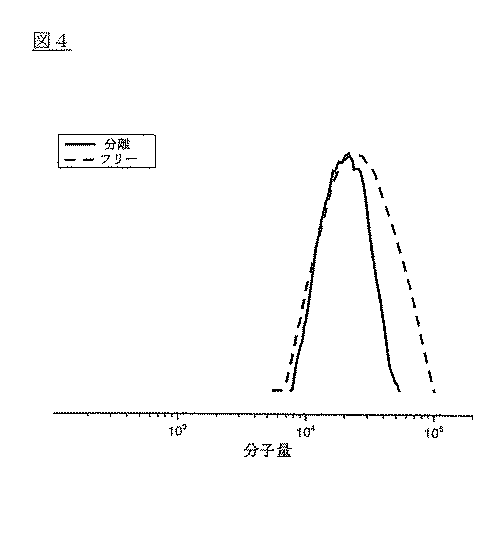
50mlの丸底フラスコにMDH−polyBA(50mg)、THF(30ml)、1−ブチルアルコール(15ml)、及び濃縮された硫酸(1ml)を充填した。前記フラスコに水凝縮器を取り付け、前記混合物は1週間95ないし100℃で攪拌した。前記溶媒は真空下で除去し、残余固形分はクロロホルムに分散させた。少量の水を用いて硫酸成分を抽出すると、有機成分が分離され、溶媒は蒸留によって除去した。前記残余固形分は無水化THFに分散させた。前記液体内のMDHはPTFE膜で濾過して除去し、前記濾過物内の分離されたpolyBAの分子量はGPCを用いて分析した。結果は図4に示しており、図4でフリーポリマーの分子量と比較される。フリーポリマーの分子量と多分散性は20,300と1.49であり、開裂されたポリマーの分子量と多分散性は19,100と1.16であって、それぞれは重合過程で調節されたグラプトが発現されたことを示している。 A 50 ml round bottom flask was charged with MDH-polyBA (50 mg), THF (30 ml), 1-butyl alcohol (15 ml), and concentrated sulfuric acid (1 ml). The flask was equipped with a water condenser and the mixture was stirred at 95-100 ° C. for 1 week. The solvent was removed under vacuum and the remaining solid was dispersed in chloroform. When the sulfuric acid component was extracted using a small amount of water, the organic component was separated and the solvent was removed by distillation. The residual solid was dispersed in anhydrous THF. MDH in the liquid was removed by filtration through a PTFE membrane, and the molecular weight of the separated polyBA in the filtrate was analyzed using GPC. The results are shown in FIG. 4 and are compared with the free polymer molecular weight in FIG. The molecular weight and polydispersity of the free polymer are 20,300 and 1.49, and the molecular weight and polydispersity of the cleaved polymer are 19,100 and 1.16, respectively, and the grafting is controlled by the polymerization process. Is expressed.
MDH−polyBAハイブリッド粒子の分析
2つのガラス瓶の1つは原形MDHを、他の1つはMDH−polyBA粒子をTHFで分散させ、スラリーの安定性比較のために並べて置いた。時間が経つにつれて、前記原形MDHの方は30分後から沈殿物が生成し始め、5時間後には完全に沈殿された。一方、MDH−polyBA粒子は、2週が経過した後にも相変らず安定した分散性を保持していた。
Analysis of MDH-polyBA hybrid particles One of the two glass bottles was dispersed with original MDH and the other with MDH-polyBA particles dispersed in THF and placed side by side for slurry stability comparison. As time passed, the original MDH started to form a precipitate after 30 minutes and was completely precipitated after 5 hours. On the other hand, MDH-polyBA particles kept stable dispersibility as usual even after 2 weeks.
E8:MDH−polyMMAハイブリッド粒子の合成
平均粒径が80nmであるMDH粒子にpolyMMA鎖を付着するため、前述した実施例におけるMMAモノマー重合と類似の方法を用いた。このような反応において、ATRPプロセスに好適なMMAに結合された開始剤を形成することと同様に、MDH粒子は氷浴内でトリエチルアミン及びTHFを用いて2−ブロモ−2−メチルプロピオニルブロミドと反応することで官能化される。この実験で、エチル2−ブロモイソブチレートは重合進行度及びpolyMMAの分子量をチェックするために第3犠牲開始剤として採択された。前記MDH粒子に付着された開始剤部分の量は評価し難いため、前記MDH粒子に1%の開始剤部分が付着されるという仮定下で化学量論的に計算した(正確な分析のために、事後に開始剤が付着された粒子に対して元素分析を行い、以下に提供した)。その結果、前記MDH粒子内の水酸基60個のうちの1つ程度が実際に官能化されたことが分かる。
E8: Synthesis of MDH-polyMMA hybrid particles In order to attach polyMMA chains to MDH particles having an average particle size of 80 nm, a method similar to MMA monomer polymerization in the above-described examples was used. In such a reaction, MDH particles react with 2-bromo-2-methylpropionyl bromide using triethylamine and THF in an ice bath, as well as forming an MMA-bound initiator suitable for the ATRP process. To be functionalized. In this experiment, ethyl 2-bromoisobutyrate was adopted as a third sacrificial initiator to check the polymerization progress and the molecular weight of polyMMA. Since the amount of initiator moieties attached to the MDH particles is difficult to evaluate, it was calculated stoichiometrically under the assumption that 1% initiator moieties were attached to the MDH particles (for accurate analysis). After that, elemental analysis was performed on the particles with the initiator attached and provided below). As a result, it can be seen that about one of the 60 hydroxyl groups in the MDH particles was actually functionalized.
開始剤が付着されたMDH粒子(1g、推定された開始剤の量:0.17mM)、エチル2−ブロモイソブチレート(0.025ml、0.17mM)、dNdpy(0.07g、0.17mM)、メチルメタクリレート(36.4ml、340mM)、及びMEK(30ml)を50mlのシュレンクフラスコに入れた。窒素気体を用いて浄化しながら、3回連続で冷凍−ポンプ−解凍サイクルを行って反応物内の不純物を除去した。前記フラスコにCuBr(0.012g、0.083mM)、CuBr2(0.00094g、0.0042mM)を添加した後、前記反応器を70℃に予熱した油浴に載置した。前述した反応が行われる間に、少量のサンプルを用いてフリーポリマーの分子量と重合の進行程度を測定した。24時間が経過した後、空気に露出させて反応を終結させた。フラスコ内の粘性のある白い混合物を遠心分離管に注いで、きれいなTHFと混合した。十分に混合した後、この混合物を遠心分離して沈澱された粒子からきれいな上澄み液を注ぎ出した。これによってTHFに溶解されたフリーポリマーはもちろんdNdpyとCuBr2との複合体を共に除去した。不純物を除去するために、この段階を5回繰り返した。他の物質の除去を確認するために、遠心分離管内の上澄み液をサンプルとして用いてNMR分析を行ったが、THFのピークのみが観察された。 MDH particles with attached initiator (1 g, estimated amount of initiator: 0.17 mM), ethyl 2-bromoisobutyrate (0.025 ml, 0.17 mM), dNdpy (0.07 g, 0.17 mM) ), Methyl methacrylate (36.4 ml, 340 mM), and MEK (30 ml) were placed in a 50 ml Schlenk flask. While purifying with nitrogen gas, the refrigeration-pump-thaw cycle was performed three times in succession to remove impurities in the reaction product. After adding CuBr (0.012 g, 0.083 mM) and CuBr 2 (0.00094 g, 0.0042 mM) to the flask, the reactor was placed in an oil bath preheated to 70 ° C. While the above-described reaction was performed, the molecular weight of the free polymer and the progress of the polymerization were measured using a small amount of sample. After 24 hours, the reaction was terminated by exposure to air. The viscous white mixture in the flask was poured into a centrifuge tube and mixed with clean THF. After thorough mixing, the mixture was centrifuged and the clean supernatant was poured out of the precipitated particles. This was removed together a complex of free polymer as well dNdpy and CuBr 2 dissolved in THF. This step was repeated 5 times to remove impurities. In order to confirm the removal of other substances, NMR analysis was performed using the supernatant in the centrifuge tube as a sample, but only the THF peak was observed.
反応進行程度、転換率、分子量、及びPDIは、前記反応をモニターするためフリーポリマーを用いて重合過程の間に測定された。過多な溶媒としてMEKが添加されても、反応が始まってから12時間が経過して急なゲル化が観察され、フラスコ内の混合物が粘性を有するようになった。前記PDIはゲル化が進むにつれてその値が大きくなり始めた。結果的に、24時間が経過した後、Mnが127,000、PDIが1.40であるpolyMMAの付着された粒子が76%の転換があってから合成された。 Reaction progress, conversion, molecular weight, and PDI were measured during the polymerization process using a free polymer to monitor the reaction. Even when MEK was added as an excessive solvent, rapid gelation was observed after 12 hours from the start of the reaction, and the mixture in the flask became viscous. The value of the PDI started to increase as the gelation progressed. As a result, after 24 hours, particles with MMMA of 127,000 and PDI of 1.40 were synthesized after 76% conversion.
AFMはMDH粒子にポリマー鎖が実際に付着されたか否かをチェックするために使った。拡大イメージを図5に示した。前記粒子周辺の一部鎖は前記粒子表面上に広がっているのが検出される。 AFM was used to check whether polymer chains were actually attached to the MDH particles. An enlarged image is shown in FIG. It is detected that a partial chain around the particle spreads on the particle surface.
E9:MDH−ポリ(メチルメタクリレート)ハイブリッド粒子の大量合成
また、より好適に実用的なテストを行うために、MDH−ポリ(メチルメタクリレート)粒子を大量に用意した。
E9: Mass synthesis of MDH-poly (methyl methacrylate) hybrid particles In addition, in order to perform a more suitable practical test, MDH-poly (methyl methacrylate) particles were prepared in large quantities.
この実験で使われる方法は前述した実験例で提示された大部分の方法と同様である。官能性開始剤が付着されたMDH粒子(17g、推定された開始剤:3mM)、エチル2−ブロモイソブチレート(0.44ml、3mM)、dNbpy(1.23g、3mM)、メチルメタクリレート(642ml、6M)、及びトルエン(100ml)を1リットルのシュレンクフラスコに入れた。窒素で浄化しながら、冷凍−ポンプ−解凍サイクルを3回繰り返して反応物内の不純物を除去した。前記フラスコにCuBr(0.215g、1.5mM)、CuBr2(0.0168g、0.075mM)を添加し、反応器を70℃まで予熱した油浴に載置した。反応の進行に伴い、フリーポリマー鎖の分子量に対するGPC分析のために、反応混合物の少量のサンプルを周期的に採取した。43時間後、空気に露出させて反応を終結させた(除去の容易性のために全ての触媒をCu(II)に変換させた)。前記フラスコ内の粘性のある混合物を遠心分離管に注いで、きれいなTHFと混合した。完全に分散するように十分に混合した後、前記混合物を遠心分離して沈澱された粒子からきれいな上澄み液を注ぎ出すことでフリーポリマー鎖も共に除去した。THFに溶解されていたdNdpyとCuBr2との複合体も、前記遠心分離段階で除去された。純粋なハイブリッド粒子を分離するために、前記スラリー/遠心分離過程は5回繰り返して行った。GPCを用いて測定したフリーポリマー鎖の分子量は120,800であり、PDIは1.18であった。その結果は図6に示した。 The method used in this experiment is similar to most of the methods presented in the experimental examples described above. MDH particles with attached functional initiator (17 g, estimated initiator: 3 mM), ethyl 2-bromoisobutyrate (0.44 ml, 3 mM), dNbpy (1.23 g, 3 mM), methyl methacrylate (642 ml) 6M), and toluene (100 ml) were placed in a 1 liter Schlenk flask. While purging with nitrogen, the freeze-pump-thaw cycle was repeated three times to remove impurities in the reaction. CuBr (0.215 g, 1.5 mM) and CuBr 2 (0.0168 g, 0.075 mM) were added to the flask, and the reactor was placed in an oil bath preheated to 70 ° C. As the reaction progressed, small samples of the reaction mixture were taken periodically for GPC analysis on the molecular weight of the free polymer chains. After 43 hours, the reaction was terminated by exposure to air (all catalysts were converted to Cu (II) for ease of removal). The viscous mixture in the flask was poured into a centrifuge tube and mixed with clean THF. After thorough mixing to ensure complete dispersion, the mixture was centrifuged and the free polymer chains were also removed by pouring clean supernatant from the precipitated particles. The complex of dNdpy and CuBr 2 dissolved in THF was also removed in the centrifugation step. The slurry / centrifugation process was repeated 5 times to separate pure hybrid particles. The molecular weight of the free polymer chain measured using GPC was 120,800, and the PDI was 1.18. The results are shown in FIG.
E10:MDH−ポリ(ドデシルメタクリレート)ハイブリッド粒子の合成
オレフィンマトリクスポリマーとのさらに良好な混合特性を持たせるために、MDH粒子により長いアルキル官能基を有するポリマー鎖を付着させてドデシルメタクリレート(DDMA)モノマー重合を行った。
E10: Synthesis of MDH-poly (dodecyl methacrylate) hybrid particles Dodecyl methacrylate (DDMA) monomer by attaching polymer chains with long alkyl functional groups to MDH particles in order to have better mixing properties with olefin matrix polymer Polymerization was performed.
開始剤が付着されたMDH粒子(1g;推定された開始剤部分:0.17mM)、エチル2−ブロモイソブチレート(0.025ml、0.17mM)、dNdpy(0.07g、0.17mM)、ドデシルメタクリレート(19.93ml、68mM)、及びトルエン(30ml)を100mlのシュレンクフラスコに入れた。窒素で浄化しながら、冷凍−ポンプ−解凍サイクルを3回繰り返して反応物内の不純物を除去した。フラスコにCuBr(0.012g、0.083mM)、CuBr2(0.00094g、0.0042mM)を添加して反応器を油浴に70℃まで予熱した載置した。反応中に、フリーポリマーの分子量と重合の進行程度を測定するために、反応混合物の少量のサンプルを周期的に採取した。50時間後、空気に露出させて反応を終結させた。前記フラスコ内の粘性のある混合物を十分混合した後遠心分離管に注いで、きれいなTHFと混合した。十分に混合した後、混合物を遠心分離して沈澱された粒子からきれいな上澄み液を注ぎ出すことで、THFに溶解されていたフリーポリマー及び形成されたdNdpyとCuBr2との複合体を除去した。この段階は純粋なハイブリッド粒子を分離するために、5回繰り返して行った。転換の進行度及び分子量は重合が行われる間にフリーポリマーを用いて測定し、その結果は前述した反応が比較的に好適に調節されたことを示している。初期には速い反応速度が観察され、時間に対する分子量の増加勾配は減少していることが分かった。最終ポリマーの89%の転換率における分子量は52,300であり、PDIは1.21であった。 MDH particles with attached initiator (1 g; estimated initiator portion: 0.17 mM), ethyl 2-bromoisobutyrate (0.025 ml, 0.17 mM), dNdpy (0.07 g, 0.17 mM) , Dodecyl methacrylate (19.93 ml, 68 mM), and toluene (30 ml) were placed in a 100 ml Schlenk flask. While purging with nitrogen, the freeze-pump-thaw cycle was repeated three times to remove impurities in the reaction. CuBr (0.012 g, 0.083 mM) and CuBr 2 (0.00094 g, 0.0042 mM) were added to the flask and the reactor was placed in an oil bath preheated to 70 ° C. During the reaction, small samples of the reaction mixture were taken periodically to measure the molecular weight of the free polymer and the extent of polymerization. After 50 hours, the reaction was terminated by exposure to air. The viscous mixture in the flask was thoroughly mixed and then poured into a centrifuge tube and mixed with clean THF. After thorough mixing, the mixture was centrifuged and the clean supernatant was poured out of the precipitated particles to remove the free polymer dissolved in THF and the complex of dNdpy and CuBr 2 formed. This step was repeated five times to separate pure hybrid particles. The degree of progress and molecular weight of the conversion were measured using a free polymer during the polymerization, and the results show that the above-described reaction was relatively well controlled. Initially, a fast reaction rate was observed, and it was found that the increasing gradient of molecular weight with respect to time decreased. The molecular weight at 89% conversion of the final polymer was 52,300 and the PDI was 1.21.
E11:MDH−ポリ(オクタデシルメタクリレート)ハイブリッド粒子の合成
オクタデシルメタクリレート(ODMA)モノマーは本質的に長いアルキル鎖を有しているため選択された。ナノ組成物に付着されたポリマー鎖の化学的性質/組成は、ポリマーブレンドにおいて親和性と独特の特性を決定する基本的な要素であるため、ODMAはオレオフィリック(oleophylic)マトリクスに溶解され得る組成物構造を製造するための有望な候補物質である。
Synthesis of E11: MDH-poly (octadecyl methacrylate) hybrid particles Octadecyl methacrylate (ODMA) monomer was chosen because it has essentially long alkyl chains. Since the chemical nature / composition of the polymer chains attached to the nanocomposition is a fundamental factor that determines affinity and unique properties in the polymer blend, ODMA can be dissolved in an oleophylic matrix. It is a promising candidate material for manufacturing physical structures.
モノマーは重合に先立って従来の方法を用いて精製した。オクタデシルメタクリレートはヘキサンに溶解させ、5%のNaOH水溶液で4回抽出した。無水硫酸マグネシウムで有機相を乾燥させた後、前記溶液を中性のアルミナに通過させ、減圧下で前記溶媒を除去した。予め用意した開始剤が付着されたMDH粒子(1g;推定された開始剤量:0.17mM)、エチル2−ブロモイソブチレート(0.025ml、0.17mM)、dNdpy(0.07g、0.17mM)、オクタデシルメタクリレート(22.21ml、56.7mM)、及びトルエン(30ml)を100mlのシュレンクフラスコに入れた。窒素で浄化させた後、冷凍−ポンプ−解凍サイクルを繰り返して反応物内の不純物は除去した。該フラスコにCuBr(0.012g、0.083mM)、CuBr2(0.00094g、0.0042mM)を添加して反応器を70℃まで予熱した油浴に載置した。前記反応中の重合の進行度はモノマーの転換率とフリーポリマーの測定された分子量による。57時間が経過した後、空気に露出させて反応を終結させた。他の全ての過程はDDMAの重合とほとんど同様であった。 The monomer was purified using conventional methods prior to polymerization. Octadecyl methacrylate was dissolved in hexane and extracted four times with 5% aqueous NaOH. After drying the organic phase with anhydrous magnesium sulfate, the solution was passed through neutral alumina and the solvent was removed under reduced pressure. MDH particles (1 g; estimated initiator amount: 0.17 mM), ethyl 2-bromoisobutyrate (0.025 ml, 0.17 mM), dNdpy (0.07 g, 0 .17 mM), octadecyl methacrylate (22.21 ml, 56.7 mM), and toluene (30 ml) were placed in a 100 ml Schlenk flask. After purging with nitrogen, the freeze-pump-thaw cycle was repeated to remove impurities in the reaction. CuBr (0.012 g, 0.083 mM), CuBr 2 (0.00094 g, 0.0042 mM) was added to the flask and the reactor was placed in an oil bath preheated to 70 ° C. The degree of polymerization during the reaction depends on the monomer conversion and the measured molecular weight of the free polymer. After 57 hours, the reaction was terminated by exposure to air. All other processes were almost similar to the polymerization of DDMA.
本発明によれば、MDH粒子はATRP重合のための好適なさまざまな開始剤で官能化することができ、ナノ組成物構造は多様なモノマーを用いたグラフトされた重合によって用意することができる。触媒複合体は適切な反応速度を得て最終組成物粒子を分離し易くするために選択することができる。 According to the present invention, MDH particles can be functionalized with a variety of suitable initiators for ATRP polymerization, and the nanocomposite structure can be prepared by grafted polymerization using various monomers. The catalyst composite can be selected to obtain an appropriate reaction rate and facilitate separation of the final composition particles.
上記の制限された例は、概念を説明しており、引用文献に記載されたように、任意の(共)重合可能なモノマーが基材に分散されるための複合構造の調整に使用することができる。 The limited examples above illustrate the concept and, as described in the cited literature, should be used to adjust the composite structure for any (co) polymerizable monomer to be dispersed in the substrate. Can do.
一方、上記実施例では、単独重合体が提供されたが、共重合体は引用文献に記載されたように用意することができる。傾斜共重合体が結合されたナノ複合体は、特にブレンドの強化と難燃性付与のために使用することができる。 On the other hand, in the above examples, a homopolymer was provided, but the copolymer can be prepared as described in the cited literature. Nanocomposites with gradient copolymers attached can be used especially for blend reinforcement and flame retardancy.
また、ニトロキシド媒介重合とRAFT/MADIX重合のための官能化において、前記付着されたハロゲン化合物の官能性を如何に転換させるかは知られているため、前記MDH粒子の官能化のための開示された工程は、MDH粒子から任意の制御ラジカル重合の開始に好適な粒子を提供するために使用することができる。 Also, since it is known how to convert the functionality of the attached halogen compound in the functionalization for nitroxide mediated polymerization and RAFT / MADIX polymerization, it is disclosed for functionalization of the MDH particles. The process can be used to provide particles suitable for initiation of any controlled radical polymerization from MDH particles.
さらに、固有の官能性または付加された官能性は、他の制御された重合過程を開始するために採択されることもできる。 In addition, intrinsic or added functionality can be employed to initiate other controlled polymerization processes.
したがって、前述した実施例から、鎖の組成物が接触するモノマー単位の選択によって調節され得る付着されたポリマー鎖を有するMDH粒子を用意可能であることが分かる。鎖の長さは付着する開始基の数、モノマー濃度、そして温度、時間、選択される溶媒、及び組成物に好適な触媒など適切な反応条件の選択を考慮して、予め決定することができる。 Thus, it can be seen from the foregoing examples that it is possible to prepare MDH particles with attached polymer chains that can be adjusted by the choice of monomer units with which the chain composition contacts. The chain length can be pre-determined by considering the number of initiating groups attached, the monomer concentration, and the selection of appropriate reaction conditions such as temperature, time, solvent chosen, and catalyst suitable for the composition .
Claims (8)
Applications Claiming Priority (2)
| Application Number | Priority Date | Filing Date | Title |
|---|---|---|---|
| US73395805P | 2005-11-04 | 2005-11-04 | |
| PCT/KR2006/004535 WO2007052964A1 (en) | 2005-11-04 | 2006-11-02 | Synthesis of mdh-polymer hybrid particles |
Publications (1)
| Publication Number | Publication Date |
|---|---|
| JP2009515005A true JP2009515005A (en) | 2009-04-09 |
Family
ID=38006068
Family Applications (1)
| Application Number | Title | Priority Date | Filing Date |
|---|---|---|---|
| JP2008538819A Pending JP2009515005A (en) | 2005-11-04 | 2006-11-02 | Method for producing magnesium hydroxide polymer hybrid particles |
Country Status (6)
| Country | Link |
|---|---|
| US (1) | US7407995B2 (en) |
| EP (1) | EP1943301A4 (en) |
| JP (1) | JP2009515005A (en) |
| KR (1) | KR100945632B1 (en) |
| CN (1) | CN101300298A (en) |
| WO (1) | WO2007052964A1 (en) |
Cited By (3)
| Publication number | Priority date | Publication date | Assignee | Title |
|---|---|---|---|---|
| JP2011037957A (en) * | 2009-08-07 | 2011-02-24 | Asahi Kasei Chemicals Corp | Thermoplastic composite material |
| JP2012131928A (en) * | 2010-12-22 | 2012-07-12 | Asahi Kasei Chemicals Corp | Film-formable organic-inorganic complex, and method for production thereof |
| JP2012207131A (en) * | 2011-03-29 | 2012-10-25 | Yoshizawa Lime Industry | Flame retardant comprising highly hydrous magnesia slaked lime as active ingredient, method for producing the same and thermoplastic polymer made by blending the same |
Families Citing this family (36)
| Publication number | Priority date | Publication date | Assignee | Title |
|---|---|---|---|---|
| US7407955B2 (en) | 2002-08-21 | 2008-08-05 | Boehringer Ingelheim Pharma Gmbh & Co., Kg | 8-[3-amino-piperidin-1-yl]-xanthines, the preparation thereof and their use as pharmaceutical compositions |
| FR2846572B1 (en) * | 2002-11-05 | 2004-12-31 | Centre Nat Rech Scient | DISSYMMETRIC PARTICLES OF NANOMETRIC OR MESOSCOPIC SIZE, AND PROCESS FOR THEIR PREPARATION |
| US7261946B2 (en) | 2003-11-14 | 2007-08-28 | Advanced Cardiovascular Systems, Inc. | Block copolymers of acrylates and methacrylates with fluoroalkenes |
| DE102004054054A1 (en) | 2004-11-05 | 2006-05-11 | Boehringer Ingelheim Pharma Gmbh & Co. Kg | Process for preparing chiral 8- (3-amino-piperidin-1-yl) -xanthines |
| KR101452915B1 (en) | 2006-05-04 | 2014-10-21 | 베링거 인겔하임 인터내셔날 게엠베하 | Polymorphism |
| EP1852108A1 (en) | 2006-05-04 | 2007-11-07 | Boehringer Ingelheim Pharma GmbH & Co.KG | DPP IV inhibitor formulations |
| PE20080251A1 (en) | 2006-05-04 | 2008-04-25 | Boehringer Ingelheim Int | USES OF DPP IV INHIBITORS |
| PE20140960A1 (en) | 2008-04-03 | 2014-08-15 | Boehringer Ingelheim Int | FORMULATIONS INVOLVING A DPP4 INHIBITOR |
| KR20190016601A (en) | 2008-08-06 | 2019-02-18 | 베링거 인겔하임 인터내셔날 게엠베하 | Treatment for diabetes in patients inappropriate for metformin therapy |
| AU2009331471B2 (en) | 2008-12-23 | 2015-09-03 | Boehringer Ingelheim International Gmbh | Salt forms of organic compound |
| WO2010111708A1 (en) | 2009-03-27 | 2010-09-30 | Carnegie Mellon University | Preparation of functional star macromolecules |
| EP2246376B1 (en) | 2009-04-27 | 2014-03-05 | Leibniz-Institut für Polymerforschung Dresden e.V. | Method for preparing particles with a conjugated polymer shell |
| KR20120107080A (en) | 2009-11-27 | 2012-09-28 | 베링거 인겔하임 인터내셔날 게엠베하 | Treatment of genotyped diabetic patients with dpp-iv inhibitors such as linagliptin |
| KR101927068B1 (en) | 2010-05-05 | 2018-12-10 | 베링거 인겔하임 인터내셔날 게엠베하 | Sequential Combination Therapy by the Weight Reducing Treatment Followed by the DPP-4 Inhibitor |
| KR20220025926A (en) | 2010-06-24 | 2022-03-03 | 베링거 인겔하임 인터내셔날 게엠베하 | Diabetes therapy |
| AR083878A1 (en) | 2010-11-15 | 2013-03-27 | Boehringer Ingelheim Int | VASOPROTECTORA AND CARDIOPROTECTORA ANTIDIABETIC THERAPY, LINAGLIPTINA, TREATMENT METHOD |
| US9644042B2 (en) | 2010-12-17 | 2017-05-09 | Carnegie Mellon University | Electrochemically mediated atom transfer radical polymerization |
| CN103781788B (en) | 2011-07-15 | 2016-08-17 | 勃林格殷格翰国际有限公司 | Quinazoline, its preparation and the purposes in pharmaceutical composition thereof being substituted |
| EP2747753B1 (en) | 2011-08-22 | 2023-03-29 | Carnegie Mellon University | Atom transfer radical polymerization under biologically compatible conditions |
| US9410020B2 (en) | 2012-01-27 | 2016-08-09 | Carnegie Mellon University | Processable self-organizing nanoparticle |
| WO2013126745A2 (en) | 2012-02-23 | 2013-08-29 | Carnegie Mellon University | Ligands designed to provide highly active catalyst complexes |
| CN102604012B (en) * | 2012-03-05 | 2013-09-11 | 中国皮革和制鞋工业研究院 | Chemical magnesium hydroxide particle surface modification method for flame resistance of leather |
| US9555001B2 (en) | 2012-03-07 | 2017-01-31 | Boehringer Ingelheim International Gmbh | Pharmaceutical composition and uses thereof |
| JP6224084B2 (en) | 2012-05-14 | 2017-11-01 | ベーリンガー インゲルハイム インターナショナル ゲゼルシャフト ミット ベシュレンクテル ハフツング | Xanthine derivatives as DPP-4 inhibitors for the treatment of glomerular epithelial cell related disorders and / or nephrotic syndrome |
| WO2013174767A1 (en) | 2012-05-24 | 2013-11-28 | Boehringer Ingelheim International Gmbh | A xanthine derivative as dpp -4 inhibitor for use in modifying food intake and regulating food preference |
| US9765169B2 (en) | 2013-04-18 | 2017-09-19 | Carnegie Mellon University | Functionalized polymer hybrids |
| JP6615109B2 (en) | 2014-02-28 | 2019-12-04 | ベーリンガー インゲルハイム インターナショナル ゲゼルシャフト ミット ベシュレンクテル ハフツング | Medical use of DPP-4 inhibitors |
| US9982070B2 (en) | 2015-01-12 | 2018-05-29 | Carnegie Mellon University | Aqueous ATRP in the presence of an activator regenerator |
| WO2017132137A1 (en) * | 2016-01-25 | 2017-08-03 | Carnegie Mellon University | Composite composition and modification of inorganic particles for use in composite compositions |
| MX390363B (en) | 2016-06-10 | 2025-03-20 | Boehringer Ingelheim Int | Combinations of linagliptin and metformin |
| US10982266B2 (en) | 2016-11-03 | 2021-04-20 | Carnegie Mellon University | Nucleic acid-polymer conjugates for bright fluorescent tags |
| US20190358335A1 (en) | 2017-01-12 | 2019-11-28 | Alan J. Russell | Stomach acid-stable and mucin-binding protein-polymer conjugates |
| US11174325B2 (en) | 2017-01-12 | 2021-11-16 | Carnegie Mellon University | Surfactant assisted formation of a catalyst complex for emulsion atom transfer radical polymerization processes |
| US11472894B2 (en) | 2018-07-23 | 2022-10-18 | Carnegie Mellon University | Enzyme-assisted ATRP procedures |
| WO2020028715A1 (en) | 2018-08-01 | 2020-02-06 | Russell Alan J | Amino-reactive positively charged atrp initiators that maintain their positive charge during synthesis of biomacro-initiators |
| CN109384895A (en) * | 2018-09-28 | 2019-02-26 | 安徽大学 | Aluminum hydroxide nanosheet/polymer composite material and preparation method thereof |
Citations (4)
| Publication number | Priority date | Publication date | Assignee | Title |
|---|---|---|---|---|
| JPS57102959A (en) * | 1980-12-19 | 1982-06-26 | Tokuyama Soda Co Ltd | Production of surface-treated inorganic material |
| JP2002327006A (en) * | 2001-04-27 | 2002-11-15 | Daicel Chem Ind Ltd | Atom transfer radical polymerization initiator and method for producing polymer using the same |
| JP2005179576A (en) * | 2003-12-22 | 2005-07-07 | Nisshinbo Ind Inc | Inorganic-organic composite flame retardant composition |
| JP2005290036A (en) * | 2004-03-31 | 2005-10-20 | Kao Corp | Cosmetics |
Family Cites Families (9)
| Publication number | Priority date | Publication date | Assignee | Title |
|---|---|---|---|---|
| JPS5761714A (en) * | 1980-09-29 | 1982-04-14 | Teijin Ltd | Pulp-like particles |
| US4678819A (en) * | 1984-08-30 | 1987-07-07 | Mitsubishi Rayon Co., Ltd. | Compositions for artificial marbles and process for producing artificial marbles therefrom |
| JP2731854B2 (en) * | 1989-02-10 | 1998-03-25 | 協和化学工業株式会社 | Method for producing high hydration resistant and high fluidity magnesium oxide |
| US5514357A (en) * | 1993-04-15 | 1996-05-07 | Martin Marietta Magnesia Specialties Inc. | Stabilized magnesium hydroxide slurry |
| JP3197458B2 (en) * | 1995-03-07 | 2001-08-13 | 協和化学工業株式会社 | Cold-resistant, halogen-free flame-retardant polyolefin resin composition |
| DE60032341T2 (en) * | 1999-07-23 | 2007-07-12 | Kuraray Co., Ltd., Kurashiki | Aqueous dispersion and process for its preparation |
| US6620516B1 (en) * | 1999-08-13 | 2003-09-16 | Asahi Kasei Kabushiki Kaisha | Organic domain/inorganic domain composite material |
| FR2812296B1 (en) * | 2000-07-25 | 2002-12-20 | Rhodia Chimie Sa | PROCESS FOR THE SYNTHESIS OF HYBRID AND ORGANIC COPOLYMERS BY CONTROLLED RADICAL POLYMERIZATION |
| EP1671985A1 (en) * | 2003-10-06 | 2006-06-21 | Kaneka Corporation | Polyolefin graft copolymer |
-
2006
- 2006-11-02 JP JP2008538819A patent/JP2009515005A/en active Pending
- 2006-11-02 CN CNA2006800410334A patent/CN101300298A/en active Pending
- 2006-11-02 WO PCT/KR2006/004535 patent/WO2007052964A1/en not_active Ceased
- 2006-11-02 EP EP06812374A patent/EP1943301A4/en not_active Withdrawn
- 2006-11-02 KR KR1020087013541A patent/KR100945632B1/en not_active Expired - Fee Related
- 2006-11-03 US US11/593,185 patent/US7407995B2/en not_active Expired - Fee Related
Patent Citations (4)
| Publication number | Priority date | Publication date | Assignee | Title |
|---|---|---|---|---|
| JPS57102959A (en) * | 1980-12-19 | 1982-06-26 | Tokuyama Soda Co Ltd | Production of surface-treated inorganic material |
| JP2002327006A (en) * | 2001-04-27 | 2002-11-15 | Daicel Chem Ind Ltd | Atom transfer radical polymerization initiator and method for producing polymer using the same |
| JP2005179576A (en) * | 2003-12-22 | 2005-07-07 | Nisshinbo Ind Inc | Inorganic-organic composite flame retardant composition |
| JP2005290036A (en) * | 2004-03-31 | 2005-10-20 | Kao Corp | Cosmetics |
Cited By (3)
| Publication number | Priority date | Publication date | Assignee | Title |
|---|---|---|---|---|
| JP2011037957A (en) * | 2009-08-07 | 2011-02-24 | Asahi Kasei Chemicals Corp | Thermoplastic composite material |
| JP2012131928A (en) * | 2010-12-22 | 2012-07-12 | Asahi Kasei Chemicals Corp | Film-formable organic-inorganic complex, and method for production thereof |
| JP2012207131A (en) * | 2011-03-29 | 2012-10-25 | Yoshizawa Lime Industry | Flame retardant comprising highly hydrous magnesia slaked lime as active ingredient, method for producing the same and thermoplastic polymer made by blending the same |
Also Published As
| Publication number | Publication date |
|---|---|
| WO2007052964A1 (en) | 2007-05-10 |
| CN101300298A (en) | 2008-11-05 |
| US20070197693A1 (en) | 2007-08-23 |
| KR100945632B1 (en) | 2010-03-04 |
| EP1943301A4 (en) | 2010-01-13 |
| KR20080081264A (en) | 2008-09-09 |
| US7407995B2 (en) | 2008-08-05 |
| EP1943301A1 (en) | 2008-07-16 |
Similar Documents
| Publication | Publication Date | Title |
|---|---|---|
| JP2009515005A (en) | Method for producing magnesium hydroxide polymer hybrid particles | |
| JP5264030B2 (en) | Catalytic process for the controlled polymerization of free-radically (co) polymerizable monomers and functional polymer systems produced thereby | |
| JP5171248B2 (en) | Atom transfer radical polymerization | |
| Kasseh et al. | Organic/inorganic hybrid composites prepared by polymerization compounding and controlled free radical polymerization | |
| Diaconu et al. | Macroinitiator and macromonomer modified montmorillonite for the synthesis of acrylic/MMT nanocomposite latexes | |
| Hojjati et al. | Synthesis and kinetics of graft polymerization of methyl methacrylate from the RAFT coordinated surface of nano‐TiO2 | |
| JP2008530306A (en) | Modified carbon particles | |
| Wang et al. | Synthesis of well-defined, polymer-grafted silica nanoparticles via reverse ATRP | |
| US20100227162A1 (en) | Atom transfer radical polymerization (ATRP) based inorganic polymer structures | |
| JP5465525B2 (en) | Organic-inorganic composite composition and method for producing the same | |
| Ueda et al. | Scale-up synthesis of vinyl polymer-grafted nano-sized silica by radical polymerization of vinyl monomers initiated by surface initiating groups in the solvent-free dry-system | |
| Datta et al. | Tailor‐made hybrid nanostructure of poly (ethyl acrylate)/clay by surface‐initiated atom transfer radical polymerization | |
| Khabibullin et al. | Modification of silica nanoparticles with miktoarm polymer brushes via ATRP | |
| Bian et al. | Surface-initiated nitroxide-mediated radical polymerization of 2-(dimethylamino) ethyl acrylate on polymeric microspheres | |
| Yang et al. | Immobilization of RAFT agents on silica nanoparticles utilizing an alternative functional group and subsequent surface‐initiated RAFT polymerization | |
| EP1637550B1 (en) | Catalytic processes for the controlled polymerization of free radically (co) polymerizable monomers and functional polymeric systems prepared thereby | |
| CN102216338B (en) | Method for producing polymer nanocomposite, and flame-retardant polymer nanocomposite formed by the production method | |
| Abbasian et al. | Synthesis and characterization of poly methyl methacrylate-b-polystyrene copolymer/multi-walled carbon nanotubes via ATRP and NMRP techniques | |
| Bharathwaj et al. | Synthesis of poly (benzyl methacrylate)/Mg-phyllosilicate nanocomposites by surface-initiated ambient temperature ATRP | |
| Ranjan | Surface modification of silica nanoparticles | |
| CN108586642A (en) | A method of thioester group in removing polymer emulsion containing thioester group | |
| Bell | Ligand engineering for advanced functional composite materials | |
| Li | RAFT polymerization from nanoparticles and development of novel chain transfer agents | |
| Patil et al. | Polymer− Inorganic Hybrid Materials Using Controlled Radical Polymerization | |
| Jiang | Hairy Particles: Polymer Brush-Supported Organocatalysts and Asymmetric Mixed Homopolymer Brushes |
Legal Events
| Date | Code | Title | Description |
|---|---|---|---|
| A977 | Report on retrieval |
Free format text: JAPANESE INTERMEDIATE CODE: A971007 Effective date: 20110607 |
|
| A131 | Notification of reasons for refusal |
Free format text: JAPANESE INTERMEDIATE CODE: A131 Effective date: 20110726 |
|
| A02 | Decision of refusal |
Free format text: JAPANESE INTERMEDIATE CODE: A02 Effective date: 20120110 |