JP2009012375A - Base material with hard coat film and coating liquid for forming hard coat film - Google Patents
Base material with hard coat film and coating liquid for forming hard coat film Download PDFInfo
- Publication number
- JP2009012375A JP2009012375A JP2007178351A JP2007178351A JP2009012375A JP 2009012375 A JP2009012375 A JP 2009012375A JP 2007178351 A JP2007178351 A JP 2007178351A JP 2007178351 A JP2007178351 A JP 2007178351A JP 2009012375 A JP2009012375 A JP 2009012375A
- Authority
- JP
- Japan
- Prior art keywords
- coat film
- hard coat
- silica
- composite oxide
- oxide particles
- Prior art date
- Legal status (The legal status is an assumption and is not a legal conclusion. Google has not performed a legal analysis and makes no representation as to the accuracy of the status listed.)
- Granted
Links
Landscapes
- Coating Of Shaped Articles Made Of Macromolecular Substances (AREA)
- Laminated Bodies (AREA)
- Paints Or Removers (AREA)
Abstract
【課題】干渉縞が生成することがなく、基材との密着性、耐擦傷性、スクラッチ強度、鉛筆硬度等に優れるとともに耐アルカリ性を有するハードコート膜付基材および該ハードコート膜の形成に用いる塗布液を提供する。
【解決手段】基材と、基材の一方の表面上に形成されたハードコート膜とからなり、該ハードコート膜が有機樹脂系マトリックス成分とシリカ系複合酸化物粒子とを含んでなり、基材の屈折率が1.45〜1.55の範囲にあるハードコート膜付基材。前記シリカ系複合酸化物粒子の平均粒子径が5〜500nmの範囲にある。マトリックス形成成分とシリカ系複合酸化物粒子と分散媒とを含んでなるハードコート膜形成用塗布液。
【選択図】なしAn object of the present invention is to provide a base material with a hard coat film having no interference fringes, excellent adhesion to the base material, scratch resistance, scratch strength, pencil hardness, etc. and having alkali resistance, and formation of the hard coat film. A coating liquid to be used is provided.
The substrate comprises a base and a hard coat film formed on one surface of the base, the hard coat film comprising an organic resin matrix component and silica composite oxide particles. A base material with a hard coat film in which the refractive index of the material is in the range of 1.45 to 1.55. The average particle diameter of the silica-based composite oxide particles is in the range of 5 to 500 nm. A coating liquid for forming a hard coat film, comprising a matrix-forming component, silica-based composite oxide particles, and a dispersion medium.
[Selection figure] None
Description
本発明は、基材と、基材上に形成されたハードコート膜とからなり、干渉縞が生成することがなく、基材との密着性、耐擦傷性、スクラッチ強度、鉛筆硬度等に優れるとともに耐アルカリ性を有するハードコート膜付基材および該ハードコート膜の形成に用いる塗布液に関する。 The present invention comprises a base material and a hard coat film formed on the base material, does not generate interference fringes, and is excellent in adhesion to the base material, scratch resistance, scratch strength, pencil hardness, etc. The present invention also relates to a base material with a hard coat film having alkali resistance and a coating solution used for forming the hard coat film.
ガラス、プラスチックシート、プラスチックレンズ、樹脂フィルム、表示装置前面板等の基材表面の耐擦傷性を向上させるため、基材表面にハードコート膜を形成することが知られており、このようなハードコート膜として有機樹脂膜あるいは無機膜をガラスやプラスチック等の表面に形成することが行われている。さらに、有機樹脂膜あるいは無機膜中に樹脂粒子あるいはシリカ等の無機粒子を配合してさらに耐擦傷性を向上させることが行われている。 It is known that a hard coat film is formed on the surface of the base material in order to improve the scratch resistance of the surface of the base material such as glass, plastic sheet, plastic lens, resin film, and display device front plate. An organic resin film or an inorganic film is formed as a coat film on the surface of glass, plastic or the like. Furthermore, it is practiced to further improve the scratch resistance by blending resin particles or inorganic particles such as silica in an organic resin film or an inorganic film.
また、ハードコート膜付の樹脂基材を表示装置前面板等に貼り付けて使用される場合があるが、この時、接着剤との接着性を向上させるためにハードコート膜付基材をアルカリ処理してハードコート膜の反対側の基材表面の平滑性を低下させて表面に粗さを設けることが行われていた。しかしながら、従来のシリカ等の無機酸化物粒子を含むハードコート膜では少なくともこの無機酸化物粒子の一部がアルカリに溶解し、ハードコート機能が低下したり、透明性が低下して白化する等の問題があった。 In addition, a resin base material with a hard coat film may be used by being attached to a display device front plate or the like. At this time, in order to improve the adhesiveness with the adhesive, the base material with a hard coat film is alkalinized. It has been carried out to reduce the smoothness of the surface of the base material on the opposite side of the hard coat film so that the surface is roughened. However, in the conventional hard coat film containing inorganic oxide particles such as silica, at least a part of the inorganic oxide particles is dissolved in alkali, the hard coat function is lowered, the transparency is lowered and whitening occurs. There was a problem.
このようなハードコート膜のアルカリによる浸食を防ぐためにハードコート膜上に耐アルカリ性の保護薄膜を形成することが行われているが、保護膜を形成する工程およびこれを剥離する工程を必要とし経済性が問題となることから耐アルカリ性を有するハードコート膜の開発が求められていた。 In order to prevent the hard coat film from being eroded by alkali, an alkali-resistant protective thin film is formed on the hard coat film. However, a process for forming the protective film and a process for removing the protective film are required. Therefore, development of a hard coat film having alkali resistance has been demanded.
また、ハードコート膜に五酸化アンチモン、ジルコニア、ITO、ATO等の無機酸化物粒子を用いる場合、耐アルカリ性はある程度改良されるものの、粒子の屈折率が高く、このためハードコート膜の屈折率も高くなるため、屈折率の低い基材を用いる場合は干渉縞を生じる場合があった。 In addition, when inorganic oxide particles such as antimony pentoxide, zirconia, ITO, and ATO are used for the hard coat film, although the alkali resistance is improved to some extent, the refractive index of the particles is high, and therefore the refractive index of the hard coat film is also high. Therefore, when using a substrate having a low refractive index, interference fringes may occur.
また、本願出願人は、基材上に有機樹脂のみからなるハードコート膜を形成し、その上に表面を酸化アンチモンで被覆した多孔質シリカ系微粒子または内部に空洞を有するシリカ系微粒子を含む反射防止・帯電防止膜を有する透明被膜付基材を開示している(特開2005−119909号公報、特許文献1)。しかしながら特許文献1で得られる基材は、ハードコート機能(耐擦傷性、膜強度等)が必ずしも充分ではなかった。
本発明は、干渉縞が生成することがなく、基材との密着性、耐擦傷性、スクラッチ強度、鉛筆硬度等に優れるとともに耐アルカリ性を有するハードコート膜付基材および該ハードコート膜形成用塗布液の出現が望まれていた。 The present invention does not generate interference fringes, has excellent adhesion to the substrate, scratch resistance, scratch strength, pencil hardness, etc. and has a base material with a hard coat film having alkali resistance and the hard coat film forming The appearance of a coating solution has been desired.
このような状況の下、本発明者は、上記問題点を解消すべく鋭意検討した結果、ハードコート膜中にシリカを主成分とする複合酸化物微粒子を配合すれば、屈折率を調節できる
とともに耐アルカリ性が向上することを見いだして本発明を完成するに至った。
Under such circumstances, as a result of intensive studies to solve the above problems, the present inventor can adjust the refractive index if compound oxide fine particles mainly composed of silica are blended in the hard coat film. The inventors have found that the alkali resistance is improved and have completed the present invention.
すなわち本発明の構成要件は以下の通りである。
[1]基材と、基材の一方の表面上に形成されたハードコート膜とからなり、
該ハードコート膜が有機樹脂系マトリックス成分とシリカ系複合酸化物粒子とを含んでなり、基材の屈折率が1.45〜1.55の範囲にあることを特徴とするハードコート膜付基材。
[2]前記シリカ系複合酸化物粒子の平均粒子径が5〜500nmの範囲にある[1]のハードコート膜付基材。
[3]前記シリカ系複合酸化物粒子の屈折率が1.15〜1.55の範囲にある[1]または[2]のハードコート膜付基材。
[4]前記ハードコート膜の屈折率と基材の屈折率との差が0.3以下である[1]〜[3]のハ
ードコート膜付基材。
[5]前記シリカ系複合酸化物粒子がシリカ・アルミナ、シリカ・ジルコニア、シリカ・チ
タニア、シリカ・酸化アンチモン、シリカ・ボリアから選ばれる1種以上である[1]〜[4]のハードコート膜付基材。
[6]前記シリカ系複合酸化物粒子が下記式(1)で表される有機ケイ素化合物で表面処理
されている[1]〜[5]のハードコート膜付基材。
That is, the constituent requirements of the present invention are as follows.
[1] A base material and a hard coat film formed on one surface of the base material,
A base with a hard coat film, wherein the hard coat film comprises an organic resin matrix component and silica-based composite oxide particles, and the refractive index of the substrate is in the range of 1.45 to 1.55. Wood.
[2] The substrate with a hard coat film according to [1], wherein an average particle size of the silica-based composite oxide particles is in the range of 5 to 500 nm.
[3] The substrate with a hard coat film according to [1] or [2], wherein a refractive index of the silica-based composite oxide particles is in a range of 1.15 to 1.55.
[4] The substrate with a hard coat film according to [1] to [3], wherein the difference between the refractive index of the hard coat film and the refractive index of the substrate is 0.3 or less.
[5] The hard coat film according to [1] to [4], wherein the silica-based composite oxide particles are at least one selected from silica / alumina, silica / zirconia, silica / titania, silica / antimony oxide, and silica / boria. Attached base material.
[6] The substrate with a hard coat film according to [1] to [5], wherein the silica-based composite oxide particles are surface-treated with an organosilicon compound represented by the following formula (1).
Rn−SiX4-n (1)
(但し、式中、Rは炭素数1〜10の非置換または置換炭化水素基であって、互いに同一であっても異なっていてもよい。X:炭素数1〜4のアルコキシ基、水酸基、ハロゲン、水素、n:1〜3の整数)
[7]前記基材がトリアセチルセルロース(TAC)である[1]〜[6]のハードコート膜付基
材。
[8]前記基材のハードコート膜が形成されていない面上に接着剤層が設けられてなる[1]〜[7]のハードコート膜付基材。
[9]マトリックス形成成分とシリカ系複合酸化物粒子と分散媒とを含んでなるハードコー
ト膜形成用塗布液。
[10]前記シリカ系複合酸化物粒子の平均粒子径が5〜500nmの範囲にある[9]のハード
コート膜形成用塗布液。
[11]前記シリカ系複合酸化物粒子の屈折率が1.15〜1.55の範囲にある[9]または[10]のハードコート膜形成用塗布液。
[12]前記シリカ系複合酸化物粒子がシリカ・アルミナ、シリカ・ジルコニア、シリカ・チタニア、シリカ・酸化アンチモン、シリカ・ボリアから選ばれる1種以上である[9]〜[11]のハードコート膜形成用塗布液。
[13]前記シリカ系複合酸化物粒子が前記式(1)で表される有機ケイ素化合物で表面処理されている[9]〜[12]のハードコート膜形成用塗布液。
R n -SiX 4-n (1 )
(In the formula, R is an unsubstituted or substituted hydrocarbon group having 1 to 10 carbon atoms, and may be the same or different from each other. X: an alkoxy group having 1 to 4 carbon atoms, a hydroxyl group, Halogen, hydrogen, n: an integer of 1 to 3)
[7] The substrate with a hard coat film according to [1] to [6], wherein the substrate is triacetyl cellulose (TAC).
[8] The substrate with a hard coat film according to [1] to [7], wherein an adhesive layer is provided on a surface of the substrate on which the hard coat film is not formed.
[9] A coating solution for forming a hard coat film, comprising a matrix-forming component, silica-based composite oxide particles, and a dispersion medium.
[10] The coating liquid for forming a hard coat film according to [9], wherein the average particle diameter of the silica-based composite oxide particles is in the range of 5 to 500 nm.
[11] The coating solution for forming a hard coat film according to [9] or [10], wherein the silica-based composite oxide particles have a refractive index in the range of 1.15 to 1.55.
[12] The hard coat film according to [9] to [11], wherein the silica-based composite oxide particles are at least one selected from silica / alumina, silica / zirconia, silica / titania, silica / antimony oxide, and silica / boria. Coating liquid for forming.
[13] The coating liquid for forming a hard coat film according to [9] to [12], wherein the silica-based composite oxide particles are surface-treated with an organosilicon compound represented by the formula (1).
本発明では、基材表面に設けられたハードコート膜が耐アルカリ性を有するシリカ系複合酸化物粒子を含んでいるために、ハードコート膜の反対側に密着性に優れた接着層を設けるためのアルカリ処理に耐えることができ、このためハードコート膜状に耐アルカリ保護膜を形成する必要が無く、且つ、シリカ系複合酸化物粒子の屈折率が低いために低屈折率の基材を用いても基材と同程度の屈折率差の小さいハードコート膜が得られ、干渉縞等が生成することがなく、基材との密着性、耐擦傷性、膜硬度、ヘーズ等に優れたハードコート膜付基材および該ハードコート膜形成用塗料を提供することができる。 In the present invention, since the hard coat film provided on the substrate surface contains silica-based composite oxide particles having alkali resistance, an adhesive layer having excellent adhesion is provided on the opposite side of the hard coat film. It can withstand alkali treatment, so there is no need to form an alkali-resistant protective film in the form of a hard coat film, and since the refractive index of silica-based composite oxide particles is low, a low refractive index substrate is used. Hard coat film with a refractive index difference as small as the base material is obtained, interference fringes and the like are not generated, and the hard coat film has excellent adhesion to the base material, scratch resistance, film hardness, haze, etc. A substrate with a film and a paint for forming a hard coat film can be provided.
以下、まず、本発明に係るハードコート膜付基材について説明する。
[ハードコート膜付基材]
本発明のハードコート膜付基材は、基材と、基材上に形成されたハードコート膜とからなる。
Hereinafter, first, the substrate with a hard coat film according to the present invention will be described.
[Base material with hard coat film]
The base material with a hard coat film of the present invention comprises a base material and a hard coat film formed on the base material.
基材
本発明に用いる基材としては、従来公知のガラス、ポリカーボネート、アクリル樹脂、PET、TAC等のプラスチックシート、プラスチックフィルム等、プラスチックパネル等を用いることができるが、なかでも屈折率が低く耐アルカリ性を要求されるトリアセチルセルロース(TAC)基材、ポリオレフィン系樹脂基材、ポリビニルアルコール系樹脂基材、ポリエーテルスルフォン系樹脂機材等が好適に用いられる。
Substrate As the substrate used in the present invention, conventionally known glass, polycarbonate, acrylic resin, plastic sheets such as PET and TAC, plastic films, plastic panels, etc. can be used. A triacetyl cellulose (TAC) base material, a polyolefin resin base material, a polyvinyl alcohol resin base material, a polyether sulfone resin material, and the like that are required to be alkaline are preferably used.
これらの基材は表示装置前面板等に貼り付けて使用する際にアルカリ処理をすることによって接着性よく貼り付けることができる。
なかでも、TACは透明性高く、機械的強度に優れ、且つ、温度、湿度等の変化に対する寸法安定性がよく、また、屈折率が低く汎用性の高い基材であるので好ましい。
These substrates can be attached with good adhesiveness by applying an alkali treatment when attached to a display device front plate or the like.
Among these, TAC is preferable because it is highly transparent, excellent in mechanical strength, has good dimensional stability against changes in temperature, humidity, and the like, and has a low refractive index and high versatility.
このような基材は、屈折率が1.45〜1.55、さらには1.48〜1.52の範囲にあることが好ましい。
ハードコート膜
ハードコート膜は、マトリックス成分とシリカ系複合酸化物粒子とを含んでなる。
(i)シリカ系複合酸化物粒子
本発明に用いるシリカ系複合酸化物粒子は、シリカを主成分とし、他の酸化物としてアルミナ、ジルコニア、チタニア、マグネシア、酸化アンチモン、ボリア等を含むシリカ系複合酸化物粒子が挙げられる。
Such a substrate preferably has a refractive index in the range of 1.45 to 1.55, more preferably 1.48 to 1.52.
Hard coat film The hard coat film comprises a matrix component and silica-based composite oxide particles.
(i) Silica-based composite oxide particles Silica-based composite oxide particles used in the present invention are silica-based composite oxides containing silica as a main component and containing other oxides such as alumina, zirconia, titania, magnesia, antimony oxide, and boria. An oxide particle is mentioned.
なかでも、シリカ・アルミナ、シリカ・ジルコニア、シリカ・チタニア、シリカ・酸化アンチモンから選ばれる1種以上のシリカ系複合酸化物粒子は耐アルカリ性(アルカリ不溶性)が高く、球状のコロイド粒子を得やすいことから好適に採用される。 Among them, one or more silica-based composite oxide particles selected from silica / alumina, silica / zirconia, silica / titania, and silica / antimony oxide have high alkali resistance (alkali insoluble) and are easy to obtain spherical colloidal particles. Are preferably employed.
シリカ系複合酸化物粒子中のシリカ以外の酸化物の含有量は、酸化物の種類、屈折率によっても異なるが、概ね0.1〜50重量%、さらには0.2〜10重量%の範囲にあることが好ましい。かかる含有量が少ないと、耐アルカリ性を向上させる効果が不充分であり、かかる含有量が多すぎると、粒子の屈折率が高く、これを用いてハードコート膜を形成してもハードコート膜の屈折率が高くなり、基材の屈折率よりハードコート膜の屈折率が高くなりすぎて干渉縞を生じることがある。 The content of oxides other than silica in the silica-based composite oxide particles varies depending on the type of oxide and refractive index, but is generally in the range of 0.1 to 50% by weight, and further 0.2 to 10% by weight. It is preferable that it exists in. If the content is small, the effect of improving the alkali resistance is insufficient. If the content is too large, the refractive index of the particles is high, and even if a hard coat film is formed using this, the hard coat film The refractive index becomes high, and the refractive index of the hard coat film becomes too high compared with the refractive index of the base material, which may cause interference fringes.
なお、本発明に用いるシリカ系複合酸化物粒子は、シリカ以外の酸化物の種類、該酸化物の含有量、後述する屈折率、平均粒子径等を満足する粒子であれば、シリカ粒子の表面をシリカ以外の酸化物で被覆した、いわゆるコアシェル構造を有するシリカ系複合酸化物粒子も好適に用いることができる。 Note that the silica-based composite oxide particles used in the present invention are the surfaces of the silica particles as long as they satisfy the types of oxides other than silica, the content of the oxides, the refractive index described below, and the average particle diameter. Silica-based composite oxide particles having a so-called core-shell structure in which is coated with an oxide other than silica can also be suitably used.
つぎに、シリカ系複合酸化物粒子の屈折率は1.15〜1.55、さらには1.15〜1.50の範囲にあることが好ましい。
シリカ系複合酸化物粒子の屈折率は1.15未満の粒子は得ることが困難であり、1.55を越えると、これを用いてハードコート膜を形成してもハードコート膜の屈折率が高くなり、基材の屈折率よりハードコート膜の屈折率が高くなりすぎて干渉縞を生じることがある。
Next, the refractive index of the silica-based composite oxide particles is preferably in the range of 1.15 to 1.55, more preferably 1.15 to 1.50.
It is difficult to obtain a silica-based composite oxide particle having a refractive index of less than 1.15. If it exceeds 1.55, even if a hard coat film is formed using this, the refractive index of the hard coat film is low. In some cases, the refractive index of the hard coat film becomes too high compared to the refractive index of the substrate, resulting in interference fringes.
なお、本発明のシリカ系複合酸化物粒子の屈折率は、後述する標準屈折率法によって測定することができる。
本発明のシリカ系複合酸化物粒子としては、特にシリカを主成分とし、内部に空洞を有する中空粒子は屈折率が低く好適に用いることができる。このような中空粒子としては本願出願人の出願による特開2001−167637号公報、特開2001−233611号公報等に開示した内部に空洞を有するシリカ系粒子は屈折率が低く好適に用いることができる。
The refractive index of the silica-based composite oxide particles of the present invention can be measured by a standard refractive index method described later.
As the silica-based composite oxide particles of the present invention, hollow particles having silica as a main component and having cavities therein can be suitably used because of their low refractive index. As such hollow particles, silica-based particles having cavities therein disclosed in Japanese Patent Application Laid-Open Nos. 2001-167737 and 2001-233611 filed by the applicant of the present application have a low refractive index and are preferably used. it can.
さらに、特開2005−119909号公報に開示した、反射防止・帯電防止膜に用いた表面を酸化アンチモンで被覆した多孔質シリカ系微粒子または内部に空洞を有するシリカ系微粒子は好適に採用することができる。 Furthermore, the porous silica-based fine particles disclosed in JP-A-2005-119909, which are coated with antimony oxide on the surface used for the antireflection / antistatic film, or the silica-based fine particles having cavities inside can be suitably employed. it can.
また、本発明に用いるシリカ系複合酸化物粒子は、シリカ系複合酸化物粒子の比表面積(S(m2/g))、平均粒子径(DP(nm))、真比重(SG)が下記式で表される関係にあるこ
とが好ましい。
S=m/DPXSG
この式において、mは比例定数であり、通常6000〜7000である。比例定数mが6000のとき、粒子が無孔質である。比例定数が6000より大きくなると粒子に多孔性が増してくることを意味する。すなわち、本発明に用いるシリカ系複合酸化物粒子は比例定数が6000〜7000の範囲にある無孔質かあるいは多孔性の低い粒子であることが好ましい。
The silica-based composite oxide particles used in the present invention have a specific surface area (S (m 2 / g)), an average particle diameter (D P (nm)), and a true specific gravity (SG) of the silica-based composite oxide particles. The relationship represented by the following formula is preferable.
S = m / D P XSG
In this formula, m is a proportionality constant and is usually 6000 to 7000. When the proportionality constant m is 6000, the particles are nonporous. When the proportionality constant is larger than 6000, it means that the porosity of the particles increases. That is, the silica-based composite oxide particles used in the present invention are preferably non-porous or low-porosity particles having a proportionality constant in the range of 6000 to 7000.
比例定数mが7000を越えると粒子の多孔性が増すために耐アルカリ性が不充分となる傾向がある。比例定数のより好ましい範囲は6000〜6500である。
上記比表面積(S)はBET法により測定される。また平均粒子径(DP)はレーザー
光散乱法粒度分布測定法により測定される。また、真比重(SG)はシリカ系複合酸化物粒子水分散液を調製し、JIS Z 8804-1960法に準じて分散液の比重を測定し、粒子濃度から
換算して求める。
When the proportionality constant m exceeds 7000, the porosity of the particles increases, so that the alkali resistance tends to be insufficient. A more preferable range of the proportionality constant is 6000 to 6500.
The specific surface area (S) is measured by the BET method. The average particle diameter (D P ) is measured by a laser light scattering particle size distribution measurement method. The true specific gravity (SG) is obtained by preparing a silica-based composite oxide particle aqueous dispersion, measuring the specific gravity of the dispersion according to JIS Z 8804-1960 method, and converting from the particle concentration.
シリカ系複合酸化物粒子の平均粒子径は5〜500nm、さらには10〜200nmの範囲にあることが好ましい。平均粒子径が前記範囲の下限より小さいものは得ることが困難であり、得られたとしても耐アルカリ性が不充分となることがある。シリカ系複合酸化物粒子が大きすぎると、ハードコート膜のヘーズが悪化する傾向にある。 The average particle diameter of the silica-based composite oxide particles is preferably in the range of 5 to 500 nm, more preferably 10 to 200 nm. It is difficult to obtain a particle having an average particle size smaller than the lower limit of the above range, and even if obtained, the alkali resistance may be insufficient. If the silica-based composite oxide particles are too large, the haze of the hard coat film tends to deteriorate.
本発明に用いるシリカ系複合酸化物粒子は下記式(1)で表される有機ケイ素化合物で表面処理されていることが好ましい。
Rn−SiX4-n (1)
式中、Rは炭素数1〜10の非置換または置換炭化水素基であって、互いに同一であっても異なっていてもよい。X:炭素数1〜4のアルコキシ基、水酸基、ハロゲン、水素、n:0〜3の整数)
Rとして具体的には、メチル基、エチル基、プロピル基、ブチル基、イソブチル基、ペ
ンチル基、シクロヘキシル基、シクロへキシルエチル基などのアルキル基、ビニル基、プロピニル基、ブチニル基、へキシル基、ペンチル基、オクチル基などのアルキニル基、フェニル基、メチルフェニル基などのアリール基などの非置換炭化水素基、さらにこれらの非置換炭化水素基が、フッ素、塩素などのハロゲン原子、(メタ)アクリロイル基、エポキシ基、エポキシシキロヘキシル基、グリシドキシ基、メルカプト基、アミノ基、ウレイド基、ウレタン基などの置換基を有する置換炭化水素基であってもよい。
The silica-based composite oxide particles used in the present invention are preferably surface-treated with an organosilicon compound represented by the following formula (1).
R n -SiX 4-n (1 )
In formula, R is a C1-C10 unsubstituted or substituted hydrocarbon group, Comprising: You may mutually be same or different. X: an alkoxy group having 1 to 4 carbon atoms, a hydroxyl group, halogen, hydrogen, n: an integer of 0 to 3)
Specific examples of R include an alkyl group such as methyl group, ethyl group, propyl group, butyl group, isobutyl group, pentyl group, cyclohexyl group, cyclohexylethyl group, vinyl group, propynyl group, butynyl group, hexyl group, An unsubstituted hydrocarbon group such as an alkynyl group such as a pentyl group and an octyl group, an aryl group such as a phenyl group and a methylphenyl group, and further, an unsubstituted hydrocarbon group such as a halogen atom such as fluorine or chlorine, (meth) acryloyl A substituted hydrocarbon group having a substituent such as a group, an epoxy group, an epoxy cyclohexyl group, a glycidoxy group, a mercapto group, an amino group, a ureido group, and a urethane group may be used.
このような式(1)で表される有機珪素化合物としてはテトラメトキシシラン、テトラエトキシシラン、テトラプロポキシシシラン、テトラブトキシシラン、メチルトリメトキシシラン、ジメチルジメトキシシラン、フェニルトリメトキシシラン、ジフェニルジメトキシシラン、メチルトリエトキシシラン、ジメチルジエトキシシラン、フェニルトリエト
キシシラン、ジフェニルジエトキシシラン、イソブチルトリメトキシシラン、ビニルトリメトキシシラン、ビニルトリエトキシシラン、ビニルトリス(βメトキシエトキシ)シラン、3,3,3−トリフルオロプロピルトリメトキシシラン、メチル-3,3,3−トリフルオロプ
ロピルジメトキシシラン、β−(3,4-エポキシシクロヘキシル)エチルトリメトキシシラン、γ-グリシドキシメチルトリメトキシシラン、γ-グリシドキシメチルトリエキシシラン、γ-グリシドキシエチルトリメトキシシラン、γ-グリシドキシエチルトリエトキシシラン、γ-グリシドキシプロピルトリメトキシシラン、γ-グリシドキシプロピルトリメトキシシラン、γ-グリシドキシプロピルトリエトキシシラン、γ-グリシドキシプロピルトリエトキシシラン、γ−(β−グリシドキシエトキシ)プロピルトリメトキシシラン、γ-(メタ)アクリロオキシメチルトリメトキシシラン、γ-(メタ)アクリロオキシメチルトリエキシシラン、γ-(メタ)アクリロオキシエチルトリメトキシシラン、γ-(メタ)アクリロオキシエチルトリエトキシシラン、γ-(メタ)アクリロオキシプロピルトリメトキシシラン、γ-(メタ)アクリロオキシプロピルトリメトキシシラン、γ-(メタ)アクリロオキシプロピルトリエトキシシラン、γ-(メタ)アクリロオキシプロピルトリエトキシシラン、ブチルトリメトキシシラン、イソブチルトリエトキシシラン、ヘキシルトリエトキシシラオクチルトリエトキシシラン、デシルトリエトキシシラン、ブチルトリエトキシシラン、イソブチルトリエトキシシラン、ヘキシルトリエトキシシラン、オクチルトリエトキシシラン、デシルトリエトキシシラン、3-ウレイドイソプロピルプロピルトリエトキシシラン、パーフルオロオクチルエチルトリメトキシシラン、パーフルオロオクチルエチルトリエトキシシラン、パーフルオロオクチルエチルトリイソプロポキシシラン、トリフルオロプロピルトリメトキシシラン、N−β(アミノエチル)γ-アミノプロピルメチルジメトキシシラン、N−β(アミノエチル)γ-アミノプロピルトリメトキシシラン、N-フェニル-γ-アミノプロピルトリメトキシシラン、γ-メルカプトプロピルトリメトキシシラン、トリメチルシラノール、メチルトリクロロシラン、等が挙げられる。
Examples of the organosilicon compound represented by the formula (1) include tetramethoxysilane, tetraethoxysilane, tetrapropoxysilane, tetrabutoxysilane, methyltrimethoxysilane, dimethyldimethoxysilane, phenyltrimethoxysilane, and diphenyldimethoxysilane. , Methyltriethoxysilane, dimethyldiethoxysilane, phenyltriethoxysilane, diphenyldiethoxysilane, isobutyltrimethoxysilane, vinyltrimethoxysilane, vinyltriethoxysilane, vinyltris (βmethoxyethoxy) silane, 3,3,3- Trifluoropropyltrimethoxysilane, methyl-3,3,3-trifluoropropyldimethoxysilane, β- (3,4-epoxycyclohexyl) ethyltrimethoxysilane, γ-glycidoxymethyltrimethoxy Silane, γ-glycidoxymethyltriexisilane, γ-glycidoxyethyltrimethoxysilane, γ-glycidoxyethyltriethoxysilane, γ-glycidoxypropyltrimethoxysilane, γ-glycidoxypropyltrimethoxy Silane, γ-glycidoxypropyltriethoxysilane, γ-glycidoxypropyltriethoxysilane, γ- (β-glycidoxyethoxy) propyltrimethoxysilane, γ- (meth) acrylooxymethyltrimethoxysilane, γ- (meth) acrylooxymethyltriethoxysilane, γ- (meth) acrylooxyethyltrimethoxysilane, γ- (meth) acryloxyethyltriethoxysilane, γ- (meth) acryloxypropyltrimethoxy Silane, γ- (meth) acrylooxypropyltrimethoxysilane, γ- (meth) a Acryloxypropyltriethoxysilane, γ- (meth) acryloxypropyltriethoxysilane, butyltrimethoxysilane, isobutyltriethoxysilane, hexyltriethoxysilaoctyltriethoxysilane, decyltriethoxysilane, butyltriethoxysilane, isobutyl Triethoxysilane, hexyltriethoxysilane, octyltriethoxysilane, decyltriethoxysilane, 3-ureidoisopropylpropyltriethoxysilane, perfluorooctylethyltrimethoxysilane, perfluorooctylethyltriethoxysilane, perfluorooctylethyltriiso Propoxysilane, trifluoropropyltrimethoxysilane, N-β (aminoethyl) γ-aminopropylmethyldimethoxysilane, N-β ( Minoechiru) .gamma.-aminopropyltrimethoxysilane, N- phenyl--γ- aminopropyltrimethoxysilane, .gamma.-mercaptopropyltrimethoxysilane, trimethylsilanol, methyltrichlorosilane, and the like.
これらのうち、式(1)中のnが1〜3、特にnが2〜3の有機珪素化合物を用いると、
シリカ系複合酸化物粒子のマトリックス成分への分散性を高め、耐アルカリ性を向上させることができる。
Among these, when an organosilicon compound in which n in formula (1) is 1 to 3, particularly n is 2 to 3,
Dispersibility of the silica-based composite oxide particles in the matrix component can be improved, and alkali resistance can be improved.
さらに、前記炭化水素基(R)は炭素数が2〜10、特に3〜10の範囲にあるものが望ましく、このような有機珪素化合物を用いると、有機樹脂系マトリックス成分への分散性を高め、さらに耐アルカリ性を向上させることができる。 Further, the hydrocarbon group (R) preferably has 2 to 10 carbon atoms, particularly 3 to 10 carbon atoms. When such an organosilicon compound is used, the dispersibility in the organic resin matrix component is improved. Further, alkali resistance can be improved.
シリカ系複合酸化物粒子の表面処理は従来公知の方法を採用することができ、シリカ系複合酸化物粒子のアルコール分散液に前記有機ケイ素化合物を所定量加え、これに水を加え、必要に応じて有機ケイ素化合物の加水分解用触媒として酸またはアルカリを加え、有機ケイ素化合物を加水分解する。この時の有機ケイ素化合物の使用量はRn−SiO(4-n)/2としてシリカ系複合酸化物粒子の概ね2〜50重量%、さらには5〜20重量%の範囲
にあることが好ましい。
A conventionally known method can be used for the surface treatment of the silica-based composite oxide particles, and a predetermined amount of the organosilicon compound is added to the alcohol dispersion of the silica-based composite oxide particles, and water is added thereto. Then, acid or alkali is added as a catalyst for hydrolysis of the organosilicon compound to hydrolyze the organosilicon compound. The amount of the organosilicon compound used at this time is preferably in the range of 2 to 50% by weight, more preferably 5 to 20% by weight of the silica-based composite oxide particles as R n —SiO 2 (4-n) / 2. .
シリカ系複合酸化物粒子が前記範囲で表面処理されていると有機樹脂系マトリックス成分への分散性に優れるとともに前記炭化水素基がシリカ系複合酸化物粒子の表面を覆うためにアルカリ溶解性を抑制することができ、このため耐アルカリ性が向上し好適に用いることができる。 When the silica-based composite oxide particles are surface-treated within the above range, they are excellent in dispersibility in organic resin matrix components and suppress the alkali solubility because the hydrocarbon groups cover the surface of the silica-based composite oxide particles. For this reason, alkali resistance is improved and it can be suitably used.
ハードコート膜中のシリカ系複合酸化物粒子の含有量は5〜80重量%、さらには10〜60重量%の範囲にあることが好ましい。シリカ系複合酸化物粒子の含有量が少ないと、ハードコート膜の硬度が不充分であったり、耐擦傷性が不充分となることがある。シリカ系複合酸化物粒子の含有量が多すぎると、得られる膜のヘーズが高くなったり、マトリックス成分が少ないために基材との密着性、耐擦傷性、スクラッチ強度、鉛筆硬度等に優れたハードコート膜を得ることが困難となる。 The content of the silica-based composite oxide particles in the hard coat film is preferably in the range of 5 to 80% by weight, more preferably 10 to 60% by weight. If the content of the silica-based composite oxide particles is small, the hardness of the hard coat film may be insufficient or the scratch resistance may be insufficient. When the content of the silica-based composite oxide particles is too large, the resulting film has high haze, and since there are few matrix components, it has excellent adhesion to the substrate, scratch resistance, scratch strength, pencil hardness, etc. It becomes difficult to obtain a hard coat film.
マトリックス成分
ハードコート膜に含まれているマトリックス成分としては、有機樹脂系のマトリックスが用いられる。
As the matrix component contained in the matrix component hard coat film, an organic resin matrix is used.
有機樹脂系マトリックス成分として、具体的には塗料用樹脂として公知の熱硬化性樹脂、熱可塑性樹脂等のいずれも採用することができる。たとえば、従来から用いられているポリエステル樹脂、ポリカーボネート樹脂、ポリアミド樹脂、ポリフェニレンオキサイド樹脂、熱可塑性アクリル樹脂、塩化ビニル樹脂、フッ素樹脂、酢酸ビニル樹脂、シリコーンゴムなどの熱可塑性樹脂、ウレタン樹脂、メラミン樹脂、ケイ素樹脂、ブチラール樹脂、反応性シリコーン樹脂、フェノール樹脂、エポキシ樹脂、不飽和ポリエステル樹脂、熱硬化性アクリル樹脂などの熱硬化性樹脂などが挙げられる。さらにはこれら樹脂の2種以上の共重合体や変性体であってもよい。 As the organic resin matrix component, specifically, any of thermosetting resins and thermoplastic resins known as coating resins can be employed. For example, conventionally used polyester resins, polycarbonate resins, polyamide resins, polyphenylene oxide resins, thermoplastic acrylic resins, vinyl chloride resins, fluororesins, vinyl acetate resins, silicone rubber and other thermoplastic resins, urethane resins, melamine resins And thermosetting resins such as silicon resin, butyral resin, reactive silicone resin, phenol resin, epoxy resin, unsaturated polyester resin, and thermosetting acrylic resin. Further, it may be a copolymer or modified body of two or more of these resins.
これらの樹脂は、エマルジョン樹脂、水溶性樹脂、親水性樹脂であってもよい。さらに、熱硬化性樹脂の場合、紫外線硬化型のものであっても、電子線硬化型のものであってもよく、熱硬化性樹脂の場合、硬化触媒が含まれていてもよい。 These resins may be emulsion resins, water-soluble resins, and hydrophilic resins. Further, in the case of a thermosetting resin, it may be an ultraviolet curable type or an electron beam curable type, and in the case of a thermosetting resin, a curing catalyst may be included.
ハードコート膜の厚さは0.1〜30μm、さらには0.2〜20μm、特に0.2〜1
0μmの範囲にあることが好ましい。
ハードコート膜の厚さが前記範囲の下限未満の場合は、ハードコート膜が薄いためにハードコート膜表面に加わる応力を充分吸収することがでないために、ハードコート機能が不充分となる。
The thickness of the hard coat film is 0.1 to 30 [mu] m, more preferably 0.2 to 20 [mu] m, particularly 0.2 to 1
It is preferably in the range of 0 μm.
When the thickness of the hard coat film is less than the lower limit of the above range, since the hard coat film is thin, the stress applied to the hard coat film surface cannot be sufficiently absorbed, and the hard coat function is insufficient.
ハードコート膜の厚さが前記範囲の上限を越えると、膜の厚さが均一になるように塗布したり、均一に乾燥することが困難となり、さらに収縮が大きくなるのでカーリング(ハードコート膜付基材が湾曲)が生じることがある。また、膜厚が厚すぎて透明性が不充分となることがある。 When the thickness of the hard coat film exceeds the upper limit of the above range, it becomes difficult to apply the film so that the film thickness becomes uniform or to dry uniformly, and further shrinkage increases, so curling (with hard coat film) The substrate may be curved). Also, the film thickness may be too thick and the transparency may be insufficient.
このようなハードコート膜の屈折率は基材の屈折率との差が0.3以下、さらには0.2以下であることが好ましい。
ハードコート膜の屈折率と基材の屈折率との差が0.3を越えると干渉縞を生じる問題がある。
接着剤層
さらに、本発明に係るハードコート膜付基材は、基材のハードコート膜が形成された面の他の表面上に接着剤層が設けられていてもよい。
The refractive index of such a hard coat film is preferably 0.3 or less, more preferably 0.2 or less, with respect to the refractive index of the substrate.
If the difference between the refractive index of the hard coat film and the refractive index of the substrate exceeds 0.3, there is a problem that interference fringes are generated.
Adhesive layer Furthermore, the base material with a hard coat film according to the present invention may be provided with an adhesive layer on the other surface of the base material on which the hard coat film is formed.
接着剤層の接着剤としては透明性の良好なものであれば特に制限はなく従来公知の接着剤を用いることができる。例えば、アクリル系、ゴム系、ポリビニルエーテル系、シリコーン系等の接着剤が挙げられる。接着剤層を設けるには、前記接着剤を、必要に応じて架橋剤を添加し、溶剤を用いて所望の濃度、粘度になるように調節後、ハードコート膜を設けた反対側に塗布し、ついで、加熱、乾燥等により溶剤を除去する。また、別の方法としては、接着剤層を有する剥離紙の接着剤層の面を貼り付けることによっても設けることができる。 The adhesive for the adhesive layer is not particularly limited as long as it has good transparency, and conventionally known adhesives can be used. For example, adhesives such as acrylic, rubber, polyvinyl ether, and silicone are listed. In order to provide an adhesive layer, the above-mentioned adhesive is added to the opposite side where a hard coat film is provided after adding a cross-linking agent as necessary, adjusting to a desired concentration and viscosity using a solvent. Then, the solvent is removed by heating, drying or the like. Moreover, as another method, it can provide also by sticking the surface of the adhesive bond layer of the release paper which has an adhesive bond layer.
このようなハードコート膜は、後述する本発明に係るハードコート膜形成用塗布液を塗布、乾燥、硬化することによって形成することができる。
また、本発明のハードコート膜付基材には、ハードコート膜の他に、プライマー膜、高屈折率膜、導電性膜、低屈折率反射防止膜等が設けられていてもよい。
[ハードコート膜形成用塗布液]
本発明に係るハードコート膜形成用塗布液は、マトリックス形成成分とシリカ系複合酸化物粒子と分散媒とを含んでなることを特徴としている。
シリカ系複合酸化物粒子
シリカ系複合酸化物粒子としては前記したシリカ系複合酸化物粒子が用いられる。
Such a hard coat film can be formed by applying, drying and curing a coating liquid for forming a hard coat film according to the present invention which will be described later.
In addition to the hard coat film, the substrate with a hard coat film of the present invention may be provided with a primer film, a high refractive index film, a conductive film, a low refractive index antireflection film, and the like.
[Coating liquid for forming hard coat film]
The coating liquid for forming a hard coat film according to the present invention is characterized by comprising a matrix-forming component, silica-based composite oxide particles, and a dispersion medium.
Silica composite oxide particles The silica composite oxide particles described above are used as the silica composite oxide particles.
ハードコート膜形成用塗布液中のシリカ系複合酸化物粒子の濃度は、ハードコート膜中のシリカ系複合酸化物粒子の含有量が前記したように5〜80重量%、好ましくは10〜60重量%となるように用いるが、通常、固形分として0.1〜36重量%、さらには0.5〜32重量%の範囲にあることが好ましい。
マトリックス形成成分
マトリックス形成成分としては、前記した有機樹脂系マトリックス成分が用いられる。熱硬化性樹脂をマトリックス形成成分として用いる場合、硬化(重合)前のものが使用され、さらに硬化触媒を含んでいてもよい。
The concentration of the silica-based composite oxide particles in the hard coat film-forming coating solution is 5 to 80% by weight, preferably 10 to 60% by weight as described above for the content of the silica-based composite oxide particles in the hard coat film. However, the solid content is preferably in the range of 0.1 to 36% by weight, more preferably 0.5 to 32% by weight.
Matrix-forming component As the matrix-forming component, the organic resin matrix component described above is used. When a thermosetting resin is used as the matrix-forming component, the one before curing (polymerization) is used, and a curing catalyst may be further included.
ハードコート膜形成用塗布液中のマトリックス形成成分の濃度は、樹脂を固形分として1〜40重量%、さらには2〜30重量%の範囲にあることが好ましい。
マトリックス形成成分の濃度が少ないと、一回の塗布では所定の膜厚が得られないことがあり、塗布、乾燥を繰り返すと密着性等が不充分となったり、経済性の点で望ましくない。またマトリックス形成成分の濃度が多すぎると、得られるハードコート膜の厚さが不均一になる傾向がある。
分散媒
分散媒としては水分散媒であってもアルコールなどの有機溶媒であってもよく、適宜選択して用いることができる。
The concentration of the matrix-forming component in the hard coat film-forming coating solution is preferably in the range of 1 to 40% by weight, more preferably 2 to 30% by weight, based on the resin.
If the concentration of the matrix-forming component is small, a predetermined film thickness may not be obtained by a single application, and if application and drying are repeated, adhesion and the like are insufficient, and this is not desirable from an economical viewpoint. On the other hand, when the concentration of the matrix forming component is too high, the thickness of the obtained hard coat film tends to be non-uniform.
The dispersion medium dispersion medium may be an aqueous dispersion medium or an organic solvent such as alcohol, and can be appropriately selected and used.
また、塗布液には、マトリックス形成成分を溶解するとともに、容易に揮発しうる溶剤が含まれていてもよく、マトリックス形成成分が熱硬化性樹脂の場合は、必要に応じて硬化剤が配合されていてもよい。さらに、塗布液には分散性、安定性を高めるために界面活性剤等を添加することもできる。 In addition, the coating solution may contain a solvent that dissolves the matrix-forming component and can easily volatilize. If the matrix-forming component is a thermosetting resin, a curing agent is blended as necessary. It may be. Further, a surfactant or the like can be added to the coating solution in order to improve dispersibility and stability.
このような塗布液をディップ法、スプレー法、スピナー法、ロールコート法等の周知の方法で前記した基材に塗布し、乾燥し、加熱処理、紫外線照射等によって硬化させることによってハードコート膜を形成することができる。
実施例
以下、実施例により本発明をさらに具体的に説明するが、本発明はこれらの実施例により限定されるものではない。
[実施例1]
シリカ系複合酸化物粒子(1)の調製
平均粒径5nm、SiO2濃度20重量%のシリカゾル100gと純水1900gの混
合物を80℃に加温した。この反応母液のpHは10.5であり、同母液にSiO2とし
て1.17重量%の珪酸ナトリウム水溶液9000gとAl2O3として0.83重量%のアルミン酸ナトリウム水溶液9000gとを同時に添加した。その間、反応液の温度を80℃に保持した。反応液のpHは添加直後、12.5に上昇し、その後、殆ど変化しなかった。添加終了後、反応液を室温まで冷却し、限外濾過膜で洗浄して固形分濃度20重量%のSiO2・Al2O3一次粒子分散液を調製した。
A hard coat film is formed by applying such a coating solution to the above-described substrate by a known method such as a dipping method, a spray method, a spinner method, a roll coating method, drying, and curing by heat treatment, ultraviolet irradiation, or the like. Can be formed.
EXAMPLES Hereinafter, the present invention will be described more specifically with reference to examples. However, the present invention is not limited to these examples.
[Example 1]
Preparation of silica-based composite oxide particles (1)
A mixture of 100 g of silica sol having an average particle diameter of 5 nm and a SiO 2 concentration of 20% by weight and 1900 g of pure water was heated to 80 ° C. The pH of this reaction mother liquor was 10.5, and 9000 g of a 1.17 wt% sodium silicate aqueous solution as SiO 2 and 9000 g of a 0.83 wt% sodium aluminate aqueous solution as Al 2 O 3 were simultaneously added to the mother liquor. . Meanwhile, the temperature of the reaction solution was kept at 80 ° C. The pH of the reaction solution rose to 12.5 immediately after the addition, and hardly changed thereafter. After completion of the addition, the reaction solution was cooled to room temperature and washed with an ultrafiltration membrane to prepare a SiO 2 .Al 2 O 3 primary particle dispersion having a solid content concentration of 20% by weight.
この一次粒子分散液500gに純水1,700gを加えて98℃に加温し、この温度を保持しながら、濃度0.5重量%の硫酸アンモニウム53,200gを添加し、ついでSiO2として濃度1.17重量%の珪酸ナトリウム水溶液3,000gとAl2O3としての濃度0.5重量%のアルミン酸ナトリウム水溶液9,000gを添加してシリカ系複合酸化物
粒子(1)の分散液を得た。
Warmed to 98 ° C. Pure water was added to 1,700g of this primary particle dispersion 500 g, while maintaining this temperature, the addition of concentration 0.5 wt% of ammonium sulfate 53,200G, then concentration of the SiO 2 A dispersion of silica-based composite oxide particles (1) was obtained by adding 3,000 g of a 17% by weight aqueous sodium silicate solution and 9,000 g of a 0.5% by weight aqueous sodium aluminate solution as Al 2 O 3. It was.
この分散液を、限外濾過膜を用いて洗浄し、ついでメタノールにて溶媒置換するとともに固形分濃度20重量%になるまで濃縮した。
シリカ系系複合酸化物粒子(1)のメタノール分散液100gにメタクリル系シランカッ
プリング剤(信越化学(株)製:KBM-503、式(1)におけるn=3で、Rはγ-メタクリロ
キシプロピル基、Xはメトキシ基)0.73gを加え、50℃で15時間加熱撹拌して有機ケイ素化合物で表面処理したシリカ系複合酸化物粒子(1)分散液を調製した。
This dispersion was washed with an ultrafiltration membrane, then solvent-replaced with methanol and concentrated to a solid content concentration of 20% by weight.
A methacrylic silane coupling agent (manufactured by Shin-Etsu Chemical Co., Ltd .: KBM-503, n = 3 in formula (1), R is γ-methacryloxy) to 100 g of a methanol-based dispersion of silica-based composite oxide particles (1). 0.73 g of a propyl group and X is a methoxy group) were added, and the mixture was heated and stirred at 50 ° C. for 15 hours to prepare a dispersion of silica-based composite oxide particles (1) surface-treated with an organosilicon compound.
ついで、ロータリーエバポレーターにてイソプロピルアルコールに溶媒置換して濃度20重量%のシリカ系複合酸化物粒子(1)のイソプロピルアルコール分散液とした。
得られた粒子中のシリカ系複合酸化物粒子(1)の組成、平均粒子径および屈折率を表1
に示した。平均粒子径は動的光散乱法により測定し、屈折率は標準屈折液としてCARGILL 製のSeriesA、AAを用い、以下の方法で測定した。
粒子の屈折率の測定方法
(1)複合酸化物分散液をエバポレーターに採り、分散媒を蒸発させる。
(2)これを120℃で乾燥し、粉末とする。
(3)屈折率が既知の標準屈折液を2、3滴ガラス板上に滴下し、これに上記粉末を混合する。
(4)上記(3)の操作を種々の標準屈折液で行い、混合液が透明になったときの標準屈折液の屈折率を微粒子の屈折率とする。
ハードコート膜形成用塗布液(1)の調製
アクリル系樹脂(大日本インキ(株)製:17-824-9、樹脂濃度:79.8重量%、溶媒
:イソプロピルアルコール)をイソプロピルアルコールで希釈して樹脂濃度30重量%のハードコート膜形成用樹脂成分(1)を調製した。
Subsequently, the solvent was replaced with isopropyl alcohol by a rotary evaporator to obtain an isopropyl alcohol dispersion of silica-based composite oxide particles (1) having a concentration of 20% by weight.
Table 1 shows the composition, average particle diameter, and refractive index of the silica-based composite oxide particles (1) in the obtained particles.
It was shown to. The average particle diameter was measured by a dynamic light scattering method, and the refractive index was measured by the following method using Series A and AA made by CARGILL as a standard refractive liquid.
Method for Measuring Refractive Index of Particle (1) The composite oxide dispersion is taken in an evaporator and the dispersion medium is evaporated.
(2) This is dried at 120 ° C. to obtain a powder.
(3) A standard refraction liquid having a known refractive index is dropped on a glass plate of a few drops, and the above powder is mixed therewith.
(4) The operation of (3) is performed with various standard refractive liquids, and the refractive index of the standard refractive liquid when the mixed liquid becomes transparent is used as the refractive index of the fine particles.
Preparation of coating liquid for hard coat film formation (1) Acrylic resin (Dainippon Ink Co., Ltd .: 17-824-9, resin concentration: 79.8 wt%, solvent: isopropyl alcohol) is diluted with isopropyl alcohol. Thus, a resin component (1) for forming a hard coat film having a resin concentration of 30% by weight was prepared.
このハードコート膜形成用樹脂成分(1)100gに、シリカ系複合酸化物粒子(1)分散液80gを混合してハードコート膜形成用塗布液(1)を調製した。
ハードコート膜付基材(1)の製造
ハードコート膜形成用塗布液(1)を、トリアセチルセルロース(TAC)フィルム(厚
さ:0.8mm、屈折率:1.50)にバーコーター法(#8)で塗布し、80℃で120秒間乾燥した後、600mJ/cm2の紫外線を照射して硬化させてハードコート膜付基材(1)を
製造した。このときのハードコート膜の厚さは3μmであった。
A hard coating film forming coating solution (1) was prepared by mixing 100 g of the hard coating film forming resin component (1) with 80 g of a silica-based composite oxide particle (1) dispersion.
Production of base material with hard coat film (1) Coating liquid (1) for forming a hard coat film was applied to a triacetyl cellulose (TAC) film (thickness: 0.8 mm, refractive index: 1.50) by a bar coater method ( After coating at # 8) and drying at 80 ° C. for 120 seconds, a hard coat film-coated substrate (1) was produced by irradiating with an ultraviolet ray of 600 mJ / cm 2 to be cured. At this time, the thickness of the hard coat film was 3 μm.
得られたハードコート膜の全光線透過率およびヘーズをヘーズメーター(スガ試験機(株)製)により測定し、また干渉縞の有無を観察し、結果を表1に示した。さらに、耐擦傷性および耐アルカリ性を評価し、結果を表1に示した。 The total light transmittance and haze of the obtained hard coat film were measured with a haze meter (manufactured by Suga Test Instruments Co., Ltd.), the presence or absence of interference fringes was observed, and the results are shown in Table 1. Further, scratch resistance and alkali resistance were evaluated, and the results are shown in Table 1.
耐擦傷性の測定
#0000スチールウールを用い、荷重500g/cm2で50回摺動し、膜の表面を
目視観察し、以下の基準で評価し、結果を表に示した。
Measurement of scratch resistance Using # 0000 steel wool, sliding 50 times at a load of 500 g / cm 2 , visually observing the surface of the film, and evaluating according to the following criteria, the results are shown in the table.
評価基準:
筋条の傷が認められない :◎
筋条に傷が僅かに認められる:○
筋条に傷が多数認められる :△
面が全体的に削られている :×
耐アルカリ性の評価(1)
ハードコート膜付基材(1)の透明被膜上に、2NのNaOH水溶液を滴下し、3分間放
置した後拭き取り、全光線透過率を測定し、結果を表に示した。
Evaluation criteria:
No streak injury is found: ◎
Slightly scratched streak: ○
Many scratches are found in the streak: △
The surface has been cut entirely: ×
Evaluation of alkali resistance (1)
A 2N NaOH aqueous solution was dropped on the transparent coating of the substrate with hard coat film (1), left standing for 3 minutes, wiped off, and measured for total light transmittance. The results are shown in the table.
耐アルカリ性の評価(2)
ハードコート膜付基材(1)の透明被膜上に、2NのNaOH水溶液を滴下し、3分間放
置した後拭き取り、上記と同様の耐擦傷性の測定を行い、同様の基準で評価し、結果を表に示した。
Evaluation of alkali resistance (2)
A 2N NaOH aqueous solution was dropped on the transparent coating of the substrate with hard coat film (1), left for 3 minutes, wiped off, measured for scratch resistance as described above, and evaluated according to the same criteria. Is shown in the table.
評価基準:
筋条の傷が認められない :◎
筋条に傷が僅かに認められる:○
筋条に傷が多数認められる :△
面が全体的に削られている :×
[実施例2]
シリカ系複合酸化物粒子(2)の調製
シリカゾル(触媒化成工業(株)製:カタロイドSI-45P、SiO2濃度40重量%、平均粒子径45nm、分散媒:水)100gにAl2O3としての濃度0.9重量%のアルミン
酸ナトリウム水溶液12.5gを添加した混合物を80℃に加温して7時間保持した。その後、陽イオン交換樹脂(三菱化学(株)製:ダイヤイオンSK1B)30gを用い80℃で3時間イオン交換して洗浄を行い、これに90gの純水を添加し固形分濃度20重量%固形分濃度20重量%のシリカ系微粒子(2)の水分散液を得た。この分散液を、限外濾過膜を用いてメタノールにて溶媒置換するとともに固形分濃度20重量%になるまで濃縮した。
Evaluation criteria:
No streak injury is found: ◎
Slightly scratched streak: ○
Many scratches are found in the streak: △
The surface has been cut entirely: ×
[Example 2]
Preparation of silica-based composite oxide particles (2)
Sodium aluminate having a concentration of 0.9% by weight as Al 2 O 3 in 100 g of silica sol (catalyst chemical industry Co., Ltd .: Cataloid SI-45P, SiO 2 concentration 40% by weight, average particle diameter 45 nm, dispersion medium: water) The mixture to which 12.5 g of aqueous solution was added was heated to 80 ° C. and held for 7 hours. Thereafter, 30 g of cation exchange resin (Mitsubishi Chemical Corporation: Diaion SK1B) was used for ion exchange at 80 ° C. for 3 hours for washing, and 90 g of pure water was added thereto, and the solid content concentration was 20 wt% solids. An aqueous dispersion of silica-based fine particles (2) having a partial concentration of 20% by weight was obtained. This dispersion was subjected to solvent replacement with methanol using an ultrafiltration membrane and concentrated to a solid content concentration of 20% by weight.
ついで、シリカ系系複合酸化物粒子(2)のメタノール分散液100gにメタクリル系シ
ランカップリング剤(信越化学(株)製:KBM-503、式(1)におけるn=3)0.73gを加え、50℃で15時間加熱撹拌して有機ケイ素化合物で表面処理したシリカ系複合酸化物粒子(2)分散液を調製した。
Next, 0.73 g of a methacrylic silane coupling agent (manufactured by Shin-Etsu Chemical Co., Ltd .: KBM-503, n = 3 in formula (1)) was added to 100 g of a methanol dispersion of silica-based composite oxide particles (2). Then, a silica-based composite oxide particle (2) dispersion was prepared by heating and stirring at 50 ° C. for 15 hours and surface treatment with an organosilicon compound.
ついで、ロータリーエバポレーターにてイソプロピルアルコールに溶媒置換して濃度20重量%のシリカ系複合酸化物粒子(2)のイソプロピルアルコール分散液とした。
ハードコート膜形成用塗布液(2)の調製
実施例1において、濃度20重量%のシリカ系複合酸化物粒子(2)のイソプロピルアル
コール分散液を用いた以外は同様にしてハードコート膜形成用塗布液(2)を調製した。
Subsequently, the solvent was replaced with isopropyl alcohol by a rotary evaporator to obtain an isopropyl alcohol dispersion of silica-based composite oxide particles (2) having a concentration of 20% by weight.
Preparation of Hard Coat Film Forming Coating Liquid (2) In the same manner as in Example 1, except that an isopropyl alcohol dispersion of silica-based composite oxide particles (2) having a concentration of 20% by weight was used. Liquid (2) was prepared.
ハードコート膜付基材(2)の製造
実施例1において、ハードコート膜形成用塗料(2)を用いた以外は同様にしてハードコ
ート膜付基材(2)を製造した。このときのハードコート膜の厚さは3μmであった。
Production of Substrate with Hard Coat Film (2) A substrate with hard coat film (2) was produced in the same manner as in Example 1 except that the coating material for forming a hard coat film (2) was used. At this time, the thickness of the hard coat film was 3 μm.
得られたハードコート膜の全光線透過率、ヘーズ、干渉縞の有無、耐擦傷性および耐アルカリ性の評価結果を表1に示した。
[実施例3]
シリカ系複合酸化物粒子(3)の調製
実施例1と同様にしてシリカ系複合酸化物粒子(1)の分散液を得た。この分散液100
gと純水3900gの混合物を98℃に加温し、この温度を保持しながら、SiO2とし
て濃度1.5重量%の珪酸ナトリウム水溶液405gとAl2O3としての濃度0.5重量%のアルミン酸ナトリウム水溶液405gを添加して、SiO2・Al2O3一次粒子分散液
を得た。このときの反応液のpHは12.0であった。(平均粒子径28nm)
ついで、SiO2として濃度1.5重量%の珪酸ナトリウム水溶液3250gとAl2O3としての濃度0.5重量%のアルミン酸ナトリウム水溶液1100gを添加してSiO2・Al2O3二次粒子分散液を得た。このときの反応液のpHは12.0であった。(平均粒子径45nm)
ついで、限外濾過膜で洗浄して固形分濃度13重量%になったSiO2・Al2O3二次
粒子分散液500gに純水1,125gを加え、さらに濃塩酸(濃度35.5重量%)を滴下してpH1.0とし、脱アルミニウム処理を行った。次いで、pH3の塩酸水溶液10
Lと純水5Lを加えながら限外濾過膜で溶解したアルミニウム塩を分離・洗浄して固形分濃度20重量%の内部に空洞を有するシリカ系微粒子の水分散液を得た。
アンチモン酸水溶液の調製
別途、純水1800gに苛性カリ(旭硝子(株)製:純度85重量%)57gを溶解した溶液中に三酸化アンチモン(住友金属鉱山(株)製:KN 純度98.5重量%)111gを
懸濁させた。この懸濁液を95℃に加熱し、次いで、過酸化水素水(林純薬(株)製:特級、純度35重量%)32.8gを純水110.7gで希釈した水溶液を9時間で添加(0.1mole/hr)し、三酸化アンチモンを溶解し、その後11時間熟成した。冷却後、得られた溶液から1000gを取り、この溶液を純水6000gで希釈した後、陽イオン交換樹脂(三菱化学(株)製:pk-216)に通して脱イオン処理をして固形分濃度1重量%のアンチモン酸水溶液を調製した。このときのpHは2.1、電導度は2.4mS/cmであった。
Table 1 shows the evaluation results of the total light transmittance, haze, presence of interference fringes, scratch resistance, and alkali resistance of the obtained hard coat film.
[Example 3]
Preparation of silica-based composite oxide particles (3)
In the same manner as in Example 1, a dispersion of silica-based composite oxide particles (1) was obtained. This dispersion 100
The mixture of 3900 g of pure water and 3900 g of pure water was heated to 98 ° C., and while maintaining this temperature, 405 g of a 1.5 wt% sodium silicate aqueous solution as SiO 2 and 0.5 wt% of Al 2 O 3 as a concentration 405 g of an aqueous sodium aluminate solution was added to obtain a SiO 2 .Al 2 O 3 primary particle dispersion. The pH of the reaction solution at this time was 12.0. (Average particle size 28 nm)
Then, concentration of 1.5 wt% concentration 0.5 wt% by the addition of aqueous sodium aluminate solution 1100g SiO 2 · Al 2 O 3 secondary particle dispersion as an aqueous solution of sodium silicate 3250g and for Al 2 O 3 SiO 2 A liquid was obtained. The pH of the reaction solution at this time was 12.0. (Average particle size 45 nm)
Next, 1,125 g of pure water was added to 500 g of the SiO 2 .Al 2 O 3 secondary particle dispersion having a solid content of 13 wt% by washing with an ultrafiltration membrane, and concentrated hydrochloric acid (concentration 35.5 wt. %) Was added dropwise to adjust the pH to 1.0, and dealumination was performed. Next, an aqueous hydrochloric acid solution with pH 3 10
While adding L and 5 L of pure water, the aluminum salt dissolved in the ultrafiltration membrane was separated and washed to obtain an aqueous dispersion of silica-based fine particles having cavities in the solid content concentration of 20% by weight.
Preparation of antimonic acid aqueous solution Separately, antimony trioxide (manufactured by Sumitomo Metal Mining Co., Ltd .: KN purity 98.5% by weight) in a solution obtained by dissolving 57 g of caustic potash (Asahi Glass Co., Ltd .: 85% by weight) in 1800 g of pure water. ) 111 g was suspended. This suspension was heated to 95 ° C., and then an aqueous solution obtained by diluting 32.8 g of hydrogen peroxide water (manufactured by Hayashi Junyaku Co., Ltd .: special grade, purity 35% by weight) with 110.7 g of pure water in 9 hours. It was added (0.1 mole / hr) to dissolve antimony trioxide, and then aged for 11 hours. After cooling, 1000 g was taken from the resulting solution, and this solution was diluted with 6000 g of pure water, and then passed through a cation exchange resin (Mitsubishi Chemical Corporation: pk-216) for deionization treatment to obtain a solid content. An aqueous antimonic acid solution having a concentration of 1% by weight was prepared. The pH at this time was 2.1, and the conductivity was 2.4 mS / cm.
ついで、上記で調製した固形分濃度20重量%の内部に空洞を有するシリカ系微粒子分散液を固形分濃度1重量%に希釈した分散液400gに固形分濃度1重量%のアンチモン酸40gを加え、70℃で10時間撹拌し、限外濾過膜で濃縮し、固形分濃度20重量%の内部に空洞を有するシリカ系微粒子の表面を酸化アンチモンで被覆したシリカ系複合酸化物粒子(3)分散液を調製した。 Next, 40 g of antimonic acid with a solid content concentration of 1 wt% was added to 400 g of a dispersion obtained by diluting the silica-based fine particle dispersion having a cavity inside with a solid content concentration of 20 wt% prepared above to a solid content concentration of 1 wt%, Silica composite oxide particles (3) dispersion obtained by stirring at 70 ° C. for 10 hours, concentrating with an ultrafiltration membrane, and coating the surface of silica-based fine particles having cavities inside with a solid content concentration of 20% by weight with antimony oxide Was prepared.
ついで、酸化アンチモン被覆シリカ系複合酸化物粒子(3)分散液100gに純水300
gとメタノール400gを加え、これに正珪酸エチル(SiO2濃度28重量%)3.57gを混合し、50℃で15時間加熱撹拌してシリカ被覆層を形成した酸化アンチモン被覆シリカ系複合酸化物粒子(3)分散液を調製した。この分散液を限外濾過膜を用い、メタノ
ールにて溶媒置換するとともに固形分濃度20重量%になるまで濃縮した。ついで、ロータリーエバポレーターにてイソプロピルアルコールに溶媒置換して濃度20重量%のシリカ系複合酸化物粒子(3)のイソプロピルアルコール分散液とした。
Next, 100 g of antimony oxide-coated silica-based composite oxide particle (3) dispersion was added to 300 g of pure water.
g and 400 g of methanol, 3.57 g of normal ethyl silicate (SiO 2 concentration 28% by weight) was mixed with this, and the mixture was stirred at 50 ° C. for 15 hours to form a silica coating layer. A particle (3) dispersion was prepared. The dispersion was subjected to solvent replacement with methanol using an ultrafiltration membrane and concentrated to a solid content concentration of 20% by weight. Subsequently, the solvent was replaced with isopropyl alcohol by a rotary evaporator to obtain an isopropyl alcohol dispersion of silica-based composite oxide particles (3) having a concentration of 20% by weight.
ついで、このシリカ被覆層を形成した酸化アンチモン被覆シリカ系複合酸化物粒子(3)
のイソプロピルアルコール分散液100gにメタクリル系シランカップリング剤(信越化学(株)製:KBM-503、式1におけるn=3)0.73gを加え、50℃で15時間加熱撹拌して有機ケイ素化合物で表面処理したシリカ系複合酸化物粒子(3)分散液を調製した。
Next, the antimony oxide-coated silica-based composite oxide particles (3) on which the silica coating layer was formed
0.77 g of a methacrylic silane coupling agent (manufactured by Shin-Etsu Chemical Co., Ltd .: KBM-503, n = 3 in Formula 1) is added to 100 g of an isopropyl alcohol dispersion, and the mixture is heated and stirred at 50 ° C. for 15 hours. A dispersion liquid of silica-based composite oxide particles (3) surface-treated with was prepared.
固形分濃度20重量%に調製したシリカ系複合酸化物粒子(3)のイソプロピルアルコー
ル分散液を調製した。得られた粒子中のシリカ系複合酸化物粒子(3)の組成、平均粒子径
および屈折率を表1に示した。
ハードコート膜形成用塗布液(3)の調製
実施例1において、濃度20重量%のシリカ系複合酸化物粒子(3)のイソプロピルアル
コール分散液を用いた以外は同様にしてハードコート膜形成用塗布液(3)を調製した。
ハードコート膜付基材(3)の製造
実施例1において、ハードコート膜形成用塗布液(3)を用いた以外は同様にしてハード
コート膜付基材(3)を製造した。このときのハードコート膜の厚さは3μmであった。
An isopropyl alcohol dispersion of silica-based composite oxide particles (3) prepared to a solid content concentration of 20% by weight was prepared. Table 1 shows the composition, average particle diameter, and refractive index of the silica-based composite oxide particles (3) in the obtained particles.
Preparation of Hard Coat Film Forming Coating Liquid (3) In the same manner as in Example 1, except that an isopropyl alcohol dispersion of silica-based composite oxide particles (3) having a concentration of 20% by weight was used. Liquid (3) was prepared.
Production of substrate with hard coat film (3) A substrate with hard coat film (3) was produced in the same manner as in Example 1 except that the coating liquid for forming a hard coat film (3) was used. At this time, the thickness of the hard coat film was 3 μm.
得られたハードコート膜の全光線透過率、ヘーズ、干渉縞の有無、耐擦傷性および耐アルカリ性の評価結果を表1に示した。
[実施例4]
シリカ系複合酸化物粒子(4)の調製
実施例3において、有機ケイ素化合物メタクリル系シランカップリング剤(信越化学(
株)製:KBM-503、式1におけるn=3)を0.49g用いた以外は同様にして固形分濃度
20重量%に調製したシリカ系複合酸化物粒子(4)のイソプロピルアルコール分散液を調
製した。得られた粒子中のシリカ系複合酸化物粒子(4)の組成、平均粒子径および屈折率
を表に示した。
ハードコート膜形成用塗布液(4)の調製
実施例1において、濃度20重量%のシリカ系複合酸化物粒子(4)のイソプロピルアル
コール分散液を用いた以外は同様にしてハードコート膜形成用塗布液(4)を調製した。
ハードコート膜付基材(4)の製造
実施例1において、ハードコート膜形成用塗布液(4)を用いた以外は同様にしてハード
コート膜付基材(4)を製造した。このときのハードコート膜の厚さは3μmであった。
Table 1 shows the evaluation results of the total light transmittance, haze, presence of interference fringes, scratch resistance, and alkali resistance of the obtained hard coat film.
[Example 4]
Preparation of silica-based composite oxide particles (4) In Example 3, an organosilicon compound methacrylic silane coupling agent (Shin-Etsu Chemical (
Co., Ltd .: KBM-503, an isopropyl alcohol dispersion of silica-based composite oxide particles (4) prepared to a solid content concentration of 20% by weight, except that 0.49 g of n = 3 in Formula 1 was used. Prepared. The composition, average particle diameter, and refractive index of the silica-based composite oxide particles (4) in the obtained particles are shown in the table.
Preparation of Hard Coat Film Forming Coating Liquid (4) In the same manner as in Example 1, except that an isopropyl alcohol dispersion of silica-based composite oxide particles (4) having a concentration of 20% by weight was used. A liquid (4) was prepared.
Production of Substrate with Hard Coat Film (4) A substrate with hard coat film (4) was produced in the same manner as in Example 1, except that the coating liquid for forming a hard coat film (4) was used. At this time, the thickness of the hard coat film was 3 μm.
得られたハードコート膜の全光線透過率、ヘーズ、干渉縞の有無、耐擦傷性および耐アルカリ性の評価結果を表1に示した。
[実施例5]
シリカ系複合酸化物粒子(5)の調製
実施例3において、有機ケイ素化合物メタクリル系シランカップリング剤(信越化学(
株)製:KBM-503、式(1)におけるn=3)を1.46g用いた以外は同様にして固形分
濃度20重量%に調製したシリカ系複合酸化物粒子(5)のイソプロピルアルコール分散液
を調製した。
Table 1 shows the evaluation results of the total light transmittance, haze, presence of interference fringes, scratch resistance, and alkali resistance of the obtained hard coat film.
[Example 5]
Preparation of silica-based composite oxide particles (5) In Example 3, an organosilicon compound methacrylic silane coupling agent (Shin-Etsu Chemical (
Co., Ltd .: KBM-503, isopropyl alcohol dispersion of silica-based composite oxide particles (5) prepared to a solid content concentration of 20% by weight, except that 1.46 g of n = 3 in formula (1) was used A liquid was prepared.
得られた粒子中のシリカ系複合酸化物粒子(5)の組成、平均粒子径および屈折率を表に
示した。
ハードコート膜形成用塗布液(5)の調製
実施例1において、濃度20重量%のシリカ系複合酸化物粒子(5)のイソプロピルアル
コール分散液を用いた以外は同様にしてハードコート膜形成用塗布液(5)を調製した。
The composition, average particle diameter, and refractive index of the silica-based composite oxide particles (5) in the obtained particles are shown in the table.
Preparation of Hard Coat Film Forming Coating Liquid (5) In the same manner as in Example 1, except that an isopropyl alcohol dispersion of silica-based composite oxide particles (5) having a concentration of 20% by weight was used. Liquid (5) was prepared.
ハードコート膜付基材(5)の製造
実施例1において、ハードコート膜形成用塗布液(5)を用いた以外は同様にしてハード
コート膜付基材(5)を製造した。このときのハードコート膜の厚さは3μmであった。
Production of Substrate with Hard Coat Film (5) A substrate with hard coat film (5) was produced in the same manner as in Example 1 except that the coating liquid for forming a hard coat film (5) was used. At this time, the thickness of the hard coat film was 3 μm.
得られたハードコート膜の全光線透過率、ヘーズ、干渉縞の有無、耐擦傷性および耐アルカリ性の評価結果を表1に示した。
[実施例6]
ハードコート膜形成用塗布液(6)の調製
実施例3において、アクリル系樹脂(大日本インキ(株)製:17-824-9、樹脂濃度:79.8重量%、溶媒:イソプロピルアルコール)をイソプロピルアルコールで希釈して樹脂濃度30重量%にしたもの100g、固形分濃度20重量%のシリカ系複合酸化物粒子(3)のイソプロピルアルコール分散液を30g用いた以外は同様にしてハードコート膜形成用塗布液(6)を調製した。
Table 1 shows the evaluation results of the total light transmittance, haze, presence of interference fringes, scratch resistance, and alkali resistance of the obtained hard coat film.
[Example 6]
Preparation of Hard Coat Film Forming Coating Liquid (6) In Example 3, acrylic resin (Dainippon Ink Co., Ltd .: 17-824-9, resin concentration: 79.8% by weight, solvent: isopropyl alcohol) was used. A hard coat film was formed in the same manner except that 100 g of a resin having a resin concentration of 30% by weight diluted with isopropyl alcohol and 30 g of an isopropyl alcohol dispersion of silica-based composite oxide particles (3) having a solid content of 20% by weight were used. A coating solution (6) was prepared.
ハードコート膜付基材(6)の製造
実施例1において、ハードコート膜形成用塗布液(6)を用いた以外は同様にしてハード
コート膜付基材(6)を製造した。このときのハードコート膜の厚さは3μmであった。
Production of Substrate with Hard Coat Film (6) A substrate with hard coat film (6) was produced in the same manner as in Example 1 except that the coating liquid for forming a hard coat film (6) was used. At this time, the thickness of the hard coat film was 3 μm.
得られたハードコート膜の全光線透過率、ヘーズ、干渉縞の有無、耐擦傷性および耐アルカリ性の評価結果を表1に示した。
[実施例7]
ハードコート膜形成用塗布液(7)の調製
実施例3において、アクリル系樹脂(大日本インキ(株)製:17-824-9、樹脂濃度:79.8重量%、溶媒:イソプロピルアルコール)をイソプロピルアルコールで希釈して樹脂濃度30重量%にしたもの100g、固形分濃度20重量%のシリカ系複合酸化物粒子(3)のイソプロピルアルコール分散液を120g用いた以外は同様にしてハードコート膜形成用塗布液(7)を調製した。
ハードコート膜付基材(7)の製造
実施例1において、ハードコート膜形成用塗布液(7)を用いた以外は同様にしてハード
コート膜付基材(7)を製造した。このときのハードコート膜の厚さは3μmであった。
Table 1 shows the evaluation results of the total light transmittance, haze, presence of interference fringes, scratch resistance, and alkali resistance of the obtained hard coat film.
[Example 7]
Preparation of Hard Coat Film Forming Coating Liquid (7) In Example 3, an acrylic resin (Dainippon Ink Co., Ltd .: 17-824-9, resin concentration: 79.8% by weight, solvent: isopropyl alcohol) was used. A hard coat film was formed in the same manner except that 100 g of a resin having a resin concentration of 30% by weight diluted with isopropyl alcohol and 120 g of an isopropyl alcohol dispersion of silica-based composite oxide particles (3) having a solid content of 20% by weight were used. A coating solution (7) was prepared.
Production of substrate with hard coat film (7) A substrate with hard coat film (7) was produced in the same manner as in Example 1, except that the coating liquid for forming a hard coat film (7) was used. At this time, the thickness of the hard coat film was 3 μm.
得られたハードコート膜の全光線透過率、ヘーズ、干渉縞の有無、耐擦傷性および耐アルカリ性の評価結果を表1に示した。
[実施例8]
シリカ系複合酸化物粒子(8)の調製
実施例3において、有機ケイ素化合物としてアクリル系シランカップリング剤(信越化学(株)製:KBM-5103、式1におけるn=3)を0.73g用いた以外は同様にして固形分
濃度20重量%に調製したシリカ系複合酸化物粒子(8)のイソプロピルアルコール分散液
を調製した。
Table 1 shows the evaluation results of the total light transmittance, haze, presence of interference fringes, scratch resistance, and alkali resistance of the obtained hard coat film.
[Example 8]
Preparation of silica-based composite oxide particles (8) In Example 3, acrylic silane coupling agent (manufactured by Shin-Etsu Chemical Co., Ltd .: KBM-5103, n = 3 in Formula 1) as an organosilicon compound for 0.73 g In the same manner, an isopropyl alcohol dispersion of silica-based composite oxide particles (8) prepared to a solid content concentration of 20% by weight was prepared.
得られた粒子中のシリカ系複合酸化物粒子(8)の組成、平均粒子径および屈折率を表に
示した。
ハードコート膜形成用塗布液(8)の調製
実施例1において、濃度20重量%のシリカ系複合酸化物粒子(8)のイソプロピルアル
コール分散液を用いた以外は同様にしてハードコート膜形成用塗布液(8)を調製した。
ハードコート膜付基材(8)の製造
実施例1において、ハードコート膜形成用塗布液(5)を用いた以外は同様にしてハード
コート膜付基材(8)を製造した。このときのハードコート膜の厚さは3μmであった。
The composition, average particle diameter, and refractive index of the silica-based composite oxide particles (8) in the obtained particles are shown in the table.
Preparation of Hard Coat Film Forming Coating Liquid (8) In the same manner as in Example 1, except that an isopropyl alcohol dispersion of silica-based composite oxide particles (8) having a concentration of 20% by weight was used. Liquid (8) was prepared.
Production of substrate with hard coat film (8) A substrate with hard coat film (8) was produced in the same manner as in Example 1, except that the coating liquid for forming a hard coat film (5) was used. At this time, the thickness of the hard coat film was 3 μm.
得られたハードコート膜の全光線透過率、ヘーズ、干渉縞の有無、耐擦傷性および耐アルカリ性の評価結果を表1に示した。
[実施例9]
ハードコート膜形成用塗布液(9)の調製
実施例3において、アクリル系樹脂(大日本インキ(株)製:17-824-9、樹脂濃度:79.8重量%、溶媒:イソプロピルアルコール)の代わりにジヘキサエリスリトールヘキサアクリレート(共栄社化学(株)製:DPE-6A)21.5gと1.6−ヘキサンジオールジアクリレート(共栄社化学(株)製:ライトアクリレート1.6HX−A)2.4gに光重合開始剤(ビーエーエスエフジャパン(株)製:ルシリンTPO、IPAで固形分濃度10%に溶解)9.6gおよびイソプロパノール23.1gとエチレングリコールモノブチルエーテル23.1gとを充分に混合したものを用いた以外は同様にしてハードコート膜形成用塗布液(9)を調製した。
Table 1 shows the evaluation results of the total light transmittance, haze, presence of interference fringes, scratch resistance, and alkali resistance of the obtained hard coat film.
[Example 9]
Preparation of Hard Coat Film Forming Coating Liquid (9) In Example 3, acrylic resin (Dainippon Ink Co., Ltd .: 17-824-9, resin concentration: 79.8% by weight, solvent: isopropyl alcohol) Instead, 21.5 g of dihexaerythritol hexaacrylate (Kyoeisha Chemical Co., Ltd .: DPE-6A) and 1.6-hexanediol diacrylate (Kyoeisha Chemical Co., Ltd .: Light acrylate 1.6HX-A) 2.4 g 9.6 g of a photopolymerization initiator (manufactured by BASF Japan Ltd .: Lucyrin TPO, dissolved in IPA at a solid content concentration of 10%), 23.1 g of isopropanol, and 23.1 g of ethylene glycol monobutyl ether were sufficiently mixed. A coating solution (9) for forming a hard coat film was prepared in the same manner except that was used.
ハードコート膜付基材(9)の製造
実施例1において、ハードコート膜形成用塗布液(9)を用いた以外は同様にしてハード
コート膜付基材(9)を製造した。このときのハードコート膜の厚さは3μmであった。
Production of Substrate with Hard Coat Film (9) A substrate with a hard coat film (9) was produced in the same manner as in Example 1 except that the coating liquid for forming a hard coat film (9) was used. At this time, the thickness of the hard coat film was 3 μm.
得られたハードコート膜の全光線透過率、ヘーズ、干渉縞の有無、耐擦傷性および耐アルカリ性の評価結果を表1に示した。
[比較例1]
ハードコート膜形成用塗布液(R1)の調製
実施例1において、シリカゾル(触媒化成工業(株)製:カタロイドSI−45P、SiO2濃度40重量%、平均粒子径45nm、分散媒:水)の分散液を限外濾過膜を用いて洗浄し、ついでメタノールにて溶媒置換するとともに固形分濃度20重量%になるまで濃縮したものを、80g用いた以外は同様にしてハードコート膜形成用塗布液(R1)を調製した。
ハードコート膜付基材(R1)の製造
実施例1において、ハードコート膜形成用塗布液(R1)を用いた以外は同様にしてハードコート膜付基材(R1)を製造した。このときのハードコート膜の厚さは3μmであった。
Table 1 shows the evaluation results of the total light transmittance, haze, presence of interference fringes, scratch resistance, and alkali resistance of the obtained hard coat film.
[Comparative Example 1]
Preparation of Hard Coat Film Forming Coating Liquid (R1) In Example 1, silica sol (catalyst chemical industry Co., Ltd .: Cataloid SI-45P, SiO 2 concentration 40 wt%, average particle size 45 nm, dispersion medium: water) The dispersion was washed with an ultrafiltration membrane, then replaced with methanol and concentrated to a solid content of 20% by weight, except that 80 g of the coating solution was used for forming a hard coat film. (R1) was prepared.
Production of Substrate with Hard Coat Film (R1) A substrate with hard coat film (R1) was produced in the same manner as in Example 1 except that the coating liquid for forming a hard coat film (R1) was used. At this time, the thickness of the hard coat film was 3 μm.
得られたハードコート膜の全光線透過率、ヘーズ、干渉縞の有無、耐擦傷性および耐アルカリ性の評価結果を表1に示した。
[比較例2]
表面処理シリカ粒子(R2)の調製
シリカゾル(触媒化成工業(株)製:カタロイドSI−45P、SiO2濃度40重量%、平均粒子径45nm、分散媒:水)の分散液を限外濾過膜を用いて洗浄し、ついでメタノールにて溶媒置換するとともに固形分濃度20重量%になるまで濃縮したもの100gに有機ケイ素化合物としてメタクリル系シランカップリング剤(信越化学(株)製:KBM-503、式(1)におけるn=3)を0.73g、50℃で15時間加熱撹拌して有機ケイ素化合物で表面処理したシリカ粒子(R2)分散ゾルを調製した。ついで、ロータリーエバポレーターにてイソプロピルアルコールに溶媒置換して濃度20重量%のシリカ系複合酸化物粒子(1)のイソプロピルアルコール分散液とした。
Table 1 shows the evaluation results of the total light transmittance, haze, presence of interference fringes, scratch resistance, and alkali resistance of the obtained hard coat film.
[Comparative Example 2]
Preparation of surface-treated silica particles (R2) A dispersion of silica sol (manufactured by Catalyst Kasei Kogyo Co., Ltd .: Cataloid SI-45P, SiO 2 concentration 40% by weight, average particle size 45 nm, dispersion medium: water) is subjected to ultrafiltration membrane. A methacrylic silane coupling agent (Shin-Etsu Chemical Co., Ltd .: KBM-503, formula) A silica particle (R2) -dispersed sol which was surface-treated with an organosilicon compound by preparing 0.73 g of n = 3) in (1) and stirring at 50 ° C. for 15 hours was prepared. Subsequently, the solvent was replaced with isopropyl alcohol by a rotary evaporator to obtain an isopropyl alcohol dispersion of silica-based composite oxide particles (1) having a concentration of 20% by weight.
得られた粒子の平均粒子径および屈折率を表に示した。
ハードコート膜形成用塗布液(R2)の調製
実施例1において、固形分濃度20重量%の表面処理したシリカ粒子(R2)分散ゾルを用いた以外は同様にしてハードコート膜形成用塗布液(R2)を調製した。
ハードコート膜付基材(R2)の製造
実施例1において、ハードコート膜形成用塗布液(R2)を用いた以外は同様にしてハードコート膜付基材(R2)を製造した。このときのハードコート膜の厚さは3μmであった。
The average particle diameter and refractive index of the obtained particles are shown in the table.
Preparation of Hard Coat Film Forming Coating Liquid (R2) In Example 1, a hard coat film forming coating liquid (R2) was similarly used except that a surface-treated silica particle (R2) dispersion sol having a solid concentration of 20% by weight was used. R2) was prepared.
Production of Substrate with Hard Coat Film (R2) A substrate with hard coat film (R2) was produced in the same manner as in Example 1 except that the coating liquid for forming a hard coat film (R2) was used. At this time, the thickness of the hard coat film was 3 μm.
得られたハードコート膜の全光線透過率、ヘーズ、干渉縞の有無、耐擦傷性および耐アルカリ性の評価結果を表1に示した。
[比較例3]
五酸化アンチモン粒子(R3)の調製
酸化アンチモンオルガノゾル(触媒化成工業(株)製:ELCOM V−4560、S
b2O5濃度30.5重量%、平均粒子径20nm、分散媒:イソプロピルアルコール)にイソプロピルアルコールを添加して濃度20%の五酸化アンチモン粒子(1)のイソプロ
ピルアルコール分散液とした。得られた五酸化アンチモン粒子の平均粒子径および屈折率を表に示した。
ハードコート膜形成用塗布液(R3)の調製
実施例1において、固形分濃度20重量%の五酸化アンチモン粒子(1)のイソプロピル
アルコール分散液を用いた以外は同様にしてハードコート膜形成用塗布液(R3)を調製した。
ハードコート膜付基材(R3)の製造
実施例1において、ハードコート膜形成用塗布液(R3)を用いた以外は同様にしてハードコート膜付基材(R3)を製造した。このときのハードコート膜の厚さは3μmであった。
Table 1 shows the evaluation results of the total light transmittance, haze, presence of interference fringes, scratch resistance, and alkali resistance of the obtained hard coat film.
[Comparative Example 3]
Preparation of antimony pentoxide particles (R3) Antimony oxide organosol (manufactured by Catalyst Kasei Kogyo Co., Ltd .: ELCOM V-4560, S
Isopropyl alcohol was added to a b 2 O 5 concentration of 30.5% by weight, an average particle diameter of 20 nm, a dispersion medium: isopropyl alcohol, to obtain an isopropyl alcohol dispersion of antimony pentoxide particles (1) having a concentration of 20%. The average particle diameter and refractive index of the obtained antimony pentoxide particles are shown in the table.
Preparation of Hard Coat Film Forming Coating Liquid (R3) In the same manner as in Example 1, except that an isopropyl alcohol dispersion of antimony pentoxide particles (1) having a solid content concentration of 20% by weight was used. A liquid (R3) was prepared.
Production of Substrate with Hard Coat Film (R3) A substrate with hard coat film (R3) was produced in the same manner as in Example 1 except that the coating liquid for forming a hard coat film (R3) was used. At this time, the thickness of the hard coat film was 3 μm.
得られたハードコート膜の全光線透過率、ヘーズ、干渉縞の有無、耐擦傷性および耐アルカリ性の評価結果を表1に示した。 Table 1 shows the evaluation results of the total light transmittance, haze, presence of interference fringes, scratch resistance, and alkali resistance of the obtained hard coat film.
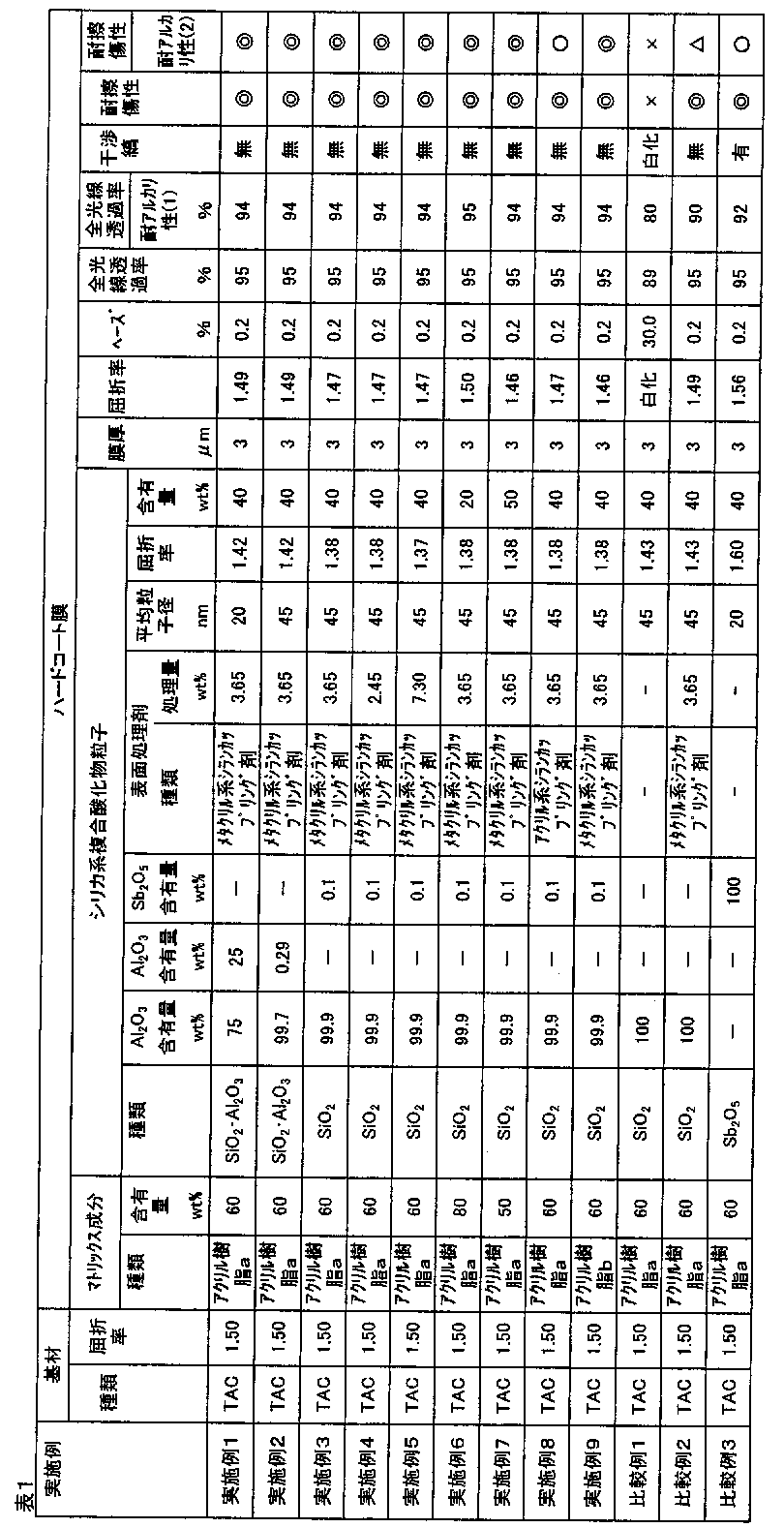
Claims (13)
該ハードコート膜が有機樹脂系マトリックス成分とシリカ系複合酸化物粒子とを含んでなり、基材の屈折率が1.45〜1.55の範囲にあることを特徴とするハードコート膜付基材。 Consisting of a base material and a hard coat film formed on one surface of the base material,
A base with a hard coat film, wherein the hard coat film comprises an organic resin matrix component and silica-based composite oxide particles, and the refractive index of the substrate is in the range of 1.45 to 1.55. Wood.
Rn−SiX4-n (1)
(但し、式中、Rは炭素数1〜10の非置換または置換炭化水素基であって、互いに同一であっても異なっていてもよい。X:炭素数1〜4のアルコキシ基、水酸基、ハロゲン、水素、n:1〜3の整数) The base material with a hard coat film according to any one of claims 1 to 5, wherein the silica-based composite oxide particles are surface-treated with an organosilicon compound represented by the following formula (1).
R n -SiX 4-n (1 )
(In the formula, R is an unsubstituted or substituted hydrocarbon group having 1 to 10 carbon atoms, and may be the same or different from each other. X: an alkoxy group having 1 to 4 carbon atoms, a hydroxyl group, Halogen, hydrogen, n: an integer of 1 to 3)
Priority Applications (1)
| Application Number | Priority Date | Filing Date | Title |
|---|---|---|---|
| JP2007178351A JP5026172B2 (en) | 2007-07-06 | 2007-07-06 | Base material with hard coat film and coating liquid for forming hard coat film |
Applications Claiming Priority (1)
| Application Number | Priority Date | Filing Date | Title |
|---|---|---|---|
| JP2007178351A JP5026172B2 (en) | 2007-07-06 | 2007-07-06 | Base material with hard coat film and coating liquid for forming hard coat film |
Publications (2)
| Publication Number | Publication Date |
|---|---|
| JP2009012375A true JP2009012375A (en) | 2009-01-22 |
| JP5026172B2 JP5026172B2 (en) | 2012-09-12 |
Family
ID=40353860
Family Applications (1)
| Application Number | Title | Priority Date | Filing Date |
|---|---|---|---|
| JP2007178351A Active JP5026172B2 (en) | 2007-07-06 | 2007-07-06 | Base material with hard coat film and coating liquid for forming hard coat film |
Country Status (1)
| Country | Link |
|---|---|
| JP (1) | JP5026172B2 (en) |
Cited By (3)
| Publication number | Priority date | Publication date | Assignee | Title |
|---|---|---|---|---|
| WO2010092948A1 (en) * | 2009-02-16 | 2010-08-19 | 日産自動車株式会社 | Microparticle/polyrotaxane-containing coating, microparticle/polyrotaxane-containing coating film and coated article |
| WO2014054496A1 (en) * | 2012-10-02 | 2014-04-10 | 株式会社カネカ | Active energy ray-curable composition |
| KR20140095919A (en) * | 2013-01-25 | 2014-08-04 | 엘지디스플레이 주식회사 | Hard coating composition and method for manufacturing of the same, plastic substrate comprising the same |
Citations (4)
| Publication number | Priority date | Publication date | Assignee | Title |
|---|---|---|---|---|
| JP2004182765A (en) * | 2002-11-29 | 2004-07-02 | Lintec Corp | Hard coat film |
| JP2005119909A (en) * | 2003-10-17 | 2005-05-12 | Catalysts & Chem Ind Co Ltd | Antimony oxide-coated silica fine particles, method for producing the fine particles, and coated substrate containing the fine particles |
| JP2005186435A (en) * | 2003-12-25 | 2005-07-14 | Catalysts & Chem Ind Co Ltd | Base material with hard coat film and coating liquid for forming hard coat film |
| JP2006106427A (en) * | 2004-10-06 | 2006-04-20 | Nitto Denko Corp | Hard coat film, antireflection hard coat film, optical element and image display device |
-
2007
- 2007-07-06 JP JP2007178351A patent/JP5026172B2/en active Active
Patent Citations (4)
| Publication number | Priority date | Publication date | Assignee | Title |
|---|---|---|---|---|
| JP2004182765A (en) * | 2002-11-29 | 2004-07-02 | Lintec Corp | Hard coat film |
| JP2005119909A (en) * | 2003-10-17 | 2005-05-12 | Catalysts & Chem Ind Co Ltd | Antimony oxide-coated silica fine particles, method for producing the fine particles, and coated substrate containing the fine particles |
| JP2005186435A (en) * | 2003-12-25 | 2005-07-14 | Catalysts & Chem Ind Co Ltd | Base material with hard coat film and coating liquid for forming hard coat film |
| JP2006106427A (en) * | 2004-10-06 | 2006-04-20 | Nitto Denko Corp | Hard coat film, antireflection hard coat film, optical element and image display device |
Cited By (6)
| Publication number | Priority date | Publication date | Assignee | Title |
|---|---|---|---|---|
| WO2010092948A1 (en) * | 2009-02-16 | 2010-08-19 | 日産自動車株式会社 | Microparticle/polyrotaxane-containing coating, microparticle/polyrotaxane-containing coating film and coated article |
| JP2010209315A (en) * | 2009-02-16 | 2010-09-24 | Nissan Motor Co Ltd | Microparticle/polyrotaxane-containing coating, microparticle/polyrotaxane-containing film and coated article |
| US8957139B2 (en) | 2009-02-16 | 2015-02-17 | Nissan Motor Co., Ltd. | Microparticle/polyrotaxane—containing coating, microparticle/polyrotaxane—containing coating film and coated article |
| WO2014054496A1 (en) * | 2012-10-02 | 2014-04-10 | 株式会社カネカ | Active energy ray-curable composition |
| KR20140095919A (en) * | 2013-01-25 | 2014-08-04 | 엘지디스플레이 주식회사 | Hard coating composition and method for manufacturing of the same, plastic substrate comprising the same |
| KR102123076B1 (en) | 2013-01-25 | 2020-06-26 | 엘지디스플레이 주식회사 | Hard coating composition and method for manufacturing of the same, plastic substrate comprising the same |
Also Published As
| Publication number | Publication date |
|---|---|
| JP5026172B2 (en) | 2012-09-12 |
Similar Documents
| Publication | Publication Date | Title |
|---|---|---|
| JP5078620B2 (en) | Hollow silica fine particles, composition for forming transparent film containing the same, and substrate with transparent film | |
| JP5757673B2 (en) | Substrate with transparent film and paint for forming transparent film | |
| JP5378771B2 (en) | Base material with antireflection film and coating liquid for forming antireflection film | |
| CN102666383B (en) | Process for production of silica-alumina sol, silica-alumina sol, coating agent for formation of transparent coating film which comprises the sol, and substrate having transparent coating film attached thereto | |
| JP6895760B2 (en) | Method for producing silica-based particle dispersion liquid, silica-based particle dispersion liquid, coating liquid for forming a transparent film, and base material with a transparent film | |
| JP5546239B2 (en) | Base material with hard coat film and coating liquid for forming hard coat film | |
| JP5700903B2 (en) | Base material with hard coat film and coating liquid for forming hard coat film | |
| JP5642535B2 (en) | Novel silica-based hollow fine particles, base material with transparent film, and paint for forming transparent film | |
| JP5530158B2 (en) | Substrate with transparent film and coating liquid for forming transparent film | |
| JP5754884B2 (en) | Phosphoric acid (excluding phosphoric acid salt) -treated metal oxide fine particles and production method thereof, coating solution for forming a transparent film containing the phosphoric acid (excluding phosphoric acid salt) -treated metal oxide fine particles, and transparent Substrate with coating | |
| JP6112753B2 (en) | Coating liquid for forming transparent film, substrate with transparent film, and method for producing hydrophobic metal oxide particles | |
| JP5680372B2 (en) | Substrate with transparent film and coating liquid for forming transparent film | |
| JP5026172B2 (en) | Base material with hard coat film and coating liquid for forming hard coat film | |
| JP5877708B2 (en) | Base material with hard coat film and coating liquid for forming hard coat film | |
| JP2012030489A (en) | Substrate with transparent film and coating to form transparent film | |
| JP5089312B2 (en) | Base material with hard coat film and coating liquid for forming hard coat film | |
| JP5084122B2 (en) | Film-coated substrate and coating solution for film formation | |
| JP5404568B2 (en) | Silica-based fine particles, coating material for coating formation and substrate with coating | |
| JP2011063478A (en) | Phosphorus-containing antimony pentoxide microparticle, coating liquid for forming transparent conductive film containing the microparticle, and base material with transparent conductive film | |
| JP5501117B2 (en) | Substrate with transparent film and coating liquid for forming transparent film | |
| JP5503241B2 (en) | Base material with hard coat film and coating liquid for forming hard coat film | |
| JP2011093754A (en) | Antimony pentoxide based complex oxide fine particle, coating liquid for forming transparency coating film containing the fine particle, and base material with transparency coating film |
Legal Events
| Date | Code | Title | Description |
|---|---|---|---|
| A621 | Written request for application examination |
Free format text: JAPANESE INTERMEDIATE CODE: A621 Effective date: 20100609 |
|
| RD02 | Notification of acceptance of power of attorney |
Free format text: JAPANESE INTERMEDIATE CODE: A7422 Effective date: 20100609 |
|
| A977 | Report on retrieval |
Free format text: JAPANESE INTERMEDIATE CODE: A971007 Effective date: 20111005 |
|
| A131 | Notification of reasons for refusal |
Free format text: JAPANESE INTERMEDIATE CODE: A131 Effective date: 20111018 |
|
| A521 | Request for written amendment filed |
Free format text: JAPANESE INTERMEDIATE CODE: A523 Effective date: 20111219 |
|
| TRDD | Decision of grant or rejection written | ||
| A01 | Written decision to grant a patent or to grant a registration (utility model) |
Free format text: JAPANESE INTERMEDIATE CODE: A01 Effective date: 20120605 |
|
| A01 | Written decision to grant a patent or to grant a registration (utility model) |
Free format text: JAPANESE INTERMEDIATE CODE: A01 |
|
| A61 | First payment of annual fees (during grant procedure) |
Free format text: JAPANESE INTERMEDIATE CODE: A61 Effective date: 20120620 |
|
| FPAY | Renewal fee payment (event date is renewal date of database) |
Free format text: PAYMENT UNTIL: 20150629 Year of fee payment: 3 |
|
| R150 | Certificate of patent or registration of utility model |
Free format text: JAPANESE INTERMEDIATE CODE: R150 Ref document number: 5026172 Country of ref document: JP Free format text: JAPANESE INTERMEDIATE CODE: R150 |
|
| R250 | Receipt of annual fees |
Free format text: JAPANESE INTERMEDIATE CODE: R250 |
|
| R250 | Receipt of annual fees |
Free format text: JAPANESE INTERMEDIATE CODE: R250 |
|
| R250 | Receipt of annual fees |
Free format text: JAPANESE INTERMEDIATE CODE: R250 |
|
| R250 | Receipt of annual fees |
Free format text: JAPANESE INTERMEDIATE CODE: R250 |
|
| R250 | Receipt of annual fees |
Free format text: JAPANESE INTERMEDIATE CODE: R250 |
|
| R250 | Receipt of annual fees |
Free format text: JAPANESE INTERMEDIATE CODE: R250 |
|
| R250 | Receipt of annual fees |
Free format text: JAPANESE INTERMEDIATE CODE: R250 |
|
| R250 | Receipt of annual fees |
Free format text: JAPANESE INTERMEDIATE CODE: R250 |
|
| R250 | Receipt of annual fees |
Free format text: JAPANESE INTERMEDIATE CODE: R250 |
|
| R250 | Receipt of annual fees |
Free format text: JAPANESE INTERMEDIATE CODE: R250 |
|
| R250 | Receipt of annual fees |
Free format text: JAPANESE INTERMEDIATE CODE: R250 |